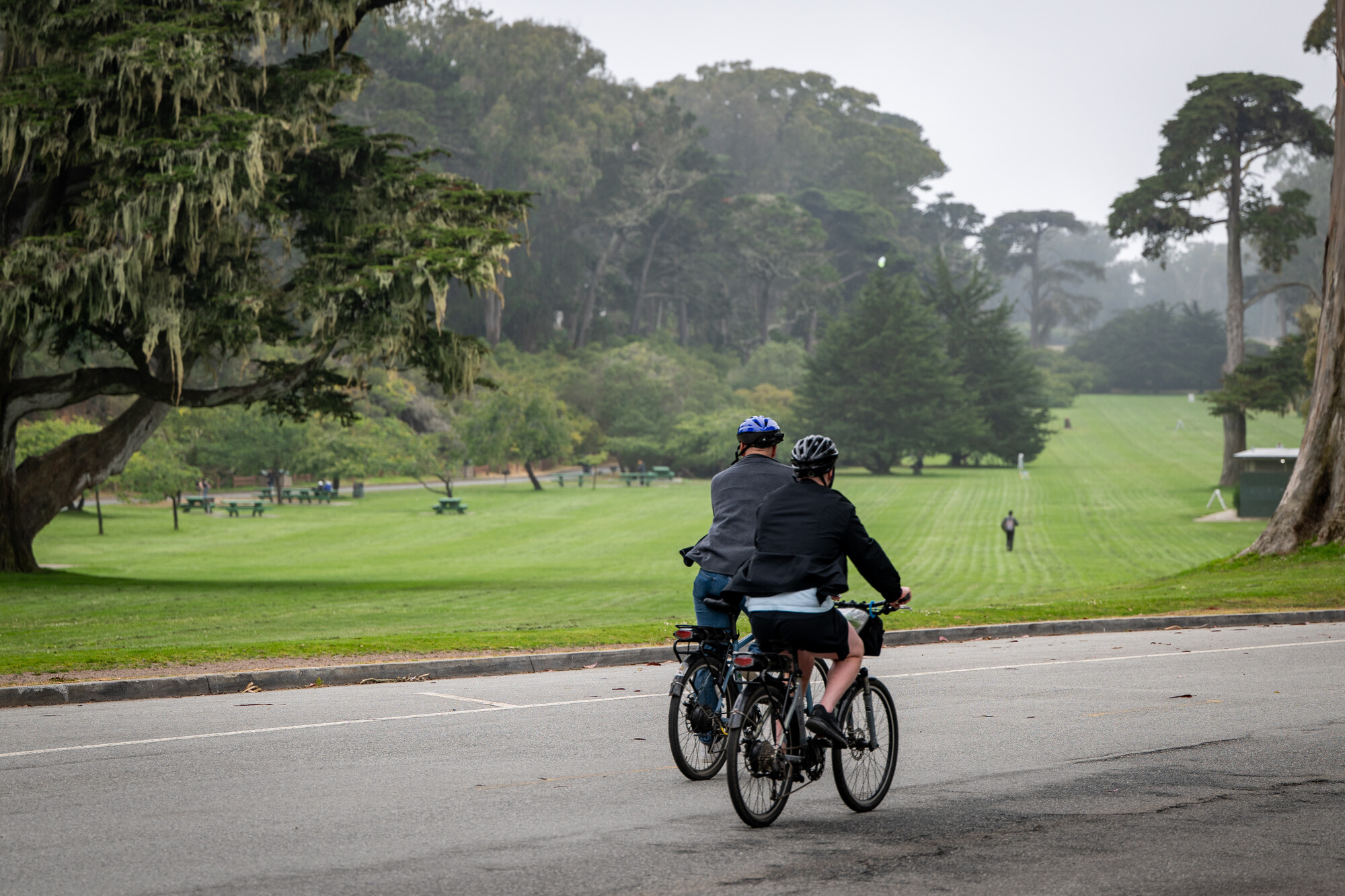
Ex-Leaders of Parks Alliance to Testify on Misuse of Millions in SF Park Funds
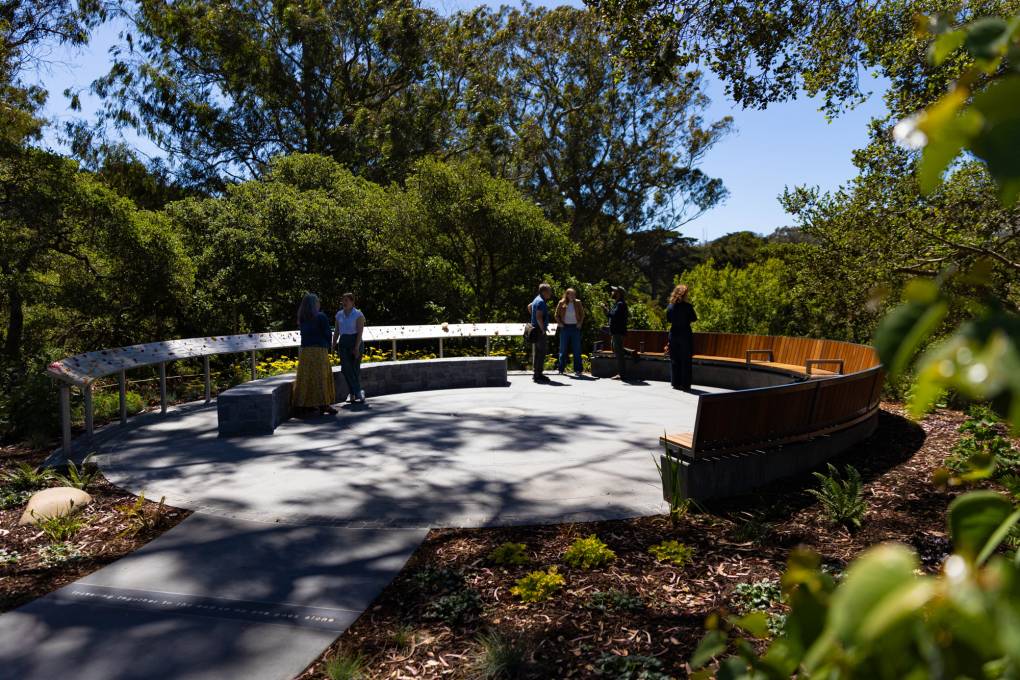
Golden Gate Park’s Newest Memorial Opens Its Arms to All Affected by Cancer
SF Supervisors Order Subpoenas for Ex-Leaders of Defunct Parks Nonprofit
SF Parks Alliance to Shut Down Amid Misspending Scandal, Leaving Partners in the Lurch
Learning to Live With San Francisco’s Coyotes
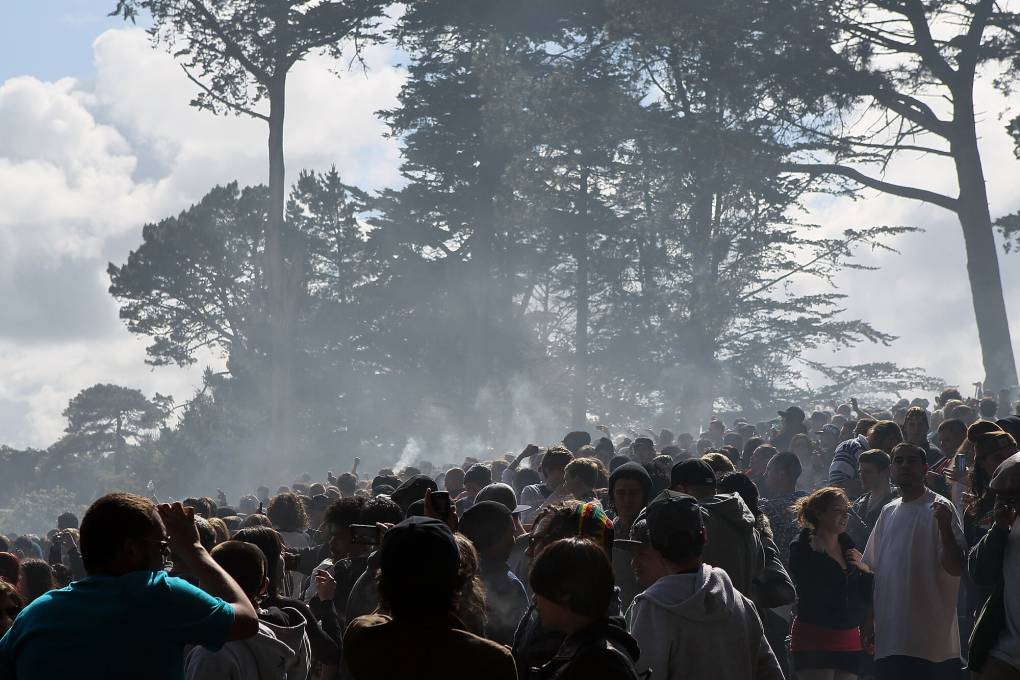
SF’s Official 420 Hippie Hill Celebration Is Canceled. Where Else Can You Celebrate (Legally)?
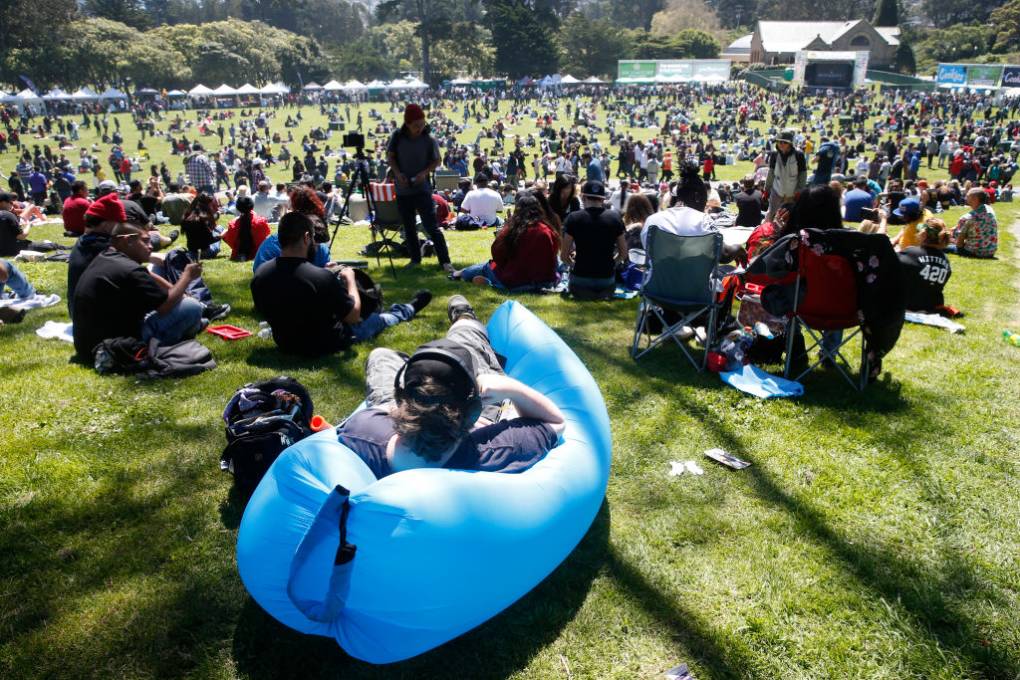
SF’s Official 420 Celebration Canceled for Second Year in a Row
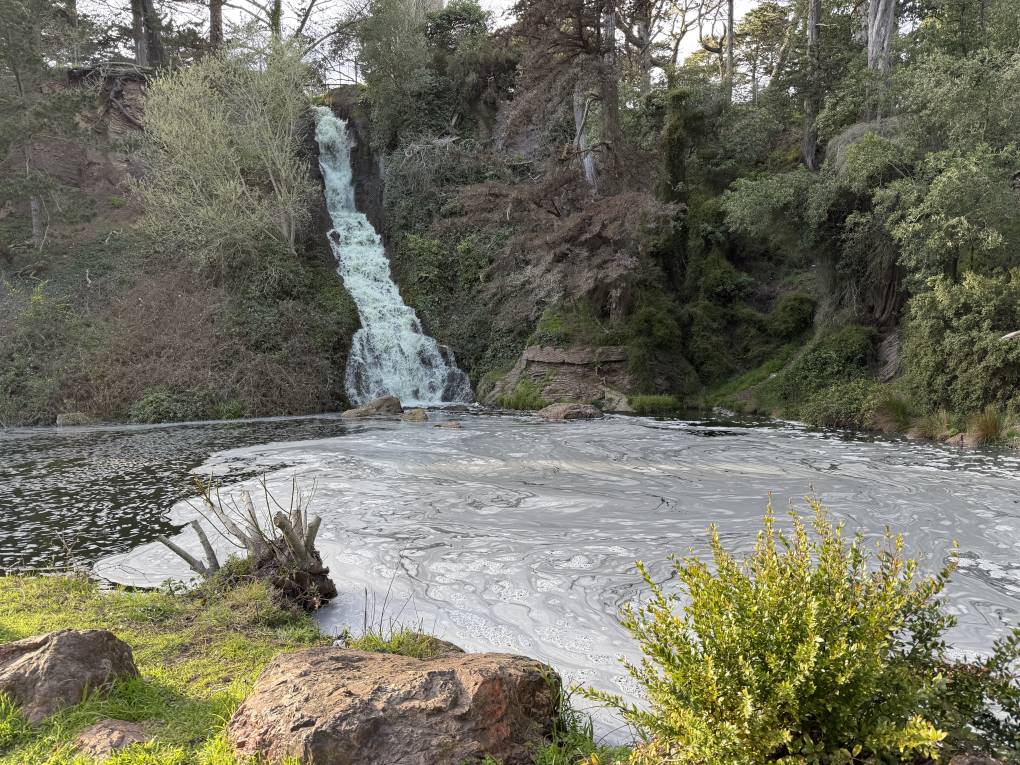
Why Is the Water at Golden Gate Park’s Rainbow Falls Bright Green?
No Tornado in SF, But Crews Are Still Working to Clear Hundreds of Downed Trees
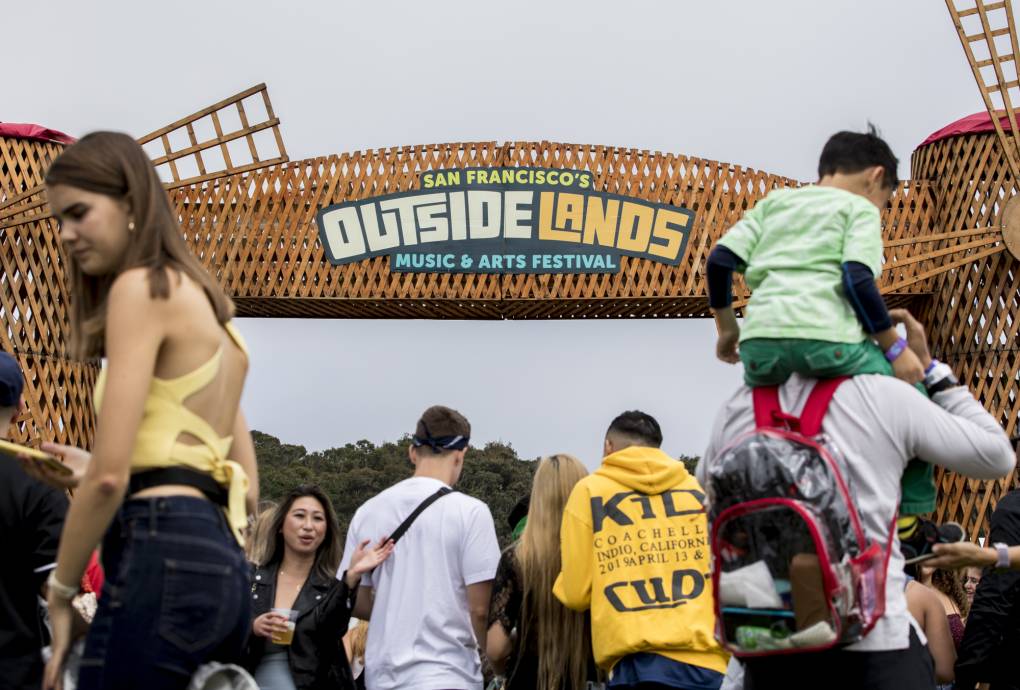
SF Supervisors Approve Plan for New Concert Series in Golden Gate Park
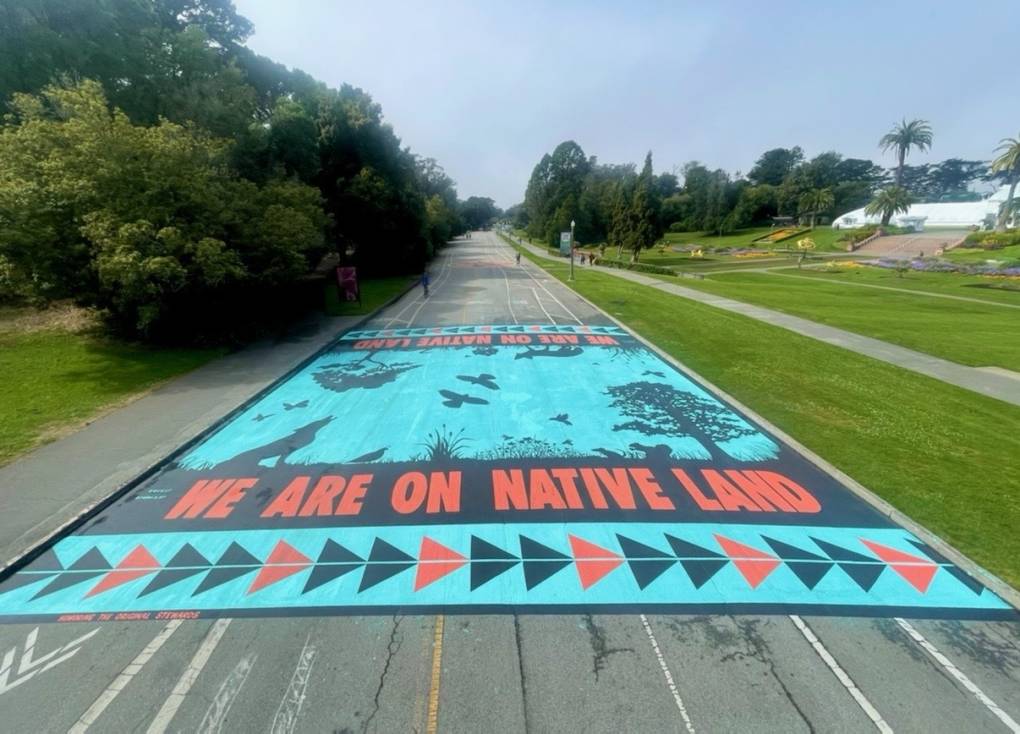
'We Are Here and Present': New Native American Mural in Golden Gate Park, Despite Recent Vandalism, Continues Efforts to Uplift Bay Area Native History
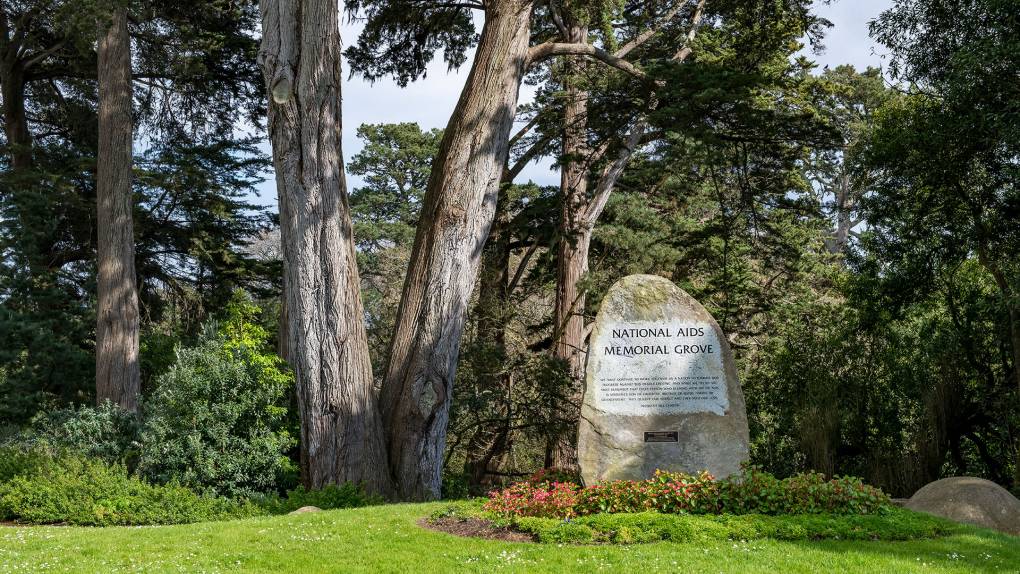
Healing Through Nature at the National AIDS Memorial Grove
window.__IS_SSR__=true
window.__INITIAL_STATE__={
"attachmentsReducer": {
"audio_0": {
"type": "attachments",
"id": "audio_0",
"imgSizes": {
"kqedFullSize": {
"file": "https://ww2.kqed.org/news/wp-content/themes/KQED-unified/img/audio_bgs/background0.jpg"
}
}
},
"audio_1": {
"type": "attachments",
"id": "audio_1",
"imgSizes": {
"kqedFullSize": {
"file": "https://ww2.kqed.org/news/wp-content/themes/KQED-unified/img/audio_bgs/background1.jpg"
}
}
},
"audio_2": {
"type": "attachments",
"id": "audio_2",
"imgSizes": {
"kqedFullSize": {
"file": "https://ww2.kqed.org/news/wp-content/themes/KQED-unified/img/audio_bgs/background2.jpg"
}
}
},
"audio_3": {
"type": "attachments",
"id": "audio_3",
"imgSizes": {
"kqedFullSize": {
"file": "https://ww2.kqed.org/news/wp-content/themes/KQED-unified/img/audio_bgs/background3.jpg"
}
}
},
"audio_4": {
"type": "attachments",
"id": "audio_4",
"imgSizes": {
"kqedFullSize": {
"file": "https://ww2.kqed.org/news/wp-content/themes/KQED-unified/img/audio_bgs/background4.jpg"
}
}
},
"placeholder": {
"type": "attachments",
"id": "placeholder",
"imgSizes": {
"thumbnail": {
"file": "https://cdn.kqed.org/wp-content/uploads/2024/12/KQED-Default-Image-816638274-2000x1333-1-160x107.jpg",
"width": 160,
"height": 107,
"mimeType": "image/jpeg"
},
"medium": {
"file": "https://cdn.kqed.org/wp-content/uploads/2024/12/KQED-Default-Image-816638274-2000x1333-1-800x533.jpg",
"width": 800,
"height": 533,
"mimeType": "image/jpeg"
},
"medium_large": {
"file": "https://cdn.kqed.org/wp-content/uploads/2024/12/KQED-Default-Image-816638274-2000x1333-1-768x512.jpg",
"width": 768,
"height": 512,
"mimeType": "image/jpeg"
},
"large": {
"file": "https://cdn.kqed.org/wp-content/uploads/2024/12/KQED-Default-Image-816638274-2000x1333-1-1020x680.jpg",
"width": 1020,
"height": 680,
"mimeType": "image/jpeg"
},
"1536x1536": {
"file": "https://cdn.kqed.org/wp-content/uploads/2024/12/KQED-Default-Image-816638274-2000x1333-1-1536x1024.jpg",
"width": 1536,
"height": 1024,
"mimeType": "image/jpeg"
},
"fd-lrg": {
"file": "https://cdn.kqed.org/wp-content/uploads/2024/12/KQED-Default-Image-816638274-2000x1333-1-1536x1024.jpg",
"width": 1536,
"height": 1024,
"mimeType": "image/jpeg"
},
"fd-med": {
"file": "https://cdn.kqed.org/wp-content/uploads/2024/12/KQED-Default-Image-816638274-2000x1333-1-1020x680.jpg",
"width": 1020,
"height": 680,
"mimeType": "image/jpeg"
},
"fd-sm": {
"file": "https://cdn.kqed.org/wp-content/uploads/2024/12/KQED-Default-Image-816638274-2000x1333-1-800x533.jpg",
"width": 800,
"height": 533,
"mimeType": "image/jpeg"
},
"post-thumbnail": {
"file": "https://cdn.kqed.org/wp-content/uploads/2024/12/KQED-Default-Image-816638274-2000x1333-1-672x372.jpg",
"width": 672,
"height": 372,
"mimeType": "image/jpeg"
},
"twentyfourteen-full-width": {
"file": "https://cdn.kqed.org/wp-content/uploads/2024/12/KQED-Default-Image-816638274-2000x1333-1-1038x576.jpg",
"width": 1038,
"height": 576,
"mimeType": "image/jpeg"
},
"xxsmall": {
"file": "https://cdn.kqed.org/wp-content/uploads/2024/12/KQED-Default-Image-816638274-2000x1333-1-160x107.jpg",
"width": 160,
"height": 107,
"mimeType": "image/jpeg"
},
"xsmall": {
"file": "https://cdn.kqed.org/wp-content/uploads/2024/12/KQED-Default-Image-816638274-2000x1333-1-672x372.jpg",
"width": 672,
"height": 372,
"mimeType": "image/jpeg"
},
"small": {
"file": "https://cdn.kqed.org/wp-content/uploads/2024/12/KQED-Default-Image-816638274-2000x1333-1-672x372.jpg",
"width": 672,
"height": 372,
"mimeType": "image/jpeg"
},
"xlarge": {
"file": "https://cdn.kqed.org/wp-content/uploads/2024/12/KQED-Default-Image-816638274-2000x1333-1-1020x680.jpg",
"width": 1020,
"height": 680,
"mimeType": "image/jpeg"
},
"full-width": {
"file": "https://cdn.kqed.org/wp-content/uploads/2024/12/KQED-Default-Image-816638274-2000x1333-1-1920x1280.jpg",
"width": 1920,
"height": 1280,
"mimeType": "image/jpeg"
},
"guest-author-32": {
"file": "https://cdn.kqed.org/wp-content/uploads/2025/01/KQED-Default-Image-816638274-1333x1333-1-160x160.jpg",
"width": 32,
"height": 32,
"mimeType": "image/jpeg"
},
"guest-author-50": {
"file": "https://cdn.kqed.org/wp-content/uploads/2025/01/KQED-Default-Image-816638274-1333x1333-1-160x160.jpg",
"width": 50,
"height": 50,
"mimeType": "image/jpeg"
},
"guest-author-64": {
"file": "https://cdn.kqed.org/wp-content/uploads/2025/01/KQED-Default-Image-816638274-1333x1333-1-160x160.jpg",
"width": 64,
"height": 64,
"mimeType": "image/jpeg"
},
"guest-author-96": {
"file": "https://cdn.kqed.org/wp-content/uploads/2025/01/KQED-Default-Image-816638274-1333x1333-1-160x160.jpg",
"width": 96,
"height": 96,
"mimeType": "image/jpeg"
},
"guest-author-128": {
"file": "https://cdn.kqed.org/wp-content/uploads/2025/01/KQED-Default-Image-816638274-1333x1333-1-160x160.jpg",
"width": 128,
"height": 128,
"mimeType": "image/jpeg"
},
"detail": {
"file": "https://cdn.kqed.org/wp-content/uploads/2025/01/KQED-Default-Image-816638274-1333x1333-1-160x160.jpg",
"width": 160,
"height": 160,
"mimeType": "image/jpeg"
},
"kqedFullSize": {
"file": "https://cdn.kqed.org/wp-content/uploads/2024/12/KQED-Default-Image-816638274-2000x1333-1.jpg",
"width": 2000,
"height": 1333
}
}
},
"news_12048500": {
"type": "attachments",
"id": "news_12048500",
"meta": {
"index": "attachments_1716263798",
"site": "news",
"id": "12048500",
"found": true
},
"title": "250624-ParkFile-30-BL_qed",
"publishDate": 1752769989,
"status": "inherit",
"parent": 12048495,
"modified": 1752770008,
"caption": "Bicyclists ride past Hellman Hollow Picnic Area in Golden Gate Park in San Francisco on June 24, 2025. Former leaders of the San Francisco Parks Alliance will testify before city supervisors about the alleged misuse of $3.8 million in public and donor funds, as criminal and regulatory investigations into the embattled California nonprofit continue.",
"credit": "Beth LaBerge/KQED",
"altTag": null,
"description": null,
"imgSizes": {
"thumbnail": {
"file": "https://cdn.kqed.org/wp-content/uploads/sites/10/2025/07/250624-ParkFile-30-BL_qed-160x107.jpg",
"width": 160,
"height": 107,
"mimeType": "image/jpeg"
},
"1536x1536": {
"file": "https://cdn.kqed.org/wp-content/uploads/sites/10/2025/07/250624-ParkFile-30-BL_qed-1536x1024.jpg",
"width": 1536,
"height": 1024,
"mimeType": "image/jpeg"
},
"post-thumbnail": {
"file": "https://cdn.kqed.org/wp-content/uploads/sites/10/2025/07/250624-ParkFile-30-BL_qed-672x372.jpg",
"width": 672,
"height": 372,
"mimeType": "image/jpeg"
},
"twentyfourteen-full-width": {
"file": "https://cdn.kqed.org/wp-content/uploads/sites/10/2025/07/250624-ParkFile-30-BL_qed-1038x576.jpg",
"width": 1038,
"height": 576,
"mimeType": "image/jpeg"
},
"kqedFullSize": {
"file": "https://cdn.kqed.org/wp-content/uploads/sites/10/2025/07/250624-ParkFile-30-BL_qed.jpg",
"width": 2000,
"height": 1333
}
},
"isLoading": false,
"fetchFailed": false
},
"news_12041393": {
"type": "attachments",
"id": "news_12041393",
"meta": {
"index": "attachments_1716263798",
"site": "news",
"id": "12041393",
"found": true
},
"title": "20250522_GGPMEMORIALGARDEN_GC-22-KQED",
"publishDate": 1747954287,
"status": "inherit",
"parent": 0,
"modified": 1747954375,
"caption": "Visitors look at the names inscribed at the Bay Area Young Survivors Breast Cancer Memorial Garden in Golden Gate Park in San Francisco on May 22, 2025.",
"credit": "Gina Castro/KQED",
"altTag": null,
"description": null,
"imgSizes": {
"medium": {
"file": "https://cdn.kqed.org/wp-content/uploads/sites/10/2025/05/20250522_GGPMEMORIALGARDEN_GC-22-KQED-800x533.jpg",
"width": 800,
"height": 533,
"mimeType": "image/jpeg"
},
"large": {
"file": "https://cdn.kqed.org/wp-content/uploads/sites/10/2025/05/20250522_GGPMEMORIALGARDEN_GC-22-KQED-1020x680.jpg",
"width": 1020,
"height": 680,
"mimeType": "image/jpeg"
},
"thumbnail": {
"file": "https://cdn.kqed.org/wp-content/uploads/sites/10/2025/05/20250522_GGPMEMORIALGARDEN_GC-22-KQED-160x107.jpg",
"width": 160,
"height": 107,
"mimeType": "image/jpeg"
},
"1536x1536": {
"file": "https://cdn.kqed.org/wp-content/uploads/sites/10/2025/05/20250522_GGPMEMORIALGARDEN_GC-22-KQED-1536x1024.jpg",
"width": 1536,
"height": 1024,
"mimeType": "image/jpeg"
},
"post-thumbnail": {
"file": "https://cdn.kqed.org/wp-content/uploads/sites/10/2025/05/20250522_GGPMEMORIALGARDEN_GC-22-KQED-672x372.jpg",
"width": 672,
"height": 372,
"mimeType": "image/jpeg"
},
"twentyfourteen-full-width": {
"file": "https://cdn.kqed.org/wp-content/uploads/sites/10/2025/05/20250522_GGPMEMORIALGARDEN_GC-22-KQED-1038x576.jpg",
"width": 1038,
"height": 576,
"mimeType": "image/jpeg"
},
"full-width": {
"file": "https://cdn.kqed.org/wp-content/uploads/sites/10/2025/05/20250522_GGPMEMORIALGARDEN_GC-22-KQED-1920x1280.jpg",
"width": 1920,
"height": 1280,
"mimeType": "image/jpeg"
},
"kqedFullSize": {
"file": "https://cdn.kqed.org/wp-content/uploads/sites/10/2025/05/20250522_GGPMEMORIALGARDEN_GC-22-KQED.jpg",
"width": 2000,
"height": 1333
}
},
"isLoading": false,
"fetchFailed": false
},
"news_12046163": {
"type": "attachments",
"id": "news_12046163",
"meta": {
"index": "attachments_1716263798",
"site": "news",
"id": "12046163",
"found": true
},
"title": "Crane Cove Park in San Francisco on June 24, 2025.",
"publishDate": 1750969867,
"status": "inherit",
"parent": 0,
"modified": 1750969942,
"caption": "Crane Cove Park in San Francisco on June 24, 2025.",
"credit": "Beth LaBerge/KQED",
"altTag": null,
"description": null,
"imgSizes": {
"thumbnail": {
"file": "https://cdn.kqed.org/wp-content/uploads/sites/10/2025/06/250624-PARKFILE-34-BL-KQED-160x107.jpg",
"width": 160,
"height": 107,
"mimeType": "image/jpeg"
},
"1536x1536": {
"file": "https://cdn.kqed.org/wp-content/uploads/sites/10/2025/06/250624-PARKFILE-34-BL-KQED-1536x1024.jpg",
"width": 1536,
"height": 1024,
"mimeType": "image/jpeg"
},
"post-thumbnail": {
"file": "https://cdn.kqed.org/wp-content/uploads/sites/10/2025/06/250624-PARKFILE-34-BL-KQED-672x372.jpg",
"width": 672,
"height": 372,
"mimeType": "image/jpeg"
},
"twentyfourteen-full-width": {
"file": "https://cdn.kqed.org/wp-content/uploads/sites/10/2025/06/250624-PARKFILE-34-BL-KQED-1038x576.jpg",
"width": 1038,
"height": 576,
"mimeType": "image/jpeg"
},
"kqedFullSize": {
"file": "https://cdn.kqed.org/wp-content/uploads/sites/10/2025/06/250624-PARKFILE-34-BL-KQED.jpg",
"width": 2000,
"height": 1333
}
},
"isLoading": false,
"fetchFailed": false
},
"news_12046161": {
"type": "attachments",
"id": "news_12046161",
"meta": {
"index": "attachments_1716263798",
"site": "news",
"id": "12046161",
"found": true
},
"title": "Blue Heron Lake in Golden Gate Park in San Francisco on June 24, 2025.",
"publishDate": 1750969859,
"status": "inherit",
"parent": 0,
"modified": 1750969947,
"caption": "Blue Heron Lake in Golden Gate Park in San Francisco on June 24, 2025.",
"credit": "Beth LaBerge/KQED",
"altTag": null,
"description": null,
"imgSizes": {
"thumbnail": {
"file": "https://cdn.kqed.org/wp-content/uploads/sites/10/2025/06/250624-PARKFILE-26-BL-KQED-160x107.jpg",
"width": 160,
"height": 107,
"mimeType": "image/jpeg"
},
"1536x1536": {
"file": "https://cdn.kqed.org/wp-content/uploads/sites/10/2025/06/250624-PARKFILE-26-BL-KQED-1536x1024.jpg",
"width": 1536,
"height": 1024,
"mimeType": "image/jpeg"
},
"post-thumbnail": {
"file": "https://cdn.kqed.org/wp-content/uploads/sites/10/2025/06/250624-PARKFILE-26-BL-KQED-672x372.jpg",
"width": 672,
"height": 372,
"mimeType": "image/jpeg"
},
"twentyfourteen-full-width": {
"file": "https://cdn.kqed.org/wp-content/uploads/sites/10/2025/06/250624-PARKFILE-26-BL-KQED-1038x576.jpg",
"width": 1038,
"height": 576,
"mimeType": "image/jpeg"
},
"kqedFullSize": {
"file": "https://cdn.kqed.org/wp-content/uploads/sites/10/2025/06/250624-PARKFILE-26-BL-KQED.jpg",
"width": 2000,
"height": 1333
}
},
"isLoading": false,
"fetchFailed": false
},
"news_11800985": {
"type": "attachments",
"id": "news_11800985",
"meta": {
"index": "attachments_1716263798",
"site": "news",
"id": "11800985",
"found": true
},
"parent": 11799871,
"imgSizes": {
"apple_news_ca_landscape_5_5": {
"file": "https://ww2.kqed.org/app/uploads/sites/10/2020/02/RS41109_Urban-Coyote-qut-1-1044x783.jpg",
"width": 1044,
"mimeType": "image/jpeg",
"height": 783
},
"apple_news_ca_square_4_0": {
"file": "https://ww2.kqed.org/app/uploads/sites/10/2020/02/RS41109_Urban-Coyote-qut-1-470x470.jpg",
"width": 470,
"mimeType": "image/jpeg",
"height": 470
},
"twentyfourteen-full-width": {
"file": "https://ww2.kqed.org/app/uploads/sites/10/2020/02/RS41109_Urban-Coyote-qut-1-1038x576.jpg",
"width": 1038,
"mimeType": "image/jpeg",
"height": 576
},
"thumbnail": {
"file": "https://ww2.kqed.org/app/uploads/sites/10/2020/02/RS41109_Urban-Coyote-qut-1-160x120.jpg",
"width": 160,
"mimeType": "image/jpeg",
"height": 120
},
"post-thumbnail": {
"file": "https://ww2.kqed.org/app/uploads/sites/10/2020/02/RS41109_Urban-Coyote-qut-1-672x372.jpg",
"width": 672,
"mimeType": "image/jpeg",
"height": 372
},
"kqedFullSize": {
"file": "https://ww2.kqed.org/app/uploads/sites/10/2020/02/RS41109_Urban-Coyote-qut-1.jpg",
"width": 1200,
"height": 900
},
"apple_news_ca_landscape_4_7": {
"file": "https://ww2.kqed.org/app/uploads/sites/10/2020/02/RS41109_Urban-Coyote-qut-1-632x474.jpg",
"width": 632,
"mimeType": "image/jpeg",
"height": 474
},
"large": {
"file": "https://ww2.kqed.org/app/uploads/sites/10/2020/02/RS41109_Urban-Coyote-qut-1-1020x765.jpg",
"width": 1020,
"mimeType": "image/jpeg",
"height": 765
},
"apple_news_ca_landscape_4_0": {
"file": "https://ww2.kqed.org/app/uploads/sites/10/2020/02/RS41109_Urban-Coyote-qut-1-536x402.jpg",
"width": 536,
"mimeType": "image/jpeg",
"height": 402
},
"apple_news_ca_portrait_12_9": {
"file": "https://ww2.kqed.org/app/uploads/sites/10/2020/02/RS41109_Urban-Coyote-qut-1-1122x900.jpg",
"width": 1122,
"mimeType": "image/jpeg",
"height": 900
},
"medium": {
"file": "https://ww2.kqed.org/app/uploads/sites/10/2020/02/RS41109_Urban-Coyote-qut-1-800x600.jpg",
"width": 800,
"mimeType": "image/jpeg",
"height": 600
},
"apple_news_ca_portrait_4_0": {
"file": "https://ww2.kqed.org/app/uploads/sites/10/2020/02/RS41109_Urban-Coyote-qut-1-354x472.jpg",
"width": 354,
"mimeType": "image/jpeg",
"height": 472
},
"apple_news_ca_portrait_9_7": {
"file": "https://ww2.kqed.org/app/uploads/sites/10/2020/02/RS41109_Urban-Coyote-qut-1-840x900.jpg",
"width": 840,
"mimeType": "image/jpeg",
"height": 900
},
"apple_news_ca_square_9_7": {
"file": "https://ww2.kqed.org/app/uploads/sites/10/2020/02/RS41109_Urban-Coyote-qut-1-1104x900.jpg",
"width": 1104,
"mimeType": "image/jpeg",
"height": 900
},
"apple_news_ca_portrait_4_7": {
"file": "https://ww2.kqed.org/app/uploads/sites/10/2020/02/RS41109_Urban-Coyote-qut-1-414x552.jpg",
"width": 414,
"mimeType": "image/jpeg",
"height": 552
},
"apple_news_ca_portrait_5_5": {
"file": "https://ww2.kqed.org/app/uploads/sites/10/2020/02/RS41109_Urban-Coyote-qut-1-687x900.jpg",
"width": 687,
"mimeType": "image/jpeg",
"height": 900
},
"apple_news_ca_square_4_7": {
"file": "https://ww2.kqed.org/app/uploads/sites/10/2020/02/RS41109_Urban-Coyote-qut-1-550x550.jpg",
"width": 550,
"mimeType": "image/jpeg",
"height": 550
},
"apple_news_ca_square_5_5": {
"file": "https://ww2.kqed.org/app/uploads/sites/10/2020/02/RS41109_Urban-Coyote-qut-1-912x900.jpg",
"width": 912,
"mimeType": "image/jpeg",
"height": 900
}
},
"publishDate": 1581382796,
"modified": 1582150999,
"caption": "In San Francisco, coyotes have claimed urban parks as their territories. ",
"description": null,
"title": "RS41109_Urban Coyote-qut",
"credit": "Courtesy of Janet Kessler",
"status": "inherit",
"isLoading": false,
"fetchFailed": false
},
"news_11980835": {
"type": "attachments",
"id": "news_11980835",
"meta": {
"index": "attachments_1716263798",
"site": "news",
"id": "11980835",
"found": true
},
"parent": 11980820,
"imgSizes": {
"twentyfourteen-full-width": {
"file": "https://cdn.kqed.org/wp-content/uploads/sites/10/2024/03/GettyImages-1408784015-1024x576.jpg",
"width": 1024,
"mimeType": "image/jpeg",
"height": 576
},
"thumbnail": {
"file": "https://cdn.kqed.org/wp-content/uploads/sites/10/2024/03/GettyImages-1408784015-160x107.jpg",
"width": 160,
"mimeType": "image/jpeg",
"height": 107
},
"post-thumbnail": {
"file": "https://cdn.kqed.org/wp-content/uploads/sites/10/2024/03/GettyImages-1408784015-672x372.jpg",
"width": 672,
"mimeType": "image/jpeg",
"height": 372
},
"kqedFullSize": {
"file": "https://cdn.kqed.org/wp-content/uploads/sites/10/2024/03/GettyImages-1408784015.jpg",
"width": 1024,
"height": 683
},
"large": {
"file": "https://cdn.kqed.org/wp-content/uploads/sites/10/2024/03/GettyImages-1408784015-1020x680.jpg",
"width": 1020,
"mimeType": "image/jpeg",
"height": 680
},
"medium": {
"file": "https://cdn.kqed.org/wp-content/uploads/sites/10/2024/03/GettyImages-1408784015-800x534.jpg",
"width": 800,
"mimeType": "image/jpeg",
"height": 534
}
},
"publishDate": 1711486190,
"modified": 1711487503,
"caption": "Marijuana lovers gather at the top of Hippie Hill for the annual 420 celebration of cannabis at Golden Gate Park in San Francisco on Friday, April 20, 2018.",
"description": null,
"title": "Marijuana lovers gather at the top of Hippie Hill for the annual 4/20 celebration of cannabis at Golden Gate Park in San Francisco, Calif. on Friday, April 20, 2018",
"credit": "Paul Chinn/The San Francisco Chronicle via Getty Images",
"status": "inherit",
"altTag": null,
"isLoading": false,
"fetchFailed": false
},
"news_12032255": {
"type": "attachments",
"id": "news_12032255",
"meta": {
"index": "attachments_1716263798",
"site": "news",
"id": "12032255",
"found": true
},
"title": "Enthusiasts Gather For Mass Pot-Smoking Celebration",
"publishDate": 1742495030,
"status": "inherit",
"parent": 12080068,
"modified": 1776283705,
"caption": "A cloud of smoke rests over the heads of a group of people during a 420 Day celebration on \"Hippie Hill\" in Golden Gate Park April 20, 2010, in San Francisco, California. ",
"credit": "Justin Sullivan/Getty Images",
"altTag": null,
"description": null,
"imgSizes": {
"medium": {
"file": "https://cdn.kqed.org/wp-content/uploads/sites/10/2025/03/98579521_qed-800x533.jpg",
"width": 800,
"height": 533,
"mimeType": "image/jpeg"
},
"large": {
"file": "https://cdn.kqed.org/wp-content/uploads/sites/10/2025/03/98579521_qed-1020x680.jpg",
"width": 1020,
"height": 680,
"mimeType": "image/jpeg"
},
"thumbnail": {
"file": "https://cdn.kqed.org/wp-content/uploads/sites/10/2025/03/98579521_qed-160x107.jpg",
"width": 160,
"height": 107,
"mimeType": "image/jpeg"
},
"1536x1536": {
"file": "https://cdn.kqed.org/wp-content/uploads/sites/10/2025/03/98579521_qed-1536x1024.jpg",
"width": 1536,
"height": 1024,
"mimeType": "image/jpeg"
},
"post-thumbnail": {
"file": "https://cdn.kqed.org/wp-content/uploads/sites/10/2025/03/98579521_qed-672x372.jpg",
"width": 672,
"height": 372,
"mimeType": "image/jpeg"
},
"twentyfourteen-full-width": {
"file": "https://cdn.kqed.org/wp-content/uploads/sites/10/2025/03/98579521_qed-1038x576.jpg",
"width": 1038,
"height": 576,
"mimeType": "image/jpeg"
},
"full-width": {
"file": "https://cdn.kqed.org/wp-content/uploads/sites/10/2025/03/98579521_qed-1920x1280.jpg",
"width": 1920,
"height": 1280,
"mimeType": "image/jpeg"
},
"kqedFullSize": {
"file": "https://cdn.kqed.org/wp-content/uploads/sites/10/2025/03/98579521_qed.jpg",
"width": 2000,
"height": 1333
}
},
"isLoading": false,
"fetchFailed": false
},
"news_12029885": {
"type": "attachments",
"id": "news_12029885",
"meta": {
"index": "attachments_1716263798",
"site": "news",
"id": "12029885",
"found": true
},
"title": "IMG_0072",
"publishDate": 1741214889,
"status": "inherit",
"parent": 12029872,
"modified": 1741215023,
"caption": "Golden Gate Park's Rainbow Falls, San Francisco, 2025.",
"credit": "Katrina Schwartz/KQED",
"altTag": null,
"description": null,
"imgSizes": {
"medium": {
"file": "https://cdn.kqed.org/wp-content/uploads/sites/10/2025/03/IMG_0072-800x600.jpg",
"width": 800,
"height": 600,
"mimeType": "image/jpeg"
},
"large": {
"file": "https://cdn.kqed.org/wp-content/uploads/sites/10/2025/03/IMG_0072-1020x765.jpg",
"width": 1020,
"height": 765,
"mimeType": "image/jpeg"
},
"thumbnail": {
"file": "https://cdn.kqed.org/wp-content/uploads/sites/10/2025/03/IMG_0072-160x120.jpg",
"width": 160,
"height": 120,
"mimeType": "image/jpeg"
},
"1536x1536": {
"file": "https://cdn.kqed.org/wp-content/uploads/sites/10/2025/03/IMG_0072-1536x1152.jpg",
"width": 1536,
"height": 1152,
"mimeType": "image/jpeg"
},
"2048x2048": {
"file": "https://cdn.kqed.org/wp-content/uploads/sites/10/2025/03/IMG_0072-2048x1536.jpg",
"width": 2048,
"height": 1536,
"mimeType": "image/jpeg"
},
"post-thumbnail": {
"file": "https://cdn.kqed.org/wp-content/uploads/sites/10/2025/03/IMG_0072-672x372.jpg",
"width": 672,
"height": 372,
"mimeType": "image/jpeg"
},
"twentyfourteen-full-width": {
"file": "https://cdn.kqed.org/wp-content/uploads/sites/10/2025/03/IMG_0072-1038x576.jpg",
"width": 1038,
"height": 576,
"mimeType": "image/jpeg"
},
"full-width": {
"file": "https://cdn.kqed.org/wp-content/uploads/sites/10/2025/03/IMG_0072-1920x1440.jpg",
"width": 1920,
"height": 1440,
"mimeType": "image/jpeg"
},
"kqedFullSize": {
"file": "https://cdn.kqed.org/wp-content/uploads/sites/10/2025/03/IMG_0072-scaled.jpg",
"width": 2560,
"height": 1920
}
},
"isLoading": false,
"fetchFailed": false
},
"news_12018591": {
"type": "attachments",
"id": "news_12018591",
"meta": {
"index": "attachments_1716263798",
"site": "news",
"id": "12018591",
"found": true
},
"title": "20241216_SFStormCleanup_GC-17",
"publishDate": 1734399275,
"status": "inherit",
"parent": 0,
"modified": 1734437888,
"caption": "Dianna Stammerjohn searches for an owl’s nest at the site of a fallen pine tree, caused by last weekend’s storm, by the Bison Paddock, in the Outter Richmond neighborhood of San Francisco’s Golden Gate Park on Dec. 16, 2024. Stammerjohn said the owls had been nesting there for years.",
"credit": "Gina Castro/KQED",
"altTag": null,
"description": null,
"imgSizes": {
"medium": {
"file": "https://cdn.kqed.org/wp-content/uploads/sites/10/2024/12/20241216_SFStormCleanup_GC-17-800x533.jpg",
"width": 800,
"height": 533,
"mimeType": "image/jpeg"
},
"large": {
"file": "https://cdn.kqed.org/wp-content/uploads/sites/10/2024/12/20241216_SFStormCleanup_GC-17-1020x679.jpg",
"width": 1020,
"height": 679,
"mimeType": "image/jpeg"
},
"thumbnail": {
"file": "https://cdn.kqed.org/wp-content/uploads/sites/10/2024/12/20241216_SFStormCleanup_GC-17-160x107.jpg",
"width": 160,
"height": 107,
"mimeType": "image/jpeg"
},
"1536x1536": {
"file": "https://cdn.kqed.org/wp-content/uploads/sites/10/2024/12/20241216_SFStormCleanup_GC-17-1536x1023.jpg",
"width": 1536,
"height": 1023,
"mimeType": "image/jpeg"
},
"post-thumbnail": {
"file": "https://cdn.kqed.org/wp-content/uploads/sites/10/2024/12/20241216_SFStormCleanup_GC-17-672x372.jpg",
"width": 672,
"height": 372,
"mimeType": "image/jpeg"
},
"twentyfourteen-full-width": {
"file": "https://cdn.kqed.org/wp-content/uploads/sites/10/2024/12/20241216_SFStormCleanup_GC-17-1038x576.jpg",
"width": 1038,
"height": 576,
"mimeType": "image/jpeg"
},
"full-width": {
"file": "https://cdn.kqed.org/wp-content/uploads/sites/10/2024/12/20241216_SFStormCleanup_GC-17-1920x1279.jpg",
"width": 1920,
"height": 1279,
"mimeType": "image/jpeg"
},
"kqedFullSize": {
"file": "https://cdn.kqed.org/wp-content/uploads/sites/10/2024/12/20241216_SFStormCleanup_GC-17.jpg",
"width": 2000,
"height": 1332
}
},
"isLoading": false,
"fetchFailed": false
},
"news_11960656": {
"type": "attachments",
"id": "news_11960656",
"meta": {
"index": "attachments_1716263798",
"site": "news",
"id": "11960656",
"found": true
},
"title": "Fans pose under the iconic windmill arch during day two of the Outside Lands Music Festival at Golden Gate Park in San Francisco, Calif. Saturday, August 10, 2019.",
"publishDate": 1694465072,
"status": "inherit",
"parent": 12090715,
"modified": 1784219193,
"caption": "Fans pose under the iconic windmill arch during day two of the Outside Lands Music Festival at Golden Gate Park in San Francisco on August 10, 2019.",
"credit": "Jessica Christian/The San Francisco Chronicle via Getty Images",
"altTag": "Fans pose under the iconic windmill arch during day two of the Outside Lands Music Festival at Golden Gate Park in San Francisco on August 10, 2019.",
"description": null,
"imgSizes": {
"medium": {
"file": "https://cdn.kqed.org/wp-content/uploads/sites/10/2023/09/230911-Outside-Lands-Getty-JC-KQED_1-800x541.jpg",
"width": 800,
"height": 541,
"mimeType": "image/jpeg"
},
"large": {
"file": "https://cdn.kqed.org/wp-content/uploads/sites/10/2023/09/230911-Outside-Lands-Getty-JC-KQED_1-1020x690.jpg",
"width": 1020,
"height": 690,
"mimeType": "image/jpeg"
},
"thumbnail": {
"file": "https://cdn.kqed.org/wp-content/uploads/sites/10/2023/09/230911-Outside-Lands-Getty-JC-KQED_1-160x108.jpg",
"width": 160,
"height": 108,
"mimeType": "image/jpeg"
},
"1536x1536": {
"file": "https://cdn.kqed.org/wp-content/uploads/sites/10/2023/09/230911-Outside-Lands-Getty-JC-KQED_1-1536x1038.jpg",
"width": 1536,
"height": 1038,
"mimeType": "image/jpeg"
},
"post-thumbnail": {
"file": "https://cdn.kqed.org/wp-content/uploads/sites/10/2023/09/230911-Outside-Lands-Getty-JC-KQED_1-672x372.jpg",
"width": 672,
"height": 372,
"mimeType": "image/jpeg"
},
"twentyfourteen-full-width": {
"file": "https://cdn.kqed.org/wp-content/uploads/sites/10/2023/09/230911-Outside-Lands-Getty-JC-KQED_1-1038x576.jpg",
"width": 1038,
"height": 576,
"mimeType": "image/jpeg"
},
"full-width": {
"file": "https://cdn.kqed.org/wp-content/uploads/sites/10/2023/09/230911-Outside-Lands-Getty-JC-KQED_1-1920x1298.jpg",
"width": 1920,
"height": 1298,
"mimeType": "image/jpeg"
},
"kqedFullSize": {
"file": "https://cdn.kqed.org/wp-content/uploads/sites/10/2023/09/230911-Outside-Lands-Getty-JC-KQED_1.jpg",
"width": 2000,
"height": 1352
}
},
"isLoading": false,
"fetchFailed": false
},
"news_11929111": {
"type": "attachments",
"id": "news_11929111",
"meta": {
"index": "attachments_1716263798",
"site": "news",
"id": "11929111",
"found": true
},
"parent": 11929099,
"imgSizes": {
"twentyfourteen-full-width": {
"file": "https://ww2.kqed.org/app/uploads/sites/10/2022/10/Finished_Mural-1038x576.jpg",
"width": 1038,
"mimeType": "image/jpeg",
"height": 576
},
"thumbnail": {
"file": "https://ww2.kqed.org/app/uploads/sites/10/2022/10/Finished_Mural-160x115.jpg",
"width": 160,
"mimeType": "image/jpeg",
"height": 115
},
"post-thumbnail": {
"file": "https://ww2.kqed.org/app/uploads/sites/10/2022/10/Finished_Mural-672x372.jpg",
"width": 672,
"mimeType": "image/jpeg",
"height": 372
},
"kqedFullSize": {
"file": "https://ww2.kqed.org/app/uploads/sites/10/2022/10/Finished_Mural.jpg",
"width": 1206,
"height": 868
},
"large": {
"file": "https://ww2.kqed.org/app/uploads/sites/10/2022/10/Finished_Mural-1020x734.jpg",
"width": 1020,
"mimeType": "image/jpeg",
"height": 734
},
"medium": {
"file": "https://ww2.kqed.org/app/uploads/sites/10/2022/10/Finished_Mural-800x576.jpg",
"width": 800,
"mimeType": "image/jpeg",
"height": 576
}
},
"publishDate": 1665864115,
"modified": 1666035940,
"caption": "The 'We Are on Native Land' mural before it was vandalized.",
"description": null,
"title": "Finished_Mural",
"credit": "Courtesy of American Indian Cultural District",
"status": "inherit",
"altTag": "A massive turquoise, black and red street mural covering a section of the JFK Promenade stating 'We are on Native land'",
"isLoading": false,
"fetchFailed": false
},
"news_11915794": {
"type": "attachments",
"id": "news_11915794",
"meta": {
"index": "attachments_1716263798",
"site": "news",
"id": "11915794",
"found": true
},
"parent": 11915788,
"imgSizes": {
"twentyfourteen-full-width": {
"file": "https://ww2.kqed.org/app/uploads/sites/10/2022/06/AIDS-grove1-1038x576.jpg",
"width": 1038,
"mimeType": "image/jpeg",
"height": 576
},
"thumbnail": {
"file": "https://ww2.kqed.org/app/uploads/sites/10/2022/06/AIDS-grove1-160x90.jpg",
"width": 160,
"mimeType": "image/jpeg",
"height": 90
},
"post-thumbnail": {
"file": "https://ww2.kqed.org/app/uploads/sites/10/2022/06/AIDS-grove1-672x372.jpg",
"width": 672,
"mimeType": "image/jpeg",
"height": 372
},
"kqedFullSize": {
"file": "https://ww2.kqed.org/app/uploads/sites/10/2022/06/AIDS-grove1.jpg",
"width": 1920,
"height": 1080
},
"large": {
"file": "https://ww2.kqed.org/app/uploads/sites/10/2022/06/AIDS-grove1-1020x574.jpg",
"width": 1020,
"mimeType": "image/jpeg",
"height": 574
},
"1536x1536": {
"file": "https://ww2.kqed.org/app/uploads/sites/10/2022/06/AIDS-grove1-1536x864.jpg",
"width": 1536,
"mimeType": "image/jpeg",
"height": 864
},
"medium": {
"file": "https://ww2.kqed.org/app/uploads/sites/10/2022/06/AIDS-grove1-800x450.jpg",
"width": 800,
"mimeType": "image/jpeg",
"height": 450
}
},
"publishDate": 1654131434,
"modified": 1654284508,
"caption": "A stone marks the entrance of the AIDS Memorial Grove. Visitors walk down a set of long stairs, through the trees and into the dell.",
"description": null,
"title": "AIDS-grove1",
"credit": "Courtesy of National AIDS Memorial",
"status": "inherit",
"altTag": "In the middle of a grassy knoll, flanked by tall trees, a stone proclaims \"National AIDS Memorial Grove.\"",
"isLoading": false,
"fetchFailed": false
}
},
"audioPlayerReducer": {
"postId": "stream_live",
"isPaused": true,
"isPlaying": false,
"pfsActive": false,
"pledgeModalIsOpen": true,
"playerDrawerIsOpen": false,
"liveAudioPlayStartedAt": 0,
"liveAudioPlayContext": ""
},
"authorsReducer": {
"byline_news_12029872": {
"type": "authors",
"id": "byline_news_12029872",
"meta": {
"override": true
},
"slug": "byline_news_12029872",
"name": "Chris Hambrick and \u003ca href=\"https://www.kqed.org/author/katrinaschwartz\">Katrina Schwartz\u003c/a>",
"isLoading": false
},
"astupi": {
"type": "authors",
"id": "70",
"meta": {
"index": "authors_1716337520",
"id": "70",
"found": true
},
"name": "Amanda Stupi",
"firstName": "Amanda",
"lastName": "Stupi",
"slug": "astupi",
"email": "astupi@kqed.org",
"display_author_email": false,
"staff_mastheads": [],
"title": "Senior Engagement Producer",
"bio": "Amanda joined KQED Science’s engagement team as a Senior Audience Engagement Strategist in the spring of 2019. She has helped craft messaging around wildfires, the coronavirus pandemic, climate change and many other stories. She has also brought KQED Science to new platforms such as Reddit’s Ask Me Anything series. Prior to joining KQED Science, Amanda spent seven years as an engagement producer with Forum, KQED’s daily live call-in show. She got her start in radio at KALW's weekly call in show, City Visions, before going on to an internship and stint at NPR's Talk of the Nation.\r\n\r\nPrior to journalism, Amanda taught English at Lowell High School. She's a native of Petaluma and currently lives under the \"South San Francisco the Industrial City\" sign in South City. She believes that engagement is vital to news’s future and that good journalism listens as much as it asks questions.",
"avatar": "https://secure.gravatar.com/avatar/e981c503e5c162da701dcaccfbf87e35?s=600&d=blank&r=g",
"twitter": null,
"facebook": null,
"instagram": null,
"linkedin": null,
"sites": [
{
"site": "arts",
"roles": [
"Contributor"
]
},
{
"site": "news",
"roles": [
"editor"
]
},
{
"site": "pop",
"roles": [
"contributor"
]
},
{
"site": "stateofhealth",
"roles": [
"editor"
]
},
{
"site": "science",
"roles": []
},
{
"site": "perspectives",
"roles": [
"editor"
]
}
],
"headData": {
"title": "Amanda Stupi | KQED",
"description": "Senior Engagement Producer",
"ogImgSrc": "https://secure.gravatar.com/avatar/e981c503e5c162da701dcaccfbf87e35?s=600&d=blank&r=g",
"twImgSrc": "https://secure.gravatar.com/avatar/e981c503e5c162da701dcaccfbf87e35?s=600&d=blank&r=g"
},
"isLoading": false,
"link": "/author/astupi"
},
"matthewgreen": {
"type": "authors",
"id": "1263",
"meta": {
"index": "authors_1716337520",
"id": "1263",
"found": true
},
"name": "Matthew Green",
"firstName": "Matthew",
"lastName": "Green",
"slug": "matthewgreen",
"email": "mgreen@kqed.org",
"display_author_email": false,
"staff_mastheads": [],
"title": "KQED Editor/Reporter",
"bio": "Matthew Green is a digital media producer for KQED News. He previously produced \u003ca href=\"http://www.kqed.org/lowdown\">The Lowdown\u003c/a>, KQED’s multimedia news education blog. Matthew's written for numerous Bay Area publications, including the Oakland Tribune and San Francisco Chronicle. He also taught journalism classes at Fremont High School in East Oakland.\r\n\r\nEmail: mgreen@kqed.org; Twitter: @MGreenKQED",
"avatar": "https://secure.gravatar.com/avatar/3bf498d1267ca02c8494f33d8cfc575e?s=600&d=blank&r=g",
"twitter": "MGreenKQED",
"facebook": null,
"instagram": null,
"linkedin": null,
"sites": [
{
"site": "news",
"roles": []
},
{
"site": "lowdown",
"roles": []
},
{
"site": "science",
"roles": []
},
{
"site": "education",
"roles": []
},
{
"site": "quest",
"roles": []
},
{
"site": "liveblog",
"roles": []
}
],
"headData": {
"title": "Matthew Green | KQED",
"description": "KQED Editor/Reporter",
"ogImgSrc": "https://secure.gravatar.com/avatar/3bf498d1267ca02c8494f33d8cfc575e?s=600&d=blank&r=g",
"twImgSrc": "https://secure.gravatar.com/avatar/3bf498d1267ca02c8494f33d8cfc575e?s=600&d=blank&r=g"
},
"isLoading": false,
"link": "/author/matthewgreen"
},
"ecruzguevarra": {
"type": "authors",
"id": "8654",
"meta": {
"index": "authors_1716337520",
"id": "8654",
"found": true
},
"name": "Ericka Cruz Guevarra",
"firstName": "Ericka",
"lastName": "Cruz Guevarra",
"slug": "ecruzguevarra",
"email": "ecruzguevarra@kqed.org",
"display_author_email": true,
"staff_mastheads": [
"news"
],
"title": "Producer, The Bay Podcast",
"bio": "Ericka Cruz Guevarra is host of \u003ca href=\"https://www.kqed.org/podcasts/thebay\">\u003cem>The Bay\u003c/em>\u003c/a> podcast at KQED. Before host, she was the show’s producer. Her work in that capacity includes a three-part reported series on policing in Vallejo, which won a 2020 excellence in journalism award from the Society of Professional Journalists. Ericka has worked as a breaking news reporter at Oregon Public Broadcasting, helped produce the Code Switch podcast, and was KQED’s inaugural Raul Ramirez Diversity Fund intern. She’s also an alumna of NPR’s Next Generation Radio program. Send her an email if you have strong feelings about whether Fairfield and Suisun City are the Bay. Ericka is represented by SAG-AFTRA.",
"avatar": "https://secure.gravatar.com/avatar/25e5ab8d3d53fad2dcc7bb2b5c506b1a?s=600&d=blank&r=g",
"twitter": "NotoriousECG",
"facebook": null,
"instagram": null,
"linkedin": null,
"sites": [
{
"site": "arts",
"roles": [
"subscriber"
]
},
{
"site": "news",
"roles": [
"editor",
"manage_categories"
]
},
{
"site": "futureofyou",
"roles": [
"subscriber"
]
},
{
"site": "stateofhealth",
"roles": [
"subscriber"
]
},
{
"site": "science",
"roles": [
"editor"
]
},
{
"site": "forum",
"roles": [
"subscriber"
]
}
],
"headData": {
"title": "Ericka Cruz Guevarra | KQED",
"description": "Producer, The Bay Podcast",
"ogImgSrc": "https://secure.gravatar.com/avatar/25e5ab8d3d53fad2dcc7bb2b5c506b1a?s=600&d=blank&r=g",
"twImgSrc": "https://secure.gravatar.com/avatar/25e5ab8d3d53fad2dcc7bb2b5c506b1a?s=600&d=blank&r=g"
},
"isLoading": false,
"link": "/author/ecruzguevarra"
},
"lsarah": {
"type": "authors",
"id": "11626",
"meta": {
"index": "authors_1716337520",
"id": "11626",
"found": true
},
"name": "Lakshmi Sarah",
"firstName": "Lakshmi",
"lastName": "Sarah",
"slug": "lsarah",
"email": "lsarah@kqed.org",
"display_author_email": false,
"staff_mastheads": [],
"title": "Digital Producer",
"bio": "Lakshmi Sarah is an educator, author and journalist with a focus on innovative storytelling. She has worked with newspapers, radio and magazines from Ahmedabad, India to Los Angeles, California. She has written and produced for Die Zeit, Global Voices, AJ+, KQED, Fusion Media Group and the New York Times.",
"avatar": "https://secure.gravatar.com/avatar/652dcaecd8b28826fc17a8b2d6bb4e93?s=600&d=blank&r=g",
"twitter": "lakitalki",
"facebook": null,
"instagram": "https://www.instagram.com/laki.talki/",
"linkedin": "https://www.linkedin.com/in/lakisarah/",
"sites": [
{
"site": "arts",
"roles": []
},
{
"site": "news",
"roles": []
},
{
"site": "bayareabites",
"roles": []
},
{
"site": "science",
"roles": []
}
],
"headData": {
"title": "Lakshmi Sarah | KQED",
"description": "Digital Producer",
"ogImgSrc": "https://secure.gravatar.com/avatar/652dcaecd8b28826fc17a8b2d6bb4e93?s=600&d=blank&r=g",
"twImgSrc": "https://secure.gravatar.com/avatar/652dcaecd8b28826fc17a8b2d6bb4e93?s=600&d=blank&r=g"
},
"isLoading": false,
"link": "/author/lsarah"
},
"amontecillo": {
"type": "authors",
"id": "11649",
"meta": {
"index": "authors_1716337520",
"id": "11649",
"found": true
},
"name": "Alan Montecillo",
"firstName": "Alan",
"lastName": "Montecillo",
"slug": "amontecillo",
"email": "amontecillo@kqed.org",
"display_author_email": false,
"staff_mastheads": [
"news"
],
"title": "KQED Contributor",
"bio": "Alan Montecillo is the senior editor of \u003cem>\u003ca href=\"http://kqed.org/thebay\">The Bay\u003c/a>, \u003c/em> KQED's local news podcast. Before moving to the Bay Area, he worked as a senior talk show producer for WILL in Champaign-Urbana, Illinois and at Oregon Public Broadcasting in Portland, Oregon. He has won journalism awards from the Society of Professional Journalists Northern California, the Public Media Journalists Association, The Signal Awards, and has also received a regional Edward R. Murrow award. Alan is a Filipino American from Hong Kong and a graduate of Reed College.",
"avatar": "https://secure.gravatar.com/avatar/d5e4e7a76481969ccba76f4e2b5ccabc?s=600&d=blank&r=g",
"twitter": "alanmontecillo",
"facebook": null,
"instagram": null,
"linkedin": null,
"sites": [
{
"site": "",
"roles": [
"editor"
]
},
{
"site": "news",
"roles": [
"editor",
"manage_categories"
]
}
],
"headData": {
"title": "Alan Montecillo | KQED",
"description": "KQED Contributor",
"ogImgSrc": "https://secure.gravatar.com/avatar/d5e4e7a76481969ccba76f4e2b5ccabc?s=600&d=blank&r=g",
"twImgSrc": "https://secure.gravatar.com/avatar/d5e4e7a76481969ccba76f4e2b5ccabc?s=600&d=blank&r=g"
},
"isLoading": false,
"link": "/author/amontecillo"
},
"afinney": {
"type": "authors",
"id": "11772",
"meta": {
"index": "authors_1716337520",
"id": "11772",
"found": true
},
"name": "Annelise Finney",
"firstName": "Annelise",
"lastName": "Finney",
"slug": "afinney",
"email": "afinney@kqed.org",
"display_author_email": true,
"staff_mastheads": [
"news"
],
"title": "Reporter",
"bio": "Annelise reports on reparations in California and East Bay politics. She co-produced the Sunday Music Drop, a limited-term radio series featuring Bay Area musicians that aired between Sept 2022 and Oct 2024. She joined KQED in 2021 as a general assignment reporter and is an alumna of KALW's Audio Academy. She was born and raised in the East Bay. She is currently away from KQED completing a year-long reporting project in Berlin, Germany as a Alexander Von Humboldt German Chancellor Fellow.",
"avatar": "https://secure.gravatar.com/avatar/5fded66cae47704cdfc5021cde0f3aa4?s=600&d=blank&r=g",
"twitter": null,
"facebook": null,
"instagram": null,
"linkedin": null,
"sites": [
{
"site": "news",
"roles": [
"editor"
]
},
{
"site": "liveblog",
"roles": [
"author"
]
}
],
"headData": {
"title": "Annelise Finney | KQED",
"description": "Reporter",
"ogImgSrc": "https://secure.gravatar.com/avatar/5fded66cae47704cdfc5021cde0f3aa4?s=600&d=blank&r=g",
"twImgSrc": "https://secure.gravatar.com/avatar/5fded66cae47704cdfc5021cde0f3aa4?s=600&d=blank&r=g"
},
"isLoading": false,
"link": "/author/afinney"
},
"adahlstromeckman": {
"type": "authors",
"id": "11785",
"meta": {
"index": "authors_1716337520",
"id": "11785",
"found": true
},
"name": "Azul Dahlstrom-Eckman",
"firstName": "Azul",
"lastName": "Dahlstrom-Eckman",
"slug": "adahlstromeckman",
"email": "adahlstrom-eckman@kqed.org",
"display_author_email": true,
"staff_mastheads": [],
"title": "Reporter",
"bio": "Azul is a reporter for KQED focusing on transportation and features. He joined KQED in 2021 as an alumna of KALW's Audio Academy radio journalism training program.",
"avatar": "https://secure.gravatar.com/avatar/9cb750298435add7815a777f55bf1f46845c1386bb8452555c60a7b820b5aba3?s=600&d=blank&r=g",
"twitter": "@zuliemann",
"bluesky": "@azul415.bsky.social",
"facebook": null,
"instagram": null,
"linkedin": null,
"sites": [
{
"site": "arts",
"roles": [
"editor"
]
},
{
"site": "news",
"roles": [
"editor"
]
},
{
"site": "science",
"roles": [
"editor"
]
},
{
"site": "liveblog",
"roles": [
"author"
]
}
],
"headData": {
"title": "Azul Dahlstrom-Eckman | KQED",
"description": "Reporter",
"ogImgSrc": "https://secure.gravatar.com/avatar/9cb750298435add7815a777f55bf1f46845c1386bb8452555c60a7b820b5aba3?s=600&d=blank&r=g",
"twImgSrc": "https://secure.gravatar.com/avatar/9cb750298435add7815a777f55bf1f46845c1386bb8452555c60a7b820b5aba3?s=600&d=blank&r=g"
},
"isLoading": false,
"link": "/author/adahlstromeckman"
},
"jessicakariisa": {
"type": "authors",
"id": "11831",
"meta": {
"index": "authors_1716337520",
"id": "11831",
"found": true
},
"name": "Jessica Kariisa",
"firstName": "Jessica",
"lastName": "Kariisa",
"slug": "jessicakariisa",
"email": "jkariisa@kqed.org",
"display_author_email": false,
"staff_mastheads": [],
"title": "Producer, The Bay",
"bio": "Jessica Kariisa is the producer of The Bay. She first joined KQED as an intern for The California Report Magazine, after which she became an on-call producer. She reported a Bay Curious episode on the use of rap lyrics in criminal trials which won a Society of Professional Journalists award in 2023 for Excellence in Features Journalism and the 2023 Signal Award for Best Conversation Starter. She’s worked on podcasts for Snap Judgment and American Public Media. Before embarking on her audio career, she was a music journalist.\r\n\r\nJessica Kariisa is represented by SAG-AFTRA.",
"avatar": "https://secure.gravatar.com/avatar/522e97b28ac0b3d411621c0fde8f3419c7b71ea2c5c262c57c4bb600963f328c?s=600&d=blank&r=g",
"twitter": null,
"bluesky": null,
"facebook": null,
"instagram": null,
"linkedin": null,
"sites": [
{
"site": "arts",
"roles": [
"author"
]
},
{
"site": "news",
"roles": [
"editor",
"manage_categories"
]
}
],
"headData": {
"title": "Jessica Kariisa | KQED",
"description": "Producer, The Bay",
"ogImgSrc": "https://secure.gravatar.com/avatar/522e97b28ac0b3d411621c0fde8f3419c7b71ea2c5c262c57c4bb600963f328c?s=600&d=blank&r=g",
"twImgSrc": "https://secure.gravatar.com/avatar/522e97b28ac0b3d411621c0fde8f3419c7b71ea2c5c262c57c4bb600963f328c?s=600&d=blank&r=g"
},
"isLoading": false,
"link": "/author/jessicakariisa"
},
"opalma": {
"type": "authors",
"id": "11897",
"meta": {
"index": "authors_1716337520",
"id": "11897",
"found": true
},
"name": "Oscar Palma",
"firstName": "Oscar",
"lastName": "Palma",
"slug": "opalma",
"email": "opalma@kqed.org",
"display_author_email": false,
"staff_mastheads": [],
"title": "KQED Contributor",
"bio": "Oscar Palma is a newscast intern at KQED, a freelance reporter and former Spanish editor for Golden Gate Xpress. Oscar is interested in environmental and community journalism. Some of his personal interests are bicycles, film, and Latin American literature and punk, his work has previously appeared in El Tecolote, KQED and The Frisc.",
"avatar": "https://secure.gravatar.com/avatar/d488e9b9f94b80f7b78e2896064827ab?s=600&d=blank&r=g",
"twitter": null,
"facebook": null,
"instagram": null,
"linkedin": null,
"sites": [
{
"site": "news",
"roles": [
"author"
]
}
],
"headData": {
"title": "Oscar Palma | KQED",
"description": "KQED Contributor",
"ogImgSrc": "https://secure.gravatar.com/avatar/d488e9b9f94b80f7b78e2896064827ab?s=600&d=blank&r=g",
"twImgSrc": "https://secure.gravatar.com/avatar/d488e9b9f94b80f7b78e2896064827ab?s=600&d=blank&r=g"
},
"isLoading": false,
"link": "/author/opalma"
},
"kdebenedetti": {
"type": "authors",
"id": "11913",
"meta": {
"index": "authors_1716337520",
"id": "11913",
"found": true
},
"name": "Katie DeBenedetti",
"firstName": "Katie",
"lastName": "DeBenedetti",
"slug": "kdebenedetti",
"email": "kdebenedetti@kqed.org",
"display_author_email": false,
"staff_mastheads": [
"news",
"science"
],
"title": "KQED Contributor",
"bio": "Katie DeBenedetti is a digital reporter covering daily news for the Express Desk. Prior to joining KQED as a culture reporting intern in January 2024, she covered education and city government for the Napa Valley Register.",
"avatar": "https://secure.gravatar.com/avatar/6e31073cb8f7e4214ab03f42771d0f45?s=600&d=blank&r=g",
"twitter": null,
"facebook": null,
"instagram": null,
"linkedin": null,
"sites": [
{
"site": "news",
"roles": [
"author"
]
},
{
"site": "science",
"roles": [
"author"
]
},
{
"site": "liveblog",
"roles": [
"author"
]
}
],
"headData": {
"title": "Katie DeBenedetti | KQED",
"description": "KQED Contributor",
"ogImgSrc": "https://secure.gravatar.com/avatar/6e31073cb8f7e4214ab03f42771d0f45?s=600&d=blank&r=g",
"twImgSrc": "https://secure.gravatar.com/avatar/6e31073cb8f7e4214ab03f42771d0f45?s=600&d=blank&r=g"
},
"isLoading": false,
"link": "/author/kdebenedetti"
},
"sarahwright": {
"type": "authors",
"id": "11956",
"meta": {
"index": "authors_1716337520",
"id": "11956",
"found": true
},
"name": "Sarah Wright",
"firstName": "Sarah",
"lastName": "Wright",
"slug": "sarahwright",
"email": "swright@kqed.org",
"display_author_email": true,
"staff_mastheads": [],
"title": "Outdoors Engagement Reporter",
"bio": "Sarah Wright is KQED's Outdoors Engagement Reporter. Originally from Lake Tahoe, she completed a thru-hike of the Pacific Crest Trail in 2019 and was a U.S. Fulbright Program grantee to Argentina in 2023. Her journalism has appeared in The Guardian, The San Francisco Standard, The Palo Alto Weekly and the Half Moon Bay Review.",
"avatar": "https://secure.gravatar.com/avatar/c161a3d6441865cba25e6db4fa561099ad665799e9432e34da2b84d7e371524c?s=600&d=blank&r=g",
"twitter": null,
"bluesky": null,
"facebook": null,
"instagram": null,
"linkedin": null,
"sites": [
{
"site": "arts",
"roles": [
"editor"
]
},
{
"site": "news",
"roles": [
"editor"
]
},
{
"site": "science",
"roles": [
"contributor",
"author"
]
},
{
"site": "forum",
"roles": [
"editor"
]
}
],
"headData": {
"title": "Sarah Wright | KQED",
"description": "Outdoors Engagement Reporter",
"ogImgSrc": "https://secure.gravatar.com/avatar/c161a3d6441865cba25e6db4fa561099ad665799e9432e34da2b84d7e371524c?s=600&d=blank&r=g",
"twImgSrc": "https://secure.gravatar.com/avatar/c161a3d6441865cba25e6db4fa561099ad665799e9432e34da2b84d7e371524c?s=600&d=blank&r=g"
},
"isLoading": false,
"link": "/author/sarahwright"
}
},
"pagesReducer": {
"news_tag_golden-gate-park": {
"type": "terms",
"id": "news_823",
"meta": {
"index": "terms_1716263798",
"site": "news",
"id": "823",
"score": 9.101694
},
"featImg": null,
"name": "Golden Gate Park",
"description": null,
"taxonomy": "tag",
"headData": {
"twImgId": null,
"twTitle": null,
"ogTitle": null,
"ogImgId": null,
"twDescription": null,
"description": null,
"title": "Golden Gate Park Archives | KQED News",
"ogDescription": null
},
"ttid": 833,
"slug": "golden-gate-park",
"isLoading": false,
"title": "Golden Gate Park",
"pageMeta": {
"site": "news",
"WpPageTemplate": "page-topic-editorial",
"currentPage": 2
},
"blocks": [
{
"blockName": "kqed/post-list",
"attrs": {
"layout": "cardArticle2",
"query": "posts/news?tag=golden-gate-park",
"seeMore": false,
"paginated": true,
"page": 2
}
},
{
"blockName": "kqed/ad"
}
]
}
},
"pfsSessionReducer": {},
"postsReducer": {
"stream_live": {
"type": "live",
"id": "stream_live",
"audioUrl": "https://streams.kqed.org/kqedradio",
"title": "Live Stream",
"excerpt": "Live Stream information currently unavailable.",
"link": "/radio",
"featImg": "",
"label": {
"name": "KQED Live",
"link": "/"
}
},
"stream_kqedNewscast": {
"type": "posts",
"id": "stream_kqedNewscast",
"audioUrl": "https://www.kqed.org/.stream/anon/radio/RDnews/newscast.mp3?_=1",
"title": "KQED Newscast",
"featImg": "",
"label": {
"name": "88.5 FM",
"link": "/"
}
},
"news_12048495": {
"type": "posts",
"id": "news_12048495",
"meta": {
"index": "posts_1716263798",
"site": "news",
"id": "12048495",
"score": null,
"sort": [
1752774270000
]
},
"guestAuthors": [],
"slug": "ex-leaders-of-parks-alliance-to-testify-on-misuse-of-millions-in-sf-park-funds",
"title": "Ex-Leaders of Parks Alliance to Testify on Misuse of Millions in SF Park Funds",
"publishDate": 1752774270,
"format": "standard",
"headTitle": "Ex-Leaders of Parks Alliance to Testify on Misuse of Millions in SF Park Funds | KQED",
"labelTerm": {
"site": "news"
},
"content": "\u003cp>Former leaders of the \u003ca href=\"https://www.kqed.org/news/12043932/how-a-trusted-sf-nonprofit-unraveled-and-took-millions-with-it\">San Francisco nonprofit that shut down in June\u003c/a> after allegedly misspending millions of dollars meant for city parks will testify before the Board of Supervisors on Thursday.\u003c/p>\n\u003cp>The Government Audit and Oversight Committee is set to question former San Francisco Parks Alliance CEOs Robert Ogilvie and Drew Becher, as well as former treasurer Rick Hutchinson, about how the nonprofit mispent at least $3.8 million.\u003c/p>\n\u003cp>“I have questions about internal controls that were in place; how and who became aware of what and when; and how our community organizations in the city are going to be made whole if the funding has completely dried up,” Supervisor Jackie Fielder, who chairs the committee, told KQED on Wednesday.\u003c/p>\n\u003cp>[ad fullwidth]\u003c/p>\n\u003cp>\u003cstrong>What’s happening: \u003c/strong>Former leaders of the Parks Alliance, who the city’s government oversight committee \u003ca href=\"https://www.kqed.org/news/12042870/sf-supervisors-order-subpoenas-for-fraught-former-parks-nonprofit\">subpoenaed\u003c/a> in June, will take questions from supervisors on Thursday. They’re expected to explain how the Alliance, a nonprofit that worked closely with the city’s Recreation and Parks Department and acted as the fundraising arm for about 80 community groups, misspent nearly $4 million, though Fielder said they plan to appear with attorneys.\u003c/p>\n\u003cp>“Hopefully we’ll get some answers as to how this all transpired and happened, although it’s unclear … as they’re also going to be there with their lawyers,” Fielder said.\u003c/p>\n\u003cfigure id=\"attachment_12046160\" class=\"wp-caption aligncenter\" style=\"max-width: 2000px\">\u003cimg loading=\"lazy\" decoding=\"async\" class=\"size-full wp-image-12046160\" src=\"https://cdn.kqed.org/wp-content/uploads/sites/10/2025/06/250624-PARKFILE-25-BL-KQED.jpg\" alt=\"\" width=\"2000\" height=\"1333\" srcset=\"https://cdn.kqed.org/wp-content/uploads/sites/10/2025/06/250624-PARKFILE-25-BL-KQED.jpg 2000w, https://cdn.kqed.org/wp-content/uploads/sites/10/2025/06/250624-PARKFILE-25-BL-KQED-160x107.jpg 160w, https://cdn.kqed.org/wp-content/uploads/sites/10/2025/06/250624-PARKFILE-25-BL-KQED-1536x1024.jpg 1536w\" sizes=\"auto, (max-width: 2000px) 100vw, 2000px\">\u003cfigcaption class=\"wp-caption-text\">People row on a rental boat on Blue Heron Lake in Golden Gate Park in San Francisco on June 24, 2025. \u003ccite>(Beth LaBerge/KQED)\u003c/cite>\u003c/figcaption>\u003c/figure>\n\u003cp>\u003cstrong>Catch up fast: \u003c/strong>Partner organizations began raising concerns about the Parks Alliance’s finances in late April, after struggling to get reimbursements. In May, the board chair, Louise Mozingo, told a donor in leaked emails that the Alliance had used at least $3.8 million earmarked for specific projects to cover operating expenses, the \u003ca href=\"https://www.sfchronicle.com/sf/article/parks-alliance-20331332.php\">\u003cem>San Francisco Chronicle\u003c/em>\u003c/a> reported.\u003c/p>\n\u003cp>More than $1 million of the misspent money is owed to the city’s Recreation and Parks Department.\u003c/p>\n\u003cp>Days later, District Attorney Brooke Jenkins launched a \u003ca href=\"https://www.kqed.org/news/12043932/how-a-trusted-sf-nonprofit-unraveled-and-took-millions-with-it\">criminal investigation\u003c/a> into the Parks Alliance. City Attorney David Chiu and Controller Greg Wagner also announced a public integrity review of the nonprofit’s finances. On May 23, Mayor Daniel Lurie directed departments to halt all funding to the organization. The organization \u003ca href=\"https://www.kqed.org/news/12042526/sf-parks-alliance-to-shut-down-amid-misspending-scandal-leaving-partners-in-the-lurch\">collapsed\u003c/a> in early June.[aside postID=news_12043932 hero='https://cdn.kqed.org/wp-content/uploads/sites/10/2025/06/250624-PARKFILE-39-BL-KQED.jpg']\u003cstrong>Warning signs: \u003c/strong>This isn’t the first time the Parks Alliance has been mired in scandal. In 2020, former Public Works Director Mohammed Nuru funneled \u003ca href=\"https://www.kqed.org/news/11839531/report-corrupt-sf-official-directed-nonprofit-to-pay-60k-to-organizations-under-fbi-investigation\">nearly $1 million in donations\u003c/a> from city contractors into a Parks Alliance bank account for personal use. He was convicted of fraud and sentenced to seven years in federal prison two years later.\u003c/p>\n\u003cp>In 2021, Supervisor Connie Chan raised concerns that the nonprofit’s donations were unfairly influencing investment decisions by the parks department. Her concerns prompted a subpoena of financial transactions between the Parks Alliance and the parks department.\u003c/p>\n\u003cp>\u003cstrong>What we’re watching: \u003c/strong>One of the biggest questions now is \u003ca href=\"https://www.kqed.org/news/12042526/sf-parks-alliance-to-shut-down-amid-misspending-scandal-leaving-partners-in-the-lurch\">what happens to the Alliance’s many community partners\u003c/a> — groups that coordinate park cleanups, maintain public water fountains and staircases, and perform habitat restoration and trail maintenance, among other things.\u003c/p>\n\u003cp>Most of the groups don’t have tax-exempt status and rely on the Parks Alliance to hold and distribute funds. While many are volunteer-run, a few had employees who were technically employed by the Parks Alliance — and were laid off in June.\u003c/p>\n\u003cp>The groups said in June that about $1.7 million they raised collectively was misappropriated by the nonprofit.\u003c/p>\n\u003cp>“We put our money that we raised under very difficult circumstances, with trust into San Francisco Parks Alliance. And we’re wondering where that trust has gone and what can be done about it,” Devi Joseph, who founded Friends of Cabrillo Playground, told supervisors at a June oversight committee hearing.\u003c/p>\n\u003cp>\u003cem>KQED’s \u003ca href=\"https://www.kqed.org/author/matthewgreen\">Matthew Green\u003c/a> contributed to this report. \u003c/em>\u003c/p>\n\u003cp>\u003c/p>\n",
"blocks": [],
"excerpt": "Former leaders of the San Francisco Parks Alliance will testify before city supervisors about the alleged misuse of $3.8 million in public and donor funds, as criminal and regulatory investigations into the embattled California nonprofit continue.",
"status": "publish",
"parent": 0,
"modified": 1752776215,
"stats": {
"hasAudio": false,
"hasVideo": false,
"hasChartOrMap": false,
"iframeSrcs": [],
"hasGoogleForm": false,
"hasGallery": false,
"hasHearkenModule": false,
"hasPolis": false,
"paragraphCount": 16,
"wordCount": 682
},
"headData": {
"title": "Ex-Leaders of Parks Alliance to Testify on Misuse of Millions in SF Park Funds | KQED",
"description": "Former leaders of the San Francisco Parks Alliance will testify before city supervisors about the alleged misuse of $3.8 million in public and donor funds, as criminal and regulatory investigations into the embattled California nonprofit continue.",
"ogTitle": "",
"ogDescription": "",
"ogImgId": "",
"twTitle": "",
"twDescription": "",
"twImgId": "",
"schema": {
"@context": "https://schema.org",
"@type": "NewsArticle",
"headline": "Ex-Leaders of Parks Alliance to Testify on Misuse of Millions in SF Park Funds",
"datePublished": "2025-07-17T10:44:30-07:00",
"dateModified": "2025-07-17T11:16:55-07:00",
"image": "https://cdn.kqed.org/wp-content/uploads/2020/02/KQED-OG-Image@1x.png",
"isAccessibleForFree": "True",
"publisher": {
"@type": "NewsMediaOrganization",
"@id": "https://www.kqed.org/#organization",
"name": "KQED",
"logo": "https://cdn.kqed.org/wp-content/uploads/2020/02/KQED-OG-Image@1x.png",
"url": "https://www.kqed.org",
"sameAs": [
"https://www.facebook.com/KQED",
"https://twitter.com/KQED",
"https://www.instagram.com/kqed/",
"https://www.tiktok.com/@kqedofficial",
"https://www.linkedin.com/company/kqed",
"https://www.youtube.com/channel/UCeC0IOo7i1P_61zVUWbJ4nw"
]
}
}
},
"primaryCategory": {
"termId": 8,
"slug": "news",
"name": "News"
},
"sticky": false,
"nprStoryId": "kqed-12048495",
"templateType": "standard",
"featuredImageType": "standard",
"excludeFromSiteSearch": "Include",
"articleAge": "0",
"path": "/news/12048495/ex-leaders-of-parks-alliance-to-testify-on-misuse-of-millions-in-sf-park-funds",
"audioTrackLength": null,
"parsedContent": [
{
"type": "contentString",
"content": "\u003cdiv class=\"post-body\">\u003cp>\u003cp>Former leaders of the \u003ca href=\"https://www.kqed.org/news/12043932/how-a-trusted-sf-nonprofit-unraveled-and-took-millions-with-it\">San Francisco nonprofit that shut down in June\u003c/a> after allegedly misspending millions of dollars meant for city parks will testify before the Board of Supervisors on Thursday.\u003c/p>\n\u003cp>The Government Audit and Oversight Committee is set to question former San Francisco Parks Alliance CEOs Robert Ogilvie and Drew Becher, as well as former treasurer Rick Hutchinson, about how the nonprofit mispent at least $3.8 million.\u003c/p>\n\u003cp>“I have questions about internal controls that were in place; how and who became aware of what and when; and how our community organizations in the city are going to be made whole if the funding has completely dried up,” Supervisor Jackie Fielder, who chairs the committee, told KQED on Wednesday.\u003c/p>\n\u003cp>\u003c/p>\u003c/div>",
"attributes": {
"named": {},
"numeric": []
}
},
{
"type": "component",
"content": "",
"name": "ad",
"attributes": {
"named": {
"label": "fullwidth"
},
"numeric": [
"fullwidth"
]
}
},
{
"type": "contentString",
"content": "\u003cdiv class=\"post-body\">\u003cp>\u003c/p>\n\u003cp>\u003cstrong>What’s happening: \u003c/strong>Former leaders of the Parks Alliance, who the city’s government oversight committee \u003ca href=\"https://www.kqed.org/news/12042870/sf-supervisors-order-subpoenas-for-fraught-former-parks-nonprofit\">subpoenaed\u003c/a> in June, will take questions from supervisors on Thursday. They’re expected to explain how the Alliance, a nonprofit that worked closely with the city’s Recreation and Parks Department and acted as the fundraising arm for about 80 community groups, misspent nearly $4 million, though Fielder said they plan to appear with attorneys.\u003c/p>\n\u003cp>“Hopefully we’ll get some answers as to how this all transpired and happened, although it’s unclear … as they’re also going to be there with their lawyers,” Fielder said.\u003c/p>\n\u003cfigure id=\"attachment_12046160\" class=\"wp-caption aligncenter\" style=\"max-width: 2000px\">\u003cimg loading=\"lazy\" decoding=\"async\" class=\"size-full wp-image-12046160\" src=\"https://cdn.kqed.org/wp-content/uploads/sites/10/2025/06/250624-PARKFILE-25-BL-KQED.jpg\" alt=\"\" width=\"2000\" height=\"1333\" srcset=\"https://cdn.kqed.org/wp-content/uploads/sites/10/2025/06/250624-PARKFILE-25-BL-KQED.jpg 2000w, https://cdn.kqed.org/wp-content/uploads/sites/10/2025/06/250624-PARKFILE-25-BL-KQED-160x107.jpg 160w, https://cdn.kqed.org/wp-content/uploads/sites/10/2025/06/250624-PARKFILE-25-BL-KQED-1536x1024.jpg 1536w\" sizes=\"auto, (max-width: 2000px) 100vw, 2000px\">\u003cfigcaption class=\"wp-caption-text\">People row on a rental boat on Blue Heron Lake in Golden Gate Park in San Francisco on June 24, 2025. \u003ccite>(Beth LaBerge/KQED)\u003c/cite>\u003c/figcaption>\u003c/figure>\n\u003cp>\u003cstrong>Catch up fast: \u003c/strong>Partner organizations began raising concerns about the Parks Alliance’s finances in late April, after struggling to get reimbursements. In May, the board chair, Louise Mozingo, told a donor in leaked emails that the Alliance had used at least $3.8 million earmarked for specific projects to cover operating expenses, the \u003ca href=\"https://www.sfchronicle.com/sf/article/parks-alliance-20331332.php\">\u003cem>San Francisco Chronicle\u003c/em>\u003c/a> reported.\u003c/p>\n\u003cp>More than $1 million of the misspent money is owed to the city’s Recreation and Parks Department.\u003c/p>\n\u003cp>Days later, District Attorney Brooke Jenkins launched a \u003ca href=\"https://www.kqed.org/news/12043932/how-a-trusted-sf-nonprofit-unraveled-and-took-millions-with-it\">criminal investigation\u003c/a> into the Parks Alliance. City Attorney David Chiu and Controller Greg Wagner also announced a public integrity review of the nonprofit’s finances. On May 23, Mayor Daniel Lurie directed departments to halt all funding to the organization. The organization \u003ca href=\"https://www.kqed.org/news/12042526/sf-parks-alliance-to-shut-down-amid-misspending-scandal-leaving-partners-in-the-lurch\">collapsed\u003c/a> in early June.\u003c/p>\u003c/div>",
"attributes": {
"named": {},
"numeric": []
}
},
{
"type": "component",
"content": "",
"name": "aside",
"attributes": {
"named": {
"postid": "news_12043932",
"hero": "https://cdn.kqed.org/wp-content/uploads/sites/10/2025/06/250624-PARKFILE-39-BL-KQED.jpg",
"label": ""
},
"numeric": []
}
},
{
"type": "contentString",
"content": "\u003cdiv class=\"post-body\">\u003cp>\u003cstrong>Warning signs: \u003c/strong>This isn’t the first time the Parks Alliance has been mired in scandal. In 2020, former Public Works Director Mohammed Nuru funneled \u003ca href=\"https://www.kqed.org/news/11839531/report-corrupt-sf-official-directed-nonprofit-to-pay-60k-to-organizations-under-fbi-investigation\">nearly $1 million in donations\u003c/a> from city contractors into a Parks Alliance bank account for personal use. He was convicted of fraud and sentenced to seven years in federal prison two years later.\u003c/p>\n\u003cp>In 2021, Supervisor Connie Chan raised concerns that the nonprofit’s donations were unfairly influencing investment decisions by the parks department. Her concerns prompted a subpoena of financial transactions between the Parks Alliance and the parks department.\u003c/p>\n\u003cp>\u003cstrong>What we’re watching: \u003c/strong>One of the biggest questions now is \u003ca href=\"https://www.kqed.org/news/12042526/sf-parks-alliance-to-shut-down-amid-misspending-scandal-leaving-partners-in-the-lurch\">what happens to the Alliance’s many community partners\u003c/a> — groups that coordinate park cleanups, maintain public water fountains and staircases, and perform habitat restoration and trail maintenance, among other things.\u003c/p>\n\u003cp>Most of the groups don’t have tax-exempt status and rely on the Parks Alliance to hold and distribute funds. While many are volunteer-run, a few had employees who were technically employed by the Parks Alliance — and were laid off in June.\u003c/p>\n\u003cp>The groups said in June that about $1.7 million they raised collectively was misappropriated by the nonprofit.\u003c/p>\n\u003cp>“We put our money that we raised under very difficult circumstances, with trust into San Francisco Parks Alliance. And we’re wondering where that trust has gone and what can be done about it,” Devi Joseph, who founded Friends of Cabrillo Playground, told supervisors at a June oversight committee hearing.\u003c/p>\n\u003cp>\u003cem>KQED’s \u003ca href=\"https://www.kqed.org/author/matthewgreen\">Matthew Green\u003c/a> contributed to this report. \u003c/em>\u003c/p>\n\u003cp>\u003c/p>\n\u003c/div>\u003c/p>",
"attributes": {
"named": {},
"numeric": []
}
}
],
"link": "/news/12048495/ex-leaders-of-parks-alliance-to-testify-on-misuse-of-millions-in-sf-park-funds",
"authors": [
"11913"
],
"categories": [
"news_31795",
"news_34167",
"news_34551",
"news_28250",
"news_8"
],
"tags": [
"news_1386",
"news_17626",
"news_17725",
"news_823",
"news_19954",
"news_3424",
"news_2905",
"news_38"
],
"featImg": "news_12048500",
"label": "news"
},
"news_12043893": {
"type": "posts",
"id": "news_12043893",
"meta": {
"index": "posts_1716263798",
"site": "news",
"id": "12043893",
"score": null,
"sort": [
1749812429000
]
},
"guestAuthors": [],
"slug": "golden-gate-park-san-francisco-breast-cancer-memorial-garden",
"title": "Golden Gate Park’s Newest Memorial Opens Its Arms to All Affected by Cancer",
"publishDate": 1749812429,
"format": "standard",
"headTitle": "Golden Gate Park’s Newest Memorial Opens Its Arms to All Affected by Cancer | KQED",
"labelTerm": {
"site": "news"
},
"content": "\u003cp>Stepping into San Francisco’s \u003ca href=\"https://sfrecpark.org/CivicAlerts.aspx?AID=2233\">newest memorial\u003c/a> on \u003ca href=\"https://www.kqed.org/news/11915065/take-a-very-curious-golden-gate-park-walking-tour\">Golden Gate Park\u003c/a>’s northwestern edge, all the busyness of the city and park seems to soften.\u003c/p>\n\u003cp>The space is small — just one wide stone pathway leading to an even wider circle, encircled by soaring greenery. On one side are wooden benches. On the other, a porous steel semicircle displays the names of 110 young people who have died from breast cancer — a ring which seems to float in midair.\u003c/p>\n\u003cp>“It’s a metaphorical hug,” said Meaghan Campbell, board member and volunteer for \u003ca href=\"https://bayareayoungsurvivors.org/\">Bay Area Young Survivors\u003c/a>, or BAYS: the support community for breast cancer patients and survivors, which was the force behind this new \u003ca href=\"https://bayareayoungsurvivors.org/memorial-garden/\">Breast Cancer Memorial Garden, the first of its kind in the country.\u003c/a> The idea of an “infinite hug” was repeated to me several times on the sunny May morning just after the memorial first opened.\u003c/p>\n\u003cp>[ad fullwidth]\u003c/p>\n\u003cp>The new memorial, which has been in the works since 2009, overlooks the \u003ca href=\"https://gggp.org/conservatory-of-flowers/\">Conservatory of Flowers\u003c/a> and the Golden Gate Bridge. Its \u003ca href=\"https://maps.app.goo.gl/WCDkt5yrNV6ZKXgD6\">entrance on Conservatory Drive\u003c/a> features a sign welcoming survivors, their caregivers and anyone else affected by cancer — or in need of a quiet place to sit and reflect.\u003c/p>\n\u003cp>Each year, \u003ca href=\"https://www.cancer.org/cancer/types/breast-cancer/about/how-common-is-breast-cancer.html\">around 40,000 people die of breast cancer in the United States alone\u003c/a>. Since the group’s inception in 2003, 110 have been BAYS members.\u003c/p>\n\u003cul>\n\u003cli>Jump straight to: \u003cstrong>\u003ca href=\"#gardens-Bay-Area\">Five more spaces to honor, reflect and gather in the Bay Area\u003c/a>\u003c/strong>\u003c/li>\n\u003c/ul>\n\u003ch2>After a decade, a space with ‘a whole new meaning’\u003c/h2>\n\u003cp>\u003ca href=\"https://www.kqed.org/science/1984534/why-nature-is-great-for-your-mental-health\">Visiting outdoor spaces like parks and beaches is known to improve mental health\u003c/a>. And for someone who has just received the news of a diagnosis or needs a quiet moment amid the stress of caregiving, the garden opens its arms.\u003c/p>\n\u003cp>After more than a decade navigating design, approvals and discussing dozens of potential locations for the memorial, BAYS, the San Francisco Recreation and Parks Department and consultants from InsideOut Design settled on this corner of Golden Gate Park \u003ca href=\"https://sfrecpark.org/CivicAlerts.aspx?AID=2233\">as the site for the new memorial\u003c/a>, said Daniel Montes, a parks department spokesperson.\u003c/p>\n\u003cfigure id=\"attachment_12041387\" class=\"wp-caption aligncenter\" style=\"max-width: 2000px\">\u003cimg loading=\"lazy\" decoding=\"async\" class=\"size-full wp-image-12041387\" src=\"https://cdn.kqed.org/wp-content/uploads/sites/10/2025/05/20250522_GGPMEMORIALGARDEN_GC-4-KQED.jpg\" alt=\"\" width=\"2000\" height=\"1333\" srcset=\"https://cdn.kqed.org/wp-content/uploads/sites/10/2025/05/20250522_GGPMEMORIALGARDEN_GC-4-KQED.jpg 2000w, https://cdn.kqed.org/wp-content/uploads/sites/10/2025/05/20250522_GGPMEMORIALGARDEN_GC-4-KQED-800x533.jpg 800w, https://cdn.kqed.org/wp-content/uploads/sites/10/2025/05/20250522_GGPMEMORIALGARDEN_GC-4-KQED-1020x680.jpg 1020w, https://cdn.kqed.org/wp-content/uploads/sites/10/2025/05/20250522_GGPMEMORIALGARDEN_GC-4-KQED-160x107.jpg 160w, https://cdn.kqed.org/wp-content/uploads/sites/10/2025/05/20250522_GGPMEMORIALGARDEN_GC-4-KQED-1536x1024.jpg 1536w, https://cdn.kqed.org/wp-content/uploads/sites/10/2025/05/20250522_GGPMEMORIALGARDEN_GC-4-KQED-1920x1280.jpg 1920w\" sizes=\"auto, (max-width: 2000px) 100vw, 2000px\">\u003cfigcaption class=\"wp-caption-text\">Daniel Montes looks at the names inscribed on the Bay Area Young Survivors Breast Cancer Memorial Garden in Golden Gate Park in San Francisco on May 22, 2025. \u003ccite>(Gina Castro/KQED)\u003c/cite>\u003c/figcaption>\u003c/figure>\n\u003cp>“It had been taken over by plants and just kind of forgotten, but it’s been revived,” Montes said. “It’s totally new and it has a whole new meaning.”\u003c/p>\n\u003cp>Montes and Omar Davis, the parks department’s project manager for the memorial, said BAYS’ advocacy and unwavering commitment to the project ushered it through all 11 years of planning.\u003c/p>\n\u003cp>“As it turns out, there’s a lot of great ideas being pitched to Rec and Park for all kinds of new programs, new spaces,” Davis said. “But it is really incumbent on those groups to have that commitment. And BAYS was 1,000% committed.”\u003c/p>\n\u003cp>\u003ca href=\"https://bayareayoungsurvivors.org/about/\">Founded in 2003\u003c/a>, BAYS focuses on those diagnosed young — its members all received their cancer diagnosis before age 45. The group meets virtually, hosting events and connecting over Slack and Google groups, offering a forum to discuss the particularly difficult and often isolating questions and issues that are unique to the disease.\u003c/p>\n\u003cp>The group also provides support in the form of meal deliveries, gatherings and invaluable advice. In addition to regular volunteer workdays to maintain the garden, BAYS plans to hold events in the memorial in the future.\u003c/p>\n\u003cfigure id=\"attachment_12041389\" class=\"wp-caption aligncenter\" style=\"max-width: 2000px\">\u003cimg loading=\"lazy\" decoding=\"async\" class=\"size-full wp-image-12041389\" src=\"https://cdn.kqed.org/wp-content/uploads/sites/10/2025/05/20250522_GGPMEMORIALGARDEN_GC-8-KQED.jpg\" alt=\"\" width=\"2000\" height=\"1333\" srcset=\"https://cdn.kqed.org/wp-content/uploads/sites/10/2025/05/20250522_GGPMEMORIALGARDEN_GC-8-KQED.jpg 2000w, https://cdn.kqed.org/wp-content/uploads/sites/10/2025/05/20250522_GGPMEMORIALGARDEN_GC-8-KQED-800x533.jpg 800w, https://cdn.kqed.org/wp-content/uploads/sites/10/2025/05/20250522_GGPMEMORIALGARDEN_GC-8-KQED-1020x680.jpg 1020w, https://cdn.kqed.org/wp-content/uploads/sites/10/2025/05/20250522_GGPMEMORIALGARDEN_GC-8-KQED-160x107.jpg 160w, https://cdn.kqed.org/wp-content/uploads/sites/10/2025/05/20250522_GGPMEMORIALGARDEN_GC-8-KQED-1536x1024.jpg 1536w, https://cdn.kqed.org/wp-content/uploads/sites/10/2025/05/20250522_GGPMEMORIALGARDEN_GC-8-KQED-1920x1280.jpg 1920w\" sizes=\"auto, (max-width: 2000px) 100vw, 2000px\">\u003cfigcaption class=\"wp-caption-text\">Meaghan Calcari Campbell poses for a photo at the Bay Area Young Survivors Breast Cancer Memorial Garden in Golden Gate Park in San Francisco on May 22, 2025. She was diagnosed with breast cancer at age 32. \u003ccite>(Gina Castro/KQED)\u003c/cite>\u003c/figcaption>\u003c/figure>\n\u003cp>“Nobody should have to go through cancer alone, especially at a young age,” Campbell said. She was 32, in an MBA program and living in Canada when she felt a lump on her breast against her elbow that led to her diagnosis.\u003c/p>\n\u003cp>\u003ca href=\"https://www.cdc.gov/bring-your-brave/breast-cancer-in-young-women/index.html#:~:text=About%2010%25%20of%20all%20new,than%2045%20years%20of%20age.\">According to the Centers for Disease Control and Prevention,\u003c/a> around 10% of all new cases of breast cancer in the U.S. are found in women younger than 45. That \u003ca href=\"https://www.cancer.org/content/dam/cancer-org/research/cancer-facts-and-statistics/breast-cancer-facts-and-figures/2024/breast-cancer-facts-and-figures-2024.pdf\">number is increasing,\u003c/a> according to the American Cancer Society. Campbell hopes the memorial will bring greater awareness to the fact that “young people get cancer, and \u003ca href=\"https://pmc.ncbi.nlm.nih.gov/articles/PMC3262236/\">they die at higher rates.”\u003c/a>\u003c/p>\n\u003cp>In finalizing the design of the space, the group’s central focus was creating “a lightness as a counterbalance to the heavy reality of a memorial,” Campbell said.\u003c/p>\n\u003cp>The phrases written on the memorial — including “feeling makes us human” and “held aloft by loving community” — come from the four anthologies BAYS has published of writings from its members, many of whom have since passed.\u003c/p>\n\u003ch2>‘Where we come together, where we grieve, we celebrate’\u003c/h2>\n\u003cp>The vision for this memorial began with BAYS member and master gardener Melissa Wyss — and a need to gather.\u003c/p>\n\u003cp>Wyss “found so much healing with dirt, hands, sun, wind, in that outdoor space,” said Campbell, who co-project managed the space. “It was her who really set off this conversation around what could it be to have a physical spot where we come together, where we grieve, we celebrate, and that’s an extension of our support groups, and really for the whole world. Anybody who comes here can feel held, just like we do in BAYS.”\u003c/p>\n\u003cfigure id=\"attachment_12041391\" class=\"wp-caption aligncenter\" style=\"max-width: 2000px\">\u003cimg loading=\"lazy\" decoding=\"async\" class=\"size-full wp-image-12041391\" src=\"https://cdn.kqed.org/wp-content/uploads/sites/10/2025/05/20250522_GGPMEMORIALGARDEN_GC-13-KQED.jpg\" alt=\"\" width=\"2000\" height=\"1333\" srcset=\"https://cdn.kqed.org/wp-content/uploads/sites/10/2025/05/20250522_GGPMEMORIALGARDEN_GC-13-KQED.jpg 2000w, https://cdn.kqed.org/wp-content/uploads/sites/10/2025/05/20250522_GGPMEMORIALGARDEN_GC-13-KQED-800x533.jpg 800w, https://cdn.kqed.org/wp-content/uploads/sites/10/2025/05/20250522_GGPMEMORIALGARDEN_GC-13-KQED-1020x680.jpg 1020w, https://cdn.kqed.org/wp-content/uploads/sites/10/2025/05/20250522_GGPMEMORIALGARDEN_GC-13-KQED-160x107.jpg 160w, https://cdn.kqed.org/wp-content/uploads/sites/10/2025/05/20250522_GGPMEMORIALGARDEN_GC-13-KQED-1536x1024.jpg 1536w, https://cdn.kqed.org/wp-content/uploads/sites/10/2025/05/20250522_GGPMEMORIALGARDEN_GC-13-KQED-1920x1280.jpg 1920w\" sizes=\"auto, (max-width: 2000px) 100vw, 2000px\">\u003cfigcaption class=\"wp-caption-text\">Nola Agha touches a plaque reading “my friend” at the Bay Area Young Survivors Breast Cancer Memorial Garden in Golden Gate Park in San Francisco on May 22, 2025. \u003ccite>(Gina Castro/KQED)\u003c/cite>\u003c/figcaption>\u003c/figure>\n\u003cp>Nola Agha, a BAYS member, volunteer and one of the memorial’s project managers, introduced me to the women whose names are on display on the arc. Many of them were surrounded by flowers drying out in the sun, and Agha instinctively touched each name as she remembered something about each of them.\u003c/p>\n\u003cp>“This is Sarah. She was a young mother of two when she passed away,” Agha said. “Julie was a nurse. Kate was an amazing musician — she played the saxophone like nobody you could ever imagine.”\u003c/p>\n\u003cp>The first name on the arc, farthest to the left, \u003ca href=\"https://www.sfgate.com/bayarea/article/Deb-Mosley-dies-she-inspired-cancer-patients-3273302.php\">is that of Deb Mosley, who founded BAYS.\u003c/a> “We wouldn’t be here without her,” Agha said.\u003c/p>\n\u003cp>“These are my friends; these are people I miss,” Agha said, as she pointed out master gardner Wyss’ name next to Janet Sollod’s and Alison McCreery’s, who started the process of working with the parks department to create the memorial.\u003c/p>\n\u003cp>“We promised them we’d finish it,” she said. “And we did.”\u003c/p>\n\u003cfigure id=\"attachment_12041388\" class=\"wp-caption aligncenter\" style=\"max-width: 2000px\">\u003cimg loading=\"lazy\" decoding=\"async\" class=\"size-full wp-image-12041388\" src=\"https://cdn.kqed.org/wp-content/uploads/sites/10/2025/05/20250522_GGPMEMORIALGARDEN_GC-6-KQED.jpg\" alt=\"\" width=\"2000\" height=\"1333\" srcset=\"https://cdn.kqed.org/wp-content/uploads/sites/10/2025/05/20250522_GGPMEMORIALGARDEN_GC-6-KQED.jpg 2000w, https://cdn.kqed.org/wp-content/uploads/sites/10/2025/05/20250522_GGPMEMORIALGARDEN_GC-6-KQED-800x533.jpg 800w, https://cdn.kqed.org/wp-content/uploads/sites/10/2025/05/20250522_GGPMEMORIALGARDEN_GC-6-KQED-1020x680.jpg 1020w, https://cdn.kqed.org/wp-content/uploads/sites/10/2025/05/20250522_GGPMEMORIALGARDEN_GC-6-KQED-160x107.jpg 160w, https://cdn.kqed.org/wp-content/uploads/sites/10/2025/05/20250522_GGPMEMORIALGARDEN_GC-6-KQED-1536x1024.jpg 1536w, https://cdn.kqed.org/wp-content/uploads/sites/10/2025/05/20250522_GGPMEMORIALGARDEN_GC-6-KQED-1920x1280.jpg 1920w\" sizes=\"auto, (max-width: 2000px) 100vw, 2000px\">\u003cfigcaption class=\"wp-caption-text\">Nola Agha, BAYS Memorial project manager and volunteer, poses for a photo at the Bay Area Young Survivors Breast Cancer Memorial Garden in Golden Gate Park in San Francisco on May 22, 2025. She was diagnosed with breast cancer at age 35. \u003ccite>(Gina Castro/KQED)\u003c/cite>\u003c/figcaption>\u003c/figure>\n\u003cp>Agha was diagnosed with breast cancer when she was 35. Her two kids were two and three, and she had been breastfeeding, so she had misidentified a cancerous lump in her breast as a clogged duct.\u003c/p>\n\u003cp>One of the names on the memorial arc is of Lori Wallace-Pushinaitis, who Agha said received a similar diagnosis at the same time as her. “My treatment was successful, and hers wasn’t,” Agha said. Now, Agha has been diagnosed with lung cancer, possibly from the radiation that was used to treat her breast cancer, she said.\u003c/p>\n\u003cp>Closest to the center of the memorial, the words in the ground read, “learn how to survive, and in the process, how to live. Consider what the sum of our own lives will be. And it will be enough. And it will be enough. And it will be enough.”\u003c/p>\n\u003cp>“As you walk the labyrinth-like path and experience these arcs, you get to the center, and it’s the reflection of what the sum of our lives will be,” Campbell said. “And it will always be enough — it has to.”\u003c/p>\n\u003cfigure id=\"attachment_12041395\" class=\"wp-caption aligncenter\" style=\"max-width: 2000px\">\u003cimg loading=\"lazy\" decoding=\"async\" class=\"size-full wp-image-12041395\" src=\"https://cdn.kqed.org/wp-content/uploads/sites/10/2025/05/20250522_GGPMEMORIALGARDEN_GC-30-KQED.jpg\" alt=\"\" width=\"2000\" height=\"1333\" srcset=\"https://cdn.kqed.org/wp-content/uploads/sites/10/2025/05/20250522_GGPMEMORIALGARDEN_GC-30-KQED.jpg 2000w, https://cdn.kqed.org/wp-content/uploads/sites/10/2025/05/20250522_GGPMEMORIALGARDEN_GC-30-KQED-800x533.jpg 800w, https://cdn.kqed.org/wp-content/uploads/sites/10/2025/05/20250522_GGPMEMORIALGARDEN_GC-30-KQED-1020x680.jpg 1020w, https://cdn.kqed.org/wp-content/uploads/sites/10/2025/05/20250522_GGPMEMORIALGARDEN_GC-30-KQED-160x107.jpg 160w, https://cdn.kqed.org/wp-content/uploads/sites/10/2025/05/20250522_GGPMEMORIALGARDEN_GC-30-KQED-1536x1024.jpg 1536w, https://cdn.kqed.org/wp-content/uploads/sites/10/2025/05/20250522_GGPMEMORIALGARDEN_GC-30-KQED-1920x1280.jpg 1920w\" sizes=\"auto, (max-width: 2000px) 100vw, 2000px\">\u003cfigcaption class=\"wp-caption-text\">From left, Nola Agha, Yvonne Tou and Meaghan Calcari Campbell walk past the Bay Area Young Survivors Breast Cancer Memorial Garden in Golden Gate Park in San Francisco on May 22, 2025. \u003ccite>(Gina Castro/KQED)\u003c/cite>\u003c/figcaption>\u003c/figure>\n\u003cp> \u003c/p>\n\u003ch2>\u003ca id=\"gardens-Bay-Area\">\u003c/a>Five more spaces to honor, reflect and gather in the Bay Area\u003c/h2>\n\u003cfigure id=\"attachment_11965426\" class=\"wp-caption alignnone\" style=\"max-width: 2000px\">\u003cimg loading=\"lazy\" decoding=\"async\" class=\"size-full wp-image-11965426\" src=\"https://cdn.kqed.org/wp-content/uploads/sites/10/2023/10/231022-AIDSMemorialGrove-034-BL-KQED.jpg\" alt=\"Two people hold each other, appearing to be dancing, in a wooded area.\" width=\"2000\" height=\"1333\" srcset=\"https://cdn.kqed.org/wp-content/uploads/sites/10/2023/10/231022-AIDSMemorialGrove-034-BL-KQED.jpg 2000w, https://cdn.kqed.org/wp-content/uploads/sites/10/2023/10/231022-AIDSMemorialGrove-034-BL-KQED-800x533.jpg 800w, https://cdn.kqed.org/wp-content/uploads/sites/10/2023/10/231022-AIDSMemorialGrove-034-BL-KQED-1020x680.jpg 1020w, https://cdn.kqed.org/wp-content/uploads/sites/10/2023/10/231022-AIDSMemorialGrove-034-BL-KQED-160x107.jpg 160w, https://cdn.kqed.org/wp-content/uploads/sites/10/2023/10/231022-AIDSMemorialGrove-034-BL-KQED-1536x1024.jpg 1536w, https://cdn.kqed.org/wp-content/uploads/sites/10/2023/10/231022-AIDSMemorialGrove-034-BL-KQED-1920x1280.jpg 1920w\" sizes=\"auto, (max-width: 2000px) 100vw, 2000px\">\u003cfigcaption class=\"wp-caption-text\">Catalina O’Connor and Zoe Huey rehearse for the Bay Curious National AIDS Memorial Walking Tour in the National AIDS Memorial Grove in Golden Gate Park in San Francisco on Oct. 22, 2023. \u003ccite>(Beth LaBerge/KQED)\u003c/cite>\u003c/figcaption>\u003c/figure>\n\u003cp>\u003cstrong>National AIDS Memorial Grove, San Francisco\u003c/strong>\u003c/p>\n\u003cp>The 10 acres that make up the \u003ca href=\"https://www.aidsmemorial.org/grove\">National AIDS Memorial Grove\u003c/a> in San Francisco’s Golden Gate Park take you through native forests with species like dogwoods, oaks, redwoods, pines and ferns and to babbling creeks and fountains.\u003c/p>\n\u003cp>The site commemorates \u003ca href=\"https://www.kqed.org/forum/2010101883856/remembering-the-early-days-of-the-aids-epidemic-40-years-later\">those lost to the AIDS pandemic\u003c/a> and today’s continued work to remember, heal and act against anti-LGBTQ+ stigma and hate. There are many spaces to sit and reflect in the shade of the trees, or simply stroll to clear your head.\u003c/p>\n\u003cp>\u003cstrong>Pulgas Water Temple, Redwood City\u003c/strong>\u003c/p>\n\u003cp>The \u003ca href=\"https://www.kqed.org/news/11972095/sunol-pulgas-redwood-city-why-bay-area-water-temples\">Pulgas Water Temple\u003c/a> off of Cañada Road in Redwood City marks \u003ca href=\"https://www.kqed.org/science/1982551/celebration-and-concern-hetch-hetchy-reservoir-turns-100-but-climate-change-complicates-its-future\">the completion of the Hetch Hetchy Reservoir\u003c/a> and the first point where water from the Sierra reached the Bay Area at \u003ca href=\"https://www.kqed.org/news/11747125/the-not-so-crystal-clean-history-of-san-franciscos-drinking-water-2\">Crystal Springs Reservoir\u003c/a>.\u003c/p>\n\u003cp>The tree-lined reflecting pool and lawn make for an idyllic picnic spot or place to rest and reflect. Tim Ramirez, who manages the \u003ca href=\"https://www.sfpuc.gov/\">San Francisco Public Utilities Commission’s\u003c/a> Division of Natural Resources, said the temple is a reminder of the vision and foresight of those who first imagined Hetch Hetchy and its role in the success of San Francisco and the Bay Area as a whole.\u003c/p>\n\u003cp>[aside postID=news_12043590 hero='https://cdn.kqed.org/wp-content/uploads/sites/10/2025/06/SEASACHI-SWITCH-QUEERSURF-JUNE-7-2025-_23-2000x1333.jpg']\u003c/p>\n\u003cp>\u003cstrong>Emeryville Shellmound Memorial, Emeryville\u003c/strong>\u003c/p>\n\u003cp>Once a massive archaeological site, the Emeryville Shellmound Memorial pays a small tribute to the history of the Ohlone people, whose \u003ca href=\"https://www.kqed.org/news/11704679/there-were-once-more-than-425-shellmounds-in-the-bay-area-where-did-they-go\">shellmounds — used as burial or ceremonial sites — used to dot the Bay Area\u003c/a>.\u003c/p>\n\u003cp>Now a shopping mall, the former shellmound was excavated to make way for the mall. This spot is often used as a gathering place for protests on Black Friday that call attention to the site’s destruction and the mishandling of Indigenous remains.\u003c/p>\n\u003cp>\u003cstrong>Angel Island Immigration Station, Angel Island\u003c/strong>\u003c/p>\n\u003cp>Between 1910 and 1940, around 500,000 immigrants from 80 countries arrived at \u003ca href=\"https://www.aiisf.org/history\">Angel Island,\u003c/a> \u003ca href=\"https://www.kqed.org/news/11821133/the-little-known-history-of-japanese-internment-on-angel-island\">many of whom were detained or interrogated\u003c/a> as their status was processed.\u003cstrong> \u003c/strong>\u003c/p>\n\u003cp>Now a state park and \u003ca href=\"https://www.nps.gov/orgs/1582/index.htm\">National Historic Landmark\u003c/a>, the island houses a history museum and a monument to the Chinese immigrants who were detained on the island. \u003ca href=\"https://www.kqed.org/news/12034009/angel-island-exhibit-aims-shine-light-border-surveillance-american-exclusion\">A new exhibit opened this spring\u003c/a> focusing on the U.S.-Mexico border amid President Donald Trump’s \u003ca href=\"https://www.kqed.org/immigration\">immigration crackdown\u003c/a>.\u003c/p>\n\u003cp>\u003cstrong>Tanforan Memorial, San Bruno\u003c/strong>\u003c/p>\n\u003cp>Opened in 2022, the \u003ca href=\"https://www.tanforanmemorial.org/\">Tanforan Memorial\u003c/a> commemorates the 8,000 Japanese Americans imprisoned there in 1942 while more permanent internment camps were under construction, after \u003ca href=\"https://www.kqed.org/news/12021919/bay-area-japanese-americans-draw-on-wwii-trauma-resist-deportation-threats\">the United States invoked the Alien Enemies Act\u003c/a> to detain people of Japanese descent living in the U.S.\u003c/p>\n\u003cp>Just outside of the \u003ca href=\"https://www.bart.gov/about/planning/art-program/exhibit\">San Bruno BART\u003c/a> station, the memorial was designed to replicate a horse stall, like the ones detainees were forced to occupy at the former racetrack.\u003c/p>\n\u003cp>https://docs.google.com/forms/d/e/1FAIpQLSeCeDp_MY_h4G6VWj_-VPl-BJlQ3Uya2H0vxRZZd_47BpXwVA/viewform?embedded=true\u003c/p>\n\u003cp>[ad floatright]\u003c/p>\n",
"blocks": [],
"excerpt": "The new park is one of several places in the Bay Area to gather, reflect and honor others.",
"status": "publish",
"parent": 0,
"modified": 1749768813,
"stats": {
"hasAudio": false,
"hasVideo": false,
"hasChartOrMap": false,
"iframeSrcs": [],
"hasGoogleForm": true,
"hasGallery": false,
"hasHearkenModule": false,
"hasPolis": false,
"paragraphCount": 45,
"wordCount": 1962
},
"headData": {
"title": "Golden Gate Park’s Newest Memorial Opens Its Arms to All Affected by Cancer | KQED",
"description": "The new park is one of several places in the Bay Area to gather, reflect and honor others.",
"ogTitle": "",
"ogDescription": "",
"ogImgId": "",
"twTitle": "",
"twDescription": "",
"twImgId": "",
"schema": {
"@context": "https://schema.org",
"@type": "NewsArticle",
"headline": "Golden Gate Park’s Newest Memorial Opens Its Arms to All Affected by Cancer",
"datePublished": "2025-06-13T04:00:29-07:00",
"dateModified": "2025-06-12T15:53:33-07:00",
"image": "https://cdn.kqed.org/wp-content/uploads/2020/02/KQED-OG-Image@1x.png",
"isAccessibleForFree": "True",
"publisher": {
"@type": "NewsMediaOrganization",
"@id": "https://www.kqed.org/#organization",
"name": "KQED",
"logo": "https://cdn.kqed.org/wp-content/uploads/2020/02/KQED-OG-Image@1x.png",
"url": "https://www.kqed.org",
"sameAs": [
"https://www.facebook.com/KQED",
"https://twitter.com/KQED",
"https://www.instagram.com/kqed/",
"https://www.tiktok.com/@kqedofficial",
"https://www.linkedin.com/company/kqed",
"https://www.youtube.com/channel/UCeC0IOo7i1P_61zVUWbJ4nw"
]
}
}
},
"sticky": false,
"templateType": "standard",
"featuredImageType": "standard",
"excludeFromSiteSearch": "Include",
"articleAge": "0",
"path": "/news/12043893/golden-gate-park-san-francisco-breast-cancer-memorial-garden",
"audioTrackLength": null,
"parsedContent": [
{
"type": "contentString",
"content": "\u003cdiv class=\"post-body\">\u003cp>\u003cp>Stepping into San Francisco’s \u003ca href=\"https://sfrecpark.org/CivicAlerts.aspx?AID=2233\">newest memorial\u003c/a> on \u003ca href=\"https://www.kqed.org/news/11915065/take-a-very-curious-golden-gate-park-walking-tour\">Golden Gate Park\u003c/a>’s northwestern edge, all the busyness of the city and park seems to soften.\u003c/p>\n\u003cp>The space is small — just one wide stone pathway leading to an even wider circle, encircled by soaring greenery. On one side are wooden benches. On the other, a porous steel semicircle displays the names of 110 young people who have died from breast cancer — a ring which seems to float in midair.\u003c/p>\n\u003cp>“It’s a metaphorical hug,” said Meaghan Campbell, board member and volunteer for \u003ca href=\"https://bayareayoungsurvivors.org/\">Bay Area Young Survivors\u003c/a>, or BAYS: the support community for breast cancer patients and survivors, which was the force behind this new \u003ca href=\"https://bayareayoungsurvivors.org/memorial-garden/\">Breast Cancer Memorial Garden, the first of its kind in the country.\u003c/a> The idea of an “infinite hug” was repeated to me several times on the sunny May morning just after the memorial first opened.\u003c/p>\n\u003cp>\u003c/p>\u003c/div>",
"attributes": {
"named": {},
"numeric": []
}
},
{
"type": "component",
"content": "",
"name": "ad",
"attributes": {
"named": {
"label": "fullwidth"
},
"numeric": [
"fullwidth"
]
}
},
{
"type": "contentString",
"content": "\u003cdiv class=\"post-body\">\u003cp>\u003c/p>\n\u003cp>The new memorial, which has been in the works since 2009, overlooks the \u003ca href=\"https://gggp.org/conservatory-of-flowers/\">Conservatory of Flowers\u003c/a> and the Golden Gate Bridge. Its \u003ca href=\"https://maps.app.goo.gl/WCDkt5yrNV6ZKXgD6\">entrance on Conservatory Drive\u003c/a> features a sign welcoming survivors, their caregivers and anyone else affected by cancer — or in need of a quiet place to sit and reflect.\u003c/p>\n\u003cp>Each year, \u003ca href=\"https://www.cancer.org/cancer/types/breast-cancer/about/how-common-is-breast-cancer.html\">around 40,000 people die of breast cancer in the United States alone\u003c/a>. Since the group’s inception in 2003, 110 have been BAYS members.\u003c/p>\n\u003cul>\n\u003cli>Jump straight to: \u003cstrong>\u003ca href=\"#gardens-Bay-Area\">Five more spaces to honor, reflect and gather in the Bay Area\u003c/a>\u003c/strong>\u003c/li>\n\u003c/ul>\n\u003ch2>After a decade, a space with ‘a whole new meaning’\u003c/h2>\n\u003cp>\u003ca href=\"https://www.kqed.org/science/1984534/why-nature-is-great-for-your-mental-health\">Visiting outdoor spaces like parks and beaches is known to improve mental health\u003c/a>. And for someone who has just received the news of a diagnosis or needs a quiet moment amid the stress of caregiving, the garden opens its arms.\u003c/p>\n\u003cp>After more than a decade navigating design, approvals and discussing dozens of potential locations for the memorial, BAYS, the San Francisco Recreation and Parks Department and consultants from InsideOut Design settled on this corner of Golden Gate Park \u003ca href=\"https://sfrecpark.org/CivicAlerts.aspx?AID=2233\">as the site for the new memorial\u003c/a>, said Daniel Montes, a parks department spokesperson.\u003c/p>\n\u003cfigure id=\"attachment_12041387\" class=\"wp-caption aligncenter\" style=\"max-width: 2000px\">\u003cimg loading=\"lazy\" decoding=\"async\" class=\"size-full wp-image-12041387\" src=\"https://cdn.kqed.org/wp-content/uploads/sites/10/2025/05/20250522_GGPMEMORIALGARDEN_GC-4-KQED.jpg\" alt=\"\" width=\"2000\" height=\"1333\" srcset=\"https://cdn.kqed.org/wp-content/uploads/sites/10/2025/05/20250522_GGPMEMORIALGARDEN_GC-4-KQED.jpg 2000w, https://cdn.kqed.org/wp-content/uploads/sites/10/2025/05/20250522_GGPMEMORIALGARDEN_GC-4-KQED-800x533.jpg 800w, https://cdn.kqed.org/wp-content/uploads/sites/10/2025/05/20250522_GGPMEMORIALGARDEN_GC-4-KQED-1020x680.jpg 1020w, https://cdn.kqed.org/wp-content/uploads/sites/10/2025/05/20250522_GGPMEMORIALGARDEN_GC-4-KQED-160x107.jpg 160w, https://cdn.kqed.org/wp-content/uploads/sites/10/2025/05/20250522_GGPMEMORIALGARDEN_GC-4-KQED-1536x1024.jpg 1536w, https://cdn.kqed.org/wp-content/uploads/sites/10/2025/05/20250522_GGPMEMORIALGARDEN_GC-4-KQED-1920x1280.jpg 1920w\" sizes=\"auto, (max-width: 2000px) 100vw, 2000px\">\u003cfigcaption class=\"wp-caption-text\">Daniel Montes looks at the names inscribed on the Bay Area Young Survivors Breast Cancer Memorial Garden in Golden Gate Park in San Francisco on May 22, 2025. \u003ccite>(Gina Castro/KQED)\u003c/cite>\u003c/figcaption>\u003c/figure>\n\u003cp>“It had been taken over by plants and just kind of forgotten, but it’s been revived,” Montes said. “It’s totally new and it has a whole new meaning.”\u003c/p>\n\u003cp>Montes and Omar Davis, the parks department’s project manager for the memorial, said BAYS’ advocacy and unwavering commitment to the project ushered it through all 11 years of planning.\u003c/p>\n\u003cp>“As it turns out, there’s a lot of great ideas being pitched to Rec and Park for all kinds of new programs, new spaces,” Davis said. “But it is really incumbent on those groups to have that commitment. And BAYS was 1,000% committed.”\u003c/p>\n\u003cp>\u003ca href=\"https://bayareayoungsurvivors.org/about/\">Founded in 2003\u003c/a>, BAYS focuses on those diagnosed young — its members all received their cancer diagnosis before age 45. The group meets virtually, hosting events and connecting over Slack and Google groups, offering a forum to discuss the particularly difficult and often isolating questions and issues that are unique to the disease.\u003c/p>\n\u003cp>The group also provides support in the form of meal deliveries, gatherings and invaluable advice. In addition to regular volunteer workdays to maintain the garden, BAYS plans to hold events in the memorial in the future.\u003c/p>\n\u003cfigure id=\"attachment_12041389\" class=\"wp-caption aligncenter\" style=\"max-width: 2000px\">\u003cimg loading=\"lazy\" decoding=\"async\" class=\"size-full wp-image-12041389\" src=\"https://cdn.kqed.org/wp-content/uploads/sites/10/2025/05/20250522_GGPMEMORIALGARDEN_GC-8-KQED.jpg\" alt=\"\" width=\"2000\" height=\"1333\" srcset=\"https://cdn.kqed.org/wp-content/uploads/sites/10/2025/05/20250522_GGPMEMORIALGARDEN_GC-8-KQED.jpg 2000w, https://cdn.kqed.org/wp-content/uploads/sites/10/2025/05/20250522_GGPMEMORIALGARDEN_GC-8-KQED-800x533.jpg 800w, https://cdn.kqed.org/wp-content/uploads/sites/10/2025/05/20250522_GGPMEMORIALGARDEN_GC-8-KQED-1020x680.jpg 1020w, https://cdn.kqed.org/wp-content/uploads/sites/10/2025/05/20250522_GGPMEMORIALGARDEN_GC-8-KQED-160x107.jpg 160w, https://cdn.kqed.org/wp-content/uploads/sites/10/2025/05/20250522_GGPMEMORIALGARDEN_GC-8-KQED-1536x1024.jpg 1536w, https://cdn.kqed.org/wp-content/uploads/sites/10/2025/05/20250522_GGPMEMORIALGARDEN_GC-8-KQED-1920x1280.jpg 1920w\" sizes=\"auto, (max-width: 2000px) 100vw, 2000px\">\u003cfigcaption class=\"wp-caption-text\">Meaghan Calcari Campbell poses for a photo at the Bay Area Young Survivors Breast Cancer Memorial Garden in Golden Gate Park in San Francisco on May 22, 2025. She was diagnosed with breast cancer at age 32. \u003ccite>(Gina Castro/KQED)\u003c/cite>\u003c/figcaption>\u003c/figure>\n\u003cp>“Nobody should have to go through cancer alone, especially at a young age,” Campbell said. She was 32, in an MBA program and living in Canada when she felt a lump on her breast against her elbow that led to her diagnosis.\u003c/p>\n\u003cp>\u003ca href=\"https://www.cdc.gov/bring-your-brave/breast-cancer-in-young-women/index.html#:~:text=About%2010%25%20of%20all%20new,than%2045%20years%20of%20age.\">According to the Centers for Disease Control and Prevention,\u003c/a> around 10% of all new cases of breast cancer in the U.S. are found in women younger than 45. That \u003ca href=\"https://www.cancer.org/content/dam/cancer-org/research/cancer-facts-and-statistics/breast-cancer-facts-and-figures/2024/breast-cancer-facts-and-figures-2024.pdf\">number is increasing,\u003c/a> according to the American Cancer Society. Campbell hopes the memorial will bring greater awareness to the fact that “young people get cancer, and \u003ca href=\"https://pmc.ncbi.nlm.nih.gov/articles/PMC3262236/\">they die at higher rates.”\u003c/a>\u003c/p>\n\u003cp>In finalizing the design of the space, the group’s central focus was creating “a lightness as a counterbalance to the heavy reality of a memorial,” Campbell said.\u003c/p>\n\u003cp>The phrases written on the memorial — including “feeling makes us human” and “held aloft by loving community” — come from the four anthologies BAYS has published of writings from its members, many of whom have since passed.\u003c/p>\n\u003ch2>‘Where we come together, where we grieve, we celebrate’\u003c/h2>\n\u003cp>The vision for this memorial began with BAYS member and master gardener Melissa Wyss — and a need to gather.\u003c/p>\n\u003cp>Wyss “found so much healing with dirt, hands, sun, wind, in that outdoor space,” said Campbell, who co-project managed the space. “It was her who really set off this conversation around what could it be to have a physical spot where we come together, where we grieve, we celebrate, and that’s an extension of our support groups, and really for the whole world. Anybody who comes here can feel held, just like we do in BAYS.”\u003c/p>\n\u003cfigure id=\"attachment_12041391\" class=\"wp-caption aligncenter\" style=\"max-width: 2000px\">\u003cimg loading=\"lazy\" decoding=\"async\" class=\"size-full wp-image-12041391\" src=\"https://cdn.kqed.org/wp-content/uploads/sites/10/2025/05/20250522_GGPMEMORIALGARDEN_GC-13-KQED.jpg\" alt=\"\" width=\"2000\" height=\"1333\" srcset=\"https://cdn.kqed.org/wp-content/uploads/sites/10/2025/05/20250522_GGPMEMORIALGARDEN_GC-13-KQED.jpg 2000w, https://cdn.kqed.org/wp-content/uploads/sites/10/2025/05/20250522_GGPMEMORIALGARDEN_GC-13-KQED-800x533.jpg 800w, https://cdn.kqed.org/wp-content/uploads/sites/10/2025/05/20250522_GGPMEMORIALGARDEN_GC-13-KQED-1020x680.jpg 1020w, https://cdn.kqed.org/wp-content/uploads/sites/10/2025/05/20250522_GGPMEMORIALGARDEN_GC-13-KQED-160x107.jpg 160w, https://cdn.kqed.org/wp-content/uploads/sites/10/2025/05/20250522_GGPMEMORIALGARDEN_GC-13-KQED-1536x1024.jpg 1536w, https://cdn.kqed.org/wp-content/uploads/sites/10/2025/05/20250522_GGPMEMORIALGARDEN_GC-13-KQED-1920x1280.jpg 1920w\" sizes=\"auto, (max-width: 2000px) 100vw, 2000px\">\u003cfigcaption class=\"wp-caption-text\">Nola Agha touches a plaque reading “my friend” at the Bay Area Young Survivors Breast Cancer Memorial Garden in Golden Gate Park in San Francisco on May 22, 2025. \u003ccite>(Gina Castro/KQED)\u003c/cite>\u003c/figcaption>\u003c/figure>\n\u003cp>Nola Agha, a BAYS member, volunteer and one of the memorial’s project managers, introduced me to the women whose names are on display on the arc. Many of them were surrounded by flowers drying out in the sun, and Agha instinctively touched each name as she remembered something about each of them.\u003c/p>\n\u003cp>“This is Sarah. She was a young mother of two when she passed away,” Agha said. “Julie was a nurse. Kate was an amazing musician — she played the saxophone like nobody you could ever imagine.”\u003c/p>\n\u003cp>The first name on the arc, farthest to the left, \u003ca href=\"https://www.sfgate.com/bayarea/article/Deb-Mosley-dies-she-inspired-cancer-patients-3273302.php\">is that of Deb Mosley, who founded BAYS.\u003c/a> “We wouldn’t be here without her,” Agha said.\u003c/p>\n\u003cp>“These are my friends; these are people I miss,” Agha said, as she pointed out master gardner Wyss’ name next to Janet Sollod’s and Alison McCreery’s, who started the process of working with the parks department to create the memorial.\u003c/p>\n\u003cp>“We promised them we’d finish it,” she said. “And we did.”\u003c/p>\n\u003cfigure id=\"attachment_12041388\" class=\"wp-caption aligncenter\" style=\"max-width: 2000px\">\u003cimg loading=\"lazy\" decoding=\"async\" class=\"size-full wp-image-12041388\" src=\"https://cdn.kqed.org/wp-content/uploads/sites/10/2025/05/20250522_GGPMEMORIALGARDEN_GC-6-KQED.jpg\" alt=\"\" width=\"2000\" height=\"1333\" srcset=\"https://cdn.kqed.org/wp-content/uploads/sites/10/2025/05/20250522_GGPMEMORIALGARDEN_GC-6-KQED.jpg 2000w, https://cdn.kqed.org/wp-content/uploads/sites/10/2025/05/20250522_GGPMEMORIALGARDEN_GC-6-KQED-800x533.jpg 800w, https://cdn.kqed.org/wp-content/uploads/sites/10/2025/05/20250522_GGPMEMORIALGARDEN_GC-6-KQED-1020x680.jpg 1020w, https://cdn.kqed.org/wp-content/uploads/sites/10/2025/05/20250522_GGPMEMORIALGARDEN_GC-6-KQED-160x107.jpg 160w, https://cdn.kqed.org/wp-content/uploads/sites/10/2025/05/20250522_GGPMEMORIALGARDEN_GC-6-KQED-1536x1024.jpg 1536w, https://cdn.kqed.org/wp-content/uploads/sites/10/2025/05/20250522_GGPMEMORIALGARDEN_GC-6-KQED-1920x1280.jpg 1920w\" sizes=\"auto, (max-width: 2000px) 100vw, 2000px\">\u003cfigcaption class=\"wp-caption-text\">Nola Agha, BAYS Memorial project manager and volunteer, poses for a photo at the Bay Area Young Survivors Breast Cancer Memorial Garden in Golden Gate Park in San Francisco on May 22, 2025. She was diagnosed with breast cancer at age 35. \u003ccite>(Gina Castro/KQED)\u003c/cite>\u003c/figcaption>\u003c/figure>\n\u003cp>Agha was diagnosed with breast cancer when she was 35. Her two kids were two and three, and she had been breastfeeding, so she had misidentified a cancerous lump in her breast as a clogged duct.\u003c/p>\n\u003cp>One of the names on the memorial arc is of Lori Wallace-Pushinaitis, who Agha said received a similar diagnosis at the same time as her. “My treatment was successful, and hers wasn’t,” Agha said. Now, Agha has been diagnosed with lung cancer, possibly from the radiation that was used to treat her breast cancer, she said.\u003c/p>\n\u003cp>Closest to the center of the memorial, the words in the ground read, “learn how to survive, and in the process, how to live. Consider what the sum of our own lives will be. And it will be enough. And it will be enough. And it will be enough.”\u003c/p>\n\u003cp>“As you walk the labyrinth-like path and experience these arcs, you get to the center, and it’s the reflection of what the sum of our lives will be,” Campbell said. “And it will always be enough — it has to.”\u003c/p>\n\u003cfigure id=\"attachment_12041395\" class=\"wp-caption aligncenter\" style=\"max-width: 2000px\">\u003cimg loading=\"lazy\" decoding=\"async\" class=\"size-full wp-image-12041395\" src=\"https://cdn.kqed.org/wp-content/uploads/sites/10/2025/05/20250522_GGPMEMORIALGARDEN_GC-30-KQED.jpg\" alt=\"\" width=\"2000\" height=\"1333\" srcset=\"https://cdn.kqed.org/wp-content/uploads/sites/10/2025/05/20250522_GGPMEMORIALGARDEN_GC-30-KQED.jpg 2000w, https://cdn.kqed.org/wp-content/uploads/sites/10/2025/05/20250522_GGPMEMORIALGARDEN_GC-30-KQED-800x533.jpg 800w, https://cdn.kqed.org/wp-content/uploads/sites/10/2025/05/20250522_GGPMEMORIALGARDEN_GC-30-KQED-1020x680.jpg 1020w, https://cdn.kqed.org/wp-content/uploads/sites/10/2025/05/20250522_GGPMEMORIALGARDEN_GC-30-KQED-160x107.jpg 160w, https://cdn.kqed.org/wp-content/uploads/sites/10/2025/05/20250522_GGPMEMORIALGARDEN_GC-30-KQED-1536x1024.jpg 1536w, https://cdn.kqed.org/wp-content/uploads/sites/10/2025/05/20250522_GGPMEMORIALGARDEN_GC-30-KQED-1920x1280.jpg 1920w\" sizes=\"auto, (max-width: 2000px) 100vw, 2000px\">\u003cfigcaption class=\"wp-caption-text\">From left, Nola Agha, Yvonne Tou and Meaghan Calcari Campbell walk past the Bay Area Young Survivors Breast Cancer Memorial Garden in Golden Gate Park in San Francisco on May 22, 2025. \u003ccite>(Gina Castro/KQED)\u003c/cite>\u003c/figcaption>\u003c/figure>\n\u003cp> \u003c/p>\n\u003ch2>\u003ca id=\"gardens-Bay-Area\">\u003c/a>Five more spaces to honor, reflect and gather in the Bay Area\u003c/h2>\n\u003cfigure id=\"attachment_11965426\" class=\"wp-caption alignnone\" style=\"max-width: 2000px\">\u003cimg loading=\"lazy\" decoding=\"async\" class=\"size-full wp-image-11965426\" src=\"https://cdn.kqed.org/wp-content/uploads/sites/10/2023/10/231022-AIDSMemorialGrove-034-BL-KQED.jpg\" alt=\"Two people hold each other, appearing to be dancing, in a wooded area.\" width=\"2000\" height=\"1333\" srcset=\"https://cdn.kqed.org/wp-content/uploads/sites/10/2023/10/231022-AIDSMemorialGrove-034-BL-KQED.jpg 2000w, https://cdn.kqed.org/wp-content/uploads/sites/10/2023/10/231022-AIDSMemorialGrove-034-BL-KQED-800x533.jpg 800w, https://cdn.kqed.org/wp-content/uploads/sites/10/2023/10/231022-AIDSMemorialGrove-034-BL-KQED-1020x680.jpg 1020w, https://cdn.kqed.org/wp-content/uploads/sites/10/2023/10/231022-AIDSMemorialGrove-034-BL-KQED-160x107.jpg 160w, https://cdn.kqed.org/wp-content/uploads/sites/10/2023/10/231022-AIDSMemorialGrove-034-BL-KQED-1536x1024.jpg 1536w, https://cdn.kqed.org/wp-content/uploads/sites/10/2023/10/231022-AIDSMemorialGrove-034-BL-KQED-1920x1280.jpg 1920w\" sizes=\"auto, (max-width: 2000px) 100vw, 2000px\">\u003cfigcaption class=\"wp-caption-text\">Catalina O’Connor and Zoe Huey rehearse for the Bay Curious National AIDS Memorial Walking Tour in the National AIDS Memorial Grove in Golden Gate Park in San Francisco on Oct. 22, 2023. \u003ccite>(Beth LaBerge/KQED)\u003c/cite>\u003c/figcaption>\u003c/figure>\n\u003cp>\u003cstrong>National AIDS Memorial Grove, San Francisco\u003c/strong>\u003c/p>\n\u003cp>The 10 acres that make up the \u003ca href=\"https://www.aidsmemorial.org/grove\">National AIDS Memorial Grove\u003c/a> in San Francisco’s Golden Gate Park take you through native forests with species like dogwoods, oaks, redwoods, pines and ferns and to babbling creeks and fountains.\u003c/p>\n\u003cp>The site commemorates \u003ca href=\"https://www.kqed.org/forum/2010101883856/remembering-the-early-days-of-the-aids-epidemic-40-years-later\">those lost to the AIDS pandemic\u003c/a> and today’s continued work to remember, heal and act against anti-LGBTQ+ stigma and hate. There are many spaces to sit and reflect in the shade of the trees, or simply stroll to clear your head.\u003c/p>\n\u003cp>\u003cstrong>Pulgas Water Temple, Redwood City\u003c/strong>\u003c/p>\n\u003cp>The \u003ca href=\"https://www.kqed.org/news/11972095/sunol-pulgas-redwood-city-why-bay-area-water-temples\">Pulgas Water Temple\u003c/a> off of Cañada Road in Redwood City marks \u003ca href=\"https://www.kqed.org/science/1982551/celebration-and-concern-hetch-hetchy-reservoir-turns-100-but-climate-change-complicates-its-future\">the completion of the Hetch Hetchy Reservoir\u003c/a> and the first point where water from the Sierra reached the Bay Area at \u003ca href=\"https://www.kqed.org/news/11747125/the-not-so-crystal-clean-history-of-san-franciscos-drinking-water-2\">Crystal Springs Reservoir\u003c/a>.\u003c/p>\n\u003cp>The tree-lined reflecting pool and lawn make for an idyllic picnic spot or place to rest and reflect. Tim Ramirez, who manages the \u003ca href=\"https://www.sfpuc.gov/\">San Francisco Public Utilities Commission’s\u003c/a> Division of Natural Resources, said the temple is a reminder of the vision and foresight of those who first imagined Hetch Hetchy and its role in the success of San Francisco and the Bay Area as a whole.\u003c/p>\n\u003cp>\u003c/p>\u003c/div>",
"attributes": {
"named": {},
"numeric": []
}
},
{
"type": "component",
"content": "",
"name": "aside",
"attributes": {
"named": {
"postid": "news_12043590",
"hero": "https://cdn.kqed.org/wp-content/uploads/sites/10/2025/06/SEASACHI-SWITCH-QUEERSURF-JUNE-7-2025-_23-2000x1333.jpg",
"label": ""
},
"numeric": []
}
},
{
"type": "contentString",
"content": "\u003cdiv class=\"post-body\">\u003cp>\u003c/p>\n\u003cp>\u003cstrong>Emeryville Shellmound Memorial, Emeryville\u003c/strong>\u003c/p>\n\u003cp>Once a massive archaeological site, the Emeryville Shellmound Memorial pays a small tribute to the history of the Ohlone people, whose \u003ca href=\"https://www.kqed.org/news/11704679/there-were-once-more-than-425-shellmounds-in-the-bay-area-where-did-they-go\">shellmounds — used as burial or ceremonial sites — used to dot the Bay Area\u003c/a>.\u003c/p>\n\u003cp>Now a shopping mall, the former shellmound was excavated to make way for the mall. This spot is often used as a gathering place for protests on Black Friday that call attention to the site’s destruction and the mishandling of Indigenous remains.\u003c/p>\n\u003cp>\u003cstrong>Angel Island Immigration Station, Angel Island\u003c/strong>\u003c/p>\n\u003cp>Between 1910 and 1940, around 500,000 immigrants from 80 countries arrived at \u003ca href=\"https://www.aiisf.org/history\">Angel Island,\u003c/a> \u003ca href=\"https://www.kqed.org/news/11821133/the-little-known-history-of-japanese-internment-on-angel-island\">many of whom were detained or interrogated\u003c/a> as their status was processed.\u003cstrong> \u003c/strong>\u003c/p>\n\u003cp>Now a state park and \u003ca href=\"https://www.nps.gov/orgs/1582/index.htm\">National Historic Landmark\u003c/a>, the island houses a history museum and a monument to the Chinese immigrants who were detained on the island. \u003ca href=\"https://www.kqed.org/news/12034009/angel-island-exhibit-aims-shine-light-border-surveillance-american-exclusion\">A new exhibit opened this spring\u003c/a> focusing on the U.S.-Mexico border amid President Donald Trump’s \u003ca href=\"https://www.kqed.org/immigration\">immigration crackdown\u003c/a>.\u003c/p>\n\u003cp>\u003cstrong>Tanforan Memorial, San Bruno\u003c/strong>\u003c/p>\n\u003cp>Opened in 2022, the \u003ca href=\"https://www.tanforanmemorial.org/\">Tanforan Memorial\u003c/a> commemorates the 8,000 Japanese Americans imprisoned there in 1942 while more permanent internment camps were under construction, after \u003ca href=\"https://www.kqed.org/news/12021919/bay-area-japanese-americans-draw-on-wwii-trauma-resist-deportation-threats\">the United States invoked the Alien Enemies Act\u003c/a> to detain people of Japanese descent living in the U.S.\u003c/p>\n\u003cp>Just outside of the \u003ca href=\"https://www.bart.gov/about/planning/art-program/exhibit\">San Bruno BART\u003c/a> station, the memorial was designed to replicate a horse stall, like the ones detainees were forced to occupy at the former racetrack.\u003c/p>\u003c/p>\u003cp>\u003cdiv class='utils-parseShortcode-shortcodes-__shortcodes__shortcodeWrapper'>\n \u003ciframe\n src='https://docs.google.com/forms/d/e/1FAIpQLSeCeDp_MY_h4G6VWj_-VPl-BJlQ3Uya2H0vxRZZd_47BpXwVA/viewform?embedded=true?embedded=true'\n title='https://docs.google.com/forms/d/e/1FAIpQLSeCeDp_MY_h4G6VWj_-VPl-BJlQ3Uya2H0vxRZZd_47BpXwVA/viewform?embedded=true'\n width='760' height='500'\n frameborder='0'\n marginheight='0' marginwidth='0'>\u003c/iframe>\u003c/div>\u003c/p>\u003cp>\u003cp>\u003c/p>\u003c/div>",
"attributes": {
"named": {},
"numeric": []
}
},
{
"type": "component",
"content": "",
"name": "ad",
"attributes": {
"named": {
"label": "floatright"
},
"numeric": [
"floatright"
]
}
},
{
"type": "contentString",
"content": "\u003cdiv class=\"post-body\">\u003cp>\u003c/p>\n\u003c/div>\u003c/p>",
"attributes": {
"named": {},
"numeric": []
}
}
],
"link": "/news/12043893/golden-gate-park-san-francisco-breast-cancer-memorial-garden",
"authors": [
"11956"
],
"categories": [
"news_31795",
"news_34168",
"news_457",
"news_28250",
"news_8"
],
"tags": [
"news_32707",
"news_1386",
"news_2275",
"news_27626",
"news_823",
"news_18543",
"news_38"
],
"featImg": "news_12041393",
"label": "news"
},
"news_12042870": {
"type": "posts",
"id": "news_12042870",
"meta": {
"index": "posts_1716263798",
"site": "news",
"id": "12042870",
"score": null,
"sort": [
1749168466000
]
},
"guestAuthors": [],
"slug": "sf-supervisors-order-subpoenas-for-fraught-former-parks-nonprofit",
"title": "SF Supervisors Order Subpoenas for Ex-Leaders of Defunct Parks Nonprofit",
"publishDate": 1749168466,
"format": "standard",
"headTitle": "SF Supervisors Order Subpoenas for Ex-Leaders of Defunct Parks Nonprofit | KQED",
"labelTerm": {
"site": "news"
},
"content": "\u003cp>San Francisco supervisors are subpoenaing the former leaders of the San Francisco Parks Alliance, days after the prominent nonprofit abruptly shut down amid \u003ca href=\"https://www.kqed.org/news/12041112/sf-supervisor-calls-for-parks-audit-after-nonprofit-partner-misspends-3-8-million\">allegations of gross financial mismanagement\u003c/a>.\u003c/p>\n\u003cp>At a hearing on Thursday, Supervisors Shamann Walton and Jackie Fielder called on three former top officials to testify about why the organization misspent millions of dollars in donor funds.\u003c/p>\n\u003cp>The Parks Alliance acted as the fundraising arm of the city’s open spaces. The group’s former leaders, including Robert Ogilvie, the organization’s CEO until just days ago, his predecessor, Drew Becher, and former treasurer, Rick Hutchinson, will be required to appear before the committee under penalty of perjury, and could be held in contempt if they refuse to comply.\u003c/p>\n\u003cp>[ad fullwidth]\u003c/p>\n\u003cp>Walton lambasted the organization for its fiscal mismanagement and lack of transparency, which has left dozens of partner organizations scrambling for funding alternatives.\u003c/p>\n\u003cp>“The harm to neighborhood groups across San Francisco cannot be overstated,” said Walton, a member of the Government Audit & Oversight Committee. “Many of these groups are volunteer-run. They did nothing wrong. Their funds were held in a trust, and now those funds may be gone.”\u003c/p>\n\u003cp>The organization’s implosion comes as its leaders last month admitted to misspending at least $3.8 million in restricted funds in order to cover its operating costs, prompting the city to\u003ca href=\"https://www.kqed.org/news/12041112/sf-supervisor-calls-for-parks-audit-after-nonprofit-partner-misspends-3-8-million\"> launch civil and criminal investigations\u003c/a> of the group and the mayor to suspend its city funding.\u003c/p>\n\u003cp>[aside postID=news_12042690 hero='https://cdn.kqed.org/wp-content/uploads/sites/10/2025/06/20250604_SFBUDGETLABOR_GC-20-KQED-1020x680.jpg']\u003c/p>\n\u003cp>For more than 50 years, the Parks Alliance was a critical player in supporting San Francisco’s many open-space projects and serving as a fiscal sponsor for more than 80 community organizations across the city that don’t have their own tax-exempt status and use the nonprofit as a bank to hold and distribute their funds.\u003c/p>\n\u003cp>“We do not know the Parks Alliance’s full assets at this time, but we do know they owe the city and many nonprofits a lot of money,” Walton said. “We are here to demand answers. This is about public trust, accountability and the real consequences of failed oversight.”\u003c/p>\n\u003cp>In a leaked email last month sent to a Parks Alliance donor and obtained by the \u003cem>San Francisco Chronicle\u003c/em>, the Alliance’s board chair, Louise Mozingo, admitted to improperly spending those restricted funds and likened the organization’s financial situation to “a dumpster fire.”\u003c/p>\n\u003cp>In the email, Mozingo said the board was preparing for the possibility of shutting down the organization and had already contacted a firm specializing in “nonprofit liquidation.” She also acknowledged that the board was “very conscious” that doing so would “substantially hurt many small businesses and organizations that will realize a significant loss, causing real hardship in already uncertain times,” according to \u003cem>the Chronicle\u003c/em>.\u003c/p>\n\u003cp>The Parks Alliance did not respond to KQED’s request for comment.[aside postID=news_12042526 hero='https://cdn.kqed.org/wp-content/uploads/sites/10/2020/05/RS42458_003_KQED_SanFrancisco_GGP_03302020-qut-1020x680.jpg']The downfall of the Alliance, which Supervisor Jackie Fielder described to KQED as “a magnet and a who’s who in the city for very powerful people,” follows a series of scandals involving multiple city-funded nonprofits accused of \u003ca href=\"https://www.kqed.org/news/12004947/sf-mayor-breed-pushes-back-against-corruption-criticism-from-opponents\">misusing city funds\u003c/a> or unfairly awarding grants based on personal connections. Last year, the executive director of the now-defunct nonprofit SF SAFE was arrested for \u003ca href=\"https://www.kqed.org/news/11997977/former-head-of-sfpd-linked-nonprofit-arrested-over-alleged-misuse-of-700000\">allegedly stealing and misusing\u003c/a> more than $700,000 in public funds and donations.\u003c/p>\n\u003cp>At Thursday’s hearing, Fielder also directed the city’s Budget and Legislative Analyst to \u003ca href=\"https://www.kqed.org/news/12041112/sf-supervisor-calls-for-parks-audit-after-nonprofit-partner-misspends-3-8-million\">audit the city’s Recreation and Parks Department,\u003c/a> which has worked closely with the Alliance on various open-space projects. The audit, she said, should include a review of the department’s current projects and its financial ties to the nonprofit.\u003c/p>\n\u003cp>“With all of the mistrust in city government from San Franciscans, I think it’s all the more important for the Recreation and Parks Department to undertake this audit as questions surround their affiliated nonprofits,” Fielder told KQED.\u003c/p>\n\u003cp>Dozens of representatives of groups impacted by the Alliance’s closure also spoke at Thursday’s hearing, urging supervisors to hold the defunct nonprofit’s leaders accountable and “solve this mess.”\u003c/p>\n\u003cp>“There are a lot of community projects in every single district of the city, and each of the supervisors here knows well how important these projects are to the fabric of the neighborhood,” said Rosaura Valle, who helps lead the Detroit Steps Project in the city’s Sunnyside neighborhood, an initiative funded largely by small donations from local residents. ”Volunteers commit their own personal time, skills and passion to projects that benefit the community and the city at no cost to the city. And now we’re stripped of our assets.”\u003c/p>\n\u003cp>Ildiko Polony, the executive director of conservation group Sutro Stewards, one of the few fiscally sponsored groups that had paid employees, said her entire staff, who the Alliance technically employed, received layoff notices on Monday.\u003c/p>\n\u003cp>“Now I’m in a position of scrambling, trying to figure out what to do,” she said.\u003c/p>\n\u003cp>After reports of the Parks Alliance’s financial mismanagement began emerging in late April, Polony formed a coalition of fiscally sponsored groups, in an ultimately unsuccessful effort to keep the Alliance afloat. Now its members, who held a press event on the steps of City Hall ahead of Thursday’s hearing, are calling on the city to make them whole.\u003c/p>\n\u003cp>The coalition estimates that close to $2 million of its donations were depleted by the Alliance, and is now demanding city leaders compensate the groups, so they can reimburse their vendors, rehire staff and continue projects. It also calls on the city to maintain the function of Alliance’s fiscal sponsorship program.\u003c/p>\n\u003cp>“[It] has allowed for community partners, for neighbors to get together to make the change that they want to see happen in their neighborhoods,” Polony said. “There is little that is as empowering to a community than being able to come together and envision together what you wanna see happen in your community and then work to make that happen.\u003c/p>\n\u003cp>“So the fiscal sponsorship program that SFPA provided, that function needs to continue.”\u003c/p>\n\u003cp>[ad floatright]\u003c/p>\n",
"blocks": [],
"excerpt": "The San Francisco Parks Alliance abruptly shut down this week after admitting to misspending millions of dollars in restricted funds, leaving more than 80 community partners in the lurch.",
"status": "publish",
"parent": 0,
"modified": 1750971596,
"stats": {
"hasAudio": false,
"hasVideo": false,
"hasChartOrMap": false,
"iframeSrcs": [],
"hasGoogleForm": false,
"hasGallery": false,
"hasHearkenModule": false,
"hasPolis": false,
"paragraphCount": 24,
"wordCount": 1099
},
"headData": {
"title": "SF Supervisors Order Subpoenas for Ex-Leaders of Defunct Parks Nonprofit | KQED",
"description": "The San Francisco Parks Alliance abruptly shut down this week after admitting to misspending millions of dollars in restricted funds, leaving more than 80 community partners in the lurch.",
"ogTitle": "",
"ogDescription": "",
"ogImgId": "",
"twTitle": "",
"twDescription": "",
"twImgId": "",
"schema": {
"@context": "https://schema.org",
"@type": "NewsArticle",
"headline": "SF Supervisors Order Subpoenas for Ex-Leaders of Defunct Parks Nonprofit",
"datePublished": "2025-06-05T17:07:46-07:00",
"dateModified": "2025-06-26T13:59:56-07:00",
"image": "https://cdn.kqed.org/wp-content/uploads/2020/02/KQED-OG-Image@1x.png",
"isAccessibleForFree": "True",
"publisher": {
"@type": "NewsMediaOrganization",
"@id": "https://www.kqed.org/#organization",
"name": "KQED",
"logo": "https://cdn.kqed.org/wp-content/uploads/2020/02/KQED-OG-Image@1x.png",
"url": "https://www.kqed.org",
"sameAs": [
"https://www.facebook.com/KQED",
"https://twitter.com/KQED",
"https://www.instagram.com/kqed/",
"https://www.tiktok.com/@kqedofficial",
"https://www.linkedin.com/company/kqed",
"https://www.youtube.com/channel/UCeC0IOo7i1P_61zVUWbJ4nw"
]
}
}
},
"primaryCategory": {
"termId": 8,
"slug": "news",
"name": "News"
},
"sticky": false,
"nprStoryId": "kqed-12042870",
"templateType": "standard",
"featuredImageType": "standard",
"excludeFromSiteSearch": "Include",
"articleAge": "0",
"path": "/news/12042870/sf-supervisors-order-subpoenas-for-fraught-former-parks-nonprofit",
"audioTrackLength": null,
"parsedContent": [
{
"type": "contentString",
"content": "\u003cdiv class=\"post-body\">\u003cp>\u003cp>San Francisco supervisors are subpoenaing the former leaders of the San Francisco Parks Alliance, days after the prominent nonprofit abruptly shut down amid \u003ca href=\"https://www.kqed.org/news/12041112/sf-supervisor-calls-for-parks-audit-after-nonprofit-partner-misspends-3-8-million\">allegations of gross financial mismanagement\u003c/a>.\u003c/p>\n\u003cp>At a hearing on Thursday, Supervisors Shamann Walton and Jackie Fielder called on three former top officials to testify about why the organization misspent millions of dollars in donor funds.\u003c/p>\n\u003cp>The Parks Alliance acted as the fundraising arm of the city’s open spaces. The group’s former leaders, including Robert Ogilvie, the organization’s CEO until just days ago, his predecessor, Drew Becher, and former treasurer, Rick Hutchinson, will be required to appear before the committee under penalty of perjury, and could be held in contempt if they refuse to comply.\u003c/p>\n\u003cp>\u003c/p>\u003c/div>",
"attributes": {
"named": {},
"numeric": []
}
},
{
"type": "component",
"content": "",
"name": "ad",
"attributes": {
"named": {
"label": "fullwidth"
},
"numeric": [
"fullwidth"
]
}
},
{
"type": "contentString",
"content": "\u003cdiv class=\"post-body\">\u003cp>\u003c/p>\n\u003cp>Walton lambasted the organization for its fiscal mismanagement and lack of transparency, which has left dozens of partner organizations scrambling for funding alternatives.\u003c/p>\n\u003cp>“The harm to neighborhood groups across San Francisco cannot be overstated,” said Walton, a member of the Government Audit & Oversight Committee. “Many of these groups are volunteer-run. They did nothing wrong. Their funds were held in a trust, and now those funds may be gone.”\u003c/p>\n\u003cp>The organization’s implosion comes as its leaders last month admitted to misspending at least $3.8 million in restricted funds in order to cover its operating costs, prompting the city to\u003ca href=\"https://www.kqed.org/news/12041112/sf-supervisor-calls-for-parks-audit-after-nonprofit-partner-misspends-3-8-million\"> launch civil and criminal investigations\u003c/a> of the group and the mayor to suspend its city funding.\u003c/p>\n\u003cp>\u003c/p>\u003c/div>",
"attributes": {
"named": {},
"numeric": []
}
},
{
"type": "component",
"content": "",
"name": "aside",
"attributes": {
"named": {
"postid": "news_12042690",
"hero": "https://cdn.kqed.org/wp-content/uploads/sites/10/2025/06/20250604_SFBUDGETLABOR_GC-20-KQED-1020x680.jpg",
"label": ""
},
"numeric": []
}
},
{
"type": "contentString",
"content": "\u003cdiv class=\"post-body\">\u003cp>\u003c/p>\n\u003cp>For more than 50 years, the Parks Alliance was a critical player in supporting San Francisco’s many open-space projects and serving as a fiscal sponsor for more than 80 community organizations across the city that don’t have their own tax-exempt status and use the nonprofit as a bank to hold and distribute their funds.\u003c/p>\n\u003cp>“We do not know the Parks Alliance’s full assets at this time, but we do know they owe the city and many nonprofits a lot of money,” Walton said. “We are here to demand answers. This is about public trust, accountability and the real consequences of failed oversight.”\u003c/p>\n\u003cp>In a leaked email last month sent to a Parks Alliance donor and obtained by the \u003cem>San Francisco Chronicle\u003c/em>, the Alliance’s board chair, Louise Mozingo, admitted to improperly spending those restricted funds and likened the organization’s financial situation to “a dumpster fire.”\u003c/p>\n\u003cp>In the email, Mozingo said the board was preparing for the possibility of shutting down the organization and had already contacted a firm specializing in “nonprofit liquidation.” She also acknowledged that the board was “very conscious” that doing so would “substantially hurt many small businesses and organizations that will realize a significant loss, causing real hardship in already uncertain times,” according to \u003cem>the Chronicle\u003c/em>.\u003c/p>\n\u003cp>The Parks Alliance did not respond to KQED’s request for comment.\u003c/p>\u003c/div>",
"attributes": {
"named": {},
"numeric": []
}
},
{
"type": "component",
"content": "",
"name": "aside",
"attributes": {
"named": {
"postid": "news_12042526",
"hero": "https://cdn.kqed.org/wp-content/uploads/sites/10/2020/05/RS42458_003_KQED_SanFrancisco_GGP_03302020-qut-1020x680.jpg",
"label": ""
},
"numeric": []
}
},
{
"type": "contentString",
"content": "\u003cdiv class=\"post-body\">\u003cp>The downfall of the Alliance, which Supervisor Jackie Fielder described to KQED as “a magnet and a who’s who in the city for very powerful people,” follows a series of scandals involving multiple city-funded nonprofits accused of \u003ca href=\"https://www.kqed.org/news/12004947/sf-mayor-breed-pushes-back-against-corruption-criticism-from-opponents\">misusing city funds\u003c/a> or unfairly awarding grants based on personal connections. Last year, the executive director of the now-defunct nonprofit SF SAFE was arrested for \u003ca href=\"https://www.kqed.org/news/11997977/former-head-of-sfpd-linked-nonprofit-arrested-over-alleged-misuse-of-700000\">allegedly stealing and misusing\u003c/a> more than $700,000 in public funds and donations.\u003c/p>\n\u003cp>At Thursday’s hearing, Fielder also directed the city’s Budget and Legislative Analyst to \u003ca href=\"https://www.kqed.org/news/12041112/sf-supervisor-calls-for-parks-audit-after-nonprofit-partner-misspends-3-8-million\">audit the city’s Recreation and Parks Department,\u003c/a> which has worked closely with the Alliance on various open-space projects. The audit, she said, should include a review of the department’s current projects and its financial ties to the nonprofit.\u003c/p>\n\u003cp>“With all of the mistrust in city government from San Franciscans, I think it’s all the more important for the Recreation and Parks Department to undertake this audit as questions surround their affiliated nonprofits,” Fielder told KQED.\u003c/p>\n\u003cp>Dozens of representatives of groups impacted by the Alliance’s closure also spoke at Thursday’s hearing, urging supervisors to hold the defunct nonprofit’s leaders accountable and “solve this mess.”\u003c/p>\n\u003cp>“There are a lot of community projects in every single district of the city, and each of the supervisors here knows well how important these projects are to the fabric of the neighborhood,” said Rosaura Valle, who helps lead the Detroit Steps Project in the city’s Sunnyside neighborhood, an initiative funded largely by small donations from local residents. ”Volunteers commit their own personal time, skills and passion to projects that benefit the community and the city at no cost to the city. And now we’re stripped of our assets.”\u003c/p>\n\u003cp>Ildiko Polony, the executive director of conservation group Sutro Stewards, one of the few fiscally sponsored groups that had paid employees, said her entire staff, who the Alliance technically employed, received layoff notices on Monday.\u003c/p>\n\u003cp>“Now I’m in a position of scrambling, trying to figure out what to do,” she said.\u003c/p>\n\u003cp>After reports of the Parks Alliance’s financial mismanagement began emerging in late April, Polony formed a coalition of fiscally sponsored groups, in an ultimately unsuccessful effort to keep the Alliance afloat. Now its members, who held a press event on the steps of City Hall ahead of Thursday’s hearing, are calling on the city to make them whole.\u003c/p>\n\u003cp>The coalition estimates that close to $2 million of its donations were depleted by the Alliance, and is now demanding city leaders compensate the groups, so they can reimburse their vendors, rehire staff and continue projects. It also calls on the city to maintain the function of Alliance’s fiscal sponsorship program.\u003c/p>\n\u003cp>“[It] has allowed for community partners, for neighbors to get together to make the change that they want to see happen in their neighborhoods,” Polony said. “There is little that is as empowering to a community than being able to come together and envision together what you wanna see happen in your community and then work to make that happen.\u003c/p>\n\u003cp>“So the fiscal sponsorship program that SFPA provided, that function needs to continue.”\u003c/p>\n\u003cp>\u003c/p>\u003c/div>",
"attributes": {
"named": {},
"numeric": []
}
},
{
"type": "component",
"content": "",
"name": "ad",
"attributes": {
"named": {
"label": "floatright"
},
"numeric": [
"floatright"
]
}
},
{
"type": "contentString",
"content": "\u003cdiv class=\"post-body\">\u003cp>\u003c/p>\n\u003c/div>\u003c/p>",
"attributes": {
"named": {},
"numeric": []
}
}
],
"link": "/news/12042870/sf-supervisors-order-subpoenas-for-fraught-former-parks-nonprofit",
"authors": [
"1263"
],
"categories": [
"news_28250",
"news_8"
],
"tags": [
"news_34420",
"news_1386",
"news_823",
"news_2905",
"news_38"
],
"featImg": "news_12046163",
"label": "news"
},
"news_12042526": {
"type": "posts",
"id": "news_12042526",
"meta": {
"index": "posts_1716263798",
"site": "news",
"id": "12042526",
"score": null,
"sort": [
1748988446000
]
},
"guestAuthors": [],
"slug": "sf-parks-alliance-to-shut-down-amid-misspending-scandal-leaving-partners-in-the-lurch",
"title": "SF Parks Alliance to Shut Down Amid Misspending Scandal, Leaving Partners in the Lurch",
"publishDate": 1748988446,
"format": "standard",
"headTitle": "SF Parks Alliance to Shut Down Amid Misspending Scandal, Leaving Partners in the Lurch | KQED",
"labelTerm": {
"site": "news"
},
"content": "\u003cp>The San Francisco Parks Alliance, a prominent nonprofit that has supported the city’s public spaces for more than 50 years, is reportedly preparing to shut down amid revelations that it \u003ca href=\"https://www.kqed.org/news/12041112/sf-supervisor-calls-for-parks-audit-after-nonprofit-partner-misspends-3-8-million\">misspent millions of dollars\u003c/a>.\u003c/p>\n\u003cp>The group’s board members voted last week to begin shuttering operations and laying off staff, leaving dozens of partner organizations scrambling for funding alternatives, \u003ca href=\"https://www.sfchronicle.com/sf/article/troubled-s-f-parks-alliance-shut-amid-city-20357746.php\">the \u003cem>San Francisco Chronicle\u003c/em>\u003c/a> and the \u003ca href=\"https://sfstandard.com/2025/06/02/sf-parks-alliance-shut-down-close/\">\u003cem>San Francisco Standard\u003c/em>\u003c/a> reported on Monday, based on information both outlets said they received from an anonymous source familiar with the situation.\u003c/p>\n\u003cp>Employees who work with at least some of the local groups that the Parks Alliance supports have already received layoff notices.\u003c/p>\n\u003cp>[ad fullwidth]\u003c/p>\n\u003cp>The implosion of the organization comes as its leaders recently\u003ca href=\"https://www.sfchronicle.com/sf/article/parks-alliance-20331332.php\"> admitted to misspending\u003c/a> at least $3.8 million in restricted funds to cover its operating costs, prompting the city to launch civil and \u003ca href=\"https://www.sfchronicle.com/sf/article/da-launches-criminal-probe-nonprofit-misspending-20335694.php\">criminal investigations\u003c/a> of the group and the mayor to suspend its city funding.\u003c/p>\n\u003cp>The Parks Alliance has long been a critical player in supporting San Francisco’s many open-space projects, serving as a fiscal sponsor for about 80 community organizations across the city that don’t have their own tax-exempt status and use the nonprofit as a bank to hold and distribute their funds.\u003c/p>\n\u003cfigure id=\"attachment_12041119\" class=\"wp-caption aligncenter\" style=\"max-width: 2000px\">\u003ca href=\"https://cdn.kqed.org/wp-content/uploads/sites/10/2025/05/250206-RainbowFalls-03-BL_qed.jpg\">\u003cimg loading=\"lazy\" decoding=\"async\" class=\"size-full wp-image-12041119\" src=\"https://cdn.kqed.org/wp-content/uploads/sites/10/2025/05/250206-RainbowFalls-03-BL_qed.jpg\" alt=\"\" width=\"2000\" height=\"1333\" srcset=\"https://cdn.kqed.org/wp-content/uploads/sites/10/2025/05/250206-RainbowFalls-03-BL_qed.jpg 2000w, https://cdn.kqed.org/wp-content/uploads/sites/10/2025/05/250206-RainbowFalls-03-BL_qed-800x533.jpg 800w, https://cdn.kqed.org/wp-content/uploads/sites/10/2025/05/250206-RainbowFalls-03-BL_qed-1020x680.jpg 1020w, https://cdn.kqed.org/wp-content/uploads/sites/10/2025/05/250206-RainbowFalls-03-BL_qed-160x107.jpg 160w, https://cdn.kqed.org/wp-content/uploads/sites/10/2025/05/250206-RainbowFalls-03-BL_qed-1536x1024.jpg 1536w, https://cdn.kqed.org/wp-content/uploads/sites/10/2025/05/250206-RainbowFalls-03-BL_qed-1920x1280.jpg 1920w\" sizes=\"auto, (max-width: 2000px) 100vw, 2000px\">\u003c/a>\u003cfigcaption class=\"wp-caption-text\">Rainbow Falls at Golden Gate Park in San Francisco on Feb. 6, 2025. \u003ccite>(Beth LaBerge/KQED)\u003c/cite>\u003c/figcaption>\u003c/figure>\n\u003cp>Among those groups is Sutro Stewards, which performs habitat restoration and trail maintenance on Mount Sutro and, until this week, had eight staff members, all of whom are technically employed by the Parks Alliance.\u003c/p>\n\u003cp>“I was laid off yesterday, as was all my staff,” Ildiko Polony, the group’s executive director, told KQED. She said all of her employees received a notice on Monday afternoon from the Parks Alliance, sent to their personal emails, with separation paperwork.\u003c/p>\n\u003cp>“Due to significant financial challenges, the San Francisco Parks Alliance had to make a difficult decision to lay off employees effective May 30th,” the email stated, according to Polony, who said she had a feeling this was coming after her entire staff on Friday received vacation payouts on their paychecks.\u003c/p>\n\u003cp>“So that’s how we found out,” she said, noting that the email doesn’t explicitly state the alliance is shutting down. “The communication was horrible. And this is incredibly detrimental to our work.”\u003c/p>\n\u003cp>[aside postID=arts_13975608 hero='https://cdn.kqed.org/wp-content/uploads/sites/2/2023/07/Sister-Act-2-at-Dolores-Park-2022_1920-1020x680.jpg']\u003c/p>\n\u003cp>After reports of the Parks Alliance’s financial mismanagement began emerging in late April, Polony formed a coalition of the many community groups that receive fiscal sponsorship from the alliance, in an effort to keep it afloat.\u003c/p>\n\u003cp>“We all came together to try to work with the board of directors, the board of trustees of SFPA, to right the ship,” she said.\u003c/p>\n\u003cp>Most of the fiscally sponsored groups are volunteer-led, using the alliance to park their individual donations, although at least two others have employees who were also laid off on Monday, Polony said.\u003c/p>\n\u003cp>The groups involved operate in every part of the city, performing an array of open-space improvement projects, she said, including litter cleanup in parks and maintaining public water fountains and stairways.\u003c/p>\n\u003cp>“What I really want people to understand is that while what’s happened with SFPA is unjust, egregious, unfair, possibly criminal and horribly negligent, they’ve [also] basically stolen our money,” added Polony, who said the Parks Alliance is still holding about $175,000 in funds raised by her organization that may now be gone.\u003c/p>\n\u003cp>“That’s why they had access to spend money that my group, as well as most of these other partner groups, had entrusted with them,” she said.\u003c/p>\n\u003cp>In a leaked email last month sent to a Parks Alliance donor and \u003ca href=\"https://www.sfchronicle.com/sf/article/parks-alliance-20331332.php\">obtained by the \u003cem>Chronicle\u003c/em>\u003c/a>, the alliance’s board chair, Louise Mozingo, admitted to misspending those restricted funds and likened the organization’s financial situation to “a dumpster fire.”\u003c/p>\n\u003cfigure id=\"attachment_11801558\" class=\"wp-caption aligncenter\" style=\"max-width: 1920px\">\u003ca href=\"https://cdn.kqed.org/wp-content/uploads/sites/10/2020/02/Mohammed-Nuru.jpg\">\u003cimg loading=\"lazy\" decoding=\"async\" class=\"size-full wp-image-11801558\" src=\"https://cdn.kqed.org/wp-content/uploads/sites/10/2020/02/Mohammed-Nuru.jpg\" alt=\"\" width=\"1920\" height=\"1249\" srcset=\"https://cdn.kqed.org/wp-content/uploads/sites/10/2020/02/Mohammed-Nuru.jpg 1920w, https://cdn.kqed.org/wp-content/uploads/sites/10/2020/02/Mohammed-Nuru-160x104.jpg 160w, https://cdn.kqed.org/wp-content/uploads/sites/10/2020/02/Mohammed-Nuru-800x520.jpg 800w, https://cdn.kqed.org/wp-content/uploads/sites/10/2020/02/Mohammed-Nuru-1020x664.jpg 1020w\" sizes=\"auto, (max-width: 1920px) 100vw, 1920px\">\u003c/a>\u003cfigcaption class=\"wp-caption-text\">Former Public Works Director Mohammed Nuru, who the FBI arrested in January on public corruption charges. \u003ccite>(Beth LaBerge/KQED)\u003c/cite>\u003c/figcaption>\u003c/figure>\n\u003cp>In the email, Mozingo said the board was preparing for the possibility of shutting down the organization and had already contacted a firm specializing in “non-profit liquidation.” She also acknowledged that the board was “very conscious” that doing so would “substantially hurt many small businesses and organizations that will realize a significant loss, causing real hardship in already uncertain times,” according to the \u003cem>Chronicle\u003c/em>.\u003c/p>\n\u003cp>The Parks Alliance did not respond to KQED’s request for comment.\u003c/p>\n\u003cp>The downfall of the alliance, which Supervisor Jackie Fielder described to KQED as “a magnet and a who’s who in the city for very powerful people,” follows a \u003ca href=\"https://www.kqed.org/news/12035871/sf-will-let-nonprofits-report-less-about-themselves-fears-political-attacks\">series of scandals\u003c/a> involving multiple city-funded nonprofits accused of \u003ca href=\"https://www.kqed.org/news/12026600/sfs-black-social-equity-program-mired-in-scandal-being-revived-rebranded\">misusing city funds\u003c/a> or unfairly awarding grants based on personal connections. Last year, the executive director of the now-defunct nonprofit SF SAFE was \u003ca href=\"https://www.kqed.org/news/11997977/former-head-of-sfpd-linked-nonprofit-arrested-over-alleged-misuse-of-700000\">arrested for allegedly stealing and misusing\u003c/a> more than $700,000 in public funds and donations.\u003c/p>\n\u003cp>It’s also not the first time the Parks Alliance, which operates independently from the parks department but is closely linked to it, has been mired in scandal. In 2020, Mohammed Nuru, the city’s former chief of public works, \u003ca href=\"https://www.kqed.org/news/11839531/report-corrupt-sf-official-directed-nonprofit-to-pay-60k-to-organizations-under-fbi-investigation\">funneled nearly $1 million in donations \u003c/a>from various city contractors into a Parks Alliance account that he used as his personal slush fund.[aside postID=news_12041112 hero='https://cdn.kqed.org/wp-content/uploads/sites/10/2025/06/250624-PARKFILE-25-BL-KQED.jpg']Two years later, Nuru was convicted of fraud and \u003ca href=\"https://www.kqed.org/news/11923588/disgraced-former-sf-public-works-chief-mohammed-nuru-sentenced-to-7-years-for-bribery-scheme\">sentenced to seven years in federal prison\u003c/a>.\u003c/p>\n\u003cp>Following news of the alliance’s imminent closure, the Board of Supervisors’ Government Audit and Oversight Committee, co-led by Fielder, announced it would hold a hearing on Friday addressing allegations of financial mismanagement directed against the organization, while also introducing a motion to initiate an audit of the Recreation and Parks Department.\u003c/p>\n\u003cp>The offices of the city attorney and controller, which had already been reviewing the Parks Alliance’s finances, said in a statement on Tuesday that they sought to make sure that any closure or liquidation process “takes into account the needs of the City and the community.”\u003c/p>\n\u003cp>“The financial mismanagement at the Parks Alliance has done real harm to San Francisco, which is why we are working on a joint public integrity review of the matter,” the statement said.\u003c/p>\n\u003cp>Polony said that while the alliance has always been disorganized, it served a critical role in enabling groups like hers to do public service work that directly benefits the city and its residents. And she said it’s incumbent on the city to now step in and fix the mess.\u003c/p>\n\u003cp>“The city hasn’t been able to raise the revenue via taxes to support our public space,” she said. “And so, the function that SFPA provided needs to continue.”\u003c/p>\n\u003cp>Like other groups in her coalition, Polony is now rushing to find a new fiscal sponsor to access her funds so she can rehire her staff and continue the work.\u003c/p>\n\u003cp>“Had this been done smoothly, had the city worked with the Alliance to create a transition for all of these community partners, this could have been done with a lot less harm,” she said. “Their going under makes a bad problem even worse for us because now we’re left in the lurch with no one to catch us.”\u003c/p>\n\u003cp>[ad floatright]\u003c/p>\n",
"blocks": [],
"excerpt": "The implosion of the San Francisco open-spaces organization comes as its leaders recently admitted to misspending at least $3.8 million, prompting multiple investigations.",
"status": "publish",
"parent": 0,
"modified": 1752770275,
"stats": {
"hasAudio": false,
"hasVideo": false,
"hasChartOrMap": false,
"iframeSrcs": [],
"hasGoogleForm": false,
"hasGallery": false,
"hasHearkenModule": false,
"hasPolis": false,
"paragraphCount": 30,
"wordCount": 1296
},
"headData": {
"title": "SF Parks Alliance to Shut Down Amid Misspending Scandal, Leaving Partners in the Lurch | KQED",
"description": "The implosion of the San Francisco open-spaces organization comes as its leaders recently admitted to misspending at least $3.8 million, prompting multiple investigations.",
"ogTitle": "",
"ogDescription": "",
"ogImgId": "",
"twTitle": "",
"twDescription": "",
"twImgId": "",
"schema": {
"@context": "https://schema.org",
"@type": "NewsArticle",
"headline": "SF Parks Alliance to Shut Down Amid Misspending Scandal, Leaving Partners in the Lurch",
"datePublished": "2025-06-03T15:07:26-07:00",
"dateModified": "2025-07-17T09:37:55-07:00",
"image": "https://cdn.kqed.org/wp-content/uploads/2020/02/KQED-OG-Image@1x.png",
"isAccessibleForFree": "True",
"publisher": {
"@type": "NewsMediaOrganization",
"@id": "https://www.kqed.org/#organization",
"name": "KQED",
"logo": "https://cdn.kqed.org/wp-content/uploads/2020/02/KQED-OG-Image@1x.png",
"url": "https://www.kqed.org",
"sameAs": [
"https://www.facebook.com/KQED",
"https://twitter.com/KQED",
"https://www.instagram.com/kqed/",
"https://www.tiktok.com/@kqedofficial",
"https://www.linkedin.com/company/kqed",
"https://www.youtube.com/channel/UCeC0IOo7i1P_61zVUWbJ4nw"
]
}
}
},
"primaryCategory": {
"termId": 8,
"slug": "news",
"name": "News"
},
"sticky": false,
"nprStoryId": "kqed-12042526",
"templateType": "standard",
"featuredImageType": "standard",
"excludeFromSiteSearch": "Include",
"articleAge": "0",
"path": "/news/12042526/sf-parks-alliance-to-shut-down-amid-misspending-scandal-leaving-partners-in-the-lurch",
"audioTrackLength": null,
"parsedContent": [
{
"type": "contentString",
"content": "\u003cdiv class=\"post-body\">\u003cp>\u003cp>The San Francisco Parks Alliance, a prominent nonprofit that has supported the city’s public spaces for more than 50 years, is reportedly preparing to shut down amid revelations that it \u003ca href=\"https://www.kqed.org/news/12041112/sf-supervisor-calls-for-parks-audit-after-nonprofit-partner-misspends-3-8-million\">misspent millions of dollars\u003c/a>.\u003c/p>\n\u003cp>The group’s board members voted last week to begin shuttering operations and laying off staff, leaving dozens of partner organizations scrambling for funding alternatives, \u003ca href=\"https://www.sfchronicle.com/sf/article/troubled-s-f-parks-alliance-shut-amid-city-20357746.php\">the \u003cem>San Francisco Chronicle\u003c/em>\u003c/a> and the \u003ca href=\"https://sfstandard.com/2025/06/02/sf-parks-alliance-shut-down-close/\">\u003cem>San Francisco Standard\u003c/em>\u003c/a> reported on Monday, based on information both outlets said they received from an anonymous source familiar with the situation.\u003c/p>\n\u003cp>Employees who work with at least some of the local groups that the Parks Alliance supports have already received layoff notices.\u003c/p>\n\u003cp>\u003c/p>\u003c/div>",
"attributes": {
"named": {},
"numeric": []
}
},
{
"type": "component",
"content": "",
"name": "ad",
"attributes": {
"named": {
"label": "fullwidth"
},
"numeric": [
"fullwidth"
]
}
},
{
"type": "contentString",
"content": "\u003cdiv class=\"post-body\">\u003cp>\u003c/p>\n\u003cp>The implosion of the organization comes as its leaders recently\u003ca href=\"https://www.sfchronicle.com/sf/article/parks-alliance-20331332.php\"> admitted to misspending\u003c/a> at least $3.8 million in restricted funds to cover its operating costs, prompting the city to launch civil and \u003ca href=\"https://www.sfchronicle.com/sf/article/da-launches-criminal-probe-nonprofit-misspending-20335694.php\">criminal investigations\u003c/a> of the group and the mayor to suspend its city funding.\u003c/p>\n\u003cp>The Parks Alliance has long been a critical player in supporting San Francisco’s many open-space projects, serving as a fiscal sponsor for about 80 community organizations across the city that don’t have their own tax-exempt status and use the nonprofit as a bank to hold and distribute their funds.\u003c/p>\n\u003cfigure id=\"attachment_12041119\" class=\"wp-caption aligncenter\" style=\"max-width: 2000px\">\u003ca href=\"https://cdn.kqed.org/wp-content/uploads/sites/10/2025/05/250206-RainbowFalls-03-BL_qed.jpg\">\u003cimg loading=\"lazy\" decoding=\"async\" class=\"size-full wp-image-12041119\" src=\"https://cdn.kqed.org/wp-content/uploads/sites/10/2025/05/250206-RainbowFalls-03-BL_qed.jpg\" alt=\"\" width=\"2000\" height=\"1333\" srcset=\"https://cdn.kqed.org/wp-content/uploads/sites/10/2025/05/250206-RainbowFalls-03-BL_qed.jpg 2000w, https://cdn.kqed.org/wp-content/uploads/sites/10/2025/05/250206-RainbowFalls-03-BL_qed-800x533.jpg 800w, https://cdn.kqed.org/wp-content/uploads/sites/10/2025/05/250206-RainbowFalls-03-BL_qed-1020x680.jpg 1020w, https://cdn.kqed.org/wp-content/uploads/sites/10/2025/05/250206-RainbowFalls-03-BL_qed-160x107.jpg 160w, https://cdn.kqed.org/wp-content/uploads/sites/10/2025/05/250206-RainbowFalls-03-BL_qed-1536x1024.jpg 1536w, https://cdn.kqed.org/wp-content/uploads/sites/10/2025/05/250206-RainbowFalls-03-BL_qed-1920x1280.jpg 1920w\" sizes=\"auto, (max-width: 2000px) 100vw, 2000px\">\u003c/a>\u003cfigcaption class=\"wp-caption-text\">Rainbow Falls at Golden Gate Park in San Francisco on Feb. 6, 2025. \u003ccite>(Beth LaBerge/KQED)\u003c/cite>\u003c/figcaption>\u003c/figure>\n\u003cp>Among those groups is Sutro Stewards, which performs habitat restoration and trail maintenance on Mount Sutro and, until this week, had eight staff members, all of whom are technically employed by the Parks Alliance.\u003c/p>\n\u003cp>“I was laid off yesterday, as was all my staff,” Ildiko Polony, the group’s executive director, told KQED. She said all of her employees received a notice on Monday afternoon from the Parks Alliance, sent to their personal emails, with separation paperwork.\u003c/p>\n\u003cp>“Due to significant financial challenges, the San Francisco Parks Alliance had to make a difficult decision to lay off employees effective May 30th,” the email stated, according to Polony, who said she had a feeling this was coming after her entire staff on Friday received vacation payouts on their paychecks.\u003c/p>\n\u003cp>“So that’s how we found out,” she said, noting that the email doesn’t explicitly state the alliance is shutting down. “The communication was horrible. And this is incredibly detrimental to our work.”\u003c/p>\n\u003cp>\u003c/p>\u003c/div>",
"attributes": {
"named": {},
"numeric": []
}
},
{
"type": "component",
"content": "",
"name": "aside",
"attributes": {
"named": {
"postid": "arts_13975608",
"hero": "https://cdn.kqed.org/wp-content/uploads/sites/2/2023/07/Sister-Act-2-at-Dolores-Park-2022_1920-1020x680.jpg",
"label": ""
},
"numeric": []
}
},
{
"type": "contentString",
"content": "\u003cdiv class=\"post-body\">\u003cp>\u003c/p>\n\u003cp>After reports of the Parks Alliance’s financial mismanagement began emerging in late April, Polony formed a coalition of the many community groups that receive fiscal sponsorship from the alliance, in an effort to keep it afloat.\u003c/p>\n\u003cp>“We all came together to try to work with the board of directors, the board of trustees of SFPA, to right the ship,” she said.\u003c/p>\n\u003cp>Most of the fiscally sponsored groups are volunteer-led, using the alliance to park their individual donations, although at least two others have employees who were also laid off on Monday, Polony said.\u003c/p>\n\u003cp>The groups involved operate in every part of the city, performing an array of open-space improvement projects, she said, including litter cleanup in parks and maintaining public water fountains and stairways.\u003c/p>\n\u003cp>“What I really want people to understand is that while what’s happened with SFPA is unjust, egregious, unfair, possibly criminal and horribly negligent, they’ve [also] basically stolen our money,” added Polony, who said the Parks Alliance is still holding about $175,000 in funds raised by her organization that may now be gone.\u003c/p>\n\u003cp>“That’s why they had access to spend money that my group, as well as most of these other partner groups, had entrusted with them,” she said.\u003c/p>\n\u003cp>In a leaked email last month sent to a Parks Alliance donor and \u003ca href=\"https://www.sfchronicle.com/sf/article/parks-alliance-20331332.php\">obtained by the \u003cem>Chronicle\u003c/em>\u003c/a>, the alliance’s board chair, Louise Mozingo, admitted to misspending those restricted funds and likened the organization’s financial situation to “a dumpster fire.”\u003c/p>\n\u003cfigure id=\"attachment_11801558\" class=\"wp-caption aligncenter\" style=\"max-width: 1920px\">\u003ca href=\"https://cdn.kqed.org/wp-content/uploads/sites/10/2020/02/Mohammed-Nuru.jpg\">\u003cimg loading=\"lazy\" decoding=\"async\" class=\"size-full wp-image-11801558\" src=\"https://cdn.kqed.org/wp-content/uploads/sites/10/2020/02/Mohammed-Nuru.jpg\" alt=\"\" width=\"1920\" height=\"1249\" srcset=\"https://cdn.kqed.org/wp-content/uploads/sites/10/2020/02/Mohammed-Nuru.jpg 1920w, https://cdn.kqed.org/wp-content/uploads/sites/10/2020/02/Mohammed-Nuru-160x104.jpg 160w, https://cdn.kqed.org/wp-content/uploads/sites/10/2020/02/Mohammed-Nuru-800x520.jpg 800w, https://cdn.kqed.org/wp-content/uploads/sites/10/2020/02/Mohammed-Nuru-1020x664.jpg 1020w\" sizes=\"auto, (max-width: 1920px) 100vw, 1920px\">\u003c/a>\u003cfigcaption class=\"wp-caption-text\">Former Public Works Director Mohammed Nuru, who the FBI arrested in January on public corruption charges. \u003ccite>(Beth LaBerge/KQED)\u003c/cite>\u003c/figcaption>\u003c/figure>\n\u003cp>In the email, Mozingo said the board was preparing for the possibility of shutting down the organization and had already contacted a firm specializing in “non-profit liquidation.” She also acknowledged that the board was “very conscious” that doing so would “substantially hurt many small businesses and organizations that will realize a significant loss, causing real hardship in already uncertain times,” according to the \u003cem>Chronicle\u003c/em>.\u003c/p>\n\u003cp>The Parks Alliance did not respond to KQED’s request for comment.\u003c/p>\n\u003cp>The downfall of the alliance, which Supervisor Jackie Fielder described to KQED as “a magnet and a who’s who in the city for very powerful people,” follows a \u003ca href=\"https://www.kqed.org/news/12035871/sf-will-let-nonprofits-report-less-about-themselves-fears-political-attacks\">series of scandals\u003c/a> involving multiple city-funded nonprofits accused of \u003ca href=\"https://www.kqed.org/news/12026600/sfs-black-social-equity-program-mired-in-scandal-being-revived-rebranded\">misusing city funds\u003c/a> or unfairly awarding grants based on personal connections. Last year, the executive director of the now-defunct nonprofit SF SAFE was \u003ca href=\"https://www.kqed.org/news/11997977/former-head-of-sfpd-linked-nonprofit-arrested-over-alleged-misuse-of-700000\">arrested for allegedly stealing and misusing\u003c/a> more than $700,000 in public funds and donations.\u003c/p>\n\u003cp>It’s also not the first time the Parks Alliance, which operates independently from the parks department but is closely linked to it, has been mired in scandal. In 2020, Mohammed Nuru, the city’s former chief of public works, \u003ca href=\"https://www.kqed.org/news/11839531/report-corrupt-sf-official-directed-nonprofit-to-pay-60k-to-organizations-under-fbi-investigation\">funneled nearly $1 million in donations \u003c/a>from various city contractors into a Parks Alliance account that he used as his personal slush fund.\u003c/p>\u003c/div>",
"attributes": {
"named": {},
"numeric": []
}
},
{
"type": "component",
"content": "",
"name": "aside",
"attributes": {
"named": {
"postid": "news_12041112",
"hero": "https://cdn.kqed.org/wp-content/uploads/sites/10/2025/06/250624-PARKFILE-25-BL-KQED.jpg",
"label": ""
},
"numeric": []
}
},
{
"type": "contentString",
"content": "\u003cdiv class=\"post-body\">\u003cp>Two years later, Nuru was convicted of fraud and \u003ca href=\"https://www.kqed.org/news/11923588/disgraced-former-sf-public-works-chief-mohammed-nuru-sentenced-to-7-years-for-bribery-scheme\">sentenced to seven years in federal prison\u003c/a>.\u003c/p>\n\u003cp>Following news of the alliance’s imminent closure, the Board of Supervisors’ Government Audit and Oversight Committee, co-led by Fielder, announced it would hold a hearing on Friday addressing allegations of financial mismanagement directed against the organization, while also introducing a motion to initiate an audit of the Recreation and Parks Department.\u003c/p>\n\u003cp>The offices of the city attorney and controller, which had already been reviewing the Parks Alliance’s finances, said in a statement on Tuesday that they sought to make sure that any closure or liquidation process “takes into account the needs of the City and the community.”\u003c/p>\n\u003cp>“The financial mismanagement at the Parks Alliance has done real harm to San Francisco, which is why we are working on a joint public integrity review of the matter,” the statement said.\u003c/p>\n\u003cp>Polony said that while the alliance has always been disorganized, it served a critical role in enabling groups like hers to do public service work that directly benefits the city and its residents. And she said it’s incumbent on the city to now step in and fix the mess.\u003c/p>\n\u003cp>“The city hasn’t been able to raise the revenue via taxes to support our public space,” she said. “And so, the function that SFPA provided needs to continue.”\u003c/p>\n\u003cp>Like other groups in her coalition, Polony is now rushing to find a new fiscal sponsor to access her funds so she can rehire her staff and continue the work.\u003c/p>\n\u003cp>“Had this been done smoothly, had the city worked with the Alliance to create a transition for all of these community partners, this could have been done with a lot less harm,” she said. “Their going under makes a bad problem even worse for us because now we’re left in the lurch with no one to catch us.”\u003c/p>\n\u003cp>\u003c/p>\u003c/div>",
"attributes": {
"named": {},
"numeric": []
}
},
{
"type": "component",
"content": "",
"name": "ad",
"attributes": {
"named": {
"label": "floatright"
},
"numeric": [
"floatright"
]
}
},
{
"type": "contentString",
"content": "\u003cdiv class=\"post-body\">\u003cp>\u003c/p>\n\u003c/div>\u003c/p>",
"attributes": {
"named": {},
"numeric": []
}
}
],
"link": "/news/12042526/sf-parks-alliance-to-shut-down-amid-misspending-scandal-leaving-partners-in-the-lurch",
"authors": [
"1263"
],
"categories": [
"news_28250",
"news_8"
],
"tags": [
"news_823",
"news_38",
"news_358"
],
"featImg": "news_12046161",
"label": "news"
},
"news_12042228": {
"type": "posts",
"id": "news_12042228",
"meta": {
"index": "posts_1716263798",
"site": "news",
"id": "12042228",
"score": null,
"sort": [
1748858418000
]
},
"guestAuthors": [],
"slug": "learning-to-live-with-san-franciscos-coyotes",
"title": "Learning to Live With San Francisco’s Coyotes",
"publishDate": 1748858418,
"format": "audio",
"headTitle": "Learning to Live With San Francisco’s Coyotes | KQED",
"labelTerm": {},
"content": "\u003cp>\u003cspan style=\"font-weight: 400\">In the 1900s, San Francisco eradicated native coyotes from the city. But around 20 years ago, they returned and are now a part of daily life. For some residents, they’re a source of wonder, while others view them as a nuisance and a danger to pets and children.\u003c/span>\u003c/p>\n\u003cp>\u003cb>Lin\u003c/b>\u003cstrong>ks:\u003c/strong>\u003c/p>\n\u003cul>\n\u003cli style=\"font-weight: 400\">\u003ca href=\"https://www.nytimes.com/2025/05/19/us/coyotes-san-francisco-california.html\">\u003cspan style=\"font-weight: 400\">The Coyotes of San Francisco\u003c/span>\u003c/a>\u003c/li>\n\u003cli style=\"font-weight: 400\">\u003ca href=\"https://www.nytimes.com/2025/05/29/insider/coyotes-photography.html\">\u003cspan style=\"font-weight: 400\">How We Photographed Coyotes in San Francisco\u003c/span>\u003c/a>\u003c/li>\n\u003c/ul>\n\u003cp>\u003cem>\u003ci>Some members of the KQED podcast team are represented by The Screen Actors Guild, American Federation of Television and Radio Artists. San Francisco Northern California Local.\u003c/i>\u003c/em>\u003c/p>\n\u003cp>\u003c!-- iframe plugin v.4.3 wordpress.org/plugins/iframe/ -->\u003cbr>\n\u003ciframe loading=\"lazy\" frameborder=\"0\" height=\"200\" scrolling=\"no\" src=\"https://playlist.megaphone.fm?e=KQINC2678301290&light=true\" width=\"100%\" class=\"iframe-class\">\u003c/iframe>\u003c/p>\n\u003cp>\u003cem>This is a computer-generated transcript. While our team has reviewed it, there may be errors.\u003c/em>\u003c/p>\n\u003cp>[ad fullwidth]\u003c/p>\n\u003cp>\u003cstrong>Ericka Cruz Guevarra \u003c/strong>[00:01:00] Where are you likely to come across a coyote in San Francisco?\u003c/p>\n\u003cp>\u003cstrong>Heather Knight \u003c/strong>[00:01:04] Increasingly, just about anywhere.\u003c/p>\n\u003cp>\u003cstrong>Ericka Cruz Guevarra \u003c/strong>[00:01:07] Heather Knight is the San Francisco Bureau Chief for The New York Times.\u003c/p>\n\u003cp>\u003cstrong>Heather Knight \u003c/strong>[00:01:13] There are different packs that control the green spaces. So anywhere from Telegraph Hill, Coit Tower, to the Presidio, to Glen Canyon, to golf courses. That’s where they’re concentrated. But they’ve been getting more bold and they go out and explore the city. So you can see them walking up streets. One was found in a laundromat. Sam Altman found one in his backyard, lounging on patio furniture. So yeah, there’s about 100 of them now. I live in Glen Park, and I walk a lot in the canyon there and I see them. There are the warning signs up, and I saw one walking up and down a staircase there. They’re just like your neighbors, you say hi.\u003c/p>\n\u003cp>\u003cstrong>Ericka Cruz Guevarra \u003c/strong>[00:01:59] You mentioned you see them in your own neighborhood and it sounds like just depending where you live and where you hang out they’re basically part of daily life here in a weird way.\u003c/p>\n\u003cp>\u003cstrong>Heather Knight \u003c/strong>[00:02:10] Yeah, people around the country who read my story could not believe that. It sounds so strange that these apex predators would just be out and about in a city, but they are.\u003c/p>\n\u003cp>\u003cstrong>Ericka Cruz Guevarra \u003c/strong>[00:02:21] I mean, how would you describe people’s relationship to these coyotes in San Francisco?\u003c/p>\n\u003cp>\u003cstrong>Heather Knight \u003c/strong>[00:02:28] That’s where things are very divisive. Some people love them, they’ve become part of the culture in some ways. Some people love seeing them and consider it really cool that these wild creatures are just part of our city. They’re on murals now and there are talks at the libraries that just fill up like you can’t even get into them. They’re so popular. But then on the other hand people, especially those who have small dogs and walk them around the city, really do not like them. They can be very dangerous to small dogs especially those that are off leash and a number of them have been killed. They’ve also killed cats, so people with pets may feel differently than others.\u003c/p>\n\u003cp>\u003cstrong>Ericka Cruz Guevarra \u003c/strong>[00:03:09] Stepping back a little bit, tell us about these coyotes and why are they in San Francisco? I mean, they’re native to California, right?\u003c/p>\n\u003cp>\u003cstrong>Heather Knight \u003c/strong>[00:03:16] Yes, they’re native to the West and they’re actually in cities around the country. Some have been spotted in Chicago, Los Angeles, New York, but they really seem to be ubiquitous here in San Francisco. They were very widespread in the city in the early 1900s, but back then, they were considered kind of part of the Wild West that needed to be tamed, and so people were encouraged to actually shoot them on sight or poison them. There were bounties put out by the government, and so they were eradicated from San Francisco for about 75 years. But one of my favorite tidbits that I learned was that they came back to San Francisco about 2002, about 20, 25 years ago. The scientists were able to study their blood, and the DNA of the first arrivals back then actually do not match those to the south, the peninsula, Silicon Valley. Those coyotes are a different beast, apparently, and they actually more closely align with the DNA of those living in Marin County and beyond up north. And so scientists think that they came back by crossing the Golden Gate Bridge, just walked over. I don’t think they paid the toll, probably. And then the first one probably howled and brought others across with them. So then every spring more pups were born and now we have about a hundred.\u003c/p>\n\u003cp>\u003cstrong>Ericka Cruz Guevarra \u003c/strong>[00:04:40] Are there any other theories about how these coyotes could have ended up back in San Francisco from the north?\u003c/p>\n\u003cp>\u003cstrong>Heather Knight \u003c/strong>[00:04:47] It’s possible that they swam, but that is more of a challenge, of course, than walking across the bridge, as probably we could relate to. But interestingly, I learned after publication that there is a family living on Angel Island. So it seems like those probably did swim over, although that’s a shorter swim, so more feasible, unless maybe they hopped aboard a ferry.\u003c/p>\n\u003cp>\u003cstrong>Ericka Cruz Guevarra \u003c/strong>[00:05:10] I mean, I know you talked about this love-hate relationship that San Franciscans seem to have with these coyotes these days. And I know, you talked to a bunch of people. What are the range of feelings that you heard from folks about how they’re feeling about them these days?\u003c/p>\n\u003cp>\u003cstrong>Heather Knight \u003c/strong>[00:05:27] The scientists I talked to are very pro-coyote. They said, you know, you can’t do anything about them anyway. They’re going to be here as they proved they came back and repopulated. Some people say we should cull them, eradicate them again. But the scientists point out that would not work. They’re gonna come back. So there’s a lot of people who live in the city and think they’re majestic creatures. It’s kind a delightful little aspect of San Francisco that you see coyotes, you know, walking to your grocery store. Other people feel very differently, especially those who walk little dogs. I did interview a woman she talked about last fall walking her little eight pound pup at Chrissy Field and it is an off leash area although there were warning signs of coyotes. So she let her dog off leash but kept an eye on him and then a coyote came up and grabbed the dog in its mouth in front of her and ran off and she described screaming and chasing the coyote, eventually caught up to him and it was way too late for her dog. So to see that happen to your pet on a Saturday walk is pretty devastating, so obviously these emotions are strong.\u003c/p>\n\u003cp>\u003cstrong>Ericka Cruz Guevarra \u003c/strong>[00:06:41] Yeah, that’s traumatic. And there’s been a couple of more high profile incidents involving these coyotes in recent years, right, that’s, I think, really leaving a bad taste in people’s mouths.\u003c/p>\n\u003cp>\u003cstrong>Heather Knight \u003c/strong>[00:06:54] Right. So for example, there was one incident at the Botanical Gardens in Golden Gate Park, I believe in the summer of 2024, where a five-year-old girl was bitten on the backside by a coyote and needed stitches. She was okay. But of course, that was traumatic as well. Federal agents came out and killed three members of that coyote family. But it turns out that the camp was held very close to a coyotes den and that it may be that adults were not keeping an eye on the children. And so there’s, you know, scientists are saying like, we need to better exist with these animals and be careful when we have little kids and little dogs in these wild spaces.\u003c/p>\n\u003cp>\u003cstrong>Ericka Cruz Guevarra \u003c/strong>[00:07:32] You talked earlier about the city’s approach to coyotes back in the 1900s, and basically the approach being get rid of the coyotes, but how would you describe the city approach to the coyote these days?\u003c/p>\n\u003cp>\u003cstrong>Heather Knight \u003c/strong>[00:07:45] So now they have a policy where if a coyote kills a little dog, they just consider that kind of the circle of life. That is prey. And it’s just, it can be traumatic to see it, you know, in a city and kind of feel strange and devastating, but it is also natural. But if they do go after children, then that’s when they will take action and discuss what has happened with federal agents and jointly decide when coyotes need to be taken out. So that really aggressive coyote who had killed a number of dogs, the city wasn’t going to do anything about that. But when the coyote did lunge at a school trip of children at Chrissy Field, they decided that the coyotes had to be eradicated.\u003c/p>\n\u003cp>\u003cstrong>Ericka Cruz Guevarra \u003c/strong>[00:08:42] Do we know whether San Francisco coyotes are in fact getting more aggressive? Like has their behavior changed over the years?\u003c/p>\n\u003cp>\u003cstrong>Heather Knight \u003c/strong>[00:08:59] Animal care and control gets reports about coyote behavior often. Usually they do not consider them super disturbing, but when that really aggressive coyote at Chrissy Field was killing dogs and lunged at the school children, they started getting up to 10 reports a day of just that one coyote and, you know, very disturbing, bold, overly aggressive behavior. I’ve never heard of a coyote attacking an adult. Most coyotes will never go after humans. That’s just not part of their behavior. But a few in recent years have become overly aggressive. The wildlife specialists and scientists said that one problem is humans. Some humans will actually hand feed coyotes, which is kind of insane. Like there’s been a few people who will bring trays of raw meat out to parks and just feed them. Far more often, humans are just careless, like they may be picnicking and leave food out near dens. Or trash cans, we see that all the time, are overflowing with food, or fishermen who use raw chicken as bait when they’re fishing in the bay may leave that out on docks. And so coyotes are getting accustomed to associating humans with food. And that is a huge problem behind all of this.\u003c/p>\n\u003cp>\u003cstrong>Ericka Cruz Guevarra \u003c/strong>[00:10:18] It’s interesting. It sounds like, I mean, part of the problem is our relationship to the coyotes, actually.\u003c/p>\n\u003cp>\u003cstrong>Heather Knight \u003c/strong>[00:10:24] Right, so when this particular coyote was killed last fall, the Presidio Wildlife people actually got together and held a funeral for the coyote. They sang songs and spread flowers and they felt really devastated because this is a coyote family that lives in the Presidio, you know, well known to people who work there. They described it as a real failure on their part to not better educate the public and the failure of humans who are leaving far too much food out and kind of messing with the way coyotes naturally behave.\u003c/p>\n\u003cp>\u003cstrong>Ericka Cruz Guevarra \u003c/strong>[00:11:05] And I mean, talking about the circle of life, we actually kind of need these coyotes too, right?\u003c/p>\n\u003cp>\u003cstrong>Heather Knight \u003c/strong>[00:11:12] Yes, so although pet owners can be very anti-coyote, which can be understandable, the scientists I talked to said that they’re actually really important to the ecology of San Francisco. They keep the rat population in check. And they also kill feral cats, which can protect birds. So there’s a lot of benefits to having the coyotes around.\u003c/p>\n\u003cp>\u003cstrong>Ericka Cruz Guevarra \u003c/strong>[00:11:34] Yeah, I guess that’s why our streets don’t look like New York with the rats. Shout out to the coyotes. What would it look like to live in harmony with these coyotes, which as you’ve described are natural to this part of California. They’re important to our ecology. I mean, what do the people you talk with say when it comes to how we can live with these coyotes?\u003c/p>\n\u003cp>\u003cstrong>Heather Knight \u003c/strong>[00:11:57] Yeah, so they said the big thing is the food. Do not leave food scraps out and about. That’s probably just good behavior generally. But another issue is just to be better aware of what their behavior is. One behavior they have is called escorting. So if a parent coyote has babies in a den, they will be very protective of that space in the area around it. This has happened a lot at Bernal Hill where people will be walking their dogs and the coyotes appear to be very threatening. Their face looks threatening, their ears go back, they bare their teeth. But the scientists said that they’re just kind of trying to steer you away from the den and they’re not actually intending to hurt anyone or do anything other than make sure that you don’t get too close to their pups. They’re very big on keeping your little dogs on leashes, especially when you see signs posted. The city’s doing a better job of knowing where the coyotes are and posting those warning signs. So if you see that, even if you’d like your little dog to be able to run around, you know, better safe, then sorry. I was at an outdoor yoga class in Hellman Hollow yesterday and there were a lot of those signs posted but I saw a lot dog owners with little dogs letting them off leash and running around these signs warning of coyotes and I was just like oh gosh this yoga class could go very bad. Luckily it didn’t.\u003c/p>\n\u003cp>\u003cstrong>Ericka Cruz Guevarra \u003c/strong>[00:13:20] I mean, other than, I guess, following these warning signs, are there any other precautions that pet owners are taking?\u003c/p>\n\u003cp>\u003cstrong>Heather Knight \u003c/strong>[00:13:27] Yeah, there’s a new dog accessory these days, which is a vest with spikes on it. Some look kind of construction worker vest orange vibes where others are more punk looking with like black vests and silver spikes. But a lot of dog owners are doing that because coyotes, you know, are not gonna want to grab something with spikes.\u003c/p>\n\u003cp>\u003cstrong>Ericka Cruz Guevarra \u003c/strong>[00:13:51] What has the reader response been like to your story? You’re writing about San Francisco for the New York Times, and there’s a lot of people nationally talking about San Fransisco, but how are they feeling about the San Francisco Coyotes?\u003c/p>\n\u003cp>\u003cstrong>Heather Knight \u003c/strong>[00:14:04] We got a great response. It was really surprising to see how into this story people were, just really captivated by these amazing photos, somuch so that I wrote a follow-up piece describing how the photos were taken. So I got to interview Loren Elliott, the photographer, about how exactly he took these photos. He went out and heard a howl at Bernal Hill and found this coyote pretty early in the morning who was just stirring and he actually spotted it and he was able to take this just wonderful photo that really captured people’s attentions where the coyote is howling and his face is framed in sunlight and right outside the shadow is a car driving past and a woman jogging just feet from him. And when he saw that image on the little screen on his camera, he was like, “Oh, there’s something here. I’m going to keep going.”\u003c/p>\n\u003cp>\u003cstrong>Ericka Cruz Guevarra \u003c/strong>[00:15:03] Yeah, the images in the story are incredible, they’re really cool to look at. Well, Heather Knight from the New York Times, thank you so much for joining us on the show. I appreciate it.\u003c/p>\n\u003cp>[ad floatright]\u003c/p>\n\u003cp>\u003cstrong>Heather Knight \u003c/strong>[00:15:14] Thank you. It was fun to talk to you.\u003c/p>\n\n",
"blocks": [],
"excerpt": "For some residents, they’re a source of wonder, while others view them as dangerous to pets and children.",
"status": "publish",
"parent": 0,
"modified": 1748887070,
"stats": {
"hasAudio": true,
"hasVideo": false,
"hasChartOrMap": false,
"iframeSrcs": [],
"hasGoogleForm": false,
"hasGallery": false,
"hasHearkenModule": false,
"hasPolis": false,
"paragraphCount": 39,
"wordCount": 2753
},
"headData": {
"title": "Learning to Live With San Francisco’s Coyotes | KQED",
"description": "For some residents, they’re a source of wonder, while others view them as dangerous to pets and children.",
"ogTitle": "",
"ogDescription": "",
"ogImgId": "",
"twTitle": "",
"twDescription": "",
"twImgId": "",
"schema": {
"@context": "https://schema.org",
"@type": "NewsArticle",
"headline": "Learning to Live With San Francisco’s Coyotes",
"datePublished": "2025-06-02T03:00:18-07:00",
"dateModified": "2025-06-02T10:57:50-07:00",
"image": "https://cdn.kqed.org/wp-content/uploads/2020/02/KQED-OG-Image@1x.png",
"isAccessibleForFree": "True",
"publisher": {
"@type": "NewsMediaOrganization",
"@id": "https://www.kqed.org/#organization",
"name": "KQED",
"logo": "https://cdn.kqed.org/wp-content/uploads/2020/02/KQED-OG-Image@1x.png",
"url": "https://www.kqed.org",
"sameAs": [
"https://www.facebook.com/KQED",
"https://twitter.com/KQED",
"https://www.instagram.com/kqed/",
"https://www.tiktok.com/@kqedofficial",
"https://www.linkedin.com/company/kqed",
"https://www.youtube.com/channel/UCeC0IOo7i1P_61zVUWbJ4nw"
]
}
}
},
"source": "The Bay",
"sourceUrl": "https://www.kqed.org/podcasts/thebay",
"audioUrl": "https://www.podtrac.com/pts/redirect.mp3/chrt.fm/track/G6C7C3/traffic.megaphone.fm/KQINC2678301290.mp3?updated=1748642179",
"sticky": false,
"nprStoryId": "kqed-12042228",
"templateType": "standard",
"featuredImageType": "standard",
"excludeFromSiteSearch": "Include",
"articleAge": "0",
"path": "/news/12042228/learning-to-live-with-san-franciscos-coyotes",
"audioTrackLength": null,
"parsedContent": [
{
"type": "contentString",
"content": "\u003cdiv class=\"post-body\">\u003cp>\u003cp>\u003cspan style=\"font-weight: 400\">In the 1900s, San Francisco eradicated native coyotes from the city. But around 20 years ago, they returned and are now a part of daily life. For some residents, they’re a source of wonder, while others view them as a nuisance and a danger to pets and children.\u003c/span>\u003c/p>\n\u003cp>\u003cb>Lin\u003c/b>\u003cstrong>ks:\u003c/strong>\u003c/p>\n\u003cul>\n\u003cli style=\"font-weight: 400\">\u003ca href=\"https://www.nytimes.com/2025/05/19/us/coyotes-san-francisco-california.html\">\u003cspan style=\"font-weight: 400\">The Coyotes of San Francisco\u003c/span>\u003c/a>\u003c/li>\n\u003cli style=\"font-weight: 400\">\u003ca href=\"https://www.nytimes.com/2025/05/29/insider/coyotes-photography.html\">\u003cspan style=\"font-weight: 400\">How We Photographed Coyotes in San Francisco\u003c/span>\u003c/a>\u003c/li>\n\u003c/ul>\n\u003cp>\u003cem>\u003ci>Some members of the KQED podcast team are represented by The Screen Actors Guild, American Federation of Television and Radio Artists. San Francisco Northern California Local.\u003c/i>\u003c/em>\u003c/p>\n\u003cp>\u003c!-- iframe plugin v.4.3 wordpress.org/plugins/iframe/ -->\u003cbr>\n\u003ciframe loading=\"lazy\" frameborder=\"0\" height=\"200\" scrolling=\"no\" src=\"https://playlist.megaphone.fm?e=KQINC2678301290&light=true\" width=\"100%\" class=\"iframe-class\">\u003c/iframe>\u003c/p>\n\u003cp>\u003cem>This is a computer-generated transcript. While our team has reviewed it, there may be errors.\u003c/em>\u003c/p>\n\u003cp>\u003c/p>\u003c/div>",
"attributes": {
"named": {},
"numeric": []
}
},
{
"type": "component",
"content": "",
"name": "ad",
"attributes": {
"named": {
"label": "fullwidth"
},
"numeric": [
"fullwidth"
]
}
},
{
"type": "contentString",
"content": "\u003cdiv class=\"post-body\">\u003cp>\u003c/p>\n\u003cp>\u003cstrong>Ericka Cruz Guevarra \u003c/strong>[00:01:00] Where are you likely to come across a coyote in San Francisco?\u003c/p>\n\u003cp>\u003cstrong>Heather Knight \u003c/strong>[00:01:04] Increasingly, just about anywhere.\u003c/p>\n\u003cp>\u003cstrong>Ericka Cruz Guevarra \u003c/strong>[00:01:07] Heather Knight is the San Francisco Bureau Chief for The New York Times.\u003c/p>\n\u003cp>\u003cstrong>Heather Knight \u003c/strong>[00:01:13] There are different packs that control the green spaces. So anywhere from Telegraph Hill, Coit Tower, to the Presidio, to Glen Canyon, to golf courses. That’s where they’re concentrated. But they’ve been getting more bold and they go out and explore the city. So you can see them walking up streets. One was found in a laundromat. Sam Altman found one in his backyard, lounging on patio furniture. So yeah, there’s about 100 of them now. I live in Glen Park, and I walk a lot in the canyon there and I see them. There are the warning signs up, and I saw one walking up and down a staircase there. They’re just like your neighbors, you say hi.\u003c/p>\n\u003cp>\u003cstrong>Ericka Cruz Guevarra \u003c/strong>[00:01:59] You mentioned you see them in your own neighborhood and it sounds like just depending where you live and where you hang out they’re basically part of daily life here in a weird way.\u003c/p>\n\u003cp>\u003cstrong>Heather Knight \u003c/strong>[00:02:10] Yeah, people around the country who read my story could not believe that. It sounds so strange that these apex predators would just be out and about in a city, but they are.\u003c/p>\n\u003cp>\u003cstrong>Ericka Cruz Guevarra \u003c/strong>[00:02:21] I mean, how would you describe people’s relationship to these coyotes in San Francisco?\u003c/p>\n\u003cp>\u003cstrong>Heather Knight \u003c/strong>[00:02:28] That’s where things are very divisive. Some people love them, they’ve become part of the culture in some ways. Some people love seeing them and consider it really cool that these wild creatures are just part of our city. They’re on murals now and there are talks at the libraries that just fill up like you can’t even get into them. They’re so popular. But then on the other hand people, especially those who have small dogs and walk them around the city, really do not like them. They can be very dangerous to small dogs especially those that are off leash and a number of them have been killed. They’ve also killed cats, so people with pets may feel differently than others.\u003c/p>\n\u003cp>\u003cstrong>Ericka Cruz Guevarra \u003c/strong>[00:03:09] Stepping back a little bit, tell us about these coyotes and why are they in San Francisco? I mean, they’re native to California, right?\u003c/p>\n\u003cp>\u003cstrong>Heather Knight \u003c/strong>[00:03:16] Yes, they’re native to the West and they’re actually in cities around the country. Some have been spotted in Chicago, Los Angeles, New York, but they really seem to be ubiquitous here in San Francisco. They were very widespread in the city in the early 1900s, but back then, they were considered kind of part of the Wild West that needed to be tamed, and so people were encouraged to actually shoot them on sight or poison them. There were bounties put out by the government, and so they were eradicated from San Francisco for about 75 years. But one of my favorite tidbits that I learned was that they came back to San Francisco about 2002, about 20, 25 years ago. The scientists were able to study their blood, and the DNA of the first arrivals back then actually do not match those to the south, the peninsula, Silicon Valley. Those coyotes are a different beast, apparently, and they actually more closely align with the DNA of those living in Marin County and beyond up north. And so scientists think that they came back by crossing the Golden Gate Bridge, just walked over. I don’t think they paid the toll, probably. And then the first one probably howled and brought others across with them. So then every spring more pups were born and now we have about a hundred.\u003c/p>\n\u003cp>\u003cstrong>Ericka Cruz Guevarra \u003c/strong>[00:04:40] Are there any other theories about how these coyotes could have ended up back in San Francisco from the north?\u003c/p>\n\u003cp>\u003cstrong>Heather Knight \u003c/strong>[00:04:47] It’s possible that they swam, but that is more of a challenge, of course, than walking across the bridge, as probably we could relate to. But interestingly, I learned after publication that there is a family living on Angel Island. So it seems like those probably did swim over, although that’s a shorter swim, so more feasible, unless maybe they hopped aboard a ferry.\u003c/p>\n\u003cp>\u003cstrong>Ericka Cruz Guevarra \u003c/strong>[00:05:10] I mean, I know you talked about this love-hate relationship that San Franciscans seem to have with these coyotes these days. And I know, you talked to a bunch of people. What are the range of feelings that you heard from folks about how they’re feeling about them these days?\u003c/p>\n\u003cp>\u003cstrong>Heather Knight \u003c/strong>[00:05:27] The scientists I talked to are very pro-coyote. They said, you know, you can’t do anything about them anyway. They’re going to be here as they proved they came back and repopulated. Some people say we should cull them, eradicate them again. But the scientists point out that would not work. They’re gonna come back. So there’s a lot of people who live in the city and think they’re majestic creatures. It’s kind a delightful little aspect of San Francisco that you see coyotes, you know, walking to your grocery store. Other people feel very differently, especially those who walk little dogs. I did interview a woman she talked about last fall walking her little eight pound pup at Chrissy Field and it is an off leash area although there were warning signs of coyotes. So she let her dog off leash but kept an eye on him and then a coyote came up and grabbed the dog in its mouth in front of her and ran off and she described screaming and chasing the coyote, eventually caught up to him and it was way too late for her dog. So to see that happen to your pet on a Saturday walk is pretty devastating, so obviously these emotions are strong.\u003c/p>\n\u003cp>\u003cstrong>Ericka Cruz Guevarra \u003c/strong>[00:06:41] Yeah, that’s traumatic. And there’s been a couple of more high profile incidents involving these coyotes in recent years, right, that’s, I think, really leaving a bad taste in people’s mouths.\u003c/p>\n\u003cp>\u003cstrong>Heather Knight \u003c/strong>[00:06:54] Right. So for example, there was one incident at the Botanical Gardens in Golden Gate Park, I believe in the summer of 2024, where a five-year-old girl was bitten on the backside by a coyote and needed stitches. She was okay. But of course, that was traumatic as well. Federal agents came out and killed three members of that coyote family. But it turns out that the camp was held very close to a coyotes den and that it may be that adults were not keeping an eye on the children. And so there’s, you know, scientists are saying like, we need to better exist with these animals and be careful when we have little kids and little dogs in these wild spaces.\u003c/p>\n\u003cp>\u003cstrong>Ericka Cruz Guevarra \u003c/strong>[00:07:32] You talked earlier about the city’s approach to coyotes back in the 1900s, and basically the approach being get rid of the coyotes, but how would you describe the city approach to the coyote these days?\u003c/p>\n\u003cp>\u003cstrong>Heather Knight \u003c/strong>[00:07:45] So now they have a policy where if a coyote kills a little dog, they just consider that kind of the circle of life. That is prey. And it’s just, it can be traumatic to see it, you know, in a city and kind of feel strange and devastating, but it is also natural. But if they do go after children, then that’s when they will take action and discuss what has happened with federal agents and jointly decide when coyotes need to be taken out. So that really aggressive coyote who had killed a number of dogs, the city wasn’t going to do anything about that. But when the coyote did lunge at a school trip of children at Chrissy Field, they decided that the coyotes had to be eradicated.\u003c/p>\n\u003cp>\u003cstrong>Ericka Cruz Guevarra \u003c/strong>[00:08:42] Do we know whether San Francisco coyotes are in fact getting more aggressive? Like has their behavior changed over the years?\u003c/p>\n\u003cp>\u003cstrong>Heather Knight \u003c/strong>[00:08:59] Animal care and control gets reports about coyote behavior often. Usually they do not consider them super disturbing, but when that really aggressive coyote at Chrissy Field was killing dogs and lunged at the school children, they started getting up to 10 reports a day of just that one coyote and, you know, very disturbing, bold, overly aggressive behavior. I’ve never heard of a coyote attacking an adult. Most coyotes will never go after humans. That’s just not part of their behavior. But a few in recent years have become overly aggressive. The wildlife specialists and scientists said that one problem is humans. Some humans will actually hand feed coyotes, which is kind of insane. Like there’s been a few people who will bring trays of raw meat out to parks and just feed them. Far more often, humans are just careless, like they may be picnicking and leave food out near dens. Or trash cans, we see that all the time, are overflowing with food, or fishermen who use raw chicken as bait when they’re fishing in the bay may leave that out on docks. And so coyotes are getting accustomed to associating humans with food. And that is a huge problem behind all of this.\u003c/p>\n\u003cp>\u003cstrong>Ericka Cruz Guevarra \u003c/strong>[00:10:18] It’s interesting. It sounds like, I mean, part of the problem is our relationship to the coyotes, actually.\u003c/p>\n\u003cp>\u003cstrong>Heather Knight \u003c/strong>[00:10:24] Right, so when this particular coyote was killed last fall, the Presidio Wildlife people actually got together and held a funeral for the coyote. They sang songs and spread flowers and they felt really devastated because this is a coyote family that lives in the Presidio, you know, well known to people who work there. They described it as a real failure on their part to not better educate the public and the failure of humans who are leaving far too much food out and kind of messing with the way coyotes naturally behave.\u003c/p>\n\u003cp>\u003cstrong>Ericka Cruz Guevarra \u003c/strong>[00:11:05] And I mean, talking about the circle of life, we actually kind of need these coyotes too, right?\u003c/p>\n\u003cp>\u003cstrong>Heather Knight \u003c/strong>[00:11:12] Yes, so although pet owners can be very anti-coyote, which can be understandable, the scientists I talked to said that they’re actually really important to the ecology of San Francisco. They keep the rat population in check. And they also kill feral cats, which can protect birds. So there’s a lot of benefits to having the coyotes around.\u003c/p>\n\u003cp>\u003cstrong>Ericka Cruz Guevarra \u003c/strong>[00:11:34] Yeah, I guess that’s why our streets don’t look like New York with the rats. Shout out to the coyotes. What would it look like to live in harmony with these coyotes, which as you’ve described are natural to this part of California. They’re important to our ecology. I mean, what do the people you talk with say when it comes to how we can live with these coyotes?\u003c/p>\n\u003cp>\u003cstrong>Heather Knight \u003c/strong>[00:11:57] Yeah, so they said the big thing is the food. Do not leave food scraps out and about. That’s probably just good behavior generally. But another issue is just to be better aware of what their behavior is. One behavior they have is called escorting. So if a parent coyote has babies in a den, they will be very protective of that space in the area around it. This has happened a lot at Bernal Hill where people will be walking their dogs and the coyotes appear to be very threatening. Their face looks threatening, their ears go back, they bare their teeth. But the scientists said that they’re just kind of trying to steer you away from the den and they’re not actually intending to hurt anyone or do anything other than make sure that you don’t get too close to their pups. They’re very big on keeping your little dogs on leashes, especially when you see signs posted. The city’s doing a better job of knowing where the coyotes are and posting those warning signs. So if you see that, even if you’d like your little dog to be able to run around, you know, better safe, then sorry. I was at an outdoor yoga class in Hellman Hollow yesterday and there were a lot of those signs posted but I saw a lot dog owners with little dogs letting them off leash and running around these signs warning of coyotes and I was just like oh gosh this yoga class could go very bad. Luckily it didn’t.\u003c/p>\n\u003cp>\u003cstrong>Ericka Cruz Guevarra \u003c/strong>[00:13:20] I mean, other than, I guess, following these warning signs, are there any other precautions that pet owners are taking?\u003c/p>\n\u003cp>\u003cstrong>Heather Knight \u003c/strong>[00:13:27] Yeah, there’s a new dog accessory these days, which is a vest with spikes on it. Some look kind of construction worker vest orange vibes where others are more punk looking with like black vests and silver spikes. But a lot of dog owners are doing that because coyotes, you know, are not gonna want to grab something with spikes.\u003c/p>\n\u003cp>\u003cstrong>Ericka Cruz Guevarra \u003c/strong>[00:13:51] What has the reader response been like to your story? You’re writing about San Francisco for the New York Times, and there’s a lot of people nationally talking about San Fransisco, but how are they feeling about the San Francisco Coyotes?\u003c/p>\n\u003cp>\u003cstrong>Heather Knight \u003c/strong>[00:14:04] We got a great response. It was really surprising to see how into this story people were, just really captivated by these amazing photos, somuch so that I wrote a follow-up piece describing how the photos were taken. So I got to interview Loren Elliott, the photographer, about how exactly he took these photos. He went out and heard a howl at Bernal Hill and found this coyote pretty early in the morning who was just stirring and he actually spotted it and he was able to take this just wonderful photo that really captured people’s attentions where the coyote is howling and his face is framed in sunlight and right outside the shadow is a car driving past and a woman jogging just feet from him. And when he saw that image on the little screen on his camera, he was like, “Oh, there’s something here. I’m going to keep going.”\u003c/p>\n\u003cp>\u003cstrong>Ericka Cruz Guevarra \u003c/strong>[00:15:03] Yeah, the images in the story are incredible, they’re really cool to look at. Well, Heather Knight from the New York Times, thank you so much for joining us on the show. I appreciate it.\u003c/p>\n\u003cp>\u003c/p>\u003c/div>",
"attributes": {
"named": {},
"numeric": []
}
},
{
"type": "component",
"content": "",
"name": "ad",
"attributes": {
"named": {
"label": "floatright"
},
"numeric": [
"floatright"
]
}
},
{
"type": "contentString",
"content": "\u003cdiv class=\"post-body\">\u003cp>\u003c/p>\n\u003cp>\u003cstrong>Heather Knight \u003c/strong>[00:15:14] Thank you. It was fun to talk to you.\u003c/p>\n\n\u003c/div>\u003c/p>",
"attributes": {
"named": {},
"numeric": []
}
}
],
"link": "/news/12042228/learning-to-live-with-san-franciscos-coyotes",
"authors": [
"8654",
"11831",
"11649"
],
"categories": [
"news_8"
],
"tags": [
"news_34985",
"news_823",
"news_33812",
"news_21950",
"news_38",
"news_22598",
"news_4170"
],
"featImg": "news_11800985",
"label": "source_news_12042228"
},
"news_12032542": {
"type": "posts",
"id": "news_12032542",
"meta": {
"index": "posts_1716263798",
"site": "news",
"id": "12032542",
"score": null,
"sort": [
1745011225000
]
},
"guestAuthors": [],
"slug": "sfs-420-hippie-hill-celebration-is-canceled-so-how-can-people-celebrate-safely",
"title": "SF’s Official 420 Hippie Hill Celebration Is Canceled. Where Else Can You Celebrate (Legally)?",
"publishDate": 1745011225,
"format": "standard",
"headTitle": "SF’s Official 420 Hippie Hill Celebration Is Canceled. Where Else Can You Celebrate (Legally)? | KQED",
"labelTerm": {
"site": "news"
},
"content": "\u003cp>For decades, stoners from the Bay Area and beyond have made a pilgrimage to Hippie Hill in San Francisco’s Golden Gate Park on April 20 — to collectively combust their favorite plant \u003ca href=\"https://www.kqed.org/news/11663153/420-started-in-the-bay-area-meet-the-guys-who-invented-it\">in observance of 420\u003c/a>.\u003c/p>\n\u003cp>However, \u003ca href=\"https://www.kqed.org/news/11981277/san-franciscos-420-festival-cancellation-reveals-difficulties-in-cannabis-industry\">like last year\u003c/a>, \u003ca href=\"https://www.kqed.org/news/12032246/sfs-official-420-celebration-cancelled-for-2nd-year-in-a-row\">2025’s “official” 420 celebration at Hippie Hill has been canceled\u003c/a>, as both event organizers and the city said they lacked the resources to hold the celebration this year.\u003c/p>\n\u003cul>\n\u003cli>\u003cstrong>Jump straight to: \u003ca href=\"#is-smoking-weed-in-public-legal\">What does the law say about smoking cannabis in public in San Francisco?\u003c/a>\u003c/strong>\u003c/li>\n\u003c/ul>\n\u003cp>Despite the cancellation, many people are still likely to descend on the park to celebrate, in a nod to \u003ca href=\"https://www.kqed.org/pop/103141/how-did-420-become-a-phenomenon-we-tracked-down-the-guys-who-invented-it\">the grassroots beginning of the holiday.\u003c/a> For almost a decade, it’s been legal in California for people age 21 years or older to buy and use marijuana — \u003ca href=\"#is-smoking-weed-in-public-legal\">with some important caveats.\u003c/a>\u003c/p>\n\u003cp>So, for those who plan to celebrate cannabis’ marquee day by sparking up some “jazz cabbage” of their own, keep reading to find out how and where to mark 420 safely and legally in 2025.\u003c/p>\n\u003cp>[ad fullwidth]\u003c/p>\n\u003ch2>\u003cstrong>What is the San Francisco 420 celebration?\u003c/strong>\u003c/h2>\n\u003cp>In the years before \u003ca href=\"https://www.kqed.org/news/11159814/recreational-marijuana-heads-for-legalization-in-california\">cannabis was legalized in California in 2016\u003c/a>, 420 in San Francisco was an informal — but still well-attended — gathering of devoted potheads.\u003c/p>\n\u003cp>Every year on April 20, cannabis enthusiasts would gather on Hippie Hill overlooking Robin Williams Meadow (formerly Sharon Meadow) in Golden Gate Park and enjoy the drug by sparking up collectively at 4:20 p.m., producing\u003ca href=\"https://www.kqed.org/news/12032246/sfs-official-420-celebration-cancelled-for-2nd-year-in-a-row\"> a cloud of weed smoke worthy of a false alarm to the fire department\u003c/a>. (As for \u003cem>why “\u003c/em>420” came to mean “marijuana,” you can \u003ca href=\"https://www.kqed.org/news/11663153/420-started-in-the-bay-area-meet-the-guys-who-invented-it\">read or listen to KQED Bay Curious’ episode\u003c/a> on how five San Rafael high school students coined the phrase back in the 1970s.)\u003c/p>\n\u003cfigure id=\"attachment_11663940\" class=\"wp-caption aligncenter\" style=\"max-width: 2000px\">\u003cimg loading=\"lazy\" decoding=\"async\" class=\"size-full wp-image-11663940\" src=\"https://cdn.kqed.org/wp-content/uploads/sites/10/2018/04/GettyImages-949250112-e1744312988362.jpg\" alt=\"People wore pot-themed gear, like these marijuana leaf glasses, during a 420 celebration on 'Hippie Hill.'\" width=\"2000\" height=\"1327\">\u003cfigcaption class=\"wp-caption-text\">Attendees of San Francisco’s annual 420 celebration on “Hippie Hill” gather on the lawn wearing sunglasses shaped like cannabis leaves. \u003ccite>(Justin Sullivan/Getty Images)\u003c/cite>\u003c/figcaption>\u003c/figure>\n\u003cp>Over the years, the increasing popularity of the informal San Francisco 420 event brought growing pains, culminating in 2016 with \u003ca href=\"https://www.420hippiehill.com/info\">reports of violence, theft and 11 tons of trash\u003c/a> being left behind by attendees, putting it at “risk of being shut down,” according to the event’s website. But \u003ca href=\"https://www.kqed.org/news/11159814/recreational-marijuana-heads-for-legalization-in-california\">that 2016 voter-approved measure that legalized cannabis statewide\u003c/a> also provided the opportunity for organizers to apply for permits, and in 2017, they formally sought the city’s blessing to turn the Hippie Hill 420 party into an officially-sanctioned bud-bonanza.\u003c/p>\n\u003cp>Since then, the celebration has morphed from an informal gathering of hacky sacks and drum circles into a highly produced event, complete with increased amenities like portable restrooms and medical services, within a fenced-off perimeter with security. That is, until …\u003c/p>\n\u003ch2>\u003cstrong>The SF 420 event is canceled for a second year in a row. Why?\u003c/strong>\u003c/h2>\n\u003cp>In short, it’s \u003ca href=\"https://www.kqed.org/news/12032246/sfs-official-420-celebration-cancelled-for-2nd-year-in-a-row\">the same reasons as last year\u003c/a>. Citing a struggling cannabis industry and city budget cuts, organizers canceled the celebration in 2024 — and those same economic conditions have forced the same outcome this year.\u003c/p>\n\u003cp>“ There were conversations with organizers early on to see the feasibility of having the 420 festival, but because of economic challenges within the cannabis industry, organizers couldn’t secure sponsorships” for the 2025 event, said Daniel Montes, San Francisco Recreation and Parks Department communications manager.\u003c/p>\n\u003cp>Montes also said that “city budget cuts” had affected the department’s “ability to cover staffing for the event.”\u003c/p>\n\u003ch2>\u003cstrong>Will people still gather at Hippie Hill on 420 even if the official event is canceled?\u003c/strong>\u003c/h2>\n\u003cp>If last year is any indication, then yes. Despite the cancellation of the official 420 festivities in 2024, hundreds of people still showed up to Robin Williams Meadow to keep the tradition alive.\u003c/p>\n\u003cp>For a second year running, the city is seeking to activate the area with alternate — and decidedly non-weed-themed — events in lieu of any official 420 celebration, partnering with coed sports league Volo Sports to hold an event called “\u003ca href=\"https://sfrecpark.org/CivicAlerts.aspx?AID=2149\">Peace, Love and Volo Field Day\u003c/a>.”\u003c/p>\n\u003cfigure id=\"attachment_11662140\" class=\"wp-caption aligncenter\" style=\"max-width: 1920px\">\u003cimg loading=\"lazy\" decoding=\"async\" class=\"size-full wp-image-11662140\" src=\"https://cdn.kqed.org/wp-content/uploads/sites/10/2018/04/HippieHill2015.jpg\" alt=\"A view of Hippie Hill in Golden Gate Park during the 2015 420 celebration.\" width=\"1920\" height=\"1080\" srcset=\"https://cdn.kqed.org/wp-content/uploads/sites/10/2018/04/HippieHill2015.jpg 1920w, https://cdn.kqed.org/wp-content/uploads/sites/10/2018/04/HippieHill2015-160x90.jpg 160w, https://cdn.kqed.org/wp-content/uploads/sites/10/2018/04/HippieHill2015-800x450.jpg 800w, https://cdn.kqed.org/wp-content/uploads/sites/10/2018/04/HippieHill2015-1020x574.jpg 1020w, https://cdn.kqed.org/wp-content/uploads/sites/10/2018/04/HippieHill2015-1200x675.jpg 1200w, https://cdn.kqed.org/wp-content/uploads/sites/10/2018/04/HippieHill2015-1180x664.jpg 1180w, https://cdn.kqed.org/wp-content/uploads/sites/10/2018/04/HippieHill2015-960x540.jpg 960w, https://cdn.kqed.org/wp-content/uploads/sites/10/2018/04/HippieHill2015-240x135.jpg 240w, https://cdn.kqed.org/wp-content/uploads/sites/10/2018/04/HippieHill2015-375x211.jpg 375w, https://cdn.kqed.org/wp-content/uploads/sites/10/2018/04/HippieHill2015-520x293.jpg 520w\" sizes=\"auto, (max-width: 1920px) 100vw, 1920px\">\u003cfigcaption class=\"wp-caption-text\">A view of “Hippie Hill” in Golden Gate Park during the 420 celebration in 2015. \u003ccite>(Jeremy Raff/KQED)\u003c/cite>\u003c/figcaption>\u003c/figure>\n\u003cp>The event will feature volleyball and kickball tournaments in Robin Williams Meadow, adjacent to Hippie Hill, and according to the city, “mark[s] a shift from the traditional cannabis culture celebration that previously took place in the park on that day.”\u003c/p>\n\u003cp>This means less hype, but also fewer services, like security or porta potties, and the prospect of consuming cannabis in public without the city’s blessing.\u003c/p>\n\u003ch2>\u003cstrong>\u003ca id=\"is-smoking-weed-in-public-legal\">\u003c/a>What does the law say about consuming or possessing cannabis in San Francisco?\u003c/strong>\u003c/h2>\n\u003cp>It is legal for anyone age 21 and older to buy and use cannabis in California. “But, like tobacco and alcohol, there are laws that you need to follow,” warns the \u003ca href=\"https://www.sf.gov/information--know-your-rights-cannabis-consumer\">City of San Francisco’s know-your-rights page on consuming cannabis\u003c/a>.\u003c/p>\n\u003cp>No matter your age, it is illegal to consume cannabis in public in California — including places like parks, sidewalks and beaches. The only place that legal cannabis consumption is permitted is in a private residence, like your home or someone else’s — or another place that has applied for the appropriate permits.\u003c/p>\n\u003cp>Events like San Francisco’s 420 festival apply for such permits to allow the legalized consumption of cannabis. It’s similar to how an event like Oktoberfest might apply for a permit to operate a beer garden, said Ken Seligson, the principal attorney at Seligson Law, a cannabis law firm.[aside postID=news_12032246 hero='https://cdn.kqed.org/wp-content/uploads/sites/10/2025/03/98579521_qed-1020x680.jpg']“ These designated events are given that leeway because there are security and safety protocols that are required to have an event like that,” Seligson said.\u003c/p>\n\u003cp>With no official 420 celebration happening this year, it will be technically illegal to consume cannabis in public in Golden Gate Park this year. However, as many San Franciscans know, the day-to-day realities in San Francisco can be quite different.\u003c/p>\n\u003cp>“ I think the risk would be low — but not zero — to show up on 420 and consume cannabis in Golden Gate Park,” said Seligson.\u003c/p>\n\u003cp>Seligson said that generally, people are less likely to get busted for consuming cannabis in public in San Francisco because “ police have discretion in enforcing these rules and they have priorities. Cannabis is one of the lowest priorities for enforcement in San Francisco.”\u003c/p>\n\u003cp>\u003ca href=\"https://www.cdph.ca.gov/Programs/DO/letstalkcannabis/CDPH%20Document%20Library/October%202017%20Update/CDPH-Adult_Use_Cannabis_Penalties.pdf\">The penalty for consuming cannabis\u003c/a> in a public place is an infraction of up to $100 for adults. But that penalty goes up if you’re caught smoking cannabis in a place where tobacco is prohibited — or within 1,000 feet of a school, day care center or youth center while children are present.\u003c/p>\n\u003cp>‘ That’s where you might see the discretion of a police officer,” Seligson said.\u003c/p>\n\u003ch2>\u003cstrong>What about smoking or carrying cannabis on federal land like the Presidio?\u003c/strong>\u003c/h2>\n\u003cp>The Bay Area is blessed with a multitude of scenic properties that are owned by the federal government, which could strike someone as the perfect place to (ahem) take a walk with some friends.\u003c/p>\n\u003cp>But Seligson said cannabis consumers should be aware that the chances of police enforcing cannabis law is much higher on federal property — and the penalty is much more harsh. Possession of any amount of cannabis on federal land is a misdemeanor offense and can carry a maximum sentence of 1 year in prison or a maximum fine of $1,000.\u003c/p>\n\u003cfigure id=\"attachment_10934799\" class=\"wp-caption aligncenter\" style=\"max-width: 2000px\">\u003cimg loading=\"lazy\" decoding=\"async\" class=\"wp-image-10934799 size-full\" src=\"https://cdn.kqed.org/wp-content/uploads/sites/10/2016/04/GettyImages-98579528-e1744313047122.jpg\" alt=\"April 20, 2010 at "Hippie Hill" in San Francisco's Golden Gate Park.\" width=\"2000\" height=\"1325\">\u003cfigcaption class=\"wp-caption-text\">Cannabis fans gather at San Francisco’s “Hippie Hill” in Golden Gate Park on April 20, 2010. \u003ccite>(Justin Sullivan/Getty Images)\u003c/cite>\u003c/figcaption>\u003c/figure>\n\u003cp>“ Do not bring your cannabis, and do not smoke your cannabis in the Presidio,” Seligson said.\u003c/p>\n\u003cp>Other notable federally-owned properties in the San Francisco area include Alcatraz Island, the Marin Headlands and Ocean Beach.\u003c/p>\n\u003cp>“Cannabis remains federally classified as a schedule one controlled substance, meaning any cannabis use, possession or distribution on federal property is illegal,” Seligson said. “There is no leeway there, and there is enforcement as well.”\u003c/p>\n\u003ch2>\u003cstrong>Are there any other 420 events happening in San Francisco on 420?\u003c/strong>\u003c/h2>\n\u003cp>Yes. For a second year in a row, \u003ca href=\"https://sfspacewalk.com/\">SF Space Walk\u003c/a> — formerly known as SF Weed Week — brings a weeklong celebration of cannabis culture to the city from April 13 through April 20.\u003c/p>\n\u003cp>For those who want to stay in Golden Gate Park, \u003ca href=\"https://www.instagram.com/p/DHmcpkNSSyt/\">Crucial Reggae Sundays\u003c/a>, a weekly free Reggae concert located at the Bandshell between the Cal Academy and the De Young Museum, will feature Prezident Brown playing with a live band.\u003c/p>\n\u003cp>In Oakland, the \u003ca href=\"https://ambrosia.church/\">Church of Ambrosia\u003c/a> — a “nondenominational, interfaith religious organization that supports the use and safe access of all entheogenic plants, with a focus on cannabis and magic mushrooms” — is holding an “adults-only easter egg hunt,” offering “over $10,000 worth of vouchers issued by the church” as prizes.\u003c/p>\n\u003cp>\u003cem>This story was originally published on April 10.\u003c/em>\u003c/p>\n\u003cp>[ad floatright]\u003c/p>\n",
"blocks": [],
"excerpt": "With SF’s official 420 canceled for the second year running, where can you find 420 celebrations near you on Sunday — and what does the law say about smoking cannabis in public?",
"status": "publish",
"parent": 0,
"modified": 1745012934,
"stats": {
"hasAudio": false,
"hasVideo": false,
"hasChartOrMap": false,
"iframeSrcs": [],
"hasGoogleForm": false,
"hasGallery": false,
"hasHearkenModule": false,
"hasPolis": false,
"paragraphCount": 34,
"wordCount": 1554
},
"headData": {
"title": "SF’s Official 420 Hippie Hill Celebration Is Canceled. Where Else Can You Celebrate (Legally)? | KQED",
"description": "With SF’s official 420 canceled for the second year running, where can you find 420 celebrations near you on Sunday — and what does the law say about smoking cannabis in public?",
"ogTitle": "",
"ogDescription": "",
"ogImgId": "",
"twTitle": "",
"twDescription": "",
"twImgId": "",
"schema": {
"@context": "https://schema.org",
"@type": "NewsArticle",
"headline": "SF’s Official 420 Hippie Hill Celebration Is Canceled. Where Else Can You Celebrate (Legally)?",
"datePublished": "2025-04-18T14:20:25-07:00",
"dateModified": "2025-04-18T14:48:54-07:00",
"image": "https://cdn.kqed.org/wp-content/uploads/2020/02/KQED-OG-Image@1x.png",
"isAccessibleForFree": "True",
"publisher": {
"@type": "NewsMediaOrganization",
"@id": "https://www.kqed.org/#organization",
"name": "KQED",
"logo": "https://cdn.kqed.org/wp-content/uploads/2020/02/KQED-OG-Image@1x.png",
"url": "https://www.kqed.org",
"sameAs": [
"https://www.facebook.com/KQED",
"https://twitter.com/KQED",
"https://www.instagram.com/kqed/",
"https://www.tiktok.com/@kqedofficial",
"https://www.linkedin.com/company/kqed",
"https://www.youtube.com/channel/UCeC0IOo7i1P_61zVUWbJ4nw"
]
}
}
},
"sticky": false,
"nprStoryId": "kqed-12032542",
"templateType": "standard",
"featuredImageType": "standard",
"excludeFromSiteSearch": "Include",
"articleAge": "0",
"path": "/news/12032542/sfs-420-hippie-hill-celebration-is-canceled-so-how-can-people-celebrate-safely",
"audioTrackLength": null,
"parsedContent": [
{
"type": "contentString",
"content": "\u003cdiv class=\"post-body\">\u003cp>\u003cp>For decades, stoners from the Bay Area and beyond have made a pilgrimage to Hippie Hill in San Francisco’s Golden Gate Park on April 20 — to collectively combust their favorite plant \u003ca href=\"https://www.kqed.org/news/11663153/420-started-in-the-bay-area-meet-the-guys-who-invented-it\">in observance of 420\u003c/a>.\u003c/p>\n\u003cp>However, \u003ca href=\"https://www.kqed.org/news/11981277/san-franciscos-420-festival-cancellation-reveals-difficulties-in-cannabis-industry\">like last year\u003c/a>, \u003ca href=\"https://www.kqed.org/news/12032246/sfs-official-420-celebration-cancelled-for-2nd-year-in-a-row\">2025’s “official” 420 celebration at Hippie Hill has been canceled\u003c/a>, as both event organizers and the city said they lacked the resources to hold the celebration this year.\u003c/p>\n\u003cul>\n\u003cli>\u003cstrong>Jump straight to: \u003ca href=\"#is-smoking-weed-in-public-legal\">What does the law say about smoking cannabis in public in San Francisco?\u003c/a>\u003c/strong>\u003c/li>\n\u003c/ul>\n\u003cp>Despite the cancellation, many people are still likely to descend on the park to celebrate, in a nod to \u003ca href=\"https://www.kqed.org/pop/103141/how-did-420-become-a-phenomenon-we-tracked-down-the-guys-who-invented-it\">the grassroots beginning of the holiday.\u003c/a> For almost a decade, it’s been legal in California for people age 21 years or older to buy and use marijuana — \u003ca href=\"#is-smoking-weed-in-public-legal\">with some important caveats.\u003c/a>\u003c/p>\n\u003cp>So, for those who plan to celebrate cannabis’ marquee day by sparking up some “jazz cabbage” of their own, keep reading to find out how and where to mark 420 safely and legally in 2025.\u003c/p>\n\u003cp>\u003c/p>\u003c/div>",
"attributes": {
"named": {},
"numeric": []
}
},
{
"type": "component",
"content": "",
"name": "ad",
"attributes": {
"named": {
"label": "fullwidth"
},
"numeric": [
"fullwidth"
]
}
},
{
"type": "contentString",
"content": "\u003cdiv class=\"post-body\">\u003cp>\u003c/p>\n\u003ch2>\u003cstrong>What is the San Francisco 420 celebration?\u003c/strong>\u003c/h2>\n\u003cp>In the years before \u003ca href=\"https://www.kqed.org/news/11159814/recreational-marijuana-heads-for-legalization-in-california\">cannabis was legalized in California in 2016\u003c/a>, 420 in San Francisco was an informal — but still well-attended — gathering of devoted potheads.\u003c/p>\n\u003cp>Every year on April 20, cannabis enthusiasts would gather on Hippie Hill overlooking Robin Williams Meadow (formerly Sharon Meadow) in Golden Gate Park and enjoy the drug by sparking up collectively at 4:20 p.m., producing\u003ca href=\"https://www.kqed.org/news/12032246/sfs-official-420-celebration-cancelled-for-2nd-year-in-a-row\"> a cloud of weed smoke worthy of a false alarm to the fire department\u003c/a>. (As for \u003cem>why “\u003c/em>420” came to mean “marijuana,” you can \u003ca href=\"https://www.kqed.org/news/11663153/420-started-in-the-bay-area-meet-the-guys-who-invented-it\">read or listen to KQED Bay Curious’ episode\u003c/a> on how five San Rafael high school students coined the phrase back in the 1970s.)\u003c/p>\n\u003cfigure id=\"attachment_11663940\" class=\"wp-caption aligncenter\" style=\"max-width: 2000px\">\u003cimg loading=\"lazy\" decoding=\"async\" class=\"size-full wp-image-11663940\" src=\"https://cdn.kqed.org/wp-content/uploads/sites/10/2018/04/GettyImages-949250112-e1744312988362.jpg\" alt=\"People wore pot-themed gear, like these marijuana leaf glasses, during a 420 celebration on 'Hippie Hill.'\" width=\"2000\" height=\"1327\">\u003cfigcaption class=\"wp-caption-text\">Attendees of San Francisco’s annual 420 celebration on “Hippie Hill” gather on the lawn wearing sunglasses shaped like cannabis leaves. \u003ccite>(Justin Sullivan/Getty Images)\u003c/cite>\u003c/figcaption>\u003c/figure>\n\u003cp>Over the years, the increasing popularity of the informal San Francisco 420 event brought growing pains, culminating in 2016 with \u003ca href=\"https://www.420hippiehill.com/info\">reports of violence, theft and 11 tons of trash\u003c/a> being left behind by attendees, putting it at “risk of being shut down,” according to the event’s website. But \u003ca href=\"https://www.kqed.org/news/11159814/recreational-marijuana-heads-for-legalization-in-california\">that 2016 voter-approved measure that legalized cannabis statewide\u003c/a> also provided the opportunity for organizers to apply for permits, and in 2017, they formally sought the city’s blessing to turn the Hippie Hill 420 party into an officially-sanctioned bud-bonanza.\u003c/p>\n\u003cp>Since then, the celebration has morphed from an informal gathering of hacky sacks and drum circles into a highly produced event, complete with increased amenities like portable restrooms and medical services, within a fenced-off perimeter with security. That is, until …\u003c/p>\n\u003ch2>\u003cstrong>The SF 420 event is canceled for a second year in a row. Why?\u003c/strong>\u003c/h2>\n\u003cp>In short, it’s \u003ca href=\"https://www.kqed.org/news/12032246/sfs-official-420-celebration-cancelled-for-2nd-year-in-a-row\">the same reasons as last year\u003c/a>. Citing a struggling cannabis industry and city budget cuts, organizers canceled the celebration in 2024 — and those same economic conditions have forced the same outcome this year.\u003c/p>\n\u003cp>“ There were conversations with organizers early on to see the feasibility of having the 420 festival, but because of economic challenges within the cannabis industry, organizers couldn’t secure sponsorships” for the 2025 event, said Daniel Montes, San Francisco Recreation and Parks Department communications manager.\u003c/p>\n\u003cp>Montes also said that “city budget cuts” had affected the department’s “ability to cover staffing for the event.”\u003c/p>\n\u003ch2>\u003cstrong>Will people still gather at Hippie Hill on 420 even if the official event is canceled?\u003c/strong>\u003c/h2>\n\u003cp>If last year is any indication, then yes. Despite the cancellation of the official 420 festivities in 2024, hundreds of people still showed up to Robin Williams Meadow to keep the tradition alive.\u003c/p>\n\u003cp>For a second year running, the city is seeking to activate the area with alternate — and decidedly non-weed-themed — events in lieu of any official 420 celebration, partnering with coed sports league Volo Sports to hold an event called “\u003ca href=\"https://sfrecpark.org/CivicAlerts.aspx?AID=2149\">Peace, Love and Volo Field Day\u003c/a>.”\u003c/p>\n\u003cfigure id=\"attachment_11662140\" class=\"wp-caption aligncenter\" style=\"max-width: 1920px\">\u003cimg loading=\"lazy\" decoding=\"async\" class=\"size-full wp-image-11662140\" src=\"https://cdn.kqed.org/wp-content/uploads/sites/10/2018/04/HippieHill2015.jpg\" alt=\"A view of Hippie Hill in Golden Gate Park during the 2015 420 celebration.\" width=\"1920\" height=\"1080\" srcset=\"https://cdn.kqed.org/wp-content/uploads/sites/10/2018/04/HippieHill2015.jpg 1920w, https://cdn.kqed.org/wp-content/uploads/sites/10/2018/04/HippieHill2015-160x90.jpg 160w, https://cdn.kqed.org/wp-content/uploads/sites/10/2018/04/HippieHill2015-800x450.jpg 800w, https://cdn.kqed.org/wp-content/uploads/sites/10/2018/04/HippieHill2015-1020x574.jpg 1020w, https://cdn.kqed.org/wp-content/uploads/sites/10/2018/04/HippieHill2015-1200x675.jpg 1200w, https://cdn.kqed.org/wp-content/uploads/sites/10/2018/04/HippieHill2015-1180x664.jpg 1180w, https://cdn.kqed.org/wp-content/uploads/sites/10/2018/04/HippieHill2015-960x540.jpg 960w, https://cdn.kqed.org/wp-content/uploads/sites/10/2018/04/HippieHill2015-240x135.jpg 240w, https://cdn.kqed.org/wp-content/uploads/sites/10/2018/04/HippieHill2015-375x211.jpg 375w, https://cdn.kqed.org/wp-content/uploads/sites/10/2018/04/HippieHill2015-520x293.jpg 520w\" sizes=\"auto, (max-width: 1920px) 100vw, 1920px\">\u003cfigcaption class=\"wp-caption-text\">A view of “Hippie Hill” in Golden Gate Park during the 420 celebration in 2015. \u003ccite>(Jeremy Raff/KQED)\u003c/cite>\u003c/figcaption>\u003c/figure>\n\u003cp>The event will feature volleyball and kickball tournaments in Robin Williams Meadow, adjacent to Hippie Hill, and according to the city, “mark[s] a shift from the traditional cannabis culture celebration that previously took place in the park on that day.”\u003c/p>\n\u003cp>This means less hype, but also fewer services, like security or porta potties, and the prospect of consuming cannabis in public without the city’s blessing.\u003c/p>\n\u003ch2>\u003cstrong>\u003ca id=\"is-smoking-weed-in-public-legal\">\u003c/a>What does the law say about consuming or possessing cannabis in San Francisco?\u003c/strong>\u003c/h2>\n\u003cp>It is legal for anyone age 21 and older to buy and use cannabis in California. “But, like tobacco and alcohol, there are laws that you need to follow,” warns the \u003ca href=\"https://www.sf.gov/information--know-your-rights-cannabis-consumer\">City of San Francisco’s know-your-rights page on consuming cannabis\u003c/a>.\u003c/p>\n\u003cp>No matter your age, it is illegal to consume cannabis in public in California — including places like parks, sidewalks and beaches. The only place that legal cannabis consumption is permitted is in a private residence, like your home or someone else’s — or another place that has applied for the appropriate permits.\u003c/p>\n\u003cp>Events like San Francisco’s 420 festival apply for such permits to allow the legalized consumption of cannabis. It’s similar to how an event like Oktoberfest might apply for a permit to operate a beer garden, said Ken Seligson, the principal attorney at Seligson Law, a cannabis law firm.\u003c/p>\u003c/div>",
"attributes": {
"named": {},
"numeric": []
}
},
{
"type": "component",
"content": "",
"name": "aside",
"attributes": {
"named": {
"postid": "news_12032246",
"hero": "https://cdn.kqed.org/wp-content/uploads/sites/10/2025/03/98579521_qed-1020x680.jpg",
"label": ""
},
"numeric": []
}
},
{
"type": "contentString",
"content": "\u003cdiv class=\"post-body\">\u003cp>“ These designated events are given that leeway because there are security and safety protocols that are required to have an event like that,” Seligson said.\u003c/p>\n\u003cp>With no official 420 celebration happening this year, it will be technically illegal to consume cannabis in public in Golden Gate Park this year. However, as many San Franciscans know, the day-to-day realities in San Francisco can be quite different.\u003c/p>\n\u003cp>“ I think the risk would be low — but not zero — to show up on 420 and consume cannabis in Golden Gate Park,” said Seligson.\u003c/p>\n\u003cp>Seligson said that generally, people are less likely to get busted for consuming cannabis in public in San Francisco because “ police have discretion in enforcing these rules and they have priorities. Cannabis is one of the lowest priorities for enforcement in San Francisco.”\u003c/p>\n\u003cp>\u003ca href=\"https://www.cdph.ca.gov/Programs/DO/letstalkcannabis/CDPH%20Document%20Library/October%202017%20Update/CDPH-Adult_Use_Cannabis_Penalties.pdf\">The penalty for consuming cannabis\u003c/a> in a public place is an infraction of up to $100 for adults. But that penalty goes up if you’re caught smoking cannabis in a place where tobacco is prohibited — or within 1,000 feet of a school, day care center or youth center while children are present.\u003c/p>\n\u003cp>‘ That’s where you might see the discretion of a police officer,” Seligson said.\u003c/p>\n\u003ch2>\u003cstrong>What about smoking or carrying cannabis on federal land like the Presidio?\u003c/strong>\u003c/h2>\n\u003cp>The Bay Area is blessed with a multitude of scenic properties that are owned by the federal government, which could strike someone as the perfect place to (ahem) take a walk with some friends.\u003c/p>\n\u003cp>But Seligson said cannabis consumers should be aware that the chances of police enforcing cannabis law is much higher on federal property — and the penalty is much more harsh. Possession of any amount of cannabis on federal land is a misdemeanor offense and can carry a maximum sentence of 1 year in prison or a maximum fine of $1,000.\u003c/p>\n\u003cfigure id=\"attachment_10934799\" class=\"wp-caption aligncenter\" style=\"max-width: 2000px\">\u003cimg loading=\"lazy\" decoding=\"async\" class=\"wp-image-10934799 size-full\" src=\"https://cdn.kqed.org/wp-content/uploads/sites/10/2016/04/GettyImages-98579528-e1744313047122.jpg\" alt=\"April 20, 2010 at "Hippie Hill" in San Francisco's Golden Gate Park.\" width=\"2000\" height=\"1325\">\u003cfigcaption class=\"wp-caption-text\">Cannabis fans gather at San Francisco’s “Hippie Hill” in Golden Gate Park on April 20, 2010. \u003ccite>(Justin Sullivan/Getty Images)\u003c/cite>\u003c/figcaption>\u003c/figure>\n\u003cp>“ Do not bring your cannabis, and do not smoke your cannabis in the Presidio,” Seligson said.\u003c/p>\n\u003cp>Other notable federally-owned properties in the San Francisco area include Alcatraz Island, the Marin Headlands and Ocean Beach.\u003c/p>\n\u003cp>“Cannabis remains federally classified as a schedule one controlled substance, meaning any cannabis use, possession or distribution on federal property is illegal,” Seligson said. “There is no leeway there, and there is enforcement as well.”\u003c/p>\n\u003ch2>\u003cstrong>Are there any other 420 events happening in San Francisco on 420?\u003c/strong>\u003c/h2>\n\u003cp>Yes. For a second year in a row, \u003ca href=\"https://sfspacewalk.com/\">SF Space Walk\u003c/a> — formerly known as SF Weed Week — brings a weeklong celebration of cannabis culture to the city from April 13 through April 20.\u003c/p>\n\u003cp>For those who want to stay in Golden Gate Park, \u003ca href=\"https://www.instagram.com/p/DHmcpkNSSyt/\">Crucial Reggae Sundays\u003c/a>, a weekly free Reggae concert located at the Bandshell between the Cal Academy and the De Young Museum, will feature Prezident Brown playing with a live band.\u003c/p>\n\u003cp>In Oakland, the \u003ca href=\"https://ambrosia.church/\">Church of Ambrosia\u003c/a> — a “nondenominational, interfaith religious organization that supports the use and safe access of all entheogenic plants, with a focus on cannabis and magic mushrooms” — is holding an “adults-only easter egg hunt,” offering “over $10,000 worth of vouchers issued by the church” as prizes.\u003c/p>\n\u003cp>\u003cem>This story was originally published on April 10.\u003c/em>\u003c/p>\n\u003cp>\u003c/p>\u003c/div>",
"attributes": {
"named": {},
"numeric": []
}
},
{
"type": "component",
"content": "",
"name": "ad",
"attributes": {
"named": {
"label": "floatright"
},
"numeric": [
"floatright"
]
}
},
{
"type": "contentString",
"content": "\u003cdiv class=\"post-body\">\u003cp>\u003c/p>\n\u003c/div>\u003c/p>",
"attributes": {
"named": {},
"numeric": []
}
}
],
"link": "/news/12032542/sfs-420-hippie-hill-celebration-is-canceled-so-how-can-people-celebrate-safely",
"authors": [
"11785"
],
"categories": [
"news_8"
],
"tags": [
"news_32707",
"news_18538",
"news_19963",
"news_22973",
"news_2587",
"news_27626",
"news_823",
"news_21926",
"news_102",
"news_20089",
"news_38"
],
"featImg": "news_11980835",
"label": "news"
},
"news_12032246": {
"type": "posts",
"id": "news_12032246",
"meta": {
"index": "posts_1716263798",
"site": "news",
"id": "12032246",
"score": null,
"sort": [
1742500209000
]
},
"guestAuthors": [],
"slug": "sfs-official-420-celebration-cancelled-for-2nd-year-in-a-row",
"title": "SF’s Official 420 Celebration Canceled for Second Year in a Row",
"publishDate": 1742500209,
"format": "standard",
"headTitle": "SF’s Official 420 Celebration Canceled for Second Year in a Row | KQED",
"labelTerm": {
"site": "news"
},
"content": "\u003cp>San Francisco’s festival about getting high has hit a low point.\u003c/p>\n\u003cp>Daniel Montes, San Francisco Recreation and Parks Department communications manager, told KQED that the city’s official 420 celebration has been canceled for a second year in a row — \u003ca href=\"https://www.kqed.org/news/11981277/san-franciscos-420-festival-cancellation-reveals-difficulties-in-cannabis-industry\">for all the same reasons. \u003c/a>\u003c/p>\n\u003cp>“ There were conversations with organizers early on to see the feasibility of having the 420 festival, but because of economic challenges within the cannabis industry, organizers couldn’t secure sponsorships,” Montes said. “City budget cuts have also affected Recreation and Park’s ability to cover staffing for the event.”\u003c/p>\n\u003cp>[ad fullwidth]\u003c/p>\n\u003cp>Instead, as it did last year, the city is replacing the big-name concerts and flashy cannabis brands that the festival had become known for with kickball and volleyball tournaments. It is partnering with coed sports league Volo Sports for the event called “Peace, Love and Volo Field Day.”\u003c/p>\n\u003cp>Before cannabis was legalized in California in 2016, 420 in San Francisco was an informal but \u003ca href=\"https://www.kqed.org/news/11663153/420-started-in-the-bay-area-meet-the-guys-who-invented-it\">well-attended cannabis culture event\u003c/a>. On April 20 of every year, cannabis enthusiasts would gather on a hill next to Robin Williams Meadow and collectively spark up at 4:20 p.m. The event’s increasing popularity brought growing pains. In 2016, there were reports of violence and theft, and 11 tons of trash were left behind by attendees, putting the event at “\u003ca href=\"https://www.420hippiehill.com/info\">risk of being shut down\u003c/a>.”\u003c/p>\n\u003cp>A 2016 statewide voter-approved measure legalizing cannabis provided an opportunity for organizers to apply for permits and seek the city’s blessing for a sanctioned bud-bonanza in 2017. Since then, 420 morphed from an informal gathering of Hacky Sacks and drum circles into a highly-produced event, including amenities like portable restrooms, medical services and security.\u003c/p>\n\u003cp>But pulling off such a production has its costs.[aside postID=news_11663153 hero='https://ww2.kqed.org/app/uploads/sites/10/2018/04/GettyImages-670837286-1180x787.jpg']“People don’t realize there’s a lot of infrastructure that needs to happen to be compliant with all the city departments and to have legal sales and consumption,” Alex Aquino, a longtime festival organizer, told KQED in 2024. “There’s a lot of restrictions and guidelines, and it’s expensive to do that.”\u003c/p>\n\u003cp>Aquino did not respond to multiple requests for comment but previously told KQED in an interview that “it’s really up to the sponsors to come and say, ‘Hey, we have the cash and the financing to fund this event.’”\u003c/p>\n\u003cp>Montes shied away from saying the 420 celebration was canceled. Instead, he said the Volo Field Day marked an exciting opportunity for the sports event, which attracted 400 people last year, to grow.\u003c/p>\n\u003cp>“There’ll be other activities like spike ball and corn hole, food trucks and giveaways, so it should be a fun day. Participants are also encouraged to wear their best 60s-themed costumes and tie-dye,” Montes said. “It is kind of following in the tradition of the wacky, kooky, fun 420 festival, but it’s not the same. It will be a little different this year.”\u003c/p>\n\u003cp>The cancellation does not mean the city will be without cannabis-focused 420 events. \u003ca href=\"https://sfspacewalk.com/about/\">SF Space Walk\u003c/a>, formerly known as SF Weed Week, launched last year and features a weeklong celebration of cannabis culture. It returns on April 13.\u003c/p>\n\u003cp>\u003ca href=\"https://www.420hippiehill.com/info\">When last year’s 420 event was canceled\u003c/a>, organizers assured the public it would be back this year.\u003c/p>\n\u003cp>Montes said it’s possible the city’s official 420 celebration could return in upcoming years, but not certain.\u003c/p>\n\u003cp>“ It all depends on the climate within the cannabis industry and also the city budget,” Montes said, “We don’t want to rule anything out.”\u003c/p>\n\u003cp>\u003c/p>\n",
"blocks": [],
"excerpt": "A sports tournament will again replace the city’s pot extravaganza.",
"status": "publish",
"parent": 0,
"modified": 1742504403,
"stats": {
"hasAudio": false,
"hasVideo": false,
"hasChartOrMap": false,
"iframeSrcs": [],
"hasGoogleForm": false,
"hasGallery": false,
"hasHearkenModule": false,
"hasPolis": false,
"paragraphCount": 16,
"wordCount": 655
},
"headData": {
"title": "SF’s Official 420 Celebration Canceled for Second Year in a Row | KQED",
"description": "A sports tournament will again replace the city’s pot extravaganza.",
"ogTitle": "",
"ogDescription": "",
"ogImgId": "",
"twTitle": "",
"twDescription": "",
"twImgId": "",
"schema": {
"@context": "https://schema.org",
"@type": "NewsArticle",
"headline": "SF’s Official 420 Celebration Canceled for Second Year in a Row",
"datePublished": "2025-03-20T12:50:09-07:00",
"dateModified": "2025-03-20T14:00:03-07:00",
"image": "https://cdn.kqed.org/wp-content/uploads/2020/02/KQED-OG-Image@1x.png",
"isAccessibleForFree": "True",
"publisher": {
"@type": "NewsMediaOrganization",
"@id": "https://www.kqed.org/#organization",
"name": "KQED",
"logo": "https://cdn.kqed.org/wp-content/uploads/2020/02/KQED-OG-Image@1x.png",
"url": "https://www.kqed.org",
"sameAs": [
"https://www.facebook.com/KQED",
"https://twitter.com/KQED",
"https://www.instagram.com/kqed/",
"https://www.tiktok.com/@kqedofficial",
"https://www.linkedin.com/company/kqed",
"https://www.youtube.com/channel/UCeC0IOo7i1P_61zVUWbJ4nw"
]
}
}
},
"sticky": false,
"nprStoryId": "kqed-12032246",
"templateType": "standard",
"featuredImageType": "standard",
"excludeFromSiteSearch": "Include",
"articleAge": "0",
"path": "/news/12032246/sfs-official-420-celebration-cancelled-for-2nd-year-in-a-row",
"audioTrackLength": null,
"parsedContent": [
{
"type": "contentString",
"content": "\u003cdiv class=\"post-body\">\u003cp>\u003cp>San Francisco’s festival about getting high has hit a low point.\u003c/p>\n\u003cp>Daniel Montes, San Francisco Recreation and Parks Department communications manager, told KQED that the city’s official 420 celebration has been canceled for a second year in a row — \u003ca href=\"https://www.kqed.org/news/11981277/san-franciscos-420-festival-cancellation-reveals-difficulties-in-cannabis-industry\">for all the same reasons. \u003c/a>\u003c/p>\n\u003cp>“ There were conversations with organizers early on to see the feasibility of having the 420 festival, but because of economic challenges within the cannabis industry, organizers couldn’t secure sponsorships,” Montes said. “City budget cuts have also affected Recreation and Park’s ability to cover staffing for the event.”\u003c/p>\n\u003cp>\u003c/p>\u003c/div>",
"attributes": {
"named": {},
"numeric": []
}
},
{
"type": "component",
"content": "",
"name": "ad",
"attributes": {
"named": {
"label": "fullwidth"
},
"numeric": [
"fullwidth"
]
}
},
{
"type": "contentString",
"content": "\u003cdiv class=\"post-body\">\u003cp>\u003c/p>\n\u003cp>Instead, as it did last year, the city is replacing the big-name concerts and flashy cannabis brands that the festival had become known for with kickball and volleyball tournaments. It is partnering with coed sports league Volo Sports for the event called “Peace, Love and Volo Field Day.”\u003c/p>\n\u003cp>Before cannabis was legalized in California in 2016, 420 in San Francisco was an informal but \u003ca href=\"https://www.kqed.org/news/11663153/420-started-in-the-bay-area-meet-the-guys-who-invented-it\">well-attended cannabis culture event\u003c/a>. On April 20 of every year, cannabis enthusiasts would gather on a hill next to Robin Williams Meadow and collectively spark up at 4:20 p.m. The event’s increasing popularity brought growing pains. In 2016, there were reports of violence and theft, and 11 tons of trash were left behind by attendees, putting the event at “\u003ca href=\"https://www.420hippiehill.com/info\">risk of being shut down\u003c/a>.”\u003c/p>\n\u003cp>A 2016 statewide voter-approved measure legalizing cannabis provided an opportunity for organizers to apply for permits and seek the city’s blessing for a sanctioned bud-bonanza in 2017. Since then, 420 morphed from an informal gathering of Hacky Sacks and drum circles into a highly-produced event, including amenities like portable restrooms, medical services and security.\u003c/p>\n\u003cp>But pulling off such a production has its costs.\u003c/p>\u003c/div>",
"attributes": {
"named": {},
"numeric": []
}
},
{
"type": "component",
"content": "",
"name": "aside",
"attributes": {
"named": {
"postid": "news_11663153",
"hero": "https://ww2.kqed.org/app/uploads/sites/10/2018/04/GettyImages-670837286-1180x787.jpg",
"label": ""
},
"numeric": []
}
},
{
"type": "contentString",
"content": "\u003cdiv class=\"post-body\">\u003cp>“People don’t realize there’s a lot of infrastructure that needs to happen to be compliant with all the city departments and to have legal sales and consumption,” Alex Aquino, a longtime festival organizer, told KQED in 2024. “There’s a lot of restrictions and guidelines, and it’s expensive to do that.”\u003c/p>\n\u003cp>Aquino did not respond to multiple requests for comment but previously told KQED in an interview that “it’s really up to the sponsors to come and say, ‘Hey, we have the cash and the financing to fund this event.’”\u003c/p>\n\u003cp>Montes shied away from saying the 420 celebration was canceled. Instead, he said the Volo Field Day marked an exciting opportunity for the sports event, which attracted 400 people last year, to grow.\u003c/p>\n\u003cp>“There’ll be other activities like spike ball and corn hole, food trucks and giveaways, so it should be a fun day. Participants are also encouraged to wear their best 60s-themed costumes and tie-dye,” Montes said. “It is kind of following in the tradition of the wacky, kooky, fun 420 festival, but it’s not the same. It will be a little different this year.”\u003c/p>\n\u003cp>The cancellation does not mean the city will be without cannabis-focused 420 events. \u003ca href=\"https://sfspacewalk.com/about/\">SF Space Walk\u003c/a>, formerly known as SF Weed Week, launched last year and features a weeklong celebration of cannabis culture. It returns on April 13.\u003c/p>\n\u003cp>\u003ca href=\"https://www.420hippiehill.com/info\">When last year’s 420 event was canceled\u003c/a>, organizers assured the public it would be back this year.\u003c/p>\n\u003cp>Montes said it’s possible the city’s official 420 celebration could return in upcoming years, but not certain.\u003c/p>\n\u003cp>“ It all depends on the climate within the cannabis industry and also the city budget,” Montes said, “We don’t want to rule anything out.”\u003c/p>\n\u003cp>\u003c/p>\n\u003c/div>\u003c/p>",
"attributes": {
"named": {},
"numeric": []
}
}
],
"link": "/news/12032246/sfs-official-420-celebration-cancelled-for-2nd-year-in-a-row",
"authors": [
"11785"
],
"categories": [
"news_31795",
"news_28250",
"news_8"
],
"tags": [
"news_32662",
"news_19963",
"news_22973",
"news_823",
"news_102",
"news_20089",
"news_38"
],
"featImg": "news_12032255",
"label": "news"
},
"news_12029872": {
"type": "posts",
"id": "news_12029872",
"meta": {
"index": "posts_1716263798",
"site": "news",
"id": "12029872",
"score": null,
"sort": [
1741861805000
]
},
"guestAuthors": [],
"slug": "ever-wonder-why-the-water-at-golden-gate-parks-rainbow-falls-is-bright-green",
"title": "Why Is the Water at Golden Gate Park’s Rainbow Falls Bright Green?",
"publishDate": 1741861805,
"format": "standard",
"headTitle": "Why Is the Water at Golden Gate Park’s Rainbow Falls Bright Green? | KQED",
"labelTerm": {
"term": 33523,
"site": "news"
},
"content": "\u003cp>\u003cem>\u003ca href=\"#A\">View the full episode transcript.\u003c/a>\u003c/em>\u003c/p>\n\u003cp>Golden Gate Park is one of those magical places where \u003ca href=\"https://www.kqed.org/news/11915065/take-a-very-curious-golden-gate-park-walking-tour\">it’s possible to stumble upon something new\u003c/a>, even after visiting hundreds of times. \u003ca href=\"https://www.kqed.org/news/11915008/golden-gate-park-was-once-miles-and-miles-of-sand-dunes\">It’s full of hidden trails\u003c/a>, tucked-away lakes and \u003ca href=\"https://www.kqed.org/news/11915788/healing-in-nature-at-the-aids-memorial-grove\">private dells\u003c/a>. And then, there are park features that are smack dab in the middle of everything but somehow become almost invisible in their ubiquity. That’s the case for a waterfall along John F Kennedy Promenade, just east of Crossover Drive. Hundreds of people jog, bike or stroll past Rainbow Falls daily, but few stop.\u003c/p>\n\u003cp>[baycuriousbug]\u003c/p>\n\u003cp>The spot where the falls sit today used to be a small quarry, used to supply stone for a number of park projects. Many of the early roads in the park were made with stone from here. Later, it became a public dumping ground, so neighbors called on the city to build something beautiful. \u003ca href=\"https://www.tclf.org/pioneer/john-mclaren\">The superintendent at the time, John McLaren\u003c/a>, listened and oversaw the creation of the waterfall we see today. The falls opened in 1930 with a spectacular evening dedication that featured a multi-hued light display shining on the waterfall. That’s how the falls got their name — Rainbow Falls. No lights can be seen now, but look closely, and you can see the bronze light fixtures from near the top of the falls.\u003c/p>\n\u003cp>[ad fullwidth]\u003c/p>\n\u003cp>Bay Curious listener Persie Nakonechny has definitely noticed this waterfall, but mostly because there’s something not quite right about it.\u003c/p>\n\u003cp>“The water at Rainbow Falls and the creek that runs from it into Lloyd Lake is sometimes an alarming shade of green,” Nakonechny said. “I’m not sure if it’s algae or an attempt to stop people from being tempted to drink it or something else.”\u003c/p>\n\u003cp>What’s going on with the almost fluorescent green hue the water takes on sometimes?\u003c/p>\n\u003cfigure id=\"attachment_12030785\" class=\"wp-caption aligncenter\" style=\"max-width: 2560px\">\u003cimg loading=\"lazy\" decoding=\"async\" class=\"size-full wp-image-12030785\" src=\"https://cdn.kqed.org/wp-content/uploads/sites/10/2025/03/rainbow-falls-in-golden-gate-park-v0-o57ezz7t1cc91-copy-scaled.jpg\" alt=\"\" width=\"2560\" height=\"1920\" srcset=\"https://cdn.kqed.org/wp-content/uploads/sites/10/2025/03/rainbow-falls-in-golden-gate-park-v0-o57ezz7t1cc91-copy-scaled.jpg 2560w, https://cdn.kqed.org/wp-content/uploads/sites/10/2025/03/rainbow-falls-in-golden-gate-park-v0-o57ezz7t1cc91-copy-800x600.jpg 800w, https://cdn.kqed.org/wp-content/uploads/sites/10/2025/03/rainbow-falls-in-golden-gate-park-v0-o57ezz7t1cc91-copy-1020x765.jpg 1020w, https://cdn.kqed.org/wp-content/uploads/sites/10/2025/03/rainbow-falls-in-golden-gate-park-v0-o57ezz7t1cc91-copy-160x120.jpg 160w, https://cdn.kqed.org/wp-content/uploads/sites/10/2025/03/rainbow-falls-in-golden-gate-park-v0-o57ezz7t1cc91-copy-1536x1152.jpg 1536w, https://cdn.kqed.org/wp-content/uploads/sites/10/2025/03/rainbow-falls-in-golden-gate-park-v0-o57ezz7t1cc91-copy-2048x1536.jpg 2048w, https://cdn.kqed.org/wp-content/uploads/sites/10/2025/03/rainbow-falls-in-golden-gate-park-v0-o57ezz7t1cc91-copy-1920x1440.jpg 1920w\" sizes=\"auto, (max-width: 2560px) 100vw, 2560px\">\u003cfigcaption class=\"wp-caption-text\">The ‘greenness’ of the waterfall fluctuates with the seasons, but Reddit user wopwopdoowop captured a particularly green moment. \u003ccite>(wopwopdoowop/Reddit)\u003c/cite>\u003c/figcaption>\u003c/figure>\n\u003cp>The answer is actually fairly simple — it’s an algae bloom, said Dave Iribarne, superintendent of Golden Gate Park for the San Francisco Recreation and Parks Department. He describes the color as “neon green with a hint of lime.”\u003c/p>\n\u003cp>“It’s just an alarming shade,” he said. “So it kind of freaks people out, but there’s really nothing harmful about it.”\u003c/p>\n\u003cp>The color changes throughout the year, he explained, depending on what’s going on with the algae and various efforts by San Francisco Recreation & Parks Department to control its growth. The water from the falls drops into a pool, then runs downhill next to the JFK promenade for several hundred feet until it drains into Lloyd Lake. From there, it is pumped back up to the top of the falls.\u003c/p>\n\u003cp>To keep the algae at bay, Rec and Park has installed aeration in Lloyd Lake, and they add a powder to the water, called flocculant, that sticks to the algae and weighs it down to the bottom. On top of all that, they also introduce microbiotics to the water that eat the algae. Still, at certain times of year, the water is unmistakably green.\u003c/p>\n\u003cp>“It’s so funny to me that it’s a natural substance,” question asker Persie Nakonechny said. “Nature’s weird.”\u003c/p>\n\u003cfigure id=\"attachment_12029892\" class=\"wp-caption aligncenter\" style=\"max-width: 958px\">\u003cimg loading=\"lazy\" decoding=\"async\" class=\"size-full wp-image-12029892\" src=\"https://cdn.kqed.org/wp-content/uploads/sites/10/2025/03/opensfhistory_wnp37.01750-e1741215795356.jpg\" alt=\"\" width=\"958\" height=\"738\" srcset=\"https://cdn.kqed.org/wp-content/uploads/sites/10/2025/03/opensfhistory_wnp37.01750-e1741215795356.jpg 958w, https://cdn.kqed.org/wp-content/uploads/sites/10/2025/03/opensfhistory_wnp37.01750-e1741215795356-800x616.jpg 800w, https://cdn.kqed.org/wp-content/uploads/sites/10/2025/03/opensfhistory_wnp37.01750-e1741215795356-160x123.jpg 160w\" sizes=\"auto, (max-width: 958px) 100vw, 958px\">\u003cfigcaption class=\"wp-caption-text\">Golden Gate Park’s \u003ca href=\"https://opensfhistory.org/Display/wnp37.01750.jpg\">Rainbow Falls, San Francisco,\u003c/a> circa 1933. \u003ccite>(OpenSFHistory/wnp37.01750)\u003c/cite>\u003c/figcaption>\u003c/figure>\n\u003cp>[baycuriousquestion]\u003c/p>\n\u003ch2>\u003ca id=\"A\">\u003c/a>Episode Transcript\u003c/h2>\n\u003cp>\u003cem>This is a computer-generated transcript. While our team has reviewed it, there may be errors. \u003c/em>\u003c/p>\n\u003cp>\u003cstrong>Olivia Allen-Price: \u003c/strong>Hey everyone, I’m Olivia Allen-Price. And this is Bay Curious, the show that answers listener questions about the San Francisco Bay Area.\u003c/p>\n\u003cp>Today’s show takes us to the city of Richmond where something magical is happening within the small bayside neighborhood of Point Richmond. That’s where a Bay Curious listener, who also happens to be a KQED employee, Laura Benitez lives. She was on a stroll with her toddler, passing the local fire station when…\u003c/p>\n\u003cp>\u003cstrong>Laura Benitez:\u003c/strong> Next to the fire station, there was a tiny fairy house fire station. And it was just the cutest thing. And she played with it for like half an hour. And I then kind of heard from other people in the neighborhood that there was a whole series of fairy houses.\u003c/p>\n\u003cp>\u003cstrong>Olivia Allen-Price: \u003c/strong>Sprinkled all up and down Washington Street you’ll find more miniature homes and the public services to support them. They’re all brimming with the personality of their imaginary fairy inhabitants and highly detailed.\u003c/p>\n\u003cp>The wee buildings have been dubbed “Little Point Richmond” and Laura loves them.\u003c/p>\n\u003cp>\u003cstrong>Laura Benitez:\u003c/strong> I appreciate all things whimsical and artistic and those little things that make life more meaningful.\u003c/p>\n\u003cp>\u003cstrong>Olivia Allen-Price: \u003c/strong>But she wants to know: where did this little fairy amusement park come from? Who is behind it?\u003c/p>\n\u003cp>Today on the show we explore some of the hidden treasures you’ve been wondering about as you explore your neighborhoods. We’ll start in the tucked away community of Point Richmond in the East Bay and then make our way to Golden Gate Park in San Francisco to visit a very green waterfall. Stay with us.\u003c/p>\n\u003cp>Sponsor break\u003c/p>\n\u003cp>\u003cstrong>Laura Benitez:\u003c/strong> Scattered across the Point Richmond neighborhood are dozens of intricate fairy houses. KQED reporter Pauline Bartolone set out to discover who is behind them all.\u003c/p>\n\u003cp>\u003cem>Sounds of kids running\u003c/em>\u003c/p>\n\u003cp>\u003cstrong>Kid 1:\u003c/strong> “Oh I found something!”\u003c/p>\n\u003cp>\u003cstrong>Pauline Bartolone:\u003c/strong> Every time my five year old daughter and I go to Little Point Richmond, there’s something new to explore. On a recent Saturday with one of her buddies it felt like we were on an easter egg hunt.\u003c/p>\n\u003cp>\u003cstrong>Kid 2:\u003c/strong> Over here!\u003c/p>\n\u003cp>\u003cstrong>Pauline Bartolone:\u003c/strong> At least thirty magical creations, in all shapes and colors, flank the sidewalks. Some are hidden under branches, others are on the ground in plain sight.\u003c/p>\n\u003cp>\u003cstrong>Kid 1: \u003c/strong>Ahhh! Fairyhouse…\u003c/p>\n\u003cp>\u003cstrong>Kid 2: \u003c/strong>Ah… there’s too many of them…\u003c/p>\n\u003cp>\u003cstrong>Pauline Bartolone: \u003c/strong>They jut out from tree trunks, or perched on stumps and concrete walls. When found, they’re a total delight.\u003c/p>\n\u003cp>\u003cstrong>Kid 1:\u003c/strong> Another fairyhouse… Pretty…\u003c/p>\n\u003cp>\u003cstrong>Kid 2:\u003c/strong> Let’s go!\u003c/p>\n\u003cp>\u003cstrong>Pauline Bartolone: \u003c/strong>They’re like tiny dollhouses made of gourds, popsicle sticks, or sawed-off baskets. Each has their own theme.\u003c/p>\n\u003cp>\u003cstrong>Kid 2:\u003c/strong> We gotta ring the bell!\u003c/p>\n\u003cp>\u003cstrong>Pauline Bartolone: \u003c/strong>And there’s plenty to interact with… windchimes, marble slides…\u003c/p>\n\u003cp>\u003cstrong>Kid 2:\u003c/strong> See how it goes?\u003c/p>\n\u003cp>\u003cem>Sounds of a bell ringing and a marble rolling down a shoot.\u003c/em>\u003c/p>\n\u003cp>\u003cstrong>Pauline Bartolone: \u003c/strong>Open up a tiny door and you’ll peak into a miniature world of whimsy. Furniture crafted with found things, like a stool made with a bottle cap. You’ll find a one inch salmon dinner and thumbnail-sized mailboxes. The scenes make these preschoolers bust out into song.\u003c/p>\n\u003cp>\u003cstrong>Kid 1 singing: \u003c/strong>Go on the bench and go in your cozy fairy house and sit on your little chair. Close the fairy house house and you’re all ready now.\u003c/p>\n\u003cp>\u003cstrong>Pauline Bartolone: \u003c/strong>Just a few minutes of playing with the wee dwellings inspire deep questions:\u003c/p>\n\u003cp>\u003cstrong>Kid 2:\u003c/strong> Who made these?\u003c/p>\n\u003cp>\u003cstrong>Pauline Bartolone: \u003c/strong>Neighbors say the fairy houses just pop up like mushrooms after a good rain. But there is indeed one artist behind them, who so far has been pretty elusive.\u003c/p>\n\u003cp>\u003cstrong>Jimmie Robinson:\u003c/strong> I’ve been hiding for so long \u003cem>(laughs)\u003c/em>\u003c/p>\n\u003cp>\u003cstrong>Pauline Bartolone:\u003c/strong> Jimmie Robinson. He’s a professional illustrator and successful comic book artist. He lives on the street with all the fairy houses, but he doesn’t sign his works. And this is the first time he’s publicly spoken about being the fairy house creator.\u003c/p>\n\u003cp>\u003cstrong>Jimmie Robinson:\u003c/strong> Just here in the basement is my little workshop of sorts.\u003c/p>\n\u003cp>\u003cstrong>Pauline Bartolone:\u003c/strong> Call it social anxiety, or maybe humility, Jimmie prefers the work space underneath his house over being seen outside with his creations.\u003c/p>\n\u003cp>\u003cstrong>Jimmie Robinson:\u003c/strong> I do not want the spotlight. This is true. I wanted people to see the fairy houses, but not see me.\u003c/p>\n\u003cp>\u003cstrong>Pauline Bartolone:\u003c/strong> Jimmie says this public art project, it all started about eight years ago. On a wall outside his own house. All the flowers had died in one of his planter boxes.\u003c/p>\n\u003cp>\u003cstrong>Jimmie Robinson: \u003c/strong>I put this little tiny garden shed, like a gnome garden shed there as if, you know, “Hey, I’m working on new flowers. Don’t worry.” And the flowers never came back, but I just kept building off of the garden shed. So made a little pathway for it. And then a house for the garden shed. People would stop and look at it and it was funny. That’s where it all started.\u003c/p>\n\u003cp>\u003cstrong>Pauline Bartolone:\u003c/strong> Then he built one for his neighbor. And then another one. He’s friendly with people on the block so he knew enough about them to cater his creations to their specific jobs and interests.\u003c/p>\n\u003cp>\u003cstrong>Jimmie Robinson:\u003c/strong> So I already knew that Rosa was a librarian, that, you know, that Aveline was from France.\u003c/p>\n\u003cp>\u003cstrong>Pauline Bartolone:\u003c/strong> He says some of his neighbors are touched when fairy houses pop up in their yards.\u003c/p>\n\u003cp>\u003cstrong>Jimmie Robinson: \u003c/strong>You know, Tien, she’s from Laos, she’s Laotian and when I did the Laotian flag and I researched how to make the numbers. And so I did them in their native language and they were just like, they’re bringing all their friends and neighbors and family over to see it.\u003c/p>\n\u003cp>\u003cstrong>Pauline Bartolone:\u003c/strong> But most of the time, he doesn’t see their reactions. Because he’s often putting the houses up at night, when no one is looking.\u003c/p>\n\u003cp>\u003cstrong>Jimmie Robinson:\u003c/strong> I do get notes. I get letters. I get stuff left in the mailbox.\u003c/p>\n\u003cp>\u003cstrong>Pauline Bartolone:\u003c/strong> Little Point Richmond became more of a town for fairies a few years ago when Jimmie started crafting mini public services. There’s now a fire station, a post office, a school and a little library, with yes, miniature books and pages to turn.\u003c/p>\n\u003cp>It takes Jimmie about a month to craft a fairy dwelling. But each project is different.\u003c/p>\n\u003cp>\u003cstrong>Jimmie Robinson: \u003c/strong>And I’ll be down here six hours a day, all day, or barely at all.\u003c/p>\n\u003cp>\u003cstrong>Pauline Bartolone:\u003c/strong> Jimmie says he’s always been a tinkerer, back to when he was growing up in Oakland.\u003c/p>\n\u003cp>\u003cstrong>Jimmie Robinson: \u003c/strong>I’m an only child. My mom’s very creative herself as a seamstress and so I didn’t have brothers and sisters to play with. I had to create worlds. I had to imagine my own places, uh, or build things that had a story as well.\u003c/p>\n\u003cp>\u003cstrong>Pauline Bartolone: \u003c/strong>He says building fairy houses is different from his two-dimensional work as an illustrator. With comic books, he completes the story for the reader. But fairy houses invite people to imagine their own stories.\u003c/p>\n\u003cp>\u003cstrong>Jimmie Robinson: \u003c/strong>Fairy houses are open ended. They’re, you know, open for interpretation and all that. There’s no figures. There’s just the house. You don’t know what it does, what lives there, how it lives, what it eats, what it does.\u003c/p>\n\u003cp>\u003cstrong>Jimmie Robinson:\u003c/strong> Ooh, this one’s going to need some work.\u003c/p>\n\u003cp>\u003cstrong>Pauline Bartolone: \u003c/strong>On a walk down the fairy house street, Jimmie shows me all the things people add to the houses.\u003c/p>\n\u003cp>\u003cstrong>Jimmie Robinson: \u003c/strong>Oh, yeah. See somebody’s added a bunch of stuff here.\u003c/p>\n\u003cp>\u003cstrong>Pauline Bartolone: \u003c/strong>People leave a lot of fairy figurines, of course, but unexpected treasures show up too.\u003c/p>\n\u003cp>\u003cstrong>Jimmie Robinson:\u003c/strong> Yeah, there’s salamanders and little glass rocks and pebbles and a candy wrapper. There’s a little nut back there.\u003c/p>\n\u003cp>\u003cstrong>Pauline Bartolone: \u003c/strong>Jimmie has to make a lot of repairs to these little worlds…he checks on them once a week. But the way visitors interact with them gives him new ideas, too. …Like the marble slide.\u003c/p>\n\u003cp>\u003cstrong>Jimmie Robinson:\u003c/strong> I was finding marbles, they were part of this little landscape and the thing was the kids would mess with them and the marbles would roll down the hill. And so that’s when I came up with making my own marble run.\u003c/p>\n\u003cp>\u003cstrong>Pauline Bartolone: \u003c/strong>Jimmie says, Little Point Richmond is all about inclusivity.\u003c/p>\n\u003cp>\u003cstrong>Jimmie Robinson: \u003c/strong>The houses aren’t just for fairies — gnomes and insects can live here too.\u003c/p>\n\u003cp>And to be a fairy tourist, you don’t have to be a kid. In fact, lately, people of all ages come by the bus load. It’s on Google Maps.\u003c/p>\n\u003cp>\u003cstrong>Jimmie Robinson:\u003c/strong> My intention with the fairy houses is to make an environment that you can walk into an interactive experience. That’s what I want. I don’t care if it’s a kid or adult or whatever or my neighbors. It is you’re walking into an area that’s now Little Point Richmond.\u003c/p>\n\u003cp>\u003cstrong>Pauline Bartolone: \u003c/strong>The latest addition to the neighborhood? A mini Louvre, as in the French national art museum, where visitors can contribute bite-sized works of art.\u003c/p>\n\u003cp>\u003cstrong>Olivia Allen-Price: \u003c/strong>That was KQED reporter Pauline Bartalone. She first reported on the fairy houses for Craftsmanship Magazine. Thanks also to Eli Rosenberg.\u003c/p>\n\u003cp>Those fairy homes are quite the draw for kids. We’re currently working on an episode about other kid-friendly places and activities in the Bay Area and we want to hear from you. If you have kids in your life, what are some of your favorite places to have fun? Whether it’s a business, outdoor space, cultural center or an offbeat hidden gem — we want to hear about it and why you love it. Use your phone to send a voice memo to \u003ca href=\"mailto:baycurious@kqed.org\">baycurious@kqed.org\u003c/a> or leave us a voicemail. Just call 415-553-3334.\u003c/p>\n\u003cp>Next up we’re heading across the Bay Bridge to San Francisco’s Golden Gate Park where another listener question is waiting for us.\u003c/p>\n\u003cp>\u003cstrong>Persie Nakonechny:\u003c/strong> I’ve lived in San Francisco for over 30 years but my husband and I moved to the Richmond district a couple of years ago and during COVID, it was awesome to get out into the park and be around other people, but at a distance.\u003c/p>\n\u003cp>\u003cstrong>Olivia Allen-Price: \u003c/strong>This is Persie Nakonechny.\u003c/p>\n\u003cp>\u003cstrong>Persie Nakonechny:\u003c/strong> That’s when we really took a closer look at a lot of the little hollows, the museums, the little areas that are made, you know, just for people to enjoy and hang out.\u003c/p>\n\u003cp>\u003cstrong>Olivia Allen-Price: \u003c/strong>There’s one particular feature in Golden Gate Park that Persie has wondered about whenever she passes it. Rainbow Falls… a man-made waterfall on John F. Kennedy Promenade near Crossover Drive.\u003c/p>\n\u003cp>\u003cstrong>Persie Nakonechny:\u003c/strong> the water at Rainbow Falls and the creek that runs from it into Lloyd Lake is sometimes an alarming shade of green. with a weird foam. I’m not sure if it’s algae or an attempt to stop people from being tempted to drink it or something else.\u003c/p>\n\u003cp>\u003cstrong>Olivia Allen-Price: \u003c/strong>We passed this one along to KQED editor Chris Hambrick.\u003c/p>\n\u003cp>\u003cem>Sounds of a stream gurgling, birds singing, wind\u003c/em>\u003c/p>\n\u003cp>\u003cstrong>Chris Hambrick:\u003c/strong> I had to see this green waterfall for myself. Even though it’s man-made, the area is serene with trees, tall grasses and bushes bordering the lake. I even saw a few ducks.\u003c/p>\n\u003cp>\u003cstrong>Chris Hambrick in tape: \u003c/strong>Time to hang out with the ducks. \u003cem>(Sounds of wings flapping) \u003c/em>\u003c/p>\n\u003cp>\u003cstrong>Chris Hambrick: \u003c/strong>This spot used to be a quarry. Many of the original roads in Golden Gate Park were built with rock from here. When the quarry closed, neighbors wanted something beautiful and Park Superintendent John McLaren listened. The Falls opened in 1930. General Electric lit up the water with multicolored lights for the dedication, thus the name “Rainbow Falls.”\u003c/p>\n\u003cp>The lights don’t work nowadays, but both the waterfall and the pool below it are green, bright green. I talked to someone who can tell me why.\u003c/p>\n\u003cp>\u003cstrong>Dave Iribarne: \u003c/strong>My name is Dave Iribarne. I’m the superintendent of Golden Gate Park for the San Francisco Recreation and Parks Department.\u003c/p>\n\u003cp>\u003cstrong>Chris Hambrick in tape:\u003c/strong> What color would you call this green?\u003c/p>\n\u003cp>\u003cstrong>Dave Iribarne: \u003c/strong>I would say it’s definitely neon green with a hint of lime.\u003c/p>\n\u003cp>\u003cstrong>Chris Hambrick in tape: \u003c/strong>What causes water in this lake and the corresponding falls to be this shade of green?\u003c/p>\n\u003cp>\u003cstrong>Dave Iribarne:\u003c/strong> Basically, it’s just a natural algae bloom. it’s just an alarming shade. So it kind of freaks people out, but there’s really nothing harmful about it.\u003c/p>\n\u003cp>\u003cstrong>Chris Hambrick: \u003c/strong>Dave tells me that the shade of green changes depending on what’s going on with the algae, and today when I arrive, I see that he and his crew are draining the falls for maintenance.\u003c/p>\n\u003cp>\u003cstrong>Dave Iribarne:\u003c/strong> We’re right now in the process of, uh, installing aeration in Lloyd Lake, which feeds Rainbow Falls. And then we’re going to put some flocculant. It’s like a powder that gets poured in, and it actually grabs onto the algae and weighs it down and sinks it down to the bottom so that it can’t keep reproducing.\u003c/p>\n\u003cp>\u003cstrong>Chris Hambrick:\u003c/strong> To help control algae growth, they also add in some microbiotics, which are living organisms that actually feed on the algae.\u003c/p>\n\u003cp>\u003cstrong>Dave Iribarne:\u003c/strong> And then we put in a dye, like a green dye. It’s pretty unnatural looking. We have it in many of our lakes in the park. But the dye prevents the sunlight from feeding the algae.\u003c/p>\n\u003cp>\u003cstrong>Chris Hambrick in tape: \u003c/strong>Okay, but it is like for sure for sure it’s the algae that causes this color.\u003c/p>\n\u003cp>\u003cstrong>Dave Iribarne:\u003c/strong> 100 percent it’s the algae that causes the color.\u003c/p>\n\u003cp>\u003cstrong>Chris Hambrick in tape:\u003c/strong> That’s so interesting.\u003c/p>\n\u003cp>\u003cstrong>Dave Iribarne: \u003c/strong>Yeah, we’re actually getting ready for St. Patrick’s Day. So, you know, we just dye it green. Just kidding.\u003c/p>\n\u003cp>\u003cstrong>Chris Hambrick:\u003c/strong> I take all this info back to Persie to see what she thinks.\u003c/p>\n\u003cp>\u003cstrong>Persie Nakonechny:\u003c/strong> So that’s natural. And maybe the change in the color would make sense to that, like in the summer, when there’s more sunlight that it’s growing more, and that’s why it turns that fluorescent green. It’s so funny to me that it’s a natural substance. But nature’s weird.\u003c/p>\n\u003cp>\u003cstrong>Chris Hambrick: \u003c/strong>Indeed, it is.\u003c/p>\n\u003cp>\u003cstrong>Olivia Allen-Price:\u003c/strong> That was KQED editor Chris Hambrick.\u003c/p>\n\u003cp>Bay Curious is made in San Francisco at member-supported KQED.\u003c/p>\n\u003cp>Our show is produced by Katrina Schwartz, Christopher Beale, and me, Olivia Allen-Price.\u003c/p>\n\u003cp>Extra support from Jen Chien, Katie Sprenger, Maha Senad, Alana Walker, Holly Kernan and everyone at team KQED.\u003c/p>\n\u003cp>I’m Olivia Allen-Price, have a great week.\u003c/p>\n\u003cp>[ad floatright]\u003c/p>\n",
"blocks": [],
"excerpt": "San Francisco’s Golden Gate Park has some seriously weird water sometimes. Rainbow Falls, off of JFK Promenade, often has neon green-colored water. Here’s why.",
"status": "publish",
"parent": 0,
"modified": 1741875075,
"stats": {
"hasAudio": false,
"hasVideo": false,
"hasChartOrMap": false,
"iframeSrcs": [],
"hasGoogleForm": false,
"hasGallery": false,
"hasHearkenModule": true,
"hasPolis": false,
"paragraphCount": 113,
"wordCount": 3245
},
"headData": {
"title": "Why Is the Water at Golden Gate Park’s Rainbow Falls Bright Green? | KQED",
"description": "San Francisco’s Golden Gate Park has some seriously weird water sometimes. Rainbow Falls, off of JFK Promenade, often has neon green-colored water. Here’s why.",
"ogTitle": "",
"ogDescription": "",
"ogImgId": "",
"twTitle": "",
"twDescription": "",
"twImgId": "",
"schema": {
"@context": "https://schema.org",
"@type": "NewsArticle",
"headline": "Why Is the Water at Golden Gate Park’s Rainbow Falls Bright Green?",
"datePublished": "2025-03-13T03:30:05-07:00",
"dateModified": "2025-03-13T07:11:15-07:00",
"image": "https://cdn.kqed.org/wp-content/uploads/2020/02/KQED-OG-Image@1x.png",
"isAccessibleForFree": "True",
"publisher": {
"@type": "NewsMediaOrganization",
"@id": "https://www.kqed.org/#organization",
"name": "KQED",
"logo": "https://cdn.kqed.org/wp-content/uploads/2020/02/KQED-OG-Image@1x.png",
"url": "https://www.kqed.org",
"sameAs": [
"https://www.facebook.com/KQED",
"https://twitter.com/KQED",
"https://www.instagram.com/kqed/",
"https://www.tiktok.com/@kqedofficial",
"https://www.linkedin.com/company/kqed",
"https://www.youtube.com/channel/UCeC0IOo7i1P_61zVUWbJ4nw"
]
}
}
},
"audioUrl": "https://dcs-spotify.megaphone.fm/KQINC5463046254.mp3?key=c5753897de712162910a0c1037283662&request_event_id=ab650031-c112-4d73-8824-f4a822cf025e&timetoken=1741823550_26999BC15B699F280D4DB9683400A936",
"sticky": false,
"nprByline": "Chris Hambrick and \u003ca href=\"https://www.kqed.org/author/katrinaschwartz\">Katrina Schwartz\u003c/a>",
"nprStoryId": "kqed-12029872",
"templateType": "standard",
"featuredImageType": "standard",
"excludeFromSiteSearch": "Include",
"showOnAuthorArchivePages": "No",
"articleAge": "0",
"path": "/news/12029872/ever-wonder-why-the-water-at-golden-gate-parks-rainbow-falls-is-bright-green",
"audioTrackLength": null,
"parsedContent": [
{
"type": "contentString",
"content": "\u003cdiv class=\"post-body\">\u003cp>\u003cp>\u003cem>\u003ca href=\"#A\">View the full episode transcript.\u003c/a>\u003c/em>\u003c/p>\n\u003cp>Golden Gate Park is one of those magical places where \u003ca href=\"https://www.kqed.org/news/11915065/take-a-very-curious-golden-gate-park-walking-tour\">it’s possible to stumble upon something new\u003c/a>, even after visiting hundreds of times. \u003ca href=\"https://www.kqed.org/news/11915008/golden-gate-park-was-once-miles-and-miles-of-sand-dunes\">It’s full of hidden trails\u003c/a>, tucked-away lakes and \u003ca href=\"https://www.kqed.org/news/11915788/healing-in-nature-at-the-aids-memorial-grove\">private dells\u003c/a>. And then, there are park features that are smack dab in the middle of everything but somehow become almost invisible in their ubiquity. That’s the case for a waterfall along John F Kennedy Promenade, just east of Crossover Drive. Hundreds of people jog, bike or stroll past Rainbow Falls daily, but few stop.\u003c/p>\n\u003cp>\u003c/p>\u003cp>\u003caside class=\"alignleft utils-parseShortcode-shortcodes-__bayCuriousPodcastShortcode__bayCurious\">\u003cimg src=https://cdn.kqed.org/wp-content/uploads/2023/02/bayCuriousLogo.png alt=\"Bay Curious Podcast\" loading=\"lazy\" />\n What do you wonder about the Bay Area, its culture or people that you want KQED to investigate?\n \u003ca href=\"/news/series/baycurious\">Ask Bay Curious.\u003c/a>\u003c/aside>\u003c/p>\u003cp>\u003c/p>\n\u003cp>The spot where the falls sit today used to be a small quarry, used to supply stone for a number of park projects. Many of the early roads in the park were made with stone from here. Later, it became a public dumping ground, so neighbors called on the city to build something beautiful. \u003ca href=\"https://www.tclf.org/pioneer/john-mclaren\">The superintendent at the time, John McLaren\u003c/a>, listened and oversaw the creation of the waterfall we see today. The falls opened in 1930 with a spectacular evening dedication that featured a multi-hued light display shining on the waterfall. That’s how the falls got their name — Rainbow Falls. No lights can be seen now, but look closely, and you can see the bronze light fixtures from near the top of the falls.\u003c/p>\n\u003cp>\u003c/p>\u003c/div>",
"attributes": {
"named": {},
"numeric": []
}
},
{
"type": "component",
"content": "",
"name": "ad",
"attributes": {
"named": {
"label": "fullwidth"
},
"numeric": [
"fullwidth"
]
}
},
{
"type": "contentString",
"content": "\u003cdiv class=\"post-body\">\u003cp>\u003c/p>\n\u003cp>Bay Curious listener Persie Nakonechny has definitely noticed this waterfall, but mostly because there’s something not quite right about it.\u003c/p>\n\u003cp>“The water at Rainbow Falls and the creek that runs from it into Lloyd Lake is sometimes an alarming shade of green,” Nakonechny said. “I’m not sure if it’s algae or an attempt to stop people from being tempted to drink it or something else.”\u003c/p>\n\u003cp>What’s going on with the almost fluorescent green hue the water takes on sometimes?\u003c/p>\n\u003cfigure id=\"attachment_12030785\" class=\"wp-caption aligncenter\" style=\"max-width: 2560px\">\u003cimg loading=\"lazy\" decoding=\"async\" class=\"size-full wp-image-12030785\" src=\"https://cdn.kqed.org/wp-content/uploads/sites/10/2025/03/rainbow-falls-in-golden-gate-park-v0-o57ezz7t1cc91-copy-scaled.jpg\" alt=\"\" width=\"2560\" height=\"1920\" srcset=\"https://cdn.kqed.org/wp-content/uploads/sites/10/2025/03/rainbow-falls-in-golden-gate-park-v0-o57ezz7t1cc91-copy-scaled.jpg 2560w, https://cdn.kqed.org/wp-content/uploads/sites/10/2025/03/rainbow-falls-in-golden-gate-park-v0-o57ezz7t1cc91-copy-800x600.jpg 800w, https://cdn.kqed.org/wp-content/uploads/sites/10/2025/03/rainbow-falls-in-golden-gate-park-v0-o57ezz7t1cc91-copy-1020x765.jpg 1020w, https://cdn.kqed.org/wp-content/uploads/sites/10/2025/03/rainbow-falls-in-golden-gate-park-v0-o57ezz7t1cc91-copy-160x120.jpg 160w, https://cdn.kqed.org/wp-content/uploads/sites/10/2025/03/rainbow-falls-in-golden-gate-park-v0-o57ezz7t1cc91-copy-1536x1152.jpg 1536w, https://cdn.kqed.org/wp-content/uploads/sites/10/2025/03/rainbow-falls-in-golden-gate-park-v0-o57ezz7t1cc91-copy-2048x1536.jpg 2048w, https://cdn.kqed.org/wp-content/uploads/sites/10/2025/03/rainbow-falls-in-golden-gate-park-v0-o57ezz7t1cc91-copy-1920x1440.jpg 1920w\" sizes=\"auto, (max-width: 2560px) 100vw, 2560px\">\u003cfigcaption class=\"wp-caption-text\">The ‘greenness’ of the waterfall fluctuates with the seasons, but Reddit user wopwopdoowop captured a particularly green moment. \u003ccite>(wopwopdoowop/Reddit)\u003c/cite>\u003c/figcaption>\u003c/figure>\n\u003cp>The answer is actually fairly simple — it’s an algae bloom, said Dave Iribarne, superintendent of Golden Gate Park for the San Francisco Recreation and Parks Department. He describes the color as “neon green with a hint of lime.”\u003c/p>\n\u003cp>“It’s just an alarming shade,” he said. “So it kind of freaks people out, but there’s really nothing harmful about it.”\u003c/p>\n\u003cp>The color changes throughout the year, he explained, depending on what’s going on with the algae and various efforts by San Francisco Recreation & Parks Department to control its growth. The water from the falls drops into a pool, then runs downhill next to the JFK promenade for several hundred feet until it drains into Lloyd Lake. From there, it is pumped back up to the top of the falls.\u003c/p>\n\u003cp>To keep the algae at bay, Rec and Park has installed aeration in Lloyd Lake, and they add a powder to the water, called flocculant, that sticks to the algae and weighs it down to the bottom. On top of all that, they also introduce microbiotics to the water that eat the algae. Still, at certain times of year, the water is unmistakably green.\u003c/p>\n\u003cp>“It’s so funny to me that it’s a natural substance,” question asker Persie Nakonechny said. “Nature’s weird.”\u003c/p>\n\u003cfigure id=\"attachment_12029892\" class=\"wp-caption aligncenter\" style=\"max-width: 958px\">\u003cimg loading=\"lazy\" decoding=\"async\" class=\"size-full wp-image-12029892\" src=\"https://cdn.kqed.org/wp-content/uploads/sites/10/2025/03/opensfhistory_wnp37.01750-e1741215795356.jpg\" alt=\"\" width=\"958\" height=\"738\" srcset=\"https://cdn.kqed.org/wp-content/uploads/sites/10/2025/03/opensfhistory_wnp37.01750-e1741215795356.jpg 958w, https://cdn.kqed.org/wp-content/uploads/sites/10/2025/03/opensfhistory_wnp37.01750-e1741215795356-800x616.jpg 800w, https://cdn.kqed.org/wp-content/uploads/sites/10/2025/03/opensfhistory_wnp37.01750-e1741215795356-160x123.jpg 160w\" sizes=\"auto, (max-width: 958px) 100vw, 958px\">\u003cfigcaption class=\"wp-caption-text\">Golden Gate Park’s \u003ca href=\"https://opensfhistory.org/Display/wnp37.01750.jpg\">Rainbow Falls, San Francisco,\u003c/a> circa 1933. \u003ccite>(OpenSFHistory/wnp37.01750)\u003c/cite>\u003c/figcaption>\u003c/figure>\n\u003cp>\u003c/p>\u003c/div>",
"attributes": {
"named": {},
"numeric": []
}
},
{
"type": "component",
"content": "",
"name": "baycuriousquestion",
"attributes": {
"named": {
"label": ""
},
"numeric": []
}
},
{
"type": "contentString",
"content": "\u003cdiv class=\"post-body\">\u003cp>\u003c/p>\n\u003ch2>\u003ca id=\"A\">\u003c/a>Episode Transcript\u003c/h2>\n\u003cp>\u003cem>This is a computer-generated transcript. While our team has reviewed it, there may be errors. \u003c/em>\u003c/p>\n\u003cp>\u003cstrong>Olivia Allen-Price: \u003c/strong>Hey everyone, I’m Olivia Allen-Price. And this is Bay Curious, the show that answers listener questions about the San Francisco Bay Area.\u003c/p>\n\u003cp>Today’s show takes us to the city of Richmond where something magical is happening within the small bayside neighborhood of Point Richmond. That’s where a Bay Curious listener, who also happens to be a KQED employee, Laura Benitez lives. She was on a stroll with her toddler, passing the local fire station when…\u003c/p>\n\u003cp>\u003cstrong>Laura Benitez:\u003c/strong> Next to the fire station, there was a tiny fairy house fire station. And it was just the cutest thing. And she played with it for like half an hour. And I then kind of heard from other people in the neighborhood that there was a whole series of fairy houses.\u003c/p>\n\u003cp>\u003cstrong>Olivia Allen-Price: \u003c/strong>Sprinkled all up and down Washington Street you’ll find more miniature homes and the public services to support them. They’re all brimming with the personality of their imaginary fairy inhabitants and highly detailed.\u003c/p>\n\u003cp>The wee buildings have been dubbed “Little Point Richmond” and Laura loves them.\u003c/p>\n\u003cp>\u003cstrong>Laura Benitez:\u003c/strong> I appreciate all things whimsical and artistic and those little things that make life more meaningful.\u003c/p>\n\u003cp>\u003cstrong>Olivia Allen-Price: \u003c/strong>But she wants to know: where did this little fairy amusement park come from? Who is behind it?\u003c/p>\n\u003cp>Today on the show we explore some of the hidden treasures you’ve been wondering about as you explore your neighborhoods. We’ll start in the tucked away community of Point Richmond in the East Bay and then make our way to Golden Gate Park in San Francisco to visit a very green waterfall. Stay with us.\u003c/p>\n\u003cp>Sponsor break\u003c/p>\n\u003cp>\u003cstrong>Laura Benitez:\u003c/strong> Scattered across the Point Richmond neighborhood are dozens of intricate fairy houses. KQED reporter Pauline Bartolone set out to discover who is behind them all.\u003c/p>\n\u003cp>\u003cem>Sounds of kids running\u003c/em>\u003c/p>\n\u003cp>\u003cstrong>Kid 1:\u003c/strong> “Oh I found something!”\u003c/p>\n\u003cp>\u003cstrong>Pauline Bartolone:\u003c/strong> Every time my five year old daughter and I go to Little Point Richmond, there’s something new to explore. On a recent Saturday with one of her buddies it felt like we were on an easter egg hunt.\u003c/p>\n\u003cp>\u003cstrong>Kid 2:\u003c/strong> Over here!\u003c/p>\n\u003cp>\u003cstrong>Pauline Bartolone:\u003c/strong> At least thirty magical creations, in all shapes and colors, flank the sidewalks. Some are hidden under branches, others are on the ground in plain sight.\u003c/p>\n\u003cp>\u003cstrong>Kid 1: \u003c/strong>Ahhh! Fairyhouse…\u003c/p>\n\u003cp>\u003cstrong>Kid 2: \u003c/strong>Ah… there’s too many of them…\u003c/p>\n\u003cp>\u003cstrong>Pauline Bartolone: \u003c/strong>They jut out from tree trunks, or perched on stumps and concrete walls. When found, they’re a total delight.\u003c/p>\n\u003cp>\u003cstrong>Kid 1:\u003c/strong> Another fairyhouse… Pretty…\u003c/p>\n\u003cp>\u003cstrong>Kid 2:\u003c/strong> Let’s go!\u003c/p>\n\u003cp>\u003cstrong>Pauline Bartolone: \u003c/strong>They’re like tiny dollhouses made of gourds, popsicle sticks, or sawed-off baskets. Each has their own theme.\u003c/p>\n\u003cp>\u003cstrong>Kid 2:\u003c/strong> We gotta ring the bell!\u003c/p>\n\u003cp>\u003cstrong>Pauline Bartolone: \u003c/strong>And there’s plenty to interact with… windchimes, marble slides…\u003c/p>\n\u003cp>\u003cstrong>Kid 2:\u003c/strong> See how it goes?\u003c/p>\n\u003cp>\u003cem>Sounds of a bell ringing and a marble rolling down a shoot.\u003c/em>\u003c/p>\n\u003cp>\u003cstrong>Pauline Bartolone: \u003c/strong>Open up a tiny door and you’ll peak into a miniature world of whimsy. Furniture crafted with found things, like a stool made with a bottle cap. You’ll find a one inch salmon dinner and thumbnail-sized mailboxes. The scenes make these preschoolers bust out into song.\u003c/p>\n\u003cp>\u003cstrong>Kid 1 singing: \u003c/strong>Go on the bench and go in your cozy fairy house and sit on your little chair. Close the fairy house house and you’re all ready now.\u003c/p>\n\u003cp>\u003cstrong>Pauline Bartolone: \u003c/strong>Just a few minutes of playing with the wee dwellings inspire deep questions:\u003c/p>\n\u003cp>\u003cstrong>Kid 2:\u003c/strong> Who made these?\u003c/p>\n\u003cp>\u003cstrong>Pauline Bartolone: \u003c/strong>Neighbors say the fairy houses just pop up like mushrooms after a good rain. But there is indeed one artist behind them, who so far has been pretty elusive.\u003c/p>\n\u003cp>\u003cstrong>Jimmie Robinson:\u003c/strong> I’ve been hiding for so long \u003cem>(laughs)\u003c/em>\u003c/p>\n\u003cp>\u003cstrong>Pauline Bartolone:\u003c/strong> Jimmie Robinson. He’s a professional illustrator and successful comic book artist. He lives on the street with all the fairy houses, but he doesn’t sign his works. And this is the first time he’s publicly spoken about being the fairy house creator.\u003c/p>\n\u003cp>\u003cstrong>Jimmie Robinson:\u003c/strong> Just here in the basement is my little workshop of sorts.\u003c/p>\n\u003cp>\u003cstrong>Pauline Bartolone:\u003c/strong> Call it social anxiety, or maybe humility, Jimmie prefers the work space underneath his house over being seen outside with his creations.\u003c/p>\n\u003cp>\u003cstrong>Jimmie Robinson:\u003c/strong> I do not want the spotlight. This is true. I wanted people to see the fairy houses, but not see me.\u003c/p>\n\u003cp>\u003cstrong>Pauline Bartolone:\u003c/strong> Jimmie says this public art project, it all started about eight years ago. On a wall outside his own house. All the flowers had died in one of his planter boxes.\u003c/p>\n\u003cp>\u003cstrong>Jimmie Robinson: \u003c/strong>I put this little tiny garden shed, like a gnome garden shed there as if, you know, “Hey, I’m working on new flowers. Don’t worry.” And the flowers never came back, but I just kept building off of the garden shed. So made a little pathway for it. And then a house for the garden shed. People would stop and look at it and it was funny. That’s where it all started.\u003c/p>\n\u003cp>\u003cstrong>Pauline Bartolone:\u003c/strong> Then he built one for his neighbor. And then another one. He’s friendly with people on the block so he knew enough about them to cater his creations to their specific jobs and interests.\u003c/p>\n\u003cp>\u003cstrong>Jimmie Robinson:\u003c/strong> So I already knew that Rosa was a librarian, that, you know, that Aveline was from France.\u003c/p>\n\u003cp>\u003cstrong>Pauline Bartolone:\u003c/strong> He says some of his neighbors are touched when fairy houses pop up in their yards.\u003c/p>\n\u003cp>\u003cstrong>Jimmie Robinson: \u003c/strong>You know, Tien, she’s from Laos, she’s Laotian and when I did the Laotian flag and I researched how to make the numbers. And so I did them in their native language and they were just like, they’re bringing all their friends and neighbors and family over to see it.\u003c/p>\n\u003cp>\u003cstrong>Pauline Bartolone:\u003c/strong> But most of the time, he doesn’t see their reactions. Because he’s often putting the houses up at night, when no one is looking.\u003c/p>\n\u003cp>\u003cstrong>Jimmie Robinson:\u003c/strong> I do get notes. I get letters. I get stuff left in the mailbox.\u003c/p>\n\u003cp>\u003cstrong>Pauline Bartolone:\u003c/strong> Little Point Richmond became more of a town for fairies a few years ago when Jimmie started crafting mini public services. There’s now a fire station, a post office, a school and a little library, with yes, miniature books and pages to turn.\u003c/p>\n\u003cp>It takes Jimmie about a month to craft a fairy dwelling. But each project is different.\u003c/p>\n\u003cp>\u003cstrong>Jimmie Robinson: \u003c/strong>And I’ll be down here six hours a day, all day, or barely at all.\u003c/p>\n\u003cp>\u003cstrong>Pauline Bartolone:\u003c/strong> Jimmie says he’s always been a tinkerer, back to when he was growing up in Oakland.\u003c/p>\n\u003cp>\u003cstrong>Jimmie Robinson: \u003c/strong>I’m an only child. My mom’s very creative herself as a seamstress and so I didn’t have brothers and sisters to play with. I had to create worlds. I had to imagine my own places, uh, or build things that had a story as well.\u003c/p>\n\u003cp>\u003cstrong>Pauline Bartolone: \u003c/strong>He says building fairy houses is different from his two-dimensional work as an illustrator. With comic books, he completes the story for the reader. But fairy houses invite people to imagine their own stories.\u003c/p>\n\u003cp>\u003cstrong>Jimmie Robinson: \u003c/strong>Fairy houses are open ended. They’re, you know, open for interpretation and all that. There’s no figures. There’s just the house. You don’t know what it does, what lives there, how it lives, what it eats, what it does.\u003c/p>\n\u003cp>\u003cstrong>Jimmie Robinson:\u003c/strong> Ooh, this one’s going to need some work.\u003c/p>\n\u003cp>\u003cstrong>Pauline Bartolone: \u003c/strong>On a walk down the fairy house street, Jimmie shows me all the things people add to the houses.\u003c/p>\n\u003cp>\u003cstrong>Jimmie Robinson: \u003c/strong>Oh, yeah. See somebody’s added a bunch of stuff here.\u003c/p>\n\u003cp>\u003cstrong>Pauline Bartolone: \u003c/strong>People leave a lot of fairy figurines, of course, but unexpected treasures show up too.\u003c/p>\n\u003cp>\u003cstrong>Jimmie Robinson:\u003c/strong> Yeah, there’s salamanders and little glass rocks and pebbles and a candy wrapper. There’s a little nut back there.\u003c/p>\n\u003cp>\u003cstrong>Pauline Bartolone: \u003c/strong>Jimmie has to make a lot of repairs to these little worlds…he checks on them once a week. But the way visitors interact with them gives him new ideas, too. …Like the marble slide.\u003c/p>\n\u003cp>\u003cstrong>Jimmie Robinson:\u003c/strong> I was finding marbles, they were part of this little landscape and the thing was the kids would mess with them and the marbles would roll down the hill. And so that’s when I came up with making my own marble run.\u003c/p>\n\u003cp>\u003cstrong>Pauline Bartolone: \u003c/strong>Jimmie says, Little Point Richmond is all about inclusivity.\u003c/p>\n\u003cp>\u003cstrong>Jimmie Robinson: \u003c/strong>The houses aren’t just for fairies — gnomes and insects can live here too.\u003c/p>\n\u003cp>And to be a fairy tourist, you don’t have to be a kid. In fact, lately, people of all ages come by the bus load. It’s on Google Maps.\u003c/p>\n\u003cp>\u003cstrong>Jimmie Robinson:\u003c/strong> My intention with the fairy houses is to make an environment that you can walk into an interactive experience. That’s what I want. I don’t care if it’s a kid or adult or whatever or my neighbors. It is you’re walking into an area that’s now Little Point Richmond.\u003c/p>\n\u003cp>\u003cstrong>Pauline Bartolone: \u003c/strong>The latest addition to the neighborhood? A mini Louvre, as in the French national art museum, where visitors can contribute bite-sized works of art.\u003c/p>\n\u003cp>\u003cstrong>Olivia Allen-Price: \u003c/strong>That was KQED reporter Pauline Bartalone. She first reported on the fairy houses for Craftsmanship Magazine. Thanks also to Eli Rosenberg.\u003c/p>\n\u003cp>Those fairy homes are quite the draw for kids. We’re currently working on an episode about other kid-friendly places and activities in the Bay Area and we want to hear from you. If you have kids in your life, what are some of your favorite places to have fun? Whether it’s a business, outdoor space, cultural center or an offbeat hidden gem — we want to hear about it and why you love it. Use your phone to send a voice memo to \u003ca href=\"mailto:baycurious@kqed.org\">baycurious@kqed.org\u003c/a> or leave us a voicemail. Just call 415-553-3334.\u003c/p>\n\u003cp>Next up we’re heading across the Bay Bridge to San Francisco’s Golden Gate Park where another listener question is waiting for us.\u003c/p>\n\u003cp>\u003cstrong>Persie Nakonechny:\u003c/strong> I’ve lived in San Francisco for over 30 years but my husband and I moved to the Richmond district a couple of years ago and during COVID, it was awesome to get out into the park and be around other people, but at a distance.\u003c/p>\n\u003cp>\u003cstrong>Olivia Allen-Price: \u003c/strong>This is Persie Nakonechny.\u003c/p>\n\u003cp>\u003cstrong>Persie Nakonechny:\u003c/strong> That’s when we really took a closer look at a lot of the little hollows, the museums, the little areas that are made, you know, just for people to enjoy and hang out.\u003c/p>\n\u003cp>\u003cstrong>Olivia Allen-Price: \u003c/strong>There’s one particular feature in Golden Gate Park that Persie has wondered about whenever she passes it. Rainbow Falls… a man-made waterfall on John F. Kennedy Promenade near Crossover Drive.\u003c/p>\n\u003cp>\u003cstrong>Persie Nakonechny:\u003c/strong> the water at Rainbow Falls and the creek that runs from it into Lloyd Lake is sometimes an alarming shade of green. with a weird foam. I’m not sure if it’s algae or an attempt to stop people from being tempted to drink it or something else.\u003c/p>\n\u003cp>\u003cstrong>Olivia Allen-Price: \u003c/strong>We passed this one along to KQED editor Chris Hambrick.\u003c/p>\n\u003cp>\u003cem>Sounds of a stream gurgling, birds singing, wind\u003c/em>\u003c/p>\n\u003cp>\u003cstrong>Chris Hambrick:\u003c/strong> I had to see this green waterfall for myself. Even though it’s man-made, the area is serene with trees, tall grasses and bushes bordering the lake. I even saw a few ducks.\u003c/p>\n\u003cp>\u003cstrong>Chris Hambrick in tape: \u003c/strong>Time to hang out with the ducks. \u003cem>(Sounds of wings flapping) \u003c/em>\u003c/p>\n\u003cp>\u003cstrong>Chris Hambrick: \u003c/strong>This spot used to be a quarry. Many of the original roads in Golden Gate Park were built with rock from here. When the quarry closed, neighbors wanted something beautiful and Park Superintendent John McLaren listened. The Falls opened in 1930. General Electric lit up the water with multicolored lights for the dedication, thus the name “Rainbow Falls.”\u003c/p>\n\u003cp>The lights don’t work nowadays, but both the waterfall and the pool below it are green, bright green. I talked to someone who can tell me why.\u003c/p>\n\u003cp>\u003cstrong>Dave Iribarne: \u003c/strong>My name is Dave Iribarne. I’m the superintendent of Golden Gate Park for the San Francisco Recreation and Parks Department.\u003c/p>\n\u003cp>\u003cstrong>Chris Hambrick in tape:\u003c/strong> What color would you call this green?\u003c/p>\n\u003cp>\u003cstrong>Dave Iribarne: \u003c/strong>I would say it’s definitely neon green with a hint of lime.\u003c/p>\n\u003cp>\u003cstrong>Chris Hambrick in tape: \u003c/strong>What causes water in this lake and the corresponding falls to be this shade of green?\u003c/p>\n\u003cp>\u003cstrong>Dave Iribarne:\u003c/strong> Basically, it’s just a natural algae bloom. it’s just an alarming shade. So it kind of freaks people out, but there’s really nothing harmful about it.\u003c/p>\n\u003cp>\u003cstrong>Chris Hambrick: \u003c/strong>Dave tells me that the shade of green changes depending on what’s going on with the algae, and today when I arrive, I see that he and his crew are draining the falls for maintenance.\u003c/p>\n\u003cp>\u003cstrong>Dave Iribarne:\u003c/strong> We’re right now in the process of, uh, installing aeration in Lloyd Lake, which feeds Rainbow Falls. And then we’re going to put some flocculant. It’s like a powder that gets poured in, and it actually grabs onto the algae and weighs it down and sinks it down to the bottom so that it can’t keep reproducing.\u003c/p>\n\u003cp>\u003cstrong>Chris Hambrick:\u003c/strong> To help control algae growth, they also add in some microbiotics, which are living organisms that actually feed on the algae.\u003c/p>\n\u003cp>\u003cstrong>Dave Iribarne:\u003c/strong> And then we put in a dye, like a green dye. It’s pretty unnatural looking. We have it in many of our lakes in the park. But the dye prevents the sunlight from feeding the algae.\u003c/p>\n\u003cp>\u003cstrong>Chris Hambrick in tape: \u003c/strong>Okay, but it is like for sure for sure it’s the algae that causes this color.\u003c/p>\n\u003cp>\u003cstrong>Dave Iribarne:\u003c/strong> 100 percent it’s the algae that causes the color.\u003c/p>\n\u003cp>\u003cstrong>Chris Hambrick in tape:\u003c/strong> That’s so interesting.\u003c/p>\n\u003cp>\u003cstrong>Dave Iribarne: \u003c/strong>Yeah, we’re actually getting ready for St. Patrick’s Day. So, you know, we just dye it green. Just kidding.\u003c/p>\n\u003cp>\u003cstrong>Chris Hambrick:\u003c/strong> I take all this info back to Persie to see what she thinks.\u003c/p>\n\u003cp>\u003cstrong>Persie Nakonechny:\u003c/strong> So that’s natural. And maybe the change in the color would make sense to that, like in the summer, when there’s more sunlight that it’s growing more, and that’s why it turns that fluorescent green. It’s so funny to me that it’s a natural substance. But nature’s weird.\u003c/p>\n\u003cp>\u003cstrong>Chris Hambrick: \u003c/strong>Indeed, it is.\u003c/p>\n\u003cp>\u003cstrong>Olivia Allen-Price:\u003c/strong> That was KQED editor Chris Hambrick.\u003c/p>\n\u003cp>Bay Curious is made in San Francisco at member-supported KQED.\u003c/p>\n\u003cp>Our show is produced by Katrina Schwartz, Christopher Beale, and me, Olivia Allen-Price.\u003c/p>\n\u003cp>Extra support from Jen Chien, Katie Sprenger, Maha Senad, Alana Walker, Holly Kernan and everyone at team KQED.\u003c/p>\n\u003cp>I’m Olivia Allen-Price, have a great week.\u003c/p>\n\u003cp>\u003c/p>\u003c/div>",
"attributes": {
"named": {},
"numeric": []
}
},
{
"type": "component",
"content": "",
"name": "ad",
"attributes": {
"named": {
"label": "floatright"
},
"numeric": [
"floatright"
]
}
},
{
"type": "contentString",
"content": "\u003cdiv class=\"post-body\">\u003cp>\u003c/p>\n\u003c/div>\u003c/p>",
"attributes": {
"named": {},
"numeric": []
}
}
],
"link": "/news/12029872/ever-wonder-why-the-water-at-golden-gate-parks-rainbow-falls-is-bright-green",
"authors": [
"byline_news_12029872"
],
"programs": [
"news_33523"
],
"series": [
"news_17986"
],
"categories": [
"news_8"
],
"tags": [
"news_18426",
"news_823"
],
"featImg": "news_12029885",
"label": "news_33523"
},
"news_12018475": {
"type": "posts",
"id": "news_12018475",
"meta": {
"index": "posts_1716263798",
"site": "news",
"id": "12018475",
"score": null,
"sort": [
1734449421000
]
},
"guestAuthors": [],
"slug": "no-tornado-sf-crews-still-working-clear-hundreds-downed-trees",
"title": "No Tornado in SF, But Crews Are Still Working to Clear Hundreds of Downed Trees",
"publishDate": 1734449421,
"format": "standard",
"headTitle": "No Tornado in SF, But Crews Are Still Working to Clear Hundreds of Downed Trees | KQED",
"labelTerm": {
"site": "news"
},
"content": "\u003cp>San Franciscans woken up early Saturday by \u003ca href=\"https://www.kqed.org/news/12018356/the-tornado-warning-is-over-heres-why-it-was-issued\">a tornado warning\u003c/a> might have hoped it was just a bad dream, but even though a twister never touched down in the city, destructive winds and rain weren’t a passing nightmare.\u003c/p>\n\u003cp>Crews are still clearing downed trees and repairing damage after the storm, which produced gusts of up to 80 mph through Golden Gate Park and the Richmond District, according to the National Weather Service. The Department of Public Works is fielding more than 350 reports of fallen and damaged trees on city streets, and the Recreation and Parks Department estimates that up to 100 more were downed throughout its parks.\u003c/p>\n\u003cp>Golden Gate Park and the Mission District were hit particularly hard, according to department spokespeople.\u003c/p>\n\u003cp>[ad fullwidth]\u003c/p>\n\u003cp>“About 50 to 100 trees fell across the whole park system, and about half of those at least were in the west end of Golden Gate Park,” said Tamara Aparton, the parks department’s communications director. “It was a really violent storm in the west end, and it knocked down a lot of really big trees.”\u003c/p>\n\u003cp>There was some damage to the outer paddock of the park’s \u003ca href=\"https://www.kqed.org/news/11495697/whats-with-the-bison-in-golden-gate-park\">beloved bison pasture\u003c/a>, but Aparton said the inner paddock remained intact, and all of the bison were safe.\u003c/p>\n\u003cp>In the Richmond District, water seeped into the gym at George Washington High School after a rooftop skylight was damaged, according to San Francisco school district spokesperson Laura Dudnick. On Monday, she said the facilities team was working to repair and clean the space.\u003c/p>\n\u003cfigure id=\"attachment_12018590\" class=\"wp-caption aligncenter\" style=\"max-width: 2000px\">\u003cimg loading=\"lazy\" decoding=\"async\" class=\"size-full wp-image-12018590\" src=\"https://cdn.kqed.org/wp-content/uploads/sites/10/2024/12/20241216_SFStormCleanup_GC-9.jpg\" alt=\"\" width=\"2000\" height=\"1333\" srcset=\"https://cdn.kqed.org/wp-content/uploads/sites/10/2024/12/20241216_SFStormCleanup_GC-9.jpg 2000w, https://cdn.kqed.org/wp-content/uploads/sites/10/2024/12/20241216_SFStormCleanup_GC-9-800x533.jpg 800w, https://cdn.kqed.org/wp-content/uploads/sites/10/2024/12/20241216_SFStormCleanup_GC-9-1020x680.jpg 1020w, https://cdn.kqed.org/wp-content/uploads/sites/10/2024/12/20241216_SFStormCleanup_GC-9-160x107.jpg 160w, https://cdn.kqed.org/wp-content/uploads/sites/10/2024/12/20241216_SFStormCleanup_GC-9-1536x1024.jpg 1536w, https://cdn.kqed.org/wp-content/uploads/sites/10/2024/12/20241216_SFStormCleanup_GC-9-1920x1280.jpg 1920w\" sizes=\"auto, (max-width: 2000px) 100vw, 2000px\">\u003cfigcaption class=\"wp-caption-text\">A San Francisco Parks and Recreation worker wraps red caution tape around a tree stump by the bison paddock in Golden Gate Park in San Francisco on Dec. 16, 2024. \u003ccite>(Gina Castro/KQED)\u003c/cite>\u003c/figcaption>\u003c/figure>\n\u003cp>On the other side of the city, crews have been clearing hard-hit streets and sidewalks in the Mission District. Fallen street trees broke windows, wrecked cars and landed on some buildings, and the Department of Public Works is also handling damaged fencing and pavement, spokesperson Rachel Gordon said.\u003c/p>\n\u003cp>Utility infrastructure was also damaged in the storm, which had 100,000 customers without power at its peak, according to PG&E. The company did not yet have a tally of the damage on Monday.\u003c/p>\n\u003cp>No injuries have been reported to either the public works or parks department.\u003c/p>\n\u003cp>[aside postID=news_12018025 hero='https://cdn.kqed.org/wp-content/uploads/sites/10/2024/12/20241205_Tsunami-Warning_DMB_0666-1020x679.jpg']\u003c/p>\n\u003cp>In addition to many downed trees in the Mission, an entire cluster near San Jose Avenue between Noe Valley and Bernal Heights came down at once, causing a road closure on Saturday.\u003c/p>\n\u003cp>“The big culprit really is wind and then saturated ground,” she said. “If the ground is really wet, there’s not a lot for the roots to grip onto, so they’re more vulnerable to damage, and [that’s] when large limbs come down.”\u003c/p>\n\u003cp>While the total number of downed trees in this storm wasn’t unusually high, city officials said their cleanup would take at least a few more days.\u003c/p>\n\u003cp>“We have no magic wand to make the fallen trees and the branches disappear,” Gordon told KQED. “There are real people who are going out to pick them up and move them away.”\u003c/p>\n\u003cp>She said crews had been out before dawn and late into the night clearing trees. When a full tree falls, it needs to be chopped into smaller pieces before it can be moved, while trees that are still partially standing have to be chipped away.\u003c/p>\n\u003cp>“We have gotten the major incidents cleared, but we still have asked for a little bit of patience,” Gordon said. “It might take several more days at least to get all of the green waste picked up and cleared away.”\u003c/p>\n\u003cp>\u003cem>KQED’s \u003c/em>\u003ca href=\"https://www.kqed.org/author/shossaini\">\u003cem>Sara Hossaini\u003c/em>\u003c/a>\u003cem> contributed to this report.\u003c/em>\u003c/p>\n\u003cp>\u003c/p>\n",
"blocks": [],
"excerpt": "San Francisco parks and public works officials combined said they’re dealing with at least 450 downed and damaged trees, especially in Golden Gate Park and the Mission District.",
"status": "publish",
"parent": 0,
"modified": 1734460086,
"stats": {
"hasAudio": false,
"hasVideo": false,
"hasChartOrMap": false,
"iframeSrcs": [],
"hasGoogleForm": false,
"hasGallery": false,
"hasHearkenModule": false,
"hasPolis": false,
"paragraphCount": 19,
"wordCount": 659
},
"headData": {
"title": "No Tornado in SF, But Crews Are Still Working to Clear Hundreds of Downed Trees | KQED",
"description": "San Francisco parks and public works officials combined said they’re dealing with at least 450 downed and damaged trees, especially in Golden Gate Park and the Mission District.",
"ogTitle": "",
"ogDescription": "",
"ogImgId": "",
"twTitle": "",
"twDescription": "",
"twImgId": "",
"schema": {
"@context": "https://schema.org",
"@type": "NewsArticle",
"headline": "No Tornado in SF, But Crews Are Still Working to Clear Hundreds of Downed Trees",
"datePublished": "2024-12-17T07:30:21-08:00",
"dateModified": "2024-12-17T10:28:06-08:00",
"image": "https://cdn.kqed.org/wp-content/uploads/2020/02/KQED-OG-Image@1x.png",
"isAccessibleForFree": "True",
"publisher": {
"@type": "NewsMediaOrganization",
"@id": "https://www.kqed.org/#organization",
"name": "KQED",
"logo": "https://cdn.kqed.org/wp-content/uploads/2020/02/KQED-OG-Image@1x.png",
"url": "https://www.kqed.org",
"sameAs": [
"https://www.facebook.com/KQED",
"https://twitter.com/KQED",
"https://www.instagram.com/kqed/",
"https://www.tiktok.com/@kqedofficial",
"https://www.linkedin.com/company/kqed",
"https://www.youtube.com/channel/UCeC0IOo7i1P_61zVUWbJ4nw"
]
}
}
},
"sticky": false,
"nprStoryId": "kqed-12018475",
"excludeFromSiteSearch": "Include",
"articleAge": "0",
"path": "/news/12018475/no-tornado-sf-crews-still-working-clear-hundreds-downed-trees",
"audioTrackLength": null,
"parsedContent": [
{
"type": "contentString",
"content": "\u003cdiv class=\"post-body\">\u003cp>\u003cp>San Franciscans woken up early Saturday by \u003ca href=\"https://www.kqed.org/news/12018356/the-tornado-warning-is-over-heres-why-it-was-issued\">a tornado warning\u003c/a> might have hoped it was just a bad dream, but even though a twister never touched down in the city, destructive winds and rain weren’t a passing nightmare.\u003c/p>\n\u003cp>Crews are still clearing downed trees and repairing damage after the storm, which produced gusts of up to 80 mph through Golden Gate Park and the Richmond District, according to the National Weather Service. The Department of Public Works is fielding more than 350 reports of fallen and damaged trees on city streets, and the Recreation and Parks Department estimates that up to 100 more were downed throughout its parks.\u003c/p>\n\u003cp>Golden Gate Park and the Mission District were hit particularly hard, according to department spokespeople.\u003c/p>\n\u003cp>\u003c/p>\u003c/div>",
"attributes": {
"named": {},
"numeric": []
}
},
{
"type": "component",
"content": "",
"name": "ad",
"attributes": {
"named": {
"label": "fullwidth"
},
"numeric": [
"fullwidth"
]
}
},
{
"type": "contentString",
"content": "\u003cdiv class=\"post-body\">\u003cp>\u003c/p>\n\u003cp>“About 50 to 100 trees fell across the whole park system, and about half of those at least were in the west end of Golden Gate Park,” said Tamara Aparton, the parks department’s communications director. “It was a really violent storm in the west end, and it knocked down a lot of really big trees.”\u003c/p>\n\u003cp>There was some damage to the outer paddock of the park’s \u003ca href=\"https://www.kqed.org/news/11495697/whats-with-the-bison-in-golden-gate-park\">beloved bison pasture\u003c/a>, but Aparton said the inner paddock remained intact, and all of the bison were safe.\u003c/p>\n\u003cp>In the Richmond District, water seeped into the gym at George Washington High School after a rooftop skylight was damaged, according to San Francisco school district spokesperson Laura Dudnick. On Monday, she said the facilities team was working to repair and clean the space.\u003c/p>\n\u003cfigure id=\"attachment_12018590\" class=\"wp-caption aligncenter\" style=\"max-width: 2000px\">\u003cimg loading=\"lazy\" decoding=\"async\" class=\"size-full wp-image-12018590\" src=\"https://cdn.kqed.org/wp-content/uploads/sites/10/2024/12/20241216_SFStormCleanup_GC-9.jpg\" alt=\"\" width=\"2000\" height=\"1333\" srcset=\"https://cdn.kqed.org/wp-content/uploads/sites/10/2024/12/20241216_SFStormCleanup_GC-9.jpg 2000w, https://cdn.kqed.org/wp-content/uploads/sites/10/2024/12/20241216_SFStormCleanup_GC-9-800x533.jpg 800w, https://cdn.kqed.org/wp-content/uploads/sites/10/2024/12/20241216_SFStormCleanup_GC-9-1020x680.jpg 1020w, https://cdn.kqed.org/wp-content/uploads/sites/10/2024/12/20241216_SFStormCleanup_GC-9-160x107.jpg 160w, https://cdn.kqed.org/wp-content/uploads/sites/10/2024/12/20241216_SFStormCleanup_GC-9-1536x1024.jpg 1536w, https://cdn.kqed.org/wp-content/uploads/sites/10/2024/12/20241216_SFStormCleanup_GC-9-1920x1280.jpg 1920w\" sizes=\"auto, (max-width: 2000px) 100vw, 2000px\">\u003cfigcaption class=\"wp-caption-text\">A San Francisco Parks and Recreation worker wraps red caution tape around a tree stump by the bison paddock in Golden Gate Park in San Francisco on Dec. 16, 2024. \u003ccite>(Gina Castro/KQED)\u003c/cite>\u003c/figcaption>\u003c/figure>\n\u003cp>On the other side of the city, crews have been clearing hard-hit streets and sidewalks in the Mission District. Fallen street trees broke windows, wrecked cars and landed on some buildings, and the Department of Public Works is also handling damaged fencing and pavement, spokesperson Rachel Gordon said.\u003c/p>\n\u003cp>Utility infrastructure was also damaged in the storm, which had 100,000 customers without power at its peak, according to PG&E. The company did not yet have a tally of the damage on Monday.\u003c/p>\n\u003cp>No injuries have been reported to either the public works or parks department.\u003c/p>\n\u003cp>\u003c/p>\u003c/div>",
"attributes": {
"named": {},
"numeric": []
}
},
{
"type": "component",
"content": "",
"name": "aside",
"attributes": {
"named": {
"postid": "news_12018025",
"hero": "https://cdn.kqed.org/wp-content/uploads/sites/10/2024/12/20241205_Tsunami-Warning_DMB_0666-1020x679.jpg",
"label": ""
},
"numeric": []
}
},
{
"type": "contentString",
"content": "\u003cdiv class=\"post-body\">\u003cp>\u003c/p>\n\u003cp>In addition to many downed trees in the Mission, an entire cluster near San Jose Avenue between Noe Valley and Bernal Heights came down at once, causing a road closure on Saturday.\u003c/p>\n\u003cp>“The big culprit really is wind and then saturated ground,” she said. “If the ground is really wet, there’s not a lot for the roots to grip onto, so they’re more vulnerable to damage, and [that’s] when large limbs come down.”\u003c/p>\n\u003cp>While the total number of downed trees in this storm wasn’t unusually high, city officials said their cleanup would take at least a few more days.\u003c/p>\n\u003cp>“We have no magic wand to make the fallen trees and the branches disappear,” Gordon told KQED. “There are real people who are going out to pick them up and move them away.”\u003c/p>\n\u003cp>She said crews had been out before dawn and late into the night clearing trees. When a full tree falls, it needs to be chopped into smaller pieces before it can be moved, while trees that are still partially standing have to be chipped away.\u003c/p>\n\u003cp>“We have gotten the major incidents cleared, but we still have asked for a little bit of patience,” Gordon said. “It might take several more days at least to get all of the green waste picked up and cleared away.”\u003c/p>\n\u003cp>\u003cem>KQED’s \u003c/em>\u003ca href=\"https://www.kqed.org/author/shossaini\">\u003cem>Sara Hossaini\u003c/em>\u003c/a>\u003cem> contributed to this report.\u003c/em>\u003c/p>\n\u003cp>\u003c/p>\n\u003c/div>\u003c/p>",
"attributes": {
"named": {},
"numeric": []
}
}
],
"link": "/news/12018475/no-tornado-sf-crews-still-working-clear-hundreds-downed-trees",
"authors": [
"11913"
],
"categories": [
"news_31795",
"news_34165",
"news_8"
],
"tags": [
"news_20061",
"news_1386",
"news_18538",
"news_19204",
"news_255",
"news_3431",
"news_823",
"news_5270",
"news_30125",
"news_38",
"news_2595",
"news_3"
],
"featImg": "news_12018591",
"label": "news"
},
"news_11960570": {
"type": "posts",
"id": "news_11960570",
"meta": {
"index": "posts_1716263798",
"site": "news",
"id": "11960570",
"score": null,
"sort": [
1694529053000
]
},
"guestAuthors": [],
"slug": "sfs-golden-gate-park-may-soon-host-new-concert-series-from-producers-of-outside-lands",
"title": "SF Supervisors Approve Plan for New Concert Series in Golden Gate Park",
"publishDate": 1694529053,
"format": "standard",
"headTitle": "SF Supervisors Approve Plan for New Concert Series in Golden Gate Park | KQED",
"labelTerm": {
"site": "news"
},
"content": "\u003cp>\u003cb>Update, 3 p.m. Tuesday: \u003c/b>By a vote of 10–1, the San Francisco Board of Supervisors on Tuesday afternoon approved a proposal to bring more concerts to Golden Gate Park. The lone dissenter was Connie Chan, who cited concerns that the events would cause disruptions in the Richmond District where her constituents live.\u003c/p>\n\u003cp>\u003cb>Original \u003c/b>\u003cb>story\u003c/b>\u003cb>, 7:30 a.m. Tuesday\u003cbr>\n\u003c/b>San Francisco’s Board of Supervisors is set to vote on a proposal Tuesday that would bring more concerts to Golden Gate Park the weekend after Outside Lands in addition to three free concerts scattered throughout the city.\u003c/p>\n\u003cp>The concerts would be organized by Berkeley-based promoter Another Planet Entertainment, the company that also produces the Outside Lands music festival every August, and would take place at \u003ca href=\"https://www.kqed.org/news/11659844/does-anyone-play-polo-at-the-golden-gate-park-polo-field-anymore\">the same location as Outside Lands\u003c/a>.\u003c/p>\n\u003cp>Under the proposal, Another Planet would pay the city of San Francisco up to $1.4 million for a two-day event, or $2.1 million for a three-day event, annually, during the duration of the permit.\u003c/p>\n\u003cp>Besides the extra weekend of entertainment slated for Golden Gate Park, Another Planet has also committed to staging three free concerts in downtown San Francisco on the same summer weekend if the city approves the permit. One event would take place at Civic Center Plaza, followed by concerts at Union Square and the Embarcadero Plaza.\u003c/p>\n\u003cp>[ad fullwidth]\u003c/p>\n\u003cp>The proposal has the support of Mayor London Breed and other city officials. The Budget and Finance Committee unanimously voted last week to forward the proposal to the full board for a vote after a hearing that was dominated by supporters.\u003c/p>\n\u003cp>Sarah Dennis Phillips, executive director of the city’s Office of Economic and Workforce Development, said the downtown concerts would draw more people to an area that has experienced less foot traffic.\u003c/p>\n\u003cp>“They are an absolute fulfillment to the mayor’s roadmap to San Francisco’s future that she put out just as COVID was ending,” Phillips said. “One of the key strategies in that roadmap was to transform downtown into a leading arts, culture and nightlife destination, so these concerts fit exactly within the strategies the mayor put forward to try to revitalize downtown.”\u003c/p>\n\u003cp>[pullquote size=\"medium\" align=\"right\" citation=\"Andrew Solow, San Francisco resident\"]‘I live two miles away and it is so loud that I can’t think. I can’t work. I can’t even talk on the phone.’[/pullquote] Some San Francisco residents, however, are concerned about the noise that Outside Lands brings to their neighborhoods and said they dread another round of concerts.\u003c/p>\n\u003cp>“I live two miles away and it is so loud that I can’t think. I can’t work. I can’t even talk on the phone,” said Andrew Solow, who lives in the Inner Sunset neighborhood. “What they are doing is bad for people and it’s illegal.”\u003c/p>\n\u003cp>Solow said that he chose to leave San Francisco and live in a hotel during Outside Lands because he had detected noise levels of 70 decibels at his home during the festival.\u003c/p>\n\u003cp>Solow and resident Stephen Somerstein filed an unsuccessful appeal to the San Francisco Planning Department in 2019 when the city extended the permit for Outside Lands for another 10 years. Solow said he spent $25,000 in legal fees and many hours looking at the legality of the festival’s noise levels.\u003c/p>\n\u003cp>Despite these concerns, city departments argue these concerts will bring citywide benefits to San Franciscans.\u003c/p>\n\u003cp>A spokesperson for San Francisco Recreation and Parks, Tamara Aparton, said they came up with the plan for more concerts with Another Planet in response to a projected city budget deficit of $780 million over the next two years. Aparton said the extra funds are necessary to avoid cuts in park maintenance, classes and recreation programs.\u003c/p>\n\u003cp>[aside label='Related Stories' tag='golden-gate-park'] She added that the new concerts would have the same support system for neighbors and the same infrastructure for attendees as Outside Lands, despite having smaller headliners. Attendance will be a third of the size of Outside Lands, which has a permit for 75,000 attendees per day during its duration.\u003c/p>\n\u003cp>One of those support systems for neighbors is a community hotline that will respond in real-time to complaints.\u003c/p>\n\u003cp>Daniel Montes, a Rec and Parks spokesperson, confirmed to KQED via email that there are no limits for noise levels in the contract that Another Planet has with the city. KQED reached out to Another Planet for a request for comment, but did not hear back in time for publication.\u003c/p>\n\u003cp>Moreover, the festival has never been held to an environmental study \u003ca href=\"https://sfplanning.org/environmental-review-documents?title=outside+lands&field_environmental_review_categ_target_id=All&items_per_page=10\">because state law considers it a temporary event\u003c/a>.\u003c/p>\n\u003cp>For Inner Richmond resident Mark Ernest Pothier, the hotline is not enough.\u003c/p>\n\u003cp>“There’s just no way you can have a concert on that scale comfortably in a densely populated neighborhood. One of the most densely populated places west of Chicago,” Pothier said.\u003c/p>\n\u003cp>\u003cem>KQED’s Giuliana Salomone contributed reporting.\u003c/em>\u003c/p>\n\u003cp>\u003c/p>\n",
"blocks": [],
"excerpt": "The proposed concert series, organized by the production company behind the Outside Lands festival, would take place the following weekend, in the same location.",
"status": "publish",
"parent": 0,
"modified": 1721131249,
"stats": {
"hasAudio": false,
"hasVideo": false,
"hasChartOrMap": false,
"iframeSrcs": [],
"hasGoogleForm": false,
"hasGallery": false,
"hasHearkenModule": false,
"hasPolis": false,
"paragraphCount": 23,
"wordCount": 856
},
"headData": {
"title": "SF Supervisors Approve Plan for New Concert Series in Golden Gate Park | KQED",
"description": "The proposed concert series, organized by the production company behind the Outside Lands festival, would take place the following weekend, in the same location.",
"ogTitle": "",
"ogDescription": "",
"ogImgId": "",
"twTitle": "",
"twDescription": "",
"twImgId": "",
"schema": {
"@context": "https://schema.org",
"@type": "NewsArticle",
"headline": "SF Supervisors Approve Plan for New Concert Series in Golden Gate Park",
"datePublished": "2023-09-12T07:30:53-07:00",
"dateModified": "2024-07-16T05:00:49-07:00",
"image": "https://cdn.kqed.org/wp-content/uploads/2020/02/KQED-OG-Image@1x.png",
"isAccessibleForFree": "True",
"publisher": {
"@type": "NewsMediaOrganization",
"@id": "https://www.kqed.org/#organization",
"name": "KQED",
"logo": "https://cdn.kqed.org/wp-content/uploads/2020/02/KQED-OG-Image@1x.png",
"url": "https://www.kqed.org",
"sameAs": [
"https://www.facebook.com/KQED",
"https://twitter.com/KQED",
"https://www.instagram.com/kqed/",
"https://www.tiktok.com/@kqedofficial",
"https://www.linkedin.com/company/kqed",
"https://www.youtube.com/channel/UCeC0IOo7i1P_61zVUWbJ4nw"
]
}
}
},
"sticky": false,
"templateType": "standard",
"featuredImageType": "standard",
"excludeFromSiteSearch": "Include",
"showOnAuthorArchivePages": "No",
"articleAge": "0",
"path": "/news/11960570/sfs-golden-gate-park-may-soon-host-new-concert-series-from-producers-of-outside-lands",
"audioTrackLength": null,
"parsedContent": [
{
"type": "contentString",
"content": "\u003cdiv class=\"post-body\">\u003cp>\u003cp>\u003cb>Update, 3 p.m. Tuesday: \u003c/b>By a vote of 10–1, the San Francisco Board of Supervisors on Tuesday afternoon approved a proposal to bring more concerts to Golden Gate Park. The lone dissenter was Connie Chan, who cited concerns that the events would cause disruptions in the Richmond District where her constituents live.\u003c/p>\n\u003cp>\u003cb>Original \u003c/b>\u003cb>story\u003c/b>\u003cb>, 7:30 a.m. Tuesday\u003cbr>\n\u003c/b>San Francisco’s Board of Supervisors is set to vote on a proposal Tuesday that would bring more concerts to Golden Gate Park the weekend after Outside Lands in addition to three free concerts scattered throughout the city.\u003c/p>\n\u003cp>The concerts would be organized by Berkeley-based promoter Another Planet Entertainment, the company that also produces the Outside Lands music festival every August, and would take place at \u003ca href=\"https://www.kqed.org/news/11659844/does-anyone-play-polo-at-the-golden-gate-park-polo-field-anymore\">the same location as Outside Lands\u003c/a>.\u003c/p>\n\u003cp>Under the proposal, Another Planet would pay the city of San Francisco up to $1.4 million for a two-day event, or $2.1 million for a three-day event, annually, during the duration of the permit.\u003c/p>\n\u003cp>Besides the extra weekend of entertainment slated for Golden Gate Park, Another Planet has also committed to staging three free concerts in downtown San Francisco on the same summer weekend if the city approves the permit. One event would take place at Civic Center Plaza, followed by concerts at Union Square and the Embarcadero Plaza.\u003c/p>\n\u003cp>\u003c/p>\u003c/div>",
"attributes": {
"named": {},
"numeric": []
}
},
{
"type": "component",
"content": "",
"name": "ad",
"attributes": {
"named": {
"label": "fullwidth"
},
"numeric": [
"fullwidth"
]
}
},
{
"type": "contentString",
"content": "\u003cdiv class=\"post-body\">\u003cp>\u003c/p>\n\u003cp>The proposal has the support of Mayor London Breed and other city officials. The Budget and Finance Committee unanimously voted last week to forward the proposal to the full board for a vote after a hearing that was dominated by supporters.\u003c/p>\n\u003cp>Sarah Dennis Phillips, executive director of the city’s Office of Economic and Workforce Development, said the downtown concerts would draw more people to an area that has experienced less foot traffic.\u003c/p>\n\u003cp>“They are an absolute fulfillment to the mayor’s roadmap to San Francisco’s future that she put out just as COVID was ending,” Phillips said. “One of the key strategies in that roadmap was to transform downtown into a leading arts, culture and nightlife destination, so these concerts fit exactly within the strategies the mayor put forward to try to revitalize downtown.”\u003c/p>\n\u003cp>\u003c/p>\u003c/div>",
"attributes": {
"named": {},
"numeric": []
}
},
{
"type": "component",
"content": "‘I live two miles away and it is so loud that I can’t think. I can’t work. I can’t even talk on the phone.’",
"name": "pullquote",
"attributes": {
"named": {
"size": "medium",
"align": "right",
"citation": "Andrew Solow, San Francisco resident",
"label": ""
},
"numeric": []
}
},
{
"type": "contentString",
"content": "\u003cdiv class=\"post-body\">\u003cp> Some San Francisco residents, however, are concerned about the noise that Outside Lands brings to their neighborhoods and said they dread another round of concerts.\u003c/p>\n\u003cp>“I live two miles away and it is so loud that I can’t think. I can’t work. I can’t even talk on the phone,” said Andrew Solow, who lives in the Inner Sunset neighborhood. “What they are doing is bad for people and it’s illegal.”\u003c/p>\n\u003cp>Solow said that he chose to leave San Francisco and live in a hotel during Outside Lands because he had detected noise levels of 70 decibels at his home during the festival.\u003c/p>\n\u003cp>Solow and resident Stephen Somerstein filed an unsuccessful appeal to the San Francisco Planning Department in 2019 when the city extended the permit for Outside Lands for another 10 years. Solow said he spent $25,000 in legal fees and many hours looking at the legality of the festival’s noise levels.\u003c/p>\n\u003cp>Despite these concerns, city departments argue these concerts will bring citywide benefits to San Franciscans.\u003c/p>\n\u003cp>A spokesperson for San Francisco Recreation and Parks, Tamara Aparton, said they came up with the plan for more concerts with Another Planet in response to a projected city budget deficit of $780 million over the next two years. Aparton said the extra funds are necessary to avoid cuts in park maintenance, classes and recreation programs.\u003c/p>\n\u003cp>\u003c/p>\u003c/div>",
"attributes": {
"named": {},
"numeric": []
}
},
{
"type": "component",
"content": "",
"name": "aside",
"attributes": {
"named": {
"label": "Related Stories ",
"tag": "golden-gate-park"
},
"numeric": []
}
},
{
"type": "contentString",
"content": "\u003cdiv class=\"post-body\">\u003cp> She added that the new concerts would have the same support system for neighbors and the same infrastructure for attendees as Outside Lands, despite having smaller headliners. Attendance will be a third of the size of Outside Lands, which has a permit for 75,000 attendees per day during its duration.\u003c/p>\n\u003cp>One of those support systems for neighbors is a community hotline that will respond in real-time to complaints.\u003c/p>\n\u003cp>Daniel Montes, a Rec and Parks spokesperson, confirmed to KQED via email that there are no limits for noise levels in the contract that Another Planet has with the city. KQED reached out to Another Planet for a request for comment, but did not hear back in time for publication.\u003c/p>\n\u003cp>Moreover, the festival has never been held to an environmental study \u003ca href=\"https://sfplanning.org/environmental-review-documents?title=outside+lands&field_environmental_review_categ_target_id=All&items_per_page=10\">because state law considers it a temporary event\u003c/a>.\u003c/p>\n\u003cp>For Inner Richmond resident Mark Ernest Pothier, the hotline is not enough.\u003c/p>\n\u003cp>“There’s just no way you can have a concert on that scale comfortably in a densely populated neighborhood. One of the most densely populated places west of Chicago,” Pothier said.\u003c/p>\n\u003cp>\u003cem>KQED’s Giuliana Salomone contributed reporting.\u003c/em>\u003c/p>\n\u003cp>\u003c/p>\n\u003c/div>\u003c/p>",
"attributes": {
"named": {},
"numeric": []
}
}
],
"link": "/news/11960570/sfs-golden-gate-park-may-soon-host-new-concert-series-from-producers-of-outside-lands",
"authors": [
"11897"
],
"categories": [
"news_29992",
"news_223",
"news_8"
],
"tags": [
"news_19133",
"news_3772",
"news_823",
"news_6931",
"news_1425",
"news_4991",
"news_17968",
"news_38",
"news_358"
],
"featImg": "news_11960656",
"label": "news"
},
"news_11929099": {
"type": "posts",
"id": "news_11929099",
"meta": {
"index": "posts_1716263798",
"site": "news",
"id": "11929099",
"score": null,
"sort": [
1665881316000
]
},
"guestAuthors": [],
"slug": "we-are-here-and-present-vandalized-mural-sparks-renewed-efforts-to-recognize-native-american-history",
"title": "'We Are Here and Present': New Native American Mural in Golden Gate Park, Despite Recent Vandalism, Continues Efforts to Uplift Bay Area Native History",
"publishDate": 1665881316,
"format": "standard",
"headTitle": "‘We Are Here and Present’: New Native American Mural in Golden Gate Park, Despite Recent Vandalism, Continues Efforts to Uplift Bay Area Native History | KQED",
"labelTerm": {
"site": "news"
},
"content": "\u003cp>A turquoise, black and red street mural covering a section of the JFK Promenade with the words “We Are on Native Land” was vandalized on Thursday night.\u003c/p>\n\u003cp>Passersby and employees of the San Francisco Recreation and Parks Department first noticed the changes early Friday morning. The lead muralist on the project, Rachel Znerold, found out via text message. The mural had been finished just a few days before, in time for Indigenous Peoples Day. Now, she learned, someone had poured black paint over the word “Native” and written “no such thing” in yellow spray paint above the blacked-out word. [pullquote size=\"medium\" align=\"right\" citation=\"Aiko Little, vice chair, WGAW's Native American and Indigenous Writers Committee\"]‘We are not an imaginary people or people of the past. This is Native land.’[/pullquote]In response, members of Bay Area Native American communities called the vandalism an attempt at cultural erasure.\u003c/p>\n\u003cp>“The recognition of our community has been met repeatedly with resistance and violent behavior,” said Mary Travis-Allen, advisory board president of San Francisco’s \u003ca href=\"https://americanindianculturaldistrict.org/\">American Indian Cultural District\u003c/a>. “Scraping paint off the ground does not erase us. We are here and present.”\u003c/p>\n\u003cp>Janine Laiwa — member of the Pomo Nation, mural painter, volunteer and community ambassador for AICD — said the mural was done in good faith and with time, love and thought.\u003c/p>\n\u003cp>“For someone to paint over the word ‘Native’ shows that racism against Native Americans is still a big issue in San Francisco,” she said.[aside tag=\"indigenous, native\" label=\"More Related Stories\"]This sentiment was echoed by Aiko Little, vice chair of the Native American and Indigenous Writers Committee of the Writers Guild of America West, or WGAW, and member of the Oglala subtribe of the Lakota people.\u003c/p>\n\u003cp>“This is not simply an act of vandalism, but an act of erasure that continues to linger behind the Native/Indigenous peoples since 1492. We are not an imaginary people or people of the past. This is Native land,” Little said. “I can only hope that the people who did this one day unlearn all the ignorance and prejudice instilled in their current actions.”\u003c/p>\n\u003cp>San Francisco Recreation and Parks Department General Manager Phil Ginsburg said he was sickened by the hateful vandalism of the mural.\u003c/p>\n\u003cp>“This ugly act cannot erase the beautiful message behind this installation,” he said. “It was specifically placed at the entrance of JFK Promenade to welcome people from around the world and (to) honor our shared connection to the land.”\u003c/p>\n\u003cp>Jonathan Cordero, chair of the Ramaytush Ohlone peoples, the original inhabitants of the San Francisco peninsula, said he thought the act was more of an anomaly.\u003c/p>\n\u003cp>“The San Francisco Bay Area is actually one of the areas in the United States where Native peoples have higher visibility than they do in other places, especially in major cities,” said Cordero. “I really see this (vandalism) as an aberration.”\u003c/p>\n\u003cp>But, he added, “when things like this happen, it becomes an opportunity for us to talk about who we are and, unfortunately, continue to have to say that we’re still here … still living in our land, still trying to make our way in the world, despite the adverse consequences of colonization, which are still ongoing.”\u003c/p>\n\u003cp>Sharaya Souza (Taos Pueblo, Ute, Kiowa), co-founder and executive director of the American Indian Cultural District, organized the mural after being asked by the SFRPD, the arts organization \u003ca href=\"https://illuminate.org/\">Illuminate\u003c/a>, and nonprofit \u003ca href=\"https://www.paintthevoid.org/\">Paint the Void\u003c/a> to participate in their Golden Mile Project along the JFK Promenade. The mural is also part of the AICD’s \u003ca href=\"https://americanindianculturaldistrict.org/indigenizesf\">Indigenize Project\u003c/a>, celebrating the long history of Native American life in San Francisco through public art.\u003c/p>\n\u003cp>“We still need to have conversations about being on Native land in San Francisco and how that makes some people feel uncomfortable,” Souza said, adding that she would like to see the mural become a talking point and a permanent installation within Golden Gate Park.\u003c/p>\n\u003cp>Znerold, the muralist, spent Friday repairing the mural alongside other muralists and around a dozen volunteers. She said she plans to continue making murals honoring Native life in San Francisco.\u003c/p>\n\u003cp>“We stand strong with our Native communities, and this has been a project that so many have poured their hearts into,” she said, describing families and passersby who stopped to help with the painting while the mural was in progress. “We’re gonna fix it up and we’re gonna keep coming back and fixing it up.”\u003c/p>\n\u003cp>She added that, as a white woman working in collaboration with Native people, she can go home and choose to not engage with racists, but for people of color and Native people, “this is what they’re facing every day.”\u003c/p>\n\u003cp>The work is part of ongoing efforts to fight racism.\u003c/p>\n\u003cp>“If anti-racist work was done, then we wouldn’t need to be out here. But it is the kind of work you have to keep showing up for every single day. So it’s a reminder, a humbling reminder, that our work is continuous,” said Znerold.\u003c/p>\n\u003cp>“It’s not actually taking anything away from you by just acknowledging the history and acknowledging the contributions and the gifts of the first people of this land.”\u003c/p>\n\u003cp>By Friday evening, the mural had been fully restored.\u003c/p>\n\u003cp>[ad fullwidth]\u003c/p>\n\u003cp>\u003c/p>\n",
"blocks": [],
"excerpt": "San Francisco's American Indian Cultural District commissioned the mural as part of their Indigenize project, celebrating the long history of Native American life in San Francisco through public art. ",
"status": "publish",
"parent": 0,
"modified": 1721158124,
"stats": {
"hasAudio": false,
"hasVideo": false,
"hasChartOrMap": false,
"iframeSrcs": [],
"hasGoogleForm": false,
"hasGallery": false,
"hasHearkenModule": false,
"hasPolis": false,
"paragraphCount": 22,
"wordCount": 932
},
"headData": {
"title": "'We Are Here and Present': New Native American Mural in Golden Gate Park, Despite Recent Vandalism, Continues Efforts to Uplift Bay Area Native History | KQED",
"description": "San Francisco's American Indian Cultural District commissioned the mural as part of their Indigenize project, celebrating the long history of Native American life in San Francisco through public art. ",
"ogTitle": "",
"ogDescription": "",
"ogImgId": "",
"twTitle": "",
"twDescription": "",
"twImgId": "",
"schema": {
"@context": "https://schema.org",
"@type": "NewsArticle",
"headline": "'We Are Here and Present': New Native American Mural in Golden Gate Park, Despite Recent Vandalism, Continues Efforts to Uplift Bay Area Native History",
"datePublished": "2022-10-15T17:48:36-07:00",
"dateModified": "2024-07-16T12:28:44-07:00",
"image": "https://cdn.kqed.org/wp-content/uploads/2020/02/KQED-OG-Image@1x.png",
"isAccessibleForFree": "True",
"publisher": {
"@type": "NewsMediaOrganization",
"@id": "https://www.kqed.org/#organization",
"name": "KQED",
"logo": "https://cdn.kqed.org/wp-content/uploads/2020/02/KQED-OG-Image@1x.png",
"url": "https://www.kqed.org",
"sameAs": [
"https://www.facebook.com/KQED",
"https://twitter.com/KQED",
"https://www.instagram.com/kqed/",
"https://www.tiktok.com/@kqedofficial",
"https://www.linkedin.com/company/kqed",
"https://www.youtube.com/channel/UCeC0IOo7i1P_61zVUWbJ4nw"
]
}
}
},
"sticky": false,
"excludeFromSiteSearch": "Include",
"path": "/news/11929099/we-are-here-and-present-vandalized-mural-sparks-renewed-efforts-to-recognize-native-american-history",
"audioTrackLength": null,
"parsedContent": [
{
"type": "contentString",
"content": "\u003cdiv class=\"post-body\">\u003cp>\u003cp>A turquoise, black and red street mural covering a section of the JFK Promenade with the words “We Are on Native Land” was vandalized on Thursday night.\u003c/p>\n\u003cp>Passersby and employees of the San Francisco Recreation and Parks Department first noticed the changes early Friday morning. The lead muralist on the project, Rachel Znerold, found out via text message. The mural had been finished just a few days before, in time for Indigenous Peoples Day. Now, she learned, someone had poured black paint over the word “Native” and written “no such thing” in yellow spray paint above the blacked-out word. \u003c/p>\u003c/div>",
"attributes": {
"named": {},
"numeric": []
}
},
{
"type": "component",
"content": "‘We are not an imaginary people or people of the past. This is Native land.’",
"name": "pullquote",
"attributes": {
"named": {
"size": "medium",
"align": "right",
"citation": "Aiko Little, vice chair, WGAW's Native American and Indigenous Writers Committee",
"label": ""
},
"numeric": []
}
},
{
"type": "contentString",
"content": "\u003cdiv class=\"post-body\">\u003cp>In response, members of Bay Area Native American communities called the vandalism an attempt at cultural erasure.\u003c/p>\n\u003cp>“The recognition of our community has been met repeatedly with resistance and violent behavior,” said Mary Travis-Allen, advisory board president of San Francisco’s \u003ca href=\"https://americanindianculturaldistrict.org/\">American Indian Cultural District\u003c/a>. “Scraping paint off the ground does not erase us. We are here and present.”\u003c/p>\n\u003cp>Janine Laiwa — member of the Pomo Nation, mural painter, volunteer and community ambassador for AICD — said the mural was done in good faith and with time, love and thought.\u003c/p>\n\u003cp>“For someone to paint over the word ‘Native’ shows that racism against Native Americans is still a big issue in San Francisco,” she said.\u003c/p>\u003c/div>",
"attributes": {
"named": {},
"numeric": []
}
},
{
"type": "component",
"content": "",
"name": "aside",
"attributes": {
"named": {
"tag": "indigenous, native",
"label": "More Related Stories "
},
"numeric": []
}
},
{
"type": "contentString",
"content": "\u003cdiv class=\"post-body\">\u003cp>This sentiment was echoed by Aiko Little, vice chair of the Native American and Indigenous Writers Committee of the Writers Guild of America West, or WGAW, and member of the Oglala subtribe of the Lakota people.\u003c/p>\n\u003cp>“This is not simply an act of vandalism, but an act of erasure that continues to linger behind the Native/Indigenous peoples since 1492. We are not an imaginary people or people of the past. This is Native land,” Little said. “I can only hope that the people who did this one day unlearn all the ignorance and prejudice instilled in their current actions.”\u003c/p>\n\u003cp>San Francisco Recreation and Parks Department General Manager Phil Ginsburg said he was sickened by the hateful vandalism of the mural.\u003c/p>\n\u003cp>“This ugly act cannot erase the beautiful message behind this installation,” he said. “It was specifically placed at the entrance of JFK Promenade to welcome people from around the world and (to) honor our shared connection to the land.”\u003c/p>\n\u003cp>Jonathan Cordero, chair of the Ramaytush Ohlone peoples, the original inhabitants of the San Francisco peninsula, said he thought the act was more of an anomaly.\u003c/p>\n\u003cp>“The San Francisco Bay Area is actually one of the areas in the United States where Native peoples have higher visibility than they do in other places, especially in major cities,” said Cordero. “I really see this (vandalism) as an aberration.”\u003c/p>\n\u003cp>But, he added, “when things like this happen, it becomes an opportunity for us to talk about who we are and, unfortunately, continue to have to say that we’re still here … still living in our land, still trying to make our way in the world, despite the adverse consequences of colonization, which are still ongoing.”\u003c/p>\n\u003cp>Sharaya Souza (Taos Pueblo, Ute, Kiowa), co-founder and executive director of the American Indian Cultural District, organized the mural after being asked by the SFRPD, the arts organization \u003ca href=\"https://illuminate.org/\">Illuminate\u003c/a>, and nonprofit \u003ca href=\"https://www.paintthevoid.org/\">Paint the Void\u003c/a> to participate in their Golden Mile Project along the JFK Promenade. The mural is also part of the AICD’s \u003ca href=\"https://americanindianculturaldistrict.org/indigenizesf\">Indigenize Project\u003c/a>, celebrating the long history of Native American life in San Francisco through public art.\u003c/p>\n\u003cp>“We still need to have conversations about being on Native land in San Francisco and how that makes some people feel uncomfortable,” Souza said, adding that she would like to see the mural become a talking point and a permanent installation within Golden Gate Park.\u003c/p>\n\u003cp>Znerold, the muralist, spent Friday repairing the mural alongside other muralists and around a dozen volunteers. She said she plans to continue making murals honoring Native life in San Francisco.\u003c/p>\n\u003cp>“We stand strong with our Native communities, and this has been a project that so many have poured their hearts into,” she said, describing families and passersby who stopped to help with the painting while the mural was in progress. “We’re gonna fix it up and we’re gonna keep coming back and fixing it up.”\u003c/p>\n\u003cp>She added that, as a white woman working in collaboration with Native people, she can go home and choose to not engage with racists, but for people of color and Native people, “this is what they’re facing every day.”\u003c/p>\n\u003cp>The work is part of ongoing efforts to fight racism.\u003c/p>\n\u003cp>“If anti-racist work was done, then we wouldn’t need to be out here. But it is the kind of work you have to keep showing up for every single day. So it’s a reminder, a humbling reminder, that our work is continuous,” said Znerold.\u003c/p>\n\u003cp>“It’s not actually taking anything away from you by just acknowledging the history and acknowledging the contributions and the gifts of the first people of this land.”\u003c/p>\n\u003cp>By Friday evening, the mural had been fully restored.\u003c/p>\n\u003cp>\u003c/p>\u003c/div>",
"attributes": {
"named": {},
"numeric": []
}
},
{
"type": "component",
"content": "",
"name": "ad",
"attributes": {
"named": {
"label": "fullwidth"
},
"numeric": [
"fullwidth"
]
}
},
{
"type": "contentString",
"content": "\u003cdiv class=\"post-body\">\u003cp>\u003c/p>\n\u003cp>\u003c/p>\n\u003c/div>\u003c/p>",
"attributes": {
"named": {},
"numeric": []
}
}
],
"link": "/news/11929099/we-are-here-and-present-vandalized-mural-sparks-renewed-efforts-to-recognize-native-american-history",
"authors": [
"11626",
"11772"
],
"categories": [
"news_29992",
"news_223",
"news_31795",
"news_28250",
"news_8"
],
"tags": [
"news_20257",
"news_20023",
"news_823",
"news_27966",
"news_1247",
"news_21512"
],
"featImg": "news_11929111",
"label": "news"
},
"news_11915788": {
"type": "posts",
"id": "news_11915788",
"meta": {
"index": "posts_1716263798",
"site": "news",
"id": "11915788",
"score": null,
"sort": [
1654250480000
]
},
"guestAuthors": [],
"slug": "healing-in-nature-at-the-aids-memorial-grove",
"title": "Healing Through Nature at the National AIDS Memorial Grove",
"publishDate": 1654250480,
"format": "standard",
"headTitle": "Healing Through Nature at the National AIDS Memorial Grove | KQED",
"labelTerm": {},
"content": "\u003cp>\u003cem>This story is part of the Bay Curious series “\u003ca href=\"https://www.kqed.org/news/11915065/take-a-very-curious-golden-gate-park-walking-tour\">A Very Curious Walking Tour of Golden Gate Park\u003c/a>.”\u003c/em>\u003c/p>\n\u003cp>Visit the AIDS Memorial Grove at Golden Gate Park’s eastern end and you’ll see tall redwoods, green ferns, an open field and evidence of lots of loving care. Descending into the grove is like entering a different world, a calmer place than the hustle and bustle of the street above.\u003c/p>\n\u003cp>When Tom Jensen first came to the National AIDS Memorial Grove in 2002, he had no idea how much it would change his life.\u003c/p>\n\u003cp>[baycuriouspodcastinfo]\u003c/p>\n\u003cp>“My plan was to come and work off [to] the sidelines,” Jensen said. “I didn’t really want to be with people.”\u003c/p>\n\u003cp>A self-described introvert, Jensen had just lost his longtime partner, Bobby Hilliard, to AIDS. He decided to volunteer at one of the Grove’s monthly work days. Jensen says that his grief was so strong he was worried he would “start calling in sick days if I didn’t make a move to engage in life and take my grief somewhere.”\u003c/p>\n\u003cfigure id=\"attachment_11915795\" class=\"wp-caption aligncenter\" style=\"max-width: 2560px\">\u003cimg loading=\"lazy\" decoding=\"async\" class=\"size-full wp-image-11915795\" src=\"https://ww2.kqed.org/app/uploads/sites/10/2022/06/Tom-Bobby-scaled.jpg\" alt=\"Two men wearing 1980s style clothes stand on a hiking path in the woods. The two are hugging, one slightly leaning into the other.\" width=\"2560\" height=\"1800\" srcset=\"https://cdn.kqed.org/wp-content/uploads/sites/10/2022/06/Tom-Bobby-scaled.jpg 2560w, https://cdn.kqed.org/wp-content/uploads/sites/10/2022/06/Tom-Bobby-800x563.jpg 800w, https://cdn.kqed.org/wp-content/uploads/sites/10/2022/06/Tom-Bobby-1020x717.jpg 1020w, https://cdn.kqed.org/wp-content/uploads/sites/10/2022/06/Tom-Bobby-160x113.jpg 160w, https://cdn.kqed.org/wp-content/uploads/sites/10/2022/06/Tom-Bobby-1536x1080.jpg 1536w, https://cdn.kqed.org/wp-content/uploads/sites/10/2022/06/Tom-Bobby-2048x1440.jpg 2048w, https://cdn.kqed.org/wp-content/uploads/sites/10/2022/06/Tom-Bobby-1920x1350.jpg 1920w\" sizes=\"(max-width: 2560px) 100vw, 2560px\">\u003cfigcaption class=\"wp-caption-text\">Tom Jensen and his longtime partner Bobby Hilliard on a hike in Yosemite National Park. \u003ccite>(Courtesy Tom Jensen)\u003c/cite>\u003c/figcaption>\u003c/figure>\n\u003cp>Even though Jensen didn’t anticipate taking on a leadership role, he knew that he could contribute to the Grove. He grew up learning about plants from his father, and when Bobby started taking botany classes, Jensen went on field trips with him all over California.\u003c/p>\n\u003cp>Jensen proved so useful that first day he was asked to be on a committee. And the Grove and its community made such an impression on Jensen that he’s currently serving his second stint on the board of directors for the National AIDS Memorial, which includes the Grove, the AIDS Memorial Quilt (which will be \u003ca href=\"https://www.aidsmemorial.org/quilt35\">displayed in Golden Gate Park on June 11-12 in Robin Williams Meadow\u003c/a>) and numerous educational programs.\u003c/p>\n\u003cp>“This is just such a huge family,” said Jensen. “I was transformed by being here and by getting involved.”\u003c/p>\n\u003cp>[ad fullwidth]\u003c/p>\n\u003ch2>San Francisco in the 1980s\u003c/h2>\n\u003cp>Jensen moved to San Francisco’s Castro neighborhood in 1978. He described it as “a playland and a wonderland,” full of “freedom and liberation.” He felt like he was part of a community and a generation that could change the world.\u003c/p>\n\u003cp>But within four years, death was all around him as San Francisco’s gay community began to feel the impact of the AIDS epidemic. It was common to see people he worked out with at the gym looking like “emaciated old men” in a matter of weeks.\u003c/p>\n\u003cp>“They were covered with Kaposi’s sarcoma lesions and walking on canes and in wheelchairs,” he said.\u003c/p>\n\u003cp>Between \u003ca href=\"https://wonder.cdc.gov/controller/saved/D12/D293F286\" target=\"_blank\" rel=\"noopener noreferrer\">1981 and 1994, more than 15,000 San Franciscans died of AIDS\u003c/a>. \u003ca href=\"https://www.cdc.gov/mmwr//preview/mmwrhtml/00001477.htm\">By 1988, the CDC had recorded more than 80,000 cases of AIDS\u003c/a> in the United States. Of those, more than half were fatal.\u003c/p>\n\u003ch2>The community advocates for and supports itself\u003c/h2>\n\u003cp>San Francisco’s gay community was hit early and hard by the AIDS epidemic in the 1980s, as were intravenous drug users and hemophiliacs who depended on blood transfusions. White gay men received the most media attention, but the disease has always disproportionately affected communities of color.\u003c/p>\n\u003cp>Homophobia and racism shaped how the federal government and public health institutions responded. \u003ca href=\"https://www.theatlantic.com/politics/archive/2021/04/full-story-nancy-reagan-and-aids-crisis/618552/\">President Ronald Reagan didn’t publicly mention the disease until 1985.\u003c/a> Meanwhile his administration cut funding for federal public health organizations, including what was then known as the Centers for Disease Control, which published \u003ca href=\"https://www.cdc.gov/mmwr/preview/mmwrhtml/mm5021a1.htm#:%7e:text=Twenty%20years%20ago%2C%20on%20June,homosexuals%22%3B%20two%20had%20died.\">the first report on what would come to be known as AIDS in 1981\u003c/a>. The media dubbed the disease the “gay plague,” and the \u003ca href=\"https://www.theatlantic.com/politics/archive/2021/04/full-story-nancy-reagan-and-aids-crisis/618552/\">White House spokesperson joked about it when reporters brought up the skyrocketing death rate\u003c/a> in press conferences.\u003c/p>\n\u003cfigure id=\"attachment_11915798\" class=\"wp-caption aligncenter\" style=\"max-width: 1920px\">\u003cimg loading=\"lazy\" decoding=\"async\" class=\"size-full wp-image-11915798\" src=\"https://ww2.kqed.org/app/uploads/sites/10/2022/06/CircleofFriends-AIDS3.jpg\" alt=\"Orange flowers sit in the center of a stone circle. Around the flowers names are carved into the stone, spiraling outward.\" width=\"1920\" height=\"1778\" srcset=\"https://cdn.kqed.org/wp-content/uploads/sites/10/2022/06/CircleofFriends-AIDS3.jpg 1920w, https://cdn.kqed.org/wp-content/uploads/sites/10/2022/06/CircleofFriends-AIDS3-800x741.jpg 800w, https://cdn.kqed.org/wp-content/uploads/sites/10/2022/06/CircleofFriends-AIDS3-1020x945.jpg 1020w, https://cdn.kqed.org/wp-content/uploads/sites/10/2022/06/CircleofFriends-AIDS3-160x148.jpg 160w, https://cdn.kqed.org/wp-content/uploads/sites/10/2022/06/CircleofFriends-AIDS3-1536x1422.jpg 1536w\" sizes=\"(max-width: 1920px) 100vw, 1920px\">\u003cfigcaption class=\"wp-caption-text\">The Circle of Friends is a centerpiece of the Grove. The names of those who have died of AIDS-related complications or who have been affected by AIDS are carved there. \u003ccite>(Courtesy National AIDS Memorial)\u003c/cite>\u003c/figcaption>\u003c/figure>\n\u003cp>“Many of these people may not have died if our government and a majority of society had cared more about them,” said Steve Sagaser, a senior program manager with the National AIDS Memorial.\u003c/p>\n\u003cp>As a result, early in the epidemic, people with AIDS were largely left to fend for themselves.\u003c/p>\n\u003cp>“That’s how the response to AIDS in the first decade happened,” Jensen said. “People making food for their neighbors and having that grow into \u003ca href=\"https://www.openhand.org/\">Project Open Hand\u003c/a>. It’s just \u003ca href=\"https://www.kqed.org/pop/103422/rebel-girls-from-bay-area-history-ruth-brinker-aids-activist\">Ruth Brinker\u003c/a> [founder of Project Open Hand] saying, ‘Everyone in my building has AIDS’ and making dinner for 12 units.”\u003c/p>\n\u003cp>\u003ca href=\"https://www.newyorker.com/magazine/2021/06/14/how-act-up-changed-america\">Activists pushed the government to act faster\u003c/a>, fund research and develop treatments, but it took years of in-your-face advocacy to get the federal government to act.\u003c/p>\n\u003ch2>A different way to grieve\u003c/h2>\n\u003cp>Sagaser says that in the 1980s many people in San Francisco were experiencing “loss after loss at such a rate that it was impossible to complete the grieving process for one person and you’d already lost another.”\u003c/p>\n\u003cp>In 1987, against this setting, a small group of San Francisco residents, including several with backgrounds in landscaping and architecture, started talking about the possibility of having a dedicated space to grieve those who died from AIDS.\u003c/p>\n\u003cp>The founders of the Grove envisioned “solace through life and plants,” said Jensen. They wanted an alternative to a cemetery or a church — something in nature, with life running through it.\u003c/p>\n\u003cp>[baycuriousbug]\u003c/p>\n\u003cp>In 1988, the group asked the San Francisco Recreation and Parks Department for some land to use for the memorial. The city offered the de Laveaga Dell, a 7.5-acre bowl-like valley that budget cuts and neglect had led to degeneration into an overgrown, swampy mess. But the Grove’s founders saw potential there.\u003c/p>\n\u003cp>Landscape architects and designers volunteered their time to craft plans for the Grove. They aimed to create a space with the sanctity of a cathedral but that was welcoming to everyone. After a collaborative process the planners agreed on a design that highlighted the dramatic contrast of light and dark in the valley.\u003c/p>\n\u003cp>They also created spots in the Grove that lent themselves toward individual reflection but made sure the Grove could also accommodate groups. Plants and trees were chosen so there would always be something blooming, no matter the season.\u003c/p>\n\u003cp>Sagaser calls The Circle of Friends the “heart of the Grove.” It’s a circular flagstone area where close to 3,000 names are carved, spiraling outward. Close to 80% of the names are of individuals who died from AIDS, while others are people who have been affected by the disease. Sagaser says the Grove gets around 100 requests a year for new names to be carved.\u003c/p>\n\u003cp>On Sept. 21, 1991, volunteers broke ground on the Grove. It took them three years to remove trash. In 1996, Bill Clinton signed legislation, championed by Rep. Nancy Pelosi, granting the Grove national memorial status. It is the nation’s first and only federally designated memorial to those who have died of AIDS.\u003c/p>\n\u003cp>“It’s not just about remembering the [people] who have died, but remembering the activism that was associated with it,” Sagaser said. “The activism was necessary because [the] government wasn’t doing anything about it because it was hitting a group of people who were already demonized or stigmatized.”\u003c/p>\n\u003cp>Despite the federal designation as a national memorial, the Grove receives no federal funding. Its operating costs are covered by the \u003ca href=\"https://www.aidsmemorial.org/\">National AIDS Memorial nonprofit\u003c/a>.\u003c/p>\n\u003ch2>Volunteers are the lifeblood of the Grove\u003c/h2>\n\u003cp>The volunteer energy behind the Grove hasn’t dropped off since shovels started digging in 1991.\u003c/p>\n\u003cfigure id=\"attachment_11915799\" class=\"wp-caption aligncenter\" style=\"max-width: 1920px\">\u003cimg loading=\"lazy\" decoding=\"async\" class=\"size-full wp-image-11915799\" src=\"https://ww2.kqed.org/app/uploads/sites/10/2022/06/VolunteerDay-AIDS4.jpg\" alt='A group of five people lean into a hillside, working with the plants in the ground. A sixth man walks towards us wearing a shirt that says \"volunteer.\"' width=\"1920\" height=\"1080\" srcset=\"https://cdn.kqed.org/wp-content/uploads/sites/10/2022/06/VolunteerDay-AIDS4.jpg 1920w, https://cdn.kqed.org/wp-content/uploads/sites/10/2022/06/VolunteerDay-AIDS4-800x450.jpg 800w, https://cdn.kqed.org/wp-content/uploads/sites/10/2022/06/VolunteerDay-AIDS4-1020x574.jpg 1020w, https://cdn.kqed.org/wp-content/uploads/sites/10/2022/06/VolunteerDay-AIDS4-160x90.jpg 160w, https://cdn.kqed.org/wp-content/uploads/sites/10/2022/06/VolunteerDay-AIDS4-1536x864.jpg 1536w\" sizes=\"(max-width: 1920px) 100vw, 1920px\">\u003cfigcaption class=\"wp-caption-text\">Volunteers at a work day in July 2015. \u003ccite>(Courtesy National AIDS Memorial)\u003c/cite>\u003c/figcaption>\u003c/figure>\n\u003cp>Every year, nearly 2,000 volunteers contribute about 4,500 hours of work, according to Phil Ginsburg, general manager of the San Francisco Recreation and Parks Department. That adds up to over a quarter of a million volunteer hours in the Grove’s 31-year lifespan.\u003c/p>\n\u003cp>A significant portion of that labor occurs during the Grove’s work days. They happen every third Saturday and still follow the same format as the first one in 1991: Breakfast at 8:30, welcome and announcements at 9:00, several hours of work, and then a healing circle at noon.\u003c/p>\n\u003cp>To close out the day, everyone gathers at The Circle of Friends. They join hands, ring a Tibetan bell, “and then we say out loud the names of people we’ve lost to AIDS or people who just need that healing energy,” Sagaser said. “It’s our tradition. It’s been happening for 31 years. We never miss it.”\u003c/p>\n\u003cfigure id=\"attachment_11915796\" class=\"wp-caption aligncenter\" style=\"max-width: 1920px\">\u003cimg loading=\"lazy\" decoding=\"async\" class=\"size-full wp-image-11915796\" src=\"https://ww2.kqed.org/app/uploads/sites/10/2022/06/healing-circle-AIDS2.jpg\" alt=\"A group of about fifty people stand in a circle holding hands in a brightly lit grassy area.\" width=\"1920\" height=\"1080\" srcset=\"https://cdn.kqed.org/wp-content/uploads/sites/10/2022/06/healing-circle-AIDS2.jpg 1920w, https://cdn.kqed.org/wp-content/uploads/sites/10/2022/06/healing-circle-AIDS2-800x450.jpg 800w, https://cdn.kqed.org/wp-content/uploads/sites/10/2022/06/healing-circle-AIDS2-1020x574.jpg 1020w, https://cdn.kqed.org/wp-content/uploads/sites/10/2022/06/healing-circle-AIDS2-160x90.jpg 160w, https://cdn.kqed.org/wp-content/uploads/sites/10/2022/06/healing-circle-AIDS2-1536x864.jpg 1536w\" sizes=\"(max-width: 1920px) 100vw, 1920px\">\u003cfigcaption class=\"wp-caption-text\">Every volunteer work day at the AIDS Memorial Grove ends with a healing circle where participants link hands and say the names of loved ones lost to AIDS. \u003ccite>(Courtesy National AIDS Memorial)\u003c/cite>\u003c/figcaption>\u003c/figure>\n\u003ch2>An ever-evolving space\u003c/h2>\n\u003cp>The Grove has gradually grown from its original 7.5 acres to 10 and has added features to recognize the breadth of people affected by the epidemic. In 2017 the Hemophilia Circle was dedicated to honor those with the blood disease who have died from AIDS. Tainted blood transfusions were an early spreader of HIV.\u003c/p>\n\u003cp>The Grove is never complete, by design. Tending to the space is part of the healing process for volunteers. The work offers people a way to move through their grief.\u003c/p>\n\u003cp>And like the garden, the epidemic has changed over the years. Life-saving treatments now allow HIV-positive people to live long, full lives. But new cases still occur, and access to preventive drugs and treatment are unequal. Communities of color have always been most affected by the disease, and \u003ca href=\"https://www.cdc.gov/hiv/basics/statistics.html\">recent CDC numbers show that more than half of new cases are among Black and Latino people\u003c/a>.\u003c/p>\n\u003cp>There’s still work to be done.\u003c/p>\n\u003cp>[baycuriousquestion]\u003c/p>\n\u003cp>[ad floatright]\u003c/p>\n",
"blocks": [],
"excerpt": "The National AIDS Memorial Grove is the first and only federally designated memorial to those lost to AIDS. Its creator envisioned a welcoming, cathedral-like space where anyone could come and grieve. Thousands of people have volunteered over the years to make the Grove the peaceful place it has become.",
"status": "publish",
"parent": 0,
"modified": 1726005714,
"stats": {
"hasAudio": false,
"hasVideo": false,
"hasChartOrMap": false,
"iframeSrcs": [],
"hasGoogleForm": false,
"hasGallery": false,
"hasHearkenModule": true,
"hasPolis": false,
"paragraphCount": 41,
"wordCount": 1704
},
"headData": {
"title": "Healing Through Nature at the National AIDS Memorial Grove | KQED",
"description": "The National AIDS Memorial Grove is the first and only federally designated memorial to those lost to AIDS. Its creator envisioned a welcoming, cathedral-like space where anyone could come and grieve. Thousands of people have volunteered over the years to make the Grove the peaceful place it has become.",
"ogTitle": "",
"ogDescription": "",
"ogImgId": "",
"twTitle": "",
"twDescription": "",
"twImgId": "",
"schema": {
"@context": "https://schema.org",
"@type": "NewsArticle",
"headline": "Healing Through Nature at the National AIDS Memorial Grove",
"datePublished": "2022-06-03T03:01:20-07:00",
"dateModified": "2024-09-10T15:01:54-07:00",
"image": "https://cdn.kqed.org/wp-content/uploads/2020/02/KQED-OG-Image@1x.png",
"isAccessibleForFree": "True",
"publisher": {
"@type": "NewsMediaOrganization",
"@id": "https://www.kqed.org/#organization",
"name": "KQED",
"logo": "https://cdn.kqed.org/wp-content/uploads/2020/02/KQED-OG-Image@1x.png",
"url": "https://www.kqed.org",
"sameAs": [
"https://www.facebook.com/KQED",
"https://twitter.com/KQED",
"https://www.instagram.com/kqed/",
"https://www.tiktok.com/@kqedofficial",
"https://www.linkedin.com/company/kqed",
"https://www.youtube.com/channel/UCeC0IOo7i1P_61zVUWbJ4nw"
]
}
}
},
"source": "Food",
"sourceUrl": "/food/",
"audioUrl": "https://dcs.megaphone.fm/KQINC6215992288.mp3?key=ce1b8ddb65c48479f2aa0f9673971758",
"sticky": false,
"excludeFromSiteSearch": "Include",
"path": "/news/11915788/healing-in-nature-at-the-aids-memorial-grove",
"audioTrackLength": null,
"parsedContent": [
{
"type": "contentString",
"content": "\u003cdiv class=\"post-body\">\u003cp>\u003cp>\u003cem>This story is part of the Bay Curious series “\u003ca href=\"https://www.kqed.org/news/11915065/take-a-very-curious-golden-gate-park-walking-tour\">A Very Curious Walking Tour of Golden Gate Park\u003c/a>.”\u003c/em>\u003c/p>\n\u003cp>Visit the AIDS Memorial Grove at Golden Gate Park’s eastern end and you’ll see tall redwoods, green ferns, an open field and evidence of lots of loving care. Descending into the grove is like entering a different world, a calmer place than the hustle and bustle of the street above.\u003c/p>\n\u003cp>When Tom Jensen first came to the National AIDS Memorial Grove in 2002, he had no idea how much it would change his life.\u003c/p>\n\u003cp>\u003c/p>\u003cp>\u003caside class=\"alignleft utils-parseShortcode-shortcodes-__bayCuriousPodcastShortcode__bayCurious\">\u003cimg src=https://cdn.kqed.org/wp-content/uploads/2023/02/bayCuriousLogo.png alt=\"Bay Curious Podcast\" loading=\"lazy\" />\n \u003ca href=\"/news/series/baycurious\">Bay Curious\u003c/a> is a podcast that answers your questions about the Bay Area.\n Subscribe on \u003ca href=\"https://itunes.apple.com/us/podcast/bay-curious/id1172473406\" target=\"_blank\" rel=\"noopener noreferrer\">Apple Podcasts\u003c/a>,\n \u003ca href=\"http://www.npr.org/podcasts/500557090/bay-curious\" target=\"_blank\" rel=\"noopener noreferrer\">NPR One\u003c/a> or your favorite podcast platform.\u003c/aside>\u003c/p>\u003cp>\u003c/p>\n\u003cp>“My plan was to come and work off [to] the sidelines,” Jensen said. “I didn’t really want to be with people.”\u003c/p>\n\u003cp>A self-described introvert, Jensen had just lost his longtime partner, Bobby Hilliard, to AIDS. He decided to volunteer at one of the Grove’s monthly work days. Jensen says that his grief was so strong he was worried he would “start calling in sick days if I didn’t make a move to engage in life and take my grief somewhere.”\u003c/p>\n\u003cfigure id=\"attachment_11915795\" class=\"wp-caption aligncenter\" style=\"max-width: 2560px\">\u003cimg loading=\"lazy\" decoding=\"async\" class=\"size-full wp-image-11915795\" src=\"https://ww2.kqed.org/app/uploads/sites/10/2022/06/Tom-Bobby-scaled.jpg\" alt=\"Two men wearing 1980s style clothes stand on a hiking path in the woods. The two are hugging, one slightly leaning into the other.\" width=\"2560\" height=\"1800\" srcset=\"https://cdn.kqed.org/wp-content/uploads/sites/10/2022/06/Tom-Bobby-scaled.jpg 2560w, https://cdn.kqed.org/wp-content/uploads/sites/10/2022/06/Tom-Bobby-800x563.jpg 800w, https://cdn.kqed.org/wp-content/uploads/sites/10/2022/06/Tom-Bobby-1020x717.jpg 1020w, https://cdn.kqed.org/wp-content/uploads/sites/10/2022/06/Tom-Bobby-160x113.jpg 160w, https://cdn.kqed.org/wp-content/uploads/sites/10/2022/06/Tom-Bobby-1536x1080.jpg 1536w, https://cdn.kqed.org/wp-content/uploads/sites/10/2022/06/Tom-Bobby-2048x1440.jpg 2048w, https://cdn.kqed.org/wp-content/uploads/sites/10/2022/06/Tom-Bobby-1920x1350.jpg 1920w\" sizes=\"(max-width: 2560px) 100vw, 2560px\">\u003cfigcaption class=\"wp-caption-text\">Tom Jensen and his longtime partner Bobby Hilliard on a hike in Yosemite National Park. \u003ccite>(Courtesy Tom Jensen)\u003c/cite>\u003c/figcaption>\u003c/figure>\n\u003cp>Even though Jensen didn’t anticipate taking on a leadership role, he knew that he could contribute to the Grove. He grew up learning about plants from his father, and when Bobby started taking botany classes, Jensen went on field trips with him all over California.\u003c/p>\n\u003cp>Jensen proved so useful that first day he was asked to be on a committee. And the Grove and its community made such an impression on Jensen that he’s currently serving his second stint on the board of directors for the National AIDS Memorial, which includes the Grove, the AIDS Memorial Quilt (which will be \u003ca href=\"https://www.aidsmemorial.org/quilt35\">displayed in Golden Gate Park on June 11-12 in Robin Williams Meadow\u003c/a>) and numerous educational programs.\u003c/p>\n\u003cp>“This is just such a huge family,” said Jensen. “I was transformed by being here and by getting involved.”\u003c/p>\n\u003cp>\u003c/p>\u003c/div>",
"attributes": {
"named": {},
"numeric": []
}
},
{
"type": "component",
"content": "",
"name": "ad",
"attributes": {
"named": {
"label": "fullwidth"
},
"numeric": [
"fullwidth"
]
}
},
{
"type": "contentString",
"content": "\u003cdiv class=\"post-body\">\u003cp>\u003c/p>\n\u003ch2>San Francisco in the 1980s\u003c/h2>\n\u003cp>Jensen moved to San Francisco’s Castro neighborhood in 1978. He described it as “a playland and a wonderland,” full of “freedom and liberation.” He felt like he was part of a community and a generation that could change the world.\u003c/p>\n\u003cp>But within four years, death was all around him as San Francisco’s gay community began to feel the impact of the AIDS epidemic. It was common to see people he worked out with at the gym looking like “emaciated old men” in a matter of weeks.\u003c/p>\n\u003cp>“They were covered with Kaposi’s sarcoma lesions and walking on canes and in wheelchairs,” he said.\u003c/p>\n\u003cp>Between \u003ca href=\"https://wonder.cdc.gov/controller/saved/D12/D293F286\" target=\"_blank\" rel=\"noopener noreferrer\">1981 and 1994, more than 15,000 San Franciscans died of AIDS\u003c/a>. \u003ca href=\"https://www.cdc.gov/mmwr//preview/mmwrhtml/00001477.htm\">By 1988, the CDC had recorded more than 80,000 cases of AIDS\u003c/a> in the United States. Of those, more than half were fatal.\u003c/p>\n\u003ch2>The community advocates for and supports itself\u003c/h2>\n\u003cp>San Francisco’s gay community was hit early and hard by the AIDS epidemic in the 1980s, as were intravenous drug users and hemophiliacs who depended on blood transfusions. White gay men received the most media attention, but the disease has always disproportionately affected communities of color.\u003c/p>\n\u003cp>Homophobia and racism shaped how the federal government and public health institutions responded. \u003ca href=\"https://www.theatlantic.com/politics/archive/2021/04/full-story-nancy-reagan-and-aids-crisis/618552/\">President Ronald Reagan didn’t publicly mention the disease until 1985.\u003c/a> Meanwhile his administration cut funding for federal public health organizations, including what was then known as the Centers for Disease Control, which published \u003ca href=\"https://www.cdc.gov/mmwr/preview/mmwrhtml/mm5021a1.htm#:%7e:text=Twenty%20years%20ago%2C%20on%20June,homosexuals%22%3B%20two%20had%20died.\">the first report on what would come to be known as AIDS in 1981\u003c/a>. The media dubbed the disease the “gay plague,” and the \u003ca href=\"https://www.theatlantic.com/politics/archive/2021/04/full-story-nancy-reagan-and-aids-crisis/618552/\">White House spokesperson joked about it when reporters brought up the skyrocketing death rate\u003c/a> in press conferences.\u003c/p>\n\u003cfigure id=\"attachment_11915798\" class=\"wp-caption aligncenter\" style=\"max-width: 1920px\">\u003cimg loading=\"lazy\" decoding=\"async\" class=\"size-full wp-image-11915798\" src=\"https://ww2.kqed.org/app/uploads/sites/10/2022/06/CircleofFriends-AIDS3.jpg\" alt=\"Orange flowers sit in the center of a stone circle. Around the flowers names are carved into the stone, spiraling outward.\" width=\"1920\" height=\"1778\" srcset=\"https://cdn.kqed.org/wp-content/uploads/sites/10/2022/06/CircleofFriends-AIDS3.jpg 1920w, https://cdn.kqed.org/wp-content/uploads/sites/10/2022/06/CircleofFriends-AIDS3-800x741.jpg 800w, https://cdn.kqed.org/wp-content/uploads/sites/10/2022/06/CircleofFriends-AIDS3-1020x945.jpg 1020w, https://cdn.kqed.org/wp-content/uploads/sites/10/2022/06/CircleofFriends-AIDS3-160x148.jpg 160w, https://cdn.kqed.org/wp-content/uploads/sites/10/2022/06/CircleofFriends-AIDS3-1536x1422.jpg 1536w\" sizes=\"(max-width: 1920px) 100vw, 1920px\">\u003cfigcaption class=\"wp-caption-text\">The Circle of Friends is a centerpiece of the Grove. The names of those who have died of AIDS-related complications or who have been affected by AIDS are carved there. \u003ccite>(Courtesy National AIDS Memorial)\u003c/cite>\u003c/figcaption>\u003c/figure>\n\u003cp>“Many of these people may not have died if our government and a majority of society had cared more about them,” said Steve Sagaser, a senior program manager with the National AIDS Memorial.\u003c/p>\n\u003cp>As a result, early in the epidemic, people with AIDS were largely left to fend for themselves.\u003c/p>\n\u003cp>“That’s how the response to AIDS in the first decade happened,” Jensen said. “People making food for their neighbors and having that grow into \u003ca href=\"https://www.openhand.org/\">Project Open Hand\u003c/a>. It’s just \u003ca href=\"https://www.kqed.org/pop/103422/rebel-girls-from-bay-area-history-ruth-brinker-aids-activist\">Ruth Brinker\u003c/a> [founder of Project Open Hand] saying, ‘Everyone in my building has AIDS’ and making dinner for 12 units.”\u003c/p>\n\u003cp>\u003ca href=\"https://www.newyorker.com/magazine/2021/06/14/how-act-up-changed-america\">Activists pushed the government to act faster\u003c/a>, fund research and develop treatments, but it took years of in-your-face advocacy to get the federal government to act.\u003c/p>\n\u003ch2>A different way to grieve\u003c/h2>\n\u003cp>Sagaser says that in the 1980s many people in San Francisco were experiencing “loss after loss at such a rate that it was impossible to complete the grieving process for one person and you’d already lost another.”\u003c/p>\n\u003cp>In 1987, against this setting, a small group of San Francisco residents, including several with backgrounds in landscaping and architecture, started talking about the possibility of having a dedicated space to grieve those who died from AIDS.\u003c/p>\n\u003cp>The founders of the Grove envisioned “solace through life and plants,” said Jensen. They wanted an alternative to a cemetery or a church — something in nature, with life running through it.\u003c/p>\n\u003cp>\u003c/p>\u003cp>\u003caside class=\"alignleft utils-parseShortcode-shortcodes-__bayCuriousPodcastShortcode__bayCurious\">\u003cimg src=https://cdn.kqed.org/wp-content/uploads/2023/02/bayCuriousLogo.png alt=\"Bay Curious Podcast\" loading=\"lazy\" />\n What do you wonder about the Bay Area, its culture or people that you want KQED to investigate?\n \u003ca href=\"/news/series/baycurious\">Ask Bay Curious.\u003c/a>\u003c/aside>\u003c/p>\u003cp>\u003c/p>\n\u003cp>In 1988, the group asked the San Francisco Recreation and Parks Department for some land to use for the memorial. The city offered the de Laveaga Dell, a 7.5-acre bowl-like valley that budget cuts and neglect had led to degeneration into an overgrown, swampy mess. But the Grove’s founders saw potential there.\u003c/p>\n\u003cp>Landscape architects and designers volunteered their time to craft plans for the Grove. They aimed to create a space with the sanctity of a cathedral but that was welcoming to everyone. After a collaborative process the planners agreed on a design that highlighted the dramatic contrast of light and dark in the valley.\u003c/p>\n\u003cp>They also created spots in the Grove that lent themselves toward individual reflection but made sure the Grove could also accommodate groups. Plants and trees were chosen so there would always be something blooming, no matter the season.\u003c/p>\n\u003cp>Sagaser calls The Circle of Friends the “heart of the Grove.” It’s a circular flagstone area where close to 3,000 names are carved, spiraling outward. Close to 80% of the names are of individuals who died from AIDS, while others are people who have been affected by the disease. Sagaser says the Grove gets around 100 requests a year for new names to be carved.\u003c/p>\n\u003cp>On Sept. 21, 1991, volunteers broke ground on the Grove. It took them three years to remove trash. In 1996, Bill Clinton signed legislation, championed by Rep. Nancy Pelosi, granting the Grove national memorial status. It is the nation’s first and only federally designated memorial to those who have died of AIDS.\u003c/p>\n\u003cp>“It’s not just about remembering the [people] who have died, but remembering the activism that was associated with it,” Sagaser said. “The activism was necessary because [the] government wasn’t doing anything about it because it was hitting a group of people who were already demonized or stigmatized.”\u003c/p>\n\u003cp>Despite the federal designation as a national memorial, the Grove receives no federal funding. Its operating costs are covered by the \u003ca href=\"https://www.aidsmemorial.org/\">National AIDS Memorial nonprofit\u003c/a>.\u003c/p>\n\u003ch2>Volunteers are the lifeblood of the Grove\u003c/h2>\n\u003cp>The volunteer energy behind the Grove hasn’t dropped off since shovels started digging in 1991.\u003c/p>\n\u003cfigure id=\"attachment_11915799\" class=\"wp-caption aligncenter\" style=\"max-width: 1920px\">\u003cimg loading=\"lazy\" decoding=\"async\" class=\"size-full wp-image-11915799\" src=\"https://ww2.kqed.org/app/uploads/sites/10/2022/06/VolunteerDay-AIDS4.jpg\" alt='A group of five people lean into a hillside, working with the plants in the ground. A sixth man walks towards us wearing a shirt that says \"volunteer.\"' width=\"1920\" height=\"1080\" srcset=\"https://cdn.kqed.org/wp-content/uploads/sites/10/2022/06/VolunteerDay-AIDS4.jpg 1920w, https://cdn.kqed.org/wp-content/uploads/sites/10/2022/06/VolunteerDay-AIDS4-800x450.jpg 800w, https://cdn.kqed.org/wp-content/uploads/sites/10/2022/06/VolunteerDay-AIDS4-1020x574.jpg 1020w, https://cdn.kqed.org/wp-content/uploads/sites/10/2022/06/VolunteerDay-AIDS4-160x90.jpg 160w, https://cdn.kqed.org/wp-content/uploads/sites/10/2022/06/VolunteerDay-AIDS4-1536x864.jpg 1536w\" sizes=\"(max-width: 1920px) 100vw, 1920px\">\u003cfigcaption class=\"wp-caption-text\">Volunteers at a work day in July 2015. \u003ccite>(Courtesy National AIDS Memorial)\u003c/cite>\u003c/figcaption>\u003c/figure>\n\u003cp>Every year, nearly 2,000 volunteers contribute about 4,500 hours of work, according to Phil Ginsburg, general manager of the San Francisco Recreation and Parks Department. That adds up to over a quarter of a million volunteer hours in the Grove’s 31-year lifespan.\u003c/p>\n\u003cp>A significant portion of that labor occurs during the Grove’s work days. They happen every third Saturday and still follow the same format as the first one in 1991: Breakfast at 8:30, welcome and announcements at 9:00, several hours of work, and then a healing circle at noon.\u003c/p>\n\u003cp>To close out the day, everyone gathers at The Circle of Friends. They join hands, ring a Tibetan bell, “and then we say out loud the names of people we’ve lost to AIDS or people who just need that healing energy,” Sagaser said. “It’s our tradition. It’s been happening for 31 years. We never miss it.”\u003c/p>\n\u003cfigure id=\"attachment_11915796\" class=\"wp-caption aligncenter\" style=\"max-width: 1920px\">\u003cimg loading=\"lazy\" decoding=\"async\" class=\"size-full wp-image-11915796\" src=\"https://ww2.kqed.org/app/uploads/sites/10/2022/06/healing-circle-AIDS2.jpg\" alt=\"A group of about fifty people stand in a circle holding hands in a brightly lit grassy area.\" width=\"1920\" height=\"1080\" srcset=\"https://cdn.kqed.org/wp-content/uploads/sites/10/2022/06/healing-circle-AIDS2.jpg 1920w, https://cdn.kqed.org/wp-content/uploads/sites/10/2022/06/healing-circle-AIDS2-800x450.jpg 800w, https://cdn.kqed.org/wp-content/uploads/sites/10/2022/06/healing-circle-AIDS2-1020x574.jpg 1020w, https://cdn.kqed.org/wp-content/uploads/sites/10/2022/06/healing-circle-AIDS2-160x90.jpg 160w, https://cdn.kqed.org/wp-content/uploads/sites/10/2022/06/healing-circle-AIDS2-1536x864.jpg 1536w\" sizes=\"(max-width: 1920px) 100vw, 1920px\">\u003cfigcaption class=\"wp-caption-text\">Every volunteer work day at the AIDS Memorial Grove ends with a healing circle where participants link hands and say the names of loved ones lost to AIDS. \u003ccite>(Courtesy National AIDS Memorial)\u003c/cite>\u003c/figcaption>\u003c/figure>\n\u003ch2>An ever-evolving space\u003c/h2>\n\u003cp>The Grove has gradually grown from its original 7.5 acres to 10 and has added features to recognize the breadth of people affected by the epidemic. In 2017 the Hemophilia Circle was dedicated to honor those with the blood disease who have died from AIDS. Tainted blood transfusions were an early spreader of HIV.\u003c/p>\n\u003cp>The Grove is never complete, by design. Tending to the space is part of the healing process for volunteers. The work offers people a way to move through their grief.\u003c/p>\n\u003cp>And like the garden, the epidemic has changed over the years. Life-saving treatments now allow HIV-positive people to live long, full lives. But new cases still occur, and access to preventive drugs and treatment are unequal. Communities of color have always been most affected by the disease, and \u003ca href=\"https://www.cdc.gov/hiv/basics/statistics.html\">recent CDC numbers show that more than half of new cases are among Black and Latino people\u003c/a>.\u003c/p>\n\u003cp>There’s still work to be done.\u003c/p>\n\u003cp>\u003c/p>\u003c/div>",
"attributes": {
"named": {},
"numeric": []
}
},
{
"type": "component",
"content": "",
"name": "baycuriousquestion",
"attributes": {
"named": {
"label": ""
},
"numeric": []
}
},
{
"type": "contentString",
"content": "\u003cdiv class=\"post-body\">\u003cp>\u003c/p>\n\u003cp>\u003c/p>\u003c/div>",
"attributes": {
"named": {},
"numeric": []
}
},
{
"type": "component",
"content": "",
"name": "ad",
"attributes": {
"named": {
"label": "floatright"
},
"numeric": [
"floatright"
]
}
},
{
"type": "contentString",
"content": "\u003cdiv class=\"post-body\">\u003cp>\u003c/p>\n\u003c/div>\u003c/p>",
"attributes": {
"named": {},
"numeric": []
}
}
],
"link": "/news/11915788/healing-in-nature-at-the-aids-memorial-grove",
"authors": [
"70"
],
"programs": [
"news_33523"
],
"series": [
"news_17986"
],
"categories": [
"news_457",
"news_8",
"news_33520"
],
"tags": [
"news_823",
"news_18543",
"news_29548",
"news_31170"
],
"featImg": "news_11915794",
"label": "source_news_11915788"
}
},
"podcastsReducer": {
"isFetching": false,
"fetchFailed": false,
"hasFetched": false,
"podcasts": {}
},
"radioProgramsReducer": {
"isFetching": false,
"fetchFailed": false,
"hasFetched": false,
"radioPrograms": {}
},
"programsReducer": {
"all-things-considered": {
"id": "all-things-considered",
"title": "All Things Considered",
"info": "Every weekday, \u003cem>All Things Considered\u003c/em> hosts Robert Siegel, Audie Cornish, Ari Shapiro, and Kelly McEvers present the program's trademark mix of news, interviews, commentaries, reviews, and offbeat features. Michel Martin hosts on the weekends.",
"airtime": "MON-FRI 1pm-2pm, 4:30pm-6:30pm\u003cbr />SAT-SUN 5pm-6pm",
"imageSrc": "https://cdn.kqed.org/wp-content/uploads/2024/04/All-Things-Considered-Podcast-Tile-360x360-1.jpg",
"officialWebsiteLink": "https://www.npr.org/programs/all-things-considered/",
"meta": {
"site": "news",
"source": "npr"
},
"link": "/radio/program/all-things-considered"
},
"american-suburb-podcast": {
"id": "american-suburb-podcast",
"title": "American Suburb: The Podcast",
"tagline": "The flip side of gentrification, told through one town",
"info": "Gentrification is changing cities across America, forcing people from neighborhoods they have long called home. Call them the displaced. Now those priced out of the Bay Area are looking for a better life in an unlikely place. American Suburb follows this migration to one California town along the Delta, 45 miles from San Francisco. But is this once sleepy suburb ready for them?",
"imageSrc": "https://cdn.kqed.org/wp-content/uploads/2024/04/American-Suburb-Podcast-Tile-703x703-1.jpg",
"officialWebsiteLink": "/news/series/american-suburb-podcast",
"meta": {
"site": "news",
"source": "kqed",
"order": 19
},
"link": "/news/series/american-suburb-podcast/",
"subscribe": {
"npr": "https://rpb3r.app.goo.gl/RBrW",
"apple": "https://itunes.apple.com/WebObjects/MZStore.woa/wa/viewPodcast?mt=2&id=1287748328",
"tuneIn": "https://tunein.com/radio/American-Suburb-p1086805/",
"rss": "https://ww2.kqed.org/news/series/american-suburb-podcast/feed/podcast",
"google": "https://podcasts.google.com/feed/aHR0cHM6Ly9mZWVkcy5tZWdhcGhvbmUuZm0vS1FJTkMzMDExODgxNjA5"
}
},
"baycurious": {
"id": "baycurious",
"title": "Bay Curious",
"tagline": "Exploring the Bay Area, one question at a time",
"info": "KQED’s new podcast, Bay Curious, gets to the bottom of the mysteries — both profound and peculiar — that give the Bay Area its unique identity. And we’ll do it with your help! You ask the questions. You decide what Bay Curious investigates. And you join us on the journey to find the answers.",
"imageSrc": "https://cdn.kqed.org/wp-content/uploads/2024/04/Bay-Curious-Podcast-Tile-703x703-1.jpg",
"imageAlt": "KQED Bay Curious",
"officialWebsiteLink": "/news/series/baycurious",
"meta": {
"site": "news",
"source": "kqed",
"order": 3
},
"link": "/podcasts/baycurious",
"subscribe": {
"apple": "https://podcasts.apple.com/us/podcast/bay-curious/id1172473406",
"npr": "https://www.npr.org/podcasts/500557090/bay-curious",
"rss": "https://ww2.kqed.org/news/category/bay-curious-podcast/feed/podcast",
"amazon": "https://music.amazon.com/podcasts/9a90d476-aa04-455d-9a4c-0871ed6216d4/bay-curious",
"stitcher": "https://www.stitcher.com/podcast/kqed/bay-curious",
"spotify": "https://open.spotify.com/show/6O76IdmhixfijmhTZLIJ8k"
}
},
"bbc-world-service": {
"id": "bbc-world-service",
"title": "BBC World Service",
"info": "The day's top stories from BBC News compiled twice daily in the week, once at weekends.",
"airtime": "MON-FRI 9pm-10pm, TUE-FRI 1am-2am",
"imageSrc": "https://cdn.kqed.org/wp-content/uploads/2024/04/BBC-World-Service-Podcast-Tile-360x360-1.jpg",
"officialWebsiteLink": "https://www.bbc.co.uk/sounds/play/live:bbc_world_service",
"meta": {
"site": "news",
"source": "BBC World Service"
},
"link": "/radio/program/bbc-world-service",
"subscribe": {
"apple": "https://itunes.apple.com/us/podcast/global-news-podcast/id135067274?mt=2",
"tuneIn": "https://tunein.com/radio/BBC-World-Service-p455581/",
"rss": "https://podcasts.files.bbci.co.uk/p02nq0gn.rss"
}
},
"californiareport": {
"id": "californiareport",
"title": "The California Report",
"tagline": "California, day by day",
"info": "KQED’s statewide radio news program providing daily coverage of issues, trends and public policy decisions.",
"imageSrc": "https://cdn.kqed.org/wp-content/uploads/2024/04/The-California-Report-Podcast-Tile-703x703-1.jpg",
"imageAlt": "KQED The California Report",
"officialWebsiteLink": "/californiareport",
"meta": {
"site": "news",
"source": "kqed",
"order": 8
},
"link": "/californiareport",
"subscribe": {
"apple": "https://podcasts.apple.com/us/podcast/kqeds-the-california-report/id79681292",
"amazon": "https://music.amazon.com/podcasts/26099305-72af-4542-9dde-ac1807fe36d5/kqed-s-the-california-report",
"npr": "https://www.npr.org/podcasts/432285393/the-california-report",
"stitcher": "https://www.stitcher.com/podcast/kqedfm-kqeds-the-california-report-podcast-8838",
"rss": "https://ww2.kqed.org/news/tag/tcram/feed/podcast"
}
},
"californiareportmagazine": {
"id": "californiareportmagazine",
"title": "The California Report Magazine",
"tagline": "Your state, your stories",
"info": "Every week, The California Report Magazine takes you on a road trip for the ears: to visit the places and meet the people who make California unique. The in-depth storytelling podcast from the California Report.",
"airtime": "FRI 4:30pm-5pm, 6:30pm-7pm, 11pm-11:30pm",
"imageSrc": "https://cdn.kqed.org/wp-content/uploads/2024/04/The-California-Report-Magazine-Podcast-Tile-703x703-1.jpg",
"imageAlt": "KQED The California Report Magazine",
"officialWebsiteLink": "/californiareportmagazine",
"meta": {
"site": "news",
"source": "kqed",
"order": 10
},
"link": "/californiareportmagazine",
"subscribe": {
"apple": "https://podcasts.apple.com/us/podcast/the-california-report-magazine/id1314750545",
"google": "https://podcasts.google.com/feed/aHR0cHM6Ly9mZWVkcy5tZWdhcGhvbmUuZm0vS1FJTkM3NjkwNjk1OTAz",
"npr": "https://www.npr.org/podcasts/564733126/the-california-report-magazine",
"stitcher": "https://www.stitcher.com/podcast/kqed/the-california-report-magazine",
"rss": "https://ww2.kqed.org/news/tag/tcrmag/feed/podcast"
}
},
"city-arts": {
"id": "city-arts",
"title": "City Arts & Lectures",
"info": "A one-hour radio program to hear celebrated writers, artists and thinkers address contemporary ideas and values, often discussing the creative process. Please note: tapes or transcripts are not available",
"imageSrc": "https://ww2.kqed.org/radio/wp-content/uploads/sites/50/2018/05/cityartsandlecture-300x300.jpg",
"officialWebsiteLink": "https://www.cityarts.net/",
"airtime": "SUN 1pm-2pm, TUE 10pm, WED 1am",
"meta": {
"site": "news",
"source": "City Arts & Lectures"
},
"link": "https://www.cityarts.net",
"subscribe": {
"tuneIn": "https://tunein.com/radio/City-Arts-and-Lectures-p692/",
"rss": "https://www.cityarts.net/feed/"
}
},
"closealltabs": {
"id": "closealltabs",
"title": "Close All Tabs",
"tagline": "Your irreverent guide to the trends redefining our world",
"info": "Close All Tabs breaks down how digital culture shapes our world through thoughtful insights and irreverent humor.",
"imageSrc": "https://cdn.kqed.org/wp-content/uploads/2025/02/CAT_2_Tile-scaled.jpg",
"imageAlt": "KQED Close All Tabs",
"officialWebsiteLink": "/podcasts/closealltabs",
"meta": {
"site": "news",
"source": "kqed",
"order": 1
},
"link": "/podcasts/closealltabs",
"subscribe": {
"apple": "https://podcasts.apple.com/us/podcast/close-all-tabs/id214663465",
"rss": "https://feeds.megaphone.fm/KQINC6993880386",
"amazon": "https://music.amazon.com/podcasts/92d9d4ac-67a3-4eed-b10a-fb45d45b1ef2/close-all-tabs",
"spotify": "https://open.spotify.com/show/6LAJFHnGK1pYXYzv6SIol6?si=deb0cae19813417c"
}
},
"code-switch-life-kit": {
"id": "code-switch-life-kit",
"title": "Code Switch / Life Kit",
"info": "\u003cem>Code Switch\u003c/em>, which listeners will hear in the first part of the hour, has fearless and much-needed conversations about race. Hosted by journalists of color, the show tackles the subject of race head-on, exploring how it impacts every part of society — from politics and pop culture to history, sports and more.\u003cbr />\u003cbr />\u003cem>Life Kit\u003c/em>, which will be in the second part of the hour, guides you through spaces and feelings no one prepares you for — from finances to mental health, from workplace microaggressions to imposter syndrome, from relationships to parenting. The show features experts with real world experience and shares their knowledge. Because everyone needs a little help being human.\u003cbr />\u003cbr />\u003ca href=\"https://www.npr.org/podcasts/510312/codeswitch\">\u003cem>Code Switch\u003c/em> offical site and podcast\u003c/a>\u003cbr />\u003ca href=\"https://www.npr.org/lifekit\">\u003cem>Life Kit\u003c/em> offical site and podcast\u003c/a>\u003cbr />",
"airtime": "SUN 9pm-10pm",
"imageSrc": "https://cdn.kqed.org/wp-content/uploads/2024/04/Code-Switch-Life-Kit-Podcast-Tile-360x360-1.jpg",
"meta": {
"site": "radio",
"source": "npr"
},
"link": "/radio/program/code-switch-life-kit",
"subscribe": {
"apple": "https://podcasts.apple.com/podcast/1112190608?mt=2&at=11l79Y&ct=nprdirectory",
"google": "https://podcasts.google.com/feed/aHR0cHM6Ly93d3cubnByLm9yZy9yc3MvcG9kY2FzdC5waHA_aWQ9NTEwMzEy",
"spotify": "https://open.spotify.com/show/3bExJ9JQpkwNhoHvaIIuyV",
"rss": "https://feeds.npr.org/510312/podcast.xml"
}
},
"commonwealth-club": {
"id": "commonwealth-club",
"title": "Commonwealth Club of California Podcast",
"info": "The Commonwealth Club of California is the nation's oldest and largest public affairs forum. As a non-partisan forum, The Club brings to the public airwaves diverse viewpoints on important topics. The Club's weekly radio broadcast - the oldest in the U.S., dating back to 1924 - is carried across the nation on public radio stations and is now podcasting. Our website archive features audio of our recent programs, as well as selected speeches from our long and distinguished history. This podcast feed is usually updated twice a week and is always un-edited.",
"airtime": "THU 10pm, FRI 1am",
"imageSrc": "https://cdn.kqed.org/wp-content/uploads/2024/04/Commonwealth-Club-Podcast-Tile-360x360-1.jpg",
"officialWebsiteLink": "https://www.commonwealthclub.org/podcasts",
"meta": {
"site": "news",
"source": "Commonwealth Club of California"
},
"link": "/radio/program/commonwealth-club",
"subscribe": {
"apple": "https://itunes.apple.com/us/podcast/commonwealth-club-of-california-podcast/id976334034?mt=2",
"google": "https://podcasts.google.com/feed/aHR0cDovL3d3dy5jb21tb253ZWFsdGhjbHViLm9yZy9hdWRpby9wb2RjYXN0L3dlZWtseS54bWw",
"tuneIn": "https://tunein.com/radio/Commonwealth-Club-of-California-p1060/"
}
},
"forum": {
"id": "forum",
"title": "Forum",
"tagline": "The conversation starts here",
"info": "KQED’s live call-in program discussing local, state, national and international issues, as well as in-depth interviews.",
"airtime": "MON-FRI 9am-11am, 10pm-11pm",
"imageSrc": "https://cdn.kqed.org/wp-content/uploads/2024/04/Forum-Podcast-Tile-703x703-1.jpg",
"imageAlt": "KQED Forum with Mina Kim and Alexis Madrigal",
"officialWebsiteLink": "/forum",
"meta": {
"site": "news",
"source": "kqed",
"order": 9
},
"link": "/forum",
"subscribe": {
"apple": "https://podcasts.apple.com/us/podcast/kqeds-forum/id73329719",
"google": "https://podcasts.google.com/feed/aHR0cHM6Ly9mZWVkcy5tZWdhcGhvbmUuZm0vS1FJTkM5NTU3MzgxNjMz",
"npr": "https://www.npr.org/podcasts/432307980/forum",
"stitcher": "https://www.stitcher.com/podcast/kqedfm-kqeds-forum-podcast",
"rss": "https://feeds.megaphone.fm/KQINC9557381633"
}
},
"freakonomics-radio": {
"id": "freakonomics-radio",
"title": "Freakonomics Radio",
"info": "Freakonomics Radio is a one-hour award-winning podcast and public-radio project hosted by Stephen Dubner, with co-author Steve Levitt as a regular guest. It is produced in partnership with WNYC.",
"imageSrc": "https://ww2.kqed.org/news/wp-content/uploads/sites/10/2018/05/freakonomicsRadio.png",
"officialWebsiteLink": "http://freakonomics.com/",
"airtime": "SUN 1am-2am, SAT 3pm-4pm",
"meta": {
"site": "radio",
"source": "WNYC"
},
"link": "/radio/program/freakonomics-radio",
"subscribe": {
"npr": "https://rpb3r.app.goo.gl/4s8b",
"apple": "https://itunes.apple.com/us/podcast/freakonomics-radio/id354668519",
"tuneIn": "https://tunein.com/podcasts/WNYC-Podcasts/Freakonomics-Radio-p272293/",
"rss": "https://feeds.feedburner.com/freakonomicsradio"
}
},
"fresh-air": {
"id": "fresh-air",
"title": "Fresh Air",
"info": "Hosted by Terry Gross, \u003cem>Fresh Air from WHYY\u003c/em> is the Peabody Award-winning weekday magazine of contemporary arts and issues. One of public radio's most popular programs, Fresh Air features intimate conversations with today's biggest luminaries.",
"airtime": "MON-FRI 7pm-8pm",
"imageSrc": "https://cdn.kqed.org/wp-content/uploads/2024/04/Fresh-Air-Podcast-Tile-360x360-1.jpg",
"officialWebsiteLink": "https://www.npr.org/programs/fresh-air/",
"meta": {
"site": "radio",
"source": "npr"
},
"link": "/radio/program/fresh-air",
"subscribe": {
"npr": "https://rpb3r.app.goo.gl/4s8b",
"apple": "https://itunes.apple.com/WebObjects/MZStore.woa/wa/viewPodcast?s=143441&mt=2&id=214089682&at=11l79Y&ct=nprdirectory",
"tuneIn": "https://tunein.com/radio/Fresh-Air-p17/",
"rss": "https://feeds.npr.org/381444908/podcast.xml"
}
},
"here-and-now": {
"id": "here-and-now",
"title": "Here & Now",
"info": "A live production of NPR and WBUR Boston, in collaboration with stations across the country, Here & Now reflects the fluid world of news as it's happening in the middle of the day, with timely, in-depth news, interviews and conversation. Hosted by Robin Young, Jeremy Hobson and Tonya Mosley.",
"airtime": "MON-THU 11am-12pm",
"imageSrc": "https://cdn.kqed.org/wp-content/uploads/2024/04/Here-And-Now-Podcast-Tile-360x360-1.jpg",
"officialWebsiteLink": "http://www.wbur.org/hereandnow",
"meta": {
"site": "news",
"source": "npr"
},
"link": "/radio/program/here-and-now",
"subsdcribe": {
"apple": "https://itunes.apple.com/WebObjects/MZStore.woa/wa/viewPodcast?mt=2&id=426698661",
"tuneIn": "https://tunein.com/radio/Here--Now-p211/",
"rss": "https://feeds.npr.org/510051/podcast.xml"
}
},
"hidden-brain": {
"id": "hidden-brain",
"title": "Hidden Brain",
"info": "Shankar Vedantam uses science and storytelling to reveal the unconscious patterns that drive human behavior, shape our choices and direct our relationships.",
"imageSrc": "https://ww2.kqed.org/radio/wp-content/uploads/sites/50/2018/05/hiddenbrain.jpg",
"officialWebsiteLink": "https://www.npr.org/series/423302056/hidden-brain",
"airtime": "SUN 7pm-8pm",
"meta": {
"site": "news",
"source": "NPR"
},
"link": "/radio/program/hidden-brain",
"subscribe": {
"apple": "https://itunes.apple.com/us/podcast/hidden-brain/id1028908750?mt=2",
"tuneIn": "https://tunein.com/podcasts/Science-Podcasts/Hidden-Brain-p787503/",
"rss": "https://feeds.npr.org/510308/podcast.xml"
}
},
"how-i-built-this": {
"id": "how-i-built-this",
"title": "How I Built This with Guy Raz",
"info": "Guy Raz dives into the stories behind some of the world's best known companies. How I Built This weaves a narrative journey about innovators, entrepreneurs and idealists—and the movements they built.",
"imageSrc": "https://ww2.kqed.org/news/wp-content/uploads/sites/10/2018/05/howIBuiltThis.png",
"officialWebsiteLink": "https://www.npr.org/podcasts/510313/how-i-built-this",
"airtime": "SUN 7:30pm-8pm",
"meta": {
"site": "news",
"source": "npr"
},
"link": "/radio/program/how-i-built-this",
"subscribe": {
"npr": "https://rpb3r.app.goo.gl/3zxy",
"apple": "https://itunes.apple.com/us/podcast/how-i-built-this-with-guy-raz/id1150510297?mt=2",
"tuneIn": "https://tunein.com/podcasts/Arts--Culture-Podcasts/How-I-Built-This-p910896/",
"rss": "https://feeds.npr.org/510313/podcast.xml"
}
},
"hyphenacion": {
"id": "hyphenacion",
"title": "Hyphenación",
"tagline": "Where conversation and cultura meet",
"info": "What kind of no sabo word is Hyphenación? For us, it’s about living within a hyphenation. Like being a third-gen Mexican-American from the Texas border now living that Bay Area Chicano life. Like Xorje! Each week we bring together a couple of hyphenated Latinos to talk all about personal life choices: family, careers, relationships, belonging … everything is on the table. ",
"imageSrc": "https://cdn.kqed.org/wp-content/uploads/2025/03/Hyphenacion_FinalAssets_PodcastTile.png",
"imageAlt": "KQED Hyphenación",
"officialWebsiteLink": "/podcasts/hyphenacion",
"meta": {
"site": "news",
"source": "kqed",
"order": 15
},
"link": "/podcasts/hyphenacion",
"subscribe": {
"apple": "https://podcasts.apple.com/us/podcast/hyphenaci%C3%B3n/id1191591838",
"spotify": "https://open.spotify.com/show/2p3Fifq96nw9BPcmFdIq0o?si=39209f7b25774f38",
"youtube": "https://www.youtube.com/c/kqedarts",
"amazon": "https://music.amazon.com/podcasts/6c3dd23c-93fb-4aab-97ba-1725fa6315f1/hyphenaci%C3%B3n",
"rss": "https://feeds.megaphone.fm/KQINC2275451163"
}
},
"jerrybrown": {
"id": "jerrybrown",
"title": "The Political Mind of Jerry Brown",
"tagline": "Lessons from a lifetime in politics",
"info": "The Political Mind of Jerry Brown brings listeners the wisdom of the former Governor, Mayor, and presidential candidate. Scott Shafer interviewed Brown for more than 40 hours, covering the former governor's life and half-century in the political game – and Brown has some lessons he'd like to share. ",
"imageSrc": "https://cdn.kqed.org/wp-content/uploads/2024/04/The-Political-Mind-of-Jerry-Brown-Podcast-Tile-703x703-1.jpg",
"imageAlt": "KQED The Political Mind of Jerry Brown",
"officialWebsiteLink": "/podcasts/jerrybrown",
"meta": {
"site": "news",
"source": "kqed",
"order": 18
},
"link": "/podcasts/jerrybrown",
"subscribe": {
"npr": "https://www.npr.org/podcasts/790253322/the-political-mind-of-jerry-brown",
"apple": "https://itunes.apple.com/us/podcast/id1492194549",
"rss": "https://ww2.kqed.org/news/series/jerrybrown/feed/podcast/",
"tuneIn": "http://tun.in/pjGcK",
"stitcher": "https://www.stitcher.com/podcast/kqed/the-political-mind-of-jerry-brown",
"spotify": "https://open.spotify.com/show/54C1dmuyFyKMFttY6X2j6r?si=K8SgRCoISNK6ZbjpXrX5-w",
"amazon": "https://music.amazon.com/podcasts/44420f75-3b0e-4301-ab3b-16da6b09e543/the-political-mind-of-jerry-brown"
}
},
"latino-usa": {
"id": "latino-usa",
"title": "Latino USA",
"airtime": "MON 1am-2am, SUN 6pm-7pm",
"info": "Latino USA, the radio journal of news and culture, is the only national, English-language radio program produced from a Latino perspective.",
"imageSrc": "https://ww2.kqed.org/radio/wp-content/uploads/sites/50/2018/04/latinoUsa.jpg",
"officialWebsiteLink": "http://latinousa.org/",
"meta": {
"site": "news",
"source": "npr"
},
"link": "/radio/program/latino-usa",
"subscribe": {
"npr": "https://rpb3r.app.goo.gl/xtTd",
"apple": "https://itunes.apple.com/WebObjects/MZStore.woa/wa/viewPodcast?s=143441&mt=2&id=79681317&at=11l79Y&ct=nprdirectory",
"tuneIn": "https://tunein.com/radio/Latino-USA-p621/",
"rss": "https://feeds.npr.org/510016/podcast.xml"
}
},
"marketplace": {
"id": "marketplace",
"title": "Marketplace",
"info": "Our flagship program, helmed by Kai Ryssdal, examines what the day in money delivered, through stories, conversations, newsworthy numbers and more. Updated Monday through Friday at about 3:30 p.m. PT.",
"airtime": "MON-FRI 4pm-4:30pm, MON-WED 6:30pm-7pm",
"imageSrc": "https://cdn.kqed.org/wp-content/uploads/2024/04/Marketplace-Podcast-Tile-360x360-1.jpg",
"officialWebsiteLink": "https://www.marketplace.org/",
"meta": {
"site": "news",
"source": "American Public Media"
},
"link": "/radio/program/marketplace",
"subscribe": {
"apple": "https://itunes.apple.com/WebObjects/MZStore.woa/wa/viewPodcast?s=143441&mt=2&id=201853034&at=11l79Y&ct=nprdirectory",
"tuneIn": "https://tunein.com/radio/APM-Marketplace-p88/",
"rss": "https://feeds.publicradio.org/public_feeds/marketplace-pm/rss/rss"
}
},
"masters-of-scale": {
"id": "masters-of-scale",
"title": "Masters of Scale",
"info": "Masters of Scale is an original podcast in which LinkedIn co-founder and Greylock Partner Reid Hoffman sets out to describe and prove theories that explain how great entrepreneurs take their companies from zero to a gazillion in ingenious fashion.",
"airtime": "Every other Wednesday June 12 through October 16 at 8pm (repeats Thursdays at 2am)",
"imageSrc": "https://cdn.kqed.org/wp-content/uploads/2024/04/Masters-of-Scale-Podcast-Tile-360x360-1.jpg",
"officialWebsiteLink": "https://mastersofscale.com/",
"meta": {
"site": "radio",
"source": "WaitWhat"
},
"link": "/radio/program/masters-of-scale",
"subscribe": {
"apple": "http://mastersofscale.app.link/",
"rss": "https://rss.art19.com/masters-of-scale"
}
},
"mindshift": {
"id": "mindshift",
"title": "MindShift",
"tagline": "A podcast about the future of learning and how we raise our kids",
"info": "The MindShift podcast explores the innovations in education that are shaping how kids learn. Hosts Ki Sung and Katrina Schwartz introduce listeners to educators, researchers, parents and students who are developing effective ways to improve how kids learn. We cover topics like how fed-up administrators are developing surprising tactics to deal with classroom disruptions; how listening to podcasts are helping kids develop reading skills; the consequences of overparenting; and why interdisciplinary learning can engage students on all ends of the traditional achievement spectrum. This podcast is part of the MindShift education site, a division of KQED News. KQED is an NPR/PBS member station based in San Francisco. You can also visit the MindShift website for episodes and supplemental blog posts or tweet us \u003ca href=\"https://twitter.com/MindShiftKQED\">@MindShiftKQED\u003c/a> or visit us at \u003ca href=\"/mindshift\">MindShift.KQED.org\u003c/a>",
"imageSrc": "https://cdn.kqed.org/wp-content/uploads/2024/04/Mindshift-Podcast-Tile-703x703-1.jpg",
"imageAlt": "KQED MindShift: How We Will Learn",
"officialWebsiteLink": "/mindshift/",
"meta": {
"site": "news",
"source": "kqed",
"order": 12
},
"link": "/podcasts/mindshift",
"subscribe": {
"apple": "https://podcasts.apple.com/us/podcast/mindshift-podcast/id1078765985",
"google": "https://podcasts.google.com/feed/aHR0cHM6Ly9mZWVkcy5tZWdhcGhvbmUuZm0vS1FJTkM1NzY0NjAwNDI5",
"npr": "https://www.npr.org/podcasts/464615685/mind-shift-podcast",
"stitcher": "https://www.stitcher.com/podcast/kqed/stories-teachers-share",
"spotify": "https://open.spotify.com/show/0MxSpNYZKNprFLCl7eEtyx"
}
},
"morning-edition": {
"id": "morning-edition",
"title": "Morning Edition",
"info": "\u003cem>Morning Edition\u003c/em> takes listeners around the country and the world with multi-faceted stories and commentaries every weekday. Hosts Steve Inskeep, David Greene and Rachel Martin bring you the latest breaking news and features to prepare you for the day.",
"airtime": "MON-FRI 3am-9am",
"imageSrc": "https://cdn.kqed.org/wp-content/uploads/2024/04/Morning-Edition-Podcast-Tile-360x360-1.jpg",
"officialWebsiteLink": "https://www.npr.org/programs/morning-edition/",
"meta": {
"site": "news",
"source": "npr"
},
"link": "/radio/program/morning-edition"
},
"onourwatch": {
"id": "onourwatch",
"title": "On Our Watch",
"tagline": "Deeply-reported investigative journalism",
"info": "For decades, the process for how police police themselves has been inconsistent – if not opaque. In some states, like California, these proceedings were completely hidden. After a new police transparency law unsealed scores of internal affairs files, our reporters set out to examine these cases and the shadow world of police discipline. On Our Watch brings listeners into the rooms where officers are questioned and witnesses are interrogated to find out who this system is really protecting. Is it the officers, or the public they've sworn to serve?",
"imageSrc": "https://cdn.kqed.org/wp-content/uploads/2024/04/On-Our-Watch-Podcast-Tile-703x703-1.jpg",
"imageAlt": "On Our Watch from NPR and KQED",
"officialWebsiteLink": "/podcasts/onourwatch",
"meta": {
"site": "news",
"source": "kqed",
"order": 11
},
"link": "/podcasts/onourwatch",
"subscribe": {
"apple": "https://podcasts.apple.com/podcast/id1567098962",
"google": "https://podcasts.google.com/feed/aHR0cHM6Ly9mZWVkcy5ucHIub3JnLzUxMDM2MC9wb2RjYXN0LnhtbD9zYz1nb29nbGVwb2RjYXN0cw",
"npr": "https://rpb3r.app.goo.gl/onourwatch",
"spotify": "https://open.spotify.com/show/0OLWoyizopu6tY1XiuX70x",
"tuneIn": "https://tunein.com/radio/On-Our-Watch-p1436229/",
"stitcher": "https://www.stitcher.com/show/on-our-watch",
"rss": "https://feeds.npr.org/510360/podcast.xml"
}
},
"on-the-media": {
"id": "on-the-media",
"title": "On The Media",
"info": "Our weekly podcast explores how the media 'sausage' is made, casts an incisive eye on fluctuations in the marketplace of ideas, and examines threats to the freedom of information and expression in America and abroad. For one hour a week, the show tries to lift the veil from the process of \"making media,\" especially news media, because it's through that lens that we see the world and the world sees us",
"airtime": "SUN 2pm-3pm, MON 12am-1am",
"imageSrc": "https://ww2.kqed.org/radio/wp-content/uploads/sites/50/2018/04/onTheMedia.png",
"officialWebsiteLink": "https://www.wnycstudios.org/shows/otm",
"meta": {
"site": "news",
"source": "wnyc"
},
"link": "/radio/program/on-the-media",
"subscribe": {
"apple": "https://itunes.apple.com/us/podcast/on-the-media/id73330715?mt=2",
"tuneIn": "https://tunein.com/radio/On-the-Media-p69/",
"rss": "http://feeds.wnyc.org/onthemedia"
}
},
"pbs-newshour": {
"id": "pbs-newshour",
"title": "PBS NewsHour",
"info": "Analysis, background reports and updates from the PBS NewsHour putting today's news in context.",
"airtime": "MON-FRI 3pm-4pm",
"imageSrc": "https://cdn.kqed.org/wp-content/uploads/2024/04/PBS-News-Hour-Podcast-Tile-360x360-1.jpg",
"officialWebsiteLink": "https://www.pbs.org/newshour/",
"meta": {
"site": "news",
"source": "pbs"
},
"link": "/radio/program/pbs-newshour",
"subscribe": {
"apple": "https://itunes.apple.com/us/podcast/pbs-newshour-full-show/id394432287?mt=2",
"tuneIn": "https://tunein.com/radio/PBS-NewsHour---Full-Show-p425698/",
"rss": "https://www.pbs.org/newshour/feeds/rss/podcasts/show"
}
},
"perspectives": {
"id": "perspectives",
"title": "Perspectives",
"tagline": "KQED's series of daily listener commentaries since 1991",
"info": "KQED's series of daily listener commentaries since 1991.",
"imageSrc": "https://cdn.kqed.org/wp-content/uploads/2025/01/Perspectives_Tile_Final.jpg",
"imageAlt": "KQED Perspectives",
"officialWebsiteLink": "/perspectives/",
"meta": {
"site": "radio",
"source": "kqed",
"order": 14
},
"link": "/perspectives",
"subscribe": {
"apple": "https://podcasts.apple.com/us/podcast/id73801135",
"npr": "https://www.npr.org/podcasts/432309616/perspectives",
"rss": "https://ww2.kqed.org/perspectives/category/perspectives/feed/",
"google": "https://podcasts.google.com/feed/aHR0cHM6Ly93dzIua3FlZC5vcmcvcGVyc3BlY3RpdmVzL2NhdGVnb3J5L3BlcnNwZWN0aXZlcy9mZWVkLw"
}
},
"planet-money": {
"id": "planet-money",
"title": "Planet Money",
"info": "The economy explained. Imagine you could call up a friend and say, Meet me at the bar and tell me what's going on with the economy. Now imagine that's actually a fun evening.",
"airtime": "SUN 3pm-4pm",
"imageSrc": "https://ww2.kqed.org/radio/wp-content/uploads/sites/50/2018/04/planetmoney.jpg",
"officialWebsiteLink": "https://www.npr.org/sections/money/",
"meta": {
"site": "news",
"source": "npr"
},
"link": "/radio/program/planet-money",
"subscribe": {
"npr": "https://rpb3r.app.goo.gl/M4f5",
"apple": "https://itunes.apple.com/us/podcast/planet-money/id290783428?mt=2",
"tuneIn": "https://tunein.com/podcasts/Business--Economics-Podcasts/Planet-Money-p164680/",
"rss": "https://feeds.npr.org/510289/podcast.xml"
}
},
"politicalbreakdown": {
"id": "politicalbreakdown",
"title": "Political Breakdown",
"tagline": "Politics from a personal perspective",
"info": "Political Breakdown is a new series that explores the political intersection of California and the nation. Each week hosts Scott Shafer and Marisa Lagos are joined with a new special guest to unpack politics -- with personality — and offer an insider’s glimpse at how politics happens.",
"airtime": "THU 6:30pm-7pm",
"imageSrc": "https://cdn.kqed.org/wp-content/uploads/2024/04/Political-Breakdown-2024-Podcast-Tile-703x703-1.jpg",
"imageAlt": "KQED Political Breakdown",
"officialWebsiteLink": "/podcasts/politicalbreakdown",
"meta": {
"site": "radio",
"source": "kqed",
"order": 5
},
"link": "/podcasts/politicalbreakdown",
"subscribe": {
"apple": "https://podcasts.apple.com/us/podcast/political-breakdown/id1327641087",
"amazon": "https://music.amazon.com/podcasts/e0c2d153-ad36-4c8d-901d-f1da6a724824/political-breakdown",
"npr": "https://www.npr.org/podcasts/572155894/political-breakdown",
"stitcher": "https://www.stitcher.com/podcast/kqed/political-breakdown",
"spotify": "https://open.spotify.com/show/07RVyIjIdk2WDuVehvBMoN",
"rss": "https://ww2.kqed.org/news/tag/political-breakdown/feed/podcast"
}
},
"possible": {
"id": "possible",
"title": "Possible",
"info": "Possible is hosted by entrepreneur Reid Hoffman and writer Aria Finger. Together in Possible, Hoffman and Finger lead enlightening discussions about building a brighter collective future. The show features interviews with visionary guests like Trevor Noah, Sam Altman and Janette Sadik-Khan. Possible paints an optimistic portrait of the world we can create through science, policy, business, art and our shared humanity. It asks: What if everything goes right for once? How can we get there? Each episode also includes a short fiction story generated by advanced AI GPT-4, serving as a thought-provoking springboard to speculate how humanity could leverage technology for good.",
"airtime": "SUN 2pm",
"imageSrc": "https://cdn.kqed.org/wp-content/uploads/2024/04/Possible-Podcast-Tile-360x360-1.jpg",
"officialWebsiteLink": "https://www.possible.fm/",
"meta": {
"site": "news",
"source": "Possible"
},
"link": "/radio/program/possible",
"subscribe": {
"apple": "https://podcasts.apple.com/us/podcast/possible/id1677184070",
"spotify": "https://open.spotify.com/show/730YpdUSNlMyPQwNnyjp4k"
}
},
"pri-the-world": {
"id": "pri-the-world",
"title": "PRI's The World: Latest Edition",
"info": "Each weekday, host Marco Werman and his team of producers bring you the world's most interesting stories in an hour of radio that reminds us just how small our planet really is.",
"airtime": "MON-FRI 2pm-3pm",
"imageSrc": "https://cdn.kqed.org/wp-content/uploads/2024/04/The-World-Podcast-Tile-360x360-1.jpg",
"officialWebsiteLink": "https://www.pri.org/programs/the-world",
"meta": {
"site": "news",
"source": "PRI"
},
"link": "/radio/program/pri-the-world",
"subscribe": {
"apple": "https://itunes.apple.com/us/podcast/pris-the-world-latest-edition/id278196007?mt=2",
"tuneIn": "https://tunein.com/podcasts/News--Politics-Podcasts/PRIs-The-World-p24/",
"rss": "http://feeds.feedburner.com/pri/theworld"
}
},
"radiolab": {
"id": "radiolab",
"title": "Radiolab",
"info": "A two-time Peabody Award-winner, Radiolab is an investigation told through sounds and stories, and centered around one big idea. In the Radiolab world, information sounds like music and science and culture collide. Hosted by Jad Abumrad and Robert Krulwich, the show is designed for listeners who demand skepticism, but appreciate wonder. WNYC Studios is the producer of other leading podcasts including Freakonomics Radio, Death, Sex & Money, On the Media and many more.",
"airtime": "SUN 12am-1am, SAT 2pm-3pm",
"imageSrc": "https://ww2.kqed.org/radio/wp-content/uploads/sites/50/2018/04/radiolab1400.png",
"officialWebsiteLink": "https://www.wnycstudios.org/shows/radiolab/",
"meta": {
"site": "science",
"source": "WNYC"
},
"link": "/radio/program/radiolab",
"subscribe": {
"apple": "https://itunes.apple.com/us/podcast/radiolab/id152249110?mt=2",
"tuneIn": "https://tunein.com/radio/RadioLab-p68032/",
"rss": "https://feeds.wnyc.org/radiolab"
}
},
"reveal": {
"id": "reveal",
"title": "Reveal",
"info": "Created by The Center for Investigative Reporting and PRX, Reveal is public radios first one-hour weekly radio show and podcast dedicated to investigative reporting. Credible, fact based and without a partisan agenda, Reveal combines the power and artistry of driveway moment storytelling with data-rich reporting on critically important issues. The result is stories that inform and inspire, arming our listeners with information to right injustices, hold the powerful accountable and improve lives.Reveal is hosted by Al Letson and showcases the award-winning work of CIR and newsrooms large and small across the nation. In a radio and podcast market crowded with choices, Reveal focuses on important and often surprising stories that illuminate the world for our listeners.",
"airtime": "SAT 4pm-5pm",
"imageSrc": "https://ww2.kqed.org/radio/wp-content/uploads/sites/50/2018/04/reveal300px.png",
"officialWebsiteLink": "https://www.revealnews.org/episodes/",
"meta": {
"site": "news",
"source": "npr"
},
"link": "/radio/program/reveal",
"subscribe": {
"apple": "https://itunes.apple.com/us/podcast/reveal/id886009669",
"tuneIn": "https://tunein.com/radio/Reveal-p679597/",
"rss": "http://feeds.revealradio.org/revealpodcast"
}
},
"rightnowish": {
"id": "rightnowish",
"title": "Rightnowish",
"tagline": "Art is where you find it",
"info": "Rightnowish digs into life in the Bay Area right now… ish. Journalist Pendarvis Harshaw takes us to galleries painted on the sides of liquor stores in West Oakland. We'll dance in warehouses in the Bayview, make smoothies with kids in South Berkeley, and listen to classical music in a 1984 Cutlass Supreme in Richmond. Every week, Pen talks to movers and shakers about how the Bay Area shapes what they create, and how they shape the place we call home.",
"imageSrc": "https://cdn.kqed.org/wp-content/uploads/2024/04/Rightnowish-Podcast-Tile-500x500-1.jpg",
"imageAlt": "KQED Rightnowish with Pendarvis Harshaw",
"officialWebsiteLink": "/podcasts/rightnowish",
"meta": {
"site": "arts",
"source": "kqed",
"order": 16
},
"link": "/podcasts/rightnowish",
"subscribe": {
"npr": "https://www.npr.org/podcasts/721590300/rightnowish",
"rss": "https://ww2.kqed.org/arts/programs/rightnowish/feed/podcast",
"apple": "https://podcasts.apple.com/us/podcast/rightnowish/id1482187648",
"stitcher": "https://www.stitcher.com/podcast/kqed/rightnowish",
"google": "https://podcasts.google.com/feed/aHR0cHM6Ly9mZWVkcy5tZWdhcGhvbmUuZm0vS1FJTkMxMjU5MTY3NDc4",
"spotify": "https://open.spotify.com/show/7kEJuafTzTVan7B78ttz1I"
}
},
"science-friday": {
"id": "science-friday",
"title": "Science Friday",
"info": "Science Friday is a weekly science talk show, broadcast live over public radio stations nationwide. Each week, the show focuses on science topics that are in the news and tries to bring an educated, balanced discussion to bear on the scientific issues at hand. Panels of expert guests join host Ira Flatow, a veteran science journalist, to discuss science and to take questions from listeners during the call-in portion of the program.",
"airtime": "FRI 11am-1pm",
"imageSrc": "https://cdn.kqed.org/wp-content/uploads/2024/04/Science-Friday-Podcast-Tile-360x360-1.jpg",
"officialWebsiteLink": "https://www.wnycstudios.org/shows/science-friday",
"meta": {
"site": "news",
"source": "npr"
},
"link": "/radio/program/science-friday",
"subscribe": {
"apple": "https://itunes.apple.com/WebObjects/MZStore.woa/wa/viewPodcast?s=143441&mt=2&id=73329284&at=11l79Y&ct=nprdirectory",
"tuneIn": "https://tunein.com/radio/Science-Friday-p394/",
"rss": "http://feeds.wnyc.org/science-friday"
}
},
"snap-judgment": {
"id": "snap-judgment",
"title": "Snap Judgment",
"tagline": "Real stories with killer beats",
"info": "The Snap Judgment radio show and podcast mixes real stories with killer beats to produce cinematic, dramatic radio. Snap's musical brand of storytelling dares listeners to see the world through the eyes of another. This is storytelling... with a BEAT!! Snap first aired on public radio stations nationwide in July 2010. Today, Snap Judgment airs on over 450 public radio stations and is brought to the airwaves by KQED & PRX.",
"airtime": "SAT 1pm-2pm, 9pm-10pm",
"imageSrc": "https://cdn.kqed.org/wp-content/uploads/2024/05/Snap-Judgment-Podcast-Tile-703x703-1.jpg",
"imageAlt": "KQED Snap Judgment",
"officialWebsiteLink": "https://snapjudgment.org",
"meta": {
"site": "arts",
"source": "kqed",
"order": 4
},
"link": "https://snapjudgment.org",
"subscribe": {
"apple": "https://podcasts.apple.com/us/podcast/snap-judgment/id283657561",
"npr": "https://www.npr.org/podcasts/449018144/snap-judgment",
"stitcher": "https://www.pandora.com/podcast/snap-judgment/PC:241?source=stitcher-sunset",
"spotify": "https://open.spotify.com/show/3Cct7ZWmxHNAtLgBTqjC5v",
"rss": "https://snap.feed.snapjudgment.org/"
}
},
"soldout": {
"id": "soldout",
"title": "SOLD OUT: Rethinking Housing in America",
"tagline": "A new future for housing",
"info": "Sold Out: Rethinking Housing in America",
"imageSrc": "https://cdn.kqed.org/wp-content/uploads/2024/04/Sold-Out-Podcast-Tile-703x703-1.jpg",
"imageAlt": "KQED Sold Out: Rethinking Housing in America",
"officialWebsiteLink": "/podcasts/soldout",
"meta": {
"site": "news",
"source": "kqed",
"order": 13
},
"link": "/podcasts/soldout",
"subscribe": {
"npr": "https://www.npr.org/podcasts/911586047/s-o-l-d-o-u-t-a-new-future-for-housing",
"apple": "https://podcasts.apple.com/us/podcast/introducing-sold-out-rethinking-housing-in-america/id1531354937",
"rss": "https://feeds.megaphone.fm/soldout",
"spotify": "https://open.spotify.com/show/38dTBSk2ISFoPiyYNoKn1X",
"stitcher": "https://www.stitcher.com/podcast/kqed/sold-out-rethinking-housing-in-america",
"tunein": "https://tunein.com/radio/SOLD-OUT-Rethinking-Housing-in-America-p1365871/"
}
},
"spooked": {
"id": "spooked",
"title": "Spooked",
"tagline": "True-life supernatural stories",
"info": "",
"imageSrc": "https://cdn.kqed.org/wp-content/uploads/2024/10/Spooked-Podcast-Tile-703x703-1.jpg",
"imageAlt": "KQED Spooked",
"officialWebsiteLink": "https://spookedpodcast.org/",
"meta": {
"site": "news",
"source": "kqed",
"order": 7
},
"link": "https://spookedpodcast.org/",
"subscribe": {
"apple": "https://podcasts.apple.com/us/podcast/spooked/id1279361017",
"npr": "https://www.npr.org/podcasts/549547848/snap-judgment-presents-spooked",
"spotify": "https://open.spotify.com/show/76571Rfl3m7PLJQZKQIGCT",
"rss": "https://feeds.simplecast.com/TBotaapn"
}
},
"tech-nation": {
"id": "tech-nation",
"title": "Tech Nation Radio Podcast",
"info": "Tech Nation is a weekly public radio program, hosted by Dr. Moira Gunn. Founded in 1993, it has grown from a simple interview show to a multi-faceted production, featuring conversations with noted technology and science leaders, and a weekly science and technology-related commentary.",
"airtime": "FRI 10pm",
"imageSrc": "https://cdn.kqed.org/wp-content/uploads/2024/04/Tech-Nation-Radio-Podcast-Tile-360x360-1.jpg",
"officialWebsiteLink": "http://technation.podomatic.com/",
"meta": {
"site": "science",
"source": "Tech Nation Media"
},
"link": "/radio/program/tech-nation",
"subscribe": {
"rss": "https://technation.podomatic.com/rss2.xml"
}
},
"ted-radio-hour": {
"id": "ted-radio-hour",
"title": "TED Radio Hour",
"info": "The TED Radio Hour is a journey through fascinating ideas, astonishing inventions, fresh approaches to old problems, and new ways to think and create.",
"airtime": "SUN 3pm-4pm, SAT 10pm-11pm",
"imageSrc": "https://ww2.kqed.org/radio/wp-content/uploads/sites/50/2018/04/tedRadioHour.jpg",
"officialWebsiteLink": "https://www.npr.org/programs/ted-radio-hour/?showDate=2018-06-22",
"meta": {
"site": "news",
"source": "npr"
},
"link": "/radio/program/ted-radio-hour",
"subscribe": {
"npr": "https://rpb3r.app.goo.gl/8vsS",
"apple": "https://itunes.apple.com/WebObjects/MZStore.woa/wa/viewPodcast?s=143441&mt=2&id=523121474&at=11l79Y&ct=nprdirectory",
"tuneIn": "https://tunein.com/radio/TED-Radio-Hour-p418021/",
"rss": "https://feeds.npr.org/510298/podcast.xml"
}
},
"thebay": {
"id": "thebay",
"title": "The Bay",
"tagline": "Local news to keep you rooted",
"info": "Host Devin Katayama walks you through the biggest story of the day with reporters and newsmakers.",
"imageSrc": "https://cdn.kqed.org/wp-content/uploads/2024/04/The-Bay-Podcast-Tile-703x703-1.jpg",
"imageAlt": "KQED The Bay",
"officialWebsiteLink": "/podcasts/thebay",
"meta": {
"site": "radio",
"source": "kqed",
"order": 2
},
"link": "/podcasts/thebay",
"subscribe": {
"apple": "https://podcasts.apple.com/us/podcast/the-bay/id1350043452",
"amazon": "https://music.amazon.com/podcasts/d800ea4c-7a2c-42f2-b861-edaf78a5db0b/the-bay",
"npr": "https://www.npr.org/podcasts/586725995/the-bay",
"stitcher": "https://www.stitcher.com/podcast/kqed/the-bay",
"spotify": "https://open.spotify.com/show/4BIKBKIujizLHlIlBNaAqQ",
"rss": "https://feeds.megaphone.fm/KQINC8259786327"
}
},
"thelatest": {
"id": "thelatest",
"title": "The Latest",
"tagline": "Trusted local news in real time",
"info": "",
"imageSrc": "https://cdn.kqed.org/wp-content/uploads/2025/05/The-Latest-2025-Podcast-Tile-703x703-1.jpg",
"imageAlt": "KQED The Latest",
"officialWebsiteLink": "/thelatest",
"meta": {
"site": "news",
"source": "kqed",
"order": 6
},
"link": "/thelatest",
"subscribe": {
"apple": "https://podcasts.apple.com/us/podcast/the-latest-from-kqed/id1197721799",
"npr": "https://www.npr.org/podcasts/1257949365/the-latest-from-k-q-e-d",
"spotify": "https://open.spotify.com/show/5KIIXMgM9GTi5AepwOYvIZ?si=bd3053fec7244dba",
"rss": "https://feeds.megaphone.fm/KQINC9137121918"
}
},
"theleap": {
"id": "theleap",
"title": "The Leap",
"tagline": "What if you closed your eyes, and jumped?",
"info": "Stories about people making dramatic, risky changes, told by award-winning public radio reporter Judy Campbell.",
"imageSrc": "https://cdn.kqed.org/wp-content/uploads/2024/04/The-Leap-Podcast-Tile-703x703-1.jpg",
"imageAlt": "KQED The Leap",
"officialWebsiteLink": "/podcasts/theleap",
"meta": {
"site": "news",
"source": "kqed",
"order": 17
},
"link": "/podcasts/theleap",
"subscribe": {
"apple": "https://podcasts.apple.com/us/podcast/the-leap/id1046668171",
"npr": "https://www.npr.org/podcasts/447248267/the-leap",
"stitcher": "https://www.stitcher.com/podcast/kqed/the-leap",
"spotify": "https://open.spotify.com/show/3sSlVHHzU0ytLwuGs1SD1U",
"rss": "https://ww2.kqed.org/news/programs/the-leap/feed/podcast"
}
},
"the-moth-radio-hour": {
"id": "the-moth-radio-hour",
"title": "The Moth Radio Hour",
"info": "Since its launch in 1997, The Moth has presented thousands of true stories, told live and without notes, to standing-room-only crowds worldwide. Moth storytellers stand alone, under a spotlight, with only a microphone and a roomful of strangers. The storyteller and the audience embark on a high-wire act of shared experience which is both terrifying and exhilarating. Since 2008, The Moth podcast has featured many of our favorite stories told live on Moth stages around the country. For information on all of our programs and live events, visit themoth.org.",
"airtime": "SAT 8pm-9pm and SUN 11am-12pm",
"imageSrc": "https://ww2.kqed.org/radio/wp-content/uploads/sites/50/2018/04/theMoth.jpg",
"officialWebsiteLink": "https://themoth.org/",
"meta": {
"site": "arts",
"source": "prx"
},
"link": "/radio/program/the-moth-radio-hour",
"subscribe": {
"apple": "https://itunes.apple.com/us/podcast/the-moth-podcast/id275699983?mt=2",
"tuneIn": "https://tunein.com/radio/The-Moth-p273888/",
"rss": "http://feeds.themoth.org/themothpodcast"
}
},
"the-new-yorker-radio-hour": {
"id": "the-new-yorker-radio-hour",
"title": "The New Yorker Radio Hour",
"info": "The New Yorker Radio Hour is a weekly program presented by the magazine's editor, David Remnick, and produced by WNYC Studios and The New Yorker. Each episode features a diverse mix of interviews, profiles, storytelling, and an occasional burst of humor inspired by the magazine, and shaped by its writers, artists, and editors. This isn't a radio version of a magazine, but something all its own, reflecting the rich possibilities of audio storytelling and conversation. Theme music for the show was composed and performed by Merrill Garbus of tUnE-YArDs.",
"airtime": "SAT 10am-11am",
"imageSrc": "https://cdn.kqed.org/wp-content/uploads/2024/04/The-New-Yorker-Podcast-Tile-360x360-1.jpg",
"officialWebsiteLink": "https://www.wnycstudios.org/shows/tnyradiohour",
"meta": {
"site": "arts",
"source": "WNYC"
},
"link": "/radio/program/the-new-yorker-radio-hour",
"subscribe": {
"apple": "https://itunes.apple.com/us/podcast/id1050430296",
"tuneIn": "https://tunein.com/podcasts/WNYC-Podcasts/New-Yorker-Radio-Hour-p803804/",
"rss": "https://feeds.feedburner.com/newyorkerradiohour"
}
},
"the-sam-sanders-show": {
"id": "the-sam-sanders-show",
"title": "The Sam Sanders Show",
"info": "One of public radio's most dynamic voices, Sam Sanders helped launch The NPR Politics Podcast and hosted NPR's hit show It's Been A Minute. Now, the award-winning host returns with something brand new, The Sam Sanders Show. Every week, Sam Sanders and friends dig into the culture that shapes our lives: what's driving the biggest trends, how artists really think, and even the memes you can't stop scrolling past. Sam is beloved for his way of unpacking the world and bringing you up close to fresh currents and engaging conversations. The Sam Sanders Show is smart, funny and always a good time.",
"airtime": "FRI 12-1pm AND SAT 11am-12pm",
"imageSrc": "https://cdn.kqed.org/wp-content/uploads/2025/11/The-Sam-Sanders-Show-Podcast-Tile-400x400-1.jpg",
"officialWebsiteLink": "https://www.kcrw.com/shows/the-sam-sanders-show/latest",
"meta": {
"site": "arts",
"source": "KCRW"
},
"link": "https://www.kcrw.com/shows/the-sam-sanders-show/latest",
"subscribe": {
"rss": "https://feed.cdnstream1.com/zjb/feed/download/ac/28/59/ac28594c-e1d0-4231-8728-61865cdc80e8.xml"
}
},
"the-splendid-table": {
"id": "the-splendid-table",
"title": "The Splendid Table",
"info": "\u003cem>The Splendid Table\u003c/em> hosts our nation's conversations about cooking, sustainability and food culture.",
"imageSrc": "https://cdn.kqed.org/wp-content/uploads/2024/04/The-Splendid-Table-Podcast-Tile-360x360-1.jpg",
"officialWebsiteLink": "https://www.splendidtable.org/",
"airtime": "SUN 10-11 pm",
"meta": {
"site": "radio",
"source": "npr"
},
"link": "/radio/program/the-splendid-table"
},
"this-american-life": {
"id": "this-american-life",
"title": "This American Life",
"info": "This American Life is a weekly public radio show, heard by 2.2 million people on more than 500 stations. Another 2.5 million people download the weekly podcast. It is hosted by Ira Glass, produced in collaboration with Chicago Public Media, delivered to stations by PRX The Public Radio Exchange, and has won all of the major broadcasting awards.",
"airtime": "SAT 12pm-1pm, 7pm-8pm",
"imageSrc": "https://ww2.kqed.org/radio/wp-content/uploads/sites/50/2018/04/thisAmericanLife.png",
"officialWebsiteLink": "https://www.thisamericanlife.org/",
"meta": {
"site": "news",
"source": "wbez"
},
"link": "/radio/program/this-american-life",
"subscribe": {
"apple": "https://itunes.apple.com/WebObjects/MZStore.woa/wa/viewPodcast?s=143441&mt=2&id=201671138&at=11l79Y&ct=nprdirectory",
"rss": "https://www.thisamericanlife.org/podcast/rss.xml"
}
},
"tinydeskradio": {
"id": "tinydeskradio",
"title": "Tiny Desk Radio",
"info": "We're bringing the best of Tiny Desk to the airwaves, only on public radio.",
"airtime": "SUN 8pm and SAT 9pm",
"imageSrc": "https://cdn.kqed.org/wp-content/uploads/2025/04/300x300-For-Member-Station-Logo-Tiny-Desk-Radio-@2x.png",
"officialWebsiteLink": "https://www.npr.org/series/g-s1-52030/tiny-desk-radio",
"meta": {
"site": "news",
"source": "npr"
},
"link": "/radio/program/tinydeskradio",
"subscribe": {
"rss": "https://feeds.npr.org/g-s1-52030/rss.xml"
}
},
"wait-wait-dont-tell-me": {
"id": "wait-wait-dont-tell-me",
"title": "Wait Wait... Don't Tell Me!",
"info": "Peter Sagal and Bill Kurtis host the weekly NPR News quiz show alongside some of the best and brightest news and entertainment personalities.",
"airtime": "SUN 10am-11am, SAT 11am-12pm, SAT 6pm-7pm",
"imageSrc": "https://cdn.kqed.org/wp-content/uploads/2024/04/Wait-Wait-Podcast-Tile-300x300-1.jpg",
"officialWebsiteLink": "https://www.npr.org/programs/wait-wait-dont-tell-me/",
"meta": {
"site": "news",
"source": "npr"
},
"link": "/radio/program/wait-wait-dont-tell-me",
"subscribe": {
"npr": "https://rpb3r.app.goo.gl/Xogv",
"apple": "https://itunes.apple.com/WebObjects/MZStore.woa/wa/viewPodcast?s=143441&mt=2&id=121493804&at=11l79Y&ct=nprdirectory",
"tuneIn": "https://tunein.com/radio/Wait-Wait-Dont-Tell-Me-p46/",
"rss": "https://feeds.npr.org/344098539/podcast.xml"
}
},
"weekend-edition-saturday": {
"id": "weekend-edition-saturday",
"title": "Weekend Edition Saturday",
"info": "Weekend Edition Saturday wraps up the week's news and offers a mix of analysis and features on a wide range of topics, including arts, sports, entertainment, and human interest stories. The two-hour program is hosted by NPR's Peabody Award-winning Scott Simon.",
"airtime": "SAT 5am-10am",
"imageSrc": "https://cdn.kqed.org/wp-content/uploads/2024/04/Weekend-Edition-Podcast-Tile-360x360-1.jpg",
"officialWebsiteLink": "https://www.npr.org/programs/weekend-edition-saturday/",
"meta": {
"site": "news",
"source": "npr"
},
"link": "/radio/program/weekend-edition-saturday"
},
"weekend-edition-sunday": {
"id": "weekend-edition-sunday",
"title": "Weekend Edition Sunday",
"info": "Weekend Edition Sunday features interviews with newsmakers, artists, scientists, politicians, musicians, writers, theologians and historians. The program has covered news events from Nelson Mandela's 1990 release from a South African prison to the capture of Saddam Hussein.",
"airtime": "SUN 5am-10am",
"imageSrc": "https://cdn.kqed.org/wp-content/uploads/2024/04/Weekend-Edition-Podcast-Tile-360x360-1.jpg",
"officialWebsiteLink": "https://www.npr.org/programs/weekend-edition-sunday/",
"meta": {
"site": "news",
"source": "npr"
},
"link": "/radio/program/weekend-edition-sunday"
}
},
"racesReducer": {},
"racesGenElectionReducer": {},
"racesGenElection2026Reducer": {},
"radioSchedulesReducer": {},
"listsReducer": {
"posts/news?tag=golden-gate-park": {
"isFetching": false,
"latestQuery": {
"from": 12,
"size": 12
},
"vitalsOnly": false,
"totalRequested": 12,
"isLoading": false,
"isLoadingMore": true,
"total": {
"value": 45,
"relation": "eq"
},
"items": [
"news_12048495",
"news_12043893",
"news_12042870",
"news_12042526",
"news_12042228",
"news_12032542",
"news_12032246",
"news_12029872",
"news_12018475",
"news_11960570",
"news_11929099",
"news_11915788"
],
"complete": true
}
},
"recallGuideReducer": {
"intros": {},
"policy": {},
"candidates": {}
},
"savedArticleReducer": {
"articles": [],
"status": {}
},
"newslettersReducer": {
"isFetching": false,
"fetchFailed": false,
"hasFetched": false,
"newsletters": {},
"isSubscribing": false,
"isUnsubscribing": false,
"subscribedNewsletters": {}
},
"termsReducer": {
"about": {
"name": "About",
"type": "terms",
"id": "about",
"slug": "about",
"link": "/about",
"taxonomy": "site"
},
"arts": {
"name": "Arts & Culture",
"grouping": [
"arts",
"pop",
"trulyca"
],
"description": "KQED Arts provides daily in-depth coverage of the Bay Area's music, art, film, performing arts, literature and arts news, as well as cultural commentary and criticism.",
"type": "terms",
"id": "arts",
"slug": "arts",
"link": "/arts",
"taxonomy": "site"
},
"artschool": {
"name": "Art School",
"parent": "arts",
"type": "terms",
"id": "artschool",
"slug": "artschool",
"link": "/artschool",
"taxonomy": "site"
},
"bayareabites": {
"name": "KQED food",
"grouping": [
"food",
"bayareabites",
"checkplease"
],
"parent": "food",
"type": "terms",
"id": "bayareabites",
"slug": "bayareabites",
"link": "/food",
"taxonomy": "site"
},
"bayareahiphop": {
"name": "Bay Area Hiphop",
"type": "terms",
"id": "bayareahiphop",
"slug": "bayareahiphop",
"link": "/bayareahiphop",
"taxonomy": "site"
},
"campaign21": {
"name": "Campaign 21",
"type": "terms",
"id": "campaign21",
"slug": "campaign21",
"link": "/campaign21",
"taxonomy": "site"
},
"careers": {
"name": "Careers",
"type": "terms",
"id": "careers",
"slug": "careers",
"link": "/careers",
"taxonomy": "site"
},
"checkplease": {
"name": "KQED food",
"grouping": [
"food",
"bayareabites",
"checkplease"
],
"parent": "food",
"type": "terms",
"id": "checkplease",
"slug": "checkplease",
"link": "/food",
"taxonomy": "site"
},
"education": {
"name": "Education",
"grouping": [
"education"
],
"type": "terms",
"id": "education",
"slug": "education",
"link": "/education",
"taxonomy": "site"
},
"elections": {
"name": "Elections",
"type": "terms",
"id": "elections",
"slug": "elections",
"link": "/elections",
"taxonomy": "site"
},
"events": {
"name": "Events",
"type": "terms",
"id": "events",
"slug": "events",
"link": "/events",
"taxonomy": "site"
},
"event": {
"name": "Event",
"alias": "events",
"type": "terms",
"id": "event",
"slug": "event",
"link": "/event",
"taxonomy": "site"
},
"filmschoolshorts": {
"name": "Film School Shorts",
"type": "terms",
"id": "filmschoolshorts",
"slug": "filmschoolshorts",
"link": "/filmschoolshorts",
"taxonomy": "site"
},
"food": {
"name": "KQED food",
"grouping": [
"food",
"bayareabites",
"checkplease"
],
"type": "terms",
"id": "food",
"slug": "food",
"link": "/food",
"taxonomy": "site"
},
"forum": {
"name": "Forum",
"relatedContentQuery": "posts/forum?",
"parent": "news",
"type": "terms",
"id": "forum",
"slug": "forum",
"link": "/forum",
"taxonomy": "site"
},
"futureofyou": {
"name": "Future of You",
"grouping": [
"science",
"futureofyou"
],
"parent": "science",
"type": "terms",
"id": "futureofyou",
"slug": "futureofyou",
"link": "/futureofyou",
"taxonomy": "site"
},
"jpepinheart": {
"name": "KQED food",
"relatedContentQuery": "posts/food,bayareabites,checkplease",
"parent": "food",
"type": "terms",
"id": "jpepinheart",
"slug": "jpepinheart",
"link": "/food",
"taxonomy": "site"
},
"liveblog": {
"name": "Live Blog",
"type": "terms",
"id": "liveblog",
"slug": "liveblog",
"link": "/liveblog",
"taxonomy": "site"
},
"livetv": {
"name": "Live TV",
"parent": "tv",
"type": "terms",
"id": "livetv",
"slug": "livetv",
"link": "/livetv",
"taxonomy": "site"
},
"lowdown": {
"name": "The Lowdown",
"relatedContentQuery": "posts/lowdown?",
"parent": "news",
"type": "terms",
"id": "lowdown",
"slug": "lowdown",
"link": "/lowdown",
"taxonomy": "site"
},
"mindshift": {
"name": "Mindshift",
"parent": "news",
"description": "MindShift explores the future of education by highlighting the innovative – and sometimes counterintuitive – ways educators and parents are helping all children succeed.",
"type": "terms",
"id": "mindshift",
"slug": "mindshift",
"link": "/mindshift",
"taxonomy": "site"
},
"news": {
"name": "News",
"grouping": [
"news",
"forum"
],
"type": "terms",
"id": "news",
"slug": "news",
"link": "/news",
"taxonomy": "site"
},
"newsletters": {
"name": "newsletters",
"type": "terms",
"id": "newsletters",
"slug": "newsletters",
"link": "/newsletters",
"taxonomy": "site"
},
"perspectives": {
"name": "Perspectives",
"parent": "radio",
"type": "terms",
"id": "perspectives",
"slug": "perspectives",
"link": "/perspectives",
"taxonomy": "site"
},
"podcasts": {
"name": "Podcasts",
"type": "terms",
"id": "podcasts",
"slug": "podcasts",
"link": "/podcasts",
"taxonomy": "site"
},
"pop": {
"name": "Pop",
"parent": "arts",
"type": "terms",
"id": "pop",
"slug": "pop",
"link": "/pop",
"taxonomy": "site"
},
"pressroom": {
"name": "Pressroom",
"type": "terms",
"id": "pressroom",
"slug": "pressroom",
"link": "/pressroom",
"taxonomy": "site"
},
"quest": {
"name": "Quest",
"parent": "science",
"type": "terms",
"id": "quest",
"slug": "quest",
"link": "/quest",
"taxonomy": "site"
},
"radio": {
"name": "Radio",
"grouping": [
"forum",
"perspectives"
],
"description": "Listen to KQED Public Radio – home of Forum and The California Report – on 88.5 FM in San Francisco, 89.3 FM in Sacramento, 88.3 FM in Santa Rosa and 88.1 FM in Martinez.",
"type": "terms",
"id": "radio",
"slug": "radio",
"link": "/radio",
"taxonomy": "site"
},
"root": {
"name": "KQED",
"image": "https://ww2.kqed.org/app/uploads/2020/02/KQED-OG-Image@1x.png",
"imageWidth": 1200,
"imageHeight": 630,
"headData": {
"title": "KQED | News, Radio, Podcasts, TV | Public Media for Northern California",
"description": "KQED provides public radio, television, and independent reporting on issues that matter to the Bay Area. We’re the NPR and PBS member station for Northern California."
},
"type": "terms",
"id": "root",
"slug": "root",
"link": "/root",
"taxonomy": "site"
},
"science": {
"name": "Science",
"grouping": [
"science",
"futureofyou"
],
"description": "KQED Science brings you award-winning science and environment coverage from the Bay Area and beyond.",
"type": "terms",
"id": "science",
"slug": "science",
"link": "/science",
"taxonomy": "site"
},
"stateofhealth": {
"name": "State of Health",
"parent": "science",
"type": "terms",
"id": "stateofhealth",
"slug": "stateofhealth",
"link": "/stateofhealth",
"taxonomy": "site"
},
"support": {
"name": "Support",
"type": "terms",
"id": "support",
"slug": "support",
"link": "/support",
"taxonomy": "site"
},
"thedolist": {
"name": "The Do List",
"parent": "arts",
"type": "terms",
"id": "thedolist",
"slug": "thedolist",
"link": "/thedolist",
"taxonomy": "site"
},
"trulyca": {
"name": "Truly CA",
"grouping": [
"arts",
"pop",
"trulyca"
],
"parent": "arts",
"type": "terms",
"id": "trulyca",
"slug": "trulyca",
"link": "/trulyca",
"taxonomy": "site"
},
"tv": {
"name": "TV",
"type": "terms",
"id": "tv",
"slug": "tv",
"link": "/tv",
"taxonomy": "site"
},
"voterguide": {
"name": "Voter Guide",
"parent": "elections",
"alias": "elections",
"type": "terms",
"id": "voterguide",
"slug": "voterguide",
"link": "/voterguide",
"taxonomy": "site"
},
"guiaelectoral": {
"name": "Guia Electoral",
"parent": "elections",
"alias": "elections",
"type": "terms",
"id": "guiaelectoral",
"slug": "guiaelectoral",
"link": "/guiaelectoral",
"taxonomy": "site"
},
"news_tag_golden-gate-park": {
"isLoading": true
},
"news_823": {
"type": "terms",
"id": "news_823",
"meta": {
"index": "terms_1716263798",
"site": "news",
"id": "823",
"found": true
},
"relationships": {},
"featImg": null,
"name": "Golden Gate Park",
"description": null,
"taxonomy": "tag",
"headData": {
"twImgId": null,
"twTitle": null,
"ogTitle": null,
"ogImgId": null,
"twDescription": null,
"description": null,
"title": "Golden Gate Park Archives | KQED News",
"ogDescription": null
},
"ttid": 833,
"slug": "golden-gate-park",
"isLoading": false,
"link": "/news/tag/golden-gate-park"
},
"source_news_12042228": {
"type": "terms",
"id": "source_news_12042228",
"meta": {
"override": true
},
"name": "The Bay",
"link": "https://www.kqed.org/podcasts/thebay",
"isLoading": false
},
"source_news_11915788": {
"type": "terms",
"id": "source_news_11915788",
"meta": {
"override": true
},
"name": "Food",
"link": "/food/",
"isLoading": false
},
"news_31795": {
"type": "terms",
"id": "news_31795",
"meta": {
"index": "terms_1716263798",
"site": "news",
"id": "31795",
"found": true
},
"relationships": {},
"featImg": null,
"name": "California",
"description": null,
"taxonomy": "category",
"headData": {
"twImgId": null,
"twTitle": null,
"ogTitle": null,
"ogImgId": null,
"twDescription": null,
"description": null,
"title": "California Archives | KQED News",
"ogDescription": null
},
"ttid": 31812,
"slug": "california",
"isLoading": false,
"link": "/news/category/california"
},
"news_34167": {
"type": "terms",
"id": "news_34167",
"meta": {
"index": "terms_1716263798",
"site": "news",
"id": "34167",
"found": true
},
"relationships": {},
"name": "Criminal Justice",
"slug": "criminal-justice",
"taxonomy": "category",
"description": null,
"featImg": null,
"headData": {
"title": "Criminal Justice Archives | KQED News",
"description": null,
"ogTitle": null,
"ogDescription": null,
"ogImgId": null,
"twTitle": null,
"twDescription": null,
"twImgId": null
},
"ttid": 34184,
"isLoading": false,
"link": "/news/category/criminal-justice"
},
"news_34551": {
"type": "terms",
"id": "news_34551",
"meta": {
"index": "terms_1716263798",
"site": "news",
"id": "34551",
"found": true
},
"relationships": {},
"name": "Labor",
"slug": "labor",
"taxonomy": "category",
"description": "We examine worker safety, workplace regulation, employment trends and union organizing.",
"featImg": null,
"headData": {
"title": "Labor | KQED News",
"description": "We examine worker safety, workplace regulation, employment trends and union organizing.",
"ogTitle": null,
"ogDescription": null,
"ogImgId": null,
"twTitle": null,
"twDescription": null,
"twImgId": null
},
"ttid": 34568,
"isLoading": false,
"link": "/news/category/labor"
},
"news_28250": {
"type": "terms",
"id": "news_28250",
"meta": {
"index": "terms_1716263798",
"site": "news",
"id": "28250",
"found": true
},
"relationships": {},
"featImg": null,
"name": "Local",
"description": null,
"taxonomy": "category",
"headData": {
"twImgId": null,
"twTitle": null,
"ogTitle": null,
"ogImgId": null,
"twDescription": null,
"description": null,
"title": "Local Archives | KQED News",
"ogDescription": null
},
"ttid": 28267,
"slug": "local",
"isLoading": false,
"link": "/news/category/local"
},
"news_8": {
"type": "terms",
"id": "news_8",
"meta": {
"index": "terms_1716263798",
"site": "news",
"id": "8",
"found": true
},
"relationships": {},
"featImg": null,
"name": "News",
"description": null,
"taxonomy": "category",
"headData": {
"twImgId": null,
"twTitle": null,
"ogTitle": null,
"ogImgId": null,
"twDescription": null,
"description": null,
"title": "News Archives | KQED News",
"ogDescription": null
},
"ttid": 8,
"slug": "news",
"isLoading": false,
"link": "/news/category/news"
},
"news_1386": {
"type": "terms",
"id": "news_1386",
"meta": {
"index": "terms_1716263798",
"site": "news",
"id": "1386",
"found": true
},
"relationships": {},
"featImg": null,
"name": "Bay Area",
"description": null,
"taxonomy": "tag",
"headData": {
"twImgId": null,
"twTitle": null,
"ogTitle": null,
"ogImgId": null,
"twDescription": null,
"description": null,
"title": "Bay Area Archives | KQED News",
"ogDescription": null
},
"ttid": 1398,
"slug": "bay-area",
"isLoading": false,
"link": "/news/tag/bay-area"
},
"news_17626": {
"type": "terms",
"id": "news_17626",
"meta": {
"index": "terms_1716263798",
"site": "news",
"id": "17626",
"found": true
},
"relationships": {},
"featImg": null,
"name": "crime",
"description": null,
"taxonomy": "tag",
"headData": {
"twImgId": null,
"twTitle": null,
"ogTitle": null,
"ogImgId": null,
"twDescription": null,
"description": null,
"title": "crime Archives | KQED News",
"ogDescription": null
},
"ttid": 17660,
"slug": "crime",
"isLoading": false,
"link": "/news/tag/crime"
},
"news_17725": {
"type": "terms",
"id": "news_17725",
"meta": {
"index": "terms_1716263798",
"site": "news",
"id": "17725",
"found": true
},
"relationships": {},
"featImg": null,
"name": "criminal justice",
"description": null,
"taxonomy": "tag",
"headData": {
"twImgId": null,
"twTitle": null,
"ogTitle": null,
"ogImgId": null,
"twDescription": null,
"description": null,
"title": "criminal justice Archives | KQED News",
"ogDescription": null
},
"ttid": 17759,
"slug": "criminal-justice",
"isLoading": false,
"link": "/news/tag/criminal-justice"
},
"news_19954": {
"type": "terms",
"id": "news_19954",
"meta": {
"index": "terms_1716263798",
"site": "news",
"id": "19954",
"found": true
},
"relationships": {},
"featImg": null,
"name": "Law and Justice",
"description": null,
"taxonomy": "tag",
"headData": {
"twImgId": null,
"twTitle": null,
"ogTitle": null,
"ogImgId": null,
"twDescription": null,
"description": null,
"title": "Law and Justice Archives | KQED News",
"ogDescription": null
},
"ttid": 19971,
"slug": "law-and-justice",
"isLoading": false,
"link": "/news/tag/law-and-justice"
},
"news_3424": {
"type": "terms",
"id": "news_3424",
"meta": {
"index": "terms_1716263798",
"site": "news",
"id": "3424",
"found": true
},
"relationships": {},
"featImg": null,
"name": "nonprofits",
"description": null,
"taxonomy": "tag",
"headData": {
"twImgId": null,
"twTitle": null,
"ogTitle": null,
"ogImgId": null,
"twDescription": null,
"description": null,
"title": "nonprofits Archives | KQED News",
"ogDescription": null
},
"ttid": 3442,
"slug": "nonprofits",
"isLoading": false,
"link": "/news/tag/nonprofits"
},
"news_2905": {
"type": "terms",
"id": "news_2905",
"meta": {
"index": "terms_1716263798",
"site": "news",
"id": "2905",
"found": true
},
"relationships": {},
"featImg": null,
"name": "parks",
"description": null,
"taxonomy": "tag",
"headData": {
"twImgId": null,
"twTitle": null,
"ogTitle": null,
"ogImgId": null,
"twDescription": null,
"description": null,
"title": "parks Archives | KQED News",
"ogDescription": null
},
"ttid": 2923,
"slug": "parks",
"isLoading": false,
"link": "/news/tag/parks"
},
"news_38": {
"type": "terms",
"id": "news_38",
"meta": {
"index": "terms_1716263798",
"site": "news",
"id": "38",
"found": true
},
"relationships": {},
"featImg": null,
"name": "San Francisco",
"description": null,
"taxonomy": "tag",
"headData": {
"twImgId": null,
"twTitle": null,
"ogTitle": null,
"ogImgId": null,
"twDescription": null,
"description": null,
"title": "San Francisco Archives | KQED News",
"ogDescription": null
},
"ttid": 58,
"slug": "san-francisco",
"isLoading": false,
"link": "/news/tag/san-francisco"
},
"news_33745": {
"type": "terms",
"id": "news_33745",
"meta": {
"index": "terms_1716263798",
"site": "news",
"id": "33745",
"found": true
},
"relationships": {},
"featImg": null,
"name": "Criminal Justice",
"description": null,
"taxonomy": "interest",
"headData": {
"twImgId": null,
"twTitle": null,
"ogTitle": null,
"ogImgId": null,
"twDescription": null,
"description": null,
"title": "Criminal Justice Archives | KQED News",
"ogDescription": null
},
"ttid": 33762,
"slug": "criminal-justice",
"isLoading": false,
"link": "/news/interest/criminal-justice"
},
"news_33733": {
"type": "terms",
"id": "news_33733",
"meta": {
"index": "terms_1716263798",
"site": "news",
"id": "33733",
"found": true
},
"relationships": {},
"featImg": null,
"name": "News",
"description": null,
"taxonomy": "interest",
"headData": {
"twImgId": null,
"twTitle": null,
"ogTitle": null,
"ogImgId": null,
"twDescription": null,
"description": null,
"title": "News Archives | KQED News",
"ogDescription": null
},
"ttid": 33750,
"slug": "news",
"isLoading": false,
"link": "/news/interest/news"
},
"news_33729": {
"type": "terms",
"id": "news_33729",
"meta": {
"index": "terms_1716263798",
"site": "news",
"id": "33729",
"found": true
},
"relationships": {},
"featImg": null,
"name": "San Francisco",
"description": null,
"taxonomy": "interest",
"headData": {
"twImgId": null,
"twTitle": null,
"ogTitle": null,
"ogImgId": null,
"twDescription": null,
"description": null,
"title": "San Francisco Archives | KQED News",
"ogDescription": null
},
"ttid": 33746,
"slug": "san-francisco",
"isLoading": false,
"link": "/news/interest/san-francisco"
},
"news_34168": {
"type": "terms",
"id": "news_34168",
"meta": {
"index": "terms_1716263798",
"site": "news",
"id": "34168",
"found": true
},
"relationships": {},
"name": "Guides and Explainers",
"slug": "guides-and-explainers",
"taxonomy": "category",
"description": null,
"featImg": null,
"headData": {
"title": "Guides and Explainers Archives | KQED News",
"description": null,
"ogTitle": null,
"ogDescription": null,
"ogImgId": null,
"twTitle": null,
"twDescription": null,
"twImgId": null
},
"ttid": 34185,
"isLoading": false,
"link": "/news/category/guides-and-explainers"
},
"news_457": {
"type": "terms",
"id": "news_457",
"meta": {
"index": "terms_1716263798",
"site": "news",
"id": "457",
"found": true
},
"relationships": {},
"featImg": null,
"name": "Health",
"description": null,
"taxonomy": "category",
"headData": {
"twImgId": null,
"twTitle": null,
"ogTitle": null,
"ogImgId": null,
"twDescription": null,
"description": null,
"title": "Health Archives | KQED News",
"ogDescription": null
},
"ttid": 16998,
"slug": "health",
"isLoading": false,
"link": "/news/category/health"
},
"news_32707": {
"type": "terms",
"id": "news_32707",
"meta": {
"index": "terms_1716263798",
"site": "news",
"id": "32707",
"found": true
},
"relationships": {},
"featImg": null,
"name": "audience-news",
"description": null,
"taxonomy": "tag",
"headData": {
"twImgId": null,
"twTitle": null,
"ogTitle": null,
"ogImgId": null,
"twDescription": null,
"description": null,
"title": "audience-news Archives | KQED News",
"ogDescription": null
},
"ttid": 32724,
"slug": "audience-news",
"isLoading": false,
"link": "/news/tag/audience-news"
},
"news_2275": {
"type": "terms",
"id": "news_2275",
"meta": {
"index": "terms_1716263798",
"site": "news",
"id": "2275",
"found": true
},
"relationships": {},
"featImg": null,
"name": "breast cancer",
"description": null,
"taxonomy": "tag",
"headData": {
"twImgId": null,
"twTitle": null,
"ogTitle": null,
"ogImgId": null,
"twDescription": null,
"description": null,
"title": "breast cancer Archives | KQED News",
"ogDescription": null
},
"ttid": 2290,
"slug": "breast-cancer",
"isLoading": false,
"link": "/news/tag/breast-cancer"
},
"news_27626": {
"type": "terms",
"id": "news_27626",
"meta": {
"index": "terms_1716263798",
"site": "news",
"id": "27626",
"found": true
},
"relationships": {},
"featImg": null,
"name": "featured-news",
"description": null,
"taxonomy": "tag",
"headData": {
"twImgId": null,
"twTitle": null,
"ogTitle": null,
"ogImgId": null,
"twDescription": null,
"description": null,
"title": "featured-news Archives | KQED News",
"ogDescription": null
},
"ttid": 27643,
"slug": "featured-news",
"isLoading": false,
"link": "/news/tag/featured-news"
},
"news_18543": {
"type": "terms",
"id": "news_18543",
"meta": {
"index": "terms_1716263798",
"site": "news",
"id": "18543",
"found": true
},
"relationships": {},
"featImg": null,
"name": "Health",
"description": null,
"taxonomy": "tag",
"headData": {
"twImgId": null,
"twTitle": null,
"ogTitle": null,
"ogImgId": null,
"twDescription": null,
"description": null,
"title": "Health Archives | KQED News",
"ogDescription": null
},
"ttid": 466,
"slug": "health",
"isLoading": false,
"link": "/news/tag/health"
},
"news_33747": {
"type": "terms",
"id": "news_33747",
"meta": {
"index": "terms_1716263798",
"site": "news",
"id": "33747",
"found": true
},
"relationships": {},
"featImg": null,
"name": "Health",
"description": null,
"taxonomy": "interest",
"headData": {
"twImgId": null,
"twTitle": null,
"ogTitle": null,
"ogImgId": null,
"twDescription": null,
"description": null,
"title": "Health Archives | KQED News",
"ogDescription": null
},
"ttid": 33764,
"slug": "health",
"isLoading": false,
"link": "/news/interest/health"
},
"news_34420": {
"type": "terms",
"id": "news_34420",
"meta": {
"index": "terms_1716263798",
"site": "news",
"id": "34420",
"found": true
},
"relationships": {},
"name": "audit",
"slug": "audit",
"taxonomy": "tag",
"description": null,
"featImg": null,
"headData": {
"title": "audit | KQED News",
"description": null,
"ogTitle": null,
"ogDescription": null,
"ogImgId": null,
"twTitle": null,
"twDescription": null,
"twImgId": null
},
"ttid": 34437,
"isLoading": false,
"link": "/news/tag/audit"
},
"news_33734": {
"type": "terms",
"id": "news_33734",
"meta": {
"index": "terms_1716263798",
"site": "news",
"id": "33734",
"found": true
},
"relationships": {},
"featImg": null,
"name": "Local Politics",
"description": null,
"taxonomy": "interest",
"headData": {
"twImgId": null,
"twTitle": null,
"ogTitle": null,
"ogImgId": null,
"twDescription": null,
"description": null,
"title": "Local Politics Archives | KQED News",
"ogDescription": null
},
"ttid": 33751,
"slug": "local-politics",
"isLoading": false,
"link": "/news/interest/local-politics"
},
"news_358": {
"type": "terms",
"id": "news_358",
"meta": {
"index": "terms_1716263798",
"site": "news",
"id": "358",
"found": true
},
"relationships": {},
"featImg": null,
"name": "San Francisco Recreation and Park Commission",
"description": null,
"taxonomy": "tag",
"headData": {
"twImgId": null,
"twTitle": null,
"ogTitle": null,
"ogImgId": null,
"twDescription": null,
"description": null,
"title": "San Francisco Recreation and Park Commission Archives | KQED News",
"ogDescription": null
},
"ttid": 366,
"slug": "san-francisco-recreation-and-park-commission",
"isLoading": false,
"link": "/news/tag/san-francisco-recreation-and-park-commission"
},
"news_34985": {
"type": "terms",
"id": "news_34985",
"meta": {
"index": "terms_1716263798",
"site": "news",
"id": "34985",
"found": true
},
"relationships": {},
"name": "coyotes",
"slug": "coyotes",
"taxonomy": "tag",
"description": null,
"featImg": null,
"headData": {
"title": "coyotes | KQED News",
"description": null,
"ogTitle": null,
"ogDescription": null,
"ogImgId": null,
"twTitle": null,
"twDescription": null,
"twImgId": null
},
"ttid": 35002,
"isLoading": false,
"link": "/news/tag/coyotes"
},
"news_33812": {
"type": "terms",
"id": "news_33812",
"meta": {
"index": "terms_1716263798",
"site": "news",
"id": "33812",
"found": true
},
"relationships": {},
"featImg": null,
"name": "Interests",
"description": null,
"taxonomy": "tag",
"headData": {
"twImgId": null,
"twTitle": null,
"ogTitle": null,
"ogImgId": null,
"twDescription": null,
"description": null,
"title": "Interests Archives | KQED News",
"ogDescription": null
},
"ttid": 33829,
"slug": "interests",
"isLoading": false,
"link": "/news/tag/interests"
},
"news_21950": {
"type": "terms",
"id": "news_21950",
"meta": {
"index": "terms_1716263798",
"site": "news",
"id": "21950",
"found": true
},
"relationships": {},
"featImg": null,
"name": "nature",
"description": null,
"taxonomy": "tag",
"headData": {
"twImgId": null,
"twTitle": null,
"ogTitle": null,
"ogImgId": null,
"twDescription": null,
"description": null,
"title": "nature Archives | KQED News",
"ogDescription": null
},
"ttid": 21967,
"slug": "nature",
"isLoading": false,
"link": "/news/tag/nature"
},
"news_22598": {
"type": "terms",
"id": "news_22598",
"meta": {
"index": "terms_1716263798",
"site": "news",
"id": "22598",
"found": true
},
"relationships": {},
"featImg": null,
"name": "The Bay",
"description": "\u003cimg class=\"alignnone size-medium wp-image-11638190\" src=\"https://ww2.kqed.org/news/wp-content/uploads/sites/10/2018/02/TheBay_1200x6301.png\" alt=\"\" />\r\n\u003cbr/>\r\n\r\nEvery good story starts local. So that’s where we start. \u003ci>The Bay\u003c/i> is storytelling for daily news. KQED host Devin Katayama talks with reporters to help us make sense of what’s happening in the Bay Area. One story. One conversation. One idea.\r\n\r\n\u003cstrong>Subscribe to The Bay:\u003c/strong>\r\n\r\n\u003ca href=\"https://itunes.apple.com/us/podcast/the-bay/id1350043452?mt=2\">\u003cimg src=\"https://ww2.kqed.org/news/wp-content/uploads/sites/10/2018/01/Listen_on_Apple_Podcasts_sRGB_US-e1515635079510.png\" />\u003c/a>",
"taxonomy": "tag",
"headData": {
"twImgId": null,
"twTitle": null,
"ogTitle": null,
"ogImgId": null,
"twDescription": null,
"description": "Every good story starts local. So that’s where we start. The Bay is storytelling for daily news. KQED host Devin Katayama talks with reporters to help us make sense of what’s happening in the Bay Area. One story. One conversation. One idea. Subscribe to The Bay:",
"title": "The Bay Archives | KQED News",
"ogDescription": null
},
"ttid": 22615,
"slug": "the-bay",
"isLoading": false,
"link": "/news/tag/the-bay"
},
"news_4170": {
"type": "terms",
"id": "news_4170",
"meta": {
"index": "terms_1716263798",
"site": "news",
"id": "4170",
"found": true
},
"relationships": {},
"featImg": null,
"name": "the Presidio",
"description": null,
"taxonomy": "tag",
"headData": {
"twImgId": null,
"twTitle": null,
"ogTitle": null,
"ogImgId": null,
"twDescription": null,
"description": null,
"title": "the Presidio Archives | KQED News",
"ogDescription": null
},
"ttid": 4189,
"slug": "the-presidio",
"isLoading": false,
"link": "/news/tag/the-presidio"
},
"news_18538": {
"type": "terms",
"id": "news_18538",
"meta": {
"index": "terms_1716263798",
"site": "news",
"id": "18538",
"found": true
},
"relationships": {},
"featImg": null,
"name": "California",
"description": null,
"taxonomy": "tag",
"headData": {
"twImgId": null,
"twTitle": null,
"ogTitle": null,
"ogImgId": null,
"twDescription": null,
"description": null,
"title": "California Archives | KQED News",
"ogDescription": null
},
"ttid": 31,
"slug": "california",
"isLoading": false,
"link": "/news/tag/california"
},
"news_19963": {
"type": "terms",
"id": "news_19963",
"meta": {
"index": "terms_1716263798",
"site": "news",
"id": "19963",
"found": true
},
"relationships": {},
"featImg": null,
"name": "Cannabis",
"description": null,
"taxonomy": "tag",
"headData": {
"twImgId": null,
"twTitle": null,
"ogTitle": null,
"ogImgId": null,
"twDescription": null,
"description": null,
"title": "Cannabis Archives | KQED News",
"ogDescription": null
},
"ttid": 19980,
"slug": "cannabis",
"isLoading": false,
"link": "/news/tag/cannabis"
},
"news_22973": {
"type": "terms",
"id": "news_22973",
"meta": {
"index": "terms_1716263798",
"site": "news",
"id": "22973",
"found": true
},
"relationships": {},
"featImg": null,
"name": "culture",
"description": null,
"taxonomy": "tag",
"headData": {
"twImgId": null,
"twTitle": null,
"ogTitle": null,
"ogImgId": null,
"twDescription": null,
"description": null,
"title": "culture Archives | KQED News",
"ogDescription": null
},
"ttid": 22990,
"slug": "culture",
"isLoading": false,
"link": "/news/tag/culture"
},
"news_2587": {
"type": "terms",
"id": "news_2587",
"meta": {
"index": "terms_1716263798",
"site": "news",
"id": "2587",
"found": true
},
"relationships": {},
"featImg": null,
"name": "drugs",
"description": null,
"taxonomy": "tag",
"headData": {
"twImgId": null,
"twTitle": null,
"ogTitle": null,
"ogImgId": null,
"twDescription": null,
"description": null,
"title": "drugs Archives | KQED News",
"ogDescription": null
},
"ttid": 2603,
"slug": "drugs",
"isLoading": false,
"link": "/news/tag/drugs"
},
"news_21926": {
"type": "terms",
"id": "news_21926",
"meta": {
"index": "terms_1716263798",
"site": "news",
"id": "21926",
"found": true
},
"relationships": {},
"featImg": null,
"name": "legal cannabis",
"description": null,
"taxonomy": "tag",
"headData": {
"twImgId": null,
"twTitle": null,
"ogTitle": null,
"ogImgId": null,
"twDescription": null,
"description": null,
"title": "legal cannabis Archives | KQED News",
"ogDescription": null
},
"ttid": 21943,
"slug": "legal-cannabis",
"isLoading": false,
"link": "/news/tag/legal-cannabis"
},
"news_102": {
"type": "terms",
"id": "news_102",
"meta": {
"index": "terms_1716263798",
"site": "news",
"id": "102",
"found": true
},
"relationships": {},
"featImg": null,
"name": "marijuana",
"description": null,
"taxonomy": "tag",
"headData": {
"twImgId": null,
"twTitle": null,
"ogTitle": null,
"ogImgId": null,
"twDescription": null,
"description": null,
"title": "marijuana Archives | KQED News",
"ogDescription": null
},
"ttid": 106,
"slug": "marijuana",
"isLoading": false,
"link": "/news/tag/marijuana"
},
"news_20089": {
"type": "terms",
"id": "news_20089",
"meta": {
"index": "terms_1716263798",
"site": "news",
"id": "20089",
"found": true
},
"relationships": {},
"featImg": null,
"name": "recreational marijuana",
"description": null,
"taxonomy": "tag",
"headData": {
"twImgId": null,
"twTitle": null,
"ogTitle": null,
"ogImgId": null,
"twDescription": null,
"description": null,
"title": "recreational marijuana Archives | KQED News",
"ogDescription": null
},
"ttid": 20106,
"slug": "recreational-marijuana",
"isLoading": false,
"link": "/news/tag/recreational-marijuana"
},
"news_33749": {
"type": "terms",
"id": "news_33749",
"meta": {
"index": "terms_1716263798",
"site": "news",
"id": "33749",
"found": true
},
"relationships": {},
"featImg": null,
"name": "Entertainment",
"description": null,
"taxonomy": "interest",
"headData": {
"twImgId": null,
"twTitle": null,
"ogTitle": null,
"ogImgId": null,
"twDescription": null,
"description": null,
"title": "Entertainment Archives | KQED News",
"ogDescription": null
},
"ttid": 33766,
"slug": "entertainment",
"isLoading": false,
"link": "/news/interest/entertainment"
},
"news_32662": {
"type": "terms",
"id": "news_32662",
"meta": {
"index": "terms_1716263798",
"site": "news",
"id": "32662",
"found": true
},
"relationships": {},
"featImg": null,
"name": "arts and culture",
"description": null,
"taxonomy": "tag",
"headData": {
"twImgId": null,
"twTitle": null,
"ogTitle": null,
"ogImgId": null,
"twDescription": null,
"description": null,
"title": "arts and culture Archives | KQED News",
"ogDescription": null
},
"ttid": 32679,
"slug": "arts-and-culture",
"isLoading": false,
"link": "/news/tag/arts-and-culture"
},
"news_33736": {
"type": "terms",
"id": "news_33736",
"meta": {
"index": "terms_1716263798",
"site": "news",
"id": "33736",
"found": true
},
"relationships": {},
"featImg": null,
"name": "Arts and Culture",
"description": null,
"taxonomy": "interest",
"headData": {
"twImgId": null,
"twTitle": null,
"ogTitle": null,
"ogImgId": null,
"twDescription": null,
"description": null,
"title": "Arts and Culture Archives | KQED News",
"ogDescription": null
},
"ttid": 33753,
"slug": "arts-and-culture",
"isLoading": false,
"link": "/news/interest/arts-and-culture"
},
"news_33523": {
"type": "terms",
"id": "news_33523",
"meta": {
"index": "terms_1716263798",
"site": "news",
"id": "33523",
"found": true
},
"relationships": {},
"featImg": null,
"name": "Bay Curious",
"description": null,
"taxonomy": "program",
"headData": {
"twImgId": null,
"twTitle": null,
"ogTitle": null,
"ogImgId": null,
"twDescription": null,
"description": null,
"title": "Bay Curious Archives | KQED News",
"ogDescription": null
},
"ttid": 33540,
"slug": "bay-curious",
"isLoading": false,
"link": "/news/program/bay-curious"
},
"news_17986": {
"type": "terms",
"id": "news_17986",
"meta": {
"index": "terms_1716263798",
"site": "news",
"id": "17986",
"found": true
},
"relationships": {},
"featImg": "https://ww2.kqed.org/app/uploads/sites/10/2016/11/BayCuriousLogoFinal01-e1493662037229.png",
"name": "Bay Curious",
"description": "\u003ch2>A podcast exploring the Bay Area one question at a time\u003c/h2>\r\n\r\n\u003caside>\r\n\u003cdiv style=\"width: 100%; padding-right: 20px;\">\r\n\r\nKQED’s \u003cstrong>Bay Curious\u003c/strong> gets to the bottom of the mysteries — both profound and peculiar — that give the Bay Area its unique identity. And we’ll do it with your help! You ask the questions. You decide what Bay Curious investigates. And you join us on the journey to find the answers.\r\n\u003cbr />\r\n\u003cspan class=\"alignleft\">\u003ca href=\"https://itunes.apple.com/us/podcast/id1172473406\">\u003cimg width=\"75px\" src=\"https://ww2.kqed.org/news/wp-content/uploads/sites/10/2016/11/DownloadOniTunes_100x100.png\">\u003c/a> \u003ca href=\"https://goo.gl/app/playmusic?ibi=com.google.PlayMusic&isi=691797987&ius=googleplaymusic&link=https://play.google.com/music/m/Ipi2mc5aqfen4nr2daayiziiyuy?t%3DBay_Curious\">\u003cimg width=\"75px\" src=\"https://ww2.kqed.org/news/wp-content/uploads/sites/10/2016/11/Google_Play_100x100.png\">\u003c/a>\u003c/span>\u003c/div>\r\n\u003c/aside> \r\n\u003ch2>What's your question?\u003c/h2>\r\n\u003cdiv id=\"huxq6\" class=\"curiosity-module\" data-pym-src=\"//modules.wearehearken.com/kqed/curiosity_modules/133\">\u003c/div>\r\n\u003cscript src=\"//assets.wearehearken.com/production/thirdparty/p.m.js\">\u003c/script>\r\n\u003ch2>Bay Curious monthly newsletter\u003c/h2>\r\nWe're launching it soon! \u003ca href=\"https://docs.google.com/forms/d/e/1FAIpQLSdEtzbyNbSQkRHCCAkKhoGiAl3Bd0zWxhk0ZseJ1KH_o_ZDjQ/viewform\" target=\"_blank\">Sign up\u003c/a> so you don't miss it when it drops.\r\n",
"taxonomy": "series",
"headData": {
"twImgId": null,
"twTitle": null,
"ogTitle": null,
"ogImgId": null,
"twDescription": null,
"description": "A podcast exploring the Bay Area one question at a time KQED’s Bay Curious gets to the bottom of the mysteries — both profound and peculiar — that give the Bay Area its unique identity. And we’ll do it with your help! You ask the questions. You decide what Bay Curious investigates. And you join us on the journey to find the answers. What's your question? Bay Curious monthly newsletter We're launching it soon! Sign up so you don't miss it when it drops.",
"title": "Bay Curious Archives | KQED News",
"ogDescription": null
},
"ttid": 18020,
"slug": "baycurious",
"isLoading": false,
"link": "/news/series/baycurious"
},
"news_18426": {
"type": "terms",
"id": "news_18426",
"meta": {
"index": "terms_1716263798",
"site": "news",
"id": "18426",
"found": true
},
"relationships": {},
"featImg": null,
"name": "Bay Curious",
"description": null,
"taxonomy": "tag",
"headData": {
"twImgId": null,
"twTitle": null,
"ogTitle": null,
"ogImgId": null,
"twDescription": null,
"description": null,
"title": "Bay Curious Archives | KQED News",
"ogDescription": null
},
"ttid": 18460,
"slug": "bay-curious",
"isLoading": false,
"link": "/news/tag/bay-curious"
},
"news_33737": {
"type": "terms",
"id": "news_33737",
"meta": {
"index": "terms_1716263798",
"site": "news",
"id": "33737",
"found": true
},
"relationships": {},
"featImg": null,
"name": "Science",
"description": null,
"taxonomy": "interest",
"headData": {
"twImgId": null,
"twTitle": null,
"ogTitle": null,
"ogImgId": null,
"twDescription": null,
"description": null,
"title": "Science Archives | KQED News",
"ogDescription": null
},
"ttid": 33754,
"slug": "science",
"isLoading": false,
"link": "/news/interest/science"
},
"news_34165": {
"type": "terms",
"id": "news_34165",
"meta": {
"index": "terms_1716263798",
"site": "news",
"id": "34165",
"found": true
},
"relationships": {},
"name": "Climate",
"slug": "climate",
"taxonomy": "category",
"description": null,
"featImg": null,
"headData": {
"title": "Climate Archives | KQED News",
"description": null,
"ogTitle": null,
"ogDescription": null,
"ogImgId": null,
"twTitle": null,
"twDescription": null,
"twImgId": null
},
"ttid": 34182,
"isLoading": false,
"link": "/news/category/climate"
},
"news_20061": {
"type": "terms",
"id": "news_20061",
"meta": {
"index": "terms_1716263798",
"site": "news",
"id": "20061",
"found": true
},
"relationships": {},
"featImg": null,
"name": "Atmospheric River",
"description": null,
"taxonomy": "tag",
"headData": {
"twImgId": null,
"twTitle": null,
"ogTitle": null,
"ogImgId": null,
"twDescription": null,
"description": null,
"title": "Atmospheric River Archives | KQED News",
"ogDescription": null
},
"ttid": 20078,
"slug": "atmospheric-river",
"isLoading": false,
"link": "/news/tag/atmospheric-river"
},
"news_19204": {
"type": "terms",
"id": "news_19204",
"meta": {
"index": "terms_1716263798",
"site": "news",
"id": "19204",
"found": true
},
"relationships": {},
"featImg": null,
"name": "climate",
"description": null,
"taxonomy": "tag",
"headData": {
"twImgId": null,
"twTitle": null,
"ogTitle": null,
"ogImgId": null,
"twDescription": null,
"description": null,
"title": "climate Archives | KQED News",
"ogDescription": null
},
"ttid": 19221,
"slug": "climate",
"isLoading": false,
"link": "/news/tag/climate"
},
"news_255": {
"type": "terms",
"id": "news_255",
"meta": {
"index": "terms_1716263798",
"site": "news",
"id": "255",
"found": true
},
"relationships": {},
"featImg": null,
"name": "climate change",
"description": null,
"taxonomy": "tag",
"headData": {
"twImgId": null,
"twTitle": null,
"ogTitle": null,
"ogImgId": null,
"twDescription": null,
"description": null,
"title": "climate change Archives | KQED News",
"ogDescription": null
},
"ttid": 263,
"slug": "climate-change",
"isLoading": false,
"link": "/news/tag/climate-change"
},
"news_3431": {
"type": "terms",
"id": "news_3431",
"meta": {
"index": "terms_1716263798",
"site": "news",
"id": "3431",
"found": true
},
"relationships": {},
"name": "Flooding",
"slug": "flooding",
"taxonomy": "tag",
"description": null,
"featImg": null,
"headData": {
"title": "Flooding | KQED News",
"description": null,
"ogTitle": null,
"ogDescription": null,
"ogImgId": null,
"twTitle": null,
"twDescription": null,
"twImgId": null
},
"ttid": 3449,
"isLoading": false,
"link": "/news/tag/flooding"
},
"news_5270": {
"type": "terms",
"id": "news_5270",
"meta": {
"index": "terms_1716263798",
"site": "news",
"id": "5270",
"found": true
},
"relationships": {},
"featImg": null,
"name": "Mission District",
"description": null,
"taxonomy": "tag",
"headData": {
"twImgId": null,
"twTitle": null,
"ogTitle": null,
"ogImgId": null,
"twDescription": null,
"description": null,
"title": "Mission District Archives | KQED News",
"ogDescription": null
},
"ttid": 5292,
"slug": "mission-district",
"isLoading": false,
"link": "/news/tag/mission-district"
},
"news_30125": {
"type": "terms",
"id": "news_30125",
"meta": {
"index": "terms_1716263798",
"site": "news",
"id": "30125",
"found": true
},
"relationships": {},
"featImg": null,
"name": "rain storm",
"description": null,
"taxonomy": "tag",
"headData": {
"twImgId": null,
"twTitle": null,
"ogTitle": null,
"ogImgId": null,
"twDescription": null,
"description": null,
"title": "rain storm Archives | KQED News",
"ogDescription": null
},
"ttid": 30142,
"slug": "rain-storm",
"isLoading": false,
"link": "/news/tag/rain-storm"
},
"news_2595": {
"type": "terms",
"id": "news_2595",
"meta": {
"index": "terms_1716263798",
"site": "news",
"id": "2595",
"found": true
},
"relationships": {},
"featImg": null,
"name": "trees",
"description": null,
"taxonomy": "tag",
"headData": {
"twImgId": null,
"twTitle": null,
"ogTitle": null,
"ogImgId": null,
"twDescription": null,
"description": null,
"title": "trees Archives | KQED News",
"ogDescription": null
},
"ttid": 2611,
"slug": "trees",
"isLoading": false,
"link": "/news/tag/trees"
},
"news_3": {
"type": "terms",
"id": "news_3",
"meta": {
"index": "terms_1716263798",
"site": "news",
"id": "3",
"found": true
},
"relationships": {},
"featImg": null,
"name": "weather",
"description": null,
"taxonomy": "tag",
"headData": {
"twImgId": null,
"twTitle": null,
"ogTitle": null,
"ogImgId": null,
"twDescription": null,
"description": null,
"title": "weather Archives | KQED News",
"ogDescription": null
},
"ttid": 3,
"slug": "weather",
"isLoading": false,
"link": "/news/tag/weather"
},
"news_33738": {
"type": "terms",
"id": "news_33738",
"meta": {
"index": "terms_1716263798",
"site": "news",
"id": "33738",
"found": true
},
"relationships": {},
"featImg": null,
"name": "California",
"description": null,
"taxonomy": "interest",
"headData": {
"twImgId": null,
"twTitle": null,
"ogTitle": null,
"ogImgId": null,
"twDescription": null,
"description": null,
"title": "California Archives | KQED News",
"ogDescription": null
},
"ttid": 33755,
"slug": "california",
"isLoading": false,
"link": "/news/interest/california"
},
"news_33750": {
"type": "terms",
"id": "news_33750",
"meta": {
"index": "terms_1716263798",
"site": "news",
"id": "33750",
"found": true
},
"relationships": {},
"featImg": null,
"name": "Climate",
"description": null,
"taxonomy": "interest",
"headData": {
"twImgId": null,
"twTitle": null,
"ogTitle": null,
"ogImgId": null,
"twDescription": null,
"description": null,
"title": "Climate Archives | KQED News",
"ogDescription": null
},
"ttid": 33767,
"slug": "climate",
"isLoading": false,
"link": "/news/interest/climate"
},
"news_29992": {
"type": "terms",
"id": "news_29992",
"meta": {
"index": "terms_1716263798",
"site": "news",
"id": "29992",
"found": true
},
"relationships": {},
"featImg": null,
"name": "Arts",
"description": null,
"taxonomy": "category",
"headData": {
"twImgId": null,
"twTitle": null,
"ogTitle": null,
"ogImgId": null,
"twDescription": null,
"description": null,
"title": "Arts Archives | KQED News",
"ogDescription": null
},
"ttid": 30009,
"slug": "arts",
"isLoading": false,
"link": "/news/category/arts"
},
"news_223": {
"type": "terms",
"id": "news_223",
"meta": {
"index": "terms_1716263798",
"site": "news",
"id": "223",
"found": true
},
"relationships": {},
"featImg": null,
"name": "Arts and Culture",
"description": null,
"taxonomy": "category",
"headData": {
"twImgId": null,
"twTitle": null,
"ogTitle": null,
"ogImgId": null,
"twDescription": null,
"description": null,
"title": "Arts and Culture Archives | KQED News",
"ogDescription": null
},
"ttid": 231,
"slug": "arts-and-culture",
"isLoading": false,
"link": "/news/category/arts-and-culture"
},
"news_19133": {
"type": "terms",
"id": "news_19133",
"meta": {
"index": "terms_1716263798",
"site": "news",
"id": "19133",
"found": true
},
"relationships": {},
"featImg": null,
"name": "Arts",
"description": null,
"taxonomy": "tag",
"headData": {
"twImgId": null,
"twTitle": null,
"ogTitle": null,
"ogImgId": null,
"twDescription": null,
"description": null,
"title": "Arts Archives | KQED News",
"ogDescription": null
},
"ttid": 19150,
"slug": "arts",
"isLoading": false,
"link": "/news/tag/arts"
},
"news_3772": {
"type": "terms",
"id": "news_3772",
"meta": {
"index": "terms_1716263798",
"site": "news",
"id": "3772",
"found": true
},
"relationships": {},
"featImg": null,
"name": "concert",
"description": null,
"taxonomy": "tag",
"headData": {
"twImgId": null,
"twTitle": null,
"ogTitle": null,
"ogImgId": null,
"twDescription": null,
"description": null,
"title": "concert Archives | KQED News",
"ogDescription": null
},
"ttid": 3790,
"slug": "concert",
"isLoading": false,
"link": "/news/tag/concert"
},
"news_6931": {
"type": "terms",
"id": "news_6931",
"meta": {
"index": "terms_1716263798",
"site": "news",
"id": "6931",
"found": true
},
"relationships": {},
"featImg": null,
"name": "London Breed",
"description": null,
"taxonomy": "tag",
"headData": {
"twImgId": null,
"twTitle": null,
"ogTitle": null,
"ogImgId": null,
"twDescription": null,
"description": null,
"title": "London Breed Archives | KQED News",
"ogDescription": null
},
"ttid": 6955,
"slug": "london-breed",
"isLoading": false,
"link": "/news/tag/london-breed"
},
"news_1425": {
"type": "terms",
"id": "news_1425",
"meta": {
"index": "terms_1716263798",
"site": "news",
"id": "1425",
"found": true
},
"relationships": {},
"featImg": null,
"name": "music",
"description": null,
"taxonomy": "tag",
"headData": {
"twImgId": null,
"twTitle": null,
"ogTitle": null,
"ogImgId": null,
"twDescription": null,
"description": null,
"title": "music Archives | KQED News",
"ogDescription": null
},
"ttid": 1437,
"slug": "music",
"isLoading": false,
"link": "/news/tag/music"
},
"news_4991": {
"type": "terms",
"id": "news_4991",
"meta": {
"index": "terms_1716263798",
"site": "news",
"id": "4991",
"found": true
},
"relationships": {},
"name": "noise",
"slug": "noise",
"taxonomy": "tag",
"description": null,
"featImg": null,
"headData": {
"title": "noise | KQED News",
"description": null,
"ogTitle": null,
"ogDescription": null,
"ogImgId": null,
"twTitle": null,
"twDescription": null,
"twImgId": null,
"metaRobotsNoIndex": "noindex"
},
"ttid": 5010,
"isLoading": false,
"link": "/news/tag/noise"
},
"news_17968": {
"type": "terms",
"id": "news_17968",
"meta": {
"index": "terms_1716263798",
"site": "news",
"id": "17968",
"found": true
},
"relationships": {},
"name": "Politics",
"slug": "politics",
"taxonomy": "tag",
"description": null,
"featImg": null,
"headData": {
"title": "Politics | KQED News",
"description": null,
"ogTitle": null,
"ogDescription": null,
"ogImgId": null,
"twTitle": null,
"twDescription": null,
"twImgId": null
},
"ttid": 18002,
"isLoading": false,
"link": "/news/tag/politics"
},
"news_20257": {
"type": "terms",
"id": "news_20257",
"meta": {
"index": "terms_1716263798",
"site": "news",
"id": "20257",
"found": true
},
"relationships": {},
"featImg": null,
"name": "art",
"description": null,
"taxonomy": "tag",
"headData": {
"twImgId": null,
"twTitle": null,
"ogTitle": null,
"ogImgId": null,
"twDescription": null,
"description": null,
"title": "art Archives | KQED News",
"ogDescription": null
},
"ttid": 20274,
"slug": "art",
"isLoading": false,
"link": "/news/tag/art"
},
"news_20023": {
"type": "terms",
"id": "news_20023",
"meta": {
"index": "terms_1716263798",
"site": "news",
"id": "20023",
"found": true
},
"relationships": {},
"featImg": null,
"name": "environment",
"description": null,
"taxonomy": "tag",
"headData": {
"twImgId": null,
"twTitle": null,
"ogTitle": null,
"ogImgId": null,
"twDescription": null,
"description": null,
"title": "environment Archives | KQED News",
"ogDescription": null
},
"ttid": 20040,
"slug": "environment",
"isLoading": false,
"link": "/news/tag/environment"
},
"news_27966": {
"type": "terms",
"id": "news_27966",
"meta": {
"index": "terms_1716263798",
"site": "news",
"id": "27966",
"found": true
},
"relationships": {},
"featImg": null,
"name": "indigenous",
"description": null,
"taxonomy": "tag",
"headData": {
"twImgId": null,
"twTitle": null,
"ogTitle": null,
"ogImgId": null,
"twDescription": null,
"description": null,
"title": "indigenous Archives | KQED News",
"ogDescription": null
},
"ttid": 27983,
"slug": "indigenous",
"isLoading": false,
"link": "/news/tag/indigenous"
},
"news_1247": {
"type": "terms",
"id": "news_1247",
"meta": {
"index": "terms_1716263798",
"site": "news",
"id": "1247",
"found": true
},
"relationships": {},
"featImg": null,
"name": "mural",
"description": null,
"taxonomy": "tag",
"headData": {
"twImgId": null,
"twTitle": null,
"ogTitle": null,
"ogImgId": null,
"twDescription": null,
"description": null,
"title": "mural Archives | KQED News",
"ogDescription": null
},
"ttid": 1259,
"slug": "mural",
"isLoading": false,
"link": "/news/tag/mural"
},
"news_21512": {
"type": "terms",
"id": "news_21512",
"meta": {
"index": "terms_1716263798",
"site": "news",
"id": "21512",
"found": true
},
"relationships": {},
"featImg": null,
"name": "Native American",
"description": null,
"taxonomy": "tag",
"headData": {
"twImgId": null,
"twTitle": null,
"ogTitle": null,
"ogImgId": null,
"twDescription": null,
"description": null,
"title": "Native American Archives | KQED News",
"ogDescription": null
},
"ttid": 21529,
"slug": "native-american",
"isLoading": false,
"link": "/news/tag/native-american"
},
"news_33520": {
"type": "terms",
"id": "news_33520",
"meta": {
"index": "terms_1716263798",
"site": "news",
"id": "33520",
"found": true
},
"relationships": {},
"featImg": null,
"name": "Podcast",
"description": null,
"taxonomy": "category",
"headData": {
"twImgId": null,
"twTitle": null,
"ogTitle": null,
"ogImgId": null,
"twDescription": null,
"description": null,
"title": "Podcast Archives | KQED News",
"ogDescription": null
},
"ttid": 33537,
"slug": "podcast",
"isLoading": false,
"link": "/news/category/podcast"
},
"news_29548": {
"type": "terms",
"id": "news_29548",
"meta": {
"index": "terms_1716263798",
"site": "news",
"id": "29548",
"found": true
},
"relationships": {},
"featImg": null,
"name": "HIV/AIDS",
"description": null,
"taxonomy": "tag",
"headData": {
"twImgId": null,
"twTitle": null,
"ogTitle": null,
"ogImgId": null,
"twDescription": null,
"description": null,
"title": "HIV/AIDS Archives | KQED News",
"ogDescription": null
},
"ttid": 29565,
"slug": "hiv-aids",
"isLoading": false,
"link": "/news/tag/hiv-aids"
},
"news_31170": {
"type": "terms",
"id": "news_31170",
"meta": {
"index": "terms_1716263798",
"site": "news",
"id": "31170",
"found": true
},
"relationships": {},
"name": "National AIDS Memorial Grove",
"slug": "national-aids-memorial-grove",
"taxonomy": "tag",
"description": null,
"featImg": null,
"headData": {
"title": "National AIDS Memorial Grove | KQED News",
"description": null,
"ogTitle": null,
"ogDescription": null,
"ogImgId": null,
"twTitle": null,
"twDescription": null,
"twImgId": null,
"metaRobotsNoIndex": "noindex"
},
"ttid": 31187,
"isLoading": false,
"link": "/news/tag/national-aids-memorial-grove"
}
},
"userPermissionsReducer": {
"wpLoggedIn": false
},
"eventsReducer": {},
"fssReducer": {},
"tvDailyScheduleReducer": {},
"tvWeeklyScheduleReducer": {},
"tvPrimetimeScheduleReducer": {},
"tvMonthlyScheduleReducer": {},
"userAccountReducer": {
"user": {
"email": null,
"emailStatus": "EMAIL_UNVALIDATED",
"loggedStatus": "LOGGED_OUT",
"loggingChecked": false,
"articles": [],
"firstName": null,
"lastName": null,
"phoneNumber": null,
"fetchingMembership": false,
"membershipError": false,
"memberships": [
{
"id": null,
"startDate": null,
"firstName": null,
"lastName": null,
"familyNumber": null,
"memberNumber": null,
"memberSince": null,
"expirationDate": null,
"pfsEligible": false,
"isSustaining": false,
"membershipLevel": "Prospect",
"membershipStatus": "Non Member",
"lastGiftDate": null,
"renewalDate": null,
"lastDonationAmount": null
}
]
},
"authModal": {
"isOpen": false,
"view": "LANDING_VIEW"
},
"error": null
},
"youthMediaReducer": {},
"checkPleaseReducer": {
"filterData": {
"region": {
"key": "Restaurant Region",
"filters": [
"Any Region"
]
},
"cuisine": {
"key": "Restaurant Cuisine",
"filters": [
"Any Cuisine"
]
}
},
"restaurantDataById": {},
"restaurantIdsSorted": [],
"error": null
},
"userAgentReducer": {
"userAgent": "Mozilla/5.0 AppleWebKit/537.36 (KHTML, like Gecko; compatible; ClaudeBot/1.0; +claudebot@anthropic.com)",
"isBot": true
}
}