window.__IS_SSR__=true
window.__INITIAL_STATE__={
"attachmentsReducer": {
"audio_0": {
"type": "attachments",
"id": "audio_0",
"imgSizes": {
"kqedFullSize": {
"file": "https://ww2.kqed.org/news/wp-content/themes/KQED-unified/img/audio_bgs/background0.jpg"
}
}
},
"audio_1": {
"type": "attachments",
"id": "audio_1",
"imgSizes": {
"kqedFullSize": {
"file": "https://ww2.kqed.org/news/wp-content/themes/KQED-unified/img/audio_bgs/background1.jpg"
}
}
},
"audio_2": {
"type": "attachments",
"id": "audio_2",
"imgSizes": {
"kqedFullSize": {
"file": "https://ww2.kqed.org/news/wp-content/themes/KQED-unified/img/audio_bgs/background2.jpg"
}
}
},
"audio_3": {
"type": "attachments",
"id": "audio_3",
"imgSizes": {
"kqedFullSize": {
"file": "https://ww2.kqed.org/news/wp-content/themes/KQED-unified/img/audio_bgs/background3.jpg"
}
}
},
"audio_4": {
"type": "attachments",
"id": "audio_4",
"imgSizes": {
"kqedFullSize": {
"file": "https://ww2.kqed.org/news/wp-content/themes/KQED-unified/img/audio_bgs/background4.jpg"
}
}
},
"placeholder": {
"type": "attachments",
"id": "placeholder",
"imgSizes": {
"thumbnail": {
"file": "https://cdn.kqed.org/wp-content/uploads/2024/12/KQED-Default-Image-816638274-2000x1333-1-160x107.jpg",
"width": 160,
"height": 107,
"mimeType": "image/jpeg"
},
"medium": {
"file": "https://cdn.kqed.org/wp-content/uploads/2024/12/KQED-Default-Image-816638274-2000x1333-1-800x533.jpg",
"width": 800,
"height": 533,
"mimeType": "image/jpeg"
},
"medium_large": {
"file": "https://cdn.kqed.org/wp-content/uploads/2024/12/KQED-Default-Image-816638274-2000x1333-1-768x512.jpg",
"width": 768,
"height": 512,
"mimeType": "image/jpeg"
},
"large": {
"file": "https://cdn.kqed.org/wp-content/uploads/2024/12/KQED-Default-Image-816638274-2000x1333-1-1020x680.jpg",
"width": 1020,
"height": 680,
"mimeType": "image/jpeg"
},
"1536x1536": {
"file": "https://cdn.kqed.org/wp-content/uploads/2024/12/KQED-Default-Image-816638274-2000x1333-1-1536x1024.jpg",
"width": 1536,
"height": 1024,
"mimeType": "image/jpeg"
},
"fd-lrg": {
"file": "https://cdn.kqed.org/wp-content/uploads/2024/12/KQED-Default-Image-816638274-2000x1333-1-1536x1024.jpg",
"width": 1536,
"height": 1024,
"mimeType": "image/jpeg"
},
"fd-med": {
"file": "https://cdn.kqed.org/wp-content/uploads/2024/12/KQED-Default-Image-816638274-2000x1333-1-1020x680.jpg",
"width": 1020,
"height": 680,
"mimeType": "image/jpeg"
},
"fd-sm": {
"file": "https://cdn.kqed.org/wp-content/uploads/2024/12/KQED-Default-Image-816638274-2000x1333-1-800x533.jpg",
"width": 800,
"height": 533,
"mimeType": "image/jpeg"
},
"post-thumbnail": {
"file": "https://cdn.kqed.org/wp-content/uploads/2024/12/KQED-Default-Image-816638274-2000x1333-1-672x372.jpg",
"width": 672,
"height": 372,
"mimeType": "image/jpeg"
},
"twentyfourteen-full-width": {
"file": "https://cdn.kqed.org/wp-content/uploads/2024/12/KQED-Default-Image-816638274-2000x1333-1-1038x576.jpg",
"width": 1038,
"height": 576,
"mimeType": "image/jpeg"
},
"xxsmall": {
"file": "https://cdn.kqed.org/wp-content/uploads/2024/12/KQED-Default-Image-816638274-2000x1333-1-160x107.jpg",
"width": 160,
"height": 107,
"mimeType": "image/jpeg"
},
"xsmall": {
"file": "https://cdn.kqed.org/wp-content/uploads/2024/12/KQED-Default-Image-816638274-2000x1333-1-672x372.jpg",
"width": 672,
"height": 372,
"mimeType": "image/jpeg"
},
"small": {
"file": "https://cdn.kqed.org/wp-content/uploads/2024/12/KQED-Default-Image-816638274-2000x1333-1-672x372.jpg",
"width": 672,
"height": 372,
"mimeType": "image/jpeg"
},
"xlarge": {
"file": "https://cdn.kqed.org/wp-content/uploads/2024/12/KQED-Default-Image-816638274-2000x1333-1-1020x680.jpg",
"width": 1020,
"height": 680,
"mimeType": "image/jpeg"
},
"full-width": {
"file": "https://cdn.kqed.org/wp-content/uploads/2024/12/KQED-Default-Image-816638274-2000x1333-1-1920x1280.jpg",
"width": 1920,
"height": 1280,
"mimeType": "image/jpeg"
},
"guest-author-32": {
"file": "https://cdn.kqed.org/wp-content/uploads/2025/01/KQED-Default-Image-816638274-1333x1333-1-160x160.jpg",
"width": 32,
"height": 32,
"mimeType": "image/jpeg"
},
"guest-author-50": {
"file": "https://cdn.kqed.org/wp-content/uploads/2025/01/KQED-Default-Image-816638274-1333x1333-1-160x160.jpg",
"width": 50,
"height": 50,
"mimeType": "image/jpeg"
},
"guest-author-64": {
"file": "https://cdn.kqed.org/wp-content/uploads/2025/01/KQED-Default-Image-816638274-1333x1333-1-160x160.jpg",
"width": 64,
"height": 64,
"mimeType": "image/jpeg"
},
"guest-author-96": {
"file": "https://cdn.kqed.org/wp-content/uploads/2025/01/KQED-Default-Image-816638274-1333x1333-1-160x160.jpg",
"width": 96,
"height": 96,
"mimeType": "image/jpeg"
},
"guest-author-128": {
"file": "https://cdn.kqed.org/wp-content/uploads/2025/01/KQED-Default-Image-816638274-1333x1333-1-160x160.jpg",
"width": 128,
"height": 128,
"mimeType": "image/jpeg"
},
"detail": {
"file": "https://cdn.kqed.org/wp-content/uploads/2025/01/KQED-Default-Image-816638274-1333x1333-1-160x160.jpg",
"width": 160,
"height": 160,
"mimeType": "image/jpeg"
},
"kqedFullSize": {
"file": "https://cdn.kqed.org/wp-content/uploads/2024/12/KQED-Default-Image-816638274-2000x1333-1.jpg",
"width": 2000,
"height": 1333
}
}
},
"news_12055911": {
"type": "attachments",
"id": "news_12055911",
"meta": {
"index": "attachments_1716263798",
"site": "news",
"id": "12055911",
"found": true
},
"title": "California-Legislature",
"publishDate": 1757791560,
"status": "inherit",
"parent": 12055907,
"modified": 1785624799,
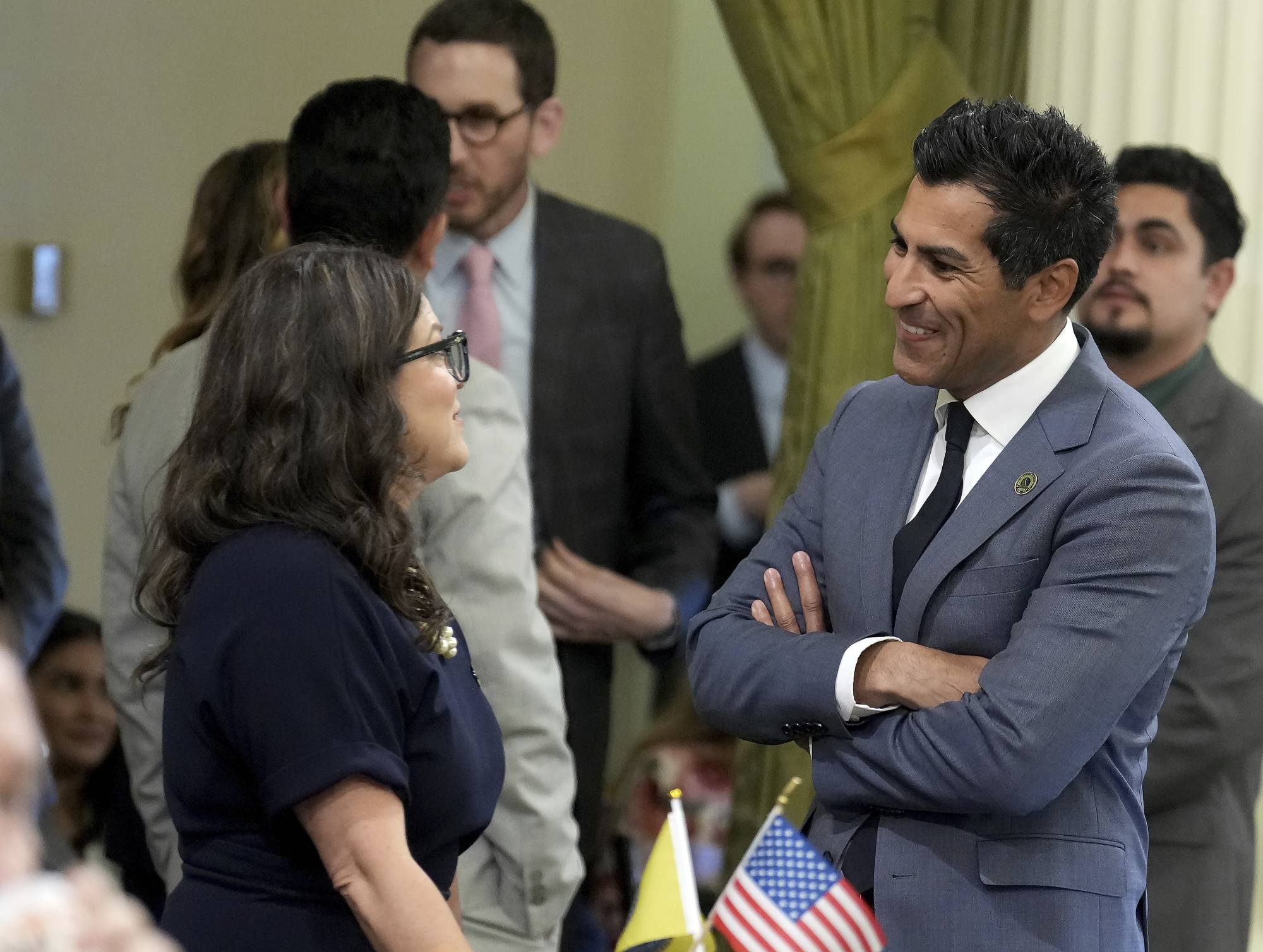
"caption": "Assembly Speaker Robert Rivas talks with Democratic Assembly member Esmeralda Soria (left) at the Capitol in Sacramento on Sept. 11, 2025.",
"credit": "Rich Pedroncelli/AP Photo",
"altTag": null,
"description": null,
"imgSizes": {
"medium": {
"file": "https://cdn.kqed.org/wp-content/uploads/sites/10/2025/09/AP25255053484119-2000x1508.jpg",
"width": 2000,
"height": 1508,
"mimeType": "image/jpeg"
},
"large": {
"file": "https://cdn.kqed.org/wp-content/uploads/sites/10/2025/09/AP25255053484119-2000x1508.jpg",
"width": 2000,
"height": 1508,
"mimeType": "image/jpeg"
},
"thumbnail": {
"file": "https://cdn.kqed.org/wp-content/uploads/sites/10/2025/09/AP25255053484119-160x121.jpg",
"width": 160,
"height": 121,
"mimeType": "image/jpeg"
},
"1536x1536": {
"file": "https://cdn.kqed.org/wp-content/uploads/sites/10/2025/09/AP25255053484119-1536x1158.jpg",
"width": 1536,
"height": 1158,
"mimeType": "image/jpeg"
},
"2048x2048": {
"file": "https://cdn.kqed.org/wp-content/uploads/sites/10/2025/09/AP25255053484119-2048x1544.jpg",
"width": 2048,
"height": 1544,
"mimeType": "image/jpeg"
},
"post-thumbnail": {
"file": "https://cdn.kqed.org/wp-content/uploads/sites/10/2025/09/AP25255053484119-672x372.jpg",
"width": 672,
"height": 372,
"mimeType": "image/jpeg"
},
"twentyfourteen-full-width": {
"file": "https://cdn.kqed.org/wp-content/uploads/sites/10/2025/09/AP25255053484119-1038x576.jpg",
"width": 1038,
"height": 576,
"mimeType": "image/jpeg"
},
"full-width": {
"file": "https://cdn.kqed.org/wp-content/uploads/sites/10/2025/09/AP25255053484119-2000x1508.jpg",
"width": 2000,
"height": 1508,
"mimeType": "image/jpeg"
},
"kqedFullSize": {
"file": "https://cdn.kqed.org/wp-content/uploads/sites/10/2025/09/AP25255053484119-scaled.jpg",
"width": 2560,
"height": 1930
}
},
"isLoading": false,
"fetchFailed": false
},
"news_12055434": {
"type": "attachments",
"id": "news_12055434",
"meta": {
"index": "attachments_1716263798",
"site": "news",
"id": "12055434",
"found": true
},
"title": "John Burton Remembered and Celebrated with Memoir Release and Youth Fellowship Initiative",
"publishDate": 1757510478,
"status": "inherit",
"parent": 0,
"modified": 1757519066,
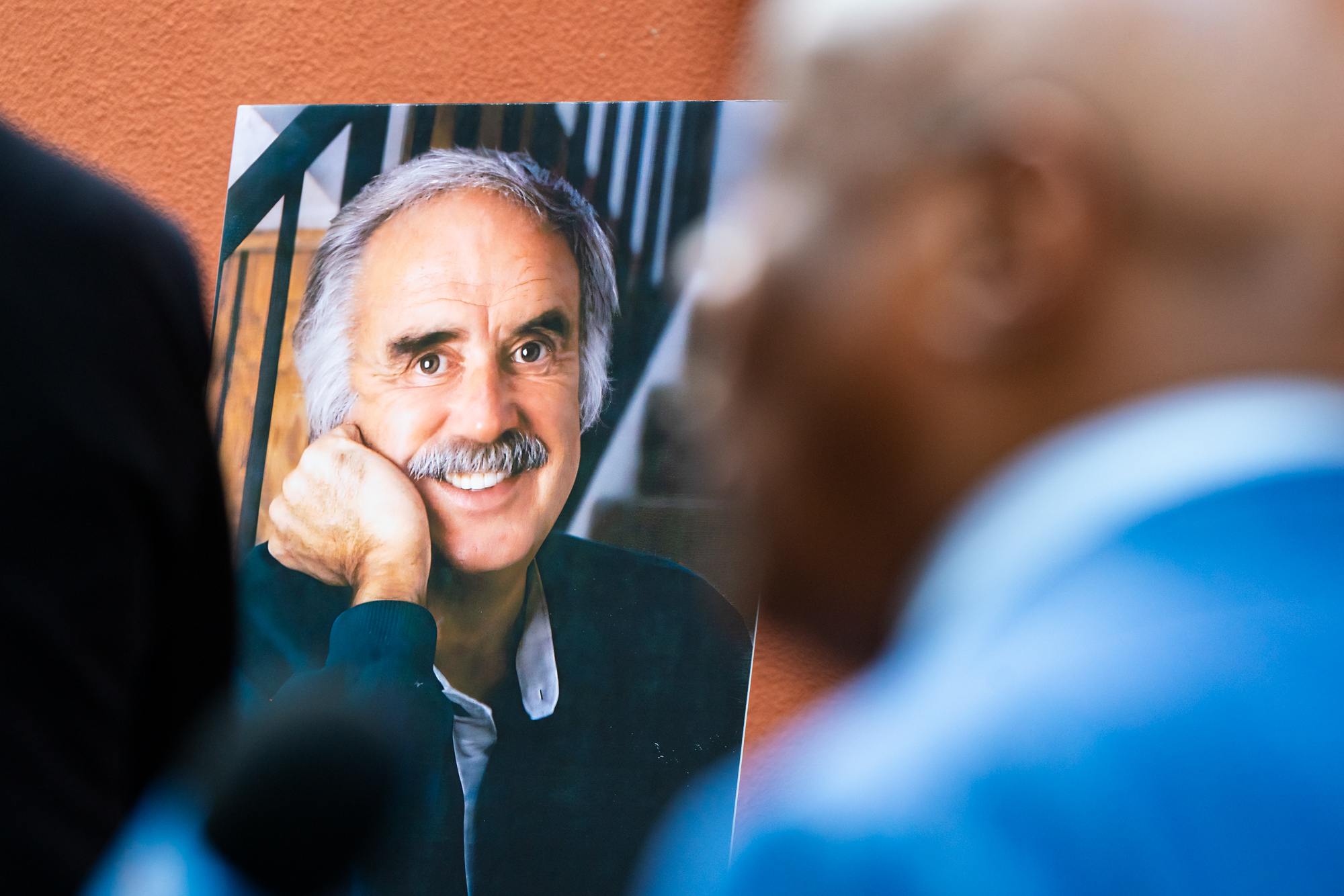
"caption": "Former San Francisco Mayor Willie Brown in the courtyard of the California Museum in Sacramento before joining the launch reception for John Burton's memoir, \"I Yell Because I Care,\" Sept. 9, 2025.",
"credit": "Louis Bryant III for KQED",
"altTag": null,
"description": null,
"imgSizes": {
"thumbnail": {
"file": "https://cdn.kqed.org/wp-content/uploads/sites/10/2025/09/09092025_LBR3_JOHNBURTONMEMOIR_309-KQED-160x107.jpg",
"width": 160,
"height": 107,
"mimeType": "image/jpeg"
},
"1536x1536": {
"file": "https://cdn.kqed.org/wp-content/uploads/sites/10/2025/09/09092025_LBR3_JOHNBURTONMEMOIR_309-KQED-1536x1025.jpg",
"width": 1536,
"height": 1025,
"mimeType": "image/jpeg"
},
"post-thumbnail": {
"file": "https://cdn.kqed.org/wp-content/uploads/sites/10/2025/09/09092025_LBR3_JOHNBURTONMEMOIR_309-KQED-672x372.jpg",
"width": 672,
"height": 372,
"mimeType": "image/jpeg"
},
"twentyfourteen-full-width": {
"file": "https://cdn.kqed.org/wp-content/uploads/sites/10/2025/09/09092025_LBR3_JOHNBURTONMEMOIR_309-KQED-1038x576.jpg",
"width": 1038,
"height": 576,
"mimeType": "image/jpeg"
},
"kqedFullSize": {
"file": "https://cdn.kqed.org/wp-content/uploads/sites/10/2025/09/09092025_LBR3_JOHNBURTONMEMOIR_309-KQED.jpg",
"width": 2000,
"height": 1334
}
},
"isLoading": false,
"fetchFailed": false
},
"news_12055396": {
"type": "attachments",
"id": "news_12055396",
"meta": {
"index": "attachments_1716263798",
"site": "news",
"id": "12055396",
"found": true
},
"title": "MahanNewsom1",
"publishDate": 1757461383,
"status": "inherit",
"parent": 12055284,
"modified": 1757461543,
"caption": "Gov. Gavin Newsom’s popularity has surged as he has battled with President Donald Trump. But San José Mayor Matt Mahan (left) says \"trolling Trump\" won’t be key to success for Democrats. ",
"credit": "Joseph Geha/KQED; Rich Pedroncelli/AP Photo",
"altTag": null,
"description": null,
"imgSizes": {
"thumbnail": {
"file": "https://cdn.kqed.org/wp-content/uploads/sites/10/2025/09/MahanNewsom1-160x107.jpg",
"width": 160,
"height": 107,
"mimeType": "image/jpeg"
},
"1536x1536": {
"file": "https://cdn.kqed.org/wp-content/uploads/sites/10/2025/09/MahanNewsom1-1536x1024.jpg",
"width": 1536,
"height": 1024,
"mimeType": "image/jpeg"
},
"post-thumbnail": {
"file": "https://cdn.kqed.org/wp-content/uploads/sites/10/2025/09/MahanNewsom1-672x372.jpg",
"width": 672,
"height": 372,
"mimeType": "image/jpeg"
},
"twentyfourteen-full-width": {
"file": "https://cdn.kqed.org/wp-content/uploads/sites/10/2025/09/MahanNewsom1-1038x576.jpg",
"width": 1038,
"height": 576,
"mimeType": "image/jpeg"
},
"kqedFullSize": {
"file": "https://cdn.kqed.org/wp-content/uploads/sites/10/2025/09/MahanNewsom1.jpg",
"width": 2000,
"height": 1333
}
},
"isLoading": false,
"fetchFailed": false
},
"news_12053762": {
"type": "attachments",
"id": "news_12053762",
"meta": {
"index": "attachments_1716263798",
"site": "news",
"id": "12053762",
"found": true
},
"title": "250820-HOUSINGFIRST_02100_TV-KQED",
"publishDate": 1756230690,
"status": "inherit",
"parent": 0,
"modified": 1756231387,
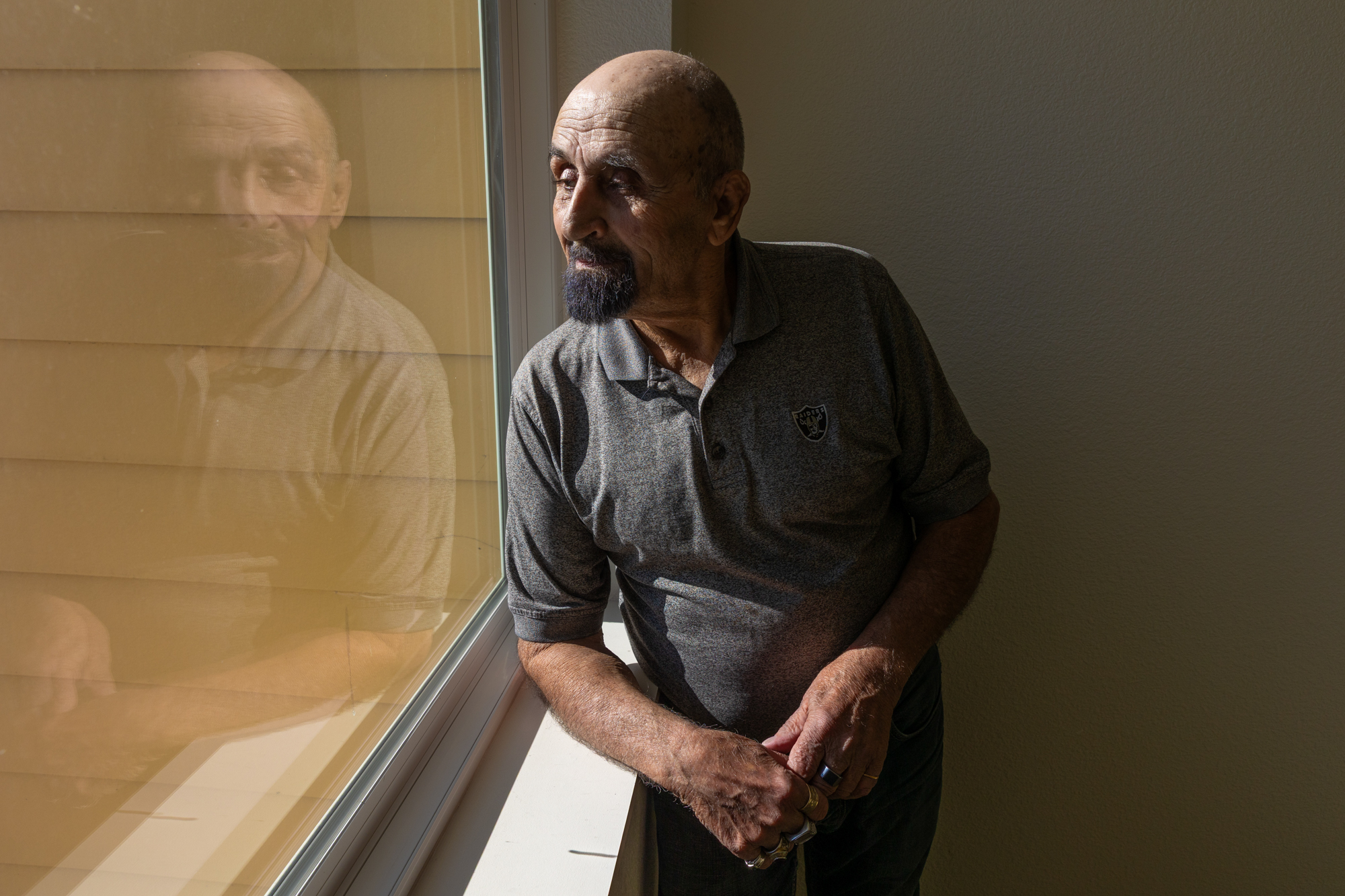
"caption": "William Wade, a formerly homeless veteran housed through the HUD-Veterans Affairs Supportive Housing program, poses for a portrait at the Laguna Commons supportive housing in Fremont on Aug. 20, 2025.",
"credit": "Tâm Vũ/KQED",
"altTag": null,
"description": null,
"imgSizes": {
"thumbnail": {
"file": "https://cdn.kqed.org/wp-content/uploads/sites/10/2025/08/250820-HOUSINGFIRST_02100_TV-KQED-160x107.jpg",
"width": 160,
"height": 107,
"mimeType": "image/jpeg"
},
"1536x1536": {
"file": "https://cdn.kqed.org/wp-content/uploads/sites/10/2025/08/250820-HOUSINGFIRST_02100_TV-KQED-1536x1024.jpg",
"width": 1536,
"height": 1024,
"mimeType": "image/jpeg"
},
"post-thumbnail": {
"file": "https://cdn.kqed.org/wp-content/uploads/sites/10/2025/08/250820-HOUSINGFIRST_02100_TV-KQED-672x372.jpg",
"width": 672,
"height": 372,
"mimeType": "image/jpeg"
},
"twentyfourteen-full-width": {
"file": "https://cdn.kqed.org/wp-content/uploads/sites/10/2025/08/250820-HOUSINGFIRST_02100_TV-KQED-1038x576.jpg",
"width": 1038,
"height": 576,
"mimeType": "image/jpeg"
},
"kqedFullSize": {
"file": "https://cdn.kqed.org/wp-content/uploads/sites/10/2025/08/250820-HOUSINGFIRST_02100_TV-KQED.jpg",
"width": 2000,
"height": 1333
}
},
"isLoading": false,
"fetchFailed": false
},
"news_12055199": {
"type": "attachments",
"id": "news_12055199",
"meta": {
"index": "attachments_1716263798",
"site": "news",
"id": "12055199",
"found": true
},
"title": "TransitFundingKQED3",
"publishDate": 1757365914,
"status": "inherit",
"parent": 12055129,
"modified": 1757365953,
"caption": "More than a hundred people gathered at San Francisco’s Civic Center Plaza on Sept. 8, 2025, in support of an emergency state loan for Bay Area public transit agencies. ",
"credit": "Farida Jhabvala Romero/KQED",
"altTag": null,
"description": null,
"imgSizes": {
"thumbnail": {
"file": "https://cdn.kqed.org/wp-content/uploads/sites/10/2025/09/TransitFundingKQED3-160x120.jpg",
"width": 160,
"height": 120,
"mimeType": "image/jpeg"
},
"1536x1536": {
"file": "https://cdn.kqed.org/wp-content/uploads/sites/10/2025/09/TransitFundingKQED3-1536x1152.jpg",
"width": 1536,
"height": 1152,
"mimeType": "image/jpeg"
},
"post-thumbnail": {
"file": "https://cdn.kqed.org/wp-content/uploads/sites/10/2025/09/TransitFundingKQED3-672x372.jpg",
"width": 672,
"height": 372,
"mimeType": "image/jpeg"
},
"twentyfourteen-full-width": {
"file": "https://cdn.kqed.org/wp-content/uploads/sites/10/2025/09/TransitFundingKQED3-1038x576.jpg",
"width": 1038,
"height": 576,
"mimeType": "image/jpeg"
},
"kqedFullSize": {
"file": "https://cdn.kqed.org/wp-content/uploads/sites/10/2025/09/TransitFundingKQED3.jpg",
"width": 2000,
"height": 1500
}
},
"isLoading": false,
"fetchFailed": false
},
"news_11999606": {
"type": "attachments",
"id": "news_11999606",
"meta": {
"index": "attachments_1716263798",
"site": "news",
"id": "11999606",
"found": true
},
"title": "240313-BART-Train-arrives",
"publishDate": 1723226703,
"status": "inherit",
"parent": 11999596,
"modified": 1746824991,
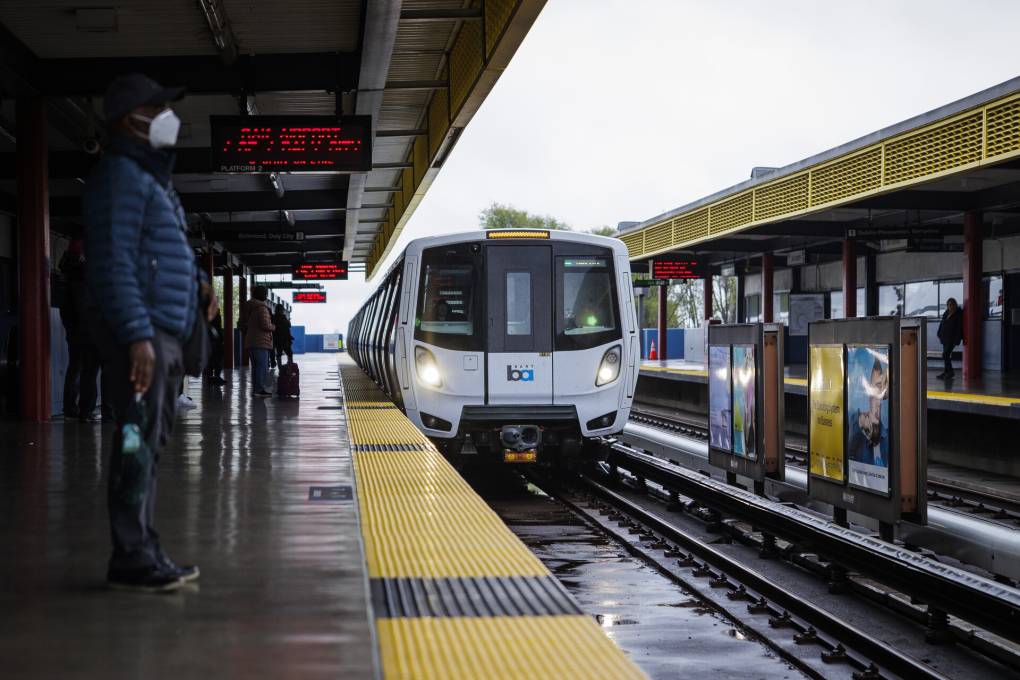
"caption": "A BART train approaches a station on March 13, 2024. ",
"credit": "Martin do Nascimento/KQED",
"altTag": null,
"description": null,
"imgSizes": {
"medium": {
"file": "https://cdn.kqed.org/wp-content/uploads/sites/10/2024/08/240313-BART-Train-arrives-800x533.jpg",
"width": 800,
"height": 533,
"mimeType": "image/jpeg"
},
"large": {
"file": "https://cdn.kqed.org/wp-content/uploads/sites/10/2024/08/240313-BART-Train-arrives-1020x680.jpg",
"width": 1020,
"height": 680,
"mimeType": "image/jpeg"
},
"thumbnail": {
"file": "https://cdn.kqed.org/wp-content/uploads/sites/10/2024/08/240313-BART-Train-arrives-160x107.jpg",
"width": 160,
"height": 107,
"mimeType": "image/jpeg"
},
"1536x1536": {
"file": "https://cdn.kqed.org/wp-content/uploads/sites/10/2024/08/240313-BART-Train-arrives-1536x1024.jpg",
"width": 1536,
"height": 1024,
"mimeType": "image/jpeg"
},
"post-thumbnail": {
"file": "https://cdn.kqed.org/wp-content/uploads/sites/10/2024/08/240313-BART-Train-arrives-672x372.jpg",
"width": 672,
"height": 372,
"mimeType": "image/jpeg"
},
"twentyfourteen-full-width": {
"file": "https://cdn.kqed.org/wp-content/uploads/sites/10/2024/08/240313-BART-Train-arrives-1038x576.jpg",
"width": 1038,
"height": 576,
"mimeType": "image/jpeg"
},
"kqedFullSize": {
"file": "https://cdn.kqed.org/wp-content/uploads/sites/10/2024/08/240313-BART-Train-arrives.jpg",
"width": 1920,
"height": 1280
}
},
"isLoading": false,
"fetchFailed": false
},
"news_12054948": {
"type": "attachments",
"id": "news_12054948",
"meta": {
"index": "attachments_1716263798",
"site": "news",
"id": "12054948",
"found": true
},
"title": "Newsom-Tweets_3",
"publishDate": 1757110034,
"status": "inherit",
"parent": 12054858,
"modified": 1757110067,
"caption": null,
"credit": "Darren Tu/KQED",
"altTag": null,
"description": null,
"imgSizes": {
"thumbnail": {
"file": "https://cdn.kqed.org/wp-content/uploads/sites/10/2025/09/Newsom-Tweets_3-160x103.jpg",
"width": 160,
"height": 103,
"mimeType": "image/jpeg"
},
"1536x1536": {
"file": "https://cdn.kqed.org/wp-content/uploads/sites/10/2025/09/Newsom-Tweets_3-1536x992.jpg",
"width": 1536,
"height": 992,
"mimeType": "image/jpeg"
},
"post-thumbnail": {
"file": "https://cdn.kqed.org/wp-content/uploads/sites/10/2025/09/Newsom-Tweets_3-672x372.jpg",
"width": 672,
"height": 372,
"mimeType": "image/jpeg"
},
"twentyfourteen-full-width": {
"file": "https://cdn.kqed.org/wp-content/uploads/sites/10/2025/09/Newsom-Tweets_3-1038x576.jpg",
"width": 1038,
"height": 576,
"mimeType": "image/jpeg"
},
"kqedFullSize": {
"file": "https://cdn.kqed.org/wp-content/uploads/sites/10/2025/09/Newsom-Tweets_3.jpg",
"width": 1920,
"height": 1240
}
},
"isLoading": false,
"fetchFailed": false
},
"news_12054634": {
"type": "attachments",
"id": "news_12054634",
"meta": {
"index": "attachments_1716263798",
"site": "news",
"id": "12054634",
"found": true
},
"title": "California Trump Newsom",
"publishDate": 1757009366,
"status": "inherit",
"parent": 12054630,
"modified": 1757009400,
"caption": "Gov. Gavin Newsom at a press conference to discuss the measures to redraw the state's Congressional districts and put new maps before voters in a special election, in Sacramento, California, on Aug. 21, 2025. ",
"credit": "Rich Pedroncelli/AP Photo",
"altTag": null,
"description": null,
"imgSizes": {
"thumbnail": {
"file": "https://cdn.kqed.org/wp-content/uploads/sites/10/2025/09/GavinNewsomAP-160x107.jpg",
"width": 160,
"height": 107,
"mimeType": "image/jpeg"
},
"1536x1536": {
"file": "https://cdn.kqed.org/wp-content/uploads/sites/10/2025/09/GavinNewsomAP-1536x1024.jpg",
"width": 1536,
"height": 1024,
"mimeType": "image/jpeg"
},
"post-thumbnail": {
"file": "https://cdn.kqed.org/wp-content/uploads/sites/10/2025/09/GavinNewsomAP-672x372.jpg",
"width": 672,
"height": 372,
"mimeType": "image/jpeg"
},
"twentyfourteen-full-width": {
"file": "https://cdn.kqed.org/wp-content/uploads/sites/10/2025/09/GavinNewsomAP-1038x576.jpg",
"width": 1038,
"height": 576,
"mimeType": "image/jpeg"
},
"kqedFullSize": {
"file": "https://cdn.kqed.org/wp-content/uploads/sites/10/2025/09/GavinNewsomAP.jpg",
"width": 2000,
"height": 1333
}
},
"isLoading": false,
"fetchFailed": false
},
"news_12044826": {
"type": "attachments",
"id": "news_12044826",
"meta": {
"index": "attachments_1716263798",
"site": "news",
"id": "12044826",
"found": true
},
"title": "Protests Erupt In L.A. County Sparked By Federal Immigration Raids",
"publishDate": 1750202502,
"status": "inherit",
"parent": 12044637,
"modified": 1757026443,
"caption": "A police officer holds a less lethal rifle as protesters confront California National Guard soldiers and police outside of a federal building, as protests continue in Los Angeles following 3 days of clashes with police after a series of immigration raids on June 9, 2025. ",
"credit": "David McNew/Getty Images",
"altTag": null,
"description": null,
"imgSizes": {
"medium": {
"file": "https://cdn.kqed.org/wp-content/uploads/sites/10/2025/06/GettyImages-2219434485-2000x1333.jpg",
"width": 2000,
"height": 1333,
"mimeType": "image/jpeg"
},
"large": {
"file": "https://cdn.kqed.org/wp-content/uploads/sites/10/2025/06/GettyImages-2219434485-2000x1333.jpg",
"width": 2000,
"height": 1333,
"mimeType": "image/jpeg"
},
"thumbnail": {
"file": "https://cdn.kqed.org/wp-content/uploads/sites/10/2025/06/GettyImages-2219434485-160x107.jpg",
"width": 160,
"height": 107,
"mimeType": "image/jpeg"
},
"1536x1536": {
"file": "https://cdn.kqed.org/wp-content/uploads/sites/10/2025/06/GettyImages-2219434485-1536x1024.jpg",
"width": 1536,
"height": 1024,
"mimeType": "image/jpeg"
},
"2048x2048": {
"file": "https://cdn.kqed.org/wp-content/uploads/sites/10/2025/06/GettyImages-2219434485-2048x1365.jpg",
"width": 2048,
"height": 1365,
"mimeType": "image/jpeg"
},
"post-thumbnail": {
"file": "https://cdn.kqed.org/wp-content/uploads/sites/10/2025/06/GettyImages-2219434485-672x372.jpg",
"width": 672,
"height": 372,
"mimeType": "image/jpeg"
},
"twentyfourteen-full-width": {
"file": "https://cdn.kqed.org/wp-content/uploads/sites/10/2025/06/GettyImages-2219434485-1038x576.jpg",
"width": 1038,
"height": 576,
"mimeType": "image/jpeg"
},
"full-width": {
"file": "https://cdn.kqed.org/wp-content/uploads/sites/10/2025/06/GettyImages-2219434485-2000x1333.jpg",
"width": 2000,
"height": 1333,
"mimeType": "image/jpeg"
},
"kqedFullSize": {
"file": "https://cdn.kqed.org/wp-content/uploads/sites/10/2025/06/GettyImages-2219434485-scaled-e1753393070287.jpg",
"width": 2000,
"height": 1334
}
},
"isLoading": false,
"fetchFailed": false
},
"news_12054567": {
"type": "attachments",
"id": "news_12054567",
"meta": {
"index": "attachments_1716263798",
"site": "news",
"id": "12054567",
"found": true
},
"title": "US-POLITICS-IMMIGRATION",
"publishDate": 1756941444,
"status": "inherit",
"parent": 12054544,
"modified": 1769006278,
"caption": "The CoreCivic, Inc. California City Immigration Processing Center stands in the Kern County desert on July 10, 2025.",
"credit": "Patrick T. Fallon/AFP via Getty Images",
"altTag": null,
"description": null,
"imgSizes": {
"thumbnail": {
"file": "https://cdn.kqed.org/wp-content/uploads/sites/10/2025/09/KernCountyICEDetentionGetty-160x107.jpg",
"width": 160,
"height": 107,
"mimeType": "image/jpeg"
},
"1536x1536": {
"file": "https://cdn.kqed.org/wp-content/uploads/sites/10/2025/09/KernCountyICEDetentionGetty-1536x1024.jpg",
"width": 1536,
"height": 1024,
"mimeType": "image/jpeg"
},
"post-thumbnail": {
"file": "https://cdn.kqed.org/wp-content/uploads/sites/10/2025/09/KernCountyICEDetentionGetty-672x372.jpg",
"width": 672,
"height": 372,
"mimeType": "image/jpeg"
},
"twentyfourteen-full-width": {
"file": "https://cdn.kqed.org/wp-content/uploads/sites/10/2025/09/KernCountyICEDetentionGetty-1038x576.jpg",
"width": 1038,
"height": 576,
"mimeType": "image/jpeg"
},
"kqedFullSize": {
"file": "https://cdn.kqed.org/wp-content/uploads/sites/10/2025/09/KernCountyICEDetentionGetty.jpg",
"width": 2000,
"height": 1333
}
},
"isLoading": false,
"fetchFailed": false
},
"news_12054557": {
"type": "attachments",
"id": "news_12054557",
"meta": {
"index": "attachments_1716263798",
"site": "news",
"id": "12054557",
"found": true
},
"title": "Rodriguez_CARE_07_11_2025-4-672x372",
"publishDate": 1756936606,
"status": "inherit",
"parent": 12054473,
"modified": 1756936649,
"caption": null,
"credit": "David Rodriguez for KQED",
"altTag": null,
"description": null,
"imgSizes": {
"thumbnail": {
"file": "https://cdn.kqed.org/wp-content/uploads/sites/10/2025/09/Rodriguez_CARE_07_11_2025-4-672x372-1-160x89.jpg",
"width": 160,
"height": 89,
"mimeType": "image/jpeg"
},
"1536x1536": {
"file": "https://cdn.kqed.org/wp-content/uploads/sites/10/2025/09/Rodriguez_CARE_07_11_2025-4-672x372-1-1536x850.jpg",
"width": 1536,
"height": 850,
"mimeType": "image/jpeg"
},
"post-thumbnail": {
"file": "https://cdn.kqed.org/wp-content/uploads/sites/10/2025/09/Rodriguez_CARE_07_11_2025-4-672x372-1-672x372.jpg",
"width": 672,
"height": 372,
"mimeType": "image/jpeg"
},
"twentyfourteen-full-width": {
"file": "https://cdn.kqed.org/wp-content/uploads/sites/10/2025/09/Rodriguez_CARE_07_11_2025-4-672x372-1-1038x576.jpg",
"width": 1038,
"height": 576,
"mimeType": "image/jpeg"
},
"kqedFullSize": {
"file": "https://cdn.kqed.org/wp-content/uploads/sites/10/2025/09/Rodriguez_CARE_07_11_2025-4-672x372-1.jpg",
"width": 2000,
"height": 1107
}
},
"isLoading": false,
"fetchFailed": false
},
"news_12054501": {
"type": "attachments",
"id": "news_12054501",
"meta": {
"index": "attachments_1716263798",
"site": "news",
"id": "12054501",
"found": true
},
"title": "West Coast-Vaccine Alliance",
"publishDate": 1756926528,
"status": "inherit",
"parent": 12054491,
"modified": 1756926761,
"caption": "From left: Oregon Gov. Tina Kotek, Jan. 31, 2024, in Salem, Oregon, Washington Gov. Bob Ferguson, Jan. 27, 2025, in Seattle and California Gov. Gavin Newsom, Aug. 21, 2025, in Sacramento, California. ",
"credit": "Jenny Kane, Lindsey Wasson, Godofredo A. Vásquez/AP Photo",
"altTag": null,
"description": null,
"imgSizes": {
"thumbnail": {
"file": "https://cdn.kqed.org/wp-content/uploads/sites/10/2025/09/CAORWASHAP1-160x83.jpg",
"width": 160,
"height": 83,
"mimeType": "image/jpeg"
},
"1536x1536": {
"file": "https://cdn.kqed.org/wp-content/uploads/sites/10/2025/09/CAORWASHAP1-1536x799.jpg",
"width": 1536,
"height": 799,
"mimeType": "image/jpeg"
},
"post-thumbnail": {
"file": "https://cdn.kqed.org/wp-content/uploads/sites/10/2025/09/CAORWASHAP1-672x372.jpg",
"width": 672,
"height": 372,
"mimeType": "image/jpeg"
},
"twentyfourteen-full-width": {
"file": "https://cdn.kqed.org/wp-content/uploads/sites/10/2025/09/CAORWASHAP1-1038x576.jpg",
"width": 1038,
"height": 576,
"mimeType": "image/jpeg"
},
"kqedFullSize": {
"file": "https://cdn.kqed.org/wp-content/uploads/sites/10/2025/09/CAORWASHAP1.jpg",
"width": 2000,
"height": 1040
}
},
"isLoading": false,
"fetchFailed": false
}
},
"audioPlayerReducer": {
"postId": "stream_live",
"isPaused": true,
"isPlaying": false,
"pfsActive": false,
"pledgeModalIsOpen": true,
"playerDrawerIsOpen": false,
"liveAudioPlayStartedAt": 0,
"liveAudioPlayContext": ""
},
"authorsReducer": {
"byline_news_12055907": {
"type": "authors",
"id": "byline_news_12055907",
"meta": {
"override": true
},
"slug": "byline_news_12055907",
"name": "Sophie Austin, Associated Press",
"isLoading": false
},
"byline_news_12054473": {
"type": "authors",
"id": "byline_news_12054473",
"meta": {
"override": true
},
"slug": "byline_news_12054473",
"name": "Marisa Kendall, CalMatters",
"isLoading": false
},
"gmarzorati": {
"type": "authors",
"id": "227",
"meta": {
"index": "authors_1716337520",
"id": "227",
"found": true
},
"name": "Guy Marzorati",
"firstName": "Guy",
"lastName": "Marzorati",
"slug": "gmarzorati",
"email": "gmarzorati@KQED.org",
"display_author_email": true,
"staff_mastheads": [
"news"
],
"title": "Correspondent",
"bio": "Guy Marzorati is a correspondent on KQED's California Politics and Government Desk, based in San Jose. A graduate of Santa Clara University, Guy joined KQED in 2013. He reports on state and local politics and produces KQED's digital voter guide.",
"avatar": "https://secure.gravatar.com/avatar/e7038b8dbfd55b104369b76b1cd0b9de?s=600&d=blank&r=g",
"twitter": "guymarzorati",
"facebook": null,
"instagram": null,
"linkedin": null,
"sites": [
{
"site": "",
"roles": [
"editor"
]
},
{
"site": "news",
"roles": [
"editor"
]
},
{
"site": "science",
"roles": [
"editor"
]
},
{
"site": "forum",
"roles": [
"editor"
]
},
{
"site": "elections",
"roles": [
"editor"
]
},
{
"site": "liveblog",
"roles": [
"editor"
]
}
],
"headData": {
"title": "Guy Marzorati | KQED",
"description": "Correspondent",
"ogImgSrc": "https://secure.gravatar.com/avatar/e7038b8dbfd55b104369b76b1cd0b9de?s=600&d=blank&r=g",
"twImgSrc": "https://secure.gravatar.com/avatar/e7038b8dbfd55b104369b76b1cd0b9de?s=600&d=blank&r=g"
},
"isLoading": false,
"link": "/author/gmarzorati"
},
"scottshafer": {
"type": "authors",
"id": "255",
"meta": {
"index": "authors_1716337520",
"id": "255",
"found": true
},
"name": "Scott Shafer",
"firstName": "Scott",
"lastName": "Shafer",
"slug": "scottshafer",
"email": "sshafer@kqed.org",
"display_author_email": false,
"staff_mastheads": [
"news"
],
"title": "KQED Contributor",
"bio": "Scott Shafer is a senior editor with the KQED Politics and Government desk. He is co-host of Political Breakdown, the award-winning radio show and podcast with a personal take on the world of politics. Scott came to KQED in 1998 to host the statewide\u003cem> California Report\u003c/em>. Prior to that he had extended stints in politics and government\u003cem>.\u003c/em> He uses that inside experience at KQED in his, reporting, hosting and analysis for the politics desk. Scott collaborated \u003cem>Political Breakdown a\u003c/em>nd on \u003cem>The Political Mind of Jerry Brown, \u003c/em>an eight-part series about the life and extraordinary political career of the former governor. For fun, he plays water polo with the San Francisco Tsunami.",
"avatar": "https://secure.gravatar.com/avatar/a62ebae45b79d7aed1a39a0e3bf68104?s=600&d=blank&r=g",
"twitter": "scottshafer",
"bluesky": null,
"facebook": null,
"instagram": null,
"linkedin": null,
"sites": [
{
"site": "news",
"roles": [
"editor"
]
},
{
"site": "stateofhealth",
"roles": [
"author"
]
},
{
"site": "science",
"roles": [
"author"
]
},
{
"site": "forum",
"roles": [
"subscriber"
]
},
{
"site": "liveblog",
"roles": [
"author"
]
}
],
"headData": {
"title": "Scott Shafer | KQED",
"description": "KQED Contributor",
"ogImgSrc": "https://secure.gravatar.com/avatar/a62ebae45b79d7aed1a39a0e3bf68104?s=600&d=blank&r=g",
"twImgSrc": "https://secure.gravatar.com/avatar/a62ebae45b79d7aed1a39a0e3bf68104?s=600&d=blank&r=g"
},
"isLoading": false,
"link": "/author/scottshafer"
},
"tychehendricks": {
"type": "authors",
"id": "259",
"meta": {
"index": "authors_1716337520",
"id": "259",
"found": true
},
"name": "Tyche Hendricks",
"firstName": "Tyche",
"lastName": "Hendricks",
"slug": "tychehendricks",
"email": "thendricks@kqed.org",
"display_author_email": true,
"staff_mastheads": [
"news"
],
"title": "KQED Senior Editor, Immigration",
"bio": "\u003cspan style=\"font-weight: 400;\">Tyche Hendricks is KQED’s senior editor for immigration, leading coverage of the policy and politics that affect California’s immigrant communities. Her work for KQED’s radio and online audiences is also carried on NPR and other national outlets. She has been recognized with awards from the Radio and Television News Directors Association, the Society for Professional Journalists; the Education Writers Association; the Best of the West and the National Federation of Community Broadcasters. Before joining KQED in 2010, Tyche spent more than a dozen years as a newspaper reporter, notably at the \u003c/span>\u003ci>\u003cspan style=\"font-weight: 400;\">San Francisco Chronicle\u003c/span>\u003c/i>\u003cspan style=\"font-weight: 400;\">. At different times she has covered criminal justice, government and politics and urban planning. Tyche has taught in the MFA Creative Writing program at the University of San Francisco and at UC Berkeley’s Graduate School of Journalism, where she was co-director of a national immigration symposium for professional journalists. She is the author of \u003c/span>\u003ci>\u003cspan style=\"font-weight: 400;\">The Wind Doesn't Need a Passport: Stories from the U.S.-Mexico Borderlands\u003c/span>\u003c/i>\u003cspan style=\"font-weight: 400;\"> (University of California Press). \u003c/span>",
"avatar": "https://secure.gravatar.com/avatar/b8ee458e2731c2d43df86882ce17267e?s=600&d=blank&r=g",
"twitter": "tychehendricks",
"facebook": null,
"instagram": null,
"linkedin": null,
"sites": [
{
"site": "news",
"roles": [
"editor"
]
},
{
"site": "stateofhealth",
"roles": [
"editor"
]
}
],
"headData": {
"title": "Tyche Hendricks | KQED",
"description": "KQED Senior Editor, Immigration",
"ogImgSrc": "https://secure.gravatar.com/avatar/b8ee458e2731c2d43df86882ce17267e?s=600&d=blank&r=g",
"twImgSrc": "https://secure.gravatar.com/avatar/b8ee458e2731c2d43df86882ce17267e?s=600&d=blank&r=g"
},
"isLoading": false,
"link": "/author/tychehendricks"
},
"mlagos": {
"type": "authors",
"id": "3239",
"meta": {
"index": "authors_1716337520",
"id": "3239",
"found": true
},
"name": "Marisa Lagos",
"firstName": "Marisa",
"lastName": "Lagos",
"slug": "mlagos",
"email": "mlagos@kqed.org",
"display_author_email": false,
"staff_mastheads": [
"news"
],
"title": "KQED Contributor",
"bio": "Marisa Lagos is a correspondent for KQED’s California Politics and Government Desk and co-hosts the award-winning show and podcast, Political Breakdown. At KQED, Lagos also conducts reporting, analysis and investigations into state, local and national politics for radio, TV, online and onstage. In 2022, she and co-host, Scott Shafer, moderated the only gubernatorial debate in California. In 2020, the \u003ci>Washington Post\u003c/i> named her one of the top political journalists in California; she was nominated for a Peabody and won several other awards for her work investigating the 2017 California wildfires. She has worked at the \u003ci>San Francisco Chronicle\u003c/i>, \u003ci>San Francisco Examiner\u003c/i> and \u003ci>Los Angeles Times\u003c/i>. A UC Santa Barbara graduate, she lives in San Francisco with her two sons and husband.",
"avatar": "https://secure.gravatar.com/avatar/a261a0d3696fc066871ef96b85b5e7d2?s=600&d=blank&r=g",
"twitter": "@mlagos",
"facebook": null,
"instagram": null,
"linkedin": null,
"sites": [
{
"site": "arts",
"roles": [
"author"
]
},
{
"site": "news",
"roles": [
"editor"
]
},
{
"site": "science",
"roles": [
"editor"
]
},
{
"site": "forum",
"roles": [
"author"
]
},
{
"site": "liveblog",
"roles": [
"author"
]
}
],
"headData": {
"title": "Marisa Lagos | KQED",
"description": "KQED Contributor",
"ogImgSrc": "https://secure.gravatar.com/avatar/a261a0d3696fc066871ef96b85b5e7d2?s=600&d=blank&r=g",
"twImgSrc": "https://secure.gravatar.com/avatar/a261a0d3696fc066871ef96b85b5e7d2?s=600&d=blank&r=g"
},
"isLoading": false,
"link": "/author/mlagos"
},
"lesleymcclurg": {
"type": "authors",
"id": "11229",
"meta": {
"index": "authors_1716337520",
"id": "11229",
"found": true
},
"name": "Lesley McClurg",
"firstName": "Lesley",
"lastName": "McClurg",
"slug": "lesleymcclurg",
"email": "lmcclurg@KQED.org",
"display_author_email": false,
"staff_mastheads": [
"news",
"science"
],
"title": "KQED Health Correspondent",
"bio": "Lesley McClurg is a health correspondent and fill-in host whose work is regularly rebroadcast on NPR and PBS programs. She’s earned multiple regional Emmy awards, a national and a regional Edward R. Murrow award, and was named Best Beat Reporter by the Association of Health Care Journalists. The Society of Professional Journalists has recognized her work several times, and the Society of Environmental Journalists spotlighted her coverage of California’s historic drought.\r\n\r\nBefore joining KQED in 2016, Lesley covered food and sustainability for Capital Public Radio, environmental issues for Colorado Public Radio, and reported for KUOW and KCTS 9 in Seattle. Away from the newsroom, she loves skiing with her daughter, mountain biking with her partner, and playing with Ollie, the family’s goldendoodle. On deadline, she runs almost entirely on chocolate chips.\r\n\r\n ",
"avatar": "https://secure.gravatar.com/avatar/bab49e972ea10c774fe0f5e29dba1722b158f7c0d58a360923d1389d380b2978?s=600&d=blank&r=g",
"twitter": "lesleywmcclurg",
"bluesky": null,
"facebook": null,
"instagram": null,
"linkedin": null,
"sites": [
{
"site": "arts",
"roles": [
"author"
]
},
{
"site": "news",
"roles": [
"editor"
]
},
{
"site": "futureofyou",
"roles": [
"editor"
]
},
{
"site": "stateofhealth",
"roles": [
"author"
]
},
{
"site": "science",
"roles": [
"editor"
]
},
{
"site": "quest",
"roles": [
"subscriber"
]
},
{
"site": "forum",
"roles": [
"administrator"
]
},
{
"site": "liveblog",
"roles": [
"author"
]
}
],
"headData": {
"title": "Lesley McClurg | KQED",
"description": "KQED Health Correspondent",
"ogImgSrc": "https://secure.gravatar.com/avatar/bab49e972ea10c774fe0f5e29dba1722b158f7c0d58a360923d1389d380b2978?s=600&d=blank&r=g",
"twImgSrc": "https://secure.gravatar.com/avatar/bab49e972ea10c774fe0f5e29dba1722b158f7c0d58a360923d1389d380b2978?s=600&d=blank&r=g"
},
"isLoading": false,
"link": "/author/lesleymcclurg"
},
"vrancano": {
"type": "authors",
"id": "11276",
"meta": {
"index": "authors_1716337520",
"id": "11276",
"found": true
},
"name": "Vanessa Rancaño",
"firstName": "Vanessa",
"lastName": "Rancaño",
"slug": "vrancano",
"email": "vrancano@kqed.org",
"display_author_email": false,
"staff_mastheads": [
"news"
],
"title": "Reporter",
"bio": "Vanessa Rancaño is a features reporter for KQED. She’s also covered homelessness and education for the station and reported from the Central Valley. Her work has aired across public radio, from flagship national news shows to longform narrative podcasts. Before taking up a mic, she worked as a freelance print journalist. She’s been recognized with a number of national and regional awards. Vanessa grew up in California's Central Valley. She's a former NPR Kroc Fellow, and a graduate of the UC Berkeley Graduate School of Journalism.",
"avatar": "https://secure.gravatar.com/avatar/b3a383dfb0e7ee1c17568f2cf067904ab654d6e3de9743fc661f3c788ade1bed?s=600&d=blank&r=g",
"twitter": "vanessarancano",
"bluesky": null,
"facebook": null,
"instagram": null,
"linkedin": null,
"sites": [
{
"site": "arts",
"roles": [
"editor"
]
},
{
"site": "news",
"roles": [
"editor"
]
},
{
"site": "liveblog",
"roles": [
"contributor"
]
}
],
"headData": {
"title": "Vanessa Rancaño | KQED",
"description": "Reporter",
"ogImgSrc": "https://secure.gravatar.com/avatar/b3a383dfb0e7ee1c17568f2cf067904ab654d6e3de9743fc661f3c788ade1bed?s=600&d=blank&r=g",
"twImgSrc": "https://secure.gravatar.com/avatar/b3a383dfb0e7ee1c17568f2cf067904ab654d6e3de9743fc661f3c788ade1bed?s=600&d=blank&r=g"
},
"isLoading": false,
"link": "/author/vrancano"
},
"ccabreralomeli": {
"type": "authors",
"id": "11708",
"meta": {
"index": "authors_1716337520",
"id": "11708",
"found": true
},
"name": "Carlos Cabrera-Lomelí",
"firstName": "Carlos",
"lastName": "Cabrera-Lomelí",
"slug": "ccabreralomeli",
"email": "ccabreralomeli@KQED.org",
"display_author_email": true,
"staff_mastheads": [
"news"
],
"title": "Community Reporter",
"bio": "Carlos Cabrera-Lomelí is a community reporter with KQED's digital engagement team. He also reports and co-produces for KQED's bilingual news hub KQED en Español. He grew up in San Francisco's Mission District and has previously worked with Univision, 48 Hills and REFORMA in Mexico City.",
"avatar": "https://secure.gravatar.com/avatar/c309be9665e484f887b818c89e273ecc673004f426f36b24d00a4d813a2e0518?s=600&d=blank&r=g",
"twitter": "@LomeliCabrera",
"bluesky": null,
"facebook": null,
"instagram": null,
"linkedin": null,
"sites": [
{
"site": "arts",
"roles": [
"editor"
]
},
{
"site": "news",
"roles": [
"editor"
]
},
{
"site": "about",
"roles": [
"editor"
]
},
{
"site": "science",
"roles": [
"editor"
]
},
{
"site": "perspectives",
"roles": [
"editor"
]
},
{
"site": "elections",
"roles": [
"editor"
]
},
{
"site": "liveblog",
"roles": [
"contributor"
]
}
],
"headData": {
"title": "Carlos Cabrera-Lomelí | KQED",
"description": "Community Reporter",
"ogImgSrc": "https://secure.gravatar.com/avatar/c309be9665e484f887b818c89e273ecc673004f426f36b24d00a4d813a2e0518?s=600&d=blank&r=g",
"twImgSrc": "https://secure.gravatar.com/avatar/c309be9665e484f887b818c89e273ecc673004f426f36b24d00a4d813a2e0518?s=600&d=blank&r=g"
},
"isLoading": false,
"link": "/author/ccabreralomeli"
},
"jlara": {
"type": "authors",
"id": "11761",
"meta": {
"index": "authors_1716337520",
"id": "11761",
"found": true
},
"name": "Juan Carlos Lara",
"firstName": "Juan Carlos",
"lastName": "Lara",
"slug": "jlara",
"email": "jlara@kqed.org",
"display_author_email": false,
"staff_mastheads": [],
"title": "KQED Contributor",
"bio": null,
"avatar": "https://secure.gravatar.com/avatar/19e2052b9b05657c5ff2af2121846e9c?s=600&d=blank&r=g",
"twitter": null,
"facebook": null,
"instagram": null,
"linkedin": null,
"sites": [
{
"site": "arts",
"roles": [
"editor"
]
},
{
"site": "news",
"roles": [
"editor"
]
},
{
"site": "forum",
"roles": [
"editor"
]
},
{
"site": "liveblog",
"roles": [
"contributor"
]
}
],
"headData": {
"title": "Juan Carlos Lara | KQED",
"description": "KQED Contributor",
"ogImgSrc": "https://secure.gravatar.com/avatar/19e2052b9b05657c5ff2af2121846e9c?s=600&d=blank&r=g",
"twImgSrc": "https://secure.gravatar.com/avatar/19e2052b9b05657c5ff2af2121846e9c?s=600&d=blank&r=g"
},
"isLoading": false,
"link": "/author/jlara"
},
"adahlstromeckman": {
"type": "authors",
"id": "11785",
"meta": {
"index": "authors_1716337520",
"id": "11785",
"found": true
},
"name": "Azul Dahlstrom-Eckman",
"firstName": "Azul",
"lastName": "Dahlstrom-Eckman",
"slug": "adahlstromeckman",
"email": "adahlstrom-eckman@kqed.org",
"display_author_email": true,
"staff_mastheads": [],
"title": "Reporter",
"bio": "Azul is a reporter for KQED focusing on transportation and features. He joined KQED in 2021 as an alumna of KALW's Audio Academy radio journalism training program.",
"avatar": "https://secure.gravatar.com/avatar/9cb750298435add7815a777f55bf1f46845c1386bb8452555c60a7b820b5aba3?s=600&d=blank&r=g",
"twitter": "@zuliemann",
"bluesky": "@azul415.bsky.social",
"facebook": null,
"instagram": null,
"linkedin": null,
"sites": [
{
"site": "arts",
"roles": [
"editor"
]
},
{
"site": "news",
"roles": [
"editor"
]
},
{
"site": "science",
"roles": [
"editor"
]
},
{
"site": "liveblog",
"roles": [
"author"
]
}
],
"headData": {
"title": "Azul Dahlstrom-Eckman | KQED",
"description": "Reporter",
"ogImgSrc": "https://secure.gravatar.com/avatar/9cb750298435add7815a777f55bf1f46845c1386bb8452555c60a7b820b5aba3?s=600&d=blank&r=g",
"twImgSrc": "https://secure.gravatar.com/avatar/9cb750298435add7815a777f55bf1f46845c1386bb8452555c60a7b820b5aba3?s=600&d=blank&r=g"
},
"isLoading": false,
"link": "/author/adahlstromeckman"
}
},
"pagesReducer": {
"news_tag_gavin-newsom": {
"type": "terms",
"id": "news_16",
"meta": {
"index": "terms_1716263798",
"site": "news",
"id": "16",
"score": 8.936871
},
"featImg": null,
"name": "Gavin Newsom",
"description": null,
"taxonomy": "tag",
"headData": {
"twImgId": null,
"twTitle": null,
"ogTitle": null,
"ogImgId": null,
"twDescription": null,
"description": null,
"title": "Gavin Newsom Archives | KQED News",
"ogDescription": null
},
"ttid": 16,
"slug": "gavin-newsom",
"isLoading": false,
"title": "Gavin Newsom",
"pageMeta": {
"site": "news",
"WpPageTemplate": "page-topic-editorial",
"currentPage": 13
},
"blocks": [
{
"blockName": "kqed/post-list",
"attrs": {
"layout": "cardArticle2",
"query": "posts/news?tag=gavin-newsom",
"seeMore": false,
"paginated": true,
"page": 13
}
},
{
"blockName": "kqed/ad"
}
]
}
},
"pfsSessionReducer": {},
"postsReducer": {
"stream_live": {
"type": "live",
"id": "stream_live",
"audioUrl": "https://streams.kqed.org/kqedradio",
"title": "Live Stream",
"excerpt": "Live Stream information currently unavailable.",
"link": "/radio",
"featImg": "",
"label": {
"name": "KQED Live",
"link": "/"
}
},
"stream_kqedNewscast": {
"type": "posts",
"id": "stream_kqedNewscast",
"audioUrl": "https://www.kqed.org/.stream/anon/radio/RDnews/newscast.mp3?_=1",
"title": "KQED Newscast",
"featImg": "",
"label": {
"name": "88.5 FM",
"link": "/"
}
},
"news_12055907": {
"type": "posts",
"id": "news_12055907",
"meta": {
"index": "posts_1716263798",
"site": "news",
"id": "12055907",
"score": null,
"sort": [
1757791838000
]
},
"guestAuthors": [],
"slug": "california-lawmakers-will-vote-on-extending-the-cap-and-trade-program-and-boosting-grid-reliability",
"title": "California Extends Cap-and-Trade Program Aimed at Advancing State Climate Goals",
"publishDate": 1757791838,
"format": "standard",
"headTitle": "California Extends Cap-and-Trade Program Aimed at Advancing State Climate Goals | KQED",
"labelTerm": {
"site": "news"
},
"content": "\u003cp>\u003cstrong>Updated 1 p.m., Saturday\u003c/strong>\u003c/p>\n\u003cp>California will extend a key climate program under a bill state lawmakers passed Saturday, sending the measure to Gov. Gavin Newsom, who has championed it as a crucial tool to respond to the Trump administration’s environmental rollbacks.\u003c/p>\n\u003cp>The Democrat-dominated Legislature voted to reauthorize the state’s \u003ca href=\"https://apnews.com/article/climate-business-environment-pollution-california-air-resources-board-21d34adf68b5d612fbc37c3f10a13fef\">cap-and-trade program\u003c/a>, which is set to expire after 2030. Then-Gov. Arnold Schwarzenegger, a Republican, signed a law authorizing the program in 2006, and it launched in 2013.\u003c/p>\n\u003cp>The program sets a declining limit on total planet-warming emissions in the state from major polluters. Companies must reduce their emissions, buy allowances from the state or other businesses, or fund projects aimed at offsetting their emissions. Money the state receives from the sales funds climate-change mitigation, affordable housing and transportation projects, as well as utility bill credits for Californians.\u003c/p>\n\u003cp>[ad fullwidth]\u003c/p>\n\u003cp>Newsom, a Democrat, and legislative leaders, who said months ago they would prioritize reauthorizing the program, almost ran out of time to introduce the proposal before the statehouse wraps for the year.\u003c/p>\n\u003cp>“After months of hard work with the Legislature, we have agreed to historic reforms that will save money on your electric bills, stabilize gas supply, and slash toxic air pollution — all while fast-tracking California’s transition to a clean, green job-creating economy,” Newsom said after striking the deal this week.\u003c/p>\n\u003cp>The proposal would reauthorize the program through 2045, better align the declining cap on emissions with the state’s climate targets and potentially boost carbon-removal projects. It would also change the name to “cap and invest” to emphasize its funding of climate programs.[aside postID=news_12055786 hero='https://cdn.kqed.org/wp-content/uploads/sites/10/2025/05/250509-BeniciaRefinery-30-BL_qed-1020x680.jpg']The Legislature will vote on another bill committing annual funding from the program’s revenues. It includes $1 billion for the state’s \u003ca href=\"https://apnews.com/article/california-high-speed-rail-funding-federal-trump-efaabea020967ec42338c47bac863f4e\">long-delayed high-speed rail project\u003c/a>, $800 million for an affordable housing program, $250 million for community air protection programs and $1 billion for the Legislature to decide on annually.\u003c/p>\n\u003cp>The votes come as officials contend with balancing the state’s ambitious climate goals and the cost of living. California has some of the highest utility and \u003ca href=\"https://apnews.com/article/california-gas-prices-gavin-newsom-oil-profits-penalty-price-gouging-c13eeb714b903c753882752c435dbe63\">gas prices\u003c/a> in the country. Officials face increased pressure to \u003ca href=\"https://apnews.com/article/oil-gas-newsom-profits-prices-california-435d63922284a93130c40bac9558f093\">stabilize the cost and supply\u003c/a> of fuel amid the \u003ca href=\"https://apnews.com/article/california-refinery-oil-phillips-66-shut-down-bbea1826c0d5d472273f97ad86b870f8\">planned closures\u003c/a> of two oil refineries that make up roughly 18% of the state’s refining capacity, according to energy regulators.\u003c/p>\n\u003cp>Proponents of the extension say it will give companies certainty over the program’s future. The state lost out on $3.6 billion in revenues over the past year and a half, largely due to uncertainty, according to a report from Clean and Prosperous California, a group of economists and lawyers supporting the program. Some environmentalists say the Trump administration’s attacks on climate programs, including the state’s first-in-the-nation \u003ca href=\"https://apnews.com/article/technology-california-air-resources-board-climate-and-environment-dc75c11280f85a8ab134cf392497be68\">ban on the sale of new gas-powered cars by 2035\u003c/a>, added urgency to the reauthorization effort.\u003c/p>\n\u003cp>Cap and trade is an important cost-effective tool for curbing carbon emissions, said Katelyn Roedner Sutter, the California state director for the Environmental Defense Fund.\u003c/p>\n\u003cp>“Supporting this program and making this commitment into the future is extremely important — now more than ever,” she said.\u003c/p>\n\u003cp>But environmental justice advocates opposing the proposal say it doesn’t go far enough and lacks strong air quality protections for low-income Californians and communities of color more likely to live near major polluters.\u003c/p>\n\u003cp>“This really continues to allow big oil to reduce their emissions on paper instead of in real life,” said Asha Sharma, state policy manager at the Leadership Counsel for Justice and Accountability.\u003c/p>\n\u003cp>GOP lawmakers criticized the program, saying it would make living in California more expensive.\u003c/p>\n\u003cp>“Cap and trade has become cap and tax,” said James Gallagher, the Assembly Republican minority leader. “It’s going to raise everybody’s costs.”[aside postID=news_12053867 hero='https://cdn.kqed.org/wp-content/uploads/sites/10/2025/08/230921-VALERO-BENICIA-REFINERY-MD-01_qed.jpg']Cap and trade has increased gas costs by about 26 cents per gallon, according to a February report from the Independent Emissions Market Advisory Committee, a group of experts that analyzes the program. It has played “a very small role” in increasing electricity prices because the state’s grid isn’t very carbon intensive, the report says.\u003c/p>\n\u003cp>Lawmakers and lobbyists criticized the governor and legislative leaders for rushing the deal through with little public input.\u003c/p>\n\u003cp>Ben Golombek, executive vice president of the California Chamber of Commerce, said at a hearing this week that the Legislature should have taken more time “to do this right.”\u003c/p>\n\u003cp>Democratic state Sen. Caroline Menjivar said it shouldn’t be par for the course for lawmakers to jam through bills without the opportunity for amendments.\u003c/p>\n\u003cp>“We’re expected to vote on it,” she said of Democrats. “If not, you’re seen to not be part of the team or not want to be a team player.”\u003c/p>\n\u003cp>Menjivar ultimately voted to advance the bill out of committee.\u003c/p>\n\u003ch2 class=\"mb-0 pb-2 ap-font-bold\">Energy affordability and fuel supply\u003c/h2>\n\u003cp>The cap-and-trade bills are part of a sweeping package aimed at advancing the state’s energy transition and lowering costs for Californians.\u003c/p>\n\u003cp>One of the bills would speed up permitting for oil production in Kern County, which proponents have hailed as a necessary response to planned refinery closures and critics have blasted as a threat to air quality.\u003c/p>\n\u003cp>Another would increase requirements for air monitoring in areas overburdened by pollution and codify a bureau within the Justice Department created in 2018 to protect communities from environmental injustices.\u003c/p>\n\u003cp>The state could refill a fund that covers the cost of wildfire damage when utility equipment sparks a blaze. The bill would set up public financing to build electric utility projects.\u003c/p>\n\u003cp>Lawmakers will also vote on a measure allowing the state’s grid operator to partner with a regional group to manage power markets in western states. The bill aims to improve grid reliability. It would save ratepayers money because California would sell power to other states when it generates more than it needs and buy cheaper energy from out of state when necessary, the governor’s office said.\u003c/p>\n\u003cp>\u003c/p>\n",
"blocks": [],
"excerpt": "The State Legislature has voted to extend the state's cap-and-trade program that Gov. Gavin Newsom says will help California meet its climate goals in the face of the Trump administration's environmental rollbacks.",
"status": "publish",
"parent": 0,
"modified": 1757794873,
"stats": {
"hasAudio": false,
"hasVideo": false,
"hasChartOrMap": false,
"iframeSrcs": [],
"hasGoogleForm": false,
"hasGallery": false,
"hasHearkenModule": false,
"hasPolis": false,
"paragraphCount": 27,
"wordCount": 1094
},
"headData": {
"title": "California Extends Cap-and-Trade Program Aimed at Advancing State Climate Goals | KQED",
"description": "The State Legislature has voted to extend the state's cap-and-trade program that Gov. Gavin Newsom says will help California meet its climate goals in the face of the Trump administration's environmental rollbacks.",
"ogTitle": "",
"ogDescription": "",
"ogImgId": "",
"twTitle": "",
"twDescription": "",
"twImgId": "",
"schema": {
"@context": "https://schema.org",
"@type": "NewsArticle",
"headline": "California Extends Cap-and-Trade Program Aimed at Advancing State Climate Goals",
"datePublished": "2025-09-13T12:30:38-07:00",
"dateModified": "2025-09-13T13:21:13-07:00",
"image": "https://cdn.kqed.org/wp-content/uploads/2020/02/KQED-OG-Image@1x.png",
"isAccessibleForFree": "True",
"publisher": {
"@type": "NewsMediaOrganization",
"@id": "https://www.kqed.org/#organization",
"name": "KQED",
"logo": "https://cdn.kqed.org/wp-content/uploads/2020/02/KQED-OG-Image@1x.png",
"url": "https://www.kqed.org",
"sameAs": [
"https://www.facebook.com/KQED",
"https://twitter.com/KQED",
"https://www.instagram.com/kqed/",
"https://www.tiktok.com/@kqedofficial",
"https://www.linkedin.com/company/kqed",
"https://www.youtube.com/channel/UCeC0IOo7i1P_61zVUWbJ4nw"
]
}
}
},
"primaryCategory": {
"termId": 8,
"slug": "news",
"name": "News"
},
"sticky": false,
"nprByline": "Sophie Austin, Associated Press",
"nprStoryId": "kqed-12055907",
"templateType": "standard",
"featuredImageType": "standard",
"excludeFromSiteSearch": "Include",
"showOnAuthorArchivePages": "No",
"articleAge": "0",
"path": "/news/12055907/california-lawmakers-will-vote-on-extending-the-cap-and-trade-program-and-boosting-grid-reliability",
"audioTrackLength": null,
"parsedContent": [
{
"type": "contentString",
"content": "\u003cdiv class=\"post-body\">\u003cp>\u003cp>\u003cstrong>Updated 1 p.m., Saturday\u003c/strong>\u003c/p>\n\u003cp>California will extend a key climate program under a bill state lawmakers passed Saturday, sending the measure to Gov. Gavin Newsom, who has championed it as a crucial tool to respond to the Trump administration’s environmental rollbacks.\u003c/p>\n\u003cp>The Democrat-dominated Legislature voted to reauthorize the state’s \u003ca href=\"https://apnews.com/article/climate-business-environment-pollution-california-air-resources-board-21d34adf68b5d612fbc37c3f10a13fef\">cap-and-trade program\u003c/a>, which is set to expire after 2030. Then-Gov. Arnold Schwarzenegger, a Republican, signed a law authorizing the program in 2006, and it launched in 2013.\u003c/p>\n\u003cp>The program sets a declining limit on total planet-warming emissions in the state from major polluters. Companies must reduce their emissions, buy allowances from the state or other businesses, or fund projects aimed at offsetting their emissions. Money the state receives from the sales funds climate-change mitigation, affordable housing and transportation projects, as well as utility bill credits for Californians.\u003c/p>\n\u003cp>\u003c/p>\u003c/div>",
"attributes": {
"named": {},
"numeric": []
}
},
{
"type": "component",
"content": "",
"name": "ad",
"attributes": {
"named": {
"label": "fullwidth"
},
"numeric": [
"fullwidth"
]
}
},
{
"type": "contentString",
"content": "\u003cdiv class=\"post-body\">\u003cp>\u003c/p>\n\u003cp>Newsom, a Democrat, and legislative leaders, who said months ago they would prioritize reauthorizing the program, almost ran out of time to introduce the proposal before the statehouse wraps for the year.\u003c/p>\n\u003cp>“After months of hard work with the Legislature, we have agreed to historic reforms that will save money on your electric bills, stabilize gas supply, and slash toxic air pollution — all while fast-tracking California’s transition to a clean, green job-creating economy,” Newsom said after striking the deal this week.\u003c/p>\n\u003cp>The proposal would reauthorize the program through 2045, better align the declining cap on emissions with the state’s climate targets and potentially boost carbon-removal projects. It would also change the name to “cap and invest” to emphasize its funding of climate programs.\u003c/p>\u003c/div>",
"attributes": {
"named": {},
"numeric": []
}
},
{
"type": "component",
"content": "",
"name": "aside",
"attributes": {
"named": {
"postid": "news_12055786",
"hero": "https://cdn.kqed.org/wp-content/uploads/sites/10/2025/05/250509-BeniciaRefinery-30-BL_qed-1020x680.jpg",
"label": ""
},
"numeric": []
}
},
{
"type": "contentString",
"content": "\u003cdiv class=\"post-body\">\u003cp>The Legislature will vote on another bill committing annual funding from the program’s revenues. It includes $1 billion for the state’s \u003ca href=\"https://apnews.com/article/california-high-speed-rail-funding-federal-trump-efaabea020967ec42338c47bac863f4e\">long-delayed high-speed rail project\u003c/a>, $800 million for an affordable housing program, $250 million for community air protection programs and $1 billion for the Legislature to decide on annually.\u003c/p>\n\u003cp>The votes come as officials contend with balancing the state’s ambitious climate goals and the cost of living. California has some of the highest utility and \u003ca href=\"https://apnews.com/article/california-gas-prices-gavin-newsom-oil-profits-penalty-price-gouging-c13eeb714b903c753882752c435dbe63\">gas prices\u003c/a> in the country. Officials face increased pressure to \u003ca href=\"https://apnews.com/article/oil-gas-newsom-profits-prices-california-435d63922284a93130c40bac9558f093\">stabilize the cost and supply\u003c/a> of fuel amid the \u003ca href=\"https://apnews.com/article/california-refinery-oil-phillips-66-shut-down-bbea1826c0d5d472273f97ad86b870f8\">planned closures\u003c/a> of two oil refineries that make up roughly 18% of the state’s refining capacity, according to energy regulators.\u003c/p>\n\u003cp>Proponents of the extension say it will give companies certainty over the program’s future. The state lost out on $3.6 billion in revenues over the past year and a half, largely due to uncertainty, according to a report from Clean and Prosperous California, a group of economists and lawyers supporting the program. Some environmentalists say the Trump administration’s attacks on climate programs, including the state’s first-in-the-nation \u003ca href=\"https://apnews.com/article/technology-california-air-resources-board-climate-and-environment-dc75c11280f85a8ab134cf392497be68\">ban on the sale of new gas-powered cars by 2035\u003c/a>, added urgency to the reauthorization effort.\u003c/p>\n\u003cp>Cap and trade is an important cost-effective tool for curbing carbon emissions, said Katelyn Roedner Sutter, the California state director for the Environmental Defense Fund.\u003c/p>\n\u003cp>“Supporting this program and making this commitment into the future is extremely important — now more than ever,” she said.\u003c/p>\n\u003cp>But environmental justice advocates opposing the proposal say it doesn’t go far enough and lacks strong air quality protections for low-income Californians and communities of color more likely to live near major polluters.\u003c/p>\n\u003cp>“This really continues to allow big oil to reduce their emissions on paper instead of in real life,” said Asha Sharma, state policy manager at the Leadership Counsel for Justice and Accountability.\u003c/p>\n\u003cp>GOP lawmakers criticized the program, saying it would make living in California more expensive.\u003c/p>\n\u003cp>“Cap and trade has become cap and tax,” said James Gallagher, the Assembly Republican minority leader. “It’s going to raise everybody’s costs.”\u003c/p>\u003c/div>",
"attributes": {
"named": {},
"numeric": []
}
},
{
"type": "component",
"content": "",
"name": "aside",
"attributes": {
"named": {
"postid": "news_12053867",
"hero": "https://cdn.kqed.org/wp-content/uploads/sites/10/2025/08/230921-VALERO-BENICIA-REFINERY-MD-01_qed.jpg",
"label": ""
},
"numeric": []
}
},
{
"type": "contentString",
"content": "\u003cdiv class=\"post-body\">\u003cp>Cap and trade has increased gas costs by about 26 cents per gallon, according to a February report from the Independent Emissions Market Advisory Committee, a group of experts that analyzes the program. It has played “a very small role” in increasing electricity prices because the state’s grid isn’t very carbon intensive, the report says.\u003c/p>\n\u003cp>Lawmakers and lobbyists criticized the governor and legislative leaders for rushing the deal through with little public input.\u003c/p>\n\u003cp>Ben Golombek, executive vice president of the California Chamber of Commerce, said at a hearing this week that the Legislature should have taken more time “to do this right.”\u003c/p>\n\u003cp>Democratic state Sen. Caroline Menjivar said it shouldn’t be par for the course for lawmakers to jam through bills without the opportunity for amendments.\u003c/p>\n\u003cp>“We’re expected to vote on it,” she said of Democrats. “If not, you’re seen to not be part of the team or not want to be a team player.”\u003c/p>\n\u003cp>Menjivar ultimately voted to advance the bill out of committee.\u003c/p>\n\u003ch2 class=\"mb-0 pb-2 ap-font-bold\">Energy affordability and fuel supply\u003c/h2>\n\u003cp>The cap-and-trade bills are part of a sweeping package aimed at advancing the state’s energy transition and lowering costs for Californians.\u003c/p>\n\u003cp>One of the bills would speed up permitting for oil production in Kern County, which proponents have hailed as a necessary response to planned refinery closures and critics have blasted as a threat to air quality.\u003c/p>\n\u003cp>Another would increase requirements for air monitoring in areas overburdened by pollution and codify a bureau within the Justice Department created in 2018 to protect communities from environmental injustices.\u003c/p>\n\u003cp>The state could refill a fund that covers the cost of wildfire damage when utility equipment sparks a blaze. The bill would set up public financing to build electric utility projects.\u003c/p>\n\u003cp>Lawmakers will also vote on a measure allowing the state’s grid operator to partner with a regional group to manage power markets in western states. The bill aims to improve grid reliability. It would save ratepayers money because California would sell power to other states when it generates more than it needs and buy cheaper energy from out of state when necessary, the governor’s office said.\u003c/p>\n\u003cp>\u003c/p>\n\u003c/div>\u003c/p>",
"attributes": {
"named": {},
"numeric": []
}
}
],
"link": "/news/12055907/california-lawmakers-will-vote-on-extending-the-cap-and-trade-program-and-boosting-grid-reliability",
"authors": [
"byline_news_12055907"
],
"categories": [
"news_31795",
"news_34165",
"news_19906",
"news_8",
"news_13"
],
"tags": [
"news_2704",
"news_782",
"news_255",
"news_31830",
"news_16"
],
"featImg": "news_12055911",
"label": "news"
},
"news_12055537": {
"type": "posts",
"id": "news_12055537",
"meta": {
"index": "posts_1716263798",
"site": "news",
"id": "12055537",
"score": null,
"sort": [
1757599229000
]
},
"guestAuthors": [],
"slug": "john-burtons-legacy-of-caring-and-cursing",
"title": "John Burton’s Legacy of Caring and Cursing",
"publishDate": 1757599229,
"format": "standard",
"headTitle": "John Burton’s Legacy of Caring and Cursing | KQED",
"labelTerm": {},
"content": "\u003cp>\u003cstrong>\u003cem>[This column was reported for Political Breakdown, a bimonthly newsletter offering analysis and context on Bay Area and California political news. \u003ca href=\"https://www.kqed.org/newsletters/political-breakdown\">Click here to subscribe\u003c/a>.]\u003c/em>\u003c/strong>\u003c/p>\n\u003cp>Well before \u003ca href=\"https://www.kqed.org/news/12054886/john-burton-architect-of-california-democratic-machine-dies-at-92\">John Burton died on Sunday\u003c/a>, an event marking the release of his memoir, \u003ca href=\"https://politics-prose.com/book/9798881809089?srsltid=AfmBOor1H3GOn268Vqjuo7VMyDymf48kEBZVeC9THd3CoEw_ahfojRj4\">\u003cem>I Yell Because I Care\u003c/em>\u003c/a>, was planned for Tuesday night. His death transformed a literary evening at the California Museum, a block from the Capitol, into a celebration of Burton’s life and legacy.\u003c/p>\n\u003cp>Even with the end-of-session crush looming, attendance was essentially de rigueur for members following in Burton’s footsteps.\u003c/p>\n\u003cp>“It’s really impossible to be here at this event and not feel the weight of loss of not having our friend, Mr. John Burton, with us,” Assembly Speaker Robert Rivas told the crowd. “He was family to all of us in public service. His presence, his voice, his heart filled every single room he entered.”\u003c/p>\n\u003cp>[ad fullwidth]\u003c/p>\n\u003cp>The son of a farmworker and the first Assembly speaker from the Salinas Valley, Rivas praised Burton’s insistence on standing up for the little guy.\u003c/p>\n\u003cp>“John was unapologetic. He was relentless. But he always used his power to fight for those with the least amount of power: Foster youth, farm workers, the poor, the overlooked, the voiceless,” Rivas said.\u003c/p>\n\u003cp>Willie Brown, who was first elected to the state Assembly in 1964 along with Burton, was there to remember the friend he met in 1951.\u003c/p>\n\u003cp>“John Burton, in the world of politics, meant a lot. But in the world of friendship, he meant even more,” Brown said. “He was a very, very difficult friend to satisfy, sometimes almost impossible, but for all the right reasons.”\u003c/p>\n\u003cfigure id=\"attachment_12055433\" class=\"wp-caption aligncenter\" style=\"max-width: 2000px\">\u003cimg loading=\"lazy\" decoding=\"async\" class=\"size-full wp-image-12055433\" src=\"https://cdn.kqed.org/wp-content/uploads/sites/10/2025/09/09092025_LBR3_JOHNBURTONMEMOIR_152-KQED.jpg\" alt=\"\" width=\"2000\" height=\"1334\" srcset=\"https://cdn.kqed.org/wp-content/uploads/sites/10/2025/09/09092025_LBR3_JOHNBURTONMEMOIR_152-KQED.jpg 2000w, https://cdn.kqed.org/wp-content/uploads/sites/10/2025/09/09092025_LBR3_JOHNBURTONMEMOIR_152-KQED-160x107.jpg 160w, https://cdn.kqed.org/wp-content/uploads/sites/10/2025/09/09092025_LBR3_JOHNBURTONMEMOIR_152-KQED-1536x1025.jpg 1536w\" sizes=\"auto, (max-width: 2000px) 100vw, 2000px\">\u003cfigcaption class=\"wp-caption-text\">Former San Francisco Mayor Willie Brown (center left) walks down O Street in downtown Sacramento toward the California Museum to attend a reception launching the late John Burton’s memoir, “I Yell Because I Care,” on Sept. 9, 2025. \u003ccite>(Louis Bryant III for KQED)\u003c/cite>\u003c/figcaption>\u003c/figure>\n\u003cp>At 91, Brown has attended many funerals of his contemporaries. The former Assembly speaker joked about his longevity as he walked into the event.\u003c/p>\n\u003cp>“I have, for a long time, wanted to make sure that I’d be around to say goodbye to everybody I ever met. And so far, I’m reaching that goal,” he said. “From the group of people whom I started with in 1964, when there were 10 of us, there’s one.” That would be him.[aside postID=news_12055315 hero='https://cdn.kqed.org/wp-content/uploads/sites/10/2025/09/GettyImages-1415221422_qed.jpg']Burton’s daughter, Kimiko, remembered her father’s relentless focus on helping those who needed it most.\u003c/p>\n\u003cp>“For him, it was helping the downtrodden and the underdog. He really felt an obligation to help people who didn’t have a voice, who don’t have lobbyists,” she said.\u003c/p>\n\u003cp>There was an expectation that Gov. Gavin Newsom would speak. He arrived but did not enter the courtyard where the program was underway. Instead, he was spotted just outside, talking quietly with Kimiko Burton.\u003c/p>\n\u003cp>Afterward, I asked her what he said. “I love you,” she said, choking back tears.\u003c/p>\n\u003cp>“Our fathers were friends when we were children, and so when I had anticipated that my dad would be here, I texted Gavin and I said, ‘My dad wants you here not because you’re the governor but because you’re Billy’s son,’” she said, referring to Newsom’s late father, former Judge Bill Newsom. “We were just telling stories about when we were young and when our dads were younger.”\u003c/p>\n\u003cfigure id=\"attachment_12055435\" class=\"wp-caption aligncenter\" style=\"max-width: 2000px\">\u003cimg loading=\"lazy\" decoding=\"async\" class=\"size-full wp-image-12055435\" src=\"https://cdn.kqed.org/wp-content/uploads/sites/10/2025/09/09092025_LBR3_JOHNBURTONMEMOIR_686-KQED.jpg\" alt=\"\" width=\"2000\" height=\"1334\" srcset=\"https://cdn.kqed.org/wp-content/uploads/sites/10/2025/09/09092025_LBR3_JOHNBURTONMEMOIR_686-KQED.jpg 2000w, https://cdn.kqed.org/wp-content/uploads/sites/10/2025/09/09092025_LBR3_JOHNBURTONMEMOIR_686-KQED-160x107.jpg 160w, https://cdn.kqed.org/wp-content/uploads/sites/10/2025/09/09092025_LBR3_JOHNBURTONMEMOIR_686-KQED-1536x1025.jpg 1536w\" sizes=\"auto, (max-width: 2000px) 100vw, 2000px\">\u003cfigcaption class=\"wp-caption-text\">The memoir of the late John Burton displayed at the California Museum in Sacramento on Sept. 9, 2025. \u003ccite>(Louis Bryant III for KQED)\u003c/cite>\u003c/figcaption>\u003c/figure>\n\u003cp>The Burton name has long carried weight in California politics. I arrived in California in 1981, and it wasn’t long before Burton caught my attention. In 1982, Burton, then one of the city’s congressional representatives, announced he would not seek re-election, choosing instead to come home and deal with his addiction to cocaine.\u003c/p>\n\u003cp>The following year, his older brother, Phil, a high-octane powerbroker in Washington, died suddenly of a heart attack. His widow, Sala Burton, replaced him in Congress. On her deathbed in 1987, Sala urged a young Nancy Pelosi to run for her seat in Congress to keep the Burton legacy alive. The rest, as they say, is history.\u003c/p>\n\u003cp>The “Burton machine” wielded outsize influence on who represented San Francisco in both Washington, D.C. and Sacramento. Led by Phil, the Burtons mastered the art of gerrymandering — drawing districts to maximize the number of Democrats elected.\u003c/p>\n\u003cfigure id=\"attachment_12055437\" class=\"wp-caption aligncenter\" style=\"max-width: 2000px\">\u003cimg loading=\"lazy\" decoding=\"async\" class=\"size-full wp-image-12055437\" src=\"https://cdn.kqed.org/wp-content/uploads/sites/10/2025/09/09092025_LBR3_JOHNBURTONMEMOIR_1000-KQED.jpg\" alt=\"\" width=\"2000\" height=\"1334\" srcset=\"https://cdn.kqed.org/wp-content/uploads/sites/10/2025/09/09092025_LBR3_JOHNBURTONMEMOIR_1000-KQED.jpg 2000w, https://cdn.kqed.org/wp-content/uploads/sites/10/2025/09/09092025_LBR3_JOHNBURTONMEMOIR_1000-KQED-160x107.jpg 160w, https://cdn.kqed.org/wp-content/uploads/sites/10/2025/09/09092025_LBR3_JOHNBURTONMEMOIR_1000-KQED-1536x1025.jpg 1536w\" sizes=\"auto, (max-width: 2000px) 100vw, 2000px\">\u003cfigcaption class=\"wp-caption-text\">Assembly Speaker Robert Rivas delivers remarks during the reception for the late John Burton’s memoir, “I Yell Because I Care,” at the California Museum in Sacramento on Sept. 9, 2025. \u003ccite>(Louis Bryant III for KQED)\u003c/cite>\u003c/figcaption>\u003c/figure>\n\u003cp>At a time when critics say Democrats have lost touch with working-class and non-college-educated voters, Burton spent his entire career laser-focused on those who needed government’s help most.\u003c/p>\n\u003cp>In 2017, as he was stepping down as chair of the state Democratic Party, I asked Burton how he wanted to be remembered. After a long pause, he said:\u003c/p>\n\u003cp>“That when I left Sacramento, poor people and blind, disabled and women on what they used to call welfare, had more money than they had when I came in,” Burton said, adding, “I just tried to do the best I could for people. If you’re in a position of power or influence, you take care of those who ain’t got it, who don’t have the power. They don’t have anybody but you or somebody fighting for them.”\u003c/p>\n\u003cp>Another event celebrating Burton’s memoir is scheduled for Sept. 17 at 5:30 p.m. at Bimbo’s 365 Club in San Francisco.\u003c/p>\n\u003cp>\u003c/p>\n",
"blocks": [],
"excerpt": "California lawmakers, political heavyweights and John Burton’s family turned a memoir launch at the California Museum into a tribute, honoring the San Francisco power broker’s decades of championing working people and shaping Democratic politics.",
"status": "publish",
"parent": 0,
"modified": 1757615792,
"stats": {
"hasAudio": false,
"hasVideo": false,
"hasChartOrMap": false,
"iframeSrcs": [],
"hasGoogleForm": false,
"hasGallery": false,
"hasHearkenModule": false,
"hasPolis": false,
"paragraphCount": 23,
"wordCount": 1027
},
"headData": {
"title": "John Burton’s Legacy of Caring and Cursing | KQED",
"description": "California lawmakers, political heavyweights and John Burton’s family turned a memoir launch at the California Museum into a tribute, honoring the San Francisco power broker’s decades of championing working people and shaping Democratic politics.",
"ogTitle": "",
"ogDescription": "",
"ogImgId": "",
"twTitle": "",
"twDescription": "",
"twImgId": "",
"schema": {
"@context": "https://schema.org",
"@type": "NewsArticle",
"headline": "John Burton’s Legacy of Caring and Cursing",
"datePublished": "2025-09-11T07:00:29-07:00",
"dateModified": "2025-09-11T11:36:32-07:00",
"image": "https://cdn.kqed.org/wp-content/uploads/2020/02/KQED-OG-Image@1x.png",
"isAccessibleForFree": "True",
"publisher": {
"@type": "NewsMediaOrganization",
"@id": "https://www.kqed.org/#organization",
"name": "KQED",
"logo": "https://cdn.kqed.org/wp-content/uploads/2020/02/KQED-OG-Image@1x.png",
"url": "https://www.kqed.org",
"sameAs": [
"https://www.facebook.com/KQED",
"https://twitter.com/KQED",
"https://www.instagram.com/kqed/",
"https://www.tiktok.com/@kqedofficial",
"https://www.linkedin.com/company/kqed",
"https://www.youtube.com/channel/UCeC0IOo7i1P_61zVUWbJ4nw"
]
}
}
},
"primaryCategory": {
"termId": 8,
"slug": "news",
"name": "News"
},
"source": "COMMENTARY",
"sticky": false,
"nprStoryId": "kqed-12055537",
"templateType": "standard",
"featuredImageType": "standard",
"excludeFromSiteSearch": "Include",
"articleAge": "0",
"path": "/news/12055537/john-burtons-legacy-of-caring-and-cursing",
"audioTrackLength": null,
"parsedContent": [
{
"type": "contentString",
"content": "\u003cdiv class=\"post-body\">\u003cp>\u003cp>\u003cstrong>\u003cem>[This column was reported for Political Breakdown, a bimonthly newsletter offering analysis and context on Bay Area and California political news. \u003ca href=\"https://www.kqed.org/newsletters/political-breakdown\">Click here to subscribe\u003c/a>.]\u003c/em>\u003c/strong>\u003c/p>\n\u003cp>Well before \u003ca href=\"https://www.kqed.org/news/12054886/john-burton-architect-of-california-democratic-machine-dies-at-92\">John Burton died on Sunday\u003c/a>, an event marking the release of his memoir, \u003ca href=\"https://politics-prose.com/book/9798881809089?srsltid=AfmBOor1H3GOn268Vqjuo7VMyDymf48kEBZVeC9THd3CoEw_ahfojRj4\">\u003cem>I Yell Because I Care\u003c/em>\u003c/a>, was planned for Tuesday night. His death transformed a literary evening at the California Museum, a block from the Capitol, into a celebration of Burton’s life and legacy.\u003c/p>\n\u003cp>Even with the end-of-session crush looming, attendance was essentially de rigueur for members following in Burton’s footsteps.\u003c/p>\n\u003cp>“It’s really impossible to be here at this event and not feel the weight of loss of not having our friend, Mr. John Burton, with us,” Assembly Speaker Robert Rivas told the crowd. “He was family to all of us in public service. His presence, his voice, his heart filled every single room he entered.”\u003c/p>\n\u003cp>\u003c/p>\u003c/div>",
"attributes": {
"named": {},
"numeric": []
}
},
{
"type": "component",
"content": "",
"name": "ad",
"attributes": {
"named": {
"label": "fullwidth"
},
"numeric": [
"fullwidth"
]
}
},
{
"type": "contentString",
"content": "\u003cdiv class=\"post-body\">\u003cp>\u003c/p>\n\u003cp>The son of a farmworker and the first Assembly speaker from the Salinas Valley, Rivas praised Burton’s insistence on standing up for the little guy.\u003c/p>\n\u003cp>“John was unapologetic. He was relentless. But he always used his power to fight for those with the least amount of power: Foster youth, farm workers, the poor, the overlooked, the voiceless,” Rivas said.\u003c/p>\n\u003cp>Willie Brown, who was first elected to the state Assembly in 1964 along with Burton, was there to remember the friend he met in 1951.\u003c/p>\n\u003cp>“John Burton, in the world of politics, meant a lot. But in the world of friendship, he meant even more,” Brown said. “He was a very, very difficult friend to satisfy, sometimes almost impossible, but for all the right reasons.”\u003c/p>\n\u003cfigure id=\"attachment_12055433\" class=\"wp-caption aligncenter\" style=\"max-width: 2000px\">\u003cimg loading=\"lazy\" decoding=\"async\" class=\"size-full wp-image-12055433\" src=\"https://cdn.kqed.org/wp-content/uploads/sites/10/2025/09/09092025_LBR3_JOHNBURTONMEMOIR_152-KQED.jpg\" alt=\"\" width=\"2000\" height=\"1334\" srcset=\"https://cdn.kqed.org/wp-content/uploads/sites/10/2025/09/09092025_LBR3_JOHNBURTONMEMOIR_152-KQED.jpg 2000w, https://cdn.kqed.org/wp-content/uploads/sites/10/2025/09/09092025_LBR3_JOHNBURTONMEMOIR_152-KQED-160x107.jpg 160w, https://cdn.kqed.org/wp-content/uploads/sites/10/2025/09/09092025_LBR3_JOHNBURTONMEMOIR_152-KQED-1536x1025.jpg 1536w\" sizes=\"auto, (max-width: 2000px) 100vw, 2000px\">\u003cfigcaption class=\"wp-caption-text\">Former San Francisco Mayor Willie Brown (center left) walks down O Street in downtown Sacramento toward the California Museum to attend a reception launching the late John Burton’s memoir, “I Yell Because I Care,” on Sept. 9, 2025. \u003ccite>(Louis Bryant III for KQED)\u003c/cite>\u003c/figcaption>\u003c/figure>\n\u003cp>At 91, Brown has attended many funerals of his contemporaries. The former Assembly speaker joked about his longevity as he walked into the event.\u003c/p>\n\u003cp>“I have, for a long time, wanted to make sure that I’d be around to say goodbye to everybody I ever met. And so far, I’m reaching that goal,” he said. “From the group of people whom I started with in 1964, when there were 10 of us, there’s one.” That would be him.\u003c/p>\u003c/div>",
"attributes": {
"named": {},
"numeric": []
}
},
{
"type": "component",
"content": "",
"name": "aside",
"attributes": {
"named": {
"postid": "news_12055315",
"hero": "https://cdn.kqed.org/wp-content/uploads/sites/10/2025/09/GettyImages-1415221422_qed.jpg",
"label": ""
},
"numeric": []
}
},
{
"type": "contentString",
"content": "\u003cdiv class=\"post-body\">\u003cp>Burton’s daughter, Kimiko, remembered her father’s relentless focus on helping those who needed it most.\u003c/p>\n\u003cp>“For him, it was helping the downtrodden and the underdog. He really felt an obligation to help people who didn’t have a voice, who don’t have lobbyists,” she said.\u003c/p>\n\u003cp>There was an expectation that Gov. Gavin Newsom would speak. He arrived but did not enter the courtyard where the program was underway. Instead, he was spotted just outside, talking quietly with Kimiko Burton.\u003c/p>\n\u003cp>Afterward, I asked her what he said. “I love you,” she said, choking back tears.\u003c/p>\n\u003cp>“Our fathers were friends when we were children, and so when I had anticipated that my dad would be here, I texted Gavin and I said, ‘My dad wants you here not because you’re the governor but because you’re Billy’s son,’” she said, referring to Newsom’s late father, former Judge Bill Newsom. “We were just telling stories about when we were young and when our dads were younger.”\u003c/p>\n\u003cfigure id=\"attachment_12055435\" class=\"wp-caption aligncenter\" style=\"max-width: 2000px\">\u003cimg loading=\"lazy\" decoding=\"async\" class=\"size-full wp-image-12055435\" src=\"https://cdn.kqed.org/wp-content/uploads/sites/10/2025/09/09092025_LBR3_JOHNBURTONMEMOIR_686-KQED.jpg\" alt=\"\" width=\"2000\" height=\"1334\" srcset=\"https://cdn.kqed.org/wp-content/uploads/sites/10/2025/09/09092025_LBR3_JOHNBURTONMEMOIR_686-KQED.jpg 2000w, https://cdn.kqed.org/wp-content/uploads/sites/10/2025/09/09092025_LBR3_JOHNBURTONMEMOIR_686-KQED-160x107.jpg 160w, https://cdn.kqed.org/wp-content/uploads/sites/10/2025/09/09092025_LBR3_JOHNBURTONMEMOIR_686-KQED-1536x1025.jpg 1536w\" sizes=\"auto, (max-width: 2000px) 100vw, 2000px\">\u003cfigcaption class=\"wp-caption-text\">The memoir of the late John Burton displayed at the California Museum in Sacramento on Sept. 9, 2025. \u003ccite>(Louis Bryant III for KQED)\u003c/cite>\u003c/figcaption>\u003c/figure>\n\u003cp>The Burton name has long carried weight in California politics. I arrived in California in 1981, and it wasn’t long before Burton caught my attention. In 1982, Burton, then one of the city’s congressional representatives, announced he would not seek re-election, choosing instead to come home and deal with his addiction to cocaine.\u003c/p>\n\u003cp>The following year, his older brother, Phil, a high-octane powerbroker in Washington, died suddenly of a heart attack. His widow, Sala Burton, replaced him in Congress. On her deathbed in 1987, Sala urged a young Nancy Pelosi to run for her seat in Congress to keep the Burton legacy alive. The rest, as they say, is history.\u003c/p>\n\u003cp>The “Burton machine” wielded outsize influence on who represented San Francisco in both Washington, D.C. and Sacramento. Led by Phil, the Burtons mastered the art of gerrymandering — drawing districts to maximize the number of Democrats elected.\u003c/p>\n\u003cfigure id=\"attachment_12055437\" class=\"wp-caption aligncenter\" style=\"max-width: 2000px\">\u003cimg loading=\"lazy\" decoding=\"async\" class=\"size-full wp-image-12055437\" src=\"https://cdn.kqed.org/wp-content/uploads/sites/10/2025/09/09092025_LBR3_JOHNBURTONMEMOIR_1000-KQED.jpg\" alt=\"\" width=\"2000\" height=\"1334\" srcset=\"https://cdn.kqed.org/wp-content/uploads/sites/10/2025/09/09092025_LBR3_JOHNBURTONMEMOIR_1000-KQED.jpg 2000w, https://cdn.kqed.org/wp-content/uploads/sites/10/2025/09/09092025_LBR3_JOHNBURTONMEMOIR_1000-KQED-160x107.jpg 160w, https://cdn.kqed.org/wp-content/uploads/sites/10/2025/09/09092025_LBR3_JOHNBURTONMEMOIR_1000-KQED-1536x1025.jpg 1536w\" sizes=\"auto, (max-width: 2000px) 100vw, 2000px\">\u003cfigcaption class=\"wp-caption-text\">Assembly Speaker Robert Rivas delivers remarks during the reception for the late John Burton’s memoir, “I Yell Because I Care,” at the California Museum in Sacramento on Sept. 9, 2025. \u003ccite>(Louis Bryant III for KQED)\u003c/cite>\u003c/figcaption>\u003c/figure>\n\u003cp>At a time when critics say Democrats have lost touch with working-class and non-college-educated voters, Burton spent his entire career laser-focused on those who needed government’s help most.\u003c/p>\n\u003cp>In 2017, as he was stepping down as chair of the state Democratic Party, I asked Burton how he wanted to be remembered. After a long pause, he said:\u003c/p>\n\u003cp>“That when I left Sacramento, poor people and blind, disabled and women on what they used to call welfare, had more money than they had when I came in,” Burton said, adding, “I just tried to do the best I could for people. If you’re in a position of power or influence, you take care of those who ain’t got it, who don’t have the power. They don’t have anybody but you or somebody fighting for them.”\u003c/p>\n\u003cp>Another event celebrating Burton’s memoir is scheduled for Sept. 17 at 5:30 p.m. at Bimbo’s 365 Club in San Francisco.\u003c/p>\n\u003cp>\u003c/p>\n\u003c/div>\u003c/p>",
"attributes": {
"named": {},
"numeric": []
}
}
],
"link": "/news/12055537/john-burtons-legacy-of-caring-and-cursing",
"authors": [
"255"
],
"categories": [
"news_31795",
"news_8",
"news_13"
],
"tags": [
"news_18538",
"news_34377",
"news_16",
"news_38",
"news_125"
],
"featImg": "news_12055434",
"label": "source_news_12055537"
},
"news_12055284": {
"type": "posts",
"id": "news_12055284",
"meta": {
"index": "posts_1716263798",
"site": "news",
"id": "12055284",
"score": null,
"sort": [
1757512827000
]
},
"guestAuthors": [],
"slug": "fight-or-fix-mahan-gives-rare-rebuke-of-newsoms-combative-tactics",
"title": "Fight or Fix? Mahan Gives Rare Rebuke of Newsom’s Combative Tactics",
"publishDate": 1757512827,
"format": "standard",
"headTitle": "Fight or Fix? Mahan Gives Rare Rebuke of Newsom’s Combative Tactics | KQED",
"labelTerm": {
"site": "news"
},
"content": "\u003cp>San José Mayor Matt Mahan’s public rebuke of Gov. Gavin Newsom for his combative, \u003ca href=\"https://www.kqed.org/news/12054858/newsom-trump-and-how-trolling-got-co-opted-by-the-powerful\">Trump-trolling\u003c/a> social media strategy has exposed a key fault line between California Democrats as they navigate Trump’s second term.\u003c/p>\n\u003cp>Should the party’s leaders \u003ca href=\"https://www.kqed.org/news/12054630/in-picking-a-fight-with-trump-newsom-gambles-on-his-own-political-future\">focus on fighting\u003c/a> President Donald Trump and his attempts to undermine the state’s values, rules and institutions? Or should they tune out the White House and prioritize fixing pressing issues such as affordability and public safety? The choice to fight or fix could not only divide California’s current crop of Democratic leaders but also animate \u003ca href=\"https://www.kqed.org/news/12054200/top-challengers-for-californias-gubernatorial-race\">future campaigns\u003c/a> for governor in 2026 and the presidency in 2028.\u003c/p>\n\u003cp>“Democrats have to be really clear-eyed about where restraint is necessary and where we need leaders who are willing to sharpen their knives to confront Trump and his administration head-on,” Democratic strategist Trishala Vinnakota said.\u003c/p>\n\u003cp>[ad fullwidth]\u003c/p>\n\u003cp>Newsom has won praise from Democrats across the country for standing up to Trump — through lawsuits, a \u003ca href=\"https://www.kqed.org/news/12053249/california-approves-redistricting-plan-now-its-up-to-voters\">campaign to redraw\u003c/a> California’s congressional districts and viral social media posts imitating the president. Mahan, like fellow Democratic mayor Daniel Lurie in San Francisco, has doubled down on a pragmatic approach centered on reducing street homelessness and crime — and \u003ca href=\"https://www.kqed.org/news/12023569/lurie-tiptoes-around-trump-as-sf-leaders-challenge-executive-orders\">avoiding partisan clashes over national issues\u003c/a>.\u003c/p>\n\u003cp>But Mahan went further recently, becoming one of the few Democrats to criticize Newsom’s social media approach. In an op-ed in the \u003cem>\u003ca href=\"https://sfstandard.com/opinion/2025/08/30/matt-mahan-gavin-newsom-trump-social/\">San Francisco Standard\u003c/a>\u003c/em>, Mahan took issue with a \u003ca href=\"https://x.com/govpressoffice/status/1958226910661767657?s=46\">post on social media platform X\u003c/a> from Newsom’s office that mocked Bed, Bath & Beyond after the retailer’s executive chairman criticized California. In an interview with KQED, Mahan called the online battles a “sugar high” that leaves voters hungry for improvements on kitchen-table issues.\u003c/p>\n\u003cfigure id=\"attachment_12031248\" class=\"wp-caption aligncenter\" style=\"max-width: 2000px\">\u003cimg loading=\"lazy\" decoding=\"async\" class=\"size-full wp-image-12031248\" src=\"https://cdn.kqed.org/wp-content/uploads/sites/10/2025/03/250312-MATT-MAHAN-ON-PB-MD-04-KQED.jpg\" alt=\"\" width=\"2000\" height=\"1333\" srcset=\"https://cdn.kqed.org/wp-content/uploads/sites/10/2025/03/250312-MATT-MAHAN-ON-PB-MD-04-KQED.jpg 2000w, https://cdn.kqed.org/wp-content/uploads/sites/10/2025/03/250312-MATT-MAHAN-ON-PB-MD-04-KQED-800x533.jpg 800w, https://cdn.kqed.org/wp-content/uploads/sites/10/2025/03/250312-MATT-MAHAN-ON-PB-MD-04-KQED-1020x680.jpg 1020w, https://cdn.kqed.org/wp-content/uploads/sites/10/2025/03/250312-MATT-MAHAN-ON-PB-MD-04-KQED-160x107.jpg 160w, https://cdn.kqed.org/wp-content/uploads/sites/10/2025/03/250312-MATT-MAHAN-ON-PB-MD-04-KQED-1536x1024.jpg 1536w, https://cdn.kqed.org/wp-content/uploads/sites/10/2025/03/250312-MATT-MAHAN-ON-PB-MD-04-KQED-1920x1280.jpg 1920w\" sizes=\"auto, (max-width: 2000px) 100vw, 2000px\">\u003cfigcaption class=\"wp-caption-text\">San José Mayor Matt Mahan is interviewed for Political Breakdown at the KQED offices in San Francisco on March 13, 2025. \u003ccite>(Martin do Nascimento/KQED)\u003c/cite>\u003c/figcaption>\u003c/figure>\n\u003cp>“I think if Democrats believe that we’re going to retake the White House through internet memes and trolling, we’ve got another thing coming,” Mahan told KQED. “People want to know what concrete actions we are going to take that will improve their lives, particularly by making their lives safer and more affordable.”\u003c/p>\n\u003cp>In a statement, Newsom spokesperson Tara Gallegos said, “There is no tension between good policy and effective communications strategies, including social media that speaks to the moment.”\u003c/p>\n\u003cp>“We’d ask Mayor Matt to spend his time less focused on the governor’s social media and his efforts to defend democracy, and instead focus on San José,” Gallegos said. “In the meantime, the governor will continue fighting for California.”[aside postID=news_12043418 hero='https://cdn.kqed.org/wp-content/uploads/sites/10/2025/06/250529-SJARRESTSHELTERVOTE-22-BL-KQED-1020x680.jpg']Throughout the summer, Newsom has escalated his political, legal and rhetorical fight against Trump and the Republican Party.\u003c/p>\n\u003cp>California has filed dozens of lawsuits against the administration and recently won a \u003ca href=\"https://www.kqed.org/news/12054322/judge-rules-trump-violated-law-by-sending-troops-to-los-angeles\">lower court decision\u003c/a> against Trump’s use of the National Guard in Los Angeles. Newsom has championed a November ballot measure, \u003ca href=\"https://www.kqed.org/news/12053140/california-lawmakers-pass-redistricting-plan-now-it-heads-to-voters\">Proposition 50\u003c/a>, to redraw congressional lines to benefit Democrats, a direct response to Republican gerrymandering in Texas. And his office has posted a daily barrage of all-caps posts and AI-generated memes on X that parody Trump’s posts on Truth Social.\u003c/p>\n\u003cp>Newsom’s actions appear to have fulfilled a \u003ca href=\"https://www.kqed.org/news/12050346/will-newsoms-maps-bring-the-fight-democrats-desire\">desire\u003c/a> among Democratic voters for a more confrontational response to Trump. An \u003ca href=\"https://escholarship.org/uc/item/9f06d6p8\">August survey\u003c/a> from the UC Berkeley Institute of Governmental Studies found Newsom’s approval rating has increased among California voters, who also approve of his role as a leading critic of Trump. And the governor has surged to the top of the 2028 Democratic primary field in recent polls from \u003ca href=\"https://www.yahoo.com/news/politics/article/poll-gavin-newsom-leads-2028-democratic-primary-field-edges-out-trump-in-head-to-head-matchup-180307176.html?guccounter=1&guce_referrer=aHR0cHM6Ly93d3cuZ29vZ2xlLmNvbS8&guce_referrer_sig=AQAAABOoeUxwleIU0-E0DFPvoOrp1peJWO1U1tsq4PnZ_loLGY4Ew0vRveRL2mq756aFhWVQ_e7wDgPS7Q_0-iQvd6vdLYNcgknsU4K1GsWTZbFGetBFLiK6NFPXlPVB2f2kZR32tX9UqrcFzFAqdJMY_OiekqmS9VMdK9Xp7Bo0D2kD\">Yahoo/YouGov\u003c/a> and \u003ca href=\"https://emersoncollegepolling.com/august-2025-national/\">Emerson College\u003c/a>.\u003c/p>\n\u003cp>A former mayor who long argued that “localism is determinative” in realizing policy goals, Newsom said that his thinking on the political center of gravity shifted during the 2021 recall campaign. National conservative media outlets amplified the effort to \u003ca href=\"https://www.kqed.org/news/11888259/newsom-prevails-in-california-recall-election-holds-onto-job-as-governor\">remove him\u003c/a> from office, and Newsom beat back the recall by painting it as a Trump-led takeover of the state.\u003c/p>\n\u003cp>“I came into that recall campaign still arguing that ‘all politics is local,’ I still had a romantic notion of that,” \u003ca href=\"https://www.youtube.com/watch?v=MtQql1L7ZII\">Newsom said\u003c/a> last month at POLITICO’s California Policy Summit. “I didn’t fully appreciate how nationalized our politics had become. In so many ways, that shape-shifted a lot of what we’re doing and who I am today.”\u003c/p>\n\u003cfigure id=\"attachment_12052449\" class=\"wp-caption aligncenter\" style=\"max-width: 2000px\">\u003cimg loading=\"lazy\" decoding=\"async\" class=\"size-full wp-image-12052449\" src=\"https://cdn.kqed.org/wp-content/uploads/sites/10/2025/08/GavinNewsomSpeechGetty.jpg\" alt=\"\" width=\"2000\" height=\"1333\" srcset=\"https://cdn.kqed.org/wp-content/uploads/sites/10/2025/08/GavinNewsomSpeechGetty.jpg 2000w, https://cdn.kqed.org/wp-content/uploads/sites/10/2025/08/GavinNewsomSpeechGetty-160x107.jpg 160w, https://cdn.kqed.org/wp-content/uploads/sites/10/2025/08/GavinNewsomSpeechGetty-1536x1024.jpg 1536w\" sizes=\"auto, (max-width: 2000px) 100vw, 2000px\">\u003cfigcaption class=\"wp-caption-text\">Gov. Gavin Newsom departs after speaking about the “Election Rigging Response Act” at a press conference at the Democracy Center, Japanese American National Museum on Aug. 14, 2025, in Los Angeles, California. Newsom spoke about a possible California referendum on redistricting to counter the legislative effort to add five Republican House seats in the state of Texas. \u003ccite>(Mario Tama/Getty Images)\u003c/cite>\u003c/figcaption>\u003c/figure>\n\u003cp>The notion that all politics are no longer local is what Mahan called “the respectful, philosophic disagreement that the governor and I have.\u003c/p>\n\u003cp>“It is certainly true that we are now in a national media environment and that our national politics and the polarization that we’re seeing nationally has trickled down to the local level,” Mahan said. “While that is true and while one’s poll numbers can certainly be boosted in a blue state like California by trolling Trump all day online, I have to question where that leaves us as a country, and I think that ultimately the way to save our democracy is to make our government work.”\u003c/p>\n\u003cp>Next year’s race for governor could be framed by voters’ preference for a fighter or a fixer. When \u003ca href=\"https://www.kqed.org/forum/2010101910873/california-governors-race-shifts-as-harris-kounalakis-say-theyre-not-running\">\u003cem>KQED Forum\u003c/em>\u003c/a> asked listeners last month what they wanted in the next leader of the state, most responses split neatly along those lines.\u003c/p>\n\u003cp>“Whoever succeeds in the CA Governors race will need to use the term ‘California Republic’ to express the sanctuary of democracy we are, and wield power at the level Governor Newsom has hinted at, but even more, to establish California as the bulwark against anti-democratic authoritarianism,” Michael Kowalczyk wrote. “Next California Governor requirement in this era: Newsom-and-then-some.”[aside postID=news_12053249 hero='https://cdn.kqed.org/wp-content/uploads/sites/10/2025/08/Redistricting-Battle_CalMatters_jpg.jpg']Anthony Sacco said that approach was not appealing to him.\u003c/p>\n\u003cp>“I don’t want a ‘fighter’ for governor,” he wrote. “As Gavin Newsom’s conduct demonstrates, too often being a ‘fighter’ means seeking media coverage only for the purpose of advancing their political careers.”\u003c/p>\n\u003cp>To be sure, Newsom \u003ca href=\"https://www.kqed.org/news/11993611/newsom-to-quadruple-chp-deployment-in-oakland-ramping-up-states-policing-role\">has deployed\u003c/a> California Highway Patrol officers to reduce street crime and signed a landmark reform of the state’s environmental law in June to spur more housing production. Likewise, the city of San José has joined lawsuits against the Trump administration, and Mahan has \u003ca href=\"https://www.mercurynews.com/2025/07/18/opinion-deporting-the-parents-of-young-citizens-kills-their-dreams-and-our-future/\">openly criticized\u003c/a> the president’s deportation policy.\u003c/p>\n\u003cp>But Mahan’s tenure as mayor has been defined by centrist pragmatism. He cruised to re-election last year by touting a focus on reducing unsheltered homelessness and crime and cleaning the streets of the state’s third-largest city. While Mahan has sparred often with local progressives (and Newsom, during last year’s campaign over tough-on-crime \u003ca href=\"https://www.kqed.org/news/12012656/proposition-36-californias-newest-tough-on-crime-measure-appears-headed-for-victory\">Proposition 36\u003c/a>), he has largely avoided partisan fights and rarely comments on headlines from Washington.\u003c/p>\n\u003cp>His platform of “common-sense” politics was echoed by Daniel Lurie, who won San Francisco’s mayoral race in 2024 and has received \u003ca href=\"https://www.kqed.org/news/12049764/voters-approve-of-mayor-lurie-but-what-about-his-social-media\">approval ratings\u003c/a> over 70% months in the job. Lurie, too, has steered clear of talking about Trump and \u003ca href=\"https://www.kqed.org/news/12048631/san-francisco-mayor-daniel-lurie-is-all-over-instagram-is-he-saying-enough\">instead\u003c/a> has trumpeted business openings and economic recovery.\u003c/p>\n\u003cp>Vinnakota, who ran mayoral campaigns for Lurie in San Francisco and Loren Taylor in Oakland, said the limits of a mayor’s power, the nonpartisan nature of their role and the consequences of incurring Trump’s wrath can partially explain why Lurie and Mahan have not adopted Newsom’s strategy of confrontation with the president.\u003c/p>\n\u003cp>“Mayors are incentivized to be more pragmatic, even cautious, like Lurie and Mahan have been in their rhetoric,” Vinnakota said. “But the challenge for these mayors is that pragmatism in this moment, for a lot of Democrats, can look like appeasement.”\u003c/p>\n\u003cfigure id=\"attachment_12036986\" class=\"wp-caption aligncenter\" style=\"max-width: 2000px\">\u003cimg loading=\"lazy\" decoding=\"async\" class=\"size-full wp-image-12036986\" src=\"https://cdn.kqed.org/wp-content/uploads/sites/10/2025/04/250421-BARBARA-LEE-PRESSER-MD-04-KQED.jpg\" alt=\"\" width=\"2000\" height=\"1333\" srcset=\"https://cdn.kqed.org/wp-content/uploads/sites/10/2025/04/250421-BARBARA-LEE-PRESSER-MD-04-KQED.jpg 2000w, https://cdn.kqed.org/wp-content/uploads/sites/10/2025/04/250421-BARBARA-LEE-PRESSER-MD-04-KQED-800x533.jpg 800w, https://cdn.kqed.org/wp-content/uploads/sites/10/2025/04/250421-BARBARA-LEE-PRESSER-MD-04-KQED-1020x680.jpg 1020w, https://cdn.kqed.org/wp-content/uploads/sites/10/2025/04/250421-BARBARA-LEE-PRESSER-MD-04-KQED-160x107.jpg 160w, https://cdn.kqed.org/wp-content/uploads/sites/10/2025/04/250421-BARBARA-LEE-PRESSER-MD-04-KQED-1536x1024.jpg 1536w, https://cdn.kqed.org/wp-content/uploads/sites/10/2025/04/250421-BARBARA-LEE-PRESSER-MD-04-KQED-1920x1280.jpg 1920w\" sizes=\"auto, (max-width: 2000px) 100vw, 2000px\">\u003cfigcaption class=\"wp-caption-text\">Oakland Mayor-elect Barbara Lee holds a press conference in Oakland on April 21, 2025. \u003ccite>(Martin do Nascimento/KQED)\u003c/cite>\u003c/figcaption>\u003c/figure>\n\u003cp>But in Oakland, newly elected Mayor Barbara Lee has \u003ca href=\"https://www.kqed.org/news/12055131/oakland-officials-are-preparing-for-trumps-possible-national-guard-deployment\">charted\u003c/a> a slightly different path. While Lee has focused much of her early work on homelessness and blight, she held a press conference last month to respond to \u003ca href=\"https://www.kqed.org/news/12052249/amid-trumps-dc-takeover-oakland-and-other-very-bad-cities-push-back-on-threats\">Trump’s bashing\u003c/a> of Oakland as he hinted at deploying National Guard troops to cities beyond Los Angeles and Washington, D.C.\u003c/p>\n\u003cp>“Right now we have to maintain our unified posture and make sure we protect everybody — safe, secure — keep the peace, and push back and resist what is taking place,” Lee told \u003ca href=\"https://www.kqed.org/forum/2010101911163/ask-your-mayor-oaklands-barbara-lee\">KQED Forum\u003c/a> this week. “We have to continue, though, at the same time, work on making our city better.”\u003c/p>\n\u003cp>The November election will bring new tests for the Democratic pragmatists and pugilists.\u003c/p>\n\u003cp>Newsom is building his Proposition 50 campaign to mirror his successful anti-recall effort, with the hope that Democratic voters will prioritize breaking GOP control in the House of Representatives over keeping independently-drawn congressional lines.\u003c/p>\n\u003cfigure id=\"attachment_12035111\" class=\"wp-caption aligncenter\" style=\"max-width: 2000px\">\u003cimg loading=\"lazy\" decoding=\"async\" class=\"size-full wp-image-12035111\" src=\"https://cdn.kqed.org/wp-content/uploads/sites/10/2025/04/250408-SanJoseSpecialElection-17-BL.jpg\" alt=\"\" width=\"2000\" height=\"1333\" srcset=\"https://cdn.kqed.org/wp-content/uploads/sites/10/2025/04/250408-SanJoseSpecialElection-17-BL.jpg 2000w, https://cdn.kqed.org/wp-content/uploads/sites/10/2025/04/250408-SanJoseSpecialElection-17-BL-800x533.jpg 800w, https://cdn.kqed.org/wp-content/uploads/sites/10/2025/04/250408-SanJoseSpecialElection-17-BL-1020x680.jpg 1020w, https://cdn.kqed.org/wp-content/uploads/sites/10/2025/04/250408-SanJoseSpecialElection-17-BL-160x107.jpg 160w, https://cdn.kqed.org/wp-content/uploads/sites/10/2025/04/250408-SanJoseSpecialElection-17-BL-1536x1024.jpg 1536w, https://cdn.kqed.org/wp-content/uploads/sites/10/2025/04/250408-SanJoseSpecialElection-17-BL-1920x1280.jpg 1920w\" sizes=\"auto, (max-width: 2000px) 100vw, 2000px\">\u003cfigcaption class=\"wp-caption-text\">Mayor Matt Mahan speaks with a reporter during an election night party for Matthew Quevedo, San José Council District 3 candidate, in San José on April 8, 2025. \u003ccite>(Beth LaBerge/KQED)\u003c/cite>\u003c/figcaption>\u003c/figure>\n\u003cp>Meanwhile, in Mahan’s backyard, Santa Clara County voters will decide on \u003ca href=\"https://www.kqed.org/news/12051250/santa-clara-county-voters-could-pay-more-sales-tax-due-to-trump-cuts\">Measure A\u003c/a>, a sales tax increase that supporters are billing as an opportunity to push back against Trump for his social safety net cuts that will slice $500 million from the county budget next year.\u003c/p>\n\u003cp>Mahan said he’ll vote for Proposition 50 but won’t campaign for it. He is undecided on Measure A, explaining his support would be contingent on the county promising to fund more of his priorities — including supportive services for people in homeless shelters and inpatient treatment facilities.\u003c/p>\n\u003cp>Asked about the anti-Trump messaging likely to propel the two November measures, Mahan said he understood “the cathartic value of pushing back against an administration that is making certain policy decisions that fly in the face of what I think are pretty dominant values in California.”\u003c/p>\n\u003cp>“At the same time … we need to get beyond the performative and the symbolic and what may feel cathartic to the thing that I actually hear every day from residents, which is ‘I want government to make my life better,’” he said.\u003c/p>\n\u003cp>[ad floatright]\u003c/p>\n",
"blocks": [],
"excerpt": "Newsom’s popularity has surged as he has battled with President Donald Trump. But San José Mayor says ‘trolling Trump’ won’t be key to success for Democrats.",
"status": "publish",
"parent": 0,
"modified": 1757541467,
"stats": {
"hasAudio": false,
"hasVideo": false,
"hasChartOrMap": false,
"iframeSrcs": [],
"hasGoogleForm": false,
"hasGallery": false,
"hasHearkenModule": false,
"hasPolis": false,
"paragraphCount": 32,
"wordCount": 1868
},
"headData": {
"title": "Fight or Fix? Mahan Gives Rare Rebuke of Newsom’s Combative Tactics | KQED",
"description": "Newsom’s popularity has surged as he has battled with President Donald Trump. But San José Mayor says ‘trolling Trump’ won’t be key to success for Democrats.",
"ogTitle": "",
"ogDescription": "",
"ogImgId": "",
"twTitle": "",
"twDescription": "",
"twImgId": "",
"schema": {
"@context": "https://schema.org",
"@type": "NewsArticle",
"headline": "Fight or Fix? Mahan Gives Rare Rebuke of Newsom’s Combative Tactics",
"datePublished": "2025-09-10T07:00:27-07:00",
"dateModified": "2025-09-10T14:57:47-07:00",
"image": "https://cdn.kqed.org/wp-content/uploads/2020/02/KQED-OG-Image@1x.png",
"isAccessibleForFree": "True",
"publisher": {
"@type": "NewsMediaOrganization",
"@id": "https://www.kqed.org/#organization",
"name": "KQED",
"logo": "https://cdn.kqed.org/wp-content/uploads/2020/02/KQED-OG-Image@1x.png",
"url": "https://www.kqed.org",
"sameAs": [
"https://www.facebook.com/KQED",
"https://twitter.com/KQED",
"https://www.instagram.com/kqed/",
"https://www.tiktok.com/@kqedofficial",
"https://www.linkedin.com/company/kqed",
"https://www.youtube.com/channel/UCeC0IOo7i1P_61zVUWbJ4nw"
]
}
}
},
"primaryCategory": {
"termId": 13,
"slug": "politics",
"name": "Politics"
},
"audioUrl": "https://traffic.omny.fm/d/clips/0af137ef-751e-4b19-a055-aaef00d2d578/ffca7e9f-6831-41c5-bcaf-aaef00f5a073/2bf57876-b12f-4c00-a865-b3540111204f/audio.mp3",
"sticky": false,
"nprStoryId": "kqed-12055284",
"templateType": "standard",
"featuredImageType": "standard",
"excludeFromSiteSearch": "Include",
"articleAge": "0",
"path": "/news/12055284/fight-or-fix-mahan-gives-rare-rebuke-of-newsoms-combative-tactics",
"audioTrackLength": null,
"parsedContent": [
{
"type": "contentString",
"content": "\u003cdiv class=\"post-body\">\u003cp>\u003cp>San José Mayor Matt Mahan’s public rebuke of Gov. Gavin Newsom for his combative, \u003ca href=\"https://www.kqed.org/news/12054858/newsom-trump-and-how-trolling-got-co-opted-by-the-powerful\">Trump-trolling\u003c/a> social media strategy has exposed a key fault line between California Democrats as they navigate Trump’s second term.\u003c/p>\n\u003cp>Should the party’s leaders \u003ca href=\"https://www.kqed.org/news/12054630/in-picking-a-fight-with-trump-newsom-gambles-on-his-own-political-future\">focus on fighting\u003c/a> President Donald Trump and his attempts to undermine the state’s values, rules and institutions? Or should they tune out the White House and prioritize fixing pressing issues such as affordability and public safety? The choice to fight or fix could not only divide California’s current crop of Democratic leaders but also animate \u003ca href=\"https://www.kqed.org/news/12054200/top-challengers-for-californias-gubernatorial-race\">future campaigns\u003c/a> for governor in 2026 and the presidency in 2028.\u003c/p>\n\u003cp>“Democrats have to be really clear-eyed about where restraint is necessary and where we need leaders who are willing to sharpen their knives to confront Trump and his administration head-on,” Democratic strategist Trishala Vinnakota said.\u003c/p>\n\u003cp>\u003c/p>\u003c/div>",
"attributes": {
"named": {},
"numeric": []
}
},
{
"type": "component",
"content": "",
"name": "ad",
"attributes": {
"named": {
"label": "fullwidth"
},
"numeric": [
"fullwidth"
]
}
},
{
"type": "contentString",
"content": "\u003cdiv class=\"post-body\">\u003cp>\u003c/p>\n\u003cp>Newsom has won praise from Democrats across the country for standing up to Trump — through lawsuits, a \u003ca href=\"https://www.kqed.org/news/12053249/california-approves-redistricting-plan-now-its-up-to-voters\">campaign to redraw\u003c/a> California’s congressional districts and viral social media posts imitating the president. Mahan, like fellow Democratic mayor Daniel Lurie in San Francisco, has doubled down on a pragmatic approach centered on reducing street homelessness and crime — and \u003ca href=\"https://www.kqed.org/news/12023569/lurie-tiptoes-around-trump-as-sf-leaders-challenge-executive-orders\">avoiding partisan clashes over national issues\u003c/a>.\u003c/p>\n\u003cp>But Mahan went further recently, becoming one of the few Democrats to criticize Newsom’s social media approach. In an op-ed in the \u003cem>\u003ca href=\"https://sfstandard.com/opinion/2025/08/30/matt-mahan-gavin-newsom-trump-social/\">San Francisco Standard\u003c/a>\u003c/em>, Mahan took issue with a \u003ca href=\"https://x.com/govpressoffice/status/1958226910661767657?s=46\">post on social media platform X\u003c/a> from Newsom’s office that mocked Bed, Bath & Beyond after the retailer’s executive chairman criticized California. In an interview with KQED, Mahan called the online battles a “sugar high” that leaves voters hungry for improvements on kitchen-table issues.\u003c/p>\n\u003cfigure id=\"attachment_12031248\" class=\"wp-caption aligncenter\" style=\"max-width: 2000px\">\u003cimg loading=\"lazy\" decoding=\"async\" class=\"size-full wp-image-12031248\" src=\"https://cdn.kqed.org/wp-content/uploads/sites/10/2025/03/250312-MATT-MAHAN-ON-PB-MD-04-KQED.jpg\" alt=\"\" width=\"2000\" height=\"1333\" srcset=\"https://cdn.kqed.org/wp-content/uploads/sites/10/2025/03/250312-MATT-MAHAN-ON-PB-MD-04-KQED.jpg 2000w, https://cdn.kqed.org/wp-content/uploads/sites/10/2025/03/250312-MATT-MAHAN-ON-PB-MD-04-KQED-800x533.jpg 800w, https://cdn.kqed.org/wp-content/uploads/sites/10/2025/03/250312-MATT-MAHAN-ON-PB-MD-04-KQED-1020x680.jpg 1020w, https://cdn.kqed.org/wp-content/uploads/sites/10/2025/03/250312-MATT-MAHAN-ON-PB-MD-04-KQED-160x107.jpg 160w, https://cdn.kqed.org/wp-content/uploads/sites/10/2025/03/250312-MATT-MAHAN-ON-PB-MD-04-KQED-1536x1024.jpg 1536w, https://cdn.kqed.org/wp-content/uploads/sites/10/2025/03/250312-MATT-MAHAN-ON-PB-MD-04-KQED-1920x1280.jpg 1920w\" sizes=\"auto, (max-width: 2000px) 100vw, 2000px\">\u003cfigcaption class=\"wp-caption-text\">San José Mayor Matt Mahan is interviewed for Political Breakdown at the KQED offices in San Francisco on March 13, 2025. \u003ccite>(Martin do Nascimento/KQED)\u003c/cite>\u003c/figcaption>\u003c/figure>\n\u003cp>“I think if Democrats believe that we’re going to retake the White House through internet memes and trolling, we’ve got another thing coming,” Mahan told KQED. “People want to know what concrete actions we are going to take that will improve their lives, particularly by making their lives safer and more affordable.”\u003c/p>\n\u003cp>In a statement, Newsom spokesperson Tara Gallegos said, “There is no tension between good policy and effective communications strategies, including social media that speaks to the moment.”\u003c/p>\n\u003cp>“We’d ask Mayor Matt to spend his time less focused on the governor’s social media and his efforts to defend democracy, and instead focus on San José,” Gallegos said. “In the meantime, the governor will continue fighting for California.”\u003c/p>\u003c/div>",
"attributes": {
"named": {},
"numeric": []
}
},
{
"type": "component",
"content": "",
"name": "aside",
"attributes": {
"named": {
"postid": "news_12043418",
"hero": "https://cdn.kqed.org/wp-content/uploads/sites/10/2025/06/250529-SJARRESTSHELTERVOTE-22-BL-KQED-1020x680.jpg",
"label": ""
},
"numeric": []
}
},
{
"type": "contentString",
"content": "\u003cdiv class=\"post-body\">\u003cp>Throughout the summer, Newsom has escalated his political, legal and rhetorical fight against Trump and the Republican Party.\u003c/p>\n\u003cp>California has filed dozens of lawsuits against the administration and recently won a \u003ca href=\"https://www.kqed.org/news/12054322/judge-rules-trump-violated-law-by-sending-troops-to-los-angeles\">lower court decision\u003c/a> against Trump’s use of the National Guard in Los Angeles. Newsom has championed a November ballot measure, \u003ca href=\"https://www.kqed.org/news/12053140/california-lawmakers-pass-redistricting-plan-now-it-heads-to-voters\">Proposition 50\u003c/a>, to redraw congressional lines to benefit Democrats, a direct response to Republican gerrymandering in Texas. And his office has posted a daily barrage of all-caps posts and AI-generated memes on X that parody Trump’s posts on Truth Social.\u003c/p>\n\u003cp>Newsom’s actions appear to have fulfilled a \u003ca href=\"https://www.kqed.org/news/12050346/will-newsoms-maps-bring-the-fight-democrats-desire\">desire\u003c/a> among Democratic voters for a more confrontational response to Trump. An \u003ca href=\"https://escholarship.org/uc/item/9f06d6p8\">August survey\u003c/a> from the UC Berkeley Institute of Governmental Studies found Newsom’s approval rating has increased among California voters, who also approve of his role as a leading critic of Trump. And the governor has surged to the top of the 2028 Democratic primary field in recent polls from \u003ca href=\"https://www.yahoo.com/news/politics/article/poll-gavin-newsom-leads-2028-democratic-primary-field-edges-out-trump-in-head-to-head-matchup-180307176.html?guccounter=1&guce_referrer=aHR0cHM6Ly93d3cuZ29vZ2xlLmNvbS8&guce_referrer_sig=AQAAABOoeUxwleIU0-E0DFPvoOrp1peJWO1U1tsq4PnZ_loLGY4Ew0vRveRL2mq756aFhWVQ_e7wDgPS7Q_0-iQvd6vdLYNcgknsU4K1GsWTZbFGetBFLiK6NFPXlPVB2f2kZR32tX9UqrcFzFAqdJMY_OiekqmS9VMdK9Xp7Bo0D2kD\">Yahoo/YouGov\u003c/a> and \u003ca href=\"https://emersoncollegepolling.com/august-2025-national/\">Emerson College\u003c/a>.\u003c/p>\n\u003cp>A former mayor who long argued that “localism is determinative” in realizing policy goals, Newsom said that his thinking on the political center of gravity shifted during the 2021 recall campaign. National conservative media outlets amplified the effort to \u003ca href=\"https://www.kqed.org/news/11888259/newsom-prevails-in-california-recall-election-holds-onto-job-as-governor\">remove him\u003c/a> from office, and Newsom beat back the recall by painting it as a Trump-led takeover of the state.\u003c/p>\n\u003cp>“I came into that recall campaign still arguing that ‘all politics is local,’ I still had a romantic notion of that,” \u003ca href=\"https://www.youtube.com/watch?v=MtQql1L7ZII\">Newsom said\u003c/a> last month at POLITICO’s California Policy Summit. “I didn’t fully appreciate how nationalized our politics had become. In so many ways, that shape-shifted a lot of what we’re doing and who I am today.”\u003c/p>\n\u003cfigure id=\"attachment_12052449\" class=\"wp-caption aligncenter\" style=\"max-width: 2000px\">\u003cimg loading=\"lazy\" decoding=\"async\" class=\"size-full wp-image-12052449\" src=\"https://cdn.kqed.org/wp-content/uploads/sites/10/2025/08/GavinNewsomSpeechGetty.jpg\" alt=\"\" width=\"2000\" height=\"1333\" srcset=\"https://cdn.kqed.org/wp-content/uploads/sites/10/2025/08/GavinNewsomSpeechGetty.jpg 2000w, https://cdn.kqed.org/wp-content/uploads/sites/10/2025/08/GavinNewsomSpeechGetty-160x107.jpg 160w, https://cdn.kqed.org/wp-content/uploads/sites/10/2025/08/GavinNewsomSpeechGetty-1536x1024.jpg 1536w\" sizes=\"auto, (max-width: 2000px) 100vw, 2000px\">\u003cfigcaption class=\"wp-caption-text\">Gov. Gavin Newsom departs after speaking about the “Election Rigging Response Act” at a press conference at the Democracy Center, Japanese American National Museum on Aug. 14, 2025, in Los Angeles, California. Newsom spoke about a possible California referendum on redistricting to counter the legislative effort to add five Republican House seats in the state of Texas. \u003ccite>(Mario Tama/Getty Images)\u003c/cite>\u003c/figcaption>\u003c/figure>\n\u003cp>The notion that all politics are no longer local is what Mahan called “the respectful, philosophic disagreement that the governor and I have.\u003c/p>\n\u003cp>“It is certainly true that we are now in a national media environment and that our national politics and the polarization that we’re seeing nationally has trickled down to the local level,” Mahan said. “While that is true and while one’s poll numbers can certainly be boosted in a blue state like California by trolling Trump all day online, I have to question where that leaves us as a country, and I think that ultimately the way to save our democracy is to make our government work.”\u003c/p>\n\u003cp>Next year’s race for governor could be framed by voters’ preference for a fighter or a fixer. When \u003ca href=\"https://www.kqed.org/forum/2010101910873/california-governors-race-shifts-as-harris-kounalakis-say-theyre-not-running\">\u003cem>KQED Forum\u003c/em>\u003c/a> asked listeners last month what they wanted in the next leader of the state, most responses split neatly along those lines.\u003c/p>\n\u003cp>“Whoever succeeds in the CA Governors race will need to use the term ‘California Republic’ to express the sanctuary of democracy we are, and wield power at the level Governor Newsom has hinted at, but even more, to establish California as the bulwark against anti-democratic authoritarianism,” Michael Kowalczyk wrote. “Next California Governor requirement in this era: Newsom-and-then-some.”\u003c/p>\u003c/div>",
"attributes": {
"named": {},
"numeric": []
}
},
{
"type": "component",
"content": "",
"name": "aside",
"attributes": {
"named": {
"postid": "news_12053249",
"hero": "https://cdn.kqed.org/wp-content/uploads/sites/10/2025/08/Redistricting-Battle_CalMatters_jpg.jpg",
"label": ""
},
"numeric": []
}
},
{
"type": "contentString",
"content": "\u003cdiv class=\"post-body\">\u003cp>Anthony Sacco said that approach was not appealing to him.\u003c/p>\n\u003cp>“I don’t want a ‘fighter’ for governor,” he wrote. “As Gavin Newsom’s conduct demonstrates, too often being a ‘fighter’ means seeking media coverage only for the purpose of advancing their political careers.”\u003c/p>\n\u003cp>To be sure, Newsom \u003ca href=\"https://www.kqed.org/news/11993611/newsom-to-quadruple-chp-deployment-in-oakland-ramping-up-states-policing-role\">has deployed\u003c/a> California Highway Patrol officers to reduce street crime and signed a landmark reform of the state’s environmental law in June to spur more housing production. Likewise, the city of San José has joined lawsuits against the Trump administration, and Mahan has \u003ca href=\"https://www.mercurynews.com/2025/07/18/opinion-deporting-the-parents-of-young-citizens-kills-their-dreams-and-our-future/\">openly criticized\u003c/a> the president’s deportation policy.\u003c/p>\n\u003cp>But Mahan’s tenure as mayor has been defined by centrist pragmatism. He cruised to re-election last year by touting a focus on reducing unsheltered homelessness and crime and cleaning the streets of the state’s third-largest city. While Mahan has sparred often with local progressives (and Newsom, during last year’s campaign over tough-on-crime \u003ca href=\"https://www.kqed.org/news/12012656/proposition-36-californias-newest-tough-on-crime-measure-appears-headed-for-victory\">Proposition 36\u003c/a>), he has largely avoided partisan fights and rarely comments on headlines from Washington.\u003c/p>\n\u003cp>His platform of “common-sense” politics was echoed by Daniel Lurie, who won San Francisco’s mayoral race in 2024 and has received \u003ca href=\"https://www.kqed.org/news/12049764/voters-approve-of-mayor-lurie-but-what-about-his-social-media\">approval ratings\u003c/a> over 70% months in the job. Lurie, too, has steered clear of talking about Trump and \u003ca href=\"https://www.kqed.org/news/12048631/san-francisco-mayor-daniel-lurie-is-all-over-instagram-is-he-saying-enough\">instead\u003c/a> has trumpeted business openings and economic recovery.\u003c/p>\n\u003cp>Vinnakota, who ran mayoral campaigns for Lurie in San Francisco and Loren Taylor in Oakland, said the limits of a mayor’s power, the nonpartisan nature of their role and the consequences of incurring Trump’s wrath can partially explain why Lurie and Mahan have not adopted Newsom’s strategy of confrontation with the president.\u003c/p>\n\u003cp>“Mayors are incentivized to be more pragmatic, even cautious, like Lurie and Mahan have been in their rhetoric,” Vinnakota said. “But the challenge for these mayors is that pragmatism in this moment, for a lot of Democrats, can look like appeasement.”\u003c/p>\n\u003cfigure id=\"attachment_12036986\" class=\"wp-caption aligncenter\" style=\"max-width: 2000px\">\u003cimg loading=\"lazy\" decoding=\"async\" class=\"size-full wp-image-12036986\" src=\"https://cdn.kqed.org/wp-content/uploads/sites/10/2025/04/250421-BARBARA-LEE-PRESSER-MD-04-KQED.jpg\" alt=\"\" width=\"2000\" height=\"1333\" srcset=\"https://cdn.kqed.org/wp-content/uploads/sites/10/2025/04/250421-BARBARA-LEE-PRESSER-MD-04-KQED.jpg 2000w, https://cdn.kqed.org/wp-content/uploads/sites/10/2025/04/250421-BARBARA-LEE-PRESSER-MD-04-KQED-800x533.jpg 800w, https://cdn.kqed.org/wp-content/uploads/sites/10/2025/04/250421-BARBARA-LEE-PRESSER-MD-04-KQED-1020x680.jpg 1020w, https://cdn.kqed.org/wp-content/uploads/sites/10/2025/04/250421-BARBARA-LEE-PRESSER-MD-04-KQED-160x107.jpg 160w, https://cdn.kqed.org/wp-content/uploads/sites/10/2025/04/250421-BARBARA-LEE-PRESSER-MD-04-KQED-1536x1024.jpg 1536w, https://cdn.kqed.org/wp-content/uploads/sites/10/2025/04/250421-BARBARA-LEE-PRESSER-MD-04-KQED-1920x1280.jpg 1920w\" sizes=\"auto, (max-width: 2000px) 100vw, 2000px\">\u003cfigcaption class=\"wp-caption-text\">Oakland Mayor-elect Barbara Lee holds a press conference in Oakland on April 21, 2025. \u003ccite>(Martin do Nascimento/KQED)\u003c/cite>\u003c/figcaption>\u003c/figure>\n\u003cp>But in Oakland, newly elected Mayor Barbara Lee has \u003ca href=\"https://www.kqed.org/news/12055131/oakland-officials-are-preparing-for-trumps-possible-national-guard-deployment\">charted\u003c/a> a slightly different path. While Lee has focused much of her early work on homelessness and blight, she held a press conference last month to respond to \u003ca href=\"https://www.kqed.org/news/12052249/amid-trumps-dc-takeover-oakland-and-other-very-bad-cities-push-back-on-threats\">Trump’s bashing\u003c/a> of Oakland as he hinted at deploying National Guard troops to cities beyond Los Angeles and Washington, D.C.\u003c/p>\n\u003cp>“Right now we have to maintain our unified posture and make sure we protect everybody — safe, secure — keep the peace, and push back and resist what is taking place,” Lee told \u003ca href=\"https://www.kqed.org/forum/2010101911163/ask-your-mayor-oaklands-barbara-lee\">KQED Forum\u003c/a> this week. “We have to continue, though, at the same time, work on making our city better.”\u003c/p>\n\u003cp>The November election will bring new tests for the Democratic pragmatists and pugilists.\u003c/p>\n\u003cp>Newsom is building his Proposition 50 campaign to mirror his successful anti-recall effort, with the hope that Democratic voters will prioritize breaking GOP control in the House of Representatives over keeping independently-drawn congressional lines.\u003c/p>\n\u003cfigure id=\"attachment_12035111\" class=\"wp-caption aligncenter\" style=\"max-width: 2000px\">\u003cimg loading=\"lazy\" decoding=\"async\" class=\"size-full wp-image-12035111\" src=\"https://cdn.kqed.org/wp-content/uploads/sites/10/2025/04/250408-SanJoseSpecialElection-17-BL.jpg\" alt=\"\" width=\"2000\" height=\"1333\" srcset=\"https://cdn.kqed.org/wp-content/uploads/sites/10/2025/04/250408-SanJoseSpecialElection-17-BL.jpg 2000w, https://cdn.kqed.org/wp-content/uploads/sites/10/2025/04/250408-SanJoseSpecialElection-17-BL-800x533.jpg 800w, https://cdn.kqed.org/wp-content/uploads/sites/10/2025/04/250408-SanJoseSpecialElection-17-BL-1020x680.jpg 1020w, https://cdn.kqed.org/wp-content/uploads/sites/10/2025/04/250408-SanJoseSpecialElection-17-BL-160x107.jpg 160w, https://cdn.kqed.org/wp-content/uploads/sites/10/2025/04/250408-SanJoseSpecialElection-17-BL-1536x1024.jpg 1536w, https://cdn.kqed.org/wp-content/uploads/sites/10/2025/04/250408-SanJoseSpecialElection-17-BL-1920x1280.jpg 1920w\" sizes=\"auto, (max-width: 2000px) 100vw, 2000px\">\u003cfigcaption class=\"wp-caption-text\">Mayor Matt Mahan speaks with a reporter during an election night party for Matthew Quevedo, San José Council District 3 candidate, in San José on April 8, 2025. \u003ccite>(Beth LaBerge/KQED)\u003c/cite>\u003c/figcaption>\u003c/figure>\n\u003cp>Meanwhile, in Mahan’s backyard, Santa Clara County voters will decide on \u003ca href=\"https://www.kqed.org/news/12051250/santa-clara-county-voters-could-pay-more-sales-tax-due-to-trump-cuts\">Measure A\u003c/a>, a sales tax increase that supporters are billing as an opportunity to push back against Trump for his social safety net cuts that will slice $500 million from the county budget next year.\u003c/p>\n\u003cp>Mahan said he’ll vote for Proposition 50 but won’t campaign for it. He is undecided on Measure A, explaining his support would be contingent on the county promising to fund more of his priorities — including supportive services for people in homeless shelters and inpatient treatment facilities.\u003c/p>\n\u003cp>Asked about the anti-Trump messaging likely to propel the two November measures, Mahan said he understood “the cathartic value of pushing back against an administration that is making certain policy decisions that fly in the face of what I think are pretty dominant values in California.”\u003c/p>\n\u003cp>“At the same time … we need to get beyond the performative and the symbolic and what may feel cathartic to the thing that I actually hear every day from residents, which is ‘I want government to make my life better,’” he said.\u003c/p>\n\u003cp>\u003c/p>\u003c/div>",
"attributes": {
"named": {},
"numeric": []
}
},
{
"type": "component",
"content": "",
"name": "ad",
"attributes": {
"named": {
"label": "floatright"
},
"numeric": [
"floatright"
]
}
},
{
"type": "contentString",
"content": "\u003cdiv class=\"post-body\">\u003cp>\u003c/p>\n\u003c/div>\u003c/p>",
"attributes": {
"named": {},
"numeric": []
}
}
],
"link": "/news/12055284/fight-or-fix-mahan-gives-rare-rebuke-of-newsoms-combative-tactics",
"authors": [
"227"
],
"categories": [
"news_31795",
"news_28250",
"news_8",
"news_13",
"news_248"
],
"tags": [
"news_20251",
"news_1323",
"news_27626",
"news_34377",
"news_16",
"news_1775",
"news_31197",
"news_17968"
],
"featImg": "news_12055396",
"label": "news"
},
"news_12054270": {
"type": "posts",
"id": "news_12054270",
"meta": {
"index": "posts_1716263798",
"site": "news",
"id": "12054270",
"score": null,
"sort": [
1757434712000
]
},
"guestAuthors": [],
"slug": "trumps-tectonic-shift-on-homelessness-could-have-dire-impacts-in-california",
"title": "Trump’s ‘Tectonic Shift’ on Homelessness Is Sending Shockwaves Across California",
"publishDate": 1757434712,
"format": "standard",
"headTitle": "Trump’s ‘Tectonic Shift’ on Homelessness Is Sending Shockwaves Across California | KQED",
"labelTerm": {
"site": "news"
},
"content": "\u003cp>Wearing a fistful of army rings, Bill Wade pulled his green beret from a shelf crammed with military memorabilia. As he held it in his hands, he read the U.S. Army Special Forces motto on the patch: De Oppresso Liber, in his words, “Hero of the Oppressed.”\u003c/p>\n\u003cp>Wade’s time in \u003ca href=\"https://www.kqed.org/news/tag/vietnam\">Vietnam\u003c/a> is a source of pride, but more than half a century later, the 74-year-old still carries its scars.\u003c/p>\n\u003cp>As a teenager, the army provided him with an escape from an abusive foster father. Later, it gave him structure and purpose. But his 12 years of service also left him with PTSD, a shattered jaw that still aches and a jar of his own teeth, which fell out over the years.\u003c/p>\n\u003cp>For over a decade, Wade lived in his truck, doing stints as a bouncer and renting rooms when he could. “It was a weird life,” he said, “a terrible life back then.”\u003c/p>\n\u003cp>[ad fullwidth]\u003c/p>\n\u003cp>Then, six years ago, he landed a small studio apartment in Fremont that he shares with his cat, Libby.\u003c/p>\n\u003cp>Having a place to live hasn’t relieved his pain, physical or emotional, but it’s put him in a better place to tend those wounds. “Now I have a place to come home to,” he said.\u003c/p>\n\u003cp>Wade’s path from years of instability to this small sanctuary reflects the philosophy guiding California’s homelessness policy, which prioritizes getting people into permanent housing with as few barriers as possible. Or, as Alex Visotzky of the National Alliance to End Homelessness puts it, “The very simple idea that the immediate solution to someone being homeless is a home.”\u003c/p>\n\u003cfigure id=\"attachment_12053757\" class=\"wp-caption aligncenter\" style=\"max-width: 2000px\">\u003cimg loading=\"lazy\" decoding=\"async\" class=\"size-full wp-image-12053757\" src=\"https://cdn.kqed.org/wp-content/uploads/sites/10/2025/08/250820-HOUSINGFIRST_01757_TV-KQED.jpg\" alt=\"\" width=\"2000\" height=\"1333\" srcset=\"https://cdn.kqed.org/wp-content/uploads/sites/10/2025/08/250820-HOUSINGFIRST_01757_TV-KQED.jpg 2000w, https://cdn.kqed.org/wp-content/uploads/sites/10/2025/08/250820-HOUSINGFIRST_01757_TV-KQED-160x107.jpg 160w, https://cdn.kqed.org/wp-content/uploads/sites/10/2025/08/250820-HOUSINGFIRST_01757_TV-KQED-1536x1024.jpg 1536w\" sizes=\"auto, (max-width: 2000px) 100vw, 2000px\">\u003cfigcaption class=\"wp-caption-text\">William Wade, a formerly homeless veteran housed through the HUD-Veterans Affairs Supportive Housing program, shows his dog tags at his Laguna Commons apartment in Fremont on Aug. 20, 2025. \u003ccite>(Tâm Vũ/KQED)\u003c/cite>\u003c/figcaption>\u003c/figure>\n\u003cp>This approach, known as Housing First, has shaped the federal response to homelessness for two decades, and California doubled down in 2016 by \u003ca href=\"https://leginfo.legislature.ca.gov/faces/codes_displaySection.xhtml?lawCode=WIC§ionNum=8255.\">requiring state-funded programs\u003c/a> to follow its principles.\u003c/p>\n\u003cp>Now the Trump administration is trying to scrap it. In late July, the president \u003ca href=\"https://www.kqed.org/news/12049734/newsoms-office-blasts-trumps-homelessness-order-as-a-harmful-imitation\">issued an executive order\u003c/a> directing federal agencies to stop funding Housing First programs, calling them a failure and turning a California mandate into a liability.\u003c/p>\n\u003cp>The order is the culmination of a backlash that’s been brewing for years — both in California and across the country — as the number of people on the streets keeps ticking up even as the spending on homelessness grows.[aside postID=news_12049734 hero='https://cdn.kqed.org/wp-content/uploads/sites/10/2025/07/241203-FresnoCampingBan-25-BL_qed.jpg']The debate over Housing First hinges on a clash over both causes and solutions. Is homelessness the result of rampant drug use and untreated mental illness, or of deeper structural forces like sky-high rents, poverty and racism? Should housing be used as a reward for sobriety and treatment, or provided first, as the foundation for recovery? And, perhaps more fundamentally, should housing be a human right?\u003c/p>\n\u003cp>“The pendulum is swinging back,” said Paul Webster, a California-based fellow with the Cicero Institute, the Texas-based think tank leading the ideological charge against Housing First. “We have to balance the provision of housing with some kind of way to help people get better.”\u003c/p>\n\u003cp>What the federal pullback will mean in California isn’t clear. Local officials are awaiting guidance on whether and how they’ll be able to tap federal dollars. Jonathan Russell, who runs homelessness services for Alameda County, where Wade lives, called it a “tectonic shift” that has left local agencies caught between contradictory policies. “There’s a lot of unknowns,” he said.\u003c/p>\n\u003cp>Last year, the county’s \u003ca href=\"https://www.hud.gov/sites/dfiles/CPD/documents/CoC/CoC-2024-CA_Press.pdf\">main federal homelessness-related grant\u003c/a> totaled $56 million, and nearly 80% of that went to permanent housing. If that funding doesn’t come through this year and he can’t find a way to make it up, Russell said, as many as 1,400 people in Alameda County alone could lose their rental assistance.\u003c/p>\n\u003ch2>Million-dollar Murray\u003c/h2>\n\u003cp>Wade spent years in and out of homelessness before a fellow vet suggested he turn to the VA for help. He started seeing a psychiatrist and secured a housing voucher through a federal program that specializes in helping homeless veterans. But he still hadn’t found an apartment that would accept it.\u003c/p>\n\u003cp>That changed after a lucky encounter with a DMV worker. He was applying for a new driver’s license with a veteran designation when the woman behind the counter asked for his address. “I don’t live nowhere,” he recalls telling her.\u003c/p>\n\u003cfigure id=\"attachment_12053756\" class=\"wp-caption aligncenter\" style=\"max-width: 2000px\">\u003cimg loading=\"lazy\" decoding=\"async\" class=\"size-full wp-image-12053756\" src=\"https://cdn.kqed.org/wp-content/uploads/sites/10/2025/08/250820-HOUSINGFIRST_01683_TV-KQED.jpg\" alt=\"\" width=\"2000\" height=\"1333\" srcset=\"https://cdn.kqed.org/wp-content/uploads/sites/10/2025/08/250820-HOUSINGFIRST_01683_TV-KQED.jpg 2000w, https://cdn.kqed.org/wp-content/uploads/sites/10/2025/08/250820-HOUSINGFIRST_01683_TV-KQED-160x107.jpg 160w, https://cdn.kqed.org/wp-content/uploads/sites/10/2025/08/250820-HOUSINGFIRST_01683_TV-KQED-1536x1024.jpg 1536w\" sizes=\"auto, (max-width: 2000px) 100vw, 2000px\">\u003cfigcaption class=\"wp-caption-text\">A family photo of William Wade, his ex-wife, and their now deceased child sits on a shelf in Wade’s Laguna Commons apartment in Fremont on Aug. 20, 2025. William Wade is a formerly homeless veteran housed through the HUD-Veterans Affairs Supportive Housing program. \u003ccite>(Tâm Vũ/KQED)\u003c/cite>\u003c/figcaption>\u003c/figure>\n\u003cp>Her son happened to be a veteran who’d been in the same position, and she connected Wade with staff at an apartment building in Fremont for people exiting homelessness. Within weeks, Wade said he was able to move into his own studio there.\u003c/p>\n\u003cp>“It was fantastic,” he said. “I couldn’t believe it.”\u003c/p>\n\u003cp>When proponents of Housing First point to the approach’s success, they often highlight the very program that helped Wade get into housing. Launched in 2008 under the George W. Bush Administration, the Department of Housing and Urban Development’s Veterans Affairs Supportive Housing, or HUD-VASH, offers participants housing vouchers with few strings attached.\u003c/p>\n\u003cp>Participants put about a third of their income toward rent, and the rest is covered by the voucher. Case managers help connect the veterans with optional services like health care, mental health treatment and substance use counseling.[aside postID=news_12051236 hero='https://cdn.kqed.org/wp-content/uploads/sites/10/2025/07/250626-GRANTSPASSDECISIONANNI-03-BL-KQED.jpg']The program is credited with helping contribute to a \u003ca href=\"https://news.va.gov/137562/veteran-homelessness-reaches-record-low-2023/\">55% drop in homelessness\u003c/a> among veterans nationwide since 2010, even as overall homelessness \u003ca href=\"https://www.huduser.gov/portal/sites/default/files/pdf/2024-AHAR-Part-1.pdf\">climbed over 20%\u003c/a> during that time.\u003c/p>\n\u003cp>It was the story of another veteran that first brought Housing First into the mainstream. Murray Barr was an ex-marine who drank himself to death on the streets of Reno, Nevada. In a 2006 \u003ca href=\"https://www.newyorker.com/magazine/2006/02/13/million-dollar-murray\">\u003cem>New Yorker \u003c/em>article\u003c/a>\u003cem>, \u003c/em>Malcolm Gladwell used Barr’s repeated ER visits and rehab stays to illustrate the high cost of homelessness and to make the case for a more economical approach: permanent supportive housing.\u003c/p>\n\u003cp>Around the country, journalists, politicians and nonprofits seized on the “Million-Dollar Murray” narrative, galvanizing support for the Housing First strategy with its cost-saving logic.\u003c/p>\n\u003cp>Gladwell first heard Barr’s story not from a liberal academic or housing advocate, but from Philip Mangano, who Bush appointed to lead the U.S. Interagency Council on Homelessness in 2002.\u003c/p>\n\u003cp>His idea was radical: Take the most difficult cases, the nation’s Murray Barrs, and hand them the keys to an apartment.\u003c/p>\n\u003cp>Before Mangano ushered in the era of Housing First, the typical approach to getting people off the streets was intuitive, not guided by research, according to University of Southern California professor Benjamin Henwood, who studies homelessness policy. In hindsight, it can be seen as a “treatment first” or “housing readiness” strategy that operated like a reward system, providing housing to those who could meet a series of requirements as they graduated from shelter to temporary to more permanent placements.\u003c/p>\n\u003cfigure id=\"attachment_12053760\" class=\"wp-caption aligncenter\" style=\"max-width: 2000px\">\u003cimg loading=\"lazy\" decoding=\"async\" class=\"size-full wp-image-12053760\" src=\"https://cdn.kqed.org/wp-content/uploads/sites/10/2025/08/250820-HOUSINGFIRST_02019_TV-KQED.jpg\" alt=\"\" width=\"2000\" height=\"1333\" srcset=\"https://cdn.kqed.org/wp-content/uploads/sites/10/2025/08/250820-HOUSINGFIRST_02019_TV-KQED.jpg 2000w, https://cdn.kqed.org/wp-content/uploads/sites/10/2025/08/250820-HOUSINGFIRST_02019_TV-KQED-160x107.jpg 160w, https://cdn.kqed.org/wp-content/uploads/sites/10/2025/08/250820-HOUSINGFIRST_02019_TV-KQED-1536x1024.jpg 1536w\" sizes=\"auto, (max-width: 2000px) 100vw, 2000px\">\u003cfigcaption class=\"wp-caption-text\">A laundry room is featured at the Laguna Commons supportive housing in Fremont on Aug. 20, 2025. \u003ccite>(Tâm Vũ/KQED)\u003c/cite>\u003c/figcaption>\u003c/figure>\n\u003cp>“Folks had to prove all along the way … that they were ready for housing,” said Vivian Wan, the CEO of Abode Services, which operates the building where Wade lives. “If they did well and followed all the rules and were good tenants in transitional housing, then they got the golden ticket to permanent supportive housing.”\u003c/p>\n\u003cp>Success required staying sober, getting mental healthcare, drug treatment, making curfew or meeting with a case manager. As a result, chronically unhoused people with substance use or mental health issues often flunked out of programs.\u003c/p>\n\u003cp>Around the country, people started experimenting with a different approach that prioritized housing. New York City-based psychologist Sam Tsemberis was the first to rigorously study the model and coin the term: Housing First.\u003c/p>\n\u003cp>In the early ’90s, Tsemberis launched a program that targeted people who’d failed out of previous programs and placed them in apartments with no requirement to get clean or enter treatment and no time limit.\u003c/p>\n\u003cp>“These were typically very significantly impaired people,” Wan said. “Folks who were really very vulnerable had acute mental health needs across the board.”\u003c/p>\n\u003cp>After five years, \u003ca href=\"https://psychiatryonline.org/doi/10.1176/appi.ps.51.4.487\">88% of the participants were still housed\u003c/a>, compared to 47% of residents in the city’s residential treatment system.\u003c/p>\n\u003cp>Other research showed promising results, too. “The people who you gave housing to actually stayed in that housing, and they stopped going to the emergency room, and they stopped getting arrested, whereas the other folks continue to cycle through all these other institutions,” Henwood said. “That’s what got the attention of the Bush Administration.”\u003c/p>\n\u003cp>The intent, Mangano told Gladwell, was to invest in solutions “that actually end homelessness.”\u003c/p>\n\u003ch2>Evolution and backlash\u003c/h2>\n\u003cp>Over time, as Housing First became the country’s homelessness policy north star, the term evolved into a catch-all, blurring what it actually entails.\u003c/p>\n\u003cp>“It sort of lost a bit of its meaning along the way,” Henwood said. “And I think part of that made it an easy target for where we are today.”\u003c/p>\n\u003cp>Across the country, there are now \u003ca href=\"https://files.hudexchange.info/reports/published/CoC_HIC_NatlTerrDC_2024.pdf\">some 400,000 units\u003c/a> of permanent supportive housing nationwide, up 32% in the \u003ca href=\"https://files.hudexchange.info/reports/published/CoC_HIC_NatlTerrDC_2014.pdf\">last decade\u003c/a>. In California, the number rose 73% to \u003ca href=\"https://files.hudexchange.info/reports/published/CoC_HIC_NatlTerrDC_2024.pdf\">around 79,000\u003c/a>. While some programs hew to Tsemberis’ model, with its clear set of standards, many more employ the approach loosely. Today, it’s shorthand for simply providing housing with few preconditions.\u003c/p>\n\u003cfigure id=\"attachment_12053763\" class=\"wp-caption aligncenter\" style=\"max-width: 2000px\">\u003cimg loading=\"lazy\" decoding=\"async\" class=\"size-full wp-image-12053763\" src=\"https://cdn.kqed.org/wp-content/uploads/sites/10/2025/08/250820-HOUSINGFIRST_02179_TV-KQED.jpg\" alt=\"\" width=\"2000\" height=\"1333\" srcset=\"https://cdn.kqed.org/wp-content/uploads/sites/10/2025/08/250820-HOUSINGFIRST_02179_TV-KQED.jpg 2000w, https://cdn.kqed.org/wp-content/uploads/sites/10/2025/08/250820-HOUSINGFIRST_02179_TV-KQED-160x107.jpg 160w, https://cdn.kqed.org/wp-content/uploads/sites/10/2025/08/250820-HOUSINGFIRST_02179_TV-KQED-1536x1024.jpg 1536w\" sizes=\"auto, (max-width: 2000px) 100vw, 2000px\">\u003cfigcaption class=\"wp-caption-text\">The Laguna Commons supportive housing stands on 41152 Fremont Blvd., in Fremont, on Aug. 20, 2025. \u003ccite>(Tâm Vũ/KQED)\u003c/cite>\u003c/figcaption>\u003c/figure>\n\u003cp>And as permanent supportive housing has become the primary tool for ending homelessness, critics see its limitations.\u003c/p>\n\u003cp>While Wade imagines he’ll live in his studio apartment for the rest of his life, the evidence shows permanent supportive housing doesn’t work for everybody. About one in five people will struggle to keep their apartments, Henwood said, noting it’s difficult to predict who that will be. People with serious mental health or drug issues might stay housed, while others who appear stable get evicted.\u003c/p>\n\u003cp>Stephen Eide, a senior fellow at the Manhattan Institute, argues that while certain Housing First programs might be successful, the results don’t often hold up at scale. “At the city level, the evidence was never very compelling,” he said. “That’s a big problem because when the public was told, ‘We know how to end homelessness,’ they were really thinking about at the city level.”\u003c/p>\n\u003cp>In his view, Housing First has promised too much and delivered too little, making it ripe for attacks. “This is a problem that the advocates created because they were so grandiose in their claims about what Housing First was going to do,” he said.[aside postID=news_12039730 hero='https://cdn.kqed.org/wp-content/uploads/sites/10/2024/08/080924-ENCAMPMENT-SWEEP-MD-01-KQED-1020x680.jpg']By the late 2010s, right-leaning think tanks like his were waging an ideological war on Housing First. They’ve argued the model is ineffective and doesn’t address what they believe are often the root causes of homelessness — drug addiction and mental illness.\u003c/p>\n\u003cp>Those arguments have now found purchase at the highest levels of government. The Cicero Institute pushed many of the ideas in President Trump’s recent executive order, including banning public camping, predicating housing on treatment and forcibly institutionalizing people.\u003c/p>\n\u003cp>“The spigot’s been supporting this housing-centric approach,” Cicero’s Webster said of the billions in federal money invested. “And what are the results that we’ve seen? We’ve seen homelessness go up.”\u003c/p>\n\u003cp>Defenders of Housing First liken that logic to handing out too few life jackets and then, when those without jackets drown, blaming the devices. The problem isn’t too much spending in their view, but too little.\u003c/p>\n\u003cp>In the Bay Area alone, the nonprofit All Home \u003ca href=\"https://www.kqed.org/news/11991834/slashing-bay-area-homelessness-would-cost-9-5-billion-report-says\">estimates it would cost $9.5 billion\u003c/a> over five years on top of current spending to cut homelessness by just three-quarters. And despite the expansion of permanent supportive housing, they point to a system dogged by scarcity. In California, where more than \u003ca href=\"https://www.huduser.gov/portal/sites/default/files/pdf/2024-AHAR-Part-1.pdf\">187,000 people experience homelessness\u003c/a> on any given night, people can wait years for a spot to open. In the meantime, their condition deteriorates.\u003c/p>\n\u003cfigure id=\"attachment_12053761\" class=\"wp-caption aligncenter\" style=\"max-width: 2000px\">\u003cimg loading=\"lazy\" decoding=\"async\" class=\"size-full wp-image-12053761\" src=\"https://cdn.kqed.org/wp-content/uploads/sites/10/2025/08/250820-HOUSINGFIRST_02034_TV-KQED.jpg\" alt=\"\" width=\"2000\" height=\"1333\" srcset=\"https://cdn.kqed.org/wp-content/uploads/sites/10/2025/08/250820-HOUSINGFIRST_02034_TV-KQED.jpg 2000w, https://cdn.kqed.org/wp-content/uploads/sites/10/2025/08/250820-HOUSINGFIRST_02034_TV-KQED-160x107.jpg 160w, https://cdn.kqed.org/wp-content/uploads/sites/10/2025/08/250820-HOUSINGFIRST_02034_TV-KQED-1536x1024.jpg 1536w\" sizes=\"auto, (max-width: 2000px) 100vw, 2000px\">\u003cfigcaption class=\"wp-caption-text\">A bike room is featured at the Laguna Commons supportive housing in Fremont on Aug. 20, 2025. \u003ccite>(Tâm Vũ/KQED)\u003c/cite>\u003c/figcaption>\u003c/figure>\n\u003cp>“We know the longer folks are outside and the longer folks don’t have stable housing, the more their needs can get more complex, more difficult to overcome,” Russell said. And research shows that Housing First programs aren’t good at addressing those complex needs.\u003c/p>\n\u003cp>For those whose needs are less complex, Housing First may indeed get them off the street, but the “Million-Dollar Murray” cost-savings argument breaks down. Research finds that it only holds up for the small subset of unhoused people who cycle between emergency rooms and jails. But for many others who don’t fit that criterion, it may not.\u003c/p>\n\u003cp>“That doesn’t hold true once you’re working with families who live in their cars and don’t go to ERs and don’t use all these other emergency services,” Henwood said. “If you give them an apartment and a social worker or a mental health worker, that just costs money.”\u003c/p>\n\u003cp>The answer, Russell and Henwood say, is not to throw out Housing First, but to expand the types of offerings that are available to better meet people’s needs. “The real need is actually to diversify the housing types across the continuum,” Russell said.\u003c/p>\n\u003cp>On that point, Eide and Webster agree. They argue that some people might need more mental health support than housing providers can offer. Others might need sober living facilities so they don’t relapse. And still others might not need much more than a temporary roof over their heads.\u003c/p>\n\u003ch2>Rethinking housing first in California\u003c/h2>\n\u003cp>Beneath all these arguments is a more fundamental disagreement about the nature of housing in this country. For Visotzky of the National Alliance to End Homelessness, solving homelessness means asking big questions that get at the true cause: “Are we doing enough to house poor people in this country? Is our housing market working for the poorest people?” And blaming Housing First is a distraction from the answer — in his view, a resounding no.\u003c/p>\n\u003cp>It’s an idea echoed on the \u003ca href=\"https://www.pathwayshousingfirst.org/\">homepage\u003c/a> for Tsemberis’s preeminent Housing First training program, which declares, “Housing is a Human Right.” To critics like Webster, such statements are evidence that the model isn’t just a failed policy but a Trojan Horse for socialism.\u003c/p>\n\u003cfigure id=\"attachment_12053759\" class=\"wp-caption aligncenter\" style=\"max-width: 2000px\">\u003cimg loading=\"lazy\" decoding=\"async\" class=\"size-full wp-image-12053759\" src=\"https://cdn.kqed.org/wp-content/uploads/sites/10/2025/08/250820-HOUSINGFIRST_01990_TV-KQED.jpg\" alt=\"\" width=\"2000\" height=\"1333\" srcset=\"https://cdn.kqed.org/wp-content/uploads/sites/10/2025/08/250820-HOUSINGFIRST_01990_TV-KQED.jpg 2000w, https://cdn.kqed.org/wp-content/uploads/sites/10/2025/08/250820-HOUSINGFIRST_01990_TV-KQED-160x107.jpg 160w, https://cdn.kqed.org/wp-content/uploads/sites/10/2025/08/250820-HOUSINGFIRST_01990_TV-KQED-1536x1024.jpg 1536w\" sizes=\"auto, (max-width: 2000px) 100vw, 2000px\">\u003cfigcaption class=\"wp-caption-text\">A community space for children at the Laguna Commons supportive housing in Fremont on Aug. 20, 2025. \u003ccite>(Tâm Vũ/KQED)\u003c/cite>\u003c/figcaption>\u003c/figure>\n\u003cp>“The ultimate choice is, do we want to have a conversation about restructuring our entire housing system, such that housing is no longer considered a commodity but a public good?” Webster said. “I’m not interested in that conversation; I don’t think this executive order is interested in the conversation.”\u003c/p>\n\u003cp>\u003cspan style=\"font-weight: 400\">Pete Kasperowicz, press secretary for the U.S. Department of Veterans Affairs, said he has no reason to believe the recent executive order will impact the HUD-VASH program that Wade is in. “Past administrations may have labeled HUD-VASH as a ‘Housing First’ program,” he said in a statement, “but we don’t view it that way.”\u003c/span>\u003c/p>\n\u003cp>\u003cspan style=\"font-weight: 400\">Asked whether HUD-VASH has begun or would begin requiring treatment as a condition of enrollment in the program, which Trump’s executive order explicitly demands, Kasperowicz declined to respond.\u003c/span>\u003c/p>\n\u003cp>In California, efforts to \u003ca href=\"https://legiscan.com/CA/text/ACA10/id/2729557\">enshrine housing as a human right\u003c/a> into the state constitution and build social housing \u003ca href=\"https://leginfo.legislature.ca.gov/faces/billTextClient.xhtml?bill_id=202320240AB309\">haven’t gotten\u003c/a> \u003ca href=\"https://leginfo.legislature.ca.gov/faces/billTextClient.xhtml?bill_id=202120220AB387\">much traction\u003c/a>. But policymakers are reconsidering their approach to homelessness, including Housing First.\u003c/p>\n\u003cp>California Gov. Gavin Newsom and many local leaders have already \u003ca href=\"https://www.kqed.org/news/12039730/newsom-pushes-cities-ban-homeless-encampments-across-california\">leaned into enforcement\u003c/a>, backing \u003ca href=\"https://www.kqed.org/news/11997352/newsom-orders-state-agencies-to-dismantle-homeless-encampments-across-california\">encampment clearings\u003c/a> and \u003ca href=\"https://www.kqed.org/news/12007175/care-court-was-supposed-to-help-those-hardest-to-treat-heres-how-its-going\">expanded\u003c/a> \u003ca href=\"https://www.kqed.org/news/11963961/newsom-signs-law-expanding-conservatorships-for-those-experiencing-severe-mental-illness-substance-abuse\">conservatorships\u003c/a>.\u003c/p>\n\u003cp>Eide, of the Manhattan Institute, sees the state’s shift as part of a larger national turn away from Housing First. “A lot of people, whether they want to say they’re aligned with the president or not, are moving in the same general direction as a lot of the ideas in this executive order,” he said, referring to Trump’s call for tougher enforcement and more treatment mandates.\u003c/p>\n\u003cp>Assemblymember Matt Haney of San Francisco is among the Democrats pressing for changes. “Where California’s approach to Housing First has fallen short is that it’s been in some ways inflexible in recognizing that some people do need options,” he said.\u003c/p>\n\u003cp>He \u003ca href=\"https://leginfo.legislature.ca.gov/faces/billTextClient.xhtml?bill_id=202520260AB255\">introduced a bill\u003c/a> that would allow state funding to be used for drug-free recovery housing. He said California’s 2016 Housing First law was written to prevent providers from imposing conditions like drug tests just to get a bed for the night. But in practice, he argued, it has blocked funding for residents who actually want drug-free environments.\u003c/p>\n\u003cp>“Unfortunately, right now, we force everyone into environments where drug use is explicitly allowed,” Haney said.\u003c/p>\n\u003cp>Whatever its pitfalls, Wade is proof of what Housing First can do: keep someone with deep wounds housed and connected to care. Advocates warn discarding the model could unravel that fragile progress for thousands like him.\u003c/p>\n\u003cfigure id=\"attachment_12053758\" class=\"wp-caption aligncenter\" style=\"max-width: 2000px\">\u003cimg loading=\"lazy\" decoding=\"async\" class=\"size-full wp-image-12053758\" src=\"https://cdn.kqed.org/wp-content/uploads/sites/10/2025/08/250820-HOUSINGFIRST_01827_TV-KQED.jpg\" alt=\"\" width=\"2000\" height=\"1333\" srcset=\"https://cdn.kqed.org/wp-content/uploads/sites/10/2025/08/250820-HOUSINGFIRST_01827_TV-KQED.jpg 2000w, https://cdn.kqed.org/wp-content/uploads/sites/10/2025/08/250820-HOUSINGFIRST_01827_TV-KQED-160x107.jpg 160w, https://cdn.kqed.org/wp-content/uploads/sites/10/2025/08/250820-HOUSINGFIRST_01827_TV-KQED-1536x1024.jpg 1536w\" sizes=\"auto, (max-width: 2000px) 100vw, 2000px\">\u003cfigcaption class=\"wp-caption-text\">William Wade, a formerly homeless veteran housed through the HUD-Veterans Affairs Supportive Housing program, pets his cat Libby as he looks out the window at his Laguna Commons apartment in Fremont on Aug. 20, 2025. \u003ccite>(Tâm Vũ/KQED)\u003c/cite>\u003c/figcaption>\u003c/figure>\n\u003cp>When he was living in his truck, Wade was fighting a deep depression. He was divorced, and his only child had died in her 20s of a brain tumor. “Throughout those years, I was contemplating suicide and got pretty close,” he said.\u003c/p>\n\u003cp>Today, Wade volunteers as a security guard for a nearby church, and he’s made a couple of friends in the building. Still, he struggles. “Sometimes I get down and out,” he said.\u003c/p>\n\u003cp>Housing has not swept away his depression, but he’s less alone. His VA case worker regularly calls to check up on him and make sure he’s seeing his doctor and taking medication. He’s enrolled in an anger management class and goes on group outings to the movies or to eat.\u003c/p>\n\u003cp>On his favorite field trip, they visited stables, and Wade met a horse named Country Candy. He beamed as he recounted brushing her chest. “We had a ball,” he said.\u003c/p>\n\u003cp>[ad floatright]\u003c/p>\n",
"blocks": [],
"excerpt": "California’s embrace of Housing First principles has become a liability after the president directed federal agencies to stop funding that approach to homelessness.",
"status": "publish",
"parent": 0,
"modified": 1757459810,
"stats": {
"hasAudio": false,
"hasVideo": false,
"hasChartOrMap": false,
"iframeSrcs": [],
"hasGoogleForm": false,
"hasGallery": false,
"hasHearkenModule": false,
"hasPolis": false,
"paragraphCount": 66,
"wordCount": 3343
},
"headData": {
"title": "Trump’s ‘Tectonic Shift’ on Homelessness Is Sending Shockwaves Across California | KQED",
"description": "California’s embrace of Housing First principles has become a liability after the president directed federal agencies to stop funding that approach to homelessness.",
"ogTitle": "",
"ogDescription": "",
"ogImgId": "",
"twTitle": "",
"twDescription": "",
"twImgId": "",
"schema": {
"@context": "https://schema.org",
"@type": "NewsArticle",
"headline": "Trump’s ‘Tectonic Shift’ on Homelessness Is Sending Shockwaves Across California",
"datePublished": "2025-09-09T09:18:32-07:00",
"dateModified": "2025-09-09T16:16:50-07:00",
"image": "https://cdn.kqed.org/wp-content/uploads/2020/02/KQED-OG-Image@1x.png",
"isAccessibleForFree": "True",
"publisher": {
"@type": "NewsMediaOrganization",
"@id": "https://www.kqed.org/#organization",
"name": "KQED",
"logo": "https://cdn.kqed.org/wp-content/uploads/2020/02/KQED-OG-Image@1x.png",
"url": "https://www.kqed.org",
"sameAs": [
"https://www.facebook.com/KQED",
"https://twitter.com/KQED",
"https://www.instagram.com/kqed/",
"https://www.tiktok.com/@kqedofficial",
"https://www.linkedin.com/company/kqed",
"https://www.youtube.com/channel/UCeC0IOo7i1P_61zVUWbJ4nw"
]
}
}
},
"primaryCategory": {
"termId": 6266,
"slug": "housing",
"name": "Housing"
},
"sticky": false,
"nprStoryId": "kqed-12054270",
"templateType": "standard",
"featuredImageType": "standard",
"excludeFromSiteSearch": "Include",
"articleAge": "0",
"path": "/news/12054270/trumps-tectonic-shift-on-homelessness-could-have-dire-impacts-in-california",
"audioTrackLength": null,
"parsedContent": [
{
"type": "contentString",
"content": "\u003cdiv class=\"post-body\">\u003cp>\u003cp>Wearing a fistful of army rings, Bill Wade pulled his green beret from a shelf crammed with military memorabilia. As he held it in his hands, he read the U.S. Army Special Forces motto on the patch: De Oppresso Liber, in his words, “Hero of the Oppressed.”\u003c/p>\n\u003cp>Wade’s time in \u003ca href=\"https://www.kqed.org/news/tag/vietnam\">Vietnam\u003c/a> is a source of pride, but more than half a century later, the 74-year-old still carries its scars.\u003c/p>\n\u003cp>As a teenager, the army provided him with an escape from an abusive foster father. Later, it gave him structure and purpose. But his 12 years of service also left him with PTSD, a shattered jaw that still aches and a jar of his own teeth, which fell out over the years.\u003c/p>\n\u003cp>For over a decade, Wade lived in his truck, doing stints as a bouncer and renting rooms when he could. “It was a weird life,” he said, “a terrible life back then.”\u003c/p>\n\u003cp>\u003c/p>\u003c/div>",
"attributes": {
"named": {},
"numeric": []
}
},
{
"type": "component",
"content": "",
"name": "ad",
"attributes": {
"named": {
"label": "fullwidth"
},
"numeric": [
"fullwidth"
]
}
},
{
"type": "contentString",
"content": "\u003cdiv class=\"post-body\">\u003cp>\u003c/p>\n\u003cp>Then, six years ago, he landed a small studio apartment in Fremont that he shares with his cat, Libby.\u003c/p>\n\u003cp>Having a place to live hasn’t relieved his pain, physical or emotional, but it’s put him in a better place to tend those wounds. “Now I have a place to come home to,” he said.\u003c/p>\n\u003cp>Wade’s path from years of instability to this small sanctuary reflects the philosophy guiding California’s homelessness policy, which prioritizes getting people into permanent housing with as few barriers as possible. Or, as Alex Visotzky of the National Alliance to End Homelessness puts it, “The very simple idea that the immediate solution to someone being homeless is a home.”\u003c/p>\n\u003cfigure id=\"attachment_12053757\" class=\"wp-caption aligncenter\" style=\"max-width: 2000px\">\u003cimg loading=\"lazy\" decoding=\"async\" class=\"size-full wp-image-12053757\" src=\"https://cdn.kqed.org/wp-content/uploads/sites/10/2025/08/250820-HOUSINGFIRST_01757_TV-KQED.jpg\" alt=\"\" width=\"2000\" height=\"1333\" srcset=\"https://cdn.kqed.org/wp-content/uploads/sites/10/2025/08/250820-HOUSINGFIRST_01757_TV-KQED.jpg 2000w, https://cdn.kqed.org/wp-content/uploads/sites/10/2025/08/250820-HOUSINGFIRST_01757_TV-KQED-160x107.jpg 160w, https://cdn.kqed.org/wp-content/uploads/sites/10/2025/08/250820-HOUSINGFIRST_01757_TV-KQED-1536x1024.jpg 1536w\" sizes=\"auto, (max-width: 2000px) 100vw, 2000px\">\u003cfigcaption class=\"wp-caption-text\">William Wade, a formerly homeless veteran housed through the HUD-Veterans Affairs Supportive Housing program, shows his dog tags at his Laguna Commons apartment in Fremont on Aug. 20, 2025. \u003ccite>(Tâm Vũ/KQED)\u003c/cite>\u003c/figcaption>\u003c/figure>\n\u003cp>This approach, known as Housing First, has shaped the federal response to homelessness for two decades, and California doubled down in 2016 by \u003ca href=\"https://leginfo.legislature.ca.gov/faces/codes_displaySection.xhtml?lawCode=WIC§ionNum=8255.\">requiring state-funded programs\u003c/a> to follow its principles.\u003c/p>\n\u003cp>Now the Trump administration is trying to scrap it. In late July, the president \u003ca href=\"https://www.kqed.org/news/12049734/newsoms-office-blasts-trumps-homelessness-order-as-a-harmful-imitation\">issued an executive order\u003c/a> directing federal agencies to stop funding Housing First programs, calling them a failure and turning a California mandate into a liability.\u003c/p>\n\u003cp>The order is the culmination of a backlash that’s been brewing for years — both in California and across the country — as the number of people on the streets keeps ticking up even as the spending on homelessness grows.\u003c/p>\u003c/div>",
"attributes": {
"named": {},
"numeric": []
}
},
{
"type": "component",
"content": "",
"name": "aside",
"attributes": {
"named": {
"postid": "news_12049734",
"hero": "https://cdn.kqed.org/wp-content/uploads/sites/10/2025/07/241203-FresnoCampingBan-25-BL_qed.jpg",
"label": ""
},
"numeric": []
}
},
{
"type": "contentString",
"content": "\u003cdiv class=\"post-body\">\u003cp>The debate over Housing First hinges on a clash over both causes and solutions. Is homelessness the result of rampant drug use and untreated mental illness, or of deeper structural forces like sky-high rents, poverty and racism? Should housing be used as a reward for sobriety and treatment, or provided first, as the foundation for recovery? And, perhaps more fundamentally, should housing be a human right?\u003c/p>\n\u003cp>“The pendulum is swinging back,” said Paul Webster, a California-based fellow with the Cicero Institute, the Texas-based think tank leading the ideological charge against Housing First. “We have to balance the provision of housing with some kind of way to help people get better.”\u003c/p>\n\u003cp>What the federal pullback will mean in California isn’t clear. Local officials are awaiting guidance on whether and how they’ll be able to tap federal dollars. Jonathan Russell, who runs homelessness services for Alameda County, where Wade lives, called it a “tectonic shift” that has left local agencies caught between contradictory policies. “There’s a lot of unknowns,” he said.\u003c/p>\n\u003cp>Last year, the county’s \u003ca href=\"https://www.hud.gov/sites/dfiles/CPD/documents/CoC/CoC-2024-CA_Press.pdf\">main federal homelessness-related grant\u003c/a> totaled $56 million, and nearly 80% of that went to permanent housing. If that funding doesn’t come through this year and he can’t find a way to make it up, Russell said, as many as 1,400 people in Alameda County alone could lose their rental assistance.\u003c/p>\n\u003ch2>Million-dollar Murray\u003c/h2>\n\u003cp>Wade spent years in and out of homelessness before a fellow vet suggested he turn to the VA for help. He started seeing a psychiatrist and secured a housing voucher through a federal program that specializes in helping homeless veterans. But he still hadn’t found an apartment that would accept it.\u003c/p>\n\u003cp>That changed after a lucky encounter with a DMV worker. He was applying for a new driver’s license with a veteran designation when the woman behind the counter asked for his address. “I don’t live nowhere,” he recalls telling her.\u003c/p>\n\u003cfigure id=\"attachment_12053756\" class=\"wp-caption aligncenter\" style=\"max-width: 2000px\">\u003cimg loading=\"lazy\" decoding=\"async\" class=\"size-full wp-image-12053756\" src=\"https://cdn.kqed.org/wp-content/uploads/sites/10/2025/08/250820-HOUSINGFIRST_01683_TV-KQED.jpg\" alt=\"\" width=\"2000\" height=\"1333\" srcset=\"https://cdn.kqed.org/wp-content/uploads/sites/10/2025/08/250820-HOUSINGFIRST_01683_TV-KQED.jpg 2000w, https://cdn.kqed.org/wp-content/uploads/sites/10/2025/08/250820-HOUSINGFIRST_01683_TV-KQED-160x107.jpg 160w, https://cdn.kqed.org/wp-content/uploads/sites/10/2025/08/250820-HOUSINGFIRST_01683_TV-KQED-1536x1024.jpg 1536w\" sizes=\"auto, (max-width: 2000px) 100vw, 2000px\">\u003cfigcaption class=\"wp-caption-text\">A family photo of William Wade, his ex-wife, and their now deceased child sits on a shelf in Wade’s Laguna Commons apartment in Fremont on Aug. 20, 2025. William Wade is a formerly homeless veteran housed through the HUD-Veterans Affairs Supportive Housing program. \u003ccite>(Tâm Vũ/KQED)\u003c/cite>\u003c/figcaption>\u003c/figure>\n\u003cp>Her son happened to be a veteran who’d been in the same position, and she connected Wade with staff at an apartment building in Fremont for people exiting homelessness. Within weeks, Wade said he was able to move into his own studio there.\u003c/p>\n\u003cp>“It was fantastic,” he said. “I couldn’t believe it.”\u003c/p>\n\u003cp>When proponents of Housing First point to the approach’s success, they often highlight the very program that helped Wade get into housing. Launched in 2008 under the George W. Bush Administration, the Department of Housing and Urban Development’s Veterans Affairs Supportive Housing, or HUD-VASH, offers participants housing vouchers with few strings attached.\u003c/p>\n\u003cp>Participants put about a third of their income toward rent, and the rest is covered by the voucher. Case managers help connect the veterans with optional services like health care, mental health treatment and substance use counseling.\u003c/p>\u003c/div>",
"attributes": {
"named": {},
"numeric": []
}
},
{
"type": "component",
"content": "",
"name": "aside",
"attributes": {
"named": {
"postid": "news_12051236",
"hero": "https://cdn.kqed.org/wp-content/uploads/sites/10/2025/07/250626-GRANTSPASSDECISIONANNI-03-BL-KQED.jpg",
"label": ""
},
"numeric": []
}
},
{
"type": "contentString",
"content": "\u003cdiv class=\"post-body\">\u003cp>The program is credited with helping contribute to a \u003ca href=\"https://news.va.gov/137562/veteran-homelessness-reaches-record-low-2023/\">55% drop in homelessness\u003c/a> among veterans nationwide since 2010, even as overall homelessness \u003ca href=\"https://www.huduser.gov/portal/sites/default/files/pdf/2024-AHAR-Part-1.pdf\">climbed over 20%\u003c/a> during that time.\u003c/p>\n\u003cp>It was the story of another veteran that first brought Housing First into the mainstream. Murray Barr was an ex-marine who drank himself to death on the streets of Reno, Nevada. In a 2006 \u003ca href=\"https://www.newyorker.com/magazine/2006/02/13/million-dollar-murray\">\u003cem>New Yorker \u003c/em>article\u003c/a>\u003cem>, \u003c/em>Malcolm Gladwell used Barr’s repeated ER visits and rehab stays to illustrate the high cost of homelessness and to make the case for a more economical approach: permanent supportive housing.\u003c/p>\n\u003cp>Around the country, journalists, politicians and nonprofits seized on the “Million-Dollar Murray” narrative, galvanizing support for the Housing First strategy with its cost-saving logic.\u003c/p>\n\u003cp>Gladwell first heard Barr’s story not from a liberal academic or housing advocate, but from Philip Mangano, who Bush appointed to lead the U.S. Interagency Council on Homelessness in 2002.\u003c/p>\n\u003cp>His idea was radical: Take the most difficult cases, the nation’s Murray Barrs, and hand them the keys to an apartment.\u003c/p>\n\u003cp>Before Mangano ushered in the era of Housing First, the typical approach to getting people off the streets was intuitive, not guided by research, according to University of Southern California professor Benjamin Henwood, who studies homelessness policy. In hindsight, it can be seen as a “treatment first” or “housing readiness” strategy that operated like a reward system, providing housing to those who could meet a series of requirements as they graduated from shelter to temporary to more permanent placements.\u003c/p>\n\u003cfigure id=\"attachment_12053760\" class=\"wp-caption aligncenter\" style=\"max-width: 2000px\">\u003cimg loading=\"lazy\" decoding=\"async\" class=\"size-full wp-image-12053760\" src=\"https://cdn.kqed.org/wp-content/uploads/sites/10/2025/08/250820-HOUSINGFIRST_02019_TV-KQED.jpg\" alt=\"\" width=\"2000\" height=\"1333\" srcset=\"https://cdn.kqed.org/wp-content/uploads/sites/10/2025/08/250820-HOUSINGFIRST_02019_TV-KQED.jpg 2000w, https://cdn.kqed.org/wp-content/uploads/sites/10/2025/08/250820-HOUSINGFIRST_02019_TV-KQED-160x107.jpg 160w, https://cdn.kqed.org/wp-content/uploads/sites/10/2025/08/250820-HOUSINGFIRST_02019_TV-KQED-1536x1024.jpg 1536w\" sizes=\"auto, (max-width: 2000px) 100vw, 2000px\">\u003cfigcaption class=\"wp-caption-text\">A laundry room is featured at the Laguna Commons supportive housing in Fremont on Aug. 20, 2025. \u003ccite>(Tâm Vũ/KQED)\u003c/cite>\u003c/figcaption>\u003c/figure>\n\u003cp>“Folks had to prove all along the way … that they were ready for housing,” said Vivian Wan, the CEO of Abode Services, which operates the building where Wade lives. “If they did well and followed all the rules and were good tenants in transitional housing, then they got the golden ticket to permanent supportive housing.”\u003c/p>\n\u003cp>Success required staying sober, getting mental healthcare, drug treatment, making curfew or meeting with a case manager. As a result, chronically unhoused people with substance use or mental health issues often flunked out of programs.\u003c/p>\n\u003cp>Around the country, people started experimenting with a different approach that prioritized housing. New York City-based psychologist Sam Tsemberis was the first to rigorously study the model and coin the term: Housing First.\u003c/p>\n\u003cp>In the early ’90s, Tsemberis launched a program that targeted people who’d failed out of previous programs and placed them in apartments with no requirement to get clean or enter treatment and no time limit.\u003c/p>\n\u003cp>“These were typically very significantly impaired people,” Wan said. “Folks who were really very vulnerable had acute mental health needs across the board.”\u003c/p>\n\u003cp>After five years, \u003ca href=\"https://psychiatryonline.org/doi/10.1176/appi.ps.51.4.487\">88% of the participants were still housed\u003c/a>, compared to 47% of residents in the city’s residential treatment system.\u003c/p>\n\u003cp>Other research showed promising results, too. “The people who you gave housing to actually stayed in that housing, and they stopped going to the emergency room, and they stopped getting arrested, whereas the other folks continue to cycle through all these other institutions,” Henwood said. “That’s what got the attention of the Bush Administration.”\u003c/p>\n\u003cp>The intent, Mangano told Gladwell, was to invest in solutions “that actually end homelessness.”\u003c/p>\n\u003ch2>Evolution and backlash\u003c/h2>\n\u003cp>Over time, as Housing First became the country’s homelessness policy north star, the term evolved into a catch-all, blurring what it actually entails.\u003c/p>\n\u003cp>“It sort of lost a bit of its meaning along the way,” Henwood said. “And I think part of that made it an easy target for where we are today.”\u003c/p>\n\u003cp>Across the country, there are now \u003ca href=\"https://files.hudexchange.info/reports/published/CoC_HIC_NatlTerrDC_2024.pdf\">some 400,000 units\u003c/a> of permanent supportive housing nationwide, up 32% in the \u003ca href=\"https://files.hudexchange.info/reports/published/CoC_HIC_NatlTerrDC_2014.pdf\">last decade\u003c/a>. In California, the number rose 73% to \u003ca href=\"https://files.hudexchange.info/reports/published/CoC_HIC_NatlTerrDC_2024.pdf\">around 79,000\u003c/a>. While some programs hew to Tsemberis’ model, with its clear set of standards, many more employ the approach loosely. Today, it’s shorthand for simply providing housing with few preconditions.\u003c/p>\n\u003cfigure id=\"attachment_12053763\" class=\"wp-caption aligncenter\" style=\"max-width: 2000px\">\u003cimg loading=\"lazy\" decoding=\"async\" class=\"size-full wp-image-12053763\" src=\"https://cdn.kqed.org/wp-content/uploads/sites/10/2025/08/250820-HOUSINGFIRST_02179_TV-KQED.jpg\" alt=\"\" width=\"2000\" height=\"1333\" srcset=\"https://cdn.kqed.org/wp-content/uploads/sites/10/2025/08/250820-HOUSINGFIRST_02179_TV-KQED.jpg 2000w, https://cdn.kqed.org/wp-content/uploads/sites/10/2025/08/250820-HOUSINGFIRST_02179_TV-KQED-160x107.jpg 160w, https://cdn.kqed.org/wp-content/uploads/sites/10/2025/08/250820-HOUSINGFIRST_02179_TV-KQED-1536x1024.jpg 1536w\" sizes=\"auto, (max-width: 2000px) 100vw, 2000px\">\u003cfigcaption class=\"wp-caption-text\">The Laguna Commons supportive housing stands on 41152 Fremont Blvd., in Fremont, on Aug. 20, 2025. \u003ccite>(Tâm Vũ/KQED)\u003c/cite>\u003c/figcaption>\u003c/figure>\n\u003cp>And as permanent supportive housing has become the primary tool for ending homelessness, critics see its limitations.\u003c/p>\n\u003cp>While Wade imagines he’ll live in his studio apartment for the rest of his life, the evidence shows permanent supportive housing doesn’t work for everybody. About one in five people will struggle to keep their apartments, Henwood said, noting it’s difficult to predict who that will be. People with serious mental health or drug issues might stay housed, while others who appear stable get evicted.\u003c/p>\n\u003cp>Stephen Eide, a senior fellow at the Manhattan Institute, argues that while certain Housing First programs might be successful, the results don’t often hold up at scale. “At the city level, the evidence was never very compelling,” he said. “That’s a big problem because when the public was told, ‘We know how to end homelessness,’ they were really thinking about at the city level.”\u003c/p>\n\u003cp>In his view, Housing First has promised too much and delivered too little, making it ripe for attacks. “This is a problem that the advocates created because they were so grandiose in their claims about what Housing First was going to do,” he said.\u003c/p>\u003c/div>",
"attributes": {
"named": {},
"numeric": []
}
},
{
"type": "component",
"content": "",
"name": "aside",
"attributes": {
"named": {
"postid": "news_12039730",
"hero": "https://cdn.kqed.org/wp-content/uploads/sites/10/2024/08/080924-ENCAMPMENT-SWEEP-MD-01-KQED-1020x680.jpg",
"label": ""
},
"numeric": []
}
},
{
"type": "contentString",
"content": "\u003cdiv class=\"post-body\">\u003cp>By the late 2010s, right-leaning think tanks like his were waging an ideological war on Housing First. They’ve argued the model is ineffective and doesn’t address what they believe are often the root causes of homelessness — drug addiction and mental illness.\u003c/p>\n\u003cp>Those arguments have now found purchase at the highest levels of government. The Cicero Institute pushed many of the ideas in President Trump’s recent executive order, including banning public camping, predicating housing on treatment and forcibly institutionalizing people.\u003c/p>\n\u003cp>“The spigot’s been supporting this housing-centric approach,” Cicero’s Webster said of the billions in federal money invested. “And what are the results that we’ve seen? We’ve seen homelessness go up.”\u003c/p>\n\u003cp>Defenders of Housing First liken that logic to handing out too few life jackets and then, when those without jackets drown, blaming the devices. The problem isn’t too much spending in their view, but too little.\u003c/p>\n\u003cp>In the Bay Area alone, the nonprofit All Home \u003ca href=\"https://www.kqed.org/news/11991834/slashing-bay-area-homelessness-would-cost-9-5-billion-report-says\">estimates it would cost $9.5 billion\u003c/a> over five years on top of current spending to cut homelessness by just three-quarters. And despite the expansion of permanent supportive housing, they point to a system dogged by scarcity. In California, where more than \u003ca href=\"https://www.huduser.gov/portal/sites/default/files/pdf/2024-AHAR-Part-1.pdf\">187,000 people experience homelessness\u003c/a> on any given night, people can wait years for a spot to open. In the meantime, their condition deteriorates.\u003c/p>\n\u003cfigure id=\"attachment_12053761\" class=\"wp-caption aligncenter\" style=\"max-width: 2000px\">\u003cimg loading=\"lazy\" decoding=\"async\" class=\"size-full wp-image-12053761\" src=\"https://cdn.kqed.org/wp-content/uploads/sites/10/2025/08/250820-HOUSINGFIRST_02034_TV-KQED.jpg\" alt=\"\" width=\"2000\" height=\"1333\" srcset=\"https://cdn.kqed.org/wp-content/uploads/sites/10/2025/08/250820-HOUSINGFIRST_02034_TV-KQED.jpg 2000w, https://cdn.kqed.org/wp-content/uploads/sites/10/2025/08/250820-HOUSINGFIRST_02034_TV-KQED-160x107.jpg 160w, https://cdn.kqed.org/wp-content/uploads/sites/10/2025/08/250820-HOUSINGFIRST_02034_TV-KQED-1536x1024.jpg 1536w\" sizes=\"auto, (max-width: 2000px) 100vw, 2000px\">\u003cfigcaption class=\"wp-caption-text\">A bike room is featured at the Laguna Commons supportive housing in Fremont on Aug. 20, 2025. \u003ccite>(Tâm Vũ/KQED)\u003c/cite>\u003c/figcaption>\u003c/figure>\n\u003cp>“We know the longer folks are outside and the longer folks don’t have stable housing, the more their needs can get more complex, more difficult to overcome,” Russell said. And research shows that Housing First programs aren’t good at addressing those complex needs.\u003c/p>\n\u003cp>For those whose needs are less complex, Housing First may indeed get them off the street, but the “Million-Dollar Murray” cost-savings argument breaks down. Research finds that it only holds up for the small subset of unhoused people who cycle between emergency rooms and jails. But for many others who don’t fit that criterion, it may not.\u003c/p>\n\u003cp>“That doesn’t hold true once you’re working with families who live in their cars and don’t go to ERs and don’t use all these other emergency services,” Henwood said. “If you give them an apartment and a social worker or a mental health worker, that just costs money.”\u003c/p>\n\u003cp>The answer, Russell and Henwood say, is not to throw out Housing First, but to expand the types of offerings that are available to better meet people’s needs. “The real need is actually to diversify the housing types across the continuum,” Russell said.\u003c/p>\n\u003cp>On that point, Eide and Webster agree. They argue that some people might need more mental health support than housing providers can offer. Others might need sober living facilities so they don’t relapse. And still others might not need much more than a temporary roof over their heads.\u003c/p>\n\u003ch2>Rethinking housing first in California\u003c/h2>\n\u003cp>Beneath all these arguments is a more fundamental disagreement about the nature of housing in this country. For Visotzky of the National Alliance to End Homelessness, solving homelessness means asking big questions that get at the true cause: “Are we doing enough to house poor people in this country? Is our housing market working for the poorest people?” And blaming Housing First is a distraction from the answer — in his view, a resounding no.\u003c/p>\n\u003cp>It’s an idea echoed on the \u003ca href=\"https://www.pathwayshousingfirst.org/\">homepage\u003c/a> for Tsemberis’s preeminent Housing First training program, which declares, “Housing is a Human Right.” To critics like Webster, such statements are evidence that the model isn’t just a failed policy but a Trojan Horse for socialism.\u003c/p>\n\u003cfigure id=\"attachment_12053759\" class=\"wp-caption aligncenter\" style=\"max-width: 2000px\">\u003cimg loading=\"lazy\" decoding=\"async\" class=\"size-full wp-image-12053759\" src=\"https://cdn.kqed.org/wp-content/uploads/sites/10/2025/08/250820-HOUSINGFIRST_01990_TV-KQED.jpg\" alt=\"\" width=\"2000\" height=\"1333\" srcset=\"https://cdn.kqed.org/wp-content/uploads/sites/10/2025/08/250820-HOUSINGFIRST_01990_TV-KQED.jpg 2000w, https://cdn.kqed.org/wp-content/uploads/sites/10/2025/08/250820-HOUSINGFIRST_01990_TV-KQED-160x107.jpg 160w, https://cdn.kqed.org/wp-content/uploads/sites/10/2025/08/250820-HOUSINGFIRST_01990_TV-KQED-1536x1024.jpg 1536w\" sizes=\"auto, (max-width: 2000px) 100vw, 2000px\">\u003cfigcaption class=\"wp-caption-text\">A community space for children at the Laguna Commons supportive housing in Fremont on Aug. 20, 2025. \u003ccite>(Tâm Vũ/KQED)\u003c/cite>\u003c/figcaption>\u003c/figure>\n\u003cp>“The ultimate choice is, do we want to have a conversation about restructuring our entire housing system, such that housing is no longer considered a commodity but a public good?” Webster said. “I’m not interested in that conversation; I don’t think this executive order is interested in the conversation.”\u003c/p>\n\u003cp>\u003cspan style=\"font-weight: 400\">Pete Kasperowicz, press secretary for the U.S. Department of Veterans Affairs, said he has no reason to believe the recent executive order will impact the HUD-VASH program that Wade is in. “Past administrations may have labeled HUD-VASH as a ‘Housing First’ program,” he said in a statement, “but we don’t view it that way.”\u003c/span>\u003c/p>\n\u003cp>\u003cspan style=\"font-weight: 400\">Asked whether HUD-VASH has begun or would begin requiring treatment as a condition of enrollment in the program, which Trump’s executive order explicitly demands, Kasperowicz declined to respond.\u003c/span>\u003c/p>\n\u003cp>In California, efforts to \u003ca href=\"https://legiscan.com/CA/text/ACA10/id/2729557\">enshrine housing as a human right\u003c/a> into the state constitution and build social housing \u003ca href=\"https://leginfo.legislature.ca.gov/faces/billTextClient.xhtml?bill_id=202320240AB309\">haven’t gotten\u003c/a> \u003ca href=\"https://leginfo.legislature.ca.gov/faces/billTextClient.xhtml?bill_id=202120220AB387\">much traction\u003c/a>. But policymakers are reconsidering their approach to homelessness, including Housing First.\u003c/p>\n\u003cp>California Gov. Gavin Newsom and many local leaders have already \u003ca href=\"https://www.kqed.org/news/12039730/newsom-pushes-cities-ban-homeless-encampments-across-california\">leaned into enforcement\u003c/a>, backing \u003ca href=\"https://www.kqed.org/news/11997352/newsom-orders-state-agencies-to-dismantle-homeless-encampments-across-california\">encampment clearings\u003c/a> and \u003ca href=\"https://www.kqed.org/news/12007175/care-court-was-supposed-to-help-those-hardest-to-treat-heres-how-its-going\">expanded\u003c/a> \u003ca href=\"https://www.kqed.org/news/11963961/newsom-signs-law-expanding-conservatorships-for-those-experiencing-severe-mental-illness-substance-abuse\">conservatorships\u003c/a>.\u003c/p>\n\u003cp>Eide, of the Manhattan Institute, sees the state’s shift as part of a larger national turn away from Housing First. “A lot of people, whether they want to say they’re aligned with the president or not, are moving in the same general direction as a lot of the ideas in this executive order,” he said, referring to Trump’s call for tougher enforcement and more treatment mandates.\u003c/p>\n\u003cp>Assemblymember Matt Haney of San Francisco is among the Democrats pressing for changes. “Where California’s approach to Housing First has fallen short is that it’s been in some ways inflexible in recognizing that some people do need options,” he said.\u003c/p>\n\u003cp>He \u003ca href=\"https://leginfo.legislature.ca.gov/faces/billTextClient.xhtml?bill_id=202520260AB255\">introduced a bill\u003c/a> that would allow state funding to be used for drug-free recovery housing. He said California’s 2016 Housing First law was written to prevent providers from imposing conditions like drug tests just to get a bed for the night. But in practice, he argued, it has blocked funding for residents who actually want drug-free environments.\u003c/p>\n\u003cp>“Unfortunately, right now, we force everyone into environments where drug use is explicitly allowed,” Haney said.\u003c/p>\n\u003cp>Whatever its pitfalls, Wade is proof of what Housing First can do: keep someone with deep wounds housed and connected to care. Advocates warn discarding the model could unravel that fragile progress for thousands like him.\u003c/p>\n\u003cfigure id=\"attachment_12053758\" class=\"wp-caption aligncenter\" style=\"max-width: 2000px\">\u003cimg loading=\"lazy\" decoding=\"async\" class=\"size-full wp-image-12053758\" src=\"https://cdn.kqed.org/wp-content/uploads/sites/10/2025/08/250820-HOUSINGFIRST_01827_TV-KQED.jpg\" alt=\"\" width=\"2000\" height=\"1333\" srcset=\"https://cdn.kqed.org/wp-content/uploads/sites/10/2025/08/250820-HOUSINGFIRST_01827_TV-KQED.jpg 2000w, https://cdn.kqed.org/wp-content/uploads/sites/10/2025/08/250820-HOUSINGFIRST_01827_TV-KQED-160x107.jpg 160w, https://cdn.kqed.org/wp-content/uploads/sites/10/2025/08/250820-HOUSINGFIRST_01827_TV-KQED-1536x1024.jpg 1536w\" sizes=\"auto, (max-width: 2000px) 100vw, 2000px\">\u003cfigcaption class=\"wp-caption-text\">William Wade, a formerly homeless veteran housed through the HUD-Veterans Affairs Supportive Housing program, pets his cat Libby as he looks out the window at his Laguna Commons apartment in Fremont on Aug. 20, 2025. \u003ccite>(Tâm Vũ/KQED)\u003c/cite>\u003c/figcaption>\u003c/figure>\n\u003cp>When he was living in his truck, Wade was fighting a deep depression. He was divorced, and his only child had died in her 20s of a brain tumor. “Throughout those years, I was contemplating suicide and got pretty close,” he said.\u003c/p>\n\u003cp>Today, Wade volunteers as a security guard for a nearby church, and he’s made a couple of friends in the building. Still, he struggles. “Sometimes I get down and out,” he said.\u003c/p>\n\u003cp>Housing has not swept away his depression, but he’s less alone. His VA case worker regularly calls to check up on him and make sure he’s seeing his doctor and taking medication. He’s enrolled in an anger management class and goes on group outings to the movies or to eat.\u003c/p>\n\u003cp>On his favorite field trip, they visited stables, and Wade met a horse named Country Candy. He beamed as he recounted brushing her chest. “We had a ball,” he said.\u003c/p>\n\u003cp>\u003c/p>\u003c/div>",
"attributes": {
"named": {},
"numeric": []
}
},
{
"type": "component",
"content": "",
"name": "ad",
"attributes": {
"named": {
"label": "floatright"
},
"numeric": [
"floatright"
]
}
},
{
"type": "contentString",
"content": "\u003cdiv class=\"post-body\">\u003cp>\u003c/p>\n\u003c/div>\u003c/p>",
"attributes": {
"named": {},
"numeric": []
}
}
],
"link": "/news/12054270/trumps-tectonic-shift-on-homelessness-could-have-dire-impacts-in-california",
"authors": [
"11276"
],
"categories": [
"news_31795",
"news_6266",
"news_8"
],
"tags": [
"news_3921",
"news_1386",
"news_18538",
"news_1323",
"news_27626",
"news_16",
"news_4020",
"news_1775"
],
"featImg": "news_12053762",
"label": "news"
},
"news_12055129": {
"type": "posts",
"id": "news_12055129",
"meta": {
"index": "posts_1716263798",
"site": "news",
"id": "12055129",
"score": null,
"sort": [
1757366268000
]
},
"guestAuthors": [],
"slug": "riders-rally-to-keep-bay-area-transit-loan-running-on-time",
"title": "Riders Rally to Keep Bay Area Transit Loan Running on Time",
"publishDate": 1757366268,
"format": "standard",
"headTitle": "Riders Rally to Keep Bay Area Transit Loan Running on Time | KQED",
"labelTerm": {
"site": "news"
},
"content": "\u003cp>\u003ca href=\"https://www.kqed.org/news/tag/public-transit\">Public transit\u003c/a> riders in the Bay Area are used to the occasional delay, but news that sorely needed state funding could be running late has sent advocates into emergency mode.\u003c/p>\n\u003cp>Dressed as medical responders, activists carried mock transit vehicles on stretchers across San Francisco’s Civic Center Plaza on Monday to implore Gov. Gavin Newsom to deliver a promised $750 million loan. The money, meant to prevent looming service cuts at some of the Bay Area’s largest transit agencies, would bridge the gap until lawmakers can put a regional funding measure on the ballot.\u003c/p>\n\u003cp>“ This emergency loan would stave off imminent service cuts that would devastate working people, seniors, students, families and businesses,” said Carter Lavin, co-founder of the Transbay Coalition.\u003c/p>\n\u003cp>[ad fullwidth]\u003c/p>\n\u003cp>The rally came after state Sens. Scott Wiener, D-San Francisco, and Jesse Arreguín, D-Oakland, said \u003ca href=\"https://www.kqed.org/news/12054992/newsom-will-not-provide-stopgap-loan-to-prevent-cuts-to-bay-area-transit-lawmakers-say\">Saturday \u003c/a>that the California Department of Finance informed them that it would not finalize the loan before Friday’s legislative deadline.\u003c/p>\n\u003cp>“This failure by the Department of Finance is unacceptable,” the senators wrote in a press release.\u003c/p>\n\u003cp>But by Monday, Newsom’s office sought to dispel the notion that the loan would not be delivered.\u003c/p>\n\u003cfigure id=\"attachment_12055197\" class=\"wp-caption aligncenter\" style=\"max-width: 2000px\">\u003cimg loading=\"lazy\" decoding=\"async\" class=\"size-full wp-image-12055197\" src=\"https://cdn.kqed.org/wp-content/uploads/sites/10/2025/09/TransitFundingKQED2.jpg\" alt=\"\" width=\"2000\" height=\"1500\" srcset=\"https://cdn.kqed.org/wp-content/uploads/sites/10/2025/09/TransitFundingKQED2.jpg 2000w, https://cdn.kqed.org/wp-content/uploads/sites/10/2025/09/TransitFundingKQED2-160x120.jpg 160w, https://cdn.kqed.org/wp-content/uploads/sites/10/2025/09/TransitFundingKQED2-1536x1152.jpg 1536w\" sizes=\"auto, (max-width: 2000px) 100vw, 2000px\">\u003cfigcaption class=\"wp-caption-text\">State Sen. Scott Wiener addresses a rally at San Francisco Civic Center Plaza on Monday, Sept. 8, 2025. More than a hundred transit advocates and elected officials called for Gov. Gavin Newsom’s administration to sign off on a $750 million emergency loan for Bay Area transit agencies. \u003ccite>(Farida Jhabvala Romero/KQED)\u003c/cite>\u003c/figcaption>\u003c/figure>\n\u003cp>“We are working closely with all stakeholders on the parameters of a funding deal. Our shared goal is to agree on the terms of a deal by this fall,” the governor’s office said in a statement.\u003c/p>\n\u003cp>Newsom and state lawmakers agreed to \u003ca href=\"https://www.kqed.org/news/12043556/california-lawmakers-plan-would-help-bay-area-transit-avoid-fiscal-disaster-for-now\">the loan\u003c/a> earlier this summer, and it was included in the June budget passed by the Legislature. Since then, Wiener said he and others have been working with the Department of Finance to negotiate terms to implement the loan, and have submitted three different proposals to the department.\u003c/p>\n\u003cp>“They just kept saying no. But now they’ve said that this [latest] proposal is something that they can work with, which is great,” Wiener said. “ We’re working to take a strong step before we adjourn on Friday. We’ll keep working on it over the fall. This is really important, and we need to get it done.”[aside postID=news_12054754 hero='https://cdn.kqed.org/wp-content/uploads/sites/10/2025/09/250905-bartoutage00435_TV_qed.jpg']Bay Area transit agencies like BART, Muni, AC Transit and Caltrain are staring down immense budget deficits beginning in fiscal year 2026–27, as one-time state and federal funding related to the pandemic is exhausted, and ridership numbers fail to rebound to pre-pandemic levels.\u003c/p>\n\u003cp>The loan is intended as a stopgap measure to prevent service cuts between now and 2027, when funding from the potential regional tax measure would kick in.\u003c/p>\n\u003cp>That measure, \u003ca href=\"https://www.kqed.org/news/12039394/last-ditch-effort-fund-bay-area-transit-tries-pick-up-support\">SB 63\u003c/a>, would impose a 0.5% sales tax in Alameda, Contra Costa, San Mateo and Santa Clara counties, and a 1% sales tax in San Francisco County to fund local transit agencies. If passed by lawmakers, the bill would need to be approved by voters on the November 2026 ballot and would provide funding for 14 years.\u003c/p>\n\u003cp>Advocates caution that without both the loan and the regional tax measure, Bay Area public transit service would wither.\u003c/p>\n\u003cp>BART is facing a budget deficit of approximately $375 million in the 2027 fiscal year, the most severe of all the local transit agencies. Officials say that if SB 63 fails to pass, the agency could be forced to end weekend service, cut two lines entirely or end service at 9 p.m.\u003c/p>\n\u003cfigure id=\"attachment_12055202\" class=\"wp-caption aligncenter\" style=\"max-width: 2000px\">\u003cimg loading=\"lazy\" decoding=\"async\" class=\"size-full wp-image-12055202\" src=\"https://cdn.kqed.org/wp-content/uploads/sites/10/2025/09/TransitFundingKQED.jpg\" alt=\"\" width=\"2000\" height=\"1500\" srcset=\"https://cdn.kqed.org/wp-content/uploads/sites/10/2025/09/TransitFundingKQED.jpg 2000w, https://cdn.kqed.org/wp-content/uploads/sites/10/2025/09/TransitFundingKQED-160x120.jpg 160w, https://cdn.kqed.org/wp-content/uploads/sites/10/2025/09/TransitFundingKQED-1536x1152.jpg 1536w\" sizes=\"auto, (max-width: 2000px) 100vw, 2000px\">\u003cfigcaption class=\"wp-caption-text\">Activists and lawmakers are calling on Gov. Gavin Newsom to make good on a promised $750 million loan to prevent drastic service cuts to local transit next year. \u003ccite>(Farida Jhabvala Romero/KQED)\u003c/cite>\u003c/figcaption>\u003c/figure>\n\u003cp>BART has experienced \u003ca href=\"https://www.kqed.org/news/12054754/bart-outage-shuts-down-entire-system-for-2nd-time-in-months\">two \u003c/a>major systemwide outages this year, which snarled morning commutes and contributed to worse-than-usual traffic on Bay Area roads. Supporters of public transit warn this \u003ca href=\"https://www.kqed.org/news/12039472/bart-shuts-down-entire-train-service-due-to-computer-networking-problem\">could be a regular occurrence\u003c/a> if both the loan and the regional sales tax measure fail to materialize.\u003c/p>\n\u003cp>“ The Bay Area does not run without buses and trains. We saw this last week when, for just a couple hours, [BART] was down,” Assemblymember Matt Haney, D-San Francisco, said. “It brought the Bay nearly to gridlock. People couldn’t get to work, they couldn’t get to school.”\u003c/p>\n\u003cp>Wiener said the loan is needed by next spring, but he stressed that time is of the essence in getting it secured.\u003c/p>\n\u003cp>“Whether the loan gets finalized now or in a couple months, it doesn’t matter, but it needs to get finalized soon,” Wiener said. “ The transit agencies need to have confidence that the money is coming.”\u003c/p>\n\u003cp>He said he is “more optimistic now than I was a few days ago,” but “it’s still not guaranteed.”\u003c/p>\n\u003cp>\u003cem>KQED’s \u003ca href=\"https://www.kqed.org/author/fjhabvala\">Farida Jhabvala Romero\u003c/a> contributed to this report.\u003c/em>\u003c/p>\n\u003cp>\u003c/p>\n",
"blocks": [],
"excerpt": "Activists and lawmakers are calling on Gov. Gavin Newsom to make good on a promised $750 million loan to prevent drastic service cuts to local transit next year. ",
"status": "publish",
"parent": 0,
"modified": 1757369529,
"stats": {
"hasAudio": false,
"hasVideo": false,
"hasChartOrMap": false,
"iframeSrcs": [],
"hasGoogleForm": false,
"hasGallery": false,
"hasHearkenModule": false,
"hasPolis": false,
"paragraphCount": 21,
"wordCount": 881
},
"headData": {
"title": "Riders Rally to Keep Bay Area Transit Loan Running on Time | KQED",
"description": "Activists and lawmakers are calling on Gov. Gavin Newsom to make good on a promised $750 million loan to prevent drastic service cuts to local transit next year. ",
"ogTitle": "",
"ogDescription": "",
"ogImgId": "",
"twTitle": "",
"twDescription": "",
"twImgId": "",
"schema": {
"@context": "https://schema.org",
"@type": "NewsArticle",
"headline": "Riders Rally to Keep Bay Area Transit Loan Running on Time",
"datePublished": "2025-09-08T14:17:48-07:00",
"dateModified": "2025-09-08T15:12:09-07:00",
"image": "https://cdn.kqed.org/wp-content/uploads/2020/02/KQED-OG-Image@1x.png",
"isAccessibleForFree": "True",
"publisher": {
"@type": "NewsMediaOrganization",
"@id": "https://www.kqed.org/#organization",
"name": "KQED",
"logo": "https://cdn.kqed.org/wp-content/uploads/2020/02/KQED-OG-Image@1x.png",
"url": "https://www.kqed.org",
"sameAs": [
"https://www.facebook.com/KQED",
"https://twitter.com/KQED",
"https://www.instagram.com/kqed/",
"https://www.tiktok.com/@kqedofficial",
"https://www.linkedin.com/company/kqed",
"https://www.youtube.com/channel/UCeC0IOo7i1P_61zVUWbJ4nw"
]
}
}
},
"primaryCategory": {
"termId": 1397,
"slug": "transportation",
"name": "Transportation"
},
"sticky": false,
"nprStoryId": "kqed-12055129",
"templateType": "standard",
"featuredImageType": "standard",
"excludeFromSiteSearch": "Include",
"articleAge": "0",
"path": "/news/12055129/riders-rally-to-keep-bay-area-transit-loan-running-on-time",
"audioTrackLength": null,
"parsedContent": [
{
"type": "contentString",
"content": "\u003cdiv class=\"post-body\">\u003cp>\u003cp>\u003ca href=\"https://www.kqed.org/news/tag/public-transit\">Public transit\u003c/a> riders in the Bay Area are used to the occasional delay, but news that sorely needed state funding could be running late has sent advocates into emergency mode.\u003c/p>\n\u003cp>Dressed as medical responders, activists carried mock transit vehicles on stretchers across San Francisco’s Civic Center Plaza on Monday to implore Gov. Gavin Newsom to deliver a promised $750 million loan. The money, meant to prevent looming service cuts at some of the Bay Area’s largest transit agencies, would bridge the gap until lawmakers can put a regional funding measure on the ballot.\u003c/p>\n\u003cp>“ This emergency loan would stave off imminent service cuts that would devastate working people, seniors, students, families and businesses,” said Carter Lavin, co-founder of the Transbay Coalition.\u003c/p>\n\u003cp>\u003c/p>\u003c/div>",
"attributes": {
"named": {},
"numeric": []
}
},
{
"type": "component",
"content": "",
"name": "ad",
"attributes": {
"named": {
"label": "fullwidth"
},
"numeric": [
"fullwidth"
]
}
},
{
"type": "contentString",
"content": "\u003cdiv class=\"post-body\">\u003cp>\u003c/p>\n\u003cp>The rally came after state Sens. Scott Wiener, D-San Francisco, and Jesse Arreguín, D-Oakland, said \u003ca href=\"https://www.kqed.org/news/12054992/newsom-will-not-provide-stopgap-loan-to-prevent-cuts-to-bay-area-transit-lawmakers-say\">Saturday \u003c/a>that the California Department of Finance informed them that it would not finalize the loan before Friday’s legislative deadline.\u003c/p>\n\u003cp>“This failure by the Department of Finance is unacceptable,” the senators wrote in a press release.\u003c/p>\n\u003cp>But by Monday, Newsom’s office sought to dispel the notion that the loan would not be delivered.\u003c/p>\n\u003cfigure id=\"attachment_12055197\" class=\"wp-caption aligncenter\" style=\"max-width: 2000px\">\u003cimg loading=\"lazy\" decoding=\"async\" class=\"size-full wp-image-12055197\" src=\"https://cdn.kqed.org/wp-content/uploads/sites/10/2025/09/TransitFundingKQED2.jpg\" alt=\"\" width=\"2000\" height=\"1500\" srcset=\"https://cdn.kqed.org/wp-content/uploads/sites/10/2025/09/TransitFundingKQED2.jpg 2000w, https://cdn.kqed.org/wp-content/uploads/sites/10/2025/09/TransitFundingKQED2-160x120.jpg 160w, https://cdn.kqed.org/wp-content/uploads/sites/10/2025/09/TransitFundingKQED2-1536x1152.jpg 1536w\" sizes=\"auto, (max-width: 2000px) 100vw, 2000px\">\u003cfigcaption class=\"wp-caption-text\">State Sen. Scott Wiener addresses a rally at San Francisco Civic Center Plaza on Monday, Sept. 8, 2025. More than a hundred transit advocates and elected officials called for Gov. Gavin Newsom’s administration to sign off on a $750 million emergency loan for Bay Area transit agencies. \u003ccite>(Farida Jhabvala Romero/KQED)\u003c/cite>\u003c/figcaption>\u003c/figure>\n\u003cp>“We are working closely with all stakeholders on the parameters of a funding deal. Our shared goal is to agree on the terms of a deal by this fall,” the governor’s office said in a statement.\u003c/p>\n\u003cp>Newsom and state lawmakers agreed to \u003ca href=\"https://www.kqed.org/news/12043556/california-lawmakers-plan-would-help-bay-area-transit-avoid-fiscal-disaster-for-now\">the loan\u003c/a> earlier this summer, and it was included in the June budget passed by the Legislature. Since then, Wiener said he and others have been working with the Department of Finance to negotiate terms to implement the loan, and have submitted three different proposals to the department.\u003c/p>\n\u003cp>“They just kept saying no. But now they’ve said that this [latest] proposal is something that they can work with, which is great,” Wiener said. “ We’re working to take a strong step before we adjourn on Friday. We’ll keep working on it over the fall. This is really important, and we need to get it done.”\u003c/p>\u003c/div>",
"attributes": {
"named": {},
"numeric": []
}
},
{
"type": "component",
"content": "",
"name": "aside",
"attributes": {
"named": {
"postid": "news_12054754",
"hero": "https://cdn.kqed.org/wp-content/uploads/sites/10/2025/09/250905-bartoutage00435_TV_qed.jpg",
"label": ""
},
"numeric": []
}
},
{
"type": "contentString",
"content": "\u003cdiv class=\"post-body\">\u003cp>Bay Area transit agencies like BART, Muni, AC Transit and Caltrain are staring down immense budget deficits beginning in fiscal year 2026–27, as one-time state and federal funding related to the pandemic is exhausted, and ridership numbers fail to rebound to pre-pandemic levels.\u003c/p>\n\u003cp>The loan is intended as a stopgap measure to prevent service cuts between now and 2027, when funding from the potential regional tax measure would kick in.\u003c/p>\n\u003cp>That measure, \u003ca href=\"https://www.kqed.org/news/12039394/last-ditch-effort-fund-bay-area-transit-tries-pick-up-support\">SB 63\u003c/a>, would impose a 0.5% sales tax in Alameda, Contra Costa, San Mateo and Santa Clara counties, and a 1% sales tax in San Francisco County to fund local transit agencies. If passed by lawmakers, the bill would need to be approved by voters on the November 2026 ballot and would provide funding for 14 years.\u003c/p>\n\u003cp>Advocates caution that without both the loan and the regional tax measure, Bay Area public transit service would wither.\u003c/p>\n\u003cp>BART is facing a budget deficit of approximately $375 million in the 2027 fiscal year, the most severe of all the local transit agencies. Officials say that if SB 63 fails to pass, the agency could be forced to end weekend service, cut two lines entirely or end service at 9 p.m.\u003c/p>\n\u003cfigure id=\"attachment_12055202\" class=\"wp-caption aligncenter\" style=\"max-width: 2000px\">\u003cimg loading=\"lazy\" decoding=\"async\" class=\"size-full wp-image-12055202\" src=\"https://cdn.kqed.org/wp-content/uploads/sites/10/2025/09/TransitFundingKQED.jpg\" alt=\"\" width=\"2000\" height=\"1500\" srcset=\"https://cdn.kqed.org/wp-content/uploads/sites/10/2025/09/TransitFundingKQED.jpg 2000w, https://cdn.kqed.org/wp-content/uploads/sites/10/2025/09/TransitFundingKQED-160x120.jpg 160w, https://cdn.kqed.org/wp-content/uploads/sites/10/2025/09/TransitFundingKQED-1536x1152.jpg 1536w\" sizes=\"auto, (max-width: 2000px) 100vw, 2000px\">\u003cfigcaption class=\"wp-caption-text\">Activists and lawmakers are calling on Gov. Gavin Newsom to make good on a promised $750 million loan to prevent drastic service cuts to local transit next year. \u003ccite>(Farida Jhabvala Romero/KQED)\u003c/cite>\u003c/figcaption>\u003c/figure>\n\u003cp>BART has experienced \u003ca href=\"https://www.kqed.org/news/12054754/bart-outage-shuts-down-entire-system-for-2nd-time-in-months\">two \u003c/a>major systemwide outages this year, which snarled morning commutes and contributed to worse-than-usual traffic on Bay Area roads. Supporters of public transit warn this \u003ca href=\"https://www.kqed.org/news/12039472/bart-shuts-down-entire-train-service-due-to-computer-networking-problem\">could be a regular occurrence\u003c/a> if both the loan and the regional sales tax measure fail to materialize.\u003c/p>\n\u003cp>“ The Bay Area does not run without buses and trains. We saw this last week when, for just a couple hours, [BART] was down,” Assemblymember Matt Haney, D-San Francisco, said. “It brought the Bay nearly to gridlock. People couldn’t get to work, they couldn’t get to school.”\u003c/p>\n\u003cp>Wiener said the loan is needed by next spring, but he stressed that time is of the essence in getting it secured.\u003c/p>\n\u003cp>“Whether the loan gets finalized now or in a couple months, it doesn’t matter, but it needs to get finalized soon,” Wiener said. “ The transit agencies need to have confidence that the money is coming.”\u003c/p>\n\u003cp>He said he is “more optimistic now than I was a few days ago,” but “it’s still not guaranteed.”\u003c/p>\n\u003cp>\u003cem>KQED’s \u003ca href=\"https://www.kqed.org/author/fjhabvala\">Farida Jhabvala Romero\u003c/a> contributed to this report.\u003c/em>\u003c/p>\n\u003cp>\u003c/p>\n\u003c/div>\u003c/p>",
"attributes": {
"named": {},
"numeric": []
}
}
],
"link": "/news/12055129/riders-rally-to-keep-bay-area-transit-loan-running-on-time",
"authors": [
"11785"
],
"categories": [
"news_31795",
"news_28250",
"news_8",
"news_1397"
],
"tags": [
"news_269",
"news_1386",
"news_18538",
"news_21536",
"news_34388",
"news_16",
"news_1764",
"news_38",
"news_20517"
],
"featImg": "news_12055199",
"label": "news"
},
"news_12054992": {
"type": "posts",
"id": "news_12054992",
"meta": {
"index": "posts_1716263798",
"site": "news",
"id": "12054992",
"score": null,
"sort": [
1757194251000
]
},
"guestAuthors": [],
"slug": "newsom-will-not-provide-stopgap-loan-to-prevent-cuts-to-bay-area-transit-lawmakers-say",
"title": "Newsom Will Not Provide Stopgap Loan In Time to Prevent Cuts to Bay Area Transit, Lawmakers Say",
"publishDate": 1757194251,
"format": "standard",
"headTitle": "Newsom Will Not Provide Stopgap Loan In Time to Prevent Cuts to Bay Area Transit, Lawmakers Say | KQED",
"labelTerm": {
"site": "news"
},
"content": "\u003cp>\u003cstrong>Updated, 1:30 p.m. Sunday\u003c/strong>\u003c/p>\n\u003cp>Gov. Gavin Newsom’s office has signaled it will not provide stopgap funding for Bay Area transit agencies facing budget shortfalls before next week’s legislative deadline, according to lawmakers, raising concerns about steep service cuts to BART and other Bay Area public transportation.\u003c/p>\n\u003cp>State Sens. Scott Wiener, D-San Francisco, and Jesse Arreguín, D-Oakland, who have been negotiating the terms of a $750 million loan with the governor’s office, released a joint statement on Saturday responding to what they called the Department of Finance’s “decision to stop [the] Bay Area transit funding agreement.”\u003c/p>\n\u003cp>[ad fullwidth]\u003c/p>\n\u003cp>“The Governor’s Department of Finance informed lawmakers it will not be finalizing a critical bridge loan to prevent serious service cuts to BART, Muni, AC Transit and other Bay Area public transit operators next year,” the senators said.\u003c/p>\n\u003cp>Wiener clarified in a call to KQED that the department has not stopped the funding agreement entirely, but merely seeks to extend talks.\u003c/p>\n\u003cp>“The Department of Finance has indicated that they want to keep working on it over the fall, potentially for action next January,” Wiener said. “And that’s a problem because if our transit systems don’t have confidence that the money and financial support are coming, they’re going to have to start making cuts to service and that would be terrible for the Bay Area.”\u003c/p>\n\u003cp>But Newsom’s Department of Finance pushed back on the idea that delaying the deal would lead to immediate service cuts, saying it was the department’s understanding that local transit agencies don’t need backfill funding until the middle of 2026 at the earliest. That, the department argued, still leaves time for the deal to be finalized next year.\u003c/p>\n\u003cp>Newsom and state lawmakers agreed to the loan earlier this summer and have been working ever since to finalize its terms. The legislature faces a Sept. 12 deadline to pass bills during this session.\u003c/p>\n\u003cp>[aside postID=news_12043556 hero='https://cdn.kqed.org/wp-content/uploads/sites/10/2025/06/20241204-BART-JY-003_qed.jpg']\u003c/p>\n\u003cp>“It’s essential that this loan happen,” Wiener and Arreguín wrote in the joint statement on Saturday. “The state needs to step up and ensure we don’t see debilitating service cuts at BART, Muni, Caltrain, AC Transit, and other operators.”\u003c/p>\n\u003cp>The senators have been working to put a regional funding ballot measure before voters during the November 2026 election. But even if approved, that funding would not begin until 2027 — the state loan was meant to help bridge that gap.\u003c/p>\n\u003cp>In the Saturday afternoon interview, Wiener declined to comment on the specifics of his conversations with state officials.\u003c/p>\n\u003cp>“There’s not a specific sticking point; this is about just having the will to get it done this coming week,” Wiener said.\u003c/p>\n\u003cp>In a statement, a spokesperson for the Department of Finance said the department hasn’t had enough time to review the legislature’s latest proposal.\u003c/p>\n\u003cp>“Although their need for financial assistance in the 2026–27 budget year has been known for months, the Administration only received an outline of proposed loan terms from the Legislature two days ago — still short of a legislative proposal that is necessary to resolve this issue,” the spokesperson wrote. “We’re committed to developing solutions that will support riders and transit agencies alike in a timely manner.”\u003c/p>\n\u003cp>BART officials have warned of drastic cuts without the temporary funding, saying they face a $350 to $400 million annual deficit beginning in the 2027 fiscal year.\u003c/p>\n\u003cp>“Were we not able to secure the $750 million temporary loan, we could see two of BART’s five lines cancelled. We could see stations closed,” BART board of directors member Edward Wright told KQED on Friday. “We could see a dramatic reduction in our service hours and a dramatic reduction in service frequency.”\u003c/p>\n\u003cp>Wiener and Arreguín pointed to a systemwide BART outage on Friday morning as an example of what residents might expect from a future with reduced services.\u003c/p>\n\u003cp>“Even on a Friday, when fewer people commute to the office, BART service shutting down meant our roads were choked with bumper-to-bumper traffic throughout the day, children and working people lost access to school and work, and our air got more polluted,” the senators said.\u003c/p>\n\u003cp>BART’s current financial troubles mirror those of other local agencies. Officials say emergency funding implemented in response to the COVID-19 pandemic will run out next year, but ridership rates never fully recovered as many employers embraced remote work.\u003c/p>\n\u003cp>For some transit agency officials, the larger concern is not the immediate potential cuts, but rather the cascading impacts down the road.\u003c/p>\n\u003cp>“The real fear is, aside from the degree to which that will provide an incredibly bad experience for people who rely on transit, it also could trigger what’s been referred to as a doom loop,” Wright said. “The worse our service becomes, the less people will want to ride it. The less people ride it, the less we’re gaining in fare revenue and the bigger our deficit grows.”\u003c/p>\n\u003cp>\u003cem>Clarification: This story has been updated to reflect new comments from state Sen. Scott Wiener clarifying that state finance officials have not fully ended talks over the bridge loan, but instead want to extend negotiations beyond this legislative session. \u003c/em>\u003c/p>\n\u003cp>\u003c/p>\n",
"blocks": [],
"excerpt": "State Sens. Wiener and Arreguín say the Newsom administration has told lawmakers it will not finalize a loan in time to prevent steep service cuts for Bay Area transit agencies.",
"status": "publish",
"parent": 0,
"modified": 1757364221,
"stats": {
"hasAudio": false,
"hasVideo": false,
"hasChartOrMap": false,
"iframeSrcs": [],
"hasGoogleForm": false,
"hasGallery": false,
"hasHearkenModule": false,
"hasPolis": false,
"paragraphCount": 25,
"wordCount": 944
},
"headData": {
"title": "Newsom Will Not Provide Stopgap Loan In Time to Prevent Cuts to Bay Area Transit, Lawmakers Say | KQED",
"description": "State Sens. Wiener and Arreguín say the Newsom administration has told lawmakers it will not finalize a loan in time to prevent steep service cuts for Bay Area transit agencies.",
"ogTitle": "",
"ogDescription": "",
"ogImgId": "",
"twTitle": "",
"twDescription": "",
"twImgId": "",
"schema": {
"@context": "https://schema.org",
"@type": "NewsArticle",
"headline": "Newsom Will Not Provide Stopgap Loan In Time to Prevent Cuts to Bay Area Transit, Lawmakers Say",
"datePublished": "2025-09-06T14:30:51-07:00",
"dateModified": "2025-09-08T13:43:41-07:00",
"image": "https://cdn.kqed.org/wp-content/uploads/2020/02/KQED-OG-Image@1x.png",
"isAccessibleForFree": "True",
"publisher": {
"@type": "NewsMediaOrganization",
"@id": "https://www.kqed.org/#organization",
"name": "KQED",
"logo": "https://cdn.kqed.org/wp-content/uploads/2020/02/KQED-OG-Image@1x.png",
"url": "https://www.kqed.org",
"sameAs": [
"https://www.facebook.com/KQED",
"https://twitter.com/KQED",
"https://www.instagram.com/kqed/",
"https://www.tiktok.com/@kqedofficial",
"https://www.linkedin.com/company/kqed",
"https://www.youtube.com/channel/UCeC0IOo7i1P_61zVUWbJ4nw"
]
}
}
},
"primaryCategory": {
"termId": 8,
"slug": "news",
"name": "News"
},
"sticky": false,
"nprStoryId": "kqed-12054992",
"templateType": "standard",
"featuredImageType": "standard",
"excludeFromSiteSearch": "Include",
"articleAge": "0",
"path": "/news/12054992/newsom-will-not-provide-stopgap-loan-to-prevent-cuts-to-bay-area-transit-lawmakers-say",
"audioTrackLength": null,
"parsedContent": [
{
"type": "contentString",
"content": "\u003cdiv class=\"post-body\">\u003cp>\u003cp>\u003cstrong>Updated, 1:30 p.m. Sunday\u003c/strong>\u003c/p>\n\u003cp>Gov. Gavin Newsom’s office has signaled it will not provide stopgap funding for Bay Area transit agencies facing budget shortfalls before next week’s legislative deadline, according to lawmakers, raising concerns about steep service cuts to BART and other Bay Area public transportation.\u003c/p>\n\u003cp>State Sens. Scott Wiener, D-San Francisco, and Jesse Arreguín, D-Oakland, who have been negotiating the terms of a $750 million loan with the governor’s office, released a joint statement on Saturday responding to what they called the Department of Finance’s “decision to stop [the] Bay Area transit funding agreement.”\u003c/p>\n\u003cp>\u003c/p>\u003c/div>",
"attributes": {
"named": {},
"numeric": []
}
},
{
"type": "component",
"content": "",
"name": "ad",
"attributes": {
"named": {
"label": "fullwidth"
},
"numeric": [
"fullwidth"
]
}
},
{
"type": "contentString",
"content": "\u003cdiv class=\"post-body\">\u003cp>\u003c/p>\n\u003cp>“The Governor’s Department of Finance informed lawmakers it will not be finalizing a critical bridge loan to prevent serious service cuts to BART, Muni, AC Transit and other Bay Area public transit operators next year,” the senators said.\u003c/p>\n\u003cp>Wiener clarified in a call to KQED that the department has not stopped the funding agreement entirely, but merely seeks to extend talks.\u003c/p>\n\u003cp>“The Department of Finance has indicated that they want to keep working on it over the fall, potentially for action next January,” Wiener said. “And that’s a problem because if our transit systems don’t have confidence that the money and financial support are coming, they’re going to have to start making cuts to service and that would be terrible for the Bay Area.”\u003c/p>\n\u003cp>But Newsom’s Department of Finance pushed back on the idea that delaying the deal would lead to immediate service cuts, saying it was the department’s understanding that local transit agencies don’t need backfill funding until the middle of 2026 at the earliest. That, the department argued, still leaves time for the deal to be finalized next year.\u003c/p>\n\u003cp>Newsom and state lawmakers agreed to the loan earlier this summer and have been working ever since to finalize its terms. The legislature faces a Sept. 12 deadline to pass bills during this session.\u003c/p>\n\u003cp>\u003c/p>\u003c/div>",
"attributes": {
"named": {},
"numeric": []
}
},
{
"type": "component",
"content": "",
"name": "aside",
"attributes": {
"named": {
"postid": "news_12043556",
"hero": "https://cdn.kqed.org/wp-content/uploads/sites/10/2025/06/20241204-BART-JY-003_qed.jpg",
"label": ""
},
"numeric": []
}
},
{
"type": "contentString",
"content": "\u003cdiv class=\"post-body\">\u003cp>\u003c/p>\n\u003cp>“It’s essential that this loan happen,” Wiener and Arreguín wrote in the joint statement on Saturday. “The state needs to step up and ensure we don’t see debilitating service cuts at BART, Muni, Caltrain, AC Transit, and other operators.”\u003c/p>\n\u003cp>The senators have been working to put a regional funding ballot measure before voters during the November 2026 election. But even if approved, that funding would not begin until 2027 — the state loan was meant to help bridge that gap.\u003c/p>\n\u003cp>In the Saturday afternoon interview, Wiener declined to comment on the specifics of his conversations with state officials.\u003c/p>\n\u003cp>“There’s not a specific sticking point; this is about just having the will to get it done this coming week,” Wiener said.\u003c/p>\n\u003cp>In a statement, a spokesperson for the Department of Finance said the department hasn’t had enough time to review the legislature’s latest proposal.\u003c/p>\n\u003cp>“Although their need for financial assistance in the 2026–27 budget year has been known for months, the Administration only received an outline of proposed loan terms from the Legislature two days ago — still short of a legislative proposal that is necessary to resolve this issue,” the spokesperson wrote. “We’re committed to developing solutions that will support riders and transit agencies alike in a timely manner.”\u003c/p>\n\u003cp>BART officials have warned of drastic cuts without the temporary funding, saying they face a $350 to $400 million annual deficit beginning in the 2027 fiscal year.\u003c/p>\n\u003cp>“Were we not able to secure the $750 million temporary loan, we could see two of BART’s five lines cancelled. We could see stations closed,” BART board of directors member Edward Wright told KQED on Friday. “We could see a dramatic reduction in our service hours and a dramatic reduction in service frequency.”\u003c/p>\n\u003cp>Wiener and Arreguín pointed to a systemwide BART outage on Friday morning as an example of what residents might expect from a future with reduced services.\u003c/p>\n\u003cp>“Even on a Friday, when fewer people commute to the office, BART service shutting down meant our roads were choked with bumper-to-bumper traffic throughout the day, children and working people lost access to school and work, and our air got more polluted,” the senators said.\u003c/p>\n\u003cp>BART’s current financial troubles mirror those of other local agencies. Officials say emergency funding implemented in response to the COVID-19 pandemic will run out next year, but ridership rates never fully recovered as many employers embraced remote work.\u003c/p>\n\u003cp>For some transit agency officials, the larger concern is not the immediate potential cuts, but rather the cascading impacts down the road.\u003c/p>\n\u003cp>“The real fear is, aside from the degree to which that will provide an incredibly bad experience for people who rely on transit, it also could trigger what’s been referred to as a doom loop,” Wright said. “The worse our service becomes, the less people will want to ride it. The less people ride it, the less we’re gaining in fare revenue and the bigger our deficit grows.”\u003c/p>\n\u003cp>\u003cem>Clarification: This story has been updated to reflect new comments from state Sen. Scott Wiener clarifying that state finance officials have not fully ended talks over the bridge loan, but instead want to extend negotiations beyond this legislative session. \u003c/em>\u003c/p>\n\u003cp>\u003c/p>\n\u003c/div>\u003c/p>",
"attributes": {
"named": {},
"numeric": []
}
}
],
"link": "/news/12054992/newsom-will-not-provide-stopgap-loan-to-prevent-cuts-to-bay-area-transit-lawmakers-say",
"authors": [
"11761"
],
"categories": [
"news_31795",
"news_28250",
"news_8",
"news_1397"
],
"tags": [
"news_2505",
"news_269",
"news_4090",
"news_27626",
"news_16",
"news_1764",
"news_1217"
],
"featImg": "news_11999606",
"label": "news"
},
"news_12054858": {
"type": "posts",
"id": "news_12054858",
"meta": {
"index": "posts_1716263798",
"site": "news",
"id": "12054858",
"score": null,
"sort": [
1757156431000
]
},
"guestAuthors": [],
"slug": "newsom-trump-and-how-trolling-got-co-opted-by-the-powerful",
"title": "Newsom, Trump and How Trolling Got Co-Opted by the Powerful",
"publishDate": 1757156431,
"format": "standard",
"headTitle": "Newsom, Trump and How Trolling Got Co-Opted by the Powerful | KQED",
"labelTerm": {
"site": "news"
},
"content": "\u003cp>He has compared senior White House officials to Voldemort, called the Speaker of the House Mike “Little Man” Johnson, and turned President Donald Trump’s signature catchphrase into “Make America Gavin Again.”\u003c/p>\n\u003cp>This summer, Gov. Gavin Newsom \u003ca href=\"https://www.kqed.org/forum/2010101911041/newsom-charges-ahead-with-redistricting-plan-prompting-republican-lawsuit\">has transformed\u003c/a> the way he talks \u003ca href=\"https://x.com/GovPressOffice\">on social media\u003c/a> about Republicans — by deliberately adopting Trump’s own style.\u003c/p>\n\u003cp>As X feeds become one more front \u003ca href=\"https://www.kqed.org/news/12053140/california-lawmakers-pass-redistricting-plan-now-it-heads-to-voters\">in the battle between the White House and California Democrats\u003c/a>, who say they are now \u003ca href=\"https://www.gov.ca.gov/2025/08/14/governor-newsom-launches-statewide-response-to-trump-rigging-texas-elections/\">fighting “fire with fire,”\u003c/a> Newsom keeps relentlessly posting: taunting MAGA with run-on sentences in all-caps that brim with self-promotion, in stark contrast to \u003ca href=\"https://x.com/GovPressOffice/status/1828921061523763266\">his previous online style\u003c/a>.\u003c/p>\n\u003cp>[ad fullwidth]\u003c/p>\n\u003cp>Newsom’s online about-face came in the wake of Trump’s decision to \u003ca href=\"https://www.kqed.org/news/12043221/protesters-and-immigration-authorities-face-off-for-a-2nd-day-in-la-area-after-arrests\">send the National Guard into Los Angeles\u003c/a> in June, in response to protests against immigration enforcement operations. This move by the White House saw the swift \u003ca href=\"https://calmatters.org/politics/2025/06/california-newsom-trump-national-guard/\">collapse\u003c/a> of \u003ca href=\"https://www.politico.com/news/2025/01/24/trump-newsom-la-visit-00200593\">the delicate peace\u003c/a> which had previously existed between the two men as Newsom sought federal funds to rebuild areas devastated by January’s California wildfires — a shift which was then supercharged by\u003ca href=\"https://www.kqed.org/news/12052064/newsom-calls-for-special-election-to-redraw-californias-congressional-maps\"> gerrymandering efforts in Texas\u003c/a> directed by Trump and other Republican-led states.\u003c/p>\n\u003cp>Newsom has vigorously defended his posting style. “If you’ve got issues with what I’m putting out, you sure as hell should have concerns about what he’s putting out as president,” \u003ca href=\"https://www.kqed.org/news/12053623/california-gop-sues-to-block-prop-50-a-democratic-led-redistricting-measure\">the governor said at an August press conference.\u003c/a>\u003c/p>\n\u003cp>https://x.com/GovPressOffice/status/1959802491849306461\u003c/p>\n\u003cp>The governor’s office would only refer KQED to his \u003ca href=\"https://www.youtube.com/live/5XC6hH7qqT0?si=rAELbYpHgSgFUVO6&t=1082\">public comments\u003c/a> on \u003ca href=\"https://x.com/MeidasTouch/status/1956192543517106573\">the matter\u003c/a>, but noted that despite public interest in \u003cem>who\u003c/em> exactly was posting these tweets to his accounts, “the truth is this a reflection only of Gavin Newsom, his years of consumption of right-wing media, and now he’s using what he’s learned for good: holding a mirror to MAGA.”\u003c/p>\n\u003cp>But posting deliberately outrageous, provocative and hyperbolic content to provoke someone is nothing new. It’s a tactic rooted in Internet culture — trolling, memes, and what’s often called “\u003ca href=\"https://www.merriam-webster.com/dictionary/shitpost\">shitposting\u003c/a>,” or posting absurd, low-quality content as humor. And it’s all now, somewhat unexpectedly, part of Newsom’s rhetorical arsenal.\u003c/p>\n\u003ch2>One nation under memes?\u003c/h2>\n\u003cp>Watching Newsom spar online with Trump \u003ca href=\"https://nymag.com/intelligencer/article/this-is-the-summer-of-gavin-newsom.html\">has undoubtedly delighted many Democrats\u003c/a> — who are looking for someone that can fire back against the president and \u003ca href=\"https://www.axios.com/newsletters/axios-communicators-7fb06710-8761-11f0-8353-efc6fcc93b51\">electrify the base\u003c/a> — while \u003ca href=\"https://www.latimes.com/entertainment-arts/story/2025-08-22/fox-news-triggered-by-gov-gavin-newsom-trumpy-tweets\">infuriating conservative outlets like Fox News\u003c/a>.\u003c/p>\n\u003cp>And it was startling for meme connoisseurs to see their medium being employed by the leader of the country’s most populous state. For Abe Woodliff, Vallejo-based writer, filmmaker and creator of meme account \u003ca href=\"https://www.instagram.com/realbayareamemes/\">realbayareamemes\u003c/a>, the trolling battle was downright disappointing.[aside postID=news_12054630 hero='https://cdn.kqed.org/wp-content/uploads/sites/10/2025/09/GavinNewsomAP.jpg']“Politics — at least where the public is involved — is now just one person trying to dunk on another person,” he said. A millennial raised on the Internet, who identifies as a Democratic Socialist, Woodliff uses his fluency in memes and shitposting to mock California politicians for what he sees as a contradiction between the values they publicly promote and the reality that many residents experience.\u003c/p>\n\u003cp>“You can’t have this progressive utopia if no one can afford to live here, homelessness is rising and police brutality is out of control,” he said. “Memes became an outlet for my frustration with things here.”\u003c/p>\n\u003cp>Woodliff is \u003ca href=\"https://www.newyorker.com/news/annals-of-communications/the-meme-ification-of-american-politics\">only one out of many content creators\u003c/a> who use rhetorical and visual styles unique to the Internet to criticize powerful individuals. Newsom’s new online persona, riffing off Trump’s own style, however, shows that those in power can also adopt this online language to advance \u003cem>their \u003c/em>objectives — regardless of their political party.\u003c/p>\n\u003cp>“When something is manufactured like this, it loses its authenticity,” Woodliff said.\u003c/p>\n\u003cp>Mixing politics with trolling may help Democrats respond to Trump online, but this strategy could impact regular Internet users and voters, who must navigate an online reality — driven by algorithms that thrive on the inflammatory — where what is real, fake or shitpost gets muddled more each day.\u003c/p>\n\u003ch2>Memes: A history of subversion online\u003c/h2>\n\u003cp>Thanks to artificial intelligence programs, even those with no graphic design experience can now make a meme in a few moments — even one meant to resemble reality (remember Pope Francis \u003ca href=\"https://www.cbsnews.com/news/pope-francis-puffer-jacket-fake-photos-deepfake-power-peril-of-ai/\">in a stylish puffer jacket\u003c/a>?).\u003c/p>\n\u003cp>But for the better part of the Internet’s existence, content poking fun at the powerful was decidedly unpolished.\u003c/p>\n\u003cp>https://x.com/DubyaEraLeft/status/1876418473816912214\u003c/p>\n\u003cp>Starting in the early 2000s, you could visit MySpace and chat rooms to see pixelated photos of then-president George W. Bush, \u003ca href=\"https://x.com/DubyaEraLeft/status/1886564683097751778\">pasted on top of a nuclear explosion\u003c/a> or holding a Dr. Seuss book above the caption “his most recent foreign policy briefing book.”\u003c/p>\n\u003cp>Low-quality absurdist humor, albeit the kind that required rudimentary knowledge of photo editing software, became a medium for people all over the world to discuss actions out of their control — like the Bush administration’s \u003ca href=\"https://www.pewresearch.org/politics/2023/03/14/a-look-back-at-how-fear-and-false-beliefs-bolstered-u-s-public-support-for-war-in-iraq/\">decision to invade Iraq\u003c/a>.\u003c/p>\n\u003cp>And for many, the caliber of the memes didn’t actually matter. “There’s a real value in speaking about politics in a vernacular language because a lot of people feel alienated from politics,” said Abigail De Kosnik, professor at UC Berkeley who studies performance and new media.[aside postID=news_12054700 hero='https://cdn.kqed.org/wp-content/uploads/sites/10/2025/06/GettyImages-2219434485-2000x1333.jpg']Memes found a home in the growing social media ecosystem of the 2010s, where regular people began to feel more comfortable expressing their opinions about the powerful with barbed humor and distinct vocabularies.\u003c/p>\n\u003cp>De Kosnik points to \u003ca href=\"https://www.pbs.org/newshour/show/black-twitter-documentary-explores-its-history-and-cultural-impact\">“Black Twitter”\u003c/a> — the informal, but expansive community of Black commentators that developed on the platform now known as X in the late 2000s — as one online space that developed a universe of memes and humorous rhetoric, influenced by \u003ca href=\"https://www.britannica.com/topic/African-American-Vernacular-English\">African American Vernacular English\u003c/a>. “Black Twitter was a contentious, but also very funny space,” she said.\u003c/p>\n\u003cp>After the 2012 killing of teenager Trayvon Martin, Black Twitter translated its comical critiques of power into the real world, De Kosnik said — as commentators \u003ca href=\"https://www.wired.com/story/black-twitter-oral-history-part-i-coming-together/\">swiftly mobilized in support of the Black Lives Matter movement\u003c/a>.\u003c/p>\n\u003cp>This online language, she said, “now questioned: “What are we doing to protect people? What are we going to critique police violence?”\u003c/p>\n\u003ch2>MAGA welcomes the trolls\u003c/h2>\n\u003cp>But as spaces like Black Twitter grew, a parallel trolling ecosystem on the far right grew — with accounts promoting racist, sexist and homophobic views \u003ca href=\"https://www.newyorker.com/magazine/2016/10/31/trolls-for-trump\">saturating social media\u003c/a> by the end of the 2010s. And that was due to the very algorithm these platforms run on, said UC Los Angeles professor Ramesh Srinivasan, who studies the connections between technology and democracy.\u003c/p>\n\u003cp>“What tends to go most viral on social media platforms is what is computationally predicted to grab attention,” he said. If someone posts something that insults certain groups and many users engage with that post — whether out of anger or agreement — the social media algorithm \u003ca href=\"https://theconversation.com/social-media-algorithms-warp-how-people-learn-from-each-other-research-shows-211172\">notices those high levels of activity\u003c/a> and will promote similar posts in the future. Trolling your opposition to an extreme, or “ragebaiting,” has become an effective strategy to dominate online conversations.\u003c/p>\n\u003cp>https://x.com/realdonaldtrump/status/1107981131012628481\u003c/p>\n\u003cp>During his first White House run in 2016, Trump consumed entire news cycles by \u003ca href=\"https://www.vox.com/2016/5/16/11603854/donald-trump-twitter\">shitposting from his Twitter account\u003c/a>. But he wasn’t the only one trolling anyone who opposed the MAGA agenda.\u003c/p>\n\u003cp>Far-right trolls that \u003ca href=\"https://www.vice.com/en/article/trump-shitposters-twitter-bots/\">supported Trump’s campaign\u003c/a> were now bringing brought white supremacist views from platforms with no moderation, like 4chan, into the wider Internet. Pepe the Frog — a cartoon \u003ca href=\"https://www.theguardian.com/books/2016/sep/14/pepe-the-frog-artist-supports-hillary-clinton\">created in 2005 on MySpace\u003c/a> by San Francisco artist Furie — became a recurring character in \u003ca href=\"https://www.isdglobal.org/explainers/memes-the-extreme-right-wing/\">deeply racist and misogynistic memes\u003c/a> that showed up on Instagram and Facebook. In October 2015, then-candidate Trump would \u003ca href=\"https://www.bbc.com/news/world-us-canada-37493165\">retweet an image of himself as Pepe\u003c/a>.\u003c/p>\n\u003cp>“When Trump started politicizing his shitposting during the Obama administration, I would say he was really riding this bigger wave of alt-right accounts combining this vernacular, informal language with political agendas,” UC Berkeley’s De Kosnik said. “The right wing appropriated those tactics very quickly.”\u003c/p>\n\u003cp>Trolling strategies were employed by the far-right to attack those they thought had become \u003cem>too\u003c/em> powerful during the social justice movements of the 2010s, including women, minorities and the LGBTQ+ community. “The alt-right always has adopted this victim mentality,” De Kosnik added.\u003c/p>\n\u003cp>The language of Internet culture that not long ago had been used to ridicule American presidents like Bush now helped get one elected.\u003c/p>\n\u003ch2>Where does posting end and policy begin?\u003c/h2>\n\u003cp>As the 2016 campaign reached its final weeks, then-First Lady Michelle Obama encouraged Democrats to engage Trump with civility and respect, with the phrase: “\u003ca href=\"https://obamawhitehouse.archives.gov/the-press-office/2016/07/25/remarks-first-lady-democratic-national-convention\">When they go low, we go high\u003c/a>.”\u003c/p>\n\u003cp>Almost 10 years later, now during a second Trump administration, Newsom’s team has learned that, “if you stay high, then it’s over,” De Kosnik said. In fact, Obama herself abandoned her old mantra by the time of the 2024 election, \u003ca href=\"https://www.politico.com/news/2024/08/21/michelle-obama-dnc-speech-chicago-2024-00175324\">bashing Trump to a national audience\u003c/a>.\u003c/p>\n\u003cp>https://x.com/WhiteHouse/status/1892295984928993698\u003c/p>\n\u003cp>https://x.com/GovPressOffice/status/1956196831261851887\u003c/p>\n\u003cp>But there are consequences when politicians online take up to ragebaiting to chase after the algorithm’s attention, Srinivasan said.\u003c/p>\n\u003cp>“If certain voices remain invisible and only the most dominant, provocative and divisive voices go viral, you can imagine how much that creates distrust in what is actually real,” Srinivasan said. “Democracy isn’t just about everybody having a vote — it’s also about dialogue.”[aside postID=news_12028570 hero='https://cdn.kqed.org/wp-content/uploads/sites/10/2025/02/Dean-Scream_web-1020x574.png']Big Tech companies will have to be part of any solution to address civil discourse online, he added, especially as politicians start posting more \u003ca href=\"https://www.kqed.org/news/12021954/misinformation-about-the-la-fires-spreads-fast-heres-how-to-spot-it\">images and videos created by artificial intelligence\u003c/a>. “We need to not let AI go down the same path that social media went down,” he said.\u003c/p>\n\u003cp>Woodliff of realbayareamemes also worries that there could be a degrading effect on reality when figures like Trump and Newsom mix shitposting with AI.\u003c/p>\n\u003cp>It’s one thing for a humorous meme page like his to post intentionally absurd AI images, he said — but it makes it harder for voters to keep elected officials accountable if blurring the line between reality and AI-generated fiction is part of their political game.\u003c/p>\n\u003cp>“Media literacy won’t even matter because eventually it will all look the same and everything will be so ridiculous we won’t be able to tell fact from fiction,” he said.\u003c/p>\n\u003cp>Ultimately, for Woodliff, Newsom and Trump’s war of words online is still just that — words. What he really cares about, he said, is not how these politicians communicate online but how their rhetoric actually matches their policies.\u003c/p>\n\u003cp>“Until that happens, it’s just people trolling each other with big budgets,” he said.\u003c/p>\n\u003cp>[ad floatright]\u003c/p>\n",
"blocks": [],
"excerpt": "As the war of memes between Gavin Newsom and Donald Trump heats up, what happens when Internet humor — once a tool for Internet users to criticize the powerful — gets co-opted by those in power themselves?",
"status": "publish",
"parent": 0,
"modified": 1757115745,
"stats": {
"hasAudio": false,
"hasVideo": false,
"hasChartOrMap": false,
"iframeSrcs": [],
"hasGoogleForm": false,
"hasGallery": false,
"hasHearkenModule": false,
"hasPolis": false,
"paragraphCount": 39,
"wordCount": 1905
},
"headData": {
"title": "Newsom, Trump and How Trolling Got Co-Opted by the Powerful | KQED",
"description": "As the war of memes between Gavin Newsom and Donald Trump heats up, what happens when Internet humor — once a tool for Internet users to criticize the powerful — gets co-opted by those in power themselves?",
"ogTitle": "",
"ogDescription": "",
"ogImgId": "",
"twTitle": "",
"twDescription": "",
"twImgId": "",
"schema": {
"@context": "https://schema.org",
"@type": "NewsArticle",
"headline": "Newsom, Trump and How Trolling Got Co-Opted by the Powerful",
"datePublished": "2025-09-06T04:00:31-07:00",
"dateModified": "2025-09-05T16:42:25-07:00",
"image": "https://cdn.kqed.org/wp-content/uploads/2020/02/KQED-OG-Image@1x.png",
"isAccessibleForFree": "True",
"publisher": {
"@type": "NewsMediaOrganization",
"@id": "https://www.kqed.org/#organization",
"name": "KQED",
"logo": "https://cdn.kqed.org/wp-content/uploads/2020/02/KQED-OG-Image@1x.png",
"url": "https://www.kqed.org",
"sameAs": [
"https://www.facebook.com/KQED",
"https://twitter.com/KQED",
"https://www.instagram.com/kqed/",
"https://www.tiktok.com/@kqedofficial",
"https://www.linkedin.com/company/kqed",
"https://www.youtube.com/channel/UCeC0IOo7i1P_61zVUWbJ4nw"
]
}
}
},
"primaryCategory": {
"termId": 13,
"slug": "politics",
"name": "Politics"
},
"sticky": false,
"nprStoryId": "kqed-11999014",
"templateType": "standard",
"featuredImageType": "standard",
"excludeFromSiteSearch": "Include",
"articleAge": "0",
"path": "/news/12054858/newsom-trump-and-how-trolling-got-co-opted-by-the-powerful",
"audioTrackLength": null,
"parsedContent": [
{
"type": "contentString",
"content": "\u003cdiv class=\"post-body\">\u003cp>\u003cp>He has compared senior White House officials to Voldemort, called the Speaker of the House Mike “Little Man” Johnson, and turned President Donald Trump’s signature catchphrase into “Make America Gavin Again.”\u003c/p>\n\u003cp>This summer, Gov. Gavin Newsom \u003ca href=\"https://www.kqed.org/forum/2010101911041/newsom-charges-ahead-with-redistricting-plan-prompting-republican-lawsuit\">has transformed\u003c/a> the way he talks \u003ca href=\"https://x.com/GovPressOffice\">on social media\u003c/a> about Republicans — by deliberately adopting Trump’s own style.\u003c/p>\n\u003cp>As X feeds become one more front \u003ca href=\"https://www.kqed.org/news/12053140/california-lawmakers-pass-redistricting-plan-now-it-heads-to-voters\">in the battle between the White House and California Democrats\u003c/a>, who say they are now \u003ca href=\"https://www.gov.ca.gov/2025/08/14/governor-newsom-launches-statewide-response-to-trump-rigging-texas-elections/\">fighting “fire with fire,”\u003c/a> Newsom keeps relentlessly posting: taunting MAGA with run-on sentences in all-caps that brim with self-promotion, in stark contrast to \u003ca href=\"https://x.com/GovPressOffice/status/1828921061523763266\">his previous online style\u003c/a>.\u003c/p>\n\u003cp>\u003c/p>\u003c/div>",
"attributes": {
"named": {},
"numeric": []
}
},
{
"type": "component",
"content": "",
"name": "ad",
"attributes": {
"named": {
"label": "fullwidth"
},
"numeric": [
"fullwidth"
]
}
},
{
"type": "contentString",
"content": "\u003cdiv class=\"post-body\">\u003cp>\u003c/p>\n\u003cp>Newsom’s online about-face came in the wake of Trump’s decision to \u003ca href=\"https://www.kqed.org/news/12043221/protesters-and-immigration-authorities-face-off-for-a-2nd-day-in-la-area-after-arrests\">send the National Guard into Los Angeles\u003c/a> in June, in response to protests against immigration enforcement operations. This move by the White House saw the swift \u003ca href=\"https://calmatters.org/politics/2025/06/california-newsom-trump-national-guard/\">collapse\u003c/a> of \u003ca href=\"https://www.politico.com/news/2025/01/24/trump-newsom-la-visit-00200593\">the delicate peace\u003c/a> which had previously existed between the two men as Newsom sought federal funds to rebuild areas devastated by January’s California wildfires — a shift which was then supercharged by\u003ca href=\"https://www.kqed.org/news/12052064/newsom-calls-for-special-election-to-redraw-californias-congressional-maps\"> gerrymandering efforts in Texas\u003c/a> directed by Trump and other Republican-led states.\u003c/p>\n\u003cp>Newsom has vigorously defended his posting style. “If you’ve got issues with what I’m putting out, you sure as hell should have concerns about what he’s putting out as president,” \u003ca href=\"https://www.kqed.org/news/12053623/california-gop-sues-to-block-prop-50-a-democratic-led-redistricting-measure\">the governor said at an August press conference.\u003c/a>\u003c/p>\u003c/p>\u003c/div>",
"attributes": {
"named": {},
"numeric": []
}
},
{
"type": "component",
"content": "",
"name": "singleTwitterStatus",
"attributes": {
"named": {
"id": "1959802491849306461"
},
"numeric": []
}
},
{
"type": "contentString",
"content": "\u003cdiv class=\"post-body\">\u003cp>\n\u003cp>The governor’s office would only refer KQED to his \u003ca href=\"https://www.youtube.com/live/5XC6hH7qqT0?si=rAELbYpHgSgFUVO6&t=1082\">public comments\u003c/a> on \u003ca href=\"https://x.com/MeidasTouch/status/1956192543517106573\">the matter\u003c/a>, but noted that despite public interest in \u003cem>who\u003c/em> exactly was posting these tweets to his accounts, “the truth is this a reflection only of Gavin Newsom, his years of consumption of right-wing media, and now he’s using what he’s learned for good: holding a mirror to MAGA.”\u003c/p>\n\u003cp>But posting deliberately outrageous, provocative and hyperbolic content to provoke someone is nothing new. It’s a tactic rooted in Internet culture — trolling, memes, and what’s often called “\u003ca href=\"https://www.merriam-webster.com/dictionary/shitpost\">shitposting\u003c/a>,” or posting absurd, low-quality content as humor. And it’s all now, somewhat unexpectedly, part of Newsom’s rhetorical arsenal.\u003c/p>\n\u003ch2>One nation under memes?\u003c/h2>\n\u003cp>Watching Newsom spar online with Trump \u003ca href=\"https://nymag.com/intelligencer/article/this-is-the-summer-of-gavin-newsom.html\">has undoubtedly delighted many Democrats\u003c/a> — who are looking for someone that can fire back against the president and \u003ca href=\"https://www.axios.com/newsletters/axios-communicators-7fb06710-8761-11f0-8353-efc6fcc93b51\">electrify the base\u003c/a> — while \u003ca href=\"https://www.latimes.com/entertainment-arts/story/2025-08-22/fox-news-triggered-by-gov-gavin-newsom-trumpy-tweets\">infuriating conservative outlets like Fox News\u003c/a>.\u003c/p>\n\u003cp>And it was startling for meme connoisseurs to see their medium being employed by the leader of the country’s most populous state. For Abe Woodliff, Vallejo-based writer, filmmaker and creator of meme account \u003ca href=\"https://www.instagram.com/realbayareamemes/\">realbayareamemes\u003c/a>, the trolling battle was downright disappointing.\u003c/p>\u003c/div>",
"attributes": {
"named": {},
"numeric": []
}
},
{
"type": "component",
"content": "",
"name": "aside",
"attributes": {
"named": {
"postid": "news_12054630",
"hero": "https://cdn.kqed.org/wp-content/uploads/sites/10/2025/09/GavinNewsomAP.jpg",
"label": ""
},
"numeric": []
}
},
{
"type": "contentString",
"content": "\u003cdiv class=\"post-body\">\u003cp>“Politics — at least where the public is involved — is now just one person trying to dunk on another person,” he said. A millennial raised on the Internet, who identifies as a Democratic Socialist, Woodliff uses his fluency in memes and shitposting to mock California politicians for what he sees as a contradiction between the values they publicly promote and the reality that many residents experience.\u003c/p>\n\u003cp>“You can’t have this progressive utopia if no one can afford to live here, homelessness is rising and police brutality is out of control,” he said. “Memes became an outlet for my frustration with things here.”\u003c/p>\n\u003cp>Woodliff is \u003ca href=\"https://www.newyorker.com/news/annals-of-communications/the-meme-ification-of-american-politics\">only one out of many content creators\u003c/a> who use rhetorical and visual styles unique to the Internet to criticize powerful individuals. Newsom’s new online persona, riffing off Trump’s own style, however, shows that those in power can also adopt this online language to advance \u003cem>their \u003c/em>objectives — regardless of their political party.\u003c/p>\n\u003cp>“When something is manufactured like this, it loses its authenticity,” Woodliff said.\u003c/p>\n\u003cp>Mixing politics with trolling may help Democrats respond to Trump online, but this strategy could impact regular Internet users and voters, who must navigate an online reality — driven by algorithms that thrive on the inflammatory — where what is real, fake or shitpost gets muddled more each day.\u003c/p>\n\u003ch2>Memes: A history of subversion online\u003c/h2>\n\u003cp>Thanks to artificial intelligence programs, even those with no graphic design experience can now make a meme in a few moments — even one meant to resemble reality (remember Pope Francis \u003ca href=\"https://www.cbsnews.com/news/pope-francis-puffer-jacket-fake-photos-deepfake-power-peril-of-ai/\">in a stylish puffer jacket\u003c/a>?).\u003c/p>\n\u003cp>But for the better part of the Internet’s existence, content poking fun at the powerful was decidedly unpolished.\u003c/p>\u003c/p>\u003c/div>",
"attributes": {
"named": {},
"numeric": []
}
},
{
"type": "component",
"content": "",
"name": "singleTwitterStatus",
"attributes": {
"named": {
"id": "1876418473816912214"
},
"numeric": []
}
},
{
"type": "contentString",
"content": "\u003cdiv class=\"post-body\">\u003cp>\n\u003cp>Starting in the early 2000s, you could visit MySpace and chat rooms to see pixelated photos of then-president George W. Bush, \u003ca href=\"https://x.com/DubyaEraLeft/status/1886564683097751778\">pasted on top of a nuclear explosion\u003c/a> or holding a Dr. Seuss book above the caption “his most recent foreign policy briefing book.”\u003c/p>\n\u003cp>Low-quality absurdist humor, albeit the kind that required rudimentary knowledge of photo editing software, became a medium for people all over the world to discuss actions out of their control — like the Bush administration’s \u003ca href=\"https://www.pewresearch.org/politics/2023/03/14/a-look-back-at-how-fear-and-false-beliefs-bolstered-u-s-public-support-for-war-in-iraq/\">decision to invade Iraq\u003c/a>.\u003c/p>\n\u003cp>And for many, the caliber of the memes didn’t actually matter. “There’s a real value in speaking about politics in a vernacular language because a lot of people feel alienated from politics,” said Abigail De Kosnik, professor at UC Berkeley who studies performance and new media.\u003c/p>\u003c/div>",
"attributes": {
"named": {},
"numeric": []
}
},
{
"type": "component",
"content": "",
"name": "aside",
"attributes": {
"named": {
"postid": "news_12054700",
"hero": "https://cdn.kqed.org/wp-content/uploads/sites/10/2025/06/GettyImages-2219434485-2000x1333.jpg",
"label": ""
},
"numeric": []
}
},
{
"type": "contentString",
"content": "\u003cdiv class=\"post-body\">\u003cp>Memes found a home in the growing social media ecosystem of the 2010s, where regular people began to feel more comfortable expressing their opinions about the powerful with barbed humor and distinct vocabularies.\u003c/p>\n\u003cp>De Kosnik points to \u003ca href=\"https://www.pbs.org/newshour/show/black-twitter-documentary-explores-its-history-and-cultural-impact\">“Black Twitter”\u003c/a> — the informal, but expansive community of Black commentators that developed on the platform now known as X in the late 2000s — as one online space that developed a universe of memes and humorous rhetoric, influenced by \u003ca href=\"https://www.britannica.com/topic/African-American-Vernacular-English\">African American Vernacular English\u003c/a>. “Black Twitter was a contentious, but also very funny space,” she said.\u003c/p>\n\u003cp>After the 2012 killing of teenager Trayvon Martin, Black Twitter translated its comical critiques of power into the real world, De Kosnik said — as commentators \u003ca href=\"https://www.wired.com/story/black-twitter-oral-history-part-i-coming-together/\">swiftly mobilized in support of the Black Lives Matter movement\u003c/a>.\u003c/p>\n\u003cp>This online language, she said, “now questioned: “What are we doing to protect people? What are we going to critique police violence?”\u003c/p>\n\u003ch2>MAGA welcomes the trolls\u003c/h2>\n\u003cp>But as spaces like Black Twitter grew, a parallel trolling ecosystem on the far right grew — with accounts promoting racist, sexist and homophobic views \u003ca href=\"https://www.newyorker.com/magazine/2016/10/31/trolls-for-trump\">saturating social media\u003c/a> by the end of the 2010s. And that was due to the very algorithm these platforms run on, said UC Los Angeles professor Ramesh Srinivasan, who studies the connections between technology and democracy.\u003c/p>\n\u003cp>“What tends to go most viral on social media platforms is what is computationally predicted to grab attention,” he said. If someone posts something that insults certain groups and many users engage with that post — whether out of anger or agreement — the social media algorithm \u003ca href=\"https://theconversation.com/social-media-algorithms-warp-how-people-learn-from-each-other-research-shows-211172\">notices those high levels of activity\u003c/a> and will promote similar posts in the future. Trolling your opposition to an extreme, or “ragebaiting,” has become an effective strategy to dominate online conversations.\u003c/p>\u003c/p>\u003c/div>",
"attributes": {
"named": {},
"numeric": []
}
},
{
"type": "component",
"content": "",
"name": "singleTwitterStatus",
"attributes": {
"named": {
"id": "1107981131012628481"
},
"numeric": []
}
},
{
"type": "contentString",
"content": "\u003cdiv class=\"post-body\">\u003cp>\n\u003cp>During his first White House run in 2016, Trump consumed entire news cycles by \u003ca href=\"https://www.vox.com/2016/5/16/11603854/donald-trump-twitter\">shitposting from his Twitter account\u003c/a>. But he wasn’t the only one trolling anyone who opposed the MAGA agenda.\u003c/p>\n\u003cp>Far-right trolls that \u003ca href=\"https://www.vice.com/en/article/trump-shitposters-twitter-bots/\">supported Trump’s campaign\u003c/a> were now bringing brought white supremacist views from platforms with no moderation, like 4chan, into the wider Internet. Pepe the Frog — a cartoon \u003ca href=\"https://www.theguardian.com/books/2016/sep/14/pepe-the-frog-artist-supports-hillary-clinton\">created in 2005 on MySpace\u003c/a> by San Francisco artist Furie — became a recurring character in \u003ca href=\"https://www.isdglobal.org/explainers/memes-the-extreme-right-wing/\">deeply racist and misogynistic memes\u003c/a> that showed up on Instagram and Facebook. In October 2015, then-candidate Trump would \u003ca href=\"https://www.bbc.com/news/world-us-canada-37493165\">retweet an image of himself as Pepe\u003c/a>.\u003c/p>\n\u003cp>“When Trump started politicizing his shitposting during the Obama administration, I would say he was really riding this bigger wave of alt-right accounts combining this vernacular, informal language with political agendas,” UC Berkeley’s De Kosnik said. “The right wing appropriated those tactics very quickly.”\u003c/p>\n\u003cp>Trolling strategies were employed by the far-right to attack those they thought had become \u003cem>too\u003c/em> powerful during the social justice movements of the 2010s, including women, minorities and the LGBTQ+ community. “The alt-right always has adopted this victim mentality,” De Kosnik added.\u003c/p>\n\u003cp>The language of Internet culture that not long ago had been used to ridicule American presidents like Bush now helped get one elected.\u003c/p>\n\u003ch2>Where does posting end and policy begin?\u003c/h2>\n\u003cp>As the 2016 campaign reached its final weeks, then-First Lady Michelle Obama encouraged Democrats to engage Trump with civility and respect, with the phrase: “\u003ca href=\"https://obamawhitehouse.archives.gov/the-press-office/2016/07/25/remarks-first-lady-democratic-national-convention\">When they go low, we go high\u003c/a>.”\u003c/p>\n\u003cp>Almost 10 years later, now during a second Trump administration, Newsom’s team has learned that, “if you stay high, then it’s over,” De Kosnik said. In fact, Obama herself abandoned her old mantra by the time of the 2024 election, \u003ca href=\"https://www.politico.com/news/2024/08/21/michelle-obama-dnc-speech-chicago-2024-00175324\">bashing Trump to a national audience\u003c/a>.\u003c/p>\u003c/p>\u003c/div>",
"attributes": {
"named": {},
"numeric": []
}
},
{
"type": "component",
"content": "",
"name": "singleTwitterStatus",
"attributes": {
"named": {
"id": "1892295984928993698"
},
"numeric": []
}
},
{
"type": "contentString",
"content": "\u003cdiv class=\"post-body\">\u003cp>\u003c/p>\u003c/div>",
"attributes": {
"named": {},
"numeric": []
}
},
{
"type": "component",
"content": "",
"name": "singleTwitterStatus",
"attributes": {
"named": {
"id": "1956196831261851887"
},
"numeric": []
}
},
{
"type": "contentString",
"content": "\u003cdiv class=\"post-body\">\u003cp>\n\u003cp>But there are consequences when politicians online take up to ragebaiting to chase after the algorithm’s attention, Srinivasan said.\u003c/p>\n\u003cp>“If certain voices remain invisible and only the most dominant, provocative and divisive voices go viral, you can imagine how much that creates distrust in what is actually real,” Srinivasan said. “Democracy isn’t just about everybody having a vote — it’s also about dialogue.”\u003c/p>\u003c/div>",
"attributes": {
"named": {},
"numeric": []
}
},
{
"type": "component",
"content": "",
"name": "aside",
"attributes": {
"named": {
"postid": "news_12028570",
"hero": "https://cdn.kqed.org/wp-content/uploads/sites/10/2025/02/Dean-Scream_web-1020x574.png",
"label": ""
},
"numeric": []
}
},
{
"type": "contentString",
"content": "\u003cdiv class=\"post-body\">\u003cp>Big Tech companies will have to be part of any solution to address civil discourse online, he added, especially as politicians start posting more \u003ca href=\"https://www.kqed.org/news/12021954/misinformation-about-the-la-fires-spreads-fast-heres-how-to-spot-it\">images and videos created by artificial intelligence\u003c/a>. “We need to not let AI go down the same path that social media went down,” he said.\u003c/p>\n\u003cp>Woodliff of realbayareamemes also worries that there could be a degrading effect on reality when figures like Trump and Newsom mix shitposting with AI.\u003c/p>\n\u003cp>It’s one thing for a humorous meme page like his to post intentionally absurd AI images, he said — but it makes it harder for voters to keep elected officials accountable if blurring the line between reality and AI-generated fiction is part of their political game.\u003c/p>\n\u003cp>“Media literacy won’t even matter because eventually it will all look the same and everything will be so ridiculous we won’t be able to tell fact from fiction,” he said.\u003c/p>\n\u003cp>Ultimately, for Woodliff, Newsom and Trump’s war of words online is still just that — words. What he really cares about, he said, is not how these politicians communicate online but how their rhetoric actually matches their policies.\u003c/p>\n\u003cp>“Until that happens, it’s just people trolling each other with big budgets,” he said.\u003c/p>\n\u003cp>\u003c/p>\u003c/div>",
"attributes": {
"named": {},
"numeric": []
}
},
{
"type": "component",
"content": "",
"name": "ad",
"attributes": {
"named": {
"label": "floatright"
},
"numeric": [
"floatright"
]
}
},
{
"type": "contentString",
"content": "\u003cdiv class=\"post-body\">\u003cp>\u003c/p>\n\u003c/div>\u003c/p>",
"attributes": {
"named": {},
"numeric": []
}
}
],
"link": "/news/12054858/newsom-trump-and-how-trolling-got-co-opted-by-the-powerful",
"authors": [
"11708"
],
"categories": [
"news_34168",
"news_8",
"news_13"
],
"tags": [
"news_32707",
"news_18538",
"news_1323",
"news_16",
"news_34646",
"news_35111",
"news_17968"
],
"featImg": "news_12054948",
"label": "news"
},
"news_12054630": {
"type": "posts",
"id": "news_12054630",
"meta": {
"index": "posts_1716263798",
"site": "news",
"id": "12054630",
"score": null,
"sort": [
1757080851000
]
},
"guestAuthors": [],
"slug": "in-picking-a-fight-with-trump-newsom-gambles-on-his-own-political-future",
"title": "In Picking a Fight with Trump, Newsom Gambles on His Own Political Future",
"publishDate": 1757080851,
"format": "standard",
"headTitle": "In Picking a Fight with Trump, Newsom Gambles on His Own Political Future | KQED",
"labelTerm": {
"site": "news"
},
"content": "\u003cp>California Gov. \u003ca href=\"https://www.kqed.org/news/tag/gavin-newsom\">Gavin Newsom\u003c/a> has never been shy about picking a fight. But this moment could be make-or-break for the ambitious politician, as he takes on President Donald Trump not only on social media but at the ballot box.\u003c/p>\n\u003cp>It’s a faceoff that \u003ca href=\"https://www.kqed.org/news/12051494/california-democrats-back-newsom-plan-to-redraw-congressional-maps-for-2026\">could determine the balance of power\u003c/a> in the U.S. House of Representatives next year and have longer repercussions for the governor’s own political ambitions — potentially a White House run of his own in 2028.\u003c/p>\n\u003cp>Newsom has emerged as perhaps the nation’s most high-profile Democrat in recent months as he pushes back against the president’s move to redraw congressional districts in Republican-led states. In response, Newsom is asking California voters to pass \u003ca href=\"https://www.kqed.org/news/12053249/california-approves-redistricting-plan-now-its-up-to-voters\">a redistricting plan\u003c/a> that could give Democrats five new seats — directly countering new Texas maps drawn to help Republicans flip five districts.\u003c/p>\n\u003cp>[ad fullwidth]\u003c/p>\n\u003cp>“We got here because the President of the United States is struggling,” Newsom said last month at a news conference where he signed the law putting the redistricting proposal before voters.\u003c/p>\n\u003cp>“[Trump] can’t win by playing by traditional sets of rules. He plays by no rules,” he added. “It’s not the rule of law, it’s the rule of Don. And we’re standing up to that. We’re responding to that. They fired the first shot in Texas. We wouldn’t be here, had Texas not done what they just did.”\u003c/p>\n\u003cp>It’s hardly Newsom’s first time making national headlines by taking a high-stakes gamble.\u003c/p>\n\u003cfigure id=\"attachment_11715425\" class=\"wp-caption aligncenter\" style=\"max-width: 1920px\">\u003cimg loading=\"lazy\" decoding=\"async\" class=\"size-full wp-image-11715425\" src=\"https://cdn.kqed.org/wp-content/uploads/sites/10/2018/12/RS34584_GettyImages-81099350-qut.jpg\" alt=\"Gavin Newsom, then mayor of San Francisco, speaks during a news conference following a California Supreme Court decision to overturn the ban on same-sex marriage on May 15, 2008.\" width=\"1920\" height=\"1359\" srcset=\"https://cdn.kqed.org/wp-content/uploads/sites/10/2018/12/RS34584_GettyImages-81099350-qut.jpg 1920w, https://cdn.kqed.org/wp-content/uploads/sites/10/2018/12/RS34584_GettyImages-81099350-qut-160x113.jpg 160w, https://cdn.kqed.org/wp-content/uploads/sites/10/2018/12/RS34584_GettyImages-81099350-qut-800x566.jpg 800w, https://cdn.kqed.org/wp-content/uploads/sites/10/2018/12/RS34584_GettyImages-81099350-qut-1020x722.jpg 1020w, https://cdn.kqed.org/wp-content/uploads/sites/10/2018/12/RS34584_GettyImages-81099350-qut-1200x849.jpg 1200w\" sizes=\"auto, (max-width: 1920px) 100vw, 1920px\">\u003cfigcaption class=\"wp-caption-text\">Gavin Newsom, then mayor of San Francisco, speaks during a news conference following a California Supreme Court decision to overturn the ban on same-sex marriage on May 15, 2008. \u003ccite>(Justin Sullivan/Getty Images)\u003c/cite>\u003c/figcaption>\u003c/figure>\n\u003cp>In 2004, as San Francisco mayor, Newsom burst into the national consciousness when he threw open the doors of City Hall to same-sex couples and ordered city workers to begin marrying them, despite both state and federal bans on gay marriage. Republican political consultant Mike Madrid traces a straight path from that same sex marriage fight to this moment.\u003c/p>\n\u003cp>“The throughline that I think is pretty consistent with Gavin Newsom is he is a generational talent in the Democratic Party that has been able to do something that nobody else has done. And that is: He wins on cultural issues,” Madrid said.\u003c/p>\n\u003cp>Madrid added that Democrats usually run from these fights, but “Gavin’s like, give me the sword, I’ll go out there. And he wins.”\u003c/p>\n\u003cp>But Newsom’s take-no-prisoners style toward Trump in recent months is a marked contrast from earlier this year, \u003ca href=\"https://www.kqed.org/news/12026230/after-years-of-attacks-newsom-tries-flattery-on-trump\">when he tried to make nice with Trump\u003c/a> as wildfires tore through Los Angeles. As those blazes burned, the governor met Trump on the airport tarmac and took him around L.A. to see the destruction, even as \u003ca href=\"https://www.kqed.org/news/12021435/trumps-misinformation-la-fires-fuels-concerns-over-future-disaster-aid-california\">the president made false claims about the fires’ causes\u003c/a> and threatened to withhold disaster aid.[aside postID=news_12043766 hero='https://cdn.kqed.org/wp-content/uploads/sites/10/2025/04/GavinNewsom1AP-1020x680.jpg']That all changed in June, when Trump \u003ca href=\"https://www.kqed.org/news/12043221/newsom-asks-trump-to-rescind-unlawful-deployment-of-troops-in-los-angeles\">sent armed military troops into L.A\u003c/a>. over Newsom’s objections.\u003c/p>\n\u003cp>Since then, Newsom and his staff have taken an increasingly aggressive — and cheeky — tone online. He’s not only confronting the president in the media and in court, but also mocking his social media posts with parodies that echo Trump’s own language, tone and style.\u003c/p>\n\u003cp>Trump has long derided Newsom as a “terrible” governor and called him “Newscum.” Now, the governor is mimicking Trump, savaging the president in all-caps posts. He has recently suggested Trump has \u003ca href=\"https://x.com/GavinNewsom/status/1960387243505541553\">dementia\u003c/a>, \u003ca href=\"https://x.com/GavinNewsom/status/1961544715012378728\">called\u003c/a> him a \u003ca href=\"https://x.com/GavinNewsom/status/1962873063223202205\">loser\u003c/a> and ridiculed his \u003ca href=\"https://x.com/GavinNewsom/status/1960436979562373264\">hands\u003c/a>.\u003c/p>\n\u003cp>“They really learned, we cannot respond with facts and honesty and good information. We have to take the offense,” Madrid said. “And that’s what you saw to great effect during the ICE raids and continue to see it with sort of the quote-unquote trolling that’s going on now, where Gavin and his team are completely dominating the narrative.”\u003c/p>\n\u003cp>Polls indicate Newsom’s stance is resonating. Since April, Newsom’s approval rating has jumped eight points to 51% in \u003ca href=\"https://escholarship.org/uc/item/9f06d6p8\">UC Berkeley’s Institute of Governmental Studies poll.\u003c/a> Fifty-nine percent of voters support his more vocal criticisms of Trump, and Democrats are far more enthusiastic about him running for president in 2028 than former Vice President Kamala Harris.\u003c/p>\n\u003cp>https://twitter.com/GovPressOffice/status/1963693102348354047\u003c/p>\n\u003cp>“He’s seen as kind of a dynamic force against Donald Trump. Voters, especially Democrats, seem to think that’s a good idea,” said Mark DiCamillo, director of the poll.\u003c/p>\n\u003cp>But the poll also found \u003ca href=\"https://www.kqed.org/news/12053201/california-voters-divided-on-newsoms-plan-to-redraw-congressional-districts\">a tough fight ahead for Newsom with the redistricting ballot measure\u003c/a>, Proposition 50: It enjoyed 48% support in the poll, with 32 percent opposed and about one-fifth of voters still undecided.\u003c/p>\n\u003cp>Still, this isn’t uncharted territory for the governor, DiCamillo said, noting that he handily beat back an attempted recall in 2021 by making it a referendum on Trump and MAGA politics.\u003c/p>\n\u003cp>“This reminds me of when he got challenged on the recall election,” DiCamillo said. “He started running against Republicans and very successfully defeated the recall initiative; his job ratings went up … Now, he’s taking a very forceful, direct, combative approach to that and his job ratings are going up.”\u003c/p>\n\u003cfigure id=\"attachment_12048349\" class=\"wp-caption aligncenter\" style=\"max-width: 2000px\">\u003cimg loading=\"lazy\" decoding=\"async\" class=\"size-full wp-image-12048349\" src=\"https://cdn.kqed.org/wp-content/uploads/sites/10/2025/07/gettyimages-2225249524-scaled-e1757027321314.jpeg\" alt=\"President Trump speaks to the media as he departs the White House on July 15 for Pittsburgh.\" width=\"2000\" height=\"1334\">\u003cfigcaption class=\"wp-caption-text\">President Trump speaks to the media as he departs the White House on July 15, 2025, for Pittsburgh. \u003ccite>(Anna Moneymaker/Getty Images)\u003c/cite>\u003c/figcaption>\u003c/figure>\n\u003cp>San Franciscan Ellek Linton, a 26-year-old voter who’s registered as an independent, is one of those on the left who is giving Newsom high marks for his willingness to take on Trump. Linton said watching the governor mock Trump on social media has been refreshing and entertaining, not just for him but for his Utah-based parents, who weren’t even familiar with the governor until recently.\u003c/p>\n\u003cp>“I think in general his demeanor and his approach is really what we need, like that’s honestly, I believe the only way we’re ever going to beat Trump,” he said. “You got to go to that level.”\u003c/p>\n\u003cp>But Newsom’s task ahead is tougher than winning on social media: He must convince voters to support a ballot measure that will sideline the state’s independent redistricting commission, which was created at the ballot box just over a decade ago and remains popular in public polls.\u003c/p>\n\u003cp>Linton said he will reluctantly support Newsom’s redistricting measure and its gerrymandered maps, even if it means adopting the tactics Trump and Texas are using.[aside postID=news_12054858 hero='https://cdn.kqed.org/wp-content/uploads/sites/10/2025/09/Newsom-Tweets_3.jpg']“I don’t think anybody agrees with gerrymandering, but at the same time, it’s kind of necessary,” he said. “If one side’s gonna cheat, we have to kind of cheat back.”\u003c/p>\n\u003cp>Republicans in California see Newsom’s move as a blatant power grab. On the Assembly floor last month, GOP leader James Gallagher said Trump was wrong to redistrict and warned that by following the president, Newsom is taking the country down a dangerous path.\u003c/p>\n\u003cp>“Gavin is fighting fire with fire,” Gallagher said, calling the new maps a “Gavin-mander.”\u003c/p>\n\u003cp>“You move forward fighting fire with fire, what happens? You burn it all down,” he said. “And in this case, it affects our most fundamental American principle: representation.”\u003c/p>\n\u003cp>But even some Democrats who have historically viewed Newsom with skepticism because of his perceived political ambitions are rallying around the governor.\u003c/p>\n\u003cp>Former state Sen. Mark Leno, D-San Francisco, served alongside Newsom on the city’s Board of Supervisors more than two decades ago and was a progressive leader during his 14 years in Sacramento. Leno hasn’t always agreed with Newsom, but now has high praise for the governor.\u003c/p>\n\u003cfigure id=\"attachment_10777891\" class=\"wp-caption aligncenter\" style=\"max-width: 1920px\">\u003cimg loading=\"lazy\" decoding=\"async\" class=\"size-full wp-image-10777891\" src=\"https://cdn.kqed.org/wp-content/uploads/sites/10/2015/12/MarkLeno.jpg\" alt=\"State Sen. Mark Leno (D-San Francisco) speaks at the Capitol in Sacramento on June 15, 2015.\" width=\"1920\" height=\"1271\" srcset=\"https://cdn.kqed.org/wp-content/uploads/sites/10/2015/12/MarkLeno.jpg 1920w, https://cdn.kqed.org/wp-content/uploads/sites/10/2015/12/MarkLeno-400x265.jpg 400w, https://cdn.kqed.org/wp-content/uploads/sites/10/2015/12/MarkLeno-800x530.jpg 800w, https://cdn.kqed.org/wp-content/uploads/sites/10/2015/12/MarkLeno-1440x953.jpg 1440w, https://cdn.kqed.org/wp-content/uploads/sites/10/2015/12/MarkLeno-1180x781.jpg 1180w, https://cdn.kqed.org/wp-content/uploads/sites/10/2015/12/MarkLeno-960x636.jpg 960w\" sizes=\"auto, (max-width: 1920px) 100vw, 1920px\">\u003cfigcaption class=\"wp-caption-text\">State Sen. Mark Leno. D-San Francisco, speaks at the Capitol in Sacramento on June 15, 2015. \u003ccite>(Max Whittaker/KQED)\u003c/cite>\u003c/figcaption>\u003c/figure>\n\u003cp>“This is a serious moment in our nation’s history, more than serious; it cannot be overstated. And Gavin is stepping up to the plate, I appreciate it,” he said.\u003c/p>\n\u003cp>Leno sees the redistricting fight — and whether Democrats can take back the House — as an existential moment for American democracy. It’s also a risky bet on which Newsom has seemingly staked his political reputation. If the ballot measure fails, it would not only be an embarrassment for the governor and Democrats, it could also help Republicans remain in control of the House and embolden Trump.\u003c/p>\n\u003cp>“Do not think this is all about Gavin and all about Gavin’s aspirations. This is about the survival of our nation,” Leno said.\u003c/p>\n\u003cp>The redistricting campaign is expected to be close and attract money from around the country. Those near Newsom say he’ll lean on the same playbook that helped him survive the recall: making the fight about Trump.\u003c/p>\n\u003cp>[ad floatright]\u003c/p>\n",
"blocks": [],
"excerpt": "The California governor is lashing out on social media, and taking on the president at the ballot box over a redistricting measure that could bolster his national ambitions — or backfire if voters reject it.",
"status": "publish",
"parent": 0,
"modified": 1759426873,
"stats": {
"hasAudio": false,
"hasVideo": false,
"hasChartOrMap": false,
"iframeSrcs": [],
"hasGoogleForm": false,
"hasGallery": false,
"hasHearkenModule": false,
"hasPolis": false,
"paragraphCount": 33,
"wordCount": 1579
},
"headData": {
"title": "In Picking a Fight with Trump, Newsom Gambles on His Own Political Future | KQED",
"description": "The California governor is lashing out on social media, and taking on the president at the ballot box over a redistricting measure that could bolster his national ambitions — or backfire if voters reject it.",
"ogTitle": "",
"ogDescription": "",
"ogImgId": "",
"twTitle": "",
"twDescription": "",
"twImgId": "",
"schema": {
"@context": "https://schema.org",
"@type": "NewsArticle",
"headline": "In Picking a Fight with Trump, Newsom Gambles on His Own Political Future",
"datePublished": "2025-09-05T07:00:51-07:00",
"dateModified": "2025-10-02T10:41:13-07:00",
"image": "https://cdn.kqed.org/wp-content/uploads/2020/02/KQED-OG-Image@1x.png",
"isAccessibleForFree": "True",
"publisher": {
"@type": "NewsMediaOrganization",
"@id": "https://www.kqed.org/#organization",
"name": "KQED",
"logo": "https://cdn.kqed.org/wp-content/uploads/2020/02/KQED-OG-Image@1x.png",
"url": "https://www.kqed.org",
"sameAs": [
"https://www.facebook.com/KQED",
"https://twitter.com/KQED",
"https://www.instagram.com/kqed/",
"https://www.tiktok.com/@kqedofficial",
"https://www.linkedin.com/company/kqed",
"https://www.youtube.com/channel/UCeC0IOo7i1P_61zVUWbJ4nw"
]
}
}
},
"primaryCategory": {
"termId": 13,
"slug": "politics",
"name": "Politics"
},
"audioUrl": "https://traffic.omny.fm/d/clips/0af137ef-751e-4b19-a055-aaef00d2d578/ffca7e9f-6831-41c5-bcaf-aaef00f5a073/70d392d8-4c02-4ae2-a021-b347012663fb/audio.mp3",
"sticky": false,
"nprStoryId": "kqed-12054630",
"templateType": "standard",
"featuredImageType": "standard",
"excludeFromSiteSearch": "Include",
"articleAge": "0",
"path": "/news/12054630/in-picking-a-fight-with-trump-newsom-gambles-on-his-own-political-future",
"audioTrackLength": null,
"parsedContent": [
{
"type": "contentString",
"content": "\u003cdiv class=\"post-body\">\u003cp>\u003cp>California Gov. \u003ca href=\"https://www.kqed.org/news/tag/gavin-newsom\">Gavin Newsom\u003c/a> has never been shy about picking a fight. But this moment could be make-or-break for the ambitious politician, as he takes on President Donald Trump not only on social media but at the ballot box.\u003c/p>\n\u003cp>It’s a faceoff that \u003ca href=\"https://www.kqed.org/news/12051494/california-democrats-back-newsom-plan-to-redraw-congressional-maps-for-2026\">could determine the balance of power\u003c/a> in the U.S. House of Representatives next year and have longer repercussions for the governor’s own political ambitions — potentially a White House run of his own in 2028.\u003c/p>\n\u003cp>Newsom has emerged as perhaps the nation’s most high-profile Democrat in recent months as he pushes back against the president’s move to redraw congressional districts in Republican-led states. In response, Newsom is asking California voters to pass \u003ca href=\"https://www.kqed.org/news/12053249/california-approves-redistricting-plan-now-its-up-to-voters\">a redistricting plan\u003c/a> that could give Democrats five new seats — directly countering new Texas maps drawn to help Republicans flip five districts.\u003c/p>\n\u003cp>\u003c/p>\u003c/div>",
"attributes": {
"named": {},
"numeric": []
}
},
{
"type": "component",
"content": "",
"name": "ad",
"attributes": {
"named": {
"label": "fullwidth"
},
"numeric": [
"fullwidth"
]
}
},
{
"type": "contentString",
"content": "\u003cdiv class=\"post-body\">\u003cp>\u003c/p>\n\u003cp>“We got here because the President of the United States is struggling,” Newsom said last month at a news conference where he signed the law putting the redistricting proposal before voters.\u003c/p>\n\u003cp>“[Trump] can’t win by playing by traditional sets of rules. He plays by no rules,” he added. “It’s not the rule of law, it’s the rule of Don. And we’re standing up to that. We’re responding to that. They fired the first shot in Texas. We wouldn’t be here, had Texas not done what they just did.”\u003c/p>\n\u003cp>It’s hardly Newsom’s first time making national headlines by taking a high-stakes gamble.\u003c/p>\n\u003cfigure id=\"attachment_11715425\" class=\"wp-caption aligncenter\" style=\"max-width: 1920px\">\u003cimg loading=\"lazy\" decoding=\"async\" class=\"size-full wp-image-11715425\" src=\"https://cdn.kqed.org/wp-content/uploads/sites/10/2018/12/RS34584_GettyImages-81099350-qut.jpg\" alt=\"Gavin Newsom, then mayor of San Francisco, speaks during a news conference following a California Supreme Court decision to overturn the ban on same-sex marriage on May 15, 2008.\" width=\"1920\" height=\"1359\" srcset=\"https://cdn.kqed.org/wp-content/uploads/sites/10/2018/12/RS34584_GettyImages-81099350-qut.jpg 1920w, https://cdn.kqed.org/wp-content/uploads/sites/10/2018/12/RS34584_GettyImages-81099350-qut-160x113.jpg 160w, https://cdn.kqed.org/wp-content/uploads/sites/10/2018/12/RS34584_GettyImages-81099350-qut-800x566.jpg 800w, https://cdn.kqed.org/wp-content/uploads/sites/10/2018/12/RS34584_GettyImages-81099350-qut-1020x722.jpg 1020w, https://cdn.kqed.org/wp-content/uploads/sites/10/2018/12/RS34584_GettyImages-81099350-qut-1200x849.jpg 1200w\" sizes=\"auto, (max-width: 1920px) 100vw, 1920px\">\u003cfigcaption class=\"wp-caption-text\">Gavin Newsom, then mayor of San Francisco, speaks during a news conference following a California Supreme Court decision to overturn the ban on same-sex marriage on May 15, 2008. \u003ccite>(Justin Sullivan/Getty Images)\u003c/cite>\u003c/figcaption>\u003c/figure>\n\u003cp>In 2004, as San Francisco mayor, Newsom burst into the national consciousness when he threw open the doors of City Hall to same-sex couples and ordered city workers to begin marrying them, despite both state and federal bans on gay marriage. Republican political consultant Mike Madrid traces a straight path from that same sex marriage fight to this moment.\u003c/p>\n\u003cp>“The throughline that I think is pretty consistent with Gavin Newsom is he is a generational talent in the Democratic Party that has been able to do something that nobody else has done. And that is: He wins on cultural issues,” Madrid said.\u003c/p>\n\u003cp>Madrid added that Democrats usually run from these fights, but “Gavin’s like, give me the sword, I’ll go out there. And he wins.”\u003c/p>\n\u003cp>But Newsom’s take-no-prisoners style toward Trump in recent months is a marked contrast from earlier this year, \u003ca href=\"https://www.kqed.org/news/12026230/after-years-of-attacks-newsom-tries-flattery-on-trump\">when he tried to make nice with Trump\u003c/a> as wildfires tore through Los Angeles. As those blazes burned, the governor met Trump on the airport tarmac and took him around L.A. to see the destruction, even as \u003ca href=\"https://www.kqed.org/news/12021435/trumps-misinformation-la-fires-fuels-concerns-over-future-disaster-aid-california\">the president made false claims about the fires’ causes\u003c/a> and threatened to withhold disaster aid.\u003c/p>\u003c/div>",
"attributes": {
"named": {},
"numeric": []
}
},
{
"type": "component",
"content": "",
"name": "aside",
"attributes": {
"named": {
"postid": "news_12043766",
"hero": "https://cdn.kqed.org/wp-content/uploads/sites/10/2025/04/GavinNewsom1AP-1020x680.jpg",
"label": ""
},
"numeric": []
}
},
{
"type": "contentString",
"content": "\u003cdiv class=\"post-body\">\u003cp>That all changed in June, when Trump \u003ca href=\"https://www.kqed.org/news/12043221/newsom-asks-trump-to-rescind-unlawful-deployment-of-troops-in-los-angeles\">sent armed military troops into L.A\u003c/a>. over Newsom’s objections.\u003c/p>\n\u003cp>Since then, Newsom and his staff have taken an increasingly aggressive — and cheeky — tone online. He’s not only confronting the president in the media and in court, but also mocking his social media posts with parodies that echo Trump’s own language, tone and style.\u003c/p>\n\u003cp>Trump has long derided Newsom as a “terrible” governor and called him “Newscum.” Now, the governor is mimicking Trump, savaging the president in all-caps posts. He has recently suggested Trump has \u003ca href=\"https://x.com/GavinNewsom/status/1960387243505541553\">dementia\u003c/a>, \u003ca href=\"https://x.com/GavinNewsom/status/1961544715012378728\">called\u003c/a> him a \u003ca href=\"https://x.com/GavinNewsom/status/1962873063223202205\">loser\u003c/a> and ridiculed his \u003ca href=\"https://x.com/GavinNewsom/status/1960436979562373264\">hands\u003c/a>.\u003c/p>\n\u003cp>“They really learned, we cannot respond with facts and honesty and good information. We have to take the offense,” Madrid said. “And that’s what you saw to great effect during the ICE raids and continue to see it with sort of the quote-unquote trolling that’s going on now, where Gavin and his team are completely dominating the narrative.”\u003c/p>\n\u003cp>Polls indicate Newsom’s stance is resonating. Since April, Newsom’s approval rating has jumped eight points to 51% in \u003ca href=\"https://escholarship.org/uc/item/9f06d6p8\">UC Berkeley’s Institute of Governmental Studies poll.\u003c/a> Fifty-nine percent of voters support his more vocal criticisms of Trump, and Democrats are far more enthusiastic about him running for president in 2028 than former Vice President Kamala Harris.\u003c/p>\u003c/p>\u003c/div>",
"attributes": {
"named": {},
"numeric": []
}
},
{
"type": "component",
"content": "",
"name": "singleTwitterStatus",
"attributes": {
"named": {
"id": "1963693102348354047"
},
"numeric": []
}
},
{
"type": "contentString",
"content": "\u003cdiv class=\"post-body\">\u003cp>\n\u003cp>“He’s seen as kind of a dynamic force against Donald Trump. Voters, especially Democrats, seem to think that’s a good idea,” said Mark DiCamillo, director of the poll.\u003c/p>\n\u003cp>But the poll also found \u003ca href=\"https://www.kqed.org/news/12053201/california-voters-divided-on-newsoms-plan-to-redraw-congressional-districts\">a tough fight ahead for Newsom with the redistricting ballot measure\u003c/a>, Proposition 50: It enjoyed 48% support in the poll, with 32 percent opposed and about one-fifth of voters still undecided.\u003c/p>\n\u003cp>Still, this isn’t uncharted territory for the governor, DiCamillo said, noting that he handily beat back an attempted recall in 2021 by making it a referendum on Trump and MAGA politics.\u003c/p>\n\u003cp>“This reminds me of when he got challenged on the recall election,” DiCamillo said. “He started running against Republicans and very successfully defeated the recall initiative; his job ratings went up … Now, he’s taking a very forceful, direct, combative approach to that and his job ratings are going up.”\u003c/p>\n\u003cfigure id=\"attachment_12048349\" class=\"wp-caption aligncenter\" style=\"max-width: 2000px\">\u003cimg loading=\"lazy\" decoding=\"async\" class=\"size-full wp-image-12048349\" src=\"https://cdn.kqed.org/wp-content/uploads/sites/10/2025/07/gettyimages-2225249524-scaled-e1757027321314.jpeg\" alt=\"President Trump speaks to the media as he departs the White House on July 15 for Pittsburgh.\" width=\"2000\" height=\"1334\">\u003cfigcaption class=\"wp-caption-text\">President Trump speaks to the media as he departs the White House on July 15, 2025, for Pittsburgh. \u003ccite>(Anna Moneymaker/Getty Images)\u003c/cite>\u003c/figcaption>\u003c/figure>\n\u003cp>San Franciscan Ellek Linton, a 26-year-old voter who’s registered as an independent, is one of those on the left who is giving Newsom high marks for his willingness to take on Trump. Linton said watching the governor mock Trump on social media has been refreshing and entertaining, not just for him but for his Utah-based parents, who weren’t even familiar with the governor until recently.\u003c/p>\n\u003cp>“I think in general his demeanor and his approach is really what we need, like that’s honestly, I believe the only way we’re ever going to beat Trump,” he said. “You got to go to that level.”\u003c/p>\n\u003cp>But Newsom’s task ahead is tougher than winning on social media: He must convince voters to support a ballot measure that will sideline the state’s independent redistricting commission, which was created at the ballot box just over a decade ago and remains popular in public polls.\u003c/p>\n\u003cp>Linton said he will reluctantly support Newsom’s redistricting measure and its gerrymandered maps, even if it means adopting the tactics Trump and Texas are using.\u003c/p>\u003c/div>",
"attributes": {
"named": {},
"numeric": []
}
},
{
"type": "component",
"content": "",
"name": "aside",
"attributes": {
"named": {
"postid": "news_12054858",
"hero": "https://cdn.kqed.org/wp-content/uploads/sites/10/2025/09/Newsom-Tweets_3.jpg",
"label": ""
},
"numeric": []
}
},
{
"type": "contentString",
"content": "\u003cdiv class=\"post-body\">\u003cp>“I don’t think anybody agrees with gerrymandering, but at the same time, it’s kind of necessary,” he said. “If one side’s gonna cheat, we have to kind of cheat back.”\u003c/p>\n\u003cp>Republicans in California see Newsom’s move as a blatant power grab. On the Assembly floor last month, GOP leader James Gallagher said Trump was wrong to redistrict and warned that by following the president, Newsom is taking the country down a dangerous path.\u003c/p>\n\u003cp>“Gavin is fighting fire with fire,” Gallagher said, calling the new maps a “Gavin-mander.”\u003c/p>\n\u003cp>“You move forward fighting fire with fire, what happens? You burn it all down,” he said. “And in this case, it affects our most fundamental American principle: representation.”\u003c/p>\n\u003cp>But even some Democrats who have historically viewed Newsom with skepticism because of his perceived political ambitions are rallying around the governor.\u003c/p>\n\u003cp>Former state Sen. Mark Leno, D-San Francisco, served alongside Newsom on the city’s Board of Supervisors more than two decades ago and was a progressive leader during his 14 years in Sacramento. Leno hasn’t always agreed with Newsom, but now has high praise for the governor.\u003c/p>\n\u003cfigure id=\"attachment_10777891\" class=\"wp-caption aligncenter\" style=\"max-width: 1920px\">\u003cimg loading=\"lazy\" decoding=\"async\" class=\"size-full wp-image-10777891\" src=\"https://cdn.kqed.org/wp-content/uploads/sites/10/2015/12/MarkLeno.jpg\" alt=\"State Sen. Mark Leno (D-San Francisco) speaks at the Capitol in Sacramento on June 15, 2015.\" width=\"1920\" height=\"1271\" srcset=\"https://cdn.kqed.org/wp-content/uploads/sites/10/2015/12/MarkLeno.jpg 1920w, https://cdn.kqed.org/wp-content/uploads/sites/10/2015/12/MarkLeno-400x265.jpg 400w, https://cdn.kqed.org/wp-content/uploads/sites/10/2015/12/MarkLeno-800x530.jpg 800w, https://cdn.kqed.org/wp-content/uploads/sites/10/2015/12/MarkLeno-1440x953.jpg 1440w, https://cdn.kqed.org/wp-content/uploads/sites/10/2015/12/MarkLeno-1180x781.jpg 1180w, https://cdn.kqed.org/wp-content/uploads/sites/10/2015/12/MarkLeno-960x636.jpg 960w\" sizes=\"auto, (max-width: 1920px) 100vw, 1920px\">\u003cfigcaption class=\"wp-caption-text\">State Sen. Mark Leno. D-San Francisco, speaks at the Capitol in Sacramento on June 15, 2015. \u003ccite>(Max Whittaker/KQED)\u003c/cite>\u003c/figcaption>\u003c/figure>\n\u003cp>“This is a serious moment in our nation’s history, more than serious; it cannot be overstated. And Gavin is stepping up to the plate, I appreciate it,” he said.\u003c/p>\n\u003cp>Leno sees the redistricting fight — and whether Democrats can take back the House — as an existential moment for American democracy. It’s also a risky bet on which Newsom has seemingly staked his political reputation. If the ballot measure fails, it would not only be an embarrassment for the governor and Democrats, it could also help Republicans remain in control of the House and embolden Trump.\u003c/p>\n\u003cp>“Do not think this is all about Gavin and all about Gavin’s aspirations. This is about the survival of our nation,” Leno said.\u003c/p>\n\u003cp>The redistricting campaign is expected to be close and attract money from around the country. Those near Newsom say he’ll lean on the same playbook that helped him survive the recall: making the fight about Trump.\u003c/p>\n\u003cp>\u003c/p>\u003c/div>",
"attributes": {
"named": {},
"numeric": []
}
},
{
"type": "component",
"content": "",
"name": "ad",
"attributes": {
"named": {
"label": "floatright"
},
"numeric": [
"floatright"
]
}
},
{
"type": "contentString",
"content": "\u003cdiv class=\"post-body\">\u003cp>\u003c/p>\n\u003c/div>\u003c/p>",
"attributes": {
"named": {},
"numeric": []
}
}
],
"link": "/news/12054630/in-picking-a-fight-with-trump-newsom-gambles-on-his-own-political-future",
"authors": [
"3239"
],
"categories": [
"news_31795",
"news_8",
"news_13"
],
"tags": [
"news_18538",
"news_27166",
"news_1323",
"news_35929",
"news_16",
"news_17968",
"news_35928",
"news_282"
],
"featImg": "news_12054634",
"label": "news"
},
"news_12054700": {
"type": "posts",
"id": "news_12054700",
"meta": {
"index": "posts_1716263798",
"site": "news",
"id": "12054700",
"score": null,
"sort": [
1757026046000
]
},
"guestAuthors": [],
"slug": "newsom-trump-troop-stunt-cost-taxpayers-nearly-120-million",
"title": "Newsom: Trump Troop ‘Stunt’ Cost Taxpayers Nearly $120 Million",
"publishDate": 1757026046,
"format": "standard",
"headTitle": "Newsom: Trump Troop ‘Stunt’ Cost Taxpayers Nearly $120 Million | KQED",
"labelTerm": {
"site": "news"
},
"content": "\u003cp>President \u003ca href=\"https://www.kqed.org/news/tag/donald-trump\">Donald Trump\u003c/a>’s deployment of military troops to Los Angeles has cost U.S. taxpayers at least $118 million, said Gov. Gavin Newsom, who has sued over the president’s move.\u003c/p>\n\u003cp>The figure, Newsom’s office said Thursday, is based on an estimate compiled by the California National Guard. The Trump administration has not responded to a public information request for documents and records itemizing the cost of the military deployment, Newsom’s office stated.\u003c/p>\n\u003cp>[ad fullwidth]\u003c/p>\n\u003cp>The governor estimates that the June deployment of 4,000 National Guard soldiers and 700 U.S. Marines cost taxpayers $71 million in food, $37 million in payroll and another $9 million in other costs. Newsom called the deployment a “stunt” and a waste of resources.\u003c/p>\n\u003cp>The $118 million total is close to the \u003ca href=\"https://www.politico.com/news/2025/06/10/troops-deployed-to-la-will-cost-134m-pentagon-official-says-00396632\">$134 million estimate\u003c/a> provided to lawmakers by Defense Secretary Pete Hegseth earlier this summer, as the troops were being deployed.\u003c/p>\n\u003cfigure id=\"attachment_12049917\" class=\"wp-caption aligncenter\" style=\"max-width: 2000px\">\u003cimg loading=\"lazy\" decoding=\"async\" class=\"size-full wp-image-12049917\" src=\"https://cdn.kqed.org/wp-content/uploads/sites/10/2025/07/072525-Gavin-Newsom-Presser-AP-CM-01.jpg\" alt=\"\" width=\"2000\" height=\"1333\" srcset=\"https://cdn.kqed.org/wp-content/uploads/sites/10/2025/07/072525-Gavin-Newsom-Presser-AP-CM-01.jpg 2000w, https://cdn.kqed.org/wp-content/uploads/sites/10/2025/07/072525-Gavin-Newsom-Presser-AP-CM-01-160x107.jpg 160w, https://cdn.kqed.org/wp-content/uploads/sites/10/2025/07/072525-Gavin-Newsom-Presser-AP-CM-01-1536x1024.jpg 1536w\" sizes=\"auto, (max-width: 2000px) 100vw, 2000px\">\u003cfigcaption class=\"wp-caption-text\">Gov. Gavin Newsom calls for a new way for California to redraw its congressional district maps during a news conference in Sacramento on July 25, 2025. \u003ccite>(Rich Pedroncelli/AP Photo)\u003c/cite>\u003c/figcaption>\u003c/figure>\n\u003cp>“Let us not forget what this political theater is costing us all — millions of taxpayer dollars down the drain, an atrophy to the readiness of guards members across the nation, and unnecessary hardships to the families supporting those troops,” Newsom said in a written statement. “Talk about waste, fraud, and abuse.”\u003c/p>\n\u003cp>Trump dispatched the troops to L.A. in June as protests broke out in response to immigration raids. The president claimed that those protests amounted to a rebellion and that he had the power to seize control of California’s National Guard, which Newsom usually oversees.[aside postID=news_12054322 hero='https://cdn.kqed.org/wp-content/uploads/sites/10/2025/08/NationalGuardLAAP.jpg']The state sued and this week won a favorable ruling from U.S. District Court Judge Charles Breyer, who ordered Trump to stop allowing the 300 National Guard troops still in L.A. to conduct policing of civilians.\u003c/p>\n\u003cp>Breyer also ruled that the protests did not amount to a rebellion; the president has appealed, and the ruling remains on hold.\u003c/p>\n\u003cp>In announcing the costs, Newsom noted that fewer than one-fifth of the troops deployed to L.A. were actually utilized.\u003c/p>\n\u003cp>Trump has also sent troops to Washington, D.C. under the guise of fighting crime and said he plans to also send military units to Democrat-led cities, including Chicago.\u003c/p>\n\u003cp>Newsom, who has accused the president of trying to create his own national police force, called on other states to “do the math themselves.”\u003c/p>\n\u003cp>\u003c/p>\n",
"blocks": [],
"excerpt": "The California governor called President Donald Trump’s costly deployment of troops to Los Angeles “waste, fraud and abuse.”",
"status": "publish",
"parent": 0,
"modified": 1757027110,
"stats": {
"hasAudio": false,
"hasVideo": false,
"hasChartOrMap": false,
"iframeSrcs": [],
"hasGoogleForm": false,
"hasGallery": false,
"hasHearkenModule": false,
"hasPolis": false,
"paragraphCount": 12,
"wordCount": 445
},
"headData": {
"title": "Newsom: Trump Troop ‘Stunt’ Cost Taxpayers Nearly $120 Million | KQED",
"description": "The California governor called President Donald Trump’s costly deployment of troops to Los Angeles “waste, fraud and abuse.”",
"ogTitle": "",
"ogDescription": "",
"ogImgId": "",
"twTitle": "",
"twDescription": "",
"twImgId": "",
"schema": {
"@context": "https://schema.org",
"@type": "NewsArticle",
"headline": "Newsom: Trump Troop ‘Stunt’ Cost Taxpayers Nearly $120 Million",
"datePublished": "2025-09-04T15:47:26-07:00",
"dateModified": "2025-09-04T16:05:10-07:00",
"image": "https://cdn.kqed.org/wp-content/uploads/2020/02/KQED-OG-Image@1x.png",
"isAccessibleForFree": "True",
"publisher": {
"@type": "NewsMediaOrganization",
"@id": "https://www.kqed.org/#organization",
"name": "KQED",
"logo": "https://cdn.kqed.org/wp-content/uploads/2020/02/KQED-OG-Image@1x.png",
"url": "https://www.kqed.org",
"sameAs": [
"https://www.facebook.com/KQED",
"https://twitter.com/KQED",
"https://www.instagram.com/kqed/",
"https://www.tiktok.com/@kqedofficial",
"https://www.linkedin.com/company/kqed",
"https://www.youtube.com/channel/UCeC0IOo7i1P_61zVUWbJ4nw"
]
}
}
},
"primaryCategory": {
"termId": 1169,
"slug": "immigration",
"name": "Immigration"
},
"sticky": false,
"nprStoryId": "kqed-12054700",
"templateType": "standard",
"featuredImageType": "standard",
"excludeFromSiteSearch": "Include",
"articleAge": "0",
"path": "/news/12054700/newsom-trump-troop-stunt-cost-taxpayers-nearly-120-million",
"audioTrackLength": null,
"parsedContent": [
{
"type": "contentString",
"content": "\u003cdiv class=\"post-body\">\u003cp>\u003cp>President \u003ca href=\"https://www.kqed.org/news/tag/donald-trump\">Donald Trump\u003c/a>’s deployment of military troops to Los Angeles has cost U.S. taxpayers at least $118 million, said Gov. Gavin Newsom, who has sued over the president’s move.\u003c/p>\n\u003cp>The figure, Newsom’s office said Thursday, is based on an estimate compiled by the California National Guard. The Trump administration has not responded to a public information request for documents and records itemizing the cost of the military deployment, Newsom’s office stated.\u003c/p>\n\u003cp>\u003c/p>\u003c/div>",
"attributes": {
"named": {},
"numeric": []
}
},
{
"type": "component",
"content": "",
"name": "ad",
"attributes": {
"named": {
"label": "fullwidth"
},
"numeric": [
"fullwidth"
]
}
},
{
"type": "contentString",
"content": "\u003cdiv class=\"post-body\">\u003cp>\u003c/p>\n\u003cp>The governor estimates that the June deployment of 4,000 National Guard soldiers and 700 U.S. Marines cost taxpayers $71 million in food, $37 million in payroll and another $9 million in other costs. Newsom called the deployment a “stunt” and a waste of resources.\u003c/p>\n\u003cp>The $118 million total is close to the \u003ca href=\"https://www.politico.com/news/2025/06/10/troops-deployed-to-la-will-cost-134m-pentagon-official-says-00396632\">$134 million estimate\u003c/a> provided to lawmakers by Defense Secretary Pete Hegseth earlier this summer, as the troops were being deployed.\u003c/p>\n\u003cfigure id=\"attachment_12049917\" class=\"wp-caption aligncenter\" style=\"max-width: 2000px\">\u003cimg loading=\"lazy\" decoding=\"async\" class=\"size-full wp-image-12049917\" src=\"https://cdn.kqed.org/wp-content/uploads/sites/10/2025/07/072525-Gavin-Newsom-Presser-AP-CM-01.jpg\" alt=\"\" width=\"2000\" height=\"1333\" srcset=\"https://cdn.kqed.org/wp-content/uploads/sites/10/2025/07/072525-Gavin-Newsom-Presser-AP-CM-01.jpg 2000w, https://cdn.kqed.org/wp-content/uploads/sites/10/2025/07/072525-Gavin-Newsom-Presser-AP-CM-01-160x107.jpg 160w, https://cdn.kqed.org/wp-content/uploads/sites/10/2025/07/072525-Gavin-Newsom-Presser-AP-CM-01-1536x1024.jpg 1536w\" sizes=\"auto, (max-width: 2000px) 100vw, 2000px\">\u003cfigcaption class=\"wp-caption-text\">Gov. Gavin Newsom calls for a new way for California to redraw its congressional district maps during a news conference in Sacramento on July 25, 2025. \u003ccite>(Rich Pedroncelli/AP Photo)\u003c/cite>\u003c/figcaption>\u003c/figure>\n\u003cp>“Let us not forget what this political theater is costing us all — millions of taxpayer dollars down the drain, an atrophy to the readiness of guards members across the nation, and unnecessary hardships to the families supporting those troops,” Newsom said in a written statement. “Talk about waste, fraud, and abuse.”\u003c/p>\n\u003cp>Trump dispatched the troops to L.A. in June as protests broke out in response to immigration raids. The president claimed that those protests amounted to a rebellion and that he had the power to seize control of California’s National Guard, which Newsom usually oversees.\u003c/p>\u003c/div>",
"attributes": {
"named": {},
"numeric": []
}
},
{
"type": "component",
"content": "",
"name": "aside",
"attributes": {
"named": {
"postid": "news_12054322",
"hero": "https://cdn.kqed.org/wp-content/uploads/sites/10/2025/08/NationalGuardLAAP.jpg",
"label": ""
},
"numeric": []
}
},
{
"type": "contentString",
"content": "\u003cdiv class=\"post-body\">\u003cp>The state sued and this week won a favorable ruling from U.S. District Court Judge Charles Breyer, who ordered Trump to stop allowing the 300 National Guard troops still in L.A. to conduct policing of civilians.\u003c/p>\n\u003cp>Breyer also ruled that the protests did not amount to a rebellion; the president has appealed, and the ruling remains on hold.\u003c/p>\n\u003cp>In announcing the costs, Newsom noted that fewer than one-fifth of the troops deployed to L.A. were actually utilized.\u003c/p>\n\u003cp>Trump has also sent troops to Washington, D.C. under the guise of fighting crime and said he plans to also send military units to Democrat-led cities, including Chicago.\u003c/p>\n\u003cp>Newsom, who has accused the president of trying to create his own national police force, called on other states to “do the math themselves.”\u003c/p>\n\u003cp>\u003c/p>\n\u003c/div>\u003c/p>",
"attributes": {
"named": {},
"numeric": []
}
}
],
"link": "/news/12054700/newsom-trump-troop-stunt-cost-taxpayers-nearly-120-million",
"authors": [
"3239"
],
"categories": [
"news_31795",
"news_1169",
"news_8",
"news_13"
],
"tags": [
"news_18538",
"news_20098",
"news_1323",
"news_27626",
"news_16",
"news_20202",
"news_4",
"news_21238",
"news_20529"
],
"featImg": "news_12044826",
"label": "news"
},
"news_12054544": {
"type": "posts",
"id": "news_12054544",
"meta": {
"index": "posts_1716263798",
"site": "news",
"id": "12054544",
"score": null,
"sort": [
1757006994000
]
},
"guestAuthors": [],
"slug": "californias-newest-immigration-facility-is-also-its-biggest-is-it-operating-legally",
"title": "California’s Newest Immigration Facility Is Also Its Biggest. Is It Operating Legally?",
"publishDate": 1757006994,
"format": "standard",
"headTitle": "California’s Newest Immigration Facility Is Also Its Biggest. Is It Operating Legally? | KQED",
"labelTerm": {
"site": "news"
},
"content": "\u003cp>A new \u003ca href=\"https://www.kqed.org/news/12046793/facility-in-california-city-expected-to-be-states-largest-migrant-detention-center\">immigration detention facility\u003c/a> has quietly opened in California’s Mojave Desert, even though the private prison company that owns it may lack the permits to operate.\u003c/p>\n\u003cp>The California City Detention Facility in Kern County is set to become the largest immigration detention center in the state, with a \u003ca href=\"https://ir.corecivic.com/news-releases/news-release-details/corecivic-reports-second-quarter-2025-financial-results#:~:text=Intake%20Process%20Expected%20to%20Begin,required%20to%20operate%20the%20facility.\">capacity \u003c/a>of 2,560 beds. It’s part of the \u003ca href=\"https://www.kqed.org/news/12048121/how-immigrant-communities-are-bracing-for-ice-expansion\">Trump administration’s push\u003c/a> for a massive expansion of U.S. Immigration and Customs Enforcement detention nationally.\u003c/p>\n\u003cp>The reopened prison in California City, a small town 100 miles north of Los Angeles, would significantly increase ICE’s ability to hold immigrants for deportation in the state. For most of the past year, ICE has held roughly 3,600 people a day on average across its six other California facilities.\u003c/p>\n\u003cp>[ad fullwidth]\u003c/p>\n\u003cp>CoreCivic, the Tennessee-based private prison company that owns and operates the facility, confirmed it has begun receiving ICE detainees but would not say when it started to do so. Lawyers for detained immigrants say they first heard last week that clients were being transferred from other locations to California City.\u003c/p>\n\u003cp>“We are once again housing federal detainees to meet the immediate needs of our government partners,” CoreCivic spokesperson Ryan Gustin said in a statement. He added that the company was responding “to an immediate need from the federal government for safe, humane and appropriate housing and care for these individuals.”\u003c/p>\n\u003cfigure id=\"attachment_12054610\" class=\"wp-caption aligncenter\" style=\"max-width: 2000px\">\u003cimg loading=\"lazy\" decoding=\"async\" class=\"size-full wp-image-12054610\" src=\"https://cdn.kqed.org/wp-content/uploads/sites/10/2025/09/CoreCivicKernCountyGetty.jpg\" alt=\"\" width=\"2000\" height=\"1333\" srcset=\"https://cdn.kqed.org/wp-content/uploads/sites/10/2025/09/CoreCivicKernCountyGetty.jpg 2000w, https://cdn.kqed.org/wp-content/uploads/sites/10/2025/09/CoreCivicKernCountyGetty-160x107.jpg 160w, https://cdn.kqed.org/wp-content/uploads/sites/10/2025/09/CoreCivicKernCountyGetty-1536x1024.jpg 1536w\" sizes=\"auto, (max-width: 2000px) 100vw, 2000px\">\u003cfigcaption class=\"wp-caption-text\">The CoreCivic, Inc. California City Immigration Processing Center stands in the Kern County desert awaiting reopening as a federal immigrant detention facility under contract with the U.S. Immigration and Customs Enforcement (ICE) in California City, California, on July 10, 2025. \u003ccite>(Patrick T. Fallon/AFP via Getty Images)\u003c/cite>\u003c/figcaption>\u003c/figure>\n\u003cp>Yet immigrant rights advocates who oppose the facility claim CoreCivic is operating without proper permits and in defiance of a state law that \u003ca href=\"https://legiscan.com/CA/text/SB29/id/1651848\">requires \u003c/a>180 days’ public notice and two public meetings before a local government can issue a permit allowing a private company to run an immigration jail.\u003c/p>\n\u003cp>CoreCivic built the prison in the 1990s with a capacity of 2,300 inmates. It contracted first with the federal government and then with the California Department of Corrections and Rehabilitation, which operated it as a state prison. The state ended its contract in 2023 as part of \u003ca href=\"https://www.kqed.org/news/11949943/when-california-downsizes-prisons-incarcerated-people-are-shuffled-out-of-community-college-classes\">an effort to reduce incarceration.\u003c/a> The prison has sat empty since.\u003c/p>\n\u003ch2>‘Significant public health and safety risks’\u003c/h2>\n\u003cp>Grisel Ruiz, an attorney with the Immigrant Legal Resource Center in San Francisco, said CoreCivic still needs a city business license and a conditional use permit, arguing that an immigration detention center differs significantly from a long-term prison.\u003c/p>\n\u003cp>“They are operating unlawfully,” she told the California City Planning Commission at its meeting Tuesday. “We urge the Planning Commission to hold CoreCivic accountable to local municipal code and state law.”\u003c/p>\n\u003cfigure id=\"attachment_12054615\" class=\"wp-caption aligncenter\" style=\"max-width: 2000px\">\u003cimg loading=\"lazy\" decoding=\"async\" class=\"wp-image-12054615 size-full\" src=\"https://cdn.kqed.org/wp-content/uploads/sites/10/2025/09/CoreCivicKQED1.jpg\" alt=\"\" width=\"2000\" height=\"1125\" srcset=\"https://cdn.kqed.org/wp-content/uploads/sites/10/2025/09/CoreCivicKQED1.jpg 2000w, https://cdn.kqed.org/wp-content/uploads/sites/10/2025/09/CoreCivicKQED1-160x90.jpg 160w, https://cdn.kqed.org/wp-content/uploads/sites/10/2025/09/CoreCivicKQED1-1536x864.jpg 1536w\" sizes=\"auto, (max-width: 2000px) 100vw, 2000px\">\u003cfigcaption class=\"wp-caption-text\">The CoreCivic Inc. California City Immigration Processing Center in California City, California, in June 2025. \u003ccite>(Saul Gonzalez/KQED)\u003c/cite>\u003c/figcaption>\u003c/figure>\n\u003cp>Ruiz was one of dozens of immigrant advocates, business owners, faith leaders and local residents who spoke in opposition to the project at the packed meeting on Tuesday night. Many called on the commission to shut down CoreCivic’s facility for operating without permits.\u003c/p>\n\u003cp>Chair David Brottlund said commissioners could not act on an issue unless staff presented them with an agenda item, and that he city council could overrule them.\u003c/p>\n\u003cp>The five-member city council has not had a quorum to function for weeks, after two members stepped down and another has missed meetings. As a result, Mayor Marquette Hawkins said the council has not had a chance to discuss the facility.\u003c/p>\n\u003cp>The company has applied for a business license, but the application is still pending. In an Aug. 5 Planning Commission \u003ca href=\"https://californiacity.granicus.com/DocumentViewer.php?file=californiacity_88dee556fc9f227ce0b4a1acab618b55.pdf&view=1\">report\u003c/a>, city planner Anu Doravari noted: “Business license will be considered for approval once Fire & Building Dept. requirements and inspections are met.”\u003c/p>\n\u003cp>The facility failed a fire department inspection in late July.[aside postID=news_12053380 hero='https://cdn.kqed.org/wp-content/uploads/sites/10/2025/08/75ACE4D9-068E-4167-9BD3-CFF3A0BE597B-2000x1335.jpg']In a July 29 letter to CoreCivic describing the deficiencies, City Manager Christopher Lopez wrote that the building is unsafe and violates the fire code because its construction prevents radio signals from transmitting from key areas, including the location of the fire alarm control panel, mechanics shop, IT server rooms and some inmate cells.\u003c/p>\n\u003cp>“Risks to the public’s health and safety are of such significance that the City cannot permit or otherwise allow for the operation of the facility at this time and in its current condition,” he wrote.\u003c/p>\n\u003cp>Lopez was unavailable for comment on whether the fire safety issue had been resolved and what permits city staff believe CoreCivic must obtain.\u003c/p>\n\u003cp>Gustin said CoreCivic had addressed all the concerns raised in the letter and had “submitted all required information for the business license.”\u003c/p>\n\u003cp>Hawkins said in an interview that the city lacks jurisdiction over what a private business does, “as long as they have their ducks in a row.”\u003c/p>\n\u003cp>“In the case of the immigration processing center, which has the federal layer of protection, there’s even less that we can do as a municipality in terms of how we regulate what they do and whether or not their doors open,” he said.\u003c/p>\n\u003cp>Hawkins said some residents expressed concern that the CoreCivic facility put too much pressure on the desert city’s water and sewer systems. He acknowledged that those systems are fragile but said the prison was not the source of the problem. The detention facility, he added, is already creating jobs and will augment the city’s tax revenue.\u003c/p>\n\u003cp>He referred questions about licensing to the city manager and city planner— neither of whom responded to KQED’s requests for comment by press time.\u003c/p>\n\u003ch2>‘Incarcerating farmworkers and nannies’\u003c/h2>\n\u003cp>Jonathan Montes Diaz, a 33-year-old California man detained at the Mesa Verde ICE Processing Center in Bakersfield, said he had first-hand experience of what he called the “poor infrastructure” at the California City facility when it was operating as a state prison.\u003c/p>\n\u003cp>“It’s up there with some of the worst time I’ve been in prison,” said Montes Diaz, who served a criminal sentence there and said he did not ever want to go back.\u003c/p>\n\u003cfigure id=\"attachment_12054617\" class=\"wp-caption aligncenter\" style=\"max-width: 2000px\">\u003cimg loading=\"lazy\" decoding=\"async\" class=\"size-full wp-image-12054617\" src=\"https://cdn.kqed.org/wp-content/uploads/sites/10/2025/09/CoreCivicKQED3.jpg\" alt=\"\" width=\"2000\" height=\"1125\" srcset=\"https://cdn.kqed.org/wp-content/uploads/sites/10/2025/09/CoreCivicKQED3.jpg 2000w, https://cdn.kqed.org/wp-content/uploads/sites/10/2025/09/CoreCivicKQED3-160x90.jpg 160w, https://cdn.kqed.org/wp-content/uploads/sites/10/2025/09/CoreCivicKQED3-1536x864.jpg 1536w\" sizes=\"auto, (max-width: 2000px) 100vw, 2000px\">\u003cfigcaption class=\"wp-caption-text\">The CoreCivic Inc. California City Immigration Processing Center in California City, California, in June 2025. \u003ccite>(Saul Gonzalez/KQED)\u003c/cite>\u003c/figcaption>\u003c/figure>\n\u003cp>In April of 2023, a water line ruptured, cutting off drinking water and the\u003cbr>\nability to flush toilets. Montes Diaz recalls a couple of days, before portable toilets were installed, when prison staff issued plastic bags to inmates to relieve themselves.\u003c/p>\n\u003cp>“I had it better than others,” he said. “I was the main baker and the little water we had was prioritized for the kitchen, so I was able to use the restroom.”\u003c/p>\n\u003cp>CDCR spokesperson Mary Xjimenez confirmed the break but said staff provided bottled water and portable toilets within 24 hours. She said CDCR “did not issue plastic bags and did not condone this use,” adding that CoreCivic, the building’s owner, carried out the repair.\u003c/p>\n\u003cp>Montes Diaz said the warden at Mesa Verde told him late last week that some detainees would soon be transferred to the California City facility.\u003c/p>\n\u003cp>ICE did not respond to KQED’s questions, including whether it had inspected the facility prior to housing detainees there and why it was placing people at a facility that is so far not licensed to do business in California City.\u003c/p>\n\u003cp>Under \u003ca href=\"https://leginfo.legislature.ca.gov/faces/billTextClient.xhtml?bill_id=201720180AB103\">state law\u003c/a>, the California attorney general has authority to inspect conditions at privately-owned immigration detention facilities in California.[aside postID=news_12054322 hero='https://cdn.kqed.org/wp-content/uploads/sites/10/2025/08/NationalGuardLAAP.jpg']Nina Sheridan, a spokesperson for Attorney General Rob Bonta, said in an email that these reviews “remain especially critical in light of efforts by the Trump Administration to both eliminate federal oversight of conditions at immigration detention facilities and increase their inhumane campaign of deportation.”\u003c/p>\n\u003cp>She added: “As we’ve shown in recent reports, conditions at these facilities are already substandard in a number of areas, failing to meet ICE’s own detention standards.”\u003c/p>\n\u003cp>In April, the federal government awarded CoreCivic a six-month, \u003ca href=\"https://www.usaspending.gov/award/CONT_IDV_70CDCR25D00000010_7012\">$31 million contract \u003c/a>to prepare and reopen the facility. To date, $13.5 million of that has been spent.\u003c/p>\n\u003cp>In an emailed statement, an ICE spokesperson who would not identify themself said the agency has “an urgent operational need to house the historic number of arrests and removals.”\u003c/p>\n\u003cp>Expanding detention is “critical to restoring law and order,” the statement said, adding that ICE is working to “bring online over 60 new detention facilities, to include California City. These contracts ensure ICE has the resources and infrastructure required to detain individuals who violate our immigration laws and to carry out its enforcement mission effectively.”\u003c/p>\n\u003cp>Some residents of the desert community \u003ca href=\"https://www.kqed.org/news/12046793/facility-in-california-city-expected-to-be-states-largest-migrant-detention-center\">told KQED\u003c/a> in early summer that they hoped that restarting the prison facility would bring new jobs to their struggling town. Others said, while they voted for President Donald Trump, they disagreed with ICE tactics of arresting non-criminals and breaking apart families.\u003c/p>\n\u003cp>In recent years, ICE has had six detention centers in California, all of them privately-owned. The largest until now was Otay Mesa Detention Center in San Diego County, with \u003ca href=\"https://tracreports.org/reports/762/#:~:text=As%20of%20April%2014%2C%202025,these%20181%20authorized%20detention%20facilities.\">a contractual capacity of 1,358 beds\u003c/a>. These facilities are becoming increasingly \u003ca href=\"https://www.kpbs.org/news/local/2025/07/28/overcrowded-conditions-plague-otay-mesa-and-other-immigrant-detention-facilities\">overcrowded\u003c/a>, as the \u003ca href=\"https://www.theguardian.com/us-news/2025/aug/03/trump-administration-daily-quota-immigration-arrests\">White House\u003c/a> has pushed agents to meet a goal of 3,000 arrests per day.\u003c/p>\n\u003cp>ICE is currently detaining more than \u003ca href=\"https://tracreports.org/immigration/quickfacts/\">61,000 people\u003c/a> nationwide, up from 39,000 at the start of the year. Immigration detention is not a criminal sentence — it is civil detention while people await deportation or fight their cases in immigration court. Advocates argue that ICE detention is cruel and unnecessary.\u003c/p>\n\u003cp>At the Tuesday evening planning commission meeting in California City, advocates warned that once ICE facilities are opened, there’s growing pressure to fill them.\u003c/p>\n\u003cp>Ruiz, the ILRC attorney, told commissioners: “The decisions being made right now will impact this community for decades to come. Detention centers operate for decades, and we know that California City is better than that. California City deserves to be known as more than a prison town.”\u003c/p>\n\u003cp>Another speaker was United Farm Workers co-founder Dolores Huerta. The 95-year-old Kern County resident waited nearly 90 minutes for her turn at the microphone during public comment.\u003c/p>\n\u003cp>Standing at the podium, she called Trump’s mass detention and deportation plan a move toward authoritarianism, and decried the $45 billion in new Congressional funding for ICE detention “to incarcerate farmworkers and nannies.”\u003c/p>\n\u003cp>“Are we going to fight back?” she asked the commissioners. “This is our test … You have to stand up to this prison system here in California City. You can do it. Si se puede.”\u003c/p>\n\u003cp>[ad floatright]\u003c/p>\n",
"blocks": [],
"excerpt": "The Mojave Desert facility reopened by the Trump administration has begun housing ICE detainees, but lacks at least one key city permit.",
"status": "publish",
"parent": 0,
"modified": 1757031256,
"stats": {
"hasAudio": false,
"hasVideo": false,
"hasChartOrMap": false,
"iframeSrcs": [],
"hasGoogleForm": false,
"hasGallery": false,
"hasHearkenModule": false,
"hasPolis": false,
"paragraphCount": 43,
"wordCount": 1870
},
"headData": {
"title": "California’s Newest Immigration Facility Is Also Its Biggest. Is It Operating Legally? | KQED",
"description": "The Mojave Desert facility reopened by the Trump administration has begun housing ICE detainees, but lacks at least one key city permit.",
"ogTitle": "",
"ogDescription": "",
"ogImgId": "",
"twTitle": "",
"twDescription": "",
"twImgId": "",
"schema": {
"@context": "https://schema.org",
"@type": "NewsArticle",
"headline": "California’s Newest Immigration Facility Is Also Its Biggest. Is It Operating Legally?",
"datePublished": "2025-09-04T10:29:54-07:00",
"dateModified": "2025-09-04T17:14:16-07:00",
"image": "https://cdn.kqed.org/wp-content/uploads/2020/02/KQED-OG-Image@1x.png",
"isAccessibleForFree": "True",
"publisher": {
"@type": "NewsMediaOrganization",
"@id": "https://www.kqed.org/#organization",
"name": "KQED",
"logo": "https://cdn.kqed.org/wp-content/uploads/2020/02/KQED-OG-Image@1x.png",
"url": "https://www.kqed.org",
"sameAs": [
"https://www.facebook.com/KQED",
"https://twitter.com/KQED",
"https://www.instagram.com/kqed/",
"https://www.tiktok.com/@kqedofficial",
"https://www.linkedin.com/company/kqed",
"https://www.youtube.com/channel/UCeC0IOo7i1P_61zVUWbJ4nw"
]
}
}
},
"primaryCategory": {
"termId": 1169,
"slug": "immigration",
"name": "Immigration"
},
"audioUrl": "https://traffic.omny.fm/d/clips/0af137ef-751e-4b19-a055-aaef00d2d578/ffca7e9f-6831-41c5-bcaf-aaef00f5a073/ff3f97e7-b15c-42be-89e0-b34e010cfd55/audio.mp3",
"sticky": false,
"nprStoryId": "kqed-12054544",
"templateType": "standard",
"featuredImageType": "standard",
"excludeFromSiteSearch": "Include",
"articleAge": "0",
"path": "/news/12054544/californias-newest-immigration-facility-is-also-its-biggest-is-it-operating-legally",
"audioTrackLength": null,
"parsedContent": [
{
"type": "contentString",
"content": "\u003cdiv class=\"post-body\">\u003cp>\u003cp>A new \u003ca href=\"https://www.kqed.org/news/12046793/facility-in-california-city-expected-to-be-states-largest-migrant-detention-center\">immigration detention facility\u003c/a> has quietly opened in California’s Mojave Desert, even though the private prison company that owns it may lack the permits to operate.\u003c/p>\n\u003cp>The California City Detention Facility in Kern County is set to become the largest immigration detention center in the state, with a \u003ca href=\"https://ir.corecivic.com/news-releases/news-release-details/corecivic-reports-second-quarter-2025-financial-results#:~:text=Intake%20Process%20Expected%20to%20Begin,required%20to%20operate%20the%20facility.\">capacity \u003c/a>of 2,560 beds. It’s part of the \u003ca href=\"https://www.kqed.org/news/12048121/how-immigrant-communities-are-bracing-for-ice-expansion\">Trump administration’s push\u003c/a> for a massive expansion of U.S. Immigration and Customs Enforcement detention nationally.\u003c/p>\n\u003cp>The reopened prison in California City, a small town 100 miles north of Los Angeles, would significantly increase ICE’s ability to hold immigrants for deportation in the state. For most of the past year, ICE has held roughly 3,600 people a day on average across its six other California facilities.\u003c/p>\n\u003cp>\u003c/p>\u003c/div>",
"attributes": {
"named": {},
"numeric": []
}
},
{
"type": "component",
"content": "",
"name": "ad",
"attributes": {
"named": {
"label": "fullwidth"
},
"numeric": [
"fullwidth"
]
}
},
{
"type": "contentString",
"content": "\u003cdiv class=\"post-body\">\u003cp>\u003c/p>\n\u003cp>CoreCivic, the Tennessee-based private prison company that owns and operates the facility, confirmed it has begun receiving ICE detainees but would not say when it started to do so. Lawyers for detained immigrants say they first heard last week that clients were being transferred from other locations to California City.\u003c/p>\n\u003cp>“We are once again housing federal detainees to meet the immediate needs of our government partners,” CoreCivic spokesperson Ryan Gustin said in a statement. He added that the company was responding “to an immediate need from the federal government for safe, humane and appropriate housing and care for these individuals.”\u003c/p>\n\u003cfigure id=\"attachment_12054610\" class=\"wp-caption aligncenter\" style=\"max-width: 2000px\">\u003cimg loading=\"lazy\" decoding=\"async\" class=\"size-full wp-image-12054610\" src=\"https://cdn.kqed.org/wp-content/uploads/sites/10/2025/09/CoreCivicKernCountyGetty.jpg\" alt=\"\" width=\"2000\" height=\"1333\" srcset=\"https://cdn.kqed.org/wp-content/uploads/sites/10/2025/09/CoreCivicKernCountyGetty.jpg 2000w, https://cdn.kqed.org/wp-content/uploads/sites/10/2025/09/CoreCivicKernCountyGetty-160x107.jpg 160w, https://cdn.kqed.org/wp-content/uploads/sites/10/2025/09/CoreCivicKernCountyGetty-1536x1024.jpg 1536w\" sizes=\"auto, (max-width: 2000px) 100vw, 2000px\">\u003cfigcaption class=\"wp-caption-text\">The CoreCivic, Inc. California City Immigration Processing Center stands in the Kern County desert awaiting reopening as a federal immigrant detention facility under contract with the U.S. Immigration and Customs Enforcement (ICE) in California City, California, on July 10, 2025. \u003ccite>(Patrick T. Fallon/AFP via Getty Images)\u003c/cite>\u003c/figcaption>\u003c/figure>\n\u003cp>Yet immigrant rights advocates who oppose the facility claim CoreCivic is operating without proper permits and in defiance of a state law that \u003ca href=\"https://legiscan.com/CA/text/SB29/id/1651848\">requires \u003c/a>180 days’ public notice and two public meetings before a local government can issue a permit allowing a private company to run an immigration jail.\u003c/p>\n\u003cp>CoreCivic built the prison in the 1990s with a capacity of 2,300 inmates. It contracted first with the federal government and then with the California Department of Corrections and Rehabilitation, which operated it as a state prison. The state ended its contract in 2023 as part of \u003ca href=\"https://www.kqed.org/news/11949943/when-california-downsizes-prisons-incarcerated-people-are-shuffled-out-of-community-college-classes\">an effort to reduce incarceration.\u003c/a> The prison has sat empty since.\u003c/p>\n\u003ch2>‘Significant public health and safety risks’\u003c/h2>\n\u003cp>Grisel Ruiz, an attorney with the Immigrant Legal Resource Center in San Francisco, said CoreCivic still needs a city business license and a conditional use permit, arguing that an immigration detention center differs significantly from a long-term prison.\u003c/p>\n\u003cp>“They are operating unlawfully,” she told the California City Planning Commission at its meeting Tuesday. “We urge the Planning Commission to hold CoreCivic accountable to local municipal code and state law.”\u003c/p>\n\u003cfigure id=\"attachment_12054615\" class=\"wp-caption aligncenter\" style=\"max-width: 2000px\">\u003cimg loading=\"lazy\" decoding=\"async\" class=\"wp-image-12054615 size-full\" src=\"https://cdn.kqed.org/wp-content/uploads/sites/10/2025/09/CoreCivicKQED1.jpg\" alt=\"\" width=\"2000\" height=\"1125\" srcset=\"https://cdn.kqed.org/wp-content/uploads/sites/10/2025/09/CoreCivicKQED1.jpg 2000w, https://cdn.kqed.org/wp-content/uploads/sites/10/2025/09/CoreCivicKQED1-160x90.jpg 160w, https://cdn.kqed.org/wp-content/uploads/sites/10/2025/09/CoreCivicKQED1-1536x864.jpg 1536w\" sizes=\"auto, (max-width: 2000px) 100vw, 2000px\">\u003cfigcaption class=\"wp-caption-text\">The CoreCivic Inc. California City Immigration Processing Center in California City, California, in June 2025. \u003ccite>(Saul Gonzalez/KQED)\u003c/cite>\u003c/figcaption>\u003c/figure>\n\u003cp>Ruiz was one of dozens of immigrant advocates, business owners, faith leaders and local residents who spoke in opposition to the project at the packed meeting on Tuesday night. Many called on the commission to shut down CoreCivic’s facility for operating without permits.\u003c/p>\n\u003cp>Chair David Brottlund said commissioners could not act on an issue unless staff presented them with an agenda item, and that he city council could overrule them.\u003c/p>\n\u003cp>The five-member city council has not had a quorum to function for weeks, after two members stepped down and another has missed meetings. As a result, Mayor Marquette Hawkins said the council has not had a chance to discuss the facility.\u003c/p>\n\u003cp>The company has applied for a business license, but the application is still pending. In an Aug. 5 Planning Commission \u003ca href=\"https://californiacity.granicus.com/DocumentViewer.php?file=californiacity_88dee556fc9f227ce0b4a1acab618b55.pdf&view=1\">report\u003c/a>, city planner Anu Doravari noted: “Business license will be considered for approval once Fire & Building Dept. requirements and inspections are met.”\u003c/p>\n\u003cp>The facility failed a fire department inspection in late July.\u003c/p>\u003c/div>",
"attributes": {
"named": {},
"numeric": []
}
},
{
"type": "component",
"content": "",
"name": "aside",
"attributes": {
"named": {
"postid": "news_12053380",
"hero": "https://cdn.kqed.org/wp-content/uploads/sites/10/2025/08/75ACE4D9-068E-4167-9BD3-CFF3A0BE597B-2000x1335.jpg",
"label": ""
},
"numeric": []
}
},
{
"type": "contentString",
"content": "\u003cdiv class=\"post-body\">\u003cp>In a July 29 letter to CoreCivic describing the deficiencies, City Manager Christopher Lopez wrote that the building is unsafe and violates the fire code because its construction prevents radio signals from transmitting from key areas, including the location of the fire alarm control panel, mechanics shop, IT server rooms and some inmate cells.\u003c/p>\n\u003cp>“Risks to the public’s health and safety are of such significance that the City cannot permit or otherwise allow for the operation of the facility at this time and in its current condition,” he wrote.\u003c/p>\n\u003cp>Lopez was unavailable for comment on whether the fire safety issue had been resolved and what permits city staff believe CoreCivic must obtain.\u003c/p>\n\u003cp>Gustin said CoreCivic had addressed all the concerns raised in the letter and had “submitted all required information for the business license.”\u003c/p>\n\u003cp>Hawkins said in an interview that the city lacks jurisdiction over what a private business does, “as long as they have their ducks in a row.”\u003c/p>\n\u003cp>“In the case of the immigration processing center, which has the federal layer of protection, there’s even less that we can do as a municipality in terms of how we regulate what they do and whether or not their doors open,” he said.\u003c/p>\n\u003cp>Hawkins said some residents expressed concern that the CoreCivic facility put too much pressure on the desert city’s water and sewer systems. He acknowledged that those systems are fragile but said the prison was not the source of the problem. The detention facility, he added, is already creating jobs and will augment the city’s tax revenue.\u003c/p>\n\u003cp>He referred questions about licensing to the city manager and city planner— neither of whom responded to KQED’s requests for comment by press time.\u003c/p>\n\u003ch2>‘Incarcerating farmworkers and nannies’\u003c/h2>\n\u003cp>Jonathan Montes Diaz, a 33-year-old California man detained at the Mesa Verde ICE Processing Center in Bakersfield, said he had first-hand experience of what he called the “poor infrastructure” at the California City facility when it was operating as a state prison.\u003c/p>\n\u003cp>“It’s up there with some of the worst time I’ve been in prison,” said Montes Diaz, who served a criminal sentence there and said he did not ever want to go back.\u003c/p>\n\u003cfigure id=\"attachment_12054617\" class=\"wp-caption aligncenter\" style=\"max-width: 2000px\">\u003cimg loading=\"lazy\" decoding=\"async\" class=\"size-full wp-image-12054617\" src=\"https://cdn.kqed.org/wp-content/uploads/sites/10/2025/09/CoreCivicKQED3.jpg\" alt=\"\" width=\"2000\" height=\"1125\" srcset=\"https://cdn.kqed.org/wp-content/uploads/sites/10/2025/09/CoreCivicKQED3.jpg 2000w, https://cdn.kqed.org/wp-content/uploads/sites/10/2025/09/CoreCivicKQED3-160x90.jpg 160w, https://cdn.kqed.org/wp-content/uploads/sites/10/2025/09/CoreCivicKQED3-1536x864.jpg 1536w\" sizes=\"auto, (max-width: 2000px) 100vw, 2000px\">\u003cfigcaption class=\"wp-caption-text\">The CoreCivic Inc. California City Immigration Processing Center in California City, California, in June 2025. \u003ccite>(Saul Gonzalez/KQED)\u003c/cite>\u003c/figcaption>\u003c/figure>\n\u003cp>In April of 2023, a water line ruptured, cutting off drinking water and the\u003cbr>\nability to flush toilets. Montes Diaz recalls a couple of days, before portable toilets were installed, when prison staff issued plastic bags to inmates to relieve themselves.\u003c/p>\n\u003cp>“I had it better than others,” he said. “I was the main baker and the little water we had was prioritized for the kitchen, so I was able to use the restroom.”\u003c/p>\n\u003cp>CDCR spokesperson Mary Xjimenez confirmed the break but said staff provided bottled water and portable toilets within 24 hours. She said CDCR “did not issue plastic bags and did not condone this use,” adding that CoreCivic, the building’s owner, carried out the repair.\u003c/p>\n\u003cp>Montes Diaz said the warden at Mesa Verde told him late last week that some detainees would soon be transferred to the California City facility.\u003c/p>\n\u003cp>ICE did not respond to KQED’s questions, including whether it had inspected the facility prior to housing detainees there and why it was placing people at a facility that is so far not licensed to do business in California City.\u003c/p>\n\u003cp>Under \u003ca href=\"https://leginfo.legislature.ca.gov/faces/billTextClient.xhtml?bill_id=201720180AB103\">state law\u003c/a>, the California attorney general has authority to inspect conditions at privately-owned immigration detention facilities in California.\u003c/p>\u003c/div>",
"attributes": {
"named": {},
"numeric": []
}
},
{
"type": "component",
"content": "",
"name": "aside",
"attributes": {
"named": {
"postid": "news_12054322",
"hero": "https://cdn.kqed.org/wp-content/uploads/sites/10/2025/08/NationalGuardLAAP.jpg",
"label": ""
},
"numeric": []
}
},
{
"type": "contentString",
"content": "\u003cdiv class=\"post-body\">\u003cp>Nina Sheridan, a spokesperson for Attorney General Rob Bonta, said in an email that these reviews “remain especially critical in light of efforts by the Trump Administration to both eliminate federal oversight of conditions at immigration detention facilities and increase their inhumane campaign of deportation.”\u003c/p>\n\u003cp>She added: “As we’ve shown in recent reports, conditions at these facilities are already substandard in a number of areas, failing to meet ICE’s own detention standards.”\u003c/p>\n\u003cp>In April, the federal government awarded CoreCivic a six-month, \u003ca href=\"https://www.usaspending.gov/award/CONT_IDV_70CDCR25D00000010_7012\">$31 million contract \u003c/a>to prepare and reopen the facility. To date, $13.5 million of that has been spent.\u003c/p>\n\u003cp>In an emailed statement, an ICE spokesperson who would not identify themself said the agency has “an urgent operational need to house the historic number of arrests and removals.”\u003c/p>\n\u003cp>Expanding detention is “critical to restoring law and order,” the statement said, adding that ICE is working to “bring online over 60 new detention facilities, to include California City. These contracts ensure ICE has the resources and infrastructure required to detain individuals who violate our immigration laws and to carry out its enforcement mission effectively.”\u003c/p>\n\u003cp>Some residents of the desert community \u003ca href=\"https://www.kqed.org/news/12046793/facility-in-california-city-expected-to-be-states-largest-migrant-detention-center\">told KQED\u003c/a> in early summer that they hoped that restarting the prison facility would bring new jobs to their struggling town. Others said, while they voted for President Donald Trump, they disagreed with ICE tactics of arresting non-criminals and breaking apart families.\u003c/p>\n\u003cp>In recent years, ICE has had six detention centers in California, all of them privately-owned. The largest until now was Otay Mesa Detention Center in San Diego County, with \u003ca href=\"https://tracreports.org/reports/762/#:~:text=As%20of%20April%2014%2C%202025,these%20181%20authorized%20detention%20facilities.\">a contractual capacity of 1,358 beds\u003c/a>. These facilities are becoming increasingly \u003ca href=\"https://www.kpbs.org/news/local/2025/07/28/overcrowded-conditions-plague-otay-mesa-and-other-immigrant-detention-facilities\">overcrowded\u003c/a>, as the \u003ca href=\"https://www.theguardian.com/us-news/2025/aug/03/trump-administration-daily-quota-immigration-arrests\">White House\u003c/a> has pushed agents to meet a goal of 3,000 arrests per day.\u003c/p>\n\u003cp>ICE is currently detaining more than \u003ca href=\"https://tracreports.org/immigration/quickfacts/\">61,000 people\u003c/a> nationwide, up from 39,000 at the start of the year. Immigration detention is not a criminal sentence — it is civil detention while people await deportation or fight their cases in immigration court. Advocates argue that ICE detention is cruel and unnecessary.\u003c/p>\n\u003cp>At the Tuesday evening planning commission meeting in California City, advocates warned that once ICE facilities are opened, there’s growing pressure to fill them.\u003c/p>\n\u003cp>Ruiz, the ILRC attorney, told commissioners: “The decisions being made right now will impact this community for decades to come. Detention centers operate for decades, and we know that California City is better than that. California City deserves to be known as more than a prison town.”\u003c/p>\n\u003cp>Another speaker was United Farm Workers co-founder Dolores Huerta. The 95-year-old Kern County resident waited nearly 90 minutes for her turn at the microphone during public comment.\u003c/p>\n\u003cp>Standing at the podium, she called Trump’s mass detention and deportation plan a move toward authoritarianism, and decried the $45 billion in new Congressional funding for ICE detention “to incarcerate farmworkers and nannies.”\u003c/p>\n\u003cp>“Are we going to fight back?” she asked the commissioners. “This is our test … You have to stand up to this prison system here in California City. You can do it. Si se puede.”\u003c/p>\n\u003cp>\u003c/p>\u003c/div>",
"attributes": {
"named": {},
"numeric": []
}
},
{
"type": "component",
"content": "",
"name": "ad",
"attributes": {
"named": {
"label": "floatright"
},
"numeric": [
"floatright"
]
}
},
{
"type": "contentString",
"content": "\u003cdiv class=\"post-body\">\u003cp>\u003c/p>\n\u003c/div>\u003c/p>",
"attributes": {
"named": {},
"numeric": []
}
}
],
"link": "/news/12054544/californias-newest-immigration-facility-is-also-its-biggest-is-it-operating-legally",
"authors": [
"259"
],
"categories": [
"news_31795",
"news_1169",
"news_13"
],
"tags": [
"news_18538",
"news_1323",
"news_27626",
"news_16",
"news_35606",
"news_17708",
"news_20202",
"news_20529",
"news_244"
],
"featImg": "news_12054567",
"label": "news"
},
"news_12054473": {
"type": "posts",
"id": "news_12054473",
"meta": {
"index": "posts_1716263798",
"site": "news",
"id": "12054473",
"score": null,
"sort": [
1757005221000
]
},
"guestAuthors": [],
"slug": "6-things-to-know-about-how-gov-newsoms-care-court-is-working-so-far",
"title": "6 Things to Know About How Gov. Newsom’s CARE Court Is Working So Far",
"publishDate": 1757005221,
"format": "standard",
"headTitle": "6 Things to Know About How Gov. Newsom’s CARE Court Is Working So Far | KQED",
"labelTerm": {},
"content": "\u003cp>\u003cem>This story was originally published by \u003ca href=\"https://calmatters.org/\">CalMatters\u003c/a>. \u003ca href=\"https://calmatters.org/subscribe-to-calmatters/\">Sign up\u003c/a> for their newsletters.\u003c/em>\u003c/p>\n\u003cp>Gov. Gavin Newsom’s new \u003ca href=\"https://calmatters.org/health/mental-health/2025/09/care-court-2025-data/\">mental health court made big promises\u003c/a> about how it would help get the sickest Californians off the streets.\u003c/p>\n\u003cp>Launched in 2023, the program allows people to petition a court to order treatment is for someone experiencing psychosis.\u003c/p>\n\u003cp>To see how CARE Court is working so far, CalMatters requested data from every county in the state.\u003c/p>\n\u003cp>[ad fullwidth]\u003c/p>\n\u003cp>Here’s what we found:\u003c/p>\n\u003ch2>CARE Court is reaching far fewer people than expected\u003c/h2>\n\u003cp>The state initially estimated as many as 12,000 Californians could qualify for the program. Instead, just 2,421 petitions have been filed through July, according to the Judicial Council of California. Only 528 of those have resulted in people getting care through voluntary treatment agreements or court-ordered plans.\u003c/p>\n\u003cp>San Diego County anticipated receiving 1,000 petitions in the first year and establishing court-ordered treatment plans for 250 people. But in nearly two years, the county instead has received just 384 petitions and established 134 voluntary agreements. Los Angeles County saw 511 petitions filed, with 112 resulting in care agreements or plans. In 2023, LA officials predicted to news organizations the county could enroll 4,500 people in the first year.[aside postID=news_12048062 hero='https://cdn.kqed.org/wp-content/uploads/sites/10/2025/07/Rodriguez_CARE_07_07_2025-1.jpg']\u003c/p>\n\u003ch2>It can be hard to file in court\u003c/h2>\n\u003cp>Sources we talked to said it ended up being harder than expected to file petitions. Counties thought police, firefighters and other first responders would jump at the chance to file CARE Court petitions on behalf of the sick, unhoused Californians they encounter on the streets every day. But overworked first-responders didn’t have time to navigate the time-consuming process, said Amber Irvine, San Diego County’s behavioral health program coordinator.\u003c/p>\n\u003cp>In some cases, police and firefighters filed petitions when the program first started. But they were often dismissed – which made them reluctant to file more, said Crystal Robbins, who manages a treatment referral program for San Diego Fire-Rescue.\u003c/p>\n\u003cp>“We quickly found out that it wasn’t a useful tool for the people that we see,” she said.\u003c/p>\n\u003ch2>A lot of CARE Court petitions get dismissed\u003c/h2>\n\u003cp>About 45% of petitions filed statewide, although that number includes the handful of cases in which someone has successfully “graduated” from the program. The rate is even higher in some counties, such as San Francisco, where nearly two-thirds of petitions are thrown out.\u003c/p>\n\u003cp>That can be for a variety of reasons. Someone might not meet the narrow criteria to qualify for CARE Court. If the person is homeless, outreach workers might have a hard time finding them. Or, the person might simply refuse services. If that’s the case, CARE Court has few teeth to force them to comply.\u003c/p>\n\u003ch2>Most counties aren’t forcing people to participate\u003c/h2>\n\u003cp>The initial allure of CARE Court for many supporters was the promise of court-ordered treatment plans that would encourage sick people to accept the help they’d been resisting. But most counties are eschewing that aspect of the program, and instead providing treatment only if outreach workers can convince someone to comply. Courts have ordered just 14 people into treatment plans, according to the Judicial Council.\u003c/p>\n\u003cfigure id=\"attachment_11959338\" class=\"wp-caption alignnone\" style=\"max-width: 800px\">\u003cimg loading=\"lazy\" decoding=\"async\" class=\"size-medium wp-image-11959338\" src=\"https://cdn.kqed.org/wp-content/uploads/sites/10/2023/08/CMCareCourts02-800x533.jpg\" alt='An office full of people sit at tables looking toward a woman with a purple blouse who speaks from a microphone and holding index cards in her other hand. A flat-screen television hangs above her head displaying \"What is in a CARE Agreement Plan?\"' width=\"800\" height=\"533\" srcset=\"https://cdn.kqed.org/wp-content/uploads/sites/10/2023/08/CMCareCourts02-800x533.jpg 800w, https://cdn.kqed.org/wp-content/uploads/sites/10/2023/08/CMCareCourts02-1020x680.jpg 1020w, https://cdn.kqed.org/wp-content/uploads/sites/10/2023/08/CMCareCourts02-160x107.jpg 160w, https://cdn.kqed.org/wp-content/uploads/sites/10/2023/08/CMCareCourts02-1536x1024.jpg 1536w, https://cdn.kqed.org/wp-content/uploads/sites/10/2023/08/CMCareCourts02-1920x1280.jpg 1920w, https://cdn.kqed.org/wp-content/uploads/sites/10/2023/08/CMCareCourts02.jpg 2000w\" sizes=\"auto, (max-width: 800px) 100vw, 800px\">\u003cfigcaption class=\"wp-caption-text\">Annette Mugrditchian, deputy director, speaks to community members about CARE Court in October of 2023, at the Behavioral Health Training Center in Orange County. \u003ccite>(Lauren Justice/CalMatters)\u003c/cite>\u003c/figcaption>\u003c/figure>\n\u003ch2>But counties say numbers don’t tell the whole story\u003c/h2>\n\u003cp>While this data shows how many people engaged in treatment through the official CARE Court program, it doesn’t count all the people who started the process and ended up getting services through another county program instead, said Michelle Doty Cabrera, executive director of the California Behavioral Health Directors Association.\u003c/p>\n\u003cp>“I would say that I think the whole idea of looking at the numbers, it sort of misses the point,” she said.\u003c/p>\n\u003cp>One of CARE Court’s successes, she said, has been in spreading the word about county services to people who might need them. As of December, people were diverted away from CARE Court and into other county services 1,358 times, according to a \u003ca href=\"https://www.chhs.ca.gov/wp-content/uploads/2025/06/CARE-Act-Implementation-Update-July-2025.pdf\">recent report\u003c/a> from the Health and Human Services Agency.\u003c/p>\n\u003ch2>A new bill could boost Care Court’s numbers\u003c/h2>\n\u003cp>Right now, only people with schizophrenia and other limited psychotic disorders qualify. If \u003ca href=\"https://calmatters.digitaldemocracy.org/legislators/thomas-umberg-165043\">Sen. Thomas Umberg’s\u003c/a> \u003ca href=\"https://calmatters.digitaldemocracy.org/bills/ca_202520260sb27\">Senate Bill 27\u003c/a> passes, the program would expand to include people who experience psychotic symptoms as a result of bipolar disorder.\u003c/p>\n\u003cp>It’s unclear how many more people CARE Court could reach as a result. Umberg’s office has no estimate, and San Diego County says the bill could increase its numbers by anywhere from 3.5% to 48.1%.\u003c/p>\n\u003cp>That’s worrying for people like Irvine. Adding a lot more people into the program would give clinicians less time to spend with each client, Irvine said. And Umberg’s bill doesn’t come with money to hire more staff.\u003c/p>\n\u003cp>\u003cem>This article was \u003ca href=\"https://calmatters.org/health/mental-health/2025/09/care-court-data-takeaways/\">originally published on CalMatters\u003c/a> and was republished under the \u003ca href=\"https://creativecommons.org/licenses/by-nc-nd/4.0/\">Creative Commons Attribution-NonCommercial-NoDerivatives\u003c/a> license.\u003c/em>\u003c/p>\n\u003cp>\u003c/p>\n",
"blocks": [],
"excerpt": null,
"status": "publish",
"parent": 0,
"modified": 1756938161,
"stats": {
"hasAudio": false,
"hasVideo": false,
"hasChartOrMap": false,
"iframeSrcs": [],
"hasGoogleForm": false,
"hasGallery": false,
"hasHearkenModule": false,
"hasPolis": false,
"paragraphCount": 22,
"wordCount": 881
},
"headData": {
"title": "6 Things to Know About How Gov. Newsom’s CARE Court Is Working So Far | KQED",
"description": "This story was originally published by CalMatters. Sign up for their newsletters. Gov. Gavin Newsom’s new mental health court made big promises about how it would help get the sickest Californians off the streets. Launched in 2023, the program allows people to petition a court to order treatment is for someone experiencing psychosis. To see how CARE Court is working so far, CalMatters requested data from every county in the state. Here’s what we found: CARE Court is reaching far fewer people than expected The state initially estimated as many as 12,000 Californians could qualify for the program. Instead, just",
"ogTitle": "",
"ogDescription": "",
"ogImgId": "",
"twTitle": "",
"twDescription": "",
"twImgId": "",
"schema": {
"@context": "https://schema.org",
"@type": "NewsArticle",
"headline": "6 Things to Know About How Gov. Newsom’s CARE Court Is Working So Far",
"datePublished": "2025-09-04T10:00:21-07:00",
"dateModified": "2025-09-03T15:22:41-07:00",
"image": "https://cdn.kqed.org/wp-content/uploads/2020/02/KQED-OG-Image@1x.png",
"isAccessibleForFree": "True",
"publisher": {
"@type": "NewsMediaOrganization",
"@id": "https://www.kqed.org/#organization",
"name": "KQED",
"logo": "https://cdn.kqed.org/wp-content/uploads/2020/02/KQED-OG-Image@1x.png",
"url": "https://www.kqed.org",
"sameAs": [
"https://www.facebook.com/KQED",
"https://twitter.com/KQED",
"https://www.instagram.com/kqed/",
"https://www.tiktok.com/@kqedofficial",
"https://www.linkedin.com/company/kqed",
"https://www.youtube.com/channel/UCeC0IOo7i1P_61zVUWbJ4nw"
]
}
}
},
"primaryCategory": {
"termId": 457,
"slug": "health",
"name": "Health"
},
"source": "CalMatters",
"sourceUrl": "http://calmatters.org",
"sticky": false,
"nprByline": "Marisa Kendall, CalMatters",
"templateType": "standard",
"featuredImageType": "standard",
"excludeFromSiteSearch": "Include",
"showOnAuthorArchivePages": "No",
"articleAge": "0",
"path": "/news/12054473/6-things-to-know-about-how-gov-newsoms-care-court-is-working-so-far",
"audioTrackLength": null,
"parsedContent": [
{
"type": "contentString",
"content": "\u003cdiv class=\"post-body\">\u003cp>\u003cp>\u003cem>This story was originally published by \u003ca href=\"https://calmatters.org/\">CalMatters\u003c/a>. \u003ca href=\"https://calmatters.org/subscribe-to-calmatters/\">Sign up\u003c/a> for their newsletters.\u003c/em>\u003c/p>\n\u003cp>Gov. Gavin Newsom’s new \u003ca href=\"https://calmatters.org/health/mental-health/2025/09/care-court-2025-data/\">mental health court made big promises\u003c/a> about how it would help get the sickest Californians off the streets.\u003c/p>\n\u003cp>Launched in 2023, the program allows people to petition a court to order treatment is for someone experiencing psychosis.\u003c/p>\n\u003cp>To see how CARE Court is working so far, CalMatters requested data from every county in the state.\u003c/p>\n\u003cp>\u003c/p>\u003c/div>",
"attributes": {
"named": {},
"numeric": []
}
},
{
"type": "component",
"content": "",
"name": "ad",
"attributes": {
"named": {
"label": "fullwidth"
},
"numeric": [
"fullwidth"
]
}
},
{
"type": "contentString",
"content": "\u003cdiv class=\"post-body\">\u003cp>\u003c/p>\n\u003cp>Here’s what we found:\u003c/p>\n\u003ch2>CARE Court is reaching far fewer people than expected\u003c/h2>\n\u003cp>The state initially estimated as many as 12,000 Californians could qualify for the program. Instead, just 2,421 petitions have been filed through July, according to the Judicial Council of California. Only 528 of those have resulted in people getting care through voluntary treatment agreements or court-ordered plans.\u003c/p>\n\u003cp>San Diego County anticipated receiving 1,000 petitions in the first year and establishing court-ordered treatment plans for 250 people. But in nearly two years, the county instead has received just 384 petitions and established 134 voluntary agreements. Los Angeles County saw 511 petitions filed, with 112 resulting in care agreements or plans. In 2023, LA officials predicted to news organizations the county could enroll 4,500 people in the first year.\u003c/p>\u003c/div>",
"attributes": {
"named": {},
"numeric": []
}
},
{
"type": "component",
"content": "",
"name": "aside",
"attributes": {
"named": {
"postid": "news_12048062",
"hero": "https://cdn.kqed.org/wp-content/uploads/sites/10/2025/07/Rodriguez_CARE_07_07_2025-1.jpg",
"label": ""
},
"numeric": []
}
},
{
"type": "contentString",
"content": "\u003cdiv class=\"post-body\">\u003cp>\u003c/p>\n\u003ch2>It can be hard to file in court\u003c/h2>\n\u003cp>Sources we talked to said it ended up being harder than expected to file petitions. Counties thought police, firefighters and other first responders would jump at the chance to file CARE Court petitions on behalf of the sick, unhoused Californians they encounter on the streets every day. But overworked first-responders didn’t have time to navigate the time-consuming process, said Amber Irvine, San Diego County’s behavioral health program coordinator.\u003c/p>\n\u003cp>In some cases, police and firefighters filed petitions when the program first started. But they were often dismissed – which made them reluctant to file more, said Crystal Robbins, who manages a treatment referral program for San Diego Fire-Rescue.\u003c/p>\n\u003cp>“We quickly found out that it wasn’t a useful tool for the people that we see,” she said.\u003c/p>\n\u003ch2>A lot of CARE Court petitions get dismissed\u003c/h2>\n\u003cp>About 45% of petitions filed statewide, although that number includes the handful of cases in which someone has successfully “graduated” from the program. The rate is even higher in some counties, such as San Francisco, where nearly two-thirds of petitions are thrown out.\u003c/p>\n\u003cp>That can be for a variety of reasons. Someone might not meet the narrow criteria to qualify for CARE Court. If the person is homeless, outreach workers might have a hard time finding them. Or, the person might simply refuse services. If that’s the case, CARE Court has few teeth to force them to comply.\u003c/p>\n\u003ch2>Most counties aren’t forcing people to participate\u003c/h2>\n\u003cp>The initial allure of CARE Court for many supporters was the promise of court-ordered treatment plans that would encourage sick people to accept the help they’d been resisting. But most counties are eschewing that aspect of the program, and instead providing treatment only if outreach workers can convince someone to comply. Courts have ordered just 14 people into treatment plans, according to the Judicial Council.\u003c/p>\n\u003cfigure id=\"attachment_11959338\" class=\"wp-caption alignnone\" style=\"max-width: 800px\">\u003cimg loading=\"lazy\" decoding=\"async\" class=\"size-medium wp-image-11959338\" src=\"https://cdn.kqed.org/wp-content/uploads/sites/10/2023/08/CMCareCourts02-800x533.jpg\" alt='An office full of people sit at tables looking toward a woman with a purple blouse who speaks from a microphone and holding index cards in her other hand. A flat-screen television hangs above her head displaying \"What is in a CARE Agreement Plan?\"' width=\"800\" height=\"533\" srcset=\"https://cdn.kqed.org/wp-content/uploads/sites/10/2023/08/CMCareCourts02-800x533.jpg 800w, https://cdn.kqed.org/wp-content/uploads/sites/10/2023/08/CMCareCourts02-1020x680.jpg 1020w, https://cdn.kqed.org/wp-content/uploads/sites/10/2023/08/CMCareCourts02-160x107.jpg 160w, https://cdn.kqed.org/wp-content/uploads/sites/10/2023/08/CMCareCourts02-1536x1024.jpg 1536w, https://cdn.kqed.org/wp-content/uploads/sites/10/2023/08/CMCareCourts02-1920x1280.jpg 1920w, https://cdn.kqed.org/wp-content/uploads/sites/10/2023/08/CMCareCourts02.jpg 2000w\" sizes=\"auto, (max-width: 800px) 100vw, 800px\">\u003cfigcaption class=\"wp-caption-text\">Annette Mugrditchian, deputy director, speaks to community members about CARE Court in October of 2023, at the Behavioral Health Training Center in Orange County. \u003ccite>(Lauren Justice/CalMatters)\u003c/cite>\u003c/figcaption>\u003c/figure>\n\u003ch2>But counties say numbers don’t tell the whole story\u003c/h2>\n\u003cp>While this data shows how many people engaged in treatment through the official CARE Court program, it doesn’t count all the people who started the process and ended up getting services through another county program instead, said Michelle Doty Cabrera, executive director of the California Behavioral Health Directors Association.\u003c/p>\n\u003cp>“I would say that I think the whole idea of looking at the numbers, it sort of misses the point,” she said.\u003c/p>\n\u003cp>One of CARE Court’s successes, she said, has been in spreading the word about county services to people who might need them. As of December, people were diverted away from CARE Court and into other county services 1,358 times, according to a \u003ca href=\"https://www.chhs.ca.gov/wp-content/uploads/2025/06/CARE-Act-Implementation-Update-July-2025.pdf\">recent report\u003c/a> from the Health and Human Services Agency.\u003c/p>\n\u003ch2>A new bill could boost Care Court’s numbers\u003c/h2>\n\u003cp>Right now, only people with schizophrenia and other limited psychotic disorders qualify. If \u003ca href=\"https://calmatters.digitaldemocracy.org/legislators/thomas-umberg-165043\">Sen. Thomas Umberg’s\u003c/a> \u003ca href=\"https://calmatters.digitaldemocracy.org/bills/ca_202520260sb27\">Senate Bill 27\u003c/a> passes, the program would expand to include people who experience psychotic symptoms as a result of bipolar disorder.\u003c/p>\n\u003cp>It’s unclear how many more people CARE Court could reach as a result. Umberg’s office has no estimate, and San Diego County says the bill could increase its numbers by anywhere from 3.5% to 48.1%.\u003c/p>\n\u003cp>That’s worrying for people like Irvine. Adding a lot more people into the program would give clinicians less time to spend with each client, Irvine said. And Umberg’s bill doesn’t come with money to hire more staff.\u003c/p>\n\u003cp>\u003cem>This article was \u003ca href=\"https://calmatters.org/health/mental-health/2025/09/care-court-data-takeaways/\">originally published on CalMatters\u003c/a> and was republished under the \u003ca href=\"https://creativecommons.org/licenses/by-nc-nd/4.0/\">Creative Commons Attribution-NonCommercial-NoDerivatives\u003c/a> license.\u003c/em>\u003c/p>\n\u003cp>\u003c/p>\n\u003c/div>\u003c/p>",
"attributes": {
"named": {},
"numeric": []
}
}
],
"link": "/news/12054473/6-things-to-know-about-how-gov-newsoms-care-court-is-working-so-far",
"authors": [
"byline_news_12054473"
],
"categories": [
"news_31795",
"news_457",
"news_8"
],
"tags": [
"news_18538",
"news_31336",
"news_16",
"news_18543",
"news_2109"
],
"affiliates": [
"news_18481"
],
"featImg": "news_12054557",
"label": "source_news_12054473"
},
"news_12054491": {
"type": "posts",
"id": "news_12054491",
"meta": {
"index": "posts_1716263798",
"site": "news",
"id": "12054491",
"score": null,
"sort": [
1756942609000
]
},
"guestAuthors": [],
"slug": "in-rebuke-of-rfk-jr-the-west-coast-unites-on-vaccine-policy",
"title": "In Rebuke of RFK Jr., the West Coast Unites on Vaccine Policy",
"publishDate": 1756942609,
"format": "standard",
"headTitle": "In Rebuke of RFK Jr., the West Coast Unites on Vaccine Policy | KQED",
"labelTerm": {
"site": "news"
},
"content": "\u003cp>Leaders in \u003ca href=\"https://www.kqed.org/california\">California\u003c/a>, Oregon and Washington are teaming up to issue their own vaccine recommendations in response to the Trump administration’s inconsistent guidance.\u003c/p>\n\u003cp>“The CDC has become a political tool that increasingly peddles ideology instead of science, ideology that will lead to severe health consequences. California, Oregon, and Washington will not allow the people of our states to be put at risk,” the states’ governors said Wednesday in a joint statement.\u003c/p>\n\u003cp>The announcement comes amid growing turmoil related to public health in Washington. President Donald Trump and Health Secretary Robert F. Kennedy Jr. have fired or replaced top Centers for Disease Control officials, stripped away vaccine recommendations for pregnant women and children, replaced every member on the federal immunization committee and slashed funding for mRNA research.\u003c/p>\n\u003cp>[ad fullwidth]\u003c/p>\n\u003cp>The three Democratic governors offered few specifics on how the partnership, called the Western Health Alliance, might shape which vaccines are available in their states. For now, they say the coalition will lean on medical groups like the American Academy of Pediatrics to guide its recommendations.\u003c/p>\n\u003cp>The West Coast is not alone. Northeast states are discussing a similar alliance to coordinate vaccine policy outside of the federal government.\u003c/p>\n\u003cp>“While it’s deeply troubling that states feel compelled to create parallel health infrastructure,” said Jake Scott, infectious diseases physician and clinical associate professor at Stanford School of Medicine, “protecting access to reliable, science-based vaccine guidance serves the fundamental public health interest and medical ethics.”[aside postID=news_12053906 hero='https://cdn.kqed.org/wp-content/uploads/sites/10/2025/08/COVIDGetty.jpg']Scott worries that building parallel public health systems could create confusion across state lines or lead to inconsistent messaging.\u003c/p>\n\u003cp>There’s also the issue of cost. Most insurers and federal safety-net programs follow CDC guidance when deciding what vaccines to cover. If states diverge from federal recommendations, there is no guarantee those shots will be paid for.\u003c/p>\n\u003cp>“If you’re already on the fence,” said Peter Chin-Hong, infectious disease expert at the University of California San Francisco, “conflicting voices could push you away from vaccination altogether.”\u003c/p>\n\u003cp>Chin-Hong called the fragmentation of vaccine policy devastating, after decades of consensus that kept Americans healthy. His advice for now: If you’re confused by the headlines, talk to your doctor.\u003c/p>\n\u003cp>\u003c/p>\n",
"blocks": [],
"excerpt": "California, Oregon and Washington are banding together on vaccine recommendations, arguing the CDC is too politicized to keep people safe.",
"status": "publish",
"parent": 0,
"modified": 1757526061,
"stats": {
"hasAudio": false,
"hasVideo": false,
"hasChartOrMap": false,
"iframeSrcs": [],
"hasGoogleForm": false,
"hasGallery": false,
"hasHearkenModule": false,
"hasPolis": false,
"paragraphCount": 11,
"wordCount": 396
},
"headData": {
"title": "In Rebuke of RFK Jr., the West Coast Unites on Vaccine Policy | KQED",
"description": "California, Oregon and Washington are banding together on vaccine recommendations, arguing the CDC is too politicized to keep people safe.",
"ogTitle": "",
"ogDescription": "",
"ogImgId": "",
"twTitle": "",
"twDescription": "",
"twImgId": "",
"schema": {
"@context": "https://schema.org",
"@type": "NewsArticle",
"headline": "In Rebuke of RFK Jr., the West Coast Unites on Vaccine Policy",
"datePublished": "2025-09-03T16:36:49-07:00",
"dateModified": "2025-09-10T10:41:01-07:00",
"image": "https://cdn.kqed.org/wp-content/uploads/2020/02/KQED-OG-Image@1x.png",
"isAccessibleForFree": "True",
"publisher": {
"@type": "NewsMediaOrganization",
"@id": "https://www.kqed.org/#organization",
"name": "KQED",
"logo": "https://cdn.kqed.org/wp-content/uploads/2020/02/KQED-OG-Image@1x.png",
"url": "https://www.kqed.org",
"sameAs": [
"https://www.facebook.com/KQED",
"https://twitter.com/KQED",
"https://www.instagram.com/kqed/",
"https://www.tiktok.com/@kqedofficial",
"https://www.linkedin.com/company/kqed",
"https://www.youtube.com/channel/UCeC0IOo7i1P_61zVUWbJ4nw"
]
}
}
},
"primaryCategory": {
"termId": 457,
"slug": "health",
"name": "Health"
},
"sticky": false,
"nprStoryId": "kqed-12054491",
"templateType": "standard",
"featuredImageType": "standard",
"excludeFromSiteSearch": "Include",
"articleAge": "0",
"path": "/news/12054491/in-rebuke-of-rfk-jr-the-west-coast-unites-on-vaccine-policy",
"audioTrackLength": null,
"parsedContent": [
{
"type": "contentString",
"content": "\u003cdiv class=\"post-body\">\u003cp>\u003cp>Leaders in \u003ca href=\"https://www.kqed.org/california\">California\u003c/a>, Oregon and Washington are teaming up to issue their own vaccine recommendations in response to the Trump administration’s inconsistent guidance.\u003c/p>\n\u003cp>“The CDC has become a political tool that increasingly peddles ideology instead of science, ideology that will lead to severe health consequences. California, Oregon, and Washington will not allow the people of our states to be put at risk,” the states’ governors said Wednesday in a joint statement.\u003c/p>\n\u003cp>The announcement comes amid growing turmoil related to public health in Washington. President Donald Trump and Health Secretary Robert F. Kennedy Jr. have fired or replaced top Centers for Disease Control officials, stripped away vaccine recommendations for pregnant women and children, replaced every member on the federal immunization committee and slashed funding for mRNA research.\u003c/p>\n\u003cp>\u003c/p>\u003c/div>",
"attributes": {
"named": {},
"numeric": []
}
},
{
"type": "component",
"content": "",
"name": "ad",
"attributes": {
"named": {
"label": "fullwidth"
},
"numeric": [
"fullwidth"
]
}
},
{
"type": "contentString",
"content": "\u003cdiv class=\"post-body\">\u003cp>\u003c/p>\n\u003cp>The three Democratic governors offered few specifics on how the partnership, called the Western Health Alliance, might shape which vaccines are available in their states. For now, they say the coalition will lean on medical groups like the American Academy of Pediatrics to guide its recommendations.\u003c/p>\n\u003cp>The West Coast is not alone. Northeast states are discussing a similar alliance to coordinate vaccine policy outside of the federal government.\u003c/p>\n\u003cp>“While it’s deeply troubling that states feel compelled to create parallel health infrastructure,” said Jake Scott, infectious diseases physician and clinical associate professor at Stanford School of Medicine, “protecting access to reliable, science-based vaccine guidance serves the fundamental public health interest and medical ethics.”\u003c/p>\u003c/div>",
"attributes": {
"named": {},
"numeric": []
}
},
{
"type": "component",
"content": "",
"name": "aside",
"attributes": {
"named": {
"postid": "news_12053906",
"hero": "https://cdn.kqed.org/wp-content/uploads/sites/10/2025/08/COVIDGetty.jpg",
"label": ""
},
"numeric": []
}
},
{
"type": "contentString",
"content": "\u003cdiv class=\"post-body\">\u003cp>Scott worries that building parallel public health systems could create confusion across state lines or lead to inconsistent messaging.\u003c/p>\n\u003cp>There’s also the issue of cost. Most insurers and federal safety-net programs follow CDC guidance when deciding what vaccines to cover. If states diverge from federal recommendations, there is no guarantee those shots will be paid for.\u003c/p>\n\u003cp>“If you’re already on the fence,” said Peter Chin-Hong, infectious disease expert at the University of California San Francisco, “conflicting voices could push you away from vaccination altogether.”\u003c/p>\n\u003cp>Chin-Hong called the fragmentation of vaccine policy devastating, after decades of consensus that kept Americans healthy. His advice for now: If you’re confused by the headlines, talk to your doctor.\u003c/p>\n\u003cp>\u003c/p>\n\u003c/div>\u003c/p>",
"attributes": {
"named": {},
"numeric": []
}
}
],
"link": "/news/12054491/in-rebuke-of-rfk-jr-the-west-coast-unites-on-vaccine-policy",
"authors": [
"11229"
],
"categories": [
"news_31795",
"news_457",
"news_28250",
"news_8",
"news_13",
"news_356"
],
"tags": [
"news_18538",
"news_23099",
"news_1323",
"news_28199",
"news_16",
"news_18543",
"news_17968",
"news_19960",
"news_33927"
],
"featImg": "news_12054501",
"label": "news"
}
},
"podcastsReducer": {
"isFetching": false,
"fetchFailed": false,
"hasFetched": false,
"podcasts": {}
},
"radioProgramsReducer": {
"isFetching": false,
"fetchFailed": false,
"hasFetched": false,
"radioPrograms": {}
},
"radioSearchSegmentsReducer": {},
"programsReducer": {
"all-things-considered": {
"id": "all-things-considered",
"title": "All Things Considered",
"info": "Every weekday, \u003cem>All Things Considered\u003c/em> hosts Robert Siegel, Audie Cornish, Ari Shapiro, and Kelly McEvers present the program's trademark mix of news, interviews, commentaries, reviews, and offbeat features. Michel Martin hosts on the weekends.",
"airtime": "MON-FRI 1pm-2pm, 4:30pm-6:30pm\u003cbr />SAT-SUN 5pm-6pm",
"imageSrc": "https://cdn.kqed.org/wp-content/uploads/2024/04/All-Things-Considered-Podcast-Tile-360x360-1.jpg",
"officialWebsiteLink": "https://www.npr.org/programs/all-things-considered/",
"meta": {
"site": "news",
"source": "npr"
},
"link": "/radio/program/all-things-considered"
},
"american-suburb-podcast": {
"id": "american-suburb-podcast",
"title": "American Suburb: The Podcast",
"tagline": "The flip side of gentrification, told through one town",
"info": "Gentrification is changing cities across America, forcing people from neighborhoods they have long called home. Call them the displaced. Now those priced out of the Bay Area are looking for a better life in an unlikely place. American Suburb follows this migration to one California town along the Delta, 45 miles from San Francisco. But is this once sleepy suburb ready for them?",
"imageSrc": "https://cdn.kqed.org/wp-content/uploads/2024/04/American-Suburb-Podcast-Tile-703x703-1.jpg",
"officialWebsiteLink": "/news/series/american-suburb-podcast",
"meta": {
"site": "news",
"source": "kqed",
"order": 19
},
"link": "/news/series/american-suburb-podcast/",
"subscribe": {
"npr": "https://rpb3r.app.goo.gl/RBrW",
"apple": "https://itunes.apple.com/WebObjects/MZStore.woa/wa/viewPodcast?mt=2&id=1287748328",
"tuneIn": "https://tunein.com/radio/American-Suburb-p1086805/",
"rss": "https://ww2.kqed.org/news/series/american-suburb-podcast/feed/podcast",
"google": "https://podcasts.google.com/feed/aHR0cHM6Ly9mZWVkcy5tZWdhcGhvbmUuZm0vS1FJTkMzMDExODgxNjA5"
}
},
"baycurious": {
"id": "baycurious",
"title": "Bay Curious",
"tagline": "Exploring the Bay Area, one question at a time",
"info": "KQED’s new podcast, Bay Curious, gets to the bottom of the mysteries — both profound and peculiar — that give the Bay Area its unique identity. And we’ll do it with your help! You ask the questions. You decide what Bay Curious investigates. And you join us on the journey to find the answers.",
"imageSrc": "https://cdn.kqed.org/wp-content/uploads/2024/04/Bay-Curious-Podcast-Tile-703x703-1.jpg",
"imageAlt": "KQED Bay Curious",
"officialWebsiteLink": "/news/series/baycurious",
"meta": {
"site": "news",
"source": "kqed",
"order": 3
},
"link": "/podcasts/baycurious",
"subscribe": {
"apple": "https://podcasts.apple.com/us/podcast/bay-curious/id1172473406",
"npr": "https://www.npr.org/podcasts/500557090/bay-curious",
"rss": "https://ww2.kqed.org/news/category/bay-curious-podcast/feed/podcast",
"amazon": "https://music.amazon.com/podcasts/9a90d476-aa04-455d-9a4c-0871ed6216d4/bay-curious",
"stitcher": "https://www.stitcher.com/podcast/kqed/bay-curious",
"spotify": "https://open.spotify.com/show/6O76IdmhixfijmhTZLIJ8k"
}
},
"bbc-world-service": {
"id": "bbc-world-service",
"title": "BBC World Service",
"info": "The day's top stories from BBC News compiled twice daily in the week, once at weekends.",
"airtime": "MON-FRI 9pm-10pm, TUE-FRI 1am-2am",
"imageSrc": "https://cdn.kqed.org/wp-content/uploads/2024/04/BBC-World-Service-Podcast-Tile-360x360-1.jpg",
"officialWebsiteLink": "https://www.bbc.co.uk/sounds/play/live:bbc_world_service",
"meta": {
"site": "news",
"source": "BBC World Service"
},
"link": "/radio/program/bbc-world-service",
"subscribe": {
"apple": "https://itunes.apple.com/us/podcast/global-news-podcast/id135067274?mt=2",
"tuneIn": "https://tunein.com/radio/BBC-World-Service-p455581/",
"rss": "https://podcasts.files.bbci.co.uk/p02nq0gn.rss"
}
},
"californiareport": {
"id": "californiareport",
"title": "The California Report",
"tagline": "California, day by day",
"info": "KQED’s statewide radio news program providing daily coverage of issues, trends and public policy decisions.",
"imageSrc": "https://cdn.kqed.org/wp-content/uploads/2024/04/The-California-Report-Podcast-Tile-703x703-1.jpg",
"imageAlt": "KQED The California Report",
"officialWebsiteLink": "/californiareport",
"meta": {
"site": "news",
"source": "kqed",
"order": 8
},
"link": "/californiareport",
"subscribe": {
"apple": "https://podcasts.apple.com/us/podcast/kqeds-the-california-report/id79681292",
"amazon": "https://music.amazon.com/podcasts/26099305-72af-4542-9dde-ac1807fe36d5/kqed-s-the-california-report",
"npr": "https://www.npr.org/podcasts/432285393/the-california-report",
"stitcher": "https://www.stitcher.com/podcast/kqedfm-kqeds-the-california-report-podcast-8838",
"rss": "https://ww2.kqed.org/news/tag/tcram/feed/podcast"
}
},
"californiareportmagazine": {
"id": "californiareportmagazine",
"title": "The California Report Magazine",
"tagline": "Your state, your stories",
"info": "Every week, The California Report Magazine takes you on a road trip for the ears: to visit the places and meet the people who make California unique. The in-depth storytelling podcast from the California Report.",
"airtime": "FRI 4:30pm-5pm, 6:30pm-7pm, 11pm-11:30pm",
"imageSrc": "https://cdn.kqed.org/wp-content/uploads/2024/04/The-California-Report-Magazine-Podcast-Tile-703x703-1.jpg",
"imageAlt": "KQED The California Report Magazine",
"officialWebsiteLink": "/californiareportmagazine",
"meta": {
"site": "news",
"source": "kqed",
"order": 10
},
"link": "/californiareportmagazine",
"subscribe": {
"apple": "https://podcasts.apple.com/us/podcast/the-california-report-magazine/id1314750545",
"google": "https://podcasts.google.com/feed/aHR0cHM6Ly9mZWVkcy5tZWdhcGhvbmUuZm0vS1FJTkM3NjkwNjk1OTAz",
"npr": "https://www.npr.org/podcasts/564733126/the-california-report-magazine",
"stitcher": "https://www.stitcher.com/podcast/kqed/the-california-report-magazine",
"rss": "https://ww2.kqed.org/news/tag/tcrmag/feed/podcast"
}
},
"city-arts": {
"id": "city-arts",
"title": "City Arts & Lectures",
"info": "A one-hour radio program to hear celebrated writers, artists and thinkers address contemporary ideas and values, often discussing the creative process. Please note: tapes or transcripts are not available",
"imageSrc": "https://ww2.kqed.org/radio/wp-content/uploads/sites/50/2018/05/cityartsandlecture-300x300.jpg",
"officialWebsiteLink": "https://www.cityarts.net/",
"airtime": "SUN 1pm-2pm, TUE 10pm, WED 1am",
"meta": {
"site": "news",
"source": "City Arts & Lectures"
},
"link": "https://www.cityarts.net",
"subscribe": {
"tuneIn": "https://tunein.com/radio/City-Arts-and-Lectures-p692/",
"rss": "https://www.cityarts.net/feed/"
}
},
"closealltabs": {
"id": "closealltabs",
"title": "Close All Tabs",
"tagline": "Your irreverent guide to the trends redefining our world",
"info": "Close All Tabs breaks down how digital culture shapes our world through thoughtful insights and irreverent humor.",
"imageSrc": "https://cdn.kqed.org/wp-content/uploads/2025/02/CAT_2_Tile-scaled.jpg",
"imageAlt": "KQED Close All Tabs",
"officialWebsiteLink": "/podcasts/closealltabs",
"meta": {
"site": "news",
"source": "kqed",
"order": 1
},
"link": "/podcasts/closealltabs",
"subscribe": {
"apple": "https://podcasts.apple.com/us/podcast/close-all-tabs/id214663465",
"rss": "https://feeds.megaphone.fm/KQINC6993880386",
"amazon": "https://music.amazon.com/podcasts/92d9d4ac-67a3-4eed-b10a-fb45d45b1ef2/close-all-tabs",
"spotify": "https://open.spotify.com/show/6LAJFHnGK1pYXYzv6SIol6?si=deb0cae19813417c"
}
},
"code-switch-life-kit": {
"id": "code-switch-life-kit",
"title": "Code Switch / Life Kit",
"info": "\u003cem>Code Switch\u003c/em>, which listeners will hear in the first part of the hour, has fearless and much-needed conversations about race. Hosted by journalists of color, the show tackles the subject of race head-on, exploring how it impacts every part of society — from politics and pop culture to history, sports and more.\u003cbr />\u003cbr />\u003cem>Life Kit\u003c/em>, which will be in the second part of the hour, guides you through spaces and feelings no one prepares you for — from finances to mental health, from workplace microaggressions to imposter syndrome, from relationships to parenting. The show features experts with real world experience and shares their knowledge. Because everyone needs a little help being human.\u003cbr />\u003cbr />\u003ca href=\"https://www.npr.org/podcasts/510312/codeswitch\">\u003cem>Code Switch\u003c/em> offical site and podcast\u003c/a>\u003cbr />\u003ca href=\"https://www.npr.org/lifekit\">\u003cem>Life Kit\u003c/em> offical site and podcast\u003c/a>\u003cbr />",
"airtime": "SUN 9pm-10pm",
"imageSrc": "https://cdn.kqed.org/wp-content/uploads/2024/04/Code-Switch-Life-Kit-Podcast-Tile-360x360-1.jpg",
"meta": {
"site": "radio",
"source": "npr"
},
"link": "/radio/program/code-switch-life-kit",
"subscribe": {
"apple": "https://podcasts.apple.com/podcast/1112190608?mt=2&at=11l79Y&ct=nprdirectory",
"google": "https://podcasts.google.com/feed/aHR0cHM6Ly93d3cubnByLm9yZy9yc3MvcG9kY2FzdC5waHA_aWQ9NTEwMzEy",
"spotify": "https://open.spotify.com/show/3bExJ9JQpkwNhoHvaIIuyV",
"rss": "https://feeds.npr.org/510312/podcast.xml"
}
},
"commonwealth-club": {
"id": "commonwealth-club",
"title": "Commonwealth Club of California Podcast",
"info": "The Commonwealth Club of California is the nation's oldest and largest public affairs forum. As a non-partisan forum, The Club brings to the public airwaves diverse viewpoints on important topics. The Club's weekly radio broadcast - the oldest in the U.S., dating back to 1924 - is carried across the nation on public radio stations and is now podcasting. Our website archive features audio of our recent programs, as well as selected speeches from our long and distinguished history. This podcast feed is usually updated twice a week and is always un-edited.",
"airtime": "THU 10pm, FRI 1am",
"imageSrc": "https://cdn.kqed.org/wp-content/uploads/2024/04/Commonwealth-Club-Podcast-Tile-360x360-1.jpg",
"officialWebsiteLink": "https://www.commonwealthclub.org/podcasts",
"meta": {
"site": "news",
"source": "Commonwealth Club of California"
},
"link": "/radio/program/commonwealth-club",
"subscribe": {
"apple": "https://itunes.apple.com/us/podcast/commonwealth-club-of-california-podcast/id976334034?mt=2",
"google": "https://podcasts.google.com/feed/aHR0cDovL3d3dy5jb21tb253ZWFsdGhjbHViLm9yZy9hdWRpby9wb2RjYXN0L3dlZWtseS54bWw",
"tuneIn": "https://tunein.com/radio/Commonwealth-Club-of-California-p1060/"
}
},
"forum": {
"id": "forum",
"title": "Forum",
"tagline": "The conversation starts here",
"info": "KQED’s live call-in program discussing local, state, national and international issues, as well as in-depth interviews.",
"airtime": "MON-FRI 9am-11am, 10pm-11pm",
"imageSrc": "https://cdn.kqed.org/wp-content/uploads/2024/04/Forum-Podcast-Tile-703x703-1.jpg",
"imageAlt": "KQED Forum with Mina Kim and Alexis Madrigal",
"officialWebsiteLink": "/forum",
"meta": {
"site": "news",
"source": "kqed",
"order": 9
},
"link": "/forum",
"subscribe": {
"apple": "https://podcasts.apple.com/us/podcast/kqeds-forum/id73329719",
"google": "https://podcasts.google.com/feed/aHR0cHM6Ly9mZWVkcy5tZWdhcGhvbmUuZm0vS1FJTkM5NTU3MzgxNjMz",
"npr": "https://www.npr.org/podcasts/432307980/forum",
"stitcher": "https://www.stitcher.com/podcast/kqedfm-kqeds-forum-podcast",
"rss": "https://feeds.megaphone.fm/KQINC9557381633"
}
},
"freakonomics-radio": {
"id": "freakonomics-radio",
"title": "Freakonomics Radio",
"info": "Freakonomics Radio is a one-hour award-winning podcast and public-radio project hosted by Stephen Dubner, with co-author Steve Levitt as a regular guest. It is produced in partnership with WNYC.",
"imageSrc": "https://ww2.kqed.org/news/wp-content/uploads/sites/10/2018/05/freakonomicsRadio.png",
"officialWebsiteLink": "http://freakonomics.com/",
"airtime": "SUN 1am-2am, SAT 3pm-4pm",
"meta": {
"site": "radio",
"source": "WNYC"
},
"link": "/radio/program/freakonomics-radio",
"subscribe": {
"npr": "https://rpb3r.app.goo.gl/4s8b",
"apple": "https://itunes.apple.com/us/podcast/freakonomics-radio/id354668519",
"tuneIn": "https://tunein.com/podcasts/WNYC-Podcasts/Freakonomics-Radio-p272293/",
"rss": "https://feeds.feedburner.com/freakonomicsradio"
}
},
"fresh-air": {
"id": "fresh-air",
"title": "Fresh Air",
"info": "Hosted by Terry Gross, \u003cem>Fresh Air from WHYY\u003c/em> is the Peabody Award-winning weekday magazine of contemporary arts and issues. One of public radio's most popular programs, Fresh Air features intimate conversations with today's biggest luminaries.",
"airtime": "MON-FRI 7pm-8pm",
"imageSrc": "https://cdn.kqed.org/wp-content/uploads/2024/04/Fresh-Air-Podcast-Tile-360x360-1.jpg",
"officialWebsiteLink": "https://www.npr.org/programs/fresh-air/",
"meta": {
"site": "radio",
"source": "npr"
},
"link": "/radio/program/fresh-air",
"subscribe": {
"npr": "https://rpb3r.app.goo.gl/4s8b",
"apple": "https://itunes.apple.com/WebObjects/MZStore.woa/wa/viewPodcast?s=143441&mt=2&id=214089682&at=11l79Y&ct=nprdirectory",
"tuneIn": "https://tunein.com/radio/Fresh-Air-p17/",
"rss": "https://feeds.npr.org/381444908/podcast.xml"
}
},
"here-and-now": {
"id": "here-and-now",
"title": "Here & Now",
"info": "A live production of NPR and WBUR Boston, in collaboration with stations across the country, Here & Now reflects the fluid world of news as it's happening in the middle of the day, with timely, in-depth news, interviews and conversation. Hosted by Robin Young, Jeremy Hobson and Tonya Mosley.",
"airtime": "MON-THU 11am-12pm",
"imageSrc": "https://cdn.kqed.org/wp-content/uploads/2024/04/Here-And-Now-Podcast-Tile-360x360-1.jpg",
"officialWebsiteLink": "http://www.wbur.org/hereandnow",
"meta": {
"site": "news",
"source": "npr"
},
"link": "/radio/program/here-and-now",
"subsdcribe": {
"apple": "https://itunes.apple.com/WebObjects/MZStore.woa/wa/viewPodcast?mt=2&id=426698661",
"tuneIn": "https://tunein.com/radio/Here--Now-p211/",
"rss": "https://feeds.npr.org/510051/podcast.xml"
}
},
"hidden-brain": {
"id": "hidden-brain",
"title": "Hidden Brain",
"info": "Shankar Vedantam uses science and storytelling to reveal the unconscious patterns that drive human behavior, shape our choices and direct our relationships.",
"imageSrc": "https://ww2.kqed.org/radio/wp-content/uploads/sites/50/2018/05/hiddenbrain.jpg",
"officialWebsiteLink": "https://www.npr.org/series/423302056/hidden-brain",
"airtime": "SUN 7pm-8pm",
"meta": {
"site": "news",
"source": "NPR"
},
"link": "/radio/program/hidden-brain",
"subscribe": {
"apple": "https://itunes.apple.com/us/podcast/hidden-brain/id1028908750?mt=2",
"tuneIn": "https://tunein.com/podcasts/Science-Podcasts/Hidden-Brain-p787503/",
"rss": "https://feeds.npr.org/510308/podcast.xml"
}
},
"how-i-built-this": {
"id": "how-i-built-this",
"title": "How I Built This with Guy Raz",
"info": "Guy Raz dives into the stories behind some of the world's best known companies. How I Built This weaves a narrative journey about innovators, entrepreneurs and idealists—and the movements they built.",
"imageSrc": "https://ww2.kqed.org/news/wp-content/uploads/sites/10/2018/05/howIBuiltThis.png",
"officialWebsiteLink": "https://www.npr.org/podcasts/510313/how-i-built-this",
"airtime": "SUN 7:30pm-8pm",
"meta": {
"site": "news",
"source": "npr"
},
"link": "/radio/program/how-i-built-this",
"subscribe": {
"npr": "https://rpb3r.app.goo.gl/3zxy",
"apple": "https://itunes.apple.com/us/podcast/how-i-built-this-with-guy-raz/id1150510297?mt=2",
"tuneIn": "https://tunein.com/podcasts/Arts--Culture-Podcasts/How-I-Built-This-p910896/",
"rss": "https://feeds.npr.org/510313/podcast.xml"
}
},
"hyphenacion": {
"id": "hyphenacion",
"title": "Hyphenación",
"tagline": "Where conversation and cultura meet",
"info": "What kind of no sabo word is Hyphenación? For us, it’s about living within a hyphenation. Like being a third-gen Mexican-American from the Texas border now living that Bay Area Chicano life. Like Xorje! Each week we bring together a couple of hyphenated Latinos to talk all about personal life choices: family, careers, relationships, belonging … everything is on the table. ",
"imageSrc": "https://cdn.kqed.org/wp-content/uploads/2025/03/Hyphenacion_FinalAssets_PodcastTile.png",
"imageAlt": "KQED Hyphenación",
"officialWebsiteLink": "/podcasts/hyphenacion",
"meta": {
"site": "news",
"source": "kqed",
"order": 15
},
"link": "/podcasts/hyphenacion",
"subscribe": {
"apple": "https://podcasts.apple.com/us/podcast/hyphenaci%C3%B3n/id1191591838",
"spotify": "https://open.spotify.com/show/2p3Fifq96nw9BPcmFdIq0o?si=39209f7b25774f38",
"youtube": "https://www.youtube.com/c/kqedarts",
"amazon": "https://music.amazon.com/podcasts/6c3dd23c-93fb-4aab-97ba-1725fa6315f1/hyphenaci%C3%B3n",
"rss": "https://feeds.megaphone.fm/KQINC2275451163"
}
},
"jerrybrown": {
"id": "jerrybrown",
"title": "The Political Mind of Jerry Brown",
"tagline": "Lessons from a lifetime in politics",
"info": "The Political Mind of Jerry Brown brings listeners the wisdom of the former Governor, Mayor, and presidential candidate. Scott Shafer interviewed Brown for more than 40 hours, covering the former governor's life and half-century in the political game – and Brown has some lessons he'd like to share. ",
"imageSrc": "https://cdn.kqed.org/wp-content/uploads/2024/04/The-Political-Mind-of-Jerry-Brown-Podcast-Tile-703x703-1.jpg",
"imageAlt": "KQED The Political Mind of Jerry Brown",
"officialWebsiteLink": "/podcasts/jerrybrown",
"meta": {
"site": "news",
"source": "kqed",
"order": 18
},
"link": "/podcasts/jerrybrown",
"subscribe": {
"npr": "https://www.npr.org/podcasts/790253322/the-political-mind-of-jerry-brown",
"apple": "https://itunes.apple.com/us/podcast/id1492194549",
"rss": "https://ww2.kqed.org/news/series/jerrybrown/feed/podcast/",
"tuneIn": "http://tun.in/pjGcK",
"stitcher": "https://www.stitcher.com/podcast/kqed/the-political-mind-of-jerry-brown",
"spotify": "https://open.spotify.com/show/54C1dmuyFyKMFttY6X2j6r?si=K8SgRCoISNK6ZbjpXrX5-w",
"amazon": "https://music.amazon.com/podcasts/44420f75-3b0e-4301-ab3b-16da6b09e543/the-political-mind-of-jerry-brown"
}
},
"latino-usa": {
"id": "latino-usa",
"title": "Latino USA",
"airtime": "MON 1am-2am, SUN 6pm-7pm",
"info": "Latino USA, the radio journal of news and culture, is the only national, English-language radio program produced from a Latino perspective.",
"imageSrc": "https://ww2.kqed.org/radio/wp-content/uploads/sites/50/2018/04/latinoUsa.jpg",
"officialWebsiteLink": "http://latinousa.org/",
"meta": {
"site": "news",
"source": "npr"
},
"link": "/radio/program/latino-usa",
"subscribe": {
"npr": "https://rpb3r.app.goo.gl/xtTd",
"apple": "https://itunes.apple.com/WebObjects/MZStore.woa/wa/viewPodcast?s=143441&mt=2&id=79681317&at=11l79Y&ct=nprdirectory",
"tuneIn": "https://tunein.com/radio/Latino-USA-p621/",
"rss": "https://feeds.npr.org/510016/podcast.xml"
}
},
"marketplace": {
"id": "marketplace",
"title": "Marketplace",
"info": "Our flagship program, helmed by Kai Ryssdal, examines what the day in money delivered, through stories, conversations, newsworthy numbers and more. Updated Monday through Friday at about 3:30 p.m. PT.",
"airtime": "MON-FRI 4pm-4:30pm, MON-WED 6:30pm-7pm",
"imageSrc": "https://cdn.kqed.org/wp-content/uploads/2024/04/Marketplace-Podcast-Tile-360x360-1.jpg",
"officialWebsiteLink": "https://www.marketplace.org/",
"meta": {
"site": "news",
"source": "American Public Media"
},
"link": "/radio/program/marketplace",
"subscribe": {
"apple": "https://itunes.apple.com/WebObjects/MZStore.woa/wa/viewPodcast?s=143441&mt=2&id=201853034&at=11l79Y&ct=nprdirectory",
"tuneIn": "https://tunein.com/radio/APM-Marketplace-p88/",
"rss": "https://feeds.publicradio.org/public_feeds/marketplace-pm/rss/rss"
}
},
"masters-of-scale": {
"id": "masters-of-scale",
"title": "Masters of Scale",
"info": "Masters of Scale is an original podcast in which LinkedIn co-founder and Greylock Partner Reid Hoffman sets out to describe and prove theories that explain how great entrepreneurs take their companies from zero to a gazillion in ingenious fashion.",
"airtime": "Every other Wednesday June 12 through October 16 at 8pm (repeats Thursdays at 2am)",
"imageSrc": "https://cdn.kqed.org/wp-content/uploads/2024/04/Masters-of-Scale-Podcast-Tile-360x360-1.jpg",
"officialWebsiteLink": "https://mastersofscale.com/",
"meta": {
"site": "radio",
"source": "WaitWhat"
},
"link": "/radio/program/masters-of-scale",
"subscribe": {
"apple": "http://mastersofscale.app.link/",
"rss": "https://rss.art19.com/masters-of-scale"
}
},
"mindshift": {
"id": "mindshift",
"title": "MindShift",
"tagline": "A podcast about the future of learning and how we raise our kids",
"info": "The MindShift podcast explores the innovations in education that are shaping how kids learn. Hosts Ki Sung and Katrina Schwartz introduce listeners to educators, researchers, parents and students who are developing effective ways to improve how kids learn. We cover topics like how fed-up administrators are developing surprising tactics to deal with classroom disruptions; how listening to podcasts are helping kids develop reading skills; the consequences of overparenting; and why interdisciplinary learning can engage students on all ends of the traditional achievement spectrum. This podcast is part of the MindShift education site, a division of KQED News. KQED is an NPR/PBS member station based in San Francisco. You can also visit the MindShift website for episodes and supplemental blog posts or tweet us \u003ca href=\"https://twitter.com/MindShiftKQED\">@MindShiftKQED\u003c/a> or visit us at \u003ca href=\"/mindshift\">MindShift.KQED.org\u003c/a>",
"imageSrc": "https://cdn.kqed.org/wp-content/uploads/2024/04/Mindshift-Podcast-Tile-703x703-1.jpg",
"imageAlt": "KQED MindShift: How We Will Learn",
"officialWebsiteLink": "/mindshift/",
"meta": {
"site": "news",
"source": "kqed",
"order": 12
},
"link": "/podcasts/mindshift",
"subscribe": {
"apple": "https://podcasts.apple.com/us/podcast/mindshift-podcast/id1078765985",
"google": "https://podcasts.google.com/feed/aHR0cHM6Ly9mZWVkcy5tZWdhcGhvbmUuZm0vS1FJTkM1NzY0NjAwNDI5",
"npr": "https://www.npr.org/podcasts/464615685/mind-shift-podcast",
"stitcher": "https://www.stitcher.com/podcast/kqed/stories-teachers-share",
"spotify": "https://open.spotify.com/show/0MxSpNYZKNprFLCl7eEtyx"
}
},
"morning-edition": {
"id": "morning-edition",
"title": "Morning Edition",
"info": "\u003cem>Morning Edition\u003c/em> takes listeners around the country and the world with multi-faceted stories and commentaries every weekday. Hosts Steve Inskeep, David Greene and Rachel Martin bring you the latest breaking news and features to prepare you for the day.",
"airtime": "MON-FRI 3am-9am",
"imageSrc": "https://cdn.kqed.org/wp-content/uploads/2024/04/Morning-Edition-Podcast-Tile-360x360-1.jpg",
"officialWebsiteLink": "https://www.npr.org/programs/morning-edition/",
"meta": {
"site": "news",
"source": "npr"
},
"link": "/radio/program/morning-edition"
},
"onourwatch": {
"id": "onourwatch",
"title": "On Our Watch",
"tagline": "Deeply-reported investigative journalism",
"info": "For decades, the process for how police police themselves has been inconsistent – if not opaque. In some states, like California, these proceedings were completely hidden. After a new police transparency law unsealed scores of internal affairs files, our reporters set out to examine these cases and the shadow world of police discipline. On Our Watch brings listeners into the rooms where officers are questioned and witnesses are interrogated to find out who this system is really protecting. Is it the officers, or the public they've sworn to serve?",
"imageSrc": "https://cdn.kqed.org/wp-content/uploads/2024/04/On-Our-Watch-Podcast-Tile-703x703-1.jpg",
"imageAlt": "On Our Watch from NPR and KQED",
"officialWebsiteLink": "/podcasts/onourwatch",
"meta": {
"site": "news",
"source": "kqed",
"order": 11
},
"link": "/podcasts/onourwatch",
"subscribe": {
"apple": "https://podcasts.apple.com/podcast/id1567098962",
"google": "https://podcasts.google.com/feed/aHR0cHM6Ly9mZWVkcy5ucHIub3JnLzUxMDM2MC9wb2RjYXN0LnhtbD9zYz1nb29nbGVwb2RjYXN0cw",
"npr": "https://rpb3r.app.goo.gl/onourwatch",
"spotify": "https://open.spotify.com/show/0OLWoyizopu6tY1XiuX70x",
"tuneIn": "https://tunein.com/radio/On-Our-Watch-p1436229/",
"stitcher": "https://www.stitcher.com/show/on-our-watch",
"rss": "https://feeds.npr.org/510360/podcast.xml"
}
},
"on-the-media": {
"id": "on-the-media",
"title": "On The Media",
"info": "Our weekly podcast explores how the media 'sausage' is made, casts an incisive eye on fluctuations in the marketplace of ideas, and examines threats to the freedom of information and expression in America and abroad. For one hour a week, the show tries to lift the veil from the process of \"making media,\" especially news media, because it's through that lens that we see the world and the world sees us",
"airtime": "SUN 2pm-3pm, MON 12am-1am",
"imageSrc": "https://ww2.kqed.org/radio/wp-content/uploads/sites/50/2018/04/onTheMedia.png",
"officialWebsiteLink": "https://www.wnycstudios.org/shows/otm",
"meta": {
"site": "news",
"source": "wnyc"
},
"link": "/radio/program/on-the-media",
"subscribe": {
"apple": "https://itunes.apple.com/us/podcast/on-the-media/id73330715?mt=2",
"tuneIn": "https://tunein.com/radio/On-the-Media-p69/",
"rss": "http://feeds.wnyc.org/onthemedia"
}
},
"pbs-newshour": {
"id": "pbs-newshour",
"title": "PBS NewsHour",
"info": "Analysis, background reports and updates from the PBS NewsHour putting today's news in context.",
"airtime": "MON-FRI 3pm-4pm",
"imageSrc": "https://cdn.kqed.org/wp-content/uploads/2024/04/PBS-News-Hour-Podcast-Tile-360x360-1.jpg",
"officialWebsiteLink": "https://www.pbs.org/newshour/",
"meta": {
"site": "news",
"source": "pbs"
},
"link": "/radio/program/pbs-newshour",
"subscribe": {
"apple": "https://itunes.apple.com/us/podcast/pbs-newshour-full-show/id394432287?mt=2",
"tuneIn": "https://tunein.com/radio/PBS-NewsHour---Full-Show-p425698/",
"rss": "https://www.pbs.org/newshour/feeds/rss/podcasts/show"
}
},
"perspectives": {
"id": "perspectives",
"title": "Perspectives",
"tagline": "KQED's series of daily listener commentaries since 1991",
"info": "KQED's series of daily listener commentaries since 1991.",
"imageSrc": "https://cdn.kqed.org/wp-content/uploads/2025/01/Perspectives_Tile_Final.jpg",
"imageAlt": "KQED Perspectives",
"officialWebsiteLink": "/perspectives/",
"meta": {
"site": "radio",
"source": "kqed",
"order": 14
},
"link": "/perspectives",
"subscribe": {
"apple": "https://podcasts.apple.com/us/podcast/id73801135",
"npr": "https://www.npr.org/podcasts/432309616/perspectives",
"rss": "https://ww2.kqed.org/perspectives/category/perspectives/feed/",
"google": "https://podcasts.google.com/feed/aHR0cHM6Ly93dzIua3FlZC5vcmcvcGVyc3BlY3RpdmVzL2NhdGVnb3J5L3BlcnNwZWN0aXZlcy9mZWVkLw"
}
},
"planet-money": {
"id": "planet-money",
"title": "Planet Money",
"info": "The economy explained. Imagine you could call up a friend and say, Meet me at the bar and tell me what's going on with the economy. Now imagine that's actually a fun evening.",
"airtime": "SUN 3pm-4pm",
"imageSrc": "https://ww2.kqed.org/radio/wp-content/uploads/sites/50/2018/04/planetmoney.jpg",
"officialWebsiteLink": "https://www.npr.org/sections/money/",
"meta": {
"site": "news",
"source": "npr"
},
"link": "/radio/program/planet-money",
"subscribe": {
"npr": "https://rpb3r.app.goo.gl/M4f5",
"apple": "https://itunes.apple.com/us/podcast/planet-money/id290783428?mt=2",
"tuneIn": "https://tunein.com/podcasts/Business--Economics-Podcasts/Planet-Money-p164680/",
"rss": "https://feeds.npr.org/510289/podcast.xml"
}
},
"politicalbreakdown": {
"id": "politicalbreakdown",
"title": "Political Breakdown",
"tagline": "Politics from a personal perspective",
"info": "Political Breakdown is a new series that explores the political intersection of California and the nation. Each week hosts Scott Shafer and Marisa Lagos are joined with a new special guest to unpack politics -- with personality — and offer an insider’s glimpse at how politics happens.",
"airtime": "THU 6:30pm-7pm",
"imageSrc": "https://cdn.kqed.org/wp-content/uploads/2024/04/Political-Breakdown-2024-Podcast-Tile-703x703-1.jpg",
"imageAlt": "KQED Political Breakdown",
"officialWebsiteLink": "/podcasts/politicalbreakdown",
"meta": {
"site": "radio",
"source": "kqed",
"order": 5
},
"link": "/podcasts/politicalbreakdown",
"subscribe": {
"apple": "https://podcasts.apple.com/us/podcast/political-breakdown/id1327641087",
"amazon": "https://music.amazon.com/podcasts/e0c2d153-ad36-4c8d-901d-f1da6a724824/political-breakdown",
"npr": "https://www.npr.org/podcasts/572155894/political-breakdown",
"stitcher": "https://www.stitcher.com/podcast/kqed/political-breakdown",
"spotify": "https://open.spotify.com/show/07RVyIjIdk2WDuVehvBMoN",
"rss": "https://ww2.kqed.org/news/tag/political-breakdown/feed/podcast"
}
},
"possible": {
"id": "possible",
"title": "Possible",
"info": "Possible is hosted by entrepreneur Reid Hoffman and writer Aria Finger. Together in Possible, Hoffman and Finger lead enlightening discussions about building a brighter collective future. The show features interviews with visionary guests like Trevor Noah, Sam Altman and Janette Sadik-Khan. Possible paints an optimistic portrait of the world we can create through science, policy, business, art and our shared humanity. It asks: What if everything goes right for once? How can we get there? Each episode also includes a short fiction story generated by advanced AI GPT-4, serving as a thought-provoking springboard to speculate how humanity could leverage technology for good.",
"airtime": "SUN 2pm",
"imageSrc": "https://cdn.kqed.org/wp-content/uploads/2024/04/Possible-Podcast-Tile-360x360-1.jpg",
"officialWebsiteLink": "https://www.possible.fm/",
"meta": {
"site": "news",
"source": "Possible"
},
"link": "/radio/program/possible",
"subscribe": {
"apple": "https://podcasts.apple.com/us/podcast/possible/id1677184070",
"spotify": "https://open.spotify.com/show/730YpdUSNlMyPQwNnyjp4k"
}
},
"pri-the-world": {
"id": "pri-the-world",
"title": "PRI's The World: Latest Edition",
"info": "Each weekday, host Marco Werman and his team of producers bring you the world's most interesting stories in an hour of radio that reminds us just how small our planet really is.",
"airtime": "MON-FRI 2pm-3pm",
"imageSrc": "https://cdn.kqed.org/wp-content/uploads/2024/04/The-World-Podcast-Tile-360x360-1.jpg",
"officialWebsiteLink": "https://www.pri.org/programs/the-world",
"meta": {
"site": "news",
"source": "PRI"
},
"link": "/radio/program/pri-the-world",
"subscribe": {
"apple": "https://itunes.apple.com/us/podcast/pris-the-world-latest-edition/id278196007?mt=2",
"tuneIn": "https://tunein.com/podcasts/News--Politics-Podcasts/PRIs-The-World-p24/",
"rss": "http://feeds.feedburner.com/pri/theworld"
}
},
"radiolab": {
"id": "radiolab",
"title": "Radiolab",
"info": "A two-time Peabody Award-winner, Radiolab is an investigation told through sounds and stories, and centered around one big idea. In the Radiolab world, information sounds like music and science and culture collide. Hosted by Jad Abumrad and Robert Krulwich, the show is designed for listeners who demand skepticism, but appreciate wonder. WNYC Studios is the producer of other leading podcasts including Freakonomics Radio, Death, Sex & Money, On the Media and many more.",
"airtime": "SUN 12am-1am, SAT 2pm-3pm",
"imageSrc": "https://ww2.kqed.org/radio/wp-content/uploads/sites/50/2018/04/radiolab1400.png",
"officialWebsiteLink": "https://www.wnycstudios.org/shows/radiolab/",
"meta": {
"site": "science",
"source": "WNYC"
},
"link": "/radio/program/radiolab",
"subscribe": {
"apple": "https://itunes.apple.com/us/podcast/radiolab/id152249110?mt=2",
"tuneIn": "https://tunein.com/radio/RadioLab-p68032/",
"rss": "https://feeds.wnyc.org/radiolab"
}
},
"reveal": {
"id": "reveal",
"title": "Reveal",
"info": "Created by The Center for Investigative Reporting and PRX, Reveal is public radios first one-hour weekly radio show and podcast dedicated to investigative reporting. Credible, fact based and without a partisan agenda, Reveal combines the power and artistry of driveway moment storytelling with data-rich reporting on critically important issues. The result is stories that inform and inspire, arming our listeners with information to right injustices, hold the powerful accountable and improve lives.Reveal is hosted by Al Letson and showcases the award-winning work of CIR and newsrooms large and small across the nation. In a radio and podcast market crowded with choices, Reveal focuses on important and often surprising stories that illuminate the world for our listeners.",
"airtime": "SAT 4pm-5pm",
"imageSrc": "https://ww2.kqed.org/radio/wp-content/uploads/sites/50/2018/04/reveal300px.png",
"officialWebsiteLink": "https://www.revealnews.org/episodes/",
"meta": {
"site": "news",
"source": "npr"
},
"link": "/radio/program/reveal",
"subscribe": {
"apple": "https://itunes.apple.com/us/podcast/reveal/id886009669",
"tuneIn": "https://tunein.com/radio/Reveal-p679597/",
"rss": "http://feeds.revealradio.org/revealpodcast"
}
},
"rightnowish": {
"id": "rightnowish",
"title": "Rightnowish",
"tagline": "Art is where you find it",
"info": "Rightnowish digs into life in the Bay Area right now… ish. Journalist Pendarvis Harshaw takes us to galleries painted on the sides of liquor stores in West Oakland. We'll dance in warehouses in the Bayview, make smoothies with kids in South Berkeley, and listen to classical music in a 1984 Cutlass Supreme in Richmond. Every week, Pen talks to movers and shakers about how the Bay Area shapes what they create, and how they shape the place we call home.",
"imageSrc": "https://cdn.kqed.org/wp-content/uploads/2024/04/Rightnowish-Podcast-Tile-500x500-1.jpg",
"imageAlt": "KQED Rightnowish with Pendarvis Harshaw",
"officialWebsiteLink": "/podcasts/rightnowish",
"meta": {
"site": "arts",
"source": "kqed",
"order": 16
},
"link": "/podcasts/rightnowish",
"subscribe": {
"npr": "https://www.npr.org/podcasts/721590300/rightnowish",
"rss": "https://ww2.kqed.org/arts/programs/rightnowish/feed/podcast",
"apple": "https://podcasts.apple.com/us/podcast/rightnowish/id1482187648",
"stitcher": "https://www.stitcher.com/podcast/kqed/rightnowish",
"google": "https://podcasts.google.com/feed/aHR0cHM6Ly9mZWVkcy5tZWdhcGhvbmUuZm0vS1FJTkMxMjU5MTY3NDc4",
"spotify": "https://open.spotify.com/show/7kEJuafTzTVan7B78ttz1I"
}
},
"science-friday": {
"id": "science-friday",
"title": "Science Friday",
"info": "Science Friday is a weekly science talk show, broadcast live over public radio stations nationwide. Each week, the show focuses on science topics that are in the news and tries to bring an educated, balanced discussion to bear on the scientific issues at hand. Panels of expert guests join host Ira Flatow, a veteran science journalist, to discuss science and to take questions from listeners during the call-in portion of the program.",
"airtime": "FRI 11am-1pm",
"imageSrc": "https://cdn.kqed.org/wp-content/uploads/2024/04/Science-Friday-Podcast-Tile-360x360-1.jpg",
"officialWebsiteLink": "https://www.wnycstudios.org/shows/science-friday",
"meta": {
"site": "news",
"source": "npr"
},
"link": "/radio/program/science-friday",
"subscribe": {
"apple": "https://itunes.apple.com/WebObjects/MZStore.woa/wa/viewPodcast?s=143441&mt=2&id=73329284&at=11l79Y&ct=nprdirectory",
"tuneIn": "https://tunein.com/radio/Science-Friday-p394/",
"rss": "http://feeds.wnyc.org/science-friday"
}
},
"snap-judgment": {
"id": "snap-judgment",
"title": "Snap Judgment",
"tagline": "Real stories with killer beats",
"info": "The Snap Judgment radio show and podcast mixes real stories with killer beats to produce cinematic, dramatic radio. Snap's musical brand of storytelling dares listeners to see the world through the eyes of another. This is storytelling... with a BEAT!! Snap first aired on public radio stations nationwide in July 2010. Today, Snap Judgment airs on over 450 public radio stations and is brought to the airwaves by KQED & PRX.",
"airtime": "SAT 1pm-2pm, 9pm-10pm",
"imageSrc": "https://cdn.kqed.org/wp-content/uploads/2024/05/Snap-Judgment-Podcast-Tile-703x703-1.jpg",
"imageAlt": "KQED Snap Judgment",
"officialWebsiteLink": "https://snapjudgment.org",
"meta": {
"site": "arts",
"source": "kqed",
"order": 4
},
"link": "https://snapjudgment.org",
"subscribe": {
"apple": "https://podcasts.apple.com/us/podcast/snap-judgment/id283657561",
"npr": "https://www.npr.org/podcasts/449018144/snap-judgment",
"stitcher": "https://www.pandora.com/podcast/snap-judgment/PC:241?source=stitcher-sunset",
"spotify": "https://open.spotify.com/show/3Cct7ZWmxHNAtLgBTqjC5v",
"rss": "https://snap.feed.snapjudgment.org/"
}
},
"soldout": {
"id": "soldout",
"title": "SOLD OUT: Rethinking Housing in America",
"tagline": "A new future for housing",
"info": "Sold Out: Rethinking Housing in America",
"imageSrc": "https://cdn.kqed.org/wp-content/uploads/2024/04/Sold-Out-Podcast-Tile-703x703-1.jpg",
"imageAlt": "KQED Sold Out: Rethinking Housing in America",
"officialWebsiteLink": "/podcasts/soldout",
"meta": {
"site": "news",
"source": "kqed",
"order": 13
},
"link": "/podcasts/soldout",
"subscribe": {
"npr": "https://www.npr.org/podcasts/911586047/s-o-l-d-o-u-t-a-new-future-for-housing",
"apple": "https://podcasts.apple.com/us/podcast/introducing-sold-out-rethinking-housing-in-america/id1531354937",
"rss": "https://feeds.megaphone.fm/soldout",
"spotify": "https://open.spotify.com/show/38dTBSk2ISFoPiyYNoKn1X",
"stitcher": "https://www.stitcher.com/podcast/kqed/sold-out-rethinking-housing-in-america",
"tunein": "https://tunein.com/radio/SOLD-OUT-Rethinking-Housing-in-America-p1365871/"
}
},
"spooked": {
"id": "spooked",
"title": "Spooked",
"tagline": "True-life supernatural stories",
"info": "",
"imageSrc": "https://cdn.kqed.org/wp-content/uploads/2024/10/Spooked-Podcast-Tile-703x703-1.jpg",
"imageAlt": "KQED Spooked",
"officialWebsiteLink": "https://spookedpodcast.org/",
"meta": {
"site": "news",
"source": "kqed",
"order": 7
},
"link": "https://spookedpodcast.org/",
"subscribe": {
"apple": "https://podcasts.apple.com/us/podcast/spooked/id1279361017",
"npr": "https://www.npr.org/podcasts/549547848/snap-judgment-presents-spooked",
"spotify": "https://open.spotify.com/show/76571Rfl3m7PLJQZKQIGCT",
"rss": "https://feeds.simplecast.com/TBotaapn"
}
},
"tech-nation": {
"id": "tech-nation",
"title": "Tech Nation Radio Podcast",
"info": "Tech Nation is a weekly public radio program, hosted by Dr. Moira Gunn. Founded in 1993, it has grown from a simple interview show to a multi-faceted production, featuring conversations with noted technology and science leaders, and a weekly science and technology-related commentary.",
"airtime": "FRI 10pm",
"imageSrc": "https://cdn.kqed.org/wp-content/uploads/2024/04/Tech-Nation-Radio-Podcast-Tile-360x360-1.jpg",
"officialWebsiteLink": "http://technation.podomatic.com/",
"meta": {
"site": "science",
"source": "Tech Nation Media"
},
"link": "/radio/program/tech-nation",
"subscribe": {
"rss": "https://technation.podomatic.com/rss2.xml"
}
},
"ted-radio-hour": {
"id": "ted-radio-hour",
"title": "TED Radio Hour",
"info": "The TED Radio Hour is a journey through fascinating ideas, astonishing inventions, fresh approaches to old problems, and new ways to think and create.",
"airtime": "SUN 3pm-4pm, SAT 10pm-11pm",
"imageSrc": "https://ww2.kqed.org/radio/wp-content/uploads/sites/50/2018/04/tedRadioHour.jpg",
"officialWebsiteLink": "https://www.npr.org/programs/ted-radio-hour/?showDate=2018-06-22",
"meta": {
"site": "news",
"source": "npr"
},
"link": "/radio/program/ted-radio-hour",
"subscribe": {
"npr": "https://rpb3r.app.goo.gl/8vsS",
"apple": "https://itunes.apple.com/WebObjects/MZStore.woa/wa/viewPodcast?s=143441&mt=2&id=523121474&at=11l79Y&ct=nprdirectory",
"tuneIn": "https://tunein.com/radio/TED-Radio-Hour-p418021/",
"rss": "https://feeds.npr.org/510298/podcast.xml"
}
},
"thebay": {
"id": "thebay",
"title": "The Bay",
"tagline": "Local news to keep you rooted",
"info": "Host Devin Katayama walks you through the biggest story of the day with reporters and newsmakers.",
"imageSrc": "https://cdn.kqed.org/wp-content/uploads/2024/04/The-Bay-Podcast-Tile-703x703-1.jpg",
"imageAlt": "KQED The Bay",
"officialWebsiteLink": "/podcasts/thebay",
"meta": {
"site": "radio",
"source": "kqed",
"order": 2
},
"link": "/podcasts/thebay",
"subscribe": {
"apple": "https://podcasts.apple.com/us/podcast/the-bay/id1350043452",
"amazon": "https://music.amazon.com/podcasts/d800ea4c-7a2c-42f2-b861-edaf78a5db0b/the-bay",
"npr": "https://www.npr.org/podcasts/586725995/the-bay",
"stitcher": "https://www.stitcher.com/podcast/kqed/the-bay",
"spotify": "https://open.spotify.com/show/4BIKBKIujizLHlIlBNaAqQ",
"rss": "https://feeds.megaphone.fm/KQINC8259786327"
}
},
"thelatest": {
"id": "thelatest",
"title": "The Latest",
"tagline": "Trusted local news in real time",
"info": "",
"imageSrc": "https://cdn.kqed.org/wp-content/uploads/2025/05/The-Latest-2025-Podcast-Tile-703x703-1.jpg",
"imageAlt": "KQED The Latest",
"officialWebsiteLink": "/thelatest",
"meta": {
"site": "news",
"source": "kqed",
"order": 6
},
"link": "/thelatest",
"subscribe": {
"apple": "https://podcasts.apple.com/us/podcast/the-latest-from-kqed/id1197721799",
"npr": "https://www.npr.org/podcasts/1257949365/the-latest-from-k-q-e-d",
"spotify": "https://open.spotify.com/show/5KIIXMgM9GTi5AepwOYvIZ?si=bd3053fec7244dba",
"rss": "https://feeds.megaphone.fm/KQINC9137121918"
}
},
"theleap": {
"id": "theleap",
"title": "The Leap",
"tagline": "What if you closed your eyes, and jumped?",
"info": "Stories about people making dramatic, risky changes, told by award-winning public radio reporter Judy Campbell.",
"imageSrc": "https://cdn.kqed.org/wp-content/uploads/2024/04/The-Leap-Podcast-Tile-703x703-1.jpg",
"imageAlt": "KQED The Leap",
"officialWebsiteLink": "/podcasts/theleap",
"meta": {
"site": "news",
"source": "kqed",
"order": 17
},
"link": "/podcasts/theleap",
"subscribe": {
"apple": "https://podcasts.apple.com/us/podcast/the-leap/id1046668171",
"npr": "https://www.npr.org/podcasts/447248267/the-leap",
"stitcher": "https://www.stitcher.com/podcast/kqed/the-leap",
"spotify": "https://open.spotify.com/show/3sSlVHHzU0ytLwuGs1SD1U",
"rss": "https://ww2.kqed.org/news/programs/the-leap/feed/podcast"
}
},
"the-moth-radio-hour": {
"id": "the-moth-radio-hour",
"title": "The Moth Radio Hour",
"info": "Since its launch in 1997, The Moth has presented thousands of true stories, told live and without notes, to standing-room-only crowds worldwide. Moth storytellers stand alone, under a spotlight, with only a microphone and a roomful of strangers. The storyteller and the audience embark on a high-wire act of shared experience which is both terrifying and exhilarating. Since 2008, The Moth podcast has featured many of our favorite stories told live on Moth stages around the country. For information on all of our programs and live events, visit themoth.org.",
"airtime": "SAT 8pm-9pm and SUN 11am-12pm",
"imageSrc": "https://ww2.kqed.org/radio/wp-content/uploads/sites/50/2018/04/theMoth.jpg",
"officialWebsiteLink": "https://themoth.org/",
"meta": {
"site": "arts",
"source": "prx"
},
"link": "/radio/program/the-moth-radio-hour",
"subscribe": {
"apple": "https://itunes.apple.com/us/podcast/the-moth-podcast/id275699983?mt=2",
"tuneIn": "https://tunein.com/radio/The-Moth-p273888/",
"rss": "http://feeds.themoth.org/themothpodcast"
}
},
"the-new-yorker-radio-hour": {
"id": "the-new-yorker-radio-hour",
"title": "The New Yorker Radio Hour",
"info": "The New Yorker Radio Hour is a weekly program presented by the magazine's editor, David Remnick, and produced by WNYC Studios and The New Yorker. Each episode features a diverse mix of interviews, profiles, storytelling, and an occasional burst of humor inspired by the magazine, and shaped by its writers, artists, and editors. This isn't a radio version of a magazine, but something all its own, reflecting the rich possibilities of audio storytelling and conversation. Theme music for the show was composed and performed by Merrill Garbus of tUnE-YArDs.",
"airtime": "SAT 10am-11am",
"imageSrc": "https://cdn.kqed.org/wp-content/uploads/2024/04/The-New-Yorker-Podcast-Tile-360x360-1.jpg",
"officialWebsiteLink": "https://www.wnycstudios.org/shows/tnyradiohour",
"meta": {
"site": "arts",
"source": "WNYC"
},
"link": "/radio/program/the-new-yorker-radio-hour",
"subscribe": {
"apple": "https://itunes.apple.com/us/podcast/id1050430296",
"tuneIn": "https://tunein.com/podcasts/WNYC-Podcasts/New-Yorker-Radio-Hour-p803804/",
"rss": "https://feeds.feedburner.com/newyorkerradiohour"
}
},
"the-sam-sanders-show": {
"id": "the-sam-sanders-show",
"title": "The Sam Sanders Show",
"info": "One of public radio's most dynamic voices, Sam Sanders helped launch The NPR Politics Podcast and hosted NPR's hit show It's Been A Minute. Now, the award-winning host returns with something brand new, The Sam Sanders Show. Every week, Sam Sanders and friends dig into the culture that shapes our lives: what's driving the biggest trends, how artists really think, and even the memes you can't stop scrolling past. Sam is beloved for his way of unpacking the world and bringing you up close to fresh currents and engaging conversations. The Sam Sanders Show is smart, funny and always a good time.",
"airtime": "FRI 12-1pm AND SAT 11am-12pm",
"imageSrc": "https://cdn.kqed.org/wp-content/uploads/2025/11/The-Sam-Sanders-Show-Podcast-Tile-400x400-1.jpg",
"officialWebsiteLink": "https://www.kcrw.com/shows/the-sam-sanders-show/latest",
"meta": {
"site": "arts",
"source": "KCRW"
},
"link": "https://www.kcrw.com/shows/the-sam-sanders-show/latest",
"subscribe": {
"rss": "https://feed.cdnstream1.com/zjb/feed/download/ac/28/59/ac28594c-e1d0-4231-8728-61865cdc80e8.xml"
}
},
"the-splendid-table": {
"id": "the-splendid-table",
"title": "The Splendid Table",
"info": "\u003cem>The Splendid Table\u003c/em> hosts our nation's conversations about cooking, sustainability and food culture.",
"imageSrc": "https://cdn.kqed.org/wp-content/uploads/2024/04/The-Splendid-Table-Podcast-Tile-360x360-1.jpg",
"officialWebsiteLink": "https://www.splendidtable.org/",
"airtime": "SUN 10-11 pm",
"meta": {
"site": "radio",
"source": "npr"
},
"link": "/radio/program/the-splendid-table"
},
"this-american-life": {
"id": "this-american-life",
"title": "This American Life",
"info": "This American Life is a weekly public radio show, heard by 2.2 million people on more than 500 stations. Another 2.5 million people download the weekly podcast. It is hosted by Ira Glass, produced in collaboration with Chicago Public Media, delivered to stations by PRX The Public Radio Exchange, and has won all of the major broadcasting awards.",
"airtime": "SAT 12pm-1pm, 7pm-8pm",
"imageSrc": "https://ww2.kqed.org/radio/wp-content/uploads/sites/50/2018/04/thisAmericanLife.png",
"officialWebsiteLink": "https://www.thisamericanlife.org/",
"meta": {
"site": "news",
"source": "wbez"
},
"link": "/radio/program/this-american-life",
"subscribe": {
"apple": "https://itunes.apple.com/WebObjects/MZStore.woa/wa/viewPodcast?s=143441&mt=2&id=201671138&at=11l79Y&ct=nprdirectory",
"rss": "https://www.thisamericanlife.org/podcast/rss.xml"
}
},
"tinydeskradio": {
"id": "tinydeskradio",
"title": "Tiny Desk Radio",
"info": "We're bringing the best of Tiny Desk to the airwaves, only on public radio.",
"airtime": "SUN 8pm and SAT 9pm",
"imageSrc": "https://cdn.kqed.org/wp-content/uploads/2025/04/300x300-For-Member-Station-Logo-Tiny-Desk-Radio-@2x.png",
"officialWebsiteLink": "https://www.npr.org/series/g-s1-52030/tiny-desk-radio",
"meta": {
"site": "news",
"source": "npr"
},
"link": "/radio/program/tinydeskradio",
"subscribe": {
"rss": "https://feeds.npr.org/g-s1-52030/rss.xml"
}
},
"wait-wait-dont-tell-me": {
"id": "wait-wait-dont-tell-me",
"title": "Wait Wait... Don't Tell Me!",
"info": "Peter Sagal and Bill Kurtis host the weekly NPR News quiz show alongside some of the best and brightest news and entertainment personalities.",
"airtime": "SUN 10am-11am, SAT 11am-12pm, SAT 6pm-7pm",
"imageSrc": "https://cdn.kqed.org/wp-content/uploads/2024/04/Wait-Wait-Podcast-Tile-300x300-1.jpg",
"officialWebsiteLink": "https://www.npr.org/programs/wait-wait-dont-tell-me/",
"meta": {
"site": "news",
"source": "npr"
},
"link": "/radio/program/wait-wait-dont-tell-me",
"subscribe": {
"npr": "https://rpb3r.app.goo.gl/Xogv",
"apple": "https://itunes.apple.com/WebObjects/MZStore.woa/wa/viewPodcast?s=143441&mt=2&id=121493804&at=11l79Y&ct=nprdirectory",
"tuneIn": "https://tunein.com/radio/Wait-Wait-Dont-Tell-Me-p46/",
"rss": "https://feeds.npr.org/344098539/podcast.xml"
}
},
"weekend-edition-saturday": {
"id": "weekend-edition-saturday",
"title": "Weekend Edition Saturday",
"info": "Weekend Edition Saturday wraps up the week's news and offers a mix of analysis and features on a wide range of topics, including arts, sports, entertainment, and human interest stories. The two-hour program is hosted by NPR's Peabody Award-winning Scott Simon.",
"airtime": "SAT 5am-10am",
"imageSrc": "https://cdn.kqed.org/wp-content/uploads/2024/04/Weekend-Edition-Podcast-Tile-360x360-1.jpg",
"officialWebsiteLink": "https://www.npr.org/programs/weekend-edition-saturday/",
"meta": {
"site": "news",
"source": "npr"
},
"link": "/radio/program/weekend-edition-saturday"
},
"weekend-edition-sunday": {
"id": "weekend-edition-sunday",
"title": "Weekend Edition Sunday",
"info": "Weekend Edition Sunday features interviews with newsmakers, artists, scientists, politicians, musicians, writers, theologians and historians. The program has covered news events from Nelson Mandela's 1990 release from a South African prison to the capture of Saddam Hussein.",
"airtime": "SUN 5am-10am",
"imageSrc": "https://cdn.kqed.org/wp-content/uploads/2024/04/Weekend-Edition-Podcast-Tile-360x360-1.jpg",
"officialWebsiteLink": "https://www.npr.org/programs/weekend-edition-sunday/",
"meta": {
"site": "news",
"source": "npr"
},
"link": "/radio/program/weekend-edition-sunday"
}
},
"racesReducer": {},
"racesGenElectionReducer": {},
"racesGenElection2026Reducer": {},
"radioSchedulesReducer": {},
"listsReducer": {
"posts/news?tag=gavin-newsom": {
"isFetching": false,
"latestQuery": {
"from": 144,
"size": 12
},
"vitalsOnly": false,
"totalRequested": 12,
"isLoading": false,
"isLoadingMore": true,
"total": {
"value": 1221,
"relation": "eq"
},
"items": [
"news_12055907",
"news_12055537",
"news_12055284",
"news_12054270",
"news_12055129",
"news_12054992",
"news_12054858",
"news_12054630",
"news_12054700",
"news_12054544",
"news_12054473",
"news_12054491"
],
"complete": true
}
},
"recallGuideReducer": {
"intros": {},
"policy": {},
"candidates": {}
},
"savedArticleReducer": {
"articles": [],
"status": {}
},
"newslettersReducer": {
"isFetching": false,
"fetchFailed": false,
"hasFetched": false,
"newsletters": {},
"isSubscribing": false,
"isUnsubscribing": false,
"subscribedNewsletters": {}
},
"termsReducer": {
"about": {
"name": "About",
"type": "terms",
"id": "about",
"slug": "about",
"link": "/about",
"taxonomy": "site"
},
"arts": {
"name": "Arts & Culture",
"grouping": [
"arts",
"pop",
"trulyca"
],
"description": "KQED Arts provides daily in-depth coverage of the Bay Area's music, art, film, performing arts, literature and arts news, as well as cultural commentary and criticism.",
"type": "terms",
"id": "arts",
"slug": "arts",
"link": "/arts",
"taxonomy": "site"
},
"artschool": {
"name": "Art School",
"parent": "arts",
"type": "terms",
"id": "artschool",
"slug": "artschool",
"link": "/artschool",
"taxonomy": "site"
},
"bayareabites": {
"name": "KQED food",
"grouping": [
"food",
"bayareabites",
"checkplease"
],
"parent": "food",
"type": "terms",
"id": "bayareabites",
"slug": "bayareabites",
"link": "/food",
"taxonomy": "site"
},
"bayareahiphop": {
"name": "Bay Area Hiphop",
"type": "terms",
"id": "bayareahiphop",
"slug": "bayareahiphop",
"link": "/bayareahiphop",
"taxonomy": "site"
},
"campaign21": {
"name": "Campaign 21",
"type": "terms",
"id": "campaign21",
"slug": "campaign21",
"link": "/campaign21",
"taxonomy": "site"
},
"careers": {
"name": "Careers",
"type": "terms",
"id": "careers",
"slug": "careers",
"link": "/careers",
"taxonomy": "site"
},
"checkplease": {
"name": "KQED food",
"grouping": [
"food",
"bayareabites",
"checkplease"
],
"parent": "food",
"type": "terms",
"id": "checkplease",
"slug": "checkplease",
"link": "/food",
"taxonomy": "site"
},
"education": {
"name": "Education",
"grouping": [
"education"
],
"type": "terms",
"id": "education",
"slug": "education",
"link": "/education",
"taxonomy": "site"
},
"elections": {
"name": "Elections",
"type": "terms",
"id": "elections",
"slug": "elections",
"link": "/elections",
"taxonomy": "site"
},
"events": {
"name": "Events",
"type": "terms",
"id": "events",
"slug": "events",
"link": "/events",
"taxonomy": "site"
},
"event": {
"name": "Event",
"alias": "events",
"type": "terms",
"id": "event",
"slug": "event",
"link": "/event",
"taxonomy": "site"
},
"filmschoolshorts": {
"name": "Film School Shorts",
"type": "terms",
"id": "filmschoolshorts",
"slug": "filmschoolshorts",
"link": "/filmschoolshorts",
"taxonomy": "site"
},
"food": {
"name": "KQED food",
"grouping": [
"food",
"bayareabites",
"checkplease"
],
"type": "terms",
"id": "food",
"slug": "food",
"link": "/food",
"taxonomy": "site"
},
"forum": {
"name": "Forum",
"relatedContentQuery": "posts/forum?",
"parent": "news",
"type": "terms",
"id": "forum",
"slug": "forum",
"link": "/forum",
"taxonomy": "site"
},
"futureofyou": {
"name": "Future of You",
"grouping": [
"science",
"futureofyou"
],
"parent": "science",
"type": "terms",
"id": "futureofyou",
"slug": "futureofyou",
"link": "/futureofyou",
"taxonomy": "site"
},
"jpepinheart": {
"name": "KQED food",
"relatedContentQuery": "posts/food,bayareabites,checkplease",
"parent": "food",
"type": "terms",
"id": "jpepinheart",
"slug": "jpepinheart",
"link": "/food",
"taxonomy": "site"
},
"liveblog": {
"name": "Live Blog",
"type": "terms",
"id": "liveblog",
"slug": "liveblog",
"link": "/liveblog",
"taxonomy": "site"
},
"livetv": {
"name": "Live TV",
"parent": "tv",
"type": "terms",
"id": "livetv",
"slug": "livetv",
"link": "/livetv",
"taxonomy": "site"
},
"lowdown": {
"name": "The Lowdown",
"relatedContentQuery": "posts/lowdown?",
"parent": "news",
"type": "terms",
"id": "lowdown",
"slug": "lowdown",
"link": "/lowdown",
"taxonomy": "site"
},
"mindshift": {
"name": "Mindshift",
"parent": "news",
"description": "MindShift explores the future of education by highlighting the innovative – and sometimes counterintuitive – ways educators and parents are helping all children succeed.",
"type": "terms",
"id": "mindshift",
"slug": "mindshift",
"link": "/mindshift",
"taxonomy": "site"
},
"news": {
"name": "News",
"grouping": [
"news",
"forum"
],
"type": "terms",
"id": "news",
"slug": "news",
"link": "/news",
"taxonomy": "site"
},
"newsletters": {
"name": "newsletters",
"type": "terms",
"id": "newsletters",
"slug": "newsletters",
"link": "/newsletters",
"taxonomy": "site"
},
"perspectives": {
"name": "Perspectives",
"parent": "radio",
"type": "terms",
"id": "perspectives",
"slug": "perspectives",
"link": "/perspectives",
"taxonomy": "site"
},
"podcasts": {
"name": "Podcasts",
"type": "terms",
"id": "podcasts",
"slug": "podcasts",
"link": "/podcasts",
"taxonomy": "site"
},
"pop": {
"name": "Pop",
"parent": "arts",
"type": "terms",
"id": "pop",
"slug": "pop",
"link": "/pop",
"taxonomy": "site"
},
"pressroom": {
"name": "Pressroom",
"type": "terms",
"id": "pressroom",
"slug": "pressroom",
"link": "/pressroom",
"taxonomy": "site"
},
"quest": {
"name": "Quest",
"parent": "science",
"type": "terms",
"id": "quest",
"slug": "quest",
"link": "/quest",
"taxonomy": "site"
},
"radio": {
"name": "Radio",
"grouping": [
"forum",
"perspectives"
],
"description": "Listen to KQED Public Radio – home of Forum and The California Report – on 88.5 FM in San Francisco, 89.3 FM in Sacramento, 88.3 FM in Santa Rosa and 88.1 FM in Martinez.",
"type": "terms",
"id": "radio",
"slug": "radio",
"link": "/radio",
"taxonomy": "site"
},
"root": {
"name": "KQED",
"image": "https://ww2.kqed.org/app/uploads/2020/02/KQED-OG-Image@1x.png",
"imageWidth": 1200,
"imageHeight": 630,
"headData": {
"title": "KQED | News, Radio, Podcasts, TV | Public Media for Northern California",
"description": "KQED provides public radio, television, and independent reporting on issues that matter to the Bay Area. We’re the NPR and PBS member station for Northern California."
},
"type": "terms",
"id": "root",
"slug": "root",
"link": "/root",
"taxonomy": "site"
},
"science": {
"name": "Science",
"grouping": [
"science",
"futureofyou"
],
"description": "KQED Science brings you award-winning science and environment coverage from the Bay Area and beyond.",
"type": "terms",
"id": "science",
"slug": "science",
"link": "/science",
"taxonomy": "site"
},
"stateofhealth": {
"name": "State of Health",
"parent": "science",
"type": "terms",
"id": "stateofhealth",
"slug": "stateofhealth",
"link": "/stateofhealth",
"taxonomy": "site"
},
"support": {
"name": "Support",
"type": "terms",
"id": "support",
"slug": "support",
"link": "/support",
"taxonomy": "site"
},
"thedolist": {
"name": "The Do List",
"parent": "arts",
"type": "terms",
"id": "thedolist",
"slug": "thedolist",
"link": "/thedolist",
"taxonomy": "site"
},
"trulyca": {
"name": "Truly CA",
"grouping": [
"arts",
"pop",
"trulyca"
],
"parent": "arts",
"type": "terms",
"id": "trulyca",
"slug": "trulyca",
"link": "/trulyca",
"taxonomy": "site"
},
"tv": {
"name": "TV",
"type": "terms",
"id": "tv",
"slug": "tv",
"link": "/tv",
"taxonomy": "site"
},
"voterguide": {
"name": "Voter Guide",
"parent": "elections",
"alias": "elections",
"type": "terms",
"id": "voterguide",
"slug": "voterguide",
"link": "/voterguide",
"taxonomy": "site"
},
"guiaelectoral": {
"name": "Guia Electoral",
"parent": "elections",
"alias": "elections",
"type": "terms",
"id": "guiaelectoral",
"slug": "guiaelectoral",
"link": "/guiaelectoral",
"taxonomy": "site"
},
"news_tag_gavin-newsom": {
"isLoading": true
},
"news_16": {
"type": "terms",
"id": "news_16",
"meta": {
"index": "terms_1716263798",
"site": "news",
"id": "16",
"found": true
},
"relationships": {},
"featImg": null,
"name": "Gavin Newsom",
"description": null,
"taxonomy": "tag",
"headData": {
"twImgId": null,
"twTitle": null,
"ogTitle": null,
"ogImgId": null,
"twDescription": null,
"description": null,
"title": "Gavin Newsom Archives | KQED News",
"ogDescription": null
},
"ttid": 16,
"slug": "gavin-newsom",
"isLoading": false,
"link": "/news/tag/gavin-newsom"
},
"source_news_12055537": {
"type": "terms",
"id": "source_news_12055537",
"meta": {
"override": true
},
"name": "COMMENTARY",
"isLoading": false
},
"source_news_12054473": {
"type": "terms",
"id": "source_news_12054473",
"meta": {
"override": true
},
"name": "CalMatters",
"link": "http://calmatters.org",
"isLoading": false
},
"news_31795": {
"type": "terms",
"id": "news_31795",
"meta": {
"index": "terms_1716263798",
"site": "news",
"id": "31795",
"found": true
},
"relationships": {},
"featImg": null,
"name": "California",
"description": null,
"taxonomy": "category",
"headData": {
"twImgId": null,
"twTitle": null,
"ogTitle": null,
"ogImgId": null,
"twDescription": null,
"description": null,
"title": "California Archives | KQED News",
"ogDescription": null
},
"ttid": 31812,
"slug": "california",
"isLoading": false,
"link": "/news/category/california"
},
"news_34165": {
"type": "terms",
"id": "news_34165",
"meta": {
"index": "terms_1716263798",
"site": "news",
"id": "34165",
"found": true
},
"relationships": {},
"name": "Climate",
"slug": "climate",
"taxonomy": "category",
"description": null,
"featImg": null,
"headData": {
"title": "Climate Archives | KQED News",
"description": null,
"ogTitle": null,
"ogDescription": null,
"ogImgId": null,
"twTitle": null,
"twDescription": null,
"twImgId": null
},
"ttid": 34182,
"isLoading": false,
"link": "/news/category/climate"
},
"news_19906": {
"type": "terms",
"id": "news_19906",
"meta": {
"index": "terms_1716263798",
"site": "news",
"id": "19906",
"found": true
},
"relationships": {},
"featImg": null,
"name": "Environment",
"description": null,
"taxonomy": "category",
"headData": {
"twImgId": null,
"twTitle": null,
"ogTitle": null,
"ogImgId": null,
"twDescription": null,
"description": null,
"title": "Environment Archives | KQED News",
"ogDescription": null
},
"ttid": 19923,
"slug": "environment",
"isLoading": false,
"link": "/news/category/environment"
},
"news_8": {
"type": "terms",
"id": "news_8",
"meta": {
"index": "terms_1716263798",
"site": "news",
"id": "8",
"found": true
},
"relationships": {},
"featImg": null,
"name": "News",
"description": null,
"taxonomy": "category",
"headData": {
"twImgId": null,
"twTitle": null,
"ogTitle": null,
"ogImgId": null,
"twDescription": null,
"description": null,
"title": "News Archives | KQED News",
"ogDescription": null
},
"ttid": 8,
"slug": "news",
"isLoading": false,
"link": "/news/category/news"
},
"news_13": {
"type": "terms",
"id": "news_13",
"meta": {
"index": "terms_1716263798",
"site": "news",
"id": "13",
"found": true
},
"relationships": {},
"name": "Politics",
"slug": "politics",
"taxonomy": "category",
"description": null,
"featImg": null,
"headData": {
"title": "Politics | KQED News",
"description": null,
"ogTitle": null,
"ogDescription": null,
"ogImgId": null,
"twTitle": null,
"twDescription": null,
"twImgId": null
},
"ttid": 13,
"isLoading": false,
"link": "/news/category/politics"
},
"news_2704": {
"type": "terms",
"id": "news_2704",
"meta": {
"index": "terms_1716263798",
"site": "news",
"id": "2704",
"found": true
},
"relationships": {},
"featImg": null,
"name": "California Legislature",
"description": null,
"taxonomy": "tag",
"headData": {
"twImgId": null,
"twTitle": null,
"ogTitle": null,
"ogImgId": null,
"twDescription": null,
"description": null,
"title": "California Legislature Archives | KQED News",
"ogDescription": null
},
"ttid": 2722,
"slug": "california-legislature",
"isLoading": false,
"link": "/news/tag/california-legislature"
},
"news_782": {
"type": "terms",
"id": "news_782",
"meta": {
"index": "terms_1716263798",
"site": "news",
"id": "782",
"found": true
},
"relationships": {},
"featImg": null,
"name": "cap and trade",
"description": null,
"taxonomy": "tag",
"headData": {
"twImgId": null,
"twTitle": null,
"ogTitle": null,
"ogImgId": null,
"twDescription": null,
"description": null,
"title": "cap and trade Archives | KQED News",
"ogDescription": null
},
"ttid": 791,
"slug": "cap-and-trade",
"isLoading": false,
"link": "/news/tag/cap-and-trade"
},
"news_255": {
"type": "terms",
"id": "news_255",
"meta": {
"index": "terms_1716263798",
"site": "news",
"id": "255",
"found": true
},
"relationships": {},
"featImg": null,
"name": "climate change",
"description": null,
"taxonomy": "tag",
"headData": {
"twImgId": null,
"twTitle": null,
"ogTitle": null,
"ogImgId": null,
"twDescription": null,
"description": null,
"title": "climate change Archives | KQED News",
"ogDescription": null
},
"ttid": 263,
"slug": "climate-change",
"isLoading": false,
"link": "/news/tag/climate-change"
},
"news_31830": {
"type": "terms",
"id": "news_31830",
"meta": {
"index": "terms_1716263798",
"site": "news",
"id": "31830",
"found": true
},
"relationships": {},
"featImg": null,
"name": "environmental pollution",
"description": null,
"taxonomy": "tag",
"headData": {
"twImgId": null,
"twTitle": null,
"ogTitle": null,
"ogImgId": null,
"twDescription": null,
"description": null,
"title": "environmental pollution Archives | KQED News",
"ogDescription": null
},
"ttid": 31847,
"slug": "environmental-pollution",
"isLoading": false,
"link": "/news/tag/environmental-pollution"
},
"news_33738": {
"type": "terms",
"id": "news_33738",
"meta": {
"index": "terms_1716263798",
"site": "news",
"id": "33738",
"found": true
},
"relationships": {},
"featImg": null,
"name": "California",
"description": null,
"taxonomy": "interest",
"headData": {
"twImgId": null,
"twTitle": null,
"ogTitle": null,
"ogImgId": null,
"twDescription": null,
"description": null,
"title": "California Archives | KQED News",
"ogDescription": null
},
"ttid": 33755,
"slug": "california",
"isLoading": false,
"link": "/news/interest/california"
},
"news_33750": {
"type": "terms",
"id": "news_33750",
"meta": {
"index": "terms_1716263798",
"site": "news",
"id": "33750",
"found": true
},
"relationships": {},
"featImg": null,
"name": "Climate",
"description": null,
"taxonomy": "interest",
"headData": {
"twImgId": null,
"twTitle": null,
"ogTitle": null,
"ogImgId": null,
"twDescription": null,
"description": null,
"title": "Climate Archives | KQED News",
"ogDescription": null
},
"ttid": 33767,
"slug": "climate",
"isLoading": false,
"link": "/news/interest/climate"
},
"news_33733": {
"type": "terms",
"id": "news_33733",
"meta": {
"index": "terms_1716263798",
"site": "news",
"id": "33733",
"found": true
},
"relationships": {},
"featImg": null,
"name": "News",
"description": null,
"taxonomy": "interest",
"headData": {
"twImgId": null,
"twTitle": null,
"ogTitle": null,
"ogImgId": null,
"twDescription": null,
"description": null,
"title": "News Archives | KQED News",
"ogDescription": null
},
"ttid": 33750,
"slug": "news",
"isLoading": false,
"link": "/news/interest/news"
},
"news_18538": {
"type": "terms",
"id": "news_18538",
"meta": {
"index": "terms_1716263798",
"site": "news",
"id": "18538",
"found": true
},
"relationships": {},
"featImg": null,
"name": "California",
"description": null,
"taxonomy": "tag",
"headData": {
"twImgId": null,
"twTitle": null,
"ogTitle": null,
"ogImgId": null,
"twDescription": null,
"description": null,
"title": "California Archives | KQED News",
"ogDescription": null
},
"ttid": 31,
"slug": "california",
"isLoading": false,
"link": "/news/tag/california"
},
"news_34377": {
"type": "terms",
"id": "news_34377",
"meta": {
"index": "terms_1716263798",
"site": "news",
"id": "34377",
"found": true
},
"relationships": {},
"name": "featured-politics",
"slug": "featured-politics",
"taxonomy": "tag",
"description": null,
"featImg": null,
"headData": {
"title": "featured-politics Archives | KQED News",
"description": null,
"ogTitle": null,
"ogDescription": null,
"ogImgId": null,
"twTitle": null,
"twDescription": null,
"twImgId": null
},
"ttid": 34394,
"isLoading": false,
"link": "/news/tag/featured-politics"
},
"news_38": {
"type": "terms",
"id": "news_38",
"meta": {
"index": "terms_1716263798",
"site": "news",
"id": "38",
"found": true
},
"relationships": {},
"featImg": null,
"name": "San Francisco",
"description": null,
"taxonomy": "tag",
"headData": {
"twImgId": null,
"twTitle": null,
"ogTitle": null,
"ogImgId": null,
"twDescription": null,
"description": null,
"title": "San Francisco Archives | KQED News",
"ogDescription": null
},
"ttid": 58,
"slug": "san-francisco",
"isLoading": false,
"link": "/news/tag/san-francisco"
},
"news_125": {
"type": "terms",
"id": "news_125",
"meta": {
"index": "terms_1716263798",
"site": "news",
"id": "125",
"found": true
},
"relationships": {},
"featImg": null,
"name": "Willie Brown",
"description": null,
"taxonomy": "tag",
"headData": {
"twImgId": null,
"twTitle": null,
"ogTitle": null,
"ogImgId": null,
"twDescription": null,
"description": null,
"title": "Willie Brown Archives | KQED News",
"ogDescription": null
},
"ttid": 129,
"slug": "willie-brown",
"isLoading": false,
"link": "/news/tag/willie-brown"
},
"news_33734": {
"type": "terms",
"id": "news_33734",
"meta": {
"index": "terms_1716263798",
"site": "news",
"id": "33734",
"found": true
},
"relationships": {},
"featImg": null,
"name": "Local Politics",
"description": null,
"taxonomy": "interest",
"headData": {
"twImgId": null,
"twTitle": null,
"ogTitle": null,
"ogImgId": null,
"twDescription": null,
"description": null,
"title": "Local Politics Archives | KQED News",
"ogDescription": null
},
"ttid": 33751,
"slug": "local-politics",
"isLoading": false,
"link": "/news/interest/local-politics"
},
"news_33729": {
"type": "terms",
"id": "news_33729",
"meta": {
"index": "terms_1716263798",
"site": "news",
"id": "33729",
"found": true
},
"relationships": {},
"featImg": null,
"name": "San Francisco",
"description": null,
"taxonomy": "interest",
"headData": {
"twImgId": null,
"twTitle": null,
"ogTitle": null,
"ogImgId": null,
"twDescription": null,
"description": null,
"title": "San Francisco Archives | KQED News",
"ogDescription": null
},
"ttid": 33746,
"slug": "san-francisco",
"isLoading": false,
"link": "/news/interest/san-francisco"
},
"news_28250": {
"type": "terms",
"id": "news_28250",
"meta": {
"index": "terms_1716263798",
"site": "news",
"id": "28250",
"found": true
},
"relationships": {},
"featImg": null,
"name": "Local",
"description": null,
"taxonomy": "category",
"headData": {
"twImgId": null,
"twTitle": null,
"ogTitle": null,
"ogImgId": null,
"twDescription": null,
"description": null,
"title": "Local Archives | KQED News",
"ogDescription": null
},
"ttid": 28267,
"slug": "local",
"isLoading": false,
"link": "/news/category/local"
},
"news_248": {
"type": "terms",
"id": "news_248",
"meta": {
"index": "terms_1716263798",
"site": "news",
"id": "248",
"found": true
},
"relationships": {},
"featImg": null,
"name": "Technology",
"description": null,
"taxonomy": "category",
"headData": {
"twImgId": null,
"twTitle": null,
"ogTitle": null,
"ogImgId": null,
"twDescription": null,
"description": null,
"title": "Technology Archives | KQED News",
"ogDescription": null
},
"ttid": 256,
"slug": "technology",
"isLoading": false,
"link": "/news/category/technology"
},
"news_20251": {
"type": "terms",
"id": "news_20251",
"meta": {
"index": "terms_1716263798",
"site": "news",
"id": "20251",
"found": true
},
"relationships": {},
"featImg": null,
"name": "California Democrats",
"description": null,
"taxonomy": "tag",
"headData": {
"twImgId": null,
"twTitle": null,
"ogTitle": null,
"ogImgId": null,
"twDescription": null,
"description": null,
"title": "California Democrats Archives | KQED News",
"ogDescription": null
},
"ttid": 20268,
"slug": "california-democrats",
"isLoading": false,
"link": "/news/tag/california-democrats"
},
"news_1323": {
"type": "terms",
"id": "news_1323",
"meta": {
"index": "terms_1716263798",
"site": "news",
"id": "1323",
"found": true
},
"relationships": {},
"featImg": null,
"name": "Donald Trump",
"description": null,
"taxonomy": "tag",
"headData": {
"twImgId": null,
"twTitle": null,
"ogTitle": null,
"ogImgId": null,
"twDescription": null,
"description": null,
"title": "Donald Trump Archives | KQED News",
"ogDescription": null
},
"ttid": 1335,
"slug": "donald-trump",
"isLoading": false,
"link": "/news/tag/donald-trump"
},
"news_27626": {
"type": "terms",
"id": "news_27626",
"meta": {
"index": "terms_1716263798",
"site": "news",
"id": "27626",
"found": true
},
"relationships": {},
"featImg": null,
"name": "featured-news",
"description": null,
"taxonomy": "tag",
"headData": {
"twImgId": null,
"twTitle": null,
"ogTitle": null,
"ogImgId": null,
"twDescription": null,
"description": null,
"title": "featured-news Archives | KQED News",
"ogDescription": null
},
"ttid": 27643,
"slug": "featured-news",
"isLoading": false,
"link": "/news/tag/featured-news"
},
"news_1775": {
"type": "terms",
"id": "news_1775",
"meta": {
"index": "terms_1716263798",
"site": "news",
"id": "1775",
"found": true
},
"relationships": {},
"featImg": null,
"name": "housing",
"description": null,
"taxonomy": "tag",
"headData": {
"twImgId": null,
"twTitle": null,
"ogTitle": null,
"ogImgId": null,
"twDescription": null,
"description": null,
"title": "housing Archives | KQED News",
"ogDescription": null
},
"ttid": 1790,
"slug": "housing",
"isLoading": false,
"link": "/news/tag/housing"
},
"news_31197": {
"type": "terms",
"id": "news_31197",
"meta": {
"index": "terms_1716263798",
"site": "news",
"id": "31197",
"found": true
},
"relationships": {},
"name": "Matt Mahan",
"slug": "matt-mahan",
"taxonomy": "tag",
"description": null,
"featImg": null,
"headData": {
"title": "Matt Mahan | KQED News",
"description": null,
"ogTitle": null,
"ogDescription": null,
"ogImgId": null,
"twTitle": null,
"twDescription": null,
"twImgId": null
},
"ttid": 31214,
"isLoading": false,
"link": "/news/tag/matt-mahan"
},
"news_17968": {
"type": "terms",
"id": "news_17968",
"meta": {
"index": "terms_1716263798",
"site": "news",
"id": "17968",
"found": true
},
"relationships": {},
"name": "Politics",
"slug": "politics",
"taxonomy": "tag",
"description": null,
"featImg": null,
"headData": {
"title": "Politics | KQED News",
"description": null,
"ogTitle": null,
"ogDescription": null,
"ogImgId": null,
"twTitle": null,
"twDescription": null,
"twImgId": null
},
"ttid": 18002,
"isLoading": false,
"link": "/news/tag/politics"
},
"news_33731": {
"type": "terms",
"id": "news_33731",
"meta": {
"index": "terms_1716263798",
"site": "news",
"id": "33731",
"found": true
},
"relationships": {},
"featImg": null,
"name": "South Bay",
"description": null,
"taxonomy": "interest",
"headData": {
"twImgId": null,
"twTitle": null,
"ogTitle": null,
"ogImgId": null,
"twDescription": null,
"description": null,
"title": "South Bay Archives | KQED News",
"ogDescription": null
},
"ttid": 33748,
"slug": "south-bay",
"isLoading": false,
"link": "/news/interest/south-bay"
},
"news_6266": {
"type": "terms",
"id": "news_6266",
"meta": {
"index": "terms_1716263798",
"site": "news",
"id": "6266",
"found": true
},
"relationships": {},
"featImg": null,
"name": "Housing",
"description": null,
"taxonomy": "category",
"headData": {
"twImgId": null,
"twTitle": null,
"ogTitle": null,
"ogImgId": null,
"twDescription": null,
"description": null,
"title": "Housing Archives | KQED News",
"ogDescription": null
},
"ttid": 6290,
"slug": "housing",
"isLoading": false,
"link": "/news/category/housing"
},
"news_3921": {
"type": "terms",
"id": "news_3921",
"meta": {
"index": "terms_1716263798",
"site": "news",
"id": "3921",
"found": true
},
"relationships": {},
"featImg": null,
"name": "affordable housing",
"description": null,
"taxonomy": "tag",
"headData": {
"twImgId": null,
"twTitle": null,
"ogTitle": null,
"ogImgId": null,
"twDescription": null,
"description": null,
"title": "affordable housing Archives | KQED News",
"ogDescription": null
},
"ttid": 3940,
"slug": "affordable-housing",
"isLoading": false,
"link": "/news/tag/affordable-housing"
},
"news_1386": {
"type": "terms",
"id": "news_1386",
"meta": {
"index": "terms_1716263798",
"site": "news",
"id": "1386",
"found": true
},
"relationships": {},
"featImg": null,
"name": "Bay Area",
"description": null,
"taxonomy": "tag",
"headData": {
"twImgId": null,
"twTitle": null,
"ogTitle": null,
"ogImgId": null,
"twDescription": null,
"description": null,
"title": "Bay Area Archives | KQED News",
"ogDescription": null
},
"ttid": 1398,
"slug": "bay-area",
"isLoading": false,
"link": "/news/tag/bay-area"
},
"news_4020": {
"type": "terms",
"id": "news_4020",
"meta": {
"index": "terms_1716263798",
"site": "news",
"id": "4020",
"found": true
},
"relationships": {},
"name": "Homelessness",
"slug": "homelessness",
"taxonomy": "tag",
"description": null,
"featImg": null,
"headData": {
"title": "Homelessness | KQED News",
"description": null,
"ogTitle": null,
"ogDescription": null,
"ogImgId": null,
"twTitle": null,
"twDescription": null,
"twImgId": null,
"metaRobotsNoIndex": "index"
},
"ttid": 4039,
"isLoading": false,
"link": "/news/tag/homelessness"
},
"news_33739": {
"type": "terms",
"id": "news_33739",
"meta": {
"index": "terms_1716263798",
"site": "news",
"id": "33739",
"found": true
},
"relationships": {},
"featImg": null,
"name": "Housing",
"description": null,
"taxonomy": "interest",
"headData": {
"twImgId": null,
"twTitle": null,
"ogTitle": null,
"ogImgId": null,
"twDescription": null,
"description": null,
"title": "Housing Archives | KQED News",
"ogDescription": null
},
"ttid": 33756,
"slug": "housing",
"isLoading": false,
"link": "/news/interest/housing"
},
"news_1397": {
"type": "terms",
"id": "news_1397",
"meta": {
"index": "terms_1716263798",
"site": "news",
"id": "1397",
"found": true
},
"relationships": {},
"featImg": null,
"name": "Transportation",
"description": null,
"taxonomy": "category",
"headData": {
"twImgId": null,
"twTitle": null,
"ogTitle": null,
"ogImgId": null,
"twDescription": null,
"description": null,
"title": "Transportation Archives | KQED News",
"ogDescription": null
},
"ttid": 1409,
"slug": "transportation",
"isLoading": false,
"link": "/news/category/transportation"
},
"news_269": {
"type": "terms",
"id": "news_269",
"meta": {
"index": "terms_1716263798",
"site": "news",
"id": "269",
"found": true
},
"relationships": {},
"featImg": null,
"name": "BART",
"description": null,
"taxonomy": "tag",
"headData": {
"twImgId": null,
"twTitle": null,
"ogTitle": null,
"ogImgId": null,
"twDescription": null,
"description": null,
"title": "BART Archives | KQED News",
"ogDescription": null
},
"ttid": 277,
"slug": "bart",
"isLoading": false,
"link": "/news/tag/bart"
},
"news_21536": {
"type": "terms",
"id": "news_21536",
"meta": {
"index": "terms_1716263798",
"site": "news",
"id": "21536",
"found": true
},
"relationships": {},
"featImg": null,
"name": "Civic Center",
"description": null,
"taxonomy": "tag",
"headData": {
"twImgId": null,
"twTitle": null,
"ogTitle": null,
"ogImgId": null,
"twDescription": null,
"description": null,
"title": "Civic Center Archives | KQED News",
"ogDescription": null
},
"ttid": 21553,
"slug": "civic-center",
"isLoading": false,
"link": "/news/tag/civic-center"
},
"news_34388": {
"type": "terms",
"id": "news_34388",
"meta": {
"index": "terms_1716263798",
"site": "news",
"id": "34388",
"found": true
},
"relationships": {},
"name": "funding",
"slug": "funding",
"taxonomy": "tag",
"description": null,
"featImg": null,
"headData": {
"title": "funding Archives | KQED News",
"description": null,
"ogTitle": null,
"ogDescription": null,
"ogImgId": null,
"twTitle": null,
"twDescription": null,
"twImgId": null
},
"ttid": 34405,
"isLoading": false,
"link": "/news/tag/funding"
},
"news_1764": {
"type": "terms",
"id": "news_1764",
"meta": {
"index": "terms_1716263798",
"site": "news",
"id": "1764",
"found": true
},
"relationships": {},
"featImg": null,
"name": "public transit",
"description": null,
"taxonomy": "tag",
"headData": {
"twImgId": null,
"twTitle": null,
"ogTitle": null,
"ogImgId": null,
"twDescription": null,
"description": null,
"title": "public transit Archives | KQED News",
"ogDescription": null
},
"ttid": 1777,
"slug": "public-transit",
"isLoading": false,
"link": "/news/tag/public-transit"
},
"news_20517": {
"type": "terms",
"id": "news_20517",
"meta": {
"index": "terms_1716263798",
"site": "news",
"id": "20517",
"found": true
},
"relationships": {},
"featImg": null,
"name": "transportation",
"description": null,
"taxonomy": "tag",
"headData": {
"twImgId": null,
"twTitle": null,
"ogTitle": null,
"ogImgId": null,
"twDescription": null,
"description": null,
"title": "transportation Archives | KQED News",
"ogDescription": null
},
"ttid": 20534,
"slug": "transportation",
"isLoading": false,
"link": "/news/tag/transportation"
},
"news_2505": {
"type": "terms",
"id": "news_2505",
"meta": {
"index": "terms_1716263798",
"site": "news",
"id": "2505",
"found": true
},
"relationships": {},
"featImg": null,
"name": "AC Transit",
"description": null,
"taxonomy": "tag",
"headData": {
"twImgId": null,
"twTitle": null,
"ogTitle": null,
"ogImgId": null,
"twDescription": null,
"description": null,
"title": "AC Transit Archives | KQED News",
"ogDescription": null
},
"ttid": 2520,
"slug": "ac-transit",
"isLoading": false,
"link": "/news/tag/ac-transit"
},
"news_4090": {
"type": "terms",
"id": "news_4090",
"meta": {
"index": "terms_1716263798",
"site": "news",
"id": "4090",
"found": true
},
"relationships": {},
"featImg": null,
"name": "Bay Area Traffic",
"description": null,
"taxonomy": "tag",
"headData": {
"twImgId": null,
"twTitle": null,
"ogTitle": null,
"ogImgId": null,
"twDescription": null,
"description": "KQED's Bay Area Traffic is your go-to source for the latest updates on traffic conditions. We share real-time traffic reports to help commuters stay informed.",
"title": "Bay Area Traffic Archives | KQED News",
"ogDescription": null
},
"ttid": 4109,
"slug": "bay-area-traffic",
"isLoading": false,
"link": "/news/tag/bay-area-traffic"
},
"news_1217": {
"type": "terms",
"id": "news_1217",
"meta": {
"index": "terms_1716263798",
"site": "news",
"id": "1217",
"found": true
},
"relationships": {},
"featImg": null,
"name": "Scott Wiener",
"description": null,
"taxonomy": "tag",
"headData": {
"twImgId": null,
"twTitle": null,
"ogTitle": null,
"ogImgId": null,
"twDescription": null,
"description": null,
"title": "Scott Wiener Archives | KQED News",
"ogDescription": null
},
"ttid": 1229,
"slug": "scott-wiener",
"isLoading": false,
"link": "/news/tag/scott-wiener"
},
"news_34168": {
"type": "terms",
"id": "news_34168",
"meta": {
"index": "terms_1716263798",
"site": "news",
"id": "34168",
"found": true
},
"relationships": {},
"name": "Guides and Explainers",
"slug": "guides-and-explainers",
"taxonomy": "category",
"description": null,
"featImg": null,
"headData": {
"title": "Guides and Explainers Archives | KQED News",
"description": null,
"ogTitle": null,
"ogDescription": null,
"ogImgId": null,
"twTitle": null,
"twDescription": null,
"twImgId": null
},
"ttid": 34185,
"isLoading": false,
"link": "/news/category/guides-and-explainers"
},
"news_32707": {
"type": "terms",
"id": "news_32707",
"meta": {
"index": "terms_1716263798",
"site": "news",
"id": "32707",
"found": true
},
"relationships": {},
"featImg": null,
"name": "audience-news",
"description": null,
"taxonomy": "tag",
"headData": {
"twImgId": null,
"twTitle": null,
"ogTitle": null,
"ogImgId": null,
"twDescription": null,
"description": null,
"title": "audience-news Archives | KQED News",
"ogDescription": null
},
"ttid": 32724,
"slug": "audience-news",
"isLoading": false,
"link": "/news/tag/audience-news"
},
"news_34646": {
"type": "terms",
"id": "news_34646",
"meta": {
"index": "terms_1716263798",
"site": "news",
"id": "34646",
"found": true
},
"relationships": {},
"name": "internet culture",
"slug": "internet-culture",
"taxonomy": "tag",
"description": null,
"featImg": null,
"headData": {
"title": "internet culture | KQED News",
"description": null,
"ogTitle": null,
"ogDescription": null,
"ogImgId": null,
"twTitle": null,
"twDescription": null,
"twImgId": null
},
"ttid": 34663,
"isLoading": false,
"link": "/news/tag/internet-culture"
},
"news_35111": {
"type": "terms",
"id": "news_35111",
"meta": {
"index": "terms_1716263798",
"site": "news",
"id": "35111",
"found": true
},
"relationships": {},
"name": "meme",
"slug": "meme",
"taxonomy": "tag",
"description": null,
"featImg": null,
"headData": {
"title": "meme | KQED News",
"description": null,
"ogTitle": null,
"ogDescription": null,
"ogImgId": null,
"twTitle": null,
"twDescription": null,
"twImgId": null
},
"ttid": 35128,
"isLoading": false,
"link": "/news/tag/meme"
},
"news_27166": {
"type": "terms",
"id": "news_27166",
"meta": {
"index": "terms_1716263798",
"site": "news",
"id": "27166",
"found": true
},
"relationships": {},
"featImg": null,
"name": "california voters",
"description": null,
"taxonomy": "tag",
"headData": {
"twImgId": null,
"twTitle": null,
"ogTitle": null,
"ogImgId": null,
"twDescription": null,
"description": null,
"title": "california voters Archives | KQED News",
"ogDescription": null
},
"ttid": 27183,
"slug": "california-voters",
"isLoading": false,
"link": "/news/tag/california-voters"
},
"news_35929": {
"type": "terms",
"id": "news_35929",
"meta": {
"index": "terms_1716263798",
"site": "news",
"id": "35929",
"found": true
},
"relationships": {},
"name": "Election 2025",
"slug": "election-2025",
"taxonomy": "tag",
"description": null,
"featImg": null,
"headData": {
"title": "Election 2025 | KQED News",
"description": null,
"ogTitle": null,
"ogDescription": null,
"ogImgId": null,
"twTitle": null,
"twDescription": null,
"twImgId": null
},
"ttid": 35946,
"isLoading": false,
"link": "/news/tag/election-2025"
},
"news_35928": {
"type": "terms",
"id": "news_35928",
"meta": {
"index": "terms_1716263798",
"site": "news",
"id": "35928",
"found": true
},
"relationships": {},
"name": "Proposition 50",
"slug": "proposition-50",
"taxonomy": "tag",
"description": null,
"featImg": null,
"headData": {
"title": "Proposition 50 | KQED News",
"description": null,
"ogTitle": null,
"ogDescription": null,
"ogImgId": null,
"twTitle": null,
"twDescription": null,
"twImgId": null
},
"ttid": 35945,
"isLoading": false,
"link": "/news/tag/proposition-50"
},
"news_282": {
"type": "terms",
"id": "news_282",
"meta": {
"index": "terms_1716263798",
"site": "news",
"id": "282",
"found": true
},
"relationships": {},
"featImg": null,
"name": "redistricting",
"description": null,
"taxonomy": "tag",
"headData": {
"twImgId": null,
"twTitle": null,
"ogTitle": null,
"ogImgId": null,
"twDescription": null,
"description": null,
"title": "redistricting Archives | KQED News",
"ogDescription": null
},
"ttid": 290,
"slug": "redistricting",
"isLoading": false,
"link": "/news/tag/redistricting"
},
"news_1169": {
"type": "terms",
"id": "news_1169",
"meta": {
"index": "terms_1716263798",
"site": "news",
"id": "1169",
"found": true
},
"relationships": {},
"featImg": null,
"name": "Immigration",
"description": null,
"taxonomy": "category",
"headData": {
"twImgId": null,
"twTitle": null,
"ogTitle": null,
"ogImgId": null,
"twDescription": null,
"description": null,
"title": "Immigration Archives | KQED News",
"ogDescription": null
},
"ttid": 1180,
"slug": "immigration",
"isLoading": false,
"link": "/news/category/immigration"
},
"news_20098": {
"type": "terms",
"id": "news_20098",
"meta": {
"index": "terms_1716263798",
"site": "news",
"id": "20098",
"found": true
},
"relationships": {},
"featImg": null,
"name": "California National Guard",
"description": null,
"taxonomy": "tag",
"headData": {
"twImgId": null,
"twTitle": null,
"ogTitle": null,
"ogImgId": null,
"twDescription": null,
"description": null,
"title": "California National Guard Archives | KQED News",
"ogDescription": null
},
"ttid": 20115,
"slug": "california-national-guard",
"isLoading": false,
"link": "/news/tag/california-national-guard"
},
"news_20202": {
"type": "terms",
"id": "news_20202",
"meta": {
"index": "terms_1716263798",
"site": "news",
"id": "20202",
"found": true
},
"relationships": {},
"featImg": null,
"name": "immigration",
"description": null,
"taxonomy": "tag",
"headData": {
"twImgId": null,
"twTitle": null,
"ogTitle": null,
"ogImgId": null,
"twDescription": null,
"description": null,
"title": "immigration Archives | KQED News",
"ogDescription": null
},
"ttid": 20219,
"slug": "immigration",
"isLoading": false,
"link": "/news/tag/immigration"
},
"news_4": {
"type": "terms",
"id": "news_4",
"meta": {
"index": "terms_1716263798",
"site": "news",
"id": "4",
"found": true
},
"relationships": {},
"featImg": null,
"name": "los angeles",
"description": null,
"taxonomy": "tag",
"headData": {
"twImgId": null,
"twTitle": null,
"ogTitle": null,
"ogImgId": null,
"twDescription": null,
"description": null,
"title": "los angeles Archives | KQED News",
"ogDescription": null
},
"ttid": 4,
"slug": "los-angeles",
"isLoading": false,
"link": "/news/tag/los-angeles"
},
"news_21238": {
"type": "terms",
"id": "news_21238",
"meta": {
"index": "terms_1716263798",
"site": "news",
"id": "21238",
"found": true
},
"relationships": {},
"featImg": null,
"name": "Los Angeles County",
"description": null,
"taxonomy": "tag",
"headData": {
"twImgId": null,
"twTitle": null,
"ogTitle": null,
"ogImgId": null,
"twDescription": null,
"description": null,
"title": "Los Angeles County Archives | KQED News",
"ogDescription": null
},
"ttid": 21255,
"slug": "los-angeles-county",
"isLoading": false,
"link": "/news/tag/los-angeles-county"
},
"news_20529": {
"type": "terms",
"id": "news_20529",
"meta": {
"index": "terms_1716263798",
"site": "news",
"id": "20529",
"found": true
},
"relationships": {},
"featImg": null,
"name": "U.S. Immigration and Customs Enforcement",
"description": null,
"taxonomy": "tag",
"headData": {
"twImgId": null,
"twTitle": null,
"ogTitle": null,
"ogImgId": null,
"twDescription": null,
"description": null,
"title": "U.S. Immigration and Customs Enforcement Archives | KQED News",
"ogDescription": null
},
"ttid": 20546,
"slug": "u-s-immigration-and-customs-enforcement",
"isLoading": false,
"link": "/news/tag/u-s-immigration-and-customs-enforcement"
},
"news_33748": {
"type": "terms",
"id": "news_33748",
"meta": {
"index": "terms_1716263798",
"site": "news",
"id": "33748",
"found": true
},
"relationships": {},
"featImg": null,
"name": "Immigration",
"description": null,
"taxonomy": "interest",
"headData": {
"twImgId": null,
"twTitle": null,
"ogTitle": null,
"ogImgId": null,
"twDescription": null,
"description": null,
"title": "Immigration Archives | KQED News",
"ogDescription": null
},
"ttid": 33765,
"slug": "immigration",
"isLoading": false,
"link": "/news/interest/immigration"
},
"news_35606": {
"type": "terms",
"id": "news_35606",
"meta": {
"index": "terms_1716263798",
"site": "news",
"id": "35606",
"found": true
},
"relationships": {},
"name": "ICE raids",
"slug": "ice-raids",
"taxonomy": "tag",
"description": null,
"featImg": null,
"headData": {
"title": "ICE raids | KQED News",
"description": null,
"ogTitle": null,
"ogDescription": null,
"ogImgId": null,
"twTitle": null,
"twDescription": null,
"twImgId": null
},
"ttid": 35623,
"isLoading": false,
"link": "/news/tag/ice-raids"
},
"news_17708": {
"type": "terms",
"id": "news_17708",
"meta": {
"index": "terms_1716263798",
"site": "news",
"id": "17708",
"found": true
},
"relationships": {},
"featImg": null,
"name": "immigrants",
"description": null,
"taxonomy": "tag",
"headData": {
"twImgId": null,
"twTitle": null,
"ogTitle": null,
"ogImgId": null,
"twDescription": null,
"description": null,
"title": "immigrants Archives | KQED News",
"ogDescription": null
},
"ttid": 17742,
"slug": "immigrants",
"isLoading": false,
"link": "/news/tag/immigrants"
},
"news_244": {
"type": "terms",
"id": "news_244",
"meta": {
"index": "terms_1716263798",
"site": "news",
"id": "244",
"found": true
},
"relationships": {},
"featImg": null,
"name": "undocumented immigrants",
"description": null,
"taxonomy": "tag",
"headData": {
"twImgId": null,
"twTitle": null,
"ogTitle": null,
"ogImgId": null,
"twDescription": null,
"description": null,
"title": "undocumented immigrants Archives | KQED News",
"ogDescription": null
},
"ttid": 252,
"slug": "undocumented-immigrants",
"isLoading": false,
"link": "/news/tag/undocumented-immigrants"
},
"news_457": {
"type": "terms",
"id": "news_457",
"meta": {
"index": "terms_1716263798",
"site": "news",
"id": "457",
"found": true
},
"relationships": {},
"featImg": null,
"name": "Health",
"description": null,
"taxonomy": "category",
"headData": {
"twImgId": null,
"twTitle": null,
"ogTitle": null,
"ogImgId": null,
"twDescription": null,
"description": null,
"title": "Health Archives | KQED News",
"ogDescription": null
},
"ttid": 16998,
"slug": "health",
"isLoading": false,
"link": "/news/category/health"
},
"news_31336": {
"type": "terms",
"id": "news_31336",
"meta": {
"index": "terms_1716263798",
"site": "news",
"id": "31336",
"found": true
},
"relationships": {},
"featImg": null,
"name": "CARE court",
"description": null,
"taxonomy": "tag",
"headData": {
"twImgId": null,
"twTitle": null,
"ogTitle": null,
"ogImgId": null,
"twDescription": null,
"description": null,
"title": "CARE court Archives | KQED News",
"ogDescription": null
},
"ttid": 31353,
"slug": "care-court",
"isLoading": false,
"link": "/news/tag/care-court"
},
"news_18543": {
"type": "terms",
"id": "news_18543",
"meta": {
"index": "terms_1716263798",
"site": "news",
"id": "18543",
"found": true
},
"relationships": {},
"featImg": null,
"name": "Health",
"description": null,
"taxonomy": "tag",
"headData": {
"twImgId": null,
"twTitle": null,
"ogTitle": null,
"ogImgId": null,
"twDescription": null,
"description": null,
"title": "Health Archives | KQED News",
"ogDescription": null
},
"ttid": 466,
"slug": "health",
"isLoading": false,
"link": "/news/tag/health"
},
"news_2109": {
"type": "terms",
"id": "news_2109",
"meta": {
"index": "terms_1716263798",
"site": "news",
"id": "2109",
"found": true
},
"relationships": {},
"featImg": null,
"name": "mental health",
"description": null,
"taxonomy": "tag",
"headData": {
"twImgId": null,
"twTitle": null,
"ogTitle": null,
"ogImgId": null,
"twDescription": null,
"description": null,
"title": "mental health Archives | KQED News",
"ogDescription": null
},
"ttid": 2124,
"slug": "mental-health",
"isLoading": false,
"link": "/news/tag/mental-health"
},
"news_18481": {
"type": "terms",
"id": "news_18481",
"meta": {
"index": "terms_1716263798",
"site": "news",
"id": "18481",
"found": true
},
"relationships": {},
"featImg": null,
"name": "CALmatters",
"description": null,
"taxonomy": "affiliate",
"headData": {
"twImgId": null,
"twTitle": null,
"ogTitle": null,
"ogImgId": null,
"twDescription": null,
"description": null,
"title": "CALmatters Archives | KQED Arts",
"ogDescription": null
},
"ttid": 18515,
"slug": "calmatters",
"isLoading": false,
"link": "/news/affiliate/calmatters"
},
"news_33747": {
"type": "terms",
"id": "news_33747",
"meta": {
"index": "terms_1716263798",
"site": "news",
"id": "33747",
"found": true
},
"relationships": {},
"featImg": null,
"name": "Health",
"description": null,
"taxonomy": "interest",
"headData": {
"twImgId": null,
"twTitle": null,
"ogTitle": null,
"ogImgId": null,
"twDescription": null,
"description": null,
"title": "Health Archives | KQED News",
"ogDescription": null
},
"ttid": 33764,
"slug": "health",
"isLoading": false,
"link": "/news/interest/health"
},
"news_356": {
"type": "terms",
"id": "news_356",
"meta": {
"index": "terms_1716263798",
"site": "news",
"id": "356",
"found": true
},
"relationships": {},
"featImg": null,
"name": "Science",
"description": null,
"taxonomy": "category",
"headData": {
"twImgId": null,
"twTitle": null,
"ogTitle": null,
"ogImgId": null,
"twDescription": null,
"description": null,
"title": "Science Archives | KQED News",
"ogDescription": null
},
"ttid": 364,
"slug": "science",
"isLoading": false,
"link": "/news/category/science"
},
"news_23099": {
"type": "terms",
"id": "news_23099",
"meta": {
"index": "terms_1716263798",
"site": "news",
"id": "23099",
"found": true
},
"relationships": {},
"featImg": null,
"name": "Centers for Disease Control and Prevention",
"description": null,
"taxonomy": "tag",
"headData": {
"twImgId": null,
"twTitle": null,
"ogTitle": null,
"ogImgId": null,
"twDescription": null,
"description": null,
"title": "Centers for Disease Control and Prevention Archives | KQED News",
"ogDescription": null
},
"ttid": 23116,
"slug": "centers-for-disease-control-and-prevention",
"isLoading": false,
"link": "/news/tag/centers-for-disease-control-and-prevention"
},
"news_28199": {
"type": "terms",
"id": "news_28199",
"meta": {
"index": "terms_1716263798",
"site": "news",
"id": "28199",
"found": true
},
"relationships": {},
"featImg": null,
"name": "featured-science",
"description": null,
"taxonomy": "tag",
"headData": {
"twImgId": null,
"twTitle": null,
"ogTitle": null,
"ogImgId": null,
"twDescription": null,
"description": null,
"title": "featured-science Archives | KQED News",
"ogDescription": null
},
"ttid": 28216,
"slug": "featured-science",
"isLoading": false,
"link": "/news/tag/featured-science"
},
"news_19960": {
"type": "terms",
"id": "news_19960",
"meta": {
"index": "terms_1716263798",
"site": "news",
"id": "19960",
"found": true
},
"relationships": {},
"featImg": null,
"name": "public health",
"description": null,
"taxonomy": "tag",
"headData": {
"twImgId": null,
"twTitle": null,
"ogTitle": null,
"ogImgId": null,
"twDescription": null,
"description": null,
"title": "public health Archives | KQED News",
"ogDescription": null
},
"ttid": 19977,
"slug": "public-health",
"isLoading": false,
"link": "/news/tag/public-health"
},
"news_33927": {
"type": "terms",
"id": "news_33927",
"meta": {
"index": "terms_1716263798",
"site": "news",
"id": "33927",
"found": true
},
"relationships": {},
"featImg": null,
"name": "RFK Jr.",
"description": null,
"taxonomy": "tag",
"headData": {
"twImgId": null,
"twTitle": null,
"ogTitle": null,
"ogImgId": null,
"twDescription": null,
"description": null,
"title": "RFK Jr. Archives | KQED News",
"ogDescription": null
},
"ttid": 33944,
"slug": "rfk-jr",
"isLoading": false,
"link": "/news/tag/rfk-jr"
}
},
"userPermissionsReducer": {
"wpLoggedIn": false
},
"eventsReducer": {},
"fssReducer": {},
"tvDailyScheduleReducer": {},
"tvWeeklyScheduleReducer": {},
"tvPrimetimeScheduleReducer": {},
"tvMonthlyScheduleReducer": {},
"userAccountReducer": {
"user": {
"email": null,
"emailStatus": "EMAIL_UNVALIDATED",
"loggedStatus": "LOGGED_OUT",
"loggingChecked": false,
"articles": [],
"firstName": null,
"lastName": null,
"phoneNumber": null,
"fetchingMembership": false,
"membershipError": false,
"memberships": [
{
"id": null,
"startDate": null,
"firstName": null,
"lastName": null,
"familyNumber": null,
"memberNumber": null,
"memberSince": null,
"expirationDate": null,
"pfsEligible": false,
"isSustaining": false,
"membershipLevel": "Prospect",
"membershipStatus": "Non Member",
"lastGiftDate": null,
"renewalDate": null,
"lastDonationAmount": null
}
]
},
"authModal": {
"isOpen": false,
"view": "LANDING_VIEW"
},
"error": null
},
"youthMediaReducer": {},
"checkPleaseReducer": {
"filterData": {
"region": {
"key": "Restaurant Region",
"filters": [
"Any Region"
]
},
"cuisine": {
"key": "Restaurant Cuisine",
"filters": [
"Any Cuisine"
]
}
},
"restaurantDataById": {},
"restaurantIdsSorted": [],
"error": null
},
"userAgentReducer": {
"userAgent": "Mozilla/5.0 AppleWebKit/537.36 (KHTML, like Gecko; compatible; ClaudeBot/1.0; +claudebot@anthropic.com)",
"isBot": true
},
"requestOutcomesReducer": {
"notFound": []
}
}