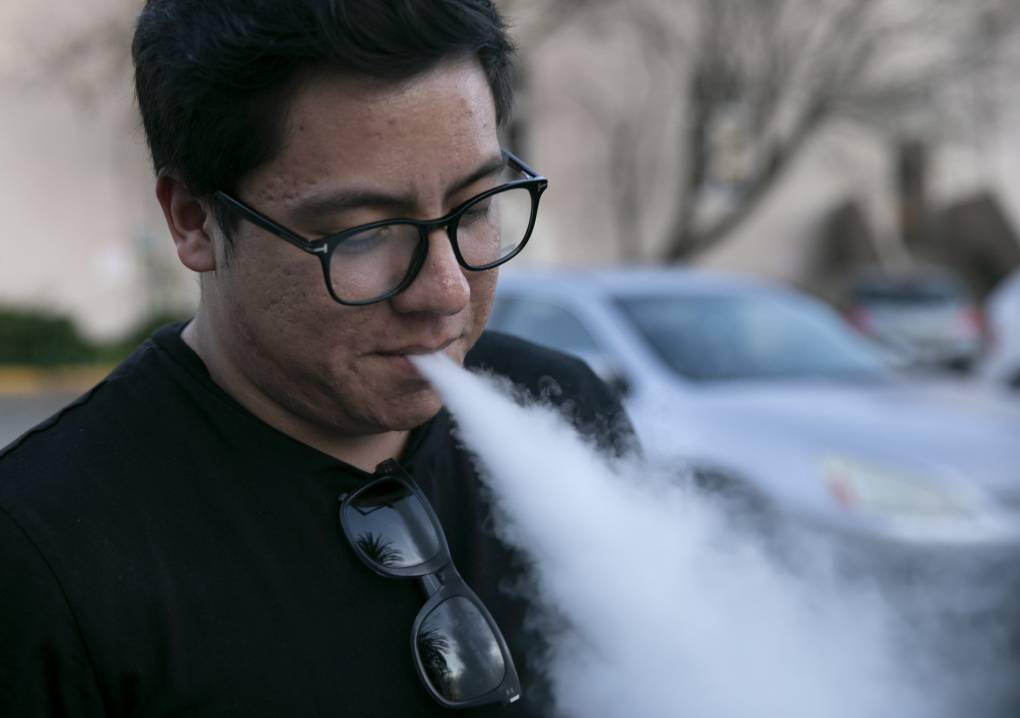
San José Could Temporarily Ban Smoke Shops, Citing Health Inequities
San Francisco Breaks the Zyn-ternet With Lawsuit Against Flavored Nicotine Sales
California's Ban on Flavored Tobacco Upheld by US Supreme Court
Californians Are Smoking Less. Why That Means Less Funding for Some Early Childhood Services
Transcript: Prop. 31 Asks Whether California Should Ban the Sale of Flavored Tobacco
Poll Finds Deep Concern About COVID-19, Economy
California Lawmakers Have Refused to Restrict Flavored Vaping — Is That About to Change?
Juul's Proposition C Defeated
Juul Suspends Sales of Flavored Vapes and Signs Settlement to Stop Marketing to Youth
Sponsored
Player sponsored by
window.__IS_SSR__=true
window.__INITIAL_STATE__={
"attachmentsReducer": {
"audio_0": {
"type": "attachments",
"id": "audio_0",
"imgSizes": {
"kqedFullSize": {
"file": "https://ww2.kqed.org/news/wp-content/themes/KQED-unified/img/audio_bgs/background0.jpg"
}
}
},
"audio_1": {
"type": "attachments",
"id": "audio_1",
"imgSizes": {
"kqedFullSize": {
"file": "https://ww2.kqed.org/news/wp-content/themes/KQED-unified/img/audio_bgs/background1.jpg"
}
}
},
"audio_2": {
"type": "attachments",
"id": "audio_2",
"imgSizes": {
"kqedFullSize": {
"file": "https://ww2.kqed.org/news/wp-content/themes/KQED-unified/img/audio_bgs/background2.jpg"
}
}
},
"audio_3": {
"type": "attachments",
"id": "audio_3",
"imgSizes": {
"kqedFullSize": {
"file": "https://ww2.kqed.org/news/wp-content/themes/KQED-unified/img/audio_bgs/background3.jpg"
}
}
},
"audio_4": {
"type": "attachments",
"id": "audio_4",
"imgSizes": {
"kqedFullSize": {
"file": "https://ww2.kqed.org/news/wp-content/themes/KQED-unified/img/audio_bgs/background4.jpg"
}
}
},
"placeholder": {
"type": "attachments",
"id": "placeholder",
"imgSizes": {
"thumbnail": {
"file": "https://cdn.kqed.org/wp-content/uploads/2024/12/KQED-Default-Image-816638274-2000x1333-1-160x107.jpg",
"width": 160,
"height": 107,
"mimeType": "image/jpeg"
},
"medium": {
"file": "https://cdn.kqed.org/wp-content/uploads/2024/12/KQED-Default-Image-816638274-2000x1333-1-800x533.jpg",
"width": 800,
"height": 533,
"mimeType": "image/jpeg"
},
"medium_large": {
"file": "https://cdn.kqed.org/wp-content/uploads/2024/12/KQED-Default-Image-816638274-2000x1333-1-768x512.jpg",
"width": 768,
"height": 512,
"mimeType": "image/jpeg"
},
"large": {
"file": "https://cdn.kqed.org/wp-content/uploads/2024/12/KQED-Default-Image-816638274-2000x1333-1-1020x680.jpg",
"width": 1020,
"height": 680,
"mimeType": "image/jpeg"
},
"1536x1536": {
"file": "https://cdn.kqed.org/wp-content/uploads/2024/12/KQED-Default-Image-816638274-2000x1333-1-1536x1024.jpg",
"width": 1536,
"height": 1024,
"mimeType": "image/jpeg"
},
"fd-lrg": {
"file": "https://cdn.kqed.org/wp-content/uploads/2024/12/KQED-Default-Image-816638274-2000x1333-1-1536x1024.jpg",
"width": 1536,
"height": 1024,
"mimeType": "image/jpeg"
},
"fd-med": {
"file": "https://cdn.kqed.org/wp-content/uploads/2024/12/KQED-Default-Image-816638274-2000x1333-1-1020x680.jpg",
"width": 1020,
"height": 680,
"mimeType": "image/jpeg"
},
"fd-sm": {
"file": "https://cdn.kqed.org/wp-content/uploads/2024/12/KQED-Default-Image-816638274-2000x1333-1-800x533.jpg",
"width": 800,
"height": 533,
"mimeType": "image/jpeg"
},
"post-thumbnail": {
"file": "https://cdn.kqed.org/wp-content/uploads/2024/12/KQED-Default-Image-816638274-2000x1333-1-672x372.jpg",
"width": 672,
"height": 372,
"mimeType": "image/jpeg"
},
"twentyfourteen-full-width": {
"file": "https://cdn.kqed.org/wp-content/uploads/2024/12/KQED-Default-Image-816638274-2000x1333-1-1038x576.jpg",
"width": 1038,
"height": 576,
"mimeType": "image/jpeg"
},
"xxsmall": {
"file": "https://cdn.kqed.org/wp-content/uploads/2024/12/KQED-Default-Image-816638274-2000x1333-1-160x107.jpg",
"width": 160,
"height": 107,
"mimeType": "image/jpeg"
},
"xsmall": {
"file": "https://cdn.kqed.org/wp-content/uploads/2024/12/KQED-Default-Image-816638274-2000x1333-1-672x372.jpg",
"width": 672,
"height": 372,
"mimeType": "image/jpeg"
},
"small": {
"file": "https://cdn.kqed.org/wp-content/uploads/2024/12/KQED-Default-Image-816638274-2000x1333-1-672x372.jpg",
"width": 672,
"height": 372,
"mimeType": "image/jpeg"
},
"xlarge": {
"file": "https://cdn.kqed.org/wp-content/uploads/2024/12/KQED-Default-Image-816638274-2000x1333-1-1020x680.jpg",
"width": 1020,
"height": 680,
"mimeType": "image/jpeg"
},
"full-width": {
"file": "https://cdn.kqed.org/wp-content/uploads/2024/12/KQED-Default-Image-816638274-2000x1333-1-1920x1280.jpg",
"width": 1920,
"height": 1280,
"mimeType": "image/jpeg"
},
"guest-author-32": {
"file": "https://cdn.kqed.org/wp-content/uploads/2025/01/KQED-Default-Image-816638274-1333x1333-1-160x160.jpg",
"width": 32,
"height": 32,
"mimeType": "image/jpeg"
},
"guest-author-50": {
"file": "https://cdn.kqed.org/wp-content/uploads/2025/01/KQED-Default-Image-816638274-1333x1333-1-160x160.jpg",
"width": 50,
"height": 50,
"mimeType": "image/jpeg"
},
"guest-author-64": {
"file": "https://cdn.kqed.org/wp-content/uploads/2025/01/KQED-Default-Image-816638274-1333x1333-1-160x160.jpg",
"width": 64,
"height": 64,
"mimeType": "image/jpeg"
},
"guest-author-96": {
"file": "https://cdn.kqed.org/wp-content/uploads/2025/01/KQED-Default-Image-816638274-1333x1333-1-160x160.jpg",
"width": 96,
"height": 96,
"mimeType": "image/jpeg"
},
"guest-author-128": {
"file": "https://cdn.kqed.org/wp-content/uploads/2025/01/KQED-Default-Image-816638274-1333x1333-1-160x160.jpg",
"width": 128,
"height": 128,
"mimeType": "image/jpeg"
},
"detail": {
"file": "https://cdn.kqed.org/wp-content/uploads/2025/01/KQED-Default-Image-816638274-1333x1333-1-160x160.jpg",
"width": 160,
"height": 160,
"mimeType": "image/jpeg"
},
"kqedFullSize": {
"file": "https://cdn.kqed.org/wp-content/uploads/2024/12/KQED-Default-Image-816638274-2000x1333-1.jpg",
"width": 2000,
"height": 1333
}
}
},
"news_12041943": {
"type": "attachments",
"id": "news_12041943",
"meta": {
"index": "attachments_1716263798",
"site": "news",
"id": "12041943",
"found": true
},
"title": "250528-SJSMOKESHOPS-JG-5-KQED",
"publishDate": 1748538909,
"status": "inherit",
"parent": 0,
"modified": 1748539459,
"caption": "Houdini’s Smoke Shop in downtown San José is seen on May 28, 2025. City Councilmember Peter Ortiz is pushing for a temporary ban on all new smoke shop businesses in the city over health equity concerns.",
"credit": "Joseph Geha/KQED",
"altTag": null,
"description": null,
"imgSizes": {
"medium": {
"file": "https://cdn.kqed.org/wp-content/uploads/sites/10/2025/05/250528-SJSMOKESHOPS-JG-5-KQED-800x533.jpg",
"width": 800,
"height": 533,
"mimeType": "image/jpeg"
},
"large": {
"file": "https://cdn.kqed.org/wp-content/uploads/sites/10/2025/05/250528-SJSMOKESHOPS-JG-5-KQED-1020x680.jpg",
"width": 1020,
"height": 680,
"mimeType": "image/jpeg"
},
"thumbnail": {
"file": "https://cdn.kqed.org/wp-content/uploads/sites/10/2025/05/250528-SJSMOKESHOPS-JG-5-KQED-160x107.jpg",
"width": 160,
"height": 107,
"mimeType": "image/jpeg"
},
"1536x1536": {
"file": "https://cdn.kqed.org/wp-content/uploads/sites/10/2025/05/250528-SJSMOKESHOPS-JG-5-KQED-1536x1024.jpg",
"width": 1536,
"height": 1024,
"mimeType": "image/jpeg"
},
"post-thumbnail": {
"file": "https://cdn.kqed.org/wp-content/uploads/sites/10/2025/05/250528-SJSMOKESHOPS-JG-5-KQED-672x372.jpg",
"width": 672,
"height": 372,
"mimeType": "image/jpeg"
},
"twentyfourteen-full-width": {
"file": "https://cdn.kqed.org/wp-content/uploads/sites/10/2025/05/250528-SJSMOKESHOPS-JG-5-KQED-1038x576.jpg",
"width": 1038,
"height": 576,
"mimeType": "image/jpeg"
},
"full-width": {
"file": "https://cdn.kqed.org/wp-content/uploads/sites/10/2025/05/250528-SJSMOKESHOPS-JG-5-KQED-1920x1280.jpg",
"width": 1920,
"height": 1280,
"mimeType": "image/jpeg"
},
"kqedFullSize": {
"file": "https://cdn.kqed.org/wp-content/uploads/sites/10/2025/05/250528-SJSMOKESHOPS-JG-5-KQED.jpg",
"width": 2000,
"height": 1333
}
},
"fetchFailed": false,
"isLoading": false
},
"news_12003000": {
"type": "attachments",
"id": "news_12003000",
"meta": {
"index": "attachments_1716263798",
"site": "news",
"id": "12003000",
"found": true
},
"title": "Smoke Free Expansion Kentucky",
"publishDate": 1725472945,
"status": "inherit",
"parent": 12002998,
"modified": 1725473102,
"caption": "Containers of Zyn, a Phillip Morris smokeless nicotine pouch, are displayed for sale among other nicotine and tobacco products at a newsstand in New York. The San Francisco city attorney's office is suing companies for illegally selling flavored Zyns and other nicotine pouches in violation of state and local laws designed to prevent youth nicotine addiction.",
"credit": "Bebeto Matthews/AP Photo",
"altTag": null,
"description": null,
"imgSizes": {
"medium": {
"file": "https://cdn.kqed.org/wp-content/uploads/sites/10/2024/09/ZynNicotinPouchesAP-800x533.jpg",
"width": 800,
"height": 533,
"mimeType": "image/jpeg"
},
"large": {
"file": "https://cdn.kqed.org/wp-content/uploads/sites/10/2024/09/ZynNicotinPouchesAP-1020x680.jpg",
"width": 1020,
"height": 680,
"mimeType": "image/jpeg"
},
"thumbnail": {
"file": "https://cdn.kqed.org/wp-content/uploads/sites/10/2024/09/ZynNicotinPouchesAP-160x107.jpg",
"width": 160,
"height": 107,
"mimeType": "image/jpeg"
},
"1536x1536": {
"file": "https://cdn.kqed.org/wp-content/uploads/sites/10/2024/09/ZynNicotinPouchesAP-1536x1024.jpg",
"width": 1536,
"height": 1024,
"mimeType": "image/jpeg"
},
"post-thumbnail": {
"file": "https://cdn.kqed.org/wp-content/uploads/sites/10/2024/09/ZynNicotinPouchesAP-672x372.jpg",
"width": 672,
"height": 372,
"mimeType": "image/jpeg"
},
"twentyfourteen-full-width": {
"file": "https://cdn.kqed.org/wp-content/uploads/sites/10/2024/09/ZynNicotinPouchesAP-1038x576.jpg",
"width": 1038,
"height": 576,
"mimeType": "image/jpeg"
},
"full-width": {
"file": "https://cdn.kqed.org/wp-content/uploads/sites/10/2024/09/ZynNicotinPouchesAP-1920x1280.jpg",
"width": 1920,
"height": 1280,
"mimeType": "image/jpeg"
},
"kqedFullSize": {
"file": "https://cdn.kqed.org/wp-content/uploads/sites/10/2024/09/ZynNicotinPouchesAP.jpg",
"width": 2000,
"height": 1333
}
},
"fetchFailed": false,
"isLoading": false
},
"news_11972052": {
"type": "attachments",
"id": "news_11972052",
"meta": {
"index": "attachments_1716263798",
"site": "news",
"id": "11972052",
"found": true
},
"parent": 11972039,
"imgSizes": {
"twentyfourteen-full-width": {
"file": "https://cdn.kqed.org/wp-content/uploads/sites/10/2024/01/PROPE_081-qut-1038x576.jpg",
"width": 1038,
"mimeType": "image/jpeg",
"height": 576
},
"thumbnail": {
"file": "https://cdn.kqed.org/wp-content/uploads/sites/10/2024/01/PROPE_081-qut-160x107.jpg",
"width": 160,
"mimeType": "image/jpeg",
"height": 107
},
"post-thumbnail": {
"file": "https://cdn.kqed.org/wp-content/uploads/sites/10/2024/01/PROPE_081-qut-672x372.jpg",
"width": 672,
"mimeType": "image/jpeg",
"height": 372
},
"kqedFullSize": {
"file": "https://cdn.kqed.org/wp-content/uploads/sites/10/2024/01/PROPE_081-qut.jpg",
"width": 1920,
"height": 1280
},
"large": {
"file": "https://cdn.kqed.org/wp-content/uploads/sites/10/2024/01/PROPE_081-qut-1020x680.jpg",
"width": 1020,
"mimeType": "image/jpeg",
"height": 680
},
"1536x1536": {
"file": "https://cdn.kqed.org/wp-content/uploads/sites/10/2024/01/PROPE_081-qut-1536x1024.jpg",
"width": 1536,
"mimeType": "image/jpeg",
"height": 1024
},
"medium": {
"file": "https://cdn.kqed.org/wp-content/uploads/sites/10/2024/01/PROPE_081-qut-800x533.jpg",
"width": 800,
"mimeType": "image/jpeg",
"height": 533
}
},
"publishDate": 1704825105,
"modified": 1704829469,
"caption": "'Fruit n Custard Banana'-flavored tobacco at the Vapor Den in San Francisco on May 9, 2018. According to an employee, the company avoids purchasing flavors that are too childlike in design, even if they are desirable flavors. ",
"description": null,
"title": "PROPE_081-qut",
"credit": "Lauren Hanussak/KQED",
"status": "inherit",
"altTag": "A row of flavored tobacco vape juice bottles.",
"fetchFailed": false,
"isLoading": false
},
"news_11955937": {
"type": "attachments",
"id": "news_11955937",
"meta": {
"index": "attachments_1716263798",
"site": "news",
"id": "11955937",
"found": true
},
"parent": 11955931,
"imgSizes": {
"twentyfourteen-full-width": {
"file": "https://ww2.kqed.org/app/uploads/sites/10/2023/07/GettyImages-1486127438-1024x576.jpg",
"width": 1024,
"mimeType": "image/jpeg",
"height": 576
},
"thumbnail": {
"file": "https://ww2.kqed.org/app/uploads/sites/10/2023/07/GettyImages-1486127438-160x105.jpg",
"width": 160,
"mimeType": "image/jpeg",
"height": 105
},
"post-thumbnail": {
"file": "https://ww2.kqed.org/app/uploads/sites/10/2023/07/GettyImages-1486127438-672x372.jpg",
"width": 672,
"mimeType": "image/jpeg",
"height": 372
},
"kqedFullSize": {
"file": "https://ww2.kqed.org/app/uploads/sites/10/2023/07/GettyImages-1486127438.jpg",
"width": 1024,
"height": 670
},
"large": {
"file": "https://ww2.kqed.org/app/uploads/sites/10/2023/07/GettyImages-1486127438-1020x667.jpg",
"width": 1020,
"mimeType": "image/jpeg",
"height": 667
},
"medium": {
"file": "https://ww2.kqed.org/app/uploads/sites/10/2023/07/GettyImages-1486127438-800x523.jpg",
"width": 800,
"mimeType": "image/jpeg",
"height": 523
}
},
"publishDate": 1689710837,
"modified": 1689710913,
"caption": "Packs of Marlboro cigarettes are displayed at a smoke shop on April 28, 2023 in San Francisco. Marlboro cigarette producer Altria Group reported first quarter earnings that fell short of analyst expectations with revenue of $4.76 billion, down 1.16 percent from one year ago. ",
"description": null,
"title": "Marlboro Cigarette Altria Group Inc. Reports Quarterly Earnings That Miss Expectations",
"credit": "Justin Sullivan/Getty Images",
"status": "inherit",
"altTag": "Multiple packs of Marlboro cigarettes with red designs on the left and yellow designs on the right.",
"fetchFailed": false,
"isLoading": false
},
"news_11927846": {
"type": "attachments",
"id": "news_11927846",
"meta": {
"index": "attachments_1716263798",
"site": "news",
"id": "11927846",
"found": true
},
"parent": 11927844,
"imgSizes": {
"twentyfourteen-full-width": {
"file": "https://ww2.kqed.org/app/uploads/sites/10/2022/10/Flavored-tobacco-1038x576.jpg",
"width": 1038,
"mimeType": "image/jpeg",
"height": 576
},
"thumbnail": {
"file": "https://ww2.kqed.org/app/uploads/sites/10/2022/10/Flavored-tobacco-160x107.jpg",
"width": 160,
"mimeType": "image/jpeg",
"height": 107
},
"post-thumbnail": {
"file": "https://ww2.kqed.org/app/uploads/sites/10/2022/10/Flavored-tobacco-672x372.jpg",
"width": 672,
"mimeType": "image/jpeg",
"height": 372
},
"kqedFullSize": {
"file": "https://ww2.kqed.org/app/uploads/sites/10/2022/10/Flavored-tobacco.jpg",
"width": 1920,
"height": 1280
},
"large": {
"file": "https://ww2.kqed.org/app/uploads/sites/10/2022/10/Flavored-tobacco-1020x680.jpg",
"width": 1020,
"mimeType": "image/jpeg",
"height": 680
},
"1536x1536": {
"file": "https://ww2.kqed.org/app/uploads/sites/10/2022/10/Flavored-tobacco-1536x1024.jpg",
"width": 1536,
"mimeType": "image/jpeg",
"height": 1024
},
"medium": {
"file": "https://ww2.kqed.org/app/uploads/sites/10/2022/10/Flavored-tobacco-800x533.jpg",
"width": 800,
"mimeType": "image/jpeg",
"height": 533
}
},
"publishDate": 1665010680,
"modified": 1666651687,
"caption": "\"Fruit n Custard Banana\" flavored tobacco at the Vapor Den in San Francisco, Calif., on Wednesday, May 9, 2018. Flavored tobacco has since been banned in San Francisco and voters are being asked to decide if products like these should be banned statewide. ",
"description": null,
"title": "Flavored-tobacco",
"credit": "Lauren Hanussak/KQED",
"status": "inherit",
"altTag": "Colorful bottles with pictures of enticing fruit and candy flavors line a shelf",
"fetchFailed": false,
"isLoading": false
},
"news_11815754": {
"type": "attachments",
"id": "news_11815754",
"meta": {
"index": "attachments_1716263798",
"site": "news",
"id": "11815754",
"found": true
},
"parent": 11815749,
"imgSizes": {
"apple_news_ca_landscape_5_5": {
"file": "https://ww2.kqed.org/app/uploads/sites/10/2020/05/GettyImages-1213031567-1044x783.jpg",
"width": 1044,
"mimeType": "image/jpeg",
"height": 783
},
"apple_news_ca_square_4_0": {
"file": "https://ww2.kqed.org/app/uploads/sites/10/2020/05/GettyImages-1213031567-470x470.jpg",
"width": 470,
"mimeType": "image/jpeg",
"height": 470
},
"twentyfourteen-full-width": {
"file": "https://ww2.kqed.org/app/uploads/sites/10/2020/05/GettyImages-1213031567-1038x576.jpg",
"width": 1038,
"mimeType": "image/jpeg",
"height": 576
},
"thumbnail": {
"file": "https://ww2.kqed.org/app/uploads/sites/10/2020/05/GettyImages-1213031567-160x107.jpg",
"width": 160,
"mimeType": "image/jpeg",
"height": 107
},
"post-thumbnail": {
"file": "https://ww2.kqed.org/app/uploads/sites/10/2020/05/GettyImages-1213031567-672x372.jpg",
"width": 672,
"mimeType": "image/jpeg",
"height": 372
},
"kqedFullSize": {
"file": "https://ww2.kqed.org/app/uploads/sites/10/2020/05/GettyImages-1213031567.jpg",
"width": 1280,
"height": 853
},
"apple_news_ca_landscape_4_7": {
"file": "https://ww2.kqed.org/app/uploads/sites/10/2020/05/GettyImages-1213031567-632x474.jpg",
"width": 632,
"mimeType": "image/jpeg",
"height": 474
},
"large": {
"file": "https://ww2.kqed.org/app/uploads/sites/10/2020/05/GettyImages-1213031567-1020x680.jpg",
"width": 1020,
"mimeType": "image/jpeg",
"height": 680
},
"apple_news_ca_landscape_4_0": {
"file": "https://ww2.kqed.org/app/uploads/sites/10/2020/05/GettyImages-1213031567-536x402.jpg",
"width": 536,
"mimeType": "image/jpeg",
"height": 402
},
"apple_news_ca_portrait_12_9": {
"file": "https://ww2.kqed.org/app/uploads/sites/10/2020/05/GettyImages-1213031567-1122x853.jpg",
"width": 1122,
"mimeType": "image/jpeg",
"height": 853
},
"medium": {
"file": "https://ww2.kqed.org/app/uploads/sites/10/2020/05/GettyImages-1213031567-800x533.jpg",
"width": 800,
"mimeType": "image/jpeg",
"height": 533
},
"apple_news_ca_portrait_4_0": {
"file": "https://ww2.kqed.org/app/uploads/sites/10/2020/05/GettyImages-1213031567-354x472.jpg",
"width": 354,
"mimeType": "image/jpeg",
"height": 472
},
"apple_news_ca_portrait_9_7": {
"file": "https://ww2.kqed.org/app/uploads/sites/10/2020/05/GettyImages-1213031567-840x853.jpg",
"width": 840,
"mimeType": "image/jpeg",
"height": 853
},
"apple_news_ca_square_9_7": {
"file": "https://ww2.kqed.org/app/uploads/sites/10/2020/05/GettyImages-1213031567-1104x853.jpg",
"width": 1104,
"mimeType": "image/jpeg",
"height": 853
},
"apple_news_ca_portrait_4_7": {
"file": "https://ww2.kqed.org/app/uploads/sites/10/2020/05/GettyImages-1213031567-414x552.jpg",
"width": 414,
"mimeType": "image/jpeg",
"height": 552
},
"apple_news_ca_portrait_5_5": {
"file": "https://ww2.kqed.org/app/uploads/sites/10/2020/05/GettyImages-1213031567-687x853.jpg",
"width": 687,
"mimeType": "image/jpeg",
"height": 853
},
"apple_news_ca_square_4_7": {
"file": "https://ww2.kqed.org/app/uploads/sites/10/2020/05/GettyImages-1213031567-550x550.jpg",
"width": 550,
"mimeType": "image/jpeg",
"height": 550
},
"apple_news_ca_square_5_5": {
"file": "https://ww2.kqed.org/app/uploads/sites/10/2020/05/GettyImages-1213031567-912x853.jpg",
"width": 912,
"mimeType": "image/jpeg",
"height": 853
}
},
"publishDate": 1588368287,
"modified": 1589342360,
"caption": "A pedestrian walks by a closed sign on the door of a restaurant on March 17, 2020 in San Francisco, California. ",
"description": null,
"title": "Coronavirus Pandemic Causes Climate Of Anxiety And Changing Routines In America",
"credit": "(Photo by Justin Sullivan/Getty Images)",
"status": "inherit",
"fetchFailed": false,
"isLoading": false
},
"news_11800903": {
"type": "attachments",
"id": "news_11800903",
"meta": {
"index": "attachments_1716263798",
"site": "news",
"id": "11800903",
"found": true
},
"parent": 11800884,
"imgSizes": {
"apple_news_ca_landscape_5_5": {
"file": "https://ww2.kqed.org/app/uploads/sites/10/2020/02/RS41280_VAPING-photo-qut-1044x783.jpg",
"width": 1044,
"mimeType": "image/jpeg",
"height": 783
},
"apple_news_ca_square_4_0": {
"file": "https://ww2.kqed.org/app/uploads/sites/10/2020/02/RS41280_VAPING-photo-qut-470x470.jpg",
"width": 470,
"mimeType": "image/jpeg",
"height": 470
},
"twentyfourteen-full-width": {
"file": "https://ww2.kqed.org/app/uploads/sites/10/2020/02/RS41280_VAPING-photo-qut-1038x576.jpg",
"width": 1038,
"mimeType": "image/jpeg",
"height": 576
},
"thumbnail": {
"file": "https://ww2.kqed.org/app/uploads/sites/10/2020/02/RS41280_VAPING-photo-qut-160x113.jpg",
"width": 160,
"mimeType": "image/jpeg",
"height": 113
},
"post-thumbnail": {
"file": "https://ww2.kqed.org/app/uploads/sites/10/2020/02/RS41280_VAPING-photo-qut-672x372.jpg",
"width": 672,
"mimeType": "image/jpeg",
"height": 372
},
"kqedFullSize": {
"file": "https://ww2.kqed.org/app/uploads/sites/10/2020/02/RS41280_VAPING-photo-qut.jpg",
"width": 1920,
"height": 1351
},
"apple_news_ca_landscape_4_7": {
"file": "https://ww2.kqed.org/app/uploads/sites/10/2020/02/RS41280_VAPING-photo-qut-632x474.jpg",
"width": 632,
"mimeType": "image/jpeg",
"height": 474
},
"large": {
"file": "https://ww2.kqed.org/app/uploads/sites/10/2020/02/RS41280_VAPING-photo-qut-1020x718.jpg",
"width": 1020,
"mimeType": "image/jpeg",
"height": 718
},
"apple_news_ca_landscape_4_0": {
"file": "https://ww2.kqed.org/app/uploads/sites/10/2020/02/RS41280_VAPING-photo-qut-536x402.jpg",
"width": 536,
"mimeType": "image/jpeg",
"height": 402
},
"apple_news_ca_portrait_12_9": {
"file": "https://ww2.kqed.org/app/uploads/sites/10/2020/02/RS41280_VAPING-photo-qut-1122x1351.jpg",
"width": 1122,
"mimeType": "image/jpeg",
"height": 1351
},
"medium": {
"file": "https://ww2.kqed.org/app/uploads/sites/10/2020/02/RS41280_VAPING-photo-qut-800x563.jpg",
"width": 800,
"mimeType": "image/jpeg",
"height": 563
},
"apple_news_ca_portrait_4_0": {
"file": "https://ww2.kqed.org/app/uploads/sites/10/2020/02/RS41280_VAPING-photo-qut-354x472.jpg",
"width": 354,
"mimeType": "image/jpeg",
"height": 472
},
"apple_news_ca_portrait_9_7": {
"file": "https://ww2.kqed.org/app/uploads/sites/10/2020/02/RS41280_VAPING-photo-qut-840x1120.jpg",
"width": 840,
"mimeType": "image/jpeg",
"height": 1120
},
"apple_news_ca_landscape_12_9": {
"file": "https://ww2.kqed.org/app/uploads/sites/10/2020/02/RS41280_VAPING-photo-qut-1832x1351.jpg",
"width": 1832,
"mimeType": "image/jpeg",
"height": 1351
},
"apple_news_ca_square_9_7": {
"file": "https://ww2.kqed.org/app/uploads/sites/10/2020/02/RS41280_VAPING-photo-qut-1104x1104.jpg",
"width": 1104,
"mimeType": "image/jpeg",
"height": 1104
},
"apple_news_ca_portrait_4_7": {
"file": "https://ww2.kqed.org/app/uploads/sites/10/2020/02/RS41280_VAPING-photo-qut-414x552.jpg",
"width": 414,
"mimeType": "image/jpeg",
"height": 552
},
"apple_news_ca_square_12_9": {
"file": "https://ww2.kqed.org/app/uploads/sites/10/2020/02/RS41280_VAPING-photo-qut-1472x1351.jpg",
"width": 1472,
"mimeType": "image/jpeg",
"height": 1351
},
"apple_news_ca_portrait_5_5": {
"file": "https://ww2.kqed.org/app/uploads/sites/10/2020/02/RS41280_VAPING-photo-qut-687x916.jpg",
"width": 687,
"mimeType": "image/jpeg",
"height": 916
},
"full-width": {
"file": "https://ww2.kqed.org/app/uploads/sites/10/2020/02/RS41280_VAPING-photo-qut-1920x1351.jpg",
"width": 1920,
"mimeType": "image/jpeg",
"height": 1351
},
"apple_news_ca_square_4_7": {
"file": "https://ww2.kqed.org/app/uploads/sites/10/2020/02/RS41280_VAPING-photo-qut-550x550.jpg",
"width": 550,
"mimeType": "image/jpeg",
"height": 550
},
"apple_news_ca_landscape_9_7": {
"file": "https://ww2.kqed.org/app/uploads/sites/10/2020/02/RS41280_VAPING-photo-qut-1376x1032.jpg",
"width": 1376,
"mimeType": "image/jpeg",
"height": 1032
},
"apple_news_ca_square_5_5": {
"file": "https://ww2.kqed.org/app/uploads/sites/10/2020/02/RS41280_VAPING-photo-qut-912x912.jpg",
"width": 912,
"mimeType": "image/jpeg",
"height": 912
}
},
"publishDate": 1581368220,
"modified": 1581368274,
"caption": "Jorge Hernandez, 21, vapes near UC Berkeley campus. Hernandez has been vaping for a year and half.",
"description": null,
"title": "RS41280_VAPING photo-qut",
"credit": "Anne Wernikoff/CalMatters",
"status": "inherit",
"fetchFailed": false,
"isLoading": false
},
"news_11785376": {
"type": "attachments",
"id": "news_11785376",
"meta": {
"index": "attachments_1716263798",
"site": "news",
"id": "11785376",
"found": true
},
"parent": 11785365,
"imgSizes": {
"apple_news_ca_landscape_5_5": {
"file": "https://ww2.kqed.org/app/uploads/sites/10/2019/11/propc_110619_final-1044x783.jpg",
"width": 1044,
"mimeType": "image/jpeg",
"height": 783
},
"apple_news_ca_square_4_0": {
"file": "https://ww2.kqed.org/app/uploads/sites/10/2019/11/propc_110619_final-470x470.jpg",
"width": 470,
"mimeType": "image/jpeg",
"height": 470
},
"twentyfourteen-full-width": {
"file": "https://ww2.kqed.org/app/uploads/sites/10/2019/11/propc_110619_final-1038x576.jpg",
"width": 1038,
"mimeType": "image/jpeg",
"height": 576
},
"thumbnail": {
"file": "https://ww2.kqed.org/app/uploads/sites/10/2019/11/propc_110619_final-160x118.jpg",
"width": 160,
"mimeType": "image/jpeg",
"height": 118
},
"post-thumbnail": {
"file": "https://ww2.kqed.org/app/uploads/sites/10/2019/11/propc_110619_final-672x372.jpg",
"width": 672,
"mimeType": "image/jpeg",
"height": 372
},
"kqedFullSize": {
"file": "https://ww2.kqed.org/app/uploads/sites/10/2019/11/propc_110619_final.jpg",
"width": 1920,
"height": 1417
},
"apple_news_ca_landscape_4_7": {
"file": "https://ww2.kqed.org/app/uploads/sites/10/2019/11/propc_110619_final-632x474.jpg",
"width": 632,
"mimeType": "image/jpeg",
"height": 474
},
"large": {
"file": "https://ww2.kqed.org/app/uploads/sites/10/2019/11/propc_110619_final-1020x753.jpg",
"width": 1020,
"mimeType": "image/jpeg",
"height": 753
},
"complete_open_graph": {
"file": "https://ww2.kqed.org/app/uploads/sites/10/2019/11/propc_110619_final-1200x886.jpg",
"width": 1200,
"mimeType": "image/jpeg",
"height": 886
},
"apple_news_ca_landscape_4_0": {
"file": "https://ww2.kqed.org/app/uploads/sites/10/2019/11/propc_110619_final-536x402.jpg",
"width": 536,
"mimeType": "image/jpeg",
"height": 402
},
"apple_news_ca_portrait_12_9": {
"file": "https://ww2.kqed.org/app/uploads/sites/10/2019/11/propc_110619_final-1122x1417.jpg",
"width": 1122,
"mimeType": "image/jpeg",
"height": 1417
},
"medium": {
"file": "https://ww2.kqed.org/app/uploads/sites/10/2019/11/propc_110619_final-800x590.jpg",
"width": 800,
"mimeType": "image/jpeg",
"height": 590
},
"apple_news_ca_portrait_4_0": {
"file": "https://ww2.kqed.org/app/uploads/sites/10/2019/11/propc_110619_final-354x472.jpg",
"width": 354,
"mimeType": "image/jpeg",
"height": 472
},
"apple_news_ca_portrait_9_7": {
"file": "https://ww2.kqed.org/app/uploads/sites/10/2019/11/propc_110619_final-840x1120.jpg",
"width": 840,
"mimeType": "image/jpeg",
"height": 1120
},
"apple_news_ca_landscape_12_9": {
"file": "https://ww2.kqed.org/app/uploads/sites/10/2019/11/propc_110619_final-1832x1374.jpg",
"width": 1832,
"mimeType": "image/jpeg",
"height": 1374
},
"apple_news_ca_square_9_7": {
"file": "https://ww2.kqed.org/app/uploads/sites/10/2019/11/propc_110619_final-1104x1104.jpg",
"width": 1104,
"mimeType": "image/jpeg",
"height": 1104
},
"apple_news_ca_portrait_4_7": {
"file": "https://ww2.kqed.org/app/uploads/sites/10/2019/11/propc_110619_final-414x552.jpg",
"width": 414,
"mimeType": "image/jpeg",
"height": 552
},
"apple_news_ca_square_12_9": {
"file": "https://ww2.kqed.org/app/uploads/sites/10/2019/11/propc_110619_final-1472x1417.jpg",
"width": 1472,
"mimeType": "image/jpeg",
"height": 1417
},
"apple_news_ca_portrait_5_5": {
"file": "https://ww2.kqed.org/app/uploads/sites/10/2019/11/propc_110619_final-687x916.jpg",
"width": 687,
"mimeType": "image/jpeg",
"height": 916
},
"full-width": {
"file": "https://ww2.kqed.org/app/uploads/sites/10/2019/11/propc_110619_final-1920x1417.jpg",
"width": 1920,
"mimeType": "image/jpeg",
"height": 1417
},
"apple_news_ca_square_4_7": {
"file": "https://ww2.kqed.org/app/uploads/sites/10/2019/11/propc_110619_final-550x550.jpg",
"width": 550,
"mimeType": "image/jpeg",
"height": 550
},
"apple_news_ca_landscape_9_7": {
"file": "https://ww2.kqed.org/app/uploads/sites/10/2019/11/propc_110619_final-1376x1032.jpg",
"width": 1376,
"mimeType": "image/jpeg",
"height": 1032
},
"apple_news_ca_square_5_5": {
"file": "https://ww2.kqed.org/app/uploads/sites/10/2019/11/propc_110619_final-912x912.jpg",
"width": 912,
"mimeType": "image/jpeg",
"height": 912
}
},
"publishDate": 1573081593,
"modified": 1573081619,
"caption": null,
"description": null,
"title": "propc_110619_final",
"credit": null,
"status": "inherit",
"fetchFailed": false,
"isLoading": false
},
"news_11781006": {
"type": "attachments",
"id": "news_11781006",
"meta": {
"index": "attachments_1716263798",
"site": "news",
"id": "11781006",
"found": true
},
"parent": 11781005,
"imgSizes": {
"apple_news_ca_landscape_5_5": {
"file": "https://ww2.kqed.org/app/uploads/sites/10/2019/10/juul-vape-flavors-f3dc84b0794e7ca844745ced07dbea1edc8dc614-1044x783.jpg",
"width": 1044,
"mimeType": "image/jpeg",
"height": 783
},
"apple_news_ca_square_4_0": {
"file": "https://ww2.kqed.org/app/uploads/sites/10/2019/10/juul-vape-flavors-f3dc84b0794e7ca844745ced07dbea1edc8dc614-470x470.jpg",
"width": 470,
"mimeType": "image/jpeg",
"height": 470
},
"twentyfourteen-full-width": {
"file": "https://ww2.kqed.org/app/uploads/sites/10/2019/10/juul-vape-flavors-f3dc84b0794e7ca844745ced07dbea1edc8dc614-1038x576.jpg",
"width": 1038,
"mimeType": "image/jpeg",
"height": 576
},
"thumbnail": {
"file": "https://ww2.kqed.org/app/uploads/sites/10/2019/10/juul-vape-flavors-f3dc84b0794e7ca844745ced07dbea1edc8dc614-160x120.jpg",
"width": 160,
"mimeType": "image/jpeg",
"height": 120
},
"post-thumbnail": {
"file": "https://ww2.kqed.org/app/uploads/sites/10/2019/10/juul-vape-flavors-f3dc84b0794e7ca844745ced07dbea1edc8dc614-672x372.jpg",
"width": 672,
"mimeType": "image/jpeg",
"height": 372
},
"kqedFullSize": {
"file": "https://ww2.kqed.org/app/uploads/sites/10/2019/10/juul-vape-flavors-f3dc84b0794e7ca844745ced07dbea1edc8dc614-e1571422730282.jpg",
"width": 1920,
"height": 1440
},
"apple_news_ca_landscape_4_7": {
"file": "https://ww2.kqed.org/app/uploads/sites/10/2019/10/juul-vape-flavors-f3dc84b0794e7ca844745ced07dbea1edc8dc614-632x474.jpg",
"width": 632,
"mimeType": "image/jpeg",
"height": 474
},
"large": {
"file": "https://ww2.kqed.org/app/uploads/sites/10/2019/10/juul-vape-flavors-f3dc84b0794e7ca844745ced07dbea1edc8dc614-1020x765.jpg",
"width": 1020,
"mimeType": "image/jpeg",
"height": 765
},
"complete_open_graph": {
"file": "https://ww2.kqed.org/app/uploads/sites/10/2019/10/juul-vape-flavors-f3dc84b0794e7ca844745ced07dbea1edc8dc614-1200x900.jpg",
"width": 1200,
"mimeType": "image/jpeg",
"height": 900
},
"apple_news_ca_landscape_4_0": {
"file": "https://ww2.kqed.org/app/uploads/sites/10/2019/10/juul-vape-flavors-f3dc84b0794e7ca844745ced07dbea1edc8dc614-536x402.jpg",
"width": 536,
"mimeType": "image/jpeg",
"height": 402
},
"apple_news_ca_portrait_12_9": {
"file": "https://ww2.kqed.org/app/uploads/sites/10/2019/10/juul-vape-flavors-f3dc84b0794e7ca844745ced07dbea1edc8dc614-1122x1496.jpg",
"width": 1122,
"mimeType": "image/jpeg",
"height": 1496
},
"medium": {
"file": "https://ww2.kqed.org/app/uploads/sites/10/2019/10/juul-vape-flavors-f3dc84b0794e7ca844745ced07dbea1edc8dc614-800x600.jpg",
"width": 800,
"mimeType": "image/jpeg",
"height": 600
},
"apple_news_ca_portrait_4_0": {
"file": "https://ww2.kqed.org/app/uploads/sites/10/2019/10/juul-vape-flavors-f3dc84b0794e7ca844745ced07dbea1edc8dc614-354x472.jpg",
"width": 354,
"mimeType": "image/jpeg",
"height": 472
},
"apple_news_ca_portrait_9_7": {
"file": "https://ww2.kqed.org/app/uploads/sites/10/2019/10/juul-vape-flavors-f3dc84b0794e7ca844745ced07dbea1edc8dc614-840x1120.jpg",
"width": 840,
"mimeType": "image/jpeg",
"height": 1120
},
"apple_news_ca_landscape_12_9": {
"file": "https://ww2.kqed.org/app/uploads/sites/10/2019/10/juul-vape-flavors-f3dc84b0794e7ca844745ced07dbea1edc8dc614-1832x1374.jpg",
"width": 1832,
"mimeType": "image/jpeg",
"height": 1374
},
"apple_news_ca_square_9_7": {
"file": "https://ww2.kqed.org/app/uploads/sites/10/2019/10/juul-vape-flavors-f3dc84b0794e7ca844745ced07dbea1edc8dc614-1104x1104.jpg",
"width": 1104,
"mimeType": "image/jpeg",
"height": 1104
},
"apple_news_ca_portrait_4_7": {
"file": "https://ww2.kqed.org/app/uploads/sites/10/2019/10/juul-vape-flavors-f3dc84b0794e7ca844745ced07dbea1edc8dc614-414x552.jpg",
"width": 414,
"mimeType": "image/jpeg",
"height": 552
},
"apple_news_ca_square_12_9": {
"file": "https://ww2.kqed.org/app/uploads/sites/10/2019/10/juul-vape-flavors-f3dc84b0794e7ca844745ced07dbea1edc8dc614-1472x1472.jpg",
"width": 1472,
"mimeType": "image/jpeg",
"height": 1472
},
"apple_news_ca_portrait_5_5": {
"file": "https://ww2.kqed.org/app/uploads/sites/10/2019/10/juul-vape-flavors-f3dc84b0794e7ca844745ced07dbea1edc8dc614-687x916.jpg",
"width": 687,
"mimeType": "image/jpeg",
"height": 916
},
"full-width": {
"file": "https://ww2.kqed.org/app/uploads/sites/10/2019/10/juul-vape-flavors-f3dc84b0794e7ca844745ced07dbea1edc8dc614-1920x1440.jpg",
"width": 1920,
"mimeType": "image/jpeg",
"height": 1440
},
"apple_news_ca_square_4_7": {
"file": "https://ww2.kqed.org/app/uploads/sites/10/2019/10/juul-vape-flavors-f3dc84b0794e7ca844745ced07dbea1edc8dc614-550x550.jpg",
"width": 550,
"mimeType": "image/jpeg",
"height": 550
},
"apple_news_ca_landscape_9_7": {
"file": "https://ww2.kqed.org/app/uploads/sites/10/2019/10/juul-vape-flavors-f3dc84b0794e7ca844745ced07dbea1edc8dc614-1376x1032.jpg",
"width": 1376,
"mimeType": "image/jpeg",
"height": 1032
},
"apple_news_ca_square_5_5": {
"file": "https://ww2.kqed.org/app/uploads/sites/10/2019/10/juul-vape-flavors-f3dc84b0794e7ca844745ced07dbea1edc8dc614-912x912.jpg",
"width": 912,
"mimeType": "image/jpeg",
"height": 912
}
},
"publishDate": 1571422596,
"modified": 1571430954,
"caption": "Juul announced it will suspend sales of all non-tobacco, non-menthol-based flavors of its e-cigarette products.",
"description": "Juul announced it will suspend sales of all non-tobacco, non menthol-based flavors of its e-cigarette products.",
"title": "Juul announced it will suspend sales of all non-tobacco, non menthol-based flavors of its e-cigarette products.",
"credit": "Seth Wenig/AP",
"status": "inherit",
"fetchFailed": false,
"isLoading": false
}
},
"audioPlayerReducer": {
"postId": "stream_live",
"isPaused": true,
"isPlaying": false,
"pfsActive": false,
"pledgeModalIsOpen": true,
"playerDrawerIsOpen": false
},
"authorsReducer": {
"byline_news_11972039": {
"type": "authors",
"id": "byline_news_11972039",
"meta": {
"override": true
},
"slug": "byline_news_11972039",
"name": "\u003ca href=\"https://calmatters.org/author/lynn-la/\">Lynn La\u003c/a>",
"isLoading": false
},
"byline_news_11955931": {
"type": "authors",
"id": "byline_news_11955931",
"meta": {
"override": true
},
"slug": "byline_news_11955931",
"name": "\u003ca href=\"https://calmatters.org/author/anaibarra/\">Ana B. Ibarra\u003c/a>",
"isLoading": false
},
"byline_news_11800884": {
"type": "authors",
"id": "byline_news_11800884",
"meta": {
"override": true
},
"slug": "byline_news_11800884",
"name": "\u003ca href=\"https://calmatters.org/author/elizabeth-aguilera/\"> Elizabeth Aguilera \u003ca />",
"isLoading": false
},
"byline_news_11781005": {
"type": "authors",
"id": "byline_news_11781005",
"meta": {
"override": true
},
"slug": "byline_news_11781005",
"name": "\u003cstrong>Allison Aubrey\u003cbr />NPR\u003c/strong>",
"isLoading": false
},
"ohubertallen": {
"type": "authors",
"id": "102",
"meta": {
"index": "authors_1716337520",
"id": "102",
"found": true
},
"name": "Olivia Allen-Price",
"firstName": "Olivia",
"lastName": "Allen-Price",
"slug": "ohubertallen",
"email": "oallenprice@kqed.org",
"display_author_email": false,
"staff_mastheads": [
"news"
],
"title": "Senior Editor",
"bio": "Olivia Allen-Price is senior editor and host of the award-winning Bay Curious podcast. Prior to joining KQED in 2013, Olivia worked at The Baltimore Sun and The Virginian-Pilot in Norfolk, Va. She holds degrees in journalism and political science from Elon University. Her work has earned awards from the Society of Professional Journalists, the Hearst Foundation and Hearken. She loves to talk about running and curly hair.\r\n\r\nFollow: \u003ca href=\"https://twitter.com/oallenprice\">@oallenprice\u003c/a>\r\nEmail: \u003ca href=\"mailto:oallenprice@kqed.org\">oallenprice@kqed.org\u003c/a>",
"avatar": "https://secure.gravatar.com/avatar/fdd38db811fcf449bd7d7db84a39eea1?s=600&d=blank&r=g",
"twitter": "oallenprice",
"facebook": null,
"instagram": null,
"linkedin": null,
"sites": [
{
"site": "",
"roles": [
"editor"
]
},
{
"site": "arts",
"roles": [
"subscriber"
]
},
{
"site": "styleguide",
"roles": [
"administrator"
]
},
{
"site": "news",
"roles": [
"administrator"
]
},
{
"site": "pop",
"roles": [
"administrator"
]
},
{
"site": "bayareabites",
"roles": [
"contributor"
]
},
{
"site": "stateofhealth",
"roles": [
"administrator"
]
},
{
"site": "science",
"roles": [
"editor"
]
},
{
"site": "breakingnews",
"roles": [
"administrator"
]
}
],
"headData": {
"title": "Olivia Allen-Price | KQED",
"description": "Senior Editor",
"ogImgSrc": "https://secure.gravatar.com/avatar/fdd38db811fcf449bd7d7db84a39eea1?s=600&d=blank&r=g",
"twImgSrc": "https://secure.gravatar.com/avatar/fdd38db811fcf449bd7d7db84a39eea1?s=600&d=blank&r=g"
},
"isLoading": false,
"link": "/author/ohubertallen"
},
"katrinaschwartz": {
"type": "authors",
"id": "234",
"meta": {
"index": "authors_1716337520",
"id": "234",
"found": true
},
"name": "Katrina Schwartz",
"firstName": "Katrina",
"lastName": "Schwartz",
"slug": "katrinaschwartz",
"email": "kschwartz@kqed.org",
"display_author_email": false,
"staff_mastheads": [
"news"
],
"title": "Producer",
"bio": "Katrina Schwartz is a journalist based in San Francisco. She's worked at KPCC public radio in LA and has reported on air and online for KQED since 2010. She covered how teaching and learning is changing for MindShift between 2012 and 2020. She is the co-host of the MindShift podcast and now produces KQED's Bay Curious podcast.",
"avatar": "https://secure.gravatar.com/avatar/a6a567574dafefa959593925eead665c?s=600&d=blank&r=g",
"twitter": "kschwart",
"facebook": null,
"instagram": null,
"linkedin": null,
"sites": [
{
"site": "news",
"roles": [
"editor"
]
},
{
"site": "mindshift",
"roles": [
"administrator"
]
},
{
"site": "stateofhealth",
"roles": [
"author"
]
},
{
"site": "science",
"roles": [
"editor"
]
}
],
"headData": {
"title": "Katrina Schwartz | KQED",
"description": "Producer",
"ogImgSrc": "https://secure.gravatar.com/avatar/a6a567574dafefa959593925eead665c?s=600&d=blank&r=g",
"twImgSrc": "https://secure.gravatar.com/avatar/a6a567574dafefa959593925eead665c?s=600&d=blank&r=g"
},
"isLoading": false,
"link": "/author/katrinaschwartz"
},
"markfiore": {
"type": "authors",
"id": "3236",
"meta": {
"index": "authors_1716337520",
"id": "3236",
"found": true
},
"name": "Mark Fiore",
"firstName": "Mark",
"lastName": "Fiore",
"slug": "markfiore",
"email": "mark@markfiore.com",
"display_author_email": false,
"staff_mastheads": [
"news"
],
"title": "KQED News Cartoonist",
"bio": "\u003ca href=\"http://www.MarkFiore.com\">MarkFiore.com\u003c/a> | \u003ca href=\"https://twitter.com/markfiore\">Follow on Twitter\u003c/a> | \u003ca href=\"https://www.facebook.com/pages/Mark-Fiore-Animated-Political-Cartoons/94451707396?ref=bookmarks\">Facebook\u003c/a> | \u003ca href=\"mailto:mark@markfiore.com\">email\u003c/a>\r\n\r\nPulitzer Prize-winner, Mark Fiore, who the Wall Street Journal has called “the undisputed guru of the form,” creates animated political cartoons in San Francisco, where his work has been featured regularly on the San Francisco Chronicle’s web site, SFGate.com. His work has appeared on Newsweek.com, Slate.com, CBSNews.com, MotherJones.com, DailyKos.com and NPR’s web site. Fiore’s political animation has appeared on CNN, Frontline, Bill Moyers Journal, Salon.com and cable and broadcast outlets across the globe.\r\n\r\nBeginning his professional life by drawing traditional political cartoons for newspapers, Fiore’s work appeared in publications ranging from the Washington Post to the Los Angeles Times. In the late 1990s, he began to experiment with animating political cartoons and, after a short stint at the San Jose Mercury News as their staff cartoonist, Fiore devoted all his energies to animation.\r\nGrowing up in California, Fiore also spent a good portion of his life in the backwoods of Idaho. It was this combination that shaped him politically. Mark majored in political science at Colorado College, where, in a perfect send-off for a cartoonist, he received his diploma in 1991 as commencement speaker Dick Cheney smiled approvingly.\r\nMark Fiore was awarded the Pulitzer Prize for political cartooning in 2010, a Robert F. Kennedy Journalism Award in 2004 and has twice received an Online Journalism Award for commentary from the Online News Association (2002, 2008). Fiore has received two awards for his work in new media from the National Cartoonists Society (2001, 2002), and in 2006 received The James Madison Freedom of Information Award from The Society of Professional Journalists.",
"avatar": "https://secure.gravatar.com/avatar/fc4e2a612b15b67bad0c6f0e1db4ca9b?s=600&d=blank&r=g",
"twitter": "MarkFiore",
"facebook": null,
"instagram": "https://www.instagram.com/markfiore/?hl=en",
"linkedin": null,
"sites": [
{
"site": "arts",
"roles": [
"contributor"
]
},
{
"site": "news",
"roles": [
"editor"
]
},
{
"site": "futureofyou",
"roles": [
"editor"
]
},
{
"site": "science",
"roles": [
"editor"
]
}
],
"headData": {
"title": "Mark Fiore | KQED",
"description": "KQED News Cartoonist",
"ogImgSrc": "https://secure.gravatar.com/avatar/fc4e2a612b15b67bad0c6f0e1db4ca9b?s=600&d=blank&r=g",
"twImgSrc": "https://secure.gravatar.com/avatar/fc4e2a612b15b67bad0c6f0e1db4ca9b?s=600&d=blank&r=g"
},
"isLoading": false,
"link": "/author/markfiore"
},
"mlagos": {
"type": "authors",
"id": "3239",
"meta": {
"index": "authors_1716337520",
"id": "3239",
"found": true
},
"name": "Marisa Lagos",
"firstName": "Marisa",
"lastName": "Lagos",
"slug": "mlagos",
"email": "mlagos@kqed.org",
"display_author_email": false,
"staff_mastheads": [
"news"
],
"title": "KQED Contributor",
"bio": "Marisa Lagos is a correspondent for KQED’s California Politics and Government Desk and co-hosts the award-winning show and podcast, Political Breakdown. At KQED, Lagos also conducts reporting, analysis and investigations into state, local and national politics for radio, TV, online and onstage. In 2022, she and co-host, Scott Shafer, moderated the only gubernatorial debate in California. In 2020, the \u003ci>Washington Post\u003c/i> named her one of the top political journalists in California; she was nominated for a Peabody and won several other awards for her work investigating the 2017 California wildfires. She has worked at the \u003ci>San Francisco Chronicle\u003c/i>, \u003ci>San Francisco Examiner\u003c/i> and \u003ci>Los Angeles Times\u003c/i>. A UC Santa Barbara graduate, she lives in San Francisco with her two sons and husband.",
"avatar": "https://secure.gravatar.com/avatar/a261a0d3696fc066871ef96b85b5e7d2?s=600&d=blank&r=g",
"twitter": "@mlagos",
"facebook": null,
"instagram": null,
"linkedin": null,
"sites": [
{
"site": "arts",
"roles": [
"author"
]
},
{
"site": "news",
"roles": [
"editor"
]
},
{
"site": "science",
"roles": [
"editor"
]
},
{
"site": "forum",
"roles": [
"author"
]
},
{
"site": "liveblog",
"roles": [
"author"
]
}
],
"headData": {
"title": "Marisa Lagos | KQED",
"description": "KQED Contributor",
"ogImgSrc": "https://secure.gravatar.com/avatar/a261a0d3696fc066871ef96b85b5e7d2?s=600&d=blank&r=g",
"twImgSrc": "https://secure.gravatar.com/avatar/a261a0d3696fc066871ef96b85b5e7d2?s=600&d=blank&r=g"
},
"isLoading": false,
"link": "/author/mlagos"
},
"ecruzguevarra": {
"type": "authors",
"id": "8654",
"meta": {
"index": "authors_1716337520",
"id": "8654",
"found": true
},
"name": "Ericka Cruz Guevarra",
"firstName": "Ericka",
"lastName": "Cruz Guevarra",
"slug": "ecruzguevarra",
"email": "ecruzguevarra@kqed.org",
"display_author_email": true,
"staff_mastheads": [
"news"
],
"title": "Producer, The Bay Podcast",
"bio": "Ericka Cruz Guevarra is host of \u003ca href=\"https://www.kqed.org/podcasts/thebay\">\u003cem>The Bay\u003c/em>\u003c/a> podcast at KQED. Before host, she was the show’s producer. Her work in that capacity includes a three-part reported series on policing in Vallejo, which won a 2020 excellence in journalism award from the Society of Professional Journalists. Ericka has worked as a breaking news reporter at Oregon Public Broadcasting, helped produce the Code Switch podcast, and was KQED’s inaugural Raul Ramirez Diversity Fund intern. She’s also an alumna of NPR’s Next Generation Radio program. Send her an email if you have strong feelings about whether Fairfield and Suisun City are the Bay. Ericka is represented by SAG-AFTRA.",
"avatar": "https://secure.gravatar.com/avatar/25e5ab8d3d53fad2dcc7bb2b5c506b1a?s=600&d=blank&r=g",
"twitter": "NotoriousECG",
"facebook": null,
"instagram": null,
"linkedin": null,
"sites": [
{
"site": "arts",
"roles": [
"subscriber"
]
},
{
"site": "news",
"roles": [
"editor",
"manage_categories"
]
},
{
"site": "futureofyou",
"roles": [
"subscriber"
]
},
{
"site": "stateofhealth",
"roles": [
"subscriber"
]
},
{
"site": "science",
"roles": [
"editor"
]
},
{
"site": "forum",
"roles": [
"subscriber"
]
}
],
"headData": {
"title": "Ericka Cruz Guevarra | KQED",
"description": "Producer, The Bay Podcast",
"ogImgSrc": "https://secure.gravatar.com/avatar/25e5ab8d3d53fad2dcc7bb2b5c506b1a?s=600&d=blank&r=g",
"twImgSrc": "https://secure.gravatar.com/avatar/25e5ab8d3d53fad2dcc7bb2b5c506b1a?s=600&d=blank&r=g"
},
"isLoading": false,
"link": "/author/ecruzguevarra"
},
"lesleymcclurg": {
"type": "authors",
"id": "11229",
"meta": {
"index": "authors_1716337520",
"id": "11229",
"found": true
},
"name": "Lesley McClurg",
"firstName": "Lesley",
"lastName": "McClurg",
"slug": "lesleymcclurg",
"email": "lmcclurg@KQED.org",
"display_author_email": false,
"staff_mastheads": [
"news",
"science"
],
"title": "KQED Health Correspondent",
"bio": "Lesley McClurg is a health correspondent and fill-in host whose work is regularly rebroadcast on NPR and PBS programs. She’s earned multiple regional Emmy awards, a national and a regional Edward R. Murrow award, and was named Best Beat Reporter by the Association of Health Care Journalists. The Society of Professional Journalists has recognized her work several times, and the Society of Environmental Journalists spotlighted her coverage of California’s historic drought.\r\n\r\nBefore joining KQED in 2016, Lesley covered food and sustainability for Capital Public Radio, environmental issues for Colorado Public Radio, and reported for KUOW and KCTS 9 in Seattle. Away from the newsroom, she loves skiing with her daughter, mountain biking with her partner, and playing with Ollie, the family’s goldendoodle. On deadline, she runs almost entirely on chocolate chips.\r\n\r\n ",
"avatar": "https://secure.gravatar.com/avatar/3fb78e873af3312f34d0bc1d60a07c7f?s=600&d=blank&r=g",
"twitter": "lesleywmcclurg",
"facebook": null,
"instagram": null,
"linkedin": null,
"sites": [
{
"site": "arts",
"roles": [
"author"
]
},
{
"site": "news",
"roles": [
"editor"
]
},
{
"site": "futureofyou",
"roles": [
"editor"
]
},
{
"site": "stateofhealth",
"roles": [
"author"
]
},
{
"site": "science",
"roles": [
"editor"
]
},
{
"site": "quest",
"roles": [
"subscriber"
]
},
{
"site": "forum",
"roles": [
"administrator"
]
},
{
"site": "liveblog",
"roles": [
"author"
]
}
],
"headData": {
"title": "Lesley McClurg | KQED",
"description": "KQED Health Correspondent",
"ogImgSrc": "https://secure.gravatar.com/avatar/3fb78e873af3312f34d0bc1d60a07c7f?s=600&d=blank&r=g",
"twImgSrc": "https://secure.gravatar.com/avatar/3fb78e873af3312f34d0bc1d60a07c7f?s=600&d=blank&r=g"
},
"isLoading": false,
"link": "/author/lesleymcclurg"
},
"amontecillo": {
"type": "authors",
"id": "11649",
"meta": {
"index": "authors_1716337520",
"id": "11649",
"found": true
},
"name": "Alan Montecillo",
"firstName": "Alan",
"lastName": "Montecillo",
"slug": "amontecillo",
"email": "amontecillo@kqed.org",
"display_author_email": false,
"staff_mastheads": [
"news"
],
"title": "KQED Contributor",
"bio": "Alan Montecillo is the senior editor of \u003cem>\u003ca href=\"http://kqed.org/thebay\">The Bay\u003c/a>, \u003c/em> KQED's local news podcast. Before moving to the Bay Area, he worked as a senior talk show producer for WILL in Champaign-Urbana, Illinois and at Oregon Public Broadcasting in Portland, Oregon. He has won journalism awards from the Society of Professional Journalists Northern California, the Public Media Journalists Association, The Signal Awards, and has also received a regional Edward R. Murrow award. Alan is a Filipino American from Hong Kong and a graduate of Reed College.",
"avatar": "https://secure.gravatar.com/avatar/d5e4e7a76481969ccba76f4e2b5ccabc?s=600&d=blank&r=g",
"twitter": "alanmontecillo",
"facebook": null,
"instagram": null,
"linkedin": null,
"sites": [
{
"site": "",
"roles": [
"editor"
]
},
{
"site": "news",
"roles": [
"editor",
"manage_categories"
]
}
],
"headData": {
"title": "Alan Montecillo | KQED",
"description": "KQED Contributor",
"ogImgSrc": "https://secure.gravatar.com/avatar/d5e4e7a76481969ccba76f4e2b5ccabc?s=600&d=blank&r=g",
"twImgSrc": "https://secure.gravatar.com/avatar/d5e4e7a76481969ccba76f4e2b5ccabc?s=600&d=blank&r=g"
},
"isLoading": false,
"link": "/author/amontecillo"
},
"mesquinca": {
"type": "authors",
"id": "11802",
"meta": {
"index": "authors_1716337520",
"id": "11802",
"found": true
},
"name": "Maria Esquinca",
"firstName": "Maria",
"lastName": "Esquinca",
"slug": "mesquinca",
"email": "mesquinca@kqed.org",
"display_author_email": false,
"staff_mastheads": [],
"title": "Producer, The Bay",
"bio": "María Esquinca is a producer of The Bay. Before that, she was a New York Women’s Foundation IGNITE Fellow at Latino USA. She worked at Radio Bilingue where she covered the San Joaquin Valley. Maria has interned at WLRN, News 21, The New York Times Student Journalism Institute and at Crain’s Detroit Business as a Dow Jones News Fund Business Reporting Intern. She is an MFA graduate from the University of Miami. In 2017, she graduated from the Walter Cronkite School of Journalism and Mass Communication with a Master of Mass Communication. A fronteriza, she was born in Ciudad Juárez, Chihuahua, Mexico and grew up in El Paso, Texas.",
"avatar": "https://secure.gravatar.com/avatar/77cedba18aae91da775038ba06dcd8d0?s=600&d=blank&r=g",
"twitter": "@m_esquinca",
"facebook": null,
"instagram": null,
"linkedin": null,
"sites": [
{
"site": "news",
"roles": []
}
],
"headData": {
"title": "Maria Esquinca | KQED",
"description": "Producer, The Bay",
"ogImgSrc": "https://secure.gravatar.com/avatar/77cedba18aae91da775038ba06dcd8d0?s=600&d=blank&r=g",
"twImgSrc": "https://secure.gravatar.com/avatar/77cedba18aae91da775038ba06dcd8d0?s=600&d=blank&r=g"
},
"isLoading": false,
"link": "/author/mesquinca"
},
"jgeha": {
"type": "authors",
"id": "11906",
"meta": {
"index": "authors_1716337520",
"id": "11906",
"found": true
},
"name": "Joseph Geha",
"firstName": "Joseph",
"lastName": "Geha",
"slug": "jgeha",
"email": "jgeha@kqed.org",
"display_author_email": false,
"staff_mastheads": [
"news",
"science"
],
"title": "KQED Contributor",
"bio": null,
"avatar": "https://secure.gravatar.com/avatar/06334764312afacae9c3d6cd48fd9fd7?s=600&d=blank&r=g",
"twitter": null,
"facebook": null,
"instagram": null,
"linkedin": null,
"sites": [
{
"site": "news",
"roles": [
"editor"
]
},
{
"site": "liveblog",
"roles": [
"author"
]
}
],
"headData": {
"title": "Joseph Geha | KQED",
"description": "KQED Contributor",
"ogImgSrc": "https://secure.gravatar.com/avatar/06334764312afacae9c3d6cd48fd9fd7?s=600&d=blank&r=g",
"twImgSrc": "https://secure.gravatar.com/avatar/06334764312afacae9c3d6cd48fd9fd7?s=600&d=blank&r=g"
},
"isLoading": false,
"link": "/author/jgeha"
},
"emanoukian": {
"type": "authors",
"id": "11925",
"meta": {
"index": "authors_1716337520",
"id": "11925",
"found": true
},
"name": "Elize Manoukian",
"firstName": "Elize",
"lastName": "Manoukian",
"slug": "emanoukian",
"email": "emanoukian@KQED.org",
"display_author_email": false,
"staff_mastheads": [
"news"
],
"title": "KQED Contributor",
"bio": null,
"avatar": "https://secure.gravatar.com/avatar/3ae2b7f374920c4c6bdbb4c21d5d065f?s=600&d=blank&r=g",
"twitter": null,
"facebook": null,
"instagram": null,
"linkedin": null,
"sites": [
{
"site": "arts",
"roles": [
"editor"
]
},
{
"site": "news",
"roles": [
"editor"
]
},
{
"site": "science",
"roles": [
"editor"
]
},
{
"site": "liveblog",
"roles": [
"author"
]
}
],
"headData": {
"title": "Elize Manoukian | KQED",
"description": "KQED Contributor",
"ogImgSrc": "https://secure.gravatar.com/avatar/3ae2b7f374920c4c6bdbb4c21d5d065f?s=600&d=blank&r=g",
"twImgSrc": "https://secure.gravatar.com/avatar/3ae2b7f374920c4c6bdbb4c21d5d065f?s=600&d=blank&r=g"
},
"isLoading": false,
"link": "/author/emanoukian"
}
},
"breakingNewsReducer": {},
"pagesReducer": {},
"postsReducer": {
"stream_live": {
"type": "live",
"id": "stream_live",
"audioUrl": "https://streams.kqed.org/kqedradio",
"title": "Live Stream",
"excerpt": "Live Stream information currently unavailable.",
"link": "/radio",
"featImg": "",
"label": {
"name": "KQED Live",
"link": "/"
}
},
"stream_kqedNewscast": {
"type": "posts",
"id": "stream_kqedNewscast",
"audioUrl": "https://www.kqed.org/.stream/anon/radio/RDnews/newscast.mp3?_=1",
"title": "KQED Newscast",
"featImg": "",
"label": {
"name": "88.5 FM",
"link": "/"
}
},
"news_12041847": {
"type": "posts",
"id": "news_12041847",
"meta": {
"index": "posts_1716263798",
"site": "news",
"id": "12041847",
"score": null,
"sort": [
1748523646000
]
},
"guestAuthors": [],
"slug": "san-jose-could-temporarily-ban-smoke-shops-citing-health-inequities",
"title": "San José Could Temporarily Ban Smoke Shops, Citing Health Inequities",
"publishDate": 1748523646,
"format": "standard",
"headTitle": "San José Could Temporarily Ban Smoke Shops, Citing Health Inequities | KQED",
"labelTerm": {
"site": "news"
},
"content": "\u003cp>San José is taking an initial step toward temporarily banning all new smoke shops, as city leaders hope to redistribute the concentration of such businesses across the city.\u003c/p>\n\u003cp>District 5 Councilmember Peter Ortiz proposed a temporary moratorium on smoke shops to the City Council’s rules committee on Wednesday. Ortiz championed the idea in response to a new county report showing that predominantly Latino areas of the city are heavily saturated with the businesses.\u003c/p>\n\u003cp>“People have been waiting long enough for health justice, and so we’re taking action now,” Ortiz said Wednesday outside City Hall.\u003c/p>\n\u003cp>[ad fullwidth]\u003c/p>\n\u003cp>While Latinos make up about one in every four residents across Santa Clara County, in the southern portions of the county and in East San José, Latinos account for nearly half of the population.\u003c/p>\n\u003cp>Santa Clara County’s recently released 2025 \u003ca href=\"https://files.santaclaracounty.gov/exjcpb1751/2025-05/lhareport-5-05-2025.pdf?VersionId=x29kOMOkTjA3JoztYS5K8tbKUKkgFQrs\">Latino Health Assessment\u003c/a> — the first comprehensive county analysis of Latino living conditions and outcomes in more than a decade — found that tobacco retailers are more than twice as common in East San José, with nearly seven retailers per square mile, compared to three in the county overall.\u003c/p>\n\u003cfigure id=\"attachment_12041917\" class=\"wp-caption aligncenter\" style=\"max-width: 2000px\">\u003cimg loading=\"lazy\" decoding=\"async\" class=\"size-full wp-image-12041917\" src=\"https://cdn.kqed.org/wp-content/uploads/sites/10/2025/05/SmokeShopsJG4.jpg\" alt=\"\" width=\"2000\" height=\"1333\" srcset=\"https://cdn.kqed.org/wp-content/uploads/sites/10/2025/05/SmokeShopsJG4.jpg 2000w, https://cdn.kqed.org/wp-content/uploads/sites/10/2025/05/SmokeShopsJG4-800x533.jpg 800w, https://cdn.kqed.org/wp-content/uploads/sites/10/2025/05/SmokeShopsJG4-1020x680.jpg 1020w, https://cdn.kqed.org/wp-content/uploads/sites/10/2025/05/SmokeShopsJG4-160x107.jpg 160w, https://cdn.kqed.org/wp-content/uploads/sites/10/2025/05/SmokeShopsJG4-1536x1024.jpg 1536w, https://cdn.kqed.org/wp-content/uploads/sites/10/2025/05/SmokeShopsJG4-1920x1280.jpg 1920w\" sizes=\"auto, (max-width: 2000px) 100vw, 2000px\">\u003cfigcaption class=\"wp-caption-text\">San José District 5 City Councilmember Peter Ortiz, right, listens as Santa Clara County Supervisor Sylvia Arenas speaks during a press conference in support of a temporary ban on new smoke shops in San José outside City Hall on May 28, 2025. \u003ccite>(Joseph Geha/KQED)\u003c/cite>\u003c/figcaption>\u003c/figure>\n\u003cp>“Studies have shown that tobacco and alcohol retailers cluster in low-income neighborhoods and neighborhoods that predominantly house residents of color,” the assessment report said. “Living near a large number of alcohol and tobacco retailers increases the risk of drinking and smoking and makes it harder to quit these behaviors.”\u003c/p>\n\u003cp>The assessment also said that neighborhoods with a higher density of alcohol and tobacco retailers have higher rates of assault, injuries and collisions between cars and pedestrians.\u003c/p>\n\u003cp>“These businesses are making it easier for children to access tobacco and vaping products before they even understand the risk,” Pastor Danny Sanchez said Wednesday during a press conference outside City Hall. “In East San José, it’s not uncommon to find two or three smoke shops within a few blocks of a school, but if you go to Los Gatos or Almaden Valley, it is not the same pattern.”\u003c/p>\n\u003cp>[aside postID=news_11983224 hero='https://cdn.kqed.org/wp-content/uploads/sites/10/2024/04/GettyImages-1486127435-1020x680.jpg']Ortiz, who represents a portion of East San José, told KQED he is “pro-business,” and expects any such moratorium wouldn’t need to be in place for more than a year, while the city works to formulate new regulations and programs around how and where tobacco or smoke shops are allowed to open.\u003c/p>\n\u003cp>“There’s not a lack of smoke shops on the East Side or throughout the city of San José,” Ortiz said. “You’re advertising and selling products that will result in health problems to our community, and you’re making money off that. And so we need to have leaders that are willing to stand up to greed and advocate for the health outcomes of our community.”\u003c/p>\n\u003cp>The rules committee asked city staff Wednesday to create an estimate of how much work it would take to craft such a moratorium and other policies to control smoke shops, which the committee will consider on June 11. At that meeting, the committee could also make more specific policy recommendations regarding the moratorium to be reviewed later by the full city council.\u003c/p>\n\u003cfigure id=\"attachment_12041913\" class=\"wp-caption aligncenter\" style=\"max-width: 2000px\">\u003cimg loading=\"lazy\" decoding=\"async\" class=\"size-full wp-image-12041913\" src=\"https://cdn.kqed.org/wp-content/uploads/sites/10/2025/05/SmokeShopsJG1.jpg\" alt=\"\" width=\"2000\" height=\"1333\" srcset=\"https://cdn.kqed.org/wp-content/uploads/sites/10/2025/05/SmokeShopsJG1.jpg 2000w, https://cdn.kqed.org/wp-content/uploads/sites/10/2025/05/SmokeShopsJG1-800x533.jpg 800w, https://cdn.kqed.org/wp-content/uploads/sites/10/2025/05/SmokeShopsJG1-1020x680.jpg 1020w, https://cdn.kqed.org/wp-content/uploads/sites/10/2025/05/SmokeShopsJG1-160x107.jpg 160w, https://cdn.kqed.org/wp-content/uploads/sites/10/2025/05/SmokeShopsJG1-1536x1024.jpg 1536w, https://cdn.kqed.org/wp-content/uploads/sites/10/2025/05/SmokeShopsJG1-1920x1280.jpg 1920w\" sizes=\"auto, (max-width: 2000px) 100vw, 2000px\">\u003cfigcaption class=\"wp-caption-text\">Darcie Green, executive director of health nonprofit Latinas Contra Cancer, speaks in support of a temporary ban on new smoke shops in San José outside City Hall on May 28, 2025. \u003ccite>(Joseph Geha/KQED)\u003c/cite>\u003c/figcaption>\u003c/figure>\n\u003cp>Darcie Green, executive director of health nonprofit Latinas Contra Cancer, was on the steering committee for the county’s report, which she said affirmed much of what Latinos in East San José already knew anecdotally about health, education and opportunities for communities of color and immigrants.\u003c/p>\n\u003cp>She said the call for the moratorium isn’t just about opposing smoke shops, but advocating in favor of healthier environments for everyone.\u003c/p>\n\u003cp>“This moratorium gives us the breathing room to reimagine East San José, not as a place saturated with harm, but as a model of health, justice and care,” she said Wednesday at City Hall.\u003c/p>\n\u003cp>“We deserve to regularly assess the health and quality of life of places where we live, work and play, and to reclaim the right to design our surroundings based on what we know, what we value, and what we envision for our own future,” Green added.\u003c/p>\n\u003cp>The city already has regulations in place for where cannabis dispensaries can operate and how many of them are allowed in a given area — rules which the council softened in 2023. San José also requires retailers to obtain a retail license from the city to sell tobacco products and bans the sale of flavored tobacco and vapes.\u003c/p>\n\u003cfigure id=\"attachment_12041935\" class=\"wp-caption aligncenter\" style=\"max-width: 1999px\">\u003cimg loading=\"lazy\" decoding=\"async\" class=\"size-full wp-image-12041935\" src=\"https://cdn.kqed.org/wp-content/uploads/sites/10/2025/05/250528-SJSMOKESHOPS-JG-3_qed.jpg\" alt=\"\" width=\"1999\" height=\"1333\" srcset=\"https://cdn.kqed.org/wp-content/uploads/sites/10/2025/05/250528-SJSMOKESHOPS-JG-3_qed.jpg 1999w, https://cdn.kqed.org/wp-content/uploads/sites/10/2025/05/250528-SJSMOKESHOPS-JG-3_qed-800x533.jpg 800w, https://cdn.kqed.org/wp-content/uploads/sites/10/2025/05/250528-SJSMOKESHOPS-JG-3_qed-1020x680.jpg 1020w, https://cdn.kqed.org/wp-content/uploads/sites/10/2025/05/250528-SJSMOKESHOPS-JG-3_qed-160x107.jpg 160w, https://cdn.kqed.org/wp-content/uploads/sites/10/2025/05/250528-SJSMOKESHOPS-JG-3_qed-1536x1024.jpg 1536w, https://cdn.kqed.org/wp-content/uploads/sites/10/2025/05/250528-SJSMOKESHOPS-JG-3_qed-1920x1280.jpg 1920w\" sizes=\"auto, (max-width: 1999px) 100vw, 1999px\">\u003cfigcaption class=\"wp-caption-text\">Grizzlys Smoke Shop in the Sunol-Midtown neighborhood of San José on May 28, 2025. San José officials are considering a temporary ban on all new smoke shop businesses in the city after a county report showed they are oversaturated in predominantly Latino areas.\u003c/figcaption>\u003c/figure>\n\u003cp>But some businesses, Ortiz contended, set up as “smoke shops” that don’t sell tobacco, and therefore don’t need a license.\u003c/p>\n\u003cp>“And they’re not necessarily selling tobacco, but they’re selling paraphernalia. And then they’re sending cannabis and mushrooms under the table,” Ortiz said, adding that these loopholes circumvent city efforts to reduce clustering of such shops and to combat illegal sales of drugs.\u003c/p>\n\u003cp>“So we need to make sure that there is an analysis by city staff and then a response through policy,” Ortiz said.\u003c/p>\n\u003cp>The Latino Health Assessment also shows that the community is disproportionately hindered by violence, access to healthcare, social determinants of health such as lower incomes, housing stability and faces increased mental health challenges and systematic barriers, disproportionately hinders the community when compared to the general population.\u003c/p>\n\u003cp>\u003c/p>\n",
"blocks": [],
"excerpt": "San José leaders are advocating for a temporary halt on new smoke shops across the city, following a recent report showing these businesses are overrepresented in predominantly Latino areas of the city. ",
"status": "publish",
"parent": 0,
"modified": 1748539947,
"stats": {
"hasAudio": false,
"hasVideo": false,
"hasChartOrMap": false,
"iframeSrcs": [],
"hasGoogleForm": false,
"hasGallery": false,
"hasHearkenModule": false,
"hasPolis": false,
"paragraphCount": 22,
"wordCount": 1057
},
"headData": {
"title": "San José Could Temporarily Ban Smoke Shops, Citing Health Inequities | KQED",
"description": "San José leaders are advocating for a temporary halt on new smoke shops across the city, following a recent report showing these businesses are overrepresented in predominantly Latino areas of the city. ",
"ogTitle": "",
"ogDescription": "",
"ogImgId": "",
"twTitle": "",
"twDescription": "",
"twImgId": "",
"schema": {
"@context": "https://schema.org",
"@type": "NewsArticle",
"headline": "San José Could Temporarily Ban Smoke Shops, Citing Health Inequities",
"datePublished": "2025-05-29T06:00:46-07:00",
"dateModified": "2025-05-29T10:32:27-07:00",
"image": "https://cdn.kqed.org/wp-content/uploads/2020/02/KQED-OG-Image@1x.png",
"isAccessibleForFree": "True",
"publisher": {
"@type": "NewsMediaOrganization",
"@id": "https://www.kqed.org/#organization",
"name": "KQED",
"logo": "https://cdn.kqed.org/wp-content/uploads/2020/02/KQED-OG-Image@1x.png",
"url": "https://www.kqed.org",
"sameAs": [
"https://www.facebook.com/KQED",
"https://twitter.com/KQED",
"https://www.instagram.com/kqed/",
"https://www.tiktok.com/@kqedofficial",
"https://www.linkedin.com/company/kqed",
"https://www.youtube.com/channel/UCeC0IOo7i1P_61zVUWbJ4nw"
]
}
}
},
"sticky": false,
"nprStoryId": "kqed-12041847",
"templateType": "standard",
"featuredImageType": "standard",
"excludeFromSiteSearch": "Include",
"articleAge": "0",
"path": "/news/12041847/san-jose-could-temporarily-ban-smoke-shops-citing-health-inequities",
"audioTrackLength": null,
"parsedContent": [
{
"type": "contentString",
"content": "\u003cdiv class=\"post-body\">\u003cp>\u003cp>San José is taking an initial step toward temporarily banning all new smoke shops, as city leaders hope to redistribute the concentration of such businesses across the city.\u003c/p>\n\u003cp>District 5 Councilmember Peter Ortiz proposed a temporary moratorium on smoke shops to the City Council’s rules committee on Wednesday. Ortiz championed the idea in response to a new county report showing that predominantly Latino areas of the city are heavily saturated with the businesses.\u003c/p>\n\u003cp>“People have been waiting long enough for health justice, and so we’re taking action now,” Ortiz said Wednesday outside City Hall.\u003c/p>\n\u003cp>\u003c/p>\u003c/div>",
"attributes": {
"named": {},
"numeric": []
}
},
{
"type": "component",
"content": "",
"name": "ad",
"attributes": {
"named": {
"label": "fullwidth"
},
"numeric": [
"fullwidth"
]
}
},
{
"type": "contentString",
"content": "\u003cdiv class=\"post-body\">\u003cp>\u003c/p>\n\u003cp>While Latinos make up about one in every four residents across Santa Clara County, in the southern portions of the county and in East San José, Latinos account for nearly half of the population.\u003c/p>\n\u003cp>Santa Clara County’s recently released 2025 \u003ca href=\"https://files.santaclaracounty.gov/exjcpb1751/2025-05/lhareport-5-05-2025.pdf?VersionId=x29kOMOkTjA3JoztYS5K8tbKUKkgFQrs\">Latino Health Assessment\u003c/a> — the first comprehensive county analysis of Latino living conditions and outcomes in more than a decade — found that tobacco retailers are more than twice as common in East San José, with nearly seven retailers per square mile, compared to three in the county overall.\u003c/p>\n\u003cfigure id=\"attachment_12041917\" class=\"wp-caption aligncenter\" style=\"max-width: 2000px\">\u003cimg loading=\"lazy\" decoding=\"async\" class=\"size-full wp-image-12041917\" src=\"https://cdn.kqed.org/wp-content/uploads/sites/10/2025/05/SmokeShopsJG4.jpg\" alt=\"\" width=\"2000\" height=\"1333\" srcset=\"https://cdn.kqed.org/wp-content/uploads/sites/10/2025/05/SmokeShopsJG4.jpg 2000w, https://cdn.kqed.org/wp-content/uploads/sites/10/2025/05/SmokeShopsJG4-800x533.jpg 800w, https://cdn.kqed.org/wp-content/uploads/sites/10/2025/05/SmokeShopsJG4-1020x680.jpg 1020w, https://cdn.kqed.org/wp-content/uploads/sites/10/2025/05/SmokeShopsJG4-160x107.jpg 160w, https://cdn.kqed.org/wp-content/uploads/sites/10/2025/05/SmokeShopsJG4-1536x1024.jpg 1536w, https://cdn.kqed.org/wp-content/uploads/sites/10/2025/05/SmokeShopsJG4-1920x1280.jpg 1920w\" sizes=\"auto, (max-width: 2000px) 100vw, 2000px\">\u003cfigcaption class=\"wp-caption-text\">San José District 5 City Councilmember Peter Ortiz, right, listens as Santa Clara County Supervisor Sylvia Arenas speaks during a press conference in support of a temporary ban on new smoke shops in San José outside City Hall on May 28, 2025. \u003ccite>(Joseph Geha/KQED)\u003c/cite>\u003c/figcaption>\u003c/figure>\n\u003cp>“Studies have shown that tobacco and alcohol retailers cluster in low-income neighborhoods and neighborhoods that predominantly house residents of color,” the assessment report said. “Living near a large number of alcohol and tobacco retailers increases the risk of drinking and smoking and makes it harder to quit these behaviors.”\u003c/p>\n\u003cp>The assessment also said that neighborhoods with a higher density of alcohol and tobacco retailers have higher rates of assault, injuries and collisions between cars and pedestrians.\u003c/p>\n\u003cp>“These businesses are making it easier for children to access tobacco and vaping products before they even understand the risk,” Pastor Danny Sanchez said Wednesday during a press conference outside City Hall. “In East San José, it’s not uncommon to find two or three smoke shops within a few blocks of a school, but if you go to Los Gatos or Almaden Valley, it is not the same pattern.”\u003c/p>\n\u003cp>\u003c/p>\u003c/div>",
"attributes": {
"named": {},
"numeric": []
}
},
{
"type": "component",
"content": "",
"name": "aside",
"attributes": {
"named": {
"postid": "news_11983224",
"hero": "https://cdn.kqed.org/wp-content/uploads/sites/10/2024/04/GettyImages-1486127435-1020x680.jpg",
"label": ""
},
"numeric": []
}
},
{
"type": "contentString",
"content": "\u003cdiv class=\"post-body\">\u003cp>Ortiz, who represents a portion of East San José, told KQED he is “pro-business,” and expects any such moratorium wouldn’t need to be in place for more than a year, while the city works to formulate new regulations and programs around how and where tobacco or smoke shops are allowed to open.\u003c/p>\n\u003cp>“There’s not a lack of smoke shops on the East Side or throughout the city of San José,” Ortiz said. “You’re advertising and selling products that will result in health problems to our community, and you’re making money off that. And so we need to have leaders that are willing to stand up to greed and advocate for the health outcomes of our community.”\u003c/p>\n\u003cp>The rules committee asked city staff Wednesday to create an estimate of how much work it would take to craft such a moratorium and other policies to control smoke shops, which the committee will consider on June 11. At that meeting, the committee could also make more specific policy recommendations regarding the moratorium to be reviewed later by the full city council.\u003c/p>\n\u003cfigure id=\"attachment_12041913\" class=\"wp-caption aligncenter\" style=\"max-width: 2000px\">\u003cimg loading=\"lazy\" decoding=\"async\" class=\"size-full wp-image-12041913\" src=\"https://cdn.kqed.org/wp-content/uploads/sites/10/2025/05/SmokeShopsJG1.jpg\" alt=\"\" width=\"2000\" height=\"1333\" srcset=\"https://cdn.kqed.org/wp-content/uploads/sites/10/2025/05/SmokeShopsJG1.jpg 2000w, https://cdn.kqed.org/wp-content/uploads/sites/10/2025/05/SmokeShopsJG1-800x533.jpg 800w, https://cdn.kqed.org/wp-content/uploads/sites/10/2025/05/SmokeShopsJG1-1020x680.jpg 1020w, https://cdn.kqed.org/wp-content/uploads/sites/10/2025/05/SmokeShopsJG1-160x107.jpg 160w, https://cdn.kqed.org/wp-content/uploads/sites/10/2025/05/SmokeShopsJG1-1536x1024.jpg 1536w, https://cdn.kqed.org/wp-content/uploads/sites/10/2025/05/SmokeShopsJG1-1920x1280.jpg 1920w\" sizes=\"auto, (max-width: 2000px) 100vw, 2000px\">\u003cfigcaption class=\"wp-caption-text\">Darcie Green, executive director of health nonprofit Latinas Contra Cancer, speaks in support of a temporary ban on new smoke shops in San José outside City Hall on May 28, 2025. \u003ccite>(Joseph Geha/KQED)\u003c/cite>\u003c/figcaption>\u003c/figure>\n\u003cp>Darcie Green, executive director of health nonprofit Latinas Contra Cancer, was on the steering committee for the county’s report, which she said affirmed much of what Latinos in East San José already knew anecdotally about health, education and opportunities for communities of color and immigrants.\u003c/p>\n\u003cp>She said the call for the moratorium isn’t just about opposing smoke shops, but advocating in favor of healthier environments for everyone.\u003c/p>\n\u003cp>“This moratorium gives us the breathing room to reimagine East San José, not as a place saturated with harm, but as a model of health, justice and care,” she said Wednesday at City Hall.\u003c/p>\n\u003cp>“We deserve to regularly assess the health and quality of life of places where we live, work and play, and to reclaim the right to design our surroundings based on what we know, what we value, and what we envision for our own future,” Green added.\u003c/p>\n\u003cp>The city already has regulations in place for where cannabis dispensaries can operate and how many of them are allowed in a given area — rules which the council softened in 2023. San José also requires retailers to obtain a retail license from the city to sell tobacco products and bans the sale of flavored tobacco and vapes.\u003c/p>\n\u003cfigure id=\"attachment_12041935\" class=\"wp-caption aligncenter\" style=\"max-width: 1999px\">\u003cimg loading=\"lazy\" decoding=\"async\" class=\"size-full wp-image-12041935\" src=\"https://cdn.kqed.org/wp-content/uploads/sites/10/2025/05/250528-SJSMOKESHOPS-JG-3_qed.jpg\" alt=\"\" width=\"1999\" height=\"1333\" srcset=\"https://cdn.kqed.org/wp-content/uploads/sites/10/2025/05/250528-SJSMOKESHOPS-JG-3_qed.jpg 1999w, https://cdn.kqed.org/wp-content/uploads/sites/10/2025/05/250528-SJSMOKESHOPS-JG-3_qed-800x533.jpg 800w, https://cdn.kqed.org/wp-content/uploads/sites/10/2025/05/250528-SJSMOKESHOPS-JG-3_qed-1020x680.jpg 1020w, https://cdn.kqed.org/wp-content/uploads/sites/10/2025/05/250528-SJSMOKESHOPS-JG-3_qed-160x107.jpg 160w, https://cdn.kqed.org/wp-content/uploads/sites/10/2025/05/250528-SJSMOKESHOPS-JG-3_qed-1536x1024.jpg 1536w, https://cdn.kqed.org/wp-content/uploads/sites/10/2025/05/250528-SJSMOKESHOPS-JG-3_qed-1920x1280.jpg 1920w\" sizes=\"auto, (max-width: 1999px) 100vw, 1999px\">\u003cfigcaption class=\"wp-caption-text\">Grizzlys Smoke Shop in the Sunol-Midtown neighborhood of San José on May 28, 2025. San José officials are considering a temporary ban on all new smoke shop businesses in the city after a county report showed they are oversaturated in predominantly Latino areas.\u003c/figcaption>\u003c/figure>\n\u003cp>But some businesses, Ortiz contended, set up as “smoke shops” that don’t sell tobacco, and therefore don’t need a license.\u003c/p>\n\u003cp>“And they’re not necessarily selling tobacco, but they’re selling paraphernalia. And then they’re sending cannabis and mushrooms under the table,” Ortiz said, adding that these loopholes circumvent city efforts to reduce clustering of such shops and to combat illegal sales of drugs.\u003c/p>\n\u003cp>“So we need to make sure that there is an analysis by city staff and then a response through policy,” Ortiz said.\u003c/p>\n\u003cp>The Latino Health Assessment also shows that the community is disproportionately hindered by violence, access to healthcare, social determinants of health such as lower incomes, housing stability and faces increased mental health challenges and systematic barriers, disproportionately hinders the community when compared to the general population.\u003c/p>\n\u003cp>\u003c/p>\n\u003c/div>\u003c/p>",
"attributes": {
"named": {},
"numeric": []
}
}
],
"link": "/news/12041847/san-jose-could-temporarily-ban-smoke-shops-citing-health-inequities",
"authors": [
"11906"
],
"categories": [
"news_31795",
"news_457",
"news_8"
],
"tags": [
"news_18538",
"news_27626",
"news_23477",
"news_31420",
"news_18142",
"news_17968",
"news_19960",
"news_18541",
"news_21285",
"news_2629",
"news_22857"
],
"featImg": "news_12041943",
"label": "news"
},
"news_12002998": {
"type": "posts",
"id": "news_12002998",
"meta": {
"index": "posts_1716263798",
"site": "news",
"id": "12002998",
"score": null,
"sort": [
1725480932000
]
},
"guestAuthors": [],
"slug": "san-francisco-breaks-the-zyn-ternet-with-lawsuit-against-flavored-nicotine-sales",
"title": "San Francisco Breaks the Zyn-ternet With Lawsuit Against Flavored Nicotine Sales",
"publishDate": 1725480932,
"format": "standard",
"headTitle": "San Francisco Breaks the Zyn-ternet With Lawsuit Against Flavored Nicotine Sales | KQED",
"labelTerm": {
"site": "news"
},
"content": "\u003cp>\u003ca href=\"https://www.kqed.org/news/tag/san-francisco\">San Francisco\u003c/a> is killing tobacco sellers’ buzz with a new lawsuit over the sale of flavored Zyns and other smokeless tobacco pouches that users tuck between their lips and gums for a nicotine fix.\u003c/p>\n\u003cp>The lawsuit targets several online vendors that the city attorney’s office accuses of flouting state and local laws aimed at preventing kids from getting hooked on tobacco products. Unflavored nicotine pouches, which are sold at corner stores and head shops throughout the city, are still available for online purchase.\u003c/p>\n\u003cp>“We will not allow decades of progress reducing youth tobacco to be unraveled. These products are not welcome here. We are taking decisive action against these retailers for selling these products to San Franciscans,” City Attorney David Chiu said.\u003c/p>\n\u003cp>[ad fullwidth]\u003c/p>\n\u003cp>The suit, filed Tuesday in San Francisco County Superior Court, alleges that Northerner Scandinavia, Lucy Goods, Rogue Holdings and Swisher International sell flavored nicotine products online to San Franciscans despite the ban, which the city began enforcing in 2019. California followed suit \u003ca href=\"https://www.kqed.org/news/11972039/californias-ban-on-flavored-tobacco-upheld-by-u-s-supreme-court\">with a statewide ban\u003c/a> in 2022.\u003c/p>\n\u003cp>“Tobacco products are much more attractive to young people when they are flavored,” the complaint argues. “And teenagers believe that it is easy to access flavored tobacco products from the internet.”\u003c/p>\n\u003cp>Nicotine pouches are particularly appealing to youth given the low cost and attractive flavors, and recent studies have found that more children are trying and using them. The 2023 California Youth Tobacco Survey found nicotine pouches are the second most common form of tobacco use among California eighth-graders.\u003c/p>\n\u003cp>[aside postID=news_11983224 hero='https://cdn.kqed.org/wp-content/uploads/sites/10/2024/04/GettyImages-1486127435-1020x680.jpg']\u003c/p>\n\u003cp>“While the products evolve, the strategy is the same: targeting young people to be their next generation of consumers using bright colors and sweet flavors,” said Fahad Qurashi, chief program officer of the Bay Area-based Youth Leadership Institute.\u003c/p>\n\u003cp>The lawsuit also cites a\u003ca href=\"https://tobaccocontrol.bmj.com/content/early/2023/11/01/tc-2023-058269\"> November 2023 report\u003c/a> from researchers at UC San Diego that suggests action by California and local jurisdictions to prohibit the sale of flavored tobacco products at brick-and-mortar retailers has led to increased online sales of the products.\u003c/p>\n\u003cp>“This is why we want to make it very clear that we will enforce these laws against online retailers to stop their sales into San Francisco,” Chiu said. “We think that is key to protecting our next generation from these dangerous products.”\u003c/p>\n\u003cp>The companies cited in the lawsuit did not respond to requests for comment.\u003c/p>\n\u003cp>San Francisco has a history of being at the forefront of flavored tobacco prohibition. In 2019, the city became \u003ca href=\"https://www.kqed.org/futureofyou/441395/sf-voters-may-ban-vape-flavors-menthol-cigarettes\">the first in the nation\u003c/a> to ban all flavored tobacco products from store shelves, including the formerly popular Juul vape, as well as conventional menthol cigarettes.\u003c/p>\n\u003cp>In 2018, about 11% of high school students in San Francisco were regular users of vapes, according to the California Youth Tobacco Survey.\u003c/p>\n\u003cp>San Francisco Unified was among thousands of cities, counties and other school districts \u003ca href=\"https://www.kqed.org/news/11787277/california-sues-e-cigarette-maker-juul-alleges-it-deliberately-marketed-to-teens\">to sue tobacco companies over marketing\u003c/a> and advertising e-cigarettes to youth in 2019, with many of the cases merging into a class-action suit and leading to a $1.2 billion settlement nationwide.\u003c/p>\n\u003cp>Following the citywide ban and lawsuit, vaping among youth in the city declined. By 2022, less than 6% of high school students were vaping regularly, the survey found.\u003c/p>\n\u003cp>\u003cem>KQED’s \u003c/em>\u003ca href=\"https://www.kqed.org/author/ahall\">\u003cem>Alex Hall\u003c/em>\u003c/a>\u003cem> contributed to this report.\u003c/em>\u003c/p>\n\u003cp>\u003c/p>\n",
"blocks": [],
"excerpt": "The city attorney is suing four tobacco retailers accused of selling Zyns and other flavored nicotine pouches online to San Franciscans in violation of the city’s ban.",
"status": "publish",
"parent": 0,
"modified": 1725574008,
"stats": {
"hasAudio": false,
"hasVideo": false,
"hasChartOrMap": false,
"iframeSrcs": [],
"hasGoogleForm": false,
"hasGallery": false,
"hasHearkenModule": false,
"hasPolis": false,
"paragraphCount": 18,
"wordCount": 576
},
"headData": {
"title": "San Francisco Breaks the Zyn-ternet With Lawsuit Against Flavored Nicotine Sales | KQED",
"description": "The city attorney is suing four tobacco retailers accused of selling Zyns and other flavored nicotine pouches online to San Franciscans in violation of the city’s ban.",
"ogTitle": "",
"ogDescription": "",
"ogImgId": "",
"twTitle": "",
"twDescription": "",
"twImgId": "",
"schema": {
"@context": "https://schema.org",
"@type": "NewsArticle",
"headline": "San Francisco Breaks the Zyn-ternet With Lawsuit Against Flavored Nicotine Sales",
"datePublished": "2024-09-04T13:15:32-07:00",
"dateModified": "2024-09-05T15:06:48-07:00",
"image": "https://cdn.kqed.org/wp-content/uploads/2020/02/KQED-OG-Image@1x.png",
"isAccessibleForFree": "True",
"publisher": {
"@type": "NewsMediaOrganization",
"@id": "https://www.kqed.org/#organization",
"name": "KQED",
"logo": "https://cdn.kqed.org/wp-content/uploads/2020/02/KQED-OG-Image@1x.png",
"url": "https://www.kqed.org",
"sameAs": [
"https://www.facebook.com/KQED",
"https://twitter.com/KQED",
"https://www.instagram.com/kqed/",
"https://www.tiktok.com/@kqedofficial",
"https://www.linkedin.com/company/kqed",
"https://www.youtube.com/channel/UCeC0IOo7i1P_61zVUWbJ4nw"
]
}
}
},
"sticky": false,
"nprStoryId": "kqed-12002998",
"excludeFromSiteSearch": "Include",
"showOnAuthorArchivePages": "No",
"articleAge": "0",
"path": "/news/12002998/san-francisco-breaks-the-zyn-ternet-with-lawsuit-against-flavored-nicotine-sales",
"audioTrackLength": null,
"parsedContent": [
{
"type": "contentString",
"content": "\u003cdiv class=\"post-body\">\u003cp>\u003cp>\u003ca href=\"https://www.kqed.org/news/tag/san-francisco\">San Francisco\u003c/a> is killing tobacco sellers’ buzz with a new lawsuit over the sale of flavored Zyns and other smokeless tobacco pouches that users tuck between their lips and gums for a nicotine fix.\u003c/p>\n\u003cp>The lawsuit targets several online vendors that the city attorney’s office accuses of flouting state and local laws aimed at preventing kids from getting hooked on tobacco products. Unflavored nicotine pouches, which are sold at corner stores and head shops throughout the city, are still available for online purchase.\u003c/p>\n\u003cp>“We will not allow decades of progress reducing youth tobacco to be unraveled. These products are not welcome here. We are taking decisive action against these retailers for selling these products to San Franciscans,” City Attorney David Chiu said.\u003c/p>\n\u003cp>\u003c/p>\u003c/div>",
"attributes": {
"named": {},
"numeric": []
}
},
{
"type": "component",
"content": "",
"name": "ad",
"attributes": {
"named": {
"label": "fullwidth"
},
"numeric": [
"fullwidth"
]
}
},
{
"type": "contentString",
"content": "\u003cdiv class=\"post-body\">\u003cp>\u003c/p>\n\u003cp>The suit, filed Tuesday in San Francisco County Superior Court, alleges that Northerner Scandinavia, Lucy Goods, Rogue Holdings and Swisher International sell flavored nicotine products online to San Franciscans despite the ban, which the city began enforcing in 2019. California followed suit \u003ca href=\"https://www.kqed.org/news/11972039/californias-ban-on-flavored-tobacco-upheld-by-u-s-supreme-court\">with a statewide ban\u003c/a> in 2022.\u003c/p>\n\u003cp>“Tobacco products are much more attractive to young people when they are flavored,” the complaint argues. “And teenagers believe that it is easy to access flavored tobacco products from the internet.”\u003c/p>\n\u003cp>Nicotine pouches are particularly appealing to youth given the low cost and attractive flavors, and recent studies have found that more children are trying and using them. The 2023 California Youth Tobacco Survey found nicotine pouches are the second most common form of tobacco use among California eighth-graders.\u003c/p>\n\u003cp>\u003c/p>\u003c/div>",
"attributes": {
"named": {},
"numeric": []
}
},
{
"type": "component",
"content": "",
"name": "aside",
"attributes": {
"named": {
"postid": "news_11983224",
"hero": "https://cdn.kqed.org/wp-content/uploads/sites/10/2024/04/GettyImages-1486127435-1020x680.jpg",
"label": ""
},
"numeric": []
}
},
{
"type": "contentString",
"content": "\u003cdiv class=\"post-body\">\u003cp>\u003c/p>\n\u003cp>“While the products evolve, the strategy is the same: targeting young people to be their next generation of consumers using bright colors and sweet flavors,” said Fahad Qurashi, chief program officer of the Bay Area-based Youth Leadership Institute.\u003c/p>\n\u003cp>The lawsuit also cites a\u003ca href=\"https://tobaccocontrol.bmj.com/content/early/2023/11/01/tc-2023-058269\"> November 2023 report\u003c/a> from researchers at UC San Diego that suggests action by California and local jurisdictions to prohibit the sale of flavored tobacco products at brick-and-mortar retailers has led to increased online sales of the products.\u003c/p>\n\u003cp>“This is why we want to make it very clear that we will enforce these laws against online retailers to stop their sales into San Francisco,” Chiu said. “We think that is key to protecting our next generation from these dangerous products.”\u003c/p>\n\u003cp>The companies cited in the lawsuit did not respond to requests for comment.\u003c/p>\n\u003cp>San Francisco has a history of being at the forefront of flavored tobacco prohibition. In 2019, the city became \u003ca href=\"https://www.kqed.org/futureofyou/441395/sf-voters-may-ban-vape-flavors-menthol-cigarettes\">the first in the nation\u003c/a> to ban all flavored tobacco products from store shelves, including the formerly popular Juul vape, as well as conventional menthol cigarettes.\u003c/p>\n\u003cp>In 2018, about 11% of high school students in San Francisco were regular users of vapes, according to the California Youth Tobacco Survey.\u003c/p>\n\u003cp>San Francisco Unified was among thousands of cities, counties and other school districts \u003ca href=\"https://www.kqed.org/news/11787277/california-sues-e-cigarette-maker-juul-alleges-it-deliberately-marketed-to-teens\">to sue tobacco companies over marketing\u003c/a> and advertising e-cigarettes to youth in 2019, with many of the cases merging into a class-action suit and leading to a $1.2 billion settlement nationwide.\u003c/p>\n\u003cp>Following the citywide ban and lawsuit, vaping among youth in the city declined. By 2022, less than 6% of high school students were vaping regularly, the survey found.\u003c/p>\n\u003cp>\u003cem>KQED’s \u003c/em>\u003ca href=\"https://www.kqed.org/author/ahall\">\u003cem>Alex Hall\u003c/em>\u003c/a>\u003cem> contributed to this report.\u003c/em>\u003c/p>\n\u003cp>\u003c/p>\n\u003c/div>\u003c/p>",
"attributes": {
"named": {},
"numeric": []
}
}
],
"link": "/news/12002998/san-francisco-breaks-the-zyn-ternet-with-lawsuit-against-flavored-nicotine-sales",
"authors": [
"11925"
],
"categories": [
"news_31795",
"news_457",
"news_8"
],
"tags": [
"news_21434",
"news_18538",
"news_23477",
"news_18543",
"news_3137",
"news_21891",
"news_19960",
"news_38",
"news_2629",
"news_98"
],
"featImg": "news_12003000",
"label": "news"
},
"news_11972039": {
"type": "posts",
"id": "news_11972039",
"meta": {
"index": "posts_1716263798",
"site": "news",
"id": "11972039",
"score": null,
"sort": [
1704837653000
]
},
"guestAuthors": [],
"slug": "californias-ban-on-flavored-tobacco-upheld-by-u-s-supreme-court",
"title": "California's Ban on Flavored Tobacco Upheld by US Supreme Court",
"publishDate": 1704837653,
"format": "standard",
"headTitle": "California’s Ban on Flavored Tobacco Upheld by US Supreme Court | KQED",
"labelTerm": {},
"content": "\u003cp>California is often at the cutting edge of public policy, so it isn’t rare that one of its laws ends up before the nation’s highest court. But that doesn’t always mean the more conservative U.S. Supreme Court is quick to throw out these laws.\u003c/p>\n\u003cp>Monday, for instance, the court decided, without comment, \u003cem>not\u003c/em> to hear a challenge from the tobacco industry to the state’s ban on flavored tobacco products.\u003c/p>\n\u003cp>The case stems from a 2020 law that \u003ca href=\"https://calmatters.org/health/2020/08/california-flavored-tobacco-ban/\">bans the sale of certain flavored tobacco products\u003c/a> and menthol cigarettes. The law was intended to protect kids and teens, who are often the targets of flavored tobacco ads and sometimes start with flavored tobacco products before becoming smokers.\u003c/p>\n\u003cp>But quickly after the law was passed, tobacco companies funded and qualified a referendum to overturn the law. However, the results did not go in their favor as Californians easily \u003ca href=\"https://calmatters.org/california-voter-guide-2022/propositions/prop-31-flavored-tobacco-ban/\">passed Proposition 31\u003c/a> in November 2022 and upheld the ban. Within days, R.J. Reynolds and other tobacco companies filed a lawsuit. They took\u003ca href=\"https://www.cnn.com/2024/01/08/politics/supreme-court-leaves-californias-ban-on-flavored-cigarettes-in-place/\"> \u003c/a>it to the Supreme Court, arguing that the U.S. Food and Drug Administration, not individual states, has the power to regulate cigarette sales.\u003c/p>\n\u003cp>[ad fullwidth]\u003c/p>\n\u003cp>However, one case the Supreme Court \u003cem>will\u003c/em> consider concerns another pressing issue: housing. Today, the court is expected to hear oral arguments about the constitutionality of a “traffic impact mitigation fee” one resident, George Sheetz, had to \u003ca href=\"https://www.scotusblog.com/2024/01/latest-property-rights-fight-comes-before-justices/\">pay El Dorado County\u003c/a> to build a single-family home on his property. [aside label='More on California Law' tag='california-law']The case has major implications for developers who argue that impact fees such as the $23,000 levied against Sheetz are one of the reasons why it’s difficult \u003ca href=\"https://www.latimes.com/opinion/story/2024-01-08/california-u-s-supreme-court-sheetz-el-dorado-county-permit-fees-traffic-mitigation#:~:text=Sheetz%20vs.%20County%20of%20El,and%20in%20many%20other%20states.\">to construct affordable housing in the state\u003c/a>.\u003c/p>\n\u003cp>And a reminder of recent Supreme Court decisions impacting California:\u003c/p>\n\u003cul>\n\u003cli>\u003cstrong>Animal welfare:\u003c/strong> Last May, the high court sided with California voters and upheld Prop. 12, which was approved in 2018 to \u003ca href=\"https://calmatters.org/newsletters/whatmatters/2023/05/california-propositions-pigs/\">ban the sale of meat and egg products from farms\u003c/a> that do not raise their livestock, including pigs, in spaces that give the animals enough room to stand and turn around.\u003c/li>\n\u003c/ul>\n\u003cul>\n\u003cli>\u003cstrong>Conversion therapy:\u003c/strong> The Supreme Court also turned down an opportunity in December to hear a case regarding a Washington state law that prohibits licensed therapists from \u003ca href=\"https://www.scotusblog.com/2023/12/justices-wont-hear-conversion-therapy-case/\">practicing conversion therapy\u003c/a>. California is one of several states with similar bans, which some argue violates the First Amendment rights of free speech and free exercise of religion.\u003c/li>\n\u003c/ul>\n\u003cul>\n\u003cli>\u003cstrong>Concealed carry:\u003c/strong> With California’s ban on concealed weapons in most public places still tangled up in the courts, it’s unclear how the state will comply with the \u003ca href=\"https://calmatters.org/justice/2022/06/california-gun-laws-supreme-court/\">June 2022 Supreme Court ruling on concealed carry\u003c/a>. On Saturday, a panel of federal judges \u003ca href=\"https://apnews.com/article/california-concealed-carry-gun-law-appeal-7fcf523c22d7c72bd95abf73604df0ad\">upheld a former injunction\u003c/a>, preventing the ban from taking effect. Gov. Gavin Newsom \u003ca href=\"https://twitter.com/dvillasenorCA/status/1743808687687573799?s=20\">decried the decision\u003c/a>, saying it “puts the lives of Californians on the line.”\u003c/li>\n\u003c/ul>\n\u003cp>\u003c/p>\n",
"blocks": [],
"excerpt": "The California law was intended to protect kids and teens, who are often the targets of flavored tobacco ads and sometimes start with flavored tobacco products before becoming smokers.",
"status": "publish",
"parent": 0,
"modified": 1726004427,
"stats": {
"hasAudio": false,
"hasVideo": false,
"hasChartOrMap": false,
"iframeSrcs": [],
"hasGoogleForm": false,
"hasGallery": false,
"hasHearkenModule": false,
"hasPolis": false,
"paragraphCount": 8,
"wordCount": 507
},
"headData": {
"title": "California's Ban on Flavored Tobacco Upheld by US Supreme Court | KQED",
"description": "The California law was intended to protect kids and teens, who are often the targets of flavored tobacco ads and sometimes start with flavored tobacco products before becoming smokers.",
"ogTitle": "",
"ogDescription": "",
"ogImgId": "",
"twTitle": "",
"twDescription": "",
"twImgId": "",
"schema": {
"@context": "https://schema.org",
"@type": "NewsArticle",
"headline": "California's Ban on Flavored Tobacco Upheld by US Supreme Court",
"datePublished": "2024-01-09T14:00:53-08:00",
"dateModified": "2024-09-10T14:40:27-07:00",
"image": "https://cdn.kqed.org/wp-content/uploads/2020/02/KQED-OG-Image@1x.png",
"isAccessibleForFree": "True",
"publisher": {
"@type": "NewsMediaOrganization",
"@id": "https://www.kqed.org/#organization",
"name": "KQED",
"logo": "https://cdn.kqed.org/wp-content/uploads/2020/02/KQED-OG-Image@1x.png",
"url": "https://www.kqed.org",
"sameAs": [
"https://www.facebook.com/KQED",
"https://twitter.com/KQED",
"https://www.instagram.com/kqed/",
"https://www.tiktok.com/@kqedofficial",
"https://www.linkedin.com/company/kqed",
"https://www.youtube.com/channel/UCeC0IOo7i1P_61zVUWbJ4nw"
]
}
}
},
"source": "CalMatters",
"sourceUrl": "https://calmatters.org/",
"sticky": false,
"nprByline": "\u003ca href=\"https://calmatters.org/author/lynn-la/\">Lynn La\u003c/a>",
"excludeFromSiteSearch": "Include",
"showOnAuthorArchivePages": "No",
"articleAge": "0",
"path": "/news/11972039/californias-ban-on-flavored-tobacco-upheld-by-u-s-supreme-court",
"audioTrackLength": null,
"parsedContent": [
{
"type": "contentString",
"content": "\u003cdiv class=\"post-body\">\u003cp>\u003cp>California is often at the cutting edge of public policy, so it isn’t rare that one of its laws ends up before the nation’s highest court. But that doesn’t always mean the more conservative U.S. Supreme Court is quick to throw out these laws.\u003c/p>\n\u003cp>Monday, for instance, the court decided, without comment, \u003cem>not\u003c/em> to hear a challenge from the tobacco industry to the state’s ban on flavored tobacco products.\u003c/p>\n\u003cp>The case stems from a 2020 law that \u003ca href=\"https://calmatters.org/health/2020/08/california-flavored-tobacco-ban/\">bans the sale of certain flavored tobacco products\u003c/a> and menthol cigarettes. The law was intended to protect kids and teens, who are often the targets of flavored tobacco ads and sometimes start with flavored tobacco products before becoming smokers.\u003c/p>\n\u003cp>But quickly after the law was passed, tobacco companies funded and qualified a referendum to overturn the law. However, the results did not go in their favor as Californians easily \u003ca href=\"https://calmatters.org/california-voter-guide-2022/propositions/prop-31-flavored-tobacco-ban/\">passed Proposition 31\u003c/a> in November 2022 and upheld the ban. Within days, R.J. Reynolds and other tobacco companies filed a lawsuit. They took\u003ca href=\"https://www.cnn.com/2024/01/08/politics/supreme-court-leaves-californias-ban-on-flavored-cigarettes-in-place/\"> \u003c/a>it to the Supreme Court, arguing that the U.S. Food and Drug Administration, not individual states, has the power to regulate cigarette sales.\u003c/p>\n\u003cp>\u003c/p>\u003c/div>",
"attributes": {
"named": {},
"numeric": []
}
},
{
"type": "component",
"content": "",
"name": "ad",
"attributes": {
"named": {
"label": "fullwidth"
},
"numeric": [
"fullwidth"
]
}
},
{
"type": "contentString",
"content": "\u003cdiv class=\"post-body\">\u003cp>\u003c/p>\n\u003cp>However, one case the Supreme Court \u003cem>will\u003c/em> consider concerns another pressing issue: housing. Today, the court is expected to hear oral arguments about the constitutionality of a “traffic impact mitigation fee” one resident, George Sheetz, had to \u003ca href=\"https://www.scotusblog.com/2024/01/latest-property-rights-fight-comes-before-justices/\">pay El Dorado County\u003c/a> to build a single-family home on his property. \u003c/p>\u003c/div>",
"attributes": {
"named": {},
"numeric": []
}
},
{
"type": "component",
"content": "",
"name": "aside",
"attributes": {
"named": {
"label": "More on California Law ",
"tag": "california-law"
},
"numeric": []
}
},
{
"type": "contentString",
"content": "\u003cdiv class=\"post-body\">\u003cp>The case has major implications for developers who argue that impact fees such as the $23,000 levied against Sheetz are one of the reasons why it’s difficult \u003ca href=\"https://www.latimes.com/opinion/story/2024-01-08/california-u-s-supreme-court-sheetz-el-dorado-county-permit-fees-traffic-mitigation#:~:text=Sheetz%20vs.%20County%20of%20El,and%20in%20many%20other%20states.\">to construct affordable housing in the state\u003c/a>.\u003c/p>\n\u003cp>And a reminder of recent Supreme Court decisions impacting California:\u003c/p>\n\u003cul>\n\u003cli>\u003cstrong>Animal welfare:\u003c/strong> Last May, the high court sided with California voters and upheld Prop. 12, which was approved in 2018 to \u003ca href=\"https://calmatters.org/newsletters/whatmatters/2023/05/california-propositions-pigs/\">ban the sale of meat and egg products from farms\u003c/a> that do not raise their livestock, including pigs, in spaces that give the animals enough room to stand and turn around.\u003c/li>\n\u003c/ul>\n\u003cul>\n\u003cli>\u003cstrong>Conversion therapy:\u003c/strong> The Supreme Court also turned down an opportunity in December to hear a case regarding a Washington state law that prohibits licensed therapists from \u003ca href=\"https://www.scotusblog.com/2023/12/justices-wont-hear-conversion-therapy-case/\">practicing conversion therapy\u003c/a>. California is one of several states with similar bans, which some argue violates the First Amendment rights of free speech and free exercise of religion.\u003c/li>\n\u003c/ul>\n\u003cul>\n\u003cli>\u003cstrong>Concealed carry:\u003c/strong> With California’s ban on concealed weapons in most public places still tangled up in the courts, it’s unclear how the state will comply with the \u003ca href=\"https://calmatters.org/justice/2022/06/california-gun-laws-supreme-court/\">June 2022 Supreme Court ruling on concealed carry\u003c/a>. On Saturday, a panel of federal judges \u003ca href=\"https://apnews.com/article/california-concealed-carry-gun-law-appeal-7fcf523c22d7c72bd95abf73604df0ad\">upheld a former injunction\u003c/a>, preventing the ban from taking effect. Gov. Gavin Newsom \u003ca href=\"https://twitter.com/dvillasenorCA/status/1743808687687573799?s=20\">decried the decision\u003c/a>, saying it “puts the lives of Californians on the line.”\u003c/li>\n\u003c/ul>\n\u003cp>\u003c/p>\n\u003c/div>\u003c/p>",
"attributes": {
"named": {},
"numeric": []
}
}
],
"link": "/news/11972039/californias-ban-on-flavored-tobacco-upheld-by-u-s-supreme-court",
"authors": [
"byline_news_11972039"
],
"categories": [
"news_457",
"news_8"
],
"tags": [
"news_30069",
"news_22307",
"news_27626",
"news_23477",
"news_18543",
"news_2629",
"news_1172"
],
"affiliates": [
"news_18481"
],
"featImg": "news_11972052",
"label": "source_news_11972039"
},
"news_11955931": {
"type": "posts",
"id": "news_11955931",
"meta": {
"index": "posts_1716263798",
"site": "news",
"id": "11955931",
"score": null,
"sort": [
1689721114000
]
},
"parent": 0,
"labelTerm": {
"site": "news",
"term": 18481
},
"blocks": [],
"publishDate": 1689721114,
"format": "standard",
"title": "Californians Are Smoking Less. Why That Means Less Funding for Some Early Childhood Services",
"headTitle": "Californians Are Smoking Less. Why That Means Less Funding for Some Early Childhood Services | KQED",
"content": "\u003cp>For 25 years, some of California’s best-known early childhood services have been funded by an almost ironic source: Taxes on cigarettes and other tobacco products.\u003c/p>\n\u003cp>That was the deal voters made when they passed Proposition 10 in 1998, levying a tobacco tax and dedicating the money for programs that would help families with young children.\u003c/p>\n\u003cp>The arrangement was never supposed to last forever. Advocates for youth services have known from the beginning that \u003ca href=\"https://calmatters.org/health/2023/04/california-tobacco-ban-bill/\">fewer people would smoke over time\u003c/a>, and the funding would fall.\u003c/p>\n\u003cp>Now, the money for so-called \u003ca href=\"https://www.ccfc.ca.gov/\">First 5 California\u003c/a> programs is starting to plummet and First 5 leaders around the state say they are beginning to trim their budgets and cut back on programs.[pullquote size=\"medium\" align=\"right\" citation=\"Amy Travis, executive director, First 5 Kern County\"]‘We know tobacco use is declining, so I think it’s a matter of asking what’s next? Is that alcohol, marijuana, sugary beverages?’[/pullquote] The trend is accelerating following last year’s approval of Proposition 31 to uphold a state law \u003ca href=\"https://calmatters.org/california-voter-guide-2022/propositions/prop-31-flavored-tobacco-ban/\">banning the sale of flavored tobacco products\u003c/a>, compelling youth programs to adjust their budget assumptions.\u003c/p>\n\u003cp>“We all expect revenues to go down, the question is what will be the magnitude,” said Michael Ong, chair of the state’s \u003ca href=\"https://www.cdph.ca.gov/Programs/CCDPHP/DCDIC/CTCB/Pages/TobaccoEducationAndResearchOversightCommittee.aspx#:~:text=The%20Tobacco%20Education%20and%20Research,and%20for%20tobacco%2Drelated%20research.\">Tobacco Education and Research Oversight Committee\u003c/a>.\u003c/p>\n\u003cp>[ad fullwidth]\u003c/p>\n\u003cp>The cuts are unfolding in different ways based on local decisions. For example, the First 5 in Stanislaus County most recently cut one of its \u003ca href=\"https://www.first5stan.org/familynetwork/planetbaby.shtm\">PlanetBaby!\u003c/a> programs, which provide support for pregnant women and moms of babies up to a year old. That comes in addition to other recent funding cuts for programs supporting foster children and dental health services.\u003c/p>\n\u003cp>First 5 funds a broad number of programs in partnership with nonprofits, local hospitals, clinics and county health and education offices. Services vary by county, but some of the programs they fund include: children’s mobile immunization clinics, dental services, developmental screenings, family case management, parenting classes, and home visits from a nurse for first-time mothers.\u003c/p>\n\u003ch2>First 5 California revenue falling\u003c/h2>\n\u003cp>By 2026, the First 5 Association of California expects to receive almost 30% less from tobacco tax compared to 2021. It came up with yearly projections based on updated tobacco tax estimates from the state’s Department of Finance.\u003c/p>\n\u003cp>Last spring, First 5 projected it would receive approximately $348 million from California’s cigarette taxes this budget year. After voters passed the flavored tobacco ban, updated estimates show that First 5 expects to receive $38 million less than that.\u003c/p>\n\u003cp>By 2026 that number could go down to $280 million, according to the projections. How much of that each local First 5 gets is based on a formula that takes into account a county’s birth rate.\u003c/p>\n\u003cp>It’s far less than First 5 received from tobacco taxes two decades ago. In 1999-2000, First 5 received about $690 million in tobacco tax revenue, the most ever, according to First 5 California.\u003c/p>\n\u003cp>California tacks on \u003ca href=\"https://www.cdtfa.ca.gov/industry/cigarette-and-tobacco-products.htm\">$2.87 tax to each standard pack of cigarettes\u003c/a>. From 1989 to 2019, \u003ca href=\"https://www.ucsf.edu/news/2023/03/424991/californias-anti-smoking-push-spurs-big-savings-health-costs#:~:text=Over%20three%20decades%20that%20witnessed,small%20but%20yielded%20large%20savings.\">California’s smoking rate\u003c/a> among adults has dropped from 22% to 10%, according to UCSF research.\u003c/p>\n\u003cp>Experts say tobacco tax projections should be taken cautiously as revenues are difficult to forecast immediately after a major change, such as the flavored tobacco ban.\u003c/p>\n\u003cp>Ong, chair of the state tobacco oversight committee, said First 5s would ideally try to diversify their sources of revenue if they can. “But that’s a pretty tall order for county governments,” Ong said.\u003c/p>\n\u003cp>Statewide, tobacco tax dollars make up \u003ca href=\"https://www.ccfc.ca.gov/pdf/about/budget_perf/annual_report_pdfs/Annual-Report-21-22.pdf\">about 73% of First 5’s annual budget (PDF)\u003c/a>, although this largely varies by county. For example, First 5 in Kern County relies almost entirely on tobacco taxes. Meanwhile, the First 5 in Monterey County said in its \u003ca href=\"https://www.ccfc.ca.gov/pdf/about/budget_perf/annual_report_pdfs/Annual-Report-21-22.pdf\">most recent annual report (PDF)\u003c/a> that almost 40% of its funding now comes from grants and philanthropy.\u003c/p>\n\u003ch2>How to replace tobacco tax money\u003c/h2>\n\u003cp>Last month, a Kern County grand jury \u003ca href=\"https://www.kerncounty.com/home/showpublisheddocument/10071/638227612221530000\">released a report\u003c/a> where it determined that its local First 5 would need to find additional revenue streams, other than tobacco, “to offset this downward spiral.” One possibility, according to the report: have California and local governments increase alcohol taxes.\u003c/p>\n\u003cp>And while taxes aren’t an easy sell to voters, especially in a red county like Kern, it’s important to consider all options, said Amy Travis, executive director of First 5 Kern County.\u003c/p>\n\u003cp>“We know it (tax) works,” said Travis. “We know tobacco use is declining, so I think it’s a matter of asking what’s next? Is that alcohol, marijuana, sugary beverages?”\u003c/p>\n\u003cp>Shammy Karim, executive director at First 5 Stanislaus County said any new funding stream should come at the state level to maintain some uniformity and equity in the types of services available in all 58 counties.\u003c/p>\n\u003cp>“I used to work in Santa Clara County, and in Santa Clara County, I could reach out to Google or Apple or other Silicon Valley organizations and say, here’s what I need. And most of the time, I would get it,” Karim said. “I don’t have the opportunity to do that here.”\u003c/p>\n\u003cp>In Orange County, some immediate cuts are coming in the form of less funding for nonprofits that run shelter beds for families with young children.\u003c/p>\n\u003cp>“We didn’t pull the rug underneath them but we have been working on a plan to reduce our funding in the homeless services arena,” said Kim Goll, the executive director of First 5 Orange County. While First 5 is not the only funder of these shelter services, losing their share could result in less staffing, for example, Goll said.\u003c/p>\n\u003cp>\u003c/p>\n\u003cp>“Our community will feel those cuts and we’ll be a smaller organization because of the flavor ban.”\u003c/p>\n\n",
"stats": {
"hasVideo": false,
"hasChartOrMap": false,
"hasAudio": false,
"hasPolis": false,
"wordCount": 1001,
"hasGoogleForm": false,
"hasGallery": false,
"hasHearkenModule": false,
"iframeSrcs": [],
"paragraphCount": 25
},
"modified": 1689721114,
"excerpt": "A new ban on flavored tobacco products is accelerating a decline in nicotine tax revenue that funds California's early childhood services. Some programs are already making cuts.",
"headData": {
"twImgId": "",
"twTitle": "",
"ogTitle": "",
"ogImgId": "",
"twDescription": "",
"description": "A new ban on flavored tobacco products is accelerating a decline in nicotine tax revenue that funds California's early childhood services. Some programs are already making cuts.",
"title": "Californians Are Smoking Less. Why That Means Less Funding for Some Early Childhood Services | KQED",
"ogDescription": "",
"schema": {
"@context": "https://schema.org",
"@type": "NewsArticle",
"headline": "Californians Are Smoking Less. Why That Means Less Funding for Some Early Childhood Services",
"datePublished": "2023-07-18T15:58:34-07:00",
"dateModified": "2023-07-18T15:58:34-07:00",
"image": "https://cdn.kqed.org/wp-content/uploads/2020/02/KQED-OG-Image@1x.png",
"isAccessibleForFree": "True",
"publisher": {
"@type": "NewsMediaOrganization",
"@id": "https://www.kqed.org/#organization",
"name": "KQED",
"logo": "https://cdn.kqed.org/wp-content/uploads/2020/02/KQED-OG-Image@1x.png",
"url": "https://www.kqed.org",
"sameAs": [
"https://www.facebook.com/KQED",
"https://twitter.com/KQED",
"https://www.instagram.com/kqed/",
"https://www.tiktok.com/@kqedofficial",
"https://www.linkedin.com/company/kqed",
"https://www.youtube.com/channel/UCeC0IOo7i1P_61zVUWbJ4nw"
]
}
}
},
"guestAuthors": [],
"slug": "californians-are-smoking-less-why-that-means-less-funding-for-some-early-childhood-services",
"status": "publish",
"nprByline": "\u003ca href=\"https://calmatters.org/author/anaibarra/\">Ana B. Ibarra\u003c/a>",
"excludeFromSiteSearch": "Include",
"showOnAuthorArchivePages": "No",
"articleAge": "0",
"path": "/news/11955931/californians-are-smoking-less-why-that-means-less-funding-for-some-early-childhood-services",
"audioTrackLength": null,
"parsedContent": [
{
"type": "contentString",
"content": "\u003cdiv class=\"post-body\">\u003cp>\u003cp>For 25 years, some of California’s best-known early childhood services have been funded by an almost ironic source: Taxes on cigarettes and other tobacco products.\u003c/p>\n\u003cp>That was the deal voters made when they passed Proposition 10 in 1998, levying a tobacco tax and dedicating the money for programs that would help families with young children.\u003c/p>\n\u003cp>The arrangement was never supposed to last forever. Advocates for youth services have known from the beginning that \u003ca href=\"https://calmatters.org/health/2023/04/california-tobacco-ban-bill/\">fewer people would smoke over time\u003c/a>, and the funding would fall.\u003c/p>\n\u003cp>Now, the money for so-called \u003ca href=\"https://www.ccfc.ca.gov/\">First 5 California\u003c/a> programs is starting to plummet and First 5 leaders around the state say they are beginning to trim their budgets and cut back on programs.\u003c/p>\u003c/div>",
"attributes": {
"named": {},
"numeric": []
}
},
{
"type": "component",
"content": "‘We know tobacco use is declining, so I think it’s a matter of asking what’s next? Is that alcohol, marijuana, sugary beverages?’",
"name": "pullquote",
"attributes": {
"named": {
"size": "medium",
"align": "right",
"citation": "Amy Travis, executive director, First 5 Kern County",
"label": ""
},
"numeric": []
}
},
{
"type": "contentString",
"content": "\u003cdiv class=\"post-body\">\u003cp> The trend is accelerating following last year’s approval of Proposition 31 to uphold a state law \u003ca href=\"https://calmatters.org/california-voter-guide-2022/propositions/prop-31-flavored-tobacco-ban/\">banning the sale of flavored tobacco products\u003c/a>, compelling youth programs to adjust their budget assumptions.\u003c/p>\n\u003cp>“We all expect revenues to go down, the question is what will be the magnitude,” said Michael Ong, chair of the state’s \u003ca href=\"https://www.cdph.ca.gov/Programs/CCDPHP/DCDIC/CTCB/Pages/TobaccoEducationAndResearchOversightCommittee.aspx#:~:text=The%20Tobacco%20Education%20and%20Research,and%20for%20tobacco%2Drelated%20research.\">Tobacco Education and Research Oversight Committee\u003c/a>.\u003c/p>\n\u003cp>\u003c/p>\u003c/div>",
"attributes": {
"named": {},
"numeric": []
}
},
{
"type": "component",
"content": "",
"name": "ad",
"attributes": {
"named": {
"label": "fullwidth"
},
"numeric": [
"fullwidth"
]
}
},
{
"type": "contentString",
"content": "\u003cdiv class=\"post-body\">\u003cp>\u003c/p>\n\u003cp>The cuts are unfolding in different ways based on local decisions. For example, the First 5 in Stanislaus County most recently cut one of its \u003ca href=\"https://www.first5stan.org/familynetwork/planetbaby.shtm\">PlanetBaby!\u003c/a> programs, which provide support for pregnant women and moms of babies up to a year old. That comes in addition to other recent funding cuts for programs supporting foster children and dental health services.\u003c/p>\n\u003cp>First 5 funds a broad number of programs in partnership with nonprofits, local hospitals, clinics and county health and education offices. Services vary by county, but some of the programs they fund include: children’s mobile immunization clinics, dental services, developmental screenings, family case management, parenting classes, and home visits from a nurse for first-time mothers.\u003c/p>\n\u003ch2>First 5 California revenue falling\u003c/h2>\n\u003cp>By 2026, the First 5 Association of California expects to receive almost 30% less from tobacco tax compared to 2021. It came up with yearly projections based on updated tobacco tax estimates from the state’s Department of Finance.\u003c/p>\n\u003cp>Last spring, First 5 projected it would receive approximately $348 million from California’s cigarette taxes this budget year. After voters passed the flavored tobacco ban, updated estimates show that First 5 expects to receive $38 million less than that.\u003c/p>\n\u003cp>By 2026 that number could go down to $280 million, according to the projections. How much of that each local First 5 gets is based on a formula that takes into account a county’s birth rate.\u003c/p>\n\u003cp>It’s far less than First 5 received from tobacco taxes two decades ago. In 1999-2000, First 5 received about $690 million in tobacco tax revenue, the most ever, according to First 5 California.\u003c/p>\n\u003cp>California tacks on \u003ca href=\"https://www.cdtfa.ca.gov/industry/cigarette-and-tobacco-products.htm\">$2.87 tax to each standard pack of cigarettes\u003c/a>. From 1989 to 2019, \u003ca href=\"https://www.ucsf.edu/news/2023/03/424991/californias-anti-smoking-push-spurs-big-savings-health-costs#:~:text=Over%20three%20decades%20that%20witnessed,small%20but%20yielded%20large%20savings.\">California’s smoking rate\u003c/a> among adults has dropped from 22% to 10%, according to UCSF research.\u003c/p>\n\u003cp>Experts say tobacco tax projections should be taken cautiously as revenues are difficult to forecast immediately after a major change, such as the flavored tobacco ban.\u003c/p>\n\u003cp>Ong, chair of the state tobacco oversight committee, said First 5s would ideally try to diversify their sources of revenue if they can. “But that’s a pretty tall order for county governments,” Ong said.\u003c/p>\n\u003cp>Statewide, tobacco tax dollars make up \u003ca href=\"https://www.ccfc.ca.gov/pdf/about/budget_perf/annual_report_pdfs/Annual-Report-21-22.pdf\">about 73% of First 5’s annual budget (PDF)\u003c/a>, although this largely varies by county. For example, First 5 in Kern County relies almost entirely on tobacco taxes. Meanwhile, the First 5 in Monterey County said in its \u003ca href=\"https://www.ccfc.ca.gov/pdf/about/budget_perf/annual_report_pdfs/Annual-Report-21-22.pdf\">most recent annual report (PDF)\u003c/a> that almost 40% of its funding now comes from grants and philanthropy.\u003c/p>\n\u003ch2>How to replace tobacco tax money\u003c/h2>\n\u003cp>Last month, a Kern County grand jury \u003ca href=\"https://www.kerncounty.com/home/showpublisheddocument/10071/638227612221530000\">released a report\u003c/a> where it determined that its local First 5 would need to find additional revenue streams, other than tobacco, “to offset this downward spiral.” One possibility, according to the report: have California and local governments increase alcohol taxes.\u003c/p>\n\u003cp>And while taxes aren’t an easy sell to voters, especially in a red county like Kern, it’s important to consider all options, said Amy Travis, executive director of First 5 Kern County.\u003c/p>\n\u003cp>“We know it (tax) works,” said Travis. “We know tobacco use is declining, so I think it’s a matter of asking what’s next? Is that alcohol, marijuana, sugary beverages?”\u003c/p>\n\u003cp>Shammy Karim, executive director at First 5 Stanislaus County said any new funding stream should come at the state level to maintain some uniformity and equity in the types of services available in all 58 counties.\u003c/p>\n\u003cp>“I used to work in Santa Clara County, and in Santa Clara County, I could reach out to Google or Apple or other Silicon Valley organizations and say, here’s what I need. And most of the time, I would get it,” Karim said. “I don’t have the opportunity to do that here.”\u003c/p>\n\u003cp>In Orange County, some immediate cuts are coming in the form of less funding for nonprofits that run shelter beds for families with young children.\u003c/p>\n\u003cp>“We didn’t pull the rug underneath them but we have been working on a plan to reduce our funding in the homeless services arena,” said Kim Goll, the executive director of First 5 Orange County. While First 5 is not the only funder of these shelter services, losing their share could result in less staffing, for example, Goll said.\u003c/p>\n\u003cp>\u003c/p>\n\u003cp>“Our community will feel those cuts and we’ll be a smaller organization because of the flavor ban.”\u003c/p>\n\n\u003c/div>\u003c/p>",
"attributes": {
"named": {},
"numeric": []
}
}
],
"link": "/news/11955931/californians-are-smoking-less-why-that-means-less-funding-for-some-early-childhood-services",
"authors": [
"byline_news_11955931"
],
"categories": [
"news_8"
],
"tags": [
"news_32928",
"news_32929",
"news_23477",
"news_32927",
"news_2561"
],
"affiliates": [
"news_18481"
],
"featImg": "news_11955937",
"label": "news_18481"
},
"news_11927844": {
"type": "posts",
"id": "news_11927844",
"meta": {
"index": "posts_1716263798",
"site": "news",
"id": "11927844",
"score": null,
"sort": [
1665050500000
]
},
"guestAuthors": [],
"slug": "transcript-prop-31-asks-should-californian-ban-the-sale-of-flavored-tobacco",
"title": "Transcript: Prop. 31 Asks Whether California Should Ban the Sale of Flavored Tobacco",
"publishDate": 1665050500,
"format": "standard",
"headTitle": "Transcript: Prop. 31 Asks Whether California Should Ban the Sale of Flavored Tobacco | KQED",
"labelTerm": {},
"content": "\u003cp>\u003cem>This is a transcript of the Prop Fest episode explaining Proposition 30 on the 2022 California ballot. Check out \u003ca href=\"https://www.kqed.org/voterguide/\">KQED’s Voter Guide\u003c/a> for more information on local and state races.\u003c/em>\u003c/p>\n\u003cp>\u003cstrong>Oliva Allen-Price:\u003c/strong> [00:00:05] Hey, hey, hey. You have made it to the final installment of this year’s Prop Fest series. Well done. We’ve been through six of the propositions on this year’s ballot, giving you the inside scoop, the ins and outs, the ups and downs for each one with some of the smartest reporters in the KQED newsroom. Today, we’re taking on the final measure on the ballot, Proposition 31. It’s all about flavored tobacco. But before we jump in, we want to make sure you’re caught up on some recent political happenings. Back in 2020, California lawmakers passed a bill that would have banned the sale of flavored tobacco products at retail stores. But before it could go into effect, tobacco companies stepped in and got enough signatures to put this issue on the ballot. So now it’s up to California voters to decide whether or not to ban the sale of flavored tobacco. Here’s the title you’ll see on your ballot.\u003c/p>\n\u003cp>Voice over [00:01:03] Proposition 31, a referendum on the 2020 law that would prohibit the retail sale of certain flavored tobacco products.\u003c/p>\n\u003cp>[baycuriouspodcastinfo]\u003c/p>\n\u003cp>\u003cstrong>Oliva Allen-Price:\u003c/strong> [00:01:11] If Californians choose to uphold the 2020 law banning flavored tobacco, it would be the fifth state in the U.S. to do so. I’m Olivia Allen-Price. You’re listening to the Big Curious Prop Fest series produced in partnership with the Bay. After the break, we’ll get into the nitty gritty on Proposition 31. To get the full story on Proposition 31, The Bay’s Erica Cruz Guevarra spoke with Lesley McClurg. She’s a health correspondent for KQED.\u003c/p>\n\u003cp>[ad fullwidth]\u003c/p>\n\u003cp>\u003cstrong>Erica Cruz Guevarra:\u003c/strong> [00:01:50] Okay, let’s start super basic here. When we say flavored tobacco, what are we talking about exactly?\u003c/p>\n\u003cp>\u003cstrong>Lesley McClurg:\u003c/strong> [00:01:57] We are talking about the syrupy flavors that you can put in a vape pen so it can be gummy bear or honey or mango or raspberry or you’re talking about more traditional things like menthol cigarets. Companies try to lure you in by bright colors. Sometimes they look kind of like candy products. They have, you know, enticing pictures of palm trees or it’s kind of like a candy aisle, I guess is the best way to describe it.\u003c/p>\n\u003cp>\u003cstrong>Erica Cruz Guevarra:\u003c/strong> [00:02:25] And how aggressive has California been on fighting big tobacco, including more recently flavored tobacco?\u003c/p>\n\u003cp>\u003cstrong>Lesley McClurg:\u003c/strong> [00:02:35] Yes, it’s kind of helpful to go back in history and will highlight that the specifically the Bay Area has been extremely kind of leading on fighting big tobacco. So if you go back into the eighties, the culture back then was very smoke friendly. Here in the Bay Area, even at the UCSF hospital, I learned that the dean of the hospital used to smoke and you could buy Cigarets in the gift shop there. Now, as kind of science began to show that, okay, maybe these things are not so healthy for you. City supervisors put forward in 1983 a bill that if a nonsmoker in the office wanted a space where they wouldn’t have to breathe cigaret smoke, then the office itself had to create a smoking area. The tobacco industry pushed back on that, and by a sweeping majority, city voters voted to uphold that and kind of protect the rights of the nonsmokers across the country. Similar bans unfolded and then eventually, obviously, you have you fast forward to today and you know, no one is smoking in any offices. Then that kind of brings us to 2018, where San Francisco put forward the first and most sweeping legislation to ban flavored tobacco. And that led to the beginning. The first domino kind of falling to now. Today, I think there’s 60 local bans across California banning flavored tobacco products. So then in 2020, there was an effort by State Senator Jerry Hill. He’s a Democrat in San Mateo to put forward a statewide ban against flavored tobacco products. So to take those products off store shelves. That was SB 793.\u003c/p>\n\u003cp>\u003cstrong>Sound of legislature:\u003c/strong> [00:04:19] Bill 793 by Senator Hill, an act relating to tobacco products. Senator Hill, the floor is yours. Thank you.\u003c/p>\n\u003cp>\u003cstrong>Lesley McClurg:\u003c/strong> [00:04:25] The law did not apply to hookah premium cigars, loose leaf tobacco. These were all excluded. And you could still and can still buy flavored tobacco online.\u003c/p>\n\u003cp>\u003cstrong>Erica Cruz Guevarra:\u003c/strong> [00:04:35] What was the rationale behind this law back in 2020?\u003c/p>\n\u003cp>\u003cstrong>Lesley McClurg:\u003c/strong> [00:04:39] It’s kind of the slippery slope. So flavored tobacco products are the beginning where kids may start their addiction to nicotine by picking up these, you know, vaping pens, etc., and then starting a habit that turns into regular cigaret smokers. So it’s the gateway drug, you might say.\u003c/p>\n\u003cp>\u003cstrong>Jerry Hill:\u003c/strong> [00:04:58] The tobacco industry has already introduced the next fad.\u003c/p>\n\u003cp>\u003cstrong>Lesley McClurg:\u003c/strong> [00:05:01] The push by State Senator Jerry Hill at that time was, Hey, hey, if we need to ban these and get this these products off of store shelves to protect future generations.\u003c/p>\n\u003cp>\u003cstrong>Jerry Hill:\u003c/strong> [00:05:11] Well, I am disgusted by the youth e-cigarette epidemic. I am not surprised. It is in line with big tobacco’s long track record of destroying and devastating our communities.\u003c/p>\n\u003cp>\u003cstrong>Erica Cruz Guevarra:\u003c/strong> [00:05:21] So, I mean, that’s pretty straightforward. The argument there behind that law. But how does it bring us to Prop 31?\u003c/p>\n\u003cp>\u003cstrong>Lesley McClurg:\u003c/strong> [00:05:32] Right. So that law really never went into effect. It went into effect, I think, for, you know, a few days, three days after SB 793 went into effect. The tobacco industry proposed a referendum on that law. Here we are two years later with Proposition 31. And basically the tobacco industry is using this referendum to ensure that their flavored tobacco products stay on store shelves across California.\u003c/p>\n\u003cp>\u003cstrong>Erica Cruz Guevarra:\u003c/strong> [00:05:57] So what are we voting on exactly?\u003c/p>\n\u003cp>[emailsignup newslettername=\"baycurious\" align=\"right\"]\u003c/p>\n\u003cp>\u003cstrong>Lesley McClurg:\u003c/strong> [00:06:00] If you vote yes, flavored tobacco products will be banned from store shelves. And these are products, like I’ve said, on, you know, convenience stores and vending machines. Those physical products you won’t be able to buy if you vote. No flavored tobacco will stay on store shelves. And again, either way, flavored tobacco products, you can still, you know, legally purchase those products online and any local bans across the state will remain in place. So you, you know, still wouldn’t be able to do it in, say, San Francisco.\u003c/p>\n\u003cp>\u003cstrong>Erica Cruz Guevarra:\u003c/strong> [00:06:35] In 2021. Federal data show that about 2 million high school students had used tobacco products in the last 30 days, with e-cigarettes being the most popular way of using it. Among those students, about 85% had used a flavored e-cigarette recently. Popularity among minors who can’t buy these products legally is a big reason why supporters of Prop 31 want things like flavored e-cigarettes off store shelves. So it sounds like voting yes means we would uphold the statewide ban, and voting no would mean that this ban is overturned. Who is arguing for Proposition 31 and what is their argument?\u003c/p>\n\u003cp>\u003cstrong>Lesley McClurg:\u003c/strong> [00:07:22] So Jerry Hill is back at it.\u003c/p>\n\u003cp>\u003cstrong>Jerry Hill:\u003c/strong> [00:07:24] When this legislative body passed SB 793 in 2020, it was even further proof that big tobacco doesn’t stand a chance against all the people of California and their elected representatives on both sides of the aisle.\u003c/p>\n\u003cp>\u003cstrong>Lesley McClurg:\u003c/strong> [00:07:37] He is retired, but he and other proponents of Proposition 31 say again. If you maintain these flavored tobacco bans, if you take these products off store shelves, then you’re really protecting kiddos from getting addicted to these products.\u003c/p>\n\u003cp>\u003cstrong>Jerry Hill\u003c/strong>: [00:07:52] Tobacco companies use candy flavors to hide strong hits of nicotine. As we know, a highly addictive drug that is especially dangerous for kids harming brain development and impacting their attention, mood and impulse control.\u003c/p>\n\u003cp>\u003cstrong>Lesley McClurg:\u003c/strong> [00:08:07] You know, if you add fruit, mint menthol, they say it’s kind of a shameless tactic to lure in, you know, new users. And so if we ban these products, it’s kind of the best way to prevent a whole new generation from being addicted to nicotine.\u003c/p>\n\u003cp>\u003cstrong>Jerry Hill:\u003c/strong> [00:08:21] With a yes on 31 vote. We can stop big tobacco from using flavors to get kids hooked on nicotine and profiting from addiction, disease and death.\u003c/p>\n\u003cp>\u003cstrong>Lesley McClurg:\u003c/strong> [00:08:33] There are some medical groups that support, you know, passing Proposition 31, like the American Cancer Society and the American Lung Association.\u003c/p>\n\u003cp>\u003cstrong>Erica Cruz Guevarra:\u003c/strong> [00:08:42] The site also says lower income neighborhoods and communities of color have been disproportionately affected by the tobacco industry’s tactics. Those for the ban say the history of marketing targeting African-American neighborhoods has led to more smoking related illness and death and that the ban is necessary to stop the industry’s influence. So it’s pretty clear to me, I think, who is behind this referendum, the tobacco industry. And it is kind of confusing. But they do want you to vote no on Prop 31, which would overturn the ban on flavored tobacco. What is the know sides argument against this?\u003c/p>\n\u003cp>\u003cstrong>Lesley McClurg:\u003c/strong> [00:09:26] Right. So people who are against this say it really unfairly blocks kind of preferred products by millions of adults and they underline adults over and over and over. So Joe Lang, who’s a lobbyist, says, quote, Prop 31 is not a ban on flavored tobacco for children. That’s already illegal.\u003c/p>\n\u003cp>\u003cstrong>Joe Lang:\u003c/strong> [00:09:45] It’s a ban on legal regulated sales to adult consumers.\u003c/p>\n\u003cp>\u003cstrong>Lesley McClurg:\u003c/strong> [00:09:49] And they also kind of underline that the ban could also hurt convenience stores. And I did in my reporting talked to convenience store owners. And, you know, they do say this is a substantial part of their sales.\u003c/p>\n\u003cp>\u003cstrong>Erica Cruz Guevarra:\u003c/strong> [00:10:00] And I know they’re also making this argument that a ban could lead to sort of an underground market. Can you talk a little bit about that argument?\u003c/p>\n\u003cp>\u003cstrong>Joe Lang:\u003c/strong> [00:10:08] Illicit markets are a real problem for Californians. They’re bad for public health precisely because they are made, distributed and sold outside of the law.\u003c/p>\n\u003cp>\u003cstrong>Lesley McClurg:\u003c/strong> [00:10:17] Joe Lang says that would mean that we would not be able to regulate it and we would also lose out on the tax revenue from it. And when you’re not regulating something, you kind of lose control and mostly kids are going to do it anyways. And so we might as well, you know, be regulating it and have some control.\u003c/p>\n\u003cp>\u003cstrong>Erica Cruz Guevarra:\u003c/strong> [00:10:35] And make money off it.\u003c/p>\n\u003cp>\u003cstrong>Lesley McClurg:\u003c/strong> [00:10:37] Exactly.\u003c/p>\n\u003cp>\u003cstrong>Joe Lang:\u003c/strong> [00:10:38] Principles of harm reduction, whether in the context of drugs or any other, dictate that the best way to change harmful adult behavior isn’t to criminalize it, but to provide support, information and choice. In our view, Prop 31 will send California in the wrong direction.\u003c/p>\n\u003cp>\u003cstrong>Erica Cruz Guevarra:\u003c/strong> [00:11:02] Well, let’s move on now, Leslie, to the money behind this and support who is spending and how much has been spent on the yes side versus the no side of this proposition.\u003c/p>\n\u003cp>\u003cstrong>Lesley McClurg:\u003c/strong> [00:11:17] So on the yes side, Michael Bloomberg is kind of leading this effort. Around 8.7 million is the total for the yes side. And then on the no side, it’s about $1.8 million, and that’s led by tobacco companies.\u003c/p>\n\u003cp>\u003cstrong>Erica Cruz Guevarra:\u003c/strong> [00:11:30] Lesley, thank you so much.\u003c/p>\n\u003cp>\u003cstrong>Lesley McClurg:\u003c/strong> [00:11:32] Thank you.\u003c/p>\n\u003cp>\u003cstrong>Erica Cruz Guevarra:\u003c/strong> [00:11:35] In a nutshell, a vote yes on Prop 31 means you want to uphold the 2020 law that bans the retail sale of certain flavored tobacco products. Under the ban, hookah, premium cigars and loose leaf tobacco can still be sold in stores. A vote no means you want to repeal the 2020 law. Keeping the sale of flavored tobacco legal in California, however it is you vote, you can still buy flavored tobacco legally online and local bans won’t be going anywhere.\u003c/p>\n\u003cp>\u003cstrong>Oliva Allen-Price:\u003c/strong> [00:12:14] Okay. Friends, that is a wrap on prop fest. I hope he gave you the answers that you came looking for and even answered some questions that you didn’t know to ask. If you found the series helpful, please share it with your friends, your family, your colleagues, your acquaintances, even. We think that informed voters make the best decisions. So please spread the love. If you missed an episode, you can find them all in our podcast feed or at KQED.org/PropFest. And KQED also has a voter guide with information about all sorts of other races that you’re going to see on your ballot. Find it at KQED.org/VoterGuide.\u003c/p>\n\u003cp>\u003cstrong>Oliva Allen-Price:\u003c/strong> [00:12:58] Prop Fest is made by us at Bay Curious. That’s Katrina Schwartz, Brendan Willard, Darren Tu. Amanda Font and me, Olivia Allen-Price. And the folks who make The Bay: Alan Montecello, maria Esquinca and Erika Cruz Guevarra. Both shows are a production of member supported KQED in San Francisco. Best of luck to you as you fill out your ballot. You got this.\u003c/p>\n\u003cp>[ad floatright]\u003c/p>\n\u003cp>[baycuriousquestion]\u003c/p>\n\n",
"blocks": [],
"excerpt": "Prop Fest 2022 breaks down all the statewide propositions on your ballot. Proposition 31 is a referendum on a law California legislators passed in 2020 that would ban the sale of favored tobacco products in retail outlets.",
"status": "publish",
"parent": 0,
"modified": 1726005578,
"stats": {
"hasAudio": false,
"hasVideo": false,
"hasChartOrMap": false,
"iframeSrcs": [],
"hasGoogleForm": false,
"hasGallery": false,
"hasHearkenModule": true,
"hasPolis": false,
"paragraphCount": 49,
"wordCount": 2414
},
"headData": {
"title": "Transcript: Prop. 31 Asks Whether California Should Ban the Sale of Flavored Tobacco | KQED",
"description": "Prop Fest 2022 breaks down all the statewide propositions on your ballot. Proposition 31 is a referendum on a law California legislators passed in 2020 that would ban the sale of favored tobacco products in retail outlets.",
"ogTitle": "",
"ogDescription": "",
"ogImgId": "",
"twTitle": "",
"twDescription": "",
"twImgId": "",
"schema": {
"@context": "https://schema.org",
"@type": "NewsArticle",
"headline": "Transcript: Prop. 31 Asks Whether California Should Ban the Sale of Flavored Tobacco",
"datePublished": "2022-10-06T03:01:40-07:00",
"dateModified": "2024-09-10T14:59:38-07:00",
"image": "https://cdn.kqed.org/wp-content/uploads/2020/02/KQED-OG-Image@1x.png",
"isAccessibleForFree": "True",
"publisher": {
"@type": "NewsMediaOrganization",
"@id": "https://www.kqed.org/#organization",
"name": "KQED",
"logo": "https://cdn.kqed.org/wp-content/uploads/2020/02/KQED-OG-Image@1x.png",
"url": "https://www.kqed.org",
"sameAs": [
"https://www.facebook.com/KQED",
"https://twitter.com/KQED",
"https://www.instagram.com/kqed/",
"https://www.tiktok.com/@kqedofficial",
"https://www.linkedin.com/company/kqed",
"https://www.youtube.com/channel/UCeC0IOo7i1P_61zVUWbJ4nw"
]
}
}
},
"source": "Bay Curious",
"sourceUrl": "https://www.kqed.org/podcasts/baycurious",
"audioUrl": "https://www.podtrac.com/pts/redirect.mp3/traffic.megaphone.fm/KQINC9132297654.mp3?updated=1665010849",
"sticky": false,
"excludeFromSiteSearch": "Include",
"path": "/news/11927844/transcript-prop-31-asks-should-californian-ban-the-sale-of-flavored-tobacco",
"audioTrackLength": null,
"parsedContent": [
{
"type": "contentString",
"content": "\u003cdiv class=\"post-body\">\u003cp>\u003cp>\u003cem>This is a transcript of the Prop Fest episode explaining Proposition 30 on the 2022 California ballot. Check out \u003ca href=\"https://www.kqed.org/voterguide/\">KQED’s Voter Guide\u003c/a> for more information on local and state races.\u003c/em>\u003c/p>\n\u003cp>\u003cstrong>Oliva Allen-Price:\u003c/strong> [00:00:05] Hey, hey, hey. You have made it to the final installment of this year’s Prop Fest series. Well done. We’ve been through six of the propositions on this year’s ballot, giving you the inside scoop, the ins and outs, the ups and downs for each one with some of the smartest reporters in the KQED newsroom. Today, we’re taking on the final measure on the ballot, Proposition 31. It’s all about flavored tobacco. But before we jump in, we want to make sure you’re caught up on some recent political happenings. Back in 2020, California lawmakers passed a bill that would have banned the sale of flavored tobacco products at retail stores. But before it could go into effect, tobacco companies stepped in and got enough signatures to put this issue on the ballot. So now it’s up to California voters to decide whether or not to ban the sale of flavored tobacco. Here’s the title you’ll see on your ballot.\u003c/p>\n\u003cp>Voice over [00:01:03] Proposition 31, a referendum on the 2020 law that would prohibit the retail sale of certain flavored tobacco products.\u003c/p>\n\u003cp>\u003c/p>\u003cp>\u003caside class=\"alignleft utils-parseShortcode-shortcodes-__bayCuriousPodcastShortcode__bayCurious\">\u003cimg src=https://cdn.kqed.org/wp-content/uploads/2023/02/bayCuriousLogo.png alt=\"Bay Curious Podcast\" loading=\"lazy\" />\n \u003ca href=\"/news/series/baycurious\">Bay Curious\u003c/a> is a podcast that answers your questions about the Bay Area.\n Subscribe on \u003ca href=\"https://itunes.apple.com/us/podcast/bay-curious/id1172473406\" target=\"_blank\" rel=\"noopener noreferrer\">Apple Podcasts\u003c/a>,\n \u003ca href=\"http://www.npr.org/podcasts/500557090/bay-curious\" target=\"_blank\" rel=\"noopener noreferrer\">NPR One\u003c/a> or your favorite podcast platform.\u003c/aside>\u003c/p>\u003cp>\u003c/p>\n\u003cp>\u003cstrong>Oliva Allen-Price:\u003c/strong> [00:01:11] If Californians choose to uphold the 2020 law banning flavored tobacco, it would be the fifth state in the U.S. to do so. I’m Olivia Allen-Price. You’re listening to the Big Curious Prop Fest series produced in partnership with the Bay. After the break, we’ll get into the nitty gritty on Proposition 31. To get the full story on Proposition 31, The Bay’s Erica Cruz Guevarra spoke with Lesley McClurg. She’s a health correspondent for KQED.\u003c/p>\n\u003cp>\u003c/p>\u003c/div>",
"attributes": {
"named": {},
"numeric": []
}
},
{
"type": "component",
"content": "",
"name": "ad",
"attributes": {
"named": {
"label": "fullwidth"
},
"numeric": [
"fullwidth"
]
}
},
{
"type": "contentString",
"content": "\u003cdiv class=\"post-body\">\u003cp>\u003c/p>\n\u003cp>\u003cstrong>Erica Cruz Guevarra:\u003c/strong> [00:01:50] Okay, let’s start super basic here. When we say flavored tobacco, what are we talking about exactly?\u003c/p>\n\u003cp>\u003cstrong>Lesley McClurg:\u003c/strong> [00:01:57] We are talking about the syrupy flavors that you can put in a vape pen so it can be gummy bear or honey or mango or raspberry or you’re talking about more traditional things like menthol cigarets. Companies try to lure you in by bright colors. Sometimes they look kind of like candy products. They have, you know, enticing pictures of palm trees or it’s kind of like a candy aisle, I guess is the best way to describe it.\u003c/p>\n\u003cp>\u003cstrong>Erica Cruz Guevarra:\u003c/strong> [00:02:25] And how aggressive has California been on fighting big tobacco, including more recently flavored tobacco?\u003c/p>\n\u003cp>\u003cstrong>Lesley McClurg:\u003c/strong> [00:02:35] Yes, it’s kind of helpful to go back in history and will highlight that the specifically the Bay Area has been extremely kind of leading on fighting big tobacco. So if you go back into the eighties, the culture back then was very smoke friendly. Here in the Bay Area, even at the UCSF hospital, I learned that the dean of the hospital used to smoke and you could buy Cigarets in the gift shop there. Now, as kind of science began to show that, okay, maybe these things are not so healthy for you. City supervisors put forward in 1983 a bill that if a nonsmoker in the office wanted a space where they wouldn’t have to breathe cigaret smoke, then the office itself had to create a smoking area. The tobacco industry pushed back on that, and by a sweeping majority, city voters voted to uphold that and kind of protect the rights of the nonsmokers across the country. Similar bans unfolded and then eventually, obviously, you have you fast forward to today and you know, no one is smoking in any offices. Then that kind of brings us to 2018, where San Francisco put forward the first and most sweeping legislation to ban flavored tobacco. And that led to the beginning. The first domino kind of falling to now. Today, I think there’s 60 local bans across California banning flavored tobacco products. So then in 2020, there was an effort by State Senator Jerry Hill. He’s a Democrat in San Mateo to put forward a statewide ban against flavored tobacco products. So to take those products off store shelves. That was SB 793.\u003c/p>\n\u003cp>\u003cstrong>Sound of legislature:\u003c/strong> [00:04:19] Bill 793 by Senator Hill, an act relating to tobacco products. Senator Hill, the floor is yours. Thank you.\u003c/p>\n\u003cp>\u003cstrong>Lesley McClurg:\u003c/strong> [00:04:25] The law did not apply to hookah premium cigars, loose leaf tobacco. These were all excluded. And you could still and can still buy flavored tobacco online.\u003c/p>\n\u003cp>\u003cstrong>Erica Cruz Guevarra:\u003c/strong> [00:04:35] What was the rationale behind this law back in 2020?\u003c/p>\n\u003cp>\u003cstrong>Lesley McClurg:\u003c/strong> [00:04:39] It’s kind of the slippery slope. So flavored tobacco products are the beginning where kids may start their addiction to nicotine by picking up these, you know, vaping pens, etc., and then starting a habit that turns into regular cigaret smokers. So it’s the gateway drug, you might say.\u003c/p>\n\u003cp>\u003cstrong>Jerry Hill:\u003c/strong> [00:04:58] The tobacco industry has already introduced the next fad.\u003c/p>\n\u003cp>\u003cstrong>Lesley McClurg:\u003c/strong> [00:05:01] The push by State Senator Jerry Hill at that time was, Hey, hey, if we need to ban these and get this these products off of store shelves to protect future generations.\u003c/p>\n\u003cp>\u003cstrong>Jerry Hill:\u003c/strong> [00:05:11] Well, I am disgusted by the youth e-cigarette epidemic. I am not surprised. It is in line with big tobacco’s long track record of destroying and devastating our communities.\u003c/p>\n\u003cp>\u003cstrong>Erica Cruz Guevarra:\u003c/strong> [00:05:21] So, I mean, that’s pretty straightforward. The argument there behind that law. But how does it bring us to Prop 31?\u003c/p>\n\u003cp>\u003cstrong>Lesley McClurg:\u003c/strong> [00:05:32] Right. So that law really never went into effect. It went into effect, I think, for, you know, a few days, three days after SB 793 went into effect. The tobacco industry proposed a referendum on that law. Here we are two years later with Proposition 31. And basically the tobacco industry is using this referendum to ensure that their flavored tobacco products stay on store shelves across California.\u003c/p>\n\u003cp>\u003cstrong>Erica Cruz Guevarra:\u003c/strong> [00:05:57] So what are we voting on exactly?\u003c/p>\n\u003cp>\u003c/p>\u003c/div>",
"attributes": {
"named": {},
"numeric": []
}
},
{
"type": "component",
"content": "",
"name": "emailsignup",
"attributes": {
"named": {
"newslettername": "baycurious",
"align": "right",
"label": ""
},
"numeric": []
}
},
{
"type": "contentString",
"content": "\u003cdiv class=\"post-body\">\u003cp>\u003c/p>\n\u003cp>\u003cstrong>Lesley McClurg:\u003c/strong> [00:06:00] If you vote yes, flavored tobacco products will be banned from store shelves. And these are products, like I’ve said, on, you know, convenience stores and vending machines. Those physical products you won’t be able to buy if you vote. No flavored tobacco will stay on store shelves. And again, either way, flavored tobacco products, you can still, you know, legally purchase those products online and any local bans across the state will remain in place. So you, you know, still wouldn’t be able to do it in, say, San Francisco.\u003c/p>\n\u003cp>\u003cstrong>Erica Cruz Guevarra:\u003c/strong> [00:06:35] In 2021. Federal data show that about 2 million high school students had used tobacco products in the last 30 days, with e-cigarettes being the most popular way of using it. Among those students, about 85% had used a flavored e-cigarette recently. Popularity among minors who can’t buy these products legally is a big reason why supporters of Prop 31 want things like flavored e-cigarettes off store shelves. So it sounds like voting yes means we would uphold the statewide ban, and voting no would mean that this ban is overturned. Who is arguing for Proposition 31 and what is their argument?\u003c/p>\n\u003cp>\u003cstrong>Lesley McClurg:\u003c/strong> [00:07:22] So Jerry Hill is back at it.\u003c/p>\n\u003cp>\u003cstrong>Jerry Hill:\u003c/strong> [00:07:24] When this legislative body passed SB 793 in 2020, it was even further proof that big tobacco doesn’t stand a chance against all the people of California and their elected representatives on both sides of the aisle.\u003c/p>\n\u003cp>\u003cstrong>Lesley McClurg:\u003c/strong> [00:07:37] He is retired, but he and other proponents of Proposition 31 say again. If you maintain these flavored tobacco bans, if you take these products off store shelves, then you’re really protecting kiddos from getting addicted to these products.\u003c/p>\n\u003cp>\u003cstrong>Jerry Hill\u003c/strong>: [00:07:52] Tobacco companies use candy flavors to hide strong hits of nicotine. As we know, a highly addictive drug that is especially dangerous for kids harming brain development and impacting their attention, mood and impulse control.\u003c/p>\n\u003cp>\u003cstrong>Lesley McClurg:\u003c/strong> [00:08:07] You know, if you add fruit, mint menthol, they say it’s kind of a shameless tactic to lure in, you know, new users. And so if we ban these products, it’s kind of the best way to prevent a whole new generation from being addicted to nicotine.\u003c/p>\n\u003cp>\u003cstrong>Jerry Hill:\u003c/strong> [00:08:21] With a yes on 31 vote. We can stop big tobacco from using flavors to get kids hooked on nicotine and profiting from addiction, disease and death.\u003c/p>\n\u003cp>\u003cstrong>Lesley McClurg:\u003c/strong> [00:08:33] There are some medical groups that support, you know, passing Proposition 31, like the American Cancer Society and the American Lung Association.\u003c/p>\n\u003cp>\u003cstrong>Erica Cruz Guevarra:\u003c/strong> [00:08:42] The site also says lower income neighborhoods and communities of color have been disproportionately affected by the tobacco industry’s tactics. Those for the ban say the history of marketing targeting African-American neighborhoods has led to more smoking related illness and death and that the ban is necessary to stop the industry’s influence. So it’s pretty clear to me, I think, who is behind this referendum, the tobacco industry. And it is kind of confusing. But they do want you to vote no on Prop 31, which would overturn the ban on flavored tobacco. What is the know sides argument against this?\u003c/p>\n\u003cp>\u003cstrong>Lesley McClurg:\u003c/strong> [00:09:26] Right. So people who are against this say it really unfairly blocks kind of preferred products by millions of adults and they underline adults over and over and over. So Joe Lang, who’s a lobbyist, says, quote, Prop 31 is not a ban on flavored tobacco for children. That’s already illegal.\u003c/p>\n\u003cp>\u003cstrong>Joe Lang:\u003c/strong> [00:09:45] It’s a ban on legal regulated sales to adult consumers.\u003c/p>\n\u003cp>\u003cstrong>Lesley McClurg:\u003c/strong> [00:09:49] And they also kind of underline that the ban could also hurt convenience stores. And I did in my reporting talked to convenience store owners. And, you know, they do say this is a substantial part of their sales.\u003c/p>\n\u003cp>\u003cstrong>Erica Cruz Guevarra:\u003c/strong> [00:10:00] And I know they’re also making this argument that a ban could lead to sort of an underground market. Can you talk a little bit about that argument?\u003c/p>\n\u003cp>\u003cstrong>Joe Lang:\u003c/strong> [00:10:08] Illicit markets are a real problem for Californians. They’re bad for public health precisely because they are made, distributed and sold outside of the law.\u003c/p>\n\u003cp>\u003cstrong>Lesley McClurg:\u003c/strong> [00:10:17] Joe Lang says that would mean that we would not be able to regulate it and we would also lose out on the tax revenue from it. And when you’re not regulating something, you kind of lose control and mostly kids are going to do it anyways. And so we might as well, you know, be regulating it and have some control.\u003c/p>\n\u003cp>\u003cstrong>Erica Cruz Guevarra:\u003c/strong> [00:10:35] And make money off it.\u003c/p>\n\u003cp>\u003cstrong>Lesley McClurg:\u003c/strong> [00:10:37] Exactly.\u003c/p>\n\u003cp>\u003cstrong>Joe Lang:\u003c/strong> [00:10:38] Principles of harm reduction, whether in the context of drugs or any other, dictate that the best way to change harmful adult behavior isn’t to criminalize it, but to provide support, information and choice. In our view, Prop 31 will send California in the wrong direction.\u003c/p>\n\u003cp>\u003cstrong>Erica Cruz Guevarra:\u003c/strong> [00:11:02] Well, let’s move on now, Leslie, to the money behind this and support who is spending and how much has been spent on the yes side versus the no side of this proposition.\u003c/p>\n\u003cp>\u003cstrong>Lesley McClurg:\u003c/strong> [00:11:17] So on the yes side, Michael Bloomberg is kind of leading this effort. Around 8.7 million is the total for the yes side. And then on the no side, it’s about $1.8 million, and that’s led by tobacco companies.\u003c/p>\n\u003cp>\u003cstrong>Erica Cruz Guevarra:\u003c/strong> [00:11:30] Lesley, thank you so much.\u003c/p>\n\u003cp>\u003cstrong>Lesley McClurg:\u003c/strong> [00:11:32] Thank you.\u003c/p>\n\u003cp>\u003cstrong>Erica Cruz Guevarra:\u003c/strong> [00:11:35] In a nutshell, a vote yes on Prop 31 means you want to uphold the 2020 law that bans the retail sale of certain flavored tobacco products. Under the ban, hookah, premium cigars and loose leaf tobacco can still be sold in stores. A vote no means you want to repeal the 2020 law. Keeping the sale of flavored tobacco legal in California, however it is you vote, you can still buy flavored tobacco legally online and local bans won’t be going anywhere.\u003c/p>\n\u003cp>\u003cstrong>Oliva Allen-Price:\u003c/strong> [00:12:14] Okay. Friends, that is a wrap on prop fest. I hope he gave you the answers that you came looking for and even answered some questions that you didn’t know to ask. If you found the series helpful, please share it with your friends, your family, your colleagues, your acquaintances, even. We think that informed voters make the best decisions. So please spread the love. If you missed an episode, you can find them all in our podcast feed or at KQED.org/PropFest. And KQED also has a voter guide with information about all sorts of other races that you’re going to see on your ballot. Find it at KQED.org/VoterGuide.\u003c/p>\n\u003cp>\u003cstrong>Oliva Allen-Price:\u003c/strong> [00:12:58] Prop Fest is made by us at Bay Curious. That’s Katrina Schwartz, Brendan Willard, Darren Tu. Amanda Font and me, Olivia Allen-Price. And the folks who make The Bay: Alan Montecello, maria Esquinca and Erika Cruz Guevarra. Both shows are a production of member supported KQED in San Francisco. Best of luck to you as you fill out your ballot. You got this.\u003c/p>\n\u003cp>\u003c/p>\u003c/div>",
"attributes": {
"named": {},
"numeric": []
}
},
{
"type": "component",
"content": "",
"name": "ad",
"attributes": {
"named": {
"label": "floatright"
},
"numeric": [
"floatright"
]
}
},
{
"type": "contentString",
"content": "\u003cdiv class=\"post-body\">\u003cp>\u003c/p>\n\u003cp>\u003c/p>\u003c/div>",
"attributes": {
"named": {},
"numeric": []
}
},
{
"type": "component",
"content": "",
"name": "baycuriousquestion",
"attributes": {
"named": {
"label": ""
},
"numeric": []
}
},
{
"type": "contentString",
"content": "\u003cdiv class=\"post-body\">\u003cp>\u003c/p>\n\n\u003c/div>\u003c/p>",
"attributes": {
"named": {},
"numeric": []
}
}
],
"link": "/news/11927844/transcript-prop-31-asks-should-californian-ban-the-sale-of-flavored-tobacco",
"authors": [
"234",
"8654",
"11229",
"102",
"11649",
"11802"
],
"programs": [
"news_33523"
],
"series": [
"news_17986"
],
"categories": [
"news_457",
"news_8",
"news_33520"
],
"tags": [
"news_28606",
"news_23477",
"news_18543",
"news_2629"
],
"featImg": "news_11927846",
"label": "source_news_11927844"
},
"news_11817787": {
"type": "posts",
"id": "news_11817787",
"meta": {
"index": "posts_1716263798",
"site": "news",
"id": "11817787",
"score": null,
"sort": [
1589356839000
]
},
"guestAuthors": [],
"slug": "poll-finds-deep-concern-about-covid-19-economy",
"title": "Poll Finds Deep Concern About COVID-19, Economy",
"publishDate": 1589356839,
"format": "standard",
"headTitle": "Poll Finds Deep Concern About COVID-19, Economy | KQED",
"labelTerm": {
"term": 72,
"site": "news"
},
"content": "\u003cp>According to a recent poll, a majority of California voters have deep concerns about the coronavirus pandemic and its broader effects on the state, but Republicans said they are not very worried about themselves or a family member getting sick.\u003c/p>\n\u003cp>[aside label=\"Coronavirus Coverage\" tag=\"coronavirus\"]\u003c/p>\n\u003cp>The online poll of 2,578 likely voters by \u003ca href=\"https://www.changeresearch.com/\">Change Research\u003c/a> found bipartisan agreement on several areas of concern: the government response, the economy and jobs. Strong majorities of both parties said they are worried about all three things.\u003c/p>\n\u003cp>Voters said they’re especially concerned about higher taxes and public health care costs as a result of the pandemic.\u003c/p>\n\u003cp>But just 23% of Republicans said they are worried about getting sick while 42% expressed concern about a family member becoming ill from the coronavirus. Among Democrats those numbers were 79% and 92%, respectively.\u003c/p>\n\u003cp>Asian American and black voters expressed far more worry about becoming personally sick than did white or Latino voters.\u003c/p>\n\u003cp>The poll also found overwhelming support for a\u003ca href=\"http://leginfo.legislature.ca.gov/faces/billTextClient.xhtml?bill_id=201920200SB793\"> legislative proposal to ban flavored tobacco products in California,\u003c/a> with majorities of Republicans and Democrats backing the measure.\u003c/p>\n\u003cp>That bill is supported by Campaign for Tobacco-Free Kids, which paid for the poll. The bill will get its first hearing today.\u003c/p>\n\u003cp>[ad fullwidth]\u003c/p>\n\u003cp>\u003c/p>\n",
"blocks": [],
"excerpt": "California voters are worried about the government response and economic affects of COVID-19, and support a ban on flavored tobacco products, according to a poll. ",
"status": "publish",
"parent": 0,
"modified": 1728425594,
"stats": {
"hasAudio": false,
"hasVideo": false,
"hasChartOrMap": false,
"iframeSrcs": [],
"hasGoogleForm": false,
"hasGallery": false,
"hasHearkenModule": false,
"hasPolis": false,
"paragraphCount": 10,
"wordCount": 211
},
"headData": {
"title": "Poll Finds Deep Concern About COVID-19, Economy | KQED",
"description": "California voters are worried about the government response and economic affects of COVID-19, and support a ban on flavored tobacco products, according to a poll. ",
"ogTitle": "",
"ogDescription": "",
"ogImgId": "",
"twTitle": "",
"twDescription": "",
"twImgId": "",
"schema": {
"@context": "https://schema.org",
"@type": "NewsArticle",
"headline": "Poll Finds Deep Concern About COVID-19, Economy",
"datePublished": "2020-05-13T01:00:39-07:00",
"dateModified": "2024-10-08T15:13:14-07:00",
"image": "https://cdn.kqed.org/wp-content/uploads/2020/02/KQED-OG-Image@1x.png",
"isAccessibleForFree": "True",
"publisher": {
"@type": "NewsMediaOrganization",
"@id": "https://www.kqed.org/#organization",
"name": "KQED",
"logo": "https://cdn.kqed.org/wp-content/uploads/2020/02/KQED-OG-Image@1x.png",
"url": "https://www.kqed.org",
"sameAs": [
"https://www.facebook.com/KQED",
"https://twitter.com/KQED",
"https://www.instagram.com/kqed/",
"https://www.tiktok.com/@kqedofficial",
"https://www.linkedin.com/company/kqed",
"https://www.youtube.com/channel/UCeC0IOo7i1P_61zVUWbJ4nw"
]
}
}
},
"sticky": false,
"path": "/news/11817787/poll-finds-deep-concern-about-covid-19-economy",
"audioTrackLength": null,
"parsedContent": [
{
"type": "contentString",
"content": "\u003cdiv class=\"post-body\">\u003cp>\u003cp>According to a recent poll, a majority of California voters have deep concerns about the coronavirus pandemic and its broader effects on the state, but Republicans said they are not very worried about themselves or a family member getting sick.\u003c/p>\n\u003cp>\u003c/p>\u003c/div>",
"attributes": {
"named": {},
"numeric": []
}
},
{
"type": "component",
"content": "",
"name": "aside",
"attributes": {
"named": {
"label": "Coronavirus Coverage ",
"tag": "coronavirus"
},
"numeric": []
}
},
{
"type": "contentString",
"content": "\u003cdiv class=\"post-body\">\u003cp>\u003c/p>\n\u003cp>The online poll of 2,578 likely voters by \u003ca href=\"https://www.changeresearch.com/\">Change Research\u003c/a> found bipartisan agreement on several areas of concern: the government response, the economy and jobs. Strong majorities of both parties said they are worried about all three things.\u003c/p>\n\u003cp>Voters said they’re especially concerned about higher taxes and public health care costs as a result of the pandemic.\u003c/p>\n\u003cp>But just 23% of Republicans said they are worried about getting sick while 42% expressed concern about a family member becoming ill from the coronavirus. Among Democrats those numbers were 79% and 92%, respectively.\u003c/p>\n\u003cp>Asian American and black voters expressed far more worry about becoming personally sick than did white or Latino voters.\u003c/p>\n\u003cp>The poll also found overwhelming support for a\u003ca href=\"http://leginfo.legislature.ca.gov/faces/billTextClient.xhtml?bill_id=201920200SB793\"> legislative proposal to ban flavored tobacco products in California,\u003c/a> with majorities of Republicans and Democrats backing the measure.\u003c/p>\n\u003cp>That bill is supported by Campaign for Tobacco-Free Kids, which paid for the poll. The bill will get its first hearing today.\u003c/p>\n\u003cp>\u003c/p>\u003c/div>",
"attributes": {
"named": {},
"numeric": []
}
},
{
"type": "component",
"content": "",
"name": "ad",
"attributes": {
"named": {
"label": "fullwidth"
},
"numeric": [
"fullwidth"
]
}
},
{
"type": "contentString",
"content": "\u003cdiv class=\"post-body\">\u003cp>\u003c/p>\n\u003cp>\u003c/p>\n\u003c/div>\u003c/p>",
"attributes": {
"named": {},
"numeric": []
}
}
],
"link": "/news/11817787/poll-finds-deep-concern-about-covid-19-economy",
"authors": [
"3239"
],
"programs": [
"news_72"
],
"categories": [
"news_457",
"news_8",
"news_33520",
"news_13"
],
"tags": [
"news_27350",
"news_23477",
"news_17968",
"news_22857"
],
"featImg": "news_11815754",
"label": "news_72"
},
"news_11800884": {
"type": "posts",
"id": "news_11800884",
"meta": {
"index": "posts_1716263798",
"site": "news",
"id": "11800884",
"score": null,
"sort": [
1581370068000
]
},
"parent": 0,
"labelTerm": {},
"blocks": [],
"publishDate": 1581370068,
"format": "standard",
"disqusTitle": "California Lawmakers Have Refused to Restrict Flavored Vaping — Is That About to Change?",
"title": "California Lawmakers Have Refused to Restrict Flavored Vaping — Is That About to Change?",
"headTitle": "The California Report | KQED News",
"content": "\u003cp>Milk and waters in kids’ meals. Smaller “Big Gulps.” No teens on tanning beds.\u003c/p>\n\u003cp>Officials here pride themselves as national leaders in protecting the health of Californians — so much so that conservatives deride it as the “nanny-state.” And that’s particularly true when it comes to its youth.\u003c/p>\n\u003cp>Yet California is behind some other states and the Trump administration when it comes to cracking down on flavored tobacco and e-cigarette use — nor has it moved to block the sale of flavored vape products containing cannabis. San Francisco-based Juul Labs Inc., maker of vape pens and nicotine pods, poured hundreds of thousands into lobbying and political campaigns — and until now successfully quashed bills to ban flavored tobacco in California.\u003c/p>\n\u003cp>This year could change that. The skyrocketing use of flavored vape products among kids, a rash of \u003ca href=\"https://www.cdc.gov/tobacco/basic_information/e-cigarettes/severe-lung-disease.html\" target=\"_blank\" rel=\"noopener noreferrer\">vape-related\u003c/a> hospitalizations and deaths, and the governor’s public support for a ban on flavors could turn the tide. So could a market shift at Juul, which amid \u003ca href=\"https://www.sciencedaily.com/releases/2019/10/191028075943.htm\" target=\"_blank\" rel=\"noopener noreferrer\">evidence\u003c/a> that flavors entice teen users, has stopped U.S. sales of flavored pods including mango and mint.\u003c/p>\n\u003cp>[pullquote size=\"medium\" align=\"right\" citation=\"Jim Knox, director of government relations for the American Cancer Society Cancer Action Network\"]'Politics gets down to money. The tobacco industry has been for decades, and remains, a very substantial power at the state Capitol.'[/pullquote]\u003c/p>\n\u003cp>Last year eight other states, temporarily at least, \u003ca href=\"https://www.tobaccofreekids.org/assets/factsheets/0398.pdf\" target=\"_blank\" rel=\"noopener noreferrer\">banned\u003c/a> flavored e-cigarettes, prompting legal challenges. Several states similarly \u003ca href=\"https://mjbizdaily.com/oregon-bans-flavored-marijuana-vaping-products-for-six-months/\" target=\"_blank\" rel=\"noopener noreferrer\">prohibited\u003c/a> the sale of flavored cannabis products. So far in 2020, of at least 184 vaping bills in 20 state legislatures, 47 include flavor restrictions, according to the National Conference of State Legislatures.\u003c/p>\n\u003cp>At least 60 California \u003ca href=\"https://www.tobaccofreekids.org/assets/factsheets/0398.pdf\" target=\"_blank\" rel=\"noopener noreferrer\">cities and counties\u003c/a> have taken matters into their own hands by banning flavors or restricting the sale of e-cigarettes. In San Francisco, \u003ca href=\"https://www.sfchronicle.com/business/article/SF-vape-shops-scramble-with-ban-taking-effect-15006119.php#\" target=\"_blank\" rel=\"noopener noreferrer\">the first e-cigarette sales ban in the nation\u003c/a> went into effect in January.\u003c/p>\n\u003cp>“Politics gets down to money,” said Jim Knox, director of government relations for the \u003ca href=\"https://www.fightcancer.org/\" target=\"_blank\" rel=\"noopener noreferrer\">American Cancer Society Cancer Action Network\u003c/a>. “The tobacco industry has been for decades, and remains, a very substantial power at the state Capitol.”\u003c/p>\n\u003ch3>\u003cstrong>Tempting Flavors Attract Younger Users\u003c/strong>\u003c/h3>\n\u003cp>When e-cigarettes hit the U.S. market \u003ca href=\"https://www.ncbi.nlm.nih.gov/pmc/articles/PMC5020143/\" target=\"_blank\" rel=\"noopener noreferrer\">in 2007\u003c/a>, there was little regulation of sales, advertising or use. They were typically touted as a tar-free alternative to smoking, a way to reduce cigarette consumption. But they also surged in popularity among new, younger users. As of last year, 1 in 10 middle-schoolers and a quarter of high-schoolers reported using e-cigarettes in 2019,\u003ca href=\"https://www.cdc.gov/tobacco/data_statistics/fact_sheets/youth_data/tobacco_use/index.htm\" target=\"_blank\" rel=\"noopener noreferrer\"> according\u003c/a> to the Centers for Disease Control and Prevention.\u003c/p>\n\u003cp>\u003cimg class=\"size-full wp-image-11800898 alignright\" src=\"https://ww2.kqed.org/app/uploads/sites/10/2020/02/VAPING-graphic-1-1-e1581367337462.jpg\" alt=\"\" width=\"400\" height=\"749\">\u003c/p>\n\u003cp>Among recent users in middle school, 49% said they used a flavored product in 2018. Among high school tobacco users that number was 67%.\u003c/p>\n\u003cp>That led some California legislators to try to regulate vaping — triggering fierce opposition from tobacco companies and the vape industry.\u003c/p>\n\u003cp>Last year in the Assembly, a bill to ban the sale of flavored tobacco products was killed without even a hearing in the Assembly’s Government Organization Committee, chaired by Merced Democrat Adam Gray.\u003c/p>\n\u003cp>The committee is “the main vise the legislative leadership has used to deliver for big tobacco,” said Stanton Glantz, UC San Francisco \u003ca href=\"https://tobacco.ucsf.edu/people/stanton-glantz-phd\" target=\"_blank\" rel=\"noopener noreferrer\">professor\u003c/a> of medicine and director of its Center for Tobacco Control Research and Education.\u003c/p>\n\u003cp>“Of all the tobacco control policies that are out there,” Glantz continued, “the one they are most desperate to stop is flavor bans. Because that goes to the key of how they get all of these kids addicted.”\u003c/p>\n\u003cp>A similar 2019 flavor ban proposal in the California Senate grew so weakened by amendments that its author abandoned the bill.\u003c/p>\n\u003cp>Then reports of vaping tragedies nationwide began mounting — as of last week, vaping had caused 2,600 hospitalizations and 60 deaths nationwide. The majority of those who became sick were vaping tetrahydrocannabinol, or THC, a cannabis product, \u003ca href=\"https://www.cdc.gov/tobacco/basic_information/e-cigarettes/severe-lung-disease.html\" target=\"_blank\" rel=\"noopener noreferrer\">according\u003c/a> to the Centers for Disease Control and Prevention, which identified the culprit as the additive vitamin E acetate. But the mounting health toll heightened awareness of the rising trend of teens vaping cannabis and tobacco.\u003c/p>\n\u003cp>President Trump initially called in September for a ban on all flavored e-cigarette products, but \u003ca href=\"https://www.nytimes.com/2019/11/17/health/trump-vaping-ban.html\" target=\"_blank\" rel=\"noopener noreferrer\">then backpedaled\u003c/a>. Instead, in January his administration \u003ca href=\"https://www.fda.gov/news-events/press-announcements/fda-finalizes-enforcement-policy-unauthorized-flavored-cartridge-based-e-cigarettes-appeal-children\" target=\"_blank\" rel=\"noopener noreferrer\">issued\u003c/a> a more limited mandate that manufacturers stop selling certain products, such as prefilled flavor pods. Exempted are menthol cartridges and also tank-based systems that allow users to refill vape pens with their choice of flavored liquid.\u003c/p>\n\u003cp>A few days after Trump’s September announcement, Gov. Gavin Newsom issued an executive order directing various California agencies to crack down on the vaping black market, research new ways to tax vape products and develop a $20 million awareness campaign about the risks of vaping.\u003c/p>\n\u003cp>The governor also has said he supports a new flavor-ban bill sponsored by the same senator whose bill was stymied last year — and like last year’s, the new state bill would bar more types of flavored products than the Trump administration has restricted.\u003c/p>\n\u003cp>[pullquote size=\"medium\" align=\"right\" citation=\"San Mateo Democratic Sen. Jerry Hill\"]'This is affecting our youth. The gateway is the flavored product, and we can’t leave it to the industry to police themselves, because they failed to do that.'[/pullquote]\u003c/p>\n\u003cp>San Mateo Democratic Sen. \u003ca href=\"https://sd13.senate.ca.gov/\" target=\"_blank\" rel=\"noopener noreferrer\">Jerry Hill’s\u003c/a> pending \u003ca href=\"https://leginfo.legislature.ca.gov/faces/billNavClient.xhtml?bill_id=201920200SB793\" target=\"_blank\" rel=\"noopener noreferrer\">Senate Bill 793\u003c/a> would prohibit the sale of all flavored tobacco products — not just pods for vape pens in flavors such as mint, fruit, cotton candy, but also tank-based systems, menthol cigarettes, chewing tobacco, cigars and hookah tobacco.\u003c/p>\n\u003cp>“This is affecting our youth,” Hill said. “The gateway is the flavored product, and we can’t leave it to the industry to police themselves, because they failed to do that.”\u003c/p>\n\u003cp>“We are going to do more than the federal government did on the flavors,” Newsom said when he released his proposed budget earlier this month. “And I just want to thank Jerry Hill and everybody else upstairs for their leadership on this. I’m all in on what they are doing.”\u003c/p>\n\u003ch3>\u003cstrong>A Costly Industry Fight\u003c/strong>\u003c/h3>\n\u003cp>Hill’s bill faces opposition from some quarters of the tobacco and vaping industries, and millions of smokers or vapers who oppose any restrictions.\u003c/p>\n\u003cp>“The unintended consequences of policies like these could be more young people smoking cigarettes or switching to illicit THC cartridges,” said Gregory Conley, president of the American Vaping Association, in a statement. “Prohibitionist groups can complain all day long but the reality is that flavored vaping products do help adult smokers quit.”\u003c/p>\n\u003cp>[pullquote size=\"medium\" align=\"right\" citation=\"Juul Labs Inc.\"]'Our customer base is the world’s 1 billion adult smokers and we do not intend to attract underage users.'[/pullquote]\u003c/p>\n\u003cp>Juul spokesman Ted Kwong said Juul does not have a position on the proposed flavor ban. The\u003ca href=\"https://newsroom.juul.com/juul-labs-stops-the-sale-of-mint-juulpods-in-the-united-states/\" target=\"_blank\" rel=\"noopener noreferrer\"> company\u003c/a> stopped its U.S. sales of mint-flavored pods in November and had previously ended sales of other flavors including mango. Only its menthol products would be directly affected by Hill’s flavor-ban bill, although critics note that teens who start vaping flavored pods made by other companies could eventually “outgrow” sweet flavors and switch to Juul’s products.\u003c/p>\n\u003cp>In a statement, Juul said, “We remain focused on resetting the vapor category in the U.S. and earning the trust of society by working cooperatively with lawmakers, regulators, public health officials, and other stakeholders to combat underage use and convert adult smokers from combustible cigarettes ... Our customer base is the world’s 1 billion adult smokers and we do not intend to attract underage users.”\u003c/p>\n\u003cp>Still, last year Juul spent more than $600,000 on political donations and lobbying activities in California, including $20,000 it gave to the Los Angeles Democratic Party, according to state records. At a state Democratic Party \u003ca href=\"https://www.kqed.org/news/11752126/a-california-democratic-convention-brought-to-you-by-e-cigarettes\" target=\"_blank\" rel=\"noopener noreferrer\">convention\u003c/a> last summer, logos identifying Juul as a sponsor flashed on big screens.\u003c/p>\n\u003cp>“The tobacco industry will make every conceivable effort to curry favor, and that makes them a very formidable adversary,” said Knox. “They have untold amounts of money and they are spending it on lobbying.”\u003c/p>\n\u003cp>\u003cimg class=\"size-full wp-image-11800901 alignright\" src=\"https://ww2.kqed.org/app/uploads/sites/10/2020/02/VAPING-graphic-2-e1581368110861.jpg\" alt=\"\" width=\"400\" height=\"625\">\u003c/p>\n\u003cp>Partial reports for last year indicate that Juul gave Assemblyman Gray’s Valley Solutions ballot committee $4,700. The year before, Gray received $8,000 and the committee received $25,000. In total, since 2014, Gray has received more than $200,000 from Juul, RJ Reynolds and other companies. On the American Cancer Society Cancer Action Network’s \u003ca href=\"http://action.fightcancer.org/site/PageNavigator/CA_tobacco_money_challenge_rejected.html\" target=\"_blank\" rel=\"noopener noreferrer\">tracker\u003c/a> of elected officials who take tobacco money, Gray is at the top of the list.\u003c/p>\n\u003cp>“Clearly we have a chair who is friendly to the tobacco industry,” Knox said. “And that’s not new, he carries on a tradition that has been going on for decades.”\u003c/p>\n\u003cp>Gray’s office said that his positions arise from him balancing the issues of adult choice, government interference and the rising risk of teens using tobacco.\u003c/p>\n\u003cp>In an email statement, he said, “If you want to support my agenda, my voting record, and the things I stand for, I’m happy to receive that support. But it has zero role in how I represent my district or how I make decisions on public policy.”\u003c/p>\n\u003cp>A pending \u003ca href=\"https://leginfo.legislature.ca.gov/faces/billTextClient.xhtml?bill_id=201920200AB1639\">bill\u003c/a> by Gray would treat vape products more like alcohol — with restrictions on ads and signs, and stronger penalties for retailers who sell to minors. It originally would have restricted candy and fruit flavors but not mint or menthol, but those provisions were struck from the bill in previous committees.\u003c/p>\n\u003cp>This year, Gray intends to amend the bill to include a tax on pods of nicotine used in e-cigarettes to match how packs of cigarettes are taxed, at about $2.87 a box, according to his legislative director, Adam Capper.\u003c/p>\n\u003cp>[ad fullwidth]\u003c/p>\n\u003ch3>\u003cstrong>Shifting Attention to Cannabis Vaping\u003c/strong>\u003c/h3>\n\u003cp>Gray has argued for focusing attention on what he has characterized as a critical but under-emphasized problem: cannabis vaping. In a \u003ca href=\"https://calmatters.org/commentary/vaping-health/\" target=\"_blank\" rel=\"noopener noreferrer\">commentary\u003c/a> for CalMatters last September, he stressed that vaping hospitalizations and deaths have primarily occurred after the person vaped marijuana products. Capper said his boss is considering options to regulate flavored cannabis vape products by including it in his existing bill or doing so through another vehicle.\u003c/p>\n\u003cp>Thus far, the Legislature hasn’t considered any bills to restrict flavored cannabis.\u003c/p>\n\u003cp>Flavored vape cartridges and liquids made with THC are used in vape pens and sold in legal vape shops, and illicitly. Like nicotine, they also come in a variety of fruit and candy flavors including grape, pineapple, sherbet and gelato.\u003c/p>\n\u003cp>It’s unclear how many Californians are vaping cannabis, but nationally, in five states including California where marijuana is legal, vapes made up nearly a quarter of the share of sales of cannabis in the first three quarters of 2019, according to BDS Analytics, a global cannabinoid market research and analytics company based in Colorado.\u003c/p>\n\u003cp>[aside tag=\"vaping\" label=\"related coverage\"]\u003c/p>\n\u003cp>The research links the vape-related lung illness outbreak last year to a drop in cannabis vape sales. The industry saw the monthly sales of cannabis vape products, including flavors, drop from a high of $160 million in August to $119 million in October, BDS Analytics reported for the states of California, Arizona, Colorado, Nevada and Oregon. And in California, cannabis vape sales dropped 20% between August and September, when sales totaled $66 million.\u003c/p>\n\u003cp>Those figures do not include the sales of illicit cannabis vaping products, which the federal government says are mainly to blame for the vape-related lung illness. In California, experts estimate that market is still larger than the legal market because of the challenges to enter the industry.\u003c/p>\n\u003cp>So far, none of the cases in California of vaping illness have been linked to legal marijuana shops, according to the state Bureau of Cannabis Control. There have been 204 cases of the illness and four deaths in California, according to the state Department of Public Health.\u003c/p>\n\u003cp>The Bureau of Cannabis Control has been \u003ca href=\"https://bcc.ca.gov/about_us/documents/media_20200127.pdf\" target=\"_blank\" rel=\"noopener noreferrer\">conducting\u003c/a> seizures at unlicensed marijuana shops, and in December confiscated more than 10,000 illegal vape pens in Los Angeles. Those products were tested and the state found they contained undisclosed additives and also had less THC than they claimed to have. To help consumers ensure they are buying from a legitimate cannabis retailer, the state has launched a campaign to get users to scan a QR code linking to the state’s online license database.\u003c/p>\n\u003cp>\u003cem>\u003ca href=\"http://CalMatters.org\" target=\"_blank\" rel=\"noopener noreferrer\">CalMatters\u003c/a> is a nonprofit, nonpartisan media venture explaining California policies and politics.\u003c/em>\u003c/p>\n\u003cp>[ad floatright]\u003c/p>\n",
"disqusIdentifier": "11800884 https://ww2.kqed.org/news/?p=11800884",
"disqusUrl": "https://ww2.kqed.org/news/2020/02/10/california-lawmakers-have-refused-to-restrict-flavored-vaping-is-that-about-to-change/",
"stats": {
"hasVideo": false,
"hasChartOrMap": false,
"hasAudio": false,
"hasPolis": false,
"wordCount": 2187,
"hasGoogleForm": false,
"hasGallery": false,
"hasHearkenModule": false,
"iframeSrcs": [],
"paragraphCount": 50
},
"modified": 1581373802,
"excerpt": "San Francisco-based Juul Labs Inc. has poured hundreds of thousands into lobbying and political campaigns — and until now successfully quashed bills to ban flavored tobacco in California. This year could change that.",
"headData": {
"twImgId": "",
"twTitle": "",
"ogTitle": "",
"ogImgId": "",
"twDescription": "",
"description": "San Francisco-based Juul Labs Inc. has poured hundreds of thousands into lobbying and political campaigns — and until now successfully quashed bills to ban flavored tobacco in California. This year could change that.",
"title": "California Lawmakers Have Refused to Restrict Flavored Vaping — Is That About to Change? | KQED",
"ogDescription": "",
"schema": {
"@context": "https://schema.org",
"@type": "NewsArticle",
"headline": "California Lawmakers Have Refused to Restrict Flavored Vaping — Is That About to Change?",
"datePublished": "2020-02-10T13:27:48-08:00",
"dateModified": "2020-02-10T14:30:02-08:00",
"image": "https://cdn.kqed.org/wp-content/uploads/2020/02/KQED-OG-Image@1x.png",
"isAccessibleForFree": "True",
"publisher": {
"@type": "NewsMediaOrganization",
"@id": "https://www.kqed.org/#organization",
"name": "KQED",
"logo": "https://cdn.kqed.org/wp-content/uploads/2020/02/KQED-OG-Image@1x.png",
"url": "https://www.kqed.org",
"sameAs": [
"https://www.facebook.com/KQED",
"https://twitter.com/KQED",
"https://www.instagram.com/kqed/",
"https://www.tiktok.com/@kqedofficial",
"https://www.linkedin.com/company/kqed",
"https://www.youtube.com/channel/UCeC0IOo7i1P_61zVUWbJ4nw"
]
}
}
},
"guestAuthors": [],
"slug": "california-lawmakers-have-refused-to-restrict-flavored-vaping-is-that-about-to-change",
"status": "publish",
"sourceUrl": "calmatters.org",
"nprByline": "\u003ca href=\"https://calmatters.org/author/elizabeth-aguilera/\"> Elizabeth Aguilera \u003ca />",
"source": "CalMatters",
"path": "/news/11800884/california-lawmakers-have-refused-to-restrict-flavored-vaping-is-that-about-to-change",
"audioTrackLength": null,
"parsedContent": [
{
"type": "contentString",
"content": "\u003cdiv class=\"post-body\">\u003cp>\u003cp>Milk and waters in kids’ meals. Smaller “Big Gulps.” No teens on tanning beds.\u003c/p>\n\u003cp>Officials here pride themselves as national leaders in protecting the health of Californians — so much so that conservatives deride it as the “nanny-state.” And that’s particularly true when it comes to its youth.\u003c/p>\n\u003cp>Yet California is behind some other states and the Trump administration when it comes to cracking down on flavored tobacco and e-cigarette use — nor has it moved to block the sale of flavored vape products containing cannabis. San Francisco-based Juul Labs Inc., maker of vape pens and nicotine pods, poured hundreds of thousands into lobbying and political campaigns — and until now successfully quashed bills to ban flavored tobacco in California.\u003c/p>\n\u003cp>This year could change that. The skyrocketing use of flavored vape products among kids, a rash of \u003ca href=\"https://www.cdc.gov/tobacco/basic_information/e-cigarettes/severe-lung-disease.html\" target=\"_blank\" rel=\"noopener noreferrer\">vape-related\u003c/a> hospitalizations and deaths, and the governor’s public support for a ban on flavors could turn the tide. So could a market shift at Juul, which amid \u003ca href=\"https://www.sciencedaily.com/releases/2019/10/191028075943.htm\" target=\"_blank\" rel=\"noopener noreferrer\">evidence\u003c/a> that flavors entice teen users, has stopped U.S. sales of flavored pods including mango and mint.\u003c/p>\n\u003cp>\u003c/p>\u003c/div>",
"attributes": {
"named": {},
"numeric": []
}
},
{
"type": "component",
"content": "'Politics gets down to money. The tobacco industry has been for decades, and remains, a very substantial power at the state Capitol.'",
"name": "pullquote",
"attributes": {
"named": {
"size": "medium",
"align": "right",
"citation": "Jim Knox, director of government relations for the American Cancer Society Cancer Action Network",
"label": ""
},
"numeric": []
}
},
{
"type": "contentString",
"content": "\u003cdiv class=\"post-body\">\u003cp>\u003c/p>\n\u003cp>Last year eight other states, temporarily at least, \u003ca href=\"https://www.tobaccofreekids.org/assets/factsheets/0398.pdf\" target=\"_blank\" rel=\"noopener noreferrer\">banned\u003c/a> flavored e-cigarettes, prompting legal challenges. Several states similarly \u003ca href=\"https://mjbizdaily.com/oregon-bans-flavored-marijuana-vaping-products-for-six-months/\" target=\"_blank\" rel=\"noopener noreferrer\">prohibited\u003c/a> the sale of flavored cannabis products. So far in 2020, of at least 184 vaping bills in 20 state legislatures, 47 include flavor restrictions, according to the National Conference of State Legislatures.\u003c/p>\n\u003cp>At least 60 California \u003ca href=\"https://www.tobaccofreekids.org/assets/factsheets/0398.pdf\" target=\"_blank\" rel=\"noopener noreferrer\">cities and counties\u003c/a> have taken matters into their own hands by banning flavors or restricting the sale of e-cigarettes. In San Francisco, \u003ca href=\"https://www.sfchronicle.com/business/article/SF-vape-shops-scramble-with-ban-taking-effect-15006119.php#\" target=\"_blank\" rel=\"noopener noreferrer\">the first e-cigarette sales ban in the nation\u003c/a> went into effect in January.\u003c/p>\n\u003cp>“Politics gets down to money,” said Jim Knox, director of government relations for the \u003ca href=\"https://www.fightcancer.org/\" target=\"_blank\" rel=\"noopener noreferrer\">American Cancer Society Cancer Action Network\u003c/a>. “The tobacco industry has been for decades, and remains, a very substantial power at the state Capitol.”\u003c/p>\n\u003ch3>\u003cstrong>Tempting Flavors Attract Younger Users\u003c/strong>\u003c/h3>\n\u003cp>When e-cigarettes hit the U.S. market \u003ca href=\"https://www.ncbi.nlm.nih.gov/pmc/articles/PMC5020143/\" target=\"_blank\" rel=\"noopener noreferrer\">in 2007\u003c/a>, there was little regulation of sales, advertising or use. They were typically touted as a tar-free alternative to smoking, a way to reduce cigarette consumption. But they also surged in popularity among new, younger users. As of last year, 1 in 10 middle-schoolers and a quarter of high-schoolers reported using e-cigarettes in 2019,\u003ca href=\"https://www.cdc.gov/tobacco/data_statistics/fact_sheets/youth_data/tobacco_use/index.htm\" target=\"_blank\" rel=\"noopener noreferrer\"> according\u003c/a> to the Centers for Disease Control and Prevention.\u003c/p>\n\u003cp>\u003cimg class=\"size-full wp-image-11800898 alignright\" src=\"https://ww2.kqed.org/app/uploads/sites/10/2020/02/VAPING-graphic-1-1-e1581367337462.jpg\" alt=\"\" width=\"400\" height=\"749\">\u003c/p>\n\u003cp>Among recent users in middle school, 49% said they used a flavored product in 2018. Among high school tobacco users that number was 67%.\u003c/p>\n\u003cp>That led some California legislators to try to regulate vaping — triggering fierce opposition from tobacco companies and the vape industry.\u003c/p>\n\u003cp>Last year in the Assembly, a bill to ban the sale of flavored tobacco products was killed without even a hearing in the Assembly’s Government Organization Committee, chaired by Merced Democrat Adam Gray.\u003c/p>\n\u003cp>The committee is “the main vise the legislative leadership has used to deliver for big tobacco,” said Stanton Glantz, UC San Francisco \u003ca href=\"https://tobacco.ucsf.edu/people/stanton-glantz-phd\" target=\"_blank\" rel=\"noopener noreferrer\">professor\u003c/a> of medicine and director of its Center for Tobacco Control Research and Education.\u003c/p>\n\u003cp>“Of all the tobacco control policies that are out there,” Glantz continued, “the one they are most desperate to stop is flavor bans. Because that goes to the key of how they get all of these kids addicted.”\u003c/p>\n\u003cp>A similar 2019 flavor ban proposal in the California Senate grew so weakened by amendments that its author abandoned the bill.\u003c/p>\n\u003cp>Then reports of vaping tragedies nationwide began mounting — as of last week, vaping had caused 2,600 hospitalizations and 60 deaths nationwide. The majority of those who became sick were vaping tetrahydrocannabinol, or THC, a cannabis product, \u003ca href=\"https://www.cdc.gov/tobacco/basic_information/e-cigarettes/severe-lung-disease.html\" target=\"_blank\" rel=\"noopener noreferrer\">according\u003c/a> to the Centers for Disease Control and Prevention, which identified the culprit as the additive vitamin E acetate. But the mounting health toll heightened awareness of the rising trend of teens vaping cannabis and tobacco.\u003c/p>\n\u003cp>President Trump initially called in September for a ban on all flavored e-cigarette products, but \u003ca href=\"https://www.nytimes.com/2019/11/17/health/trump-vaping-ban.html\" target=\"_blank\" rel=\"noopener noreferrer\">then backpedaled\u003c/a>. Instead, in January his administration \u003ca href=\"https://www.fda.gov/news-events/press-announcements/fda-finalizes-enforcement-policy-unauthorized-flavored-cartridge-based-e-cigarettes-appeal-children\" target=\"_blank\" rel=\"noopener noreferrer\">issued\u003c/a> a more limited mandate that manufacturers stop selling certain products, such as prefilled flavor pods. Exempted are menthol cartridges and also tank-based systems that allow users to refill vape pens with their choice of flavored liquid.\u003c/p>\n\u003cp>A few days after Trump’s September announcement, Gov. Gavin Newsom issued an executive order directing various California agencies to crack down on the vaping black market, research new ways to tax vape products and develop a $20 million awareness campaign about the risks of vaping.\u003c/p>\n\u003cp>The governor also has said he supports a new flavor-ban bill sponsored by the same senator whose bill was stymied last year — and like last year’s, the new state bill would bar more types of flavored products than the Trump administration has restricted.\u003c/p>\n\u003cp>\u003c/p>\u003c/div>",
"attributes": {
"named": {},
"numeric": []
}
},
{
"type": "component",
"content": "'This is affecting our youth. The gateway is the flavored product, and we can’t leave it to the industry to police themselves, because they failed to do that.'",
"name": "pullquote",
"attributes": {
"named": {
"size": "medium",
"align": "right",
"citation": "San Mateo Democratic Sen. Jerry Hill",
"label": ""
},
"numeric": []
}
},
{
"type": "contentString",
"content": "\u003cdiv class=\"post-body\">\u003cp>\u003c/p>\n\u003cp>San Mateo Democratic Sen. \u003ca href=\"https://sd13.senate.ca.gov/\" target=\"_blank\" rel=\"noopener noreferrer\">Jerry Hill’s\u003c/a> pending \u003ca href=\"https://leginfo.legislature.ca.gov/faces/billNavClient.xhtml?bill_id=201920200SB793\" target=\"_blank\" rel=\"noopener noreferrer\">Senate Bill 793\u003c/a> would prohibit the sale of all flavored tobacco products — not just pods for vape pens in flavors such as mint, fruit, cotton candy, but also tank-based systems, menthol cigarettes, chewing tobacco, cigars and hookah tobacco.\u003c/p>\n\u003cp>“This is affecting our youth,” Hill said. “The gateway is the flavored product, and we can’t leave it to the industry to police themselves, because they failed to do that.”\u003c/p>\n\u003cp>“We are going to do more than the federal government did on the flavors,” Newsom said when he released his proposed budget earlier this month. “And I just want to thank Jerry Hill and everybody else upstairs for their leadership on this. I’m all in on what they are doing.”\u003c/p>\n\u003ch3>\u003cstrong>A Costly Industry Fight\u003c/strong>\u003c/h3>\n\u003cp>Hill’s bill faces opposition from some quarters of the tobacco and vaping industries, and millions of smokers or vapers who oppose any restrictions.\u003c/p>\n\u003cp>“The unintended consequences of policies like these could be more young people smoking cigarettes or switching to illicit THC cartridges,” said Gregory Conley, president of the American Vaping Association, in a statement. “Prohibitionist groups can complain all day long but the reality is that flavored vaping products do help adult smokers quit.”\u003c/p>\n\u003cp>\u003c/p>\u003c/div>",
"attributes": {
"named": {},
"numeric": []
}
},
{
"type": "component",
"content": "'Our customer base is the world’s 1 billion adult smokers and we do not intend to attract underage users.'",
"name": "pullquote",
"attributes": {
"named": {
"size": "medium",
"align": "right",
"citation": "Juul Labs Inc.",
"label": ""
},
"numeric": []
}
},
{
"type": "contentString",
"content": "\u003cdiv class=\"post-body\">\u003cp>\u003c/p>\n\u003cp>Juul spokesman Ted Kwong said Juul does not have a position on the proposed flavor ban. The\u003ca href=\"https://newsroom.juul.com/juul-labs-stops-the-sale-of-mint-juulpods-in-the-united-states/\" target=\"_blank\" rel=\"noopener noreferrer\"> company\u003c/a> stopped its U.S. sales of mint-flavored pods in November and had previously ended sales of other flavors including mango. Only its menthol products would be directly affected by Hill’s flavor-ban bill, although critics note that teens who start vaping flavored pods made by other companies could eventually “outgrow” sweet flavors and switch to Juul’s products.\u003c/p>\n\u003cp>In a statement, Juul said, “We remain focused on resetting the vapor category in the U.S. and earning the trust of society by working cooperatively with lawmakers, regulators, public health officials, and other stakeholders to combat underage use and convert adult smokers from combustible cigarettes ... Our customer base is the world’s 1 billion adult smokers and we do not intend to attract underage users.”\u003c/p>\n\u003cp>Still, last year Juul spent more than $600,000 on political donations and lobbying activities in California, including $20,000 it gave to the Los Angeles Democratic Party, according to state records. At a state Democratic Party \u003ca href=\"https://www.kqed.org/news/11752126/a-california-democratic-convention-brought-to-you-by-e-cigarettes\" target=\"_blank\" rel=\"noopener noreferrer\">convention\u003c/a> last summer, logos identifying Juul as a sponsor flashed on big screens.\u003c/p>\n\u003cp>“The tobacco industry will make every conceivable effort to curry favor, and that makes them a very formidable adversary,” said Knox. “They have untold amounts of money and they are spending it on lobbying.”\u003c/p>\n\u003cp>\u003cimg class=\"size-full wp-image-11800901 alignright\" src=\"https://ww2.kqed.org/app/uploads/sites/10/2020/02/VAPING-graphic-2-e1581368110861.jpg\" alt=\"\" width=\"400\" height=\"625\">\u003c/p>\n\u003cp>Partial reports for last year indicate that Juul gave Assemblyman Gray’s Valley Solutions ballot committee $4,700. The year before, Gray received $8,000 and the committee received $25,000. In total, since 2014, Gray has received more than $200,000 from Juul, RJ Reynolds and other companies. On the American Cancer Society Cancer Action Network’s \u003ca href=\"http://action.fightcancer.org/site/PageNavigator/CA_tobacco_money_challenge_rejected.html\" target=\"_blank\" rel=\"noopener noreferrer\">tracker\u003c/a> of elected officials who take tobacco money, Gray is at the top of the list.\u003c/p>\n\u003cp>“Clearly we have a chair who is friendly to the tobacco industry,” Knox said. “And that’s not new, he carries on a tradition that has been going on for decades.”\u003c/p>\n\u003cp>Gray’s office said that his positions arise from him balancing the issues of adult choice, government interference and the rising risk of teens using tobacco.\u003c/p>\n\u003cp>In an email statement, he said, “If you want to support my agenda, my voting record, and the things I stand for, I’m happy to receive that support. But it has zero role in how I represent my district or how I make decisions on public policy.”\u003c/p>\n\u003cp>A pending \u003ca href=\"https://leginfo.legislature.ca.gov/faces/billTextClient.xhtml?bill_id=201920200AB1639\">bill\u003c/a> by Gray would treat vape products more like alcohol — with restrictions on ads and signs, and stronger penalties for retailers who sell to minors. It originally would have restricted candy and fruit flavors but not mint or menthol, but those provisions were struck from the bill in previous committees.\u003c/p>\n\u003cp>This year, Gray intends to amend the bill to include a tax on pods of nicotine used in e-cigarettes to match how packs of cigarettes are taxed, at about $2.87 a box, according to his legislative director, Adam Capper.\u003c/p>\n\u003cp>\u003c/p>\u003c/div>",
"attributes": {
"named": {},
"numeric": []
}
},
{
"type": "component",
"content": "",
"name": "ad",
"attributes": {
"named": {
"label": "fullwidth"
},
"numeric": [
"fullwidth"
]
}
},
{
"type": "contentString",
"content": "\u003cdiv class=\"post-body\">\u003cp>\u003c/p>\n\u003ch3>\u003cstrong>Shifting Attention to Cannabis Vaping\u003c/strong>\u003c/h3>\n\u003cp>Gray has argued for focusing attention on what he has characterized as a critical but under-emphasized problem: cannabis vaping. In a \u003ca href=\"https://calmatters.org/commentary/vaping-health/\" target=\"_blank\" rel=\"noopener noreferrer\">commentary\u003c/a> for CalMatters last September, he stressed that vaping hospitalizations and deaths have primarily occurred after the person vaped marijuana products. Capper said his boss is considering options to regulate flavored cannabis vape products by including it in his existing bill or doing so through another vehicle.\u003c/p>\n\u003cp>Thus far, the Legislature hasn’t considered any bills to restrict flavored cannabis.\u003c/p>\n\u003cp>Flavored vape cartridges and liquids made with THC are used in vape pens and sold in legal vape shops, and illicitly. Like nicotine, they also come in a variety of fruit and candy flavors including grape, pineapple, sherbet and gelato.\u003c/p>\n\u003cp>It’s unclear how many Californians are vaping cannabis, but nationally, in five states including California where marijuana is legal, vapes made up nearly a quarter of the share of sales of cannabis in the first three quarters of 2019, according to BDS Analytics, a global cannabinoid market research and analytics company based in Colorado.\u003c/p>\n\u003cp>\u003c/p>\u003c/div>",
"attributes": {
"named": {},
"numeric": []
}
},
{
"type": "component",
"content": "",
"name": "aside",
"attributes": {
"named": {
"tag": "vaping",
"label": "related coverage "
},
"numeric": []
}
},
{
"type": "contentString",
"content": "\u003cdiv class=\"post-body\">\u003cp>\u003c/p>\n\u003cp>The research links the vape-related lung illness outbreak last year to a drop in cannabis vape sales. The industry saw the monthly sales of cannabis vape products, including flavors, drop from a high of $160 million in August to $119 million in October, BDS Analytics reported for the states of California, Arizona, Colorado, Nevada and Oregon. And in California, cannabis vape sales dropped 20% between August and September, when sales totaled $66 million.\u003c/p>\n\u003cp>Those figures do not include the sales of illicit cannabis vaping products, which the federal government says are mainly to blame for the vape-related lung illness. In California, experts estimate that market is still larger than the legal market because of the challenges to enter the industry.\u003c/p>\n\u003cp>So far, none of the cases in California of vaping illness have been linked to legal marijuana shops, according to the state Bureau of Cannabis Control. There have been 204 cases of the illness and four deaths in California, according to the state Department of Public Health.\u003c/p>\n\u003cp>The Bureau of Cannabis Control has been \u003ca href=\"https://bcc.ca.gov/about_us/documents/media_20200127.pdf\" target=\"_blank\" rel=\"noopener noreferrer\">conducting\u003c/a> seizures at unlicensed marijuana shops, and in December confiscated more than 10,000 illegal vape pens in Los Angeles. Those products were tested and the state found they contained undisclosed additives and also had less THC than they claimed to have. To help consumers ensure they are buying from a legitimate cannabis retailer, the state has launched a campaign to get users to scan a QR code linking to the state’s online license database.\u003c/p>\n\u003cp>\u003cem>\u003ca href=\"http://CalMatters.org\" target=\"_blank\" rel=\"noopener noreferrer\">CalMatters\u003c/a> is a nonprofit, nonpartisan media venture explaining California policies and politics.\u003c/em>\u003c/p>\n\u003cp>\u003c/p>\u003c/div>",
"attributes": {
"named": {},
"numeric": []
}
},
{
"type": "component",
"content": "",
"name": "ad",
"attributes": {
"named": {
"label": "floatright"
},
"numeric": [
"floatright"
]
}
},
{
"type": "contentString",
"content": "\u003cdiv class=\"post-body\">\u003cp>\u003c/p>\n\u003c/div>\u003c/p>",
"attributes": {
"named": {},
"numeric": []
}
}
],
"link": "/news/11800884/california-lawmakers-have-refused-to-restrict-flavored-vaping-is-that-about-to-change",
"authors": [
"byline_news_11800884"
],
"programs": [
"news_72"
],
"categories": [
"news_457",
"news_8",
"news_13"
],
"tags": [
"news_22856",
"news_23477",
"news_16",
"news_19178",
"news_22857"
],
"affiliates": [
"news_18481"
],
"featImg": "news_11800903",
"label": "source_news_11800884"
},
"news_11785365": {
"type": "posts",
"id": "news_11785365",
"meta": {
"index": "posts_1716263798",
"site": "news",
"id": "11785365",
"score": null,
"sort": [
1573083641000
]
},
"guestAuthors": [],
"slug": "juuls-proposition-c-defeated",
"title": "Juul's Proposition C Defeated",
"publishDate": 1573083641,
"format": "standard",
"headTitle": "Juul’s Proposition C Defeated | KQED",
"labelTerm": {
"term": 18515,
"site": "news"
},
"content": "\u003cp>San Francisco voters \u003ca href=\"http://bit.ly/2WWaweU\" target=\"_blank\" rel=\"noopener\">overwhelmingly rejected\u003c/a> Juul-funded Proposition C, which would have overturned the ban on the sale and distribution of e-cigarettes in the city.\u003c/p>\n\u003cp>In June, the San Francisco Board of Supervisors voted unanimously for the ban until vaping products are reviewed by the U.S. Food and Drug Administration.\u003c/p>\n\u003cp>San Francisco-based Juul Labs — which received a multi-billion dollar cash infusion from tobacco giant Altria last year — poured over $18 million into pushing Proposition C.\u003c/p>\n\u003cp>Amid greater attention to health risks caused by vaping and with a new CEO, Juul \u003ca href=\"https://www.kqed.org/news/11778007/juuls-19-million-change-of-heart\" target=\"_blank\" rel=\"noopener\">pulled the plug\u003c/a> on its support for the ballot measure before Tuesday’s election.\u003c/p>\n\u003cp>[ad fullwidth]\u003c/p>\n\u003cp>\u003c/p>\n",
"blocks": [],
"excerpt": "San Francisco voters overwhelmingly rejected Juul-funded Proposition C, which would have overturned the ban on the sale and distribution of e-cigarettes in the city.",
"status": "publish",
"parent": 0,
"modified": 1726007487,
"stats": {
"hasAudio": false,
"hasVideo": false,
"hasChartOrMap": false,
"iframeSrcs": [],
"hasGoogleForm": false,
"hasGallery": false,
"hasHearkenModule": false,
"hasPolis": false,
"paragraphCount": 6,
"wordCount": 113
},
"headData": {
"title": "Juul's Proposition C Defeated | KQED",
"description": "San Francisco voters overwhelmingly rejected Juul-funded Proposition C, which would have overturned the ban on the sale and distribution of e-cigarettes in the city.",
"ogTitle": "",
"ogDescription": "",
"ogImgId": "",
"twTitle": "",
"twDescription": "",
"twImgId": "",
"schema": {
"@context": "https://schema.org",
"@type": "NewsArticle",
"headline": "Juul's Proposition C Defeated",
"datePublished": "2019-11-06T15:40:41-08:00",
"dateModified": "2024-09-10T15:31:27-07:00",
"image": "https://cdn.kqed.org/wp-content/uploads/2020/02/KQED-OG-Image@1x.png",
"isAccessibleForFree": "True",
"publisher": {
"@type": "NewsMediaOrganization",
"@id": "https://www.kqed.org/#organization",
"name": "KQED",
"logo": "https://cdn.kqed.org/wp-content/uploads/2020/02/KQED-OG-Image@1x.png",
"url": "https://www.kqed.org",
"sameAs": [
"https://www.facebook.com/KQED",
"https://twitter.com/KQED",
"https://www.instagram.com/kqed/",
"https://www.tiktok.com/@kqedofficial",
"https://www.linkedin.com/company/kqed",
"https://www.youtube.com/channel/UCeC0IOo7i1P_61zVUWbJ4nw"
]
}
}
},
"sticky": false,
"path": "/news/11785365/juuls-proposition-c-defeated",
"audioTrackLength": null,
"parsedContent": [
{
"type": "contentString",
"content": "\u003cdiv class=\"post-body\">\u003cp>\u003cp>San Francisco voters \u003ca href=\"http://bit.ly/2WWaweU\" target=\"_blank\" rel=\"noopener\">overwhelmingly rejected\u003c/a> Juul-funded Proposition C, which would have overturned the ban on the sale and distribution of e-cigarettes in the city.\u003c/p>\n\u003cp>In June, the San Francisco Board of Supervisors voted unanimously for the ban until vaping products are reviewed by the U.S. Food and Drug Administration.\u003c/p>\n\u003cp>San Francisco-based Juul Labs — which received a multi-billion dollar cash infusion from tobacco giant Altria last year — poured over $18 million into pushing Proposition C.\u003c/p>\n\u003cp>Amid greater attention to health risks caused by vaping and with a new CEO, Juul \u003ca href=\"https://www.kqed.org/news/11778007/juuls-19-million-change-of-heart\" target=\"_blank\" rel=\"noopener\">pulled the plug\u003c/a> on its support for the ballot measure before Tuesday’s election.\u003c/p>\n\u003cp>\u003c/p>\u003c/div>",
"attributes": {
"named": {},
"numeric": []
}
},
{
"type": "component",
"content": "",
"name": "ad",
"attributes": {
"named": {
"label": "fullwidth"
},
"numeric": [
"fullwidth"
]
}
},
{
"type": "contentString",
"content": "\u003cdiv class=\"post-body\">\u003cp>\u003c/p>\n\u003cp>\u003c/p>\n\u003c/div>\u003c/p>",
"attributes": {
"named": {},
"numeric": []
}
}
],
"link": "/news/11785365/juuls-proposition-c-defeated",
"authors": [
"3236"
],
"series": [
"news_18515"
],
"categories": [
"news_457",
"news_6188",
"news_13"
],
"tags": [
"news_22856",
"news_26970",
"news_23477",
"news_18543",
"news_24338",
"news_26064",
"news_20949"
],
"featImg": "news_11785376",
"label": "news_18515"
},
"news_11781005": {
"type": "posts",
"id": "news_11781005",
"meta": {
"index": "posts_1716263798",
"site": "news",
"id": "11781005",
"score": null,
"sort": [
1571423807000
]
},
"guestAuthors": [],
"slug": "juul-suspends-sales-of-flavored-vapes-and-signs-settlement-to-stop-marketing-to-youth",
"title": "Juul Suspends Sales of Flavored Vapes and Signs Settlement to Stop Marketing to Youth",
"publishDate": 1571423807,
"format": "standard",
"headTitle": "Juul Suspends Sales of Flavored Vapes and Signs Settlement to Stop Marketing to Youth | KQED",
"labelTerm": {},
"content": "\u003cp>E-cigarette maker Juul Labs announced Thursday it will suspend sales of most of its flavored products — including mango, fruit and cucumber — which are widely considered an on-ramp to vaping for teenagers.\u003c/p>\n\u003cp>The move comes as the industry faces immense scrutiny. Several states have instituted bans on flavored products, and the Trump administration has signaled that a\u003ca href=\"https://www.npr.org/sections/health-shots/2019/09/11/759851853/fda-to-banish-flavored-e-cigarettes-to-combat-youth-vaping\"> federal ban may be in the works.\u003c/a>\u003c/p>\n\u003cp>Juul Labs’ new CEO K.C. Crosthwaite said the company is focused on “earning the trust of society” and is working to “combat underage use while providing an alternative to adult smokers,” according to a \u003ca href=\"https://newsroom.juul.com/juul-labs-suspends-sale-of-non-tobacco-non-menthol-based-flavors-in-the-u-s/\">company release\u003c/a> announcing the change.\u003c/p>\n\u003cp>At a time when an estimated 25% of high school seniors in the U.S. say they’ve vaped within the last 30 days, the company is also under pressure to limit marketing and advertising to youth.[aside label=\"more e-cigarette coverage\" tag=\"e-cigarettes\"]\u003c/p>\n\u003cp>Juul’s move to suspend flavors comes the same day that a small nonprofit group, Center for Environmental Health, announced a \u003ca href=\"https://www.ceh.org/news-events/press-releases/content/ceh-settles-juul-worlds-largest-e-cigarette-provider-signs-first-legally-binding-agreement-restricting-marketing-children-teens/\">legally binding agreement\u003c/a> of its lawsuit with the company that will limit Juul’s marketing to kids and teens in specific ways.\u003c/p>\n\u003cp>For instance, Juul cannot advertise at sporting events or concerts that allow people under the age of 21 to attend. The company may not pay for or permit company employees to appear at schools. And, the company can’t use models in their ads that are under the age of 28.\u003c/p>\n\u003cp>In a statement to NPR, a Juul spokesperson wrote, “We agree that no youth should use JUUL products and we are committed to combating underage use.” The statement goes on to say that this “settlement affirms voluntarily responsible marketing practices that JUUL Labs has had in place.”\u003c/p>\n\u003cp>The company says it does not market to youth. “Our products exist solely to help adult smokers find an alternative to combustible cigarettes,” the spokesperson concludes.\u003c/p>\n\u003cp>But Center for Environmental Health CEO Michael Green says the settlement can help hold Juul accountable.\u003c/p>\n\u003cp>“We don’t trust them, we think that their entire model is based on addicting a new generation of young people,” Green says. “The fact that [the agreement is] court-enforceable means that we are going to watch them very closely — and if they violate it by one inch we can go back to court and we can force them to stop.”\u003c/p>\n\u003cp>The settlement is enforceable only in California — and only for a finite period. Public health experts say it’s a step in the right direction, but more action from federal regulators is needed to rein in the epidemic of teen vaping.\u003c/p>\n\u003cp>“The tobacco industry has a long history of making loud, public pronouncements and then failing to follow through,” says \u003ca href=\"https://www.lung.org/about-us/our-leadership/paul-billings.html\">Paul Billings\u003c/a>, the senior vice president for advocacy at the American Lung Association.\u003c/p>\n\u003cp>Billings says the federal government needs to remove flavored e-cigarette products from the market. And he says the Food and Drug Administration, the agency that has regulatory authority, needs to act. \u003c/p>\n\u003cp>“FDA has been dragging its feet for more than a decade,” Billings says. “It’s past time for FDA to enforce the law to provide oversight over e-cigarette products.”\u003c/p>\n\u003cp>As concern over the vaping-related lung illnesses has grown this year, there has been renewed focus on the wider epidemic of teen vaping. And many Americans seem to be in favor of federal action — according to the results of a \u003ca href=\"https://www.kff.org/other/issue-brief/data-note-vaping-and-e-cigarettes/\">new poll from the Kaiser Family Foundation.\u003c/a>\u003c/p>\n\u003cp>“When it comes to banning the sale of flavored e-cigarettes, 52% [of respondents] were in support of a ban,” says \u003ca href=\"https://www.kff.org/person/liz-hamel/\">Liz Hamel\u003c/a>, director of public opinion and survey research at KFF. The poll also found that about half of respondents also support a ban on sales of all e-cigarettes.\u003c/p>\n\u003cp>Some anti-smoking advocates say Juul’s voluntary suspension of its flavored products may have minimal impact, given that the company plans to continue to sell mint- and menthol-flavored e-cigarettes.\u003c/p>\n\u003cp>Robin Koval, CEO and president of Truth Initiative, said in a statement that those two flavors are among the most popular among youth. \u003c/p>\n\u003cp>“We also know, as does the tobacco industry, that menthol has been, and continues to be, the starter flavor of choice for young cigarette users,” she added.\u003c/p>\n\u003cp>\u003ca href=\"https://www.mikebloomberg.com/news/mike-bloomberg-statement-on-todays-juul-announcement/\">In a statement\u003c/a>, Michael Bloomberg, former New York City mayor and philanthropist, called Juul’s move to suspend flavors “too little and too late.”\u003c/p>\n\u003cp>Bloomberg Philanthropies launched its \u003ca href=\"https://urldefense.proofpoint.com/v2/url?u=https-3A__fightflavoredecigs.org_&d=DwMFAg&c=E2nBno7hEddFhl23N5nD1Q&r=jYlnX1OnItymBcYNYHda_Q&m=9NqFOgYvRR4y0R6-Jb50J76nsEUqcpmRz1mfp4W6U9U&s=B3lbzaD6jBYNJfnIKH9YIrTkFxZdyxH_k4RrE52CSfg&e=\">“Protect Kids: Fight Flavored E-Cigarettes”\u003c/a> initiative last month. \u003c/p>\n\u003cp>“Juul’s decision to keep mint- and menthol-flavored e-cigarettes on the shelves is a page right out of the tobacco industry’s playbook,” Bloomberg said.\u003c/p>\n\u003cp>There is evidence that vaping has hooked millions of teenagers on nicotine, a very addictive compound that may be \u003ca href=\"https://www.npr.org/sections/health-shots/2019/10/10/768588170/how-vaping-nicotine-can-affect-a-teenage-brain\">harmful to the teenage brain.\u003c/a>\u003c/p>\n\u003cp>[ad fullwidth]\u003c/p>\n\u003cp>Some evidence also suggests that teens get addicted to nicotine faster by vaping than by smoking cigarettes. Stan Glantz, a professor of medicine at UC San Francisco who has studied tobacco, says one reason may be the use of the nicotine salts in the newest generation of vaping products. \u003c/p>\n\u003cp>“It allows kids to inhale a much higher dose of nicotine per puff,” Glantz says.\u003c/p>\n\u003cp>And that can make it harder to kick the habit.\u003c/p>\n\u003cp>Copyright 2019 NPR. To see more, visit https://www.npr.org.\u003c/p>\n\u003cp>\u003c/p>\n",
"blocks": [],
"excerpt": "Flavored e-cigarettes have hooked millions of teens on nicotine. After months of intense public pressure, Juul Labs now says it will suspend sales of many flavors. But some call the move too little, too late.",
"status": "publish",
"parent": 0,
"modified": 1726007489,
"stats": {
"hasAudio": false,
"hasVideo": false,
"hasChartOrMap": false,
"iframeSrcs": [],
"hasGoogleForm": false,
"hasGallery": false,
"hasHearkenModule": false,
"hasPolis": false,
"paragraphCount": 29,
"wordCount": 936
},
"headData": {
"title": "Juul Suspends Sales of Flavored Vapes and Signs Settlement to Stop Marketing to Youth | KQED",
"description": "Flavored e-cigarettes have hooked millions of teens on nicotine. After months of intense public pressure, Juul Labs now says it will suspend sales of many flavors. But some call the move too little, too late.",
"ogTitle": "",
"ogDescription": "",
"ogImgId": "",
"twTitle": "",
"twDescription": "",
"twImgId": "",
"schema": {
"@context": "https://schema.org",
"@type": "NewsArticle",
"headline": "Juul Suspends Sales of Flavored Vapes and Signs Settlement to Stop Marketing to Youth",
"datePublished": "2019-10-18T11:36:47-07:00",
"dateModified": "2024-09-10T15:31:29-07:00",
"image": "https://cdn.kqed.org/wp-content/uploads/2020/02/KQED-OG-Image@1x.png",
"isAccessibleForFree": "True",
"publisher": {
"@type": "NewsMediaOrganization",
"@id": "https://www.kqed.org/#organization",
"name": "KQED",
"logo": "https://cdn.kqed.org/wp-content/uploads/2020/02/KQED-OG-Image@1x.png",
"url": "https://www.kqed.org",
"sameAs": [
"https://www.facebook.com/KQED",
"https://twitter.com/KQED",
"https://www.instagram.com/kqed/",
"https://www.tiktok.com/@kqedofficial",
"https://www.linkedin.com/company/kqed",
"https://www.youtube.com/channel/UCeC0IOo7i1P_61zVUWbJ4nw"
]
}
}
},
"source": "NPR",
"sourceUrl": "https://www.npr.org/",
"sticky": false,
"nprImageCredit": "Seth Wenig",
"nprByline": "\u003cstrong>Allison Aubrey\u003cbr />NPR\u003c/strong>",
"nprImageAgency": "AP",
"nprStoryId": "771098368",
"nprApiLink": "http://api.npr.org/query?id=771098368&apiKey=MDAxOTAwOTE4MDEyMTkxMDAzNjczZDljZA004",
"nprHtmlLink": "https://www.npr.org/sections/health-shots/2019/10/17/771098368/juul-suspends-sales-of-flavored-vapes-and-signs-settlement-to-stop-marketing-to-?ft=nprml&f=771098368",
"nprRetrievedStory": "1",
"nprPubDate": "Thu, 17 Oct 2019 18:34:00 -0400",
"nprStoryDate": "Thu, 17 Oct 2019 18:34:41 -0400",
"nprLastModifiedDate": "Thu, 17 Oct 2019 18:35:13 -0400",
"path": "/news/11781005/juul-suspends-sales-of-flavored-vapes-and-signs-settlement-to-stop-marketing-to-youth",
"audioTrackLength": null,
"parsedContent": [
{
"type": "contentString",
"content": "\u003cdiv class=\"post-body\">\u003cp>\u003cp>E-cigarette maker Juul Labs announced Thursday it will suspend sales of most of its flavored products — including mango, fruit and cucumber — which are widely considered an on-ramp to vaping for teenagers.\u003c/p>\n\u003cp>The move comes as the industry faces immense scrutiny. Several states have instituted bans on flavored products, and the Trump administration has signaled that a\u003ca href=\"https://www.npr.org/sections/health-shots/2019/09/11/759851853/fda-to-banish-flavored-e-cigarettes-to-combat-youth-vaping\"> federal ban may be in the works.\u003c/a>\u003c/p>\n\u003cp>Juul Labs’ new CEO K.C. Crosthwaite said the company is focused on “earning the trust of society” and is working to “combat underage use while providing an alternative to adult smokers,” according to a \u003ca href=\"https://newsroom.juul.com/juul-labs-suspends-sale-of-non-tobacco-non-menthol-based-flavors-in-the-u-s/\">company release\u003c/a> announcing the change.\u003c/p>\n\u003cp>At a time when an estimated 25% of high school seniors in the U.S. say they’ve vaped within the last 30 days, the company is also under pressure to limit marketing and advertising to youth.\u003c/p>\u003c/div>",
"attributes": {
"named": {},
"numeric": []
}
},
{
"type": "component",
"content": "",
"name": "aside",
"attributes": {
"named": {
"label": "more e-cigarette coverage ",
"tag": "e-cigarettes"
},
"numeric": []
}
},
{
"type": "contentString",
"content": "\u003cdiv class=\"post-body\">\u003cp>\u003c/p>\n\u003cp>Juul’s move to suspend flavors comes the same day that a small nonprofit group, Center for Environmental Health, announced a \u003ca href=\"https://www.ceh.org/news-events/press-releases/content/ceh-settles-juul-worlds-largest-e-cigarette-provider-signs-first-legally-binding-agreement-restricting-marketing-children-teens/\">legally binding agreement\u003c/a> of its lawsuit with the company that will limit Juul’s marketing to kids and teens in specific ways.\u003c/p>\n\u003cp>For instance, Juul cannot advertise at sporting events or concerts that allow people under the age of 21 to attend. The company may not pay for or permit company employees to appear at schools. And, the company can’t use models in their ads that are under the age of 28.\u003c/p>\n\u003cp>In a statement to NPR, a Juul spokesperson wrote, “We agree that no youth should use JUUL products and we are committed to combating underage use.” The statement goes on to say that this “settlement affirms voluntarily responsible marketing practices that JUUL Labs has had in place.”\u003c/p>\n\u003cp>The company says it does not market to youth. “Our products exist solely to help adult smokers find an alternative to combustible cigarettes,” the spokesperson concludes.\u003c/p>\n\u003cp>But Center for Environmental Health CEO Michael Green says the settlement can help hold Juul accountable.\u003c/p>\n\u003cp>“We don’t trust them, we think that their entire model is based on addicting a new generation of young people,” Green says. “The fact that [the agreement is] court-enforceable means that we are going to watch them very closely — and if they violate it by one inch we can go back to court and we can force them to stop.”\u003c/p>\n\u003cp>The settlement is enforceable only in California — and only for a finite period. Public health experts say it’s a step in the right direction, but more action from federal regulators is needed to rein in the epidemic of teen vaping.\u003c/p>\n\u003cp>“The tobacco industry has a long history of making loud, public pronouncements and then failing to follow through,” says \u003ca href=\"https://www.lung.org/about-us/our-leadership/paul-billings.html\">Paul Billings\u003c/a>, the senior vice president for advocacy at the American Lung Association.\u003c/p>\n\u003cp>Billings says the federal government needs to remove flavored e-cigarette products from the market. And he says the Food and Drug Administration, the agency that has regulatory authority, needs to act. \u003c/p>\n\u003cp>“FDA has been dragging its feet for more than a decade,” Billings says. “It’s past time for FDA to enforce the law to provide oversight over e-cigarette products.”\u003c/p>\n\u003cp>As concern over the vaping-related lung illnesses has grown this year, there has been renewed focus on the wider epidemic of teen vaping. And many Americans seem to be in favor of federal action — according to the results of a \u003ca href=\"https://www.kff.org/other/issue-brief/data-note-vaping-and-e-cigarettes/\">new poll from the Kaiser Family Foundation.\u003c/a>\u003c/p>\n\u003cp>“When it comes to banning the sale of flavored e-cigarettes, 52% [of respondents] were in support of a ban,” says \u003ca href=\"https://www.kff.org/person/liz-hamel/\">Liz Hamel\u003c/a>, director of public opinion and survey research at KFF. The poll also found that about half of respondents also support a ban on sales of all e-cigarettes.\u003c/p>\n\u003cp>Some anti-smoking advocates say Juul’s voluntary suspension of its flavored products may have minimal impact, given that the company plans to continue to sell mint- and menthol-flavored e-cigarettes.\u003c/p>\n\u003cp>Robin Koval, CEO and president of Truth Initiative, said in a statement that those two flavors are among the most popular among youth. \u003c/p>\n\u003cp>“We also know, as does the tobacco industry, that menthol has been, and continues to be, the starter flavor of choice for young cigarette users,” she added.\u003c/p>\n\u003cp>\u003ca href=\"https://www.mikebloomberg.com/news/mike-bloomberg-statement-on-todays-juul-announcement/\">In a statement\u003c/a>, Michael Bloomberg, former New York City mayor and philanthropist, called Juul’s move to suspend flavors “too little and too late.”\u003c/p>\n\u003cp>Bloomberg Philanthropies launched its \u003ca href=\"https://urldefense.proofpoint.com/v2/url?u=https-3A__fightflavoredecigs.org_&d=DwMFAg&c=E2nBno7hEddFhl23N5nD1Q&r=jYlnX1OnItymBcYNYHda_Q&m=9NqFOgYvRR4y0R6-Jb50J76nsEUqcpmRz1mfp4W6U9U&s=B3lbzaD6jBYNJfnIKH9YIrTkFxZdyxH_k4RrE52CSfg&e=\">“Protect Kids: Fight Flavored E-Cigarettes”\u003c/a> initiative last month. \u003c/p>\n\u003cp>“Juul’s decision to keep mint- and menthol-flavored e-cigarettes on the shelves is a page right out of the tobacco industry’s playbook,” Bloomberg said.\u003c/p>\n\u003cp>There is evidence that vaping has hooked millions of teenagers on nicotine, a very addictive compound that may be \u003ca href=\"https://www.npr.org/sections/health-shots/2019/10/10/768588170/how-vaping-nicotine-can-affect-a-teenage-brain\">harmful to the teenage brain.\u003c/a>\u003c/p>\n\u003cp>\u003c/p>\u003c/div>",
"attributes": {
"named": {},
"numeric": []
}
},
{
"type": "component",
"content": "",
"name": "ad",
"attributes": {
"named": {
"label": "fullwidth"
},
"numeric": [
"fullwidth"
]
}
},
{
"type": "contentString",
"content": "\u003cdiv class=\"post-body\">\u003cp>\u003c/p>\n\u003cp>Some evidence also suggests that teens get addicted to nicotine faster by vaping than by smoking cigarettes. Stan Glantz, a professor of medicine at UC San Francisco who has studied tobacco, says one reason may be the use of the nicotine salts in the newest generation of vaping products. \u003c/p>\n\u003cp>“It allows kids to inhale a much higher dose of nicotine per puff,” Glantz says.\u003c/p>\n\u003cp>And that can make it harder to kick the habit.\u003c/p>\n\u003cp>Copyright 2019 NPR. To see more, visit https://www.npr.org.\u003c/p>\n\u003cp>\u003c/p>\n\u003c/div>\u003c/p>",
"attributes": {
"named": {},
"numeric": []
}
}
],
"link": "/news/11781005/juul-suspends-sales-of-flavored-vapes-and-signs-settlement-to-stop-marketing-to-youth",
"authors": [
"byline_news_11781005"
],
"programs": [
"news_72"
],
"categories": [
"news_457",
"news_8"
],
"tags": [
"news_22856",
"news_23477",
"news_18543",
"news_24338",
"news_26064",
"news_22857"
],
"featImg": "news_11781006",
"label": "source_news_11781005"
}
},
"programsReducer": {
"all-things-considered": {
"id": "all-things-considered",
"title": "All Things Considered",
"info": "Every weekday, \u003cem>All Things Considered\u003c/em> hosts Robert Siegel, Audie Cornish, Ari Shapiro, and Kelly McEvers present the program's trademark mix of news, interviews, commentaries, reviews, and offbeat features. Michel Martin hosts on the weekends.",
"airtime": "MON-FRI 1pm-2pm, 4:30pm-6:30pm\u003cbr />SAT-SUN 5pm-6pm",
"imageSrc": "https://cdn.kqed.org/wp-content/uploads/2024/04/All-Things-Considered-Podcast-Tile-360x360-1.jpg",
"officialWebsiteLink": "https://www.npr.org/programs/all-things-considered/",
"meta": {
"site": "news",
"source": "npr"
},
"link": "/radio/program/all-things-considered"
},
"american-suburb-podcast": {
"id": "american-suburb-podcast",
"title": "American Suburb: The Podcast",
"tagline": "The flip side of gentrification, told through one town",
"info": "Gentrification is changing cities across America, forcing people from neighborhoods they have long called home. Call them the displaced. Now those priced out of the Bay Area are looking for a better life in an unlikely place. American Suburb follows this migration to one California town along the Delta, 45 miles from San Francisco. But is this once sleepy suburb ready for them?",
"imageSrc": "https://cdn.kqed.org/wp-content/uploads/2024/04/American-Suburb-Podcast-Tile-703x703-1.jpg",
"officialWebsiteLink": "/news/series/american-suburb-podcast",
"meta": {
"site": "news",
"source": "kqed",
"order": 19
},
"link": "/news/series/american-suburb-podcast/",
"subscribe": {
"npr": "https://rpb3r.app.goo.gl/RBrW",
"apple": "https://itunes.apple.com/WebObjects/MZStore.woa/wa/viewPodcast?mt=2&id=1287748328",
"tuneIn": "https://tunein.com/radio/American-Suburb-p1086805/",
"rss": "https://ww2.kqed.org/news/series/american-suburb-podcast/feed/podcast",
"google": "https://podcasts.google.com/feed/aHR0cHM6Ly9mZWVkcy5tZWdhcGhvbmUuZm0vS1FJTkMzMDExODgxNjA5"
}
},
"baycurious": {
"id": "baycurious",
"title": "Bay Curious",
"tagline": "Exploring the Bay Area, one question at a time",
"info": "KQED’s new podcast, Bay Curious, gets to the bottom of the mysteries — both profound and peculiar — that give the Bay Area its unique identity. And we’ll do it with your help! You ask the questions. You decide what Bay Curious investigates. And you join us on the journey to find the answers.",
"imageSrc": "https://cdn.kqed.org/wp-content/uploads/2024/04/Bay-Curious-Podcast-Tile-703x703-1.jpg",
"imageAlt": "\"KQED Bay Curious",
"officialWebsiteLink": "/news/series/baycurious",
"meta": {
"site": "news",
"source": "kqed",
"order": 3
},
"link": "/podcasts/baycurious",
"subscribe": {
"apple": "https://podcasts.apple.com/us/podcast/bay-curious/id1172473406",
"npr": "https://www.npr.org/podcasts/500557090/bay-curious",
"rss": "https://ww2.kqed.org/news/category/bay-curious-podcast/feed/podcast",
"google": "https://podcasts.google.com/feed/aHR0cHM6Ly93dzIua3FlZC5vcmcvbmV3cy9jYXRlZ29yeS9iYXktY3VyaW91cy1wb2RjYXN0L2ZlZWQvcG9kY2FzdA",
"stitcher": "https://www.stitcher.com/podcast/kqed/bay-curious",
"spotify": "https://open.spotify.com/show/6O76IdmhixfijmhTZLIJ8k"
}
},
"bbc-world-service": {
"id": "bbc-world-service",
"title": "BBC World Service",
"info": "The day's top stories from BBC News compiled twice daily in the week, once at weekends.",
"airtime": "MON-FRI 9pm-10pm, TUE-FRI 1am-2am",
"imageSrc": "https://cdn.kqed.org/wp-content/uploads/2024/04/BBC-World-Service-Podcast-Tile-360x360-1.jpg",
"officialWebsiteLink": "https://www.bbc.co.uk/sounds/play/live:bbc_world_service",
"meta": {
"site": "news",
"source": "BBC World Service"
},
"link": "/radio/program/bbc-world-service",
"subscribe": {
"apple": "https://itunes.apple.com/us/podcast/global-news-podcast/id135067274?mt=2",
"tuneIn": "https://tunein.com/radio/BBC-World-Service-p455581/",
"rss": "https://podcasts.files.bbci.co.uk/p02nq0gn.rss"
}
},
"californiareport": {
"id": "californiareport",
"title": "The California Report",
"tagline": "California, day by day",
"info": "KQED’s statewide radio news program providing daily coverage of issues, trends and public policy decisions.",
"imageSrc": "https://cdn.kqed.org/wp-content/uploads/2024/04/The-California-Report-Podcast-Tile-703x703-1.jpg",
"imageAlt": "KQED The California Report",
"officialWebsiteLink": "/californiareport",
"meta": {
"site": "news",
"source": "kqed",
"order": 8
},
"link": "/californiareport",
"subscribe": {
"apple": "https://podcasts.apple.com/us/podcast/kqeds-the-california-report/id79681292",
"google": "https://podcasts.google.com/feed/aHR0cHM6Ly9mZWVkcy5tZWdhcGhvbmUuZm0vS1FJTkM1MDAyODE4NTgz",
"npr": "https://www.npr.org/podcasts/432285393/the-california-report",
"stitcher": "https://www.stitcher.com/podcast/kqedfm-kqeds-the-california-report-podcast-8838",
"rss": "https://ww2.kqed.org/news/tag/tcram/feed/podcast"
}
},
"californiareportmagazine": {
"id": "californiareportmagazine",
"title": "The California Report Magazine",
"tagline": "Your state, your stories",
"info": "Every week, The California Report Magazine takes you on a road trip for the ears: to visit the places and meet the people who make California unique. The in-depth storytelling podcast from the California Report.",
"airtime": "FRI 4:30pm-5pm, 6:30pm-7pm, 11pm-11:30pm",
"imageSrc": "https://cdn.kqed.org/wp-content/uploads/2024/04/The-California-Report-Magazine-Podcast-Tile-703x703-1.jpg",
"imageAlt": "KQED The California Report Magazine",
"officialWebsiteLink": "/californiareportmagazine",
"meta": {
"site": "news",
"source": "kqed",
"order": 10
},
"link": "/californiareportmagazine",
"subscribe": {
"apple": "https://podcasts.apple.com/us/podcast/the-california-report-magazine/id1314750545",
"google": "https://podcasts.google.com/feed/aHR0cHM6Ly9mZWVkcy5tZWdhcGhvbmUuZm0vS1FJTkM3NjkwNjk1OTAz",
"npr": "https://www.npr.org/podcasts/564733126/the-california-report-magazine",
"stitcher": "https://www.stitcher.com/podcast/kqed/the-california-report-magazine",
"rss": "https://ww2.kqed.org/news/tag/tcrmag/feed/podcast"
}
},
"city-arts": {
"id": "city-arts",
"title": "City Arts & Lectures",
"info": "A one-hour radio program to hear celebrated writers, artists and thinkers address contemporary ideas and values, often discussing the creative process. Please note: tapes or transcripts are not available",
"imageSrc": "https://ww2.kqed.org/radio/wp-content/uploads/sites/50/2018/05/cityartsandlecture-300x300.jpg",
"officialWebsiteLink": "https://www.cityarts.net/",
"airtime": "SUN 1pm-2pm, TUE 10pm, WED 1am",
"meta": {
"site": "news",
"source": "City Arts & Lectures"
},
"link": "https://www.cityarts.net",
"subscribe": {
"tuneIn": "https://tunein.com/radio/City-Arts-and-Lectures-p692/",
"rss": "https://www.cityarts.net/feed/"
}
},
"closealltabs": {
"id": "closealltabs",
"title": "Close All Tabs",
"tagline": "Your irreverent guide to the trends redefining our world",
"info": "Close All Tabs breaks down how digital culture shapes our world through thoughtful insights and irreverent humor.",
"imageSrc": "https://cdn.kqed.org/wp-content/uploads/2025/02/CAT_2_Tile-scaled.jpg",
"imageAlt": "\"KQED Close All Tabs",
"officialWebsiteLink": "/podcasts/closealltabs",
"meta": {
"site": "news",
"source": "kqed",
"order": 1
},
"link": "/podcasts/closealltabs",
"subscribe": {
"apple": "https://podcasts.apple.com/us/podcast/close-all-tabs/id214663465",
"rss": "https://feeds.megaphone.fm/KQINC6993880386",
"amazon": "https://music.amazon.com/podcasts/92d9d4ac-67a3-4eed-b10a-fb45d45b1ef2/close-all-tabs",
"spotify": "https://open.spotify.com/show/6LAJFHnGK1pYXYzv6SIol6?si=deb0cae19813417c"
}
},
"code-switch-life-kit": {
"id": "code-switch-life-kit",
"title": "Code Switch / Life Kit",
"info": "\u003cem>Code Switch\u003c/em>, which listeners will hear in the first part of the hour, has fearless and much-needed conversations about race. Hosted by journalists of color, the show tackles the subject of race head-on, exploring how it impacts every part of society — from politics and pop culture to history, sports and more.\u003cbr />\u003cbr />\u003cem>Life Kit\u003c/em>, which will be in the second part of the hour, guides you through spaces and feelings no one prepares you for — from finances to mental health, from workplace microaggressions to imposter syndrome, from relationships to parenting. The show features experts with real world experience and shares their knowledge. Because everyone needs a little help being human.\u003cbr />\u003cbr />\u003ca href=\"https://www.npr.org/podcasts/510312/codeswitch\">\u003cem>Code Switch\u003c/em> offical site and podcast\u003c/a>\u003cbr />\u003ca href=\"https://www.npr.org/lifekit\">\u003cem>Life Kit\u003c/em> offical site and podcast\u003c/a>\u003cbr />",
"airtime": "SUN 9pm-10pm",
"imageSrc": "https://cdn.kqed.org/wp-content/uploads/2024/04/Code-Switch-Life-Kit-Podcast-Tile-360x360-1.jpg",
"meta": {
"site": "radio",
"source": "npr"
},
"link": "/radio/program/code-switch-life-kit",
"subscribe": {
"apple": "https://podcasts.apple.com/podcast/1112190608?mt=2&at=11l79Y&ct=nprdirectory",
"google": "https://podcasts.google.com/feed/aHR0cHM6Ly93d3cubnByLm9yZy9yc3MvcG9kY2FzdC5waHA_aWQ9NTEwMzEy",
"spotify": "https://open.spotify.com/show/3bExJ9JQpkwNhoHvaIIuyV",
"rss": "https://feeds.npr.org/510312/podcast.xml"
}
},
"commonwealth-club": {
"id": "commonwealth-club",
"title": "Commonwealth Club of California Podcast",
"info": "The Commonwealth Club of California is the nation's oldest and largest public affairs forum. As a non-partisan forum, The Club brings to the public airwaves diverse viewpoints on important topics. The Club's weekly radio broadcast - the oldest in the U.S., dating back to 1924 - is carried across the nation on public radio stations and is now podcasting. Our website archive features audio of our recent programs, as well as selected speeches from our long and distinguished history. This podcast feed is usually updated twice a week and is always un-edited.",
"airtime": "THU 10pm, FRI 1am",
"imageSrc": "https://cdn.kqed.org/wp-content/uploads/2024/04/Commonwealth-Club-Podcast-Tile-360x360-1.jpg",
"officialWebsiteLink": "https://www.commonwealthclub.org/podcasts",
"meta": {
"site": "news",
"source": "Commonwealth Club of California"
},
"link": "/radio/program/commonwealth-club",
"subscribe": {
"apple": "https://itunes.apple.com/us/podcast/commonwealth-club-of-california-podcast/id976334034?mt=2",
"google": "https://podcasts.google.com/feed/aHR0cDovL3d3dy5jb21tb253ZWFsdGhjbHViLm9yZy9hdWRpby9wb2RjYXN0L3dlZWtseS54bWw",
"tuneIn": "https://tunein.com/radio/Commonwealth-Club-of-California-p1060/"
}
},
"forum": {
"id": "forum",
"title": "Forum",
"tagline": "The conversation starts here",
"info": "KQED’s live call-in program discussing local, state, national and international issues, as well as in-depth interviews.",
"airtime": "MON-FRI 9am-11am, 10pm-11pm",
"imageSrc": "https://cdn.kqed.org/wp-content/uploads/2024/04/Forum-Podcast-Tile-703x703-1.jpg",
"imageAlt": "KQED Forum with Mina Kim and Alexis Madrigal",
"officialWebsiteLink": "/forum",
"meta": {
"site": "news",
"source": "kqed",
"order": 9
},
"link": "/forum",
"subscribe": {
"apple": "https://podcasts.apple.com/us/podcast/kqeds-forum/id73329719",
"google": "https://podcasts.google.com/feed/aHR0cHM6Ly9mZWVkcy5tZWdhcGhvbmUuZm0vS1FJTkM5NTU3MzgxNjMz",
"npr": "https://www.npr.org/podcasts/432307980/forum",
"stitcher": "https://www.stitcher.com/podcast/kqedfm-kqeds-forum-podcast",
"rss": "https://feeds.megaphone.fm/KQINC9557381633"
}
},
"freakonomics-radio": {
"id": "freakonomics-radio",
"title": "Freakonomics Radio",
"info": "Freakonomics Radio is a one-hour award-winning podcast and public-radio project hosted by Stephen Dubner, with co-author Steve Levitt as a regular guest. It is produced in partnership with WNYC.",
"imageSrc": "https://ww2.kqed.org/news/wp-content/uploads/sites/10/2018/05/freakonomicsRadio.png",
"officialWebsiteLink": "http://freakonomics.com/",
"airtime": "SUN 1am-2am, SAT 3pm-4pm",
"meta": {
"site": "radio",
"source": "WNYC"
},
"link": "/radio/program/freakonomics-radio",
"subscribe": {
"npr": "https://rpb3r.app.goo.gl/4s8b",
"apple": "https://itunes.apple.com/us/podcast/freakonomics-radio/id354668519",
"tuneIn": "https://tunein.com/podcasts/WNYC-Podcasts/Freakonomics-Radio-p272293/",
"rss": "https://feeds.feedburner.com/freakonomicsradio"
}
},
"fresh-air": {
"id": "fresh-air",
"title": "Fresh Air",
"info": "Hosted by Terry Gross, \u003cem>Fresh Air from WHYY\u003c/em> is the Peabody Award-winning weekday magazine of contemporary arts and issues. One of public radio's most popular programs, Fresh Air features intimate conversations with today's biggest luminaries.",
"airtime": "MON-FRI 7pm-8pm",
"imageSrc": "https://cdn.kqed.org/wp-content/uploads/2024/04/Fresh-Air-Podcast-Tile-360x360-1.jpg",
"officialWebsiteLink": "https://www.npr.org/programs/fresh-air/",
"meta": {
"site": "radio",
"source": "npr"
},
"link": "/radio/program/fresh-air",
"subscribe": {
"npr": "https://rpb3r.app.goo.gl/4s8b",
"apple": "https://itunes.apple.com/WebObjects/MZStore.woa/wa/viewPodcast?s=143441&mt=2&id=214089682&at=11l79Y&ct=nprdirectory",
"tuneIn": "https://tunein.com/radio/Fresh-Air-p17/",
"rss": "https://feeds.npr.org/381444908/podcast.xml"
}
},
"here-and-now": {
"id": "here-and-now",
"title": "Here & Now",
"info": "A live production of NPR and WBUR Boston, in collaboration with stations across the country, Here & Now reflects the fluid world of news as it's happening in the middle of the day, with timely, in-depth news, interviews and conversation. Hosted by Robin Young, Jeremy Hobson and Tonya Mosley.",
"airtime": "MON-THU 11am-12pm",
"imageSrc": "https://cdn.kqed.org/wp-content/uploads/2024/04/Here-And-Now-Podcast-Tile-360x360-1.jpg",
"officialWebsiteLink": "http://www.wbur.org/hereandnow",
"meta": {
"site": "news",
"source": "npr"
},
"link": "/radio/program/here-and-now",
"subsdcribe": {
"apple": "https://itunes.apple.com/WebObjects/MZStore.woa/wa/viewPodcast?mt=2&id=426698661",
"tuneIn": "https://tunein.com/radio/Here--Now-p211/",
"rss": "https://feeds.npr.org/510051/podcast.xml"
}
},
"hidden-brain": {
"id": "hidden-brain",
"title": "Hidden Brain",
"info": "Shankar Vedantam uses science and storytelling to reveal the unconscious patterns that drive human behavior, shape our choices and direct our relationships.",
"imageSrc": "https://ww2.kqed.org/radio/wp-content/uploads/sites/50/2018/05/hiddenbrain.jpg",
"officialWebsiteLink": "https://www.npr.org/series/423302056/hidden-brain",
"airtime": "SUN 7pm-8pm",
"meta": {
"site": "news",
"source": "NPR"
},
"link": "/radio/program/hidden-brain",
"subscribe": {
"apple": "https://itunes.apple.com/us/podcast/hidden-brain/id1028908750?mt=2",
"tuneIn": "https://tunein.com/podcasts/Science-Podcasts/Hidden-Brain-p787503/",
"rss": "https://feeds.npr.org/510308/podcast.xml"
}
},
"how-i-built-this": {
"id": "how-i-built-this",
"title": "How I Built This with Guy Raz",
"info": "Guy Raz dives into the stories behind some of the world's best known companies. How I Built This weaves a narrative journey about innovators, entrepreneurs and idealists—and the movements they built.",
"imageSrc": "https://ww2.kqed.org/news/wp-content/uploads/sites/10/2018/05/howIBuiltThis.png",
"officialWebsiteLink": "https://www.npr.org/podcasts/510313/how-i-built-this",
"airtime": "SUN 7:30pm-8pm",
"meta": {
"site": "news",
"source": "npr"
},
"link": "/radio/program/how-i-built-this",
"subscribe": {
"npr": "https://rpb3r.app.goo.gl/3zxy",
"apple": "https://itunes.apple.com/us/podcast/how-i-built-this-with-guy-raz/id1150510297?mt=2",
"tuneIn": "https://tunein.com/podcasts/Arts--Culture-Podcasts/How-I-Built-This-p910896/",
"rss": "https://feeds.npr.org/510313/podcast.xml"
}
},
"hyphenacion": {
"id": "hyphenacion",
"title": "Hyphenación",
"tagline": "Where conversation and cultura meet",
"info": "What kind of no sabo word is Hyphenación? For us, it’s about living within a hyphenation. Like being a third-gen Mexican-American from the Texas border now living that Bay Area Chicano life. Like Xorje! Each week we bring together a couple of hyphenated Latinos to talk all about personal life choices: family, careers, relationships, belonging … everything is on the table. ",
"imageSrc": "https://cdn.kqed.org/wp-content/uploads/2025/03/Hyphenacion_FinalAssets_PodcastTile.png",
"imageAlt": "KQED Hyphenación",
"officialWebsiteLink": "/podcasts/hyphenacion",
"meta": {
"site": "news",
"source": "kqed",
"order": 15
},
"link": "/podcasts/hyphenacion",
"subscribe": {
"apple": "https://podcasts.apple.com/us/podcast/hyphenaci%C3%B3n/id1191591838",
"spotify": "https://open.spotify.com/show/2p3Fifq96nw9BPcmFdIq0o?si=39209f7b25774f38",
"youtube": "https://www.youtube.com/c/kqedarts",
"amazon": "https://music.amazon.com/podcasts/6c3dd23c-93fb-4aab-97ba-1725fa6315f1/hyphenaci%C3%B3n",
"rss": "https://feeds.megaphone.fm/KQINC2275451163"
}
},
"jerrybrown": {
"id": "jerrybrown",
"title": "The Political Mind of Jerry Brown",
"tagline": "Lessons from a lifetime in politics",
"info": "The Political Mind of Jerry Brown brings listeners the wisdom of the former Governor, Mayor, and presidential candidate. Scott Shafer interviewed Brown for more than 40 hours, covering the former governor's life and half-century in the political game – and Brown has some lessons he'd like to share. ",
"imageSrc": "https://cdn.kqed.org/wp-content/uploads/2024/04/The-Political-Mind-of-Jerry-Brown-Podcast-Tile-703x703-1.jpg",
"imageAlt": "KQED The Political Mind of Jerry Brown",
"officialWebsiteLink": "/podcasts/jerrybrown",
"meta": {
"site": "news",
"source": "kqed",
"order": 18
},
"link": "/podcasts/jerrybrown",
"subscribe": {
"npr": "https://www.npr.org/podcasts/790253322/the-political-mind-of-jerry-brown",
"apple": "https://itunes.apple.com/us/podcast/id1492194549",
"rss": "https://ww2.kqed.org/news/series/jerrybrown/feed/podcast/",
"tuneIn": "http://tun.in/pjGcK",
"stitcher": "https://www.stitcher.com/podcast/kqed/the-political-mind-of-jerry-brown",
"spotify": "https://open.spotify.com/show/54C1dmuyFyKMFttY6X2j6r?si=K8SgRCoISNK6ZbjpXrX5-w",
"google": "https://podcasts.google.com/feed/aHR0cHM6Ly93dzIua3FlZC5vcmcvbmV3cy9zZXJpZXMvamVycnlicm93bi9mZWVkL3BvZGNhc3Qv"
}
},
"latino-usa": {
"id": "latino-usa",
"title": "Latino USA",
"airtime": "MON 1am-2am, SUN 6pm-7pm",
"info": "Latino USA, the radio journal of news and culture, is the only national, English-language radio program produced from a Latino perspective.",
"imageSrc": "https://ww2.kqed.org/radio/wp-content/uploads/sites/50/2018/04/latinoUsa.jpg",
"officialWebsiteLink": "http://latinousa.org/",
"meta": {
"site": "news",
"source": "npr"
},
"link": "/radio/program/latino-usa",
"subscribe": {
"npr": "https://rpb3r.app.goo.gl/xtTd",
"apple": "https://itunes.apple.com/WebObjects/MZStore.woa/wa/viewPodcast?s=143441&mt=2&id=79681317&at=11l79Y&ct=nprdirectory",
"tuneIn": "https://tunein.com/radio/Latino-USA-p621/",
"rss": "https://feeds.npr.org/510016/podcast.xml"
}
},
"marketplace": {
"id": "marketplace",
"title": "Marketplace",
"info": "Our flagship program, helmed by Kai Ryssdal, examines what the day in money delivered, through stories, conversations, newsworthy numbers and more. Updated Monday through Friday at about 3:30 p.m. PT.",
"airtime": "MON-FRI 4pm-4:30pm, MON-WED 6:30pm-7pm",
"imageSrc": "https://cdn.kqed.org/wp-content/uploads/2024/04/Marketplace-Podcast-Tile-360x360-1.jpg",
"officialWebsiteLink": "https://www.marketplace.org/",
"meta": {
"site": "news",
"source": "American Public Media"
},
"link": "/radio/program/marketplace",
"subscribe": {
"apple": "https://itunes.apple.com/WebObjects/MZStore.woa/wa/viewPodcast?s=143441&mt=2&id=201853034&at=11l79Y&ct=nprdirectory",
"tuneIn": "https://tunein.com/radio/APM-Marketplace-p88/",
"rss": "https://feeds.publicradio.org/public_feeds/marketplace-pm/rss/rss"
}
},
"masters-of-scale": {
"id": "masters-of-scale",
"title": "Masters of Scale",
"info": "Masters of Scale is an original podcast in which LinkedIn co-founder and Greylock Partner Reid Hoffman sets out to describe and prove theories that explain how great entrepreneurs take their companies from zero to a gazillion in ingenious fashion.",
"airtime": "Every other Wednesday June 12 through October 16 at 8pm (repeats Thursdays at 2am)",
"imageSrc": "https://cdn.kqed.org/wp-content/uploads/2024/04/Masters-of-Scale-Podcast-Tile-360x360-1.jpg",
"officialWebsiteLink": "https://mastersofscale.com/",
"meta": {
"site": "radio",
"source": "WaitWhat"
},
"link": "/radio/program/masters-of-scale",
"subscribe": {
"apple": "http://mastersofscale.app.link/",
"rss": "https://rss.art19.com/masters-of-scale"
}
},
"mindshift": {
"id": "mindshift",
"title": "MindShift",
"tagline": "A podcast about the future of learning and how we raise our kids",
"info": "The MindShift podcast explores the innovations in education that are shaping how kids learn. Hosts Ki Sung and Katrina Schwartz introduce listeners to educators, researchers, parents and students who are developing effective ways to improve how kids learn. We cover topics like how fed-up administrators are developing surprising tactics to deal with classroom disruptions; how listening to podcasts are helping kids develop reading skills; the consequences of overparenting; and why interdisciplinary learning can engage students on all ends of the traditional achievement spectrum. This podcast is part of the MindShift education site, a division of KQED News. KQED is an NPR/PBS member station based in San Francisco. You can also visit the MindShift website for episodes and supplemental blog posts or tweet us \u003ca href=\"https://twitter.com/MindShiftKQED\">@MindShiftKQED\u003c/a> or visit us at \u003ca href=\"/mindshift\">MindShift.KQED.org\u003c/a>",
"imageSrc": "https://cdn.kqed.org/wp-content/uploads/2024/04/Mindshift-Podcast-Tile-703x703-1.jpg",
"imageAlt": "KQED MindShift: How We Will Learn",
"officialWebsiteLink": "/mindshift/",
"meta": {
"site": "news",
"source": "kqed",
"order": 12
},
"link": "/podcasts/mindshift",
"subscribe": {
"apple": "https://podcasts.apple.com/us/podcast/mindshift-podcast/id1078765985",
"google": "https://podcasts.google.com/feed/aHR0cHM6Ly9mZWVkcy5tZWdhcGhvbmUuZm0vS1FJTkM1NzY0NjAwNDI5",
"npr": "https://www.npr.org/podcasts/464615685/mind-shift-podcast",
"stitcher": "https://www.stitcher.com/podcast/kqed/stories-teachers-share",
"spotify": "https://open.spotify.com/show/0MxSpNYZKNprFLCl7eEtyx"
}
},
"morning-edition": {
"id": "morning-edition",
"title": "Morning Edition",
"info": "\u003cem>Morning Edition\u003c/em> takes listeners around the country and the world with multi-faceted stories and commentaries every weekday. Hosts Steve Inskeep, David Greene and Rachel Martin bring you the latest breaking news and features to prepare you for the day.",
"airtime": "MON-FRI 3am-9am",
"imageSrc": "https://cdn.kqed.org/wp-content/uploads/2024/04/Morning-Edition-Podcast-Tile-360x360-1.jpg",
"officialWebsiteLink": "https://www.npr.org/programs/morning-edition/",
"meta": {
"site": "news",
"source": "npr"
},
"link": "/radio/program/morning-edition"
},
"onourwatch": {
"id": "onourwatch",
"title": "On Our Watch",
"tagline": "Deeply-reported investigative journalism",
"info": "For decades, the process for how police police themselves has been inconsistent – if not opaque. In some states, like California, these proceedings were completely hidden. After a new police transparency law unsealed scores of internal affairs files, our reporters set out to examine these cases and the shadow world of police discipline. On Our Watch brings listeners into the rooms where officers are questioned and witnesses are interrogated to find out who this system is really protecting. Is it the officers, or the public they've sworn to serve?",
"imageSrc": "https://cdn.kqed.org/wp-content/uploads/2024/04/On-Our-Watch-Podcast-Tile-703x703-1.jpg",
"imageAlt": "On Our Watch from NPR and KQED",
"officialWebsiteLink": "/podcasts/onourwatch",
"meta": {
"site": "news",
"source": "kqed",
"order": 11
},
"link": "/podcasts/onourwatch",
"subscribe": {
"apple": "https://podcasts.apple.com/podcast/id1567098962",
"google": "https://podcasts.google.com/feed/aHR0cHM6Ly9mZWVkcy5ucHIub3JnLzUxMDM2MC9wb2RjYXN0LnhtbD9zYz1nb29nbGVwb2RjYXN0cw",
"npr": "https://rpb3r.app.goo.gl/onourwatch",
"spotify": "https://open.spotify.com/show/0OLWoyizopu6tY1XiuX70x",
"tuneIn": "https://tunein.com/radio/On-Our-Watch-p1436229/",
"stitcher": "https://www.stitcher.com/show/on-our-watch",
"rss": "https://feeds.npr.org/510360/podcast.xml"
}
},
"on-the-media": {
"id": "on-the-media",
"title": "On The Media",
"info": "Our weekly podcast explores how the media 'sausage' is made, casts an incisive eye on fluctuations in the marketplace of ideas, and examines threats to the freedom of information and expression in America and abroad. For one hour a week, the show tries to lift the veil from the process of \"making media,\" especially news media, because it's through that lens that we see the world and the world sees us",
"airtime": "SUN 2pm-3pm, MON 12am-1am",
"imageSrc": "https://ww2.kqed.org/radio/wp-content/uploads/sites/50/2018/04/onTheMedia.png",
"officialWebsiteLink": "https://www.wnycstudios.org/shows/otm",
"meta": {
"site": "news",
"source": "wnyc"
},
"link": "/radio/program/on-the-media",
"subscribe": {
"apple": "https://itunes.apple.com/us/podcast/on-the-media/id73330715?mt=2",
"tuneIn": "https://tunein.com/radio/On-the-Media-p69/",
"rss": "http://feeds.wnyc.org/onthemedia"
}
},
"pbs-newshour": {
"id": "pbs-newshour",
"title": "PBS NewsHour",
"info": "Analysis, background reports and updates from the PBS NewsHour putting today's news in context.",
"airtime": "MON-FRI 3pm-4pm",
"imageSrc": "https://cdn.kqed.org/wp-content/uploads/2024/04/PBS-News-Hour-Podcast-Tile-360x360-1.jpg",
"officialWebsiteLink": "https://www.pbs.org/newshour/",
"meta": {
"site": "news",
"source": "pbs"
},
"link": "/radio/program/pbs-newshour",
"subscribe": {
"apple": "https://itunes.apple.com/us/podcast/pbs-newshour-full-show/id394432287?mt=2",
"tuneIn": "https://tunein.com/radio/PBS-NewsHour---Full-Show-p425698/",
"rss": "https://www.pbs.org/newshour/feeds/rss/podcasts/show"
}
},
"perspectives": {
"id": "perspectives",
"title": "Perspectives",
"tagline": "KQED's series of daily listener commentaries since 1991",
"info": "KQED's series of daily listener commentaries since 1991.",
"imageSrc": "https://cdn.kqed.org/wp-content/uploads/2025/01/Perspectives_Tile_Final.jpg",
"officialWebsiteLink": "/perspectives/",
"meta": {
"site": "radio",
"source": "kqed",
"order": 14
},
"link": "/perspectives",
"subscribe": {
"apple": "https://podcasts.apple.com/us/podcast/id73801135",
"npr": "https://www.npr.org/podcasts/432309616/perspectives",
"rss": "https://ww2.kqed.org/perspectives/category/perspectives/feed/",
"google": "https://podcasts.google.com/feed/aHR0cHM6Ly93dzIua3FlZC5vcmcvcGVyc3BlY3RpdmVzL2NhdGVnb3J5L3BlcnNwZWN0aXZlcy9mZWVkLw"
}
},
"planet-money": {
"id": "planet-money",
"title": "Planet Money",
"info": "The economy explained. Imagine you could call up a friend and say, Meet me at the bar and tell me what's going on with the economy. Now imagine that's actually a fun evening.",
"airtime": "SUN 3pm-4pm",
"imageSrc": "https://ww2.kqed.org/radio/wp-content/uploads/sites/50/2018/04/planetmoney.jpg",
"officialWebsiteLink": "https://www.npr.org/sections/money/",
"meta": {
"site": "news",
"source": "npr"
},
"link": "/radio/program/planet-money",
"subscribe": {
"npr": "https://rpb3r.app.goo.gl/M4f5",
"apple": "https://itunes.apple.com/us/podcast/planet-money/id290783428?mt=2",
"tuneIn": "https://tunein.com/podcasts/Business--Economics-Podcasts/Planet-Money-p164680/",
"rss": "https://feeds.npr.org/510289/podcast.xml"
}
},
"politicalbreakdown": {
"id": "politicalbreakdown",
"title": "Political Breakdown",
"tagline": "Politics from a personal perspective",
"info": "Political Breakdown is a new series that explores the political intersection of California and the nation. Each week hosts Scott Shafer and Marisa Lagos are joined with a new special guest to unpack politics -- with personality — and offer an insider’s glimpse at how politics happens.",
"airtime": "THU 6:30pm-7pm",
"imageSrc": "https://cdn.kqed.org/wp-content/uploads/2024/04/Political-Breakdown-2024-Podcast-Tile-703x703-1.jpg",
"imageAlt": "KQED Political Breakdown",
"officialWebsiteLink": "/podcasts/politicalbreakdown",
"meta": {
"site": "radio",
"source": "kqed",
"order": 5
},
"link": "/podcasts/politicalbreakdown",
"subscribe": {
"apple": "https://podcasts.apple.com/us/podcast/political-breakdown/id1327641087",
"google": "https://podcasts.google.com/feed/aHR0cHM6Ly9mZWVkcy5tZWdhcGhvbmUuZm0vS1FJTkM5Nzk2MzI2MTEx",
"npr": "https://www.npr.org/podcasts/572155894/political-breakdown",
"stitcher": "https://www.stitcher.com/podcast/kqed/political-breakdown",
"spotify": "https://open.spotify.com/show/07RVyIjIdk2WDuVehvBMoN",
"rss": "https://ww2.kqed.org/news/tag/political-breakdown/feed/podcast"
}
},
"possible": {
"id": "possible",
"title": "Possible",
"info": "Possible is hosted by entrepreneur Reid Hoffman and writer Aria Finger. Together in Possible, Hoffman and Finger lead enlightening discussions about building a brighter collective future. The show features interviews with visionary guests like Trevor Noah, Sam Altman and Janette Sadik-Khan. Possible paints an optimistic portrait of the world we can create through science, policy, business, art and our shared humanity. It asks: What if everything goes right for once? How can we get there? Each episode also includes a short fiction story generated by advanced AI GPT-4, serving as a thought-provoking springboard to speculate how humanity could leverage technology for good.",
"airtime": "SUN 2pm",
"imageSrc": "https://cdn.kqed.org/wp-content/uploads/2024/04/Possible-Podcast-Tile-360x360-1.jpg",
"officialWebsiteLink": "https://www.possible.fm/",
"meta": {
"site": "news",
"source": "Possible"
},
"link": "/radio/program/possible",
"subscribe": {
"apple": "https://podcasts.apple.com/us/podcast/possible/id1677184070",
"spotify": "https://open.spotify.com/show/730YpdUSNlMyPQwNnyjp4k"
}
},
"pri-the-world": {
"id": "pri-the-world",
"title": "PRI's The World: Latest Edition",
"info": "Each weekday, host Marco Werman and his team of producers bring you the world's most interesting stories in an hour of radio that reminds us just how small our planet really is.",
"airtime": "MON-FRI 2pm-3pm",
"imageSrc": "https://cdn.kqed.org/wp-content/uploads/2024/04/The-World-Podcast-Tile-360x360-1.jpg",
"officialWebsiteLink": "https://www.pri.org/programs/the-world",
"meta": {
"site": "news",
"source": "PRI"
},
"link": "/radio/program/pri-the-world",
"subscribe": {
"apple": "https://itunes.apple.com/us/podcast/pris-the-world-latest-edition/id278196007?mt=2",
"tuneIn": "https://tunein.com/podcasts/News--Politics-Podcasts/PRIs-The-World-p24/",
"rss": "http://feeds.feedburner.com/pri/theworld"
}
},
"radiolab": {
"id": "radiolab",
"title": "Radiolab",
"info": "A two-time Peabody Award-winner, Radiolab is an investigation told through sounds and stories, and centered around one big idea. In the Radiolab world, information sounds like music and science and culture collide. Hosted by Jad Abumrad and Robert Krulwich, the show is designed for listeners who demand skepticism, but appreciate wonder. WNYC Studios is the producer of other leading podcasts including Freakonomics Radio, Death, Sex & Money, On the Media and many more.",
"airtime": "SUN 12am-1am, SAT 2pm-3pm",
"imageSrc": "https://ww2.kqed.org/radio/wp-content/uploads/sites/50/2018/04/radiolab1400.png",
"officialWebsiteLink": "https://www.wnycstudios.org/shows/radiolab/",
"meta": {
"site": "science",
"source": "WNYC"
},
"link": "/radio/program/radiolab",
"subscribe": {
"apple": "https://itunes.apple.com/us/podcast/radiolab/id152249110?mt=2",
"tuneIn": "https://tunein.com/radio/RadioLab-p68032/",
"rss": "https://feeds.wnyc.org/radiolab"
}
},
"reveal": {
"id": "reveal",
"title": "Reveal",
"info": "Created by The Center for Investigative Reporting and PRX, Reveal is public radios first one-hour weekly radio show and podcast dedicated to investigative reporting. Credible, fact based and without a partisan agenda, Reveal combines the power and artistry of driveway moment storytelling with data-rich reporting on critically important issues. The result is stories that inform and inspire, arming our listeners with information to right injustices, hold the powerful accountable and improve lives.Reveal is hosted by Al Letson and showcases the award-winning work of CIR and newsrooms large and small across the nation. In a radio and podcast market crowded with choices, Reveal focuses on important and often surprising stories that illuminate the world for our listeners.",
"airtime": "SAT 4pm-5pm",
"imageSrc": "https://ww2.kqed.org/radio/wp-content/uploads/sites/50/2018/04/reveal300px.png",
"officialWebsiteLink": "https://www.revealnews.org/episodes/",
"meta": {
"site": "news",
"source": "npr"
},
"link": "/radio/program/reveal",
"subscribe": {
"apple": "https://itunes.apple.com/us/podcast/reveal/id886009669",
"tuneIn": "https://tunein.com/radio/Reveal-p679597/",
"rss": "http://feeds.revealradio.org/revealpodcast"
}
},
"rightnowish": {
"id": "rightnowish",
"title": "Rightnowish",
"tagline": "Art is where you find it",
"info": "Rightnowish digs into life in the Bay Area right now… ish. Journalist Pendarvis Harshaw takes us to galleries painted on the sides of liquor stores in West Oakland. We'll dance in warehouses in the Bayview, make smoothies with kids in South Berkeley, and listen to classical music in a 1984 Cutlass Supreme in Richmond. Every week, Pen talks to movers and shakers about how the Bay Area shapes what they create, and how they shape the place we call home.",
"imageSrc": "https://cdn.kqed.org/wp-content/uploads/2024/04/Rightnowish-Podcast-Tile-500x500-1.jpg",
"imageAlt": "KQED Rightnowish with Pendarvis Harshaw",
"officialWebsiteLink": "/podcasts/rightnowish",
"meta": {
"site": "arts",
"source": "kqed",
"order": 16
},
"link": "/podcasts/rightnowish",
"subscribe": {
"npr": "https://www.npr.org/podcasts/721590300/rightnowish",
"rss": "https://ww2.kqed.org/arts/programs/rightnowish/feed/podcast",
"apple": "https://podcasts.apple.com/us/podcast/rightnowish/id1482187648",
"stitcher": "https://www.stitcher.com/podcast/kqed/rightnowish",
"google": "https://podcasts.google.com/feed/aHR0cHM6Ly9mZWVkcy5tZWdhcGhvbmUuZm0vS1FJTkMxMjU5MTY3NDc4",
"spotify": "https://open.spotify.com/show/7kEJuafTzTVan7B78ttz1I"
}
},
"science-friday": {
"id": "science-friday",
"title": "Science Friday",
"info": "Science Friday is a weekly science talk show, broadcast live over public radio stations nationwide. Each week, the show focuses on science topics that are in the news and tries to bring an educated, balanced discussion to bear on the scientific issues at hand. Panels of expert guests join host Ira Flatow, a veteran science journalist, to discuss science and to take questions from listeners during the call-in portion of the program.",
"airtime": "FRI 11am-1pm",
"imageSrc": "https://cdn.kqed.org/wp-content/uploads/2024/04/Science-Friday-Podcast-Tile-360x360-1.jpg",
"officialWebsiteLink": "https://www.wnycstudios.org/shows/science-friday",
"meta": {
"site": "news",
"source": "npr"
},
"link": "/radio/program/science-friday",
"subscribe": {
"apple": "https://itunes.apple.com/WebObjects/MZStore.woa/wa/viewPodcast?s=143441&mt=2&id=73329284&at=11l79Y&ct=nprdirectory",
"tuneIn": "https://tunein.com/radio/Science-Friday-p394/",
"rss": "http://feeds.wnyc.org/science-friday"
}
},
"snap-judgment": {
"id": "snap-judgment",
"title": "Snap Judgment",
"tagline": "Real stories with killer beats",
"info": "The Snap Judgment radio show and podcast mixes real stories with killer beats to produce cinematic, dramatic radio. Snap's musical brand of storytelling dares listeners to see the world through the eyes of another. This is storytelling... with a BEAT!! Snap first aired on public radio stations nationwide in July 2010. Today, Snap Judgment airs on over 450 public radio stations and is brought to the airwaves by KQED & PRX.",
"airtime": "SAT 1pm-2pm, 9pm-10pm",
"imageSrc": "https://cdn.kqed.org/wp-content/uploads/2024/05/Snap-Judgment-Podcast-Tile-703x703-1.jpg",
"officialWebsiteLink": "https://snapjudgment.org",
"meta": {
"site": "arts",
"source": "kqed",
"order": 4
},
"link": "https://snapjudgment.org",
"subscribe": {
"apple": "https://podcasts.apple.com/us/podcast/snap-judgment/id283657561",
"npr": "https://www.npr.org/podcasts/449018144/snap-judgment",
"stitcher": "https://www.pandora.com/podcast/snap-judgment/PC:241?source=stitcher-sunset",
"spotify": "https://open.spotify.com/show/3Cct7ZWmxHNAtLgBTqjC5v",
"rss": "https://snap.feed.snapjudgment.org/"
}
},
"soldout": {
"id": "soldout",
"title": "SOLD OUT: Rethinking Housing in America",
"tagline": "A new future for housing",
"info": "Sold Out: Rethinking Housing in America",
"imageSrc": "https://cdn.kqed.org/wp-content/uploads/2024/04/Sold-Out-Podcast-Tile-703x703-1.jpg",
"imageAlt": "KQED Sold Out: Rethinking Housing in America",
"officialWebsiteLink": "/podcasts/soldout",
"meta": {
"site": "news",
"source": "kqed",
"order": 13
},
"link": "/podcasts/soldout",
"subscribe": {
"npr": "https://www.npr.org/podcasts/911586047/s-o-l-d-o-u-t-a-new-future-for-housing",
"apple": "https://podcasts.apple.com/us/podcast/introducing-sold-out-rethinking-housing-in-america/id1531354937",
"rss": "https://feeds.megaphone.fm/soldout",
"spotify": "https://open.spotify.com/show/38dTBSk2ISFoPiyYNoKn1X",
"stitcher": "https://www.stitcher.com/podcast/kqed/sold-out-rethinking-housing-in-america",
"tunein": "https://tunein.com/radio/SOLD-OUT-Rethinking-Housing-in-America-p1365871/",
"google": "https://podcasts.google.com/feed/aHR0cHM6Ly9mZWVkcy5tZWdhcGhvbmUuZm0vc29sZG91dA"
}
},
"spooked": {
"id": "spooked",
"title": "Spooked",
"tagline": "True-life supernatural stories",
"info": "",
"imageSrc": "https://cdn.kqed.org/wp-content/uploads/2024/10/Spooked-Podcast-Tile-703x703-1.jpg",
"imageAlt": "",
"officialWebsiteLink": "https://spookedpodcast.org/",
"meta": {
"site": "news",
"source": "kqed",
"order": 7
},
"link": "https://spookedpodcast.org/",
"subscribe": {
"apple": "https://podcasts.apple.com/us/podcast/spooked/id1279361017",
"npr": "https://www.npr.org/podcasts/549547848/snap-judgment-presents-spooked",
"spotify": "https://open.spotify.com/show/76571Rfl3m7PLJQZKQIGCT",
"rss": "https://feeds.simplecast.com/TBotaapn"
}
},
"tech-nation": {
"id": "tech-nation",
"title": "Tech Nation Radio Podcast",
"info": "Tech Nation is a weekly public radio program, hosted by Dr. Moira Gunn. Founded in 1993, it has grown from a simple interview show to a multi-faceted production, featuring conversations with noted technology and science leaders, and a weekly science and technology-related commentary.",
"airtime": "FRI 10pm",
"imageSrc": "https://cdn.kqed.org/wp-content/uploads/2024/04/Tech-Nation-Radio-Podcast-Tile-360x360-1.jpg",
"officialWebsiteLink": "http://technation.podomatic.com/",
"meta": {
"site": "science",
"source": "Tech Nation Media"
},
"link": "/radio/program/tech-nation",
"subscribe": {
"rss": "https://technation.podomatic.com/rss2.xml"
}
},
"ted-radio-hour": {
"id": "ted-radio-hour",
"title": "TED Radio Hour",
"info": "The TED Radio Hour is a journey through fascinating ideas, astonishing inventions, fresh approaches to old problems, and new ways to think and create.",
"airtime": "SUN 3pm-4pm, SAT 10pm-11pm",
"imageSrc": "https://ww2.kqed.org/radio/wp-content/uploads/sites/50/2018/04/tedRadioHour.jpg",
"officialWebsiteLink": "https://www.npr.org/programs/ted-radio-hour/?showDate=2018-06-22",
"meta": {
"site": "news",
"source": "npr"
},
"link": "/radio/program/ted-radio-hour",
"subscribe": {
"npr": "https://rpb3r.app.goo.gl/8vsS",
"apple": "https://itunes.apple.com/WebObjects/MZStore.woa/wa/viewPodcast?s=143441&mt=2&id=523121474&at=11l79Y&ct=nprdirectory",
"tuneIn": "https://tunein.com/radio/TED-Radio-Hour-p418021/",
"rss": "https://feeds.npr.org/510298/podcast.xml"
}
},
"thebay": {
"id": "thebay",
"title": "The Bay",
"tagline": "Local news to keep you rooted",
"info": "Host Devin Katayama walks you through the biggest story of the day with reporters and newsmakers.",
"imageSrc": "https://cdn.kqed.org/wp-content/uploads/2024/04/The-Bay-Podcast-Tile-703x703-1.jpg",
"imageAlt": "KQED The Bay",
"officialWebsiteLink": "/podcasts/thebay",
"meta": {
"site": "radio",
"source": "kqed",
"order": 2
},
"link": "/podcasts/thebay",
"subscribe": {
"apple": "https://podcasts.apple.com/us/podcast/the-bay/id1350043452",
"google": "https://podcasts.google.com/feed/aHR0cHM6Ly9mZWVkcy5tZWdhcGhvbmUuZm0vS1FJTkM4MjU5Nzg2MzI3",
"npr": "https://www.npr.org/podcasts/586725995/the-bay",
"stitcher": "https://www.stitcher.com/podcast/kqed/the-bay",
"spotify": "https://open.spotify.com/show/4BIKBKIujizLHlIlBNaAqQ",
"rss": "https://feeds.megaphone.fm/KQINC8259786327"
}
},
"thelatest": {
"id": "thelatest",
"title": "The Latest",
"tagline": "Trusted local news in real time",
"info": "",
"imageSrc": "https://cdn.kqed.org/wp-content/uploads/2025/05/The-Latest-2025-Podcast-Tile-703x703-1.jpg",
"imageAlt": "KQED The Latest",
"officialWebsiteLink": "/thelatest",
"meta": {
"site": "news",
"source": "kqed",
"order": 6
},
"link": "/thelatest",
"subscribe": {
"apple": "https://podcasts.apple.com/us/podcast/the-latest-from-kqed/id1197721799",
"npr": "https://www.npr.org/podcasts/1257949365/the-latest-from-k-q-e-d",
"spotify": "https://open.spotify.com/show/5KIIXMgM9GTi5AepwOYvIZ?si=bd3053fec7244dba",
"rss": "https://feeds.megaphone.fm/KQINC9137121918"
}
},
"theleap": {
"id": "theleap",
"title": "The Leap",
"tagline": "What if you closed your eyes, and jumped?",
"info": "Stories about people making dramatic, risky changes, told by award-winning public radio reporter Judy Campbell.",
"imageSrc": "https://cdn.kqed.org/wp-content/uploads/2024/04/The-Leap-Podcast-Tile-703x703-1.jpg",
"imageAlt": "KQED The Leap",
"officialWebsiteLink": "/podcasts/theleap",
"meta": {
"site": "news",
"source": "kqed",
"order": 17
},
"link": "/podcasts/theleap",
"subscribe": {
"apple": "https://podcasts.apple.com/us/podcast/the-leap/id1046668171",
"google": "https://podcasts.google.com/feed/aHR0cHM6Ly9mZWVkcy5tZWdhcGhvbmUuZm0vS1FJTkM0NTcwODQ2MjY2",
"npr": "https://www.npr.org/podcasts/447248267/the-leap",
"stitcher": "https://www.stitcher.com/podcast/kqed/the-leap",
"spotify": "https://open.spotify.com/show/3sSlVHHzU0ytLwuGs1SD1U",
"rss": "https://ww2.kqed.org/news/programs/the-leap/feed/podcast"
}
},
"the-moth-radio-hour": {
"id": "the-moth-radio-hour",
"title": "The Moth Radio Hour",
"info": "Since its launch in 1997, The Moth has presented thousands of true stories, told live and without notes, to standing-room-only crowds worldwide. Moth storytellers stand alone, under a spotlight, with only a microphone and a roomful of strangers. The storyteller and the audience embark on a high-wire act of shared experience which is both terrifying and exhilarating. Since 2008, The Moth podcast has featured many of our favorite stories told live on Moth stages around the country. For information on all of our programs and live events, visit themoth.org.",
"airtime": "SAT 8pm-9pm and SUN 11am-12pm",
"imageSrc": "https://ww2.kqed.org/radio/wp-content/uploads/sites/50/2018/04/theMoth.jpg",
"officialWebsiteLink": "https://themoth.org/",
"meta": {
"site": "arts",
"source": "prx"
},
"link": "/radio/program/the-moth-radio-hour",
"subscribe": {
"apple": "https://itunes.apple.com/us/podcast/the-moth-podcast/id275699983?mt=2",
"tuneIn": "https://tunein.com/radio/The-Moth-p273888/",
"rss": "http://feeds.themoth.org/themothpodcast"
}
},
"the-new-yorker-radio-hour": {
"id": "the-new-yorker-radio-hour",
"title": "The New Yorker Radio Hour",
"info": "The New Yorker Radio Hour is a weekly program presented by the magazine's editor, David Remnick, and produced by WNYC Studios and The New Yorker. Each episode features a diverse mix of interviews, profiles, storytelling, and an occasional burst of humor inspired by the magazine, and shaped by its writers, artists, and editors. This isn't a radio version of a magazine, but something all its own, reflecting the rich possibilities of audio storytelling and conversation. Theme music for the show was composed and performed by Merrill Garbus of tUnE-YArDs.",
"airtime": "SAT 10am-11am",
"imageSrc": "https://cdn.kqed.org/wp-content/uploads/2024/04/The-New-Yorker-Podcast-Tile-360x360-1.jpg",
"officialWebsiteLink": "https://www.wnycstudios.org/shows/tnyradiohour",
"meta": {
"site": "arts",
"source": "WNYC"
},
"link": "/radio/program/the-new-yorker-radio-hour",
"subscribe": {
"apple": "https://itunes.apple.com/us/podcast/id1050430296",
"tuneIn": "https://tunein.com/podcasts/WNYC-Podcasts/New-Yorker-Radio-Hour-p803804/",
"rss": "https://feeds.feedburner.com/newyorkerradiohour"
}
},
"the-sam-sanders-show": {
"id": "the-sam-sanders-show",
"title": "The Sam Sanders Show",
"info": "One of public radio's most dynamic voices, Sam Sanders helped launch The NPR Politics Podcast and hosted NPR's hit show It's Been A Minute. Now, the award-winning host returns with something brand new, The Sam Sanders Show. Every week, Sam Sanders and friends dig into the culture that shapes our lives: what's driving the biggest trends, how artists really think, and even the memes you can't stop scrolling past. Sam is beloved for his way of unpacking the world and bringing you up close to fresh currents and engaging conversations. The Sam Sanders Show is smart, funny and always a good time.",
"airtime": "FRI 12-1pm AND SAT 11am-12pm",
"imageSrc": "https://cdn.kqed.org/wp-content/uploads/2025/11/The-Sam-Sanders-Show-Podcast-Tile-400x400-1.jpg",
"officialWebsiteLink": "https://www.kcrw.com/shows/the-sam-sanders-show/latest",
"meta": {
"site": "arts",
"source": "KCRW"
},
"link": "https://www.kcrw.com/shows/the-sam-sanders-show/latest",
"subscribe": {
"rss": "https://feed.cdnstream1.com/zjb/feed/download/ac/28/59/ac28594c-e1d0-4231-8728-61865cdc80e8.xml"
}
},
"the-splendid-table": {
"id": "the-splendid-table",
"title": "The Splendid Table",
"info": "\u003cem>The Splendid Table\u003c/em> hosts our nation's conversations about cooking, sustainability and food culture.",
"imageSrc": "https://cdn.kqed.org/wp-content/uploads/2024/04/The-Splendid-Table-Podcast-Tile-360x360-1.jpg",
"officialWebsiteLink": "https://www.splendidtable.org/",
"airtime": "SUN 10-11 pm",
"meta": {
"site": "radio",
"source": "npr"
},
"link": "/radio/program/the-splendid-table"
},
"this-american-life": {
"id": "this-american-life",
"title": "This American Life",
"info": "This American Life is a weekly public radio show, heard by 2.2 million people on more than 500 stations. Another 2.5 million people download the weekly podcast. It is hosted by Ira Glass, produced in collaboration with Chicago Public Media, delivered to stations by PRX The Public Radio Exchange, and has won all of the major broadcasting awards.",
"airtime": "SAT 12pm-1pm, 7pm-8pm",
"imageSrc": "https://ww2.kqed.org/radio/wp-content/uploads/sites/50/2018/04/thisAmericanLife.png",
"officialWebsiteLink": "https://www.thisamericanlife.org/",
"meta": {
"site": "news",
"source": "wbez"
},
"link": "/radio/program/this-american-life",
"subscribe": {
"apple": "https://itunes.apple.com/WebObjects/MZStore.woa/wa/viewPodcast?s=143441&mt=2&id=201671138&at=11l79Y&ct=nprdirectory",
"rss": "https://www.thisamericanlife.org/podcast/rss.xml"
}
},
"tinydeskradio": {
"id": "tinydeskradio",
"title": "Tiny Desk Radio",
"info": "We're bringing the best of Tiny Desk to the airwaves, only on public radio.",
"airtime": "SUN 8pm and SAT 9pm",
"imageSrc": "https://cdn.kqed.org/wp-content/uploads/2025/04/300x300-For-Member-Station-Logo-Tiny-Desk-Radio-@2x.png",
"officialWebsiteLink": "https://www.npr.org/series/g-s1-52030/tiny-desk-radio",
"meta": {
"site": "news",
"source": "npr"
},
"link": "/radio/program/tinydeskradio",
"subscribe": {
"rss": "https://feeds.npr.org/g-s1-52030/rss.xml"
}
},
"wait-wait-dont-tell-me": {
"id": "wait-wait-dont-tell-me",
"title": "Wait Wait... Don't Tell Me!",
"info": "Peter Sagal and Bill Kurtis host the weekly NPR News quiz show alongside some of the best and brightest news and entertainment personalities.",
"airtime": "SUN 10am-11am, SAT 11am-12pm, SAT 6pm-7pm",
"imageSrc": "https://cdn.kqed.org/wp-content/uploads/2024/04/Wait-Wait-Podcast-Tile-300x300-1.jpg",
"officialWebsiteLink": "https://www.npr.org/programs/wait-wait-dont-tell-me/",
"meta": {
"site": "news",
"source": "npr"
},
"link": "/radio/program/wait-wait-dont-tell-me",
"subscribe": {
"npr": "https://rpb3r.app.goo.gl/Xogv",
"apple": "https://itunes.apple.com/WebObjects/MZStore.woa/wa/viewPodcast?s=143441&mt=2&id=121493804&at=11l79Y&ct=nprdirectory",
"tuneIn": "https://tunein.com/radio/Wait-Wait-Dont-Tell-Me-p46/",
"rss": "https://feeds.npr.org/344098539/podcast.xml"
}
},
"weekend-edition-saturday": {
"id": "weekend-edition-saturday",
"title": "Weekend Edition Saturday",
"info": "Weekend Edition Saturday wraps up the week's news and offers a mix of analysis and features on a wide range of topics, including arts, sports, entertainment, and human interest stories. The two-hour program is hosted by NPR's Peabody Award-winning Scott Simon.",
"airtime": "SAT 5am-10am",
"imageSrc": "https://cdn.kqed.org/wp-content/uploads/2024/04/Weekend-Edition-Podcast-Tile-360x360-1.jpg",
"officialWebsiteLink": "https://www.npr.org/programs/weekend-edition-saturday/",
"meta": {
"site": "news",
"source": "npr"
},
"link": "/radio/program/weekend-edition-saturday"
},
"weekend-edition-sunday": {
"id": "weekend-edition-sunday",
"title": "Weekend Edition Sunday",
"info": "Weekend Edition Sunday features interviews with newsmakers, artists, scientists, politicians, musicians, writers, theologians and historians. The program has covered news events from Nelson Mandela's 1990 release from a South African prison to the capture of Saddam Hussein.",
"airtime": "SUN 5am-10am",
"imageSrc": "https://cdn.kqed.org/wp-content/uploads/2024/04/Weekend-Edition-Podcast-Tile-360x360-1.jpg",
"officialWebsiteLink": "https://www.npr.org/programs/weekend-edition-sunday/",
"meta": {
"site": "news",
"source": "npr"
},
"link": "/radio/program/weekend-edition-sunday"
}
},
"racesReducer": {},
"racesGenElectionReducer": {},
"radioSchedulesReducer": {},
"listsReducer": {
"posts/news?tag=flavored-tobacco": {
"isFetching": false,
"latestQuery": {
"from": 0,
"postsToRender": 9
},
"tag": null,
"vitalsOnly": true,
"totalRequested": 9,
"isLoading": false,
"isLoadingMore": true,
"total": {
"value": 14,
"relation": "eq"
},
"items": [
"news_12041847",
"news_12002998",
"news_11972039",
"news_11955931",
"news_11927844",
"news_11817787",
"news_11800884",
"news_11785365",
"news_11781005"
]
}
},
"recallGuideReducer": {
"intros": {},
"policy": {},
"candidates": {}
},
"savedArticleReducer": {
"articles": [],
"status": {}
},
"pfsSessionReducer": {},
"subscriptionsReducer": {},
"termsReducer": {
"about": {
"name": "About",
"type": "terms",
"id": "about",
"slug": "about",
"link": "/about",
"taxonomy": "site"
},
"arts": {
"name": "Arts & Culture",
"grouping": [
"arts",
"pop",
"trulyca"
],
"description": "KQED Arts provides daily in-depth coverage of the Bay Area's music, art, film, performing arts, literature and arts news, as well as cultural commentary and criticism.",
"type": "terms",
"id": "arts",
"slug": "arts",
"link": "/arts",
"taxonomy": "site"
},
"artschool": {
"name": "Art School",
"parent": "arts",
"type": "terms",
"id": "artschool",
"slug": "artschool",
"link": "/artschool",
"taxonomy": "site"
},
"bayareabites": {
"name": "KQED food",
"grouping": [
"food",
"bayareabites",
"checkplease"
],
"parent": "food",
"type": "terms",
"id": "bayareabites",
"slug": "bayareabites",
"link": "/food",
"taxonomy": "site"
},
"bayareahiphop": {
"name": "Bay Area Hiphop",
"type": "terms",
"id": "bayareahiphop",
"slug": "bayareahiphop",
"link": "/bayareahiphop",
"taxonomy": "site"
},
"campaign21": {
"name": "Campaign 21",
"type": "terms",
"id": "campaign21",
"slug": "campaign21",
"link": "/campaign21",
"taxonomy": "site"
},
"checkplease": {
"name": "KQED food",
"grouping": [
"food",
"bayareabites",
"checkplease"
],
"parent": "food",
"type": "terms",
"id": "checkplease",
"slug": "checkplease",
"link": "/food",
"taxonomy": "site"
},
"education": {
"name": "Education",
"grouping": [
"education"
],
"type": "terms",
"id": "education",
"slug": "education",
"link": "/education",
"taxonomy": "site"
},
"elections": {
"name": "Elections",
"type": "terms",
"id": "elections",
"slug": "elections",
"link": "/elections",
"taxonomy": "site"
},
"events": {
"name": "Events",
"type": "terms",
"id": "events",
"slug": "events",
"link": "/events",
"taxonomy": "site"
},
"event": {
"name": "Event",
"alias": "events",
"type": "terms",
"id": "event",
"slug": "event",
"link": "/event",
"taxonomy": "site"
},
"filmschoolshorts": {
"name": "Film School Shorts",
"type": "terms",
"id": "filmschoolshorts",
"slug": "filmschoolshorts",
"link": "/filmschoolshorts",
"taxonomy": "site"
},
"food": {
"name": "KQED food",
"grouping": [
"food",
"bayareabites",
"checkplease"
],
"type": "terms",
"id": "food",
"slug": "food",
"link": "/food",
"taxonomy": "site"
},
"forum": {
"name": "Forum",
"relatedContentQuery": "posts/forum?",
"parent": "news",
"type": "terms",
"id": "forum",
"slug": "forum",
"link": "/forum",
"taxonomy": "site"
},
"futureofyou": {
"name": "Future of You",
"grouping": [
"science",
"futureofyou"
],
"parent": "science",
"type": "terms",
"id": "futureofyou",
"slug": "futureofyou",
"link": "/futureofyou",
"taxonomy": "site"
},
"jpepinheart": {
"name": "KQED food",
"relatedContentQuery": "posts/food,bayareabites,checkplease",
"parent": "food",
"type": "terms",
"id": "jpepinheart",
"slug": "jpepinheart",
"link": "/food",
"taxonomy": "site"
},
"liveblog": {
"name": "Live Blog",
"type": "terms",
"id": "liveblog",
"slug": "liveblog",
"link": "/liveblog",
"taxonomy": "site"
},
"livetv": {
"name": "Live TV",
"parent": "tv",
"type": "terms",
"id": "livetv",
"slug": "livetv",
"link": "/livetv",
"taxonomy": "site"
},
"lowdown": {
"name": "The Lowdown",
"relatedContentQuery": "posts/lowdown?",
"parent": "news",
"type": "terms",
"id": "lowdown",
"slug": "lowdown",
"link": "/lowdown",
"taxonomy": "site"
},
"mindshift": {
"name": "Mindshift",
"parent": "news",
"description": "MindShift explores the future of education by highlighting the innovative – and sometimes counterintuitive – ways educators and parents are helping all children succeed.",
"type": "terms",
"id": "mindshift",
"slug": "mindshift",
"link": "/mindshift",
"taxonomy": "site"
},
"news": {
"name": "News",
"grouping": [
"news",
"forum"
],
"type": "terms",
"id": "news",
"slug": "news",
"link": "/news",
"taxonomy": "site"
},
"perspectives": {
"name": "Perspectives",
"parent": "radio",
"type": "terms",
"id": "perspectives",
"slug": "perspectives",
"link": "/perspectives",
"taxonomy": "site"
},
"podcasts": {
"name": "Podcasts",
"type": "terms",
"id": "podcasts",
"slug": "podcasts",
"link": "/podcasts",
"taxonomy": "site"
},
"pop": {
"name": "Pop",
"parent": "arts",
"type": "terms",
"id": "pop",
"slug": "pop",
"link": "/pop",
"taxonomy": "site"
},
"pressroom": {
"name": "Pressroom",
"type": "terms",
"id": "pressroom",
"slug": "pressroom",
"link": "/pressroom",
"taxonomy": "site"
},
"quest": {
"name": "Quest",
"parent": "science",
"type": "terms",
"id": "quest",
"slug": "quest",
"link": "/quest",
"taxonomy": "site"
},
"radio": {
"name": "Radio",
"grouping": [
"forum",
"perspectives"
],
"description": "Listen to KQED Public Radio – home of Forum and The California Report – on 88.5 FM in San Francisco, 89.3 FM in Sacramento, 88.3 FM in Santa Rosa and 88.1 FM in Martinez.",
"type": "terms",
"id": "radio",
"slug": "radio",
"link": "/radio",
"taxonomy": "site"
},
"root": {
"name": "KQED",
"image": "https://ww2.kqed.org/app/uploads/2020/02/KQED-OG-Image@1x.png",
"imageWidth": 1200,
"imageHeight": 630,
"headData": {
"title": "KQED | News, Radio, Podcasts, TV | Public Media for Northern California",
"description": "KQED provides public radio, television, and independent reporting on issues that matter to the Bay Area. We’re the NPR and PBS member station for Northern California."
},
"type": "terms",
"id": "root",
"slug": "root",
"link": "/root",
"taxonomy": "site"
},
"science": {
"name": "Science",
"grouping": [
"science",
"futureofyou"
],
"description": "KQED Science brings you award-winning science and environment coverage from the Bay Area and beyond.",
"type": "terms",
"id": "science",
"slug": "science",
"link": "/science",
"taxonomy": "site"
},
"stateofhealth": {
"name": "State of Health",
"parent": "science",
"type": "terms",
"id": "stateofhealth",
"slug": "stateofhealth",
"link": "/stateofhealth",
"taxonomy": "site"
},
"support": {
"name": "Support",
"type": "terms",
"id": "support",
"slug": "support",
"link": "/support",
"taxonomy": "site"
},
"thedolist": {
"name": "The Do List",
"parent": "arts",
"type": "terms",
"id": "thedolist",
"slug": "thedolist",
"link": "/thedolist",
"taxonomy": "site"
},
"trulyca": {
"name": "Truly CA",
"grouping": [
"arts",
"pop",
"trulyca"
],
"parent": "arts",
"type": "terms",
"id": "trulyca",
"slug": "trulyca",
"link": "/trulyca",
"taxonomy": "site"
},
"tv": {
"name": "TV",
"type": "terms",
"id": "tv",
"slug": "tv",
"link": "/tv",
"taxonomy": "site"
},
"voterguide": {
"name": "Voter Guide",
"parent": "elections",
"alias": "elections",
"type": "terms",
"id": "voterguide",
"slug": "voterguide",
"link": "/voterguide",
"taxonomy": "site"
},
"guiaelectoral": {
"name": "Guia Electoral",
"parent": "elections",
"alias": "elections",
"type": "terms",
"id": "guiaelectoral",
"slug": "guiaelectoral",
"link": "/guiaelectoral",
"taxonomy": "site"
},
"news_23477": {
"type": "terms",
"id": "news_23477",
"meta": {
"index": "terms_1716263798",
"site": "news",
"id": "23477",
"found": true
},
"relationships": {},
"featImg": null,
"name": "flavored tobacco",
"description": null,
"taxonomy": "tag",
"headData": {
"twImgId": null,
"twTitle": null,
"ogTitle": null,
"ogImgId": null,
"twDescription": null,
"description": null,
"title": "flavored tobacco Archives | KQED News",
"ogDescription": null,
"imageData": {
"ogImageSize": {
"file": "https://cdn.kqed.org/wp-content/uploads/2020/02/KQED-OG-Image@1x.png",
"width": 1200,
"height": 630
},
"twImageSize": {
"file": "https://cdn.kqed.org/wp-content/uploads/2020/02/KQED-OG-Image@1x.png"
},
"twitterCard": "summary_large_image"
}
},
"ttid": 23494,
"slug": "flavored-tobacco",
"isLoading": false,
"link": "/news/tag/flavored-tobacco"
},
"source_news_11972039": {
"type": "terms",
"id": "source_news_11972039",
"meta": {
"override": true
},
"name": "CalMatters",
"link": "https://calmatters.org/",
"isLoading": false
},
"source_news_11927844": {
"type": "terms",
"id": "source_news_11927844",
"meta": {
"override": true
},
"name": "Bay Curious",
"link": "https://www.kqed.org/podcasts/baycurious",
"isLoading": false
},
"source_news_11800884": {
"type": "terms",
"id": "source_news_11800884",
"meta": {
"override": true
},
"name": "CalMatters",
"link": "calmatters.org",
"isLoading": false
},
"source_news_11781005": {
"type": "terms",
"id": "source_news_11781005",
"meta": {
"override": true
},
"name": "NPR",
"link": "https://www.npr.org/",
"isLoading": false
},
"news_31795": {
"type": "terms",
"id": "news_31795",
"meta": {
"index": "terms_1716263798",
"site": "news",
"id": "31795",
"found": true
},
"relationships": {},
"featImg": null,
"name": "California",
"description": null,
"taxonomy": "category",
"headData": {
"twImgId": null,
"twTitle": null,
"ogTitle": null,
"ogImgId": null,
"twDescription": null,
"description": null,
"title": "California Archives | KQED News",
"ogDescription": null
},
"ttid": 31812,
"slug": "california",
"isLoading": false,
"link": "/news/category/california"
},
"news_457": {
"type": "terms",
"id": "news_457",
"meta": {
"index": "terms_1716263798",
"site": "news",
"id": "457",
"found": true
},
"relationships": {},
"featImg": null,
"name": "Health",
"description": null,
"taxonomy": "category",
"headData": {
"twImgId": null,
"twTitle": null,
"ogTitle": null,
"ogImgId": null,
"twDescription": null,
"description": null,
"title": "Health Archives | KQED News",
"ogDescription": null
},
"ttid": 16998,
"slug": "health",
"isLoading": false,
"link": "/news/category/health"
},
"news_8": {
"type": "terms",
"id": "news_8",
"meta": {
"index": "terms_1716263798",
"site": "news",
"id": "8",
"found": true
},
"relationships": {},
"featImg": null,
"name": "News",
"description": null,
"taxonomy": "category",
"headData": {
"twImgId": null,
"twTitle": null,
"ogTitle": null,
"ogImgId": null,
"twDescription": null,
"description": null,
"title": "News Archives | KQED News",
"ogDescription": null
},
"ttid": 8,
"slug": "news",
"isLoading": false,
"link": "/news/category/news"
},
"news_18538": {
"type": "terms",
"id": "news_18538",
"meta": {
"index": "terms_1716263798",
"site": "news",
"id": "18538",
"found": true
},
"relationships": {},
"featImg": null,
"name": "California",
"description": null,
"taxonomy": "tag",
"headData": {
"twImgId": null,
"twTitle": null,
"ogTitle": null,
"ogImgId": null,
"twDescription": null,
"description": null,
"title": "California Archives | KQED News",
"ogDescription": null
},
"ttid": 31,
"slug": "california",
"isLoading": false,
"link": "/news/tag/california"
},
"news_27626": {
"type": "terms",
"id": "news_27626",
"meta": {
"index": "terms_1716263798",
"site": "news",
"id": "27626",
"found": true
},
"relationships": {},
"featImg": null,
"name": "featured-news",
"description": null,
"taxonomy": "tag",
"headData": {
"twImgId": null,
"twTitle": null,
"ogTitle": null,
"ogImgId": null,
"twDescription": null,
"description": null,
"title": "featured-news Archives | KQED News",
"ogDescription": null
},
"ttid": 27643,
"slug": "featured-news",
"isLoading": false,
"link": "/news/tag/featured-news"
},
"news_31420": {
"type": "terms",
"id": "news_31420",
"meta": {
"index": "terms_1716263798",
"site": "news",
"id": "31420",
"found": true
},
"relationships": {},
"featImg": null,
"name": "latino community",
"description": null,
"taxonomy": "tag",
"headData": {
"twImgId": null,
"twTitle": null,
"ogTitle": null,
"ogImgId": null,
"twDescription": null,
"description": null,
"title": "latino community Archives | KQED News",
"ogDescription": null
},
"ttid": 31437,
"slug": "latino-community",
"isLoading": false,
"link": "/news/tag/latino-community"
},
"news_18142": {
"type": "terms",
"id": "news_18142",
"meta": {
"index": "terms_1716263798",
"site": "news",
"id": "18142",
"found": true
},
"relationships": {},
"featImg": null,
"name": "Latinos",
"description": null,
"taxonomy": "tag",
"headData": {
"twImgId": null,
"twTitle": null,
"ogTitle": null,
"ogImgId": null,
"twDescription": null,
"description": null,
"title": "Latinos Archives | KQED News",
"ogDescription": null
},
"ttid": 18176,
"slug": "latinos",
"isLoading": false,
"link": "/news/tag/latinos"
},
"news_17968": {
"type": "terms",
"id": "news_17968",
"meta": {
"index": "terms_1716263798",
"site": "news",
"id": "17968",
"found": true
},
"relationships": {},
"name": "Politics",
"slug": "politics",
"taxonomy": "tag",
"description": null,
"featImg": null,
"headData": {
"title": "Politics | KQED News",
"description": null,
"ogTitle": null,
"ogDescription": null,
"ogImgId": null,
"twTitle": null,
"twDescription": null,
"twImgId": null
},
"ttid": 18002,
"isLoading": false,
"link": "/news/tag/politics"
},
"news_19960": {
"type": "terms",
"id": "news_19960",
"meta": {
"index": "terms_1716263798",
"site": "news",
"id": "19960",
"found": true
},
"relationships": {},
"featImg": null,
"name": "public health",
"description": null,
"taxonomy": "tag",
"headData": {
"twImgId": null,
"twTitle": null,
"ogTitle": null,
"ogImgId": null,
"twDescription": null,
"description": null,
"title": "public health Archives | KQED News",
"ogDescription": null
},
"ttid": 19977,
"slug": "public-health",
"isLoading": false,
"link": "/news/tag/public-health"
},
"news_18541": {
"type": "terms",
"id": "news_18541",
"meta": {
"index": "terms_1716263798",
"site": "news",
"id": "18541",
"found": true
},
"relationships": {},
"featImg": null,
"name": "San Jose",
"description": null,
"taxonomy": "tag",
"headData": {
"twImgId": null,
"twTitle": null,
"ogTitle": null,
"ogImgId": null,
"twDescription": null,
"description": null,
"title": "San Jose Archives | KQED News",
"ogDescription": null
},
"ttid": 91,
"slug": "san-jose",
"isLoading": false,
"link": "/news/tag/san-jose"
},
"news_21285": {
"type": "terms",
"id": "news_21285",
"meta": {
"index": "terms_1716263798",
"site": "news",
"id": "21285",
"found": true
},
"relationships": {},
"featImg": null,
"name": "South Bay",
"description": null,
"taxonomy": "tag",
"headData": {
"twImgId": null,
"twTitle": null,
"ogTitle": null,
"ogImgId": null,
"twDescription": null,
"description": null,
"title": "South Bay Archives | KQED News",
"ogDescription": null
},
"ttid": 21302,
"slug": "south-bay",
"isLoading": false,
"link": "/news/tag/south-bay"
},
"news_2629": {
"type": "terms",
"id": "news_2629",
"meta": {
"index": "terms_1716263798",
"site": "news",
"id": "2629",
"found": true
},
"relationships": {},
"featImg": null,
"name": "tobacco",
"description": null,
"taxonomy": "tag",
"headData": {
"twImgId": null,
"twTitle": null,
"ogTitle": null,
"ogImgId": null,
"twDescription": null,
"description": null,
"title": "tobacco Archives | KQED News",
"ogDescription": null
},
"ttid": 2645,
"slug": "tobacco",
"isLoading": false,
"link": "/news/tag/tobacco"
},
"news_22857": {
"type": "terms",
"id": "news_22857",
"meta": {
"index": "terms_1716263798",
"site": "news",
"id": "22857",
"found": true
},
"relationships": {},
"featImg": null,
"name": "vaping",
"description": null,
"taxonomy": "tag",
"headData": {
"twImgId": null,
"twTitle": null,
"ogTitle": null,
"ogImgId": null,
"twDescription": null,
"description": null,
"title": "vaping Archives | KQED News",
"ogDescription": null
},
"ttid": 22874,
"slug": "vaping",
"isLoading": false,
"link": "/news/tag/vaping"
},
"news_33747": {
"type": "terms",
"id": "news_33747",
"meta": {
"index": "terms_1716263798",
"site": "news",
"id": "33747",
"found": true
},
"relationships": {},
"featImg": null,
"name": "Health",
"description": null,
"taxonomy": "interest",
"headData": {
"twImgId": null,
"twTitle": null,
"ogTitle": null,
"ogImgId": null,
"twDescription": null,
"description": null,
"title": "Health Archives | KQED News",
"ogDescription": null
},
"ttid": 33764,
"slug": "health",
"isLoading": false,
"link": "/news/interest/health"
},
"news_33733": {
"type": "terms",
"id": "news_33733",
"meta": {
"index": "terms_1716263798",
"site": "news",
"id": "33733",
"found": true
},
"relationships": {},
"featImg": null,
"name": "News",
"description": null,
"taxonomy": "interest",
"headData": {
"twImgId": null,
"twTitle": null,
"ogTitle": null,
"ogImgId": null,
"twDescription": null,
"description": null,
"title": "News Archives | KQED News",
"ogDescription": null
},
"ttid": 33750,
"slug": "news",
"isLoading": false,
"link": "/news/interest/news"
},
"news_33731": {
"type": "terms",
"id": "news_33731",
"meta": {
"index": "terms_1716263798",
"site": "news",
"id": "33731",
"found": true
},
"relationships": {},
"featImg": null,
"name": "South Bay",
"description": null,
"taxonomy": "interest",
"headData": {
"twImgId": null,
"twTitle": null,
"ogTitle": null,
"ogImgId": null,
"twDescription": null,
"description": null,
"title": "South Bay Archives | KQED News",
"ogDescription": null
},
"ttid": 33748,
"slug": "south-bay",
"isLoading": false,
"link": "/news/interest/south-bay"
},
"news_21434": {
"type": "terms",
"id": "news_21434",
"meta": {
"index": "terms_1716263798",
"site": "news",
"id": "21434",
"found": true
},
"relationships": {},
"featImg": null,
"name": "addiction",
"description": null,
"taxonomy": "tag",
"headData": {
"twImgId": null,
"twTitle": null,
"ogTitle": null,
"ogImgId": null,
"twDescription": null,
"description": null,
"title": "addiction Archives | KQED News",
"ogDescription": null
},
"ttid": 21451,
"slug": "addiction",
"isLoading": false,
"link": "/news/tag/addiction"
},
"news_18543": {
"type": "terms",
"id": "news_18543",
"meta": {
"index": "terms_1716263798",
"site": "news",
"id": "18543",
"found": true
},
"relationships": {},
"featImg": null,
"name": "Health",
"description": null,
"taxonomy": "tag",
"headData": {
"twImgId": null,
"twTitle": null,
"ogTitle": null,
"ogImgId": null,
"twDescription": null,
"description": null,
"title": "Health Archives | KQED News",
"ogDescription": null
},
"ttid": 466,
"slug": "health",
"isLoading": false,
"link": "/news/tag/health"
},
"news_3137": {
"type": "terms",
"id": "news_3137",
"meta": {
"index": "terms_1716263798",
"site": "news",
"id": "3137",
"found": true
},
"relationships": {},
"featImg": null,
"name": "internet",
"description": null,
"taxonomy": "tag",
"headData": {
"twImgId": null,
"twTitle": null,
"ogTitle": null,
"ogImgId": null,
"twDescription": null,
"description": null,
"title": "internet Archives | KQED News",
"ogDescription": null
},
"ttid": 3155,
"slug": "internet",
"isLoading": false,
"link": "/news/tag/internet"
},
"news_21891": {
"type": "terms",
"id": "news_21891",
"meta": {
"index": "terms_1716263798",
"site": "news",
"id": "21891",
"found": true
},
"relationships": {},
"featImg": null,
"name": "lawsuits",
"description": null,
"taxonomy": "tag",
"headData": {
"twImgId": null,
"twTitle": null,
"ogTitle": null,
"ogImgId": null,
"twDescription": null,
"description": null,
"title": "lawsuits Archives | KQED News",
"ogDescription": null
},
"ttid": 21908,
"slug": "lawsuits",
"isLoading": false,
"link": "/news/tag/lawsuits"
},
"news_38": {
"type": "terms",
"id": "news_38",
"meta": {
"index": "terms_1716263798",
"site": "news",
"id": "38",
"found": true
},
"relationships": {},
"featImg": null,
"name": "San Francisco",
"description": null,
"taxonomy": "tag",
"headData": {
"twImgId": null,
"twTitle": null,
"ogTitle": null,
"ogImgId": null,
"twDescription": null,
"description": null,
"title": "San Francisco Archives | KQED News",
"ogDescription": null
},
"ttid": 58,
"slug": "san-francisco",
"isLoading": false,
"link": "/news/tag/san-francisco"
},
"news_98": {
"type": "terms",
"id": "news_98",
"meta": {
"index": "terms_1716263798",
"site": "news",
"id": "98",
"found": true
},
"relationships": {},
"featImg": null,
"name": "Youth",
"description": null,
"taxonomy": "tag",
"headData": {
"twImgId": null,
"twTitle": null,
"ogTitle": null,
"ogImgId": null,
"twDescription": null,
"description": null,
"title": "Youth Archives | KQED News",
"ogDescription": null
},
"ttid": 101,
"slug": "youth",
"isLoading": false,
"link": "/news/tag/youth"
},
"news_33729": {
"type": "terms",
"id": "news_33729",
"meta": {
"index": "terms_1716263798",
"site": "news",
"id": "33729",
"found": true
},
"relationships": {},
"featImg": null,
"name": "San Francisco",
"description": null,
"taxonomy": "interest",
"headData": {
"twImgId": null,
"twTitle": null,
"ogTitle": null,
"ogImgId": null,
"twDescription": null,
"description": null,
"title": "San Francisco Archives | KQED News",
"ogDescription": null
},
"ttid": 33746,
"slug": "san-francisco",
"isLoading": false,
"link": "/news/interest/san-francisco"
},
"news_30069": {
"type": "terms",
"id": "news_30069",
"meta": {
"index": "terms_1716263798",
"site": "news",
"id": "30069",
"found": true
},
"relationships": {},
"featImg": null,
"name": "california law",
"description": null,
"taxonomy": "tag",
"headData": {
"twImgId": null,
"twTitle": null,
"ogTitle": null,
"ogImgId": null,
"twDescription": null,
"description": null,
"title": "california law Archives | KQED News",
"ogDescription": null
},
"ttid": 30086,
"slug": "california-law",
"isLoading": false,
"link": "/news/tag/california-law"
},
"news_22307": {
"type": "terms",
"id": "news_22307",
"meta": {
"index": "terms_1716263798",
"site": "news",
"id": "22307",
"found": true
},
"relationships": {},
"featImg": null,
"name": "california laws",
"description": null,
"taxonomy": "tag",
"headData": {
"twImgId": null,
"twTitle": null,
"ogTitle": null,
"ogImgId": null,
"twDescription": null,
"description": null,
"title": "california laws Archives | KQED News",
"ogDescription": null
},
"ttid": 22324,
"slug": "california-laws",
"isLoading": false,
"link": "/news/tag/california-laws"
},
"news_1172": {
"type": "terms",
"id": "news_1172",
"meta": {
"index": "terms_1716263798",
"site": "news",
"id": "1172",
"found": true
},
"relationships": {},
"featImg": null,
"name": "U.S. Supreme Court",
"description": null,
"taxonomy": "tag",
"headData": {
"twImgId": null,
"twTitle": null,
"ogTitle": null,
"ogImgId": null,
"twDescription": null,
"description": null,
"title": "U.S. Supreme Court Archives | KQED News",
"ogDescription": null
},
"ttid": 1183,
"slug": "u-s-supreme-court",
"isLoading": false,
"link": "/news/tag/u-s-supreme-court"
},
"news_18481": {
"type": "terms",
"id": "news_18481",
"meta": {
"index": "terms_1716263798",
"site": "news",
"id": "18481",
"found": true
},
"relationships": {},
"featImg": null,
"name": "CALmatters",
"description": null,
"taxonomy": "affiliate",
"headData": {
"twImgId": null,
"twTitle": null,
"ogTitle": null,
"ogImgId": null,
"twDescription": null,
"description": null,
"title": "CALmatters Archives | KQED Arts",
"ogDescription": null
},
"ttid": 18515,
"slug": "calmatters",
"isLoading": false,
"link": "/news/affiliate/calmatters"
},
"news_32928": {
"type": "terms",
"id": "news_32928",
"meta": {
"index": "terms_1716263798",
"site": "news",
"id": "32928",
"found": true
},
"relationships": {},
"featImg": null,
"name": "early childhood services",
"description": null,
"taxonomy": "tag",
"headData": {
"twImgId": null,
"twTitle": null,
"ogTitle": null,
"ogImgId": null,
"twDescription": null,
"description": null,
"title": "early childhood services Archives | KQED News",
"ogDescription": null
},
"ttid": 32945,
"slug": "early-childhood-services",
"isLoading": false,
"link": "/news/tag/early-childhood-services"
},
"news_2561": {
"type": "terms",
"id": "news_2561",
"meta": {
"index": "terms_1716263798",
"site": "news",
"id": "2561",
"found": true
},
"relationships": {},
"featImg": null,
"name": "tobacco tax",
"description": null,
"taxonomy": "tag",
"headData": {
"twImgId": null,
"twTitle": null,
"ogTitle": null,
"ogImgId": null,
"twDescription": null,
"description": null,
"title": "tobacco tax Archives | KQED News",
"ogDescription": null
},
"ttid": 2576,
"slug": "tobacco-tax",
"isLoading": false,
"link": "/news/tag/tobacco-tax"
},
"news_33523": {
"type": "terms",
"id": "news_33523",
"meta": {
"index": "terms_1716263798",
"site": "news",
"id": "33523",
"found": true
},
"relationships": {},
"featImg": null,
"name": "Bay Curious",
"description": null,
"taxonomy": "program",
"headData": {
"twImgId": null,
"twTitle": null,
"ogTitle": null,
"ogImgId": null,
"twDescription": null,
"description": null,
"title": "Bay Curious Archives | KQED News",
"ogDescription": null
},
"ttid": 33540,
"slug": "bay-curious",
"isLoading": false,
"link": "/news/program/bay-curious"
},
"news_17986": {
"type": "terms",
"id": "news_17986",
"meta": {
"index": "terms_1716263798",
"site": "news",
"id": "17986",
"found": true
},
"relationships": {},
"featImg": "https://ww2.kqed.org/app/uploads/sites/10/2016/11/BayCuriousLogoFinal01-e1493662037229.png",
"name": "Bay Curious",
"description": "\u003ch2>A podcast exploring the Bay Area one question at a time\u003c/h2>\r\n\r\n\u003caside>\r\n\u003cdiv style=\"width: 100%; padding-right: 20px;\">\r\n\r\nKQED’s \u003cstrong>Bay Curious\u003c/strong> gets to the bottom of the mysteries — both profound and peculiar — that give the Bay Area its unique identity. And we’ll do it with your help! You ask the questions. You decide what Bay Curious investigates. And you join us on the journey to find the answers.\r\n\u003cbr />\r\n\u003cspan class=\"alignleft\">\u003ca href=\"https://itunes.apple.com/us/podcast/id1172473406\">\u003cimg width=\"75px\" src=\"https://ww2.kqed.org/news/wp-content/uploads/sites/10/2016/11/DownloadOniTunes_100x100.png\">\u003c/a> \u003ca href=\"https://goo.gl/app/playmusic?ibi=com.google.PlayMusic&isi=691797987&ius=googleplaymusic&link=https://play.google.com/music/m/Ipi2mc5aqfen4nr2daayiziiyuy?t%3DBay_Curious\">\u003cimg width=\"75px\" src=\"https://ww2.kqed.org/news/wp-content/uploads/sites/10/2016/11/Google_Play_100x100.png\">\u003c/a>\u003c/span>\u003c/div>\r\n\u003c/aside> \r\n\u003ch2>What's your question?\u003c/h2>\r\n\u003cdiv id=\"huxq6\" class=\"curiosity-module\" data-pym-src=\"//modules.wearehearken.com/kqed/curiosity_modules/133\">\u003c/div>\r\n\u003cscript src=\"//assets.wearehearken.com/production/thirdparty/p.m.js\">\u003c/script>\r\n\u003ch2>Bay Curious monthly newsletter\u003c/h2>\r\nWe're launching it soon! \u003ca href=\"https://docs.google.com/forms/d/e/1FAIpQLSdEtzbyNbSQkRHCCAkKhoGiAl3Bd0zWxhk0ZseJ1KH_o_ZDjQ/viewform\" target=\"_blank\">Sign up\u003c/a> so you don't miss it when it drops.\r\n",
"taxonomy": "series",
"headData": {
"twImgId": null,
"twTitle": null,
"ogTitle": null,
"ogImgId": null,
"twDescription": null,
"description": "A podcast exploring the Bay Area one question at a time KQED’s Bay Curious gets to the bottom of the mysteries — both profound and peculiar — that give the Bay Area its unique identity. And we’ll do it with your help! You ask the questions. You decide what Bay Curious investigates. And you join us on the journey to find the answers. What's your question? Bay Curious monthly newsletter We're launching it soon! Sign up so you don't miss it when it drops.",
"title": "Bay Curious Archives | KQED News",
"ogDescription": null
},
"ttid": 18020,
"slug": "baycurious",
"isLoading": false,
"link": "/news/series/baycurious"
},
"news_33520": {
"type": "terms",
"id": "news_33520",
"meta": {
"index": "terms_1716263798",
"site": "news",
"id": "33520",
"found": true
},
"relationships": {},
"featImg": null,
"name": "Podcast",
"description": null,
"taxonomy": "category",
"headData": {
"twImgId": null,
"twTitle": null,
"ogTitle": null,
"ogImgId": null,
"twDescription": null,
"description": null,
"title": "Podcast Archives | KQED News",
"ogDescription": null
},
"ttid": 33537,
"slug": "podcast",
"isLoading": false,
"link": "/news/category/podcast"
},
"news_28606": {
"type": "terms",
"id": "news_28606",
"meta": {
"index": "terms_1716263798",
"site": "news",
"id": "28606",
"found": true
},
"relationships": {},
"featImg": null,
"name": "Bay Curious Prop Fest",
"description": null,
"taxonomy": "tag",
"headData": {
"twImgId": null,
"twTitle": null,
"ogTitle": null,
"ogImgId": null,
"twDescription": null,
"description": null,
"title": "Bay Curious Prop Fest Archives | KQED News",
"ogDescription": null
},
"ttid": 28623,
"slug": "bay-curious-prop-fest",
"isLoading": false,
"link": "/news/tag/bay-curious-prop-fest"
},
"news_72": {
"type": "terms",
"id": "news_72",
"meta": {
"index": "terms_1716263798",
"site": "news",
"id": "72",
"found": true
},
"relationships": {},
"featImg": "https://ww2.kqed.org/app/uploads/sites/10/2014/10/TCR-2-Logo-Web-Banners-03.png",
"name": "The California Report",
"description": null,
"taxonomy": "program",
"headData": {
"twImgId": null,
"twTitle": null,
"ogTitle": null,
"ogImgId": null,
"twDescription": null,
"description": null,
"title": "The California Report Archives | KQED News",
"ogDescription": null
},
"ttid": 6969,
"slug": "the-california-report",
"isLoading": false,
"link": "/news/program/the-california-report"
},
"news_13": {
"type": "terms",
"id": "news_13",
"meta": {
"index": "terms_1716263798",
"site": "news",
"id": "13",
"found": true
},
"relationships": {},
"name": "Politics",
"slug": "politics",
"taxonomy": "category",
"description": null,
"featImg": null,
"headData": {
"title": "Politics | KQED News",
"description": null,
"ogTitle": null,
"ogDescription": null,
"ogImgId": null,
"twTitle": null,
"twDescription": null,
"twImgId": null
},
"ttid": 13,
"isLoading": false,
"link": "/news/category/politics"
},
"news_27350": {
"type": "terms",
"id": "news_27350",
"meta": {
"index": "terms_1716263798",
"site": "news",
"id": "27350",
"found": true
},
"relationships": {},
"featImg": null,
"name": "coronavirus",
"description": null,
"taxonomy": "tag",
"headData": {
"twImgId": null,
"twTitle": null,
"ogTitle": null,
"ogImgId": null,
"twDescription": null,
"description": null,
"title": "coronavirus Archives | KQED News",
"ogDescription": null
},
"ttid": 27367,
"slug": "coronavirus",
"isLoading": false,
"link": "/news/tag/coronavirus"
},
"news_22856": {
"type": "terms",
"id": "news_22856",
"meta": {
"index": "terms_1716263798",
"site": "news",
"id": "22856",
"found": true
},
"relationships": {},
"featImg": null,
"name": "e-cigarettes",
"description": null,
"taxonomy": "tag",
"headData": {
"twImgId": null,
"twTitle": null,
"ogTitle": null,
"ogImgId": null,
"twDescription": null,
"description": null,
"title": "e-cigarettes Archives | KQED News",
"ogDescription": null
},
"ttid": 22873,
"slug": "e-cigarettes",
"isLoading": false,
"link": "/news/tag/e-cigarettes"
},
"news_16": {
"type": "terms",
"id": "news_16",
"meta": {
"index": "terms_1716263798",
"site": "news",
"id": "16",
"found": true
},
"relationships": {},
"featImg": null,
"name": "Gavin Newsom",
"description": null,
"taxonomy": "tag",
"headData": {
"twImgId": null,
"twTitle": null,
"ogTitle": null,
"ogImgId": null,
"twDescription": null,
"description": null,
"title": "Gavin Newsom Archives | KQED News",
"ogDescription": null
},
"ttid": 16,
"slug": "gavin-newsom",
"isLoading": false,
"link": "/news/tag/gavin-newsom"
},
"news_19178": {
"type": "terms",
"id": "news_19178",
"meta": {
"index": "terms_1716263798",
"site": "news",
"id": "19178",
"found": true
},
"relationships": {},
"featImg": null,
"name": "Jerry Hill",
"description": null,
"taxonomy": "tag",
"headData": {
"twImgId": null,
"twTitle": null,
"ogTitle": null,
"ogImgId": null,
"twDescription": null,
"description": null,
"title": "Jerry Hill Archives | KQED News",
"ogDescription": null
},
"ttid": 19195,
"slug": "jerry-hill",
"isLoading": false,
"link": "/news/tag/jerry-hill"
},
"news_18515": {
"type": "terms",
"id": "news_18515",
"meta": {
"index": "terms_1716263798",
"site": "news",
"id": "18515",
"found": true
},
"relationships": {},
"featImg": "https://ww2.kqed.org/app/uploads/sites/10/2015/09/DrawnBayHeader.jpg",
"name": "Mark Fiore: Drawn to the Bay",
"description": "\"Mark Fiore: Drawn to the Bay\" is a look at the Bay Area through the eyes of a longtime local cartoonist. Sometimes current, sometimes quirky, always interesting and engaging, you can find Drawn to the Bay here and on KQED’s Facebook, Twitter and Instagram feeds Monday through Friday. Mark Fiore is a Pulitzer Prize-winning political animator and cartoonist who hatched in California before the Intertubes were even invented.\r\n",
"taxonomy": "series",
"headData": {
"twImgId": null,
"twTitle": null,
"ogTitle": null,
"ogImgId": null,
"twDescription": null,
"description": "\"Mark Fiore: Drawn to the Bay\" is a look at the Bay Area through the eyes of a longtime local cartoonist. Sometimes current, sometimes quirky, always interesting and engaging, you can find Drawn to the Bay here and on KQED’s Facebook, Twitter and Instagram feeds Monday through Friday. Mark Fiore is a Pulitzer Prize-winning political animator and cartoonist who hatched in California before the Intertubes were even invented.",
"title": "Mark Fiore: Drawn to the Bay Archives | KQED News",
"ogDescription": null
},
"ttid": 18549,
"slug": "mark-fiore-drawn-to-the-bay",
"isLoading": false,
"link": "/news/series/mark-fiore-drawn-to-the-bay"
},
"news_6188": {
"type": "terms",
"id": "news_6188",
"meta": {
"index": "terms_1716263798",
"site": "news",
"id": "6188",
"found": true
},
"relationships": {},
"featImg": null,
"name": "Law and Justice",
"description": null,
"taxonomy": "category",
"headData": {
"twImgId": null,
"twTitle": null,
"ogTitle": null,
"ogImgId": null,
"twDescription": null,
"description": null,
"title": "Law and Justice Archives | KQED News",
"ogDescription": null
},
"ttid": 6212,
"slug": "law-and-justice",
"isLoading": false,
"link": "/news/category/law-and-justice"
},
"news_26970": {
"type": "terms",
"id": "news_26970",
"meta": {
"index": "terms_1716263798",
"site": "news",
"id": "26970",
"found": true
},
"relationships": {},
"featImg": null,
"name": "election 2019",
"description": null,
"taxonomy": "tag",
"headData": {
"twImgId": null,
"twTitle": null,
"ogTitle": null,
"ogImgId": null,
"twDescription": null,
"description": null,
"title": "election 2019 Archives | KQED News",
"ogDescription": null
},
"ttid": 26987,
"slug": "election-2019",
"isLoading": false,
"link": "/news/tag/election-2019"
},
"news_24338": {
"type": "terms",
"id": "news_24338",
"meta": {
"index": "terms_1716263798",
"site": "news",
"id": "24338",
"found": true
},
"relationships": {},
"featImg": null,
"name": "Juul",
"description": null,
"taxonomy": "tag",
"headData": {
"twImgId": null,
"twTitle": null,
"ogTitle": null,
"ogImgId": null,
"twDescription": null,
"description": null,
"title": "Juul Archives | KQED News",
"ogDescription": null
},
"ttid": 24355,
"slug": "juul",
"isLoading": false,
"link": "/news/tag/juul"
},
"news_26064": {
"type": "terms",
"id": "news_26064",
"meta": {
"index": "terms_1716263798",
"site": "news",
"id": "26064",
"found": true
},
"relationships": {},
"featImg": null,
"name": "Juul Labs",
"description": null,
"taxonomy": "tag",
"headData": {
"twImgId": null,
"twTitle": null,
"ogTitle": null,
"ogImgId": null,
"twDescription": null,
"description": null,
"title": "Juul Labs Archives | KQED News",
"ogDescription": null
},
"ttid": 26081,
"slug": "juul-labs",
"isLoading": false,
"link": "/news/tag/juul-labs"
},
"news_20949": {
"type": "terms",
"id": "news_20949",
"meta": {
"index": "terms_1716263798",
"site": "news",
"id": "20949",
"found": true
},
"relationships": {},
"featImg": null,
"name": "mark-fiore-drawn-to-the-bay-featured",
"description": null,
"taxonomy": "tag",
"headData": {
"twImgId": null,
"twTitle": null,
"ogTitle": null,
"ogImgId": null,
"twDescription": null,
"description": null,
"title": "mark-fiore-drawn-to-the-bay-featured Archives | KQED News",
"ogDescription": null
},
"ttid": 20966,
"slug": "mark-fiore-drawn-to-the-bay-featured",
"isLoading": false,
"link": "/news/tag/mark-fiore-drawn-to-the-bay-featured"
}
},
"userAgentReducer": {
"userAgent": "Mozilla/5.0 AppleWebKit/537.36 (KHTML, like Gecko; compatible; ClaudeBot/1.0; +claudebot@anthropic.com)",
"isBot": true
},
"userPermissionsReducer": {
"wpLoggedIn": false
},
"localStorageReducer": {},
"browserHistoryReducer": [],
"eventsReducer": {},
"fssReducer": {},
"tvDailyScheduleReducer": {},
"tvWeeklyScheduleReducer": {},
"tvPrimetimeScheduleReducer": {},
"tvMonthlyScheduleReducer": {},
"userAccountReducer": {
"user": {
"email": null,
"emailStatus": "EMAIL_UNVALIDATED",
"loggedStatus": "LOGGED_OUT",
"loggingChecked": false,
"articles": [],
"firstName": null,
"lastName": null,
"phoneNumber": null,
"fetchingMembership": false,
"membershipError": false,
"memberships": [
{
"id": null,
"startDate": null,
"firstName": null,
"lastName": null,
"familyNumber": null,
"memberNumber": null,
"memberSince": null,
"expirationDate": null,
"pfsEligible": false,
"isSustaining": false,
"membershipLevel": "Prospect",
"membershipStatus": "Non Member",
"lastGiftDate": null,
"renewalDate": null,
"lastDonationAmount": null
}
]
},
"authModal": {
"isOpen": false,
"view": "LANDING_VIEW"
},
"error": null
},
"youthMediaReducer": {},
"checkPleaseReducer": {
"filterData": {},
"restaurantData": []
},
"location": {
"pathname": "/news/tag/flavored-tobacco",
"previousPathname": "/"
}
}