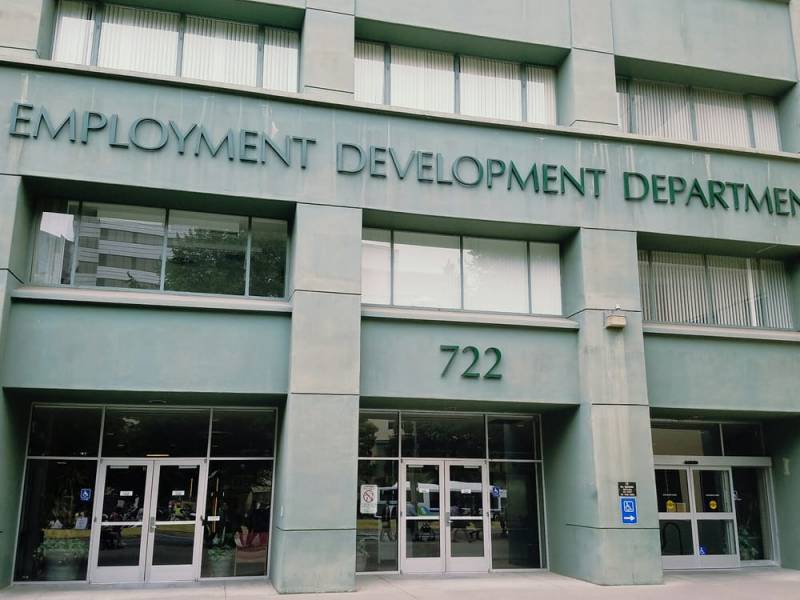
Employment Development DepartmentEmployment Development Department
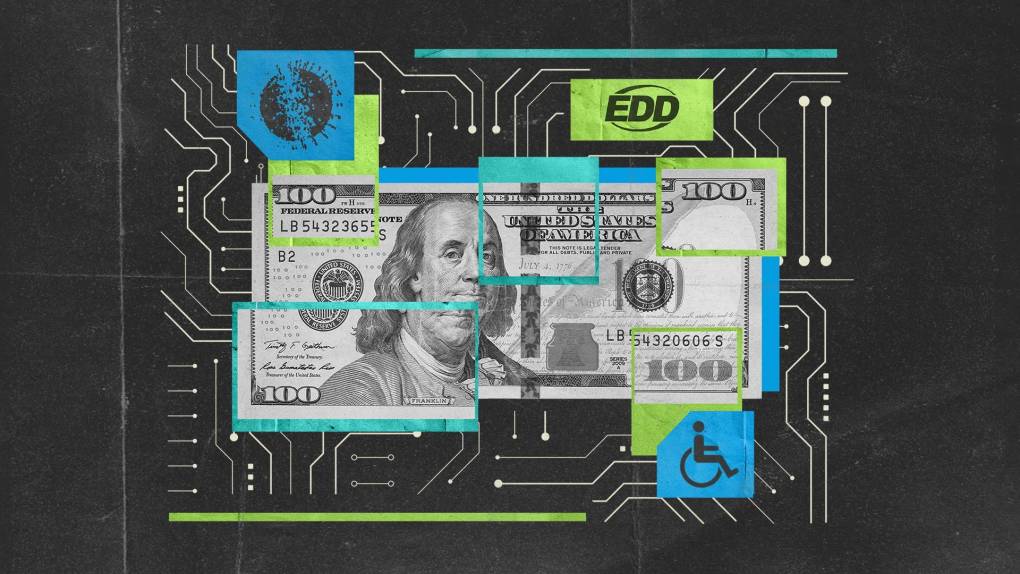
Inside California’s Billion-Dollar Bet to Overhaul Its Embattled Unemployment System
Thousands of Californians Are Still Waiting for COVID Unemployment Funds
California's July Unemployment Rate Is Lowest in Nearly 50 Years
Why Are California Unemployment Checks So Hard to Get? New Report Has Ideas
Finally, California's Unemployment System Adds More Language Support
EDD Begins Punitive Approach by Forcing Some Recipients to Pay Back Their Unemployment Benefits
Dr. Monica Gandhi | This Week in California Politics
California's Unemployment Fraud Balloons to $20 Billion
Advocates Fear Efforts to Thwart Unemployment Fraud in California Could Hurt the Formerly Incarcerated
Sponsored
Player sponsored by
window.__IS_SSR__=true
window.__INITIAL_STATE__={
"attachmentsReducer": {
"audio_0": {
"type": "attachments",
"id": "audio_0",
"imgSizes": {
"kqedFullSize": {
"file": "https://ww2.kqed.org/news/wp-content/themes/KQED-unified/img/audio_bgs/background0.jpg"
}
}
},
"audio_1": {
"type": "attachments",
"id": "audio_1",
"imgSizes": {
"kqedFullSize": {
"file": "https://ww2.kqed.org/news/wp-content/themes/KQED-unified/img/audio_bgs/background1.jpg"
}
}
},
"audio_2": {
"type": "attachments",
"id": "audio_2",
"imgSizes": {
"kqedFullSize": {
"file": "https://ww2.kqed.org/news/wp-content/themes/KQED-unified/img/audio_bgs/background2.jpg"
}
}
},
"audio_3": {
"type": "attachments",
"id": "audio_3",
"imgSizes": {
"kqedFullSize": {
"file": "https://ww2.kqed.org/news/wp-content/themes/KQED-unified/img/audio_bgs/background3.jpg"
}
}
},
"audio_4": {
"type": "attachments",
"id": "audio_4",
"imgSizes": {
"kqedFullSize": {
"file": "https://ww2.kqed.org/news/wp-content/themes/KQED-unified/img/audio_bgs/background4.jpg"
}
}
},
"placeholder": {
"type": "attachments",
"id": "placeholder",
"imgSizes": {
"thumbnail": {
"file": "https://cdn.kqed.org/wp-content/uploads/2024/12/KQED-Default-Image-816638274-2000x1333-1-160x107.jpg",
"width": 160,
"height": 107,
"mimeType": "image/jpeg"
},
"medium": {
"file": "https://cdn.kqed.org/wp-content/uploads/2024/12/KQED-Default-Image-816638274-2000x1333-1-800x533.jpg",
"width": 800,
"height": 533,
"mimeType": "image/jpeg"
},
"medium_large": {
"file": "https://cdn.kqed.org/wp-content/uploads/2024/12/KQED-Default-Image-816638274-2000x1333-1-768x512.jpg",
"width": 768,
"height": 512,
"mimeType": "image/jpeg"
},
"large": {
"file": "https://cdn.kqed.org/wp-content/uploads/2024/12/KQED-Default-Image-816638274-2000x1333-1-1020x680.jpg",
"width": 1020,
"height": 680,
"mimeType": "image/jpeg"
},
"1536x1536": {
"file": "https://cdn.kqed.org/wp-content/uploads/2024/12/KQED-Default-Image-816638274-2000x1333-1-1536x1024.jpg",
"width": 1536,
"height": 1024,
"mimeType": "image/jpeg"
},
"fd-lrg": {
"file": "https://cdn.kqed.org/wp-content/uploads/2024/12/KQED-Default-Image-816638274-2000x1333-1-1536x1024.jpg",
"width": 1536,
"height": 1024,
"mimeType": "image/jpeg"
},
"fd-med": {
"file": "https://cdn.kqed.org/wp-content/uploads/2024/12/KQED-Default-Image-816638274-2000x1333-1-1020x680.jpg",
"width": 1020,
"height": 680,
"mimeType": "image/jpeg"
},
"fd-sm": {
"file": "https://cdn.kqed.org/wp-content/uploads/2024/12/KQED-Default-Image-816638274-2000x1333-1-800x533.jpg",
"width": 800,
"height": 533,
"mimeType": "image/jpeg"
},
"post-thumbnail": {
"file": "https://cdn.kqed.org/wp-content/uploads/2024/12/KQED-Default-Image-816638274-2000x1333-1-672x372.jpg",
"width": 672,
"height": 372,
"mimeType": "image/jpeg"
},
"twentyfourteen-full-width": {
"file": "https://cdn.kqed.org/wp-content/uploads/2024/12/KQED-Default-Image-816638274-2000x1333-1-1038x576.jpg",
"width": 1038,
"height": 576,
"mimeType": "image/jpeg"
},
"xxsmall": {
"file": "https://cdn.kqed.org/wp-content/uploads/2024/12/KQED-Default-Image-816638274-2000x1333-1-160x107.jpg",
"width": 160,
"height": 107,
"mimeType": "image/jpeg"
},
"xsmall": {
"file": "https://cdn.kqed.org/wp-content/uploads/2024/12/KQED-Default-Image-816638274-2000x1333-1-672x372.jpg",
"width": 672,
"height": 372,
"mimeType": "image/jpeg"
},
"small": {
"file": "https://cdn.kqed.org/wp-content/uploads/2024/12/KQED-Default-Image-816638274-2000x1333-1-672x372.jpg",
"width": 672,
"height": 372,
"mimeType": "image/jpeg"
},
"xlarge": {
"file": "https://cdn.kqed.org/wp-content/uploads/2024/12/KQED-Default-Image-816638274-2000x1333-1-1020x680.jpg",
"width": 1020,
"height": 680,
"mimeType": "image/jpeg"
},
"full-width": {
"file": "https://cdn.kqed.org/wp-content/uploads/2024/12/KQED-Default-Image-816638274-2000x1333-1-1920x1280.jpg",
"width": 1920,
"height": 1280,
"mimeType": "image/jpeg"
},
"guest-author-32": {
"file": "https://cdn.kqed.org/wp-content/uploads/2025/01/KQED-Default-Image-816638274-1333x1333-1-160x160.jpg",
"width": 32,
"height": 32,
"mimeType": "image/jpeg"
},
"guest-author-50": {
"file": "https://cdn.kqed.org/wp-content/uploads/2025/01/KQED-Default-Image-816638274-1333x1333-1-160x160.jpg",
"width": 50,
"height": 50,
"mimeType": "image/jpeg"
},
"guest-author-64": {
"file": "https://cdn.kqed.org/wp-content/uploads/2025/01/KQED-Default-Image-816638274-1333x1333-1-160x160.jpg",
"width": 64,
"height": 64,
"mimeType": "image/jpeg"
},
"guest-author-96": {
"file": "https://cdn.kqed.org/wp-content/uploads/2025/01/KQED-Default-Image-816638274-1333x1333-1-160x160.jpg",
"width": 96,
"height": 96,
"mimeType": "image/jpeg"
},
"guest-author-128": {
"file": "https://cdn.kqed.org/wp-content/uploads/2025/01/KQED-Default-Image-816638274-1333x1333-1-160x160.jpg",
"width": 128,
"height": 128,
"mimeType": "image/jpeg"
},
"detail": {
"file": "https://cdn.kqed.org/wp-content/uploads/2025/01/KQED-Default-Image-816638274-1333x1333-1-160x160.jpg",
"width": 160,
"height": 160,
"mimeType": "image/jpeg"
},
"kqedFullSize": {
"file": "https://cdn.kqed.org/wp-content/uploads/2024/12/KQED-Default-Image-816638274-2000x1333-1.jpg",
"width": 2000,
"height": 1333
}
}
},
"news_11966709": {
"type": "attachments",
"id": "news_11966709",
"meta": {
"index": "attachments_1716263798",
"site": "news",
"id": "11966709",
"found": true
},
"parent": 11966706,
"imgSizes": {
"twentyfourteen-full-width": {
"file": "https://ww2.kqed.org/app/uploads/sites/10/2023/11/092623_EDD_PART-4_WIDE_01-1038x576.jpeg",
"width": 1038,
"mimeType": "image/jpeg",
"height": 576
},
"thumbnail": {
"file": "https://ww2.kqed.org/app/uploads/sites/10/2023/11/092623_EDD_PART-4_WIDE_01-160x90.jpeg",
"width": 160,
"mimeType": "image/jpeg",
"height": 90
},
"post-thumbnail": {
"file": "https://ww2.kqed.org/app/uploads/sites/10/2023/11/092623_EDD_PART-4_WIDE_01-672x372.jpeg",
"width": 672,
"mimeType": "image/jpeg",
"height": 372
},
"kqedFullSize": {
"file": "https://ww2.kqed.org/app/uploads/sites/10/2023/11/092623_EDD_PART-4_WIDE_01.jpeg",
"width": 1920,
"height": 1080
},
"large": {
"file": "https://ww2.kqed.org/app/uploads/sites/10/2023/11/092623_EDD_PART-4_WIDE_01-1020x574.jpeg",
"width": 1020,
"mimeType": "image/jpeg",
"height": 574
},
"1536x1536": {
"file": "https://ww2.kqed.org/app/uploads/sites/10/2023/11/092623_EDD_PART-4_WIDE_01-1536x864.jpeg",
"width": 1536,
"mimeType": "image/jpeg",
"height": 864
},
"medium": {
"file": "https://ww2.kqed.org/app/uploads/sites/10/2023/11/092623_EDD_PART-4_WIDE_01-800x450.jpeg",
"width": 800,
"mimeType": "image/jpeg",
"height": 450
}
},
"publishDate": 1699401855,
"modified": 1699402979,
"caption": "The largest-ever attempt to reform California’s Employment Development Department, an effort dubbed “EDDNext,” officially started late last year.",
"description": null,
"title": "092623_EDD_PART-4_WIDE_01",
"credit": "Illustration by Adriana Heldiz, CalMatters; iStock",
"status": "inherit",
"altTag": "An illustration of a $1 bill split into sections, with 'EDD' printed on the top.",
"fetchFailed": false,
"isLoading": false
},
"news_11949704": {
"type": "attachments",
"id": "news_11949704",
"meta": {
"index": "attachments_1716263798",
"site": "news",
"id": "11949704",
"found": true
},
"parent": 0,
"imgSizes": {
"twentyfourteen-full-width": {
"file": "https://ww2.kqed.org/app/uploads/sites/10/2023/05/CalMattersNicolasAllen1-1038x576.jpg",
"width": 1038,
"mimeType": "image/jpeg",
"height": 576
},
"thumbnail": {
"file": "https://ww2.kqed.org/app/uploads/sites/10/2023/05/CalMattersNicolasAllen1-160x107.jpg",
"width": 160,
"mimeType": "image/jpeg",
"height": 107
},
"post-thumbnail": {
"file": "https://ww2.kqed.org/app/uploads/sites/10/2023/05/CalMattersNicolasAllen1-672x372.jpg",
"width": 672,
"mimeType": "image/jpeg",
"height": 372
},
"kqedFullSize": {
"file": "https://ww2.kqed.org/app/uploads/sites/10/2023/05/CalMattersNicolasAllen1.jpg",
"width": 2000,
"height": 1333
},
"large": {
"file": "https://ww2.kqed.org/app/uploads/sites/10/2023/05/CalMattersNicolasAllen1-1020x680.jpg",
"width": 1020,
"mimeType": "image/jpeg",
"height": 680
},
"1536x1536": {
"file": "https://ww2.kqed.org/app/uploads/sites/10/2023/05/CalMattersNicolasAllen1-1536x1024.jpg",
"width": 1536,
"mimeType": "image/jpeg",
"height": 1024
},
"full-width": {
"file": "https://ww2.kqed.org/app/uploads/sites/10/2023/05/CalMattersNicolasAllen1-1920x1280.jpg",
"width": 1920,
"mimeType": "image/jpeg",
"height": 1280
},
"medium": {
"file": "https://ww2.kqed.org/app/uploads/sites/10/2023/05/CalMattersNicolasAllen1-800x533.jpg",
"width": 800,
"mimeType": "image/jpeg",
"height": 533
}
},
"publishDate": 1684266572,
"modified": 1684266841,
"caption": "Sharon and Nicolas Allen watch their two sons play in their home in Fresno on April 10, 2023.",
"description": null,
"title": "CalMattersNicolasAllen1",
"credit": "Larry Valenzuela, CalMatters/CatchLight Local",
"status": "inherit",
"altTag": "A mother sits in a cushioned, chair inside a child's nursery in her home. She watches her two toddlers play on the tan carpet. Her husband is on his knees watching their children. One child's green T-shirt reads, \"Mom's Lucky Charm\" in white letters.",
"fetchFailed": false,
"isLoading": false
},
"news_11923066": {
"type": "attachments",
"id": "news_11923066",
"meta": {
"index": "attachments_1716263798",
"site": "news",
"id": "11923066",
"found": true
},
"parent": 11923037,
"imgSizes": {
"twentyfourteen-full-width": {
"file": "https://ww2.kqed.org/app/uploads/sites/10/2022/08/GettyImages-1242559120-1024x576.jpg",
"width": 1024,
"mimeType": "image/jpeg",
"height": 576
},
"thumbnail": {
"file": "https://ww2.kqed.org/app/uploads/sites/10/2022/08/GettyImages-1242559120-160x100.jpg",
"width": 160,
"mimeType": "image/jpeg",
"height": 100
},
"post-thumbnail": {
"file": "https://ww2.kqed.org/app/uploads/sites/10/2022/08/GettyImages-1242559120-672x372.jpg",
"width": 672,
"mimeType": "image/jpeg",
"height": 372
},
"kqedFullSize": {
"file": "https://ww2.kqed.org/app/uploads/sites/10/2022/08/GettyImages-1242559120.jpg",
"width": 1024,
"height": 639
},
"large": {
"file": "https://ww2.kqed.org/app/uploads/sites/10/2022/08/GettyImages-1242559120-1020x637.jpg",
"width": 1020,
"mimeType": "image/jpeg",
"height": 637
},
"medium": {
"file": "https://ww2.kqed.org/app/uploads/sites/10/2022/08/GettyImages-1242559120-800x499.jpg",
"width": 800,
"mimeType": "image/jpeg",
"height": 499
}
},
"publishDate": 1660949778,
"modified": 1660951011,
"caption": "A 'We Are Hiring' sign is posted in the front of a restaurant in Los Angeles on Aug. 17, 2022. Help wanted ads are proliferating across the United States, as companies struggle to deal with a worker shortage caused by the pandemic, a rash of early retirements and restrictive immigration laws. In California, that has in part resulted in one of the lowest unemployment rates on record.",
"description": null,
"title": "US-ECONOMY-EMPLOYMENT",
"credit": "Frederic J. Brown/AFP via Getty Images",
"status": "inherit",
"altTag": "A window sign that says 'We Are Hiring' with the reflection of a man looking at it.",
"fetchFailed": false,
"isLoading": false
},
"news_11922073": {
"type": "attachments",
"id": "news_11922073",
"meta": {
"index": "attachments_1716263798",
"site": "news",
"id": "11922073",
"found": true
},
"parent": 11922059,
"imgSizes": {
"twentyfourteen-full-width": {
"file": "https://ww2.kqed.org/app/uploads/sites/10/2022/08/RS42104_006_KQED_EDD_UnemploymentApplication_03162020_8404-qut-1038x576.jpg",
"width": 1038,
"mimeType": "image/jpeg",
"height": 576
},
"thumbnail": {
"file": "https://ww2.kqed.org/app/uploads/sites/10/2022/08/RS42104_006_KQED_EDD_UnemploymentApplication_03162020_8404-qut-160x107.jpg",
"width": 160,
"mimeType": "image/jpeg",
"height": 107
},
"post-thumbnail": {
"file": "https://ww2.kqed.org/app/uploads/sites/10/2022/08/RS42104_006_KQED_EDD_UnemploymentApplication_03162020_8404-qut-672x372.jpg",
"width": 672,
"mimeType": "image/jpeg",
"height": 372
},
"kqedFullSize": {
"file": "https://ww2.kqed.org/app/uploads/sites/10/2022/08/RS42104_006_KQED_EDD_UnemploymentApplication_03162020_8404-qut.jpg",
"width": 1920,
"height": 1280
},
"large": {
"file": "https://ww2.kqed.org/app/uploads/sites/10/2022/08/RS42104_006_KQED_EDD_UnemploymentApplication_03162020_8404-qut-1020x680.jpg",
"width": 1020,
"mimeType": "image/jpeg",
"height": 680
},
"1536x1536": {
"file": "https://ww2.kqed.org/app/uploads/sites/10/2022/08/RS42104_006_KQED_EDD_UnemploymentApplication_03162020_8404-qut-1536x1024.jpg",
"width": 1536,
"mimeType": "image/jpeg",
"height": 1024
},
"medium": {
"file": "https://ww2.kqed.org/app/uploads/sites/10/2022/08/RS42104_006_KQED_EDD_UnemploymentApplication_03162020_8404-qut-800x533.jpg",
"width": 800,
"mimeType": "image/jpeg",
"height": 533
}
},
"publishDate": 1660075787,
"modified": 1660084207,
"caption": "A woman looks at the Employment Development Department (EDD) website, where California residents can file for unemployment, on March 16, 2020.",
"description": "A woman looks at the Employment Development Department (EDD) website, where California residents can file for unemployment on Mar. 16, 2020.",
"title": "RS42104_006_KQED_EDD_UnemploymentApplication_03162020_8404-qut",
"credit": "Beth LaBerge/KQED",
"status": "inherit",
"altTag": "A woman looks at the Employment Development Department (EDD) website, where California residents can file for unemployment on Mar. 16, 2020.",
"fetchFailed": false,
"isLoading": false
},
"news_11908265": {
"type": "attachments",
"id": "news_11908265",
"meta": {
"index": "attachments_1716263798",
"site": "news",
"id": "11908265",
"found": true
},
"parent": 11908264,
"imgSizes": {
"twentyfourteen-full-width": {
"file": "https://ww2.kqed.org/app/uploads/sites/10/2022/03/RS42106_004_KQED_EDD_UnemploymentApplication_03162020_8407-qut-1038x576.jpg",
"width": 1038,
"mimeType": "image/jpeg",
"height": 576
},
"thumbnail": {
"file": "https://ww2.kqed.org/app/uploads/sites/10/2022/03/RS42106_004_KQED_EDD_UnemploymentApplication_03162020_8407-qut-160x107.jpg",
"width": 160,
"mimeType": "image/jpeg",
"height": 107
},
"post-thumbnail": {
"file": "https://ww2.kqed.org/app/uploads/sites/10/2022/03/RS42106_004_KQED_EDD_UnemploymentApplication_03162020_8407-qut-672x372.jpg",
"width": 672,
"mimeType": "image/jpeg",
"height": 372
},
"kqedFullSize": {
"file": "https://ww2.kqed.org/app/uploads/sites/10/2022/03/RS42106_004_KQED_EDD_UnemploymentApplication_03162020_8407-qut.jpg",
"width": 1920,
"height": 1280
},
"large": {
"file": "https://ww2.kqed.org/app/uploads/sites/10/2022/03/RS42106_004_KQED_EDD_UnemploymentApplication_03162020_8407-qut-1020x680.jpg",
"width": 1020,
"mimeType": "image/jpeg",
"height": 680
},
"1536x1536": {
"file": "https://ww2.kqed.org/app/uploads/sites/10/2022/03/RS42106_004_KQED_EDD_UnemploymentApplication_03162020_8407-qut-1536x1024.jpg",
"width": 1536,
"mimeType": "image/jpeg",
"height": 1024
},
"medium": {
"file": "https://ww2.kqed.org/app/uploads/sites/10/2022/03/RS42106_004_KQED_EDD_UnemploymentApplication_03162020_8407-qut-800x533.jpg",
"width": 800,
"mimeType": "image/jpeg",
"height": 533
}
},
"publishDate": 1647379316,
"modified": 1660051950,
"caption": null,
"description": "A woman looks at the Employment Development Department (EDD) website, where California residents can file for unemployment on Mar. 16, 2020.\n\n",
"title": "RS42106_004_KQED_EDD_UnemploymentApplication_03162020_8407-qut",
"credit": "Beth LaBerge/KQED",
"status": "inherit",
"altTag": null,
"fetchFailed": false,
"isLoading": false
},
"news_11899878": {
"type": "attachments",
"id": "news_11899878",
"meta": {
"index": "attachments_1716263798",
"site": "news",
"id": "11899878",
"found": true
},
"parent": 11899871,
"imgSizes": {
"twentyfourteen-full-width": {
"file": "https://ww2.kqed.org/app/uploads/sites/10/2021/12/GettyImages-1235147499-1038x576.jpg",
"width": 1038,
"mimeType": "image/jpeg",
"height": 576
},
"thumbnail": {
"file": "https://ww2.kqed.org/app/uploads/sites/10/2021/12/GettyImages-1235147499-160x107.jpg",
"width": 160,
"mimeType": "image/jpeg",
"height": 107
},
"post-thumbnail": {
"file": "https://ww2.kqed.org/app/uploads/sites/10/2021/12/GettyImages-1235147499-672x372.jpg",
"width": 672,
"mimeType": "image/jpeg",
"height": 372
},
"kqedFullSize": {
"file": "https://ww2.kqed.org/app/uploads/sites/10/2021/12/GettyImages-1235147499-scaled.jpg",
"width": 2560,
"height": 1709
},
"2048x2048": {
"file": "https://ww2.kqed.org/app/uploads/sites/10/2021/12/GettyImages-1235147499-2048x1367.jpg",
"width": 2048,
"mimeType": "image/jpeg",
"height": 1367
},
"large": {
"file": "https://ww2.kqed.org/app/uploads/sites/10/2021/12/GettyImages-1235147499-1020x681.jpg",
"width": 1020,
"mimeType": "image/jpeg",
"height": 681
},
"1536x1536": {
"file": "https://ww2.kqed.org/app/uploads/sites/10/2021/12/GettyImages-1235147499-1536x1025.jpg",
"width": 1536,
"mimeType": "image/jpeg",
"height": 1025
},
"full-width": {
"file": "https://ww2.kqed.org/app/uploads/sites/10/2021/12/GettyImages-1235147499-1920x1281.jpg",
"width": 1920,
"mimeType": "image/jpeg",
"height": 1281
},
"medium": {
"file": "https://ww2.kqed.org/app/uploads/sites/10/2021/12/GettyImages-1235147499-800x534.jpg",
"width": 800,
"mimeType": "image/jpeg",
"height": 534
}
},
"publishDate": 1640046646,
"modified": 1640111774,
"caption": "People line up to attend a job fair for employment with SoFi Stadium and Los Angeles International Airport employers, at SoFi Stadium on Sept. 9, 2021, in Inglewood.",
"description": "People line up to attend a job fair for employment with SoFi Stadium and Los Angeles International Airport employers, at SoFi Stadium on September 9, 2021, in Inglewood.",
"title": "US-ECONOMY-EMPLOYMENT-FAIR",
"credit": "Patrick T. Fallon/AFP via Getty Images",
"status": "inherit",
"altTag": "A line of individuals who stand outside on the sidewalk. Their faces are outside the frame of the photo.",
"fetchFailed": false,
"isLoading": false
},
"news_11894407": {
"type": "attachments",
"id": "news_11894407",
"meta": {
"index": "attachments_1716263798",
"site": "news",
"id": "11894407",
"found": true
},
"parent": 11894371,
"imgSizes": {
"twentyfourteen-full-width": {
"file": "https://ww2.kqed.org/app/uploads/sites/10/2021/10/KNR908-Marquee-1038x576.jpeg",
"width": 1038,
"mimeType": "image/jpeg",
"height": 576
},
"thumbnail": {
"file": "https://ww2.kqed.org/app/uploads/sites/10/2021/10/KNR908-Marquee-160x108.jpeg",
"width": 160,
"mimeType": "image/jpeg",
"height": 108
},
"post-thumbnail": {
"file": "https://ww2.kqed.org/app/uploads/sites/10/2021/10/KNR908-Marquee-672x372.jpeg",
"width": 672,
"mimeType": "image/jpeg",
"height": 372
},
"kqedFullSize": {
"file": "https://ww2.kqed.org/app/uploads/sites/10/2021/10/KNR908-Marquee.jpeg",
"width": 1594,
"height": 1079
},
"large": {
"file": "https://ww2.kqed.org/app/uploads/sites/10/2021/10/KNR908-Marquee-1020x690.jpeg",
"width": 1020,
"mimeType": "image/jpeg",
"height": 690
},
"1536x1536": {
"file": "https://ww2.kqed.org/app/uploads/sites/10/2021/10/KNR908-Marquee-1536x1040.jpeg",
"width": 1536,
"mimeType": "image/jpeg",
"height": 1040
},
"medium": {
"file": "https://ww2.kqed.org/app/uploads/sites/10/2021/10/KNR908-Marquee-800x542.jpeg",
"width": 800,
"mimeType": "image/jpeg",
"height": 542
}
},
"publishDate": 1635544370,
"modified": 1635544394,
"caption": null,
"description": null,
"title": "KNR908 Marquee",
"credit": null,
"status": "inherit",
"altTag": "Dr. Monica Gandhi headshot",
"fetchFailed": false,
"isLoading": false
},
"news_11878784": {
"type": "attachments",
"id": "news_11878784",
"meta": {
"index": "attachments_1716263798",
"site": "news",
"id": "11878784",
"found": true
},
"parent": 11878764,
"imgSizes": {
"twentyfourteen-full-width": {
"file": "https://ww2.kqed.org/app/uploads/sites/10/2021/06/RS42105_001_KQED_EDD_UnemploymentApplication_03162020_8404-qut-1038x576.jpg",
"width": 1038,
"mimeType": "image/jpeg",
"height": 576
},
"thumbnail": {
"file": "https://ww2.kqed.org/app/uploads/sites/10/2021/06/RS42105_001_KQED_EDD_UnemploymentApplication_03162020_8404-qut-160x107.jpg",
"width": 160,
"mimeType": "image/jpeg",
"height": 107
},
"post-thumbnail": {
"file": "https://ww2.kqed.org/app/uploads/sites/10/2021/06/RS42105_001_KQED_EDD_UnemploymentApplication_03162020_8404-qut-672x372.jpg",
"width": 672,
"mimeType": "image/jpeg",
"height": 372
},
"kqedFullSize": {
"file": "https://ww2.kqed.org/app/uploads/sites/10/2021/06/RS42105_001_KQED_EDD_UnemploymentApplication_03162020_8404-qut.jpg",
"width": 1920,
"height": 1280
},
"large": {
"file": "https://ww2.kqed.org/app/uploads/sites/10/2021/06/RS42105_001_KQED_EDD_UnemploymentApplication_03162020_8404-qut-1020x680.jpg",
"width": 1020,
"mimeType": "image/jpeg",
"height": 680
},
"1536x1536": {
"file": "https://ww2.kqed.org/app/uploads/sites/10/2021/06/RS42105_001_KQED_EDD_UnemploymentApplication_03162020_8404-qut-1536x1024.jpg",
"width": 1536,
"mimeType": "image/jpeg",
"height": 1024
},
"medium": {
"file": "https://ww2.kqed.org/app/uploads/sites/10/2021/06/RS42105_001_KQED_EDD_UnemploymentApplication_03162020_8404-qut-800x533.jpg",
"width": 800,
"mimeType": "image/jpeg",
"height": 533
}
},
"publishDate": 1624303696,
"modified": 1635280346,
"caption": "A woman looks at the Employment Development Department website, where Californians can file for unemployment benefits, on March 16, 2020.",
"description": "A woman looks at the Employment Development Department (EDD) website, where Californians can file for unemployment benefits, on Mar. 16, 2020.",
"title": "RS42105_001_KQED_EDD_UnemploymentApplication_03162020_8404-qut",
"credit": "Beth LaBerge/KQED",
"status": "inherit",
"altTag": "The shoulder, arm and hand of a person wearing a beige sweater reaches toward a laptop showing the EDD website.",
"fetchFailed": false,
"isLoading": false
},
"news_11872122": {
"type": "attachments",
"id": "news_11872122",
"meta": {
"index": "attachments_1716263798",
"site": "news",
"id": "11872122",
"found": true
},
"parent": 11872086,
"imgSizes": {
"twentyfourteen-full-width": {
"file": "https://ww2.kqed.org/app/uploads/sites/10/2021/05/edd-1000x576.jpeg",
"width": 1000,
"mimeType": "image/jpeg",
"height": 576
},
"thumbnail": {
"file": "https://ww2.kqed.org/app/uploads/sites/10/2021/05/edd-160x120.jpeg",
"width": 160,
"mimeType": "image/jpeg",
"height": 120
},
"post-thumbnail": {
"file": "https://ww2.kqed.org/app/uploads/sites/10/2021/05/edd-672x372.jpeg",
"width": 672,
"mimeType": "image/jpeg",
"height": 372
},
"kqedFullSize": {
"file": "https://ww2.kqed.org/app/uploads/sites/10/2021/05/edd.jpeg",
"width": 1000,
"height": 750
},
"medium": {
"file": "https://ww2.kqed.org/app/uploads/sites/10/2021/05/edd-800x600.jpeg",
"width": 800,
"mimeType": "image/jpeg",
"height": 600
}
},
"publishDate": 1620087388,
"modified": 1620087446,
"caption": "Efforts to tamp down on fraud at the agency could unintentionally penalize formerly incarcerated people, advocates say.",
"description": null,
"title": "edd",
"credit": "Google Maps",
"status": "inherit",
"altTag": null,
"fetchFailed": false,
"isLoading": false
}
},
"audioPlayerReducer": {
"postId": "stream_live",
"isPaused": true,
"isPlaying": false,
"pfsActive": false,
"pledgeModalIsOpen": true,
"playerDrawerIsOpen": false
},
"authorsReducer": {
"byline_news_11966706": {
"type": "authors",
"id": "byline_news_11966706",
"meta": {
"override": true
},
"slug": "byline_news_11966706",
"name": "\u003ca href=\"https://calmatters.org/author/laurenhepler/\">Lauren Hepler\u003c/a>",
"isLoading": false
},
"byline_news_11949679": {
"type": "authors",
"id": "byline_news_11949679",
"meta": {
"override": true
},
"slug": "byline_news_11949679",
"name": "\u003ca href=\"https://calmatters.org/author/laurenhepler/\">Lauren Hepler\u003c/a>",
"isLoading": false
},
"byline_news_11923037": {
"type": "authors",
"id": "byline_news_11923037",
"meta": {
"override": true
},
"slug": "byline_news_11923037",
"name": "Adam Beam\u003cbr>Associated Press",
"isLoading": false
},
"byline_news_11922059": {
"type": "authors",
"id": "byline_news_11922059",
"meta": {
"override": true
},
"slug": "byline_news_11922059",
"name": "Grace Gedye",
"isLoading": false
},
"byline_news_11899871": {
"type": "authors",
"id": "byline_news_11899871",
"meta": {
"override": true
},
"slug": "byline_news_11899871",
"name": "\u003ca href=\"https://calmatters.org/author/jesse-bedayn/\">Jesse Bedayn\u003c/a>",
"isLoading": false
},
"byline_news_11893715": {
"type": "authors",
"id": "byline_news_11893715",
"meta": {
"override": true
},
"slug": "byline_news_11893715",
"name": "Adam Beam\u003cbr>Associated Press",
"isLoading": false
},
"kqed": {
"type": "authors",
"id": "236",
"meta": {
"index": "authors_1716337520",
"id": "236",
"found": true
},
"name": "KQED News Staff",
"firstName": "KQED News Staff",
"lastName": null,
"slug": "kqed",
"email": "faq@kqed.org",
"display_author_email": false,
"staff_mastheads": [],
"title": null,
"bio": null,
"avatar": "https://secure.gravatar.com/avatar/ef0e801a68c4c54afa9180db14084167?s=600&d=blank&r=g",
"twitter": null,
"facebook": null,
"instagram": null,
"linkedin": null,
"sites": [
{
"site": "arts",
"roles": [
"contributor"
]
},
{
"site": "news",
"roles": [
"editor"
]
},
{
"site": "futureofyou",
"roles": [
"author"
]
}
],
"headData": {
"title": "KQED News Staff | KQED",
"description": null,
"ogImgSrc": "https://secure.gravatar.com/avatar/ef0e801a68c4c54afa9180db14084167?s=600&d=blank&r=g",
"twImgSrc": "https://secure.gravatar.com/avatar/ef0e801a68c4c54afa9180db14084167?s=600&d=blank&r=g"
},
"isLoading": false,
"link": "/author/kqed"
},
"dkatayama": {
"type": "authors",
"id": "7240",
"meta": {
"index": "authors_1716337520",
"id": "7240",
"found": true
},
"name": "Devin Katayama",
"firstName": "Devin",
"lastName": "Katayama",
"slug": "dkatayama",
"email": "dkatayama@kqed.org",
"display_author_email": true,
"staff_mastheads": [
"news"
],
"title": "Editor of Talent and Development",
"bio": "Devin Katayama is former Editor of Talent and Development for KQED. He supported our internship program and on-call staff by looking for equitable opportunities to improve the newsroom.\r\n\r\nHe previously hosted The Bay and American Suburb podcasts from KQED News. Prior to returning to the Bay Area in 2015, Devin was the education reporter for WFPL in Louisville and worked as a producer with radio stations in Chicago and Portland, OR. His work has appeared on NPR’s \u003cem>Morning Edition, All Things Considered, The Takeaway\u003c/em> and \u003cem>Here and Now.\u003c/em>\r\n\r\nDevin earned his MA in Journalism from Columbia College Chicago, where he was a Follett Fellow and the recipient of the 2011 Studs Terkel Community Media Workshop Scholarship for his story on Chicago's homeless youth. He won WBUR's 2014 Daniel Schorr award and a regional RTNDA Edward R. Murrow Award for his documentary \"At Risk\" that looked at issues facing some of Louisville's students. Devin has also received numerous local awards from the Associated Press and the Society of Professional Journalists.",
"avatar": "https://secure.gravatar.com/avatar/d0d2978a31002fb2de107921a8e18405?s=600&d=blank&r=g",
"twitter": "RadioDevin",
"facebook": null,
"instagram": null,
"linkedin": null,
"sites": [
{
"site": "arts",
"roles": []
},
{
"site": "news",
"roles": [
"author"
]
},
{
"site": "stateofhealth",
"roles": [
"author"
]
},
{
"site": "forum",
"roles": [
"editor"
]
},
{
"site": "perspectives",
"roles": [
"editor"
]
}
],
"headData": {
"title": "Devin Katayama | KQED",
"description": "Editor of Talent and Development",
"ogImgSrc": "https://secure.gravatar.com/avatar/d0d2978a31002fb2de107921a8e18405?s=600&d=blank&r=g",
"twImgSrc": "https://secure.gravatar.com/avatar/d0d2978a31002fb2de107921a8e18405?s=600&d=blank&r=g"
},
"isLoading": false,
"link": "/author/dkatayama"
},
"mfharvin": {
"type": "authors",
"id": "11583",
"meta": {
"index": "authors_1716337520",
"id": "11583",
"found": true
},
"name": "Mary Franklin Harvin",
"firstName": "Mary Franklin",
"lastName": "Harvin",
"slug": "mfharvin",
"email": "mfharvin@KQED.org",
"display_author_email": false,
"staff_mastheads": [
"news"
],
"title": "KQED Contributor",
"bio": null,
"avatar": "https://secure.gravatar.com/avatar/0e53510a7d48cfbdebfc9b11357d845f?s=600&d=blank&r=g",
"twitter": "EmEffHarvin",
"facebook": null,
"instagram": null,
"linkedin": null,
"sites": [
{
"site": "news",
"roles": [
"author",
"edit_others_posts"
]
},
{
"site": "science",
"roles": [
"editor"
]
}
],
"headData": {
"title": "Mary Franklin Harvin | KQED",
"description": "KQED Contributor",
"ogImgSrc": "https://secure.gravatar.com/avatar/0e53510a7d48cfbdebfc9b11357d845f?s=600&d=blank&r=g",
"twImgSrc": "https://secure.gravatar.com/avatar/0e53510a7d48cfbdebfc9b11357d845f?s=600&d=blank&r=g"
},
"isLoading": false,
"link": "/author/mfharvin"
},
"amontecillo": {
"type": "authors",
"id": "11649",
"meta": {
"index": "authors_1716337520",
"id": "11649",
"found": true
},
"name": "Alan Montecillo",
"firstName": "Alan",
"lastName": "Montecillo",
"slug": "amontecillo",
"email": "amontecillo@kqed.org",
"display_author_email": false,
"staff_mastheads": [
"news"
],
"title": "KQED Contributor",
"bio": "Alan Montecillo is the senior editor of \u003cem>\u003ca href=\"http://kqed.org/thebay\">The Bay\u003c/a>, \u003c/em> KQED's local news podcast. Before moving to the Bay Area, he worked as a senior talk show producer for WILL in Champaign-Urbana, Illinois and at Oregon Public Broadcasting in Portland, Oregon. He has won journalism awards from the Society of Professional Journalists Northern California, the Public Media Journalists Association, The Signal Awards, and has also received a regional Edward R. Murrow award. Alan is a Filipino American from Hong Kong and a graduate of Reed College.",
"avatar": "https://secure.gravatar.com/avatar/d5e4e7a76481969ccba76f4e2b5ccabc?s=600&d=blank&r=g",
"twitter": "alanmontecillo",
"facebook": null,
"instagram": null,
"linkedin": null,
"sites": [
{
"site": "",
"roles": [
"editor"
]
},
{
"site": "news",
"roles": [
"editor",
"manage_categories"
]
}
],
"headData": {
"title": "Alan Montecillo | KQED",
"description": "KQED Contributor",
"ogImgSrc": "https://secure.gravatar.com/avatar/d5e4e7a76481969ccba76f4e2b5ccabc?s=600&d=blank&r=g",
"twImgSrc": "https://secure.gravatar.com/avatar/d5e4e7a76481969ccba76f4e2b5ccabc?s=600&d=blank&r=g"
},
"isLoading": false,
"link": "/author/amontecillo"
},
"mesquinca": {
"type": "authors",
"id": "11802",
"meta": {
"index": "authors_1716337520",
"id": "11802",
"found": true
},
"name": "Maria Esquinca",
"firstName": "Maria",
"lastName": "Esquinca",
"slug": "mesquinca",
"email": "mesquinca@kqed.org",
"display_author_email": false,
"staff_mastheads": [],
"title": "Producer, The Bay",
"bio": "María Esquinca is a producer of The Bay. Before that, she was a New York Women’s Foundation IGNITE Fellow at Latino USA. She worked at Radio Bilingue where she covered the San Joaquin Valley. Maria has interned at WLRN, News 21, The New York Times Student Journalism Institute and at Crain’s Detroit Business as a Dow Jones News Fund Business Reporting Intern. She is an MFA graduate from the University of Miami. In 2017, she graduated from the Walter Cronkite School of Journalism and Mass Communication with a Master of Mass Communication. A fronteriza, she was born in Ciudad Juárez, Chihuahua, Mexico and grew up in El Paso, Texas.",
"avatar": "https://secure.gravatar.com/avatar/77cedba18aae91da775038ba06dcd8d0?s=600&d=blank&r=g",
"twitter": "@m_esquinca",
"facebook": null,
"instagram": null,
"linkedin": null,
"sites": [
{
"site": "news",
"roles": []
}
],
"headData": {
"title": "Maria Esquinca | KQED",
"description": "Producer, The Bay",
"ogImgSrc": "https://secure.gravatar.com/avatar/77cedba18aae91da775038ba06dcd8d0?s=600&d=blank&r=g",
"twImgSrc": "https://secure.gravatar.com/avatar/77cedba18aae91da775038ba06dcd8d0?s=600&d=blank&r=g"
},
"isLoading": false,
"link": "/author/mesquinca"
}
},
"breakingNewsReducer": {},
"pagesReducer": {},
"postsReducer": {
"stream_live": {
"type": "live",
"id": "stream_live",
"audioUrl": "https://streams.kqed.org/kqedradio",
"title": "Live Stream",
"excerpt": "Live Stream information currently unavailable.",
"link": "/radio",
"featImg": "",
"label": {
"name": "KQED Live",
"link": "/"
}
},
"stream_kqedNewscast": {
"type": "posts",
"id": "stream_kqedNewscast",
"audioUrl": "https://www.kqed.org/.stream/anon/radio/RDnews/newscast.mp3?_=1",
"title": "KQED Newscast",
"featImg": "",
"label": {
"name": "88.5 FM",
"link": "/"
}
},
"news_11966706": {
"type": "posts",
"id": "news_11966706",
"meta": {
"index": "posts_1716263798",
"site": "news",
"id": "11966706",
"score": null,
"sort": [
1699457409000
]
},
"parent": 0,
"labelTerm": {
"site": "news",
"term": 18481
},
"blocks": [],
"publishDate": 1699457409,
"format": "standard",
"title": "Inside California’s Billion-Dollar Bet to Overhaul Its Embattled Unemployment System",
"headTitle": "Inside California’s Billion-Dollar Bet to Overhaul Its Embattled Unemployment System | KQED",
"content": "\u003cp>Five years, $1.2 billion. And a new model for government contracting.\u003c/p>\n\u003cp>That is what California officials say it will take to overhaul an employment safety net pushed to the brink by record pandemic job losses, widespread fraud and the political panic that followed.\u003c/p>\n\u003cp>The most sweeping attempt to date to reform California’s Employment Development Department, an effort dubbed “\u003ca href=\"https://edd.ca.gov/en/about_edd/eddnext/\">EDDNext\u003c/a>,” officially started late last year. A roughly 100-person team is leading the rebuild, and is already signing multimillion-dollar contracts for Salesforce and Amazon technology, according to interviews and records requested by CalMatters.\u003c/p>\n\u003cp>At the same time, the EDD is quietly making plans to move on from its \u003ca href=\"https://calmatters.org/economy/2020/11/how-bank-of-america-helped-fuel-californias-unemployment-meltdown/?\">turbulent relationship\u003c/a> with longtime unemployment payment contractor Bank of America. Between now and 2025, it will begin rolling out new benefit debit cards and, eventually, a direct-deposit payment option from a different, yet-to-be-named contractor, the agency said in a statement.\u003c/p>\n\u003cp>Ron Hughes, a former state technology official and consultant who came out of retirement to run EDDNext said his team is prioritizing “the biggest pain points for the public” — online accounts, call centers, identity verification, benefit applications — as the agency tries to turn the page on an era of mass payment delays and widespread fraud.\u003c/p>\n\u003cp>[ad fullwidth]\u003c/p>\n\u003cp>“EDD did over 200 technology projects during the pandemic. They were basically putting out fires,” Hughes told CalMatters. “EDDNext is really a way of being proactive about it. We want to solve some of these problems instead of just putting Band-Aids on.”\u003c/p>\n\u003cp>But many workers still experiencing payment delays, fraud confusion and jammed phone lines are skeptical — especially since the EDD promised many similar changes after the Great Recession around 2009.\u003c/p>\n\u003cp>“There’s a longstanding narrative … like, ‘Look, see, this is a program that people just abuse,’” said Jenna Gerry, a senior staff attorney with the National Employment Law Project. “If people are concerned with actual fraud, then I want to look at what solves it: fundamental reform of the system.”[pullquote align=\"right\" size=\"medium\" citation=\"Jennifer Pahlka, political adviser\"]‘Do I know how to wave a magic wand and fix California’s unemployment insurance system? No, I don’t. But I do know that what we’re currently doing doesn’t work and that other states have some approaches that we should be trying out.’[/pullquote]For Jennifer Pahlka, who co-led Gov. Gavin Newsom’s \u003ca href=\"https://www.govops.ca.gov/wp-content/uploads/sites/11/2020/09/Assessment.pdf\">task force\u003c/a> to triage COVID-era problems at the EDD, the challenge ahead is emblematic of difficulties that many government agencies face in adapting to the digital age. In her book “Recoding America,” Pahlka wrote that the EDD, with its patchwork computer systems and 800-page staff training manual, is failing to keep pace, as inequality widens and risks like fraud evolve.\u003c/p>\n\u003cp>“Do I know how to wave a magic wand and fix California’s unemployment insurance system? No, I don’t,” Pahlka said in an interview. “But I do know that what we’re currently doing doesn’t work and that other states have some approaches that we should be trying out.”\u003c/p>\n\u003cp>EDD Director Nancy Farias has read Pahlka’s book and the many state audits that have dissected the agency’s recurring failures. She’s well aware of the “light switch” trap, where a government agency bets everything on one, years-long tech project, then prays it all works when a switch is flipped. To try to avoid that, she and Hughes decided to break EDDNext into dozens of smaller projects through 2028.\u003c/p>\n\u003cp>“It leaves less room for a big failure,” said Farias, a former labor union executive. “You can have the best IT in the world, but if you don’t change your policies and procedures, it does not matter.”\u003c/p>\n\u003ch2>The COVID hangover\u003c/h2>\n\u003cp>This past summer, San Diego jewelry maker Phaedra Huebner found herself stuck in a loop that might sound familiar to people who filed for unemployment early in the pandemic.\u003c/p>\n\u003cp>Huebner, 52, recalls how at 8 a.m. every day, she dialed the EDD right as its call centers opened to ask where her benefits were. She would use a trick she learned on YouTube to bypass pre-recorded messages, punch in her Social Security Number and hope to get in the queue to talk with a real person. She would then redial, up to 67 times a day, bouncing between departments and, more often than not, hanging up without any answers about when she might see the money she needed to make rent.\u003c/p>\n\u003cp>The twist: Huebner wasn’t actually filing for unemployment but rather for disability. After each day on the phone, she would wrap ice packs around her hands and arms to ease the shooting pain that put her out of work in the first place.\u003c/p>\n\u003cp>“For six weeks, I should have been resting,” Huebner said in early September. “Instead, I’m in pain with no disability income doing all of my own administrative work.”\u003c/p>\n\u003cp>The EDD’s benefit programs have always been complex and highly individualized. In most cases, people applying for benefits do not encounter significant delays, the agency told CalMatters in a statement. It cited its \u003ca href=\"https://edd.ca.gov/en/about_edd/eddnext/Benefiting-Californians-May-2023/#CustomerSatisfaction\">2022 survey\u003c/a> of several thousand people using its benefit systems, where 69% reported they were “completely or mostly satisfied” with the unemployment application process, and 63% said they were satisfied with the disability process.\u003c/p>\n\u003cfigure id=\"attachment_11966715\" class=\"wp-caption alignnone\" style=\"max-width: 1536px\">\u003ca href=\"https://ww2.kqed.org/app/uploads/sites/10/2023/11/011022-EDD-Sacramento-MG-CM-03-1.jpeg\">\u003cimg decoding=\"async\" loading=\"lazy\" class=\"size-full wp-image-11966715\" src=\"https://ww2.kqed.org/app/uploads/sites/10/2023/11/011022-EDD-Sacramento-MG-CM-03-1.jpeg\" alt=\"A woman walks past the Employment Development Department building.\" width=\"1536\" height=\"1024\" srcset=\"https://ww2.kqed.org/app/uploads/sites/10/2023/11/011022-EDD-Sacramento-MG-CM-03-1.jpeg 1536w, https://ww2.kqed.org/app/uploads/sites/10/2023/11/011022-EDD-Sacramento-MG-CM-03-1-800x533.jpeg 800w, https://ww2.kqed.org/app/uploads/sites/10/2023/11/011022-EDD-Sacramento-MG-CM-03-1-1020x680.jpeg 1020w, https://ww2.kqed.org/app/uploads/sites/10/2023/11/011022-EDD-Sacramento-MG-CM-03-1-160x107.jpeg 160w\" sizes=\"(max-width: 1536px) 100vw, 1536px\">\u003c/a>\u003cfigcaption class=\"wp-caption-text\">The California Employment Development Department offices in Sacramento on Jan. 10, 2022. \u003ccite>(Miguel Gutierrez Jr./CalMatters)\u003c/cite>\u003c/figcaption>\u003c/figure>\n\u003cp>The problem, workers and attorneys say, is that even a portion of the EDD’s customer base amounts to tens of thousands of people, so when things go wrong, the impacts can be huge.\u003c/p>\n\u003cp>In January 2022, for instance, the \u003ca href=\"https://calmatters.org/newsletters/whatmatters/2022/01/california-edd-fraud/\">EDD froze\u003c/a> 345,000 disability accounts, including an unknown number of legitimate ones, amid a wave of suspected fraud involving claims tied to fake doctors. Putting stronger safeguards in place is one of the “lessons learned from the pandemic that we should be applying to every program,” former California State Auditor Elaine Howle said.\u003c/p>\n\u003cp>“People saw the [unemployment] program was being defrauded left and right,” Howle said, “and it was like, ‘Shoot, if I can do that, what other programs are out there that I can defraud?’”\u003c/p>\n\u003cp>Mason Wilder, research manager of the Association of Certified Fraud Examiners, said unemployment and disability programs are just two examples of many public and private sector systems being targeted as online fraud gets easier. It now costs as little as \u003ca href=\"https://gop-waysandmeans.house.gov/five-key-moments-from-oversight-subcommittee-hearing-on-pandemic-fraud/\">25 cents\u003c/a> to buy a bunk Social Security number online, leading to a cycle of large-scale attacks followed by broad fraud crackdowns.\u003c/p>\n\u003cp>The risk of unsuspecting people getting caught in dragnets is only anticipated to grow, Wilder and other analysts say, as technologies such as artificial intelligence allow scammers to work faster and more easily forge documents. \u003ca href=\"https://calmatters.org/california-divide/2023/01/calfresh-calworks-thefts/\">Benefit debit cards\u003c/a> used by California’s CalFresh food assistance and CalWorks cash aid programs have also been targeted in recent fraud schemes.\u003c/p>\n\u003cp>“It becomes kind of whack-a-mole,” Wilder said.\u003c/p>\n\u003cp>And EDD’s pandemic unemployment problems have certainly not been neatly resolved. As of September, more than \u003ca href=\"https://oui.doleta.gov/unemploy/ui_insurance_appeal.asp\">130,000 California workers\u003c/a> were still fighting long \u003ca href=\"https://calmatters.org/economy/2023/05/california-edd-unemployment-appeals/\">unemployment appeals\u003c/a> cases, waiting an average of 137 days for a hearing with a state administrative judge, according to U.S. Labor Department data analyzed by CalMatters.\u003c/p>\n\u003cp>The EDD’s data shows that the number of rejected unemployment claims has climbed steadily since the start of the pandemic, to more than \u003ca href=\"https://edd.ca.gov/en/newsroom/facts-and-stats/dashboard/#TotalUnemploymentClaims\">1.9 million claims\u003c/a> rejected from March 2020 through October 2023. The agency said that reflects the success of anti-fraud measures, but advocates see it as evidence that the state also continues to trap legitimate workers. They point to federal data showing that EDD decisions \u003ca href=\"https://oui.doleta.gov/unemploy/ui_appeal_reversal.asp\">are overturned\u003c/a> almost half the time on appeal.\u003c/p>\n\u003cp>“I definitely don’t think anything’s been resolved,” said George Warner, director of the Wage Protection Program at Legal Aid at Work. “A lot of the issues remain the same.”\u003c/p>\n\u003cfigure id=\"attachment_11966710\" class=\"wp-caption alignnone\" style=\"max-width: 1536px\">\u003ca href=\"https://ww2.kqed.org/app/uploads/sites/10/2023/11/102623_EDD-Nancy-Farias-MG_CM_05.jpeg\">\u003cimg decoding=\"async\" loading=\"lazy\" class=\"size-full wp-image-11966710\" src=\"https://ww2.kqed.org/app/uploads/sites/10/2023/11/102623_EDD-Nancy-Farias-MG_CM_05.jpeg\" alt=\"A woman in a magenta pantsuit sits under a tree outside an office building.\" width=\"1536\" height=\"1024\" srcset=\"https://ww2.kqed.org/app/uploads/sites/10/2023/11/102623_EDD-Nancy-Farias-MG_CM_05.jpeg 1536w, https://ww2.kqed.org/app/uploads/sites/10/2023/11/102623_EDD-Nancy-Farias-MG_CM_05-800x533.jpeg 800w, https://ww2.kqed.org/app/uploads/sites/10/2023/11/102623_EDD-Nancy-Farias-MG_CM_05-1020x680.jpeg 1020w, https://ww2.kqed.org/app/uploads/sites/10/2023/11/102623_EDD-Nancy-Farias-MG_CM_05-160x107.jpeg 160w\" sizes=\"(max-width: 1536px) 100vw, 1536px\">\u003c/a>\u003cfigcaption class=\"wp-caption-text\">Nancy Farias, director of the California Employment Development Department, in front of the agency’s offices in Sacramento on Oct. 26, 2023. \u003ccite>(Miguel Gutierrez Jr./CalMatters)\u003c/cite>\u003c/figcaption>\u003c/figure>\n\u003cp>The EDD stresses that \u003ca href=\"https://edd.ca.gov/en/newsroom/facts-and-stats/audit-progress/\">it has implemented\u003c/a> changes recommended by the California state auditor, including providing more public data and creating a new plan for future recessions. However, the auditor remains unconvinced that several major issues have been remedied. This past summer, the auditor added the EDD to its list of \u003ca href=\"https://www.bsa.ca.gov/pdfs/reports/2023-601.pdf\">“high-risk” state agencies\u003c/a>, unlocking additional resources for potential future audits. Top concerns were poor customer service, high rates of benefit denials overturned on appeal, and the agency’s inability to tally pandemic fraud, delaying the state’s two most recent annual financial reports.\u003c/p>\n\u003cp>“EDD’s mismanagement of the [unemployment] program has resulted in a substantial risk of serious detriment to the state and its residents,” the auditor’s latest report concluded.\u003c/p>\n\u003cp>Farias said that all states face similar challenges, especially when quantifying fraud that is widely varied and, for obvious reasons, difficult to trace.\u003c/p>\n\u003cp>“There is no definition of what is fraud … and that’s really the biggest problem,” said Farias, who also sits on the board of the National Association of State Workforce Agencies. “There is Nigerian fraud ring fraud — Fraud with a capital ‘F’ — and then there is, you know, Mary Jo Smith down the street that really didn’t understand what the program was.”[aside label=\"related coverage\" tag=\"edd\"]In San Diego, Huebner unexpectedly got an up-close look at how identity verification issues continue to plague the EDD. After she filed for disability, it took six weeks to get her first check. But then she received a letter in the mail addressed to a woman with a different name and employer in Northern California that said her benefits had been discontinued.\u003c/p>\n\u003cp>When Huebner tried to call to figure out what was going on, she realized that her YouTube trick to get through on the phone no longer worked, throwing her back into benefit limbo while she recovered from a spinal procedure and waited to see if a new EDD debit card showed up.\u003c/p>\n\u003cp>“They won’t tell you anything,” Huebner said in late October. “Pain is one thing, but helplessness is totally different.”\u003c/p>\n\u003ch2>What’s next for California unemployment reform?\u003c/h2>\n\u003cp>Before he was hired to fix the state’s pandemic problem child, EDDNext director Hughes was enjoying retirement on his Sierra foothills ranch dotted with cattle, horses and sheep. He put that on hold and went back to work at the EDD at the request of Farias, his former colleague.\u003c/p>\n\u003cp>Hughes is quick to note that he wasn’t there for the worst of the pandemic issues. He spends a lot of time talking with other state tech executives who can empathize, such as peers at the DMV.\u003c/p>\n\u003cp>Even from the outside, it wasn’t hard to see what went wrong at the EDD during the pandemic.\u003c/p>\n\u003cp>“When you roll out a solution, it needs to work. If it doesn’t work and they call the help desk, you need to answer the phone,” Hughes said. “We didn’t do either of those things very well.”\u003c/p>\n\u003cp>In June, his team launched a new online portal called “MyEDD,” which uses Salesforce technology for workers to file and track the status of their benefits. Some users \u003ca href=\"https://kmph.com/news/local/californias-edd-faces-backlash-over-problematic-new-website-users-unable-to-access-benefits\">reported crashes\u003c/a> during the first days of the rollout, but the system eventually stabilized. It will be built out over time, Hughes said, as the agency works through contracts for identity verification and a “claims navigator” to show workers all benefits they are eligible for.\u003c/p>\n\u003cp>A new call center system using Amazon technology is slated to debut within the year. First for the state’s older disability system at the end of 2023, Hughes said, then for unemployment next summer. The idea is to ultimately go from the five or six systems that EDD agents currently juggle to one system for processing claims.\u003c/p>\n\u003cp>“Under the new system, there is a single pane of glass,” Hughes said. “As soon as they call in, all the information on their claim will come up.”\u003c/p>\n\u003cp>It’s not the first time the EDD has tried to streamline its claims system, parts of which date back to the 1980s. Pahlka, in her book, compares making sense of the patchwork programs to going on an archaeological dig.\u003c/p>\n\u003cfigure id=\"attachment_11966711\" class=\"wp-caption alignnone\" style=\"max-width: 1764px\">\u003ca href=\"https://ww2.kqed.org/app/uploads/sites/10/2023/11/Screen-Shot-2023-11-07-at-3.43.47-PM.png\">\u003cimg decoding=\"async\" loading=\"lazy\" class=\"size-full wp-image-11966711\" src=\"https://ww2.kqed.org/app/uploads/sites/10/2023/11/Screen-Shot-2023-11-07-at-3.43.47-PM.png\" alt=\"A line chart showing Deloite's contracts with EDD.\" width=\"1764\" height=\"868\" srcset=\"https://ww2.kqed.org/app/uploads/sites/10/2023/11/Screen-Shot-2023-11-07-at-3.43.47-PM.png 1764w, https://ww2.kqed.org/app/uploads/sites/10/2023/11/Screen-Shot-2023-11-07-at-3.43.47-PM-800x394.png 800w, https://ww2.kqed.org/app/uploads/sites/10/2023/11/Screen-Shot-2023-11-07-at-3.43.47-PM-1020x502.png 1020w, https://ww2.kqed.org/app/uploads/sites/10/2023/11/Screen-Shot-2023-11-07-at-3.43.47-PM-160x79.png 160w, https://ww2.kqed.org/app/uploads/sites/10/2023/11/Screen-Shot-2023-11-07-at-3.43.47-PM-1536x756.png 1536w\" sizes=\"(max-width: 1764px) 100vw, 1764px\">\u003c/a>\u003cfigcaption class=\"wp-caption-text\">Source: \u003ca href=\"https://edd.ca.gov/en/newsroom/facts-and-stats/dashboard/\">EDD\u003c/a> \u003ccite>(Calmatters)\u003c/cite>\u003c/figcaption>\u003c/figure>\n\u003cp>After the Great Recession, the state \u003ca href=\"https://calmatters.org/economy/2021/04/california-unemployment-crisis-contracts/\">paid Deloitte\u003c/a> to upgrade several facets of its operation, including part of its claim management systems, in a series of contracts that ballooned to more than $152 million from 2010 to 2018, copies provided to CalMatters show. That system was one of several that \u003ca href=\"https://www.govops.ca.gov/wp-content/uploads/sites/11/2020/09/Assessment.pdf\">state reports\u003c/a> later found buckled during COVID, but Deloitte was then awarded another $118 million as the state doled out emergency pandemic funds, according to the contracts.\u003c/p>\n\u003cp>The irony, as Pahlka observed in her book, is that the money went to the very vendor “which built the ineffectual systems in the first place.”\u003c/p>\n\u003cp>U.S. Rep. Katie Porter, a Democrat from Orange County who sits on a U.S. House Oversight Committee that has investigated pandemic unemployment fraud, sighed heavily when asked about the past Deloitte “unemployment modernization” project — her response, she said, to both the contractor in question and the broader lack of oversight on big-budget projects.\u003c/p>\n\u003cp>“Deloitte has an unfortunate track record of not getting it done here,” Porter said. “If we’re going to contract this and spend our dollars with a private company to do this, we have to hold them accountable for delivering.”[pullquote align=\"right\" size=\"medium\" citation=\"Ron Hughes, EDDNext director\"]‘When you roll out a solution, it needs to work. If it doesn’t work and they call the help desk, you need to answer the phone. We didn’t do either of those things very well.’[/pullquote]Deloitte defended its work for the EDD, noting in a statement that “many technology constraints highlighted by California elected officials during the pandemic related to functions in EDD systems that Deloitte was not contracted to maintain.”\u003c/p>\n\u003cp>The company declined to comment on whether it intends to bid on the new EDDNext project.\u003c/p>\n\u003cp>Hughes said that no vendor is off the table for EDDNext but that past contract performance will be considered for all bidders. This time around, Hughes said, the plan is structured to include more oversight.\u003c/p>\n\u003cp>“It’s just way too much work for one vendor to do, and so we’ve split that up,” he said. “We’ve got different vendors doing different solutions. We can manage them much more effectively that way.”\u003c/p>\n\u003ch2>Familiar fights\u003c/h2>\n\u003cp>Another promise of EDDNext, Farias said, is that workers, advocates, and frontline staff will have more of a say in how the project is built. The agency has also created a new customer experience arm, which outside observers like Pahlka see as a promising development.\u003c/p>\n\u003cp>Gerry of the National Employment Law Project was among the worker advocates briefly shown a version of the new EDD online portal before it launched. It will require more sustained effort, she said, to ensure that people relying on the system end up with something easier to use.\u003c/p>\n\u003cp>“It’s hard because, yes, we see certain incremental changes, but these systemic issues are still there,” Gerry said. “Unless there really is a big overhaul within the agency culture and the way they’re approaching this EDDNext project, we’re going to see these problems continue.”\u003c/p>\n\u003cp>The EDD maintains that more visible changes are coming, including a planned redesign of the agency’s 10 most-used forms to cut unnecessary questions, translate them into more languages, and make them easier to understand and access online.\u003c/p>\n\u003cp>Similar efforts are also underway in many other states, where officials have raised questions about whether the federal government should do more to standardize applications, anti-fraud measures or other elements of the system. Robert Asaro-Angelo, commissioner of the New Jersey Department of Labor and Workforce Development, recently told a U.S. House committee that states and territories that all currently have their own processes could use more guidance to bolster security while ensuring rightful benefits are paid.\u003c/p>\n\u003cp>“We keep talking as if there’s one unemployment system. There’s 53 different systems,” Asaro-Angelo said. “These fraudsters being able to pick and choose — they couldn’t be happier.”\u003c/p>\n\u003cp>In California, concerns about the nuts and bolts of the state’s unemployment program are magnified by a more fundamental concern: the financial quicksand beneath the entire system.\u003c/p>\n\u003cp>The state \u003ca href=\"https://lao.ca.gov/LAOEconTax/article/Detail/779\">unemployment fund\u003c/a> that pays for benefits is operating in the red, or “structurally insolvent,” as the California Legislative Analyst’s Office put it in a July 2023 report.\u003c/p>\n\u003cp>Though the state was making progress on paying down its $20 billion-plus pandemic unemployment loan from the federal government, \u003ca href=\"https://edd.ca.gov/siteassets/files/pdf/edduiforecastmay23.pdf\">state forecasts\u003c/a> now show the debt creeping back up, adding urgency to a fight over \u003ca href=\"https://calmatters.org/economy/2023/10/unemployment-insurance-debt/\">whether to change California’s 1980s-era tax system\u003c/a>.\u003c/p>\n\u003cp>Business groups are already pushing Newsom to use other state money to pay down the debt despite California’s current budget deficit. The state has spent more than $680 million in recent years to pay interest on the federal loan.\u003c/p>\n\u003cp>“California’s vast unemployment insurance system has been under enormous strain since 2020, and employers are paying the price,” the \u003ca href=\"https://advocacy.calchamber.com/2023/08/28/study-shows-employers-paying-price-for-strain-on-unemployment-insurance-system/\">California Chamber of Commerce\u003c/a> argued in an August report.\u003c/p>\n\u003cp>From her vantage point at Sacramento’s Center for Workers’ Rights, labor lawyer Daniela Urban has watched cycles like this play out before. When the economy tanks, everyone — stressed-out workers, angry lawmakers, state watchdogs, the governor — wants to know what’s happening at the EDD.\u003c/p>\n\u003cp>But as people go back to work, the outside interest and funding wane: a collective failure to fix the system before the next time things go south.\u003c/p>\n\u003cp>[ad floatright]\u003c/p>\n\u003cp>“Once the watchful eye is gone, I worry that it will be neglected,” Urban said.\u003c/p>\n\n",
"stats": {
"hasVideo": false,
"hasChartOrMap": false,
"hasAudio": false,
"hasPolis": false,
"wordCount": 3155,
"hasGoogleForm": false,
"hasGallery": false,
"hasHearkenModule": false,
"iframeSrcs": [],
"paragraphCount": 62
},
"modified": 1699480780,
"excerpt": "The Employment Development Department is getting a major rebuild from big-name tech companies as pandemic payment disputes drag on and fraud hits other state benefit systems.",
"headData": {
"twImgId": "",
"twTitle": "",
"ogTitle": "",
"ogImgId": "",
"twDescription": "",
"description": "The Employment Development Department is getting a major rebuild from big-name tech companies as pandemic payment disputes drag on and fraud hits other state benefit systems.",
"title": "Inside California’s Billion-Dollar Bet to Overhaul Its Embattled Unemployment System | KQED",
"ogDescription": "",
"schema": {
"@context": "https://schema.org",
"@type": "NewsArticle",
"headline": "Inside California’s Billion-Dollar Bet to Overhaul Its Embattled Unemployment System",
"datePublished": "2023-11-08T07:30:09-08:00",
"dateModified": "2023-11-08T13:59:40-08:00",
"image": "https://cdn.kqed.org/wp-content/uploads/2020/02/KQED-OG-Image@1x.png",
"isAccessibleForFree": "True",
"publisher": {
"@type": "NewsMediaOrganization",
"@id": "https://www.kqed.org/#organization",
"name": "KQED",
"logo": "https://cdn.kqed.org/wp-content/uploads/2020/02/KQED-OG-Image@1x.png",
"url": "https://www.kqed.org",
"sameAs": [
"https://www.facebook.com/KQED",
"https://twitter.com/KQED",
"https://www.instagram.com/kqed/",
"https://www.tiktok.com/@kqedofficial",
"https://www.linkedin.com/company/kqed",
"https://www.youtube.com/channel/UCeC0IOo7i1P_61zVUWbJ4nw"
]
}
}
},
"guestAuthors": [],
"slug": "inside-californias-billion-dollar-bet-to-overhaul-its-embattled-unemployment-system",
"status": "publish",
"nprByline": "\u003ca href=\"https://calmatters.org/author/laurenhepler/\">Lauren Hepler\u003c/a>",
"excludeFromSiteSearch": "Include",
"showOnAuthorArchivePages": "No",
"articleAge": "0",
"path": "/news/11966706/inside-californias-billion-dollar-bet-to-overhaul-its-embattled-unemployment-system",
"audioTrackLength": null,
"parsedContent": [
{
"type": "contentString",
"content": "\u003cdiv class=\"post-body\">\u003cp>\u003cp>Five years, $1.2 billion. And a new model for government contracting.\u003c/p>\n\u003cp>That is what California officials say it will take to overhaul an employment safety net pushed to the brink by record pandemic job losses, widespread fraud and the political panic that followed.\u003c/p>\n\u003cp>The most sweeping attempt to date to reform California’s Employment Development Department, an effort dubbed “\u003ca href=\"https://edd.ca.gov/en/about_edd/eddnext/\">EDDNext\u003c/a>,” officially started late last year. A roughly 100-person team is leading the rebuild, and is already signing multimillion-dollar contracts for Salesforce and Amazon technology, according to interviews and records requested by CalMatters.\u003c/p>\n\u003cp>At the same time, the EDD is quietly making plans to move on from its \u003ca href=\"https://calmatters.org/economy/2020/11/how-bank-of-america-helped-fuel-californias-unemployment-meltdown/?\">turbulent relationship\u003c/a> with longtime unemployment payment contractor Bank of America. Between now and 2025, it will begin rolling out new benefit debit cards and, eventually, a direct-deposit payment option from a different, yet-to-be-named contractor, the agency said in a statement.\u003c/p>\n\u003cp>Ron Hughes, a former state technology official and consultant who came out of retirement to run EDDNext said his team is prioritizing “the biggest pain points for the public” — online accounts, call centers, identity verification, benefit applications — as the agency tries to turn the page on an era of mass payment delays and widespread fraud.\u003c/p>\n\u003cp>\u003c/p>\u003c/div>",
"attributes": {
"named": {},
"numeric": []
}
},
{
"type": "component",
"content": "",
"name": "ad",
"attributes": {
"named": {
"label": "fullwidth"
},
"numeric": [
"fullwidth"
]
}
},
{
"type": "contentString",
"content": "\u003cdiv class=\"post-body\">\u003cp>\u003c/p>\n\u003cp>“EDD did over 200 technology projects during the pandemic. They were basically putting out fires,” Hughes told CalMatters. “EDDNext is really a way of being proactive about it. We want to solve some of these problems instead of just putting Band-Aids on.”\u003c/p>\n\u003cp>But many workers still experiencing payment delays, fraud confusion and jammed phone lines are skeptical — especially since the EDD promised many similar changes after the Great Recession around 2009.\u003c/p>\n\u003cp>“There’s a longstanding narrative … like, ‘Look, see, this is a program that people just abuse,’” said Jenna Gerry, a senior staff attorney with the National Employment Law Project. “If people are concerned with actual fraud, then I want to look at what solves it: fundamental reform of the system.”\u003c/p>\u003c/div>",
"attributes": {
"named": {},
"numeric": []
}
},
{
"type": "component",
"content": "‘Do I know how to wave a magic wand and fix California’s unemployment insurance system? No, I don’t. But I do know that what we’re currently doing doesn’t work and that other states have some approaches that we should be trying out.’",
"name": "pullquote",
"attributes": {
"named": {
"align": "right",
"size": "medium",
"citation": "Jennifer Pahlka, political adviser",
"label": ""
},
"numeric": []
}
},
{
"type": "contentString",
"content": "\u003cdiv class=\"post-body\">\u003cp>For Jennifer Pahlka, who co-led Gov. Gavin Newsom’s \u003ca href=\"https://www.govops.ca.gov/wp-content/uploads/sites/11/2020/09/Assessment.pdf\">task force\u003c/a> to triage COVID-era problems at the EDD, the challenge ahead is emblematic of difficulties that many government agencies face in adapting to the digital age. In her book “Recoding America,” Pahlka wrote that the EDD, with its patchwork computer systems and 800-page staff training manual, is failing to keep pace, as inequality widens and risks like fraud evolve.\u003c/p>\n\u003cp>“Do I know how to wave a magic wand and fix California’s unemployment insurance system? No, I don’t,” Pahlka said in an interview. “But I do know that what we’re currently doing doesn’t work and that other states have some approaches that we should be trying out.”\u003c/p>\n\u003cp>EDD Director Nancy Farias has read Pahlka’s book and the many state audits that have dissected the agency’s recurring failures. She’s well aware of the “light switch” trap, where a government agency bets everything on one, years-long tech project, then prays it all works when a switch is flipped. To try to avoid that, she and Hughes decided to break EDDNext into dozens of smaller projects through 2028.\u003c/p>\n\u003cp>“It leaves less room for a big failure,” said Farias, a former labor union executive. “You can have the best IT in the world, but if you don’t change your policies and procedures, it does not matter.”\u003c/p>\n\u003ch2>The COVID hangover\u003c/h2>\n\u003cp>This past summer, San Diego jewelry maker Phaedra Huebner found herself stuck in a loop that might sound familiar to people who filed for unemployment early in the pandemic.\u003c/p>\n\u003cp>Huebner, 52, recalls how at 8 a.m. every day, she dialed the EDD right as its call centers opened to ask where her benefits were. She would use a trick she learned on YouTube to bypass pre-recorded messages, punch in her Social Security Number and hope to get in the queue to talk with a real person. She would then redial, up to 67 times a day, bouncing between departments and, more often than not, hanging up without any answers about when she might see the money she needed to make rent.\u003c/p>\n\u003cp>The twist: Huebner wasn’t actually filing for unemployment but rather for disability. After each day on the phone, she would wrap ice packs around her hands and arms to ease the shooting pain that put her out of work in the first place.\u003c/p>\n\u003cp>“For six weeks, I should have been resting,” Huebner said in early September. “Instead, I’m in pain with no disability income doing all of my own administrative work.”\u003c/p>\n\u003cp>The EDD’s benefit programs have always been complex and highly individualized. In most cases, people applying for benefits do not encounter significant delays, the agency told CalMatters in a statement. It cited its \u003ca href=\"https://edd.ca.gov/en/about_edd/eddnext/Benefiting-Californians-May-2023/#CustomerSatisfaction\">2022 survey\u003c/a> of several thousand people using its benefit systems, where 69% reported they were “completely or mostly satisfied” with the unemployment application process, and 63% said they were satisfied with the disability process.\u003c/p>\n\u003cfigure id=\"attachment_11966715\" class=\"wp-caption alignnone\" style=\"max-width: 1536px\">\u003ca href=\"https://ww2.kqed.org/app/uploads/sites/10/2023/11/011022-EDD-Sacramento-MG-CM-03-1.jpeg\">\u003cimg decoding=\"async\" loading=\"lazy\" class=\"size-full wp-image-11966715\" src=\"https://ww2.kqed.org/app/uploads/sites/10/2023/11/011022-EDD-Sacramento-MG-CM-03-1.jpeg\" alt=\"A woman walks past the Employment Development Department building.\" width=\"1536\" height=\"1024\" srcset=\"https://ww2.kqed.org/app/uploads/sites/10/2023/11/011022-EDD-Sacramento-MG-CM-03-1.jpeg 1536w, https://ww2.kqed.org/app/uploads/sites/10/2023/11/011022-EDD-Sacramento-MG-CM-03-1-800x533.jpeg 800w, https://ww2.kqed.org/app/uploads/sites/10/2023/11/011022-EDD-Sacramento-MG-CM-03-1-1020x680.jpeg 1020w, https://ww2.kqed.org/app/uploads/sites/10/2023/11/011022-EDD-Sacramento-MG-CM-03-1-160x107.jpeg 160w\" sizes=\"(max-width: 1536px) 100vw, 1536px\">\u003c/a>\u003cfigcaption class=\"wp-caption-text\">The California Employment Development Department offices in Sacramento on Jan. 10, 2022. \u003ccite>(Miguel Gutierrez Jr./CalMatters)\u003c/cite>\u003c/figcaption>\u003c/figure>\n\u003cp>The problem, workers and attorneys say, is that even a portion of the EDD’s customer base amounts to tens of thousands of people, so when things go wrong, the impacts can be huge.\u003c/p>\n\u003cp>In January 2022, for instance, the \u003ca href=\"https://calmatters.org/newsletters/whatmatters/2022/01/california-edd-fraud/\">EDD froze\u003c/a> 345,000 disability accounts, including an unknown number of legitimate ones, amid a wave of suspected fraud involving claims tied to fake doctors. Putting stronger safeguards in place is one of the “lessons learned from the pandemic that we should be applying to every program,” former California State Auditor Elaine Howle said.\u003c/p>\n\u003cp>“People saw the [unemployment] program was being defrauded left and right,” Howle said, “and it was like, ‘Shoot, if I can do that, what other programs are out there that I can defraud?’”\u003c/p>\n\u003cp>Mason Wilder, research manager of the Association of Certified Fraud Examiners, said unemployment and disability programs are just two examples of many public and private sector systems being targeted as online fraud gets easier. It now costs as little as \u003ca href=\"https://gop-waysandmeans.house.gov/five-key-moments-from-oversight-subcommittee-hearing-on-pandemic-fraud/\">25 cents\u003c/a> to buy a bunk Social Security number online, leading to a cycle of large-scale attacks followed by broad fraud crackdowns.\u003c/p>\n\u003cp>The risk of unsuspecting people getting caught in dragnets is only anticipated to grow, Wilder and other analysts say, as technologies such as artificial intelligence allow scammers to work faster and more easily forge documents. \u003ca href=\"https://calmatters.org/california-divide/2023/01/calfresh-calworks-thefts/\">Benefit debit cards\u003c/a> used by California’s CalFresh food assistance and CalWorks cash aid programs have also been targeted in recent fraud schemes.\u003c/p>\n\u003cp>“It becomes kind of whack-a-mole,” Wilder said.\u003c/p>\n\u003cp>And EDD’s pandemic unemployment problems have certainly not been neatly resolved. As of September, more than \u003ca href=\"https://oui.doleta.gov/unemploy/ui_insurance_appeal.asp\">130,000 California workers\u003c/a> were still fighting long \u003ca href=\"https://calmatters.org/economy/2023/05/california-edd-unemployment-appeals/\">unemployment appeals\u003c/a> cases, waiting an average of 137 days for a hearing with a state administrative judge, according to U.S. Labor Department data analyzed by CalMatters.\u003c/p>\n\u003cp>The EDD’s data shows that the number of rejected unemployment claims has climbed steadily since the start of the pandemic, to more than \u003ca href=\"https://edd.ca.gov/en/newsroom/facts-and-stats/dashboard/#TotalUnemploymentClaims\">1.9 million claims\u003c/a> rejected from March 2020 through October 2023. The agency said that reflects the success of anti-fraud measures, but advocates see it as evidence that the state also continues to trap legitimate workers. They point to federal data showing that EDD decisions \u003ca href=\"https://oui.doleta.gov/unemploy/ui_appeal_reversal.asp\">are overturned\u003c/a> almost half the time on appeal.\u003c/p>\n\u003cp>“I definitely don’t think anything’s been resolved,” said George Warner, director of the Wage Protection Program at Legal Aid at Work. “A lot of the issues remain the same.”\u003c/p>\n\u003cfigure id=\"attachment_11966710\" class=\"wp-caption alignnone\" style=\"max-width: 1536px\">\u003ca href=\"https://ww2.kqed.org/app/uploads/sites/10/2023/11/102623_EDD-Nancy-Farias-MG_CM_05.jpeg\">\u003cimg decoding=\"async\" loading=\"lazy\" class=\"size-full wp-image-11966710\" src=\"https://ww2.kqed.org/app/uploads/sites/10/2023/11/102623_EDD-Nancy-Farias-MG_CM_05.jpeg\" alt=\"A woman in a magenta pantsuit sits under a tree outside an office building.\" width=\"1536\" height=\"1024\" srcset=\"https://ww2.kqed.org/app/uploads/sites/10/2023/11/102623_EDD-Nancy-Farias-MG_CM_05.jpeg 1536w, https://ww2.kqed.org/app/uploads/sites/10/2023/11/102623_EDD-Nancy-Farias-MG_CM_05-800x533.jpeg 800w, https://ww2.kqed.org/app/uploads/sites/10/2023/11/102623_EDD-Nancy-Farias-MG_CM_05-1020x680.jpeg 1020w, https://ww2.kqed.org/app/uploads/sites/10/2023/11/102623_EDD-Nancy-Farias-MG_CM_05-160x107.jpeg 160w\" sizes=\"(max-width: 1536px) 100vw, 1536px\">\u003c/a>\u003cfigcaption class=\"wp-caption-text\">Nancy Farias, director of the California Employment Development Department, in front of the agency’s offices in Sacramento on Oct. 26, 2023. \u003ccite>(Miguel Gutierrez Jr./CalMatters)\u003c/cite>\u003c/figcaption>\u003c/figure>\n\u003cp>The EDD stresses that \u003ca href=\"https://edd.ca.gov/en/newsroom/facts-and-stats/audit-progress/\">it has implemented\u003c/a> changes recommended by the California state auditor, including providing more public data and creating a new plan for future recessions. However, the auditor remains unconvinced that several major issues have been remedied. This past summer, the auditor added the EDD to its list of \u003ca href=\"https://www.bsa.ca.gov/pdfs/reports/2023-601.pdf\">“high-risk” state agencies\u003c/a>, unlocking additional resources for potential future audits. Top concerns were poor customer service, high rates of benefit denials overturned on appeal, and the agency’s inability to tally pandemic fraud, delaying the state’s two most recent annual financial reports.\u003c/p>\n\u003cp>“EDD’s mismanagement of the [unemployment] program has resulted in a substantial risk of serious detriment to the state and its residents,” the auditor’s latest report concluded.\u003c/p>\n\u003cp>Farias said that all states face similar challenges, especially when quantifying fraud that is widely varied and, for obvious reasons, difficult to trace.\u003c/p>\n\u003cp>“There is no definition of what is fraud … and that’s really the biggest problem,” said Farias, who also sits on the board of the National Association of State Workforce Agencies. “There is Nigerian fraud ring fraud — Fraud with a capital ‘F’ — and then there is, you know, Mary Jo Smith down the street that really didn’t understand what the program was.”\u003c/p>\u003c/div>",
"attributes": {
"named": {},
"numeric": []
}
},
{
"type": "component",
"content": "",
"name": "aside",
"attributes": {
"named": {
"label": "related coverage ",
"tag": "edd"
},
"numeric": []
}
},
{
"type": "contentString",
"content": "\u003cdiv class=\"post-body\">\u003cp>In San Diego, Huebner unexpectedly got an up-close look at how identity verification issues continue to plague the EDD. After she filed for disability, it took six weeks to get her first check. But then she received a letter in the mail addressed to a woman with a different name and employer in Northern California that said her benefits had been discontinued.\u003c/p>\n\u003cp>When Huebner tried to call to figure out what was going on, she realized that her YouTube trick to get through on the phone no longer worked, throwing her back into benefit limbo while she recovered from a spinal procedure and waited to see if a new EDD debit card showed up.\u003c/p>\n\u003cp>“They won’t tell you anything,” Huebner said in late October. “Pain is one thing, but helplessness is totally different.”\u003c/p>\n\u003ch2>What’s next for California unemployment reform?\u003c/h2>\n\u003cp>Before he was hired to fix the state’s pandemic problem child, EDDNext director Hughes was enjoying retirement on his Sierra foothills ranch dotted with cattle, horses and sheep. He put that on hold and went back to work at the EDD at the request of Farias, his former colleague.\u003c/p>\n\u003cp>Hughes is quick to note that he wasn’t there for the worst of the pandemic issues. He spends a lot of time talking with other state tech executives who can empathize, such as peers at the DMV.\u003c/p>\n\u003cp>Even from the outside, it wasn’t hard to see what went wrong at the EDD during the pandemic.\u003c/p>\n\u003cp>“When you roll out a solution, it needs to work. If it doesn’t work and they call the help desk, you need to answer the phone,” Hughes said. “We didn’t do either of those things very well.”\u003c/p>\n\u003cp>In June, his team launched a new online portal called “MyEDD,” which uses Salesforce technology for workers to file and track the status of their benefits. Some users \u003ca href=\"https://kmph.com/news/local/californias-edd-faces-backlash-over-problematic-new-website-users-unable-to-access-benefits\">reported crashes\u003c/a> during the first days of the rollout, but the system eventually stabilized. It will be built out over time, Hughes said, as the agency works through contracts for identity verification and a “claims navigator” to show workers all benefits they are eligible for.\u003c/p>\n\u003cp>A new call center system using Amazon technology is slated to debut within the year. First for the state’s older disability system at the end of 2023, Hughes said, then for unemployment next summer. The idea is to ultimately go from the five or six systems that EDD agents currently juggle to one system for processing claims.\u003c/p>\n\u003cp>“Under the new system, there is a single pane of glass,” Hughes said. “As soon as they call in, all the information on their claim will come up.”\u003c/p>\n\u003cp>It’s not the first time the EDD has tried to streamline its claims system, parts of which date back to the 1980s. Pahlka, in her book, compares making sense of the patchwork programs to going on an archaeological dig.\u003c/p>\n\u003cfigure id=\"attachment_11966711\" class=\"wp-caption alignnone\" style=\"max-width: 1764px\">\u003ca href=\"https://ww2.kqed.org/app/uploads/sites/10/2023/11/Screen-Shot-2023-11-07-at-3.43.47-PM.png\">\u003cimg decoding=\"async\" loading=\"lazy\" class=\"size-full wp-image-11966711\" src=\"https://ww2.kqed.org/app/uploads/sites/10/2023/11/Screen-Shot-2023-11-07-at-3.43.47-PM.png\" alt=\"A line chart showing Deloite's contracts with EDD.\" width=\"1764\" height=\"868\" srcset=\"https://ww2.kqed.org/app/uploads/sites/10/2023/11/Screen-Shot-2023-11-07-at-3.43.47-PM.png 1764w, https://ww2.kqed.org/app/uploads/sites/10/2023/11/Screen-Shot-2023-11-07-at-3.43.47-PM-800x394.png 800w, https://ww2.kqed.org/app/uploads/sites/10/2023/11/Screen-Shot-2023-11-07-at-3.43.47-PM-1020x502.png 1020w, https://ww2.kqed.org/app/uploads/sites/10/2023/11/Screen-Shot-2023-11-07-at-3.43.47-PM-160x79.png 160w, https://ww2.kqed.org/app/uploads/sites/10/2023/11/Screen-Shot-2023-11-07-at-3.43.47-PM-1536x756.png 1536w\" sizes=\"(max-width: 1764px) 100vw, 1764px\">\u003c/a>\u003cfigcaption class=\"wp-caption-text\">Source: \u003ca href=\"https://edd.ca.gov/en/newsroom/facts-and-stats/dashboard/\">EDD\u003c/a> \u003ccite>(Calmatters)\u003c/cite>\u003c/figcaption>\u003c/figure>\n\u003cp>After the Great Recession, the state \u003ca href=\"https://calmatters.org/economy/2021/04/california-unemployment-crisis-contracts/\">paid Deloitte\u003c/a> to upgrade several facets of its operation, including part of its claim management systems, in a series of contracts that ballooned to more than $152 million from 2010 to 2018, copies provided to CalMatters show. That system was one of several that \u003ca href=\"https://www.govops.ca.gov/wp-content/uploads/sites/11/2020/09/Assessment.pdf\">state reports\u003c/a> later found buckled during COVID, but Deloitte was then awarded another $118 million as the state doled out emergency pandemic funds, according to the contracts.\u003c/p>\n\u003cp>The irony, as Pahlka observed in her book, is that the money went to the very vendor “which built the ineffectual systems in the first place.”\u003c/p>\n\u003cp>U.S. Rep. Katie Porter, a Democrat from Orange County who sits on a U.S. House Oversight Committee that has investigated pandemic unemployment fraud, sighed heavily when asked about the past Deloitte “unemployment modernization” project — her response, she said, to both the contractor in question and the broader lack of oversight on big-budget projects.\u003c/p>\n\u003cp>“Deloitte has an unfortunate track record of not getting it done here,” Porter said. “If we’re going to contract this and spend our dollars with a private company to do this, we have to hold them accountable for delivering.”\u003c/p>\u003c/div>",
"attributes": {
"named": {},
"numeric": []
}
},
{
"type": "component",
"content": "‘When you roll out a solution, it needs to work. If it doesn’t work and they call the help desk, you need to answer the phone. We didn’t do either of those things very well.’",
"name": "pullquote",
"attributes": {
"named": {
"align": "right",
"size": "medium",
"citation": "Ron Hughes, EDDNext director",
"label": ""
},
"numeric": []
}
},
{
"type": "contentString",
"content": "\u003cdiv class=\"post-body\">\u003cp>Deloitte defended its work for the EDD, noting in a statement that “many technology constraints highlighted by California elected officials during the pandemic related to functions in EDD systems that Deloitte was not contracted to maintain.”\u003c/p>\n\u003cp>The company declined to comment on whether it intends to bid on the new EDDNext project.\u003c/p>\n\u003cp>Hughes said that no vendor is off the table for EDDNext but that past contract performance will be considered for all bidders. This time around, Hughes said, the plan is structured to include more oversight.\u003c/p>\n\u003cp>“It’s just way too much work for one vendor to do, and so we’ve split that up,” he said. “We’ve got different vendors doing different solutions. We can manage them much more effectively that way.”\u003c/p>\n\u003ch2>Familiar fights\u003c/h2>\n\u003cp>Another promise of EDDNext, Farias said, is that workers, advocates, and frontline staff will have more of a say in how the project is built. The agency has also created a new customer experience arm, which outside observers like Pahlka see as a promising development.\u003c/p>\n\u003cp>Gerry of the National Employment Law Project was among the worker advocates briefly shown a version of the new EDD online portal before it launched. It will require more sustained effort, she said, to ensure that people relying on the system end up with something easier to use.\u003c/p>\n\u003cp>“It’s hard because, yes, we see certain incremental changes, but these systemic issues are still there,” Gerry said. “Unless there really is a big overhaul within the agency culture and the way they’re approaching this EDDNext project, we’re going to see these problems continue.”\u003c/p>\n\u003cp>The EDD maintains that more visible changes are coming, including a planned redesign of the agency’s 10 most-used forms to cut unnecessary questions, translate them into more languages, and make them easier to understand and access online.\u003c/p>\n\u003cp>Similar efforts are also underway in many other states, where officials have raised questions about whether the federal government should do more to standardize applications, anti-fraud measures or other elements of the system. Robert Asaro-Angelo, commissioner of the New Jersey Department of Labor and Workforce Development, recently told a U.S. House committee that states and territories that all currently have their own processes could use more guidance to bolster security while ensuring rightful benefits are paid.\u003c/p>\n\u003cp>“We keep talking as if there’s one unemployment system. There’s 53 different systems,” Asaro-Angelo said. “These fraudsters being able to pick and choose — they couldn’t be happier.”\u003c/p>\n\u003cp>In California, concerns about the nuts and bolts of the state’s unemployment program are magnified by a more fundamental concern: the financial quicksand beneath the entire system.\u003c/p>\n\u003cp>The state \u003ca href=\"https://lao.ca.gov/LAOEconTax/article/Detail/779\">unemployment fund\u003c/a> that pays for benefits is operating in the red, or “structurally insolvent,” as the California Legislative Analyst’s Office put it in a July 2023 report.\u003c/p>\n\u003cp>Though the state was making progress on paying down its $20 billion-plus pandemic unemployment loan from the federal government, \u003ca href=\"https://edd.ca.gov/siteassets/files/pdf/edduiforecastmay23.pdf\">state forecasts\u003c/a> now show the debt creeping back up, adding urgency to a fight over \u003ca href=\"https://calmatters.org/economy/2023/10/unemployment-insurance-debt/\">whether to change California’s 1980s-era tax system\u003c/a>.\u003c/p>\n\u003cp>Business groups are already pushing Newsom to use other state money to pay down the debt despite California’s current budget deficit. The state has spent more than $680 million in recent years to pay interest on the federal loan.\u003c/p>\n\u003cp>“California’s vast unemployment insurance system has been under enormous strain since 2020, and employers are paying the price,” the \u003ca href=\"https://advocacy.calchamber.com/2023/08/28/study-shows-employers-paying-price-for-strain-on-unemployment-insurance-system/\">California Chamber of Commerce\u003c/a> argued in an August report.\u003c/p>\n\u003cp>From her vantage point at Sacramento’s Center for Workers’ Rights, labor lawyer Daniela Urban has watched cycles like this play out before. When the economy tanks, everyone — stressed-out workers, angry lawmakers, state watchdogs, the governor — wants to know what’s happening at the EDD.\u003c/p>\n\u003cp>But as people go back to work, the outside interest and funding wane: a collective failure to fix the system before the next time things go south.\u003c/p>\n\u003cp>\u003c/p>\u003c/div>",
"attributes": {
"named": {},
"numeric": []
}
},
{
"type": "component",
"content": "",
"name": "ad",
"attributes": {
"named": {
"label": "floatright"
},
"numeric": [
"floatright"
]
}
},
{
"type": "contentString",
"content": "\u003cdiv class=\"post-body\">\u003cp>\u003c/p>\n\u003cp>“Once the watchful eye is gone, I worry that it will be neglected,” Urban said.\u003c/p>\n\n\u003c/div>\u003c/p>",
"attributes": {
"named": {},
"numeric": []
}
}
],
"link": "/news/11966706/inside-californias-billion-dollar-bet-to-overhaul-its-embattled-unemployment-system",
"authors": [
"byline_news_11966706"
],
"categories": [
"news_8"
],
"tags": [
"news_28339",
"news_28340",
"news_631",
"news_29254"
],
"affiliates": [
"news_18481"
],
"featImg": "news_11966709",
"label": "news_18481"
},
"news_11949679": {
"type": "posts",
"id": "news_11949679",
"meta": {
"index": "posts_1716263798",
"site": "news",
"id": "11949679",
"score": null,
"sort": [
1684271105000
]
},
"guestAuthors": [],
"slug": "thousands-of-californians-are-still-waiting-for-covid-unemployment-funds",
"title": "Thousands of Californians Are Still Waiting for COVID Unemployment Funds",
"publishDate": 1684271105,
"format": "standard",
"headTitle": "Thousands of Californians Are Still Waiting for COVID Unemployment Funds | KQED",
"labelTerm": {
"term": 18481,
"site": "news"
},
"content": "\u003cp>It’s been 22 months and three unemployment appeals since Nicolas Allen’s last job in Fresno.\u003c/p>\n\u003cp>In the time it has taken the 44-year-old graphic designer to win a fraction of the benefits that he applied for, his wife has weathered a high-risk pregnancy, his youngest son was born and his family has been pushed to the financial brink.\u003c/p>\n\u003cp>Now, Allen is one of thousands of Californians who\u003cstrong> \u003c/strong>say they lost jobs due to the pandemic, but are still fighting lengthy legal battles over unemployment money that state and federal relief programs were designed to provide. It’s a ripple effect of earlier \u003ca href=\"https://calmatters.org/explainers/california-edd-unemployment-crisis-explained/\">benefit backlogs\u003c/a> that ensnared some \u003ca href=\"https://lao.ca.gov/Publications/Report/4615\">5 million people\u003c/a> at the state Employment Development Department (EDD), which \u003ca href=\"https://www.auditor.ca.gov/reports/2020-128and628.1/introduction.html\">officials have said\u003c/a> was unprepared and overwhelmed by mass job losses.\u003c/p>\n\u003cp>Those caught up in payment disputes say they have struggled with debt, housing and necessities like food or health care. Meanwhile, no one is publicly tracking how much appeals cases and lawsuits might end up costing workers or taxpayers in a state that still owes the federal government \u003ca href=\"https://oui.doleta.gov/unemploy/docs/trustFundSolvReport2023.pdf\">nearly $19 billion (PDF)\u003c/a> in unemployment debt.\u003c/p>\n\u003cp>[ad fullwidth]\u003c/p>\n\u003cp>“It’s easier to not think the money’s there,” Allen said. “Because if I worry about it too much, it’s too painful.”\u003c/p>\n\u003cp>The EDD has paid out \u003ca href=\"https://edd.ca.gov/en/newsroom/facts-and-stats/dashboard/\">$188 billion\u003c/a> in unemployment benefits since the first pandemic shutdowns. State and federal officials waived many ordinary application requirements as millions of claims flooded in, and the agency \u003ca href=\"https://abc7news.com/california-edd-unemployment-fraud-ca-scam-insurance/10011810/#:~:text=CA%20EDD%20admits%20that%20as,to%20scammers%2C%20California%20EDD%20admits.\">has acknowledged\u003c/a> that up to $31 billion was paid to scammers in the rush to distribute money quickly.\u003c/p>\n\u003cp>Along the way, state watchdogs say \u003ca href=\"https://lao.ca.gov/Publications/Report/4615\">up to 1 million workers\u003c/a> were wrongly denied benefits — many mistakenly flagged for committing fraud themselves.\u003c/p>\n\u003cp>“Accusing people of fraud is a big deal,” said George Warner, director of the Wage Protection Program at San Francisco’s Legal Aid at Work. “And the EDD does it very casually, very frequently.”\u003c/p>\n\u003cp>The biggest logjam of contested unemployment cases lies in a \u003ca href=\"https://edd.ca.gov/en/unemployment/appeals/\">state appeals process\u003c/a>, where more than 1 million workers have asked for a review of EDD’s decisions in their cases since March 2020. About 880,000 of those cases have already \u003ca href=\"https://cuiab.ca.gov/wp-content/uploads/sites/13/documents/cuiabUiAppealsFlowchart.pdf\">been transferred (PDF)\u003c/a> and heard by a lesser-known state labor agency, the California Unemployment Insurance Appeals Board, where the average case is still languishing for 139 days before a hearing with a judge, federal \u003ca href=\"https://oui.doleta.gov/unemploy/ui_insurance_appeal.asp\">data shows\u003c/a>.\u003c/p>\n\u003cp>Dozens of workers who have exhausted this state process have elevated their claims even further, to \u003ca href=\"https://cuiab.ca.gov/wp-content/uploads/sites/13/2023/03/Historical-CourtCases-0223b.pdf\">appellate or superior courts (PDF)\u003c/a>. Finally, advocacy groups and hundreds more workers \u003ca href=\"https://calmatters.org/economy/2021/01/bank-of-america-sued-over-edd-unemployment-debit-card-fraud/\">have joined\u003c/a> proposed class-action lawsuits against the EDD or its \u003ca href=\"https://calmatters.org/california-divide/2021/02/how-edd-and-bank-of-america-make-millions-on-california-unemployment/\">debit card contractor\u003c/a>, Bank of America.\u003c/p>\n\u003cp>Both the EDD and the Appeals Board refused requests for interviews to discuss workers’ concerns and state efforts to respond. The agencies also referred some inquiries to one another or offered conflicting answers, raising questions about how delays and associated costs are being tracked.\u003c/p>\n\u003cp>[pullquote size=\"medium\" align=\"right\" citation=\"Carole M., officer manager, Southern California\"]‘I had no money, and I kept saying: ‘How long is this going to take?”[/pullquote]\u003c/p>\n\u003cp>Gregory Crettol, assistant director of the California Unemployment Insurance Appeals Board, told CalMatters in a statement that the Appeals Board has hired and trained 105 judges and 100 new support staffers since the onset of the pandemic. The board is also rolling out a new online system for workers to track their cases, and officials said at an April meeting that judges are now closing almost twice as many cases per month as pre-pandemic.\u003c/p>\n\u003cp>Still, “Given the historic backlog of appeals,” Crettol said in a statement, the Appeals Board “anticipates it will likely take several more years to completely resolve before workload returns to normal levels.”\u003c/p>\n\u003cp>Unemployment cases are complex and vary widely, but workers awaiting disputed funds have faced similarly dire challenges. A 33-year-old video editor in Burbank had to create a GoFundMe to restart her life during a gender transition. A security guard In L.A. County worried whether fellow workers still seeking unemployment would end up in the homeless camps he once patrolled. A 62-year-old temp worker in Sacramento spent months terrified she’d lose her car, and a legal office manager in Southern California filed for food stamps and Medi-Cal to survive an appeal with no end in sight.\u003c/p>\n\u003cp>“I really feel like I’m a hostage,” said the office manager, who asked to be identified only as Carole M. and has been awaiting an appeal hearing since November. “I had no money, and I kept saying: ‘How long is this going to take?’”\u003c/p>\n\u003ch2>\u003cstrong>Fraud fury\u003c/strong>\u003c/h2>\n\u003cp>Like many of California’s COVID-era unemployment challenges, slow and unwieldy payment disputes aren’t new. But the pandemic did two things: unleash an unprecedented flood of \u003ca href=\"https://edd.ca.gov/en/newsroom/facts-and-stats/dashboard/#TotalUnemploymentClaims\">29 million\u003c/a> jobless claims, and \u003ca href=\"https://calmatters.org/economy/2020/12/who-will-pay-for-all-of-californias-unemployment-fraud/\">supercharge anxiety\u003c/a> about a new generation of online fraud.\u003c/p>\n\u003cp>Rival politicians have seized on jobless claims filed in the name of \u003ca href=\"https://www.latimes.com/california/story/2020-11-24/california-has-sent-jobless-benefits-to-death-row-inmates\">death row inmates\u003c/a> and \u003ca href=\"https://www.nytimes.com/2020/10/18/us/nuke-bizzle-fraud-youtube.html#:~:text=the%20main%20story-,Rapper%20Arrested%20After%20Bragging%20About%20Unemployment%20Fraud%20in%20Video,coronavirus%20pandemic%2C%20the%20authorities%20said.\">YouTube rappers\u003c/a> bragging about EDD-fueled spending sprees. \u003ca href=\"https://www.irs.gov/identity-theft-fraud-scams/identity-theft-and-unemployment-benefits\">Investigators attribute\u003c/a> the bulk of pandemic unemployment fraud to organized identity theft. Unemployment attorneys, meanwhile, say they’re seeing regular workers who thought they were eligible for benefits disqualified — and sometimes charged with lying — in cases that can sometimes be explained by confusion about state forms, clerical errors, language barriers or disagreements between workers and employers.\u003c/p>\n\u003cp>“It’s so wrong,” said Assaf Lichtash, founding attorney of Los Angeles-based Pershing Square Law Firm. “The way I see it, the EDD is punishing regular civilians that are just filing for benefits who make honest mistakes — they’re punishing them for their failure to safeguard the money from fraudsters.”\u003c/p>\n\u003cp>State reports have also highlighted a disconnect between the EDD’s ham-fisted approach to large-scale fraud and what some say seems like a hair-trigger impulse to flag individual workers. Organized scammers evaded the agency’s automated application systems early in the pandemic, one \u003ca href=\"https://www.govops.ca.gov/wp-content/uploads/sites/11/2020/09/Assessment.pdf\">September 2020 report (PDF)\u003c/a> by a governor-appointed EDD Strike Team found, while the vast majority of individual workers scrutinized in manual reviews appeared to be innocent.\u003c/p>\n\u003cp>“Processes intended to block fraud are slowing service delivery without catching fraud,” the Strike Team wrote, since just 0.02% of the 1.3 million cases flagged that summer appeared to be real fraud. “The cost of finding that small number of imposters is extremely high.”\u003c/p>\n\u003cp>[aside label='More Stories on Health' tag='health']\u003c/p>\n\u003cp>A separate \u003ca href=\"https://lao.ca.gov/Publications/Report/4615\">report last August\u003c/a> by the Legislative Analyst’s Office found that, during the pandemic, state appeals judges overturned EDD unemployment denials up to 80% of the time. That report highlighted another sample of 1.1 million unemployment claims stopped due to fraud concerns by an EDD consultant early in the pandemic, where at least 600,000 cases were later “confirmed as legitimate” and workers saw payments needlessly delayed.\u003c/p>\n\u003cp>Even before COVID upended the job market, the Analyst’s Office estimated that improper unemployment denials cost workers $500 million to $1 billion a year in unpaid benefits. The agency also noted “concerning steps” at EDD in recent years that “suggest that ensuring eligible workers get benefits is not among its top priorities.”\u003c/p>\n\u003cp>The EDD refused to discuss its approach to appeals during the pandemic. Over the past three years, the agency has \u003ca href=\"https://calmatters.org/economy/2021/04/california-unemployment-crisis-contracts/\">invested heavily\u003c/a> in new anti-fraud technology and \u003ca href=\"https://edd.ca.gov/siteassets/files/about_edd/pdf/news-22-06.pdf\">sought federal waivers (PDF)\u003c/a> for some workers who may have received extra federal pandemic unemployment funds “through no fault of their own.”\u003c/p>\n\u003cp>For workers who still want to fight an unemployment case, \u003ca href=\"https://cuiab.ca.gov/wp-content/uploads/sites/13/documents/cuiabUiAppealsFlowchart.pdf\">the first step (PDF)\u003c/a> is to notify the EDD in writing. The EDD then transfers the case to a local office of the Appeals Board, which schedules a hearing with an administrative judge. If a worker or business still feels that their case is unresolved, they can file another appeal with the state-level office of the Appeals Board, or eventually escalate the case to a superior or appellate court.\u003c/p>\n\u003cp>As of March, the average first-level appeals case with a judge was taking 139 days — a lag not as extreme as some other states, U.S. Department of Labor \u003ca href=\"https://oui.doleta.gov/unemploy/ui_insurance_appeal.asp\">data shows\u003c/a>, but still roughly triple the federal government’s 30- and 45-day targets for state unemployment appeals.\u003c/p>\n\u003cp>\u003c!-- iframe plugin v.4.3 wordpress.org/plugins/iframe/ -->\u003cbr>\n\u003ciframe loading=\"lazy\" src=\"https://flo.uri.sh/visualisation/13621589/embed?auto=1\" width=\"800\" height=\"600\" scrolling=\"yes\" class=\"iframe-class\" frameborder=\"0\">\u003c/iframe>\u003c/p>\n\u003cp>This kind of surge is predictable after a recession; the Appeals Board heard about 1.6 million cases in the years around the Great Recession, Crettol said. But workers like Allen, the Fresno graphic designer, have seen first-hand how pandemic cases can be complicated by heightened focus on fraud and differing interpretations of emergency health orders.\u003c/p>\n\u003cp>In Allen’s case, he told state officials that he quit his job in July 2021, when the Delta variant of the coronavirus was raging and his wife was instructed not to be vaccinated against COVID-19 while navigating a high-risk pregnancy. Since health precautions like masking were not strictly enforced at his in-person job as a sign installer, Allen wrote in a state appeals filing, he quit “to eliminate the risk of bringing COVID-19 home.”\u003c/p>\n\u003cp>One unemployment payment arrived, but then the money stopped.\u003c/p>\n\u003cfigure id=\"attachment_11949703\" class=\"wp-caption aligncenter\" style=\"max-width: 1200px\">\u003cimg loading=\"lazy\" decoding=\"async\" class=\"size-full wp-image-11949703\" src=\"https://ww2.kqed.org/app/uploads/sites/10/2023/05/CalMattersNicolasAllen.jpg\" alt=\"A man wearing a black shirt, gold chain and a black Bluetooth device in his ear poses inside his home next to a white door. On the white door is a homemade sign that reads, "William's and Joseph's Room" with two photos of the two boys.\" width=\"1200\" height=\"800\" srcset=\"https://cdn.kqed.org/wp-content/uploads/sites/10/2023/05/CalMattersNicolasAllen.jpg 1200w, https://cdn.kqed.org/wp-content/uploads/sites/10/2023/05/CalMattersNicolasAllen-800x533.jpg 800w, https://cdn.kqed.org/wp-content/uploads/sites/10/2023/05/CalMattersNicolasAllen-1020x680.jpg 1020w, https://cdn.kqed.org/wp-content/uploads/sites/10/2023/05/CalMattersNicolasAllen-160x107.jpg 160w\" sizes=\"(max-width: 1200px) 100vw, 1200px\">\u003cfigcaption class=\"wp-caption-text\">Nicolas Allen in his home in Fresno on April 10, 2023. \u003ccite>(Larry Valenzuela, CalMatters/CatchLight Local)\u003c/cite>\u003c/figcaption>\u003c/figure>\n\u003cp>“I was told that it had been reported that it was a fraudulent claim,” Allen said. “Because my former employer was claiming that I quit without cause.”\u003c/p>\n\u003cp>So began an odyssey that involved months of arguing about pandemic protocols, clerical confusion over a brief freelance gig and paperwork ping-ponging between the EDD and the Appeals Board. After the second appeal, a state judge awarded Allen about six weeks out of the six months of benefits he applied for — securing around $3,000 of the $10,000 he sought, not counting potential federal unemployment supplements available during the pandemic — but denied the rest after questioning how actively he was seeking work while caring for two children under age 2.\u003c/p>\n\u003cp>Across the state, some 170,000 other appeals cases are still pending, according to the most recent \u003ca href=\"https://oui.doleta.gov/unemploy/ui_insurance_appeal.asp\">data reported\u003c/a> by the U.S. Department of Labor. Crettol said the Appeals Board is encouraged that new appeals have started to decline in recent months, and cited a lower state count of 154,000 backlogged cases through the end of March — a discrepancy that he said stems from differences in how state and federal numbers are reported due to funding sources and EDD processing times.\u003c/p>\n\u003cp>\u003c!-- iframe plugin v.4.3 wordpress.org/plugins/iframe/ -->\u003cbr>\n\u003ciframe loading=\"lazy\" src=\"https://flo.uri.sh/visualisation/13621625/embed?auto=1\" width=\"800\" height=\"600\" scrolling=\"yes\" class=\"iframe-class\" frameborder=\"0\">\u003c/iframe>\u003c/p>\n\u003cp>Attorneys like Lichtash add that for those stuck waiting, one challenge is a lack of information about if and when a case has been transferred to the Appeals Board from the EDD, the latter of which he called a “black hole.”\u003c/p>\n\u003cp>The EDD said in a statement to CalMatters that it sends cases to the Appeals Board in an average of three days. The Appeals Board offered a conflicting number: that it receives about two-thirds of appeals within a week after an appeal is filed, which Crettol said could differ due to how the two agencies track processing times. Neither agency regularly tracks the “monetary value” of appeals cases, or how much the state is being awarded or ordered to pay, spokespeople said.\u003c/p>\n\u003cp>For workers like Allen caught in the fray, the price of being caught up in the confusion has been high.\u003c/p>\n\u003cp>His family slashed expenses like cable TV and was able to refinance their house, which they credit with avoiding falling behind on the mortgage. But Allen said they were still forced to borrow money from family and take on credit card debt, putting everyday luxuries like a dinner at a restaurant with their kids out of reach.\u003c/p>\n\u003cp>“It’s horrible. I mean, we’re living off my paycheck,” said Allen’s wife, Sharon, who works in human resources. “We’ve almost divorced a few times because of it.”\u003c/p>\n\u003ch2>A path for reform?\u003c/h2>\n\u003cp>In many ways, unemployment advocates like Jenna Gerry say the pandemic has shone “a spotlight” on chronic problems with the state’s job safety net, from worker confusion over benefit denials to delays at EDD to inconsistent anti-fraud efforts.\u003c/p>\n\u003cp>The question she and others are asking now is whether state officials will act to change the system that has once again gone haywire, or whether workers caught up in pandemic disputes will be left to bear the brunt of the confusion.\u003c/p>\n\u003cp>“It was a perfect storm,” said Gerry, a senior staff attorney with the National Employment Law Project. “Instead of being like, ‘Wow, that was really bad. How do we make reforms now?’ … all people want to lift up is fraud, and not actually look at the systemic issues.”\u003c/p>\n\u003cp>The biggest underlying issue, Gerry said, is that millions of California workers — such as gig workers, undocumented workers and others in tenuous hourly positions — aren’t eligible for normal unemployment benefits. That was why the federal government started \u003ca href=\"https://calmatters.org/explainers/california-edd-unemployment-crisis-explained/\">emergency jobless programs\u003c/a> like Pandemic Unemployment Assistance. But subsequent high rates of fraud in the emergency program have complicated conversations at the federal and state levels about whether to make elements of the program permanent to \u003ca href=\"https://calmatters.org/california-divide/2022/04/california-undocumented-immigrants/\">cover more workers\u003c/a>.\u003c/p>\n\u003cp>[pullquote size=\"medium\" align=\"right\" citation=\"Jenna Gerry, staff attorney, National Employment Law Project\"]‘All people want to lift up is fraud, and not actually look at the systemic issues.’[/pullquote]\u003c/p>\n\u003cp>One potential change that advocates are watching closely in California is a plan to finally upgrade the state’s unemployment technology. The Appeals Board says it is rolling out a new system now, and the EDD is \u003ca href=\"https://calmatters.org/economy/2022/12/unemployment-benefits-california-edd/\">preparing to launch\u003c/a> an effort called EDDNext. The challenge will be ensuring that such projects are more effective than other \u003ca href=\"https://calmatters.org/economy/2021/04/california-unemployment-crisis-contracts/\">costly upgrades\u003c/a> after the Great Recession, which audits said \u003ca href=\"https://calmatters.org/economy/2021/04/california-unemployment-crisis-contracts/\">buckled at the EDD during the pandemic\u003c/a>.\u003c/p>\n\u003cp>Among the more targeted reforms that state agencies \u003ca href=\"https://lao.ca.gov/Publications/Report/4615\">have recommended\u003c/a>, but which legislators have yet to act on: removing the EDD from the appeals process, expanding the role of the Appeals Board or adding a new surcharge for businesses that frivolously appeal unemployment insurance (UI) claims.\u003c/p>\n\u003cp>“To correct state practices that have the effect of limiting UI payments,” the Legislative Analyst’s Office wrote last summer, “the state should give the appeals board the authority and responsibility to set UI policy and practices.”\u003c/p>\n\u003cp>As these debates drag on, some unemployment advocates and workers are taking matters into their own hands.\u003c/p>\n\u003cp>In one Alameda County \u003ca href=\"https://edd.ca.gov/siteassets/files/about_edd/notice-of-class-action-settlement.pdf\">lawsuit against the EDD (PDF)\u003c/a>, the Sacramento-based Center for Workers’ Rights negotiated a February settlement to head off more payment disputes. The EDD \u003ca href=\"https://www.sfchronicle.com/california/article/edd-won-t-require-refunds-unemployment-17789516.php\">agreed to cancel\u003c/a> around 5,000 notices of overpayment sent to workers already past a year-long statute of limitations, and to refrain from sending other similar notices past the allowed timeframe.\u003c/p>\n\u003cp>The agreement applies only to workers not flagged for potential fraud, leaving attorneys to worry that others still caught up in disputes or unsure how to contest their cases will slip through the cracks. Workers marked for making false statements to EDD face severe penalties — they could be forced to repay the money at high interest, have their wages garnished or be disqualified from collecting benefits if they lose a future job.\u003c/p>\n\u003cp>“The burden is generally put on the claimant to appeal,” said Daniela Urban, executive director of the Center for Workers’ Rights. “But these notices never should have been issued.”\u003c/p>\n\u003cfigure id=\"attachment_11949702\" class=\"wp-caption aligncenter\" style=\"max-width: 1200px\">\u003cimg loading=\"lazy\" decoding=\"async\" class=\"size-full wp-image-11949702\" src=\"https://ww2.kqed.org/app/uploads/sites/10/2023/05/CalMattersMadelineMaye.jpg\" alt=\"A woman with reddish, shoulder-length hair, cateye glasses and a yellow and black floral blouse poses with a serious face in front of her apartment complex.\" width=\"1200\" height=\"800\" srcset=\"https://cdn.kqed.org/wp-content/uploads/sites/10/2023/05/CalMattersMadelineMaye.jpg 1200w, https://cdn.kqed.org/wp-content/uploads/sites/10/2023/05/CalMattersMadelineMaye-800x533.jpg 800w, https://cdn.kqed.org/wp-content/uploads/sites/10/2023/05/CalMattersMadelineMaye-1020x680.jpg 1020w, https://cdn.kqed.org/wp-content/uploads/sites/10/2023/05/CalMattersMadelineMaye-160x107.jpg 160w\" sizes=\"(max-width: 1200px) 100vw, 1200px\">\u003cfigcaption class=\"wp-caption-text\">Madeline Maye, a video editor based in Burbank on Feb. 12, 2023. Maye lost $5000 to the Bank of America EDD debit card fraud of 2020. She had been laid off from her job just months earlier and was struggling to find freelance video editing work in the pandemic. The situation was compounded for Maye by the fact that she had just come out as transgender, was navigating hormone therapy, and trying to pay for essentials like rent and feminine-presenting clothes and products. \u003ccite>(Alisha Jucevic/CalMatters)\u003c/cite>\u003c/figcaption>\u003c/figure>\n\u003cp>Farther south, in Burbank, Madeline Maye is still seeking some form of closure two years into another proposed class action lawsuit.\u003c/p>\n\u003cp>The timing couldn’t have been worse in mid-2020, when, in the midst of hormone therapy and a gender transition, the video editor became \u003ca href=\"https://calmatters.org/economy/2020/11/how-bank-of-america-helped-fuel-californias-unemployment-meltdown/\">one of thousands of California workers\u003c/a> who noticed money draining from their unemployment debit cards in alleged fraudulent charges. The next year, she joined a class action claim against the state’s debit card contractor, Bank of America, which is now awaiting a hearing date before a federal judge in San Diego.\u003c/p>\n\u003cp>Bank of America has filed to dismiss the suit and declined to comment on ongoing litigation. It was separately \u003ca href=\"https://www.consumerfinance.gov/about-us/newsroom/federal-regulators-fine-bank-of-america-225-million-over-botched-disbursement-of-state-unemployment-benefits-at-height-of-pandemic/\">fined $225 million\u003c/a> last year by federal regulators for what they deemed “botched disbursement of state unemployment benefits.”\u003c/p>\n\u003cp>In Maye’s case, it took about six months to get her unemployment money back from the bank, forcing her to start a GoFundMe account to pay rent and buy essentials like new clothes to restart her life. Her lawsuit is one of several that will test what justice might look like after the state’s job safety net failed.\u003c/p>\n\u003cp>“I got my money back, but it was one of the worst times in my life,” Maye said. “It felt like I was alone — that no one gave a shit about me.”\u003c/p>\n\u003cp>[ad floatright]\u003c/p>\n",
"blocks": [],
"excerpt": "Californians who lost their jobs due to the pandemic, are still fighting lengthy legal battles over unemployment money that state and federal relief programs were designed to provide.",
"status": "publish",
"parent": 0,
"modified": 1721146392,
"stats": {
"hasAudio": false,
"hasVideo": false,
"hasChartOrMap": true,
"iframeSrcs": [
"https://flo.uri.sh/visualisation/13621589/embed",
"https://flo.uri.sh/visualisation/13621625/embed"
],
"hasGoogleForm": false,
"hasGallery": false,
"hasHearkenModule": false,
"hasPolis": false,
"paragraphCount": 59,
"wordCount": 3048
},
"headData": {
"title": "Thousands of Californians Are Still Waiting for COVID Unemployment Funds | KQED",
"description": "Californians who lost their jobs due to the pandemic, are still fighting lengthy legal battles over unemployment money that state and federal relief programs were designed to provide.",
"ogTitle": "",
"ogDescription": "",
"ogImgId": "",
"twTitle": "",
"twDescription": "",
"twImgId": "",
"schema": {
"@context": "https://schema.org",
"@type": "NewsArticle",
"headline": "Thousands of Californians Are Still Waiting for COVID Unemployment Funds",
"datePublished": "2023-05-16T14:05:05-07:00",
"dateModified": "2024-07-16T09:13:12-07:00",
"image": "https://cdn.kqed.org/wp-content/uploads/2020/02/KQED-OG-Image@1x.png",
"isAccessibleForFree": "True",
"publisher": {
"@type": "NewsMediaOrganization",
"@id": "https://www.kqed.org/#organization",
"name": "KQED",
"logo": "https://cdn.kqed.org/wp-content/uploads/2020/02/KQED-OG-Image@1x.png",
"url": "https://www.kqed.org",
"sameAs": [
"https://www.facebook.com/KQED",
"https://twitter.com/KQED",
"https://www.instagram.com/kqed/",
"https://www.tiktok.com/@kqedofficial",
"https://www.linkedin.com/company/kqed",
"https://www.youtube.com/channel/UCeC0IOo7i1P_61zVUWbJ4nw"
]
}
}
},
"sticky": false,
"nprByline": "\u003ca href=\"https://calmatters.org/author/laurenhepler/\">Lauren Hepler\u003c/a>",
"excludeFromSiteSearch": "Include",
"showOnAuthorArchivePages": "No",
"articleAge": "0",
"path": "/news/11949679/thousands-of-californians-are-still-waiting-for-covid-unemployment-funds",
"audioTrackLength": null,
"parsedContent": [
{
"type": "contentString",
"content": "\u003cdiv class=\"post-body\">\u003cp>\u003cp>It’s been 22 months and three unemployment appeals since Nicolas Allen’s last job in Fresno.\u003c/p>\n\u003cp>In the time it has taken the 44-year-old graphic designer to win a fraction of the benefits that he applied for, his wife has weathered a high-risk pregnancy, his youngest son was born and his family has been pushed to the financial brink.\u003c/p>\n\u003cp>Now, Allen is one of thousands of Californians who\u003cstrong> \u003c/strong>say they lost jobs due to the pandemic, but are still fighting lengthy legal battles over unemployment money that state and federal relief programs were designed to provide. It’s a ripple effect of earlier \u003ca href=\"https://calmatters.org/explainers/california-edd-unemployment-crisis-explained/\">benefit backlogs\u003c/a> that ensnared some \u003ca href=\"https://lao.ca.gov/Publications/Report/4615\">5 million people\u003c/a> at the state Employment Development Department (EDD), which \u003ca href=\"https://www.auditor.ca.gov/reports/2020-128and628.1/introduction.html\">officials have said\u003c/a> was unprepared and overwhelmed by mass job losses.\u003c/p>\n\u003cp>Those caught up in payment disputes say they have struggled with debt, housing and necessities like food or health care. Meanwhile, no one is publicly tracking how much appeals cases and lawsuits might end up costing workers or taxpayers in a state that still owes the federal government \u003ca href=\"https://oui.doleta.gov/unemploy/docs/trustFundSolvReport2023.pdf\">nearly $19 billion (PDF)\u003c/a> in unemployment debt.\u003c/p>\n\u003cp>\u003c/p>\u003c/div>",
"attributes": {
"named": {},
"numeric": []
}
},
{
"type": "component",
"content": "",
"name": "ad",
"attributes": {
"named": {
"label": "fullwidth"
},
"numeric": [
"fullwidth"
]
}
},
{
"type": "contentString",
"content": "\u003cdiv class=\"post-body\">\u003cp>\u003c/p>\n\u003cp>“It’s easier to not think the money’s there,” Allen said. “Because if I worry about it too much, it’s too painful.”\u003c/p>\n\u003cp>The EDD has paid out \u003ca href=\"https://edd.ca.gov/en/newsroom/facts-and-stats/dashboard/\">$188 billion\u003c/a> in unemployment benefits since the first pandemic shutdowns. State and federal officials waived many ordinary application requirements as millions of claims flooded in, and the agency \u003ca href=\"https://abc7news.com/california-edd-unemployment-fraud-ca-scam-insurance/10011810/#:~:text=CA%20EDD%20admits%20that%20as,to%20scammers%2C%20California%20EDD%20admits.\">has acknowledged\u003c/a> that up to $31 billion was paid to scammers in the rush to distribute money quickly.\u003c/p>\n\u003cp>Along the way, state watchdogs say \u003ca href=\"https://lao.ca.gov/Publications/Report/4615\">up to 1 million workers\u003c/a> were wrongly denied benefits — many mistakenly flagged for committing fraud themselves.\u003c/p>\n\u003cp>“Accusing people of fraud is a big deal,” said George Warner, director of the Wage Protection Program at San Francisco’s Legal Aid at Work. “And the EDD does it very casually, very frequently.”\u003c/p>\n\u003cp>The biggest logjam of contested unemployment cases lies in a \u003ca href=\"https://edd.ca.gov/en/unemployment/appeals/\">state appeals process\u003c/a>, where more than 1 million workers have asked for a review of EDD’s decisions in their cases since March 2020. About 880,000 of those cases have already \u003ca href=\"https://cuiab.ca.gov/wp-content/uploads/sites/13/documents/cuiabUiAppealsFlowchart.pdf\">been transferred (PDF)\u003c/a> and heard by a lesser-known state labor agency, the California Unemployment Insurance Appeals Board, where the average case is still languishing for 139 days before a hearing with a judge, federal \u003ca href=\"https://oui.doleta.gov/unemploy/ui_insurance_appeal.asp\">data shows\u003c/a>.\u003c/p>\n\u003cp>Dozens of workers who have exhausted this state process have elevated their claims even further, to \u003ca href=\"https://cuiab.ca.gov/wp-content/uploads/sites/13/2023/03/Historical-CourtCases-0223b.pdf\">appellate or superior courts (PDF)\u003c/a>. Finally, advocacy groups and hundreds more workers \u003ca href=\"https://calmatters.org/economy/2021/01/bank-of-america-sued-over-edd-unemployment-debit-card-fraud/\">have joined\u003c/a> proposed class-action lawsuits against the EDD or its \u003ca href=\"https://calmatters.org/california-divide/2021/02/how-edd-and-bank-of-america-make-millions-on-california-unemployment/\">debit card contractor\u003c/a>, Bank of America.\u003c/p>\n\u003cp>Both the EDD and the Appeals Board refused requests for interviews to discuss workers’ concerns and state efforts to respond. The agencies also referred some inquiries to one another or offered conflicting answers, raising questions about how delays and associated costs are being tracked.\u003c/p>\n\u003cp>\u003c/p>\u003c/div>",
"attributes": {
"named": {},
"numeric": []
}
},
{
"type": "component",
"content": "‘I had no money, and I kept saying: ‘How long is this going to take?”",
"name": "pullquote",
"attributes": {
"named": {
"size": "medium",
"align": "right",
"citation": "Carole M., officer manager, Southern California",
"label": ""
},
"numeric": []
}
},
{
"type": "contentString",
"content": "\u003cdiv class=\"post-body\">\u003cp>\u003c/p>\n\u003cp>Gregory Crettol, assistant director of the California Unemployment Insurance Appeals Board, told CalMatters in a statement that the Appeals Board has hired and trained 105 judges and 100 new support staffers since the onset of the pandemic. The board is also rolling out a new online system for workers to track their cases, and officials said at an April meeting that judges are now closing almost twice as many cases per month as pre-pandemic.\u003c/p>\n\u003cp>Still, “Given the historic backlog of appeals,” Crettol said in a statement, the Appeals Board “anticipates it will likely take several more years to completely resolve before workload returns to normal levels.”\u003c/p>\n\u003cp>Unemployment cases are complex and vary widely, but workers awaiting disputed funds have faced similarly dire challenges. A 33-year-old video editor in Burbank had to create a GoFundMe to restart her life during a gender transition. A security guard In L.A. County worried whether fellow workers still seeking unemployment would end up in the homeless camps he once patrolled. A 62-year-old temp worker in Sacramento spent months terrified she’d lose her car, and a legal office manager in Southern California filed for food stamps and Medi-Cal to survive an appeal with no end in sight.\u003c/p>\n\u003cp>“I really feel like I’m a hostage,” said the office manager, who asked to be identified only as Carole M. and has been awaiting an appeal hearing since November. “I had no money, and I kept saying: ‘How long is this going to take?’”\u003c/p>\n\u003ch2>\u003cstrong>Fraud fury\u003c/strong>\u003c/h2>\n\u003cp>Like many of California’s COVID-era unemployment challenges, slow and unwieldy payment disputes aren’t new. But the pandemic did two things: unleash an unprecedented flood of \u003ca href=\"https://edd.ca.gov/en/newsroom/facts-and-stats/dashboard/#TotalUnemploymentClaims\">29 million\u003c/a> jobless claims, and \u003ca href=\"https://calmatters.org/economy/2020/12/who-will-pay-for-all-of-californias-unemployment-fraud/\">supercharge anxiety\u003c/a> about a new generation of online fraud.\u003c/p>\n\u003cp>Rival politicians have seized on jobless claims filed in the name of \u003ca href=\"https://www.latimes.com/california/story/2020-11-24/california-has-sent-jobless-benefits-to-death-row-inmates\">death row inmates\u003c/a> and \u003ca href=\"https://www.nytimes.com/2020/10/18/us/nuke-bizzle-fraud-youtube.html#:~:text=the%20main%20story-,Rapper%20Arrested%20After%20Bragging%20About%20Unemployment%20Fraud%20in%20Video,coronavirus%20pandemic%2C%20the%20authorities%20said.\">YouTube rappers\u003c/a> bragging about EDD-fueled spending sprees. \u003ca href=\"https://www.irs.gov/identity-theft-fraud-scams/identity-theft-and-unemployment-benefits\">Investigators attribute\u003c/a> the bulk of pandemic unemployment fraud to organized identity theft. Unemployment attorneys, meanwhile, say they’re seeing regular workers who thought they were eligible for benefits disqualified — and sometimes charged with lying — in cases that can sometimes be explained by confusion about state forms, clerical errors, language barriers or disagreements between workers and employers.\u003c/p>\n\u003cp>“It’s so wrong,” said Assaf Lichtash, founding attorney of Los Angeles-based Pershing Square Law Firm. “The way I see it, the EDD is punishing regular civilians that are just filing for benefits who make honest mistakes — they’re punishing them for their failure to safeguard the money from fraudsters.”\u003c/p>\n\u003cp>State reports have also highlighted a disconnect between the EDD’s ham-fisted approach to large-scale fraud and what some say seems like a hair-trigger impulse to flag individual workers. Organized scammers evaded the agency’s automated application systems early in the pandemic, one \u003ca href=\"https://www.govops.ca.gov/wp-content/uploads/sites/11/2020/09/Assessment.pdf\">September 2020 report (PDF)\u003c/a> by a governor-appointed EDD Strike Team found, while the vast majority of individual workers scrutinized in manual reviews appeared to be innocent.\u003c/p>\n\u003cp>“Processes intended to block fraud are slowing service delivery without catching fraud,” the Strike Team wrote, since just 0.02% of the 1.3 million cases flagged that summer appeared to be real fraud. “The cost of finding that small number of imposters is extremely high.”\u003c/p>\n\u003cp>\u003c/p>\u003c/div>",
"attributes": {
"named": {},
"numeric": []
}
},
{
"type": "component",
"content": "",
"name": "aside",
"attributes": {
"named": {
"label": "More Stories on Health ",
"tag": "health"
},
"numeric": []
}
},
{
"type": "contentString",
"content": "\u003cdiv class=\"post-body\">\u003cp>\u003c/p>\n\u003cp>A separate \u003ca href=\"https://lao.ca.gov/Publications/Report/4615\">report last August\u003c/a> by the Legislative Analyst’s Office found that, during the pandemic, state appeals judges overturned EDD unemployment denials up to 80% of the time. That report highlighted another sample of 1.1 million unemployment claims stopped due to fraud concerns by an EDD consultant early in the pandemic, where at least 600,000 cases were later “confirmed as legitimate” and workers saw payments needlessly delayed.\u003c/p>\n\u003cp>Even before COVID upended the job market, the Analyst’s Office estimated that improper unemployment denials cost workers $500 million to $1 billion a year in unpaid benefits. The agency also noted “concerning steps” at EDD in recent years that “suggest that ensuring eligible workers get benefits is not among its top priorities.”\u003c/p>\n\u003cp>The EDD refused to discuss its approach to appeals during the pandemic. Over the past three years, the agency has \u003ca href=\"https://calmatters.org/economy/2021/04/california-unemployment-crisis-contracts/\">invested heavily\u003c/a> in new anti-fraud technology and \u003ca href=\"https://edd.ca.gov/siteassets/files/about_edd/pdf/news-22-06.pdf\">sought federal waivers (PDF)\u003c/a> for some workers who may have received extra federal pandemic unemployment funds “through no fault of their own.”\u003c/p>\n\u003cp>For workers who still want to fight an unemployment case, \u003ca href=\"https://cuiab.ca.gov/wp-content/uploads/sites/13/documents/cuiabUiAppealsFlowchart.pdf\">the first step (PDF)\u003c/a> is to notify the EDD in writing. The EDD then transfers the case to a local office of the Appeals Board, which schedules a hearing with an administrative judge. If a worker or business still feels that their case is unresolved, they can file another appeal with the state-level office of the Appeals Board, or eventually escalate the case to a superior or appellate court.\u003c/p>\n\u003cp>As of March, the average first-level appeals case with a judge was taking 139 days — a lag not as extreme as some other states, U.S. Department of Labor \u003ca href=\"https://oui.doleta.gov/unemploy/ui_insurance_appeal.asp\">data shows\u003c/a>, but still roughly triple the federal government’s 30- and 45-day targets for state unemployment appeals.\u003c/p>\n\u003cp>\u003c!-- iframe plugin v.4.3 wordpress.org/plugins/iframe/ -->\u003cbr>\n\u003ciframe loading=\"lazy\" src=\"https://flo.uri.sh/visualisation/13621589/embed?auto=1\" width=\"800\" height=\"600\" scrolling=\"yes\" class=\"iframe-class\" frameborder=\"0\">\u003c/iframe>\u003c/p>\n\u003cp>This kind of surge is predictable after a recession; the Appeals Board heard about 1.6 million cases in the years around the Great Recession, Crettol said. But workers like Allen, the Fresno graphic designer, have seen first-hand how pandemic cases can be complicated by heightened focus on fraud and differing interpretations of emergency health orders.\u003c/p>\n\u003cp>In Allen’s case, he told state officials that he quit his job in July 2021, when the Delta variant of the coronavirus was raging and his wife was instructed not to be vaccinated against COVID-19 while navigating a high-risk pregnancy. Since health precautions like masking were not strictly enforced at his in-person job as a sign installer, Allen wrote in a state appeals filing, he quit “to eliminate the risk of bringing COVID-19 home.”\u003c/p>\n\u003cp>One unemployment payment arrived, but then the money stopped.\u003c/p>\n\u003cfigure id=\"attachment_11949703\" class=\"wp-caption aligncenter\" style=\"max-width: 1200px\">\u003cimg loading=\"lazy\" decoding=\"async\" class=\"size-full wp-image-11949703\" src=\"https://ww2.kqed.org/app/uploads/sites/10/2023/05/CalMattersNicolasAllen.jpg\" alt=\"A man wearing a black shirt, gold chain and a black Bluetooth device in his ear poses inside his home next to a white door. On the white door is a homemade sign that reads, "William's and Joseph's Room" with two photos of the two boys.\" width=\"1200\" height=\"800\" srcset=\"https://cdn.kqed.org/wp-content/uploads/sites/10/2023/05/CalMattersNicolasAllen.jpg 1200w, https://cdn.kqed.org/wp-content/uploads/sites/10/2023/05/CalMattersNicolasAllen-800x533.jpg 800w, https://cdn.kqed.org/wp-content/uploads/sites/10/2023/05/CalMattersNicolasAllen-1020x680.jpg 1020w, https://cdn.kqed.org/wp-content/uploads/sites/10/2023/05/CalMattersNicolasAllen-160x107.jpg 160w\" sizes=\"(max-width: 1200px) 100vw, 1200px\">\u003cfigcaption class=\"wp-caption-text\">Nicolas Allen in his home in Fresno on April 10, 2023. \u003ccite>(Larry Valenzuela, CalMatters/CatchLight Local)\u003c/cite>\u003c/figcaption>\u003c/figure>\n\u003cp>“I was told that it had been reported that it was a fraudulent claim,” Allen said. “Because my former employer was claiming that I quit without cause.”\u003c/p>\n\u003cp>So began an odyssey that involved months of arguing about pandemic protocols, clerical confusion over a brief freelance gig and paperwork ping-ponging between the EDD and the Appeals Board. After the second appeal, a state judge awarded Allen about six weeks out of the six months of benefits he applied for — securing around $3,000 of the $10,000 he sought, not counting potential federal unemployment supplements available during the pandemic — but denied the rest after questioning how actively he was seeking work while caring for two children under age 2.\u003c/p>\n\u003cp>Across the state, some 170,000 other appeals cases are still pending, according to the most recent \u003ca href=\"https://oui.doleta.gov/unemploy/ui_insurance_appeal.asp\">data reported\u003c/a> by the U.S. Department of Labor. Crettol said the Appeals Board is encouraged that new appeals have started to decline in recent months, and cited a lower state count of 154,000 backlogged cases through the end of March — a discrepancy that he said stems from differences in how state and federal numbers are reported due to funding sources and EDD processing times.\u003c/p>\n\u003cp>\u003c!-- iframe plugin v.4.3 wordpress.org/plugins/iframe/ -->\u003cbr>\n\u003ciframe loading=\"lazy\" src=\"https://flo.uri.sh/visualisation/13621625/embed?auto=1\" width=\"800\" height=\"600\" scrolling=\"yes\" class=\"iframe-class\" frameborder=\"0\">\u003c/iframe>\u003c/p>\n\u003cp>Attorneys like Lichtash add that for those stuck waiting, one challenge is a lack of information about if and when a case has been transferred to the Appeals Board from the EDD, the latter of which he called a “black hole.”\u003c/p>\n\u003cp>The EDD said in a statement to CalMatters that it sends cases to the Appeals Board in an average of three days. The Appeals Board offered a conflicting number: that it receives about two-thirds of appeals within a week after an appeal is filed, which Crettol said could differ due to how the two agencies track processing times. Neither agency regularly tracks the “monetary value” of appeals cases, or how much the state is being awarded or ordered to pay, spokespeople said.\u003c/p>\n\u003cp>For workers like Allen caught in the fray, the price of being caught up in the confusion has been high.\u003c/p>\n\u003cp>His family slashed expenses like cable TV and was able to refinance their house, which they credit with avoiding falling behind on the mortgage. But Allen said they were still forced to borrow money from family and take on credit card debt, putting everyday luxuries like a dinner at a restaurant with their kids out of reach.\u003c/p>\n\u003cp>“It’s horrible. I mean, we’re living off my paycheck,” said Allen’s wife, Sharon, who works in human resources. “We’ve almost divorced a few times because of it.”\u003c/p>\n\u003ch2>A path for reform?\u003c/h2>\n\u003cp>In many ways, unemployment advocates like Jenna Gerry say the pandemic has shone “a spotlight” on chronic problems with the state’s job safety net, from worker confusion over benefit denials to delays at EDD to inconsistent anti-fraud efforts.\u003c/p>\n\u003cp>The question she and others are asking now is whether state officials will act to change the system that has once again gone haywire, or whether workers caught up in pandemic disputes will be left to bear the brunt of the confusion.\u003c/p>\n\u003cp>“It was a perfect storm,” said Gerry, a senior staff attorney with the National Employment Law Project. “Instead of being like, ‘Wow, that was really bad. How do we make reforms now?’ … all people want to lift up is fraud, and not actually look at the systemic issues.”\u003c/p>\n\u003cp>The biggest underlying issue, Gerry said, is that millions of California workers — such as gig workers, undocumented workers and others in tenuous hourly positions — aren’t eligible for normal unemployment benefits. That was why the federal government started \u003ca href=\"https://calmatters.org/explainers/california-edd-unemployment-crisis-explained/\">emergency jobless programs\u003c/a> like Pandemic Unemployment Assistance. But subsequent high rates of fraud in the emergency program have complicated conversations at the federal and state levels about whether to make elements of the program permanent to \u003ca href=\"https://calmatters.org/california-divide/2022/04/california-undocumented-immigrants/\">cover more workers\u003c/a>.\u003c/p>\n\u003cp>\u003c/p>\u003c/div>",
"attributes": {
"named": {},
"numeric": []
}
},
{
"type": "component",
"content": "‘All people want to lift up is fraud, and not actually look at the systemic issues.’",
"name": "pullquote",
"attributes": {
"named": {
"size": "medium",
"align": "right",
"citation": "Jenna Gerry, staff attorney, National Employment Law Project",
"label": ""
},
"numeric": []
}
},
{
"type": "contentString",
"content": "\u003cdiv class=\"post-body\">\u003cp>\u003c/p>\n\u003cp>One potential change that advocates are watching closely in California is a plan to finally upgrade the state’s unemployment technology. The Appeals Board says it is rolling out a new system now, and the EDD is \u003ca href=\"https://calmatters.org/economy/2022/12/unemployment-benefits-california-edd/\">preparing to launch\u003c/a> an effort called EDDNext. The challenge will be ensuring that such projects are more effective than other \u003ca href=\"https://calmatters.org/economy/2021/04/california-unemployment-crisis-contracts/\">costly upgrades\u003c/a> after the Great Recession, which audits said \u003ca href=\"https://calmatters.org/economy/2021/04/california-unemployment-crisis-contracts/\">buckled at the EDD during the pandemic\u003c/a>.\u003c/p>\n\u003cp>Among the more targeted reforms that state agencies \u003ca href=\"https://lao.ca.gov/Publications/Report/4615\">have recommended\u003c/a>, but which legislators have yet to act on: removing the EDD from the appeals process, expanding the role of the Appeals Board or adding a new surcharge for businesses that frivolously appeal unemployment insurance (UI) claims.\u003c/p>\n\u003cp>“To correct state practices that have the effect of limiting UI payments,” the Legislative Analyst’s Office wrote last summer, “the state should give the appeals board the authority and responsibility to set UI policy and practices.”\u003c/p>\n\u003cp>As these debates drag on, some unemployment advocates and workers are taking matters into their own hands.\u003c/p>\n\u003cp>In one Alameda County \u003ca href=\"https://edd.ca.gov/siteassets/files/about_edd/notice-of-class-action-settlement.pdf\">lawsuit against the EDD (PDF)\u003c/a>, the Sacramento-based Center for Workers’ Rights negotiated a February settlement to head off more payment disputes. The EDD \u003ca href=\"https://www.sfchronicle.com/california/article/edd-won-t-require-refunds-unemployment-17789516.php\">agreed to cancel\u003c/a> around 5,000 notices of overpayment sent to workers already past a year-long statute of limitations, and to refrain from sending other similar notices past the allowed timeframe.\u003c/p>\n\u003cp>The agreement applies only to workers not flagged for potential fraud, leaving attorneys to worry that others still caught up in disputes or unsure how to contest their cases will slip through the cracks. Workers marked for making false statements to EDD face severe penalties — they could be forced to repay the money at high interest, have their wages garnished or be disqualified from collecting benefits if they lose a future job.\u003c/p>\n\u003cp>“The burden is generally put on the claimant to appeal,” said Daniela Urban, executive director of the Center for Workers’ Rights. “But these notices never should have been issued.”\u003c/p>\n\u003cfigure id=\"attachment_11949702\" class=\"wp-caption aligncenter\" style=\"max-width: 1200px\">\u003cimg loading=\"lazy\" decoding=\"async\" class=\"size-full wp-image-11949702\" src=\"https://ww2.kqed.org/app/uploads/sites/10/2023/05/CalMattersMadelineMaye.jpg\" alt=\"A woman with reddish, shoulder-length hair, cateye glasses and a yellow and black floral blouse poses with a serious face in front of her apartment complex.\" width=\"1200\" height=\"800\" srcset=\"https://cdn.kqed.org/wp-content/uploads/sites/10/2023/05/CalMattersMadelineMaye.jpg 1200w, https://cdn.kqed.org/wp-content/uploads/sites/10/2023/05/CalMattersMadelineMaye-800x533.jpg 800w, https://cdn.kqed.org/wp-content/uploads/sites/10/2023/05/CalMattersMadelineMaye-1020x680.jpg 1020w, https://cdn.kqed.org/wp-content/uploads/sites/10/2023/05/CalMattersMadelineMaye-160x107.jpg 160w\" sizes=\"(max-width: 1200px) 100vw, 1200px\">\u003cfigcaption class=\"wp-caption-text\">Madeline Maye, a video editor based in Burbank on Feb. 12, 2023. Maye lost $5000 to the Bank of America EDD debit card fraud of 2020. She had been laid off from her job just months earlier and was struggling to find freelance video editing work in the pandemic. The situation was compounded for Maye by the fact that she had just come out as transgender, was navigating hormone therapy, and trying to pay for essentials like rent and feminine-presenting clothes and products. \u003ccite>(Alisha Jucevic/CalMatters)\u003c/cite>\u003c/figcaption>\u003c/figure>\n\u003cp>Farther south, in Burbank, Madeline Maye is still seeking some form of closure two years into another proposed class action lawsuit.\u003c/p>\n\u003cp>The timing couldn’t have been worse in mid-2020, when, in the midst of hormone therapy and a gender transition, the video editor became \u003ca href=\"https://calmatters.org/economy/2020/11/how-bank-of-america-helped-fuel-californias-unemployment-meltdown/\">one of thousands of California workers\u003c/a> who noticed money draining from their unemployment debit cards in alleged fraudulent charges. The next year, she joined a class action claim against the state’s debit card contractor, Bank of America, which is now awaiting a hearing date before a federal judge in San Diego.\u003c/p>\n\u003cp>Bank of America has filed to dismiss the suit and declined to comment on ongoing litigation. It was separately \u003ca href=\"https://www.consumerfinance.gov/about-us/newsroom/federal-regulators-fine-bank-of-america-225-million-over-botched-disbursement-of-state-unemployment-benefits-at-height-of-pandemic/\">fined $225 million\u003c/a> last year by federal regulators for what they deemed “botched disbursement of state unemployment benefits.”\u003c/p>\n\u003cp>In Maye’s case, it took about six months to get her unemployment money back from the bank, forcing her to start a GoFundMe account to pay rent and buy essentials like new clothes to restart her life. Her lawsuit is one of several that will test what justice might look like after the state’s job safety net failed.\u003c/p>\n\u003cp>“I got my money back, but it was one of the worst times in my life,” Maye said. “It felt like I was alone — that no one gave a shit about me.”\u003c/p>\n\u003cp>\u003c/p>\u003c/div>",
"attributes": {
"named": {},
"numeric": []
}
},
{
"type": "component",
"content": "",
"name": "ad",
"attributes": {
"named": {
"label": "floatright"
},
"numeric": [
"floatright"
]
}
},
{
"type": "contentString",
"content": "\u003cdiv class=\"post-body\">\u003cp>\u003c/p>\n\u003c/div>\u003c/p>",
"attributes": {
"named": {},
"numeric": []
}
}
],
"link": "/news/11949679/thousands-of-californians-are-still-waiting-for-covid-unemployment-funds",
"authors": [
"byline_news_11949679"
],
"categories": [
"news_457",
"news_8"
],
"tags": [
"news_18538",
"news_27989",
"news_27504",
"news_28340",
"news_37",
"news_19904",
"news_631",
"news_30130"
],
"affiliates": [
"news_18481"
],
"featImg": "news_11949704",
"label": "news_18481"
},
"news_11923037": {
"type": "posts",
"id": "news_11923037",
"meta": {
"index": "posts_1716263798",
"site": "news",
"id": "11923037",
"score": null,
"sort": [
1660949941000
]
},
"guestAuthors": [],
"slug": "californias-july-unemployment-rate-is-lowest-in-nearly-50-years",
"title": "California's July Unemployment Rate Is Lowest in Nearly 50 Years",
"publishDate": 1660949941,
"format": "standard",
"headTitle": "California’s July Unemployment Rate Is Lowest in Nearly 50 Years | KQED",
"labelTerm": {
"site": "news"
},
"content": "\u003cp>California’s unemployment rate fell to 3.9% in July, the lowest point since 1976, as employers in the nation’s most populous state continued to defy expectations by adding 84,800 new jobs.\u003c/p>\n\u003cp>New numbers released Friday by the state’s Employment Development Department, showing month-over-month job growth in 17 out of the last 18 months, suggest that \u003ca href=\"https://edd.ca.gov/en/about_edd/news_releases_and_announcements/unemployment-july-2022/\">California’s labor market has so far been largely immune\u003c/a> from record-high inflation nationwide and a cooldown in the housing market, both of which have prompted warnings of an economic slowdown.\u003c/p>\n\u003cp>Ten of California’s 11 industry sectors had job growth in July, led by big gains in computer systems’ design, advertising, security services and health care. While California makes up 11.7% of the nation’s civilian labor force, the state accounted for 16.1% of all new jobs in the U.S. last month, according to Friday’s report.\u003c/p>\n\u003cp>More than 18.5 million Californians were employed in July, an increase of nearly a million people since July 2021, according to the report. Meanwhile, the number of unemployed Californians in July — 758,700 — was down by some 648,000, as compared to last year.\u003c/p>\n\u003cp>That job gain in the state comes despite a decline in both job postings and sales of single-family homes — a major driver of California’s economy — the latter slowing 14.4% in July compared to June, and down 31.1% from a year ago, according to the California Association of Realtors. California’s housing market reflects \u003ca href=\"https://apnews.com/article/home-sales-prices-1331a8bd045d3cef81174e81154bb26d\">an overall slowdown in home sales nationally\u003c/a>, which declined in July for the sixth straight month.\u003c/p>\n\u003cp>[ad fullwidth]\u003c/p>\n\u003cp>“It’s certainly surprising,” former EDD Director Michael Bernick said of California’s job gains. “It goes against all the other economic indicators.”\u003c/p>\n\u003cp>[aside label=\"related coverage\" tag=\"jobs\"]California lost more than 2.7 million jobs in just the first two months of the pandemic in 2020, when Gov. Gavin Newsom issued the nation’s first statewide stay-at-home order that forced many businesses to close.\u003c/p>\n\u003cp>It has taken more than two years for the state to get most of those jobs back, and July’s upbeat jobs report indicates the state has recovered 97.3% of those pandemic job losses.\u003c/p>\n\u003cp>Now an attorney with the Duane Morris law firm, Bernick — who closely tracks California’s labor market — said he suspects California is still being propped up by billions of dollars from federal stimulus spending and the state’s budget surplus. The recently passed Inflation Reduction Act in Congress will also send more money to the state, lowering some prescription drug costs while \u003ca href=\"https://apnews.com/8758c06e78dc33a9e472bff6517bdb85\">helping millions pay their monthly health insurance premiums\u003c/a>.\u003c/p>\n\u003cp>But, Bernick cautioned, “That is not going to continue forever.”\u003c/p>\n\u003cp>The biggest reason for the decline in California’s unemployment rate is the large number of new jobs added in July. But another factor is that an estimated 23,400 people stopped looking for work in July, reducing the state’s labor force. Some industries are continuing to see an acute labor shortage, mostly in restaurants and hotels, according to Sung Won Sohn, an economics professor at Loyola Marymount University.\u003c/p>\n\u003cp>“I think the labor force will go up in the future because people need to earn extra income to beat inflation,” he said. “We are already seeing so-called gig employment rising because some people are holding two or three jobs. The fear of an oncoming recession, if we are not in one already, will cause people to look for work.”\u003c/p>\n\u003cp>California’s budget includes $9.5 billion in refunds to about 23 million people, something Newsom touted Friday when boasting about the low unemployment rate.\u003c/p>\n\u003cp>“We have historic reserves and we’re putting money back in peoples’ pockets as we continue to lead the nation’s economic recovery,” he said in a news release.\u003c/p>\n\u003cp>Across the country, \u003ca href=\"https://www.bls.gov/news.release/laus.nr0.htm\">unemployment rates dropped in 14 states in July, rose in three, and stayed the same in 33\u003c/a>, according to the U.S. Bureau of Labor Statistics.\u003c/p>\n\u003cp>\u003c/p>\n\u003cp>California’s unemployment rate is slightly lower than the one in Texas, but still higher than those in Florida and Alabama — all Republican-led states whose leaders Newsom has publicly feuded with in recent months.\u003c/p>\n\n",
"blocks": [],
"excerpt": "New state data released Friday shows month-over-month job growth in 17 out of the last 18 months, with nearly 1 million more Californians employed than last year.",
"status": "publish",
"parent": 0,
"modified": 1721126640,
"stats": {
"hasAudio": false,
"hasVideo": false,
"hasChartOrMap": false,
"iframeSrcs": [],
"hasGoogleForm": false,
"hasGallery": false,
"hasHearkenModule": false,
"hasPolis": false,
"paragraphCount": 18,
"wordCount": 747
},
"headData": {
"title": "California's July Unemployment Rate Is Lowest in Nearly 50 Years | KQED",
"description": "New state data released Friday shows month-over-month job growth in 17 out of the last 18 months, with nearly 1 million more Californians employed than last year.",
"ogTitle": "",
"ogDescription": "",
"ogImgId": "",
"twTitle": "",
"twDescription": "",
"twImgId": "",
"schema": {
"@context": "https://schema.org",
"@type": "NewsArticle",
"headline": "California's July Unemployment Rate Is Lowest in Nearly 50 Years",
"datePublished": "2022-08-19T15:59:01-07:00",
"dateModified": "2024-07-16T03:44:00-07:00",
"image": "https://cdn.kqed.org/wp-content/uploads/2020/02/KQED-OG-Image@1x.png",
"isAccessibleForFree": "True",
"publisher": {
"@type": "NewsMediaOrganization",
"@id": "https://www.kqed.org/#organization",
"name": "KQED",
"logo": "https://cdn.kqed.org/wp-content/uploads/2020/02/KQED-OG-Image@1x.png",
"url": "https://www.kqed.org",
"sameAs": [
"https://www.facebook.com/KQED",
"https://twitter.com/KQED",
"https://www.instagram.com/kqed/",
"https://www.tiktok.com/@kqedofficial",
"https://www.linkedin.com/company/kqed",
"https://www.youtube.com/channel/UCeC0IOo7i1P_61zVUWbJ4nw"
]
}
}
},
"sticky": false,
"nprByline": "Adam Beam\u003cbr>Associated Press",
"excludeFromSiteSearch": "Include",
"showOnAuthorArchivePages": "No",
"path": "/news/11923037/californias-july-unemployment-rate-is-lowest-in-nearly-50-years",
"audioTrackLength": null,
"parsedContent": [
{
"type": "contentString",
"content": "\u003cdiv class=\"post-body\">\u003cp>\u003cp>California’s unemployment rate fell to 3.9% in July, the lowest point since 1976, as employers in the nation’s most populous state continued to defy expectations by adding 84,800 new jobs.\u003c/p>\n\u003cp>New numbers released Friday by the state’s Employment Development Department, showing month-over-month job growth in 17 out of the last 18 months, suggest that \u003ca href=\"https://edd.ca.gov/en/about_edd/news_releases_and_announcements/unemployment-july-2022/\">California’s labor market has so far been largely immune\u003c/a> from record-high inflation nationwide and a cooldown in the housing market, both of which have prompted warnings of an economic slowdown.\u003c/p>\n\u003cp>Ten of California’s 11 industry sectors had job growth in July, led by big gains in computer systems’ design, advertising, security services and health care. While California makes up 11.7% of the nation’s civilian labor force, the state accounted for 16.1% of all new jobs in the U.S. last month, according to Friday’s report.\u003c/p>\n\u003cp>More than 18.5 million Californians were employed in July, an increase of nearly a million people since July 2021, according to the report. Meanwhile, the number of unemployed Californians in July — 758,700 — was down by some 648,000, as compared to last year.\u003c/p>\n\u003cp>That job gain in the state comes despite a decline in both job postings and sales of single-family homes — a major driver of California’s economy — the latter slowing 14.4% in July compared to June, and down 31.1% from a year ago, according to the California Association of Realtors. California’s housing market reflects \u003ca href=\"https://apnews.com/article/home-sales-prices-1331a8bd045d3cef81174e81154bb26d\">an overall slowdown in home sales nationally\u003c/a>, which declined in July for the sixth straight month.\u003c/p>\n\u003cp>\u003c/p>\u003c/div>",
"attributes": {
"named": {},
"numeric": []
}
},
{
"type": "component",
"content": "",
"name": "ad",
"attributes": {
"named": {
"label": "fullwidth"
},
"numeric": [
"fullwidth"
]
}
},
{
"type": "contentString",
"content": "\u003cdiv class=\"post-body\">\u003cp>\u003c/p>\n\u003cp>“It’s certainly surprising,” former EDD Director Michael Bernick said of California’s job gains. “It goes against all the other economic indicators.”\u003c/p>\n\u003cp>\u003c/p>\u003c/div>",
"attributes": {
"named": {},
"numeric": []
}
},
{
"type": "component",
"content": "",
"name": "aside",
"attributes": {
"named": {
"label": "related coverage ",
"tag": "jobs"
},
"numeric": []
}
},
{
"type": "contentString",
"content": "\u003cdiv class=\"post-body\">\u003cp>California lost more than 2.7 million jobs in just the first two months of the pandemic in 2020, when Gov. Gavin Newsom issued the nation’s first statewide stay-at-home order that forced many businesses to close.\u003c/p>\n\u003cp>It has taken more than two years for the state to get most of those jobs back, and July’s upbeat jobs report indicates the state has recovered 97.3% of those pandemic job losses.\u003c/p>\n\u003cp>Now an attorney with the Duane Morris law firm, Bernick — who closely tracks California’s labor market — said he suspects California is still being propped up by billions of dollars from federal stimulus spending and the state’s budget surplus. The recently passed Inflation Reduction Act in Congress will also send more money to the state, lowering some prescription drug costs while \u003ca href=\"https://apnews.com/8758c06e78dc33a9e472bff6517bdb85\">helping millions pay their monthly health insurance premiums\u003c/a>.\u003c/p>\n\u003cp>But, Bernick cautioned, “That is not going to continue forever.”\u003c/p>\n\u003cp>The biggest reason for the decline in California’s unemployment rate is the large number of new jobs added in July. But another factor is that an estimated 23,400 people stopped looking for work in July, reducing the state’s labor force. Some industries are continuing to see an acute labor shortage, mostly in restaurants and hotels, according to Sung Won Sohn, an economics professor at Loyola Marymount University.\u003c/p>\n\u003cp>“I think the labor force will go up in the future because people need to earn extra income to beat inflation,” he said. “We are already seeing so-called gig employment rising because some people are holding two or three jobs. The fear of an oncoming recession, if we are not in one already, will cause people to look for work.”\u003c/p>\n\u003cp>California’s budget includes $9.5 billion in refunds to about 23 million people, something Newsom touted Friday when boasting about the low unemployment rate.\u003c/p>\n\u003cp>“We have historic reserves and we’re putting money back in peoples’ pockets as we continue to lead the nation’s economic recovery,” he said in a news release.\u003c/p>\n\u003cp>Across the country, \u003ca href=\"https://www.bls.gov/news.release/laus.nr0.htm\">unemployment rates dropped in 14 states in July, rose in three, and stayed the same in 33\u003c/a>, according to the U.S. Bureau of Labor Statistics.\u003c/p>\n\u003cp>\u003c/p>\n\u003cp>California’s unemployment rate is slightly lower than the one in Texas, but still higher than those in Florida and Alabama — all Republican-led states whose leaders Newsom has publicly feuded with in recent months.\u003c/p>\n\n\u003c/div>\u003c/p>",
"attributes": {
"named": {},
"numeric": []
}
}
],
"link": "/news/11923037/californias-july-unemployment-rate-is-lowest-in-nearly-50-years",
"authors": [
"byline_news_11923037"
],
"categories": [
"news_8"
],
"tags": [
"news_18545",
"news_28339",
"news_28340",
"news_19904",
"news_631"
],
"featImg": "news_11923066",
"label": "news"
},
"news_11922059": {
"type": "posts",
"id": "news_11922059",
"meta": {
"index": "posts_1716263798",
"site": "news",
"id": "11922059",
"score": null,
"sort": [
1660088063000
]
},
"guestAuthors": [],
"slug": "why-are-california-unemployment-checks-so-hard-to-get-new-report-has-ideas",
"title": "Why Are California Unemployment Checks So Hard to Get? New Report Has Ideas",
"publishDate": 1660088063,
"format": "standard",
"headTitle": "Why Are California Unemployment Checks So Hard to Get? New Report Has Ideas | KQED",
"labelTerm": {
"term": 18481,
"site": "news"
},
"content": "\u003cp>If you get laid off, there’s a system that’s supposed to help you get by: unemployment benefits. Whenever California stares down a pandemic or a possible recession, the partial wage-replacement program is one of the most important economic safeguards for workers.\u003c/p>\n\u003cp>But the benefits have become more difficult for workers to access, due to the program’s design and decisions made by California’s embattled Employment Development Department. That’s according to an\u003ca href=\"https://lao.ca.gov/reports/2022/4615/Improving-CA-UI-Program-080822.pdf\"> in-depth report released Monday from the Legislative Analyst’s Office\u003c/a>, a nonpartisan agency that provides advice to the Legislature.\u003c/p>\n\u003cp>The report found that the benefits program’s orientation toward businesses — which fund the benefits and have an incentive to keep costs down — led the department to emphasize holding down costs. Pressure from the federal government to avoid errors led the department to try, however successfully, to minimize fraud.\u003c/p>\n\u003cp>The result, according to the report: The department pursued lowering costs and hindering fraud over making it easy for workers to access benefits.\u003c/p>\n\u003cp>“Looked at individually, one of these policies might seem totally reasonable, either to limit fraud or to minimize business costs,” said Chas Alamo, the report’s author and principal fiscal and policy analyst with the Legislative Analyst’s Office. “But when you look at them, and kind of step back and look at the suite of policies that have been made over several decades, it becomes clear that there’s a sort of imbalance in the system.”\u003c/p>\n\u003cp>[ad fullwidth]\u003c/p>\n\u003cp>Gov. Gavin Newsom’s press office directed questions about the report to the Employment Development Department, saying it was best suited to talk about the report.\u003c/p>\n\u003cp>Department spokesperson Gareth Lacy wrote in a statement that EDD “appreciates and will carefully review the LAO’s ideas for further simplifying processes and speeding up the delivery of services to Californians. Many of these ideas, such as limiting improper claim denials and minimizing delays, have been incorporated into \u003ca href=\"https://edd.ca.gov/siteassets/files/pdf/edd-2021-year-in-review_v06.pdf\">EDD actions over the past year.\u003c/a>”\u003c/p>\n\u003cp>Lacy also pointed to a modernization push at the department to improve call centers, simplify forms and notices, including user testing, developing data analysis tools to continue curbing fraud, and upgrading department training to increase the pace of application processing.\u003c/p>\n\u003cp>[aside label=\"Related Stories\" tag=\"unemployment\"]\u003c/p>\n\u003cp>Early in the COVID pandemic as joblessness rates soared, the department \u003ca href=\"https://calmatters.org/explainers/california-unemployment-benefits/\">struggled to keep up with a surge of benefits claims\u003c/a> — leaving some Californians repeatedly calling the department in frustration and waiting weeks or months for the money to arrive.\u003c/p>\n\u003cp>Then came sensational reports that the department had paid out as much as\u003ca href=\"https://calmatters.org/newsletters/whatmatters/2021/10/california-edd-fixes/?utm_source=CalMatters+Newsletters&utm_campaign=785df30e77-WHATMATTERS&utm_medium=email&utm_term=0_faa7be558d-785df30e77-151436580&mc_cid=785df30e77&mc_eid=582122f089\"> $20 billion in fraudulent benefits\u003c/a>.\u003c/p>\n\u003cp>Last December, the department froze 345,000 disability insurance claims due to suspected fraud. As it tried to root out disability benefits fraud, \u003ca href=\"https://calmatters.org/economy/2022/06/edd-disability-calls/?utm_source=CalMatters+Newsletters&utm_campaign=785df30e77-WHATMATTERS&utm_medium=email&utm_term=0_faa7be558d-785df30e77-151436580&mc_cid=785df30e77&mc_eid=582122f089\">calls to the department with questions surged\u003c/a>, and many went unanswered.\u003c/p>\n\u003cp>Despite an increase in fraud during the pandemic, fraud has historically been uncommon in California’s unemployment benefits, likely “representing less than 1 percent of claims,” the report found. The vast majority of fraud that occurred during the pandemic was concentrated in a temporary federal program that has now ended.\u003c/p>\n\u003cp>The report lays out evidence that unemployment benefits have become too difficult for workers to access.\u003c/p>\n\u003cp>When workers are denied benefits, for example, they’re allowed to file appeals. The report found that more than half of denials are overturned on appeal, meaning those workers should have gotten the benefits in the first place. By contrast, “less than one-quarter are overturned in the rest of the country,” the report found.\u003c/p>\n\u003cp>Also slowing the process: extensive, and sometimes confusing, steps to prove eligibility for California unemployment benefits.\u003c/p>\n\u003cp>The department’s actions during the pandemic suggest that getting payments to workers is not its highest priority, the report said. For example, the department disqualified about 1 in 4 unemployment benefits claims during the pandemic for failing to respond to the department’s requests for additional information — or because the department was not able to process the additional information provided in the allotted time frame.\u003c/p>\n\u003cp>Meanwhile, \u003ca href=\"https://www.govops.ca.gov/wp-content/uploads/sites/11/2020/09/Assessment.pdf\">a September 2020 report\u003c/a> written by a strike team assembled by Gov. Gavin Newsom found that during the same period, each department field office “had an estimated 450 pounds of unopened mail and had no system for processing unopened mail. Further, at the state’s call centers, less than 1 percent of callers reached an EDD staff member.”[pullquote size='medium' align='left' citation=\"Jim Patterson, Republican state assemblymember from Fresno\"]‘We’re just seeing the result of a bureaucratic system that wasn’t capable of doing its fundamental mission.’[/pullquote]The Legislative Analyst’s Office report also revealed that the Employment Development Department mischaracterized the number of people seeking jobless benefits that it was disqualifying or denying in reports to the Legislature.\u003c/p>\n\u003cp>From the start of the pandemic to June 30, 2021, the department sent weekly dispatches to the Legislature. During that period, the department reported that it had disqualified or denied 705,000 unemployment benefits claims, according to the Legislative Analyst’s Office’s report. But the LAO found that the department disqualified at least 3.4 million during that period.\u003c/p>\n\u003cp>When asked about this discrepancy, the department said it had interpreted the requirement to report to the Legislature to mean the number of people who were found not to qualify under state and federal eligibility rules, and so it did not report the number of people being disqualified by procedural rules.\u003c/p>\n\u003cp>“People should get fired for this,” said Jim Patterson, a Republican state assemblymember from Fresno, citing how the Legislature was misled.\u003c/p>\n\u003cp>The report corroborated what Patterson already sensed, he said — his office has helped about 3,000 constituents who had problems with the department. Through that process, he added, he saw how confounding the communication from the department to unemployed people sometimes is. “They write to constituents as if they’re creating a treatise for a master’s degree in confusion,” Patterson said.\u003c/p>\n\u003cp>“We’re just seeing the result of a bureaucratic system that wasn’t capable of doing its fundamental mission,” Patterson said.\u003c/p>\n\u003cp>The LAO’s report makes over a dozen suggestions to remedy the issues it identifies, including recommendations for how to limit improper claim denials, minimize delays and simplify benefits applications.\u003c/p>\n\u003cp>The Legislature is investing in modernizing the system and bolstering cybersecurity resilience, Assemblymember Cottie Petrie-Norris, a Democrat from Costa Mesa who chairs the Committee on Accountability and Administrative Review, said in a statement. She added that she hoped that would lead to “major advances in how quickly the department can assess threats and resolve claims.”\u003c/p>\n\u003cp>Making sure unemployment benefits work effectively isn’t just important for workers who have been laid off — it’s important for the whole economy, said Irena Asmundson, a research scholar at the Stanford Institute for Economic Policy Research and former chief economist for California’s Department of Finance.\u003c/p>\n\u003cp>If people who lose their jobs in an economic downturn don’t have unemployment benefits, she said, then they have to pull back on their spending — making a bad situation worse. So unemployment benefits are meant to act as a stabilizer, giving laid-off workers some money to spend and blunting a downward spiral for the whole economy.\u003c/p>\n\u003cp>The report “misunderstands EDD’s recent activities to improve the process, and the deeper problems with [unemployment insurance] that go beyond the issues referenced in the report,” said former department director Michael Bernick, who is now special counsel with Duane Morris, a law firm. Bernick, who has also worked as a volunteer helping people who are trying to get benefits over the past two years, agrees that the process is too complex.\u003c/p>\n\u003cp>Yet many of the anti-fraud measures that the report blames for slowing down payments are required by federal protocols, Bernick wrote in an email.\u003c/p>\n\u003cp>“The truth is that EDD must balance rapid payout and anti-fraud — a process that has become increasingly difficult with the heightened sophistication of identity theft rings, and the amount of money going through the system,” Bernick said. He added that newer measures to combat identity theft, including the addition of online verification tool ID.me, are on the right path.\u003c/p>\n\u003cp>[ad floatright]\u003c/p>\n\u003cp>\u003cem>\u003ca href=\"https://calmatters.org/economy/2022/08/california-unemployment-benefits-3/\">This story originally appeared in CalMatters.\u003c/a>\u003c/em>\u003c/p>\n\n",
"blocks": [],
"excerpt": "A new report says California's unemployment benefits program must make fast distribution a higher priority.",
"status": "publish",
"parent": 0,
"modified": 1721124681,
"stats": {
"hasAudio": false,
"hasVideo": false,
"hasChartOrMap": false,
"iframeSrcs": [],
"hasGoogleForm": false,
"hasGallery": false,
"hasHearkenModule": false,
"hasPolis": false,
"paragraphCount": 33,
"wordCount": 1432
},
"headData": {
"title": "Why Are California Unemployment Checks So Hard to Get? New Report Has Ideas | KQED",
"description": "The result, according to the report: The department pursued lowering costs and hindering fraud over making it easy for workers to access benefits.",
"ogTitle": "",
"ogDescription": "",
"ogImgId": "",
"twTitle": "",
"twDescription": "",
"twImgId": "",
"socialDescription": "The result, according to the report: The department pursued lowering costs and hindering fraud over making it easy for workers to access benefits.",
"schema": {
"@context": "https://schema.org",
"@type": "NewsArticle",
"headline": "Why Are California Unemployment Checks So Hard to Get? New Report Has Ideas",
"datePublished": "2022-08-09T16:34:23-07:00",
"dateModified": "2024-07-16T03:11:21-07:00",
"image": "https://cdn.kqed.org/wp-content/uploads/2020/02/KQED-OG-Image@1x.png",
"isAccessibleForFree": "True",
"publisher": {
"@type": "NewsMediaOrganization",
"@id": "https://www.kqed.org/#organization",
"name": "KQED",
"logo": "https://cdn.kqed.org/wp-content/uploads/2020/02/KQED-OG-Image@1x.png",
"url": "https://www.kqed.org",
"sameAs": [
"https://www.facebook.com/KQED",
"https://twitter.com/KQED",
"https://www.instagram.com/kqed/",
"https://www.tiktok.com/@kqedofficial",
"https://www.linkedin.com/company/kqed",
"https://www.youtube.com/channel/UCeC0IOo7i1P_61zVUWbJ4nw"
]
}
}
},
"sticky": false,
"nprByline": "Grace Gedye",
"excludeFromSiteSearch": "Include",
"showOnAuthorArchivePages": "No",
"path": "/news/11922059/why-are-california-unemployment-checks-so-hard-to-get-new-report-has-ideas",
"audioTrackLength": null,
"parsedContent": [
{
"type": "contentString",
"content": "\u003cdiv class=\"post-body\">\u003cp>\u003cp>If you get laid off, there’s a system that’s supposed to help you get by: unemployment benefits. Whenever California stares down a pandemic or a possible recession, the partial wage-replacement program is one of the most important economic safeguards for workers.\u003c/p>\n\u003cp>But the benefits have become more difficult for workers to access, due to the program’s design and decisions made by California’s embattled Employment Development Department. That’s according to an\u003ca href=\"https://lao.ca.gov/reports/2022/4615/Improving-CA-UI-Program-080822.pdf\"> in-depth report released Monday from the Legislative Analyst’s Office\u003c/a>, a nonpartisan agency that provides advice to the Legislature.\u003c/p>\n\u003cp>The report found that the benefits program’s orientation toward businesses — which fund the benefits and have an incentive to keep costs down — led the department to emphasize holding down costs. Pressure from the federal government to avoid errors led the department to try, however successfully, to minimize fraud.\u003c/p>\n\u003cp>The result, according to the report: The department pursued lowering costs and hindering fraud over making it easy for workers to access benefits.\u003c/p>\n\u003cp>“Looked at individually, one of these policies might seem totally reasonable, either to limit fraud or to minimize business costs,” said Chas Alamo, the report’s author and principal fiscal and policy analyst with the Legislative Analyst’s Office. “But when you look at them, and kind of step back and look at the suite of policies that have been made over several decades, it becomes clear that there’s a sort of imbalance in the system.”\u003c/p>\n\u003cp>\u003c/p>\u003c/div>",
"attributes": {
"named": {},
"numeric": []
}
},
{
"type": "component",
"content": "",
"name": "ad",
"attributes": {
"named": {
"label": "fullwidth"
},
"numeric": [
"fullwidth"
]
}
},
{
"type": "contentString",
"content": "\u003cdiv class=\"post-body\">\u003cp>\u003c/p>\n\u003cp>Gov. Gavin Newsom’s press office directed questions about the report to the Employment Development Department, saying it was best suited to talk about the report.\u003c/p>\n\u003cp>Department spokesperson Gareth Lacy wrote in a statement that EDD “appreciates and will carefully review the LAO’s ideas for further simplifying processes and speeding up the delivery of services to Californians. Many of these ideas, such as limiting improper claim denials and minimizing delays, have been incorporated into \u003ca href=\"https://edd.ca.gov/siteassets/files/pdf/edd-2021-year-in-review_v06.pdf\">EDD actions over the past year.\u003c/a>”\u003c/p>\n\u003cp>Lacy also pointed to a modernization push at the department to improve call centers, simplify forms and notices, including user testing, developing data analysis tools to continue curbing fraud, and upgrading department training to increase the pace of application processing.\u003c/p>\n\u003cp>\u003c/p>\u003c/div>",
"attributes": {
"named": {},
"numeric": []
}
},
{
"type": "component",
"content": "",
"name": "aside",
"attributes": {
"named": {
"label": "Related Stories ",
"tag": "unemployment"
},
"numeric": []
}
},
{
"type": "contentString",
"content": "\u003cdiv class=\"post-body\">\u003cp>\u003c/p>\n\u003cp>Early in the COVID pandemic as joblessness rates soared, the department \u003ca href=\"https://calmatters.org/explainers/california-unemployment-benefits/\">struggled to keep up with a surge of benefits claims\u003c/a> — leaving some Californians repeatedly calling the department in frustration and waiting weeks or months for the money to arrive.\u003c/p>\n\u003cp>Then came sensational reports that the department had paid out as much as\u003ca href=\"https://calmatters.org/newsletters/whatmatters/2021/10/california-edd-fixes/?utm_source=CalMatters+Newsletters&utm_campaign=785df30e77-WHATMATTERS&utm_medium=email&utm_term=0_faa7be558d-785df30e77-151436580&mc_cid=785df30e77&mc_eid=582122f089\"> $20 billion in fraudulent benefits\u003c/a>.\u003c/p>\n\u003cp>Last December, the department froze 345,000 disability insurance claims due to suspected fraud. As it tried to root out disability benefits fraud, \u003ca href=\"https://calmatters.org/economy/2022/06/edd-disability-calls/?utm_source=CalMatters+Newsletters&utm_campaign=785df30e77-WHATMATTERS&utm_medium=email&utm_term=0_faa7be558d-785df30e77-151436580&mc_cid=785df30e77&mc_eid=582122f089\">calls to the department with questions surged\u003c/a>, and many went unanswered.\u003c/p>\n\u003cp>Despite an increase in fraud during the pandemic, fraud has historically been uncommon in California’s unemployment benefits, likely “representing less than 1 percent of claims,” the report found. The vast majority of fraud that occurred during the pandemic was concentrated in a temporary federal program that has now ended.\u003c/p>\n\u003cp>The report lays out evidence that unemployment benefits have become too difficult for workers to access.\u003c/p>\n\u003cp>When workers are denied benefits, for example, they’re allowed to file appeals. The report found that more than half of denials are overturned on appeal, meaning those workers should have gotten the benefits in the first place. By contrast, “less than one-quarter are overturned in the rest of the country,” the report found.\u003c/p>\n\u003cp>Also slowing the process: extensive, and sometimes confusing, steps to prove eligibility for California unemployment benefits.\u003c/p>\n\u003cp>The department’s actions during the pandemic suggest that getting payments to workers is not its highest priority, the report said. For example, the department disqualified about 1 in 4 unemployment benefits claims during the pandemic for failing to respond to the department’s requests for additional information — or because the department was not able to process the additional information provided in the allotted time frame.\u003c/p>\n\u003cp>Meanwhile, \u003ca href=\"https://www.govops.ca.gov/wp-content/uploads/sites/11/2020/09/Assessment.pdf\">a September 2020 report\u003c/a> written by a strike team assembled by Gov. Gavin Newsom found that during the same period, each department field office “had an estimated 450 pounds of unopened mail and had no system for processing unopened mail. Further, at the state’s call centers, less than 1 percent of callers reached an EDD staff member.”\u003c/p>\u003c/div>",
"attributes": {
"named": {},
"numeric": []
}
},
{
"type": "component",
"content": "‘We’re just seeing the result of a bureaucratic system that wasn’t capable of doing its fundamental mission.’",
"name": "pullquote",
"attributes": {
"named": {
"size": "medium",
"align": "left",
"citation": "Jim Patterson, Republican state assemblymember from Fresno",
"label": ""
},
"numeric": []
}
},
{
"type": "contentString",
"content": "\u003cdiv class=\"post-body\">\u003cp>The Legislative Analyst’s Office report also revealed that the Employment Development Department mischaracterized the number of people seeking jobless benefits that it was disqualifying or denying in reports to the Legislature.\u003c/p>\n\u003cp>From the start of the pandemic to June 30, 2021, the department sent weekly dispatches to the Legislature. During that period, the department reported that it had disqualified or denied 705,000 unemployment benefits claims, according to the Legislative Analyst’s Office’s report. But the LAO found that the department disqualified at least 3.4 million during that period.\u003c/p>\n\u003cp>When asked about this discrepancy, the department said it had interpreted the requirement to report to the Legislature to mean the number of people who were found not to qualify under state and federal eligibility rules, and so it did not report the number of people being disqualified by procedural rules.\u003c/p>\n\u003cp>“People should get fired for this,” said Jim Patterson, a Republican state assemblymember from Fresno, citing how the Legislature was misled.\u003c/p>\n\u003cp>The report corroborated what Patterson already sensed, he said — his office has helped about 3,000 constituents who had problems with the department. Through that process, he added, he saw how confounding the communication from the department to unemployed people sometimes is. “They write to constituents as if they’re creating a treatise for a master’s degree in confusion,” Patterson said.\u003c/p>\n\u003cp>“We’re just seeing the result of a bureaucratic system that wasn’t capable of doing its fundamental mission,” Patterson said.\u003c/p>\n\u003cp>The LAO’s report makes over a dozen suggestions to remedy the issues it identifies, including recommendations for how to limit improper claim denials, minimize delays and simplify benefits applications.\u003c/p>\n\u003cp>The Legislature is investing in modernizing the system and bolstering cybersecurity resilience, Assemblymember Cottie Petrie-Norris, a Democrat from Costa Mesa who chairs the Committee on Accountability and Administrative Review, said in a statement. She added that she hoped that would lead to “major advances in how quickly the department can assess threats and resolve claims.”\u003c/p>\n\u003cp>Making sure unemployment benefits work effectively isn’t just important for workers who have been laid off — it’s important for the whole economy, said Irena Asmundson, a research scholar at the Stanford Institute for Economic Policy Research and former chief economist for California’s Department of Finance.\u003c/p>\n\u003cp>If people who lose their jobs in an economic downturn don’t have unemployment benefits, she said, then they have to pull back on their spending — making a bad situation worse. So unemployment benefits are meant to act as a stabilizer, giving laid-off workers some money to spend and blunting a downward spiral for the whole economy.\u003c/p>\n\u003cp>The report “misunderstands EDD’s recent activities to improve the process, and the deeper problems with [unemployment insurance] that go beyond the issues referenced in the report,” said former department director Michael Bernick, who is now special counsel with Duane Morris, a law firm. Bernick, who has also worked as a volunteer helping people who are trying to get benefits over the past two years, agrees that the process is too complex.\u003c/p>\n\u003cp>Yet many of the anti-fraud measures that the report blames for slowing down payments are required by federal protocols, Bernick wrote in an email.\u003c/p>\n\u003cp>“The truth is that EDD must balance rapid payout and anti-fraud — a process that has become increasingly difficult with the heightened sophistication of identity theft rings, and the amount of money going through the system,” Bernick said. He added that newer measures to combat identity theft, including the addition of online verification tool ID.me, are on the right path.\u003c/p>\n\u003cp>\u003c/p>\u003c/div>",
"attributes": {
"named": {},
"numeric": []
}
},
{
"type": "component",
"content": "",
"name": "ad",
"attributes": {
"named": {
"label": "floatright"
},
"numeric": [
"floatright"
]
}
},
{
"type": "contentString",
"content": "\u003cdiv class=\"post-body\">\u003cp>\u003c/p>\n\u003cp>\u003cem>\u003ca href=\"https://calmatters.org/economy/2022/08/california-unemployment-benefits-3/\">This story originally appeared in CalMatters.\u003c/a>\u003c/em>\u003c/p>\n\n\u003c/div>\u003c/p>",
"attributes": {
"named": {},
"numeric": []
}
}
],
"link": "/news/11922059/why-are-california-unemployment-checks-so-hard-to-get-new-report-has-ideas",
"authors": [
"byline_news_11922059"
],
"categories": [
"news_1758",
"news_8"
],
"tags": [
"news_3651",
"news_28339",
"news_28340",
"news_17968",
"news_830",
"news_631",
"news_30130",
"news_29254"
],
"affiliates": [
"news_18481"
],
"featImg": "news_11922073",
"label": "news_18481"
},
"news_11908264": {
"type": "posts",
"id": "news_11908264",
"meta": {
"index": "posts_1716263798",
"site": "news",
"id": "11908264",
"score": null,
"sort": [
1647424832000
]
},
"parent": 0,
"labelTerm": {},
"blocks": [],
"publishDate": 1647424832,
"format": "audio",
"title": "Finally, California's Unemployment System Adds More Language Support",
"headTitle": "Finally, California’s Unemployment System Adds More Language Support | KQED",
"content": "\u003cp>\u003cspan style=\"font-weight: 400\">For the last 2 years California’s unemployment system has been \u003c/span>completely\u003cspan style=\"font-weight: 400\"> overwhelmed. One of the biggest issues? The lack of language access for people who don’t speak English or Spanish.\u003c/span>\u003c/p>\n\u003cp>\u003cspan style=\"font-weight: 400\">Now, the Employment Development Department — the agency that runs this system — \u003c/span>is finally\u003cspan style=\"font-weight: 400\"> turning a corner. Late last month, EDD committed to \u003ca href=\"https://www.kqed.org/news/11906764/edd-finally-adds-more-multilingual-unemployment-support-after-advocates-mount-legal-challenge\">adding critical multilingual support. \u003c/a>But it wouldn’t have happened without constant pressure from advocates, who point out that the agency has always been legally obligated to do this.\u003c/span>\u003c/p>\n\u003cp>\u003cspan style=\"font-weight: 400\">\u003cstrong>Guest\u003c/strong>: \u003ca href=\"https://twitter.com/EmEffHarvin?ref_src=twsrc%5Egoogle%7Ctwcamp%5Eserp%7Ctwgr%5Eauthor\">Mary Franklin Harvin\u003c/a>, KQED reporter and producer for The California Report\u003c/span>\u003c/p>\n\u003cp>\u003ca href=\"https://bit.ly/3IhujeE\" target=\"_blank\" rel=\"noopener noreferrer\">\u003cem>Episode Transcript \u003c/em>\u003c/a>\u003c/p>\n\u003cdiv class=\"card card--enclosed grey\">\n\u003cp id=\"embed-code\" class=\"inconsolata\">\n\u003c!-- iframe plugin v.4.3 wordpress.org/plugins/iframe/ -->\u003cbr>\n\u003ciframe loading=\"lazy\" frameborder=\"0\" height=\"200\" scrolling=\"no\" src=\"https://playlist.megaphone.fm?e=KQINC1303209584&light=true\" width=\"100%\" class=\"iframe-class\">\u003c/iframe>\n\u003c/p>\n\u003c/div>\n\u003cp>\u003cem>\u003cspan style=\"font-weight: 400\">If you’re seeking help with unemployment insurance claims, you can call EDD’s Unemployment Customer Service Center (open 8 a.m. to 7 p.m. PT, Monday through Friday). \u003c/span>\u003c/em>\u003cspan style=\"font-weight: 400\">English and Spanish: (800) 300-5616\u003c/span>\u003c/p>\n\u003cul>\n\u003cli style=\"font-weight: 400\">\u003cspan style=\"font-weight: 400\">Cantonese: (800) 547-3506\u003c/span>\u003c/li>\n\u003cli style=\"font-weight: 400\">\u003cspan style=\"font-weight: 400\">Mandarin: (866) 303-0706\u003c/span>\u003c/li>\n\u003cli style=\"font-weight: 400\">\u003cspan style=\"font-weight: 400\">Vietnamese: (800) 547-2058\u003c/span>\u003c/li>\n\u003cli style=\"font-weight: 400\">\u003cspan style=\"font-weight: 400\">California Relay Service (711): Provide the UI number — (800) 300-5616 — to the operator\u003c/span>\u003c/li>\n\u003cli style=\"font-weight: 400\">\u003cspan style=\"font-weight: 400\">TTY: (800) 815-9387\u003c/span>\u003c/li>\n\u003c/ul>\n\u003cp>\u003cstrong>Links:\u003c/strong>\u003c/p>\n\u003cul>\n\u003cli>\u003cstrong>\u003ca href=\"https://www.kqed.org/news/11906764/edd-finally-adds-more-multilingual-unemployment-support-after-advocates-mount-legal-challenge\" target=\"_blank\" rel=\"noopener noreferrer\">EDD Finally Adds More Multilingual Unemployment Support — After Advocates Mount Legal Challenge\u003c/a>\u003c/strong>\u003c/li>\n\u003cli>\u003cstrong>\u003ca href=\"https://ww2.kqed.org/news/2021/02/19/how-barriers-at-edd-keep-already-vulnerable-californians-from-their-benefits/\" target=\"_blank\" rel=\"noopener noreferrer\">How Barriers at EDD Keep Already Vulnerable Californians From Their Benefits\u003c/a>\u003c/strong>\u003c/li>\n\u003c/ul>\n\u003cp>[ad fullwidth]\u003c/p>\u003cp>\u003c/p>\n",
"stats": {
"hasVideo": false,
"hasChartOrMap": false,
"hasAudio": true,
"hasPolis": false,
"wordCount": 202,
"hasGoogleForm": false,
"hasGallery": false,
"hasHearkenModule": false,
"iframeSrcs": [],
"paragraphCount": 8
},
"modified": 1700690735,
"excerpt": null,
"headData": {
"twImgId": "",
"twTitle": "",
"ogTitle": "",
"ogImgId": "",
"twDescription": "",
"description": "For the last 2 years California’s unemployment system has been completely overwhelmed. One of the biggest issues? The lack of language access for people who don’t speak English or Spanish. Now, the Employment Development Department — the agency that runs this system — is finally turning a corner. Late last month, EDD committed to adding critical",
"title": "Finally, California's Unemployment System Adds More Language Support | KQED",
"ogDescription": "",
"schema": {
"@context": "https://schema.org",
"@type": "NewsArticle",
"headline": "Finally, California's Unemployment System Adds More Language Support",
"datePublished": "2022-03-16T03:00:32-07:00",
"dateModified": "2023-11-22T14:05:35-08:00",
"image": "https://cdn.kqed.org/wp-content/uploads/2020/02/KQED-OG-Image@1x.png",
"isAccessibleForFree": "True",
"publisher": {
"@type": "NewsMediaOrganization",
"@id": "https://www.kqed.org/#organization",
"name": "KQED",
"logo": "https://cdn.kqed.org/wp-content/uploads/2020/02/KQED-OG-Image@1x.png",
"url": "https://www.kqed.org",
"sameAs": [
"https://www.facebook.com/KQED",
"https://twitter.com/KQED",
"https://www.instagram.com/kqed/",
"https://www.tiktok.com/@kqedofficial",
"https://www.linkedin.com/company/kqed",
"https://www.youtube.com/channel/UCeC0IOo7i1P_61zVUWbJ4nw"
]
}
}
},
"guestAuthors": [],
"slug": "what-led-californias-unemployment-department-to-finally-add-more-language-support",
"status": "publish",
"sourceUrl": "https://www.kqed.org/podcasts/thebay",
"audioUrl": "https://www.podtrac.com/pts/redirect.mp3/traffic.megaphone.fm/KQINC1303209584.mp3",
"excludeFromSiteSearch": "Include",
"source": "The Bay",
"path": "/news/11908264/what-led-californias-unemployment-department-to-finally-add-more-language-support",
"audioTrackLength": null,
"parsedContent": [
{
"type": "contentString",
"content": "\u003cdiv class=\"post-body\">\u003cp>\u003cp>\u003cspan style=\"font-weight: 400\">For the last 2 years California’s unemployment system has been \u003c/span>completely\u003cspan style=\"font-weight: 400\"> overwhelmed. One of the biggest issues? The lack of language access for people who don’t speak English or Spanish.\u003c/span>\u003c/p>\n\u003cp>\u003cspan style=\"font-weight: 400\">Now, the Employment Development Department — the agency that runs this system — \u003c/span>is finally\u003cspan style=\"font-weight: 400\"> turning a corner. Late last month, EDD committed to \u003ca href=\"https://www.kqed.org/news/11906764/edd-finally-adds-more-multilingual-unemployment-support-after-advocates-mount-legal-challenge\">adding critical multilingual support. \u003c/a>But it wouldn’t have happened without constant pressure from advocates, who point out that the agency has always been legally obligated to do this.\u003c/span>\u003c/p>\n\u003cp>\u003cspan style=\"font-weight: 400\">\u003cstrong>Guest\u003c/strong>: \u003ca href=\"https://twitter.com/EmEffHarvin?ref_src=twsrc%5Egoogle%7Ctwcamp%5Eserp%7Ctwgr%5Eauthor\">Mary Franklin Harvin\u003c/a>, KQED reporter and producer for The California Report\u003c/span>\u003c/p>\n\u003cp>\u003ca href=\"https://bit.ly/3IhujeE\" target=\"_blank\" rel=\"noopener noreferrer\">\u003cem>Episode Transcript \u003c/em>\u003c/a>\u003c/p>\n\u003cdiv class=\"card card--enclosed grey\">\n\u003cp id=\"embed-code\" class=\"inconsolata\">\n\u003c!-- iframe plugin v.4.3 wordpress.org/plugins/iframe/ -->\u003cbr>\n\u003ciframe loading=\"lazy\" frameborder=\"0\" height=\"200\" scrolling=\"no\" src=\"https://playlist.megaphone.fm?e=KQINC1303209584&light=true\" width=\"100%\" class=\"iframe-class\">\u003c/iframe>\n\u003c/p>\n\u003c/div>\n\u003cp>\u003cem>\u003cspan style=\"font-weight: 400\">If you’re seeking help with unemployment insurance claims, you can call EDD’s Unemployment Customer Service Center (open 8 a.m. to 7 p.m. PT, Monday through Friday). \u003c/span>\u003c/em>\u003cspan style=\"font-weight: 400\">English and Spanish: (800) 300-5616\u003c/span>\u003c/p>\n\u003cul>\n\u003cli style=\"font-weight: 400\">\u003cspan style=\"font-weight: 400\">Cantonese: (800) 547-3506\u003c/span>\u003c/li>\n\u003cli style=\"font-weight: 400\">\u003cspan style=\"font-weight: 400\">Mandarin: (866) 303-0706\u003c/span>\u003c/li>\n\u003cli style=\"font-weight: 400\">\u003cspan style=\"font-weight: 400\">Vietnamese: (800) 547-2058\u003c/span>\u003c/li>\n\u003cli style=\"font-weight: 400\">\u003cspan style=\"font-weight: 400\">California Relay Service (711): Provide the UI number — (800) 300-5616 — to the operator\u003c/span>\u003c/li>\n\u003cli style=\"font-weight: 400\">\u003cspan style=\"font-weight: 400\">TTY: (800) 815-9387\u003c/span>\u003c/li>\n\u003c/ul>\n\u003cp>\u003cstrong>Links:\u003c/strong>\u003c/p>\n\u003cul>\n\u003cli>\u003cstrong>\u003ca href=\"https://www.kqed.org/news/11906764/edd-finally-adds-more-multilingual-unemployment-support-after-advocates-mount-legal-challenge\" target=\"_blank\" rel=\"noopener noreferrer\">EDD Finally Adds More Multilingual Unemployment Support — After Advocates Mount Legal Challenge\u003c/a>\u003c/strong>\u003c/li>\n\u003cli>\u003cstrong>\u003ca href=\"https://ww2.kqed.org/news/2021/02/19/how-barriers-at-edd-keep-already-vulnerable-californians-from-their-benefits/\" target=\"_blank\" rel=\"noopener noreferrer\">How Barriers at EDD Keep Already Vulnerable Californians From Their Benefits\u003c/a>\u003c/strong>\u003c/li>\n\u003c/ul>\n\u003cp>\u003c/p>\u003c/div>",
"attributes": {
"named": {},
"numeric": []
}
},
{
"type": "component",
"content": "",
"name": "ad",
"attributes": {
"named": {
"label": "fullwidth"
},
"numeric": [
"fullwidth"
]
}
},
{
"type": "contentString",
"content": "\u003cdiv class=\"post-body\">\u003cp>\u003c/p>\u003cp>\u003c/p>\n\u003c/div>\u003c/p>",
"attributes": {
"named": {},
"numeric": []
}
}
],
"link": "/news/11908264/what-led-californias-unemployment-department-to-finally-add-more-language-support",
"authors": [
"7240",
"11583",
"11802",
"11649"
],
"programs": [
"news_28779"
],
"categories": [
"news_8",
"news_33520"
],
"tags": [
"news_28340",
"news_22598"
],
"featImg": "news_11908265",
"label": "source_news_11908264"
},
"news_11899871": {
"type": "posts",
"id": "news_11899871",
"meta": {
"index": "posts_1716263798",
"site": "news",
"id": "11899871",
"score": null,
"sort": [
1640050222000
]
},
"guestAuthors": [],
"slug": "edd-begins-punitive-approach-by-forcing-some-recipients-to-pay-back-their-unemployment-benefits",
"title": "EDD Begins Punitive Approach by Forcing Some Recipients to Pay Back Their Unemployment Benefits",
"publishDate": 1640050222,
"format": "standard",
"headTitle": "EDD Begins Punitive Approach by Forcing Some Recipients to Pay Back Their Unemployment Benefits | KQED",
"labelTerm": {
"term": 18481,
"site": "news"
},
"content": "\u003cp>A new state policy may require nearly 900,000 Californians to return their unemployment benefits because they may not have been working or looking for work. But some researchers worry the clawback campaign could force people with lower incomes to pay back thousands of dollars they no longer have.\u003c/p>\n\u003cp>The state Economic Development Department began issuing notifications of the proof-of-work requirement last month to one-third of California’s 2.9 million Pandemic Unemployment Assistance recipients. The federal program, which ran from March 2020 and ended in September, was aimed at helping people who don’t usually qualify for unemployment benefits because they are freelancers or small-business owners.\u003c/p>\n\u003cp>The state is asking them to prove, retroactively, that they were working, or planning to work, prior to filing their unemployment claim. If they can’t provide documentation, they would be ineligible and asked to give the benefits back.\u003c/p>\n\u003cp>[aside postID=\"news_11888843\" hero=\"https://ww2.kqed.org/app/uploads/sites/10/2021/09/EDD-UNEMPLOYMENT-1020x680.jpg\"]A full repayment could be over $32,000 if a recipient received full benefits throughout the program. In addition, if a claimant offered false information, the state could impose a 30% penalty. Some experts are now suggesting giving recipients a pass even if they can’t prove their eligibility.\u003c/p>\n\u003cp>“We should be saying, ‘Look, if you got unemployment insurance benefits during that time, you’re fine,’” said Chris Hoene, executive director of the left-leaning California Budget and Policy Center based in Sacramento.\u003c/p>\n\u003cp>“If the concern is fraudulent claims,” he added, “then do the work to fix the administration of the system” instead of requiring recipients to prove they qualified for the benefits.\u003c/p>\n\u003cp>It’s not clear where lawmakers stand. Democratic Assemblymember Tom Daly of Anaheim, chair of the Assembly Insurance Committee, which has oversight of the EDD, did not return a request for comment. Assemblymember Chad Mayes of Yucca Valley, an independent serving as vice chair of the committee, also didn’t respond.\u003c/p>\n\u003cp>The chair and vice chair of the Senate Labor, Public Employment and Retirement Committee — Democrat Dave Cortese of San José and Republican Rosilicie Ochoa Bogh of Yucaipa — also did not respond to requests for comment.\u003cbr>\n[ad fullwidth]\u003cbr>\nThe EDD noted that the repayment policy is a federal requirement, passed by Congress in the Continued Assistance for Unemployment Workers Act in 2020. EDD acknowledges it can waive repayment if the overpayment was not the recipient’s fault or not fraudulent and if repayment would cause extraordinary hardship.\u003c/p>\n\u003cp>The new policy is an attempt to claw back \u003ca href=\"https://apnews.com/article/business-california-5ec16ebe5b5982a9531a7a3d5a45e93c\">an estimated $20 billion lost to fraudulent claims in California\u003c/a>. But McGregor Scott, a former U.S. attorney who has been leading a state investigation into unemployment fraud, \u003ca href=\"https://www.sacbee.com/news/california/article256487486.html\">doesn’t believe EDD’s repayment policy will recover much\u003c/a>.\u003c/p>\n\u003cp>[pullquote align=\"right\" size=\"medium\" citation=\"Chris Hoene, California Budget and Policy Center\"]‘If the concern is fraudulent claims, then do the work to fix the administration of the system.’[/pullquote]The state’s immense loss came after EDD, inundated with unemployment claims early in the pandemic, began expediting the process by waiving a proof-of-work requirement. Investigators have said the rollback allowed organized crime and incarcerated people to siphon money from the state through fraudulent claims.\u003c/p>\n\u003cp>Recipients who receive EDD notices must use \u003ca href=\"https://edd.ca.gov/about_edd/coronavirus-2019/pandemic-unemployment-assistance.htm#SelfEmployment\">pay stubs, tax returns, business licenses or job offer letters\u003c/a> to prove they were employed or planned to be employed in the lead-up to filing their claim.\u003c/p>\n\u003cp>Those who filed on or after Jan. 31 have only 21 days to send documentation. Those who filed before that date, and received a payment after Dec. 27, 2020, have 90 days to comply.\u003c/p>\n\u003cp>“We probably need to implement this with compassion,” said Jesse Rothstein, a professor of public policy and economics at UC Berkeley. “We won’t be able to collect in every case.”\u003c/p>\n\u003cp>[aside label ='Related Coverage' tag='economy']Even before the pandemic, \u003ca href=\"https://www.unitedwaysca.org/realcost\">nearly 1 in 3 Californian households struggled to pay for basic necessities\u003c/a>, according to the United Ways of California. During the pandemic, a report from the Ludwig Institute for Shared Economic Prosperity found that 4.8 million Californians were seeking, but unable to find, full-time work that paid a living wage.\u003c/p>\n\u003cp>A recent report by Tipping Point Community, a nonprofit focused on alleviating poverty in the Bay Area, \u003ca href=\"https://www.mercurynews.com/2021/12/13/covid-didnt-increase-poverty-in-the-bay-area-new-report-says/\">estimated that 200,000 of the region’s residents were kept out of poverty\u003c/a> because of expanded support from government and charitable organizations.\u003c/p>\n\u003cp>“Without further bold action, we risk a ‘return to normal’ in terms of durable poverty and inequality,” said Tipping Point’s chief executive, Sam Cobbs. “We cannot afford to take that step backwards.”\u003cbr>\n[ad fullwidth]\u003c/p>\n\u003cp>\u003c/p>\n",
"blocks": [],
"excerpt": "California is requiring unemployment recipients to retroactively prove their work history, but experts say recipients with lower incomes could be forced to repay money they don't have.",
"status": "publish",
"parent": 0,
"modified": 1721127954,
"stats": {
"hasAudio": false,
"hasVideo": false,
"hasChartOrMap": false,
"iframeSrcs": [],
"hasGoogleForm": false,
"hasGallery": false,
"hasHearkenModule": false,
"hasPolis": false,
"paragraphCount": 17,
"wordCount": 819
},
"headData": {
"title": "EDD Begins Punitive Approach by Forcing Some Recipients to Pay Back Their Unemployment Benefits | KQED",
"description": "California is requiring unemployment recipients to retroactively prove their work history, but experts say recipients with lower incomes could be forced to repay money they don't have.",
"ogTitle": "",
"ogDescription": "",
"ogImgId": "",
"twTitle": "",
"twDescription": "",
"twImgId": "",
"schema": {
"@context": "https://schema.org",
"@type": "NewsArticle",
"headline": "EDD Begins Punitive Approach by Forcing Some Recipients to Pay Back Their Unemployment Benefits",
"datePublished": "2021-12-20T17:30:22-08:00",
"dateModified": "2024-07-16T04:05:54-07:00",
"image": "https://cdn.kqed.org/wp-content/uploads/2020/02/KQED-OG-Image@1x.png",
"isAccessibleForFree": "True",
"publisher": {
"@type": "NewsMediaOrganization",
"@id": "https://www.kqed.org/#organization",
"name": "KQED",
"logo": "https://cdn.kqed.org/wp-content/uploads/2020/02/KQED-OG-Image@1x.png",
"url": "https://www.kqed.org",
"sameAs": [
"https://www.facebook.com/KQED",
"https://twitter.com/KQED",
"https://www.instagram.com/kqed/",
"https://www.tiktok.com/@kqedofficial",
"https://www.linkedin.com/company/kqed",
"https://www.youtube.com/channel/UCeC0IOo7i1P_61zVUWbJ4nw"
]
}
}
},
"sticky": false,
"nprByline": "\u003ca href=\"https://calmatters.org/author/jesse-bedayn/\">Jesse Bedayn\u003c/a>",
"excludeFromSiteSearch": "Include",
"showOnAuthorArchivePages": "No",
"path": "/news/11899871/edd-begins-punitive-approach-by-forcing-some-recipients-to-pay-back-their-unemployment-benefits",
"audioTrackLength": null,
"parsedContent": [
{
"type": "contentString",
"content": "\u003cdiv class=\"post-body\">\u003cp>\u003cp>A new state policy may require nearly 900,000 Californians to return their unemployment benefits because they may not have been working or looking for work. But some researchers worry the clawback campaign could force people with lower incomes to pay back thousands of dollars they no longer have.\u003c/p>\n\u003cp>The state Economic Development Department began issuing notifications of the proof-of-work requirement last month to one-third of California’s 2.9 million Pandemic Unemployment Assistance recipients. The federal program, which ran from March 2020 and ended in September, was aimed at helping people who don’t usually qualify for unemployment benefits because they are freelancers or small-business owners.\u003c/p>\n\u003cp>The state is asking them to prove, retroactively, that they were working, or planning to work, prior to filing their unemployment claim. If they can’t provide documentation, they would be ineligible and asked to give the benefits back.\u003c/p>\n\u003cp>\u003c/p>\u003c/div>",
"attributes": {
"named": {},
"numeric": []
}
},
{
"type": "component",
"content": "",
"name": "aside",
"attributes": {
"named": {
"postid": "news_11888843",
"hero": "https://ww2.kqed.org/app/uploads/sites/10/2021/09/EDD-UNEMPLOYMENT-1020x680.jpg",
"label": ""
},
"numeric": []
}
},
{
"type": "contentString",
"content": "\u003cdiv class=\"post-body\">\u003cp>A full repayment could be over $32,000 if a recipient received full benefits throughout the program. In addition, if a claimant offered false information, the state could impose a 30% penalty. Some experts are now suggesting giving recipients a pass even if they can’t prove their eligibility.\u003c/p>\n\u003cp>“We should be saying, ‘Look, if you got unemployment insurance benefits during that time, you’re fine,’” said Chris Hoene, executive director of the left-leaning California Budget and Policy Center based in Sacramento.\u003c/p>\n\u003cp>“If the concern is fraudulent claims,” he added, “then do the work to fix the administration of the system” instead of requiring recipients to prove they qualified for the benefits.\u003c/p>\n\u003cp>It’s not clear where lawmakers stand. Democratic Assemblymember Tom Daly of Anaheim, chair of the Assembly Insurance Committee, which has oversight of the EDD, did not return a request for comment. Assemblymember Chad Mayes of Yucca Valley, an independent serving as vice chair of the committee, also didn’t respond.\u003c/p>\n\u003cp>The chair and vice chair of the Senate Labor, Public Employment and Retirement Committee — Democrat Dave Cortese of San José and Republican Rosilicie Ochoa Bogh of Yucaipa — also did not respond to requests for comment.\u003cbr>\n\u003c/p>\u003c/div>",
"attributes": {
"named": {},
"numeric": []
}
},
{
"type": "component",
"content": "",
"name": "ad",
"attributes": {
"named": {
"label": "fullwidth"
},
"numeric": [
"fullwidth"
]
}
},
{
"type": "contentString",
"content": "\u003cdiv class=\"post-body\">\u003cp>\u003cbr>\nThe EDD noted that the repayment policy is a federal requirement, passed by Congress in the Continued Assistance for Unemployment Workers Act in 2020. EDD acknowledges it can waive repayment if the overpayment was not the recipient’s fault or not fraudulent and if repayment would cause extraordinary hardship.\u003c/p>\n\u003cp>The new policy is an attempt to claw back \u003ca href=\"https://apnews.com/article/business-california-5ec16ebe5b5982a9531a7a3d5a45e93c\">an estimated $20 billion lost to fraudulent claims in California\u003c/a>. But McGregor Scott, a former U.S. attorney who has been leading a state investigation into unemployment fraud, \u003ca href=\"https://www.sacbee.com/news/california/article256487486.html\">doesn’t believe EDD’s repayment policy will recover much\u003c/a>.\u003c/p>\n\u003cp>\u003c/p>\u003c/div>",
"attributes": {
"named": {},
"numeric": []
}
},
{
"type": "component",
"content": "‘If the concern is fraudulent claims, then do the work to fix the administration of the system.’",
"name": "pullquote",
"attributes": {
"named": {
"align": "right",
"size": "medium",
"citation": "Chris Hoene, California Budget and Policy Center",
"label": ""
},
"numeric": []
}
},
{
"type": "contentString",
"content": "\u003cdiv class=\"post-body\">\u003cp>The state’s immense loss came after EDD, inundated with unemployment claims early in the pandemic, began expediting the process by waiving a proof-of-work requirement. Investigators have said the rollback allowed organized crime and incarcerated people to siphon money from the state through fraudulent claims.\u003c/p>\n\u003cp>Recipients who receive EDD notices must use \u003ca href=\"https://edd.ca.gov/about_edd/coronavirus-2019/pandemic-unemployment-assistance.htm#SelfEmployment\">pay stubs, tax returns, business licenses or job offer letters\u003c/a> to prove they were employed or planned to be employed in the lead-up to filing their claim.\u003c/p>\n\u003cp>Those who filed on or after Jan. 31 have only 21 days to send documentation. Those who filed before that date, and received a payment after Dec. 27, 2020, have 90 days to comply.\u003c/p>\n\u003cp>“We probably need to implement this with compassion,” said Jesse Rothstein, a professor of public policy and economics at UC Berkeley. “We won’t be able to collect in every case.”\u003c/p>\n\u003cp>\u003c/p>\u003c/div>",
"attributes": {
"named": {},
"numeric": []
}
},
{
"type": "component",
"content": "",
"name": "aside",
"attributes": {
"named": {
"label": "Related Coverage ",
"tag": "economy"
},
"numeric": []
}
},
{
"type": "contentString",
"content": "\u003cdiv class=\"post-body\">\u003cp>Even before the pandemic, \u003ca href=\"https://www.unitedwaysca.org/realcost\">nearly 1 in 3 Californian households struggled to pay for basic necessities\u003c/a>, according to the United Ways of California. During the pandemic, a report from the Ludwig Institute for Shared Economic Prosperity found that 4.8 million Californians were seeking, but unable to find, full-time work that paid a living wage.\u003c/p>\n\u003cp>A recent report by Tipping Point Community, a nonprofit focused on alleviating poverty in the Bay Area, \u003ca href=\"https://www.mercurynews.com/2021/12/13/covid-didnt-increase-poverty-in-the-bay-area-new-report-says/\">estimated that 200,000 of the region’s residents were kept out of poverty\u003c/a> because of expanded support from government and charitable organizations.\u003c/p>\n\u003cp>“Without further bold action, we risk a ‘return to normal’ in terms of durable poverty and inequality,” said Tipping Point’s chief executive, Sam Cobbs. “We cannot afford to take that step backwards.”\u003cbr>\n\u003c/p>\u003c/div>",
"attributes": {
"named": {},
"numeric": []
}
},
{
"type": "component",
"content": "",
"name": "ad",
"attributes": {
"named": {
"label": "fullwidth"
},
"numeric": [
"fullwidth"
]
}
},
{
"type": "contentString",
"content": "\u003cdiv class=\"post-body\">\u003cp>\u003c/p>\n\u003cp>\u003c/p>\n\u003c/div>\u003c/p>",
"attributes": {
"named": {},
"numeric": []
}
}
],
"link": "/news/11899871/edd-begins-punitive-approach-by-forcing-some-recipients-to-pay-back-their-unemployment-benefits",
"authors": [
"byline_news_11899871"
],
"categories": [
"news_1758",
"news_8"
],
"tags": [
"news_3651",
"news_18545",
"news_28339",
"news_28340",
"news_21405",
"news_5605",
"news_631",
"news_30130",
"news_29254",
"news_27765"
],
"affiliates": [
"news_18481"
],
"featImg": "news_11899878",
"label": "news_18481"
},
"news_11894371": {
"type": "posts",
"id": "news_11894371",
"meta": {
"index": "posts_1716263798",
"site": "news",
"id": "11894371",
"score": null,
"sort": [
1635554600000
]
},
"parent": 0,
"labelTerm": {
"site": "news",
"term": 7052
},
"blocks": [],
"publishDate": 1635554600,
"format": "video",
"disqusTitle": "Dr. Monica Gandhi | This Week in California Politics",
"title": "Dr. Monica Gandhi | This Week in California Politics",
"headTitle": "KQED Newsroom | KQED News",
"content": "\u003cp>\u003cb>Dr. Monica Gandhi: COVID-19 Update\u003cbr>\n\u003c/b>\u003cspan style=\"font-weight: 400\">Should kids go trick-or-treating this Halloween? And should children aged 5 to 11 be required to get the COVID-19 vaccine, now that it’s been approved for that age group? UCSF Dr. Monica Gandhi weighs in on the latest public health guidance — and why she’s received death threats from publicly posting her views on social media.\u003c/span>\u003c/p>\n\u003cp>\u003cspan style=\"font-weight: 400\">Guest:\u003c/span>\u003c/p>\n\u003cul>\n\u003cli style=\"font-weight: 400\">\u003cspan style=\"font-weight: 400\">Dr. Monica Gandhi, UCSF infectious disease\u003c/span>\u003c/li>\n\u003c/ul>\n\u003cp>\u003cb>This Week in California Politics\u003cbr>\n\u003c/b>\u003cspan style=\"font-weight: 400\">It’s been a week for accountability hearings. In Sacramento, the state’s unemployment agency, the Employment Development Department, faced questions over how poorly they handled the flood of unemployment claims triggered by the pandemic. And on Capitol Hill in Washington, D.C., California lawmakers led a Congressional hearing to investigate the role of oil companies in spreading disinformation about climate change. We also chat through the latest in local politics, including San Francisco’s proposal to create a sick leave program for domestic workers like nannies and housecleaners.\u003c/span>\u003c/p>\n\u003cp>\u003cspan style=\"font-weight: 400\">Guests:\u003c/span>\u003c/p>\n\u003cul>\n\u003cli style=\"font-weight: 400\">\u003cspan style=\"font-weight: 400\">Guy Marzorati, KQED politics and government reporter\u003c/span>\u003c/li>\n\u003cli style=\"font-weight: 400\">\u003cspan style=\"font-weight: 400\">Seema Mehta, Los Angeles Times political writer\u003c/span>\u003c/li>\n\u003c/ul>\n\u003cp>\u003cb>Something Beautiful: Pronzini Pumpkin Patch\u003cbr>\n\u003c/b>\u003cspan style=\"font-weight: 400\">For this week’s look at Something Beautiful, we indulge in fall festivities at Pronzini’s Pumpkin Patch in Petaluma.\u003c/span>\u003c/p>\n\u003cp>[ad fullwidth]\u003c/p>\u003cp>\u003c/p>\n",
"disqusIdentifier": "11894371 https://ww2.kqed.org/news/?p=11894371",
"disqusUrl": "https://ww2.kqed.org/news/2021/10/29/dr-monica-gandhi-this-week-in-california-politics/",
"stats": {
"hasVideo": false,
"hasChartOrMap": false,
"hasAudio": false,
"hasPolis": false,
"wordCount": 217,
"hasGoogleForm": false,
"hasGallery": false,
"hasHearkenModule": false,
"iframeSrcs": [],
"paragraphCount": 7
},
"modified": 1635554600,
"excerpt": null,
"headData": {
"twImgId": "",
"twTitle": "",
"ogTitle": "",
"ogImgId": "",
"twDescription": "",
"description": "Dr. Monica Gandhi: COVID-19 Update Should kids go trick-or-treating this Halloween? And should children aged 5 to 11 be required to get the COVID-19 vaccine, now that it’s been approved for that age group? UCSF Dr. Monica Gandhi weighs in on the latest public health guidance — and why she’s received death threats from publicly",
"title": "Dr. Monica Gandhi | This Week in California Politics | KQED",
"ogDescription": "",
"schema": {
"@context": "https://schema.org",
"@type": "NewsArticle",
"headline": "Dr. Monica Gandhi | This Week in California Politics",
"datePublished": "2021-10-29T17:43:20-07:00",
"dateModified": "2021-10-29T17:43:20-07:00",
"image": "https://cdn.kqed.org/wp-content/uploads/2020/02/KQED-OG-Image@1x.png",
"isAccessibleForFree": "True",
"publisher": {
"@type": "NewsMediaOrganization",
"@id": "https://www.kqed.org/#organization",
"name": "KQED",
"logo": "https://cdn.kqed.org/wp-content/uploads/2020/02/KQED-OG-Image@1x.png",
"url": "https://www.kqed.org",
"sameAs": [
"https://www.facebook.com/KQED",
"https://twitter.com/KQED",
"https://www.instagram.com/kqed/",
"https://www.tiktok.com/@kqedofficial",
"https://www.linkedin.com/company/kqed",
"https://www.youtube.com/channel/UCeC0IOo7i1P_61zVUWbJ4nw"
]
}
}
},
"guestAuthors": [],
"slug": "dr-monica-gandhi-this-week-in-california-politics",
"status": "publish",
"videoEmbed": "https://youtu.be/ByPcyYhzTko",
"excludeFromSiteSearch": "Include",
"path": "/news/11894371/dr-monica-gandhi-this-week-in-california-politics",
"audioTrackLength": null,
"parsedContent": [
{
"type": "contentString",
"content": "\u003cdiv class=\"post-body\">\u003cp>\u003cp>\u003cb>Dr. Monica Gandhi: COVID-19 Update\u003cbr>\n\u003c/b>\u003cspan style=\"font-weight: 400\">Should kids go trick-or-treating this Halloween? And should children aged 5 to 11 be required to get the COVID-19 vaccine, now that it’s been approved for that age group? UCSF Dr. Monica Gandhi weighs in on the latest public health guidance — and why she’s received death threats from publicly posting her views on social media.\u003c/span>\u003c/p>\n\u003cp>\u003cspan style=\"font-weight: 400\">Guest:\u003c/span>\u003c/p>\n\u003cul>\n\u003cli style=\"font-weight: 400\">\u003cspan style=\"font-weight: 400\">Dr. Monica Gandhi, UCSF infectious disease\u003c/span>\u003c/li>\n\u003c/ul>\n\u003cp>\u003cb>This Week in California Politics\u003cbr>\n\u003c/b>\u003cspan style=\"font-weight: 400\">It’s been a week for accountability hearings. In Sacramento, the state’s unemployment agency, the Employment Development Department, faced questions over how poorly they handled the flood of unemployment claims triggered by the pandemic. And on Capitol Hill in Washington, D.C., California lawmakers led a Congressional hearing to investigate the role of oil companies in spreading disinformation about climate change. We also chat through the latest in local politics, including San Francisco’s proposal to create a sick leave program for domestic workers like nannies and housecleaners.\u003c/span>\u003c/p>\n\u003cp>\u003cspan style=\"font-weight: 400\">Guests:\u003c/span>\u003c/p>\n\u003cul>\n\u003cli style=\"font-weight: 400\">\u003cspan style=\"font-weight: 400\">Guy Marzorati, KQED politics and government reporter\u003c/span>\u003c/li>\n\u003cli style=\"font-weight: 400\">\u003cspan style=\"font-weight: 400\">Seema Mehta, Los Angeles Times political writer\u003c/span>\u003c/li>\n\u003c/ul>\n\u003cp>\u003cb>Something Beautiful: Pronzini Pumpkin Patch\u003cbr>\n\u003c/b>\u003cspan style=\"font-weight: 400\">For this week’s look at Something Beautiful, we indulge in fall festivities at Pronzini’s Pumpkin Patch in Petaluma.\u003c/span>\u003c/p>\n\u003cp>\u003c/p>\u003c/div>",
"attributes": {
"named": {},
"numeric": []
}
},
{
"type": "component",
"content": "",
"name": "ad",
"attributes": {
"named": {
"label": "fullwidth"
},
"numeric": [
"fullwidth"
]
}
},
{
"type": "contentString",
"content": "\u003cdiv class=\"post-body\">\u003cp>\u003c/p>\u003cp>\u003c/p>\n\u003c/div>\u003c/p>",
"attributes": {
"named": {},
"numeric": []
}
}
],
"link": "/news/11894371/dr-monica-gandhi-this-week-in-california-politics",
"authors": [
"236"
],
"programs": [
"news_7052"
],
"categories": [
"news_1758",
"news_19906",
"news_457",
"news_28250",
"news_8",
"news_13",
"news_248"
],
"tags": [
"news_27504",
"news_20132",
"news_30153",
"news_28340",
"news_249",
"news_23289",
"news_18816",
"news_20297",
"news_19177",
"news_4052",
"news_2509",
"news_30154",
"news_26089",
"news_922"
],
"featImg": "news_11894407",
"label": "news_7052"
},
"news_11893715": {
"type": "posts",
"id": "news_11893715",
"meta": {
"index": "posts_1716263798",
"site": "news",
"id": "11893715",
"score": null,
"sort": [
1635211209000
]
},
"guestAuthors": [],
"slug": "californias-unemployment-fraud-balloons-to-20-billion",
"title": "California's Unemployment Fraud Balloons to $20 Billion",
"publishDate": 1635211209,
"format": "standard",
"headTitle": "California’s Unemployment Fraud Balloons to $20 Billion | KQED",
"labelTerm": {
"site": "news"
},
"content": "\u003cp>California has given away at least $20 billion in the form of fraudulent unemployment benefits, state officials said Monday, confirming a number smaller than originally feared but one that still accounts for more than 11% of all benefits paid since the start of the pandemic.\u003c/p>\n\u003cp>State officials blamed nearly all of that fraud on a hastily approved expansion of unemployment benefits by Congress that let people who were self-employed get weekly checks from the government with few safeguards to stop those who were not eligible.\u003c/p>\n\u003cp>“I don’t think people have captured in their mind the enormity of the amount of money [that] has been issued errantly to undeserving people,” said Assemblymember Tom Lackey, a Republican from Palmdale, who brought along an illustration of 29 dump trucks filled to the brim with $100 bills representing just over half of the money lost to fraud.\u003c/p>\n\u003cp>The pandemic ushered in widespread fraud at unemployment agencies across the country, with at least \u003ca href=\"https://oig.dol.gov/doloiguioversightwork.htm\">$87 billion in fraudulent payments approved by states\u003c/a>, according to a June report from the inspector general’s office at the U.S. Department of Labor. \u003ca href=\"https://apnews.com/article/coronavirus-pandemic-business-health-arizona-1f9f1361199f19f7cdc4279a546a37b1\">In Arizona alone\u003c/a>, state officials said scammers pocketed nearly 30% of all its unemployment benefit payments.\u003c/p>\n\u003cp>In California, the fraud was so widespread that state officials OK’d at least \u003ca href=\"https://apnews.com/article/california-jobless-claims-coronavirus-pandemic-0281a79c0e644fbe283f970ee1227ba6\">$810 million in benefits\u003c/a> in the names of people who were in prison, including dozens on death row; incarcerated people are ineligible for benefits. State officials even sent \u003ca href=\"https://apnews.com/article/dianne-feinstein-california-coronavirus-pandemic-cccc9fdafd6e76db72bc533084f1fae3\">$21,000 in benefits\u003c/a> to an address in Roseville under the name and Social Security number of U.S. Sen. Dianne Feinstein — some of the $2 million in total fraudulent payments that were sent to that same address.\u003c/p>\n\u003cp>[ad fullwidth]\u003c/p>\n\u003cp>But Gov. Gavin Newsom’s administration on Monday sought to assure state lawmakers that the fraud pipeline in California has been closed. Employment Development Department Director Rita Saenz said the state has implemented new identity verification software that, along with other preventive measures, has stopped an estimated $120 billion in fraud attempts.[aside postID=news_11868681,news_11872086,news_11888075]Saenz told lawmakers on Monday during an oversight hearing that “2020 was an anomaly, a criminal assault on the unemployment insurance program across the country.”\u003c/p>\n\u003cp>“We closed the door to that type of fraud last year,” she said.\u003c/p>\n\u003cp>In January, state officials estimated \u003ca href=\"https://apnews.com/article/california-bdb79d54d86c3758650fa4f7163cebb2\">the fraud could be as high as $31 billion\u003c/a>. But Monday, state officials revised that down to $20 billion. The Newsom administration has hired former U.S. Attorney McGregor Scott to help prosecute scammers, with the department saying Monday investigations are ongoing.\u003c/p>\n\u003cp>But the department is still plagued with other problems. When people apply for unemployment benefits, sometimes the information they file with the state is different from what their former employer has filed. When this happens, state officials have to interview these people to resolve those issues.\u003c/p>\n\u003cp>But \u003ca href=\"https://www.sacbee.com/news/politics-government/capitol-alert/article255145237.html\">people are having to wait up to six months for these interviews\u003c/a>. Saenz called this delay “unacceptable.” But she said the state has a new policy that pays people their benefits while they wait, as long as they pass the state’s fraud filters. Saenz said about half of the people waiting for interviews are being paid.\u003c/p>\n\u003cp>“Things are not improving fast enough for some. There are still some challenges ahead,” she said.\u003c/p>\n\u003cp>California has paid out more than \u003ca href=\"https://edd.ca.gov/Newsroom/facts-and-stats/dashboard.htm\">$178 billion in unemployment benefits\u003c/a> since the start of the pandemic based on 25.5 million total claims. Saenz said that’s four times as much as the combined worst two years of the Great Recession a decade ago.\u003c/p>\n\u003cp>The sheer volume of claims overwhelmed the department, creating a massive backlog and making it nearly impossible to get an answer when people called the agency’s call centers. In January, a state audit blasted the department for doing little to stop the fraud for the first four months of the pandemic, blaming the Newsom administration for “significant missteps and inaction.”\u003c/p>\n\u003cp>Monday, the auditor’s office said the department had completed \u003ca href=\"https://www.edd.ca.gov/Newsroom/facts-and-stats/audit-progress.htm\">13 of its 21 recommendations\u003c/a> so far.\u003c/p>\n\u003cp>“EDD has made notable progress in addressing areas of concern we found during our audits. But significant steps still need to be taken to address areas of risk,” said Bob Harris, who managed the department’s audit.\u003c/p>\n\u003cp>Saenz told lawmakers the department had not missed any of the auditor’s deadlines to make changes. She said the department plans to finish hiring people for its newly formed fraud investigation unit by the end of November.\u003c/p>\n\u003cp>But other changes will take longer. The department is working on a new system that will deposit unemployment benefits directly into people’s bank accounts instead of sending them a check or debit card in the mail, which is more susceptible to fraud. But Saenz said this will take a few years to implement.\u003c/p>\n\u003cp>That delay upset some lawmakers, who said they were worried people were losing faith in their government.\u003c/p>\n\u003cp>\u003c/p>\n\u003cp>“When one of our government agencies fails this badly, I believe that it breaks the public trust,” said Assemblymember Cottie Petrie-Norris, a Democrat from Laguna Beach.\u003c/p>\n\n",
"blocks": [],
"excerpt": "State officials blamed nearly all of that fraud on a hastily approved expansion of unemployment benefits by Congress that let people who were self-employed get weekly checks from the government, with few safeguards in place.",
"status": "publish",
"parent": 0,
"modified": 1722644424,
"stats": {
"hasAudio": false,
"hasVideo": false,
"hasChartOrMap": false,
"iframeSrcs": [],
"hasGoogleForm": false,
"hasGallery": false,
"hasHearkenModule": false,
"hasPolis": false,
"paragraphCount": 21,
"wordCount": 870
},
"headData": {
"title": "California's Unemployment Fraud Balloons to $20 Billion | KQED",
"description": "State officials blamed nearly all of that fraud on a hastily approved expansion of unemployment benefits by Congress that let people who were self-employed get weekly checks from the government, with few safeguards in place.",
"ogTitle": "",
"ogDescription": "",
"ogImgId": "",
"twTitle": "",
"twDescription": "",
"twImgId": "",
"schema": {
"@context": "https://schema.org",
"@type": "NewsArticle",
"headline": "California's Unemployment Fraud Balloons to $20 Billion",
"datePublished": "2021-10-25T18:20:09-07:00",
"dateModified": "2024-08-02T17:20:24-07:00",
"image": "https://cdn.kqed.org/wp-content/uploads/2020/02/KQED-OG-Image@1x.png",
"isAccessibleForFree": "True",
"publisher": {
"@type": "NewsMediaOrganization",
"@id": "https://www.kqed.org/#organization",
"name": "KQED",
"logo": "https://cdn.kqed.org/wp-content/uploads/2020/02/KQED-OG-Image@1x.png",
"url": "https://www.kqed.org",
"sameAs": [
"https://www.facebook.com/KQED",
"https://twitter.com/KQED",
"https://www.instagram.com/kqed/",
"https://www.tiktok.com/@kqedofficial",
"https://www.linkedin.com/company/kqed",
"https://www.youtube.com/channel/UCeC0IOo7i1P_61zVUWbJ4nw"
]
}
}
},
"sticky": false,
"nprByline": "Adam Beam\u003cbr>Associated Press",
"path": "/news/11893715/californias-unemployment-fraud-balloons-to-20-billion",
"audioTrackLength": null,
"parsedContent": [
{
"type": "contentString",
"content": "\u003cdiv class=\"post-body\">\u003cp>\u003cp>California has given away at least $20 billion in the form of fraudulent unemployment benefits, state officials said Monday, confirming a number smaller than originally feared but one that still accounts for more than 11% of all benefits paid since the start of the pandemic.\u003c/p>\n\u003cp>State officials blamed nearly all of that fraud on a hastily approved expansion of unemployment benefits by Congress that let people who were self-employed get weekly checks from the government with few safeguards to stop those who were not eligible.\u003c/p>\n\u003cp>“I don’t think people have captured in their mind the enormity of the amount of money [that] has been issued errantly to undeserving people,” said Assemblymember Tom Lackey, a Republican from Palmdale, who brought along an illustration of 29 dump trucks filled to the brim with $100 bills representing just over half of the money lost to fraud.\u003c/p>\n\u003cp>The pandemic ushered in widespread fraud at unemployment agencies across the country, with at least \u003ca href=\"https://oig.dol.gov/doloiguioversightwork.htm\">$87 billion in fraudulent payments approved by states\u003c/a>, according to a June report from the inspector general’s office at the U.S. Department of Labor. \u003ca href=\"https://apnews.com/article/coronavirus-pandemic-business-health-arizona-1f9f1361199f19f7cdc4279a546a37b1\">In Arizona alone\u003c/a>, state officials said scammers pocketed nearly 30% of all its unemployment benefit payments.\u003c/p>\n\u003cp>In California, the fraud was so widespread that state officials OK’d at least \u003ca href=\"https://apnews.com/article/california-jobless-claims-coronavirus-pandemic-0281a79c0e644fbe283f970ee1227ba6\">$810 million in benefits\u003c/a> in the names of people who were in prison, including dozens on death row; incarcerated people are ineligible for benefits. State officials even sent \u003ca href=\"https://apnews.com/article/dianne-feinstein-california-coronavirus-pandemic-cccc9fdafd6e76db72bc533084f1fae3\">$21,000 in benefits\u003c/a> to an address in Roseville under the name and Social Security number of U.S. Sen. Dianne Feinstein — some of the $2 million in total fraudulent payments that were sent to that same address.\u003c/p>\n\u003cp>\u003c/p>\u003c/div>",
"attributes": {
"named": {},
"numeric": []
}
},
{
"type": "component",
"content": "",
"name": "ad",
"attributes": {
"named": {
"label": "fullwidth"
},
"numeric": [
"fullwidth"
]
}
},
{
"type": "contentString",
"content": "\u003cdiv class=\"post-body\">\u003cp>\u003c/p>\n\u003cp>But Gov. Gavin Newsom’s administration on Monday sought to assure state lawmakers that the fraud pipeline in California has been closed. Employment Development Department Director Rita Saenz said the state has implemented new identity verification software that, along with other preventive measures, has stopped an estimated $120 billion in fraud attempts.\u003c/p>\u003c/div>",
"attributes": {
"named": {},
"numeric": []
}
},
{
"type": "component",
"content": "",
"name": "aside",
"attributes": {
"named": {
"postid": "news_11868681,news_11872086,news_11888075",
"label": ""
},
"numeric": []
}
},
{
"type": "contentString",
"content": "\u003cdiv class=\"post-body\">\u003cp>Saenz told lawmakers on Monday during an oversight hearing that “2020 was an anomaly, a criminal assault on the unemployment insurance program across the country.”\u003c/p>\n\u003cp>“We closed the door to that type of fraud last year,” she said.\u003c/p>\n\u003cp>In January, state officials estimated \u003ca href=\"https://apnews.com/article/california-bdb79d54d86c3758650fa4f7163cebb2\">the fraud could be as high as $31 billion\u003c/a>. But Monday, state officials revised that down to $20 billion. The Newsom administration has hired former U.S. Attorney McGregor Scott to help prosecute scammers, with the department saying Monday investigations are ongoing.\u003c/p>\n\u003cp>But the department is still plagued with other problems. When people apply for unemployment benefits, sometimes the information they file with the state is different from what their former employer has filed. When this happens, state officials have to interview these people to resolve those issues.\u003c/p>\n\u003cp>But \u003ca href=\"https://www.sacbee.com/news/politics-government/capitol-alert/article255145237.html\">people are having to wait up to six months for these interviews\u003c/a>. Saenz called this delay “unacceptable.” But she said the state has a new policy that pays people their benefits while they wait, as long as they pass the state’s fraud filters. Saenz said about half of the people waiting for interviews are being paid.\u003c/p>\n\u003cp>“Things are not improving fast enough for some. There are still some challenges ahead,” she said.\u003c/p>\n\u003cp>California has paid out more than \u003ca href=\"https://edd.ca.gov/Newsroom/facts-and-stats/dashboard.htm\">$178 billion in unemployment benefits\u003c/a> since the start of the pandemic based on 25.5 million total claims. Saenz said that’s four times as much as the combined worst two years of the Great Recession a decade ago.\u003c/p>\n\u003cp>The sheer volume of claims overwhelmed the department, creating a massive backlog and making it nearly impossible to get an answer when people called the agency’s call centers. In January, a state audit blasted the department for doing little to stop the fraud for the first four months of the pandemic, blaming the Newsom administration for “significant missteps and inaction.”\u003c/p>\n\u003cp>Monday, the auditor’s office said the department had completed \u003ca href=\"https://www.edd.ca.gov/Newsroom/facts-and-stats/audit-progress.htm\">13 of its 21 recommendations\u003c/a> so far.\u003c/p>\n\u003cp>“EDD has made notable progress in addressing areas of concern we found during our audits. But significant steps still need to be taken to address areas of risk,” said Bob Harris, who managed the department’s audit.\u003c/p>\n\u003cp>Saenz told lawmakers the department had not missed any of the auditor’s deadlines to make changes. She said the department plans to finish hiring people for its newly formed fraud investigation unit by the end of November.\u003c/p>\n\u003cp>But other changes will take longer. The department is working on a new system that will deposit unemployment benefits directly into people’s bank accounts instead of sending them a check or debit card in the mail, which is more susceptible to fraud. But Saenz said this will take a few years to implement.\u003c/p>\n\u003cp>That delay upset some lawmakers, who said they were worried people were losing faith in their government.\u003c/p>\n\u003cp>\u003c/p>\n\u003cp>“When one of our government agencies fails this badly, I believe that it breaks the public trust,” said Assemblymember Cottie Petrie-Norris, a Democrat from Laguna Beach.\u003c/p>\n\n\u003c/div>\u003c/p>",
"attributes": {
"named": {},
"numeric": []
}
}
],
"link": "/news/11893715/californias-unemployment-fraud-balloons-to-20-billion",
"authors": [
"byline_news_11893715"
],
"categories": [
"news_1758",
"news_8"
],
"tags": [
"news_28340",
"news_16",
"news_30130"
],
"featImg": "news_11878784",
"label": "news"
},
"news_11872086": {
"type": "posts",
"id": "news_11872086",
"meta": {
"index": "posts_1716263798",
"site": "news",
"id": "11872086",
"score": null,
"sort": [
1620087576000
]
},
"parent": 0,
"labelTerm": {
"site": "news"
},
"blocks": [],
"publishDate": 1620087576,
"format": "audio",
"disqusTitle": "Advocates Fear Efforts to Thwart Unemployment Fraud in California Could Hurt the Formerly Incarcerated",
"title": "Advocates Fear Efforts to Thwart Unemployment Fraud in California Could Hurt the Formerly Incarcerated",
"headTitle": "KQED News",
"content": "\u003cp>The way Katie Dixon sees it, the incarcerated population is “low hanging fruit,” and have gotten caught up in lawmakers’ recent efforts to combat unemployment fraud.\u003c/p>\n\u003cp>“It's easy to go after folks that has already been identified as a criminal or something like that,” said Dixon, who was formerly incarcerated and is now a community organizer with the nonprofit Legal Aid at Work.\u003c/p>\n\u003cp>Dixon is specifically referring to two pieces of legislation currently advancing through committees in the California Legislature that each aim to tamp down on \u003ca href=\"https://www.latimes.com/california/story/2020-11-24/california-has-sent-jobless-benefits-to-death-row-inmates\">unemployment fraud involving incarcerated people\u003c/a>. Those scams have bilked the state out of at least $810 million, according to a state Employment Development Department (EDD) estimate. Other outside estimates put that figure even higher.\u003c/p>\n\u003cp>The \u003ca href=\"https://www.kqed.org/news/11868681/california-advances-bill-aimed-at-massive-unemployment-fraud\">main thrust of the bills\u003c/a> would be to establish a cross-matching system between EDD and the California Department of Corrections and Rehabilitation to ensure people currently incarcerated in state prisons don’t receive unemployment benefits. Unlike at least 35 other states, California doesn’t use a cross-matching system, and district attorneys across the state, as well \u003ca href=\"http://www.auditor.ca.gov/reports/recommendations/2020-628.2\">as the California state auditor\u003c/a>, have both pointed to the absence of that safeguard as a big reason why it’s been so easy to dupe the system.\u003c/p>\n\u003cp>But Dixon and other advocates say the current proposals could end up penalizing vulnerable people, both with and \u003ca href=\"https://abc7news.com/edd-benefits-cuts-off-man-jail/10331499/\">without criminal records\u003c/a>.\u003c/p>\n\u003ch3>How We Got Here\u003c/h3>\n\u003cp>Around Thanksgiving last year, DAs from across the state announced that \u003ca href=\"https://www.latimes.com/california/story/2020-11-24/california-has-sent-jobless-benefits-to-death-row-inmates\">over 30,000 fake unemployment claims\u003c/a> had been filed in the names of people incarcerated in California. Sometimes the scammers used real names and Social Security numbers. Sometimes they made up identities.\u003c/p>\n\u003cp>[ad fullwidth]\u003c/p>\n\u003cp>“In one case, someone had the audacity to put their name as ‘Poopy Britches,’ ” said Sacramento County District Attorney Anne Marie Schubert, who is now running for state attorney general.\u003c/p>\n\u003cp>The roughly $810 million in fake claims linked to incarcerated people is part of the at least $11 billion in fraud that EDD confirmed earlier this year — a figure that some fear could as much as triple once the agency finishes reviewing all the claims it has flagged as suspicious (although EDD has recently confirmed there have been fewer cases of fraud than expected).\u003c/p>\n\u003cp>And while advocates acknowledge there are clear cases of fraud coming out of state prisons, they emphasize it’s uncertain how many people in those facilities were \u003cem>active participants\u003c/em> in scams as opposed to those whose identities were stolen and used by scammers.\u003c/p>\n\u003ch3>Proposed Fixes\u003c/h3>\n\u003cp>The two primary bills in question are \u003ca href=\"https://leginfo.legislature.ca.gov/faces/billNavClient.xhtml?bill_id=202120220SB39\">Senate Bill 39\u003c/a> from state Sen. Shannon Grove, R-Bakersfield, and \u003ca href=\"https://leginfo.legislature.ca.gov/faces/billTextClient.xhtml?bill_id=202120220AB110\">Assembly Bill 110\u003c/a> from Assemblymember Cottie Petrie-Norris, D-Laguna Beach. Both would require CDCR to provide EDD with the names and Social Security numbers of its currently incarcerated population.\u003c/p>\n\u003cp>Both bills also would only require CDCR to share state prison roll data, not that of county jail rosters.\u003c/p>\n\u003cp>“Sometimes folks who are in county jails actually are still eligible for unemployment insurance in certain circumstances,” said Petrie-Norris, who amended her bill to exclude jail rosters. “And so we wanted to make sure ... that we don't get them caught in the crosshairs of this well-intentioned bill.”\u003c/p>\n\u003cp>Both bills would also place limits on how often CDCR data should be refreshed. AB 110 requires CDCR to send new data to EDD on the first of every month, while SB 39 specifies that it can’t be more than three months old so that, \"it's all current inmates and only current inmates,” said Grove.\u003c/p>\n\u003cp>Both bills received unanimous support in lower committees last week.\u003c/p>\n\u003ch3>If Most Other States Are Doing This, Why Not California?\u003c/h3>\n\u003cp>Even with the time-limit requirements in the bills, advocates worry that EDD could be relying on flawed data, to the detriment of formerly incarcerated people.\u003c/p>\n\u003cp>Attorney Stacy Villalobos, who works with Dixon at Legal Aid at Work, said California’s criminal justice system has a documented history of poor record keeping.\u003c/p>\n\u003cp>\"Some of these other states who are cross-matching right now have better systems, frankly, than California does,” she said.\u003c/p>\n\u003cp>Villalobos points to a \u003ca href=\"https://law.stanford.edu/publications/the-california-criminal-justice-data-gap/\">2019 report\u003c/a> from the Stanford Criminal Justice Center that found gaps in data at the California Department of Justice.\u003c/p>\n\u003cp>“Up to 60% of its arrest records were missing dispositions, which means that people could have been arrested for something and then the charges were dropped,” she said. “But that information isn't in the system. We don't know what happened with those arrests.”\u003c/p>\n\u003cp>[aside label=\"related coverage\" tag=\"edd\"]Because of this, Legal Aid at Work fears that EDD \u003cem>could\u003c/em> be flagging people — and preventing them from receiving unemployment checks — based on incomplete information.\u003c/p>\n\u003cp>“We just don't believe that CDCR is capable of disseminating accurate information to anyone, let alone someone outside of their already complicated landscape,” Dixon added.\u003c/p>\n\u003cp>The Legislature has acknowledged these gaps in the recent past, including with a \u003ca href=\"https://techcrunch.com/2019/09/16/california-bill-looks-to-close-data-gaps-in-the-criminal-justice-system/\">2019 bill\u003c/a> from Rob Bonta, the former assemblymember and recently confirmed state attorney general. And Petrie-Norris says she intends to continue efforts to ensure data integrity across state agencies through her role as chair of the Assembly's Committee on Accountability and Administrative Review.\u003c/p>\n\u003cp>For her part, Grove said she thinks her bill's 90-day requirement will be an effective triage tool.\u003c/p>\n\u003ch3>Furthering Inequities\u003c/h3>\n\u003cp>Both Legal Aid at Work and the National Employment Law Project have expressed concerns that both bills will increase preexisting equity gaps.\u003c/p>\n\u003cp>In an open letter to Grove opposing SB 39, Legal Aid at Work wrote that the bill could keep legitimate applicants from their benefits “and lead to wrongful denial of a critical safety net resource to formerly incarcerated individuals — who already face particular difficulties getting back into the labor market because of the stigma attached to their convictions.”\u003c/p>\n\u003cp>Incarcerated people are more vulnerable to identity fraud, advocates argue. And while Petrie-Norris doesn’t disagree, she says her bill will \u003cem>help\u003c/em> incarcerated people who have been victims of identity theft by catching fake claims before they’re paid out.\u003c/p>\n\u003cp>“That creates a huge, huge nightmare that is so difficult for people to dig themselves out of,\" she said. “So that's an important facet of this bill as well.”\u003c/p>\n\u003ch3>Other Options\u003c/h3>\n\u003cp>Advocates recommend narrowing the focus of the cross-match scans as an immediate step that could help begin to address their concerns about the risks of inaccuracies in state criminal databases.\u003c/p>\n\u003cp>The cross-matching review should be confined to applicants of the Pandemic Unemployment Assistance (PUA) program, Villalobos said, \u003ca href=\"https://www.edd.ca.gov/unemployment/pdf/fraud-info-sheet.pdf\">where 95% of fraud cases\u003c/a> came from during the pandemic, according to EDD. That way, recipients of regular unemployment insurance won’t be subject to any accidental snagging caused by issues like incomplete or inaccurate arrest data that might result from a blanket review.\u003c/p>\n\u003cp>\"When we're expanding the scope of the cross-matching to beyond where the issue is, then we're going to have a lot more wrongful denial,” Villalobos said.\u003c/p>\n\u003cp>Grove acknowledges that her bill would require a broad review, but points out that regular unemployment insurance is not immune to fraud either, and that the state is already facing a fraud bill in the tens of billions of dollars.\u003c/p>\n\u003cp>“That number is going to be ... paid back by small businesses that have been shut down over the last year and haven't been able to have revenue,” Grove said.\u003c/p>\n\u003cp>But while Dixon and Villalobos both agree that striving to prevent fraud is an important goal, they think the two bills on the table feel like they’re scapegoating the formerly incarcerated.\u003c/p>\n\u003cp>[ad floatright]\u003c/p>\n\u003cp>“We’re lifelong offenders now, you know what I’m saying, that’s how we’re seen,” Dixon said.\u003c/p>\n\n",
"disqusIdentifier": "11872086 https://ww2.kqed.org/news/?p=11872086",
"disqusUrl": "https://ww2.kqed.org/news/2021/05/03/advocates-say-bills-meant-to-prevent-edd-fraud-in-prisons-could-target-the-formerly-incarcerated/",
"stats": {
"hasVideo": false,
"hasChartOrMap": false,
"hasAudio": false,
"hasPolis": false,
"wordCount": 1337,
"hasGoogleForm": false,
"hasGallery": false,
"hasHearkenModule": false,
"iframeSrcs": [],
"paragraphCount": 36
},
"modified": 1620152466,
"excerpt": "Two bills in the state Legislature propose creating 'cross-matching' systems to tamp down on unemployment fraud, but inmate advocates say the current proposals could end up penalizing some of the state's most vulnerable people.\r\n",
"headData": {
"twImgId": "",
"twTitle": "",
"ogTitle": "",
"ogImgId": "",
"twDescription": "",
"description": "Two bills in the state Legislature propose creating 'cross-matching' systems to tamp down on unemployment fraud, but inmate advocates say the current proposals could end up penalizing some of the state's most vulnerable people.\r\n",
"title": "Advocates Fear Efforts to Thwart Unemployment Fraud in California Could Hurt the Formerly Incarcerated | KQED",
"ogDescription": "",
"schema": {
"@context": "https://schema.org",
"@type": "NewsArticle",
"headline": "Advocates Fear Efforts to Thwart Unemployment Fraud in California Could Hurt the Formerly Incarcerated",
"datePublished": "2021-05-03T17:19:36-07:00",
"dateModified": "2021-05-04T11:21:06-07:00",
"image": "https://cdn.kqed.org/wp-content/uploads/2020/02/KQED-OG-Image@1x.png",
"isAccessibleForFree": "True",
"publisher": {
"@type": "NewsMediaOrganization",
"@id": "https://www.kqed.org/#organization",
"name": "KQED",
"logo": "https://cdn.kqed.org/wp-content/uploads/2020/02/KQED-OG-Image@1x.png",
"url": "https://www.kqed.org",
"sameAs": [
"https://www.facebook.com/KQED",
"https://twitter.com/KQED",
"https://www.instagram.com/kqed/",
"https://www.tiktok.com/@kqedofficial",
"https://www.linkedin.com/company/kqed",
"https://www.youtube.com/channel/UCeC0IOo7i1P_61zVUWbJ4nw"
]
}
}
},
"guestAuthors": [],
"slug": "advocates-say-bills-meant-to-prevent-edd-fraud-in-prisons-could-target-the-formerly-incarcerated",
"status": "publish",
"audioUrl": "https://traffic.omny.fm/d/clips/0af137ef-751e-4b19-a055-aaef00d2d578/ffca7e9f-6831-4[…]f-aaef00f5a073/17e7bfa9-8c8b-4b70-b48a-ad1901505864/audio.mp3",
"path": "/news/11872086/advocates-say-bills-meant-to-prevent-edd-fraud-in-prisons-could-target-the-formerly-incarcerated",
"audioTrackLength": null,
"parsedContent": [
{
"type": "contentString",
"content": "\u003cdiv class=\"post-body\">\u003cp>\u003cp>The way Katie Dixon sees it, the incarcerated population is “low hanging fruit,” and have gotten caught up in lawmakers’ recent efforts to combat unemployment fraud.\u003c/p>\n\u003cp>“It's easy to go after folks that has already been identified as a criminal or something like that,” said Dixon, who was formerly incarcerated and is now a community organizer with the nonprofit Legal Aid at Work.\u003c/p>\n\u003cp>Dixon is specifically referring to two pieces of legislation currently advancing through committees in the California Legislature that each aim to tamp down on \u003ca href=\"https://www.latimes.com/california/story/2020-11-24/california-has-sent-jobless-benefits-to-death-row-inmates\">unemployment fraud involving incarcerated people\u003c/a>. Those scams have bilked the state out of at least $810 million, according to a state Employment Development Department (EDD) estimate. Other outside estimates put that figure even higher.\u003c/p>\n\u003cp>The \u003ca href=\"https://www.kqed.org/news/11868681/california-advances-bill-aimed-at-massive-unemployment-fraud\">main thrust of the bills\u003c/a> would be to establish a cross-matching system between EDD and the California Department of Corrections and Rehabilitation to ensure people currently incarcerated in state prisons don’t receive unemployment benefits. Unlike at least 35 other states, California doesn’t use a cross-matching system, and district attorneys across the state, as well \u003ca href=\"http://www.auditor.ca.gov/reports/recommendations/2020-628.2\">as the California state auditor\u003c/a>, have both pointed to the absence of that safeguard as a big reason why it’s been so easy to dupe the system.\u003c/p>\n\u003cp>But Dixon and other advocates say the current proposals could end up penalizing vulnerable people, both with and \u003ca href=\"https://abc7news.com/edd-benefits-cuts-off-man-jail/10331499/\">without criminal records\u003c/a>.\u003c/p>\n\u003ch3>How We Got Here\u003c/h3>\n\u003cp>Around Thanksgiving last year, DAs from across the state announced that \u003ca href=\"https://www.latimes.com/california/story/2020-11-24/california-has-sent-jobless-benefits-to-death-row-inmates\">over 30,000 fake unemployment claims\u003c/a> had been filed in the names of people incarcerated in California. Sometimes the scammers used real names and Social Security numbers. Sometimes they made up identities.\u003c/p>\n\u003cp>\u003c/p>\u003c/div>",
"attributes": {
"named": {},
"numeric": []
}
},
{
"type": "component",
"content": "",
"name": "ad",
"attributes": {
"named": {
"label": "fullwidth"
},
"numeric": [
"fullwidth"
]
}
},
{
"type": "contentString",
"content": "\u003cdiv class=\"post-body\">\u003cp>\u003c/p>\n\u003cp>“In one case, someone had the audacity to put their name as ‘Poopy Britches,’ ” said Sacramento County District Attorney Anne Marie Schubert, who is now running for state attorney general.\u003c/p>\n\u003cp>The roughly $810 million in fake claims linked to incarcerated people is part of the at least $11 billion in fraud that EDD confirmed earlier this year — a figure that some fear could as much as triple once the agency finishes reviewing all the claims it has flagged as suspicious (although EDD has recently confirmed there have been fewer cases of fraud than expected).\u003c/p>\n\u003cp>And while advocates acknowledge there are clear cases of fraud coming out of state prisons, they emphasize it’s uncertain how many people in those facilities were \u003cem>active participants\u003c/em> in scams as opposed to those whose identities were stolen and used by scammers.\u003c/p>\n\u003ch3>Proposed Fixes\u003c/h3>\n\u003cp>The two primary bills in question are \u003ca href=\"https://leginfo.legislature.ca.gov/faces/billNavClient.xhtml?bill_id=202120220SB39\">Senate Bill 39\u003c/a> from state Sen. Shannon Grove, R-Bakersfield, and \u003ca href=\"https://leginfo.legislature.ca.gov/faces/billTextClient.xhtml?bill_id=202120220AB110\">Assembly Bill 110\u003c/a> from Assemblymember Cottie Petrie-Norris, D-Laguna Beach. Both would require CDCR to provide EDD with the names and Social Security numbers of its currently incarcerated population.\u003c/p>\n\u003cp>Both bills also would only require CDCR to share state prison roll data, not that of county jail rosters.\u003c/p>\n\u003cp>“Sometimes folks who are in county jails actually are still eligible for unemployment insurance in certain circumstances,” said Petrie-Norris, who amended her bill to exclude jail rosters. “And so we wanted to make sure ... that we don't get them caught in the crosshairs of this well-intentioned bill.”\u003c/p>\n\u003cp>Both bills would also place limits on how often CDCR data should be refreshed. AB 110 requires CDCR to send new data to EDD on the first of every month, while SB 39 specifies that it can’t be more than three months old so that, \"it's all current inmates and only current inmates,” said Grove.\u003c/p>\n\u003cp>Both bills received unanimous support in lower committees last week.\u003c/p>\n\u003ch3>If Most Other States Are Doing This, Why Not California?\u003c/h3>\n\u003cp>Even with the time-limit requirements in the bills, advocates worry that EDD could be relying on flawed data, to the detriment of formerly incarcerated people.\u003c/p>\n\u003cp>Attorney Stacy Villalobos, who works with Dixon at Legal Aid at Work, said California’s criminal justice system has a documented history of poor record keeping.\u003c/p>\n\u003cp>\"Some of these other states who are cross-matching right now have better systems, frankly, than California does,” she said.\u003c/p>\n\u003cp>Villalobos points to a \u003ca href=\"https://law.stanford.edu/publications/the-california-criminal-justice-data-gap/\">2019 report\u003c/a> from the Stanford Criminal Justice Center that found gaps in data at the California Department of Justice.\u003c/p>\n\u003cp>“Up to 60% of its arrest records were missing dispositions, which means that people could have been arrested for something and then the charges were dropped,” she said. “But that information isn't in the system. We don't know what happened with those arrests.”\u003c/p>\n\u003cp>\u003c/p>\u003c/div>",
"attributes": {
"named": {},
"numeric": []
}
},
{
"type": "component",
"content": "",
"name": "aside",
"attributes": {
"named": {
"label": "related coverage ",
"tag": "edd"
},
"numeric": []
}
},
{
"type": "contentString",
"content": "\u003cdiv class=\"post-body\">\u003cp>Because of this, Legal Aid at Work fears that EDD \u003cem>could\u003c/em> be flagging people — and preventing them from receiving unemployment checks — based on incomplete information.\u003c/p>\n\u003cp>“We just don't believe that CDCR is capable of disseminating accurate information to anyone, let alone someone outside of their already complicated landscape,” Dixon added.\u003c/p>\n\u003cp>The Legislature has acknowledged these gaps in the recent past, including with a \u003ca href=\"https://techcrunch.com/2019/09/16/california-bill-looks-to-close-data-gaps-in-the-criminal-justice-system/\">2019 bill\u003c/a> from Rob Bonta, the former assemblymember and recently confirmed state attorney general. And Petrie-Norris says she intends to continue efforts to ensure data integrity across state agencies through her role as chair of the Assembly's Committee on Accountability and Administrative Review.\u003c/p>\n\u003cp>For her part, Grove said she thinks her bill's 90-day requirement will be an effective triage tool.\u003c/p>\n\u003ch3>Furthering Inequities\u003c/h3>\n\u003cp>Both Legal Aid at Work and the National Employment Law Project have expressed concerns that both bills will increase preexisting equity gaps.\u003c/p>\n\u003cp>In an open letter to Grove opposing SB 39, Legal Aid at Work wrote that the bill could keep legitimate applicants from their benefits “and lead to wrongful denial of a critical safety net resource to formerly incarcerated individuals — who already face particular difficulties getting back into the labor market because of the stigma attached to their convictions.”\u003c/p>\n\u003cp>Incarcerated people are more vulnerable to identity fraud, advocates argue. And while Petrie-Norris doesn’t disagree, she says her bill will \u003cem>help\u003c/em> incarcerated people who have been victims of identity theft by catching fake claims before they’re paid out.\u003c/p>\n\u003cp>“That creates a huge, huge nightmare that is so difficult for people to dig themselves out of,\" she said. “So that's an important facet of this bill as well.”\u003c/p>\n\u003ch3>Other Options\u003c/h3>\n\u003cp>Advocates recommend narrowing the focus of the cross-match scans as an immediate step that could help begin to address their concerns about the risks of inaccuracies in state criminal databases.\u003c/p>\n\u003cp>The cross-matching review should be confined to applicants of the Pandemic Unemployment Assistance (PUA) program, Villalobos said, \u003ca href=\"https://www.edd.ca.gov/unemployment/pdf/fraud-info-sheet.pdf\">where 95% of fraud cases\u003c/a> came from during the pandemic, according to EDD. That way, recipients of regular unemployment insurance won’t be subject to any accidental snagging caused by issues like incomplete or inaccurate arrest data that might result from a blanket review.\u003c/p>\n\u003cp>\"When we're expanding the scope of the cross-matching to beyond where the issue is, then we're going to have a lot more wrongful denial,” Villalobos said.\u003c/p>\n\u003cp>Grove acknowledges that her bill would require a broad review, but points out that regular unemployment insurance is not immune to fraud either, and that the state is already facing a fraud bill in the tens of billions of dollars.\u003c/p>\n\u003cp>“That number is going to be ... paid back by small businesses that have been shut down over the last year and haven't been able to have revenue,” Grove said.\u003c/p>\n\u003cp>But while Dixon and Villalobos both agree that striving to prevent fraud is an important goal, they think the two bills on the table feel like they’re scapegoating the formerly incarcerated.\u003c/p>\n\u003cp>\u003c/p>\u003c/div>",
"attributes": {
"named": {},
"numeric": []
}
},
{
"type": "component",
"content": "",
"name": "ad",
"attributes": {
"named": {
"label": "floatright"
},
"numeric": [
"floatright"
]
}
},
{
"type": "contentString",
"content": "\u003cdiv class=\"post-body\">\u003cp>\u003c/p>\n\u003cp>“We’re lifelong offenders now, you know what I’m saying, that’s how we’re seen,” Dixon said.\u003c/p>\n\n\u003c/div>\u003c/p>",
"attributes": {
"named": {},
"numeric": []
}
}
],
"link": "/news/11872086/advocates-say-bills-meant-to-prevent-edd-fraud-in-prisons-could-target-the-formerly-incarcerated",
"authors": [
"11583"
],
"categories": [
"news_8"
],
"tags": [
"news_28339",
"news_28340",
"news_29254"
],
"featImg": "news_11872122",
"label": "news"
}
},
"programsReducer": {
"all-things-considered": {
"id": "all-things-considered",
"title": "All Things Considered",
"info": "Every weekday, \u003cem>All Things Considered\u003c/em> hosts Robert Siegel, Audie Cornish, Ari Shapiro, and Kelly McEvers present the program's trademark mix of news, interviews, commentaries, reviews, and offbeat features. Michel Martin hosts on the weekends.",
"airtime": "MON-FRI 1pm-2pm, 4:30pm-6:30pm\u003cbr />SAT-SUN 5pm-6pm",
"imageSrc": "https://cdn.kqed.org/wp-content/uploads/2024/04/All-Things-Considered-Podcast-Tile-360x360-1.jpg",
"officialWebsiteLink": "https://www.npr.org/programs/all-things-considered/",
"meta": {
"site": "news",
"source": "npr"
},
"link": "/radio/program/all-things-considered"
},
"american-suburb-podcast": {
"id": "american-suburb-podcast",
"title": "American Suburb: The Podcast",
"tagline": "The flip side of gentrification, told through one town",
"info": "Gentrification is changing cities across America, forcing people from neighborhoods they have long called home. Call them the displaced. Now those priced out of the Bay Area are looking for a better life in an unlikely place. American Suburb follows this migration to one California town along the Delta, 45 miles from San Francisco. But is this once sleepy suburb ready for them?",
"imageSrc": "https://cdn.kqed.org/wp-content/uploads/2024/04/American-Suburb-Podcast-Tile-703x703-1.jpg",
"officialWebsiteLink": "/news/series/american-suburb-podcast",
"meta": {
"site": "news",
"source": "kqed",
"order": 19
},
"link": "/news/series/american-suburb-podcast/",
"subscribe": {
"npr": "https://rpb3r.app.goo.gl/RBrW",
"apple": "https://itunes.apple.com/WebObjects/MZStore.woa/wa/viewPodcast?mt=2&id=1287748328",
"tuneIn": "https://tunein.com/radio/American-Suburb-p1086805/",
"rss": "https://ww2.kqed.org/news/series/american-suburb-podcast/feed/podcast",
"google": "https://podcasts.google.com/feed/aHR0cHM6Ly9mZWVkcy5tZWdhcGhvbmUuZm0vS1FJTkMzMDExODgxNjA5"
}
},
"baycurious": {
"id": "baycurious",
"title": "Bay Curious",
"tagline": "Exploring the Bay Area, one question at a time",
"info": "KQED’s new podcast, Bay Curious, gets to the bottom of the mysteries — both profound and peculiar — that give the Bay Area its unique identity. And we’ll do it with your help! You ask the questions. You decide what Bay Curious investigates. And you join us on the journey to find the answers.",
"imageSrc": "https://cdn.kqed.org/wp-content/uploads/2024/04/Bay-Curious-Podcast-Tile-703x703-1.jpg",
"imageAlt": "\"KQED Bay Curious",
"officialWebsiteLink": "/news/series/baycurious",
"meta": {
"site": "news",
"source": "kqed",
"order": 3
},
"link": "/podcasts/baycurious",
"subscribe": {
"apple": "https://podcasts.apple.com/us/podcast/bay-curious/id1172473406",
"npr": "https://www.npr.org/podcasts/500557090/bay-curious",
"rss": "https://ww2.kqed.org/news/category/bay-curious-podcast/feed/podcast",
"google": "https://podcasts.google.com/feed/aHR0cHM6Ly93dzIua3FlZC5vcmcvbmV3cy9jYXRlZ29yeS9iYXktY3VyaW91cy1wb2RjYXN0L2ZlZWQvcG9kY2FzdA",
"stitcher": "https://www.stitcher.com/podcast/kqed/bay-curious",
"spotify": "https://open.spotify.com/show/6O76IdmhixfijmhTZLIJ8k"
}
},
"bbc-world-service": {
"id": "bbc-world-service",
"title": "BBC World Service",
"info": "The day's top stories from BBC News compiled twice daily in the week, once at weekends.",
"airtime": "MON-FRI 9pm-10pm, TUE-FRI 1am-2am",
"imageSrc": "https://cdn.kqed.org/wp-content/uploads/2024/04/BBC-World-Service-Podcast-Tile-360x360-1.jpg",
"officialWebsiteLink": "https://www.bbc.co.uk/sounds/play/live:bbc_world_service",
"meta": {
"site": "news",
"source": "BBC World Service"
},
"link": "/radio/program/bbc-world-service",
"subscribe": {
"apple": "https://itunes.apple.com/us/podcast/global-news-podcast/id135067274?mt=2",
"tuneIn": "https://tunein.com/radio/BBC-World-Service-p455581/",
"rss": "https://podcasts.files.bbci.co.uk/p02nq0gn.rss"
}
},
"californiareport": {
"id": "californiareport",
"title": "The California Report",
"tagline": "California, day by day",
"info": "KQED’s statewide radio news program providing daily coverage of issues, trends and public policy decisions.",
"imageSrc": "https://cdn.kqed.org/wp-content/uploads/2024/04/The-California-Report-Podcast-Tile-703x703-1.jpg",
"imageAlt": "KQED The California Report",
"officialWebsiteLink": "/californiareport",
"meta": {
"site": "news",
"source": "kqed",
"order": 8
},
"link": "/californiareport",
"subscribe": {
"apple": "https://podcasts.apple.com/us/podcast/kqeds-the-california-report/id79681292",
"google": "https://podcasts.google.com/feed/aHR0cHM6Ly9mZWVkcy5tZWdhcGhvbmUuZm0vS1FJTkM1MDAyODE4NTgz",
"npr": "https://www.npr.org/podcasts/432285393/the-california-report",
"stitcher": "https://www.stitcher.com/podcast/kqedfm-kqeds-the-california-report-podcast-8838",
"rss": "https://ww2.kqed.org/news/tag/tcram/feed/podcast"
}
},
"californiareportmagazine": {
"id": "californiareportmagazine",
"title": "The California Report Magazine",
"tagline": "Your state, your stories",
"info": "Every week, The California Report Magazine takes you on a road trip for the ears: to visit the places and meet the people who make California unique. The in-depth storytelling podcast from the California Report.",
"airtime": "FRI 4:30pm-5pm, 6:30pm-7pm, 11pm-11:30pm",
"imageSrc": "https://cdn.kqed.org/wp-content/uploads/2024/04/The-California-Report-Magazine-Podcast-Tile-703x703-1.jpg",
"imageAlt": "KQED The California Report Magazine",
"officialWebsiteLink": "/californiareportmagazine",
"meta": {
"site": "news",
"source": "kqed",
"order": 10
},
"link": "/californiareportmagazine",
"subscribe": {
"apple": "https://podcasts.apple.com/us/podcast/the-california-report-magazine/id1314750545",
"google": "https://podcasts.google.com/feed/aHR0cHM6Ly9mZWVkcy5tZWdhcGhvbmUuZm0vS1FJTkM3NjkwNjk1OTAz",
"npr": "https://www.npr.org/podcasts/564733126/the-california-report-magazine",
"stitcher": "https://www.stitcher.com/podcast/kqed/the-california-report-magazine",
"rss": "https://ww2.kqed.org/news/tag/tcrmag/feed/podcast"
}
},
"city-arts": {
"id": "city-arts",
"title": "City Arts & Lectures",
"info": "A one-hour radio program to hear celebrated writers, artists and thinkers address contemporary ideas and values, often discussing the creative process. Please note: tapes or transcripts are not available",
"imageSrc": "https://ww2.kqed.org/radio/wp-content/uploads/sites/50/2018/05/cityartsandlecture-300x300.jpg",
"officialWebsiteLink": "https://www.cityarts.net/",
"airtime": "SUN 1pm-2pm, TUE 10pm, WED 1am",
"meta": {
"site": "news",
"source": "City Arts & Lectures"
},
"link": "https://www.cityarts.net",
"subscribe": {
"tuneIn": "https://tunein.com/radio/City-Arts-and-Lectures-p692/",
"rss": "https://www.cityarts.net/feed/"
}
},
"closealltabs": {
"id": "closealltabs",
"title": "Close All Tabs",
"tagline": "Your irreverent guide to the trends redefining our world",
"info": "Close All Tabs breaks down how digital culture shapes our world through thoughtful insights and irreverent humor.",
"imageSrc": "https://cdn.kqed.org/wp-content/uploads/2025/02/CAT_2_Tile-scaled.jpg",
"imageAlt": "\"KQED Close All Tabs",
"officialWebsiteLink": "/podcasts/closealltabs",
"meta": {
"site": "news",
"source": "kqed",
"order": 1
},
"link": "/podcasts/closealltabs",
"subscribe": {
"apple": "https://podcasts.apple.com/us/podcast/close-all-tabs/id214663465",
"rss": "https://feeds.megaphone.fm/KQINC6993880386",
"amazon": "https://music.amazon.com/podcasts/92d9d4ac-67a3-4eed-b10a-fb45d45b1ef2/close-all-tabs",
"spotify": "https://open.spotify.com/show/6LAJFHnGK1pYXYzv6SIol6?si=deb0cae19813417c"
}
},
"code-switch-life-kit": {
"id": "code-switch-life-kit",
"title": "Code Switch / Life Kit",
"info": "\u003cem>Code Switch\u003c/em>, which listeners will hear in the first part of the hour, has fearless and much-needed conversations about race. Hosted by journalists of color, the show tackles the subject of race head-on, exploring how it impacts every part of society — from politics and pop culture to history, sports and more.\u003cbr />\u003cbr />\u003cem>Life Kit\u003c/em>, which will be in the second part of the hour, guides you through spaces and feelings no one prepares you for — from finances to mental health, from workplace microaggressions to imposter syndrome, from relationships to parenting. The show features experts with real world experience and shares their knowledge. Because everyone needs a little help being human.\u003cbr />\u003cbr />\u003ca href=\"https://www.npr.org/podcasts/510312/codeswitch\">\u003cem>Code Switch\u003c/em> offical site and podcast\u003c/a>\u003cbr />\u003ca href=\"https://www.npr.org/lifekit\">\u003cem>Life Kit\u003c/em> offical site and podcast\u003c/a>\u003cbr />",
"airtime": "SUN 9pm-10pm",
"imageSrc": "https://cdn.kqed.org/wp-content/uploads/2024/04/Code-Switch-Life-Kit-Podcast-Tile-360x360-1.jpg",
"meta": {
"site": "radio",
"source": "npr"
},
"link": "/radio/program/code-switch-life-kit",
"subscribe": {
"apple": "https://podcasts.apple.com/podcast/1112190608?mt=2&at=11l79Y&ct=nprdirectory",
"google": "https://podcasts.google.com/feed/aHR0cHM6Ly93d3cubnByLm9yZy9yc3MvcG9kY2FzdC5waHA_aWQ9NTEwMzEy",
"spotify": "https://open.spotify.com/show/3bExJ9JQpkwNhoHvaIIuyV",
"rss": "https://feeds.npr.org/510312/podcast.xml"
}
},
"commonwealth-club": {
"id": "commonwealth-club",
"title": "Commonwealth Club of California Podcast",
"info": "The Commonwealth Club of California is the nation's oldest and largest public affairs forum. As a non-partisan forum, The Club brings to the public airwaves diverse viewpoints on important topics. The Club's weekly radio broadcast - the oldest in the U.S., dating back to 1924 - is carried across the nation on public radio stations and is now podcasting. Our website archive features audio of our recent programs, as well as selected speeches from our long and distinguished history. This podcast feed is usually updated twice a week and is always un-edited.",
"airtime": "THU 10pm, FRI 1am",
"imageSrc": "https://cdn.kqed.org/wp-content/uploads/2024/04/Commonwealth-Club-Podcast-Tile-360x360-1.jpg",
"officialWebsiteLink": "https://www.commonwealthclub.org/podcasts",
"meta": {
"site": "news",
"source": "Commonwealth Club of California"
},
"link": "/radio/program/commonwealth-club",
"subscribe": {
"apple": "https://itunes.apple.com/us/podcast/commonwealth-club-of-california-podcast/id976334034?mt=2",
"google": "https://podcasts.google.com/feed/aHR0cDovL3d3dy5jb21tb253ZWFsdGhjbHViLm9yZy9hdWRpby9wb2RjYXN0L3dlZWtseS54bWw",
"tuneIn": "https://tunein.com/radio/Commonwealth-Club-of-California-p1060/"
}
},
"forum": {
"id": "forum",
"title": "Forum",
"tagline": "The conversation starts here",
"info": "KQED’s live call-in program discussing local, state, national and international issues, as well as in-depth interviews.",
"airtime": "MON-FRI 9am-11am, 10pm-11pm",
"imageSrc": "https://cdn.kqed.org/wp-content/uploads/2024/04/Forum-Podcast-Tile-703x703-1.jpg",
"imageAlt": "KQED Forum with Mina Kim and Alexis Madrigal",
"officialWebsiteLink": "/forum",
"meta": {
"site": "news",
"source": "kqed",
"order": 9
},
"link": "/forum",
"subscribe": {
"apple": "https://podcasts.apple.com/us/podcast/kqeds-forum/id73329719",
"google": "https://podcasts.google.com/feed/aHR0cHM6Ly9mZWVkcy5tZWdhcGhvbmUuZm0vS1FJTkM5NTU3MzgxNjMz",
"npr": "https://www.npr.org/podcasts/432307980/forum",
"stitcher": "https://www.stitcher.com/podcast/kqedfm-kqeds-forum-podcast",
"rss": "https://feeds.megaphone.fm/KQINC9557381633"
}
},
"freakonomics-radio": {
"id": "freakonomics-radio",
"title": "Freakonomics Radio",
"info": "Freakonomics Radio is a one-hour award-winning podcast and public-radio project hosted by Stephen Dubner, with co-author Steve Levitt as a regular guest. It is produced in partnership with WNYC.",
"imageSrc": "https://ww2.kqed.org/news/wp-content/uploads/sites/10/2018/05/freakonomicsRadio.png",
"officialWebsiteLink": "http://freakonomics.com/",
"airtime": "SUN 1am-2am, SAT 3pm-4pm",
"meta": {
"site": "radio",
"source": "WNYC"
},
"link": "/radio/program/freakonomics-radio",
"subscribe": {
"npr": "https://rpb3r.app.goo.gl/4s8b",
"apple": "https://itunes.apple.com/us/podcast/freakonomics-radio/id354668519",
"tuneIn": "https://tunein.com/podcasts/WNYC-Podcasts/Freakonomics-Radio-p272293/",
"rss": "https://feeds.feedburner.com/freakonomicsradio"
}
},
"fresh-air": {
"id": "fresh-air",
"title": "Fresh Air",
"info": "Hosted by Terry Gross, \u003cem>Fresh Air from WHYY\u003c/em> is the Peabody Award-winning weekday magazine of contemporary arts and issues. One of public radio's most popular programs, Fresh Air features intimate conversations with today's biggest luminaries.",
"airtime": "MON-FRI 7pm-8pm",
"imageSrc": "https://cdn.kqed.org/wp-content/uploads/2024/04/Fresh-Air-Podcast-Tile-360x360-1.jpg",
"officialWebsiteLink": "https://www.npr.org/programs/fresh-air/",
"meta": {
"site": "radio",
"source": "npr"
},
"link": "/radio/program/fresh-air",
"subscribe": {
"npr": "https://rpb3r.app.goo.gl/4s8b",
"apple": "https://itunes.apple.com/WebObjects/MZStore.woa/wa/viewPodcast?s=143441&mt=2&id=214089682&at=11l79Y&ct=nprdirectory",
"tuneIn": "https://tunein.com/radio/Fresh-Air-p17/",
"rss": "https://feeds.npr.org/381444908/podcast.xml"
}
},
"here-and-now": {
"id": "here-and-now",
"title": "Here & Now",
"info": "A live production of NPR and WBUR Boston, in collaboration with stations across the country, Here & Now reflects the fluid world of news as it's happening in the middle of the day, with timely, in-depth news, interviews and conversation. Hosted by Robin Young, Jeremy Hobson and Tonya Mosley.",
"airtime": "MON-THU 11am-12pm",
"imageSrc": "https://cdn.kqed.org/wp-content/uploads/2024/04/Here-And-Now-Podcast-Tile-360x360-1.jpg",
"officialWebsiteLink": "http://www.wbur.org/hereandnow",
"meta": {
"site": "news",
"source": "npr"
},
"link": "/radio/program/here-and-now",
"subsdcribe": {
"apple": "https://itunes.apple.com/WebObjects/MZStore.woa/wa/viewPodcast?mt=2&id=426698661",
"tuneIn": "https://tunein.com/radio/Here--Now-p211/",
"rss": "https://feeds.npr.org/510051/podcast.xml"
}
},
"hidden-brain": {
"id": "hidden-brain",
"title": "Hidden Brain",
"info": "Shankar Vedantam uses science and storytelling to reveal the unconscious patterns that drive human behavior, shape our choices and direct our relationships.",
"imageSrc": "https://ww2.kqed.org/radio/wp-content/uploads/sites/50/2018/05/hiddenbrain.jpg",
"officialWebsiteLink": "https://www.npr.org/series/423302056/hidden-brain",
"airtime": "SUN 7pm-8pm",
"meta": {
"site": "news",
"source": "NPR"
},
"link": "/radio/program/hidden-brain",
"subscribe": {
"apple": "https://itunes.apple.com/us/podcast/hidden-brain/id1028908750?mt=2",
"tuneIn": "https://tunein.com/podcasts/Science-Podcasts/Hidden-Brain-p787503/",
"rss": "https://feeds.npr.org/510308/podcast.xml"
}
},
"how-i-built-this": {
"id": "how-i-built-this",
"title": "How I Built This with Guy Raz",
"info": "Guy Raz dives into the stories behind some of the world's best known companies. How I Built This weaves a narrative journey about innovators, entrepreneurs and idealists—and the movements they built.",
"imageSrc": "https://ww2.kqed.org/news/wp-content/uploads/sites/10/2018/05/howIBuiltThis.png",
"officialWebsiteLink": "https://www.npr.org/podcasts/510313/how-i-built-this",
"airtime": "SUN 7:30pm-8pm",
"meta": {
"site": "news",
"source": "npr"
},
"link": "/radio/program/how-i-built-this",
"subscribe": {
"npr": "https://rpb3r.app.goo.gl/3zxy",
"apple": "https://itunes.apple.com/us/podcast/how-i-built-this-with-guy-raz/id1150510297?mt=2",
"tuneIn": "https://tunein.com/podcasts/Arts--Culture-Podcasts/How-I-Built-This-p910896/",
"rss": "https://feeds.npr.org/510313/podcast.xml"
}
},
"hyphenacion": {
"id": "hyphenacion",
"title": "Hyphenación",
"tagline": "Where conversation and cultura meet",
"info": "What kind of no sabo word is Hyphenación? For us, it’s about living within a hyphenation. Like being a third-gen Mexican-American from the Texas border now living that Bay Area Chicano life. Like Xorje! Each week we bring together a couple of hyphenated Latinos to talk all about personal life choices: family, careers, relationships, belonging … everything is on the table. ",
"imageSrc": "https://cdn.kqed.org/wp-content/uploads/2025/03/Hyphenacion_FinalAssets_PodcastTile.png",
"imageAlt": "KQED Hyphenación",
"officialWebsiteLink": "/podcasts/hyphenacion",
"meta": {
"site": "news",
"source": "kqed",
"order": 15
},
"link": "/podcasts/hyphenacion",
"subscribe": {
"apple": "https://podcasts.apple.com/us/podcast/hyphenaci%C3%B3n/id1191591838",
"spotify": "https://open.spotify.com/show/2p3Fifq96nw9BPcmFdIq0o?si=39209f7b25774f38",
"youtube": "https://www.youtube.com/c/kqedarts",
"amazon": "https://music.amazon.com/podcasts/6c3dd23c-93fb-4aab-97ba-1725fa6315f1/hyphenaci%C3%B3n",
"rss": "https://feeds.megaphone.fm/KQINC2275451163"
}
},
"jerrybrown": {
"id": "jerrybrown",
"title": "The Political Mind of Jerry Brown",
"tagline": "Lessons from a lifetime in politics",
"info": "The Political Mind of Jerry Brown brings listeners the wisdom of the former Governor, Mayor, and presidential candidate. Scott Shafer interviewed Brown for more than 40 hours, covering the former governor's life and half-century in the political game – and Brown has some lessons he'd like to share. ",
"imageSrc": "https://cdn.kqed.org/wp-content/uploads/2024/04/The-Political-Mind-of-Jerry-Brown-Podcast-Tile-703x703-1.jpg",
"imageAlt": "KQED The Political Mind of Jerry Brown",
"officialWebsiteLink": "/podcasts/jerrybrown",
"meta": {
"site": "news",
"source": "kqed",
"order": 18
},
"link": "/podcasts/jerrybrown",
"subscribe": {
"npr": "https://www.npr.org/podcasts/790253322/the-political-mind-of-jerry-brown",
"apple": "https://itunes.apple.com/us/podcast/id1492194549",
"rss": "https://ww2.kqed.org/news/series/jerrybrown/feed/podcast/",
"tuneIn": "http://tun.in/pjGcK",
"stitcher": "https://www.stitcher.com/podcast/kqed/the-political-mind-of-jerry-brown",
"spotify": "https://open.spotify.com/show/54C1dmuyFyKMFttY6X2j6r?si=K8SgRCoISNK6ZbjpXrX5-w",
"google": "https://podcasts.google.com/feed/aHR0cHM6Ly93dzIua3FlZC5vcmcvbmV3cy9zZXJpZXMvamVycnlicm93bi9mZWVkL3BvZGNhc3Qv"
}
},
"latino-usa": {
"id": "latino-usa",
"title": "Latino USA",
"airtime": "MON 1am-2am, SUN 6pm-7pm",
"info": "Latino USA, the radio journal of news and culture, is the only national, English-language radio program produced from a Latino perspective.",
"imageSrc": "https://ww2.kqed.org/radio/wp-content/uploads/sites/50/2018/04/latinoUsa.jpg",
"officialWebsiteLink": "http://latinousa.org/",
"meta": {
"site": "news",
"source": "npr"
},
"link": "/radio/program/latino-usa",
"subscribe": {
"npr": "https://rpb3r.app.goo.gl/xtTd",
"apple": "https://itunes.apple.com/WebObjects/MZStore.woa/wa/viewPodcast?s=143441&mt=2&id=79681317&at=11l79Y&ct=nprdirectory",
"tuneIn": "https://tunein.com/radio/Latino-USA-p621/",
"rss": "https://feeds.npr.org/510016/podcast.xml"
}
},
"marketplace": {
"id": "marketplace",
"title": "Marketplace",
"info": "Our flagship program, helmed by Kai Ryssdal, examines what the day in money delivered, through stories, conversations, newsworthy numbers and more. Updated Monday through Friday at about 3:30 p.m. PT.",
"airtime": "MON-FRI 4pm-4:30pm, MON-WED 6:30pm-7pm",
"imageSrc": "https://cdn.kqed.org/wp-content/uploads/2024/04/Marketplace-Podcast-Tile-360x360-1.jpg",
"officialWebsiteLink": "https://www.marketplace.org/",
"meta": {
"site": "news",
"source": "American Public Media"
},
"link": "/radio/program/marketplace",
"subscribe": {
"apple": "https://itunes.apple.com/WebObjects/MZStore.woa/wa/viewPodcast?s=143441&mt=2&id=201853034&at=11l79Y&ct=nprdirectory",
"tuneIn": "https://tunein.com/radio/APM-Marketplace-p88/",
"rss": "https://feeds.publicradio.org/public_feeds/marketplace-pm/rss/rss"
}
},
"masters-of-scale": {
"id": "masters-of-scale",
"title": "Masters of Scale",
"info": "Masters of Scale is an original podcast in which LinkedIn co-founder and Greylock Partner Reid Hoffman sets out to describe and prove theories that explain how great entrepreneurs take their companies from zero to a gazillion in ingenious fashion.",
"airtime": "Every other Wednesday June 12 through October 16 at 8pm (repeats Thursdays at 2am)",
"imageSrc": "https://cdn.kqed.org/wp-content/uploads/2024/04/Masters-of-Scale-Podcast-Tile-360x360-1.jpg",
"officialWebsiteLink": "https://mastersofscale.com/",
"meta": {
"site": "radio",
"source": "WaitWhat"
},
"link": "/radio/program/masters-of-scale",
"subscribe": {
"apple": "http://mastersofscale.app.link/",
"rss": "https://rss.art19.com/masters-of-scale"
}
},
"mindshift": {
"id": "mindshift",
"title": "MindShift",
"tagline": "A podcast about the future of learning and how we raise our kids",
"info": "The MindShift podcast explores the innovations in education that are shaping how kids learn. Hosts Ki Sung and Katrina Schwartz introduce listeners to educators, researchers, parents and students who are developing effective ways to improve how kids learn. We cover topics like how fed-up administrators are developing surprising tactics to deal with classroom disruptions; how listening to podcasts are helping kids develop reading skills; the consequences of overparenting; and why interdisciplinary learning can engage students on all ends of the traditional achievement spectrum. This podcast is part of the MindShift education site, a division of KQED News. KQED is an NPR/PBS member station based in San Francisco. You can also visit the MindShift website for episodes and supplemental blog posts or tweet us \u003ca href=\"https://twitter.com/MindShiftKQED\">@MindShiftKQED\u003c/a> or visit us at \u003ca href=\"/mindshift\">MindShift.KQED.org\u003c/a>",
"imageSrc": "https://cdn.kqed.org/wp-content/uploads/2024/04/Mindshift-Podcast-Tile-703x703-1.jpg",
"imageAlt": "KQED MindShift: How We Will Learn",
"officialWebsiteLink": "/mindshift/",
"meta": {
"site": "news",
"source": "kqed",
"order": 12
},
"link": "/podcasts/mindshift",
"subscribe": {
"apple": "https://podcasts.apple.com/us/podcast/mindshift-podcast/id1078765985",
"google": "https://podcasts.google.com/feed/aHR0cHM6Ly9mZWVkcy5tZWdhcGhvbmUuZm0vS1FJTkM1NzY0NjAwNDI5",
"npr": "https://www.npr.org/podcasts/464615685/mind-shift-podcast",
"stitcher": "https://www.stitcher.com/podcast/kqed/stories-teachers-share",
"spotify": "https://open.spotify.com/show/0MxSpNYZKNprFLCl7eEtyx"
}
},
"morning-edition": {
"id": "morning-edition",
"title": "Morning Edition",
"info": "\u003cem>Morning Edition\u003c/em> takes listeners around the country and the world with multi-faceted stories and commentaries every weekday. Hosts Steve Inskeep, David Greene and Rachel Martin bring you the latest breaking news and features to prepare you for the day.",
"airtime": "MON-FRI 3am-9am",
"imageSrc": "https://cdn.kqed.org/wp-content/uploads/2024/04/Morning-Edition-Podcast-Tile-360x360-1.jpg",
"officialWebsiteLink": "https://www.npr.org/programs/morning-edition/",
"meta": {
"site": "news",
"source": "npr"
},
"link": "/radio/program/morning-edition"
},
"onourwatch": {
"id": "onourwatch",
"title": "On Our Watch",
"tagline": "Deeply-reported investigative journalism",
"info": "For decades, the process for how police police themselves has been inconsistent – if not opaque. In some states, like California, these proceedings were completely hidden. After a new police transparency law unsealed scores of internal affairs files, our reporters set out to examine these cases and the shadow world of police discipline. On Our Watch brings listeners into the rooms where officers are questioned and witnesses are interrogated to find out who this system is really protecting. Is it the officers, or the public they've sworn to serve?",
"imageSrc": "https://cdn.kqed.org/wp-content/uploads/2024/04/On-Our-Watch-Podcast-Tile-703x703-1.jpg",
"imageAlt": "On Our Watch from NPR and KQED",
"officialWebsiteLink": "/podcasts/onourwatch",
"meta": {
"site": "news",
"source": "kqed",
"order": 11
},
"link": "/podcasts/onourwatch",
"subscribe": {
"apple": "https://podcasts.apple.com/podcast/id1567098962",
"google": "https://podcasts.google.com/feed/aHR0cHM6Ly9mZWVkcy5ucHIub3JnLzUxMDM2MC9wb2RjYXN0LnhtbD9zYz1nb29nbGVwb2RjYXN0cw",
"npr": "https://rpb3r.app.goo.gl/onourwatch",
"spotify": "https://open.spotify.com/show/0OLWoyizopu6tY1XiuX70x",
"tuneIn": "https://tunein.com/radio/On-Our-Watch-p1436229/",
"stitcher": "https://www.stitcher.com/show/on-our-watch",
"rss": "https://feeds.npr.org/510360/podcast.xml"
}
},
"on-the-media": {
"id": "on-the-media",
"title": "On The Media",
"info": "Our weekly podcast explores how the media 'sausage' is made, casts an incisive eye on fluctuations in the marketplace of ideas, and examines threats to the freedom of information and expression in America and abroad. For one hour a week, the show tries to lift the veil from the process of \"making media,\" especially news media, because it's through that lens that we see the world and the world sees us",
"airtime": "SUN 2pm-3pm, MON 12am-1am",
"imageSrc": "https://ww2.kqed.org/radio/wp-content/uploads/sites/50/2018/04/onTheMedia.png",
"officialWebsiteLink": "https://www.wnycstudios.org/shows/otm",
"meta": {
"site": "news",
"source": "wnyc"
},
"link": "/radio/program/on-the-media",
"subscribe": {
"apple": "https://itunes.apple.com/us/podcast/on-the-media/id73330715?mt=2",
"tuneIn": "https://tunein.com/radio/On-the-Media-p69/",
"rss": "http://feeds.wnyc.org/onthemedia"
}
},
"pbs-newshour": {
"id": "pbs-newshour",
"title": "PBS NewsHour",
"info": "Analysis, background reports and updates from the PBS NewsHour putting today's news in context.",
"airtime": "MON-FRI 3pm-4pm",
"imageSrc": "https://cdn.kqed.org/wp-content/uploads/2024/04/PBS-News-Hour-Podcast-Tile-360x360-1.jpg",
"officialWebsiteLink": "https://www.pbs.org/newshour/",
"meta": {
"site": "news",
"source": "pbs"
},
"link": "/radio/program/pbs-newshour",
"subscribe": {
"apple": "https://itunes.apple.com/us/podcast/pbs-newshour-full-show/id394432287?mt=2",
"tuneIn": "https://tunein.com/radio/PBS-NewsHour---Full-Show-p425698/",
"rss": "https://www.pbs.org/newshour/feeds/rss/podcasts/show"
}
},
"perspectives": {
"id": "perspectives",
"title": "Perspectives",
"tagline": "KQED's series of daily listener commentaries since 1991",
"info": "KQED's series of daily listener commentaries since 1991.",
"imageSrc": "https://cdn.kqed.org/wp-content/uploads/2025/01/Perspectives_Tile_Final.jpg",
"officialWebsiteLink": "/perspectives/",
"meta": {
"site": "radio",
"source": "kqed",
"order": 14
},
"link": "/perspectives",
"subscribe": {
"apple": "https://podcasts.apple.com/us/podcast/id73801135",
"npr": "https://www.npr.org/podcasts/432309616/perspectives",
"rss": "https://ww2.kqed.org/perspectives/category/perspectives/feed/",
"google": "https://podcasts.google.com/feed/aHR0cHM6Ly93dzIua3FlZC5vcmcvcGVyc3BlY3RpdmVzL2NhdGVnb3J5L3BlcnNwZWN0aXZlcy9mZWVkLw"
}
},
"planet-money": {
"id": "planet-money",
"title": "Planet Money",
"info": "The economy explained. Imagine you could call up a friend and say, Meet me at the bar and tell me what's going on with the economy. Now imagine that's actually a fun evening.",
"airtime": "SUN 3pm-4pm",
"imageSrc": "https://ww2.kqed.org/radio/wp-content/uploads/sites/50/2018/04/planetmoney.jpg",
"officialWebsiteLink": "https://www.npr.org/sections/money/",
"meta": {
"site": "news",
"source": "npr"
},
"link": "/radio/program/planet-money",
"subscribe": {
"npr": "https://rpb3r.app.goo.gl/M4f5",
"apple": "https://itunes.apple.com/us/podcast/planet-money/id290783428?mt=2",
"tuneIn": "https://tunein.com/podcasts/Business--Economics-Podcasts/Planet-Money-p164680/",
"rss": "https://feeds.npr.org/510289/podcast.xml"
}
},
"politicalbreakdown": {
"id": "politicalbreakdown",
"title": "Political Breakdown",
"tagline": "Politics from a personal perspective",
"info": "Political Breakdown is a new series that explores the political intersection of California and the nation. Each week hosts Scott Shafer and Marisa Lagos are joined with a new special guest to unpack politics -- with personality — and offer an insider’s glimpse at how politics happens.",
"airtime": "THU 6:30pm-7pm",
"imageSrc": "https://cdn.kqed.org/wp-content/uploads/2024/04/Political-Breakdown-2024-Podcast-Tile-703x703-1.jpg",
"imageAlt": "KQED Political Breakdown",
"officialWebsiteLink": "/podcasts/politicalbreakdown",
"meta": {
"site": "radio",
"source": "kqed",
"order": 5
},
"link": "/podcasts/politicalbreakdown",
"subscribe": {
"apple": "https://podcasts.apple.com/us/podcast/political-breakdown/id1327641087",
"google": "https://podcasts.google.com/feed/aHR0cHM6Ly9mZWVkcy5tZWdhcGhvbmUuZm0vS1FJTkM5Nzk2MzI2MTEx",
"npr": "https://www.npr.org/podcasts/572155894/political-breakdown",
"stitcher": "https://www.stitcher.com/podcast/kqed/political-breakdown",
"spotify": "https://open.spotify.com/show/07RVyIjIdk2WDuVehvBMoN",
"rss": "https://ww2.kqed.org/news/tag/political-breakdown/feed/podcast"
}
},
"possible": {
"id": "possible",
"title": "Possible",
"info": "Possible is hosted by entrepreneur Reid Hoffman and writer Aria Finger. Together in Possible, Hoffman and Finger lead enlightening discussions about building a brighter collective future. The show features interviews with visionary guests like Trevor Noah, Sam Altman and Janette Sadik-Khan. Possible paints an optimistic portrait of the world we can create through science, policy, business, art and our shared humanity. It asks: What if everything goes right for once? How can we get there? Each episode also includes a short fiction story generated by advanced AI GPT-4, serving as a thought-provoking springboard to speculate how humanity could leverage technology for good.",
"airtime": "SUN 2pm",
"imageSrc": "https://cdn.kqed.org/wp-content/uploads/2024/04/Possible-Podcast-Tile-360x360-1.jpg",
"officialWebsiteLink": "https://www.possible.fm/",
"meta": {
"site": "news",
"source": "Possible"
},
"link": "/radio/program/possible",
"subscribe": {
"apple": "https://podcasts.apple.com/us/podcast/possible/id1677184070",
"spotify": "https://open.spotify.com/show/730YpdUSNlMyPQwNnyjp4k"
}
},
"pri-the-world": {
"id": "pri-the-world",
"title": "PRI's The World: Latest Edition",
"info": "Each weekday, host Marco Werman and his team of producers bring you the world's most interesting stories in an hour of radio that reminds us just how small our planet really is.",
"airtime": "MON-FRI 2pm-3pm",
"imageSrc": "https://cdn.kqed.org/wp-content/uploads/2024/04/The-World-Podcast-Tile-360x360-1.jpg",
"officialWebsiteLink": "https://www.pri.org/programs/the-world",
"meta": {
"site": "news",
"source": "PRI"
},
"link": "/radio/program/pri-the-world",
"subscribe": {
"apple": "https://itunes.apple.com/us/podcast/pris-the-world-latest-edition/id278196007?mt=2",
"tuneIn": "https://tunein.com/podcasts/News--Politics-Podcasts/PRIs-The-World-p24/",
"rss": "http://feeds.feedburner.com/pri/theworld"
}
},
"radiolab": {
"id": "radiolab",
"title": "Radiolab",
"info": "A two-time Peabody Award-winner, Radiolab is an investigation told through sounds and stories, and centered around one big idea. In the Radiolab world, information sounds like music and science and culture collide. Hosted by Jad Abumrad and Robert Krulwich, the show is designed for listeners who demand skepticism, but appreciate wonder. WNYC Studios is the producer of other leading podcasts including Freakonomics Radio, Death, Sex & Money, On the Media and many more.",
"airtime": "SUN 12am-1am, SAT 2pm-3pm",
"imageSrc": "https://ww2.kqed.org/radio/wp-content/uploads/sites/50/2018/04/radiolab1400.png",
"officialWebsiteLink": "https://www.wnycstudios.org/shows/radiolab/",
"meta": {
"site": "science",
"source": "WNYC"
},
"link": "/radio/program/radiolab",
"subscribe": {
"apple": "https://itunes.apple.com/us/podcast/radiolab/id152249110?mt=2",
"tuneIn": "https://tunein.com/radio/RadioLab-p68032/",
"rss": "https://feeds.wnyc.org/radiolab"
}
},
"reveal": {
"id": "reveal",
"title": "Reveal",
"info": "Created by The Center for Investigative Reporting and PRX, Reveal is public radios first one-hour weekly radio show and podcast dedicated to investigative reporting. Credible, fact based and without a partisan agenda, Reveal combines the power and artistry of driveway moment storytelling with data-rich reporting on critically important issues. The result is stories that inform and inspire, arming our listeners with information to right injustices, hold the powerful accountable and improve lives.Reveal is hosted by Al Letson and showcases the award-winning work of CIR and newsrooms large and small across the nation. In a radio and podcast market crowded with choices, Reveal focuses on important and often surprising stories that illuminate the world for our listeners.",
"airtime": "SAT 4pm-5pm",
"imageSrc": "https://ww2.kqed.org/radio/wp-content/uploads/sites/50/2018/04/reveal300px.png",
"officialWebsiteLink": "https://www.revealnews.org/episodes/",
"meta": {
"site": "news",
"source": "npr"
},
"link": "/radio/program/reveal",
"subscribe": {
"apple": "https://itunes.apple.com/us/podcast/reveal/id886009669",
"tuneIn": "https://tunein.com/radio/Reveal-p679597/",
"rss": "http://feeds.revealradio.org/revealpodcast"
}
},
"rightnowish": {
"id": "rightnowish",
"title": "Rightnowish",
"tagline": "Art is where you find it",
"info": "Rightnowish digs into life in the Bay Area right now… ish. Journalist Pendarvis Harshaw takes us to galleries painted on the sides of liquor stores in West Oakland. We'll dance in warehouses in the Bayview, make smoothies with kids in South Berkeley, and listen to classical music in a 1984 Cutlass Supreme in Richmond. Every week, Pen talks to movers and shakers about how the Bay Area shapes what they create, and how they shape the place we call home.",
"imageSrc": "https://cdn.kqed.org/wp-content/uploads/2024/04/Rightnowish-Podcast-Tile-500x500-1.jpg",
"imageAlt": "KQED Rightnowish with Pendarvis Harshaw",
"officialWebsiteLink": "/podcasts/rightnowish",
"meta": {
"site": "arts",
"source": "kqed",
"order": 16
},
"link": "/podcasts/rightnowish",
"subscribe": {
"npr": "https://www.npr.org/podcasts/721590300/rightnowish",
"rss": "https://ww2.kqed.org/arts/programs/rightnowish/feed/podcast",
"apple": "https://podcasts.apple.com/us/podcast/rightnowish/id1482187648",
"stitcher": "https://www.stitcher.com/podcast/kqed/rightnowish",
"google": "https://podcasts.google.com/feed/aHR0cHM6Ly9mZWVkcy5tZWdhcGhvbmUuZm0vS1FJTkMxMjU5MTY3NDc4",
"spotify": "https://open.spotify.com/show/7kEJuafTzTVan7B78ttz1I"
}
},
"science-friday": {
"id": "science-friday",
"title": "Science Friday",
"info": "Science Friday is a weekly science talk show, broadcast live over public radio stations nationwide. Each week, the show focuses on science topics that are in the news and tries to bring an educated, balanced discussion to bear on the scientific issues at hand. Panels of expert guests join host Ira Flatow, a veteran science journalist, to discuss science and to take questions from listeners during the call-in portion of the program.",
"airtime": "FRI 11am-1pm",
"imageSrc": "https://cdn.kqed.org/wp-content/uploads/2024/04/Science-Friday-Podcast-Tile-360x360-1.jpg",
"officialWebsiteLink": "https://www.wnycstudios.org/shows/science-friday",
"meta": {
"site": "news",
"source": "npr"
},
"link": "/radio/program/science-friday",
"subscribe": {
"apple": "https://itunes.apple.com/WebObjects/MZStore.woa/wa/viewPodcast?s=143441&mt=2&id=73329284&at=11l79Y&ct=nprdirectory",
"tuneIn": "https://tunein.com/radio/Science-Friday-p394/",
"rss": "http://feeds.wnyc.org/science-friday"
}
},
"snap-judgment": {
"id": "snap-judgment",
"title": "Snap Judgment",
"tagline": "Real stories with killer beats",
"info": "The Snap Judgment radio show and podcast mixes real stories with killer beats to produce cinematic, dramatic radio. Snap's musical brand of storytelling dares listeners to see the world through the eyes of another. This is storytelling... with a BEAT!! Snap first aired on public radio stations nationwide in July 2010. Today, Snap Judgment airs on over 450 public radio stations and is brought to the airwaves by KQED & PRX.",
"airtime": "SAT 1pm-2pm, 9pm-10pm",
"imageSrc": "https://cdn.kqed.org/wp-content/uploads/2024/05/Snap-Judgment-Podcast-Tile-703x703-1.jpg",
"officialWebsiteLink": "https://snapjudgment.org",
"meta": {
"site": "arts",
"source": "kqed",
"order": 4
},
"link": "https://snapjudgment.org",
"subscribe": {
"apple": "https://podcasts.apple.com/us/podcast/snap-judgment/id283657561",
"npr": "https://www.npr.org/podcasts/449018144/snap-judgment",
"stitcher": "https://www.pandora.com/podcast/snap-judgment/PC:241?source=stitcher-sunset",
"spotify": "https://open.spotify.com/show/3Cct7ZWmxHNAtLgBTqjC5v",
"rss": "https://snap.feed.snapjudgment.org/"
}
},
"soldout": {
"id": "soldout",
"title": "SOLD OUT: Rethinking Housing in America",
"tagline": "A new future for housing",
"info": "Sold Out: Rethinking Housing in America",
"imageSrc": "https://cdn.kqed.org/wp-content/uploads/2024/04/Sold-Out-Podcast-Tile-703x703-1.jpg",
"imageAlt": "KQED Sold Out: Rethinking Housing in America",
"officialWebsiteLink": "/podcasts/soldout",
"meta": {
"site": "news",
"source": "kqed",
"order": 13
},
"link": "/podcasts/soldout",
"subscribe": {
"npr": "https://www.npr.org/podcasts/911586047/s-o-l-d-o-u-t-a-new-future-for-housing",
"apple": "https://podcasts.apple.com/us/podcast/introducing-sold-out-rethinking-housing-in-america/id1531354937",
"rss": "https://feeds.megaphone.fm/soldout",
"spotify": "https://open.spotify.com/show/38dTBSk2ISFoPiyYNoKn1X",
"stitcher": "https://www.stitcher.com/podcast/kqed/sold-out-rethinking-housing-in-america",
"tunein": "https://tunein.com/radio/SOLD-OUT-Rethinking-Housing-in-America-p1365871/",
"google": "https://podcasts.google.com/feed/aHR0cHM6Ly9mZWVkcy5tZWdhcGhvbmUuZm0vc29sZG91dA"
}
},
"spooked": {
"id": "spooked",
"title": "Spooked",
"tagline": "True-life supernatural stories",
"info": "",
"imageSrc": "https://cdn.kqed.org/wp-content/uploads/2024/10/Spooked-Podcast-Tile-703x703-1.jpg",
"imageAlt": "",
"officialWebsiteLink": "https://spookedpodcast.org/",
"meta": {
"site": "news",
"source": "kqed",
"order": 7
},
"link": "https://spookedpodcast.org/",
"subscribe": {
"apple": "https://podcasts.apple.com/us/podcast/spooked/id1279361017",
"npr": "https://www.npr.org/podcasts/549547848/snap-judgment-presents-spooked",
"spotify": "https://open.spotify.com/show/76571Rfl3m7PLJQZKQIGCT",
"rss": "https://feeds.simplecast.com/TBotaapn"
}
},
"tech-nation": {
"id": "tech-nation",
"title": "Tech Nation Radio Podcast",
"info": "Tech Nation is a weekly public radio program, hosted by Dr. Moira Gunn. Founded in 1993, it has grown from a simple interview show to a multi-faceted production, featuring conversations with noted technology and science leaders, and a weekly science and technology-related commentary.",
"airtime": "FRI 10pm",
"imageSrc": "https://cdn.kqed.org/wp-content/uploads/2024/04/Tech-Nation-Radio-Podcast-Tile-360x360-1.jpg",
"officialWebsiteLink": "http://technation.podomatic.com/",
"meta": {
"site": "science",
"source": "Tech Nation Media"
},
"link": "/radio/program/tech-nation",
"subscribe": {
"rss": "https://technation.podomatic.com/rss2.xml"
}
},
"ted-radio-hour": {
"id": "ted-radio-hour",
"title": "TED Radio Hour",
"info": "The TED Radio Hour is a journey through fascinating ideas, astonishing inventions, fresh approaches to old problems, and new ways to think and create.",
"airtime": "SUN 3pm-4pm, SAT 10pm-11pm",
"imageSrc": "https://ww2.kqed.org/radio/wp-content/uploads/sites/50/2018/04/tedRadioHour.jpg",
"officialWebsiteLink": "https://www.npr.org/programs/ted-radio-hour/?showDate=2018-06-22",
"meta": {
"site": "news",
"source": "npr"
},
"link": "/radio/program/ted-radio-hour",
"subscribe": {
"npr": "https://rpb3r.app.goo.gl/8vsS",
"apple": "https://itunes.apple.com/WebObjects/MZStore.woa/wa/viewPodcast?s=143441&mt=2&id=523121474&at=11l79Y&ct=nprdirectory",
"tuneIn": "https://tunein.com/radio/TED-Radio-Hour-p418021/",
"rss": "https://feeds.npr.org/510298/podcast.xml"
}
},
"thebay": {
"id": "thebay",
"title": "The Bay",
"tagline": "Local news to keep you rooted",
"info": "Host Devin Katayama walks you through the biggest story of the day with reporters and newsmakers.",
"imageSrc": "https://cdn.kqed.org/wp-content/uploads/2024/04/The-Bay-Podcast-Tile-703x703-1.jpg",
"imageAlt": "KQED The Bay",
"officialWebsiteLink": "/podcasts/thebay",
"meta": {
"site": "radio",
"source": "kqed",
"order": 2
},
"link": "/podcasts/thebay",
"subscribe": {
"apple": "https://podcasts.apple.com/us/podcast/the-bay/id1350043452",
"google": "https://podcasts.google.com/feed/aHR0cHM6Ly9mZWVkcy5tZWdhcGhvbmUuZm0vS1FJTkM4MjU5Nzg2MzI3",
"npr": "https://www.npr.org/podcasts/586725995/the-bay",
"stitcher": "https://www.stitcher.com/podcast/kqed/the-bay",
"spotify": "https://open.spotify.com/show/4BIKBKIujizLHlIlBNaAqQ",
"rss": "https://feeds.megaphone.fm/KQINC8259786327"
}
},
"thelatest": {
"id": "thelatest",
"title": "The Latest",
"tagline": "Trusted local news in real time",
"info": "",
"imageSrc": "https://cdn.kqed.org/wp-content/uploads/2025/05/The-Latest-2025-Podcast-Tile-703x703-1.jpg",
"imageAlt": "KQED The Latest",
"officialWebsiteLink": "/thelatest",
"meta": {
"site": "news",
"source": "kqed",
"order": 6
},
"link": "/thelatest",
"subscribe": {
"apple": "https://podcasts.apple.com/us/podcast/the-latest-from-kqed/id1197721799",
"npr": "https://www.npr.org/podcasts/1257949365/the-latest-from-k-q-e-d",
"spotify": "https://open.spotify.com/show/5KIIXMgM9GTi5AepwOYvIZ?si=bd3053fec7244dba",
"rss": "https://feeds.megaphone.fm/KQINC9137121918"
}
},
"theleap": {
"id": "theleap",
"title": "The Leap",
"tagline": "What if you closed your eyes, and jumped?",
"info": "Stories about people making dramatic, risky changes, told by award-winning public radio reporter Judy Campbell.",
"imageSrc": "https://cdn.kqed.org/wp-content/uploads/2024/04/The-Leap-Podcast-Tile-703x703-1.jpg",
"imageAlt": "KQED The Leap",
"officialWebsiteLink": "/podcasts/theleap",
"meta": {
"site": "news",
"source": "kqed",
"order": 17
},
"link": "/podcasts/theleap",
"subscribe": {
"apple": "https://podcasts.apple.com/us/podcast/the-leap/id1046668171",
"google": "https://podcasts.google.com/feed/aHR0cHM6Ly9mZWVkcy5tZWdhcGhvbmUuZm0vS1FJTkM0NTcwODQ2MjY2",
"npr": "https://www.npr.org/podcasts/447248267/the-leap",
"stitcher": "https://www.stitcher.com/podcast/kqed/the-leap",
"spotify": "https://open.spotify.com/show/3sSlVHHzU0ytLwuGs1SD1U",
"rss": "https://ww2.kqed.org/news/programs/the-leap/feed/podcast"
}
},
"the-moth-radio-hour": {
"id": "the-moth-radio-hour",
"title": "The Moth Radio Hour",
"info": "Since its launch in 1997, The Moth has presented thousands of true stories, told live and without notes, to standing-room-only crowds worldwide. Moth storytellers stand alone, under a spotlight, with only a microphone and a roomful of strangers. The storyteller and the audience embark on a high-wire act of shared experience which is both terrifying and exhilarating. Since 2008, The Moth podcast has featured many of our favorite stories told live on Moth stages around the country. For information on all of our programs and live events, visit themoth.org.",
"airtime": "SAT 8pm-9pm and SUN 11am-12pm",
"imageSrc": "https://ww2.kqed.org/radio/wp-content/uploads/sites/50/2018/04/theMoth.jpg",
"officialWebsiteLink": "https://themoth.org/",
"meta": {
"site": "arts",
"source": "prx"
},
"link": "/radio/program/the-moth-radio-hour",
"subscribe": {
"apple": "https://itunes.apple.com/us/podcast/the-moth-podcast/id275699983?mt=2",
"tuneIn": "https://tunein.com/radio/The-Moth-p273888/",
"rss": "http://feeds.themoth.org/themothpodcast"
}
},
"the-new-yorker-radio-hour": {
"id": "the-new-yorker-radio-hour",
"title": "The New Yorker Radio Hour",
"info": "The New Yorker Radio Hour is a weekly program presented by the magazine's editor, David Remnick, and produced by WNYC Studios and The New Yorker. Each episode features a diverse mix of interviews, profiles, storytelling, and an occasional burst of humor inspired by the magazine, and shaped by its writers, artists, and editors. This isn't a radio version of a magazine, but something all its own, reflecting the rich possibilities of audio storytelling and conversation. Theme music for the show was composed and performed by Merrill Garbus of tUnE-YArDs.",
"airtime": "SAT 10am-11am",
"imageSrc": "https://cdn.kqed.org/wp-content/uploads/2024/04/The-New-Yorker-Podcast-Tile-360x360-1.jpg",
"officialWebsiteLink": "https://www.wnycstudios.org/shows/tnyradiohour",
"meta": {
"site": "arts",
"source": "WNYC"
},
"link": "/radio/program/the-new-yorker-radio-hour",
"subscribe": {
"apple": "https://itunes.apple.com/us/podcast/id1050430296",
"tuneIn": "https://tunein.com/podcasts/WNYC-Podcasts/New-Yorker-Radio-Hour-p803804/",
"rss": "https://feeds.feedburner.com/newyorkerradiohour"
}
},
"the-sam-sanders-show": {
"id": "the-sam-sanders-show",
"title": "The Sam Sanders Show",
"info": "One of public radio's most dynamic voices, Sam Sanders helped launch The NPR Politics Podcast and hosted NPR's hit show It's Been A Minute. Now, the award-winning host returns with something brand new, The Sam Sanders Show. Every week, Sam Sanders and friends dig into the culture that shapes our lives: what's driving the biggest trends, how artists really think, and even the memes you can't stop scrolling past. Sam is beloved for his way of unpacking the world and bringing you up close to fresh currents and engaging conversations. The Sam Sanders Show is smart, funny and always a good time.",
"airtime": "FRI 12-1pm AND SAT 11am-12pm",
"imageSrc": "https://cdn.kqed.org/wp-content/uploads/2025/11/The-Sam-Sanders-Show-Podcast-Tile-400x400-1.jpg",
"officialWebsiteLink": "https://www.kcrw.com/shows/the-sam-sanders-show/latest",
"meta": {
"site": "arts",
"source": "KCRW"
},
"link": "https://www.kcrw.com/shows/the-sam-sanders-show/latest",
"subscribe": {
"rss": "https://feed.cdnstream1.com/zjb/feed/download/ac/28/59/ac28594c-e1d0-4231-8728-61865cdc80e8.xml"
}
},
"the-splendid-table": {
"id": "the-splendid-table",
"title": "The Splendid Table",
"info": "\u003cem>The Splendid Table\u003c/em> hosts our nation's conversations about cooking, sustainability and food culture.",
"imageSrc": "https://cdn.kqed.org/wp-content/uploads/2024/04/The-Splendid-Table-Podcast-Tile-360x360-1.jpg",
"officialWebsiteLink": "https://www.splendidtable.org/",
"airtime": "SUN 10-11 pm",
"meta": {
"site": "radio",
"source": "npr"
},
"link": "/radio/program/the-splendid-table"
},
"this-american-life": {
"id": "this-american-life",
"title": "This American Life",
"info": "This American Life is a weekly public radio show, heard by 2.2 million people on more than 500 stations. Another 2.5 million people download the weekly podcast. It is hosted by Ira Glass, produced in collaboration with Chicago Public Media, delivered to stations by PRX The Public Radio Exchange, and has won all of the major broadcasting awards.",
"airtime": "SAT 12pm-1pm, 7pm-8pm",
"imageSrc": "https://ww2.kqed.org/radio/wp-content/uploads/sites/50/2018/04/thisAmericanLife.png",
"officialWebsiteLink": "https://www.thisamericanlife.org/",
"meta": {
"site": "news",
"source": "wbez"
},
"link": "/radio/program/this-american-life",
"subscribe": {
"apple": "https://itunes.apple.com/WebObjects/MZStore.woa/wa/viewPodcast?s=143441&mt=2&id=201671138&at=11l79Y&ct=nprdirectory",
"rss": "https://www.thisamericanlife.org/podcast/rss.xml"
}
},
"tinydeskradio": {
"id": "tinydeskradio",
"title": "Tiny Desk Radio",
"info": "We're bringing the best of Tiny Desk to the airwaves, only on public radio.",
"airtime": "SUN 8pm and SAT 9pm",
"imageSrc": "https://cdn.kqed.org/wp-content/uploads/2025/04/300x300-For-Member-Station-Logo-Tiny-Desk-Radio-@2x.png",
"officialWebsiteLink": "https://www.npr.org/series/g-s1-52030/tiny-desk-radio",
"meta": {
"site": "news",
"source": "npr"
},
"link": "/radio/program/tinydeskradio",
"subscribe": {
"rss": "https://feeds.npr.org/g-s1-52030/rss.xml"
}
},
"wait-wait-dont-tell-me": {
"id": "wait-wait-dont-tell-me",
"title": "Wait Wait... Don't Tell Me!",
"info": "Peter Sagal and Bill Kurtis host the weekly NPR News quiz show alongside some of the best and brightest news and entertainment personalities.",
"airtime": "SUN 10am-11am, SAT 11am-12pm, SAT 6pm-7pm",
"imageSrc": "https://cdn.kqed.org/wp-content/uploads/2024/04/Wait-Wait-Podcast-Tile-300x300-1.jpg",
"officialWebsiteLink": "https://www.npr.org/programs/wait-wait-dont-tell-me/",
"meta": {
"site": "news",
"source": "npr"
},
"link": "/radio/program/wait-wait-dont-tell-me",
"subscribe": {
"npr": "https://rpb3r.app.goo.gl/Xogv",
"apple": "https://itunes.apple.com/WebObjects/MZStore.woa/wa/viewPodcast?s=143441&mt=2&id=121493804&at=11l79Y&ct=nprdirectory",
"tuneIn": "https://tunein.com/radio/Wait-Wait-Dont-Tell-Me-p46/",
"rss": "https://feeds.npr.org/344098539/podcast.xml"
}
},
"weekend-edition-saturday": {
"id": "weekend-edition-saturday",
"title": "Weekend Edition Saturday",
"info": "Weekend Edition Saturday wraps up the week's news and offers a mix of analysis and features on a wide range of topics, including arts, sports, entertainment, and human interest stories. The two-hour program is hosted by NPR's Peabody Award-winning Scott Simon.",
"airtime": "SAT 5am-10am",
"imageSrc": "https://cdn.kqed.org/wp-content/uploads/2024/04/Weekend-Edition-Podcast-Tile-360x360-1.jpg",
"officialWebsiteLink": "https://www.npr.org/programs/weekend-edition-saturday/",
"meta": {
"site": "news",
"source": "npr"
},
"link": "/radio/program/weekend-edition-saturday"
},
"weekend-edition-sunday": {
"id": "weekend-edition-sunday",
"title": "Weekend Edition Sunday",
"info": "Weekend Edition Sunday features interviews with newsmakers, artists, scientists, politicians, musicians, writers, theologians and historians. The program has covered news events from Nelson Mandela's 1990 release from a South African prison to the capture of Saddam Hussein.",
"airtime": "SUN 5am-10am",
"imageSrc": "https://cdn.kqed.org/wp-content/uploads/2024/04/Weekend-Edition-Podcast-Tile-360x360-1.jpg",
"officialWebsiteLink": "https://www.npr.org/programs/weekend-edition-sunday/",
"meta": {
"site": "news",
"source": "npr"
},
"link": "/radio/program/weekend-edition-sunday"
}
},
"racesReducer": {},
"racesGenElectionReducer": {},
"radioSchedulesReducer": {},
"listsReducer": {
"posts/news?tag=employment-development-department": {
"isFetching": false,
"latestQuery": {
"from": 0,
"postsToRender": 9
},
"tag": null,
"vitalsOnly": true,
"totalRequested": 9,
"isLoading": false,
"isLoadingMore": true,
"total": {
"value": 18,
"relation": "eq"
},
"items": [
"news_11966706",
"news_11949679",
"news_11923037",
"news_11922059",
"news_11908264",
"news_11899871",
"news_11894371",
"news_11893715",
"news_11872086"
]
}
},
"recallGuideReducer": {
"intros": {},
"policy": {},
"candidates": {}
},
"savedArticleReducer": {
"articles": [],
"status": {}
},
"pfsSessionReducer": {},
"subscriptionsReducer": {},
"termsReducer": {
"about": {
"name": "About",
"type": "terms",
"id": "about",
"slug": "about",
"link": "/about",
"taxonomy": "site"
},
"arts": {
"name": "Arts & Culture",
"grouping": [
"arts",
"pop",
"trulyca"
],
"description": "KQED Arts provides daily in-depth coverage of the Bay Area's music, art, film, performing arts, literature and arts news, as well as cultural commentary and criticism.",
"type": "terms",
"id": "arts",
"slug": "arts",
"link": "/arts",
"taxonomy": "site"
},
"artschool": {
"name": "Art School",
"parent": "arts",
"type": "terms",
"id": "artschool",
"slug": "artschool",
"link": "/artschool",
"taxonomy": "site"
},
"bayareabites": {
"name": "KQED food",
"grouping": [
"food",
"bayareabites",
"checkplease"
],
"parent": "food",
"type": "terms",
"id": "bayareabites",
"slug": "bayareabites",
"link": "/food",
"taxonomy": "site"
},
"bayareahiphop": {
"name": "Bay Area Hiphop",
"type": "terms",
"id": "bayareahiphop",
"slug": "bayareahiphop",
"link": "/bayareahiphop",
"taxonomy": "site"
},
"campaign21": {
"name": "Campaign 21",
"type": "terms",
"id": "campaign21",
"slug": "campaign21",
"link": "/campaign21",
"taxonomy": "site"
},
"checkplease": {
"name": "KQED food",
"grouping": [
"food",
"bayareabites",
"checkplease"
],
"parent": "food",
"type": "terms",
"id": "checkplease",
"slug": "checkplease",
"link": "/food",
"taxonomy": "site"
},
"education": {
"name": "Education",
"grouping": [
"education"
],
"type": "terms",
"id": "education",
"slug": "education",
"link": "/education",
"taxonomy": "site"
},
"elections": {
"name": "Elections",
"type": "terms",
"id": "elections",
"slug": "elections",
"link": "/elections",
"taxonomy": "site"
},
"events": {
"name": "Events",
"type": "terms",
"id": "events",
"slug": "events",
"link": "/events",
"taxonomy": "site"
},
"event": {
"name": "Event",
"alias": "events",
"type": "terms",
"id": "event",
"slug": "event",
"link": "/event",
"taxonomy": "site"
},
"filmschoolshorts": {
"name": "Film School Shorts",
"type": "terms",
"id": "filmschoolshorts",
"slug": "filmschoolshorts",
"link": "/filmschoolshorts",
"taxonomy": "site"
},
"food": {
"name": "KQED food",
"grouping": [
"food",
"bayareabites",
"checkplease"
],
"type": "terms",
"id": "food",
"slug": "food",
"link": "/food",
"taxonomy": "site"
},
"forum": {
"name": "Forum",
"relatedContentQuery": "posts/forum?",
"parent": "news",
"type": "terms",
"id": "forum",
"slug": "forum",
"link": "/forum",
"taxonomy": "site"
},
"futureofyou": {
"name": "Future of You",
"grouping": [
"science",
"futureofyou"
],
"parent": "science",
"type": "terms",
"id": "futureofyou",
"slug": "futureofyou",
"link": "/futureofyou",
"taxonomy": "site"
},
"jpepinheart": {
"name": "KQED food",
"relatedContentQuery": "posts/food,bayareabites,checkplease",
"parent": "food",
"type": "terms",
"id": "jpepinheart",
"slug": "jpepinheart",
"link": "/food",
"taxonomy": "site"
},
"liveblog": {
"name": "Live Blog",
"type": "terms",
"id": "liveblog",
"slug": "liveblog",
"link": "/liveblog",
"taxonomy": "site"
},
"livetv": {
"name": "Live TV",
"parent": "tv",
"type": "terms",
"id": "livetv",
"slug": "livetv",
"link": "/livetv",
"taxonomy": "site"
},
"lowdown": {
"name": "The Lowdown",
"relatedContentQuery": "posts/lowdown?",
"parent": "news",
"type": "terms",
"id": "lowdown",
"slug": "lowdown",
"link": "/lowdown",
"taxonomy": "site"
},
"mindshift": {
"name": "Mindshift",
"parent": "news",
"description": "MindShift explores the future of education by highlighting the innovative – and sometimes counterintuitive – ways educators and parents are helping all children succeed.",
"type": "terms",
"id": "mindshift",
"slug": "mindshift",
"link": "/mindshift",
"taxonomy": "site"
},
"news": {
"name": "News",
"grouping": [
"news",
"forum"
],
"type": "terms",
"id": "news",
"slug": "news",
"link": "/news",
"taxonomy": "site"
},
"perspectives": {
"name": "Perspectives",
"parent": "radio",
"type": "terms",
"id": "perspectives",
"slug": "perspectives",
"link": "/perspectives",
"taxonomy": "site"
},
"podcasts": {
"name": "Podcasts",
"type": "terms",
"id": "podcasts",
"slug": "podcasts",
"link": "/podcasts",
"taxonomy": "site"
},
"pop": {
"name": "Pop",
"parent": "arts",
"type": "terms",
"id": "pop",
"slug": "pop",
"link": "/pop",
"taxonomy": "site"
},
"pressroom": {
"name": "Pressroom",
"type": "terms",
"id": "pressroom",
"slug": "pressroom",
"link": "/pressroom",
"taxonomy": "site"
},
"quest": {
"name": "Quest",
"parent": "science",
"type": "terms",
"id": "quest",
"slug": "quest",
"link": "/quest",
"taxonomy": "site"
},
"radio": {
"name": "Radio",
"grouping": [
"forum",
"perspectives"
],
"description": "Listen to KQED Public Radio – home of Forum and The California Report – on 88.5 FM in San Francisco, 89.3 FM in Sacramento, 88.3 FM in Santa Rosa and 88.1 FM in Martinez.",
"type": "terms",
"id": "radio",
"slug": "radio",
"link": "/radio",
"taxonomy": "site"
},
"root": {
"name": "KQED",
"image": "https://ww2.kqed.org/app/uploads/2020/02/KQED-OG-Image@1x.png",
"imageWidth": 1200,
"imageHeight": 630,
"headData": {
"title": "KQED | News, Radio, Podcasts, TV | Public Media for Northern California",
"description": "KQED provides public radio, television, and independent reporting on issues that matter to the Bay Area. We’re the NPR and PBS member station for Northern California."
},
"type": "terms",
"id": "root",
"slug": "root",
"link": "/root",
"taxonomy": "site"
},
"science": {
"name": "Science",
"grouping": [
"science",
"futureofyou"
],
"description": "KQED Science brings you award-winning science and environment coverage from the Bay Area and beyond.",
"type": "terms",
"id": "science",
"slug": "science",
"link": "/science",
"taxonomy": "site"
},
"stateofhealth": {
"name": "State of Health",
"parent": "science",
"type": "terms",
"id": "stateofhealth",
"slug": "stateofhealth",
"link": "/stateofhealth",
"taxonomy": "site"
},
"support": {
"name": "Support",
"type": "terms",
"id": "support",
"slug": "support",
"link": "/support",
"taxonomy": "site"
},
"thedolist": {
"name": "The Do List",
"parent": "arts",
"type": "terms",
"id": "thedolist",
"slug": "thedolist",
"link": "/thedolist",
"taxonomy": "site"
},
"trulyca": {
"name": "Truly CA",
"grouping": [
"arts",
"pop",
"trulyca"
],
"parent": "arts",
"type": "terms",
"id": "trulyca",
"slug": "trulyca",
"link": "/trulyca",
"taxonomy": "site"
},
"tv": {
"name": "TV",
"type": "terms",
"id": "tv",
"slug": "tv",
"link": "/tv",
"taxonomy": "site"
},
"voterguide": {
"name": "Voter Guide",
"parent": "elections",
"alias": "elections",
"type": "terms",
"id": "voterguide",
"slug": "voterguide",
"link": "/voterguide",
"taxonomy": "site"
},
"guiaelectoral": {
"name": "Guia Electoral",
"parent": "elections",
"alias": "elections",
"type": "terms",
"id": "guiaelectoral",
"slug": "guiaelectoral",
"link": "/guiaelectoral",
"taxonomy": "site"
},
"news_28340": {
"type": "terms",
"id": "news_28340",
"meta": {
"index": "terms_1716263798",
"site": "news",
"id": "28340",
"found": true
},
"relationships": {},
"featImg": null,
"name": "Employment Development Department",
"description": null,
"taxonomy": "tag",
"headData": {
"twImgId": null,
"twTitle": null,
"ogTitle": null,
"ogImgId": null,
"twDescription": null,
"description": null,
"title": "Employment Development Department Archives | KQED News",
"ogDescription": null,
"imageData": {
"ogImageSize": {
"file": "https://cdn.kqed.org/wp-content/uploads/2020/02/KQED-OG-Image@1x.png",
"width": 1200,
"height": 630
},
"twImageSize": {
"file": "https://cdn.kqed.org/wp-content/uploads/2020/02/KQED-OG-Image@1x.png"
},
"twitterCard": "summary_large_image"
}
},
"ttid": 28357,
"slug": "employment-development-department",
"isLoading": false,
"link": "/news/tag/employment-development-department"
},
"source_news_11908264": {
"type": "terms",
"id": "source_news_11908264",
"meta": {
"override": true
},
"name": "The Bay",
"link": "https://www.kqed.org/podcasts/thebay",
"isLoading": false
},
"news_8": {
"type": "terms",
"id": "news_8",
"meta": {
"index": "terms_1716263798",
"site": "news",
"id": "8",
"found": true
},
"relationships": {},
"featImg": null,
"name": "News",
"description": null,
"taxonomy": "category",
"headData": {
"twImgId": null,
"twTitle": null,
"ogTitle": null,
"ogImgId": null,
"twDescription": null,
"description": null,
"title": "News Archives | KQED News",
"ogDescription": null
},
"ttid": 8,
"slug": "news",
"isLoading": false,
"link": "/news/category/news"
},
"news_28339": {
"type": "terms",
"id": "news_28339",
"meta": {
"index": "terms_1716263798",
"site": "news",
"id": "28339",
"found": true
},
"relationships": {},
"featImg": null,
"name": "EDD",
"description": null,
"taxonomy": "tag",
"headData": {
"twImgId": null,
"twTitle": null,
"ogTitle": null,
"ogImgId": null,
"twDescription": null,
"description": null,
"title": "EDD Archives | KQED News",
"ogDescription": null
},
"ttid": 28356,
"slug": "edd",
"isLoading": false,
"link": "/news/tag/edd"
},
"news_631": {
"type": "terms",
"id": "news_631",
"meta": {
"index": "terms_1716263798",
"site": "news",
"id": "631",
"found": true
},
"relationships": {},
"featImg": null,
"name": "unemployment",
"description": null,
"taxonomy": "tag",
"headData": {
"twImgId": null,
"twTitle": null,
"ogTitle": null,
"ogImgId": null,
"twDescription": null,
"description": null,
"title": "unemployment Archives | KQED News",
"ogDescription": null
},
"ttid": 640,
"slug": "unemployment",
"isLoading": false,
"link": "/news/tag/unemployment"
},
"news_29254": {
"type": "terms",
"id": "news_29254",
"meta": {
"index": "terms_1716263798",
"site": "news",
"id": "29254",
"found": true
},
"relationships": {},
"featImg": null,
"name": "unemployment fraud",
"description": null,
"taxonomy": "tag",
"headData": {
"twImgId": null,
"twTitle": null,
"ogTitle": null,
"ogImgId": null,
"twDescription": null,
"description": null,
"title": "unemployment fraud Archives | KQED News",
"ogDescription": null
},
"ttid": 29271,
"slug": "unemployment-fraud",
"isLoading": false,
"link": "/news/tag/unemployment-fraud"
},
"news_18481": {
"type": "terms",
"id": "news_18481",
"meta": {
"index": "terms_1716263798",
"site": "news",
"id": "18481",
"found": true
},
"relationships": {},
"featImg": null,
"name": "CALmatters",
"description": null,
"taxonomy": "affiliate",
"headData": {
"twImgId": null,
"twTitle": null,
"ogTitle": null,
"ogImgId": null,
"twDescription": null,
"description": null,
"title": "CALmatters Archives | KQED Arts",
"ogDescription": null
},
"ttid": 18515,
"slug": "calmatters",
"isLoading": false,
"link": "/news/affiliate/calmatters"
},
"news_457": {
"type": "terms",
"id": "news_457",
"meta": {
"index": "terms_1716263798",
"site": "news",
"id": "457",
"found": true
},
"relationships": {},
"featImg": null,
"name": "Health",
"description": null,
"taxonomy": "category",
"headData": {
"twImgId": null,
"twTitle": null,
"ogTitle": null,
"ogImgId": null,
"twDescription": null,
"description": null,
"title": "Health Archives | KQED News",
"ogDescription": null
},
"ttid": 16998,
"slug": "health",
"isLoading": false,
"link": "/news/category/health"
},
"news_18538": {
"type": "terms",
"id": "news_18538",
"meta": {
"index": "terms_1716263798",
"site": "news",
"id": "18538",
"found": true
},
"relationships": {},
"featImg": null,
"name": "California",
"description": null,
"taxonomy": "tag",
"headData": {
"twImgId": null,
"twTitle": null,
"ogTitle": null,
"ogImgId": null,
"twDescription": null,
"description": null,
"title": "California Archives | KQED News",
"ogDescription": null
},
"ttid": 31,
"slug": "california",
"isLoading": false,
"link": "/news/tag/california"
},
"news_27989": {
"type": "terms",
"id": "news_27989",
"meta": {
"index": "terms_1716263798",
"site": "news",
"id": "27989",
"found": true
},
"relationships": {},
"featImg": null,
"name": "covid",
"description": null,
"taxonomy": "tag",
"headData": {
"twImgId": null,
"twTitle": null,
"ogTitle": null,
"ogImgId": null,
"twDescription": null,
"description": null,
"title": "covid Archives | KQED News",
"ogDescription": null
},
"ttid": 28006,
"slug": "covid",
"isLoading": false,
"link": "/news/tag/covid"
},
"news_27504": {
"type": "terms",
"id": "news_27504",
"meta": {
"index": "terms_1716263798",
"site": "news",
"id": "27504",
"found": true
},
"relationships": {},
"featImg": null,
"name": "covid-19",
"description": null,
"taxonomy": "tag",
"headData": {
"twImgId": null,
"twTitle": null,
"ogTitle": null,
"ogImgId": null,
"twDescription": null,
"description": null,
"title": "covid-19 Archives | KQED News",
"ogDescription": null
},
"ttid": 27521,
"slug": "covid-19",
"isLoading": false,
"link": "/news/tag/covid-19"
},
"news_37": {
"type": "terms",
"id": "news_37",
"meta": {
"index": "terms_1716263798",
"site": "news",
"id": "37",
"found": true
},
"relationships": {},
"featImg": null,
"name": "Fresno",
"description": null,
"taxonomy": "tag",
"headData": {
"twImgId": null,
"twTitle": null,
"ogTitle": null,
"ogImgId": null,
"twDescription": null,
"description": null,
"title": "Fresno Archives | KQED News",
"ogDescription": null
},
"ttid": 37,
"slug": "fresno",
"isLoading": false,
"link": "/news/tag/fresno"
},
"news_19904": {
"type": "terms",
"id": "news_19904",
"meta": {
"index": "terms_1716263798",
"site": "news",
"id": "19904",
"found": true
},
"relationships": {},
"name": "Labor",
"slug": "labor",
"taxonomy": "tag",
"description": null,
"featImg": null,
"headData": {
"title": "Labor | KQED News",
"description": null,
"ogTitle": null,
"ogDescription": null,
"ogImgId": null,
"twTitle": null,
"twDescription": null,
"twImgId": null
},
"ttid": 19921,
"isLoading": false,
"link": "/news/tag/labor"
},
"news_30130": {
"type": "terms",
"id": "news_30130",
"meta": {
"index": "terms_1716263798",
"site": "news",
"id": "30130",
"found": true
},
"relationships": {},
"featImg": null,
"name": "unemployment benefits",
"description": null,
"taxonomy": "tag",
"headData": {
"twImgId": null,
"twTitle": null,
"ogTitle": null,
"ogImgId": null,
"twDescription": null,
"description": null,
"title": "unemployment benefits Archives | KQED News",
"ogDescription": null
},
"ttid": 30147,
"slug": "unemployment-benefits",
"isLoading": false,
"link": "/news/tag/unemployment-benefits"
},
"news_18545": {
"type": "terms",
"id": "news_18545",
"meta": {
"index": "terms_1716263798",
"site": "news",
"id": "18545",
"found": true
},
"relationships": {},
"featImg": null,
"name": "Economy",
"description": null,
"taxonomy": "tag",
"headData": {
"twImgId": null,
"twTitle": null,
"ogTitle": null,
"ogImgId": null,
"twDescription": null,
"description": null,
"title": "Economy Archives | KQED News",
"ogDescription": null
},
"ttid": 1771,
"slug": "economy",
"isLoading": false,
"link": "/news/tag/economy"
},
"news_1758": {
"type": "terms",
"id": "news_1758",
"meta": {
"index": "terms_1716263798",
"site": "news",
"id": "1758",
"found": true
},
"relationships": {},
"featImg": null,
"name": "Economy",
"description": null,
"taxonomy": "category",
"headData": {
"twImgId": null,
"twTitle": null,
"ogTitle": null,
"ogImgId": null,
"twDescription": null,
"description": "Full coverage of the economy",
"title": "Economy Archives | KQED News",
"ogDescription": null
},
"ttid": 2648,
"slug": "economy",
"isLoading": false,
"link": "/news/category/economy"
},
"news_3651": {
"type": "terms",
"id": "news_3651",
"meta": {
"index": "terms_1716263798",
"site": "news",
"id": "3651",
"found": true
},
"relationships": {},
"featImg": null,
"name": "California economy",
"description": null,
"taxonomy": "tag",
"headData": {
"twImgId": null,
"twTitle": null,
"ogTitle": null,
"ogImgId": null,
"twDescription": null,
"description": null,
"title": "California economy Archives | KQED News",
"ogDescription": null
},
"ttid": 3669,
"slug": "california-economy",
"isLoading": false,
"link": "/news/tag/california-economy"
},
"news_17968": {
"type": "terms",
"id": "news_17968",
"meta": {
"index": "terms_1716263798",
"site": "news",
"id": "17968",
"found": true
},
"relationships": {},
"name": "Politics",
"slug": "politics",
"taxonomy": "tag",
"description": null,
"featImg": null,
"headData": {
"title": "Politics | KQED News",
"description": null,
"ogTitle": null,
"ogDescription": null,
"ogImgId": null,
"twTitle": null,
"twDescription": null,
"twImgId": null
},
"ttid": 18002,
"isLoading": false,
"link": "/news/tag/politics"
},
"news_830": {
"type": "terms",
"id": "news_830",
"meta": {
"index": "terms_1716263798",
"site": "news",
"id": "830",
"found": true
},
"relationships": {},
"featImg": null,
"name": "report",
"description": null,
"taxonomy": "tag",
"headData": {
"twImgId": null,
"twTitle": null,
"ogTitle": null,
"ogImgId": null,
"twDescription": null,
"description": null,
"title": "report Archives | KQED News",
"ogDescription": null
},
"ttid": 840,
"slug": "report",
"isLoading": false,
"link": "/news/tag/report"
},
"news_28779": {
"type": "terms",
"id": "news_28779",
"meta": {
"index": "terms_1716263798",
"site": "news",
"id": "28779",
"found": true
},
"relationships": {},
"featImg": null,
"name": "The Bay",
"description": null,
"taxonomy": "program",
"headData": {
"twImgId": null,
"twTitle": null,
"ogTitle": null,
"ogImgId": null,
"twDescription": null,
"description": "The Bay is a daily news and culture program from KQED that covers the latest headlines, trends, and stories that matter to the Bay Area.",
"title": "The Bay Area Archives | KQED",
"ogDescription": null
},
"ttid": 28796,
"slug": "the-bay",
"isLoading": false,
"link": "/news/program/the-bay"
},
"news_33520": {
"type": "terms",
"id": "news_33520",
"meta": {
"index": "terms_1716263798",
"site": "news",
"id": "33520",
"found": true
},
"relationships": {},
"featImg": null,
"name": "Podcast",
"description": null,
"taxonomy": "category",
"headData": {
"twImgId": null,
"twTitle": null,
"ogTitle": null,
"ogImgId": null,
"twDescription": null,
"description": null,
"title": "Podcast Archives | KQED News",
"ogDescription": null
},
"ttid": 33537,
"slug": "podcast",
"isLoading": false,
"link": "/news/category/podcast"
},
"news_22598": {
"type": "terms",
"id": "news_22598",
"meta": {
"index": "terms_1716263798",
"site": "news",
"id": "22598",
"found": true
},
"relationships": {},
"featImg": null,
"name": "The Bay",
"description": "\u003cimg class=\"alignnone size-medium wp-image-11638190\" src=\"https://ww2.kqed.org/news/wp-content/uploads/sites/10/2018/02/TheBay_1200x6301.png\" alt=\"\" />\r\n\u003cbr/>\r\n\r\nEvery good story starts local. So that’s where we start. \u003ci>The Bay\u003c/i> is storytelling for daily news. KQED host Devin Katayama talks with reporters to help us make sense of what’s happening in the Bay Area. One story. One conversation. One idea.\r\n\r\n\u003cstrong>Subscribe to The Bay:\u003c/strong>\r\n\r\n\u003ca href=\"https://itunes.apple.com/us/podcast/the-bay/id1350043452?mt=2\">\u003cimg src=\"https://ww2.kqed.org/news/wp-content/uploads/sites/10/2018/01/Listen_on_Apple_Podcasts_sRGB_US-e1515635079510.png\" />\u003c/a>",
"taxonomy": "tag",
"headData": {
"twImgId": null,
"twTitle": null,
"ogTitle": null,
"ogImgId": null,
"twDescription": null,
"description": "Every good story starts local. So that’s where we start. The Bay is storytelling for daily news. KQED host Devin Katayama talks with reporters to help us make sense of what’s happening in the Bay Area. One story. One conversation. One idea. Subscribe to The Bay:",
"title": "The Bay Archives | KQED News",
"ogDescription": null
},
"ttid": 22615,
"slug": "the-bay",
"isLoading": false,
"link": "/news/tag/the-bay"
},
"news_21405": {
"type": "terms",
"id": "news_21405",
"meta": {
"index": "terms_1716263798",
"site": "news",
"id": "21405",
"found": true
},
"relationships": {},
"featImg": null,
"name": "equity",
"description": null,
"taxonomy": "tag",
"headData": {
"twImgId": null,
"twTitle": null,
"ogTitle": null,
"ogImgId": null,
"twDescription": null,
"description": null,
"title": "equity Archives | KQED News",
"ogDescription": null
},
"ttid": 21422,
"slug": "equity",
"isLoading": false,
"link": "/news/tag/equity"
},
"news_5605": {
"type": "terms",
"id": "news_5605",
"meta": {
"index": "terms_1716263798",
"site": "news",
"id": "5605",
"found": true
},
"relationships": {},
"featImg": null,
"name": "inequality",
"description": null,
"taxonomy": "tag",
"headData": {
"twImgId": null,
"twTitle": null,
"ogTitle": null,
"ogImgId": null,
"twDescription": null,
"description": null,
"title": "inequality Archives | KQED News",
"ogDescription": null
},
"ttid": 5629,
"slug": "inequality",
"isLoading": false,
"link": "/news/tag/inequality"
},
"news_27765": {
"type": "terms",
"id": "news_27765",
"meta": {
"index": "terms_1716263798",
"site": "news",
"id": "27765",
"found": true
},
"relationships": {},
"featImg": null,
"name": "unemployment insurance",
"description": null,
"taxonomy": "tag",
"headData": {
"twImgId": null,
"twTitle": null,
"ogTitle": null,
"ogImgId": null,
"twDescription": null,
"description": null,
"title": "unemployment insurance Archives | KQED News",
"ogDescription": null
},
"ttid": 27782,
"slug": "unemployment-insurance",
"isLoading": false,
"link": "/news/tag/unemployment-insurance"
},
"news_7052": {
"type": "terms",
"id": "news_7052",
"meta": {
"index": "terms_1716263798",
"site": "news",
"id": "7052",
"found": true
},
"relationships": {
"ogImgId": {
"data": {
"type": "attachments",
"id": "news_117396"
}
}
},
"featImg": "https://ww2.kqed.org/app/uploads/sites/10/2014/10/KQED-Newsroom-Logo-Web-Banners-051.png",
"name": "KQED Newsroom",
"description": null,
"taxonomy": "program",
"headData": {
"twImgId": null,
"twTitle": null,
"ogTitle": "KQED Newsroom",
"ogImgId": "news_117396",
"twDescription": null,
"description": "KQED Newsroom airs every Friday on KQED-9",
"title": "KQED Newsroom | KQED Arts",
"ogDescription": "KQED Newsroom is our weekly show highlighting the issues that matter most to the people of Northern California."
},
"ttid": 7078,
"slug": "kqed-newsroom",
"isLoading": false,
"link": "/news/program/kqed-newsroom"
},
"news_19906": {
"type": "terms",
"id": "news_19906",
"meta": {
"index": "terms_1716263798",
"site": "news",
"id": "19906",
"found": true
},
"relationships": {},
"featImg": null,
"name": "Environment",
"description": null,
"taxonomy": "category",
"headData": {
"twImgId": null,
"twTitle": null,
"ogTitle": null,
"ogImgId": null,
"twDescription": null,
"description": null,
"title": "Environment Archives | KQED News",
"ogDescription": null
},
"ttid": 19923,
"slug": "environment",
"isLoading": false,
"link": "/news/category/environment"
},
"news_28250": {
"type": "terms",
"id": "news_28250",
"meta": {
"index": "terms_1716263798",
"site": "news",
"id": "28250",
"found": true
},
"relationships": {},
"featImg": null,
"name": "Local",
"description": null,
"taxonomy": "category",
"headData": {
"twImgId": null,
"twTitle": null,
"ogTitle": null,
"ogImgId": null,
"twDescription": null,
"description": null,
"title": "Local Archives | KQED News",
"ogDescription": null
},
"ttid": 28267,
"slug": "local",
"isLoading": false,
"link": "/news/category/local"
},
"news_13": {
"type": "terms",
"id": "news_13",
"meta": {
"index": "terms_1716263798",
"site": "news",
"id": "13",
"found": true
},
"relationships": {},
"name": "Politics",
"slug": "politics",
"taxonomy": "category",
"description": null,
"featImg": null,
"headData": {
"title": "Politics | KQED News",
"description": null,
"ogTitle": null,
"ogDescription": null,
"ogImgId": null,
"twTitle": null,
"twDescription": null,
"twImgId": null
},
"ttid": 13,
"isLoading": false,
"link": "/news/category/politics"
},
"news_248": {
"type": "terms",
"id": "news_248",
"meta": {
"index": "terms_1716263798",
"site": "news",
"id": "248",
"found": true
},
"relationships": {},
"featImg": null,
"name": "Technology",
"description": null,
"taxonomy": "category",
"headData": {
"twImgId": null,
"twTitle": null,
"ogTitle": null,
"ogImgId": null,
"twDescription": null,
"description": null,
"title": "Technology Archives | KQED News",
"ogDescription": null
},
"ttid": 256,
"slug": "technology",
"isLoading": false,
"link": "/news/category/technology"
},
"news_20132": {
"type": "terms",
"id": "news_20132",
"meta": {
"index": "terms_1716263798",
"site": "news",
"id": "20132",
"found": true
},
"relationships": {},
"featImg": null,
"name": "Dia de Los Muertos",
"description": null,
"taxonomy": "tag",
"headData": {
"twImgId": null,
"twTitle": null,
"ogTitle": null,
"ogImgId": null,
"twDescription": null,
"description": null,
"title": "Dia de Los Muertos Archives | KQED News",
"ogDescription": null
},
"ttid": 20149,
"slug": "dia-de-los-muertos",
"isLoading": false,
"link": "/news/tag/dia-de-los-muertos"
},
"news_249": {
"type": "terms",
"id": "news_249",
"meta": {
"index": "terms_1716263798",
"site": "news",
"id": "249",
"found": true
},
"relationships": {},
"featImg": null,
"name": "Facebook",
"description": null,
"taxonomy": "tag",
"headData": {
"twImgId": null,
"twTitle": null,
"ogTitle": null,
"ogImgId": null,
"twDescription": null,
"description": null,
"title": "Facebook Archives | KQED News",
"ogDescription": null
},
"ttid": 257,
"slug": "facebook",
"isLoading": false,
"link": "/news/tag/facebook"
},
"news_23289": {
"type": "terms",
"id": "news_23289",
"meta": {
"index": "terms_1716263798",
"site": "news",
"id": "23289",
"found": true
},
"relationships": {},
"featImg": null,
"name": "Guy Marzorati",
"description": null,
"taxonomy": "tag",
"headData": {
"twImgId": null,
"twTitle": null,
"ogTitle": null,
"ogImgId": null,
"twDescription": null,
"description": null,
"title": "Guy Marzorati Archives | KQED News",
"ogDescription": null
},
"ttid": 23306,
"slug": "guy-marzorati",
"isLoading": false,
"link": "/news/tag/guy-marzorati"
},
"news_18816": {
"type": "terms",
"id": "news_18816",
"meta": {
"index": "terms_1716263798",
"site": "news",
"id": "18816",
"found": true
},
"relationships": {},
"featImg": null,
"name": "Halloween",
"description": null,
"taxonomy": "tag",
"headData": {
"twImgId": null,
"twTitle": null,
"ogTitle": null,
"ogImgId": null,
"twDescription": null,
"description": null,
"title": "Halloween Archives | KQED News",
"ogDescription": null
},
"ttid": 18833,
"slug": "halloween",
"isLoading": false,
"link": "/news/tag/halloween"
},
"news_20297": {
"type": "terms",
"id": "news_20297",
"meta": {
"index": "terms_1716263798",
"site": "news",
"id": "20297",
"found": true
},
"relationships": {},
"featImg": "https://ww2.kqed.org/app/uploads/sites/10/2014/10/KQED-Newsroom-Logo-Web-Banners-051.png",
"name": "KQED Newsroom Full Episodes",
"description": null,
"taxonomy": "tag",
"headData": {
"twImgId": null,
"twTitle": null,
"ogTitle": null,
"ogImgId": null,
"twDescription": null,
"description": null,
"title": "KQED Newsroom Full Episodes Archives | KQED News",
"ogDescription": null
},
"ttid": 20314,
"slug": "kqed-newsroom-episode",
"isLoading": false,
"link": "/news/tag/kqed-newsroom-episode"
},
"news_19177": {
"type": "terms",
"id": "news_19177",
"meta": {
"index": "terms_1716263798",
"site": "news",
"id": "19177",
"found": true
},
"relationships": {},
"featImg": null,
"name": "kqed-newsroom-featured",
"description": null,
"taxonomy": "tag",
"headData": {
"twImgId": null,
"twTitle": null,
"ogTitle": null,
"ogImgId": null,
"twDescription": null,
"description": null,
"title": "kqed-newsroom-featured Archives | KQED News",
"ogDescription": null
},
"ttid": 19194,
"slug": "kqed-newsroom-featured",
"isLoading": false,
"link": "/news/tag/kqed-newsroom-featured"
},
"news_4052": {
"type": "terms",
"id": "news_4052",
"meta": {
"index": "terms_1716263798",
"site": "news",
"id": "4052",
"found": true
},
"relationships": {},
"featImg": null,
"name": "Los Angeles Times",
"description": null,
"taxonomy": "tag",
"headData": {
"twImgId": null,
"twTitle": null,
"ogTitle": null,
"ogImgId": null,
"twDescription": null,
"description": null,
"title": "Los Angeles Times Archives | KQED News",
"ogDescription": null
},
"ttid": 4071,
"slug": "los-angeles-times",
"isLoading": false,
"link": "/news/tag/los-angeles-times"
},
"news_2509": {
"type": "terms",
"id": "news_2509",
"meta": {
"index": "terms_1716263798",
"site": "news",
"id": "2509",
"found": true
},
"relationships": {},
"featImg": null,
"name": "Petaluma",
"description": null,
"taxonomy": "tag",
"headData": {
"twImgId": null,
"twTitle": null,
"ogTitle": null,
"ogImgId": null,
"twDescription": null,
"description": null,
"title": "Petaluma Archives | KQED News",
"ogDescription": null
},
"ttid": 2524,
"slug": "petaluma",
"isLoading": false,
"link": "/news/tag/petaluma"
},
"news_26089": {
"type": "terms",
"id": "news_26089",
"meta": {
"index": "terms_1716263798",
"site": "news",
"id": "26089",
"found": true
},
"relationships": {},
"name": "seema mehta",
"slug": "seema-mehta",
"taxonomy": "tag",
"description": null,
"featImg": null,
"headData": {
"title": "seema mehta | KQED News",
"description": null,
"ogTitle": null,
"ogDescription": null,
"ogImgId": null,
"twTitle": null,
"twDescription": null,
"twImgId": null,
"metaRobotsNoIndex": "noindex"
},
"ttid": 26106,
"isLoading": false,
"link": "/news/tag/seema-mehta"
},
"news_922": {
"type": "terms",
"id": "news_922",
"meta": {
"index": "terms_1716263798",
"site": "news",
"id": "922",
"found": true
},
"relationships": {},
"featImg": null,
"name": "ucsf",
"description": null,
"taxonomy": "tag",
"headData": {
"twImgId": null,
"twTitle": null,
"ogTitle": null,
"ogImgId": null,
"twDescription": null,
"description": null,
"title": "ucsf Archives | KQED News",
"ogDescription": null
},
"ttid": 932,
"slug": "ucsf",
"isLoading": false,
"link": "/news/tag/ucsf"
},
"news_16": {
"type": "terms",
"id": "news_16",
"meta": {
"index": "terms_1716263798",
"site": "news",
"id": "16",
"found": true
},
"relationships": {},
"featImg": null,
"name": "Gavin Newsom",
"description": null,
"taxonomy": "tag",
"headData": {
"twImgId": null,
"twTitle": null,
"ogTitle": null,
"ogImgId": null,
"twDescription": null,
"description": null,
"title": "Gavin Newsom Archives | KQED News",
"ogDescription": null
},
"ttid": 16,
"slug": "gavin-newsom",
"isLoading": false,
"link": "/news/tag/gavin-newsom"
}
},
"userAgentReducer": {
"userAgent": "Mozilla/5.0 AppleWebKit/537.36 (KHTML, like Gecko; compatible; ClaudeBot/1.0; +claudebot@anthropic.com)",
"isBot": true
},
"userPermissionsReducer": {
"wpLoggedIn": false
},
"localStorageReducer": {},
"browserHistoryReducer": [],
"eventsReducer": {},
"fssReducer": {},
"tvDailyScheduleReducer": {},
"tvWeeklyScheduleReducer": {},
"tvPrimetimeScheduleReducer": {},
"tvMonthlyScheduleReducer": {},
"userAccountReducer": {
"user": {
"email": null,
"emailStatus": "EMAIL_UNVALIDATED",
"loggedStatus": "LOGGED_OUT",
"loggingChecked": false,
"articles": [],
"firstName": null,
"lastName": null,
"phoneNumber": null,
"fetchingMembership": false,
"membershipError": false,
"memberships": [
{
"id": null,
"startDate": null,
"firstName": null,
"lastName": null,
"familyNumber": null,
"memberNumber": null,
"memberSince": null,
"expirationDate": null,
"pfsEligible": false,
"isSustaining": false,
"membershipLevel": "Prospect",
"membershipStatus": "Non Member",
"lastGiftDate": null,
"renewalDate": null,
"lastDonationAmount": null
}
]
},
"authModal": {
"isOpen": false,
"view": "LANDING_VIEW"
},
"error": null
},
"youthMediaReducer": {},
"checkPleaseReducer": {
"filterData": {},
"restaurantData": []
},
"location": {
"pathname": "/news/tag/employment-development-department",
"previousPathname": "/"
}
}