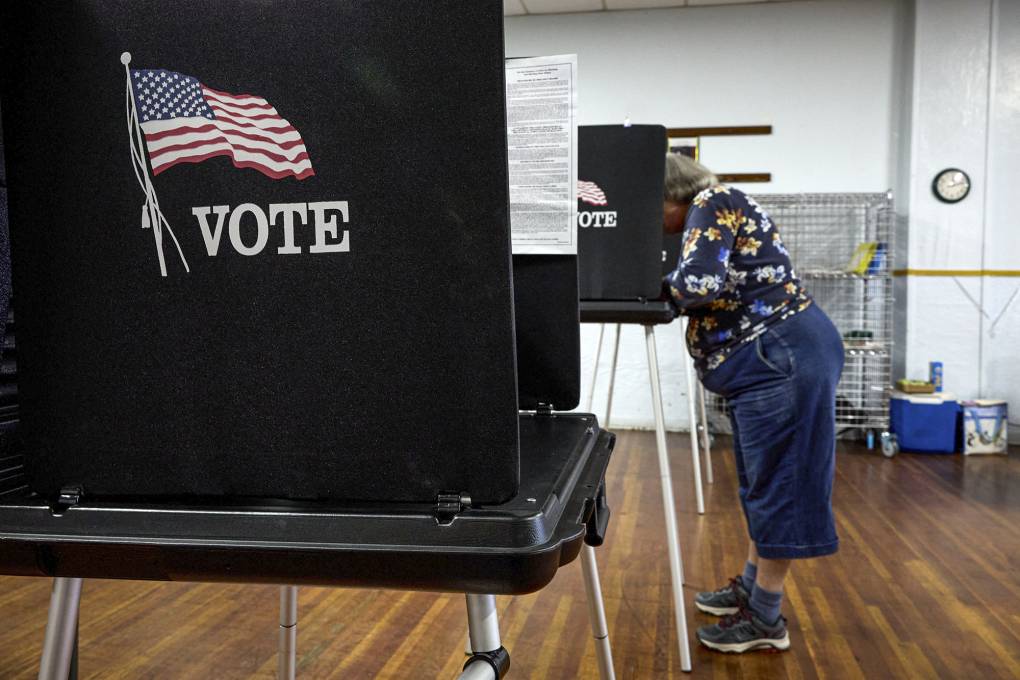
Shasta County's New Registrar of Voters Has No Experience Running Elections
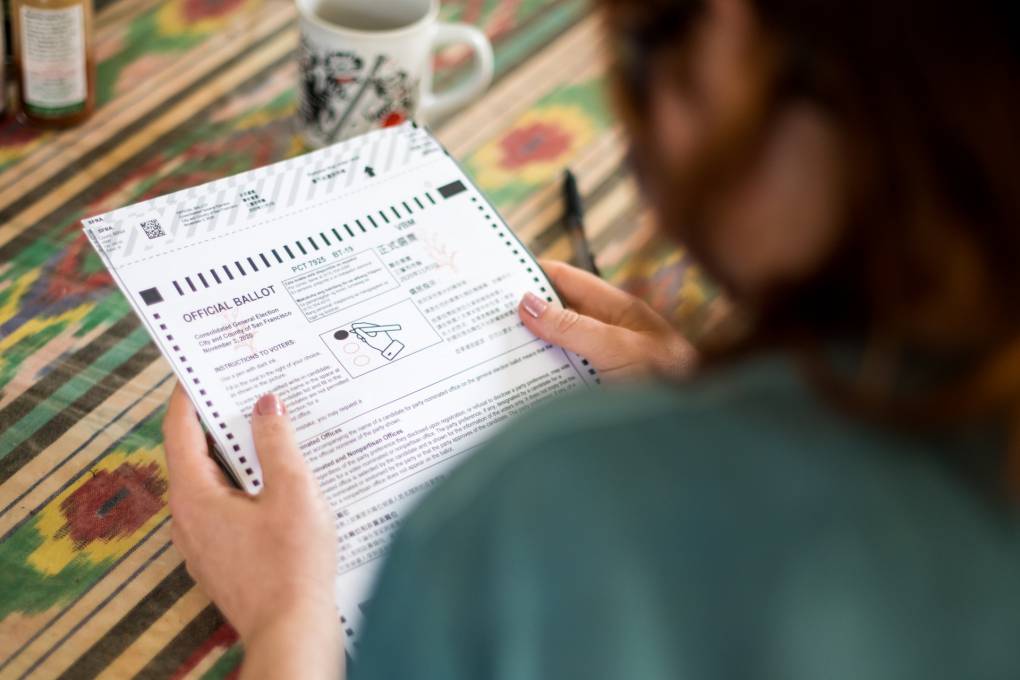
How to Correct a Mistake on Your Ballot for the 2024 California Primary Election
'Justice Must Be Served': Trump Indicted in Push to Overturn 2020 Election
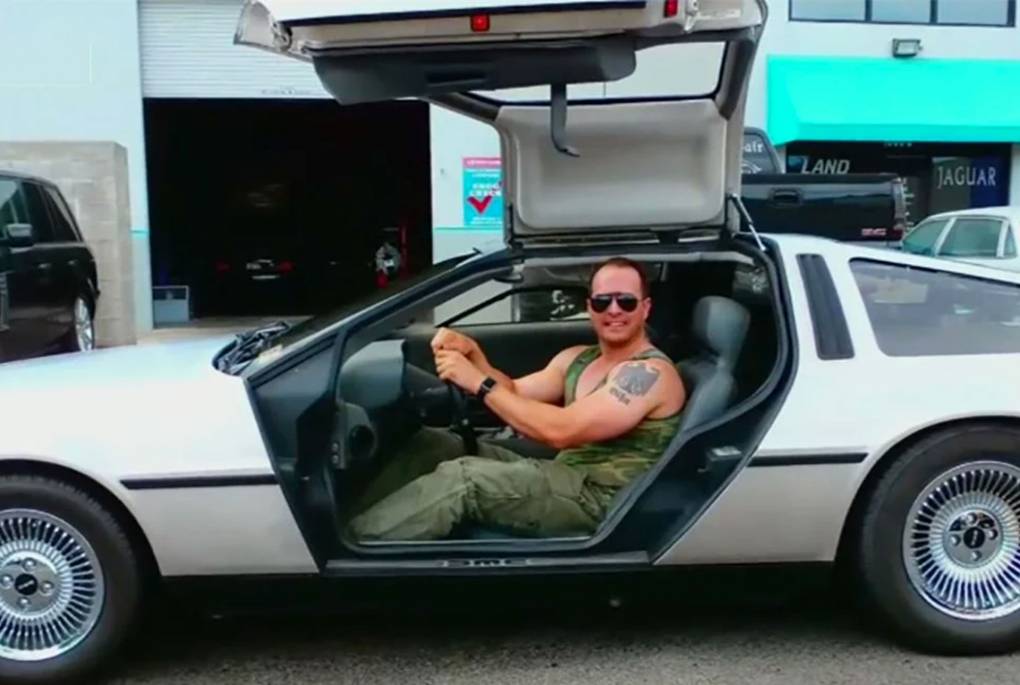
Napa Man Pleads Guilty to Conspiring to Destroy CA Democratic Party Headquarters
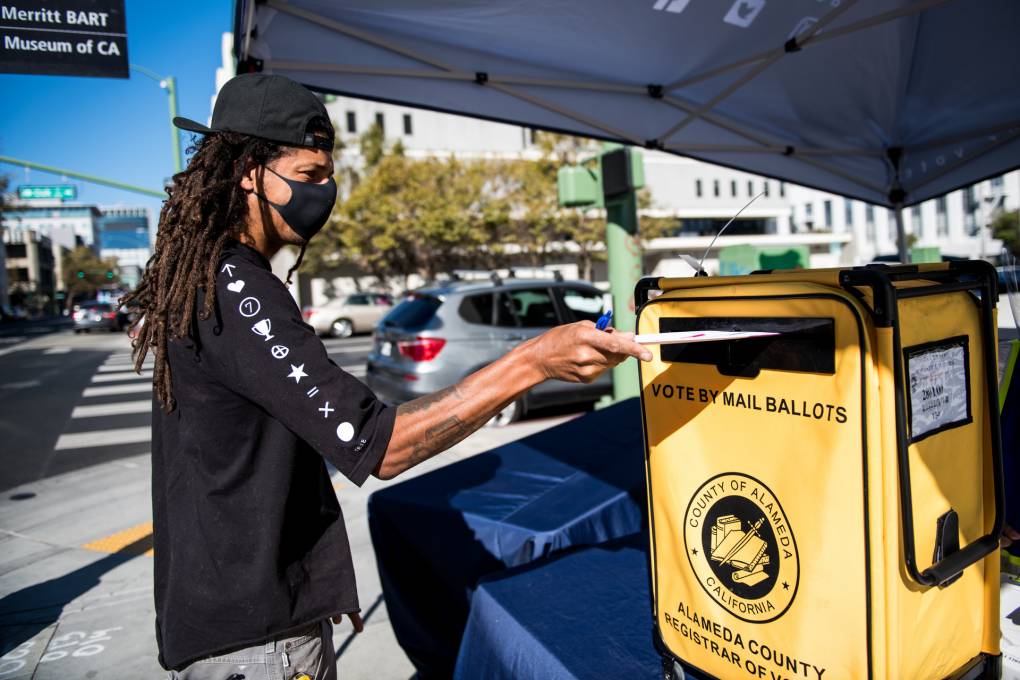
Report: Reducing Voting Locations 'Discouraged Participation' for California's Black and Latino Voters in 2020
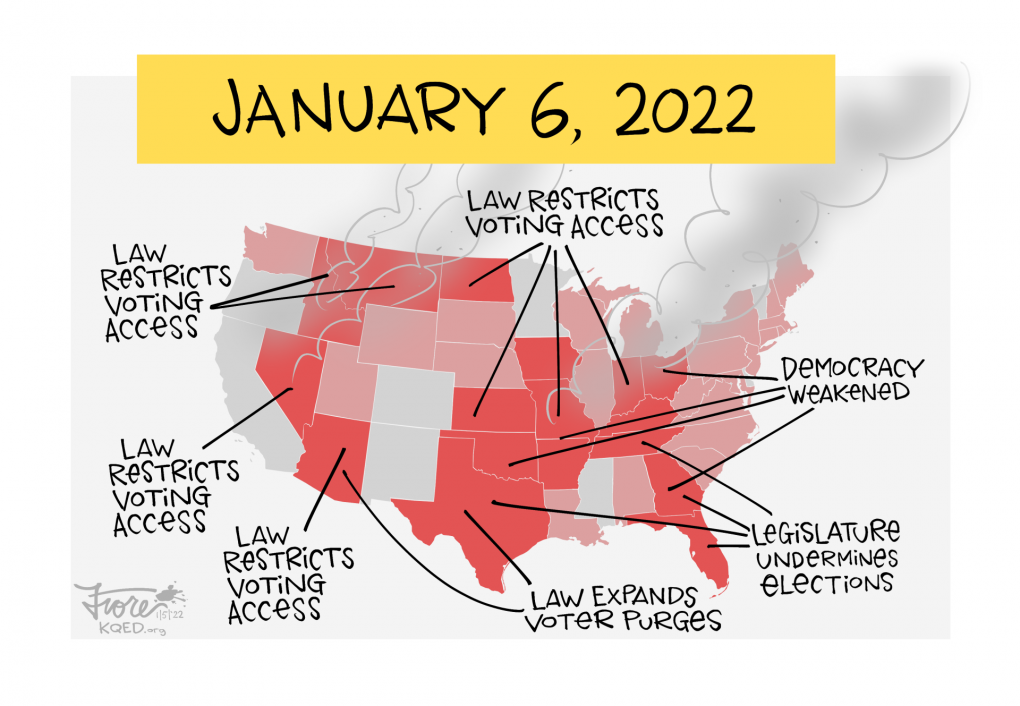
January 6, Again ...
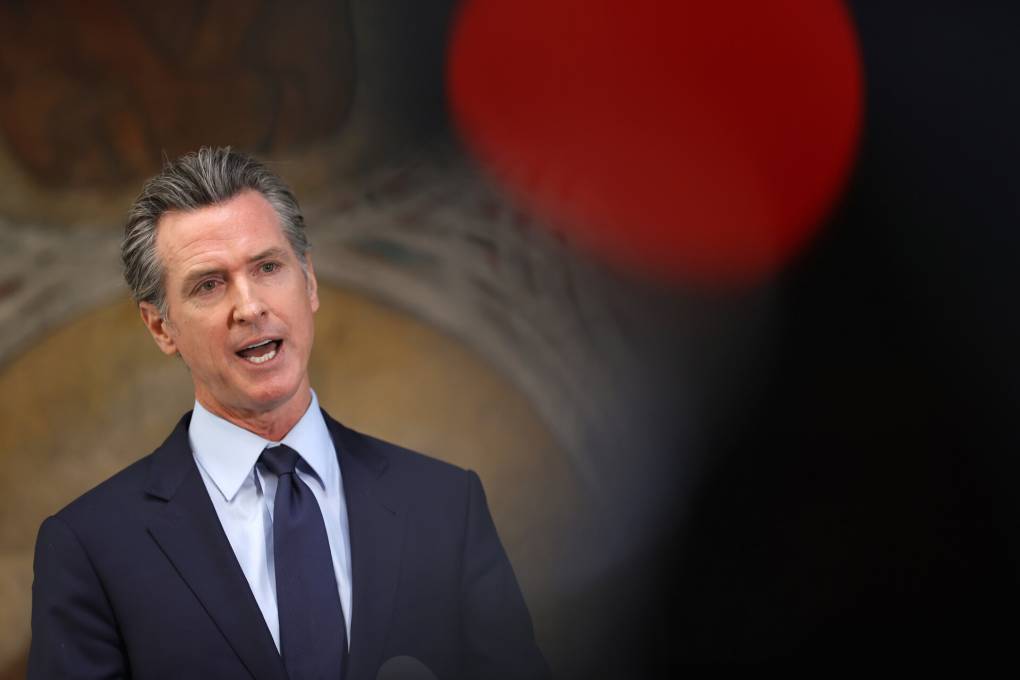
California's Newsom Recall Election: How to Vote, and What You Might Not Expect
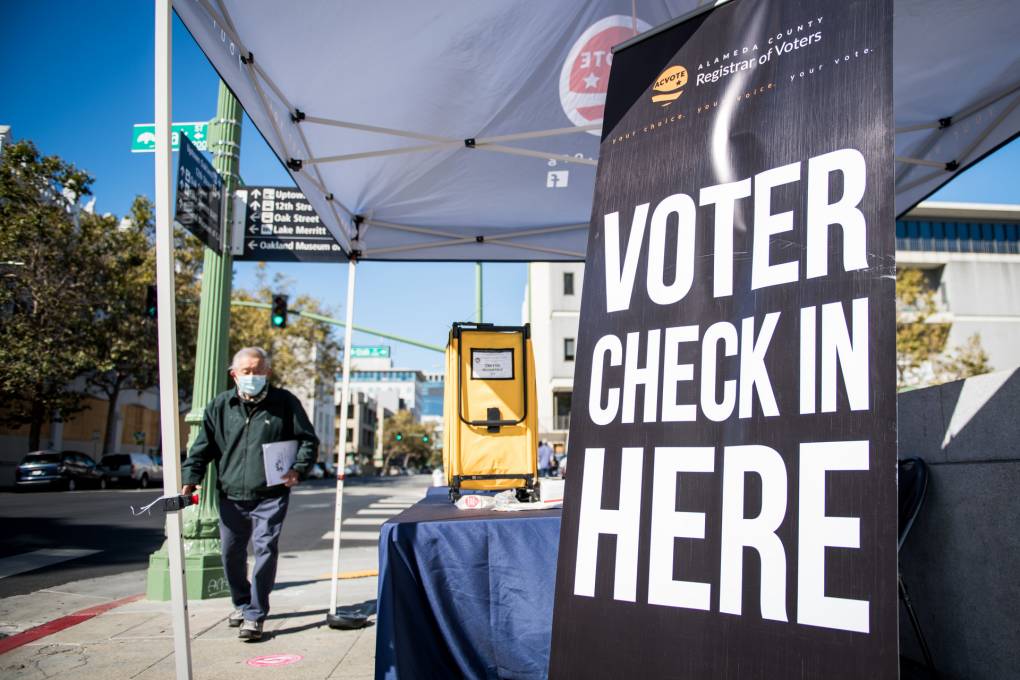
Voting Rights Advocates Take Aim at Alameda Registrar After 'Devastating Errors' in 2020 Election
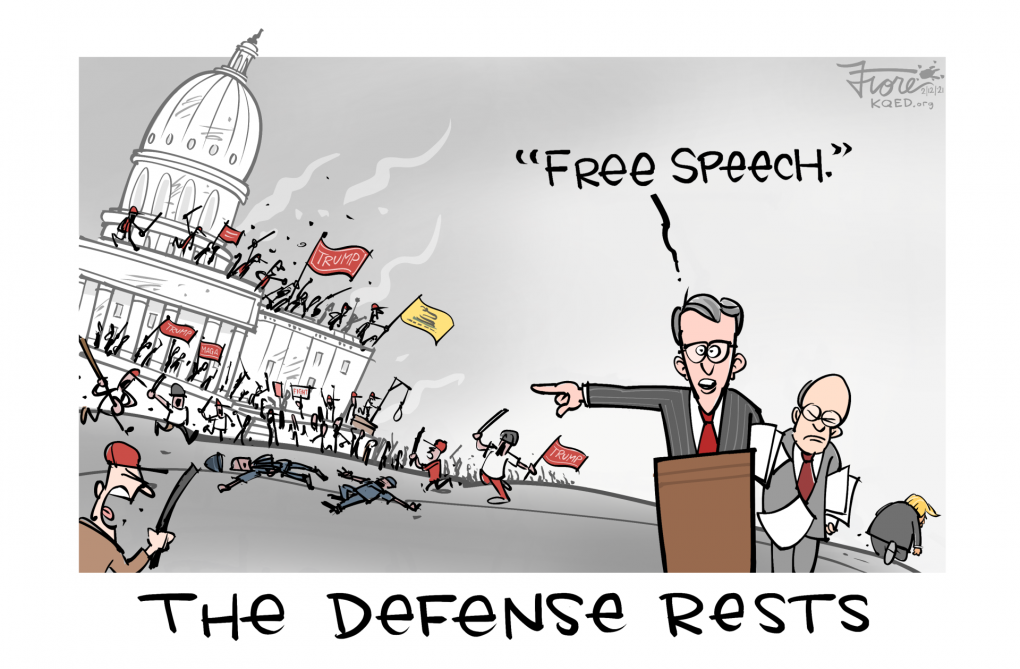
Defending the Indefensible
Sponsored
Player sponsored by
window.__IS_SSR__=true
window.__INITIAL_STATE__={
"attachmentsReducer": {
"audio_0": {
"type": "attachments",
"id": "audio_0",
"imgSizes": {
"kqedFullSize": {
"file": "https://ww2.kqed.org/news/wp-content/themes/KQED-unified/img/audio_bgs/background0.jpg"
}
}
},
"audio_1": {
"type": "attachments",
"id": "audio_1",
"imgSizes": {
"kqedFullSize": {
"file": "https://ww2.kqed.org/news/wp-content/themes/KQED-unified/img/audio_bgs/background1.jpg"
}
}
},
"audio_2": {
"type": "attachments",
"id": "audio_2",
"imgSizes": {
"kqedFullSize": {
"file": "https://ww2.kqed.org/news/wp-content/themes/KQED-unified/img/audio_bgs/background2.jpg"
}
}
},
"audio_3": {
"type": "attachments",
"id": "audio_3",
"imgSizes": {
"kqedFullSize": {
"file": "https://ww2.kqed.org/news/wp-content/themes/KQED-unified/img/audio_bgs/background3.jpg"
}
}
},
"audio_4": {
"type": "attachments",
"id": "audio_4",
"imgSizes": {
"kqedFullSize": {
"file": "https://ww2.kqed.org/news/wp-content/themes/KQED-unified/img/audio_bgs/background4.jpg"
}
}
},
"placeholder": {
"type": "attachments",
"id": "placeholder",
"imgSizes": {
"thumbnail": {
"file": "https://cdn.kqed.org/wp-content/uploads/2024/12/KQED-Default-Image-816638274-2000x1333-1-160x107.jpg",
"width": 160,
"height": 107,
"mimeType": "image/jpeg"
},
"medium": {
"file": "https://cdn.kqed.org/wp-content/uploads/2024/12/KQED-Default-Image-816638274-2000x1333-1-800x533.jpg",
"width": 800,
"height": 533,
"mimeType": "image/jpeg"
},
"medium_large": {
"file": "https://cdn.kqed.org/wp-content/uploads/2024/12/KQED-Default-Image-816638274-2000x1333-1-768x512.jpg",
"width": 768,
"height": 512,
"mimeType": "image/jpeg"
},
"large": {
"file": "https://cdn.kqed.org/wp-content/uploads/2024/12/KQED-Default-Image-816638274-2000x1333-1-1020x680.jpg",
"width": 1020,
"height": 680,
"mimeType": "image/jpeg"
},
"1536x1536": {
"file": "https://cdn.kqed.org/wp-content/uploads/2024/12/KQED-Default-Image-816638274-2000x1333-1-1536x1024.jpg",
"width": 1536,
"height": 1024,
"mimeType": "image/jpeg"
},
"fd-lrg": {
"file": "https://cdn.kqed.org/wp-content/uploads/2024/12/KQED-Default-Image-816638274-2000x1333-1-1536x1024.jpg",
"width": 1536,
"height": 1024,
"mimeType": "image/jpeg"
},
"fd-med": {
"file": "https://cdn.kqed.org/wp-content/uploads/2024/12/KQED-Default-Image-816638274-2000x1333-1-1020x680.jpg",
"width": 1020,
"height": 680,
"mimeType": "image/jpeg"
},
"fd-sm": {
"file": "https://cdn.kqed.org/wp-content/uploads/2024/12/KQED-Default-Image-816638274-2000x1333-1-800x533.jpg",
"width": 800,
"height": 533,
"mimeType": "image/jpeg"
},
"post-thumbnail": {
"file": "https://cdn.kqed.org/wp-content/uploads/2024/12/KQED-Default-Image-816638274-2000x1333-1-672x372.jpg",
"width": 672,
"height": 372,
"mimeType": "image/jpeg"
},
"twentyfourteen-full-width": {
"file": "https://cdn.kqed.org/wp-content/uploads/2024/12/KQED-Default-Image-816638274-2000x1333-1-1038x576.jpg",
"width": 1038,
"height": 576,
"mimeType": "image/jpeg"
},
"xxsmall": {
"file": "https://cdn.kqed.org/wp-content/uploads/2024/12/KQED-Default-Image-816638274-2000x1333-1-160x107.jpg",
"width": 160,
"height": 107,
"mimeType": "image/jpeg"
},
"xsmall": {
"file": "https://cdn.kqed.org/wp-content/uploads/2024/12/KQED-Default-Image-816638274-2000x1333-1-672x372.jpg",
"width": 672,
"height": 372,
"mimeType": "image/jpeg"
},
"small": {
"file": "https://cdn.kqed.org/wp-content/uploads/2024/12/KQED-Default-Image-816638274-2000x1333-1-672x372.jpg",
"width": 672,
"height": 372,
"mimeType": "image/jpeg"
},
"xlarge": {
"file": "https://cdn.kqed.org/wp-content/uploads/2024/12/KQED-Default-Image-816638274-2000x1333-1-1020x680.jpg",
"width": 1020,
"height": 680,
"mimeType": "image/jpeg"
},
"full-width": {
"file": "https://cdn.kqed.org/wp-content/uploads/2024/12/KQED-Default-Image-816638274-2000x1333-1-1920x1280.jpg",
"width": 1920,
"height": 1280,
"mimeType": "image/jpeg"
},
"guest-author-32": {
"file": "https://cdn.kqed.org/wp-content/uploads/2025/01/KQED-Default-Image-816638274-1333x1333-1-160x160.jpg",
"width": 32,
"height": 32,
"mimeType": "image/jpeg"
},
"guest-author-50": {
"file": "https://cdn.kqed.org/wp-content/uploads/2025/01/KQED-Default-Image-816638274-1333x1333-1-160x160.jpg",
"width": 50,
"height": 50,
"mimeType": "image/jpeg"
},
"guest-author-64": {
"file": "https://cdn.kqed.org/wp-content/uploads/2025/01/KQED-Default-Image-816638274-1333x1333-1-160x160.jpg",
"width": 64,
"height": 64,
"mimeType": "image/jpeg"
},
"guest-author-96": {
"file": "https://cdn.kqed.org/wp-content/uploads/2025/01/KQED-Default-Image-816638274-1333x1333-1-160x160.jpg",
"width": 96,
"height": 96,
"mimeType": "image/jpeg"
},
"guest-author-128": {
"file": "https://cdn.kqed.org/wp-content/uploads/2025/01/KQED-Default-Image-816638274-1333x1333-1-160x160.jpg",
"width": 128,
"height": 128,
"mimeType": "image/jpeg"
},
"detail": {
"file": "https://cdn.kqed.org/wp-content/uploads/2025/01/KQED-Default-Image-816638274-1333x1333-1-160x160.jpg",
"width": 160,
"height": 160,
"mimeType": "image/jpeg"
},
"kqedFullSize": {
"file": "https://cdn.kqed.org/wp-content/uploads/2024/12/KQED-Default-Image-816638274-2000x1333-1.jpg",
"width": 2000,
"height": 1333
}
}
},
"news_11977756": {
"type": "attachments",
"id": "news_11977756",
"meta": {
"index": "attachments_1716263798",
"site": "news",
"id": "11977756",
"found": true
},
"title": "CMPollWorkers02",
"publishDate": 1709323958,
"status": "inherit",
"parent": 11977752,
"modified": 1719012946,
"caption": "A voter fills out their ballot at a polling station at the American Legion in Shasta Lake, California, during a special election in Shasta County on Nov. 7, 2023.",
"credit": "Fred Greaves/CalMatters",
"altTag": null,
"description": null,
"imgSizes": {
"medium": {
"file": "https://cdn.kqed.org/wp-content/uploads/sites/10/2024/03/CMPollWorkers02-800x534.jpg",
"width": 800,
"height": 534,
"mimeType": "image/jpeg"
},
"large": {
"file": "https://cdn.kqed.org/wp-content/uploads/sites/10/2024/03/CMPollWorkers02-1020x680.jpg",
"width": 1020,
"height": 680,
"mimeType": "image/jpeg"
},
"thumbnail": {
"file": "https://cdn.kqed.org/wp-content/uploads/sites/10/2024/03/CMPollWorkers02-160x107.jpg",
"width": 160,
"height": 107,
"mimeType": "image/jpeg"
},
"1536x1536": {
"file": "https://cdn.kqed.org/wp-content/uploads/sites/10/2024/03/CMPollWorkers02-1536x1025.jpg",
"width": 1536,
"height": 1025,
"mimeType": "image/jpeg"
},
"post-thumbnail": {
"file": "https://cdn.kqed.org/wp-content/uploads/sites/10/2024/03/CMPollWorkers02-672x372.jpg",
"width": 672,
"height": 372,
"mimeType": "image/jpeg"
},
"twentyfourteen-full-width": {
"file": "https://cdn.kqed.org/wp-content/uploads/sites/10/2024/03/CMPollWorkers02-1038x576.jpg",
"width": 1038,
"height": 576,
"mimeType": "image/jpeg"
},
"full-width": {
"file": "https://cdn.kqed.org/wp-content/uploads/sites/10/2024/03/CMPollWorkers02-1920x1281.jpg",
"width": 1920,
"height": 1281,
"mimeType": "image/jpeg"
},
"kqedFullSize": {
"file": "https://cdn.kqed.org/wp-content/uploads/sites/10/2024/03/CMPollWorkers02.jpg",
"width": 2000,
"height": 1334
}
},
"fetchFailed": false,
"isLoading": false
},
"news_11843210": {
"type": "attachments",
"id": "news_11843210",
"meta": {
"index": "attachments_1716263798",
"site": "news",
"id": "11843210",
"found": true
},
"parent": 11843123,
"imgSizes": {
"apple_news_ca_landscape_5_5": {
"file": "https://cdn.kqed.org/wp-content/uploads/sites/10/2020/10/RS45263_001_KQED_ElectionStockPhotos_TikaHall_10062020-qut-1044x783.jpg",
"width": 1044,
"mimeType": "image/jpeg",
"height": 783
},
"apple_news_ca_square_4_0": {
"file": "https://cdn.kqed.org/wp-content/uploads/sites/10/2020/10/RS45263_001_KQED_ElectionStockPhotos_TikaHall_10062020-qut-470x470.jpg",
"width": 470,
"mimeType": "image/jpeg",
"height": 470
},
"twentyfourteen-full-width": {
"file": "https://cdn.kqed.org/wp-content/uploads/sites/10/2020/10/RS45263_001_KQED_ElectionStockPhotos_TikaHall_10062020-qut-1038x576.jpg",
"width": 1038,
"mimeType": "image/jpeg",
"height": 576
},
"thumbnail": {
"file": "https://cdn.kqed.org/wp-content/uploads/sites/10/2020/10/RS45263_001_KQED_ElectionStockPhotos_TikaHall_10062020-qut-160x107.jpg",
"width": 160,
"mimeType": "image/jpeg",
"height": 107
},
"post-thumbnail": {
"file": "https://cdn.kqed.org/wp-content/uploads/sites/10/2020/10/RS45263_001_KQED_ElectionStockPhotos_TikaHall_10062020-qut-672x372.jpg",
"width": 672,
"mimeType": "image/jpeg",
"height": 372
},
"kqedFullSize": {
"file": "https://cdn.kqed.org/wp-content/uploads/sites/10/2020/10/RS45263_001_KQED_ElectionStockPhotos_TikaHall_10062020-qut.jpg",
"width": 1920,
"height": 1280
},
"apple_news_ca_landscape_4_7": {
"file": "https://cdn.kqed.org/wp-content/uploads/sites/10/2020/10/RS45263_001_KQED_ElectionStockPhotos_TikaHall_10062020-qut-632x474.jpg",
"width": 632,
"mimeType": "image/jpeg",
"height": 474
},
"large": {
"file": "https://cdn.kqed.org/wp-content/uploads/sites/10/2020/10/RS45263_001_KQED_ElectionStockPhotos_TikaHall_10062020-qut-1020x680.jpg",
"width": 1020,
"mimeType": "image/jpeg",
"height": 680
},
"apple_news_ca_landscape_4_0": {
"file": "https://cdn.kqed.org/wp-content/uploads/sites/10/2020/10/RS45263_001_KQED_ElectionStockPhotos_TikaHall_10062020-qut-536x402.jpg",
"width": 536,
"mimeType": "image/jpeg",
"height": 402
},
"apple_news_ca_portrait_12_9": {
"file": "https://cdn.kqed.org/wp-content/uploads/sites/10/2020/10/RS45263_001_KQED_ElectionStockPhotos_TikaHall_10062020-qut-1122x1280.jpg",
"width": 1122,
"mimeType": "image/jpeg",
"height": 1280
},
"medium": {
"file": "https://cdn.kqed.org/wp-content/uploads/sites/10/2020/10/RS45263_001_KQED_ElectionStockPhotos_TikaHall_10062020-qut-800x533.jpg",
"width": 800,
"mimeType": "image/jpeg",
"height": 533
},
"apple_news_ca_portrait_4_0": {
"file": "https://cdn.kqed.org/wp-content/uploads/sites/10/2020/10/RS45263_001_KQED_ElectionStockPhotos_TikaHall_10062020-qut-354x472.jpg",
"width": 354,
"mimeType": "image/jpeg",
"height": 472
},
"apple_news_ca_portrait_9_7": {
"file": "https://cdn.kqed.org/wp-content/uploads/sites/10/2020/10/RS45263_001_KQED_ElectionStockPhotos_TikaHall_10062020-qut-840x1120.jpg",
"width": 840,
"mimeType": "image/jpeg",
"height": 1120
},
"apple_news_ca_landscape_12_9": {
"file": "https://cdn.kqed.org/wp-content/uploads/sites/10/2020/10/RS45263_001_KQED_ElectionStockPhotos_TikaHall_10062020-qut-1832x1280.jpg",
"width": 1832,
"mimeType": "image/jpeg",
"height": 1280
},
"apple_news_ca_square_9_7": {
"file": "https://cdn.kqed.org/wp-content/uploads/sites/10/2020/10/RS45263_001_KQED_ElectionStockPhotos_TikaHall_10062020-qut-1104x1104.jpg",
"width": 1104,
"mimeType": "image/jpeg",
"height": 1104
},
"1536x1536": {
"file": "https://cdn.kqed.org/wp-content/uploads/sites/10/2020/10/RS45263_001_KQED_ElectionStockPhotos_TikaHall_10062020-qut-1536x1024.jpg",
"width": 1536,
"mimeType": "image/jpeg",
"height": 1024
},
"apple_news_ca_portrait_4_7": {
"file": "https://cdn.kqed.org/wp-content/uploads/sites/10/2020/10/RS45263_001_KQED_ElectionStockPhotos_TikaHall_10062020-qut-414x552.jpg",
"width": 414,
"mimeType": "image/jpeg",
"height": 552
},
"apple_news_ca_square_12_9": {
"file": "https://cdn.kqed.org/wp-content/uploads/sites/10/2020/10/RS45263_001_KQED_ElectionStockPhotos_TikaHall_10062020-qut-1472x1280.jpg",
"width": 1472,
"mimeType": "image/jpeg",
"height": 1280
},
"apple_news_ca_portrait_5_5": {
"file": "https://cdn.kqed.org/wp-content/uploads/sites/10/2020/10/RS45263_001_KQED_ElectionStockPhotos_TikaHall_10062020-qut-687x916.jpg",
"width": 687,
"mimeType": "image/jpeg",
"height": 916
},
"apple_news_ca_square_4_7": {
"file": "https://cdn.kqed.org/wp-content/uploads/sites/10/2020/10/RS45263_001_KQED_ElectionStockPhotos_TikaHall_10062020-qut-550x550.jpg",
"width": 550,
"mimeType": "image/jpeg",
"height": 550
},
"apple_news_ca_landscape_9_7": {
"file": "https://cdn.kqed.org/wp-content/uploads/sites/10/2020/10/RS45263_001_KQED_ElectionStockPhotos_TikaHall_10062020-qut-1376x1032.jpg",
"width": 1376,
"mimeType": "image/jpeg",
"height": 1032
},
"apple_news_ca_square_5_5": {
"file": "https://cdn.kqed.org/wp-content/uploads/sites/10/2020/10/RS45263_001_KQED_ElectionStockPhotos_TikaHall_10062020-qut-912x912.jpg",
"width": 912,
"mimeType": "image/jpeg",
"height": 912
}
},
"publishDate": 1603321981,
"modified": 1706906764,
"caption": "A San Francisco resident fills out their mail-in ballot on Oct. 6, 2020.",
"description": "A San Francisco resident fills out their mail-in ballot on Oct. 6, 2020.",
"title": "how-to-fix-ballot-mistake",
"credit": "Beth LaBerge/KQED",
"status": "inherit",
"altTag": "A person wearing a green shirt holds a ballot.",
"fetchFailed": false,
"isLoading": false
},
"news_11957101": {
"type": "attachments",
"id": "news_11957101",
"meta": {
"index": "attachments_1716263798",
"site": "news",
"id": "11957101",
"found": true
},
"parent": 0,
"imgSizes": {
"twentyfourteen-full-width": {
"file": "https://ww2.kqed.org/app/uploads/sites/10/2023/08/GettyImages-1563681481-1024x576.jpg",
"width": 1024,
"mimeType": "image/jpeg",
"height": 576
},
"thumbnail": {
"file": "https://ww2.kqed.org/app/uploads/sites/10/2023/08/GettyImages-1563681481-160x111.jpg",
"width": 160,
"mimeType": "image/jpeg",
"height": 111
},
"post-thumbnail": {
"file": "https://ww2.kqed.org/app/uploads/sites/10/2023/08/GettyImages-1563681481-672x372.jpg",
"width": 672,
"mimeType": "image/jpeg",
"height": 372
},
"kqedFullSize": {
"file": "https://ww2.kqed.org/app/uploads/sites/10/2023/08/GettyImages-1563681481.jpg",
"width": 1024,
"height": 713
},
"large": {
"file": "https://ww2.kqed.org/app/uploads/sites/10/2023/08/GettyImages-1563681481-1020x710.jpg",
"width": 1020,
"mimeType": "image/jpeg",
"height": 710
},
"medium": {
"file": "https://ww2.kqed.org/app/uploads/sites/10/2023/08/GettyImages-1563681481-800x557.jpg",
"width": 800,
"mimeType": "image/jpeg",
"height": 557
}
},
"publishDate": 1690930088,
"modified": 1690935936,
"caption": "Donald Trump, the former US president and current Republican frontrunner in the 2024 presidential race, enters Erie Insurance Arena for a political rally on July 29, 2023 in Erie, Pennsylvania. Just days later, on Aug. 1, Trump was indicted by the US Justice Department on felony charges for working to overturn the results of the 2020 presidential election.",
"description": null,
"title": "GettyImages-1563681481",
"credit": "Jeff Swensen/Getty Images",
"status": "inherit",
"altTag": "Former President Donald Trump, wearing his characteristic red tie, during a political rally.",
"fetchFailed": false,
"isLoading": false
},
"news_11914001": {
"type": "attachments",
"id": "news_11914001",
"meta": {
"index": "attachments_1716263798",
"site": "news",
"id": "11914001",
"found": true
},
"parent": 11913965,
"imgSizes": {
"twentyfourteen-full-width": {
"file": "https://ww2.kqed.org/app/uploads/sites/10/2022/05/RogersDelorean-1038x576.jpg",
"width": 1038,
"mimeType": "image/jpeg",
"height": 576
},
"thumbnail": {
"file": "https://ww2.kqed.org/app/uploads/sites/10/2022/05/RogersDelorean-160x107.jpg",
"width": 160,
"mimeType": "image/jpeg",
"height": 107
},
"post-thumbnail": {
"file": "https://ww2.kqed.org/app/uploads/sites/10/2022/05/RogersDelorean-672x372.jpg",
"width": 672,
"mimeType": "image/jpeg",
"height": 372
},
"kqedFullSize": {
"file": "https://ww2.kqed.org/app/uploads/sites/10/2022/05/RogersDelorean.jpg",
"width": 1920,
"height": 1289
},
"large": {
"file": "https://ww2.kqed.org/app/uploads/sites/10/2022/05/RogersDelorean-1020x685.jpg",
"width": 1020,
"mimeType": "image/jpeg",
"height": 685
},
"1536x1536": {
"file": "https://ww2.kqed.org/app/uploads/sites/10/2022/05/RogersDelorean-1536x1031.jpg",
"width": 1536,
"mimeType": "image/jpeg",
"height": 1031
},
"medium": {
"file": "https://ww2.kqed.org/app/uploads/sites/10/2022/05/RogersDelorean-800x537.jpg",
"width": 800,
"mimeType": "image/jpeg",
"height": 537
}
},
"publishDate": 1652398181,
"modified": 1654024496,
"caption": "Ian Rogers sits at the wheel of his DeLorean in a Facebook photo that went viral after his arrest in 2021. The photo shows his tattoo resembling a Nazi eagle.",
"description": null,
"title": "RogersDelorean",
"credit": "Facebook",
"status": "inherit",
"altTag": "man wearing camo shirt with bare arms and visible Nazi-esque eagle tattoo sits at wheel of Delorean car with door open",
"fetchFailed": false,
"isLoading": false
},
"news_11907152": {
"type": "attachments",
"id": "news_11907152",
"meta": {
"index": "attachments_1716263798",
"site": "news",
"id": "11907152",
"found": true
},
"title": "where-to-vote-today",
"publishDate": 1646357766,
"status": "inherit",
"parent": 11907125,
"modified": 1730762246,
"caption": "Dax Strane drops off his mail-in ballot at the Alameda County Registrar of Voters in Oakland on Oct. 27, 2020. Alameda was one of the dozens of counties that consolidated voting locations in 2020. ",
"credit": "Beth LaBerge/KQED",
"altTag": null,
"description": null,
"imgSizes": {
"medium": {
"file": "https://cdn.kqed.org/wp-content/uploads/sites/10/2022/03/RS45463_011_KQED_Oakland_RegistrarofVoters_10272020-qut-800x533.jpg",
"width": 800,
"height": 533,
"mimeType": "image/jpeg"
},
"large": {
"file": "https://cdn.kqed.org/wp-content/uploads/sites/10/2022/03/RS45463_011_KQED_Oakland_RegistrarofVoters_10272020-qut-1020x680.jpg",
"width": 1020,
"height": 680,
"mimeType": "image/jpeg"
},
"thumbnail": {
"file": "https://cdn.kqed.org/wp-content/uploads/sites/10/2022/03/RS45463_011_KQED_Oakland_RegistrarofVoters_10272020-qut-160x107.jpg",
"width": 160,
"height": 107,
"mimeType": "image/jpeg"
},
"1536x1536": {
"file": "https://cdn.kqed.org/wp-content/uploads/sites/10/2022/03/RS45463_011_KQED_Oakland_RegistrarofVoters_10272020-qut-1536x1024.jpg",
"width": 1536,
"height": 1024,
"mimeType": "image/jpeg"
},
"post-thumbnail": {
"file": "https://cdn.kqed.org/wp-content/uploads/sites/10/2022/03/RS45463_011_KQED_Oakland_RegistrarofVoters_10272020-qut-672x372.jpg",
"width": 672,
"height": 372,
"mimeType": "image/jpeg"
},
"twentyfourteen-full-width": {
"file": "https://cdn.kqed.org/wp-content/uploads/sites/10/2022/03/RS45463_011_KQED_Oakland_RegistrarofVoters_10272020-qut-1038x576.jpg",
"width": 1038,
"height": 576,
"mimeType": "image/jpeg"
},
"kqedFullSize": {
"file": "https://cdn.kqed.org/wp-content/uploads/sites/10/2022/03/RS45463_011_KQED_Oakland_RegistrarofVoters_10272020-qut.jpg",
"width": 1920,
"height": 1280
}
},
"fetchFailed": false,
"isLoading": false
},
"news_11900879": {
"type": "attachments",
"id": "news_11900879",
"meta": {
"index": "attachments_1716263798",
"site": "news",
"id": "11900879",
"found": true
},
"parent": 11900865,
"imgSizes": {
"twentyfourteen-full-width": {
"file": "https://ww2.kqed.org/app/uploads/sites/10/2022/01/january6th_010522_final-1038x576.png",
"width": 1038,
"mimeType": "image/png",
"height": 576
},
"thumbnail": {
"file": "https://ww2.kqed.org/app/uploads/sites/10/2022/01/january6th_010522_final-160x111.png",
"width": 160,
"mimeType": "image/png",
"height": 111
},
"post-thumbnail": {
"file": "https://ww2.kqed.org/app/uploads/sites/10/2022/01/january6th_010522_final-672x372.png",
"width": 672,
"mimeType": "image/png",
"height": 372
},
"kqedFullSize": {
"file": "https://ww2.kqed.org/app/uploads/sites/10/2022/01/january6th_010522_final.png",
"width": 1920,
"height": 1329
},
"large": {
"file": "https://ww2.kqed.org/app/uploads/sites/10/2022/01/january6th_010522_final-1020x706.png",
"width": 1020,
"mimeType": "image/png",
"height": 706
},
"1536x1536": {
"file": "https://ww2.kqed.org/app/uploads/sites/10/2022/01/january6th_010522_final-1536x1063.png",
"width": 1536,
"mimeType": "image/png",
"height": 1063
},
"medium": {
"file": "https://ww2.kqed.org/app/uploads/sites/10/2022/01/january6th_010522_final-800x554.png",
"width": 800,
"mimeType": "image/png",
"height": 554
}
},
"publishDate": 1641418134,
"modified": 1641418291,
"caption": null,
"description": null,
"title": "january6th_010522_final",
"credit": null,
"status": "inherit",
"altTag": "Cartoon: a U.S. map titled, \"January 6, 2022.\" Arrows point at multiple states with labels saying, \"law restricts voting access,\" \"law expands voter purges,\" \" democracy weakened.\" Some smoke rises over the nation.",
"fetchFailed": false,
"isLoading": false
},
"news_11885022": {
"type": "attachments",
"id": "news_11885022",
"meta": {
"index": "attachments_1716263798",
"site": "news",
"id": "11885022",
"found": true
},
"parent": 11884716,
"imgSizes": {
"twentyfourteen-full-width": {
"file": "https://ww2.kqed.org/app/uploads/sites/10/2021/08/RS50623_GettyImages-1317323995-qut-1038x576.jpg",
"width": 1038,
"mimeType": "image/jpeg",
"height": 576
},
"thumbnail": {
"file": "https://ww2.kqed.org/app/uploads/sites/10/2021/08/RS50623_GettyImages-1317323995-qut-160x107.jpg",
"width": 160,
"mimeType": "image/jpeg",
"height": 107
},
"post-thumbnail": {
"file": "https://ww2.kqed.org/app/uploads/sites/10/2021/08/RS50623_GettyImages-1317323995-qut-672x372.jpg",
"width": 672,
"mimeType": "image/jpeg",
"height": 372
},
"kqedFullSize": {
"file": "https://ww2.kqed.org/app/uploads/sites/10/2021/08/RS50623_GettyImages-1317323995-qut.jpg",
"width": 1920,
"height": 1280
},
"large": {
"file": "https://ww2.kqed.org/app/uploads/sites/10/2021/08/RS50623_GettyImages-1317323995-qut-1020x680.jpg",
"width": 1020,
"mimeType": "image/jpeg",
"height": 680
},
"1536x1536": {
"file": "https://ww2.kqed.org/app/uploads/sites/10/2021/08/RS50623_GettyImages-1317323995-qut-1536x1024.jpg",
"width": 1536,
"mimeType": "image/jpeg",
"height": 1024
},
"medium": {
"file": "https://ww2.kqed.org/app/uploads/sites/10/2021/08/RS50623_GettyImages-1317323995-qut-800x533.jpg",
"width": 800,
"mimeType": "image/jpeg",
"height": 533
}
},
"publishDate": 1628882955,
"modified": 1629128263,
"caption": "Gov. Gavin Newsom speaks during a press conference on May 10, 2021, in Oakland.",
"description": "Gov. Gavin Newsom speaks during a press conference on May 10, 2021 in Oakland.",
"title": "California Governor Newsom Unveils His Economic Recovery Package For The State",
"credit": "Justin Sullivan/Getty Images",
"status": "inherit",
"altTag": null,
"fetchFailed": false,
"isLoading": false
},
"news_11872220": {
"type": "attachments",
"id": "news_11872220",
"meta": {
"index": "attachments_1716263798",
"site": "news",
"id": "11872220",
"found": true
},
"parent": 11872161,
"imgSizes": {
"twentyfourteen-full-width": {
"file": "https://ww2.kqed.org/app/uploads/sites/10/2021/05/RS45480_028_KQED_Oakland_RegistrarofVoters_10272020-qut-1038x576.jpg",
"width": 1038,
"mimeType": "image/jpeg",
"height": 576
},
"thumbnail": {
"file": "https://ww2.kqed.org/app/uploads/sites/10/2021/05/RS45480_028_KQED_Oakland_RegistrarofVoters_10272020-qut-160x107.jpg",
"width": 160,
"mimeType": "image/jpeg",
"height": 107
},
"post-thumbnail": {
"file": "https://ww2.kqed.org/app/uploads/sites/10/2021/05/RS45480_028_KQED_Oakland_RegistrarofVoters_10272020-qut-672x372.jpg",
"width": 672,
"mimeType": "image/jpeg",
"height": 372
},
"kqedFullSize": {
"file": "https://ww2.kqed.org/app/uploads/sites/10/2021/05/RS45480_028_KQED_Oakland_RegistrarofVoters_10272020-qut.jpg",
"width": 1920,
"height": 1280
},
"large": {
"file": "https://ww2.kqed.org/app/uploads/sites/10/2021/05/RS45480_028_KQED_Oakland_RegistrarofVoters_10272020-qut-1020x680.jpg",
"width": 1020,
"mimeType": "image/jpeg",
"height": 680
},
"1536x1536": {
"file": "https://ww2.kqed.org/app/uploads/sites/10/2021/05/RS45480_028_KQED_Oakland_RegistrarofVoters_10272020-qut-1536x1024.jpg",
"width": 1536,
"mimeType": "image/jpeg",
"height": 1024
},
"medium": {
"file": "https://ww2.kqed.org/app/uploads/sites/10/2021/05/RS45480_028_KQED_Oakland_RegistrarofVoters_10272020-qut-800x533.jpg",
"width": 800,
"mimeType": "image/jpeg",
"height": 533
}
},
"publishDate": 1620169627,
"modified": 1620174617,
"caption": "A voter check-in tent at the Alameda County Registrar of Voters on Oct. 27, 2020.",
"description": "A voter check-in tent at the Alameda County Registrar of Voters on Oct. 27, 2020.",
"title": "RS45480_028_KQED_Oakland_RegistrarofVoters_10272020-qut",
"credit": "Beth LaBerge/KQED",
"status": "inherit",
"altTag": null,
"fetchFailed": false,
"isLoading": false
},
"news_11860235": {
"type": "attachments",
"id": "news_11860235",
"meta": {
"index": "attachments_1716263798",
"site": "news",
"id": "11860235",
"found": true
},
"parent": 11860231,
"imgSizes": {
"apple_news_ca_landscape_5_5": {
"file": "https://ww2.kqed.org/app/uploads/sites/10/2021/02/defense_021221_final-1044x783.png",
"width": 1044,
"mimeType": "image/png",
"height": 783
},
"apple_news_ca_square_4_0": {
"file": "https://ww2.kqed.org/app/uploads/sites/10/2021/02/defense_021221_final-470x470.png",
"width": 470,
"mimeType": "image/png",
"height": 470
},
"twentyfourteen-full-width": {
"file": "https://ww2.kqed.org/app/uploads/sites/10/2021/02/defense_021221_final-1038x576.png",
"width": 1038,
"mimeType": "image/png",
"height": 576
},
"thumbnail": {
"file": "https://ww2.kqed.org/app/uploads/sites/10/2021/02/defense_021221_final-160x105.png",
"width": 160,
"mimeType": "image/png",
"height": 105
},
"post-thumbnail": {
"file": "https://ww2.kqed.org/app/uploads/sites/10/2021/02/defense_021221_final-672x372.png",
"width": 672,
"mimeType": "image/png",
"height": 372
},
"kqedFullSize": {
"file": "https://ww2.kqed.org/app/uploads/sites/10/2021/02/defense_021221_final.png",
"width": 1920,
"height": 1259
},
"apple_news_ca_landscape_4_7": {
"file": "https://ww2.kqed.org/app/uploads/sites/10/2021/02/defense_021221_final-632x474.png",
"width": 632,
"mimeType": "image/png",
"height": 474
},
"large": {
"file": "https://ww2.kqed.org/app/uploads/sites/10/2021/02/defense_021221_final-1020x669.png",
"width": 1020,
"mimeType": "image/png",
"height": 669
},
"apple_news_ca_landscape_4_0": {
"file": "https://ww2.kqed.org/app/uploads/sites/10/2021/02/defense_021221_final-536x402.png",
"width": 536,
"mimeType": "image/png",
"height": 402
},
"apple_news_ca_portrait_12_9": {
"file": "https://ww2.kqed.org/app/uploads/sites/10/2021/02/defense_021221_final-1122x1259.png",
"width": 1122,
"mimeType": "image/png",
"height": 1259
},
"medium": {
"file": "https://ww2.kqed.org/app/uploads/sites/10/2021/02/defense_021221_final-800x525.png",
"width": 800,
"mimeType": "image/png",
"height": 525
},
"apple_news_ca_portrait_4_0": {
"file": "https://ww2.kqed.org/app/uploads/sites/10/2021/02/defense_021221_final-354x472.png",
"width": 354,
"mimeType": "image/png",
"height": 472
},
"apple_news_ca_portrait_9_7": {
"file": "https://ww2.kqed.org/app/uploads/sites/10/2021/02/defense_021221_final-840x1120.png",
"width": 840,
"mimeType": "image/png",
"height": 1120
},
"apple_news_ca_landscape_12_9": {
"file": "https://ww2.kqed.org/app/uploads/sites/10/2021/02/defense_021221_final-1832x1259.png",
"width": 1832,
"mimeType": "image/png",
"height": 1259
},
"apple_news_ca_square_9_7": {
"file": "https://ww2.kqed.org/app/uploads/sites/10/2021/02/defense_021221_final-1104x1104.png",
"width": 1104,
"mimeType": "image/png",
"height": 1104
},
"1536x1536": {
"file": "https://ww2.kqed.org/app/uploads/sites/10/2021/02/defense_021221_final-1536x1007.png",
"width": 1536,
"mimeType": "image/png",
"height": 1007
},
"apple_news_ca_portrait_4_7": {
"file": "https://ww2.kqed.org/app/uploads/sites/10/2021/02/defense_021221_final-414x552.png",
"width": 414,
"mimeType": "image/png",
"height": 552
},
"apple_news_ca_square_12_9": {
"file": "https://ww2.kqed.org/app/uploads/sites/10/2021/02/defense_021221_final-1472x1259.png",
"width": 1472,
"mimeType": "image/png",
"height": 1259
},
"apple_news_ca_portrait_5_5": {
"file": "https://ww2.kqed.org/app/uploads/sites/10/2021/02/defense_021221_final-687x916.png",
"width": 687,
"mimeType": "image/png",
"height": 916
},
"apple_news_ca_square_4_7": {
"file": "https://ww2.kqed.org/app/uploads/sites/10/2021/02/defense_021221_final-550x550.png",
"width": 550,
"mimeType": "image/png",
"height": 550
},
"apple_news_ca_landscape_9_7": {
"file": "https://ww2.kqed.org/app/uploads/sites/10/2021/02/defense_021221_final-1376x1032.png",
"width": 1376,
"mimeType": "image/png",
"height": 1032
},
"apple_news_ca_square_5_5": {
"file": "https://ww2.kqed.org/app/uploads/sites/10/2021/02/defense_021221_final-912x912.png",
"width": 912,
"mimeType": "image/png",
"height": 912
}
},
"publishDate": 1613162513,
"modified": 1613162580,
"caption": null,
"description": null,
"title": "defense_021221_final",
"credit": null,
"status": "inherit",
"altTag": "A Mark Fiore cartoon featuring Donald Trump's defense lawyers making the case that the violent attack on the Capitol was \"free speech.\"",
"fetchFailed": false,
"isLoading": false
}
},
"audioPlayerReducer": {
"postId": "stream_live",
"isPaused": true,
"isPlaying": false,
"pfsActive": false,
"pledgeModalIsOpen": true,
"playerDrawerIsOpen": false
},
"authorsReducer": {
"byline_news_11991539": {
"type": "authors",
"id": "byline_news_11991539",
"meta": {
"override": true
},
"slug": "byline_news_11991539",
"name": "Adam Beam, Associated Press",
"isLoading": false
},
"byline_news_11957092": {
"type": "authors",
"id": "byline_news_11957092",
"meta": {
"override": true
},
"slug": "byline_news_11957092",
"name": "\u003ca href=\"https://apnews.com/\">Eric Tucker\u003c/a>\u003cbr>The Associated Press",
"isLoading": false
},
"gmarzorati": {
"type": "authors",
"id": "227",
"meta": {
"index": "authors_1716337520",
"id": "227",
"found": true
},
"name": "Guy Marzorati",
"firstName": "Guy",
"lastName": "Marzorati",
"slug": "gmarzorati",
"email": "gmarzorati@KQED.org",
"display_author_email": true,
"staff_mastheads": [
"news"
],
"title": "Correspondent",
"bio": "Guy Marzorati is a correspondent on KQED's California Politics and Government Desk, based in San Jose. A graduate of Santa Clara University, Guy joined KQED in 2013. He reports on state and local politics and produces KQED's digital voter guide.",
"avatar": "https://secure.gravatar.com/avatar/e7038b8dbfd55b104369b76b1cd0b9de?s=600&d=blank&r=g",
"twitter": "guymarzorati",
"facebook": null,
"instagram": null,
"linkedin": null,
"sites": [
{
"site": "",
"roles": [
"editor"
]
},
{
"site": "news",
"roles": [
"editor"
]
},
{
"site": "science",
"roles": [
"editor"
]
},
{
"site": "forum",
"roles": [
"editor"
]
},
{
"site": "elections",
"roles": [
"editor"
]
},
{
"site": "liveblog",
"roles": [
"editor"
]
}
],
"headData": {
"title": "Guy Marzorati | KQED",
"description": "Correspondent",
"ogImgSrc": "https://secure.gravatar.com/avatar/e7038b8dbfd55b104369b76b1cd0b9de?s=600&d=blank&r=g",
"twImgSrc": "https://secure.gravatar.com/avatar/e7038b8dbfd55b104369b76b1cd0b9de?s=600&d=blank&r=g"
},
"isLoading": false,
"link": "/author/gmarzorati"
},
"markfiore": {
"type": "authors",
"id": "3236",
"meta": {
"index": "authors_1716337520",
"id": "3236",
"found": true
},
"name": "Mark Fiore",
"firstName": "Mark",
"lastName": "Fiore",
"slug": "markfiore",
"email": "mark@markfiore.com",
"display_author_email": false,
"staff_mastheads": [
"news"
],
"title": "KQED News Cartoonist",
"bio": "\u003ca href=\"http://www.MarkFiore.com\">MarkFiore.com\u003c/a> | \u003ca href=\"https://twitter.com/markfiore\">Follow on Twitter\u003c/a> | \u003ca href=\"https://www.facebook.com/pages/Mark-Fiore-Animated-Political-Cartoons/94451707396?ref=bookmarks\">Facebook\u003c/a> | \u003ca href=\"mailto:mark@markfiore.com\">email\u003c/a>\r\n\r\nPulitzer Prize-winner, Mark Fiore, who the Wall Street Journal has called “the undisputed guru of the form,” creates animated political cartoons in San Francisco, where his work has been featured regularly on the San Francisco Chronicle’s web site, SFGate.com. His work has appeared on Newsweek.com, Slate.com, CBSNews.com, MotherJones.com, DailyKos.com and NPR’s web site. Fiore’s political animation has appeared on CNN, Frontline, Bill Moyers Journal, Salon.com and cable and broadcast outlets across the globe.\r\n\r\nBeginning his professional life by drawing traditional political cartoons for newspapers, Fiore’s work appeared in publications ranging from the Washington Post to the Los Angeles Times. In the late 1990s, he began to experiment with animating political cartoons and, after a short stint at the San Jose Mercury News as their staff cartoonist, Fiore devoted all his energies to animation.\r\nGrowing up in California, Fiore also spent a good portion of his life in the backwoods of Idaho. It was this combination that shaped him politically. Mark majored in political science at Colorado College, where, in a perfect send-off for a cartoonist, he received his diploma in 1991 as commencement speaker Dick Cheney smiled approvingly.\r\nMark Fiore was awarded the Pulitzer Prize for political cartooning in 2010, a Robert F. Kennedy Journalism Award in 2004 and has twice received an Online Journalism Award for commentary from the Online News Association (2002, 2008). Fiore has received two awards for his work in new media from the National Cartoonists Society (2001, 2002), and in 2006 received The James Madison Freedom of Information Award from The Society of Professional Journalists.",
"avatar": "https://secure.gravatar.com/avatar/fc4e2a612b15b67bad0c6f0e1db4ca9b?s=600&d=blank&r=g",
"twitter": "MarkFiore",
"facebook": null,
"instagram": "https://www.instagram.com/markfiore/?hl=en",
"linkedin": null,
"sites": [
{
"site": "arts",
"roles": [
"contributor"
]
},
{
"site": "news",
"roles": [
"editor"
]
},
{
"site": "futureofyou",
"roles": [
"editor"
]
},
{
"site": "science",
"roles": [
"editor"
]
}
],
"headData": {
"title": "Mark Fiore | KQED",
"description": "KQED News Cartoonist",
"ogImgSrc": "https://secure.gravatar.com/avatar/fc4e2a612b15b67bad0c6f0e1db4ca9b?s=600&d=blank&r=g",
"twImgSrc": "https://secure.gravatar.com/avatar/fc4e2a612b15b67bad0c6f0e1db4ca9b?s=600&d=blank&r=g"
},
"isLoading": false,
"link": "/author/markfiore"
},
"carlysevern": {
"type": "authors",
"id": "3243",
"meta": {
"index": "authors_1716337520",
"id": "3243",
"found": true
},
"name": "Carly Severn",
"firstName": "Carly",
"lastName": "Severn",
"slug": "carlysevern",
"email": "csevern@kqed.org",
"display_author_email": false,
"staff_mastheads": [
"news"
],
"title": "Senior Editor, Audience News ",
"bio": "Carly is KQED's Senior Editor of Audience News on the Digital News team, and has reported for the California Report Magazine, Bay Curious and KQED Arts. She's formerly the host of \u003ca href=\"http://ww2.kqed.org/pop/category/the-cooler/\" rel=\"noopener noreferrer\">The Cooler\u003c/a> podcast.",
"avatar": "https://secure.gravatar.com/avatar/2d8d6765f186e64c798cf7f0c8088a41?s=600&d=blank&r=g",
"twitter": "teacupinthebay",
"facebook": null,
"instagram": null,
"linkedin": null,
"sites": [
{
"site": "",
"roles": [
"editor"
]
},
{
"site": "arts",
"roles": [
"editor"
]
},
{
"site": "news",
"roles": [
"administrator"
]
},
{
"site": "pop",
"roles": [
"editor"
]
},
{
"site": "futureofyou",
"roles": [
"editor"
]
},
{
"site": "about",
"roles": [
"administrator"
]
},
{
"site": "mindshift",
"roles": [
"editor"
]
},
{
"site": "bayareabites",
"roles": [
"editor"
]
},
{
"site": "stateofhealth",
"roles": [
"editor"
]
},
{
"site": "science",
"roles": [
"editor"
]
},
{
"site": "food",
"roles": [
"contributor"
]
},
{
"site": "forum",
"roles": [
"editor"
]
},
{
"site": "perspectives",
"roles": [
"administrator"
]
},
{
"site": "liveblog",
"roles": [
"editor"
]
}
],
"headData": {
"title": "Carly Severn | KQED",
"description": "Senior Editor, Audience News ",
"ogImgSrc": "https://secure.gravatar.com/avatar/2d8d6765f186e64c798cf7f0c8088a41?s=600&d=blank&r=g",
"twImgSrc": "https://secure.gravatar.com/avatar/2d8d6765f186e64c798cf7f0c8088a41?s=600&d=blank&r=g"
},
"isLoading": false,
"link": "/author/carlysevern"
},
"jsmall": {
"type": "authors",
"id": "6625",
"meta": {
"index": "authors_1716337520",
"id": "6625",
"found": true
},
"name": "Julie Small",
"firstName": "Julie",
"lastName": "Small",
"slug": "jsmall",
"email": "jsmall@kqed.org",
"display_author_email": true,
"staff_mastheads": [
"news"
],
"title": "KQED Contributor",
"bio": "Julie Small reports on criminal justice and immigration.\r\n\r\nShe was part of a team at KQED awarded a regional 2019 Edward R. Murrow award for continuing coverage of the Trump Administration's family separation policy.\r\n\r\nThe Society for Professional Journalists recognized Julie's 2018 \u003ca href=\"https://www.kqed.org/news/11636262/the-officer-tased-him-31-times-the-sheriff-called-his-death-an-accident\">reporting\u003c/a> on the San Joaquin County Sheriff's \u003ca href=\"https://www.kqed.org/news/11634689/autopsy-doctors-sheriff-overrode-death-findings-to-protect-law-enforcement\">interference\u003c/a> in death investigations with an Excellence in Journalism Award for Ongoing Coverage.\r\n\r\nJulie's\u003ca href=\"https://www.kqed.org/news/11039666/two-mentally-ill-inmates-died-one-month-in-santa-clara\"> reporting\u003c/a> with Lisa Pickoff-White on the treatment of mentally ill offenders in California jails earned a 2017 regional Edward R. Murrow Award for news reporting and an investigative reporting award from the SPJ of Northern California.\r\n\r\nBefore joining KQED, Julie covered government and politics in Sacramento for Southern California Public Radio (SCPR). Her 2010 \u003ca href=\"https://www.scpr.org/specials/prisonmedical/\">series\u003c/a> on lapses in California’s prison medical care also won a regional Edward R. Murrow Award for investigative reporting and a Golden Mic Award from the RTNDA of Southern California.\r\n\r\nJulie began her career in journalism in 2000 as the deputy foreign editor for public radio's \u003cem>Marketplace, \u003c/em>while earning her master's degree in journalism from USC’s Annenberg School of Communication.",
"avatar": "https://secure.gravatar.com/avatar/4baedf201468df97be97c2a9dd7585d0?s=600&d=blank&r=g",
"twitter": "@SmallRadio2",
"facebook": null,
"instagram": null,
"linkedin": null,
"sites": [
{
"site": "news",
"roles": [
"editor"
]
},
{
"site": "stateofhealth",
"roles": [
"author"
]
},
{
"site": "science",
"roles": [
"author"
]
}
],
"headData": {
"title": "Julie Small | KQED",
"description": "KQED Contributor",
"ogImgSrc": "https://secure.gravatar.com/avatar/4baedf201468df97be97c2a9dd7585d0?s=600&d=blank&r=g",
"twImgSrc": "https://secure.gravatar.com/avatar/4baedf201468df97be97c2a9dd7585d0?s=600&d=blank&r=g"
},
"isLoading": false,
"link": "/author/jsmall"
}
},
"breakingNewsReducer": {},
"pagesReducer": {},
"postsReducer": {
"stream_live": {
"type": "live",
"id": "stream_live",
"audioUrl": "https://streams.kqed.org/kqedradio",
"title": "Live Stream",
"excerpt": "Live Stream information currently unavailable.",
"link": "/radio",
"featImg": "",
"label": {
"name": "KQED Live",
"link": "/"
}
},
"stream_kqedNewscast": {
"type": "posts",
"id": "stream_kqedNewscast",
"audioUrl": "https://www.kqed.org/.stream/anon/radio/RDnews/newscast.mp3?_=1",
"title": "KQED Newscast",
"featImg": "",
"label": {
"name": "88.5 FM",
"link": "/"
}
},
"news_11991539": {
"type": "posts",
"id": "news_11991539",
"meta": {
"index": "posts_1716263798",
"site": "news",
"id": "11991539",
"score": null,
"sort": [
1719054030000
]
},
"guestAuthors": [],
"slug": "shasta-countys-new-registrar-of-voters-has-no-experience-running-elections",
"title": "Shasta County's New Registrar of Voters Has No Experience Running Elections",
"publishDate": 1719054030,
"format": "standard",
"headTitle": "Shasta County’s New Registrar of Voters Has No Experience Running Elections | KQED",
"labelTerm": {
"site": "news"
},
"content": "\u003cp>The leaders of a conservative California county that tried to hand-count ballots in response to unfounded fraud claims have hired a new registrar of voters with no experience running elections.\u003c/p>\n\u003cp>The Shasta County Board of Supervisors voted 3–2 on Wednesday to give the job to Tom Toller, a former Shasta County prosecutor who told the board he supports hand-counting ballots, which experts have said is an unrealistic task given the tens of thousands of ballots returned in a countywide election that includes dozens of races.\u003c/p>\n\u003cp>Nestled in the often snow-capped shadow of Mount Shasta, the county made national news in 2023 when the conservative majority on the board of supervisors voted to abruptly get rid of their vote-counting machines and ordered elections officials to count ballots by hand.\u003c/p>\n\u003cp>The voting machines were made by Dominion Voting Systems, a Canadian company at the center of debunked conspiracy theories about why former President Donald Trump lost the 2020 presidential election.\u003c/p>\n\u003cp>The Democrats who control the state Legislature intervened, \u003cspan class=\"LinkEnhancement\">\u003ca class=\"Link AnClick-LinkEnhancement\" href=\"https://apnews.com/article/california-election-ballots-hand-count-trump-shasta-county-6cfaa5678c09bf2454a63df7b65bac07\" data-gtm-enhancement-style=\"LinkEnhancementA\">passing a law\u003c/a>\u003c/span> that forbids counties from hand-counting ballots except in narrow circumstances.\u003c/p>\n\u003cp>[ad fullwidth]\u003c/p>\n\u003cp>Controversy over the voting machines divided the community to the point that some residents tried to recall Supervisor Kevin Crye from office. Crye \u003cspan class=\"LinkEnhancement\">\u003ca class=\"Link AnClick-LinkEnhancement\" href=\"https://apnews.com/article/california-shasta-recall-election-vote-counting-machines-5f1175f10b150f28c6af47be3fa98cbd\" data-gtm-enhancement-style=\"LinkEnhancementA\">narrowly survived that recall attempt\u003c/a>\u003c/span> in a March election that many saw as a referendum on the \u003cspan class=\"LinkEnhancement\">\u003ca class=\"Link AnClick-LinkEnhancement\" href=\"https://apnews.com/article/election-conspiracy-theories-voting-machines-recall-california-67c2cab8c92468c6b2c4e71f22568140\" data-gtm-enhancement-style=\"LinkEnhancementA\">wisdom of hand-counting ballots\u003c/a>\u003c/span>.\u003c/p>\n\u003cp>Toller, who also helped train attorneys and police officers across the state during a stint at the California District Attorneys Association, indicated he would support a lawsuit seeking to overturn the state’s ban on hand-counting ballots, should the county decide to file one.\u003c/p>\n\u003cp>“I think it’s a system that’s capable of being implemented and observed for transparency and fairness and accurate,” he said. “I don’t see any reason why it can’t go forward.”\u003c/p>\n\u003cp>The registrar of voters is an elected position. However, the former registrar, 20-year veteran Cathy Darling Allen, retired with more than two years left of her term. The Board of Supervisors had to pick a replacement.\u003c/p>\n\u003cp>More than two dozen people applied for the position. The board interviewed candidates in public over two days this week, followed by a public discussion and vote.[aside postID=news_11985554 hero='https://cdn.kqed.org/wp-content/uploads/sites/10/2024/05/GettyImages-1244637624-1020x673.jpg']The board chose Toller over Joanna Fransecut, a 16-year veteran of the office who had been Allen’s top deputy. Toller acknowledged his lack of experience, at one point telling the board that what goes on inside the office is “somewhat of a black box to me.”\u003c/p>\n\u003cp>To prepare, he said he downloaded the California elections code to his phone and has been reading it every night for homework. He said he’s a local with a secure pension who doesn’t need the money and will bring independence to the office.\u003c/p>\n\u003cp>“I’m a firm believer that just because the Secretary of State of California tells us a statute or regulation must be interpreted in a certain way that that’s not the end of the story,” he said. “I can bring an independent mind to the decisions about the election statutes and regulations.”\u003c/p>\n\u003cp>Crye — who said he would have preferred if voters, not the board, picked the next registrar of voters — said he believed Fransecut was the right person for the job but said she was “not the right person yet.” He said she would benefit under two years of Toller’s leadership.\u003c/p>\n\u003cp>Supervisor Mary Rickert criticized her fellow board members for voting to hire Toller, noting his lack of experience.\u003c/p>\n\u003cp>“Do you want to put someone in who has never run an election before?” she asked Crye at one point during the hearing. “If it fails, it’s going to rest on your shoulders, and it’s going to be your fault. Are you going to be able to sleep at night?”\u003c/p>\n\u003cp>\u003c/p>\n\u003cp>“Like a rock,” Crye responded.\u003c/p>\n\n",
"blocks": [],
"excerpt": "In 2023, Shasta County wanted to get rid of vote-counting machines and have ballots counted by hand. The voting machines, made by Dominion Voting Systems, were at the center of debunked conspiracy theories on why former President Donald Trump lost in 2020. ",
"status": "publish",
"parent": 0,
"modified": 1723145305,
"stats": {
"hasAudio": false,
"hasVideo": false,
"hasChartOrMap": false,
"iframeSrcs": [],
"hasGoogleForm": false,
"hasGallery": false,
"hasHearkenModule": false,
"hasPolis": false,
"paragraphCount": 18,
"wordCount": 704
},
"headData": {
"title": "Shasta County's New Registrar of Voters Has No Experience Running Elections | KQED",
"description": "In 2023, Shasta County wanted to get rid of vote-counting machines and have ballots counted by hand. The voting machines, made by Dominion Voting Systems, were at the center of debunked conspiracy theories on why former President Donald Trump lost in 2020. ",
"ogTitle": "",
"ogDescription": "",
"ogImgId": "",
"twTitle": "",
"twDescription": "",
"twImgId": "",
"schema": {
"@context": "https://schema.org",
"@type": "NewsArticle",
"headline": "Shasta County's New Registrar of Voters Has No Experience Running Elections",
"datePublished": "2024-06-22T04:00:30-07:00",
"dateModified": "2024-08-08T12:28:25-07:00",
"image": "https://cdn.kqed.org/wp-content/uploads/2020/02/KQED-OG-Image@1x.png",
"isAccessibleForFree": "True",
"publisher": {
"@type": "NewsMediaOrganization",
"@id": "https://www.kqed.org/#organization",
"name": "KQED",
"logo": "https://cdn.kqed.org/wp-content/uploads/2020/02/KQED-OG-Image@1x.png",
"url": "https://www.kqed.org",
"sameAs": [
"https://www.facebook.com/KQED",
"https://twitter.com/KQED",
"https://www.instagram.com/kqed/",
"https://www.tiktok.com/@kqedofficial",
"https://www.linkedin.com/company/kqed",
"https://www.youtube.com/channel/UCeC0IOo7i1P_61zVUWbJ4nw"
]
}
}
},
"sticky": false,
"nprByline": "Adam Beam, Associated Press",
"nprStoryId": "kqed-11991539",
"excludeFromSiteSearch": "Include",
"showOnAuthorArchivePages": "No",
"articleAge": "0",
"path": "/news/11991539/shasta-countys-new-registrar-of-voters-has-no-experience-running-elections",
"audioTrackLength": null,
"parsedContent": [
{
"type": "contentString",
"content": "\u003cdiv class=\"post-body\">\u003cp>\u003cp>The leaders of a conservative California county that tried to hand-count ballots in response to unfounded fraud claims have hired a new registrar of voters with no experience running elections.\u003c/p>\n\u003cp>The Shasta County Board of Supervisors voted 3–2 on Wednesday to give the job to Tom Toller, a former Shasta County prosecutor who told the board he supports hand-counting ballots, which experts have said is an unrealistic task given the tens of thousands of ballots returned in a countywide election that includes dozens of races.\u003c/p>\n\u003cp>Nestled in the often snow-capped shadow of Mount Shasta, the county made national news in 2023 when the conservative majority on the board of supervisors voted to abruptly get rid of their vote-counting machines and ordered elections officials to count ballots by hand.\u003c/p>\n\u003cp>The voting machines were made by Dominion Voting Systems, a Canadian company at the center of debunked conspiracy theories about why former President Donald Trump lost the 2020 presidential election.\u003c/p>\n\u003cp>The Democrats who control the state Legislature intervened, \u003cspan class=\"LinkEnhancement\">\u003ca class=\"Link AnClick-LinkEnhancement\" href=\"https://apnews.com/article/california-election-ballots-hand-count-trump-shasta-county-6cfaa5678c09bf2454a63df7b65bac07\" data-gtm-enhancement-style=\"LinkEnhancementA\">passing a law\u003c/a>\u003c/span> that forbids counties from hand-counting ballots except in narrow circumstances.\u003c/p>\n\u003cp>\u003c/p>\u003c/div>",
"attributes": {
"named": {},
"numeric": []
}
},
{
"type": "component",
"content": "",
"name": "ad",
"attributes": {
"named": {
"label": "fullwidth"
},
"numeric": [
"fullwidth"
]
}
},
{
"type": "contentString",
"content": "\u003cdiv class=\"post-body\">\u003cp>\u003c/p>\n\u003cp>Controversy over the voting machines divided the community to the point that some residents tried to recall Supervisor Kevin Crye from office. Crye \u003cspan class=\"LinkEnhancement\">\u003ca class=\"Link AnClick-LinkEnhancement\" href=\"https://apnews.com/article/california-shasta-recall-election-vote-counting-machines-5f1175f10b150f28c6af47be3fa98cbd\" data-gtm-enhancement-style=\"LinkEnhancementA\">narrowly survived that recall attempt\u003c/a>\u003c/span> in a March election that many saw as a referendum on the \u003cspan class=\"LinkEnhancement\">\u003ca class=\"Link AnClick-LinkEnhancement\" href=\"https://apnews.com/article/election-conspiracy-theories-voting-machines-recall-california-67c2cab8c92468c6b2c4e71f22568140\" data-gtm-enhancement-style=\"LinkEnhancementA\">wisdom of hand-counting ballots\u003c/a>\u003c/span>.\u003c/p>\n\u003cp>Toller, who also helped train attorneys and police officers across the state during a stint at the California District Attorneys Association, indicated he would support a lawsuit seeking to overturn the state’s ban on hand-counting ballots, should the county decide to file one.\u003c/p>\n\u003cp>“I think it’s a system that’s capable of being implemented and observed for transparency and fairness and accurate,” he said. “I don’t see any reason why it can’t go forward.”\u003c/p>\n\u003cp>The registrar of voters is an elected position. However, the former registrar, 20-year veteran Cathy Darling Allen, retired with more than two years left of her term. The Board of Supervisors had to pick a replacement.\u003c/p>\n\u003cp>More than two dozen people applied for the position. The board interviewed candidates in public over two days this week, followed by a public discussion and vote.\u003c/p>\u003c/div>",
"attributes": {
"named": {},
"numeric": []
}
},
{
"type": "component",
"content": "",
"name": "aside",
"attributes": {
"named": {
"postid": "news_11985554",
"hero": "https://cdn.kqed.org/wp-content/uploads/sites/10/2024/05/GettyImages-1244637624-1020x673.jpg",
"label": ""
},
"numeric": []
}
},
{
"type": "contentString",
"content": "\u003cdiv class=\"post-body\">\u003cp>The board chose Toller over Joanna Fransecut, a 16-year veteran of the office who had been Allen’s top deputy. Toller acknowledged his lack of experience, at one point telling the board that what goes on inside the office is “somewhat of a black box to me.”\u003c/p>\n\u003cp>To prepare, he said he downloaded the California elections code to his phone and has been reading it every night for homework. He said he’s a local with a secure pension who doesn’t need the money and will bring independence to the office.\u003c/p>\n\u003cp>“I’m a firm believer that just because the Secretary of State of California tells us a statute or regulation must be interpreted in a certain way that that’s not the end of the story,” he said. “I can bring an independent mind to the decisions about the election statutes and regulations.”\u003c/p>\n\u003cp>Crye — who said he would have preferred if voters, not the board, picked the next registrar of voters — said he believed Fransecut was the right person for the job but said she was “not the right person yet.” He said she would benefit under two years of Toller’s leadership.\u003c/p>\n\u003cp>Supervisor Mary Rickert criticized her fellow board members for voting to hire Toller, noting his lack of experience.\u003c/p>\n\u003cp>“Do you want to put someone in who has never run an election before?” she asked Crye at one point during the hearing. “If it fails, it’s going to rest on your shoulders, and it’s going to be your fault. Are you going to be able to sleep at night?”\u003c/p>\n\u003cp>\u003c/p>\n\u003cp>“Like a rock,” Crye responded.\u003c/p>\n\n\u003c/div>\u003c/p>",
"attributes": {
"named": {},
"numeric": []
}
}
],
"link": "/news/11991539/shasta-countys-new-registrar-of-voters-has-no-experience-running-elections",
"authors": [
"byline_news_11991539"
],
"categories": [
"news_8"
],
"tags": [
"news_34218",
"news_34033",
"news_32839",
"news_28756",
"news_23394",
"news_22895"
],
"featImg": "news_11977756",
"label": "news"
},
"news_11974391": {
"type": "posts",
"id": "news_11974391",
"meta": {
"index": "posts_1716263798",
"site": "news",
"id": "11974391",
"score": null,
"sort": [
1708977342000
]
},
"guestAuthors": [],
"slug": "i-made-a-mistake-on-my-ballot-how-to-fix-presidential-primary-california-election-2024",
"title": "How to Correct a Mistake on Your Ballot for the 2024 California Primary Election",
"publishDate": 1708977342,
"format": "image",
"headTitle": "How to Correct a Mistake on Your Ballot for the 2024 California Primary Election | KQED",
"labelTerm": {
"site": "news"
},
"content": "\u003cul>\n\u003cli>\u003cstrong>Looking for up-to-date information about correcting a mistake on your ballot for the 2024 presidential election instead? \u003ca href=\"https://www.kqed.org/news/12003469/election-2024-how-to-correct-a-mistake-on-your-ballot-correction\">Read our guide to fixing a mistake on your 2024 ballot before Election Day on Nov. 5.\u003c/a>\u003c/strong>\u003c/li>\n\u003c/ul>\n\u003cp>2024 is another big election year — and before the general election in November that’ll decide the next president of the United States, \u003ca href=\"https://www.kqed.org/news/11973915/california-primary-election-2024-find-your-early-voting-site-or-ballot-drop-off-location\">California has our Presidential Primary Election\u003c/a>.\u003c/p>\n\u003cp>Election Day — your last day to vote — is around the corner on Tuesday, March 5. And if you’re a registered California voter, your ballot should already have arrived in your mailbox (and if it hasn’t, \u003ca href=\"#missingballot\">here’s what to do about a missing ballot\u003c/a>.)\u003c/p>\n\u003cp>But what if you make a mistake on your ballot as you’re filling it out? Or you’re just not sure how to fill it out in the first place?\u003c/p>\n\u003cp>Read on to learn how to fill out your ballot, how important your signature is, and your options if you need to start again with a fresh ballot. And if you’re looking for information about what’s on your ballot, \u003ca href=\"https://www.kqed.org/voterguide\">take a look at KQED’s Voter Guide\u003c/a>, which unpacks ballot measures and compares candidates in the most important races in the Bay Area.\u003c/p>\n\u003cp>\u003cstrong>Jump straight to:\u003c/strong>\u003c/p>\n\u003cul>\n\u003cli>\u003cstrong>\u003ca href=\"#mistake\">I made a mistake on my ballot. How do I fix it?\u003c/a>\u003c/strong>\u003c/li>\n\u003cli>\u003cstrong> \u003ca href=\"#missingballot\">My ballot is missing or hasn’t arrived. What should I do?\u003c/a>\u003c/strong>\u003c/li>\n\u003c/ul>\n\u003ch2>First of all: Am I registered to vote?\u003c/h2>\n\u003cp>\u003ca href=\"https://www.sos.ca.gov/elections/voter-registration/\">If you’ve changed your name or the political party choice\u003c/a> you previously registered to vote with, you’ll need to \u003ca href=\"https://www.sos.ca.gov/elections/voter-registration/\">re-register\u003c/a>. And if you’re unsure whether you’re already registered to vote or can’t remember which party preference you already have, \u003ca href=\"https://voterstatus.sos.ca.gov/\">check your voter registration details\u003c/a> ASAP.[aside postID=\"news_11973915,news_11974134\" label=\"More Election Guides\"]\u003c/p>\n\u003cp>Making sure you’re registered — and to the right address — is crucial for getting your ballot on time and being able to vote. Read more about how to \u003ca href=\"#missingballot\">make sure you receive your ballot and what to do if your ballot hasn’t arrived\u003c/a>.\u003c/p>\n\u003cul>\n\u003cli>\u003cstrong>\u003ca href=\"#tellus\">Tell us: What else do you need to know about voting in 2024?\u003c/a>\u003c/strong>\u003c/li>\n\u003c/ul>\n\u003cp>If you want to \u003ca href=\"https://www.kqed.org/news/11974134/no-party-preference-how-to-vote-california-presidential-primary\">vote in the March presidential primary\u003c/a> for a candidate from the Democratic Party, the American Independent Party or the Libertarian Party, you’ll either need to register as a member of one of those parties or\u003ca href=\"https://www.kqed.org/news/11974134/no-party-preference-how-to-vote-california-presidential-primary\"> request a cross-over ballot if you want to be a no party preference voter\u003c/a>. But if you want to vote in either the Green Party, the Peace and Freedom Party or the Republican Party’s presidential primaries, \u003ca href=\"https://www.kqed.org/news/11974134/no-party-preference-how-to-vote-california-presidential-primary\">you should register to vote as a member of the party you want to vote for\u003c/a> (or reregister as one if you’re already registered as a no party preference voter.)\u003c/p>\n\u003cp>An important note: The official deadline to\u003ca href=\"https://www.sos.ca.gov/elections/voter-registration/\"> register online to vote \u003c/a>at \u003ca href=\"https://registertovote.ca.gov/\">registertovote.ca.gov\u003c/a> was back on Feb. 20. But if you missed the deadline to register (or reregister) online, don’t panic: After Feb. 20, you can still complete the \u003ca href=\"https://www.sos.ca.gov/elections/voter-registration/same-day-reg/\">same-day voter registration\u003c/a> process (also known as “conditional voting”) and request your ballot in person at your county elections office or polling location, up until when polls close at 8 p.m. on Election Day, March 5. You just don’t have the online option any longer.\u003c/p>\n\u003cfigure id=\"attachment_11841798\" class=\"wp-caption aligncenter\" style=\"max-width: 1920px\">\u003cimg loading=\"lazy\" decoding=\"async\" class=\"size-full wp-image-11841798\" src=\"https://ww2.kqed.org/app/uploads/sites/10/2020/10/RS45270_008_KQED_ElectionStockPhotos_TikaHall_10062020-qut.jpg\" alt=\"\" width=\"1920\" height=\"1280\" srcset=\"https://cdn.kqed.org/wp-content/uploads/sites/10/2020/10/RS45270_008_KQED_ElectionStockPhotos_TikaHall_10062020-qut.jpg 1920w, https://cdn.kqed.org/wp-content/uploads/sites/10/2020/10/RS45270_008_KQED_ElectionStockPhotos_TikaHall_10062020-qut-800x533.jpg 800w, https://cdn.kqed.org/wp-content/uploads/sites/10/2020/10/RS45270_008_KQED_ElectionStockPhotos_TikaHall_10062020-qut-1020x680.jpg 1020w, https://cdn.kqed.org/wp-content/uploads/sites/10/2020/10/RS45270_008_KQED_ElectionStockPhotos_TikaHall_10062020-qut-160x107.jpg 160w, https://cdn.kqed.org/wp-content/uploads/sites/10/2020/10/RS45270_008_KQED_ElectionStockPhotos_TikaHall_10062020-qut-1536x1024.jpg 1536w\" sizes=\"(max-width: 1920px) 100vw, 1920px\">\u003cfigcaption class=\"wp-caption-text\">A San Francisco resident drops their mail-in ballot into a mailbox on Oct. 6, 2020. \u003ccite>(Beth LaBerge/KQED)\u003c/cite>\u003c/figcaption>\u003c/figure>\n\u003ch2>My ballot has arrived, but there are no presidential candidates on it. Why?\u003c/h2>\n\u003cp>A person who is\u003ca href=\"https://www.kqed.org/news/11795384/whos-down-with-npp-what-to-know-about-no-party-preference-voting-in-californias-primary\"> registered to vote as “no party preference” \u003c/a>(sometimes referred to as an “independent”) will automatically receive a ballot without presidential candidates on it. If that’s you, you’ll need to take action to receive a new ballot and be able to vote in California’s presidential primary election.\u003c/p>\n\u003cp>So if you do, in fact, want to cast a vote for a presidential candidate in the primary, do not fill out and submit that first ballot you were sent. If you do, \u003ca href=\"https://www.kqed.org/news/11974134/no-party-preference-how-to-vote-california-presidential-primary\">you will not be able to fill out any new ballot with presidential candidates on it\u003c/a> because you will have already voted by submitting that first ballot.\u003c/p>\n\u003cp>Instead, you can\u003ca href=\"https://www.kqed.org/news/11974134/no-party-preference-how-to-vote-california-presidential-primary\"> follow these steps depending on which party you want to vote for\u003c/a>, and your original ballot will be canceled. Luckily, you have until polls close on 8 p.m. Election Day itself to take action.\u003c/p>\n\u003cp>(Your NPP status will also prevent you from voting for candidates for party central committees, the governing body of the local political parties. Those elections are only open to party members. But NPP voters won’t have to take any action to vote in the primary for U.S. Senate or state legislature.)\u003c/p>\n\u003ch2>Do I \u003cem>have\u003c/em> to vote by mail?\u003c/h2>\n\u003cp>No. Since 2020, \u003ca href=\"https://www.sos.ca.gov/elections/voter-registration/vote-mail\">every registered voter in California now receives a mail-in ballot by default, \u003c/a>without having to request it as in previous years. But voting by mail is still one option open to you.\u003c/p>\n\u003cp>\u003ca href=\"https://www.kqed.org/news/11973915/california-primary-election-2024-find-your-early-voting-site-or-ballot-drop-off-location#find\">You can still vote in person, either at an early voting location before or on Election Day (March 5) itself.\u003c/a> If you live in Alameda, Marin, Napa, San Mateo, Santa Clara or Sonoma, Vote Centers in your county opened on Feb. 24 (or earlier in some cases), where you can go in person. Assigned voting locations will open a little later in San Francisco, Contra Costa or Solano for those counties’ voters, although some early voting sites will be available in those counties — for example, at your county elections office. \u003ca href=\"https://caearlyvoting.sos.ca.gov/\">See where early voting will open in your county.\u003c/a>\u003c/p>\n\u003ch2>How do I return my ballot when I’ve completed it?\u003c/h2>\n\u003cp>Ballots can be returned through the Postal Service (the return postage is already paid) or dropped off at a \u003ca href=\"https://caearlyvoting.sos.ca.gov/\">voting location or in a ballot drop box\u003c/a>.\u003c/p>\n\u003cp>Keep in mind that the Postal Service must postmark your ballot envelope by the end of Election Day for your vote to count — and the last collection at many mailboxes is 5 p.m. If it’s getting late in the day on March 5, you might consider using a county drop box instead of a USPS mailbox.\u003c/p>\n\u003cp>\u003ca href=\"https://www.kqed.org/news/11973915/california-primary-election-2024-find-your-early-voting-site-or-ballot-drop-off-location\">Read more about how to return your ballot in the Bay Area.\u003c/a>\u003c/p>\n\u003ch2>\u003ca id=\"mistake\">\u003c/a>How do I fix a mistake on my ballot?\u003c/h2>\n\u003cp>It’s important to note that each county is slightly different on how they’d prefer you to address a mistake on your ballot and will often provide specific details about corrections \u003cem>on\u003c/em> the ballot itself. If you have a specific question about your ballot that isn’t answered here, you can always \u003ca href=\"#contact\">contact your local county elections office for advice and instructions\u003c/a>.\u003c/p>\n\u003cp>\u003cstrong>What if I have problems with my signature?\u003c/strong>\u003c/p>\n\u003cp>When you’re done filling out your ballot, you must sign the envelope. But two big mistakes people make with their signatures are:\u003c/p>\n\u003cul>\n\u003cli>Forgetting to sign their ballot entirely.\u003c/li>\n\u003cli>Making a signature that doesn’t match the signature they made when they registered to vote.\u003c/li>\n\u003c/ul>\n\u003cp>Why \u003cem>wouldn’t\u003c/em> your signature match the one on file? If you registered to vote at a young age, maybe your signature has changed over time. Or perhaps you registered to vote at the DMV and provided your signature on a screen with a stylus, which doesn’t quite replicate how you’d make your signature with a pen on paper.\u003c/p>\n\u003cp>If you registered this way, one simple way to avoid any signature problems is to take a quick glance at the signature that’s on your driver’s license or state ID — because that’s the one you want your ballot signature to match.\u003c/p>\n\u003cp>Even if you didn’t register at the DMV, that signature on your most recent license or state ID is still very likely the one to emulate. That’s because when you register to vote online, your county elections office electronically requests a copy of the signature the DMV \u003cem>currently\u003c/em> has for you, and this information is regularly updated.\u003c/p>\n\u003cp>To further set your mind at rest, know that California isn’t an “exact match” state and doesn’t demand voters’ signatures 100% replicate the signature that’s on file.\u003c/p>\n\u003cp>\u003cstrong>What if I just don’t know my ‘correct’ signature I’m registered to vote with?\u003c/strong>\u003c/p>\n\u003cp>If you’re \u003cem>really\u003c/em> worried about the signature on your envelope not matching the signature you’re registered to vote with, there are two good solutions.\u003c/p>\n\u003cp>One: If it’s on or before Feb. 20, you can \u003ca href=\"https://registertovote.ca.gov/\">reregister to vote with your current signature\u003c/a> to be sure that the state now has your most recent one on file. If you are reregistering after Feb. 20, you’d need to complete the \u003ca href=\"https://www.sos.ca.gov/elections/voter-registration/same-day-reg/\">same-day voter registration\u003c/a> process (also known as “conditional voting”) and request your ballot in person at your county elections office or polling location.\u003c/p>\n\u003cp>Two: In 2021, Kim Alexander, president of the nonpartisan \u003ca href=\"https://www.calvoter.org/\">California Voter Foundation\u003c/a>, told us there’s another solution if you’re worried about your signature: Go vote in person, if you’re able.\u003c/p>\n\u003cp>That’s because the signature only goes on your ballot’s \u003cem>envelope\u003c/em> — and if you’re voting in person, there’s no envelope because that ballot then goes straight into the ballot box without needing that envelope at all.\u003c/p>\n\u003cp>“So if you want that satisfaction of seeing your ballot drop in the box and know that it’s not going to get held up because of some signature issue, you can go and vote in person,” Alexander said.\u003c/p>\n\u003cp>\u003cstrong>I already mailed my ballot, but now I’m paranoid about my signature. What if I messed it up?\u003c/strong>\u003c/p>\n\u003cp>Rest assured: There’s a whole system in place to help you correct your mistake.\u003c/p>\n\u003cp>If your county’s election office detects a signature mismatch on your ballot, they’ll reach out to you via mail to verify and work with you to correct it so that your ballot can be counted after all. It’s called “curing” a ballot.\u003c/p>\n\u003cp>This system is also applied when it looks like a member of a voter’s family might have signed their ballot instead of the voter. This happens a \u003cem>surprising\u003c/em> amount when one household has several voters who all receive a ballot in the mail.\u003c/p>\n\u003cp>One way to get peace of mind: \u003ca href=\"https://california.ballottrax.net/voter/\">Sign up to track your ballot\u003c/a>, and you’ll find out about any issues with your ballot or your signature quickly.\u003c/p>\n\u003cfigure id=\"attachment_11842571\" class=\"wp-caption alignnone\" style=\"max-width: 1920px\">\u003cimg loading=\"lazy\" decoding=\"async\" class=\"size-full wp-image-11842571\" src=\"https://ww2.kqed.org/app/uploads/sites/10/2020/10/RS45341_023_KQED_SanFrancisco_Election2020_TanyaYule_10092020-qut.jpg\" alt=\"\" width=\"1920\" height=\"1280\" srcset=\"https://cdn.kqed.org/wp-content/uploads/sites/10/2020/10/RS45341_023_KQED_SanFrancisco_Election2020_TanyaYule_10092020-qut.jpg 1920w, https://cdn.kqed.org/wp-content/uploads/sites/10/2020/10/RS45341_023_KQED_SanFrancisco_Election2020_TanyaYule_10092020-qut-800x533.jpg 800w, https://cdn.kqed.org/wp-content/uploads/sites/10/2020/10/RS45341_023_KQED_SanFrancisco_Election2020_TanyaYule_10092020-qut-1020x680.jpg 1020w, https://cdn.kqed.org/wp-content/uploads/sites/10/2020/10/RS45341_023_KQED_SanFrancisco_Election2020_TanyaYule_10092020-qut-160x107.jpg 160w, https://cdn.kqed.org/wp-content/uploads/sites/10/2020/10/RS45341_023_KQED_SanFrancisco_Election2020_TanyaYule_10092020-qut-1536x1024.jpg 1536w\" sizes=\"(max-width: 1920px) 100vw, 1920px\">\u003cfigcaption class=\"wp-caption-text\">A San Francisco resident hands their mail-in ballot to US Postal Service employee Elmer Padilla on Oct. 9, 2020. \u003ccite>(Beth LaBerge/KQED)\u003c/cite>\u003c/figcaption>\u003c/figure>\n\u003cp>\u003cstrong>I marked my ballot in a way I didn’t intend. How do I fix it?\u003c/strong>\u003c/p>\n\u003cp>First, don’t panic. People make mistakes on ballots and find good ways to correct them.\u003c/p>\n\u003cp>Counties give different directions to voters about what to do if they make a mistake (remember: Read the instructions!), but you can usually simply x out the choice you didn’t intend.\u003c/p>\n\u003cp>The job of county elections officials — once they’ve verified your signature — is to make sure your ballot can be read correctly. If that means that your corrections on your ballot have resulted in readability issues, officials working in teams of two will actually remake it for you according to the intent you’ve signaled with your corrections.\u003c/p>\n\u003cp>Some counties, like Alameda, ask that you actually contact them first if you make a serious mistake — including voting for the wrong candidate — so they can send you a replacement ballot. So, wherever you live, it’s a good idea to check with your local elections office first to see what \u003cem>they\u003c/em> recommend if you make a mistake.\u003c/p>\n\u003cp>And remember, there’s \u003cem>always\u003c/em> this option …\u003c/p>\n\u003cp>\u003cstrong>What if I just want a new ballot?\u003c/strong>\u003c/p>\n\u003cp>If you’ve made a big mistake on your ballot — too big to fix — your best plan of action may be to focus on getting a new one. You can:\u003c/p>\n\u003cul>\n\u003cli>Call your county elections office and ask them to cancel that ballot and issue a new one to you.\u003c/li>\n\u003cli>Go to your county elections office with your spoiled ballot during business hours and vote right there at the counter.\u003c/li>\n\u003cli>Take advantage of the early voting options available in many counties.\u003c/li>\n\u003cli>Go to a voting site on Election Day, March 5, turn in your spoiled ballot there, and get a new ballot.\u003c/li>\n\u003c/ul>\n\u003cp>You can also do this if you’ve accidentally damaged your ballot in some way (coffee spills happen).\u003c/p>\n\u003cfigure id=\"attachment_11843241\" class=\"wp-caption alignnone\" style=\"max-width: 1920px\">\u003cimg loading=\"lazy\" decoding=\"async\" class=\"size-full wp-image-11843241\" src=\"https://ww2.kqed.org/app/uploads/sites/10/2020/10/RS45338_019_KQED_SanFrancisco_Election2020_TanyaYule_10092020-qut.jpg\" alt=\"\" width=\"1920\" height=\"1280\" srcset=\"https://cdn.kqed.org/wp-content/uploads/sites/10/2020/10/RS45338_019_KQED_SanFrancisco_Election2020_TanyaYule_10092020-qut.jpg 1920w, https://cdn.kqed.org/wp-content/uploads/sites/10/2020/10/RS45338_019_KQED_SanFrancisco_Election2020_TanyaYule_10092020-qut-800x533.jpg 800w, https://cdn.kqed.org/wp-content/uploads/sites/10/2020/10/RS45338_019_KQED_SanFrancisco_Election2020_TanyaYule_10092020-qut-1020x680.jpg 1020w, https://cdn.kqed.org/wp-content/uploads/sites/10/2020/10/RS45338_019_KQED_SanFrancisco_Election2020_TanyaYule_10092020-qut-160x107.jpg 160w, https://cdn.kqed.org/wp-content/uploads/sites/10/2020/10/RS45338_019_KQED_SanFrancisco_Election2020_TanyaYule_10092020-qut-1536x1024.jpg 1536w\" sizes=\"(max-width: 1920px) 100vw, 1920px\">\u003cfigcaption class=\"wp-caption-text\">A San Francisco resident puts on an ‘I Voted!’ sticker after completing their mail-in ballot on Oct. 9, 2020. \u003ccite>(Beth LaBerge/KQED)\u003c/cite>\u003c/figcaption>\u003c/figure>\n\u003cp>\u003cstrong>I think I put the wrong date on my envelope.\u003c/strong>\u003c/p>\n\u003cp>First off, that date should be the date you signed your envelope — not your date of birth. (We had many questions during the 2020 election about this.)\u003c/p>\n\u003cp>But if you’re worried you messed up the date, don’t worry. Elections officials said that the date they’re \u003cem>really\u003c/em> looking for is the date that the ballot is postmarked to make sure it was submitted on time.\u003c/p>\n\u003cp>Election officials will only truly scrutinize the date you’ve written if they receive your ballot \u003cem>after\u003c/em> Election Day.\u003c/p>\n\u003cp>“Like maybe you mailed it Monday before Election Day,” John Gardner, assistant registrar of voters for Solano County, told us in 2020. “That’s when we have to start looking at postmarks on the ballot, or date that the voter signed the envelope, to determine if we can count the ballot or not.”\u003c/p>\n\u003cp>And if you haven’t mailed your envelope yet, it’s an easy fix: Just clearly cross out the incorrect date on the envelope and write in the correct one above it.\u003c/p>\n\u003cp>\u003cstrong>What if I use assistive technology to complete forms?\u003c/strong>\u003c/p>\n\u003cp>Getting physical assistance with filling out your ballot from someone you trust is always fine, whether you’re voting at home or at a voting site. You just need to make sure your signature is your own and matches the one you’re registered to vote with.\u003c/p>\n\u003cp>Disabled voters can also choose to use the \u003ca href=\"https://www.sos.ca.gov/elections/voting-resources/remote-accessible-vote-mail\">Remote Accessible Vote-by-Mail \u003c/a>system to vote privately and independently at home, using their usual assistive device on their home computer to fill out the ballot on their screen and then print and mail it.\u003c/p>\n\u003cp>Every voting location in California is also equipped with an accessible voting unit. Here, voters with blindness or low vision or who have a disability that limits their dexterity will be able to use the assistive device of their choice that allows them to vote privately and independently.\u003c/p>\n\u003cp>\u003cstrong>How can I make sure my mail-in ballot gets there on time? \u003c/strong>\u003c/p>\n\u003cp>Remember, one big reason that ballots get disqualified in elections is that voters mail them too late: either too late on Election Day itself (after U.S. Postal Service mailboxes have already been collected) or after Election Day.\u003c/p>\n\u003cp>To be counted in this election, your ballot must be postmarked on Election Day, March 5, at the latest. \u003ca href=\"https://www.sos.ca.gov/elections/upcoming-elections/pres-prim-march-2024?mc_cid=638980d345&mc_eid=b5c444f6a0\">Your ballot has seven days — until March 12. \u003c/a>\u003ca href=\"https://www.sos.ca.gov/elections/upcoming-elections/pres-prim-march-2024?mc_cid=638980d345&mc_eid=b5c444f6a0\">— \u003c/a>\u003ca href=\"https://www.sos.ca.gov/elections/upcoming-elections/pres-prim-march-2024?mc_cid=638980d345&mc_eid=b5c444f6a0\">to reach your county elections office.\u003c/a>\u003c/p>\n\u003cp>So, in this election, it’s as crucial as ever to make sure you have a plan for voting on time — and if you’re not voting in person, that means making sure you get your ballot into a mailbox or into a secure voting drop box, at a polling location or your county elections office, by the time polls close on March 5.\u003c/p>\n\u003ch2>A few other common ballot mistakes to watch out for …\u003c/h2>\n\u003cp>\u003cstrong>Make sure you’re filling out and signing the ballot and envelope with \u003cem>your\u003c/em> name on it:\u003c/strong> It’s common to see partners or roommates accidentally mix up their ballots. So make sure you’re signing the document that bears your name.\u003c/p>\n\u003cp>\u003cstrong>Make sure you use a black or blue pen:\u003c/strong> It reads better, and it doesn’t slow workers down when they have to check to see what voter intent was. (Don’t use a felt-tip or a Sharpie that bleeds through the paper and marks other pages on your ballot.)\u003c/p>\n\u003cp>\u003cstrong>Don’t mail an empty envelope:\u003c/strong> It does happen. Keeping your envelope and your ballot together in your home might be a helpful way of avoiding this problem. And, of course, when you’re ready to mail your ballot, make sure it’s actually inside the envelope before you seal it.\u003c/p>\n\u003cp>\u003cstrong>Don’t bother with a stamp:\u003c/strong> Your ballot envelope is postage-paid. You don’t need it.\u003c/p>\n\u003cfigure id=\"attachment_11879395\" class=\"wp-caption alignnone\" style=\"max-width: 1920px\">\u003cimg loading=\"lazy\" decoding=\"async\" class=\"size-full wp-image-11879395\" src=\"https://ww2.kqed.org/app/uploads/sites/10/2021/06/Oakland-by-Beth.jpg\" alt=\"\" width=\"1920\" height=\"1280\" srcset=\"https://cdn.kqed.org/wp-content/uploads/sites/10/2021/06/Oakland-by-Beth.jpg 1920w, https://cdn.kqed.org/wp-content/uploads/sites/10/2021/06/Oakland-by-Beth-800x533.jpg 800w, https://cdn.kqed.org/wp-content/uploads/sites/10/2021/06/Oakland-by-Beth-1020x680.jpg 1020w, https://cdn.kqed.org/wp-content/uploads/sites/10/2021/06/Oakland-by-Beth-160x107.jpg 160w, https://cdn.kqed.org/wp-content/uploads/sites/10/2021/06/Oakland-by-Beth-1536x1024.jpg 1536w\" sizes=\"(max-width: 1920px) 100vw, 1920px\">\u003cfigcaption class=\"wp-caption-text\">Bei Kao holds her ‘I Voted’ sticker after voting in Oakland on Oct. 27, 2020. \u003ccite>(Beth LaBerge/KQED)\u003c/cite>\u003c/figcaption>\u003c/figure>\n\u003ch2>\u003ca id=\"missingballot\">\u003c/a>My ballot is missing or hasn’t arrived. What should I do?\u003c/h2>\n\u003cp>If your ballot still hasn’t materialized this close to Election Day on March 5, don’t panic: You have options. Here’s what to do:\u003c/p>\n\u003cp>\u003cstrong>Check that you’re actually registered to vote — and to the right address.\u003c/strong>\u003c/p>\n\u003cp>\u003ca href=\"https://voterstatus.sos.ca.gov/\">Input your details on the secretary of state’s voter status page\u003c/a> to check your registration status. This will show whether you’re actually registered to vote and to which address. It should also show whether your ballot was mailed out.\u003c/p>\n\u003cp>You can also use \u003ca href=\"https://california.ballottrax.net/voter/\">the Where’s My Ballot? Tool\u003c/a> to check whether your ballot has been sent.\u003c/p>\n\u003cp>\u003cstrong>If you’re registered to the wrong address, you can update it before Feb. 20. \u003c/strong>\u003c/p>\n\u003cp>If you update your voter registration and address using \u003ca href=\"https://voterstatus.sos.ca.gov/\">the secretary of state’s voter status page\u003c/a> before the Feb. 20 deadline to register online, your county will cancel the ballot that went to your old address and send you a new one.\u003c/p>\n\u003cp>And if it turns out your ballot \u003ci>was \u003c/i>missing because your voter registration wasn’t updated, don’t feel bad — people move all the time and forget to update their registrations accordingly.\u003c/p>\n\u003cp>Updating your address at the post office doesn’t, in fact, update your voter registration. The DMV, on the other hand, \u003cem>will\u003c/em> update your voter registration details if you update your address with them.\u003c/p>\n\u003cp>\u003cstrong>If your voter registration address was correct but your ballot never showed up, you still have options.\u003c/strong>\u003c/p>\n\u003cp>If it’s more than six days before Election Day, you can \u003ca href=\"https://www.sos.ca.gov/elections/voting-resources/county-elections-offices\">call your county elections office \u003c/a>and ask them to send a new ballot. \u003ca href=\"https://www.kqed.org/news/11973915/11973915-revision-v1#countylist\">Jump straight to our list of Bay Area county elections offices\u003c/a>.\u003c/p>\n\u003cp>Your county elections office won’t mail you a ballot six days or less before Election Day because it can’t be sure the ballot will reach you in time. So, if you’re trying to get a ballot in the immediate run-up to Election Day, go to your county elections office in person and request one at the counter.\u003c/p>\n\u003cp>Starting Feb. 5, your county elections office is open for early voting through Election Day on March 5, so you could also go there during opening hours and vote right there in person. \u003ca href=\"https://caearlyvoting.sos.ca.gov/\">More early voting locations will be opening throughout February.\u003c/a>\u003c/p>\n\u003cp>And remember, if you’re \u003cem>not\u003c/em> actually registered to vote, you always have the option of \u003ca href=\"https://www.sos.ca.gov/elections/voter-registration/same-day-reg\">same-day voter registration\u003c/a> (also known as conditional voter registration) at a voting location, where you can then fill out and submit your ballot, too.\u003c/p>\n\u003cp>[ad fullwidth]\u003c/p>\n\u003ch2>\u003ca id=\"contact\">\u003c/a>Contact your county directly\u003c/h2>\n\u003cp>Across the Bay Area, elections officials are encouraging voters to reach out — early — with any questions or concerns. Here’s the contact information for your county:\u003c/p>\n\u003cul>\n\u003cli>\u003cstrong>\u003ca href=\"https://www.acvote.org/index\">Alameda\u003c/a>\u003c/strong>: For information about voting by mail, registration and polling place lookup, call 510-267-8683.\u003c/li>\n\u003cli>\u003cstrong>\u003ca href=\"https://www.cocovote.us\">Contra Costa\u003c/a>\u003c/strong>: Call 925-335-7800 or email voter.services@vote.cccounty.us.\u003c/li>\n\u003cli>\u003cstrong>\u003ca href=\"https://www.marincounty.org/depts/rv\">Marin\u003c/a>\u003c/strong>: Call 415-473-6456 or go to the Marin County elections webpage to \u003ca href=\"https://www.marincounty.org/depts/rv/contact-us\">send a form email\u003c/a>.\u003c/li>\n\u003cli>\u003cstrong>\u003ca href=\"https://www.countyofnapa.org/396/Elections\">Napa\u003c/a>\u003c/strong>: Call 707-253-4321 or email the elections office at elections@countyofnapa.org.\u003c/li>\n\u003cli>\u003cstrong>\u003ca href=\"https://sfelections.sfgov.org\">San Francisco\u003c/a>\u003c/strong>: Call 415-554-4375 or email sfvote@sfgov.org.\u003c/li>\n\u003cli>\u003cstrong>\u003ca href=\"https://www.smcacre.org/elections\">San Mateo\u003c/a>\u003c/strong>: Call 888-762-8683 or email registrar@smcacre.org.\u003c/li>\n\u003cli>\u003ca href=\"https://www.sccgov.org/sites/rov/Pages/Registrar-of-Voters.aspx\">\u003cstrong>Santa Clara\u003c/strong>\u003c/a>: Call toll-free at 866-430-VOTE (8683) or email registrar@rov.sccgov.org.\u003c/li>\n\u003cli>\u003cstrong>\u003ca href=\"https://www.solanocounty.com/depts/rov/default.asp\">Solano\u003c/a>\u003c/strong>\u003cstrong>: \u003c/strong>Call 707-784-6675 or 888-933-VOTE (8683). You can also email elections@solanocounty.com.\u003c/li>\n\u003cli>\u003cstrong>\u003ca href=\"https://sonomacounty.ca.gov/CRA/Registrar-of-Voters/\">Sonoma\u003c/a>\u003c/strong>: Call 707-565-6800 or toll-free at 800-750-8683.\u003c/li>\n\u003c/ul>\n\u003cp>The state also has a full list of \u003ca href=\"https://www.sos.ca.gov/elections/voting-resources/county-elections-offices/\">every county elections office in California\u003c/a>.\u003c/p>\n\u003cp>Bookmark \u003ca href=\"https://www.sos.ca.gov/elections/upcoming-elections/pres-prim-march-2024?mc_cid=638980d345&mc_eid=b5c444f6a0\">the state’s full list of deadlines for the California Presidential Primary Election\u003c/a>.\u003c/p>\n\u003ch2>\u003ca id=\"tellus\">\u003c/a>Tell us: What else do you need information about?\u003c/h2>\n\u003cp>At KQED News, we know that it can sometimes be hard to track down the answers to navigate life in the Bay Area in 2024. We’ve published \u003ca href=\"https://www.kqed.org/news/tag/coronavirus-resources-and-explainers\">clear, practical explainers and guides about COVID-19\u003c/a>, \u003ca href=\"https://www.kqed.org/news/11936674/how-to-prepare-for-this-weeks-atmospheric-river-storm-sandbags-emergency-kits-and-more\">how to cope with intense winter weather\u003c/a> and \u003ca href=\"https://www.kqed.org/news/11821950/how-to-safely-attend-a-protest-in-the-bay-area\">how to exercise your right to protest safely\u003c/a>.\u003c/p>\n\u003cp>So tell us: What do you need to know more about? Tell us, and you could see your question answered online or on social media. What you submit will make our reporting stronger and help us decide what to cover here on our site and on KQED Public Radio, too.\u003c/p>\n\u003cp>[hearken id=\"10483\" src=\"https://modules.wearehearken.com/kqed/embed/10483.js\"]\u003c/p>\n\u003cp>[ad floatright]\u003c/p>\n",
"blocks": [],
"excerpt": "You made a mistake on your ballot. What now? From the signatures to how to correct an answer you didn't intend, we have answers to your questions about voting in the 2024 Presidential Primary Election. ",
"status": "publish",
"parent": 0,
"modified": 1728598497,
"stats": {
"hasAudio": false,
"hasVideo": false,
"hasChartOrMap": false,
"iframeSrcs": [],
"hasGoogleForm": false,
"hasGallery": false,
"hasHearkenModule": true,
"hasPolis": false,
"paragraphCount": 84,
"wordCount": 3703
},
"headData": {
"title": "How to Correct a Mistake on Your Ballot for the 2024 California Primary Election | KQED",
"description": "You made a mistake on your ballot. What now? From the signatures to how to correct an answer you didn't intend, we have answers to your questions about voting in the 2024 Presidential Primary Election. ",
"ogTitle": "",
"ogDescription": "",
"ogImgId": "",
"twTitle": "",
"twDescription": "",
"twImgId": "",
"schema": {
"@context": "https://schema.org",
"@type": "NewsArticle",
"headline": "How to Correct a Mistake on Your Ballot for the 2024 California Primary Election",
"datePublished": "2024-02-26T11:55:42-08:00",
"dateModified": "2024-10-10T15:14:57-07:00",
"image": "https://cdn.kqed.org/wp-content/uploads/2020/02/KQED-OG-Image@1x.png",
"isAccessibleForFree": "True",
"publisher": {
"@type": "NewsMediaOrganization",
"@id": "https://www.kqed.org/#organization",
"name": "KQED",
"logo": "https://cdn.kqed.org/wp-content/uploads/2020/02/KQED-OG-Image@1x.png",
"url": "https://www.kqed.org",
"sameAs": [
"https://www.facebook.com/KQED",
"https://twitter.com/KQED",
"https://www.instagram.com/kqed/",
"https://www.tiktok.com/@kqedofficial",
"https://www.linkedin.com/company/kqed",
"https://www.youtube.com/channel/UCeC0IOo7i1P_61zVUWbJ4nw"
]
}
}
},
"sticky": false,
"excludeFromSiteSearch": "Include",
"articleAge": "0",
"path": "/news/11974391/i-made-a-mistake-on-my-ballot-how-to-fix-presidential-primary-california-election-2024",
"audioTrackLength": null,
"parsedContent": [
{
"type": "contentString",
"content": "\u003cdiv class=\"post-body\">\u003cp>\u003cul>\n\u003cli>\u003cstrong>Looking for up-to-date information about correcting a mistake on your ballot for the 2024 presidential election instead? \u003ca href=\"https://www.kqed.org/news/12003469/election-2024-how-to-correct-a-mistake-on-your-ballot-correction\">Read our guide to fixing a mistake on your 2024 ballot before Election Day on Nov. 5.\u003c/a>\u003c/strong>\u003c/li>\n\u003c/ul>\n\u003cp>2024 is another big election year — and before the general election in November that’ll decide the next president of the United States, \u003ca href=\"https://www.kqed.org/news/11973915/california-primary-election-2024-find-your-early-voting-site-or-ballot-drop-off-location\">California has our Presidential Primary Election\u003c/a>.\u003c/p>\n\u003cp>Election Day — your last day to vote — is around the corner on Tuesday, March 5. And if you’re a registered California voter, your ballot should already have arrived in your mailbox (and if it hasn’t, \u003ca href=\"#missingballot\">here’s what to do about a missing ballot\u003c/a>.)\u003c/p>\n\u003cp>But what if you make a mistake on your ballot as you’re filling it out? Or you’re just not sure how to fill it out in the first place?\u003c/p>\n\u003cp>Read on to learn how to fill out your ballot, how important your signature is, and your options if you need to start again with a fresh ballot. And if you’re looking for information about what’s on your ballot, \u003ca href=\"https://www.kqed.org/voterguide\">take a look at KQED’s Voter Guide\u003c/a>, which unpacks ballot measures and compares candidates in the most important races in the Bay Area.\u003c/p>\n\u003cp>\u003cstrong>Jump straight to:\u003c/strong>\u003c/p>\n\u003cul>\n\u003cli>\u003cstrong>\u003ca href=\"#mistake\">I made a mistake on my ballot. How do I fix it?\u003c/a>\u003c/strong>\u003c/li>\n\u003cli>\u003cstrong> \u003ca href=\"#missingballot\">My ballot is missing or hasn’t arrived. What should I do?\u003c/a>\u003c/strong>\u003c/li>\n\u003c/ul>\n\u003ch2>First of all: Am I registered to vote?\u003c/h2>\n\u003cp>\u003ca href=\"https://www.sos.ca.gov/elections/voter-registration/\">If you’ve changed your name or the political party choice\u003c/a> you previously registered to vote with, you’ll need to \u003ca href=\"https://www.sos.ca.gov/elections/voter-registration/\">re-register\u003c/a>. And if you’re unsure whether you’re already registered to vote or can’t remember which party preference you already have, \u003ca href=\"https://voterstatus.sos.ca.gov/\">check your voter registration details\u003c/a> ASAP.\u003c/p>\u003c/div>",
"attributes": {
"named": {},
"numeric": []
}
},
{
"type": "component",
"content": "",
"name": "aside",
"attributes": {
"named": {
"postid": "news_11973915,news_11974134",
"label": "More Election Guides "
},
"numeric": []
}
},
{
"type": "contentString",
"content": "\u003cdiv class=\"post-body\">\u003cp>\u003c/p>\n\u003cp>Making sure you’re registered — and to the right address — is crucial for getting your ballot on time and being able to vote. Read more about how to \u003ca href=\"#missingballot\">make sure you receive your ballot and what to do if your ballot hasn’t arrived\u003c/a>.\u003c/p>\n\u003cul>\n\u003cli>\u003cstrong>\u003ca href=\"#tellus\">Tell us: What else do you need to know about voting in 2024?\u003c/a>\u003c/strong>\u003c/li>\n\u003c/ul>\n\u003cp>If you want to \u003ca href=\"https://www.kqed.org/news/11974134/no-party-preference-how-to-vote-california-presidential-primary\">vote in the March presidential primary\u003c/a> for a candidate from the Democratic Party, the American Independent Party or the Libertarian Party, you’ll either need to register as a member of one of those parties or\u003ca href=\"https://www.kqed.org/news/11974134/no-party-preference-how-to-vote-california-presidential-primary\"> request a cross-over ballot if you want to be a no party preference voter\u003c/a>. But if you want to vote in either the Green Party, the Peace and Freedom Party or the Republican Party’s presidential primaries, \u003ca href=\"https://www.kqed.org/news/11974134/no-party-preference-how-to-vote-california-presidential-primary\">you should register to vote as a member of the party you want to vote for\u003c/a> (or reregister as one if you’re already registered as a no party preference voter.)\u003c/p>\n\u003cp>An important note: The official deadline to\u003ca href=\"https://www.sos.ca.gov/elections/voter-registration/\"> register online to vote \u003c/a>at \u003ca href=\"https://registertovote.ca.gov/\">registertovote.ca.gov\u003c/a> was back on Feb. 20. But if you missed the deadline to register (or reregister) online, don’t panic: After Feb. 20, you can still complete the \u003ca href=\"https://www.sos.ca.gov/elections/voter-registration/same-day-reg/\">same-day voter registration\u003c/a> process (also known as “conditional voting”) and request your ballot in person at your county elections office or polling location, up until when polls close at 8 p.m. on Election Day, March 5. You just don’t have the online option any longer.\u003c/p>\n\u003cfigure id=\"attachment_11841798\" class=\"wp-caption aligncenter\" style=\"max-width: 1920px\">\u003cimg loading=\"lazy\" decoding=\"async\" class=\"size-full wp-image-11841798\" src=\"https://ww2.kqed.org/app/uploads/sites/10/2020/10/RS45270_008_KQED_ElectionStockPhotos_TikaHall_10062020-qut.jpg\" alt=\"\" width=\"1920\" height=\"1280\" srcset=\"https://cdn.kqed.org/wp-content/uploads/sites/10/2020/10/RS45270_008_KQED_ElectionStockPhotos_TikaHall_10062020-qut.jpg 1920w, https://cdn.kqed.org/wp-content/uploads/sites/10/2020/10/RS45270_008_KQED_ElectionStockPhotos_TikaHall_10062020-qut-800x533.jpg 800w, https://cdn.kqed.org/wp-content/uploads/sites/10/2020/10/RS45270_008_KQED_ElectionStockPhotos_TikaHall_10062020-qut-1020x680.jpg 1020w, https://cdn.kqed.org/wp-content/uploads/sites/10/2020/10/RS45270_008_KQED_ElectionStockPhotos_TikaHall_10062020-qut-160x107.jpg 160w, https://cdn.kqed.org/wp-content/uploads/sites/10/2020/10/RS45270_008_KQED_ElectionStockPhotos_TikaHall_10062020-qut-1536x1024.jpg 1536w\" sizes=\"(max-width: 1920px) 100vw, 1920px\">\u003cfigcaption class=\"wp-caption-text\">A San Francisco resident drops their mail-in ballot into a mailbox on Oct. 6, 2020. \u003ccite>(Beth LaBerge/KQED)\u003c/cite>\u003c/figcaption>\u003c/figure>\n\u003ch2>My ballot has arrived, but there are no presidential candidates on it. Why?\u003c/h2>\n\u003cp>A person who is\u003ca href=\"https://www.kqed.org/news/11795384/whos-down-with-npp-what-to-know-about-no-party-preference-voting-in-californias-primary\"> registered to vote as “no party preference” \u003c/a>(sometimes referred to as an “independent”) will automatically receive a ballot without presidential candidates on it. If that’s you, you’ll need to take action to receive a new ballot and be able to vote in California’s presidential primary election.\u003c/p>\n\u003cp>So if you do, in fact, want to cast a vote for a presidential candidate in the primary, do not fill out and submit that first ballot you were sent. If you do, \u003ca href=\"https://www.kqed.org/news/11974134/no-party-preference-how-to-vote-california-presidential-primary\">you will not be able to fill out any new ballot with presidential candidates on it\u003c/a> because you will have already voted by submitting that first ballot.\u003c/p>\n\u003cp>Instead, you can\u003ca href=\"https://www.kqed.org/news/11974134/no-party-preference-how-to-vote-california-presidential-primary\"> follow these steps depending on which party you want to vote for\u003c/a>, and your original ballot will be canceled. Luckily, you have until polls close on 8 p.m. Election Day itself to take action.\u003c/p>\n\u003cp>(Your NPP status will also prevent you from voting for candidates for party central committees, the governing body of the local political parties. Those elections are only open to party members. But NPP voters won’t have to take any action to vote in the primary for U.S. Senate or state legislature.)\u003c/p>\n\u003ch2>Do I \u003cem>have\u003c/em> to vote by mail?\u003c/h2>\n\u003cp>No. Since 2020, \u003ca href=\"https://www.sos.ca.gov/elections/voter-registration/vote-mail\">every registered voter in California now receives a mail-in ballot by default, \u003c/a>without having to request it as in previous years. But voting by mail is still one option open to you.\u003c/p>\n\u003cp>\u003ca href=\"https://www.kqed.org/news/11973915/california-primary-election-2024-find-your-early-voting-site-or-ballot-drop-off-location#find\">You can still vote in person, either at an early voting location before or on Election Day (March 5) itself.\u003c/a> If you live in Alameda, Marin, Napa, San Mateo, Santa Clara or Sonoma, Vote Centers in your county opened on Feb. 24 (or earlier in some cases), where you can go in person. Assigned voting locations will open a little later in San Francisco, Contra Costa or Solano for those counties’ voters, although some early voting sites will be available in those counties — for example, at your county elections office. \u003ca href=\"https://caearlyvoting.sos.ca.gov/\">See where early voting will open in your county.\u003c/a>\u003c/p>\n\u003ch2>How do I return my ballot when I’ve completed it?\u003c/h2>\n\u003cp>Ballots can be returned through the Postal Service (the return postage is already paid) or dropped off at a \u003ca href=\"https://caearlyvoting.sos.ca.gov/\">voting location or in a ballot drop box\u003c/a>.\u003c/p>\n\u003cp>Keep in mind that the Postal Service must postmark your ballot envelope by the end of Election Day for your vote to count — and the last collection at many mailboxes is 5 p.m. If it’s getting late in the day on March 5, you might consider using a county drop box instead of a USPS mailbox.\u003c/p>\n\u003cp>\u003ca href=\"https://www.kqed.org/news/11973915/california-primary-election-2024-find-your-early-voting-site-or-ballot-drop-off-location\">Read more about how to return your ballot in the Bay Area.\u003c/a>\u003c/p>\n\u003ch2>\u003ca id=\"mistake\">\u003c/a>How do I fix a mistake on my ballot?\u003c/h2>\n\u003cp>It’s important to note that each county is slightly different on how they’d prefer you to address a mistake on your ballot and will often provide specific details about corrections \u003cem>on\u003c/em> the ballot itself. If you have a specific question about your ballot that isn’t answered here, you can always \u003ca href=\"#contact\">contact your local county elections office for advice and instructions\u003c/a>.\u003c/p>\n\u003cp>\u003cstrong>What if I have problems with my signature?\u003c/strong>\u003c/p>\n\u003cp>When you’re done filling out your ballot, you must sign the envelope. But two big mistakes people make with their signatures are:\u003c/p>\n\u003cul>\n\u003cli>Forgetting to sign their ballot entirely.\u003c/li>\n\u003cli>Making a signature that doesn’t match the signature they made when they registered to vote.\u003c/li>\n\u003c/ul>\n\u003cp>Why \u003cem>wouldn’t\u003c/em> your signature match the one on file? If you registered to vote at a young age, maybe your signature has changed over time. Or perhaps you registered to vote at the DMV and provided your signature on a screen with a stylus, which doesn’t quite replicate how you’d make your signature with a pen on paper.\u003c/p>\n\u003cp>If you registered this way, one simple way to avoid any signature problems is to take a quick glance at the signature that’s on your driver’s license or state ID — because that’s the one you want your ballot signature to match.\u003c/p>\n\u003cp>Even if you didn’t register at the DMV, that signature on your most recent license or state ID is still very likely the one to emulate. That’s because when you register to vote online, your county elections office electronically requests a copy of the signature the DMV \u003cem>currently\u003c/em> has for you, and this information is regularly updated.\u003c/p>\n\u003cp>To further set your mind at rest, know that California isn’t an “exact match” state and doesn’t demand voters’ signatures 100% replicate the signature that’s on file.\u003c/p>\n\u003cp>\u003cstrong>What if I just don’t know my ‘correct’ signature I’m registered to vote with?\u003c/strong>\u003c/p>\n\u003cp>If you’re \u003cem>really\u003c/em> worried about the signature on your envelope not matching the signature you’re registered to vote with, there are two good solutions.\u003c/p>\n\u003cp>One: If it’s on or before Feb. 20, you can \u003ca href=\"https://registertovote.ca.gov/\">reregister to vote with your current signature\u003c/a> to be sure that the state now has your most recent one on file. If you are reregistering after Feb. 20, you’d need to complete the \u003ca href=\"https://www.sos.ca.gov/elections/voter-registration/same-day-reg/\">same-day voter registration\u003c/a> process (also known as “conditional voting”) and request your ballot in person at your county elections office or polling location.\u003c/p>\n\u003cp>Two: In 2021, Kim Alexander, president of the nonpartisan \u003ca href=\"https://www.calvoter.org/\">California Voter Foundation\u003c/a>, told us there’s another solution if you’re worried about your signature: Go vote in person, if you’re able.\u003c/p>\n\u003cp>That’s because the signature only goes on your ballot’s \u003cem>envelope\u003c/em> — and if you’re voting in person, there’s no envelope because that ballot then goes straight into the ballot box without needing that envelope at all.\u003c/p>\n\u003cp>“So if you want that satisfaction of seeing your ballot drop in the box and know that it’s not going to get held up because of some signature issue, you can go and vote in person,” Alexander said.\u003c/p>\n\u003cp>\u003cstrong>I already mailed my ballot, but now I’m paranoid about my signature. What if I messed it up?\u003c/strong>\u003c/p>\n\u003cp>Rest assured: There’s a whole system in place to help you correct your mistake.\u003c/p>\n\u003cp>If your county’s election office detects a signature mismatch on your ballot, they’ll reach out to you via mail to verify and work with you to correct it so that your ballot can be counted after all. It’s called “curing” a ballot.\u003c/p>\n\u003cp>This system is also applied when it looks like a member of a voter’s family might have signed their ballot instead of the voter. This happens a \u003cem>surprising\u003c/em> amount when one household has several voters who all receive a ballot in the mail.\u003c/p>\n\u003cp>One way to get peace of mind: \u003ca href=\"https://california.ballottrax.net/voter/\">Sign up to track your ballot\u003c/a>, and you’ll find out about any issues with your ballot or your signature quickly.\u003c/p>\n\u003cfigure id=\"attachment_11842571\" class=\"wp-caption alignnone\" style=\"max-width: 1920px\">\u003cimg loading=\"lazy\" decoding=\"async\" class=\"size-full wp-image-11842571\" src=\"https://ww2.kqed.org/app/uploads/sites/10/2020/10/RS45341_023_KQED_SanFrancisco_Election2020_TanyaYule_10092020-qut.jpg\" alt=\"\" width=\"1920\" height=\"1280\" srcset=\"https://cdn.kqed.org/wp-content/uploads/sites/10/2020/10/RS45341_023_KQED_SanFrancisco_Election2020_TanyaYule_10092020-qut.jpg 1920w, https://cdn.kqed.org/wp-content/uploads/sites/10/2020/10/RS45341_023_KQED_SanFrancisco_Election2020_TanyaYule_10092020-qut-800x533.jpg 800w, https://cdn.kqed.org/wp-content/uploads/sites/10/2020/10/RS45341_023_KQED_SanFrancisco_Election2020_TanyaYule_10092020-qut-1020x680.jpg 1020w, https://cdn.kqed.org/wp-content/uploads/sites/10/2020/10/RS45341_023_KQED_SanFrancisco_Election2020_TanyaYule_10092020-qut-160x107.jpg 160w, https://cdn.kqed.org/wp-content/uploads/sites/10/2020/10/RS45341_023_KQED_SanFrancisco_Election2020_TanyaYule_10092020-qut-1536x1024.jpg 1536w\" sizes=\"(max-width: 1920px) 100vw, 1920px\">\u003cfigcaption class=\"wp-caption-text\">A San Francisco resident hands their mail-in ballot to US Postal Service employee Elmer Padilla on Oct. 9, 2020. \u003ccite>(Beth LaBerge/KQED)\u003c/cite>\u003c/figcaption>\u003c/figure>\n\u003cp>\u003cstrong>I marked my ballot in a way I didn’t intend. How do I fix it?\u003c/strong>\u003c/p>\n\u003cp>First, don’t panic. People make mistakes on ballots and find good ways to correct them.\u003c/p>\n\u003cp>Counties give different directions to voters about what to do if they make a mistake (remember: Read the instructions!), but you can usually simply x out the choice you didn’t intend.\u003c/p>\n\u003cp>The job of county elections officials — once they’ve verified your signature — is to make sure your ballot can be read correctly. If that means that your corrections on your ballot have resulted in readability issues, officials working in teams of two will actually remake it for you according to the intent you’ve signaled with your corrections.\u003c/p>\n\u003cp>Some counties, like Alameda, ask that you actually contact them first if you make a serious mistake — including voting for the wrong candidate — so they can send you a replacement ballot. So, wherever you live, it’s a good idea to check with your local elections office first to see what \u003cem>they\u003c/em> recommend if you make a mistake.\u003c/p>\n\u003cp>And remember, there’s \u003cem>always\u003c/em> this option …\u003c/p>\n\u003cp>\u003cstrong>What if I just want a new ballot?\u003c/strong>\u003c/p>\n\u003cp>If you’ve made a big mistake on your ballot — too big to fix — your best plan of action may be to focus on getting a new one. You can:\u003c/p>\n\u003cul>\n\u003cli>Call your county elections office and ask them to cancel that ballot and issue a new one to you.\u003c/li>\n\u003cli>Go to your county elections office with your spoiled ballot during business hours and vote right there at the counter.\u003c/li>\n\u003cli>Take advantage of the early voting options available in many counties.\u003c/li>\n\u003cli>Go to a voting site on Election Day, March 5, turn in your spoiled ballot there, and get a new ballot.\u003c/li>\n\u003c/ul>\n\u003cp>You can also do this if you’ve accidentally damaged your ballot in some way (coffee spills happen).\u003c/p>\n\u003cfigure id=\"attachment_11843241\" class=\"wp-caption alignnone\" style=\"max-width: 1920px\">\u003cimg loading=\"lazy\" decoding=\"async\" class=\"size-full wp-image-11843241\" src=\"https://ww2.kqed.org/app/uploads/sites/10/2020/10/RS45338_019_KQED_SanFrancisco_Election2020_TanyaYule_10092020-qut.jpg\" alt=\"\" width=\"1920\" height=\"1280\" srcset=\"https://cdn.kqed.org/wp-content/uploads/sites/10/2020/10/RS45338_019_KQED_SanFrancisco_Election2020_TanyaYule_10092020-qut.jpg 1920w, https://cdn.kqed.org/wp-content/uploads/sites/10/2020/10/RS45338_019_KQED_SanFrancisco_Election2020_TanyaYule_10092020-qut-800x533.jpg 800w, https://cdn.kqed.org/wp-content/uploads/sites/10/2020/10/RS45338_019_KQED_SanFrancisco_Election2020_TanyaYule_10092020-qut-1020x680.jpg 1020w, https://cdn.kqed.org/wp-content/uploads/sites/10/2020/10/RS45338_019_KQED_SanFrancisco_Election2020_TanyaYule_10092020-qut-160x107.jpg 160w, https://cdn.kqed.org/wp-content/uploads/sites/10/2020/10/RS45338_019_KQED_SanFrancisco_Election2020_TanyaYule_10092020-qut-1536x1024.jpg 1536w\" sizes=\"(max-width: 1920px) 100vw, 1920px\">\u003cfigcaption class=\"wp-caption-text\">A San Francisco resident puts on an ‘I Voted!’ sticker after completing their mail-in ballot on Oct. 9, 2020. \u003ccite>(Beth LaBerge/KQED)\u003c/cite>\u003c/figcaption>\u003c/figure>\n\u003cp>\u003cstrong>I think I put the wrong date on my envelope.\u003c/strong>\u003c/p>\n\u003cp>First off, that date should be the date you signed your envelope — not your date of birth. (We had many questions during the 2020 election about this.)\u003c/p>\n\u003cp>But if you’re worried you messed up the date, don’t worry. Elections officials said that the date they’re \u003cem>really\u003c/em> looking for is the date that the ballot is postmarked to make sure it was submitted on time.\u003c/p>\n\u003cp>Election officials will only truly scrutinize the date you’ve written if they receive your ballot \u003cem>after\u003c/em> Election Day.\u003c/p>\n\u003cp>“Like maybe you mailed it Monday before Election Day,” John Gardner, assistant registrar of voters for Solano County, told us in 2020. “That’s when we have to start looking at postmarks on the ballot, or date that the voter signed the envelope, to determine if we can count the ballot or not.”\u003c/p>\n\u003cp>And if you haven’t mailed your envelope yet, it’s an easy fix: Just clearly cross out the incorrect date on the envelope and write in the correct one above it.\u003c/p>\n\u003cp>\u003cstrong>What if I use assistive technology to complete forms?\u003c/strong>\u003c/p>\n\u003cp>Getting physical assistance with filling out your ballot from someone you trust is always fine, whether you’re voting at home or at a voting site. You just need to make sure your signature is your own and matches the one you’re registered to vote with.\u003c/p>\n\u003cp>Disabled voters can also choose to use the \u003ca href=\"https://www.sos.ca.gov/elections/voting-resources/remote-accessible-vote-mail\">Remote Accessible Vote-by-Mail \u003c/a>system to vote privately and independently at home, using their usual assistive device on their home computer to fill out the ballot on their screen and then print and mail it.\u003c/p>\n\u003cp>Every voting location in California is also equipped with an accessible voting unit. Here, voters with blindness or low vision or who have a disability that limits their dexterity will be able to use the assistive device of their choice that allows them to vote privately and independently.\u003c/p>\n\u003cp>\u003cstrong>How can I make sure my mail-in ballot gets there on time? \u003c/strong>\u003c/p>\n\u003cp>Remember, one big reason that ballots get disqualified in elections is that voters mail them too late: either too late on Election Day itself (after U.S. Postal Service mailboxes have already been collected) or after Election Day.\u003c/p>\n\u003cp>To be counted in this election, your ballot must be postmarked on Election Day, March 5, at the latest. \u003ca href=\"https://www.sos.ca.gov/elections/upcoming-elections/pres-prim-march-2024?mc_cid=638980d345&mc_eid=b5c444f6a0\">Your ballot has seven days — until March 12. \u003c/a>\u003ca href=\"https://www.sos.ca.gov/elections/upcoming-elections/pres-prim-march-2024?mc_cid=638980d345&mc_eid=b5c444f6a0\">— \u003c/a>\u003ca href=\"https://www.sos.ca.gov/elections/upcoming-elections/pres-prim-march-2024?mc_cid=638980d345&mc_eid=b5c444f6a0\">to reach your county elections office.\u003c/a>\u003c/p>\n\u003cp>So, in this election, it’s as crucial as ever to make sure you have a plan for voting on time — and if you’re not voting in person, that means making sure you get your ballot into a mailbox or into a secure voting drop box, at a polling location or your county elections office, by the time polls close on March 5.\u003c/p>\n\u003ch2>A few other common ballot mistakes to watch out for …\u003c/h2>\n\u003cp>\u003cstrong>Make sure you’re filling out and signing the ballot and envelope with \u003cem>your\u003c/em> name on it:\u003c/strong> It’s common to see partners or roommates accidentally mix up their ballots. So make sure you’re signing the document that bears your name.\u003c/p>\n\u003cp>\u003cstrong>Make sure you use a black or blue pen:\u003c/strong> It reads better, and it doesn’t slow workers down when they have to check to see what voter intent was. (Don’t use a felt-tip or a Sharpie that bleeds through the paper and marks other pages on your ballot.)\u003c/p>\n\u003cp>\u003cstrong>Don’t mail an empty envelope:\u003c/strong> It does happen. Keeping your envelope and your ballot together in your home might be a helpful way of avoiding this problem. And, of course, when you’re ready to mail your ballot, make sure it’s actually inside the envelope before you seal it.\u003c/p>\n\u003cp>\u003cstrong>Don’t bother with a stamp:\u003c/strong> Your ballot envelope is postage-paid. You don’t need it.\u003c/p>\n\u003cfigure id=\"attachment_11879395\" class=\"wp-caption alignnone\" style=\"max-width: 1920px\">\u003cimg loading=\"lazy\" decoding=\"async\" class=\"size-full wp-image-11879395\" src=\"https://ww2.kqed.org/app/uploads/sites/10/2021/06/Oakland-by-Beth.jpg\" alt=\"\" width=\"1920\" height=\"1280\" srcset=\"https://cdn.kqed.org/wp-content/uploads/sites/10/2021/06/Oakland-by-Beth.jpg 1920w, https://cdn.kqed.org/wp-content/uploads/sites/10/2021/06/Oakland-by-Beth-800x533.jpg 800w, https://cdn.kqed.org/wp-content/uploads/sites/10/2021/06/Oakland-by-Beth-1020x680.jpg 1020w, https://cdn.kqed.org/wp-content/uploads/sites/10/2021/06/Oakland-by-Beth-160x107.jpg 160w, https://cdn.kqed.org/wp-content/uploads/sites/10/2021/06/Oakland-by-Beth-1536x1024.jpg 1536w\" sizes=\"(max-width: 1920px) 100vw, 1920px\">\u003cfigcaption class=\"wp-caption-text\">Bei Kao holds her ‘I Voted’ sticker after voting in Oakland on Oct. 27, 2020. \u003ccite>(Beth LaBerge/KQED)\u003c/cite>\u003c/figcaption>\u003c/figure>\n\u003ch2>\u003ca id=\"missingballot\">\u003c/a>My ballot is missing or hasn’t arrived. What should I do?\u003c/h2>\n\u003cp>If your ballot still hasn’t materialized this close to Election Day on March 5, don’t panic: You have options. Here’s what to do:\u003c/p>\n\u003cp>\u003cstrong>Check that you’re actually registered to vote — and to the right address.\u003c/strong>\u003c/p>\n\u003cp>\u003ca href=\"https://voterstatus.sos.ca.gov/\">Input your details on the secretary of state’s voter status page\u003c/a> to check your registration status. This will show whether you’re actually registered to vote and to which address. It should also show whether your ballot was mailed out.\u003c/p>\n\u003cp>You can also use \u003ca href=\"https://california.ballottrax.net/voter/\">the Where’s My Ballot? Tool\u003c/a> to check whether your ballot has been sent.\u003c/p>\n\u003cp>\u003cstrong>If you’re registered to the wrong address, you can update it before Feb. 20. \u003c/strong>\u003c/p>\n\u003cp>If you update your voter registration and address using \u003ca href=\"https://voterstatus.sos.ca.gov/\">the secretary of state’s voter status page\u003c/a> before the Feb. 20 deadline to register online, your county will cancel the ballot that went to your old address and send you a new one.\u003c/p>\n\u003cp>And if it turns out your ballot \u003ci>was \u003c/i>missing because your voter registration wasn’t updated, don’t feel bad — people move all the time and forget to update their registrations accordingly.\u003c/p>\n\u003cp>Updating your address at the post office doesn’t, in fact, update your voter registration. The DMV, on the other hand, \u003cem>will\u003c/em> update your voter registration details if you update your address with them.\u003c/p>\n\u003cp>\u003cstrong>If your voter registration address was correct but your ballot never showed up, you still have options.\u003c/strong>\u003c/p>\n\u003cp>If it’s more than six days before Election Day, you can \u003ca href=\"https://www.sos.ca.gov/elections/voting-resources/county-elections-offices\">call your county elections office \u003c/a>and ask them to send a new ballot. \u003ca href=\"https://www.kqed.org/news/11973915/11973915-revision-v1#countylist\">Jump straight to our list of Bay Area county elections offices\u003c/a>.\u003c/p>\n\u003cp>Your county elections office won’t mail you a ballot six days or less before Election Day because it can’t be sure the ballot will reach you in time. So, if you’re trying to get a ballot in the immediate run-up to Election Day, go to your county elections office in person and request one at the counter.\u003c/p>\n\u003cp>Starting Feb. 5, your county elections office is open for early voting through Election Day on March 5, so you could also go there during opening hours and vote right there in person. \u003ca href=\"https://caearlyvoting.sos.ca.gov/\">More early voting locations will be opening throughout February.\u003c/a>\u003c/p>\n\u003cp>And remember, if you’re \u003cem>not\u003c/em> actually registered to vote, you always have the option of \u003ca href=\"https://www.sos.ca.gov/elections/voter-registration/same-day-reg\">same-day voter registration\u003c/a> (also known as conditional voter registration) at a voting location, where you can then fill out and submit your ballot, too.\u003c/p>\n\u003cp>\u003c/p>\u003c/div>",
"attributes": {
"named": {},
"numeric": []
}
},
{
"type": "component",
"content": "",
"name": "ad",
"attributes": {
"named": {
"label": "fullwidth"
},
"numeric": [
"fullwidth"
]
}
},
{
"type": "contentString",
"content": "\u003cdiv class=\"post-body\">\u003cp>\u003c/p>\n\u003ch2>\u003ca id=\"contact\">\u003c/a>Contact your county directly\u003c/h2>\n\u003cp>Across the Bay Area, elections officials are encouraging voters to reach out — early — with any questions or concerns. Here’s the contact information for your county:\u003c/p>\n\u003cul>\n\u003cli>\u003cstrong>\u003ca href=\"https://www.acvote.org/index\">Alameda\u003c/a>\u003c/strong>: For information about voting by mail, registration and polling place lookup, call 510-267-8683.\u003c/li>\n\u003cli>\u003cstrong>\u003ca href=\"https://www.cocovote.us\">Contra Costa\u003c/a>\u003c/strong>: Call 925-335-7800 or email voter.services@vote.cccounty.us.\u003c/li>\n\u003cli>\u003cstrong>\u003ca href=\"https://www.marincounty.org/depts/rv\">Marin\u003c/a>\u003c/strong>: Call 415-473-6456 or go to the Marin County elections webpage to \u003ca href=\"https://www.marincounty.org/depts/rv/contact-us\">send a form email\u003c/a>.\u003c/li>\n\u003cli>\u003cstrong>\u003ca href=\"https://www.countyofnapa.org/396/Elections\">Napa\u003c/a>\u003c/strong>: Call 707-253-4321 or email the elections office at elections@countyofnapa.org.\u003c/li>\n\u003cli>\u003cstrong>\u003ca href=\"https://sfelections.sfgov.org\">San Francisco\u003c/a>\u003c/strong>: Call 415-554-4375 or email sfvote@sfgov.org.\u003c/li>\n\u003cli>\u003cstrong>\u003ca href=\"https://www.smcacre.org/elections\">San Mateo\u003c/a>\u003c/strong>: Call 888-762-8683 or email registrar@smcacre.org.\u003c/li>\n\u003cli>\u003ca href=\"https://www.sccgov.org/sites/rov/Pages/Registrar-of-Voters.aspx\">\u003cstrong>Santa Clara\u003c/strong>\u003c/a>: Call toll-free at 866-430-VOTE (8683) or email registrar@rov.sccgov.org.\u003c/li>\n\u003cli>\u003cstrong>\u003ca href=\"https://www.solanocounty.com/depts/rov/default.asp\">Solano\u003c/a>\u003c/strong>\u003cstrong>: \u003c/strong>Call 707-784-6675 or 888-933-VOTE (8683). You can also email elections@solanocounty.com.\u003c/li>\n\u003cli>\u003cstrong>\u003ca href=\"https://sonomacounty.ca.gov/CRA/Registrar-of-Voters/\">Sonoma\u003c/a>\u003c/strong>: Call 707-565-6800 or toll-free at 800-750-8683.\u003c/li>\n\u003c/ul>\n\u003cp>The state also has a full list of \u003ca href=\"https://www.sos.ca.gov/elections/voting-resources/county-elections-offices/\">every county elections office in California\u003c/a>.\u003c/p>\n\u003cp>Bookmark \u003ca href=\"https://www.sos.ca.gov/elections/upcoming-elections/pres-prim-march-2024?mc_cid=638980d345&mc_eid=b5c444f6a0\">the state’s full list of deadlines for the California Presidential Primary Election\u003c/a>.\u003c/p>\n\u003ch2>\u003ca id=\"tellus\">\u003c/a>Tell us: What else do you need information about?\u003c/h2>\n\u003cp>At KQED News, we know that it can sometimes be hard to track down the answers to navigate life in the Bay Area in 2024. We’ve published \u003ca href=\"https://www.kqed.org/news/tag/coronavirus-resources-and-explainers\">clear, practical explainers and guides about COVID-19\u003c/a>, \u003ca href=\"https://www.kqed.org/news/11936674/how-to-prepare-for-this-weeks-atmospheric-river-storm-sandbags-emergency-kits-and-more\">how to cope with intense winter weather\u003c/a> and \u003ca href=\"https://www.kqed.org/news/11821950/how-to-safely-attend-a-protest-in-the-bay-area\">how to exercise your right to protest safely\u003c/a>.\u003c/p>\n\u003cp>So tell us: What do you need to know more about? Tell us, and you could see your question answered online or on social media. What you submit will make our reporting stronger and help us decide what to cover here on our site and on KQED Public Radio, too.\u003c/p>\n\u003cp>\u003c/p>\u003c/div>",
"attributes": {
"named": {},
"numeric": []
}
},
{
"type": "component",
"content": "",
"name": "hearken",
"attributes": {
"named": {
"id": "10483",
"src": "https://modules.wearehearken.com/kqed/embed/10483.js",
"label": ""
},
"numeric": []
}
},
{
"type": "contentString",
"content": "\u003cdiv class=\"post-body\">\u003cp>\u003c/p>\n\u003cp>\u003c/p>\u003c/div>",
"attributes": {
"named": {},
"numeric": []
}
},
{
"type": "component",
"content": "",
"name": "ad",
"attributes": {
"named": {
"label": "floatright"
},
"numeric": [
"floatright"
]
}
},
{
"type": "contentString",
"content": "\u003cdiv class=\"post-body\">\u003cp>\u003c/p>\n\u003c/div>\u003c/p>",
"attributes": {
"named": {},
"numeric": []
}
}
],
"link": "/news/11974391/i-made-a-mistake-on-my-ballot-how-to-fix-presidential-primary-california-election-2024",
"authors": [
"3243",
"227"
],
"categories": [
"news_8",
"news_13"
],
"tags": [
"news_32707",
"news_18538",
"news_28756",
"news_32839",
"news_28639",
"news_27626",
"news_28403",
"news_23969",
"news_17968",
"news_2027"
],
"featImg": "news_11843210",
"label": "news"
},
"news_11957092": {
"type": "posts",
"id": "news_11957092",
"meta": {
"index": "posts_1716263798",
"site": "news",
"id": "11957092",
"score": null,
"sort": [
1690935646000
]
},
"guestAuthors": [],
"slug": "donald-trump-indicted-2020-presidential-election-interference",
"title": "'Justice Must Be Served': Trump Indicted in Push to Overturn 2020 Election",
"publishDate": 1690935646,
"format": "standard",
"headTitle": "‘Justice Must Be Served’: Trump Indicted in Push to Overturn 2020 Election | KQED",
"labelTerm": {
"site": "news"
},
"content": "\u003cp>For Rep. Zoe Lofgren, news of Donald Trump’s indictment served as a major vindication of her years-long efforts to hold the former president accountable.\u003c/p>\n\u003cp>“I do think that the indictment pretty closely tracks the evidence that the Jan. 6 Committee uncovered, and I feel a level of appreciation that our hard work was of value,” the San Mateo Democrat told KQED Tuesday, shortly after Trump was indicted on felony charges for working \u003ca href=\"https://apnews.com/article/jan-6-hearings-trump-capitol-10351fe6d555eaee7554379ceed8bb24\">to overturn the results\u003c/a> of the 2020 presidential election.\u003c/p>\n\u003cp>Lofgren, a member of the House select committee investigating the Jan. 6, 2021 assault on the U.S. Capitol, underscored the seriousness of the allegations against Trump, and noted this was not an occasion to celebrate.[pullquote size=\"medium\" align=\"right\" citation=\"Former Speaker of the House Nancy Pelosi\"]‘The charges alleged in this indictment are very serious, and they must play out through the legal process, peacefully and without any outside interference.’[/pullquote]“At the same time, we can have some satisfaction that the rule of law applies. That it’s not just the foot soldiers that he incited to commit crimes,” she added. “The ex-president was the instigator of this entire plot [and] will be held to account. And I think that’s important for our nation and for the rule of law.”\u003c/p>\n\u003cp>The four-count indictment from the U.S. Justice Department reveals new details about a dark chapter in modern American history, detailing handwritten notes from former Vice President Mike Pence about Trump’s relentless goading as well as how Trump sought to exploit the violence of the Jan. 6, 2021 riot to remain in office.\u003c/p>\n\u003cp>Even in a year of rapid-succession legal reckonings for Trump, Tuesday’s criminal case, with charges including conspiring to defraud the United States government that he once led, was especially stunning in its allegations that a former president assaulted the underpinnings of democracy in a frantic but ultimately failed effort to cling to power.\u003c/p>\n\u003cp>It accuses him of repeatedly lying about the election results, turning aside repeated overtures from some aides to tell the truth but conspiring with others to try to improperly change vote totals in his favor. It says that on the day of the Jan. 6, 2021 riot, he attempted to “exploit” the chaos by pushing to delay the certification of the election results even after the building was cleared of violent protesters.\u003c/p>\n\u003cp>Trump’s claims of having won the election, said the indictment, were “false, and the Defendant knew they were false. But the defendant repeated and widely disseminated them anyway — to make his knowingly false claims appear legitimate, to create an intense national atmosphere of mistrust and anger, and to erode public faith in the administration of the election.”\u003c/p>\n\u003cp>Federal prosecutors say Donald Trump was “determined to remain in power” in conspiracies that targeted a “bedrock function of the United States federal government: the nation’s process of collecting, counting and certifying the results of the presidential election.”\u003c/p>\n\u003cp>The indictment, the third criminal case brought against the former president as he seeks to reclaim the White House in 2024, follows a \u003ca href=\"https://apnews.com/article/trump-jan-6-justice-department-charges-ab1ad197e9abcb3eb9095237b98bee7d\">long-running federal investigation\u003c/a> into schemes by Trump and his allies to subvert the peaceful transfer of power and keep him in office despite a decisive loss to Joe Biden.[aside label='More Stories on the 2020 Presidential Election' tag='2020-presidential-election']The mounting criminal cases against Trump — not to mention multiple civil cases — are unfolding in the heat of the 2024 race. A conviction in this case, or any other, would not prevent Trump from pursuing the White House or serving as president.\u003c/p>\n\u003cp>In New York, \u003ca href=\"https://apnews.com/article/trump-indictment-new-york-florida-hush-money-election-764309dce49f81a50bf9f610ffd5ceb6\">state prosecutors have charged Trump\u003c/a> with falsifying business records about a hush money payoff to a porn actor before the 2016 election. The trial begins in late March.\u003c/p>\n\u003cp>In Florida, the Justice Department has brought more than three dozen \u003ca href=\"https://apnews.com/article/trump-justice-department-indictment-classified-documents-miami-8315a5b23c18f27083ed64eef21efff3\">felony counts against Trump\u003c/a> accusing him of illegally possessing classified documents after leaving the White House and concealing them from the government. The trial begins in late May.\u003c/p>\n\u003cp>The latest federal indictment against Trump focuses heavily on actions taken in Washington, and the trial will be held there, in a courthouse located between the White House he once occupied and the Capitol his supporters once stormed. No trial date has been set.[pullquote size=\"medium\" align=\"right\" citation=\"Rep. Zoe Lofgren (D-San Mateo)\"]‘I don’t feel joyful today. This is a sad day that the next president would have committed such terrible things that the Department of Justice had to bring an indictment.’[/pullquote]Prosecutors in Georgia are investigating efforts by Trump and his allies to reverse his election loss to Biden there in 2020. The district attorney of Fulton County is expected to announce a decision on whether to indict the former president in early August.\u003c/p>\n\u003cp>The investigation of Trump’s efforts to overturn the 2020 election was led by Justice Department \u003ca href=\"https://apnews.com/article/jack-smith-special-counsel-prosecutor-donald-trump-garland-e1fdb71cfc258bc2be48a8b890a9269b\">special counsel Jack Smith\u003c/a>. His team of prosecutors has questioned senior Trump administration officials before a grand jury in Washington, \u003ca href=\"https://apnews.com/article/pence-trump-grand-jury-2020-jan-6-9dac6db37ab8923ff1b0f09f3a9a32c8\">including Pence\u003c/a> and \u003ca href=\"https://apnews.com/article/capitol-siege-biden-presidential-elections-election-2020-pat-cipollone-12a8357dfec8bc9a245e5e310638aedc\">top lawyers from the Trump White House\u003c/a>.\u003c/p>\n\u003cp>Rudy Giuliani, a Trump lawyer who pursued post-election legal challenges, \u003ca href=\"https://apnews.com/article/trump-giuliani-jan-6-justice-department-324e9537d58c0248806739d43b198d91\">spoke voluntarily to prosecutors\u003c/a> as part of a proffer agreement, in which a person’s statements can’t be used against them in any future criminal case that is brought.\u003c/p>\n\u003cp>Prosecutors also interviewed election officials in Georgia, Wisconsin, Michigan and elsewhere who came under pressure from Trump and his associates to change voting results in states won by Biden, a Democrat.\u003c/p>\n\u003cp>Focal points of the Justice Department’s election meddling investigation included the role played by some of Trump’s lawyers, post-election fundraising, \u003ca href=\"https://apnews.com/article/capitol-siege-panel-july-12-hearing-live-updates-78d2471f3788a82290f04d02b2b50520\">a chaotic December 2020\u003c/a> meeting at the White House in which some Trump aides discussed the possibility of seizing voting machines and the enlistment of fake electors to \u003ca href=\"https://apnews.com/article/capitol-siege-joe-biden-presidential-elections-election-2020-electoral-college-311f88768b65f7196f52a4757dc162e4\">submit certificates to the National Archives\u003c/a> and Congress falsely asserting that Trump, not Biden, had won their states’ votes.\u003c/p>\n\u003cp>Reaction among a contingent of Bay Area Democratic leaders was swift and unequivocal. Rep. Barbara Lee (D-Oakland) took to social media to express her strong support for the indictment, stressing that the new charges against Trump “should just be the start.”\u003c/p>\n\u003cp>“Trump’s 2020 election interference — culminating in January 6th — was the closest any US president has come to disrupting the peaceful transfer of power and ending over two centuries of democracy,” Lee wrote in a tweet. “Justice must be served.”\u003c/p>\n\u003cp>https://twitter.com/RepBarbaraLee/status/1686511359163314176\u003c/p>\n\u003cp>In a statement on Tuesday afternoon, former House Speaker Nancy Pelosi said that as this case proceeds through the courts, justice must be done according to the facts and the law.\u003c/p>\n\u003cp>“The charges alleged in this indictment are very serious, and they must play out through the legal process, peacefully and without any outside interference,” Pelosi said. “Like every criminal defendant, the former President is innocent until proven guilty. Our Founders made clear that, in the United States of America, no one is above the law — not even the former President of the United States.”\u003c/p>\n\u003cp>[ad fullwidth]\u003c/p>\n\u003cp>But John Dennis, chairman of the San Francisco Republican Party, said he reacted to the news with “profound sadness.”\u003c/p>\n\u003cp>“It feels like the legal system and specifically the DOJ have been weaponized against a sitting president,” Dennis said. “That’s something the Democrats decried when Trump was looking into Hunter and Joe Biden in Ukraine, but now they say you shouldn’t go after political opponents in the legal system and they are doing the same thing.”\u003c/p>\n\u003cp>None of his Republican colleagues “even talks about [Trump’s indictment] at this point,” he added. “Nobody takes any of the charges seriously.”\u003c/p>\n\u003cp>Trump has been trying to use the mounting legal troubles to his political advantage, claiming without evidence on social media and at public events that the cases are being driven by Democratic prosecutors out to hurt his 2024 election campaign.\u003c/p>\n\u003cp>The indictments have helped his campaign raise millions of dollars from supporters, though he raised less after the second than the first, raising questions about whether subsequent charges will have the same impact.\u003c/p>\n\u003cp>A fundraising committee backing Trump’s candidacy began soliciting contributions just hours after the ex-president revealed he was the focus of the Justice Department’s Jan. 6 investigation, casting it as “just another vicious act of Election Interference on behalf of the Deep State to try and stop the Silent Majority from having a voice in your own country.”[pullquote size=\"medium\" align=\"right\" citation=\"Rep. Adam Schiff (D-Burbank)\"]‘This is a necessary part of our democracy. We’re going to have to go through this as a country. It’ll be yet another test of the strength of our institutions.’[/pullquote]Attorney General Merrick Garland last year appointed Smith, an international war crimes prosecutor who also led the Justice Department’s public corruption section, as special counsel to investigate efforts to undo the 2020 election and Trump’s retention of hundreds of classified documents at his Palm Beach, Florida home, Mar-a-Lago. Although Trump has derided him as “deranged” and suggested that he is politically motivated, Smith’s past experience includes overseeing significant prosecutions against high-profile Democrats.\u003c/p>\n\u003cp>The Justice Department’s investigation into the efforts to overturn the 2020 election began well before Smith’s appointment, proceeding alongside separate criminal probes into the Jan. 6 rioters themselves.\u003c/p>\n\u003cp>More than 1,000 people have been charged in connection with the insurrection, including some with seditious conspiracy.\u003c/p>\n\u003cp>Rep. Adam Schiff (D-Burbank), also a member of the House select committee investigating the Jan. 6 attack, told KQED that Tuesday’s indictment closely tracked with his committees’s work, and the evidence that emerged in hearings and in its final report.\u003c/p>\n\u003cp>“The work had a huge influence on the actions of the Justice Department,” he said. “And it may very well be the Justice Department may not have reached this point of indicting the former president in the absence of our committee’s work.”\u003c/p>\n\u003cp>Schiff went on to stress the momentousness of the indictment, and the risks it poses to an already extremely politically polarized nation.\u003c/p>\n\u003cp>“I think the only thing worse, more dangerous than charging a candidate for president or former president is not charging them when they’ve committed a crime,” he said. “And so this is a necessary part of our democracy. We’re going to have to go through this as a country. It’ll be yet another test of the strength of our institutions.\u003c/p>\n\u003cp>\u003ci>This story includes reporting from KQED’s Steph Rodriguez, Natalia Navarro, Matthew Green and Sydney Johnson.\u003c/i>\u003c/p>\n\u003cp>[ad floatright]\u003c/p>\n",
"blocks": [],
"excerpt": "A contingent of prominent Bay Area Democratic leaders were quick to support the US Justice Department's indictment of Donald Trump on felony charges for working to overturn the results of the 2020 presidential election.",
"status": "publish",
"parent": 0,
"modified": 1728428026,
"stats": {
"hasAudio": false,
"hasVideo": false,
"hasChartOrMap": false,
"iframeSrcs": [],
"hasGoogleForm": false,
"hasGallery": false,
"hasHearkenModule": false,
"hasPolis": false,
"paragraphCount": 35,
"wordCount": 1879
},
"headData": {
"title": "'Justice Must Be Served': Trump Indicted in Push to Overturn 2020 Election | KQED",
"description": "A contingent of prominent Bay Area Democratic leaders were quick to support the US Justice Department's indictment of Donald Trump on felony charges for working to overturn the results of the 2020 presidential election.",
"ogTitle": "",
"ogDescription": "",
"ogImgId": "",
"twTitle": "",
"twDescription": "",
"twImgId": "",
"schema": {
"@context": "https://schema.org",
"@type": "NewsArticle",
"headline": "'Justice Must Be Served': Trump Indicted in Push to Overturn 2020 Election",
"datePublished": "2023-08-01T17:20:46-07:00",
"dateModified": "2024-10-08T15:53:46-07:00",
"image": "https://cdn.kqed.org/wp-content/uploads/2020/02/KQED-OG-Image@1x.png",
"isAccessibleForFree": "True",
"publisher": {
"@type": "NewsMediaOrganization",
"@id": "https://www.kqed.org/#organization",
"name": "KQED",
"logo": "https://cdn.kqed.org/wp-content/uploads/2020/02/KQED-OG-Image@1x.png",
"url": "https://www.kqed.org",
"sameAs": [
"https://www.facebook.com/KQED",
"https://twitter.com/KQED",
"https://www.instagram.com/kqed/",
"https://www.tiktok.com/@kqedofficial",
"https://www.linkedin.com/company/kqed",
"https://www.youtube.com/channel/UCeC0IOo7i1P_61zVUWbJ4nw"
]
}
}
},
"sticky": false,
"nprByline": "\u003ca href=\"https://apnews.com/\">Eric Tucker\u003c/a>\u003cbr>The Associated Press",
"excludeFromSiteSearch": "Include",
"showOnAuthorArchivePages": "No",
"articleAge": "0",
"path": "/news/11957092/donald-trump-indicted-2020-presidential-election-interference",
"audioTrackLength": null,
"parsedContent": [
{
"type": "contentString",
"content": "\u003cdiv class=\"post-body\">\u003cp>\u003cp>For Rep. Zoe Lofgren, news of Donald Trump’s indictment served as a major vindication of her years-long efforts to hold the former president accountable.\u003c/p>\n\u003cp>“I do think that the indictment pretty closely tracks the evidence that the Jan. 6 Committee uncovered, and I feel a level of appreciation that our hard work was of value,” the San Mateo Democrat told KQED Tuesday, shortly after Trump was indicted on felony charges for working \u003ca href=\"https://apnews.com/article/jan-6-hearings-trump-capitol-10351fe6d555eaee7554379ceed8bb24\">to overturn the results\u003c/a> of the 2020 presidential election.\u003c/p>\n\u003cp>Lofgren, a member of the House select committee investigating the Jan. 6, 2021 assault on the U.S. Capitol, underscored the seriousness of the allegations against Trump, and noted this was not an occasion to celebrate.\u003c/p>\u003c/div>",
"attributes": {
"named": {},
"numeric": []
}
},
{
"type": "component",
"content": "‘The charges alleged in this indictment are very serious, and they must play out through the legal process, peacefully and without any outside interference.’",
"name": "pullquote",
"attributes": {
"named": {
"size": "medium",
"align": "right",
"citation": "Former Speaker of the House Nancy Pelosi",
"label": ""
},
"numeric": []
}
},
{
"type": "contentString",
"content": "\u003cdiv class=\"post-body\">\u003cp>“At the same time, we can have some satisfaction that the rule of law applies. That it’s not just the foot soldiers that he incited to commit crimes,” she added. “The ex-president was the instigator of this entire plot [and] will be held to account. And I think that’s important for our nation and for the rule of law.”\u003c/p>\n\u003cp>The four-count indictment from the U.S. Justice Department reveals new details about a dark chapter in modern American history, detailing handwritten notes from former Vice President Mike Pence about Trump’s relentless goading as well as how Trump sought to exploit the violence of the Jan. 6, 2021 riot to remain in office.\u003c/p>\n\u003cp>Even in a year of rapid-succession legal reckonings for Trump, Tuesday’s criminal case, with charges including conspiring to defraud the United States government that he once led, was especially stunning in its allegations that a former president assaulted the underpinnings of democracy in a frantic but ultimately failed effort to cling to power.\u003c/p>\n\u003cp>It accuses him of repeatedly lying about the election results, turning aside repeated overtures from some aides to tell the truth but conspiring with others to try to improperly change vote totals in his favor. It says that on the day of the Jan. 6, 2021 riot, he attempted to “exploit” the chaos by pushing to delay the certification of the election results even after the building was cleared of violent protesters.\u003c/p>\n\u003cp>Trump’s claims of having won the election, said the indictment, were “false, and the Defendant knew they were false. But the defendant repeated and widely disseminated them anyway — to make his knowingly false claims appear legitimate, to create an intense national atmosphere of mistrust and anger, and to erode public faith in the administration of the election.”\u003c/p>\n\u003cp>Federal prosecutors say Donald Trump was “determined to remain in power” in conspiracies that targeted a “bedrock function of the United States federal government: the nation’s process of collecting, counting and certifying the results of the presidential election.”\u003c/p>\n\u003cp>The indictment, the third criminal case brought against the former president as he seeks to reclaim the White House in 2024, follows a \u003ca href=\"https://apnews.com/article/trump-jan-6-justice-department-charges-ab1ad197e9abcb3eb9095237b98bee7d\">long-running federal investigation\u003c/a> into schemes by Trump and his allies to subvert the peaceful transfer of power and keep him in office despite a decisive loss to Joe Biden.\u003c/p>\u003c/div>",
"attributes": {
"named": {},
"numeric": []
}
},
{
"type": "component",
"content": "",
"name": "aside",
"attributes": {
"named": {
"label": "More Stories on the 2020 Presidential Election ",
"tag": "2020-presidential-election"
},
"numeric": []
}
},
{
"type": "contentString",
"content": "\u003cdiv class=\"post-body\">\u003cp>The mounting criminal cases against Trump — not to mention multiple civil cases — are unfolding in the heat of the 2024 race. A conviction in this case, or any other, would not prevent Trump from pursuing the White House or serving as president.\u003c/p>\n\u003cp>In New York, \u003ca href=\"https://apnews.com/article/trump-indictment-new-york-florida-hush-money-election-764309dce49f81a50bf9f610ffd5ceb6\">state prosecutors have charged Trump\u003c/a> with falsifying business records about a hush money payoff to a porn actor before the 2016 election. The trial begins in late March.\u003c/p>\n\u003cp>In Florida, the Justice Department has brought more than three dozen \u003ca href=\"https://apnews.com/article/trump-justice-department-indictment-classified-documents-miami-8315a5b23c18f27083ed64eef21efff3\">felony counts against Trump\u003c/a> accusing him of illegally possessing classified documents after leaving the White House and concealing them from the government. The trial begins in late May.\u003c/p>\n\u003cp>The latest federal indictment against Trump focuses heavily on actions taken in Washington, and the trial will be held there, in a courthouse located between the White House he once occupied and the Capitol his supporters once stormed. No trial date has been set.\u003c/p>\u003c/div>",
"attributes": {
"named": {},
"numeric": []
}
},
{
"type": "component",
"content": "‘I don’t feel joyful today. This is a sad day that the next president would have committed such terrible things that the Department of Justice had to bring an indictment.’",
"name": "pullquote",
"attributes": {
"named": {
"size": "medium",
"align": "right",
"citation": "Rep. Zoe Lofgren (D-San Mateo)",
"label": ""
},
"numeric": []
}
},
{
"type": "contentString",
"content": "\u003cdiv class=\"post-body\">\u003cp>Prosecutors in Georgia are investigating efforts by Trump and his allies to reverse his election loss to Biden there in 2020. The district attorney of Fulton County is expected to announce a decision on whether to indict the former president in early August.\u003c/p>\n\u003cp>The investigation of Trump’s efforts to overturn the 2020 election was led by Justice Department \u003ca href=\"https://apnews.com/article/jack-smith-special-counsel-prosecutor-donald-trump-garland-e1fdb71cfc258bc2be48a8b890a9269b\">special counsel Jack Smith\u003c/a>. His team of prosecutors has questioned senior Trump administration officials before a grand jury in Washington, \u003ca href=\"https://apnews.com/article/pence-trump-grand-jury-2020-jan-6-9dac6db37ab8923ff1b0f09f3a9a32c8\">including Pence\u003c/a> and \u003ca href=\"https://apnews.com/article/capitol-siege-biden-presidential-elections-election-2020-pat-cipollone-12a8357dfec8bc9a245e5e310638aedc\">top lawyers from the Trump White House\u003c/a>.\u003c/p>\n\u003cp>Rudy Giuliani, a Trump lawyer who pursued post-election legal challenges, \u003ca href=\"https://apnews.com/article/trump-giuliani-jan-6-justice-department-324e9537d58c0248806739d43b198d91\">spoke voluntarily to prosecutors\u003c/a> as part of a proffer agreement, in which a person’s statements can’t be used against them in any future criminal case that is brought.\u003c/p>\n\u003cp>Prosecutors also interviewed election officials in Georgia, Wisconsin, Michigan and elsewhere who came under pressure from Trump and his associates to change voting results in states won by Biden, a Democrat.\u003c/p>\n\u003cp>Focal points of the Justice Department’s election meddling investigation included the role played by some of Trump’s lawyers, post-election fundraising, \u003ca href=\"https://apnews.com/article/capitol-siege-panel-july-12-hearing-live-updates-78d2471f3788a82290f04d02b2b50520\">a chaotic December 2020\u003c/a> meeting at the White House in which some Trump aides discussed the possibility of seizing voting machines and the enlistment of fake electors to \u003ca href=\"https://apnews.com/article/capitol-siege-joe-biden-presidential-elections-election-2020-electoral-college-311f88768b65f7196f52a4757dc162e4\">submit certificates to the National Archives\u003c/a> and Congress falsely asserting that Trump, not Biden, had won their states’ votes.\u003c/p>\n\u003cp>Reaction among a contingent of Bay Area Democratic leaders was swift and unequivocal. Rep. Barbara Lee (D-Oakland) took to social media to express her strong support for the indictment, stressing that the new charges against Trump “should just be the start.”\u003c/p>\n\u003cp>“Trump’s 2020 election interference — culminating in January 6th — was the closest any US president has come to disrupting the peaceful transfer of power and ending over two centuries of democracy,” Lee wrote in a tweet. “Justice must be served.”\u003c/p>\u003c/p>\u003c/div>",
"attributes": {
"named": {},
"numeric": []
}
},
{
"type": "component",
"content": "",
"name": "singleTwitterStatus",
"attributes": {
"named": {
"id": "1686511359163314176"
},
"numeric": []
}
},
{
"type": "contentString",
"content": "\u003cdiv class=\"post-body\">\u003cp>\n\u003cp>In a statement on Tuesday afternoon, former House Speaker Nancy Pelosi said that as this case proceeds through the courts, justice must be done according to the facts and the law.\u003c/p>\n\u003cp>“The charges alleged in this indictment are very serious, and they must play out through the legal process, peacefully and without any outside interference,” Pelosi said. “Like every criminal defendant, the former President is innocent until proven guilty. Our Founders made clear that, in the United States of America, no one is above the law — not even the former President of the United States.”\u003c/p>\n\u003cp>\u003c/p>\u003c/div>",
"attributes": {
"named": {},
"numeric": []
}
},
{
"type": "component",
"content": "",
"name": "ad",
"attributes": {
"named": {
"label": "fullwidth"
},
"numeric": [
"fullwidth"
]
}
},
{
"type": "contentString",
"content": "\u003cdiv class=\"post-body\">\u003cp>\u003c/p>\n\u003cp>But John Dennis, chairman of the San Francisco Republican Party, said he reacted to the news with “profound sadness.”\u003c/p>\n\u003cp>“It feels like the legal system and specifically the DOJ have been weaponized against a sitting president,” Dennis said. “That’s something the Democrats decried when Trump was looking into Hunter and Joe Biden in Ukraine, but now they say you shouldn’t go after political opponents in the legal system and they are doing the same thing.”\u003c/p>\n\u003cp>None of his Republican colleagues “even talks about [Trump’s indictment] at this point,” he added. “Nobody takes any of the charges seriously.”\u003c/p>\n\u003cp>Trump has been trying to use the mounting legal troubles to his political advantage, claiming without evidence on social media and at public events that the cases are being driven by Democratic prosecutors out to hurt his 2024 election campaign.\u003c/p>\n\u003cp>The indictments have helped his campaign raise millions of dollars from supporters, though he raised less after the second than the first, raising questions about whether subsequent charges will have the same impact.\u003c/p>\n\u003cp>A fundraising committee backing Trump’s candidacy began soliciting contributions just hours after the ex-president revealed he was the focus of the Justice Department’s Jan. 6 investigation, casting it as “just another vicious act of Election Interference on behalf of the Deep State to try and stop the Silent Majority from having a voice in your own country.”\u003c/p>\u003c/div>",
"attributes": {
"named": {},
"numeric": []
}
},
{
"type": "component",
"content": "‘This is a necessary part of our democracy. We’re going to have to go through this as a country. It’ll be yet another test of the strength of our institutions.’",
"name": "pullquote",
"attributes": {
"named": {
"size": "medium",
"align": "right",
"citation": "Rep. Adam Schiff (D-Burbank)",
"label": ""
},
"numeric": []
}
},
{
"type": "contentString",
"content": "\u003cdiv class=\"post-body\">\u003cp>Attorney General Merrick Garland last year appointed Smith, an international war crimes prosecutor who also led the Justice Department’s public corruption section, as special counsel to investigate efforts to undo the 2020 election and Trump’s retention of hundreds of classified documents at his Palm Beach, Florida home, Mar-a-Lago. Although Trump has derided him as “deranged” and suggested that he is politically motivated, Smith’s past experience includes overseeing significant prosecutions against high-profile Democrats.\u003c/p>\n\u003cp>The Justice Department’s investigation into the efforts to overturn the 2020 election began well before Smith’s appointment, proceeding alongside separate criminal probes into the Jan. 6 rioters themselves.\u003c/p>\n\u003cp>More than 1,000 people have been charged in connection with the insurrection, including some with seditious conspiracy.\u003c/p>\n\u003cp>Rep. Adam Schiff (D-Burbank), also a member of the House select committee investigating the Jan. 6 attack, told KQED that Tuesday’s indictment closely tracked with his committees’s work, and the evidence that emerged in hearings and in its final report.\u003c/p>\n\u003cp>“The work had a huge influence on the actions of the Justice Department,” he said. “And it may very well be the Justice Department may not have reached this point of indicting the former president in the absence of our committee’s work.”\u003c/p>\n\u003cp>Schiff went on to stress the momentousness of the indictment, and the risks it poses to an already extremely politically polarized nation.\u003c/p>\n\u003cp>“I think the only thing worse, more dangerous than charging a candidate for president or former president is not charging them when they’ve committed a crime,” he said. “And so this is a necessary part of our democracy. We’re going to have to go through this as a country. It’ll be yet another test of the strength of our institutions.\u003c/p>\n\u003cp>\u003ci>This story includes reporting from KQED’s Steph Rodriguez, Natalia Navarro, Matthew Green and Sydney Johnson.\u003c/i>\u003c/p>\n\u003cp>\u003c/p>\u003c/div>",
"attributes": {
"named": {},
"numeric": []
}
},
{
"type": "component",
"content": "",
"name": "ad",
"attributes": {
"named": {
"label": "floatright"
},
"numeric": [
"floatright"
]
}
},
{
"type": "contentString",
"content": "\u003cdiv class=\"post-body\">\u003cp>\u003c/p>\n\u003c/div>\u003c/p>",
"attributes": {
"named": {},
"numeric": []
}
}
],
"link": "/news/11957092/donald-trump-indicted-2020-presidential-election-interference",
"authors": [
"byline_news_11957092"
],
"categories": [
"news_8",
"news_13"
],
"tags": [
"news_20716",
"news_1323",
"news_28756",
"news_30470",
"news_2240",
"news_20010",
"news_177",
"news_17968"
],
"featImg": "news_11957101",
"label": "news"
},
"news_11915379": {
"type": "posts",
"id": "news_11915379",
"meta": {
"index": "posts_1716263798",
"site": "news",
"id": "11915379",
"score": null,
"sort": [
1653856560000
]
},
"guestAuthors": [],
"slug": "napa-man-pleads-guilty-to-conspiring-to-destroy-ca-democratic-party-headquarters",
"title": "Napa Man Pleads Guilty to Conspiring to Destroy CA Democratic Party Headquarters",
"publishDate": 1653856560,
"format": "standard",
"headTitle": "Napa Man Pleads Guilty to Conspiring to Destroy CA Democratic Party Headquarters | KQED",
"labelTerm": {
"site": "news"
},
"content": "\u003cp>One of two men \u003ca href=\"https://www.kqed.org/news/11913965/plot-to-blow-up-democratic-headquarters-exposed-california-extremists-hiding-in-plain-sight\">charged with plotting to destroy the John L. Burton Democratic Headquarters in Sacramento\u003c/a> last year pled guilty to conspiracy and other related charges Friday in federal court.\u003c/p>\n\u003cp>Ian Rogers joined the hearing at the U.S. District Court in San Francisco via video feed from the Santa Rita Jail in Dublin where he was incarcerated.\u003c/p>\n\u003cp>Rogers pled guilty to conspiracy to destroy a building by fire or explosives, possession of unregistered destructive devices and possession of a machine gun.\u003c/p>\n\u003cp>Under the plea deal Rogers agreed to Friday, he faces seven to nine years in prison, followed by a three-year term of supervised release and $250,000 in fines.\u003c/p>\n\u003cp>Before his 2021 arrest, Rogers owned British Auto Repair of the Napa Valley, and was known as a larger-than-life figure in the nearby business community. He was often seen lifting weights at a local gym with his friend and former employee Jarrod Copeland, who is a co-defendant in the case. Rogers posted pictures of himself on social media dressed in fatigues, and photos of his fast cars and his many guns, according to people who knew him.\u003c/p>\n\u003cfigure id=\"attachment_11913972\" class=\"wp-caption alignnone\" style=\"max-width: 1920px\">\u003cimg loading=\"lazy\" decoding=\"async\" class=\"size-full wp-image-11913972\" src=\"https://ww2.kqed.org/app/uploads/sites/10/2022/05/CADemHQ.jpg\" alt=\"\" width=\"1920\" height=\"1260\" srcset=\"https://cdn.kqed.org/wp-content/uploads/sites/10/2022/05/CADemHQ.jpg 1920w, https://cdn.kqed.org/wp-content/uploads/sites/10/2022/05/CADemHQ-800x525.jpg 800w, https://cdn.kqed.org/wp-content/uploads/sites/10/2022/05/CADemHQ-1020x669.jpg 1020w, https://cdn.kqed.org/wp-content/uploads/sites/10/2022/05/CADemHQ-160x105.jpg 160w, https://cdn.kqed.org/wp-content/uploads/sites/10/2022/05/CADemHQ-1536x1008.jpg 1536w\" sizes=\"(max-width: 1920px) 100vw, 1920px\">\u003cfigcaption class=\"wp-caption-text\">Ian Rogers and Jarrod Copeland planned to burn down the California Democratic Party headquarters building in Sacramento in text messages from November 2020. \u003ccite>(Juan Pablo Vazquez-Enriquez/Google Maps)\u003c/cite>\u003c/figcaption>\u003c/figure>\n\u003cp>But others saw a more dangerous side to Rogers. In the fall of 2020, an anonymous tipster alerted the FBI and local law enforcement that Rogers was heavily armed and had threatened to kill someone. This person also said that Rogers was an outspoken supporter of then-president Donald Trump and might follow through on his threats if Trump lost the election.\u003c/p>\n\u003cp>[ad fullwidth]\u003c/p>\n\u003cp>Rogers was arrested Jan. 15, 2021, after a joint task force found five pipe bombs in a safe at his auto shop and materials to build more explosives. Detectives also searched Roger’s Napa home and RV. All together they found roughly 50 guns in his possession, including machine guns and several guns that had been illegally modified to fire automatically.\u003c/p>\n\u003cp>Authorities also seized Rogers’ cellphone and discovered encrypted messages exchanged with his friend and former employee, Jarrod Copeland, discussing how to destroy the Democratic Party’s state headquarters.\u003c/p>\n\u003cp>Copeland was taken into custody in Sacramento six months after Rogers. The 38-year-old pled no contest to conspiracy and destruction of records in an official proceeding, but the court has not yet set a sentencing date.[aside postID=\"news_11913965\" label=\"Related coverage\"]\u003c/p>\n\u003cp>The U.S. Attorney for the Northern District of California issued a statement Friday describing the facts supporting charges against Rogers and Copeland for conspiring to destroy the California State Democratic Party headquarters.\u003c/p>\n\u003cp>“Rogers admitted in his plea agreement to viewing the building on the internet and sending a map of the location to Copeland,” U.S. Attorney Stephanie M. Hinds wrote. “The men also admitted to discussing the building’s proximity to a fire department and certain law enforcement in devising their plan, using that information to refine the method of attack to ensure they caused the greatest damage to the building while allowing their escape without detection.”\u003c/p>\n\u003cp>Before accepting Rogers’ plea agreement, Judge Charles R. Breyer asked Rogers whether he believed that the government could prove his guilt based on the evidence gathered.\u003c/p>\n\u003cp>Rogers hesitated, then answered, “I can see how a jury would believe what the government is saying.”\u003c/p>\n\u003cp>He later added that the plea agreement “doesn’t say anything about when I said those things, but I agree that I did communicate with my friend about that.”\u003c/p>\n\u003cp>Rogers and Copeland have insisted their online discussion to blow up the building in Sacramento was just drunken banter and that they never intended to hurt anyone.\u003c/p>\n\u003cfigure id=\"attachment_11914097\" class=\"wp-caption alignnone\" style=\"max-width: 1920px\">\u003cimg loading=\"lazy\" decoding=\"async\" class=\"size-full wp-image-11914097\" src=\"https://ww2.kqed.org/app/uploads/sites/10/2022/05/200809-IIIUP-BBQ-JarrodCopeland-IanRogers-AndSpouses-at-source-FB-post-1.jpg\" alt=\"Missing from the caption description is that only Rogers' and Copeland's faces are not blurred; four additional people, three women and two men, have their faces blurred. Everyone in the picture is smiling, standing indoors under overhead lighting against a wood-paneled wall. Copeland has his arm around the woman standing in front of him, who holds his hand at her waist. Everyone is dressed casually, in T-shirts, tank tops, sunglasses, and baseball caps.\" width=\"1920\" height=\"1484\" srcset=\"https://cdn.kqed.org/wp-content/uploads/sites/10/2022/05/200809-IIIUP-BBQ-JarrodCopeland-IanRogers-AndSpouses-at-source-FB-post-1.jpg 1920w, https://cdn.kqed.org/wp-content/uploads/sites/10/2022/05/200809-IIIUP-BBQ-JarrodCopeland-IanRogers-AndSpouses-at-source-FB-post-1-800x618.jpg 800w, https://cdn.kqed.org/wp-content/uploads/sites/10/2022/05/200809-IIIUP-BBQ-JarrodCopeland-IanRogers-AndSpouses-at-source-FB-post-1-1020x788.jpg 1020w, https://cdn.kqed.org/wp-content/uploads/sites/10/2022/05/200809-IIIUP-BBQ-JarrodCopeland-IanRogers-AndSpouses-at-source-FB-post-1-160x124.jpg 160w, https://cdn.kqed.org/wp-content/uploads/sites/10/2022/05/200809-IIIUP-BBQ-JarrodCopeland-IanRogers-AndSpouses-at-source-FB-post-1-1536x1187.jpg 1536w\" sizes=\"(max-width: 1920px) 100vw, 1920px\">\u003cfigcaption class=\"wp-caption-text\">A screenshot posted to a now-defunct Facebook group shows Jarrod Copeland (back, left) and Ian Rogers (back, right) at a barbecue that members of 3UP, a ‘prepper group,’ attended. Copeland and Rogers are in federal custody, accused of plotting a mass casualty event. 3UP claimed to be a social club not affiliated with any militia groups such as the Three Percenters. One attendee (front, right) wears a shirt with the Three Percenters symbol on it (13 stars around a Roman numeral III) and holds up just three fingers of his left hand. \u003ccite>(Facebook)\u003c/cite>\u003c/figcaption>\u003c/figure>\n\u003cp>Rogers had asked to read a statement at Friday’s hearing, according to his attorney Collin Cooper, but the judge denied the request.\u003c/p>\n\u003cp>“He has accepted responsibility for his actions,” Cooper said, “and is seeking a chance for redemption and a chance, once he pays this penalty, to move forward with his life.”\u003c/p>\n\u003cp>The attorney expects Rogers will be given an opportunity to speak at his sentencing on September 30.\u003c/p>\n\u003cp>As part of the plea deal, federal prosecutors agreed that Rogers may serve his federal sentence concurrently with a potential state sentence.\u003c/p>\n\u003cp>The District Attorney of Napa County charged Rogers with 28 felony counts, including conspiracy and possession of illegal weapons. That case is expected to move forward after Rogers receives his federal sentence.\u003c/p>\n\u003cp>Combatting a national rise in domestic violent extremist activity has become one of the FBI’s top priorities, according to Jon Blair, the assistant special agent in charge of counterterrorism at the FBI’s San Francisco field office, which investigated Rogers and Copeland.\u003c/p>\n\u003cp>\u003cb>\u003c/b>“Anti-government anti-authority extremism is our highest-ranked threat right now, very closely followed by racially motivated violent extremists,” Blair told KQED in a recent interview.\u003c/p>\n\u003cp>\u003c/p>\n\u003cp>\u003cem>KQED’s Alex Hall contributed to this report.\u003c/em>\u003c/p>\n\n",
"blocks": [],
"excerpt": "The US Attorney's Office said Ian Rogers plotted to cause the greatest amount of damage possible to the California Democratic Party headquarters in Sacramento.",
"status": "publish",
"parent": 0,
"modified": 1722892070,
"stats": {
"hasAudio": false,
"hasVideo": false,
"hasChartOrMap": false,
"iframeSrcs": [],
"hasGoogleForm": false,
"hasGallery": false,
"hasHearkenModule": false,
"hasPolis": false,
"paragraphCount": 25,
"wordCount": 949
},
"headData": {
"title": "Napa Man Pleads Guilty to Conspiring to Destroy CA Democratic Party Headquarters | KQED",
"description": "The US Attorney's Office said Ian Rogers plotted to cause the greatest amount of damage possible to the California Democratic Party headquarters in Sacramento.",
"ogTitle": "",
"ogDescription": "",
"ogImgId": "",
"twTitle": "",
"twDescription": "",
"twImgId": "",
"schema": {
"@context": "https://schema.org",
"@type": "NewsArticle",
"headline": "Napa Man Pleads Guilty to Conspiring to Destroy CA Democratic Party Headquarters",
"datePublished": "2022-05-29T13:36:00-07:00",
"dateModified": "2024-08-05T14:07:50-07:00",
"image": "https://cdn.kqed.org/wp-content/uploads/2020/02/KQED-OG-Image@1x.png",
"isAccessibleForFree": "True",
"publisher": {
"@type": "NewsMediaOrganization",
"@id": "https://www.kqed.org/#organization",
"name": "KQED",
"logo": "https://cdn.kqed.org/wp-content/uploads/2020/02/KQED-OG-Image@1x.png",
"url": "https://www.kqed.org",
"sameAs": [
"https://www.facebook.com/KQED",
"https://twitter.com/KQED",
"https://www.instagram.com/kqed/",
"https://www.tiktok.com/@kqedofficial",
"https://www.linkedin.com/company/kqed",
"https://www.youtube.com/channel/UCeC0IOo7i1P_61zVUWbJ4nw"
]
}
}
},
"sticky": false,
"subhead": "Machine Guns, Pipe Bombs and a Plan to Attack Democrats ",
"excludeFromSiteSearch": "Include",
"path": "/news/11915379/napa-man-pleads-guilty-to-conspiring-to-destroy-ca-democratic-party-headquarters",
"audioTrackLength": null,
"parsedContent": [
{
"type": "contentString",
"content": "\u003cdiv class=\"post-body\">\u003cp>\u003cp>One of two men \u003ca href=\"https://www.kqed.org/news/11913965/plot-to-blow-up-democratic-headquarters-exposed-california-extremists-hiding-in-plain-sight\">charged with plotting to destroy the John L. Burton Democratic Headquarters in Sacramento\u003c/a> last year pled guilty to conspiracy and other related charges Friday in federal court.\u003c/p>\n\u003cp>Ian Rogers joined the hearing at the U.S. District Court in San Francisco via video feed from the Santa Rita Jail in Dublin where he was incarcerated.\u003c/p>\n\u003cp>Rogers pled guilty to conspiracy to destroy a building by fire or explosives, possession of unregistered destructive devices and possession of a machine gun.\u003c/p>\n\u003cp>Under the plea deal Rogers agreed to Friday, he faces seven to nine years in prison, followed by a three-year term of supervised release and $250,000 in fines.\u003c/p>\n\u003cp>Before his 2021 arrest, Rogers owned British Auto Repair of the Napa Valley, and was known as a larger-than-life figure in the nearby business community. He was often seen lifting weights at a local gym with his friend and former employee Jarrod Copeland, who is a co-defendant in the case. Rogers posted pictures of himself on social media dressed in fatigues, and photos of his fast cars and his many guns, according to people who knew him.\u003c/p>\n\u003cfigure id=\"attachment_11913972\" class=\"wp-caption alignnone\" style=\"max-width: 1920px\">\u003cimg loading=\"lazy\" decoding=\"async\" class=\"size-full wp-image-11913972\" src=\"https://ww2.kqed.org/app/uploads/sites/10/2022/05/CADemHQ.jpg\" alt=\"\" width=\"1920\" height=\"1260\" srcset=\"https://cdn.kqed.org/wp-content/uploads/sites/10/2022/05/CADemHQ.jpg 1920w, https://cdn.kqed.org/wp-content/uploads/sites/10/2022/05/CADemHQ-800x525.jpg 800w, https://cdn.kqed.org/wp-content/uploads/sites/10/2022/05/CADemHQ-1020x669.jpg 1020w, https://cdn.kqed.org/wp-content/uploads/sites/10/2022/05/CADemHQ-160x105.jpg 160w, https://cdn.kqed.org/wp-content/uploads/sites/10/2022/05/CADemHQ-1536x1008.jpg 1536w\" sizes=\"(max-width: 1920px) 100vw, 1920px\">\u003cfigcaption class=\"wp-caption-text\">Ian Rogers and Jarrod Copeland planned to burn down the California Democratic Party headquarters building in Sacramento in text messages from November 2020. \u003ccite>(Juan Pablo Vazquez-Enriquez/Google Maps)\u003c/cite>\u003c/figcaption>\u003c/figure>\n\u003cp>But others saw a more dangerous side to Rogers. In the fall of 2020, an anonymous tipster alerted the FBI and local law enforcement that Rogers was heavily armed and had threatened to kill someone. This person also said that Rogers was an outspoken supporter of then-president Donald Trump and might follow through on his threats if Trump lost the election.\u003c/p>\n\u003cp>\u003c/p>\u003c/div>",
"attributes": {
"named": {},
"numeric": []
}
},
{
"type": "component",
"content": "",
"name": "ad",
"attributes": {
"named": {
"label": "fullwidth"
},
"numeric": [
"fullwidth"
]
}
},
{
"type": "contentString",
"content": "\u003cdiv class=\"post-body\">\u003cp>\u003c/p>\n\u003cp>Rogers was arrested Jan. 15, 2021, after a joint task force found five pipe bombs in a safe at his auto shop and materials to build more explosives. Detectives also searched Roger’s Napa home and RV. All together they found roughly 50 guns in his possession, including machine guns and several guns that had been illegally modified to fire automatically.\u003c/p>\n\u003cp>Authorities also seized Rogers’ cellphone and discovered encrypted messages exchanged with his friend and former employee, Jarrod Copeland, discussing how to destroy the Democratic Party’s state headquarters.\u003c/p>\n\u003cp>Copeland was taken into custody in Sacramento six months after Rogers. The 38-year-old pled no contest to conspiracy and destruction of records in an official proceeding, but the court has not yet set a sentencing date.\u003c/p>\u003c/div>",
"attributes": {
"named": {},
"numeric": []
}
},
{
"type": "component",
"content": "",
"name": "aside",
"attributes": {
"named": {
"postid": "news_11913965",
"label": "Related coverage "
},
"numeric": []
}
},
{
"type": "contentString",
"content": "\u003cdiv class=\"post-body\">\u003cp>\u003c/p>\n\u003cp>The U.S. Attorney for the Northern District of California issued a statement Friday describing the facts supporting charges against Rogers and Copeland for conspiring to destroy the California State Democratic Party headquarters.\u003c/p>\n\u003cp>“Rogers admitted in his plea agreement to viewing the building on the internet and sending a map of the location to Copeland,” U.S. Attorney Stephanie M. Hinds wrote. “The men also admitted to discussing the building’s proximity to a fire department and certain law enforcement in devising their plan, using that information to refine the method of attack to ensure they caused the greatest damage to the building while allowing their escape without detection.”\u003c/p>\n\u003cp>Before accepting Rogers’ plea agreement, Judge Charles R. Breyer asked Rogers whether he believed that the government could prove his guilt based on the evidence gathered.\u003c/p>\n\u003cp>Rogers hesitated, then answered, “I can see how a jury would believe what the government is saying.”\u003c/p>\n\u003cp>He later added that the plea agreement “doesn’t say anything about when I said those things, but I agree that I did communicate with my friend about that.”\u003c/p>\n\u003cp>Rogers and Copeland have insisted their online discussion to blow up the building in Sacramento was just drunken banter and that they never intended to hurt anyone.\u003c/p>\n\u003cfigure id=\"attachment_11914097\" class=\"wp-caption alignnone\" style=\"max-width: 1920px\">\u003cimg loading=\"lazy\" decoding=\"async\" class=\"size-full wp-image-11914097\" src=\"https://ww2.kqed.org/app/uploads/sites/10/2022/05/200809-IIIUP-BBQ-JarrodCopeland-IanRogers-AndSpouses-at-source-FB-post-1.jpg\" alt=\"Missing from the caption description is that only Rogers' and Copeland's faces are not blurred; four additional people, three women and two men, have their faces blurred. Everyone in the picture is smiling, standing indoors under overhead lighting against a wood-paneled wall. Copeland has his arm around the woman standing in front of him, who holds his hand at her waist. Everyone is dressed casually, in T-shirts, tank tops, sunglasses, and baseball caps.\" width=\"1920\" height=\"1484\" srcset=\"https://cdn.kqed.org/wp-content/uploads/sites/10/2022/05/200809-IIIUP-BBQ-JarrodCopeland-IanRogers-AndSpouses-at-source-FB-post-1.jpg 1920w, https://cdn.kqed.org/wp-content/uploads/sites/10/2022/05/200809-IIIUP-BBQ-JarrodCopeland-IanRogers-AndSpouses-at-source-FB-post-1-800x618.jpg 800w, https://cdn.kqed.org/wp-content/uploads/sites/10/2022/05/200809-IIIUP-BBQ-JarrodCopeland-IanRogers-AndSpouses-at-source-FB-post-1-1020x788.jpg 1020w, https://cdn.kqed.org/wp-content/uploads/sites/10/2022/05/200809-IIIUP-BBQ-JarrodCopeland-IanRogers-AndSpouses-at-source-FB-post-1-160x124.jpg 160w, https://cdn.kqed.org/wp-content/uploads/sites/10/2022/05/200809-IIIUP-BBQ-JarrodCopeland-IanRogers-AndSpouses-at-source-FB-post-1-1536x1187.jpg 1536w\" sizes=\"(max-width: 1920px) 100vw, 1920px\">\u003cfigcaption class=\"wp-caption-text\">A screenshot posted to a now-defunct Facebook group shows Jarrod Copeland (back, left) and Ian Rogers (back, right) at a barbecue that members of 3UP, a ‘prepper group,’ attended. Copeland and Rogers are in federal custody, accused of plotting a mass casualty event. 3UP claimed to be a social club not affiliated with any militia groups such as the Three Percenters. One attendee (front, right) wears a shirt with the Three Percenters symbol on it (13 stars around a Roman numeral III) and holds up just three fingers of his left hand. \u003ccite>(Facebook)\u003c/cite>\u003c/figcaption>\u003c/figure>\n\u003cp>Rogers had asked to read a statement at Friday’s hearing, according to his attorney Collin Cooper, but the judge denied the request.\u003c/p>\n\u003cp>“He has accepted responsibility for his actions,” Cooper said, “and is seeking a chance for redemption and a chance, once he pays this penalty, to move forward with his life.”\u003c/p>\n\u003cp>The attorney expects Rogers will be given an opportunity to speak at his sentencing on September 30.\u003c/p>\n\u003cp>As part of the plea deal, federal prosecutors agreed that Rogers may serve his federal sentence concurrently with a potential state sentence.\u003c/p>\n\u003cp>The District Attorney of Napa County charged Rogers with 28 felony counts, including conspiracy and possession of illegal weapons. That case is expected to move forward after Rogers receives his federal sentence.\u003c/p>\n\u003cp>Combatting a national rise in domestic violent extremist activity has become one of the FBI’s top priorities, according to Jon Blair, the assistant special agent in charge of counterterrorism at the FBI’s San Francisco field office, which investigated Rogers and Copeland.\u003c/p>\n\u003cp>\u003cb>\u003c/b>“Anti-government anti-authority extremism is our highest-ranked threat right now, very closely followed by racially motivated violent extremists,” Blair told KQED in a recent interview.\u003c/p>\n\u003cp>\u003c/p>\n\u003cp>\u003cem>KQED’s Alex Hall contributed to this report.\u003c/em>\u003c/p>\n\n\u003c/div>\u003c/p>",
"attributes": {
"named": {},
"numeric": []
}
}
],
"link": "/news/11915379/napa-man-pleads-guilty-to-conspiring-to-destroy-ca-democratic-party-headquarters",
"authors": [
"6625"
],
"categories": [
"news_6188",
"news_8"
],
"tags": [
"news_28383",
"news_17725",
"news_29027",
"news_28756",
"news_425"
],
"featImg": "news_11914001",
"label": "news"
},
"news_11907125": {
"type": "posts",
"id": "news_11907125",
"meta": {
"index": "posts_1716263798",
"site": "news",
"id": "11907125",
"score": null,
"sort": [
1646434568000
]
},
"guestAuthors": [],
"slug": "report-reducing-voting-locations-discouraged-participation-for-californias-black-and-latino-voters-in-2020",
"title": "Report: Reducing Voting Locations 'Discouraged Participation' for California's Black and Latino Voters in 2020",
"publishDate": 1646434568,
"format": "standard",
"headTitle": "Report: Reducing Voting Locations ‘Discouraged Participation’ for California’s Black and Latino Voters in 2020 | KQED",
"labelTerm": {
"site": "news"
},
"content": "\u003cp>California’s move to reduce the number of in-person voting locations in the 2020 election had an outsize impact on Black and Latino voter turnout, according to a pair of reports released this week.\u003c/p>\n\u003cp>The analyses come as more counties are moving away from traditional assigned polling places and instead opening fewer, larger vote centers, while also sending every voter a ballot in the mail.\u003c/p>\n\u003cp>A \u003ca href=\"https://www.ppic.org/publication/equity-in-voter-turnout-after-pandemic-election-policy-changes/\" target=\"_blank\" rel=\"noopener noreferrer\">study from the Public Policy Institute of California\u003c/a> found that while the state’s universal vote-by-mail law actually decreased the turnout gap between racial and ethnic groups, \u003ca href=\"https://www.kqed.org/news/11837095/how-covid-19-warped-californias-election-process\" target=\"_blank\" rel=\"noopener noreferrer\">the simultaneous consolidation of voting locations\u003c/a> diminished those gains.\u003c/p>\n\u003cp>“Overall, California actually saw a more representative electorate in 2020 than in 2016,” said PPIC Senior Fellow Eric McGhee, one of the report’s authors, noting the impact of the mail-ballot law. “But it wasn’t as good in the counties that did the [voting site] consolidations.”\u003c/p>\n\u003cp>\u003ca href=\"https://static1.squarespace.com/static/57b8c7ce15d5dbf599fb46ab/t/621fae5d9e646142640e7a4a/1646243427169/USC+CID+Black+Voting+Experience+in+California+Report+FINAL.pdf\">A separate report\u003c/a> from the Center for Inclusive Democracy at the USC Sol Price School of Public Policy found that Black voters in Black-majority census tracts were more likely than the general electorate to vote in person. And Black voters surveyed were most likely not to know about the myriad changes made to the state’s voting process during the pandemic.\u003c/p>\n\u003cp>[ad fullwidth]\u003c/p>\n\u003cp>“I think the findings show that the outreach, that the quality of the outreach, how extensive the outreach is done in counties across the state is absolutely, enormously important, and we know that outreach efforts are chronically underfunded,” said Mindy Romero, director of the Center for Inclusive Democracy, who co-authored both studies. “Voters don’t know about all the changes.”\u003c/p>\n\u003cp>California’s universal vote-by-mail law, which was \u003ca href=\"https://www.kqed.org/news/11825137/state-legislature-approves-bill-to-mail-all-california-voters-a-ballot\">implemented in 2020 \u003c/a>amid COVID-19 concerns, and subsequently \u003ca href=\"https://www.kqed.org/news/11890023/california-adopts-vote-by-mail-system-for-all-future-elections\">made permanent\u003c/a>, had \u003ca href=\"https://www.kqed.org/news/11869522/touting-voter-turnout-vote-by-mail-advocates-seek-permanent-change-to-california-elections\">the biggest impact\u003c/a> on boosting statewide voter turnout — resulting in \u003ca href=\"https://www.kqed.org/news/11847064/inside-californias-pandemic-election-how-covid-19-changes-could-shape-the-future-of-voting\">historically high participation\u003c/a> in the November 2020 election — an earlier PPIC study found.\u003c/p>\n\u003cp>But as county officials \u003ca href=\"https://www.kqed.org/news/11833846/bay-areas-faithful-election-poll-workers-sidelined-by-pandemic\" target=\"_blank\" rel=\"noopener noreferrer\">struggled to recruit poll workers\u003c/a> and \u003ca href=\"https://www.kqed.org/news/11831335/all-hands-on-deck-as-california-election-officials-struggle-to-find-pandemic-safe-polling-places\" target=\"_blank\" rel=\"noopener noreferrer\">find voting locations\u003c/a> that could accommodate social distancing, state lawmakers allowed them to open fewer sites if they agreed to offer extended early voting hours.\u003c/p>\n\u003cp>[aside label=\"Related Coverage\" tag=\"voter-turnout\"]Only 16 counties stuck with the traditional model of assigning each voter a polling place without consolidating precincts.\u003c/p>\n\u003cp>The PPIC study found that the precinct consolidation expanded the turnout gap for Latino and Black voters, especially for Black voters who were not previously registered to vote-by-mail and were therefore not used to having a ballot arrive in their mailbox.\u003c/p>\n\u003cp>“The in-person places were so varied across the state that people had to get used to that difference,” said Astrid Ochoa, a public affairs consultant who advises the Secretary of State’s office on changes to election administration. “Just because you’re sending every voter a ballot, there still needs to be a strong emphasis on voter education and outreach for that practice.”\u003c/p>\n\u003cp>Both studies grappled with the difficulty of identifying voters of different racial or ethnic groups, as most voters don’t provide that information. Researchers instead analyzed registrant surnames, census block demographics and survey data to determine voter demographics.\u003c/p>\n\u003cp>More changes to California’s voting practices are on the horizon this year, when at least 11 additional counties — including Alameda, Marin and Sonoma — will opt in to \u003ca href=\"https://www.sos.ca.gov/elections/voters-choice-act\">California’s Voter’s Choice Act\u003c/a>, which allows for the permanent consolidation of polling places into vote centers, where any voter in the county can cast a ballot and receive voting or language assistance.\u003c/p>\n\u003cp>The USC report also looked at longer-term trends in voting equity, namely that the turnout gap between Black and white voters in California has grown in recent years, even as the gap between whites and other ethnic groups has shrunk.\u003c/p>\n\u003cp>James Woodson, executive director of the California Black Power Network, pointed to the long-term effects of gentrification and displacement in disrupting civic participation among Black communities.\u003c/p>\n\u003cp>“Black residents are being pushed out of traditionally urban hubs into new emerging communities that don’t necessarily have established organizing infrastructure, don’t have groups that are reaching out to engage them around elections,” he said.\u003c/p>\n\u003cp>The USC survey found Black California voters were twice as likely to take public transportation to the polls in 2020, as compared to voters of other racial or ethnic groups.\u003c/p>\n\u003cp>Organizers say voting disparities could be further exacerbated as more Black voters move to suburban and exurban communities with fewer public transportation options and greater distances between voting locations.\u003c/p>\n\u003cp>“We’re not in an urban center, a lot of our places are still rural,” said Minister Quan Williams, an organizer for the Inland Empire-based Congregations Organized for Prophetic Engagement, or COPE. “Even catching public transportation to a polling place might be challenging, you might have to walk in the street to get there.”\u003c/p>\n\u003cp>For local election officials, consolidating voting locations helps offset the cost of mailing every voter a ballot. Funding for elections was plentiful in 2020, but there’s no guarantee that largess will continue in future years.\u003c/p>\n\u003cp>\u003c/p>\n\u003cp>But McGhee, from PPIC, said state lawmakers should take the findings as caution that “we need to possibly rethink some of this in-person consolidation, or at least how we do it and maybe how much we do it because of the impacts on equity.”\u003c/p>\n\n",
"blocks": [],
"excerpt": "Two new studies find California's record turnout came with significant racial and ethnic gaps, due largely to the consolidation of voting locations.",
"status": "publish",
"parent": 0,
"modified": 1722891485,
"stats": {
"hasAudio": false,
"hasVideo": false,
"hasChartOrMap": false,
"iframeSrcs": [],
"hasGoogleForm": false,
"hasGallery": false,
"hasHearkenModule": false,
"hasPolis": false,
"paragraphCount": 23,
"wordCount": 935
},
"headData": {
"title": "Report: Reducing Voting Locations 'Discouraged Participation' for California's Black and Latino Voters in 2020 | KQED",
"description": "Two new studies find California's record turnout came with significant racial and ethnic gaps, due largely to the consolidation of voting locations.",
"ogTitle": "",
"ogDescription": "",
"ogImgId": "",
"twTitle": "",
"twDescription": "",
"twImgId": "",
"schema": {
"@context": "https://schema.org",
"@type": "NewsArticle",
"headline": "Report: Reducing Voting Locations 'Discouraged Participation' for California's Black and Latino Voters in 2020",
"datePublished": "2022-03-04T14:56:08-08:00",
"dateModified": "2024-08-05T13:58:05-07:00",
"image": "https://cdn.kqed.org/wp-content/uploads/2020/02/KQED-OG-Image@1x.png",
"isAccessibleForFree": "True",
"publisher": {
"@type": "NewsMediaOrganization",
"@id": "https://www.kqed.org/#organization",
"name": "KQED",
"logo": "https://cdn.kqed.org/wp-content/uploads/2020/02/KQED-OG-Image@1x.png",
"url": "https://www.kqed.org",
"sameAs": [
"https://www.facebook.com/KQED",
"https://twitter.com/KQED",
"https://www.instagram.com/kqed/",
"https://www.tiktok.com/@kqedofficial",
"https://www.linkedin.com/company/kqed",
"https://www.youtube.com/channel/UCeC0IOo7i1P_61zVUWbJ4nw"
]
}
}
},
"sticky": false,
"excludeFromSiteSearch": "Include",
"path": "/news/11907125/report-reducing-voting-locations-discouraged-participation-for-californias-black-and-latino-voters-in-2020",
"audioTrackLength": null,
"parsedContent": [
{
"type": "contentString",
"content": "\u003cdiv class=\"post-body\">\u003cp>\u003cp>California’s move to reduce the number of in-person voting locations in the 2020 election had an outsize impact on Black and Latino voter turnout, according to a pair of reports released this week.\u003c/p>\n\u003cp>The analyses come as more counties are moving away from traditional assigned polling places and instead opening fewer, larger vote centers, while also sending every voter a ballot in the mail.\u003c/p>\n\u003cp>A \u003ca href=\"https://www.ppic.org/publication/equity-in-voter-turnout-after-pandemic-election-policy-changes/\" target=\"_blank\" rel=\"noopener noreferrer\">study from the Public Policy Institute of California\u003c/a> found that while the state’s universal vote-by-mail law actually decreased the turnout gap between racial and ethnic groups, \u003ca href=\"https://www.kqed.org/news/11837095/how-covid-19-warped-californias-election-process\" target=\"_blank\" rel=\"noopener noreferrer\">the simultaneous consolidation of voting locations\u003c/a> diminished those gains.\u003c/p>\n\u003cp>“Overall, California actually saw a more representative electorate in 2020 than in 2016,” said PPIC Senior Fellow Eric McGhee, one of the report’s authors, noting the impact of the mail-ballot law. “But it wasn’t as good in the counties that did the [voting site] consolidations.”\u003c/p>\n\u003cp>\u003ca href=\"https://static1.squarespace.com/static/57b8c7ce15d5dbf599fb46ab/t/621fae5d9e646142640e7a4a/1646243427169/USC+CID+Black+Voting+Experience+in+California+Report+FINAL.pdf\">A separate report\u003c/a> from the Center for Inclusive Democracy at the USC Sol Price School of Public Policy found that Black voters in Black-majority census tracts were more likely than the general electorate to vote in person. And Black voters surveyed were most likely not to know about the myriad changes made to the state’s voting process during the pandemic.\u003c/p>\n\u003cp>\u003c/p>\u003c/div>",
"attributes": {
"named": {},
"numeric": []
}
},
{
"type": "component",
"content": "",
"name": "ad",
"attributes": {
"named": {
"label": "fullwidth"
},
"numeric": [
"fullwidth"
]
}
},
{
"type": "contentString",
"content": "\u003cdiv class=\"post-body\">\u003cp>\u003c/p>\n\u003cp>“I think the findings show that the outreach, that the quality of the outreach, how extensive the outreach is done in counties across the state is absolutely, enormously important, and we know that outreach efforts are chronically underfunded,” said Mindy Romero, director of the Center for Inclusive Democracy, who co-authored both studies. “Voters don’t know about all the changes.”\u003c/p>\n\u003cp>California’s universal vote-by-mail law, which was \u003ca href=\"https://www.kqed.org/news/11825137/state-legislature-approves-bill-to-mail-all-california-voters-a-ballot\">implemented in 2020 \u003c/a>amid COVID-19 concerns, and subsequently \u003ca href=\"https://www.kqed.org/news/11890023/california-adopts-vote-by-mail-system-for-all-future-elections\">made permanent\u003c/a>, had \u003ca href=\"https://www.kqed.org/news/11869522/touting-voter-turnout-vote-by-mail-advocates-seek-permanent-change-to-california-elections\">the biggest impact\u003c/a> on boosting statewide voter turnout — resulting in \u003ca href=\"https://www.kqed.org/news/11847064/inside-californias-pandemic-election-how-covid-19-changes-could-shape-the-future-of-voting\">historically high participation\u003c/a> in the November 2020 election — an earlier PPIC study found.\u003c/p>\n\u003cp>But as county officials \u003ca href=\"https://www.kqed.org/news/11833846/bay-areas-faithful-election-poll-workers-sidelined-by-pandemic\" target=\"_blank\" rel=\"noopener noreferrer\">struggled to recruit poll workers\u003c/a> and \u003ca href=\"https://www.kqed.org/news/11831335/all-hands-on-deck-as-california-election-officials-struggle-to-find-pandemic-safe-polling-places\" target=\"_blank\" rel=\"noopener noreferrer\">find voting locations\u003c/a> that could accommodate social distancing, state lawmakers allowed them to open fewer sites if they agreed to offer extended early voting hours.\u003c/p>\n\u003cp>\u003c/p>\u003c/div>",
"attributes": {
"named": {},
"numeric": []
}
},
{
"type": "component",
"content": "",
"name": "aside",
"attributes": {
"named": {
"label": "Related Coverage ",
"tag": "voter-turnout"
},
"numeric": []
}
},
{
"type": "contentString",
"content": "\u003cdiv class=\"post-body\">\u003cp>Only 16 counties stuck with the traditional model of assigning each voter a polling place without consolidating precincts.\u003c/p>\n\u003cp>The PPIC study found that the precinct consolidation expanded the turnout gap for Latino and Black voters, especially for Black voters who were not previously registered to vote-by-mail and were therefore not used to having a ballot arrive in their mailbox.\u003c/p>\n\u003cp>“The in-person places were so varied across the state that people had to get used to that difference,” said Astrid Ochoa, a public affairs consultant who advises the Secretary of State’s office on changes to election administration. “Just because you’re sending every voter a ballot, there still needs to be a strong emphasis on voter education and outreach for that practice.”\u003c/p>\n\u003cp>Both studies grappled with the difficulty of identifying voters of different racial or ethnic groups, as most voters don’t provide that information. Researchers instead analyzed registrant surnames, census block demographics and survey data to determine voter demographics.\u003c/p>\n\u003cp>More changes to California’s voting practices are on the horizon this year, when at least 11 additional counties — including Alameda, Marin and Sonoma — will opt in to \u003ca href=\"https://www.sos.ca.gov/elections/voters-choice-act\">California’s Voter’s Choice Act\u003c/a>, which allows for the permanent consolidation of polling places into vote centers, where any voter in the county can cast a ballot and receive voting or language assistance.\u003c/p>\n\u003cp>The USC report also looked at longer-term trends in voting equity, namely that the turnout gap between Black and white voters in California has grown in recent years, even as the gap between whites and other ethnic groups has shrunk.\u003c/p>\n\u003cp>James Woodson, executive director of the California Black Power Network, pointed to the long-term effects of gentrification and displacement in disrupting civic participation among Black communities.\u003c/p>\n\u003cp>“Black residents are being pushed out of traditionally urban hubs into new emerging communities that don’t necessarily have established organizing infrastructure, don’t have groups that are reaching out to engage them around elections,” he said.\u003c/p>\n\u003cp>The USC survey found Black California voters were twice as likely to take public transportation to the polls in 2020, as compared to voters of other racial or ethnic groups.\u003c/p>\n\u003cp>Organizers say voting disparities could be further exacerbated as more Black voters move to suburban and exurban communities with fewer public transportation options and greater distances between voting locations.\u003c/p>\n\u003cp>“We’re not in an urban center, a lot of our places are still rural,” said Minister Quan Williams, an organizer for the Inland Empire-based Congregations Organized for Prophetic Engagement, or COPE. “Even catching public transportation to a polling place might be challenging, you might have to walk in the street to get there.”\u003c/p>\n\u003cp>For local election officials, consolidating voting locations helps offset the cost of mailing every voter a ballot. Funding for elections was plentiful in 2020, but there’s no guarantee that largess will continue in future years.\u003c/p>\n\u003cp>\u003c/p>\n\u003cp>But McGhee, from PPIC, said state lawmakers should take the findings as caution that “we need to possibly rethink some of this in-person consolidation, or at least how we do it and maybe how much we do it because of the impacts on equity.”\u003c/p>\n\n\u003c/div>\u003c/p>",
"attributes": {
"named": {},
"numeric": []
}
}
],
"link": "/news/11907125/report-reducing-voting-locations-discouraged-participation-for-californias-black-and-latino-voters-in-2020",
"authors": [
"227"
],
"categories": [
"news_8",
"news_13"
],
"tags": [
"news_28756",
"news_17968",
"news_17648",
"news_2027"
],
"featImg": "news_11907152",
"label": "news"
},
"news_11900865": {
"type": "posts",
"id": "news_11900865",
"meta": {
"index": "posts_1716263798",
"site": "news",
"id": "11900865",
"score": null,
"sort": [
1641424866000
]
},
"guestAuthors": [],
"slug": "january-6-again",
"title": "January 6, Again ...",
"publishDate": 1641424866,
"format": "aside",
"headTitle": "January 6, Again … | KQED",
"labelTerm": {
"term": 18515,
"site": "news"
},
"content": "\u003cp>\u003ca href=\"https://ww2.kqed.org/app/uploads/sites/10/2022/01/january6th_010522_final.png\">\u003cimg loading=\"lazy\" decoding=\"async\" class=\"alignnone size-full wp-image-11900879\" src=\"https://ww2.kqed.org/app/uploads/sites/10/2022/01/january6th_010522_final.png\" alt='Cartoon: a U.S. map titled, \"January 6, 2022.\" Arrows point at multiple states with labels saying, \"law restricts voting access,\" \"law expands voter purges,\" \" democracy weakened.\" Some smoke rises over the nation.' width=\"1920\" height=\"1329\" srcset=\"https://cdn.kqed.org/wp-content/uploads/sites/10/2022/01/january6th_010522_final.png 1920w, https://cdn.kqed.org/wp-content/uploads/sites/10/2022/01/january6th_010522_final-800x554.png 800w, https://cdn.kqed.org/wp-content/uploads/sites/10/2022/01/january6th_010522_final-1020x706.png 1020w, https://cdn.kqed.org/wp-content/uploads/sites/10/2022/01/january6th_010522_final-160x111.png 160w, https://cdn.kqed.org/wp-content/uploads/sites/10/2022/01/january6th_010522_final-1536x1063.png 1536w\" sizes=\"(max-width: 1920px) 100vw, 1920px\">\u003c/a>\u003c/p>\n\u003cp>In the wake of last year’s January 6 insurrection, \u003ca href=\"https://s3.documentcloud.org/documents/21169281/democracy-crisis-in-the-making-report-update_12232021-year-end-numbers.pdf\">Republican-controlled legislatures across the country have moved to restrict access to voting\u003c/a> and politicize how elections are carried out.\u003c/p>\n\u003cp>According to the nonpartisan, pro-democracy group Protect Democracy, 262 bills in 41 states would interfere with how elections are administered, and \u003ca href=\"https://protectdemocracy.org/project/democracy-crisis-in-the-making/#section-3\">32 of those bills have now been signed into law\u003c/a>.\u003c/p>\n\u003cp>Efforts to make participating in our democracy more difficult show no sign of abating and attempts to insert politics into our previously independent electoral system are gaining traction.\u003c/p>\n\u003cp>It’s not just about \u003ca href=\"https://www.brennancenter.org/our-work/research-reports/voting-laws-roundup-december-2021\">laws that are passed in state legislatures\u003c/a> — it’s about \u003ca href=\"https://www.npr.org/2022/01/04/1069232219/heres-where-election-deniers-and-doubters-are-running-to-control-voting\">super-partisan people who are beginning to infect county canvassing boards and voting precincts around the country\u003c/a>.\u003c/p>\n\u003cp>Footage of restrictive laws being passed and partisan election officials might not be as dramatic as a violent mob in the U.S. Capitol on Jan. 6, 2021, but what we’re witnessing is every bit as dangerous.\u003c/p>\n\u003cp>[ad fullwidth]\u003c/p>\n\u003cp>\u003c/p>\n",
"blocks": [],
"excerpt": "In the wake of last year's Jan. 6 insurrection, Republican-controlled legislatures across the country have moved to restrict voting access and politicize how elections are carried out.",
"status": "publish",
"parent": 0,
"modified": 1722891492,
"stats": {
"hasAudio": false,
"hasVideo": false,
"hasChartOrMap": false,
"iframeSrcs": [],
"hasGoogleForm": false,
"hasGallery": false,
"hasHearkenModule": false,
"hasPolis": false,
"paragraphCount": 8,
"wordCount": 168
},
"headData": {
"title": "January 6, Again ... | KQED",
"description": "In the wake of last year's Jan. 6 insurrection, Republican-controlled legislatures across the country have moved to restrict voting access and politicize how elections are carried out.",
"ogTitle": "",
"ogDescription": "",
"ogImgId": "",
"twTitle": "",
"twDescription": "",
"twImgId": "",
"schema": {
"@context": "https://schema.org",
"@type": "NewsArticle",
"headline": "January 6, Again ...",
"datePublished": "2022-01-05T15:21:06-08:00",
"dateModified": "2024-08-05T13:58:12-07:00",
"image": "https://cdn.kqed.org/wp-content/uploads/2020/02/KQED-OG-Image@1x.png",
"isAccessibleForFree": "True",
"publisher": {
"@type": "NewsMediaOrganization",
"@id": "https://www.kqed.org/#organization",
"name": "KQED",
"logo": "https://cdn.kqed.org/wp-content/uploads/2020/02/KQED-OG-Image@1x.png",
"url": "https://www.kqed.org",
"sameAs": [
"https://www.facebook.com/KQED",
"https://twitter.com/KQED",
"https://www.instagram.com/kqed/",
"https://www.tiktok.com/@kqedofficial",
"https://www.linkedin.com/company/kqed",
"https://www.youtube.com/channel/UCeC0IOo7i1P_61zVUWbJ4nw"
]
}
}
},
"sticky": false,
"excludeFromSiteSearch": "Include",
"path": "/news/11900865/january-6-again",
"audioTrackLength": null,
"parsedContent": [
{
"type": "contentString",
"content": "\u003cdiv class=\"post-body\">\u003cp>\u003cp>\u003ca href=\"https://ww2.kqed.org/app/uploads/sites/10/2022/01/january6th_010522_final.png\">\u003cimg loading=\"lazy\" decoding=\"async\" class=\"alignnone size-full wp-image-11900879\" src=\"https://ww2.kqed.org/app/uploads/sites/10/2022/01/january6th_010522_final.png\" alt='Cartoon: a U.S. map titled, \"January 6, 2022.\" Arrows point at multiple states with labels saying, \"law restricts voting access,\" \"law expands voter purges,\" \" democracy weakened.\" Some smoke rises over the nation.' width=\"1920\" height=\"1329\" srcset=\"https://cdn.kqed.org/wp-content/uploads/sites/10/2022/01/january6th_010522_final.png 1920w, https://cdn.kqed.org/wp-content/uploads/sites/10/2022/01/january6th_010522_final-800x554.png 800w, https://cdn.kqed.org/wp-content/uploads/sites/10/2022/01/january6th_010522_final-1020x706.png 1020w, https://cdn.kqed.org/wp-content/uploads/sites/10/2022/01/january6th_010522_final-160x111.png 160w, https://cdn.kqed.org/wp-content/uploads/sites/10/2022/01/january6th_010522_final-1536x1063.png 1536w\" sizes=\"(max-width: 1920px) 100vw, 1920px\">\u003c/a>\u003c/p>\n\u003cp>In the wake of last year’s January 6 insurrection, \u003ca href=\"https://s3.documentcloud.org/documents/21169281/democracy-crisis-in-the-making-report-update_12232021-year-end-numbers.pdf\">Republican-controlled legislatures across the country have moved to restrict access to voting\u003c/a> and politicize how elections are carried out.\u003c/p>\n\u003cp>According to the nonpartisan, pro-democracy group Protect Democracy, 262 bills in 41 states would interfere with how elections are administered, and \u003ca href=\"https://protectdemocracy.org/project/democracy-crisis-in-the-making/#section-3\">32 of those bills have now been signed into law\u003c/a>.\u003c/p>\n\u003cp>Efforts to make participating in our democracy more difficult show no sign of abating and attempts to insert politics into our previously independent electoral system are gaining traction.\u003c/p>\n\u003cp>It’s not just about \u003ca href=\"https://www.brennancenter.org/our-work/research-reports/voting-laws-roundup-december-2021\">laws that are passed in state legislatures\u003c/a> — it’s about \u003ca href=\"https://www.npr.org/2022/01/04/1069232219/heres-where-election-deniers-and-doubters-are-running-to-control-voting\">super-partisan people who are beginning to infect county canvassing boards and voting precincts around the country\u003c/a>.\u003c/p>\n\u003cp>Footage of restrictive laws being passed and partisan election officials might not be as dramatic as a violent mob in the U.S. Capitol on Jan. 6, 2021, but what we’re witnessing is every bit as dangerous.\u003c/p>\n\u003cp>\u003c/p>\u003c/div>",
"attributes": {
"named": {},
"numeric": []
}
},
{
"type": "component",
"content": "",
"name": "ad",
"attributes": {
"named": {
"label": "fullwidth"
},
"numeric": [
"fullwidth"
]
}
},
{
"type": "contentString",
"content": "\u003cdiv class=\"post-body\">\u003cp>\u003c/p>\n\u003cp>\u003c/p>\n\u003c/div>\u003c/p>",
"attributes": {
"named": {},
"numeric": []
}
}
],
"link": "/news/11900865/january-6-again",
"authors": [
"3236"
],
"series": [
"news_18515"
],
"categories": [
"news_6188",
"news_13"
],
"tags": [
"news_29011",
"news_28843",
"news_28756",
"news_28987",
"news_30470",
"news_20949",
"news_17968",
"news_23471",
"news_4711"
],
"featImg": "news_11900879",
"label": "news_18515"
},
"news_11884716": {
"type": "posts",
"id": "news_11884716",
"meta": {
"index": "posts_1716263798",
"site": "news",
"id": "11884716",
"score": null,
"sort": [
1628892629000
]
},
"guestAuthors": [],
"slug": "newsom-recall-election-what-you-might-not-know-about-voting",
"title": "California's Newsom Recall Election: How to Vote, and What You Might Not Expect",
"publishDate": 1628892629,
"format": "standard",
"headTitle": "California’s Newsom Recall Election: How to Vote, and What You Might Not Expect | KQED",
"labelTerm": {
"site": "news"
},
"content": "\u003cul>\n\u003cli>\u003cstrong>\u003ca href=\"#ask\">Ask us: What do you want to know about voting in the Newsom recall election?\u003c/a>\u003c/strong>\u003c/li>\n\u003c/ul>\n\u003cp>\u003ca href=\"https://www.kqed.org/news/11885191/como-votar-en-la-eleccion-revocatoria-de-newsom-en-california\">\u003cem>Leer en español\u003c/em>\u003c/a>\u003c/p>\n\u003cp>On Sept. 14, there’ll be a recall election against Gov. Gavin Newsom, in which California voters will decide whether he should be replaced. Ballots are already being sent out to the state’s registered voters in some counties, and all voters should have their ballots by next week.\u003c/p>\n\u003cp>The last gubernatorial recall election in California was back in 2003, when Arnold Schwarzenegger was elected to replace then-governor Gray Davis. Read on for the key points about the 2021 Newsom recall election, from what’s on your ballot to how voting works — there could be some elements you might not be aware of.\u003c/p>\n\u003cp>And if you’re interested in why this election is even happening and how we got here, take a look at this \u003ca href=\"https://www.kqed.org/news/11884520/your-guide-to-the-gavin-newsom-recall-election\">explainer from our friends at Bay Curious\u003c/a>.\u003c/p>\n\u003ch3>Even if you don’t want to recall Newsom, you should still vote\u003c/h3>\n\u003cp>If more than 50% of the total voters in this recall election say “yes” to recalling Newsom, he will be recalled and whichever replacement candidate gets the most votes will become governor in late October.\u003c/p>\n\u003cp>The replacement candidate won’t need a majority of votes. It also won’t matter how few votes they get. They will become governor of California for the next year and a half, for the rest of Newsom’s term.[pullquote size='medium' align='right']The deadline to \u003ca href=\"https://www.sos.ca.gov/elections/voter-registration/\">register online to vote\u003c/a> is Monday, Aug. 30.[/pullquote]\u003c/p>\n\u003cp>If more than 50% of voters say “no” to the recall, Newsom will continue as governor until his term ends on Jan. 2, 2023.\u003c/p>\n\u003cp>All this means that even if you believe Newsom should remain governor of California, you should actively vote for that outcome, rather than sitting it out. Your lack of a vote won’t count as a vote against the recall.\u003c/p>\n\u003ch3>Everyone’s getting a mail-in ballot (again)\u003c/h3>\n\u003cp>Just as in the 2020 general election, \u003ca href=\"https://www.sos.ca.gov/elections/voter-registration/vote-mail\">if you’re registered to vote you’ll be receiving a mail-in ballot by default\u003c/a> for the recall election, without requesting it.[pullquote size='medium' align='right']Election Day for the recall is Sept. 14.[/pullquote]\u003c/p>\n\u003cp>Remember: Your ballot will be sent to the address at which you’re registered to vote, so \u003ca href=\"https://voterstatus.sos.ca.gov/\">check now that your address is correct\u003c/a> — especially if you moved in the last year. And \u003ca href=\"https://www.sos.ca.gov/elections/voter-registration/\">if you’re not already registered to vote, you can do it online or by mail until Aug. 30\u003c/a>. If you miss that deadline, you can still conditionally register at any voting location through Election Day.\u003c/p>\n\u003ch3>You might find the recall question you’re voting on confusing\u003c/h3>\n\u003cp>Your ballot has two things to vote on, in the form of two questions: whether you want to recall Newsom, and which candidate you want to succeed him if he is recalled.\u003c/p>\n\u003cp>Question 1 reads: “Shall GAVIN NEWSOM be recalled (removed) from the office of Governor?” Yes or no.\u003c/p>\n\u003cp>This means that if you vote “yes,” you’re voting to recall Newsom and remove him from his position as governor of California. If you vote “no,” you’re voting to keep Newsom as governor of California.\u003c/p>\n\u003cp>It’s important to clarify this, because the yes/no expression of Question 1 might be confusing to some folks. For example, some might think a “yes” vote means a thumbs-up for Newsom.\u003c/p>\n\u003cp>Next on your ballot, Question 2 has a list of 46 candidates who could succeed Newsom if he is recalled. You can choose one. Which leads us to …\u003c/p>\n\u003ch3>Even if you don’t want to recall Newsom, you can still vote for a hypothetical replacement…\u003c/h3>\n\u003cp>Even if you vote “no” on recalling Newsom on Question 1 of your ballot, you can still answer Question 2 by choosing a candidate to succeed him in the event that the recall effort is successful. And for folks who didn’t vote in the last recall election back in 2003, or don’t remember it, that concept might not be obvious.\u003c/p>\n\u003cp>If you’re voting “no” on the recall, you might think “if I don’t want Newsom to be recalled, why should I choose his potential replacement?” The answer to that is: If Newsom \u003cem>is\u003c/em> recalled, your choice of candidate will still actively count toward who replaces him as governor. Answering Question 2 by choosing a succession candidate doesn’t affect or invalidate a “no” answer to Question 1 about the recall itself.\u003c/p>\n\u003cp>In short, by voting on Question 2, you’ll have a say in who California’s next governor is if Newsom were to be recalled, even if you vote against the recall. But if you leave Question 2 blank, you won’t have that say.\u003c/p>\n\u003ch3>… and you can’t just write in Newsom’s name\u003c/h3>\n\u003cp>If you’re voting “no” on the recall in Question 1, you may also be tempted to write in Gavin Newsom’s name in Question 2 rather than choosing one of the replacement candidates listed. But if you do this, your write-in won’t be counted, as Newsom can’t run against himself in the recall.\u003c/p>\n\u003cp>This also applies to any other candidates you write in who aren’t official replacement candidates (i.e., listed on the ballot) or who haven’t formally applied to be a write-in candidate. \u003ca href=\"https://www.sos.ca.gov/elections/upcoming-elections/2021-ca-gov-recall/newsom-recall-faqs\">Read more about how write-in candidates work on your ballot.\u003c/a>\u003c/p>\n\u003cfigure id=\"attachment_11833305\" class=\"wp-caption alignnone\" style=\"max-width: 1900px\">\u003cimg loading=\"lazy\" decoding=\"async\" class=\"size-full wp-image-11833305\" src=\"https://ww2.kqed.org/app/uploads/sites/10/2020/08/election2020.png\" alt=\"Election 2020 is drawing closer. Get to know the crucial dates.\" width=\"1900\" height=\"1280\" srcset=\"https://cdn.kqed.org/wp-content/uploads/sites/10/2020/08/election2020.png 1900w, https://cdn.kqed.org/wp-content/uploads/sites/10/2020/08/election2020-800x539.png 800w, https://cdn.kqed.org/wp-content/uploads/sites/10/2020/08/election2020-1020x687.png 1020w, https://cdn.kqed.org/wp-content/uploads/sites/10/2020/08/election2020-160x108.png 160w, https://cdn.kqed.org/wp-content/uploads/sites/10/2020/08/election2020-1536x1035.png 1536w\" sizes=\"(max-width: 1900px) 100vw, 1900px\">\u003cfigcaption class=\"wp-caption-text\">The 2021 California recall election is drawing closer. Get to know the crucial dates. \u003ccite>(cottonbro/Pexels)\u003c/cite>\u003c/figcaption>\u003c/figure>\n\u003ch3>Why you might want to mail your ballot early, or deliver it in person\u003c/h3>\n\u003cp>In order to be counted, your ballot must be postmarked on Election Day (Sept. 14) at the latest.\u003c/p>\n\u003cp>In this recall election, your ballot has seven days to reach your county elections office. (That’s versus the 17 days that it had for the 2020 election.)\u003c/p>\n\u003cp>[ad fullwidth]\u003c/p>\n\u003cp>Remember, one big reason that ballots get disqualified is because voters mail them too late: either too late on Election Day itself, after U.S. Postal Service mailboxes have already been collected, or after Election Day. So in this recall election, it’s as crucial as ever to make sure you have a plan for voting on time — and if you’re not voting in person, that means making sure you get your ballot into a mailbox or into a secure voting drop box, at a polling location or your county elections office, by the time polls close on Sept. 14.\u003c/p>\n\u003ch3>Missed the deadline to register to vote? Don’t panic\u003c/h3>\n\u003cp>If you miss the Aug. 30 deadline to register to vote, you can register via what’s called \u003ca href=\"https://www.sos.ca.gov/elections/voter-registration/same-day-reg\">Same Day Voter Registration\u003c/a> (also known as Conditional Voter Registration). If you’re doing this on Election Day itself, you can register and vote at the same time at your polling place — \u003ca href=\"https://www.sos.ca.gov/elections/polling-place\">find details of your polling place here\u003c/a>.\u003c/p>\n\u003cp>If you’re unhoused or have no fixed address, you can still register to vote by providing a description of the place where you spend most of your time, including cross streets. You can \u003ca href=\"https://registertovote.ca.gov/\">register to vote this way via online application\u003c/a> — deadline Aug. 30 — or on the paper voter registration application you can pick up at any Department of Motor Vehicles field office, or many post offices, public libraries, government offices or \u003ca href=\"https://www.sos.ca.gov/elections/voting-resources/county-elections-offices\">your county elections office\u003c/a> by request. You can also do it on the day you vote in person, with Same Day Voter Registration.\u003c/p>\n\u003cp>\u003ca href=\"https://elections.cdn.sos.ca.gov/pdfs/votesafe-displaced-voters.pdf\">If you have been displaced from your home by a wildfire\u003c/a> and won’t be able to access your ballot, you can fill out a \u003ca href=\"https://elections.cdn.sos.ca.gov/vote-by-mail/pdf/vote-by-mail-application.pdf\" target=\"_blank\" rel=\"noopener noreferrer\">one-time Vote-by-Mail Ballot Application\u003c/a> and list a new mailing address where you’d like to receive your ballot for the recall election.\u003c/p>\n\u003ch3>\u003ca id=\"ask\">\u003c/a>Tell us: What else do you want to know?\u003c/h3>\n\u003cp>[hearken id=\"8544\" src=\"https://modules.wearehearken.com/kqed/embed/8544.js\"]\u003c/p>\n\u003cp>[ad floatright]\u003c/p>\n",
"blocks": [],
"excerpt": "From the election date to how to vote, what you need to know about the 2021 California recall election of Governor Gavin Newsom.",
"status": "publish",
"parent": 0,
"modified": 1728430463,
"stats": {
"hasAudio": false,
"hasVideo": false,
"hasChartOrMap": false,
"iframeSrcs": [],
"hasGoogleForm": false,
"hasGallery": false,
"hasHearkenModule": true,
"hasPolis": false,
"paragraphCount": 29,
"wordCount": 1403
},
"headData": {
"title": "California's Newsom Recall Election: How to Vote, and What You Might Not Expect | KQED",
"description": "From mail-in ballots to polling places, the COVID-19 pandemic means that there are several big changes to how you'll vote in the 2020 election.",
"ogTitle": "",
"ogDescription": "",
"ogImgId": "",
"twTitle": "",
"twDescription": "",
"twImgId": "",
"socialDescription": "From mail-in ballots to polling places, the COVID-19 pandemic means that there are several big changes to how you'll vote in the 2020 election.",
"schema": {
"@context": "https://schema.org",
"@type": "NewsArticle",
"headline": "California's Newsom Recall Election: How to Vote, and What You Might Not Expect",
"datePublished": "2021-08-13T15:10:29-07:00",
"dateModified": "2024-10-08T16:34:23-07:00",
"image": "https://cdn.kqed.org/wp-content/uploads/2020/02/KQED-OG-Image@1x.png",
"isAccessibleForFree": "True",
"publisher": {
"@type": "NewsMediaOrganization",
"@id": "https://www.kqed.org/#organization",
"name": "KQED",
"logo": "https://cdn.kqed.org/wp-content/uploads/2020/02/KQED-OG-Image@1x.png",
"url": "https://www.kqed.org",
"sameAs": [
"https://www.facebook.com/KQED",
"https://twitter.com/KQED",
"https://www.instagram.com/kqed/",
"https://www.tiktok.com/@kqedofficial",
"https://www.linkedin.com/company/kqed",
"https://www.youtube.com/channel/UCeC0IOo7i1P_61zVUWbJ4nw"
]
}
}
},
"sticky": false,
"path": "/news/11884716/newsom-recall-election-what-you-might-not-know-about-voting",
"audioTrackLength": null,
"parsedContent": [
{
"type": "contentString",
"content": "\u003cdiv class=\"post-body\">\u003cp>\u003cul>\n\u003cli>\u003cstrong>\u003ca href=\"#ask\">Ask us: What do you want to know about voting in the Newsom recall election?\u003c/a>\u003c/strong>\u003c/li>\n\u003c/ul>\n\u003cp>\u003ca href=\"https://www.kqed.org/news/11885191/como-votar-en-la-eleccion-revocatoria-de-newsom-en-california\">\u003cem>Leer en español\u003c/em>\u003c/a>\u003c/p>\n\u003cp>On Sept. 14, there’ll be a recall election against Gov. Gavin Newsom, in which California voters will decide whether he should be replaced. Ballots are already being sent out to the state’s registered voters in some counties, and all voters should have their ballots by next week.\u003c/p>\n\u003cp>The last gubernatorial recall election in California was back in 2003, when Arnold Schwarzenegger was elected to replace then-governor Gray Davis. Read on for the key points about the 2021 Newsom recall election, from what’s on your ballot to how voting works — there could be some elements you might not be aware of.\u003c/p>\n\u003cp>And if you’re interested in why this election is even happening and how we got here, take a look at this \u003ca href=\"https://www.kqed.org/news/11884520/your-guide-to-the-gavin-newsom-recall-election\">explainer from our friends at Bay Curious\u003c/a>.\u003c/p>\n\u003ch3>Even if you don’t want to recall Newsom, you should still vote\u003c/h3>\n\u003cp>If more than 50% of the total voters in this recall election say “yes” to recalling Newsom, he will be recalled and whichever replacement candidate gets the most votes will become governor in late October.\u003c/p>\n\u003cp>The replacement candidate won’t need a majority of votes. It also won’t matter how few votes they get. They will become governor of California for the next year and a half, for the rest of Newsom’s term.\u003c/p>\u003c/div>",
"attributes": {
"named": {},
"numeric": []
}
},
{
"type": "component",
"content": "The deadline to \u003ca href=\"https://www.sos.ca.gov/elections/voter-registration/\">register online to vote\u003c/a> is Monday, Aug. 30.",
"name": "pullquote",
"attributes": {
"named": {
"size": "medium",
"align": "right",
"label": ""
},
"numeric": []
}
},
{
"type": "contentString",
"content": "\u003cdiv class=\"post-body\">\u003cp>\u003c/p>\n\u003cp>If more than 50% of voters say “no” to the recall, Newsom will continue as governor until his term ends on Jan. 2, 2023.\u003c/p>\n\u003cp>All this means that even if you believe Newsom should remain governor of California, you should actively vote for that outcome, rather than sitting it out. Your lack of a vote won’t count as a vote against the recall.\u003c/p>\n\u003ch3>Everyone’s getting a mail-in ballot (again)\u003c/h3>\n\u003cp>Just as in the 2020 general election, \u003ca href=\"https://www.sos.ca.gov/elections/voter-registration/vote-mail\">if you’re registered to vote you’ll be receiving a mail-in ballot by default\u003c/a> for the recall election, without requesting it.\u003c/p>\u003c/div>",
"attributes": {
"named": {},
"numeric": []
}
},
{
"type": "component",
"content": "Election Day for the recall is Sept. 14.",
"name": "pullquote",
"attributes": {
"named": {
"size": "medium",
"align": "right",
"label": ""
},
"numeric": []
}
},
{
"type": "contentString",
"content": "\u003cdiv class=\"post-body\">\u003cp>\u003c/p>\n\u003cp>Remember: Your ballot will be sent to the address at which you’re registered to vote, so \u003ca href=\"https://voterstatus.sos.ca.gov/\">check now that your address is correct\u003c/a> — especially if you moved in the last year. And \u003ca href=\"https://www.sos.ca.gov/elections/voter-registration/\">if you’re not already registered to vote, you can do it online or by mail until Aug. 30\u003c/a>. If you miss that deadline, you can still conditionally register at any voting location through Election Day.\u003c/p>\n\u003ch3>You might find the recall question you’re voting on confusing\u003c/h3>\n\u003cp>Your ballot has two things to vote on, in the form of two questions: whether you want to recall Newsom, and which candidate you want to succeed him if he is recalled.\u003c/p>\n\u003cp>Question 1 reads: “Shall GAVIN NEWSOM be recalled (removed) from the office of Governor?” Yes or no.\u003c/p>\n\u003cp>This means that if you vote “yes,” you’re voting to recall Newsom and remove him from his position as governor of California. If you vote “no,” you’re voting to keep Newsom as governor of California.\u003c/p>\n\u003cp>It’s important to clarify this, because the yes/no expression of Question 1 might be confusing to some folks. For example, some might think a “yes” vote means a thumbs-up for Newsom.\u003c/p>\n\u003cp>Next on your ballot, Question 2 has a list of 46 candidates who could succeed Newsom if he is recalled. You can choose one. Which leads us to …\u003c/p>\n\u003ch3>Even if you don’t want to recall Newsom, you can still vote for a hypothetical replacement…\u003c/h3>\n\u003cp>Even if you vote “no” on recalling Newsom on Question 1 of your ballot, you can still answer Question 2 by choosing a candidate to succeed him in the event that the recall effort is successful. And for folks who didn’t vote in the last recall election back in 2003, or don’t remember it, that concept might not be obvious.\u003c/p>\n\u003cp>If you’re voting “no” on the recall, you might think “if I don’t want Newsom to be recalled, why should I choose his potential replacement?” The answer to that is: If Newsom \u003cem>is\u003c/em> recalled, your choice of candidate will still actively count toward who replaces him as governor. Answering Question 2 by choosing a succession candidate doesn’t affect or invalidate a “no” answer to Question 1 about the recall itself.\u003c/p>\n\u003cp>In short, by voting on Question 2, you’ll have a say in who California’s next governor is if Newsom were to be recalled, even if you vote against the recall. But if you leave Question 2 blank, you won’t have that say.\u003c/p>\n\u003ch3>… and you can’t just write in Newsom’s name\u003c/h3>\n\u003cp>If you’re voting “no” on the recall in Question 1, you may also be tempted to write in Gavin Newsom’s name in Question 2 rather than choosing one of the replacement candidates listed. But if you do this, your write-in won’t be counted, as Newsom can’t run against himself in the recall.\u003c/p>\n\u003cp>This also applies to any other candidates you write in who aren’t official replacement candidates (i.e., listed on the ballot) or who haven’t formally applied to be a write-in candidate. \u003ca href=\"https://www.sos.ca.gov/elections/upcoming-elections/2021-ca-gov-recall/newsom-recall-faqs\">Read more about how write-in candidates work on your ballot.\u003c/a>\u003c/p>\n\u003cfigure id=\"attachment_11833305\" class=\"wp-caption alignnone\" style=\"max-width: 1900px\">\u003cimg loading=\"lazy\" decoding=\"async\" class=\"size-full wp-image-11833305\" src=\"https://ww2.kqed.org/app/uploads/sites/10/2020/08/election2020.png\" alt=\"Election 2020 is drawing closer. Get to know the crucial dates.\" width=\"1900\" height=\"1280\" srcset=\"https://cdn.kqed.org/wp-content/uploads/sites/10/2020/08/election2020.png 1900w, https://cdn.kqed.org/wp-content/uploads/sites/10/2020/08/election2020-800x539.png 800w, https://cdn.kqed.org/wp-content/uploads/sites/10/2020/08/election2020-1020x687.png 1020w, https://cdn.kqed.org/wp-content/uploads/sites/10/2020/08/election2020-160x108.png 160w, https://cdn.kqed.org/wp-content/uploads/sites/10/2020/08/election2020-1536x1035.png 1536w\" sizes=\"(max-width: 1900px) 100vw, 1900px\">\u003cfigcaption class=\"wp-caption-text\">The 2021 California recall election is drawing closer. Get to know the crucial dates. \u003ccite>(cottonbro/Pexels)\u003c/cite>\u003c/figcaption>\u003c/figure>\n\u003ch3>Why you might want to mail your ballot early, or deliver it in person\u003c/h3>\n\u003cp>In order to be counted, your ballot must be postmarked on Election Day (Sept. 14) at the latest.\u003c/p>\n\u003cp>In this recall election, your ballot has seven days to reach your county elections office. (That’s versus the 17 days that it had for the 2020 election.)\u003c/p>\n\u003cp>\u003c/p>\u003c/div>",
"attributes": {
"named": {},
"numeric": []
}
},
{
"type": "component",
"content": "",
"name": "ad",
"attributes": {
"named": {
"label": "fullwidth"
},
"numeric": [
"fullwidth"
]
}
},
{
"type": "contentString",
"content": "\u003cdiv class=\"post-body\">\u003cp>\u003c/p>\n\u003cp>Remember, one big reason that ballots get disqualified is because voters mail them too late: either too late on Election Day itself, after U.S. Postal Service mailboxes have already been collected, or after Election Day. So in this recall election, it’s as crucial as ever to make sure you have a plan for voting on time — and if you’re not voting in person, that means making sure you get your ballot into a mailbox or into a secure voting drop box, at a polling location or your county elections office, by the time polls close on Sept. 14.\u003c/p>\n\u003ch3>Missed the deadline to register to vote? Don’t panic\u003c/h3>\n\u003cp>If you miss the Aug. 30 deadline to register to vote, you can register via what’s called \u003ca href=\"https://www.sos.ca.gov/elections/voter-registration/same-day-reg\">Same Day Voter Registration\u003c/a> (also known as Conditional Voter Registration). If you’re doing this on Election Day itself, you can register and vote at the same time at your polling place — \u003ca href=\"https://www.sos.ca.gov/elections/polling-place\">find details of your polling place here\u003c/a>.\u003c/p>\n\u003cp>If you’re unhoused or have no fixed address, you can still register to vote by providing a description of the place where you spend most of your time, including cross streets. You can \u003ca href=\"https://registertovote.ca.gov/\">register to vote this way via online application\u003c/a> — deadline Aug. 30 — or on the paper voter registration application you can pick up at any Department of Motor Vehicles field office, or many post offices, public libraries, government offices or \u003ca href=\"https://www.sos.ca.gov/elections/voting-resources/county-elections-offices\">your county elections office\u003c/a> by request. You can also do it on the day you vote in person, with Same Day Voter Registration.\u003c/p>\n\u003cp>\u003ca href=\"https://elections.cdn.sos.ca.gov/pdfs/votesafe-displaced-voters.pdf\">If you have been displaced from your home by a wildfire\u003c/a> and won’t be able to access your ballot, you can fill out a \u003ca href=\"https://elections.cdn.sos.ca.gov/vote-by-mail/pdf/vote-by-mail-application.pdf\" target=\"_blank\" rel=\"noopener noreferrer\">one-time Vote-by-Mail Ballot Application\u003c/a> and list a new mailing address where you’d like to receive your ballot for the recall election.\u003c/p>\n\u003ch3>\u003ca id=\"ask\">\u003c/a>Tell us: What else do you want to know?\u003c/h3>\n\u003cp>\u003c/p>\u003c/div>",
"attributes": {
"named": {},
"numeric": []
}
},
{
"type": "component",
"content": "",
"name": "hearken",
"attributes": {
"named": {
"id": "8544",
"src": "https://modules.wearehearken.com/kqed/embed/8544.js",
"label": ""
},
"numeric": []
}
},
{
"type": "contentString",
"content": "\u003cdiv class=\"post-body\">\u003cp>\u003c/p>\n\u003cp>\u003c/p>\u003c/div>",
"attributes": {
"named": {},
"numeric": []
}
},
{
"type": "component",
"content": "",
"name": "ad",
"attributes": {
"named": {
"label": "floatright"
},
"numeric": [
"floatright"
]
}
},
{
"type": "contentString",
"content": "\u003cdiv class=\"post-body\">\u003cp>\u003c/p>\n\u003c/div>\u003c/p>",
"attributes": {
"named": {},
"numeric": []
}
}
],
"link": "/news/11884716/newsom-recall-election-what-you-might-not-know-about-voting",
"authors": [
"3243"
],
"categories": [
"news_8",
"news_13"
],
"tags": [
"news_28606",
"news_18538",
"news_28756",
"news_28639",
"news_16",
"news_28404",
"news_28403",
"news_28988",
"news_17968"
],
"featImg": "news_11885022",
"label": "news"
},
"news_11872161": {
"type": "posts",
"id": "news_11872161",
"meta": {
"index": "posts_1716263798",
"site": "news",
"id": "11872161",
"score": null,
"sort": [
1620175803000
]
},
"guestAuthors": [],
"slug": "voting-rights-advocates-take-aim-at-alameda-registrar-after-devastating-errors-in-2020-election",
"title": "Voting Rights Advocates Take Aim at Alameda Registrar After 'Devastating Errors' in 2020 Election",
"publishDate": 1620175803,
"format": "audio",
"headTitle": "Voting Rights Advocates Take Aim at Alameda Registrar After ‘Devastating Errors’ in 2020 Election | KQED",
"labelTerm": {
"site": "news"
},
"content": "\u003cp>Voting rights advocates lobbed criticisms at the top elections official in Alameda County, and the county’s five-member board of supervisors, during a Tuesday hearing reviewing the 2020 election.\u003c/p>\n\u003cp>For the first time since a series of \u003ca href=\"https://www.kqed.org/news/11851601/voting-issues-in-alameda-county-raise-questions-about-election-management\" target=\"_blank\" rel=\"noopener noreferrer\">issues plagued the county in the administration\u003c/a> of the November election, Alameda County Registrar Tim Dupuis spoke publicly before the board to defend his office. He also detailed his plans to improve the voting process before the county is set to hold multiple elections later this year.\u003c/p>\n\u003cp>But voting rights attorneys at the hearing expressed little confidence in the county’s elections leadership after an election in which ballots were inadvertently discarded, ballot language requirements were flouted and advocates struggled to communicate with the registrar’s office.\u003c/p>\n\u003cp>“I am sorry to say that I have never felt that this office and its leadership meet the standards set by the elections officials around the rest of California,” \u003ca href=\"https://twitter.com/_jonathanstein?lang=en\">Jonathan Mehta Stein\u003c/a>, executive director of California Common Cause, told the board. “I felt this way before the devastating errors in the November 2020 elections.”\u003c/p>\n\u003cp>[aside label=\"More on Alameda County voting issues\" postID=\"news_11851601\"]\u003c/p>\n\u003cp>Dupuis reminded supervisors that his office had to implement changes in the voting process amid the COVID-19 pandemic while facing historic levels of voter turnout. Only after a fiery public comment from Stein did supervisors vow to revisit the issue before future elections.\u003c/p>\n\u003cp>“The pandemic hit right as we were finishing the [March 2020] primary, and to layer [high turnout] on top of it makes this one of the most historic November elections we’ve seen in this county,” said Dupuis. \u003cspan style=\"font-weight: 400\">“Something of this scale always has opportunities for improvement.”\u003c/span>\u003c/p>\n\u003cp>Helen Hutchison, a board member and former president of \u003ca href=\"https://lwvc.org/about/people/helen-hutchison\">the League of Women Voters of California\u003c/a>, said Alameda was hardly alone among counties dealing with unique circumstances.\u003c/p>\n\u003cp>“All elections officials in California were under the same pressures as Alameda County in this November election, but no other county had such a high number of reported problems,” she said.\u003c/p>\n\u003cp>[ad fullwidth]\u003c/p>\n\u003cp>The election issues first cropped up when voting began in October. The county was late in setting up the majority of the 60 drop boxes it used to collect mail ballots, citing a delay from a vendor.\u003c/p>\n\u003cp>Voting rights advocates have been especially critical of the county’s failure to meet language access requirements for limited English proficient voters. By law, voting sites must display sample ballots in locally prevalent languages.\u003c/p>\n\u003cp>A 2014 estimate from The Greenlining Insitute found that Alameda County has more than 117,000 limited-English proficient citizens of voting age. Similar language access failures in the past have \u003ca href=\"https://www.justice.gov/crt/cases-raising-claims-under-language-minority-provisions-voting-rights-act\" target=\"_blank\" rel=\"noopener noreferrer\">landed the county under consent decrees\u003c/a> with the U.S. Department of Justice.\u003c/p>\n\u003cp>Attorneys for the ACLU and Asian Americans Advancing Justice — Asian Law Caucus said that many voting sites in Alameda County did not post such sample ballots, \u003ca href=\"https://www.advancingjustice-alc.org/wp-content/uploads/2020/09/Language-Access-November-2020-.pdf\">known as facsimile ballots\u003c/a>, or make them available in looseleaf form. And poll workers at some sites did not know about the sample ballot requirements, the attorneys say.\u003c/p>\n\u003cp>Dupuis said the county’s switch to countywide voting, in which voters can cast their ballot at any location rather than being assigned to a specific polling place, made the printing requirement “not practical.”\u003c/p>\n\u003cp>“We would have had to print out at least 10,000 facsimile ballots for all 100 of our locations, which would be confusing to our voters [and] would also be difficult to manage,” he said.\u003c/p>\n\u003cp>Advocates countered that the county could have at least posted a sample ballot for each language, which they only did after prodding from voting rights lawyers, or set up a designated area in the voting location with sample ballot information.\u003c/p>\n\u003cp>The registrar’s process for training poll workers was also questioned, specifically in an incident that voting rights advocates said led to the disenfranchisement of \u003ca href=\"https://www.kqed.org/news/11851601/voting-issues-in-alameda-county-raise-questions-about-election-management\">more than 100 voters who left a Mills College polling place with their ballot in hand\u003c/a>.\u003c/p>\n\u003cp>For more than three days, poll workers at the site mistakenly told voters that the ballots they printed from touchscreen machines were receipts.\u003c/p>\n\u003cp>“We don’t know precisely how that came across,” said Dupuis, who said the county was able to track down and process 35 of the estimated 160 ballots taken home by voters.\u003c/p>\n\u003cp>Going forward, the registrar committed to adding signage, reminding voters that the printout is their ballot, along with a prompt on the touchscreen to deposit the printed ballot into a trolley.\u003c/p>\n\u003cp>Poll workers at the location said they were not properly trained and that the registrar’s office was not responsive to their requests for help.\u003c/p>\n\u003cp>“This is unacceptable,” said Claire Calderón, one of the Mills College poll workers at the site who spoke at Tuesday’s hearing. “We were volunteers with inadequate training who reached out repeatedly for help navigating brand new systems, and we were repeatedly dismissed.”\u003c/p>\n\u003cp>[pullquote size=\"medium\" align=\"right\" citation=\"Jonathan Mehta Stein, executive director, California Common Cause\"]‘I am sorry to say that I have never felt that this office and its leadership meet the standards set by the elections officials around the rest of California.’[/pullquote]\u003c/p>\n\u003cp>Following the presentation, supervisors were complimentary of Dupuis, and none of the supervisors questioned the registrar about the issues raised by advocates.\u003c/p>\n\u003cp>“I’m highly confident that you’re running a great program,” said Supervisor David Haubert.\u003c/p>\n\u003cp>Moments later, Mehta Stein, of California Common Cause, blasted the board during his public comment.\u003c/p>\n\u003cp>“I cannot help but notice that none of the supervisors today used their opportunity after the presentation to address the Mills College situation or to speak up for disenfranchised constituents,” he said.\u003c/p>\n\u003cp>Supervisors Keith Carson and Nate Miley responded that the board’s Personnel, Administration and Legislation committee could consider further action before the county’s next election, a June 29 primary for the vacant 18th Assembly District.\u003c/p>\n\u003cp>And while they recommended forming a working group of county officials and voting rights advocates, no formal action was taken.\u003c/p>\n\u003cp>“We do take these matters very seriously,” said Miley. “This is the first time we’ve had public condemnation of this nature.”\u003c/p>\n\u003cp>The county will also have to prepare for a potential runoff in the AD 18 race, along with a gubernatorial recall election and an Alameda County Employees’ Retirement Association election later this year.\u003c/p>\n\u003cp>“I was pleasantly surprised by the turn that it took, the tone toward the end of the meeting,” said ACLU voting rights attorney Christina Fletes-Romo, in an interview after the hearing. “We want to have a collaborative relationship with this registrar.”\u003c/p>\n\u003cp>[ad floatright]\u003c/p>\n",
"blocks": [],
"excerpt": "For the first time since issues arose in the November election, Registrar Tim Dupuis spoke publicly before the Alameda County Board of Supervisors. ",
"status": "publish",
"parent": 0,
"modified": 1728430473,
"stats": {
"hasAudio": false,
"hasVideo": false,
"hasChartOrMap": false,
"iframeSrcs": [],
"hasGoogleForm": false,
"hasGallery": false,
"hasHearkenModule": false,
"hasPolis": false,
"paragraphCount": 34,
"wordCount": 1149
},
"headData": {
"title": "Voting Rights Advocates Take Aim at Alameda Registrar After 'Devastating Errors' in 2020 Election | KQED",
"description": "For the first time since issues arose in the November election, Registrar Tim Dupuis spoke publicly before the Alameda County Board of Supervisors. ",
"ogTitle": "",
"ogDescription": "",
"ogImgId": "",
"twTitle": "",
"twDescription": "",
"twImgId": "",
"schema": {
"@context": "https://schema.org",
"@type": "NewsArticle",
"headline": "Voting Rights Advocates Take Aim at Alameda Registrar After 'Devastating Errors' in 2020 Election",
"datePublished": "2021-05-04T17:50:03-07:00",
"dateModified": "2024-10-08T16:34:33-07:00",
"image": "https://cdn.kqed.org/wp-content/uploads/2020/02/KQED-OG-Image@1x.png",
"isAccessibleForFree": "True",
"publisher": {
"@type": "NewsMediaOrganization",
"@id": "https://www.kqed.org/#organization",
"name": "KQED",
"logo": "https://cdn.kqed.org/wp-content/uploads/2020/02/KQED-OG-Image@1x.png",
"url": "https://www.kqed.org",
"sameAs": [
"https://www.facebook.com/KQED",
"https://twitter.com/KQED",
"https://www.instagram.com/kqed/",
"https://www.tiktok.com/@kqedofficial",
"https://www.linkedin.com/company/kqed",
"https://www.youtube.com/channel/UCeC0IOo7i1P_61zVUWbJ4nw"
]
}
}
},
"audioUrl": "https://www.kqed.org/.stream/anon/radio/RDnews/2021/05/MarzoratiAlamedaRegistrar.mp3",
"sticky": false,
"path": "/news/11872161/voting-rights-advocates-take-aim-at-alameda-registrar-after-devastating-errors-in-2020-election",
"audioDuration": 104000,
"audioTrackLength": null,
"parsedContent": [
{
"type": "contentString",
"content": "\u003cdiv class=\"post-body\">\u003cp>\u003cp>Voting rights advocates lobbed criticisms at the top elections official in Alameda County, and the county’s five-member board of supervisors, during a Tuesday hearing reviewing the 2020 election.\u003c/p>\n\u003cp>For the first time since a series of \u003ca href=\"https://www.kqed.org/news/11851601/voting-issues-in-alameda-county-raise-questions-about-election-management\" target=\"_blank\" rel=\"noopener noreferrer\">issues plagued the county in the administration\u003c/a> of the November election, Alameda County Registrar Tim Dupuis spoke publicly before the board to defend his office. He also detailed his plans to improve the voting process before the county is set to hold multiple elections later this year.\u003c/p>\n\u003cp>But voting rights attorneys at the hearing expressed little confidence in the county’s elections leadership after an election in which ballots were inadvertently discarded, ballot language requirements were flouted and advocates struggled to communicate with the registrar’s office.\u003c/p>\n\u003cp>“I am sorry to say that I have never felt that this office and its leadership meet the standards set by the elections officials around the rest of California,” \u003ca href=\"https://twitter.com/_jonathanstein?lang=en\">Jonathan Mehta Stein\u003c/a>, executive director of California Common Cause, told the board. “I felt this way before the devastating errors in the November 2020 elections.”\u003c/p>\n\u003cp>\u003c/p>\u003c/div>",
"attributes": {
"named": {},
"numeric": []
}
},
{
"type": "component",
"content": "",
"name": "aside",
"attributes": {
"named": {
"label": "More on Alameda County voting issues ",
"postid": "news_11851601"
},
"numeric": []
}
},
{
"type": "contentString",
"content": "\u003cdiv class=\"post-body\">\u003cp>\u003c/p>\n\u003cp>Dupuis reminded supervisors that his office had to implement changes in the voting process amid the COVID-19 pandemic while facing historic levels of voter turnout. Only after a fiery public comment from Stein did supervisors vow to revisit the issue before future elections.\u003c/p>\n\u003cp>“The pandemic hit right as we were finishing the [March 2020] primary, and to layer [high turnout] on top of it makes this one of the most historic November elections we’ve seen in this county,” said Dupuis. \u003cspan style=\"font-weight: 400\">“Something of this scale always has opportunities for improvement.”\u003c/span>\u003c/p>\n\u003cp>Helen Hutchison, a board member and former president of \u003ca href=\"https://lwvc.org/about/people/helen-hutchison\">the League of Women Voters of California\u003c/a>, said Alameda was hardly alone among counties dealing with unique circumstances.\u003c/p>\n\u003cp>“All elections officials in California were under the same pressures as Alameda County in this November election, but no other county had such a high number of reported problems,” she said.\u003c/p>\n\u003cp>\u003c/p>\u003c/div>",
"attributes": {
"named": {},
"numeric": []
}
},
{
"type": "component",
"content": "",
"name": "ad",
"attributes": {
"named": {
"label": "fullwidth"
},
"numeric": [
"fullwidth"
]
}
},
{
"type": "contentString",
"content": "\u003cdiv class=\"post-body\">\u003cp>\u003c/p>\n\u003cp>The election issues first cropped up when voting began in October. The county was late in setting up the majority of the 60 drop boxes it used to collect mail ballots, citing a delay from a vendor.\u003c/p>\n\u003cp>Voting rights advocates have been especially critical of the county’s failure to meet language access requirements for limited English proficient voters. By law, voting sites must display sample ballots in locally prevalent languages.\u003c/p>\n\u003cp>A 2014 estimate from The Greenlining Insitute found that Alameda County has more than 117,000 limited-English proficient citizens of voting age. Similar language access failures in the past have \u003ca href=\"https://www.justice.gov/crt/cases-raising-claims-under-language-minority-provisions-voting-rights-act\" target=\"_blank\" rel=\"noopener noreferrer\">landed the county under consent decrees\u003c/a> with the U.S. Department of Justice.\u003c/p>\n\u003cp>Attorneys for the ACLU and Asian Americans Advancing Justice — Asian Law Caucus said that many voting sites in Alameda County did not post such sample ballots, \u003ca href=\"https://www.advancingjustice-alc.org/wp-content/uploads/2020/09/Language-Access-November-2020-.pdf\">known as facsimile ballots\u003c/a>, or make them available in looseleaf form. And poll workers at some sites did not know about the sample ballot requirements, the attorneys say.\u003c/p>\n\u003cp>Dupuis said the county’s switch to countywide voting, in which voters can cast their ballot at any location rather than being assigned to a specific polling place, made the printing requirement “not practical.”\u003c/p>\n\u003cp>“We would have had to print out at least 10,000 facsimile ballots for all 100 of our locations, which would be confusing to our voters [and] would also be difficult to manage,” he said.\u003c/p>\n\u003cp>Advocates countered that the county could have at least posted a sample ballot for each language, which they only did after prodding from voting rights lawyers, or set up a designated area in the voting location with sample ballot information.\u003c/p>\n\u003cp>The registrar’s process for training poll workers was also questioned, specifically in an incident that voting rights advocates said led to the disenfranchisement of \u003ca href=\"https://www.kqed.org/news/11851601/voting-issues-in-alameda-county-raise-questions-about-election-management\">more than 100 voters who left a Mills College polling place with their ballot in hand\u003c/a>.\u003c/p>\n\u003cp>For more than three days, poll workers at the site mistakenly told voters that the ballots they printed from touchscreen machines were receipts.\u003c/p>\n\u003cp>“We don’t know precisely how that came across,” said Dupuis, who said the county was able to track down and process 35 of the estimated 160 ballots taken home by voters.\u003c/p>\n\u003cp>Going forward, the registrar committed to adding signage, reminding voters that the printout is their ballot, along with a prompt on the touchscreen to deposit the printed ballot into a trolley.\u003c/p>\n\u003cp>Poll workers at the location said they were not properly trained and that the registrar’s office was not responsive to their requests for help.\u003c/p>\n\u003cp>“This is unacceptable,” said Claire Calderón, one of the Mills College poll workers at the site who spoke at Tuesday’s hearing. “We were volunteers with inadequate training who reached out repeatedly for help navigating brand new systems, and we were repeatedly dismissed.”\u003c/p>\n\u003cp>\u003c/p>\u003c/div>",
"attributes": {
"named": {},
"numeric": []
}
},
{
"type": "component",
"content": "‘I am sorry to say that I have never felt that this office and its leadership meet the standards set by the elections officials around the rest of California.’",
"name": "pullquote",
"attributes": {
"named": {
"size": "medium",
"align": "right",
"citation": "Jonathan Mehta Stein, executive director, California Common Cause",
"label": ""
},
"numeric": []
}
},
{
"type": "contentString",
"content": "\u003cdiv class=\"post-body\">\u003cp>\u003c/p>\n\u003cp>Following the presentation, supervisors were complimentary of Dupuis, and none of the supervisors questioned the registrar about the issues raised by advocates.\u003c/p>\n\u003cp>“I’m highly confident that you’re running a great program,” said Supervisor David Haubert.\u003c/p>\n\u003cp>Moments later, Mehta Stein, of California Common Cause, blasted the board during his public comment.\u003c/p>\n\u003cp>“I cannot help but notice that none of the supervisors today used their opportunity after the presentation to address the Mills College situation or to speak up for disenfranchised constituents,” he said.\u003c/p>\n\u003cp>Supervisors Keith Carson and Nate Miley responded that the board’s Personnel, Administration and Legislation committee could consider further action before the county’s next election, a June 29 primary for the vacant 18th Assembly District.\u003c/p>\n\u003cp>And while they recommended forming a working group of county officials and voting rights advocates, no formal action was taken.\u003c/p>\n\u003cp>“We do take these matters very seriously,” said Miley. “This is the first time we’ve had public condemnation of this nature.”\u003c/p>\n\u003cp>The county will also have to prepare for a potential runoff in the AD 18 race, along with a gubernatorial recall election and an Alameda County Employees’ Retirement Association election later this year.\u003c/p>\n\u003cp>“I was pleasantly surprised by the turn that it took, the tone toward the end of the meeting,” said ACLU voting rights attorney Christina Fletes-Romo, in an interview after the hearing. “We want to have a collaborative relationship with this registrar.”\u003c/p>\n\u003cp>\u003c/p>\u003c/div>",
"attributes": {
"named": {},
"numeric": []
}
},
{
"type": "component",
"content": "",
"name": "ad",
"attributes": {
"named": {
"label": "floatright"
},
"numeric": [
"floatright"
]
}
},
{
"type": "contentString",
"content": "\u003cdiv class=\"post-body\">\u003cp>\u003c/p>\n\u003c/div>\u003c/p>",
"attributes": {
"named": {},
"numeric": []
}
}
],
"link": "/news/11872161/voting-rights-advocates-take-aim-at-alameda-registrar-after-devastating-errors-in-2020-election",
"authors": [
"227"
],
"categories": [
"news_8",
"news_13"
],
"tags": [
"news_260",
"news_28756",
"news_27626",
"news_17968"
],
"featImg": "news_11872220",
"label": "news"
},
"news_11860231": {
"type": "posts",
"id": "news_11860231",
"meta": {
"index": "posts_1716263798",
"site": "news",
"id": "11860231",
"score": null,
"sort": [
1613165743000
]
},
"guestAuthors": [],
"slug": "defending-the-indefensible",
"title": "Defending the Indefensible",
"publishDate": 1613165743,
"format": "standard",
"headTitle": "Defending the Indefensible | KQED",
"labelTerm": {
"term": 18515,
"site": "news"
},
"content": "\u003cp>During \u003ca href=\"http://bit.ly/fioreimpeachmentdefense\">Friday’s impeachment trial\u003c/a>, former President Donald Trump’s defense team made the case that his incitement of the Capitol attack was simply “free speech.”\u003c/p>\n\u003cp>After a \u003ca href=\"https://www.cnn.com/2021/02/10/politics/bruce-castor-trump-trial-impeachment/index.html\">rough start\u003c/a> at the beginning of the impeachment trial, defense lawyers on Friday sounded the “whataboutism” call of Trump himself, blaming Democrats and \u003ca href=\"https://www.npr.org/sections/trump-impeachment-trial-live-updates/2021/02/12/967425820/trump-defense-tries-to-switch-blame-saying-democrats-didnt-condemn-looting\">pointing to acts of violence\u003c/a> that took place during protests last summer over racial justice.\u003c/p>\n\u003cp>With the ranks of Senate Republicans filled with devout Trumpists who \u003ca href=\"https://www.washingtonpost.com/politics/2021/02/10/nearly-half-republicans-who-will-judge-trump-bolstered-falsehood-that-drove-capitol-riot/\">fanned the flames of lies and conspiracy\u003c/a> leading up to the attack on the Capitol, there appears to be a snowball’s chance in hell that Trump will be convicted.\u003c/p>\n\u003cp>[ad fullwidth]\u003c/p>\u003cp>\u003c/p>\n",
"blocks": [],
"excerpt": "During Friday's impeachment trial, Former President Donald Trump's defense team made the case that his incitement of the Capitol attack was simply 'free speech.'",
"status": "publish",
"parent": 0,
"modified": 1722892076,
"stats": {
"hasAudio": false,
"hasVideo": false,
"hasChartOrMap": false,
"iframeSrcs": [],
"hasGoogleForm": false,
"hasGallery": false,
"hasHearkenModule": false,
"hasPolis": false,
"paragraphCount": 5,
"wordCount": 116
},
"headData": {
"title": "Defending the Indefensible | KQED",
"description": "During Friday's impeachment trial, Former President Donald Trump's defense team made the case that his incitement of the Capitol attack was simply 'free speech.'",
"ogTitle": "",
"ogDescription": "",
"ogImgId": "",
"twTitle": "",
"twDescription": "",
"twImgId": "",
"schema": {
"@context": "https://schema.org",
"@type": "NewsArticle",
"headline": "Defending the Indefensible",
"datePublished": "2021-02-12T13:35:43-08:00",
"dateModified": "2024-08-05T14:07:56-07:00",
"image": "https://cdn.kqed.org/wp-content/uploads/2020/02/KQED-OG-Image@1x.png",
"isAccessibleForFree": "True",
"publisher": {
"@type": "NewsMediaOrganization",
"@id": "https://www.kqed.org/#organization",
"name": "KQED",
"logo": "https://cdn.kqed.org/wp-content/uploads/2020/02/KQED-OG-Image@1x.png",
"url": "https://www.kqed.org",
"sameAs": [
"https://www.facebook.com/KQED",
"https://twitter.com/KQED",
"https://www.instagram.com/kqed/",
"https://www.tiktok.com/@kqedofficial",
"https://www.linkedin.com/company/kqed",
"https://www.youtube.com/channel/UCeC0IOo7i1P_61zVUWbJ4nw"
]
}
}
},
"sticky": false,
"path": "/news/11860231/defending-the-indefensible",
"audioTrackLength": null,
"parsedContent": [
{
"type": "contentString",
"content": "\u003cdiv class=\"post-body\">\u003cp>\u003cp>During \u003ca href=\"http://bit.ly/fioreimpeachmentdefense\">Friday’s impeachment trial\u003c/a>, former President Donald Trump’s defense team made the case that his incitement of the Capitol attack was simply “free speech.”\u003c/p>\n\u003cp>After a \u003ca href=\"https://www.cnn.com/2021/02/10/politics/bruce-castor-trump-trial-impeachment/index.html\">rough start\u003c/a> at the beginning of the impeachment trial, defense lawyers on Friday sounded the “whataboutism” call of Trump himself, blaming Democrats and \u003ca href=\"https://www.npr.org/sections/trump-impeachment-trial-live-updates/2021/02/12/967425820/trump-defense-tries-to-switch-blame-saying-democrats-didnt-condemn-looting\">pointing to acts of violence\u003c/a> that took place during protests last summer over racial justice.\u003c/p>\n\u003cp>With the ranks of Senate Republicans filled with devout Trumpists who \u003ca href=\"https://www.washingtonpost.com/politics/2021/02/10/nearly-half-republicans-who-will-judge-trump-bolstered-falsehood-that-drove-capitol-riot/\">fanned the flames of lies and conspiracy\u003c/a> leading up to the attack on the Capitol, there appears to be a snowball’s chance in hell that Trump will be convicted.\u003c/p>\n\u003cp>\u003c/p>\u003c/div>",
"attributes": {
"named": {},
"numeric": []
}
},
{
"type": "component",
"content": "",
"name": "ad",
"attributes": {
"named": {
"label": "fullwidth"
},
"numeric": [
"fullwidth"
]
}
},
{
"type": "contentString",
"content": "\u003cdiv class=\"post-body\">\u003cp>\u003c/p>\u003cp>\u003c/p>\n\u003c/div>\u003c/p>",
"attributes": {
"named": {},
"numeric": []
}
}
],
"link": "/news/11860231/defending-the-indefensible",
"authors": [
"3236"
],
"series": [
"news_18515"
],
"categories": [
"news_6188",
"news_13"
],
"tags": [
"news_1323",
"news_28756",
"news_21116",
"news_27366",
"news_20949",
"news_17968"
],
"featImg": "news_11860235",
"label": "news_18515"
}
},
"programsReducer": {
"all-things-considered": {
"id": "all-things-considered",
"title": "All Things Considered",
"info": "Every weekday, \u003cem>All Things Considered\u003c/em> hosts Robert Siegel, Audie Cornish, Ari Shapiro, and Kelly McEvers present the program's trademark mix of news, interviews, commentaries, reviews, and offbeat features. Michel Martin hosts on the weekends.",
"airtime": "MON-FRI 1pm-2pm, 4:30pm-6:30pm\u003cbr />SAT-SUN 5pm-6pm",
"imageSrc": "https://cdn.kqed.org/wp-content/uploads/2024/04/All-Things-Considered-Podcast-Tile-360x360-1.jpg",
"officialWebsiteLink": "https://www.npr.org/programs/all-things-considered/",
"meta": {
"site": "news",
"source": "npr"
},
"link": "/radio/program/all-things-considered"
},
"american-suburb-podcast": {
"id": "american-suburb-podcast",
"title": "American Suburb: The Podcast",
"tagline": "The flip side of gentrification, told through one town",
"info": "Gentrification is changing cities across America, forcing people from neighborhoods they have long called home. Call them the displaced. Now those priced out of the Bay Area are looking for a better life in an unlikely place. American Suburb follows this migration to one California town along the Delta, 45 miles from San Francisco. But is this once sleepy suburb ready for them?",
"imageSrc": "https://cdn.kqed.org/wp-content/uploads/2024/04/American-Suburb-Podcast-Tile-703x703-1.jpg",
"officialWebsiteLink": "/news/series/american-suburb-podcast",
"meta": {
"site": "news",
"source": "kqed",
"order": 19
},
"link": "/news/series/american-suburb-podcast/",
"subscribe": {
"npr": "https://rpb3r.app.goo.gl/RBrW",
"apple": "https://itunes.apple.com/WebObjects/MZStore.woa/wa/viewPodcast?mt=2&id=1287748328",
"tuneIn": "https://tunein.com/radio/American-Suburb-p1086805/",
"rss": "https://ww2.kqed.org/news/series/american-suburb-podcast/feed/podcast",
"google": "https://podcasts.google.com/feed/aHR0cHM6Ly9mZWVkcy5tZWdhcGhvbmUuZm0vS1FJTkMzMDExODgxNjA5"
}
},
"baycurious": {
"id": "baycurious",
"title": "Bay Curious",
"tagline": "Exploring the Bay Area, one question at a time",
"info": "KQED’s new podcast, Bay Curious, gets to the bottom of the mysteries — both profound and peculiar — that give the Bay Area its unique identity. And we’ll do it with your help! You ask the questions. You decide what Bay Curious investigates. And you join us on the journey to find the answers.",
"imageSrc": "https://cdn.kqed.org/wp-content/uploads/2024/04/Bay-Curious-Podcast-Tile-703x703-1.jpg",
"imageAlt": "\"KQED Bay Curious",
"officialWebsiteLink": "/news/series/baycurious",
"meta": {
"site": "news",
"source": "kqed",
"order": 3
},
"link": "/podcasts/baycurious",
"subscribe": {
"apple": "https://podcasts.apple.com/us/podcast/bay-curious/id1172473406",
"npr": "https://www.npr.org/podcasts/500557090/bay-curious",
"rss": "https://ww2.kqed.org/news/category/bay-curious-podcast/feed/podcast",
"google": "https://podcasts.google.com/feed/aHR0cHM6Ly93dzIua3FlZC5vcmcvbmV3cy9jYXRlZ29yeS9iYXktY3VyaW91cy1wb2RjYXN0L2ZlZWQvcG9kY2FzdA",
"stitcher": "https://www.stitcher.com/podcast/kqed/bay-curious",
"spotify": "https://open.spotify.com/show/6O76IdmhixfijmhTZLIJ8k"
}
},
"bbc-world-service": {
"id": "bbc-world-service",
"title": "BBC World Service",
"info": "The day's top stories from BBC News compiled twice daily in the week, once at weekends.",
"airtime": "MON-FRI 9pm-10pm, TUE-FRI 1am-2am",
"imageSrc": "https://cdn.kqed.org/wp-content/uploads/2024/04/BBC-World-Service-Podcast-Tile-360x360-1.jpg",
"officialWebsiteLink": "https://www.bbc.co.uk/sounds/play/live:bbc_world_service",
"meta": {
"site": "news",
"source": "BBC World Service"
},
"link": "/radio/program/bbc-world-service",
"subscribe": {
"apple": "https://itunes.apple.com/us/podcast/global-news-podcast/id135067274?mt=2",
"tuneIn": "https://tunein.com/radio/BBC-World-Service-p455581/",
"rss": "https://podcasts.files.bbci.co.uk/p02nq0gn.rss"
}
},
"californiareport": {
"id": "californiareport",
"title": "The California Report",
"tagline": "California, day by day",
"info": "KQED’s statewide radio news program providing daily coverage of issues, trends and public policy decisions.",
"imageSrc": "https://cdn.kqed.org/wp-content/uploads/2024/04/The-California-Report-Podcast-Tile-703x703-1.jpg",
"imageAlt": "KQED The California Report",
"officialWebsiteLink": "/californiareport",
"meta": {
"site": "news",
"source": "kqed",
"order": 8
},
"link": "/californiareport",
"subscribe": {
"apple": "https://podcasts.apple.com/us/podcast/kqeds-the-california-report/id79681292",
"google": "https://podcasts.google.com/feed/aHR0cHM6Ly9mZWVkcy5tZWdhcGhvbmUuZm0vS1FJTkM1MDAyODE4NTgz",
"npr": "https://www.npr.org/podcasts/432285393/the-california-report",
"stitcher": "https://www.stitcher.com/podcast/kqedfm-kqeds-the-california-report-podcast-8838",
"rss": "https://ww2.kqed.org/news/tag/tcram/feed/podcast"
}
},
"californiareportmagazine": {
"id": "californiareportmagazine",
"title": "The California Report Magazine",
"tagline": "Your state, your stories",
"info": "Every week, The California Report Magazine takes you on a road trip for the ears: to visit the places and meet the people who make California unique. The in-depth storytelling podcast from the California Report.",
"airtime": "FRI 4:30pm-5pm, 6:30pm-7pm, 11pm-11:30pm",
"imageSrc": "https://cdn.kqed.org/wp-content/uploads/2024/04/The-California-Report-Magazine-Podcast-Tile-703x703-1.jpg",
"imageAlt": "KQED The California Report Magazine",
"officialWebsiteLink": "/californiareportmagazine",
"meta": {
"site": "news",
"source": "kqed",
"order": 10
},
"link": "/californiareportmagazine",
"subscribe": {
"apple": "https://podcasts.apple.com/us/podcast/the-california-report-magazine/id1314750545",
"google": "https://podcasts.google.com/feed/aHR0cHM6Ly9mZWVkcy5tZWdhcGhvbmUuZm0vS1FJTkM3NjkwNjk1OTAz",
"npr": "https://www.npr.org/podcasts/564733126/the-california-report-magazine",
"stitcher": "https://www.stitcher.com/podcast/kqed/the-california-report-magazine",
"rss": "https://ww2.kqed.org/news/tag/tcrmag/feed/podcast"
}
},
"city-arts": {
"id": "city-arts",
"title": "City Arts & Lectures",
"info": "A one-hour radio program to hear celebrated writers, artists and thinkers address contemporary ideas and values, often discussing the creative process. Please note: tapes or transcripts are not available",
"imageSrc": "https://ww2.kqed.org/radio/wp-content/uploads/sites/50/2018/05/cityartsandlecture-300x300.jpg",
"officialWebsiteLink": "https://www.cityarts.net/",
"airtime": "SUN 1pm-2pm, TUE 10pm, WED 1am",
"meta": {
"site": "news",
"source": "City Arts & Lectures"
},
"link": "https://www.cityarts.net",
"subscribe": {
"tuneIn": "https://tunein.com/radio/City-Arts-and-Lectures-p692/",
"rss": "https://www.cityarts.net/feed/"
}
},
"closealltabs": {
"id": "closealltabs",
"title": "Close All Tabs",
"tagline": "Your irreverent guide to the trends redefining our world",
"info": "Close All Tabs breaks down how digital culture shapes our world through thoughtful insights and irreverent humor.",
"imageSrc": "https://cdn.kqed.org/wp-content/uploads/2025/02/CAT_2_Tile-scaled.jpg",
"imageAlt": "\"KQED Close All Tabs",
"officialWebsiteLink": "/podcasts/closealltabs",
"meta": {
"site": "news",
"source": "kqed",
"order": 1
},
"link": "/podcasts/closealltabs",
"subscribe": {
"apple": "https://podcasts.apple.com/us/podcast/close-all-tabs/id214663465",
"rss": "https://feeds.megaphone.fm/KQINC6993880386",
"amazon": "https://music.amazon.com/podcasts/92d9d4ac-67a3-4eed-b10a-fb45d45b1ef2/close-all-tabs",
"spotify": "https://open.spotify.com/show/6LAJFHnGK1pYXYzv6SIol6?si=deb0cae19813417c"
}
},
"code-switch-life-kit": {
"id": "code-switch-life-kit",
"title": "Code Switch / Life Kit",
"info": "\u003cem>Code Switch\u003c/em>, which listeners will hear in the first part of the hour, has fearless and much-needed conversations about race. Hosted by journalists of color, the show tackles the subject of race head-on, exploring how it impacts every part of society — from politics and pop culture to history, sports and more.\u003cbr />\u003cbr />\u003cem>Life Kit\u003c/em>, which will be in the second part of the hour, guides you through spaces and feelings no one prepares you for — from finances to mental health, from workplace microaggressions to imposter syndrome, from relationships to parenting. The show features experts with real world experience and shares their knowledge. Because everyone needs a little help being human.\u003cbr />\u003cbr />\u003ca href=\"https://www.npr.org/podcasts/510312/codeswitch\">\u003cem>Code Switch\u003c/em> offical site and podcast\u003c/a>\u003cbr />\u003ca href=\"https://www.npr.org/lifekit\">\u003cem>Life Kit\u003c/em> offical site and podcast\u003c/a>\u003cbr />",
"airtime": "SUN 9pm-10pm",
"imageSrc": "https://cdn.kqed.org/wp-content/uploads/2024/04/Code-Switch-Life-Kit-Podcast-Tile-360x360-1.jpg",
"meta": {
"site": "radio",
"source": "npr"
},
"link": "/radio/program/code-switch-life-kit",
"subscribe": {
"apple": "https://podcasts.apple.com/podcast/1112190608?mt=2&at=11l79Y&ct=nprdirectory",
"google": "https://podcasts.google.com/feed/aHR0cHM6Ly93d3cubnByLm9yZy9yc3MvcG9kY2FzdC5waHA_aWQ9NTEwMzEy",
"spotify": "https://open.spotify.com/show/3bExJ9JQpkwNhoHvaIIuyV",
"rss": "https://feeds.npr.org/510312/podcast.xml"
}
},
"commonwealth-club": {
"id": "commonwealth-club",
"title": "Commonwealth Club of California Podcast",
"info": "The Commonwealth Club of California is the nation's oldest and largest public affairs forum. As a non-partisan forum, The Club brings to the public airwaves diverse viewpoints on important topics. The Club's weekly radio broadcast - the oldest in the U.S., dating back to 1924 - is carried across the nation on public radio stations and is now podcasting. Our website archive features audio of our recent programs, as well as selected speeches from our long and distinguished history. This podcast feed is usually updated twice a week and is always un-edited.",
"airtime": "THU 10pm, FRI 1am",
"imageSrc": "https://cdn.kqed.org/wp-content/uploads/2024/04/Commonwealth-Club-Podcast-Tile-360x360-1.jpg",
"officialWebsiteLink": "https://www.commonwealthclub.org/podcasts",
"meta": {
"site": "news",
"source": "Commonwealth Club of California"
},
"link": "/radio/program/commonwealth-club",
"subscribe": {
"apple": "https://itunes.apple.com/us/podcast/commonwealth-club-of-california-podcast/id976334034?mt=2",
"google": "https://podcasts.google.com/feed/aHR0cDovL3d3dy5jb21tb253ZWFsdGhjbHViLm9yZy9hdWRpby9wb2RjYXN0L3dlZWtseS54bWw",
"tuneIn": "https://tunein.com/radio/Commonwealth-Club-of-California-p1060/"
}
},
"forum": {
"id": "forum",
"title": "Forum",
"tagline": "The conversation starts here",
"info": "KQED’s live call-in program discussing local, state, national and international issues, as well as in-depth interviews.",
"airtime": "MON-FRI 9am-11am, 10pm-11pm",
"imageSrc": "https://cdn.kqed.org/wp-content/uploads/2024/04/Forum-Podcast-Tile-703x703-1.jpg",
"imageAlt": "KQED Forum with Mina Kim and Alexis Madrigal",
"officialWebsiteLink": "/forum",
"meta": {
"site": "news",
"source": "kqed",
"order": 9
},
"link": "/forum",
"subscribe": {
"apple": "https://podcasts.apple.com/us/podcast/kqeds-forum/id73329719",
"google": "https://podcasts.google.com/feed/aHR0cHM6Ly9mZWVkcy5tZWdhcGhvbmUuZm0vS1FJTkM5NTU3MzgxNjMz",
"npr": "https://www.npr.org/podcasts/432307980/forum",
"stitcher": "https://www.stitcher.com/podcast/kqedfm-kqeds-forum-podcast",
"rss": "https://feeds.megaphone.fm/KQINC9557381633"
}
},
"freakonomics-radio": {
"id": "freakonomics-radio",
"title": "Freakonomics Radio",
"info": "Freakonomics Radio is a one-hour award-winning podcast and public-radio project hosted by Stephen Dubner, with co-author Steve Levitt as a regular guest. It is produced in partnership with WNYC.",
"imageSrc": "https://ww2.kqed.org/news/wp-content/uploads/sites/10/2018/05/freakonomicsRadio.png",
"officialWebsiteLink": "http://freakonomics.com/",
"airtime": "SUN 1am-2am, SAT 3pm-4pm",
"meta": {
"site": "radio",
"source": "WNYC"
},
"link": "/radio/program/freakonomics-radio",
"subscribe": {
"npr": "https://rpb3r.app.goo.gl/4s8b",
"apple": "https://itunes.apple.com/us/podcast/freakonomics-radio/id354668519",
"tuneIn": "https://tunein.com/podcasts/WNYC-Podcasts/Freakonomics-Radio-p272293/",
"rss": "https://feeds.feedburner.com/freakonomicsradio"
}
},
"fresh-air": {
"id": "fresh-air",
"title": "Fresh Air",
"info": "Hosted by Terry Gross, \u003cem>Fresh Air from WHYY\u003c/em> is the Peabody Award-winning weekday magazine of contemporary arts and issues. One of public radio's most popular programs, Fresh Air features intimate conversations with today's biggest luminaries.",
"airtime": "MON-FRI 7pm-8pm",
"imageSrc": "https://cdn.kqed.org/wp-content/uploads/2024/04/Fresh-Air-Podcast-Tile-360x360-1.jpg",
"officialWebsiteLink": "https://www.npr.org/programs/fresh-air/",
"meta": {
"site": "radio",
"source": "npr"
},
"link": "/radio/program/fresh-air",
"subscribe": {
"npr": "https://rpb3r.app.goo.gl/4s8b",
"apple": "https://itunes.apple.com/WebObjects/MZStore.woa/wa/viewPodcast?s=143441&mt=2&id=214089682&at=11l79Y&ct=nprdirectory",
"tuneIn": "https://tunein.com/radio/Fresh-Air-p17/",
"rss": "https://feeds.npr.org/381444908/podcast.xml"
}
},
"here-and-now": {
"id": "here-and-now",
"title": "Here & Now",
"info": "A live production of NPR and WBUR Boston, in collaboration with stations across the country, Here & Now reflects the fluid world of news as it's happening in the middle of the day, with timely, in-depth news, interviews and conversation. Hosted by Robin Young, Jeremy Hobson and Tonya Mosley.",
"airtime": "MON-THU 11am-12pm",
"imageSrc": "https://cdn.kqed.org/wp-content/uploads/2024/04/Here-And-Now-Podcast-Tile-360x360-1.jpg",
"officialWebsiteLink": "http://www.wbur.org/hereandnow",
"meta": {
"site": "news",
"source": "npr"
},
"link": "/radio/program/here-and-now",
"subsdcribe": {
"apple": "https://itunes.apple.com/WebObjects/MZStore.woa/wa/viewPodcast?mt=2&id=426698661",
"tuneIn": "https://tunein.com/radio/Here--Now-p211/",
"rss": "https://feeds.npr.org/510051/podcast.xml"
}
},
"hidden-brain": {
"id": "hidden-brain",
"title": "Hidden Brain",
"info": "Shankar Vedantam uses science and storytelling to reveal the unconscious patterns that drive human behavior, shape our choices and direct our relationships.",
"imageSrc": "https://ww2.kqed.org/radio/wp-content/uploads/sites/50/2018/05/hiddenbrain.jpg",
"officialWebsiteLink": "https://www.npr.org/series/423302056/hidden-brain",
"airtime": "SUN 7pm-8pm",
"meta": {
"site": "news",
"source": "NPR"
},
"link": "/radio/program/hidden-brain",
"subscribe": {
"apple": "https://itunes.apple.com/us/podcast/hidden-brain/id1028908750?mt=2",
"tuneIn": "https://tunein.com/podcasts/Science-Podcasts/Hidden-Brain-p787503/",
"rss": "https://feeds.npr.org/510308/podcast.xml"
}
},
"how-i-built-this": {
"id": "how-i-built-this",
"title": "How I Built This with Guy Raz",
"info": "Guy Raz dives into the stories behind some of the world's best known companies. How I Built This weaves a narrative journey about innovators, entrepreneurs and idealists—and the movements they built.",
"imageSrc": "https://ww2.kqed.org/news/wp-content/uploads/sites/10/2018/05/howIBuiltThis.png",
"officialWebsiteLink": "https://www.npr.org/podcasts/510313/how-i-built-this",
"airtime": "SUN 7:30pm-8pm",
"meta": {
"site": "news",
"source": "npr"
},
"link": "/radio/program/how-i-built-this",
"subscribe": {
"npr": "https://rpb3r.app.goo.gl/3zxy",
"apple": "https://itunes.apple.com/us/podcast/how-i-built-this-with-guy-raz/id1150510297?mt=2",
"tuneIn": "https://tunein.com/podcasts/Arts--Culture-Podcasts/How-I-Built-This-p910896/",
"rss": "https://feeds.npr.org/510313/podcast.xml"
}
},
"hyphenacion": {
"id": "hyphenacion",
"title": "Hyphenación",
"tagline": "Where conversation and cultura meet",
"info": "What kind of no sabo word is Hyphenación? For us, it’s about living within a hyphenation. Like being a third-gen Mexican-American from the Texas border now living that Bay Area Chicano life. Like Xorje! Each week we bring together a couple of hyphenated Latinos to talk all about personal life choices: family, careers, relationships, belonging … everything is on the table. ",
"imageSrc": "https://cdn.kqed.org/wp-content/uploads/2025/03/Hyphenacion_FinalAssets_PodcastTile.png",
"imageAlt": "KQED Hyphenación",
"officialWebsiteLink": "/podcasts/hyphenacion",
"meta": {
"site": "news",
"source": "kqed",
"order": 15
},
"link": "/podcasts/hyphenacion",
"subscribe": {
"apple": "https://podcasts.apple.com/us/podcast/hyphenaci%C3%B3n/id1191591838",
"spotify": "https://open.spotify.com/show/2p3Fifq96nw9BPcmFdIq0o?si=39209f7b25774f38",
"youtube": "https://www.youtube.com/c/kqedarts",
"amazon": "https://music.amazon.com/podcasts/6c3dd23c-93fb-4aab-97ba-1725fa6315f1/hyphenaci%C3%B3n",
"rss": "https://feeds.megaphone.fm/KQINC2275451163"
}
},
"jerrybrown": {
"id": "jerrybrown",
"title": "The Political Mind of Jerry Brown",
"tagline": "Lessons from a lifetime in politics",
"info": "The Political Mind of Jerry Brown brings listeners the wisdom of the former Governor, Mayor, and presidential candidate. Scott Shafer interviewed Brown for more than 40 hours, covering the former governor's life and half-century in the political game – and Brown has some lessons he'd like to share. ",
"imageSrc": "https://cdn.kqed.org/wp-content/uploads/2024/04/The-Political-Mind-of-Jerry-Brown-Podcast-Tile-703x703-1.jpg",
"imageAlt": "KQED The Political Mind of Jerry Brown",
"officialWebsiteLink": "/podcasts/jerrybrown",
"meta": {
"site": "news",
"source": "kqed",
"order": 18
},
"link": "/podcasts/jerrybrown",
"subscribe": {
"npr": "https://www.npr.org/podcasts/790253322/the-political-mind-of-jerry-brown",
"apple": "https://itunes.apple.com/us/podcast/id1492194549",
"rss": "https://ww2.kqed.org/news/series/jerrybrown/feed/podcast/",
"tuneIn": "http://tun.in/pjGcK",
"stitcher": "https://www.stitcher.com/podcast/kqed/the-political-mind-of-jerry-brown",
"spotify": "https://open.spotify.com/show/54C1dmuyFyKMFttY6X2j6r?si=K8SgRCoISNK6ZbjpXrX5-w",
"google": "https://podcasts.google.com/feed/aHR0cHM6Ly93dzIua3FlZC5vcmcvbmV3cy9zZXJpZXMvamVycnlicm93bi9mZWVkL3BvZGNhc3Qv"
}
},
"latino-usa": {
"id": "latino-usa",
"title": "Latino USA",
"airtime": "MON 1am-2am, SUN 6pm-7pm",
"info": "Latino USA, the radio journal of news and culture, is the only national, English-language radio program produced from a Latino perspective.",
"imageSrc": "https://ww2.kqed.org/radio/wp-content/uploads/sites/50/2018/04/latinoUsa.jpg",
"officialWebsiteLink": "http://latinousa.org/",
"meta": {
"site": "news",
"source": "npr"
},
"link": "/radio/program/latino-usa",
"subscribe": {
"npr": "https://rpb3r.app.goo.gl/xtTd",
"apple": "https://itunes.apple.com/WebObjects/MZStore.woa/wa/viewPodcast?s=143441&mt=2&id=79681317&at=11l79Y&ct=nprdirectory",
"tuneIn": "https://tunein.com/radio/Latino-USA-p621/",
"rss": "https://feeds.npr.org/510016/podcast.xml"
}
},
"marketplace": {
"id": "marketplace",
"title": "Marketplace",
"info": "Our flagship program, helmed by Kai Ryssdal, examines what the day in money delivered, through stories, conversations, newsworthy numbers and more. Updated Monday through Friday at about 3:30 p.m. PT.",
"airtime": "MON-FRI 4pm-4:30pm, MON-WED 6:30pm-7pm",
"imageSrc": "https://cdn.kqed.org/wp-content/uploads/2024/04/Marketplace-Podcast-Tile-360x360-1.jpg",
"officialWebsiteLink": "https://www.marketplace.org/",
"meta": {
"site": "news",
"source": "American Public Media"
},
"link": "/radio/program/marketplace",
"subscribe": {
"apple": "https://itunes.apple.com/WebObjects/MZStore.woa/wa/viewPodcast?s=143441&mt=2&id=201853034&at=11l79Y&ct=nprdirectory",
"tuneIn": "https://tunein.com/radio/APM-Marketplace-p88/",
"rss": "https://feeds.publicradio.org/public_feeds/marketplace-pm/rss/rss"
}
},
"masters-of-scale": {
"id": "masters-of-scale",
"title": "Masters of Scale",
"info": "Masters of Scale is an original podcast in which LinkedIn co-founder and Greylock Partner Reid Hoffman sets out to describe and prove theories that explain how great entrepreneurs take their companies from zero to a gazillion in ingenious fashion.",
"airtime": "Every other Wednesday June 12 through October 16 at 8pm (repeats Thursdays at 2am)",
"imageSrc": "https://cdn.kqed.org/wp-content/uploads/2024/04/Masters-of-Scale-Podcast-Tile-360x360-1.jpg",
"officialWebsiteLink": "https://mastersofscale.com/",
"meta": {
"site": "radio",
"source": "WaitWhat"
},
"link": "/radio/program/masters-of-scale",
"subscribe": {
"apple": "http://mastersofscale.app.link/",
"rss": "https://rss.art19.com/masters-of-scale"
}
},
"mindshift": {
"id": "mindshift",
"title": "MindShift",
"tagline": "A podcast about the future of learning and how we raise our kids",
"info": "The MindShift podcast explores the innovations in education that are shaping how kids learn. Hosts Ki Sung and Katrina Schwartz introduce listeners to educators, researchers, parents and students who are developing effective ways to improve how kids learn. We cover topics like how fed-up administrators are developing surprising tactics to deal with classroom disruptions; how listening to podcasts are helping kids develop reading skills; the consequences of overparenting; and why interdisciplinary learning can engage students on all ends of the traditional achievement spectrum. This podcast is part of the MindShift education site, a division of KQED News. KQED is an NPR/PBS member station based in San Francisco. You can also visit the MindShift website for episodes and supplemental blog posts or tweet us \u003ca href=\"https://twitter.com/MindShiftKQED\">@MindShiftKQED\u003c/a> or visit us at \u003ca href=\"/mindshift\">MindShift.KQED.org\u003c/a>",
"imageSrc": "https://cdn.kqed.org/wp-content/uploads/2024/04/Mindshift-Podcast-Tile-703x703-1.jpg",
"imageAlt": "KQED MindShift: How We Will Learn",
"officialWebsiteLink": "/mindshift/",
"meta": {
"site": "news",
"source": "kqed",
"order": 12
},
"link": "/podcasts/mindshift",
"subscribe": {
"apple": "https://podcasts.apple.com/us/podcast/mindshift-podcast/id1078765985",
"google": "https://podcasts.google.com/feed/aHR0cHM6Ly9mZWVkcy5tZWdhcGhvbmUuZm0vS1FJTkM1NzY0NjAwNDI5",
"npr": "https://www.npr.org/podcasts/464615685/mind-shift-podcast",
"stitcher": "https://www.stitcher.com/podcast/kqed/stories-teachers-share",
"spotify": "https://open.spotify.com/show/0MxSpNYZKNprFLCl7eEtyx"
}
},
"morning-edition": {
"id": "morning-edition",
"title": "Morning Edition",
"info": "\u003cem>Morning Edition\u003c/em> takes listeners around the country and the world with multi-faceted stories and commentaries every weekday. Hosts Steve Inskeep, David Greene and Rachel Martin bring you the latest breaking news and features to prepare you for the day.",
"airtime": "MON-FRI 3am-9am",
"imageSrc": "https://cdn.kqed.org/wp-content/uploads/2024/04/Morning-Edition-Podcast-Tile-360x360-1.jpg",
"officialWebsiteLink": "https://www.npr.org/programs/morning-edition/",
"meta": {
"site": "news",
"source": "npr"
},
"link": "/radio/program/morning-edition"
},
"onourwatch": {
"id": "onourwatch",
"title": "On Our Watch",
"tagline": "Deeply-reported investigative journalism",
"info": "For decades, the process for how police police themselves has been inconsistent – if not opaque. In some states, like California, these proceedings were completely hidden. After a new police transparency law unsealed scores of internal affairs files, our reporters set out to examine these cases and the shadow world of police discipline. On Our Watch brings listeners into the rooms where officers are questioned and witnesses are interrogated to find out who this system is really protecting. Is it the officers, or the public they've sworn to serve?",
"imageSrc": "https://cdn.kqed.org/wp-content/uploads/2024/04/On-Our-Watch-Podcast-Tile-703x703-1.jpg",
"imageAlt": "On Our Watch from NPR and KQED",
"officialWebsiteLink": "/podcasts/onourwatch",
"meta": {
"site": "news",
"source": "kqed",
"order": 11
},
"link": "/podcasts/onourwatch",
"subscribe": {
"apple": "https://podcasts.apple.com/podcast/id1567098962",
"google": "https://podcasts.google.com/feed/aHR0cHM6Ly9mZWVkcy5ucHIub3JnLzUxMDM2MC9wb2RjYXN0LnhtbD9zYz1nb29nbGVwb2RjYXN0cw",
"npr": "https://rpb3r.app.goo.gl/onourwatch",
"spotify": "https://open.spotify.com/show/0OLWoyizopu6tY1XiuX70x",
"tuneIn": "https://tunein.com/radio/On-Our-Watch-p1436229/",
"stitcher": "https://www.stitcher.com/show/on-our-watch",
"rss": "https://feeds.npr.org/510360/podcast.xml"
}
},
"on-the-media": {
"id": "on-the-media",
"title": "On The Media",
"info": "Our weekly podcast explores how the media 'sausage' is made, casts an incisive eye on fluctuations in the marketplace of ideas, and examines threats to the freedom of information and expression in America and abroad. For one hour a week, the show tries to lift the veil from the process of \"making media,\" especially news media, because it's through that lens that we see the world and the world sees us",
"airtime": "SUN 2pm-3pm, MON 12am-1am",
"imageSrc": "https://ww2.kqed.org/radio/wp-content/uploads/sites/50/2018/04/onTheMedia.png",
"officialWebsiteLink": "https://www.wnycstudios.org/shows/otm",
"meta": {
"site": "news",
"source": "wnyc"
},
"link": "/radio/program/on-the-media",
"subscribe": {
"apple": "https://itunes.apple.com/us/podcast/on-the-media/id73330715?mt=2",
"tuneIn": "https://tunein.com/radio/On-the-Media-p69/",
"rss": "http://feeds.wnyc.org/onthemedia"
}
},
"pbs-newshour": {
"id": "pbs-newshour",
"title": "PBS NewsHour",
"info": "Analysis, background reports and updates from the PBS NewsHour putting today's news in context.",
"airtime": "MON-FRI 3pm-4pm",
"imageSrc": "https://cdn.kqed.org/wp-content/uploads/2024/04/PBS-News-Hour-Podcast-Tile-360x360-1.jpg",
"officialWebsiteLink": "https://www.pbs.org/newshour/",
"meta": {
"site": "news",
"source": "pbs"
},
"link": "/radio/program/pbs-newshour",
"subscribe": {
"apple": "https://itunes.apple.com/us/podcast/pbs-newshour-full-show/id394432287?mt=2",
"tuneIn": "https://tunein.com/radio/PBS-NewsHour---Full-Show-p425698/",
"rss": "https://www.pbs.org/newshour/feeds/rss/podcasts/show"
}
},
"perspectives": {
"id": "perspectives",
"title": "Perspectives",
"tagline": "KQED's series of daily listener commentaries since 1991",
"info": "KQED's series of daily listener commentaries since 1991.",
"imageSrc": "https://cdn.kqed.org/wp-content/uploads/2025/01/Perspectives_Tile_Final.jpg",
"officialWebsiteLink": "/perspectives/",
"meta": {
"site": "radio",
"source": "kqed",
"order": 14
},
"link": "/perspectives",
"subscribe": {
"apple": "https://podcasts.apple.com/us/podcast/id73801135",
"npr": "https://www.npr.org/podcasts/432309616/perspectives",
"rss": "https://ww2.kqed.org/perspectives/category/perspectives/feed/",
"google": "https://podcasts.google.com/feed/aHR0cHM6Ly93dzIua3FlZC5vcmcvcGVyc3BlY3RpdmVzL2NhdGVnb3J5L3BlcnNwZWN0aXZlcy9mZWVkLw"
}
},
"planet-money": {
"id": "planet-money",
"title": "Planet Money",
"info": "The economy explained. Imagine you could call up a friend and say, Meet me at the bar and tell me what's going on with the economy. Now imagine that's actually a fun evening.",
"airtime": "SUN 3pm-4pm",
"imageSrc": "https://ww2.kqed.org/radio/wp-content/uploads/sites/50/2018/04/planetmoney.jpg",
"officialWebsiteLink": "https://www.npr.org/sections/money/",
"meta": {
"site": "news",
"source": "npr"
},
"link": "/radio/program/planet-money",
"subscribe": {
"npr": "https://rpb3r.app.goo.gl/M4f5",
"apple": "https://itunes.apple.com/us/podcast/planet-money/id290783428?mt=2",
"tuneIn": "https://tunein.com/podcasts/Business--Economics-Podcasts/Planet-Money-p164680/",
"rss": "https://feeds.npr.org/510289/podcast.xml"
}
},
"politicalbreakdown": {
"id": "politicalbreakdown",
"title": "Political Breakdown",
"tagline": "Politics from a personal perspective",
"info": "Political Breakdown is a new series that explores the political intersection of California and the nation. Each week hosts Scott Shafer and Marisa Lagos are joined with a new special guest to unpack politics -- with personality — and offer an insider’s glimpse at how politics happens.",
"airtime": "THU 6:30pm-7pm",
"imageSrc": "https://cdn.kqed.org/wp-content/uploads/2024/04/Political-Breakdown-2024-Podcast-Tile-703x703-1.jpg",
"imageAlt": "KQED Political Breakdown",
"officialWebsiteLink": "/podcasts/politicalbreakdown",
"meta": {
"site": "radio",
"source": "kqed",
"order": 5
},
"link": "/podcasts/politicalbreakdown",
"subscribe": {
"apple": "https://podcasts.apple.com/us/podcast/political-breakdown/id1327641087",
"google": "https://podcasts.google.com/feed/aHR0cHM6Ly9mZWVkcy5tZWdhcGhvbmUuZm0vS1FJTkM5Nzk2MzI2MTEx",
"npr": "https://www.npr.org/podcasts/572155894/political-breakdown",
"stitcher": "https://www.stitcher.com/podcast/kqed/political-breakdown",
"spotify": "https://open.spotify.com/show/07RVyIjIdk2WDuVehvBMoN",
"rss": "https://ww2.kqed.org/news/tag/political-breakdown/feed/podcast"
}
},
"possible": {
"id": "possible",
"title": "Possible",
"info": "Possible is hosted by entrepreneur Reid Hoffman and writer Aria Finger. Together in Possible, Hoffman and Finger lead enlightening discussions about building a brighter collective future. The show features interviews with visionary guests like Trevor Noah, Sam Altman and Janette Sadik-Khan. Possible paints an optimistic portrait of the world we can create through science, policy, business, art and our shared humanity. It asks: What if everything goes right for once? How can we get there? Each episode also includes a short fiction story generated by advanced AI GPT-4, serving as a thought-provoking springboard to speculate how humanity could leverage technology for good.",
"airtime": "SUN 2pm",
"imageSrc": "https://cdn.kqed.org/wp-content/uploads/2024/04/Possible-Podcast-Tile-360x360-1.jpg",
"officialWebsiteLink": "https://www.possible.fm/",
"meta": {
"site": "news",
"source": "Possible"
},
"link": "/radio/program/possible",
"subscribe": {
"apple": "https://podcasts.apple.com/us/podcast/possible/id1677184070",
"spotify": "https://open.spotify.com/show/730YpdUSNlMyPQwNnyjp4k"
}
},
"pri-the-world": {
"id": "pri-the-world",
"title": "PRI's The World: Latest Edition",
"info": "Each weekday, host Marco Werman and his team of producers bring you the world's most interesting stories in an hour of radio that reminds us just how small our planet really is.",
"airtime": "MON-FRI 2pm-3pm",
"imageSrc": "https://cdn.kqed.org/wp-content/uploads/2024/04/The-World-Podcast-Tile-360x360-1.jpg",
"officialWebsiteLink": "https://www.pri.org/programs/the-world",
"meta": {
"site": "news",
"source": "PRI"
},
"link": "/radio/program/pri-the-world",
"subscribe": {
"apple": "https://itunes.apple.com/us/podcast/pris-the-world-latest-edition/id278196007?mt=2",
"tuneIn": "https://tunein.com/podcasts/News--Politics-Podcasts/PRIs-The-World-p24/",
"rss": "http://feeds.feedburner.com/pri/theworld"
}
},
"radiolab": {
"id": "radiolab",
"title": "Radiolab",
"info": "A two-time Peabody Award-winner, Radiolab is an investigation told through sounds and stories, and centered around one big idea. In the Radiolab world, information sounds like music and science and culture collide. Hosted by Jad Abumrad and Robert Krulwich, the show is designed for listeners who demand skepticism, but appreciate wonder. WNYC Studios is the producer of other leading podcasts including Freakonomics Radio, Death, Sex & Money, On the Media and many more.",
"airtime": "SUN 12am-1am, SAT 2pm-3pm",
"imageSrc": "https://ww2.kqed.org/radio/wp-content/uploads/sites/50/2018/04/radiolab1400.png",
"officialWebsiteLink": "https://www.wnycstudios.org/shows/radiolab/",
"meta": {
"site": "science",
"source": "WNYC"
},
"link": "/radio/program/radiolab",
"subscribe": {
"apple": "https://itunes.apple.com/us/podcast/radiolab/id152249110?mt=2",
"tuneIn": "https://tunein.com/radio/RadioLab-p68032/",
"rss": "https://feeds.wnyc.org/radiolab"
}
},
"reveal": {
"id": "reveal",
"title": "Reveal",
"info": "Created by The Center for Investigative Reporting and PRX, Reveal is public radios first one-hour weekly radio show and podcast dedicated to investigative reporting. Credible, fact based and without a partisan agenda, Reveal combines the power and artistry of driveway moment storytelling with data-rich reporting on critically important issues. The result is stories that inform and inspire, arming our listeners with information to right injustices, hold the powerful accountable and improve lives.Reveal is hosted by Al Letson and showcases the award-winning work of CIR and newsrooms large and small across the nation. In a radio and podcast market crowded with choices, Reveal focuses on important and often surprising stories that illuminate the world for our listeners.",
"airtime": "SAT 4pm-5pm",
"imageSrc": "https://ww2.kqed.org/radio/wp-content/uploads/sites/50/2018/04/reveal300px.png",
"officialWebsiteLink": "https://www.revealnews.org/episodes/",
"meta": {
"site": "news",
"source": "npr"
},
"link": "/radio/program/reveal",
"subscribe": {
"apple": "https://itunes.apple.com/us/podcast/reveal/id886009669",
"tuneIn": "https://tunein.com/radio/Reveal-p679597/",
"rss": "http://feeds.revealradio.org/revealpodcast"
}
},
"rightnowish": {
"id": "rightnowish",
"title": "Rightnowish",
"tagline": "Art is where you find it",
"info": "Rightnowish digs into life in the Bay Area right now… ish. Journalist Pendarvis Harshaw takes us to galleries painted on the sides of liquor stores in West Oakland. We'll dance in warehouses in the Bayview, make smoothies with kids in South Berkeley, and listen to classical music in a 1984 Cutlass Supreme in Richmond. Every week, Pen talks to movers and shakers about how the Bay Area shapes what they create, and how they shape the place we call home.",
"imageSrc": "https://cdn.kqed.org/wp-content/uploads/2024/04/Rightnowish-Podcast-Tile-500x500-1.jpg",
"imageAlt": "KQED Rightnowish with Pendarvis Harshaw",
"officialWebsiteLink": "/podcasts/rightnowish",
"meta": {
"site": "arts",
"source": "kqed",
"order": 16
},
"link": "/podcasts/rightnowish",
"subscribe": {
"npr": "https://www.npr.org/podcasts/721590300/rightnowish",
"rss": "https://ww2.kqed.org/arts/programs/rightnowish/feed/podcast",
"apple": "https://podcasts.apple.com/us/podcast/rightnowish/id1482187648",
"stitcher": "https://www.stitcher.com/podcast/kqed/rightnowish",
"google": "https://podcasts.google.com/feed/aHR0cHM6Ly9mZWVkcy5tZWdhcGhvbmUuZm0vS1FJTkMxMjU5MTY3NDc4",
"spotify": "https://open.spotify.com/show/7kEJuafTzTVan7B78ttz1I"
}
},
"science-friday": {
"id": "science-friday",
"title": "Science Friday",
"info": "Science Friday is a weekly science talk show, broadcast live over public radio stations nationwide. Each week, the show focuses on science topics that are in the news and tries to bring an educated, balanced discussion to bear on the scientific issues at hand. Panels of expert guests join host Ira Flatow, a veteran science journalist, to discuss science and to take questions from listeners during the call-in portion of the program.",
"airtime": "FRI 11am-1pm",
"imageSrc": "https://cdn.kqed.org/wp-content/uploads/2024/04/Science-Friday-Podcast-Tile-360x360-1.jpg",
"officialWebsiteLink": "https://www.wnycstudios.org/shows/science-friday",
"meta": {
"site": "news",
"source": "npr"
},
"link": "/radio/program/science-friday",
"subscribe": {
"apple": "https://itunes.apple.com/WebObjects/MZStore.woa/wa/viewPodcast?s=143441&mt=2&id=73329284&at=11l79Y&ct=nprdirectory",
"tuneIn": "https://tunein.com/radio/Science-Friday-p394/",
"rss": "http://feeds.wnyc.org/science-friday"
}
},
"snap-judgment": {
"id": "snap-judgment",
"title": "Snap Judgment",
"tagline": "Real stories with killer beats",
"info": "The Snap Judgment radio show and podcast mixes real stories with killer beats to produce cinematic, dramatic radio. Snap's musical brand of storytelling dares listeners to see the world through the eyes of another. This is storytelling... with a BEAT!! Snap first aired on public radio stations nationwide in July 2010. Today, Snap Judgment airs on over 450 public radio stations and is brought to the airwaves by KQED & PRX.",
"airtime": "SAT 1pm-2pm, 9pm-10pm",
"imageSrc": "https://cdn.kqed.org/wp-content/uploads/2024/05/Snap-Judgment-Podcast-Tile-703x703-1.jpg",
"officialWebsiteLink": "https://snapjudgment.org",
"meta": {
"site": "arts",
"source": "kqed",
"order": 4
},
"link": "https://snapjudgment.org",
"subscribe": {
"apple": "https://podcasts.apple.com/us/podcast/snap-judgment/id283657561",
"npr": "https://www.npr.org/podcasts/449018144/snap-judgment",
"stitcher": "https://www.pandora.com/podcast/snap-judgment/PC:241?source=stitcher-sunset",
"spotify": "https://open.spotify.com/show/3Cct7ZWmxHNAtLgBTqjC5v",
"rss": "https://snap.feed.snapjudgment.org/"
}
},
"soldout": {
"id": "soldout",
"title": "SOLD OUT: Rethinking Housing in America",
"tagline": "A new future for housing",
"info": "Sold Out: Rethinking Housing in America",
"imageSrc": "https://cdn.kqed.org/wp-content/uploads/2024/04/Sold-Out-Podcast-Tile-703x703-1.jpg",
"imageAlt": "KQED Sold Out: Rethinking Housing in America",
"officialWebsiteLink": "/podcasts/soldout",
"meta": {
"site": "news",
"source": "kqed",
"order": 13
},
"link": "/podcasts/soldout",
"subscribe": {
"npr": "https://www.npr.org/podcasts/911586047/s-o-l-d-o-u-t-a-new-future-for-housing",
"apple": "https://podcasts.apple.com/us/podcast/introducing-sold-out-rethinking-housing-in-america/id1531354937",
"rss": "https://feeds.megaphone.fm/soldout",
"spotify": "https://open.spotify.com/show/38dTBSk2ISFoPiyYNoKn1X",
"stitcher": "https://www.stitcher.com/podcast/kqed/sold-out-rethinking-housing-in-america",
"tunein": "https://tunein.com/radio/SOLD-OUT-Rethinking-Housing-in-America-p1365871/",
"google": "https://podcasts.google.com/feed/aHR0cHM6Ly9mZWVkcy5tZWdhcGhvbmUuZm0vc29sZG91dA"
}
},
"spooked": {
"id": "spooked",
"title": "Spooked",
"tagline": "True-life supernatural stories",
"info": "",
"imageSrc": "https://cdn.kqed.org/wp-content/uploads/2024/10/Spooked-Podcast-Tile-703x703-1.jpg",
"imageAlt": "",
"officialWebsiteLink": "https://spookedpodcast.org/",
"meta": {
"site": "news",
"source": "kqed",
"order": 7
},
"link": "https://spookedpodcast.org/",
"subscribe": {
"apple": "https://podcasts.apple.com/us/podcast/spooked/id1279361017",
"npr": "https://www.npr.org/podcasts/549547848/snap-judgment-presents-spooked",
"spotify": "https://open.spotify.com/show/76571Rfl3m7PLJQZKQIGCT",
"rss": "https://feeds.simplecast.com/TBotaapn"
}
},
"tech-nation": {
"id": "tech-nation",
"title": "Tech Nation Radio Podcast",
"info": "Tech Nation is a weekly public radio program, hosted by Dr. Moira Gunn. Founded in 1993, it has grown from a simple interview show to a multi-faceted production, featuring conversations with noted technology and science leaders, and a weekly science and technology-related commentary.",
"airtime": "FRI 10pm",
"imageSrc": "https://cdn.kqed.org/wp-content/uploads/2024/04/Tech-Nation-Radio-Podcast-Tile-360x360-1.jpg",
"officialWebsiteLink": "http://technation.podomatic.com/",
"meta": {
"site": "science",
"source": "Tech Nation Media"
},
"link": "/radio/program/tech-nation",
"subscribe": {
"rss": "https://technation.podomatic.com/rss2.xml"
}
},
"ted-radio-hour": {
"id": "ted-radio-hour",
"title": "TED Radio Hour",
"info": "The TED Radio Hour is a journey through fascinating ideas, astonishing inventions, fresh approaches to old problems, and new ways to think and create.",
"airtime": "SUN 3pm-4pm, SAT 10pm-11pm",
"imageSrc": "https://ww2.kqed.org/radio/wp-content/uploads/sites/50/2018/04/tedRadioHour.jpg",
"officialWebsiteLink": "https://www.npr.org/programs/ted-radio-hour/?showDate=2018-06-22",
"meta": {
"site": "news",
"source": "npr"
},
"link": "/radio/program/ted-radio-hour",
"subscribe": {
"npr": "https://rpb3r.app.goo.gl/8vsS",
"apple": "https://itunes.apple.com/WebObjects/MZStore.woa/wa/viewPodcast?s=143441&mt=2&id=523121474&at=11l79Y&ct=nprdirectory",
"tuneIn": "https://tunein.com/radio/TED-Radio-Hour-p418021/",
"rss": "https://feeds.npr.org/510298/podcast.xml"
}
},
"thebay": {
"id": "thebay",
"title": "The Bay",
"tagline": "Local news to keep you rooted",
"info": "Host Devin Katayama walks you through the biggest story of the day with reporters and newsmakers.",
"imageSrc": "https://cdn.kqed.org/wp-content/uploads/2024/04/The-Bay-Podcast-Tile-703x703-1.jpg",
"imageAlt": "KQED The Bay",
"officialWebsiteLink": "/podcasts/thebay",
"meta": {
"site": "radio",
"source": "kqed",
"order": 2
},
"link": "/podcasts/thebay",
"subscribe": {
"apple": "https://podcasts.apple.com/us/podcast/the-bay/id1350043452",
"google": "https://podcasts.google.com/feed/aHR0cHM6Ly9mZWVkcy5tZWdhcGhvbmUuZm0vS1FJTkM4MjU5Nzg2MzI3",
"npr": "https://www.npr.org/podcasts/586725995/the-bay",
"stitcher": "https://www.stitcher.com/podcast/kqed/the-bay",
"spotify": "https://open.spotify.com/show/4BIKBKIujizLHlIlBNaAqQ",
"rss": "https://feeds.megaphone.fm/KQINC8259786327"
}
},
"thelatest": {
"id": "thelatest",
"title": "The Latest",
"tagline": "Trusted local news in real time",
"info": "",
"imageSrc": "https://cdn.kqed.org/wp-content/uploads/2025/05/The-Latest-2025-Podcast-Tile-703x703-1.jpg",
"imageAlt": "KQED The Latest",
"officialWebsiteLink": "/thelatest",
"meta": {
"site": "news",
"source": "kqed",
"order": 6
},
"link": "/thelatest",
"subscribe": {
"apple": "https://podcasts.apple.com/us/podcast/the-latest-from-kqed/id1197721799",
"npr": "https://www.npr.org/podcasts/1257949365/the-latest-from-k-q-e-d",
"spotify": "https://open.spotify.com/show/5KIIXMgM9GTi5AepwOYvIZ?si=bd3053fec7244dba",
"rss": "https://feeds.megaphone.fm/KQINC9137121918"
}
},
"theleap": {
"id": "theleap",
"title": "The Leap",
"tagline": "What if you closed your eyes, and jumped?",
"info": "Stories about people making dramatic, risky changes, told by award-winning public radio reporter Judy Campbell.",
"imageSrc": "https://cdn.kqed.org/wp-content/uploads/2024/04/The-Leap-Podcast-Tile-703x703-1.jpg",
"imageAlt": "KQED The Leap",
"officialWebsiteLink": "/podcasts/theleap",
"meta": {
"site": "news",
"source": "kqed",
"order": 17
},
"link": "/podcasts/theleap",
"subscribe": {
"apple": "https://podcasts.apple.com/us/podcast/the-leap/id1046668171",
"google": "https://podcasts.google.com/feed/aHR0cHM6Ly9mZWVkcy5tZWdhcGhvbmUuZm0vS1FJTkM0NTcwODQ2MjY2",
"npr": "https://www.npr.org/podcasts/447248267/the-leap",
"stitcher": "https://www.stitcher.com/podcast/kqed/the-leap",
"spotify": "https://open.spotify.com/show/3sSlVHHzU0ytLwuGs1SD1U",
"rss": "https://ww2.kqed.org/news/programs/the-leap/feed/podcast"
}
},
"the-moth-radio-hour": {
"id": "the-moth-radio-hour",
"title": "The Moth Radio Hour",
"info": "Since its launch in 1997, The Moth has presented thousands of true stories, told live and without notes, to standing-room-only crowds worldwide. Moth storytellers stand alone, under a spotlight, with only a microphone and a roomful of strangers. The storyteller and the audience embark on a high-wire act of shared experience which is both terrifying and exhilarating. Since 2008, The Moth podcast has featured many of our favorite stories told live on Moth stages around the country. For information on all of our programs and live events, visit themoth.org.",
"airtime": "SAT 8pm-9pm and SUN 11am-12pm",
"imageSrc": "https://ww2.kqed.org/radio/wp-content/uploads/sites/50/2018/04/theMoth.jpg",
"officialWebsiteLink": "https://themoth.org/",
"meta": {
"site": "arts",
"source": "prx"
},
"link": "/radio/program/the-moth-radio-hour",
"subscribe": {
"apple": "https://itunes.apple.com/us/podcast/the-moth-podcast/id275699983?mt=2",
"tuneIn": "https://tunein.com/radio/The-Moth-p273888/",
"rss": "http://feeds.themoth.org/themothpodcast"
}
},
"the-new-yorker-radio-hour": {
"id": "the-new-yorker-radio-hour",
"title": "The New Yorker Radio Hour",
"info": "The New Yorker Radio Hour is a weekly program presented by the magazine's editor, David Remnick, and produced by WNYC Studios and The New Yorker. Each episode features a diverse mix of interviews, profiles, storytelling, and an occasional burst of humor inspired by the magazine, and shaped by its writers, artists, and editors. This isn't a radio version of a magazine, but something all its own, reflecting the rich possibilities of audio storytelling and conversation. Theme music for the show was composed and performed by Merrill Garbus of tUnE-YArDs.",
"airtime": "SAT 10am-11am",
"imageSrc": "https://cdn.kqed.org/wp-content/uploads/2024/04/The-New-Yorker-Podcast-Tile-360x360-1.jpg",
"officialWebsiteLink": "https://www.wnycstudios.org/shows/tnyradiohour",
"meta": {
"site": "arts",
"source": "WNYC"
},
"link": "/radio/program/the-new-yorker-radio-hour",
"subscribe": {
"apple": "https://itunes.apple.com/us/podcast/id1050430296",
"tuneIn": "https://tunein.com/podcasts/WNYC-Podcasts/New-Yorker-Radio-Hour-p803804/",
"rss": "https://feeds.feedburner.com/newyorkerradiohour"
}
},
"the-sam-sanders-show": {
"id": "the-sam-sanders-show",
"title": "The Sam Sanders Show",
"info": "One of public radio's most dynamic voices, Sam Sanders helped launch The NPR Politics Podcast and hosted NPR's hit show It's Been A Minute. Now, the award-winning host returns with something brand new, The Sam Sanders Show. Every week, Sam Sanders and friends dig into the culture that shapes our lives: what's driving the biggest trends, how artists really think, and even the memes you can't stop scrolling past. Sam is beloved for his way of unpacking the world and bringing you up close to fresh currents and engaging conversations. The Sam Sanders Show is smart, funny and always a good time.",
"airtime": "FRI 12-1pm AND SAT 11am-12pm",
"imageSrc": "https://cdn.kqed.org/wp-content/uploads/2025/11/The-Sam-Sanders-Show-Podcast-Tile-400x400-1.jpg",
"officialWebsiteLink": "https://www.kcrw.com/shows/the-sam-sanders-show/latest",
"meta": {
"site": "arts",
"source": "KCRW"
},
"link": "https://www.kcrw.com/shows/the-sam-sanders-show/latest",
"subscribe": {
"rss": "https://feed.cdnstream1.com/zjb/feed/download/ac/28/59/ac28594c-e1d0-4231-8728-61865cdc80e8.xml"
}
},
"the-splendid-table": {
"id": "the-splendid-table",
"title": "The Splendid Table",
"info": "\u003cem>The Splendid Table\u003c/em> hosts our nation's conversations about cooking, sustainability and food culture.",
"imageSrc": "https://cdn.kqed.org/wp-content/uploads/2024/04/The-Splendid-Table-Podcast-Tile-360x360-1.jpg",
"officialWebsiteLink": "https://www.splendidtable.org/",
"airtime": "SUN 10-11 pm",
"meta": {
"site": "radio",
"source": "npr"
},
"link": "/radio/program/the-splendid-table"
},
"this-american-life": {
"id": "this-american-life",
"title": "This American Life",
"info": "This American Life is a weekly public radio show, heard by 2.2 million people on more than 500 stations. Another 2.5 million people download the weekly podcast. It is hosted by Ira Glass, produced in collaboration with Chicago Public Media, delivered to stations by PRX The Public Radio Exchange, and has won all of the major broadcasting awards.",
"airtime": "SAT 12pm-1pm, 7pm-8pm",
"imageSrc": "https://ww2.kqed.org/radio/wp-content/uploads/sites/50/2018/04/thisAmericanLife.png",
"officialWebsiteLink": "https://www.thisamericanlife.org/",
"meta": {
"site": "news",
"source": "wbez"
},
"link": "/radio/program/this-american-life",
"subscribe": {
"apple": "https://itunes.apple.com/WebObjects/MZStore.woa/wa/viewPodcast?s=143441&mt=2&id=201671138&at=11l79Y&ct=nprdirectory",
"rss": "https://www.thisamericanlife.org/podcast/rss.xml"
}
},
"tinydeskradio": {
"id": "tinydeskradio",
"title": "Tiny Desk Radio",
"info": "We're bringing the best of Tiny Desk to the airwaves, only on public radio.",
"airtime": "SUN 8pm and SAT 9pm",
"imageSrc": "https://cdn.kqed.org/wp-content/uploads/2025/04/300x300-For-Member-Station-Logo-Tiny-Desk-Radio-@2x.png",
"officialWebsiteLink": "https://www.npr.org/series/g-s1-52030/tiny-desk-radio",
"meta": {
"site": "news",
"source": "npr"
},
"link": "/radio/program/tinydeskradio",
"subscribe": {
"rss": "https://feeds.npr.org/g-s1-52030/rss.xml"
}
},
"wait-wait-dont-tell-me": {
"id": "wait-wait-dont-tell-me",
"title": "Wait Wait... Don't Tell Me!",
"info": "Peter Sagal and Bill Kurtis host the weekly NPR News quiz show alongside some of the best and brightest news and entertainment personalities.",
"airtime": "SUN 10am-11am, SAT 11am-12pm, SAT 6pm-7pm",
"imageSrc": "https://cdn.kqed.org/wp-content/uploads/2024/04/Wait-Wait-Podcast-Tile-300x300-1.jpg",
"officialWebsiteLink": "https://www.npr.org/programs/wait-wait-dont-tell-me/",
"meta": {
"site": "news",
"source": "npr"
},
"link": "/radio/program/wait-wait-dont-tell-me",
"subscribe": {
"npr": "https://rpb3r.app.goo.gl/Xogv",
"apple": "https://itunes.apple.com/WebObjects/MZStore.woa/wa/viewPodcast?s=143441&mt=2&id=121493804&at=11l79Y&ct=nprdirectory",
"tuneIn": "https://tunein.com/radio/Wait-Wait-Dont-Tell-Me-p46/",
"rss": "https://feeds.npr.org/344098539/podcast.xml"
}
},
"weekend-edition-saturday": {
"id": "weekend-edition-saturday",
"title": "Weekend Edition Saturday",
"info": "Weekend Edition Saturday wraps up the week's news and offers a mix of analysis and features on a wide range of topics, including arts, sports, entertainment, and human interest stories. The two-hour program is hosted by NPR's Peabody Award-winning Scott Simon.",
"airtime": "SAT 5am-10am",
"imageSrc": "https://cdn.kqed.org/wp-content/uploads/2024/04/Weekend-Edition-Podcast-Tile-360x360-1.jpg",
"officialWebsiteLink": "https://www.npr.org/programs/weekend-edition-saturday/",
"meta": {
"site": "news",
"source": "npr"
},
"link": "/radio/program/weekend-edition-saturday"
},
"weekend-edition-sunday": {
"id": "weekend-edition-sunday",
"title": "Weekend Edition Sunday",
"info": "Weekend Edition Sunday features interviews with newsmakers, artists, scientists, politicians, musicians, writers, theologians and historians. The program has covered news events from Nelson Mandela's 1990 release from a South African prison to the capture of Saddam Hussein.",
"airtime": "SUN 5am-10am",
"imageSrc": "https://cdn.kqed.org/wp-content/uploads/2024/04/Weekend-Edition-Podcast-Tile-360x360-1.jpg",
"officialWebsiteLink": "https://www.npr.org/programs/weekend-edition-sunday/",
"meta": {
"site": "news",
"source": "npr"
},
"link": "/radio/program/weekend-edition-sunday"
}
},
"racesReducer": {},
"racesGenElectionReducer": {},
"radioSchedulesReducer": {},
"listsReducer": {
"posts/news?tag=election-2020": {
"isFetching": false,
"latestQuery": {
"from": 0,
"postsToRender": 9
},
"tag": null,
"vitalsOnly": true,
"totalRequested": 9,
"isLoading": false,
"isLoadingMore": true,
"total": {
"value": 265,
"relation": "eq"
},
"items": [
"news_11991539",
"news_11974391",
"news_11957092",
"news_11915379",
"news_11907125",
"news_11900865",
"news_11884716",
"news_11872161",
"news_11860231"
]
}
},
"recallGuideReducer": {
"intros": {},
"policy": {},
"candidates": {}
},
"savedArticleReducer": {
"articles": [],
"status": {}
},
"pfsSessionReducer": {},
"subscriptionsReducer": {},
"termsReducer": {
"about": {
"name": "About",
"type": "terms",
"id": "about",
"slug": "about",
"link": "/about",
"taxonomy": "site"
},
"arts": {
"name": "Arts & Culture",
"grouping": [
"arts",
"pop",
"trulyca"
],
"description": "KQED Arts provides daily in-depth coverage of the Bay Area's music, art, film, performing arts, literature and arts news, as well as cultural commentary and criticism.",
"type": "terms",
"id": "arts",
"slug": "arts",
"link": "/arts",
"taxonomy": "site"
},
"artschool": {
"name": "Art School",
"parent": "arts",
"type": "terms",
"id": "artschool",
"slug": "artschool",
"link": "/artschool",
"taxonomy": "site"
},
"bayareabites": {
"name": "KQED food",
"grouping": [
"food",
"bayareabites",
"checkplease"
],
"parent": "food",
"type": "terms",
"id": "bayareabites",
"slug": "bayareabites",
"link": "/food",
"taxonomy": "site"
},
"bayareahiphop": {
"name": "Bay Area Hiphop",
"type": "terms",
"id": "bayareahiphop",
"slug": "bayareahiphop",
"link": "/bayareahiphop",
"taxonomy": "site"
},
"campaign21": {
"name": "Campaign 21",
"type": "terms",
"id": "campaign21",
"slug": "campaign21",
"link": "/campaign21",
"taxonomy": "site"
},
"checkplease": {
"name": "KQED food",
"grouping": [
"food",
"bayareabites",
"checkplease"
],
"parent": "food",
"type": "terms",
"id": "checkplease",
"slug": "checkplease",
"link": "/food",
"taxonomy": "site"
},
"education": {
"name": "Education",
"grouping": [
"education"
],
"type": "terms",
"id": "education",
"slug": "education",
"link": "/education",
"taxonomy": "site"
},
"elections": {
"name": "Elections",
"type": "terms",
"id": "elections",
"slug": "elections",
"link": "/elections",
"taxonomy": "site"
},
"events": {
"name": "Events",
"type": "terms",
"id": "events",
"slug": "events",
"link": "/events",
"taxonomy": "site"
},
"event": {
"name": "Event",
"alias": "events",
"type": "terms",
"id": "event",
"slug": "event",
"link": "/event",
"taxonomy": "site"
},
"filmschoolshorts": {
"name": "Film School Shorts",
"type": "terms",
"id": "filmschoolshorts",
"slug": "filmschoolshorts",
"link": "/filmschoolshorts",
"taxonomy": "site"
},
"food": {
"name": "KQED food",
"grouping": [
"food",
"bayareabites",
"checkplease"
],
"type": "terms",
"id": "food",
"slug": "food",
"link": "/food",
"taxonomy": "site"
},
"forum": {
"name": "Forum",
"relatedContentQuery": "posts/forum?",
"parent": "news",
"type": "terms",
"id": "forum",
"slug": "forum",
"link": "/forum",
"taxonomy": "site"
},
"futureofyou": {
"name": "Future of You",
"grouping": [
"science",
"futureofyou"
],
"parent": "science",
"type": "terms",
"id": "futureofyou",
"slug": "futureofyou",
"link": "/futureofyou",
"taxonomy": "site"
},
"jpepinheart": {
"name": "KQED food",
"relatedContentQuery": "posts/food,bayareabites,checkplease",
"parent": "food",
"type": "terms",
"id": "jpepinheart",
"slug": "jpepinheart",
"link": "/food",
"taxonomy": "site"
},
"liveblog": {
"name": "Live Blog",
"type": "terms",
"id": "liveblog",
"slug": "liveblog",
"link": "/liveblog",
"taxonomy": "site"
},
"livetv": {
"name": "Live TV",
"parent": "tv",
"type": "terms",
"id": "livetv",
"slug": "livetv",
"link": "/livetv",
"taxonomy": "site"
},
"lowdown": {
"name": "The Lowdown",
"relatedContentQuery": "posts/lowdown?",
"parent": "news",
"type": "terms",
"id": "lowdown",
"slug": "lowdown",
"link": "/lowdown",
"taxonomy": "site"
},
"mindshift": {
"name": "Mindshift",
"parent": "news",
"description": "MindShift explores the future of education by highlighting the innovative – and sometimes counterintuitive – ways educators and parents are helping all children succeed.",
"type": "terms",
"id": "mindshift",
"slug": "mindshift",
"link": "/mindshift",
"taxonomy": "site"
},
"news": {
"name": "News",
"grouping": [
"news",
"forum"
],
"type": "terms",
"id": "news",
"slug": "news",
"link": "/news",
"taxonomy": "site"
},
"perspectives": {
"name": "Perspectives",
"parent": "radio",
"type": "terms",
"id": "perspectives",
"slug": "perspectives",
"link": "/perspectives",
"taxonomy": "site"
},
"podcasts": {
"name": "Podcasts",
"type": "terms",
"id": "podcasts",
"slug": "podcasts",
"link": "/podcasts",
"taxonomy": "site"
},
"pop": {
"name": "Pop",
"parent": "arts",
"type": "terms",
"id": "pop",
"slug": "pop",
"link": "/pop",
"taxonomy": "site"
},
"pressroom": {
"name": "Pressroom",
"type": "terms",
"id": "pressroom",
"slug": "pressroom",
"link": "/pressroom",
"taxonomy": "site"
},
"quest": {
"name": "Quest",
"parent": "science",
"type": "terms",
"id": "quest",
"slug": "quest",
"link": "/quest",
"taxonomy": "site"
},
"radio": {
"name": "Radio",
"grouping": [
"forum",
"perspectives"
],
"description": "Listen to KQED Public Radio – home of Forum and The California Report – on 88.5 FM in San Francisco, 89.3 FM in Sacramento, 88.3 FM in Santa Rosa and 88.1 FM in Martinez.",
"type": "terms",
"id": "radio",
"slug": "radio",
"link": "/radio",
"taxonomy": "site"
},
"root": {
"name": "KQED",
"image": "https://ww2.kqed.org/app/uploads/2020/02/KQED-OG-Image@1x.png",
"imageWidth": 1200,
"imageHeight": 630,
"headData": {
"title": "KQED | News, Radio, Podcasts, TV | Public Media for Northern California",
"description": "KQED provides public radio, television, and independent reporting on issues that matter to the Bay Area. We’re the NPR and PBS member station for Northern California."
},
"type": "terms",
"id": "root",
"slug": "root",
"link": "/root",
"taxonomy": "site"
},
"science": {
"name": "Science",
"grouping": [
"science",
"futureofyou"
],
"description": "KQED Science brings you award-winning science and environment coverage from the Bay Area and beyond.",
"type": "terms",
"id": "science",
"slug": "science",
"link": "/science",
"taxonomy": "site"
},
"stateofhealth": {
"name": "State of Health",
"parent": "science",
"type": "terms",
"id": "stateofhealth",
"slug": "stateofhealth",
"link": "/stateofhealth",
"taxonomy": "site"
},
"support": {
"name": "Support",
"type": "terms",
"id": "support",
"slug": "support",
"link": "/support",
"taxonomy": "site"
},
"thedolist": {
"name": "The Do List",
"parent": "arts",
"type": "terms",
"id": "thedolist",
"slug": "thedolist",
"link": "/thedolist",
"taxonomy": "site"
},
"trulyca": {
"name": "Truly CA",
"grouping": [
"arts",
"pop",
"trulyca"
],
"parent": "arts",
"type": "terms",
"id": "trulyca",
"slug": "trulyca",
"link": "/trulyca",
"taxonomy": "site"
},
"tv": {
"name": "TV",
"type": "terms",
"id": "tv",
"slug": "tv",
"link": "/tv",
"taxonomy": "site"
},
"voterguide": {
"name": "Voter Guide",
"parent": "elections",
"alias": "elections",
"type": "terms",
"id": "voterguide",
"slug": "voterguide",
"link": "/voterguide",
"taxonomy": "site"
},
"guiaelectoral": {
"name": "Guia Electoral",
"parent": "elections",
"alias": "elections",
"type": "terms",
"id": "guiaelectoral",
"slug": "guiaelectoral",
"link": "/guiaelectoral",
"taxonomy": "site"
},
"news_28756": {
"type": "terms",
"id": "news_28756",
"meta": {
"index": "terms_1716263798",
"site": "news",
"id": "28756",
"found": true
},
"relationships": {},
"name": "Election 2020",
"slug": "election-2020",
"taxonomy": "tag",
"description": null,
"featImg": null,
"headData": {
"title": "Election 2020 | KQED News",
"description": null,
"ogTitle": null,
"ogDescription": null,
"ogImgId": null,
"twTitle": null,
"twDescription": null,
"twImgId": null,
"imageData": {
"ogImageSize": {
"file": "https://cdn.kqed.org/wp-content/uploads/2020/02/KQED-OG-Image@1x.png",
"width": 1200,
"height": 630
},
"twImageSize": {
"file": "https://cdn.kqed.org/wp-content/uploads/2020/02/KQED-OG-Image@1x.png"
},
"twitterCard": "summary_large_image"
}
},
"ttid": 28773,
"isLoading": false,
"link": "/news/tag/election-2020"
},
"news_8": {
"type": "terms",
"id": "news_8",
"meta": {
"index": "terms_1716263798",
"site": "news",
"id": "8",
"found": true
},
"relationships": {},
"featImg": null,
"name": "News",
"description": null,
"taxonomy": "category",
"headData": {
"twImgId": null,
"twTitle": null,
"ogTitle": null,
"ogImgId": null,
"twDescription": null,
"description": null,
"title": "News Archives | KQED News",
"ogDescription": null
},
"ttid": 8,
"slug": "news",
"isLoading": false,
"link": "/news/category/news"
},
"news_34218": {
"type": "terms",
"id": "news_34218",
"meta": {
"index": "terms_1716263798",
"site": "news",
"id": "34218",
"found": true
},
"relationships": {},
"name": "ballot",
"slug": "ballot",
"taxonomy": "tag",
"description": null,
"featImg": null,
"headData": {
"title": "ballot | KQED News",
"description": null,
"ogTitle": null,
"ogDescription": null,
"ogImgId": null,
"twTitle": null,
"twDescription": null,
"twImgId": null,
"metaRobotsNoIndex": "noindex"
},
"ttid": 34235,
"isLoading": false,
"link": "/news/tag/ballot"
},
"news_34033": {
"type": "terms",
"id": "news_34033",
"meta": {
"index": "terms_1716263798",
"site": "news",
"id": "34033",
"found": true
},
"relationships": {},
"name": "dominion voting",
"slug": "dominion-voting",
"taxonomy": "tag",
"description": null,
"featImg": null,
"headData": {
"title": "dominion voting | KQED News",
"description": null,
"ogTitle": null,
"ogDescription": null,
"ogImgId": null,
"twTitle": null,
"twDescription": null,
"twImgId": null,
"metaRobotsNoIndex": "noindex"
},
"ttid": 34050,
"isLoading": false,
"link": "/news/tag/dominion-voting"
},
"news_32839": {
"type": "terms",
"id": "news_32839",
"meta": {
"index": "terms_1716263798",
"site": "news",
"id": "32839",
"found": true
},
"relationships": {},
"featImg": null,
"name": "Election 2024",
"description": null,
"taxonomy": "tag",
"headData": {
"twImgId": null,
"twTitle": null,
"ogTitle": null,
"ogImgId": null,
"twDescription": null,
"description": null,
"title": "Election 2024 Archives | KQED News",
"ogDescription": null
},
"ttid": 32856,
"slug": "election-2024",
"isLoading": false,
"link": "/news/tag/election-2024"
},
"news_23394": {
"type": "terms",
"id": "news_23394",
"meta": {
"index": "terms_1716263798",
"site": "news",
"id": "23394",
"found": true
},
"relationships": {},
"featImg": null,
"name": "elections",
"description": null,
"taxonomy": "tag",
"headData": {
"twImgId": null,
"twTitle": null,
"ogTitle": null,
"ogImgId": null,
"twDescription": null,
"description": null,
"title": "elections Archives | KQED News",
"ogDescription": null
},
"ttid": 23411,
"slug": "elections",
"isLoading": false,
"link": "/news/tag/elections"
},
"news_22895": {
"type": "terms",
"id": "news_22895",
"meta": {
"index": "terms_1716263798",
"site": "news",
"id": "22895",
"found": true
},
"relationships": {},
"featImg": null,
"name": "Shasta County",
"description": null,
"taxonomy": "tag",
"headData": {
"twImgId": null,
"twTitle": null,
"ogTitle": null,
"ogImgId": null,
"twDescription": null,
"description": null,
"title": "Shasta County Archives | KQED News",
"ogDescription": null
},
"ttid": 22912,
"slug": "shasta-county",
"isLoading": false,
"link": "/news/tag/shasta-county"
},
"news_13": {
"type": "terms",
"id": "news_13",
"meta": {
"index": "terms_1716263798",
"site": "news",
"id": "13",
"found": true
},
"relationships": {},
"name": "Politics",
"slug": "politics",
"taxonomy": "category",
"description": null,
"featImg": null,
"headData": {
"title": "Politics | KQED News",
"description": null,
"ogTitle": null,
"ogDescription": null,
"ogImgId": null,
"twTitle": null,
"twDescription": null,
"twImgId": null
},
"ttid": 13,
"isLoading": false,
"link": "/news/category/politics"
},
"news_32707": {
"type": "terms",
"id": "news_32707",
"meta": {
"index": "terms_1716263798",
"site": "news",
"id": "32707",
"found": true
},
"relationships": {},
"featImg": null,
"name": "audience-news",
"description": null,
"taxonomy": "tag",
"headData": {
"twImgId": null,
"twTitle": null,
"ogTitle": null,
"ogImgId": null,
"twDescription": null,
"description": null,
"title": "audience-news Archives | KQED News",
"ogDescription": null
},
"ttid": 32724,
"slug": "audience-news",
"isLoading": false,
"link": "/news/tag/audience-news"
},
"news_18538": {
"type": "terms",
"id": "news_18538",
"meta": {
"index": "terms_1716263798",
"site": "news",
"id": "18538",
"found": true
},
"relationships": {},
"featImg": null,
"name": "California",
"description": null,
"taxonomy": "tag",
"headData": {
"twImgId": null,
"twTitle": null,
"ogTitle": null,
"ogImgId": null,
"twDescription": null,
"description": null,
"title": "California Archives | KQED News",
"ogDescription": null
},
"ttid": 31,
"slug": "california",
"isLoading": false,
"link": "/news/tag/california"
},
"news_28639": {
"type": "terms",
"id": "news_28639",
"meta": {
"index": "terms_1716263798",
"site": "news",
"id": "28639",
"found": true
},
"relationships": {},
"featImg": null,
"name": "Election Explainers",
"description": null,
"taxonomy": "tag",
"headData": {
"twImgId": null,
"twTitle": null,
"ogTitle": null,
"ogImgId": null,
"twDescription": null,
"description": null,
"title": "Election Explainers Archives | KQED News",
"ogDescription": null
},
"ttid": 28656,
"slug": "election-explainers",
"isLoading": false,
"link": "/news/tag/election-explainers"
},
"news_27626": {
"type": "terms",
"id": "news_27626",
"meta": {
"index": "terms_1716263798",
"site": "news",
"id": "27626",
"found": true
},
"relationships": {},
"featImg": null,
"name": "featured-news",
"description": null,
"taxonomy": "tag",
"headData": {
"twImgId": null,
"twTitle": null,
"ogTitle": null,
"ogImgId": null,
"twDescription": null,
"description": null,
"title": "featured-news Archives | KQED News",
"ogDescription": null
},
"ttid": 27643,
"slug": "featured-news",
"isLoading": false,
"link": "/news/tag/featured-news"
},
"news_28403": {
"type": "terms",
"id": "news_28403",
"meta": {
"index": "terms_1716263798",
"site": "news",
"id": "28403",
"found": true
},
"relationships": {},
"featImg": null,
"name": "mail-in voting",
"description": null,
"taxonomy": "tag",
"headData": {
"twImgId": null,
"twTitle": null,
"ogTitle": null,
"ogImgId": null,
"twDescription": null,
"description": null,
"title": "mail-in voting Archives | KQED News",
"ogDescription": null
},
"ttid": 28420,
"slug": "mail-in-voting",
"isLoading": false,
"link": "/news/tag/mail-in-voting"
},
"news_23969": {
"type": "terms",
"id": "news_23969",
"meta": {
"index": "terms_1716263798",
"site": "news",
"id": "23969",
"found": true
},
"relationships": {},
"featImg": null,
"name": "midterms",
"description": null,
"taxonomy": "tag",
"headData": {
"twImgId": null,
"twTitle": null,
"ogTitle": null,
"ogImgId": null,
"twDescription": null,
"description": null,
"title": "midterms Archives | KQED News",
"ogDescription": null
},
"ttid": 23986,
"slug": "midterms",
"isLoading": false,
"link": "/news/tag/midterms"
},
"news_17968": {
"type": "terms",
"id": "news_17968",
"meta": {
"index": "terms_1716263798",
"site": "news",
"id": "17968",
"found": true
},
"relationships": {},
"name": "Politics",
"slug": "politics",
"taxonomy": "tag",
"description": null,
"featImg": null,
"headData": {
"title": "Politics | KQED News",
"description": null,
"ogTitle": null,
"ogDescription": null,
"ogImgId": null,
"twTitle": null,
"twDescription": null,
"twImgId": null
},
"ttid": 18002,
"isLoading": false,
"link": "/news/tag/politics"
},
"news_2027": {
"type": "terms",
"id": "news_2027",
"meta": {
"index": "terms_1716263798",
"site": "news",
"id": "2027",
"found": true
},
"relationships": {},
"featImg": null,
"name": "voting",
"description": null,
"taxonomy": "tag",
"headData": {
"twImgId": null,
"twTitle": null,
"ogTitle": null,
"ogImgId": null,
"twDescription": null,
"description": null,
"title": "voting Archives | KQED News",
"ogDescription": null
},
"ttid": 2042,
"slug": "voting",
"isLoading": false,
"link": "/news/tag/voting"
},
"news_20716": {
"type": "terms",
"id": "news_20716",
"meta": {
"index": "terms_1716263798",
"site": "news",
"id": "20716",
"found": true
},
"relationships": {},
"featImg": null,
"name": "Adam Schiff",
"description": null,
"taxonomy": "tag",
"headData": {
"twImgId": null,
"twTitle": null,
"ogTitle": null,
"ogImgId": null,
"twDescription": null,
"description": null,
"title": "Adam Schiff Archives | KQED News",
"ogDescription": null
},
"ttid": 20733,
"slug": "adam-schiff",
"isLoading": false,
"link": "/news/tag/adam-schiff"
},
"news_1323": {
"type": "terms",
"id": "news_1323",
"meta": {
"index": "terms_1716263798",
"site": "news",
"id": "1323",
"found": true
},
"relationships": {},
"featImg": null,
"name": "Donald Trump",
"description": null,
"taxonomy": "tag",
"headData": {
"twImgId": null,
"twTitle": null,
"ogTitle": null,
"ogImgId": null,
"twDescription": null,
"description": null,
"title": "Donald Trump Archives | KQED News",
"ogDescription": null
},
"ttid": 1335,
"slug": "donald-trump",
"isLoading": false,
"link": "/news/tag/donald-trump"
},
"news_30470": {
"type": "terms",
"id": "news_30470",
"meta": {
"index": "terms_1716263798",
"site": "news",
"id": "30470",
"found": true
},
"relationships": {},
"featImg": null,
"name": "January 6",
"description": null,
"taxonomy": "tag",
"headData": {
"twImgId": null,
"twTitle": null,
"ogTitle": null,
"ogImgId": null,
"twDescription": null,
"description": null,
"title": "January 6 Archives | KQED News",
"ogDescription": null
},
"ttid": 30487,
"slug": "january-6",
"isLoading": false,
"link": "/news/tag/january-6"
},
"news_2240": {
"type": "terms",
"id": "news_2240",
"meta": {
"index": "terms_1716263798",
"site": "news",
"id": "2240",
"found": true
},
"relationships": {},
"featImg": null,
"name": "Justice Department",
"description": null,
"taxonomy": "tag",
"headData": {
"twImgId": null,
"twTitle": null,
"ogTitle": null,
"ogImgId": null,
"twDescription": null,
"description": null,
"title": "Justice Department Archives | KQED News",
"ogDescription": null
},
"ttid": 2255,
"slug": "justice-department",
"isLoading": false,
"link": "/news/tag/justice-department"
},
"news_20010": {
"type": "terms",
"id": "news_20010",
"meta": {
"index": "terms_1716263798",
"site": "news",
"id": "20010",
"found": true
},
"relationships": {},
"featImg": null,
"name": "Mike Pence",
"description": null,
"taxonomy": "tag",
"headData": {
"twImgId": null,
"twTitle": null,
"ogTitle": null,
"ogImgId": null,
"twDescription": null,
"description": null,
"title": "Mike Pence Archives | KQED News",
"ogDescription": null
},
"ttid": 20027,
"slug": "mike-pence",
"isLoading": false,
"link": "/news/tag/mike-pence"
},
"news_177": {
"type": "terms",
"id": "news_177",
"meta": {
"index": "terms_1716263798",
"site": "news",
"id": "177",
"found": true
},
"relationships": {},
"featImg": null,
"name": "Nancy Pelosi",
"description": null,
"taxonomy": "tag",
"headData": {
"twImgId": null,
"twTitle": null,
"ogTitle": null,
"ogImgId": null,
"twDescription": null,
"description": null,
"title": "Nancy Pelosi Archives | KQED News",
"ogDescription": null
},
"ttid": 184,
"slug": "nancy-pelosi",
"isLoading": false,
"link": "/news/tag/nancy-pelosi"
},
"news_6188": {
"type": "terms",
"id": "news_6188",
"meta": {
"index": "terms_1716263798",
"site": "news",
"id": "6188",
"found": true
},
"relationships": {},
"featImg": null,
"name": "Law and Justice",
"description": null,
"taxonomy": "category",
"headData": {
"twImgId": null,
"twTitle": null,
"ogTitle": null,
"ogImgId": null,
"twDescription": null,
"description": null,
"title": "Law and Justice Archives | KQED News",
"ogDescription": null
},
"ttid": 6212,
"slug": "law-and-justice",
"isLoading": false,
"link": "/news/category/law-and-justice"
},
"news_28383": {
"type": "terms",
"id": "news_28383",
"meta": {
"index": "terms_1716263798",
"site": "news",
"id": "28383",
"found": true
},
"relationships": {},
"name": "2020 protest",
"slug": "2020-protest",
"taxonomy": "tag",
"description": null,
"featImg": null,
"headData": {
"title": "2020 protest | KQED News",
"description": null,
"ogTitle": null,
"ogDescription": null,
"ogImgId": null,
"twTitle": null,
"twDescription": null,
"twImgId": null,
"metaRobotsNoIndex": "noindex"
},
"ttid": 28400,
"isLoading": false,
"link": "/news/tag/2020-protest"
},
"news_17725": {
"type": "terms",
"id": "news_17725",
"meta": {
"index": "terms_1716263798",
"site": "news",
"id": "17725",
"found": true
},
"relationships": {},
"featImg": null,
"name": "criminal justice",
"description": null,
"taxonomy": "tag",
"headData": {
"twImgId": null,
"twTitle": null,
"ogTitle": null,
"ogImgId": null,
"twDescription": null,
"description": null,
"title": "criminal justice Archives | KQED News",
"ogDescription": null
},
"ttid": 17759,
"slug": "criminal-justice",
"isLoading": false,
"link": "/news/tag/criminal-justice"
},
"news_29027": {
"type": "terms",
"id": "news_29027",
"meta": {
"index": "terms_1716263798",
"site": "news",
"id": "29027",
"found": true
},
"relationships": {},
"featImg": null,
"name": "domestic terrorism",
"description": null,
"taxonomy": "tag",
"headData": {
"twImgId": null,
"twTitle": null,
"ogTitle": null,
"ogImgId": null,
"twDescription": null,
"description": null,
"title": "domestic terrorism Archives | KQED News",
"ogDescription": null
},
"ttid": 29044,
"slug": "domestic-terrorism",
"isLoading": false,
"link": "/news/tag/domestic-terrorism"
},
"news_425": {
"type": "terms",
"id": "news_425",
"meta": {
"index": "terms_1716263798",
"site": "news",
"id": "425",
"found": true
},
"relationships": {},
"featImg": null,
"name": "FBI",
"description": null,
"taxonomy": "tag",
"headData": {
"twImgId": null,
"twTitle": null,
"ogTitle": null,
"ogImgId": null,
"twDescription": null,
"description": null,
"title": "FBI Archives | KQED News",
"ogDescription": null
},
"ttid": 434,
"slug": "fbi",
"isLoading": false,
"link": "/news/tag/fbi"
},
"news_17648": {
"type": "terms",
"id": "news_17648",
"meta": {
"index": "terms_1716263798",
"site": "news",
"id": "17648",
"found": true
},
"relationships": {},
"featImg": null,
"name": "voter turnout",
"description": null,
"taxonomy": "tag",
"headData": {
"twImgId": null,
"twTitle": null,
"ogTitle": null,
"ogImgId": null,
"twDescription": null,
"description": null,
"title": "voter turnout Archives | KQED News",
"ogDescription": null
},
"ttid": 17682,
"slug": "voter-turnout",
"isLoading": false,
"link": "/news/tag/voter-turnout"
},
"news_18515": {
"type": "terms",
"id": "news_18515",
"meta": {
"index": "terms_1716263798",
"site": "news",
"id": "18515",
"found": true
},
"relationships": {},
"featImg": "https://ww2.kqed.org/app/uploads/sites/10/2015/09/DrawnBayHeader.jpg",
"name": "Mark Fiore: Drawn to the Bay",
"description": "\"Mark Fiore: Drawn to the Bay\" is a look at the Bay Area through the eyes of a longtime local cartoonist. Sometimes current, sometimes quirky, always interesting and engaging, you can find Drawn to the Bay here and on KQED’s Facebook, Twitter and Instagram feeds Monday through Friday. Mark Fiore is a Pulitzer Prize-winning political animator and cartoonist who hatched in California before the Intertubes were even invented.\r\n",
"taxonomy": "series",
"headData": {
"twImgId": null,
"twTitle": null,
"ogTitle": null,
"ogImgId": null,
"twDescription": null,
"description": "\"Mark Fiore: Drawn to the Bay\" is a look at the Bay Area through the eyes of a longtime local cartoonist. Sometimes current, sometimes quirky, always interesting and engaging, you can find Drawn to the Bay here and on KQED’s Facebook, Twitter and Instagram feeds Monday through Friday. Mark Fiore is a Pulitzer Prize-winning political animator and cartoonist who hatched in California before the Intertubes were even invented.",
"title": "Mark Fiore: Drawn to the Bay Archives | KQED News",
"ogDescription": null
},
"ttid": 18549,
"slug": "mark-fiore-drawn-to-the-bay",
"isLoading": false,
"link": "/news/series/mark-fiore-drawn-to-the-bay"
},
"news_29011": {
"type": "terms",
"id": "news_29011",
"meta": {
"index": "terms_1716263798",
"site": "news",
"id": "29011",
"found": true
},
"relationships": {},
"featImg": null,
"name": "capitol insurrection",
"description": null,
"taxonomy": "tag",
"headData": {
"twImgId": null,
"twTitle": null,
"ogTitle": null,
"ogImgId": null,
"twDescription": null,
"description": null,
"title": "capitol insurrection Archives | KQED News",
"ogDescription": null
},
"ttid": 29028,
"slug": "capitol-insurrection",
"isLoading": false,
"link": "/news/tag/capitol-insurrection"
},
"news_28843": {
"type": "terms",
"id": "news_28843",
"meta": {
"index": "terms_1716263798",
"site": "news",
"id": "28843",
"found": true
},
"relationships": {},
"featImg": null,
"name": "democracy",
"description": null,
"taxonomy": "tag",
"headData": {
"twImgId": null,
"twTitle": null,
"ogTitle": null,
"ogImgId": null,
"twDescription": null,
"description": null,
"title": "democracy Archives | KQED News",
"ogDescription": null
},
"ttid": 28860,
"slug": "democracy",
"isLoading": false,
"link": "/news/tag/democracy"
},
"news_28987": {
"type": "terms",
"id": "news_28987",
"meta": {
"index": "terms_1716263798",
"site": "news",
"id": "28987",
"found": true
},
"relationships": {},
"featImg": null,
"name": "insurrection",
"description": null,
"taxonomy": "tag",
"headData": {
"twImgId": null,
"twTitle": null,
"ogTitle": null,
"ogImgId": null,
"twDescription": null,
"description": null,
"title": "insurrection Archives | KQED News",
"ogDescription": null
},
"ttid": 29004,
"slug": "insurrection",
"isLoading": false,
"link": "/news/tag/insurrection"
},
"news_20949": {
"type": "terms",
"id": "news_20949",
"meta": {
"index": "terms_1716263798",
"site": "news",
"id": "20949",
"found": true
},
"relationships": {},
"featImg": null,
"name": "mark-fiore-drawn-to-the-bay-featured",
"description": null,
"taxonomy": "tag",
"headData": {
"twImgId": null,
"twTitle": null,
"ogTitle": null,
"ogImgId": null,
"twDescription": null,
"description": null,
"title": "mark-fiore-drawn-to-the-bay-featured Archives | KQED News",
"ogDescription": null
},
"ttid": 20966,
"slug": "mark-fiore-drawn-to-the-bay-featured",
"isLoading": false,
"link": "/news/tag/mark-fiore-drawn-to-the-bay-featured"
},
"news_23471": {
"type": "terms",
"id": "news_23471",
"meta": {
"index": "terms_1716263798",
"site": "news",
"id": "23471",
"found": true
},
"relationships": {},
"featImg": null,
"name": "voting rights",
"description": null,
"taxonomy": "tag",
"headData": {
"twImgId": null,
"twTitle": null,
"ogTitle": null,
"ogImgId": null,
"twDescription": null,
"description": null,
"title": "voting rights Archives | KQED News",
"ogDescription": null
},
"ttid": 23488,
"slug": "voting-rights",
"isLoading": false,
"link": "/news/tag/voting-rights"
},
"news_4711": {
"type": "terms",
"id": "news_4711",
"meta": {
"index": "terms_1716263798",
"site": "news",
"id": "4711",
"found": true
},
"relationships": {},
"featImg": null,
"name": "Voting Rights Act",
"description": null,
"taxonomy": "tag",
"headData": {
"twImgId": null,
"twTitle": null,
"ogTitle": null,
"ogImgId": null,
"twDescription": null,
"description": null,
"title": "Voting Rights Act Archives | KQED News",
"ogDescription": null
},
"ttid": 4730,
"slug": "voting-rights-act",
"isLoading": false,
"link": "/news/tag/voting-rights-act"
},
"news_28606": {
"type": "terms",
"id": "news_28606",
"meta": {
"index": "terms_1716263798",
"site": "news",
"id": "28606",
"found": true
},
"relationships": {},
"featImg": null,
"name": "Bay Curious Prop Fest",
"description": null,
"taxonomy": "tag",
"headData": {
"twImgId": null,
"twTitle": null,
"ogTitle": null,
"ogImgId": null,
"twDescription": null,
"description": null,
"title": "Bay Curious Prop Fest Archives | KQED News",
"ogDescription": null
},
"ttid": 28623,
"slug": "bay-curious-prop-fest",
"isLoading": false,
"link": "/news/tag/bay-curious-prop-fest"
},
"news_16": {
"type": "terms",
"id": "news_16",
"meta": {
"index": "terms_1716263798",
"site": "news",
"id": "16",
"found": true
},
"relationships": {},
"featImg": null,
"name": "Gavin Newsom",
"description": null,
"taxonomy": "tag",
"headData": {
"twImgId": null,
"twTitle": null,
"ogTitle": null,
"ogImgId": null,
"twDescription": null,
"description": null,
"title": "Gavin Newsom Archives | KQED News",
"ogDescription": null
},
"ttid": 16,
"slug": "gavin-newsom",
"isLoading": false,
"link": "/news/tag/gavin-newsom"
},
"news_28404": {
"type": "terms",
"id": "news_28404",
"meta": {
"index": "terms_1716263798",
"site": "news",
"id": "28404",
"found": true
},
"relationships": {},
"featImg": null,
"name": "mail-in ballots",
"description": null,
"taxonomy": "tag",
"headData": {
"twImgId": null,
"twTitle": null,
"ogTitle": null,
"ogImgId": null,
"twDescription": null,
"description": null,
"title": "mail-in ballots Archives | KQED News",
"ogDescription": null
},
"ttid": 28421,
"slug": "mail-in-ballots",
"isLoading": false,
"link": "/news/tag/mail-in-ballots"
},
"news_28988": {
"type": "terms",
"id": "news_28988",
"meta": {
"index": "terms_1716263798",
"site": "news",
"id": "28988",
"found": true
},
"relationships": {},
"featImg": null,
"name": "Newsom Recall",
"description": "KQED's coverage of the 2021 recall election.",
"taxonomy": "tag",
"headData": {
"twImgId": null,
"twTitle": null,
"ogTitle": null,
"ogImgId": null,
"twDescription": null,
"description": "KQED's coverage of the 2021 recall election.",
"title": "Newsom Recall Archives | KQED News",
"ogDescription": null
},
"ttid": 29005,
"slug": "newsom-recall",
"isLoading": false,
"link": "/news/tag/newsom-recall"
},
"news_260": {
"type": "terms",
"id": "news_260",
"meta": {
"index": "terms_1716263798",
"site": "news",
"id": "260",
"found": true
},
"relationships": {},
"featImg": null,
"name": "Alameda County",
"description": null,
"taxonomy": "tag",
"headData": {
"twImgId": null,
"twTitle": null,
"ogTitle": null,
"ogImgId": null,
"twDescription": null,
"description": null,
"title": "Alameda County Archives | KQED News",
"ogDescription": null
},
"ttid": 268,
"slug": "alameda-county",
"isLoading": false,
"link": "/news/tag/alameda-county"
},
"news_21116": {
"type": "terms",
"id": "news_21116",
"meta": {
"index": "terms_1716263798",
"site": "news",
"id": "21116",
"found": true
},
"relationships": {},
"featImg": null,
"name": "impeachment",
"description": null,
"taxonomy": "tag",
"headData": {
"twImgId": null,
"twTitle": null,
"ogTitle": null,
"ogImgId": null,
"twDescription": null,
"description": null,
"title": "impeachment Archives | KQED News",
"ogDescription": null
},
"ttid": 21133,
"slug": "impeachment",
"isLoading": false,
"link": "/news/tag/impeachment"
},
"news_27366": {
"type": "terms",
"id": "news_27366",
"meta": {
"index": "terms_1716263798",
"site": "news",
"id": "27366",
"found": true
},
"relationships": {},
"featImg": null,
"name": "impeachment trial",
"description": null,
"taxonomy": "tag",
"headData": {
"twImgId": null,
"twTitle": null,
"ogTitle": null,
"ogImgId": null,
"twDescription": null,
"description": null,
"title": "impeachment trial Archives | KQED News",
"ogDescription": null
},
"ttid": 27383,
"slug": "impeachment-trial",
"isLoading": false,
"link": "/news/tag/impeachment-trial"
}
},
"userAgentReducer": {
"userAgent": "Mozilla/5.0 AppleWebKit/537.36 (KHTML, like Gecko; compatible; ClaudeBot/1.0; +claudebot@anthropic.com)",
"isBot": true
},
"userPermissionsReducer": {
"wpLoggedIn": false
},
"localStorageReducer": {},
"browserHistoryReducer": [],
"eventsReducer": {},
"fssReducer": {},
"tvDailyScheduleReducer": {},
"tvWeeklyScheduleReducer": {},
"tvPrimetimeScheduleReducer": {},
"tvMonthlyScheduleReducer": {},
"userAccountReducer": {
"user": {
"email": null,
"emailStatus": "EMAIL_UNVALIDATED",
"loggedStatus": "LOGGED_OUT",
"loggingChecked": false,
"articles": [],
"firstName": null,
"lastName": null,
"phoneNumber": null,
"fetchingMembership": false,
"membershipError": false,
"memberships": [
{
"id": null,
"startDate": null,
"firstName": null,
"lastName": null,
"familyNumber": null,
"memberNumber": null,
"memberSince": null,
"expirationDate": null,
"pfsEligible": false,
"isSustaining": false,
"membershipLevel": "Prospect",
"membershipStatus": "Non Member",
"lastGiftDate": null,
"renewalDate": null,
"lastDonationAmount": null
}
]
},
"authModal": {
"isOpen": false,
"view": "LANDING_VIEW"
},
"error": null
},
"youthMediaReducer": {},
"checkPleaseReducer": {
"filterData": {},
"restaurantData": []
},
"location": {
"pathname": "/news/tag/election-2020",
"previousPathname": "/"
}
}