Newsom Kills Proposal to Add Oil Regulators (Even Though Industry Would Have Paid)
State Puts Hold on Some Oil Well Permits After Chevron's Kern County 'Crisis'
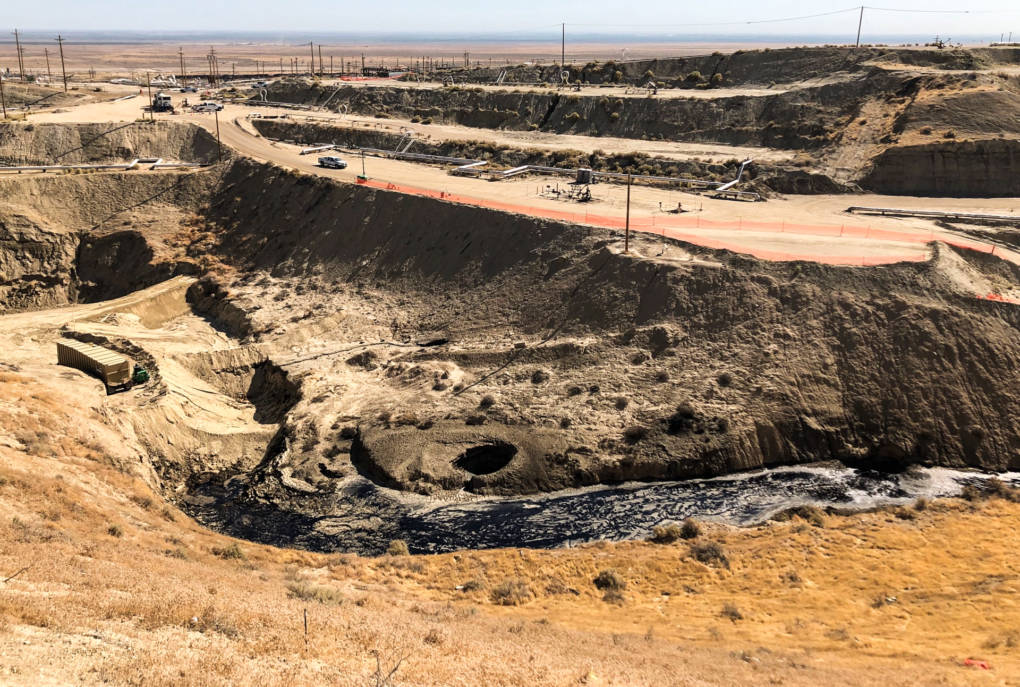
New Chevron Crude Spills Emerge in Kern County Oil Field
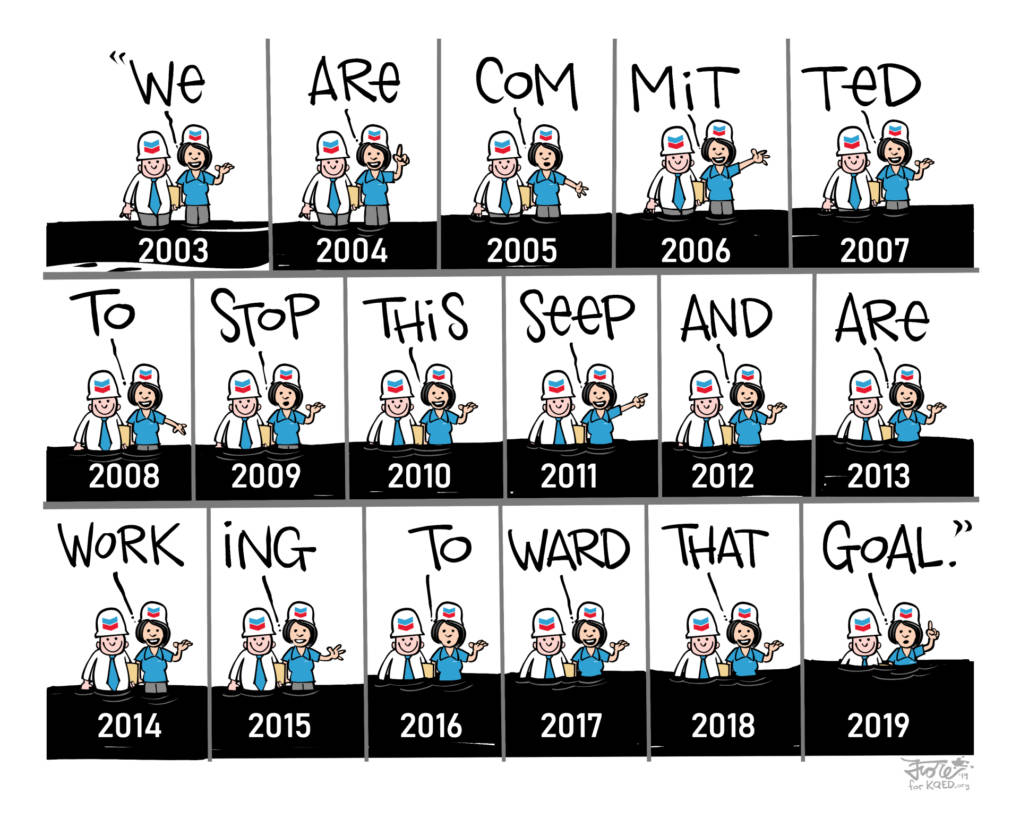
Chevron 'Committed' to Stopping Oil Spill That Started in 2003
State Launches Probe Into Oil Field Spills – Including One That's Been Flowing Since 2003
State Says It Has No Idea How Long It Will Take to Clean Up Chevron's Kern County Oil Spill
Town at Center of Kern County Oil Spill: 'You Don’t Really Think a Lot About It’
Lawmakers Push to Give Newsom Power to Call Fracking Moratorium, Setting Stage for Oil Industry Battle
Newsom 'Sees Progress' in Visit to Chevron Oil Spill Site, Emphasizes Need for Accountability
Sponsored
Player sponsored by
window.__IS_SSR__=true
window.__INITIAL_STATE__={
"attachmentsReducer": {
"audio_0": {
"type": "attachments",
"id": "audio_0",
"imgSizes": {
"kqedFullSize": {
"file": "https://ww2.kqed.org/news/wp-content/themes/KQED-unified/img/audio_bgs/background0.jpg"
}
}
},
"audio_1": {
"type": "attachments",
"id": "audio_1",
"imgSizes": {
"kqedFullSize": {
"file": "https://ww2.kqed.org/news/wp-content/themes/KQED-unified/img/audio_bgs/background1.jpg"
}
}
},
"audio_2": {
"type": "attachments",
"id": "audio_2",
"imgSizes": {
"kqedFullSize": {
"file": "https://ww2.kqed.org/news/wp-content/themes/KQED-unified/img/audio_bgs/background2.jpg"
}
}
},
"audio_3": {
"type": "attachments",
"id": "audio_3",
"imgSizes": {
"kqedFullSize": {
"file": "https://ww2.kqed.org/news/wp-content/themes/KQED-unified/img/audio_bgs/background3.jpg"
}
}
},
"audio_4": {
"type": "attachments",
"id": "audio_4",
"imgSizes": {
"kqedFullSize": {
"file": "https://ww2.kqed.org/news/wp-content/themes/KQED-unified/img/audio_bgs/background4.jpg"
}
}
},
"placeholder": {
"type": "attachments",
"id": "placeholder",
"imgSizes": {
"thumbnail": {
"file": "https://cdn.kqed.org/wp-content/uploads/2024/12/KQED-Default-Image-816638274-2000x1333-1-160x107.jpg",
"width": 160,
"height": 107,
"mimeType": "image/jpeg"
},
"medium": {
"file": "https://cdn.kqed.org/wp-content/uploads/2024/12/KQED-Default-Image-816638274-2000x1333-1-800x533.jpg",
"width": 800,
"height": 533,
"mimeType": "image/jpeg"
},
"medium_large": {
"file": "https://cdn.kqed.org/wp-content/uploads/2024/12/KQED-Default-Image-816638274-2000x1333-1-768x512.jpg",
"width": 768,
"height": 512,
"mimeType": "image/jpeg"
},
"large": {
"file": "https://cdn.kqed.org/wp-content/uploads/2024/12/KQED-Default-Image-816638274-2000x1333-1-1020x680.jpg",
"width": 1020,
"height": 680,
"mimeType": "image/jpeg"
},
"1536x1536": {
"file": "https://cdn.kqed.org/wp-content/uploads/2024/12/KQED-Default-Image-816638274-2000x1333-1-1536x1024.jpg",
"width": 1536,
"height": 1024,
"mimeType": "image/jpeg"
},
"fd-lrg": {
"file": "https://cdn.kqed.org/wp-content/uploads/2024/12/KQED-Default-Image-816638274-2000x1333-1-1536x1024.jpg",
"width": 1536,
"height": 1024,
"mimeType": "image/jpeg"
},
"fd-med": {
"file": "https://cdn.kqed.org/wp-content/uploads/2024/12/KQED-Default-Image-816638274-2000x1333-1-1020x680.jpg",
"width": 1020,
"height": 680,
"mimeType": "image/jpeg"
},
"fd-sm": {
"file": "https://cdn.kqed.org/wp-content/uploads/2024/12/KQED-Default-Image-816638274-2000x1333-1-800x533.jpg",
"width": 800,
"height": 533,
"mimeType": "image/jpeg"
},
"post-thumbnail": {
"file": "https://cdn.kqed.org/wp-content/uploads/2024/12/KQED-Default-Image-816638274-2000x1333-1-672x372.jpg",
"width": 672,
"height": 372,
"mimeType": "image/jpeg"
},
"twentyfourteen-full-width": {
"file": "https://cdn.kqed.org/wp-content/uploads/2024/12/KQED-Default-Image-816638274-2000x1333-1-1038x576.jpg",
"width": 1038,
"height": 576,
"mimeType": "image/jpeg"
},
"xxsmall": {
"file": "https://cdn.kqed.org/wp-content/uploads/2024/12/KQED-Default-Image-816638274-2000x1333-1-160x107.jpg",
"width": 160,
"height": 107,
"mimeType": "image/jpeg"
},
"xsmall": {
"file": "https://cdn.kqed.org/wp-content/uploads/2024/12/KQED-Default-Image-816638274-2000x1333-1-672x372.jpg",
"width": 672,
"height": 372,
"mimeType": "image/jpeg"
},
"small": {
"file": "https://cdn.kqed.org/wp-content/uploads/2024/12/KQED-Default-Image-816638274-2000x1333-1-672x372.jpg",
"width": 672,
"height": 372,
"mimeType": "image/jpeg"
},
"xlarge": {
"file": "https://cdn.kqed.org/wp-content/uploads/2024/12/KQED-Default-Image-816638274-2000x1333-1-1020x680.jpg",
"width": 1020,
"height": 680,
"mimeType": "image/jpeg"
},
"full-width": {
"file": "https://cdn.kqed.org/wp-content/uploads/2024/12/KQED-Default-Image-816638274-2000x1333-1-1920x1280.jpg",
"width": 1920,
"height": 1280,
"mimeType": "image/jpeg"
},
"guest-author-32": {
"file": "https://cdn.kqed.org/wp-content/uploads/2025/01/KQED-Default-Image-816638274-1333x1333-1-160x160.jpg",
"width": 32,
"height": 32,
"mimeType": "image/jpeg"
},
"guest-author-50": {
"file": "https://cdn.kqed.org/wp-content/uploads/2025/01/KQED-Default-Image-816638274-1333x1333-1-160x160.jpg",
"width": 50,
"height": 50,
"mimeType": "image/jpeg"
},
"guest-author-64": {
"file": "https://cdn.kqed.org/wp-content/uploads/2025/01/KQED-Default-Image-816638274-1333x1333-1-160x160.jpg",
"width": 64,
"height": 64,
"mimeType": "image/jpeg"
},
"guest-author-96": {
"file": "https://cdn.kqed.org/wp-content/uploads/2025/01/KQED-Default-Image-816638274-1333x1333-1-160x160.jpg",
"width": 96,
"height": 96,
"mimeType": "image/jpeg"
},
"guest-author-128": {
"file": "https://cdn.kqed.org/wp-content/uploads/2025/01/KQED-Default-Image-816638274-1333x1333-1-160x160.jpg",
"width": 128,
"height": 128,
"mimeType": "image/jpeg"
},
"detail": {
"file": "https://cdn.kqed.org/wp-content/uploads/2025/01/KQED-Default-Image-816638274-1333x1333-1-160x160.jpg",
"width": 160,
"height": 160,
"mimeType": "image/jpeg"
},
"kqedFullSize": {
"file": "https://cdn.kqed.org/wp-content/uploads/2024/12/KQED-Default-Image-816638274-2000x1333-1.jpg",
"width": 2000,
"height": 1333
}
}
},
"news_11818703": {
"type": "attachments",
"id": "news_11818703",
"meta": {
"index": "attachments_1716263798",
"site": "news",
"id": "11818703",
"found": true
},
"parent": 11818575,
"imgSizes": {
"apple_news_ca_landscape_5_5": {
"file": "https://ww2.kqed.org/app/uploads/sites/10/2020/05/Newsom-Cymric-oil-spill-chevron-1044x783.jpg",
"width": 1044,
"mimeType": "image/jpeg",
"height": 783
},
"apple_news_ca_square_4_0": {
"file": "https://ww2.kqed.org/app/uploads/sites/10/2020/05/Newsom-Cymric-oil-spill-chevron-470x470.jpg",
"width": 470,
"mimeType": "image/jpeg",
"height": 470
},
"twentyfourteen-full-width": {
"file": "https://ww2.kqed.org/app/uploads/sites/10/2020/05/Newsom-Cymric-oil-spill-chevron-1038x576.jpg",
"width": 1038,
"mimeType": "image/jpeg",
"height": 576
},
"thumbnail": {
"file": "https://ww2.kqed.org/app/uploads/sites/10/2020/05/Newsom-Cymric-oil-spill-chevron-160x111.jpg",
"width": 160,
"mimeType": "image/jpeg",
"height": 111
},
"post-thumbnail": {
"file": "https://ww2.kqed.org/app/uploads/sites/10/2020/05/Newsom-Cymric-oil-spill-chevron-672x372.jpg",
"width": 672,
"mimeType": "image/jpeg",
"height": 372
},
"kqedFullSize": {
"file": "https://ww2.kqed.org/app/uploads/sites/10/2020/05/Newsom-Cymric-oil-spill-chevron.jpg",
"width": 1920,
"height": 1329
},
"apple_news_ca_landscape_4_7": {
"file": "https://ww2.kqed.org/app/uploads/sites/10/2020/05/Newsom-Cymric-oil-spill-chevron-632x474.jpg",
"width": 632,
"mimeType": "image/jpeg",
"height": 474
},
"large": {
"file": "https://ww2.kqed.org/app/uploads/sites/10/2020/05/Newsom-Cymric-oil-spill-chevron-1020x706.jpg",
"width": 1020,
"mimeType": "image/jpeg",
"height": 706
},
"apple_news_ca_landscape_4_0": {
"file": "https://ww2.kqed.org/app/uploads/sites/10/2020/05/Newsom-Cymric-oil-spill-chevron-536x402.jpg",
"width": 536,
"mimeType": "image/jpeg",
"height": 402
},
"apple_news_ca_portrait_12_9": {
"file": "https://ww2.kqed.org/app/uploads/sites/10/2020/05/Newsom-Cymric-oil-spill-chevron-1122x1329.jpg",
"width": 1122,
"mimeType": "image/jpeg",
"height": 1329
},
"medium": {
"file": "https://ww2.kqed.org/app/uploads/sites/10/2020/05/Newsom-Cymric-oil-spill-chevron-800x554.jpg",
"width": 800,
"mimeType": "image/jpeg",
"height": 554
},
"apple_news_ca_portrait_4_0": {
"file": "https://ww2.kqed.org/app/uploads/sites/10/2020/05/Newsom-Cymric-oil-spill-chevron-354x472.jpg",
"width": 354,
"mimeType": "image/jpeg",
"height": 472
},
"apple_news_ca_portrait_9_7": {
"file": "https://ww2.kqed.org/app/uploads/sites/10/2020/05/Newsom-Cymric-oil-spill-chevron-840x1120.jpg",
"width": 840,
"mimeType": "image/jpeg",
"height": 1120
},
"apple_news_ca_landscape_12_9": {
"file": "https://ww2.kqed.org/app/uploads/sites/10/2020/05/Newsom-Cymric-oil-spill-chevron-1832x1329.jpg",
"width": 1832,
"mimeType": "image/jpeg",
"height": 1329
},
"apple_news_ca_square_9_7": {
"file": "https://ww2.kqed.org/app/uploads/sites/10/2020/05/Newsom-Cymric-oil-spill-chevron-1104x1104.jpg",
"width": 1104,
"mimeType": "image/jpeg",
"height": 1104
},
"apple_news_ca_portrait_4_7": {
"file": "https://ww2.kqed.org/app/uploads/sites/10/2020/05/Newsom-Cymric-oil-spill-chevron-414x552.jpg",
"width": 414,
"mimeType": "image/jpeg",
"height": 552
},
"apple_news_ca_square_12_9": {
"file": "https://ww2.kqed.org/app/uploads/sites/10/2020/05/Newsom-Cymric-oil-spill-chevron-1472x1329.jpg",
"width": 1472,
"mimeType": "image/jpeg",
"height": 1329
},
"apple_news_ca_portrait_5_5": {
"file": "https://ww2.kqed.org/app/uploads/sites/10/2020/05/Newsom-Cymric-oil-spill-chevron-687x916.jpg",
"width": 687,
"mimeType": "image/jpeg",
"height": 916
},
"full-width": {
"file": "https://ww2.kqed.org/app/uploads/sites/10/2020/05/Newsom-Cymric-oil-spill-chevron-1920x1329.jpg",
"width": 1920,
"mimeType": "image/jpeg",
"height": 1329
},
"apple_news_ca_square_4_7": {
"file": "https://ww2.kqed.org/app/uploads/sites/10/2020/05/Newsom-Cymric-oil-spill-chevron-550x550.jpg",
"width": 550,
"mimeType": "image/jpeg",
"height": 550
},
"apple_news_ca_landscape_9_7": {
"file": "https://ww2.kqed.org/app/uploads/sites/10/2020/05/Newsom-Cymric-oil-spill-chevron-1376x1032.jpg",
"width": 1376,
"mimeType": "image/jpeg",
"height": 1032
},
"apple_news_ca_square_5_5": {
"file": "https://ww2.kqed.org/app/uploads/sites/10/2020/05/Newsom-Cymric-oil-spill-chevron-912x912.jpg",
"width": 912,
"mimeType": "image/jpeg",
"height": 912
}
},
"publishDate": 1589578183,
"modified": 1589586917,
"caption": "Gov. Gavin Newsom is briefed by Jason Marshall (center) of the state Division of Oil, Gas, and Geothermal Resources (DOGGR) - now called CalGEM - on July 24, 2019, while touring the Cymric Oil Field in Kern County, the site of California's largest oil spill in decades.",
"description": "Gov. Gavin Newsom is briefed by Jason Marshall (center) of the state Division of Oil, Gas, and Geothermal Resources (DOGGR) - now called CalGEM - on July 24, 2019, while touring the Cymric oil field in Kern County, the site of California's largest oil spill in decades.",
"title": "Newsom-Cymric-oil-spill-chevron",
"credit": "(Irfan Khan/Los Angeles Times/Pool",
"status": "inherit",
"fetchFailed": false,
"isLoading": false
},
"news_11769683": {
"type": "attachments",
"id": "news_11769683",
"meta": {
"index": "attachments_1716263798",
"site": "news",
"id": "11769683",
"found": true
},
"parent": 11769242,
"imgSizes": {
"apple_news_ca_landscape_5_5": {
"file": "https://ww2.kqed.org/app/uploads/sites/10/2019/08/cymricspill-1044x783.jpg",
"width": 1044,
"mimeType": "image/jpeg",
"height": 783
},
"apple_news_ca_square_4_0": {
"file": "https://ww2.kqed.org/app/uploads/sites/10/2019/08/cymricspill-470x470.jpg",
"width": 470,
"mimeType": "image/jpeg",
"height": 470
},
"twentyfourteen-full-width": {
"file": "https://ww2.kqed.org/app/uploads/sites/10/2019/08/cymricspill-1038x576.jpg",
"width": 1038,
"mimeType": "image/jpeg",
"height": 576
},
"thumbnail": {
"file": "https://ww2.kqed.org/app/uploads/sites/10/2019/08/cymricspill-160x96.jpg",
"width": 160,
"mimeType": "image/jpeg",
"height": 96
},
"post-thumbnail": {
"file": "https://ww2.kqed.org/app/uploads/sites/10/2019/08/cymricspill-672x372.jpg",
"width": 672,
"mimeType": "image/jpeg",
"height": 372
},
"kqedFullSize": {
"file": "https://ww2.kqed.org/app/uploads/sites/10/2019/08/cymricspill-e1566606367463.jpg",
"width": 1920,
"height": 1155
},
"apple_news_ca_landscape_4_7": {
"file": "https://ww2.kqed.org/app/uploads/sites/10/2019/08/cymricspill-632x474.jpg",
"width": 632,
"mimeType": "image/jpeg",
"height": 474
},
"large": {
"file": "https://ww2.kqed.org/app/uploads/sites/10/2019/08/cymricspill-1020x614.jpg",
"width": 1020,
"mimeType": "image/jpeg",
"height": 614
},
"complete_open_graph": {
"file": "https://ww2.kqed.org/app/uploads/sites/10/2019/08/cymricspill-1200x722.jpg",
"width": 1200,
"mimeType": "image/jpeg",
"height": 722
},
"apple_news_ca_landscape_4_0": {
"file": "https://ww2.kqed.org/app/uploads/sites/10/2019/08/cymricspill-536x402.jpg",
"width": 536,
"mimeType": "image/jpeg",
"height": 402
},
"apple_news_ca_portrait_12_9": {
"file": "https://ww2.kqed.org/app/uploads/sites/10/2019/08/cymricspill-1122x1496.jpg",
"width": 1122,
"mimeType": "image/jpeg",
"height": 1496
},
"medium": {
"file": "https://ww2.kqed.org/app/uploads/sites/10/2019/08/cymricspill-800x481.jpg",
"width": 800,
"mimeType": "image/jpeg",
"height": 481
},
"apple_news_ca_portrait_4_0": {
"file": "https://ww2.kqed.org/app/uploads/sites/10/2019/08/cymricspill-354x472.jpg",
"width": 354,
"mimeType": "image/jpeg",
"height": 472
},
"apple_news_ca_portrait_9_7": {
"file": "https://ww2.kqed.org/app/uploads/sites/10/2019/08/cymricspill-840x1120.jpg",
"width": 840,
"mimeType": "image/jpeg",
"height": 1120
},
"apple_news_ca_landscape_12_9": {
"file": "https://ww2.kqed.org/app/uploads/sites/10/2019/08/cymricspill-1832x1374.jpg",
"width": 1832,
"mimeType": "image/jpeg",
"height": 1374
},
"apple_news_ca_square_9_7": {
"file": "https://ww2.kqed.org/app/uploads/sites/10/2019/08/cymricspill-1104x1104.jpg",
"width": 1104,
"mimeType": "image/jpeg",
"height": 1104
},
"apple_news_ca_portrait_4_7": {
"file": "https://ww2.kqed.org/app/uploads/sites/10/2019/08/cymricspill-414x552.jpg",
"width": 414,
"mimeType": "image/jpeg",
"height": 552
},
"apple_news_ca_square_12_9": {
"file": "https://ww2.kqed.org/app/uploads/sites/10/2019/08/cymricspill-1472x1472.jpg",
"width": 1472,
"mimeType": "image/jpeg",
"height": 1472
},
"apple_news_ca_portrait_5_5": {
"file": "https://ww2.kqed.org/app/uploads/sites/10/2019/08/cymricspill-687x916.jpg",
"width": 687,
"mimeType": "image/jpeg",
"height": 916
},
"full-width": {
"file": "https://ww2.kqed.org/app/uploads/sites/10/2019/08/cymricspill-1920x1155.jpg",
"width": 1920,
"mimeType": "image/jpeg",
"height": 1155
},
"apple_news_ca_square_4_7": {
"file": "https://ww2.kqed.org/app/uploads/sites/10/2019/08/cymricspill-550x550.jpg",
"width": 550,
"mimeType": "image/jpeg",
"height": 550
},
"apple_news_ca_landscape_9_7": {
"file": "https://ww2.kqed.org/app/uploads/sites/10/2019/08/cymricspill-1376x1032.jpg",
"width": 1376,
"mimeType": "image/jpeg",
"height": 1032
},
"apple_news_ca_square_5_5": {
"file": "https://ww2.kqed.org/app/uploads/sites/10/2019/08/cymricspill-912x912.jpg",
"width": 912,
"mimeType": "image/jpeg",
"height": 912
}
},
"publishDate": 1566606336,
"modified": 1574188363,
"caption": "A still image from drone video showing work to clean up an oil spill near a Chevron well in Kern County. ",
"description": null,
"title": "Chevron Spill-Kern County",
"credit": "\u003ca href=\"https://youtu.be/kuNJOh6k4pk\" target=\"_blank\">TJ Frantz\u003c/a> via Twitter",
"status": "inherit",
"fetchFailed": false,
"isLoading": false
},
"news_11763286": {
"type": "attachments",
"id": "news_11763286",
"meta": {
"index": "attachments_1716263798",
"site": "news",
"id": "11763286",
"found": true
},
"parent": 11763273,
"imgSizes": {
"apple_news_ca_landscape_5_5": {
"file": "https://ww2.kqed.org/app/uploads/sites/10/2019/07/Newsom-at-Chevron-Oil-Spill-1044x783.jpg",
"width": 1044,
"mimeType": "image/jpeg",
"height": 783
},
"apple_news_ca_square_4_0": {
"file": "https://ww2.kqed.org/app/uploads/sites/10/2019/07/Newsom-at-Chevron-Oil-Spill-470x470.jpg",
"width": 470,
"mimeType": "image/jpeg",
"height": 470
},
"twentyfourteen-full-width": {
"file": "https://ww2.kqed.org/app/uploads/sites/10/2019/07/Newsom-at-Chevron-Oil-Spill-1038x576.jpg",
"width": 1038,
"mimeType": "image/jpeg",
"height": 576
},
"thumbnail": {
"file": "https://ww2.kqed.org/app/uploads/sites/10/2019/07/Newsom-at-Chevron-Oil-Spill-160x108.jpg",
"width": 160,
"mimeType": "image/jpeg",
"height": 108
},
"post-thumbnail": {
"file": "https://ww2.kqed.org/app/uploads/sites/10/2019/07/Newsom-at-Chevron-Oil-Spill-672x372.jpg",
"width": 672,
"mimeType": "image/jpeg",
"height": 372
},
"kqedFullSize": {
"file": "https://ww2.kqed.org/app/uploads/sites/10/2019/07/Newsom-at-Chevron-Oil-Spill.jpg",
"width": 1920,
"height": 1295
},
"apple_news_ca_landscape_4_7": {
"file": "https://ww2.kqed.org/app/uploads/sites/10/2019/07/Newsom-at-Chevron-Oil-Spill-632x474.jpg",
"width": 632,
"mimeType": "image/jpeg",
"height": 474
},
"large": {
"file": "https://ww2.kqed.org/app/uploads/sites/10/2019/07/Newsom-at-Chevron-Oil-Spill-1020x688.jpg",
"width": 1020,
"mimeType": "image/jpeg",
"height": 688
},
"complete_open_graph": {
"file": "https://ww2.kqed.org/app/uploads/sites/10/2019/07/Newsom-at-Chevron-Oil-Spill-1200x809.jpg",
"width": 1200,
"mimeType": "image/jpeg",
"height": 809
},
"apple_news_ca_landscape_4_0": {
"file": "https://ww2.kqed.org/app/uploads/sites/10/2019/07/Newsom-at-Chevron-Oil-Spill-536x402.jpg",
"width": 536,
"mimeType": "image/jpeg",
"height": 402
},
"apple_news_ca_portrait_12_9": {
"file": "https://ww2.kqed.org/app/uploads/sites/10/2019/07/Newsom-at-Chevron-Oil-Spill-1122x1295.jpg",
"width": 1122,
"mimeType": "image/jpeg",
"height": 1295
},
"medium": {
"file": "https://ww2.kqed.org/app/uploads/sites/10/2019/07/Newsom-at-Chevron-Oil-Spill-800x540.jpg",
"width": 800,
"mimeType": "image/jpeg",
"height": 540
},
"apple_news_ca_portrait_4_0": {
"file": "https://ww2.kqed.org/app/uploads/sites/10/2019/07/Newsom-at-Chevron-Oil-Spill-354x472.jpg",
"width": 354,
"mimeType": "image/jpeg",
"height": 472
},
"apple_news_ca_portrait_9_7": {
"file": "https://ww2.kqed.org/app/uploads/sites/10/2019/07/Newsom-at-Chevron-Oil-Spill-840x1120.jpg",
"width": 840,
"mimeType": "image/jpeg",
"height": 1120
},
"apple_news_ca_landscape_12_9": {
"file": "https://ww2.kqed.org/app/uploads/sites/10/2019/07/Newsom-at-Chevron-Oil-Spill-1832x1295.jpg",
"width": 1832,
"mimeType": "image/jpeg",
"height": 1295
},
"apple_news_ca_square_9_7": {
"file": "https://ww2.kqed.org/app/uploads/sites/10/2019/07/Newsom-at-Chevron-Oil-Spill-1104x1104.jpg",
"width": 1104,
"mimeType": "image/jpeg",
"height": 1104
},
"apple_news_ca_portrait_4_7": {
"file": "https://ww2.kqed.org/app/uploads/sites/10/2019/07/Newsom-at-Chevron-Oil-Spill-414x552.jpg",
"width": 414,
"mimeType": "image/jpeg",
"height": 552
},
"apple_news_ca_square_12_9": {
"file": "https://ww2.kqed.org/app/uploads/sites/10/2019/07/Newsom-at-Chevron-Oil-Spill-1472x1295.jpg",
"width": 1472,
"mimeType": "image/jpeg",
"height": 1295
},
"apple_news_ca_portrait_5_5": {
"file": "https://ww2.kqed.org/app/uploads/sites/10/2019/07/Newsom-at-Chevron-Oil-Spill-687x916.jpg",
"width": 687,
"mimeType": "image/jpeg",
"height": 916
},
"full-width": {
"file": "https://ww2.kqed.org/app/uploads/sites/10/2019/07/Newsom-at-Chevron-Oil-Spill-1920x1295.jpg",
"width": 1920,
"mimeType": "image/jpeg",
"height": 1295
},
"apple_news_ca_square_4_7": {
"file": "https://ww2.kqed.org/app/uploads/sites/10/2019/07/Newsom-at-Chevron-Oil-Spill-550x550.jpg",
"width": 550,
"mimeType": "image/jpeg",
"height": 550
},
"apple_news_ca_landscape_9_7": {
"file": "https://ww2.kqed.org/app/uploads/sites/10/2019/07/Newsom-at-Chevron-Oil-Spill-1376x1032.jpg",
"width": 1376,
"mimeType": "image/jpeg",
"height": 1032
},
"apple_news_ca_square_5_5": {
"file": "https://ww2.kqed.org/app/uploads/sites/10/2019/07/Newsom-at-Chevron-Oil-Spill-912x912.jpg",
"width": 912,
"mimeType": "image/jpeg",
"height": 912
}
},
"publishDate": 1564014702,
"modified": 1571166751,
"caption": "Gov. Gavin Newsom is briefed by Billy Lacobie, of Chevron (center) and Jason Marshall (right) of the state Division of Oil, Gas, and Geothermal Resources (DOGGR) on July 24, 2019, while touring an oil field near Bakersfield. ",
"description": "Gov. Gavin Newsom is briefed by Billy Lacobie, of Chevron (center) and Jason Marshall (right) of the state Division of Oil, Gas, and Geothermal Resources (DOGGR) on Wednesday, while touring an oil field near Bakersfield. ",
"title": "Newsom-at-Chevron-Oil-Spill",
"credit": "Irfan Khan/Los Angeles Times/Pool",
"status": "inherit",
"fetchFailed": false,
"isLoading": false
},
"news_11770466": {
"type": "attachments",
"id": "news_11770466",
"meta": {
"index": "attachments_1716263798",
"site": "news",
"id": "11770466",
"found": true
},
"parent": 11770458,
"imgSizes": {
"apple_news_ca_landscape_5_5": {
"file": "https://ww2.kqed.org/app/uploads/sites/10/2019/08/committed_082719_final-1044x783.jpg",
"width": 1044,
"mimeType": "image/jpeg",
"height": 783
},
"apple_news_ca_square_4_0": {
"file": "https://ww2.kqed.org/app/uploads/sites/10/2019/08/committed_082719_final-470x470.jpg",
"width": 470,
"mimeType": "image/jpeg",
"height": 470
},
"twentyfourteen-full-width": {
"file": "https://ww2.kqed.org/app/uploads/sites/10/2019/08/committed_082719_final-1038x576.jpg",
"width": 1038,
"mimeType": "image/jpeg",
"height": 576
},
"thumbnail": {
"file": "https://ww2.kqed.org/app/uploads/sites/10/2019/08/committed_082719_final-160x128.jpg",
"width": 160,
"mimeType": "image/jpeg",
"height": 128
},
"post-thumbnail": {
"file": "https://ww2.kqed.org/app/uploads/sites/10/2019/08/committed_082719_final-672x372.jpg",
"width": 672,
"mimeType": "image/jpeg",
"height": 372
},
"kqedFullSize": {
"file": "https://ww2.kqed.org/app/uploads/sites/10/2019/08/committed_082719_final.jpg",
"width": 1921,
"height": 1540
},
"apple_news_ca_landscape_4_7": {
"file": "https://ww2.kqed.org/app/uploads/sites/10/2019/08/committed_082719_final-632x474.jpg",
"width": 632,
"mimeType": "image/jpeg",
"height": 474
},
"large": {
"file": "https://ww2.kqed.org/app/uploads/sites/10/2019/08/committed_082719_final-1020x818.jpg",
"width": 1020,
"mimeType": "image/jpeg",
"height": 818
},
"complete_open_graph": {
"file": "https://ww2.kqed.org/app/uploads/sites/10/2019/08/committed_082719_final-1200x962.jpg",
"width": 1200,
"mimeType": "image/jpeg",
"height": 962
},
"apple_news_ca_landscape_4_0": {
"file": "https://ww2.kqed.org/app/uploads/sites/10/2019/08/committed_082719_final-536x402.jpg",
"width": 536,
"mimeType": "image/jpeg",
"height": 402
},
"apple_news_ca_portrait_12_9": {
"file": "https://ww2.kqed.org/app/uploads/sites/10/2019/08/committed_082719_final-1122x1496.jpg",
"width": 1122,
"mimeType": "image/jpeg",
"height": 1496
},
"medium": {
"file": "https://ww2.kqed.org/app/uploads/sites/10/2019/08/committed_082719_final-800x641.jpg",
"width": 800,
"mimeType": "image/jpeg",
"height": 641
},
"apple_news_ca_portrait_4_0": {
"file": "https://ww2.kqed.org/app/uploads/sites/10/2019/08/committed_082719_final-354x472.jpg",
"width": 354,
"mimeType": "image/jpeg",
"height": 472
},
"apple_news_ca_portrait_9_7": {
"file": "https://ww2.kqed.org/app/uploads/sites/10/2019/08/committed_082719_final-840x1120.jpg",
"width": 840,
"mimeType": "image/jpeg",
"height": 1120
},
"apple_news_ca_landscape_12_9": {
"file": "https://ww2.kqed.org/app/uploads/sites/10/2019/08/committed_082719_final-1832x1374.jpg",
"width": 1832,
"mimeType": "image/jpeg",
"height": 1374
},
"apple_news_ca_square_9_7": {
"file": "https://ww2.kqed.org/app/uploads/sites/10/2019/08/committed_082719_final-1104x1104.jpg",
"width": 1104,
"mimeType": "image/jpeg",
"height": 1104
},
"apple_news_ca_portrait_4_7": {
"file": "https://ww2.kqed.org/app/uploads/sites/10/2019/08/committed_082719_final-414x552.jpg",
"width": 414,
"mimeType": "image/jpeg",
"height": 552
},
"apple_news_ca_square_12_9": {
"file": "https://ww2.kqed.org/app/uploads/sites/10/2019/08/committed_082719_final-1472x1472.jpg",
"width": 1472,
"mimeType": "image/jpeg",
"height": 1472
},
"apple_news_ca_portrait_5_5": {
"file": "https://ww2.kqed.org/app/uploads/sites/10/2019/08/committed_082719_final-687x916.jpg",
"width": 687,
"mimeType": "image/jpeg",
"height": 916
},
"full-width": {
"file": "https://ww2.kqed.org/app/uploads/sites/10/2019/08/committed_082719_final-1920x1539.jpg",
"width": 1920,
"mimeType": "image/jpeg",
"height": 1539
},
"apple_news_ca_square_4_7": {
"file": "https://ww2.kqed.org/app/uploads/sites/10/2019/08/committed_082719_final-550x550.jpg",
"width": 550,
"mimeType": "image/jpeg",
"height": 550
},
"apple_news_ca_landscape_9_7": {
"file": "https://ww2.kqed.org/app/uploads/sites/10/2019/08/committed_082719_final-1376x1032.jpg",
"width": 1376,
"mimeType": "image/jpeg",
"height": 1032
},
"apple_news_ca_square_5_5": {
"file": "https://ww2.kqed.org/app/uploads/sites/10/2019/08/committed_082719_final-912x912.jpg",
"width": 912,
"mimeType": "image/jpeg",
"height": 912
}
},
"publishDate": 1566945786,
"modified": 1566945810,
"caption": null,
"description": null,
"title": "committed_082719_final",
"credit": null,
"status": "inherit",
"fetchFailed": false,
"isLoading": false
},
"news_11769918": {
"type": "attachments",
"id": "news_11769918",
"meta": {
"index": "attachments_1716263798",
"site": "news",
"id": "11769918",
"found": true
},
"parent": 11769850,
"imgSizes": {
"apple_news_ca_landscape_5_5": {
"file": "https://ww2.kqed.org/app/uploads/sites/10/2019/08/cymriccleanup082319-1044x783.jpg",
"width": 1044,
"mimeType": "image/jpeg",
"height": 783
},
"apple_news_ca_square_4_0": {
"file": "https://ww2.kqed.org/app/uploads/sites/10/2019/08/cymriccleanup082319-470x470.jpg",
"width": 470,
"mimeType": "image/jpeg",
"height": 470
},
"twentyfourteen-full-width": {
"file": "https://ww2.kqed.org/app/uploads/sites/10/2019/08/cymriccleanup082319-1038x576.jpg",
"width": 1038,
"mimeType": "image/jpeg",
"height": 576
},
"thumbnail": {
"file": "https://ww2.kqed.org/app/uploads/sites/10/2019/08/cymriccleanup082319-160x108.jpg",
"width": 160,
"mimeType": "image/jpeg",
"height": 108
},
"post-thumbnail": {
"file": "https://ww2.kqed.org/app/uploads/sites/10/2019/08/cymriccleanup082319-672x372.jpg",
"width": 672,
"mimeType": "image/jpeg",
"height": 372
},
"kqedFullSize": {
"file": "https://ww2.kqed.org/app/uploads/sites/10/2019/08/cymriccleanup082319.jpg",
"width": 1920,
"height": 1293
},
"apple_news_ca_landscape_4_7": {
"file": "https://ww2.kqed.org/app/uploads/sites/10/2019/08/cymriccleanup082319-632x474.jpg",
"width": 632,
"mimeType": "image/jpeg",
"height": 474
},
"large": {
"file": "https://ww2.kqed.org/app/uploads/sites/10/2019/08/cymriccleanup082319-1020x687.jpg",
"width": 1020,
"mimeType": "image/jpeg",
"height": 687
},
"complete_open_graph": {
"file": "https://ww2.kqed.org/app/uploads/sites/10/2019/08/cymriccleanup082319-1200x808.jpg",
"width": 1200,
"mimeType": "image/jpeg",
"height": 808
},
"apple_news_ca_landscape_4_0": {
"file": "https://ww2.kqed.org/app/uploads/sites/10/2019/08/cymriccleanup082319-536x402.jpg",
"width": 536,
"mimeType": "image/jpeg",
"height": 402
},
"apple_news_ca_portrait_12_9": {
"file": "https://ww2.kqed.org/app/uploads/sites/10/2019/08/cymriccleanup082319-1122x1293.jpg",
"width": 1122,
"mimeType": "image/jpeg",
"height": 1293
},
"medium": {
"file": "https://ww2.kqed.org/app/uploads/sites/10/2019/08/cymriccleanup082319-800x539.jpg",
"width": 800,
"mimeType": "image/jpeg",
"height": 539
},
"apple_news_ca_portrait_4_0": {
"file": "https://ww2.kqed.org/app/uploads/sites/10/2019/08/cymriccleanup082319-354x472.jpg",
"width": 354,
"mimeType": "image/jpeg",
"height": 472
},
"apple_news_ca_portrait_9_7": {
"file": "https://ww2.kqed.org/app/uploads/sites/10/2019/08/cymriccleanup082319-840x1120.jpg",
"width": 840,
"mimeType": "image/jpeg",
"height": 1120
},
"apple_news_ca_landscape_12_9": {
"file": "https://ww2.kqed.org/app/uploads/sites/10/2019/08/cymriccleanup082319-1832x1293.jpg",
"width": 1832,
"mimeType": "image/jpeg",
"height": 1293
},
"apple_news_ca_square_9_7": {
"file": "https://ww2.kqed.org/app/uploads/sites/10/2019/08/cymriccleanup082319-1104x1104.jpg",
"width": 1104,
"mimeType": "image/jpeg",
"height": 1104
},
"apple_news_ca_portrait_4_7": {
"file": "https://ww2.kqed.org/app/uploads/sites/10/2019/08/cymriccleanup082319-414x552.jpg",
"width": 414,
"mimeType": "image/jpeg",
"height": 552
},
"apple_news_ca_square_12_9": {
"file": "https://ww2.kqed.org/app/uploads/sites/10/2019/08/cymriccleanup082319-1472x1293.jpg",
"width": 1472,
"mimeType": "image/jpeg",
"height": 1293
},
"apple_news_ca_portrait_5_5": {
"file": "https://ww2.kqed.org/app/uploads/sites/10/2019/08/cymriccleanup082319-687x916.jpg",
"width": 687,
"mimeType": "image/jpeg",
"height": 916
},
"full-width": {
"file": "https://ww2.kqed.org/app/uploads/sites/10/2019/08/cymriccleanup082319-1920x1293.jpg",
"width": 1920,
"mimeType": "image/jpeg",
"height": 1293
},
"apple_news_ca_square_4_7": {
"file": "https://ww2.kqed.org/app/uploads/sites/10/2019/08/cymriccleanup082319-550x550.jpg",
"width": 550,
"mimeType": "image/jpeg",
"height": 550
},
"apple_news_ca_landscape_9_7": {
"file": "https://ww2.kqed.org/app/uploads/sites/10/2019/08/cymriccleanup082319-1376x1032.jpg",
"width": 1376,
"mimeType": "image/jpeg",
"height": 1032
},
"apple_news_ca_square_5_5": {
"file": "https://ww2.kqed.org/app/uploads/sites/10/2019/08/cymriccleanup082319-912x912.jpg",
"width": 912,
"mimeType": "image/jpeg",
"height": 912
}
},
"publishDate": 1566805267,
"modified": 1566838718,
"caption": "A section of the creek bed inundated by an oil spill near a Chevron well in Kern County awaits cleanup in this Aug. 21 image. ",
"description": "A section of the creek bed inundated by an oil spill near a Chevron well in Kern County awaits cleanup in this Aug. 21 image. ",
"title": "Chevron-Kern County Spill",
"credit": "California Department of Conservation",
"status": "inherit",
"fetchFailed": false,
"isLoading": false
},
"news_11769738": {
"type": "attachments",
"id": "news_11769738",
"meta": {
"index": "attachments_1716263798",
"site": "news",
"id": "11769738",
"found": true
},
"parent": 11769242,
"imgSizes": {
"apple_news_ca_landscape_5_5": {
"file": "https://ww2.kqed.org/app/uploads/sites/10/2019/08/chevron-spill-2-1044x783.jpg",
"width": 1044,
"mimeType": "image/jpeg",
"height": 783
},
"apple_news_ca_square_4_0": {
"file": "https://ww2.kqed.org/app/uploads/sites/10/2019/08/chevron-spill-2-470x470.jpg",
"width": 470,
"mimeType": "image/jpeg",
"height": 470
},
"twentyfourteen-full-width": {
"file": "https://ww2.kqed.org/app/uploads/sites/10/2019/08/chevron-spill-2-1038x576.jpg",
"width": 1038,
"mimeType": "image/jpeg",
"height": 576
},
"thumbnail": {
"file": "https://ww2.kqed.org/app/uploads/sites/10/2019/08/chevron-spill-2-160x96.jpg",
"width": 160,
"mimeType": "image/jpeg",
"height": 96
},
"post-thumbnail": {
"file": "https://ww2.kqed.org/app/uploads/sites/10/2019/08/chevron-spill-2-672x372.jpg",
"width": 672,
"mimeType": "image/jpeg",
"height": 372
},
"kqedFullSize": {
"file": "https://ww2.kqed.org/app/uploads/sites/10/2019/08/chevron-spill-2-e1566615486150.jpg",
"width": 1920,
"height": 1155
},
"apple_news_ca_landscape_4_7": {
"file": "https://ww2.kqed.org/app/uploads/sites/10/2019/08/chevron-spill-2-632x474.jpg",
"width": 632,
"mimeType": "image/jpeg",
"height": 474
},
"large": {
"file": "https://ww2.kqed.org/app/uploads/sites/10/2019/08/chevron-spill-2-1020x614.jpg",
"width": 1020,
"mimeType": "image/jpeg",
"height": 614
},
"complete_open_graph": {
"file": "https://ww2.kqed.org/app/uploads/sites/10/2019/08/chevron-spill-2-1200x722.jpg",
"width": 1200,
"mimeType": "image/jpeg",
"height": 722
},
"apple_news_ca_landscape_4_0": {
"file": "https://ww2.kqed.org/app/uploads/sites/10/2019/08/chevron-spill-2-536x402.jpg",
"width": 536,
"mimeType": "image/jpeg",
"height": 402
},
"apple_news_ca_portrait_12_9": {
"file": "https://ww2.kqed.org/app/uploads/sites/10/2019/08/chevron-spill-2-1122x1496.jpg",
"width": 1122,
"mimeType": "image/jpeg",
"height": 1496
},
"medium": {
"file": "https://ww2.kqed.org/app/uploads/sites/10/2019/08/chevron-spill-2-800x481.jpg",
"width": 800,
"mimeType": "image/jpeg",
"height": 481
},
"apple_news_ca_portrait_4_0": {
"file": "https://ww2.kqed.org/app/uploads/sites/10/2019/08/chevron-spill-2-354x472.jpg",
"width": 354,
"mimeType": "image/jpeg",
"height": 472
},
"apple_news_ca_portrait_9_7": {
"file": "https://ww2.kqed.org/app/uploads/sites/10/2019/08/chevron-spill-2-840x1120.jpg",
"width": 840,
"mimeType": "image/jpeg",
"height": 1120
},
"apple_news_ca_landscape_12_9": {
"file": "https://ww2.kqed.org/app/uploads/sites/10/2019/08/chevron-spill-2-1832x1374.jpg",
"width": 1832,
"mimeType": "image/jpeg",
"height": 1374
},
"apple_news_ca_square_9_7": {
"file": "https://ww2.kqed.org/app/uploads/sites/10/2019/08/chevron-spill-2-1104x1104.jpg",
"width": 1104,
"mimeType": "image/jpeg",
"height": 1104
},
"apple_news_ca_portrait_4_7": {
"file": "https://ww2.kqed.org/app/uploads/sites/10/2019/08/chevron-spill-2-414x552.jpg",
"width": 414,
"mimeType": "image/jpeg",
"height": 552
},
"apple_news_ca_square_12_9": {
"file": "https://ww2.kqed.org/app/uploads/sites/10/2019/08/chevron-spill-2-1472x1472.jpg",
"width": 1472,
"mimeType": "image/jpeg",
"height": 1472
},
"apple_news_ca_portrait_5_5": {
"file": "https://ww2.kqed.org/app/uploads/sites/10/2019/08/chevron-spill-2-687x916.jpg",
"width": 687,
"mimeType": "image/jpeg",
"height": 916
},
"full-width": {
"file": "https://ww2.kqed.org/app/uploads/sites/10/2019/08/chevron-spill-2-1920x1155.jpg",
"width": 1920,
"mimeType": "image/jpeg",
"height": 1155
},
"apple_news_ca_square_4_7": {
"file": "https://ww2.kqed.org/app/uploads/sites/10/2019/08/chevron-spill-2-550x550.jpg",
"width": 550,
"mimeType": "image/jpeg",
"height": 550
},
"apple_news_ca_landscape_9_7": {
"file": "https://ww2.kqed.org/app/uploads/sites/10/2019/08/chevron-spill-2-1376x1032.jpg",
"width": 1376,
"mimeType": "image/jpeg",
"height": 1032
},
"apple_news_ca_square_5_5": {
"file": "https://ww2.kqed.org/app/uploads/sites/10/2019/08/chevron-spill-2-912x912.jpg",
"width": 912,
"mimeType": "image/jpeg",
"height": 912
}
},
"publishDate": 1566615448,
"modified": 1566757503,
"caption": "A still image from July 28, 2019, drone video showing work to clean up an oil spill near a Chevron well in Kern County. ",
"description": null,
"title": "Chevron Spill-Kern County",
"credit": "\u003ca href=\"https://youtu.be/kuNJOh6k4pk\" target=\"_blank\">TJ Frantz\u003c/a> via YouTube",
"status": "inherit",
"fetchFailed": false,
"isLoading": false
},
"news_11763738": {
"type": "attachments",
"id": "news_11763738",
"meta": {
"index": "attachments_1716263798",
"site": "news",
"id": "11763738",
"found": true
},
"parent": 11763653,
"imgSizes": {
"apple_news_ca_landscape_5_5": {
"file": "https://ww2.kqed.org/app/uploads/sites/10/2019/07/07262019_Downtown-McKittrick-qut-1044x783.jpg",
"width": 1044,
"mimeType": "image/jpeg",
"height": 783
},
"apple_news_ca_square_4_0": {
"file": "https://ww2.kqed.org/app/uploads/sites/10/2019/07/07262019_Downtown-McKittrick-qut-470x470.jpg",
"width": 470,
"mimeType": "image/jpeg",
"height": 470
},
"twentyfourteen-full-width": {
"file": "https://ww2.kqed.org/app/uploads/sites/10/2019/07/07262019_Downtown-McKittrick-qut-1038x576.jpg",
"width": 1038,
"mimeType": "image/jpeg",
"height": 576
},
"thumbnail": {
"file": "https://ww2.kqed.org/app/uploads/sites/10/2019/07/07262019_Downtown-McKittrick-qut-160x107.jpg",
"width": 160,
"mimeType": "image/jpeg",
"height": 107
},
"post-thumbnail": {
"file": "https://ww2.kqed.org/app/uploads/sites/10/2019/07/07262019_Downtown-McKittrick-qut-672x372.jpg",
"width": 672,
"mimeType": "image/jpeg",
"height": 372
},
"kqedFullSize": {
"file": "https://ww2.kqed.org/app/uploads/sites/10/2019/07/07262019_Downtown-McKittrick-qut.jpg",
"width": 1920,
"height": 1280
},
"apple_news_ca_landscape_4_7": {
"file": "https://ww2.kqed.org/app/uploads/sites/10/2019/07/07262019_Downtown-McKittrick-qut-632x474.jpg",
"width": 632,
"mimeType": "image/jpeg",
"height": 474
},
"large": {
"file": "https://ww2.kqed.org/app/uploads/sites/10/2019/07/07262019_Downtown-McKittrick-qut-1020x680.jpg",
"width": 1020,
"mimeType": "image/jpeg",
"height": 680
},
"complete_open_graph": {
"file": "https://ww2.kqed.org/app/uploads/sites/10/2019/07/07262019_Downtown-McKittrick-qut-1200x800.jpg",
"width": 1200,
"mimeType": "image/jpeg",
"height": 800
},
"apple_news_ca_landscape_4_0": {
"file": "https://ww2.kqed.org/app/uploads/sites/10/2019/07/07262019_Downtown-McKittrick-qut-536x402.jpg",
"width": 536,
"mimeType": "image/jpeg",
"height": 402
},
"apple_news_ca_portrait_12_9": {
"file": "https://ww2.kqed.org/app/uploads/sites/10/2019/07/07262019_Downtown-McKittrick-qut-1122x1280.jpg",
"width": 1122,
"mimeType": "image/jpeg",
"height": 1280
},
"medium": {
"file": "https://ww2.kqed.org/app/uploads/sites/10/2019/07/07262019_Downtown-McKittrick-qut-800x533.jpg",
"width": 800,
"mimeType": "image/jpeg",
"height": 533
},
"apple_news_ca_portrait_4_0": {
"file": "https://ww2.kqed.org/app/uploads/sites/10/2019/07/07262019_Downtown-McKittrick-qut-354x472.jpg",
"width": 354,
"mimeType": "image/jpeg",
"height": 472
},
"apple_news_ca_portrait_9_7": {
"file": "https://ww2.kqed.org/app/uploads/sites/10/2019/07/07262019_Downtown-McKittrick-qut-840x1120.jpg",
"width": 840,
"mimeType": "image/jpeg",
"height": 1120
},
"apple_news_ca_landscape_12_9": {
"file": "https://ww2.kqed.org/app/uploads/sites/10/2019/07/07262019_Downtown-McKittrick-qut-1832x1280.jpg",
"width": 1832,
"mimeType": "image/jpeg",
"height": 1280
},
"apple_news_ca_square_9_7": {
"file": "https://ww2.kqed.org/app/uploads/sites/10/2019/07/07262019_Downtown-McKittrick-qut-1104x1104.jpg",
"width": 1104,
"mimeType": "image/jpeg",
"height": 1104
},
"apple_news_ca_portrait_4_7": {
"file": "https://ww2.kqed.org/app/uploads/sites/10/2019/07/07262019_Downtown-McKittrick-qut-414x552.jpg",
"width": 414,
"mimeType": "image/jpeg",
"height": 552
},
"apple_news_ca_square_12_9": {
"file": "https://ww2.kqed.org/app/uploads/sites/10/2019/07/07262019_Downtown-McKittrick-qut-1472x1280.jpg",
"width": 1472,
"mimeType": "image/jpeg",
"height": 1280
},
"apple_news_ca_portrait_5_5": {
"file": "https://ww2.kqed.org/app/uploads/sites/10/2019/07/07262019_Downtown-McKittrick-qut-687x916.jpg",
"width": 687,
"mimeType": "image/jpeg",
"height": 916
},
"full-width": {
"file": "https://ww2.kqed.org/app/uploads/sites/10/2019/07/07262019_Downtown-McKittrick-qut-1920x1280.jpg",
"width": 1920,
"mimeType": "image/jpeg",
"height": 1280
},
"apple_news_ca_square_4_7": {
"file": "https://ww2.kqed.org/app/uploads/sites/10/2019/07/07262019_Downtown-McKittrick-qut-550x550.jpg",
"width": 550,
"mimeType": "image/jpeg",
"height": 550
},
"apple_news_ca_landscape_9_7": {
"file": "https://ww2.kqed.org/app/uploads/sites/10/2019/07/07262019_Downtown-McKittrick-qut-1376x1032.jpg",
"width": 1376,
"mimeType": "image/jpeg",
"height": 1032
},
"apple_news_ca_square_5_5": {
"file": "https://ww2.kqed.org/app/uploads/sites/10/2019/07/07262019_Downtown-McKittrick-qut-912x912.jpg",
"width": 912,
"mimeType": "image/jpeg",
"height": 912
}
},
"publishDate": 1564182946,
"modified": 1564189057,
"caption": "Downtown McKittrick. The town of 115 people is about 6 miles south of where more than 1 million gallons of a mixture of oil and water have seeped from a well that Chevron says it was trying to reseal months ago.",
"description": null,
"title": "07262019_Downtown McKittrick-qut",
"credit": "Alex Hall/KQED",
"status": "inherit",
"fetchFailed": false,
"isLoading": false
},
"news_10710754": {
"type": "attachments",
"id": "news_10710754",
"meta": {
"index": "attachments_1716263798",
"site": "news",
"id": "10710754",
"found": true
},
"parent": 10710735,
"imgSizes": {
"twentyfourteen-full-width": {
"file": "https://ww2.kqed.org/app/uploads/sites/10/2015/10/monterey-shale-1-1920x1280-1038x576.jpg",
"width": 1038,
"mimeType": "image/jpeg",
"height": 576
},
"thumbnail": {
"file": "https://ww2.kqed.org/app/uploads/sites/10/2015/10/monterey-shale-1-1920x1280-400x267.jpg",
"width": 400,
"mimeType": "image/jpeg",
"height": 267
},
"fd-sm": {
"file": "https://ww2.kqed.org/app/uploads/sites/10/2015/10/monterey-shale-1-1920x1280-960x640.jpg",
"width": 960,
"mimeType": "image/jpeg",
"height": 640
},
"post-thumbnail": {
"file": "https://ww2.kqed.org/app/uploads/sites/10/2015/10/monterey-shale-1-1920x1280-672x372.jpg",
"width": 672,
"mimeType": "image/jpeg",
"height": 372
},
"kqedFullSize": {
"file": "https://ww2.kqed.org/app/uploads/sites/10/2015/10/monterey-shale-1-1920x1280.jpg",
"width": 1920,
"height": 1280
},
"large": {
"file": "https://ww2.kqed.org/app/uploads/sites/10/2015/10/monterey-shale-1-1920x1280-1440x960.jpg",
"width": 1440,
"mimeType": "image/jpeg",
"height": 960
},
"guest-author-96": {
"file": "https://ww2.kqed.org/app/uploads/sites/10/2015/10/monterey-shale-1-1920x1280-96x96.jpg",
"width": 96,
"mimeType": "image/jpeg",
"height": 96
},
"medium": {
"file": "https://ww2.kqed.org/app/uploads/sites/10/2015/10/monterey-shale-1-1920x1280-800x533.jpg",
"width": 800,
"mimeType": "image/jpeg",
"height": 533
},
"guest-author-64": {
"file": "https://ww2.kqed.org/app/uploads/sites/10/2015/10/monterey-shale-1-1920x1280-64x64.jpg",
"width": 64,
"mimeType": "image/jpeg",
"height": 64
},
"guest-author-32": {
"file": "https://ww2.kqed.org/app/uploads/sites/10/2015/10/monterey-shale-1-1920x1280-32x32.jpg",
"width": 32,
"mimeType": "image/jpeg",
"height": 32
},
"jmtc-small-thumb": {
"file": "https://ww2.kqed.org/app/uploads/sites/10/2015/10/monterey-shale-1-1920x1280-280x150.jpg",
"width": 280,
"mimeType": "image/jpeg",
"height": 150
},
"fd-lrg": {
"file": "https://ww2.kqed.org/app/uploads/sites/10/2015/10/monterey-shale-1-1920x1280-1920x1280.jpg",
"width": 1920,
"mimeType": "image/jpeg",
"height": 1280
},
"fd-med": {
"file": "https://ww2.kqed.org/app/uploads/sites/10/2015/10/monterey-shale-1-1920x1280-1180x787.jpg",
"width": 1180,
"mimeType": "image/jpeg",
"height": 787
},
"detail": {
"file": "https://ww2.kqed.org/app/uploads/sites/10/2015/10/monterey-shale-1-1920x1280-75x75.jpg",
"width": 75,
"mimeType": "image/jpeg",
"height": 75
},
"guest-author-128": {
"file": "https://ww2.kqed.org/app/uploads/sites/10/2015/10/monterey-shale-1-1920x1280-128x128.jpg",
"width": 128,
"mimeType": "image/jpeg",
"height": 128
}
},
"publishDate": 1444248406,
"modified": 1564004509,
"caption": "Pump jacks and wells are seen in an oil field on the Monterey Shale formation in 2014 near McKittrick, California. ",
"description": "Pump jacks and wells are seen in an oil field on the Monterey Shale formation in 2014 near McKittrick, California. ",
"title": "Fracking In California Under Spotlight As Some Local Municipalities Issue Bans",
"credit": "David McNew/Getty Images",
"status": "inherit",
"fetchFailed": false,
"isLoading": false
}
},
"audioPlayerReducer": {
"postId": "stream_live",
"isPaused": true,
"isPlaying": false,
"pfsActive": false,
"pledgeModalIsOpen": true,
"playerDrawerIsOpen": false
},
"authorsReducer": {
"danbrekke": {
"type": "authors",
"id": "222",
"meta": {
"index": "authors_1716337520",
"id": "222",
"found": true
},
"name": "Dan Brekke",
"firstName": "Dan",
"lastName": "Brekke",
"slug": "danbrekke",
"email": "dbrekke@kqed.org",
"display_author_email": true,
"staff_mastheads": [
"news",
"science"
],
"title": "KQED Editor and Reporter",
"bio": "Dan Brekke is a reporter and editor for KQED News, responsible for coverage of topics ranging from California water issues to the Bay Area's transportation challenges. In a newsroom career that began in Chicago in 1972, Dan has worked for \u003cem>The San Francisco Examiner,\u003c/em> Wired and TechTV and has been published in The New York Times, The New York Times Magazine, Business 2.0, Salon and elsewhere.\r\n\r\nSince joining KQED in 2007, Dan has reported, edited and produced both radio and online features and breaking news pieces. He has shared as both editor and reporter in four Society of Professional Journalists Norcal Excellence in Journalism awards and one Edward R. Murrow regional award. He was chosen for a spring 2017 residency at the Mesa Refuge to advance his research on California salmon.\r\n\r\nEmail Dan at: \u003ca href=\"mailto:dbrekke@kqed.org\">dbrekke@kqed.org\u003c/a>\r\n\r\n\u003cstrong>Twitter:\u003c/strong> \u003ca href=\"https://twitter.com/danbrekke\" rel=\"noopener noreferrer\">twitter.com/danbrekke\u003c/a>\r\n\u003cstrong>Facebook:\u003c/strong> \u003ca href=\"https://www.facebook.com/danbrekke\" rel=\"noopener noreferrer\">www.facebook.com/danbrekke\u003c/a>\r\n\u003cstrong>LinkedIn:\u003c/strong> \u003ca href=\"https://www.linkedin.com/in/danbrekke\" rel=\"noopener noreferrer\">www.linkedin.com/in/danbrekke\u003c/a>",
"avatar": "https://secure.gravatar.com/avatar/c8126230345efca3f7aa89b1a402be45?s=600&d=mm&r=g",
"twitter": "danbrekke",
"facebook": null,
"instagram": "https://www.instagram.com/dan.brekke/",
"linkedin": "https://www.linkedin.com/in/danbrekke/",
"sites": [
{
"site": "news",
"roles": [
"administrator",
"create_posts"
]
},
{
"site": "stateofhealth",
"roles": [
"editor"
]
},
{
"site": "science",
"roles": [
"editor"
]
},
{
"site": "quest",
"roles": [
"contributor"
]
},
{
"site": "food",
"roles": [
"contributor"
]
},
{
"site": "forum",
"roles": [
"contributor"
]
},
{
"site": "liveblog",
"roles": [
"editor"
]
}
],
"headData": {
"title": "Dan Brekke | KQED",
"description": "KQED Editor and Reporter",
"ogImgSrc": "https://secure.gravatar.com/avatar/c8126230345efca3f7aa89b1a402be45?s=600&d=mm&r=g",
"twImgSrc": "https://secure.gravatar.com/avatar/c8126230345efca3f7aa89b1a402be45?s=600&d=mm&r=g"
},
"isLoading": false,
"link": "/author/danbrekke"
},
"kqednewsstaffandwires": {
"type": "authors",
"id": "237",
"meta": {
"index": "authors_1716337520",
"id": "237",
"found": true
},
"name": "KQED News Staff and Wires",
"firstName": "KQED News Staff and Wires",
"lastName": null,
"slug": "kqednewsstaffandwires",
"email": "onlinenewsstaff@kqed.org",
"display_author_email": false,
"staff_mastheads": [],
"title": null,
"bio": null,
"avatar": "https://secure.gravatar.com/avatar/72295af8ebbfbd19a4948f5271285664?s=600&d=blank&r=g",
"twitter": null,
"facebook": null,
"instagram": null,
"linkedin": null,
"sites": [
{
"site": "arts",
"roles": [
"contributor"
]
},
{
"site": "news",
"roles": [
"contributor"
]
},
{
"site": "lowdown",
"roles": [
"author"
]
},
{
"site": "stateofhealth",
"roles": [
"contributor"
]
},
{
"site": "food",
"roles": [
"author"
]
}
],
"headData": {
"title": "KQED News Staff and Wires | KQED",
"description": null,
"ogImgSrc": "https://secure.gravatar.com/avatar/72295af8ebbfbd19a4948f5271285664?s=600&d=blank&r=g",
"twImgSrc": "https://secure.gravatar.com/avatar/72295af8ebbfbd19a4948f5271285664?s=600&d=blank&r=g"
},
"isLoading": false,
"link": "/author/kqednewsstaffandwires"
},
"tgoldberg": {
"type": "authors",
"id": "258",
"meta": {
"index": "authors_1716337520",
"id": "258",
"found": true
},
"name": "Ted Goldberg",
"firstName": "Ted",
"lastName": "Goldberg",
"slug": "tgoldberg",
"email": "tgoldberg@kqed.org",
"display_author_email": true,
"staff_mastheads": [
"news"
],
"title": "KQED Managing Editor, News and Newscasts",
"bio": "Ted Goldberg is Managing Editor of News and Newscasts at KQED. His main reporting beat is the Bay Area's oil refining industry.\r\n\r\nPrior to joining KQED in 2014, Ted worked at CBS News and WCBS AM in New York and Bay City News and KCBS Radio in San Francisco. He graduated from Oberlin College in Ohio in 1998.",
"avatar": "https://secure.gravatar.com/avatar/16d702c9ec5f696d78dbfb76b592cf0a?s=600&d=blank&r=g",
"twitter": "TedrickG",
"facebook": null,
"instagram": null,
"linkedin": null,
"sites": [
{
"site": "news",
"roles": [
"editor"
]
},
{
"site": "science",
"roles": [
"editor"
]
}
],
"headData": {
"title": "Ted Goldberg | KQED",
"description": "KQED Managing Editor, News and Newscasts",
"ogImgSrc": "https://secure.gravatar.com/avatar/16d702c9ec5f696d78dbfb76b592cf0a?s=600&d=blank&r=g",
"twImgSrc": "https://secure.gravatar.com/avatar/16d702c9ec5f696d78dbfb76b592cf0a?s=600&d=blank&r=g"
},
"isLoading": false,
"link": "/author/tgoldberg"
},
"markfiore": {
"type": "authors",
"id": "3236",
"meta": {
"index": "authors_1716337520",
"id": "3236",
"found": true
},
"name": "Mark Fiore",
"firstName": "Mark",
"lastName": "Fiore",
"slug": "markfiore",
"email": "mark@markfiore.com",
"display_author_email": false,
"staff_mastheads": [
"news"
],
"title": "KQED News Cartoonist",
"bio": "\u003ca href=\"http://www.MarkFiore.com\">MarkFiore.com\u003c/a> | \u003ca href=\"https://twitter.com/markfiore\">Follow on Twitter\u003c/a> | \u003ca href=\"https://www.facebook.com/pages/Mark-Fiore-Animated-Political-Cartoons/94451707396?ref=bookmarks\">Facebook\u003c/a> | \u003ca href=\"mailto:mark@markfiore.com\">email\u003c/a>\r\n\r\nPulitzer Prize-winner, Mark Fiore, who the Wall Street Journal has called “the undisputed guru of the form,” creates animated political cartoons in San Francisco, where his work has been featured regularly on the San Francisco Chronicle’s web site, SFGate.com. His work has appeared on Newsweek.com, Slate.com, CBSNews.com, MotherJones.com, DailyKos.com and NPR’s web site. Fiore’s political animation has appeared on CNN, Frontline, Bill Moyers Journal, Salon.com and cable and broadcast outlets across the globe.\r\n\r\nBeginning his professional life by drawing traditional political cartoons for newspapers, Fiore’s work appeared in publications ranging from the Washington Post to the Los Angeles Times. In the late 1990s, he began to experiment with animating political cartoons and, after a short stint at the San Jose Mercury News as their staff cartoonist, Fiore devoted all his energies to animation.\r\nGrowing up in California, Fiore also spent a good portion of his life in the backwoods of Idaho. It was this combination that shaped him politically. Mark majored in political science at Colorado College, where, in a perfect send-off for a cartoonist, he received his diploma in 1991 as commencement speaker Dick Cheney smiled approvingly.\r\nMark Fiore was awarded the Pulitzer Prize for political cartooning in 2010, a Robert F. Kennedy Journalism Award in 2004 and has twice received an Online Journalism Award for commentary from the Online News Association (2002, 2008). Fiore has received two awards for his work in new media from the National Cartoonists Society (2001, 2002), and in 2006 received The James Madison Freedom of Information Award from The Society of Professional Journalists.",
"avatar": "https://secure.gravatar.com/avatar/fc4e2a612b15b67bad0c6f0e1db4ca9b?s=600&d=blank&r=g",
"twitter": "MarkFiore",
"facebook": null,
"instagram": "https://www.instagram.com/markfiore/?hl=en",
"linkedin": null,
"sites": [
{
"site": "arts",
"roles": [
"contributor"
]
},
{
"site": "news",
"roles": [
"editor"
]
},
{
"site": "futureofyou",
"roles": [
"editor"
]
},
{
"site": "science",
"roles": [
"editor"
]
}
],
"headData": {
"title": "Mark Fiore | KQED",
"description": "KQED News Cartoonist",
"ogImgSrc": "https://secure.gravatar.com/avatar/fc4e2a612b15b67bad0c6f0e1db4ca9b?s=600&d=blank&r=g",
"twImgSrc": "https://secure.gravatar.com/avatar/fc4e2a612b15b67bad0c6f0e1db4ca9b?s=600&d=blank&r=g"
},
"isLoading": false,
"link": "/author/markfiore"
},
"ahall": {
"type": "authors",
"id": "11490",
"meta": {
"index": "authors_1716337520",
"id": "11490",
"found": true
},
"name": "Alex Hall",
"firstName": "Alex",
"lastName": "Hall",
"slug": "ahall",
"email": "ahall@kqed.org",
"display_author_email": false,
"staff_mastheads": [
"news"
],
"title": "KQED Enterprise & Accountability Reporter",
"bio": "Alex Hall is KQED's Enterprise and Accountability Reporter. She previously covered the Central Valley for five years from KQED's bureau in Fresno. Before joining KQED, Alex was an investigative reporting fellow at Wisconsin Public Radio and the Wisconsin Center for Investigative Journalism. She has also worked as a bilingual producer for NPR's investigative unit and freelance video producer for Reuters TV on the Latin America desk. She got her start in journalism in South America, where she worked as a radio producer and Spanish-English translator for CNN Chile. Her documentary and investigation into the series of deadly COVID-19 outbreaks at Foster Farms won a national Edward R. Murrow award and was named an Investigative Reporters & Editors award finalist. Alex's reporting for Reveal on the Wisconsin dairy industry's reliance on undocumented immigrant labor was made into a film, Los Lecheros, which won a regional Edward R. Murrow award for best news documentary.",
"avatar": "https://secure.gravatar.com/avatar/defcbeb88b0bf591ff9af41f22644051?s=600&d=blank&r=g",
"twitter": "@chalexhall",
"facebook": null,
"instagram": null,
"linkedin": null,
"sites": [
{
"site": "news",
"roles": [
"editor"
]
},
{
"site": "liveblog",
"roles": [
"author"
]
}
],
"headData": {
"title": "Alex Hall | KQED",
"description": "KQED Enterprise & Accountability Reporter",
"ogImgSrc": "https://secure.gravatar.com/avatar/defcbeb88b0bf591ff9af41f22644051?s=600&d=blank&r=g",
"twImgSrc": "https://secure.gravatar.com/avatar/defcbeb88b0bf591ff9af41f22644051?s=600&d=blank&r=g"
},
"isLoading": false,
"link": "/author/ahall"
}
},
"breakingNewsReducer": {},
"pagesReducer": {},
"postsReducer": {
"stream_live": {
"type": "live",
"id": "stream_live",
"audioUrl": "https://streams.kqed.org/kqedradio",
"title": "Live Stream",
"excerpt": "Live Stream information currently unavailable.",
"link": "/radio",
"featImg": "",
"label": {
"name": "KQED Live",
"link": "/"
}
},
"stream_kqedNewscast": {
"type": "posts",
"id": "stream_kqedNewscast",
"audioUrl": "https://www.kqed.org/.stream/anon/radio/RDnews/newscast.mp3?_=1",
"title": "KQED Newscast",
"featImg": "",
"label": {
"name": "88.5 FM",
"link": "/"
}
},
"news_11818575": {
"type": "posts",
"id": "news_11818575",
"meta": {
"index": "posts_1716263798",
"site": "news",
"id": "11818575",
"score": null,
"sort": [
1589583127000
]
},
"guestAuthors": [],
"slug": "newsom-kills-proposal-to-add-oil-regulators-even-though-industry-would-have-paid",
"title": "Newsom Kills Proposal to Add Oil Regulators (Even Though Industry Would Have Paid)",
"publishDate": 1589583127,
"format": "standard",
"headTitle": "Newsom Kills Proposal to Add Oil Regulators (Even Though Industry Would Have Paid) | KQED",
"labelTerm": {
"site": "news"
},
"content": "\u003cp>Gov. Gavin Newsom has dropped a bid to add dozens of staff members to the agency that oversees oil and gas drilling in California.\u003c/p>\n\u003cp>That’s after a leading energy industry group \u003ca href=\"https://www.kqed.org/news/11817384/with-oil-industry-in-slump-state-offers-a-break-on-some-well-regulations\">asked his administration for help\u003c/a> as it deals with a severe drop in fuel demand due to the state’s coronavirus stay-at-home orders.\u003c/p>\n\u003cp>The governor’s initial 2020-21 state budget \u003ca href=\"https://esd.dof.ca.gov/Documents/bcp/2021/FY2021_ORG3480_BCP3875.pdf\" target=\"_blank\" rel=\"noopener noreferrer\">proposed adding 128 analysts, engineers and geologists\u003c/a> to the California Geologic Energy Management Division, or CalGEM. Oil producers would have had to pay $24 million to fund the expansion.\u003c/p>\n\u003cp>“Earlier proposals to expand staff at CalGEM have been withdrawn due to COVID-related economic issues impacting that sector and our fiscal health in our state,” Natural Resources Agency Secretary Wade Crowfoot said Thursday after Newsom unveiled \u003ca href=\"http://dof.ca.gov/Budget/Historical_Budget_Publications/2020-21/May_Revision_Finance_Letters/documents/Resources%20Agency.pdf\" target=\"_blank\" rel=\"noopener noreferrer\">his revised budget\u003c/a>.\u003c/p>\n\u003cp>“But rest assured that CalGEM continues to ensure full regulatory oversight,” Crowfoot said.\u003c/p>\n\u003cp>At the end of March, the California Independent Petroleum Association — which represents 500 crude oil and natural gas producers — sent Crowfoot a letter urging the administration to \u003ca href=\"https://www.kqed.org/news/11812455/california-oil-producers-fighting-newsom-proposal-for-stronger-industry-oversight\" target=\"_blank\" rel=\"noopener noreferrer\">drop the CalGEM proposal\u003c/a>.\u003c/p>\n\u003cp>CIPA said at the time that the costs and extra oversight would further hurt an industry struggling after a pandemic-driven collapse in demand for gasoline and jet fuel.\u003c/p>\n\u003cp>“This proposal would have increased staffing by an additional 40 percent while in-state production has gone down,” said CIPA CEO Rock Zierman in a statement to KQED on Friday. “Adding new positions would have added general fund pension obligations for taxpayers at a time when the state is facing a massive deficit and the governor is looking at ways to reduce all state operating costs.”\u003c/p>\n\u003cp>[ad fullwidth]\u003c/p>\n\u003cp>The increase in CalGEM’s staffing came after a year in which the agency — formerly known as the Division of Oil, Gas and Geothermal Resources, or DOGGR — had come under increased scrutiny. Newsom \u003ca href=\"https://www.kqed.org/news/11760751/newsom-fires-state-oil-agency-chief-amid-spike-in-fracking-approvals\" target=\"_blank\" rel=\"noopener noreferrer\">shook up agency management\u003c/a> last year after it came to light that it had dramatically ramped up approvals for drilling projects using hydraulic fracturing, or fracking, and that some senior staffers held investments in the companies they were overseeing as regulators.\u003c/p>\n\u003cp>The Newsom administration described its proposal to expand CalGEM as designed to ensure that it could do a better job of overseeing often environmentally risky extraction techniques like fracking and cyclic steam injection. That steam process has been at the center of \u003ca href=\"https://www.kqed.org/news/11773382/chevron-faces-new-demands-from-regulators-as-kern-county-oil-releases-continue\" target=\"_blank\" rel=\"noopener noreferrer\">persistent problems\u003c/a> in the Cymric Oil Field in western Kern County.\u003c/p>\n\u003cp>[aside label='Related Coverage' tag='oil-industry']A senior staffer with the Center for Biological Diversity, an environmental group that tracks the state’s oversight of oil drilling, criticized the Newsom administration for pulling back from its CalGEM expansion.\u003c/p>\n\u003cp>“During this public health crisis it’s more important than ever to protect the air we breathe and the water we drink from oil industry pollution,” said Kassie Siegel, director of the center’s Climate Law Institute.\u003c/p>\n\u003cp>“We understand that the pandemic has wreaked havoc on Californians and the state budget, but cutting these positions won’t save a cent,” Siegel said, referring to the fact the added staff would have been paid for by the industry.\u003c/p>\n\u003cp>The administration also recently signaled it is \u003ca href=\"https://www.kqed.org/news/11817384/with-oil-industry-in-slump-state-offers-a-break-on-some-well-regulations\" target=\"_blank\" rel=\"noopener noreferrer\">willing to postpone a deadline\u003c/a> for oil and gas producers to pay fees and submit plans to manage thousands of unused oil wells after a similar request from the petroleum association.\u003c/p>\n\u003cp>State Oil and Gas Supervisor Uduak-Joe Ntuk said despite dropping the increased CalGEM staffing, California regulators will provide strong oversight of oil and gas production.\u003c/p>\n\u003cp>“While earlier proposals to expand staff have been withdrawn due to COVID-related economic issues, all CalGEM regulatory operations, including field inspections and witnessing of tests, are continuing,” Ntuk said in a statement.\u003c/p>\n\u003cp>“All regulations remain in effect and operators are still accountable for meeting them,” he said.\u003c/p>\n\u003cp>\u003cem>KQED’s Kevin Stark contributed reporting to this story. \u003c/em>\u003c/p>\n\u003cp>\u003c/p>\n",
"blocks": [],
"excerpt": "The move came after an oil producers' group asked Newsom to drop a planned increase in regulatory staff due to the economic impact of the coronavirus pandemic.",
"status": "publish",
"parent": 0,
"modified": 1721124758,
"stats": {
"hasAudio": false,
"hasVideo": false,
"hasChartOrMap": false,
"iframeSrcs": [],
"hasGoogleForm": false,
"hasGallery": false,
"hasHearkenModule": false,
"hasPolis": false,
"paragraphCount": 20,
"wordCount": 670
},
"headData": {
"title": "Newsom Kills Proposal to Add Oil Regulators (Even Though Industry Would Have Paid) | KQED",
"description": "The move came after an oil producers' group asked Newsom to drop a planned increase in regulatory staff due to economic impacts of the coronavirus pandemic.",
"ogTitle": "",
"ogDescription": "",
"ogImgId": "",
"twTitle": "",
"twDescription": "",
"twImgId": "",
"socialDescription": "The move came after an oil producers' group asked Newsom to drop a planned increase in regulatory staff due to economic impacts of the coronavirus pandemic.",
"schema": {
"@context": "https://schema.org",
"@type": "NewsArticle",
"headline": "Newsom Kills Proposal to Add Oil Regulators (Even Though Industry Would Have Paid)",
"datePublished": "2020-05-15T15:52:07-07:00",
"dateModified": "2024-07-16T03:12:38-07:00",
"image": "https://cdn.kqed.org/wp-content/uploads/2020/02/KQED-OG-Image@1x.png",
"isAccessibleForFree": "True",
"publisher": {
"@type": "NewsMediaOrganization",
"@id": "https://www.kqed.org/#organization",
"name": "KQED",
"logo": "https://cdn.kqed.org/wp-content/uploads/2020/02/KQED-OG-Image@1x.png",
"url": "https://www.kqed.org",
"sameAs": [
"https://www.facebook.com/KQED",
"https://twitter.com/KQED",
"https://www.instagram.com/kqed/",
"https://www.tiktok.com/@kqedofficial",
"https://www.linkedin.com/company/kqed",
"https://www.youtube.com/channel/UCeC0IOo7i1P_61zVUWbJ4nw"
]
}
}
},
"sticky": false,
"path": "/news/11818575/newsom-kills-proposal-to-add-oil-regulators-even-though-industry-would-have-paid",
"audioTrackLength": null,
"parsedContent": [
{
"type": "contentString",
"content": "\u003cdiv class=\"post-body\">\u003cp>\u003cp>Gov. Gavin Newsom has dropped a bid to add dozens of staff members to the agency that oversees oil and gas drilling in California.\u003c/p>\n\u003cp>That’s after a leading energy industry group \u003ca href=\"https://www.kqed.org/news/11817384/with-oil-industry-in-slump-state-offers-a-break-on-some-well-regulations\">asked his administration for help\u003c/a> as it deals with a severe drop in fuel demand due to the state’s coronavirus stay-at-home orders.\u003c/p>\n\u003cp>The governor’s initial 2020-21 state budget \u003ca href=\"https://esd.dof.ca.gov/Documents/bcp/2021/FY2021_ORG3480_BCP3875.pdf\" target=\"_blank\" rel=\"noopener noreferrer\">proposed adding 128 analysts, engineers and geologists\u003c/a> to the California Geologic Energy Management Division, or CalGEM. Oil producers would have had to pay $24 million to fund the expansion.\u003c/p>\n\u003cp>“Earlier proposals to expand staff at CalGEM have been withdrawn due to COVID-related economic issues impacting that sector and our fiscal health in our state,” Natural Resources Agency Secretary Wade Crowfoot said Thursday after Newsom unveiled \u003ca href=\"http://dof.ca.gov/Budget/Historical_Budget_Publications/2020-21/May_Revision_Finance_Letters/documents/Resources%20Agency.pdf\" target=\"_blank\" rel=\"noopener noreferrer\">his revised budget\u003c/a>.\u003c/p>\n\u003cp>“But rest assured that CalGEM continues to ensure full regulatory oversight,” Crowfoot said.\u003c/p>\n\u003cp>At the end of March, the California Independent Petroleum Association — which represents 500 crude oil and natural gas producers — sent Crowfoot a letter urging the administration to \u003ca href=\"https://www.kqed.org/news/11812455/california-oil-producers-fighting-newsom-proposal-for-stronger-industry-oversight\" target=\"_blank\" rel=\"noopener noreferrer\">drop the CalGEM proposal\u003c/a>.\u003c/p>\n\u003cp>CIPA said at the time that the costs and extra oversight would further hurt an industry struggling after a pandemic-driven collapse in demand for gasoline and jet fuel.\u003c/p>\n\u003cp>“This proposal would have increased staffing by an additional 40 percent while in-state production has gone down,” said CIPA CEO Rock Zierman in a statement to KQED on Friday. “Adding new positions would have added general fund pension obligations for taxpayers at a time when the state is facing a massive deficit and the governor is looking at ways to reduce all state operating costs.”\u003c/p>\n\u003cp>\u003c/p>\u003c/div>",
"attributes": {
"named": {},
"numeric": []
}
},
{
"type": "component",
"content": "",
"name": "ad",
"attributes": {
"named": {
"label": "fullwidth"
},
"numeric": [
"fullwidth"
]
}
},
{
"type": "contentString",
"content": "\u003cdiv class=\"post-body\">\u003cp>\u003c/p>\n\u003cp>The increase in CalGEM’s staffing came after a year in which the agency — formerly known as the Division of Oil, Gas and Geothermal Resources, or DOGGR — had come under increased scrutiny. Newsom \u003ca href=\"https://www.kqed.org/news/11760751/newsom-fires-state-oil-agency-chief-amid-spike-in-fracking-approvals\" target=\"_blank\" rel=\"noopener noreferrer\">shook up agency management\u003c/a> last year after it came to light that it had dramatically ramped up approvals for drilling projects using hydraulic fracturing, or fracking, and that some senior staffers held investments in the companies they were overseeing as regulators.\u003c/p>\n\u003cp>The Newsom administration described its proposal to expand CalGEM as designed to ensure that it could do a better job of overseeing often environmentally risky extraction techniques like fracking and cyclic steam injection. That steam process has been at the center of \u003ca href=\"https://www.kqed.org/news/11773382/chevron-faces-new-demands-from-regulators-as-kern-county-oil-releases-continue\" target=\"_blank\" rel=\"noopener noreferrer\">persistent problems\u003c/a> in the Cymric Oil Field in western Kern County.\u003c/p>\n\u003cp>\u003c/p>\u003c/div>",
"attributes": {
"named": {},
"numeric": []
}
},
{
"type": "component",
"content": "",
"name": "aside",
"attributes": {
"named": {
"label": "Related Coverage ",
"tag": "oil-industry"
},
"numeric": []
}
},
{
"type": "contentString",
"content": "\u003cdiv class=\"post-body\">\u003cp>A senior staffer with the Center for Biological Diversity, an environmental group that tracks the state’s oversight of oil drilling, criticized the Newsom administration for pulling back from its CalGEM expansion.\u003c/p>\n\u003cp>“During this public health crisis it’s more important than ever to protect the air we breathe and the water we drink from oil industry pollution,” said Kassie Siegel, director of the center’s Climate Law Institute.\u003c/p>\n\u003cp>“We understand that the pandemic has wreaked havoc on Californians and the state budget, but cutting these positions won’t save a cent,” Siegel said, referring to the fact the added staff would have been paid for by the industry.\u003c/p>\n\u003cp>The administration also recently signaled it is \u003ca href=\"https://www.kqed.org/news/11817384/with-oil-industry-in-slump-state-offers-a-break-on-some-well-regulations\" target=\"_blank\" rel=\"noopener noreferrer\">willing to postpone a deadline\u003c/a> for oil and gas producers to pay fees and submit plans to manage thousands of unused oil wells after a similar request from the petroleum association.\u003c/p>\n\u003cp>State Oil and Gas Supervisor Uduak-Joe Ntuk said despite dropping the increased CalGEM staffing, California regulators will provide strong oversight of oil and gas production.\u003c/p>\n\u003cp>“While earlier proposals to expand staff have been withdrawn due to COVID-related economic issues, all CalGEM regulatory operations, including field inspections and witnessing of tests, are continuing,” Ntuk said in a statement.\u003c/p>\n\u003cp>“All regulations remain in effect and operators are still accountable for meeting them,” he said.\u003c/p>\n\u003cp>\u003cem>KQED’s Kevin Stark contributed reporting to this story. \u003c/em>\u003c/p>\n\u003cp>\u003c/p>\n\u003c/div>\u003c/p>",
"attributes": {
"named": {},
"numeric": []
}
}
],
"link": "/news/11818575/newsom-kills-proposal-to-add-oil-regulators-even-though-industry-would-have-paid",
"authors": [
"258"
],
"categories": [
"news_19906",
"news_8",
"news_13",
"news_356"
],
"tags": [
"news_18538",
"news_22716",
"news_16",
"news_3111",
"news_21390"
],
"featImg": "news_11818703",
"label": "news"
},
"news_11787352": {
"type": "posts",
"id": "news_11787352",
"meta": {
"index": "posts_1716263798",
"site": "news",
"id": "11787352",
"score": null,
"sort": [
1574189428000
]
},
"guestAuthors": [],
"slug": "state-puts-hold-on-some-oil-well-permits-after-chevrons-kern-county-crisis",
"title": "State Puts Hold on Some Oil Well Permits After Chevron's Kern County 'Crisis'",
"publishDate": 1574189428,
"format": "standard",
"headTitle": "State Puts Hold on Some Oil Well Permits After Chevron’s Kern County ‘Crisis’ | KQED",
"labelTerm": {
"term": 72,
"site": "news"
},
"content": "\u003cp>\u003cem>Updated 4:20 p.m. Tuesday\u003c/em>\u003c/p>\n\u003cp>State regulators announced Tuesday they’re imposing a moratorium on new permits for an oil extraction method that has been linked to what California’s top conservation official is calling “a crisis of oil leaks” — a series of uncontrolled crude petroleum releases from Chevron wells in Kern County.\u003c/p>\n\u003cp>The state Division of Oil, Gas and Geothermal Resources announced Tuesday it won’t issue new permits for the technique, which uses high-pressure steam to release oil trapped in underground rock formations. Meantime, the agency announced, experts from Lawrence Livermore and Sandia National Laboratories will study conditions in the part of Kern County’s Cymric oil field where massive amounts of crude petroleum and oily water have flowed to the surface \u003ca href=\"https://www.kqed.org/news/11769850/state-launches-probe-into-oil-field-spills-including-one-that-started-in-2003\" target=\"_blank\" rel=\"noopener noreferrer\">since 2003\u003c/a>.\u003c/p>\n\u003cp>[aside postID=\"news_11760192,news_11762422,news_11777971\" label=\"Chevron's Out-of-Control Oil Field\"]\u003c/p>\n\u003cp>The releases, which regulators and the industry call “surface expressions,” gained widespread attention after \u003ca href=\"https://www.kqed.org/news/11760192/chevron-well-has-leaked-a-quarter-million-gallons-of-oil-in-central-valley-since-may\" target=\"_blank\" rel=\"noopener noreferrer\">KQED reported\u003c/a> a series of large, uncontrolled flows around Chevron wells that began in May and continue today.\u003c/p>\n\u003cp>Wade Crowfoot, the state’s secretary of Natural Resources, described conditions in the Cymric field as a “crisis of oil leaks.”\u003c/p>\n\u003cp>“We’ve experienced a spate of unpredicted, uncontrolled oil leaks this spring and summer,” Crowfoot said in an interview.\u003c/p>\n\u003cp>DOGGR, part of the California Department of Conservation, also announced it will refer dozens of pending oil company applications for hydraulic fracturing and other “well stimulation” methods to the Lawrence Livermore lab for third-party scientific review to ensure that they meet state safety and environmental standards. At the same time, DOGGR is asking a state audit agency to review its current permitting process.\u003c/p>\n\u003cp>The department also disclosed it’s launching a series of workshops to begin the process of writing new rules designed to protect communities and residents who live near oil and natural gas production sites.\u003c/p>\n\u003cp>In a statement Tuesday, Gov. Gavin Newsom said the initiatives are part of California’s effort to achieve its ambitious climate change and energy goals.\u003c/p>\n\u003ch4>‘Necessary Steps’\u003c/h4>\n\u003cp>“These are necessary steps to strengthen oversight of oil and gas extraction as we phase out our dependence on fossil fuels and focus on clean energy sources,” Newsom said.\u003c/p>\n\u003cp>Since May, large volumes of oil have alternately gushed or seeped out of the ground at the site of several high-pressure steam injection wells run by San Ramon-based Chevron in the Cymric field. The leak site is in the Temblor Range foothills 35 miles west of Bakersfield.\u003c/p>\n\u003cp>The \u003ca href=\"https://www.kqed.org/news/11760192/chevron-well-has-leaked-a-quarter-million-gallons-of-oil-in-central-valley-since-may\" target=\"_blank\" rel=\"noopener noreferrer\">first\u003c/a> in a series of major above-ground flows in the field continued from May through the beginning of August and prompted a major cleanup effort.\u003c/p>\n\u003cp>\u003ca href=\"https://www.kqed.org/news/11770259/environmentalists-blast-chevron-state-regulators-over-kern-county-oil-releases\" target=\"_blank\" rel=\"noopener noreferrer\">Environmentalists\u003c/a> have called on the Newsom administration to be more aggressive in regulating the surface expressions, and\u003ca href=\"https://www.kqed.org/news/11762169/key-state-lawmakers-to-call-for-hearings-into-chevron-oil-spill\" target=\"_blank\" rel=\"noopener noreferrer\"> state lawmakers have scheduled\u003c/a> a joint Assembly-Senate hearing into the incidents.\u003c/p>\n\u003cp>[pullquote size=\"medium\" align=\"right\" citation=\"Wade Crowfoot, Secretary of California Natural Resources Agency\"]‘These surface expressions are illegal and cannot simply be the cost of doing business. Our focus is eliminating them.’[/pullquote]\u003c/p>\n\u003cp>New regulations that went into effect in April ban surface expressions, which have been part of the steam injection work for years.\u003c/p>\n\u003cp>In fact, \u003ca href=\"https://www.kqed.org/news/11769850/state-launches-probe-into-oil-field-spills-including-one-that-started-in-2003\" target=\"_blank\" rel=\"noopener noreferrer\">one series of leaks\u003c/a>, which began in 2003 and are collectively referred to by Chevron and regulators as GS-5, has led to the release of tens of millions of gallons of oil.\u003c/p>\n\u003cp>Over the last several months DOGGR issued notices of violation to Chevron for GS-5 and the 2019 leaks and imposed orders to reduce steaming operations near the seeps. In one case, the division slapped Chevron with a \u003ca href=\"https://www.kqed.org/news/11777971/top-state-lawmakers-question-chevron-oil-spill-fine\" target=\"_blank\" rel=\"noopener noreferrer\">$2.7 million fine\u003c/a>.\u003c/p>\n\u003ch4>‘It Might Be a Really Long Pause’\u003c/h4>\n\u003cp>But the seeps continue, with Chevron reporting two new uncontrolled flows in the last 12 days. (The new incidents are recorded in a state database \u003ca href=\"https://w3.calema.ca.gov/operational/malhaz.nsf/f1841a103c102734882563e200760c4a/2b9465fa02c82bf5882584b700025d8b?OpenDocument&Highlight=0,chevron\" target=\"_blank\" rel=\"noopener noreferrer\">here\u003c/a> and \u003ca href=\"https://w3.calema.ca.gov/operational/malhaz.nsf/f1841a103c102734882563e200760c4a/1f404c7304aeb7ec882584b3000040db?OpenDocument&Highlight=0,chevron\" target=\"_blank\" rel=\"noopener noreferrer\">here.\u003c/a>)\u003c/p>\n\u003cp>“These surface expressions are illegal and cannot simply be the cost of doing business. Our focus is eliminating them,” Crowfoot said, describing the moratorium on high-pressure steam injection permits as “a pause.”\u003c/p>\n\u003cp>“It might be a really long pause,” Crowfoot said, which could lead to a ban of the practice in some areas. “There are other means of oil extraction that if they (the oil industry) choose to do, might cost them more but would be with less … risk.”\u003c/p>\n\u003cp>Jason Marshall, the acting head of DOGGR, said in an interview that Chevron is improving its handling of the leaks in the Cymric Oil Field.\u003c/p>\n\u003cp>“They’re getting a better handle on what’s going on out there,” Marshall said. “I think they had some production practices that they were just wash, rinse repeat. … (Now) we’re seeing a higher level of participation by some of the reservoir engineers rather than just production engineers — people who know more about the geology getting involved rather than just people who know how to construct wells.”\u003c/p>\n\u003cp>Chevron has repeatedly emphasized that its goal is to prevent the leaks and that it continues to work with regulators to address them.\u003c/p>\n\u003cp>The company says that recent surface expressions may be the result of its work to stop the GS-5 release.\u003c/p>\n\u003cp>“We are committed to managing the field and reporting events as required. Safety is our top priority and we will continue to conduct activities to comply with agency requirements, while protecting people and the environment,” Chevron said in a statement last week.\u003c/p>\n\u003cp>The changes announced Tuesday by DOGGR affect only new applications for high-pressure steam extraction work, not existing wells that use the technique.\u003c/p>\n\u003cp>Both state regulators and Chevron officials have expressed concern that halting ongoing steam work could lead to subsidence in the Cymric field. That, in turn, could damage existing wells and lead to even bigger problems.\u003c/p>\n\u003cp>“You could start seeing well failures,” Marshall said. “You could cause surface expressions by doing that.”\u003c/p>\n\u003cp>In July, Newsom fired DOGGR Director Ken Harris and named Marshall as the agency’s acting chief. The moves came after the governor learned of a dramatic increase in permits granted for fracking and allegations that some senior officials in the division had stock in the companies they regulate.\u003c/p>\n\u003cp>Consumer advocacy and environmental groups who exposed those issues have called on Newsom to impose a moratorium on permits for fracking.\u003c/p>\n\u003cp>DOGGR, which will be renamed the Geologic Energy Management Division (CalGEM) next year, is not going that far. But it has requested an independent audit by the Department of Finance of its permitting process for fracking and steam injection jobs. That audit, which is expected to take several months, would be made public, according to Crowfoot.\u003c/p>\n\u003cp>“Earlier this summer concerns were raised about the permitting process, particularly for fracking. What we want to do is ensure public confidence in the process and frankly strengthen the process if there are ways we can do that,” Crowfoot said.\u003c/p>\n\u003cp>[ad fullwidth]\u003c/p>\n\u003cp>While that audit takes place, all fracking and steam injection permits — known as project approval letters and which typically cover multiple wells — will be reviewed by experts at Lawrence Livermore Lab. State officials say the division usually OKs about two dozen of the approval letters annually.\u003c/p>\n\u003cp>The division also plans to create new rules aimed at protecting the health and safety of people who live near oil and gas extraction sites. This could include barring the work near homes, schools and hospitals.\u003c/p>\n\u003cp>State officials plan to conduct a series of workshops in the coming weeks aimed at developing those new rules, which could go into effect in 2021.\u003c/p>\n\u003ch4>‘Turning of Tide’?\u003c/h4>\n\u003cp>Environmental and community activists responded positively to Tuesday’s announcement.\u003c/p>\n\u003cp>The Center for Biological Diversity, which has been a harsh critic of state oil and gas regulators, praised Gov. Newsom for taking a “historic” step.\u003c/p>\n\u003cp>Kassie Siegel, director of the center’s Climate Law Institute, said in a statement: “This marks the turning of the tide against the oil industry, which has been allowed to drill at will in our state for more than 150 years. This is the kind of leadership necessary to make California the first major oil-producing state to phase out extraction and protect people and our planet from dirty fossil fuels.”\u003c/p>\n\u003cp>Gustavo Aguirre Jr., of the Central California Environmental Justice Network, said the group supports the moratorium on high-pressure steam injection — a method he said raises a host of air- and water-quality issues.\u003c/p>\n\u003cp>“There is no other way to tackle this than to have the state start moving away from permitting these practices that use so much water and create at least 10 times the amount of wastewater they use,” Aguirre said.\u003c/p>\n\u003cp>He added that his organization and its partners hope to see the state’s process result in new rules for safety zones around oil and gas production facilities. A coalition called VISION — Voices in Solidarity Against Oil in Neighborhoods — is advocating for a 2,500-foot buffer between oil and gas infrastructure and homes and schools.\u003c/p>\n\u003cp>The reforms prompted criticism from the oil industry and one of the top Republicans in the state Legislature.\u003c/p>\n\u003cp>“California’s environmental regulations already lead the world, and the further study of the best science and real data about production practices in our state will only reconfirm that leadership,” said Catherine Reheis-Boyd, president of the Western States Petroleum Association, in a statement.\u003c/p>\n\u003cp>“It is disappointing that the state would pursue additional studies when multiple state agencies already validate our protection of health, safety and the environment during production. These agencies should also consider reliability, affordability and resilience of our energy supply, as every barrel delayed or not produced in this state will only increase imports from more costly foreign sources that do not share our environmental and safety standards,” Reheis-Boyd said.\u003c/p>\n\u003cp>State Senate Republican Leader Shannon Grove of Bakersfield also emphasized the changes would lead to a growing reliance on foreign sources of fuel and a major hit to the economy for the region she represents.\u003c/p>\n\u003cp>“California’s thirst for oil will not reduce a single barrel by this policy, but as a result we will import more foreign oil and export California’s cash,” Grove said in a statement.\u003c/p>\n\u003cdiv>“The Democrats and the governor’s ideological policies will fail to protect our environment and not benefit our economy,” Grove said. “Furthermore, the bulk of Kern County’s new oil production will be severely impacted by this policy. If those producers cannot confidently invest in this area, then they will invest elsewhere.”\u003c/div>\n\u003cp>[ad floatright]\u003c/p>\n",
"blocks": [],
"excerpt": "Regulators impose moratorium on high-pressure steam injection, a technique linked to the uncontrolled release of hundreds of thousands of gallons of crude petroleum this year in the Cymric oil field. ",
"status": "publish",
"parent": 0,
"modified": 1721122346,
"stats": {
"hasAudio": false,
"hasVideo": false,
"hasChartOrMap": false,
"iframeSrcs": [],
"hasGoogleForm": false,
"hasGallery": false,
"hasHearkenModule": false,
"hasPolis": false,
"paragraphCount": 49,
"wordCount": 1829
},
"headData": {
"title": "State Puts Hold on Some Oil Well Permits After Chevron's Kern County 'Crisis' | KQED",
"description": "Regulators impose moratorium on high-pressure steam injection, a technique linked to the uncontrolled release of hundreds of thousands of gallons of crude petroleum this year in the Cymric oil field. ",
"ogTitle": "",
"ogDescription": "",
"ogImgId": "",
"twTitle": "",
"twDescription": "",
"twImgId": "",
"schema": {
"@context": "https://schema.org",
"@type": "NewsArticle",
"headline": "State Puts Hold on Some Oil Well Permits After Chevron's Kern County 'Crisis'",
"datePublished": "2019-11-19T10:50:28-08:00",
"dateModified": "2024-07-16T02:32:26-07:00",
"image": "https://cdn.kqed.org/wp-content/uploads/2020/02/KQED-OG-Image@1x.png",
"isAccessibleForFree": "True",
"publisher": {
"@type": "NewsMediaOrganization",
"@id": "https://www.kqed.org/#organization",
"name": "KQED",
"logo": "https://cdn.kqed.org/wp-content/uploads/2020/02/KQED-OG-Image@1x.png",
"url": "https://www.kqed.org",
"sameAs": [
"https://www.facebook.com/KQED",
"https://twitter.com/KQED",
"https://www.instagram.com/kqed/",
"https://www.tiktok.com/@kqedofficial",
"https://www.linkedin.com/company/kqed",
"https://www.youtube.com/channel/UCeC0IOo7i1P_61zVUWbJ4nw"
]
}
}
},
"sticky": false,
"audioTrackLength": 155,
"path": "/news/11787352/state-puts-hold-on-some-oil-well-permits-after-chevrons-kern-county-crisis",
"audioUrl": "https://ww2.kqed.org/app/uploads/sites/10/2019/10/Goldberg-bakersfield-oil.mp3",
"audioDuration": 155000,
"parsedContent": [
{
"type": "contentString",
"content": "\u003cdiv class=\"post-body\">\u003cp>\u003cp>\u003cem>Updated 4:20 p.m. Tuesday\u003c/em>\u003c/p>\n\u003cp>State regulators announced Tuesday they’re imposing a moratorium on new permits for an oil extraction method that has been linked to what California’s top conservation official is calling “a crisis of oil leaks” — a series of uncontrolled crude petroleum releases from Chevron wells in Kern County.\u003c/p>\n\u003cp>The state Division of Oil, Gas and Geothermal Resources announced Tuesday it won’t issue new permits for the technique, which uses high-pressure steam to release oil trapped in underground rock formations. Meantime, the agency announced, experts from Lawrence Livermore and Sandia National Laboratories will study conditions in the part of Kern County’s Cymric oil field where massive amounts of crude petroleum and oily water have flowed to the surface \u003ca href=\"https://www.kqed.org/news/11769850/state-launches-probe-into-oil-field-spills-including-one-that-started-in-2003\" target=\"_blank\" rel=\"noopener noreferrer\">since 2003\u003c/a>.\u003c/p>\n\u003cp>\u003c/p>\u003c/div>",
"attributes": {
"named": {},
"numeric": []
}
},
{
"type": "component",
"content": "",
"name": "aside",
"attributes": {
"named": {
"postid": "news_11760192,news_11762422,news_11777971",
"label": "Chevron's Out-of-Control Oil Field "
},
"numeric": []
}
},
{
"type": "contentString",
"content": "\u003cdiv class=\"post-body\">\u003cp>\u003c/p>\n\u003cp>The releases, which regulators and the industry call “surface expressions,” gained widespread attention after \u003ca href=\"https://www.kqed.org/news/11760192/chevron-well-has-leaked-a-quarter-million-gallons-of-oil-in-central-valley-since-may\" target=\"_blank\" rel=\"noopener noreferrer\">KQED reported\u003c/a> a series of large, uncontrolled flows around Chevron wells that began in May and continue today.\u003c/p>\n\u003cp>Wade Crowfoot, the state’s secretary of Natural Resources, described conditions in the Cymric field as a “crisis of oil leaks.”\u003c/p>\n\u003cp>“We’ve experienced a spate of unpredicted, uncontrolled oil leaks this spring and summer,” Crowfoot said in an interview.\u003c/p>\n\u003cp>DOGGR, part of the California Department of Conservation, also announced it will refer dozens of pending oil company applications for hydraulic fracturing and other “well stimulation” methods to the Lawrence Livermore lab for third-party scientific review to ensure that they meet state safety and environmental standards. At the same time, DOGGR is asking a state audit agency to review its current permitting process.\u003c/p>\n\u003cp>The department also disclosed it’s launching a series of workshops to begin the process of writing new rules designed to protect communities and residents who live near oil and natural gas production sites.\u003c/p>\n\u003cp>In a statement Tuesday, Gov. Gavin Newsom said the initiatives are part of California’s effort to achieve its ambitious climate change and energy goals.\u003c/p>\n\u003ch4>‘Necessary Steps’\u003c/h4>\n\u003cp>“These are necessary steps to strengthen oversight of oil and gas extraction as we phase out our dependence on fossil fuels and focus on clean energy sources,” Newsom said.\u003c/p>\n\u003cp>Since May, large volumes of oil have alternately gushed or seeped out of the ground at the site of several high-pressure steam injection wells run by San Ramon-based Chevron in the Cymric field. The leak site is in the Temblor Range foothills 35 miles west of Bakersfield.\u003c/p>\n\u003cp>The \u003ca href=\"https://www.kqed.org/news/11760192/chevron-well-has-leaked-a-quarter-million-gallons-of-oil-in-central-valley-since-may\" target=\"_blank\" rel=\"noopener noreferrer\">first\u003c/a> in a series of major above-ground flows in the field continued from May through the beginning of August and prompted a major cleanup effort.\u003c/p>\n\u003cp>\u003ca href=\"https://www.kqed.org/news/11770259/environmentalists-blast-chevron-state-regulators-over-kern-county-oil-releases\" target=\"_blank\" rel=\"noopener noreferrer\">Environmentalists\u003c/a> have called on the Newsom administration to be more aggressive in regulating the surface expressions, and\u003ca href=\"https://www.kqed.org/news/11762169/key-state-lawmakers-to-call-for-hearings-into-chevron-oil-spill\" target=\"_blank\" rel=\"noopener noreferrer\"> state lawmakers have scheduled\u003c/a> a joint Assembly-Senate hearing into the incidents.\u003c/p>\n\u003cp>\u003c/p>\u003c/div>",
"attributes": {
"named": {},
"numeric": []
}
},
{
"type": "component",
"content": "‘These surface expressions are illegal and cannot simply be the cost of doing business. Our focus is eliminating them.’",
"name": "pullquote",
"attributes": {
"named": {
"size": "medium",
"align": "right",
"citation": "Wade Crowfoot, Secretary of California Natural Resources Agency",
"label": ""
},
"numeric": []
}
},
{
"type": "contentString",
"content": "\u003cdiv class=\"post-body\">\u003cp>\u003c/p>\n\u003cp>New regulations that went into effect in April ban surface expressions, which have been part of the steam injection work for years.\u003c/p>\n\u003cp>In fact, \u003ca href=\"https://www.kqed.org/news/11769850/state-launches-probe-into-oil-field-spills-including-one-that-started-in-2003\" target=\"_blank\" rel=\"noopener noreferrer\">one series of leaks\u003c/a>, which began in 2003 and are collectively referred to by Chevron and regulators as GS-5, has led to the release of tens of millions of gallons of oil.\u003c/p>\n\u003cp>Over the last several months DOGGR issued notices of violation to Chevron for GS-5 and the 2019 leaks and imposed orders to reduce steaming operations near the seeps. In one case, the division slapped Chevron with a \u003ca href=\"https://www.kqed.org/news/11777971/top-state-lawmakers-question-chevron-oil-spill-fine\" target=\"_blank\" rel=\"noopener noreferrer\">$2.7 million fine\u003c/a>.\u003c/p>\n\u003ch4>‘It Might Be a Really Long Pause’\u003c/h4>\n\u003cp>But the seeps continue, with Chevron reporting two new uncontrolled flows in the last 12 days. (The new incidents are recorded in a state database \u003ca href=\"https://w3.calema.ca.gov/operational/malhaz.nsf/f1841a103c102734882563e200760c4a/2b9465fa02c82bf5882584b700025d8b?OpenDocument&Highlight=0,chevron\" target=\"_blank\" rel=\"noopener noreferrer\">here\u003c/a> and \u003ca href=\"https://w3.calema.ca.gov/operational/malhaz.nsf/f1841a103c102734882563e200760c4a/1f404c7304aeb7ec882584b3000040db?OpenDocument&Highlight=0,chevron\" target=\"_blank\" rel=\"noopener noreferrer\">here.\u003c/a>)\u003c/p>\n\u003cp>“These surface expressions are illegal and cannot simply be the cost of doing business. Our focus is eliminating them,” Crowfoot said, describing the moratorium on high-pressure steam injection permits as “a pause.”\u003c/p>\n\u003cp>“It might be a really long pause,” Crowfoot said, which could lead to a ban of the practice in some areas. “There are other means of oil extraction that if they (the oil industry) choose to do, might cost them more but would be with less … risk.”\u003c/p>\n\u003cp>Jason Marshall, the acting head of DOGGR, said in an interview that Chevron is improving its handling of the leaks in the Cymric Oil Field.\u003c/p>\n\u003cp>“They’re getting a better handle on what’s going on out there,” Marshall said. “I think they had some production practices that they were just wash, rinse repeat. … (Now) we’re seeing a higher level of participation by some of the reservoir engineers rather than just production engineers — people who know more about the geology getting involved rather than just people who know how to construct wells.”\u003c/p>\n\u003cp>Chevron has repeatedly emphasized that its goal is to prevent the leaks and that it continues to work with regulators to address them.\u003c/p>\n\u003cp>The company says that recent surface expressions may be the result of its work to stop the GS-5 release.\u003c/p>\n\u003cp>“We are committed to managing the field and reporting events as required. Safety is our top priority and we will continue to conduct activities to comply with agency requirements, while protecting people and the environment,” Chevron said in a statement last week.\u003c/p>\n\u003cp>The changes announced Tuesday by DOGGR affect only new applications for high-pressure steam extraction work, not existing wells that use the technique.\u003c/p>\n\u003cp>Both state regulators and Chevron officials have expressed concern that halting ongoing steam work could lead to subsidence in the Cymric field. That, in turn, could damage existing wells and lead to even bigger problems.\u003c/p>\n\u003cp>“You could start seeing well failures,” Marshall said. “You could cause surface expressions by doing that.”\u003c/p>\n\u003cp>In July, Newsom fired DOGGR Director Ken Harris and named Marshall as the agency’s acting chief. The moves came after the governor learned of a dramatic increase in permits granted for fracking and allegations that some senior officials in the division had stock in the companies they regulate.\u003c/p>\n\u003cp>Consumer advocacy and environmental groups who exposed those issues have called on Newsom to impose a moratorium on permits for fracking.\u003c/p>\n\u003cp>DOGGR, which will be renamed the Geologic Energy Management Division (CalGEM) next year, is not going that far. But it has requested an independent audit by the Department of Finance of its permitting process for fracking and steam injection jobs. That audit, which is expected to take several months, would be made public, according to Crowfoot.\u003c/p>\n\u003cp>“Earlier this summer concerns were raised about the permitting process, particularly for fracking. What we want to do is ensure public confidence in the process and frankly strengthen the process if there are ways we can do that,” Crowfoot said.\u003c/p>\n\u003cp>\u003c/p>\u003c/div>",
"attributes": {
"named": {},
"numeric": []
}
},
{
"type": "component",
"content": "",
"name": "ad",
"attributes": {
"named": {
"label": "fullwidth"
},
"numeric": [
"fullwidth"
]
}
},
{
"type": "contentString",
"content": "\u003cdiv class=\"post-body\">\u003cp>\u003c/p>\n\u003cp>While that audit takes place, all fracking and steam injection permits — known as project approval letters and which typically cover multiple wells — will be reviewed by experts at Lawrence Livermore Lab. State officials say the division usually OKs about two dozen of the approval letters annually.\u003c/p>\n\u003cp>The division also plans to create new rules aimed at protecting the health and safety of people who live near oil and gas extraction sites. This could include barring the work near homes, schools and hospitals.\u003c/p>\n\u003cp>State officials plan to conduct a series of workshops in the coming weeks aimed at developing those new rules, which could go into effect in 2021.\u003c/p>\n\u003ch4>‘Turning of Tide’?\u003c/h4>\n\u003cp>Environmental and community activists responded positively to Tuesday’s announcement.\u003c/p>\n\u003cp>The Center for Biological Diversity, which has been a harsh critic of state oil and gas regulators, praised Gov. Newsom for taking a “historic” step.\u003c/p>\n\u003cp>Kassie Siegel, director of the center’s Climate Law Institute, said in a statement: “This marks the turning of the tide against the oil industry, which has been allowed to drill at will in our state for more than 150 years. This is the kind of leadership necessary to make California the first major oil-producing state to phase out extraction and protect people and our planet from dirty fossil fuels.”\u003c/p>\n\u003cp>Gustavo Aguirre Jr., of the Central California Environmental Justice Network, said the group supports the moratorium on high-pressure steam injection — a method he said raises a host of air- and water-quality issues.\u003c/p>\n\u003cp>“There is no other way to tackle this than to have the state start moving away from permitting these practices that use so much water and create at least 10 times the amount of wastewater they use,” Aguirre said.\u003c/p>\n\u003cp>He added that his organization and its partners hope to see the state’s process result in new rules for safety zones around oil and gas production facilities. A coalition called VISION — Voices in Solidarity Against Oil in Neighborhoods — is advocating for a 2,500-foot buffer between oil and gas infrastructure and homes and schools.\u003c/p>\n\u003cp>The reforms prompted criticism from the oil industry and one of the top Republicans in the state Legislature.\u003c/p>\n\u003cp>“California’s environmental regulations already lead the world, and the further study of the best science and real data about production practices in our state will only reconfirm that leadership,” said Catherine Reheis-Boyd, president of the Western States Petroleum Association, in a statement.\u003c/p>\n\u003cp>“It is disappointing that the state would pursue additional studies when multiple state agencies already validate our protection of health, safety and the environment during production. These agencies should also consider reliability, affordability and resilience of our energy supply, as every barrel delayed or not produced in this state will only increase imports from more costly foreign sources that do not share our environmental and safety standards,” Reheis-Boyd said.\u003c/p>\n\u003cp>State Senate Republican Leader Shannon Grove of Bakersfield also emphasized the changes would lead to a growing reliance on foreign sources of fuel and a major hit to the economy for the region she represents.\u003c/p>\n\u003cp>“California’s thirst for oil will not reduce a single barrel by this policy, but as a result we will import more foreign oil and export California’s cash,” Grove said in a statement.\u003c/p>\n\u003cdiv>“The Democrats and the governor’s ideological policies will fail to protect our environment and not benefit our economy,” Grove said. “Furthermore, the bulk of Kern County’s new oil production will be severely impacted by this policy. If those producers cannot confidently invest in this area, then they will invest elsewhere.”\u003c/div>\n\u003cp>\u003c/p>\u003c/div>",
"attributes": {
"named": {},
"numeric": []
}
},
{
"type": "component",
"content": "",
"name": "ad",
"attributes": {
"named": {
"label": "floatright"
},
"numeric": [
"floatright"
]
}
},
{
"type": "contentString",
"content": "\u003cdiv class=\"post-body\">\u003cp>\u003c/p>\n\u003c/div>\u003c/p>",
"attributes": {
"named": {},
"numeric": []
}
}
],
"link": "/news/11787352/state-puts-hold-on-some-oil-well-permits-after-chevrons-kern-county-crisis",
"authors": [
"258",
"222"
],
"programs": [
"news_72"
],
"categories": [
"news_19906",
"news_8",
"news_356"
],
"tags": [
"news_424",
"news_22716",
"news_20320",
"news_3111",
"news_21390",
"news_26775"
],
"featImg": "news_11769683",
"label": "news_72"
},
"news_11780057": {
"type": "posts",
"id": "news_11780057",
"meta": {
"index": "posts_1716263798",
"site": "news",
"id": "11780057",
"score": null,
"sort": [
1571154253000
]
},
"parent": 0,
"labelTerm": {
"site": "news",
"term": 72
},
"blocks": [],
"publishDate": 1571154253,
"format": "standard",
"disqusTitle": "New Chevron Crude Spills Emerge in Kern County Oil Field",
"title": "New Chevron Crude Spills Emerge in Kern County Oil Field",
"headTitle": "The California Report | KQED News",
"content": "\u003cp>Thousands of gallons of crude petroleum began spouting out of the ground near a part of Chevron's steam injection well network in a Kern County oil field over the weekend, prompting a new cleanup effort and state response.\u003c/p>\n\u003cp>The two new spills, one of which covered the length of two football fields, are in the northwestern portion of the Cymric Oil Field, in the same area where a \u003ca href=\"https://w3.calema.ca.gov/operational/malhaz.nsf/f1841a103c102734882563e200760c4a/01c634326454a660882584930083b750?OpenDocument&Highlight=0,chevron\" target=\"_blank\" rel=\"noopener\">larger uncontrolled release\u003c/a> of 234,000 gallons of oil has taken place since August.\u003c/p>\n\u003cfigure id=\"attachment_11780126\" class=\"wp-caption alignnone\" style=\"max-width: 1715px\">\u003cimg class=\"size-full wp-image-11780126\" src=\"https://ww2.kqed.org/news/wp-content/uploads/sites/10/2019/10/Oct.-14-2019-Cymric-surface-expressions-map-with-dates.jpg\" alt=\"\" width=\"1715\" height=\"1188\" srcset=\"https://ww2.kqed.org/app/uploads/sites/10/2019/10/Oct.-14-2019-Cymric-surface-expressions-map-with-dates.jpg 1715w, https://ww2.kqed.org/app/uploads/sites/10/2019/10/Oct.-14-2019-Cymric-surface-expressions-map-with-dates-160x111.jpg 160w, https://ww2.kqed.org/app/uploads/sites/10/2019/10/Oct.-14-2019-Cymric-surface-expressions-map-with-dates-800x554.jpg 800w, https://ww2.kqed.org/app/uploads/sites/10/2019/10/Oct.-14-2019-Cymric-surface-expressions-map-with-dates-1020x707.jpg 1020w, https://ww2.kqed.org/app/uploads/sites/10/2019/10/Oct.-14-2019-Cymric-surface-expressions-map-with-dates-1200x831.jpg 1200w\" sizes=\"(max-width: 1715px) 100vw, 1715px\">\u003cfigcaption class=\"wp-caption-text\">A map showing a series of uncontrolled oil releases in the 36W section of the Cymric Oil Field. \u003ccite>(Department of Conservation)\u003c/cite>\u003c/figcaption>\u003c/figure>\n\u003cp>A \"seep\" in an area of the field called 36W began leaking a small amount of oil on Oct. 12 but has now stopped, according to Chevron and state officials.\u003c/p>\n\u003cp>Early the next morning, a larger release in the same area began sending crude petroleum and water into a dry stream bed and land nearby. The company said late Monday that close to 10,000 gallons of oil has been released from the \u003ca href=\"https://w3.calema.ca.gov/operational/malhaz.nsf/f1841a103c102734882563e200760c4a/1b329a5325e473cf882584940001f564?OpenDocument&Highlight=0,chevron\" target=\"_blank\" rel=\"noopener\">second spill\u003c/a>, prompting crews to bring in vacuum trucks and begin cleanup work.\u003c/p>\n\u003cp>That second release was initially described as \"very active\" with high energy steam and fluid, according to Teresa Schilling, a spokeswoman for the California Department of Conservation, which oversees the state's Division of Oil, Gas and Geothermal Resources (DOGGR).\u003c/p>\n\u003cp>[ad fullwidth]\u003c/p>\n\u003cp>The two spill locations are 340 feet apart, Schilling said, adding that there are no active wells or cyclic steam work near the new surface expressions, a term used by state regulators and industry officials to describe the oil releases.\u003c/p>\n\u003cp>Chevron said its work to stop a much larger and longer-term release, that's located close to 2,400 feet away, may be causing the new seeps, according to company spokeswoman Veronica Flores-Paniagua. That spill, known as the \u003ca href=\"https://www.kqed.org/news/11769850/state-launches-probe-into-oil-field-spills-including-one-that-started-in-2003\" target=\"_blank\" rel=\"noopener\">GS-5 seep\u003c/a>, has released tens of millions of gallons of oil since 2003.\u003c/p>\n\u003cp>\"Chevron is currently executing a plan designed to stop the GS-5 seep by reducing the amount of steam being injected into the reservoir and balancing fluid withdrawal,\" Flores-Paniagua said in an email.\u003c/p>\n\u003cp>\"This continues to alter the distribution of energy in the reservoir and may lead to reactivation or new flow locations in the near term,\" she said, adding that the company's \"operational goal\" is to prevent the releases.\u003c/p>\n\u003cp>[aside postID=\"news_11778272,news_11769850,news_11766115\" label=\"Related coverage\"]\u003c/p>\n\u003cp>California's Office of Spill Prevention and Response (OSPR) has sent crews to each of the new oil releases, according to Department of Fish and Wildlife spokesman Eric Laughlin.\u003c/p>\n\u003cp>\"We are still out there overseeing cleanup of the two areas,\" Laughlin said, adding that the oil had spread approximately 700 feet into the nearby stream bed.\u003c/p>\n\u003cp>As it has for other oil releases in the field, Chevron is restricting access to the spill site, installing lights and a propane cannon to keep wildlife away, according to Schilling.\u003c/p>\n\u003cp>Environmentalists who've followed Chevron's problems in the Cymric Oil Field said the weekend spills raised a new round of concerns.\u003c/p>\n\u003cp>\"We can clearly see the issues in this region with practices such as steam flooding and injection to extract crude is a growing problem,\" said Gustavo Aguirre Jr., a Bakersfield project coordinator with the Central California Environmental Justice Network.\u003c/p>\n\u003cp>\"The question is for how much longer will we continue to dam off these stream beds from oil spills as the rain season is upon us? This is creeping into a disaster that we need to control right away,\" Aguirre said.\u003c/p>\n\u003cp>Hollin Kretzmann, an Oakland-based attorney for the Center for Biological Diversity, laid blame on DOGGR and called on Gov. Gavin Newsom's administration to revoke Chevron's oil permits, close down the company's wells and move away from fossil fuel production.\u003c/p>\n\u003cp>\"These spills keep happening in California because our regulators haven't gotten tough with the oil industry,\" Kretzmann said. \"Relatively meager fines won't stop some of the world's richest companies from making big money while contaminating our state's air and water.\"\u003c/p>\n\u003cp>The new spills began shortly after Chevron appealed a \u003ca href=\"https://www.kqed.org/news/11778272/a-fine-fine-for-chevron\" target=\"_blank\" rel=\"noopener\">$2.7 million fine\u003c/a> issued by DOGGR in connection with a separate spill of close to 450,000 gallons of crude into a stream bed that took place between May and July in the same oil field.\u003c/p>\n\u003cp>On Friday, OSPR announced that the \u003ca href=\"https://calspillwatch.wordpress.com/tag/cymric-oil-field-incident/\" target=\"_blank\" rel=\"noopener\">months-long cleanup work\u003c/a> associated with that spill, in an area known as 1Y, was complete. The 1Y incident led to the death of four oiled birds.\u003c/p>\n\u003cp>New regulations went into effect in April, barring the oil releases. \u003ca href=\"https://www.kqed.org/news/11777971/top-state-lawmakers-question-chevron-oil-spill-fine\" target=\"_blank\" rel=\"noopener\">State lawmakers\u003c/a> plan to hold an oversight hearing on the spills this winter.\u003c/p>\n\u003cp>\u003c/p>\n\u003cp>\u003cem>Correction: This story previously reported that the recent leaks in the 36-W area were 750 feet away from the years long GS-5 spill. It was updated to state that the two sites are close to 2,400 feet apart. \u003c/em>\u003c/p>\n\n",
"disqusIdentifier": "11780057 https://ww2.kqed.org/news/?p=11780057",
"disqusUrl": "https://ww2.kqed.org/news/2019/10/15/new-chevron-crude-spills-emerge-in-kern-county-oil-field/",
"stats": {
"hasVideo": false,
"hasChartOrMap": false,
"hasAudio": false,
"hasPolis": false,
"wordCount": 836,
"hasGoogleForm": false,
"hasGallery": false,
"hasHearkenModule": false,
"iframeSrcs": [],
"paragraphCount": 24
},
"modified": 1571324630,
"excerpt": "Chevron says its work to stop a massive, years-long release may be causing new spills. ",
"headData": {
"twImgId": "",
"twTitle": "",
"ogTitle": "",
"ogImgId": "",
"twDescription": "",
"description": "Chevron says its work to stop a massive, years-long release may be causing new spills. ",
"title": "New Chevron Crude Spills Emerge in Kern County Oil Field | KQED",
"ogDescription": "",
"schema": {
"@context": "https://schema.org",
"@type": "NewsArticle",
"headline": "New Chevron Crude Spills Emerge in Kern County Oil Field",
"datePublished": "2019-10-15T08:44:13-07:00",
"dateModified": "2019-10-17T08:03:50-07:00",
"image": "https://cdn.kqed.org/wp-content/uploads/2020/02/KQED-OG-Image@1x.png",
"isAccessibleForFree": "True",
"publisher": {
"@type": "NewsMediaOrganization",
"@id": "https://www.kqed.org/#organization",
"name": "KQED",
"logo": "https://cdn.kqed.org/wp-content/uploads/2020/02/KQED-OG-Image@1x.png",
"url": "https://www.kqed.org",
"sameAs": [
"https://www.facebook.com/KQED",
"https://twitter.com/KQED",
"https://www.instagram.com/kqed/",
"https://www.tiktok.com/@kqedofficial",
"https://www.linkedin.com/company/kqed",
"https://www.youtube.com/channel/UCeC0IOo7i1P_61zVUWbJ4nw"
]
}
}
},
"guestAuthors": [],
"slug": "new-chevron-crude-spills-emerge-in-kern-county-oil-field",
"status": "publish",
"path": "/news/11780057/new-chevron-crude-spills-emerge-in-kern-county-oil-field",
"audioTrackLength": null,
"parsedContent": [
{
"type": "contentString",
"content": "\u003cdiv class=\"post-body\">\u003cp>\u003cp>Thousands of gallons of crude petroleum began spouting out of the ground near a part of Chevron's steam injection well network in a Kern County oil field over the weekend, prompting a new cleanup effort and state response.\u003c/p>\n\u003cp>The two new spills, one of which covered the length of two football fields, are in the northwestern portion of the Cymric Oil Field, in the same area where a \u003ca href=\"https://w3.calema.ca.gov/operational/malhaz.nsf/f1841a103c102734882563e200760c4a/01c634326454a660882584930083b750?OpenDocument&Highlight=0,chevron\" target=\"_blank\" rel=\"noopener\">larger uncontrolled release\u003c/a> of 234,000 gallons of oil has taken place since August.\u003c/p>\n\u003cfigure id=\"attachment_11780126\" class=\"wp-caption alignnone\" style=\"max-width: 1715px\">\u003cimg class=\"size-full wp-image-11780126\" src=\"https://ww2.kqed.org/news/wp-content/uploads/sites/10/2019/10/Oct.-14-2019-Cymric-surface-expressions-map-with-dates.jpg\" alt=\"\" width=\"1715\" height=\"1188\" srcset=\"https://ww2.kqed.org/app/uploads/sites/10/2019/10/Oct.-14-2019-Cymric-surface-expressions-map-with-dates.jpg 1715w, https://ww2.kqed.org/app/uploads/sites/10/2019/10/Oct.-14-2019-Cymric-surface-expressions-map-with-dates-160x111.jpg 160w, https://ww2.kqed.org/app/uploads/sites/10/2019/10/Oct.-14-2019-Cymric-surface-expressions-map-with-dates-800x554.jpg 800w, https://ww2.kqed.org/app/uploads/sites/10/2019/10/Oct.-14-2019-Cymric-surface-expressions-map-with-dates-1020x707.jpg 1020w, https://ww2.kqed.org/app/uploads/sites/10/2019/10/Oct.-14-2019-Cymric-surface-expressions-map-with-dates-1200x831.jpg 1200w\" sizes=\"(max-width: 1715px) 100vw, 1715px\">\u003cfigcaption class=\"wp-caption-text\">A map showing a series of uncontrolled oil releases in the 36W section of the Cymric Oil Field. \u003ccite>(Department of Conservation)\u003c/cite>\u003c/figcaption>\u003c/figure>\n\u003cp>A \"seep\" in an area of the field called 36W began leaking a small amount of oil on Oct. 12 but has now stopped, according to Chevron and state officials.\u003c/p>\n\u003cp>Early the next morning, a larger release in the same area began sending crude petroleum and water into a dry stream bed and land nearby. The company said late Monday that close to 10,000 gallons of oil has been released from the \u003ca href=\"https://w3.calema.ca.gov/operational/malhaz.nsf/f1841a103c102734882563e200760c4a/1b329a5325e473cf882584940001f564?OpenDocument&Highlight=0,chevron\" target=\"_blank\" rel=\"noopener\">second spill\u003c/a>, prompting crews to bring in vacuum trucks and begin cleanup work.\u003c/p>\n\u003cp>That second release was initially described as \"very active\" with high energy steam and fluid, according to Teresa Schilling, a spokeswoman for the California Department of Conservation, which oversees the state's Division of Oil, Gas and Geothermal Resources (DOGGR).\u003c/p>\n\u003cp>\u003c/p>\u003c/div>",
"attributes": {
"named": {},
"numeric": []
}
},
{
"type": "component",
"content": "",
"name": "ad",
"attributes": {
"named": {
"label": "fullwidth"
},
"numeric": [
"fullwidth"
]
}
},
{
"type": "contentString",
"content": "\u003cdiv class=\"post-body\">\u003cp>\u003c/p>\n\u003cp>The two spill locations are 340 feet apart, Schilling said, adding that there are no active wells or cyclic steam work near the new surface expressions, a term used by state regulators and industry officials to describe the oil releases.\u003c/p>\n\u003cp>Chevron said its work to stop a much larger and longer-term release, that's located close to 2,400 feet away, may be causing the new seeps, according to company spokeswoman Veronica Flores-Paniagua. That spill, known as the \u003ca href=\"https://www.kqed.org/news/11769850/state-launches-probe-into-oil-field-spills-including-one-that-started-in-2003\" target=\"_blank\" rel=\"noopener\">GS-5 seep\u003c/a>, has released tens of millions of gallons of oil since 2003.\u003c/p>\n\u003cp>\"Chevron is currently executing a plan designed to stop the GS-5 seep by reducing the amount of steam being injected into the reservoir and balancing fluid withdrawal,\" Flores-Paniagua said in an email.\u003c/p>\n\u003cp>\"This continues to alter the distribution of energy in the reservoir and may lead to reactivation or new flow locations in the near term,\" she said, adding that the company's \"operational goal\" is to prevent the releases.\u003c/p>\n\u003cp>\u003c/p>\u003c/div>",
"attributes": {
"named": {},
"numeric": []
}
},
{
"type": "component",
"content": "",
"name": "aside",
"attributes": {
"named": {
"postid": "news_11778272,news_11769850,news_11766115",
"label": "Related coverage "
},
"numeric": []
}
},
{
"type": "contentString",
"content": "\u003cdiv class=\"post-body\">\u003cp>\u003c/p>\n\u003cp>California's Office of Spill Prevention and Response (OSPR) has sent crews to each of the new oil releases, according to Department of Fish and Wildlife spokesman Eric Laughlin.\u003c/p>\n\u003cp>\"We are still out there overseeing cleanup of the two areas,\" Laughlin said, adding that the oil had spread approximately 700 feet into the nearby stream bed.\u003c/p>\n\u003cp>As it has for other oil releases in the field, Chevron is restricting access to the spill site, installing lights and a propane cannon to keep wildlife away, according to Schilling.\u003c/p>\n\u003cp>Environmentalists who've followed Chevron's problems in the Cymric Oil Field said the weekend spills raised a new round of concerns.\u003c/p>\n\u003cp>\"We can clearly see the issues in this region with practices such as steam flooding and injection to extract crude is a growing problem,\" said Gustavo Aguirre Jr., a Bakersfield project coordinator with the Central California Environmental Justice Network.\u003c/p>\n\u003cp>\"The question is for how much longer will we continue to dam off these stream beds from oil spills as the rain season is upon us? This is creeping into a disaster that we need to control right away,\" Aguirre said.\u003c/p>\n\u003cp>Hollin Kretzmann, an Oakland-based attorney for the Center for Biological Diversity, laid blame on DOGGR and called on Gov. Gavin Newsom's administration to revoke Chevron's oil permits, close down the company's wells and move away from fossil fuel production.\u003c/p>\n\u003cp>\"These spills keep happening in California because our regulators haven't gotten tough with the oil industry,\" Kretzmann said. \"Relatively meager fines won't stop some of the world's richest companies from making big money while contaminating our state's air and water.\"\u003c/p>\n\u003cp>The new spills began shortly after Chevron appealed a \u003ca href=\"https://www.kqed.org/news/11778272/a-fine-fine-for-chevron\" target=\"_blank\" rel=\"noopener\">$2.7 million fine\u003c/a> issued by DOGGR in connection with a separate spill of close to 450,000 gallons of crude into a stream bed that took place between May and July in the same oil field.\u003c/p>\n\u003cp>On Friday, OSPR announced that the \u003ca href=\"https://calspillwatch.wordpress.com/tag/cymric-oil-field-incident/\" target=\"_blank\" rel=\"noopener\">months-long cleanup work\u003c/a> associated with that spill, in an area known as 1Y, was complete. The 1Y incident led to the death of four oiled birds.\u003c/p>\n\u003cp>New regulations went into effect in April, barring the oil releases. \u003ca href=\"https://www.kqed.org/news/11777971/top-state-lawmakers-question-chevron-oil-spill-fine\" target=\"_blank\" rel=\"noopener\">State lawmakers\u003c/a> plan to hold an oversight hearing on the spills this winter.\u003c/p>\n\u003cp>\u003c/p>\n\u003cp>\u003cem>Correction: This story previously reported that the recent leaks in the 36-W area were 750 feet away from the years long GS-5 spill. It was updated to state that the two sites are close to 2,400 feet apart. \u003c/em>\u003c/p>\n\n\u003c/div>\u003c/p>",
"attributes": {
"named": {},
"numeric": []
}
}
],
"link": "/news/11780057/new-chevron-crude-spills-emerge-in-kern-county-oil-field",
"authors": [
"258"
],
"programs": [
"news_72"
],
"categories": [
"news_19906",
"news_8",
"news_356"
],
"tags": [
"news_424",
"news_22716",
"news_20320",
"news_26266"
],
"featImg": "news_11763286",
"label": "news_72"
},
"news_11770458": {
"type": "posts",
"id": "news_11770458",
"meta": {
"index": "posts_1716263798",
"site": "news",
"id": "11770458",
"score": null,
"sort": [
1566946324000
]
},
"guestAuthors": [],
"slug": "chevron-committed-to-stopping-oil-spill-that-started-in-2003",
"title": "Chevron 'Committed' to Stopping Oil Spill That Started in 2003",
"publishDate": 1566946324,
"format": "standard",
"headTitle": "Chevron ‘Committed’ to Stopping Oil Spill That Started in 2003 | KQED",
"labelTerm": {
"term": 18515,
"site": "news"
},
"content": "\u003cp>An oil spill that may have spewed out \u003ca href=\"http://bit.ly/fiorechevronspill50mill\" target=\"_blank\" rel=\"noopener\">more than 50 million gallons of crude\u003c/a> has been flowing near Chevron wells in Kern County since 2003.\u003c/p>\n\u003cp>State oil and gas regulators are investigating.\u003c/p>\n\u003cp>In May, during another Chevron “\u003ca href=\"https://www.kqed.org/news/11761697/the-language-of-oops\" target=\"_blank\" rel=\"noopener\">surface expression\u003c/a>,” the long-running spill was flowing at a rate of 3,000 barrels of oil a day.\u003c/p>\n\u003cp>It sure seems like an awful long time for Chevron and the state Division of Oil, Gas and Geothermal Resources to do something about an oil spill.\u003c/p>\n\u003cp>[ad fullwidth]\u003c/p>\n\u003cp>\u003c/p>\n",
"blocks": [],
"excerpt": "An oil spill that may have spewed out more than 50 million gallons of crude has been flowing near Chevron wells in Kern County since 2003. State oil and gas regulators are investigating.",
"status": "publish",
"parent": 0,
"modified": 1721122284,
"stats": {
"hasAudio": false,
"hasVideo": false,
"hasChartOrMap": false,
"iframeSrcs": [],
"hasGoogleForm": false,
"hasGallery": false,
"hasHearkenModule": false,
"hasPolis": false,
"paragraphCount": 6,
"wordCount": 88
},
"headData": {
"title": "Chevron 'Committed' to Stopping Oil Spill That Started in 2003 | KQED",
"description": "An oil spill that may have spewed out more than 50 million gallons of crude has been flowing near Chevron wells in Kern County since 2003. State oil and gas regulators are investigating.",
"ogTitle": "",
"ogDescription": "",
"ogImgId": "",
"twTitle": "",
"twDescription": "",
"twImgId": "",
"schema": {
"@context": "https://schema.org",
"@type": "NewsArticle",
"headline": "Chevron 'Committed' to Stopping Oil Spill That Started in 2003",
"datePublished": "2019-08-27T15:52:04-07:00",
"dateModified": "2024-07-16T02:31:24-07:00",
"image": "https://cdn.kqed.org/wp-content/uploads/2020/02/KQED-OG-Image@1x.png",
"isAccessibleForFree": "True",
"publisher": {
"@type": "NewsMediaOrganization",
"@id": "https://www.kqed.org/#organization",
"name": "KQED",
"logo": "https://cdn.kqed.org/wp-content/uploads/2020/02/KQED-OG-Image@1x.png",
"url": "https://www.kqed.org",
"sameAs": [
"https://www.facebook.com/KQED",
"https://twitter.com/KQED",
"https://www.instagram.com/kqed/",
"https://www.tiktok.com/@kqedofficial",
"https://www.linkedin.com/company/kqed",
"https://www.youtube.com/channel/UCeC0IOo7i1P_61zVUWbJ4nw"
]
}
}
},
"sticky": false,
"path": "/news/11770458/chevron-committed-to-stopping-oil-spill-that-started-in-2003",
"audioTrackLength": null,
"parsedContent": [
{
"type": "contentString",
"content": "\u003cdiv class=\"post-body\">\u003cp>\u003cp>An oil spill that may have spewed out \u003ca href=\"http://bit.ly/fiorechevronspill50mill\" target=\"_blank\" rel=\"noopener\">more than 50 million gallons of crude\u003c/a> has been flowing near Chevron wells in Kern County since 2003.\u003c/p>\n\u003cp>State oil and gas regulators are investigating.\u003c/p>\n\u003cp>In May, during another Chevron “\u003ca href=\"https://www.kqed.org/news/11761697/the-language-of-oops\" target=\"_blank\" rel=\"noopener\">surface expression\u003c/a>,” the long-running spill was flowing at a rate of 3,000 barrels of oil a day.\u003c/p>\n\u003cp>It sure seems like an awful long time for Chevron and the state Division of Oil, Gas and Geothermal Resources to do something about an oil spill.\u003c/p>\n\u003cp>\u003c/p>\u003c/div>",
"attributes": {
"named": {},
"numeric": []
}
},
{
"type": "component",
"content": "",
"name": "ad",
"attributes": {
"named": {
"label": "fullwidth"
},
"numeric": [
"fullwidth"
]
}
},
{
"type": "contentString",
"content": "\u003cdiv class=\"post-body\">\u003cp>\u003c/p>\n\u003cp>\u003c/p>\n\u003c/div>\u003c/p>",
"attributes": {
"named": {},
"numeric": []
}
}
],
"link": "/news/11770458/chevron-committed-to-stopping-oil-spill-that-started-in-2003",
"authors": [
"3236"
],
"series": [
"news_18515"
],
"categories": [
"news_19906",
"news_8",
"news_13",
"news_1397"
],
"tags": [
"news_5563",
"news_424",
"news_22716",
"news_20023",
"news_20320",
"news_26266",
"news_20949",
"news_18125"
],
"featImg": "news_11770466",
"label": "news_18515"
},
"news_11769850": {
"type": "posts",
"id": "news_11769850",
"meta": {
"index": "posts_1716263798",
"site": "news",
"id": "11769850",
"score": null,
"sort": [
1566833443000
]
},
"guestAuthors": [],
"slug": "state-launches-probe-into-oil-field-spills-including-one-that-started-in-2003",
"title": "State Launches Probe Into Oil Field Spills – Including One That's Been Flowing Since 2003",
"publishDate": 1566833443,
"format": "standard",
"headTitle": "State Launches Probe Into Oil Field Spills – Including One That’s Been Flowing Since 2003 | KQED",
"labelTerm": {
"term": 72,
"site": "news"
},
"content": "\u003cp>\u003cem>Updated 3:40 p.m. Monday\u003c/em>\u003c/p>\n\u003cp>State oil and gas regulators say they’re launching an investigation of operations in a Kern County oil field after a series of large, uncontrolled crude petroleum releases near Chevron wells — including one that has continued on and off for more than 16 years and may have spewed out more than 50 million gallons of crude oil.\u003c/p>\n\u003cp>The state Division of Oil, Gas and Geothermal Resources, known as DOGGR, served Chevron with a notice of violation on Friday, ordering the company to stop major, uncontrolled surface flows at a site called Gauge Setting 5, or GS-5, in the Cymric oil field. Oil has been flowing from the location since March 2003.\u003c/p>\n\u003cp>[aside postID=\"news_11769242,news_11760192,news_11761141,news_11762422\" label=\"Chevron's Kern County Spill\"]\u003c/p>\n\u003cp>The order comes as DOGGR says it’s stepping up enforcement of a regulation that took effect in April banning the uncontrolled surface flows, which the agency and petroleum operators call “surface expressions.”\u003c/p>\n\u003cp>One such release occurred over the last three months near a damaged and abandoned Chevron well in an area of the Cymric oil field designated 1Y. The flows in that incident, which began in May and stopped earlier this month, dumped about 400,000 gallons of crude into a dry creek bed.\u003c/p>\n\u003cp>DOGGR has issued two notices of violation so far in connection with the 1Y episode, the precise origin of which is still under investigation.\u003c/p>\n\u003ch3>‘Putting an End’ to Surface Expressions\u003c/h3>\n\u003cp>In an email Sunday, agency spokeswoman Theresa Schilling said that in light of the April rules barring surface expressions, “DOGGR is looking to put an end to their occurrence.”\u003c/p>\n\u003cp>Schilling also acknowledged that the driving force behind the surface expressions is an oil extraction method that Chevron and other operators in the Cymric field rely on.\u003c/p>\n\u003cp>The roughly 11,000-acre Cymric field, in the Temblor Range foothills about 35 miles west of Bakersfield, is the scene of extensive steam injection operations— a technique in which high-pressure steam is forced deep into the ground to free oil trapped in underground formations.\u003c/p>\n\u003cp>Normally, that freed crude petroleum is pumped to the surface through well bores and shipped by pipelines or tankers for processing. But that’s not what’s been happening around the leaking Chevron wells, where crude oil, steam and water have apparently moved laterally underground until they find a vent or create a sinkhole that allows the material to come to the surface.\u003c/p>\n\u003cp>“The steam injection wells are the source of heat and pressure that drive surface expressions,” Schilling said Sunday. But she added that further investigation is needed to understand exactly how that underground heat and pressure is resulting in the surface flows.\u003c/p>\n\u003cp>https://www.youtube.com/watch?v=kuNJOh6k4pk\u003c/p>\n\u003cp>To get to the bottom of the expressions, Schilling said, DOGGR “is exploring swift next steps to evaluate and investigate the oil field as a whole.” She said that investigation will include independent experts, including staff from Lawrence Livermore and Lawrence Berkeley national laboratories.\u003c/p>\n\u003cp>The uncontrolled flows at sites GS-5 and 1Y — locations that are just 1,000 feet apart in an area studded with dozens of active and abandoned steam injection wells — will likely be at the center of the investigation.\u003c/p>\n\u003cp>GS-5 is the site of a flow that began in March 2003 and has recurred in a series of surface expressions in the immediate vicinity. In response to the flows, Chevron built a collection facility in 2012 from which oil is pumped into a pipeline or sucked up by vacuum trucks for processing.\u003c/p>\n\u003ch3>84 Million Gallons Released\u003c/h3>\n\u003cp>A Chevron spokeswoman said Sunday that about 2 million barrels of oil and water — 84 million gallons have come to the surface at GS-5 since March 2003. \u003c/p>\n\u003cp>The company told DOGGR last year that it estimated the liquid flowing at the site to be 60% to 80% oil. At At the lower concentration level — 60% oil — that would put the volume of crude that has come to the surface at about 50 million gallons.\u003c/p>\n\u003cp>Chevron data provided to DOGGR shows the amount of liquid flowing at GS-5 has increased dramatically in recent years, from an average of about 250 to 1,100 barrels a day. The flow appeared to spike this summer after the May 10 appearance of the new surface expression at site 1Y, at one point hitting 3,000 barrels — 126,000 gallons — a day.\u003c/p>\n\u003cfigure id=\"attachment_11770580\" class=\"wp-caption alignright\" style=\"max-width: 640px\">\u003ca href=\"https://ww2.kqed.org/news/wp-content/uploads/sites/10/2019/08/Screen-Shot-2019-08-27-at-6.00.30-PM.png\">\u003cimg loading=\"lazy\" decoding=\"async\" src=\"https://ww2.kqed.org/news/wp-content/uploads/sites/10/2019/08/Screen-Shot-2019-08-27-at-6.00.30-PM-1200x872.png\" alt=\"\" width=\"640\" height=\"465\" class=\"size-complete_open_graph wp-image-11770580\" srcset=\"https://cdn.kqed.org/wp-content/uploads/sites/10/2019/08/Screen-Shot-2019-08-27-at-6.00.30-PM-1200x872.png 1200w, https://cdn.kqed.org/wp-content/uploads/sites/10/2019/08/Screen-Shot-2019-08-27-at-6.00.30-PM-160x116.png 160w, https://cdn.kqed.org/wp-content/uploads/sites/10/2019/08/Screen-Shot-2019-08-27-at-6.00.30-PM-800x581.png 800w, https://cdn.kqed.org/wp-content/uploads/sites/10/2019/08/Screen-Shot-2019-08-27-at-6.00.30-PM-1020x741.png 1020w, https://cdn.kqed.org/wp-content/uploads/sites/10/2019/08/Screen-Shot-2019-08-27-at-6.00.30-PM.png 1762w\" sizes=\"(max-width: 640px) 100vw, 640px\">\u003c/a>\u003cfigcaption class=\"wp-caption-text\">State regulators have issued notices of violation for three uncontrolled crude oil releases in Cymric oil field, west of Bakersfield. \u003ccite>(Carto)\u003c/cite>\u003c/figcaption>\u003c/figure>\n\u003cp>“Chevron’s operational priority is the prevention of all seeps,” company spokeswoman Veronica Flores-Paniagua said in an email. “We are committed to stop this seep and are working toward that goal. There has been no impact to personnel, groundwater, surface water, wildlife or agriculture” from the GS-5 releases.\u003c/p>\n\u003cp>DOGGR’s notice of violation for the GS-5 surface expressions came as yet another uncontrolled release appeared near a Chevron well in Cymric field. The new spill, consisting of about 14,000 gallons of oil and water, appeared late Aug. 21 about 750 feet from GS-5 and 1,800 feet from 1Y.\u003c/p>\n\u003cp>DOGGR issued a notice of violation against Chevron for the \u003ca href=\"https://w3.calema.ca.gov/operational/malhaz.nsf/f1841a103c102734882563e200760c4a/e5053a6535edfa038825845e002a602a?OpenDocument&Highlight=0,chevron\" target=\"_blank\" rel=\"noopener\">new spill\u003c/a>.\u003c/p>\n\u003cp>The agency has ordered Chevron to explain what caused the most recent release and halt steam injection work 300 feet around it, among other orders.\u003c/p>\n\u003ch3>Status of Cleanup\u003c/h3>\n\u003cp>On Friday, \u003ca href=\"https://www.kqed.org/news/11769242/chevron-kern-county-cymric-mckittrick-oil-spill-clean-up\">KQED reported\u003c/a> that state regulators said they did not how how long it would take for crews to clean up the 1Y spill that started in May.\u003c/p>\n\u003cp>Those flows, from half a dozen separate points, dumped crude oil and water into about 1,000 feet of a stream bed that runs from the flank of the Temblor Range toward the San Joaquin Valley to the east. At the site of the spill, the seasonal creek runs through a maze of oil wells and pipes used in the steam injection and oil recovery process.\u003c/p>\n\u003cp>Drone video recorded last week shows that crews using bulldozers and other heavy equipment have removed contaminated soil from roughly 600 feet of the creek bed.\u003c/p>\n\u003cp>Department of Fish and Wildlife spokesman Eric Laughlin said in emails over the weekend that work to clean up the rest of the befouled stream bed has been suspended for the time being.\u003c/p>\n\u003cp>“Cleanup operations have been on hold so that wells in the area can be diagnosed to determine the cause of the expressions,” Laughlin said.\u003c/p>\n\u003cp>[ad fullwidth]\u003c/p>\n\u003cp>That investigative work could lead to more releases, Laughlin said. Once the work is done, the cleanup will continue, he said.\u003c/p>\n\u003cp>State officials have come under increased scrutiny for their oversight of oil and gas drilling in recent months.\u003c/p>\n\u003cp>In mid-July Gov. Newsom \u003ca href=\"https://www.kqed.org/news/11760751/newsom-fires-state-oil-agency-chief-amid-spike-in-fracking-approvals\" target=\"_blank\" rel=\"noopener\">fired the head of DOGGR\u003c/a> in the wake of disclosures the agency had dramatically increased the number of fracking permits it was issuing and that some agency employees owned stock in the companies they regulate.\u003c/p>\n\u003cp>Earlier this month California Natural Resources Secretary Wade Crowfoot said his agency would investigate DOGGR’s issuance of so called “\u003ca href=\"https://www.desertsun.com/story/news/environment/2019/08/13/california-natural-resources-secretary-probe-dummy-oil-gas-files-doggr/2001602001/\" target=\"_blank\" rel=\"noopener\">dummy files\u003c/a>” to petroleum companies after the Desert Sun reported that the agency may have granted permits for steam injection oil operations without doing the required safety review.\u003c/p>\n\u003cp>\u003cem>Story updated at 3:40 p.m. Monday to clarify the source of Chevron’s estimate that the flow at site GS-5 is 60% to 80% oil.\u003c/em>\u003c/p>\n\u003cp>[ad floatright]\u003c/p>\n",
"blocks": [],
"excerpt": "Citing rules imposed in April, state regulators demand that uncontrolled releases near Kern County oil wells stop. One of the sites under scrutiny has released 84 million gallons of oil and water over 16 years. ",
"status": "publish",
"parent": 0,
"modified": 1721122357,
"stats": {
"hasAudio": false,
"hasVideo": true,
"hasChartOrMap": false,
"iframeSrcs": [],
"hasGoogleForm": false,
"hasGallery": false,
"hasHearkenModule": false,
"hasPolis": false,
"paragraphCount": 34,
"wordCount": 1277
},
"headData": {
"title": "State Launches Probe Into Oil Field Spills – Including One That's Been Flowing Since 2003 | KQED",
"description": "Citing rules imposed in April, state regulators demand that uncontrolled releases near Kern County oil wells stop. One of the sites under scrutiny has released 84 million gallons of oil and water over 16 years. ",
"ogTitle": "",
"ogDescription": "",
"ogImgId": "",
"twTitle": "",
"twDescription": "",
"twImgId": "",
"schema": {
"@context": "https://schema.org",
"@type": "NewsArticle",
"headline": "State Launches Probe Into Oil Field Spills – Including One That's Been Flowing Since 2003",
"datePublished": "2019-08-26T08:30:43-07:00",
"dateModified": "2024-07-16T02:32:37-07:00",
"image": "https://cdn.kqed.org/wp-content/uploads/2020/02/KQED-OG-Image@1x.png",
"isAccessibleForFree": "True",
"publisher": {
"@type": "NewsMediaOrganization",
"@id": "https://www.kqed.org/#organization",
"name": "KQED",
"logo": "https://cdn.kqed.org/wp-content/uploads/2020/02/KQED-OG-Image@1x.png",
"url": "https://www.kqed.org",
"sameAs": [
"https://www.facebook.com/KQED",
"https://twitter.com/KQED",
"https://www.instagram.com/kqed/",
"https://www.tiktok.com/@kqedofficial",
"https://www.linkedin.com/company/kqed",
"https://www.youtube.com/channel/UCeC0IOo7i1P_61zVUWbJ4nw"
]
}
}
},
"sticky": false,
"excludeFromSiteSearch": "Include",
"articleAge": "0",
"path": "/news/11769850/state-launches-probe-into-oil-field-spills-including-one-that-started-in-2003",
"audioTrackLength": null,
"parsedContent": [
{
"type": "contentString",
"content": "\u003cdiv class=\"post-body\">\u003cp>\u003cp>\u003cem>Updated 3:40 p.m. Monday\u003c/em>\u003c/p>\n\u003cp>State oil and gas regulators say they’re launching an investigation of operations in a Kern County oil field after a series of large, uncontrolled crude petroleum releases near Chevron wells — including one that has continued on and off for more than 16 years and may have spewed out more than 50 million gallons of crude oil.\u003c/p>\n\u003cp>The state Division of Oil, Gas and Geothermal Resources, known as DOGGR, served Chevron with a notice of violation on Friday, ordering the company to stop major, uncontrolled surface flows at a site called Gauge Setting 5, or GS-5, in the Cymric oil field. Oil has been flowing from the location since March 2003.\u003c/p>\n\u003cp>\u003c/p>\u003c/div>",
"attributes": {
"named": {},
"numeric": []
}
},
{
"type": "component",
"content": "",
"name": "aside",
"attributes": {
"named": {
"postid": "news_11769242,news_11760192,news_11761141,news_11762422",
"label": "Chevron's Kern County Spill "
},
"numeric": []
}
},
{
"type": "contentString",
"content": "\u003cdiv class=\"post-body\">\u003cp>\u003c/p>\n\u003cp>The order comes as DOGGR says it’s stepping up enforcement of a regulation that took effect in April banning the uncontrolled surface flows, which the agency and petroleum operators call “surface expressions.”\u003c/p>\n\u003cp>One such release occurred over the last three months near a damaged and abandoned Chevron well in an area of the Cymric oil field designated 1Y. The flows in that incident, which began in May and stopped earlier this month, dumped about 400,000 gallons of crude into a dry creek bed.\u003c/p>\n\u003cp>DOGGR has issued two notices of violation so far in connection with the 1Y episode, the precise origin of which is still under investigation.\u003c/p>\n\u003ch3>‘Putting an End’ to Surface Expressions\u003c/h3>\n\u003cp>In an email Sunday, agency spokeswoman Theresa Schilling said that in light of the April rules barring surface expressions, “DOGGR is looking to put an end to their occurrence.”\u003c/p>\n\u003cp>Schilling also acknowledged that the driving force behind the surface expressions is an oil extraction method that Chevron and other operators in the Cymric field rely on.\u003c/p>\n\u003cp>The roughly 11,000-acre Cymric field, in the Temblor Range foothills about 35 miles west of Bakersfield, is the scene of extensive steam injection operations— a technique in which high-pressure steam is forced deep into the ground to free oil trapped in underground formations.\u003c/p>\n\u003cp>Normally, that freed crude petroleum is pumped to the surface through well bores and shipped by pipelines or tankers for processing. But that’s not what’s been happening around the leaking Chevron wells, where crude oil, steam and water have apparently moved laterally underground until they find a vent or create a sinkhole that allows the material to come to the surface.\u003c/p>\n\u003cp>“The steam injection wells are the source of heat and pressure that drive surface expressions,” Schilling said Sunday. But she added that further investigation is needed to understand exactly how that underground heat and pressure is resulting in the surface flows.\u003c/p>\u003c/p>\u003cp>\u003cspan class='utils-parseShortcode-shortcodes-__youtubeShortcode__embedYoutube'>\n \u003cspan class='utils-parseShortcode-shortcodes-__youtubeShortcode__embedYoutubeInside'>\n \u003ciframe\n loading='lazy'\n class='utils-parseShortcode-shortcodes-__youtubeShortcode__youtubePlayer'\n type='text/html'\n src='//www.youtube.com/embed/kuNJOh6k4pk'\n title='//www.youtube.com/embed/kuNJOh6k4pk'\n allowfullscreen='true'\n style='border:0;'>\u003c/iframe>\n \u003c/span>\n \u003c/span>\u003c/p>\u003cp>\u003cp>To get to the bottom of the expressions, Schilling said, DOGGR “is exploring swift next steps to evaluate and investigate the oil field as a whole.” She said that investigation will include independent experts, including staff from Lawrence Livermore and Lawrence Berkeley national laboratories.\u003c/p>\n\u003cp>The uncontrolled flows at sites GS-5 and 1Y — locations that are just 1,000 feet apart in an area studded with dozens of active and abandoned steam injection wells — will likely be at the center of the investigation.\u003c/p>\n\u003cp>GS-5 is the site of a flow that began in March 2003 and has recurred in a series of surface expressions in the immediate vicinity. In response to the flows, Chevron built a collection facility in 2012 from which oil is pumped into a pipeline or sucked up by vacuum trucks for processing.\u003c/p>\n\u003ch3>84 Million Gallons Released\u003c/h3>\n\u003cp>A Chevron spokeswoman said Sunday that about 2 million barrels of oil and water — 84 million gallons have come to the surface at GS-5 since March 2003. \u003c/p>\n\u003cp>The company told DOGGR last year that it estimated the liquid flowing at the site to be 60% to 80% oil. At At the lower concentration level — 60% oil — that would put the volume of crude that has come to the surface at about 50 million gallons.\u003c/p>\n\u003cp>Chevron data provided to DOGGR shows the amount of liquid flowing at GS-5 has increased dramatically in recent years, from an average of about 250 to 1,100 barrels a day. The flow appeared to spike this summer after the May 10 appearance of the new surface expression at site 1Y, at one point hitting 3,000 barrels — 126,000 gallons — a day.\u003c/p>\n\u003cfigure id=\"attachment_11770580\" class=\"wp-caption alignright\" style=\"max-width: 640px\">\u003ca href=\"https://ww2.kqed.org/news/wp-content/uploads/sites/10/2019/08/Screen-Shot-2019-08-27-at-6.00.30-PM.png\">\u003cimg loading=\"lazy\" decoding=\"async\" src=\"https://ww2.kqed.org/news/wp-content/uploads/sites/10/2019/08/Screen-Shot-2019-08-27-at-6.00.30-PM-1200x872.png\" alt=\"\" width=\"640\" height=\"465\" class=\"size-complete_open_graph wp-image-11770580\" srcset=\"https://cdn.kqed.org/wp-content/uploads/sites/10/2019/08/Screen-Shot-2019-08-27-at-6.00.30-PM-1200x872.png 1200w, https://cdn.kqed.org/wp-content/uploads/sites/10/2019/08/Screen-Shot-2019-08-27-at-6.00.30-PM-160x116.png 160w, https://cdn.kqed.org/wp-content/uploads/sites/10/2019/08/Screen-Shot-2019-08-27-at-6.00.30-PM-800x581.png 800w, https://cdn.kqed.org/wp-content/uploads/sites/10/2019/08/Screen-Shot-2019-08-27-at-6.00.30-PM-1020x741.png 1020w, https://cdn.kqed.org/wp-content/uploads/sites/10/2019/08/Screen-Shot-2019-08-27-at-6.00.30-PM.png 1762w\" sizes=\"(max-width: 640px) 100vw, 640px\">\u003c/a>\u003cfigcaption class=\"wp-caption-text\">State regulators have issued notices of violation for three uncontrolled crude oil releases in Cymric oil field, west of Bakersfield. \u003ccite>(Carto)\u003c/cite>\u003c/figcaption>\u003c/figure>\n\u003cp>“Chevron’s operational priority is the prevention of all seeps,” company spokeswoman Veronica Flores-Paniagua said in an email. “We are committed to stop this seep and are working toward that goal. There has been no impact to personnel, groundwater, surface water, wildlife or agriculture” from the GS-5 releases.\u003c/p>\n\u003cp>DOGGR’s notice of violation for the GS-5 surface expressions came as yet another uncontrolled release appeared near a Chevron well in Cymric field. The new spill, consisting of about 14,000 gallons of oil and water, appeared late Aug. 21 about 750 feet from GS-5 and 1,800 feet from 1Y.\u003c/p>\n\u003cp>DOGGR issued a notice of violation against Chevron for the \u003ca href=\"https://w3.calema.ca.gov/operational/malhaz.nsf/f1841a103c102734882563e200760c4a/e5053a6535edfa038825845e002a602a?OpenDocument&Highlight=0,chevron\" target=\"_blank\" rel=\"noopener\">new spill\u003c/a>.\u003c/p>\n\u003cp>The agency has ordered Chevron to explain what caused the most recent release and halt steam injection work 300 feet around it, among other orders.\u003c/p>\n\u003ch3>Status of Cleanup\u003c/h3>\n\u003cp>On Friday, \u003ca href=\"https://www.kqed.org/news/11769242/chevron-kern-county-cymric-mckittrick-oil-spill-clean-up\">KQED reported\u003c/a> that state regulators said they did not how how long it would take for crews to clean up the 1Y spill that started in May.\u003c/p>\n\u003cp>Those flows, from half a dozen separate points, dumped crude oil and water into about 1,000 feet of a stream bed that runs from the flank of the Temblor Range toward the San Joaquin Valley to the east. At the site of the spill, the seasonal creek runs through a maze of oil wells and pipes used in the steam injection and oil recovery process.\u003c/p>\n\u003cp>Drone video recorded last week shows that crews using bulldozers and other heavy equipment have removed contaminated soil from roughly 600 feet of the creek bed.\u003c/p>\n\u003cp>Department of Fish and Wildlife spokesman Eric Laughlin said in emails over the weekend that work to clean up the rest of the befouled stream bed has been suspended for the time being.\u003c/p>\n\u003cp>“Cleanup operations have been on hold so that wells in the area can be diagnosed to determine the cause of the expressions,” Laughlin said.\u003c/p>\n\u003cp>\u003c/p>\u003c/div>",
"attributes": {
"named": {},
"numeric": []
}
},
{
"type": "component",
"content": "",
"name": "ad",
"attributes": {
"named": {
"label": "fullwidth"
},
"numeric": [
"fullwidth"
]
}
},
{
"type": "contentString",
"content": "\u003cdiv class=\"post-body\">\u003cp>\u003c/p>\n\u003cp>That investigative work could lead to more releases, Laughlin said. Once the work is done, the cleanup will continue, he said.\u003c/p>\n\u003cp>State officials have come under increased scrutiny for their oversight of oil and gas drilling in recent months.\u003c/p>\n\u003cp>In mid-July Gov. Newsom \u003ca href=\"https://www.kqed.org/news/11760751/newsom-fires-state-oil-agency-chief-amid-spike-in-fracking-approvals\" target=\"_blank\" rel=\"noopener\">fired the head of DOGGR\u003c/a> in the wake of disclosures the agency had dramatically increased the number of fracking permits it was issuing and that some agency employees owned stock in the companies they regulate.\u003c/p>\n\u003cp>Earlier this month California Natural Resources Secretary Wade Crowfoot said his agency would investigate DOGGR’s issuance of so called “\u003ca href=\"https://www.desertsun.com/story/news/environment/2019/08/13/california-natural-resources-secretary-probe-dummy-oil-gas-files-doggr/2001602001/\" target=\"_blank\" rel=\"noopener\">dummy files\u003c/a>” to petroleum companies after the Desert Sun reported that the agency may have granted permits for steam injection oil operations without doing the required safety review.\u003c/p>\n\u003cp>\u003cem>Story updated at 3:40 p.m. Monday to clarify the source of Chevron’s estimate that the flow at site GS-5 is 60% to 80% oil.\u003c/em>\u003c/p>\n\u003cp>\u003c/p>\u003c/div>",
"attributes": {
"named": {},
"numeric": []
}
},
{
"type": "component",
"content": "",
"name": "ad",
"attributes": {
"named": {
"label": "floatright"
},
"numeric": [
"floatright"
]
}
},
{
"type": "contentString",
"content": "\u003cdiv class=\"post-body\">\u003cp>\u003c/p>\n\u003c/div>\u003c/p>",
"attributes": {
"named": {},
"numeric": []
}
}
],
"link": "/news/11769850/state-launches-probe-into-oil-field-spills-including-one-that-started-in-2003",
"authors": [
"258",
"222"
],
"programs": [
"news_72"
],
"categories": [
"news_19906",
"news_8",
"news_356"
],
"tags": [
"news_424",
"news_22716",
"news_19542",
"news_20320",
"news_26266",
"news_3111",
"news_21390",
"news_18125",
"news_17041"
],
"featImg": "news_11769918",
"label": "news_72"
},
"news_11769242": {
"type": "posts",
"id": "news_11769242",
"meta": {
"index": "posts_1716263798",
"site": "news",
"id": "11769242",
"score": null,
"sort": [
1566606777000
]
},
"parent": 0,
"labelTerm": {
"site": "news",
"term": 72
},
"blocks": [],
"publishDate": 1566606777,
"format": "standard",
"disqusTitle": "State Says It Has No Idea How Long It Will Take to Clean Up Chevron's Kern County Oil Spill",
"title": "State Says It Has No Idea How Long It Will Take to Clean Up Chevron's Kern County Oil Spill",
"headTitle": "The California Report | KQED News",
"content": "\u003cp>State regulators say they don't know how long it will take for crews to clean up contaminated soil from a Kern County creek bed in the wake of the biggest California oil spill in decades.\u003c/p>\n\u003cp>While the massive release of crude petroleum from a Chevron oil well near the town of McKittrick \u003ca href=\"https://www.kqed.org/news/11766115/state-agency-hopeful-chevrons-massive-kern-county-spill-is-finally-over\" target=\"_blank\" rel=\"noopener\">seems to have ended\u003c/a>, the timeline for hauling away soil contaminated by the spill is unclear.\u003cbr>\n[aside postID=\"news_11760192,news_11761141,news_11762422\" label=\"Chevron's Kern County Spill\"]\u003c/p>\n\u003cp>\"The full extent of the required site remediation is not known at this time and will be fully scoped with appropriate regulatory agencies,\" Eric Laughlin, a spokesman for the state Department of Fish and Wildlife, said in an email Thursday.\u003c/p>\n\u003cp>State officials say the flow of crude oil and water stopped on Aug. 2. Chevron says 1.34 million gallons of oil and water have been recovered in the area since the spill began in early May. About 30 percent of that total, about 400,000 gallons, was petroleum.\u003c/p>\n\u003cp>For weeks, contractors have been hauling away contaminated soil from the site and taking it to San Joaquin Valley dumps -- including two facilities that handle hazardous waste. Recently posted \u003ca href=\"https://www.youtube.com/watch?v=kuNJOh6k4pk&feature=youtu.be\" target=\"_blank\" rel=\"noopener\">drone video\u003c/a> (below) suggests the job is far from complete.\u003c/p>\n\u003cp>The footage gives a detailed view of the roughly 1,000 feet of stream bed that was fouled after oil began flowing to the surface near a damaged Chevron well in the Cymric oil field, 35 miles west of Bakersfield. The most recent footage, from earlier this week, shows heavy equipment continuing to work on an extensive section of the oil-soaked channel.\u003c/p>\n\u003cp>A Kern County environmental activist called the video \"eye-opening\".\u003c/p>\n\u003cp>\"This just shows a different perspective of ... what we're dealing with here locally,\" Gustavo Aguirre Jr., a Bakersfield project coordinator at Central California Environmental Justice Network, said after viewing the footage. \"You see the flow of this toxic crude and wastewater. God knows what it has in it.\"\u003c/p>\n\u003cp>\u003c!-- iframe plugin v.4.3 wordpress.org/plugins/iframe/ -->\u003cbr>\n\u003ciframe width=\"800\" height=\"450\" src=\"https://www.youtube.com/embed/kuNJOh6k4pk\" frameborder=\"0\" allow=\"accelerometer; autoplay; encrypted-media; gyroscope; picture-in-picture\" scrolling=\"yes\" class=\"iframe-class\">\u003c/iframe>\u003c/p>\n\u003cp>The video shows the course of a stream that flows down from the eastern slopes of the Temblor Range toward the valley below. That part of California is dry, with the nearby town of Taft getting an average of about 6 inches of rain a year. But the region occasionally sees heavy rain, which would send runoff down the stream, including through the area polluted by Chevron's Cymric spill.\u003c/p>\n\u003cp>Laughlin, the DFW spokesman, was asked whether state officials were concerned about well operations in the area in the event of strong rains in the area.\u003c/p>\n\u003cp>\"Chevron has contingency plans in place to handle heavy rains,\" he said in his email.\u003c/p>\n\u003cp>As far as the job ahead, Laughlin said crews will work to remove the contaminated soil \"until clean dirt is observed.\"\u003c/p>\n\u003cp>Workers have taken most of the soil that's been removed from the site to the McKittrick Waste Landfill, Laughlin said. Some of the material has been taken to two hazardous waste dumps -- Clean Harbors, west of the town of Buttonwillow, and Waste Management's King County facility in Kettleman Hills.\u003c/p>\n\u003cp>Aguirre raised concerns that oil from the accident was being dumped closer to San Joaquin Valley communities.\u003c/p>\n\u003cp>\"It becomes part of this bigger problem. You take one toxic substances from one location to another,\" he said.\u003c/p>\n\u003cp>For months state officials and Chevron have said that the spill did not affect wildlife in the area. They said that crews had worked to keep birds and animals from the area.\u003c/p>\n\u003cp>But last week they said that had changed.\u003c/p>\n\u003cp>\"An oiled bird, a lesser nighthawk, was recovered from the site on Aug. 14. It was transported to a wildlife care center, where it later had to be euthanized,\" the Office of Spill Prevention and Response \u003ca href=\"https://calspillwatch.wordpress.com/tag/cymric-oil-field-incident/\" target=\"_blank\" rel=\"noopener\">posted\u003c/a> on the agency's site.\u003c/p>\n\u003cp>[ad fullwidth]\u003c/p>\n\u003cp>Chevron has said the spill's \u003ca href=\"https://www.kqed.org/news/11762422/chevron-says-attempt-to-seal-off-well-may-have-triggered-big-kern-county-oil-spill\" target=\"_blank\" rel=\"noopener\">probable cause\u003c/a> is related to its work to seal off a damaged and abandoned oil well. The company said its attempts to confirm the source of the original leak and shut it down unleashed even higher flows.\u003c/p>\n\u003cp>The state's Division of Oil, Gas and Geothermal Resources issued two notices of violation and ordered Chevron to \"take all measures\" to stop the flow and prevent a recurrence of the releases. Chevron has \u003ca href=\"https://www.kqed.org/news/11762863/as-chevron-gets-ready-to-appeal-state-order-kern-county-spill-continues-to-grow\" target=\"_blank\" rel=\"noopener\">appealed\u003c/a> the state's order.\u003c/p>\n\u003cp>\u003c/p>\n",
"disqusIdentifier": "11769242 https://ww2.kqed.org/news/?p=11769242",
"disqusUrl": "https://ww2.kqed.org/news/2019/08/23/chevron-kern-county-cymric-mckittrick-oil-spill-clean-up/",
"stats": {
"hasVideo": true,
"hasChartOrMap": false,
"hasAudio": false,
"hasPolis": false,
"wordCount": 718,
"hasGoogleForm": false,
"hasGallery": false,
"hasHearkenModule": false,
"iframeSrcs": [],
"paragraphCount": 23
},
"modified": 1566757506,
"excerpt": "Crews continue to remove contaminated soil from creek bed and truck it to nearby dumps. ",
"headData": {
"twImgId": "",
"twTitle": "",
"ogTitle": "",
"ogImgId": "",
"twDescription": "",
"description": "Crews continue to remove contaminated soil from creek bed and truck it to nearby dumps. ",
"title": "State Says It Has No Idea How Long It Will Take to Clean Up Chevron's Kern County Oil Spill | KQED",
"ogDescription": "",
"schema": {
"@context": "https://schema.org",
"@type": "NewsArticle",
"headline": "State Says It Has No Idea How Long It Will Take to Clean Up Chevron's Kern County Oil Spill",
"datePublished": "2019-08-23T17:32:57-07:00",
"dateModified": "2019-08-25T11:25:06-07:00",
"image": "https://cdn.kqed.org/wp-content/uploads/2020/02/KQED-OG-Image@1x.png",
"isAccessibleForFree": "True",
"publisher": {
"@type": "NewsMediaOrganization",
"@id": "https://www.kqed.org/#organization",
"name": "KQED",
"logo": "https://cdn.kqed.org/wp-content/uploads/2020/02/KQED-OG-Image@1x.png",
"url": "https://www.kqed.org",
"sameAs": [
"https://www.facebook.com/KQED",
"https://twitter.com/KQED",
"https://www.instagram.com/kqed/",
"https://www.tiktok.com/@kqedofficial",
"https://www.linkedin.com/company/kqed",
"https://www.youtube.com/channel/UCeC0IOo7i1P_61zVUWbJ4nw"
]
}
}
},
"guestAuthors": [],
"slug": "chevron-kern-county-cymric-mckittrick-oil-spill-clean-up",
"status": "publish",
"path": "/news/11769242/chevron-kern-county-cymric-mckittrick-oil-spill-clean-up",
"audioTrackLength": null,
"parsedContent": [
{
"type": "contentString",
"content": "\u003cdiv class=\"post-body\">\u003cp>\u003cp>State regulators say they don't know how long it will take for crews to clean up contaminated soil from a Kern County creek bed in the wake of the biggest California oil spill in decades.\u003c/p>\n\u003cp>While the massive release of crude petroleum from a Chevron oil well near the town of McKittrick \u003ca href=\"https://www.kqed.org/news/11766115/state-agency-hopeful-chevrons-massive-kern-county-spill-is-finally-over\" target=\"_blank\" rel=\"noopener\">seems to have ended\u003c/a>, the timeline for hauling away soil contaminated by the spill is unclear.\u003cbr>\n\u003c/p>\u003c/div>",
"attributes": {
"named": {},
"numeric": []
}
},
{
"type": "component",
"content": "",
"name": "aside",
"attributes": {
"named": {
"postid": "news_11760192,news_11761141,news_11762422",
"label": "Chevron's Kern County Spill "
},
"numeric": []
}
},
{
"type": "contentString",
"content": "\u003cdiv class=\"post-body\">\u003cp>\u003c/p>\n\u003cp>\"The full extent of the required site remediation is not known at this time and will be fully scoped with appropriate regulatory agencies,\" Eric Laughlin, a spokesman for the state Department of Fish and Wildlife, said in an email Thursday.\u003c/p>\n\u003cp>State officials say the flow of crude oil and water stopped on Aug. 2. Chevron says 1.34 million gallons of oil and water have been recovered in the area since the spill began in early May. About 30 percent of that total, about 400,000 gallons, was petroleum.\u003c/p>\n\u003cp>For weeks, contractors have been hauling away contaminated soil from the site and taking it to San Joaquin Valley dumps -- including two facilities that handle hazardous waste. Recently posted \u003ca href=\"https://www.youtube.com/watch?v=kuNJOh6k4pk&feature=youtu.be\" target=\"_blank\" rel=\"noopener\">drone video\u003c/a> (below) suggests the job is far from complete.\u003c/p>\n\u003cp>The footage gives a detailed view of the roughly 1,000 feet of stream bed that was fouled after oil began flowing to the surface near a damaged Chevron well in the Cymric oil field, 35 miles west of Bakersfield. The most recent footage, from earlier this week, shows heavy equipment continuing to work on an extensive section of the oil-soaked channel.\u003c/p>\n\u003cp>A Kern County environmental activist called the video \"eye-opening\".\u003c/p>\n\u003cp>\"This just shows a different perspective of ... what we're dealing with here locally,\" Gustavo Aguirre Jr., a Bakersfield project coordinator at Central California Environmental Justice Network, said after viewing the footage. \"You see the flow of this toxic crude and wastewater. God knows what it has in it.\"\u003c/p>\n\u003cp>\u003c!-- iframe plugin v.4.3 wordpress.org/plugins/iframe/ -->\u003cbr>\n\u003ciframe width=\"800\" height=\"450\" src=\"https://www.youtube.com/embed/kuNJOh6k4pk\" frameborder=\"0\" allow=\"accelerometer; autoplay; encrypted-media; gyroscope; picture-in-picture\" scrolling=\"yes\" class=\"iframe-class\">\u003c/iframe>\u003c/p>\n\u003cp>The video shows the course of a stream that flows down from the eastern slopes of the Temblor Range toward the valley below. That part of California is dry, with the nearby town of Taft getting an average of about 6 inches of rain a year. But the region occasionally sees heavy rain, which would send runoff down the stream, including through the area polluted by Chevron's Cymric spill.\u003c/p>\n\u003cp>Laughlin, the DFW spokesman, was asked whether state officials were concerned about well operations in the area in the event of strong rains in the area.\u003c/p>\n\u003cp>\"Chevron has contingency plans in place to handle heavy rains,\" he said in his email.\u003c/p>\n\u003cp>As far as the job ahead, Laughlin said crews will work to remove the contaminated soil \"until clean dirt is observed.\"\u003c/p>\n\u003cp>Workers have taken most of the soil that's been removed from the site to the McKittrick Waste Landfill, Laughlin said. Some of the material has been taken to two hazardous waste dumps -- Clean Harbors, west of the town of Buttonwillow, and Waste Management's King County facility in Kettleman Hills.\u003c/p>\n\u003cp>Aguirre raised concerns that oil from the accident was being dumped closer to San Joaquin Valley communities.\u003c/p>\n\u003cp>\"It becomes part of this bigger problem. You take one toxic substances from one location to another,\" he said.\u003c/p>\n\u003cp>For months state officials and Chevron have said that the spill did not affect wildlife in the area. They said that crews had worked to keep birds and animals from the area.\u003c/p>\n\u003cp>But last week they said that had changed.\u003c/p>\n\u003cp>\"An oiled bird, a lesser nighthawk, was recovered from the site on Aug. 14. It was transported to a wildlife care center, where it later had to be euthanized,\" the Office of Spill Prevention and Response \u003ca href=\"https://calspillwatch.wordpress.com/tag/cymric-oil-field-incident/\" target=\"_blank\" rel=\"noopener\">posted\u003c/a> on the agency's site.\u003c/p>\n\u003cp>\u003c/p>\u003c/div>",
"attributes": {
"named": {},
"numeric": []
}
},
{
"type": "component",
"content": "",
"name": "ad",
"attributes": {
"named": {
"label": "fullwidth"
},
"numeric": [
"fullwidth"
]
}
},
{
"type": "contentString",
"content": "\u003cdiv class=\"post-body\">\u003cp>\u003c/p>\n\u003cp>Chevron has said the spill's \u003ca href=\"https://www.kqed.org/news/11762422/chevron-says-attempt-to-seal-off-well-may-have-triggered-big-kern-county-oil-spill\" target=\"_blank\" rel=\"noopener\">probable cause\u003c/a> is related to its work to seal off a damaged and abandoned oil well. The company said its attempts to confirm the source of the original leak and shut it down unleashed even higher flows.\u003c/p>\n\u003cp>The state's Division of Oil, Gas and Geothermal Resources issued two notices of violation and ordered Chevron to \"take all measures\" to stop the flow and prevent a recurrence of the releases. Chevron has \u003ca href=\"https://www.kqed.org/news/11762863/as-chevron-gets-ready-to-appeal-state-order-kern-county-spill-continues-to-grow\" target=\"_blank\" rel=\"noopener\">appealed\u003c/a> the state's order.\u003c/p>\n\u003cp>\u003c/p>\n\u003c/div>\u003c/p>",
"attributes": {
"named": {},
"numeric": []
}
}
],
"link": "/news/11769242/chevron-kern-county-cymric-mckittrick-oil-spill-clean-up",
"authors": [
"258"
],
"programs": [
"news_72"
],
"categories": [
"news_19906",
"news_8",
"news_356"
],
"tags": [
"news_424",
"news_22716",
"news_20320",
"news_17663",
"news_17041"
],
"featImg": "news_11769738",
"label": "news_72"
},
"news_11763653": {
"type": "posts",
"id": "news_11763653",
"meta": {
"index": "posts_1716263798",
"site": "news",
"id": "11763653",
"score": null,
"sort": [
1564186274000
]
},
"guestAuthors": [],
"slug": "town-at-center-of-kern-county-oil-spill-you-dont-really-think-a-lot-about-it",
"title": "Town at Center of Kern County Oil Spill: 'You Don’t Really Think a Lot About It’",
"publishDate": 1564186274,
"format": "audio",
"headTitle": "Town at Center of Kern County Oil Spill: ‘You Don’t Really Think a Lot About It’ | KQED",
"labelTerm": {
"term": 72,
"site": "news"
},
"content": "\u003cp>As Dave Noerr drove his truck through the Cymric Oil Field, sun gleamed on hundreds of oil-pumping units plunging into the ground and pulling back up again in slow motion. Workers drove white pickup trucks on private roads owned by the different petroleum companies operating here in California’s oil country, while large pipes snaking through the desert hills carried oil and water to processing facilities.\u003c/p>\n\u003cp>Here in Kern County — an hour’s drive west of Bakersfield — \u003ca href=\"https://www.kqed.org/news/11762863/as-chevron-gets-ready-to-appeal-state-order-kern-county-spill-continues-to-grow\">over 1 million\u003c/a> gallons of a mixture of oil and water have \u003ca href=\"https://www.kqed.org/news/11760192/chevron-well-has-leaked-a-quarter-million-gallons-of-oil-in-central-valley-since-may\">seeped\u003c/a> from a well that Chevron says it was \u003ca href=\"https://www.kqed.org/news/11762422/chevron-says-attempt-to-seal-off-well-may-have-triggered-big-kern-county-oil-spill\">attempting to reseal\u003c/a>. The incident was first detected in May.\u003c/p>\n\u003cp>Noerr, the mayor of nearby Taft and an oil man himself, pointed in the direction of the spill.\u003c/p>\n\u003cp>“Due north, all up in those valleys, it’s up in there,” Noerr said Tuesday, motioning toward a location hidden in a sea of oil machinery and sagebrush.\u003c/p>\n\u003cp>[pullquote size='small' align='right' citation='Barry Koerner, McKittrick Elementary School superintendent']‘Even if the kids were here, it’s not something that we would be concerned about.’[/pullquote]Even though the oil spill is the largest in California since 1990, the site is accessible solely via a private road manned by a security guard. If you live or work nearby, chances are you can’t see the oil spill, you can’t smell it and oil is not in the water. Noerr is confident Chevron will keep it that way.\u003c/p>\n\u003cp>“Nobody spills anything, including hydrocarbons, on purpose,” Noerr said. “The largest group of people that understand the benefits, and yet also understand the potential negatives, are those people that live here and work in this industry.”\u003c/p>\n\u003cfigure id=\"attachment_11763741\" class=\"wp-caption alignnone\" style=\"max-width: 800px\">\u003cimg loading=\"lazy\" decoding=\"async\" class=\"size-medium wp-image-11763741\" src=\"https://ww2.kqed.org/news/wp-content/uploads/sites/10/2019/07/07262019_Oil-pumping-units-as-seen-from-the-basketball-court-at-McKittrick-Elementary-School-qut-800x533.jpg\" alt=\"Oil pumping units as seen from the basketball court at McKittrick Elementary School.\" width=\"800\" height=\"533\" srcset=\"https://cdn.kqed.org/wp-content/uploads/sites/10/2019/07/07262019_Oil-pumping-units-as-seen-from-the-basketball-court-at-McKittrick-Elementary-School-qut-800x533.jpg 800w, https://cdn.kqed.org/wp-content/uploads/sites/10/2019/07/07262019_Oil-pumping-units-as-seen-from-the-basketball-court-at-McKittrick-Elementary-School-qut-160x107.jpg 160w, https://cdn.kqed.org/wp-content/uploads/sites/10/2019/07/07262019_Oil-pumping-units-as-seen-from-the-basketball-court-at-McKittrick-Elementary-School-qut-1020x680.jpg 1020w, https://cdn.kqed.org/wp-content/uploads/sites/10/2019/07/07262019_Oil-pumping-units-as-seen-from-the-basketball-court-at-McKittrick-Elementary-School-qut-1200x800.jpg 1200w, https://cdn.kqed.org/wp-content/uploads/sites/10/2019/07/07262019_Oil-pumping-units-as-seen-from-the-basketball-court-at-McKittrick-Elementary-School-qut.jpg 1920w\" sizes=\"(max-width: 800px) 100vw, 800px\">\u003cfigcaption class=\"wp-caption-text\">Oil pumping units as seen from the basketball court at McKittrick Elementary School. \u003ccite>(Alex Hall/KQED)\u003c/cite>\u003c/figcaption>\u003c/figure>\n\u003cp>Six miles down the road is McKittrick, population 115. The town has one school, a fire station, a small cluster of dusty houses and mobile homes, and several businesses — including a mini-mart and Mike and Annie’s McKittrick Hotel, Penny Bar and Cafe, the local lunch spot for oil workers at lunchtime.\u003c/p>\n\u003cp>Tom Whitteker, a crane operator who has worked in the oil fields for 50 years, ate at Mike and Annie’s earlier this week as the other men in work boots, hats and collared shirts — most of them oil workers who live in Taft or Bakersfield — dug into their cheeseburgers and burritos.\u003c/p>\n\u003cp>[pullquote size='small' align='right' citation='Brandon Edwards, who lives in McKittrick']‘It’s oil fields. They got spills out here all the time.’[/pullquote]“People are anti-oil, anti-oil companies,” Whitteker said. “I think it’s ridiculous because our world runs on oil. All the plastic in your car. The baggies you put your lunch in. Your shoes.”\u003c/p>\n\u003cp>Some of the men having lunch said they had not heard about an oil spill.\u003c/p>\n\u003cp>Sabrina Ballou, who works at the diner, toasted bread and poured gravy over biscuits in the kitchen.\u003c/p>\n\u003cp>When asked if she had heard about the oil spill, Ballou replied over the sizzle of hamburger meat on the grill: “I’ve heard about it, haven’t seen it. They’ve got it handled. It’s what they do around here. Nothing new for us.”\u003c/p>\n\u003cp>“They take it pretty serious around here,” said Ballou, whose husband drives a vacuum truck. “They try not to mess up the environment.”\u003c/p>\n\u003cfigure id=\"attachment_11763742\" class=\"wp-caption alignnone\" style=\"max-width: 800px\">\u003cimg loading=\"lazy\" decoding=\"async\" class=\"size-medium wp-image-11763742\" src=\"https://ww2.kqed.org/news/wp-content/uploads/sites/10/2019/07/07262019_Sabrina-Ballou-has-worked-at-Mike-Annies-McKittrick-Hotel-Penny-Bar-and-Cafe-for-ten-years.-Her-husband-works-in-the-oil-industry.-qut-800x533.jpg\" alt=\"Sabrina Ballou has worked at Mike & Annie's McKittrick Hotel, Penny Bar and Cafe for ten years. Her husband works in the oil industry\" width=\"800\" height=\"533\" srcset=\"https://cdn.kqed.org/wp-content/uploads/sites/10/2019/07/07262019_Sabrina-Ballou-has-worked-at-Mike-Annies-McKittrick-Hotel-Penny-Bar-and-Cafe-for-ten-years.-Her-husband-works-in-the-oil-industry.-qut-800x533.jpg 800w, https://cdn.kqed.org/wp-content/uploads/sites/10/2019/07/07262019_Sabrina-Ballou-has-worked-at-Mike-Annies-McKittrick-Hotel-Penny-Bar-and-Cafe-for-ten-years.-Her-husband-works-in-the-oil-industry.-qut-160x107.jpg 160w, https://cdn.kqed.org/wp-content/uploads/sites/10/2019/07/07262019_Sabrina-Ballou-has-worked-at-Mike-Annies-McKittrick-Hotel-Penny-Bar-and-Cafe-for-ten-years.-Her-husband-works-in-the-oil-industry.-qut-1020x680.jpg 1020w, https://cdn.kqed.org/wp-content/uploads/sites/10/2019/07/07262019_Sabrina-Ballou-has-worked-at-Mike-Annies-McKittrick-Hotel-Penny-Bar-and-Cafe-for-ten-years.-Her-husband-works-in-the-oil-industry.-qut-1200x800.jpg 1200w, https://cdn.kqed.org/wp-content/uploads/sites/10/2019/07/07262019_Sabrina-Ballou-has-worked-at-Mike-Annies-McKittrick-Hotel-Penny-Bar-and-Cafe-for-ten-years.-Her-husband-works-in-the-oil-industry.-qut.jpg 1920w\" sizes=\"(max-width: 800px) 100vw, 800px\">\u003cfigcaption class=\"wp-caption-text\">Sabrina Ballou has worked at Mike & Annie’s McKittrick Hotel, Penny Bar and Cafe for 10 years. Her husband works in the oil industry. \u003ccite>(Alex Hall/KQED)\u003c/cite>\u003c/figcaption>\u003c/figure>\n\u003cp>\u003cstrong>‘You Don’t Really Think a Lot About It’\u003c/strong>\u003c/p>\n\u003cp>Oil-pumping units and Chevron’s facilities can be seen from the playground at McKittrick Elementary School. The school’s logo displays a yellow cartoon oil tower.\u003c/p>\n\u003cp>“Even if the kids were here, it’s not something that we would be concerned about,” said Barry Koerner, superintendent of McKittrick Elementary School, as he cleaned out his office in preparation for the new school year.\u003c/p>\n\u003cp>“Out here, you don’t really think a lot about it. A lot of people, I think, picture it like Hawaii with a magma flow,” Koerner said, chuckling. “And it’s not like that. It’s not like it’s going to come overtake the school.”\u003c/p>\n\u003cfigure id=\"attachment_11763761\" class=\"wp-caption alignnone\" style=\"max-width: 800px\">\u003cimg loading=\"lazy\" decoding=\"async\" class=\"size-medium wp-image-11763761\" src=\"https://ww2.kqed.org/news/wp-content/uploads/sites/10/2019/07/07262019_2Dave-Noerr-is-the-owner-of-Huddleson-Crane-Service-Inc.-in-Taft-and-the-mayor-of-that-town-qut-800x602.jpg\" alt=\"Dave Noerr is the owner of Huddleson Crane Service, Inc. in Taft and the mayor of that town.\" width=\"800\" height=\"602\" srcset=\"https://cdn.kqed.org/wp-content/uploads/sites/10/2019/07/07262019_2Dave-Noerr-is-the-owner-of-Huddleson-Crane-Service-Inc.-in-Taft-and-the-mayor-of-that-town-qut-800x602.jpg 800w, https://cdn.kqed.org/wp-content/uploads/sites/10/2019/07/07262019_2Dave-Noerr-is-the-owner-of-Huddleson-Crane-Service-Inc.-in-Taft-and-the-mayor-of-that-town-qut-160x120.jpg 160w, https://cdn.kqed.org/wp-content/uploads/sites/10/2019/07/07262019_2Dave-Noerr-is-the-owner-of-Huddleson-Crane-Service-Inc.-in-Taft-and-the-mayor-of-that-town-qut-1020x768.jpg 1020w, https://cdn.kqed.org/wp-content/uploads/sites/10/2019/07/07262019_2Dave-Noerr-is-the-owner-of-Huddleson-Crane-Service-Inc.-in-Taft-and-the-mayor-of-that-town-qut-1200x904.jpg 1200w, https://cdn.kqed.org/wp-content/uploads/sites/10/2019/07/07262019_2Dave-Noerr-is-the-owner-of-Huddleson-Crane-Service-Inc.-in-Taft-and-the-mayor-of-that-town-qut-536x402.jpg 536w, https://cdn.kqed.org/wp-content/uploads/sites/10/2019/07/07262019_2Dave-Noerr-is-the-owner-of-Huddleson-Crane-Service-Inc.-in-Taft-and-the-mayor-of-that-town-qut.jpg 1700w\" sizes=\"(max-width: 800px) 100vw, 800px\">\u003cfigcaption class=\"wp-caption-text\">Dave Noerr is the owner of Huddleston Crane Service Inc. in Taft and the mayor of that town. \u003ccite>(Alex Hall/KQED)\u003c/cite>\u003c/figcaption>\u003c/figure>\n\u003cp>When Gov. Gavin Newsom traveled to McKittrick on \u003ca href=\"https://www.kqed.org/news/11763273/newsom-sees-progress-in-visit-to-chevron-oil-spill-site-emphasizes-need-for-accountability\">Wednesday\u003c/a> to see the cleanup, Koerner let the governor hold his press conference on school grounds.\u003c/p>\n\u003cp>Newsom called himself an environmentalist but said he doesn’t want to leave oil families behind as the state moves away from fossil fuels — noting he wanted to act “thoughtfully.”\u003c/p>\n\u003cp>“I’m passionate about low carbon green growth,” Newsom told reporters in the school’s library. “I want California to continue to lead internationally. I’m taking the baton from a very progressive governor, but I want to take further steps than the previous administration in this space.”\u003c/p>\n\u003cp>[aside label=\"More on the Kern County Oil Spill\" tag=\"kern-county-oil-spill\"]Koerner guessed most locals didn’t know Newsom was in town until after he had left and the story of his appearance made the news. Koerner said he had not received official notice or information about the spill from the oil company and thought he might not be the only one.\u003c/p>\n\u003cp>A spokesman representing Chevron and a number of state and local government agencies said McKittrick residents have not been contacted, but a website with information about the spill was launched. Chevron also reached out to local leaders, said another spokesman, who works for the oil company.\u003c/p>\n\u003cp>“Unless there’s a flyer (at the) post office or they have a relative that works out there in the cleanup, I’m going to guess they probably don’t even know about it,” Koerner said.\u003c/p>\n\u003cp>In fact, the spill might end up benefiting some families, he added.\u003c/p>\n\u003cp>“For some people it’s job security, ’cause they belong to a cleanup service. So now they’ve got a call that they’ve got to get out there and put in some overtime, make a little extra money.”\u003c/p>\n\u003cfigure id=\"attachment_11763743\" class=\"wp-caption alignnone\" style=\"max-width: 800px\">\u003cimg loading=\"lazy\" decoding=\"async\" class=\"size-medium wp-image-11763743\" src=\"https://ww2.kqed.org/news/wp-content/uploads/sites/10/2019/07/07262019_McKittrick-resident-and-oil-worker-Randel-Allen-qut-800x533.jpg\" alt=\"McKittrick resident and oil worker Randel Allen\" width=\"800\" height=\"533\" srcset=\"https://cdn.kqed.org/wp-content/uploads/sites/10/2019/07/07262019_McKittrick-resident-and-oil-worker-Randel-Allen-qut-800x533.jpg 800w, https://cdn.kqed.org/wp-content/uploads/sites/10/2019/07/07262019_McKittrick-resident-and-oil-worker-Randel-Allen-qut-160x107.jpg 160w, https://cdn.kqed.org/wp-content/uploads/sites/10/2019/07/07262019_McKittrick-resident-and-oil-worker-Randel-Allen-qut-1020x680.jpg 1020w, https://cdn.kqed.org/wp-content/uploads/sites/10/2019/07/07262019_McKittrick-resident-and-oil-worker-Randel-Allen-qut-1200x800.jpg 1200w, https://cdn.kqed.org/wp-content/uploads/sites/10/2019/07/07262019_McKittrick-resident-and-oil-worker-Randel-Allen-qut.jpg 1920w\" sizes=\"(max-width: 800px) 100vw, 800px\">\u003cfigcaption class=\"wp-caption-text\">McKittrick resident and oil worker Randel Allen. \u003ccite>(Alex Hall/KQED)\u003c/cite>\u003c/figcaption>\u003c/figure>\n\u003cp>Down the street from the school, oil worker Randel Allen and his cousin, Brandon Edwards, were working on a motorcycle outside the trailer where they live. Unlike others in McKittrick, they had heard about the spill — on Facebook.\u003c/p>\n\u003cp>“It’s oil fields,” said Edwards. “They got spills out here all the time. But I don’t even know how big it is, like visually, looking at it, so I can’t really say.”\u003c/p>\n\u003cp>When asked if he was concerned, Edwards responded, “Not really. Look where we live. There’s oil fields and oil all around us.”\u003c/p>\n\u003cp>Allen expressed some worries and said Chevron should be able to clean up its mess.\u003c/p>\n\u003cp>“What if it was to (happen) right here in one of these ditches close to town? I mean, what are they going to do?” Allen said. “Thank God it’s away from town.”\u003c/p>\n\u003cfigure id=\"attachment_11763758\" class=\"wp-caption alignnone\" style=\"max-width: 800px\">\u003cimg loading=\"lazy\" decoding=\"async\" class=\"size-medium wp-image-11763758\" src=\"https://ww2.kqed.org/news/wp-content/uploads/sites/10/2019/07/07262019_Pumping-units-in-the-Cymric-Oil-Field-where-an-oil-spill-began-in-May-after-Chevron-says-workers-attempted-to-reseal-an-abandoned-well-qut-800x533.jpg\" alt=\"Pumping units in the Cymric Oil Field, where an oil spill began in May after Chevron says workers attempted to reseal an abandoned well.\" width=\"800\" height=\"533\" srcset=\"https://cdn.kqed.org/wp-content/uploads/sites/10/2019/07/07262019_Pumping-units-in-the-Cymric-Oil-Field-where-an-oil-spill-began-in-May-after-Chevron-says-workers-attempted-to-reseal-an-abandoned-well-qut-800x533.jpg 800w, https://cdn.kqed.org/wp-content/uploads/sites/10/2019/07/07262019_Pumping-units-in-the-Cymric-Oil-Field-where-an-oil-spill-began-in-May-after-Chevron-says-workers-attempted-to-reseal-an-abandoned-well-qut-160x107.jpg 160w, https://cdn.kqed.org/wp-content/uploads/sites/10/2019/07/07262019_Pumping-units-in-the-Cymric-Oil-Field-where-an-oil-spill-began-in-May-after-Chevron-says-workers-attempted-to-reseal-an-abandoned-well-qut-1020x680.jpg 1020w, https://cdn.kqed.org/wp-content/uploads/sites/10/2019/07/07262019_Pumping-units-in-the-Cymric-Oil-Field-where-an-oil-spill-began-in-May-after-Chevron-says-workers-attempted-to-reseal-an-abandoned-well-qut-1200x800.jpg 1200w, https://cdn.kqed.org/wp-content/uploads/sites/10/2019/07/07262019_Pumping-units-in-the-Cymric-Oil-Field-where-an-oil-spill-began-in-May-after-Chevron-says-workers-attempted-to-reseal-an-abandoned-well-qut.jpg 1920w\" sizes=\"(max-width: 800px) 100vw, 800px\">\u003cfigcaption class=\"wp-caption-text\">Pumping units in the Cymric Oil Field, where an oil spill began in May after Chevron says workers attempted to reseal an abandoned well. \u003ccite>(Alex Hall/KQED)\u003c/cite>\u003c/figcaption>\u003c/figure>\n\u003cp>[ad fullwidth]\u003c/p>\n\u003cp>[ad floatright]\u003c/p>\n",
"blocks": [],
"excerpt": "McKittrick, a town of about 115 people, is the nearest community to the biggest oil spill in California in decades. Residents say oil seeps are a part of everyday life. ",
"status": "publish",
"parent": 0,
"modified": 1721122363,
"stats": {
"hasAudio": false,
"hasVideo": false,
"hasChartOrMap": false,
"iframeSrcs": [],
"hasGoogleForm": false,
"hasGallery": false,
"hasHearkenModule": false,
"hasPolis": false,
"paragraphCount": 32,
"wordCount": 1317
},
"headData": {
"title": "Town at Center of Kern County Oil Spill: 'You Don’t Really Think a Lot About It’ | KQED",
"description": "McKittrick, a town of about 115 people, is the nearest community to the biggest oil spill in California in decades. Residents say oil seeps are a part of everyday life. ",
"ogTitle": "",
"ogDescription": "",
"ogImgId": "",
"twTitle": "",
"twDescription": "",
"twImgId": "",
"schema": {
"@context": "https://schema.org",
"@type": "NewsArticle",
"headline": "Town at Center of Kern County Oil Spill: 'You Don’t Really Think a Lot About It’",
"datePublished": "2019-07-26T17:11:14-07:00",
"dateModified": "2024-07-16T02:32:43-07:00",
"image": "https://cdn.kqed.org/wp-content/uploads/2020/02/KQED-OG-Image@1x.png",
"isAccessibleForFree": "True",
"publisher": {
"@type": "NewsMediaOrganization",
"@id": "https://www.kqed.org/#organization",
"name": "KQED",
"logo": "https://cdn.kqed.org/wp-content/uploads/2020/02/KQED-OG-Image@1x.png",
"url": "https://www.kqed.org",
"sameAs": [
"https://www.facebook.com/KQED",
"https://twitter.com/KQED",
"https://www.instagram.com/kqed/",
"https://www.tiktok.com/@kqedofficial",
"https://www.linkedin.com/company/kqed",
"https://www.youtube.com/channel/UCeC0IOo7i1P_61zVUWbJ4nw"
]
}
}
},
"audioUrl": "https://www.kqed.org/.stream/anon/radio/tcr/2019/07/HallMcKittrickOil.mp3",
"sticky": false,
"audioTrackLength": 113,
"path": "/news/11763653/town-at-center-of-kern-county-oil-spill-you-dont-really-think-a-lot-about-it",
"parsedContent": [
{
"type": "contentString",
"content": "\u003cdiv class=\"post-body\">\u003cp>\u003cp>As Dave Noerr drove his truck through the Cymric Oil Field, sun gleamed on hundreds of oil-pumping units plunging into the ground and pulling back up again in slow motion. Workers drove white pickup trucks on private roads owned by the different petroleum companies operating here in California’s oil country, while large pipes snaking through the desert hills carried oil and water to processing facilities.\u003c/p>\n\u003cp>Here in Kern County — an hour’s drive west of Bakersfield — \u003ca href=\"https://www.kqed.org/news/11762863/as-chevron-gets-ready-to-appeal-state-order-kern-county-spill-continues-to-grow\">over 1 million\u003c/a> gallons of a mixture of oil and water have \u003ca href=\"https://www.kqed.org/news/11760192/chevron-well-has-leaked-a-quarter-million-gallons-of-oil-in-central-valley-since-may\">seeped\u003c/a> from a well that Chevron says it was \u003ca href=\"https://www.kqed.org/news/11762422/chevron-says-attempt-to-seal-off-well-may-have-triggered-big-kern-county-oil-spill\">attempting to reseal\u003c/a>. The incident was first detected in May.\u003c/p>\n\u003cp>Noerr, the mayor of nearby Taft and an oil man himself, pointed in the direction of the spill.\u003c/p>\n\u003cp>“Due north, all up in those valleys, it’s up in there,” Noerr said Tuesday, motioning toward a location hidden in a sea of oil machinery and sagebrush.\u003c/p>\n\u003cp>\u003c/p>\u003c/div>",
"attributes": {
"named": {},
"numeric": []
}
},
{
"type": "component",
"content": "‘Even if the kids were here, it’s not something that we would be concerned about.’",
"name": "pullquote",
"attributes": {
"named": {
"size": "small",
"align": "right",
"citation": "Barry Koerner, McKittrick Elementary School superintendent",
"label": ""
},
"numeric": []
}
},
{
"type": "contentString",
"content": "\u003cdiv class=\"post-body\">\u003cp>Even though the oil spill is the largest in California since 1990, the site is accessible solely via a private road manned by a security guard. If you live or work nearby, chances are you can’t see the oil spill, you can’t smell it and oil is not in the water. Noerr is confident Chevron will keep it that way.\u003c/p>\n\u003cp>“Nobody spills anything, including hydrocarbons, on purpose,” Noerr said. “The largest group of people that understand the benefits, and yet also understand the potential negatives, are those people that live here and work in this industry.”\u003c/p>\n\u003cfigure id=\"attachment_11763741\" class=\"wp-caption alignnone\" style=\"max-width: 800px\">\u003cimg loading=\"lazy\" decoding=\"async\" class=\"size-medium wp-image-11763741\" src=\"https://ww2.kqed.org/news/wp-content/uploads/sites/10/2019/07/07262019_Oil-pumping-units-as-seen-from-the-basketball-court-at-McKittrick-Elementary-School-qut-800x533.jpg\" alt=\"Oil pumping units as seen from the basketball court at McKittrick Elementary School.\" width=\"800\" height=\"533\" srcset=\"https://cdn.kqed.org/wp-content/uploads/sites/10/2019/07/07262019_Oil-pumping-units-as-seen-from-the-basketball-court-at-McKittrick-Elementary-School-qut-800x533.jpg 800w, https://cdn.kqed.org/wp-content/uploads/sites/10/2019/07/07262019_Oil-pumping-units-as-seen-from-the-basketball-court-at-McKittrick-Elementary-School-qut-160x107.jpg 160w, https://cdn.kqed.org/wp-content/uploads/sites/10/2019/07/07262019_Oil-pumping-units-as-seen-from-the-basketball-court-at-McKittrick-Elementary-School-qut-1020x680.jpg 1020w, https://cdn.kqed.org/wp-content/uploads/sites/10/2019/07/07262019_Oil-pumping-units-as-seen-from-the-basketball-court-at-McKittrick-Elementary-School-qut-1200x800.jpg 1200w, https://cdn.kqed.org/wp-content/uploads/sites/10/2019/07/07262019_Oil-pumping-units-as-seen-from-the-basketball-court-at-McKittrick-Elementary-School-qut.jpg 1920w\" sizes=\"(max-width: 800px) 100vw, 800px\">\u003cfigcaption class=\"wp-caption-text\">Oil pumping units as seen from the basketball court at McKittrick Elementary School. \u003ccite>(Alex Hall/KQED)\u003c/cite>\u003c/figcaption>\u003c/figure>\n\u003cp>Six miles down the road is McKittrick, population 115. The town has one school, a fire station, a small cluster of dusty houses and mobile homes, and several businesses — including a mini-mart and Mike and Annie’s McKittrick Hotel, Penny Bar and Cafe, the local lunch spot for oil workers at lunchtime.\u003c/p>\n\u003cp>Tom Whitteker, a crane operator who has worked in the oil fields for 50 years, ate at Mike and Annie’s earlier this week as the other men in work boots, hats and collared shirts — most of them oil workers who live in Taft or Bakersfield — dug into their cheeseburgers and burritos.\u003c/p>\n\u003cp>\u003c/p>\u003c/div>",
"attributes": {
"named": {},
"numeric": []
}
},
{
"type": "component",
"content": "‘It’s oil fields. They got spills out here all the time.’",
"name": "pullquote",
"attributes": {
"named": {
"size": "small",
"align": "right",
"citation": "Brandon Edwards, who lives in McKittrick",
"label": ""
},
"numeric": []
}
},
{
"type": "contentString",
"content": "\u003cdiv class=\"post-body\">\u003cp>“People are anti-oil, anti-oil companies,” Whitteker said. “I think it’s ridiculous because our world runs on oil. All the plastic in your car. The baggies you put your lunch in. Your shoes.”\u003c/p>\n\u003cp>Some of the men having lunch said they had not heard about an oil spill.\u003c/p>\n\u003cp>Sabrina Ballou, who works at the diner, toasted bread and poured gravy over biscuits in the kitchen.\u003c/p>\n\u003cp>When asked if she had heard about the oil spill, Ballou replied over the sizzle of hamburger meat on the grill: “I’ve heard about it, haven’t seen it. They’ve got it handled. It’s what they do around here. Nothing new for us.”\u003c/p>\n\u003cp>“They take it pretty serious around here,” said Ballou, whose husband drives a vacuum truck. “They try not to mess up the environment.”\u003c/p>\n\u003cfigure id=\"attachment_11763742\" class=\"wp-caption alignnone\" style=\"max-width: 800px\">\u003cimg loading=\"lazy\" decoding=\"async\" class=\"size-medium wp-image-11763742\" src=\"https://ww2.kqed.org/news/wp-content/uploads/sites/10/2019/07/07262019_Sabrina-Ballou-has-worked-at-Mike-Annies-McKittrick-Hotel-Penny-Bar-and-Cafe-for-ten-years.-Her-husband-works-in-the-oil-industry.-qut-800x533.jpg\" alt=\"Sabrina Ballou has worked at Mike & Annie's McKittrick Hotel, Penny Bar and Cafe for ten years. Her husband works in the oil industry\" width=\"800\" height=\"533\" srcset=\"https://cdn.kqed.org/wp-content/uploads/sites/10/2019/07/07262019_Sabrina-Ballou-has-worked-at-Mike-Annies-McKittrick-Hotel-Penny-Bar-and-Cafe-for-ten-years.-Her-husband-works-in-the-oil-industry.-qut-800x533.jpg 800w, https://cdn.kqed.org/wp-content/uploads/sites/10/2019/07/07262019_Sabrina-Ballou-has-worked-at-Mike-Annies-McKittrick-Hotel-Penny-Bar-and-Cafe-for-ten-years.-Her-husband-works-in-the-oil-industry.-qut-160x107.jpg 160w, https://cdn.kqed.org/wp-content/uploads/sites/10/2019/07/07262019_Sabrina-Ballou-has-worked-at-Mike-Annies-McKittrick-Hotel-Penny-Bar-and-Cafe-for-ten-years.-Her-husband-works-in-the-oil-industry.-qut-1020x680.jpg 1020w, https://cdn.kqed.org/wp-content/uploads/sites/10/2019/07/07262019_Sabrina-Ballou-has-worked-at-Mike-Annies-McKittrick-Hotel-Penny-Bar-and-Cafe-for-ten-years.-Her-husband-works-in-the-oil-industry.-qut-1200x800.jpg 1200w, https://cdn.kqed.org/wp-content/uploads/sites/10/2019/07/07262019_Sabrina-Ballou-has-worked-at-Mike-Annies-McKittrick-Hotel-Penny-Bar-and-Cafe-for-ten-years.-Her-husband-works-in-the-oil-industry.-qut.jpg 1920w\" sizes=\"(max-width: 800px) 100vw, 800px\">\u003cfigcaption class=\"wp-caption-text\">Sabrina Ballou has worked at Mike & Annie’s McKittrick Hotel, Penny Bar and Cafe for 10 years. Her husband works in the oil industry. \u003ccite>(Alex Hall/KQED)\u003c/cite>\u003c/figcaption>\u003c/figure>\n\u003cp>\u003cstrong>‘You Don’t Really Think a Lot About It’\u003c/strong>\u003c/p>\n\u003cp>Oil-pumping units and Chevron’s facilities can be seen from the playground at McKittrick Elementary School. The school’s logo displays a yellow cartoon oil tower.\u003c/p>\n\u003cp>“Even if the kids were here, it’s not something that we would be concerned about,” said Barry Koerner, superintendent of McKittrick Elementary School, as he cleaned out his office in preparation for the new school year.\u003c/p>\n\u003cp>“Out here, you don’t really think a lot about it. A lot of people, I think, picture it like Hawaii with a magma flow,” Koerner said, chuckling. “And it’s not like that. It’s not like it’s going to come overtake the school.”\u003c/p>\n\u003cfigure id=\"attachment_11763761\" class=\"wp-caption alignnone\" style=\"max-width: 800px\">\u003cimg loading=\"lazy\" decoding=\"async\" class=\"size-medium wp-image-11763761\" src=\"https://ww2.kqed.org/news/wp-content/uploads/sites/10/2019/07/07262019_2Dave-Noerr-is-the-owner-of-Huddleson-Crane-Service-Inc.-in-Taft-and-the-mayor-of-that-town-qut-800x602.jpg\" alt=\"Dave Noerr is the owner of Huddleson Crane Service, Inc. in Taft and the mayor of that town.\" width=\"800\" height=\"602\" srcset=\"https://cdn.kqed.org/wp-content/uploads/sites/10/2019/07/07262019_2Dave-Noerr-is-the-owner-of-Huddleson-Crane-Service-Inc.-in-Taft-and-the-mayor-of-that-town-qut-800x602.jpg 800w, https://cdn.kqed.org/wp-content/uploads/sites/10/2019/07/07262019_2Dave-Noerr-is-the-owner-of-Huddleson-Crane-Service-Inc.-in-Taft-and-the-mayor-of-that-town-qut-160x120.jpg 160w, https://cdn.kqed.org/wp-content/uploads/sites/10/2019/07/07262019_2Dave-Noerr-is-the-owner-of-Huddleson-Crane-Service-Inc.-in-Taft-and-the-mayor-of-that-town-qut-1020x768.jpg 1020w, https://cdn.kqed.org/wp-content/uploads/sites/10/2019/07/07262019_2Dave-Noerr-is-the-owner-of-Huddleson-Crane-Service-Inc.-in-Taft-and-the-mayor-of-that-town-qut-1200x904.jpg 1200w, https://cdn.kqed.org/wp-content/uploads/sites/10/2019/07/07262019_2Dave-Noerr-is-the-owner-of-Huddleson-Crane-Service-Inc.-in-Taft-and-the-mayor-of-that-town-qut-536x402.jpg 536w, https://cdn.kqed.org/wp-content/uploads/sites/10/2019/07/07262019_2Dave-Noerr-is-the-owner-of-Huddleson-Crane-Service-Inc.-in-Taft-and-the-mayor-of-that-town-qut.jpg 1700w\" sizes=\"(max-width: 800px) 100vw, 800px\">\u003cfigcaption class=\"wp-caption-text\">Dave Noerr is the owner of Huddleston Crane Service Inc. in Taft and the mayor of that town. \u003ccite>(Alex Hall/KQED)\u003c/cite>\u003c/figcaption>\u003c/figure>\n\u003cp>When Gov. Gavin Newsom traveled to McKittrick on \u003ca href=\"https://www.kqed.org/news/11763273/newsom-sees-progress-in-visit-to-chevron-oil-spill-site-emphasizes-need-for-accountability\">Wednesday\u003c/a> to see the cleanup, Koerner let the governor hold his press conference on school grounds.\u003c/p>\n\u003cp>Newsom called himself an environmentalist but said he doesn’t want to leave oil families behind as the state moves away from fossil fuels — noting he wanted to act “thoughtfully.”\u003c/p>\n\u003cp>“I’m passionate about low carbon green growth,” Newsom told reporters in the school’s library. “I want California to continue to lead internationally. I’m taking the baton from a very progressive governor, but I want to take further steps than the previous administration in this space.”\u003c/p>\n\u003cp>\u003c/p>\u003c/div>",
"attributes": {
"named": {},
"numeric": []
}
},
{
"type": "component",
"content": "",
"name": "aside",
"attributes": {
"named": {
"label": "More on the Kern County Oil Spill ",
"tag": "kern-county-oil-spill"
},
"numeric": []
}
},
{
"type": "contentString",
"content": "\u003cdiv class=\"post-body\">\u003cp>Koerner guessed most locals didn’t know Newsom was in town until after he had left and the story of his appearance made the news. Koerner said he had not received official notice or information about the spill from the oil company and thought he might not be the only one.\u003c/p>\n\u003cp>A spokesman representing Chevron and a number of state and local government agencies said McKittrick residents have not been contacted, but a website with information about the spill was launched. Chevron also reached out to local leaders, said another spokesman, who works for the oil company.\u003c/p>\n\u003cp>“Unless there’s a flyer (at the) post office or they have a relative that works out there in the cleanup, I’m going to guess they probably don’t even know about it,” Koerner said.\u003c/p>\n\u003cp>In fact, the spill might end up benefiting some families, he added.\u003c/p>\n\u003cp>“For some people it’s job security, ’cause they belong to a cleanup service. So now they’ve got a call that they’ve got to get out there and put in some overtime, make a little extra money.”\u003c/p>\n\u003cfigure id=\"attachment_11763743\" class=\"wp-caption alignnone\" style=\"max-width: 800px\">\u003cimg loading=\"lazy\" decoding=\"async\" class=\"size-medium wp-image-11763743\" src=\"https://ww2.kqed.org/news/wp-content/uploads/sites/10/2019/07/07262019_McKittrick-resident-and-oil-worker-Randel-Allen-qut-800x533.jpg\" alt=\"McKittrick resident and oil worker Randel Allen\" width=\"800\" height=\"533\" srcset=\"https://cdn.kqed.org/wp-content/uploads/sites/10/2019/07/07262019_McKittrick-resident-and-oil-worker-Randel-Allen-qut-800x533.jpg 800w, https://cdn.kqed.org/wp-content/uploads/sites/10/2019/07/07262019_McKittrick-resident-and-oil-worker-Randel-Allen-qut-160x107.jpg 160w, https://cdn.kqed.org/wp-content/uploads/sites/10/2019/07/07262019_McKittrick-resident-and-oil-worker-Randel-Allen-qut-1020x680.jpg 1020w, https://cdn.kqed.org/wp-content/uploads/sites/10/2019/07/07262019_McKittrick-resident-and-oil-worker-Randel-Allen-qut-1200x800.jpg 1200w, https://cdn.kqed.org/wp-content/uploads/sites/10/2019/07/07262019_McKittrick-resident-and-oil-worker-Randel-Allen-qut.jpg 1920w\" sizes=\"(max-width: 800px) 100vw, 800px\">\u003cfigcaption class=\"wp-caption-text\">McKittrick resident and oil worker Randel Allen. \u003ccite>(Alex Hall/KQED)\u003c/cite>\u003c/figcaption>\u003c/figure>\n\u003cp>Down the street from the school, oil worker Randel Allen and his cousin, Brandon Edwards, were working on a motorcycle outside the trailer where they live. Unlike others in McKittrick, they had heard about the spill — on Facebook.\u003c/p>\n\u003cp>“It’s oil fields,” said Edwards. “They got spills out here all the time. But I don’t even know how big it is, like visually, looking at it, so I can’t really say.”\u003c/p>\n\u003cp>When asked if he was concerned, Edwards responded, “Not really. Look where we live. There’s oil fields and oil all around us.”\u003c/p>\n\u003cp>Allen expressed some worries and said Chevron should be able to clean up its mess.\u003c/p>\n\u003cp>“What if it was to (happen) right here in one of these ditches close to town? I mean, what are they going to do?” Allen said. “Thank God it’s away from town.”\u003c/p>\n\u003cfigure id=\"attachment_11763758\" class=\"wp-caption alignnone\" style=\"max-width: 800px\">\u003cimg loading=\"lazy\" decoding=\"async\" class=\"size-medium wp-image-11763758\" src=\"https://ww2.kqed.org/news/wp-content/uploads/sites/10/2019/07/07262019_Pumping-units-in-the-Cymric-Oil-Field-where-an-oil-spill-began-in-May-after-Chevron-says-workers-attempted-to-reseal-an-abandoned-well-qut-800x533.jpg\" alt=\"Pumping units in the Cymric Oil Field, where an oil spill began in May after Chevron says workers attempted to reseal an abandoned well.\" width=\"800\" height=\"533\" srcset=\"https://cdn.kqed.org/wp-content/uploads/sites/10/2019/07/07262019_Pumping-units-in-the-Cymric-Oil-Field-where-an-oil-spill-began-in-May-after-Chevron-says-workers-attempted-to-reseal-an-abandoned-well-qut-800x533.jpg 800w, https://cdn.kqed.org/wp-content/uploads/sites/10/2019/07/07262019_Pumping-units-in-the-Cymric-Oil-Field-where-an-oil-spill-began-in-May-after-Chevron-says-workers-attempted-to-reseal-an-abandoned-well-qut-160x107.jpg 160w, https://cdn.kqed.org/wp-content/uploads/sites/10/2019/07/07262019_Pumping-units-in-the-Cymric-Oil-Field-where-an-oil-spill-began-in-May-after-Chevron-says-workers-attempted-to-reseal-an-abandoned-well-qut-1020x680.jpg 1020w, https://cdn.kqed.org/wp-content/uploads/sites/10/2019/07/07262019_Pumping-units-in-the-Cymric-Oil-Field-where-an-oil-spill-began-in-May-after-Chevron-says-workers-attempted-to-reseal-an-abandoned-well-qut-1200x800.jpg 1200w, https://cdn.kqed.org/wp-content/uploads/sites/10/2019/07/07262019_Pumping-units-in-the-Cymric-Oil-Field-where-an-oil-spill-began-in-May-after-Chevron-says-workers-attempted-to-reseal-an-abandoned-well-qut.jpg 1920w\" sizes=\"(max-width: 800px) 100vw, 800px\">\u003cfigcaption class=\"wp-caption-text\">Pumping units in the Cymric Oil Field, where an oil spill began in May after Chevron says workers attempted to reseal an abandoned well. \u003ccite>(Alex Hall/KQED)\u003c/cite>\u003c/figcaption>\u003c/figure>\n\u003cp>\u003c/p>\u003c/div>",
"attributes": {
"named": {},
"numeric": []
}
},
{
"type": "component",
"content": "",
"name": "ad",
"attributes": {
"named": {
"label": "fullwidth"
},
"numeric": [
"fullwidth"
]
}
},
{
"type": "contentString",
"content": "\u003cdiv class=\"post-body\">\u003cp>\u003c/p>\n\u003cp>\u003c/p>\u003c/div>",
"attributes": {
"named": {},
"numeric": []
}
},
{
"type": "component",
"content": "",
"name": "ad",
"attributes": {
"named": {
"label": "floatright"
},
"numeric": [
"floatright"
]
}
},
{
"type": "contentString",
"content": "\u003cdiv class=\"post-body\">\u003cp>\u003c/p>\n\u003c/div>\u003c/p>",
"attributes": {
"named": {},
"numeric": []
}
}
],
"link": "/news/11763653/town-at-center-of-kern-county-oil-spill-you-dont-really-think-a-lot-about-it",
"authors": [
"11490"
],
"programs": [
"news_72"
],
"categories": [
"news_19906",
"news_457",
"news_8",
"news_356"
],
"tags": [
"news_424",
"news_22716",
"news_16",
"news_20320",
"news_26266",
"news_3111",
"news_17663"
],
"featImg": "news_11763738",
"label": "news_72"
},
"news_11762903": {
"type": "posts",
"id": "news_11762903",
"meta": {
"index": "posts_1716263798",
"site": "news",
"id": "11762903",
"score": null,
"sort": [
1564039842000
]
},
"parent": 0,
"labelTerm": {
"site": "news",
"term": 72
},
"blocks": [],
"publishDate": 1564039842,
"format": "standard",
"disqusTitle": "Lawmakers Push to Give Newsom Power to Call Fracking Moratorium, Setting Stage for Oil Industry Battle",
"title": "Lawmakers Push to Give Newsom Power to Call Fracking Moratorium, Setting Stage for Oil Industry Battle",
"headTitle": "The California Report | KQED News",
"content": "\u003cp>Nearly two weeks ago, the day after Gov. Gavin Newsom \u003ca href=\"https://www.kqed.org/news/11760751/newsom-fires-state-oil-agency-chief-amid-spike-in-fracking-approvals\">fired California's top oil and gas regulator\u003c/a>, the governor said he does not have the legal authority to impose a moratorium on permits for hydraulic fracturing, known as fracking.\u003c/p>\n\u003cp>\"The governor of California cannot do that,\" Newsom told reporters on July 12.\u003c/p>\n\u003cp>[pullquote size='medium' align='right' citation=\"Laura Friedman, chair of the Assembly Committee on Natural Resources\"]'I don't think it's our responsibility to be expanding oil production and well stimulation in California.'[/pullquote]\u003c/p>\n\u003cp>Now, two key lawmakers — the chairs of the state Senate and Assembly committees overseeing large parts of the oil industry — say they're open to giving Newsom the power to bring new fracking operations to a halt in California, setting up what could be a significant battle with the powerful oil industry.\u003c/p>\n\u003cp>\"I believe that there would be support in the Legislature to provide him with that legal authority,\" said Assemblywoman Laura Friedman, D-Glendale, the chair of the Assembly Committee on Natural Resources.\u003c/p>\n\u003cp>\"I don't think it's our responsibility to be expanding oil production and well stimulation in California,\" Friedman added.\u003c/p>\n\u003cp>\"I'm absolutely up for that partnership with this governor,\" said Henry Stern, D-Ventura, chairman of the Senate Natural Resources and Water Committee.\u003c/p>\n\u003cp>\u003ca href=\"https://www.conservation.ca.gov/dog/general_information/Pages/HydraulicFracturing.aspx\" target=\"_blank\" rel=\"noopener\">Hydraulic fracturing\u003c/a> is an oil well stimulation method aimed at getting fuel out of the ground by using water and chemicals to crack open geological formations, allowing oil and water under the ground to flow more freely.\u003c/p>\n\u003cp>[aside label=\"The Kern County Oil Spill\" tag=\"kern-county-oil-spill\"]\u003c/p>\n\u003cp>The oil industry says the technique helps provide the nation with a consistent source of domestic energy.\u003c/p>\n\u003cp>Environmentalists say the chemicals used in the technique lead to air and water pollution and the potential contamination of drinking water. The work has also been blamed for causing earthquake activity.\u003c/p>\n\u003cp>The energy industry plans to increase its use of hydraulic fracturing, according to Deborah Sivas, a Stanford professor of environmental law who directs the school's Environmental Law Clinic and is a critic of the practice.\u003c/p>\n\u003cp>\"It's on the horizon that the oil companies want to increasingly use fracking in Southern California, where it's a technique that could potentially get more oil out of the ground. That's ramping up,\" said Sivas.\u003c/p>\n\u003cp>To use the method, oil companies have to obtain permits from the state Division of Oil, Gas, and Geothermal Resources (DOGGR), an agency that's been under increasing scrutiny.\u003c/p>\n\u003cp>Currently, the division is overseeing the investigation and cleanup of \u003ca href=\"https://www.kqed.org/news/11762863/as-chevron-gets-ready-to-appeal-state-order-kern-county-spill-continues-to-grow\" target=\"_blank\" rel=\"noopener\">one of California's largest oil spills\u003c/a> in decades, the release of more than 1 million gallons of oil and water from a Chevron oil well site in Kern County, involving steam injection, a different method of oil extraction.\u003c/p>\n\u003cfigure id=\"attachment_11763321\" class=\"wp-caption aligncenter\" style=\"max-width: 800px\">\u003cimg src=\"https://ww2.kqed.org/news/wp-content/uploads/sites/10/2019/07/Newsom-at-Spill-Site-800x558.jpg\" alt=\"Gov. Gavin Newsom is briefed by Billy Lacobie, of Chevron (right), and Jason Marshall (center), acting supervisor of the state Division of Oil, Gas and Geothermal Resources (DOGGR) on Wednesday while touring the Chevron oil field near Bakersfield where a spill of at least 974,400 gallons of fluid have flowed into a dry creek bed.\" width=\"800\" height=\"558\" class=\"size-medium wp-image-11763321\" srcset=\"https://ww2.kqed.org/app/uploads/sites/10/2019/07/Newsom-at-Spill-Site-800x558.jpg 800w, https://ww2.kqed.org/app/uploads/sites/10/2019/07/Newsom-at-Spill-Site-160x112.jpg 160w, https://ww2.kqed.org/app/uploads/sites/10/2019/07/Newsom-at-Spill-Site-1020x712.jpg 1020w, https://ww2.kqed.org/app/uploads/sites/10/2019/07/Newsom-at-Spill-Site-1200x838.jpg 1200w, https://ww2.kqed.org/app/uploads/sites/10/2019/07/Newsom-at-Spill-Site.jpg 1920w\" sizes=\"(max-width: 800px) 100vw, 800px\">\u003cfigcaption class=\"wp-caption-text\">Gov. Gavin Newsom is briefed by Billy Lacobie, of Chevron (right), and Jason Marshall (center), acting supervisor of the state Division of Oil, Gas and Geothermal Resources (DOGGR), on Wednesday while touring the Chevron oil field near Bakersfield where a spill of at least 974,400 gallons of fluid have flowed into a dry creek bed. \u003ccite>(Irfan Khan/Los Angeles Times/Pool)\u003c/cite>\u003c/figcaption>\u003c/figure>\n\u003cp>Two weeks ago, the advocacy groups Consumer Watchdog and FracTracker Alliance released data showing that DOGGR had been issuing fracking permits at twice the rate this year compared to 2018. The groups also revealed that several agency employees owned stock in the companies they regulate.\u003c/p>\n\u003cp>The governor then \u003ca href=\"https://www.kqed.org/news/11760751/newsom-fires-state-oil-agency-chief-amid-spike-in-fracking-approvals\" target=\"_blank\" rel=\"noopener\">ordered the firing of Ken Harris\u003c/a>, the head of DOGGR. Jason Marshall was appointed as acting supervisor of the division.\u003c/p>\n\u003cp>Newsom was asked about the change in leadership the following day.\u003c/p>\n\u003cp>\"There were conflicts that came to our attention. Those conflicts were real and very concerning,\" the governor said.\u003c/p>\n\u003cp>He was then \u003ca href=\"https://www.latimes.com/politics/la-pol-ca-gavin-newsom-oil-fracking-20190712-story.html\" target=\"_blank\" rel=\"noopener\">asked if he was imposing a moratorium on fracking\u003c/a>.\u003c/p>\n\u003cp>\"You can't do that unilaterally. Legally you cannot,\" Newsom said. \"I have explored that during my transition,\" he said, adding that he has pushed for an overall transition from fossil fuel to more renewable sources of energy.\u003c/p>\n\u003cp>Representatives of the governor's office did not return a request for comment on what led Newsom to come to that determination. A spokeswoman for the Department of Conservation, which oversees DOGGR, also did not respond to a request for comment.\u003c/p>\n\u003cp>The governor was asked about the issue again on Wednesday after he took a tour of the Chevron oil spill site in the area of the town of McKittrick.\u003c/p>\n\u003cp>\"The Legislature is going to need to make that determination. I certainly am inclined to investigate that and move in that direction,\" Newsom said.\u003c/p>\n\u003cp>[ad fullwidth]\u003c/p>\n\u003cp>Friedman said she's open to working with Newsom to make sure he has the authority to issue a moratorium on new fracking permits.\u003c/p>\n\u003cp>\"We look forward to having a clean economy, using renewable sources of fuel. We have to start setting ourselves seriously on the road to accomplishing that. If the governor thinks he needs the Legislature's help ... to make that vision happen, I stand willing and able to do that,\" she said.\u003c/p>\n\u003cp>Stern said the governor may already have the authority to issue a moratorium.\u003c/p>\n\u003cp>\"He's got a lot on his plate. Now this one has got to move to the top of the agenda. It's an urgent situation,\" said Stern.\u003c/p>\n\u003cp>Stern was an aide to then-state Sen. Fran Pavley when she wrote SB 4, state legislation that led to \u003ca href=\"https://leginfo.legislature.ca.gov/faces/billTextClient.xhtml?bill_id=201320140SB4\" target=\"_blank\" rel=\"noopener\">new rules regulating hydraulic fracturing\u003c/a> in California.\u003c/p>\n\u003cp>The Western States Petroleum Association, which represents the region's oil industry, told KQED that a halt in new fracking operations would hurt the economy.\u003c/p>\n\u003cp>\"Shutting down oil and gas production would increase dependence on foreign oil from the Middle East, eliminate hundreds of thousands of good-paying careers — including opportunities for blue collar and labor workers — and make energy less affordable for middle and working class Californians,\" Catherine Reheis-Boyd, the association's president, said in an emailed statement.\u003c/p>\n\u003cp>\"Historically, our industry has shown a willingness to collaboratively work with regulators and elected officials toward landmark environmental legislation like the Cap-and-Trade program and the (SB4), and we'll continue to work together to drive the most immediate improvements in carbon reductions, economic security, and reliable access to energy for all,\" Reheis-Boyd said.\u003c/p>\n\u003cp>Stanford's Sivas said DOGGR has the power currently to stop issuing fracking permits.\u003c/p>\n\u003cp>\"In my view, it could also issue a broader, sweeping set of regulations,\" she said. \"The agency and the governor could say, 'We've studied this and this is not a good way for California to go forward, and we're just not going to do fracking permits anymore.' \"\u003c/p>\n\u003cp>[ad floatright]\u003c/p>\n",
"disqusIdentifier": "11762903 https://ww2.kqed.org/news/?p=11762903",
"disqusUrl": "https://ww2.kqed.org/news/2019/07/25/lawmakers-push-to-give-newsom-power-to-call-fracking-moratorium-setting-stage-for-oil-industry-battle/",
"stats": {
"hasVideo": false,
"hasChartOrMap": false,
"hasAudio": false,
"hasPolis": false,
"wordCount": 1125,
"hasGoogleForm": false,
"hasGallery": false,
"hasHearkenModule": false,
"iframeSrcs": [],
"paragraphCount": 36
},
"modified": 1564092184,
"excerpt": "Just this month, the governor said he doesn’t have the legal authority to impose a moratorium on fracking permits. Two key state lawmakers are willing to change that.",
"headData": {
"twImgId": "",
"twTitle": "",
"ogTitle": "",
"ogImgId": "",
"twDescription": "",
"description": "Just this month, the governor said he doesn’t have the legal authority to impose a moratorium on fracking permits. Two key state lawmakers are willing to change that.",
"title": "Lawmakers Push to Give Newsom Power to Call Fracking Moratorium, Setting Stage for Oil Industry Battle | KQED",
"ogDescription": "",
"schema": {
"@context": "https://schema.org",
"@type": "NewsArticle",
"headline": "Lawmakers Push to Give Newsom Power to Call Fracking Moratorium, Setting Stage for Oil Industry Battle",
"datePublished": "2019-07-25T00:30:42-07:00",
"dateModified": "2019-07-25T15:03:04-07:00",
"image": "https://cdn.kqed.org/wp-content/uploads/2020/02/KQED-OG-Image@1x.png",
"isAccessibleForFree": "True",
"publisher": {
"@type": "NewsMediaOrganization",
"@id": "https://www.kqed.org/#organization",
"name": "KQED",
"logo": "https://cdn.kqed.org/wp-content/uploads/2020/02/KQED-OG-Image@1x.png",
"url": "https://www.kqed.org",
"sameAs": [
"https://www.facebook.com/KQED",
"https://twitter.com/KQED",
"https://www.instagram.com/kqed/",
"https://www.tiktok.com/@kqedofficial",
"https://www.linkedin.com/company/kqed",
"https://www.youtube.com/channel/UCeC0IOo7i1P_61zVUWbJ4nw"
]
}
}
},
"guestAuthors": [],
"slug": "lawmakers-push-to-give-newsom-power-to-call-fracking-moratorium-setting-stage-for-oil-industry-battle",
"status": "publish",
"path": "/news/11762903/lawmakers-push-to-give-newsom-power-to-call-fracking-moratorium-setting-stage-for-oil-industry-battle",
"audioTrackLength": null,
"parsedContent": [
{
"type": "contentString",
"content": "\u003cdiv class=\"post-body\">\u003cp>\u003cp>Nearly two weeks ago, the day after Gov. Gavin Newsom \u003ca href=\"https://www.kqed.org/news/11760751/newsom-fires-state-oil-agency-chief-amid-spike-in-fracking-approvals\">fired California's top oil and gas regulator\u003c/a>, the governor said he does not have the legal authority to impose a moratorium on permits for hydraulic fracturing, known as fracking.\u003c/p>\n\u003cp>\"The governor of California cannot do that,\" Newsom told reporters on July 12.\u003c/p>\n\u003cp>\u003c/p>\u003c/div>",
"attributes": {
"named": {},
"numeric": []
}
},
{
"type": "component",
"content": "'I don't think it's our responsibility to be expanding oil production and well stimulation in California.'",
"name": "pullquote",
"attributes": {
"named": {
"size": "medium",
"align": "right",
"citation": "Laura Friedman, chair of the Assembly Committee on Natural Resources",
"label": ""
},
"numeric": []
}
},
{
"type": "contentString",
"content": "\u003cdiv class=\"post-body\">\u003cp>\u003c/p>\n\u003cp>Now, two key lawmakers — the chairs of the state Senate and Assembly committees overseeing large parts of the oil industry — say they're open to giving Newsom the power to bring new fracking operations to a halt in California, setting up what could be a significant battle with the powerful oil industry.\u003c/p>\n\u003cp>\"I believe that there would be support in the Legislature to provide him with that legal authority,\" said Assemblywoman Laura Friedman, D-Glendale, the chair of the Assembly Committee on Natural Resources.\u003c/p>\n\u003cp>\"I don't think it's our responsibility to be expanding oil production and well stimulation in California,\" Friedman added.\u003c/p>\n\u003cp>\"I'm absolutely up for that partnership with this governor,\" said Henry Stern, D-Ventura, chairman of the Senate Natural Resources and Water Committee.\u003c/p>\n\u003cp>\u003ca href=\"https://www.conservation.ca.gov/dog/general_information/Pages/HydraulicFracturing.aspx\" target=\"_blank\" rel=\"noopener\">Hydraulic fracturing\u003c/a> is an oil well stimulation method aimed at getting fuel out of the ground by using water and chemicals to crack open geological formations, allowing oil and water under the ground to flow more freely.\u003c/p>\n\u003cp>\u003c/p>\u003c/div>",
"attributes": {
"named": {},
"numeric": []
}
},
{
"type": "component",
"content": "",
"name": "aside",
"attributes": {
"named": {
"label": "The Kern County Oil Spill ",
"tag": "kern-county-oil-spill"
},
"numeric": []
}
},
{
"type": "contentString",
"content": "\u003cdiv class=\"post-body\">\u003cp>\u003c/p>\n\u003cp>The oil industry says the technique helps provide the nation with a consistent source of domestic energy.\u003c/p>\n\u003cp>Environmentalists say the chemicals used in the technique lead to air and water pollution and the potential contamination of drinking water. The work has also been blamed for causing earthquake activity.\u003c/p>\n\u003cp>The energy industry plans to increase its use of hydraulic fracturing, according to Deborah Sivas, a Stanford professor of environmental law who directs the school's Environmental Law Clinic and is a critic of the practice.\u003c/p>\n\u003cp>\"It's on the horizon that the oil companies want to increasingly use fracking in Southern California, where it's a technique that could potentially get more oil out of the ground. That's ramping up,\" said Sivas.\u003c/p>\n\u003cp>To use the method, oil companies have to obtain permits from the state Division of Oil, Gas, and Geothermal Resources (DOGGR), an agency that's been under increasing scrutiny.\u003c/p>\n\u003cp>Currently, the division is overseeing the investigation and cleanup of \u003ca href=\"https://www.kqed.org/news/11762863/as-chevron-gets-ready-to-appeal-state-order-kern-county-spill-continues-to-grow\" target=\"_blank\" rel=\"noopener\">one of California's largest oil spills\u003c/a> in decades, the release of more than 1 million gallons of oil and water from a Chevron oil well site in Kern County, involving steam injection, a different method of oil extraction.\u003c/p>\n\u003cfigure id=\"attachment_11763321\" class=\"wp-caption aligncenter\" style=\"max-width: 800px\">\u003cimg src=\"https://ww2.kqed.org/news/wp-content/uploads/sites/10/2019/07/Newsom-at-Spill-Site-800x558.jpg\" alt=\"Gov. Gavin Newsom is briefed by Billy Lacobie, of Chevron (right), and Jason Marshall (center), acting supervisor of the state Division of Oil, Gas and Geothermal Resources (DOGGR) on Wednesday while touring the Chevron oil field near Bakersfield where a spill of at least 974,400 gallons of fluid have flowed into a dry creek bed.\" width=\"800\" height=\"558\" class=\"size-medium wp-image-11763321\" srcset=\"https://ww2.kqed.org/app/uploads/sites/10/2019/07/Newsom-at-Spill-Site-800x558.jpg 800w, https://ww2.kqed.org/app/uploads/sites/10/2019/07/Newsom-at-Spill-Site-160x112.jpg 160w, https://ww2.kqed.org/app/uploads/sites/10/2019/07/Newsom-at-Spill-Site-1020x712.jpg 1020w, https://ww2.kqed.org/app/uploads/sites/10/2019/07/Newsom-at-Spill-Site-1200x838.jpg 1200w, https://ww2.kqed.org/app/uploads/sites/10/2019/07/Newsom-at-Spill-Site.jpg 1920w\" sizes=\"(max-width: 800px) 100vw, 800px\">\u003cfigcaption class=\"wp-caption-text\">Gov. Gavin Newsom is briefed by Billy Lacobie, of Chevron (right), and Jason Marshall (center), acting supervisor of the state Division of Oil, Gas and Geothermal Resources (DOGGR), on Wednesday while touring the Chevron oil field near Bakersfield where a spill of at least 974,400 gallons of fluid have flowed into a dry creek bed. \u003ccite>(Irfan Khan/Los Angeles Times/Pool)\u003c/cite>\u003c/figcaption>\u003c/figure>\n\u003cp>Two weeks ago, the advocacy groups Consumer Watchdog and FracTracker Alliance released data showing that DOGGR had been issuing fracking permits at twice the rate this year compared to 2018. The groups also revealed that several agency employees owned stock in the companies they regulate.\u003c/p>\n\u003cp>The governor then \u003ca href=\"https://www.kqed.org/news/11760751/newsom-fires-state-oil-agency-chief-amid-spike-in-fracking-approvals\" target=\"_blank\" rel=\"noopener\">ordered the firing of Ken Harris\u003c/a>, the head of DOGGR. Jason Marshall was appointed as acting supervisor of the division.\u003c/p>\n\u003cp>Newsom was asked about the change in leadership the following day.\u003c/p>\n\u003cp>\"There were conflicts that came to our attention. Those conflicts were real and very concerning,\" the governor said.\u003c/p>\n\u003cp>He was then \u003ca href=\"https://www.latimes.com/politics/la-pol-ca-gavin-newsom-oil-fracking-20190712-story.html\" target=\"_blank\" rel=\"noopener\">asked if he was imposing a moratorium on fracking\u003c/a>.\u003c/p>\n\u003cp>\"You can't do that unilaterally. Legally you cannot,\" Newsom said. \"I have explored that during my transition,\" he said, adding that he has pushed for an overall transition from fossil fuel to more renewable sources of energy.\u003c/p>\n\u003cp>Representatives of the governor's office did not return a request for comment on what led Newsom to come to that determination. A spokeswoman for the Department of Conservation, which oversees DOGGR, also did not respond to a request for comment.\u003c/p>\n\u003cp>The governor was asked about the issue again on Wednesday after he took a tour of the Chevron oil spill site in the area of the town of McKittrick.\u003c/p>\n\u003cp>\"The Legislature is going to need to make that determination. I certainly am inclined to investigate that and move in that direction,\" Newsom said.\u003c/p>\n\u003cp>\u003c/p>\u003c/div>",
"attributes": {
"named": {},
"numeric": []
}
},
{
"type": "component",
"content": "",
"name": "ad",
"attributes": {
"named": {
"label": "fullwidth"
},
"numeric": [
"fullwidth"
]
}
},
{
"type": "contentString",
"content": "\u003cdiv class=\"post-body\">\u003cp>\u003c/p>\n\u003cp>Friedman said she's open to working with Newsom to make sure he has the authority to issue a moratorium on new fracking permits.\u003c/p>\n\u003cp>\"We look forward to having a clean economy, using renewable sources of fuel. We have to start setting ourselves seriously on the road to accomplishing that. If the governor thinks he needs the Legislature's help ... to make that vision happen, I stand willing and able to do that,\" she said.\u003c/p>\n\u003cp>Stern said the governor may already have the authority to issue a moratorium.\u003c/p>\n\u003cp>\"He's got a lot on his plate. Now this one has got to move to the top of the agenda. It's an urgent situation,\" said Stern.\u003c/p>\n\u003cp>Stern was an aide to then-state Sen. Fran Pavley when she wrote SB 4, state legislation that led to \u003ca href=\"https://leginfo.legislature.ca.gov/faces/billTextClient.xhtml?bill_id=201320140SB4\" target=\"_blank\" rel=\"noopener\">new rules regulating hydraulic fracturing\u003c/a> in California.\u003c/p>\n\u003cp>The Western States Petroleum Association, which represents the region's oil industry, told KQED that a halt in new fracking operations would hurt the economy.\u003c/p>\n\u003cp>\"Shutting down oil and gas production would increase dependence on foreign oil from the Middle East, eliminate hundreds of thousands of good-paying careers — including opportunities for blue collar and labor workers — and make energy less affordable for middle and working class Californians,\" Catherine Reheis-Boyd, the association's president, said in an emailed statement.\u003c/p>\n\u003cp>\"Historically, our industry has shown a willingness to collaboratively work with regulators and elected officials toward landmark environmental legislation like the Cap-and-Trade program and the (SB4), and we'll continue to work together to drive the most immediate improvements in carbon reductions, economic security, and reliable access to energy for all,\" Reheis-Boyd said.\u003c/p>\n\u003cp>Stanford's Sivas said DOGGR has the power currently to stop issuing fracking permits.\u003c/p>\n\u003cp>\"In my view, it could also issue a broader, sweeping set of regulations,\" she said. \"The agency and the governor could say, 'We've studied this and this is not a good way for California to go forward, and we're just not going to do fracking permits anymore.' \"\u003c/p>\n\u003cp>\u003c/p>\u003c/div>",
"attributes": {
"named": {},
"numeric": []
}
},
{
"type": "component",
"content": "",
"name": "ad",
"attributes": {
"named": {
"label": "floatright"
},
"numeric": [
"floatright"
]
}
},
{
"type": "contentString",
"content": "\u003cdiv class=\"post-body\">\u003cp>\u003c/p>\n\u003c/div>\u003c/p>",
"attributes": {
"named": {},
"numeric": []
}
}
],
"link": "/news/11762903/lawmakers-push-to-give-newsom-power-to-call-fracking-moratorium-setting-stage-for-oil-industry-battle",
"authors": [
"258"
],
"programs": [
"news_72"
],
"categories": [
"news_19906",
"news_457",
"news_6188",
"news_8",
"news_13",
"news_356"
],
"tags": [
"news_22716",
"news_19542",
"news_3605",
"news_16",
"news_3882",
"news_17041"
],
"featImg": "news_10710754",
"label": "news_72"
},
"news_11763273": {
"type": "posts",
"id": "news_11763273",
"meta": {
"index": "posts_1716263798",
"site": "news",
"id": "11763273",
"score": null,
"sort": [
1564019284000
]
},
"parent": 0,
"labelTerm": {
"site": "news",
"term": 72
},
"blocks": [],
"publishDate": 1564019284,
"format": "standard",
"disqusTitle": "Newsom 'Sees Progress' in Visit to Chevron Oil Spill Site, Emphasizes Need for Accountability",
"title": "Newsom 'Sees Progress' in Visit to Chevron Oil Spill Site, Emphasizes Need for Accountability",
"headTitle": "The California Report | KQED News",
"content": "\u003cp>Gov. Gavin Newsom said Wednesday that he is encouraged by Chevron's efforts to clean up what has turned into California's largest oil spill in decades.\u003c/p>\n\u003cp>At least \u003ca href=\"https://www.kqed.org/news/11762863/as-chevron-gets-ready-to-appeal-state-order-kern-county-spill-continues-to-grow\" target=\"_blank\" rel=\"noopener\">974,400 gallons of fluid have leaked\u003c/a> from the ground at an oil field in Kern County, near the town of McKittrick about 35 miles west of Bakersfield, over the last couple of months. About one-third is oil and the other two-thirds water.\u003c/p>\n\u003cp>[aside label=\"More on the Kern County Oil Spill\" tag=\"kern-county-oil-spill\"]\u003c/p>\n\u003cp>\"I'm seeing progress,\" Newsom said on a visit to the Cymric oil field, where the oil and water are contained in a dry desert creekbed. The leaks are known as surface expressions, which can be caused by injecting steam into the ground.\u003c/p>\n\u003cp>Chevron uses steam injection to extract oil in the Cymric field. The steam softens the thick crude so it can flow more readily. It is a different process from fracking, which breaks up underground layers of rock.\u003c/p>\n\u003cp>Still, Newsom told reporters the state would ask Chevron to turn over data so regulators can investigate the cause of the spill.\u003c/p>\n\u003cp>\"The lesson learned here is we've got to be aggressive on monitoring,\" Newsom said.\u003c/p>\n\u003cp>\"We've got to hold folks to account. And I think Chevron ... are being forthright and recognizing they need to be held to account. They need to mitigate. They need to clean this thing up. They are taking it seriously, at least based upon my interactions. But we'll analyze that and we're going to request their data. We're not just going to assume things.\"\u003c/p>\n\u003cp>The company has said the \u003ca href=\"https://www.kqed.org/news/11760192/chevron-well-has-leaked-a-quarter-million-gallons-of-oil-in-central-valley-since-may\" target=\"_blank\" rel=\"noopener\">initial leak began May 10\u003c/a> after its crews tried to seal off a damaged and abandoned well.\u003c/p>\n\u003cp>[ad fullwidth]\u003c/p>\n\u003cp>The company said efforts to confirm the source of the original leak and shut it down unleashed higher flows in the weeks after the initial release was discovered. The company also increased its production of oil from wells in the area. Both actions are intended to relieve underground pressure that may be forcing the mix of oil and water to the surface.\u003c/p>\n\u003cp>In May, the state issued Chevron a notice of violation, ordering it to stop steam injections around the spill. Then on July 12, state regulators ordered the company \"to take all measures\" to stop the flow and prevent a recurrence, saying Chevron had not yet done enough to stop the releases.\u003c/p>\n\u003cp>The latest seepage was noticed July 17.\u003c/p>\n\u003cp>The spill is the largest in California since 1990, when a tanker spilled more than 400,000 gallons of crude oil off the coast of Huntington Beach.\u003c/p>\n\u003cp>Officials said the latest spill is not affecting waterways.\u003c/p>\n\u003cp>\u003cem>This post includes reporting by Andrew Oxford of The Associated Press.\u003c/em>\u003c/p>\n\u003cp>\u003c/p>\n",
"disqusIdentifier": "11763273 https://ww2.kqed.org/news/?p=11763273",
"disqusUrl": "https://ww2.kqed.org/news/2019/07/24/newsom-sees-progress-in-visit-to-chevron-oil-spill-site-emphasizes-need-for-accountability/",
"stats": {
"hasVideo": false,
"hasChartOrMap": false,
"hasAudio": false,
"hasPolis": false,
"wordCount": 463,
"hasGoogleForm": false,
"hasGallery": false,
"hasHearkenModule": false,
"iframeSrcs": [],
"paragraphCount": 17
},
"modified": 1564112462,
"excerpt": "Gov. Gavin Newsom said Wednesday he’s encouraged by Chevron's efforts to clean up the Kern County oil spill that’s turned into California's largest in decades, but also that ‘we’ve got to hold folks to account.’",
"headData": {
"twImgId": "",
"twTitle": "",
"ogTitle": "",
"ogImgId": "",
"twDescription": "",
"description": "Gov. Gavin Newsom said Wednesday he’s encouraged by Chevron's efforts to clean up the Kern County oil spill that’s turned into California's largest in decades, but also that ‘we’ve got to hold folks to account.’",
"title": "Newsom 'Sees Progress' in Visit to Chevron Oil Spill Site, Emphasizes Need for Accountability | KQED",
"ogDescription": "",
"schema": {
"@context": "https://schema.org",
"@type": "NewsArticle",
"headline": "Newsom 'Sees Progress' in Visit to Chevron Oil Spill Site, Emphasizes Need for Accountability",
"datePublished": "2019-07-24T18:48:04-07:00",
"dateModified": "2019-07-25T20:41:02-07:00",
"image": "https://cdn.kqed.org/wp-content/uploads/2020/02/KQED-OG-Image@1x.png",
"isAccessibleForFree": "True",
"publisher": {
"@type": "NewsMediaOrganization",
"@id": "https://www.kqed.org/#organization",
"name": "KQED",
"logo": "https://cdn.kqed.org/wp-content/uploads/2020/02/KQED-OG-Image@1x.png",
"url": "https://www.kqed.org",
"sameAs": [
"https://www.facebook.com/KQED",
"https://twitter.com/KQED",
"https://www.instagram.com/kqed/",
"https://www.tiktok.com/@kqedofficial",
"https://www.linkedin.com/company/kqed",
"https://www.youtube.com/channel/UCeC0IOo7i1P_61zVUWbJ4nw"
]
}
}
},
"guestAuthors": [],
"slug": "newsom-sees-progress-in-visit-to-chevron-oil-spill-site-emphasizes-need-for-accountability",
"status": "publish",
"path": "/news/11763273/newsom-sees-progress-in-visit-to-chevron-oil-spill-site-emphasizes-need-for-accountability",
"audioTrackLength": null,
"parsedContent": [
{
"type": "contentString",
"content": "\u003cdiv class=\"post-body\">\u003cp>\u003cp>Gov. Gavin Newsom said Wednesday that he is encouraged by Chevron's efforts to clean up what has turned into California's largest oil spill in decades.\u003c/p>\n\u003cp>At least \u003ca href=\"https://www.kqed.org/news/11762863/as-chevron-gets-ready-to-appeal-state-order-kern-county-spill-continues-to-grow\" target=\"_blank\" rel=\"noopener\">974,400 gallons of fluid have leaked\u003c/a> from the ground at an oil field in Kern County, near the town of McKittrick about 35 miles west of Bakersfield, over the last couple of months. About one-third is oil and the other two-thirds water.\u003c/p>\n\u003cp>\u003c/p>\u003c/div>",
"attributes": {
"named": {},
"numeric": []
}
},
{
"type": "component",
"content": "",
"name": "aside",
"attributes": {
"named": {
"label": "More on the Kern County Oil Spill ",
"tag": "kern-county-oil-spill"
},
"numeric": []
}
},
{
"type": "contentString",
"content": "\u003cdiv class=\"post-body\">\u003cp>\u003c/p>\n\u003cp>\"I'm seeing progress,\" Newsom said on a visit to the Cymric oil field, where the oil and water are contained in a dry desert creekbed. The leaks are known as surface expressions, which can be caused by injecting steam into the ground.\u003c/p>\n\u003cp>Chevron uses steam injection to extract oil in the Cymric field. The steam softens the thick crude so it can flow more readily. It is a different process from fracking, which breaks up underground layers of rock.\u003c/p>\n\u003cp>Still, Newsom told reporters the state would ask Chevron to turn over data so regulators can investigate the cause of the spill.\u003c/p>\n\u003cp>\"The lesson learned here is we've got to be aggressive on monitoring,\" Newsom said.\u003c/p>\n\u003cp>\"We've got to hold folks to account. And I think Chevron ... are being forthright and recognizing they need to be held to account. They need to mitigate. They need to clean this thing up. They are taking it seriously, at least based upon my interactions. But we'll analyze that and we're going to request their data. We're not just going to assume things.\"\u003c/p>\n\u003cp>The company has said the \u003ca href=\"https://www.kqed.org/news/11760192/chevron-well-has-leaked-a-quarter-million-gallons-of-oil-in-central-valley-since-may\" target=\"_blank\" rel=\"noopener\">initial leak began May 10\u003c/a> after its crews tried to seal off a damaged and abandoned well.\u003c/p>\n\u003cp>\u003c/p>\u003c/div>",
"attributes": {
"named": {},
"numeric": []
}
},
{
"type": "component",
"content": "",
"name": "ad",
"attributes": {
"named": {
"label": "fullwidth"
},
"numeric": [
"fullwidth"
]
}
},
{
"type": "contentString",
"content": "\u003cdiv class=\"post-body\">\u003cp>\u003c/p>\n\u003cp>The company said efforts to confirm the source of the original leak and shut it down unleashed higher flows in the weeks after the initial release was discovered. The company also increased its production of oil from wells in the area. Both actions are intended to relieve underground pressure that may be forcing the mix of oil and water to the surface.\u003c/p>\n\u003cp>In May, the state issued Chevron a notice of violation, ordering it to stop steam injections around the spill. Then on July 12, state regulators ordered the company \"to take all measures\" to stop the flow and prevent a recurrence, saying Chevron had not yet done enough to stop the releases.\u003c/p>\n\u003cp>The latest seepage was noticed July 17.\u003c/p>\n\u003cp>The spill is the largest in California since 1990, when a tanker spilled more than 400,000 gallons of crude oil off the coast of Huntington Beach.\u003c/p>\n\u003cp>Officials said the latest spill is not affecting waterways.\u003c/p>\n\u003cp>\u003cem>This post includes reporting by Andrew Oxford of The Associated Press.\u003c/em>\u003c/p>\n\u003cp>\u003c/p>\n\u003c/div>\u003c/p>",
"attributes": {
"named": {},
"numeric": []
}
}
],
"link": "/news/11763273/newsom-sees-progress-in-visit-to-chevron-oil-spill-site-emphasizes-need-for-accountability",
"authors": [
"237"
],
"programs": [
"news_72"
],
"categories": [
"news_19906",
"news_8",
"news_13",
"news_356"
],
"tags": [
"news_424",
"news_22716",
"news_16",
"news_26266",
"news_17663"
],
"featImg": "news_11763286",
"label": "news_72"
}
},
"programsReducer": {
"all-things-considered": {
"id": "all-things-considered",
"title": "All Things Considered",
"info": "Every weekday, \u003cem>All Things Considered\u003c/em> hosts Robert Siegel, Audie Cornish, Ari Shapiro, and Kelly McEvers present the program's trademark mix of news, interviews, commentaries, reviews, and offbeat features. Michel Martin hosts on the weekends.",
"airtime": "MON-FRI 1pm-2pm, 4:30pm-6:30pm\u003cbr />SAT-SUN 5pm-6pm",
"imageSrc": "https://cdn.kqed.org/wp-content/uploads/2024/04/All-Things-Considered-Podcast-Tile-360x360-1.jpg",
"officialWebsiteLink": "https://www.npr.org/programs/all-things-considered/",
"meta": {
"site": "news",
"source": "npr"
},
"link": "/radio/program/all-things-considered"
},
"american-suburb-podcast": {
"id": "american-suburb-podcast",
"title": "American Suburb: The Podcast",
"tagline": "The flip side of gentrification, told through one town",
"info": "Gentrification is changing cities across America, forcing people from neighborhoods they have long called home. Call them the displaced. Now those priced out of the Bay Area are looking for a better life in an unlikely place. American Suburb follows this migration to one California town along the Delta, 45 miles from San Francisco. But is this once sleepy suburb ready for them?",
"imageSrc": "https://cdn.kqed.org/wp-content/uploads/2024/04/American-Suburb-Podcast-Tile-703x703-1.jpg",
"officialWebsiteLink": "/news/series/american-suburb-podcast",
"meta": {
"site": "news",
"source": "kqed",
"order": 19
},
"link": "/news/series/american-suburb-podcast/",
"subscribe": {
"npr": "https://rpb3r.app.goo.gl/RBrW",
"apple": "https://itunes.apple.com/WebObjects/MZStore.woa/wa/viewPodcast?mt=2&id=1287748328",
"tuneIn": "https://tunein.com/radio/American-Suburb-p1086805/",
"rss": "https://ww2.kqed.org/news/series/american-suburb-podcast/feed/podcast",
"google": "https://podcasts.google.com/feed/aHR0cHM6Ly9mZWVkcy5tZWdhcGhvbmUuZm0vS1FJTkMzMDExODgxNjA5"
}
},
"baycurious": {
"id": "baycurious",
"title": "Bay Curious",
"tagline": "Exploring the Bay Area, one question at a time",
"info": "KQED’s new podcast, Bay Curious, gets to the bottom of the mysteries — both profound and peculiar — that give the Bay Area its unique identity. And we’ll do it with your help! You ask the questions. You decide what Bay Curious investigates. And you join us on the journey to find the answers.",
"imageSrc": "https://cdn.kqed.org/wp-content/uploads/2024/04/Bay-Curious-Podcast-Tile-703x703-1.jpg",
"imageAlt": "\"KQED Bay Curious",
"officialWebsiteLink": "/news/series/baycurious",
"meta": {
"site": "news",
"source": "kqed",
"order": 3
},
"link": "/podcasts/baycurious",
"subscribe": {
"apple": "https://podcasts.apple.com/us/podcast/bay-curious/id1172473406",
"npr": "https://www.npr.org/podcasts/500557090/bay-curious",
"rss": "https://ww2.kqed.org/news/category/bay-curious-podcast/feed/podcast",
"google": "https://podcasts.google.com/feed/aHR0cHM6Ly93dzIua3FlZC5vcmcvbmV3cy9jYXRlZ29yeS9iYXktY3VyaW91cy1wb2RjYXN0L2ZlZWQvcG9kY2FzdA",
"stitcher": "https://www.stitcher.com/podcast/kqed/bay-curious",
"spotify": "https://open.spotify.com/show/6O76IdmhixfijmhTZLIJ8k"
}
},
"bbc-world-service": {
"id": "bbc-world-service",
"title": "BBC World Service",
"info": "The day's top stories from BBC News compiled twice daily in the week, once at weekends.",
"airtime": "MON-FRI 9pm-10pm, TUE-FRI 1am-2am",
"imageSrc": "https://cdn.kqed.org/wp-content/uploads/2024/04/BBC-World-Service-Podcast-Tile-360x360-1.jpg",
"officialWebsiteLink": "https://www.bbc.co.uk/sounds/play/live:bbc_world_service",
"meta": {
"site": "news",
"source": "BBC World Service"
},
"link": "/radio/program/bbc-world-service",
"subscribe": {
"apple": "https://itunes.apple.com/us/podcast/global-news-podcast/id135067274?mt=2",
"tuneIn": "https://tunein.com/radio/BBC-World-Service-p455581/",
"rss": "https://podcasts.files.bbci.co.uk/p02nq0gn.rss"
}
},
"californiareport": {
"id": "californiareport",
"title": "The California Report",
"tagline": "California, day by day",
"info": "KQED’s statewide radio news program providing daily coverage of issues, trends and public policy decisions.",
"imageSrc": "https://cdn.kqed.org/wp-content/uploads/2024/04/The-California-Report-Podcast-Tile-703x703-1.jpg",
"imageAlt": "KQED The California Report",
"officialWebsiteLink": "/californiareport",
"meta": {
"site": "news",
"source": "kqed",
"order": 8
},
"link": "/californiareport",
"subscribe": {
"apple": "https://podcasts.apple.com/us/podcast/kqeds-the-california-report/id79681292",
"google": "https://podcasts.google.com/feed/aHR0cHM6Ly9mZWVkcy5tZWdhcGhvbmUuZm0vS1FJTkM1MDAyODE4NTgz",
"npr": "https://www.npr.org/podcasts/432285393/the-california-report",
"stitcher": "https://www.stitcher.com/podcast/kqedfm-kqeds-the-california-report-podcast-8838",
"rss": "https://ww2.kqed.org/news/tag/tcram/feed/podcast"
}
},
"californiareportmagazine": {
"id": "californiareportmagazine",
"title": "The California Report Magazine",
"tagline": "Your state, your stories",
"info": "Every week, The California Report Magazine takes you on a road trip for the ears: to visit the places and meet the people who make California unique. The in-depth storytelling podcast from the California Report.",
"airtime": "FRI 4:30pm-5pm, 6:30pm-7pm, 11pm-11:30pm",
"imageSrc": "https://cdn.kqed.org/wp-content/uploads/2024/04/The-California-Report-Magazine-Podcast-Tile-703x703-1.jpg",
"imageAlt": "KQED The California Report Magazine",
"officialWebsiteLink": "/californiareportmagazine",
"meta": {
"site": "news",
"source": "kqed",
"order": 10
},
"link": "/californiareportmagazine",
"subscribe": {
"apple": "https://podcasts.apple.com/us/podcast/the-california-report-magazine/id1314750545",
"google": "https://podcasts.google.com/feed/aHR0cHM6Ly9mZWVkcy5tZWdhcGhvbmUuZm0vS1FJTkM3NjkwNjk1OTAz",
"npr": "https://www.npr.org/podcasts/564733126/the-california-report-magazine",
"stitcher": "https://www.stitcher.com/podcast/kqed/the-california-report-magazine",
"rss": "https://ww2.kqed.org/news/tag/tcrmag/feed/podcast"
}
},
"city-arts": {
"id": "city-arts",
"title": "City Arts & Lectures",
"info": "A one-hour radio program to hear celebrated writers, artists and thinkers address contemporary ideas and values, often discussing the creative process. Please note: tapes or transcripts are not available",
"imageSrc": "https://ww2.kqed.org/radio/wp-content/uploads/sites/50/2018/05/cityartsandlecture-300x300.jpg",
"officialWebsiteLink": "https://www.cityarts.net/",
"airtime": "SUN 1pm-2pm, TUE 10pm, WED 1am",
"meta": {
"site": "news",
"source": "City Arts & Lectures"
},
"link": "https://www.cityarts.net",
"subscribe": {
"tuneIn": "https://tunein.com/radio/City-Arts-and-Lectures-p692/",
"rss": "https://www.cityarts.net/feed/"
}
},
"closealltabs": {
"id": "closealltabs",
"title": "Close All Tabs",
"tagline": "Your irreverent guide to the trends redefining our world",
"info": "Close All Tabs breaks down how digital culture shapes our world through thoughtful insights and irreverent humor.",
"imageSrc": "https://cdn.kqed.org/wp-content/uploads/2025/02/CAT_2_Tile-scaled.jpg",
"imageAlt": "\"KQED Close All Tabs",
"officialWebsiteLink": "/podcasts/closealltabs",
"meta": {
"site": "news",
"source": "kqed",
"order": 1
},
"link": "/podcasts/closealltabs",
"subscribe": {
"apple": "https://podcasts.apple.com/us/podcast/close-all-tabs/id214663465",
"rss": "https://feeds.megaphone.fm/KQINC6993880386",
"amazon": "https://music.amazon.com/podcasts/92d9d4ac-67a3-4eed-b10a-fb45d45b1ef2/close-all-tabs",
"spotify": "https://open.spotify.com/show/6LAJFHnGK1pYXYzv6SIol6?si=deb0cae19813417c"
}
},
"code-switch-life-kit": {
"id": "code-switch-life-kit",
"title": "Code Switch / Life Kit",
"info": "\u003cem>Code Switch\u003c/em>, which listeners will hear in the first part of the hour, has fearless and much-needed conversations about race. Hosted by journalists of color, the show tackles the subject of race head-on, exploring how it impacts every part of society — from politics and pop culture to history, sports and more.\u003cbr />\u003cbr />\u003cem>Life Kit\u003c/em>, which will be in the second part of the hour, guides you through spaces and feelings no one prepares you for — from finances to mental health, from workplace microaggressions to imposter syndrome, from relationships to parenting. The show features experts with real world experience and shares their knowledge. Because everyone needs a little help being human.\u003cbr />\u003cbr />\u003ca href=\"https://www.npr.org/podcasts/510312/codeswitch\">\u003cem>Code Switch\u003c/em> offical site and podcast\u003c/a>\u003cbr />\u003ca href=\"https://www.npr.org/lifekit\">\u003cem>Life Kit\u003c/em> offical site and podcast\u003c/a>\u003cbr />",
"airtime": "SUN 9pm-10pm",
"imageSrc": "https://cdn.kqed.org/wp-content/uploads/2024/04/Code-Switch-Life-Kit-Podcast-Tile-360x360-1.jpg",
"meta": {
"site": "radio",
"source": "npr"
},
"link": "/radio/program/code-switch-life-kit",
"subscribe": {
"apple": "https://podcasts.apple.com/podcast/1112190608?mt=2&at=11l79Y&ct=nprdirectory",
"google": "https://podcasts.google.com/feed/aHR0cHM6Ly93d3cubnByLm9yZy9yc3MvcG9kY2FzdC5waHA_aWQ9NTEwMzEy",
"spotify": "https://open.spotify.com/show/3bExJ9JQpkwNhoHvaIIuyV",
"rss": "https://feeds.npr.org/510312/podcast.xml"
}
},
"commonwealth-club": {
"id": "commonwealth-club",
"title": "Commonwealth Club of California Podcast",
"info": "The Commonwealth Club of California is the nation's oldest and largest public affairs forum. As a non-partisan forum, The Club brings to the public airwaves diverse viewpoints on important topics. The Club's weekly radio broadcast - the oldest in the U.S., dating back to 1924 - is carried across the nation on public radio stations and is now podcasting. Our website archive features audio of our recent programs, as well as selected speeches from our long and distinguished history. This podcast feed is usually updated twice a week and is always un-edited.",
"airtime": "THU 10pm, FRI 1am",
"imageSrc": "https://cdn.kqed.org/wp-content/uploads/2024/04/Commonwealth-Club-Podcast-Tile-360x360-1.jpg",
"officialWebsiteLink": "https://www.commonwealthclub.org/podcasts",
"meta": {
"site": "news",
"source": "Commonwealth Club of California"
},
"link": "/radio/program/commonwealth-club",
"subscribe": {
"apple": "https://itunes.apple.com/us/podcast/commonwealth-club-of-california-podcast/id976334034?mt=2",
"google": "https://podcasts.google.com/feed/aHR0cDovL3d3dy5jb21tb253ZWFsdGhjbHViLm9yZy9hdWRpby9wb2RjYXN0L3dlZWtseS54bWw",
"tuneIn": "https://tunein.com/radio/Commonwealth-Club-of-California-p1060/"
}
},
"forum": {
"id": "forum",
"title": "Forum",
"tagline": "The conversation starts here",
"info": "KQED’s live call-in program discussing local, state, national and international issues, as well as in-depth interviews.",
"airtime": "MON-FRI 9am-11am, 10pm-11pm",
"imageSrc": "https://cdn.kqed.org/wp-content/uploads/2024/04/Forum-Podcast-Tile-703x703-1.jpg",
"imageAlt": "KQED Forum with Mina Kim and Alexis Madrigal",
"officialWebsiteLink": "/forum",
"meta": {
"site": "news",
"source": "kqed",
"order": 9
},
"link": "/forum",
"subscribe": {
"apple": "https://podcasts.apple.com/us/podcast/kqeds-forum/id73329719",
"google": "https://podcasts.google.com/feed/aHR0cHM6Ly9mZWVkcy5tZWdhcGhvbmUuZm0vS1FJTkM5NTU3MzgxNjMz",
"npr": "https://www.npr.org/podcasts/432307980/forum",
"stitcher": "https://www.stitcher.com/podcast/kqedfm-kqeds-forum-podcast",
"rss": "https://feeds.megaphone.fm/KQINC9557381633"
}
},
"freakonomics-radio": {
"id": "freakonomics-radio",
"title": "Freakonomics Radio",
"info": "Freakonomics Radio is a one-hour award-winning podcast and public-radio project hosted by Stephen Dubner, with co-author Steve Levitt as a regular guest. It is produced in partnership with WNYC.",
"imageSrc": "https://ww2.kqed.org/news/wp-content/uploads/sites/10/2018/05/freakonomicsRadio.png",
"officialWebsiteLink": "http://freakonomics.com/",
"airtime": "SUN 1am-2am, SAT 3pm-4pm",
"meta": {
"site": "radio",
"source": "WNYC"
},
"link": "/radio/program/freakonomics-radio",
"subscribe": {
"npr": "https://rpb3r.app.goo.gl/4s8b",
"apple": "https://itunes.apple.com/us/podcast/freakonomics-radio/id354668519",
"tuneIn": "https://tunein.com/podcasts/WNYC-Podcasts/Freakonomics-Radio-p272293/",
"rss": "https://feeds.feedburner.com/freakonomicsradio"
}
},
"fresh-air": {
"id": "fresh-air",
"title": "Fresh Air",
"info": "Hosted by Terry Gross, \u003cem>Fresh Air from WHYY\u003c/em> is the Peabody Award-winning weekday magazine of contemporary arts and issues. One of public radio's most popular programs, Fresh Air features intimate conversations with today's biggest luminaries.",
"airtime": "MON-FRI 7pm-8pm",
"imageSrc": "https://cdn.kqed.org/wp-content/uploads/2024/04/Fresh-Air-Podcast-Tile-360x360-1.jpg",
"officialWebsiteLink": "https://www.npr.org/programs/fresh-air/",
"meta": {
"site": "radio",
"source": "npr"
},
"link": "/radio/program/fresh-air",
"subscribe": {
"npr": "https://rpb3r.app.goo.gl/4s8b",
"apple": "https://itunes.apple.com/WebObjects/MZStore.woa/wa/viewPodcast?s=143441&mt=2&id=214089682&at=11l79Y&ct=nprdirectory",
"tuneIn": "https://tunein.com/radio/Fresh-Air-p17/",
"rss": "https://feeds.npr.org/381444908/podcast.xml"
}
},
"here-and-now": {
"id": "here-and-now",
"title": "Here & Now",
"info": "A live production of NPR and WBUR Boston, in collaboration with stations across the country, Here & Now reflects the fluid world of news as it's happening in the middle of the day, with timely, in-depth news, interviews and conversation. Hosted by Robin Young, Jeremy Hobson and Tonya Mosley.",
"airtime": "MON-THU 11am-12pm",
"imageSrc": "https://cdn.kqed.org/wp-content/uploads/2024/04/Here-And-Now-Podcast-Tile-360x360-1.jpg",
"officialWebsiteLink": "http://www.wbur.org/hereandnow",
"meta": {
"site": "news",
"source": "npr"
},
"link": "/radio/program/here-and-now",
"subsdcribe": {
"apple": "https://itunes.apple.com/WebObjects/MZStore.woa/wa/viewPodcast?mt=2&id=426698661",
"tuneIn": "https://tunein.com/radio/Here--Now-p211/",
"rss": "https://feeds.npr.org/510051/podcast.xml"
}
},
"hidden-brain": {
"id": "hidden-brain",
"title": "Hidden Brain",
"info": "Shankar Vedantam uses science and storytelling to reveal the unconscious patterns that drive human behavior, shape our choices and direct our relationships.",
"imageSrc": "https://ww2.kqed.org/radio/wp-content/uploads/sites/50/2018/05/hiddenbrain.jpg",
"officialWebsiteLink": "https://www.npr.org/series/423302056/hidden-brain",
"airtime": "SUN 7pm-8pm",
"meta": {
"site": "news",
"source": "NPR"
},
"link": "/radio/program/hidden-brain",
"subscribe": {
"apple": "https://itunes.apple.com/us/podcast/hidden-brain/id1028908750?mt=2",
"tuneIn": "https://tunein.com/podcasts/Science-Podcasts/Hidden-Brain-p787503/",
"rss": "https://feeds.npr.org/510308/podcast.xml"
}
},
"how-i-built-this": {
"id": "how-i-built-this",
"title": "How I Built This with Guy Raz",
"info": "Guy Raz dives into the stories behind some of the world's best known companies. How I Built This weaves a narrative journey about innovators, entrepreneurs and idealists—and the movements they built.",
"imageSrc": "https://ww2.kqed.org/news/wp-content/uploads/sites/10/2018/05/howIBuiltThis.png",
"officialWebsiteLink": "https://www.npr.org/podcasts/510313/how-i-built-this",
"airtime": "SUN 7:30pm-8pm",
"meta": {
"site": "news",
"source": "npr"
},
"link": "/radio/program/how-i-built-this",
"subscribe": {
"npr": "https://rpb3r.app.goo.gl/3zxy",
"apple": "https://itunes.apple.com/us/podcast/how-i-built-this-with-guy-raz/id1150510297?mt=2",
"tuneIn": "https://tunein.com/podcasts/Arts--Culture-Podcasts/How-I-Built-This-p910896/",
"rss": "https://feeds.npr.org/510313/podcast.xml"
}
},
"hyphenacion": {
"id": "hyphenacion",
"title": "Hyphenación",
"tagline": "Where conversation and cultura meet",
"info": "What kind of no sabo word is Hyphenación? For us, it’s about living within a hyphenation. Like being a third-gen Mexican-American from the Texas border now living that Bay Area Chicano life. Like Xorje! Each week we bring together a couple of hyphenated Latinos to talk all about personal life choices: family, careers, relationships, belonging … everything is on the table. ",
"imageSrc": "https://cdn.kqed.org/wp-content/uploads/2025/03/Hyphenacion_FinalAssets_PodcastTile.png",
"imageAlt": "KQED Hyphenación",
"officialWebsiteLink": "/podcasts/hyphenacion",
"meta": {
"site": "news",
"source": "kqed",
"order": 15
},
"link": "/podcasts/hyphenacion",
"subscribe": {
"apple": "https://podcasts.apple.com/us/podcast/hyphenaci%C3%B3n/id1191591838",
"spotify": "https://open.spotify.com/show/2p3Fifq96nw9BPcmFdIq0o?si=39209f7b25774f38",
"youtube": "https://www.youtube.com/c/kqedarts",
"amazon": "https://music.amazon.com/podcasts/6c3dd23c-93fb-4aab-97ba-1725fa6315f1/hyphenaci%C3%B3n",
"rss": "https://feeds.megaphone.fm/KQINC2275451163"
}
},
"jerrybrown": {
"id": "jerrybrown",
"title": "The Political Mind of Jerry Brown",
"tagline": "Lessons from a lifetime in politics",
"info": "The Political Mind of Jerry Brown brings listeners the wisdom of the former Governor, Mayor, and presidential candidate. Scott Shafer interviewed Brown for more than 40 hours, covering the former governor's life and half-century in the political game – and Brown has some lessons he'd like to share. ",
"imageSrc": "https://cdn.kqed.org/wp-content/uploads/2024/04/The-Political-Mind-of-Jerry-Brown-Podcast-Tile-703x703-1.jpg",
"imageAlt": "KQED The Political Mind of Jerry Brown",
"officialWebsiteLink": "/podcasts/jerrybrown",
"meta": {
"site": "news",
"source": "kqed",
"order": 18
},
"link": "/podcasts/jerrybrown",
"subscribe": {
"npr": "https://www.npr.org/podcasts/790253322/the-political-mind-of-jerry-brown",
"apple": "https://itunes.apple.com/us/podcast/id1492194549",
"rss": "https://ww2.kqed.org/news/series/jerrybrown/feed/podcast/",
"tuneIn": "http://tun.in/pjGcK",
"stitcher": "https://www.stitcher.com/podcast/kqed/the-political-mind-of-jerry-brown",
"spotify": "https://open.spotify.com/show/54C1dmuyFyKMFttY6X2j6r?si=K8SgRCoISNK6ZbjpXrX5-w",
"google": "https://podcasts.google.com/feed/aHR0cHM6Ly93dzIua3FlZC5vcmcvbmV3cy9zZXJpZXMvamVycnlicm93bi9mZWVkL3BvZGNhc3Qv"
}
},
"latino-usa": {
"id": "latino-usa",
"title": "Latino USA",
"airtime": "MON 1am-2am, SUN 6pm-7pm",
"info": "Latino USA, the radio journal of news and culture, is the only national, English-language radio program produced from a Latino perspective.",
"imageSrc": "https://ww2.kqed.org/radio/wp-content/uploads/sites/50/2018/04/latinoUsa.jpg",
"officialWebsiteLink": "http://latinousa.org/",
"meta": {
"site": "news",
"source": "npr"
},
"link": "/radio/program/latino-usa",
"subscribe": {
"npr": "https://rpb3r.app.goo.gl/xtTd",
"apple": "https://itunes.apple.com/WebObjects/MZStore.woa/wa/viewPodcast?s=143441&mt=2&id=79681317&at=11l79Y&ct=nprdirectory",
"tuneIn": "https://tunein.com/radio/Latino-USA-p621/",
"rss": "https://feeds.npr.org/510016/podcast.xml"
}
},
"marketplace": {
"id": "marketplace",
"title": "Marketplace",
"info": "Our flagship program, helmed by Kai Ryssdal, examines what the day in money delivered, through stories, conversations, newsworthy numbers and more. Updated Monday through Friday at about 3:30 p.m. PT.",
"airtime": "MON-FRI 4pm-4:30pm, MON-WED 6:30pm-7pm",
"imageSrc": "https://cdn.kqed.org/wp-content/uploads/2024/04/Marketplace-Podcast-Tile-360x360-1.jpg",
"officialWebsiteLink": "https://www.marketplace.org/",
"meta": {
"site": "news",
"source": "American Public Media"
},
"link": "/radio/program/marketplace",
"subscribe": {
"apple": "https://itunes.apple.com/WebObjects/MZStore.woa/wa/viewPodcast?s=143441&mt=2&id=201853034&at=11l79Y&ct=nprdirectory",
"tuneIn": "https://tunein.com/radio/APM-Marketplace-p88/",
"rss": "https://feeds.publicradio.org/public_feeds/marketplace-pm/rss/rss"
}
},
"masters-of-scale": {
"id": "masters-of-scale",
"title": "Masters of Scale",
"info": "Masters of Scale is an original podcast in which LinkedIn co-founder and Greylock Partner Reid Hoffman sets out to describe and prove theories that explain how great entrepreneurs take their companies from zero to a gazillion in ingenious fashion.",
"airtime": "Every other Wednesday June 12 through October 16 at 8pm (repeats Thursdays at 2am)",
"imageSrc": "https://cdn.kqed.org/wp-content/uploads/2024/04/Masters-of-Scale-Podcast-Tile-360x360-1.jpg",
"officialWebsiteLink": "https://mastersofscale.com/",
"meta": {
"site": "radio",
"source": "WaitWhat"
},
"link": "/radio/program/masters-of-scale",
"subscribe": {
"apple": "http://mastersofscale.app.link/",
"rss": "https://rss.art19.com/masters-of-scale"
}
},
"mindshift": {
"id": "mindshift",
"title": "MindShift",
"tagline": "A podcast about the future of learning and how we raise our kids",
"info": "The MindShift podcast explores the innovations in education that are shaping how kids learn. Hosts Ki Sung and Katrina Schwartz introduce listeners to educators, researchers, parents and students who are developing effective ways to improve how kids learn. We cover topics like how fed-up administrators are developing surprising tactics to deal with classroom disruptions; how listening to podcasts are helping kids develop reading skills; the consequences of overparenting; and why interdisciplinary learning can engage students on all ends of the traditional achievement spectrum. This podcast is part of the MindShift education site, a division of KQED News. KQED is an NPR/PBS member station based in San Francisco. You can also visit the MindShift website for episodes and supplemental blog posts or tweet us \u003ca href=\"https://twitter.com/MindShiftKQED\">@MindShiftKQED\u003c/a> or visit us at \u003ca href=\"/mindshift\">MindShift.KQED.org\u003c/a>",
"imageSrc": "https://cdn.kqed.org/wp-content/uploads/2024/04/Mindshift-Podcast-Tile-703x703-1.jpg",
"imageAlt": "KQED MindShift: How We Will Learn",
"officialWebsiteLink": "/mindshift/",
"meta": {
"site": "news",
"source": "kqed",
"order": 12
},
"link": "/podcasts/mindshift",
"subscribe": {
"apple": "https://podcasts.apple.com/us/podcast/mindshift-podcast/id1078765985",
"google": "https://podcasts.google.com/feed/aHR0cHM6Ly9mZWVkcy5tZWdhcGhvbmUuZm0vS1FJTkM1NzY0NjAwNDI5",
"npr": "https://www.npr.org/podcasts/464615685/mind-shift-podcast",
"stitcher": "https://www.stitcher.com/podcast/kqed/stories-teachers-share",
"spotify": "https://open.spotify.com/show/0MxSpNYZKNprFLCl7eEtyx"
}
},
"morning-edition": {
"id": "morning-edition",
"title": "Morning Edition",
"info": "\u003cem>Morning Edition\u003c/em> takes listeners around the country and the world with multi-faceted stories and commentaries every weekday. Hosts Steve Inskeep, David Greene and Rachel Martin bring you the latest breaking news and features to prepare you for the day.",
"airtime": "MON-FRI 3am-9am",
"imageSrc": "https://cdn.kqed.org/wp-content/uploads/2024/04/Morning-Edition-Podcast-Tile-360x360-1.jpg",
"officialWebsiteLink": "https://www.npr.org/programs/morning-edition/",
"meta": {
"site": "news",
"source": "npr"
},
"link": "/radio/program/morning-edition"
},
"onourwatch": {
"id": "onourwatch",
"title": "On Our Watch",
"tagline": "Deeply-reported investigative journalism",
"info": "For decades, the process for how police police themselves has been inconsistent – if not opaque. In some states, like California, these proceedings were completely hidden. After a new police transparency law unsealed scores of internal affairs files, our reporters set out to examine these cases and the shadow world of police discipline. On Our Watch brings listeners into the rooms where officers are questioned and witnesses are interrogated to find out who this system is really protecting. Is it the officers, or the public they've sworn to serve?",
"imageSrc": "https://cdn.kqed.org/wp-content/uploads/2024/04/On-Our-Watch-Podcast-Tile-703x703-1.jpg",
"imageAlt": "On Our Watch from NPR and KQED",
"officialWebsiteLink": "/podcasts/onourwatch",
"meta": {
"site": "news",
"source": "kqed",
"order": 11
},
"link": "/podcasts/onourwatch",
"subscribe": {
"apple": "https://podcasts.apple.com/podcast/id1567098962",
"google": "https://podcasts.google.com/feed/aHR0cHM6Ly9mZWVkcy5ucHIub3JnLzUxMDM2MC9wb2RjYXN0LnhtbD9zYz1nb29nbGVwb2RjYXN0cw",
"npr": "https://rpb3r.app.goo.gl/onourwatch",
"spotify": "https://open.spotify.com/show/0OLWoyizopu6tY1XiuX70x",
"tuneIn": "https://tunein.com/radio/On-Our-Watch-p1436229/",
"stitcher": "https://www.stitcher.com/show/on-our-watch",
"rss": "https://feeds.npr.org/510360/podcast.xml"
}
},
"on-the-media": {
"id": "on-the-media",
"title": "On The Media",
"info": "Our weekly podcast explores how the media 'sausage' is made, casts an incisive eye on fluctuations in the marketplace of ideas, and examines threats to the freedom of information and expression in America and abroad. For one hour a week, the show tries to lift the veil from the process of \"making media,\" especially news media, because it's through that lens that we see the world and the world sees us",
"airtime": "SUN 2pm-3pm, MON 12am-1am",
"imageSrc": "https://ww2.kqed.org/radio/wp-content/uploads/sites/50/2018/04/onTheMedia.png",
"officialWebsiteLink": "https://www.wnycstudios.org/shows/otm",
"meta": {
"site": "news",
"source": "wnyc"
},
"link": "/radio/program/on-the-media",
"subscribe": {
"apple": "https://itunes.apple.com/us/podcast/on-the-media/id73330715?mt=2",
"tuneIn": "https://tunein.com/radio/On-the-Media-p69/",
"rss": "http://feeds.wnyc.org/onthemedia"
}
},
"pbs-newshour": {
"id": "pbs-newshour",
"title": "PBS NewsHour",
"info": "Analysis, background reports and updates from the PBS NewsHour putting today's news in context.",
"airtime": "MON-FRI 3pm-4pm",
"imageSrc": "https://cdn.kqed.org/wp-content/uploads/2024/04/PBS-News-Hour-Podcast-Tile-360x360-1.jpg",
"officialWebsiteLink": "https://www.pbs.org/newshour/",
"meta": {
"site": "news",
"source": "pbs"
},
"link": "/radio/program/pbs-newshour",
"subscribe": {
"apple": "https://itunes.apple.com/us/podcast/pbs-newshour-full-show/id394432287?mt=2",
"tuneIn": "https://tunein.com/radio/PBS-NewsHour---Full-Show-p425698/",
"rss": "https://www.pbs.org/newshour/feeds/rss/podcasts/show"
}
},
"perspectives": {
"id": "perspectives",
"title": "Perspectives",
"tagline": "KQED's series of daily listener commentaries since 1991",
"info": "KQED's series of daily listener commentaries since 1991.",
"imageSrc": "https://cdn.kqed.org/wp-content/uploads/2025/01/Perspectives_Tile_Final.jpg",
"officialWebsiteLink": "/perspectives/",
"meta": {
"site": "radio",
"source": "kqed",
"order": 14
},
"link": "/perspectives",
"subscribe": {
"apple": "https://podcasts.apple.com/us/podcast/id73801135",
"npr": "https://www.npr.org/podcasts/432309616/perspectives",
"rss": "https://ww2.kqed.org/perspectives/category/perspectives/feed/",
"google": "https://podcasts.google.com/feed/aHR0cHM6Ly93dzIua3FlZC5vcmcvcGVyc3BlY3RpdmVzL2NhdGVnb3J5L3BlcnNwZWN0aXZlcy9mZWVkLw"
}
},
"planet-money": {
"id": "planet-money",
"title": "Planet Money",
"info": "The economy explained. Imagine you could call up a friend and say, Meet me at the bar and tell me what's going on with the economy. Now imagine that's actually a fun evening.",
"airtime": "SUN 3pm-4pm",
"imageSrc": "https://ww2.kqed.org/radio/wp-content/uploads/sites/50/2018/04/planetmoney.jpg",
"officialWebsiteLink": "https://www.npr.org/sections/money/",
"meta": {
"site": "news",
"source": "npr"
},
"link": "/radio/program/planet-money",
"subscribe": {
"npr": "https://rpb3r.app.goo.gl/M4f5",
"apple": "https://itunes.apple.com/us/podcast/planet-money/id290783428?mt=2",
"tuneIn": "https://tunein.com/podcasts/Business--Economics-Podcasts/Planet-Money-p164680/",
"rss": "https://feeds.npr.org/510289/podcast.xml"
}
},
"politicalbreakdown": {
"id": "politicalbreakdown",
"title": "Political Breakdown",
"tagline": "Politics from a personal perspective",
"info": "Political Breakdown is a new series that explores the political intersection of California and the nation. Each week hosts Scott Shafer and Marisa Lagos are joined with a new special guest to unpack politics -- with personality — and offer an insider’s glimpse at how politics happens.",
"airtime": "THU 6:30pm-7pm",
"imageSrc": "https://cdn.kqed.org/wp-content/uploads/2024/04/Political-Breakdown-2024-Podcast-Tile-703x703-1.jpg",
"imageAlt": "KQED Political Breakdown",
"officialWebsiteLink": "/podcasts/politicalbreakdown",
"meta": {
"site": "radio",
"source": "kqed",
"order": 5
},
"link": "/podcasts/politicalbreakdown",
"subscribe": {
"apple": "https://podcasts.apple.com/us/podcast/political-breakdown/id1327641087",
"google": "https://podcasts.google.com/feed/aHR0cHM6Ly9mZWVkcy5tZWdhcGhvbmUuZm0vS1FJTkM5Nzk2MzI2MTEx",
"npr": "https://www.npr.org/podcasts/572155894/political-breakdown",
"stitcher": "https://www.stitcher.com/podcast/kqed/political-breakdown",
"spotify": "https://open.spotify.com/show/07RVyIjIdk2WDuVehvBMoN",
"rss": "https://ww2.kqed.org/news/tag/political-breakdown/feed/podcast"
}
},
"possible": {
"id": "possible",
"title": "Possible",
"info": "Possible is hosted by entrepreneur Reid Hoffman and writer Aria Finger. Together in Possible, Hoffman and Finger lead enlightening discussions about building a brighter collective future. The show features interviews with visionary guests like Trevor Noah, Sam Altman and Janette Sadik-Khan. Possible paints an optimistic portrait of the world we can create through science, policy, business, art and our shared humanity. It asks: What if everything goes right for once? How can we get there? Each episode also includes a short fiction story generated by advanced AI GPT-4, serving as a thought-provoking springboard to speculate how humanity could leverage technology for good.",
"airtime": "SUN 2pm",
"imageSrc": "https://cdn.kqed.org/wp-content/uploads/2024/04/Possible-Podcast-Tile-360x360-1.jpg",
"officialWebsiteLink": "https://www.possible.fm/",
"meta": {
"site": "news",
"source": "Possible"
},
"link": "/radio/program/possible",
"subscribe": {
"apple": "https://podcasts.apple.com/us/podcast/possible/id1677184070",
"spotify": "https://open.spotify.com/show/730YpdUSNlMyPQwNnyjp4k"
}
},
"pri-the-world": {
"id": "pri-the-world",
"title": "PRI's The World: Latest Edition",
"info": "Each weekday, host Marco Werman and his team of producers bring you the world's most interesting stories in an hour of radio that reminds us just how small our planet really is.",
"airtime": "MON-FRI 2pm-3pm",
"imageSrc": "https://cdn.kqed.org/wp-content/uploads/2024/04/The-World-Podcast-Tile-360x360-1.jpg",
"officialWebsiteLink": "https://www.pri.org/programs/the-world",
"meta": {
"site": "news",
"source": "PRI"
},
"link": "/radio/program/pri-the-world",
"subscribe": {
"apple": "https://itunes.apple.com/us/podcast/pris-the-world-latest-edition/id278196007?mt=2",
"tuneIn": "https://tunein.com/podcasts/News--Politics-Podcasts/PRIs-The-World-p24/",
"rss": "http://feeds.feedburner.com/pri/theworld"
}
},
"radiolab": {
"id": "radiolab",
"title": "Radiolab",
"info": "A two-time Peabody Award-winner, Radiolab is an investigation told through sounds and stories, and centered around one big idea. In the Radiolab world, information sounds like music and science and culture collide. Hosted by Jad Abumrad and Robert Krulwich, the show is designed for listeners who demand skepticism, but appreciate wonder. WNYC Studios is the producer of other leading podcasts including Freakonomics Radio, Death, Sex & Money, On the Media and many more.",
"airtime": "SUN 12am-1am, SAT 2pm-3pm",
"imageSrc": "https://ww2.kqed.org/radio/wp-content/uploads/sites/50/2018/04/radiolab1400.png",
"officialWebsiteLink": "https://www.wnycstudios.org/shows/radiolab/",
"meta": {
"site": "science",
"source": "WNYC"
},
"link": "/radio/program/radiolab",
"subscribe": {
"apple": "https://itunes.apple.com/us/podcast/radiolab/id152249110?mt=2",
"tuneIn": "https://tunein.com/radio/RadioLab-p68032/",
"rss": "https://feeds.wnyc.org/radiolab"
}
},
"reveal": {
"id": "reveal",
"title": "Reveal",
"info": "Created by The Center for Investigative Reporting and PRX, Reveal is public radios first one-hour weekly radio show and podcast dedicated to investigative reporting. Credible, fact based and without a partisan agenda, Reveal combines the power and artistry of driveway moment storytelling with data-rich reporting on critically important issues. The result is stories that inform and inspire, arming our listeners with information to right injustices, hold the powerful accountable and improve lives.Reveal is hosted by Al Letson and showcases the award-winning work of CIR and newsrooms large and small across the nation. In a radio and podcast market crowded with choices, Reveal focuses on important and often surprising stories that illuminate the world for our listeners.",
"airtime": "SAT 4pm-5pm",
"imageSrc": "https://ww2.kqed.org/radio/wp-content/uploads/sites/50/2018/04/reveal300px.png",
"officialWebsiteLink": "https://www.revealnews.org/episodes/",
"meta": {
"site": "news",
"source": "npr"
},
"link": "/radio/program/reveal",
"subscribe": {
"apple": "https://itunes.apple.com/us/podcast/reveal/id886009669",
"tuneIn": "https://tunein.com/radio/Reveal-p679597/",
"rss": "http://feeds.revealradio.org/revealpodcast"
}
},
"rightnowish": {
"id": "rightnowish",
"title": "Rightnowish",
"tagline": "Art is where you find it",
"info": "Rightnowish digs into life in the Bay Area right now… ish. Journalist Pendarvis Harshaw takes us to galleries painted on the sides of liquor stores in West Oakland. We'll dance in warehouses in the Bayview, make smoothies with kids in South Berkeley, and listen to classical music in a 1984 Cutlass Supreme in Richmond. Every week, Pen talks to movers and shakers about how the Bay Area shapes what they create, and how they shape the place we call home.",
"imageSrc": "https://cdn.kqed.org/wp-content/uploads/2024/04/Rightnowish-Podcast-Tile-500x500-1.jpg",
"imageAlt": "KQED Rightnowish with Pendarvis Harshaw",
"officialWebsiteLink": "/podcasts/rightnowish",
"meta": {
"site": "arts",
"source": "kqed",
"order": 16
},
"link": "/podcasts/rightnowish",
"subscribe": {
"npr": "https://www.npr.org/podcasts/721590300/rightnowish",
"rss": "https://ww2.kqed.org/arts/programs/rightnowish/feed/podcast",
"apple": "https://podcasts.apple.com/us/podcast/rightnowish/id1482187648",
"stitcher": "https://www.stitcher.com/podcast/kqed/rightnowish",
"google": "https://podcasts.google.com/feed/aHR0cHM6Ly9mZWVkcy5tZWdhcGhvbmUuZm0vS1FJTkMxMjU5MTY3NDc4",
"spotify": "https://open.spotify.com/show/7kEJuafTzTVan7B78ttz1I"
}
},
"science-friday": {
"id": "science-friday",
"title": "Science Friday",
"info": "Science Friday is a weekly science talk show, broadcast live over public radio stations nationwide. Each week, the show focuses on science topics that are in the news and tries to bring an educated, balanced discussion to bear on the scientific issues at hand. Panels of expert guests join host Ira Flatow, a veteran science journalist, to discuss science and to take questions from listeners during the call-in portion of the program.",
"airtime": "FRI 11am-1pm",
"imageSrc": "https://cdn.kqed.org/wp-content/uploads/2024/04/Science-Friday-Podcast-Tile-360x360-1.jpg",
"officialWebsiteLink": "https://www.wnycstudios.org/shows/science-friday",
"meta": {
"site": "news",
"source": "npr"
},
"link": "/radio/program/science-friday",
"subscribe": {
"apple": "https://itunes.apple.com/WebObjects/MZStore.woa/wa/viewPodcast?s=143441&mt=2&id=73329284&at=11l79Y&ct=nprdirectory",
"tuneIn": "https://tunein.com/radio/Science-Friday-p394/",
"rss": "http://feeds.wnyc.org/science-friday"
}
},
"snap-judgment": {
"id": "snap-judgment",
"title": "Snap Judgment",
"tagline": "Real stories with killer beats",
"info": "The Snap Judgment radio show and podcast mixes real stories with killer beats to produce cinematic, dramatic radio. Snap's musical brand of storytelling dares listeners to see the world through the eyes of another. This is storytelling... with a BEAT!! Snap first aired on public radio stations nationwide in July 2010. Today, Snap Judgment airs on over 450 public radio stations and is brought to the airwaves by KQED & PRX.",
"airtime": "SAT 1pm-2pm, 9pm-10pm",
"imageSrc": "https://cdn.kqed.org/wp-content/uploads/2024/05/Snap-Judgment-Podcast-Tile-703x703-1.jpg",
"officialWebsiteLink": "https://snapjudgment.org",
"meta": {
"site": "arts",
"source": "kqed",
"order": 4
},
"link": "https://snapjudgment.org",
"subscribe": {
"apple": "https://podcasts.apple.com/us/podcast/snap-judgment/id283657561",
"npr": "https://www.npr.org/podcasts/449018144/snap-judgment",
"stitcher": "https://www.pandora.com/podcast/snap-judgment/PC:241?source=stitcher-sunset",
"spotify": "https://open.spotify.com/show/3Cct7ZWmxHNAtLgBTqjC5v",
"rss": "https://snap.feed.snapjudgment.org/"
}
},
"soldout": {
"id": "soldout",
"title": "SOLD OUT: Rethinking Housing in America",
"tagline": "A new future for housing",
"info": "Sold Out: Rethinking Housing in America",
"imageSrc": "https://cdn.kqed.org/wp-content/uploads/2024/04/Sold-Out-Podcast-Tile-703x703-1.jpg",
"imageAlt": "KQED Sold Out: Rethinking Housing in America",
"officialWebsiteLink": "/podcasts/soldout",
"meta": {
"site": "news",
"source": "kqed",
"order": 13
},
"link": "/podcasts/soldout",
"subscribe": {
"npr": "https://www.npr.org/podcasts/911586047/s-o-l-d-o-u-t-a-new-future-for-housing",
"apple": "https://podcasts.apple.com/us/podcast/introducing-sold-out-rethinking-housing-in-america/id1531354937",
"rss": "https://feeds.megaphone.fm/soldout",
"spotify": "https://open.spotify.com/show/38dTBSk2ISFoPiyYNoKn1X",
"stitcher": "https://www.stitcher.com/podcast/kqed/sold-out-rethinking-housing-in-america",
"tunein": "https://tunein.com/radio/SOLD-OUT-Rethinking-Housing-in-America-p1365871/",
"google": "https://podcasts.google.com/feed/aHR0cHM6Ly9mZWVkcy5tZWdhcGhvbmUuZm0vc29sZG91dA"
}
},
"spooked": {
"id": "spooked",
"title": "Spooked",
"tagline": "True-life supernatural stories",
"info": "",
"imageSrc": "https://cdn.kqed.org/wp-content/uploads/2024/10/Spooked-Podcast-Tile-703x703-1.jpg",
"imageAlt": "",
"officialWebsiteLink": "https://spookedpodcast.org/",
"meta": {
"site": "news",
"source": "kqed",
"order": 7
},
"link": "https://spookedpodcast.org/",
"subscribe": {
"apple": "https://podcasts.apple.com/us/podcast/spooked/id1279361017",
"npr": "https://www.npr.org/podcasts/549547848/snap-judgment-presents-spooked",
"spotify": "https://open.spotify.com/show/76571Rfl3m7PLJQZKQIGCT",
"rss": "https://feeds.simplecast.com/TBotaapn"
}
},
"tech-nation": {
"id": "tech-nation",
"title": "Tech Nation Radio Podcast",
"info": "Tech Nation is a weekly public radio program, hosted by Dr. Moira Gunn. Founded in 1993, it has grown from a simple interview show to a multi-faceted production, featuring conversations with noted technology and science leaders, and a weekly science and technology-related commentary.",
"airtime": "FRI 10pm",
"imageSrc": "https://cdn.kqed.org/wp-content/uploads/2024/04/Tech-Nation-Radio-Podcast-Tile-360x360-1.jpg",
"officialWebsiteLink": "http://technation.podomatic.com/",
"meta": {
"site": "science",
"source": "Tech Nation Media"
},
"link": "/radio/program/tech-nation",
"subscribe": {
"rss": "https://technation.podomatic.com/rss2.xml"
}
},
"ted-radio-hour": {
"id": "ted-radio-hour",
"title": "TED Radio Hour",
"info": "The TED Radio Hour is a journey through fascinating ideas, astonishing inventions, fresh approaches to old problems, and new ways to think and create.",
"airtime": "SUN 3pm-4pm, SAT 10pm-11pm",
"imageSrc": "https://ww2.kqed.org/radio/wp-content/uploads/sites/50/2018/04/tedRadioHour.jpg",
"officialWebsiteLink": "https://www.npr.org/programs/ted-radio-hour/?showDate=2018-06-22",
"meta": {
"site": "news",
"source": "npr"
},
"link": "/radio/program/ted-radio-hour",
"subscribe": {
"npr": "https://rpb3r.app.goo.gl/8vsS",
"apple": "https://itunes.apple.com/WebObjects/MZStore.woa/wa/viewPodcast?s=143441&mt=2&id=523121474&at=11l79Y&ct=nprdirectory",
"tuneIn": "https://tunein.com/radio/TED-Radio-Hour-p418021/",
"rss": "https://feeds.npr.org/510298/podcast.xml"
}
},
"thebay": {
"id": "thebay",
"title": "The Bay",
"tagline": "Local news to keep you rooted",
"info": "Host Devin Katayama walks you through the biggest story of the day with reporters and newsmakers.",
"imageSrc": "https://cdn.kqed.org/wp-content/uploads/2024/04/The-Bay-Podcast-Tile-703x703-1.jpg",
"imageAlt": "KQED The Bay",
"officialWebsiteLink": "/podcasts/thebay",
"meta": {
"site": "radio",
"source": "kqed",
"order": 2
},
"link": "/podcasts/thebay",
"subscribe": {
"apple": "https://podcasts.apple.com/us/podcast/the-bay/id1350043452",
"google": "https://podcasts.google.com/feed/aHR0cHM6Ly9mZWVkcy5tZWdhcGhvbmUuZm0vS1FJTkM4MjU5Nzg2MzI3",
"npr": "https://www.npr.org/podcasts/586725995/the-bay",
"stitcher": "https://www.stitcher.com/podcast/kqed/the-bay",
"spotify": "https://open.spotify.com/show/4BIKBKIujizLHlIlBNaAqQ",
"rss": "https://feeds.megaphone.fm/KQINC8259786327"
}
},
"thelatest": {
"id": "thelatest",
"title": "The Latest",
"tagline": "Trusted local news in real time",
"info": "",
"imageSrc": "https://cdn.kqed.org/wp-content/uploads/2025/05/The-Latest-2025-Podcast-Tile-703x703-1.jpg",
"imageAlt": "KQED The Latest",
"officialWebsiteLink": "/thelatest",
"meta": {
"site": "news",
"source": "kqed",
"order": 6
},
"link": "/thelatest",
"subscribe": {
"apple": "https://podcasts.apple.com/us/podcast/the-latest-from-kqed/id1197721799",
"npr": "https://www.npr.org/podcasts/1257949365/the-latest-from-k-q-e-d",
"spotify": "https://open.spotify.com/show/5KIIXMgM9GTi5AepwOYvIZ?si=bd3053fec7244dba",
"rss": "https://feeds.megaphone.fm/KQINC9137121918"
}
},
"theleap": {
"id": "theleap",
"title": "The Leap",
"tagline": "What if you closed your eyes, and jumped?",
"info": "Stories about people making dramatic, risky changes, told by award-winning public radio reporter Judy Campbell.",
"imageSrc": "https://cdn.kqed.org/wp-content/uploads/2024/04/The-Leap-Podcast-Tile-703x703-1.jpg",
"imageAlt": "KQED The Leap",
"officialWebsiteLink": "/podcasts/theleap",
"meta": {
"site": "news",
"source": "kqed",
"order": 17
},
"link": "/podcasts/theleap",
"subscribe": {
"apple": "https://podcasts.apple.com/us/podcast/the-leap/id1046668171",
"google": "https://podcasts.google.com/feed/aHR0cHM6Ly9mZWVkcy5tZWdhcGhvbmUuZm0vS1FJTkM0NTcwODQ2MjY2",
"npr": "https://www.npr.org/podcasts/447248267/the-leap",
"stitcher": "https://www.stitcher.com/podcast/kqed/the-leap",
"spotify": "https://open.spotify.com/show/3sSlVHHzU0ytLwuGs1SD1U",
"rss": "https://ww2.kqed.org/news/programs/the-leap/feed/podcast"
}
},
"the-moth-radio-hour": {
"id": "the-moth-radio-hour",
"title": "The Moth Radio Hour",
"info": "Since its launch in 1997, The Moth has presented thousands of true stories, told live and without notes, to standing-room-only crowds worldwide. Moth storytellers stand alone, under a spotlight, with only a microphone and a roomful of strangers. The storyteller and the audience embark on a high-wire act of shared experience which is both terrifying and exhilarating. Since 2008, The Moth podcast has featured many of our favorite stories told live on Moth stages around the country. For information on all of our programs and live events, visit themoth.org.",
"airtime": "SAT 8pm-9pm and SUN 11am-12pm",
"imageSrc": "https://ww2.kqed.org/radio/wp-content/uploads/sites/50/2018/04/theMoth.jpg",
"officialWebsiteLink": "https://themoth.org/",
"meta": {
"site": "arts",
"source": "prx"
},
"link": "/radio/program/the-moth-radio-hour",
"subscribe": {
"apple": "https://itunes.apple.com/us/podcast/the-moth-podcast/id275699983?mt=2",
"tuneIn": "https://tunein.com/radio/The-Moth-p273888/",
"rss": "http://feeds.themoth.org/themothpodcast"
}
},
"the-new-yorker-radio-hour": {
"id": "the-new-yorker-radio-hour",
"title": "The New Yorker Radio Hour",
"info": "The New Yorker Radio Hour is a weekly program presented by the magazine's editor, David Remnick, and produced by WNYC Studios and The New Yorker. Each episode features a diverse mix of interviews, profiles, storytelling, and an occasional burst of humor inspired by the magazine, and shaped by its writers, artists, and editors. This isn't a radio version of a magazine, but something all its own, reflecting the rich possibilities of audio storytelling and conversation. Theme music for the show was composed and performed by Merrill Garbus of tUnE-YArDs.",
"airtime": "SAT 10am-11am",
"imageSrc": "https://cdn.kqed.org/wp-content/uploads/2024/04/The-New-Yorker-Podcast-Tile-360x360-1.jpg",
"officialWebsiteLink": "https://www.wnycstudios.org/shows/tnyradiohour",
"meta": {
"site": "arts",
"source": "WNYC"
},
"link": "/radio/program/the-new-yorker-radio-hour",
"subscribe": {
"apple": "https://itunes.apple.com/us/podcast/id1050430296",
"tuneIn": "https://tunein.com/podcasts/WNYC-Podcasts/New-Yorker-Radio-Hour-p803804/",
"rss": "https://feeds.feedburner.com/newyorkerradiohour"
}
},
"the-sam-sanders-show": {
"id": "the-sam-sanders-show",
"title": "The Sam Sanders Show",
"info": "One of public radio's most dynamic voices, Sam Sanders helped launch The NPR Politics Podcast and hosted NPR's hit show It's Been A Minute. Now, the award-winning host returns with something brand new, The Sam Sanders Show. Every week, Sam Sanders and friends dig into the culture that shapes our lives: what's driving the biggest trends, how artists really think, and even the memes you can't stop scrolling past. Sam is beloved for his way of unpacking the world and bringing you up close to fresh currents and engaging conversations. The Sam Sanders Show is smart, funny and always a good time.",
"airtime": "FRI 12-1pm AND SAT 11am-12pm",
"imageSrc": "https://cdn.kqed.org/wp-content/uploads/2025/11/The-Sam-Sanders-Show-Podcast-Tile-400x400-1.jpg",
"officialWebsiteLink": "https://www.kcrw.com/shows/the-sam-sanders-show/latest",
"meta": {
"site": "arts",
"source": "KCRW"
},
"link": "https://www.kcrw.com/shows/the-sam-sanders-show/latest",
"subscribe": {
"rss": "https://feed.cdnstream1.com/zjb/feed/download/ac/28/59/ac28594c-e1d0-4231-8728-61865cdc80e8.xml"
}
},
"the-splendid-table": {
"id": "the-splendid-table",
"title": "The Splendid Table",
"info": "\u003cem>The Splendid Table\u003c/em> hosts our nation's conversations about cooking, sustainability and food culture.",
"imageSrc": "https://cdn.kqed.org/wp-content/uploads/2024/04/The-Splendid-Table-Podcast-Tile-360x360-1.jpg",
"officialWebsiteLink": "https://www.splendidtable.org/",
"airtime": "SUN 10-11 pm",
"meta": {
"site": "radio",
"source": "npr"
},
"link": "/radio/program/the-splendid-table"
},
"this-american-life": {
"id": "this-american-life",
"title": "This American Life",
"info": "This American Life is a weekly public radio show, heard by 2.2 million people on more than 500 stations. Another 2.5 million people download the weekly podcast. It is hosted by Ira Glass, produced in collaboration with Chicago Public Media, delivered to stations by PRX The Public Radio Exchange, and has won all of the major broadcasting awards.",
"airtime": "SAT 12pm-1pm, 7pm-8pm",
"imageSrc": "https://ww2.kqed.org/radio/wp-content/uploads/sites/50/2018/04/thisAmericanLife.png",
"officialWebsiteLink": "https://www.thisamericanlife.org/",
"meta": {
"site": "news",
"source": "wbez"
},
"link": "/radio/program/this-american-life",
"subscribe": {
"apple": "https://itunes.apple.com/WebObjects/MZStore.woa/wa/viewPodcast?s=143441&mt=2&id=201671138&at=11l79Y&ct=nprdirectory",
"rss": "https://www.thisamericanlife.org/podcast/rss.xml"
}
},
"tinydeskradio": {
"id": "tinydeskradio",
"title": "Tiny Desk Radio",
"info": "We're bringing the best of Tiny Desk to the airwaves, only on public radio.",
"airtime": "SUN 8pm and SAT 9pm",
"imageSrc": "https://cdn.kqed.org/wp-content/uploads/2025/04/300x300-For-Member-Station-Logo-Tiny-Desk-Radio-@2x.png",
"officialWebsiteLink": "https://www.npr.org/series/g-s1-52030/tiny-desk-radio",
"meta": {
"site": "news",
"source": "npr"
},
"link": "/radio/program/tinydeskradio",
"subscribe": {
"rss": "https://feeds.npr.org/g-s1-52030/rss.xml"
}
},
"wait-wait-dont-tell-me": {
"id": "wait-wait-dont-tell-me",
"title": "Wait Wait... Don't Tell Me!",
"info": "Peter Sagal and Bill Kurtis host the weekly NPR News quiz show alongside some of the best and brightest news and entertainment personalities.",
"airtime": "SUN 10am-11am, SAT 11am-12pm, SAT 6pm-7pm",
"imageSrc": "https://cdn.kqed.org/wp-content/uploads/2024/04/Wait-Wait-Podcast-Tile-300x300-1.jpg",
"officialWebsiteLink": "https://www.npr.org/programs/wait-wait-dont-tell-me/",
"meta": {
"site": "news",
"source": "npr"
},
"link": "/radio/program/wait-wait-dont-tell-me",
"subscribe": {
"npr": "https://rpb3r.app.goo.gl/Xogv",
"apple": "https://itunes.apple.com/WebObjects/MZStore.woa/wa/viewPodcast?s=143441&mt=2&id=121493804&at=11l79Y&ct=nprdirectory",
"tuneIn": "https://tunein.com/radio/Wait-Wait-Dont-Tell-Me-p46/",
"rss": "https://feeds.npr.org/344098539/podcast.xml"
}
},
"weekend-edition-saturday": {
"id": "weekend-edition-saturday",
"title": "Weekend Edition Saturday",
"info": "Weekend Edition Saturday wraps up the week's news and offers a mix of analysis and features on a wide range of topics, including arts, sports, entertainment, and human interest stories. The two-hour program is hosted by NPR's Peabody Award-winning Scott Simon.",
"airtime": "SAT 5am-10am",
"imageSrc": "https://cdn.kqed.org/wp-content/uploads/2024/04/Weekend-Edition-Podcast-Tile-360x360-1.jpg",
"officialWebsiteLink": "https://www.npr.org/programs/weekend-edition-saturday/",
"meta": {
"site": "news",
"source": "npr"
},
"link": "/radio/program/weekend-edition-saturday"
},
"weekend-edition-sunday": {
"id": "weekend-edition-sunday",
"title": "Weekend Edition Sunday",
"info": "Weekend Edition Sunday features interviews with newsmakers, artists, scientists, politicians, musicians, writers, theologians and historians. The program has covered news events from Nelson Mandela's 1990 release from a South African prison to the capture of Saddam Hussein.",
"airtime": "SUN 5am-10am",
"imageSrc": "https://cdn.kqed.org/wp-content/uploads/2024/04/Weekend-Edition-Podcast-Tile-360x360-1.jpg",
"officialWebsiteLink": "https://www.npr.org/programs/weekend-edition-sunday/",
"meta": {
"site": "news",
"source": "npr"
},
"link": "/radio/program/weekend-edition-sunday"
}
},
"racesReducer": {},
"racesGenElectionReducer": {},
"radioSchedulesReducer": {},
"listsReducer": {
"posts/news?tag=doggr": {
"isFetching": false,
"latestQuery": {
"from": 0,
"postsToRender": 9
},
"tag": null,
"vitalsOnly": true,
"totalRequested": 9,
"isLoading": false,
"isLoadingMore": true,
"total": {
"value": 14,
"relation": "eq"
},
"items": [
"news_11818575",
"news_11787352",
"news_11780057",
"news_11770458",
"news_11769850",
"news_11769242",
"news_11763653",
"news_11762903",
"news_11763273"
]
}
},
"recallGuideReducer": {
"intros": {},
"policy": {},
"candidates": {}
},
"savedArticleReducer": {
"articles": [],
"status": {}
},
"pfsSessionReducer": {},
"subscriptionsReducer": {},
"termsReducer": {
"about": {
"name": "About",
"type": "terms",
"id": "about",
"slug": "about",
"link": "/about",
"taxonomy": "site"
},
"arts": {
"name": "Arts & Culture",
"grouping": [
"arts",
"pop",
"trulyca"
],
"description": "KQED Arts provides daily in-depth coverage of the Bay Area's music, art, film, performing arts, literature and arts news, as well as cultural commentary and criticism.",
"type": "terms",
"id": "arts",
"slug": "arts",
"link": "/arts",
"taxonomy": "site"
},
"artschool": {
"name": "Art School",
"parent": "arts",
"type": "terms",
"id": "artschool",
"slug": "artschool",
"link": "/artschool",
"taxonomy": "site"
},
"bayareabites": {
"name": "KQED food",
"grouping": [
"food",
"bayareabites",
"checkplease"
],
"parent": "food",
"type": "terms",
"id": "bayareabites",
"slug": "bayareabites",
"link": "/food",
"taxonomy": "site"
},
"bayareahiphop": {
"name": "Bay Area Hiphop",
"type": "terms",
"id": "bayareahiphop",
"slug": "bayareahiphop",
"link": "/bayareahiphop",
"taxonomy": "site"
},
"campaign21": {
"name": "Campaign 21",
"type": "terms",
"id": "campaign21",
"slug": "campaign21",
"link": "/campaign21",
"taxonomy": "site"
},
"checkplease": {
"name": "KQED food",
"grouping": [
"food",
"bayareabites",
"checkplease"
],
"parent": "food",
"type": "terms",
"id": "checkplease",
"slug": "checkplease",
"link": "/food",
"taxonomy": "site"
},
"education": {
"name": "Education",
"grouping": [
"education"
],
"type": "terms",
"id": "education",
"slug": "education",
"link": "/education",
"taxonomy": "site"
},
"elections": {
"name": "Elections",
"type": "terms",
"id": "elections",
"slug": "elections",
"link": "/elections",
"taxonomy": "site"
},
"events": {
"name": "Events",
"type": "terms",
"id": "events",
"slug": "events",
"link": "/events",
"taxonomy": "site"
},
"event": {
"name": "Event",
"alias": "events",
"type": "terms",
"id": "event",
"slug": "event",
"link": "/event",
"taxonomy": "site"
},
"filmschoolshorts": {
"name": "Film School Shorts",
"type": "terms",
"id": "filmschoolshorts",
"slug": "filmschoolshorts",
"link": "/filmschoolshorts",
"taxonomy": "site"
},
"food": {
"name": "KQED food",
"grouping": [
"food",
"bayareabites",
"checkplease"
],
"type": "terms",
"id": "food",
"slug": "food",
"link": "/food",
"taxonomy": "site"
},
"forum": {
"name": "Forum",
"relatedContentQuery": "posts/forum?",
"parent": "news",
"type": "terms",
"id": "forum",
"slug": "forum",
"link": "/forum",
"taxonomy": "site"
},
"futureofyou": {
"name": "Future of You",
"grouping": [
"science",
"futureofyou"
],
"parent": "science",
"type": "terms",
"id": "futureofyou",
"slug": "futureofyou",
"link": "/futureofyou",
"taxonomy": "site"
},
"jpepinheart": {
"name": "KQED food",
"relatedContentQuery": "posts/food,bayareabites,checkplease",
"parent": "food",
"type": "terms",
"id": "jpepinheart",
"slug": "jpepinheart",
"link": "/food",
"taxonomy": "site"
},
"liveblog": {
"name": "Live Blog",
"type": "terms",
"id": "liveblog",
"slug": "liveblog",
"link": "/liveblog",
"taxonomy": "site"
},
"livetv": {
"name": "Live TV",
"parent": "tv",
"type": "terms",
"id": "livetv",
"slug": "livetv",
"link": "/livetv",
"taxonomy": "site"
},
"lowdown": {
"name": "The Lowdown",
"relatedContentQuery": "posts/lowdown?",
"parent": "news",
"type": "terms",
"id": "lowdown",
"slug": "lowdown",
"link": "/lowdown",
"taxonomy": "site"
},
"mindshift": {
"name": "Mindshift",
"parent": "news",
"description": "MindShift explores the future of education by highlighting the innovative – and sometimes counterintuitive – ways educators and parents are helping all children succeed.",
"type": "terms",
"id": "mindshift",
"slug": "mindshift",
"link": "/mindshift",
"taxonomy": "site"
},
"news": {
"name": "News",
"grouping": [
"news",
"forum"
],
"type": "terms",
"id": "news",
"slug": "news",
"link": "/news",
"taxonomy": "site"
},
"perspectives": {
"name": "Perspectives",
"parent": "radio",
"type": "terms",
"id": "perspectives",
"slug": "perspectives",
"link": "/perspectives",
"taxonomy": "site"
},
"podcasts": {
"name": "Podcasts",
"type": "terms",
"id": "podcasts",
"slug": "podcasts",
"link": "/podcasts",
"taxonomy": "site"
},
"pop": {
"name": "Pop",
"parent": "arts",
"type": "terms",
"id": "pop",
"slug": "pop",
"link": "/pop",
"taxonomy": "site"
},
"pressroom": {
"name": "Pressroom",
"type": "terms",
"id": "pressroom",
"slug": "pressroom",
"link": "/pressroom",
"taxonomy": "site"
},
"quest": {
"name": "Quest",
"parent": "science",
"type": "terms",
"id": "quest",
"slug": "quest",
"link": "/quest",
"taxonomy": "site"
},
"radio": {
"name": "Radio",
"grouping": [
"forum",
"perspectives"
],
"description": "Listen to KQED Public Radio – home of Forum and The California Report – on 88.5 FM in San Francisco, 89.3 FM in Sacramento, 88.3 FM in Santa Rosa and 88.1 FM in Martinez.",
"type": "terms",
"id": "radio",
"slug": "radio",
"link": "/radio",
"taxonomy": "site"
},
"root": {
"name": "KQED",
"image": "https://ww2.kqed.org/app/uploads/2020/02/KQED-OG-Image@1x.png",
"imageWidth": 1200,
"imageHeight": 630,
"headData": {
"title": "KQED | News, Radio, Podcasts, TV | Public Media for Northern California",
"description": "KQED provides public radio, television, and independent reporting on issues that matter to the Bay Area. We’re the NPR and PBS member station for Northern California."
},
"type": "terms",
"id": "root",
"slug": "root",
"link": "/root",
"taxonomy": "site"
},
"science": {
"name": "Science",
"grouping": [
"science",
"futureofyou"
],
"description": "KQED Science brings you award-winning science and environment coverage from the Bay Area and beyond.",
"type": "terms",
"id": "science",
"slug": "science",
"link": "/science",
"taxonomy": "site"
},
"stateofhealth": {
"name": "State of Health",
"parent": "science",
"type": "terms",
"id": "stateofhealth",
"slug": "stateofhealth",
"link": "/stateofhealth",
"taxonomy": "site"
},
"support": {
"name": "Support",
"type": "terms",
"id": "support",
"slug": "support",
"link": "/support",
"taxonomy": "site"
},
"thedolist": {
"name": "The Do List",
"parent": "arts",
"type": "terms",
"id": "thedolist",
"slug": "thedolist",
"link": "/thedolist",
"taxonomy": "site"
},
"trulyca": {
"name": "Truly CA",
"grouping": [
"arts",
"pop",
"trulyca"
],
"parent": "arts",
"type": "terms",
"id": "trulyca",
"slug": "trulyca",
"link": "/trulyca",
"taxonomy": "site"
},
"tv": {
"name": "TV",
"type": "terms",
"id": "tv",
"slug": "tv",
"link": "/tv",
"taxonomy": "site"
},
"voterguide": {
"name": "Voter Guide",
"parent": "elections",
"alias": "elections",
"type": "terms",
"id": "voterguide",
"slug": "voterguide",
"link": "/voterguide",
"taxonomy": "site"
},
"guiaelectoral": {
"name": "Guia Electoral",
"parent": "elections",
"alias": "elections",
"type": "terms",
"id": "guiaelectoral",
"slug": "guiaelectoral",
"link": "/guiaelectoral",
"taxonomy": "site"
},
"news_22716": {
"type": "terms",
"id": "news_22716",
"meta": {
"index": "terms_1716263798",
"site": "news",
"id": "22716",
"found": true
},
"relationships": {},
"featImg": null,
"name": "DOGGR",
"description": null,
"taxonomy": "tag",
"headData": {
"twImgId": null,
"twTitle": null,
"ogTitle": null,
"ogImgId": null,
"twDescription": null,
"description": null,
"title": "DOGGR Archives | KQED News",
"ogDescription": null,
"imageData": {
"ogImageSize": {
"file": "https://cdn.kqed.org/wp-content/uploads/2020/02/KQED-OG-Image@1x.png",
"width": 1200,
"height": 630
},
"twImageSize": {
"file": "https://cdn.kqed.org/wp-content/uploads/2020/02/KQED-OG-Image@1x.png"
},
"twitterCard": "summary_large_image"
}
},
"ttid": 22733,
"slug": "doggr",
"isLoading": false,
"link": "/news/tag/doggr"
},
"news_19906": {
"type": "terms",
"id": "news_19906",
"meta": {
"index": "terms_1716263798",
"site": "news",
"id": "19906",
"found": true
},
"relationships": {},
"featImg": null,
"name": "Environment",
"description": null,
"taxonomy": "category",
"headData": {
"twImgId": null,
"twTitle": null,
"ogTitle": null,
"ogImgId": null,
"twDescription": null,
"description": null,
"title": "Environment Archives | KQED News",
"ogDescription": null
},
"ttid": 19923,
"slug": "environment",
"isLoading": false,
"link": "/news/category/environment"
},
"news_8": {
"type": "terms",
"id": "news_8",
"meta": {
"index": "terms_1716263798",
"site": "news",
"id": "8",
"found": true
},
"relationships": {},
"featImg": null,
"name": "News",
"description": null,
"taxonomy": "category",
"headData": {
"twImgId": null,
"twTitle": null,
"ogTitle": null,
"ogImgId": null,
"twDescription": null,
"description": null,
"title": "News Archives | KQED News",
"ogDescription": null
},
"ttid": 8,
"slug": "news",
"isLoading": false,
"link": "/news/category/news"
},
"news_13": {
"type": "terms",
"id": "news_13",
"meta": {
"index": "terms_1716263798",
"site": "news",
"id": "13",
"found": true
},
"relationships": {},
"name": "Politics",
"slug": "politics",
"taxonomy": "category",
"description": null,
"featImg": null,
"headData": {
"title": "Politics | KQED News",
"description": null,
"ogTitle": null,
"ogDescription": null,
"ogImgId": null,
"twTitle": null,
"twDescription": null,
"twImgId": null
},
"ttid": 13,
"isLoading": false,
"link": "/news/category/politics"
},
"news_356": {
"type": "terms",
"id": "news_356",
"meta": {
"index": "terms_1716263798",
"site": "news",
"id": "356",
"found": true
},
"relationships": {},
"featImg": null,
"name": "Science",
"description": null,
"taxonomy": "category",
"headData": {
"twImgId": null,
"twTitle": null,
"ogTitle": null,
"ogImgId": null,
"twDescription": null,
"description": null,
"title": "Science Archives | KQED News",
"ogDescription": null
},
"ttid": 364,
"slug": "science",
"isLoading": false,
"link": "/news/category/science"
},
"news_18538": {
"type": "terms",
"id": "news_18538",
"meta": {
"index": "terms_1716263798",
"site": "news",
"id": "18538",
"found": true
},
"relationships": {},
"featImg": null,
"name": "California",
"description": null,
"taxonomy": "tag",
"headData": {
"twImgId": null,
"twTitle": null,
"ogTitle": null,
"ogImgId": null,
"twDescription": null,
"description": null,
"title": "California Archives | KQED News",
"ogDescription": null
},
"ttid": 31,
"slug": "california",
"isLoading": false,
"link": "/news/tag/california"
},
"news_16": {
"type": "terms",
"id": "news_16",
"meta": {
"index": "terms_1716263798",
"site": "news",
"id": "16",
"found": true
},
"relationships": {},
"featImg": null,
"name": "Gavin Newsom",
"description": null,
"taxonomy": "tag",
"headData": {
"twImgId": null,
"twTitle": null,
"ogTitle": null,
"ogImgId": null,
"twDescription": null,
"description": null,
"title": "Gavin Newsom Archives | KQED News",
"ogDescription": null
},
"ttid": 16,
"slug": "gavin-newsom",
"isLoading": false,
"link": "/news/tag/gavin-newsom"
},
"news_3111": {
"type": "terms",
"id": "news_3111",
"meta": {
"index": "terms_1716263798",
"site": "news",
"id": "3111",
"found": true
},
"relationships": {},
"featImg": null,
"name": "oil",
"description": null,
"taxonomy": "tag",
"headData": {
"twImgId": null,
"twTitle": null,
"ogTitle": null,
"ogImgId": null,
"twDescription": null,
"description": null,
"title": "oil Archives | KQED News",
"ogDescription": null
},
"ttid": 3129,
"slug": "oil",
"isLoading": false,
"link": "/news/tag/oil"
},
"news_21390": {
"type": "terms",
"id": "news_21390",
"meta": {
"index": "terms_1716263798",
"site": "news",
"id": "21390",
"found": true
},
"relationships": {},
"featImg": null,
"name": "oil industry",
"description": null,
"taxonomy": "tag",
"headData": {
"twImgId": null,
"twTitle": null,
"ogTitle": null,
"ogImgId": null,
"twDescription": null,
"description": null,
"title": "oil industry Archives | KQED News",
"ogDescription": null
},
"ttid": 21407,
"slug": "oil-industry",
"isLoading": false,
"link": "/news/tag/oil-industry"
},
"news_72": {
"type": "terms",
"id": "news_72",
"meta": {
"index": "terms_1716263798",
"site": "news",
"id": "72",
"found": true
},
"relationships": {},
"featImg": "https://ww2.kqed.org/app/uploads/sites/10/2014/10/TCR-2-Logo-Web-Banners-03.png",
"name": "The California Report",
"description": null,
"taxonomy": "program",
"headData": {
"twImgId": null,
"twTitle": null,
"ogTitle": null,
"ogImgId": null,
"twDescription": null,
"description": null,
"title": "The California Report Archives | KQED News",
"ogDescription": null
},
"ttid": 6969,
"slug": "the-california-report",
"isLoading": false,
"link": "/news/program/the-california-report"
},
"news_424": {
"type": "terms",
"id": "news_424",
"meta": {
"index": "terms_1716263798",
"site": "news",
"id": "424",
"found": true
},
"relationships": {},
"featImg": null,
"name": "Chevron",
"description": null,
"taxonomy": "tag",
"headData": {
"twImgId": null,
"twTitle": null,
"ogTitle": null,
"ogImgId": null,
"twDescription": null,
"description": null,
"title": "Chevron Archives | KQED News",
"ogDescription": null
},
"ttid": 433,
"slug": "chevron",
"isLoading": false,
"link": "/news/tag/chevron"
},
"news_20320": {
"type": "terms",
"id": "news_20320",
"meta": {
"index": "terms_1716263798",
"site": "news",
"id": "20320",
"found": true
},
"relationships": {},
"featImg": null,
"name": "kern county",
"description": null,
"taxonomy": "tag",
"headData": {
"twImgId": null,
"twTitle": null,
"ogTitle": null,
"ogImgId": null,
"twDescription": null,
"description": null,
"title": "kern county Archives | KQED News",
"ogDescription": null
},
"ttid": 20337,
"slug": "kern-county",
"isLoading": false,
"link": "/news/tag/kern-county"
},
"news_26775": {
"type": "terms",
"id": "news_26775",
"meta": {
"index": "terms_1716263798",
"site": "news",
"id": "26775",
"found": true
},
"relationships": {},
"featImg": null,
"name": "SEG_TS",
"description": null,
"taxonomy": "tag",
"headData": {
"twImgId": null,
"twTitle": null,
"ogTitle": null,
"ogImgId": null,
"twDescription": null,
"description": null,
"title": "SEG_TS Archives | KQED News",
"ogDescription": null
},
"ttid": 26792,
"slug": "seg_ts",
"isLoading": false,
"link": "/news/tag/seg_ts"
},
"news_26266": {
"type": "terms",
"id": "news_26266",
"meta": {
"index": "terms_1716263798",
"site": "news",
"id": "26266",
"found": true
},
"relationships": {},
"featImg": null,
"name": "kern county oil spill",
"description": null,
"taxonomy": "tag",
"headData": {
"twImgId": null,
"twTitle": null,
"ogTitle": null,
"ogImgId": null,
"twDescription": null,
"description": null,
"title": "kern county oil spill Archives | KQED News",
"ogDescription": null
},
"ttid": 26283,
"slug": "kern-county-oil-spill",
"isLoading": false,
"link": "/news/tag/kern-county-oil-spill"
},
"news_18515": {
"type": "terms",
"id": "news_18515",
"meta": {
"index": "terms_1716263798",
"site": "news",
"id": "18515",
"found": true
},
"relationships": {},
"featImg": "https://ww2.kqed.org/app/uploads/sites/10/2015/09/DrawnBayHeader.jpg",
"name": "Mark Fiore: Drawn to the Bay",
"description": "\"Mark Fiore: Drawn to the Bay\" is a look at the Bay Area through the eyes of a longtime local cartoonist. Sometimes current, sometimes quirky, always interesting and engaging, you can find Drawn to the Bay here and on KQED’s Facebook, Twitter and Instagram feeds Monday through Friday. Mark Fiore is a Pulitzer Prize-winning political animator and cartoonist who hatched in California before the Intertubes were even invented.\r\n",
"taxonomy": "series",
"headData": {
"twImgId": null,
"twTitle": null,
"ogTitle": null,
"ogImgId": null,
"twDescription": null,
"description": "\"Mark Fiore: Drawn to the Bay\" is a look at the Bay Area through the eyes of a longtime local cartoonist. Sometimes current, sometimes quirky, always interesting and engaging, you can find Drawn to the Bay here and on KQED’s Facebook, Twitter and Instagram feeds Monday through Friday. Mark Fiore is a Pulitzer Prize-winning political animator and cartoonist who hatched in California before the Intertubes were even invented.",
"title": "Mark Fiore: Drawn to the Bay Archives | KQED News",
"ogDescription": null
},
"ttid": 18549,
"slug": "mark-fiore-drawn-to-the-bay",
"isLoading": false,
"link": "/news/series/mark-fiore-drawn-to-the-bay"
},
"news_1397": {
"type": "terms",
"id": "news_1397",
"meta": {
"index": "terms_1716263798",
"site": "news",
"id": "1397",
"found": true
},
"relationships": {},
"featImg": null,
"name": "Transportation",
"description": null,
"taxonomy": "category",
"headData": {
"twImgId": null,
"twTitle": null,
"ogTitle": null,
"ogImgId": null,
"twDescription": null,
"description": null,
"title": "Transportation Archives | KQED News",
"ogDescription": null
},
"ttid": 1409,
"slug": "transportation",
"isLoading": false,
"link": "/news/category/transportation"
},
"news_5563": {
"type": "terms",
"id": "news_5563",
"meta": {
"index": "terms_1716263798",
"site": "news",
"id": "5563",
"found": true
},
"relationships": {},
"featImg": null,
"name": "Bakersfield",
"description": null,
"taxonomy": "tag",
"headData": {
"twImgId": null,
"twTitle": null,
"ogTitle": null,
"ogImgId": null,
"twDescription": null,
"description": null,
"title": "Bakersfield Archives | KQED News",
"ogDescription": null
},
"ttid": 5587,
"slug": "bakersfield",
"isLoading": false,
"link": "/news/tag/bakersfield"
},
"news_20023": {
"type": "terms",
"id": "news_20023",
"meta": {
"index": "terms_1716263798",
"site": "news",
"id": "20023",
"found": true
},
"relationships": {},
"featImg": null,
"name": "environment",
"description": null,
"taxonomy": "tag",
"headData": {
"twImgId": null,
"twTitle": null,
"ogTitle": null,
"ogImgId": null,
"twDescription": null,
"description": null,
"title": "environment Archives | KQED News",
"ogDescription": null
},
"ttid": 20040,
"slug": "environment",
"isLoading": false,
"link": "/news/tag/environment"
},
"news_20949": {
"type": "terms",
"id": "news_20949",
"meta": {
"index": "terms_1716263798",
"site": "news",
"id": "20949",
"found": true
},
"relationships": {},
"featImg": null,
"name": "mark-fiore-drawn-to-the-bay-featured",
"description": null,
"taxonomy": "tag",
"headData": {
"twImgId": null,
"twTitle": null,
"ogTitle": null,
"ogImgId": null,
"twDescription": null,
"description": null,
"title": "mark-fiore-drawn-to-the-bay-featured Archives | KQED News",
"ogDescription": null
},
"ttid": 20966,
"slug": "mark-fiore-drawn-to-the-bay-featured",
"isLoading": false,
"link": "/news/tag/mark-fiore-drawn-to-the-bay-featured"
},
"news_18125": {
"type": "terms",
"id": "news_18125",
"meta": {
"index": "terms_1716263798",
"site": "news",
"id": "18125",
"found": true
},
"relationships": {},
"featImg": null,
"name": "oil spills",
"description": null,
"taxonomy": "tag",
"headData": {
"twImgId": null,
"twTitle": null,
"ogTitle": null,
"ogImgId": null,
"twDescription": null,
"description": null,
"title": "oil spills Archives | KQED News",
"ogDescription": null
},
"ttid": 18159,
"slug": "oil-spills",
"isLoading": false,
"link": "/news/tag/oil-spills"
},
"news_19542": {
"type": "terms",
"id": "news_19542",
"meta": {
"index": "terms_1716263798",
"site": "news",
"id": "19542",
"found": true
},
"relationships": {},
"featImg": null,
"name": "featured",
"description": null,
"taxonomy": "tag",
"headData": {
"twImgId": null,
"twTitle": null,
"ogTitle": null,
"ogImgId": null,
"twDescription": null,
"description": null,
"title": "featured Archives | KQED News",
"ogDescription": null
},
"ttid": 19559,
"slug": "featured",
"isLoading": false,
"link": "/news/tag/featured"
},
"news_17041": {
"type": "terms",
"id": "news_17041",
"meta": {
"index": "terms_1716263798",
"site": "news",
"id": "17041",
"found": true
},
"relationships": {},
"featImg": null,
"name": "the-california-report-featured",
"description": null,
"taxonomy": "tag",
"headData": {
"twImgId": null,
"twTitle": null,
"ogTitle": null,
"ogImgId": null,
"twDescription": null,
"description": null,
"title": "the-california-report-featured Archives | KQED News",
"ogDescription": null
},
"ttid": 17067,
"slug": "the-california-report-featured",
"isLoading": false,
"link": "/news/tag/the-california-report-featured"
},
"news_17663": {
"type": "terms",
"id": "news_17663",
"meta": {
"index": "terms_1716263798",
"site": "news",
"id": "17663",
"found": true
},
"relationships": {},
"featImg": null,
"name": "oil spill",
"description": null,
"taxonomy": "tag",
"headData": {
"twImgId": null,
"twTitle": null,
"ogTitle": null,
"ogImgId": null,
"twDescription": null,
"description": null,
"title": "oil spill Archives | KQED News",
"ogDescription": null
},
"ttid": 17697,
"slug": "oil-spill",
"isLoading": false,
"link": "/news/tag/oil-spill"
},
"news_457": {
"type": "terms",
"id": "news_457",
"meta": {
"index": "terms_1716263798",
"site": "news",
"id": "457",
"found": true
},
"relationships": {},
"featImg": null,
"name": "Health",
"description": null,
"taxonomy": "category",
"headData": {
"twImgId": null,
"twTitle": null,
"ogTitle": null,
"ogImgId": null,
"twDescription": null,
"description": null,
"title": "Health Archives | KQED News",
"ogDescription": null
},
"ttid": 16998,
"slug": "health",
"isLoading": false,
"link": "/news/category/health"
},
"news_6188": {
"type": "terms",
"id": "news_6188",
"meta": {
"index": "terms_1716263798",
"site": "news",
"id": "6188",
"found": true
},
"relationships": {},
"featImg": null,
"name": "Law and Justice",
"description": null,
"taxonomy": "category",
"headData": {
"twImgId": null,
"twTitle": null,
"ogTitle": null,
"ogImgId": null,
"twDescription": null,
"description": null,
"title": "Law and Justice Archives | KQED News",
"ogDescription": null
},
"ttid": 6212,
"slug": "law-and-justice",
"isLoading": false,
"link": "/news/category/law-and-justice"
},
"news_3605": {
"type": "terms",
"id": "news_3605",
"meta": {
"index": "terms_1716263798",
"site": "news",
"id": "3605",
"found": true
},
"relationships": {},
"featImg": null,
"name": "fracking",
"description": null,
"taxonomy": "tag",
"headData": {
"twImgId": null,
"twTitle": null,
"ogTitle": null,
"ogImgId": null,
"twDescription": null,
"description": null,
"title": "fracking Archives | KQED News",
"ogDescription": null
},
"ttid": 3623,
"slug": "fracking",
"isLoading": false,
"link": "/news/tag/fracking"
},
"news_3882": {
"type": "terms",
"id": "news_3882",
"meta": {
"index": "terms_1716263798",
"site": "news",
"id": "3882",
"found": true
},
"relationships": {},
"featImg": null,
"name": "hydraulic fracturing",
"description": null,
"taxonomy": "tag",
"headData": {
"twImgId": null,
"twTitle": null,
"ogTitle": null,
"ogImgId": null,
"twDescription": null,
"description": null,
"title": "hydraulic fracturing Archives | KQED News",
"ogDescription": null
},
"ttid": 3901,
"slug": "hydraulic-fracturing",
"isLoading": false,
"link": "/news/tag/hydraulic-fracturing"
}
},
"userAgentReducer": {
"userAgent": "Mozilla/5.0 AppleWebKit/537.36 (KHTML, like Gecko; compatible; ClaudeBot/1.0; +claudebot@anthropic.com)",
"isBot": true
},
"userPermissionsReducer": {
"wpLoggedIn": false
},
"localStorageReducer": {},
"browserHistoryReducer": [],
"eventsReducer": {},
"fssReducer": {},
"tvDailyScheduleReducer": {},
"tvWeeklyScheduleReducer": {},
"tvPrimetimeScheduleReducer": {},
"tvMonthlyScheduleReducer": {},
"userAccountReducer": {
"user": {
"email": null,
"emailStatus": "EMAIL_UNVALIDATED",
"loggedStatus": "LOGGED_OUT",
"loggingChecked": false,
"articles": [],
"firstName": null,
"lastName": null,
"phoneNumber": null,
"fetchingMembership": false,
"membershipError": false,
"memberships": [
{
"id": null,
"startDate": null,
"firstName": null,
"lastName": null,
"familyNumber": null,
"memberNumber": null,
"memberSince": null,
"expirationDate": null,
"pfsEligible": false,
"isSustaining": false,
"membershipLevel": "Prospect",
"membershipStatus": "Non Member",
"lastGiftDate": null,
"renewalDate": null,
"lastDonationAmount": null
}
]
},
"authModal": {
"isOpen": false,
"view": "LANDING_VIEW"
},
"error": null
},
"youthMediaReducer": {},
"checkPleaseReducer": {
"filterData": {},
"restaurantData": []
},
"location": {
"pathname": "/news/tag/doggr",
"previousPathname": "/"
}
}