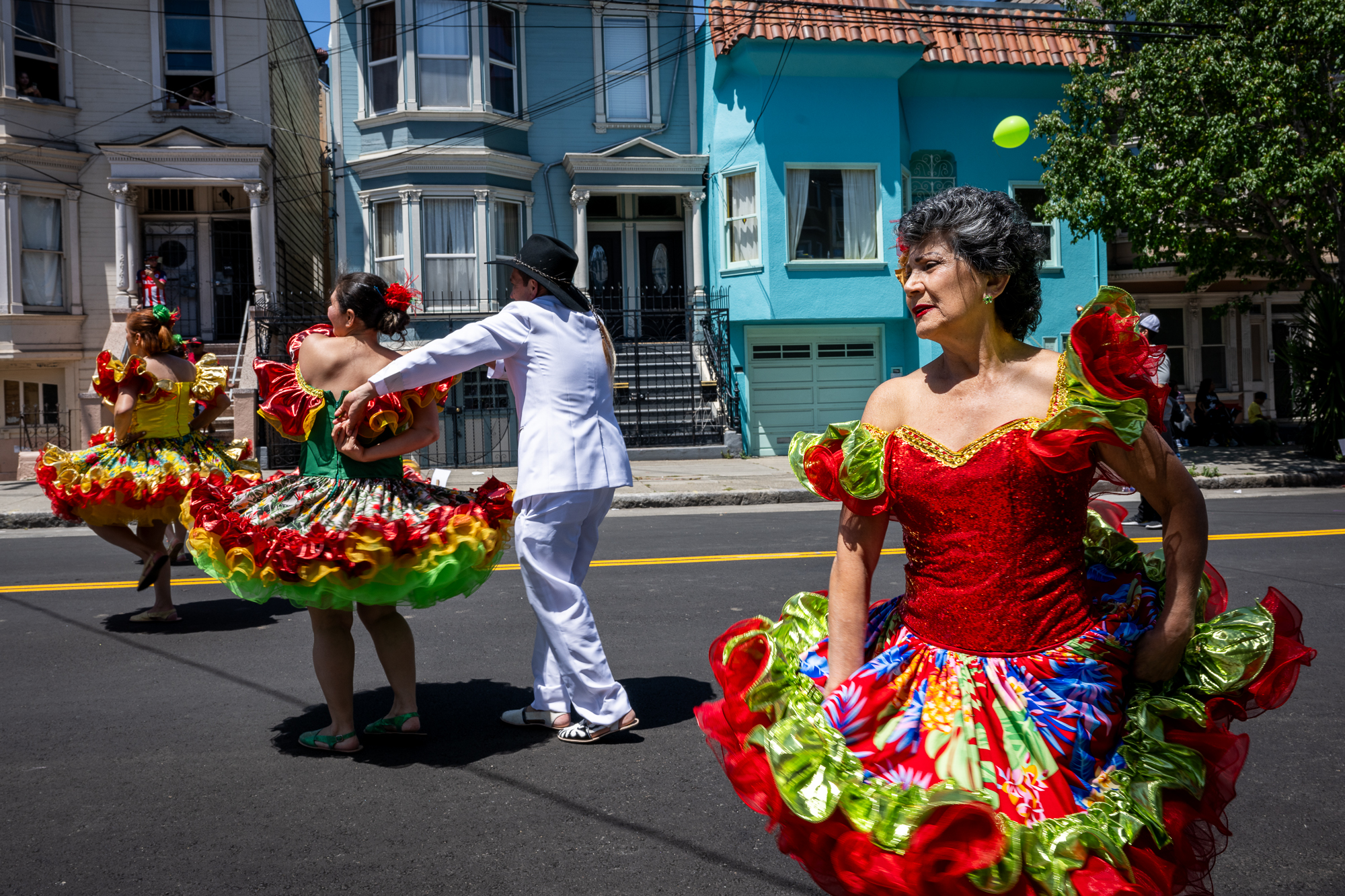
Ericka Cruz Guevarra [00:00:00] I’m Ericka Cruz Guevarra and welcome to The Bay, local news to keep you rooted. As a kid growing up in San Francisco’s Mission District, Fabian Ramirez remembers his parents taking him to Carnival, a multi-day festival showcasing the different music, dance, and culture of the Latin American diaspora. And as a young musician, Fabian dreamed of one day performing at the festival.
Fabian Ramirez [00:00:32] I remember looking at the artists performing at Carnaval. I’ve always had that vision, you know, of just me performing in stage.
Ericka Cruz Guevarra [00:00:44] This weekend, San Francisco’s Mission District will host Carnaval again. Half a million people are expected to attend, and Fabian, who’s the lead singer of the band Grupo 415, will be one of dozens of performers.
Fabian Ramirez [00:01:03] This is a big festival that happens in the mission, you know, then just being raised and born here in San Francisco just means a lot, you know.
Ericka Cruz Guevarra [00:01:14] Today, what to expect at San Francisco’s Carnaval this weekend, and why it means more now than ever.
Blanca Torres [00:01:30] So Carnaval is a two-day festival in the Mission District, May 23rd and 24th this year.
Ericka Cruz Guevarra [00:01:38] Blanca Torres is a producer for KQED. She also writes K Onda, a monthly newsletter elevating the Bay’s Latinx community.
Blanca Torres [00:01:48] And it’s really tied in Latin America and like New Orleans, it’s tied to the season of Lent, which is like the 40 days before Easter. And the Carnaval in San Francisco is, happens later in the year and is not tied to like the Easter season. It will cover about 17 city blocks and there will be a parade, five stages for music, a kids zone, 300 exhibitors and vendors. And a soccer pavilion to celebrate this year’s theme, which is La Copa del Pueblo, the People’s Cup. So there will just be a ton of activities and ways to participate over those two days.
Ericka Cruz Guevarra [00:02:35] And have you actually been to Carnaval before? Do you have any, like, personal memories?
Blanca Torres [00:02:39] Yeah, I mean, I just remember being, you know, kind of new to the Bay Area and then going to this festival and there being just so many, not just Latino people, but just all kinds of people hanging out, having a good time, enjoying, like, a salsa band. You know, it’s a big street party. It’s a block party where you can just walk around and there’s all these different stages and vendors everywhere. So literally walk in and there is a party waiting for you. One thing I find very impressive about San Francisco’s Carnaval is that it really does celebrate the various Latin American countries that are represented in the Bay Area. Even really small, diasporic communities will participate in the parade or have a booth. Puerto Ricans, you’ll see Bolivians, you will see Venezuelans, and you will see Brazilians. I have a good friend who is from Nicaragua and Guatemala. She always participates in carnaval and… You know, for her, people don’t always get to see cultural representation from Nicaragua. And so it’s all on display. So yeah, I think it’s really great that Carnaval can sort of bring so many different experiences, cultures, traditions, into one huge event.
Ericka Cruz Guevarra [00:04:01] Yeah, and a reminder, too, that, like, when we talk about, like the Latino community in the Bay Area, it’s absolutely not a monolith. As I understand it, this has actually been going on for quite a while in San Francisco, right?
Blanca Torres [00:04:14] Carnaval SF, which is, you know, the organization that puts on the event, they started sort of counting the first Carnaval as when it was held in the mission, but they know that there was Carnaval celebrations in San Francisco even before that. They just were smaller. And then once they came to the mission, that’s when it kind of started becoming an annual thing and sort of more consistent. And, you, know, if you have a celebration that’s getting to like almost 50 years. You know, it’s just really evolved and grown over time.
Ericka Cruz Guevarra [00:04:50] You talked earlier about how, I mean, it’s been around for so long, it has been a part of so many people’s memories of growing up in the Bay Area. But how has the role of Carnaval changed for the Bay area’s Latine community over the years?
Blanca Torres [00:05:08] I don’t know so much how the role has changed, but I think it’s the people I talk to for my column are all like, you know, we look forward to Karnava like every year.
Rodrigo Duran [00:05:23] We’ve been around for more than four decades, so it’s built over time. It didn’t happen overnight.
Blanca Torres [00:05:29] Rodrigo Duran is executive director of Carnaval San Francisco, which is the organization that puts on Carnavals every year. So when I talked to the Rodrigo, what he mentioned was that Carnaval has always been like a space and event that has celebrated and uplifted immigrant communities, and that is no different this year.
Rodrigo Duran [00:05:51] And so our parade is constantly evolving. I mean, we have 200 low riders opening up a grand parade. They grow with each other. They blend cultures together. And so it does creating this new identity, which is very San Francisco, which is a very Bay area.
Blanca Torres [00:06:10] You know, I think also for the mission district, like this is the time to shine. You know? This is a time when they know tons of people are going to be coming in, getting to see the businesses, getting to see different cultural amenities there. So it is kind of like this event that has become not just a San Francisco event, but really an event rooted in the mission and in Latine culture.
Ericka Cruz Guevarra [00:06:35] So what are the range of things that are planned for Carnaval this year?
Blanca Torres [00:06:40] And Sunday, the big marquee thing is the parade. Multiple stages where there’s like local bands, there’s bands coming in from other parts of the world. The headliner this year is Banda Mexicano, and they’re a famous band from Mexico, and they got famous in the 90s. So that was a band that I grew up hearing. Their sound is sometimes called, like, electronic banda. You know, like their songs were really about like dancing very close with your partner and not feeling shame about that. Like just have fun.
Mi Banda el Mexicano [00:07:24] No bailes de caballito, que te voy a regañar. No bailas de cabellito,
Blanca Torres [00:07:30] And one of their big songs is called like No Bailes de Caballito and Caballitos was like a style of dance. And like the song is kind of like, you know, saying your mom is going to tell you not to go have fun and dance like this, but do it anyway. Oh, yeah. So I think it’s really interesting that they are the headliner this year because they’re so about like joy and fun, but also just, you know, resisting what people tell you this is how you should act.
Ericka Cruz Guevarra [00:08:12] I read your newsletter, Blanca, K Onda, and in it you wrote that Carnaval San Francisco is more than a party, it’s Bay Area defiance. What do you mean by that?
Blanca Torres [00:08:26] You know, for a lot of immigrants, once they move to America, there’s so much pressure to assimilate, to sort of blend in. And carnaval is like the opposite message. It’s like, no, hold on to who you are. Bring your culture, bring your food, bring your traditions and let’s celebrate it.
Rodrigo Duran [00:08:44] And this will give us a sense of liberty, a sense freedom to breathe, to reflect, to enjoy, to have joy in a moment when we’re feeling so distressed, so antagonized.
Blanca Torres [00:08:58] And as I was talking to Rodrigo Duran, the executive director of Carnaval, I was asking him about this is a year when there’s been a lot of anti-immigrant sentiment, the federal government has cracked down on immigrants, tried to paint immigrants as criminals. Carnavale is a type of event that can say we’re a rich, beautiful community and we deserve to celebrate and to appreciate each other. So the festival being, again, this consistent. Sort of event and outlet for people is just as important this year as other times.
Rodrigo Duran [00:09:38] Because we’ve been here before, economic upturns and downturns, gentrification, anti-immigration policies. I know in the 90s in California, we were going through and Carnaval was always there and we’ll still be there to support, to provide a space where people feel protected. And so we’re ready.