Ericka Cruz Guevarra: [00:00:49] I’m Ericka Cruz-Gavarra and welcome to The Bay, local news to keep you rooted. Inside a federal courthouse in downtown Oakland, in front of a judge and a jury of their peers, two of the most powerful men in the world are duking it out in court over whether OpenAI, the company behind ChatGPT, was built on a lie. Elon Musk is suing OpenAI and its CEO, Sam Altman. For abandoning their founding promise to develop AI for the benefit of humanity. And whether or not you actually believe any of them really had our best interests in mind, one thing is true, that the battle over who runs AI is all about ego and power.
Ashley Ortiz: [00:01:47] No matter which side wins, the people are going to lose because they are not doing this actually for the benefit of humanity, it’s not about ethics, this is all about power plays within an unfettered, unregulated AI scheme.
Ericka Cruz Guevarra: [00:02:01] Today, KQED’s Rachael Myrow takes us inside the OpenAI trial.
Ericka Cruz Guevarra: [00:02:19] It seems like you’re in a pretty dynamic scene right now, Rachael. Can you actually tell us where you are?
Rachael Myrow: [00:02:26] I’m outside the federal courthouse in Oakland where Musk v. Altman et al. Is playing out.
Ericka Cruz Guevarra: [00:02:36] Rachael Myrow is a senior editor at KQED.
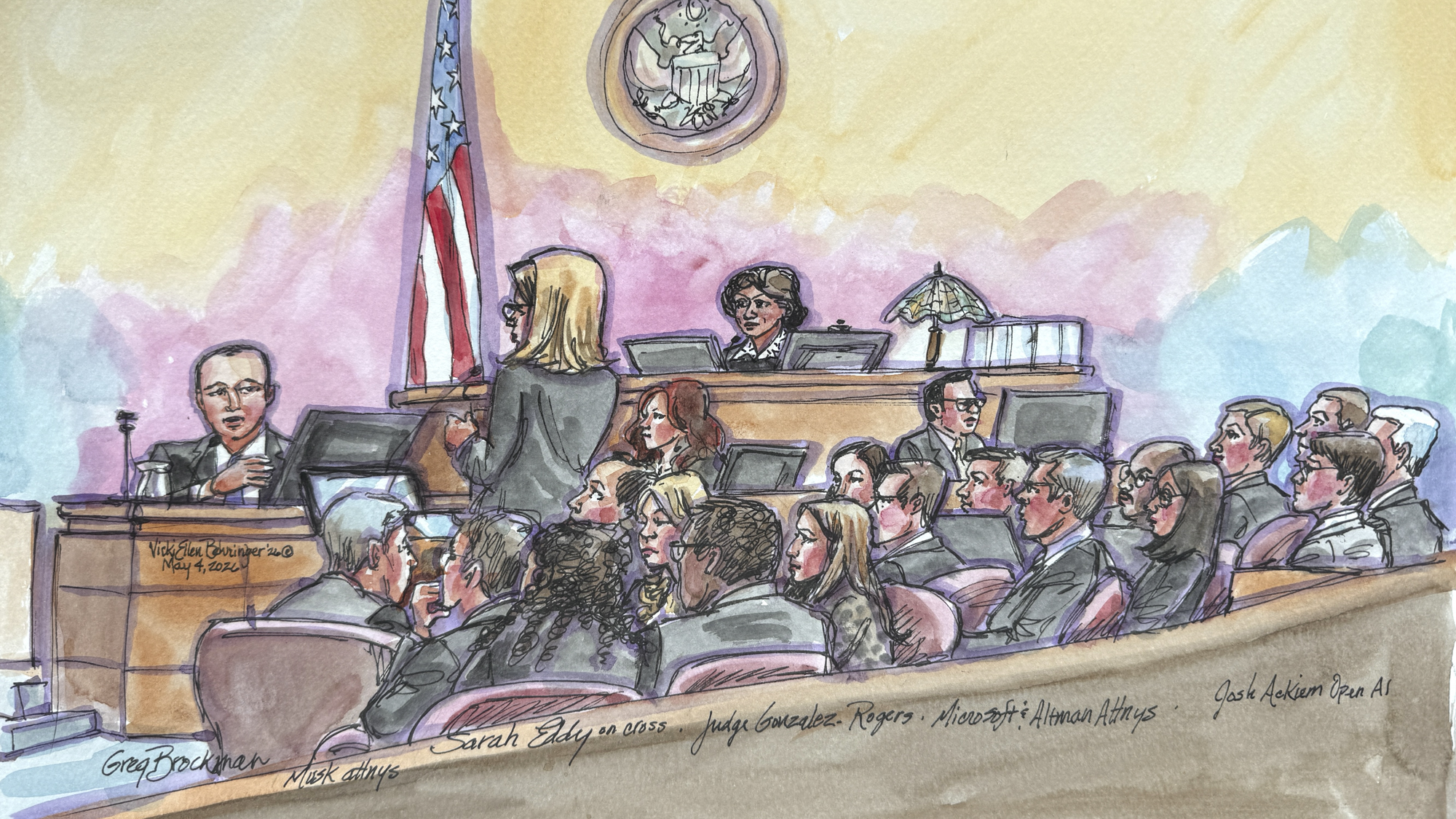
Rachael Myrow: [00:02:41] This plaza is right on the street so you hear the chirping every time somebody presses a button to cross the street. You hear garbage trucks rolling past. Inside the courtroom is presided over by Judge Yvonne Gonzalez Rogers and it is packed every single day. Armies of lawyers of course but also journalists from across the country, even a couple from France. And some members of the public. I’d like to call this the hottest theater ticket in Silicon Valley. We got to see Elon Musk spend four days on the witness stand. Sam Altman is sitting just a few feet away in the defense section. These two men genuinely cannot stand each other.
Ericka Cruz Guevarra: [00:03:30] And I understand, Rachel, that there’s not just folks inside of the courtroom for this trial, but also outside protesting as well.
Rachael Myrow: [00:03:41] Yes, on the very first day, actually when jury selection was taking place, protesters gathered in large numbers outside the courthouse on the plaza with some very pointed and colorful signs.
Valerie Sizemore: [00:03:57] I used to be a software engineer, but have been unemployed by AI. So now I’m trying to make the resistance happen.
Rachael Myrow: [00:04:06] I talked to one protester, Valerie Sizemore of Berkeley, who kind of represented, I think, a lot of Bayarians.
Valerie Sizemore: [00:04:15] I’m not here because I care about the outcome of this trial. I really don’t care. I hope it’s really expensive for someone and like hurts both companies as much as possible.
Ericka Cruz Guevarra: [00:04:27] Yeah, and it’s, I guess, two-for-one for her to just be outside the courthouse protesting the both of them.
Rachael Myrow: [00:04:34] Exactly.
Ericka Cruz Guevarra: [00:04:39] Well, Rachael, I wanna step back a little bit and talk about this trial and just how we even got here. I mean, remind us who is on trial and what exactly these two are fighting over?
Rachael Myrow: [00:04:53] So it’s a little more than two people. Elon Musk is suing Sam Altman and also Greg Brockman, who is OpenAI’s co-founder and president. Musk is sueing OpenAI itself and also Microsoft, which invested $13 billion in OpenAI after Musk left.
Interviewer: [00:05:18] All right, we’re gonna wrap up the day. I’m gonna do a fireside chat with Sam Altman.
Rachael Myrow: [00:05:25] Let’s dial the clock all the way back to 2015. Musk and Altman found OpenAI as a nonprofit explicitly to develop artificial general intelligence safely and for the benefit of all humanity.
Sam Altman: [00:05:44] You know, I think AI will probably, like most likely, sort of lead to the end of the world, but in the meantime, there will be great companies created with serious machine learning. I actually just agreed to fund a company that is not even really a company, sort of a semi-company, semi-nonprofit, doing AI safety research.
Rachael Myrow: [00:06:04] At some point shortly thereafter, it became clear to all parties involved, including Musk, that they needed to establish a for-profit arm as well in order to raise money to pay for things like computing power for this very energy-intensive computer software and also to bring in talent, to bring the best minds of the industry. Musk’s lawsuit is arguing that thereabouts Altman and other co-founders of OpenAI, because there were other people involved, betrayed the mission, that they were actually in it for the profit.
Interviewer: [00:06:45] Open AI, I mean you seem somewhat frustrated with them. You were one of the big contributors early on?
Elon Musk: [00:06:49] The reason, I am the reason Open AI exists.
Rachael Myrow: [00:06:54] So he wants more than his money back. He wants Altman and OpenAI’s co-founder and president, Greg Brockman, taken off the board. And he wants $130 billion, disgorged by the for-profit and handed over to the non-profit. The word charity, Ericka, doesn’t appear once in OpenAI’s founding blog post, but Musk keeps referring to OpenAI as a charity. But as OpenAI lawyers like to point out, Musk left OpenAI and then he launched his own AI venture, XAI, which is not a nonprofit and arguably does not operate for the benefit of humanity, for which it has been sued repeatedly.
Ericka Cruz Guevarra: [00:07:50] So it sounds like Elon Musk is basically saying they stole his charity, and Sam Altman is saying, ‘You chose to walk away.’
Rachael Myrow: [00:08:02] Yeah. That’s it in a nutshell. There was this funny moment when Musk was on the witness stand. He looked at the jury and he said, quote, it’s not OK to steal a charity. And then he predicted that if Open AI wins this case, the face of charity law in America could be altered forever. At some point, the judge broke in and said, let’s remind the jury, you’re not a lawyer. She’s talking to Musk. And then he replied. I did take Law 101, which got a laugh out of most people in the court.
Ericka Cruz Guevarra: [00:08:36] Geez.
[00:08:39] Rachael, what do we make of Sam Altman’s role in this? It sounds like Elon Musk is saying that Sam Altman lied to him.
Rachael Myrow: [00:08:46] That is a very good question. I need to mention here that we have not seen Sam Altman take the stand in this trial yet. So Altman has not yet had the chance to make his case. Just a few weeks ago, we saw a comprehensive profile of Sam Altman in the New Yorker magazine talking to lots and lots of people that Sam Altmann is an inveterate liar, the kind of person who will tell you what you want to hear and then go back on it. We haven’t had the opportunity yet to really get into what his character was like during the early days of OpenAI, but pretty much everyone in that courtroom has read that article.
Ericka Cruz Guevarra: [00:09:47] Coming up, what the OpenAI trial is really about. Stay with us.
Ericka Cruz Guevarra: [00:10:38] I mean, Rachael, I gotta say, as I’m reading these stories about this case, it really just sounds like a fight between two of some of the richest billionaires in Silicon Valley over this company that they co-founded. But obviously, what’s at the center of it and what is at stake is this very powerful technology that even they seem to acknowledge has the potential to change the world. So what do you think this is really about?
Rachael Myrow: [00:11:13] Clearly about power, clearly about money, clearly about market dominance. And I do want to say that even though the judge is saying we are not going to talk about the AI apocalypse, it is something that is genuinely on the minds of all of these people in the industry in Silicon Valley and also the rest of us, right? I mean there are people here who take AI safety seriously. Who also think OpenAI has drifted dangerously from its mission. I mean, we’ve seen bad actors using the software who have upended the labor market, terrified all of us from a cybersecurity perspective, made it impossible to get redress as a customer and sometimes as a citizen, enabled a surveillance state here and abroad. I mean I could go on, Ericka, because It’s 100% clear to us and the people building this software that there’s a race to the bottom going on from a moral perspective.
Ericka Cruz Guevarra: [00:12:30] I do want to ask you this question, Rachel, because Elon Musk is saying in this trial that he is the one standing up for the public on AI. Rachel, is there someone working in the public interest when it comes to AI and holding AI companies accountable?
Rachael Myrow: [00:12:53] Well, you know, don’t we wish? He’d like to present himself as thinking pro-human first, but you know, he also created XAI and has reportedly personally directed his engineers to make XAI a manifestly unsafe product. The judge noted the irony out loud. She said to Musk’s attorneys at one point, It is ironic that your client, despite these risks, is creating a company in the exact same space. And then she added, and I just thought this was so remarkable, coming from, again, a sitting federal judge, quote, I suspect there are people who don’t want to put the future in Mr. Musk’s hands, unquote.
Jill Horowitz: [00:13:44] And in that sense, I don’t understand why Musk is the one who gets to ask that question. Jill Horowitz, who specifically specializes in non-profit law. At Northwestern’s law school put it this way when parties have this much money and this much power they can trample over conventional protections of the public interest
Jill Horowitz: [00:14:07] We’ve got a CEO who is a very powerful player. And then we have this outside party who’s purported to be thinking about the best interest of the nonprofit, but he’s a competitor.
Rachael Myrow: [00:14:22] Congress, you don’t need me to tell you, hasn’t passed any meaningful federal AI regulation. The Trump administration is lobbying alongside the lobbyists for unfettered freedom for the AI industry. And so we end up here, Ericka, in a federal courthouse in Oakland watching two billionaires fight over their recent past. This trial gives us a window into the wheeling and dealing. But it doesn’t give us any power to change the trajectory of AI.
Ericka Cruz Guevarra: [00:14:54] Rachael what happens if if either Elon Musk or Sam Altman wins this trial?
[00:15:01] So if Musk wins, Judge Gonzalez-Rogers could order OpenAI to revert to a non-profit structure, remove Altman and Brockman, direct some $130 billion in gains back to the non- profit foundation. That would be legally unprecedented and would certainly send shockwaves throughout Silicon Valley. If OpenAI wins, the restructuring stands, the IPO proceeds. And the message to the industry is essentially, you can do this too. You can take a non-profit, make it nominally in charge of a for-profit arm that you build into a trillion-dollar company, and the legal system won’t stop you.
Ericka Cruz Guevarra: [00:15:52] Last question for you, Rachael. For the protesters outside, what do you think they want to see happen? And do you they care here about who wins?
Rachael Myrow: [00:16:03] My sense from talking with Ashley Ortiz, who was one of the organizers of the first and biggest protest outside, is that for a lot of the people out here carrying signs and wearing t-shirts that say stop AI, neither Musk nor Altman represents their interests and by extension the public’s interests.
Ashley Ortiz: [00:16:28] Decision everyone sucks here and y’all both need to take responsibility for your part in this crappy situation.
Rachael Myrow: [00:16:34] They want accountability for AI, period. I don’t know if they actually think they’re gonna get what they’re asking for, but they wanna make a noise while they can.
Ashley Ortiz: [00:16:46] We’re letting them both know that both sides, no matter which side wins, the people are going to lose because they are not doing this actually for the benefit of humanity. It’s not about ethics. This is all about power plays within an unfettered, unregulated AI scape.
Rachael Myrow: [00:17:06] These are the models that are changing our world, and they’re doing it now. And regardless of whether OpenAI survives this trial, we’re still gonna have the world that OpenAI helped to create.
Ericka Cruz Guevarra: [00:17:28] Well, Rachael, thank you so much for chatting with me outside the courtroom and for making the time in your busy morning, I appreciate it.
Rachael Myrow: [00:17:36] You bet.