upper waypoint

Surveillance Footage Sheds Light on Mass Use-of-Force Incident at Women's Prison

Save ArticleSave Article
Failed to save article

Please try again

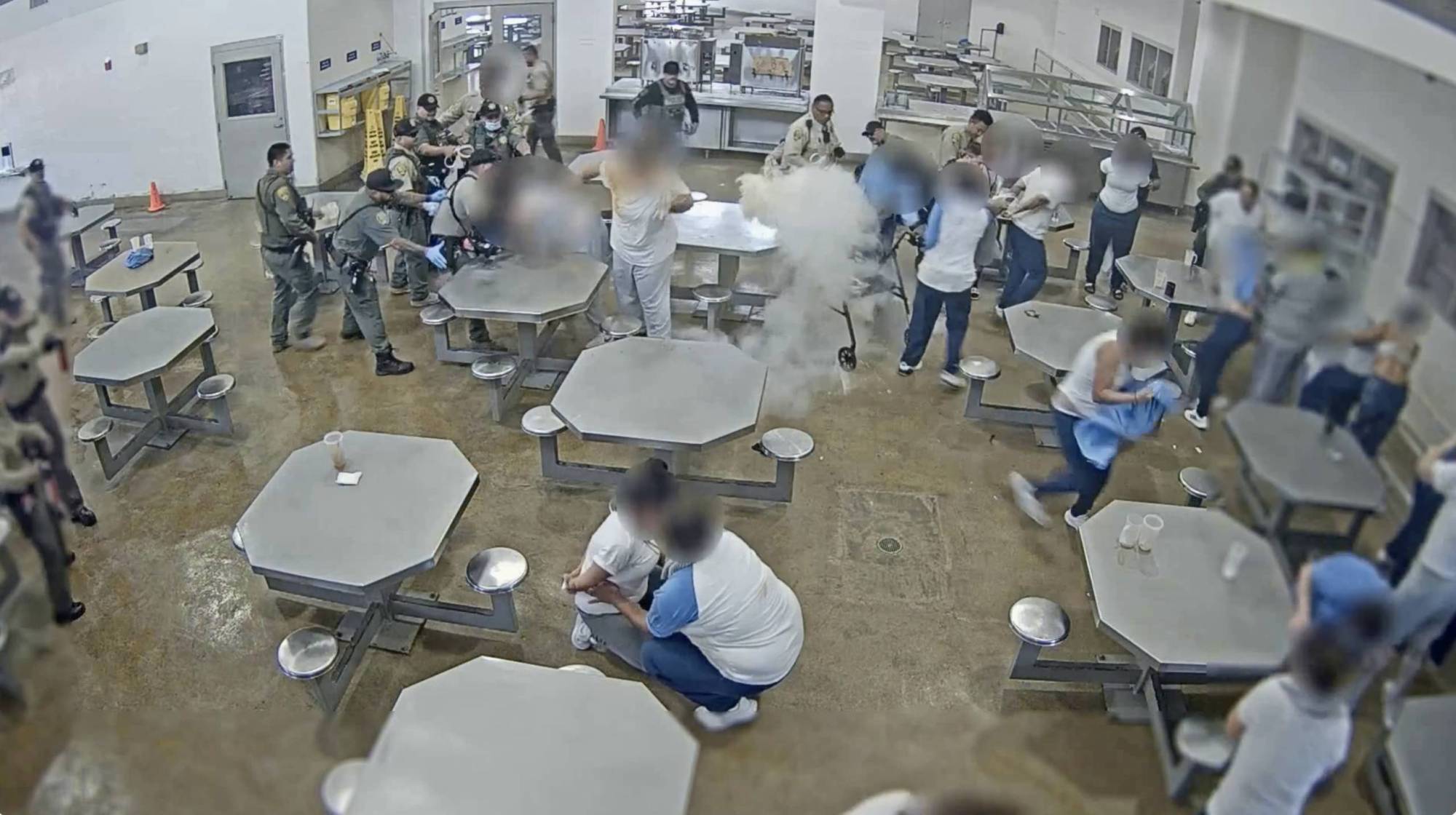
Incarcerated women crouch while others run for safety after officers deployed pepper spray and OC grenades during a 2024 use-of-force incident at the Central California Women’s Facility.  (Courtesy of California Department of Corrections and Rehabilitation )

Here are the morning’s top stories on Wednesday, April 15, 2026

  • KQED has obtained surveillance video of a mass use of force incident at the Central California Women’s Facility. It’s the first detailed look at the August 2024 incident that resulted in the largest disciplinary action from a single use of force event. 
  • Another woman has come forward to accuse former California Congressman Eric Swalwell of sexual assault. Meanwhile, Governor Gavin Newsom is calling a special election to fill Swalwell’s congressional seat. 
  • An independent privacy audit of Google, Meta and Microsoft web traffic in California found the firms may be violating state privacy laws, potentially exposing themselves to significant fines.

‘I thought I was going to die’: video shows mass force at California women’s prison

Surveillance footage newly obtained by KQED sheds light on a mass use-of-force incident at the Central California Women’s Facility in 2024. The incident resulted in discipline for more than 40 staff members, according to the California Department of Corrections and Rehabilitation, and $1.9 million in payouts to some of the women injured during the incident.

On the morning of Aug. 2, 2024, officers relocated more than 150 women to the dining hall in order to conduct a large-scale search of their cells. The women were held there for hours without access to food or medication, as tensions built and temperatures rose above 100 degrees, according to court filings. Officers deployed chemical agents, batons and physical force on dozens of incarcerated people.

The surveillance footage, obtained through a public records request to CDCR, provides the first detailed view of how the incident unfolded. CDCR has not released officers’ body-camera video or disciplinary records requested by KQED. Previously leaked footage edited and made public by a former correctional lieutenant turned YouTuber provided only limited insight into the incident.

Angelina Hernandez, who was inside the dining hall at the time and has since been released, said watching the footage again was emotional. “I really thought I was going to die that day,” Hernandez said. “These officers are supposed to protect us, not attack us.”

Dozens of officers file into the chow hall around 12:30 p.m. and form what appears to be a skirmish line, many holding pepper spray canisters at the ready, the footage shows. Over several minutes, more officers join the formation, growing to what appears to be 40 to 50 officers positioned across the room. While there is no audio captured on the surveillance footage, things appear tense with some of the incarcerated women gesticulating and shouting at the line of officers.

Kenneth Jimenez, a retired lieutenant who reviewed the footage, said officers must be facing an imminent threat in order to justify deploying force. Jimenez is familiar with use of force policy, which he taught to both peace officers and civilians across the state. “I don’t see anybody approaching in a threatening manner,” he said as he watched the video. “I don’t see anything that’s imminent,” Jimenez added that instead of using force officers could have instead restrained a small number of individuals and removed them from the scene.

CDCR did not answer specific questions about whether the force used was excessive, but said policies were violated that day and that “corrective action” was taken.

Another woman accuses former Congressmember Eric Swalwell of sexual assault

A California woman on Tuesday said she was raped by former Congressman Eric Swalwell in 2018 and now plans to make a report to law enforcement.

Lonna Drewes said during a news conference that the assault occurred at a hotel in Southern California. She said she had one glass of wine that evening and believes Swalwell drugged her before raping her. Swalwell dropped out of the California governor’s race on Sunday and said he would resign from Congress this week following earlier allegations of sexual assault from a different woman. “I did not consent to any sexual activity,” Drewes said.

Drewes said she was working as a model and owned a fashion software company based in Beverly Hills when she met Swalwell. He offered to help her with connections to further her company and knew she had an interest in local politics. She had met him twice before the night when she says he raped her. That night, the two met at a restaurant opening and were set to attend a political event, she said. On their way to the event, Drewes said Swalwell wanted to stop back at his hotel room to get some paperwork. By the time they reached the room, she said her limbs felt heavy and she felt like she had been drugged. She said Swalwell raped her and later choked her, causing her to lose consciousness.

Attorney Sara Azari released a statement Tuesday on Swalwell’s behalf saying he “categorically and unequivocally denies each and every allegation of sexual misconduct and assault that has been leveled against him.” She pledged to “pursue every available legal remedy against those responsible for orchestrating this reprehensible campaign of lies.”

This comes on the same day that Swalwell resigned from Congress. Governor Gavin Newsom has called a special election for August 18, to fill the remainder of Swalwell’s term.

What is the point of California’s privacy laws if Big Tech ignores them?

An independent review of Microsoft, Meta and Google web traffic in California in March found the tech companies may have violated state regulations around internet privacy.

The audit, by webXray, also said that nearly 200 online advertising services ignored “legally defined, globally standard, opt-out signals” around data sharing, along with more than half of nearly 7,000 websites in California, despite user requests to opt-out of cookie tracking, the most visible opt-out mechanism the laws require. This is despite the California Consumer Privacy Act, as expanded by the California Privacy Rights Act and other state privacy legislation, enforced by both the state attorney general’s office and the California Privacy Protection Agency.

“Our findings reveal major technology companies simply ignore globally defined opt-out signals, raising the spectre of industrial-scale non-compliance with California requirements,” the report’s website states.

Businesses that sell or share your personal information are legally required to honor the Global Privacy Control, a “stop selling or sharing my data” switch available on web browsers, or as a browser extension.

The company that conducted the audit, webXray, was founded by Timothy Libert, a privacy expert who led cookie policy and compliance at Google offices in Sunnyvale from 2021 to 2023. Libert spent 15 years in academia studying the topic and worked as a consultant for national and state regulators before his time at Google.

lower waypoint
next waypoint
Player sponsored by