¿El IRS sigue compartiendo datos con ICE? Si tiene ITIN, qué saber antes de presentar sus impuestos
Una jueza federal bloqueó temporalmente el acuerdo que permitía al IRS compartir con ICE la información personal de contribuyentes que no son ciudadanos. Expertos legales nos dicen quién tiene acceso ahora a la información de inmigrantes con ITIN.
El edificio del Servicio de Impuestos Internos (IRS) en Washington, D.C. Un juez federal ha bloqueado temporalmente el acuerdo que anteriormente permitía al IRS compartir con el ICE la información personal de los contribuyentes no ciudadanos. Esto es lo que los expertos nos dijeron que los contribuyentes deben saber antes de presentar su declaración. (Zach Gibson/Getty Images)
Varios tribunales federales han dictaminado que el Servicio de Rentas Internas (IRS, por sus siglas en inglés) no puede compartir la información personal de los contribuyentes que presentan sus declaraciones con un número de identificación fiscal individual (ITIN, por sus siglas en inglés) con las agencias de control de inmigración.
Ahora que millones depersonas comienzan a presentar sus declaraciones de impuestos, el gobirno del presidente Donald Trump ha solicitado acceso a los datos del IRS de los titulares de ITIN, que suelen ser inmigrantes que se encuentran en el país sin número del Seguro Social y que presentan sus declaraciones de impuestos con la esperanza de mejorar sus posibilidades de obtener algún día un estatus migratorio legal.
El año pasado, el Departamento de Seguridad Nacional (DHS, por sus siglas en inglés), que supervisa el Servicio de Inmigración y Control de Aduanas (ICE, por sus siglas en inglés), firmó un acuerdo de intercambio de datos con el IRS, lo que abrió la puerta a ICE para solicitar la información personal de 1.28 millones de personas. El DHS comunicó a KQED que solicita esta información “para identificar a quiénes se encuentran en nuestro país, incluidos los delincuentes violentos”.
Pero el mes pasado, la jueza federal Indira Talwani bloqueó este acuerdo de 2025 y prohibió a los agentes de ICE el acceso a cualquier dato de los contribuyentes.
“La orden de la jueza Talwani deja muy claro que ICE no puede basarse en ninguno de los acuerdos de intercambio de información fiscal que ha firmado con el IRS ni utilizar ninguna información que ya haya recibido del IRS”, afirmó Dorothy Chang, abogada en Asian Law Caucus, uno de los grupos que llevó al gobierno federal a los tribunales por este acuerdo.
Talwani es la segunda jueza federal que bloquea el acuerdo entre ICE y el IRS a medida que esta batalla legal avanza por el sistema judicial. El 24 de febrero, un tribunal de apelaciones de Washington D.C. (el siguiente escalón en la jerarquía judicial), se negó a emitir una orden judicial preliminar contra el gobierno federal, pero los expertos jurídicos subrayan que esta decisión no elimina la orden anterior de Talwani.
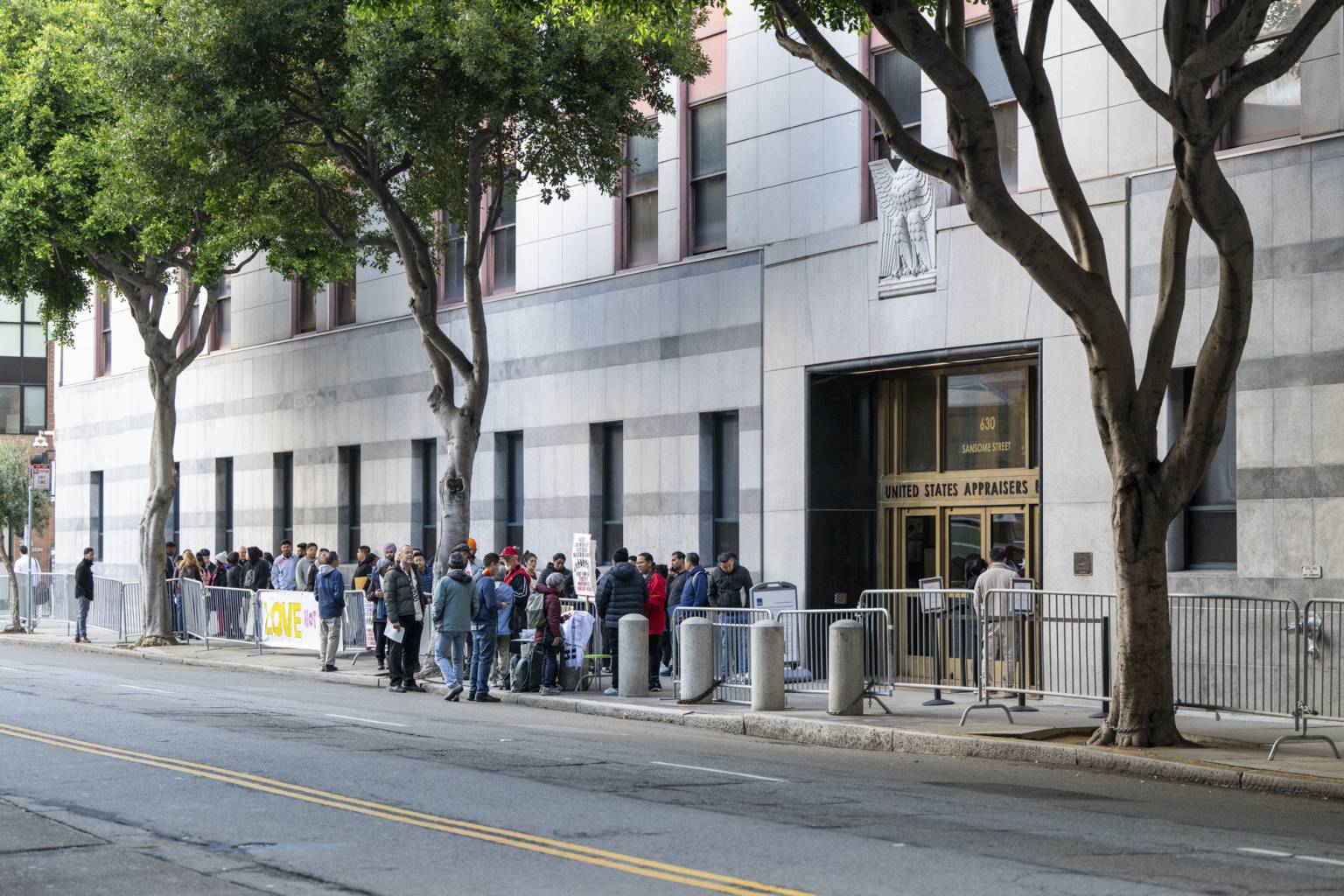
El 14 de octubre de 2025, varias personas hacen fila frente a la oficina local de ICE en el centro de San Francisco con respecto a las citas programadas y citas relacionadas con la inmigración. (Beth LaBerge/KQED)
“Los tribunales en los otros dos casos han determinado que el IRS y ICE no cumplieron con la ley”, dijo Josh Rosenthal, también abogado en Asian Law Caucus. “Siguen vigentes esas dos órdenes judiciales que impiden a las agencias realizar transferencias masivas de información de los contribuyentes y a ICE de actuar sobre cualquier dato del IRS que tenga en su poder”.
Varias organizaciones comunitarias en varias partes de California informaron a KQED que siguen recibiendo preguntas de los contribuyentes con respecto a quién tiene acceso a su información personal y si es posible que ICE pueda volver a acceder a los datos de los contribuyentes en el futuro.
Siga leyendo para conocer lo que los expertos legales y fiscales saben en este momento sobre esta situación en rápida evolución.
¿Qué dice exactamente la orden de la jueza Talwani?
En su fallo, Talwani, nombrada por el presidente Barack Obama para el tribunal federal de Boston en 2014, se mostró muy crítica con las acciones de la administración Trump.
Talwani destacó que el sistema fiscal federal depende de la confianza de los contribuyentes y afirmó que la implementación de acuerdos de intercambio de datos “daña esa base y socava el interés público en un sistema fiscal que funcione”.
La secretaria de Seguridad Nacional, Kristi Noem, habla en una rueda de prensa con respecto a la situación en Brownsville, Texas, el 7 de enero de 2026. (Michael Gonzalez/Getty Images)
Ahora, la orden de Talwani prohíbe a la Secretaria del DHS, Kristi Noem, y a cualquier agente de ICE “inspeccionar, ver, utilizar, copiar, distribuir, basarse con respecto a cualquier información fiscal obtenida o revelada por el IRS”.
El IRS confirmó ante el tribunal que ya había compartido las direcciones de aproximadamente 47 mil contribuyentes quienes no ciudadanos. Esta información se encuentra almacenada en una computadora gubernamental de un empleado del DHS. Talwani mencionó específicamente que este trabajador federal también está sujeto a su orden.
¿Esta sentencia anula definitivamente el acuerdo entre el IRS y ICE?
No. Se trata solo de una suspensión temporal, que impide al IRS y al ICE colaborar mientras los tribunales toman una decisión definitiva con respecto a si este acuerdo es constitucional o no.
¿Cómo ha respondido la administración Trump a la sentencia?
En una declaración escrita, el DHS no respondió directamente a la pregunta de KQED con respecto a cómo actuará la agencia para cumplir con la orden judicial.
Sin embargo, un portavoz del DHS defendió el acuerdo con el IRS y dijo a KQED por correo electrónico que el gobierno federal sigue enfocado “en aplicar leyes penales que han sido descuidadas durante mucho tiempo que se aplican a los inmigrantes indocumentados, pero que la administración Biden ignoró”.
Agentes del Departamento de Seguridad Nacional detienen a manifestantes frente a las oficinas locales de ICE en San Francisco el 16 de diciembre de 2025, con respecto a la detención de manifestantes. (Beth LaBerge/KQED)
¿Qué dicen los defensores de los inmigrantes sobre esta sentencia?
Los defensores de los inmigrantes han aplaudido la decisión de Talwani. “Cuando presentamos nuestras declaraciones de impuestos, hay datos realmente delicados”, dijo Chang, abogada en Asian Law Caucus.
“Si tomamos información personal que está protegida y la utilizamos para perseguir a los inmigrantes, eso destruye por completo la confianza que la gente deposita en el gobierno federal para que haga lo correcto con la información de los contribuyentes”, agregó.
Chang añadió que los empleados del IRS deben seguir normas muy estrictas al manejar los datos de los contribuyentes, tal y como establece el Código de Rentas Internas, creado por el Congreso en 1939.
Más en español
Estas normas solo permiten al IRS compartir información en circunstancias muy limitadas, como una auditoría o determinadas investigaciones penales, por ejemplo, las relacionadas con amenazas terroristas.
Ni siquiera el presidente puede acceder directamente a los datos del IRS.
En 1976, el Congreso reforzó las normas de privacidad del Código de Rentas Internas después de que varios empleados de la Casa Blanca admitieran que habían intentado obtener información fiscal sobre personas que el entonces presidente Richard Nixon consideraba sus enemigos.
El uso del IRS como herramienta política sería más tarde una de las acusaciones a las que se enfrentó Nixon por parte de los legisladores que buscaban destituirlo.
¿Qué va a pasar ahora en esta batalla legal?
La administración Trump sigue defendiendo el acuerdo entre el IRS y ICE en diferentes batallas legales en todo el país.
Otro caso presentado por el Centro de Trabajadores Unidos, con sede en Chicago, ha llegado al tribunal de apelaciones en Washington, D.C. el paso previo a la Corte Suprema. En ese proceso, los jueces se han negado a dictar una orden judicial preliminar contra el gobierno federal, ya que consideran que la información que comparten las agencias no está cubierta por la ley de privacidad del IRS.
Otros medios de comunicación han reportado que esta última actualización del tribunal ha dado el visto bueno al IRS para reanudar el intercambio de datos fiscales de inmigrantes con ICE.
Sin embargo, las órdenes de los jueces Talwani y Colleen Kollar-Kotelly, quien fue la primera en bloquear el acuerdo entre ICE y el IRS el pasado mes de noviembre, siguen vigentes. Para que ICE recupere el acceso a los datos del IRS, un juez de más alto rango tendría que anular las órdenes de Talwani y Kollar-Kotelly, según Chang, del Asian Law Caucus.
Ni siquiera expertos jurídicos saben cómo será el resultado de estas batallas legales. Actualizaremos esta guía a medida que recibamos nueva información de los tribunales.
¿Qué recomiendan los expertos fiscales a los contribuyentes?
Varias organizaciones comunitarias que ofrecen servicios fiscales gratuitos siguen escuchando las preocupaciones de personas con ITIN, quienes temen que presentar su declaración de impuestos este año pueda suponer un gran riesgo personal.
“Les hacemos saber que seguimos ayudándoles a presentar sus declaraciones de impuestos”, afirma Lindsay Rojas, directora de ayuda fiscal gratuita de United Way Bay Area. “Y si tienen alguna pregunta o duda, deben consultar a un abogado de inmigración sobre su caso”.
Rojas subrayó que, en lugar de dar un consejo universal, se trata de una decisión que cada persona “debe tomar en base a sus circunstancias familiares” y personales. Las familias que viven en el Área de la Bahía pueden llamar al 211 para encontrar ayuda gratuita para presentar sus impuestos o ser conectadas con un abogado especializado en inmigración.
El miembro del personal de MEDA, Dairo Romero, trabaja en el segundo piso del Mission Food Hub en San Francisco el 19 de mayo de 2021, donde se reúne con las familias para ayudarlas a presentar sus declaraciones de impuestos. (Beth LaBerge)
Otros grupos que prestan asistencia fiscal confirmaron a KQED que también aconsejan a los contribuyentes que consulten primero con un abogado especializado en inmigración si les preocupa la privacidad de sus datos. Es importante mencionar que si alguien ha presentado su declaración con un ITIN durante varios años, el IRS ya ha recibido su información personal de declaraciones anteriores.
Se debe mencionar que existen posibles consecuencias para quienes no presentan su declaración de impuestos, dijo Minnie Sage, directora de programas de Tax-Aid, con sede en San Francisco. “La declaración de impuestos es a menudo un requisito para acreditar los ingresos, en casos como la vivienda, la educación y los préstamos federales como FAFSA“, dijo. “También ayuda a evitar costos adicionales y sanciones”.
Sandra Argueta-Bonneville, directora de operaciones de Central City Neighborhood Partners, con sede en Los Ángeles, dijo que su equipo fiscal sigue viendo a gente que quiere presentar su declaración con un ITIN. “Realmente pensábamos que estas cifras iban a caer bajar drásticamente”, dijo, antes de añadir que muchos miembros de la comunidad siguen sintiendo una gran responsabilidad de pagar impuestos y tienen la esperanza de que cumplir con este compromiso les ayude en su proceso de inmigración en el futuro.
¿Qué más deben quienes tienen ITIN?
El verano pasado, el Congreso aprobó el plan masivo de gastos e impuestos conocido en inglés como ‘One Big Beautiful Bill’, lo que limita considerablemente los créditos fiscales a los que pueden acceder los titulares de un ITIN
Si un hogar no tiene al menos un contribuyente que presente su declaración de impuestos de 2025 con un número del Seguro Social, las familias no tendrán derecho al crédito fiscal federal por hijos ni al crédito fiscal por ingresos del trabajo. Los hijos declarados como dependientes también deberán tener un número del Seguro Social para poder recibir el crédito fiscal por hijos.
Un hogar debe tener al menos un contribuyente que presente su declaración de impuestos de 2025 con un número del Seguro Social para recibir ciertos créditos fiscales. (Emma Bauso/Pexels)
Sin estos créditos, las familias inmigrantes podrían recibir un reembolso mucho más pequeño, quizás miles de dólares menos de lo que recibieron el año pasado, dijo Argueta-Bonneville.
“Muchas de nuestras familias dependen de los créditos y reembolsos para poder invertir en sí mismas, en sus hijos, y también están invirtiendo en la comunidad”, añadió.
Este artículo fue traducido por la periodista María Peña y esa traducción fue editada por el periodista Carlos Cabrera-Lomelí.
lower waypointnext waypoint
Player sponsored by
window.__IS_SSR__=true
window.__INITIAL_STATE__={
"attachmentsReducer": {
"audio_0": {
"type": "attachments",
"id": "audio_0",
"imgSizes": {
"kqedFullSize": {
"file": "https://ww2.kqed.org/news/wp-content/themes/KQED-unified/img/audio_bgs/background0.jpg"
}
}
},
"audio_1": {
"type": "attachments",
"id": "audio_1",
"imgSizes": {
"kqedFullSize": {
"file": "https://ww2.kqed.org/news/wp-content/themes/KQED-unified/img/audio_bgs/background1.jpg"
}
}
},
"audio_2": {
"type": "attachments",
"id": "audio_2",
"imgSizes": {
"kqedFullSize": {
"file": "https://ww2.kqed.org/news/wp-content/themes/KQED-unified/img/audio_bgs/background2.jpg"
}
}
},
"audio_3": {
"type": "attachments",
"id": "audio_3",
"imgSizes": {
"kqedFullSize": {
"file": "https://ww2.kqed.org/news/wp-content/themes/KQED-unified/img/audio_bgs/background3.jpg"
}
}
},
"audio_4": {
"type": "attachments",
"id": "audio_4",
"imgSizes": {
"kqedFullSize": {
"file": "https://ww2.kqed.org/news/wp-content/themes/KQED-unified/img/audio_bgs/background4.jpg"
}
}
},
"placeholder": {
"type": "attachments",
"id": "placeholder",
"imgSizes": {
"thumbnail": {
"file": "https://cdn.kqed.org/wp-content/uploads/2024/12/KQED-Default-Image-816638274-2000x1333-1-160x107.jpg",
"width": 160,
"height": 107,
"mimeType": "image/jpeg"
},
"medium": {
"file": "https://cdn.kqed.org/wp-content/uploads/2024/12/KQED-Default-Image-816638274-2000x1333-1-800x533.jpg",
"width": 800,
"height": 533,
"mimeType": "image/jpeg"
},
"medium_large": {
"file": "https://cdn.kqed.org/wp-content/uploads/2024/12/KQED-Default-Image-816638274-2000x1333-1-768x512.jpg",
"width": 768,
"height": 512,
"mimeType": "image/jpeg"
},
"large": {
"file": "https://cdn.kqed.org/wp-content/uploads/2024/12/KQED-Default-Image-816638274-2000x1333-1-1020x680.jpg",
"width": 1020,
"height": 680,
"mimeType": "image/jpeg"
},
"1536x1536": {
"file": "https://cdn.kqed.org/wp-content/uploads/2024/12/KQED-Default-Image-816638274-2000x1333-1-1536x1024.jpg",
"width": 1536,
"height": 1024,
"mimeType": "image/jpeg"
},
"fd-lrg": {
"file": "https://cdn.kqed.org/wp-content/uploads/2024/12/KQED-Default-Image-816638274-2000x1333-1-1536x1024.jpg",
"width": 1536,
"height": 1024,
"mimeType": "image/jpeg"
},
"fd-med": {
"file": "https://cdn.kqed.org/wp-content/uploads/2024/12/KQED-Default-Image-816638274-2000x1333-1-1020x680.jpg",
"width": 1020,
"height": 680,
"mimeType": "image/jpeg"
},
"fd-sm": {
"file": "https://cdn.kqed.org/wp-content/uploads/2024/12/KQED-Default-Image-816638274-2000x1333-1-800x533.jpg",
"width": 800,
"height": 533,
"mimeType": "image/jpeg"
},
"post-thumbnail": {
"file": "https://cdn.kqed.org/wp-content/uploads/2024/12/KQED-Default-Image-816638274-2000x1333-1-672x372.jpg",
"width": 672,
"height": 372,
"mimeType": "image/jpeg"
},
"twentyfourteen-full-width": {
"file": "https://cdn.kqed.org/wp-content/uploads/2024/12/KQED-Default-Image-816638274-2000x1333-1-1038x576.jpg",
"width": 1038,
"height": 576,
"mimeType": "image/jpeg"
},
"xxsmall": {
"file": "https://cdn.kqed.org/wp-content/uploads/2024/12/KQED-Default-Image-816638274-2000x1333-1-160x107.jpg",
"width": 160,
"height": 107,
"mimeType": "image/jpeg"
},
"xsmall": {
"file": "https://cdn.kqed.org/wp-content/uploads/2024/12/KQED-Default-Image-816638274-2000x1333-1-672x372.jpg",
"width": 672,
"height": 372,
"mimeType": "image/jpeg"
},
"small": {
"file": "https://cdn.kqed.org/wp-content/uploads/2024/12/KQED-Default-Image-816638274-2000x1333-1-672x372.jpg",
"width": 672,
"height": 372,
"mimeType": "image/jpeg"
},
"xlarge": {
"file": "https://cdn.kqed.org/wp-content/uploads/2024/12/KQED-Default-Image-816638274-2000x1333-1-1020x680.jpg",
"width": 1020,
"height": 680,
"mimeType": "image/jpeg"
},
"full-width": {
"file": "https://cdn.kqed.org/wp-content/uploads/2024/12/KQED-Default-Image-816638274-2000x1333-1-1920x1280.jpg",
"width": 1920,
"height": 1280,
"mimeType": "image/jpeg"
},
"guest-author-32": {
"file": "https://cdn.kqed.org/wp-content/uploads/2025/01/KQED-Default-Image-816638274-1333x1333-1-160x160.jpg",
"width": 32,
"height": 32,
"mimeType": "image/jpeg"
},
"guest-author-50": {
"file": "https://cdn.kqed.org/wp-content/uploads/2025/01/KQED-Default-Image-816638274-1333x1333-1-160x160.jpg",
"width": 50,
"height": 50,
"mimeType": "image/jpeg"
},
"guest-author-64": {
"file": "https://cdn.kqed.org/wp-content/uploads/2025/01/KQED-Default-Image-816638274-1333x1333-1-160x160.jpg",
"width": 64,
"height": 64,
"mimeType": "image/jpeg"
},
"guest-author-96": {
"file": "https://cdn.kqed.org/wp-content/uploads/2025/01/KQED-Default-Image-816638274-1333x1333-1-160x160.jpg",
"width": 96,
"height": 96,
"mimeType": "image/jpeg"
},
"guest-author-128": {
"file": "https://cdn.kqed.org/wp-content/uploads/2025/01/KQED-Default-Image-816638274-1333x1333-1-160x160.jpg",
"width": 128,
"height": 128,
"mimeType": "image/jpeg"
},
"detail": {
"file": "https://cdn.kqed.org/wp-content/uploads/2025/01/KQED-Default-Image-816638274-1333x1333-1-160x160.jpg",
"width": 160,
"height": 160,
"mimeType": "image/jpeg"
},
"kqedFullSize": {
"file": "https://cdn.kqed.org/wp-content/uploads/2024/12/KQED-Default-Image-816638274-2000x1333-1.jpg",
"width": 2000,
"height": 1333
}
}
},
"news_12075026": {
"type": "attachments",
"id": "news_12075026",
"meta": {
"index": "attachments_1716263798",
"site": "news",
"id": "12075026",
"found": true
},
"title": "IRS BUILDING EXTERIOR",
"publishDate": 1772407383,
"status": "inherit",
"parent": 12075025,
"modified": 1772407412,
"caption": "El edificio del Servicio de Impuestos Internos (IRS) en Washington, D.C. Un juez federal ha bloqueado temporalmente el acuerdo que anteriormente permitía al IRS compartir con el ICE la información personal de los contribuyentes no ciudadanos. Esto es lo que los expertos nos dijeron que los contribuyentes deben saber antes de presentar su declaración.",
"credit": "Zach Gibson/Getty Images",
"altTag": null,
"description": null,
"imgSizes": {
"thumbnail": {
"file": "https://cdn.kqed.org/wp-content/uploads/sites/10/2026/03/IRS-BUILDING-EXTERIOR-160x107.jpg",
"width": 160,
"height": 107,
"mimeType": "image/jpeg"
},
"post-thumbnail": {
"file": "https://cdn.kqed.org/wp-content/uploads/sites/10/2026/03/IRS-BUILDING-EXTERIOR-672x372.jpg",
"width": 672,
"height": 372,
"mimeType": "image/jpeg"
},
"twentyfourteen-full-width": {
"file": "https://cdn.kqed.org/wp-content/uploads/sites/10/2026/03/IRS-BUILDING-EXTERIOR-1020x576.jpg",
"width": 1020,
"height": 576,
"mimeType": "image/jpeg"
},
"npr-cds-wide": {
"file": "https://cdn.kqed.org/wp-content/uploads/sites/10/2026/03/IRS-BUILDING-EXTERIOR-1020x675.jpg",
"width": 1020,
"height": 675,
"mimeType": "image/jpeg"
},
"kqedFullSize": {
"file": "https://cdn.kqed.org/wp-content/uploads/sites/10/2026/03/IRS-BUILDING-EXTERIOR.jpg",
"width": 1020,
"height": 680
}
},
"isLoading": false,
"fetchFailed": false
}
},
"audioPlayerReducer": {
"postId": "stream_live",
"isPaused": true,
"isPlaying": false,
"pfsActive": false,
"pledgeModalIsOpen": true,
"playerDrawerIsOpen": false,
"liveAudioPlayStartedAt": 0,
"liveAudioPlayContext": ""
},
"authorsReducer": {
"ccabreralomeli": {
"type": "authors",
"id": "11708",
"meta": {
"index": "authors_1716337520",
"id": "11708",
"found": true
},
"name": "Carlos Cabrera-Lomelí",
"firstName": "Carlos",
"lastName": "Cabrera-Lomelí",
"slug": "ccabreralomeli",
"email": "ccabreralomeli@KQED.org",
"display_author_email": true,
"staff_mastheads": [
"news"
],
"title": "Community Reporter",
"bio": "Carlos Cabrera-Lomelí is a community reporter with KQED's digital engagement team. He also reports and co-produces for KQED's bilingual news hub KQED en Español. He grew up in San Francisco's Mission District and has previously worked with Univision, 48 Hills and REFORMA in Mexico City.",
"avatar": "https://secure.gravatar.com/avatar/c309be9665e484f887b818c89e273ecc673004f426f36b24d00a4d813a2e0518?s=600&d=blank&r=g",
"twitter": "@LomeliCabrera",
"bluesky": null,
"facebook": null,
"instagram": null,
"linkedin": null,
"sites": [
{
"site": "arts",
"roles": [
"editor"
]
},
{
"site": "news",
"roles": [
"editor"
]
},
{
"site": "about",
"roles": [
"editor"
]
},
{
"site": "science",
"roles": [
"editor"
]
},
{
"site": "perspectives",
"roles": [
"editor"
]
},
{
"site": "elections",
"roles": [
"editor"
]
},
{
"site": "liveblog",
"roles": [
"contributor"
]
}
],
"headData": {
"title": "Carlos Cabrera-Lomelí | KQED",
"description": "Community Reporter",
"ogImgSrc": "https://secure.gravatar.com/avatar/c309be9665e484f887b818c89e273ecc673004f426f36b24d00a4d813a2e0518?s=600&d=blank&r=g",
"twImgSrc": "https://secure.gravatar.com/avatar/c309be9665e484f887b818c89e273ecc673004f426f36b24d00a4d813a2e0518?s=600&d=blank&r=g"
},
"isLoading": false,
"link": "/author/ccabreralomeli"
}
},
"pagesReducer": {},
"pfsSessionReducer": {},
"postsReducer": {
"stream_live": {
"type": "live",
"id": "stream_live",
"audioUrl": "https://hls.kqed.org/hls/kqed_app/playlist.m3u8",
"title": "Live Stream",
"excerpt": "Live Stream information currently unavailable.",
"link": "/radio",
"featImg": "",
"label": {
"name": "KQED Live",
"link": "/"
}
},
"stream_kqedNewscast": {
"type": "posts",
"id": "stream_kqedNewscast",
"audioUrl": "https://www.kqed.org/.stream/anon/radio/RDnews/newscast.mp3?_=1",
"title": "KQED Newscast",
"featImg": "",
"label": {
"name": "88.5 FM",
"link": "/"
}
},
"news_12075025": {
"type": "posts",
"id": "news_12075025",
"meta": {
"index": "posts_1716263798",
"site": "news",
"id": "12075025",
"found": true
},
"articlePosition": 0,
"guestAuthors": [],
"slug": "tiene-itin-intercambio-datos-irs-ice-inmigracion-trump-impuestos",
"title": "¿El IRS sigue compartiendo datos con ICE? Si tiene ITIN, qué saber antes de presentar sus impuestos",
"publishDate": 1772568056,
"format": "standard",
"headTitle": "¿El IRS sigue compartiendo datos con ICE? Si tiene ITIN, qué saber antes de presentar sus impuestos | KQED",
"labelTerm": {},
"content": "\u003cp>\u003cem>\u003ca href=\"https://www.kqed.org/news/12073445/tax-day-filing-2026-ice-irs-trump-itin-number-no-social-security-number\">Read in English\u003c/a>\u003c/em>\u003c/p>\n\u003cp>Varios tribunales federales han dictaminado que el Servicio de Rentas Internas (IRS, por sus siglas en inglés) no puede compartir la información personal de los contribuyentes que presentan sus declaraciones con un número de identificación fiscal individual (ITIN, por sus siglas en inglés) con \u003ca href=\"https://www.kqed.org/immigration\">las agencias de control de inmigración\u003c/a>.\u003c/p>\n\u003cp>Ahora que millones depersonas comienzan a presentar sus declaraciones de impuestos, el gobirno del presidente Donald Trump ha solicitado acceso a los datos del IRS de los titulares de ITIN, que suelen ser inmigrantes que se encuentran en el país sin número del Seguro Social y que presentan sus declaraciones de impuestos con la esperanza de mejorar sus posibilidades de obtener algún día un estatus migratorio legal.\u003c/p>\n\u003cp>El año pasado, el Departamento de Seguridad Nacional (DHS, por sus siglas en inglés), que supervisa el Servicio de Inmigración y Control de Aduanas (ICE, por sus siglas en inglés), firmó un \u003ca href=\"https://www.kqed.org/news/12035735/what-we-now-know-about-the-irs-ice-tax-data-deal\">acuerdo de intercambio de datos con el IRS\u003c/a>, lo que abrió la puerta a ICE para solicitar \u003ca href=\"https://apnews.com/article/treasury-irs-ice-tax-immigration-5ab68bb8c96609aaf46f0e71f1610b14\">la información personal\u003c/a> de 1.28 millones de personas. El DHS comunicó a KQED que solicita esta información “para identificar a quiénes se encuentran en nuestro país, incluidos los delincuentes violentos”.\u003c/p>\n\u003cp>Pero el mes pasado, la jueza federal Indira Talwani \u003ca href=\"https://cdn.craft.cloud/5cd1c590-65ba-4ad2-a52c-b55e67f8f04b/assets/media/Programs/Workers-Rights/ICE_IRS_PreliminaryInjunction_260205_WR.pdf\">bloqueó este acuerdo de 2025\u003c/a> y prohibió a los agentes de ICE el acceso a cualquier dato de los contribuyentes.\u003cbr>\n[ad fullwidth]\u003cbr>\n“La orden de la jueza Talwani deja muy claro que ICE no puede basarse en ninguno de los acuerdos de intercambio de información fiscal que ha firmado con el IRS ni utilizar ninguna información que ya haya recibido del IRS”, afirmó Dorothy Chang, abogada en Asian Law Caucus, uno de los grupos que llevó al gobierno federal a los tribunales por este acuerdo.\u003c/p>\n\u003cp>Talwani es \u003ca href=\"https://www.politico.com/news/2026/02/05/second-judge-blocks-irs-from-sharing-taxpayer-information-with-ice-00768196\">la segunda jueza federal\u003c/a> que bloquea el acuerdo entre ICE y el IRS a medida que esta batalla legal avanza por el sistema judicial. El 24 de febrero, un tribunal de apelaciones de Washington D.C. (el siguiente escalón en la jerarquía judicial), \u003ca href=\"https://apnews.com/article/treasury-irs-ice-tax-immigration-5ab68bb8c96609aaf46f0e71f1610b14\">se negó\u003c/a> a emitir una orden judicial preliminar contra el gobierno federal, pero los expertos jurídicos subrayan que esta decisión no elimina la orden anterior de Talwani.\u003c/p>\n\u003cfigure id=\"attachment_12075027\" class=\"wp-caption aligncenter\" style=\"max-width: 1536px\">\u003cimg loading=\"lazy\" decoding=\"async\" class=\"size-full wp-image-12075027\" src=\"https://cdn.kqed.org/wp-content/uploads/sites/10/2026/03/ICE-BUILDING-SF.jpg\" alt=\"\" width=\"1536\" height=\"1024\" srcset=\"https://cdn.kqed.org/wp-content/uploads/sites/10/2026/03/ICE-BUILDING-SF.jpg 1536w, https://cdn.kqed.org/wp-content/uploads/sites/10/2026/03/ICE-BUILDING-SF-160x107.jpg 160w\" sizes=\"auto, (max-width: 1536px) 100vw, 1536px\">\u003cfigcaption class=\"wp-caption-text\">El 14 de octubre de 2025, varias personas hacen fila frente a la oficina local de ICE en el centro de San Francisco con respecto a las citas programadas y citas relacionadas con la inmigración. \u003ccite>(Beth LaBerge/KQED)\u003c/cite>\u003c/figcaption>\u003c/figure>\n\u003cp>“Los tribunales en los otros dos casos han determinado que el IRS y ICE no cumplieron con la ley”, dijo Josh Rosenthal, también abogado en Asian Law Caucus. “Siguen vigentes esas dos órdenes judiciales que impiden a las agencias realizar transferencias masivas de información de los contribuyentes y a ICE de actuar sobre cualquier dato del IRS que tenga en su poder”.\u003c/p>\n\u003cp>Varias organizaciones comunitarias en varias partes de California informaron a KQED que siguen recibiendo preguntas de los contribuyentes con respecto a quién tiene acceso a su información personal y si es posible que ICE pueda volver a acceder a los datos de los contribuyentes en el futuro.\u003c/p>\n\u003cp>Siga leyendo para conocer lo que los expertos legales y fiscales saben en este momento sobre esta situación en rápida evolución.\u003c/p>\n\u003ch2>¿Qué dice exactamente la orden de la jueza Talwani?\u003c/h2>\n\u003cp>En su fallo, Talwani, nombrada por el presidente Barack Obama para el tribunal federal de Boston en 2014, se mostró muy crítica con las acciones de la administración Trump.\u003c/p>\n\u003cp>Talwani destacó que el sistema fiscal federal depende de la confianza de los contribuyentes y afirmó que la implementación de acuerdos de intercambio de datos “daña esa base y socava el interés público en un sistema fiscal que funcione”.\u003c/p>\n\u003cfigure id=\"attachment_12075028\" class=\"wp-caption aligncenter\" style=\"max-width: 1536px\">\u003cimg loading=\"lazy\" decoding=\"async\" class=\"size-full wp-image-12075028\" src=\"https://cdn.kqed.org/wp-content/uploads/sites/10/2026/03/NOEM-AT-PODIUM.jpg\" alt=\"\" width=\"1536\" height=\"1024\" srcset=\"https://cdn.kqed.org/wp-content/uploads/sites/10/2026/03/NOEM-AT-PODIUM.jpg 1536w, https://cdn.kqed.org/wp-content/uploads/sites/10/2026/03/NOEM-AT-PODIUM-160x107.jpg 160w\" sizes=\"auto, (max-width: 1536px) 100vw, 1536px\">\u003cfigcaption class=\"wp-caption-text\">La secretaria de Seguridad Nacional, Kristi Noem, habla en una rueda de prensa con respecto a la situación en Brownsville, Texas, el 7 de enero de 2026. \u003ccite>(Michael Gonzalez/Getty Images)\u003c/cite>\u003c/figcaption>\u003c/figure>\n\u003cp>Ahora, la orden de Talwani prohíbe a la Secretaria del DHS, Kristi Noem, y a cualquier agente de ICE “inspeccionar, ver, utilizar, copiar, distribuir, basarse con respecto a cualquier información fiscal obtenida o revelada por el IRS”.\u003c/p>\n\u003cp>El IRS confirmó ante el tribunal que ya había compartido las direcciones de aproximadamente 47 mil contribuyentes quienes no ciudadanos. Esta información se encuentra almacenada en una computadora gubernamental de un empleado del DHS. Talwani mencionó específicamente que este trabajador federal también está sujeto a su orden.\u003c/p>\n\u003ch2>¿Esta sentencia anula definitivamente el acuerdo entre el IRS y ICE?\u003c/h2>\n\u003cp>No. Se trata solo de una suspensión temporal, que impide al IRS y al ICE colaborar mientras los tribunales toman una decisión definitiva con respecto a si este acuerdo es constitucional o no.\u003c/p>\n\u003ch2>¿Cómo ha respondido la administración Trump a la sentencia?\u003c/h2>\n\u003cp>En una declaración escrita, el DHS no respondió directamente a la pregunta de KQED con respecto a cómo actuará la agencia para cumplir con la orden judicial.\u003c/p>\n\u003cp>Sin embargo, un portavoz del DHS defendió el acuerdo con el IRS y dijo a KQED por correo electrónico que el gobierno federal sigue enfocado “en aplicar leyes penales que han sido descuidadas durante mucho tiempo que se aplican a los inmigrantes indocumentados, pero que la administración Biden ignoró”.\u003c/p>\n\u003cfigure id=\"attachment_12075029\" class=\"wp-caption aligncenter\" style=\"max-width: 1536px\">\u003cimg loading=\"lazy\" decoding=\"async\" class=\"size-full wp-image-12075029\" src=\"https://cdn.kqed.org/wp-content/uploads/sites/10/2026/03/PROTESTERS-AT-ICE-BUILDING.jpg\" alt=\"\" width=\"1536\" height=\"1024\" srcset=\"https://cdn.kqed.org/wp-content/uploads/sites/10/2026/03/PROTESTERS-AT-ICE-BUILDING.jpg 1536w, https://cdn.kqed.org/wp-content/uploads/sites/10/2026/03/PROTESTERS-AT-ICE-BUILDING-160x107.jpg 160w\" sizes=\"auto, (max-width: 1536px) 100vw, 1536px\">\u003cfigcaption class=\"wp-caption-text\">Agentes del Departamento de Seguridad Nacional detienen a manifestantes frente a las oficinas locales de ICE en San Francisco el 16 de diciembre de 2025, con respecto a la detención de manifestantes. \u003ccite>(Beth LaBerge/KQED)\u003c/cite>\u003c/figcaption>\u003c/figure>\n\u003ch2>¿Qué dicen los defensores de los inmigrantes sobre esta sentencia?\u003c/h2>\n\u003cp>Los defensores de los inmigrantes han aplaudido la decisión de Talwani. “Cuando presentamos nuestras declaraciones de impuestos, hay datos realmente delicados”, dijo Chang, abogada en Asian Law Caucus.\u003c/p>\n\u003cp>“Si tomamos información personal que está protegida y la utilizamos para perseguir a los inmigrantes, eso destruye por completo la confianza que la gente deposita en el gobierno federal para que haga lo correcto con la información de los contribuyentes”, agregó.\u003c/p>\n\u003cp>Chang añadió que los empleados del IRS deben seguir normas muy estrictas al manejar los datos de los contribuyentes, tal y como establece el \u003ca href=\"https://www.law.cornell.edu/uscode/text/26/6103\">Código de Rentas Internas\u003c/a>, creado por el Congreso en 1939.[aside label='Más en español' tag='kqed-en-espanol']Estas normas solo permiten al IRS compartir información en circunstancias muy limitadas, como una auditoría o determinadas investigaciones penales, por ejemplo, las relacionadas con amenazas terroristas.\u003c/p>\n\u003cp>Ni siquiera el presidente puede acceder directamente a los datos del IRS.\u003c/p>\n\u003cp>En 1976, el Congreso \u003ca href=\"https://www.law.berkeley.edu/center-article/the-future-of-tax-privacy/\">reforzó las normas de privacidad\u003c/a> del Código de Rentas Internas después de que varios empleados de la Casa Blanca admitieran que habían intentado obtener información fiscal sobre personas que el entonces presidente Richard Nixon \u003ca href=\"https://www.forbes.com/sites/taxnotes/2023/03/13/timelines-in-tax-history-nixon-aide-tried-to-weaponize-the-irs-by-pressuring-the-commissioner/\">consideraba sus enemigos\u003c/a>.\u003c/p>\n\u003cp>El uso del IRS como herramienta política sería más tarde una de las acusaciones a las que se enfrentó Nixon por parte de los legisladores que buscaban \u003ca href=\"https://www.nytimes.com/1974/06/14/archives/an-explanation-the-allegatoins-of-nixons-irs-interference-many.html\">destituirlo\u003c/a>.\u003c/p>\n\u003ch2>¿Qué va a pasar ahora en esta batalla legal?\u003c/h2>\n\u003cp>La administración Trump sigue defendiendo el acuerdo entre el IRS y ICE en diferentes batallas legales en todo el país.\u003c/p>\n\u003cp>Otro caso presentado por el Centro de Trabajadores Unidos, con sede en Chicago, ha llegado al tribunal de apelaciones en Washington, D.C. el paso previo a la Corte Suprema. En ese proceso, los jueces se han negado a dictar una orden judicial preliminar contra el gobierno federal, ya que consideran que la información que comparten las agencias no está cubierta por la ley de privacidad del IRS.\u003c/p>\n\u003cp>Otros medios de comunicación \u003ca href=\"https://apnews.com/article/treasury-irs-ice-tax-immigration-5ab68bb8c96609aaf46f0e71f1610b14\">han reportado\u003c/a> que esta última actualización del tribunal ha dado el visto bueno al IRS para reanudar el intercambio de datos fiscales de inmigrantes con ICE.\u003c/p>\n\u003cp>Sin embargo, las órdenes de los jueces Talwani y Colleen Kollar-Kotelly, quien fue la primera en bloquear el acuerdo entre ICE y el IRS el pasado mes de noviembre, siguen vigentes. Para que ICE recupere el acceso a los datos del IRS, un juez de más alto rango tendría que anular las órdenes de Talwani y Kollar-Kotelly, según Chang, del Asian Law Caucus.\u003c/p>\n\u003cp>Ni siquiera expertos jurídicos saben cómo será el resultado de estas batallas legales. Actualizaremos esta guía a medida que recibamos nueva información de los tribunales.\u003c/p>\n\u003ch2>¿Qué recomiendan los expertos fiscales a los contribuyentes?\u003c/h2>\n\u003cp>Varias organizaciones comunitarias que ofrecen \u003ca href=\"https://www.kqed.org/news/11909786/how-to-find-free-tax-help-near-you-and-prepare-everything-you-need-for-your-appointment\">servicios fiscales gratuitos\u003c/a> siguen escuchando las preocupaciones de personas con ITIN, quienes temen que presentar su declaración de impuestos este año pueda suponer un gran riesgo personal.\u003c/p>\n\u003cp>“Les hacemos saber que seguimos ayudándoles a presentar sus declaraciones de impuestos”, afirma Lindsay Rojas, directora de ayuda fiscal gratuita de \u003ca href=\"https://uwba.org/what-we-do/free-tax-help/\">United Way Bay Area\u003c/a>. “Y si tienen alguna pregunta o duda, deben \u003ca href=\"https://www.kqed.org/news/12013522/free-legal-aid-in-the-bay-area-how-it-works-where-to-find-it\">consultar a un abogado de inmigración\u003c/a> sobre su caso”.\u003c/p>\n\u003cp>Rojas subrayó que, en lugar de dar un consejo universal, se trata de una decisión que cada persona “debe tomar en base a sus circunstancias familiares” y personales. Las familias que viven en el Área de la Bahía pueden llamar al 211 para encontrar ayuda gratuita para presentar sus impuestos o ser conectadas con un abogado especializado en inmigración.\u003c/p>\n\u003cfigure id=\"attachment_12075031\" class=\"wp-caption aligncenter\" style=\"max-width: 1536px\">\u003cimg loading=\"lazy\" decoding=\"async\" class=\"size-full wp-image-12075031\" src=\"https://cdn.kqed.org/wp-content/uploads/sites/10/2026/03/MEDA-STAFF.jpg\" alt=\"\" width=\"1536\" height=\"1024\" srcset=\"https://cdn.kqed.org/wp-content/uploads/sites/10/2026/03/MEDA-STAFF.jpg 1536w, https://cdn.kqed.org/wp-content/uploads/sites/10/2026/03/MEDA-STAFF-160x107.jpg 160w\" sizes=\"auto, (max-width: 1536px) 100vw, 1536px\">\u003cfigcaption class=\"wp-caption-text\">El miembro del personal de MEDA, Dairo Romero, trabaja en el segundo piso del Mission Food Hub en San Francisco el 19 de mayo de 2021, donde se reúne con las familias para ayudarlas a presentar sus declaraciones de impuestos. \u003ccite>(Beth LaBerge)\u003c/cite>\u003c/figcaption>\u003c/figure>\n\u003cp>Otros grupos que prestan asistencia fiscal confirmaron a KQED que también aconsejan a los contribuyentes que consulten primero con un abogado especializado en inmigración si les preocupa la privacidad de sus datos. Es importante mencionar que si alguien ha presentado su declaración con un ITIN durante varios años, el IRS \u003ca href=\"https://www.irs.gov/es/privacy-disclosure/irs-privacy-policy\">ya ha recibido\u003c/a> su información personal de declaraciones anteriores.\u003c/p>\n\u003cp>Se debe mencionar que existen posibles consecuencias para quienes no presentan su declaración de impuestos, dijo Minnie Sage, directora de programas de \u003ca href=\"http://tax-aid.org/\">Tax-Aid\u003c/a>, con sede en San Francisco. “La declaración de impuestos es a menudo un requisito para acreditar los ingresos, en casos como la vivienda, la educación y \u003ca href=\"https://www.kqed.org/news/tag/fafsa\">los préstamos federales como FAFSA\u003c/a>“, dijo. “También ayuda a evitar costos adicionales y sanciones”.\u003c/p>\n\u003cp>Sandra Argueta-Bonneville, directora de operaciones de \u003ca href=\"https://laccnp.org/\">Central City Neighborhood Partners\u003c/a>, con sede en Los Ángeles, dijo que su equipo fiscal sigue viendo a gente que quiere presentar su declaración con un ITIN. “Realmente pensábamos que estas cifras iban a caer bajar drásticamente”, dijo, antes de añadir que muchos miembros de la comunidad siguen sintiendo una gran responsabilidad de pagar impuestos y tienen la esperanza de que cumplir con este compromiso les ayude en su proceso de inmigración en el futuro.\u003c/p>\n\u003ch2>¿Qué más deben quienes tienen ITIN?\u003c/h2>\n\u003cp>El verano pasado, el Congreso aprobó el plan masivo de gastos e impuestos conocido en inglés como \u003ca href=\"https://www.npr.org/2025/06/28/g-s1-74388/senate-big-beautiful-bill\">‘One Big Beautiful Bill’\u003c/a>, lo que limita considerablemente los créditos fiscales a los que pueden acceder los titulares de un ITIN\u003c/p>\n\u003cp>Si un hogar no tiene al menos un contribuyente que presente su declaración de impuestos de 2025 con un número del Seguro Social, las familias no tendrán derecho al crédito fiscal federal por hijos ni al crédito fiscal por ingresos del trabajo. Los hijos declarados como dependientes también deberán tener un número del Seguro Social para poder recibir el crédito fiscal por hijos.\u003c/p>\n\u003cfigure id=\"attachment_12075032\" class=\"wp-caption aligncenter\" style=\"max-width: 1536px\">\u003cimg loading=\"lazy\" decoding=\"async\" class=\"wp-image-12075032 size-full\" src=\"https://cdn.kqed.org/wp-content/uploads/sites/10/2026/03/FAMILY-OF-FOUR-STOCK.jpg\" alt=\"Familia de cuatro personas saltando por una calle mojada, tomados de la mano.\" width=\"1536\" height=\"1026\" srcset=\"https://cdn.kqed.org/wp-content/uploads/sites/10/2026/03/FAMILY-OF-FOUR-STOCK.jpg 1536w, https://cdn.kqed.org/wp-content/uploads/sites/10/2026/03/FAMILY-OF-FOUR-STOCK-160x107.jpg 160w\" sizes=\"auto, (max-width: 1536px) 100vw, 1536px\">\u003cfigcaption class=\"wp-caption-text\">Un hogar debe tener al menos un contribuyente que presente su declaración de impuestos de 2025 con un número del Seguro Social para recibir ciertos créditos fiscales. \u003ccite>(Emma Bauso/Pexels)\u003c/cite>\u003c/figcaption>\u003c/figure>\n\u003cp>Sin estos créditos, las familias inmigrantes podrían recibir un reembolso mucho más pequeño, quizás miles de dólares menos de lo que recibieron el año pasado, dijo Argueta-Bonneville.\u003c/p>\n\u003cp>“Muchas de nuestras familias dependen de los créditos y reembolsos para poder invertir en sí mismas, en sus hijos, y también están invirtiendo en la comunidad”, añadió.\u003c/p>\n\u003cp>Sin embargo, las familias que presentan su declaración con un ITIN siguen teniendo derecho al \u003ca href=\"https://www.ftb.ca.gov/file/personal/credits/caleitc/eligibility-and-credit-information.html\">Crédito por Ingreso del Trabajo\u003c/a> de California, y si tienen hijos menores de 6 años, también pueden recibir el \u003ca href=\"https://www.ftb.ca.gov/file/personal/credits/young-child-tax-credit.html\">Crédito Fiscal por Hijos Pequeños\u003c/a> del estado.\u003c/p>\n\u003chr>\n\u003cp>\u003cem>Este artículo fue traducido por la periodista \u003ca href=\"https://www.kqed.org/author/mpena/\">María Peña\u003c/a> y esa traducción fue editada por el periodista \u003ca href=\"https://www.kqed.org/author/ccabreralomeli\">Carlos Cabrera-Lomelí\u003c/a>.\u003c/em>\u003c/p>\n\u003cp>[ad fullwidth]\u003c/p>\n\u003cp>[ad floatright]\u003c/p>\n",
"blocks": [],
"excerpt": "Una jueza federal bloqueó temporalmente el acuerdo que permitía al IRS compartir con ICE la información personal de contribuyentes que no son ciudadanos. Expertos legales nos dicen quién tiene acceso ahora a la información de inmigrantes con ITIN.",
"status": "publish",
"parent": 0,
"modified": 1772649230,
"stats": {
"hasAudio": false,
"hasVideo": false,
"hasChartOrMap": false,
"iframeSrcs": [],
"hasGoogleForm": false,
"hasGallery": false,
"hasHearkenModule": false,
"hasPolis": false,
"paragraphCount": 41,
"wordCount": 2349
},
"headData": {
"title": "¿El IRS sigue compartiendo datos con ICE? Si tiene ITIN, qué saber antes de presentar sus impuestos | KQED",
"description": "Una jueza federal bloqueó temporalmente el acuerdo que permitía al IRS compartir con ICE la información personal de contribuyentes que no son ciudadanos. Expertos legales nos dicen quién tiene acceso ahora a la información de inmigrantes con ITIN.",
"ogTitle": "",
"ogDescription": "",
"ogImgId": "",
"twTitle": "",
"twDescription": "",
"twImgId": "",
"translatedArticles": [
{
"path": "/news/12073445/tax-day-filing-2026-ice-irs-trump-itin-number-no-social-security-number",
"lang": "en"
},
{
"path": "/news/12075025/tiene-itin-intercambio-datos-irs-ice-inmigracion-trump-impuestos",
"lang": "es"
}
],
"schema": {
"@context": "https://schema.org",
"@type": "NewsArticle",
"headline": "¿El IRS sigue compartiendo datos con ICE? Si tiene ITIN, qué saber antes de presentar sus impuestos",
"datePublished": "2026-03-03T12:00:56-08:00",
"dateModified": "2026-03-04T10:33:50-08:00",
"image": "https://cdn.kqed.org/wp-content/uploads/2020/02/KQED-OG-Image@1x.png",
"isAccessibleForFree": "True",
"publisher": {
"@type": "NewsMediaOrganization",
"@id": "https://www.kqed.org/#organization",
"name": "KQED",
"logo": "https://cdn.kqed.org/wp-content/uploads/2020/02/KQED-OG-Image@1x.png",
"url": "https://www.kqed.org",
"sameAs": [
"https://www.facebook.com/KQED",
"https://twitter.com/KQED",
"https://www.instagram.com/kqed/",
"https://www.tiktok.com/@kqedofficial",
"https://www.linkedin.com/company/kqed",
"https://www.youtube.com/channel/UCeC0IOo7i1P_61zVUWbJ4nw"
]
},
"author": {
"@type": "Person",
"name": "Carlos Cabrera-Lomelí",
"jobTitle": "Community Reporter",
"url": "https://www.kqed.org/author/ccabreralomeli"
}
},
"authorsData": [],
"tagData": []
},
"primaryCategory": {
"termId": 28523,
"slug": "kqed-en-espanol",
"name": "KQED en Español"
},
"source": "KQED en Español",
"sourceUrl": "https://www.kqed.org/kqedenespanol",
"sticky": false,
"nprStoryId": "kqed-12075025",
"templateType": "standard",
"featuredImageType": "standard",
"excludeFromSiteSearch": "Include",
"articleAge": "0",
"path": "/news/12075025/tiene-itin-intercambio-datos-irs-ice-inmigracion-trump-impuestos",
"audioTrackLength": null,
"parsedContent": [
{
"type": "contentString",
"content": "\u003cdiv class=\"post-body\">\u003cp>\u003cp>\u003cem>\u003ca href=\"https://www.kqed.org/news/12073445/tax-day-filing-2026-ice-irs-trump-itin-number-no-social-security-number\">Read in English\u003c/a>\u003c/em>\u003c/p>\n\u003cp>Varios tribunales federales han dictaminado que el Servicio de Rentas Internas (IRS, por sus siglas en inglés) no puede compartir la información personal de los contribuyentes que presentan sus declaraciones con un número de identificación fiscal individual (ITIN, por sus siglas en inglés) con \u003ca href=\"https://www.kqed.org/immigration\">las agencias de control de inmigración\u003c/a>.\u003c/p>\n\u003cp>Ahora que millones depersonas comienzan a presentar sus declaraciones de impuestos, el gobirno del presidente Donald Trump ha solicitado acceso a los datos del IRS de los titulares de ITIN, que suelen ser inmigrantes que se encuentran en el país sin número del Seguro Social y que presentan sus declaraciones de impuestos con la esperanza de mejorar sus posibilidades de obtener algún día un estatus migratorio legal.\u003c/p>\n\u003cp>El año pasado, el Departamento de Seguridad Nacional (DHS, por sus siglas en inglés), que supervisa el Servicio de Inmigración y Control de Aduanas (ICE, por sus siglas en inglés), firmó un \u003ca href=\"https://www.kqed.org/news/12035735/what-we-now-know-about-the-irs-ice-tax-data-deal\">acuerdo de intercambio de datos con el IRS\u003c/a>, lo que abrió la puerta a ICE para solicitar \u003ca href=\"https://apnews.com/article/treasury-irs-ice-tax-immigration-5ab68bb8c96609aaf46f0e71f1610b14\">la información personal\u003c/a> de 1.28 millones de personas. El DHS comunicó a KQED que solicita esta información “para identificar a quiénes se encuentran en nuestro país, incluidos los delincuentes violentos”.\u003c/p>\n\u003cp>Pero el mes pasado, la jueza federal Indira Talwani \u003ca href=\"https://cdn.craft.cloud/5cd1c590-65ba-4ad2-a52c-b55e67f8f04b/assets/media/Programs/Workers-Rights/ICE_IRS_PreliminaryInjunction_260205_WR.pdf\">bloqueó este acuerdo de 2025\u003c/a> y prohibió a los agentes de ICE el acceso a cualquier dato de los contribuyentes.\u003cbr>\n\u003c/p>\u003c/div>",
"attributes": {
"named": {},
"numeric": []
}
},
{
"type": "component",
"content": "",
"name": "ad",
"attributes": {
"named": {
"label": "fullwidth"
},
"numeric": [
"fullwidth"
]
}
},
{
"type": "contentString",
"content": "\u003cdiv class=\"post-body\">\u003cp>\u003cbr>\n“La orden de la jueza Talwani deja muy claro que ICE no puede basarse en ninguno de los acuerdos de intercambio de información fiscal que ha firmado con el IRS ni utilizar ninguna información que ya haya recibido del IRS”, afirmó Dorothy Chang, abogada en Asian Law Caucus, uno de los grupos que llevó al gobierno federal a los tribunales por este acuerdo.\u003c/p>\n\u003cp>Talwani es \u003ca href=\"https://www.politico.com/news/2026/02/05/second-judge-blocks-irs-from-sharing-taxpayer-information-with-ice-00768196\">la segunda jueza federal\u003c/a> que bloquea el acuerdo entre ICE y el IRS a medida que esta batalla legal avanza por el sistema judicial. El 24 de febrero, un tribunal de apelaciones de Washington D.C. (el siguiente escalón en la jerarquía judicial), \u003ca href=\"https://apnews.com/article/treasury-irs-ice-tax-immigration-5ab68bb8c96609aaf46f0e71f1610b14\">se negó\u003c/a> a emitir una orden judicial preliminar contra el gobierno federal, pero los expertos jurídicos subrayan que esta decisión no elimina la orden anterior de Talwani.\u003c/p>\n\u003cfigure id=\"attachment_12075027\" class=\"wp-caption aligncenter\" style=\"max-width: 1536px\">\u003cimg loading=\"lazy\" decoding=\"async\" class=\"size-full wp-image-12075027\" src=\"https://cdn.kqed.org/wp-content/uploads/sites/10/2026/03/ICE-BUILDING-SF.jpg\" alt=\"\" width=\"1536\" height=\"1024\" srcset=\"https://cdn.kqed.org/wp-content/uploads/sites/10/2026/03/ICE-BUILDING-SF.jpg 1536w, https://cdn.kqed.org/wp-content/uploads/sites/10/2026/03/ICE-BUILDING-SF-160x107.jpg 160w\" sizes=\"auto, (max-width: 1536px) 100vw, 1536px\">\u003cfigcaption class=\"wp-caption-text\">El 14 de octubre de 2025, varias personas hacen fila frente a la oficina local de ICE en el centro de San Francisco con respecto a las citas programadas y citas relacionadas con la inmigración. \u003ccite>(Beth LaBerge/KQED)\u003c/cite>\u003c/figcaption>\u003c/figure>\n\u003cp>“Los tribunales en los otros dos casos han determinado que el IRS y ICE no cumplieron con la ley”, dijo Josh Rosenthal, también abogado en Asian Law Caucus. “Siguen vigentes esas dos órdenes judiciales que impiden a las agencias realizar transferencias masivas de información de los contribuyentes y a ICE de actuar sobre cualquier dato del IRS que tenga en su poder”.\u003c/p>\n\u003cp>Varias organizaciones comunitarias en varias partes de California informaron a KQED que siguen recibiendo preguntas de los contribuyentes con respecto a quién tiene acceso a su información personal y si es posible que ICE pueda volver a acceder a los datos de los contribuyentes en el futuro.\u003c/p>\n\u003cp>Siga leyendo para conocer lo que los expertos legales y fiscales saben en este momento sobre esta situación en rápida evolución.\u003c/p>\n\u003ch2>¿Qué dice exactamente la orden de la jueza Talwani?\u003c/h2>\n\u003cp>En su fallo, Talwani, nombrada por el presidente Barack Obama para el tribunal federal de Boston en 2014, se mostró muy crítica con las acciones de la administración Trump.\u003c/p>\n\u003cp>Talwani destacó que el sistema fiscal federal depende de la confianza de los contribuyentes y afirmó que la implementación de acuerdos de intercambio de datos “daña esa base y socava el interés público en un sistema fiscal que funcione”.\u003c/p>\n\u003cfigure id=\"attachment_12075028\" class=\"wp-caption aligncenter\" style=\"max-width: 1536px\">\u003cimg loading=\"lazy\" decoding=\"async\" class=\"size-full wp-image-12075028\" src=\"https://cdn.kqed.org/wp-content/uploads/sites/10/2026/03/NOEM-AT-PODIUM.jpg\" alt=\"\" width=\"1536\" height=\"1024\" srcset=\"https://cdn.kqed.org/wp-content/uploads/sites/10/2026/03/NOEM-AT-PODIUM.jpg 1536w, https://cdn.kqed.org/wp-content/uploads/sites/10/2026/03/NOEM-AT-PODIUM-160x107.jpg 160w\" sizes=\"auto, (max-width: 1536px) 100vw, 1536px\">\u003cfigcaption class=\"wp-caption-text\">La secretaria de Seguridad Nacional, Kristi Noem, habla en una rueda de prensa con respecto a la situación en Brownsville, Texas, el 7 de enero de 2026. \u003ccite>(Michael Gonzalez/Getty Images)\u003c/cite>\u003c/figcaption>\u003c/figure>\n\u003cp>Ahora, la orden de Talwani prohíbe a la Secretaria del DHS, Kristi Noem, y a cualquier agente de ICE “inspeccionar, ver, utilizar, copiar, distribuir, basarse con respecto a cualquier información fiscal obtenida o revelada por el IRS”.\u003c/p>\n\u003cp>El IRS confirmó ante el tribunal que ya había compartido las direcciones de aproximadamente 47 mil contribuyentes quienes no ciudadanos. Esta información se encuentra almacenada en una computadora gubernamental de un empleado del DHS. Talwani mencionó específicamente que este trabajador federal también está sujeto a su orden.\u003c/p>\n\u003ch2>¿Esta sentencia anula definitivamente el acuerdo entre el IRS y ICE?\u003c/h2>\n\u003cp>No. Se trata solo de una suspensión temporal, que impide al IRS y al ICE colaborar mientras los tribunales toman una decisión definitiva con respecto a si este acuerdo es constitucional o no.\u003c/p>\n\u003ch2>¿Cómo ha respondido la administración Trump a la sentencia?\u003c/h2>\n\u003cp>En una declaración escrita, el DHS no respondió directamente a la pregunta de KQED con respecto a cómo actuará la agencia para cumplir con la orden judicial.\u003c/p>\n\u003cp>Sin embargo, un portavoz del DHS defendió el acuerdo con el IRS y dijo a KQED por correo electrónico que el gobierno federal sigue enfocado “en aplicar leyes penales que han sido descuidadas durante mucho tiempo que se aplican a los inmigrantes indocumentados, pero que la administración Biden ignoró”.\u003c/p>\n\u003cfigure id=\"attachment_12075029\" class=\"wp-caption aligncenter\" style=\"max-width: 1536px\">\u003cimg loading=\"lazy\" decoding=\"async\" class=\"size-full wp-image-12075029\" src=\"https://cdn.kqed.org/wp-content/uploads/sites/10/2026/03/PROTESTERS-AT-ICE-BUILDING.jpg\" alt=\"\" width=\"1536\" height=\"1024\" srcset=\"https://cdn.kqed.org/wp-content/uploads/sites/10/2026/03/PROTESTERS-AT-ICE-BUILDING.jpg 1536w, https://cdn.kqed.org/wp-content/uploads/sites/10/2026/03/PROTESTERS-AT-ICE-BUILDING-160x107.jpg 160w\" sizes=\"auto, (max-width: 1536px) 100vw, 1536px\">\u003cfigcaption class=\"wp-caption-text\">Agentes del Departamento de Seguridad Nacional detienen a manifestantes frente a las oficinas locales de ICE en San Francisco el 16 de diciembre de 2025, con respecto a la detención de manifestantes. \u003ccite>(Beth LaBerge/KQED)\u003c/cite>\u003c/figcaption>\u003c/figure>\n\u003ch2>¿Qué dicen los defensores de los inmigrantes sobre esta sentencia?\u003c/h2>\n\u003cp>Los defensores de los inmigrantes han aplaudido la decisión de Talwani. “Cuando presentamos nuestras declaraciones de impuestos, hay datos realmente delicados”, dijo Chang, abogada en Asian Law Caucus.\u003c/p>\n\u003cp>“Si tomamos información personal que está protegida y la utilizamos para perseguir a los inmigrantes, eso destruye por completo la confianza que la gente deposita en el gobierno federal para que haga lo correcto con la información de los contribuyentes”, agregó.\u003c/p>\n\u003cp>Chang añadió que los empleados del IRS deben seguir normas muy estrictas al manejar los datos de los contribuyentes, tal y como establece el \u003ca href=\"https://www.law.cornell.edu/uscode/text/26/6103\">Código de Rentas Internas\u003c/a>, creado por el Congreso en 1939.\u003c/p>\u003c/div>",
"attributes": {
"named": {},
"numeric": []
}
},
{
"type": "component",
"content": "",
"name": "aside",
"attributes": {
"named": {
"label": "Más en español ",
"tag": "kqed-en-espanol"
},
"numeric": []
}
},
{
"type": "contentString",
"content": "\u003cdiv class=\"post-body\">\u003cp>Estas normas solo permiten al IRS compartir información en circunstancias muy limitadas, como una auditoría o determinadas investigaciones penales, por ejemplo, las relacionadas con amenazas terroristas.\u003c/p>\n\u003cp>Ni siquiera el presidente puede acceder directamente a los datos del IRS.\u003c/p>\n\u003cp>En 1976, el Congreso \u003ca href=\"https://www.law.berkeley.edu/center-article/the-future-of-tax-privacy/\">reforzó las normas de privacidad\u003c/a> del Código de Rentas Internas después de que varios empleados de la Casa Blanca admitieran que habían intentado obtener información fiscal sobre personas que el entonces presidente Richard Nixon \u003ca href=\"https://www.forbes.com/sites/taxnotes/2023/03/13/timelines-in-tax-history-nixon-aide-tried-to-weaponize-the-irs-by-pressuring-the-commissioner/\">consideraba sus enemigos\u003c/a>.\u003c/p>\n\u003cp>El uso del IRS como herramienta política sería más tarde una de las acusaciones a las que se enfrentó Nixon por parte de los legisladores que buscaban \u003ca href=\"https://www.nytimes.com/1974/06/14/archives/an-explanation-the-allegatoins-of-nixons-irs-interference-many.html\">destituirlo\u003c/a>.\u003c/p>\n\u003ch2>¿Qué va a pasar ahora en esta batalla legal?\u003c/h2>\n\u003cp>La administración Trump sigue defendiendo el acuerdo entre el IRS y ICE en diferentes batallas legales en todo el país.\u003c/p>\n\u003cp>Otro caso presentado por el Centro de Trabajadores Unidos, con sede en Chicago, ha llegado al tribunal de apelaciones en Washington, D.C. el paso previo a la Corte Suprema. En ese proceso, los jueces se han negado a dictar una orden judicial preliminar contra el gobierno federal, ya que consideran que la información que comparten las agencias no está cubierta por la ley de privacidad del IRS.\u003c/p>\n\u003cp>Otros medios de comunicación \u003ca href=\"https://apnews.com/article/treasury-irs-ice-tax-immigration-5ab68bb8c96609aaf46f0e71f1610b14\">han reportado\u003c/a> que esta última actualización del tribunal ha dado el visto bueno al IRS para reanudar el intercambio de datos fiscales de inmigrantes con ICE.\u003c/p>\n\u003cp>Sin embargo, las órdenes de los jueces Talwani y Colleen Kollar-Kotelly, quien fue la primera en bloquear el acuerdo entre ICE y el IRS el pasado mes de noviembre, siguen vigentes. Para que ICE recupere el acceso a los datos del IRS, un juez de más alto rango tendría que anular las órdenes de Talwani y Kollar-Kotelly, según Chang, del Asian Law Caucus.\u003c/p>\n\u003cp>Ni siquiera expertos jurídicos saben cómo será el resultado de estas batallas legales. Actualizaremos esta guía a medida que recibamos nueva información de los tribunales.\u003c/p>\n\u003ch2>¿Qué recomiendan los expertos fiscales a los contribuyentes?\u003c/h2>\n\u003cp>Varias organizaciones comunitarias que ofrecen \u003ca href=\"https://www.kqed.org/news/11909786/how-to-find-free-tax-help-near-you-and-prepare-everything-you-need-for-your-appointment\">servicios fiscales gratuitos\u003c/a> siguen escuchando las preocupaciones de personas con ITIN, quienes temen que presentar su declaración de impuestos este año pueda suponer un gran riesgo personal.\u003c/p>\n\u003cp>“Les hacemos saber que seguimos ayudándoles a presentar sus declaraciones de impuestos”, afirma Lindsay Rojas, directora de ayuda fiscal gratuita de \u003ca href=\"https://uwba.org/what-we-do/free-tax-help/\">United Way Bay Area\u003c/a>. “Y si tienen alguna pregunta o duda, deben \u003ca href=\"https://www.kqed.org/news/12013522/free-legal-aid-in-the-bay-area-how-it-works-where-to-find-it\">consultar a un abogado de inmigración\u003c/a> sobre su caso”.\u003c/p>\n\u003cp>Rojas subrayó que, en lugar de dar un consejo universal, se trata de una decisión que cada persona “debe tomar en base a sus circunstancias familiares” y personales. Las familias que viven en el Área de la Bahía pueden llamar al 211 para encontrar ayuda gratuita para presentar sus impuestos o ser conectadas con un abogado especializado en inmigración.\u003c/p>\n\u003cfigure id=\"attachment_12075031\" class=\"wp-caption aligncenter\" style=\"max-width: 1536px\">\u003cimg loading=\"lazy\" decoding=\"async\" class=\"size-full wp-image-12075031\" src=\"https://cdn.kqed.org/wp-content/uploads/sites/10/2026/03/MEDA-STAFF.jpg\" alt=\"\" width=\"1536\" height=\"1024\" srcset=\"https://cdn.kqed.org/wp-content/uploads/sites/10/2026/03/MEDA-STAFF.jpg 1536w, https://cdn.kqed.org/wp-content/uploads/sites/10/2026/03/MEDA-STAFF-160x107.jpg 160w\" sizes=\"auto, (max-width: 1536px) 100vw, 1536px\">\u003cfigcaption class=\"wp-caption-text\">El miembro del personal de MEDA, Dairo Romero, trabaja en el segundo piso del Mission Food Hub en San Francisco el 19 de mayo de 2021, donde se reúne con las familias para ayudarlas a presentar sus declaraciones de impuestos. \u003ccite>(Beth LaBerge)\u003c/cite>\u003c/figcaption>\u003c/figure>\n\u003cp>Otros grupos que prestan asistencia fiscal confirmaron a KQED que también aconsejan a los contribuyentes que consulten primero con un abogado especializado en inmigración si les preocupa la privacidad de sus datos. Es importante mencionar que si alguien ha presentado su declaración con un ITIN durante varios años, el IRS \u003ca href=\"https://www.irs.gov/es/privacy-disclosure/irs-privacy-policy\">ya ha recibido\u003c/a> su información personal de declaraciones anteriores.\u003c/p>\n\u003cp>Se debe mencionar que existen posibles consecuencias para quienes no presentan su declaración de impuestos, dijo Minnie Sage, directora de programas de \u003ca href=\"http://tax-aid.org/\">Tax-Aid\u003c/a>, con sede en San Francisco. “La declaración de impuestos es a menudo un requisito para acreditar los ingresos, en casos como la vivienda, la educación y \u003ca href=\"https://www.kqed.org/news/tag/fafsa\">los préstamos federales como FAFSA\u003c/a>“, dijo. “También ayuda a evitar costos adicionales y sanciones”.\u003c/p>\n\u003cp>Sandra Argueta-Bonneville, directora de operaciones de \u003ca href=\"https://laccnp.org/\">Central City Neighborhood Partners\u003c/a>, con sede en Los Ángeles, dijo que su equipo fiscal sigue viendo a gente que quiere presentar su declaración con un ITIN. “Realmente pensábamos que estas cifras iban a caer bajar drásticamente”, dijo, antes de añadir que muchos miembros de la comunidad siguen sintiendo una gran responsabilidad de pagar impuestos y tienen la esperanza de que cumplir con este compromiso les ayude en su proceso de inmigración en el futuro.\u003c/p>\n\u003ch2>¿Qué más deben quienes tienen ITIN?\u003c/h2>\n\u003cp>El verano pasado, el Congreso aprobó el plan masivo de gastos e impuestos conocido en inglés como \u003ca href=\"https://www.npr.org/2025/06/28/g-s1-74388/senate-big-beautiful-bill\">‘One Big Beautiful Bill’\u003c/a>, lo que limita considerablemente los créditos fiscales a los que pueden acceder los titulares de un ITIN\u003c/p>\n\u003cp>Si un hogar no tiene al menos un contribuyente que presente su declaración de impuestos de 2025 con un número del Seguro Social, las familias no tendrán derecho al crédito fiscal federal por hijos ni al crédito fiscal por ingresos del trabajo. Los hijos declarados como dependientes también deberán tener un número del Seguro Social para poder recibir el crédito fiscal por hijos.\u003c/p>\n\u003cfigure id=\"attachment_12075032\" class=\"wp-caption aligncenter\" style=\"max-width: 1536px\">\u003cimg loading=\"lazy\" decoding=\"async\" class=\"wp-image-12075032 size-full\" src=\"https://cdn.kqed.org/wp-content/uploads/sites/10/2026/03/FAMILY-OF-FOUR-STOCK.jpg\" alt=\"Familia de cuatro personas saltando por una calle mojada, tomados de la mano.\" width=\"1536\" height=\"1026\" srcset=\"https://cdn.kqed.org/wp-content/uploads/sites/10/2026/03/FAMILY-OF-FOUR-STOCK.jpg 1536w, https://cdn.kqed.org/wp-content/uploads/sites/10/2026/03/FAMILY-OF-FOUR-STOCK-160x107.jpg 160w\" sizes=\"auto, (max-width: 1536px) 100vw, 1536px\">\u003cfigcaption class=\"wp-caption-text\">Un hogar debe tener al menos un contribuyente que presente su declaración de impuestos de 2025 con un número del Seguro Social para recibir ciertos créditos fiscales. \u003ccite>(Emma Bauso/Pexels)\u003c/cite>\u003c/figcaption>\u003c/figure>\n\u003cp>Sin estos créditos, las familias inmigrantes podrían recibir un reembolso mucho más pequeño, quizás miles de dólares menos de lo que recibieron el año pasado, dijo Argueta-Bonneville.\u003c/p>\n\u003cp>“Muchas de nuestras familias dependen de los créditos y reembolsos para poder invertir en sí mismas, en sus hijos, y también están invirtiendo en la comunidad”, añadió.\u003c/p>\n\u003cp>Sin embargo, las familias que presentan su declaración con un ITIN siguen teniendo derecho al \u003ca href=\"https://www.ftb.ca.gov/file/personal/credits/caleitc/eligibility-and-credit-information.html\">Crédito por Ingreso del Trabajo\u003c/a> de California, y si tienen hijos menores de 6 años, también pueden recibir el \u003ca href=\"https://www.ftb.ca.gov/file/personal/credits/young-child-tax-credit.html\">Crédito Fiscal por Hijos Pequeños\u003c/a> del estado.\u003c/p>\n\u003chr>\n\u003cp>\u003cem>Este artículo fue traducido por la periodista \u003ca href=\"https://www.kqed.org/author/mpena/\">María Peña\u003c/a> y esa traducción fue editada por el periodista \u003ca href=\"https://www.kqed.org/author/ccabreralomeli\">Carlos Cabrera-Lomelí\u003c/a>.\u003c/em>\u003c/p>\n\u003cp>\u003c/p>\u003c/div>",
"attributes": {
"named": {},
"numeric": []
}
},
{
"type": "component",
"content": "",
"name": "ad",
"attributes": {
"named": {
"label": "fullwidth"
},
"numeric": [
"fullwidth"
]
}
},
{
"type": "contentString",
"content": "\u003cdiv class=\"post-body\">\u003cp>\u003c/p>\n\u003cp>\u003c/p>\u003c/div>",
"attributes": {
"named": {},
"numeric": []
}
},
{
"type": "component",
"content": "",
"name": "ad",
"attributes": {
"named": {
"label": "floatright"
},
"numeric": [
"floatright"
]
}
},
{
"type": "contentString",
"content": "\u003cdiv class=\"post-body\">\u003cp>\u003c/p>\n\u003c/div>\u003c/p>",
"attributes": {
"named": {},
"numeric": []
}
}
],
"link": "/news/12075025/tiene-itin-intercambio-datos-irs-ice-inmigracion-trump-impuestos",
"authors": [
"11708"
],
"categories": [
"news_34168",
"news_1169",
"news_28523"
],
"tags": [
"news_32707",
"news_28586",
"news_30152",
"news_20857",
"news_25464",
"news_27775",
"news_26702",
"news_28444",
"news_423",
"news_244"
],
"featImg": "news_12075026",
"label": "source_news_12075025",
"isLoading": false,
"hasAllInfo": true
}
},
"podcastsReducer": {
"isFetching": false,
"fetchFailed": false,
"hasFetched": false,
"podcasts": {}
},
"radioProgramsReducer": {
"isFetching": false,
"fetchFailed": false,
"hasFetched": false,
"radioPrograms": {}
},
"radioSearchSegmentsReducer": {},
"programsReducer": {
"all-things-considered": {
"id": "all-things-considered",
"title": "All Things Considered",
"info": "Every weekday, \u003cem>All Things Considered\u003c/em> hosts Robert Siegel, Audie Cornish, Ari Shapiro, and Kelly McEvers present the program's trademark mix of news, interviews, commentaries, reviews, and offbeat features. Michel Martin hosts on the weekends.",
"airtime": "MON-FRI 1pm-2pm, 4:30pm-6:30pm\u003cbr />SAT-SUN 5pm-6pm",
"imageSrc": "https://cdn.kqed.org/wp-content/uploads/2024/04/All-Things-Considered-Podcast-Tile-360x360-1.jpg",
"officialWebsiteLink": "https://www.npr.org/programs/all-things-considered/",
"meta": {
"site": "news",
"source": "npr"
},
"link": "/radio/program/all-things-considered"
},
"american-suburb-podcast": {
"id": "american-suburb-podcast",
"title": "American Suburb: The Podcast",
"tagline": "The flip side of gentrification, told through one town",
"info": "Gentrification is changing cities across America, forcing people from neighborhoods they have long called home. Call them the displaced. Now those priced out of the Bay Area are looking for a better life in an unlikely place. American Suburb follows this migration to one California town along the Delta, 45 miles from San Francisco. But is this once sleepy suburb ready for them?",
"imageSrc": "https://cdn.kqed.org/wp-content/uploads/2024/04/American-Suburb-Podcast-Tile-703x703-1.jpg",
"officialWebsiteLink": "/news/series/american-suburb-podcast",
"meta": {
"site": "news",
"source": "kqed",
"order": 19
},
"link": "/news/series/american-suburb-podcast/",
"subscribe": {
"npr": "https://rpb3r.app.goo.gl/RBrW",
"apple": "https://itunes.apple.com/WebObjects/MZStore.woa/wa/viewPodcast?mt=2&id=1287748328",
"tuneIn": "https://tunein.com/radio/American-Suburb-p1086805/",
"rss": "https://ww2.kqed.org/news/series/american-suburb-podcast/feed/podcast",
"google": "https://podcasts.google.com/feed/aHR0cHM6Ly9mZWVkcy5tZWdhcGhvbmUuZm0vS1FJTkMzMDExODgxNjA5"
}
},
"baycurious": {
"id": "baycurious",
"title": "Bay Curious",
"tagline": "Exploring the Bay Area, one question at a time",
"info": "KQED’s new podcast, Bay Curious, gets to the bottom of the mysteries — both profound and peculiar — that give the Bay Area its unique identity. And we’ll do it with your help! You ask the questions. You decide what Bay Curious investigates. And you join us on the journey to find the answers.",
"imageSrc": "https://cdn.kqed.org/wp-content/uploads/2024/04/Bay-Curious-Podcast-Tile-703x703-1.jpg",
"imageAlt": "KQED Bay Curious",
"officialWebsiteLink": "/news/series/baycurious",
"meta": {
"site": "news",
"source": "kqed",
"order": 3
},
"link": "/podcasts/baycurious",
"subscribe": {
"apple": "https://podcasts.apple.com/us/podcast/bay-curious/id1172473406",
"npr": "https://www.npr.org/podcasts/500557090/bay-curious",
"rss": "https://ww2.kqed.org/news/category/bay-curious-podcast/feed/podcast",
"amazon": "https://music.amazon.com/podcasts/9a90d476-aa04-455d-9a4c-0871ed6216d4/bay-curious",
"stitcher": "https://www.stitcher.com/podcast/kqed/bay-curious",
"spotify": "https://open.spotify.com/show/6O76IdmhixfijmhTZLIJ8k"
}
},
"bbc-world-service": {
"id": "bbc-world-service",
"title": "BBC World Service",
"info": "The day's top stories from BBC News compiled twice daily in the week, once at weekends.",
"airtime": "MON-FRI 9pm-10pm, TUE-FRI 1am-2am",
"imageSrc": "https://cdn.kqed.org/wp-content/uploads/2024/04/BBC-World-Service-Podcast-Tile-360x360-1.jpg",
"officialWebsiteLink": "https://www.bbc.co.uk/sounds/play/live:bbc_world_service",
"meta": {
"site": "news",
"source": "BBC World Service"
},
"link": "/radio/program/bbc-world-service",
"subscribe": {
"apple": "https://itunes.apple.com/us/podcast/global-news-podcast/id135067274?mt=2",
"tuneIn": "https://tunein.com/radio/BBC-World-Service-p455581/",
"rss": "https://podcasts.files.bbci.co.uk/p02nq0gn.rss"
}
},
"californiareport": {
"id": "californiareport",
"title": "The California Report",
"tagline": "California, day by day",
"info": "KQED’s statewide radio news program providing daily coverage of issues, trends and public policy decisions.",
"imageSrc": "https://cdn.kqed.org/wp-content/uploads/2024/04/The-California-Report-Podcast-Tile-703x703-1.jpg",
"imageAlt": "KQED The California Report",
"officialWebsiteLink": "/californiareport",
"meta": {
"site": "news",
"source": "kqed",
"order": 8
},
"link": "/californiareport",
"subscribe": {
"apple": "https://podcasts.apple.com/us/podcast/kqeds-the-california-report/id79681292",
"amazon": "https://music.amazon.com/podcasts/26099305-72af-4542-9dde-ac1807fe36d5/kqed-s-the-california-report",
"npr": "https://www.npr.org/podcasts/432285393/the-california-report",
"stitcher": "https://www.stitcher.com/podcast/kqedfm-kqeds-the-california-report-podcast-8838",
"rss": "https://ww2.kqed.org/news/tag/tcram/feed/podcast"
}
},
"californiareportmagazine": {
"id": "californiareportmagazine",
"title": "The California Report Magazine",
"tagline": "Your state, your stories",
"info": "Every week, The California Report Magazine takes you on a road trip for the ears: to visit the places and meet the people who make California unique. The in-depth storytelling podcast from the California Report.",
"airtime": "FRI 4:30pm-5pm, 6:30pm-7pm, 11pm-11:30pm",
"imageSrc": "https://cdn.kqed.org/wp-content/uploads/2024/04/The-California-Report-Magazine-Podcast-Tile-703x703-1.jpg",
"imageAlt": "KQED The California Report Magazine",
"officialWebsiteLink": "/californiareportmagazine",
"meta": {
"site": "news",
"source": "kqed",
"order": 10
},
"link": "/californiareportmagazine",
"subscribe": {
"apple": "https://podcasts.apple.com/us/podcast/the-california-report-magazine/id1314750545",
"google": "https://podcasts.google.com/feed/aHR0cHM6Ly9mZWVkcy5tZWdhcGhvbmUuZm0vS1FJTkM3NjkwNjk1OTAz",
"npr": "https://www.npr.org/podcasts/564733126/the-california-report-magazine",
"stitcher": "https://www.stitcher.com/podcast/kqed/the-california-report-magazine",
"rss": "https://ww2.kqed.org/news/tag/tcrmag/feed/podcast"
}
},
"city-arts": {
"id": "city-arts",
"title": "City Arts & Lectures",
"info": "A one-hour radio program to hear celebrated writers, artists and thinkers address contemporary ideas and values, often discussing the creative process. Please note: tapes or transcripts are not available",
"imageSrc": "https://ww2.kqed.org/radio/wp-content/uploads/sites/50/2018/05/cityartsandlecture-300x300.jpg",
"officialWebsiteLink": "https://www.cityarts.net/",
"airtime": "SUN 1pm-2pm, TUE 10pm, WED 1am",
"meta": {
"site": "news",
"source": "City Arts & Lectures"
},
"link": "https://www.cityarts.net",
"subscribe": {
"tuneIn": "https://tunein.com/radio/City-Arts-and-Lectures-p692/",
"rss": "https://www.cityarts.net/feed/"
}
},
"closealltabs": {
"id": "closealltabs",
"title": "Close All Tabs",
"tagline": "Your irreverent guide to the trends redefining our world",
"info": "Close All Tabs breaks down how digital culture shapes our world through thoughtful insights and irreverent humor.",
"imageSrc": "https://cdn.kqed.org/wp-content/uploads/2025/02/CAT_2_Tile-scaled.jpg",
"imageAlt": "KQED Close All Tabs",
"officialWebsiteLink": "/podcasts/closealltabs",
"meta": {
"site": "news",
"source": "kqed",
"order": 1
},
"link": "/podcasts/closealltabs",
"subscribe": {
"apple": "https://podcasts.apple.com/us/podcast/close-all-tabs/id214663465",
"rss": "https://feeds.megaphone.fm/KQINC6993880386",
"amazon": "https://music.amazon.com/podcasts/92d9d4ac-67a3-4eed-b10a-fb45d45b1ef2/close-all-tabs",
"spotify": "https://open.spotify.com/show/6LAJFHnGK1pYXYzv6SIol6?si=deb0cae19813417c"
}
},
"code-switch-life-kit": {
"id": "code-switch-life-kit",
"title": "Code Switch / Life Kit",
"info": "\u003cem>Code Switch\u003c/em>, which listeners will hear in the first part of the hour, has fearless and much-needed conversations about race. Hosted by journalists of color, the show tackles the subject of race head-on, exploring how it impacts every part of society — from politics and pop culture to history, sports and more.\u003cbr />\u003cbr />\u003cem>Life Kit\u003c/em>, which will be in the second part of the hour, guides you through spaces and feelings no one prepares you for — from finances to mental health, from workplace microaggressions to imposter syndrome, from relationships to parenting. The show features experts with real world experience and shares their knowledge. Because everyone needs a little help being human.\u003cbr />\u003cbr />\u003ca href=\"https://www.npr.org/podcasts/510312/codeswitch\">\u003cem>Code Switch\u003c/em> offical site and podcast\u003c/a>\u003cbr />\u003ca href=\"https://www.npr.org/lifekit\">\u003cem>Life Kit\u003c/em> offical site and podcast\u003c/a>\u003cbr />",
"airtime": "SUN 9pm-10pm",
"imageSrc": "https://cdn.kqed.org/wp-content/uploads/2024/04/Code-Switch-Life-Kit-Podcast-Tile-360x360-1.jpg",
"meta": {
"site": "radio",
"source": "npr"
},
"link": "/radio/program/code-switch-life-kit",
"subscribe": {
"apple": "https://podcasts.apple.com/podcast/1112190608?mt=2&at=11l79Y&ct=nprdirectory",
"google": "https://podcasts.google.com/feed/aHR0cHM6Ly93d3cubnByLm9yZy9yc3MvcG9kY2FzdC5waHA_aWQ9NTEwMzEy",
"spotify": "https://open.spotify.com/show/3bExJ9JQpkwNhoHvaIIuyV",
"rss": "https://feeds.npr.org/510312/podcast.xml"
}
},
"commonwealth-club": {
"id": "commonwealth-club",
"title": "Commonwealth Club of California Podcast",
"info": "The Commonwealth Club of California is the nation's oldest and largest public affairs forum. As a non-partisan forum, The Club brings to the public airwaves diverse viewpoints on important topics. The Club's weekly radio broadcast - the oldest in the U.S., dating back to 1924 - is carried across the nation on public radio stations and is now podcasting. Our website archive features audio of our recent programs, as well as selected speeches from our long and distinguished history. This podcast feed is usually updated twice a week and is always un-edited.",
"airtime": "THU 10pm, FRI 1am",
"imageSrc": "https://cdn.kqed.org/wp-content/uploads/2024/04/Commonwealth-Club-Podcast-Tile-360x360-1.jpg",
"officialWebsiteLink": "https://www.commonwealthclub.org/podcasts",
"meta": {
"site": "news",
"source": "Commonwealth Club of California"
},
"link": "/radio/program/commonwealth-club",
"subscribe": {
"apple": "https://itunes.apple.com/us/podcast/commonwealth-club-of-california-podcast/id976334034?mt=2",
"google": "https://podcasts.google.com/feed/aHR0cDovL3d3dy5jb21tb253ZWFsdGhjbHViLm9yZy9hdWRpby9wb2RjYXN0L3dlZWtseS54bWw",
"tuneIn": "https://tunein.com/radio/Commonwealth-Club-of-California-p1060/"
}
},
"forum": {
"id": "forum",
"title": "Forum",
"tagline": "The conversation starts here",
"info": "KQED’s live call-in program discussing local, state, national and international issues, as well as in-depth interviews.",
"airtime": "MON-FRI 9am-11am, 10pm-11pm",
"imageSrc": "https://cdn.kqed.org/wp-content/uploads/2024/04/Forum-Podcast-Tile-703x703-1.jpg",
"imageAlt": "KQED Forum with Mina Kim and Alexis Madrigal",
"officialWebsiteLink": "/forum",
"meta": {
"site": "news",
"source": "kqed",
"order": 9
},
"link": "/forum",
"subscribe": {
"apple": "https://podcasts.apple.com/us/podcast/kqeds-forum/id73329719",
"google": "https://podcasts.google.com/feed/aHR0cHM6Ly9mZWVkcy5tZWdhcGhvbmUuZm0vS1FJTkM5NTU3MzgxNjMz",
"npr": "https://www.npr.org/podcasts/432307980/forum",
"stitcher": "https://www.stitcher.com/podcast/kqedfm-kqeds-forum-podcast",
"rss": "https://feeds.megaphone.fm/KQINC9557381633"
}
},
"freakonomics-radio": {
"id": "freakonomics-radio",
"title": "Freakonomics Radio",
"info": "Freakonomics Radio is a one-hour award-winning podcast and public-radio project hosted by Stephen Dubner, with co-author Steve Levitt as a regular guest. It is produced in partnership with WNYC.",
"imageSrc": "https://ww2.kqed.org/news/wp-content/uploads/sites/10/2018/05/freakonomicsRadio.png",
"officialWebsiteLink": "http://freakonomics.com/",
"airtime": "SUN 1am-2am, SAT 3pm-4pm",
"meta": {
"site": "radio",
"source": "WNYC"
},
"link": "/radio/program/freakonomics-radio",
"subscribe": {
"npr": "https://rpb3r.app.goo.gl/4s8b",
"apple": "https://itunes.apple.com/us/podcast/freakonomics-radio/id354668519",
"tuneIn": "https://tunein.com/podcasts/WNYC-Podcasts/Freakonomics-Radio-p272293/",
"rss": "https://feeds.feedburner.com/freakonomicsradio"
}
},
"fresh-air": {
"id": "fresh-air",
"title": "Fresh Air",
"info": "Hosted by Terry Gross, \u003cem>Fresh Air from WHYY\u003c/em> is the Peabody Award-winning weekday magazine of contemporary arts and issues. One of public radio's most popular programs, Fresh Air features intimate conversations with today's biggest luminaries.",
"airtime": "MON-FRI 7pm-8pm",
"imageSrc": "https://cdn.kqed.org/wp-content/uploads/2024/04/Fresh-Air-Podcast-Tile-360x360-1.jpg",
"officialWebsiteLink": "https://www.npr.org/programs/fresh-air/",
"meta": {
"site": "radio",
"source": "npr"
},
"link": "/radio/program/fresh-air",
"subscribe": {
"npr": "https://rpb3r.app.goo.gl/4s8b",
"apple": "https://itunes.apple.com/WebObjects/MZStore.woa/wa/viewPodcast?s=143441&mt=2&id=214089682&at=11l79Y&ct=nprdirectory",
"tuneIn": "https://tunein.com/radio/Fresh-Air-p17/",
"rss": "https://feeds.npr.org/381444908/podcast.xml"
}
},
"here-and-now": {
"id": "here-and-now",
"title": "Here & Now",
"info": "A live production of NPR and WBUR Boston, in collaboration with stations across the country, Here & Now reflects the fluid world of news as it's happening in the middle of the day, with timely, in-depth news, interviews and conversation. Hosted by Robin Young, Jeremy Hobson and Tonya Mosley.",
"airtime": "MON-THU 11am-12pm",
"imageSrc": "https://cdn.kqed.org/wp-content/uploads/2024/04/Here-And-Now-Podcast-Tile-360x360-1.jpg",
"officialWebsiteLink": "http://www.wbur.org/hereandnow",
"meta": {
"site": "news",
"source": "npr"
},
"link": "/radio/program/here-and-now",
"subsdcribe": {
"apple": "https://itunes.apple.com/WebObjects/MZStore.woa/wa/viewPodcast?mt=2&id=426698661",
"tuneIn": "https://tunein.com/radio/Here--Now-p211/",
"rss": "https://feeds.npr.org/510051/podcast.xml"
}
},
"hidden-brain": {
"id": "hidden-brain",
"title": "Hidden Brain",
"info": "Shankar Vedantam uses science and storytelling to reveal the unconscious patterns that drive human behavior, shape our choices and direct our relationships.",
"imageSrc": "https://ww2.kqed.org/radio/wp-content/uploads/sites/50/2018/05/hiddenbrain.jpg",
"officialWebsiteLink": "https://www.npr.org/series/423302056/hidden-brain",
"airtime": "SUN 7pm-8pm",
"meta": {
"site": "news",
"source": "NPR"
},
"link": "/radio/program/hidden-brain",
"subscribe": {
"apple": "https://itunes.apple.com/us/podcast/hidden-brain/id1028908750?mt=2",
"tuneIn": "https://tunein.com/podcasts/Science-Podcasts/Hidden-Brain-p787503/",
"rss": "https://feeds.npr.org/510308/podcast.xml"
}
},
"how-i-built-this": {
"id": "how-i-built-this",
"title": "How I Built This with Guy Raz",
"info": "Guy Raz dives into the stories behind some of the world's best known companies. How I Built This weaves a narrative journey about innovators, entrepreneurs and idealists—and the movements they built.",
"imageSrc": "https://ww2.kqed.org/news/wp-content/uploads/sites/10/2018/05/howIBuiltThis.png",
"officialWebsiteLink": "https://www.npr.org/podcasts/510313/how-i-built-this",
"airtime": "SUN 7:30pm-8pm",
"meta": {
"site": "news",
"source": "npr"
},
"link": "/radio/program/how-i-built-this",
"subscribe": {
"npr": "https://rpb3r.app.goo.gl/3zxy",
"apple": "https://itunes.apple.com/us/podcast/how-i-built-this-with-guy-raz/id1150510297?mt=2",
"tuneIn": "https://tunein.com/podcasts/Arts--Culture-Podcasts/How-I-Built-This-p910896/",
"rss": "https://feeds.npr.org/510313/podcast.xml"
}
},
"hyphenacion": {
"id": "hyphenacion",
"title": "Hyphenación",
"tagline": "Where conversation and cultura meet",
"info": "What kind of no sabo word is Hyphenación? For us, it’s about living within a hyphenation. Like being a third-gen Mexican-American from the Texas border now living that Bay Area Chicano life. Like Xorje! Each week we bring together a couple of hyphenated Latinos to talk all about personal life choices: family, careers, relationships, belonging … everything is on the table. ",
"imageSrc": "https://cdn.kqed.org/wp-content/uploads/2025/03/Hyphenacion_FinalAssets_PodcastTile.png",
"imageAlt": "KQED Hyphenación",
"officialWebsiteLink": "/podcasts/hyphenacion",
"meta": {
"site": "news",
"source": "kqed",
"order": 15
},
"link": "/podcasts/hyphenacion",
"subscribe": {
"apple": "https://podcasts.apple.com/us/podcast/hyphenaci%C3%B3n/id1191591838",
"spotify": "https://open.spotify.com/show/2p3Fifq96nw9BPcmFdIq0o?si=39209f7b25774f38",
"youtube": "https://www.youtube.com/c/kqedarts",
"amazon": "https://music.amazon.com/podcasts/6c3dd23c-93fb-4aab-97ba-1725fa6315f1/hyphenaci%C3%B3n",
"rss": "https://feeds.megaphone.fm/KQINC2275451163"
}
},
"jerrybrown": {
"id": "jerrybrown",
"title": "The Political Mind of Jerry Brown",
"tagline": "Lessons from a lifetime in politics",
"info": "The Political Mind of Jerry Brown brings listeners the wisdom of the former Governor, Mayor, and presidential candidate. Scott Shafer interviewed Brown for more than 40 hours, covering the former governor's life and half-century in the political game – and Brown has some lessons he'd like to share. ",
"imageSrc": "https://cdn.kqed.org/wp-content/uploads/2024/04/The-Political-Mind-of-Jerry-Brown-Podcast-Tile-703x703-1.jpg",
"imageAlt": "KQED The Political Mind of Jerry Brown",
"officialWebsiteLink": "/podcasts/jerrybrown",
"meta": {
"site": "news",
"source": "kqed",
"order": 18
},
"link": "/podcasts/jerrybrown",
"subscribe": {
"npr": "https://www.npr.org/podcasts/790253322/the-political-mind-of-jerry-brown",
"apple": "https://itunes.apple.com/us/podcast/id1492194549",
"rss": "https://ww2.kqed.org/news/series/jerrybrown/feed/podcast/",
"tuneIn": "http://tun.in/pjGcK",
"stitcher": "https://www.stitcher.com/podcast/kqed/the-political-mind-of-jerry-brown",
"spotify": "https://open.spotify.com/show/54C1dmuyFyKMFttY6X2j6r?si=K8SgRCoISNK6ZbjpXrX5-w",
"amazon": "https://music.amazon.com/podcasts/44420f75-3b0e-4301-ab3b-16da6b09e543/the-political-mind-of-jerry-brown"
}
},
"latino-usa": {
"id": "latino-usa",
"title": "Latino USA",
"airtime": "MON 1am-2am, SUN 6pm-7pm",
"info": "Latino USA, the radio journal of news and culture, is the only national, English-language radio program produced from a Latino perspective.",
"imageSrc": "https://ww2.kqed.org/radio/wp-content/uploads/sites/50/2018/04/latinoUsa.jpg",
"officialWebsiteLink": "http://latinousa.org/",
"meta": {
"site": "news",
"source": "npr"
},
"link": "/radio/program/latino-usa",
"subscribe": {
"npr": "https://rpb3r.app.goo.gl/xtTd",
"apple": "https://itunes.apple.com/WebObjects/MZStore.woa/wa/viewPodcast?s=143441&mt=2&id=79681317&at=11l79Y&ct=nprdirectory",
"tuneIn": "https://tunein.com/radio/Latino-USA-p621/",
"rss": "https://feeds.npr.org/510016/podcast.xml"
}
},
"marketplace": {
"id": "marketplace",
"title": "Marketplace",
"info": "Our flagship program, helmed by Kai Ryssdal, examines what the day in money delivered, through stories, conversations, newsworthy numbers and more. Updated Monday through Friday at about 3:30 p.m. PT.",
"airtime": "MON-FRI 4pm-4:30pm, MON-WED 6:30pm-7pm",
"imageSrc": "https://cdn.kqed.org/wp-content/uploads/2024/04/Marketplace-Podcast-Tile-360x360-1.jpg",
"officialWebsiteLink": "https://www.marketplace.org/",
"meta": {
"site": "news",
"source": "American Public Media"
},
"link": "/radio/program/marketplace",
"subscribe": {
"apple": "https://itunes.apple.com/WebObjects/MZStore.woa/wa/viewPodcast?s=143441&mt=2&id=201853034&at=11l79Y&ct=nprdirectory",
"tuneIn": "https://tunein.com/radio/APM-Marketplace-p88/",
"rss": "https://feeds.publicradio.org/public_feeds/marketplace-pm/rss/rss"
}
},
"masters-of-scale": {
"id": "masters-of-scale",
"title": "Masters of Scale",
"info": "Masters of Scale is an original podcast in which LinkedIn co-founder and Greylock Partner Reid Hoffman sets out to describe and prove theories that explain how great entrepreneurs take their companies from zero to a gazillion in ingenious fashion.",
"airtime": "Every other Wednesday June 12 through October 16 at 8pm (repeats Thursdays at 2am)",
"imageSrc": "https://cdn.kqed.org/wp-content/uploads/2024/04/Masters-of-Scale-Podcast-Tile-360x360-1.jpg",
"officialWebsiteLink": "https://mastersofscale.com/",
"meta": {
"site": "radio",
"source": "WaitWhat"
},
"link": "/radio/program/masters-of-scale",
"subscribe": {
"apple": "http://mastersofscale.app.link/",
"rss": "https://rss.art19.com/masters-of-scale"
}
},
"mindshift": {
"id": "mindshift",
"title": "MindShift",
"tagline": "A podcast about the future of learning and how we raise our kids",
"info": "The MindShift podcast explores the innovations in education that are shaping how kids learn. Hosts Ki Sung and Katrina Schwartz introduce listeners to educators, researchers, parents and students who are developing effective ways to improve how kids learn. We cover topics like how fed-up administrators are developing surprising tactics to deal with classroom disruptions; how listening to podcasts are helping kids develop reading skills; the consequences of overparenting; and why interdisciplinary learning can engage students on all ends of the traditional achievement spectrum. This podcast is part of the MindShift education site, a division of KQED News. KQED is an NPR/PBS member station based in San Francisco. You can also visit the MindShift website for episodes and supplemental blog posts or tweet us \u003ca href=\"https://twitter.com/MindShiftKQED\">@MindShiftKQED\u003c/a> or visit us at \u003ca href=\"/mindshift\">MindShift.KQED.org\u003c/a>",
"imageSrc": "https://cdn.kqed.org/wp-content/uploads/2024/04/Mindshift-Podcast-Tile-703x703-1.jpg",
"imageAlt": "KQED MindShift: How We Will Learn",
"officialWebsiteLink": "/mindshift/",
"meta": {
"site": "news",
"source": "kqed",
"order": 12
},
"link": "/podcasts/mindshift",
"subscribe": {
"apple": "https://podcasts.apple.com/us/podcast/mindshift-podcast/id1078765985",
"google": "https://podcasts.google.com/feed/aHR0cHM6Ly9mZWVkcy5tZWdhcGhvbmUuZm0vS1FJTkM1NzY0NjAwNDI5",
"npr": "https://www.npr.org/podcasts/464615685/mind-shift-podcast",
"stitcher": "https://www.stitcher.com/podcast/kqed/stories-teachers-share",
"spotify": "https://open.spotify.com/show/0MxSpNYZKNprFLCl7eEtyx"
}
},
"morning-edition": {
"id": "morning-edition",
"title": "Morning Edition",
"info": "\u003cem>Morning Edition\u003c/em> takes listeners around the country and the world with multi-faceted stories and commentaries every weekday. Hosts Steve Inskeep, David Greene and Rachel Martin bring you the latest breaking news and features to prepare you for the day.",
"airtime": "MON-FRI 3am-9am",
"imageSrc": "https://cdn.kqed.org/wp-content/uploads/2024/04/Morning-Edition-Podcast-Tile-360x360-1.jpg",
"officialWebsiteLink": "https://www.npr.org/programs/morning-edition/",
"meta": {
"site": "news",
"source": "npr"
},
"link": "/radio/program/morning-edition"
},
"onourwatch": {
"id": "onourwatch",
"title": "On Our Watch",
"tagline": "Deeply-reported investigative journalism",
"info": "For decades, the process for how police police themselves has been inconsistent – if not opaque. In some states, like California, these proceedings were completely hidden. After a new police transparency law unsealed scores of internal affairs files, our reporters set out to examine these cases and the shadow world of police discipline. On Our Watch brings listeners into the rooms where officers are questioned and witnesses are interrogated to find out who this system is really protecting. Is it the officers, or the public they've sworn to serve?",
"imageSrc": "https://cdn.kqed.org/wp-content/uploads/2024/04/On-Our-Watch-Podcast-Tile-703x703-1.jpg",
"imageAlt": "On Our Watch from NPR and KQED",
"officialWebsiteLink": "/podcasts/onourwatch",
"meta": {
"site": "news",
"source": "kqed",
"order": 11
},
"link": "/podcasts/onourwatch",
"subscribe": {
"apple": "https://podcasts.apple.com/podcast/id1567098962",
"google": "https://podcasts.google.com/feed/aHR0cHM6Ly9mZWVkcy5ucHIub3JnLzUxMDM2MC9wb2RjYXN0LnhtbD9zYz1nb29nbGVwb2RjYXN0cw",
"npr": "https://rpb3r.app.goo.gl/onourwatch",
"spotify": "https://open.spotify.com/show/0OLWoyizopu6tY1XiuX70x",
"tuneIn": "https://tunein.com/radio/On-Our-Watch-p1436229/",
"stitcher": "https://www.stitcher.com/show/on-our-watch",
"rss": "https://feeds.npr.org/510360/podcast.xml"
}
},
"on-the-media": {
"id": "on-the-media",
"title": "On The Media",
"info": "Our weekly podcast explores how the media 'sausage' is made, casts an incisive eye on fluctuations in the marketplace of ideas, and examines threats to the freedom of information and expression in America and abroad. For one hour a week, the show tries to lift the veil from the process of \"making media,\" especially news media, because it's through that lens that we see the world and the world sees us",
"airtime": "SUN 2pm-3pm, MON 12am-1am",
"imageSrc": "https://ww2.kqed.org/radio/wp-content/uploads/sites/50/2018/04/onTheMedia.png",
"officialWebsiteLink": "https://www.wnycstudios.org/shows/otm",
"meta": {
"site": "news",
"source": "wnyc"
},
"link": "/radio/program/on-the-media",
"subscribe": {
"apple": "https://itunes.apple.com/us/podcast/on-the-media/id73330715?mt=2",
"tuneIn": "https://tunein.com/radio/On-the-Media-p69/",
"rss": "http://feeds.wnyc.org/onthemedia"
}
},
"pbs-newshour": {
"id": "pbs-newshour",
"title": "PBS NewsHour",
"info": "Analysis, background reports and updates from the PBS NewsHour putting today's news in context.",
"airtime": "MON-FRI 3pm-4pm",
"imageSrc": "https://cdn.kqed.org/wp-content/uploads/2024/04/PBS-News-Hour-Podcast-Tile-360x360-1.jpg",
"officialWebsiteLink": "https://www.pbs.org/newshour/",
"meta": {
"site": "news",
"source": "pbs"
},
"link": "/radio/program/pbs-newshour",
"subscribe": {
"apple": "https://itunes.apple.com/us/podcast/pbs-newshour-full-show/id394432287?mt=2",
"tuneIn": "https://tunein.com/radio/PBS-NewsHour---Full-Show-p425698/",
"rss": "https://www.pbs.org/newshour/feeds/rss/podcasts/show"
}
},
"perspectives": {
"id": "perspectives",
"title": "Perspectives",
"tagline": "KQED's series of daily listener commentaries since 1991",
"info": "KQED's series of daily listener commentaries since 1991.",
"imageSrc": "https://cdn.kqed.org/wp-content/uploads/2025/01/Perspectives_Tile_Final.jpg",
"imageAlt": "KQED Perspectives",
"officialWebsiteLink": "/perspectives/",
"meta": {
"site": "radio",
"source": "kqed",
"order": 14
},
"link": "/perspectives",
"subscribe": {
"apple": "https://podcasts.apple.com/us/podcast/id73801135",
"npr": "https://www.npr.org/podcasts/432309616/perspectives",
"rss": "https://ww2.kqed.org/perspectives/category/perspectives/feed/",
"google": "https://podcasts.google.com/feed/aHR0cHM6Ly93dzIua3FlZC5vcmcvcGVyc3BlY3RpdmVzL2NhdGVnb3J5L3BlcnNwZWN0aXZlcy9mZWVkLw"
}
},
"planet-money": {
"id": "planet-money",
"title": "Planet Money",
"info": "The economy explained. Imagine you could call up a friend and say, Meet me at the bar and tell me what's going on with the economy. Now imagine that's actually a fun evening.",
"airtime": "SUN 3pm-4pm",
"imageSrc": "https://ww2.kqed.org/radio/wp-content/uploads/sites/50/2018/04/planetmoney.jpg",
"officialWebsiteLink": "https://www.npr.org/sections/money/",
"meta": {
"site": "news",
"source": "npr"
},
"link": "/radio/program/planet-money",
"subscribe": {
"npr": "https://rpb3r.app.goo.gl/M4f5",
"apple": "https://itunes.apple.com/us/podcast/planet-money/id290783428?mt=2",
"tuneIn": "https://tunein.com/podcasts/Business--Economics-Podcasts/Planet-Money-p164680/",
"rss": "https://feeds.npr.org/510289/podcast.xml"
}
},
"politicalbreakdown": {
"id": "politicalbreakdown",
"title": "Political Breakdown",
"tagline": "Politics from a personal perspective",
"info": "Political Breakdown is a new series that explores the political intersection of California and the nation. Each week hosts Scott Shafer and Marisa Lagos are joined with a new special guest to unpack politics -- with personality — and offer an insider’s glimpse at how politics happens.",
"airtime": "THU 6:30pm-7pm",
"imageSrc": "https://cdn.kqed.org/wp-content/uploads/2024/04/Political-Breakdown-2024-Podcast-Tile-703x703-1.jpg",
"imageAlt": "KQED Political Breakdown",
"officialWebsiteLink": "/podcasts/politicalbreakdown",
"meta": {
"site": "radio",
"source": "kqed",
"order": 5
},
"link": "/podcasts/politicalbreakdown",
"subscribe": {
"apple": "https://podcasts.apple.com/us/podcast/political-breakdown/id1327641087",
"amazon": "https://music.amazon.com/podcasts/e0c2d153-ad36-4c8d-901d-f1da6a724824/political-breakdown",
"npr": "https://www.npr.org/podcasts/572155894/political-breakdown",
"stitcher": "https://www.stitcher.com/podcast/kqed/political-breakdown",
"spotify": "https://open.spotify.com/show/07RVyIjIdk2WDuVehvBMoN",
"rss": "https://ww2.kqed.org/news/tag/political-breakdown/feed/podcast"
}
},
"possible": {
"id": "possible",
"title": "Possible",
"info": "Possible is hosted by entrepreneur Reid Hoffman and writer Aria Finger. Together in Possible, Hoffman and Finger lead enlightening discussions about building a brighter collective future. The show features interviews with visionary guests like Trevor Noah, Sam Altman and Janette Sadik-Khan. Possible paints an optimistic portrait of the world we can create through science, policy, business, art and our shared humanity. It asks: What if everything goes right for once? How can we get there? Each episode also includes a short fiction story generated by advanced AI GPT-4, serving as a thought-provoking springboard to speculate how humanity could leverage technology for good.",
"airtime": "SUN 2pm",
"imageSrc": "https://cdn.kqed.org/wp-content/uploads/2024/04/Possible-Podcast-Tile-360x360-1.jpg",
"officialWebsiteLink": "https://www.possible.fm/",
"meta": {
"site": "news",
"source": "Possible"
},
"link": "/radio/program/possible",
"subscribe": {
"apple": "https://podcasts.apple.com/us/podcast/possible/id1677184070",
"spotify": "https://open.spotify.com/show/730YpdUSNlMyPQwNnyjp4k"
}
},
"pri-the-world": {
"id": "pri-the-world",
"title": "PRI's The World: Latest Edition",
"info": "Each weekday, host Marco Werman and his team of producers bring you the world's most interesting stories in an hour of radio that reminds us just how small our planet really is.",
"airtime": "MON-FRI 2pm-3pm",
"imageSrc": "https://cdn.kqed.org/wp-content/uploads/2024/04/The-World-Podcast-Tile-360x360-1.jpg",
"officialWebsiteLink": "https://www.pri.org/programs/the-world",
"meta": {
"site": "news",
"source": "PRI"
},
"link": "/radio/program/pri-the-world",
"subscribe": {
"apple": "https://itunes.apple.com/us/podcast/pris-the-world-latest-edition/id278196007?mt=2",
"tuneIn": "https://tunein.com/podcasts/News--Politics-Podcasts/PRIs-The-World-p24/",
"rss": "http://feeds.feedburner.com/pri/theworld"
}
},
"radiolab": {
"id": "radiolab",
"title": "Radiolab",
"info": "A two-time Peabody Award-winner, Radiolab is an investigation told through sounds and stories, and centered around one big idea. In the Radiolab world, information sounds like music and science and culture collide. Hosted by Jad Abumrad and Robert Krulwich, the show is designed for listeners who demand skepticism, but appreciate wonder. WNYC Studios is the producer of other leading podcasts including Freakonomics Radio, Death, Sex & Money, On the Media and many more.",
"airtime": "SUN 12am-1am, SAT 2pm-3pm",
"imageSrc": "https://ww2.kqed.org/radio/wp-content/uploads/sites/50/2018/04/radiolab1400.png",
"officialWebsiteLink": "https://www.wnycstudios.org/shows/radiolab/",
"meta": {
"site": "science",
"source": "WNYC"
},
"link": "/radio/program/radiolab",
"subscribe": {
"apple": "https://itunes.apple.com/us/podcast/radiolab/id152249110?mt=2",
"tuneIn": "https://tunein.com/radio/RadioLab-p68032/",
"rss": "https://feeds.wnyc.org/radiolab"
}
},
"reveal": {
"id": "reveal",
"title": "Reveal",
"info": "Created by The Center for Investigative Reporting and PRX, Reveal is public radios first one-hour weekly radio show and podcast dedicated to investigative reporting. Credible, fact based and without a partisan agenda, Reveal combines the power and artistry of driveway moment storytelling with data-rich reporting on critically important issues. The result is stories that inform and inspire, arming our listeners with information to right injustices, hold the powerful accountable and improve lives.Reveal is hosted by Al Letson and showcases the award-winning work of CIR and newsrooms large and small across the nation. In a radio and podcast market crowded with choices, Reveal focuses on important and often surprising stories that illuminate the world for our listeners.",
"airtime": "SAT 4pm-5pm",
"imageSrc": "https://ww2.kqed.org/radio/wp-content/uploads/sites/50/2018/04/reveal300px.png",
"officialWebsiteLink": "https://www.revealnews.org/episodes/",
"meta": {
"site": "news",
"source": "npr"
},
"link": "/radio/program/reveal",
"subscribe": {
"apple": "https://itunes.apple.com/us/podcast/reveal/id886009669",
"tuneIn": "https://tunein.com/radio/Reveal-p679597/",
"rss": "http://feeds.revealradio.org/revealpodcast"
}
},
"rightnowish": {
"id": "rightnowish",
"title": "Rightnowish",
"tagline": "Art is where you find it",
"info": "Rightnowish digs into life in the Bay Area right now… ish. Journalist Pendarvis Harshaw takes us to galleries painted on the sides of liquor stores in West Oakland. We'll dance in warehouses in the Bayview, make smoothies with kids in South Berkeley, and listen to classical music in a 1984 Cutlass Supreme in Richmond. Every week, Pen talks to movers and shakers about how the Bay Area shapes what they create, and how they shape the place we call home.",
"imageSrc": "https://cdn.kqed.org/wp-content/uploads/2024/04/Rightnowish-Podcast-Tile-500x500-1.jpg",
"imageAlt": "KQED Rightnowish with Pendarvis Harshaw",
"officialWebsiteLink": "/podcasts/rightnowish",
"meta": {
"site": "arts",
"source": "kqed",
"order": 16
},
"link": "/podcasts/rightnowish",
"subscribe": {
"npr": "https://www.npr.org/podcasts/721590300/rightnowish",
"rss": "https://ww2.kqed.org/arts/programs/rightnowish/feed/podcast",
"apple": "https://podcasts.apple.com/us/podcast/rightnowish/id1482187648",
"stitcher": "https://www.stitcher.com/podcast/kqed/rightnowish",
"google": "https://podcasts.google.com/feed/aHR0cHM6Ly9mZWVkcy5tZWdhcGhvbmUuZm0vS1FJTkMxMjU5MTY3NDc4",
"spotify": "https://open.spotify.com/show/7kEJuafTzTVan7B78ttz1I"
}
},
"science-friday": {
"id": "science-friday",
"title": "Science Friday",
"info": "Science Friday is a weekly science talk show, broadcast live over public radio stations nationwide. Each week, the show focuses on science topics that are in the news and tries to bring an educated, balanced discussion to bear on the scientific issues at hand. Panels of expert guests join host Ira Flatow, a veteran science journalist, to discuss science and to take questions from listeners during the call-in portion of the program.",
"airtime": "FRI 11am-1pm",
"imageSrc": "https://cdn.kqed.org/wp-content/uploads/2024/04/Science-Friday-Podcast-Tile-360x360-1.jpg",
"officialWebsiteLink": "https://www.wnycstudios.org/shows/science-friday",
"meta": {
"site": "news",
"source": "npr"
},
"link": "/radio/program/science-friday",
"subscribe": {
"apple": "https://itunes.apple.com/WebObjects/MZStore.woa/wa/viewPodcast?s=143441&mt=2&id=73329284&at=11l79Y&ct=nprdirectory",
"tuneIn": "https://tunein.com/radio/Science-Friday-p394/",
"rss": "http://feeds.wnyc.org/science-friday"
}
},
"snap-judgment": {
"id": "snap-judgment",
"title": "Snap Judgment",
"tagline": "Real stories with killer beats",
"info": "The Snap Judgment radio show and podcast mixes real stories with killer beats to produce cinematic, dramatic radio. Snap's musical brand of storytelling dares listeners to see the world through the eyes of another. This is storytelling... with a BEAT!! Snap first aired on public radio stations nationwide in July 2010. Today, Snap Judgment airs on over 450 public radio stations and is brought to the airwaves by KQED & PRX.",
"airtime": "SAT 1pm-2pm, 9pm-10pm",
"imageSrc": "https://cdn.kqed.org/wp-content/uploads/2024/05/Snap-Judgment-Podcast-Tile-703x703-1.jpg",
"imageAlt": "KQED Snap Judgment",
"officialWebsiteLink": "https://snapjudgment.org",
"meta": {
"site": "arts",
"source": "kqed",
"order": 4
},
"link": "https://snapjudgment.org",
"subscribe": {
"apple": "https://podcasts.apple.com/us/podcast/snap-judgment/id283657561",
"npr": "https://www.npr.org/podcasts/449018144/snap-judgment",
"stitcher": "https://www.pandora.com/podcast/snap-judgment/PC:241?source=stitcher-sunset",
"spotify": "https://open.spotify.com/show/3Cct7ZWmxHNAtLgBTqjC5v",
"rss": "https://snap.feed.snapjudgment.org/"
}
},
"soldout": {
"id": "soldout",
"title": "SOLD OUT: Rethinking Housing in America",
"tagline": "A new future for housing",
"info": "Sold Out: Rethinking Housing in America",
"imageSrc": "https://cdn.kqed.org/wp-content/uploads/2024/04/Sold-Out-Podcast-Tile-703x703-1.jpg",
"imageAlt": "KQED Sold Out: Rethinking Housing in America",
"officialWebsiteLink": "/podcasts/soldout",
"meta": {
"site": "news",
"source": "kqed",
"order": 13
},
"link": "/podcasts/soldout",
"subscribe": {
"npr": "https://www.npr.org/podcasts/911586047/s-o-l-d-o-u-t-a-new-future-for-housing",
"apple": "https://podcasts.apple.com/us/podcast/introducing-sold-out-rethinking-housing-in-america/id1531354937",
"rss": "https://feeds.megaphone.fm/soldout",
"spotify": "https://open.spotify.com/show/38dTBSk2ISFoPiyYNoKn1X",
"stitcher": "https://www.stitcher.com/podcast/kqed/sold-out-rethinking-housing-in-america",
"tunein": "https://tunein.com/radio/SOLD-OUT-Rethinking-Housing-in-America-p1365871/"
}
},
"spooked": {
"id": "spooked",
"title": "Spooked",
"tagline": "True-life supernatural stories",
"info": "",
"imageSrc": "https://cdn.kqed.org/wp-content/uploads/2024/10/Spooked-Podcast-Tile-703x703-1.jpg",
"imageAlt": "KQED Spooked",
"officialWebsiteLink": "https://spookedpodcast.org/",
"meta": {
"site": "news",
"source": "kqed",
"order": 7
},
"link": "https://spookedpodcast.org/",
"subscribe": {
"apple": "https://podcasts.apple.com/us/podcast/spooked/id1279361017",
"npr": "https://www.npr.org/podcasts/549547848/snap-judgment-presents-spooked",
"spotify": "https://open.spotify.com/show/76571Rfl3m7PLJQZKQIGCT",
"rss": "https://feeds.simplecast.com/TBotaapn"
}
},
"tech-nation": {
"id": "tech-nation",
"title": "Tech Nation Radio Podcast",
"info": "Tech Nation is a weekly public radio program, hosted by Dr. Moira Gunn. Founded in 1993, it has grown from a simple interview show to a multi-faceted production, featuring conversations with noted technology and science leaders, and a weekly science and technology-related commentary.",
"airtime": "FRI 10pm",
"imageSrc": "https://cdn.kqed.org/wp-content/uploads/2024/04/Tech-Nation-Radio-Podcast-Tile-360x360-1.jpg",
"officialWebsiteLink": "http://technation.podomatic.com/",
"meta": {
"site": "science",
"source": "Tech Nation Media"
},
"link": "/radio/program/tech-nation",
"subscribe": {
"rss": "https://technation.podomatic.com/rss2.xml"
}
},
"ted-radio-hour": {
"id": "ted-radio-hour",
"title": "TED Radio Hour",
"info": "The TED Radio Hour is a journey through fascinating ideas, astonishing inventions, fresh approaches to old problems, and new ways to think and create.",
"airtime": "SUN 3pm-4pm, SAT 10pm-11pm",
"imageSrc": "https://ww2.kqed.org/radio/wp-content/uploads/sites/50/2018/04/tedRadioHour.jpg",
"officialWebsiteLink": "https://www.npr.org/programs/ted-radio-hour/?showDate=2018-06-22",
"meta": {
"site": "news",
"source": "npr"
},
"link": "/radio/program/ted-radio-hour",
"subscribe": {
"npr": "https://rpb3r.app.goo.gl/8vsS",
"apple": "https://itunes.apple.com/WebObjects/MZStore.woa/wa/viewPodcast?s=143441&mt=2&id=523121474&at=11l79Y&ct=nprdirectory",
"tuneIn": "https://tunein.com/radio/TED-Radio-Hour-p418021/",
"rss": "https://feeds.npr.org/510298/podcast.xml"
}
},
"thebay": {
"id": "thebay",
"title": "The Bay",
"tagline": "Local news to keep you rooted",
"info": "Host Devin Katayama walks you through the biggest story of the day with reporters and newsmakers.",
"imageSrc": "https://cdn.kqed.org/wp-content/uploads/2024/04/The-Bay-Podcast-Tile-703x703-1.jpg",
"imageAlt": "KQED The Bay",
"officialWebsiteLink": "/podcasts/thebay",
"meta": {
"site": "radio",
"source": "kqed",
"order": 2
},
"link": "/podcasts/thebay",
"subscribe": {
"apple": "https://podcasts.apple.com/us/podcast/the-bay/id1350043452",
"amazon": "https://music.amazon.com/podcasts/d800ea4c-7a2c-42f2-b861-edaf78a5db0b/the-bay",
"npr": "https://www.npr.org/podcasts/586725995/the-bay",
"stitcher": "https://www.stitcher.com/podcast/kqed/the-bay",
"spotify": "https://open.spotify.com/show/4BIKBKIujizLHlIlBNaAqQ",
"rss": "https://feeds.megaphone.fm/KQINC8259786327"
}
},
"thelatest": {
"id": "thelatest",
"title": "The Latest",
"tagline": "Trusted local news in real time",
"info": "",
"imageSrc": "https://cdn.kqed.org/wp-content/uploads/2025/05/The-Latest-2025-Podcast-Tile-703x703-1.jpg",
"imageAlt": "KQED The Latest",
"officialWebsiteLink": "/thelatest",
"meta": {
"site": "news",
"source": "kqed",
"order": 6
},
"link": "/thelatest",
"subscribe": {
"apple": "https://podcasts.apple.com/us/podcast/the-latest-from-kqed/id1197721799",
"npr": "https://www.npr.org/podcasts/1257949365/the-latest-from-k-q-e-d",
"spotify": "https://open.spotify.com/show/5KIIXMgM9GTi5AepwOYvIZ?si=bd3053fec7244dba",
"rss": "https://feeds.megaphone.fm/KQINC9137121918"
}
},
"theleap": {
"id": "theleap",
"title": "The Leap",
"tagline": "What if you closed your eyes, and jumped?",
"info": "Stories about people making dramatic, risky changes, told by award-winning public radio reporter Judy Campbell.",
"imageSrc": "https://cdn.kqed.org/wp-content/uploads/2024/04/The-Leap-Podcast-Tile-703x703-1.jpg",
"imageAlt": "KQED The Leap",
"officialWebsiteLink": "/podcasts/theleap",
"meta": {
"site": "news",
"source": "kqed",
"order": 17
},
"link": "/podcasts/theleap",
"subscribe": {
"apple": "https://podcasts.apple.com/us/podcast/the-leap/id1046668171",
"npr": "https://www.npr.org/podcasts/447248267/the-leap",
"stitcher": "https://www.stitcher.com/podcast/kqed/the-leap",
"spotify": "https://open.spotify.com/show/3sSlVHHzU0ytLwuGs1SD1U",
"rss": "https://ww2.kqed.org/news/programs/the-leap/feed/podcast"
}
},
"the-moth-radio-hour": {
"id": "the-moth-radio-hour",
"title": "The Moth Radio Hour",
"info": "Since its launch in 1997, The Moth has presented thousands of true stories, told live and without notes, to standing-room-only crowds worldwide. Moth storytellers stand alone, under a spotlight, with only a microphone and a roomful of strangers. The storyteller and the audience embark on a high-wire act of shared experience which is both terrifying and exhilarating. Since 2008, The Moth podcast has featured many of our favorite stories told live on Moth stages around the country. For information on all of our programs and live events, visit themoth.org.",
"airtime": "SAT 8pm-9pm and SUN 11am-12pm",
"imageSrc": "https://ww2.kqed.org/radio/wp-content/uploads/sites/50/2018/04/theMoth.jpg",
"officialWebsiteLink": "https://themoth.org/",
"meta": {
"site": "arts",
"source": "prx"
},
"link": "/radio/program/the-moth-radio-hour",
"subscribe": {
"apple": "https://itunes.apple.com/us/podcast/the-moth-podcast/id275699983?mt=2",
"tuneIn": "https://tunein.com/radio/The-Moth-p273888/",
"rss": "http://feeds.themoth.org/themothpodcast"
}
},
"the-new-yorker-radio-hour": {
"id": "the-new-yorker-radio-hour",
"title": "The New Yorker Radio Hour",
"info": "The New Yorker Radio Hour is a weekly program presented by the magazine's editor, David Remnick, and produced by WNYC Studios and The New Yorker. Each episode features a diverse mix of interviews, profiles, storytelling, and an occasional burst of humor inspired by the magazine, and shaped by its writers, artists, and editors. This isn't a radio version of a magazine, but something all its own, reflecting the rich possibilities of audio storytelling and conversation. Theme music for the show was composed and performed by Merrill Garbus of tUnE-YArDs.",
"airtime": "SAT 10am-11am",
"imageSrc": "https://cdn.kqed.org/wp-content/uploads/2024/04/The-New-Yorker-Podcast-Tile-360x360-1.jpg",
"officialWebsiteLink": "https://www.wnycstudios.org/shows/tnyradiohour",
"meta": {
"site": "arts",
"source": "WNYC"
},
"link": "/radio/program/the-new-yorker-radio-hour",
"subscribe": {
"apple": "https://itunes.apple.com/us/podcast/id1050430296",
"tuneIn": "https://tunein.com/podcasts/WNYC-Podcasts/New-Yorker-Radio-Hour-p803804/",
"rss": "https://feeds.feedburner.com/newyorkerradiohour"
}
},
"the-sam-sanders-show": {
"id": "the-sam-sanders-show",
"title": "The Sam Sanders Show",
"info": "One of public radio's most dynamic voices, Sam Sanders helped launch The NPR Politics Podcast and hosted NPR's hit show It's Been A Minute. Now, the award-winning host returns with something brand new, The Sam Sanders Show. Every week, Sam Sanders and friends dig into the culture that shapes our lives: what's driving the biggest trends, how artists really think, and even the memes you can't stop scrolling past. Sam is beloved for his way of unpacking the world and bringing you up close to fresh currents and engaging conversations. The Sam Sanders Show is smart, funny and always a good time.",
"airtime": "FRI 12-1pm AND SAT 11am-12pm",
"imageSrc": "https://cdn.kqed.org/wp-content/uploads/2025/11/The-Sam-Sanders-Show-Podcast-Tile-400x400-1.jpg",
"officialWebsiteLink": "https://www.kcrw.com/shows/the-sam-sanders-show/latest",
"meta": {
"site": "arts",
"source": "KCRW"
},
"link": "https://www.kcrw.com/shows/the-sam-sanders-show/latest",
"subscribe": {
"rss": "https://feed.cdnstream1.com/zjb/feed/download/ac/28/59/ac28594c-e1d0-4231-8728-61865cdc80e8.xml"
}
},
"the-splendid-table": {
"id": "the-splendid-table",
"title": "The Splendid Table",
"info": "\u003cem>The Splendid Table\u003c/em> hosts our nation's conversations about cooking, sustainability and food culture.",
"imageSrc": "https://cdn.kqed.org/wp-content/uploads/2024/04/The-Splendid-Table-Podcast-Tile-360x360-1.jpg",
"officialWebsiteLink": "https://www.splendidtable.org/",
"airtime": "SUN 10-11 pm",
"meta": {
"site": "radio",
"source": "npr"
},
"link": "/radio/program/the-splendid-table"
},
"this-american-life": {
"id": "this-american-life",
"title": "This American Life",
"info": "This American Life is a weekly public radio show, heard by 2.2 million people on more than 500 stations. Another 2.5 million people download the weekly podcast. It is hosted by Ira Glass, produced in collaboration with Chicago Public Media, delivered to stations by PRX The Public Radio Exchange, and has won all of the major broadcasting awards.",
"airtime": "SAT 12pm-1pm, 7pm-8pm",
"imageSrc": "https://ww2.kqed.org/radio/wp-content/uploads/sites/50/2018/04/thisAmericanLife.png",
"officialWebsiteLink": "https://www.thisamericanlife.org/",
"meta": {
"site": "news",
"source": "wbez"
},
"link": "/radio/program/this-american-life",
"subscribe": {
"apple": "https://itunes.apple.com/WebObjects/MZStore.woa/wa/viewPodcast?s=143441&mt=2&id=201671138&at=11l79Y&ct=nprdirectory",
"rss": "https://www.thisamericanlife.org/podcast/rss.xml"
}
},
"tinydeskradio": {
"id": "tinydeskradio",
"title": "Tiny Desk Radio",
"info": "We're bringing the best of Tiny Desk to the airwaves, only on public radio.",
"airtime": "SUN 8pm and SAT 9pm",
"imageSrc": "https://cdn.kqed.org/wp-content/uploads/2025/04/300x300-For-Member-Station-Logo-Tiny-Desk-Radio-@2x.png",
"officialWebsiteLink": "https://www.npr.org/series/g-s1-52030/tiny-desk-radio",
"meta": {
"site": "news",
"source": "npr"
},
"link": "/radio/program/tinydeskradio",
"subscribe": {
"rss": "https://feeds.npr.org/g-s1-52030/rss.xml"
}
},
"wait-wait-dont-tell-me": {
"id": "wait-wait-dont-tell-me",
"title": "Wait Wait... Don't Tell Me!",
"info": "Peter Sagal and Bill Kurtis host the weekly NPR News quiz show alongside some of the best and brightest news and entertainment personalities.",
"airtime": "SUN 10am-11am, SAT 11am-12pm, SAT 6pm-7pm",
"imageSrc": "https://cdn.kqed.org/wp-content/uploads/2024/04/Wait-Wait-Podcast-Tile-300x300-1.jpg",
"officialWebsiteLink": "https://www.npr.org/programs/wait-wait-dont-tell-me/",
"meta": {
"site": "news",
"source": "npr"
},
"link": "/radio/program/wait-wait-dont-tell-me",
"subscribe": {
"npr": "https://rpb3r.app.goo.gl/Xogv",
"apple": "https://itunes.apple.com/WebObjects/MZStore.woa/wa/viewPodcast?s=143441&mt=2&id=121493804&at=11l79Y&ct=nprdirectory",
"tuneIn": "https://tunein.com/radio/Wait-Wait-Dont-Tell-Me-p46/",
"rss": "https://feeds.npr.org/344098539/podcast.xml"
}
},
"weekend-edition-saturday": {
"id": "weekend-edition-saturday",
"title": "Weekend Edition Saturday",
"info": "Weekend Edition Saturday wraps up the week's news and offers a mix of analysis and features on a wide range of topics, including arts, sports, entertainment, and human interest stories. The two-hour program is hosted by NPR's Peabody Award-winning Scott Simon.",
"airtime": "SAT 5am-10am",
"imageSrc": "https://cdn.kqed.org/wp-content/uploads/2024/04/Weekend-Edition-Podcast-Tile-360x360-1.jpg",
"officialWebsiteLink": "https://www.npr.org/programs/weekend-edition-saturday/",
"meta": {
"site": "news",
"source": "npr"
},
"link": "/radio/program/weekend-edition-saturday"
},
"weekend-edition-sunday": {
"id": "weekend-edition-sunday",
"title": "Weekend Edition Sunday",
"info": "Weekend Edition Sunday features interviews with newsmakers, artists, scientists, politicians, musicians, writers, theologians and historians. The program has covered news events from Nelson Mandela's 1990 release from a South African prison to the capture of Saddam Hussein.",
"airtime": "SUN 5am-10am",
"imageSrc": "https://cdn.kqed.org/wp-content/uploads/2024/04/Weekend-Edition-Podcast-Tile-360x360-1.jpg",
"officialWebsiteLink": "https://www.npr.org/programs/weekend-edition-sunday/",
"meta": {
"site": "news",
"source": "npr"
},
"link": "/radio/program/weekend-edition-sunday"
}
},
"racesReducer": {},
"racesGenElectionReducer": {},
"racesGenElection2026Reducer": {},
"racesGenElection2026PresidentialReducer": {},
"radioSchedulesReducer": {},
"listsReducer": {},
"recallGuideReducer": {
"intros": {},
"policy": {},
"candidates": {}
},
"savedArticleReducer": {
"articles": [],
"status": {}
},
"newslettersReducer": {
"isFetching": false,
"fetchFailed": false,
"hasFetched": false,
"newsletters": {},
"isSubscribing": false,
"isUnsubscribing": false,
"subscribedNewsletters": {}
},
"termsReducer": {
"about": {
"name": "About",
"type": "terms",
"id": "about",
"slug": "about",
"link": "/about",
"taxonomy": "site"
},
"arts": {
"name": "Arts & Culture",
"grouping": [
"arts",
"pop",
"trulyca"
],
"description": "KQED Arts provides daily in-depth coverage of the Bay Area's music, art, film, performing arts, literature and arts news, as well as cultural commentary and criticism.",
"type": "terms",
"id": "arts",
"slug": "arts",
"link": "/arts",
"taxonomy": "site"
},
"artschool": {
"name": "Art School",
"parent": "arts",
"type": "terms",
"id": "artschool",
"slug": "artschool",
"link": "/artschool",
"taxonomy": "site"
},
"bayareabites": {
"name": "KQED food",
"grouping": [
"food",
"bayareabites",
"checkplease"
],
"parent": "food",
"type": "terms",
"id": "bayareabites",
"slug": "bayareabites",
"link": "/food",
"taxonomy": "site"
},
"bayareahiphop": {
"name": "Bay Area Hiphop",
"type": "terms",
"id": "bayareahiphop",
"slug": "bayareahiphop",
"link": "/bayareahiphop",
"taxonomy": "site"
},
"campaign21": {
"name": "Campaign 21",
"type": "terms",
"id": "campaign21",
"slug": "campaign21",
"link": "/campaign21",
"taxonomy": "site"
},
"careers": {
"name": "Careers",
"type": "terms",
"id": "careers",
"slug": "careers",
"link": "/careers",
"taxonomy": "site"
},
"checkplease": {
"name": "KQED food",
"grouping": [
"food",
"bayareabites",
"checkplease"
],
"parent": "food",
"type": "terms",
"id": "checkplease",
"slug": "checkplease",
"link": "/food",
"taxonomy": "site"
},
"education": {
"name": "Education",
"grouping": [
"education"
],
"type": "terms",
"id": "education",
"slug": "education",
"link": "/education",
"taxonomy": "site"
},
"elections": {
"name": "Elections",
"type": "terms",
"id": "elections",
"slug": "elections",
"link": "/elections",
"taxonomy": "site"
},
"events": {
"name": "Events",
"type": "terms",
"id": "events",
"slug": "events",
"link": "/events",
"taxonomy": "site"
},
"event": {
"name": "Event",
"alias": "events",
"type": "terms",
"id": "event",
"slug": "event",
"link": "/event",
"taxonomy": "site"
},
"filmschoolshorts": {
"name": "Film School Shorts",
"type": "terms",
"id": "filmschoolshorts",
"slug": "filmschoolshorts",
"link": "/filmschoolshorts",
"taxonomy": "site"
},
"food": {
"name": "KQED food",
"grouping": [
"food",
"bayareabites",
"checkplease"
],
"type": "terms",
"id": "food",
"slug": "food",
"link": "/food",
"taxonomy": "site"
},
"forum": {
"name": "Forum",
"relatedContentQuery": "posts/forum?",
"parent": "news",
"type": "terms",
"id": "forum",
"slug": "forum",
"link": "/forum",
"taxonomy": "site"
},
"futureofyou": {
"name": "Future of You",
"grouping": [
"science",
"futureofyou"
],
"parent": "science",
"type": "terms",
"id": "futureofyou",
"slug": "futureofyou",
"link": "/futureofyou",
"taxonomy": "site"
},
"jpepinheart": {
"name": "KQED food",
"relatedContentQuery": "posts/food,bayareabites,checkplease",
"parent": "food",
"type": "terms",
"id": "jpepinheart",
"slug": "jpepinheart",
"link": "/food",
"taxonomy": "site"
},
"liveblog": {
"name": "Live Blog",
"type": "terms",
"id": "liveblog",
"slug": "liveblog",
"link": "/liveblog",
"taxonomy": "site"
},
"livetv": {
"name": "Live TV",
"parent": "tv",
"type": "terms",
"id": "livetv",
"slug": "livetv",
"link": "/livetv",
"taxonomy": "site"
},
"lowdown": {
"name": "The Lowdown",
"relatedContentQuery": "posts/lowdown?",
"parent": "news",
"type": "terms",
"id": "lowdown",
"slug": "lowdown",
"link": "/lowdown",
"taxonomy": "site"
},
"mindshift": {
"name": "Mindshift",
"parent": "news",
"description": "MindShift explores the future of education by highlighting the innovative – and sometimes counterintuitive – ways educators and parents are helping all children succeed.",
"type": "terms",
"id": "mindshift",
"slug": "mindshift",
"link": "/mindshift",
"taxonomy": "site"
},
"news": {
"name": "News",
"grouping": [
"news",
"forum"
],
"type": "terms",
"id": "news",
"slug": "news",
"link": "/news",
"taxonomy": "site"
},
"newsletters": {
"name": "newsletters",
"type": "terms",
"id": "newsletters",
"slug": "newsletters",
"link": "/newsletters",
"taxonomy": "site"
},
"perspectives": {
"name": "Perspectives",
"parent": "radio",
"type": "terms",
"id": "perspectives",
"slug": "perspectives",
"link": "/perspectives",
"taxonomy": "site"
},
"podcasts": {
"name": "Podcasts",
"type": "terms",
"id": "podcasts",
"slug": "podcasts",
"link": "/podcasts",
"taxonomy": "site"
},
"pop": {
"name": "Pop",
"parent": "arts",
"type": "terms",
"id": "pop",
"slug": "pop",
"link": "/pop",
"taxonomy": "site"
},
"pressroom": {
"name": "Pressroom",
"type": "terms",
"id": "pressroom",
"slug": "pressroom",
"link": "/pressroom",
"taxonomy": "site"
},
"quest": {
"name": "Quest",
"parent": "science",
"type": "terms",
"id": "quest",
"slug": "quest",
"link": "/quest",
"taxonomy": "site"
},
"radio": {
"name": "Radio",
"grouping": [
"forum",
"perspectives"
],
"description": "Listen to KQED Public Radio – home of Forum and The California Report – on 88.5 FM in San Francisco, 89.3 FM in Sacramento, 88.3 FM in Santa Rosa and 88.1 FM in Martinez.",
"type": "terms",
"id": "radio",
"slug": "radio",
"link": "/radio",
"taxonomy": "site"
},
"root": {
"name": "KQED",
"image": "https://ww2.kqed.org/app/uploads/2020/02/KQED-OG-Image@1x.png",
"imageWidth": 1200,
"imageHeight": 630,
"headData": {
"title": "KQED | News, Radio, Podcasts, TV | Public Media for Northern California",
"description": "KQED provides public radio, television, and independent reporting on issues that matter to the Bay Area. We’re the NPR and PBS member station for Northern California."
},
"type": "terms",
"id": "root",
"slug": "root",
"link": "/root",
"taxonomy": "site"
},
"science": {
"name": "Science",
"grouping": [
"science",
"futureofyou"
],
"description": "KQED Science brings you award-winning science and environment coverage from the Bay Area and beyond.",
"type": "terms",
"id": "science",
"slug": "science",
"link": "/science",
"taxonomy": "site"
},
"stateofhealth": {
"name": "State of Health",
"parent": "science",
"type": "terms",
"id": "stateofhealth",
"slug": "stateofhealth",
"link": "/stateofhealth",
"taxonomy": "site"
},
"support": {
"name": "Support",
"type": "terms",
"id": "support",
"slug": "support",
"link": "/support",
"taxonomy": "site"
},
"thedolist": {
"name": "The Do List",
"parent": "arts",
"type": "terms",
"id": "thedolist",
"slug": "thedolist",
"link": "/thedolist",
"taxonomy": "site"
},
"trulyca": {
"name": "Truly CA",
"grouping": [
"arts",
"pop",
"trulyca"
],
"parent": "arts",
"type": "terms",
"id": "trulyca",
"slug": "trulyca",
"link": "/trulyca",
"taxonomy": "site"
},
"tv": {
"name": "TV",
"type": "terms",
"id": "tv",
"slug": "tv",
"link": "/tv",
"taxonomy": "site"
},
"voterguide": {
"name": "Voter Guide",
"parent": "elections",
"alias": "elections",
"type": "terms",
"id": "voterguide",
"slug": "voterguide",
"link": "/voterguide",
"taxonomy": "site"
},
"guiaelectoral": {
"name": "Guia Electoral",
"parent": "elections",
"alias": "elections",
"type": "terms",
"id": "guiaelectoral",
"slug": "guiaelectoral",
"link": "/guiaelectoral",
"taxonomy": "site"
},
"source_news_12075025": {
"type": "terms",
"id": "source_news_12075025",
"meta": {
"override": true
},
"name": "KQED en Español",
"link": "https://www.kqed.org/kqedenespanol",
"isLoading": false
},
"news_34168": {
"type": "terms",
"id": "news_34168",
"meta": {
"index": "terms_1716263798",
"site": "news",
"id": "34168",
"found": true
},
"relationships": {},
"name": "Guides and Explainers",
"slug": "guides-and-explainers",
"taxonomy": "category",
"description": null,
"featImg": null,
"headData": {
"title": "Guides and Explainers Archives | KQED News",
"description": null,
"ogTitle": null,
"ogDescription": null,
"ogImgId": null,
"twTitle": null,
"twDescription": null,
"twImgId": null
},
"ttid": 34185,
"isLoading": false,
"link": "/news/category/guides-and-explainers"
},
"news_1169": {
"type": "terms",
"id": "news_1169",
"meta": {
"index": "terms_1716263798",
"site": "news",
"id": "1169",
"found": true
},
"relationships": {},
"featImg": null,
"name": "Immigration",
"description": null,
"taxonomy": "category",
"headData": {
"twImgId": null,
"twTitle": null,
"ogTitle": null,
"ogImgId": null,
"twDescription": null,
"description": null,
"title": "Immigration Archives | KQED News",
"ogDescription": null
},
"ttid": 1180,
"slug": "immigration",
"isLoading": false,
"link": "/news/category/immigration"
},
"news_28523": {
"type": "terms",
"id": "news_28523",
"meta": {
"index": "terms_1716263798",
"site": "news",
"id": "28523",
"found": true
},
"relationships": {},
"featImg": null,
"name": "KQED en Español",
"description": null,
"taxonomy": "category",
"headData": {
"twImgId": null,
"twTitle": null,
"ogTitle": null,
"ogImgId": null,
"twDescription": null,
"description": null,
"title": "KQED en Español Archives | KQED News",
"ogDescription": null
},
"ttid": 28540,
"slug": "kqed-en-espanol",
"isLoading": false,
"link": "/news/category/kqed-en-espanol"
},
"news_32707": {
"type": "terms",
"id": "news_32707",
"meta": {
"index": "terms_1716263798",
"site": "news",
"id": "32707",
"found": true
},
"relationships": {},
"featImg": null,
"name": "audience-news",
"description": null,
"taxonomy": "tag",
"headData": {
"twImgId": null,
"twTitle": null,
"ogTitle": null,
"ogImgId": null,
"twDescription": null,
"description": null,
"title": "audience-news Archives | KQED News",
"ogDescription": null
},
"ttid": 32724,
"slug": "audience-news",
"isLoading": false,
"link": "/news/tag/audience-news"
},
"news_28586": {
"type": "terms",
"id": "news_28586",
"meta": {
"index": "terms_1716263798",
"site": "news",
"id": "28586",
"found": true
},
"relationships": {},
"featImg": null,
"name": "en español",
"description": null,
"taxonomy": "tag",
"headData": {
"twImgId": null,
"twTitle": null,
"ogTitle": null,
"ogImgId": null,
"twDescription": null,
"description": null,
"title": "en español Archives | KQED News",
"ogDescription": null
},
"ttid": 28603,
"slug": "en-espanol",
"isLoading": false,
"link": "/news/tag/en-espanol"
},
"news_30152": {
"type": "terms",
"id": "news_30152",
"meta": {
"index": "terms_1716263798",
"site": "news",
"id": "30152",
"found": true
},
"relationships": {},
"featImg": null,
"name": "guías de KQED",
"description": null,
"taxonomy": "tag",
"headData": {
"twImgId": null,
"twTitle": null,
"ogTitle": null,
"ogImgId": null,
"twDescription": null,
"description": null,
"title": "guías de KQED Archives | KQED News",
"ogDescription": null
},
"ttid": 30169,
"slug": "guias-de-kqed",
"isLoading": false,
"link": "/news/tag/guias-de-kqed"
},
"news_20857": {
"type": "terms",
"id": "news_20857",
"meta": {
"index": "terms_1716263798",
"site": "news",
"id": "20857",
"found": true
},
"relationships": {},
"featImg": null,
"name": "Immigration Customs and Enforcement",
"description": null,
"taxonomy": "tag",
"headData": {
"twImgId": null,
"twTitle": null,
"ogTitle": null,
"ogImgId": null,
"twDescription": null,
"description": null,
"title": "Immigration Customs and Enforcement Archives | KQED News",
"ogDescription": null
},
"ttid": 20874,
"slug": "immigration-customs-and-enforcement",
"isLoading": false,
"link": "/news/tag/immigration-customs-and-enforcement"
},
"news_25464": {
"type": "terms",
"id": "news_25464",
"meta": {
"index": "terms_1716263798",
"site": "news",
"id": "25464",
"found": true
},
"relationships": {},
"featImg": null,
"name": "IRS",
"description": null,
"taxonomy": "tag",
"headData": {
"twImgId": null,
"twTitle": null,
"ogTitle": null,
"ogImgId": null,
"twDescription": null,
"description": null,
"title": "IRS Archives | KQED News",
"ogDescription": null
},
"ttid": 25481,
"slug": "irs",
"isLoading": false,
"link": "/news/tag/irs"
},
"news_27775": {
"type": "terms",
"id": "news_27775",
"meta": {
"index": "terms_1716263798",
"site": "news",
"id": "27775",
"found": true
},
"relationships": {},
"featImg": null,
"name": "kqed en español",
"description": null,
"taxonomy": "tag",
"headData": {
"twImgId": null,
"twTitle": null,
"ogTitle": null,
"ogImgId": null,
"twDescription": null,
"description": null,
"title": "kqed en español Archives | KQED News",
"ogDescription": null
},
"ttid": 27792,
"slug": "kqed-en-espanol",
"isLoading": false,
"link": "/news/tag/kqed-en-espanol"
},
"news_26702": {
"type": "terms",
"id": "news_26702",
"meta": {
"index": "terms_1716263798",
"site": "news",
"id": "26702",
"found": true
},
"relationships": {},
"featImg": null,
"name": "KQED guides",
"description": null,
"taxonomy": "tag",
"headData": {
"twImgId": null,
"twTitle": null,
"ogTitle": null,
"ogImgId": null,
"twDescription": null,
"description": null,
"title": "KQED guides Archives | KQED News",
"ogDescription": null
},
"ttid": 26719,
"slug": "kqed-guides",
"isLoading": false,
"link": "/news/tag/kqed-guides"
},
"news_28444": {
"type": "terms",
"id": "news_28444",
"meta": {
"index": "terms_1716263798",
"site": "news",
"id": "28444",
"found": true
},
"relationships": {},
"featImg": null,
"name": "kqedenespanol",
"description": null,
"taxonomy": "tag",
"headData": {
"twImgId": null,
"twTitle": null,
"ogTitle": null,
"ogImgId": null,
"twDescription": null,
"description": null,
"title": "kqedenespanol Archives | KQED News",
"ogDescription": null
},
"ttid": 28461,
"slug": "kqedenespanol",
"isLoading": false,
"link": "/news/tag/kqedenespanol"
},
"news_423": {
"type": "terms",
"id": "news_423",
"meta": {
"index": "terms_1716263798",
"site": "news",
"id": "423",
"found": true
},
"relationships": {},
"featImg": null,
"name": "taxes",
"description": null,
"taxonomy": "tag",
"headData": {
"twImgId": null,
"twTitle": null,
"ogTitle": null,
"ogImgId": null,
"twDescription": null,
"description": null,
"title": "taxes Archives | KQED News",
"ogDescription": null
},
"ttid": 432,
"slug": "taxes",
"isLoading": false,
"link": "/news/tag/taxes"
},
"news_244": {
"type": "terms",
"id": "news_244",
"meta": {
"index": "terms_1716263798",
"site": "news",
"id": "244",
"found": true
},
"relationships": {},
"featImg": null,
"name": "undocumented immigrants",
"description": null,
"taxonomy": "tag",
"headData": {
"twImgId": null,
"twTitle": null,
"ogTitle": null,
"ogImgId": null,
"twDescription": null,
"description": null,
"title": "undocumented immigrants Archives | KQED News",
"ogDescription": null
},
"ttid": 252,
"slug": "undocumented-immigrants",
"isLoading": false,
"link": "/news/tag/undocumented-immigrants"
},
"news_33748": {
"type": "terms",
"id": "news_33748",
"meta": {
"index": "terms_1716263798",
"site": "news",
"id": "33748",
"found": true
},
"relationships": {},
"featImg": null,
"name": "Immigration",
"description": null,
"taxonomy": "interest",
"headData": {
"twImgId": null,
"twTitle": null,
"ogTitle": null,
"ogImgId": null,
"twDescription": null,
"description": null,
"title": "Immigration Archives | KQED News",
"ogDescription": null
},
"ttid": 33765,
"slug": "immigration",
"isLoading": false,
"link": "/news/interest/immigration"
},
"news_33733": {
"type": "terms",
"id": "news_33733",
"meta": {
"index": "terms_1716263798",
"site": "news",
"id": "33733",
"found": true
},
"relationships": {},
"featImg": null,
"name": "News",
"description": null,
"taxonomy": "interest",
"headData": {
"twImgId": null,
"twTitle": null,
"ogTitle": null,
"ogImgId": null,
"twDescription": null,
"description": null,
"title": "News Archives | KQED News",
"ogDescription": null
},
"ttid": 33750,
"slug": "news",
"isLoading": false,
"link": "/news/interest/news"
}
},
"userPermissionsReducer": {
"wpLoggedIn": false
},
"eventsReducer": {},
"fssReducer": {},
"tvDailyScheduleReducer": {},
"tvWeeklyScheduleReducer": {},
"tvPrimetimeScheduleReducer": {},
"tvMonthlyScheduleReducer": {},
"userAccountReducer": {
"user": {
"email": null,
"emailStatus": "EMAIL_UNVALIDATED",
"loggedStatus": "LOGGED_OUT",
"loggingChecked": false,
"articles": [],
"firstName": null,
"lastName": null,
"phoneNumber": null,
"fetchingMembership": false,
"membershipError": false,
"memberships": [
{
"id": null,
"startDate": null,
"firstName": null,
"lastName": null,
"familyNumber": null,
"memberNumber": null,
"memberSince": null,
"expirationDate": null,
"pfsEligible": false,
"isSustaining": false,
"membershipLevel": "Prospect",
"membershipStatus": "Non Member",
"lastGiftDate": null,
"renewalDate": null,
"lastDonationAmount": null
}
]
},
"authModal": {
"isOpen": false,
"view": "LANDING_VIEW"
},
"error": null
},
"youthMediaReducer": {},
"checkPleaseReducer": {
"filterData": {
"region": {
"key": "Restaurant Region",
"filters": [
"Any Region"
]
},
"cuisine": {
"key": "Restaurant Cuisine",
"filters": [
"Any Cuisine"
]
}
},
"restaurantDataById": {},
"restaurantIdsSorted": [],
"error": null
},
"userAgentReducer": {
"userAgent": "Mozilla/5.0 AppleWebKit/537.36 (KHTML, like Gecko; compatible; ClaudeBot/1.0; +claudebot@anthropic.com)",
"isBot": true
},
"requestOutcomesReducer": {
"notFound": []
},
"navPromosReducer": {
"isFetching": false,
"fetchFailed": false,
"hasFetched": true,
"promos": {
"news": {
"name": "2026 Voter Guide",
"link": "/voterguide",
"imageURL": "https://cdn.kqed.org/wp-content/uploads/2026/10/Nav-News-Nov2026ElectionCoverage@2x-7bd4aad4.png",
"description": "Get informed in minutes with our Voter Guide for California’s November 3 election."
},
"podcasts-radio": {},
"video-tv": {},
"events": {},
"support": {}
}
}
}