Ericka Cruz Guevarra [00:00:00] I’m Erica Cruz Guevara and welcome to the Bay, local news to keep you rooted.
Sasha Khokha [00:00:05] Your adorable beanie baby beanie hat is so cute with the little bouncy thing on top of your headphones.
Ericka Cruz Guevarra [00:00:13] This is my colleague Sasha Khokha. She’s the host of the California Report magazine, a weekly show bringing in-depth storytelling and documentaries about our beautiful state. And I really wanted to talk with Sasha, who’s been thinking a lot lately, about trans kids.
Sasha Khokha [00:00:35] You know, I have a lot of amazing trans and non-binary kids in my life, and talking to those kids and talking to their families, I heard a lot of frustration that the media coverage of trans kids right now often doesn’t even include the voices of trans kids. And often flattens kids into just one dimension of their identity, which is their gender.
Ericka Cruz Guevarra [00:01:03] For Sasha, these kids are so much more than that. They’re students, athletes, dancers, and siblings. And some are also thriving.
Sasha Khokha [00:01:15] I think there’s a lot of power in hearing from parents, from grandparents, from elders who love and support transgender and non-binary kids so they can thrive, so they can find joy.
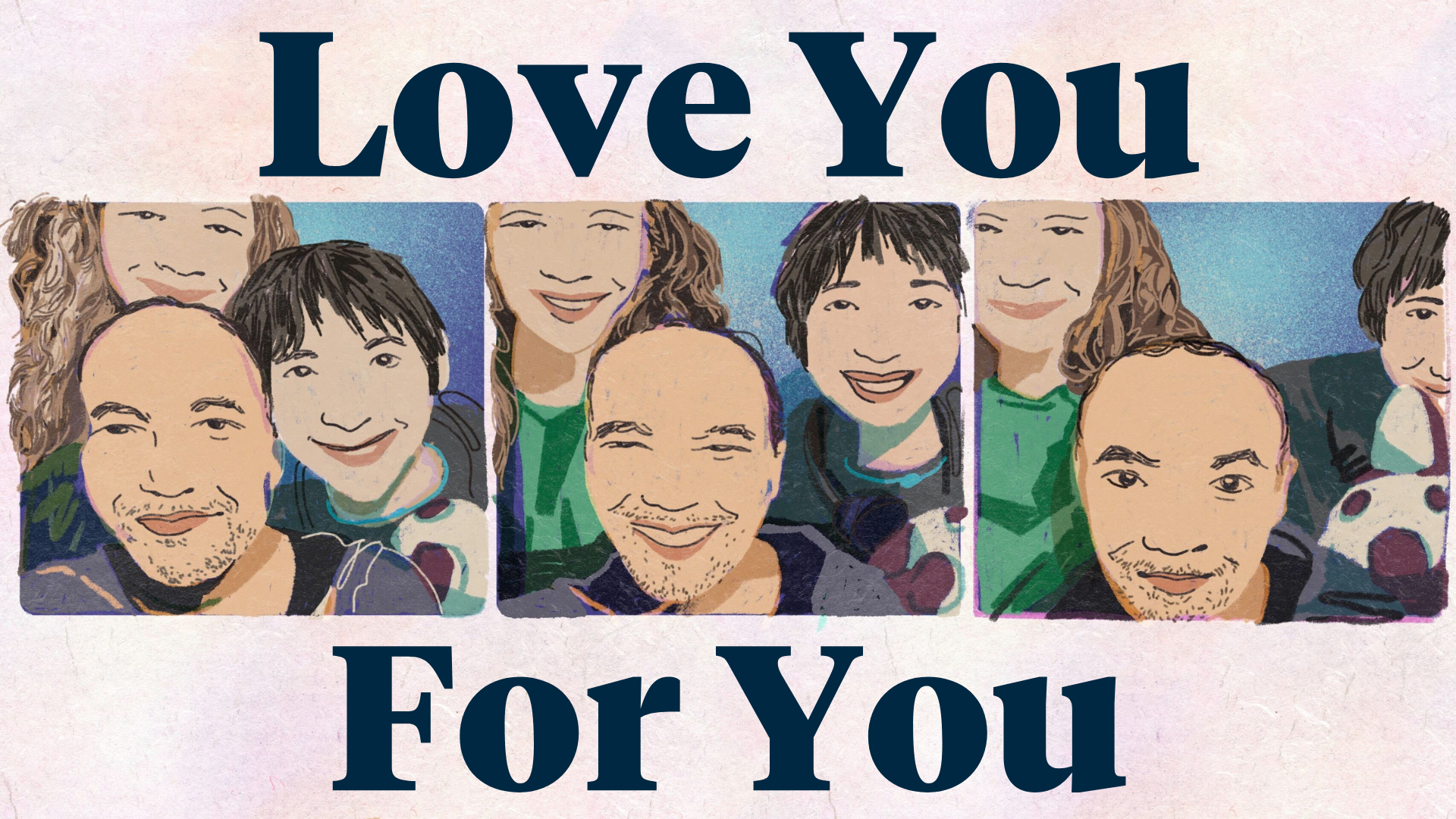
Ericka Cruz Guevarra [00:01:33] So Sasha and her colleagues spent months putting together this series called Love You for You. Conversations between trans kids and the people who love them.
Child [00:01:47] Thanks for letting me be who I am.
Mother [00:01:49] Yeah. And thank you for letting me be your parent and for letting me love you.
Child [00:01:56] You’re welcome. (laughs)
Ericka Cruz Guevarra [00:02:00] The series Love You for You features six conversations between trans and non-binary kids and their loved ones. And today we’re gonna talk with Sasha about being a fly on the wall to these conversations as the trans community is under attack. That’s coming up right after the break.
Ericka Cruz Guevarra [00:02:32] We’re talking about your series for the California Report magazine. I wonder if you can actually just start by walking me through the the thinking behind your series, the why.
Sasha Khokha [00:02:43] The thinking was there’s a lot out there about trans kids being in the crosshairs of the Trump administration right now. But I think what’s really missing are stories of what it looks like when kids have love and support from their families and because of that are insulated a little bit from what’s happening in the outside world. That’s not to say that backdrop doesn’t exist.
Ericka Cruz Guevarra [00:03:12] Yeah.
Sasha Khokha [00:03:13] But I think there’s a lot of power in hearing from parents, from grandparents, from elders who love and support transgender and nonbinary kids so they can thrive, so they can find joy.
Ericka Cruz Guevarra [00:03:31] And these were essentially sort of like StoryCorps style episodes where you’re not in it but you just hear these kids talking with these people who are important in their lives about who they are and why they love them and just these very sweet conversations.
Sasha Khokha [00:03:50] Right, and that’s part of why we wanted to do these as conversations that could unfold naturally without me as the journalist coming to their house and sticking a microphone in their face and getting a sound bite or two from a kid. And we also really wanted to give these kids agency so they picked the adults or the other people they wanted to be in conversation with.
Ericka Cruz Guevarra [00:04:17] With can you explain the range of people that we hear from in this series?
Sasha Khokha [00:04:23] So we start off with an eight year old non-binary kid in conversation with their mom. I like took this sock.
Child [00:04:31] I like to play soccer and read, and my family’s from Asia like Vietnam and Taiwan and my pronouns they them and I’m eight years old.
Sasha Khokha [00:04:43] And that was actually the first conversation we recorded. And it was kind of hard because the kid was really shy and was only eight and was a little bit soft spoken on the microphone. It was a little bit stuffed up, so it was like a little bit hard to understand them. And their voice is so cute. Yeah, and I thought, oh my gosh, how’s this gonna go? Like, how are we gonna do all of these? But honestly, I think once they got warmed up and their mom really made them feel comfortable, it was quite a sweet conversation.
Child [00:05:15] What are you most proud of about me?
Mother [00:05:19] That you knew when you were very young. You were only about four years old and you just kinda told me that you weren’t sure that you fit being either a boy or a girl, and you felt maybe like you were neither or both. And that was something for us to learn because we didn’t think kids that young knew that about themselves.
Sasha Khokha [00:05:47] And especially about navigating pronouns with their Vietnamese and Taiwanese relatives because in some of their families’ home languages there are not gendered pronouns. And so it was just a really interesting conversation.
Mother [00:06:03] And so for them everybody’s a they or they mix they mix he’s and she’s a lot.
Child [00:06:09] Maybe like the future could just be like people accept they them or trans just as like would they accept she or he right now.
Sasha Khokha [00:06:28] In some cases the kids chose actually to bring in someone who was not blood related to them.
Hunter Stoval [00:06:33] Beyond you being my aunt, you’re one of my closest friends.
Sasha Khokha [00:06:37] One of the conversations was with sixteen year old Hunter Stoval, who decided to talk with his special auntie, whose name’s Shirin Amini. She actually came out as a lesbian in the nineteen nineties, and the first person she came out to was Hunter’s mom.
Shirin Amini [00:06:56] I think honestly, that your mom was the most supportive person in my life that was kind of a rock, like my rock of Gibraltar.
Sasha Khokha [00:07:11] And so it was just a really lovely sort of full circle conversation and it got at some of the queer and trans history that these kids also wanted to know about from their elders.
Hunter Stoval [00:07:22] I think everyone should have a shrine in their life. Like an older role model who’s also your friend who you can tell anything and you know they won’t tell your parents unless you ask them to and call you when you need anything. And just having that mentor-friend combination is just so perfect.
Sasha Khokha [00:07:47] The last two episodes are actually young people in conversation with transgender elders in their seventies who have seen the long arc of transgender history here in California and who have been through a lot and had a lot of wisdom to share with young people. And I think those are some of the most touching conversations.
Ericka Cruz Guevarra [00:08:15] I mean, were there any themes that really emerged from the conversations in this series?
Sasha Khokha [00:08:22] I mean, I think one of them is just intergenerational exchange.
Andrea Horne [00:08:26] America teaches us not to really care about our old folks.
Sasha Khokha [00:08:31] I’m thinking of a conversation with Andrea Horne, who is she says she’s a woman of a certain age. She didn’t want to give her age. But she is a transgender elder here in San Francisco. She came to San Francisco from LA when she was fifteen to get away from her very unsupportive family. She was an actress, a model, a performer. She hung out with Sylvester in the 70s. And now she’s a historian who’s writing a book called How Black Trans Women Changed the World.
Andrea Horne [00:09:06] But before World War II, we were considered just part of the community. Mm-hmm. As long as you stay in your lane.
Zen Blossom [00:09:14] And what were those lanes?
Andrea Horne [00:09:15] The lanes were hairdresser.
Zen Blossom [00:09:17] Okay.
Andrea Horne [00:09:18] Sex work.
Zen Blossom [00:09:19] Okay.
Andrea Horne [00:09:20] Work in a bar of some sort. A show girl and housewife. But you know, that’s kinda that’s it.
Sasha Khokha [00:09:29] And to see her in conversation with a younger black trans woman named Zen Blossom, talking about women from the 1800s, women from the early 1900s who lived their true authentic lives and passing down that wisdom was very intense, very moving.
Ericka Cruz Guevarra [00:09:51] Was there any moment that in any of these conversations that you sat in on that like surprised you?
Sasha Khokha [00:09:58] Yes, I am th I’m thinking of the ten year old transgender girl who came with her grandpa, who lives in a rural conservative county in Northern California, and her older sister who is sixteen.
Older sister [00:10:16] Popo what do you hope that the future is like for trans kids and what do you plan on doing to support trans kids?
Grandpa [00:10:25] Oh, I support this one all the time. I’d do anything for her and she knows that.
Sasha Khokha [00:10:31] She was so funny and vivacious and great. And again, I was worried, how’s a ten year old gonna do in this studio with all these microphones? And she’s an actor and she’s a performer. And at one point in the interview sh as we were wrapping up, she’s like, By the way, if there are any agents out there listening and you need somebody to cast
Younger sister [00:10:51] If I really want to be a child actor, if there’s any agents listening, hello, I’m here. Hi. But another thing is I would love to like this, I love how I get to like share knowledge to other people that might not know about being trans or stuff.
Sasha Khokha [00:11:12] And another thing she did that was really surprising is when she was asked, you know, what do you do when you get bullied, she actually just burst into song.
Younger sister [00:11:19] They’re just doing it because they’re insecure about yourself and they just want to tear you down even though you’re a confident, amazing person and they’re not. So just walk away and say I’m better than you and sing your way out. That’s what I do.
Sasha Khokha [00:11:39] So I guess what was most surprising to me was just how joyful and funny some of these kids were and their self-confidence. Sometimes transgender and non-binary kids, gender-expansive kids have to grow up a little bit faster because they’ve got to face the world that sometimes is hostile to them. Sometimes they have to make choices about gender-affirming care. A lot of decisions that sometimes make them have to, you know, have a level of maturity that we might not always see in other kids their age.
Ericka Cruz Guevarra [00:12:16] Right. Like an awareness of of who you are. I don’t I don’t think I was that fully formed when I was ten, for example. But yeah
Sasha Khokha [00:12:28] There’s authenticity in who these kids are because they’ve had to fight for who they are.
Ericka Cruz Guevarra [00:12:35] What was your main takeaway from from sitting in these conversations, Sasha, and and working on this series?