This is a computer-generated transcript. While our team has reviewed it, there may be errors.
Ericka Cruz Guevarra [00:00:00] I’m Ericka Cruz-Gavarra and welcome to The Bay, local news to keep you rooted.
Newsom [00:00:06] Well, good evening, everybody. And let me underscore, it’s been a good evening. For everybody, not just the Democratic Party.
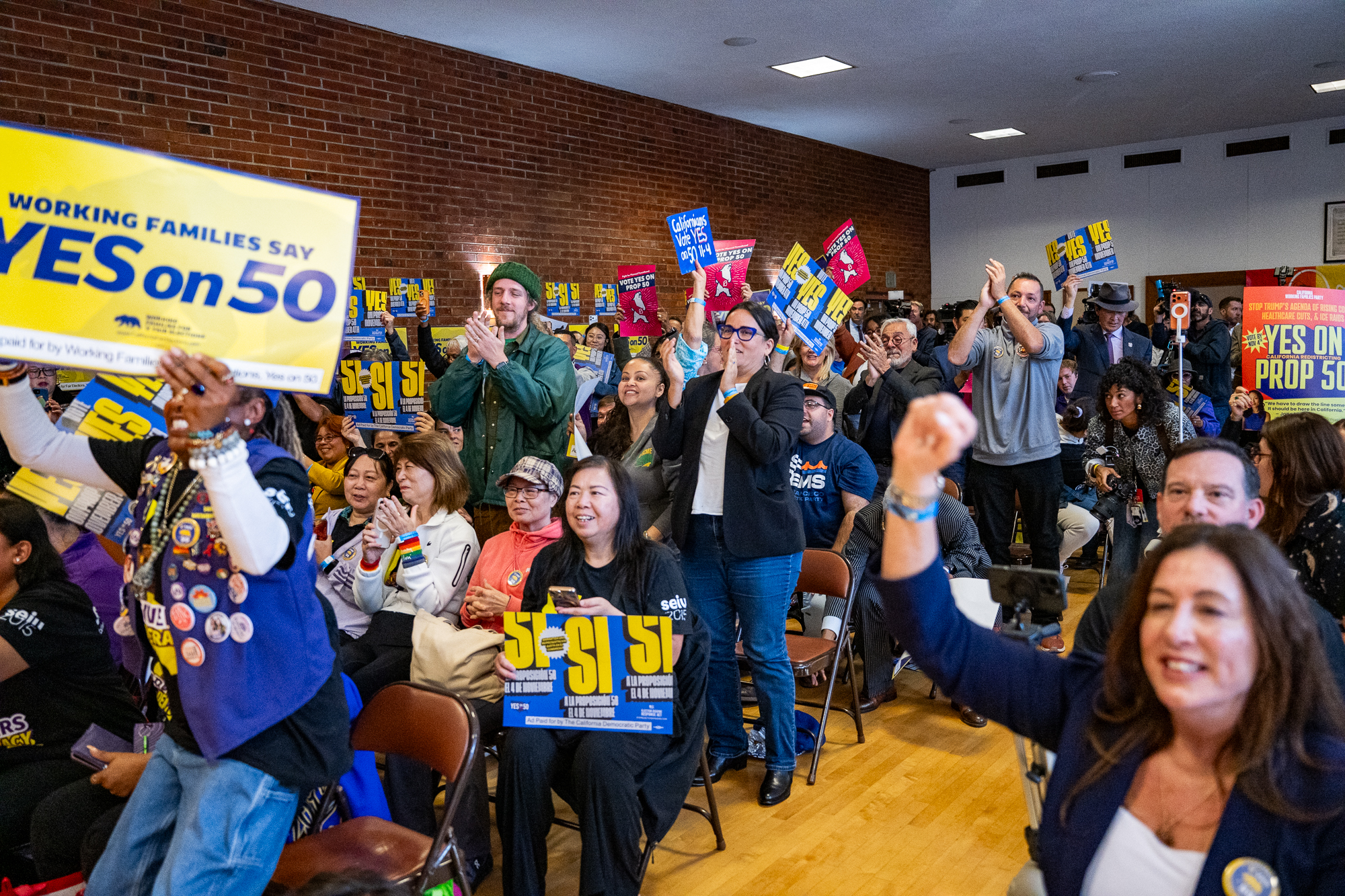
Ericka Cruz Guevarra [00:00:16] On Tuesday night, Californians overwhelmingly passed Proposition 50, which gives the state temporary power to redraw our congressional maps. All election season, California Democrats built up Prop 50 as a clapback to President Donald Trump by redrawing the congressional maps to help Democrats retake the House in next year’s midterm.
Newsom [00:00:44] We stood tall and we stood firm in response to Donald Trump’s recklessness. And tonight, after poking the bear, this bear roared.
Voter [00:00:56] Everything that’s going on in the world, this has given me a slight little hope as a chance to fight back, right?
Voter [00:01:04] We have to stop the Trump machine and we have to get a fair election.
Voter [00:01:09] There’s so much already altered that I feel like we have to make it fair so that there’s a balanced reception of people’s opinions and that seems like the only way to do it right now.
Ericka Cruz Guevarra [00:01:23] Today, we’re going to talk with KQED’s politics and government correspondent, Guy Marzorati, about the results of the election and how Prop 50 will change congressional districts in the Bay Area. Plus, Measure A passes in Santa Clara County, and Nancy Pelosi announces her retirement.
Ericka Cruz Guevarra [00:01:50] So Guy, this is not your first rodeo. Of course, you stayed up for many an election night. But we didn’t think this year was gonna be an election year in California, and it was. I’m curious how this compares to past election years that you’ve covered.
Guy Marzorati [00:02:06] Yeah, I would say it was a easier election night than a lot of past ones, just because we really got the big result pretty early in the evening. Right after polls closed at 8 o’clock, the Associated Press called that Proposition 50 had passed. And so it wasn’t really a lot of, you know, suspense. I think going into election night, we’re fairly confident Proposition 50 was going to pass. And so now it’s just kind of digging through the results and kind of ripple effects from Prop 50 that will be following.
Ericka Cruz Guevarra [00:02:49] Yeah, and let’s talk about Prop 50 for a little bit. This was really billed as California’s rebuke against Trump. So as you mentioned, it wasn’t really surprising that Prop 50 passed in California. How much did it pass by though? Do we know anything about that?
Guy Marzorati [00:03:08] Right now, with what the Associated Press estimates as about three quarters of the votes in, Prop 50 is passing with 64 percent of the vote, which is a huge margin. To see, you know, 64 percent for this, I think, speaks to the success that the Governor Gavin Newsom was able to have in convincing voters to really, yes, make this a partisan fight and a referendum on the president.
Ericka Cruz Guevarra [00:03:33] So Guy, I mean Prop 50’s win wasn’t always a guarantee. There were some early polls that showed California voters were hesitant to redraw the maps. So how did we end up with such a landslide for the Yes side?
Guy Marzorati [00:03:47] Yeah, I think in the end, this election became a lot more about President Donald Trump than about redistricting.
Newsom [00:03:57] Donald Trump does not believe in fair and free elections, period and full stop.
Guy Marzorati [00:04:04] Which was Newsom’s goal all along, was to not make this about whether or not voters favored independent citizen-led redistricting, which remains popular. I mean, there was a CNN exit poll of Prop 50 that said 92% of voters favored independent redistricting in California. 60% of those voters still voted for Prop 50. So in the end, I think voters were able to hold two things together. One, that they supported the idea of having citizens draw lines, not favoring either political party, but also using this election to push back against the Trump administration and the efforts by Republicans nationwide to pursue seats through gerrymandering.
Ericka Cruz Guevarra [00:04:49] Yeah, and Governor Newsom really came out as sort of the face of Prop 50 in many ways and was really the guy pitching this as this fight against Donald Trump. What did he say at the end of election day after seeing these results?
Guy Marzorati [00:05:07] Yeah, what we heard from Newsom on election night was really a call for other states to follow in California’s footsteps.
Newsom [00:05:16] We need the state of Virginia. We need state of Maryland. We need our friends in New York, in Illinois, in Colorado. We need to see other states meet this moment head on as well.
Guy Marzorati [00:05:29] He made the case for other democratic states to do something similar, to pursue plans, to redraw their congressional maps to help Democrats, because Prop 50 is really part of this nationwide fight over congressional district lines, where we’ve seen Republican states like Texas, like Missouri, like North Carolina, do their own gerrymandering. California has now approved a gerrymander plan favoring Democrats, and there could other states that Newsom called out. As possibly pursuing this down the line as we get closer to the 2026 midterms.
Newsom [00:06:03] We can de facto end Donald Trump’s presidency as we know it. The minute Speaker Jeffreys gets sworn in as Speaker of the House of Representatives, it is all on the line.
Ericka Cruz Guevarra [00:06:21] Well, let’s talk about what it actually means now that Prop 50 has passed, because obviously what happens now is that our congressional districts will be redrawn, and you’ve done a bit of reporting before this about the Bay Area cities that are gonna be really impacted by Prop 50, and some of them include Pittsburgh and Antioch, right?
Guy Marzorati [00:06:47] That’s right. When you look at the 8th congressional district, which includes Pittsburgh, includes Antioch, this is really kind of at the heart of the debate over Proposition 50. This was a district that was drawn by the Citizens Commission based on input that they got from residents. So they heard from residents in Pittsburgh and Antioch, but also in communities like Martinez, Richmond, Vallejo, residents who said, we have a lot in common and we’d like to be included in one congressional district. And these communities, working class, very racially diverse, expressed that to the commission and got included in one Congressional District. What the Prop 50 map does is it takes these heavily democratic voters in Antioch and in Pittsburgh, and it loops them into a district with communities in the Central Valley. And the purpose of that is to help a democratic incumbent in the central valley have an easier path to re-election.
Ericka Cruz Guevarra [00:07:49] It’s interesting, though, because in the reporting you did ahead of the election, many Democratic voters in some of these cities like Antioch and Pittsburgh knew the impact that this would have on their communities and remember how much work went into building that very diverse district, but still supported Prop 50, right?
Guy Marzorati [00:08:12] That’s true. I mean, even the county supervisor Shanelle Scales-Preston who represents a lot of that area on the Contra Costa County Board of Supervisors, it was a tough decision for her.
Shanelle Scales-Preston [00:08:22] I’m born and raised here in this community and you know I want to make sure that representation is there.
Guy Marzorati [00:08:28] She understood the impact of having these communities grouped together in a congressional district. She talked about how where she lives in Pittsburgh, she’s like, this is not like the Central Valley. We have very different needs than constituents in the Central valley. But at the same time, she was like, the fact that if we can get Democrats to flip the House of Representatives, it will mean potentially more funding for the issues that I care about in my community.
Shanelle Scales-Preston [00:09:00] These cuts that are coming down from the federal government, starting in January, I mean, it’s going to be a huge, a huge cut. And so I think… You know, if there’s any way that we’re able to get more seats so that we can help the people here on the ground, we gotta do it.
Ericka Cruz Guevarra [00:09:48] Well, I wanna move on, Guy, to one local measure that was on the ballot for voters in Santa Clara County where you live, Measure A. This was, of course, the sales tax increase, which also passed. Can you remind us briefly what this does?
Guy Marzorati [00:10:09] Yeah, so Measure A in Santa Clara County, it raises the county sales tax by 5 eighths of a cent for every dollar you spend, and it’s gonna raise about $330 million a year for the county. This was put on the ballot by the County Board of Supervisors after we saw these big federal budget cuts to Medicaid, to SNAP, food benefits, and the county leaders basically went to voters and said, Would you be willing to raise taxes on yourself to help? Backfill some of the money that we’re losing as a result of these federal budget cuts, particularly with healthcare. Santa Clara County runs four public hospitals. These are heavily reliant on Medicaid dollars coming from the federal government. So without those, the county was looking at basically a loss of about a billion dollars a year by the end of the decade.
Joseph Geha [00:10:57] What was your feeling when you saw the uh… The numbers flash across the screen there?
James Williams [00:11:01] Gratitude and relief gratitude for our community and its continued commitment to a public health care system that works for everyone in our
Guy Marzorati [00:11:13] James Williams, who’s the county executive in Santa Clara County, was talking with my colleague Joseph Geha on election night and really described the fact that he felt like the passage of Measure A in Santa Clare County gives the county a fighting chance as it kind of grapples with these federal cuts.
James Williams [00:11:29] We are staring down such a devastating level of federal budget cuts. That daunting task still remains in front of us, but the passage of Measure 8 tonight makes a huge world of difference.
Guy Marzorati [00:11:44] Now the question is, this campaign was really run as we’re gonna save the county’s four public hospitals by passing measure A, will the county leaders do that? Will they be able to keep the doors open at all four of the county public hospitals? When Joseph asked James Williams that question, does this guarantee the hospitals remain open? James Williams didn’t 100% say, yes, I guarantee that. So that’s gonna be something to watch going forward.
Ericka Cruz Guevarra [00:12:17] Well, I wanna transition now, Guy, into something that’s not explicitly election-related, at least to this year’s election, but I do have to ask you about the news around Nancy Pelosi and her announcement that she, after 38 years of representing San Francisco in Congress, will not be seeking re-election. Pretty big news.
Guy Marzorati [00:12:43] Yeah, huge. I mean, Pelosi has been not only like an impactful leader locally, but someone who really will go down in history as one of the most significant speakers of the House of Representatives in American history, whether you’re talking about, you know, the Affordable Care Act, the work that she did during the Biden administration, pushing that legislative agenda. So an icon in California, as well as national politics, and perhaps the first of a changing of the guard that we might see. Here in our own state’s congressional delegation.
Ericka Cruz Guevarra [00:13:17] Nancy Pelosi posted a video on Thursday morning announcing her decision to not seek re-election. What did she say in this video?
Guy Marzorati [00:13:30] She titled the video like a letter to San Francisco and really, you know, in the video talked about her own career representing the city in Congress, but also just like, you now, in her words, like what made San Francisco special.
Nancy Pelosi [00:13:46] Here we don’t fear the future, we forge it. From the gold rush to the miracles of science and technology, our city has always been the cradle of innovation.
Guy Marzorati [00:13:56] So almost like a love letter to the city as she eventually made the announcement in the video that she would not be seeking another term in Congress.
Nancy Pelosi [00:14:05] As we go forward, my message to the city I love is this. San Francisco, know your power. We have made history, we have made progress. We have always led the way. And now we must continue to do so by remaining full participants.
Ericka Cruz Guevarra [00:14:24] I mean, do we know anything about why she’s making this announcement now? I mean it does seem like we are in this very interesting moment, it seems like, with the Democratic Party really, and folks really wanting to see a sort of generational change.
Guy Marzorati [00:14:44] Yeah, I think that’s that’s very true. And I do think you’ll see, I think a lot of that discussion go into the 2026 midterms in the June primary in California, younger democratic challengers may be taking on established incumbents. Look, there was already a number of folks who had who had signed up to run for this congressional seat, perhaps in anticipation that Pelosi would make this move. State Senator Scott Weiner has announced that he’s running to succeed Pelosi. So is Saikat Chakrabarti , who is the former chief of staff to Alexandria Ocasio-Cortez. We’ve heard Connie Chan, a member of the board of supervisors in San Francisco as a potential contender. So I wonder now that Pelosi has made this announcement, if we might see some other California Congress members kind of follow suit, um, and announce that they won’t be running.
Ericka Cruz Guevarra [00:15:35] Well, Guy, my last question for you. I mean, between the results that we’ve seen in California, both locally but also statewide, Democrats winning in New Jersey and Virginia and also New York City, I feel like the national media is really talking about this election as the first big rebuke of President Donald Trump. Does that seem right to you?
Guy Marzorati [00:16:01] I think that’s absolutely spot on. I think whether you’re talking about Proposition 50 or these other results across the country, this really was an election about Trump in large measure. Look at the exit polling around Proposition 50 in California, where almost two-thirds of voters said they disapproved of Trump in a CNN exit poll. Over 90% of those voters voted for Prop 50. Even among voters who said they somewhat disapprove of the Democratic Party, 60% voted for Prop 50. So again, this was not about loving everything that Democrats are putting forward in some cases, but simply the fact that people are opposed in large measure to the way this administration is acting on a whole suite of policies, and they express that in a lot of the election results on Tuesday.
Ericka Cruz Guevarra [00:16:59] Well, Guy, as always, thank you so much for breaking this all down. Appreciate it.