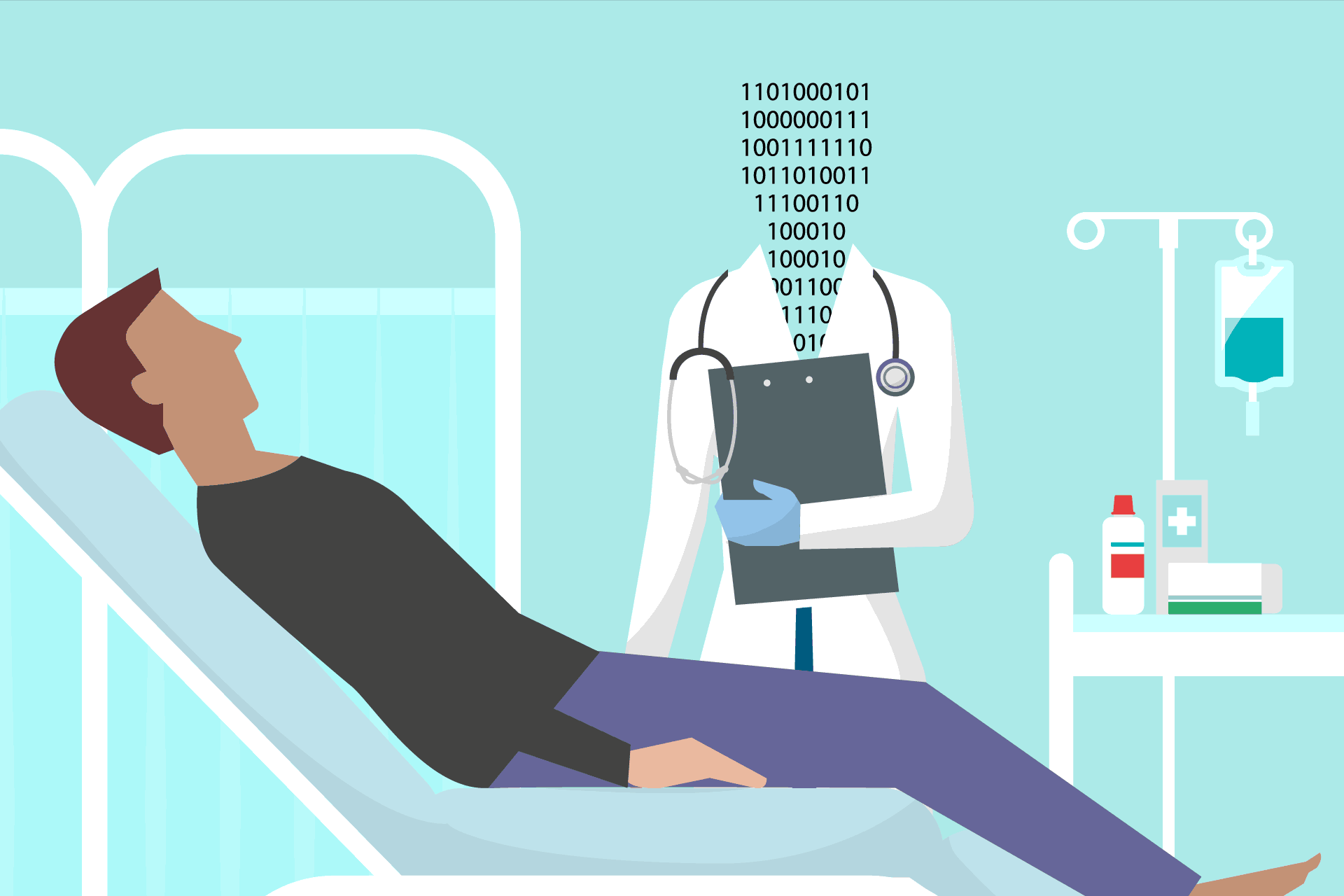
Will Computers Ever Be as Good as Physicians at Diagnosing Patients?
When it comes to the art of medical diagnosis, has Team Human finally triumphed over AI? Or is it only a matter of time before computers supplant the physician's brain?
Since 2012, Vinod Khosla, a co-founder of Sun Microsystems, has been predicting that most of what physicians currently do can, will, and should be done by computers. “By 2025,” he has written, “more data-driven, automated health care will displace up to 80 percent of physicians’ diagnostic and prescription work.”
Though Khosla’s comments have irked many a physician, I’m not willing to dismiss him as a kooky provocateur or a utopian techno-evangelist. First of all, his investment track record has made him a Silicon Valley rock star. More important, as recently as a decade ago, some very smart and savvy computer engineers and economists believed that another seemingly intractable problem, building a driverless car, was beyond the reach of modern technology. As of April 2014, the Google car had clocked nearly 700,000 miles and been involved in just two accidents.
If the driverless car weren’t enough of a challenge to human superiority, who could have watched IBM’s Watson supercomputer defeat the Jeopardy Hall of Famers in 2011 and not fretted about the future of physicians, or any highly skilled workers, for that matter?
"Just as factory jobs were eliminated in the twentieth century by new assembly-line robots,” wrote all-time (human) Jeopardy champion Ken Jennings soon after the lopsided match ended, “Brad [Rutter, the other defeated champ] and I were the first knowledge-industry workers put out of work by the new generation of ‘thinking’ machines. ‘Quiz show contestant’ may be the first job made redundant by Watson, but I’m sure it won’t be the last.”
Soon after the well-publicized trouncing, IBM announced that one of its first “use cases” for Watson would be medicine. Sean Hogan, vice president for IBM Healthcare, told me that “health care jumped out as an area whose complexity and nuances would be receptive to what Watson was representing.”
Sticking Up for Team Human
Andy McAfee, coauthor with Erik Brynjolfsson of the terrific book "The Second Machine Age," agrees with Khosla that computers will ultimately take over much of what physicians do, including diagnosis. “I can’t see how that doesn’t happen,” McAfee, a self-described “technology optimist,” told me when we met for lunch near his MIT office. McAfee and Brynjolfsson argue that the confluence of staggering growth in computing power, zetabytes of fully networked information available on the Web, and the “combinatorial power” of innovation mean that areas that seemed like dead ends, such as artificial intelligence in medicine, are now within reach. They liken the speed with which old digital barriers are falling to Hemingway’s observation about how a person goes broke: “gradually, then suddenly."
In speaking with both McAfee and Khosla, I felt a strange obligation to stick up for my teams: humans and the subset of humans called doctors. I told McAfee that while I was in awe of the driverless car and IBM’s victories in chess (over world champion Garry Kasparov in 1997) and Jeopardy, he just didn’t understand how hard medicine is. Answering questions posed by Alex Trebek like, “While Maltese borrows many words from Italian, it developed from a dialect of this Semitic language” (the correct response is “What is Arabic?”—Watson answered it, and 65 of the 74 other questions it rang in for, correctly) is tricky, sure, but, at the end of the day, one is simply culling a series of databases to find a fact—a single right answer.
Medical diagnosis isn’t like that. For one thing, uncertainty is endemic, so that the “correct” answer is often a surprisingly probabilistic notion. For another, many diagnoses reveal themselves over time. The patient may present with, say, a headache, but not a worrisome one, and so the primary treatment is reassurance, Tylenol, and time. If the headache worsens over the next two weeks—particularly if it is now accompanied by additional symptoms such as weakness or nausea—that’s an entirely different story.
McAfee listened sympathetically—he’s obviously heard scores of versions of the "You just don’t understand; my work is different" argument—and then said, “I imagine there are a bunch of really smart geeks at IBM taking notes as guys like you describe this situation. In their heads, they’re asking, ‘How do I model that?’”
Undaunted, I tried another tack on Khosla when we met in his office in Menlo Park. “Vinod,” I said, “in medicine we have something we call the ‘eyeball test.’ That means I can see two patients whose numbers look the same”—things like temperature, heart rate, and blood counts—“and my training allows me to say, ‘That guy is sick [I pointed to an imaginary person across the imposing conference table] and the other is okay.’” And good doctors are usually right, I told him, as we possess a kind of sixth sense that we acquire from our training, our role models, and a thousand cases of trial and error.
Before Khosla could dismiss this as the usual whining from a dinosaur on the edge of extinction, I tossed him an example from his own world. “I’ll bet you have CEOs of start-ups constantly coming through this office pitching their companies,” I said. “I can imagine two companies that look the same on paper: both CEOs have Stanford MBAs; the proposals have similar financials. Your skill is to be able to point to one and say, ‘Winner’ and to the other, ‘Loser,’ and I’m guessing you’re right more often than not. You’re using information that isn’t measurable. Right?”
Nice try. He didn’t budge. “The question is, ‘Is it not measurable or is it not being measured?’” he responded. “And, when does your instinct work and when does it mislead? I think if you did a rigorous study, you’d find that your ‘eyeball test’ is far less effective than you think.”
Secrets of the Great Diagnosticians
There is a rich 50-year history of efforts to build artificial intelligence (AI) systems in health care, and it’s not a particularly uplifting story. Even technophiles admit that the quest to replace doctors with computers—or even the more modest ambition of providing them with useful guidance at the point of care—has been overhyped and unproductive. But times have changed. The growing prevalence of electronic health records offers grist for the AI and big data mills, grist that wasn’t available when the records were on paper. And in this, the Age of Watson, we have new techniques, like natural language processing and machine learning, at our disposal. Perhaps this is our “gradually, then suddenly” moment.
The public worships dynamic, innovative surgeons like Michael DeBakey; passionate, insightful researchers like Jonas Salk; and telegenic show horses like Mehmet Oz. But we seldom hear about those doctors whom other physicians tend to hold in the highest esteem: the great medical diagnosticians. These sages, like the legendary Johns Hopkins professors William Osler and A. McGehee Harvey, had the uncanny ability to deduce the truth from what others found to be a jumble of symptoms, signs, and lab results. In fact, Sir Arthur Conan Doyle, a physician by training, modeled Sherlock Holmes on one of his old professors, Joseph Bell, a renowned diagnostician at Edinburgh’s medical school.
For most doctors, diagnosis forms the essence of their practice (and of their professional souls), which may help explain why we find it so painful to believe that this particular skill could be replaced by silicon wafers.
In the 1970s, a Tufts kidney specialist named Jerome Kassirer (who later became editor of the New England Journal of Medicine) decided to try to unlock the cognitive secrets of the great diagnosticians. If he succeeded, the rewards could be great. The insights, problem-solving strategies, and reasoning patterns of these medical geniuses might be teachable to other physicians, perhaps even programmed into computers.
Kassirer focused first on the differential diagnosis, the method that doctors have long used to inventory and sort through their patients’ problems. The differential diagnosis is to a physician what the building of hypotheses is to a basic scientist: the core work of the professional mind. Let’s say a female patient complains of right lower abdominal pain and fever. We automatically begin to generate “a differential,” including appendicitis, pelvic inflammatory disease, kidney infection, and a host of less common disorders—some of them quite serious. Our job is to weigh the facts at hand in an effort to ultimately “rule in” one diagnosis on the list and “rule out” the others. Sometimes, the information we gather from the history and physical examination is sufficient.
More often, particularly when patients are truly ill, we require additional laboratory or radiographic studies to push one of the diagnoses over the “rule in” line. There is considerable skill, and no small amount of art, involved in this process. For one thing, we need to figure out whether the patient’s symptoms are part of a single disease or are manifestations of two or more distinct illnesses. The principle known as Occam’s Razor bids us to try to find a unifying diagnosis for all of a patient’s symptoms. But as soon as medical students memorize this so-called Law of Clinical Parsimony, we whipsaw them with Hickam’s Dictum, which counters, irreverently, that “patients can have as many diseases as they damn well please.”
Setting the “rule in” threshold is yet another challenge, since it’s wholly dependent on the context. For diseases with relatively benign treatments and prognoses—let’s say, stomach discomfort with no alarming features—I might make the diagnosis of “nonulcer dyspepsia” if I’m 75 percent certain that this is what’s going on. Why? Dyspepsia is a not-too-serious illness, the other illnesses that might present with the same symptoms aren’t likely to be acutely life-threatening either, and dyspepsia has a safe, inexpensive, and fairly effective treatment. All of this makes a 75 percent threshold high enough for me to try an acid-blocker and see what happens.
Now let’s turn to a patient who presents with acute shortness of breath and pleuritic chest pain. In this patient, I’m considering the diagnosis of pulmonary embolism (a blood clot to the lungs), a more serious disorder whose treatment (blood thinners) is riskier. Now, I’d want to be at least 95 percent sure before attaching that diagnostic label. And I won’t rule in a diagnosis of cancer—with its psychological freight, prognostic implications, and toxic treatments—unless I’m close to 100 percent certain, even if it takes a surgical biopsy to achieve this level of confidence.
Kassirer and his colleagues observed the diagnostic reasoning of scores of clinicians. They found that the good ones employed robust strategies to answer these knotty questions, even if they couldn’t always articulate what they were doing and why. The researchers ultimately came to appreciate that the physicians were engaging in a process called “iterative hypothesis testing” to transform the differential diagnosis (or, more accurately, diagnoses, since sick patients often have a variety of abnormalities to be explained) into something actionable. After hearing the initial portion of a case, the doctors began drawing possible scenarios to explain it, modifying their opinions as they went along and more information became available.
For example, when a physician confronts a case that begins with, “This 57-year-old man has three days of chest pain, shortness of breath, and lightheadedness,” she responds by thinking, “The worst thing this could be is a heart attack or a pulmonary embolism. I need to ask if the chest pain bores through to the back, which would make me worry about aortic dissection [a rip in the aorta]. I’ll also inquire about typical cardiac symptoms, such as sweating and nausea, and see if the pain is squeezing or radiates to the left arm or jaw. But even if it doesn’t, I’ll certainly get an EKG to rule out a heart attack or pericarditis [inflammation of the sac that surrounds the heart]. If he also reports a fever or a cough, I might begin to suspect pneumonia or pleurisy. The chest X-ray should help sort that out.”
Every answer the patient gives, and each positive or negative finding on the physical examination (yes, there is a heart murmur; no, the liver is not enlarged) triggers an automatic, almost intuitive recalibration of the most likely alternatives. When I see a master clinician at work—my favorite is my UCSF colleague Gurpreet Dhaliwal, who was profiled in a 2012 New York Times article—I know that these synapses are firing as he asks a patient a series of questions that may seem unrelated to the patient’s presenting complaint but are directed toward “narrowing the differential.” It turns out that there’s an even more impressive piece of cognitive magic going on. The master clinician embraces certain pieces of data (the patient’s trip to rural Thailand last year) while discarding others (an episode of belly pain and bloating three weeks ago). This is the part of diagnostic reasoning that beginners find most vexing, since they lack the foundational knowledge to understand why their teacher focused so intently on one nugget of information and all but ignored others that, to the novice, seemed equally crucial. How do the great diagnosticians make such choices?
We now recognize this as a relatively intuitive version of Bayes’ theorem. Developed by the eighteenth-century British theologian-turned-mathematician Thomas Bayes, this theorem (often ignored by students because it is taught to them with the dryness of a Passover matzo) is the linchpin of clinical reasoning. In essence, Bayes’ theorem says that any medical test must be interpreted from two perspectives. The first: How accurate is the test—that is, how often does it give right or wrong answers? The second: How likely is it that this patient has the disease the test is looking for?
These deceptively simple questions explain why, in the early days of the AIDS epidemic (when HIV testing was far less accurate than it is today), it was silly to test heterosexual couples applying for a marriage license, since the vast majority of positive tests in this very low-risk group would be wrong. Similarly, they show why it is foolish to screen healthy 36-year-old executives with a cardiac treadmill test or a heart scan, since positive results will mostly be false positives, serving only to scare the bejesus out of the patients and run up bills for unnecessary follow-up tests. Conversely, in a 68-year-old smoker with diabetes and high cholesterol who develops squeezing chest pain while jogging, there is a 95 percent chance that those pains are from coronary artery disease. In this case, a negative treadmill test only lowers this probability to about 80 percent, so the clinician who reassures the patient that his negative test means that his heart is fine—“take some antacids; it’s OK to keep jogging”—is making a terrible, and potentially fatal, mistake.
The AI Challenge
As if this weren’t complicated enough for the poor IBM engineer gearing up to retool Watson from answering questions about “Potent Potables” to diagnosing sick patients, there’s more. While the EHR at least offers a fighting chance for computerized diagnosis (older medical AI programs, built in the pen-and-paper era, required busy physicians to write their notes and then reenter all the key data), parsing an electronic medical record is far from straightforward. Natural language processing is getting much better, but it still has real problems with negation (“the patient has no history of chest pain or cough”) and with family history (“there is a history of arthritis in the patient’s sister, but his mother is well”), to name just a couple of issues. Certain terms have multiple meanings: when written by a psychiatrist, the term depression is likely to refer to a mood disorder, while when it appears in a cardiologist’s note (“there was no evidence of ST-depression”) it probably refers to a dip in the EKG tracing that is often a clue to coronary disease. Ditto abbreviations: Does the patient with “MS” have multiple sclerosis or mitral stenosis, a sticky heart valve? Finally, the computer can’t read a patient’s tone of voice or the anxious look on her face, although engineers are working on this. These clues—like one patient saying, “I have chest pain,” and another, “I HAVE CHEST PAIN!!!”—can make all the difference in the world diagnostically.
Perhaps the trickiest problem of all is that—at least today—the very collection of the facts needed to feed an AI system is itself a cognitively complex process. Let’s return to the example of aortic dissection, a rip in the aorta that is often fatal if it is not treated promptly. If the initial history raises the slightest concern about dissection, I’m going to ask questions about whether the pain bores through to the back and check carefully for the quiet murmur of aortic insufficiency as well as for asymmetric blood pressure readings in the two arms, all clues to dissection. If I don’t harbor a suspicion of this scary (and unusual) disease, I’m not going to look for these things—they’re not part of a routine exam.
Decades ago, MIT’s Peter Szolovits, an AI expert who worked with Kassirer and his colleagues in the early days, gave up thinking about diagnosis as a simple matter of question answering. This was mostly because he came to appreciate the importance of timing—a nonissue in Jeopardy but a pivotal one in medicine. “A heart attack that happened five years ago has different implications from one that happened five minutes ago,” he explained, and a computer can’t “know” this unless it is programmed to do so. (It turns out that such issues of foundational knowledge are fundamental in AI—computers have no way of “knowing” some of the basic assumptions that allow us to get through our days, things like water is wet, love is good, and death is permanent.)
Moreover, much of medical reasoning relies on feedback loops: observing how events unfold and using that information to refine the diagnostic possibilities.We think a patient has bacterial pneumonia, and so we treat the “pneumonia” with antibiotics, but the patient’s fever doesn’t break after three days. So now we consider the possibility of tuberculosis or lupus. This is the cognitive work of the practicing clinician—focused a bit less on “What is the diagnosis?” and more on “How do I best manage this situation?”—and an AI program that doesn’t account for this will be of limited value.
Early Attempts
Now that you appreciate the nature of the problem, it’s easy (in retrospect, at least) to see why the choice by early health care computer experts to focus on diagnosis was risky, perhaps even wrongheaded. It’s like tackling Saturday’s crossword puzzle in the New York Times before first mastering the one in USA Today.
Larry Fagan, an early Stanford computing pioneer, told me, “We were not naive about the complexity. It’s just that it was the most exciting question.” Diagnosis is not just exciting, it’s at the heart of safe medical care. Diagnostic errors are common, and they can be fatal. A number of autopsy studies conducted over the past 40 years have shown that major diagnoses were overlooked in nearly one in five patients. With the advent of CT scans and MRIs, the number has gone down a bit, but it still hovers around one in ten. Diagnostic errors contribute to 40,000 to 80,000 deaths per year in the United States. And reviews of malpractice cases have demonstrated that diagnostic errors are the most common source of mistakes leading to successful lawsuits.
Medical IT experts jumped into the fray in the 1970s, designing a series of computer programs that they believed could help physicians be better diagnosticians, or perhaps even replace them entirely. That decade’s literature was replete with enthusiastic articles about how microprocessors, programmed to think like experts, would soon replace the brains of harried doctors. The attitude was captured by one early computing pioneer in a 1971 paean to his computer: “It is immune from fatigue and carelessness; and it works day and night, weekends and holidays, without coffee breaks, overtime, fringe benefits or human courtesy.”
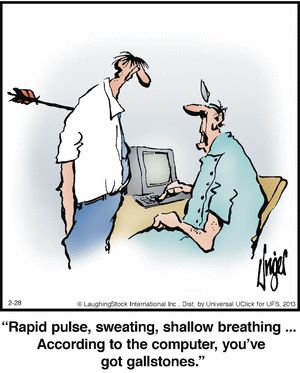
By the mid-1980s, disappointment had set in. The tools that had seemed so promising a decade earlier were, by and large, unable to manage the complexity of clinical medicine, and they garnered few clinician advocates and miniscule commercial adoption. The medical AI movement skidded to a halt, marking the start of a 20-year period that insiders still refer to as the “AI winter.” Ted Shortliffe, one of the field’s longstanding leaders, has said that the early experience with programs like INTERNIST, DXplain, and MYCIN reminded him of this cartoon:
'Version 0'
Vinod Khosla is prepared for this. He knows that even today’s generation of medical AI programs will produce some crazy output, akin to when Watson famously mistook Toronto for an American city during its Jeopardy triumph. (It was worse in rehearsal, when Watson referred to civil rights leader Malcolm X as “Malcolm Ten.”) Khosla points out that the enormous cellphones of the late 1980s would seem equally ridiculous when placed alongside our iPhone 6.0s. He calls today’s medical AI programs “Version 0,” and cautions that people should “expect these early systems and tools to be the butt of jokes from many a writer and physician.”
These cases illustrate a perennial debate in AI, one that pits two camps against each other: the “neats” and the “scruffies.” The neats seek solutions that are elegant and provable; they try to model the way experts think and work, and then code that into AI tools. The scruffies are the pragmatists, the hackers, the crazy ones; they believe that problems should be attacked through whatever means work, and that modeling the behavior of experts or the scientific truth of a situation isn’t all that important. IBM’s breakthrough was to figure out that a combination of neat and scruffy—programming in some of the core rules of the game, but then folding in the fruits of machine learning and natural language processing—could solve truly complicated problems.
When he was asked about the difference between human thinking and Watson’s method, Eric Brown, who runs IBM’s Watson Technologies group, gave a careful answer (note the shout-out to the humans, the bit players who made it all possible):
A lot of the way that Watson works is motivated by the way that humans analyze problems and go about trying to find solutions, especially when it comes to dealing with complex problems where there are a number of intermediate steps toget you to the final answer. So it certainly is inspired by that process. . . . But a lot of it is different from the ways humans work; it tends to leverage the powers and advantages of a computer system, and its ability to rapidly analyze huge amounts of data and text that humans just can’t keep track of.
However Watson works, we find ourselves today in a world with new tools, new mental models, and a new sense of optimism that computers can do pretty much anything. But have we finally reached the age when computers can master the art of clinical reasoning?
I asked Eric Brown, who worked on the "Jeopardy" project and is now helping to lead Watson’s efforts in medicine, what the equivalent event might be in health care, the moment when his team could finally congratulate itself on its successes. I wondered if it would be the creation of some kind of holographic physician—like “The Doctor” on Star Trek Voyager—with Watson serving as the cognitive engine. His answer, though, reflected the deep respect he and his colleagues have for the magnitude of the challenge:
“It will be when we have a technology that physicians suddenly can’t live without.”
lower waypointnext waypoint
Player sponsored by
window.__IS_SSR__=true
window.__INITIAL_STATE__={
"attachmentsReducer": {
"audio_0": {
"type": "attachments",
"id": "audio_0",
"imgSizes": {
"kqedFullSize": {
"file": "https://ww2.kqed.org/news/wp-content/themes/KQED-unified/img/audio_bgs/background0.jpg"
}
}
},
"audio_1": {
"type": "attachments",
"id": "audio_1",
"imgSizes": {
"kqedFullSize": {
"file": "https://ww2.kqed.org/news/wp-content/themes/KQED-unified/img/audio_bgs/background1.jpg"
}
}
},
"audio_2": {
"type": "attachments",
"id": "audio_2",
"imgSizes": {
"kqedFullSize": {
"file": "https://ww2.kqed.org/news/wp-content/themes/KQED-unified/img/audio_bgs/background2.jpg"
}
}
},
"audio_3": {
"type": "attachments",
"id": "audio_3",
"imgSizes": {
"kqedFullSize": {
"file": "https://ww2.kqed.org/news/wp-content/themes/KQED-unified/img/audio_bgs/background3.jpg"
}
}
},
"audio_4": {
"type": "attachments",
"id": "audio_4",
"imgSizes": {
"kqedFullSize": {
"file": "https://ww2.kqed.org/news/wp-content/themes/KQED-unified/img/audio_bgs/background4.jpg"
}
}
},
"placeholder": {
"type": "attachments",
"id": "placeholder",
"imgSizes": {
"thumbnail": {
"file": "https://cdn.kqed.org/wp-content/uploads/2024/12/KQED-Default-Image-816638274-2000x1333-1-160x107.jpg",
"width": 160,
"height": 107,
"mimeType": "image/jpeg"
},
"medium": {
"file": "https://cdn.kqed.org/wp-content/uploads/2024/12/KQED-Default-Image-816638274-2000x1333-1-800x533.jpg",
"width": 800,
"height": 533,
"mimeType": "image/jpeg"
},
"medium_large": {
"file": "https://cdn.kqed.org/wp-content/uploads/2024/12/KQED-Default-Image-816638274-2000x1333-1-768x512.jpg",
"width": 768,
"height": 512,
"mimeType": "image/jpeg"
},
"large": {
"file": "https://cdn.kqed.org/wp-content/uploads/2024/12/KQED-Default-Image-816638274-2000x1333-1-1020x680.jpg",
"width": 1020,
"height": 680,
"mimeType": "image/jpeg"
},
"1536x1536": {
"file": "https://cdn.kqed.org/wp-content/uploads/2024/12/KQED-Default-Image-816638274-2000x1333-1-1536x1024.jpg",
"width": 1536,
"height": 1024,
"mimeType": "image/jpeg"
},
"fd-lrg": {
"file": "https://cdn.kqed.org/wp-content/uploads/2024/12/KQED-Default-Image-816638274-2000x1333-1-1536x1024.jpg",
"width": 1536,
"height": 1024,
"mimeType": "image/jpeg"
},
"fd-med": {
"file": "https://cdn.kqed.org/wp-content/uploads/2024/12/KQED-Default-Image-816638274-2000x1333-1-1020x680.jpg",
"width": 1020,
"height": 680,
"mimeType": "image/jpeg"
},
"fd-sm": {
"file": "https://cdn.kqed.org/wp-content/uploads/2024/12/KQED-Default-Image-816638274-2000x1333-1-800x533.jpg",
"width": 800,
"height": 533,
"mimeType": "image/jpeg"
},
"post-thumbnail": {
"file": "https://cdn.kqed.org/wp-content/uploads/2024/12/KQED-Default-Image-816638274-2000x1333-1-672x372.jpg",
"width": 672,
"height": 372,
"mimeType": "image/jpeg"
},
"twentyfourteen-full-width": {
"file": "https://cdn.kqed.org/wp-content/uploads/2024/12/KQED-Default-Image-816638274-2000x1333-1-1038x576.jpg",
"width": 1038,
"height": 576,
"mimeType": "image/jpeg"
},
"xxsmall": {
"file": "https://cdn.kqed.org/wp-content/uploads/2024/12/KQED-Default-Image-816638274-2000x1333-1-160x107.jpg",
"width": 160,
"height": 107,
"mimeType": "image/jpeg"
},
"xsmall": {
"file": "https://cdn.kqed.org/wp-content/uploads/2024/12/KQED-Default-Image-816638274-2000x1333-1-672x372.jpg",
"width": 672,
"height": 372,
"mimeType": "image/jpeg"
},
"small": {
"file": "https://cdn.kqed.org/wp-content/uploads/2024/12/KQED-Default-Image-816638274-2000x1333-1-672x372.jpg",
"width": 672,
"height": 372,
"mimeType": "image/jpeg"
},
"xlarge": {
"file": "https://cdn.kqed.org/wp-content/uploads/2024/12/KQED-Default-Image-816638274-2000x1333-1-1020x680.jpg",
"width": 1020,
"height": 680,
"mimeType": "image/jpeg"
},
"full-width": {
"file": "https://cdn.kqed.org/wp-content/uploads/2024/12/KQED-Default-Image-816638274-2000x1333-1-1920x1280.jpg",
"width": 1920,
"height": 1280,
"mimeType": "image/jpeg"
},
"guest-author-32": {
"file": "https://cdn.kqed.org/wp-content/uploads/2025/01/KQED-Default-Image-816638274-1333x1333-1-160x160.jpg",
"width": 32,
"height": 32,
"mimeType": "image/jpeg"
},
"guest-author-50": {
"file": "https://cdn.kqed.org/wp-content/uploads/2025/01/KQED-Default-Image-816638274-1333x1333-1-160x160.jpg",
"width": 50,
"height": 50,
"mimeType": "image/jpeg"
},
"guest-author-64": {
"file": "https://cdn.kqed.org/wp-content/uploads/2025/01/KQED-Default-Image-816638274-1333x1333-1-160x160.jpg",
"width": 64,
"height": 64,
"mimeType": "image/jpeg"
},
"guest-author-96": {
"file": "https://cdn.kqed.org/wp-content/uploads/2025/01/KQED-Default-Image-816638274-1333x1333-1-160x160.jpg",
"width": 96,
"height": 96,
"mimeType": "image/jpeg"
},
"guest-author-128": {
"file": "https://cdn.kqed.org/wp-content/uploads/2025/01/KQED-Default-Image-816638274-1333x1333-1-160x160.jpg",
"width": 128,
"height": 128,
"mimeType": "image/jpeg"
},
"detail": {
"file": "https://cdn.kqed.org/wp-content/uploads/2025/01/KQED-Default-Image-816638274-1333x1333-1-160x160.jpg",
"width": 160,
"height": 160,
"mimeType": "image/jpeg"
},
"kqedFullSize": {
"file": "https://cdn.kqed.org/wp-content/uploads/2024/12/KQED-Default-Image-816638274-2000x1333-1.jpg",
"width": 2000,
"height": 1333
}
}
},
"futureofyou_274615": {
"type": "attachments",
"id": "futureofyou_274615",
"meta": {
"index": "attachments_1716263798",
"site": "futureofyou",
"id": "274615",
"found": true
},
"parent": 274449,
"imgSizes": {
"small": {
"file": "https://ww2.kqed.org/app/uploads/sites/13/2016/11/computerdoc-520x347.png",
"width": 520,
"mimeType": "image/png",
"height": 347
},
"twentyfourteen-full-width": {
"file": "https://ww2.kqed.org/app/uploads/sites/13/2016/11/computerdoc-1038x576.png",
"width": 1038,
"mimeType": "image/png",
"height": 576
},
"thumbnail": {
"file": "https://ww2.kqed.org/app/uploads/sites/13/2016/11/computerdoc-160x107.png",
"width": 160,
"mimeType": "image/png",
"height": 107
},
"fd-sm": {
"file": "https://ww2.kqed.org/app/uploads/sites/13/2016/11/computerdoc-960x640.png",
"width": 960,
"mimeType": "image/png",
"height": 640
},
"post-thumbnail": {
"file": "https://ww2.kqed.org/app/uploads/sites/13/2016/11/computerdoc-672x372.png",
"width": 672,
"mimeType": "image/png",
"height": 372
},
"xsmall": {
"file": "https://ww2.kqed.org/app/uploads/sites/13/2016/11/computerdoc-375x250.png",
"width": 375,
"mimeType": "image/png",
"height": 250
},
"kqedFullSize": {
"file": "https://ww2.kqed.org/app/uploads/sites/13/2016/11/computerdoc.png",
"width": 1920,
"height": 1280
},
"large": {
"file": "https://ww2.kqed.org/app/uploads/sites/13/2016/11/computerdoc-1020x680.png",
"width": 1020,
"mimeType": "image/png",
"height": 680
},
"xlarge": {
"file": "https://ww2.kqed.org/app/uploads/sites/13/2016/11/computerdoc-1180x787.png",
"width": 1180,
"mimeType": "image/png",
"height": 787
},
"guest-author-50": {
"file": "https://ww2.kqed.org/app/uploads/sites/13/2016/11/computerdoc-50x50.png",
"width": 50,
"mimeType": "image/png",
"height": 50
},
"guest-author-96": {
"file": "https://ww2.kqed.org/app/uploads/sites/13/2016/11/computerdoc-96x96.png",
"width": 96,
"mimeType": "image/png",
"height": 96
},
"medium": {
"file": "https://ww2.kqed.org/app/uploads/sites/13/2016/11/computerdoc-800x533.png",
"width": 800,
"mimeType": "image/png",
"height": 533
},
"guest-author-64": {
"file": "https://ww2.kqed.org/app/uploads/sites/13/2016/11/computerdoc-64x64.png",
"width": 64,
"mimeType": "image/png",
"height": 64
},
"guest-author-32": {
"file": "https://ww2.kqed.org/app/uploads/sites/13/2016/11/computerdoc-32x32.png",
"width": 32,
"mimeType": "image/png",
"height": 32
},
"fd-lrg": {
"file": "https://ww2.kqed.org/app/uploads/sites/13/2016/11/computerdoc-1920x1280.png",
"width": 1920,
"mimeType": "image/png",
"height": 1280
},
"fd-med": {
"file": "https://ww2.kqed.org/app/uploads/sites/13/2016/11/computerdoc-1180x787.png",
"width": 1180,
"mimeType": "image/png",
"height": 787
},
"full-width": {
"file": "https://ww2.kqed.org/app/uploads/sites/13/2016/11/computerdoc-1920x1280.png",
"width": 1920,
"mimeType": "image/png",
"height": 1280
},
"detail": {
"file": "https://ww2.kqed.org/app/uploads/sites/13/2016/11/computerdoc-150x150.png",
"width": 150,
"mimeType": "image/png",
"height": 150
},
"medium_large": {
"file": "https://ww2.kqed.org/app/uploads/sites/13/2016/11/computerdoc-768x512.png",
"width": 768,
"mimeType": "image/png",
"height": 512
},
"guest-author-128": {
"file": "https://ww2.kqed.org/app/uploads/sites/13/2016/11/computerdoc-128x128.png",
"width": 128,
"mimeType": "image/png",
"height": 128
},
"xxsmall": {
"file": "https://ww2.kqed.org/app/uploads/sites/13/2016/11/computerdoc-240x160.png",
"width": 240,
"mimeType": "image/png",
"height": 160
}
},
"publishDate": 1478041895,
"modified": 1517014076,
"caption": null,
"description": null,
"title": "computerdoc",
"credit": "Illustration by Teodros Hailye/KQED",
"status": "inherit",
"isLoading": false,
"fetchFailed": false
}
},
"audioPlayerReducer": {
"postId": "stream_live",
"isPaused": true,
"isPlaying": false,
"pfsActive": false,
"pledgeModalIsOpen": true,
"playerDrawerIsOpen": false,
"liveAudioPlayStartedAt": 0,
"liveAudioPlayContext": ""
},
"authorsReducer": {
"byline_futureofyou_274449": {
"type": "authors",
"id": "byline_futureofyou_274449",
"meta": {
"override": true
},
"slug": "byline_futureofyou_274449",
"name": "Bob Wachter",
"isLoading": false
}
},
"pagesReducer": {},
"pfsSessionReducer": {},
"postsReducer": {
"stream_live": {
"type": "live",
"id": "stream_live",
"audioUrl": "https://hls.kqed.org/hls/kqed_app/playlist.m3u8",
"title": "Live Stream",
"excerpt": "Live Stream information currently unavailable.",
"link": "/radio",
"featImg": "",
"label": {
"name": "KQED Live",
"link": "/"
}
},
"stream_kqedNewscast": {
"type": "posts",
"id": "stream_kqedNewscast",
"audioUrl": "https://www.kqed.org/.stream/anon/radio/RDnews/newscast.mp3?_=1",
"title": "KQED Newscast",
"featImg": "",
"label": {
"name": "88.5 FM",
"link": "/"
}
},
"futureofyou_274449": {
"type": "posts",
"id": "futureofyou_274449",
"meta": {
"index": "posts_1716263798",
"site": "futureofyou",
"id": "274449",
"found": true
},
"articlePosition": 0,
"parent": 0,
"labelTerm": {},
"blocks": [],
"publishDate": 1478540165,
"format": "image",
"disqusTitle": "Will Computers Ever Be as Good as Physicians at Diagnosing Patients?",
"title": "Will Computers Ever Be as Good as Physicians at Diagnosing Patients?",
"headTitle": "KQED Future of You | KQED Science",
"content": "\u003cp>\u003cem>This is an edited excerpt from Robert Wachter’s “\u003ca href=\"https://www.amazon.com/Digital-Doctor-Hope-Medicines-Computer/dp/0071849467\" target=\"_blank\">The Digital Doctor: Hope, Hype, and Harm at the Dawn of Medicine’s Computer Age\u003c/a>,” reprinted with permission from McGraw-Hill. Copyright 2015.\u003c/em>\u003c/p>\n\u003cp>Since 2012, Vinod Khosla, a co-founder of Sun Microsystems, has been predicting that most of what physicians currently do can, will, and should be done by computers. “By 2025,” he has written, “more data-driven, automated health care will displace up to 80 percent of physicians’ diagnostic and prescription work.”\u003c/p>\n\u003caside class=\"pullquote alignright\">A computer can’t read a patient’s tone of voice or anxious look. These clues—like one patient saying, “I have chest pain,” and another, “I HAVE CHEST PAIN!!!”—can make all the difference in diagnosis.\u003c/aside>\n\u003cp>Though Khosla’s comments have irked many a physician, I’m not willing to dismiss him as a kooky provocateur or a utopian techno-evangelist. First of all, his investment track record has made him a Silicon Valley rock star. More important, as recently as a decade ago, some very smart and savvy computer engineers and economists believed that another seemingly intractable problem, building a driverless car, was beyond the reach of modern technology. As of April 2014, the Google car had clocked nearly 700,000 miles and been involved in just two accidents.\u003c/p>\n\u003cp>If the driverless car weren’t enough of a challenge to human superiority, who could have watched IBM’s Watson supercomputer defeat the Jeopardy Hall of Famers in 2011 and not fretted about the future of physicians, or any highly skilled workers, for that matter?\u003c/p>\n\u003cp>\"Just as factory jobs were eliminated in the twentieth century by new assembly-line robots,” wrote all-time (human) Jeopardy champion Ken Jennings soon after the lopsided match ended, “Brad [Rutter, the other defeated champ] and I were the first knowledge-industry workers put out of work by the new generation of ‘thinking’ machines. ‘Quiz show contestant’ may be the first job made redundant by Watson, but I’m sure it won’t be the last.”\u003c/p>\n\u003cp>[ad fullwidth]\u003c/p>\n\u003cp>Soon after the well-publicized trouncing, IBM announced that one of its first “use cases” for Watson would be medicine. Sean Hogan, vice president for IBM Healthcare, told me that “health care jumped out as an area whose complexity and nuances would be\u003ca href=\"https://contextly.com/redirect/?id=K8AsBQdj7f:274449:4068:13:::sidebar:5820be532053f2-30720465\" target=\"_blank\"> receptive to what Watson was representing\u003c/a>.”\u003c/p>\n\u003cp>\u003cstrong>Sticking Up for Team Human\u003c/strong>\u003c/p>\n\u003cp>Andy McAfee, coauthor with Erik Brynjolfsson of the terrific book \"The Second Machine Age,\" agrees with Khosla that computers will ultimately take over much of what physicians do, including diagnosis. “I can’t see how that doesn’t happen,” McAfee, a self-described “technology optimist,” told me when we met for lunch near his MIT office. McAfee and Brynjolfsson argue that the confluence of staggering growth in computing power, zetabytes of fully networked information available on the Web, and the “combinatorial power” of innovation mean that areas that seemed like dead ends, such as artificial intelligence in medicine, are now within reach. They liken the speed with which old digital barriers are falling to Hemingway’s observation about how a person goes broke: “gradually, then suddenly.\"\u003c/p>\n\u003cp>In speaking with both McAfee and Khosla, I felt a strange obligation to stick up for my teams: humans and the subset of humans called doctors. I told McAfee that while I was in awe of the driverless car and IBM’s victories in chess (over world champion Garry Kasparov in 1997) and Jeopardy, he just didn’t understand how hard medicine is. Answering questions posed by Alex Trebek like, “While Maltese borrows many words from Italian, it developed from a dialect of this Semitic language” (the correct response is “What is Arabic?”—Watson answered it, and 65 of the 74 other questions it rang in for, correctly) is tricky, sure, but, at the end of the day, one is simply culling a series of databases to find a fact—a single right answer.\u003c/p>\n\u003caside class=\"pullquote alignright\">‘Quiz show contestant’ may be the first job made redundant by Watson, but I’m sure it won’t be the last.'\u003ccite>(Human) 'Jeopardy' champ Ken Jennings\u003c/cite>\u003c/aside>\n\u003cp>Medical diagnosis isn’t like that. For one thing, uncertainty is endemic, so that the “correct” answer is often a surprisingly probabilistic notion. For another, many diagnoses reveal themselves over time. The patient may present with, say, a headache, but not a worrisome one, and so the primary treatment is reassurance, Tylenol, and time. If the headache worsens over the next two weeks—particularly if it is now accompanied by additional symptoms such as weakness or nausea—that’s an entirely different story.\u003c/p>\n\u003cp>McAfee listened sympathetically—he’s obviously heard scores of versions of the \"You just don’t understand; my work is different\" argument—and then said, “I imagine there are a bunch of really smart geeks at IBM taking notes as guys like you describe this situation. In their heads, they’re asking, ‘How do I model that?’”\u003c/p>\n\u003cp>Undaunted, I tried another tack on Khosla when we met in his office in Menlo Park. “Vinod,” I said, “in medicine we have something we call the ‘eyeball test.’ That means I can see two patients whose numbers look the same”—things like temperature, heart rate, and blood counts—“and my training allows me to say, ‘That guy is sick [I pointed to an imaginary person across the imposing conference table] and the other is okay.’” And good doctors are usually right, I told him, as we possess a kind of sixth sense that we acquire from our training, our role models, and a thousand cases of trial and error.\u003c/p>\n\u003cp>Before Khosla could dismiss this as the usual whining from a dinosaur on the edge of extinction, I tossed him an example from his own world. “I’ll bet you have CEOs of start-ups constantly coming through this office pitching their companies,” I said. “I can imagine two companies that look the same on paper: both CEOs have Stanford MBAs; the proposals have similar financials. Your skill is to be able to point to one and say, ‘Winner’ and to the other, ‘Loser,’ and I’m guessing you’re right more often than not. You’re using information that isn’t measurable. Right?”\u003c/p>\n\u003cp>Nice try. He didn’t budge. “The question is, ‘Is it not measurable or is it not being measured?’” he responded. “And, when does your instinct work and when does it mislead? I think if you did a rigorous study, you’d find that your ‘eyeball test’ is far less effective than you think.”\u003c/p>\n\u003cp>https://www.youtube.com/watch?v=P18EdAKuC1U\u003c/p>\n\u003cp>\u003cstrong>Secrets of the Great Diagnosticians\u003c/strong>\u003c/p>\n\u003cp>There is a rich 50-year history of efforts to build artificial intelligence (AI) systems in health care, and it’s not a particularly uplifting story. Even technophiles admit that the quest to replace doctors with computers—or even the more modest ambition of providing them with useful guidance at the point of care—has been overhyped and unproductive. But times have changed. The growing prevalence of electronic health records offers grist for the AI and big data mills, grist that wasn’t available when the records were on paper. And in this, the Age of Watson, we have new techniques, like natural language processing and machine learning, at our disposal. Perhaps this is our “gradually, then suddenly” moment.\u003c/p>\n\u003caside class=\"pullquote alignright\">Early attempts to use computers for diagnosis were like tackling Saturday’s crossword puzzle in the New York Times before first mastering the one in USA Today.\u003c/aside>\n\u003cp>The public worships dynamic, innovative surgeons like Michael DeBakey; passionate, insightful researchers like Jonas Salk; and telegenic show horses like Mehmet Oz. But we seldom hear about those doctors whom other physicians tend to hold in the highest esteem: the great medical diagnosticians. These sages, like the legendary Johns Hopkins professors William Osler and A. McGehee Harvey, had the uncanny ability to deduce the truth from what others found to be a jumble of symptoms, signs, and lab results. In fact, Sir Arthur Conan Doyle, a physician by training, modeled Sherlock Holmes on one of his old professors, Joseph Bell, a renowned diagnostician at Edinburgh’s medical school.\u003c/p>\n\u003cp>For most doctors, diagnosis forms the essence of their practice (and of their professional souls), which may help explain why we find it so painful to believe that this particular skill could be replaced by silicon wafers.\u003c/p>\n\u003cp>In the 1970s, a Tufts kidney specialist named Jerome Kassirer (who later became editor of the New England Journal of Medicine) decided to try to unlock the cognitive secrets of the great diagnosticians. If he succeeded, the rewards could be great. The insights, problem-solving strategies, and reasoning patterns of these medical geniuses might be teachable to other physicians, perhaps even programmed into computers.\u003c/p>\n\u003cp>Kassirer focused first on the differential diagnosis, the method that doctors have long used to inventory and sort through their patients’ problems. The differential diagnosis is to a physician what the building of hypotheses is to a basic scientist: the core work of the professional mind. Let’s say a female patient complains of right lower abdominal pain and fever. We automatically begin to generate “a differential,” including appendicitis, pelvic inflammatory disease, kidney infection, and a host of less common disorders—some of them quite serious. Our job is to weigh the facts at hand in an effort to ultimately “rule in” one diagnosis on the list and “rule out” the others. Sometimes, the information we gather from the history and physical examination is sufficient.\u003c/p>\n\u003cp>More often, particularly when patients are truly ill, we require additional laboratory or radiographic studies to push one of the diagnoses over the “rule in” line. There is considerable skill, and no small amount of art, involved in this process. For one thing, we need to figure out whether the patient’s symptoms are part of a single disease or are manifestations of two or more distinct illnesses. The principle known as\u003ca href=\"http://www.medicinenet.com/script/main/art.asp?articlekey=26739\" target=\"_blank\"> Occam’s Razor\u003c/a> bids us to try to find a unifying diagnosis for all of a patient’s symptoms. But as soon as medical students memorize this so-called Law of Clinical Parsimony, we whipsaw them with \u003ca href=\"http://www.emergencymedicalparamedic.com/what-is-hickams-dictum/\" target=\"_blank\">Hickam’s Dictum\u003c/a>, which counters, irreverently, that “patients can have as many diseases as they damn well please.”\u003c/p>\n\u003cp>[contextly_sidebar id=\"fXsrKyRyGekfunOt3dsmZPdJAbzwHrbd\"]\u003c/p>\n\u003cp>Setting the “rule in” threshold is yet another challenge, since it’s wholly dependent on the context. For diseases with relatively benign treatments and prognoses—let’s say, stomach discomfort with no alarming features—I might make the diagnosis of “nonulcer dyspepsia” if I’m 75 percent certain that this is what’s going on. Why? Dyspepsia is a not-too-serious illness, the other illnesses that might present with the same symptoms aren’t likely to be acutely life-threatening either, and dyspepsia has a safe, inexpensive, and fairly effective treatment. All of this makes a 75 percent threshold high enough for me to try an acid-blocker and see what happens.\u003c/p>\n\u003cp>Now let’s turn to a patient who presents with acute shortness of breath and pleuritic chest pain. In this patient, I’m considering the diagnosis of pulmonary embolism (a blood clot to the lungs), a more serious disorder whose treatment (blood thinners) is riskier. Now, I’d want to be at least 95 percent sure before attaching that diagnostic label. And I won’t rule in a diagnosis of cancer—with its psychological freight, prognostic implications, and toxic treatments—unless I’m close to 100 percent certain, even if it takes a surgical biopsy to achieve this level of confidence.\u003c/p>\n\u003cp>Kassirer and his colleagues observed the diagnostic reasoning of scores of clinicians. They found that the good ones employed robust strategies to answer these knotty questions, even if they couldn’t always articulate what they were doing and why. The researchers ultimately came to appreciate that the physicians were engaging in a process called “iterative hypothesis testing” to transform the differential diagnosis (or, more accurately, diagnoses, since sick patients often have a variety of abnormalities to be explained) into something actionable. After hearing the initial portion of a case, the doctors began drawing possible scenarios to explain it, modifying their opinions as they went along and more information became available.\u003c/p>\n\u003cp>For example, when a physician confronts a case that begins with, “This 57-year-old man has three days of chest pain, shortness of breath, and lightheadedness,” she responds by thinking, “The worst thing this could be is a heart attack or a pulmonary embolism. I need to ask if the chest pain bores through to the back, which would make me worry about aortic dissection [a rip in the aorta]. I’ll also inquire about typical cardiac symptoms, such as sweating and nausea, and see if the pain is squeezing or radiates to the left arm or jaw. But even if it doesn’t, I’ll certainly get an EKG to rule out a heart attack or pericarditis [inflammation of the sac that surrounds the heart]. If he also reports a fever or a cough, I might begin to suspect pneumonia or pleurisy. The chest X-ray should help sort that out.”\u003c/p>\n\u003cp>Every answer the patient gives, and each positive or negative finding on the physical examination (yes, there is a heart murmur; no, the liver is not enlarged) triggers an automatic, almost intuitive recalibration of the most likely alternatives. When I see a master clinician at work—my favorite is my UCSF colleague Gurpreet Dhaliwal, who was profiled in a 2012\u003ca href=\"http://www.nytimes.com/2012/12/04/health/quest-to-eliminate-diagnostic-lapses.html\" target=\"_blank\"> New York Times article\u003c/a>—I know that these synapses are firing as he asks a patient a series of questions that may seem unrelated to the patient’s presenting complaint but are directed toward “narrowing the differential.” It turns out that there’s an even more impressive piece of cognitive magic going on. The master clinician embraces certain pieces of data (the patient’s trip to rural Thailand last year) while discarding others (an episode of belly pain and bloating three weeks ago). This is the part of diagnostic reasoning that beginners find most vexing, since they lack the foundational knowledge to understand why their teacher focused so intently on one nugget of information and all but ignored others that, to the novice, seemed equally crucial. How do the great diagnosticians make such choices?\u003c/p>\n\u003cp>We now recognize this as a relatively intuitive version of \u003ca href=\"http://www.medicinenet.com/script/main/art.asp?articlekey=10301\" target=\"_blank\">Bayes’ theorem\u003c/a>. Developed by the eighteenth-century British theologian-turned-mathematician Thomas Bayes, this theorem (often ignored by students because it is taught to them with the dryness of a Passover matzo) is the linchpin of clinical reasoning. In essence, Bayes’ theorem says that any medical test must be interpreted from two perspectives. The first: How accurate is the test—that is, how often does it give right or wrong answers? The second: How likely is it that this patient has the disease the test is looking for?\u003c/p>\n\u003cp>These deceptively simple questions explain why, in the early days of the AIDS epidemic (when HIV testing was far less accurate than it is today), it was silly to test heterosexual couples applying for a marriage license, since the vast majority of positive tests in this very low-risk group would be wrong. Similarly, they show why it is foolish to screen healthy 36-year-old executives with a cardiac treadmill test or a heart scan, since positive results will mostly be false positives, serving only to scare the bejesus out of the patients and run up bills for unnecessary follow-up tests. Conversely, in a 68-year-old smoker with diabetes and high cholesterol who develops squeezing chest pain while jogging, there is a 95 percent chance that those pains are from coronary artery disease. In this case, a negative treadmill test only lowers this probability to about 80 percent, so the clinician who reassures the patient that his negative test means that his heart is fine—“take some antacids; it’s OK to keep jogging”—is making a terrible, and potentially fatal, mistake.\u003c/p>\n\u003cp>\u003cstrong>The AI Challenge\u003c/strong>\u003c/p>\n\u003cp>As if this weren’t complicated enough for the poor IBM engineer gearing up to retool Watson from answering questions about “Potent Potables” to diagnosing sick patients, there’s more. While the EHR at least offers a fighting chance for computerized diagnosis (older medical AI programs, built in the pen-and-paper era, required busy physicians to write their notes and then reenter all the key data), parsing an electronic medical record is far from straightforward. Natural language processing is getting much better, but it still has real problems with negation (“the patient has no history of chest pain or cough”) and with family history (“there is a history of arthritis in the patient’s sister, but his mother is well”), to name just a couple of issues. Certain terms have multiple meanings: when written by a psychiatrist, the term depression is likely to refer to a mood disorder, while when it appears in a cardiologist’s note (“there was no evidence of ST-depression”) it probably refers to a dip in the EKG tracing that is often a clue to coronary disease. Ditto abbreviations: Does the patient with “MS” have multiple sclerosis or mitral stenosis, a sticky heart valve? Finally, the computer can’t read a patient’s tone of voice or the anxious look on her face, although engineers are working on this. These clues—like one patient saying, “I have chest pain,” and another, “I HAVE CHEST PAIN!!!”—can make all the difference in the world diagnostically.\u003c/p>\n\u003cp>Perhaps the trickiest problem of all is that—at least today—the very collection of the facts needed to feed an AI system is itself a cognitively complex process. Let’s return to the example of aortic dissection, a rip in the aorta that is often fatal if it is not treated promptly. If the initial history raises the slightest concern about dissection, I’m going to ask questions about whether the pain bores through to the back and check carefully for the quiet murmur of aortic insufficiency as well as for asymmetric blood pressure readings in the two arms, all clues to dissection. If I don’t harbor a suspicion of this scary (and unusual) disease, I’m not going to look for these things—they’re not part of a routine exam.\u003c/p>\n\u003cp>Decades ago, MIT’s Peter Szolovits, an AI expert who worked with Kassirer and his colleagues in the early days, gave up thinking about diagnosis as a simple matter of question answering. This was mostly because he came to appreciate the importance of timing—a nonissue in Jeopardy but a pivotal one in medicine. “A heart attack that happened five years ago has different implications from one that happened five minutes ago,” he explained, and a computer can’t “know” this unless it is programmed to do so. (It turns out that such issues of foundational knowledge are fundamental in AI—computers have no way of “knowing” some of the basic assumptions that allow us to get through our days, things like water is wet, love is good, and death is permanent.)\u003c/p>\n\u003cp>Moreover, much of medical reasoning relies on feedback loops: observing how events unfold and using that information to refine the diagnostic possibilities.We think a patient has bacterial pneumonia, and so we treat the “pneumonia” with antibiotics, but the patient’s fever doesn’t break after three days. So now we consider the possibility of tuberculosis or lupus. This is the cognitive work of the practicing clinician—focused a bit less on “What is the diagnosis?” and more on “How do I best manage this situation?”—and an AI program that doesn’t account for this will be of limited value.\u003c/p>\n\u003cp>\u003cstrong>Early Attempts\u003c/strong>\u003c/p>\n\u003cp>Now that you appreciate the nature of the problem, it’s easy (in retrospect, at least) to see why the choice by early health care computer experts to focus on diagnosis was risky, perhaps even wrongheaded. It’s like tackling Saturday’s crossword puzzle in the New York Times before first mastering the one in USA Today.\u003c/p>\n\u003cp>Larry Fagan, an early Stanford computing pioneer, told me, “We were not naive about the complexity. It’s just that it was the most exciting question.” Diagnosis is not just exciting, it’s at the heart of safe medical care. Diagnostic errors are common, and they can be fatal. A number of autopsy studies conducted over the past 40 years have shown that major diagnoses were overlooked in nearly one in five patients. With the advent of CT scans and MRIs, the number has gone down a bit, but it still hovers around one in ten. Diagnostic errors contribute to 40,000 to 80,000 deaths per year in the United States. And reviews of malpractice cases have demonstrated that diagnostic errors are the most common source of mistakes leading to successful lawsuits.\u003c/p>\n\u003cp>Medical IT experts jumped into the fray in the 1970s, designing a series of computer programs that they believed could help physicians be better diagnosticians, or perhaps even replace them entirely. That decade’s literature was replete with enthusiastic articles about how microprocessors, programmed to think like experts, would soon replace the brains of harried doctors. The attitude was captured by one early computing pioneer in a 1971 paean to his computer: “It is immune from fatigue and carelessness; and it works day and night, weekends and holidays, without coffee breaks, overtime, fringe benefits or human courtesy.”\u003c/p>\n\u003cp>By the mid-1980s, disappointment had set in. The tools that had seemed so promising a decade earlier were, by and large, unable to manage the complexity of clinical medicine, and they garnered few clinician advocates and miniscule commercial adoption. The medical AI movement skidded to a halt, marking the start of a 20-year period that insiders still refer to as the “AI winter.” Ted Shortliffe, one of the field’s longstanding leaders, has said that the early experience with programs like INTERNIST, DXplain, and MYCIN reminded him of this cartoon:\u003c/p>\n\u003cp>\u003ca href=\"http://ww2.kqed.org/futureofyou/wp-content/uploads/sites/13/2016/11/cartoon.jpg\">\u003cimg class=\"aligncenter size-full wp-image-276235\" src=\"http://ww2.kqed.org/futureofyou/wp-content/uploads/sites/13/2016/11/cartoon.jpg\" alt=\"cartoon\" width=\"300\" height=\"373\" srcset=\"https://ww2.kqed.org/app/uploads/sites/13/2016/11/cartoon.jpg 300w, https://ww2.kqed.org/app/uploads/sites/13/2016/11/cartoon-160x199.jpg 160w, https://ww2.kqed.org/app/uploads/sites/13/2016/11/cartoon-240x298.jpg 240w\" sizes=\"(max-width: 300px) 100vw, 300px\">\u003c/a>\u003c/p>\n\u003cp>\u003cstrong>'Version 0'\u003c/strong>\u003c/p>\n\u003cp>Vinod Khosla is prepared for this. He knows that even today’s generation of medical AI programs will produce some crazy output, akin to when Watson famously mistook Toronto for an American city during its Jeopardy triumph. (It was worse in rehearsal, when Watson referred to civil rights leader Malcolm X as “Malcolm Ten.”) Khosla points out that the enormous cellphones of the late 1980s would seem equally ridiculous when placed alongside our iPhone 6.0s. He calls today’s medical AI programs “Version 0,” and cautions that people should “expect these early systems and tools to be the butt of jokes from many a writer and physician.”\u003c/p>\n\u003cp>These cases illustrate a perennial debate in AI, one that pits two camps against each other: the “neats” and the “scruffies.” The neats seek solutions that are elegant and provable; they try to model the way experts think and work, and then code that into AI tools. The scruffies are the pragmatists, the hackers, the crazy ones; they believe that problems should be attacked through whatever means work, and that modeling the behavior of experts or the scientific truth of a situation isn’t all that important. IBM’s breakthrough was to figure out that a combination of neat and scruffy—programming in some of the core rules of the game, but then folding in the fruits of machine learning and natural language processing—could solve truly complicated problems.\u003c/p>\n\u003cp>When he was asked about the difference between human thinking and Watson’s method, Eric Brown, who runs IBM’s Watson Technologies group, gave a careful answer (note the shout-out to the humans, the bit players who made it all possible):\u003c/p>\n\u003cblockquote>\u003cp>A lot of the way that Watson works is motivated by the way that humans analyze problems and go about trying to find solutions, especially when it comes to dealing with complex problems where there are a number of intermediate steps toget you to the final answer. So it certainly is inspired by that process. . . . But a lot of it is different from the ways humans work; it tends to leverage the powers and advantages of a computer system, and its ability to rapidly analyze huge amounts of data and text that humans just can’t keep track of.\u003c/p>\u003c/blockquote>\n\u003cp>However Watson works, we find ourselves today in a world with new tools, new mental models, and a new sense of optimism that computers can do pretty much anything. But have we finally reached the age when computers can master the art of clinical reasoning?\u003c/p>\n\u003cp>I asked Eric Brown, who worked on the \"Jeopardy\" project and is now helping to lead Watson’s efforts in medicine, what the equivalent event might be in health care, the moment when his team could finally congratulate itself on its successes. I wondered if it would be the creation of some kind of holographic physician—like “\u003ca href=\"http://memory-alpha.wikia.com/wiki/Emergency_Medical_Holographic_program\" target=\"_blank\">The Doctor\u003c/a>” on Star Trek Voyager—with Watson serving as the cognitive engine. His answer, though, reflected the deep respect he and his colleagues have for the magnitude of the challenge:\u003c/p>\n\u003cp>[ad floatright]\u003c/p>\n\u003cp>“It will be when we have a technology that physicians suddenly can’t live without.”\u003c/p>\n\n",
"disqusIdentifier": "274449 http://ww2.kqed.org/futureofyou/?p=274449",
"disqusUrl": "https://ww2.kqed.org/futureofyou/2016/11/07/will-computers-ever-be-able-to-make-diagnoses-as-well-as-physicians/",
"stats": {
"hasVideo": true,
"hasChartOrMap": false,
"hasAudio": false,
"hasPolis": false,
"wordCount": 4460,
"hasGoogleForm": false,
"hasGallery": false,
"hasHearkenModule": false,
"iframeSrcs": [],
"paragraphCount": 50
},
"modified": 1517000026,
"excerpt": "When it comes to the art of medical diagnosis, has Team Human finally triumphed over AI? Or is it only a matter of time before computers supplant the physician's brain? ",
"headData": {
"twImgId": "",
"twTitle": "",
"ogTitle": "",
"ogImgId": "",
"twDescription": "",
"description": "When it comes to the art of medical diagnosis, has Team Human finally triumphed over AI? Or is it only a matter of time before computers supplant the physician's brain? ",
"title": "Will Computers Ever Be as Good as Physicians at Diagnosing Patients? | KQED",
"ogDescription": "",
"schema": {
"@context": "https://schema.org",
"@type": "Article",
"headline": "Will Computers Ever Be as Good as Physicians at Diagnosing Patients?",
"datePublished": "2016-11-07T09:36:05-08:00",
"dateModified": "2018-01-26T12:53:46-08:00",
"image": "https://ww2.kqed.org/app/uploads/sites/13/2016/11/computerdoc-1020x680.png"
},
"authorsData": [],
"tagData": []
},
"guestAuthors": [],
"slug": "will-computers-ever-be-able-to-make-diagnoses-as-well-as-physicians",
"status": "publish",
"customPermalink": "2016/11/07/AI-computers-diagnosis-watson/",
"nprByline": "Bob Wachter",
"source": "Future of You",
"path": "/futureofyou/274449/will-computers-ever-be-able-to-make-diagnoses-as-well-as-physicians",
"audioTrackLength": null,
"parsedContent": [
{
"type": "contentString",
"content": "\u003cdiv class=\"post-body\">\u003cp>\u003cp>\u003cem>This is an edited excerpt from Robert Wachter’s “\u003ca href=\"https://www.amazon.com/Digital-Doctor-Hope-Medicines-Computer/dp/0071849467\" target=\"_blank\">The Digital Doctor: Hope, Hype, and Harm at the Dawn of Medicine’s Computer Age\u003c/a>,” reprinted with permission from McGraw-Hill. Copyright 2015.\u003c/em>\u003c/p>\n\u003cp>Since 2012, Vinod Khosla, a co-founder of Sun Microsystems, has been predicting that most of what physicians currently do can, will, and should be done by computers. “By 2025,” he has written, “more data-driven, automated health care will displace up to 80 percent of physicians’ diagnostic and prescription work.”\u003c/p>\n\u003caside class=\"pullquote alignright\">A computer can’t read a patient’s tone of voice or anxious look. These clues—like one patient saying, “I have chest pain,” and another, “I HAVE CHEST PAIN!!!”—can make all the difference in diagnosis.\u003c/aside>\n\u003cp>Though Khosla’s comments have irked many a physician, I’m not willing to dismiss him as a kooky provocateur or a utopian techno-evangelist. First of all, his investment track record has made him a Silicon Valley rock star. More important, as recently as a decade ago, some very smart and savvy computer engineers and economists believed that another seemingly intractable problem, building a driverless car, was beyond the reach of modern technology. As of April 2014, the Google car had clocked nearly 700,000 miles and been involved in just two accidents.\u003c/p>\n\u003cp>If the driverless car weren’t enough of a challenge to human superiority, who could have watched IBM’s Watson supercomputer defeat the Jeopardy Hall of Famers in 2011 and not fretted about the future of physicians, or any highly skilled workers, for that matter?\u003c/p>\n\u003cp>\"Just as factory jobs were eliminated in the twentieth century by new assembly-line robots,” wrote all-time (human) Jeopardy champion Ken Jennings soon after the lopsided match ended, “Brad [Rutter, the other defeated champ] and I were the first knowledge-industry workers put out of work by the new generation of ‘thinking’ machines. ‘Quiz show contestant’ may be the first job made redundant by Watson, but I’m sure it won’t be the last.”\u003c/p>\n\u003cp>\u003c/p>\u003c/div>",
"attributes": {
"named": {},
"numeric": []
}
},
{
"type": "component",
"content": "",
"name": "ad",
"attributes": {
"named": {
"label": "fullwidth"
},
"numeric": [
"fullwidth"
]
}
},
{
"type": "contentString",
"content": "\u003cdiv class=\"post-body\">\u003cp>\u003c/p>\n\u003cp>Soon after the well-publicized trouncing, IBM announced that one of its first “use cases” for Watson would be medicine. Sean Hogan, vice president for IBM Healthcare, told me that “health care jumped out as an area whose complexity and nuances would be\u003ca href=\"https://contextly.com/redirect/?id=K8AsBQdj7f:274449:4068:13:::sidebar:5820be532053f2-30720465\" target=\"_blank\"> receptive to what Watson was representing\u003c/a>.”\u003c/p>\n\u003cp>\u003cstrong>Sticking Up for Team Human\u003c/strong>\u003c/p>\n\u003cp>Andy McAfee, coauthor with Erik Brynjolfsson of the terrific book \"The Second Machine Age,\" agrees with Khosla that computers will ultimately take over much of what physicians do, including diagnosis. “I can’t see how that doesn’t happen,” McAfee, a self-described “technology optimist,” told me when we met for lunch near his MIT office. McAfee and Brynjolfsson argue that the confluence of staggering growth in computing power, zetabytes of fully networked information available on the Web, and the “combinatorial power” of innovation mean that areas that seemed like dead ends, such as artificial intelligence in medicine, are now within reach. They liken the speed with which old digital barriers are falling to Hemingway’s observation about how a person goes broke: “gradually, then suddenly.\"\u003c/p>\n\u003cp>In speaking with both McAfee and Khosla, I felt a strange obligation to stick up for my teams: humans and the subset of humans called doctors. I told McAfee that while I was in awe of the driverless car and IBM’s victories in chess (over world champion Garry Kasparov in 1997) and Jeopardy, he just didn’t understand how hard medicine is. Answering questions posed by Alex Trebek like, “While Maltese borrows many words from Italian, it developed from a dialect of this Semitic language” (the correct response is “What is Arabic?”—Watson answered it, and 65 of the 74 other questions it rang in for, correctly) is tricky, sure, but, at the end of the day, one is simply culling a series of databases to find a fact—a single right answer.\u003c/p>\n\u003caside class=\"pullquote alignright\">‘Quiz show contestant’ may be the first job made redundant by Watson, but I’m sure it won’t be the last.'\u003ccite>(Human) 'Jeopardy' champ Ken Jennings\u003c/cite>\u003c/aside>\n\u003cp>Medical diagnosis isn’t like that. For one thing, uncertainty is endemic, so that the “correct” answer is often a surprisingly probabilistic notion. For another, many diagnoses reveal themselves over time. The patient may present with, say, a headache, but not a worrisome one, and so the primary treatment is reassurance, Tylenol, and time. If the headache worsens over the next two weeks—particularly if it is now accompanied by additional symptoms such as weakness or nausea—that’s an entirely different story.\u003c/p>\n\u003cp>McAfee listened sympathetically—he’s obviously heard scores of versions of the \"You just don’t understand; my work is different\" argument—and then said, “I imagine there are a bunch of really smart geeks at IBM taking notes as guys like you describe this situation. In their heads, they’re asking, ‘How do I model that?’”\u003c/p>\n\u003cp>Undaunted, I tried another tack on Khosla when we met in his office in Menlo Park. “Vinod,” I said, “in medicine we have something we call the ‘eyeball test.’ That means I can see two patients whose numbers look the same”—things like temperature, heart rate, and blood counts—“and my training allows me to say, ‘That guy is sick [I pointed to an imaginary person across the imposing conference table] and the other is okay.’” And good doctors are usually right, I told him, as we possess a kind of sixth sense that we acquire from our training, our role models, and a thousand cases of trial and error.\u003c/p>\n\u003cp>Before Khosla could dismiss this as the usual whining from a dinosaur on the edge of extinction, I tossed him an example from his own world. “I’ll bet you have CEOs of start-ups constantly coming through this office pitching their companies,” I said. “I can imagine two companies that look the same on paper: both CEOs have Stanford MBAs; the proposals have similar financials. Your skill is to be able to point to one and say, ‘Winner’ and to the other, ‘Loser,’ and I’m guessing you’re right more often than not. You’re using information that isn’t measurable. Right?”\u003c/p>\n\u003cp>Nice try. He didn’t budge. “The question is, ‘Is it not measurable or is it not being measured?’” he responded. “And, when does your instinct work and when does it mislead? I think if you did a rigorous study, you’d find that your ‘eyeball test’ is far less effective than you think.”\u003c/p>\u003c/p>\u003cp>\u003cspan class='utils-parseShortcode-shortcodes-__youtubeShortcode__embedYoutube'>\n \u003cspan class='utils-parseShortcode-shortcodes-__youtubeShortcode__embedYoutubeInside'>\n \u003ciframe\n loading='lazy'\n class='utils-parseShortcode-shortcodes-__youtubeShortcode__youtubePlayer'\n type='text/html'\n src='//www.youtube.com/embed/P18EdAKuC1U'\n title='//www.youtube.com/embed/P18EdAKuC1U'\n allowfullscreen='true'\n style='border:0;'>\u003c/iframe>\n \u003c/span>\n \u003c/span>\u003c/p>\u003cp>\u003cp>\u003cstrong>Secrets of the Great Diagnosticians\u003c/strong>\u003c/p>\n\u003cp>There is a rich 50-year history of efforts to build artificial intelligence (AI) systems in health care, and it’s not a particularly uplifting story. Even technophiles admit that the quest to replace doctors with computers—or even the more modest ambition of providing them with useful guidance at the point of care—has been overhyped and unproductive. But times have changed. The growing prevalence of electronic health records offers grist for the AI and big data mills, grist that wasn’t available when the records were on paper. And in this, the Age of Watson, we have new techniques, like natural language processing and machine learning, at our disposal. Perhaps this is our “gradually, then suddenly” moment.\u003c/p>\n\u003caside class=\"pullquote alignright\">Early attempts to use computers for diagnosis were like tackling Saturday’s crossword puzzle in the New York Times before first mastering the one in USA Today.\u003c/aside>\n\u003cp>The public worships dynamic, innovative surgeons like Michael DeBakey; passionate, insightful researchers like Jonas Salk; and telegenic show horses like Mehmet Oz. But we seldom hear about those doctors whom other physicians tend to hold in the highest esteem: the great medical diagnosticians. These sages, like the legendary Johns Hopkins professors William Osler and A. McGehee Harvey, had the uncanny ability to deduce the truth from what others found to be a jumble of symptoms, signs, and lab results. In fact, Sir Arthur Conan Doyle, a physician by training, modeled Sherlock Holmes on one of his old professors, Joseph Bell, a renowned diagnostician at Edinburgh’s medical school.\u003c/p>\n\u003cp>For most doctors, diagnosis forms the essence of their practice (and of their professional souls), which may help explain why we find it so painful to believe that this particular skill could be replaced by silicon wafers.\u003c/p>\n\u003cp>In the 1970s, a Tufts kidney specialist named Jerome Kassirer (who later became editor of the New England Journal of Medicine) decided to try to unlock the cognitive secrets of the great diagnosticians. If he succeeded, the rewards could be great. The insights, problem-solving strategies, and reasoning patterns of these medical geniuses might be teachable to other physicians, perhaps even programmed into computers.\u003c/p>\n\u003cp>Kassirer focused first on the differential diagnosis, the method that doctors have long used to inventory and sort through their patients’ problems. The differential diagnosis is to a physician what the building of hypotheses is to a basic scientist: the core work of the professional mind. Let’s say a female patient complains of right lower abdominal pain and fever. We automatically begin to generate “a differential,” including appendicitis, pelvic inflammatory disease, kidney infection, and a host of less common disorders—some of them quite serious. Our job is to weigh the facts at hand in an effort to ultimately “rule in” one diagnosis on the list and “rule out” the others. Sometimes, the information we gather from the history and physical examination is sufficient.\u003c/p>\n\u003cp>More often, particularly when patients are truly ill, we require additional laboratory or radiographic studies to push one of the diagnoses over the “rule in” line. There is considerable skill, and no small amount of art, involved in this process. For one thing, we need to figure out whether the patient’s symptoms are part of a single disease or are manifestations of two or more distinct illnesses. The principle known as\u003ca href=\"http://www.medicinenet.com/script/main/art.asp?articlekey=26739\" target=\"_blank\"> Occam’s Razor\u003c/a> bids us to try to find a unifying diagnosis for all of a patient’s symptoms. But as soon as medical students memorize this so-called Law of Clinical Parsimony, we whipsaw them with \u003ca href=\"http://www.emergencymedicalparamedic.com/what-is-hickams-dictum/\" target=\"_blank\">Hickam’s Dictum\u003c/a>, which counters, irreverently, that “patients can have as many diseases as they damn well please.”\u003c/p>\n\u003cp>\u003c/p>\u003cp>\u003c/p>\u003cp>\u003c/p>\n\u003cp>Setting the “rule in” threshold is yet another challenge, since it’s wholly dependent on the context. For diseases with relatively benign treatments and prognoses—let’s say, stomach discomfort with no alarming features—I might make the diagnosis of “nonulcer dyspepsia” if I’m 75 percent certain that this is what’s going on. Why? Dyspepsia is a not-too-serious illness, the other illnesses that might present with the same symptoms aren’t likely to be acutely life-threatening either, and dyspepsia has a safe, inexpensive, and fairly effective treatment. All of this makes a 75 percent threshold high enough for me to try an acid-blocker and see what happens.\u003c/p>\n\u003cp>Now let’s turn to a patient who presents with acute shortness of breath and pleuritic chest pain. In this patient, I’m considering the diagnosis of pulmonary embolism (a blood clot to the lungs), a more serious disorder whose treatment (blood thinners) is riskier. Now, I’d want to be at least 95 percent sure before attaching that diagnostic label. And I won’t rule in a diagnosis of cancer—with its psychological freight, prognostic implications, and toxic treatments—unless I’m close to 100 percent certain, even if it takes a surgical biopsy to achieve this level of confidence.\u003c/p>\n\u003cp>Kassirer and his colleagues observed the diagnostic reasoning of scores of clinicians. They found that the good ones employed robust strategies to answer these knotty questions, even if they couldn’t always articulate what they were doing and why. The researchers ultimately came to appreciate that the physicians were engaging in a process called “iterative hypothesis testing” to transform the differential diagnosis (or, more accurately, diagnoses, since sick patients often have a variety of abnormalities to be explained) into something actionable. After hearing the initial portion of a case, the doctors began drawing possible scenarios to explain it, modifying their opinions as they went along and more information became available.\u003c/p>\n\u003cp>For example, when a physician confronts a case that begins with, “This 57-year-old man has three days of chest pain, shortness of breath, and lightheadedness,” she responds by thinking, “The worst thing this could be is a heart attack or a pulmonary embolism. I need to ask if the chest pain bores through to the back, which would make me worry about aortic dissection [a rip in the aorta]. I’ll also inquire about typical cardiac symptoms, such as sweating and nausea, and see if the pain is squeezing or radiates to the left arm or jaw. But even if it doesn’t, I’ll certainly get an EKG to rule out a heart attack or pericarditis [inflammation of the sac that surrounds the heart]. If he also reports a fever or a cough, I might begin to suspect pneumonia or pleurisy. The chest X-ray should help sort that out.”\u003c/p>\n\u003cp>Every answer the patient gives, and each positive or negative finding on the physical examination (yes, there is a heart murmur; no, the liver is not enlarged) triggers an automatic, almost intuitive recalibration of the most likely alternatives. When I see a master clinician at work—my favorite is my UCSF colleague Gurpreet Dhaliwal, who was profiled in a 2012\u003ca href=\"http://www.nytimes.com/2012/12/04/health/quest-to-eliminate-diagnostic-lapses.html\" target=\"_blank\"> New York Times article\u003c/a>—I know that these synapses are firing as he asks a patient a series of questions that may seem unrelated to the patient’s presenting complaint but are directed toward “narrowing the differential.” It turns out that there’s an even more impressive piece of cognitive magic going on. The master clinician embraces certain pieces of data (the patient’s trip to rural Thailand last year) while discarding others (an episode of belly pain and bloating three weeks ago). This is the part of diagnostic reasoning that beginners find most vexing, since they lack the foundational knowledge to understand why their teacher focused so intently on one nugget of information and all but ignored others that, to the novice, seemed equally crucial. How do the great diagnosticians make such choices?\u003c/p>\n\u003cp>We now recognize this as a relatively intuitive version of \u003ca href=\"http://www.medicinenet.com/script/main/art.asp?articlekey=10301\" target=\"_blank\">Bayes’ theorem\u003c/a>. Developed by the eighteenth-century British theologian-turned-mathematician Thomas Bayes, this theorem (often ignored by students because it is taught to them with the dryness of a Passover matzo) is the linchpin of clinical reasoning. In essence, Bayes’ theorem says that any medical test must be interpreted from two perspectives. The first: How accurate is the test—that is, how often does it give right or wrong answers? The second: How likely is it that this patient has the disease the test is looking for?\u003c/p>\n\u003cp>These deceptively simple questions explain why, in the early days of the AIDS epidemic (when HIV testing was far less accurate than it is today), it was silly to test heterosexual couples applying for a marriage license, since the vast majority of positive tests in this very low-risk group would be wrong. Similarly, they show why it is foolish to screen healthy 36-year-old executives with a cardiac treadmill test or a heart scan, since positive results will mostly be false positives, serving only to scare the bejesus out of the patients and run up bills for unnecessary follow-up tests. Conversely, in a 68-year-old smoker with diabetes and high cholesterol who develops squeezing chest pain while jogging, there is a 95 percent chance that those pains are from coronary artery disease. In this case, a negative treadmill test only lowers this probability to about 80 percent, so the clinician who reassures the patient that his negative test means that his heart is fine—“take some antacids; it’s OK to keep jogging”—is making a terrible, and potentially fatal, mistake.\u003c/p>\n\u003cp>\u003cstrong>The AI Challenge\u003c/strong>\u003c/p>\n\u003cp>As if this weren’t complicated enough for the poor IBM engineer gearing up to retool Watson from answering questions about “Potent Potables” to diagnosing sick patients, there’s more. While the EHR at least offers a fighting chance for computerized diagnosis (older medical AI programs, built in the pen-and-paper era, required busy physicians to write their notes and then reenter all the key data), parsing an electronic medical record is far from straightforward. Natural language processing is getting much better, but it still has real problems with negation (“the patient has no history of chest pain or cough”) and with family history (“there is a history of arthritis in the patient’s sister, but his mother is well”), to name just a couple of issues. Certain terms have multiple meanings: when written by a psychiatrist, the term depression is likely to refer to a mood disorder, while when it appears in a cardiologist’s note (“there was no evidence of ST-depression”) it probably refers to a dip in the EKG tracing that is often a clue to coronary disease. Ditto abbreviations: Does the patient with “MS” have multiple sclerosis or mitral stenosis, a sticky heart valve? Finally, the computer can’t read a patient’s tone of voice or the anxious look on her face, although engineers are working on this. These clues—like one patient saying, “I have chest pain,” and another, “I HAVE CHEST PAIN!!!”—can make all the difference in the world diagnostically.\u003c/p>\n\u003cp>Perhaps the trickiest problem of all is that—at least today—the very collection of the facts needed to feed an AI system is itself a cognitively complex process. Let’s return to the example of aortic dissection, a rip in the aorta that is often fatal if it is not treated promptly. If the initial history raises the slightest concern about dissection, I’m going to ask questions about whether the pain bores through to the back and check carefully for the quiet murmur of aortic insufficiency as well as for asymmetric blood pressure readings in the two arms, all clues to dissection. If I don’t harbor a suspicion of this scary (and unusual) disease, I’m not going to look for these things—they’re not part of a routine exam.\u003c/p>\n\u003cp>Decades ago, MIT’s Peter Szolovits, an AI expert who worked with Kassirer and his colleagues in the early days, gave up thinking about diagnosis as a simple matter of question answering. This was mostly because he came to appreciate the importance of timing—a nonissue in Jeopardy but a pivotal one in medicine. “A heart attack that happened five years ago has different implications from one that happened five minutes ago,” he explained, and a computer can’t “know” this unless it is programmed to do so. (It turns out that such issues of foundational knowledge are fundamental in AI—computers have no way of “knowing” some of the basic assumptions that allow us to get through our days, things like water is wet, love is good, and death is permanent.)\u003c/p>\n\u003cp>Moreover, much of medical reasoning relies on feedback loops: observing how events unfold and using that information to refine the diagnostic possibilities.We think a patient has bacterial pneumonia, and so we treat the “pneumonia” with antibiotics, but the patient’s fever doesn’t break after three days. So now we consider the possibility of tuberculosis or lupus. This is the cognitive work of the practicing clinician—focused a bit less on “What is the diagnosis?” and more on “How do I best manage this situation?”—and an AI program that doesn’t account for this will be of limited value.\u003c/p>\n\u003cp>\u003cstrong>Early Attempts\u003c/strong>\u003c/p>\n\u003cp>Now that you appreciate the nature of the problem, it’s easy (in retrospect, at least) to see why the choice by early health care computer experts to focus on diagnosis was risky, perhaps even wrongheaded. It’s like tackling Saturday’s crossword puzzle in the New York Times before first mastering the one in USA Today.\u003c/p>\n\u003cp>Larry Fagan, an early Stanford computing pioneer, told me, “We were not naive about the complexity. It’s just that it was the most exciting question.” Diagnosis is not just exciting, it’s at the heart of safe medical care. Diagnostic errors are common, and they can be fatal. A number of autopsy studies conducted over the past 40 years have shown that major diagnoses were overlooked in nearly one in five patients. With the advent of CT scans and MRIs, the number has gone down a bit, but it still hovers around one in ten. Diagnostic errors contribute to 40,000 to 80,000 deaths per year in the United States. And reviews of malpractice cases have demonstrated that diagnostic errors are the most common source of mistakes leading to successful lawsuits.\u003c/p>\n\u003cp>Medical IT experts jumped into the fray in the 1970s, designing a series of computer programs that they believed could help physicians be better diagnosticians, or perhaps even replace them entirely. That decade’s literature was replete with enthusiastic articles about how microprocessors, programmed to think like experts, would soon replace the brains of harried doctors. The attitude was captured by one early computing pioneer in a 1971 paean to his computer: “It is immune from fatigue and carelessness; and it works day and night, weekends and holidays, without coffee breaks, overtime, fringe benefits or human courtesy.”\u003c/p>\n\u003cp>By the mid-1980s, disappointment had set in. The tools that had seemed so promising a decade earlier were, by and large, unable to manage the complexity of clinical medicine, and they garnered few clinician advocates and miniscule commercial adoption. The medical AI movement skidded to a halt, marking the start of a 20-year period that insiders still refer to as the “AI winter.” Ted Shortliffe, one of the field’s longstanding leaders, has said that the early experience with programs like INTERNIST, DXplain, and MYCIN reminded him of this cartoon:\u003c/p>\n\u003cp>\u003ca href=\"http://ww2.kqed.org/futureofyou/wp-content/uploads/sites/13/2016/11/cartoon.jpg\">\u003cimg class=\"aligncenter size-full wp-image-276235\" src=\"http://ww2.kqed.org/futureofyou/wp-content/uploads/sites/13/2016/11/cartoon.jpg\" alt=\"cartoon\" width=\"300\" height=\"373\" srcset=\"https://ww2.kqed.org/app/uploads/sites/13/2016/11/cartoon.jpg 300w, https://ww2.kqed.org/app/uploads/sites/13/2016/11/cartoon-160x199.jpg 160w, https://ww2.kqed.org/app/uploads/sites/13/2016/11/cartoon-240x298.jpg 240w\" sizes=\"(max-width: 300px) 100vw, 300px\">\u003c/a>\u003c/p>\n\u003cp>\u003cstrong>'Version 0'\u003c/strong>\u003c/p>\n\u003cp>Vinod Khosla is prepared for this. He knows that even today’s generation of medical AI programs will produce some crazy output, akin to when Watson famously mistook Toronto for an American city during its Jeopardy triumph. (It was worse in rehearsal, when Watson referred to civil rights leader Malcolm X as “Malcolm Ten.”) Khosla points out that the enormous cellphones of the late 1980s would seem equally ridiculous when placed alongside our iPhone 6.0s. He calls today’s medical AI programs “Version 0,” and cautions that people should “expect these early systems and tools to be the butt of jokes from many a writer and physician.”\u003c/p>\n\u003cp>These cases illustrate a perennial debate in AI, one that pits two camps against each other: the “neats” and the “scruffies.” The neats seek solutions that are elegant and provable; they try to model the way experts think and work, and then code that into AI tools. The scruffies are the pragmatists, the hackers, the crazy ones; they believe that problems should be attacked through whatever means work, and that modeling the behavior of experts or the scientific truth of a situation isn’t all that important. IBM’s breakthrough was to figure out that a combination of neat and scruffy—programming in some of the core rules of the game, but then folding in the fruits of machine learning and natural language processing—could solve truly complicated problems.\u003c/p>\n\u003cp>When he was asked about the difference between human thinking and Watson’s method, Eric Brown, who runs IBM’s Watson Technologies group, gave a careful answer (note the shout-out to the humans, the bit players who made it all possible):\u003c/p>\n\u003cblockquote>\u003cp>A lot of the way that Watson works is motivated by the way that humans analyze problems and go about trying to find solutions, especially when it comes to dealing with complex problems where there are a number of intermediate steps toget you to the final answer. So it certainly is inspired by that process. . . . But a lot of it is different from the ways humans work; it tends to leverage the powers and advantages of a computer system, and its ability to rapidly analyze huge amounts of data and text that humans just can’t keep track of.\u003c/p>\u003c/blockquote>\n\u003cp>However Watson works, we find ourselves today in a world with new tools, new mental models, and a new sense of optimism that computers can do pretty much anything. But have we finally reached the age when computers can master the art of clinical reasoning?\u003c/p>\n\u003cp>I asked Eric Brown, who worked on the \"Jeopardy\" project and is now helping to lead Watson’s efforts in medicine, what the equivalent event might be in health care, the moment when his team could finally congratulate itself on its successes. I wondered if it would be the creation of some kind of holographic physician—like “\u003ca href=\"http://memory-alpha.wikia.com/wiki/Emergency_Medical_Holographic_program\" target=\"_blank\">The Doctor\u003c/a>” on Star Trek Voyager—with Watson serving as the cognitive engine. His answer, though, reflected the deep respect he and his colleagues have for the magnitude of the challenge:\u003c/p>\n\u003cp>\u003c/p>\u003c/div>",
"attributes": {
"named": {},
"numeric": []
}
},
{
"type": "component",
"content": "",
"name": "ad",
"attributes": {
"named": {
"label": "floatright"
},
"numeric": [
"floatright"
]
}
},
{
"type": "contentString",
"content": "\u003cdiv class=\"post-body\">\u003cp>\u003c/p>\n\u003cp>“It will be when we have a technology that physicians suddenly can’t live without.”\u003c/p>\n\n\u003c/div>\u003c/p>",
"attributes": {
"named": {},
"numeric": []
}
}
],
"link": "/futureofyou/274449/will-computers-ever-be-able-to-make-diagnoses-as-well-as-physicians",
"authors": [
"byline_futureofyou_274449"
],
"categories": [
"futureofyou_452",
"futureofyou_1",
"futureofyou_73"
],
"tags": [
"futureofyou_849",
"futureofyou_1105",
"futureofyou_1439",
"futureofyou_915",
"futureofyou_190",
"futureofyou_1014",
"futureofyou_80",
"futureofyou_1106"
],
"featImg": "futureofyou_274615",
"label": "source_futureofyou_274449",
"isLoading": false,
"hasAllInfo": true
}
},
"podcastsReducer": {
"isFetching": false,
"fetchFailed": false,
"hasFetched": false,
"podcasts": {}
},
"radioProgramsReducer": {
"isFetching": false,
"fetchFailed": false,
"hasFetched": false,
"radioPrograms": {}
},
"radioSearchSegmentsReducer": {},
"programsReducer": {
"all-things-considered": {
"id": "all-things-considered",
"title": "All Things Considered",
"info": "Every weekday, \u003cem>All Things Considered\u003c/em> hosts Robert Siegel, Audie Cornish, Ari Shapiro, and Kelly McEvers present the program's trademark mix of news, interviews, commentaries, reviews, and offbeat features. Michel Martin hosts on the weekends.",
"airtime": "MON-FRI 1pm-2pm, 4:30pm-6:30pm\u003cbr />SAT-SUN 5pm-6pm",
"imageSrc": "https://cdn.kqed.org/wp-content/uploads/2024/04/All-Things-Considered-Podcast-Tile-360x360-1.jpg",
"officialWebsiteLink": "https://www.npr.org/programs/all-things-considered/",
"meta": {
"site": "news",
"source": "npr"
},
"link": "/radio/program/all-things-considered"
},
"american-suburb-podcast": {
"id": "american-suburb-podcast",
"title": "American Suburb: The Podcast",
"tagline": "The flip side of gentrification, told through one town",
"info": "Gentrification is changing cities across America, forcing people from neighborhoods they have long called home. Call them the displaced. Now those priced out of the Bay Area are looking for a better life in an unlikely place. American Suburb follows this migration to one California town along the Delta, 45 miles from San Francisco. But is this once sleepy suburb ready for them?",
"imageSrc": "https://cdn.kqed.org/wp-content/uploads/2024/04/American-Suburb-Podcast-Tile-703x703-1.jpg",
"officialWebsiteLink": "/news/series/american-suburb-podcast",
"meta": {
"site": "news",
"source": "kqed",
"order": 19
},
"link": "/news/series/american-suburb-podcast/",
"subscribe": {
"npr": "https://rpb3r.app.goo.gl/RBrW",
"apple": "https://itunes.apple.com/WebObjects/MZStore.woa/wa/viewPodcast?mt=2&id=1287748328",
"tuneIn": "https://tunein.com/radio/American-Suburb-p1086805/",
"rss": "https://ww2.kqed.org/news/series/american-suburb-podcast/feed/podcast",
"google": "https://podcasts.google.com/feed/aHR0cHM6Ly9mZWVkcy5tZWdhcGhvbmUuZm0vS1FJTkMzMDExODgxNjA5"
}
},
"baycurious": {
"id": "baycurious",
"title": "Bay Curious",
"tagline": "Exploring the Bay Area, one question at a time",
"info": "KQED’s new podcast, Bay Curious, gets to the bottom of the mysteries — both profound and peculiar — that give the Bay Area its unique identity. And we’ll do it with your help! You ask the questions. You decide what Bay Curious investigates. And you join us on the journey to find the answers.",
"imageSrc": "https://cdn.kqed.org/wp-content/uploads/2024/04/Bay-Curious-Podcast-Tile-703x703-1.jpg",
"imageAlt": "KQED Bay Curious",
"officialWebsiteLink": "/news/series/baycurious",
"meta": {
"site": "news",
"source": "kqed",
"order": 3
},
"link": "/podcasts/baycurious",
"subscribe": {
"apple": "https://podcasts.apple.com/us/podcast/bay-curious/id1172473406",
"npr": "https://www.npr.org/podcasts/500557090/bay-curious",
"rss": "https://ww2.kqed.org/news/category/bay-curious-podcast/feed/podcast",
"amazon": "https://music.amazon.com/podcasts/9a90d476-aa04-455d-9a4c-0871ed6216d4/bay-curious",
"stitcher": "https://www.stitcher.com/podcast/kqed/bay-curious",
"spotify": "https://open.spotify.com/show/6O76IdmhixfijmhTZLIJ8k"
}
},
"bbc-world-service": {
"id": "bbc-world-service",
"title": "BBC World Service",
"info": "The day's top stories from BBC News compiled twice daily in the week, once at weekends.",
"airtime": "MON-FRI 9pm-10pm, TUE-FRI 1am-2am",
"imageSrc": "https://cdn.kqed.org/wp-content/uploads/2024/04/BBC-World-Service-Podcast-Tile-360x360-1.jpg",
"officialWebsiteLink": "https://www.bbc.co.uk/sounds/play/live:bbc_world_service",
"meta": {
"site": "news",
"source": "BBC World Service"
},
"link": "/radio/program/bbc-world-service",
"subscribe": {
"apple": "https://itunes.apple.com/us/podcast/global-news-podcast/id135067274?mt=2",
"tuneIn": "https://tunein.com/radio/BBC-World-Service-p455581/",
"rss": "https://podcasts.files.bbci.co.uk/p02nq0gn.rss"
}
},
"californiareport": {
"id": "californiareport",
"title": "The California Report",
"tagline": "California, day by day",
"info": "KQED’s statewide radio news program providing daily coverage of issues, trends and public policy decisions.",
"imageSrc": "https://cdn.kqed.org/wp-content/uploads/2024/04/The-California-Report-Podcast-Tile-703x703-1.jpg",
"imageAlt": "KQED The California Report",
"officialWebsiteLink": "/californiareport",
"meta": {
"site": "news",
"source": "kqed",
"order": 8
},
"link": "/californiareport",
"subscribe": {
"apple": "https://podcasts.apple.com/us/podcast/kqeds-the-california-report/id79681292",
"amazon": "https://music.amazon.com/podcasts/26099305-72af-4542-9dde-ac1807fe36d5/kqed-s-the-california-report",
"npr": "https://www.npr.org/podcasts/432285393/the-california-report",
"stitcher": "https://www.stitcher.com/podcast/kqedfm-kqeds-the-california-report-podcast-8838",
"rss": "https://ww2.kqed.org/news/tag/tcram/feed/podcast"
}
},
"californiareportmagazine": {
"id": "californiareportmagazine",
"title": "The California Report Magazine",
"tagline": "Your state, your stories",
"info": "Every week, The California Report Magazine takes you on a road trip for the ears: to visit the places and meet the people who make California unique. The in-depth storytelling podcast from the California Report.",
"airtime": "FRI 4:30pm-5pm, 6:30pm-7pm, 11pm-11:30pm",
"imageSrc": "https://cdn.kqed.org/wp-content/uploads/2024/04/The-California-Report-Magazine-Podcast-Tile-703x703-1.jpg",
"imageAlt": "KQED The California Report Magazine",
"officialWebsiteLink": "/californiareportmagazine",
"meta": {
"site": "news",
"source": "kqed",
"order": 10
},
"link": "/californiareportmagazine",
"subscribe": {
"apple": "https://podcasts.apple.com/us/podcast/the-california-report-magazine/id1314750545",
"google": "https://podcasts.google.com/feed/aHR0cHM6Ly9mZWVkcy5tZWdhcGhvbmUuZm0vS1FJTkM3NjkwNjk1OTAz",
"npr": "https://www.npr.org/podcasts/564733126/the-california-report-magazine",
"stitcher": "https://www.stitcher.com/podcast/kqed/the-california-report-magazine",
"rss": "https://ww2.kqed.org/news/tag/tcrmag/feed/podcast"
}
},
"city-arts": {
"id": "city-arts",
"title": "City Arts & Lectures",
"info": "A one-hour radio program to hear celebrated writers, artists and thinkers address contemporary ideas and values, often discussing the creative process. Please note: tapes or transcripts are not available",
"imageSrc": "https://ww2.kqed.org/radio/wp-content/uploads/sites/50/2018/05/cityartsandlecture-300x300.jpg",
"officialWebsiteLink": "https://www.cityarts.net/",
"airtime": "SUN 1pm-2pm, TUE 10pm, WED 1am",
"meta": {
"site": "news",
"source": "City Arts & Lectures"
},
"link": "https://www.cityarts.net",
"subscribe": {
"tuneIn": "https://tunein.com/radio/City-Arts-and-Lectures-p692/",
"rss": "https://www.cityarts.net/feed/"
}
},
"closealltabs": {
"id": "closealltabs",
"title": "Close All Tabs",
"tagline": "Your irreverent guide to the trends redefining our world",
"info": "Close All Tabs breaks down how digital culture shapes our world through thoughtful insights and irreverent humor.",
"imageSrc": "https://cdn.kqed.org/wp-content/uploads/2025/02/CAT_2_Tile-scaled.jpg",
"imageAlt": "KQED Close All Tabs",
"officialWebsiteLink": "/podcasts/closealltabs",
"meta": {
"site": "news",
"source": "kqed",
"order": 1
},
"link": "/podcasts/closealltabs",
"subscribe": {
"apple": "https://podcasts.apple.com/us/podcast/close-all-tabs/id214663465",
"rss": "https://feeds.megaphone.fm/KQINC6993880386",
"amazon": "https://music.amazon.com/podcasts/92d9d4ac-67a3-4eed-b10a-fb45d45b1ef2/close-all-tabs",
"spotify": "https://open.spotify.com/show/6LAJFHnGK1pYXYzv6SIol6?si=deb0cae19813417c"
}
},
"code-switch-life-kit": {
"id": "code-switch-life-kit",
"title": "Code Switch / Life Kit",
"info": "\u003cem>Code Switch\u003c/em>, which listeners will hear in the first part of the hour, has fearless and much-needed conversations about race. Hosted by journalists of color, the show tackles the subject of race head-on, exploring how it impacts every part of society — from politics and pop culture to history, sports and more.\u003cbr />\u003cbr />\u003cem>Life Kit\u003c/em>, which will be in the second part of the hour, guides you through spaces and feelings no one prepares you for — from finances to mental health, from workplace microaggressions to imposter syndrome, from relationships to parenting. The show features experts with real world experience and shares their knowledge. Because everyone needs a little help being human.\u003cbr />\u003cbr />\u003ca href=\"https://www.npr.org/podcasts/510312/codeswitch\">\u003cem>Code Switch\u003c/em> offical site and podcast\u003c/a>\u003cbr />\u003ca href=\"https://www.npr.org/lifekit\">\u003cem>Life Kit\u003c/em> offical site and podcast\u003c/a>\u003cbr />",
"airtime": "SUN 9pm-10pm",
"imageSrc": "https://cdn.kqed.org/wp-content/uploads/2024/04/Code-Switch-Life-Kit-Podcast-Tile-360x360-1.jpg",
"meta": {
"site": "radio",
"source": "npr"
},
"link": "/radio/program/code-switch-life-kit",
"subscribe": {
"apple": "https://podcasts.apple.com/podcast/1112190608?mt=2&at=11l79Y&ct=nprdirectory",
"google": "https://podcasts.google.com/feed/aHR0cHM6Ly93d3cubnByLm9yZy9yc3MvcG9kY2FzdC5waHA_aWQ9NTEwMzEy",
"spotify": "https://open.spotify.com/show/3bExJ9JQpkwNhoHvaIIuyV",
"rss": "https://feeds.npr.org/510312/podcast.xml"
}
},
"commonwealth-club": {
"id": "commonwealth-club",
"title": "Commonwealth Club of California Podcast",
"info": "The Commonwealth Club of California is the nation's oldest and largest public affairs forum. As a non-partisan forum, The Club brings to the public airwaves diverse viewpoints on important topics. The Club's weekly radio broadcast - the oldest in the U.S., dating back to 1924 - is carried across the nation on public radio stations and is now podcasting. Our website archive features audio of our recent programs, as well as selected speeches from our long and distinguished history. This podcast feed is usually updated twice a week and is always un-edited.",
"airtime": "THU 10pm, FRI 1am",
"imageSrc": "https://cdn.kqed.org/wp-content/uploads/2024/04/Commonwealth-Club-Podcast-Tile-360x360-1.jpg",
"officialWebsiteLink": "https://www.commonwealthclub.org/podcasts",
"meta": {
"site": "news",
"source": "Commonwealth Club of California"
},
"link": "/radio/program/commonwealth-club",
"subscribe": {
"apple": "https://itunes.apple.com/us/podcast/commonwealth-club-of-california-podcast/id976334034?mt=2",
"google": "https://podcasts.google.com/feed/aHR0cDovL3d3dy5jb21tb253ZWFsdGhjbHViLm9yZy9hdWRpby9wb2RjYXN0L3dlZWtseS54bWw",
"tuneIn": "https://tunein.com/radio/Commonwealth-Club-of-California-p1060/"
}
},
"forum": {
"id": "forum",
"title": "Forum",
"tagline": "The conversation starts here",
"info": "KQED’s live call-in program discussing local, state, national and international issues, as well as in-depth interviews.",
"airtime": "MON-FRI 9am-11am, 10pm-11pm",
"imageSrc": "https://cdn.kqed.org/wp-content/uploads/2024/04/Forum-Podcast-Tile-703x703-1.jpg",
"imageAlt": "KQED Forum with Mina Kim and Alexis Madrigal",
"officialWebsiteLink": "/forum",
"meta": {
"site": "news",
"source": "kqed",
"order": 9
},
"link": "/forum",
"subscribe": {
"apple": "https://podcasts.apple.com/us/podcast/kqeds-forum/id73329719",
"google": "https://podcasts.google.com/feed/aHR0cHM6Ly9mZWVkcy5tZWdhcGhvbmUuZm0vS1FJTkM5NTU3MzgxNjMz",
"npr": "https://www.npr.org/podcasts/432307980/forum",
"stitcher": "https://www.stitcher.com/podcast/kqedfm-kqeds-forum-podcast",
"rss": "https://feeds.megaphone.fm/KQINC9557381633"
}
},
"freakonomics-radio": {
"id": "freakonomics-radio",
"title": "Freakonomics Radio",
"info": "Freakonomics Radio is a one-hour award-winning podcast and public-radio project hosted by Stephen Dubner, with co-author Steve Levitt as a regular guest. It is produced in partnership with WNYC.",
"imageSrc": "https://ww2.kqed.org/news/wp-content/uploads/sites/10/2018/05/freakonomicsRadio.png",
"officialWebsiteLink": "http://freakonomics.com/",
"airtime": "SUN 1am-2am, SAT 3pm-4pm",
"meta": {
"site": "radio",
"source": "WNYC"
},
"link": "/radio/program/freakonomics-radio",
"subscribe": {
"npr": "https://rpb3r.app.goo.gl/4s8b",
"apple": "https://itunes.apple.com/us/podcast/freakonomics-radio/id354668519",
"tuneIn": "https://tunein.com/podcasts/WNYC-Podcasts/Freakonomics-Radio-p272293/",
"rss": "https://feeds.feedburner.com/freakonomicsradio"
}
},
"fresh-air": {
"id": "fresh-air",
"title": "Fresh Air",
"info": "Hosted by Terry Gross, \u003cem>Fresh Air from WHYY\u003c/em> is the Peabody Award-winning weekday magazine of contemporary arts and issues. One of public radio's most popular programs, Fresh Air features intimate conversations with today's biggest luminaries.",
"airtime": "MON-FRI 7pm-8pm",
"imageSrc": "https://cdn.kqed.org/wp-content/uploads/2024/04/Fresh-Air-Podcast-Tile-360x360-1.jpg",
"officialWebsiteLink": "https://www.npr.org/programs/fresh-air/",
"meta": {
"site": "radio",
"source": "npr"
},
"link": "/radio/program/fresh-air",
"subscribe": {
"npr": "https://rpb3r.app.goo.gl/4s8b",
"apple": "https://itunes.apple.com/WebObjects/MZStore.woa/wa/viewPodcast?s=143441&mt=2&id=214089682&at=11l79Y&ct=nprdirectory",
"tuneIn": "https://tunein.com/radio/Fresh-Air-p17/",
"rss": "https://feeds.npr.org/381444908/podcast.xml"
}
},
"here-and-now": {
"id": "here-and-now",
"title": "Here & Now",
"info": "A live production of NPR and WBUR Boston, in collaboration with stations across the country, Here & Now reflects the fluid world of news as it's happening in the middle of the day, with timely, in-depth news, interviews and conversation. Hosted by Robin Young, Jeremy Hobson and Tonya Mosley.",
"airtime": "MON-THU 11am-12pm",
"imageSrc": "https://cdn.kqed.org/wp-content/uploads/2024/04/Here-And-Now-Podcast-Tile-360x360-1.jpg",
"officialWebsiteLink": "http://www.wbur.org/hereandnow",
"meta": {
"site": "news",
"source": "npr"
},
"link": "/radio/program/here-and-now",
"subsdcribe": {
"apple": "https://itunes.apple.com/WebObjects/MZStore.woa/wa/viewPodcast?mt=2&id=426698661",
"tuneIn": "https://tunein.com/radio/Here--Now-p211/",
"rss": "https://feeds.npr.org/510051/podcast.xml"
}
},
"hidden-brain": {
"id": "hidden-brain",
"title": "Hidden Brain",
"info": "Shankar Vedantam uses science and storytelling to reveal the unconscious patterns that drive human behavior, shape our choices and direct our relationships.",
"imageSrc": "https://ww2.kqed.org/radio/wp-content/uploads/sites/50/2018/05/hiddenbrain.jpg",
"officialWebsiteLink": "https://www.npr.org/series/423302056/hidden-brain",
"airtime": "SUN 7pm-8pm",
"meta": {
"site": "news",
"source": "NPR"
},
"link": "/radio/program/hidden-brain",
"subscribe": {
"apple": "https://itunes.apple.com/us/podcast/hidden-brain/id1028908750?mt=2",
"tuneIn": "https://tunein.com/podcasts/Science-Podcasts/Hidden-Brain-p787503/",
"rss": "https://feeds.npr.org/510308/podcast.xml"
}
},
"how-i-built-this": {
"id": "how-i-built-this",
"title": "How I Built This with Guy Raz",
"info": "Guy Raz dives into the stories behind some of the world's best known companies. How I Built This weaves a narrative journey about innovators, entrepreneurs and idealists—and the movements they built.",
"imageSrc": "https://ww2.kqed.org/news/wp-content/uploads/sites/10/2018/05/howIBuiltThis.png",
"officialWebsiteLink": "https://www.npr.org/podcasts/510313/how-i-built-this",
"airtime": "SUN 7:30pm-8pm",
"meta": {
"site": "news",
"source": "npr"
},
"link": "/radio/program/how-i-built-this",
"subscribe": {
"npr": "https://rpb3r.app.goo.gl/3zxy",
"apple": "https://itunes.apple.com/us/podcast/how-i-built-this-with-guy-raz/id1150510297?mt=2",
"tuneIn": "https://tunein.com/podcasts/Arts--Culture-Podcasts/How-I-Built-This-p910896/",
"rss": "https://feeds.npr.org/510313/podcast.xml"
}
},
"hyphenacion": {
"id": "hyphenacion",
"title": "Hyphenación",
"tagline": "Where conversation and cultura meet",
"info": "What kind of no sabo word is Hyphenación? For us, it’s about living within a hyphenation. Like being a third-gen Mexican-American from the Texas border now living that Bay Area Chicano life. Like Xorje! Each week we bring together a couple of hyphenated Latinos to talk all about personal life choices: family, careers, relationships, belonging … everything is on the table. ",
"imageSrc": "https://cdn.kqed.org/wp-content/uploads/2025/03/Hyphenacion_FinalAssets_PodcastTile.png",
"imageAlt": "KQED Hyphenación",
"officialWebsiteLink": "/podcasts/hyphenacion",
"meta": {
"site": "news",
"source": "kqed",
"order": 15
},
"link": "/podcasts/hyphenacion",
"subscribe": {
"apple": "https://podcasts.apple.com/us/podcast/hyphenaci%C3%B3n/id1191591838",
"spotify": "https://open.spotify.com/show/2p3Fifq96nw9BPcmFdIq0o?si=39209f7b25774f38",
"youtube": "https://www.youtube.com/c/kqedarts",
"amazon": "https://music.amazon.com/podcasts/6c3dd23c-93fb-4aab-97ba-1725fa6315f1/hyphenaci%C3%B3n",
"rss": "https://feeds.megaphone.fm/KQINC2275451163"
}
},
"jerrybrown": {
"id": "jerrybrown",
"title": "The Political Mind of Jerry Brown",
"tagline": "Lessons from a lifetime in politics",
"info": "The Political Mind of Jerry Brown brings listeners the wisdom of the former Governor, Mayor, and presidential candidate. Scott Shafer interviewed Brown for more than 40 hours, covering the former governor's life and half-century in the political game – and Brown has some lessons he'd like to share. ",
"imageSrc": "https://cdn.kqed.org/wp-content/uploads/2024/04/The-Political-Mind-of-Jerry-Brown-Podcast-Tile-703x703-1.jpg",
"imageAlt": "KQED The Political Mind of Jerry Brown",
"officialWebsiteLink": "/podcasts/jerrybrown",
"meta": {
"site": "news",
"source": "kqed",
"order": 18
},
"link": "/podcasts/jerrybrown",
"subscribe": {
"npr": "https://www.npr.org/podcasts/790253322/the-political-mind-of-jerry-brown",
"apple": "https://itunes.apple.com/us/podcast/id1492194549",
"rss": "https://ww2.kqed.org/news/series/jerrybrown/feed/podcast/",
"tuneIn": "http://tun.in/pjGcK",
"stitcher": "https://www.stitcher.com/podcast/kqed/the-political-mind-of-jerry-brown",
"spotify": "https://open.spotify.com/show/54C1dmuyFyKMFttY6X2j6r?si=K8SgRCoISNK6ZbjpXrX5-w",
"amazon": "https://music.amazon.com/podcasts/44420f75-3b0e-4301-ab3b-16da6b09e543/the-political-mind-of-jerry-brown"
}
},
"latino-usa": {
"id": "latino-usa",
"title": "Latino USA",
"airtime": "MON 1am-2am, SUN 6pm-7pm",
"info": "Latino USA, the radio journal of news and culture, is the only national, English-language radio program produced from a Latino perspective.",
"imageSrc": "https://ww2.kqed.org/radio/wp-content/uploads/sites/50/2018/04/latinoUsa.jpg",
"officialWebsiteLink": "http://latinousa.org/",
"meta": {
"site": "news",
"source": "npr"
},
"link": "/radio/program/latino-usa",
"subscribe": {
"npr": "https://rpb3r.app.goo.gl/xtTd",
"apple": "https://itunes.apple.com/WebObjects/MZStore.woa/wa/viewPodcast?s=143441&mt=2&id=79681317&at=11l79Y&ct=nprdirectory",
"tuneIn": "https://tunein.com/radio/Latino-USA-p621/",
"rss": "https://feeds.npr.org/510016/podcast.xml"
}
},
"marketplace": {
"id": "marketplace",
"title": "Marketplace",
"info": "Our flagship program, helmed by Kai Ryssdal, examines what the day in money delivered, through stories, conversations, newsworthy numbers and more. Updated Monday through Friday at about 3:30 p.m. PT.",
"airtime": "MON-FRI 4pm-4:30pm, MON-WED 6:30pm-7pm",
"imageSrc": "https://cdn.kqed.org/wp-content/uploads/2024/04/Marketplace-Podcast-Tile-360x360-1.jpg",
"officialWebsiteLink": "https://www.marketplace.org/",
"meta": {
"site": "news",
"source": "American Public Media"
},
"link": "/radio/program/marketplace",
"subscribe": {
"apple": "https://itunes.apple.com/WebObjects/MZStore.woa/wa/viewPodcast?s=143441&mt=2&id=201853034&at=11l79Y&ct=nprdirectory",
"tuneIn": "https://tunein.com/radio/APM-Marketplace-p88/",
"rss": "https://feeds.publicradio.org/public_feeds/marketplace-pm/rss/rss"
}
},
"masters-of-scale": {
"id": "masters-of-scale",
"title": "Masters of Scale",
"info": "Masters of Scale is an original podcast in which LinkedIn co-founder and Greylock Partner Reid Hoffman sets out to describe and prove theories that explain how great entrepreneurs take their companies from zero to a gazillion in ingenious fashion.",
"airtime": "Every other Wednesday June 12 through October 16 at 8pm (repeats Thursdays at 2am)",
"imageSrc": "https://cdn.kqed.org/wp-content/uploads/2024/04/Masters-of-Scale-Podcast-Tile-360x360-1.jpg",
"officialWebsiteLink": "https://mastersofscale.com/",
"meta": {
"site": "radio",
"source": "WaitWhat"
},
"link": "/radio/program/masters-of-scale",
"subscribe": {
"apple": "http://mastersofscale.app.link/",
"rss": "https://rss.art19.com/masters-of-scale"
}
},
"mindshift": {
"id": "mindshift",
"title": "MindShift",
"tagline": "A podcast about the future of learning and how we raise our kids",
"info": "The MindShift podcast explores the innovations in education that are shaping how kids learn. Hosts Ki Sung and Katrina Schwartz introduce listeners to educators, researchers, parents and students who are developing effective ways to improve how kids learn. We cover topics like how fed-up administrators are developing surprising tactics to deal with classroom disruptions; how listening to podcasts are helping kids develop reading skills; the consequences of overparenting; and why interdisciplinary learning can engage students on all ends of the traditional achievement spectrum. This podcast is part of the MindShift education site, a division of KQED News. KQED is an NPR/PBS member station based in San Francisco. You can also visit the MindShift website for episodes and supplemental blog posts or tweet us \u003ca href=\"https://twitter.com/MindShiftKQED\">@MindShiftKQED\u003c/a> or visit us at \u003ca href=\"/mindshift\">MindShift.KQED.org\u003c/a>",
"imageSrc": "https://cdn.kqed.org/wp-content/uploads/2024/04/Mindshift-Podcast-Tile-703x703-1.jpg",
"imageAlt": "KQED MindShift: How We Will Learn",
"officialWebsiteLink": "/mindshift/",
"meta": {
"site": "news",
"source": "kqed",
"order": 12
},
"link": "/podcasts/mindshift",
"subscribe": {
"apple": "https://podcasts.apple.com/us/podcast/mindshift-podcast/id1078765985",
"google": "https://podcasts.google.com/feed/aHR0cHM6Ly9mZWVkcy5tZWdhcGhvbmUuZm0vS1FJTkM1NzY0NjAwNDI5",
"npr": "https://www.npr.org/podcasts/464615685/mind-shift-podcast",
"stitcher": "https://www.stitcher.com/podcast/kqed/stories-teachers-share",
"spotify": "https://open.spotify.com/show/0MxSpNYZKNprFLCl7eEtyx"
}
},
"morning-edition": {
"id": "morning-edition",
"title": "Morning Edition",
"info": "\u003cem>Morning Edition\u003c/em> takes listeners around the country and the world with multi-faceted stories and commentaries every weekday. Hosts Steve Inskeep, David Greene and Rachel Martin bring you the latest breaking news and features to prepare you for the day.",
"airtime": "MON-FRI 3am-9am",
"imageSrc": "https://cdn.kqed.org/wp-content/uploads/2024/04/Morning-Edition-Podcast-Tile-360x360-1.jpg",
"officialWebsiteLink": "https://www.npr.org/programs/morning-edition/",
"meta": {
"site": "news",
"source": "npr"
},
"link": "/radio/program/morning-edition"
},
"onourwatch": {
"id": "onourwatch",
"title": "On Our Watch",
"tagline": "Deeply-reported investigative journalism",
"info": "For decades, the process for how police police themselves has been inconsistent – if not opaque. In some states, like California, these proceedings were completely hidden. After a new police transparency law unsealed scores of internal affairs files, our reporters set out to examine these cases and the shadow world of police discipline. On Our Watch brings listeners into the rooms where officers are questioned and witnesses are interrogated to find out who this system is really protecting. Is it the officers, or the public they've sworn to serve?",
"imageSrc": "https://cdn.kqed.org/wp-content/uploads/2024/04/On-Our-Watch-Podcast-Tile-703x703-1.jpg",
"imageAlt": "On Our Watch from NPR and KQED",
"officialWebsiteLink": "/podcasts/onourwatch",
"meta": {
"site": "news",
"source": "kqed",
"order": 11
},
"link": "/podcasts/onourwatch",
"subscribe": {
"apple": "https://podcasts.apple.com/podcast/id1567098962",
"google": "https://podcasts.google.com/feed/aHR0cHM6Ly9mZWVkcy5ucHIub3JnLzUxMDM2MC9wb2RjYXN0LnhtbD9zYz1nb29nbGVwb2RjYXN0cw",
"npr": "https://rpb3r.app.goo.gl/onourwatch",
"spotify": "https://open.spotify.com/show/0OLWoyizopu6tY1XiuX70x",
"tuneIn": "https://tunein.com/radio/On-Our-Watch-p1436229/",
"stitcher": "https://www.stitcher.com/show/on-our-watch",
"rss": "https://feeds.npr.org/510360/podcast.xml"
}
},
"on-the-media": {
"id": "on-the-media",
"title": "On The Media",
"info": "Our weekly podcast explores how the media 'sausage' is made, casts an incisive eye on fluctuations in the marketplace of ideas, and examines threats to the freedom of information and expression in America and abroad. For one hour a week, the show tries to lift the veil from the process of \"making media,\" especially news media, because it's through that lens that we see the world and the world sees us",
"airtime": "SUN 2pm-3pm, MON 12am-1am",
"imageSrc": "https://ww2.kqed.org/radio/wp-content/uploads/sites/50/2018/04/onTheMedia.png",
"officialWebsiteLink": "https://www.wnycstudios.org/shows/otm",
"meta": {
"site": "news",
"source": "wnyc"
},
"link": "/radio/program/on-the-media",
"subscribe": {
"apple": "https://itunes.apple.com/us/podcast/on-the-media/id73330715?mt=2",
"tuneIn": "https://tunein.com/radio/On-the-Media-p69/",
"rss": "http://feeds.wnyc.org/onthemedia"
}
},
"pbs-newshour": {
"id": "pbs-newshour",
"title": "PBS NewsHour",
"info": "Analysis, background reports and updates from the PBS NewsHour putting today's news in context.",
"airtime": "MON-FRI 3pm-4pm",
"imageSrc": "https://cdn.kqed.org/wp-content/uploads/2024/04/PBS-News-Hour-Podcast-Tile-360x360-1.jpg",
"officialWebsiteLink": "https://www.pbs.org/newshour/",
"meta": {
"site": "news",
"source": "pbs"
},
"link": "/radio/program/pbs-newshour",
"subscribe": {
"apple": "https://itunes.apple.com/us/podcast/pbs-newshour-full-show/id394432287?mt=2",
"tuneIn": "https://tunein.com/radio/PBS-NewsHour---Full-Show-p425698/",
"rss": "https://www.pbs.org/newshour/feeds/rss/podcasts/show"
}
},
"perspectives": {
"id": "perspectives",
"title": "Perspectives",
"tagline": "KQED's series of daily listener commentaries since 1991",
"info": "KQED's series of daily listener commentaries since 1991.",
"imageSrc": "https://cdn.kqed.org/wp-content/uploads/2025/01/Perspectives_Tile_Final.jpg",
"imageAlt": "KQED Perspectives",
"officialWebsiteLink": "/perspectives/",
"meta": {
"site": "radio",
"source": "kqed",
"order": 14
},
"link": "/perspectives",
"subscribe": {
"apple": "https://podcasts.apple.com/us/podcast/id73801135",
"npr": "https://www.npr.org/podcasts/432309616/perspectives",
"rss": "https://ww2.kqed.org/perspectives/category/perspectives/feed/",
"google": "https://podcasts.google.com/feed/aHR0cHM6Ly93dzIua3FlZC5vcmcvcGVyc3BlY3RpdmVzL2NhdGVnb3J5L3BlcnNwZWN0aXZlcy9mZWVkLw"
}
},
"planet-money": {
"id": "planet-money",
"title": "Planet Money",
"info": "The economy explained. Imagine you could call up a friend and say, Meet me at the bar and tell me what's going on with the economy. Now imagine that's actually a fun evening.",
"airtime": "SUN 3pm-4pm",
"imageSrc": "https://ww2.kqed.org/radio/wp-content/uploads/sites/50/2018/04/planetmoney.jpg",
"officialWebsiteLink": "https://www.npr.org/sections/money/",
"meta": {
"site": "news",
"source": "npr"
},
"link": "/radio/program/planet-money",
"subscribe": {
"npr": "https://rpb3r.app.goo.gl/M4f5",
"apple": "https://itunes.apple.com/us/podcast/planet-money/id290783428?mt=2",
"tuneIn": "https://tunein.com/podcasts/Business--Economics-Podcasts/Planet-Money-p164680/",
"rss": "https://feeds.npr.org/510289/podcast.xml"
}
},
"politicalbreakdown": {
"id": "politicalbreakdown",
"title": "Political Breakdown",
"tagline": "Politics from a personal perspective",
"info": "Political Breakdown is a new series that explores the political intersection of California and the nation. Each week hosts Scott Shafer and Marisa Lagos are joined with a new special guest to unpack politics -- with personality — and offer an insider’s glimpse at how politics happens.",
"airtime": "THU 6:30pm-7pm",
"imageSrc": "https://cdn.kqed.org/wp-content/uploads/2024/04/Political-Breakdown-2024-Podcast-Tile-703x703-1.jpg",
"imageAlt": "KQED Political Breakdown",
"officialWebsiteLink": "/podcasts/politicalbreakdown",
"meta": {
"site": "radio",
"source": "kqed",
"order": 5
},
"link": "/podcasts/politicalbreakdown",
"subscribe": {
"apple": "https://podcasts.apple.com/us/podcast/political-breakdown/id1327641087",
"amazon": "https://music.amazon.com/podcasts/e0c2d153-ad36-4c8d-901d-f1da6a724824/political-breakdown",
"npr": "https://www.npr.org/podcasts/572155894/political-breakdown",
"stitcher": "https://www.stitcher.com/podcast/kqed/political-breakdown",
"spotify": "https://open.spotify.com/show/07RVyIjIdk2WDuVehvBMoN",
"rss": "https://ww2.kqed.org/news/tag/political-breakdown/feed/podcast"
}
},
"possible": {
"id": "possible",
"title": "Possible",
"info": "Possible is hosted by entrepreneur Reid Hoffman and writer Aria Finger. Together in Possible, Hoffman and Finger lead enlightening discussions about building a brighter collective future. The show features interviews with visionary guests like Trevor Noah, Sam Altman and Janette Sadik-Khan. Possible paints an optimistic portrait of the world we can create through science, policy, business, art and our shared humanity. It asks: What if everything goes right for once? How can we get there? Each episode also includes a short fiction story generated by advanced AI GPT-4, serving as a thought-provoking springboard to speculate how humanity could leverage technology for good.",
"airtime": "SUN 2pm",
"imageSrc": "https://cdn.kqed.org/wp-content/uploads/2024/04/Possible-Podcast-Tile-360x360-1.jpg",
"officialWebsiteLink": "https://www.possible.fm/",
"meta": {
"site": "news",
"source": "Possible"
},
"link": "/radio/program/possible",
"subscribe": {
"apple": "https://podcasts.apple.com/us/podcast/possible/id1677184070",
"spotify": "https://open.spotify.com/show/730YpdUSNlMyPQwNnyjp4k"
}
},
"pri-the-world": {
"id": "pri-the-world",
"title": "PRI's The World: Latest Edition",
"info": "Each weekday, host Marco Werman and his team of producers bring you the world's most interesting stories in an hour of radio that reminds us just how small our planet really is.",
"airtime": "MON-FRI 2pm-3pm",
"imageSrc": "https://cdn.kqed.org/wp-content/uploads/2024/04/The-World-Podcast-Tile-360x360-1.jpg",
"officialWebsiteLink": "https://www.pri.org/programs/the-world",
"meta": {
"site": "news",
"source": "PRI"
},
"link": "/radio/program/pri-the-world",
"subscribe": {
"apple": "https://itunes.apple.com/us/podcast/pris-the-world-latest-edition/id278196007?mt=2",
"tuneIn": "https://tunein.com/podcasts/News--Politics-Podcasts/PRIs-The-World-p24/",
"rss": "http://feeds.feedburner.com/pri/theworld"
}
},
"radiolab": {
"id": "radiolab",
"title": "Radiolab",
"info": "A two-time Peabody Award-winner, Radiolab is an investigation told through sounds and stories, and centered around one big idea. In the Radiolab world, information sounds like music and science and culture collide. Hosted by Jad Abumrad and Robert Krulwich, the show is designed for listeners who demand skepticism, but appreciate wonder. WNYC Studios is the producer of other leading podcasts including Freakonomics Radio, Death, Sex & Money, On the Media and many more.",
"airtime": "SUN 12am-1am, SAT 2pm-3pm",
"imageSrc": "https://ww2.kqed.org/radio/wp-content/uploads/sites/50/2018/04/radiolab1400.png",
"officialWebsiteLink": "https://www.wnycstudios.org/shows/radiolab/",
"meta": {
"site": "science",
"source": "WNYC"
},
"link": "/radio/program/radiolab",
"subscribe": {
"apple": "https://itunes.apple.com/us/podcast/radiolab/id152249110?mt=2",
"tuneIn": "https://tunein.com/radio/RadioLab-p68032/",
"rss": "https://feeds.wnyc.org/radiolab"
}
},
"reveal": {
"id": "reveal",
"title": "Reveal",
"info": "Created by The Center for Investigative Reporting and PRX, Reveal is public radios first one-hour weekly radio show and podcast dedicated to investigative reporting. Credible, fact based and without a partisan agenda, Reveal combines the power and artistry of driveway moment storytelling with data-rich reporting on critically important issues. The result is stories that inform and inspire, arming our listeners with information to right injustices, hold the powerful accountable and improve lives.Reveal is hosted by Al Letson and showcases the award-winning work of CIR and newsrooms large and small across the nation. In a radio and podcast market crowded with choices, Reveal focuses on important and often surprising stories that illuminate the world for our listeners.",
"airtime": "SAT 4pm-5pm",
"imageSrc": "https://ww2.kqed.org/radio/wp-content/uploads/sites/50/2018/04/reveal300px.png",
"officialWebsiteLink": "https://www.revealnews.org/episodes/",
"meta": {
"site": "news",
"source": "npr"
},
"link": "/radio/program/reveal",
"subscribe": {
"apple": "https://itunes.apple.com/us/podcast/reveal/id886009669",
"tuneIn": "https://tunein.com/radio/Reveal-p679597/",
"rss": "http://feeds.revealradio.org/revealpodcast"
}
},
"rightnowish": {
"id": "rightnowish",
"title": "Rightnowish",
"tagline": "Art is where you find it",
"info": "Rightnowish digs into life in the Bay Area right now… ish. Journalist Pendarvis Harshaw takes us to galleries painted on the sides of liquor stores in West Oakland. We'll dance in warehouses in the Bayview, make smoothies with kids in South Berkeley, and listen to classical music in a 1984 Cutlass Supreme in Richmond. Every week, Pen talks to movers and shakers about how the Bay Area shapes what they create, and how they shape the place we call home.",
"imageSrc": "https://cdn.kqed.org/wp-content/uploads/2024/04/Rightnowish-Podcast-Tile-500x500-1.jpg",
"imageAlt": "KQED Rightnowish with Pendarvis Harshaw",
"officialWebsiteLink": "/podcasts/rightnowish",
"meta": {
"site": "arts",
"source": "kqed",
"order": 16
},
"link": "/podcasts/rightnowish",
"subscribe": {
"npr": "https://www.npr.org/podcasts/721590300/rightnowish",
"rss": "https://ww2.kqed.org/arts/programs/rightnowish/feed/podcast",
"apple": "https://podcasts.apple.com/us/podcast/rightnowish/id1482187648",
"stitcher": "https://www.stitcher.com/podcast/kqed/rightnowish",
"google": "https://podcasts.google.com/feed/aHR0cHM6Ly9mZWVkcy5tZWdhcGhvbmUuZm0vS1FJTkMxMjU5MTY3NDc4",
"spotify": "https://open.spotify.com/show/7kEJuafTzTVan7B78ttz1I"
}
},
"science-friday": {
"id": "science-friday",
"title": "Science Friday",
"info": "Science Friday is a weekly science talk show, broadcast live over public radio stations nationwide. Each week, the show focuses on science topics that are in the news and tries to bring an educated, balanced discussion to bear on the scientific issues at hand. Panels of expert guests join host Ira Flatow, a veteran science journalist, to discuss science and to take questions from listeners during the call-in portion of the program.",
"airtime": "FRI 11am-1pm",
"imageSrc": "https://cdn.kqed.org/wp-content/uploads/2024/04/Science-Friday-Podcast-Tile-360x360-1.jpg",
"officialWebsiteLink": "https://www.wnycstudios.org/shows/science-friday",
"meta": {
"site": "news",
"source": "npr"
},
"link": "/radio/program/science-friday",
"subscribe": {
"apple": "https://itunes.apple.com/WebObjects/MZStore.woa/wa/viewPodcast?s=143441&mt=2&id=73329284&at=11l79Y&ct=nprdirectory",
"tuneIn": "https://tunein.com/radio/Science-Friday-p394/",
"rss": "http://feeds.wnyc.org/science-friday"
}
},
"snap-judgment": {
"id": "snap-judgment",
"title": "Snap Judgment",
"tagline": "Real stories with killer beats",
"info": "The Snap Judgment radio show and podcast mixes real stories with killer beats to produce cinematic, dramatic radio. Snap's musical brand of storytelling dares listeners to see the world through the eyes of another. This is storytelling... with a BEAT!! Snap first aired on public radio stations nationwide in July 2010. Today, Snap Judgment airs on over 450 public radio stations and is brought to the airwaves by KQED & PRX.",
"airtime": "SAT 1pm-2pm, 9pm-10pm",
"imageSrc": "https://cdn.kqed.org/wp-content/uploads/2024/05/Snap-Judgment-Podcast-Tile-703x703-1.jpg",
"imageAlt": "KQED Snap Judgment",
"officialWebsiteLink": "https://snapjudgment.org",
"meta": {
"site": "arts",
"source": "kqed",
"order": 4
},
"link": "https://snapjudgment.org",
"subscribe": {
"apple": "https://podcasts.apple.com/us/podcast/snap-judgment/id283657561",
"npr": "https://www.npr.org/podcasts/449018144/snap-judgment",
"stitcher": "https://www.pandora.com/podcast/snap-judgment/PC:241?source=stitcher-sunset",
"spotify": "https://open.spotify.com/show/3Cct7ZWmxHNAtLgBTqjC5v",
"rss": "https://snap.feed.snapjudgment.org/"
}
},
"soldout": {
"id": "soldout",
"title": "SOLD OUT: Rethinking Housing in America",
"tagline": "A new future for housing",
"info": "Sold Out: Rethinking Housing in America",
"imageSrc": "https://cdn.kqed.org/wp-content/uploads/2024/04/Sold-Out-Podcast-Tile-703x703-1.jpg",
"imageAlt": "KQED Sold Out: Rethinking Housing in America",
"officialWebsiteLink": "/podcasts/soldout",
"meta": {
"site": "news",
"source": "kqed",
"order": 13
},
"link": "/podcasts/soldout",
"subscribe": {
"npr": "https://www.npr.org/podcasts/911586047/s-o-l-d-o-u-t-a-new-future-for-housing",
"apple": "https://podcasts.apple.com/us/podcast/introducing-sold-out-rethinking-housing-in-america/id1531354937",
"rss": "https://feeds.megaphone.fm/soldout",
"spotify": "https://open.spotify.com/show/38dTBSk2ISFoPiyYNoKn1X",
"stitcher": "https://www.stitcher.com/podcast/kqed/sold-out-rethinking-housing-in-america",
"tunein": "https://tunein.com/radio/SOLD-OUT-Rethinking-Housing-in-America-p1365871/"
}
},
"spooked": {
"id": "spooked",
"title": "Spooked",
"tagline": "True-life supernatural stories",
"info": "",
"imageSrc": "https://cdn.kqed.org/wp-content/uploads/2024/10/Spooked-Podcast-Tile-703x703-1.jpg",
"imageAlt": "KQED Spooked",
"officialWebsiteLink": "https://spookedpodcast.org/",
"meta": {
"site": "news",
"source": "kqed",
"order": 7
},
"link": "https://spookedpodcast.org/",
"subscribe": {
"apple": "https://podcasts.apple.com/us/podcast/spooked/id1279361017",
"npr": "https://www.npr.org/podcasts/549547848/snap-judgment-presents-spooked",
"spotify": "https://open.spotify.com/show/76571Rfl3m7PLJQZKQIGCT",
"rss": "https://feeds.simplecast.com/TBotaapn"
}
},
"tech-nation": {
"id": "tech-nation",
"title": "Tech Nation Radio Podcast",
"info": "Tech Nation is a weekly public radio program, hosted by Dr. Moira Gunn. Founded in 1993, it has grown from a simple interview show to a multi-faceted production, featuring conversations with noted technology and science leaders, and a weekly science and technology-related commentary.",
"airtime": "FRI 10pm",
"imageSrc": "https://cdn.kqed.org/wp-content/uploads/2024/04/Tech-Nation-Radio-Podcast-Tile-360x360-1.jpg",
"officialWebsiteLink": "http://technation.podomatic.com/",
"meta": {
"site": "science",
"source": "Tech Nation Media"
},
"link": "/radio/program/tech-nation",
"subscribe": {
"rss": "https://technation.podomatic.com/rss2.xml"
}
},
"ted-radio-hour": {
"id": "ted-radio-hour",
"title": "TED Radio Hour",
"info": "The TED Radio Hour is a journey through fascinating ideas, astonishing inventions, fresh approaches to old problems, and new ways to think and create.",
"airtime": "SUN 3pm-4pm, SAT 10pm-11pm",
"imageSrc": "https://ww2.kqed.org/radio/wp-content/uploads/sites/50/2018/04/tedRadioHour.jpg",
"officialWebsiteLink": "https://www.npr.org/programs/ted-radio-hour/?showDate=2018-06-22",
"meta": {
"site": "news",
"source": "npr"
},
"link": "/radio/program/ted-radio-hour",
"subscribe": {
"npr": "https://rpb3r.app.goo.gl/8vsS",
"apple": "https://itunes.apple.com/WebObjects/MZStore.woa/wa/viewPodcast?s=143441&mt=2&id=523121474&at=11l79Y&ct=nprdirectory",
"tuneIn": "https://tunein.com/radio/TED-Radio-Hour-p418021/",
"rss": "https://feeds.npr.org/510298/podcast.xml"
}
},
"thebay": {
"id": "thebay",
"title": "The Bay",
"tagline": "Local news to keep you rooted",
"info": "Host Devin Katayama walks you through the biggest story of the day with reporters and newsmakers.",
"imageSrc": "https://cdn.kqed.org/wp-content/uploads/2024/04/The-Bay-Podcast-Tile-703x703-1.jpg",
"imageAlt": "KQED The Bay",
"officialWebsiteLink": "/podcasts/thebay",
"meta": {
"site": "radio",
"source": "kqed",
"order": 2
},
"link": "/podcasts/thebay",
"subscribe": {
"apple": "https://podcasts.apple.com/us/podcast/the-bay/id1350043452",
"amazon": "https://music.amazon.com/podcasts/d800ea4c-7a2c-42f2-b861-edaf78a5db0b/the-bay",
"npr": "https://www.npr.org/podcasts/586725995/the-bay",
"stitcher": "https://www.stitcher.com/podcast/kqed/the-bay",
"spotify": "https://open.spotify.com/show/4BIKBKIujizLHlIlBNaAqQ",
"rss": "https://feeds.megaphone.fm/KQINC8259786327"
}
},
"thelatest": {
"id": "thelatest",
"title": "The Latest",
"tagline": "Trusted local news in real time",
"info": "",
"imageSrc": "https://cdn.kqed.org/wp-content/uploads/2025/05/The-Latest-2025-Podcast-Tile-703x703-1.jpg",
"imageAlt": "KQED The Latest",
"officialWebsiteLink": "/thelatest",
"meta": {
"site": "news",
"source": "kqed",
"order": 6
},
"link": "/thelatest",
"subscribe": {
"apple": "https://podcasts.apple.com/us/podcast/the-latest-from-kqed/id1197721799",
"npr": "https://www.npr.org/podcasts/1257949365/the-latest-from-k-q-e-d",
"spotify": "https://open.spotify.com/show/5KIIXMgM9GTi5AepwOYvIZ?si=bd3053fec7244dba",
"rss": "https://feeds.megaphone.fm/KQINC9137121918"
}
},
"theleap": {
"id": "theleap",
"title": "The Leap",
"tagline": "What if you closed your eyes, and jumped?",
"info": "Stories about people making dramatic, risky changes, told by award-winning public radio reporter Judy Campbell.",
"imageSrc": "https://cdn.kqed.org/wp-content/uploads/2024/04/The-Leap-Podcast-Tile-703x703-1.jpg",
"imageAlt": "KQED The Leap",
"officialWebsiteLink": "/podcasts/theleap",
"meta": {
"site": "news",
"source": "kqed",
"order": 17
},
"link": "/podcasts/theleap",
"subscribe": {
"apple": "https://podcasts.apple.com/us/podcast/the-leap/id1046668171",
"npr": "https://www.npr.org/podcasts/447248267/the-leap",
"stitcher": "https://www.stitcher.com/podcast/kqed/the-leap",
"spotify": "https://open.spotify.com/show/3sSlVHHzU0ytLwuGs1SD1U",
"rss": "https://ww2.kqed.org/news/programs/the-leap/feed/podcast"
}
},
"the-moth-radio-hour": {
"id": "the-moth-radio-hour",
"title": "The Moth Radio Hour",
"info": "Since its launch in 1997, The Moth has presented thousands of true stories, told live and without notes, to standing-room-only crowds worldwide. Moth storytellers stand alone, under a spotlight, with only a microphone and a roomful of strangers. The storyteller and the audience embark on a high-wire act of shared experience which is both terrifying and exhilarating. Since 2008, The Moth podcast has featured many of our favorite stories told live on Moth stages around the country. For information on all of our programs and live events, visit themoth.org.",
"airtime": "SAT 8pm-9pm and SUN 11am-12pm",
"imageSrc": "https://ww2.kqed.org/radio/wp-content/uploads/sites/50/2018/04/theMoth.jpg",
"officialWebsiteLink": "https://themoth.org/",
"meta": {
"site": "arts",
"source": "prx"
},
"link": "/radio/program/the-moth-radio-hour",
"subscribe": {
"apple": "https://itunes.apple.com/us/podcast/the-moth-podcast/id275699983?mt=2",
"tuneIn": "https://tunein.com/radio/The-Moth-p273888/",
"rss": "http://feeds.themoth.org/themothpodcast"
}
},
"the-new-yorker-radio-hour": {
"id": "the-new-yorker-radio-hour",
"title": "The New Yorker Radio Hour",
"info": "The New Yorker Radio Hour is a weekly program presented by the magazine's editor, David Remnick, and produced by WNYC Studios and The New Yorker. Each episode features a diverse mix of interviews, profiles, storytelling, and an occasional burst of humor inspired by the magazine, and shaped by its writers, artists, and editors. This isn't a radio version of a magazine, but something all its own, reflecting the rich possibilities of audio storytelling and conversation. Theme music for the show was composed and performed by Merrill Garbus of tUnE-YArDs.",
"airtime": "SAT 10am-11am",
"imageSrc": "https://cdn.kqed.org/wp-content/uploads/2024/04/The-New-Yorker-Podcast-Tile-360x360-1.jpg",
"officialWebsiteLink": "https://www.wnycstudios.org/shows/tnyradiohour",
"meta": {
"site": "arts",
"source": "WNYC"
},
"link": "/radio/program/the-new-yorker-radio-hour",
"subscribe": {
"apple": "https://itunes.apple.com/us/podcast/id1050430296",
"tuneIn": "https://tunein.com/podcasts/WNYC-Podcasts/New-Yorker-Radio-Hour-p803804/",
"rss": "https://feeds.feedburner.com/newyorkerradiohour"
}
},
"the-sam-sanders-show": {
"id": "the-sam-sanders-show",
"title": "The Sam Sanders Show",
"info": "One of public radio's most dynamic voices, Sam Sanders helped launch The NPR Politics Podcast and hosted NPR's hit show It's Been A Minute. Now, the award-winning host returns with something brand new, The Sam Sanders Show. Every week, Sam Sanders and friends dig into the culture that shapes our lives: what's driving the biggest trends, how artists really think, and even the memes you can't stop scrolling past. Sam is beloved for his way of unpacking the world and bringing you up close to fresh currents and engaging conversations. The Sam Sanders Show is smart, funny and always a good time.",
"airtime": "FRI 12-1pm AND SAT 11am-12pm",
"imageSrc": "https://cdn.kqed.org/wp-content/uploads/2025/11/The-Sam-Sanders-Show-Podcast-Tile-400x400-1.jpg",
"officialWebsiteLink": "https://www.kcrw.com/shows/the-sam-sanders-show/latest",
"meta": {
"site": "arts",
"source": "KCRW"
},
"link": "https://www.kcrw.com/shows/the-sam-sanders-show/latest",
"subscribe": {
"rss": "https://feed.cdnstream1.com/zjb/feed/download/ac/28/59/ac28594c-e1d0-4231-8728-61865cdc80e8.xml"
}
},
"the-splendid-table": {
"id": "the-splendid-table",
"title": "The Splendid Table",
"info": "\u003cem>The Splendid Table\u003c/em> hosts our nation's conversations about cooking, sustainability and food culture.",
"imageSrc": "https://cdn.kqed.org/wp-content/uploads/2024/04/The-Splendid-Table-Podcast-Tile-360x360-1.jpg",
"officialWebsiteLink": "https://www.splendidtable.org/",
"airtime": "SUN 10-11 pm",
"meta": {
"site": "radio",
"source": "npr"
},
"link": "/radio/program/the-splendid-table"
},
"this-american-life": {
"id": "this-american-life",
"title": "This American Life",
"info": "This American Life is a weekly public radio show, heard by 2.2 million people on more than 500 stations. Another 2.5 million people download the weekly podcast. It is hosted by Ira Glass, produced in collaboration with Chicago Public Media, delivered to stations by PRX The Public Radio Exchange, and has won all of the major broadcasting awards.",
"airtime": "SAT 12pm-1pm, 7pm-8pm",
"imageSrc": "https://ww2.kqed.org/radio/wp-content/uploads/sites/50/2018/04/thisAmericanLife.png",
"officialWebsiteLink": "https://www.thisamericanlife.org/",
"meta": {
"site": "news",
"source": "wbez"
},
"link": "/radio/program/this-american-life",
"subscribe": {
"apple": "https://itunes.apple.com/WebObjects/MZStore.woa/wa/viewPodcast?s=143441&mt=2&id=201671138&at=11l79Y&ct=nprdirectory",
"rss": "https://www.thisamericanlife.org/podcast/rss.xml"
}
},
"tinydeskradio": {
"id": "tinydeskradio",
"title": "Tiny Desk Radio",
"info": "We're bringing the best of Tiny Desk to the airwaves, only on public radio.",
"airtime": "SUN 8pm and SAT 9pm",
"imageSrc": "https://cdn.kqed.org/wp-content/uploads/2025/04/300x300-For-Member-Station-Logo-Tiny-Desk-Radio-@2x.png",
"officialWebsiteLink": "https://www.npr.org/series/g-s1-52030/tiny-desk-radio",
"meta": {
"site": "news",
"source": "npr"
},
"link": "/radio/program/tinydeskradio",
"subscribe": {
"rss": "https://feeds.npr.org/g-s1-52030/rss.xml"
}
},
"wait-wait-dont-tell-me": {
"id": "wait-wait-dont-tell-me",
"title": "Wait Wait... Don't Tell Me!",
"info": "Peter Sagal and Bill Kurtis host the weekly NPR News quiz show alongside some of the best and brightest news and entertainment personalities.",
"airtime": "SUN 10am-11am, SAT 11am-12pm, SAT 6pm-7pm",
"imageSrc": "https://cdn.kqed.org/wp-content/uploads/2024/04/Wait-Wait-Podcast-Tile-300x300-1.jpg",
"officialWebsiteLink": "https://www.npr.org/programs/wait-wait-dont-tell-me/",
"meta": {
"site": "news",
"source": "npr"
},
"link": "/radio/program/wait-wait-dont-tell-me",
"subscribe": {
"npr": "https://rpb3r.app.goo.gl/Xogv",
"apple": "https://itunes.apple.com/WebObjects/MZStore.woa/wa/viewPodcast?s=143441&mt=2&id=121493804&at=11l79Y&ct=nprdirectory",
"tuneIn": "https://tunein.com/radio/Wait-Wait-Dont-Tell-Me-p46/",
"rss": "https://feeds.npr.org/344098539/podcast.xml"
}
},
"weekend-edition-saturday": {
"id": "weekend-edition-saturday",
"title": "Weekend Edition Saturday",
"info": "Weekend Edition Saturday wraps up the week's news and offers a mix of analysis and features on a wide range of topics, including arts, sports, entertainment, and human interest stories. The two-hour program is hosted by NPR's Peabody Award-winning Scott Simon.",
"airtime": "SAT 5am-10am",
"imageSrc": "https://cdn.kqed.org/wp-content/uploads/2024/04/Weekend-Edition-Podcast-Tile-360x360-1.jpg",
"officialWebsiteLink": "https://www.npr.org/programs/weekend-edition-saturday/",
"meta": {
"site": "news",
"source": "npr"
},
"link": "/radio/program/weekend-edition-saturday"
},
"weekend-edition-sunday": {
"id": "weekend-edition-sunday",
"title": "Weekend Edition Sunday",
"info": "Weekend Edition Sunday features interviews with newsmakers, artists, scientists, politicians, musicians, writers, theologians and historians. The program has covered news events from Nelson Mandela's 1990 release from a South African prison to the capture of Saddam Hussein.",
"airtime": "SUN 5am-10am",
"imageSrc": "https://cdn.kqed.org/wp-content/uploads/2024/04/Weekend-Edition-Podcast-Tile-360x360-1.jpg",
"officialWebsiteLink": "https://www.npr.org/programs/weekend-edition-sunday/",
"meta": {
"site": "news",
"source": "npr"
},
"link": "/radio/program/weekend-edition-sunday"
}
},
"racesReducer": {},
"racesGenElectionReducer": {},
"racesGenElection2026Reducer": {},
"racesGenElection2026PresidentialReducer": {},
"radioSchedulesReducer": {},
"listsReducer": {},
"recallGuideReducer": {
"intros": {},
"policy": {},
"candidates": {}
},
"savedArticleReducer": {
"articles": [],
"status": {}
},
"newslettersReducer": {
"isFetching": false,
"fetchFailed": false,
"hasFetched": false,
"newsletters": {},
"isSubscribing": false,
"isUnsubscribing": false,
"subscribedNewsletters": {}
},
"termsReducer": {
"about": {
"name": "About",
"type": "terms",
"id": "about",
"slug": "about",
"link": "/about",
"taxonomy": "site"
},
"arts": {
"name": "Arts & Culture",
"grouping": [
"arts",
"pop",
"trulyca"
],
"description": "KQED Arts provides daily in-depth coverage of the Bay Area's music, art, film, performing arts, literature and arts news, as well as cultural commentary and criticism.",
"type": "terms",
"id": "arts",
"slug": "arts",
"link": "/arts",
"taxonomy": "site"
},
"artschool": {
"name": "Art School",
"parent": "arts",
"type": "terms",
"id": "artschool",
"slug": "artschool",
"link": "/artschool",
"taxonomy": "site"
},
"bayareabites": {
"name": "KQED food",
"grouping": [
"food",
"bayareabites",
"checkplease"
],
"parent": "food",
"type": "terms",
"id": "bayareabites",
"slug": "bayareabites",
"link": "/food",
"taxonomy": "site"
},
"bayareahiphop": {
"name": "Bay Area Hiphop",
"type": "terms",
"id": "bayareahiphop",
"slug": "bayareahiphop",
"link": "/bayareahiphop",
"taxonomy": "site"
},
"campaign21": {
"name": "Campaign 21",
"type": "terms",
"id": "campaign21",
"slug": "campaign21",
"link": "/campaign21",
"taxonomy": "site"
},
"careers": {
"name": "Careers",
"type": "terms",
"id": "careers",
"slug": "careers",
"link": "/careers",
"taxonomy": "site"
},
"checkplease": {
"name": "KQED food",
"grouping": [
"food",
"bayareabites",
"checkplease"
],
"parent": "food",
"type": "terms",
"id": "checkplease",
"slug": "checkplease",
"link": "/food",
"taxonomy": "site"
},
"education": {
"name": "Education",
"grouping": [
"education"
],
"type": "terms",
"id": "education",
"slug": "education",
"link": "/education",
"taxonomy": "site"
},
"elections": {
"name": "Elections",
"type": "terms",
"id": "elections",
"slug": "elections",
"link": "/elections",
"taxonomy": "site"
},
"events": {
"name": "Events",
"type": "terms",
"id": "events",
"slug": "events",
"link": "/events",
"taxonomy": "site"
},
"event": {
"name": "Event",
"alias": "events",
"type": "terms",
"id": "event",
"slug": "event",
"link": "/event",
"taxonomy": "site"
},
"filmschoolshorts": {
"name": "Film School Shorts",
"type": "terms",
"id": "filmschoolshorts",
"slug": "filmschoolshorts",
"link": "/filmschoolshorts",
"taxonomy": "site"
},
"food": {
"name": "KQED food",
"grouping": [
"food",
"bayareabites",
"checkplease"
],
"type": "terms",
"id": "food",
"slug": "food",
"link": "/food",
"taxonomy": "site"
},
"forum": {
"name": "Forum",
"relatedContentQuery": "posts/forum?",
"parent": "news",
"type": "terms",
"id": "forum",
"slug": "forum",
"link": "/forum",
"taxonomy": "site"
},
"futureofyou": {
"name": "Future of You",
"grouping": [
"science",
"futureofyou"
],
"parent": "science",
"type": "terms",
"id": "futureofyou",
"slug": "futureofyou",
"link": "/futureofyou",
"taxonomy": "site"
},
"jpepinheart": {
"name": "KQED food",
"relatedContentQuery": "posts/food,bayareabites,checkplease",
"parent": "food",
"type": "terms",
"id": "jpepinheart",
"slug": "jpepinheart",
"link": "/food",
"taxonomy": "site"
},
"liveblog": {
"name": "Live Blog",
"type": "terms",
"id": "liveblog",
"slug": "liveblog",
"link": "/liveblog",
"taxonomy": "site"
},
"livetv": {
"name": "Live TV",
"parent": "tv",
"type": "terms",
"id": "livetv",
"slug": "livetv",
"link": "/livetv",
"taxonomy": "site"
},
"lowdown": {
"name": "The Lowdown",
"relatedContentQuery": "posts/lowdown?",
"parent": "news",
"type": "terms",
"id": "lowdown",
"slug": "lowdown",
"link": "/lowdown",
"taxonomy": "site"
},
"mindshift": {
"name": "Mindshift",
"parent": "news",
"description": "MindShift explores the future of education by highlighting the innovative – and sometimes counterintuitive – ways educators and parents are helping all children succeed.",
"type": "terms",
"id": "mindshift",
"slug": "mindshift",
"link": "/mindshift",
"taxonomy": "site"
},
"news": {
"name": "News",
"grouping": [
"news",
"forum"
],
"type": "terms",
"id": "news",
"slug": "news",
"link": "/news",
"taxonomy": "site"
},
"newsletters": {
"name": "newsletters",
"type": "terms",
"id": "newsletters",
"slug": "newsletters",
"link": "/newsletters",
"taxonomy": "site"
},
"perspectives": {
"name": "Perspectives",
"parent": "radio",
"type": "terms",
"id": "perspectives",
"slug": "perspectives",
"link": "/perspectives",
"taxonomy": "site"
},
"podcasts": {
"name": "Podcasts",
"type": "terms",
"id": "podcasts",
"slug": "podcasts",
"link": "/podcasts",
"taxonomy": "site"
},
"pop": {
"name": "Pop",
"parent": "arts",
"type": "terms",
"id": "pop",
"slug": "pop",
"link": "/pop",
"taxonomy": "site"
},
"pressroom": {
"name": "Pressroom",
"type": "terms",
"id": "pressroom",
"slug": "pressroom",
"link": "/pressroom",
"taxonomy": "site"
},
"quest": {
"name": "Quest",
"parent": "science",
"type": "terms",
"id": "quest",
"slug": "quest",
"link": "/quest",
"taxonomy": "site"
},
"radio": {
"name": "Radio",
"grouping": [
"forum",
"perspectives"
],
"description": "Listen to KQED Public Radio – home of Forum and The California Report – on 88.5 FM in San Francisco, 89.3 FM in Sacramento, 88.3 FM in Santa Rosa and 88.1 FM in Martinez.",
"type": "terms",
"id": "radio",
"slug": "radio",
"link": "/radio",
"taxonomy": "site"
},
"root": {
"name": "KQED",
"image": "https://ww2.kqed.org/app/uploads/2020/02/KQED-OG-Image@1x.png",
"imageWidth": 1200,
"imageHeight": 630,
"headData": {
"title": "KQED | News, Radio, Podcasts, TV | Public Media for Northern California",
"description": "KQED provides public radio, television, and independent reporting on issues that matter to the Bay Area. We’re the NPR and PBS member station for Northern California."
},
"type": "terms",
"id": "root",
"slug": "root",
"link": "/root",
"taxonomy": "site"
},
"science": {
"name": "Science",
"grouping": [
"science",
"futureofyou"
],
"description": "KQED Science brings you award-winning science and environment coverage from the Bay Area and beyond.",
"type": "terms",
"id": "science",
"slug": "science",
"link": "/science",
"taxonomy": "site"
},
"stateofhealth": {
"name": "State of Health",
"parent": "science",
"type": "terms",
"id": "stateofhealth",
"slug": "stateofhealth",
"link": "/stateofhealth",
"taxonomy": "site"
},
"support": {
"name": "Support",
"type": "terms",
"id": "support",
"slug": "support",
"link": "/support",
"taxonomy": "site"
},
"thedolist": {
"name": "The Do List",
"parent": "arts",
"type": "terms",
"id": "thedolist",
"slug": "thedolist",
"link": "/thedolist",
"taxonomy": "site"
},
"trulyca": {
"name": "Truly CA",
"grouping": [
"arts",
"pop",
"trulyca"
],
"parent": "arts",
"type": "terms",
"id": "trulyca",
"slug": "trulyca",
"link": "/trulyca",
"taxonomy": "site"
},
"tv": {
"name": "TV",
"type": "terms",
"id": "tv",
"slug": "tv",
"link": "/tv",
"taxonomy": "site"
},
"voterguide": {
"name": "Voter Guide",
"parent": "elections",
"alias": "elections",
"type": "terms",
"id": "voterguide",
"slug": "voterguide",
"link": "/voterguide",
"taxonomy": "site"
},
"guiaelectoral": {
"name": "Guia Electoral",
"parent": "elections",
"alias": "elections",
"type": "terms",
"id": "guiaelectoral",
"slug": "guiaelectoral",
"link": "/guiaelectoral",
"taxonomy": "site"
},
"source_futureofyou_274449": {
"type": "terms",
"id": "source_futureofyou_274449",
"meta": {
"override": true
},
"name": "Future of You",
"isLoading": false
},
"futureofyou_452": {
"type": "terms",
"id": "futureofyou_452",
"meta": {
"index": "terms_1716263798",
"site": "futureofyou",
"id": "452",
"found": true
},
"relationships": {},
"featImg": null,
"name": "Health Policy",
"description": null,
"taxonomy": "category",
"headData": {
"twImgId": null,
"twTitle": null,
"ogTitle": null,
"ogImgId": null,
"twDescription": null,
"description": null,
"title": "Health Policy Archives | KQED Arts",
"ogDescription": null
},
"ttid": 452,
"slug": "health-policy",
"isLoading": false,
"link": "/futureofyou/category/health-policy"
},
"futureofyou_1": {
"type": "terms",
"id": "futureofyou_1",
"meta": {
"index": "terms_1716263798",
"site": "futureofyou",
"id": "1",
"found": true
},
"relationships": {},
"featImg": null,
"name": "KQED Future Of You",
"description": null,
"taxonomy": "category",
"headData": {
"twImgId": null,
"twTitle": null,
"ogTitle": null,
"ogImgId": null,
"twDescription": null,
"description": null,
"title": "KQED Future Of You Archives | KQED Arts",
"ogDescription": null
},
"ttid": 1,
"slug": "future-of-you",
"isLoading": false,
"link": "/futureofyou/category/future-of-you"
},
"futureofyou_73": {
"type": "terms",
"id": "futureofyou_73",
"meta": {
"index": "terms_1716263798",
"site": "futureofyou",
"id": "73",
"found": true
},
"relationships": {},
"featImg": null,
"name": "KQED News",
"description": null,
"taxonomy": "category",
"headData": {
"twImgId": null,
"twTitle": null,
"ogTitle": null,
"ogImgId": null,
"twDescription": null,
"description": null,
"title": "KQED News Archives | KQED Arts",
"ogDescription": null
},
"ttid": 73,
"slug": "kqed-news",
"isLoading": false,
"link": "/futureofyou/category/kqed-news"
},
"futureofyou_849": {
"type": "terms",
"id": "futureofyou_849",
"meta": {
"index": "terms_1716263798",
"site": "futureofyou",
"id": "849",
"found": true
},
"relationships": {},
"featImg": null,
"name": "artificial intelligence",
"description": null,
"taxonomy": "tag",
"headData": {
"twImgId": null,
"twTitle": null,
"ogTitle": null,
"ogImgId": null,
"twDescription": null,
"description": null,
"title": "artificial intelligence Archives | KQED Arts",
"ogDescription": null
},
"ttid": 849,
"slug": "artificial-intelligence",
"isLoading": false,
"link": "/futureofyou/tag/artificial-intelligence"
},
"futureofyou_1105": {
"type": "terms",
"id": "futureofyou_1105",
"meta": {
"index": "terms_1716263798",
"site": "futureofyou",
"id": "1105",
"found": true
},
"relationships": {},
"featImg": null,
"name": "Bob Wachter",
"description": null,
"taxonomy": "tag",
"headData": {
"twImgId": null,
"twTitle": null,
"ogTitle": null,
"ogImgId": null,
"twDescription": null,
"description": null,
"title": "Bob Wachter Archives | KQED Arts",
"ogDescription": null
},
"ttid": 1105,
"slug": "bob-wachter",
"isLoading": false,
"link": "/futureofyou/tag/bob-wachter"
},
"futureofyou_1439": {
"type": "terms",
"id": "futureofyou_1439",
"meta": {
"index": "terms_1716263798",
"site": "futureofyou",
"id": "1439",
"found": true
},
"relationships": {},
"featImg": null,
"name": "book excerpts",
"description": null,
"taxonomy": "tag",
"headData": {
"twImgId": null,
"twTitle": null,
"ogTitle": null,
"ogImgId": null,
"twDescription": null,
"description": null,
"title": "book excerpts Archives | KQED Arts",
"ogDescription": null
},
"ttid": 1439,
"slug": "book-excerpts",
"isLoading": false,
"link": "/futureofyou/tag/book-excerpts"
},
"futureofyou_915": {
"type": "terms",
"id": "futureofyou_915",
"meta": {
"index": "terms_1716263798",
"site": "futureofyou",
"id": "915",
"found": true
},
"relationships": {},
"featImg": null,
"name": "diagnosis",
"description": null,
"taxonomy": "tag",
"headData": {
"twImgId": null,
"twTitle": null,
"ogTitle": null,
"ogImgId": null,
"twDescription": null,
"description": null,
"title": "diagnosis Archives | KQED Arts",
"ogDescription": null
},
"ttid": 915,
"slug": "diagnosis",
"isLoading": false,
"link": "/futureofyou/tag/diagnosis"
},
"futureofyou_190": {
"type": "terms",
"id": "futureofyou_190",
"meta": {
"index": "terms_1716263798",
"site": "futureofyou",
"id": "190",
"found": true
},
"relationships": {},
"featImg": null,
"name": "doctors",
"description": null,
"taxonomy": "tag",
"headData": {
"twImgId": null,
"twTitle": null,
"ogTitle": null,
"ogImgId": null,
"twDescription": null,
"description": null,
"title": "doctors Archives | KQED Arts",
"ogDescription": null
},
"ttid": 190,
"slug": "doctors",
"isLoading": false,
"link": "/futureofyou/tag/doctors"
},
"futureofyou_1014": {
"type": "terms",
"id": "futureofyou_1014",
"meta": {
"index": "terms_1716263798",
"site": "futureofyou",
"id": "1014",
"found": true
},
"relationships": {},
"featImg": null,
"name": "IBM Watson",
"description": null,
"taxonomy": "tag",
"headData": {
"twImgId": null,
"twTitle": null,
"ogTitle": null,
"ogImgId": null,
"twDescription": null,
"description": null,
"title": "IBM Watson Archives | KQED Arts",
"ogDescription": null
},
"ttid": 1014,
"slug": "ibm-watson",
"isLoading": false,
"link": "/futureofyou/tag/ibm-watson"
},
"futureofyou_80": {
"type": "terms",
"id": "futureofyou_80",
"meta": {
"index": "terms_1716263798",
"site": "futureofyou",
"id": "80",
"found": true
},
"relationships": {},
"featImg": null,
"name": "kqedscience",
"description": null,
"taxonomy": "tag",
"headData": {
"twImgId": null,
"twTitle": null,
"ogTitle": null,
"ogImgId": null,
"twDescription": null,
"description": null,
"title": "kqedscience Archives | KQED Arts",
"ogDescription": null
},
"ttid": 80,
"slug": "kqedscience",
"isLoading": false,
"link": "/futureofyou/tag/kqedscience"
},
"futureofyou_1106": {
"type": "terms",
"id": "futureofyou_1106",
"meta": {
"index": "terms_1716263798",
"site": "futureofyou",
"id": "1106",
"found": true
},
"relationships": {},
"featImg": null,
"name": "The Digital Doctor",
"description": null,
"taxonomy": "tag",
"headData": {
"twImgId": null,
"twTitle": null,
"ogTitle": null,
"ogImgId": null,
"twDescription": null,
"description": null,
"title": "The Digital Doctor Archives | KQED Arts",
"ogDescription": null
},
"ttid": 1106,
"slug": "the-digital-doctor",
"isLoading": false,
"link": "/futureofyou/tag/the-digital-doctor"
}
},
"userPermissionsReducer": {
"wpLoggedIn": false
},
"eventsReducer": {},
"fssReducer": {},
"tvDailyScheduleReducer": {},
"tvWeeklyScheduleReducer": {},
"tvPrimetimeScheduleReducer": {},
"tvMonthlyScheduleReducer": {},
"userAccountReducer": {
"user": {
"email": null,
"emailStatus": "EMAIL_UNVALIDATED",
"loggedStatus": "LOGGED_OUT",
"loggingChecked": false,
"articles": [],
"firstName": null,
"lastName": null,
"phoneNumber": null,
"fetchingMembership": false,
"membershipError": false,
"memberships": [
{
"id": null,
"startDate": null,
"firstName": null,
"lastName": null,
"familyNumber": null,
"memberNumber": null,
"memberSince": null,
"expirationDate": null,
"pfsEligible": false,
"isSustaining": false,
"membershipLevel": "Prospect",
"membershipStatus": "Non Member",
"lastGiftDate": null,
"renewalDate": null,
"lastDonationAmount": null
}
]
},
"authModal": {
"isOpen": false,
"view": "LANDING_VIEW"
},
"error": null
},
"youthMediaReducer": {},
"checkPleaseReducer": {
"filterData": {
"region": {
"key": "Restaurant Region",
"filters": [
"Any Region"
]
},
"cuisine": {
"key": "Restaurant Cuisine",
"filters": [
"Any Cuisine"
]
}
},
"restaurantDataById": {},
"restaurantIdsSorted": [],
"error": null
},
"userAgentReducer": {
"userAgent": "Mozilla/5.0 AppleWebKit/537.36 (KHTML, like Gecko; compatible; ClaudeBot/1.0; +claudebot@anthropic.com)",
"isBot": true
},
"requestOutcomesReducer": {
"notFound": []
},
"navPromosReducer": {
"isFetching": false,
"fetchFailed": false,
"hasFetched": true,
"promos": {
"news": {
"name": "2026 Voter Guide",
"link": "/voterguide",
"imageURL": "https://cdn.kqed.org/wp-content/uploads/2026/10/Nav-News-Nov2026ElectionCoverage@2x-7bd4aad4.png",
"description": "Get informed in minutes with our Voter Guide for California’s November 3 election."
},
"podcasts-radio": {},
"video-tv": {},
"events": {},
"support": {}
}
}
}