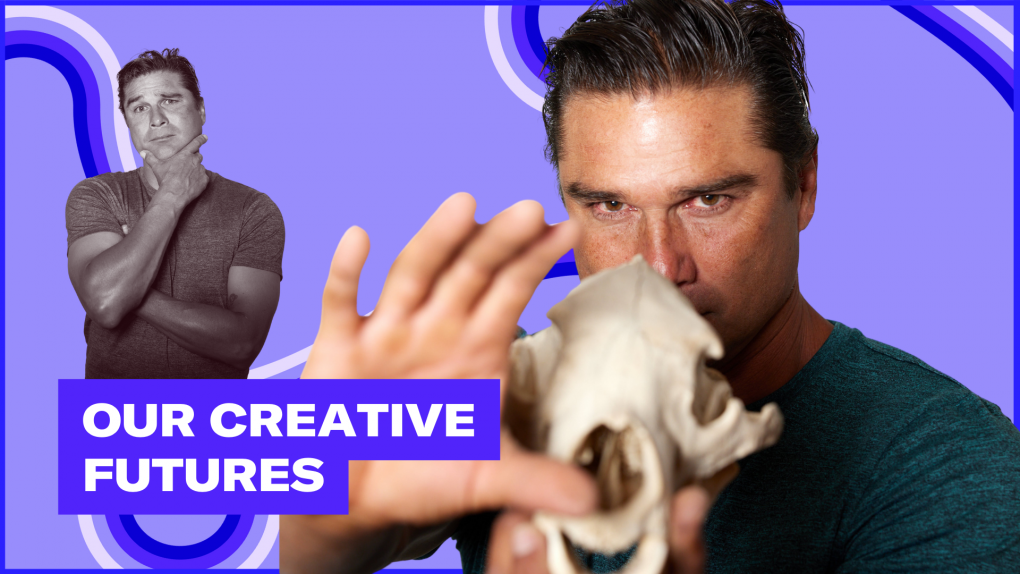
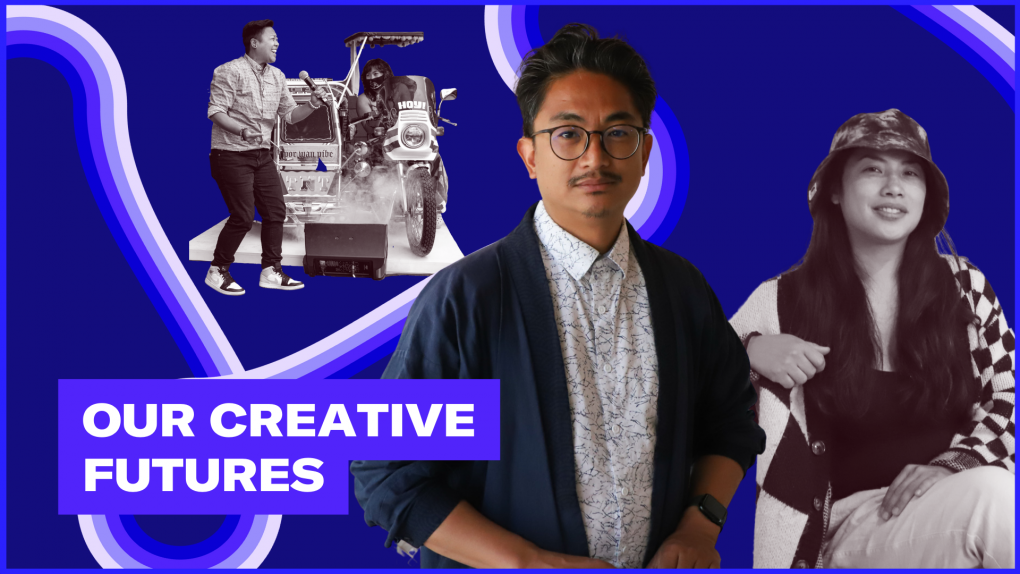
Two years into the pandemic, artists are charting new paths forward. Across the Bay Area, they’re advocating for better pay, sharing resources and looking out for their communities’ wellbeing. Welcome to Our Creative Futures, a KQED Arts & Culture series that takes stock of the arts in this unpredictable climate.
Theater Helped Him Feel Free at San Quentin—Now He’s Paying it Forward
Oakstop Nurtures An Ecosystem of Black Artists and Entrepreneurs
How to Build a Filipino American Cultural Center Without a Roof
For La Doña, SF’s Guaranteed Income Pilot Supports A Rising Music Career
Oakland is Unaffordable—Meet the Hustlers Securing Spaces for Artists
Beyond Ballroom, ‘Oakland to All’ Uplifts LGBTQ+ Health
Building ‘Our Creative Futures’ in the Never-Ending COVID Era
window.__IS_SSR__=true
window.__INITIAL_STATE__={
"attachmentsReducer": {
"audio_0": {
"type": "attachments",
"id": "audio_0",
"imgSizes": {
"kqedFullSize": {
"file": "https://ww2.kqed.org/news/wp-content/themes/KQED-unified/img/audio_bgs/background0.jpg"
}
}
},
"audio_1": {
"type": "attachments",
"id": "audio_1",
"imgSizes": {
"kqedFullSize": {
"file": "https://ww2.kqed.org/news/wp-content/themes/KQED-unified/img/audio_bgs/background1.jpg"
}
}
},
"audio_2": {
"type": "attachments",
"id": "audio_2",
"imgSizes": {
"kqedFullSize": {
"file": "https://ww2.kqed.org/news/wp-content/themes/KQED-unified/img/audio_bgs/background2.jpg"
}
}
},
"audio_3": {
"type": "attachments",
"id": "audio_3",
"imgSizes": {
"kqedFullSize": {
"file": "https://ww2.kqed.org/news/wp-content/themes/KQED-unified/img/audio_bgs/background3.jpg"
}
}
},
"audio_4": {
"type": "attachments",
"id": "audio_4",
"imgSizes": {
"kqedFullSize": {
"file": "https://ww2.kqed.org/news/wp-content/themes/KQED-unified/img/audio_bgs/background4.jpg"
}
}
},
"placeholder": {
"type": "attachments",
"id": "placeholder",
"imgSizes": {
"thumbnail": {
"file": "https://cdn.kqed.org/wp-content/uploads/2024/12/KQED-Default-Image-816638274-2000x1333-1-160x107.jpg",
"width": 160,
"height": 107,
"mimeType": "image/jpeg"
},
"medium": {
"file": "https://cdn.kqed.org/wp-content/uploads/2024/12/KQED-Default-Image-816638274-2000x1333-1-800x533.jpg",
"width": 800,
"height": 533,
"mimeType": "image/jpeg"
},
"medium_large": {
"file": "https://cdn.kqed.org/wp-content/uploads/2024/12/KQED-Default-Image-816638274-2000x1333-1-768x512.jpg",
"width": 768,
"height": 512,
"mimeType": "image/jpeg"
},
"large": {
"file": "https://cdn.kqed.org/wp-content/uploads/2024/12/KQED-Default-Image-816638274-2000x1333-1-1020x680.jpg",
"width": 1020,
"height": 680,
"mimeType": "image/jpeg"
},
"1536x1536": {
"file": "https://cdn.kqed.org/wp-content/uploads/2024/12/KQED-Default-Image-816638274-2000x1333-1-1536x1024.jpg",
"width": 1536,
"height": 1024,
"mimeType": "image/jpeg"
},
"fd-lrg": {
"file": "https://cdn.kqed.org/wp-content/uploads/2024/12/KQED-Default-Image-816638274-2000x1333-1-1536x1024.jpg",
"width": 1536,
"height": 1024,
"mimeType": "image/jpeg"
},
"fd-med": {
"file": "https://cdn.kqed.org/wp-content/uploads/2024/12/KQED-Default-Image-816638274-2000x1333-1-1020x680.jpg",
"width": 1020,
"height": 680,
"mimeType": "image/jpeg"
},
"fd-sm": {
"file": "https://cdn.kqed.org/wp-content/uploads/2024/12/KQED-Default-Image-816638274-2000x1333-1-800x533.jpg",
"width": 800,
"height": 533,
"mimeType": "image/jpeg"
},
"post-thumbnail": {
"file": "https://cdn.kqed.org/wp-content/uploads/2024/12/KQED-Default-Image-816638274-2000x1333-1-672x372.jpg",
"width": 672,
"height": 372,
"mimeType": "image/jpeg"
},
"twentyfourteen-full-width": {
"file": "https://cdn.kqed.org/wp-content/uploads/2024/12/KQED-Default-Image-816638274-2000x1333-1-1038x576.jpg",
"width": 1038,
"height": 576,
"mimeType": "image/jpeg"
},
"xxsmall": {
"file": "https://cdn.kqed.org/wp-content/uploads/2024/12/KQED-Default-Image-816638274-2000x1333-1-160x107.jpg",
"width": 160,
"height": 107,
"mimeType": "image/jpeg"
},
"xsmall": {
"file": "https://cdn.kqed.org/wp-content/uploads/2024/12/KQED-Default-Image-816638274-2000x1333-1-672x372.jpg",
"width": 672,
"height": 372,
"mimeType": "image/jpeg"
},
"small": {
"file": "https://cdn.kqed.org/wp-content/uploads/2024/12/KQED-Default-Image-816638274-2000x1333-1-672x372.jpg",
"width": 672,
"height": 372,
"mimeType": "image/jpeg"
},
"xlarge": {
"file": "https://cdn.kqed.org/wp-content/uploads/2024/12/KQED-Default-Image-816638274-2000x1333-1-1020x680.jpg",
"width": 1020,
"height": 680,
"mimeType": "image/jpeg"
},
"full-width": {
"file": "https://cdn.kqed.org/wp-content/uploads/2024/12/KQED-Default-Image-816638274-2000x1333-1-1920x1280.jpg",
"width": 1920,
"height": 1280,
"mimeType": "image/jpeg"
},
"guest-author-32": {
"file": "https://cdn.kqed.org/wp-content/uploads/2025/01/KQED-Default-Image-816638274-1333x1333-1-160x160.jpg",
"width": 32,
"height": 32,
"mimeType": "image/jpeg"
},
"guest-author-50": {
"file": "https://cdn.kqed.org/wp-content/uploads/2025/01/KQED-Default-Image-816638274-1333x1333-1-160x160.jpg",
"width": 50,
"height": 50,
"mimeType": "image/jpeg"
},
"guest-author-64": {
"file": "https://cdn.kqed.org/wp-content/uploads/2025/01/KQED-Default-Image-816638274-1333x1333-1-160x160.jpg",
"width": 64,
"height": 64,
"mimeType": "image/jpeg"
},
"guest-author-96": {
"file": "https://cdn.kqed.org/wp-content/uploads/2025/01/KQED-Default-Image-816638274-1333x1333-1-160x160.jpg",
"width": 96,
"height": 96,
"mimeType": "image/jpeg"
},
"guest-author-128": {
"file": "https://cdn.kqed.org/wp-content/uploads/2025/01/KQED-Default-Image-816638274-1333x1333-1-160x160.jpg",
"width": 128,
"height": 128,
"mimeType": "image/jpeg"
},
"detail": {
"file": "https://cdn.kqed.org/wp-content/uploads/2025/01/KQED-Default-Image-816638274-1333x1333-1-160x160.jpg",
"width": 160,
"height": 160,
"mimeType": "image/jpeg"
},
"kqedFullSize": {
"file": "https://cdn.kqed.org/wp-content/uploads/2024/12/KQED-Default-Image-816638274-2000x1333-1.jpg",
"width": 2000,
"height": 1333
}
}
},
"arts_13915516": {
"type": "attachments",
"id": "arts_13915516",
"meta": {
"index": "attachments_1716263798",
"site": "arts",
"id": "13915516",
"found": true
},
"parent": 13915493,
"imgSizes": {
"twentyfourteen-full-width": {
"file": "https://ww2.kqed.org/app/uploads/sites/2/2022/06/WORKING-FILE-Our-Creative-Futures-Featured-Image-4-1038x576.png",
"width": 1038,
"mimeType": "image/png",
"height": 576
},
"thumbnail": {
"file": "https://ww2.kqed.org/app/uploads/sites/2/2022/06/WORKING-FILE-Our-Creative-Futures-Featured-Image-4-160x90.png",
"width": 160,
"mimeType": "image/png",
"height": 90
},
"post-thumbnail": {
"file": "https://ww2.kqed.org/app/uploads/sites/2/2022/06/WORKING-FILE-Our-Creative-Futures-Featured-Image-4-672x372.png",
"width": 672,
"mimeType": "image/png",
"height": 372
},
"kqedFullSize": {
"file": "https://ww2.kqed.org/app/uploads/sites/2/2022/06/WORKING-FILE-Our-Creative-Futures-Featured-Image-4.png",
"width": 1920,
"height": 1080
},
"large": {
"file": "https://ww2.kqed.org/app/uploads/sites/2/2022/06/WORKING-FILE-Our-Creative-Futures-Featured-Image-4-1020x574.png",
"width": 1020,
"mimeType": "image/png",
"height": 574
},
"1536x1536": {
"file": "https://ww2.kqed.org/app/uploads/sites/2/2022/06/WORKING-FILE-Our-Creative-Futures-Featured-Image-4-1536x864.png",
"width": 1536,
"mimeType": "image/png",
"height": 864
},
"medium": {
"file": "https://ww2.kqed.org/app/uploads/sites/2/2022/06/WORKING-FILE-Our-Creative-Futures-Featured-Image-4-800x450.png",
"width": 800,
"mimeType": "image/png",
"height": 450
},
"medium_large": {
"file": "https://ww2.kqed.org/app/uploads/sites/2/2022/06/WORKING-FILE-Our-Creative-Futures-Featured-Image-4-768x432.png",
"width": 768,
"mimeType": "image/png",
"height": 432
}
},
"publishDate": 1656528618,
"modified": 1656613712,
"caption": "Juan Meza says Marin Shakespeare Company's San Quentin program helped him discover his inner artist. Amid the trauma of the pandemic, theater remains a crucial outlet for those still inside.",
"description": null,
"title": "Our Creative Futures - Juan Meza",
"credit": "Photos: Fred Greaves; design: Kelly Heigert",
"status": "inherit",
"altTag": null,
"fetchFailed": false,
"isLoading": false
},
"arts_13914133": {
"type": "attachments",
"id": "arts_13914133",
"meta": {
"index": "attachments_1716263798",
"site": "arts",
"id": "13914133",
"found": true
},
"parent": 13914030,
"imgSizes": {
"twentyfourteen-full-width": {
"file": "https://ww2.kqed.org/app/uploads/sites/2/2022/05/Our-Creative-Futures-Oakstop-final-1038x576.png",
"width": 1038,
"mimeType": "image/png",
"height": 576
},
"thumbnail": {
"file": "https://ww2.kqed.org/app/uploads/sites/2/2022/05/Our-Creative-Futures-Oakstop-final-160x90.png",
"width": 160,
"mimeType": "image/png",
"height": 90
},
"post-thumbnail": {
"file": "https://ww2.kqed.org/app/uploads/sites/2/2022/05/Our-Creative-Futures-Oakstop-final-672x372.png",
"width": 672,
"mimeType": "image/png",
"height": 372
},
"kqedFullSize": {
"file": "https://ww2.kqed.org/app/uploads/sites/2/2022/05/Our-Creative-Futures-Oakstop-final.png",
"width": 1920,
"height": 1080
},
"large": {
"file": "https://ww2.kqed.org/app/uploads/sites/2/2022/05/Our-Creative-Futures-Oakstop-final-1020x574.png",
"width": 1020,
"mimeType": "image/png",
"height": 574
},
"1536x1536": {
"file": "https://ww2.kqed.org/app/uploads/sites/2/2022/05/Our-Creative-Futures-Oakstop-final-1536x864.png",
"width": 1536,
"mimeType": "image/png",
"height": 864
},
"medium": {
"file": "https://ww2.kqed.org/app/uploads/sites/2/2022/05/Our-Creative-Futures-Oakstop-final-800x450.png",
"width": 800,
"mimeType": "image/png",
"height": 450
},
"medium_large": {
"file": "https://ww2.kqed.org/app/uploads/sites/2/2022/05/Our-Creative-Futures-Oakstop-final-768x432.png",
"width": 768,
"mimeType": "image/png",
"height": 432
}
},
"publishDate": 1653669306,
"modified": 1653670130,
"caption": "Trevor Parham (right) founded Oakstop as a coworking space, and its footprint has expanded into multiple hubs. Tayleur Crenshaw (center) hosts open mics at one of his locations. Pablo Cristi of Oakland School for the Arts (left) recently held a student art show there.",
"description": null,
"title": "Our Creative Futures Oakstop final",
"credit": "Photos: Amaya Edwards (left and right) and Dorean Raye (center). Design: Kelly Heigert",
"status": "inherit",
"altTag": null,
"fetchFailed": false,
"isLoading": false
},
"arts_13914135": {
"type": "attachments",
"id": "arts_13914135",
"meta": {
"index": "attachments_1716263798",
"site": "arts",
"id": "13914135",
"found": true
},
"parent": 13914030,
"imgSizes": {
"twentyfourteen-full-width": {
"file": "https://ww2.kqed.org/app/uploads/sites/2/2022/05/RS56132_20220512_TrevorOakstop-19-qut-1038x576.jpg",
"width": 1038,
"mimeType": "image/jpeg",
"height": 576
},
"thumbnail": {
"file": "https://ww2.kqed.org/app/uploads/sites/2/2022/05/RS56132_20220512_TrevorOakstop-19-qut-160x109.jpg",
"width": 160,
"mimeType": "image/jpeg",
"height": 109
},
"post-thumbnail": {
"file": "https://ww2.kqed.org/app/uploads/sites/2/2022/05/RS56132_20220512_TrevorOakstop-19-qut-672x372.jpg",
"width": 672,
"mimeType": "image/jpeg",
"height": 372
},
"kqedFullSize": {
"file": "https://ww2.kqed.org/app/uploads/sites/2/2022/05/RS56132_20220512_TrevorOakstop-19-qut.jpg",
"width": 1920,
"height": 1313
},
"large": {
"file": "https://ww2.kqed.org/app/uploads/sites/2/2022/05/RS56132_20220512_TrevorOakstop-19-qut-1020x698.jpg",
"width": 1020,
"mimeType": "image/jpeg",
"height": 698
},
"1536x1536": {
"file": "https://ww2.kqed.org/app/uploads/sites/2/2022/05/RS56132_20220512_TrevorOakstop-19-qut-1536x1050.jpg",
"width": 1536,
"mimeType": "image/jpeg",
"height": 1050
},
"medium": {
"file": "https://ww2.kqed.org/app/uploads/sites/2/2022/05/RS56132_20220512_TrevorOakstop-19-qut-800x547.jpg",
"width": 800,
"mimeType": "image/jpeg",
"height": 547
},
"medium_large": {
"file": "https://ww2.kqed.org/app/uploads/sites/2/2022/05/RS56132_20220512_TrevorOakstop-19-qut-768x525.jpg",
"width": 768,
"mimeType": "image/jpeg",
"height": 525
}
},
"publishDate": 1653669857,
"modified": 1653669991,
"caption": "Trevor Parham poses for a portrait in front of one of his Oakstop locations on May 12, 2022 in Oakland, Calif. \"So that's a lot of what this space represents is artists now being able to reap a lot of the value that they've sown over the years here in Oakland, helping to define the Oakland culture,\" Parham says.",
"description": null,
"title": "RS56132_20220512_TrevorOakstop-19-qut",
"credit": "Amaya Edwards",
"status": "inherit",
"altTag": null,
"fetchFailed": false,
"isLoading": false
},
"arts_13914006": {
"type": "attachments",
"id": "arts_13914006",
"meta": {
"index": "attachments_1716263798",
"site": "arts",
"id": "13914006",
"found": true
},
"parent": 13913947,
"imgSizes": {
"twentyfourteen-full-width": {
"file": "https://ww2.kqed.org/app/uploads/sites/2/2022/05/BalayKreative_COVER-1038x576.png",
"width": 1038,
"mimeType": "image/png",
"height": 576
},
"thumbnail": {
"file": "https://ww2.kqed.org/app/uploads/sites/2/2022/05/BalayKreative_COVER-160x90.png",
"width": 160,
"mimeType": "image/png",
"height": 90
},
"post-thumbnail": {
"file": "https://ww2.kqed.org/app/uploads/sites/2/2022/05/BalayKreative_COVER-672x372.png",
"width": 672,
"mimeType": "image/png",
"height": 372
},
"kqedFullSize": {
"file": "https://ww2.kqed.org/app/uploads/sites/2/2022/05/BalayKreative_COVER.png",
"width": 1920,
"height": 1080
},
"large": {
"file": "https://ww2.kqed.org/app/uploads/sites/2/2022/05/BalayKreative_COVER-1020x574.png",
"width": 1020,
"mimeType": "image/png",
"height": 574
},
"1536x1536": {
"file": "https://ww2.kqed.org/app/uploads/sites/2/2022/05/BalayKreative_COVER-1536x864.png",
"width": 1536,
"mimeType": "image/png",
"height": 864
},
"medium": {
"file": "https://ww2.kqed.org/app/uploads/sites/2/2022/05/BalayKreative_COVER-800x450.png",
"width": 800,
"mimeType": "image/png",
"height": 450
},
"medium_large": {
"file": "https://ww2.kqed.org/app/uploads/sites/2/2022/05/BalayKreative_COVER-768x432.png",
"width": 768,
"mimeType": "image/png",
"height": 432
}
},
"publishDate": 1653528746,
"modified": 1653528841,
"caption": "From left to right: Karaoke singers with 'TNT Traysikel,' Balay Kreative Executive Director Desi Danganan, and visual artist Cristine Blanco. Balay Kreative is building a Filipino arts and culture hub in San Francisco's SoMa neighborhood.",
"description": null,
"title": "BalayKreative_COVER",
"credit": "Photos: Amaya Edwards, Beth LaBerge; Design: Kelly Heigert",
"status": "inherit",
"altTag": null,
"fetchFailed": false,
"isLoading": false
},
"arts_13913961": {
"type": "attachments",
"id": "arts_13913961",
"meta": {
"index": "attachments_1716263798",
"site": "arts",
"id": "13913961",
"found": true
},
"parent": 13913947,
"imgSizes": {
"twentyfourteen-full-width": {
"file": "https://ww2.kqed.org/app/uploads/sites/2/2022/05/20220520-14-1038x576.jpg",
"width": 1038,
"mimeType": "image/jpeg",
"height": 576
},
"thumbnail": {
"file": "https://ww2.kqed.org/app/uploads/sites/2/2022/05/20220520-14-160x107.jpg",
"width": 160,
"mimeType": "image/jpeg",
"height": 107
},
"post-thumbnail": {
"file": "https://ww2.kqed.org/app/uploads/sites/2/2022/05/20220520-14-672x372.jpg",
"width": 672,
"mimeType": "image/jpeg",
"height": 372
},
"kqedFullSize": {
"file": "https://ww2.kqed.org/app/uploads/sites/2/2022/05/20220520-14.jpg",
"width": 2048,
"height": 1365
},
"large": {
"file": "https://ww2.kqed.org/app/uploads/sites/2/2022/05/20220520-14-1020x680.jpg",
"width": 1020,
"mimeType": "image/jpeg",
"height": 680
},
"1536x1536": {
"file": "https://ww2.kqed.org/app/uploads/sites/2/2022/05/20220520-14-1536x1024.jpg",
"width": 1536,
"mimeType": "image/jpeg",
"height": 1024
},
"full-width": {
"file": "https://ww2.kqed.org/app/uploads/sites/2/2022/05/20220520-14-1920x1280.jpg",
"width": 1920,
"mimeType": "image/jpeg",
"height": 1280
},
"medium": {
"file": "https://ww2.kqed.org/app/uploads/sites/2/2022/05/20220520-14-800x533.jpg",
"width": 800,
"mimeType": "image/jpeg",
"height": 533
},
"medium_large": {
"file": "https://ww2.kqed.org/app/uploads/sites/2/2022/05/20220520-14-768x512.jpg",
"width": 768,
"mimeType": "image/jpeg",
"height": 512
}
},
"publishDate": 1653514502,
"modified": 1653514572,
"caption": "Gina Mariko poses for a portrait in her space at Balay Kreative on May 20, 2022 in San Francisco.",
"description": null,
"title": "20220520-14",
"credit": "Amaya Edwards",
"status": "inherit",
"altTag": null,
"fetchFailed": false,
"isLoading": false
},
"arts_13913900": {
"type": "attachments",
"id": "arts_13913900",
"meta": {
"index": "attachments_1716263798",
"site": "arts",
"id": "13913900",
"found": true
},
"parent": 13913890,
"imgSizes": {
"twentyfourteen-full-width": {
"file": "https://ww2.kqed.org/app/uploads/sites/2/2022/05/Our-Creative-Futures-Featured-Image-La-Dona-1038x576.jpg",
"width": 1038,
"mimeType": "image/jpeg",
"height": 576
},
"thumbnail": {
"file": "https://ww2.kqed.org/app/uploads/sites/2/2022/05/Our-Creative-Futures-Featured-Image-La-Dona-160x90.jpg",
"width": 160,
"mimeType": "image/jpeg",
"height": 90
},
"post-thumbnail": {
"file": "https://ww2.kqed.org/app/uploads/sites/2/2022/05/Our-Creative-Futures-Featured-Image-La-Dona-672x372.jpg",
"width": 672,
"mimeType": "image/jpeg",
"height": 372
},
"kqedFullSize": {
"file": "https://ww2.kqed.org/app/uploads/sites/2/2022/05/Our-Creative-Futures-Featured-Image-La-Dona.jpg",
"width": 1920,
"height": 1080
},
"large": {
"file": "https://ww2.kqed.org/app/uploads/sites/2/2022/05/Our-Creative-Futures-Featured-Image-La-Dona-1020x574.jpg",
"width": 1020,
"mimeType": "image/jpeg",
"height": 574
},
"1536x1536": {
"file": "https://ww2.kqed.org/app/uploads/sites/2/2022/05/Our-Creative-Futures-Featured-Image-La-Dona-1536x864.jpg",
"width": 1536,
"mimeType": "image/jpeg",
"height": 864
},
"medium": {
"file": "https://ww2.kqed.org/app/uploads/sites/2/2022/05/Our-Creative-Futures-Featured-Image-La-Dona-800x450.jpg",
"width": 800,
"mimeType": "image/jpeg",
"height": 450
},
"medium_large": {
"file": "https://ww2.kqed.org/app/uploads/sites/2/2022/05/Our-Creative-Futures-Featured-Image-La-Dona-768x432.jpg",
"width": 768,
"mimeType": "image/jpeg",
"height": 432
}
},
"publishDate": 1653425970,
"modified": 1653426039,
"caption": "La Doña's singular blend of Latin musical traditions, reggaeton and hyphy has made her one of San Francisco's biggest breakout stars since the pandemic. YBCA's Guaranteed Income Pilot for Artists is helping fuel her rising career. ",
"description": null,
"title": "Our Creative Futures Featured Image-La Dona",
"credit": "Photos: Beth LaBerge; design: Kelly Heigert",
"status": "inherit",
"altTag": null,
"fetchFailed": false,
"isLoading": false
},
"arts_13913898": {
"type": "attachments",
"id": "arts_13913898",
"meta": {
"index": "attachments_1716263798",
"site": "arts",
"id": "13913898",
"found": true
},
"parent": 13913890,
"imgSizes": {
"twentyfourteen-full-width": {
"file": "https://ww2.kqed.org/app/uploads/sites/2/2022/05/014_KQEDArts_Alameda_LaDona_07202021-1038x576.jpg",
"width": 1038,
"mimeType": "image/jpeg",
"height": 576
},
"thumbnail": {
"file": "https://ww2.kqed.org/app/uploads/sites/2/2022/05/014_KQEDArts_Alameda_LaDona_07202021-160x107.jpg",
"width": 160,
"mimeType": "image/jpeg",
"height": 107
},
"post-thumbnail": {
"file": "https://ww2.kqed.org/app/uploads/sites/2/2022/05/014_KQEDArts_Alameda_LaDona_07202021-672x372.jpg",
"width": 672,
"mimeType": "image/jpeg",
"height": 372
},
"kqedFullSize": {
"file": "https://ww2.kqed.org/app/uploads/sites/2/2022/05/014_KQEDArts_Alameda_LaDona_07202021.jpg",
"width": 1920,
"height": 1280
},
"large": {
"file": "https://ww2.kqed.org/app/uploads/sites/2/2022/05/014_KQEDArts_Alameda_LaDona_07202021-1020x680.jpg",
"width": 1020,
"mimeType": "image/jpeg",
"height": 680
},
"1536x1536": {
"file": "https://ww2.kqed.org/app/uploads/sites/2/2022/05/014_KQEDArts_Alameda_LaDona_07202021-1536x1024.jpg",
"width": 1536,
"mimeType": "image/jpeg",
"height": 1024
},
"medium": {
"file": "https://ww2.kqed.org/app/uploads/sites/2/2022/05/014_KQEDArts_Alameda_LaDona_07202021-800x533.jpg",
"width": 800,
"mimeType": "image/jpeg",
"height": 533
},
"medium_large": {
"file": "https://ww2.kqed.org/app/uploads/sites/2/2022/05/014_KQEDArts_Alameda_LaDona_07202021-768x512.jpg",
"width": 768,
"mimeType": "image/jpeg",
"height": 512
}
},
"publishDate": 1653425673,
"modified": 1653425695,
"caption": "Cecilia Peña-Govea, a.k.a. La Doña.",
"description": null,
"title": "Cecilia Peña-Govea, a.k.a. La Doña, sits at Alameda Beach on July 20, 2021.",
"credit": "Beth LaBerge",
"status": "inherit",
"altTag": null,
"fetchFailed": false,
"isLoading": false
},
"arts_13913835": {
"type": "attachments",
"id": "arts_13913835",
"meta": {
"index": "attachments_1716263798",
"site": "arts",
"id": "13913835",
"found": true
},
"parent": 13913821,
"imgSizes": {
"twentyfourteen-full-width": {
"file": "https://ww2.kqed.org/app/uploads/sites/2/2022/05/Our-Creative-Futures-Featured-Image-Endeavors-1038x576.jpg",
"width": 1038,
"mimeType": "image/jpeg",
"height": 576
},
"thumbnail": {
"file": "https://ww2.kqed.org/app/uploads/sites/2/2022/05/Our-Creative-Futures-Featured-Image-Endeavors-160x90.jpg",
"width": 160,
"mimeType": "image/jpeg",
"height": 90
},
"post-thumbnail": {
"file": "https://ww2.kqed.org/app/uploads/sites/2/2022/05/Our-Creative-Futures-Featured-Image-Endeavors-672x372.jpg",
"width": 672,
"mimeType": "image/jpeg",
"height": 372
},
"kqedFullSize": {
"file": "https://ww2.kqed.org/app/uploads/sites/2/2022/05/Our-Creative-Futures-Featured-Image-Endeavors.jpg",
"width": 1920,
"height": 1080
},
"large": {
"file": "https://ww2.kqed.org/app/uploads/sites/2/2022/05/Our-Creative-Futures-Featured-Image-Endeavors-1020x574.jpg",
"width": 1020,
"mimeType": "image/jpeg",
"height": 574
},
"1536x1536": {
"file": "https://ww2.kqed.org/app/uploads/sites/2/2022/05/Our-Creative-Futures-Featured-Image-Endeavors-1536x864.jpg",
"width": 1536,
"mimeType": "image/jpeg",
"height": 864
},
"medium": {
"file": "https://ww2.kqed.org/app/uploads/sites/2/2022/05/Our-Creative-Futures-Featured-Image-Endeavors-800x450.jpg",
"width": 800,
"mimeType": "image/jpeg",
"height": 450
},
"medium_large": {
"file": "https://ww2.kqed.org/app/uploads/sites/2/2022/05/Our-Creative-Futures-Featured-Image-Endeavors-768x432.jpg",
"width": 768,
"mimeType": "image/jpeg",
"height": 432
}
},
"publishDate": 1653342726,
"modified": 1653342894,
"caption": "From doing hands-on repairs to negotiating with developers, Assan Jethmal and Rozz Nash (foreground, left to right) work hard to find affordable spaces for artists to throw events, healing circles and maker markets. ",
"description": null,
"title": "Our Creative Futures Featured Image-Endeavors",
"credit": "Photos: Amaya Edwards; design: Kelly Heigert",
"status": "inherit",
"altTag": null,
"fetchFailed": false,
"isLoading": false
},
"arts_13913857": {
"type": "attachments",
"id": "arts_13913857",
"meta": {
"index": "attachments_1716263798",
"site": "arts",
"id": "13913857",
"found": true
},
"parent": 13913821,
"imgSizes": {
"twentyfourteen-full-width": {
"file": "https://ww2.kqed.org/app/uploads/sites/2/2022/05/20220513_Agency_RozzAssan-02-1038x576.jpg",
"width": 1038,
"mimeType": "image/jpeg",
"height": 576
},
"thumbnail": {
"file": "https://ww2.kqed.org/app/uploads/sites/2/2022/05/20220513_Agency_RozzAssan-02-160x107.jpg",
"width": 160,
"mimeType": "image/jpeg",
"height": 107
},
"post-thumbnail": {
"file": "https://ww2.kqed.org/app/uploads/sites/2/2022/05/20220513_Agency_RozzAssan-02-672x372.jpg",
"width": 672,
"mimeType": "image/jpeg",
"height": 372
},
"kqedFullSize": {
"file": "https://ww2.kqed.org/app/uploads/sites/2/2022/05/20220513_Agency_RozzAssan-02.jpg",
"width": 2048,
"height": 1365
},
"large": {
"file": "https://ww2.kqed.org/app/uploads/sites/2/2022/05/20220513_Agency_RozzAssan-02-1020x680.jpg",
"width": 1020,
"mimeType": "image/jpeg",
"height": 680
},
"1536x1536": {
"file": "https://ww2.kqed.org/app/uploads/sites/2/2022/05/20220513_Agency_RozzAssan-02-1536x1024.jpg",
"width": 1536,
"mimeType": "image/jpeg",
"height": 1024
},
"full-width": {
"file": "https://ww2.kqed.org/app/uploads/sites/2/2022/05/20220513_Agency_RozzAssan-02-1920x1280.jpg",
"width": 1920,
"mimeType": "image/jpeg",
"height": 1280
},
"medium": {
"file": "https://ww2.kqed.org/app/uploads/sites/2/2022/05/20220513_Agency_RozzAssan-02-800x533.jpg",
"width": 800,
"mimeType": "image/jpeg",
"height": 533
},
"medium_large": {
"file": "https://ww2.kqed.org/app/uploads/sites/2/2022/05/20220513_Agency_RozzAssan-02-768x512.jpg",
"width": 768,
"mimeType": "image/jpeg",
"height": 512
}
},
"publishDate": 1653348605,
"modified": 1653348677,
"caption": "From hands-on repairs to negotiating with developers, Assan Jethmal and Rozz Nash (left to right) work hard to find affordable spaces for artists.",
"description": null,
"title": "20220513_Agency_RozzAssan-02",
"credit": "Amaya Edwards",
"status": "inherit",
"altTag": null,
"fetchFailed": false,
"isLoading": false
},
"arts_13913739": {
"type": "attachments",
"id": "arts_13913739",
"meta": {
"index": "attachments_1716263798",
"site": "arts",
"id": "13913739",
"found": true
},
"parent": 13913584,
"imgSizes": {
"twentyfourteen-full-width": {
"file": "https://ww2.kqed.org/app/uploads/sites/2/2022/05/WORKING-FILE-Our-Creative-Futures-Featured-Image-1-1038x576.jpg",
"width": 1038,
"mimeType": "image/jpeg",
"height": 576
},
"thumbnail": {
"file": "https://ww2.kqed.org/app/uploads/sites/2/2022/05/WORKING-FILE-Our-Creative-Futures-Featured-Image-1-160x90.jpg",
"width": 160,
"mimeType": "image/jpeg",
"height": 90
},
"post-thumbnail": {
"file": "https://ww2.kqed.org/app/uploads/sites/2/2022/05/WORKING-FILE-Our-Creative-Futures-Featured-Image-1-672x372.jpg",
"width": 672,
"mimeType": "image/jpeg",
"height": 372
},
"kqedFullSize": {
"file": "https://ww2.kqed.org/app/uploads/sites/2/2022/05/WORKING-FILE-Our-Creative-Futures-Featured-Image-1.jpg",
"width": 1920,
"height": 1080
},
"large": {
"file": "https://ww2.kqed.org/app/uploads/sites/2/2022/05/WORKING-FILE-Our-Creative-Futures-Featured-Image-1-1020x574.jpg",
"width": 1020,
"mimeType": "image/jpeg",
"height": 574
},
"1536x1536": {
"file": "https://ww2.kqed.org/app/uploads/sites/2/2022/05/WORKING-FILE-Our-Creative-Futures-Featured-Image-1-1536x864.jpg",
"width": 1536,
"mimeType": "image/jpeg",
"height": 864
},
"medium": {
"file": "https://ww2.kqed.org/app/uploads/sites/2/2022/05/WORKING-FILE-Our-Creative-Futures-Featured-Image-1-800x450.jpg",
"width": 800,
"mimeType": "image/jpeg",
"height": 450
},
"medium_large": {
"file": "https://ww2.kqed.org/app/uploads/sites/2/2022/05/WORKING-FILE-Our-Creative-Futures-Featured-Image-1-768x432.jpg",
"width": 768,
"mimeType": "image/jpeg",
"height": 432
}
},
"publishDate": 1653074166,
"modified": 1653074351,
"caption": "In color, left to right: Oakland to All ball organizers Shireen Rahimi, Guerrilla Davis and Ashlee Banks. Black and white: performers from the Back with a Vengeance Ball at Oakland's Lake Merritt in Sept. 2021.",
"description": null,
"title": "{WORKING FILE} Our Creative Futures Featured Image (1)",
"credit": "Photos: Beth LaBerge and Estefany Gonzalez; design: Kelly Heigert",
"status": "inherit",
"altTag": "A colorful collage features portraits of event organizers and vogue dancers competing at a ball.",
"fetchFailed": false,
"isLoading": false
},
"arts_13913796": {
"type": "attachments",
"id": "arts_13913796",
"meta": {
"index": "attachments_1716263798",
"site": "arts",
"id": "13913796",
"found": true
},
"parent": 13913750,
"imgSizes": {
"twentyfourteen-full-width": {
"file": "https://ww2.kqed.org/app/uploads/sites/2/2022/05/WORKING-FILE-Our-Creative-Futures-Featured-Image-2-1038x576.jpg",
"width": 1038,
"mimeType": "image/jpeg",
"height": 576
},
"thumbnail": {
"file": "https://ww2.kqed.org/app/uploads/sites/2/2022/05/WORKING-FILE-Our-Creative-Futures-Featured-Image-2-160x90.jpg",
"width": 160,
"mimeType": "image/jpeg",
"height": 90
},
"post-thumbnail": {
"file": "https://ww2.kqed.org/app/uploads/sites/2/2022/05/WORKING-FILE-Our-Creative-Futures-Featured-Image-2-672x372.jpg",
"width": 672,
"mimeType": "image/jpeg",
"height": 372
},
"kqedFullSize": {
"file": "https://ww2.kqed.org/app/uploads/sites/2/2022/05/WORKING-FILE-Our-Creative-Futures-Featured-Image-2.jpg",
"width": 1920,
"height": 1080
},
"large": {
"file": "https://ww2.kqed.org/app/uploads/sites/2/2022/05/WORKING-FILE-Our-Creative-Futures-Featured-Image-2-1020x574.jpg",
"width": 1020,
"mimeType": "image/jpeg",
"height": 574
},
"1536x1536": {
"file": "https://ww2.kqed.org/app/uploads/sites/2/2022/05/WORKING-FILE-Our-Creative-Futures-Featured-Image-2-1536x864.jpg",
"width": 1536,
"mimeType": "image/jpeg",
"height": 864
},
"medium": {
"file": "https://ww2.kqed.org/app/uploads/sites/2/2022/05/WORKING-FILE-Our-Creative-Futures-Featured-Image-2-800x450.jpg",
"width": 800,
"mimeType": "image/jpeg",
"height": 450
},
"medium_large": {
"file": "https://ww2.kqed.org/app/uploads/sites/2/2022/05/WORKING-FILE-Our-Creative-Futures-Featured-Image-2-768x432.jpg",
"width": 768,
"mimeType": "image/jpeg",
"height": 432
}
},
"publishDate": 1653174580,
"modified": 1653174644,
"caption": null,
"description": null,
"title": "{WORKING FILE} Our Creative Futures Featured Image",
"credit": "Photo: Liz Hafalia/Getty Images; design: Kelly Heigert",
"status": "inherit",
"altTag": "A view of the Bay Area, including the Berkeley, Oakland and San Francisco skylines, with the text \"Our Creative Futures.\"",
"fetchFailed": false,
"isLoading": false
}
},
"audioPlayerReducer": {
"postId": "stream_live",
"isPaused": true,
"isPlaying": false,
"pfsActive": false,
"pledgeModalIsOpen": true,
"playerDrawerIsOpen": false
},
"authorsReducer": {
"shotchkiss": {
"type": "authors",
"id": "61",
"meta": {
"index": "authors_1716337520",
"id": "61",
"found": true
},
"name": "Sarah Hotchkiss",
"firstName": "Sarah",
"lastName": "Hotchkiss",
"slug": "shotchkiss",
"email": "shotchkiss@kqed.org",
"display_author_email": true,
"staff_mastheads": [
"arts"
],
"title": "Senior Editor",
"bio": "Sarah Hotchkiss is a San Francisco \u003ca href=\"http://www.sarahhotchkiss.com\">artist\u003c/a> and arts writer. In 2019, she received the Dorothea & Leo Rabkin Foundation grant for visual art journalism and in 2020 she received a Society of Professional Journalists, Northern California award for excellence in arts and culture reporting.",
"avatar": "https://secure.gravatar.com/avatar/ca38c7f54590856cd4947d26274f8a90?s=600&d=blank&r=g",
"twitter": null,
"facebook": null,
"instagram": null,
"linkedin": null,
"sites": [
{
"site": "",
"roles": [
"editor"
]
},
{
"site": "arts",
"roles": [
"Contributor",
"administrator"
]
},
{
"site": "artschool",
"roles": [
"administrator"
]
},
{
"site": "news",
"roles": [
"editor"
]
},
{
"site": "pop",
"roles": [
"administrator"
]
},
{
"site": "bayareabites",
"roles": [
"editor"
]
},
{
"site": "spark",
"roles": [
"editor"
]
},
{
"site": "checkplease",
"roles": [
"editor"
]
}
],
"headData": {
"title": "Sarah Hotchkiss | KQED",
"description": "Senior Editor",
"ogImgSrc": "https://secure.gravatar.com/avatar/ca38c7f54590856cd4947d26274f8a90?s=600&d=blank&r=g",
"twImgSrc": "https://secure.gravatar.com/avatar/ca38c7f54590856cd4947d26274f8a90?s=600&d=blank&r=g"
},
"isLoading": false,
"link": "/author/shotchkiss"
},
"nvoynovskaya": {
"type": "authors",
"id": "11387",
"meta": {
"index": "authors_1716337520",
"id": "11387",
"found": true
},
"name": "Nastia Voynovskaya",
"firstName": "Nastia",
"lastName": "Voynovskaya",
"slug": "nvoynovskaya",
"email": "nvoynovskaya@kqed.org",
"display_author_email": false,
"staff_mastheads": [
"arts"
],
"title": "Editor and reporter",
"bio": "Nastia Voynovskaya is a reporter and editor at KQED Arts & Culture. She's been covering the arts in the Bay Area for over a decade, with a focus on music, queer culture, labor issues and grassroots organizing. She has edited KQED story series such as Trans Bay: A History of San Francisco's Gender-Diverse Community, and co-created KQED's Bay Area hip-hop history project, That's My Word. Nastia's work has been recognized by the Society of Professional Journalists and San Francisco Press Club. She holds a BA in comparative literature from UC Berkeley.",
"avatar": "https://secure.gravatar.com/avatar/310649817772dd2a98e5dfecb6b24842?s=600&d=blank&r=g",
"twitter": null,
"facebook": null,
"instagram": "https://www.instagram.com/nananastia/",
"linkedin": null,
"sites": [
{
"site": "arts",
"roles": [
"administrator"
]
},
{
"site": "news",
"roles": [
"editor"
]
},
{
"site": "pop",
"roles": [
"administrator"
]
},
{
"site": "bayareabites",
"roles": [
"editor"
]
},
{
"site": "podcasts",
"roles": [
"editor"
]
},
{
"site": "hiphop",
"roles": [
"editor"
]
}
],
"headData": {
"title": "Nastia Voynovskaya | KQED",
"description": "Editor and reporter",
"ogImgSrc": "https://secure.gravatar.com/avatar/310649817772dd2a98e5dfecb6b24842?s=600&d=blank&r=g",
"twImgSrc": "https://secure.gravatar.com/avatar/310649817772dd2a98e5dfecb6b24842?s=600&d=blank&r=g"
},
"isLoading": false,
"link": "/author/nvoynovskaya"
},
"ogpenn": {
"type": "authors",
"id": "11491",
"meta": {
"index": "authors_1716337520",
"id": "11491",
"found": true
},
"name": "Pendarvis Harshaw",
"firstName": "Pendarvis",
"lastName": "Harshaw",
"slug": "ogpenn",
"email": "ogpenn@gmail.com",
"display_author_email": false,
"staff_mastheads": [
"arts"
],
"title": "Community Engagement Reporter",
"bio": "Pendarvis Harshaw is an educator, host and writer with KQED Arts.",
"avatar": "https://secure.gravatar.com/avatar/093d33baff5354890e29ad83d58d2c49?s=600&d=blank&r=g",
"twitter": null,
"facebook": null,
"instagram": "ogpenn",
"linkedin": null,
"sites": [
{
"site": "arts",
"roles": [
"editor"
]
},
{
"site": "news",
"roles": [
"editor"
]
},
{
"site": "bayareabites",
"roles": [
"author"
]
},
{
"site": "hiphop",
"roles": [
"editor"
]
}
],
"headData": {
"title": "Pendarvis Harshaw | KQED",
"description": "Community Engagement Reporter",
"ogImgSrc": "https://secure.gravatar.com/avatar/093d33baff5354890e29ad83d58d2c49?s=600&d=blank&r=g",
"twImgSrc": "https://secure.gravatar.com/avatar/093d33baff5354890e29ad83d58d2c49?s=600&d=blank&r=g"
},
"isLoading": false,
"link": "/author/ogpenn"
},
"ccabreralomeli": {
"type": "authors",
"id": "11708",
"meta": {
"index": "authors_1716337520",
"id": "11708",
"found": true
},
"name": "Carlos Cabrera-Lomelí",
"firstName": "Carlos",
"lastName": "Cabrera-Lomelí",
"slug": "ccabreralomeli",
"email": "ccabreralomeli@KQED.org",
"display_author_email": true,
"staff_mastheads": [
"news"
],
"title": "Community Reporter",
"bio": "Carlos Cabrera-Lomelí is a community reporter with KQED's digital engagement team. He also reports and co-produces for KQED's bilingual news hub KQED en Español. He grew up in San Francisco's Mission District and has previously worked with Univision, 48 Hills and REFORMA in Mexico City.",
"avatar": "https://secure.gravatar.com/avatar/e95ff80bb2eaf18a8f2af4dcf7ffb54b?s=600&d=mm&r=g",
"twitter": "@LomeliCabrera",
"facebook": null,
"instagram": null,
"linkedin": null,
"sites": [
{
"site": "arts",
"roles": [
"editor"
]
},
{
"site": "news",
"roles": [
"editor"
]
},
{
"site": "about",
"roles": [
"editor"
]
},
{
"site": "science",
"roles": [
"editor"
]
},
{
"site": "perspectives",
"roles": [
"editor"
]
},
{
"site": "elections",
"roles": [
"editor"
]
},
{
"site": "liveblog",
"roles": [
"contributor"
]
}
],
"headData": {
"title": "Carlos Cabrera-Lomelí | KQED",
"description": "Community Reporter",
"ogImgSrc": "https://secure.gravatar.com/avatar/e95ff80bb2eaf18a8f2af4dcf7ffb54b?s=600&d=mm&r=g",
"twImgSrc": "https://secure.gravatar.com/avatar/e95ff80bb2eaf18a8f2af4dcf7ffb54b?s=600&d=mm&r=g"
},
"isLoading": false,
"link": "/author/ccabreralomeli"
},
"achazaro": {
"type": "authors",
"id": "11748",
"meta": {
"index": "authors_1716337520",
"id": "11748",
"found": true
},
"name": "Alan Chazaro",
"firstName": "Alan",
"lastName": "Chazaro",
"slug": "achazaro",
"email": "agchazaro@gmail.com",
"display_author_email": true,
"staff_mastheads": [],
"title": "Food Writer and Reporter",
"bio": "Alan Chazaro is the author of \u003cem>This Is Not a Frank Ocean Cover Album\u003c/em> (Black Lawrence Press, 2019), \u003cem>Piñata Theory\u003c/em> (Black Lawrence Press, 2020), and \u003cem>Notes from the Eastern Span of the Bay Bridge\u003c/em> (Ghost City Press, 2021). He is a graduate of June Jordan’s Poetry for the People program at UC Berkeley and a former Lawrence Ferlinghetti Fellow at the University of San Francisco. He writes about sports, food, art, music, education, and culture while repping the Bay on \u003ca href=\"https://twitter.com/alan_chazaro\">Twitter\u003c/a> and \u003ca href=\"https://www.instagram.com/alan_chazaro/?hl=en\">Instagram\u003c/a> at @alan_chazaro.",
"avatar": "https://secure.gravatar.com/avatar/ea8b6dd970fc5c29e7a188e7d5861df7?s=600&d=blank&r=g",
"twitter": "alan_chazaro",
"facebook": null,
"instagram": null,
"linkedin": null,
"sites": [
{
"site": "arts",
"roles": [
"contributor"
]
},
{
"site": "news",
"roles": [
"editor"
]
}
],
"headData": {
"title": "Alan Chazaro | KQED",
"description": "Food Writer and Reporter",
"ogImgSrc": "https://secure.gravatar.com/avatar/ea8b6dd970fc5c29e7a188e7d5861df7?s=600&d=blank&r=g",
"twImgSrc": "https://secure.gravatar.com/avatar/ea8b6dd970fc5c29e7a188e7d5861df7?s=600&d=blank&r=g"
},
"isLoading": false,
"link": "/author/achazaro"
},
"jsorapuru": {
"type": "authors",
"id": "11792",
"meta": {
"index": "authors_1716337520",
"id": "11792",
"found": true
},
"name": "Julian E.J. Sorapuru",
"firstName": "Julian",
"lastName": "Sorapuru",
"slug": "jsorapuru",
"email": "jsorapuru@kqed.org",
"display_author_email": true,
"staff_mastheads": [],
"title": "Arts & Culture Reporter",
"bio": "Julian E.J. Sorapuru is an Arts & Culture Intern at KQED. Prior to joining KQED Arts, he interned at both POLITICO, covering transportation policy, and \u003cem>The Times-Picayune\u003c/em>, covering government and politics in his hometown of New Orleans, LA. Julian was the first and only Black male Editor-in-Chief in the 119 year history of the University of San Francisco's student newspaper, the\u003cem> San Francisco Foghorn\u003c/em>. He currently resides in San Francisco, CA and enjoys soccer, photography, and reading.",
"avatar": "https://secure.gravatar.com/avatar/e4d0156d1244f96b87927aa011d794a8?s=600&d=blank&r=g",
"twitter": "JulianSorapuru",
"facebook": null,
"instagram": null,
"linkedin": null,
"sites": [
{
"site": "arts",
"roles": [
"editor"
]
}
],
"headData": {
"title": "Julian E.J. Sorapuru | KQED",
"description": "Arts & Culture Reporter",
"ogImgSrc": "https://secure.gravatar.com/avatar/e4d0156d1244f96b87927aa011d794a8?s=600&d=blank&r=g",
"twImgSrc": "https://secure.gravatar.com/avatar/e4d0156d1244f96b87927aa011d794a8?s=600&d=blank&r=g"
},
"isLoading": false,
"link": "/author/jsorapuru"
}
},
"breakingNewsReducer": {},
"pagesReducer": {},
"postsReducer": {
"stream_live": {
"type": "live",
"id": "stream_live",
"audioUrl": "https://streams.kqed.org/kqedradio",
"title": "Live Stream",
"excerpt": "Live Stream information currently unavailable.",
"link": "/radio",
"featImg": "",
"label": {
"name": "KQED Live",
"link": "/"
}
},
"stream_kqedNewscast": {
"type": "posts",
"id": "stream_kqedNewscast",
"audioUrl": "https://www.kqed.org/.stream/anon/radio/RDnews/newscast.mp3?_=1",
"title": "KQED Newscast",
"featImg": "",
"label": {
"name": "88.5 FM",
"link": "/"
}
},
"arts_13915493": {
"type": "posts",
"id": "arts_13915493",
"meta": {
"index": "posts_1716263798",
"site": "arts",
"id": "13915493",
"score": null,
"sort": [
1656613976000
]
},
"parent": 0,
"labelTerm": {},
"blocks": [],
"publishDate": 1656613976,
"format": "standard",
"title": "Theater Helped Him Feel Free at San Quentin—Now He’s Paying it Forward",
"headTitle": "Theater Helped Him Feel Free at San Quentin—Now He’s Paying it Forward | KQED",
"content": "\u003cp>\u003cem>\u003cstrong>Editor’s note:\u003c/strong> Two years into the pandemic, artists are charting new paths forward. Across the Bay Area, they’re advocating for better pay, sharing resources and looking out for their communities’ well-being. Welcome to \u003c/em>\u003ca href=\"http://kqed.org/ourcreativefutures\" target=\"_blank\" rel=\"noopener noreferrer\">Our Creative Futures\u003c/a>\u003cem>, a KQED Arts & Culture series that takes stock of the arts in this unpredictable climate. \u003ca href=\"https://artskqed.typeform.com/Artist2022\" target=\"_blank\" rel=\"noopener noreferrer\">Share your story here\u003c/a>.\u003c/em>\u003c/p>\n\u003cp>In 2020, Juan Meza thought he was going to die just a few months before he was due to be released from San Quentin State Prison after 24 total years of incarceration.\u003c/p>\n\u003cp>His neck and back were aching, he had an out-of-control fever and his blood pressure was skyrocketing. Meza had COVID during the first wave of the pandemic and, as he sat in his cell, he lamented losing one of the few things that brought him joy in prison—the acting program he participated in with Marin Shakespeare Company. [pullquote size='medium' align='right' citation='Juan Meza, an actor who was formerly incarcerated at San Quentin']‘I was able to show that I am a director, that I am a choreographer, that I am an actor, that I am a set designer, that I am essentially an artist.’[/pullquote]\u003c/p>\n\u003cp>“Acting, performing—doing these things were a release, a very lethargic process of getting stuff out that we needed to and everything. We didn’t have that avenue anymore and we didn’t know if we were going to get it back,” Meza says. “I think that was what was most disconcerting. It was just something that was devastating. Here’s something that we had worked towards, and now we couldn’t do anything again.”\u003c/p>\n\u003cp>\u003ca href=\"https://www.marinshakespeare.org/shakespeare-in-prison/\" target=\"_blank\" rel=\"noopener noreferrer\">Marin Shakespeare Company\u003c/a> had been running programming in San Quentin—providing a vital creative, emotional and social outlet for those inside—for 17 years uninterrupted until the pandemic hit.\u003c/p>\n\u003cp>The non-profit theater group has been working with incarcerated people since 2003. Today, they provide drama therapy-inspired acting classes to men, women and youth in 14 different California state prisons with the goal of fostering “self-reflection, self-expression, cooperation, compassion, and goal-setting” among class participants, according to their website.\u003c/p>\n\u003cfigure id=\"attachment_13915618\" class=\"wp-caption aligncenter\" style=\"max-width: 800px\">\u003cimg loading=\"lazy\" decoding=\"async\" class=\"size-medium wp-image-13915618\" src=\"https://ww2.kqed.org/app/uploads/sites/2/2022/06/juan-meza-composite-fred-greaves-800x240.jpg\" alt=\"\" width=\"800\" height=\"240\" srcset=\"https://cdn.kqed.org/wp-content/uploads/sites/2/2022/06/juan-meza-composite-fred-greaves-800x240.jpg 800w, https://cdn.kqed.org/wp-content/uploads/sites/2/2022/06/juan-meza-composite-fred-greaves-1020x306.jpg 1020w, https://cdn.kqed.org/wp-content/uploads/sites/2/2022/06/juan-meza-composite-fred-greaves-160x48.jpg 160w, https://cdn.kqed.org/wp-content/uploads/sites/2/2022/06/juan-meza-composite-fred-greaves-768x230.jpg 768w, https://cdn.kqed.org/wp-content/uploads/sites/2/2022/06/juan-meza-composite-fred-greaves-1536x461.jpg 1536w, https://cdn.kqed.org/wp-content/uploads/sites/2/2022/06/juan-meza-composite-fred-greaves.jpg 1920w\" sizes=\"(max-width: 800px) 100vw, 800px\">\u003cfigcaption class=\"wp-caption-text\">Since getting out of San Quentin State Prison in 2020, Colusa resident Juan Meza works in construction by day while continuing to pursue his passion for theater at Marin Shakespeare Company. \u003ccite>(Fred Greaves)\u003c/cite>\u003c/figcaption>\u003c/figure>\n\u003cp>Lesley Currier, Marin Shakespeare’s managing director, says the men in San Quentin draw “a lot of positive benefits” from her organization’s affiliation with the prison. Among them are “people rediscovering their own creativity; rediscovering their own sense of play,” she says.\u003c/p>\n\u003cp>“We hear so often: ‘Over the two and a half hours that I spent in the group, I felt like I was free. I didn’t feel like I was in prison,’” Currier says. “Doing something outside the box is really powerful, particularly for people who’ve been labeled, you know, ‘You are not someone who’s going to succeed. You’re a criminal.’ To do something else—to play, to have different roles—really makes you believe that you can do things that you hadn’t thought of doing before.” [aside postID=\"arts_13913890\"]\u003c/p>\n\u003cp>Meza, who goes by the stage name Losdini, attests that the acting program helped him reveal another side of himself. He got involved with Marin Shakespeare when he transferred to San Quentin after 16 years at another facility. “If I had never stepped into that first class in San Quentin with Marin Shakespeare Company, I would not have been able to reveal my humanity,” he says. “In that I was able to show that I am a director, that I am a choreographer, that I am an actor, that I am a set designer, that I am essentially an artist.”\u003c/p>\n\u003cfigure id=\"attachment_13915621\" class=\"wp-caption aligncenter\" style=\"max-width: 800px\">\u003cimg loading=\"lazy\" decoding=\"async\" class=\"size-medium wp-image-13915621\" src=\"https://ww2.kqed.org/app/uploads/sites/2/2022/06/fg_san-quentin-theatre_2022_06_21_R5B1148-800x1200.jpg\" alt=\"\" width=\"800\" height=\"1200\" srcset=\"https://cdn.kqed.org/wp-content/uploads/sites/2/2022/06/fg_san-quentin-theatre_2022_06_21_R5B1148-800x1200.jpg 800w, https://cdn.kqed.org/wp-content/uploads/sites/2/2022/06/fg_san-quentin-theatre_2022_06_21_R5B1148-1020x1530.jpg 1020w, https://cdn.kqed.org/wp-content/uploads/sites/2/2022/06/fg_san-quentin-theatre_2022_06_21_R5B1148-160x240.jpg 160w, https://cdn.kqed.org/wp-content/uploads/sites/2/2022/06/fg_san-quentin-theatre_2022_06_21_R5B1148-768x1152.jpg 768w, https://cdn.kqed.org/wp-content/uploads/sites/2/2022/06/fg_san-quentin-theatre_2022_06_21_R5B1148-1024x1536.jpg 1024w, https://cdn.kqed.org/wp-content/uploads/sites/2/2022/06/fg_san-quentin-theatre_2022_06_21_R5B1148-1366x2048.jpg 1366w, https://cdn.kqed.org/wp-content/uploads/sites/2/2022/06/fg_san-quentin-theatre_2022_06_21_R5B1148.jpg 1667w\" sizes=\"(max-width: 800px) 100vw, 800px\">\u003cfigcaption class=\"wp-caption-text\">Juan Meza plays bass at home in Colusa, California on June 21, 2022. \u003ccite>(Fred Greaves)\u003c/cite>\u003c/figcaption>\u003c/figure>\n\u003cp>But when COVID hit, Meza’s artistry was put on hold and Marin Shakespeare Company had to pivot their classes since their instructors were no longer allowed to visit the prison. First, they recorded a production of \u003cem>Romeo and Juliet\u003c/em>, put on by some of the formerly incarcerated actors who had been through their program, and sent them to the men in San Quentin.\u003c/p>\n\u003cp>When the prison prohibited them from sending more videos, the theater company distributed packets with writing exercises to stimulate the men’s creative skills. The prompts had Shakespearean themes that were also relevant to daily life during COVID, like plague, friendship, loyalty and self-care. After receiving the writing packages back, Marin Shakespeare posted the men’s writing to their website and even had some formerly incarcerated actors do dramatic readings of the writing that came from inside.\u003c/p>\n\u003cfigure id=\"attachment_13915622\" class=\"wp-caption aligncenter\" style=\"max-width: 800px\">\u003cimg loading=\"lazy\" decoding=\"async\" class=\"size-medium wp-image-13915622\" src=\"https://ww2.kqed.org/app/uploads/sites/2/2022/06/fg_san-quentin-theatre_2022_06_21_R5B1105-800x533.jpg\" alt=\"\" width=\"800\" height=\"533\" srcset=\"https://cdn.kqed.org/wp-content/uploads/sites/2/2022/06/fg_san-quentin-theatre_2022_06_21_R5B1105-800x533.jpg 800w, https://cdn.kqed.org/wp-content/uploads/sites/2/2022/06/fg_san-quentin-theatre_2022_06_21_R5B1105-1020x680.jpg 1020w, https://cdn.kqed.org/wp-content/uploads/sites/2/2022/06/fg_san-quentin-theatre_2022_06_21_R5B1105-160x107.jpg 160w, https://cdn.kqed.org/wp-content/uploads/sites/2/2022/06/fg_san-quentin-theatre_2022_06_21_R5B1105-768x512.jpg 768w, https://cdn.kqed.org/wp-content/uploads/sites/2/2022/06/fg_san-quentin-theatre_2022_06_21_R5B1105-1536x1024.jpg 1536w, https://cdn.kqed.org/wp-content/uploads/sites/2/2022/06/fg_san-quentin-theatre_2022_06_21_R5B1105-2048x1366.jpg 2048w, https://cdn.kqed.org/wp-content/uploads/sites/2/2022/06/fg_san-quentin-theatre_2022_06_21_R5B1105-1920x1280.jpg 1920w\" sizes=\"(max-width: 800px) 100vw, 800px\">\u003cfigcaption class=\"wp-caption-text\">Juan Meza smokes a cigarette outside his home in Colusa, California June 21, 2022. \u003ccite>(Fred Greaves)\u003c/cite>\u003c/figcaption>\u003c/figure>\n\u003cp>But even this makeshift programming wasn’t enough to distract from the hellish conditions inside San Quentin at the height of the pandemic. San Quentin had the worst COVID outbreak of any prison in California. Over 2,000 inmates were infected and 29 people died from the outbreak, which was caused by a \u003ca href=\"https://www.latimes.com/opinion/story/2022-01-28/covid-prison-san-quentin-ruling\" target=\"_blank\" rel=\"noopener noreferrer\">botched transfer of sick prisoners from Southern California\u003c/a>. The situation was then exacerbated by a lack of personal protective equipment in the prison and overcrowding, which made social distancing impossible.\u003c/p>\n\u003cp>According to Meza, “there was a lot of fear, there was a lot of anxiety, there’s a lot of unknowns, there was a lot of misinformation going around,” he says. “In a matter of two weeks, we were now locked in a cell again, unable to move, scared, frightened.” [aside postID=\"arts_13913947\"]\u003c/p>\n\u003cp>Currier says when the Marin Shakespeare Company was finally able to come back to San Quentin in June 2021, they spent their first couple of classes talking about what the men had experienced during quarantine. Currier says COVID was “really scary for the men” since “everyone knew someone who had died or who had yelled ‘man down,’” the phrase spoken to alert prison personnel that someone needed immediate medical attention.\u003c/p>\n\u003cp>Even today Currier says COVID continues to be used “as an excuse” to take away privileges from the men of San Quentin. Despite this, Marin Shakespeare Company was able to stage three performances in front of a live audience in December 2021 with the men of San Quentin, with a production of \u003cem>Henry IV\u003c/em> to come in August.\u003c/p>\n\u003cfigure id=\"attachment_13915509\" class=\"wp-caption aligncenter\" style=\"max-width: 800px\">\u003cimg loading=\"lazy\" decoding=\"async\" class=\"size-medium wp-image-13915509\" src=\"https://ww2.kqed.org/app/uploads/sites/2/2022/06/GettyImages-1322090464-800x534.jpg\" alt=\"\" width=\"800\" height=\"534\" srcset=\"https://cdn.kqed.org/wp-content/uploads/sites/2/2022/06/GettyImages-1322090464-800x534.jpg 800w, https://cdn.kqed.org/wp-content/uploads/sites/2/2022/06/GettyImages-1322090464-1020x680.jpg 1020w, https://cdn.kqed.org/wp-content/uploads/sites/2/2022/06/GettyImages-1322090464-160x107.jpg 160w, https://cdn.kqed.org/wp-content/uploads/sites/2/2022/06/GettyImages-1322090464-768x512.jpg 768w, https://cdn.kqed.org/wp-content/uploads/sites/2/2022/06/GettyImages-1322090464.jpg 1024w\" sizes=\"(max-width: 800px) 100vw, 800px\">\u003cfigcaption class=\"wp-caption-text\">Members of Shakespeare at San Quentin along with Marin Shakespeare Company’s and Director Suraya Keating (second from bottom on right) gather backstage before they perform “Twelfth Night” at San Quentin State Prison on Friday, August 5, 2011 in San Quentin, Calif. \u003ccite>(Lea Suzuki/Getty Images)\u003c/cite>\u003c/figcaption>\u003c/figure>\n\u003cp>By the time Marin Shakespeare Company returned to San Quentin, Meza had been paroled. Today, he is continuing his passion for acting and directing (he \u003ca href=\"https://www.youtube.com/watch?v=2-dF_hTiEE4\" target=\"_blank\" rel=\"noopener noreferrer\">co-directed his first production in May\u003c/a>) with Marin Shakespeare as part of their \u003ca href=\"https://www.marinshakespeare.org/returned-citizens-theatre-troupe/#:~:text=The%20mission%20of%20the%20Returned,understanding%20and%20communication%20through%20theatre.\" target=\"_blank\" rel=\"noopener noreferrer\">Returned Citizens Theater Troupe\u003c/a>, a program Currier says gets at the essence of the importance of MSC’s work in prisons.\u003c/p>\n\u003cp>“For the last seven years, we have been hiring actors who have been able to get out of prison to tell their stories through theater,” Currier says. “Some of the conversations after those performances have been amazing as many people say to me, ‘Well, it’s just really changed my attitude about criminal justice in this country,’ because the goal is we need to change hearts and minds so that we can change our laws.” [aside postID=\"arts_13914030\"]\u003c/p>\n\u003cp>Meza says his reasoning for returning to Marin Shakespeare Company post-incarceration is to pay forward what they did for him to the next person.\u003c/p>\n\u003cp>“Now that I’m not incarcerated in prison anymore, I still want to go back to the humans that are inside to sit with them and say, ‘Look, we can do this,’” Meza says. “There’s a niche that I can be in where I understand, like no volunteer will, what it means to be incarcerated. … I have that knowledge, I have that experience. Where other people can only sympathize, I can empathize.”\u003c/p>\n\u003cp>\u003cimg loading=\"lazy\" decoding=\"async\" class=\"aligncenter size-medium wp-image-12127869\" src=\"https://ww2.kqed.org/app/uploads/sites/2/2016/09/Q.Logo_.Break_-800x78.jpg\" alt=\"\" width=\"800\" height=\"78\" srcset=\"https://cdn.kqed.org/wp-content/uploads/sites/2/2016/09/Q.Logo_.Break_.jpg 800w, https://cdn.kqed.org/wp-content/uploads/sites/2/2016/09/Q.Logo_.Break_-400x39.jpg 400w, https://cdn.kqed.org/wp-content/uploads/sites/2/2016/09/Q.Logo_.Break_-768x75.jpg 768w\" sizes=\"(max-width: 800px) 100vw, 800px\">\u003c/p>\n\u003cp>\u003cem>Read more stories from \u003c/em>\u003ca href=\"http://kqed.org/ourcreativefutures\" target=\"_blank\" rel=\"noopener noreferrer\">Our Creative Futures\u003c/a>\u003cem> here. Have something to share? Tell us about how \u003ca href=\"https://artskqed.typeform.com/Artist2022\" target=\"_blank\" rel=\"noopener noreferrer\">the pandemic has impacted your art practice or community\u003c/a>.\u003c/em>\u003c/p>\n\u003cp>[ad fullwidth]\u003c/p>\n\u003cp>[ad floatright]\u003c/p>\n",
"stats": {
"hasVideo": false,
"hasChartOrMap": false,
"hasAudio": false,
"hasPolis": false,
"wordCount": 1463,
"hasGoogleForm": false,
"hasGallery": false,
"hasHearkenModule": false,
"iframeSrcs": [],
"paragraphCount": 23
},
"modified": 1705006664,
"excerpt": "A survivor of San Quentin's brutal COVID outbreak, Marin Shakespeare actor Juan Meza wants to help those still inside.",
"headData": {
"twImgId": "",
"twTitle": "",
"ogTitle": "",
"ogImgId": "",
"twDescription": "",
"description": "A survivor of San Quentin's brutal COVID outbreak, Marin Shakespeare actor Juan Meza wants to help those still inside.",
"title": "Theater Helped Him Feel Free at San Quentin—Now He’s Paying it Forward | KQED",
"ogDescription": "",
"schema": {
"@context": "https://schema.org",
"@type": "Article",
"headline": "Theater Helped Him Feel Free at San Quentin—Now He’s Paying it Forward",
"datePublished": "2022-06-30T11:32:56-07:00",
"dateModified": "2024-01-11T12:57:44-08:00",
"image": "https://cdn.kqed.org/wp-content/uploads/2020/02/KQED-OG-Image@1x.png"
}
},
"guestAuthors": [],
"slug": "theater-helped-him-feel-free-at-san-quentin-now-hes-paying-it-forward",
"status": "publish",
"sourceUrl": "https://www.kqed.org/ourcreativefutures",
"templateType": "standard",
"excludeFromSiteSearch": "Include",
"featuredImageType": "standard",
"sticky": false,
"source": "Our Creative Futures",
"path": "/arts/13915493/theater-helped-him-feel-free-at-san-quentin-now-hes-paying-it-forward",
"audioTrackLength": null,
"parsedContent": [
{
"type": "contentString",
"content": "\u003cdiv class=\"post-body\">\u003cp>\u003cp>\u003cem>\u003cstrong>Editor’s note:\u003c/strong> Two years into the pandemic, artists are charting new paths forward. Across the Bay Area, they’re advocating for better pay, sharing resources and looking out for their communities’ well-being. Welcome to \u003c/em>\u003ca href=\"http://kqed.org/ourcreativefutures\" target=\"_blank\" rel=\"noopener noreferrer\">Our Creative Futures\u003c/a>\u003cem>, a KQED Arts & Culture series that takes stock of the arts in this unpredictable climate. \u003ca href=\"https://artskqed.typeform.com/Artist2022\" target=\"_blank\" rel=\"noopener noreferrer\">Share your story here\u003c/a>.\u003c/em>\u003c/p>\n\u003cp>In 2020, Juan Meza thought he was going to die just a few months before he was due to be released from San Quentin State Prison after 24 total years of incarceration.\u003c/p>\n\u003cp>His neck and back were aching, he had an out-of-control fever and his blood pressure was skyrocketing. Meza had COVID during the first wave of the pandemic and, as he sat in his cell, he lamented losing one of the few things that brought him joy in prison—the acting program he participated in with Marin Shakespeare Company. \u003c/p>\u003c/div>",
"attributes": {
"named": {},
"numeric": []
}
},
{
"type": "component",
"content": "‘I was able to show that I am a director, that I am a choreographer, that I am an actor, that I am a set designer, that I am essentially an artist.’",
"name": "pullquote",
"attributes": {
"named": {
"size": "medium",
"align": "right",
"citation": "Juan Meza, an actor who was formerly incarcerated at San Quentin",
"label": ""
},
"numeric": []
}
},
{
"type": "contentString",
"content": "\u003cdiv class=\"post-body\">\u003cp>\u003c/p>\n\u003cp>“Acting, performing—doing these things were a release, a very lethargic process of getting stuff out that we needed to and everything. We didn’t have that avenue anymore and we didn’t know if we were going to get it back,” Meza says. “I think that was what was most disconcerting. It was just something that was devastating. Here’s something that we had worked towards, and now we couldn’t do anything again.”\u003c/p>\n\u003cp>\u003ca href=\"https://www.marinshakespeare.org/shakespeare-in-prison/\" target=\"_blank\" rel=\"noopener noreferrer\">Marin Shakespeare Company\u003c/a> had been running programming in San Quentin—providing a vital creative, emotional and social outlet for those inside—for 17 years uninterrupted until the pandemic hit.\u003c/p>\n\u003cp>The non-profit theater group has been working with incarcerated people since 2003. Today, they provide drama therapy-inspired acting classes to men, women and youth in 14 different California state prisons with the goal of fostering “self-reflection, self-expression, cooperation, compassion, and goal-setting” among class participants, according to their website.\u003c/p>\n\u003cfigure id=\"attachment_13915618\" class=\"wp-caption aligncenter\" style=\"max-width: 800px\">\u003cimg loading=\"lazy\" decoding=\"async\" class=\"size-medium wp-image-13915618\" src=\"https://ww2.kqed.org/app/uploads/sites/2/2022/06/juan-meza-composite-fred-greaves-800x240.jpg\" alt=\"\" width=\"800\" height=\"240\" srcset=\"https://cdn.kqed.org/wp-content/uploads/sites/2/2022/06/juan-meza-composite-fred-greaves-800x240.jpg 800w, https://cdn.kqed.org/wp-content/uploads/sites/2/2022/06/juan-meza-composite-fred-greaves-1020x306.jpg 1020w, https://cdn.kqed.org/wp-content/uploads/sites/2/2022/06/juan-meza-composite-fred-greaves-160x48.jpg 160w, https://cdn.kqed.org/wp-content/uploads/sites/2/2022/06/juan-meza-composite-fred-greaves-768x230.jpg 768w, https://cdn.kqed.org/wp-content/uploads/sites/2/2022/06/juan-meza-composite-fred-greaves-1536x461.jpg 1536w, https://cdn.kqed.org/wp-content/uploads/sites/2/2022/06/juan-meza-composite-fred-greaves.jpg 1920w\" sizes=\"(max-width: 800px) 100vw, 800px\">\u003cfigcaption class=\"wp-caption-text\">Since getting out of San Quentin State Prison in 2020, Colusa resident Juan Meza works in construction by day while continuing to pursue his passion for theater at Marin Shakespeare Company. \u003ccite>(Fred Greaves)\u003c/cite>\u003c/figcaption>\u003c/figure>\n\u003cp>Lesley Currier, Marin Shakespeare’s managing director, says the men in San Quentin draw “a lot of positive benefits” from her organization’s affiliation with the prison. Among them are “people rediscovering their own creativity; rediscovering their own sense of play,” she says.\u003c/p>\n\u003cp>“We hear so often: ‘Over the two and a half hours that I spent in the group, I felt like I was free. I didn’t feel like I was in prison,’” Currier says. “Doing something outside the box is really powerful, particularly for people who’ve been labeled, you know, ‘You are not someone who’s going to succeed. You’re a criminal.’ To do something else—to play, to have different roles—really makes you believe that you can do things that you hadn’t thought of doing before.” \u003c/p>\u003c/div>",
"attributes": {
"named": {},
"numeric": []
}
},
{
"type": "component",
"content": "",
"name": "aside",
"attributes": {
"named": {
"postid": "arts_13913890",
"label": ""
},
"numeric": []
}
},
{
"type": "contentString",
"content": "\u003cdiv class=\"post-body\">\u003cp>\u003c/p>\n\u003cp>Meza, who goes by the stage name Losdini, attests that the acting program helped him reveal another side of himself. He got involved with Marin Shakespeare when he transferred to San Quentin after 16 years at another facility. “If I had never stepped into that first class in San Quentin with Marin Shakespeare Company, I would not have been able to reveal my humanity,” he says. “In that I was able to show that I am a director, that I am a choreographer, that I am an actor, that I am a set designer, that I am essentially an artist.”\u003c/p>\n\u003cfigure id=\"attachment_13915621\" class=\"wp-caption aligncenter\" style=\"max-width: 800px\">\u003cimg loading=\"lazy\" decoding=\"async\" class=\"size-medium wp-image-13915621\" src=\"https://ww2.kqed.org/app/uploads/sites/2/2022/06/fg_san-quentin-theatre_2022_06_21_R5B1148-800x1200.jpg\" alt=\"\" width=\"800\" height=\"1200\" srcset=\"https://cdn.kqed.org/wp-content/uploads/sites/2/2022/06/fg_san-quentin-theatre_2022_06_21_R5B1148-800x1200.jpg 800w, https://cdn.kqed.org/wp-content/uploads/sites/2/2022/06/fg_san-quentin-theatre_2022_06_21_R5B1148-1020x1530.jpg 1020w, https://cdn.kqed.org/wp-content/uploads/sites/2/2022/06/fg_san-quentin-theatre_2022_06_21_R5B1148-160x240.jpg 160w, https://cdn.kqed.org/wp-content/uploads/sites/2/2022/06/fg_san-quentin-theatre_2022_06_21_R5B1148-768x1152.jpg 768w, https://cdn.kqed.org/wp-content/uploads/sites/2/2022/06/fg_san-quentin-theatre_2022_06_21_R5B1148-1024x1536.jpg 1024w, https://cdn.kqed.org/wp-content/uploads/sites/2/2022/06/fg_san-quentin-theatre_2022_06_21_R5B1148-1366x2048.jpg 1366w, https://cdn.kqed.org/wp-content/uploads/sites/2/2022/06/fg_san-quentin-theatre_2022_06_21_R5B1148.jpg 1667w\" sizes=\"(max-width: 800px) 100vw, 800px\">\u003cfigcaption class=\"wp-caption-text\">Juan Meza plays bass at home in Colusa, California on June 21, 2022. \u003ccite>(Fred Greaves)\u003c/cite>\u003c/figcaption>\u003c/figure>\n\u003cp>But when COVID hit, Meza’s artistry was put on hold and Marin Shakespeare Company had to pivot their classes since their instructors were no longer allowed to visit the prison. First, they recorded a production of \u003cem>Romeo and Juliet\u003c/em>, put on by some of the formerly incarcerated actors who had been through their program, and sent them to the men in San Quentin.\u003c/p>\n\u003cp>When the prison prohibited them from sending more videos, the theater company distributed packets with writing exercises to stimulate the men’s creative skills. The prompts had Shakespearean themes that were also relevant to daily life during COVID, like plague, friendship, loyalty and self-care. After receiving the writing packages back, Marin Shakespeare posted the men’s writing to their website and even had some formerly incarcerated actors do dramatic readings of the writing that came from inside.\u003c/p>\n\u003cfigure id=\"attachment_13915622\" class=\"wp-caption aligncenter\" style=\"max-width: 800px\">\u003cimg loading=\"lazy\" decoding=\"async\" class=\"size-medium wp-image-13915622\" src=\"https://ww2.kqed.org/app/uploads/sites/2/2022/06/fg_san-quentin-theatre_2022_06_21_R5B1105-800x533.jpg\" alt=\"\" width=\"800\" height=\"533\" srcset=\"https://cdn.kqed.org/wp-content/uploads/sites/2/2022/06/fg_san-quentin-theatre_2022_06_21_R5B1105-800x533.jpg 800w, https://cdn.kqed.org/wp-content/uploads/sites/2/2022/06/fg_san-quentin-theatre_2022_06_21_R5B1105-1020x680.jpg 1020w, https://cdn.kqed.org/wp-content/uploads/sites/2/2022/06/fg_san-quentin-theatre_2022_06_21_R5B1105-160x107.jpg 160w, https://cdn.kqed.org/wp-content/uploads/sites/2/2022/06/fg_san-quentin-theatre_2022_06_21_R5B1105-768x512.jpg 768w, https://cdn.kqed.org/wp-content/uploads/sites/2/2022/06/fg_san-quentin-theatre_2022_06_21_R5B1105-1536x1024.jpg 1536w, https://cdn.kqed.org/wp-content/uploads/sites/2/2022/06/fg_san-quentin-theatre_2022_06_21_R5B1105-2048x1366.jpg 2048w, https://cdn.kqed.org/wp-content/uploads/sites/2/2022/06/fg_san-quentin-theatre_2022_06_21_R5B1105-1920x1280.jpg 1920w\" sizes=\"(max-width: 800px) 100vw, 800px\">\u003cfigcaption class=\"wp-caption-text\">Juan Meza smokes a cigarette outside his home in Colusa, California June 21, 2022. \u003ccite>(Fred Greaves)\u003c/cite>\u003c/figcaption>\u003c/figure>\n\u003cp>But even this makeshift programming wasn’t enough to distract from the hellish conditions inside San Quentin at the height of the pandemic. San Quentin had the worst COVID outbreak of any prison in California. Over 2,000 inmates were infected and 29 people died from the outbreak, which was caused by a \u003ca href=\"https://www.latimes.com/opinion/story/2022-01-28/covid-prison-san-quentin-ruling\" target=\"_blank\" rel=\"noopener noreferrer\">botched transfer of sick prisoners from Southern California\u003c/a>. The situation was then exacerbated by a lack of personal protective equipment in the prison and overcrowding, which made social distancing impossible.\u003c/p>\n\u003cp>According to Meza, “there was a lot of fear, there was a lot of anxiety, there’s a lot of unknowns, there was a lot of misinformation going around,” he says. “In a matter of two weeks, we were now locked in a cell again, unable to move, scared, frightened.” \u003c/p>\u003c/div>",
"attributes": {
"named": {},
"numeric": []
}
},
{
"type": "component",
"content": "",
"name": "aside",
"attributes": {
"named": {
"postid": "arts_13913947",
"label": ""
},
"numeric": []
}
},
{
"type": "contentString",
"content": "\u003cdiv class=\"post-body\">\u003cp>\u003c/p>\n\u003cp>Currier says when the Marin Shakespeare Company was finally able to come back to San Quentin in June 2021, they spent their first couple of classes talking about what the men had experienced during quarantine. Currier says COVID was “really scary for the men” since “everyone knew someone who had died or who had yelled ‘man down,’” the phrase spoken to alert prison personnel that someone needed immediate medical attention.\u003c/p>\n\u003cp>Even today Currier says COVID continues to be used “as an excuse” to take away privileges from the men of San Quentin. Despite this, Marin Shakespeare Company was able to stage three performances in front of a live audience in December 2021 with the men of San Quentin, with a production of \u003cem>Henry IV\u003c/em> to come in August.\u003c/p>\n\u003cfigure id=\"attachment_13915509\" class=\"wp-caption aligncenter\" style=\"max-width: 800px\">\u003cimg loading=\"lazy\" decoding=\"async\" class=\"size-medium wp-image-13915509\" src=\"https://ww2.kqed.org/app/uploads/sites/2/2022/06/GettyImages-1322090464-800x534.jpg\" alt=\"\" width=\"800\" height=\"534\" srcset=\"https://cdn.kqed.org/wp-content/uploads/sites/2/2022/06/GettyImages-1322090464-800x534.jpg 800w, https://cdn.kqed.org/wp-content/uploads/sites/2/2022/06/GettyImages-1322090464-1020x680.jpg 1020w, https://cdn.kqed.org/wp-content/uploads/sites/2/2022/06/GettyImages-1322090464-160x107.jpg 160w, https://cdn.kqed.org/wp-content/uploads/sites/2/2022/06/GettyImages-1322090464-768x512.jpg 768w, https://cdn.kqed.org/wp-content/uploads/sites/2/2022/06/GettyImages-1322090464.jpg 1024w\" sizes=\"(max-width: 800px) 100vw, 800px\">\u003cfigcaption class=\"wp-caption-text\">Members of Shakespeare at San Quentin along with Marin Shakespeare Company’s and Director Suraya Keating (second from bottom on right) gather backstage before they perform “Twelfth Night” at San Quentin State Prison on Friday, August 5, 2011 in San Quentin, Calif. \u003ccite>(Lea Suzuki/Getty Images)\u003c/cite>\u003c/figcaption>\u003c/figure>\n\u003cp>By the time Marin Shakespeare Company returned to San Quentin, Meza had been paroled. Today, he is continuing his passion for acting and directing (he \u003ca href=\"https://www.youtube.com/watch?v=2-dF_hTiEE4\" target=\"_blank\" rel=\"noopener noreferrer\">co-directed his first production in May\u003c/a>) with Marin Shakespeare as part of their \u003ca href=\"https://www.marinshakespeare.org/returned-citizens-theatre-troupe/#:~:text=The%20mission%20of%20the%20Returned,understanding%20and%20communication%20through%20theatre.\" target=\"_blank\" rel=\"noopener noreferrer\">Returned Citizens Theater Troupe\u003c/a>, a program Currier says gets at the essence of the importance of MSC’s work in prisons.\u003c/p>\n\u003cp>“For the last seven years, we have been hiring actors who have been able to get out of prison to tell their stories through theater,” Currier says. “Some of the conversations after those performances have been amazing as many people say to me, ‘Well, it’s just really changed my attitude about criminal justice in this country,’ because the goal is we need to change hearts and minds so that we can change our laws.” \u003c/p>\u003c/div>",
"attributes": {
"named": {},
"numeric": []
}
},
{
"type": "component",
"content": "",
"name": "aside",
"attributes": {
"named": {
"postid": "arts_13914030",
"label": ""
},
"numeric": []
}
},
{
"type": "contentString",
"content": "\u003cdiv class=\"post-body\">\u003cp>\u003c/p>\n\u003cp>Meza says his reasoning for returning to Marin Shakespeare Company post-incarceration is to pay forward what they did for him to the next person.\u003c/p>\n\u003cp>“Now that I’m not incarcerated in prison anymore, I still want to go back to the humans that are inside to sit with them and say, ‘Look, we can do this,’” Meza says. “There’s a niche that I can be in where I understand, like no volunteer will, what it means to be incarcerated. … I have that knowledge, I have that experience. Where other people can only sympathize, I can empathize.”\u003c/p>\n\u003cp>\u003cimg loading=\"lazy\" decoding=\"async\" class=\"aligncenter size-medium wp-image-12127869\" src=\"https://ww2.kqed.org/app/uploads/sites/2/2016/09/Q.Logo_.Break_-800x78.jpg\" alt=\"\" width=\"800\" height=\"78\" srcset=\"https://cdn.kqed.org/wp-content/uploads/sites/2/2016/09/Q.Logo_.Break_.jpg 800w, https://cdn.kqed.org/wp-content/uploads/sites/2/2016/09/Q.Logo_.Break_-400x39.jpg 400w, https://cdn.kqed.org/wp-content/uploads/sites/2/2016/09/Q.Logo_.Break_-768x75.jpg 768w\" sizes=\"(max-width: 800px) 100vw, 800px\">\u003c/p>\n\u003cp>\u003cem>Read more stories from \u003c/em>\u003ca href=\"http://kqed.org/ourcreativefutures\" target=\"_blank\" rel=\"noopener noreferrer\">Our Creative Futures\u003c/a>\u003cem> here. Have something to share? Tell us about how \u003ca href=\"https://artskqed.typeform.com/Artist2022\" target=\"_blank\" rel=\"noopener noreferrer\">the pandemic has impacted your art practice or community\u003c/a>.\u003c/em>\u003c/p>\n\u003cp>\u003c/p>\u003c/div>",
"attributes": {
"named": {},
"numeric": []
}
},
{
"type": "component",
"content": "",
"name": "ad",
"attributes": {
"named": {
"label": "fullwidth"
},
"numeric": [
"fullwidth"
]
}
},
{
"type": "contentString",
"content": "\u003cdiv class=\"post-body\">\u003cp>\u003c/p>\n\u003cp>\u003c/p>\u003c/div>",
"attributes": {
"named": {},
"numeric": []
}
},
{
"type": "component",
"content": "",
"name": "ad",
"attributes": {
"named": {
"label": "floatright"
},
"numeric": [
"floatright"
]
}
},
{
"type": "contentString",
"content": "\u003cdiv class=\"post-body\">\u003cp>\u003c/p>\n\u003c/div>\u003c/p>",
"attributes": {
"named": {},
"numeric": []
}
}
],
"link": "/arts/13915493/theater-helped-him-feel-free-at-san-quentin-now-hes-paying-it-forward",
"authors": [
"11792"
],
"categories": [
"arts_1",
"arts_967"
],
"tags": [
"arts_10342",
"arts_10278",
"arts_17542",
"arts_1526",
"arts_1985",
"arts_5891"
],
"featImg": "arts_13915516",
"label": "source_arts_13915493"
},
"arts_13914030": {
"type": "posts",
"id": "arts_13914030",
"meta": {
"index": "posts_1716263798",
"site": "arts",
"id": "13914030",
"score": null,
"sort": [
1653670437000
]
},
"parent": 0,
"labelTerm": {},
"blocks": [],
"publishDate": 1653670437,
"format": "standard",
"title": "Oakstop Nurtures An Ecosystem of Black Artists and Entrepreneurs",
"headTitle": "Oakstop Nurtures An Ecosystem of Black Artists and Entrepreneurs | KQED",
"content": "\u003cp>\u003cem>\u003cstrong>Editor’s note:\u003c/strong> Two years into the pandemic, artists are charting new paths forward. Across the Bay Area, they’re advocating for better pay, sharing resources and looking out for their communities’ well-being. Welcome to \u003c/em>\u003ca href=\"http://kqed.org/ourcreativefutures\" target=\"_blank\" rel=\"noopener noreferrer\">Our Creative Futures\u003c/a>\u003cem>, a KQED Arts & Culture series that takes stock of the arts in this unpredictable climate. \u003ca href=\"https://artskqed.typeform.com/Artist2022\" target=\"_blank\" rel=\"noopener noreferrer\">Share your story here\u003c/a>. [aside postID=\"arts_13913750\" hero=\"https://ww2.kqed.org/app/uploads/sites/2/2022/05/WORKING-FILE-Our-Creative-Futures-Featured-Image-2-1020x574.jpg\"]\u003c/em>\u003c/p>\n\u003cp>In 2014, Trevor Parham had this idea. He wanted to create a service that provides artists—specifically Black artists in Oakland—with the space to be creative entrepreneurs. If they needed a location for an event for a couple of hours, a coworking space for a few months or even a full office for a long-term project, they could turn to his organization, \u003ca href=\"https://oakstop.com/\" target=\"_blank\" rel=\"noopener noreferrer\">Oakstop\u003c/a>.\u003c/p>\n\u003cp>The business’ first footprint was a 4,000 square-foot, second-story coworking space at 1721 Broadway. Eight years later, Oakstop now operates out of multiple floors in that building, as well as four other spaces in Oakland and one in Richmond. Parham built the organization on the idea of “metabolizing the high cost of real estate, and providing it back to the community at rates they can afford,” he says. He saw early success, made some notable advances during the pandemic and is now eyeing further expansion.\u003c/p>\n\u003cp>How does it feel to see the organization’s growth? “It feels right. It feels just,” Parham says.\u003c/p>\n\u003cp>He believes this is something that the Black artists who call Oakland home should’ve always had. That statement stands out in the face of the overall history of this country. And more specifically, the recent history of this region, where a number of elements, including predatory housing loans, exorbitant rents and the influx of tech workers, have contributed to driving working class Black people out of Oakland, leading to drastic demographic shifts.\u003c/p>\n\u003cp>[ad fullwidth]\u003c/p>\n\u003cp>In response, Parham says Oakstop is doing what it’s supposed to do. Under the Oakstop umbrella, creatives of diverse backgrounds are finding a place to plant their roots and grow. On a higher level, the organization is positioning itself to push back against oppressive forces that have threatened the very culture that makes Oakland, Oakland.\u003c/p>\n\u003cfigure id=\"attachment_13914120\" class=\"wp-caption aligncenter\" style=\"max-width: 800px\">\u003cimg loading=\"lazy\" decoding=\"async\" class=\"size-medium wp-image-13914120\" src=\"https://ww2.kqed.org/app/uploads/sites/2/2022/05/RS56129_20220512_TrevorOakstop-15-qut-800x530.jpg\" alt=\"\" width=\"800\" height=\"530\" srcset=\"https://cdn.kqed.org/wp-content/uploads/sites/2/2022/05/RS56129_20220512_TrevorOakstop-15-qut-800x530.jpg 800w, https://cdn.kqed.org/wp-content/uploads/sites/2/2022/05/RS56129_20220512_TrevorOakstop-15-qut-1020x676.jpg 1020w, https://cdn.kqed.org/wp-content/uploads/sites/2/2022/05/RS56129_20220512_TrevorOakstop-15-qut-160x106.jpg 160w, https://cdn.kqed.org/wp-content/uploads/sites/2/2022/05/RS56129_20220512_TrevorOakstop-15-qut-768x509.jpg 768w, https://cdn.kqed.org/wp-content/uploads/sites/2/2022/05/RS56129_20220512_TrevorOakstop-15-qut-1536x1018.jpg 1536w, https://cdn.kqed.org/wp-content/uploads/sites/2/2022/05/RS56129_20220512_TrevorOakstop-15-qut.jpg 1920w\" sizes=\"(max-width: 800px) 100vw, 800px\">\u003cfigcaption class=\"wp-caption-text\">Trevor Parham, founder of Oakstop, talks with a student artist during an exhibit on May 12, 2022 in Oakland, Calif. \u003ccite>(Amaya Edwards)\u003c/cite>\u003c/figcaption>\u003c/figure>\n\u003cp>Parham has seen it all unfold. He’s an Oakland kid who has deep roots here.\u003c/p>\n\u003cp>“The home I lived in when I was first born burned down in the ’91 fire,” says Parham over the phone. Because he can’t go to one specific structure and say, “This is the house I grew up in,” he looks at the entire area as his home.\u003c/p>\n\u003cp>“Perhaps,” Parham says, “that’s now why our business is spread across so many structures.” [aside postID=\"arts_13913947\" hero=\"https://ww2.kqed.org/app/uploads/sites/2/2022/05/BalayKreative_COVER-1020x574.png\"]\u003c/p>\n\u003ch2>A Network of Artists Grows\u003c/h2>\n\u003cp>And inside of Oakstop’s structures, estheticians have debuted new calendars, podcast hosts have become acquainted with one another, and aerosol artists have gotten decked out in their flyest attire and taken photos while celebrating their accomplishments. A center for LGTBQ+ youth has expanded, a monthly open mic has found a home, and numerous individuals and organizations have benefitted.\u003c/p>\n\u003cp>“I believe I might’ve technically been the first member of Oakstop,” says singer and multi-talented creator \u003ca href=\"https://jennjohns.com/\" target=\"_blank\" rel=\"noopener noreferrer\">Jennifer Johns\u003c/a>, who’s known Parham since “Jesus was a boy.” She recalls helping Parham, a longtime family friend, paint the walls of the space and move furniture. In regards to Oakstop and Parham’s recent growth, Johns says, “The model he’s creating will be useful for folks around the country, and the world… He’s just getting started, I think folks should just sit back and watch.”\u003c/p>\n\u003cp>Another early occupant of the space is award winning visual artist \u003ca href=\"https://www.facebook.com/James-Gayles-Art-115439938470598/\" target=\"_blank\" rel=\"noopener noreferrer\">James Gayles\u003c/a>, whose watercolor portraits of African American luminaries evoke stardust, the ocean breeze and other elements of the universe. He says, “Oakstop typifies Oakland. It brings people together.”\u003c/p>\n\u003cp>[pullquote align=\"right\" size=\"medium\" citation=\"Trevor Parham\"]‘You can’t have Oakland without having a vibrant Black community. We’re the soul of the city, particularly the artists.’[/pullquote]\u003c/p>\n\u003cp>Echoing that sentiment is filmmaker and writer \u003ca href=\"http://forwardevermedia.com/about-us/\" target=\"_blank\" rel=\"noopener noreferrer\">Cheo Tyehimba Taylor\u003c/a>, whose work often delves into the topics of Black love, the criminal justice system and the coming of age experience of African American men. He’s also the curator behind the ongoing Summer Films Showcase across town at East Oakland’s Black Cultural Zone. Tyehimba Taylor has had multiple stints working out of Oakstop’s 1721 Broadway building, during which he’s collaborated with film editors and social media creators who were already in the shared working space.\u003c/p>\n\u003cp>On top of the networking, Tyehimba Taylor says the ability to barter creative services in exchange for a lower rent is something that he and other artists have benefited from. “Trevor is an artist himself,” says Tyehimba Taylor, noting Parham’s background in design, as well as his experience in the realms of philanthropy and social justice organizations. “He’s the right kind of person to be in the coworking rental space for creatives. … A lot of the time, those people aren’t artists, they don’t understand how we make a dollar out of fifteen cents.” [aside postID=\"arts_13913821\" hero=\"https://ww2.kqed.org/app/uploads/sites/2/2022/05/Our-Creative-Futures-Featured-Image-Endeavors-1020x574.jpg\"]\u003c/p>\n\u003cp>Oakstop’s prices range from $50 per month for basic membership to the coworking space to north of $3,000 for particular office rentals. Event space can range from $30 to $300 an hour. And Parham says those numbers are flexible. He hasn’t run into anyone who fundamentally disagrees with the business model or the approach.\u003c/p>\n\u003cp>When it comes to the contentious idea that African Americans can achieve liberation through economics, he says, “It was economics that got us in this position in the first place… The tool to undo our lack of liberation is economics.”\u003c/p>\n\u003cp>But beyond the business philosophy, it’s the relationships and reputation that have carried Oakstop.\u003c/p>\n\u003cfigure id=\"attachment_13914117\" class=\"wp-caption aligncenter\" style=\"max-width: 800px\">\u003cimg loading=\"lazy\" decoding=\"async\" class=\"size-medium wp-image-13914117\" src=\"https://ww2.kqed.org/app/uploads/sites/2/2022/05/IMG_2827-800x800.jpg\" alt=\"\" width=\"800\" height=\"800\" srcset=\"https://cdn.kqed.org/wp-content/uploads/sites/2/2022/05/IMG_2827-800x800.jpg 800w, https://cdn.kqed.org/wp-content/uploads/sites/2/2022/05/IMG_2827-1020x1020.jpg 1020w, https://cdn.kqed.org/wp-content/uploads/sites/2/2022/05/IMG_2827-160x160.jpg 160w, https://cdn.kqed.org/wp-content/uploads/sites/2/2022/05/IMG_2827-768x768.jpg 768w, https://cdn.kqed.org/wp-content/uploads/sites/2/2022/05/IMG_2827.jpg 1440w\" sizes=\"(max-width: 800px) 100vw, 800px\">\u003cfigcaption class=\"wp-caption-text\">Brette Sims poses in front of her own artwork at the 1721 Broadway Oakstop location in March 2021. \u003ccite>(Alona Grigg)\u003c/cite>\u003c/figcaption>\u003c/figure>\n\u003cp>Visual artist \u003ca href=\"https://www.instagram.com/brettesims/?hl=en\" target=\"_blank\" rel=\"noopener noreferrer\">Brette Sims\u003c/a> attests to that. In 2014 she contacted Parham about his space. At the same time, unbeknownst to her, her father met Parham and was talking to him about Sims’ work. The result has been a decade-long partnership where Parham has allocated coworking space, assisted in mounting and selling her work—specifically her colorful psychedelic series of paintings, \u003cem>Alice in Hennyland\u003c/em>. He even helped write the description cards that accompany her artwork.\u003c/p>\n\u003cp>“Black artists, a lot of us, we create from the bottom of our hearts,” says Sims, “but too often, we’re not given the space and the recognition we deserve.” The founder of \u003ca href=\"https://stukdesigns.org/\" target=\"_blank\" rel=\"noopener noreferrer\">STUK Designs\u003c/a>, a nonprofit that empowers young women through art, Sims says she’s benefited from taking notes on the business model Parham has created. After mentioning how racist and sexist the art world can be, Sims says, “Oakstop is a space that grants us opportunities that we never would have.”\u003c/p>\n\u003cp>“It’s motivating to know that we’ve been able to tap into a network of people who want to build,” Parham says. “It’s important for us to create institutions where people feel that it resonates with their whole soul.”\u003c/p>\n\u003cfigure id=\"attachment_13914135\" class=\"wp-caption aligncenter\" style=\"max-width: 800px\">\u003cimg loading=\"lazy\" decoding=\"async\" class=\"size-medium wp-image-13914135\" src=\"https://ww2.kqed.org/app/uploads/sites/2/2022/05/RS56132_20220512_TrevorOakstop-19-qut-800x547.jpg\" alt=\"\" width=\"800\" height=\"547\" srcset=\"https://cdn.kqed.org/wp-content/uploads/sites/2/2022/05/RS56132_20220512_TrevorOakstop-19-qut-800x547.jpg 800w, https://cdn.kqed.org/wp-content/uploads/sites/2/2022/05/RS56132_20220512_TrevorOakstop-19-qut-1020x698.jpg 1020w, https://cdn.kqed.org/wp-content/uploads/sites/2/2022/05/RS56132_20220512_TrevorOakstop-19-qut-160x109.jpg 160w, https://cdn.kqed.org/wp-content/uploads/sites/2/2022/05/RS56132_20220512_TrevorOakstop-19-qut-768x525.jpg 768w, https://cdn.kqed.org/wp-content/uploads/sites/2/2022/05/RS56132_20220512_TrevorOakstop-19-qut-1536x1050.jpg 1536w, https://cdn.kqed.org/wp-content/uploads/sites/2/2022/05/RS56132_20220512_TrevorOakstop-19-qut.jpg 1920w\" sizes=\"(max-width: 800px) 100vw, 800px\">\u003cfigcaption class=\"wp-caption-text\">Trevor Parham poses for a portrait in front of one of his Oakstop locations on May 12, 2022 in Oakland, Calif. “So that’s a lot of what this space represents is artists now being able to reap a lot of the value that they’ve sown over the years here in Oakland, helping to define the Oakland culture,” Parham says. \u003ccite>(Amaya Edwards)\u003c/cite>\u003c/figcaption>\u003c/figure>\n\u003ch2>Expanding Oakstop’s Footprint\u003c/h2>\n\u003cp>After its founding in 2014, the original footprint of Oakstop grew from 4,000 square feet to 24,000 over the course of a few years. In April 2018, Parham and his team acquired a space on 14th Street between Alice and Harrison Streets. The building has three floors and a basement, but they only occupy the second and third floor, a total of 10,000 square feet.\u003c/p>\n\u003cp>The third location came in April of the following year. Parham and his team thought a building adjacent to Richmond BART would make a good spot for a cafe, given the foot traffic that comes through the station. But the pandemic hit, BART’s ridership plummeted and they had to pivot. [aside postID=\"arts_13913890\" hero=\"https://ww2.kqed.org/app/uploads/sites/2/2022/05/Our-Creative-Futures-Featured-Image-La-Dona-1020x574.jpg\"]\u003c/p>\n\u003cp>“We opened last summer with soup, salads and sandwiches,” says Free Brown, owner of \u003ca href=\"https://www.yelp.com/biz/vibe-bistro-richmond\" target=\"_blank\" rel=\"noopener noreferrer\">Vibe Bistro\u003c/a>, a “second chance employer” that works with people who are formerly incarcerated. The cafe quickly made alterations after its opening, turning the eatery into more of a “grab-and-go” venue. It’s something they’re going to keep, and something that Oakstop supports.\u003c/p>\n\u003cp>Brown, a therapist by trade, doesn’t look at herself as a creative at all, but says Oakstop is able to reach beyond art to work with a variety of professionals. “They work with chefs, therapists, growers and all kinds of things,” says Brown. “It’s not just art on the walls.”\u003c/p>\n\u003cp>And sometimes the art is the walls. [pullquote alight=\"right\" size=\"medium\" citation=\"Brette Sims, artist\"]‘Black artists, a lot of us, we create from the bottom of our hearts. But too often, we’re not given the space and the recognition we deserve.’[/pullquote]\u003c/p>\n\u003cp>Downtown Oakland’s beautiful California Ballroom, an Art Deco building that was erected nearly 100 years ago, fell under the management of Oakstop in the fall of 2020. They officially started hosting regal galas and formal events there in January of 2021.\u003c/p>\n\u003cp>Around the same time Parham and Elisse Douglass started the \u003ca href=\"https://oaklandblackbusinessfund.org/\" target=\"_blank\" rel=\"noopener noreferrer\">Oakland Black Business Fund\u003c/a>, an organization aimed at creating a sustainable Black business ecosystem. OBBF, which Parham now manages along with Damon Johnson, gets grants and uses them to pay Black-owned businesses to perform services for other Black-owned businesses. Parham says it’s a totally separate nonprofit that approaches the same problem of Black artists being displaced due to lack of resources, just from another angle—providing money instead of space.\u003c/p>\n\u003cfigure id=\"attachment_13914118\" class=\"wp-caption aligncenter\" style=\"max-width: 800px\">\u003cimg loading=\"lazy\" decoding=\"async\" class=\"size-medium wp-image-13914118\" src=\"https://ww2.kqed.org/app/uploads/sites/2/2022/05/IMG_3784-800x526.jpeg\" alt=\"\" width=\"800\" height=\"526\" srcset=\"https://cdn.kqed.org/wp-content/uploads/sites/2/2022/05/IMG_3784-800x526.jpeg 800w, https://cdn.kqed.org/wp-content/uploads/sites/2/2022/05/IMG_3784-160x105.jpeg 160w, https://cdn.kqed.org/wp-content/uploads/sites/2/2022/05/IMG_3784-768x505.jpeg 768w, https://cdn.kqed.org/wp-content/uploads/sites/2/2022/05/IMG_3784.jpeg 828w\" sizes=\"(max-width: 800px) 100vw, 800px\">\u003cfigcaption class=\"wp-caption-text\">Tayleur Crenshaw poses at the Oakstop gallery and storefront at 1714 Telegraph Avenue where her nonprofit, Gold Beams, hosted their first art exhibition, ‘& Mondays Were Never The Same’ in October 2020. \u003ccite>(Dorean Raye)\u003c/cite>\u003c/figcaption>\u003c/figure>\n\u003cp>Within this past year, Oakstop started managing their fifth site, a huge building at 2323 Broadway, the former location of Impact Hub Oakland. Parham says the owners were struggling because of the pandemic, but wanted to keep the venue as an “Oakland-centric operation,” instead of allowing a national corporation to come in and do retail. The owners were familiar with Oakstop’s community connections and business model, so they reached out. A few weeks later, Oakstop was operating a shared working space and hosting creative events out of the venue.\u003c/p>\n\u003cp>\u003ca href=\"https://www.instagram.com/beammeuptayleur/\" target=\"_blank\" rel=\"noopener noreferrer\">Tayleur Crenshaw\u003c/a>, co-founder of the event production company Gold Beams, hosts the Second Mondays open mic series out of that space. She says, laughing, “It’s crazy to have a person in your phonebook where you can say, ‘Hey, can I borrow your convention center for a sec?’”\u003c/p>\n\u003cp>Crenshaw is a member of the Oakstop Alliance— the organization’s nonprofit wing, which focuses a deeper level of membership that involves Crenshaw helping out with marketing and promotion. On a more serious note, she says, “They trust me, not only do they trust me, they respect me for what I do.” [aside postID=\"arts_13913584\" hero=\"https://ww2.kqed.org/app/uploads/sites/2/2022/05/WORKING-FILE-Our-Creative-Futures-Featured-Image-1-1020x574.jpg\"]\u003c/p>\n\u003cp>She says that during her events she reminds people in the crowd that they’re in a Black-operated and -managed space. “This connection that I have with Oakstop, you can have too,” says Crenshaw, “You’re part of this ecosystem.”\u003c/p>\n\u003cp>The sixth location is at 1740 Telegraph Avenue, where they operate out of two of the three stories in the building. Oakstop acquired it in 2021 after the owners were looking to bounce back from the lull of the pandemic and activate the space. The anchor tenant is now the youth wing of the \u003ca href=\"https://www.oaklandlgbtqcenter.org/\" target=\"_blank\" rel=\"noopener noreferrer\">Oakland LGBTQ Community Center\u003c/a>.\u003c/p>\n\u003cp>“It means a lot,” says Center CEO Joe Hawkins. “For those of us who have been in Oakland long enough, they will recall that there once was a LGBTQ youth center right next door to that space, and that center was burned down twice.”\u003c/p>\n\u003cp>Now, the organization hosts events and uses office space in the building. “It’s just too ironic that we’d have a new youth center right next to a place that was pretty much demonized back in the ’90s, and now it’s reborn through Oakstop.”\u003c/p>\n\u003cp>When Hawkins told Parham about this connection, Hawkins recalls Parham saying, “Wow, so this is meant to be.”\u003c/p>\n\u003cp>Parham knows, as many do, that Oakland’s brand is its culture and its soul. “You can’t have Oakland without having a vibrant Black community,” Parham says. “We’re the soul of the city, particularly the artists.”\u003c/p>\n\u003cfigure id=\"attachment_13914124\" class=\"wp-caption aligncenter\" style=\"max-width: 800px\">\u003cimg loading=\"lazy\" decoding=\"async\" class=\"size-medium wp-image-13914124\" src=\"https://ww2.kqed.org/app/uploads/sites/2/2022/05/RS56124_20220512_TrevorOakstop-07-qut-800x533.jpg\" alt=\"\" width=\"800\" height=\"533\" srcset=\"https://cdn.kqed.org/wp-content/uploads/sites/2/2022/05/RS56124_20220512_TrevorOakstop-07-qut-800x533.jpg 800w, https://cdn.kqed.org/wp-content/uploads/sites/2/2022/05/RS56124_20220512_TrevorOakstop-07-qut-1020x680.jpg 1020w, https://cdn.kqed.org/wp-content/uploads/sites/2/2022/05/RS56124_20220512_TrevorOakstop-07-qut-160x107.jpg 160w, https://cdn.kqed.org/wp-content/uploads/sites/2/2022/05/RS56124_20220512_TrevorOakstop-07-qut-768x512.jpg 768w, https://cdn.kqed.org/wp-content/uploads/sites/2/2022/05/RS56124_20220512_TrevorOakstop-07-qut-1536x1024.jpg 1536w, https://cdn.kqed.org/wp-content/uploads/sites/2/2022/05/RS56124_20220512_TrevorOakstop-07-qut.jpg 1920w\" sizes=\"(max-width: 800px) 100vw, 800px\">\u003cfigcaption class=\"wp-caption-text\">Trevor Parham poses for a portrait in one of the Oakstop locations on May 12, 2022 in Oakland, Calif. \u003ccite>(Amaya Edwards)\u003c/cite>\u003c/figcaption>\u003c/figure>\n\u003cp>In order to preserve this history and ensure its future, Parham is focused on accessing land, creating shared working spaces, making stages for quality performances and decorating walls with eye-catching Afrocentrentic visual art.\u003c/p>\n\u003cp>But he believes the real gold is incubating the ideas of talented people. “That’s the bigger picture,” says Parham. “We have to make sure that that talent is not only cultivated and preserved, but harnessed for the benefit of everybody here.”\u003c/p>\n\u003cp>The potential next steps for Oakstop are wide open. Parham says they’re eying expansion to the east coast, maybe Baltimore. And he’s also looking to grow virtually by getting into the NFT space. But no matter how far it grows, at its core Oakstop is an organization that is simply using “space as a service.” And they’re doing so by centering Black folks.\u003c/p>\n\u003cp>\u003cimg loading=\"lazy\" decoding=\"async\" class=\"aligncenter size-medium wp-image-12127869\" src=\"https://ww2.kqed.org/app/uploads/sites/2/2016/09/Q.Logo_.Break_-800x78.jpg\" alt=\"\" width=\"800\" height=\"78\" srcset=\"https://cdn.kqed.org/wp-content/uploads/sites/2/2016/09/Q.Logo_.Break_.jpg 800w, https://cdn.kqed.org/wp-content/uploads/sites/2/2016/09/Q.Logo_.Break_-400x39.jpg 400w, https://cdn.kqed.org/wp-content/uploads/sites/2/2016/09/Q.Logo_.Break_-768x75.jpg 768w\" sizes=\"(max-width: 800px) 100vw, 800px\">\u003c/p>\n\u003cp>[ad floatright]\u003c/p>\n\u003cp>\u003cem>Read more stories from \u003c/em>\u003ca href=\"http://kqed.org/ourcreativefutures\" target=\"_blank\" rel=\"noopener noreferrer\">Our Creative Futures\u003c/a>\u003cem> here. Have something to share? Tell us about how \u003ca href=\"https://artskqed.typeform.com/Artist2022\" target=\"_blank\" rel=\"noopener noreferrer\">the pandemic has impacted your art practice or community\u003c/a>.\u003c/em>\u003c/p>\n\n",
"stats": {
"hasVideo": false,
"hasChartOrMap": false,
"hasAudio": false,
"hasPolis": false,
"wordCount": 2604,
"hasGoogleForm": false,
"hasGallery": false,
"hasHearkenModule": false,
"iframeSrcs": [],
"paragraphCount": 44
},
"modified": 1705006788,
"excerpt": "Oakstop's business model is all about using “space as a service” and centering Black folks.",
"headData": {
"twImgId": "arts_13914135",
"twTitle": "",
"ogTitle": "",
"ogImgId": "arts_13914135",
"twDescription": "",
"description": "Oakstop's business model is all about using “space as a service” and centering Black folks.",
"title": "Oakstop Nurtures An Ecosystem of Black Artists and Entrepreneurs | KQED",
"ogDescription": "",
"schema": {
"@context": "https://schema.org",
"@type": "Article",
"headline": "Oakstop Nurtures An Ecosystem of Black Artists and Entrepreneurs",
"datePublished": "2022-05-27T09:53:57-07:00",
"dateModified": "2024-01-11T12:59:48-08:00",
"image": "https://cdn.kqed.org/wp-content/uploads/2020/02/KQED-OG-Image@1x.png"
}
},
"guestAuthors": [],
"slug": "oakstop-oakland-black-business-fund-trevor-parham",
"status": "publish",
"sourceUrl": "http://kqed.org/ourcreativefutures",
"templateType": "standard",
"excludeFromSiteSearch": "Include",
"featuredImageType": "standard",
"sticky": false,
"source": "Our Creative Futures",
"path": "/arts/13914030/oakstop-oakland-black-business-fund-trevor-parham",
"audioTrackLength": null,
"parsedContent": [
{
"type": "contentString",
"content": "\u003cdiv class=\"post-body\">\u003cp>\u003cp>\u003cem>\u003cstrong>Editor’s note:\u003c/strong> Two years into the pandemic, artists are charting new paths forward. Across the Bay Area, they’re advocating for better pay, sharing resources and looking out for their communities’ well-being. Welcome to \u003c/em>\u003ca href=\"http://kqed.org/ourcreativefutures\" target=\"_blank\" rel=\"noopener noreferrer\">Our Creative Futures\u003c/a>\u003cem>, a KQED Arts & Culture series that takes stock of the arts in this unpredictable climate. \u003ca href=\"https://artskqed.typeform.com/Artist2022\" target=\"_blank\" rel=\"noopener noreferrer\">Share your story here\u003c/a>. \u003c/p>\u003c/div>",
"attributes": {
"named": {},
"numeric": []
}
},
{
"type": "component",
"content": "",
"name": "aside",
"attributes": {
"named": {
"postid": "arts_13913750",
"hero": "https://ww2.kqed.org/app/uploads/sites/2/2022/05/WORKING-FILE-Our-Creative-Futures-Featured-Image-2-1020x574.jpg",
"label": ""
},
"numeric": []
}
},
{
"type": "contentString",
"content": "\u003cdiv class=\"post-body\">\u003cp>\u003c/em>\u003c/p>\n\u003cp>In 2014, Trevor Parham had this idea. He wanted to create a service that provides artists—specifically Black artists in Oakland—with the space to be creative entrepreneurs. If they needed a location for an event for a couple of hours, a coworking space for a few months or even a full office for a long-term project, they could turn to his organization, \u003ca href=\"https://oakstop.com/\" target=\"_blank\" rel=\"noopener noreferrer\">Oakstop\u003c/a>.\u003c/p>\n\u003cp>The business’ first footprint was a 4,000 square-foot, second-story coworking space at 1721 Broadway. Eight years later, Oakstop now operates out of multiple floors in that building, as well as four other spaces in Oakland and one in Richmond. Parham built the organization on the idea of “metabolizing the high cost of real estate, and providing it back to the community at rates they can afford,” he says. He saw early success, made some notable advances during the pandemic and is now eyeing further expansion.\u003c/p>\n\u003cp>How does it feel to see the organization’s growth? “It feels right. It feels just,” Parham says.\u003c/p>\n\u003cp>He believes this is something that the Black artists who call Oakland home should’ve always had. That statement stands out in the face of the overall history of this country. And more specifically, the recent history of this region, where a number of elements, including predatory housing loans, exorbitant rents and the influx of tech workers, have contributed to driving working class Black people out of Oakland, leading to drastic demographic shifts.\u003c/p>\n\u003cp>\u003c/p>\u003c/div>",
"attributes": {
"named": {},
"numeric": []
}
},
{
"type": "component",
"content": "",
"name": "ad",
"attributes": {
"named": {
"label": "fullwidth"
},
"numeric": [
"fullwidth"
]
}
},
{
"type": "contentString",
"content": "\u003cdiv class=\"post-body\">\u003cp>\u003c/p>\n\u003cp>In response, Parham says Oakstop is doing what it’s supposed to do. Under the Oakstop umbrella, creatives of diverse backgrounds are finding a place to plant their roots and grow. On a higher level, the organization is positioning itself to push back against oppressive forces that have threatened the very culture that makes Oakland, Oakland.\u003c/p>\n\u003cfigure id=\"attachment_13914120\" class=\"wp-caption aligncenter\" style=\"max-width: 800px\">\u003cimg loading=\"lazy\" decoding=\"async\" class=\"size-medium wp-image-13914120\" src=\"https://ww2.kqed.org/app/uploads/sites/2/2022/05/RS56129_20220512_TrevorOakstop-15-qut-800x530.jpg\" alt=\"\" width=\"800\" height=\"530\" srcset=\"https://cdn.kqed.org/wp-content/uploads/sites/2/2022/05/RS56129_20220512_TrevorOakstop-15-qut-800x530.jpg 800w, https://cdn.kqed.org/wp-content/uploads/sites/2/2022/05/RS56129_20220512_TrevorOakstop-15-qut-1020x676.jpg 1020w, https://cdn.kqed.org/wp-content/uploads/sites/2/2022/05/RS56129_20220512_TrevorOakstop-15-qut-160x106.jpg 160w, https://cdn.kqed.org/wp-content/uploads/sites/2/2022/05/RS56129_20220512_TrevorOakstop-15-qut-768x509.jpg 768w, https://cdn.kqed.org/wp-content/uploads/sites/2/2022/05/RS56129_20220512_TrevorOakstop-15-qut-1536x1018.jpg 1536w, https://cdn.kqed.org/wp-content/uploads/sites/2/2022/05/RS56129_20220512_TrevorOakstop-15-qut.jpg 1920w\" sizes=\"(max-width: 800px) 100vw, 800px\">\u003cfigcaption class=\"wp-caption-text\">Trevor Parham, founder of Oakstop, talks with a student artist during an exhibit on May 12, 2022 in Oakland, Calif. \u003ccite>(Amaya Edwards)\u003c/cite>\u003c/figcaption>\u003c/figure>\n\u003cp>Parham has seen it all unfold. He’s an Oakland kid who has deep roots here.\u003c/p>\n\u003cp>“The home I lived in when I was first born burned down in the ’91 fire,” says Parham over the phone. Because he can’t go to one specific structure and say, “This is the house I grew up in,” he looks at the entire area as his home.\u003c/p>\n\u003cp>“Perhaps,” Parham says, “that’s now why our business is spread across so many structures.” \u003c/p>\u003c/div>",
"attributes": {
"named": {},
"numeric": []
}
},
{
"type": "component",
"content": "",
"name": "aside",
"attributes": {
"named": {
"postid": "arts_13913947",
"hero": "https://ww2.kqed.org/app/uploads/sites/2/2022/05/BalayKreative_COVER-1020x574.png",
"label": ""
},
"numeric": []
}
},
{
"type": "contentString",
"content": "\u003cdiv class=\"post-body\">\u003cp>\u003c/p>\n\u003ch2>A Network of Artists Grows\u003c/h2>\n\u003cp>And inside of Oakstop’s structures, estheticians have debuted new calendars, podcast hosts have become acquainted with one another, and aerosol artists have gotten decked out in their flyest attire and taken photos while celebrating their accomplishments. A center for LGTBQ+ youth has expanded, a monthly open mic has found a home, and numerous individuals and organizations have benefitted.\u003c/p>\n\u003cp>“I believe I might’ve technically been the first member of Oakstop,” says singer and multi-talented creator \u003ca href=\"https://jennjohns.com/\" target=\"_blank\" rel=\"noopener noreferrer\">Jennifer Johns\u003c/a>, who’s known Parham since “Jesus was a boy.” She recalls helping Parham, a longtime family friend, paint the walls of the space and move furniture. In regards to Oakstop and Parham’s recent growth, Johns says, “The model he’s creating will be useful for folks around the country, and the world… He’s just getting started, I think folks should just sit back and watch.”\u003c/p>\n\u003cp>Another early occupant of the space is award winning visual artist \u003ca href=\"https://www.facebook.com/James-Gayles-Art-115439938470598/\" target=\"_blank\" rel=\"noopener noreferrer\">James Gayles\u003c/a>, whose watercolor portraits of African American luminaries evoke stardust, the ocean breeze and other elements of the universe. He says, “Oakstop typifies Oakland. It brings people together.”\u003c/p>\n\u003cp>\u003c/p>\u003c/div>",
"attributes": {
"named": {},
"numeric": []
}
},
{
"type": "component",
"content": "‘You can’t have Oakland without having a vibrant Black community. We’re the soul of the city, particularly the artists.’",
"name": "pullquote",
"attributes": {
"named": {
"align": "right",
"size": "medium",
"citation": "Trevor Parham",
"label": ""
},
"numeric": []
}
},
{
"type": "contentString",
"content": "\u003cdiv class=\"post-body\">\u003cp>\u003c/p>\n\u003cp>Echoing that sentiment is filmmaker and writer \u003ca href=\"http://forwardevermedia.com/about-us/\" target=\"_blank\" rel=\"noopener noreferrer\">Cheo Tyehimba Taylor\u003c/a>, whose work often delves into the topics of Black love, the criminal justice system and the coming of age experience of African American men. He’s also the curator behind the ongoing Summer Films Showcase across town at East Oakland’s Black Cultural Zone. Tyehimba Taylor has had multiple stints working out of Oakstop’s 1721 Broadway building, during which he’s collaborated with film editors and social media creators who were already in the shared working space.\u003c/p>\n\u003cp>On top of the networking, Tyehimba Taylor says the ability to barter creative services in exchange for a lower rent is something that he and other artists have benefited from. “Trevor is an artist himself,” says Tyehimba Taylor, noting Parham’s background in design, as well as his experience in the realms of philanthropy and social justice organizations. “He’s the right kind of person to be in the coworking rental space for creatives. … A lot of the time, those people aren’t artists, they don’t understand how we make a dollar out of fifteen cents.” \u003c/p>\u003c/div>",
"attributes": {
"named": {},
"numeric": []
}
},
{
"type": "component",
"content": "",
"name": "aside",
"attributes": {
"named": {
"postid": "arts_13913821",
"hero": "https://ww2.kqed.org/app/uploads/sites/2/2022/05/Our-Creative-Futures-Featured-Image-Endeavors-1020x574.jpg",
"label": ""
},
"numeric": []
}
},
{
"type": "contentString",
"content": "\u003cdiv class=\"post-body\">\u003cp>\u003c/p>\n\u003cp>Oakstop’s prices range from $50 per month for basic membership to the coworking space to north of $3,000 for particular office rentals. Event space can range from $30 to $300 an hour. And Parham says those numbers are flexible. He hasn’t run into anyone who fundamentally disagrees with the business model or the approach.\u003c/p>\n\u003cp>When it comes to the contentious idea that African Americans can achieve liberation through economics, he says, “It was economics that got us in this position in the first place… The tool to undo our lack of liberation is economics.”\u003c/p>\n\u003cp>But beyond the business philosophy, it’s the relationships and reputation that have carried Oakstop.\u003c/p>\n\u003cfigure id=\"attachment_13914117\" class=\"wp-caption aligncenter\" style=\"max-width: 800px\">\u003cimg loading=\"lazy\" decoding=\"async\" class=\"size-medium wp-image-13914117\" src=\"https://ww2.kqed.org/app/uploads/sites/2/2022/05/IMG_2827-800x800.jpg\" alt=\"\" width=\"800\" height=\"800\" srcset=\"https://cdn.kqed.org/wp-content/uploads/sites/2/2022/05/IMG_2827-800x800.jpg 800w, https://cdn.kqed.org/wp-content/uploads/sites/2/2022/05/IMG_2827-1020x1020.jpg 1020w, https://cdn.kqed.org/wp-content/uploads/sites/2/2022/05/IMG_2827-160x160.jpg 160w, https://cdn.kqed.org/wp-content/uploads/sites/2/2022/05/IMG_2827-768x768.jpg 768w, https://cdn.kqed.org/wp-content/uploads/sites/2/2022/05/IMG_2827.jpg 1440w\" sizes=\"(max-width: 800px) 100vw, 800px\">\u003cfigcaption class=\"wp-caption-text\">Brette Sims poses in front of her own artwork at the 1721 Broadway Oakstop location in March 2021. \u003ccite>(Alona Grigg)\u003c/cite>\u003c/figcaption>\u003c/figure>\n\u003cp>Visual artist \u003ca href=\"https://www.instagram.com/brettesims/?hl=en\" target=\"_blank\" rel=\"noopener noreferrer\">Brette Sims\u003c/a> attests to that. In 2014 she contacted Parham about his space. At the same time, unbeknownst to her, her father met Parham and was talking to him about Sims’ work. The result has been a decade-long partnership where Parham has allocated coworking space, assisted in mounting and selling her work—specifically her colorful psychedelic series of paintings, \u003cem>Alice in Hennyland\u003c/em>. He even helped write the description cards that accompany her artwork.\u003c/p>\n\u003cp>“Black artists, a lot of us, we create from the bottom of our hearts,” says Sims, “but too often, we’re not given the space and the recognition we deserve.” The founder of \u003ca href=\"https://stukdesigns.org/\" target=\"_blank\" rel=\"noopener noreferrer\">STUK Designs\u003c/a>, a nonprofit that empowers young women through art, Sims says she’s benefited from taking notes on the business model Parham has created. After mentioning how racist and sexist the art world can be, Sims says, “Oakstop is a space that grants us opportunities that we never would have.”\u003c/p>\n\u003cp>“It’s motivating to know that we’ve been able to tap into a network of people who want to build,” Parham says. “It’s important for us to create institutions where people feel that it resonates with their whole soul.”\u003c/p>\n\u003cfigure id=\"attachment_13914135\" class=\"wp-caption aligncenter\" style=\"max-width: 800px\">\u003cimg loading=\"lazy\" decoding=\"async\" class=\"size-medium wp-image-13914135\" src=\"https://ww2.kqed.org/app/uploads/sites/2/2022/05/RS56132_20220512_TrevorOakstop-19-qut-800x547.jpg\" alt=\"\" width=\"800\" height=\"547\" srcset=\"https://cdn.kqed.org/wp-content/uploads/sites/2/2022/05/RS56132_20220512_TrevorOakstop-19-qut-800x547.jpg 800w, https://cdn.kqed.org/wp-content/uploads/sites/2/2022/05/RS56132_20220512_TrevorOakstop-19-qut-1020x698.jpg 1020w, https://cdn.kqed.org/wp-content/uploads/sites/2/2022/05/RS56132_20220512_TrevorOakstop-19-qut-160x109.jpg 160w, https://cdn.kqed.org/wp-content/uploads/sites/2/2022/05/RS56132_20220512_TrevorOakstop-19-qut-768x525.jpg 768w, https://cdn.kqed.org/wp-content/uploads/sites/2/2022/05/RS56132_20220512_TrevorOakstop-19-qut-1536x1050.jpg 1536w, https://cdn.kqed.org/wp-content/uploads/sites/2/2022/05/RS56132_20220512_TrevorOakstop-19-qut.jpg 1920w\" sizes=\"(max-width: 800px) 100vw, 800px\">\u003cfigcaption class=\"wp-caption-text\">Trevor Parham poses for a portrait in front of one of his Oakstop locations on May 12, 2022 in Oakland, Calif. “So that’s a lot of what this space represents is artists now being able to reap a lot of the value that they’ve sown over the years here in Oakland, helping to define the Oakland culture,” Parham says. \u003ccite>(Amaya Edwards)\u003c/cite>\u003c/figcaption>\u003c/figure>\n\u003ch2>Expanding Oakstop’s Footprint\u003c/h2>\n\u003cp>After its founding in 2014, the original footprint of Oakstop grew from 4,000 square feet to 24,000 over the course of a few years. In April 2018, Parham and his team acquired a space on 14th Street between Alice and Harrison Streets. The building has three floors and a basement, but they only occupy the second and third floor, a total of 10,000 square feet.\u003c/p>\n\u003cp>The third location came in April of the following year. Parham and his team thought a building adjacent to Richmond BART would make a good spot for a cafe, given the foot traffic that comes through the station. But the pandemic hit, BART’s ridership plummeted and they had to pivot. \u003c/p>\u003c/div>",
"attributes": {
"named": {},
"numeric": []
}
},
{
"type": "component",
"content": "",
"name": "aside",
"attributes": {
"named": {
"postid": "arts_13913890",
"hero": "https://ww2.kqed.org/app/uploads/sites/2/2022/05/Our-Creative-Futures-Featured-Image-La-Dona-1020x574.jpg",
"label": ""
},
"numeric": []
}
},
{
"type": "contentString",
"content": "\u003cdiv class=\"post-body\">\u003cp>\u003c/p>\n\u003cp>“We opened last summer with soup, salads and sandwiches,” says Free Brown, owner of \u003ca href=\"https://www.yelp.com/biz/vibe-bistro-richmond\" target=\"_blank\" rel=\"noopener noreferrer\">Vibe Bistro\u003c/a>, a “second chance employer” that works with people who are formerly incarcerated. The cafe quickly made alterations after its opening, turning the eatery into more of a “grab-and-go” venue. It’s something they’re going to keep, and something that Oakstop supports.\u003c/p>\n\u003cp>Brown, a therapist by trade, doesn’t look at herself as a creative at all, but says Oakstop is able to reach beyond art to work with a variety of professionals. “They work with chefs, therapists, growers and all kinds of things,” says Brown. “It’s not just art on the walls.”\u003c/p>\n\u003cp>And sometimes the art is the walls. \u003c/p>\u003c/div>",
"attributes": {
"named": {},
"numeric": []
}
},
{
"type": "component",
"content": "‘Black artists, a lot of us, we create from the bottom of our hearts. But too often, we’re not given the space and the recognition we deserve.’",
"name": "pullquote",
"attributes": {
"named": {
"alight": "right",
"size": "medium",
"citation": "Brette Sims, artist",
"label": ""
},
"numeric": []
}
},
{
"type": "contentString",
"content": "\u003cdiv class=\"post-body\">\u003cp>\u003c/p>\n\u003cp>Downtown Oakland’s beautiful California Ballroom, an Art Deco building that was erected nearly 100 years ago, fell under the management of Oakstop in the fall of 2020. They officially started hosting regal galas and formal events there in January of 2021.\u003c/p>\n\u003cp>Around the same time Parham and Elisse Douglass started the \u003ca href=\"https://oaklandblackbusinessfund.org/\" target=\"_blank\" rel=\"noopener noreferrer\">Oakland Black Business Fund\u003c/a>, an organization aimed at creating a sustainable Black business ecosystem. OBBF, which Parham now manages along with Damon Johnson, gets grants and uses them to pay Black-owned businesses to perform services for other Black-owned businesses. Parham says it’s a totally separate nonprofit that approaches the same problem of Black artists being displaced due to lack of resources, just from another angle—providing money instead of space.\u003c/p>\n\u003cfigure id=\"attachment_13914118\" class=\"wp-caption aligncenter\" style=\"max-width: 800px\">\u003cimg loading=\"lazy\" decoding=\"async\" class=\"size-medium wp-image-13914118\" src=\"https://ww2.kqed.org/app/uploads/sites/2/2022/05/IMG_3784-800x526.jpeg\" alt=\"\" width=\"800\" height=\"526\" srcset=\"https://cdn.kqed.org/wp-content/uploads/sites/2/2022/05/IMG_3784-800x526.jpeg 800w, https://cdn.kqed.org/wp-content/uploads/sites/2/2022/05/IMG_3784-160x105.jpeg 160w, https://cdn.kqed.org/wp-content/uploads/sites/2/2022/05/IMG_3784-768x505.jpeg 768w, https://cdn.kqed.org/wp-content/uploads/sites/2/2022/05/IMG_3784.jpeg 828w\" sizes=\"(max-width: 800px) 100vw, 800px\">\u003cfigcaption class=\"wp-caption-text\">Tayleur Crenshaw poses at the Oakstop gallery and storefront at 1714 Telegraph Avenue where her nonprofit, Gold Beams, hosted their first art exhibition, ‘& Mondays Were Never The Same’ in October 2020. \u003ccite>(Dorean Raye)\u003c/cite>\u003c/figcaption>\u003c/figure>\n\u003cp>Within this past year, Oakstop started managing their fifth site, a huge building at 2323 Broadway, the former location of Impact Hub Oakland. Parham says the owners were struggling because of the pandemic, but wanted to keep the venue as an “Oakland-centric operation,” instead of allowing a national corporation to come in and do retail. The owners were familiar with Oakstop’s community connections and business model, so they reached out. A few weeks later, Oakstop was operating a shared working space and hosting creative events out of the venue.\u003c/p>\n\u003cp>\u003ca href=\"https://www.instagram.com/beammeuptayleur/\" target=\"_blank\" rel=\"noopener noreferrer\">Tayleur Crenshaw\u003c/a>, co-founder of the event production company Gold Beams, hosts the Second Mondays open mic series out of that space. She says, laughing, “It’s crazy to have a person in your phonebook where you can say, ‘Hey, can I borrow your convention center for a sec?’”\u003c/p>\n\u003cp>Crenshaw is a member of the Oakstop Alliance— the organization’s nonprofit wing, which focuses a deeper level of membership that involves Crenshaw helping out with marketing and promotion. On a more serious note, she says, “They trust me, not only do they trust me, they respect me for what I do.” \u003c/p>\u003c/div>",
"attributes": {
"named": {},
"numeric": []
}
},
{
"type": "component",
"content": "",
"name": "aside",
"attributes": {
"named": {
"postid": "arts_13913584",
"hero": "https://ww2.kqed.org/app/uploads/sites/2/2022/05/WORKING-FILE-Our-Creative-Futures-Featured-Image-1-1020x574.jpg",
"label": ""
},
"numeric": []
}
},
{
"type": "contentString",
"content": "\u003cdiv class=\"post-body\">\u003cp>\u003c/p>\n\u003cp>She says that during her events she reminds people in the crowd that they’re in a Black-operated and -managed space. “This connection that I have with Oakstop, you can have too,” says Crenshaw, “You’re part of this ecosystem.”\u003c/p>\n\u003cp>The sixth location is at 1740 Telegraph Avenue, where they operate out of two of the three stories in the building. Oakstop acquired it in 2021 after the owners were looking to bounce back from the lull of the pandemic and activate the space. The anchor tenant is now the youth wing of the \u003ca href=\"https://www.oaklandlgbtqcenter.org/\" target=\"_blank\" rel=\"noopener noreferrer\">Oakland LGBTQ Community Center\u003c/a>.\u003c/p>\n\u003cp>“It means a lot,” says Center CEO Joe Hawkins. “For those of us who have been in Oakland long enough, they will recall that there once was a LGBTQ youth center right next door to that space, and that center was burned down twice.”\u003c/p>\n\u003cp>Now, the organization hosts events and uses office space in the building. “It’s just too ironic that we’d have a new youth center right next to a place that was pretty much demonized back in the ’90s, and now it’s reborn through Oakstop.”\u003c/p>\n\u003cp>When Hawkins told Parham about this connection, Hawkins recalls Parham saying, “Wow, so this is meant to be.”\u003c/p>\n\u003cp>Parham knows, as many do, that Oakland’s brand is its culture and its soul. “You can’t have Oakland without having a vibrant Black community,” Parham says. “We’re the soul of the city, particularly the artists.”\u003c/p>\n\u003cfigure id=\"attachment_13914124\" class=\"wp-caption aligncenter\" style=\"max-width: 800px\">\u003cimg loading=\"lazy\" decoding=\"async\" class=\"size-medium wp-image-13914124\" src=\"https://ww2.kqed.org/app/uploads/sites/2/2022/05/RS56124_20220512_TrevorOakstop-07-qut-800x533.jpg\" alt=\"\" width=\"800\" height=\"533\" srcset=\"https://cdn.kqed.org/wp-content/uploads/sites/2/2022/05/RS56124_20220512_TrevorOakstop-07-qut-800x533.jpg 800w, https://cdn.kqed.org/wp-content/uploads/sites/2/2022/05/RS56124_20220512_TrevorOakstop-07-qut-1020x680.jpg 1020w, https://cdn.kqed.org/wp-content/uploads/sites/2/2022/05/RS56124_20220512_TrevorOakstop-07-qut-160x107.jpg 160w, https://cdn.kqed.org/wp-content/uploads/sites/2/2022/05/RS56124_20220512_TrevorOakstop-07-qut-768x512.jpg 768w, https://cdn.kqed.org/wp-content/uploads/sites/2/2022/05/RS56124_20220512_TrevorOakstop-07-qut-1536x1024.jpg 1536w, https://cdn.kqed.org/wp-content/uploads/sites/2/2022/05/RS56124_20220512_TrevorOakstop-07-qut.jpg 1920w\" sizes=\"(max-width: 800px) 100vw, 800px\">\u003cfigcaption class=\"wp-caption-text\">Trevor Parham poses for a portrait in one of the Oakstop locations on May 12, 2022 in Oakland, Calif. \u003ccite>(Amaya Edwards)\u003c/cite>\u003c/figcaption>\u003c/figure>\n\u003cp>In order to preserve this history and ensure its future, Parham is focused on accessing land, creating shared working spaces, making stages for quality performances and decorating walls with eye-catching Afrocentrentic visual art.\u003c/p>\n\u003cp>But he believes the real gold is incubating the ideas of talented people. “That’s the bigger picture,” says Parham. “We have to make sure that that talent is not only cultivated and preserved, but harnessed for the benefit of everybody here.”\u003c/p>\n\u003cp>The potential next steps for Oakstop are wide open. Parham says they’re eying expansion to the east coast, maybe Baltimore. And he’s also looking to grow virtually by getting into the NFT space. But no matter how far it grows, at its core Oakstop is an organization that is simply using “space as a service.” And they’re doing so by centering Black folks.\u003c/p>\n\u003cp>\u003cimg loading=\"lazy\" decoding=\"async\" class=\"aligncenter size-medium wp-image-12127869\" src=\"https://ww2.kqed.org/app/uploads/sites/2/2016/09/Q.Logo_.Break_-800x78.jpg\" alt=\"\" width=\"800\" height=\"78\" srcset=\"https://cdn.kqed.org/wp-content/uploads/sites/2/2016/09/Q.Logo_.Break_.jpg 800w, https://cdn.kqed.org/wp-content/uploads/sites/2/2016/09/Q.Logo_.Break_-400x39.jpg 400w, https://cdn.kqed.org/wp-content/uploads/sites/2/2016/09/Q.Logo_.Break_-768x75.jpg 768w\" sizes=\"(max-width: 800px) 100vw, 800px\">\u003c/p>\n\u003cp>\u003c/p>\u003c/div>",
"attributes": {
"named": {},
"numeric": []
}
},
{
"type": "component",
"content": "",
"name": "ad",
"attributes": {
"named": {
"label": "floatright"
},
"numeric": [
"floatright"
]
}
},
{
"type": "contentString",
"content": "\u003cdiv class=\"post-body\">\u003cp>\u003c/p>\n\u003cp>\u003cem>Read more stories from \u003c/em>\u003ca href=\"http://kqed.org/ourcreativefutures\" target=\"_blank\" rel=\"noopener noreferrer\">Our Creative Futures\u003c/a>\u003cem> here. Have something to share? Tell us about how \u003ca href=\"https://artskqed.typeform.com/Artist2022\" target=\"_blank\" rel=\"noopener noreferrer\">the pandemic has impacted your art practice or community\u003c/a>.\u003c/em>\u003c/p>\n\n\u003c/div>\u003c/p>",
"attributes": {
"named": {},
"numeric": []
}
}
],
"link": "/arts/13914030/oakstop-oakland-black-business-fund-trevor-parham",
"authors": [
"11491"
],
"categories": [
"arts_1"
],
"tags": [
"arts_10278",
"arts_1143",
"arts_17542"
],
"featImg": "arts_13914133",
"label": "source_arts_13914030"
},
"arts_13913947": {
"type": "posts",
"id": "arts_13913947",
"meta": {
"index": "posts_1716263798",
"site": "arts",
"id": "13913947",
"score": null,
"sort": [
1653580820000
]
},
"parent": 0,
"labelTerm": {},
"blocks": [],
"publishDate": 1653580820,
"format": "standard",
"title": "How to Build a Filipino American Cultural Center Without a Roof",
"headTitle": "How to Build a Filipino American Cultural Center Without a Roof | KQED",
"content": "\u003cp>\u003cem>\u003cstrong>Editor’s note:\u003c/strong> Two years into the pandemic, artists are charting new paths forward. Across the Bay Area, they’re advocating for better pay, sharing resources and looking out for their communities’ well-being. Welcome to \u003c/em>\u003ca href=\"http://kqed.org/ourcreativefutures\" target=\"_blank\" rel=\"noopener noreferrer\">Our Creative Futures\u003c/a>\u003cem>, a KQED Arts & Culture series that takes stock of the arts in this unpredictable climate. \u003ca href=\"https://artskqed.typeform.com/Artist2022\" target=\"_blank\" rel=\"noopener noreferrer\">Share your story here\u003c/a>.\u003c/em>\u003c/p>\n\u003cp>Walk quickly past SoMa’s 5th and Mission Garage and you might not notice \u003ca href=\"https://balaykreative.com/\" target=\"_blank\" rel=\"noopener noreferrer\">Balay Kreative Studios\u003c/a>. But if you amble, the signs are there—quite literally. First there’s the brightly colored flags advertising some of the studio’s tenants (“\u003ca href=\"https://ybgfestival.org/event/tito-ramon/2022-06-10/\" target=\"_blank\" rel=\"noopener noreferrer\">Tito Ramon’s Pop-Up Puppet Theater\u003c/a>” is the most enticing). Then there’s the denim-backed sign for Balay Kreative itself. At eye level, the studio’s address (863 Mission) is rendered in three different colors of laser-cut plastic. The windows are covered in comic-book-style illustrations of notable figures from Filipino history—except for one that’s set up in a kind of \u003ci>TRL\u003c/i> display for pandemic-era livestreaming. [aside postID=\"arts_13913750\" hero=\"https://ww2.kqed.org/app/uploads/sites/2/2022/05/WORKING-FILE-Our-Creative-Futures-Featured-Image-2-1020x574.jpg\"]\u003c/p>\n\u003cp>What’s inside is just as eclectic and vibrant as the sidewalk view hints. The studio’s 3,200 square feet, provided to Balay Kreative by the SFMTA, has been built out to suit the needs of roughly a half-dozen Filipino American artists, designers and small businesses in an ongoing experiment in the creation of a cultural hub. On my visit, Balay Kreative’s Executive Director Desi Danganan gives me an energetic tour, pointing out artists who met in the studio and collaborated, experiments in retail presentations, and the table where he spends most afternoons working.\u003c/p>\n\u003cp>This studio is just one facet of Balay Kreative. The Filipino arts accelerator is currently accepting applications for its \u003ca href=\"https://balaykreative.com/grants-2022\" target=\"_blank\" rel=\"noopener noreferrer\">second round of grants\u003c/a> after dispersing funds to around 20 artists and projects in 2020. It helps program the parking lot-turned-lush-event-space \u003ca href=\"https://www.kapwagardens.com/\" target=\"_blank\" rel=\"noopener noreferrer\">Kapwa Gardens\u003c/a>, and it’s working towards a future brick-and-mortar Filipino American Cultural Center in San Francisco.\u003c/p>\n\u003cfigure id=\"attachment_13913991\" class=\"wp-caption aligncenter\" style=\"max-width: 800px\">\u003cimg loading=\"lazy\" decoding=\"async\" class=\"size-medium wp-image-13913991\" src=\"https://ww2.kqed.org/app/uploads/sites/2/2022/05/20220520-24-800x556.jpg\" alt=\"\" width=\"800\" height=\"556\" srcset=\"https://cdn.kqed.org/wp-content/uploads/sites/2/2022/05/20220520-24-800x556.jpg 800w, https://cdn.kqed.org/wp-content/uploads/sites/2/2022/05/20220520-24-1020x709.jpg 1020w, https://cdn.kqed.org/wp-content/uploads/sites/2/2022/05/20220520-24-160x111.jpg 160w, https://cdn.kqed.org/wp-content/uploads/sites/2/2022/05/20220520-24-768x534.jpg 768w, https://cdn.kqed.org/wp-content/uploads/sites/2/2022/05/20220520-24-1536x1067.jpg 1536w, https://cdn.kqed.org/wp-content/uploads/sites/2/2022/05/20220520-24-1920x1334.jpg 1920w, https://cdn.kqed.org/wp-content/uploads/sites/2/2022/05/20220520-24.jpg 2048w\" sizes=\"(max-width: 800px) 100vw, 800px\">\u003cfigcaption class=\"wp-caption-text\">Desi Danganan poses for a portrait at Balay Kreative in San Francisco, Calif. on May, 20, 2022. Danganan is the executive director at Balay Kreative. \u003ccite>(Amaya Edwards)\u003c/cite>\u003c/figcaption>\u003c/figure>\n\u003cp>All of this activity is in service to a very specific goal: take the idea of the SOMA Pilipinas Filipino Heritage District, established in 2016, and make it an economically sustainable reality through the power of arts and culture. San Francisco is home to \u003ca href=\"https://sf.gov/information/cultural-districts-program\" target=\"_blank\" rel=\"noopener noreferrer\">nine cultural districts\u003c/a>, the oldest (Japantown) was recognized in 2013, the newest (the Sunset Chinese Cultural District) officially launched on May 22, 2022. Naming a cultural district is only the first step. SOMA Pilipinas, 1.5 square miles in the South of Market neighborhood, aims to celebrate the Filipino community, prevent displacement and develop economic and racial justice initiatives.\u003c/p>\n\u003cp>“Arts and culture, that’s the key,” Danganan says. “That’s going to be the anchor to really accelerate this kind of community engagement of coming back into your community, giving back and rebuilding it.” His vision is for Mission Street to become a commercial corridor of Filipino American shops, restaurants and cultural spaces.\u003c/p>\n\u003cp>Balay Kreative does a lot with a very small team, and Danganan says the goal isn’t to grow the organization. “It’s about growing the arts and culture community,” he says. “That’s why we’re so determined to regrant money out. It shouldn’t be about Balay Kreative coming up with all of the ideas for our community. It’s all about being that platform, that accelerator for the rest of our community members to fulfill their dreams and visions.”\u003c/p>\n\u003cfigure id=\"attachment_13913961\" class=\"wp-caption aligncenter\" style=\"max-width: 800px\">\u003cimg loading=\"lazy\" decoding=\"async\" class=\"size-medium wp-image-13913961\" src=\"https://ww2.kqed.org/app/uploads/sites/2/2022/05/20220520-14-800x533.jpg\" alt=\"\" width=\"800\" height=\"533\" srcset=\"https://cdn.kqed.org/wp-content/uploads/sites/2/2022/05/20220520-14-800x533.jpg 800w, https://cdn.kqed.org/wp-content/uploads/sites/2/2022/05/20220520-14-1020x680.jpg 1020w, https://cdn.kqed.org/wp-content/uploads/sites/2/2022/05/20220520-14-160x107.jpg 160w, https://cdn.kqed.org/wp-content/uploads/sites/2/2022/05/20220520-14-768x512.jpg 768w, https://cdn.kqed.org/wp-content/uploads/sites/2/2022/05/20220520-14-1536x1024.jpg 1536w, https://cdn.kqed.org/wp-content/uploads/sites/2/2022/05/20220520-14-1920x1280.jpg 1920w, https://cdn.kqed.org/wp-content/uploads/sites/2/2022/05/20220520-14.jpg 2048w\" sizes=\"(max-width: 800px) 100vw, 800px\">\u003cfigcaption class=\"wp-caption-text\">Gina Mariko Rosales poses for a portrait in her space at Balay Kreative on May 20, 2022 in San Francisco. \u003ccite>(Amaya Edwards)\u003c/cite>\u003c/figcaption>\u003c/figure>\n\u003ch2>A House of Creatives\u003c/h2>\n\u003cp>The story of Balay Kreative starts with \u003ca href=\"https://www.undiscoveredsf.com/\" target=\"_blank\" rel=\"noopener noreferrer\">Undiscovered SF\u003c/a>, a creative night market set up in 2017 by Kultivate Labs, an arts and economic development nonprofit that Danganan also leads.\u003c/p>\n\u003cp>Those gatherings in and around the Old Mint were an enormous success, drawing crowds and press attention and fostering a real sense of belonging within the local Filipino American community. Robin Aquilizan sold at numerous night markets with her family’s streetwear brand \u003ca href=\"https://www.bayaniart.com/\" target=\"_blank\" rel=\"noopener noreferrer\">Bayani Art\u003c/a>. “I’m telling you, it’s one of the best events in the Bay Area,” she says. “It’s always a great time. The community is super, super supportive.”\u003c/p>\n\u003cp>In 2019, the San Francisco Mayor’s Office of Housing and Community Development awarded Kultivate Labs a $275,000 grant to support the development of a new Filipino American Cultural Center in SoMa. Balay Kreative (“House of Creatives”) began with a core team of Danganan, Kim Acebo Arteche (now co-director of the Berkeley Art Center) and Gina Mariko Rosales (founder of the event-production company \u003ca href=\"https://www.makeitmariko.com/\" target=\"_blank\" rel=\"noopener noreferrer\">Make it Mariko\u003c/a>, which co-organizes Undiscovered SF). [aside postID=\"arts_13913890\" hero=\"https://ww2.kqed.org/app/uploads/sites/2/2022/05/Our-Creative-Futures-Featured-Image-La-Dona-1020x574.jpg\"]\u003c/p>\n\u003cp>“We did a lot of intensive community outreach with the artists and culture-bearers to get their ideas on, ‘If there was a blank slate of what a Filipino American Cultural Center could look like, what would it be?’” Danganan says. “A lot of the things that came up were professional development, artists’ workshop space and multidisciplinary pop-ups.”\u003c/p>\n\u003cp>Instead of focusing singularly on the development of an eventual brick-and-mortar cultural center, the team wanted to avoid what Danganan calls “perfection paralysis.” Through regranting, experimentation and temporary projects, the organization has proven arts and culture can be nurtured no matter the circumstances—pandemic included—and that an investment in the local Filipino American community can have widespread, even global, effects.\u003c/p>\n\u003cp>Their first round of grants, in amounts of $2,000 to $5,000, funded an eclectic sampling of contemporary practices in the Bay Area Filipino diaspora. They include a multidisciplinary \u003ca href=\"https://erinacalejo.com/ahxstoryofrenting\" target=\"_blank\" rel=\"noopener noreferrer\">visual history of displacement and resilience\u003c/a>, a traditional \u003ca href=\"https://balaykreative.com/stories-content/rachel-lozada\" target=\"_blank\" rel=\"noopener noreferrer\">Ilocano inabel weaving workshop\u003c/a>, and a \u003ca href=\"https://balaykreative.com/stories-content/wofford\" target=\"_blank\" rel=\"noopener noreferrer\">suite of paintings and drawings\u003c/a> about a Filipina American Olympic diver.\u003c/p>\n\u003cp>The ideas and artistry were already there, Danganan says, “We, as Balay Kreative, were just a catalyst for our community.”\u003c/p>\n\u003cfigure id=\"attachment_13913958\" class=\"wp-caption aligncenter\" style=\"max-width: 800px\">\u003cimg loading=\"lazy\" decoding=\"async\" class=\"size-medium wp-image-13913958\" src=\"https://ww2.kqed.org/app/uploads/sites/2/2022/05/20220520-06-800x533.jpg\" alt=\"\" width=\"800\" height=\"533\" srcset=\"https://cdn.kqed.org/wp-content/uploads/sites/2/2022/05/20220520-06-800x533.jpg 800w, https://cdn.kqed.org/wp-content/uploads/sites/2/2022/05/20220520-06-1020x680.jpg 1020w, https://cdn.kqed.org/wp-content/uploads/sites/2/2022/05/20220520-06-160x107.jpg 160w, https://cdn.kqed.org/wp-content/uploads/sites/2/2022/05/20220520-06-768x512.jpg 768w, https://cdn.kqed.org/wp-content/uploads/sites/2/2022/05/20220520-06-1536x1024.jpg 1536w, https://cdn.kqed.org/wp-content/uploads/sites/2/2022/05/20220520-06-1920x1280.jpg 1920w, https://cdn.kqed.org/wp-content/uploads/sites/2/2022/05/20220520-06.jpg 2048w\" sizes=\"(max-width: 800px) 100vw, 800px\">\u003cfigcaption class=\"wp-caption-text\">Resident artists at work in their individual spaces on May 20, 2022 in San Francisco, Calif. in the Balay Kreative studio. \u003ccite>(Amaya Edwards)\u003c/cite>\u003c/figcaption>\u003c/figure>\n\u003ch2>Giving Back to Indigenous Communities in the Philippines\u003c/h2>\n\u003cp>In some instances, the money given to local artists—itself a regranting of funds from the city of San Francisco—went on to generate even more philanthropy. \u003ca href=\"http://www.kimrequesto.com/\" target=\"_blank\" rel=\"noopener noreferrer\">Kim Requesto\u003c/a>’s photo zine \u003ci>UNEDITED FILM\u003c/i>, shot before she left the Philippines on maybe the last day possible in March 2020, documents her visit to the T’boli community at Gono Hofo Heritage Center in Lake Sebu.\u003c/p>\n\u003cp>As a trained Philippine folk dancer and member of the \u003ca href=\"https://www.parangal.org/\" target=\"_blank\" rel=\"noopener noreferrer\">Parangal Dance Company\u003c/a>, much of Requesto’s work involves visiting and learning from Indigenous communities in the Philippines, studying their dances, music, chants and clothing. [aside postID=\"arts_13913821\" hero=\"https://ww2.kqed.org/app/uploads/sites/2/2022/05/Our-Creative-Futures-Featured-Image-Endeavors-1020x574.jpg\"]\u003c/p>\n\u003cp>With permission from the T’boli community leader and the grant from Balay Kreative, Requesto set about turning her photos into a $27 zine, raising over $2,000 that she sent directly back to the Philippines. “One thing they had mentioned is that they wanted to create a larger school of living traditions,” Requesto explains. “[That school will] support the community members, especially the youth, as they’re growing—literally.”\u003c/p>\n\u003cp>In these instances, she sees herself as a bridge between Indigenous communities and the Bay Area Filipino diaspora. “We can uplift each other in ways that are needed,” she says. “Here, a lot of people are looking to connect and learn more. Back home, people are also looking for support.”\u003c/p>\n\u003cp>For Requesto, support from Balay Kreative extended beyond the grant. As the recipient of a 2020 Individual Artist Grant from the San Francisco Arts Commission, she needed a public way to present the three dance films she created with the funds. Enter Balay Kreative’s streaming hub, which was built out during the pandemic to provide creatives of various disciplines (including DJs, chefs and podcasters) with a way to stream their work to sheltered-in-place audiences.\u003c/p>\n\u003cp>2020 Balay Kreative grantees like Requesto were also given access to a nine-class series of professional development workshops called “\u003ca href=\"https://balaykreative.com/event-calendar/kreative-growth-masterclass\" target=\"_blank\" rel=\"noopener noreferrer\">Kreative Growth: Masterclass\u003c/a>.” Even though she wasn’t able to tune into all of the sessions live, Requesto knows she can dip into the archive at any time. [pullquote size=\"medium\" citation=\"Desi Danganan, executive director of Balay Kreative\" align=\"right\"]‘A lot of Filipino artists in our community were dissuaded by their parents or by society from delving into the arts. There wasn’t that role model for them to see that art is an option for you as a career.’[/pullquote]\u003c/p>\n\u003cp>“I have them in my back pocket,” she says. “It’s really helpful because if I need advice, I can go into that and listen to the lessons.” It’s something she says she didn’t have access to when she was just starting out as an artist, when tips and opportunities came mostly through word of mouth.\u003c/p>\n\u003ch2>The Impact of Hyperfocus\u003c/h2>\n\u003cp>Grantees like \u003ca href=\"https://arcega.us/section/501274-TNT-Traysikel.html\" target=\"_blank\" rel=\"noopener noreferrer\">\u003ci>TNT Traysikel\u003c/i>\u003c/a>, a public artwork and ongoing documentary project by Mike Arcega and Paolo Asuncion, are veterans of the Bay Area nonprofit funding world. But to receive recognition from Balay Kreative, Arcega says, was special. “It’s unusual for a Filipino-centered organization to have funds to give,” he wrote over email. “The community is often starved of resources.”\u003c/p>\n\u003cp>Their spectacularly painted and karaoke-outfitted motorized tricycle, which serves as a vehicle (pun intended) for intergenerational conversations about Filipino American experiences, has been \u003ca href=\"https://www.instagram.com/tnt_traysikel/?hl=en\" target=\"_blank\" rel=\"noopener noreferrer\">stealing the show\u003c/a> at Bay Area arts events for a while now. Soon, it will grace the Asian Art Museum for \u003ca href=\"https://exhibitions.asianart.org/exhibitions/carlos-villa-worlds-in-collision/\" target=\"_blank\" rel=\"noopener noreferrer\">\u003ci>Carlos Villa: Worlds in Collision\u003c/i>\u003c/a>, a much-anticipated retrospective of the late Filipino American artist’s work.\u003c/p>\n\u003cfigure id=\"attachment_13914001\" class=\"wp-caption aligncenter\" style=\"max-width: 2560px\">\u003cimg loading=\"lazy\" decoding=\"async\" class=\"size-full wp-image-13914001\" src=\"https://ww2.kqed.org/app/uploads/sites/2/2022/05/046_SFMOMA_MiniMural_SOMAPilipinas_08292021-scaled.jpg\" alt=\"Three men in and around a brightly painted motorized tricycle\" width=\"2560\" height=\"1707\" srcset=\"https://cdn.kqed.org/wp-content/uploads/sites/2/2022/05/046_SFMOMA_MiniMural_SOMAPilipinas_08292021-scaled.jpg 2560w, https://cdn.kqed.org/wp-content/uploads/sites/2/2022/05/046_SFMOMA_MiniMural_SOMAPilipinas_08292021-800x533.jpg 800w, https://cdn.kqed.org/wp-content/uploads/sites/2/2022/05/046_SFMOMA_MiniMural_SOMAPilipinas_08292021-1020x680.jpg 1020w, https://cdn.kqed.org/wp-content/uploads/sites/2/2022/05/046_SFMOMA_MiniMural_SOMAPilipinas_08292021-160x107.jpg 160w, https://cdn.kqed.org/wp-content/uploads/sites/2/2022/05/046_SFMOMA_MiniMural_SOMAPilipinas_08292021-768x512.jpg 768w, https://cdn.kqed.org/wp-content/uploads/sites/2/2022/05/046_SFMOMA_MiniMural_SOMAPilipinas_08292021-1536x1024.jpg 1536w, https://cdn.kqed.org/wp-content/uploads/sites/2/2022/05/046_SFMOMA_MiniMural_SOMAPilipinas_08292021-2048x1366.jpg 2048w, https://cdn.kqed.org/wp-content/uploads/sites/2/2022/05/046_SFMOMA_MiniMural_SOMAPilipinas_08292021-1920x1280.jpg 1920w\" sizes=\"(max-width: 2560px) 100vw, 2560px\">\u003cfigcaption class=\"wp-caption-text\">Paolo Asuncion (left) and Mike Arcega (right) with ‘TNT Traysikel’ at the Mini Mural Festival hosted by SOMA Pilipinas at SFMOMA on Aug. 29, 2021. \u003ccite>(Beth LaBerge)\u003c/cite>\u003c/figcaption>\u003c/figure>\n\u003cp>The Balay Kreative grant went towards updating some of the team’s technology. “Since we’re working on a project that is centered in SoMa,” Arcega wrote, “we are able to represent ourselves, the district and our community in a better light.”\u003c/p>\n\u003cp>For Robin Aquilizan of Bayani Art, the impact may be generations in the making. She used her 2020 Balay Kreative grant to support the publication of a \u003ca href=\"https://www.bayaniart.com/shop/book-bundle-1-bayani-childrens-book-series/\" target=\"_blank\" rel=\"noopener noreferrer\">children’s book series\u003c/a> written by Aquilizan and Aaron Jurell Sarmiento and illustrated by Tata Ponsi Alfonso. The first three books tell the stories of Philippine revolutionaries Gabriela Silang, Lapu Lapu and Andrés Bonifacio. “We used to just create art and apparel, wanting to educate people,” Aquilizan says of her family’s decade-old business. “And because the Philippines has been colonized for more than 350 plus years, a lot of our history was erased. So we wanted to expand beyond that and start doing books.”\u003c/p>\n\u003cp>Aquilizan says the books keep selling out, in part because of Balay Kreative’s efforts to promote them.\u003c/p>\n\u003cp>[aside postID='arts_11764070']\u003c/p>\n\u003ch2>A ‘Multiplication’ of Artists Supporting Artists\u003c/h2>\n\u003cp>Danganan says he and the Balay Kreative team have learned a lot from their first round of regranting. The 2022 grants will go out to just seven projects, expanding the scope of support. Recipients will receive three months of free studio space in the Mission Street studios or nearby 447 Minna St., and free access to three programming spaces for the presentation of their work. They will again get to be part of the Masterclass sessions. And perhaps most valuably, they will be paired with mentors in their field of practice.\u003c/p>\n\u003cfigure id=\"attachment_13913960\" class=\"wp-caption aligncenter\" style=\"max-width: 800px\">\u003cimg loading=\"lazy\" decoding=\"async\" class=\"size-medium wp-image-13913960\" src=\"https://ww2.kqed.org/app/uploads/sites/2/2022/05/20220520-12-800x533.jpg\" alt=\"\" width=\"800\" height=\"533\" srcset=\"https://cdn.kqed.org/wp-content/uploads/sites/2/2022/05/20220520-12-800x533.jpg 800w, https://cdn.kqed.org/wp-content/uploads/sites/2/2022/05/20220520-12-1020x680.jpg 1020w, https://cdn.kqed.org/wp-content/uploads/sites/2/2022/05/20220520-12-160x107.jpg 160w, https://cdn.kqed.org/wp-content/uploads/sites/2/2022/05/20220520-12-768x512.jpg 768w, https://cdn.kqed.org/wp-content/uploads/sites/2/2022/05/20220520-12-1536x1024.jpg 1536w, https://cdn.kqed.org/wp-content/uploads/sites/2/2022/05/20220520-12-1920x1280.jpg 1920w, https://cdn.kqed.org/wp-content/uploads/sites/2/2022/05/20220520-12.jpg 2048w\" sizes=\"(max-width: 800px) 100vw, 800px\">\u003cfigcaption class=\"wp-caption-text\">Eric “EJ” Pena poses for a portrait in his mentor’s space at Balay Kreative on May 20, 2022 in San Francisco. Pena is an aspiring designer and learns from Balay Kreative resident artist, ChiChai Mateo. \u003ccite>(Amaya Edwards)\u003c/cite>\u003c/figcaption>\u003c/figure>\n\u003cp>“I think that’s super unique because a lot of Filipino artists in our community were dissuaded by their parents or by society from delving into the arts,” Danganan says. “There wasn’t that role model for them to see that art is an option for you as a career.” To watch someone of a similar background following their passion and succeeding, Danganan says, can be transformative.\u003c/p>\n\u003cp>With everyone coming out of the total shutdown of the pandemic at different speeds, it’s especially important to Balay Kreative to provide as much support—in as many different ways—as artists need right now, whether that’s mural-painting opportunities, an outdoor stage, or training to apply for the next grant. [aside postID=\"arts_13913584\" hero=\"https://ww2.kqed.org/app/uploads/sites/2/2022/05/WORKING-FILE-Our-Creative-Futures-Featured-Image-1-1020x574.jpg\"]\u003c/p>\n\u003cp>And while Balay Kreative has made a big impact in a very short while, Danganan believes there’s room for new organizations and new approaches to building cultural hubs. “There was this sentiment before that there shouldn’t be another arts organizer in the community because there is this scarcity mentality,” he says. “But I think we’re all starting to learn that there’s room for everybody, especially if we all specialize in different types of arts and culture and find ways to collaborate and support one another.”\u003c/p>\n\u003cp>“We want our community to think of it like multiplication,” he concludes. “Having more arts isn’t subtraction. It’s multiplication.”\u003c/p>\n\u003cp>\u003cimg loading=\"lazy\" decoding=\"async\" class=\"aligncenter size-medium wp-image-12127869\" src=\"https://ww2.kqed.org/app/uploads/sites/2/2016/09/Q.Logo_.Break_-800x78.jpg\" alt=\"\" width=\"800\" height=\"78\" srcset=\"https://cdn.kqed.org/wp-content/uploads/sites/2/2016/09/Q.Logo_.Break_.jpg 800w, https://cdn.kqed.org/wp-content/uploads/sites/2/2016/09/Q.Logo_.Break_-400x39.jpg 400w, https://cdn.kqed.org/wp-content/uploads/sites/2/2016/09/Q.Logo_.Break_-768x75.jpg 768w\" sizes=\"(max-width: 800px) 100vw, 800px\">\u003c/p>\n\u003cp>\u003cem>Read more stories from \u003c/em>\u003ca href=\"http://kqed.org/ourcreativefutures\" target=\"_blank\" rel=\"noopener noreferrer\">Our Creative Futures\u003c/a>\u003cem> here. Have something to share? Tell us about how \u003ca href=\"https://artskqed.typeform.com/Artist2022\" target=\"_blank\" rel=\"noopener noreferrer\">the pandemic has impacted your art practice or community\u003c/a>.\u003c/em>\u003c/p>\n\u003cp>[ad fullwidth]\u003c/p>\n\u003cp>[ad floatright]\u003c/p>\n",
"stats": {
"hasVideo": false,
"hasChartOrMap": false,
"hasAudio": false,
"hasPolis": false,
"wordCount": 2452,
"hasGoogleForm": false,
"hasGallery": false,
"hasHearkenModule": false,
"iframeSrcs": [],
"paragraphCount": 36
},
"modified": 1705006801,
"excerpt": "Instead of waiting on a physical space, Balay Kreative invests in artists, experiments and temporary projects.",
"headData": {
"twImgId": "arts_13913961",
"twTitle": "",
"ogTitle": "",
"ogImgId": "arts_13913961",
"twDescription": "",
"description": "Instead of waiting on a physical space, Balay Kreative invests in artists, experiments and temporary projects.",
"title": "How to Build a Filipino American Cultural Center Without a Roof | KQED",
"ogDescription": "",
"schema": {
"@context": "https://schema.org",
"@type": "Article",
"headline": "How to Build a Filipino American Cultural Center Without a Roof",
"datePublished": "2022-05-26T09:00:20-07:00",
"dateModified": "2024-01-11T13:00:01-08:00",
"image": "https://cdn.kqed.org/wp-content/uploads/2020/02/KQED-OG-Image@1x.png"
}
},
"guestAuthors": [],
"slug": "balay-kreative-soma-pilipinas-filipino-heritage-district",
"status": "publish",
"sourceUrl": "http://kqed.org/ourcreativefutures",
"templateType": "standard",
"excludeFromSiteSearch": "Include",
"featuredImageType": "standard",
"sticky": false,
"source": "Our Creative Futures",
"path": "/arts/13913947/balay-kreative-soma-pilipinas-filipino-heritage-district",
"audioTrackLength": null,
"parsedContent": [
{
"type": "contentString",
"content": "\u003cdiv class=\"post-body\">\u003cp>\u003cp>\u003cem>\u003cstrong>Editor’s note:\u003c/strong> Two years into the pandemic, artists are charting new paths forward. Across the Bay Area, they’re advocating for better pay, sharing resources and looking out for their communities’ well-being. Welcome to \u003c/em>\u003ca href=\"http://kqed.org/ourcreativefutures\" target=\"_blank\" rel=\"noopener noreferrer\">Our Creative Futures\u003c/a>\u003cem>, a KQED Arts & Culture series that takes stock of the arts in this unpredictable climate. \u003ca href=\"https://artskqed.typeform.com/Artist2022\" target=\"_blank\" rel=\"noopener noreferrer\">Share your story here\u003c/a>.\u003c/em>\u003c/p>\n\u003cp>Walk quickly past SoMa’s 5th and Mission Garage and you might not notice \u003ca href=\"https://balaykreative.com/\" target=\"_blank\" rel=\"noopener noreferrer\">Balay Kreative Studios\u003c/a>. But if you amble, the signs are there—quite literally. First there’s the brightly colored flags advertising some of the studio’s tenants (“\u003ca href=\"https://ybgfestival.org/event/tito-ramon/2022-06-10/\" target=\"_blank\" rel=\"noopener noreferrer\">Tito Ramon’s Pop-Up Puppet Theater\u003c/a>” is the most enticing). Then there’s the denim-backed sign for Balay Kreative itself. At eye level, the studio’s address (863 Mission) is rendered in three different colors of laser-cut plastic. The windows are covered in comic-book-style illustrations of notable figures from Filipino history—except for one that’s set up in a kind of \u003ci>TRL\u003c/i> display for pandemic-era livestreaming. \u003c/p>\u003c/div>",
"attributes": {
"named": {},
"numeric": []
}
},
{
"type": "component",
"content": "",
"name": "aside",
"attributes": {
"named": {
"postid": "arts_13913750",
"hero": "https://ww2.kqed.org/app/uploads/sites/2/2022/05/WORKING-FILE-Our-Creative-Futures-Featured-Image-2-1020x574.jpg",
"label": ""
},
"numeric": []
}
},
{
"type": "contentString",
"content": "\u003cdiv class=\"post-body\">\u003cp>\u003c/p>\n\u003cp>What’s inside is just as eclectic and vibrant as the sidewalk view hints. The studio’s 3,200 square feet, provided to Balay Kreative by the SFMTA, has been built out to suit the needs of roughly a half-dozen Filipino American artists, designers and small businesses in an ongoing experiment in the creation of a cultural hub. On my visit, Balay Kreative’s Executive Director Desi Danganan gives me an energetic tour, pointing out artists who met in the studio and collaborated, experiments in retail presentations, and the table where he spends most afternoons working.\u003c/p>\n\u003cp>This studio is just one facet of Balay Kreative. The Filipino arts accelerator is currently accepting applications for its \u003ca href=\"https://balaykreative.com/grants-2022\" target=\"_blank\" rel=\"noopener noreferrer\">second round of grants\u003c/a> after dispersing funds to around 20 artists and projects in 2020. It helps program the parking lot-turned-lush-event-space \u003ca href=\"https://www.kapwagardens.com/\" target=\"_blank\" rel=\"noopener noreferrer\">Kapwa Gardens\u003c/a>, and it’s working towards a future brick-and-mortar Filipino American Cultural Center in San Francisco.\u003c/p>\n\u003cfigure id=\"attachment_13913991\" class=\"wp-caption aligncenter\" style=\"max-width: 800px\">\u003cimg loading=\"lazy\" decoding=\"async\" class=\"size-medium wp-image-13913991\" src=\"https://ww2.kqed.org/app/uploads/sites/2/2022/05/20220520-24-800x556.jpg\" alt=\"\" width=\"800\" height=\"556\" srcset=\"https://cdn.kqed.org/wp-content/uploads/sites/2/2022/05/20220520-24-800x556.jpg 800w, https://cdn.kqed.org/wp-content/uploads/sites/2/2022/05/20220520-24-1020x709.jpg 1020w, https://cdn.kqed.org/wp-content/uploads/sites/2/2022/05/20220520-24-160x111.jpg 160w, https://cdn.kqed.org/wp-content/uploads/sites/2/2022/05/20220520-24-768x534.jpg 768w, https://cdn.kqed.org/wp-content/uploads/sites/2/2022/05/20220520-24-1536x1067.jpg 1536w, https://cdn.kqed.org/wp-content/uploads/sites/2/2022/05/20220520-24-1920x1334.jpg 1920w, https://cdn.kqed.org/wp-content/uploads/sites/2/2022/05/20220520-24.jpg 2048w\" sizes=\"(max-width: 800px) 100vw, 800px\">\u003cfigcaption class=\"wp-caption-text\">Desi Danganan poses for a portrait at Balay Kreative in San Francisco, Calif. on May, 20, 2022. Danganan is the executive director at Balay Kreative. \u003ccite>(Amaya Edwards)\u003c/cite>\u003c/figcaption>\u003c/figure>\n\u003cp>All of this activity is in service to a very specific goal: take the idea of the SOMA Pilipinas Filipino Heritage District, established in 2016, and make it an economically sustainable reality through the power of arts and culture. San Francisco is home to \u003ca href=\"https://sf.gov/information/cultural-districts-program\" target=\"_blank\" rel=\"noopener noreferrer\">nine cultural districts\u003c/a>, the oldest (Japantown) was recognized in 2013, the newest (the Sunset Chinese Cultural District) officially launched on May 22, 2022. Naming a cultural district is only the first step. SOMA Pilipinas, 1.5 square miles in the South of Market neighborhood, aims to celebrate the Filipino community, prevent displacement and develop economic and racial justice initiatives.\u003c/p>\n\u003cp>“Arts and culture, that’s the key,” Danganan says. “That’s going to be the anchor to really accelerate this kind of community engagement of coming back into your community, giving back and rebuilding it.” His vision is for Mission Street to become a commercial corridor of Filipino American shops, restaurants and cultural spaces.\u003c/p>\n\u003cp>Balay Kreative does a lot with a very small team, and Danganan says the goal isn’t to grow the organization. “It’s about growing the arts and culture community,” he says. “That’s why we’re so determined to regrant money out. It shouldn’t be about Balay Kreative coming up with all of the ideas for our community. It’s all about being that platform, that accelerator for the rest of our community members to fulfill their dreams and visions.”\u003c/p>\n\u003cfigure id=\"attachment_13913961\" class=\"wp-caption aligncenter\" style=\"max-width: 800px\">\u003cimg loading=\"lazy\" decoding=\"async\" class=\"size-medium wp-image-13913961\" src=\"https://ww2.kqed.org/app/uploads/sites/2/2022/05/20220520-14-800x533.jpg\" alt=\"\" width=\"800\" height=\"533\" srcset=\"https://cdn.kqed.org/wp-content/uploads/sites/2/2022/05/20220520-14-800x533.jpg 800w, https://cdn.kqed.org/wp-content/uploads/sites/2/2022/05/20220520-14-1020x680.jpg 1020w, https://cdn.kqed.org/wp-content/uploads/sites/2/2022/05/20220520-14-160x107.jpg 160w, https://cdn.kqed.org/wp-content/uploads/sites/2/2022/05/20220520-14-768x512.jpg 768w, https://cdn.kqed.org/wp-content/uploads/sites/2/2022/05/20220520-14-1536x1024.jpg 1536w, https://cdn.kqed.org/wp-content/uploads/sites/2/2022/05/20220520-14-1920x1280.jpg 1920w, https://cdn.kqed.org/wp-content/uploads/sites/2/2022/05/20220520-14.jpg 2048w\" sizes=\"(max-width: 800px) 100vw, 800px\">\u003cfigcaption class=\"wp-caption-text\">Gina Mariko Rosales poses for a portrait in her space at Balay Kreative on May 20, 2022 in San Francisco. \u003ccite>(Amaya Edwards)\u003c/cite>\u003c/figcaption>\u003c/figure>\n\u003ch2>A House of Creatives\u003c/h2>\n\u003cp>The story of Balay Kreative starts with \u003ca href=\"https://www.undiscoveredsf.com/\" target=\"_blank\" rel=\"noopener noreferrer\">Undiscovered SF\u003c/a>, a creative night market set up in 2017 by Kultivate Labs, an arts and economic development nonprofit that Danganan also leads.\u003c/p>\n\u003cp>Those gatherings in and around the Old Mint were an enormous success, drawing crowds and press attention and fostering a real sense of belonging within the local Filipino American community. Robin Aquilizan sold at numerous night markets with her family’s streetwear brand \u003ca href=\"https://www.bayaniart.com/\" target=\"_blank\" rel=\"noopener noreferrer\">Bayani Art\u003c/a>. “I’m telling you, it’s one of the best events in the Bay Area,” she says. “It’s always a great time. The community is super, super supportive.”\u003c/p>\n\u003cp>In 2019, the San Francisco Mayor’s Office of Housing and Community Development awarded Kultivate Labs a $275,000 grant to support the development of a new Filipino American Cultural Center in SoMa. Balay Kreative (“House of Creatives”) began with a core team of Danganan, Kim Acebo Arteche (now co-director of the Berkeley Art Center) and Gina Mariko Rosales (founder of the event-production company \u003ca href=\"https://www.makeitmariko.com/\" target=\"_blank\" rel=\"noopener noreferrer\">Make it Mariko\u003c/a>, which co-organizes Undiscovered SF). \u003c/p>\u003c/div>",
"attributes": {
"named": {},
"numeric": []
}
},
{
"type": "component",
"content": "",
"name": "aside",
"attributes": {
"named": {
"postid": "arts_13913890",
"hero": "https://ww2.kqed.org/app/uploads/sites/2/2022/05/Our-Creative-Futures-Featured-Image-La-Dona-1020x574.jpg",
"label": ""
},
"numeric": []
}
},
{
"type": "contentString",
"content": "\u003cdiv class=\"post-body\">\u003cp>\u003c/p>\n\u003cp>“We did a lot of intensive community outreach with the artists and culture-bearers to get their ideas on, ‘If there was a blank slate of what a Filipino American Cultural Center could look like, what would it be?’” Danganan says. “A lot of the things that came up were professional development, artists’ workshop space and multidisciplinary pop-ups.”\u003c/p>\n\u003cp>Instead of focusing singularly on the development of an eventual brick-and-mortar cultural center, the team wanted to avoid what Danganan calls “perfection paralysis.” Through regranting, experimentation and temporary projects, the organization has proven arts and culture can be nurtured no matter the circumstances—pandemic included—and that an investment in the local Filipino American community can have widespread, even global, effects.\u003c/p>\n\u003cp>Their first round of grants, in amounts of $2,000 to $5,000, funded an eclectic sampling of contemporary practices in the Bay Area Filipino diaspora. They include a multidisciplinary \u003ca href=\"https://erinacalejo.com/ahxstoryofrenting\" target=\"_blank\" rel=\"noopener noreferrer\">visual history of displacement and resilience\u003c/a>, a traditional \u003ca href=\"https://balaykreative.com/stories-content/rachel-lozada\" target=\"_blank\" rel=\"noopener noreferrer\">Ilocano inabel weaving workshop\u003c/a>, and a \u003ca href=\"https://balaykreative.com/stories-content/wofford\" target=\"_blank\" rel=\"noopener noreferrer\">suite of paintings and drawings\u003c/a> about a Filipina American Olympic diver.\u003c/p>\n\u003cp>The ideas and artistry were already there, Danganan says, “We, as Balay Kreative, were just a catalyst for our community.”\u003c/p>\n\u003cfigure id=\"attachment_13913958\" class=\"wp-caption aligncenter\" style=\"max-width: 800px\">\u003cimg loading=\"lazy\" decoding=\"async\" class=\"size-medium wp-image-13913958\" src=\"https://ww2.kqed.org/app/uploads/sites/2/2022/05/20220520-06-800x533.jpg\" alt=\"\" width=\"800\" height=\"533\" srcset=\"https://cdn.kqed.org/wp-content/uploads/sites/2/2022/05/20220520-06-800x533.jpg 800w, https://cdn.kqed.org/wp-content/uploads/sites/2/2022/05/20220520-06-1020x680.jpg 1020w, https://cdn.kqed.org/wp-content/uploads/sites/2/2022/05/20220520-06-160x107.jpg 160w, https://cdn.kqed.org/wp-content/uploads/sites/2/2022/05/20220520-06-768x512.jpg 768w, https://cdn.kqed.org/wp-content/uploads/sites/2/2022/05/20220520-06-1536x1024.jpg 1536w, https://cdn.kqed.org/wp-content/uploads/sites/2/2022/05/20220520-06-1920x1280.jpg 1920w, https://cdn.kqed.org/wp-content/uploads/sites/2/2022/05/20220520-06.jpg 2048w\" sizes=\"(max-width: 800px) 100vw, 800px\">\u003cfigcaption class=\"wp-caption-text\">Resident artists at work in their individual spaces on May 20, 2022 in San Francisco, Calif. in the Balay Kreative studio. \u003ccite>(Amaya Edwards)\u003c/cite>\u003c/figcaption>\u003c/figure>\n\u003ch2>Giving Back to Indigenous Communities in the Philippines\u003c/h2>\n\u003cp>In some instances, the money given to local artists—itself a regranting of funds from the city of San Francisco—went on to generate even more philanthropy. \u003ca href=\"http://www.kimrequesto.com/\" target=\"_blank\" rel=\"noopener noreferrer\">Kim Requesto\u003c/a>’s photo zine \u003ci>UNEDITED FILM\u003c/i>, shot before she left the Philippines on maybe the last day possible in March 2020, documents her visit to the T’boli community at Gono Hofo Heritage Center in Lake Sebu.\u003c/p>\n\u003cp>As a trained Philippine folk dancer and member of the \u003ca href=\"https://www.parangal.org/\" target=\"_blank\" rel=\"noopener noreferrer\">Parangal Dance Company\u003c/a>, much of Requesto’s work involves visiting and learning from Indigenous communities in the Philippines, studying their dances, music, chants and clothing. \u003c/p>\u003c/div>",
"attributes": {
"named": {},
"numeric": []
}
},
{
"type": "component",
"content": "",
"name": "aside",
"attributes": {
"named": {
"postid": "arts_13913821",
"hero": "https://ww2.kqed.org/app/uploads/sites/2/2022/05/Our-Creative-Futures-Featured-Image-Endeavors-1020x574.jpg",
"label": ""
},
"numeric": []
}
},
{
"type": "contentString",
"content": "\u003cdiv class=\"post-body\">\u003cp>\u003c/p>\n\u003cp>With permission from the T’boli community leader and the grant from Balay Kreative, Requesto set about turning her photos into a $27 zine, raising over $2,000 that she sent directly back to the Philippines. “One thing they had mentioned is that they wanted to create a larger school of living traditions,” Requesto explains. “[That school will] support the community members, especially the youth, as they’re growing—literally.”\u003c/p>\n\u003cp>In these instances, she sees herself as a bridge between Indigenous communities and the Bay Area Filipino diaspora. “We can uplift each other in ways that are needed,” she says. “Here, a lot of people are looking to connect and learn more. Back home, people are also looking for support.”\u003c/p>\n\u003cp>For Requesto, support from Balay Kreative extended beyond the grant. As the recipient of a 2020 Individual Artist Grant from the San Francisco Arts Commission, she needed a public way to present the three dance films she created with the funds. Enter Balay Kreative’s streaming hub, which was built out during the pandemic to provide creatives of various disciplines (including DJs, chefs and podcasters) with a way to stream their work to sheltered-in-place audiences.\u003c/p>\n\u003cp>2020 Balay Kreative grantees like Requesto were also given access to a nine-class series of professional development workshops called “\u003ca href=\"https://balaykreative.com/event-calendar/kreative-growth-masterclass\" target=\"_blank\" rel=\"noopener noreferrer\">Kreative Growth: Masterclass\u003c/a>.” Even though she wasn’t able to tune into all of the sessions live, Requesto knows she can dip into the archive at any time. \u003c/p>\u003c/div>",
"attributes": {
"named": {},
"numeric": []
}
},
{
"type": "component",
"content": "‘A lot of Filipino artists in our community were dissuaded by their parents or by society from delving into the arts. There wasn’t that role model for them to see that art is an option for you as a career.’",
"name": "pullquote",
"attributes": {
"named": {
"size": "medium",
"citation": "Desi Danganan, executive director of Balay Kreative",
"align": "right",
"label": ""
},
"numeric": []
}
},
{
"type": "contentString",
"content": "\u003cdiv class=\"post-body\">\u003cp>\u003c/p>\n\u003cp>“I have them in my back pocket,” she says. “It’s really helpful because if I need advice, I can go into that and listen to the lessons.” It’s something she says she didn’t have access to when she was just starting out as an artist, when tips and opportunities came mostly through word of mouth.\u003c/p>\n\u003ch2>The Impact of Hyperfocus\u003c/h2>\n\u003cp>Grantees like \u003ca href=\"https://arcega.us/section/501274-TNT-Traysikel.html\" target=\"_blank\" rel=\"noopener noreferrer\">\u003ci>TNT Traysikel\u003c/i>\u003c/a>, a public artwork and ongoing documentary project by Mike Arcega and Paolo Asuncion, are veterans of the Bay Area nonprofit funding world. But to receive recognition from Balay Kreative, Arcega says, was special. “It’s unusual for a Filipino-centered organization to have funds to give,” he wrote over email. “The community is often starved of resources.”\u003c/p>\n\u003cp>Their spectacularly painted and karaoke-outfitted motorized tricycle, which serves as a vehicle (pun intended) for intergenerational conversations about Filipino American experiences, has been \u003ca href=\"https://www.instagram.com/tnt_traysikel/?hl=en\" target=\"_blank\" rel=\"noopener noreferrer\">stealing the show\u003c/a> at Bay Area arts events for a while now. Soon, it will grace the Asian Art Museum for \u003ca href=\"https://exhibitions.asianart.org/exhibitions/carlos-villa-worlds-in-collision/\" target=\"_blank\" rel=\"noopener noreferrer\">\u003ci>Carlos Villa: Worlds in Collision\u003c/i>\u003c/a>, a much-anticipated retrospective of the late Filipino American artist’s work.\u003c/p>\n\u003cfigure id=\"attachment_13914001\" class=\"wp-caption aligncenter\" style=\"max-width: 2560px\">\u003cimg loading=\"lazy\" decoding=\"async\" class=\"size-full wp-image-13914001\" src=\"https://ww2.kqed.org/app/uploads/sites/2/2022/05/046_SFMOMA_MiniMural_SOMAPilipinas_08292021-scaled.jpg\" alt=\"Three men in and around a brightly painted motorized tricycle\" width=\"2560\" height=\"1707\" srcset=\"https://cdn.kqed.org/wp-content/uploads/sites/2/2022/05/046_SFMOMA_MiniMural_SOMAPilipinas_08292021-scaled.jpg 2560w, https://cdn.kqed.org/wp-content/uploads/sites/2/2022/05/046_SFMOMA_MiniMural_SOMAPilipinas_08292021-800x533.jpg 800w, https://cdn.kqed.org/wp-content/uploads/sites/2/2022/05/046_SFMOMA_MiniMural_SOMAPilipinas_08292021-1020x680.jpg 1020w, https://cdn.kqed.org/wp-content/uploads/sites/2/2022/05/046_SFMOMA_MiniMural_SOMAPilipinas_08292021-160x107.jpg 160w, https://cdn.kqed.org/wp-content/uploads/sites/2/2022/05/046_SFMOMA_MiniMural_SOMAPilipinas_08292021-768x512.jpg 768w, https://cdn.kqed.org/wp-content/uploads/sites/2/2022/05/046_SFMOMA_MiniMural_SOMAPilipinas_08292021-1536x1024.jpg 1536w, https://cdn.kqed.org/wp-content/uploads/sites/2/2022/05/046_SFMOMA_MiniMural_SOMAPilipinas_08292021-2048x1366.jpg 2048w, https://cdn.kqed.org/wp-content/uploads/sites/2/2022/05/046_SFMOMA_MiniMural_SOMAPilipinas_08292021-1920x1280.jpg 1920w\" sizes=\"(max-width: 2560px) 100vw, 2560px\">\u003cfigcaption class=\"wp-caption-text\">Paolo Asuncion (left) and Mike Arcega (right) with ‘TNT Traysikel’ at the Mini Mural Festival hosted by SOMA Pilipinas at SFMOMA on Aug. 29, 2021. \u003ccite>(Beth LaBerge)\u003c/cite>\u003c/figcaption>\u003c/figure>\n\u003cp>The Balay Kreative grant went towards updating some of the team’s technology. “Since we’re working on a project that is centered in SoMa,” Arcega wrote, “we are able to represent ourselves, the district and our community in a better light.”\u003c/p>\n\u003cp>For Robin Aquilizan of Bayani Art, the impact may be generations in the making. She used her 2020 Balay Kreative grant to support the publication of a \u003ca href=\"https://www.bayaniart.com/shop/book-bundle-1-bayani-childrens-book-series/\" target=\"_blank\" rel=\"noopener noreferrer\">children’s book series\u003c/a> written by Aquilizan and Aaron Jurell Sarmiento and illustrated by Tata Ponsi Alfonso. The first three books tell the stories of Philippine revolutionaries Gabriela Silang, Lapu Lapu and Andrés Bonifacio. “We used to just create art and apparel, wanting to educate people,” Aquilizan says of her family’s decade-old business. “And because the Philippines has been colonized for more than 350 plus years, a lot of our history was erased. So we wanted to expand beyond that and start doing books.”\u003c/p>\n\u003cp>Aquilizan says the books keep selling out, in part because of Balay Kreative’s efforts to promote them.\u003c/p>\n\u003cp>\u003c/p>\u003c/div>",
"attributes": {
"named": {},
"numeric": []
}
},
{
"type": "component",
"content": "",
"name": "aside",
"attributes": {
"named": {
"postid": "arts_11764070",
"label": ""
},
"numeric": []
}
},
{
"type": "contentString",
"content": "\u003cdiv class=\"post-body\">\u003cp>\u003c/p>\n\u003ch2>A ‘Multiplication’ of Artists Supporting Artists\u003c/h2>\n\u003cp>Danganan says he and the Balay Kreative team have learned a lot from their first round of regranting. The 2022 grants will go out to just seven projects, expanding the scope of support. Recipients will receive three months of free studio space in the Mission Street studios or nearby 447 Minna St., and free access to three programming spaces for the presentation of their work. They will again get to be part of the Masterclass sessions. And perhaps most valuably, they will be paired with mentors in their field of practice.\u003c/p>\n\u003cfigure id=\"attachment_13913960\" class=\"wp-caption aligncenter\" style=\"max-width: 800px\">\u003cimg loading=\"lazy\" decoding=\"async\" class=\"size-medium wp-image-13913960\" src=\"https://ww2.kqed.org/app/uploads/sites/2/2022/05/20220520-12-800x533.jpg\" alt=\"\" width=\"800\" height=\"533\" srcset=\"https://cdn.kqed.org/wp-content/uploads/sites/2/2022/05/20220520-12-800x533.jpg 800w, https://cdn.kqed.org/wp-content/uploads/sites/2/2022/05/20220520-12-1020x680.jpg 1020w, https://cdn.kqed.org/wp-content/uploads/sites/2/2022/05/20220520-12-160x107.jpg 160w, https://cdn.kqed.org/wp-content/uploads/sites/2/2022/05/20220520-12-768x512.jpg 768w, https://cdn.kqed.org/wp-content/uploads/sites/2/2022/05/20220520-12-1536x1024.jpg 1536w, https://cdn.kqed.org/wp-content/uploads/sites/2/2022/05/20220520-12-1920x1280.jpg 1920w, https://cdn.kqed.org/wp-content/uploads/sites/2/2022/05/20220520-12.jpg 2048w\" sizes=\"(max-width: 800px) 100vw, 800px\">\u003cfigcaption class=\"wp-caption-text\">Eric “EJ” Pena poses for a portrait in his mentor’s space at Balay Kreative on May 20, 2022 in San Francisco. Pena is an aspiring designer and learns from Balay Kreative resident artist, ChiChai Mateo. \u003ccite>(Amaya Edwards)\u003c/cite>\u003c/figcaption>\u003c/figure>\n\u003cp>“I think that’s super unique because a lot of Filipino artists in our community were dissuaded by their parents or by society from delving into the arts,” Danganan says. “There wasn’t that role model for them to see that art is an option for you as a career.” To watch someone of a similar background following their passion and succeeding, Danganan says, can be transformative.\u003c/p>\n\u003cp>With everyone coming out of the total shutdown of the pandemic at different speeds, it’s especially important to Balay Kreative to provide as much support—in as many different ways—as artists need right now, whether that’s mural-painting opportunities, an outdoor stage, or training to apply for the next grant. \u003c/p>\u003c/div>",
"attributes": {
"named": {},
"numeric": []
}
},
{
"type": "component",
"content": "",
"name": "aside",
"attributes": {
"named": {
"postid": "arts_13913584",
"hero": "https://ww2.kqed.org/app/uploads/sites/2/2022/05/WORKING-FILE-Our-Creative-Futures-Featured-Image-1-1020x574.jpg",
"label": ""
},
"numeric": []
}
},
{
"type": "contentString",
"content": "\u003cdiv class=\"post-body\">\u003cp>\u003c/p>\n\u003cp>And while Balay Kreative has made a big impact in a very short while, Danganan believes there’s room for new organizations and new approaches to building cultural hubs. “There was this sentiment before that there shouldn’t be another arts organizer in the community because there is this scarcity mentality,” he says. “But I think we’re all starting to learn that there’s room for everybody, especially if we all specialize in different types of arts and culture and find ways to collaborate and support one another.”\u003c/p>\n\u003cp>“We want our community to think of it like multiplication,” he concludes. “Having more arts isn’t subtraction. It’s multiplication.”\u003c/p>\n\u003cp>\u003cimg loading=\"lazy\" decoding=\"async\" class=\"aligncenter size-medium wp-image-12127869\" src=\"https://ww2.kqed.org/app/uploads/sites/2/2016/09/Q.Logo_.Break_-800x78.jpg\" alt=\"\" width=\"800\" height=\"78\" srcset=\"https://cdn.kqed.org/wp-content/uploads/sites/2/2016/09/Q.Logo_.Break_.jpg 800w, https://cdn.kqed.org/wp-content/uploads/sites/2/2016/09/Q.Logo_.Break_-400x39.jpg 400w, https://cdn.kqed.org/wp-content/uploads/sites/2/2016/09/Q.Logo_.Break_-768x75.jpg 768w\" sizes=\"(max-width: 800px) 100vw, 800px\">\u003c/p>\n\u003cp>\u003cem>Read more stories from \u003c/em>\u003ca href=\"http://kqed.org/ourcreativefutures\" target=\"_blank\" rel=\"noopener noreferrer\">Our Creative Futures\u003c/a>\u003cem> here. Have something to share? Tell us about how \u003ca href=\"https://artskqed.typeform.com/Artist2022\" target=\"_blank\" rel=\"noopener noreferrer\">the pandemic has impacted your art practice or community\u003c/a>.\u003c/em>\u003c/p>\n\u003cp>\u003c/p>\u003c/div>",
"attributes": {
"named": {},
"numeric": []
}
},
{
"type": "component",
"content": "",
"name": "ad",
"attributes": {
"named": {
"label": "fullwidth"
},
"numeric": [
"fullwidth"
]
}
},
{
"type": "contentString",
"content": "\u003cdiv class=\"post-body\">\u003cp>\u003c/p>\n\u003cp>\u003c/p>\u003c/div>",
"attributes": {
"named": {},
"numeric": []
}
},
{
"type": "component",
"content": "",
"name": "ad",
"attributes": {
"named": {
"label": "floatright"
},
"numeric": [
"floatright"
]
}
},
{
"type": "contentString",
"content": "\u003cdiv class=\"post-body\">\u003cp>\u003c/p>\n\u003c/div>\u003c/p>",
"attributes": {
"named": {},
"numeric": []
}
}
],
"link": "/arts/13913947/balay-kreative-soma-pilipinas-filipino-heritage-district",
"authors": [
"61"
],
"categories": [
"arts_1"
],
"tags": [
"arts_10278",
"arts_2855",
"arts_17542",
"arts_8836"
],
"featImg": "arts_13914006",
"label": "source_arts_13913947"
},
"arts_13913890": {
"type": "posts",
"id": "arts_13913890",
"meta": {
"index": "posts_1716263798",
"site": "arts",
"id": "13913890",
"score": null,
"sort": [
1653508803000
]
},
"parent": 0,
"labelTerm": {},
"blocks": [],
"publishDate": 1653508803,
"format": "standard",
"title": "For La Doña, SF’s Guaranteed Income Pilot Supports A Rising Music Career",
"headTitle": "For La Doña, SF’s Guaranteed Income Pilot Supports A Rising Music Career | KQED",
"content": "\u003cp>\u003cem>\u003cstrong>Editor’s note:\u003c/strong> Two years into the pandemic, artists are charting new paths forward. Across the Bay Area, they’re advocating for better pay, sharing resources and looking out for their communities’ well-being. Welcome to \u003c/em>\u003ca href=\"http://kqed.org/ourcreativefutures\" target=\"_blank\" rel=\"noopener noreferrer\">Our Creative Futures\u003c/a>\u003cem>, a KQED Arts & Culture series that takes stock of the arts in this unpredictable climate. \u003ca href=\"https://artskqed.typeform.com/Artist2022\" target=\"_blank\" rel=\"noopener noreferrer\">Share your story here\u003c/a>.\u003c/em>\u003c/p>\n\u003cp>It’s no coincidence that \u003ca href=\"https://www.ladona415.com/\" target=\"_blank\" rel=\"noopener noreferrer\">La Doña\u003c/a> has become one of San Francisco’s biggest breakout stars in the past two years. If you’ve been to her concerts or seen her \u003ca href=\"https://www.youtube.com/watch?v=0W-FaXYeHmg\" target=\"_blank\" rel=\"noopener noreferrer\">music videos\u003c/a>, you’ve immediately noticed that she places a premium on \u003ci>craft\u003c/i>. [aside postID=\"arts_13913750\" hero=\"https://ww2.kqed.org/app/uploads/sites/2/2022/05/WORKING-FILE-Our-Creative-Futures-Featured-Image-2-1020x574.jpg\"]\u003c/p>\n\u003cp>On stage last Saturday at Oakland’s Fox Theater, La Doña expertly hyped the crowd while switching from powerful vocal runs to trumpet solos and dance moves, all while leading a six-piece band. She’s currently on tour with soul quintet \u003ca href=\"https://www.instagram.com/p/Cd6CMUblMhf/\" target=\"_blank\" rel=\"noopener noreferrer\">Durand Jones & the Indications\u003c/a>, and juggling a busy schedule of studio sessions (not least a collaboration with fellow San Francisco native \u003ca href=\"https://www.instagram.com/p/CdetN7YLFJh/\" target=\"_blank\" rel=\"noopener noreferrer\">Stunnaman02\u003c/a>).\u003c/p>\n\u003cp>The artist, whose real name is Cecilia Peña-Govea, is in go-mode. Even though the pandemic disrupted the rollout of her highly anticipated debut album, 2020’s \u003ci>Algo Nuevo\u003c/i>, her singular Bay Area blend of rancheras, salsa, reggaeton and hyphy caught the attention of national publications like \u003ci>The New York Times\u003c/i> and \u003ci>Billboard\u003c/i>. This year, she followed up her initial success with a slate of singles, sold-out hometown shows and six performances at South By Southwest. [pullquote size=\"medium\" align=\"right\" citation=\"Stephanie Imah, YBCA\"]‘Artists truly offer unique talent and skill—creativity that fosters social cohesion and belonging, trust, civic engagement. Artists bring so much to a community’s identity.’[/pullquote]\u003c/p>\n\u003cp>But excellence is expensive, and Peña-Govea, who’s not signed to a label, often has to pay out of her own pocket to maintain the momentum of her career. That’s gotten a little easier since she became a recipient of the \u003ca href=\"https://www.guaranteedinc.org/#about\" target=\"_blank\" rel=\"noopener noreferrer\">San Francisco Guaranteed Income Pilot for Artists\u003c/a> (SF-GIPA), a program administered by \u003ca href=\"https://ybca.org/\" target=\"_blank\" rel=\"noopener noreferrer\">Yerba Buena Center for the Arts\u003c/a>. Given \u003ca href=\"https://www.kqed.org/arts/13893952/musicians-demand-better-pay-at-spotify-headquarters-around-the-world\" target=\"_blank\" rel=\"noopener noreferrer\">how little musicians earn from streaming\u003c/a>—coupled with the fact that COVID erased two years of touring revenue—the guaranteed income program is proving to be a crucial support structure for independent artists at a time when the economics of the music industry mostly work against them.\u003c/p>\n\u003cp>“[Independent artists] are always hustling,” says Peña-Govea. “Especially because creating art in the way that it needs to be consumed is super expensive, right? Music videos, photo shoots, mixing and mastering, playlisting, doing publicity, all of these things. It’ll cost you $10,000 to put out one single song if you do it to the industry standard.”\u003c/p>\n\u003cp>https://www.instagram.com/p/Cd4isQmr0_d/\u003c/p>\n\u003ch2>Artists are Essential for Healthy Communities\u003c/h2>\n\u003cp>The 130 artists selected for the SF Guaranteed Income Pilot for Artists, which \u003ca href=\"https://www.kqed.org/news/11874499/san-franciscos-guaranteed-income-for-struggling-artists\" target=\"_blank\" rel=\"noopener noreferrer\">launched in May 2021\u003c/a>, receive $1,000 a month for 18 months, no strings attached. Unlike most grants, which fund specific projects, there’s no requirement for output, and no tracking of expenses. The model operates on the principle that artists are vital components of thriving communities, whether their work is profitable in the commercial market or not. (SF-GIPA hasn’t been without controversy: Some artists and organizers have taken issue with \u003ca class=\"c-link\" href=\"https://www.kqed.org/arts/13897576/sf-sends-1000-in-monthly-relief-to-artists-critics-say-process-inequitable\" target=\"_blank\" rel=\"noopener noreferrer\" data-stringify-link=\"https://www.kqed.org/arts/13897576/sf-sends-1000-in-monthly-relief-to-artists-critics-say-process-inequitable\" data-sk=\"tooltip_parent\" data-remove-tab-index=\"true\">the choice of YBCA to administer the program\u003c/a>, arguing that Mayor London Breed’s office should have selected an organization more embedded in communities of color. Others criticized its \u003ca class=\"c-link\" href=\"https://datebook.sfchronicle.com/entertainment/conflict-over-s-f-and-ybcas-guaranteed-income-for-artists-shows-tension-in-movement-for-racial-equity\" target=\"_blank\" rel=\"noopener noreferrer\" data-stringify-link=\"https://datebook.sfchronicle.com/entertainment/conflict-over-s-f-and-ybcas-guaranteed-income-for-artists-shows-tension-in-movement-for-racial-equity\" data-sk=\"tooltip_parent\" data-remove-tab-index=\"true\">eligibility criteria and selection process\u003c/a>. YBCA addressed some of the concerns \u003ca href=\"https://static1.squarespace.com/static/61520b7a3397d0569808c600/t/61786fe974d2cf2cbe97b109/1635282924074/Guaranteed+Income+Pilot+Report.pdf\" target=\"_blank\" rel=\"noopener noreferrer\">in an Oct. 2021 report\u003c/a>.)\u003c/p>\n\u003cp>“Artists truly offer unique talent and skill—creativity that fosters social cohesion and belonging, trust, civic engagement,” says Stephanie Imah, senior manager of artists investments at YBCA. “Artists bring so much to a community’s identity.” [aside postID=\"arts_13913821\" hero=\"https://ww2.kqed.org/app/uploads/sites/2/2022/05/Our-Creative-Futures-Featured-Image-Endeavors-1020x574.jpg\"]\u003c/p>\n\u003cp>That’s certainly true for Peña-Govea, whose lyrics—among narratives of love, queerness and self-empowerment—give voice to Frisco pride and the grief of gentrification, displacement and cultural loss. Raised by a village of artists, teachers and activists in Bernal Heights, she’s buoyed by a close-knit team that wants to see her shine. That includes her partner, her dad and a handful of childhood friends, all of whom are in her band.\u003c/p>\n\u003cp>Peña-Govea is both a culture keeper and an innovator: Growing up as a member of her family band, \u003ca href=\"https://ww2.kqed.org/spark/la-familia-pea-govea/\" target=\"_blank\" rel=\"noopener noreferrer\">La Familia Peña-Govea\u003c/a>, she honed her trumpet, guitarron and vocal skills and mastered a variety of Latin musical traditions. She does her part to pass them down as a mariachi music teacher in the San Francisco and Oakland Unified School Districts, and is a teaching artist in \u003ca href=\"https://sites.google.com/sfjazz.org/sfjazzeducationonline/jazz-in-the-middle\" target=\"_blank\" rel=\"noopener noreferrer\">SFJAZZ’s Jazz in the Middle\u003c/a> music program. And as La Doña, she pushes these traditions forward by blending them with feminist lyrical concepts and the party energy of rap, dembow and reggaeton.\u003c/p>\n\u003cp>Peña-Govea’s approach is resonating with a new generation, as her 54,573 monthly Spotify listeners can attest. But, because Spotify only pays about $0.0038 per stream (this is an unofficial calculation; the streaming service is notoriously opaque about its finances), she says she only earns about $300 a year from the platform. Her art is clearly impactful, but the commercial market isn’t designed to support it. And as housing in the Bay Area only grows more expensive, and gas prices and inflation mount, guaranteed income could emerge as a permanent strategy of keeping music scenes alive in cities like San Francisco. [pullquote size=\"medium\" align=\"right\" citation=\"La Doña, a.k.a. Cecilia Peña-Govea\"]‘It doesn’t have to be Apple’s featured artist for it to be important and impactful artwork. I think the way that we value different types of artists also definitely has to change.’[/pullquote]\u003c/p>\n\u003cp>“Guaranteed income is rooted in this belief that everyone deserves economic security,” says Imah of YBCA. She says other recipients of the program have used the funds to rent studio spaces, and \u003ca href=\"https://www.kqed.org/arts/13912500/liminal-space-sf-trans-artists\" target=\"_blank\" rel=\"noopener noreferrer\">Liminal Space\u003c/a>, San Francisco’s new trans-centering art gallery, received funding from the program. According to YBCA’s voluntary surveys and informal conversations with recipients, other artists have used the funds to travel and see family for the first time in years, pursue educational opportunities, or simply take better care of themselves.\u003c/p>\n\u003cp>“[There are] improvements to mental to mental and emotional health, less stress,” Imah adds.\u003c/p>\n\u003cp>And less financial stress frees up energy to make better art. For Peña-Govea, the Guaranteed Income Pilot provides much-needed stability. “It’s the end of the month and I’m like, ‘Oh my God, what is happening? How am I going to do this?’ I look at the next tour. I have to book all these things,” she says. “And then it’s the first, and I have this little angel descending a grand into my account, and I’m like, ‘OK, thank God.’”\u003c/p>\n\u003cfigure id=\"attachment_13913897\" class=\"wp-caption aligncenter\" style=\"max-width: 800px\">\u003cimg loading=\"lazy\" decoding=\"async\" class=\"size-medium wp-image-13913897\" src=\"https://ww2.kqed.org/app/uploads/sites/2/2022/05/ybca-800x533.jpg\" alt=\"An exterior shot of Yerba Buena Center for the Arts with visitors lined up outside.\" width=\"800\" height=\"533\" srcset=\"https://cdn.kqed.org/wp-content/uploads/sites/2/2022/05/ybca-800x533.jpg 800w, https://cdn.kqed.org/wp-content/uploads/sites/2/2022/05/ybca-1020x680.jpg 1020w, https://cdn.kqed.org/wp-content/uploads/sites/2/2022/05/ybca-160x107.jpg 160w, https://cdn.kqed.org/wp-content/uploads/sites/2/2022/05/ybca-768x512.jpg 768w, https://cdn.kqed.org/wp-content/uploads/sites/2/2022/05/ybca-1536x1024.jpg 1536w, https://cdn.kqed.org/wp-content/uploads/sites/2/2022/05/ybca-2048x1365.jpg 2048w, https://cdn.kqed.org/wp-content/uploads/sites/2/2022/05/ybca-1920x1280.jpg 1920w\" sizes=\"(max-width: 800px) 100vw, 800px\">\u003cfigcaption class=\"wp-caption-text\">Yerba Buena Center for the Arts administers the San Francisco Guaranteed Income Pilot for Artists. \u003ccite>(Tommy Lau )\u003c/cite>\u003c/figcaption>\u003c/figure>\n\u003ch2>The Many Jobs of an Independent Artist\u003c/h2>\n\u003cp>Independent artists like Peña-Govea must juggle multiple roles that—in the well-resourced ecosystem of a major label—are each jobs of their own. There are rehearsals with the band; time in the studio crafting new material; creating social media content and monitoring engagement; and managing all the contracts and logistics that go into booking live performances.\u003c/p>\n\u003cp>“I can’t work a nine-to-five if I have to go on tour and if I have to be churning out all this content and going to different sites for gigs and, you know—I mean, it’s an artist’s life,” says Peña-Govea. “It’s not very conducive [to a job] with full benefits and stable income.”\u003c/p>\n\u003cp>Her teaching work—made up of contract gigs—helps her pay the bills, but that comes with its own challenges. Many children are traumatized from pandemic isolation and poverty; some have fallen behind because of distance learning.\u003c/p>\n\u003cp>“Most of the artists I know definitely do teaching work,” she says. “It’s kind of a catch-22. … If I get sick in the classroom, then I can’t play my gig and I miss that income. What happens if \u003ca href=\"https://www.kqed.org/arts/13912324/mask-requirements-touring-musicians-covid-tsa\" target=\"_blank\" rel=\"noopener noreferrer\">I get sick on the road and I have to quarantine\u003c/a>, and I can’t teach when I get home?”\u003c/p>\n\u003cfigure id=\"attachment_13913898\" class=\"wp-caption aligncenter\" style=\"max-width: 800px\">\u003cimg loading=\"lazy\" decoding=\"async\" class=\"size-medium wp-image-13913898\" src=\"https://ww2.kqed.org/app/uploads/sites/2/2022/05/014_KQEDArts_Alameda_LaDona_07202021-800x533.jpg\" alt=\"\" width=\"800\" height=\"533\" srcset=\"https://cdn.kqed.org/wp-content/uploads/sites/2/2022/05/014_KQEDArts_Alameda_LaDona_07202021-800x533.jpg 800w, https://cdn.kqed.org/wp-content/uploads/sites/2/2022/05/014_KQEDArts_Alameda_LaDona_07202021-1020x680.jpg 1020w, https://cdn.kqed.org/wp-content/uploads/sites/2/2022/05/014_KQEDArts_Alameda_LaDona_07202021-160x107.jpg 160w, https://cdn.kqed.org/wp-content/uploads/sites/2/2022/05/014_KQEDArts_Alameda_LaDona_07202021-768x512.jpg 768w, https://cdn.kqed.org/wp-content/uploads/sites/2/2022/05/014_KQEDArts_Alameda_LaDona_07202021-1536x1024.jpg 1536w, https://cdn.kqed.org/wp-content/uploads/sites/2/2022/05/014_KQEDArts_Alameda_LaDona_07202021.jpg 1920w\" sizes=\"(max-width: 800px) 100vw, 800px\">\u003cfigcaption class=\"wp-caption-text\">Cecilia Peña-Govea, a.k.a. La Doña. \u003ccite>(Beth LaBerge)\u003c/cite>\u003c/figcaption>\u003c/figure>\n\u003cp>The $1,000 a month from the Guaranteed Income Pilot only covers a fraction of Peña-Govea’s expenses. It’s crucial to take her band along on tour to capture the full dimension and energy of her sound, she says, but it’s costly. The South by Southwest trip cost about $5,000, and she crowdfunded to cover costs for her current tour with Durand Jones & the Indications. With the Guaranteed Income Pilot, the regular check on top of earnings from teaching means that she can breathe easier, and spend more time working on her craft instead of constantly hustling for grants.\u003c/p>\n\u003ch2>Taking Guaranteed Income from Pilot to Policy\u003c/h2>\n\u003cp>There’s a lot of need among artists in a gentrified city like San Francisco, which Peña-Govea refers to as a “contested area.” Coming to fill that need is an expanding array of guaranteed income programs, engineered to deal with the realities of rising inequality at a time when wages haven’t increased to keep up with the cost of living.\u003c/p>\n\u003cfigure id=\"attachment_13913912\" class=\"wp-caption aligncenter\" style=\"max-width: 800px\">\u003cimg loading=\"lazy\" decoding=\"async\" class=\"size-medium wp-image-13913912\" src=\"https://ww2.kqed.org/app/uploads/sites/2/2022/05/ybca-artists-composite-800x432.jpg\" alt=\"\" width=\"800\" height=\"432\" srcset=\"https://cdn.kqed.org/wp-content/uploads/sites/2/2022/05/ybca-artists-composite-800x432.jpg 800w, https://cdn.kqed.org/wp-content/uploads/sites/2/2022/05/ybca-artists-composite-1020x551.jpg 1020w, https://cdn.kqed.org/wp-content/uploads/sites/2/2022/05/ybca-artists-composite-160x86.jpg 160w, https://cdn.kqed.org/wp-content/uploads/sites/2/2022/05/ybca-artists-composite-768x415.jpg 768w, https://cdn.kqed.org/wp-content/uploads/sites/2/2022/05/ybca-artists-composite-1536x829.jpg 1536w, https://cdn.kqed.org/wp-content/uploads/sites/2/2022/05/ybca-artists-composite-1920x1037.jpg 1920w, https://cdn.kqed.org/wp-content/uploads/sites/2/2022/05/ybca-artists-composite.jpg 2000w\" sizes=\"(max-width: 800px) 100vw, 800px\">\u003cfigcaption class=\"wp-caption-text\">Recipients of the San Francisco Guaranteed Income Pilot for Artists include choreographer Marika Brussel, writer and poet Kevin Dublin and dancer Clarissa Dyas. \u003ccite>(Alexa Trevino)\u003c/cite>\u003c/figcaption>\u003c/figure>\n\u003cp>According to the \u003ca href=\"https://sftreasurer.org/pilots-policy-change#1\" target=\"_blank\" rel=\"noopener noreferrer\">San Francisco Guaranteed Income Advisory Group\u003c/a>, there are currently nearly a dozen guaranteed income programs either in practice or development in San Francisco alone, and at least six in neighboring counties. In the city, that includes cash payments for \u003ca href=\"https://www.sfexaminer.com/news/pilot-program-would-provide-basic-income-to-aid-san-franciscos-transgender-community/\" target=\"_blank\" rel=\"noopener noreferrer\">low-income transgender people\u003c/a>, as well as for \u003ca href=\"https://sfmayor.org/article/mayor-london-breed-announces-launch-pilot-program-provide-basic-income-black-and-pacific\" target=\"_blank\" rel=\"noopener noreferrer\">Black and Pacific Islanders during pregnancy and six months post-partum\u003c/a>. Oakland has a program for \u003ca href=\"https://www.oaklandca.gov/news/2021/oakland-guaranteed-income-pilot-now-accepting-applications-for-phase-2\" target=\"_blank\" rel=\"noopener noreferrer\">low-income families\u003c/a>, and the \u003ca href=\"https://www.cdss.ca.gov/inforesources/guaranteed-basic-income-projects\" target=\"_blank\" rel=\"noopener noreferrer\">California Department of Social Services\u003c/a> has announced a 2022 rollout of its own pilot focused on young adults who’ve aged out of foster care, as well as low-income pregnant people.\u003c/p>\n\u003cp>The goal for the Guaranteed Income Pilot for Artists, Imah says, is to take the program from pilot to policy. She wants to see it written into law. “We’re really, truly advocating for the city, state and federal level of guaranteed income implementation,” she says. [aside postID=\"arts_13913584\" hero=\"https://ww2.kqed.org/app/uploads/sites/2/2022/05/WORKING-FILE-Our-Creative-Futures-Featured-Image-1-1020x574.jpg\"]\u003c/p>\n\u003cp>For artists like Peña-Govea, investments in guaranteed income are part of a necessary reexamination of the value of art in society, which isn’t always legible from earnings reports or follower counts. “You’re not going to go see Beyoncé playing at 24th Street BART. What about the people that show up there every single week and are playing for free and vivifying our whole lives?” she says. “It doesn’t have to be Apple’s featured artist for it to be important and impactful artwork. I think the way that we value different types of artists definitely has to change.”\u003c/p>\n\u003cp>\u003cimg loading=\"lazy\" decoding=\"async\" class=\"aligncenter size-medium wp-image-12127869\" src=\"https://ww2.kqed.org/app/uploads/sites/2/2016/09/Q.Logo_.Break_-800x78.jpg\" alt=\"\" width=\"800\" height=\"78\" srcset=\"https://cdn.kqed.org/wp-content/uploads/sites/2/2016/09/Q.Logo_.Break_.jpg 800w, https://cdn.kqed.org/wp-content/uploads/sites/2/2016/09/Q.Logo_.Break_-400x39.jpg 400w, https://cdn.kqed.org/wp-content/uploads/sites/2/2016/09/Q.Logo_.Break_-768x75.jpg 768w\" sizes=\"(max-width: 800px) 100vw, 800px\">\u003c/p>\n\u003cp>\u003cem>Read more stories from \u003c/em>\u003ca href=\"http://kqed.org/ourcreativefutures\" target=\"_blank\" rel=\"noopener noreferrer\">Our Creative Futures\u003c/a>\u003cem> here. Have something to share? Tell us about how \u003ca href=\"https://artskqed.typeform.com/Artist2022\" target=\"_blank\" rel=\"noopener noreferrer\">the pandemic has impacted your art practice or community\u003c/a>.\u003c/em>\u003c/p>\n\u003cp>[ad fullwidth]\u003c/p>\n\u003cp>[ad floatright]\u003c/p>\n",
"stats": {
"hasVideo": false,
"hasChartOrMap": false,
"hasAudio": false,
"hasPolis": false,
"wordCount": 2091,
"hasGoogleForm": false,
"hasGallery": false,
"hasHearkenModule": false,
"iframeSrcs": [],
"paragraphCount": 27
},
"modified": 1705006804,
"excerpt": "Streaming pays pennies, and the pandemic disrupted touring. Here's how guaranteed income can sustain music in San Francisco. ",
"headData": {
"twImgId": "arts_13913898",
"twTitle": "",
"ogTitle": "",
"ogImgId": "arts_13913898",
"twDescription": "",
"description": "Streaming pays pennies, and the pandemic disrupted touring. Here's how guaranteed income can sustain music in San Francisco. ",
"title": "For La Doña, SF’s Guaranteed Income Pilot Supports A Rising Music Career | KQED",
"ogDescription": "",
"schema": {
"@context": "https://schema.org",
"@type": "Article",
"headline": "For La Doña, SF’s Guaranteed Income Pilot Supports A Rising Music Career",
"datePublished": "2022-05-25T13:00:03-07:00",
"dateModified": "2024-01-11T13:00:04-08:00",
"image": "https://cdn.kqed.org/wp-content/uploads/2020/02/KQED-OG-Image@1x.png"
}
},
"guestAuthors": [],
"slug": "la-dona-ybca-san-francisco-guaranteed-income-pilot-artists",
"status": "publish",
"sourceUrl": "http://kqed.org/ourcreativefutures",
"templateType": "standard",
"excludeFromSiteSearch": "Include",
"featuredImageType": "standard",
"sticky": false,
"source": "Our Creative Futures",
"path": "/arts/13913890/la-dona-ybca-san-francisco-guaranteed-income-pilot-artists",
"audioTrackLength": null,
"parsedContent": [
{
"type": "contentString",
"content": "\u003cdiv class=\"post-body\">\u003cp>\u003cp>\u003cem>\u003cstrong>Editor’s note:\u003c/strong> Two years into the pandemic, artists are charting new paths forward. Across the Bay Area, they’re advocating for better pay, sharing resources and looking out for their communities’ well-being. Welcome to \u003c/em>\u003ca href=\"http://kqed.org/ourcreativefutures\" target=\"_blank\" rel=\"noopener noreferrer\">Our Creative Futures\u003c/a>\u003cem>, a KQED Arts & Culture series that takes stock of the arts in this unpredictable climate. \u003ca href=\"https://artskqed.typeform.com/Artist2022\" target=\"_blank\" rel=\"noopener noreferrer\">Share your story here\u003c/a>.\u003c/em>\u003c/p>\n\u003cp>It’s no coincidence that \u003ca href=\"https://www.ladona415.com/\" target=\"_blank\" rel=\"noopener noreferrer\">La Doña\u003c/a> has become one of San Francisco’s biggest breakout stars in the past two years. If you’ve been to her concerts or seen her \u003ca href=\"https://www.youtube.com/watch?v=0W-FaXYeHmg\" target=\"_blank\" rel=\"noopener noreferrer\">music videos\u003c/a>, you’ve immediately noticed that she places a premium on \u003ci>craft\u003c/i>. \u003c/p>\u003c/div>",
"attributes": {
"named": {},
"numeric": []
}
},
{
"type": "component",
"content": "",
"name": "aside",
"attributes": {
"named": {
"postid": "arts_13913750",
"hero": "https://ww2.kqed.org/app/uploads/sites/2/2022/05/WORKING-FILE-Our-Creative-Futures-Featured-Image-2-1020x574.jpg",
"label": ""
},
"numeric": []
}
},
{
"type": "contentString",
"content": "\u003cdiv class=\"post-body\">\u003cp>\u003c/p>\n\u003cp>On stage last Saturday at Oakland’s Fox Theater, La Doña expertly hyped the crowd while switching from powerful vocal runs to trumpet solos and dance moves, all while leading a six-piece band. She’s currently on tour with soul quintet \u003ca href=\"https://www.instagram.com/p/Cd6CMUblMhf/\" target=\"_blank\" rel=\"noopener noreferrer\">Durand Jones & the Indications\u003c/a>, and juggling a busy schedule of studio sessions (not least a collaboration with fellow San Francisco native \u003ca href=\"https://www.instagram.com/p/CdetN7YLFJh/\" target=\"_blank\" rel=\"noopener noreferrer\">Stunnaman02\u003c/a>).\u003c/p>\n\u003cp>The artist, whose real name is Cecilia Peña-Govea, is in go-mode. Even though the pandemic disrupted the rollout of her highly anticipated debut album, 2020’s \u003ci>Algo Nuevo\u003c/i>, her singular Bay Area blend of rancheras, salsa, reggaeton and hyphy caught the attention of national publications like \u003ci>The New York Times\u003c/i> and \u003ci>Billboard\u003c/i>. This year, she followed up her initial success with a slate of singles, sold-out hometown shows and six performances at South By Southwest. \u003c/p>\u003c/div>",
"attributes": {
"named": {},
"numeric": []
}
},
{
"type": "component",
"content": "‘Artists truly offer unique talent and skill—creativity that fosters social cohesion and belonging, trust, civic engagement. Artists bring so much to a community’s identity.’",
"name": "pullquote",
"attributes": {
"named": {
"size": "medium",
"align": "right",
"citation": "Stephanie Imah, YBCA",
"label": ""
},
"numeric": []
}
},
{
"type": "contentString",
"content": "\u003cdiv class=\"post-body\">\u003cp>\u003c/p>\n\u003cp>But excellence is expensive, and Peña-Govea, who’s not signed to a label, often has to pay out of her own pocket to maintain the momentum of her career. That’s gotten a little easier since she became a recipient of the \u003ca href=\"https://www.guaranteedinc.org/#about\" target=\"_blank\" rel=\"noopener noreferrer\">San Francisco Guaranteed Income Pilot for Artists\u003c/a> (SF-GIPA), a program administered by \u003ca href=\"https://ybca.org/\" target=\"_blank\" rel=\"noopener noreferrer\">Yerba Buena Center for the Arts\u003c/a>. Given \u003ca href=\"https://www.kqed.org/arts/13893952/musicians-demand-better-pay-at-spotify-headquarters-around-the-world\" target=\"_blank\" rel=\"noopener noreferrer\">how little musicians earn from streaming\u003c/a>—coupled with the fact that COVID erased two years of touring revenue—the guaranteed income program is proving to be a crucial support structure for independent artists at a time when the economics of the music industry mostly work against them.\u003c/p>\n\u003cp>“[Independent artists] are always hustling,” says Peña-Govea. “Especially because creating art in the way that it needs to be consumed is super expensive, right? Music videos, photo shoots, mixing and mastering, playlisting, doing publicity, all of these things. It’ll cost you $10,000 to put out one single song if you do it to the industry standard.”\u003c/p>\u003c/p>\u003c/div>",
"attributes": {
"named": {},
"numeric": []
}
},
{
"type": "component",
"content": "",
"name": "instagramLink",
"attributes": {
"named": {
"instagramUrl": "https://www.instagram.com/p/Cd4isQmr0_d/"
},
"numeric": []
}
},
{
"type": "contentString",
"content": "\u003cdiv class=\"post-body\">\u003cp>\u003ch2>Artists are Essential for Healthy Communities\u003c/h2>\n\u003cp>The 130 artists selected for the SF Guaranteed Income Pilot for Artists, which \u003ca href=\"https://www.kqed.org/news/11874499/san-franciscos-guaranteed-income-for-struggling-artists\" target=\"_blank\" rel=\"noopener noreferrer\">launched in May 2021\u003c/a>, receive $1,000 a month for 18 months, no strings attached. Unlike most grants, which fund specific projects, there’s no requirement for output, and no tracking of expenses. The model operates on the principle that artists are vital components of thriving communities, whether their work is profitable in the commercial market or not. (SF-GIPA hasn’t been without controversy: Some artists and organizers have taken issue with \u003ca class=\"c-link\" href=\"https://www.kqed.org/arts/13897576/sf-sends-1000-in-monthly-relief-to-artists-critics-say-process-inequitable\" target=\"_blank\" rel=\"noopener noreferrer\" data-stringify-link=\"https://www.kqed.org/arts/13897576/sf-sends-1000-in-monthly-relief-to-artists-critics-say-process-inequitable\" data-sk=\"tooltip_parent\" data-remove-tab-index=\"true\">the choice of YBCA to administer the program\u003c/a>, arguing that Mayor London Breed’s office should have selected an organization more embedded in communities of color. Others criticized its \u003ca class=\"c-link\" href=\"https://datebook.sfchronicle.com/entertainment/conflict-over-s-f-and-ybcas-guaranteed-income-for-artists-shows-tension-in-movement-for-racial-equity\" target=\"_blank\" rel=\"noopener noreferrer\" data-stringify-link=\"https://datebook.sfchronicle.com/entertainment/conflict-over-s-f-and-ybcas-guaranteed-income-for-artists-shows-tension-in-movement-for-racial-equity\" data-sk=\"tooltip_parent\" data-remove-tab-index=\"true\">eligibility criteria and selection process\u003c/a>. YBCA addressed some of the concerns \u003ca href=\"https://static1.squarespace.com/static/61520b7a3397d0569808c600/t/61786fe974d2cf2cbe97b109/1635282924074/Guaranteed+Income+Pilot+Report.pdf\" target=\"_blank\" rel=\"noopener noreferrer\">in an Oct. 2021 report\u003c/a>.)\u003c/p>\n\u003cp>“Artists truly offer unique talent and skill—creativity that fosters social cohesion and belonging, trust, civic engagement,” says Stephanie Imah, senior manager of artists investments at YBCA. “Artists bring so much to a community’s identity.” \u003c/p>\u003c/div>",
"attributes": {
"named": {},
"numeric": []
}
},
{
"type": "component",
"content": "",
"name": "aside",
"attributes": {
"named": {
"postid": "arts_13913821",
"hero": "https://ww2.kqed.org/app/uploads/sites/2/2022/05/Our-Creative-Futures-Featured-Image-Endeavors-1020x574.jpg",
"label": ""
},
"numeric": []
}
},
{
"type": "contentString",
"content": "\u003cdiv class=\"post-body\">\u003cp>\u003c/p>\n\u003cp>That’s certainly true for Peña-Govea, whose lyrics—among narratives of love, queerness and self-empowerment—give voice to Frisco pride and the grief of gentrification, displacement and cultural loss. Raised by a village of artists, teachers and activists in Bernal Heights, she’s buoyed by a close-knit team that wants to see her shine. That includes her partner, her dad and a handful of childhood friends, all of whom are in her band.\u003c/p>\n\u003cp>Peña-Govea is both a culture keeper and an innovator: Growing up as a member of her family band, \u003ca href=\"https://ww2.kqed.org/spark/la-familia-pea-govea/\" target=\"_blank\" rel=\"noopener noreferrer\">La Familia Peña-Govea\u003c/a>, she honed her trumpet, guitarron and vocal skills and mastered a variety of Latin musical traditions. She does her part to pass them down as a mariachi music teacher in the San Francisco and Oakland Unified School Districts, and is a teaching artist in \u003ca href=\"https://sites.google.com/sfjazz.org/sfjazzeducationonline/jazz-in-the-middle\" target=\"_blank\" rel=\"noopener noreferrer\">SFJAZZ’s Jazz in the Middle\u003c/a> music program. And as La Doña, she pushes these traditions forward by blending them with feminist lyrical concepts and the party energy of rap, dembow and reggaeton.\u003c/p>\n\u003cp>Peña-Govea’s approach is resonating with a new generation, as her 54,573 monthly Spotify listeners can attest. But, because Spotify only pays about $0.0038 per stream (this is an unofficial calculation; the streaming service is notoriously opaque about its finances), she says she only earns about $300 a year from the platform. Her art is clearly impactful, but the commercial market isn’t designed to support it. And as housing in the Bay Area only grows more expensive, and gas prices and inflation mount, guaranteed income could emerge as a permanent strategy of keeping music scenes alive in cities like San Francisco. \u003c/p>\u003c/div>",
"attributes": {
"named": {},
"numeric": []
}
},
{
"type": "component",
"content": "‘It doesn’t have to be Apple’s featured artist for it to be important and impactful artwork. I think the way that we value different types of artists also definitely has to change.’",
"name": "pullquote",
"attributes": {
"named": {
"size": "medium",
"align": "right",
"citation": "La Doña, a.k.a. Cecilia Peña-Govea",
"label": ""
},
"numeric": []
}
},
{
"type": "contentString",
"content": "\u003cdiv class=\"post-body\">\u003cp>\u003c/p>\n\u003cp>“Guaranteed income is rooted in this belief that everyone deserves economic security,” says Imah of YBCA. She says other recipients of the program have used the funds to rent studio spaces, and \u003ca href=\"https://www.kqed.org/arts/13912500/liminal-space-sf-trans-artists\" target=\"_blank\" rel=\"noopener noreferrer\">Liminal Space\u003c/a>, San Francisco’s new trans-centering art gallery, received funding from the program. According to YBCA’s voluntary surveys and informal conversations with recipients, other artists have used the funds to travel and see family for the first time in years, pursue educational opportunities, or simply take better care of themselves.\u003c/p>\n\u003cp>“[There are] improvements to mental to mental and emotional health, less stress,” Imah adds.\u003c/p>\n\u003cp>And less financial stress frees up energy to make better art. For Peña-Govea, the Guaranteed Income Pilot provides much-needed stability. “It’s the end of the month and I’m like, ‘Oh my God, what is happening? How am I going to do this?’ I look at the next tour. I have to book all these things,” she says. “And then it’s the first, and I have this little angel descending a grand into my account, and I’m like, ‘OK, thank God.’”\u003c/p>\n\u003cfigure id=\"attachment_13913897\" class=\"wp-caption aligncenter\" style=\"max-width: 800px\">\u003cimg loading=\"lazy\" decoding=\"async\" class=\"size-medium wp-image-13913897\" src=\"https://ww2.kqed.org/app/uploads/sites/2/2022/05/ybca-800x533.jpg\" alt=\"An exterior shot of Yerba Buena Center for the Arts with visitors lined up outside.\" width=\"800\" height=\"533\" srcset=\"https://cdn.kqed.org/wp-content/uploads/sites/2/2022/05/ybca-800x533.jpg 800w, https://cdn.kqed.org/wp-content/uploads/sites/2/2022/05/ybca-1020x680.jpg 1020w, https://cdn.kqed.org/wp-content/uploads/sites/2/2022/05/ybca-160x107.jpg 160w, https://cdn.kqed.org/wp-content/uploads/sites/2/2022/05/ybca-768x512.jpg 768w, https://cdn.kqed.org/wp-content/uploads/sites/2/2022/05/ybca-1536x1024.jpg 1536w, https://cdn.kqed.org/wp-content/uploads/sites/2/2022/05/ybca-2048x1365.jpg 2048w, https://cdn.kqed.org/wp-content/uploads/sites/2/2022/05/ybca-1920x1280.jpg 1920w\" sizes=\"(max-width: 800px) 100vw, 800px\">\u003cfigcaption class=\"wp-caption-text\">Yerba Buena Center for the Arts administers the San Francisco Guaranteed Income Pilot for Artists. \u003ccite>(Tommy Lau )\u003c/cite>\u003c/figcaption>\u003c/figure>\n\u003ch2>The Many Jobs of an Independent Artist\u003c/h2>\n\u003cp>Independent artists like Peña-Govea must juggle multiple roles that—in the well-resourced ecosystem of a major label—are each jobs of their own. There are rehearsals with the band; time in the studio crafting new material; creating social media content and monitoring engagement; and managing all the contracts and logistics that go into booking live performances.\u003c/p>\n\u003cp>“I can’t work a nine-to-five if I have to go on tour and if I have to be churning out all this content and going to different sites for gigs and, you know—I mean, it’s an artist’s life,” says Peña-Govea. “It’s not very conducive [to a job] with full benefits and stable income.”\u003c/p>\n\u003cp>Her teaching work—made up of contract gigs—helps her pay the bills, but that comes with its own challenges. Many children are traumatized from pandemic isolation and poverty; some have fallen behind because of distance learning.\u003c/p>\n\u003cp>“Most of the artists I know definitely do teaching work,” she says. “It’s kind of a catch-22. … If I get sick in the classroom, then I can’t play my gig and I miss that income. What happens if \u003ca href=\"https://www.kqed.org/arts/13912324/mask-requirements-touring-musicians-covid-tsa\" target=\"_blank\" rel=\"noopener noreferrer\">I get sick on the road and I have to quarantine\u003c/a>, and I can’t teach when I get home?”\u003c/p>\n\u003cfigure id=\"attachment_13913898\" class=\"wp-caption aligncenter\" style=\"max-width: 800px\">\u003cimg loading=\"lazy\" decoding=\"async\" class=\"size-medium wp-image-13913898\" src=\"https://ww2.kqed.org/app/uploads/sites/2/2022/05/014_KQEDArts_Alameda_LaDona_07202021-800x533.jpg\" alt=\"\" width=\"800\" height=\"533\" srcset=\"https://cdn.kqed.org/wp-content/uploads/sites/2/2022/05/014_KQEDArts_Alameda_LaDona_07202021-800x533.jpg 800w, https://cdn.kqed.org/wp-content/uploads/sites/2/2022/05/014_KQEDArts_Alameda_LaDona_07202021-1020x680.jpg 1020w, https://cdn.kqed.org/wp-content/uploads/sites/2/2022/05/014_KQEDArts_Alameda_LaDona_07202021-160x107.jpg 160w, https://cdn.kqed.org/wp-content/uploads/sites/2/2022/05/014_KQEDArts_Alameda_LaDona_07202021-768x512.jpg 768w, https://cdn.kqed.org/wp-content/uploads/sites/2/2022/05/014_KQEDArts_Alameda_LaDona_07202021-1536x1024.jpg 1536w, https://cdn.kqed.org/wp-content/uploads/sites/2/2022/05/014_KQEDArts_Alameda_LaDona_07202021.jpg 1920w\" sizes=\"(max-width: 800px) 100vw, 800px\">\u003cfigcaption class=\"wp-caption-text\">Cecilia Peña-Govea, a.k.a. La Doña. \u003ccite>(Beth LaBerge)\u003c/cite>\u003c/figcaption>\u003c/figure>\n\u003cp>The $1,000 a month from the Guaranteed Income Pilot only covers a fraction of Peña-Govea’s expenses. It’s crucial to take her band along on tour to capture the full dimension and energy of her sound, she says, but it’s costly. The South by Southwest trip cost about $5,000, and she crowdfunded to cover costs for her current tour with Durand Jones & the Indications. With the Guaranteed Income Pilot, the regular check on top of earnings from teaching means that she can breathe easier, and spend more time working on her craft instead of constantly hustling for grants.\u003c/p>\n\u003ch2>Taking Guaranteed Income from Pilot to Policy\u003c/h2>\n\u003cp>There’s a lot of need among artists in a gentrified city like San Francisco, which Peña-Govea refers to as a “contested area.” Coming to fill that need is an expanding array of guaranteed income programs, engineered to deal with the realities of rising inequality at a time when wages haven’t increased to keep up with the cost of living.\u003c/p>\n\u003cfigure id=\"attachment_13913912\" class=\"wp-caption aligncenter\" style=\"max-width: 800px\">\u003cimg loading=\"lazy\" decoding=\"async\" class=\"size-medium wp-image-13913912\" src=\"https://ww2.kqed.org/app/uploads/sites/2/2022/05/ybca-artists-composite-800x432.jpg\" alt=\"\" width=\"800\" height=\"432\" srcset=\"https://cdn.kqed.org/wp-content/uploads/sites/2/2022/05/ybca-artists-composite-800x432.jpg 800w, https://cdn.kqed.org/wp-content/uploads/sites/2/2022/05/ybca-artists-composite-1020x551.jpg 1020w, https://cdn.kqed.org/wp-content/uploads/sites/2/2022/05/ybca-artists-composite-160x86.jpg 160w, https://cdn.kqed.org/wp-content/uploads/sites/2/2022/05/ybca-artists-composite-768x415.jpg 768w, https://cdn.kqed.org/wp-content/uploads/sites/2/2022/05/ybca-artists-composite-1536x829.jpg 1536w, https://cdn.kqed.org/wp-content/uploads/sites/2/2022/05/ybca-artists-composite-1920x1037.jpg 1920w, https://cdn.kqed.org/wp-content/uploads/sites/2/2022/05/ybca-artists-composite.jpg 2000w\" sizes=\"(max-width: 800px) 100vw, 800px\">\u003cfigcaption class=\"wp-caption-text\">Recipients of the San Francisco Guaranteed Income Pilot for Artists include choreographer Marika Brussel, writer and poet Kevin Dublin and dancer Clarissa Dyas. \u003ccite>(Alexa Trevino)\u003c/cite>\u003c/figcaption>\u003c/figure>\n\u003cp>According to the \u003ca href=\"https://sftreasurer.org/pilots-policy-change#1\" target=\"_blank\" rel=\"noopener noreferrer\">San Francisco Guaranteed Income Advisory Group\u003c/a>, there are currently nearly a dozen guaranteed income programs either in practice or development in San Francisco alone, and at least six in neighboring counties. In the city, that includes cash payments for \u003ca href=\"https://www.sfexaminer.com/news/pilot-program-would-provide-basic-income-to-aid-san-franciscos-transgender-community/\" target=\"_blank\" rel=\"noopener noreferrer\">low-income transgender people\u003c/a>, as well as for \u003ca href=\"https://sfmayor.org/article/mayor-london-breed-announces-launch-pilot-program-provide-basic-income-black-and-pacific\" target=\"_blank\" rel=\"noopener noreferrer\">Black and Pacific Islanders during pregnancy and six months post-partum\u003c/a>. Oakland has a program for \u003ca href=\"https://www.oaklandca.gov/news/2021/oakland-guaranteed-income-pilot-now-accepting-applications-for-phase-2\" target=\"_blank\" rel=\"noopener noreferrer\">low-income families\u003c/a>, and the \u003ca href=\"https://www.cdss.ca.gov/inforesources/guaranteed-basic-income-projects\" target=\"_blank\" rel=\"noopener noreferrer\">California Department of Social Services\u003c/a> has announced a 2022 rollout of its own pilot focused on young adults who’ve aged out of foster care, as well as low-income pregnant people.\u003c/p>\n\u003cp>The goal for the Guaranteed Income Pilot for Artists, Imah says, is to take the program from pilot to policy. She wants to see it written into law. “We’re really, truly advocating for the city, state and federal level of guaranteed income implementation,” she says. \u003c/p>\u003c/div>",
"attributes": {
"named": {},
"numeric": []
}
},
{
"type": "component",
"content": "",
"name": "aside",
"attributes": {
"named": {
"postid": "arts_13913584",
"hero": "https://ww2.kqed.org/app/uploads/sites/2/2022/05/WORKING-FILE-Our-Creative-Futures-Featured-Image-1-1020x574.jpg",
"label": ""
},
"numeric": []
}
},
{
"type": "contentString",
"content": "\u003cdiv class=\"post-body\">\u003cp>\u003c/p>\n\u003cp>For artists like Peña-Govea, investments in guaranteed income are part of a necessary reexamination of the value of art in society, which isn’t always legible from earnings reports or follower counts. “You’re not going to go see Beyoncé playing at 24th Street BART. What about the people that show up there every single week and are playing for free and vivifying our whole lives?” she says. “It doesn’t have to be Apple’s featured artist for it to be important and impactful artwork. I think the way that we value different types of artists definitely has to change.”\u003c/p>\n\u003cp>\u003cimg loading=\"lazy\" decoding=\"async\" class=\"aligncenter size-medium wp-image-12127869\" src=\"https://ww2.kqed.org/app/uploads/sites/2/2016/09/Q.Logo_.Break_-800x78.jpg\" alt=\"\" width=\"800\" height=\"78\" srcset=\"https://cdn.kqed.org/wp-content/uploads/sites/2/2016/09/Q.Logo_.Break_.jpg 800w, https://cdn.kqed.org/wp-content/uploads/sites/2/2016/09/Q.Logo_.Break_-400x39.jpg 400w, https://cdn.kqed.org/wp-content/uploads/sites/2/2016/09/Q.Logo_.Break_-768x75.jpg 768w\" sizes=\"(max-width: 800px) 100vw, 800px\">\u003c/p>\n\u003cp>\u003cem>Read more stories from \u003c/em>\u003ca href=\"http://kqed.org/ourcreativefutures\" target=\"_blank\" rel=\"noopener noreferrer\">Our Creative Futures\u003c/a>\u003cem> here. Have something to share? Tell us about how \u003ca href=\"https://artskqed.typeform.com/Artist2022\" target=\"_blank\" rel=\"noopener noreferrer\">the pandemic has impacted your art practice or community\u003c/a>.\u003c/em>\u003c/p>\n\u003cp>\u003c/p>\u003c/div>",
"attributes": {
"named": {},
"numeric": []
}
},
{
"type": "component",
"content": "",
"name": "ad",
"attributes": {
"named": {
"label": "fullwidth"
},
"numeric": [
"fullwidth"
]
}
},
{
"type": "contentString",
"content": "\u003cdiv class=\"post-body\">\u003cp>\u003c/p>\n\u003cp>\u003c/p>\u003c/div>",
"attributes": {
"named": {},
"numeric": []
}
},
{
"type": "component",
"content": "",
"name": "ad",
"attributes": {
"named": {
"label": "floatright"
},
"numeric": [
"floatright"
]
}
},
{
"type": "contentString",
"content": "\u003cdiv class=\"post-body\">\u003cp>\u003c/p>\n\u003c/div>\u003c/p>",
"attributes": {
"named": {},
"numeric": []
}
}
],
"link": "/arts/13913890/la-dona-ybca-san-francisco-guaranteed-income-pilot-artists",
"authors": [
"11387"
],
"categories": [
"arts_1"
],
"tags": [
"arts_10342",
"arts_10278",
"arts_2519",
"arts_1257",
"arts_17542",
"arts_2048",
"arts_6427",
"arts_1040",
"arts_1955"
],
"featImg": "arts_13913900",
"label": "source_arts_13913890"
},
"arts_13913821": {
"type": "posts",
"id": "arts_13913821",
"meta": {
"index": "posts_1716263798",
"site": "arts",
"id": "13913821",
"score": null,
"sort": [
1653408011000
]
},
"parent": 0,
"labelTerm": {},
"blocks": [],
"publishDate": 1653408011,
"format": "standard",
"title": "Oakland is Unaffordable—Meet the Hustlers Securing Spaces for Artists",
"headTitle": "Oakland is Unaffordable—Meet the Hustlers Securing Spaces for Artists | KQED",
"content": "\u003cp>\u003cem>\u003cstrong>Editor’s note:\u003c/strong> Two years into the pandemic, artists are charting new paths forward. Across the Bay Area, they’re advocating for better pay, sharing resources and looking out for their communities’ wellbeing. Welcome to \u003c/em>\u003ca href=\"http://kqed.org/ourcreativefutures\" target=\"_blank\" rel=\"noopener noreferrer\">Our Creative Futures\u003c/a>\u003cem>, a KQED Arts & Culture series that takes stock of the arts in this unpredictable climate. \u003ca href=\"https://artskqed.typeform.com/Artist2022\" target=\"_blank\" rel=\"noopener noreferrer\">Share your story here\u003c/a>.\u003c/em>\u003c/p>\n\u003cp>When I pulled up to meet Assan Jethmal at \u003ca href=\"https://www.instagram.com/agencyoakland/?hl=en\" target=\"_blank\" rel=\"noopener noreferrer\">Agency Oakland\u003c/a> on an April afternoon, he was alone and covered in dust and grime. A pipe had just broken, and water was slowly flooding the ground of the Jingletown art space he co-founded inside a \u003ca href=\"https://www.kqed.org/arts/13905248/agency-the-loom-oakland-endeavors-proarts-peoples-conservatory\" target=\"_blank\" rel=\"noopener noreferrer\">19th-century former cotton mill called The Loom\u003c/a>. [aside postID=\"arts_13913750\" hero=\"https://ww2.kqed.org/app/uploads/sites/2/2022/05/WORKING-FILE-Our-Creative-Futures-Featured-Image-2-1020x574.jpg\"]\u003c/p>\n\u003cp>Surprisingly calm, Jethmal let me in and quickly disappeared into a back room. A few minutes later he re-emerged; the water leak was fixed. He began to tell me the story of when he immigrated from the Philippines to the Bay Area after finishing high school—then, a handful of artists and community workers appeared.\u003c/p>\n\u003cp>Once again, circumstances required him to pivot.\u003c/p>\n\u003cp>Together, everyone rolled up their sleeves and went to work. I watched in awe, eventually lending a helping hand while trying not to stifle their flow.\u003c/p>\n\u003cp>That hour with Jethmal was a whirlwind of rapid decisions, physical labor and communicative teamwork that turned the industrial warehouse into an intimate gathering space. Agency was now ready for artists Brittany Tanner and Ayesha Walker to facilitate \u003ca href=\"https://thesongremedy.com/\" target=\"_blank\" rel=\"noopener noreferrer\">The Song Remedy\u003c/a>, a musical healing circle for people who’ve experienced the trauma of gun violence. The event is part of a monthly offering from their collective, \u003ca href=\"https://be-imaginative.org/\" target=\"_blank\" rel=\"noopener noreferrer\">BE-IMAGINATIVE\u003c/a>, whom Jethmal and his business partner Rozz Nash have invited to use the space for free.[pullquote size=\"medium\" align=\"right\" citation=\"Rozz Nash, co-founder of Agency Oakland\"]‘We are usually just grasping for crumbs, and that’s why artists leave to other cities. It’s been awesome to dream this up and provide space for others to realize their dreams.’[/pullquote]\u003c/p>\n\u003cp>To an outsider, these efforts might seem like a well-coordinated and fully-funded campaign to support a neighborhood affected by myriad struggles. But in reality, Agency is fueled by a small group of committed individuals who hustle and sacrifice their time and personal funds to bring it to life—with Jethmal and Nash as the anchors.\u003c/p>\n\u003cp>“Artists need space,” says Nash, the founder of \u003ca href=\"https://www.thepeoplesconservatory.org/\" target=\"_blank\" rel=\"noopener noreferrer\">The People’s Conservatory\u003c/a>, a nonprofit offering culturally competent arts education for young people. “We are usually just grasping for crumbs, and that’s why artists leave to other cities. It’s been awesome to dream this up and provide space for others to realize their dreams. We want to figure it out together.”\u003c/p>\n\u003cp>In Oakland, where real estate is at a premium, Nash and Jethmal are essential conduits who do the often-thankless work of securing venues and resources, making them available for artists and communities who need them most. Their dedication behind the scenes ensures that more Bay Area residents have access to the healing, life-affirming and transformative powers of the arts, even as the fallout of the pandemic continues.\u003c/p>\n\u003cp>“I just want to make sure people are aware of how much support the art and community around Oakland needs,” says Jethmal. “If we had that support, imagine what we can do.”\u003c/p>\n\u003cfigure id=\"attachment_13913831\" class=\"wp-caption aligncenter\" style=\"max-width: 800px\">\u003cimg loading=\"lazy\" decoding=\"async\" class=\"size-medium wp-image-13913831\" src=\"https://ww2.kqed.org/app/uploads/sites/2/2022/05/IMG_8465-800x533.jpg\" alt=\"\" width=\"800\" height=\"533\" srcset=\"https://cdn.kqed.org/wp-content/uploads/sites/2/2022/05/IMG_8465-800x533.jpg 800w, https://cdn.kqed.org/wp-content/uploads/sites/2/2022/05/IMG_8465-1020x680.jpg 1020w, https://cdn.kqed.org/wp-content/uploads/sites/2/2022/05/IMG_8465-160x107.jpg 160w, https://cdn.kqed.org/wp-content/uploads/sites/2/2022/05/IMG_8465-768x512.jpg 768w, https://cdn.kqed.org/wp-content/uploads/sites/2/2022/05/IMG_8465-1536x1024.jpg 1536w, https://cdn.kqed.org/wp-content/uploads/sites/2/2022/05/IMG_8465-2048x1365.jpg 2048w, https://cdn.kqed.org/wp-content/uploads/sites/2/2022/05/IMG_8465-1920x1280.jpg 1920w\" sizes=\"(max-width: 800px) 100vw, 800px\">\u003cfigcaption class=\"wp-caption-text\">From left to right: Janay Masters of Hella Plants Market, Brittany Tanner of the Song Remedy, Assan Jethmal, Ayesha Walker of the Song Remedy and her son. \u003ccite>(Alan Chazaro)\u003c/cite>\u003c/figcaption>\u003c/figure>\n\u003ch2>2020: Laying the Groundwork From Inside Oakland’s Tribune Tower\u003c/h2>\n\u003cp>Jethmal’s involvement in the local scene began long before the pandemic with \u003ca href=\"https://www.instagram.com/goodmothergallery/?hl=en\" target=\"_blank\" rel=\"noopener noreferrer\">Good Mother Gallery\u003c/a>, a downtown Oakland venue he helped launch with his brothers, Ian and Jared Jethmal, and friend Calvin Wong in 2015. The four of them felt like outsiders in traditional art institutions. But through word of mouth, they quickly built a following for their underground aesthetic and anything-goes vibe. Years later, Good Mother remains a fixture even after the pandemic forced numerous small business closures in the neighborhood.\u003c/p>\n\u003cp>When COVID shutdowns began, Jethmal took the opportunity to create a fresh blueprint with a squad of his homies and business partners. He and Marisol Luna started \u003ca href=\"https://www.endeavors-oakland.com/\" target=\"_blank\" rel=\"noopener noreferrer\">Endeavors Oakland\u003c/a>, an initiative to support local Black and Brown artists and small businesses. With a few acclaimed projects and exhibits under their belt, they gave back as much as they could—and received due props from the Bay Area’s premier art makers.\u003c/p>\n\u003cp>https://www.instagram.com/p/CQ1aZ0vBHyL/\u003c/p>\n\u003cp>In late 2020, when indoor gatherings were still off the table and artists found themselves in dire financial straits, Endeavors began throwing maker markets and hip-hop shows in the empty lot outside the Tribune Tower—just across the street from Good Mother. The COVID-safe events were a success. And, crucially, the owners of the Tribune Tower, \u003ca href=\"https://www.bizjournals.com/sanfrancisco/news/2022/02/01/highbridge-equity-partners-oakland-office.html\" target=\"_blank\" rel=\"noopener noreferrer\">Highbridge Equity Partners\u003c/a>, saw that Jethmal was turning their forgotten parcel into a hub of concentrated artistry. [aside postID=\"arts_13901928\" hero=\"https://ww2.kqed.org/app/uploads/sites/2/2021/08/DSC01309-1020x682.jpg\"]\u003c/p>\n\u003cp>These low-key get-togethers at The Lot were the first in a steady chain of victories for Oakland artists. When Highbridge gave Jethmal the keys to the Tribune Tower’s empty fifth floor, he assembled an elite squad of six artists—including \u003ca href=\"https://www.kqed.org/arts/13901928/rightnowish-rachel-wolfe-goldsmith\" target=\"_blank\" rel=\"noopener noreferrer\">Rachel Wolfe-Goldsmith\u003c/a> and graffiti legend Vogue TDK—to paint the walls and turn the experience into an interactive art tour and, eventually, \u003ca href=\"https://www.kqed.org/arts/13897823/nft-artists-bay-area\" target=\"_blank\" rel=\"noopener noreferrer\">an NFT\u003c/a>. The project brought together local organizations like the Bay Area Mural Program and Black Terminus, an augmented reality app that digitally documents Black stories in Oakland’s history.\u003c/p>\n\u003cp>From the beginning, Jethmal and his people insisted on being part of the decision-making process with Highbridge. “We demanded to be a part of the conversation and build with them, rather than them just letting us borrow it for one-time use,” he says.\u003c/p>\n\u003cp>“Now more than ever, we can make an impact that sticks,” he continues. “During the pandemic, it was a free-for-all, no one knew what to do. But that gave us an opportunity to literally create change. We defined new norms about community and how to support each other.”\u003c/p>\n\u003cfigure id=\"attachment_13913832\" class=\"wp-caption aligncenter\" style=\"max-width: 800px\">\u003cimg loading=\"lazy\" decoding=\"async\" class=\"size-medium wp-image-13913832\" src=\"https://ww2.kqed.org/app/uploads/sites/2/2022/05/20220513_Agency_RozzAssan-19-800x533.jpg\" alt=\"\" width=\"800\" height=\"533\" srcset=\"https://cdn.kqed.org/wp-content/uploads/sites/2/2022/05/20220513_Agency_RozzAssan-19-800x533.jpg 800w, https://cdn.kqed.org/wp-content/uploads/sites/2/2022/05/20220513_Agency_RozzAssan-19-1020x680.jpg 1020w, https://cdn.kqed.org/wp-content/uploads/sites/2/2022/05/20220513_Agency_RozzAssan-19-160x107.jpg 160w, https://cdn.kqed.org/wp-content/uploads/sites/2/2022/05/20220513_Agency_RozzAssan-19-768x512.jpg 768w, https://cdn.kqed.org/wp-content/uploads/sites/2/2022/05/20220513_Agency_RozzAssan-19-1536x1024.jpg 1536w, https://cdn.kqed.org/wp-content/uploads/sites/2/2022/05/20220513_Agency_RozzAssan-19-1920x1280.jpg 1920w, https://cdn.kqed.org/wp-content/uploads/sites/2/2022/05/20220513_Agency_RozzAssan-19.jpg 2048w\" sizes=\"(max-width: 800px) 100vw, 800px\">\u003cfigcaption class=\"wp-caption-text\">Assan Jethmal gets the space ready for an elementary school science fair on May 13, 2022 at Agency Oakland. \u003ccite>(Amaya Edwards)\u003c/cite>\u003c/figcaption>\u003c/figure>\n\u003cp>In the Bay Area, social capital is currency. By building relationships with the right people, Jethmal and his team have proven that access is possible, even without endlessly deep pockets. Property owners like Highbridge—who also own The Loom, the 200,000-square-foot former factory that houses Agency Oakland—are exchanging their space for community trust. In turn, artists and communities are gaining access to resources to thrive in a competitively overpriced market.\u003c/p>\n\u003cp>But, in Jethmal’s eyes, there is still much work to be done.\u003c/p>\n\u003ch2>2021: An Immersive Art Experience For and By the Community\u003c/h2>\n\u003cp>In what was personally my favorite art experience during the pandemic, \u003ci>Homebody\u003c/i> came to define what art and community could look like in a socially-distanced world through the use of QR codes, projection technology and dope ideation. But it wasn’t easy. [pullquote size=\"medium\" align=\"right\" citation=\"Allison Torneros, a.k.a. Hueman\"]‘Companies [have been] dedicating huge budgets to reviving the work of old dead white guys, and that didn’t sit well with me. Why don’t you invest in living artists who are making a statement and providing a space for the community to heal?’[/pullquote]\u003c/p>\n\u003cp>The immersive show centered on the otherworldly paintings of \u003ca href=\"http://www.huemannature.com/\" target=\"_blank\" rel=\"noopener noreferrer\">Allison Torneros\u003c/a>, \u003ca href=\"https://www.7x7.com/oakland-artist-hueman-2656932715.html\" target=\"_blank\" rel=\"noopener noreferrer\">better known as Hueman\u003c/a>. She’s a Filipina visual artist from the East Bay whose work has been featured on Steph Curry’s signature sneakers, Lyft Bikes and public walls in Sweden, Haiti and beyond.\u003c/p>\n\u003cp>It’s no surprise that \u003ci>Homebody\u003c/i> became one of the most talked-out experiences in the Bay when it ran from January through February of this year. It featured paintings and sculptures animated by augmented reality and projection mapping, and guest performances from beloved Bay Area musicians like Goapele and Ruby Ibarra. From all accounts, the show was a banger, appearing in \u003ca href=\"https://www.bizjournals.com/sanfrancisco/news/2022/01/31/immersive-exhibitions-are-big-business.html\" target=\"_blank\" rel=\"noopener noreferrer\">\u003cem>San Francisco Business Times\u003c/em>’ coverage of best immersive art experiences\u003c/a> alongside Van Gogh, Picasso and Banksy.\u003c/p>\n\u003cp>Yet unlike the well-resourced, touring Van Gogh and Picasso shows, \u003ci>Homebody\u003c/i> was homegrown out the mud by the people, for the people.\u003c/p>\n\u003cp>“This was all of our first time figuring it out as we went along,” says Torneros, who began working with Jethmal and Endeavors Oakland in 2020. “Companies [have been] dedicating huge budgets to reviving the work of old dead white guys, and that didn’t sit well with me. Why don’t you invest in living artists who are making a statement and providing a space for the community to heal?”\u003c/p>\n\u003cp>Her frustration isn’t uncommon. Every Bay Area artist I’ve spoken to feels similarly—how do independent creators receive the support they need to be seen and heard?\u003c/p>\n\u003cp>In the case of \u003ci>Homebody\u003c/i>, a fellow East Bay Filipina, Cecilia Caparas Apelin, rented out her venue—\u003ca href=\"https://cielcreativespace.com/\" target=\"_blank\" rel=\"noopener noreferrer\">Ciel Creative Space\u003c/a>—at a reduced cost for Torneros’ and Jethmal’s plans to manifest. The 40,000-square-foot creative sanctuary and production studio is typically booked up through the year.\u003c/p>\n\u003cp>“You want to make sure people are getting paid what they’re worth, so operating costs were our biggest challenge,” Tornernos says. “But the vision was so strong and unique that people were willing to bring their costs down to be a part of it. Many people did. Our vendors graciously lowered their costs to be able to get involved with us.”\u003c/p>\n\u003cfigure id=\"attachment_13913836\" class=\"wp-caption aligncenter\" style=\"max-width: 800px\">\u003cimg loading=\"lazy\" decoding=\"async\" class=\"size-medium wp-image-13913836\" src=\"https://ww2.kqed.org/app/uploads/sites/2/2022/05/hueman-1-800x533.jpg\" alt=\"\" width=\"800\" height=\"533\" srcset=\"https://cdn.kqed.org/wp-content/uploads/sites/2/2022/05/hueman-1-800x533.jpg 800w, https://cdn.kqed.org/wp-content/uploads/sites/2/2022/05/hueman-1-1020x680.jpg 1020w, https://cdn.kqed.org/wp-content/uploads/sites/2/2022/05/hueman-1-160x107.jpg 160w, https://cdn.kqed.org/wp-content/uploads/sites/2/2022/05/hueman-1-768x512.jpg 768w, https://cdn.kqed.org/wp-content/uploads/sites/2/2022/05/hueman-1-1536x1024.jpg 1536w, https://cdn.kqed.org/wp-content/uploads/sites/2/2022/05/hueman-1-2048x1365.jpg 2048w, https://cdn.kqed.org/wp-content/uploads/sites/2/2022/05/hueman-1-1920x1280.jpg 1920w\" sizes=\"(max-width: 800px) 100vw, 800px\">\u003cfigcaption class=\"wp-caption-text\">Allison Torneros (center), a.k.a. Hueman, welcomes visitors to her exhibition, ‘Homebody.’ \u003ccite>(Nastia Voynovskaya)\u003c/cite>\u003c/figcaption>\u003c/figure>\n\u003cp>Making \u003ci>Homebody\u003c/i> happen required a lot of bartering, trading and freestyling. Local vendors like Elevate Productions, A3 Visuals, Pixl Prints and Mobius Acoustics provided equipment at largely discounted rates. Torneros paid out of her own pocket for other supplies and assembly costs. Jethmal—along with a dedicated group of volunteers, including Nash—gave months of their time to make everything happen, helping with planning and execution, and even welcoming visitors.\u003c/p>\n\u003cp>Despite charging $50 for admission (which included drinks and musical performances), Jethmal says the show’s organizers didn’t break even, and the funds were instead used to partially pay back Ciel Creative Spaces. Still, to the organizers and audiences alike, the ability to come together and experience something fresh during a time of pandemic grief and disconnect was priceless—and proved what can be done even without major resources.\u003c/p>\n\u003cp>Tremendous trade-offs took place for this wildly interconnected machinery to function—ones that traditional institutions would never have to consider. In one case, rising local rapper Mani Draper was given exclusive access to film his latest music video using \u003ci>Homebody\u003c/i> as a backdrop without any rental fee or restrictions. In return, Draper performed a live set as part of the exhibit.\u003c/p>\n\u003cp>https://www.youtube.com/watch?v=tqLuofZi46o\u003c/p>\n\u003cp>Because a cascade of volunteers and organizers turned the inside of that studio into an SFMOMA-worthy exhibition, major organizations stepped up to support the project. The Golden State Warriors sponsored private tours for high school students, and the Westfield San Francisco Centre offered free ad space. Currently, there are talks of bringing \u003ci>Homebody\u003c/i> to Los Angeles in what Torneros envisions as a potential tour.\u003c/p>\n\u003ch2>2022: Taking ‘Agency’ to Make Change\u003c/h2>\n\u003cp>Now that \u003ci>Homebody\u003c/i> is over for the time being, Jethmal and Nash are focused on making Agency flourish. For artists like Brittany Tanner of Song Remedy, the space is crucial for their vision of art in service of the people. “We just prayed that we would get a space, and two weeks later, we saw that [Agency] had an opening,” says Tanner, who once was an elementary school choir teacher and is now a member of the band SOL Development.\u003c/p>\n\u003cp>To advocates like her—who can’t always afford the thousands of dollars required to rent most venues—Agency has been a lifeline. She gets to use the space, and, in return, the community has an opportunity to support one another in a way that cultivates future artists, clients and partners.\u003c/p>\n\u003cp>According to Jethmal, Agency is about “culture preserving” and “being a resource [for those who] never get taken care of.”\u003c/p>\n\u003cfigure id=\"attachment_13913833\" class=\"wp-caption aligncenter\" style=\"max-width: 800px\">\u003cimg loading=\"lazy\" decoding=\"async\" class=\"size-medium wp-image-13913833\" src=\"https://ww2.kqed.org/app/uploads/sites/2/2022/05/20220513_Agency_RozzAssan-21-800x533.jpg\" alt=\"\" width=\"800\" height=\"533\" srcset=\"https://cdn.kqed.org/wp-content/uploads/sites/2/2022/05/20220513_Agency_RozzAssan-21-800x533.jpg 800w, https://cdn.kqed.org/wp-content/uploads/sites/2/2022/05/20220513_Agency_RozzAssan-21-1020x680.jpg 1020w, https://cdn.kqed.org/wp-content/uploads/sites/2/2022/05/20220513_Agency_RozzAssan-21-160x107.jpg 160w, https://cdn.kqed.org/wp-content/uploads/sites/2/2022/05/20220513_Agency_RozzAssan-21-768x512.jpg 768w, https://cdn.kqed.org/wp-content/uploads/sites/2/2022/05/20220513_Agency_RozzAssan-21-1536x1024.jpg 1536w, https://cdn.kqed.org/wp-content/uploads/sites/2/2022/05/20220513_Agency_RozzAssan-21-1920x1280.jpg 1920w, https://cdn.kqed.org/wp-content/uploads/sites/2/2022/05/20220513_Agency_RozzAssan-21.jpg 2048w\" sizes=\"(max-width: 800px) 100vw, 800px\">\u003cfigcaption class=\"wp-caption-text\">Rozz Nash moves furniture around to prepare Agency Oakland for an elementary school science fair on May 13, 2022. \u003ccite>(Amaya Edwards)\u003c/cite>\u003c/figcaption>\u003c/figure>\n\u003cp>Agency is gradually expanding. On May 21, they hosted a \u003ca href=\"https://www.instagram.com/p/Cd1ncarvsTK/\" target=\"_blank\" rel=\"noopener noreferrer\">record swap and maker market\u003c/a> organized by local collectives Lower Grand Radio and spaz.radio. On May 22, they held a \u003ca href=\"https://www.instagram.com/p/Cd2N_0duOKy/\" target=\"_blank\" rel=\"noopener noreferrer\">Warriors watch party\u003c/a> that raised money for the family of \u003ca href=\"https://www.kqed.org/arts/13913828/jun-anabo-lucky-three-seven-filipino-oakland-eulogy\" target=\"_blank\" rel=\"noopener noreferrer\">Jun Anabo\u003c/a>, the beloved restaurant owner who was recently killed in a shooting. This summer, Nash and Assan want to build small, affordable studios for visual artists, and branch out towards small festivals like Tupac Day. That’ll happen on June 18, just two days after Pac’s birthday, in collaboration with Money B from the Digital Underground, and Mystic—two musicians with whom Tupac worked closely.\u003c/p>\n\u003cp>“We want to support all disciplines of art,” says Nash. “We’ll be offering a daily membership workspace so that media artists, sculptors, painters and others can work and collaborate and build and present together. That’s what we’re about.” [aside postID=\"arts_13913584\" hero=\"https://ww2.kqed.org/app/uploads/sites/2/2022/05/WORKING-FILE-Our-Creative-Futures-Featured-Image-1-1020x574.jpg\"]\u003c/p>\n\u003cp>Many of these efforts will be debuting under the name “ArtWork.” Nash and Jethmal want to build a recording studio within the next year if all goes according to plan, along with other “activations.”\u003c/p>\n\u003cp>“It’s all been so serendipitous [for us] during the pandemic,” Jethmal says. “If you put things out into the universe, it makes a ripple… [We’re] starting small, with community and culture at the forefront.”\u003c/p>\n\u003cp>Jethmal rejects any individual credit, and is quick to praise those he works with instead. But he and his squad have been putting together a praiseworthy movement that has grown over the past half-decade. It’s one that promises to put essential voices in the room despite the high costs of creating in the Bay Area. Just take a look around, and you’ll see what they’ve already painted and built all over The Town.\u003c/p>\n\u003cp>\u003cimg loading=\"lazy\" decoding=\"async\" class=\"aligncenter size-medium wp-image-12127869\" src=\"https://ww2.kqed.org/app/uploads/sites/2/2016/09/Q.Logo_.Break_-800x78.jpg\" alt=\"\" width=\"800\" height=\"78\" srcset=\"https://cdn.kqed.org/wp-content/uploads/sites/2/2016/09/Q.Logo_.Break_.jpg 800w, https://cdn.kqed.org/wp-content/uploads/sites/2/2016/09/Q.Logo_.Break_-400x39.jpg 400w, https://cdn.kqed.org/wp-content/uploads/sites/2/2016/09/Q.Logo_.Break_-768x75.jpg 768w\" sizes=\"(max-width: 800px) 100vw, 800px\">\u003c/p>\n\u003cp>\u003cem>Read more stories from \u003c/em>\u003ca href=\"http://kqed.org/ourcreativefutures\" target=\"_blank\" rel=\"noopener noreferrer\">Our Creative Futures\u003c/a>\u003cem> here. Have something to share? Tell us about how \u003ca href=\"https://artskqed.typeform.com/Artist2022\" target=\"_blank\" rel=\"noopener noreferrer\">the pandemic has impacted your art practice or community\u003c/a>.\u003c/em>\u003c/p>\n\u003cp>[ad fullwidth]\u003c/p>\n\u003cp>[ad floatright]\u003c/p>\n",
"stats": {
"hasVideo": true,
"hasChartOrMap": false,
"hasAudio": false,
"hasPolis": false,
"wordCount": 2561,
"hasGoogleForm": false,
"hasGallery": false,
"hasHearkenModule": false,
"iframeSrcs": [],
"paragraphCount": 42
},
"modified": 1705006811,
"excerpt": "Assan Jethmal and Rozz Nash do the often thankless behind-the-scenes work of ensuring artists have places to thrive.",
"headData": {
"twImgId": "arts_13913857",
"twTitle": "",
"ogTitle": "",
"ogImgId": "arts_13913857",
"twDescription": "",
"description": "Assan Jethmal and Rozz Nash do the often thankless behind-the-scenes work of ensuring artists have places to thrive.",
"title": "Oakland is Unaffordable—Meet the Hustlers Securing Spaces for Artists | KQED",
"ogDescription": "",
"schema": {
"@context": "https://schema.org",
"@type": "Article",
"headline": "Oakland is Unaffordable—Meet the Hustlers Securing Spaces for Artists",
"datePublished": "2022-05-24T09:00:11-07:00",
"dateModified": "2024-01-11T13:00:11-08:00",
"image": "https://cdn.kqed.org/wp-content/uploads/2020/02/KQED-OG-Image@1x.png"
}
},
"guestAuthors": [],
"slug": "endeavors-agency-oakland-assan-jethmal-rozz-nash",
"status": "publish",
"sourceUrl": "http://kqed.org/ourcreativefutures",
"templateType": "standard",
"excludeFromSiteSearch": "Include",
"featuredImageType": "standard",
"sticky": false,
"source": "Our Creative Futures",
"articleAge": "0",
"path": "/arts/13913821/endeavors-agency-oakland-assan-jethmal-rozz-nash",
"audioTrackLength": null,
"parsedContent": [
{
"type": "contentString",
"content": "\u003cdiv class=\"post-body\">\u003cp>\u003cp>\u003cem>\u003cstrong>Editor’s note:\u003c/strong> Two years into the pandemic, artists are charting new paths forward. Across the Bay Area, they’re advocating for better pay, sharing resources and looking out for their communities’ wellbeing. Welcome to \u003c/em>\u003ca href=\"http://kqed.org/ourcreativefutures\" target=\"_blank\" rel=\"noopener noreferrer\">Our Creative Futures\u003c/a>\u003cem>, a KQED Arts & Culture series that takes stock of the arts in this unpredictable climate. \u003ca href=\"https://artskqed.typeform.com/Artist2022\" target=\"_blank\" rel=\"noopener noreferrer\">Share your story here\u003c/a>.\u003c/em>\u003c/p>\n\u003cp>When I pulled up to meet Assan Jethmal at \u003ca href=\"https://www.instagram.com/agencyoakland/?hl=en\" target=\"_blank\" rel=\"noopener noreferrer\">Agency Oakland\u003c/a> on an April afternoon, he was alone and covered in dust and grime. A pipe had just broken, and water was slowly flooding the ground of the Jingletown art space he co-founded inside a \u003ca href=\"https://www.kqed.org/arts/13905248/agency-the-loom-oakland-endeavors-proarts-peoples-conservatory\" target=\"_blank\" rel=\"noopener noreferrer\">19th-century former cotton mill called The Loom\u003c/a>. \u003c/p>\u003c/div>",
"attributes": {
"named": {},
"numeric": []
}
},
{
"type": "component",
"content": "",
"name": "aside",
"attributes": {
"named": {
"postid": "arts_13913750",
"hero": "https://ww2.kqed.org/app/uploads/sites/2/2022/05/WORKING-FILE-Our-Creative-Futures-Featured-Image-2-1020x574.jpg",
"label": ""
},
"numeric": []
}
},
{
"type": "contentString",
"content": "\u003cdiv class=\"post-body\">\u003cp>\u003c/p>\n\u003cp>Surprisingly calm, Jethmal let me in and quickly disappeared into a back room. A few minutes later he re-emerged; the water leak was fixed. He began to tell me the story of when he immigrated from the Philippines to the Bay Area after finishing high school—then, a handful of artists and community workers appeared.\u003c/p>\n\u003cp>Once again, circumstances required him to pivot.\u003c/p>\n\u003cp>Together, everyone rolled up their sleeves and went to work. I watched in awe, eventually lending a helping hand while trying not to stifle their flow.\u003c/p>\n\u003cp>That hour with Jethmal was a whirlwind of rapid decisions, physical labor and communicative teamwork that turned the industrial warehouse into an intimate gathering space. Agency was now ready for artists Brittany Tanner and Ayesha Walker to facilitate \u003ca href=\"https://thesongremedy.com/\" target=\"_blank\" rel=\"noopener noreferrer\">The Song Remedy\u003c/a>, a musical healing circle for people who’ve experienced the trauma of gun violence. The event is part of a monthly offering from their collective, \u003ca href=\"https://be-imaginative.org/\" target=\"_blank\" rel=\"noopener noreferrer\">BE-IMAGINATIVE\u003c/a>, whom Jethmal and his business partner Rozz Nash have invited to use the space for free.\u003c/p>\u003c/div>",
"attributes": {
"named": {},
"numeric": []
}
},
{
"type": "component",
"content": "‘We are usually just grasping for crumbs, and that’s why artists leave to other cities. It’s been awesome to dream this up and provide space for others to realize their dreams.’",
"name": "pullquote",
"attributes": {
"named": {
"size": "medium",
"align": "right",
"citation": "Rozz Nash, co-founder of Agency Oakland",
"label": ""
},
"numeric": []
}
},
{
"type": "contentString",
"content": "\u003cdiv class=\"post-body\">\u003cp>\u003c/p>\n\u003cp>To an outsider, these efforts might seem like a well-coordinated and fully-funded campaign to support a neighborhood affected by myriad struggles. But in reality, Agency is fueled by a small group of committed individuals who hustle and sacrifice their time and personal funds to bring it to life—with Jethmal and Nash as the anchors.\u003c/p>\n\u003cp>“Artists need space,” says Nash, the founder of \u003ca href=\"https://www.thepeoplesconservatory.org/\" target=\"_blank\" rel=\"noopener noreferrer\">The People’s Conservatory\u003c/a>, a nonprofit offering culturally competent arts education for young people. “We are usually just grasping for crumbs, and that’s why artists leave to other cities. It’s been awesome to dream this up and provide space for others to realize their dreams. We want to figure it out together.”\u003c/p>\n\u003cp>In Oakland, where real estate is at a premium, Nash and Jethmal are essential conduits who do the often-thankless work of securing venues and resources, making them available for artists and communities who need them most. Their dedication behind the scenes ensures that more Bay Area residents have access to the healing, life-affirming and transformative powers of the arts, even as the fallout of the pandemic continues.\u003c/p>\n\u003cp>“I just want to make sure people are aware of how much support the art and community around Oakland needs,” says Jethmal. “If we had that support, imagine what we can do.”\u003c/p>\n\u003cfigure id=\"attachment_13913831\" class=\"wp-caption aligncenter\" style=\"max-width: 800px\">\u003cimg loading=\"lazy\" decoding=\"async\" class=\"size-medium wp-image-13913831\" src=\"https://ww2.kqed.org/app/uploads/sites/2/2022/05/IMG_8465-800x533.jpg\" alt=\"\" width=\"800\" height=\"533\" srcset=\"https://cdn.kqed.org/wp-content/uploads/sites/2/2022/05/IMG_8465-800x533.jpg 800w, https://cdn.kqed.org/wp-content/uploads/sites/2/2022/05/IMG_8465-1020x680.jpg 1020w, https://cdn.kqed.org/wp-content/uploads/sites/2/2022/05/IMG_8465-160x107.jpg 160w, https://cdn.kqed.org/wp-content/uploads/sites/2/2022/05/IMG_8465-768x512.jpg 768w, https://cdn.kqed.org/wp-content/uploads/sites/2/2022/05/IMG_8465-1536x1024.jpg 1536w, https://cdn.kqed.org/wp-content/uploads/sites/2/2022/05/IMG_8465-2048x1365.jpg 2048w, https://cdn.kqed.org/wp-content/uploads/sites/2/2022/05/IMG_8465-1920x1280.jpg 1920w\" sizes=\"(max-width: 800px) 100vw, 800px\">\u003cfigcaption class=\"wp-caption-text\">From left to right: Janay Masters of Hella Plants Market, Brittany Tanner of the Song Remedy, Assan Jethmal, Ayesha Walker of the Song Remedy and her son. \u003ccite>(Alan Chazaro)\u003c/cite>\u003c/figcaption>\u003c/figure>\n\u003ch2>2020: Laying the Groundwork From Inside Oakland’s Tribune Tower\u003c/h2>\n\u003cp>Jethmal’s involvement in the local scene began long before the pandemic with \u003ca href=\"https://www.instagram.com/goodmothergallery/?hl=en\" target=\"_blank\" rel=\"noopener noreferrer\">Good Mother Gallery\u003c/a>, a downtown Oakland venue he helped launch with his brothers, Ian and Jared Jethmal, and friend Calvin Wong in 2015. The four of them felt like outsiders in traditional art institutions. But through word of mouth, they quickly built a following for their underground aesthetic and anything-goes vibe. Years later, Good Mother remains a fixture even after the pandemic forced numerous small business closures in the neighborhood.\u003c/p>\n\u003cp>When COVID shutdowns began, Jethmal took the opportunity to create a fresh blueprint with a squad of his homies and business partners. He and Marisol Luna started \u003ca href=\"https://www.endeavors-oakland.com/\" target=\"_blank\" rel=\"noopener noreferrer\">Endeavors Oakland\u003c/a>, an initiative to support local Black and Brown artists and small businesses. With a few acclaimed projects and exhibits under their belt, they gave back as much as they could—and received due props from the Bay Area’s premier art makers.\u003c/p>\u003c/p>\u003c/div>",
"attributes": {
"named": {},
"numeric": []
}
},
{
"type": "component",
"content": "",
"name": "instagramLink",
"attributes": {
"named": {
"instagramUrl": "https://www.instagram.com/p/CQ1aZ0vBHyL/"
},
"numeric": []
}
},
{
"type": "contentString",
"content": "\u003cdiv class=\"post-body\">\u003cp>\u003cp>In late 2020, when indoor gatherings were still off the table and artists found themselves in dire financial straits, Endeavors began throwing maker markets and hip-hop shows in the empty lot outside the Tribune Tower—just across the street from Good Mother. The COVID-safe events were a success. And, crucially, the owners of the Tribune Tower, \u003ca href=\"https://www.bizjournals.com/sanfrancisco/news/2022/02/01/highbridge-equity-partners-oakland-office.html\" target=\"_blank\" rel=\"noopener noreferrer\">Highbridge Equity Partners\u003c/a>, saw that Jethmal was turning their forgotten parcel into a hub of concentrated artistry. \u003c/p>\u003c/div>",
"attributes": {
"named": {},
"numeric": []
}
},
{
"type": "component",
"content": "",
"name": "aside",
"attributes": {
"named": {
"postid": "arts_13901928",
"hero": "https://ww2.kqed.org/app/uploads/sites/2/2021/08/DSC01309-1020x682.jpg",
"label": ""
},
"numeric": []
}
},
{
"type": "contentString",
"content": "\u003cdiv class=\"post-body\">\u003cp>\u003c/p>\n\u003cp>These low-key get-togethers at The Lot were the first in a steady chain of victories for Oakland artists. When Highbridge gave Jethmal the keys to the Tribune Tower’s empty fifth floor, he assembled an elite squad of six artists—including \u003ca href=\"https://www.kqed.org/arts/13901928/rightnowish-rachel-wolfe-goldsmith\" target=\"_blank\" rel=\"noopener noreferrer\">Rachel Wolfe-Goldsmith\u003c/a> and graffiti legend Vogue TDK—to paint the walls and turn the experience into an interactive art tour and, eventually, \u003ca href=\"https://www.kqed.org/arts/13897823/nft-artists-bay-area\" target=\"_blank\" rel=\"noopener noreferrer\">an NFT\u003c/a>. The project brought together local organizations like the Bay Area Mural Program and Black Terminus, an augmented reality app that digitally documents Black stories in Oakland’s history.\u003c/p>\n\u003cp>From the beginning, Jethmal and his people insisted on being part of the decision-making process with Highbridge. “We demanded to be a part of the conversation and build with them, rather than them just letting us borrow it for one-time use,” he says.\u003c/p>\n\u003cp>“Now more than ever, we can make an impact that sticks,” he continues. “During the pandemic, it was a free-for-all, no one knew what to do. But that gave us an opportunity to literally create change. We defined new norms about community and how to support each other.”\u003c/p>\n\u003cfigure id=\"attachment_13913832\" class=\"wp-caption aligncenter\" style=\"max-width: 800px\">\u003cimg loading=\"lazy\" decoding=\"async\" class=\"size-medium wp-image-13913832\" src=\"https://ww2.kqed.org/app/uploads/sites/2/2022/05/20220513_Agency_RozzAssan-19-800x533.jpg\" alt=\"\" width=\"800\" height=\"533\" srcset=\"https://cdn.kqed.org/wp-content/uploads/sites/2/2022/05/20220513_Agency_RozzAssan-19-800x533.jpg 800w, https://cdn.kqed.org/wp-content/uploads/sites/2/2022/05/20220513_Agency_RozzAssan-19-1020x680.jpg 1020w, https://cdn.kqed.org/wp-content/uploads/sites/2/2022/05/20220513_Agency_RozzAssan-19-160x107.jpg 160w, https://cdn.kqed.org/wp-content/uploads/sites/2/2022/05/20220513_Agency_RozzAssan-19-768x512.jpg 768w, https://cdn.kqed.org/wp-content/uploads/sites/2/2022/05/20220513_Agency_RozzAssan-19-1536x1024.jpg 1536w, https://cdn.kqed.org/wp-content/uploads/sites/2/2022/05/20220513_Agency_RozzAssan-19-1920x1280.jpg 1920w, https://cdn.kqed.org/wp-content/uploads/sites/2/2022/05/20220513_Agency_RozzAssan-19.jpg 2048w\" sizes=\"(max-width: 800px) 100vw, 800px\">\u003cfigcaption class=\"wp-caption-text\">Assan Jethmal gets the space ready for an elementary school science fair on May 13, 2022 at Agency Oakland. \u003ccite>(Amaya Edwards)\u003c/cite>\u003c/figcaption>\u003c/figure>\n\u003cp>In the Bay Area, social capital is currency. By building relationships with the right people, Jethmal and his team have proven that access is possible, even without endlessly deep pockets. Property owners like Highbridge—who also own The Loom, the 200,000-square-foot former factory that houses Agency Oakland—are exchanging their space for community trust. In turn, artists and communities are gaining access to resources to thrive in a competitively overpriced market.\u003c/p>\n\u003cp>But, in Jethmal’s eyes, there is still much work to be done.\u003c/p>\n\u003ch2>2021: An Immersive Art Experience For and By the Community\u003c/h2>\n\u003cp>In what was personally my favorite art experience during the pandemic, \u003ci>Homebody\u003c/i> came to define what art and community could look like in a socially-distanced world through the use of QR codes, projection technology and dope ideation. But it wasn’t easy. \u003c/p>\u003c/div>",
"attributes": {
"named": {},
"numeric": []
}
},
{
"type": "component",
"content": "‘Companies [have been] dedicating huge budgets to reviving the work of old dead white guys, and that didn’t sit well with me. Why don’t you invest in living artists who are making a statement and providing a space for the community to heal?’",
"name": "pullquote",
"attributes": {
"named": {
"size": "medium",
"align": "right",
"citation": "Allison Torneros, a.k.a. Hueman",
"label": ""
},
"numeric": []
}
},
{
"type": "contentString",
"content": "\u003cdiv class=\"post-body\">\u003cp>\u003c/p>\n\u003cp>The immersive show centered on the otherworldly paintings of \u003ca href=\"http://www.huemannature.com/\" target=\"_blank\" rel=\"noopener noreferrer\">Allison Torneros\u003c/a>, \u003ca href=\"https://www.7x7.com/oakland-artist-hueman-2656932715.html\" target=\"_blank\" rel=\"noopener noreferrer\">better known as Hueman\u003c/a>. She’s a Filipina visual artist from the East Bay whose work has been featured on Steph Curry’s signature sneakers, Lyft Bikes and public walls in Sweden, Haiti and beyond.\u003c/p>\n\u003cp>It’s no surprise that \u003ci>Homebody\u003c/i> became one of the most talked-out experiences in the Bay when it ran from January through February of this year. It featured paintings and sculptures animated by augmented reality and projection mapping, and guest performances from beloved Bay Area musicians like Goapele and Ruby Ibarra. From all accounts, the show was a banger, appearing in \u003ca href=\"https://www.bizjournals.com/sanfrancisco/news/2022/01/31/immersive-exhibitions-are-big-business.html\" target=\"_blank\" rel=\"noopener noreferrer\">\u003cem>San Francisco Business Times\u003c/em>’ coverage of best immersive art experiences\u003c/a> alongside Van Gogh, Picasso and Banksy.\u003c/p>\n\u003cp>Yet unlike the well-resourced, touring Van Gogh and Picasso shows, \u003ci>Homebody\u003c/i> was homegrown out the mud by the people, for the people.\u003c/p>\n\u003cp>“This was all of our first time figuring it out as we went along,” says Torneros, who began working with Jethmal and Endeavors Oakland in 2020. “Companies [have been] dedicating huge budgets to reviving the work of old dead white guys, and that didn’t sit well with me. Why don’t you invest in living artists who are making a statement and providing a space for the community to heal?”\u003c/p>\n\u003cp>Her frustration isn’t uncommon. Every Bay Area artist I’ve spoken to feels similarly—how do independent creators receive the support they need to be seen and heard?\u003c/p>\n\u003cp>In the case of \u003ci>Homebody\u003c/i>, a fellow East Bay Filipina, Cecilia Caparas Apelin, rented out her venue—\u003ca href=\"https://cielcreativespace.com/\" target=\"_blank\" rel=\"noopener noreferrer\">Ciel Creative Space\u003c/a>—at a reduced cost for Torneros’ and Jethmal’s plans to manifest. The 40,000-square-foot creative sanctuary and production studio is typically booked up through the year.\u003c/p>\n\u003cp>“You want to make sure people are getting paid what they’re worth, so operating costs were our biggest challenge,” Tornernos says. “But the vision was so strong and unique that people were willing to bring their costs down to be a part of it. Many people did. Our vendors graciously lowered their costs to be able to get involved with us.”\u003c/p>\n\u003cfigure id=\"attachment_13913836\" class=\"wp-caption aligncenter\" style=\"max-width: 800px\">\u003cimg loading=\"lazy\" decoding=\"async\" class=\"size-medium wp-image-13913836\" src=\"https://ww2.kqed.org/app/uploads/sites/2/2022/05/hueman-1-800x533.jpg\" alt=\"\" width=\"800\" height=\"533\" srcset=\"https://cdn.kqed.org/wp-content/uploads/sites/2/2022/05/hueman-1-800x533.jpg 800w, https://cdn.kqed.org/wp-content/uploads/sites/2/2022/05/hueman-1-1020x680.jpg 1020w, https://cdn.kqed.org/wp-content/uploads/sites/2/2022/05/hueman-1-160x107.jpg 160w, https://cdn.kqed.org/wp-content/uploads/sites/2/2022/05/hueman-1-768x512.jpg 768w, https://cdn.kqed.org/wp-content/uploads/sites/2/2022/05/hueman-1-1536x1024.jpg 1536w, https://cdn.kqed.org/wp-content/uploads/sites/2/2022/05/hueman-1-2048x1365.jpg 2048w, https://cdn.kqed.org/wp-content/uploads/sites/2/2022/05/hueman-1-1920x1280.jpg 1920w\" sizes=\"(max-width: 800px) 100vw, 800px\">\u003cfigcaption class=\"wp-caption-text\">Allison Torneros (center), a.k.a. Hueman, welcomes visitors to her exhibition, ‘Homebody.’ \u003ccite>(Nastia Voynovskaya)\u003c/cite>\u003c/figcaption>\u003c/figure>\n\u003cp>Making \u003ci>Homebody\u003c/i> happen required a lot of bartering, trading and freestyling. Local vendors like Elevate Productions, A3 Visuals, Pixl Prints and Mobius Acoustics provided equipment at largely discounted rates. Torneros paid out of her own pocket for other supplies and assembly costs. Jethmal—along with a dedicated group of volunteers, including Nash—gave months of their time to make everything happen, helping with planning and execution, and even welcoming visitors.\u003c/p>\n\u003cp>Despite charging $50 for admission (which included drinks and musical performances), Jethmal says the show’s organizers didn’t break even, and the funds were instead used to partially pay back Ciel Creative Spaces. Still, to the organizers and audiences alike, the ability to come together and experience something fresh during a time of pandemic grief and disconnect was priceless—and proved what can be done even without major resources.\u003c/p>\n\u003cp>Tremendous trade-offs took place for this wildly interconnected machinery to function—ones that traditional institutions would never have to consider. In one case, rising local rapper Mani Draper was given exclusive access to film his latest music video using \u003ci>Homebody\u003c/i> as a backdrop without any rental fee or restrictions. In return, Draper performed a live set as part of the exhibit.\u003c/p>\u003c/p>\u003cp>\u003cspan class='utils-parseShortcode-shortcodes-__youtubeShortcode__embedYoutube'>\n \u003cspan class='utils-parseShortcode-shortcodes-__youtubeShortcode__embedYoutubeInside'>\n \u003ciframe\n loading='lazy'\n class='utils-parseShortcode-shortcodes-__youtubeShortcode__youtubePlayer'\n type='text/html'\n src='//www.youtube.com/embed/tqLuofZi46o'\n title='//www.youtube.com/embed/tqLuofZi46o'\n allowfullscreen='true'\n style='border:0;'>\u003c/iframe>\n \u003c/span>\n \u003c/span>\u003c/p>\u003cp>\u003cp>Because a cascade of volunteers and organizers turned the inside of that studio into an SFMOMA-worthy exhibition, major organizations stepped up to support the project. The Golden State Warriors sponsored private tours for high school students, and the Westfield San Francisco Centre offered free ad space. Currently, there are talks of bringing \u003ci>Homebody\u003c/i> to Los Angeles in what Torneros envisions as a potential tour.\u003c/p>\n\u003ch2>2022: Taking ‘Agency’ to Make Change\u003c/h2>\n\u003cp>Now that \u003ci>Homebody\u003c/i> is over for the time being, Jethmal and Nash are focused on making Agency flourish. For artists like Brittany Tanner of Song Remedy, the space is crucial for their vision of art in service of the people. “We just prayed that we would get a space, and two weeks later, we saw that [Agency] had an opening,” says Tanner, who once was an elementary school choir teacher and is now a member of the band SOL Development.\u003c/p>\n\u003cp>To advocates like her—who can’t always afford the thousands of dollars required to rent most venues—Agency has been a lifeline. She gets to use the space, and, in return, the community has an opportunity to support one another in a way that cultivates future artists, clients and partners.\u003c/p>\n\u003cp>According to Jethmal, Agency is about “culture preserving” and “being a resource [for those who] never get taken care of.”\u003c/p>\n\u003cfigure id=\"attachment_13913833\" class=\"wp-caption aligncenter\" style=\"max-width: 800px\">\u003cimg loading=\"lazy\" decoding=\"async\" class=\"size-medium wp-image-13913833\" src=\"https://ww2.kqed.org/app/uploads/sites/2/2022/05/20220513_Agency_RozzAssan-21-800x533.jpg\" alt=\"\" width=\"800\" height=\"533\" srcset=\"https://cdn.kqed.org/wp-content/uploads/sites/2/2022/05/20220513_Agency_RozzAssan-21-800x533.jpg 800w, https://cdn.kqed.org/wp-content/uploads/sites/2/2022/05/20220513_Agency_RozzAssan-21-1020x680.jpg 1020w, https://cdn.kqed.org/wp-content/uploads/sites/2/2022/05/20220513_Agency_RozzAssan-21-160x107.jpg 160w, https://cdn.kqed.org/wp-content/uploads/sites/2/2022/05/20220513_Agency_RozzAssan-21-768x512.jpg 768w, https://cdn.kqed.org/wp-content/uploads/sites/2/2022/05/20220513_Agency_RozzAssan-21-1536x1024.jpg 1536w, https://cdn.kqed.org/wp-content/uploads/sites/2/2022/05/20220513_Agency_RozzAssan-21-1920x1280.jpg 1920w, https://cdn.kqed.org/wp-content/uploads/sites/2/2022/05/20220513_Agency_RozzAssan-21.jpg 2048w\" sizes=\"(max-width: 800px) 100vw, 800px\">\u003cfigcaption class=\"wp-caption-text\">Rozz Nash moves furniture around to prepare Agency Oakland for an elementary school science fair on May 13, 2022. \u003ccite>(Amaya Edwards)\u003c/cite>\u003c/figcaption>\u003c/figure>\n\u003cp>Agency is gradually expanding. On May 21, they hosted a \u003ca href=\"https://www.instagram.com/p/Cd1ncarvsTK/\" target=\"_blank\" rel=\"noopener noreferrer\">record swap and maker market\u003c/a> organized by local collectives Lower Grand Radio and spaz.radio. On May 22, they held a \u003ca href=\"https://www.instagram.com/p/Cd2N_0duOKy/\" target=\"_blank\" rel=\"noopener noreferrer\">Warriors watch party\u003c/a> that raised money for the family of \u003ca href=\"https://www.kqed.org/arts/13913828/jun-anabo-lucky-three-seven-filipino-oakland-eulogy\" target=\"_blank\" rel=\"noopener noreferrer\">Jun Anabo\u003c/a>, the beloved restaurant owner who was recently killed in a shooting. This summer, Nash and Assan want to build small, affordable studios for visual artists, and branch out towards small festivals like Tupac Day. That’ll happen on June 18, just two days after Pac’s birthday, in collaboration with Money B from the Digital Underground, and Mystic—two musicians with whom Tupac worked closely.\u003c/p>\n\u003cp>“We want to support all disciplines of art,” says Nash. “We’ll be offering a daily membership workspace so that media artists, sculptors, painters and others can work and collaborate and build and present together. That’s what we’re about.” \u003c/p>\u003c/div>",
"attributes": {
"named": {},
"numeric": []
}
},
{
"type": "component",
"content": "",
"name": "aside",
"attributes": {
"named": {
"postid": "arts_13913584",
"hero": "https://ww2.kqed.org/app/uploads/sites/2/2022/05/WORKING-FILE-Our-Creative-Futures-Featured-Image-1-1020x574.jpg",
"label": ""
},
"numeric": []
}
},
{
"type": "contentString",
"content": "\u003cdiv class=\"post-body\">\u003cp>\u003c/p>\n\u003cp>Many of these efforts will be debuting under the name “ArtWork.” Nash and Jethmal want to build a recording studio within the next year if all goes according to plan, along with other “activations.”\u003c/p>\n\u003cp>“It’s all been so serendipitous [for us] during the pandemic,” Jethmal says. “If you put things out into the universe, it makes a ripple… [We’re] starting small, with community and culture at the forefront.”\u003c/p>\n\u003cp>Jethmal rejects any individual credit, and is quick to praise those he works with instead. But he and his squad have been putting together a praiseworthy movement that has grown over the past half-decade. It’s one that promises to put essential voices in the room despite the high costs of creating in the Bay Area. Just take a look around, and you’ll see what they’ve already painted and built all over The Town.\u003c/p>\n\u003cp>\u003cimg loading=\"lazy\" decoding=\"async\" class=\"aligncenter size-medium wp-image-12127869\" src=\"https://ww2.kqed.org/app/uploads/sites/2/2016/09/Q.Logo_.Break_-800x78.jpg\" alt=\"\" width=\"800\" height=\"78\" srcset=\"https://cdn.kqed.org/wp-content/uploads/sites/2/2016/09/Q.Logo_.Break_.jpg 800w, https://cdn.kqed.org/wp-content/uploads/sites/2/2016/09/Q.Logo_.Break_-400x39.jpg 400w, https://cdn.kqed.org/wp-content/uploads/sites/2/2016/09/Q.Logo_.Break_-768x75.jpg 768w\" sizes=\"(max-width: 800px) 100vw, 800px\">\u003c/p>\n\u003cp>\u003cem>Read more stories from \u003c/em>\u003ca href=\"http://kqed.org/ourcreativefutures\" target=\"_blank\" rel=\"noopener noreferrer\">Our Creative Futures\u003c/a>\u003cem> here. Have something to share? Tell us about how \u003ca href=\"https://artskqed.typeform.com/Artist2022\" target=\"_blank\" rel=\"noopener noreferrer\">the pandemic has impacted your art practice or community\u003c/a>.\u003c/em>\u003c/p>\n\u003cp>\u003c/p>\u003c/div>",
"attributes": {
"named": {},
"numeric": []
}
},
{
"type": "component",
"content": "",
"name": "ad",
"attributes": {
"named": {
"label": "fullwidth"
},
"numeric": [
"fullwidth"
]
}
},
{
"type": "contentString",
"content": "\u003cdiv class=\"post-body\">\u003cp>\u003c/p>\n\u003cp>\u003c/p>\u003c/div>",
"attributes": {
"named": {},
"numeric": []
}
},
{
"type": "component",
"content": "",
"name": "ad",
"attributes": {
"named": {
"label": "floatright"
},
"numeric": [
"floatright"
]
}
},
{
"type": "contentString",
"content": "\u003cdiv class=\"post-body\">\u003cp>\u003c/p>\n\u003c/div>\u003c/p>",
"attributes": {
"named": {},
"numeric": []
}
}
],
"link": "/arts/13913821/endeavors-agency-oakland-assan-jethmal-rozz-nash",
"authors": [
"11748"
],
"categories": [
"arts_1",
"arts_69",
"arts_235",
"arts_70"
],
"tags": [
"arts_10278",
"arts_1143",
"arts_17542"
],
"featImg": "arts_13913835",
"label": "source_arts_13913821"
},
"arts_13913584": {
"type": "posts",
"id": "arts_13913584",
"meta": {
"index": "posts_1716263798",
"site": "arts",
"id": "13913584",
"score": null,
"sort": [
1653324219000
]
},
"guestAuthors": [],
"slug": "oakland-to-all-ballroom-vogue-lgbtq-mental-health",
"title": "Beyond Ballroom, ‘Oakland to All’ Uplifts LGBTQ+ Health",
"publishDate": 1653324219,
"format": "standard",
"headTitle": "Beyond Ballroom, ‘Oakland to All’ Uplifts LGBTQ+ Health | KQED",
"labelTerm": {},
"content": "\u003cp>\u003cem>\u003cstrong>Editor’s note:\u003c/strong> Two years into the pandemic, artists are charting new paths forward. Across the Bay Area, they’re advocating for better pay, sharing resources and looking out for their communities’ wellbeing. Welcome to \u003c/em>\u003ca href=\"http://kqed.org/ourcreativefutures\" target=\"_blank\" rel=\"noopener noreferrer\">Our Creative Futures\u003c/a>\u003cem>, a KQED Arts & Culture series that takes stock of the arts in this unpredictable climate. \u003ca href=\"https://artskqed.typeform.com/Artist2022\" target=\"_blank\" rel=\"noopener noreferrer\">Share your story here\u003c/a>.\u003c/em>\u003c/p>\n\u003cp>In 2017, Alora Lemalu and two friends packed their clothes in a car and left their hometown in Missouri for the Bay Area.\u003c/p>\n\u003cp>Back home, Lemalu and her friends felt alone, without any spaces where they could safely connect with other queer people of color. “The decision to come out here was because of the lack of community that any of us had in Missouri,” says the 27-year-old Oakland resident.\u003c/p>\n\u003cp>Tumblr and other social media platforms gave Lemalu a window into what queer spaces were like in the rest of the country. By watching \u003ca href=\"https://www.youtube.com/watch?v=9SqvD1-0odY\" target=\"_blank\" rel=\"noopener noreferrer\">\u003cem>Paris is Burning\u003c/em>\u003c/a> and competitions on YouTube as a teen, she learned more about voguing and ballroom scenes in places like New York and the Bay Area.\u003c/p>\n\u003cp>“Seeing these women, specifically Black trans women, perform was amazing,” she says. “It was so graceful and so beautiful. But it was also so empowering. In vogue and ballroom you have to have nerve and a certain amount of self-belief and attitude that carries you.”\u003c/p>\n\u003cp>She also learned that vogue was a lot more than just a dance style. Voguing is deeply rooted in the Black ballroom scene of 1970s and 1980s New York City, where queer and trans people of color formed houses—chosen families that provide their members with protection, offer emotional and material support and celebrate each other’s growth as dancers, musicians and artists.\u003c/p>\n\u003cp>[pullquote align=\"right\" size=\"medium\" citation=\"Alora Lemalu\"]‘In vogue and ballroom you have to have nerve and a certain amount of self-belief and attitude that carries you.’[/pullquote]Houses face off in ballroom competitions that include multiple categories and cash prizes. Categories can change from ball to ball, but typical ones include runway, where contestants pull up with ornate outfits they create themselves; selling face, where the emphasis is on the make-up and attitude; and of course, vogue performance.\u003c/p>\n\u003cp>Vogue performance is the opportunity for dancers to come in and give it their all, each with their own style, using their own original techniques and those crafted and refined by previous generations. Hand performances come together with spins, duck walks and drops as the commentator injects energy into the crowd and hypes up each performer.\u003c/p>\n\u003cp>https://www.youtube.com/watch?v=Fw5jn1xrfnY\u003c/p>\n\u003cp>The \u003ca href=\"https://www.sfweekly.com/music/gay-and-transgender-divas-battle-for-stardom-in-bay-areas-ballroom-scene/\">ballroom scene grew across the West Coast in the ’90s\u003c/a>, and that legacy lured Lemalu to the Bay—along with the promise of being able to live safely as a queer person of color. Once she and her friends made it to California in 2017, they began taking classes and going to functions. Eventually, Lemalu was adopted into a house and expanded her chosen family.\u003c/p>\n\u003cp>It was through attending small events that she met Ashlee Banks, Shireen Rahimi and Guerrilla Davis. The three artists are close friends who’ve been part of the scene for years. Banks, a.k.a. Ashlee Basquiat, is a dancer and currently the lead youth wellness coordinator at the \u003ca href=\"https://www.oaklandlgbtqcenter.org/\" target=\"_blank\" rel=\"noopener noreferrer\">Oakland LGBTQ Community Center\u003c/a>; Rahimi, a.k.a. Hype Kitty, is a choreographer, dancer and event producer; and Davis, a.k.a. Guerrilla Pump, is a photographer, DJ and organizer with \u003ca href=\"https://www.instagram.com/wearetheoneswevebeenwaitingfor/\" target=\"_blank\" rel=\"noopener noreferrer\">We Are the Ones We’ve Been Waiting For\u003c/a>, a mutual aid collective that provides \u003ca href=\"https://www.mic.com/life/arm-the-girls-is-empowering-bipoc-queer-trans-femmes-to-fight-back-81225542\" target=\"_blank\" rel=\"noopener noreferrer\">self-defense gear\u003c/a> and other forms of assistance to trans femmes.\u003c/p>\n\u003cfigure id=\"attachment_13913695\" class=\"wp-caption aligncenter\" style=\"max-width: 1360px\">\u003cimg loading=\"lazy\" decoding=\"async\" class=\"size-full wp-image-13913695\" src=\"https://ww2.kqed.org/app/uploads/sites/2/2022/05/OTA_Lake_Merritt_1.png\" alt=\"Three people stand in front of Lake Merritt in Oakland and pose while looking at the camera.\" width=\"1360\" height=\"898\" srcset=\"https://cdn.kqed.org/wp-content/uploads/sites/2/2022/05/OTA_Lake_Merritt_1.png 1360w, https://cdn.kqed.org/wp-content/uploads/sites/2/2022/05/OTA_Lake_Merritt_1-800x528.png 800w, https://cdn.kqed.org/wp-content/uploads/sites/2/2022/05/OTA_Lake_Merritt_1-1020x674.png 1020w, https://cdn.kqed.org/wp-content/uploads/sites/2/2022/05/OTA_Lake_Merritt_1-160x106.png 160w, https://cdn.kqed.org/wp-content/uploads/sites/2/2022/05/OTA_Lake_Merritt_1-768x507.png 768w\" sizes=\"(max-width: 1360px) 100vw, 1360px\">\u003cfigcaption class=\"wp-caption-text\">From left to right: Shireen Rahimi Ashlee Banks and Guerrilla Davis. The three have become close friends after meeting through the Bay Area ballroom scene. They now work together to create balls that tackle issues that are disproportionately affecting Black and brown queer people. \u003ccite>(Beth LaBerge/KQED)\u003c/cite>\u003c/figcaption>\u003c/figure>\n\u003cp>Since 2020, the three have worked to transform the voguing scene in the Bay Area—organizing balls, renegade parties and teaching dance sessions promoted by Oakland to All, a platform the group created back in 2017. Each of these events is produced with intention, centering issues like mental health, substance abuse and efforts to resist police brutality. By doing so, Oakland to All is building on the legacy of balls from the 1980s and 1990s that connected voguers to HIV/AIDS testing and treatment at a time when queer Black and Latinx communities had limited access to these resources.\u003c/p>\n\u003cp>“Our prerogative has always been to provide a safe space for people to just exist,” says Davis. “For trans femme people who exist in the world and get stares and catcalled, balls are one of the few spaces that you can exist without all the bullshit.”\u003c/p>\n\u003cfigure id=\"attachment_13902890\" class=\"wp-caption aligncenter\" style=\"max-width: 800px\">\u003cimg loading=\"lazy\" decoding=\"async\" class=\"size-full wp-image-13902890\" src=\"https://ww2.kqed.org/app/uploads/sites/2/2021/09/D7A4052.jpg\" alt=\"\" width=\"800\" height=\"533\" srcset=\"https://cdn.kqed.org/wp-content/uploads/sites/2/2021/09/D7A4052.jpg 800w, https://cdn.kqed.org/wp-content/uploads/sites/2/2021/09/D7A4052-160x107.jpg 160w, https://cdn.kqed.org/wp-content/uploads/sites/2/2021/09/D7A4052-768x512.jpg 768w\" sizes=\"(max-width: 800px) 100vw, 800px\">\u003cfigcaption class=\"wp-caption-text\">“Set it off” OTA Performance contest at Back with a Vengeance Ball at Lake Merritt Amphitheater on Saturday, Sept. 11, 2021. \u003ccite>(Estefany Gonzalez )\u003c/cite>\u003c/figcaption>\u003c/figure>\n\u003ch2>\u003cstrong>Bringing Together a New Generation\u003c/strong>\u003c/h2>\n\u003cp>Over the years, Banks, Rahimi and Davis have supported Lemalu and other young members of the scene by organizing mutual aid funds for emergencies, helping to find housing and connecting them to mental health resources. 2020 was an especially rough year as pandemic health restrictions severely limited balls and other in-person events at a time when Lemalu and her friends felt the world was falling apart.\u003c/p>\n\u003cp>Lemalu wasn’t the only one feeling this way. Banks, Rahimi and Davis heard from young people all over the Bay Area who said they needed some sort of space to come together, see each other, dance and hype each other up. “The kids were asking for balls. The kids are asking for sessions,” Banks says. “We wanted to give them that, but we also wanted to make sure everyone was safe.”\u003c/p>\n\u003cp>The trio had to make sure any event they organized was outdoors to protect against COVID-19. Securing an all-ages space was crucial because ballroom is an important outlet for many queer and trans young people under the age of 21.\u003c/p>\n\u003cp>[pullquote align=\"right\" size=\"medium\" citation=\"Guerrilla Davis, co-founder of Oakland to All\"]‘For trans femme people who exist in the world and get stares and catcalled, balls are one of the few spaces that you can exist without all the bullshit.’[/pullquote]On Aug. 30, 2020, the trio, along with other community groups, threw the \u003ca href=\"https://www.facebook.com/events/lake-merritt-amphitheater/amerikkka-is-burning-ball-830-oaklandca/981801608930387/\" target=\"_blank\" rel=\"noopener noreferrer\">Amerikkka is Burning Ball\u003c/a> at the Lake Merritt Amphitheater. The categories were designed to address the racial reckoning following the murder of George Floyd by a Minneapolis police officer. One category asked voguers to honor victims of police brutality such as Breonna Taylor and Eric Garner, as well as slain trans women such as \u003ca href=\"https://www.advocate.com/crime/2020/3/24/trans-businesswoman-shot-death-while-being-treated-ambulance\" target=\"_blank\" rel=\"noopener noreferrer\">Monika Diamond\u003c/a>. Another \u003ca href=\"https://www.facebook.com/events/lake-merritt-amphitheater/amerikkka-is-burning-ball-830-oaklandca/981801608930387/\">asked participants to create a bizarre look\u003c/a> that showed their “resourcefulness, ingenuity, and creativity focused on protection and survival from the rona or police brutality.”\u003c/p>\n\u003cp>The turnout and energy that pulled through exceeded what any of the organizers ever expected. Although there were plenty of balls in the Bay Area before Amerikkka is Burning, few had sought to engage the younger generations that came of age during the pandemic and weren’t around to experience what the scene was like in the ’90s and early 2000s.\u003c/p>\n\u003cp>Rahimi remembers meeting young people from all over the region, from places like San Jose, Antioch and Palo Alto—something she had rarely seen before. “2020, we connected and changed the motherfucking game, for lack of a better word,” Rahimi says. “That’s when a whole new generation birthed.”\u003c/p>\n\u003cfigure id=\"attachment_13902900\" class=\"wp-caption aligncenter\" style=\"max-width: 800px\">\u003cimg loading=\"lazy\" decoding=\"async\" class=\"size-full wp-image-13902900\" src=\"https://ww2.kqed.org/app/uploads/sites/2/2021/09/D7A4265.jpg\" alt=\"\" width=\"800\" height=\"533\" srcset=\"https://cdn.kqed.org/wp-content/uploads/sites/2/2021/09/D7A4265.jpg 800w, https://cdn.kqed.org/wp-content/uploads/sites/2/2021/09/D7A4265-160x107.jpg 160w, https://cdn.kqed.org/wp-content/uploads/sites/2/2021/09/D7A4265-768x512.jpg 768w\" sizes=\"(max-width: 800px) 100vw, 800px\">\u003cfigcaption class=\"wp-caption-text\">Isaiah Wilder competes in the “Set it off” OTA Performance contest at Back with a Vengeance Ball at Lake Merritt Amphitheater on Saturday, Sept. 11, 2021. \u003ccite>(Estefany Gonzalez )\u003c/cite>\u003c/figcaption>\u003c/figure>\n\u003ch2>\u003cstrong>Community Care Through Mutual Aid\u003c/strong>\u003c/h2>\n\u003cp>After Amerikkka is Burning and other events at Lake Merritt, Oakland to All was getting requests for more balls. The community support was there, but now the question was where to throw the events, Davis says. While Lake Merritt provided an option that was both outdoors and open to all ages, the group was concerned about safety around the lake following a series of shootings in the area in 2021.\u003c/p>\n\u003cp>[aside postID=\"arts_13913116\" hero=\"https://ww2.kqed.org/app/uploads/sites/2/2022/05/continental-club-2-1020x574.jpg\"]Last April, the group threw a \u003ca href=\"https://www.instagram.com/p/Cbf9XodvELr/\">Battle of the Bay Ball\u003c/a> at the Continental Club, a historic venue in West Oakland that hosted many notable Black blues and R&B artists for decades and reopened at the start of 2022. Plans to have a second ball at the Continental in May were scrapped after the nonprofit Hip-Hop for Change and other event organizers in Oakland \u003ca href=\"https://www.kqed.org/arts/13913116/hip-hop-for-change-boycotts-continental-club-over-alleged-discrimination\">accused the club’s new owner of racism, homophobia and sexism\u003c/a>.\u003c/p>\n\u003cp>The next Oakland to All ball—The Kunty Mental Ball—will take place on Thursday, May 26, at \u003ca href=\"https://omnicommons.org/\">Omni Commons\u003c/a>, a community center in Oakland’s Temescal neighborhood and a hub for mutual aid collectives like \u003ca href=\"https://www.instagram.com/northoakland_mutualaid/?hl=en\" target=\"_blank\" rel=\"noopener noreferrer\">North Oakland Mutual Aid\u003c/a> and \u003ca href=\"https://eastbayfoodnotbombs.org/\">Food Not Bombs\u003c/a>.\u003c/p>\n\u003cp>https://www.instagram.com/p/Cdow0IwJ3Wo/\u003c/p>\n\u003cp>Each ball is made possible thanks to a support network that Banks, Rahimi and Davis have built across the Bay Area since before COVID-19. Friends volunteer to run the sound system and bring chairs; audience members’ donations go to the cash prizes for performers.\u003c/p>\n\u003cp>“The idea of mutual aid is more than just raising money,” adds Davis. “It means what resources do we have and how can we share [them] together so that we are all empowered together so we can all survive.”\u003c/p>\n\u003cp>Oakland to All has also partnered up with public health nonprofits, such as \u003ca href=\"https://www.calpep.org/\">CAL-PEP\u003c/a>, which offers health services for sex workers. Agencies like \u003ca href=\"https://www.acbhcs.org/\">Alameda County Behavioral Health Care Services \u003c/a>connect ball-goers with HIV/AIDS testing, mental health services and substance abuse treatment during the event. These organizations are invited to table at the balls so they can answer questions and educate attendees about resources like the HIV-prevention drugs \u003ca href=\"https://www.cdc.gov/hiv/clinicians/prevention/prep-and-pep.html\" target=\"_blank\" rel=\"noopener noreferrer\">PrEP and PEP\u003c/a>.\u003c/p>\n\u003cp>[aside postID=\"arts_13905452\" hero=\"https://ww2.kqed.org/app/uploads/sites/2/2021/11/aliceLaureldancing.jpg\"]“Vogue is not a dance class. It’s not just here for entertainment,” says Rahimi, adding that vogue and ballroom culture has been highly commercialized in the past few years by those not from the scene. Vogue at its core, she explains, has always been a radical space for queer people of color to protect, celebrate and care for one another.\u003c/p>\n\u003cp>When Oakland to All links their community with health resources, that’s part of a greater history of the ballroom scene. Balls across the country have prioritized HIV/AIDS education and healthcare access since the 1980s.\u003c/p>\n\u003cp>“HIV/AIDS has affected this community the most,” Rahimi says. “Coming into the conversation is mental health.” A 2022 survey from The Trevor Project, a nationwide group that focuses on suicide prevention for LGBTQ+ youth, \u003ca href=\"https://www.pbs.org/newshour/show/political-targeting-the-pandemic-exacerbate-mental-health-struggles-of-lgbtq-youth\">found the pandemic has exacerbated mental health issues for queer and trans people of color\u003c/a>. Greater isolation played a part, and so did homophobic and transphobic attacks and a rise in \u003ca href=\"https://www.aclu.org/legislation-affecting-lgbtq-rights-across-country\" target=\"_blank\" rel=\"noopener noreferrer\">anti-LGBTQ+ legislation\u003c/a>.\u003c/p>\n\u003cp>From their daily conversations with young people in the scene, Banks, Rahimi and Davis have noticed a similar pattern locally during the past two years. They’ve also noticed more folks dealing with substance abuse. They say the stigma and lack of information about available resources have made it difficult for people to get help.\u003c/p>\n\u003cp>[aside postID=\"news_11908813\" hero=\"https://ww2.kqed.org/app/uploads/sites/10/2022/03/022222-COVID-Kids-Mental-Health-AJ-CM-12-1020x680.jpg\"]“Substance abuse and mental health go hand in hand,” Rahimi says. Crystal meth has really taken a toll on the scene, she adds. “We’ve lost people that are legends and icons, and those that are up-and-coming.”\u003c/p>\n\u003cp>That’s why the group is putting mental health front and center in the Kunty Mental Ball. The name itself is a reminder that caring for one’s mental health is an indispensable part of self-empowerment. All the categories will be related one way or another to mental health. Several are asking participants to involve green (representing the green ribbon, symbol of mental health awareness).\u003c/p>\n\u003cp>For the face category, voguers will have to “meet [their] reflection in the mirror and send [themselves] loving and self-affirming affirmations.” The tag team performance category invites dancers to show how they are physically, mentally and emotionally present for a loved one.\u003c/p>\n\u003cp>The group hopes that what happens on the runway will impact life outside of it. “We can still have fun and teach other. Care for each other,” Banks says. “You’re around people that are telling you it’s OK. That are telling you, ‘I’ll go with you. If you need me to hold your hand, I’ll hold your hand.’”\u003c/p>\n\u003cfigure id=\"attachment_13913693\" class=\"wp-caption aligncenter\" style=\"max-width: 1364px\">\u003cimg loading=\"lazy\" decoding=\"async\" class=\"size-full wp-image-13913693\" src=\"https://ww2.kqed.org/app/uploads/sites/2/2022/05/OTA_Lake_Merritt_3.png\" alt=\"Three people stand in front of Lake Merritt in Oakland and pose while looking away from the camera, to their right.\" width=\"1364\" height=\"902\" srcset=\"https://cdn.kqed.org/wp-content/uploads/sites/2/2022/05/OTA_Lake_Merritt_3.png 1364w, https://cdn.kqed.org/wp-content/uploads/sites/2/2022/05/OTA_Lake_Merritt_3-800x529.png 800w, https://cdn.kqed.org/wp-content/uploads/sites/2/2022/05/OTA_Lake_Merritt_3-1020x675.png 1020w, https://cdn.kqed.org/wp-content/uploads/sites/2/2022/05/OTA_Lake_Merritt_3-160x106.png 160w, https://cdn.kqed.org/wp-content/uploads/sites/2/2022/05/OTA_Lake_Merritt_3-768x508.png 768w\" sizes=\"(max-width: 1364px) 100vw, 1364px\">\u003cfigcaption class=\"wp-caption-text\">Rahimi, Banks and Davis all found their chosen family through the ballroom scene and it was this network of support and care that got them through some of their toughest moments. Their hope is that Oakland to All help younger generations of queer people of color find the resources they need to care for each other. \u003ccite>(Beth LaBerge/KQED)\u003c/cite>\u003c/figcaption>\u003c/figure>\n\u003cp>Alora, who came to California to seek refuge in the Bay Area’s ballroom scene, has now found an additional layer of comfort in the balls organized by Oakland to All. She doesn’t just talk to Banks, Rahimi and Davis, she also receives their care and love—and the love of so many others. Both her talent and mental health are valued and looked after.\u003c/p>\n\u003cp>“I’m in a place where life is kind of overwhelming, but I’m finding so much groundedness in ballroom,” she says. “There’s just so much collective trauma both in this country and in the air. All of us are going through it. But the one thing that literally keeps us going is meeting every week and just voguing down.”\u003c/p>\n\u003cp>\u003cimg loading=\"lazy\" decoding=\"async\" class=\"aligncenter size-medium wp-image-12127869\" src=\"https://ww2.kqed.org/app/uploads/sites/2/2016/09/Q.Logo_.Break_-800x78.jpg\" alt=\"\" width=\"800\" height=\"78\" srcset=\"https://cdn.kqed.org/wp-content/uploads/sites/2/2016/09/Q.Logo_.Break_.jpg 800w, https://cdn.kqed.org/wp-content/uploads/sites/2/2016/09/Q.Logo_.Break_-400x39.jpg 400w, https://cdn.kqed.org/wp-content/uploads/sites/2/2016/09/Q.Logo_.Break_-768x75.jpg 768w\" sizes=\"(max-width: 800px) 100vw, 800px\">\u003c/p>\n\u003cp>\u003cem>Read more stories from \u003c/em>\u003ca href=\"http://kqed.org/ourcreativefutures\" target=\"_blank\" rel=\"noopener noreferrer\">Our Creative Futures\u003c/a>\u003cem> here. Have something to share? Tell us about how \u003ca href=\"https://artskqed.typeform.com/Artist2022\" target=\"_blank\" rel=\"noopener noreferrer\">the pandemic has impacted your art practice or community\u003c/a>.\u003c/em>\u003c/p>\n\u003cp>[ad fullwidth]\u003c/p>\n\u003cp>[ad floatright]\u003c/p>\n",
"blocks": [],
"excerpt": "For this collective, voguing and ballroom culture are about queer and trans community care. ",
"status": "publish",
"parent": 0,
"modified": 1726759475,
"stats": {
"hasAudio": false,
"hasVideo": true,
"hasChartOrMap": false,
"iframeSrcs": [],
"hasGoogleForm": false,
"hasGallery": false,
"hasHearkenModule": false,
"hasPolis": false,
"paragraphCount": 38,
"wordCount": 2441
},
"headData": {
"title": "Beyond Ballroom, ‘Oakland to All’ Uplifts LGBTQ+ Health | KQED",
"description": "For this collective, voguing and ballroom culture are about queer and trans community care. ",
"ogTitle": "",
"ogDescription": "",
"ogImgId": "arts_13913739",
"twTitle": "",
"twDescription": "",
"twImgId": "arts_13913739",
"schema": {
"@context": "https://schema.org",
"@type": "Article",
"headline": "Beyond Ballroom, ‘Oakland to All’ Uplifts LGBTQ+ Health",
"datePublished": "2022-05-23T09:43:39-07:00",
"dateModified": "2024-09-19T08:24:35-07:00",
"image": "https://cdn.kqed.org/wp-content/uploads/2020/02/KQED-OG-Image@1x.png"
}
},
"source": "Our Creative Futures",
"sourceUrl": "http://kqed.org/ourcreativefutures",
"sticky": false,
"templateType": "standard",
"featuredImageType": "standard",
"excludeFromSiteSearch": "Include",
"path": "/arts/13913584/oakland-to-all-ballroom-vogue-lgbtq-mental-health",
"audioTrackLength": null,
"parsedContent": [
{
"type": "contentString",
"content": "\u003cdiv class=\"post-body\">\u003cp>\u003cp>\u003cem>\u003cstrong>Editor’s note:\u003c/strong> Two years into the pandemic, artists are charting new paths forward. Across the Bay Area, they’re advocating for better pay, sharing resources and looking out for their communities’ wellbeing. Welcome to \u003c/em>\u003ca href=\"http://kqed.org/ourcreativefutures\" target=\"_blank\" rel=\"noopener noreferrer\">Our Creative Futures\u003c/a>\u003cem>, a KQED Arts & Culture series that takes stock of the arts in this unpredictable climate. \u003ca href=\"https://artskqed.typeform.com/Artist2022\" target=\"_blank\" rel=\"noopener noreferrer\">Share your story here\u003c/a>.\u003c/em>\u003c/p>\n\u003cp>In 2017, Alora Lemalu and two friends packed their clothes in a car and left their hometown in Missouri for the Bay Area.\u003c/p>\n\u003cp>Back home, Lemalu and her friends felt alone, without any spaces where they could safely connect with other queer people of color. “The decision to come out here was because of the lack of community that any of us had in Missouri,” says the 27-year-old Oakland resident.\u003c/p>\n\u003cp>Tumblr and other social media platforms gave Lemalu a window into what queer spaces were like in the rest of the country. By watching \u003ca href=\"https://www.youtube.com/watch?v=9SqvD1-0odY\" target=\"_blank\" rel=\"noopener noreferrer\">\u003cem>Paris is Burning\u003c/em>\u003c/a> and competitions on YouTube as a teen, she learned more about voguing and ballroom scenes in places like New York and the Bay Area.\u003c/p>\n\u003cp>“Seeing these women, specifically Black trans women, perform was amazing,” she says. “It was so graceful and so beautiful. But it was also so empowering. In vogue and ballroom you have to have nerve and a certain amount of self-belief and attitude that carries you.”\u003c/p>\n\u003cp>She also learned that vogue was a lot more than just a dance style. Voguing is deeply rooted in the Black ballroom scene of 1970s and 1980s New York City, where queer and trans people of color formed houses—chosen families that provide their members with protection, offer emotional and material support and celebrate each other’s growth as dancers, musicians and artists.\u003c/p>\n\u003cp>\u003c/p>\u003c/div>",
"attributes": {
"named": {},
"numeric": []
}
},
{
"type": "component",
"content": "‘In vogue and ballroom you have to have nerve and a certain amount of self-belief and attitude that carries you.’",
"name": "pullquote",
"attributes": {
"named": {
"align": "right",
"size": "medium",
"citation": "Alora Lemalu",
"label": ""
},
"numeric": []
}
},
{
"type": "contentString",
"content": "\u003cdiv class=\"post-body\">\u003cp>Houses face off in ballroom competitions that include multiple categories and cash prizes. Categories can change from ball to ball, but typical ones include runway, where contestants pull up with ornate outfits they create themselves; selling face, where the emphasis is on the make-up and attitude; and of course, vogue performance.\u003c/p>\n\u003cp>Vogue performance is the opportunity for dancers to come in and give it their all, each with their own style, using their own original techniques and those crafted and refined by previous generations. Hand performances come together with spins, duck walks and drops as the commentator injects energy into the crowd and hypes up each performer.\u003c/p>\u003c/p>\u003cp>\u003cspan class='utils-parseShortcode-shortcodes-__youtubeShortcode__embedYoutube'>\n \u003cspan class='utils-parseShortcode-shortcodes-__youtubeShortcode__embedYoutubeInside'>\n \u003ciframe\n loading='lazy'\n class='utils-parseShortcode-shortcodes-__youtubeShortcode__youtubePlayer'\n type='text/html'\n src='//www.youtube.com/embed/Fw5jn1xrfnY'\n title='//www.youtube.com/embed/Fw5jn1xrfnY'\n allowfullscreen='true'\n style='border:0;'>\u003c/iframe>\n \u003c/span>\n \u003c/span>\u003c/p>\u003cp>\u003cp>The \u003ca href=\"https://www.sfweekly.com/music/gay-and-transgender-divas-battle-for-stardom-in-bay-areas-ballroom-scene/\">ballroom scene grew across the West Coast in the ’90s\u003c/a>, and that legacy lured Lemalu to the Bay—along with the promise of being able to live safely as a queer person of color. Once she and her friends made it to California in 2017, they began taking classes and going to functions. Eventually, Lemalu was adopted into a house and expanded her chosen family.\u003c/p>\n\u003cp>It was through attending small events that she met Ashlee Banks, Shireen Rahimi and Guerrilla Davis. The three artists are close friends who’ve been part of the scene for years. Banks, a.k.a. Ashlee Basquiat, is a dancer and currently the lead youth wellness coordinator at the \u003ca href=\"https://www.oaklandlgbtqcenter.org/\" target=\"_blank\" rel=\"noopener noreferrer\">Oakland LGBTQ Community Center\u003c/a>; Rahimi, a.k.a. Hype Kitty, is a choreographer, dancer and event producer; and Davis, a.k.a. Guerrilla Pump, is a photographer, DJ and organizer with \u003ca href=\"https://www.instagram.com/wearetheoneswevebeenwaitingfor/\" target=\"_blank\" rel=\"noopener noreferrer\">We Are the Ones We’ve Been Waiting For\u003c/a>, a mutual aid collective that provides \u003ca href=\"https://www.mic.com/life/arm-the-girls-is-empowering-bipoc-queer-trans-femmes-to-fight-back-81225542\" target=\"_blank\" rel=\"noopener noreferrer\">self-defense gear\u003c/a> and other forms of assistance to trans femmes.\u003c/p>\n\u003cfigure id=\"attachment_13913695\" class=\"wp-caption aligncenter\" style=\"max-width: 1360px\">\u003cimg loading=\"lazy\" decoding=\"async\" class=\"size-full wp-image-13913695\" src=\"https://ww2.kqed.org/app/uploads/sites/2/2022/05/OTA_Lake_Merritt_1.png\" alt=\"Three people stand in front of Lake Merritt in Oakland and pose while looking at the camera.\" width=\"1360\" height=\"898\" srcset=\"https://cdn.kqed.org/wp-content/uploads/sites/2/2022/05/OTA_Lake_Merritt_1.png 1360w, https://cdn.kqed.org/wp-content/uploads/sites/2/2022/05/OTA_Lake_Merritt_1-800x528.png 800w, https://cdn.kqed.org/wp-content/uploads/sites/2/2022/05/OTA_Lake_Merritt_1-1020x674.png 1020w, https://cdn.kqed.org/wp-content/uploads/sites/2/2022/05/OTA_Lake_Merritt_1-160x106.png 160w, https://cdn.kqed.org/wp-content/uploads/sites/2/2022/05/OTA_Lake_Merritt_1-768x507.png 768w\" sizes=\"(max-width: 1360px) 100vw, 1360px\">\u003cfigcaption class=\"wp-caption-text\">From left to right: Shireen Rahimi Ashlee Banks and Guerrilla Davis. The three have become close friends after meeting through the Bay Area ballroom scene. They now work together to create balls that tackle issues that are disproportionately affecting Black and brown queer people. \u003ccite>(Beth LaBerge/KQED)\u003c/cite>\u003c/figcaption>\u003c/figure>\n\u003cp>Since 2020, the three have worked to transform the voguing scene in the Bay Area—organizing balls, renegade parties and teaching dance sessions promoted by Oakland to All, a platform the group created back in 2017. Each of these events is produced with intention, centering issues like mental health, substance abuse and efforts to resist police brutality. By doing so, Oakland to All is building on the legacy of balls from the 1980s and 1990s that connected voguers to HIV/AIDS testing and treatment at a time when queer Black and Latinx communities had limited access to these resources.\u003c/p>\n\u003cp>“Our prerogative has always been to provide a safe space for people to just exist,” says Davis. “For trans femme people who exist in the world and get stares and catcalled, balls are one of the few spaces that you can exist without all the bullshit.”\u003c/p>\n\u003cfigure id=\"attachment_13902890\" class=\"wp-caption aligncenter\" style=\"max-width: 800px\">\u003cimg loading=\"lazy\" decoding=\"async\" class=\"size-full wp-image-13902890\" src=\"https://ww2.kqed.org/app/uploads/sites/2/2021/09/D7A4052.jpg\" alt=\"\" width=\"800\" height=\"533\" srcset=\"https://cdn.kqed.org/wp-content/uploads/sites/2/2021/09/D7A4052.jpg 800w, https://cdn.kqed.org/wp-content/uploads/sites/2/2021/09/D7A4052-160x107.jpg 160w, https://cdn.kqed.org/wp-content/uploads/sites/2/2021/09/D7A4052-768x512.jpg 768w\" sizes=\"(max-width: 800px) 100vw, 800px\">\u003cfigcaption class=\"wp-caption-text\">“Set it off” OTA Performance contest at Back with a Vengeance Ball at Lake Merritt Amphitheater on Saturday, Sept. 11, 2021. \u003ccite>(Estefany Gonzalez )\u003c/cite>\u003c/figcaption>\u003c/figure>\n\u003ch2>\u003cstrong>Bringing Together a New Generation\u003c/strong>\u003c/h2>\n\u003cp>Over the years, Banks, Rahimi and Davis have supported Lemalu and other young members of the scene by organizing mutual aid funds for emergencies, helping to find housing and connecting them to mental health resources. 2020 was an especially rough year as pandemic health restrictions severely limited balls and other in-person events at a time when Lemalu and her friends felt the world was falling apart.\u003c/p>\n\u003cp>Lemalu wasn’t the only one feeling this way. Banks, Rahimi and Davis heard from young people all over the Bay Area who said they needed some sort of space to come together, see each other, dance and hype each other up. “The kids were asking for balls. The kids are asking for sessions,” Banks says. “We wanted to give them that, but we also wanted to make sure everyone was safe.”\u003c/p>\n\u003cp>The trio had to make sure any event they organized was outdoors to protect against COVID-19. Securing an all-ages space was crucial because ballroom is an important outlet for many queer and trans young people under the age of 21.\u003c/p>\n\u003cp>\u003c/p>\u003c/div>",
"attributes": {
"named": {},
"numeric": []
}
},
{
"type": "component",
"content": "‘For trans femme people who exist in the world and get stares and catcalled, balls are one of the few spaces that you can exist without all the bullshit.’",
"name": "pullquote",
"attributes": {
"named": {
"align": "right",
"size": "medium",
"citation": "Guerrilla Davis, co-founder of Oakland to All",
"label": ""
},
"numeric": []
}
},
{
"type": "contentString",
"content": "\u003cdiv class=\"post-body\">\u003cp>On Aug. 30, 2020, the trio, along with other community groups, threw the \u003ca href=\"https://www.facebook.com/events/lake-merritt-amphitheater/amerikkka-is-burning-ball-830-oaklandca/981801608930387/\" target=\"_blank\" rel=\"noopener noreferrer\">Amerikkka is Burning Ball\u003c/a> at the Lake Merritt Amphitheater. The categories were designed to address the racial reckoning following the murder of George Floyd by a Minneapolis police officer. One category asked voguers to honor victims of police brutality such as Breonna Taylor and Eric Garner, as well as slain trans women such as \u003ca href=\"https://www.advocate.com/crime/2020/3/24/trans-businesswoman-shot-death-while-being-treated-ambulance\" target=\"_blank\" rel=\"noopener noreferrer\">Monika Diamond\u003c/a>. Another \u003ca href=\"https://www.facebook.com/events/lake-merritt-amphitheater/amerikkka-is-burning-ball-830-oaklandca/981801608930387/\">asked participants to create a bizarre look\u003c/a> that showed their “resourcefulness, ingenuity, and creativity focused on protection and survival from the rona or police brutality.”\u003c/p>\n\u003cp>The turnout and energy that pulled through exceeded what any of the organizers ever expected. Although there were plenty of balls in the Bay Area before Amerikkka is Burning, few had sought to engage the younger generations that came of age during the pandemic and weren’t around to experience what the scene was like in the ’90s and early 2000s.\u003c/p>\n\u003cp>Rahimi remembers meeting young people from all over the region, from places like San Jose, Antioch and Palo Alto—something she had rarely seen before. “2020, we connected and changed the motherfucking game, for lack of a better word,” Rahimi says. “That’s when a whole new generation birthed.”\u003c/p>\n\u003cfigure id=\"attachment_13902900\" class=\"wp-caption aligncenter\" style=\"max-width: 800px\">\u003cimg loading=\"lazy\" decoding=\"async\" class=\"size-full wp-image-13902900\" src=\"https://ww2.kqed.org/app/uploads/sites/2/2021/09/D7A4265.jpg\" alt=\"\" width=\"800\" height=\"533\" srcset=\"https://cdn.kqed.org/wp-content/uploads/sites/2/2021/09/D7A4265.jpg 800w, https://cdn.kqed.org/wp-content/uploads/sites/2/2021/09/D7A4265-160x107.jpg 160w, https://cdn.kqed.org/wp-content/uploads/sites/2/2021/09/D7A4265-768x512.jpg 768w\" sizes=\"(max-width: 800px) 100vw, 800px\">\u003cfigcaption class=\"wp-caption-text\">Isaiah Wilder competes in the “Set it off” OTA Performance contest at Back with a Vengeance Ball at Lake Merritt Amphitheater on Saturday, Sept. 11, 2021. \u003ccite>(Estefany Gonzalez )\u003c/cite>\u003c/figcaption>\u003c/figure>\n\u003ch2>\u003cstrong>Community Care Through Mutual Aid\u003c/strong>\u003c/h2>\n\u003cp>After Amerikkka is Burning and other events at Lake Merritt, Oakland to All was getting requests for more balls. The community support was there, but now the question was where to throw the events, Davis says. While Lake Merritt provided an option that was both outdoors and open to all ages, the group was concerned about safety around the lake following a series of shootings in the area in 2021.\u003c/p>\n\u003cp>\u003c/p>\u003c/div>",
"attributes": {
"named": {},
"numeric": []
}
},
{
"type": "component",
"content": "",
"name": "aside",
"attributes": {
"named": {
"postid": "arts_13913116",
"hero": "https://ww2.kqed.org/app/uploads/sites/2/2022/05/continental-club-2-1020x574.jpg",
"label": ""
},
"numeric": []
}
},
{
"type": "contentString",
"content": "\u003cdiv class=\"post-body\">\u003cp>Last April, the group threw a \u003ca href=\"https://www.instagram.com/p/Cbf9XodvELr/\">Battle of the Bay Ball\u003c/a> at the Continental Club, a historic venue in West Oakland that hosted many notable Black blues and R&B artists for decades and reopened at the start of 2022. Plans to have a second ball at the Continental in May were scrapped after the nonprofit Hip-Hop for Change and other event organizers in Oakland \u003ca href=\"https://www.kqed.org/arts/13913116/hip-hop-for-change-boycotts-continental-club-over-alleged-discrimination\">accused the club’s new owner of racism, homophobia and sexism\u003c/a>.\u003c/p>\n\u003cp>The next Oakland to All ball—The Kunty Mental Ball—will take place on Thursday, May 26, at \u003ca href=\"https://omnicommons.org/\">Omni Commons\u003c/a>, a community center in Oakland’s Temescal neighborhood and a hub for mutual aid collectives like \u003ca href=\"https://www.instagram.com/northoakland_mutualaid/?hl=en\" target=\"_blank\" rel=\"noopener noreferrer\">North Oakland Mutual Aid\u003c/a> and \u003ca href=\"https://eastbayfoodnotbombs.org/\">Food Not Bombs\u003c/a>.\u003c/p>\u003c/p>\u003c/div>",
"attributes": {
"named": {},
"numeric": []
}
},
{
"type": "component",
"content": "",
"name": "instagramLink",
"attributes": {
"named": {
"instagramUrl": "https://www.instagram.com/p/Cdow0IwJ3Wo/"
},
"numeric": []
}
},
{
"type": "contentString",
"content": "\u003cdiv class=\"post-body\">\u003cp>\u003cp>Each ball is made possible thanks to a support network that Banks, Rahimi and Davis have built across the Bay Area since before COVID-19. Friends volunteer to run the sound system and bring chairs; audience members’ donations go to the cash prizes for performers.\u003c/p>\n\u003cp>“The idea of mutual aid is more than just raising money,” adds Davis. “It means what resources do we have and how can we share [them] together so that we are all empowered together so we can all survive.”\u003c/p>\n\u003cp>Oakland to All has also partnered up with public health nonprofits, such as \u003ca href=\"https://www.calpep.org/\">CAL-PEP\u003c/a>, which offers health services for sex workers. Agencies like \u003ca href=\"https://www.acbhcs.org/\">Alameda County Behavioral Health Care Services \u003c/a>connect ball-goers with HIV/AIDS testing, mental health services and substance abuse treatment during the event. These organizations are invited to table at the balls so they can answer questions and educate attendees about resources like the HIV-prevention drugs \u003ca href=\"https://www.cdc.gov/hiv/clinicians/prevention/prep-and-pep.html\" target=\"_blank\" rel=\"noopener noreferrer\">PrEP and PEP\u003c/a>.\u003c/p>\n\u003cp>\u003c/p>\u003c/div>",
"attributes": {
"named": {},
"numeric": []
}
},
{
"type": "component",
"content": "",
"name": "aside",
"attributes": {
"named": {
"postid": "arts_13905452",
"hero": "https://ww2.kqed.org/app/uploads/sites/2/2021/11/aliceLaureldancing.jpg",
"label": ""
},
"numeric": []
}
},
{
"type": "contentString",
"content": "\u003cdiv class=\"post-body\">\u003cp>“Vogue is not a dance class. It’s not just here for entertainment,” says Rahimi, adding that vogue and ballroom culture has been highly commercialized in the past few years by those not from the scene. Vogue at its core, she explains, has always been a radical space for queer people of color to protect, celebrate and care for one another.\u003c/p>\n\u003cp>When Oakland to All links their community with health resources, that’s part of a greater history of the ballroom scene. Balls across the country have prioritized HIV/AIDS education and healthcare access since the 1980s.\u003c/p>\n\u003cp>“HIV/AIDS has affected this community the most,” Rahimi says. “Coming into the conversation is mental health.” A 2022 survey from The Trevor Project, a nationwide group that focuses on suicide prevention for LGBTQ+ youth, \u003ca href=\"https://www.pbs.org/newshour/show/political-targeting-the-pandemic-exacerbate-mental-health-struggles-of-lgbtq-youth\">found the pandemic has exacerbated mental health issues for queer and trans people of color\u003c/a>. Greater isolation played a part, and so did homophobic and transphobic attacks and a rise in \u003ca href=\"https://www.aclu.org/legislation-affecting-lgbtq-rights-across-country\" target=\"_blank\" rel=\"noopener noreferrer\">anti-LGBTQ+ legislation\u003c/a>.\u003c/p>\n\u003cp>From their daily conversations with young people in the scene, Banks, Rahimi and Davis have noticed a similar pattern locally during the past two years. They’ve also noticed more folks dealing with substance abuse. They say the stigma and lack of information about available resources have made it difficult for people to get help.\u003c/p>\n\u003cp>\u003c/p>\u003c/div>",
"attributes": {
"named": {},
"numeric": []
}
},
{
"type": "component",
"content": "",
"name": "aside",
"attributes": {
"named": {
"postid": "news_11908813",
"hero": "https://ww2.kqed.org/app/uploads/sites/10/2022/03/022222-COVID-Kids-Mental-Health-AJ-CM-12-1020x680.jpg",
"label": ""
},
"numeric": []
}
},
{
"type": "contentString",
"content": "\u003cdiv class=\"post-body\">\u003cp>“Substance abuse and mental health go hand in hand,” Rahimi says. Crystal meth has really taken a toll on the scene, she adds. “We’ve lost people that are legends and icons, and those that are up-and-coming.”\u003c/p>\n\u003cp>That’s why the group is putting mental health front and center in the Kunty Mental Ball. The name itself is a reminder that caring for one’s mental health is an indispensable part of self-empowerment. All the categories will be related one way or another to mental health. Several are asking participants to involve green (representing the green ribbon, symbol of mental health awareness).\u003c/p>\n\u003cp>For the face category, voguers will have to “meet [their] reflection in the mirror and send [themselves] loving and self-affirming affirmations.” The tag team performance category invites dancers to show how they are physically, mentally and emotionally present for a loved one.\u003c/p>\n\u003cp>The group hopes that what happens on the runway will impact life outside of it. “We can still have fun and teach other. Care for each other,” Banks says. “You’re around people that are telling you it’s OK. That are telling you, ‘I’ll go with you. If you need me to hold your hand, I’ll hold your hand.’”\u003c/p>\n\u003cfigure id=\"attachment_13913693\" class=\"wp-caption aligncenter\" style=\"max-width: 1364px\">\u003cimg loading=\"lazy\" decoding=\"async\" class=\"size-full wp-image-13913693\" src=\"https://ww2.kqed.org/app/uploads/sites/2/2022/05/OTA_Lake_Merritt_3.png\" alt=\"Three people stand in front of Lake Merritt in Oakland and pose while looking away from the camera, to their right.\" width=\"1364\" height=\"902\" srcset=\"https://cdn.kqed.org/wp-content/uploads/sites/2/2022/05/OTA_Lake_Merritt_3.png 1364w, https://cdn.kqed.org/wp-content/uploads/sites/2/2022/05/OTA_Lake_Merritt_3-800x529.png 800w, https://cdn.kqed.org/wp-content/uploads/sites/2/2022/05/OTA_Lake_Merritt_3-1020x675.png 1020w, https://cdn.kqed.org/wp-content/uploads/sites/2/2022/05/OTA_Lake_Merritt_3-160x106.png 160w, https://cdn.kqed.org/wp-content/uploads/sites/2/2022/05/OTA_Lake_Merritt_3-768x508.png 768w\" sizes=\"(max-width: 1364px) 100vw, 1364px\">\u003cfigcaption class=\"wp-caption-text\">Rahimi, Banks and Davis all found their chosen family through the ballroom scene and it was this network of support and care that got them through some of their toughest moments. Their hope is that Oakland to All help younger generations of queer people of color find the resources they need to care for each other. \u003ccite>(Beth LaBerge/KQED)\u003c/cite>\u003c/figcaption>\u003c/figure>\n\u003cp>Alora, who came to California to seek refuge in the Bay Area’s ballroom scene, has now found an additional layer of comfort in the balls organized by Oakland to All. She doesn’t just talk to Banks, Rahimi and Davis, she also receives their care and love—and the love of so many others. Both her talent and mental health are valued and looked after.\u003c/p>\n\u003cp>“I’m in a place where life is kind of overwhelming, but I’m finding so much groundedness in ballroom,” she says. “There’s just so much collective trauma both in this country and in the air. All of us are going through it. But the one thing that literally keeps us going is meeting every week and just voguing down.”\u003c/p>\n\u003cp>\u003cimg loading=\"lazy\" decoding=\"async\" class=\"aligncenter size-medium wp-image-12127869\" src=\"https://ww2.kqed.org/app/uploads/sites/2/2016/09/Q.Logo_.Break_-800x78.jpg\" alt=\"\" width=\"800\" height=\"78\" srcset=\"https://cdn.kqed.org/wp-content/uploads/sites/2/2016/09/Q.Logo_.Break_.jpg 800w, https://cdn.kqed.org/wp-content/uploads/sites/2/2016/09/Q.Logo_.Break_-400x39.jpg 400w, https://cdn.kqed.org/wp-content/uploads/sites/2/2016/09/Q.Logo_.Break_-768x75.jpg 768w\" sizes=\"(max-width: 800px) 100vw, 800px\">\u003c/p>\n\u003cp>\u003cem>Read more stories from \u003c/em>\u003ca href=\"http://kqed.org/ourcreativefutures\" target=\"_blank\" rel=\"noopener noreferrer\">Our Creative Futures\u003c/a>\u003cem> here. Have something to share? Tell us about how \u003ca href=\"https://artskqed.typeform.com/Artist2022\" target=\"_blank\" rel=\"noopener noreferrer\">the pandemic has impacted your art practice or community\u003c/a>.\u003c/em>\u003c/p>\n\u003cp>\u003c/p>\u003c/div>",
"attributes": {
"named": {},
"numeric": []
}
},
{
"type": "component",
"content": "",
"name": "ad",
"attributes": {
"named": {
"label": "fullwidth"
},
"numeric": [
"fullwidth"
]
}
},
{
"type": "contentString",
"content": "\u003cdiv class=\"post-body\">\u003cp>\u003c/p>\n\u003cp>\u003c/p>\u003c/div>",
"attributes": {
"named": {},
"numeric": []
}
},
{
"type": "component",
"content": "",
"name": "ad",
"attributes": {
"named": {
"label": "floatright"
},
"numeric": [
"floatright"
]
}
},
{
"type": "contentString",
"content": "\u003cdiv class=\"post-body\">\u003cp>\u003c/p>\n\u003c/div>\u003c/p>",
"attributes": {
"named": {},
"numeric": []
}
}
],
"link": "/arts/13913584/oakland-to-all-ballroom-vogue-lgbtq-mental-health",
"authors": [
"11708"
],
"categories": [
"arts_1",
"arts_966"
],
"tags": [
"arts_5569",
"arts_10278",
"arts_3226",
"arts_1143",
"arts_17542",
"arts_4469"
],
"featImg": "arts_13913739",
"label": "source_arts_13913584"
},
"arts_13913750": {
"type": "posts",
"id": "arts_13913750",
"meta": {
"index": "posts_1716263798",
"site": "arts",
"id": "13913750",
"score": null,
"sort": [
1653324066000
]
},
"parent": 0,
"labelTerm": {},
"blocks": [],
"publishDate": 1653324066,
"format": "standard",
"title": "Building ‘Our Creative Futures’ in the Never-Ending COVID Era",
"headTitle": "Building ‘Our Creative Futures’ in the Never-Ending COVID Era | KQED",
"content": "\u003cp>\u003cem>\u003cstrong>Editor’s note:\u003c/strong> Two years into the pandemic, artists are charting new paths forward. Across the Bay Area, they’re advocating for better pay, sharing resources and looking out for their communities’ well-being. Welcome to \u003c/em>\u003ca href=\"http://kqed.org/ourcreativefutures\" target=\"_blank\" rel=\"noopener noreferrer\">Our Creative Futures\u003c/a>\u003cem>, a KQED Arts & Culture series that takes stock of the arts in this unpredictable climate. \u003ca href=\"https://artskqed.typeform.com/Artist2022\" target=\"_blank\" rel=\"noopener noreferrer\">Share your story here\u003c/a>.\u003c/em>\u003c/p>\n\u003cp>[aside tag='our-creative-futures' label='Read the Series']Those of us who’ve been going out lately feel like our eyes are too big for our stomachs. We want to stand by the speakers at concerts and feel the bass rattle our rib cages. We want to see all the art, whether it’s in formal theaters or garage galleries. We want to try all the foods and give all the hugs.\u003c/p>\n\u003cp>Yet [cue sound of deflating balloon], as the Bay Area hits \u003ca href=\"https://www.sfgate.com/bayarea/article/Bay-Area-officials-recommend-masks-17171290.php\" target=\"_blank\" rel=\"noopener noreferrer\">its fifth COVID-19 surge\u003c/a>, a blend of anxiety, fatigue and grief have tempered all this excitement. Even though California’s economy reopened last summer, independent artists are nowhere near a full recovery. And \u003ca href=\"https://www.kqed.org/arts/13912324/mask-requirements-touring-musicians-covid-tsa\" target=\"_blank\" rel=\"noopener noreferrer\">without a social safety net\u003c/a>, artists have to fend for themselves in this unpredictable climate.\u003c/p>\n\u003cp>But because artists possess the gift of making something out of nothing, examples of their ingenuity abound in all corners of the Bay Area. This week in \u003ca href=\"http://kqed.org/ourcreativefutures\" target=\"_blank\" rel=\"noopener noreferrer\">\u003ci>Our Creative Futures\u003c/i>\u003c/a>, you’ll read about mutual aid networks, new economic models and volunteer efforts to keep the arts thriving and sustainable.\u003c/p>\n\u003cp>[pullquote size='large' align='center']The artists in our communities are pressing on, sometimes at great personal cost. We shouldn’t take that for granted, and nurture them, support them and celebrate them.[/pullquote]\u003c/p>\n\u003cp>With few public health measures against COVID-19 still in place, artists have to make difficult tradeoffs. You inevitably risk spread when your profession involves packing strangers into rooms. Not only is that dicey from a health perspective, for gigging artists who’ve lost significant income over the past two years, the prospect of illness is destabilizing when trying to get your career back on track.\u003c/p>\n\u003cp>The arts bring communities closer and offer us spiritual relief, and there’s an economic case for supporting them as well. A healthy arts ecosystem equals a healthy overall economy: When people go out to concerts, museums and plays, they patronize restaurants, bars and other small businesses, and help neighborhoods thrive. According to the 2022 \u003cem>Otis College Report on the Creative Economy\u003c/em>, California’s creative industries contributed 23% to the state’s GDP in 2020. [aside postID=\"arts_13913584\" hero=\"https://ww2.kqed.org/app/uploads/sites/2/2022/05/WORKING-FILE-Our-Creative-Futures-Featured-Image-1-1020x574.jpg\"]\u003c/p>\n\u003cp>Unsurprisingly, the report found that the fine arts and performing arts were hit the hardest at the start of the pandemic. Those sectors experienced a 20% drop in employment that year, reversing the progress made in the 14 years since the Great Recession.\u003c/p>\n\u003cp>Statewide, the average self-employed fine or performing artist makes only $36,200 a year. That’s barely enough to pay rent and eat in the Bay Area, which makes every missed couple-hundred dollars significant. Other jobs that have traditionally bolstered artists’ income—like food service, driving rideshares and teaching—come with their own COVID risks that can lead to further setbacks.\u003c/p>\n\u003cp>Artists make our cities livelier, open us to new ideas and provide much-needed light amid all this darkness. They’re pressing on, sometimes at great personal cost. We shouldn’t take that for granted, and nurture them, support them and celebrate them.\u003c/p>\n\u003cp>\u003cimg loading=\"lazy\" decoding=\"async\" class=\"aligncenter size-medium wp-image-12127869\" src=\"https://ww2.kqed.org/app/uploads/sites/2/2016/09/Q.Logo_.Break_-800x78.jpg\" alt=\"\" width=\"800\" height=\"78\" srcset=\"https://cdn.kqed.org/wp-content/uploads/sites/2/2016/09/Q.Logo_.Break_.jpg 800w, https://cdn.kqed.org/wp-content/uploads/sites/2/2016/09/Q.Logo_.Break_-400x39.jpg 400w, https://cdn.kqed.org/wp-content/uploads/sites/2/2016/09/Q.Logo_.Break_-768x75.jpg 768w\" sizes=\"(max-width: 800px) 100vw, 800px\">\u003c/p>\n\u003cp>\u003cem>Read more stories from \u003c/em>\u003ca href=\"http://kqed.org/ourcreativefutures\" target=\"_blank\" rel=\"noopener noreferrer\">Our Creative Futures\u003c/a>\u003cem> here. Have something to share? Tell us about how \u003ca href=\"https://artskqed.typeform.com/Artist2022\" target=\"_blank\" rel=\"noopener noreferrer\">the pandemic has impacted your art practice or community\u003c/a>.\u003c/em>\u003c/p>\n\u003cp>[ad fullwidth]\u003c/p>\n\u003cp>\u003c/p>\n",
"stats": {
"hasVideo": false,
"hasChartOrMap": false,
"hasAudio": false,
"hasPolis": false,
"wordCount": 635,
"hasGoogleForm": false,
"hasGallery": false,
"hasHearkenModule": false,
"iframeSrcs": [],
"paragraphCount": 14
},
"modified": 1705006816,
"excerpt": "Bay Area artists are organizing mutual aid and finding new ways of sustaining their creative practices. ",
"headData": {
"twImgId": "",
"twTitle": "",
"ogTitle": "",
"ogImgId": "",
"twDescription": "",
"description": "Bay Area artists are organizing mutual aid and finding new ways of sustaining their creative practices. ",
"title": "Building ‘Our Creative Futures’ in the Never-Ending COVID Era | KQED",
"ogDescription": "",
"schema": {
"@context": "https://schema.org",
"@type": "Article",
"headline": "Building ‘Our Creative Futures’ in the Never-Ending COVID Era",
"datePublished": "2022-05-23T09:41:06-07:00",
"dateModified": "2024-01-11T13:00:16-08:00",
"image": "https://cdn.kqed.org/wp-content/uploads/2020/02/KQED-OG-Image@1x.png"
}
},
"guestAuthors": [],
"slug": "our-creative-futures-pandemic-covid-19-artists",
"status": "publish",
"sourceUrl": "http://kqed.org/ourcreativefutures",
"templateType": "standard",
"excludeFromSiteSearch": "Include",
"featuredImageType": "standard",
"sticky": false,
"source": "Our Creative Futures",
"path": "/arts/13913750/our-creative-futures-pandemic-covid-19-artists",
"audioTrackLength": null,
"parsedContent": [
{
"type": "contentString",
"content": "\u003cdiv class=\"post-body\">\u003cp>\u003cp>\u003cem>\u003cstrong>Editor’s note:\u003c/strong> Two years into the pandemic, artists are charting new paths forward. Across the Bay Area, they’re advocating for better pay, sharing resources and looking out for their communities’ well-being. Welcome to \u003c/em>\u003ca href=\"http://kqed.org/ourcreativefutures\" target=\"_blank\" rel=\"noopener noreferrer\">Our Creative Futures\u003c/a>\u003cem>, a KQED Arts & Culture series that takes stock of the arts in this unpredictable climate. \u003ca href=\"https://artskqed.typeform.com/Artist2022\" target=\"_blank\" rel=\"noopener noreferrer\">Share your story here\u003c/a>.\u003c/em>\u003c/p>\n\u003cp>\u003c/p>\u003c/div>",
"attributes": {
"named": {},
"numeric": []
}
},
{
"type": "component",
"content": "",
"name": "aside",
"attributes": {
"named": {
"tag": "our-creative-futures",
"label": "Read the Series "
},
"numeric": []
}
},
{
"type": "contentString",
"content": "\u003cdiv class=\"post-body\">\u003cp>Those of us who’ve been going out lately feel like our eyes are too big for our stomachs. We want to stand by the speakers at concerts and feel the bass rattle our rib cages. We want to see all the art, whether it’s in formal theaters or garage galleries. We want to try all the foods and give all the hugs.\u003c/p>\n\u003cp>Yet [cue sound of deflating balloon], as the Bay Area hits \u003ca href=\"https://www.sfgate.com/bayarea/article/Bay-Area-officials-recommend-masks-17171290.php\" target=\"_blank\" rel=\"noopener noreferrer\">its fifth COVID-19 surge\u003c/a>, a blend of anxiety, fatigue and grief have tempered all this excitement. Even though California’s economy reopened last summer, independent artists are nowhere near a full recovery. And \u003ca href=\"https://www.kqed.org/arts/13912324/mask-requirements-touring-musicians-covid-tsa\" target=\"_blank\" rel=\"noopener noreferrer\">without a social safety net\u003c/a>, artists have to fend for themselves in this unpredictable climate.\u003c/p>\n\u003cp>But because artists possess the gift of making something out of nothing, examples of their ingenuity abound in all corners of the Bay Area. This week in \u003ca href=\"http://kqed.org/ourcreativefutures\" target=\"_blank\" rel=\"noopener noreferrer\">\u003ci>Our Creative Futures\u003c/i>\u003c/a>, you’ll read about mutual aid networks, new economic models and volunteer efforts to keep the arts thriving and sustainable.\u003c/p>\n\u003cp>\u003c/p>\u003c/div>",
"attributes": {
"named": {},
"numeric": []
}
},
{
"type": "component",
"content": "The artists in our communities are pressing on, sometimes at great personal cost. We shouldn’t take that for granted, and nurture them, support them and celebrate them.",
"name": "pullquote",
"attributes": {
"named": {
"size": "large",
"align": "center",
"label": ""
},
"numeric": []
}
},
{
"type": "contentString",
"content": "\u003cdiv class=\"post-body\">\u003cp>\u003c/p>\n\u003cp>With few public health measures against COVID-19 still in place, artists have to make difficult tradeoffs. You inevitably risk spread when your profession involves packing strangers into rooms. Not only is that dicey from a health perspective, for gigging artists who’ve lost significant income over the past two years, the prospect of illness is destabilizing when trying to get your career back on track.\u003c/p>\n\u003cp>The arts bring communities closer and offer us spiritual relief, and there’s an economic case for supporting them as well. A healthy arts ecosystem equals a healthy overall economy: When people go out to concerts, museums and plays, they patronize restaurants, bars and other small businesses, and help neighborhoods thrive. According to the 2022 \u003cem>Otis College Report on the Creative Economy\u003c/em>, California’s creative industries contributed 23% to the state’s GDP in 2020. \u003c/p>\u003c/div>",
"attributes": {
"named": {},
"numeric": []
}
},
{
"type": "component",
"content": "",
"name": "aside",
"attributes": {
"named": {
"postid": "arts_13913584",
"hero": "https://ww2.kqed.org/app/uploads/sites/2/2022/05/WORKING-FILE-Our-Creative-Futures-Featured-Image-1-1020x574.jpg",
"label": ""
},
"numeric": []
}
},
{
"type": "contentString",
"content": "\u003cdiv class=\"post-body\">\u003cp>\u003c/p>\n\u003cp>Unsurprisingly, the report found that the fine arts and performing arts were hit the hardest at the start of the pandemic. Those sectors experienced a 20% drop in employment that year, reversing the progress made in the 14 years since the Great Recession.\u003c/p>\n\u003cp>Statewide, the average self-employed fine or performing artist makes only $36,200 a year. That’s barely enough to pay rent and eat in the Bay Area, which makes every missed couple-hundred dollars significant. Other jobs that have traditionally bolstered artists’ income—like food service, driving rideshares and teaching—come with their own COVID risks that can lead to further setbacks.\u003c/p>\n\u003cp>Artists make our cities livelier, open us to new ideas and provide much-needed light amid all this darkness. They’re pressing on, sometimes at great personal cost. We shouldn’t take that for granted, and nurture them, support them and celebrate them.\u003c/p>\n\u003cp>\u003cimg loading=\"lazy\" decoding=\"async\" class=\"aligncenter size-medium wp-image-12127869\" src=\"https://ww2.kqed.org/app/uploads/sites/2/2016/09/Q.Logo_.Break_-800x78.jpg\" alt=\"\" width=\"800\" height=\"78\" srcset=\"https://cdn.kqed.org/wp-content/uploads/sites/2/2016/09/Q.Logo_.Break_.jpg 800w, https://cdn.kqed.org/wp-content/uploads/sites/2/2016/09/Q.Logo_.Break_-400x39.jpg 400w, https://cdn.kqed.org/wp-content/uploads/sites/2/2016/09/Q.Logo_.Break_-768x75.jpg 768w\" sizes=\"(max-width: 800px) 100vw, 800px\">\u003c/p>\n\u003cp>\u003cem>Read more stories from \u003c/em>\u003ca href=\"http://kqed.org/ourcreativefutures\" target=\"_blank\" rel=\"noopener noreferrer\">Our Creative Futures\u003c/a>\u003cem> here. Have something to share? Tell us about how \u003ca href=\"https://artskqed.typeform.com/Artist2022\" target=\"_blank\" rel=\"noopener noreferrer\">the pandemic has impacted your art practice or community\u003c/a>.\u003c/em>\u003c/p>\n\u003cp>\u003c/p>\u003c/div>",
"attributes": {
"named": {},
"numeric": []
}
},
{
"type": "component",
"content": "",
"name": "ad",
"attributes": {
"named": {
"label": "fullwidth"
},
"numeric": [
"fullwidth"
]
}
},
{
"type": "contentString",
"content": "\u003cdiv class=\"post-body\">\u003cp>\u003c/p>\n\u003cp>\u003c/p>\n\u003c/div>\u003c/p>",
"attributes": {
"named": {},
"numeric": []
}
}
],
"link": "/arts/13913750/our-creative-futures-pandemic-covid-19-artists",
"authors": [
"11387"
],
"categories": [
"arts_1",
"arts_2303"
],
"tags": [
"arts_2767",
"arts_17542"
],
"featImg": "arts_13913796",
"label": "source_arts_13913750"
}
},
"programsReducer": {
"all-things-considered": {
"id": "all-things-considered",
"title": "All Things Considered",
"info": "Every weekday, \u003cem>All Things Considered\u003c/em> hosts Robert Siegel, Audie Cornish, Ari Shapiro, and Kelly McEvers present the program's trademark mix of news, interviews, commentaries, reviews, and offbeat features. Michel Martin hosts on the weekends.",
"airtime": "MON-FRI 1pm-2pm, 4:30pm-6:30pm\u003cbr />SAT-SUN 5pm-6pm",
"imageSrc": "https://cdn.kqed.org/wp-content/uploads/2024/04/All-Things-Considered-Podcast-Tile-360x360-1.jpg",
"officialWebsiteLink": "https://www.npr.org/programs/all-things-considered/",
"meta": {
"site": "news",
"source": "npr"
},
"link": "/radio/program/all-things-considered"
},
"american-suburb-podcast": {
"id": "american-suburb-podcast",
"title": "American Suburb: The Podcast",
"tagline": "The flip side of gentrification, told through one town",
"info": "Gentrification is changing cities across America, forcing people from neighborhoods they have long called home. Call them the displaced. Now those priced out of the Bay Area are looking for a better life in an unlikely place. American Suburb follows this migration to one California town along the Delta, 45 miles from San Francisco. But is this once sleepy suburb ready for them?",
"imageSrc": "https://cdn.kqed.org/wp-content/uploads/2024/04/American-Suburb-Podcast-Tile-703x703-1.jpg",
"officialWebsiteLink": "/news/series/american-suburb-podcast",
"meta": {
"site": "news",
"source": "kqed",
"order": 19
},
"link": "/news/series/american-suburb-podcast/",
"subscribe": {
"npr": "https://rpb3r.app.goo.gl/RBrW",
"apple": "https://itunes.apple.com/WebObjects/MZStore.woa/wa/viewPodcast?mt=2&id=1287748328",
"tuneIn": "https://tunein.com/radio/American-Suburb-p1086805/",
"rss": "https://ww2.kqed.org/news/series/american-suburb-podcast/feed/podcast",
"google": "https://podcasts.google.com/feed/aHR0cHM6Ly9mZWVkcy5tZWdhcGhvbmUuZm0vS1FJTkMzMDExODgxNjA5"
}
},
"baycurious": {
"id": "baycurious",
"title": "Bay Curious",
"tagline": "Exploring the Bay Area, one question at a time",
"info": "KQED’s new podcast, Bay Curious, gets to the bottom of the mysteries — both profound and peculiar — that give the Bay Area its unique identity. And we’ll do it with your help! You ask the questions. You decide what Bay Curious investigates. And you join us on the journey to find the answers.",
"imageSrc": "https://cdn.kqed.org/wp-content/uploads/2024/04/Bay-Curious-Podcast-Tile-703x703-1.jpg",
"imageAlt": "\"KQED Bay Curious",
"officialWebsiteLink": "/news/series/baycurious",
"meta": {
"site": "news",
"source": "kqed",
"order": 3
},
"link": "/podcasts/baycurious",
"subscribe": {
"apple": "https://podcasts.apple.com/us/podcast/bay-curious/id1172473406",
"npr": "https://www.npr.org/podcasts/500557090/bay-curious",
"rss": "https://ww2.kqed.org/news/category/bay-curious-podcast/feed/podcast",
"google": "https://podcasts.google.com/feed/aHR0cHM6Ly93dzIua3FlZC5vcmcvbmV3cy9jYXRlZ29yeS9iYXktY3VyaW91cy1wb2RjYXN0L2ZlZWQvcG9kY2FzdA",
"stitcher": "https://www.stitcher.com/podcast/kqed/bay-curious",
"spotify": "https://open.spotify.com/show/6O76IdmhixfijmhTZLIJ8k"
}
},
"bbc-world-service": {
"id": "bbc-world-service",
"title": "BBC World Service",
"info": "The day's top stories from BBC News compiled twice daily in the week, once at weekends.",
"airtime": "MON-FRI 9pm-10pm, TUE-FRI 1am-2am",
"imageSrc": "https://cdn.kqed.org/wp-content/uploads/2024/04/BBC-World-Service-Podcast-Tile-360x360-1.jpg",
"officialWebsiteLink": "https://www.bbc.co.uk/sounds/play/live:bbc_world_service",
"meta": {
"site": "news",
"source": "BBC World Service"
},
"link": "/radio/program/bbc-world-service",
"subscribe": {
"apple": "https://itunes.apple.com/us/podcast/global-news-podcast/id135067274?mt=2",
"tuneIn": "https://tunein.com/radio/BBC-World-Service-p455581/",
"rss": "https://podcasts.files.bbci.co.uk/p02nq0gn.rss"
}
},
"californiareport": {
"id": "californiareport",
"title": "The California Report",
"tagline": "California, day by day",
"info": "KQED’s statewide radio news program providing daily coverage of issues, trends and public policy decisions.",
"imageSrc": "https://cdn.kqed.org/wp-content/uploads/2024/04/The-California-Report-Podcast-Tile-703x703-1.jpg",
"imageAlt": "KQED The California Report",
"officialWebsiteLink": "/californiareport",
"meta": {
"site": "news",
"source": "kqed",
"order": 8
},
"link": "/californiareport",
"subscribe": {
"apple": "https://podcasts.apple.com/us/podcast/kqeds-the-california-report/id79681292",
"google": "https://podcasts.google.com/feed/aHR0cHM6Ly9mZWVkcy5tZWdhcGhvbmUuZm0vS1FJTkM1MDAyODE4NTgz",
"npr": "https://www.npr.org/podcasts/432285393/the-california-report",
"stitcher": "https://www.stitcher.com/podcast/kqedfm-kqeds-the-california-report-podcast-8838",
"rss": "https://ww2.kqed.org/news/tag/tcram/feed/podcast"
}
},
"californiareportmagazine": {
"id": "californiareportmagazine",
"title": "The California Report Magazine",
"tagline": "Your state, your stories",
"info": "Every week, The California Report Magazine takes you on a road trip for the ears: to visit the places and meet the people who make California unique. The in-depth storytelling podcast from the California Report.",
"airtime": "FRI 4:30pm-5pm, 6:30pm-7pm, 11pm-11:30pm",
"imageSrc": "https://cdn.kqed.org/wp-content/uploads/2024/04/The-California-Report-Magazine-Podcast-Tile-703x703-1.jpg",
"imageAlt": "KQED The California Report Magazine",
"officialWebsiteLink": "/californiareportmagazine",
"meta": {
"site": "news",
"source": "kqed",
"order": 10
},
"link": "/californiareportmagazine",
"subscribe": {
"apple": "https://podcasts.apple.com/us/podcast/the-california-report-magazine/id1314750545",
"google": "https://podcasts.google.com/feed/aHR0cHM6Ly9mZWVkcy5tZWdhcGhvbmUuZm0vS1FJTkM3NjkwNjk1OTAz",
"npr": "https://www.npr.org/podcasts/564733126/the-california-report-magazine",
"stitcher": "https://www.stitcher.com/podcast/kqed/the-california-report-magazine",
"rss": "https://ww2.kqed.org/news/tag/tcrmag/feed/podcast"
}
},
"city-arts": {
"id": "city-arts",
"title": "City Arts & Lectures",
"info": "A one-hour radio program to hear celebrated writers, artists and thinkers address contemporary ideas and values, often discussing the creative process. Please note: tapes or transcripts are not available",
"imageSrc": "https://ww2.kqed.org/radio/wp-content/uploads/sites/50/2018/05/cityartsandlecture-300x300.jpg",
"officialWebsiteLink": "https://www.cityarts.net/",
"airtime": "SUN 1pm-2pm, TUE 10pm, WED 1am",
"meta": {
"site": "news",
"source": "City Arts & Lectures"
},
"link": "https://www.cityarts.net",
"subscribe": {
"tuneIn": "https://tunein.com/radio/City-Arts-and-Lectures-p692/",
"rss": "https://www.cityarts.net/feed/"
}
},
"closealltabs": {
"id": "closealltabs",
"title": "Close All Tabs",
"tagline": "Your irreverent guide to the trends redefining our world",
"info": "Close All Tabs breaks down how digital culture shapes our world through thoughtful insights and irreverent humor.",
"imageSrc": "https://cdn.kqed.org/wp-content/uploads/2025/02/CAT_2_Tile-scaled.jpg",
"imageAlt": "\"KQED Close All Tabs",
"officialWebsiteLink": "/podcasts/closealltabs",
"meta": {
"site": "news",
"source": "kqed",
"order": 1
},
"link": "/podcasts/closealltabs",
"subscribe": {
"apple": "https://podcasts.apple.com/us/podcast/close-all-tabs/id214663465",
"rss": "https://feeds.megaphone.fm/KQINC6993880386",
"amazon": "https://music.amazon.com/podcasts/92d9d4ac-67a3-4eed-b10a-fb45d45b1ef2/close-all-tabs",
"spotify": "https://open.spotify.com/show/6LAJFHnGK1pYXYzv6SIol6?si=deb0cae19813417c"
}
},
"code-switch-life-kit": {
"id": "code-switch-life-kit",
"title": "Code Switch / Life Kit",
"info": "\u003cem>Code Switch\u003c/em>, which listeners will hear in the first part of the hour, has fearless and much-needed conversations about race. Hosted by journalists of color, the show tackles the subject of race head-on, exploring how it impacts every part of society — from politics and pop culture to history, sports and more.\u003cbr />\u003cbr />\u003cem>Life Kit\u003c/em>, which will be in the second part of the hour, guides you through spaces and feelings no one prepares you for — from finances to mental health, from workplace microaggressions to imposter syndrome, from relationships to parenting. The show features experts with real world experience and shares their knowledge. Because everyone needs a little help being human.\u003cbr />\u003cbr />\u003ca href=\"https://www.npr.org/podcasts/510312/codeswitch\">\u003cem>Code Switch\u003c/em> offical site and podcast\u003c/a>\u003cbr />\u003ca href=\"https://www.npr.org/lifekit\">\u003cem>Life Kit\u003c/em> offical site and podcast\u003c/a>\u003cbr />",
"airtime": "SUN 9pm-10pm",
"imageSrc": "https://cdn.kqed.org/wp-content/uploads/2024/04/Code-Switch-Life-Kit-Podcast-Tile-360x360-1.jpg",
"meta": {
"site": "radio",
"source": "npr"
},
"link": "/radio/program/code-switch-life-kit",
"subscribe": {
"apple": "https://podcasts.apple.com/podcast/1112190608?mt=2&at=11l79Y&ct=nprdirectory",
"google": "https://podcasts.google.com/feed/aHR0cHM6Ly93d3cubnByLm9yZy9yc3MvcG9kY2FzdC5waHA_aWQ9NTEwMzEy",
"spotify": "https://open.spotify.com/show/3bExJ9JQpkwNhoHvaIIuyV",
"rss": "https://feeds.npr.org/510312/podcast.xml"
}
},
"commonwealth-club": {
"id": "commonwealth-club",
"title": "Commonwealth Club of California Podcast",
"info": "The Commonwealth Club of California is the nation's oldest and largest public affairs forum. As a non-partisan forum, The Club brings to the public airwaves diverse viewpoints on important topics. The Club's weekly radio broadcast - the oldest in the U.S., dating back to 1924 - is carried across the nation on public radio stations and is now podcasting. Our website archive features audio of our recent programs, as well as selected speeches from our long and distinguished history. This podcast feed is usually updated twice a week and is always un-edited.",
"airtime": "THU 10pm, FRI 1am",
"imageSrc": "https://cdn.kqed.org/wp-content/uploads/2024/04/Commonwealth-Club-Podcast-Tile-360x360-1.jpg",
"officialWebsiteLink": "https://www.commonwealthclub.org/podcasts",
"meta": {
"site": "news",
"source": "Commonwealth Club of California"
},
"link": "/radio/program/commonwealth-club",
"subscribe": {
"apple": "https://itunes.apple.com/us/podcast/commonwealth-club-of-california-podcast/id976334034?mt=2",
"google": "https://podcasts.google.com/feed/aHR0cDovL3d3dy5jb21tb253ZWFsdGhjbHViLm9yZy9hdWRpby9wb2RjYXN0L3dlZWtseS54bWw",
"tuneIn": "https://tunein.com/radio/Commonwealth-Club-of-California-p1060/"
}
},
"forum": {
"id": "forum",
"title": "Forum",
"tagline": "The conversation starts here",
"info": "KQED’s live call-in program discussing local, state, national and international issues, as well as in-depth interviews.",
"airtime": "MON-FRI 9am-11am, 10pm-11pm",
"imageSrc": "https://cdn.kqed.org/wp-content/uploads/2024/04/Forum-Podcast-Tile-703x703-1.jpg",
"imageAlt": "KQED Forum with Mina Kim and Alexis Madrigal",
"officialWebsiteLink": "/forum",
"meta": {
"site": "news",
"source": "kqed",
"order": 9
},
"link": "/forum",
"subscribe": {
"apple": "https://podcasts.apple.com/us/podcast/kqeds-forum/id73329719",
"google": "https://podcasts.google.com/feed/aHR0cHM6Ly9mZWVkcy5tZWdhcGhvbmUuZm0vS1FJTkM5NTU3MzgxNjMz",
"npr": "https://www.npr.org/podcasts/432307980/forum",
"stitcher": "https://www.stitcher.com/podcast/kqedfm-kqeds-forum-podcast",
"rss": "https://feeds.megaphone.fm/KQINC9557381633"
}
},
"freakonomics-radio": {
"id": "freakonomics-radio",
"title": "Freakonomics Radio",
"info": "Freakonomics Radio is a one-hour award-winning podcast and public-radio project hosted by Stephen Dubner, with co-author Steve Levitt as a regular guest. It is produced in partnership with WNYC.",
"imageSrc": "https://ww2.kqed.org/news/wp-content/uploads/sites/10/2018/05/freakonomicsRadio.png",
"officialWebsiteLink": "http://freakonomics.com/",
"airtime": "SUN 1am-2am, SAT 3pm-4pm",
"meta": {
"site": "radio",
"source": "WNYC"
},
"link": "/radio/program/freakonomics-radio",
"subscribe": {
"npr": "https://rpb3r.app.goo.gl/4s8b",
"apple": "https://itunes.apple.com/us/podcast/freakonomics-radio/id354668519",
"tuneIn": "https://tunein.com/podcasts/WNYC-Podcasts/Freakonomics-Radio-p272293/",
"rss": "https://feeds.feedburner.com/freakonomicsradio"
}
},
"fresh-air": {
"id": "fresh-air",
"title": "Fresh Air",
"info": "Hosted by Terry Gross, \u003cem>Fresh Air from WHYY\u003c/em> is the Peabody Award-winning weekday magazine of contemporary arts and issues. One of public radio's most popular programs, Fresh Air features intimate conversations with today's biggest luminaries.",
"airtime": "MON-FRI 7pm-8pm",
"imageSrc": "https://cdn.kqed.org/wp-content/uploads/2024/04/Fresh-Air-Podcast-Tile-360x360-1.jpg",
"officialWebsiteLink": "https://www.npr.org/programs/fresh-air/",
"meta": {
"site": "radio",
"source": "npr"
},
"link": "/radio/program/fresh-air",
"subscribe": {
"npr": "https://rpb3r.app.goo.gl/4s8b",
"apple": "https://itunes.apple.com/WebObjects/MZStore.woa/wa/viewPodcast?s=143441&mt=2&id=214089682&at=11l79Y&ct=nprdirectory",
"tuneIn": "https://tunein.com/radio/Fresh-Air-p17/",
"rss": "https://feeds.npr.org/381444908/podcast.xml"
}
},
"here-and-now": {
"id": "here-and-now",
"title": "Here & Now",
"info": "A live production of NPR and WBUR Boston, in collaboration with stations across the country, Here & Now reflects the fluid world of news as it's happening in the middle of the day, with timely, in-depth news, interviews and conversation. Hosted by Robin Young, Jeremy Hobson and Tonya Mosley.",
"airtime": "MON-THU 11am-12pm",
"imageSrc": "https://cdn.kqed.org/wp-content/uploads/2024/04/Here-And-Now-Podcast-Tile-360x360-1.jpg",
"officialWebsiteLink": "http://www.wbur.org/hereandnow",
"meta": {
"site": "news",
"source": "npr"
},
"link": "/radio/program/here-and-now",
"subsdcribe": {
"apple": "https://itunes.apple.com/WebObjects/MZStore.woa/wa/viewPodcast?mt=2&id=426698661",
"tuneIn": "https://tunein.com/radio/Here--Now-p211/",
"rss": "https://feeds.npr.org/510051/podcast.xml"
}
},
"hidden-brain": {
"id": "hidden-brain",
"title": "Hidden Brain",
"info": "Shankar Vedantam uses science and storytelling to reveal the unconscious patterns that drive human behavior, shape our choices and direct our relationships.",
"imageSrc": "https://ww2.kqed.org/radio/wp-content/uploads/sites/50/2018/05/hiddenbrain.jpg",
"officialWebsiteLink": "https://www.npr.org/series/423302056/hidden-brain",
"airtime": "SUN 7pm-8pm",
"meta": {
"site": "news",
"source": "NPR"
},
"link": "/radio/program/hidden-brain",
"subscribe": {
"apple": "https://itunes.apple.com/us/podcast/hidden-brain/id1028908750?mt=2",
"tuneIn": "https://tunein.com/podcasts/Science-Podcasts/Hidden-Brain-p787503/",
"rss": "https://feeds.npr.org/510308/podcast.xml"
}
},
"how-i-built-this": {
"id": "how-i-built-this",
"title": "How I Built This with Guy Raz",
"info": "Guy Raz dives into the stories behind some of the world's best known companies. How I Built This weaves a narrative journey about innovators, entrepreneurs and idealists—and the movements they built.",
"imageSrc": "https://ww2.kqed.org/news/wp-content/uploads/sites/10/2018/05/howIBuiltThis.png",
"officialWebsiteLink": "https://www.npr.org/podcasts/510313/how-i-built-this",
"airtime": "SUN 7:30pm-8pm",
"meta": {
"site": "news",
"source": "npr"
},
"link": "/radio/program/how-i-built-this",
"subscribe": {
"npr": "https://rpb3r.app.goo.gl/3zxy",
"apple": "https://itunes.apple.com/us/podcast/how-i-built-this-with-guy-raz/id1150510297?mt=2",
"tuneIn": "https://tunein.com/podcasts/Arts--Culture-Podcasts/How-I-Built-This-p910896/",
"rss": "https://feeds.npr.org/510313/podcast.xml"
}
},
"hyphenacion": {
"id": "hyphenacion",
"title": "Hyphenación",
"tagline": "Where conversation and cultura meet",
"info": "What kind of no sabo word is Hyphenación? For us, it’s about living within a hyphenation. Like being a third-gen Mexican-American from the Texas border now living that Bay Area Chicano life. Like Xorje! Each week we bring together a couple of hyphenated Latinos to talk all about personal life choices: family, careers, relationships, belonging … everything is on the table. ",
"imageSrc": "https://cdn.kqed.org/wp-content/uploads/2025/03/Hyphenacion_FinalAssets_PodcastTile.png",
"imageAlt": "KQED Hyphenación",
"officialWebsiteLink": "/podcasts/hyphenacion",
"meta": {
"site": "news",
"source": "kqed",
"order": 15
},
"link": "/podcasts/hyphenacion",
"subscribe": {
"apple": "https://podcasts.apple.com/us/podcast/hyphenaci%C3%B3n/id1191591838",
"spotify": "https://open.spotify.com/show/2p3Fifq96nw9BPcmFdIq0o?si=39209f7b25774f38",
"youtube": "https://www.youtube.com/c/kqedarts",
"amazon": "https://music.amazon.com/podcasts/6c3dd23c-93fb-4aab-97ba-1725fa6315f1/hyphenaci%C3%B3n",
"rss": "https://feeds.megaphone.fm/KQINC2275451163"
}
},
"jerrybrown": {
"id": "jerrybrown",
"title": "The Political Mind of Jerry Brown",
"tagline": "Lessons from a lifetime in politics",
"info": "The Political Mind of Jerry Brown brings listeners the wisdom of the former Governor, Mayor, and presidential candidate. Scott Shafer interviewed Brown for more than 40 hours, covering the former governor's life and half-century in the political game – and Brown has some lessons he'd like to share. ",
"imageSrc": "https://cdn.kqed.org/wp-content/uploads/2024/04/The-Political-Mind-of-Jerry-Brown-Podcast-Tile-703x703-1.jpg",
"imageAlt": "KQED The Political Mind of Jerry Brown",
"officialWebsiteLink": "/podcasts/jerrybrown",
"meta": {
"site": "news",
"source": "kqed",
"order": 18
},
"link": "/podcasts/jerrybrown",
"subscribe": {
"npr": "https://www.npr.org/podcasts/790253322/the-political-mind-of-jerry-brown",
"apple": "https://itunes.apple.com/us/podcast/id1492194549",
"rss": "https://ww2.kqed.org/news/series/jerrybrown/feed/podcast/",
"tuneIn": "http://tun.in/pjGcK",
"stitcher": "https://www.stitcher.com/podcast/kqed/the-political-mind-of-jerry-brown",
"spotify": "https://open.spotify.com/show/54C1dmuyFyKMFttY6X2j6r?si=K8SgRCoISNK6ZbjpXrX5-w",
"google": "https://podcasts.google.com/feed/aHR0cHM6Ly93dzIua3FlZC5vcmcvbmV3cy9zZXJpZXMvamVycnlicm93bi9mZWVkL3BvZGNhc3Qv"
}
},
"latino-usa": {
"id": "latino-usa",
"title": "Latino USA",
"airtime": "MON 1am-2am, SUN 6pm-7pm",
"info": "Latino USA, the radio journal of news and culture, is the only national, English-language radio program produced from a Latino perspective.",
"imageSrc": "https://ww2.kqed.org/radio/wp-content/uploads/sites/50/2018/04/latinoUsa.jpg",
"officialWebsiteLink": "http://latinousa.org/",
"meta": {
"site": "news",
"source": "npr"
},
"link": "/radio/program/latino-usa",
"subscribe": {
"npr": "https://rpb3r.app.goo.gl/xtTd",
"apple": "https://itunes.apple.com/WebObjects/MZStore.woa/wa/viewPodcast?s=143441&mt=2&id=79681317&at=11l79Y&ct=nprdirectory",
"tuneIn": "https://tunein.com/radio/Latino-USA-p621/",
"rss": "https://feeds.npr.org/510016/podcast.xml"
}
},
"marketplace": {
"id": "marketplace",
"title": "Marketplace",
"info": "Our flagship program, helmed by Kai Ryssdal, examines what the day in money delivered, through stories, conversations, newsworthy numbers and more. Updated Monday through Friday at about 3:30 p.m. PT.",
"airtime": "MON-FRI 4pm-4:30pm, MON-WED 6:30pm-7pm",
"imageSrc": "https://cdn.kqed.org/wp-content/uploads/2024/04/Marketplace-Podcast-Tile-360x360-1.jpg",
"officialWebsiteLink": "https://www.marketplace.org/",
"meta": {
"site": "news",
"source": "American Public Media"
},
"link": "/radio/program/marketplace",
"subscribe": {
"apple": "https://itunes.apple.com/WebObjects/MZStore.woa/wa/viewPodcast?s=143441&mt=2&id=201853034&at=11l79Y&ct=nprdirectory",
"tuneIn": "https://tunein.com/radio/APM-Marketplace-p88/",
"rss": "https://feeds.publicradio.org/public_feeds/marketplace-pm/rss/rss"
}
},
"masters-of-scale": {
"id": "masters-of-scale",
"title": "Masters of Scale",
"info": "Masters of Scale is an original podcast in which LinkedIn co-founder and Greylock Partner Reid Hoffman sets out to describe and prove theories that explain how great entrepreneurs take their companies from zero to a gazillion in ingenious fashion.",
"airtime": "Every other Wednesday June 12 through October 16 at 8pm (repeats Thursdays at 2am)",
"imageSrc": "https://cdn.kqed.org/wp-content/uploads/2024/04/Masters-of-Scale-Podcast-Tile-360x360-1.jpg",
"officialWebsiteLink": "https://mastersofscale.com/",
"meta": {
"site": "radio",
"source": "WaitWhat"
},
"link": "/radio/program/masters-of-scale",
"subscribe": {
"apple": "http://mastersofscale.app.link/",
"rss": "https://rss.art19.com/masters-of-scale"
}
},
"mindshift": {
"id": "mindshift",
"title": "MindShift",
"tagline": "A podcast about the future of learning and how we raise our kids",
"info": "The MindShift podcast explores the innovations in education that are shaping how kids learn. Hosts Ki Sung and Katrina Schwartz introduce listeners to educators, researchers, parents and students who are developing effective ways to improve how kids learn. We cover topics like how fed-up administrators are developing surprising tactics to deal with classroom disruptions; how listening to podcasts are helping kids develop reading skills; the consequences of overparenting; and why interdisciplinary learning can engage students on all ends of the traditional achievement spectrum. This podcast is part of the MindShift education site, a division of KQED News. KQED is an NPR/PBS member station based in San Francisco. You can also visit the MindShift website for episodes and supplemental blog posts or tweet us \u003ca href=\"https://twitter.com/MindShiftKQED\">@MindShiftKQED\u003c/a> or visit us at \u003ca href=\"/mindshift\">MindShift.KQED.org\u003c/a>",
"imageSrc": "https://cdn.kqed.org/wp-content/uploads/2024/04/Mindshift-Podcast-Tile-703x703-1.jpg",
"imageAlt": "KQED MindShift: How We Will Learn",
"officialWebsiteLink": "/mindshift/",
"meta": {
"site": "news",
"source": "kqed",
"order": 12
},
"link": "/podcasts/mindshift",
"subscribe": {
"apple": "https://podcasts.apple.com/us/podcast/mindshift-podcast/id1078765985",
"google": "https://podcasts.google.com/feed/aHR0cHM6Ly9mZWVkcy5tZWdhcGhvbmUuZm0vS1FJTkM1NzY0NjAwNDI5",
"npr": "https://www.npr.org/podcasts/464615685/mind-shift-podcast",
"stitcher": "https://www.stitcher.com/podcast/kqed/stories-teachers-share",
"spotify": "https://open.spotify.com/show/0MxSpNYZKNprFLCl7eEtyx"
}
},
"morning-edition": {
"id": "morning-edition",
"title": "Morning Edition",
"info": "\u003cem>Morning Edition\u003c/em> takes listeners around the country and the world with multi-faceted stories and commentaries every weekday. Hosts Steve Inskeep, David Greene and Rachel Martin bring you the latest breaking news and features to prepare you for the day.",
"airtime": "MON-FRI 3am-9am",
"imageSrc": "https://cdn.kqed.org/wp-content/uploads/2024/04/Morning-Edition-Podcast-Tile-360x360-1.jpg",
"officialWebsiteLink": "https://www.npr.org/programs/morning-edition/",
"meta": {
"site": "news",
"source": "npr"
},
"link": "/radio/program/morning-edition"
},
"onourwatch": {
"id": "onourwatch",
"title": "On Our Watch",
"tagline": "Deeply-reported investigative journalism",
"info": "For decades, the process for how police police themselves has been inconsistent – if not opaque. In some states, like California, these proceedings were completely hidden. After a new police transparency law unsealed scores of internal affairs files, our reporters set out to examine these cases and the shadow world of police discipline. On Our Watch brings listeners into the rooms where officers are questioned and witnesses are interrogated to find out who this system is really protecting. Is it the officers, or the public they've sworn to serve?",
"imageSrc": "https://cdn.kqed.org/wp-content/uploads/2024/04/On-Our-Watch-Podcast-Tile-703x703-1.jpg",
"imageAlt": "On Our Watch from NPR and KQED",
"officialWebsiteLink": "/podcasts/onourwatch",
"meta": {
"site": "news",
"source": "kqed",
"order": 11
},
"link": "/podcasts/onourwatch",
"subscribe": {
"apple": "https://podcasts.apple.com/podcast/id1567098962",
"google": "https://podcasts.google.com/feed/aHR0cHM6Ly9mZWVkcy5ucHIub3JnLzUxMDM2MC9wb2RjYXN0LnhtbD9zYz1nb29nbGVwb2RjYXN0cw",
"npr": "https://rpb3r.app.goo.gl/onourwatch",
"spotify": "https://open.spotify.com/show/0OLWoyizopu6tY1XiuX70x",
"tuneIn": "https://tunein.com/radio/On-Our-Watch-p1436229/",
"stitcher": "https://www.stitcher.com/show/on-our-watch",
"rss": "https://feeds.npr.org/510360/podcast.xml"
}
},
"on-the-media": {
"id": "on-the-media",
"title": "On The Media",
"info": "Our weekly podcast explores how the media 'sausage' is made, casts an incisive eye on fluctuations in the marketplace of ideas, and examines threats to the freedom of information and expression in America and abroad. For one hour a week, the show tries to lift the veil from the process of \"making media,\" especially news media, because it's through that lens that we see the world and the world sees us",
"airtime": "SUN 2pm-3pm, MON 12am-1am",
"imageSrc": "https://ww2.kqed.org/radio/wp-content/uploads/sites/50/2018/04/onTheMedia.png",
"officialWebsiteLink": "https://www.wnycstudios.org/shows/otm",
"meta": {
"site": "news",
"source": "wnyc"
},
"link": "/radio/program/on-the-media",
"subscribe": {
"apple": "https://itunes.apple.com/us/podcast/on-the-media/id73330715?mt=2",
"tuneIn": "https://tunein.com/radio/On-the-Media-p69/",
"rss": "http://feeds.wnyc.org/onthemedia"
}
},
"pbs-newshour": {
"id": "pbs-newshour",
"title": "PBS NewsHour",
"info": "Analysis, background reports and updates from the PBS NewsHour putting today's news in context.",
"airtime": "MON-FRI 3pm-4pm",
"imageSrc": "https://cdn.kqed.org/wp-content/uploads/2024/04/PBS-News-Hour-Podcast-Tile-360x360-1.jpg",
"officialWebsiteLink": "https://www.pbs.org/newshour/",
"meta": {
"site": "news",
"source": "pbs"
},
"link": "/radio/program/pbs-newshour",
"subscribe": {
"apple": "https://itunes.apple.com/us/podcast/pbs-newshour-full-show/id394432287?mt=2",
"tuneIn": "https://tunein.com/radio/PBS-NewsHour---Full-Show-p425698/",
"rss": "https://www.pbs.org/newshour/feeds/rss/podcasts/show"
}
},
"perspectives": {
"id": "perspectives",
"title": "Perspectives",
"tagline": "KQED's series of daily listener commentaries since 1991",
"info": "KQED's series of daily listener commentaries since 1991.",
"imageSrc": "https://cdn.kqed.org/wp-content/uploads/2025/01/Perspectives_Tile_Final.jpg",
"officialWebsiteLink": "/perspectives/",
"meta": {
"site": "radio",
"source": "kqed",
"order": 14
},
"link": "/perspectives",
"subscribe": {
"apple": "https://podcasts.apple.com/us/podcast/id73801135",
"npr": "https://www.npr.org/podcasts/432309616/perspectives",
"rss": "https://ww2.kqed.org/perspectives/category/perspectives/feed/",
"google": "https://podcasts.google.com/feed/aHR0cHM6Ly93dzIua3FlZC5vcmcvcGVyc3BlY3RpdmVzL2NhdGVnb3J5L3BlcnNwZWN0aXZlcy9mZWVkLw"
}
},
"planet-money": {
"id": "planet-money",
"title": "Planet Money",
"info": "The economy explained. Imagine you could call up a friend and say, Meet me at the bar and tell me what's going on with the economy. Now imagine that's actually a fun evening.",
"airtime": "SUN 3pm-4pm",
"imageSrc": "https://ww2.kqed.org/radio/wp-content/uploads/sites/50/2018/04/planetmoney.jpg",
"officialWebsiteLink": "https://www.npr.org/sections/money/",
"meta": {
"site": "news",
"source": "npr"
},
"link": "/radio/program/planet-money",
"subscribe": {
"npr": "https://rpb3r.app.goo.gl/M4f5",
"apple": "https://itunes.apple.com/us/podcast/planet-money/id290783428?mt=2",
"tuneIn": "https://tunein.com/podcasts/Business--Economics-Podcasts/Planet-Money-p164680/",
"rss": "https://feeds.npr.org/510289/podcast.xml"
}
},
"politicalbreakdown": {
"id": "politicalbreakdown",
"title": "Political Breakdown",
"tagline": "Politics from a personal perspective",
"info": "Political Breakdown is a new series that explores the political intersection of California and the nation. Each week hosts Scott Shafer and Marisa Lagos are joined with a new special guest to unpack politics -- with personality — and offer an insider’s glimpse at how politics happens.",
"airtime": "THU 6:30pm-7pm",
"imageSrc": "https://cdn.kqed.org/wp-content/uploads/2024/04/Political-Breakdown-2024-Podcast-Tile-703x703-1.jpg",
"imageAlt": "KQED Political Breakdown",
"officialWebsiteLink": "/podcasts/politicalbreakdown",
"meta": {
"site": "radio",
"source": "kqed",
"order": 5
},
"link": "/podcasts/politicalbreakdown",
"subscribe": {
"apple": "https://podcasts.apple.com/us/podcast/political-breakdown/id1327641087",
"google": "https://podcasts.google.com/feed/aHR0cHM6Ly9mZWVkcy5tZWdhcGhvbmUuZm0vS1FJTkM5Nzk2MzI2MTEx",
"npr": "https://www.npr.org/podcasts/572155894/political-breakdown",
"stitcher": "https://www.stitcher.com/podcast/kqed/political-breakdown",
"spotify": "https://open.spotify.com/show/07RVyIjIdk2WDuVehvBMoN",
"rss": "https://ww2.kqed.org/news/tag/political-breakdown/feed/podcast"
}
},
"possible": {
"id": "possible",
"title": "Possible",
"info": "Possible is hosted by entrepreneur Reid Hoffman and writer Aria Finger. Together in Possible, Hoffman and Finger lead enlightening discussions about building a brighter collective future. The show features interviews with visionary guests like Trevor Noah, Sam Altman and Janette Sadik-Khan. Possible paints an optimistic portrait of the world we can create through science, policy, business, art and our shared humanity. It asks: What if everything goes right for once? How can we get there? Each episode also includes a short fiction story generated by advanced AI GPT-4, serving as a thought-provoking springboard to speculate how humanity could leverage technology for good.",
"airtime": "SUN 2pm",
"imageSrc": "https://cdn.kqed.org/wp-content/uploads/2024/04/Possible-Podcast-Tile-360x360-1.jpg",
"officialWebsiteLink": "https://www.possible.fm/",
"meta": {
"site": "news",
"source": "Possible"
},
"link": "/radio/program/possible",
"subscribe": {
"apple": "https://podcasts.apple.com/us/podcast/possible/id1677184070",
"spotify": "https://open.spotify.com/show/730YpdUSNlMyPQwNnyjp4k"
}
},
"pri-the-world": {
"id": "pri-the-world",
"title": "PRI's The World: Latest Edition",
"info": "Each weekday, host Marco Werman and his team of producers bring you the world's most interesting stories in an hour of radio that reminds us just how small our planet really is.",
"airtime": "MON-FRI 2pm-3pm",
"imageSrc": "https://cdn.kqed.org/wp-content/uploads/2024/04/The-World-Podcast-Tile-360x360-1.jpg",
"officialWebsiteLink": "https://www.pri.org/programs/the-world",
"meta": {
"site": "news",
"source": "PRI"
},
"link": "/radio/program/pri-the-world",
"subscribe": {
"apple": "https://itunes.apple.com/us/podcast/pris-the-world-latest-edition/id278196007?mt=2",
"tuneIn": "https://tunein.com/podcasts/News--Politics-Podcasts/PRIs-The-World-p24/",
"rss": "http://feeds.feedburner.com/pri/theworld"
}
},
"radiolab": {
"id": "radiolab",
"title": "Radiolab",
"info": "A two-time Peabody Award-winner, Radiolab is an investigation told through sounds and stories, and centered around one big idea. In the Radiolab world, information sounds like music and science and culture collide. Hosted by Jad Abumrad and Robert Krulwich, the show is designed for listeners who demand skepticism, but appreciate wonder. WNYC Studios is the producer of other leading podcasts including Freakonomics Radio, Death, Sex & Money, On the Media and many more.",
"airtime": "SUN 12am-1am, SAT 2pm-3pm",
"imageSrc": "https://ww2.kqed.org/radio/wp-content/uploads/sites/50/2018/04/radiolab1400.png",
"officialWebsiteLink": "https://www.wnycstudios.org/shows/radiolab/",
"meta": {
"site": "science",
"source": "WNYC"
},
"link": "/radio/program/radiolab",
"subscribe": {
"apple": "https://itunes.apple.com/us/podcast/radiolab/id152249110?mt=2",
"tuneIn": "https://tunein.com/radio/RadioLab-p68032/",
"rss": "https://feeds.wnyc.org/radiolab"
}
},
"reveal": {
"id": "reveal",
"title": "Reveal",
"info": "Created by The Center for Investigative Reporting and PRX, Reveal is public radios first one-hour weekly radio show and podcast dedicated to investigative reporting. Credible, fact based and without a partisan agenda, Reveal combines the power and artistry of driveway moment storytelling with data-rich reporting on critically important issues. The result is stories that inform and inspire, arming our listeners with information to right injustices, hold the powerful accountable and improve lives.Reveal is hosted by Al Letson and showcases the award-winning work of CIR and newsrooms large and small across the nation. In a radio and podcast market crowded with choices, Reveal focuses on important and often surprising stories that illuminate the world for our listeners.",
"airtime": "SAT 4pm-5pm",
"imageSrc": "https://ww2.kqed.org/radio/wp-content/uploads/sites/50/2018/04/reveal300px.png",
"officialWebsiteLink": "https://www.revealnews.org/episodes/",
"meta": {
"site": "news",
"source": "npr"
},
"link": "/radio/program/reveal",
"subscribe": {
"apple": "https://itunes.apple.com/us/podcast/reveal/id886009669",
"tuneIn": "https://tunein.com/radio/Reveal-p679597/",
"rss": "http://feeds.revealradio.org/revealpodcast"
}
},
"rightnowish": {
"id": "rightnowish",
"title": "Rightnowish",
"tagline": "Art is where you find it",
"info": "Rightnowish digs into life in the Bay Area right now… ish. Journalist Pendarvis Harshaw takes us to galleries painted on the sides of liquor stores in West Oakland. We'll dance in warehouses in the Bayview, make smoothies with kids in South Berkeley, and listen to classical music in a 1984 Cutlass Supreme in Richmond. Every week, Pen talks to movers and shakers about how the Bay Area shapes what they create, and how they shape the place we call home.",
"imageSrc": "https://cdn.kqed.org/wp-content/uploads/2024/04/Rightnowish-Podcast-Tile-500x500-1.jpg",
"imageAlt": "KQED Rightnowish with Pendarvis Harshaw",
"officialWebsiteLink": "/podcasts/rightnowish",
"meta": {
"site": "arts",
"source": "kqed",
"order": 16
},
"link": "/podcasts/rightnowish",
"subscribe": {
"npr": "https://www.npr.org/podcasts/721590300/rightnowish",
"rss": "https://ww2.kqed.org/arts/programs/rightnowish/feed/podcast",
"apple": "https://podcasts.apple.com/us/podcast/rightnowish/id1482187648",
"stitcher": "https://www.stitcher.com/podcast/kqed/rightnowish",
"google": "https://podcasts.google.com/feed/aHR0cHM6Ly9mZWVkcy5tZWdhcGhvbmUuZm0vS1FJTkMxMjU5MTY3NDc4",
"spotify": "https://open.spotify.com/show/7kEJuafTzTVan7B78ttz1I"
}
},
"science-friday": {
"id": "science-friday",
"title": "Science Friday",
"info": "Science Friday is a weekly science talk show, broadcast live over public radio stations nationwide. Each week, the show focuses on science topics that are in the news and tries to bring an educated, balanced discussion to bear on the scientific issues at hand. Panels of expert guests join host Ira Flatow, a veteran science journalist, to discuss science and to take questions from listeners during the call-in portion of the program.",
"airtime": "FRI 11am-1pm",
"imageSrc": "https://cdn.kqed.org/wp-content/uploads/2024/04/Science-Friday-Podcast-Tile-360x360-1.jpg",
"officialWebsiteLink": "https://www.wnycstudios.org/shows/science-friday",
"meta": {
"site": "news",
"source": "npr"
},
"link": "/radio/program/science-friday",
"subscribe": {
"apple": "https://itunes.apple.com/WebObjects/MZStore.woa/wa/viewPodcast?s=143441&mt=2&id=73329284&at=11l79Y&ct=nprdirectory",
"tuneIn": "https://tunein.com/radio/Science-Friday-p394/",
"rss": "http://feeds.wnyc.org/science-friday"
}
},
"snap-judgment": {
"id": "snap-judgment",
"title": "Snap Judgment",
"tagline": "Real stories with killer beats",
"info": "The Snap Judgment radio show and podcast mixes real stories with killer beats to produce cinematic, dramatic radio. Snap's musical brand of storytelling dares listeners to see the world through the eyes of another. This is storytelling... with a BEAT!! Snap first aired on public radio stations nationwide in July 2010. Today, Snap Judgment airs on over 450 public radio stations and is brought to the airwaves by KQED & PRX.",
"airtime": "SAT 1pm-2pm, 9pm-10pm",
"imageSrc": "https://cdn.kqed.org/wp-content/uploads/2024/05/Snap-Judgment-Podcast-Tile-703x703-1.jpg",
"officialWebsiteLink": "https://snapjudgment.org",
"meta": {
"site": "arts",
"source": "kqed",
"order": 4
},
"link": "https://snapjudgment.org",
"subscribe": {
"apple": "https://podcasts.apple.com/us/podcast/snap-judgment/id283657561",
"npr": "https://www.npr.org/podcasts/449018144/snap-judgment",
"stitcher": "https://www.pandora.com/podcast/snap-judgment/PC:241?source=stitcher-sunset",
"spotify": "https://open.spotify.com/show/3Cct7ZWmxHNAtLgBTqjC5v",
"rss": "https://snap.feed.snapjudgment.org/"
}
},
"soldout": {
"id": "soldout",
"title": "SOLD OUT: Rethinking Housing in America",
"tagline": "A new future for housing",
"info": "Sold Out: Rethinking Housing in America",
"imageSrc": "https://cdn.kqed.org/wp-content/uploads/2024/04/Sold-Out-Podcast-Tile-703x703-1.jpg",
"imageAlt": "KQED Sold Out: Rethinking Housing in America",
"officialWebsiteLink": "/podcasts/soldout",
"meta": {
"site": "news",
"source": "kqed",
"order": 13
},
"link": "/podcasts/soldout",
"subscribe": {
"npr": "https://www.npr.org/podcasts/911586047/s-o-l-d-o-u-t-a-new-future-for-housing",
"apple": "https://podcasts.apple.com/us/podcast/introducing-sold-out-rethinking-housing-in-america/id1531354937",
"rss": "https://feeds.megaphone.fm/soldout",
"spotify": "https://open.spotify.com/show/38dTBSk2ISFoPiyYNoKn1X",
"stitcher": "https://www.stitcher.com/podcast/kqed/sold-out-rethinking-housing-in-america",
"tunein": "https://tunein.com/radio/SOLD-OUT-Rethinking-Housing-in-America-p1365871/",
"google": "https://podcasts.google.com/feed/aHR0cHM6Ly9mZWVkcy5tZWdhcGhvbmUuZm0vc29sZG91dA"
}
},
"spooked": {
"id": "spooked",
"title": "Spooked",
"tagline": "True-life supernatural stories",
"info": "",
"imageSrc": "https://cdn.kqed.org/wp-content/uploads/2024/10/Spooked-Podcast-Tile-703x703-1.jpg",
"imageAlt": "",
"officialWebsiteLink": "https://spookedpodcast.org/",
"meta": {
"site": "news",
"source": "kqed",
"order": 7
},
"link": "https://spookedpodcast.org/",
"subscribe": {
"apple": "https://podcasts.apple.com/us/podcast/spooked/id1279361017",
"npr": "https://www.npr.org/podcasts/549547848/snap-judgment-presents-spooked",
"spotify": "https://open.spotify.com/show/76571Rfl3m7PLJQZKQIGCT",
"rss": "https://feeds.simplecast.com/TBotaapn"
}
},
"tech-nation": {
"id": "tech-nation",
"title": "Tech Nation Radio Podcast",
"info": "Tech Nation is a weekly public radio program, hosted by Dr. Moira Gunn. Founded in 1993, it has grown from a simple interview show to a multi-faceted production, featuring conversations with noted technology and science leaders, and a weekly science and technology-related commentary.",
"airtime": "FRI 10pm",
"imageSrc": "https://cdn.kqed.org/wp-content/uploads/2024/04/Tech-Nation-Radio-Podcast-Tile-360x360-1.jpg",
"officialWebsiteLink": "http://technation.podomatic.com/",
"meta": {
"site": "science",
"source": "Tech Nation Media"
},
"link": "/radio/program/tech-nation",
"subscribe": {
"rss": "https://technation.podomatic.com/rss2.xml"
}
},
"ted-radio-hour": {
"id": "ted-radio-hour",
"title": "TED Radio Hour",
"info": "The TED Radio Hour is a journey through fascinating ideas, astonishing inventions, fresh approaches to old problems, and new ways to think and create.",
"airtime": "SUN 3pm-4pm, SAT 10pm-11pm",
"imageSrc": "https://ww2.kqed.org/radio/wp-content/uploads/sites/50/2018/04/tedRadioHour.jpg",
"officialWebsiteLink": "https://www.npr.org/programs/ted-radio-hour/?showDate=2018-06-22",
"meta": {
"site": "news",
"source": "npr"
},
"link": "/radio/program/ted-radio-hour",
"subscribe": {
"npr": "https://rpb3r.app.goo.gl/8vsS",
"apple": "https://itunes.apple.com/WebObjects/MZStore.woa/wa/viewPodcast?s=143441&mt=2&id=523121474&at=11l79Y&ct=nprdirectory",
"tuneIn": "https://tunein.com/radio/TED-Radio-Hour-p418021/",
"rss": "https://feeds.npr.org/510298/podcast.xml"
}
},
"thebay": {
"id": "thebay",
"title": "The Bay",
"tagline": "Local news to keep you rooted",
"info": "Host Devin Katayama walks you through the biggest story of the day with reporters and newsmakers.",
"imageSrc": "https://cdn.kqed.org/wp-content/uploads/2024/04/The-Bay-Podcast-Tile-703x703-1.jpg",
"imageAlt": "KQED The Bay",
"officialWebsiteLink": "/podcasts/thebay",
"meta": {
"site": "radio",
"source": "kqed",
"order": 2
},
"link": "/podcasts/thebay",
"subscribe": {
"apple": "https://podcasts.apple.com/us/podcast/the-bay/id1350043452",
"google": "https://podcasts.google.com/feed/aHR0cHM6Ly9mZWVkcy5tZWdhcGhvbmUuZm0vS1FJTkM4MjU5Nzg2MzI3",
"npr": "https://www.npr.org/podcasts/586725995/the-bay",
"stitcher": "https://www.stitcher.com/podcast/kqed/the-bay",
"spotify": "https://open.spotify.com/show/4BIKBKIujizLHlIlBNaAqQ",
"rss": "https://feeds.megaphone.fm/KQINC8259786327"
}
},
"thelatest": {
"id": "thelatest",
"title": "The Latest",
"tagline": "Trusted local news in real time",
"info": "",
"imageSrc": "https://cdn.kqed.org/wp-content/uploads/2025/05/The-Latest-2025-Podcast-Tile-703x703-1.jpg",
"imageAlt": "KQED The Latest",
"officialWebsiteLink": "/thelatest",
"meta": {
"site": "news",
"source": "kqed",
"order": 6
},
"link": "/thelatest",
"subscribe": {
"apple": "https://podcasts.apple.com/us/podcast/the-latest-from-kqed/id1197721799",
"npr": "https://www.npr.org/podcasts/1257949365/the-latest-from-k-q-e-d",
"spotify": "https://open.spotify.com/show/5KIIXMgM9GTi5AepwOYvIZ?si=bd3053fec7244dba",
"rss": "https://feeds.megaphone.fm/KQINC9137121918"
}
},
"theleap": {
"id": "theleap",
"title": "The Leap",
"tagline": "What if you closed your eyes, and jumped?",
"info": "Stories about people making dramatic, risky changes, told by award-winning public radio reporter Judy Campbell.",
"imageSrc": "https://cdn.kqed.org/wp-content/uploads/2024/04/The-Leap-Podcast-Tile-703x703-1.jpg",
"imageAlt": "KQED The Leap",
"officialWebsiteLink": "/podcasts/theleap",
"meta": {
"site": "news",
"source": "kqed",
"order": 17
},
"link": "/podcasts/theleap",
"subscribe": {
"apple": "https://podcasts.apple.com/us/podcast/the-leap/id1046668171",
"google": "https://podcasts.google.com/feed/aHR0cHM6Ly9mZWVkcy5tZWdhcGhvbmUuZm0vS1FJTkM0NTcwODQ2MjY2",
"npr": "https://www.npr.org/podcasts/447248267/the-leap",
"stitcher": "https://www.stitcher.com/podcast/kqed/the-leap",
"spotify": "https://open.spotify.com/show/3sSlVHHzU0ytLwuGs1SD1U",
"rss": "https://ww2.kqed.org/news/programs/the-leap/feed/podcast"
}
},
"the-moth-radio-hour": {
"id": "the-moth-radio-hour",
"title": "The Moth Radio Hour",
"info": "Since its launch in 1997, The Moth has presented thousands of true stories, told live and without notes, to standing-room-only crowds worldwide. Moth storytellers stand alone, under a spotlight, with only a microphone and a roomful of strangers. The storyteller and the audience embark on a high-wire act of shared experience which is both terrifying and exhilarating. Since 2008, The Moth podcast has featured many of our favorite stories told live on Moth stages around the country. For information on all of our programs and live events, visit themoth.org.",
"airtime": "SAT 8pm-9pm and SUN 11am-12pm",
"imageSrc": "https://ww2.kqed.org/radio/wp-content/uploads/sites/50/2018/04/theMoth.jpg",
"officialWebsiteLink": "https://themoth.org/",
"meta": {
"site": "arts",
"source": "prx"
},
"link": "/radio/program/the-moth-radio-hour",
"subscribe": {
"apple": "https://itunes.apple.com/us/podcast/the-moth-podcast/id275699983?mt=2",
"tuneIn": "https://tunein.com/radio/The-Moth-p273888/",
"rss": "http://feeds.themoth.org/themothpodcast"
}
},
"the-new-yorker-radio-hour": {
"id": "the-new-yorker-radio-hour",
"title": "The New Yorker Radio Hour",
"info": "The New Yorker Radio Hour is a weekly program presented by the magazine's editor, David Remnick, and produced by WNYC Studios and The New Yorker. Each episode features a diverse mix of interviews, profiles, storytelling, and an occasional burst of humor inspired by the magazine, and shaped by its writers, artists, and editors. This isn't a radio version of a magazine, but something all its own, reflecting the rich possibilities of audio storytelling and conversation. Theme music for the show was composed and performed by Merrill Garbus of tUnE-YArDs.",
"airtime": "SAT 10am-11am",
"imageSrc": "https://cdn.kqed.org/wp-content/uploads/2024/04/The-New-Yorker-Podcast-Tile-360x360-1.jpg",
"officialWebsiteLink": "https://www.wnycstudios.org/shows/tnyradiohour",
"meta": {
"site": "arts",
"source": "WNYC"
},
"link": "/radio/program/the-new-yorker-radio-hour",
"subscribe": {
"apple": "https://itunes.apple.com/us/podcast/id1050430296",
"tuneIn": "https://tunein.com/podcasts/WNYC-Podcasts/New-Yorker-Radio-Hour-p803804/",
"rss": "https://feeds.feedburner.com/newyorkerradiohour"
}
},
"the-sam-sanders-show": {
"id": "the-sam-sanders-show",
"title": "The Sam Sanders Show",
"info": "One of public radio's most dynamic voices, Sam Sanders helped launch The NPR Politics Podcast and hosted NPR's hit show It's Been A Minute. Now, the award-winning host returns with something brand new, The Sam Sanders Show. Every week, Sam Sanders and friends dig into the culture that shapes our lives: what's driving the biggest trends, how artists really think, and even the memes you can't stop scrolling past. Sam is beloved for his way of unpacking the world and bringing you up close to fresh currents and engaging conversations. The Sam Sanders Show is smart, funny and always a good time.",
"airtime": "FRI 12-1pm AND SAT 11am-12pm",
"imageSrc": "https://cdn.kqed.org/wp-content/uploads/2025/11/The-Sam-Sanders-Show-Podcast-Tile-400x400-1.jpg",
"officialWebsiteLink": "https://www.kcrw.com/shows/the-sam-sanders-show/latest",
"meta": {
"site": "arts",
"source": "KCRW"
},
"link": "https://www.kcrw.com/shows/the-sam-sanders-show/latest",
"subscribe": {
"rss": "https://feed.cdnstream1.com/zjb/feed/download/ac/28/59/ac28594c-e1d0-4231-8728-61865cdc80e8.xml"
}
},
"the-splendid-table": {
"id": "the-splendid-table",
"title": "The Splendid Table",
"info": "\u003cem>The Splendid Table\u003c/em> hosts our nation's conversations about cooking, sustainability and food culture.",
"imageSrc": "https://cdn.kqed.org/wp-content/uploads/2024/04/The-Splendid-Table-Podcast-Tile-360x360-1.jpg",
"officialWebsiteLink": "https://www.splendidtable.org/",
"airtime": "SUN 10-11 pm",
"meta": {
"site": "radio",
"source": "npr"
},
"link": "/radio/program/the-splendid-table"
},
"this-american-life": {
"id": "this-american-life",
"title": "This American Life",
"info": "This American Life is a weekly public radio show, heard by 2.2 million people on more than 500 stations. Another 2.5 million people download the weekly podcast. It is hosted by Ira Glass, produced in collaboration with Chicago Public Media, delivered to stations by PRX The Public Radio Exchange, and has won all of the major broadcasting awards.",
"airtime": "SAT 12pm-1pm, 7pm-8pm",
"imageSrc": "https://ww2.kqed.org/radio/wp-content/uploads/sites/50/2018/04/thisAmericanLife.png",
"officialWebsiteLink": "https://www.thisamericanlife.org/",
"meta": {
"site": "news",
"source": "wbez"
},
"link": "/radio/program/this-american-life",
"subscribe": {
"apple": "https://itunes.apple.com/WebObjects/MZStore.woa/wa/viewPodcast?s=143441&mt=2&id=201671138&at=11l79Y&ct=nprdirectory",
"rss": "https://www.thisamericanlife.org/podcast/rss.xml"
}
},
"tinydeskradio": {
"id": "tinydeskradio",
"title": "Tiny Desk Radio",
"info": "We're bringing the best of Tiny Desk to the airwaves, only on public radio.",
"airtime": "SUN 8pm and SAT 9pm",
"imageSrc": "https://cdn.kqed.org/wp-content/uploads/2025/04/300x300-For-Member-Station-Logo-Tiny-Desk-Radio-@2x.png",
"officialWebsiteLink": "https://www.npr.org/series/g-s1-52030/tiny-desk-radio",
"meta": {
"site": "news",
"source": "npr"
},
"link": "/radio/program/tinydeskradio",
"subscribe": {
"rss": "https://feeds.npr.org/g-s1-52030/rss.xml"
}
},
"wait-wait-dont-tell-me": {
"id": "wait-wait-dont-tell-me",
"title": "Wait Wait... Don't Tell Me!",
"info": "Peter Sagal and Bill Kurtis host the weekly NPR News quiz show alongside some of the best and brightest news and entertainment personalities.",
"airtime": "SUN 10am-11am, SAT 11am-12pm, SAT 6pm-7pm",
"imageSrc": "https://cdn.kqed.org/wp-content/uploads/2024/04/Wait-Wait-Podcast-Tile-300x300-1.jpg",
"officialWebsiteLink": "https://www.npr.org/programs/wait-wait-dont-tell-me/",
"meta": {
"site": "news",
"source": "npr"
},
"link": "/radio/program/wait-wait-dont-tell-me",
"subscribe": {
"npr": "https://rpb3r.app.goo.gl/Xogv",
"apple": "https://itunes.apple.com/WebObjects/MZStore.woa/wa/viewPodcast?s=143441&mt=2&id=121493804&at=11l79Y&ct=nprdirectory",
"tuneIn": "https://tunein.com/radio/Wait-Wait-Dont-Tell-Me-p46/",
"rss": "https://feeds.npr.org/344098539/podcast.xml"
}
},
"weekend-edition-saturday": {
"id": "weekend-edition-saturday",
"title": "Weekend Edition Saturday",
"info": "Weekend Edition Saturday wraps up the week's news and offers a mix of analysis and features on a wide range of topics, including arts, sports, entertainment, and human interest stories. The two-hour program is hosted by NPR's Peabody Award-winning Scott Simon.",
"airtime": "SAT 5am-10am",
"imageSrc": "https://cdn.kqed.org/wp-content/uploads/2024/04/Weekend-Edition-Podcast-Tile-360x360-1.jpg",
"officialWebsiteLink": "https://www.npr.org/programs/weekend-edition-saturday/",
"meta": {
"site": "news",
"source": "npr"
},
"link": "/radio/program/weekend-edition-saturday"
},
"weekend-edition-sunday": {
"id": "weekend-edition-sunday",
"title": "Weekend Edition Sunday",
"info": "Weekend Edition Sunday features interviews with newsmakers, artists, scientists, politicians, musicians, writers, theologians and historians. The program has covered news events from Nelson Mandela's 1990 release from a South African prison to the capture of Saddam Hussein.",
"airtime": "SUN 5am-10am",
"imageSrc": "https://cdn.kqed.org/wp-content/uploads/2024/04/Weekend-Edition-Podcast-Tile-360x360-1.jpg",
"officialWebsiteLink": "https://www.npr.org/programs/weekend-edition-sunday/",
"meta": {
"site": "news",
"source": "npr"
},
"link": "/radio/program/weekend-edition-sunday"
}
},
"racesReducer": {},
"racesGenElectionReducer": {},
"radioSchedulesReducer": {},
"listsReducer": {
"posts/arts?tag=our-creative-futures": {
"isFetching": false,
"latestQuery": {
"from": 0,
"postsToRender": 9
},
"tag": null,
"vitalsOnly": true,
"totalRequested": 7,
"isLoading": false,
"isLoadingMore": true,
"total": {
"value": 7,
"relation": "eq"
},
"items": [
"arts_13915493",
"arts_13914030",
"arts_13913947",
"arts_13913890",
"arts_13913821",
"arts_13913584",
"arts_13913750"
]
}
},
"recallGuideReducer": {
"intros": {},
"policy": {},
"candidates": {}
},
"savedArticleReducer": {
"articles": [],
"status": {}
},
"pfsSessionReducer": {},
"subscriptionsReducer": {},
"termsReducer": {
"about": {
"name": "About",
"type": "terms",
"id": "about",
"slug": "about",
"link": "/about",
"taxonomy": "site"
},
"arts": {
"name": "Arts & Culture",
"grouping": [
"arts",
"pop",
"trulyca"
],
"description": "KQED Arts provides daily in-depth coverage of the Bay Area's music, art, film, performing arts, literature and arts news, as well as cultural commentary and criticism.",
"type": "terms",
"id": "arts",
"slug": "arts",
"link": "/arts",
"taxonomy": "site"
},
"artschool": {
"name": "Art School",
"parent": "arts",
"type": "terms",
"id": "artschool",
"slug": "artschool",
"link": "/artschool",
"taxonomy": "site"
},
"bayareabites": {
"name": "KQED food",
"grouping": [
"food",
"bayareabites",
"checkplease"
],
"parent": "food",
"type": "terms",
"id": "bayareabites",
"slug": "bayareabites",
"link": "/food",
"taxonomy": "site"
},
"bayareahiphop": {
"name": "Bay Area Hiphop",
"type": "terms",
"id": "bayareahiphop",
"slug": "bayareahiphop",
"link": "/bayareahiphop",
"taxonomy": "site"
},
"campaign21": {
"name": "Campaign 21",
"type": "terms",
"id": "campaign21",
"slug": "campaign21",
"link": "/campaign21",
"taxonomy": "site"
},
"checkplease": {
"name": "KQED food",
"grouping": [
"food",
"bayareabites",
"checkplease"
],
"parent": "food",
"type": "terms",
"id": "checkplease",
"slug": "checkplease",
"link": "/food",
"taxonomy": "site"
},
"education": {
"name": "Education",
"grouping": [
"education"
],
"type": "terms",
"id": "education",
"slug": "education",
"link": "/education",
"taxonomy": "site"
},
"elections": {
"name": "Elections",
"type": "terms",
"id": "elections",
"slug": "elections",
"link": "/elections",
"taxonomy": "site"
},
"events": {
"name": "Events",
"type": "terms",
"id": "events",
"slug": "events",
"link": "/events",
"taxonomy": "site"
},
"event": {
"name": "Event",
"alias": "events",
"type": "terms",
"id": "event",
"slug": "event",
"link": "/event",
"taxonomy": "site"
},
"filmschoolshorts": {
"name": "Film School Shorts",
"type": "terms",
"id": "filmschoolshorts",
"slug": "filmschoolshorts",
"link": "/filmschoolshorts",
"taxonomy": "site"
},
"food": {
"name": "KQED food",
"grouping": [
"food",
"bayareabites",
"checkplease"
],
"type": "terms",
"id": "food",
"slug": "food",
"link": "/food",
"taxonomy": "site"
},
"forum": {
"name": "Forum",
"relatedContentQuery": "posts/forum?",
"parent": "news",
"type": "terms",
"id": "forum",
"slug": "forum",
"link": "/forum",
"taxonomy": "site"
},
"futureofyou": {
"name": "Future of You",
"grouping": [
"science",
"futureofyou"
],
"parent": "science",
"type": "terms",
"id": "futureofyou",
"slug": "futureofyou",
"link": "/futureofyou",
"taxonomy": "site"
},
"jpepinheart": {
"name": "KQED food",
"relatedContentQuery": "posts/food,bayareabites,checkplease",
"parent": "food",
"type": "terms",
"id": "jpepinheart",
"slug": "jpepinheart",
"link": "/food",
"taxonomy": "site"
},
"liveblog": {
"name": "Live Blog",
"type": "terms",
"id": "liveblog",
"slug": "liveblog",
"link": "/liveblog",
"taxonomy": "site"
},
"livetv": {
"name": "Live TV",
"parent": "tv",
"type": "terms",
"id": "livetv",
"slug": "livetv",
"link": "/livetv",
"taxonomy": "site"
},
"lowdown": {
"name": "The Lowdown",
"relatedContentQuery": "posts/lowdown?",
"parent": "news",
"type": "terms",
"id": "lowdown",
"slug": "lowdown",
"link": "/lowdown",
"taxonomy": "site"
},
"mindshift": {
"name": "Mindshift",
"parent": "news",
"description": "MindShift explores the future of education by highlighting the innovative – and sometimes counterintuitive – ways educators and parents are helping all children succeed.",
"type": "terms",
"id": "mindshift",
"slug": "mindshift",
"link": "/mindshift",
"taxonomy": "site"
},
"news": {
"name": "News",
"grouping": [
"news",
"forum"
],
"type": "terms",
"id": "news",
"slug": "news",
"link": "/news",
"taxonomy": "site"
},
"perspectives": {
"name": "Perspectives",
"parent": "radio",
"type": "terms",
"id": "perspectives",
"slug": "perspectives",
"link": "/perspectives",
"taxonomy": "site"
},
"podcasts": {
"name": "Podcasts",
"type": "terms",
"id": "podcasts",
"slug": "podcasts",
"link": "/podcasts",
"taxonomy": "site"
},
"pop": {
"name": "Pop",
"parent": "arts",
"type": "terms",
"id": "pop",
"slug": "pop",
"link": "/pop",
"taxonomy": "site"
},
"pressroom": {
"name": "Pressroom",
"type": "terms",
"id": "pressroom",
"slug": "pressroom",
"link": "/pressroom",
"taxonomy": "site"
},
"quest": {
"name": "Quest",
"parent": "science",
"type": "terms",
"id": "quest",
"slug": "quest",
"link": "/quest",
"taxonomy": "site"
},
"radio": {
"name": "Radio",
"grouping": [
"forum",
"perspectives"
],
"description": "Listen to KQED Public Radio – home of Forum and The California Report – on 88.5 FM in San Francisco, 89.3 FM in Sacramento, 88.3 FM in Santa Rosa and 88.1 FM in Martinez.",
"type": "terms",
"id": "radio",
"slug": "radio",
"link": "/radio",
"taxonomy": "site"
},
"root": {
"name": "KQED",
"image": "https://ww2.kqed.org/app/uploads/2020/02/KQED-OG-Image@1x.png",
"imageWidth": 1200,
"imageHeight": 630,
"headData": {
"title": "KQED | News, Radio, Podcasts, TV | Public Media for Northern California",
"description": "KQED provides public radio, television, and independent reporting on issues that matter to the Bay Area. We’re the NPR and PBS member station for Northern California."
},
"type": "terms",
"id": "root",
"slug": "root",
"link": "/root",
"taxonomy": "site"
},
"science": {
"name": "Science",
"grouping": [
"science",
"futureofyou"
],
"description": "KQED Science brings you award-winning science and environment coverage from the Bay Area and beyond.",
"type": "terms",
"id": "science",
"slug": "science",
"link": "/science",
"taxonomy": "site"
},
"stateofhealth": {
"name": "State of Health",
"parent": "science",
"type": "terms",
"id": "stateofhealth",
"slug": "stateofhealth",
"link": "/stateofhealth",
"taxonomy": "site"
},
"support": {
"name": "Support",
"type": "terms",
"id": "support",
"slug": "support",
"link": "/support",
"taxonomy": "site"
},
"thedolist": {
"name": "The Do List",
"parent": "arts",
"type": "terms",
"id": "thedolist",
"slug": "thedolist",
"link": "/thedolist",
"taxonomy": "site"
},
"trulyca": {
"name": "Truly CA",
"grouping": [
"arts",
"pop",
"trulyca"
],
"parent": "arts",
"type": "terms",
"id": "trulyca",
"slug": "trulyca",
"link": "/trulyca",
"taxonomy": "site"
},
"tv": {
"name": "TV",
"type": "terms",
"id": "tv",
"slug": "tv",
"link": "/tv",
"taxonomy": "site"
},
"voterguide": {
"name": "Voter Guide",
"parent": "elections",
"alias": "elections",
"type": "terms",
"id": "voterguide",
"slug": "voterguide",
"link": "/voterguide",
"taxonomy": "site"
},
"guiaelectoral": {
"name": "Guia Electoral",
"parent": "elections",
"alias": "elections",
"type": "terms",
"id": "guiaelectoral",
"slug": "guiaelectoral",
"link": "/guiaelectoral",
"taxonomy": "site"
},
"arts_17542": {
"type": "terms",
"id": "arts_17542",
"meta": {
"index": "terms_1716263798",
"site": "arts",
"id": "17542",
"found": true
},
"relationships": {},
"featImg": null,
"name": "Our Creative Futures",
"description": "Two years into the pandemic, artists are charting new paths forward. Across the Bay Area, they’re advocating for better pay, sharing resources and looking out for their communities’ wellbeing. Welcome to \u003ci>Our Creative Futures\u003c/i>, a KQED Arts & Culture series that takes stock of the arts in this unpredictable climate.",
"taxonomy": "tag",
"headData": {
"twImgId": null,
"twTitle": null,
"ogTitle": null,
"ogImgId": null,
"twDescription": null,
"description": "Two years into the pandemic, artists are charting new paths forward. Across the Bay Area, they’re advocating for better pay, sharing resources and looking out for their communities’ wellbeing. Welcome to Our Creative Futures, a KQED Arts & Culture series that takes stock of the arts in this unpredictable climate.",
"title": "Our Creative Futures | KQED Arts",
"ogDescription": null,
"imageData": {
"ogImageSize": {
"file": "https://cdn.kqed.org/wp-content/uploads/2020/02/KQED-OG-Image@1x.png",
"width": 1200,
"height": 630
},
"twImageSize": {
"file": "https://cdn.kqed.org/wp-content/uploads/2020/02/KQED-OG-Image@1x.png"
},
"twitterCard": "summary_large_image"
}
},
"ttid": 17554,
"slug": "our-creative-futures",
"isLoading": false,
"link": "/arts/tag/our-creative-futures"
},
"source_arts_13915493": {
"type": "terms",
"id": "source_arts_13915493",
"meta": {
"override": true
},
"name": "Our Creative Futures",
"link": "https://www.kqed.org/ourcreativefutures",
"isLoading": false
},
"source_arts_13914030": {
"type": "terms",
"id": "source_arts_13914030",
"meta": {
"override": true
},
"name": "Our Creative Futures",
"link": "http://kqed.org/ourcreativefutures",
"isLoading": false
},
"source_arts_13913947": {
"type": "terms",
"id": "source_arts_13913947",
"meta": {
"override": true
},
"name": "Our Creative Futures",
"link": "http://kqed.org/ourcreativefutures",
"isLoading": false
},
"source_arts_13913890": {
"type": "terms",
"id": "source_arts_13913890",
"meta": {
"override": true
},
"name": "Our Creative Futures",
"link": "http://kqed.org/ourcreativefutures",
"isLoading": false
},
"source_arts_13913821": {
"type": "terms",
"id": "source_arts_13913821",
"meta": {
"override": true
},
"name": "Our Creative Futures",
"link": "http://kqed.org/ourcreativefutures",
"isLoading": false
},
"source_arts_13913584": {
"type": "terms",
"id": "source_arts_13913584",
"meta": {
"override": true
},
"name": "Our Creative Futures",
"link": "http://kqed.org/ourcreativefutures",
"isLoading": false
},
"source_arts_13913750": {
"type": "terms",
"id": "source_arts_13913750",
"meta": {
"override": true
},
"name": "Our Creative Futures",
"link": "http://kqed.org/ourcreativefutures",
"isLoading": false
},
"arts_1": {
"type": "terms",
"id": "arts_1",
"meta": {
"index": "terms_1716263798",
"site": "arts",
"id": "1",
"found": true
},
"relationships": {},
"featImg": null,
"name": "Arts",
"description": null,
"taxonomy": "category",
"headData": {
"twImgId": null,
"twTitle": null,
"ogTitle": null,
"ogImgId": null,
"twDescription": null,
"description": null,
"title": "Arts Archives | KQED Arts",
"ogDescription": null
},
"ttid": 1,
"slug": "arts",
"isLoading": false,
"link": "/arts/category/arts"
},
"arts_967": {
"type": "terms",
"id": "arts_967",
"meta": {
"index": "terms_1716263798",
"site": "arts",
"id": "967",
"found": true
},
"relationships": {},
"featImg": null,
"name": "Theater",
"description": null,
"taxonomy": "category",
"headData": {
"twImgId": null,
"twTitle": null,
"ogTitle": null,
"ogImgId": null,
"twDescription": null,
"description": null,
"title": "Theater Archives | KQED Arts",
"ogDescription": null
},
"ttid": 985,
"slug": "theater",
"isLoading": false,
"link": "/arts/category/theater"
},
"arts_10342": {
"type": "terms",
"id": "arts_10342",
"meta": {
"index": "terms_1716263798",
"site": "arts",
"id": "10342",
"found": true
},
"relationships": {},
"featImg": null,
"name": "editorspick",
"description": null,
"taxonomy": "tag",
"headData": {
"twImgId": null,
"twTitle": null,
"ogTitle": null,
"ogImgId": null,
"twDescription": null,
"description": null,
"title": "editorspick Archives | KQED Arts",
"ogDescription": null
},
"ttid": 10354,
"slug": "editorspick",
"isLoading": false,
"link": "/arts/tag/editorspick"
},
"arts_10278": {
"type": "terms",
"id": "arts_10278",
"meta": {
"index": "terms_1716263798",
"site": "arts",
"id": "10278",
"found": true
},
"relationships": {},
"featImg": null,
"name": "featured-arts",
"description": null,
"taxonomy": "tag",
"headData": {
"twImgId": null,
"twTitle": null,
"ogTitle": null,
"ogImgId": null,
"twDescription": null,
"description": null,
"title": "featured-arts Archives | KQED Arts",
"ogDescription": null
},
"ttid": 10290,
"slug": "featured-arts",
"isLoading": false,
"link": "/arts/tag/featured-arts"
},
"arts_1526": {
"type": "terms",
"id": "arts_1526",
"meta": {
"index": "terms_1716263798",
"site": "arts",
"id": "1526",
"found": true
},
"relationships": {},
"featImg": null,
"name": "prison",
"description": null,
"taxonomy": "tag",
"headData": {
"twImgId": null,
"twTitle": null,
"ogTitle": null,
"ogImgId": null,
"twDescription": null,
"description": null,
"title": "prison Archives | KQED Arts",
"ogDescription": null
},
"ttid": 1538,
"slug": "prison",
"isLoading": false,
"link": "/arts/tag/prison"
},
"arts_1985": {
"type": "terms",
"id": "arts_1985",
"meta": {
"index": "terms_1716263798",
"site": "arts",
"id": "1985",
"found": true
},
"relationships": {},
"featImg": null,
"name": "San Quentin",
"description": null,
"taxonomy": "tag",
"headData": {
"twImgId": null,
"twTitle": null,
"ogTitle": null,
"ogImgId": null,
"twDescription": null,
"description": null,
"title": "San Quentin Archives | KQED Arts",
"ogDescription": null
},
"ttid": 1997,
"slug": "san-quentin",
"isLoading": false,
"link": "/arts/tag/san-quentin"
},
"arts_5891": {
"type": "terms",
"id": "arts_5891",
"meta": {
"index": "terms_1716263798",
"site": "arts",
"id": "5891",
"found": true
},
"relationships": {},
"featImg": null,
"name": "san quentin state prison",
"description": null,
"taxonomy": "tag",
"headData": {
"twImgId": null,
"twTitle": null,
"ogTitle": null,
"ogImgId": null,
"twDescription": null,
"description": null,
"title": "san quentin state prison Archives | KQED Arts",
"ogDescription": null
},
"ttid": 5903,
"slug": "san-quentin-state-prison",
"isLoading": false,
"link": "/arts/tag/san-quentin-state-prison"
},
"arts_1143": {
"type": "terms",
"id": "arts_1143",
"meta": {
"index": "terms_1716263798",
"site": "arts",
"id": "1143",
"found": true
},
"relationships": {},
"featImg": null,
"name": "Oakland",
"description": null,
"taxonomy": "tag",
"headData": {
"twImgId": null,
"twTitle": null,
"ogTitle": null,
"ogImgId": null,
"twDescription": null,
"description": null,
"title": "Oakland Archives | KQED Arts",
"ogDescription": null
},
"ttid": 692,
"slug": "oakland",
"isLoading": false,
"link": "/arts/tag/oakland"
},
"arts_2855": {
"type": "terms",
"id": "arts_2855",
"meta": {
"index": "terms_1716263798",
"site": "arts",
"id": "2855",
"found": true
},
"relationships": {},
"featImg": null,
"name": "Filipino",
"description": null,
"taxonomy": "tag",
"headData": {
"twImgId": null,
"twTitle": null,
"ogTitle": null,
"ogImgId": null,
"twDescription": null,
"description": null,
"title": "Filipino Archives | KQED Arts",
"ogDescription": null
},
"ttid": 2867,
"slug": "filipino",
"isLoading": false,
"link": "/arts/tag/filipino"
},
"arts_8836": {
"type": "terms",
"id": "arts_8836",
"meta": {
"index": "terms_1716263798",
"site": "arts",
"id": "8836",
"found": true
},
"relationships": {},
"featImg": null,
"name": "SOMA Pilipinas",
"description": null,
"taxonomy": "tag",
"headData": {
"twImgId": null,
"twTitle": null,
"ogTitle": null,
"ogImgId": null,
"twDescription": null,
"description": null,
"title": "SOMA Pilipinas Archives | KQED Arts",
"ogDescription": null
},
"ttid": 8848,
"slug": "soma-pilipinas",
"isLoading": false,
"link": "/arts/tag/soma-pilipinas"
},
"arts_2519": {
"type": "terms",
"id": "arts_2519",
"meta": {
"index": "terms_1716263798",
"site": "arts",
"id": "2519",
"found": true
},
"relationships": {},
"featImg": null,
"name": "Latin music",
"description": null,
"taxonomy": "tag",
"headData": {
"twImgId": null,
"twTitle": null,
"ogTitle": null,
"ogImgId": null,
"twDescription": null,
"description": null,
"title": "Latin music Archives | KQED Arts",
"ogDescription": null
},
"ttid": 2531,
"slug": "latin-music",
"isLoading": false,
"link": "/arts/tag/latin-music"
},
"arts_1257": {
"type": "terms",
"id": "arts_1257",
"meta": {
"index": "terms_1716263798",
"site": "arts",
"id": "1257",
"found": true
},
"relationships": {},
"featImg": null,
"name": "Mission District",
"description": null,
"taxonomy": "tag",
"headData": {
"twImgId": null,
"twTitle": null,
"ogTitle": null,
"ogImgId": null,
"twDescription": null,
"description": null,
"title": "Mission District Archives | KQED Arts",
"ogDescription": null
},
"ttid": 1269,
"slug": "mission-district",
"isLoading": false,
"link": "/arts/tag/mission-district"
},
"arts_2048": {
"type": "terms",
"id": "arts_2048",
"meta": {
"index": "terms_1716263798",
"site": "arts",
"id": "2048",
"found": true
},
"relationships": {},
"featImg": null,
"name": "SFJAZZ",
"description": null,
"taxonomy": "tag",
"headData": {
"twImgId": null,
"twTitle": null,
"ogTitle": null,
"ogImgId": null,
"twDescription": null,
"description": null,
"title": "SFJAZZ Archives | KQED Arts",
"ogDescription": null
},
"ttid": 2060,
"slug": "sfjazz",
"isLoading": false,
"link": "/arts/tag/sfjazz"
},
"arts_6427": {
"type": "terms",
"id": "arts_6427",
"meta": {
"index": "terms_1716263798",
"site": "arts",
"id": "6427",
"found": true
},
"relationships": {},
"featImg": null,
"name": "streaming",
"description": null,
"taxonomy": "tag",
"headData": {
"twImgId": null,
"twTitle": null,
"ogTitle": null,
"ogImgId": null,
"twDescription": null,
"description": null,
"title": "streaming Archives | KQED Arts",
"ogDescription": null
},
"ttid": 6439,
"slug": "streaming",
"isLoading": false,
"link": "/arts/tag/streaming"
},
"arts_1040": {
"type": "terms",
"id": "arts_1040",
"meta": {
"index": "terms_1716263798",
"site": "arts",
"id": "1040",
"found": true
},
"relationships": {},
"featImg": null,
"name": "YBCA",
"description": null,
"taxonomy": "tag",
"headData": {
"twImgId": null,
"twTitle": null,
"ogTitle": null,
"ogImgId": null,
"twDescription": null,
"description": null,
"title": "YBCA Archives | KQED Arts",
"ogDescription": null
},
"ttid": 1057,
"slug": "ybca",
"isLoading": false,
"link": "/arts/tag/ybca"
},
"arts_1955": {
"type": "terms",
"id": "arts_1955",
"meta": {
"index": "terms_1716263798",
"site": "arts",
"id": "1955",
"found": true
},
"relationships": {},
"featImg": null,
"name": "Yerba Buena Center for the Arts",
"description": null,
"taxonomy": "tag",
"headData": {
"twImgId": null,
"twTitle": null,
"ogTitle": null,
"ogImgId": null,
"twDescription": null,
"description": null,
"title": "Yerba Buena Center for the Arts Archives | KQED Arts",
"ogDescription": null
},
"ttid": 1967,
"slug": "yerba-buena-center-for-the-arts",
"isLoading": false,
"link": "/arts/tag/yerba-buena-center-for-the-arts"
},
"arts_69": {
"type": "terms",
"id": "arts_69",
"meta": {
"index": "terms_1716263798",
"site": "arts",
"id": "69",
"found": true
},
"relationships": {},
"featImg": null,
"name": "Music",
"description": null,
"taxonomy": "category",
"headData": {
"twImgId": null,
"twTitle": null,
"ogTitle": null,
"ogImgId": null,
"twDescription": null,
"description": null,
"title": "Music Archives | KQED Arts",
"ogDescription": null
},
"ttid": 70,
"slug": "music",
"isLoading": false,
"link": "/arts/category/music"
},
"arts_235": {
"type": "terms",
"id": "arts_235",
"meta": {
"index": "terms_1716263798",
"site": "arts",
"id": "235",
"found": true
},
"relationships": {},
"featImg": null,
"name": "News",
"description": null,
"taxonomy": "category",
"headData": {
"twImgId": null,
"twTitle": null,
"ogTitle": null,
"ogImgId": null,
"twDescription": null,
"description": null,
"title": "News Archives | KQED Arts",
"ogDescription": null
},
"ttid": 236,
"slug": "news",
"isLoading": false,
"link": "/arts/category/news"
},
"arts_70": {
"type": "terms",
"id": "arts_70",
"meta": {
"index": "terms_1716263798",
"site": "arts",
"id": "70",
"found": true
},
"relationships": {},
"featImg": null,
"name": "Visual Arts",
"description": null,
"taxonomy": "category",
"headData": {
"twImgId": null,
"twTitle": null,
"ogTitle": null,
"ogImgId": null,
"twDescription": null,
"description": null,
"title": "Visual Arts Archives | KQED Arts",
"ogDescription": null
},
"ttid": 71,
"slug": "visualarts",
"isLoading": false,
"link": "/arts/category/visualarts"
},
"arts_966": {
"type": "terms",
"id": "arts_966",
"meta": {
"index": "terms_1716263798",
"site": "arts",
"id": "966",
"found": true
},
"relationships": {},
"featImg": null,
"name": "Dance",
"description": null,
"taxonomy": "category",
"headData": {
"twImgId": null,
"twTitle": null,
"ogTitle": null,
"ogImgId": null,
"twDescription": null,
"description": null,
"title": "Dance Archives | KQED Arts",
"ogDescription": null
},
"ttid": 984,
"slug": "dance",
"isLoading": false,
"link": "/arts/category/dance"
},
"arts_5569": {
"type": "terms",
"id": "arts_5569",
"meta": {
"index": "terms_1716263798",
"site": "arts",
"id": "5569",
"found": true
},
"relationships": {},
"featImg": null,
"name": "east bay",
"description": null,
"taxonomy": "tag",
"headData": {
"twImgId": null,
"twTitle": null,
"ogTitle": null,
"ogImgId": null,
"twDescription": null,
"description": null,
"title": "east bay Archives | KQED Arts",
"ogDescription": null
},
"ttid": 5581,
"slug": "east-bay",
"isLoading": false,
"link": "/arts/tag/east-bay"
},
"arts_3226": {
"type": "terms",
"id": "arts_3226",
"meta": {
"index": "terms_1716263798",
"site": "arts",
"id": "3226",
"found": true
},
"relationships": {},
"name": "LGBTQ+",
"slug": "lgbtq",
"taxonomy": "tag",
"description": null,
"featImg": null,
"headData": {
"title": "LGBTQ+ | KQED Arts",
"description": null,
"ogTitle": null,
"ogDescription": null,
"ogImgId": null,
"twTitle": null,
"twDescription": null,
"twImgId": null
},
"ttid": 3238,
"isLoading": false,
"link": "/arts/tag/lgbtq"
},
"arts_4469": {
"type": "terms",
"id": "arts_4469",
"meta": {
"index": "terms_1716263798",
"site": "arts",
"id": "4469",
"found": true
},
"relationships": {},
"featImg": null,
"name": "vogue",
"description": null,
"taxonomy": "tag",
"headData": {
"twImgId": null,
"twTitle": null,
"ogTitle": null,
"ogImgId": null,
"twDescription": null,
"description": null,
"title": "vogue Archives | KQED Arts",
"ogDescription": null
},
"ttid": 4481,
"slug": "vogue",
"isLoading": false,
"link": "/arts/tag/vogue"
},
"arts_2303": {
"type": "terms",
"id": "arts_2303",
"meta": {
"index": "terms_1716263798",
"site": "arts",
"id": "2303",
"found": true
},
"relationships": {},
"featImg": null,
"name": "Commentary",
"description": null,
"taxonomy": "category",
"headData": {
"twImgId": null,
"twTitle": null,
"ogTitle": null,
"ogImgId": null,
"twDescription": null,
"description": null,
"title": "Commentary Archives | KQED Arts",
"ogDescription": null
},
"ttid": 2315,
"slug": "commentary",
"isLoading": false,
"link": "/arts/category/commentary"
},
"arts_2767": {
"type": "terms",
"id": "arts_2767",
"meta": {
"index": "terms_1716263798",
"site": "arts",
"id": "2767",
"found": true
},
"relationships": {},
"featImg": null,
"name": "commentary",
"description": null,
"taxonomy": "tag",
"headData": {
"twImgId": null,
"twTitle": null,
"ogTitle": null,
"ogImgId": null,
"twDescription": null,
"description": null,
"title": "commentary Archives | KQED Arts",
"ogDescription": null
},
"ttid": 2779,
"slug": "commentary",
"isLoading": false,
"link": "/arts/tag/commentary"
}
},
"userAgentReducer": {
"userAgent": "Mozilla/5.0 AppleWebKit/537.36 (KHTML, like Gecko; compatible; ClaudeBot/1.0; +claudebot@anthropic.com)",
"isBot": true
},
"userPermissionsReducer": {
"wpLoggedIn": false
},
"localStorageReducer": {},
"browserHistoryReducer": [],
"eventsReducer": {},
"fssReducer": {},
"tvDailyScheduleReducer": {},
"tvWeeklyScheduleReducer": {},
"tvPrimetimeScheduleReducer": {},
"tvMonthlyScheduleReducer": {},
"userAccountReducer": {
"user": {
"email": null,
"emailStatus": "EMAIL_UNVALIDATED",
"loggedStatus": "LOGGED_OUT",
"loggingChecked": false,
"articles": [],
"firstName": null,
"lastName": null,
"phoneNumber": null,
"fetchingMembership": false,
"membershipError": false,
"memberships": [
{
"id": null,
"startDate": null,
"firstName": null,
"lastName": null,
"familyNumber": null,
"memberNumber": null,
"memberSince": null,
"expirationDate": null,
"pfsEligible": false,
"isSustaining": false,
"membershipLevel": "Prospect",
"membershipStatus": "Non Member",
"lastGiftDate": null,
"renewalDate": null,
"lastDonationAmount": null
}
]
},
"authModal": {
"isOpen": false,
"view": "LANDING_VIEW"
},
"error": null
},
"youthMediaReducer": {},
"checkPleaseReducer": {
"filterData": {
"region": {
"key": "Restaurant Region",
"filters": [
"Any Region"
]
},
"cuisine": {
"key": "Restaurant Cuisine",
"filters": [
"Any Cuisine"
]
}
},
"restaurantDataById": {},
"restaurantIdsSorted": [],
"error": null
},
"location": {
"pathname": "/arts/tag/our-creative-futures",
"previousPathname": "/"
}
}