window.__IS_SSR__=true
window.__INITIAL_STATE__={
"attachmentsReducer": {
"audio_0": {
"type": "attachments",
"id": "audio_0",
"imgSizes": {
"kqedFullSize": {
"file": "https://ww2.kqed.org/news/wp-content/themes/KQED-unified/img/audio_bgs/background0.jpg"
}
}
},
"audio_1": {
"type": "attachments",
"id": "audio_1",
"imgSizes": {
"kqedFullSize": {
"file": "https://ww2.kqed.org/news/wp-content/themes/KQED-unified/img/audio_bgs/background1.jpg"
}
}
},
"audio_2": {
"type": "attachments",
"id": "audio_2",
"imgSizes": {
"kqedFullSize": {
"file": "https://ww2.kqed.org/news/wp-content/themes/KQED-unified/img/audio_bgs/background2.jpg"
}
}
},
"audio_3": {
"type": "attachments",
"id": "audio_3",
"imgSizes": {
"kqedFullSize": {
"file": "https://ww2.kqed.org/news/wp-content/themes/KQED-unified/img/audio_bgs/background3.jpg"
}
}
},
"audio_4": {
"type": "attachments",
"id": "audio_4",
"imgSizes": {
"kqedFullSize": {
"file": "https://ww2.kqed.org/news/wp-content/themes/KQED-unified/img/audio_bgs/background4.jpg"
}
}
},
"placeholder": {
"type": "attachments",
"id": "placeholder",
"imgSizes": {
"thumbnail": {
"file": "https://cdn.kqed.org/wp-content/uploads/2024/12/KQED-Default-Image-816638274-2000x1333-1-160x107.jpg",
"width": 160,
"height": 107,
"mimeType": "image/jpeg"
},
"medium": {
"file": "https://cdn.kqed.org/wp-content/uploads/2024/12/KQED-Default-Image-816638274-2000x1333-1-800x533.jpg",
"width": 800,
"height": 533,
"mimeType": "image/jpeg"
},
"medium_large": {
"file": "https://cdn.kqed.org/wp-content/uploads/2024/12/KQED-Default-Image-816638274-2000x1333-1-768x512.jpg",
"width": 768,
"height": 512,
"mimeType": "image/jpeg"
},
"large": {
"file": "https://cdn.kqed.org/wp-content/uploads/2024/12/KQED-Default-Image-816638274-2000x1333-1-1020x680.jpg",
"width": 1020,
"height": 680,
"mimeType": "image/jpeg"
},
"1536x1536": {
"file": "https://cdn.kqed.org/wp-content/uploads/2024/12/KQED-Default-Image-816638274-2000x1333-1-1536x1024.jpg",
"width": 1536,
"height": 1024,
"mimeType": "image/jpeg"
},
"fd-lrg": {
"file": "https://cdn.kqed.org/wp-content/uploads/2024/12/KQED-Default-Image-816638274-2000x1333-1-1536x1024.jpg",
"width": 1536,
"height": 1024,
"mimeType": "image/jpeg"
},
"fd-med": {
"file": "https://cdn.kqed.org/wp-content/uploads/2024/12/KQED-Default-Image-816638274-2000x1333-1-1020x680.jpg",
"width": 1020,
"height": 680,
"mimeType": "image/jpeg"
},
"fd-sm": {
"file": "https://cdn.kqed.org/wp-content/uploads/2024/12/KQED-Default-Image-816638274-2000x1333-1-800x533.jpg",
"width": 800,
"height": 533,
"mimeType": "image/jpeg"
},
"post-thumbnail": {
"file": "https://cdn.kqed.org/wp-content/uploads/2024/12/KQED-Default-Image-816638274-2000x1333-1-672x372.jpg",
"width": 672,
"height": 372,
"mimeType": "image/jpeg"
},
"twentyfourteen-full-width": {
"file": "https://cdn.kqed.org/wp-content/uploads/2024/12/KQED-Default-Image-816638274-2000x1333-1-1038x576.jpg",
"width": 1038,
"height": 576,
"mimeType": "image/jpeg"
},
"xxsmall": {
"file": "https://cdn.kqed.org/wp-content/uploads/2024/12/KQED-Default-Image-816638274-2000x1333-1-160x107.jpg",
"width": 160,
"height": 107,
"mimeType": "image/jpeg"
},
"xsmall": {
"file": "https://cdn.kqed.org/wp-content/uploads/2024/12/KQED-Default-Image-816638274-2000x1333-1-672x372.jpg",
"width": 672,
"height": 372,
"mimeType": "image/jpeg"
},
"small": {
"file": "https://cdn.kqed.org/wp-content/uploads/2024/12/KQED-Default-Image-816638274-2000x1333-1-672x372.jpg",
"width": 672,
"height": 372,
"mimeType": "image/jpeg"
},
"xlarge": {
"file": "https://cdn.kqed.org/wp-content/uploads/2024/12/KQED-Default-Image-816638274-2000x1333-1-1020x680.jpg",
"width": 1020,
"height": 680,
"mimeType": "image/jpeg"
},
"full-width": {
"file": "https://cdn.kqed.org/wp-content/uploads/2024/12/KQED-Default-Image-816638274-2000x1333-1-1920x1280.jpg",
"width": 1920,
"height": 1280,
"mimeType": "image/jpeg"
},
"guest-author-32": {
"file": "https://cdn.kqed.org/wp-content/uploads/2025/01/KQED-Default-Image-816638274-1333x1333-1-160x160.jpg",
"width": 32,
"height": 32,
"mimeType": "image/jpeg"
},
"guest-author-50": {
"file": "https://cdn.kqed.org/wp-content/uploads/2025/01/KQED-Default-Image-816638274-1333x1333-1-160x160.jpg",
"width": 50,
"height": 50,
"mimeType": "image/jpeg"
},
"guest-author-64": {
"file": "https://cdn.kqed.org/wp-content/uploads/2025/01/KQED-Default-Image-816638274-1333x1333-1-160x160.jpg",
"width": 64,
"height": 64,
"mimeType": "image/jpeg"
},
"guest-author-96": {
"file": "https://cdn.kqed.org/wp-content/uploads/2025/01/KQED-Default-Image-816638274-1333x1333-1-160x160.jpg",
"width": 96,
"height": 96,
"mimeType": "image/jpeg"
},
"guest-author-128": {
"file": "https://cdn.kqed.org/wp-content/uploads/2025/01/KQED-Default-Image-816638274-1333x1333-1-160x160.jpg",
"width": 128,
"height": 128,
"mimeType": "image/jpeg"
},
"detail": {
"file": "https://cdn.kqed.org/wp-content/uploads/2025/01/KQED-Default-Image-816638274-1333x1333-1-160x160.jpg",
"width": 160,
"height": 160,
"mimeType": "image/jpeg"
},
"kqedFullSize": {
"file": "https://cdn.kqed.org/wp-content/uploads/2024/12/KQED-Default-Image-816638274-2000x1333-1.jpg",
"width": 2000,
"height": 1333
}
}
},
"arts_13982579": {
"type": "attachments",
"id": "arts_13982579",
"meta": {
"index": "attachments_1716263798",
"site": "arts",
"id": "13982579",
"found": true
},
"title": "GettyImages-515169918",
"publishDate": 1760986305,
"status": "inherit",
"parent": 0,
"modified": 1760986550,
"caption": "Bobby Seale, cofounder of the Black Panther Party for Self-Defense, speaks to a crowd of approximately 250 after charges were dropped at his arraignment at the Alameda County Courthouse on Feb. 27, 1968.",
"credit": "Bettman/Getty Images",
"altTag": "A 31-year-old Black man in a collared shirt and suit jacket speaks and gestures with his right hand, surrounded by a crowd of young Black supporters",
"description": null,
"imgSizes": {
"thumbnail": {
"file": "https://cdn.kqed.org/wp-content/uploads/sites/2/2025/10/GettyImages-515169918-160x111.jpg",
"width": 160,
"height": 111,
"mimeType": "image/jpeg"
},
"medium_large": {
"file": "https://cdn.kqed.org/wp-content/uploads/sites/2/2025/10/GettyImages-515169918-768x532.jpg",
"width": 768,
"height": 532,
"mimeType": "image/jpeg"
},
"1536x1536": {
"file": "https://cdn.kqed.org/wp-content/uploads/sites/2/2025/10/GettyImages-515169918-1536x1064.jpg",
"width": 1536,
"height": 1064,
"mimeType": "image/jpeg"
},
"post-thumbnail": {
"file": "https://cdn.kqed.org/wp-content/uploads/sites/2/2025/10/GettyImages-515169918-672x372.jpg",
"width": 672,
"height": 372,
"mimeType": "image/jpeg"
},
"twentyfourteen-full-width": {
"file": "https://cdn.kqed.org/wp-content/uploads/sites/2/2025/10/GettyImages-515169918-1038x576.jpg",
"width": 1038,
"height": 576,
"mimeType": "image/jpeg"
},
"kqedFullSize": {
"file": "https://cdn.kqed.org/wp-content/uploads/sites/2/2025/10/GettyImages-515169918.jpg",
"width": 2000,
"height": 1385
}
},
"fetchFailed": false,
"isLoading": false
},
"arts_13981782": {
"type": "attachments",
"id": "arts_13981782",
"meta": {
"index": "attachments_1716263798",
"site": "arts",
"id": "13981782",
"found": true
},
"title": "JoAnn Chesimard photographed in Cuba",
"publishDate": 1758907300,
"status": "inherit",
"parent": 13981777,
"modified": 1758907378,
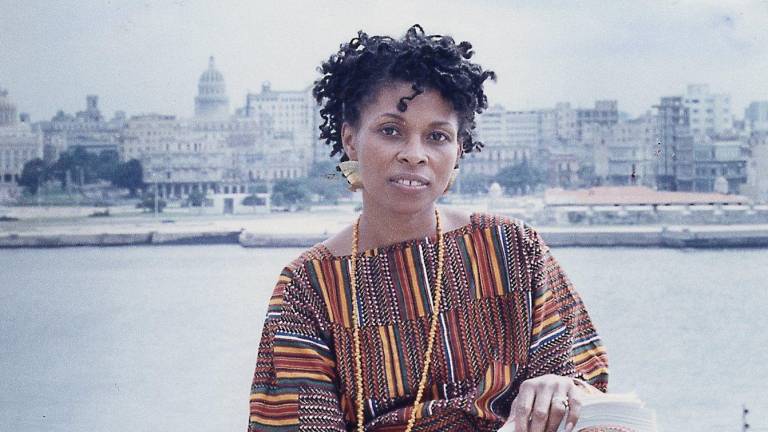
"caption": "Assata Shakur holding the manuscript of her autobiography with Old Havana, Cuba, in the background on October 7, 1987.",
"credit": "Ozier Muhammad/Newsday RM via Getty Images",
"altTag": null,
"description": null,
"imgSizes": {
"thumbnail": {
"file": "https://cdn.kqed.org/wp-content/uploads/sites/2/2025/09/GettyImages-1066615210-cropped-160x90.jpg",
"width": 160,
"height": 90,
"mimeType": "image/jpeg"
},
"medium_large": {
"file": "https://cdn.kqed.org/wp-content/uploads/sites/2/2025/09/GettyImages-1066615210-cropped-768x432.jpg",
"width": 768,
"height": 432,
"mimeType": "image/jpeg"
},
"post-thumbnail": {
"file": "https://cdn.kqed.org/wp-content/uploads/sites/2/2025/09/GettyImages-1066615210-cropped-672x372.jpg",
"width": 672,
"height": 372,
"mimeType": "image/jpeg"
},
"twentyfourteen-full-width": {
"file": "https://cdn.kqed.org/wp-content/uploads/sites/2/2025/09/GettyImages-1066615210-cropped-1038x576.jpg",
"width": 1038,
"height": 576,
"mimeType": "image/jpeg"
},
"kqedFullSize": {
"file": "https://cdn.kqed.org/wp-content/uploads/sites/2/2025/09/GettyImages-1066615210-cropped.jpg",
"width": 1342,
"height": 755
}
},
"fetchFailed": false,
"isLoading": false
},
"arts_13971590": {
"type": "attachments",
"id": "arts_13971590",
"meta": {
"index": "attachments_1716263798",
"site": "arts",
"id": "13971590",
"found": true
},
"title": null,
"publishDate": 1739196558,
"status": "inherit",
"parent": 13971589,
"modified": 1739218493,
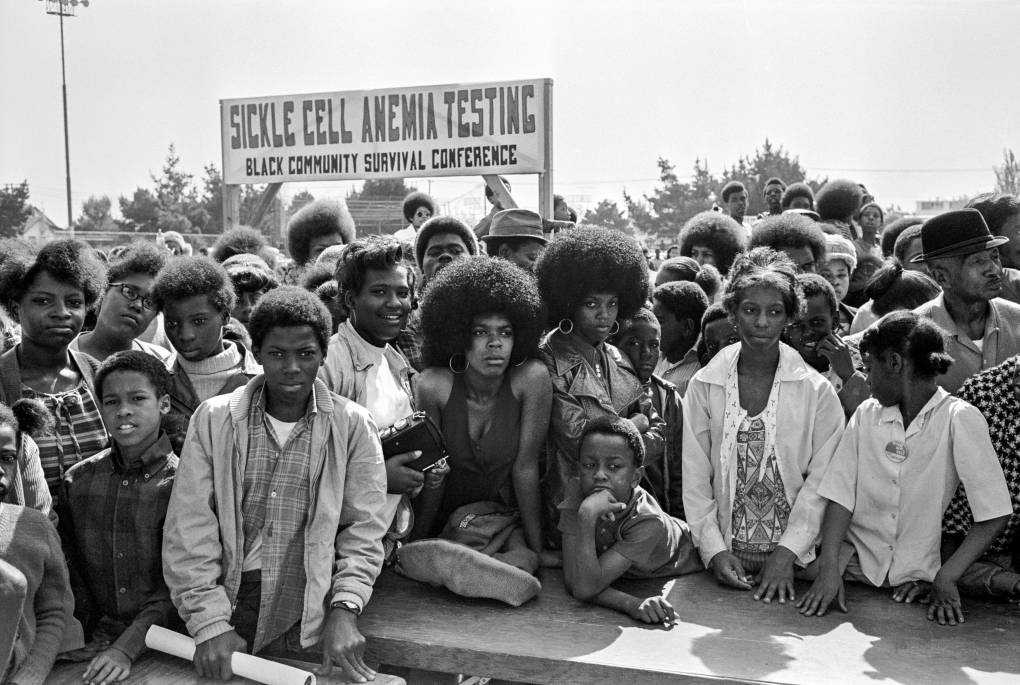
"caption": "People gather at a Black Panther Party-run sickle cell anemia testing site at Greenman Field in Oakland on March 31, 1972. ",
"credit": "Stephen Shames",
"altTag": "A black and white archival photo of a large group of African-American people gathered outside, behind them a sign reads \"sickle cell anemia testing.\"",
"description": null,
"imgSizes": {
"medium": {
"file": "https://cdn.kqed.org/wp-content/uploads/sites/2/2025/02/fgD1zByP-800x537.jpg",
"width": 800,
"height": 537,
"mimeType": "image/jpeg"
},
"large": {
"file": "https://cdn.kqed.org/wp-content/uploads/sites/2/2025/02/fgD1zByP-1020x685.jpg",
"width": 1020,
"height": 685,
"mimeType": "image/jpeg"
},
"thumbnail": {
"file": "https://cdn.kqed.org/wp-content/uploads/sites/2/2025/02/fgD1zByP-160x107.jpg",
"width": 160,
"height": 107,
"mimeType": "image/jpeg"
},
"medium_large": {
"file": "https://cdn.kqed.org/wp-content/uploads/sites/2/2025/02/fgD1zByP-768x516.jpg",
"width": 768,
"height": 516,
"mimeType": "image/jpeg"
},
"1536x1536": {
"file": "https://cdn.kqed.org/wp-content/uploads/sites/2/2025/02/fgD1zByP-1536x1031.jpg",
"width": 1536,
"height": 1031,
"mimeType": "image/jpeg"
},
"2048x2048": {
"file": "https://cdn.kqed.org/wp-content/uploads/sites/2/2025/02/fgD1zByP-2048x1375.jpg",
"width": 2048,
"height": 1375,
"mimeType": "image/jpeg"
},
"post-thumbnail": {
"file": "https://cdn.kqed.org/wp-content/uploads/sites/2/2025/02/fgD1zByP-672x372.jpg",
"width": 672,
"height": 372,
"mimeType": "image/jpeg"
},
"twentyfourteen-full-width": {
"file": "https://cdn.kqed.org/wp-content/uploads/sites/2/2025/02/fgD1zByP-1038x576.jpg",
"width": 1038,
"height": 576,
"mimeType": "image/jpeg"
},
"full-width": {
"file": "https://cdn.kqed.org/wp-content/uploads/sites/2/2025/02/fgD1zByP-1920x1289.jpg",
"width": 1920,
"height": 1289,
"mimeType": "image/jpeg"
},
"kqedFullSize": {
"file": "https://cdn.kqed.org/wp-content/uploads/sites/2/2025/02/fgD1zByP-scaled.jpg",
"width": 2560,
"height": 1719
}
},
"fetchFailed": false,
"isLoading": false
},
"arts_13951421": {
"type": "attachments",
"id": "arts_13951421",
"meta": {
"index": "attachments_1716263798",
"site": "arts",
"id": "13951421",
"found": true
},
"parent": 13950520,
"imgSizes": {
"twentyfourteen-full-width": {
"file": "https://cdn.kqed.org/wp-content/uploads/sites/2/2024/02/Jan-2024-1-1038x576.jpg",
"width": 1038,
"mimeType": "image/jpeg",
"height": 576
},
"thumbnail": {
"file": "https://cdn.kqed.org/wp-content/uploads/sites/2/2024/02/Jan-2024-1-160x90.jpg",
"width": 160,
"mimeType": "image/jpeg",
"height": 90
},
"post-thumbnail": {
"file": "https://cdn.kqed.org/wp-content/uploads/sites/2/2024/02/Jan-2024-1-672x372.jpg",
"width": 672,
"mimeType": "image/jpeg",
"height": 372
},
"kqedFullSize": {
"file": "https://cdn.kqed.org/wp-content/uploads/sites/2/2024/02/Jan-2024-1.jpg",
"width": 1920,
"height": 1080
},
"large": {
"file": "https://cdn.kqed.org/wp-content/uploads/sites/2/2024/02/Jan-2024-1-1020x574.jpg",
"width": 1020,
"mimeType": "image/jpeg",
"height": 574
},
"1536x1536": {
"file": "https://cdn.kqed.org/wp-content/uploads/sites/2/2024/02/Jan-2024-1-1536x864.jpg",
"width": 1536,
"mimeType": "image/jpeg",
"height": 864
},
"medium": {
"file": "https://cdn.kqed.org/wp-content/uploads/sites/2/2024/02/Jan-2024-1-800x450.jpg",
"width": 800,
"mimeType": "image/jpeg",
"height": 450
},
"medium_large": {
"file": "https://cdn.kqed.org/wp-content/uploads/sites/2/2024/02/Jan-2024-1-768x432.jpg",
"width": 768,
"mimeType": "image/jpeg",
"height": 432
}
},
"publishDate": 1706825208,
"modified": 1706825208,
"caption": null,
"description": null,
"title": "Jan 2024-1",
"credit": null,
"status": "inherit",
"altTag": null,
"fetchFailed": false,
"isLoading": false
},
"arts_13940303": {
"type": "attachments",
"id": "arts_13940303",
"meta": {
"index": "attachments_1716263798",
"site": "arts",
"id": "13940303",
"found": true
},
"parent": 13940221,
"imgSizes": {
"twentyfourteen-full-width": {
"file": "https://cdn.kqed.org/wp-content/uploads/sites/2/2024/01/unnamed-3-1038x576.jpg",
"width": 1038,
"mimeType": "image/jpeg",
"height": 576
},
"thumbnail": {
"file": "https://cdn.kqed.org/wp-content/uploads/sites/2/2024/01/unnamed-3-160x132.jpg",
"width": 160,
"mimeType": "image/jpeg",
"height": 132
},
"post-thumbnail": {
"file": "https://cdn.kqed.org/wp-content/uploads/sites/2/2024/01/unnamed-3-672x372.jpg",
"width": 672,
"mimeType": "image/jpeg",
"height": 372
},
"kqedFullSize": {
"file": "https://cdn.kqed.org/wp-content/uploads/sites/2/2024/01/unnamed-3.jpg",
"width": 2522,
"height": 2075
},
"2048x2048": {
"file": "https://cdn.kqed.org/wp-content/uploads/sites/2/2024/01/unnamed-3-2048x1685.jpg",
"width": 2048,
"mimeType": "image/jpeg",
"height": 1685
},
"large": {
"file": "https://cdn.kqed.org/wp-content/uploads/sites/2/2024/01/unnamed-3-1020x839.jpg",
"width": 1020,
"mimeType": "image/jpeg",
"height": 839
},
"1536x1536": {
"file": "https://cdn.kqed.org/wp-content/uploads/sites/2/2024/01/unnamed-3-1536x1264.jpg",
"width": 1536,
"mimeType": "image/jpeg",
"height": 1264
},
"full-width": {
"file": "https://cdn.kqed.org/wp-content/uploads/sites/2/2024/01/unnamed-3-1920x1580.jpg",
"width": 1920,
"mimeType": "image/jpeg",
"height": 1580
},
"medium": {
"file": "https://cdn.kqed.org/wp-content/uploads/sites/2/2024/01/unnamed-3-800x658.jpg",
"width": 800,
"mimeType": "image/jpeg",
"height": 658
},
"medium_large": {
"file": "https://cdn.kqed.org/wp-content/uploads/sites/2/2024/01/unnamed-3-768x632.jpg",
"width": 768,
"mimeType": "image/jpeg",
"height": 632
}
},
"publishDate": 1704913328,
"modified": 1705003845,
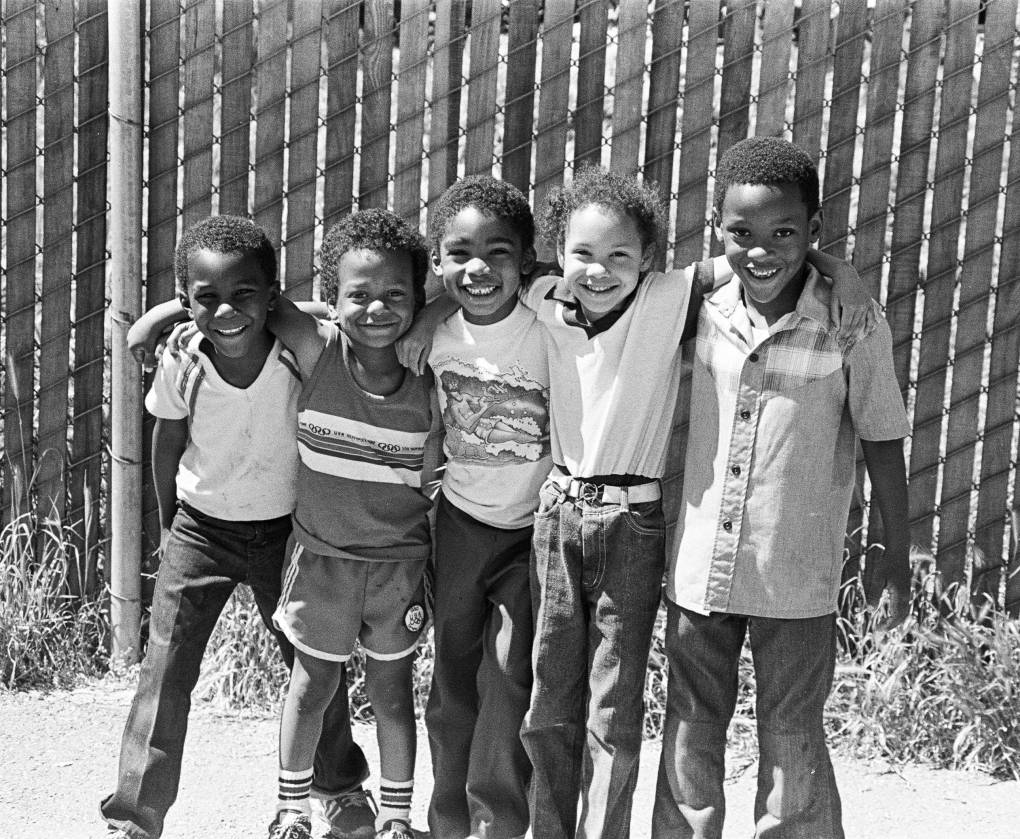
"caption": "Young students at the Oakland Community School, which served as a groundbreaking new model for education nationwide.",
"description": "An archival photo of bright smiles radiating from young scholars at the Oakland Community School.",
"title": "An archival photo of bright smiles radiating from young scholars at the Oakland Community School.",
"credit": "Donald Cunningham Collection",
"status": "inherit",
"altTag": "An archival photo of bright smiles radiating from young Black students against a wood-and-chainlink fence.",
"fetchFailed": false,
"isLoading": false
},
"arts_13920149": {
"type": "attachments",
"id": "arts_13920149",
"meta": {
"index": "attachments_1716263798",
"site": "arts",
"id": "13920149",
"found": true
},
"parent": 13920137,
"imgSizes": {
"twentyfourteen-full-width": {
"file": "https://ww2.kqed.org/app/uploads/sites/2/2022/10/Comrade-Sisters-Event-Option-2-1038x576.jpg",
"width": 1038,
"mimeType": "image/jpeg",
"height": 576
},
"thumbnail": {
"file": "https://ww2.kqed.org/app/uploads/sites/2/2022/10/Comrade-Sisters-Event-Option-2-160x107.jpg",
"width": 160,
"mimeType": "image/jpeg",
"height": 107
},
"post-thumbnail": {
"file": "https://ww2.kqed.org/app/uploads/sites/2/2022/10/Comrade-Sisters-Event-Option-2-672x372.jpg",
"width": 672,
"mimeType": "image/jpeg",
"height": 372
},
"kqedFullSize": {
"file": "https://ww2.kqed.org/app/uploads/sites/2/2022/10/Comrade-Sisters-Event-Option-2-scaled.jpg",
"width": 2560,
"height": 1710
},
"2048x2048": {
"file": "https://ww2.kqed.org/app/uploads/sites/2/2022/10/Comrade-Sisters-Event-Option-2-2048x1368.jpg",
"width": 2048,
"mimeType": "image/jpeg",
"height": 1368
},
"large": {
"file": "https://ww2.kqed.org/app/uploads/sites/2/2022/10/Comrade-Sisters-Event-Option-2-1020x681.jpg",
"width": 1020,
"mimeType": "image/jpeg",
"height": 681
},
"1536x1536": {
"file": "https://ww2.kqed.org/app/uploads/sites/2/2022/10/Comrade-Sisters-Event-Option-2-1536x1026.jpg",
"width": 1536,
"mimeType": "image/jpeg",
"height": 1026
},
"full-width": {
"file": "https://ww2.kqed.org/app/uploads/sites/2/2022/10/Comrade-Sisters-Event-Option-2-1920x1283.jpg",
"width": 1920,
"mimeType": "image/jpeg",
"height": 1283
},
"medium": {
"file": "https://ww2.kqed.org/app/uploads/sites/2/2022/10/Comrade-Sisters-Event-Option-2-800x534.jpg",
"width": 800,
"mimeType": "image/jpeg",
"height": 534
},
"medium_large": {
"file": "https://ww2.kqed.org/app/uploads/sites/2/2022/10/Comrade-Sisters-Event-Option-2-768x513.jpg",
"width": 768,
"mimeType": "image/jpeg",
"height": 513
}
},
"publishDate": 1665096041,
"modified": 1665096171,
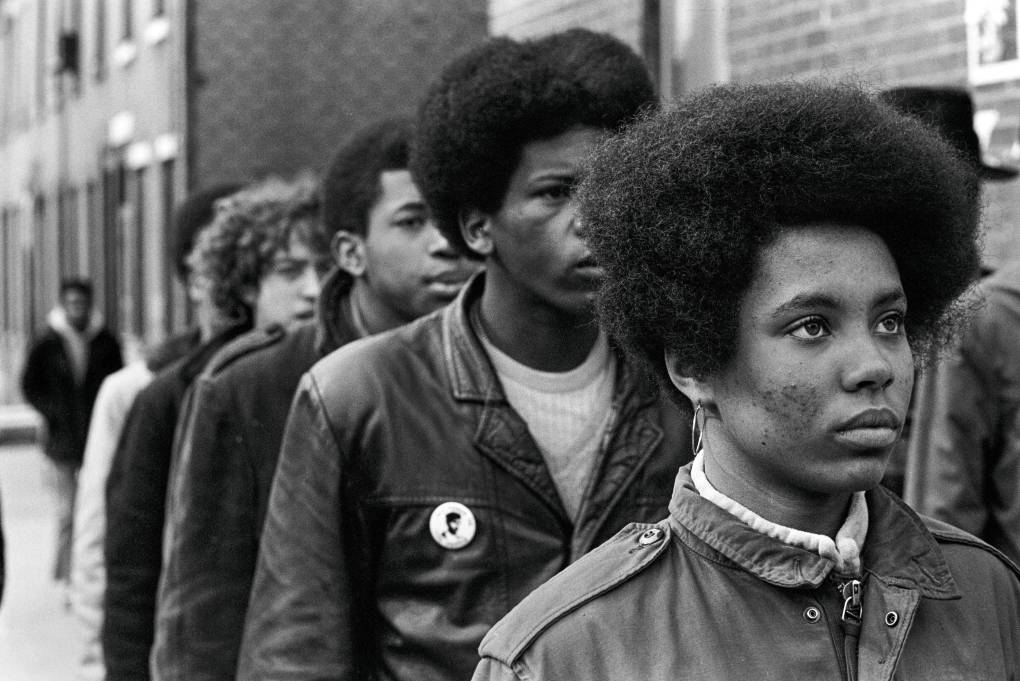
"caption": "A Black Panther event in Philadelphia, 1970. ",
"description": null,
"title": "Comrade Sisters book",
"credit": "Stephen Shames",
"status": "inherit",
"altTag": "a black and white photo with a line of young African American men and women at a political rally",
"fetchFailed": false,
"isLoading": false
},
"arts_13903864": {
"type": "attachments",
"id": "arts_13903864",
"meta": {
"index": "attachments_1716263798",
"site": "arts",
"id": "13903864",
"found": true
},
"parent": 13903828,
"imgSizes": {
"twentyfourteen-full-width": {
"file": "https://ww2.kqed.org/app/uploads/sites/2/2021/09/0-2-1038x576.jpg",
"width": 1038,
"mimeType": "image/jpeg",
"height": 576
},
"thumbnail": {
"file": "https://ww2.kqed.org/app/uploads/sites/2/2021/09/0-2-160x100.jpg",
"width": 160,
"mimeType": "image/jpeg",
"height": 100
},
"post-thumbnail": {
"file": "https://ww2.kqed.org/app/uploads/sites/2/2021/09/0-2-672x372.jpg",
"width": 672,
"mimeType": "image/jpeg",
"height": 372
},
"kqedFullSize": {
"file": "https://ww2.kqed.org/app/uploads/sites/2/2021/09/0-2.jpg",
"width": 1500,
"height": 933
},
"large": {
"file": "https://ww2.kqed.org/app/uploads/sites/2/2021/09/0-2-1020x634.jpg",
"width": 1020,
"mimeType": "image/jpeg",
"height": 634
},
"medium": {
"file": "https://ww2.kqed.org/app/uploads/sites/2/2021/09/0-2-800x498.jpg",
"width": 800,
"mimeType": "image/jpeg",
"height": 498
},
"medium_large": {
"file": "https://ww2.kqed.org/app/uploads/sites/2/2021/09/0-2-768x478.jpg",
"width": 768,
"mimeType": "image/jpeg",
"height": 478
}
},
"publishDate": 1632844169,
"modified": 1632844584,
"caption": "Black Panther Alumni gathering and celebrating the 50th anniversary of the founding of the Black Panther Party as they stand on the steps of the Alameda County Court House.",
"description": "Black Panther Alumni gathering and celebrating the 50th anniversary of the founding of the Black Panther Party as they stand on the steps of the Alameda County Court House.",
"title": "Black Panther Alumni gathering and celebrating the 50th anniversary of the founding of the Black Panther Party as they stand on the steps of the Alameda County Court House.",
"credit": "It's About Time Archive",
"status": "inherit",
"altTag": "Black Panther Alumni gathering and celebrating the 50th anniversary of the founding of the Black Panther Party as they stand on the steps of the Alameda County Court House.",
"fetchFailed": false,
"isLoading": false
},
"arts_13903678": {
"type": "attachments",
"id": "arts_13903678",
"meta": {
"index": "attachments_1716263798",
"site": "arts",
"id": "13903678",
"found": true
},
"parent": 13903670,
"imgSizes": {
"twentyfourteen-full-width": {
"file": "https://ww2.kqed.org/app/uploads/sites/2/2021/09/GettyImages-80954965-1024x576.jpg",
"width": 1024,
"mimeType": "image/jpeg",
"height": 576
},
"thumbnail": {
"file": "https://ww2.kqed.org/app/uploads/sites/2/2021/09/GettyImages-80954965-160x110.jpg",
"width": 160,
"mimeType": "image/jpeg",
"height": 110
},
"post-thumbnail": {
"file": "https://ww2.kqed.org/app/uploads/sites/2/2021/09/GettyImages-80954965-672x372.jpg",
"width": 672,
"mimeType": "image/jpeg",
"height": 372
},
"kqedFullSize": {
"file": "https://ww2.kqed.org/app/uploads/sites/2/2021/09/GettyImages-80954965.jpg",
"width": 1024,
"height": 704
},
"large": {
"file": "https://ww2.kqed.org/app/uploads/sites/2/2021/09/GettyImages-80954965-1020x701.jpg",
"width": 1020,
"mimeType": "image/jpeg",
"height": 701
},
"medium": {
"file": "https://ww2.kqed.org/app/uploads/sites/2/2021/09/GettyImages-80954965-800x550.jpg",
"width": 800,
"mimeType": "image/jpeg",
"height": 550
},
"medium_large": {
"file": "https://ww2.kqed.org/app/uploads/sites/2/2021/09/GettyImages-80954965-768x528.jpg",
"width": 768,
"mimeType": "image/jpeg",
"height": 528
}
},
"publishDate": 1632353956,
"modified": 1632354019,
"caption": "Melvin Van Peebles at the 2008 Tribeca Film Festival in New York City. ",
"description": "Melvin Van Peebles at the 2008 Tribeca Film Festival in New York City. ",
"title": "Behind The Screens: Confessionsofa Ex-Doofus-ItchyFooted Mutha At TFF",
"credit": "Brad Barket/Getty Images for Tribeca Film Festival",
"status": "inherit",
"altTag": "Melvin Van Peebles at the 2008 Tribeca Film Festival in New York City.",
"fetchFailed": false,
"isLoading": false
},
"arts_13901516": {
"type": "attachments",
"id": "arts_13901516",
"meta": {
"index": "attachments_1716263798",
"site": "arts",
"id": "13901516",
"found": true
},
"parent": 13901504,
"imgSizes": {
"twentyfourteen-full-width": {
"file": "https://ww2.kqed.org/app/uploads/sites/2/2021/08/bac-afro-hippie-david-huffman-highres-3_COVER-1038x576.jpg",
"width": 1038,
"mimeType": "image/jpeg",
"height": 576
},
"thumbnail": {
"file": "https://ww2.kqed.org/app/uploads/sites/2/2021/08/bac-afro-hippie-david-huffman-highres-3_COVER-160x90.jpg",
"width": 160,
"mimeType": "image/jpeg",
"height": 90
},
"post-thumbnail": {
"file": "https://ww2.kqed.org/app/uploads/sites/2/2021/08/bac-afro-hippie-david-huffman-highres-3_COVER-672x372.jpg",
"width": 672,
"mimeType": "image/jpeg",
"height": 372
},
"kqedFullSize": {
"file": "https://ww2.kqed.org/app/uploads/sites/2/2021/08/bac-afro-hippie-david-huffman-highres-3_COVER.jpg",
"width": 1920,
"height": 1080
},
"large": {
"file": "https://ww2.kqed.org/app/uploads/sites/2/2021/08/bac-afro-hippie-david-huffman-highres-3_COVER-1020x574.jpg",
"width": 1020,
"mimeType": "image/jpeg",
"height": 574
},
"1536x1536": {
"file": "https://ww2.kqed.org/app/uploads/sites/2/2021/08/bac-afro-hippie-david-huffman-highres-3_COVER-1536x864.jpg",
"width": 1536,
"mimeType": "image/jpeg",
"height": 864
},
"medium": {
"file": "https://ww2.kqed.org/app/uploads/sites/2/2021/08/bac-afro-hippie-david-huffman-highres-3_COVER-800x450.jpg",
"width": 800,
"mimeType": "image/jpeg",
"height": 450
},
"medium_large": {
"file": "https://ww2.kqed.org/app/uploads/sites/2/2021/08/bac-afro-hippie-david-huffman-highres-3_COVER-768x432.jpg",
"width": 768,
"mimeType": "image/jpeg",
"height": 432
}
},
"publishDate": 1629338033,
"modified": 1629338100,
"caption": "Installation view of David Huffman's 'Afro Hippie' at the Berkeley Art Center.",
"description": "Installation view of David Huffman's 'Afro Hippie' at the Berkeley Art Center.",
"title": "bac-afro-hippie-david-huffman-highres-3_COVER",
"credit": "Felix Quintana",
"status": "inherit",
"altTag": null,
"fetchFailed": false,
"isLoading": false
}
},
"audioPlayerReducer": {
"postId": "stream_live",
"isPaused": true,
"isPlaying": false,
"pfsActive": false,
"pledgeModalIsOpen": true,
"playerDrawerIsOpen": false
},
"authorsReducer": {
"byline_arts_13981777": {
"type": "authors",
"id": "byline_arts_13981777",
"meta": {
"override": true
},
"slug": "byline_arts_13981777",
"name": "Philip Marcelo, Associated Press",
"isLoading": false
},
"byline_arts_13903670": {
"type": "authors",
"id": "byline_arts_13903670",
"meta": {
"override": true
},
"slug": "byline_arts_13903670",
"name": "Jake Coyle, Associated Press",
"isLoading": false
},
"shotchkiss": {
"type": "authors",
"id": "61",
"meta": {
"index": "authors_1716337520",
"id": "61",
"found": true
},
"name": "Sarah Hotchkiss",
"firstName": "Sarah",
"lastName": "Hotchkiss",
"slug": "shotchkiss",
"email": "shotchkiss@kqed.org",
"display_author_email": true,
"staff_mastheads": [
"arts"
],
"title": "Senior Editor",
"bio": "Sarah Hotchkiss is a San Francisco \u003ca href=\"http://www.sarahhotchkiss.com\">artist\u003c/a> and arts writer. In 2019, she received the Dorothea & Leo Rabkin Foundation grant for visual art journalism and in 2020 she received a Society of Professional Journalists, Northern California award for excellence in arts and culture reporting.",
"avatar": "https://secure.gravatar.com/avatar/ca38c7f54590856cd4947d26274f8a90?s=600&d=blank&r=g",
"twitter": null,
"facebook": null,
"instagram": null,
"linkedin": null,
"sites": [
{
"site": "",
"roles": [
"editor"
]
},
{
"site": "arts",
"roles": [
"Contributor",
"administrator"
]
},
{
"site": "artschool",
"roles": [
"administrator"
]
},
{
"site": "news",
"roles": [
"editor"
]
},
{
"site": "pop",
"roles": [
"administrator"
]
},
{
"site": "bayareabites",
"roles": [
"editor"
]
},
{
"site": "spark",
"roles": [
"editor"
]
},
{
"site": "checkplease",
"roles": [
"editor"
]
}
],
"headData": {
"title": "Sarah Hotchkiss | KQED",
"description": "Senior Editor",
"ogImgSrc": "https://secure.gravatar.com/avatar/ca38c7f54590856cd4947d26274f8a90?s=600&d=blank&r=g",
"twImgSrc": "https://secure.gravatar.com/avatar/ca38c7f54590856cd4947d26274f8a90?s=600&d=blank&r=g"
},
"isLoading": false,
"link": "/author/shotchkiss"
},
"ralexandra": {
"type": "authors",
"id": "11242",
"meta": {
"index": "authors_1716337520",
"id": "11242",
"found": true
},
"name": "Rae Alexandra",
"firstName": "Rae",
"lastName": "Alexandra",
"slug": "ralexandra",
"email": "ralexandra@kqed.org",
"display_author_email": true,
"staff_mastheads": [
"arts"
],
"title": "Reporter/Producer",
"bio": "Rae Alexandra is a Reporter/Producer for KQED Arts & Culture, and the creator/author of the \u003ca href=\"https://www.kqed.org/arts/program/rebel-girls-from-bay-area-history\">Rebel Girls From Bay Area History\u003c/a> and \u003ca href=\"https://www.kqed.org/bizarrebayarea\">Bizarre Bay Area\u003c/a> series. Her debut book, \u003ca href=\"https://citylights.com/politics-current-events-history/unsung-heroines35-women-who-changed/\">Unsung Heroines: 35 Women Who Changed the Bay Area\u003c/a> will be published by City Lights in Spring 2026. In 2023, Rae was awarded an SPJ Excellence in Journalism Award for Arts & Culture. Rae was born and raised in Wales and subsequently — even after two decades in Northern California — still uses phrases that regularly baffle her coworkers.",
"avatar": "https://secure.gravatar.com/avatar/d5ef3d663d9adae1345d06932a3951de?s=600&d=blank&r=g",
"twitter": null,
"facebook": null,
"instagram": null,
"linkedin": null,
"sites": [
{
"site": "arts",
"roles": [
"editor"
]
},
{
"site": "news",
"roles": [
"editor"
]
},
{
"site": "pop",
"roles": [
"editor"
]
},
{
"site": "bayareabites",
"roles": [
"editor"
]
},
{
"site": "science",
"roles": [
"editor"
]
}
],
"headData": {
"title": "Rae Alexandra | KQED",
"description": "Reporter/Producer",
"ogImgSrc": "https://secure.gravatar.com/avatar/d5ef3d663d9adae1345d06932a3951de?s=600&d=blank&r=g",
"twImgSrc": "https://secure.gravatar.com/avatar/d5ef3d663d9adae1345d06932a3951de?s=600&d=blank&r=g"
},
"isLoading": false,
"link": "/author/ralexandra"
},
"ogpenn": {
"type": "authors",
"id": "11491",
"meta": {
"index": "authors_1716337520",
"id": "11491",
"found": true
},
"name": "Pendarvis Harshaw",
"firstName": "Pendarvis",
"lastName": "Harshaw",
"slug": "ogpenn",
"email": "ogpenn@gmail.com",
"display_author_email": false,
"staff_mastheads": [
"arts"
],
"title": "Community Engagement Reporter",
"bio": "Pendarvis Harshaw is an educator, host and writer with KQED Arts.",
"avatar": "https://secure.gravatar.com/avatar/093d33baff5354890e29ad83d58d2c49?s=600&d=blank&r=g",
"twitter": null,
"facebook": null,
"instagram": "ogpenn",
"linkedin": null,
"sites": [
{
"site": "arts",
"roles": [
"editor"
]
},
{
"site": "news",
"roles": [
"editor"
]
},
{
"site": "bayareabites",
"roles": [
"author"
]
},
{
"site": "hiphop",
"roles": [
"editor"
]
}
],
"headData": {
"title": "Pendarvis Harshaw | KQED",
"description": "Community Engagement Reporter",
"ogImgSrc": "https://secure.gravatar.com/avatar/093d33baff5354890e29ad83d58d2c49?s=600&d=blank&r=g",
"twImgSrc": "https://secure.gravatar.com/avatar/093d33baff5354890e29ad83d58d2c49?s=600&d=blank&r=g"
},
"isLoading": false,
"link": "/author/ogpenn"
},
"ksong": {
"type": "authors",
"id": "11813",
"meta": {
"index": "authors_1716337520",
"id": "11813",
"found": true
},
"name": "Kristie Song",
"firstName": "Kristie",
"lastName": "Song",
"slug": "ksong",
"email": "ksong@kqed.org",
"display_author_email": false,
"staff_mastheads": [],
"title": "Editorial Intern ",
"bio": "Kristie Song is an Arts & Culture Intern at KQED. She is currently a graduate student at UC Berkeley, where she studies audio and multimedia journalism. Previously, she covered the local community for Oakland North, produced episodes for The Science of Happiness, and served as news director for KUCI, UC Irvine’s radio station. Outside of reporting, she likes drawing comics, listening to angsty rock, and practicing the guitar.",
"avatar": "https://secure.gravatar.com/avatar/c1149e78c3c44f92d4945a8ab0711af6?s=600&d=blank&r=g",
"twitter": null,
"facebook": null,
"instagram": null,
"linkedin": null,
"sites": [
{
"site": "arts",
"roles": [
"editor"
]
}
],
"headData": {
"title": "Kristie Song | KQED",
"description": "Editorial Intern ",
"ogImgSrc": "https://secure.gravatar.com/avatar/c1149e78c3c44f92d4945a8ab0711af6?s=600&d=blank&r=g",
"twImgSrc": "https://secure.gravatar.com/avatar/c1149e78c3c44f92d4945a8ab0711af6?s=600&d=blank&r=g"
},
"isLoading": false,
"link": "/author/ksong"
}
},
"breakingNewsReducer": {},
"pagesReducer": {},
"postsReducer": {
"stream_live": {
"type": "live",
"id": "stream_live",
"audioUrl": "https://streams.kqed.org/kqedradio",
"title": "Live Stream",
"excerpt": "Live Stream information currently unavailable.",
"link": "/radio",
"featImg": "",
"label": {
"name": "KQED Live",
"link": "/"
}
},
"stream_kqedNewscast": {
"type": "posts",
"id": "stream_kqedNewscast",
"audioUrl": "https://www.kqed.org/.stream/anon/radio/RDnews/newscast.mp3?_=1",
"title": "KQED Newscast",
"featImg": "",
"label": {
"name": "88.5 FM",
"link": "/"
}
},
"arts_13982568": {
"type": "posts",
"id": "arts_13982568",
"meta": {
"index": "posts_1716263798",
"site": "arts",
"id": "13982568",
"score": null,
"sort": [
1761076276000
]
},
"guestAuthors": [],
"slug": "bobby-seale-way-street-renaming-black-panthers-oakland",
"title": "Oakland to Honor Bobby Seale, Black Panther Party Cofounder, With Street Renaming",
"publishDate": 1761076276,
"format": "standard",
"headTitle": "Oakland to Honor Bobby Seale, Black Panther Party Cofounder, With Street Renaming | KQED",
"labelTerm": {
"term": 140,
"site": "arts"
},
"content": "\u003cp>On Wednesday, Oct. 22, the City of Oakland will celebrate the 89th birthday of Black Panther Party cofounder \u003ca href=\"https://www.kqed.org/arts/tag/bobby-seale\">Bobby Seale\u003c/a> with \u003ca href=\"https://cdn.kqed.org/wp-content/uploads/sites/2/2025/10/Seale.Proclamation.pdf\">a formal proclamation\u003c/a> of “Bobby Seale Day” and a commemorative street renaming.\u003c/p>\n\u003cp>Seale, who helped create one of the Unites States’ most well-known community activist groups of the 20th century, also ran for \u003ca href=\"https://aadl.org/node/195634\">mayor of Oakland in 1973\u003c/a>.\u003c/p>\n\u003cp>Seale was born in Liberty, Texas. His family moved to the Bay Area when Seale was a child, first residing in Albany’s \u003ca href=\"https://monumenttoextraction.org/stories/worldwar2-housing/\">Codornices Village\u003c/a> before moving to North Oakland’s 57th Street.\u003c/p>\n\u003cp>[aside postID='arts_13888332']At a Wednesday evening block party, the intersection of 57th Street and Martin Luther King Jr. Way will officially be renamed \u003ca href=\"https://oakland.legistar.com/MeetingDetail.aspx?ID=1314826&GUID=EE02C9D2-93D3-4C5A-87FE-450007B1900A&G=undefined&Options=&Search=\">Bobby Seale Way\u003c/a>.\u003c/p>\n\u003cp>Bobby Seale himself will be in attendance at the event, which runs from 5 p.m.–7 p.m. and is open to the public.\u003c/p>\n\u003cp>[ad fullwidth]\u003c/p>\n\u003cp>Hosted by North Oakland lyricist and entrepreneur \u003ca href=\"https://www.kqed.org/arts/tag/mistah-fab\">Mistah F.A.B., \u003c/a>the party will also feature comments from Oakland Mayor Barbara Lee, a performance by \u003ca href=\"https://www.thecurtisfamilycnotes.com/\">The Curtis Family C-Notes\u003c/a> and a speech from thespian and comedian\u003ca href=\"https://www.instagram.com/donaldlacyjr/?hl=en\" target=\"_blank\" rel=\"noopener\" data-saferedirecturl=\"https://www.google.com/url?q=https://www.instagram.com/donaldlacyjr/?hl%3Den&source=gmail&ust=1761158109722000&usg=AOvVaw3XYfKaDszxwnSzCyU_yHj4\"> Donald Lacy Jr\u003c/a>.\u003c/p>\n\u003cdiv>\n\u003cdiv id=\"m_4006817488853157233gmail-:4fz\" role=\"textbox\" aria-label=\"Message Body\" aria-controls=\":4iz\" aria-expanded=\"false\">\n\u003cp>This week is also \u003ca href=\"https://www.lovelifefoundation.org/\">“Love Life Week” in Oakland\u003c/a>. In 2016, after Lacy’s 16-year old daughter Lo’Eshe Lacy was killed in a shooting, Oakland adopted “Love Life” as its official motto; the term is inspired by the meaning of Lacy’s daughter’s name.\u003c/p>\n\u003c/div>\n\u003c/div>\n\u003cfigure id=\"attachment_13920156\" class=\"wp-caption aligncenter\" style=\"max-width: 2560px\">\u003cimg loading=\"lazy\" decoding=\"async\" class=\"size-full wp-image-13920156\" src=\"https://cdn.kqed.org/wp-content/uploads/sites/2/2022/10/Comrade-Sisters-Event-Option-1-scaled.jpg\" alt=\"a black and white photo of five African-American people, some in lab coats, standing outside doing a blood draw on one of them, an older woman\" width=\"2560\" height=\"1701\" srcset=\"https://cdn.kqed.org/wp-content/uploads/sites/2/2022/10/Comrade-Sisters-Event-Option-1-scaled.jpg 2560w, https://cdn.kqed.org/wp-content/uploads/sites/2/2022/10/Comrade-Sisters-Event-Option-1-800x531.jpg 800w, https://cdn.kqed.org/wp-content/uploads/sites/2/2022/10/Comrade-Sisters-Event-Option-1-1020x678.jpg 1020w, https://cdn.kqed.org/wp-content/uploads/sites/2/2022/10/Comrade-Sisters-Event-Option-1-160x106.jpg 160w, https://cdn.kqed.org/wp-content/uploads/sites/2/2022/10/Comrade-Sisters-Event-Option-1-768x510.jpg 768w, https://cdn.kqed.org/wp-content/uploads/sites/2/2022/10/Comrade-Sisters-Event-Option-1-1536x1020.jpg 1536w, https://cdn.kqed.org/wp-content/uploads/sites/2/2022/10/Comrade-Sisters-Event-Option-1-2048x1360.jpg 2048w, https://cdn.kqed.org/wp-content/uploads/sites/2/2022/10/Comrade-Sisters-Event-Option-1-1920x1275.jpg 1920w\" sizes=\"auto, (max-width: 2560px) 100vw, 2560px\">\u003cfigcaption class=\"wp-caption-text\">Black Panther Adrienne Humphrey conducts sickle cell anemia testing during Bobby Seale’s campaign for mayor of Oakland in 1973. \u003ccite>(Stephen Shames)\u003c/cite>\u003c/figcaption>\u003c/figure>\n\u003cp>The \u003ca href=\"https://cdn.kqed.org/wp-content/uploads/sites/2/2025/10/Seale.Proclamation.pdf\">city proclamation\u003c/a> honoring Bobby Seale notes that his “visionary leadership and fearless activism have not only transformed Oakland but have left a lasting impact on national movements for racial and economic justice.”\u003c/p>\n\u003cp>The proclamation also praises Seale’s leadership of the Black Panther Party in Oakland, which “rose to national prominence not only for its stance against police brutality but for its pioneering community-based programs, including free breakfast programs for children, health clinics, educational initiatives, and mutual aid efforts that served as blueprints for future social welfare models.”\u003c/p>\n\u003cp>In recent years, the City of Oakland has taken strides to honor its local luminaries. \u003ca href=\"https://www.kqed.org/arts/13937563/tupac-shakur-way-oakland-street-renaming\">Tupac Shakur\u003c/a> has a commemorative plaque on Grand Avenue and MacArthur Boulevard near Lake Merritt, and rapper \u003ca href=\"https://www.kqed.org/arts/13922616/too-short-way-street-sign-unveiled-oakland\">Too Short has a street sign\u003c/a> mounted on the corner of High Street and Foothill Boulevard. Black Panther Party cofounder Dr. Huey P. Newton has\u003ca href=\"https://www.kqed.org/news/11893532/debut-of-dr-huey-p-newton-bust-spotlights-an-influential-black-panther-party-leader\"> a sculpture\u003c/a> and a three-block section of 9th Street in West Oakland named in his honor. And in June of this year a street sign in recognition of \u003ca href=\"https://www.instagram.com/reel/DLbFFE9ycHg/\">Black Panther leader Elaine Brown\u003c/a> was unveiled in West Oakland.\u003c/p>\n\u003cp>[aside postID='arts_13851531'] Seale’s story has been told extensively, both through his autobiography \u003cem>A Lonely Rage\u003c/em> and his book \u003cem>Seize the Time: The Story of the Black Panther Party and Huey P. Newton. \u003c/em>The cover of the latter shows Seale bound and gagged as the result of a order from \u003ca href=\"https://www.loc.gov/exhibitions/drawing-justice-courtroom-illustrations/about-this-exhibition/political-activists-on-trial/bobby-seale-bound-and-gagged/\">the presiding judge in the Chicago 8 trial\u003c/a>.\u003c/p>\n\u003cp>That case was also depicted in the 2020 film \u003cem>\u003ca href=\"https://www.npr.org/2020/10/24/927306419/yahya-abdul-mateen-ii-on-playing-bobby-seale-in-the-trial-of-the-chicago-7\">The Trial of the Chicago 7\u003c/a>\u003c/em>, where Seale was portrayed by Oakland’s Yahya Abdul-Mateen II.\u003c/p>\n\u003cp>Seale’s name already graces the halls of\u003ca href=\"https://merritt.edu/black-student-union/\"> Merritt College\u003c/a> — the campus where he met Newton, and where the seeds of the Black Panther Party for Self-Defense took root. Now, Seale will have a street and a day dedicated in his honor as well.\u003c/p>\n\u003chr>\n\u003cp>\u003c/p>\n\u003cp>\u003cem>The public unveiling of Bobby Seale Way takes place on Wednesday, Oct. 22, from 5 p.m.–7 p.m. at the intersection of Martin Luther King Jr. Way and 57th Street in Oakland.\u003c/em>\u003c/p>\n\n",
"blocks": [],
"excerpt": "At an Oct. 22 ceremony, Seale will receive city honors for his ‘visionary leadership and fearless activism.’",
"status": "publish",
"parent": 0,
"modified": 1761078497,
"stats": {
"hasAudio": false,
"hasVideo": false,
"hasChartOrMap": false,
"iframeSrcs": [],
"hasGoogleForm": false,
"hasGallery": false,
"hasHearkenModule": false,
"hasPolis": false,
"paragraphCount": 16,
"wordCount": 634
},
"headData": {
"title": "Oakland to Honor Bobby Seale, Black Panther Party Cofounder, With Street Renaming | KQED",
"description": "At an Oct. 22 ceremony, Seale will receive city honors for his ‘visionary leadership and fearless activism.’",
"ogTitle": "",
"ogDescription": "",
"ogImgId": "",
"twTitle": "",
"twDescription": "",
"twImgId": "",
"schema": {
"@context": "https://schema.org",
"@type": "Article",
"headline": "Oakland to Honor Bobby Seale, Black Panther Party Cofounder, With Street Renaming",
"datePublished": "2025-10-21T12:51:16-07:00",
"dateModified": "2025-10-21T13:28:17-07:00",
"image": "https://cdn.kqed.org/wp-content/uploads/2020/02/KQED-OG-Image@1x.png"
}
},
"primaryCategory": {
"termId": 1,
"slug": "arts",
"name": "Arts"
},
"sticky": false,
"nprStoryId": "kqed-13982568",
"templateType": "standard",
"featuredImageType": "standard",
"subhead": "North Oakland is now home to 'Bobby Seale Way.'",
"excludeFromSiteSearch": "Include",
"articleAge": "0",
"path": "/arts/13982568/bobby-seale-way-street-renaming-black-panthers-oakland",
"audioTrackLength": null,
"parsedContent": [
{
"type": "contentString",
"content": "\u003cdiv class=\"post-body\">\u003cp>\u003cp>On Wednesday, Oct. 22, the City of Oakland will celebrate the 89th birthday of Black Panther Party cofounder \u003ca href=\"https://www.kqed.org/arts/tag/bobby-seale\">Bobby Seale\u003c/a> with \u003ca href=\"https://cdn.kqed.org/wp-content/uploads/sites/2/2025/10/Seale.Proclamation.pdf\">a formal proclamation\u003c/a> of “Bobby Seale Day” and a commemorative street renaming.\u003c/p>\n\u003cp>Seale, who helped create one of the Unites States’ most well-known community activist groups of the 20th century, also ran for \u003ca href=\"https://aadl.org/node/195634\">mayor of Oakland in 1973\u003c/a>.\u003c/p>\n\u003cp>Seale was born in Liberty, Texas. His family moved to the Bay Area when Seale was a child, first residing in Albany’s \u003ca href=\"https://monumenttoextraction.org/stories/worldwar2-housing/\">Codornices Village\u003c/a> before moving to North Oakland’s 57th Street.\u003c/p>\n\u003cp>\u003c/p>\u003c/div>",
"attributes": {
"named": {},
"numeric": []
}
},
{
"type": "component",
"content": "",
"name": "aside",
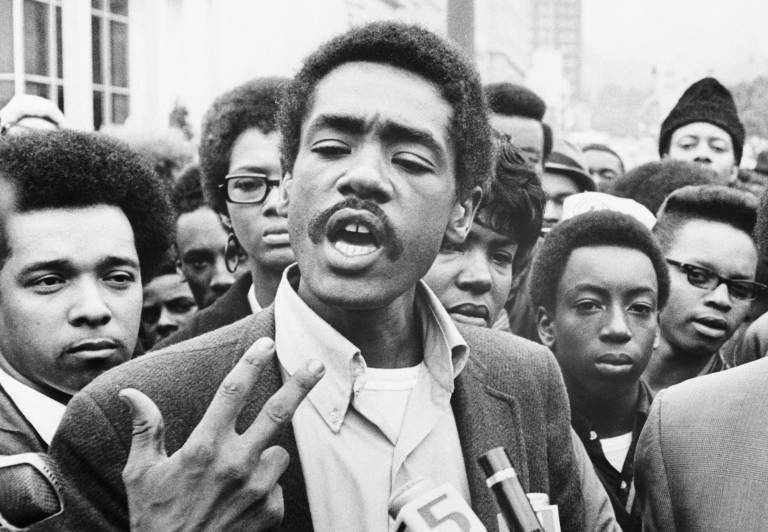
"attributes": {
"named": {
"postid": "arts_13888332",
"label": ""
},
"numeric": []
}
},
{
"type": "contentString",
"content": "\u003cdiv class=\"post-body\">\u003cp>At a Wednesday evening block party, the intersection of 57th Street and Martin Luther King Jr. Way will officially be renamed \u003ca href=\"https://oakland.legistar.com/MeetingDetail.aspx?ID=1314826&GUID=EE02C9D2-93D3-4C5A-87FE-450007B1900A&G=undefined&Options=&Search=\">Bobby Seale Way\u003c/a>.\u003c/p>\n\u003cp>Bobby Seale himself will be in attendance at the event, which runs from 5 p.m.–7 p.m. and is open to the public.\u003c/p>\n\u003cp>\u003c/p>\u003c/div>",
"attributes": {
"named": {},
"numeric": []
}
},
{
"type": "component",
"content": "",
"name": "ad",
"attributes": {
"named": {
"label": "fullwidth"
},
"numeric": [
"fullwidth"
]
}
},
{
"type": "contentString",
"content": "\u003cdiv class=\"post-body\">\u003cp>\u003c/p>\n\u003cp>Hosted by North Oakland lyricist and entrepreneur \u003ca href=\"https://www.kqed.org/arts/tag/mistah-fab\">Mistah F.A.B., \u003c/a>the party will also feature comments from Oakland Mayor Barbara Lee, a performance by \u003ca href=\"https://www.thecurtisfamilycnotes.com/\">The Curtis Family C-Notes\u003c/a> and a speech from thespian and comedian\u003ca href=\"https://www.instagram.com/donaldlacyjr/?hl=en\" target=\"_blank\" rel=\"noopener\" data-saferedirecturl=\"https://www.google.com/url?q=https://www.instagram.com/donaldlacyjr/?hl%3Den&source=gmail&ust=1761158109722000&usg=AOvVaw3XYfKaDszxwnSzCyU_yHj4\"> Donald Lacy Jr\u003c/a>.\u003c/p>\n\u003cdiv>\n\u003cdiv id=\"m_4006817488853157233gmail-:4fz\" role=\"textbox\" aria-label=\"Message Body\" aria-controls=\":4iz\" aria-expanded=\"false\">\n\u003cp>This week is also \u003ca href=\"https://www.lovelifefoundation.org/\">“Love Life Week” in Oakland\u003c/a>. In 2016, after Lacy’s 16-year old daughter Lo’Eshe Lacy was killed in a shooting, Oakland adopted “Love Life” as its official motto; the term is inspired by the meaning of Lacy’s daughter’s name.\u003c/p>\n\u003c/div>\n\u003c/div>\n\u003cfigure id=\"attachment_13920156\" class=\"wp-caption aligncenter\" style=\"max-width: 2560px\">\u003cimg loading=\"lazy\" decoding=\"async\" class=\"size-full wp-image-13920156\" src=\"https://cdn.kqed.org/wp-content/uploads/sites/2/2022/10/Comrade-Sisters-Event-Option-1-scaled.jpg\" alt=\"a black and white photo of five African-American people, some in lab coats, standing outside doing a blood draw on one of them, an older woman\" width=\"2560\" height=\"1701\" srcset=\"https://cdn.kqed.org/wp-content/uploads/sites/2/2022/10/Comrade-Sisters-Event-Option-1-scaled.jpg 2560w, https://cdn.kqed.org/wp-content/uploads/sites/2/2022/10/Comrade-Sisters-Event-Option-1-800x531.jpg 800w, https://cdn.kqed.org/wp-content/uploads/sites/2/2022/10/Comrade-Sisters-Event-Option-1-1020x678.jpg 1020w, https://cdn.kqed.org/wp-content/uploads/sites/2/2022/10/Comrade-Sisters-Event-Option-1-160x106.jpg 160w, https://cdn.kqed.org/wp-content/uploads/sites/2/2022/10/Comrade-Sisters-Event-Option-1-768x510.jpg 768w, https://cdn.kqed.org/wp-content/uploads/sites/2/2022/10/Comrade-Sisters-Event-Option-1-1536x1020.jpg 1536w, https://cdn.kqed.org/wp-content/uploads/sites/2/2022/10/Comrade-Sisters-Event-Option-1-2048x1360.jpg 2048w, https://cdn.kqed.org/wp-content/uploads/sites/2/2022/10/Comrade-Sisters-Event-Option-1-1920x1275.jpg 1920w\" sizes=\"auto, (max-width: 2560px) 100vw, 2560px\">\u003cfigcaption class=\"wp-caption-text\">Black Panther Adrienne Humphrey conducts sickle cell anemia testing during Bobby Seale’s campaign for mayor of Oakland in 1973. \u003ccite>(Stephen Shames)\u003c/cite>\u003c/figcaption>\u003c/figure>\n\u003cp>The \u003ca href=\"https://cdn.kqed.org/wp-content/uploads/sites/2/2025/10/Seale.Proclamation.pdf\">city proclamation\u003c/a> honoring Bobby Seale notes that his “visionary leadership and fearless activism have not only transformed Oakland but have left a lasting impact on national movements for racial and economic justice.”\u003c/p>\n\u003cp>The proclamation also praises Seale’s leadership of the Black Panther Party in Oakland, which “rose to national prominence not only for its stance against police brutality but for its pioneering community-based programs, including free breakfast programs for children, health clinics, educational initiatives, and mutual aid efforts that served as blueprints for future social welfare models.”\u003c/p>\n\u003cp>In recent years, the City of Oakland has taken strides to honor its local luminaries. \u003ca href=\"https://www.kqed.org/arts/13937563/tupac-shakur-way-oakland-street-renaming\">Tupac Shakur\u003c/a> has a commemorative plaque on Grand Avenue and MacArthur Boulevard near Lake Merritt, and rapper \u003ca href=\"https://www.kqed.org/arts/13922616/too-short-way-street-sign-unveiled-oakland\">Too Short has a street sign\u003c/a> mounted on the corner of High Street and Foothill Boulevard. Black Panther Party cofounder Dr. Huey P. Newton has\u003ca href=\"https://www.kqed.org/news/11893532/debut-of-dr-huey-p-newton-bust-spotlights-an-influential-black-panther-party-leader\"> a sculpture\u003c/a> and a three-block section of 9th Street in West Oakland named in his honor. And in June of this year a street sign in recognition of \u003ca href=\"https://www.instagram.com/reel/DLbFFE9ycHg/\">Black Panther leader Elaine Brown\u003c/a> was unveiled in West Oakland.\u003c/p>\n\u003cp>\u003c/p>\u003c/div>",
"attributes": {
"named": {},
"numeric": []
}
},
{
"type": "component",
"content": "",
"name": "aside",
"attributes": {
"named": {
"postid": "arts_13851531",
"label": ""
},
"numeric": []
}
},
{
"type": "contentString",
"content": "\u003cdiv class=\"post-body\">\u003cp> Seale’s story has been told extensively, both through his autobiography \u003cem>A Lonely Rage\u003c/em> and his book \u003cem>Seize the Time: The Story of the Black Panther Party and Huey P. Newton. \u003c/em>The cover of the latter shows Seale bound and gagged as the result of a order from \u003ca href=\"https://www.loc.gov/exhibitions/drawing-justice-courtroom-illustrations/about-this-exhibition/political-activists-on-trial/bobby-seale-bound-and-gagged/\">the presiding judge in the Chicago 8 trial\u003c/a>.\u003c/p>\n\u003cp>That case was also depicted in the 2020 film \u003cem>\u003ca href=\"https://www.npr.org/2020/10/24/927306419/yahya-abdul-mateen-ii-on-playing-bobby-seale-in-the-trial-of-the-chicago-7\">The Trial of the Chicago 7\u003c/a>\u003c/em>, where Seale was portrayed by Oakland’s Yahya Abdul-Mateen II.\u003c/p>\n\u003cp>Seale’s name already graces the halls of\u003ca href=\"https://merritt.edu/black-student-union/\"> Merritt College\u003c/a> — the campus where he met Newton, and where the seeds of the Black Panther Party for Self-Defense took root. Now, Seale will have a street and a day dedicated in his honor as well.\u003c/p>\n\u003chr>\n\u003cp>\u003c/p>\n\u003cp>\u003cem>The public unveiling of Bobby Seale Way takes place on Wednesday, Oct. 22, from 5 p.m.–7 p.m. at the intersection of Martin Luther King Jr. Way and 57th Street in Oakland.\u003c/em>\u003c/p>\n\n\u003c/div>\u003c/p>",
"attributes": {
"named": {},
"numeric": []
}
}
],
"link": "/arts/13982568/bobby-seale-way-street-renaming-black-panthers-oakland",
"authors": [
"11491"
],
"programs": [
"arts_140"
],
"categories": [
"arts_1",
"arts_7862",
"arts_235"
],
"tags": [
"arts_6775",
"arts_1346",
"arts_12555",
"arts_10278",
"arts_1143",
"arts_585"
],
"featImg": "arts_13982579",
"label": "arts_140"
},
"arts_13981777": {
"type": "posts",
"id": "arts_13981777",
"meta": {
"index": "posts_1716263798",
"site": "arts",
"id": "13981777",
"score": null,
"sort": [
1758908837000
]
},
"guestAuthors": [],
"slug": "assata-shakur-tupac-cuba-dies-at-78-obituary",
"title": "Assata Shakur, Godmother of Tupac Who Found Asylum in Cuba, Dies at 78",
"publishDate": 1758908837,
"format": "aside",
"headTitle": "Assata Shakur, Godmother of Tupac Who Found Asylum in Cuba, Dies at 78 | KQED",
"labelTerm": {
"site": "arts"
},
"content": "\u003cfigure id=\"attachment_13981784\" class=\"wp-caption aligncenter\" style=\"max-width: 1478px\">\u003cimg loading=\"lazy\" decoding=\"async\" class=\"size-full wp-image-13981784\" src=\"https://cdn.kqed.org/wp-content/uploads/sites/2/2025/09/GettyImages-1066615210.jpg\" alt=\"\" width=\"1478\" height=\"2115\" srcset=\"https://cdn.kqed.org/wp-content/uploads/sites/2/2025/09/GettyImages-1066615210.jpg 1478w, https://cdn.kqed.org/wp-content/uploads/sites/2/2025/09/GettyImages-1066615210-160x229.jpg 160w, https://cdn.kqed.org/wp-content/uploads/sites/2/2025/09/GettyImages-1066615210-768x1099.jpg 768w, https://cdn.kqed.org/wp-content/uploads/sites/2/2025/09/GettyImages-1066615210-1073x1536.jpg 1073w, https://cdn.kqed.org/wp-content/uploads/sites/2/2025/09/GettyImages-1066615210-1431x2048.jpg 1431w\" sizes=\"auto, (max-width: 1478px) 100vw, 1478px\">\u003cfigcaption class=\"wp-caption-text\">Assata Shakur holds the manuscript of her autobiography with Old Havana, Cuba, in the background on October 7, 1987. \u003ccite>(Ozier Muhammad/Newsday RM via Getty Images)\u003c/cite>\u003c/figcaption>\u003c/figure>\n\u003cp>Assata Shakur, a Black liberation activist who was given political asylum in Cuba after her 1979 escape from a U.S. prison where she had been serving a life sentence for killing a police officer, has died, her daughter and the Cuban government said.\u003c/p>\n\u003cp>Shakur, who was born Joanne Deborah Chesimard, died Thursday in the capital city of Havana due to “health conditions and advanced age,” Cuba’s Ministry of Foreign Affairs \u003cspan class=\"LinkEnhancement\">\u003ca class=\"Link AnClick-LinkEnhancement\" href=\"https://cubaminrex.cu/es/nota-de-prensa-del-ministerio-relaciones-exteriores\" target=\"_blank\" rel=\"noopener\" data-gtm-enhancement-style=\"LinkEnhancementA\">said in a statement\u003c/a>\u003c/span>. Shakur’s daughter, Kakuya Shakur, also confirmed her mother’s death in a Facebook post.\u003c/p>\n\u003cp>Born in Queens, New York in 1947, Shakur briefly relocated to Oakland as a young woman in the late 1960s, where she became a member of the Black Panther Party. After returning to the East Coast, Shakur served in the Black Panthers’ New York City chapter, where she met Afeni Shakur, whose son Tupac would go on to become a global icon in rap music and politics. Assata Shakur became Tupac’s godmother and step-aunt when Afeni married Assata’s brother, Mutulu.\u003c/p>\n\u003cfigure id=\"attachment_13981781\" class=\"wp-caption aligncenter\" style=\"max-width: 1823px\">\u003cimg loading=\"lazy\" decoding=\"async\" class=\"size-full wp-image-13981781\" src=\"https://cdn.kqed.org/wp-content/uploads/sites/2/2025/09/GettyImages-515114572-scaled.jpg\" alt=\"\" width=\"1823\" height=\"2560\" srcset=\"https://cdn.kqed.org/wp-content/uploads/sites/2/2025/09/GettyImages-515114572-scaled.jpg 1823w, https://cdn.kqed.org/wp-content/uploads/sites/2/2025/09/GettyImages-515114572-160x225.jpg 160w, https://cdn.kqed.org/wp-content/uploads/sites/2/2025/09/GettyImages-515114572-768x1078.jpg 768w, https://cdn.kqed.org/wp-content/uploads/sites/2/2025/09/GettyImages-515114572-1094x1536.jpg 1094w, https://cdn.kqed.org/wp-content/uploads/sites/2/2025/09/GettyImages-515114572-1459x2048.jpg 1459w\" sizes=\"auto, (max-width: 1823px) 100vw, 1823px\">\u003cfigcaption class=\"wp-caption-text\">New Brunswick, N.J.: Assata Shakur, a.k.a. Joanna Chesimard, arrives at Middlesex County jail after her transfer from New York City for her trail involving the killing of a New Jersey State trooper. \u003ccite>(Bettman/Getty Images)\u003c/cite>\u003c/figcaption>\u003c/figure>\n\u003cp>Shakur’s case had long been a thorny issue in the fraught relations between the U.S. and Cuba. American authorities, including President Donald Trump during \u003cspan class=\"LinkEnhancement\">\u003ca class=\"Link AnClick-LinkEnhancement\" href=\"https://apnews.com/general-news-b182fefc30a04b2d8de3956b92eb1a9a\" data-gtm-enhancement-style=\"LinkEnhancementA\">his first term in office\u003c/a>\u003c/span>, had demanded her return from the communist nation for decades.\u003c/p>\n\u003cp>In her telling, and in the minds of her supporters, she was being pursued for crimes she didn’t commit, or which were justified. The FBI put Shakur on its list of “\u003cspan class=\"LinkEnhancement\">\u003ca class=\"Link AnClick-LinkEnhancement\" href=\"https://www.fbi.gov/wanted/wanted_terrorists/joanne-deborah-chesimard/download.pdf\" target=\"_blank\" rel=\"noopener\" data-gtm-enhancement-style=\"LinkEnhancementA\">most wanted terrorists\u003c/a>\u003c/span>.”\u003c/p>\n\u003cp>[ad fullwidth]\u003c/p>\n\u003cp>A member of the Black Liberation Army, Shakur and two others were involved in a gunfight with New Jersey State Police Troopers following a highway traffic stop on May 2, 1973.\u003c/p>\n\u003cp>Trooper Werner Foerster was killed and another officer was wounded, while one of Shakur’s companions was also killed.\u003c/p>\n\u003cp>Shakur, who was at the time wanted on several felonies, including bank robbery, fled but was eventually apprehended. She maintained in her \u003ca href=\"https://hoodcommunist.org/2024/03/07/an-open-letter-from-assata-shakur/\" target=\"_blank\" rel=\"noopener\">writings from Cuba over the years\u003c/a> that she didn’t shoot anyone and had her hands in the air when she was wounded during the gunfire.\u003c/p>\n\u003cp>Shakur was found guilty of murder, armed robbery and other crimes in 1977 and was sentenced to life in prison, only to escape in November 1979.\u003c/p>\n\u003cp>Members of the Black Liberation Army, posing as visitors, stormed the Clinton Correctional Facility for women, took two guards hostage and commandeered a prison van to break Shakur out.\u003c/p>\n\u003cp>She disappeared before eventually emerging in 1984 in Cuba, where Fidel Castro granted her asylum, according to the FBI. A companion who was also convicted in Foerster’s killing, Sundiata Acoli, was \u003cspan class=\"LinkEnhancement\">\u003ca class=\"Link AnClick-LinkEnhancement\" href=\"https://apnews.com/article/cuba-crime-new-jersey-fidel-castro-supreme-court-c6dc08d755f73e24ebd229f07adfa7f4\" data-gtm-enhancement-style=\"LinkEnhancementA\">granted parole\u003c/a>\u003c/span> in 2022. His attorneys had argued the then-octogenarian had been a model prisoner for nearly three decades and counseled other inmates.\u003c/p>\n\u003cp>Shakur’s autobiography, \u003cem>Assata\u003c/em>, has remained an influential text for activists and artists in the Bay Area and beyond since its publication in 1987.\u003c/p>\n\u003chr>\n\u003cp>\u003c/p>\n\u003cp>\u003cem>Nastia Voynovskaya contributed reporting.\u003c/em>\u003c/p>\n\n",
"blocks": [],
"excerpt": "The Black liberation activist who escaped from a U.S. prison in 1979 died of \"health conditions and advanced age.\"",
"status": "publish",
"parent": 0,
"modified": 1758920448,
"stats": {
"hasAudio": false,
"hasVideo": false,
"hasChartOrMap": false,
"iframeSrcs": [],
"hasGoogleForm": false,
"hasGallery": false,
"hasHearkenModule": false,
"hasPolis": false,
"paragraphCount": 15,
"wordCount": 574
},
"headData": {
"title": "Assata Shakur, Godmother of Tupac Who Found Asylum in Cuba, Dies at 78 | KQED",
"description": "The Black liberation activist who escaped from a U.S. prison in 1979 died of "health conditions and advanced age."",
"ogTitle": "",
"ogDescription": "",
"ogImgId": "",
"twTitle": "",
"twDescription": "",
"twImgId": "",
"schema": {
"@context": "https://schema.org",
"@type": "Article",
"headline": "Assata Shakur, Godmother of Tupac Who Found Asylum in Cuba, Dies at 78",
"datePublished": "2025-09-26T10:47:17-07:00",
"dateModified": "2025-09-26T14:00:48-07:00",
"image": "https://cdn.kqed.org/wp-content/uploads/2020/02/KQED-OG-Image@1x.png"
}
},
"primaryCategory": {
"termId": 1,
"slug": "arts",
"name": "Arts"
},
"sticky": false,
"nprByline": "Philip Marcelo, Associated Press",
"nprStoryId": "kqed-13981777",
"templateType": "standard",
"featuredImageType": "standard",
"excludeFromSiteSearch": "Include",
"showOnAuthorArchivePages": "No",
"articleAge": "0",
"path": "/arts/13981777/assata-shakur-tupac-cuba-dies-at-78-obituary",
"audioTrackLength": null,
"parsedContent": [
{
"type": "contentString",
"content": "\u003cdiv class=\"post-body\">\u003cp>\u003cfigure id=\"attachment_13981784\" class=\"wp-caption aligncenter\" style=\"max-width: 1478px\">\u003cimg loading=\"lazy\" decoding=\"async\" class=\"size-full wp-image-13981784\" src=\"https://cdn.kqed.org/wp-content/uploads/sites/2/2025/09/GettyImages-1066615210.jpg\" alt=\"\" width=\"1478\" height=\"2115\" srcset=\"https://cdn.kqed.org/wp-content/uploads/sites/2/2025/09/GettyImages-1066615210.jpg 1478w, https://cdn.kqed.org/wp-content/uploads/sites/2/2025/09/GettyImages-1066615210-160x229.jpg 160w, https://cdn.kqed.org/wp-content/uploads/sites/2/2025/09/GettyImages-1066615210-768x1099.jpg 768w, https://cdn.kqed.org/wp-content/uploads/sites/2/2025/09/GettyImages-1066615210-1073x1536.jpg 1073w, https://cdn.kqed.org/wp-content/uploads/sites/2/2025/09/GettyImages-1066615210-1431x2048.jpg 1431w\" sizes=\"auto, (max-width: 1478px) 100vw, 1478px\">\u003cfigcaption class=\"wp-caption-text\">Assata Shakur holds the manuscript of her autobiography with Old Havana, Cuba, in the background on October 7, 1987. \u003ccite>(Ozier Muhammad/Newsday RM via Getty Images)\u003c/cite>\u003c/figcaption>\u003c/figure>\n\u003cp>Assata Shakur, a Black liberation activist who was given political asylum in Cuba after her 1979 escape from a U.S. prison where she had been serving a life sentence for killing a police officer, has died, her daughter and the Cuban government said.\u003c/p>\n\u003cp>Shakur, who was born Joanne Deborah Chesimard, died Thursday in the capital city of Havana due to “health conditions and advanced age,” Cuba’s Ministry of Foreign Affairs \u003cspan class=\"LinkEnhancement\">\u003ca class=\"Link AnClick-LinkEnhancement\" href=\"https://cubaminrex.cu/es/nota-de-prensa-del-ministerio-relaciones-exteriores\" target=\"_blank\" rel=\"noopener\" data-gtm-enhancement-style=\"LinkEnhancementA\">said in a statement\u003c/a>\u003c/span>. Shakur’s daughter, Kakuya Shakur, also confirmed her mother’s death in a Facebook post.\u003c/p>\n\u003cp>Born in Queens, New York in 1947, Shakur briefly relocated to Oakland as a young woman in the late 1960s, where she became a member of the Black Panther Party. After returning to the East Coast, Shakur served in the Black Panthers’ New York City chapter, where she met Afeni Shakur, whose son Tupac would go on to become a global icon in rap music and politics. Assata Shakur became Tupac’s godmother and step-aunt when Afeni married Assata’s brother, Mutulu.\u003c/p>\n\u003cfigure id=\"attachment_13981781\" class=\"wp-caption aligncenter\" style=\"max-width: 1823px\">\u003cimg loading=\"lazy\" decoding=\"async\" class=\"size-full wp-image-13981781\" src=\"https://cdn.kqed.org/wp-content/uploads/sites/2/2025/09/GettyImages-515114572-scaled.jpg\" alt=\"\" width=\"1823\" height=\"2560\" srcset=\"https://cdn.kqed.org/wp-content/uploads/sites/2/2025/09/GettyImages-515114572-scaled.jpg 1823w, https://cdn.kqed.org/wp-content/uploads/sites/2/2025/09/GettyImages-515114572-160x225.jpg 160w, https://cdn.kqed.org/wp-content/uploads/sites/2/2025/09/GettyImages-515114572-768x1078.jpg 768w, https://cdn.kqed.org/wp-content/uploads/sites/2/2025/09/GettyImages-515114572-1094x1536.jpg 1094w, https://cdn.kqed.org/wp-content/uploads/sites/2/2025/09/GettyImages-515114572-1459x2048.jpg 1459w\" sizes=\"auto, (max-width: 1823px) 100vw, 1823px\">\u003cfigcaption class=\"wp-caption-text\">New Brunswick, N.J.: Assata Shakur, a.k.a. Joanna Chesimard, arrives at Middlesex County jail after her transfer from New York City for her trail involving the killing of a New Jersey State trooper. \u003ccite>(Bettman/Getty Images)\u003c/cite>\u003c/figcaption>\u003c/figure>\n\u003cp>Shakur’s case had long been a thorny issue in the fraught relations between the U.S. and Cuba. American authorities, including President Donald Trump during \u003cspan class=\"LinkEnhancement\">\u003ca class=\"Link AnClick-LinkEnhancement\" href=\"https://apnews.com/general-news-b182fefc30a04b2d8de3956b92eb1a9a\" data-gtm-enhancement-style=\"LinkEnhancementA\">his first term in office\u003c/a>\u003c/span>, had demanded her return from the communist nation for decades.\u003c/p>\n\u003cp>In her telling, and in the minds of her supporters, she was being pursued for crimes she didn’t commit, or which were justified. The FBI put Shakur on its list of “\u003cspan class=\"LinkEnhancement\">\u003ca class=\"Link AnClick-LinkEnhancement\" href=\"https://www.fbi.gov/wanted/wanted_terrorists/joanne-deborah-chesimard/download.pdf\" target=\"_blank\" rel=\"noopener\" data-gtm-enhancement-style=\"LinkEnhancementA\">most wanted terrorists\u003c/a>\u003c/span>.”\u003c/p>\n\u003cp>\u003c/p>\u003c/div>",
"attributes": {
"named": {},
"numeric": []
}
},
{
"type": "component",
"content": "",
"name": "ad",
"attributes": {
"named": {
"label": "fullwidth"
},
"numeric": [
"fullwidth"
]
}
},
{
"type": "contentString",
"content": "\u003cdiv class=\"post-body\">\u003cp>\u003c/p>\n\u003cp>A member of the Black Liberation Army, Shakur and two others were involved in a gunfight with New Jersey State Police Troopers following a highway traffic stop on May 2, 1973.\u003c/p>\n\u003cp>Trooper Werner Foerster was killed and another officer was wounded, while one of Shakur’s companions was also killed.\u003c/p>\n\u003cp>Shakur, who was at the time wanted on several felonies, including bank robbery, fled but was eventually apprehended. She maintained in her \u003ca href=\"https://hoodcommunist.org/2024/03/07/an-open-letter-from-assata-shakur/\" target=\"_blank\" rel=\"noopener\">writings from Cuba over the years\u003c/a> that she didn’t shoot anyone and had her hands in the air when she was wounded during the gunfire.\u003c/p>\n\u003cp>Shakur was found guilty of murder, armed robbery and other crimes in 1977 and was sentenced to life in prison, only to escape in November 1979.\u003c/p>\n\u003cp>Members of the Black Liberation Army, posing as visitors, stormed the Clinton Correctional Facility for women, took two guards hostage and commandeered a prison van to break Shakur out.\u003c/p>\n\u003cp>She disappeared before eventually emerging in 1984 in Cuba, where Fidel Castro granted her asylum, according to the FBI. A companion who was also convicted in Foerster’s killing, Sundiata Acoli, was \u003cspan class=\"LinkEnhancement\">\u003ca class=\"Link AnClick-LinkEnhancement\" href=\"https://apnews.com/article/cuba-crime-new-jersey-fidel-castro-supreme-court-c6dc08d755f73e24ebd229f07adfa7f4\" data-gtm-enhancement-style=\"LinkEnhancementA\">granted parole\u003c/a>\u003c/span> in 2022. His attorneys had argued the then-octogenarian had been a model prisoner for nearly three decades and counseled other inmates.\u003c/p>\n\u003cp>Shakur’s autobiography, \u003cem>Assata\u003c/em>, has remained an influential text for activists and artists in the Bay Area and beyond since its publication in 1987.\u003c/p>\n\u003chr>\n\u003cp>\u003c/p>\n\u003cp>\u003cem>Nastia Voynovskaya contributed reporting.\u003c/em>\u003c/p>\n\n\u003c/div>\u003c/p>",
"attributes": {
"named": {},
"numeric": []
}
}
],
"link": "/arts/13981777/assata-shakur-tupac-cuba-dies-at-78-obituary",
"authors": [
"byline_arts_13981777"
],
"categories": [
"arts_1",
"arts_69",
"arts_235"
],
"tags": [
"arts_6775",
"arts_1346",
"arts_10278",
"arts_831",
"arts_1143",
"arts_21789",
"arts_22382",
"arts_4269"
],
"featImg": "arts_13981782",
"label": "arts"
},
"arts_13971589": {
"type": "posts",
"id": "arts_13971589",
"meta": {
"index": "posts_1716263798",
"site": "arts",
"id": "13971589",
"score": null,
"sort": [
1739219642000
]
},
"guestAuthors": [],
"slug": "black-panther-party-survival-programs-exhibit",
"title": "Applying The Black Panther Party's Survival Programs to Today",
"publishDate": 1739219642,
"format": "standard",
"headTitle": "Applying The Black Panther Party’s Survival Programs to Today | KQED",
"labelTerm": {
"term": 140,
"site": "arts"
},
"content": "\u003cp>The Black Panther Party For Self-Defense, founded in Oakland in 1966, was a landmark organization that uplifted the Black community by providing resources to neighborhoods neglected by the local and federal government.\u003c/p>\n\u003cp>The Party was well-known for its Free Breakfast Program and its independent newspaper, \u003cem>The Black Panther. \u003c/em>The group was also widely recognized for its fashion, as its members regularly dressed in sleek black leather jackets and berets.\u003c/p>\n\u003cp>But the history of the organization’s survival programs, 65 of them in total ranging from health services to transportation assistance, are often misunderstood or overlooked.\u003c/p>\n\u003cp>To illuminate these programs’ significance, on Thursday, Feb. 13, the\u003ca href=\"https://hueypnewtonfoundation.org/\" target=\"_blank\" rel=\"noopener\"> Dr. Huey P. Newton Foundation\u003c/a> debuts an exhibition of archival photography titled \u003cem>\u003ca href=\"https://www.eventbrite.com/e/survival-pending-revolution-exhibition-opening-tickets-1219614562989?aff=ebdsoporgprofile\" target=\"_blank\" rel=\"noopener\">Survival Pending Revolution: The Black Panther Party Service to the People Programs \u003c/a>\u003c/em>at the \u003ca href=\"https://www.blackpantherpartymuseum.org/\" target=\"_blank\" rel=\"noopener\">Black Panther Party Museum\u003c/a> in downtown Oakland.\u003c/p>\n\u003cfigure id=\"attachment_13971591\" class=\"wp-caption aligncenter\" style=\"max-width: 800px\">\u003cimg loading=\"lazy\" decoding=\"async\" class=\"wp-image-13971591 size-medium\" src=\"https://cdn.kqed.org/wp-content/uploads/sites/2/2025/02/vB7ZgqMy-800x531.jpg\" alt=\"\" width=\"800\" height=\"531\" srcset=\"https://cdn.kqed.org/wp-content/uploads/sites/2/2025/02/vB7ZgqMy-800x531.jpg 800w, https://cdn.kqed.org/wp-content/uploads/sites/2/2025/02/vB7ZgqMy-1020x677.jpg 1020w, https://cdn.kqed.org/wp-content/uploads/sites/2/2025/02/vB7ZgqMy-160x106.jpg 160w, https://cdn.kqed.org/wp-content/uploads/sites/2/2025/02/vB7ZgqMy-768x510.jpg 768w\" sizes=\"auto, (max-width: 800px) 100vw, 800px\">\u003cfigcaption class=\"wp-caption-text\">A glimpse inside one of The Black Panther Party’s survival programs. \u003ccite>(Stephen Shames)\u003c/cite>\u003c/figcaption>\u003c/figure>\n\u003cp>“A lot of folks know about the free breakfast for schoolchildren,” says \u003ca href=\"https://www.xaviergbuck.com/\" target=\"_blank\" rel=\"noopener\">Dr. Xavier Buck\u003c/a>, the executive director of the Dr. Huey P. Newton Foundation. “Some may even know about the free medical clinics.”\u003c/p>\n\u003cp>[ad fullwidth]\u003c/p>\n\u003cp>As for the contents of the exhibition, Dr. Buck explains, “We’re going to talk about the free ambulance service, the free pest control, the free bussing to prisons so families wouldn’t be broken up.”\u003c/p>\n\u003cp>By exhibiting rarely seen photos and sharing insight from veteran party members, Dr. Buck says attendees will gain a better understanding of what the Party did, how they did it and why they did it.\u003c/p>\n\u003cp>Another goal of the exhibition is to dispel the notion of the survival programs as some form of charity. Instead, Dr. Buck explains, the Black Panther Party saw them as organizing tools.\u003c/p>\n\u003cp>[aside postID='news_12014210']An example is the free breakfast program. “Yes, it was feeding kids in our schools,” Dr. Buck says. But it also served as an entry point for party members to inspire children to think critically about their circumstances — by asking questions like, “In such a wealthy country, why were you so hungry in the first place?” says Dr. Buck.\u003c/p>\n\u003cp>In Oakland, grassroots organizing has long connected to electoral politics. Dr. Buck points to the 1973 political campaigns of Black Panther Party co-founder Bobby Seale and former Black Panther Party leader Elaine Brown.\u003c/p>\n\u003cp>“They engaged a new voter bloc,” says Dr. Buck of the Black Panther Party leaders. And four years later, in 1977, when the Black Panthers pushed forward the campaign of mayoral candidate Lionel Wilson, Dr. Buck says, they leveraged that same organized bloc from the survival programs.\u003c/p>\n\u003cp>In result, Wilson was elected as Oakland’s first Black mayor.\u003c/p>\n\u003cp>“It’s really about how we tie the services that we give the people to how we actually gain political power,” says Dr. Buck.\u003c/p>\n\u003cfigure id=\"attachment_13971595\" class=\"wp-caption aligncenter\" style=\"max-width: 1669px\">\u003cimg loading=\"lazy\" decoding=\"async\" class=\"wp-image-13971595 size-full\" src=\"https://cdn.kqed.org/wp-content/uploads/sites/2/2025/02/B49mDBoT-scaled.jpg\" alt=\"\" width=\"1669\" height=\"2560\">\u003cfigcaption class=\"wp-caption-text\">‘The Black Panther,’ the official newspaper of the Black Panther Party, which was circulated to hundreds of thousands of readers all around the United States. \u003ccite>(Stephen Shames)\u003c/cite>\u003c/figcaption>\u003c/figure>\n\u003cp>The forthcoming exhibition shows the practitioners and the beneficiaries of the Black Panther Party’s survival programs through the lens of photographers \u003ca href=\"https://www.duchodennis.com/#/\" target=\"_blank\" rel=\"noopener\">Ducho Dennis\u003c/a>, \u003ca href=\"https://stephenshames.com/\" target=\"_blank\" rel=\"noopener\">Stephen Shames\u003c/a> and \u003ca href=\"https://exhibits.stanford.edu/fitch\" target=\"_blank\" rel=\"noopener\">Bob Fitch\u003c/a>, as well as\u003ca href=\"https://oac.cdlib.org/findaid/ark:/13030/c8b85cfn/\" target=\"_blank\" rel=\"noopener\"> Ruth Marion-Baruch and Pirkle Jones.\u003c/a>\u003c/p>\n\u003cp>The exhibition is set to open on Feb. 13 with a three-hour event where attendees can guide themselves through a tour of the photos; there will also be a 45-minute presentation.\u003c/p>\n\u003cp>Four days later, on Feb. 17, the Dr. Huey P. Newton Foundation will celebrate its 30th anniversary on what would’ve been the late Dr. Huey P. Newton’s 83rd birthday.\u003c/p>\n\u003chr>\n\u003cp>\u003c/p>\n\u003cp>\u003cem>The \u003ca href=\"https://hueypnewtonfoundation.org/\" target=\"_blank\" rel=\"noopener\">Dr. Huey P. Newton Foundation\u003c/a> presents ‘\u003ca href=\"https://www.eventbrite.com/e/survival-pending-revolution-exhibition-opening-tickets-1219614562989?aff=ebdsoporgprofile\" target=\"_blank\" rel=\"noopener\">Survival Pending Revolution: The Black Panther Party Service to the People Programs\u003c/a>’ at the \u003ca href=\"https://www.blackpantherpartymuseum.org/\" target=\"_blank\" rel=\"noopener\">Black Panther Party Museum\u003c/a> in downtown Oakland on Thursday, Feb. 13. \u003ca href=\"https://www.eventbrite.com/e/survival-pending-revolution-exhibition-opening-tickets-1219614562989?aff=ebdsoporgprofile\" target=\"_blank\" rel=\"noopener\">Details here\u003c/a>.\u003c/em>\u003c/p>\n\n",
"blocks": [],
"excerpt": "An exhibit at the Black Panther Party museum shows what a community can do when the government fails them.",
"status": "publish",
"parent": 0,
"modified": 1739220185,
"stats": {
"hasAudio": false,
"hasVideo": false,
"hasChartOrMap": false,
"iframeSrcs": [],
"hasGoogleForm": false,
"hasGallery": false,
"hasHearkenModule": false,
"hasPolis": false,
"paragraphCount": 19,
"wordCount": 665
},
"headData": {
"title": "Applying The Black Panther Party's Survival Programs to Today | KQED",
"description": "An exhibit at the Black Panther Party museum shows what a community can do when the government fails them.",
"ogTitle": "",
"ogDescription": "",
"ogImgId": "",
"twTitle": "",
"twDescription": "",
"twImgId": "",
"schema": {
"@context": "https://schema.org",
"@type": "Article",
"headline": "Applying The Black Panther Party's Survival Programs to Today",
"datePublished": "2025-02-10T12:34:02-08:00",
"dateModified": "2025-02-10T12:43:05-08:00",
"image": "https://cdn.kqed.org/wp-content/uploads/2020/02/KQED-OG-Image@1x.png"
}
},
"sticky": false,
"nprStoryId": "kqed-13971589",
"templateType": "standard",
"featuredImageType": "standard",
"excludeFromSiteSearch": "Include",
"articleAge": "0",
"path": "/arts/13971589/black-panther-party-survival-programs-exhibit",
"audioTrackLength": null,
"parsedContent": [
{
"type": "contentString",
"content": "\u003cdiv class=\"post-body\">\u003cp>\u003cp>The Black Panther Party For Self-Defense, founded in Oakland in 1966, was a landmark organization that uplifted the Black community by providing resources to neighborhoods neglected by the local and federal government.\u003c/p>\n\u003cp>The Party was well-known for its Free Breakfast Program and its independent newspaper, \u003cem>The Black Panther. \u003c/em>The group was also widely recognized for its fashion, as its members regularly dressed in sleek black leather jackets and berets.\u003c/p>\n\u003cp>But the history of the organization’s survival programs, 65 of them in total ranging from health services to transportation assistance, are often misunderstood or overlooked.\u003c/p>\n\u003cp>To illuminate these programs’ significance, on Thursday, Feb. 13, the\u003ca href=\"https://hueypnewtonfoundation.org/\" target=\"_blank\" rel=\"noopener\"> Dr. Huey P. Newton Foundation\u003c/a> debuts an exhibition of archival photography titled \u003cem>\u003ca href=\"https://www.eventbrite.com/e/survival-pending-revolution-exhibition-opening-tickets-1219614562989?aff=ebdsoporgprofile\" target=\"_blank\" rel=\"noopener\">Survival Pending Revolution: The Black Panther Party Service to the People Programs \u003c/a>\u003c/em>at the \u003ca href=\"https://www.blackpantherpartymuseum.org/\" target=\"_blank\" rel=\"noopener\">Black Panther Party Museum\u003c/a> in downtown Oakland.\u003c/p>\n\u003cfigure id=\"attachment_13971591\" class=\"wp-caption aligncenter\" style=\"max-width: 800px\">\u003cimg loading=\"lazy\" decoding=\"async\" class=\"wp-image-13971591 size-medium\" src=\"https://cdn.kqed.org/wp-content/uploads/sites/2/2025/02/vB7ZgqMy-800x531.jpg\" alt=\"\" width=\"800\" height=\"531\" srcset=\"https://cdn.kqed.org/wp-content/uploads/sites/2/2025/02/vB7ZgqMy-800x531.jpg 800w, https://cdn.kqed.org/wp-content/uploads/sites/2/2025/02/vB7ZgqMy-1020x677.jpg 1020w, https://cdn.kqed.org/wp-content/uploads/sites/2/2025/02/vB7ZgqMy-160x106.jpg 160w, https://cdn.kqed.org/wp-content/uploads/sites/2/2025/02/vB7ZgqMy-768x510.jpg 768w\" sizes=\"auto, (max-width: 800px) 100vw, 800px\">\u003cfigcaption class=\"wp-caption-text\">A glimpse inside one of The Black Panther Party’s survival programs. \u003ccite>(Stephen Shames)\u003c/cite>\u003c/figcaption>\u003c/figure>\n\u003cp>“A lot of folks know about the free breakfast for schoolchildren,” says \u003ca href=\"https://www.xaviergbuck.com/\" target=\"_blank\" rel=\"noopener\">Dr. Xavier Buck\u003c/a>, the executive director of the Dr. Huey P. Newton Foundation. “Some may even know about the free medical clinics.”\u003c/p>\n\u003cp>\u003c/p>\u003c/div>",
"attributes": {
"named": {},
"numeric": []
}
},
{
"type": "component",
"content": "",
"name": "ad",
"attributes": {
"named": {
"label": "fullwidth"
},
"numeric": [
"fullwidth"
]
}
},
{
"type": "contentString",
"content": "\u003cdiv class=\"post-body\">\u003cp>\u003c/p>\n\u003cp>As for the contents of the exhibition, Dr. Buck explains, “We’re going to talk about the free ambulance service, the free pest control, the free bussing to prisons so families wouldn’t be broken up.”\u003c/p>\n\u003cp>By exhibiting rarely seen photos and sharing insight from veteran party members, Dr. Buck says attendees will gain a better understanding of what the Party did, how they did it and why they did it.\u003c/p>\n\u003cp>Another goal of the exhibition is to dispel the notion of the survival programs as some form of charity. Instead, Dr. Buck explains, the Black Panther Party saw them as organizing tools.\u003c/p>\n\u003cp>\u003c/p>\u003c/div>",
"attributes": {
"named": {},
"numeric": []
}
},
{
"type": "component",
"content": "",
"name": "aside",
"attributes": {
"named": {
"postid": "news_12014210",
"label": ""
},
"numeric": []
}
},
{
"type": "contentString",
"content": "\u003cdiv class=\"post-body\">\u003cp>An example is the free breakfast program. “Yes, it was feeding kids in our schools,” Dr. Buck says. But it also served as an entry point for party members to inspire children to think critically about their circumstances — by asking questions like, “In such a wealthy country, why were you so hungry in the first place?” says Dr. Buck.\u003c/p>\n\u003cp>In Oakland, grassroots organizing has long connected to electoral politics. Dr. Buck points to the 1973 political campaigns of Black Panther Party co-founder Bobby Seale and former Black Panther Party leader Elaine Brown.\u003c/p>\n\u003cp>“They engaged a new voter bloc,” says Dr. Buck of the Black Panther Party leaders. And four years later, in 1977, when the Black Panthers pushed forward the campaign of mayoral candidate Lionel Wilson, Dr. Buck says, they leveraged that same organized bloc from the survival programs.\u003c/p>\n\u003cp>In result, Wilson was elected as Oakland’s first Black mayor.\u003c/p>\n\u003cp>“It’s really about how we tie the services that we give the people to how we actually gain political power,” says Dr. Buck.\u003c/p>\n\u003cfigure id=\"attachment_13971595\" class=\"wp-caption aligncenter\" style=\"max-width: 1669px\">\u003cimg loading=\"lazy\" decoding=\"async\" class=\"wp-image-13971595 size-full\" src=\"https://cdn.kqed.org/wp-content/uploads/sites/2/2025/02/B49mDBoT-scaled.jpg\" alt=\"\" width=\"1669\" height=\"2560\">\u003cfigcaption class=\"wp-caption-text\">‘The Black Panther,’ the official newspaper of the Black Panther Party, which was circulated to hundreds of thousands of readers all around the United States. \u003ccite>(Stephen Shames)\u003c/cite>\u003c/figcaption>\u003c/figure>\n\u003cp>The forthcoming exhibition shows the practitioners and the beneficiaries of the Black Panther Party’s survival programs through the lens of photographers \u003ca href=\"https://www.duchodennis.com/#/\" target=\"_blank\" rel=\"noopener\">Ducho Dennis\u003c/a>, \u003ca href=\"https://stephenshames.com/\" target=\"_blank\" rel=\"noopener\">Stephen Shames\u003c/a> and \u003ca href=\"https://exhibits.stanford.edu/fitch\" target=\"_blank\" rel=\"noopener\">Bob Fitch\u003c/a>, as well as\u003ca href=\"https://oac.cdlib.org/findaid/ark:/13030/c8b85cfn/\" target=\"_blank\" rel=\"noopener\"> Ruth Marion-Baruch and Pirkle Jones.\u003c/a>\u003c/p>\n\u003cp>The exhibition is set to open on Feb. 13 with a three-hour event where attendees can guide themselves through a tour of the photos; there will also be a 45-minute presentation.\u003c/p>\n\u003cp>Four days later, on Feb. 17, the Dr. Huey P. Newton Foundation will celebrate its 30th anniversary on what would’ve been the late Dr. Huey P. Newton’s 83rd birthday.\u003c/p>\n\u003chr>\n\u003cp>\u003c/p>\n\u003cp>\u003cem>The \u003ca href=\"https://hueypnewtonfoundation.org/\" target=\"_blank\" rel=\"noopener\">Dr. Huey P. Newton Foundation\u003c/a> presents ‘\u003ca href=\"https://www.eventbrite.com/e/survival-pending-revolution-exhibition-opening-tickets-1219614562989?aff=ebdsoporgprofile\" target=\"_blank\" rel=\"noopener\">Survival Pending Revolution: The Black Panther Party Service to the People Programs\u003c/a>’ at the \u003ca href=\"https://www.blackpantherpartymuseum.org/\" target=\"_blank\" rel=\"noopener\">Black Panther Party Museum\u003c/a> in downtown Oakland on Thursday, Feb. 13. \u003ca href=\"https://www.eventbrite.com/e/survival-pending-revolution-exhibition-opening-tickets-1219614562989?aff=ebdsoporgprofile\" target=\"_blank\" rel=\"noopener\">Details here\u003c/a>.\u003c/em>\u003c/p>\n\n\u003c/div>\u003c/p>",
"attributes": {
"named": {},
"numeric": []
}
}
],
"link": "/arts/13971589/black-panther-party-survival-programs-exhibit",
"authors": [
"11491"
],
"programs": [
"arts_140"
],
"categories": [
"arts_1",
"arts_7862",
"arts_22313",
"arts_70"
],
"tags": [
"arts_6775",
"arts_10278",
"arts_5035",
"arts_1143"
],
"featImg": "arts_13971590",
"label": "arts_140"
},
"arts_13950520": {
"type": "posts",
"id": "arts_13950520",
"meta": {
"index": "posts_1716263798",
"site": "arts",
"id": "13950520",
"score": null,
"sort": [
1707948014000
]
},
"guestAuthors": [],
"slug": "ruth-beckford-dance-black-panthers-free-breakfast-program",
"title": "The Dancer Who Helped Start the Black Panthers’ Free Breakfast Program",
"publishDate": 1707948014,
"format": "standard",
"headTitle": "The Dancer Who Helped Start the Black Panthers’ Free Breakfast Program | KQED",
"labelTerm": {
"term": 22303,
"site": "arts"
},
"content": "\u003cp>[dropcap]I[/dropcap]n the late 1960s, an uncommonly energetic 43-year-old named Ruth Beckford was teaching an Afro-Haitian dance class in Oakland. A dancing pro since the age of eight, Beckford had a habit of taking a close personal interest in her students. She taught the youngest ones a combination of life skills and etiquette to set them up for bright futures. She encouraged teens and young women to love themselves and pursue their dreams. And when one of her students told Beckford about her involvement with the Black Panther Party, Beckford was keen to be of assistance with that, too.\u003c/p>\n\u003cp>The student in question was LaVerne Anderson, who happened to be the girlfriend of Huey P. Newton. Beckford began by accompanying Anderson to some of Newton’s 1968 trial dates. In September of that year, when the idea for the Panthers’ Free Breakfast for School Children Program first came up, it was Beckford who sprang into action and made it happen.\u003c/p>\n\u003cp>[aside postid='arts_13874853']Beckford had long been a parishioner at Oakland’s \u003ca href=\"https://staugepiscopal.org/\">St. Augustine’s Episcopal Church\u003c/a>, then situated at West and 27th Streets. Beckford approached her priest there, Father Earl A. Neil, to find out if St. Augustine’s was willing to host a daily program there to feed neighborhood kids. Father Neil agreed, and he and Beckford went about building a health code-safe kitchen and dining space, as well as a nutritionally balanced menu.\u003c/p>\n\u003cp>On the first day — a Monday in January 1969 — 11 children came to eat. By Friday, that number had swelled to 135. Beckford and Father Neil made such a success of the free breakfasts, the program was soon mandatory in all Black Panther chapters nationwide. It was also a shining example of Beckford’s ability to turn ideas into action, and to plant seeds that would one day create mighty forests. That’s something she had already been doing in her dance classes for 22 years before she got involved with the Panthers.\u003c/p>\n\u003cfigure id=\"attachment_13952106\" class=\"wp-caption aligncenter\" style=\"max-width: 1920px\">\u003cimg loading=\"lazy\" decoding=\"async\" class=\"size-full wp-image-13952106\" src=\"https://cdn.kqed.org/wp-content/uploads/sites/2/2024/02/GettyImages-939585344-scaled-e1707777665615.jpg\" alt=\"Several young Black boys, one of whom is wearing a suit, raise their hands to speak as they sit around a table, paper plates of food in front of them.\" width=\"1920\" height=\"1298\">\u003cfigcaption class=\"wp-caption-text\">The Black Panther Party’s Free Breakfast for Children program — like this one in New York City in 1969 — combined education and good nutrition. \u003ccite>(Bev Grant/ Getty Images)\u003c/cite>\u003c/figcaption>\u003c/figure>\n\u003cp>[dropcap]B[/dropcap]eckford was born on Dec. 7, 1925 in Oakland’s \u003ca href=\"https://localwiki.org/oakland/Providence_Hospital\">Providence Hospital\u003c/a> to a Jamaican father and a mother from Los Angeles. Beckford was the youngest of four — she had a big sister and a pair of twin brothers — and was raised on 38th Avenue and MacArthur Boulevard. She grew up in a household so supportive that, when they saw her kicking along to music in her crib as a baby, her parents pledged to get her into dance class as soon as she was old enough.\u003c/p>\n\u003cp>[ad fullwidth]\u003c/p>\n\u003cp>At three years old, Beckford began training in “every kind of dance,” her dedicated mom sewing all her costumes. It was clear from the beginning that the young girl was naturally gifted, and that dance was indeed her calling. By eight, she was a vaudeville dancer. By 14, she was teaching other children. At 17, she toured with the prestigious \u003ca href=\"https://www.kqed.org/arts/13899186/if-cities-could-dance-east-st-louis\">Katherine Dunham\u003c/a> Company, where she fully embraced African and Caribbean dance for the first time. Beckford loved the work but declined a seven-year contract from Dunham so she could attend UC Berkeley instead. (Dunham remained a mentor and friend for life, and Beckford taught in her New York dance school in 1953.)\u003c/p>\n\u003cp>[aside postID='arts_13926548,pop_102326,arts_13916612']During her studies, Beckford was the only Black dancer in UC Berkeley’s dance club, Orchesis. The experience prepared her for working in majority-white companies later on. In her 20s, as the only Black dancer with the \u003ca href=\"https://calisphere.org/item/8c65bcebbbc335b04faa0cd457e3ebd7/\">Anna Halprin and Welland Lathrop\u003c/a> modern dance company, Beckford said she could sometimes hear the audience gasp as she arrived on San Francisco’s Herbst Theatre stage.\u003c/p>\n\u003cp>Once Beckford had graduated with a modern dance degree, she was keen to serve her community while doing what she loved most. First, she started an annual modern dance showcase that ran for over a decade. Then in 1947, aged just 21, Beckford started the Oakland Recreation Modern Dance Department — the first city-funded dance classes in the United States — and remained project director there for 20 years. Beckford insisted the classes be free so that anyone, no matter their means, would be able to attend. By the time she left in 1967, the department was running 34 modern dance classes for 700 students of all ages and abilities.\u003c/p>\n\u003cp>Of the importance of this program, Beckford later stated: “My philosophy for the young girls was, I would get them in through dance, but my whole goal was to make them be strong, free spirits. The girls got a lot of doses of self-empowerment training, self-esteem training,” she said. “Out of the thousands of girls that I taught, I knew a few would be dancers, but they all had to become women. I wanted them all to be strong young ladies — and it worked.”\u003c/p>\n\u003cp>These relationships were so important to Beckford, she prioritized them over having children of her own. “I feel if I had had children,” she said in 2000, “I would not have been the mentor to the hundreds and hundreds of girls I mentored. I would give them all the attention. I would tell them they were special.”\u003c/p>\n\u003cp>From 1954 on, Beckford was also running her own company, the Ruth Beckford African Haitian Dance Company. Her understanding of traditional styles was so exhaustive, she was invited to choreograph a folk festival in Haiti in 1958. At home, her company’s performances — comprised of six dancers accompanied by three drummers — were unlike anything most dance fans had seen in the Bay Area before. For a start, the company was comprised entirely of Black dancers — a refreshing contrast to the companies Beckford had grown up in.\u003c/p>\n\u003cfigure id=\"attachment_13951198\" class=\"wp-caption aligncenter\" style=\"max-width: 1920px\">\u003cimg loading=\"lazy\" decoding=\"async\" class=\"wp-image-13951198 size-full\" src=\"https://cdn.kqed.org/wp-content/uploads/sites/2/2024/01/GettyImages-576842076-scaled-e1706578196329.jpg\" alt=\"A Black male dancer does the splits in mid-air, while two Black women dance either side of him.\" width=\"1920\" height=\"1516\">\u003cfigcaption class=\"wp-caption-text\">Students and members of Ruth Beckford’s dance group rehearse a number in Oakland. \u003ccite>(Ted Streshinsky/ CORBIS/ Corbis via Getty Images)\u003c/cite>\u003c/figcaption>\u003c/figure>\n\u003cp>[dropcap]A[/dropcap]fter Beckford retired from teaching in 1975, there was still no stopping her. She became an author, writing an autobiography, two cookbooks and a \u003ca href=\"https://www.jstor.org/stable/2784188\">Katherine Dunham biography\u003c/a>. She also co-authored \u003cem>\u003ca href=\"https://www.everand.com/book/502678421/The-Picture-Man-From-the-Collection-of-Bay-Area-Photographer-E-F-Joseph-1927-1979\">The Picture Man\u003c/a>,\u003c/em> about Black Bay Area photographer E.F. Joseph. Her final work, \u003ca href=\"https://www.amazon.com/Still-Groovin-Affirmations-Women-Second/dp/0829813373\">\u003cem>Still Groovin’\u003c/em>\u003c/a>, was a book of spiritual advice and affirmations aimed squarely at mature women. “Women are sort of out there by themselves,” she said, “and women have to mentor each other. My book is a tool to help them become stronger.”\u003c/p>\n\u003cp>\u003cem>Still Groovin’\u003c/em> wasn’t her only means of trying to empower her peers. Between 1984 and 1988, Beckford wrote a trilogy of plays titled \u003cspan style=\"font-weight: 400\">’\u003c/span>\u003cem>Tis the Morning of My Life\u003c/em>, about a woman named Roxie Youngblood who finds herself in a relationship with a much younger man. Beckford admitted the story was inspired by her own life.\u003c/p>\n\u003cp>[aside postid='pop_102855']“I have a different energy, I think, to most men my age,” she once explained. “As long as I have this energy, I’m going to use it and have fun with younger people. Younger men have the energy I have, and I feel mine is worthy of that.” On another occasion, she noted: “Older women are marrying younger men nowadays because they find they have much more in common.”\u003c/p>\n\u003cp>When a New York theater asked permission to stage her first play, Beckford agreed only if the original Bay Area cast could perform it. “It’s time for New York to see what the West Coast can do,” she insisted.\u003c/p>\n\u003cp>For a lot of people, co-founding the Black Panthers’ Free Breakfast program would have been the pinnacle achievement of a lifetime. That Beckford then went on to mentor generations of young Black women was a huge deal. And the sheer number of ways Beckford sought to be of service throughout her life is ultimately breathtaking.\u003c/p>\n\u003cp>She served on the Board of Oakland\u003cspan style=\"font-weight: 400\">’s\u003c/span> African American Museum and Library, where she also founded an oral history program. She counseled homeless people in Berkeley, and women in shelters and prisons around the state. She served on a dance panel at the National Endowment for the Arts and campaigned for better theater facilities in Oakland. She founded a women’s golf club. She even spent Thursday afternoons in the late 1990s volunteering in Jack London Square’s information booth so that she might pass on her passion for all things Oakland.\u003c/p>\n\u003cp>Ruth Beckford remained indefatigable (despite surviving five back surgeries and a hip replacement) until her death at age 93. Shortly before her passing on May 8, 2019, Beckford reflected on a life thoroughly well lived.\u003c/p>\n\u003cp>“I have a joyous life, I have a good time,” she said. “I choreographed my life. Step-by-step, year-by-year.”\u003c/p>\n\u003cp>\u003cimg loading=\"lazy\" decoding=\"async\" class=\"aligncenter size-medium wp-image-12127869\" src=\"https://ww2.kqed.org/arts/wp-content/uploads/sites/2/2016/09/Q.Logo_.Break_-800x78.jpg\" alt=\"\" width=\"800\" height=\"78\" srcset=\"https://cdn.kqed.org/wp-content/uploads/sites/2/2016/09/Q.Logo_.Break_.jpg 800w, https://cdn.kqed.org/wp-content/uploads/sites/2/2016/09/Q.Logo_.Break_-400x39.jpg 400w, https://cdn.kqed.org/wp-content/uploads/sites/2/2016/09/Q.Logo_.Break_-768x75.jpg 768w\" sizes=\"(max-width: 800px) 100vw, 800px\">\u003c/p>\n\u003cp>[ad floatright]\u003c/p>\n\u003cp>\u003cem>To learn about other Rebel Girls from Bay Area History, visit the \u003ca href=\"https://www.kqed.org/rebelgirls\" target=\"_blank\" rel=\"noopener noreferrer\">Rebel Girls homepage\u003c/a>.\u003c/em>\u003c/p>\n\n",
"blocks": [],
"excerpt": "Ruth Beckford used dance as a means to mentor thousands of young women in Oakland. She never stopped serving her community.",
"status": "publish",
"parent": 0,
"modified": 1733445572,
"stats": {
"hasAudio": false,
"hasVideo": false,
"hasChartOrMap": false,
"iframeSrcs": [],
"hasGoogleForm": false,
"hasGallery": false,
"hasHearkenModule": false,
"hasPolis": false,
"paragraphCount": 23,
"wordCount": 1542
},
"headData": {
"title": "The Dancer Who Helped Start the Black Panthers’ Free Breakfast Program | KQED",
"description": "Ruth Beckford used dance as a means to mentor thousands of young women in Oakland. She never stopped serving her community.",
"ogTitle": "",
"ogDescription": "",
"ogImgId": "",
"twTitle": "",
"twDescription": "",
"twImgId": "",
"schema": {
"@context": "https://schema.org",
"@type": "Article",
"headline": "The Dancer Who Helped Start the Black Panthers’ Free Breakfast Program",
"datePublished": "2024-02-14T14:00:14-08:00",
"dateModified": "2024-12-05T16:39:32-08:00",
"image": "https://cdn.kqed.org/wp-content/uploads/2020/02/KQED-OG-Image@1x.png"
}
},
"audioUrl": "https://traffic.omny.fm/d/clips/0af137ef-751e-4b19-a055-aaef00d2d578/ffca7e9f-6831-4[…]f-aaef00f5a073/6767ea25-cddc-42bd-baac-b12c0136bde8/audio.mp3",
"sticky": false,
"templateType": "standard",
"featuredImageType": "standard",
"excludeFromSiteSearch": "Include",
"articleAge": "0",
"path": "/arts/13950520/ruth-beckford-dance-black-panthers-free-breakfast-program",
"audioTrackLength": null,
"parsedContent": [
{
"type": "contentString",
"content": "\u003cdiv class=\"post-body\">\u003cp>\u003cp>\u003c/p>\u003cp>\u003cspan class=\"utils-parseShortcode-shortcodes-__dropcapShortcode__dropcap\">I\u003c/span>\u003c/p>\u003cp>n the late 1960s, an uncommonly energetic 43-year-old named Ruth Beckford was teaching an Afro-Haitian dance class in Oakland. A dancing pro since the age of eight, Beckford had a habit of taking a close personal interest in her students. She taught the youngest ones a combination of life skills and etiquette to set them up for bright futures. She encouraged teens and young women to love themselves and pursue their dreams. And when one of her students told Beckford about her involvement with the Black Panther Party, Beckford was keen to be of assistance with that, too.\u003c/p>\n\u003cp>The student in question was LaVerne Anderson, who happened to be the girlfriend of Huey P. Newton. Beckford began by accompanying Anderson to some of Newton’s 1968 trial dates. In September of that year, when the idea for the Panthers’ Free Breakfast for School Children Program first came up, it was Beckford who sprang into action and made it happen.\u003c/p>\n\u003cp>\u003c/p>\u003c/div>",
"attributes": {
"named": {},
"numeric": []
}
},
{
"type": "component",
"content": "",
"name": "aside",
"attributes": {
"named": {
"postid": "arts_13874853",
"label": ""
},
"numeric": []
}
},
{
"type": "contentString",
"content": "\u003cdiv class=\"post-body\">\u003cp>Beckford had long been a parishioner at Oakland’s \u003ca href=\"https://staugepiscopal.org/\">St. Augustine’s Episcopal Church\u003c/a>, then situated at West and 27th Streets. Beckford approached her priest there, Father Earl A. Neil, to find out if St. Augustine’s was willing to host a daily program there to feed neighborhood kids. Father Neil agreed, and he and Beckford went about building a health code-safe kitchen and dining space, as well as a nutritionally balanced menu.\u003c/p>\n\u003cp>On the first day — a Monday in January 1969 — 11 children came to eat. By Friday, that number had swelled to 135. Beckford and Father Neil made such a success of the free breakfasts, the program was soon mandatory in all Black Panther chapters nationwide. It was also a shining example of Beckford’s ability to turn ideas into action, and to plant seeds that would one day create mighty forests. That’s something she had already been doing in her dance classes for 22 years before she got involved with the Panthers.\u003c/p>\n\u003cfigure id=\"attachment_13952106\" class=\"wp-caption aligncenter\" style=\"max-width: 1920px\">\u003cimg loading=\"lazy\" decoding=\"async\" class=\"size-full wp-image-13952106\" src=\"https://cdn.kqed.org/wp-content/uploads/sites/2/2024/02/GettyImages-939585344-scaled-e1707777665615.jpg\" alt=\"Several young Black boys, one of whom is wearing a suit, raise their hands to speak as they sit around a table, paper plates of food in front of them.\" width=\"1920\" height=\"1298\">\u003cfigcaption class=\"wp-caption-text\">The Black Panther Party’s Free Breakfast for Children program — like this one in New York City in 1969 — combined education and good nutrition. \u003ccite>(Bev Grant/ Getty Images)\u003c/cite>\u003c/figcaption>\u003c/figure>\n\u003cp>\u003c/p>\u003cp>\u003cspan class=\"utils-parseShortcode-shortcodes-__dropcapShortcode__dropcap\">B\u003c/span>\u003c/p>\u003cp>eckford was born on Dec. 7, 1925 in Oakland’s \u003ca href=\"https://localwiki.org/oakland/Providence_Hospital\">Providence Hospital\u003c/a> to a Jamaican father and a mother from Los Angeles. Beckford was the youngest of four — she had a big sister and a pair of twin brothers — and was raised on 38th Avenue and MacArthur Boulevard. She grew up in a household so supportive that, when they saw her kicking along to music in her crib as a baby, her parents pledged to get her into dance class as soon as she was old enough.\u003c/p>\n\u003cp>\u003c/p>\u003c/div>",
"attributes": {
"named": {},
"numeric": []
}
},
{
"type": "component",
"content": "",
"name": "ad",
"attributes": {
"named": {
"label": "fullwidth"
},
"numeric": [
"fullwidth"
]
}
},
{
"type": "contentString",
"content": "\u003cdiv class=\"post-body\">\u003cp>\u003c/p>\n\u003cp>At three years old, Beckford began training in “every kind of dance,” her dedicated mom sewing all her costumes. It was clear from the beginning that the young girl was naturally gifted, and that dance was indeed her calling. By eight, she was a vaudeville dancer. By 14, she was teaching other children. At 17, she toured with the prestigious \u003ca href=\"https://www.kqed.org/arts/13899186/if-cities-could-dance-east-st-louis\">Katherine Dunham\u003c/a> Company, where she fully embraced African and Caribbean dance for the first time. Beckford loved the work but declined a seven-year contract from Dunham so she could attend UC Berkeley instead. (Dunham remained a mentor and friend for life, and Beckford taught in her New York dance school in 1953.)\u003c/p>\n\u003cp>\u003c/p>\u003c/div>",
"attributes": {
"named": {},
"numeric": []
}
},
{
"type": "component",
"content": "",
"name": "aside",
"attributes": {
"named": {
"postid": "arts_13926548,pop_102326,arts_13916612",
"label": ""
},
"numeric": []
}
},
{
"type": "contentString",
"content": "\u003cdiv class=\"post-body\">\u003cp>During her studies, Beckford was the only Black dancer in UC Berkeley’s dance club, Orchesis. The experience prepared her for working in majority-white companies later on. In her 20s, as the only Black dancer with the \u003ca href=\"https://calisphere.org/item/8c65bcebbbc335b04faa0cd457e3ebd7/\">Anna Halprin and Welland Lathrop\u003c/a> modern dance company, Beckford said she could sometimes hear the audience gasp as she arrived on San Francisco’s Herbst Theatre stage.\u003c/p>\n\u003cp>Once Beckford had graduated with a modern dance degree, she was keen to serve her community while doing what she loved most. First, she started an annual modern dance showcase that ran for over a decade. Then in 1947, aged just 21, Beckford started the Oakland Recreation Modern Dance Department — the first city-funded dance classes in the United States — and remained project director there for 20 years. Beckford insisted the classes be free so that anyone, no matter their means, would be able to attend. By the time she left in 1967, the department was running 34 modern dance classes for 700 students of all ages and abilities.\u003c/p>\n\u003cp>Of the importance of this program, Beckford later stated: “My philosophy for the young girls was, I would get them in through dance, but my whole goal was to make them be strong, free spirits. The girls got a lot of doses of self-empowerment training, self-esteem training,” she said. “Out of the thousands of girls that I taught, I knew a few would be dancers, but they all had to become women. I wanted them all to be strong young ladies — and it worked.”\u003c/p>\n\u003cp>These relationships were so important to Beckford, she prioritized them over having children of her own. “I feel if I had had children,” she said in 2000, “I would not have been the mentor to the hundreds and hundreds of girls I mentored. I would give them all the attention. I would tell them they were special.”\u003c/p>\n\u003cp>From 1954 on, Beckford was also running her own company, the Ruth Beckford African Haitian Dance Company. Her understanding of traditional styles was so exhaustive, she was invited to choreograph a folk festival in Haiti in 1958. At home, her company’s performances — comprised of six dancers accompanied by three drummers — were unlike anything most dance fans had seen in the Bay Area before. For a start, the company was comprised entirely of Black dancers — a refreshing contrast to the companies Beckford had grown up in.\u003c/p>\n\u003cfigure id=\"attachment_13951198\" class=\"wp-caption aligncenter\" style=\"max-width: 1920px\">\u003cimg loading=\"lazy\" decoding=\"async\" class=\"wp-image-13951198 size-full\" src=\"https://cdn.kqed.org/wp-content/uploads/sites/2/2024/01/GettyImages-576842076-scaled-e1706578196329.jpg\" alt=\"A Black male dancer does the splits in mid-air, while two Black women dance either side of him.\" width=\"1920\" height=\"1516\">\u003cfigcaption class=\"wp-caption-text\">Students and members of Ruth Beckford’s dance group rehearse a number in Oakland. \u003ccite>(Ted Streshinsky/ CORBIS/ Corbis via Getty Images)\u003c/cite>\u003c/figcaption>\u003c/figure>\n\u003cp>\u003c/p>\u003cp>\u003cspan class=\"utils-parseShortcode-shortcodes-__dropcapShortcode__dropcap\">A\u003c/span>\u003c/p>\u003cp>fter Beckford retired from teaching in 1975, there was still no stopping her. She became an author, writing an autobiography, two cookbooks and a \u003ca href=\"https://www.jstor.org/stable/2784188\">Katherine Dunham biography\u003c/a>. She also co-authored \u003cem>\u003ca href=\"https://www.everand.com/book/502678421/The-Picture-Man-From-the-Collection-of-Bay-Area-Photographer-E-F-Joseph-1927-1979\">The Picture Man\u003c/a>,\u003c/em> about Black Bay Area photographer E.F. Joseph. Her final work, \u003ca href=\"https://www.amazon.com/Still-Groovin-Affirmations-Women-Second/dp/0829813373\">\u003cem>Still Groovin’\u003c/em>\u003c/a>, was a book of spiritual advice and affirmations aimed squarely at mature women. “Women are sort of out there by themselves,” she said, “and women have to mentor each other. My book is a tool to help them become stronger.”\u003c/p>\n\u003cp>\u003cem>Still Groovin’\u003c/em> wasn’t her only means of trying to empower her peers. Between 1984 and 1988, Beckford wrote a trilogy of plays titled \u003cspan style=\"font-weight: 400\">’\u003c/span>\u003cem>Tis the Morning of My Life\u003c/em>, about a woman named Roxie Youngblood who finds herself in a relationship with a much younger man. Beckford admitted the story was inspired by her own life.\u003c/p>\n\u003cp>\u003c/p>\u003c/div>",
"attributes": {
"named": {},
"numeric": []
}
},
{
"type": "component",
"content": "",
"name": "aside",
"attributes": {
"named": {
"postid": "pop_102855",
"label": ""
},
"numeric": []
}
},
{
"type": "contentString",
"content": "\u003cdiv class=\"post-body\">\u003cp>“I have a different energy, I think, to most men my age,” she once explained. “As long as I have this energy, I’m going to use it and have fun with younger people. Younger men have the energy I have, and I feel mine is worthy of that.” On another occasion, she noted: “Older women are marrying younger men nowadays because they find they have much more in common.”\u003c/p>\n\u003cp>When a New York theater asked permission to stage her first play, Beckford agreed only if the original Bay Area cast could perform it. “It’s time for New York to see what the West Coast can do,” she insisted.\u003c/p>\n\u003cp>For a lot of people, co-founding the Black Panthers’ Free Breakfast program would have been the pinnacle achievement of a lifetime. That Beckford then went on to mentor generations of young Black women was a huge deal. And the sheer number of ways Beckford sought to be of service throughout her life is ultimately breathtaking.\u003c/p>\n\u003cp>She served on the Board of Oakland\u003cspan style=\"font-weight: 400\">’s\u003c/span> African American Museum and Library, where she also founded an oral history program. She counseled homeless people in Berkeley, and women in shelters and prisons around the state. She served on a dance panel at the National Endowment for the Arts and campaigned for better theater facilities in Oakland. She founded a women’s golf club. She even spent Thursday afternoons in the late 1990s volunteering in Jack London Square’s information booth so that she might pass on her passion for all things Oakland.\u003c/p>\n\u003cp>Ruth Beckford remained indefatigable (despite surviving five back surgeries and a hip replacement) until her death at age 93. Shortly before her passing on May 8, 2019, Beckford reflected on a life thoroughly well lived.\u003c/p>\n\u003cp>“I have a joyous life, I have a good time,” she said. “I choreographed my life. Step-by-step, year-by-year.”\u003c/p>\n\u003cp>\u003cimg loading=\"lazy\" decoding=\"async\" class=\"aligncenter size-medium wp-image-12127869\" src=\"https://ww2.kqed.org/arts/wp-content/uploads/sites/2/2016/09/Q.Logo_.Break_-800x78.jpg\" alt=\"\" width=\"800\" height=\"78\" srcset=\"https://cdn.kqed.org/wp-content/uploads/sites/2/2016/09/Q.Logo_.Break_.jpg 800w, https://cdn.kqed.org/wp-content/uploads/sites/2/2016/09/Q.Logo_.Break_-400x39.jpg 400w, https://cdn.kqed.org/wp-content/uploads/sites/2/2016/09/Q.Logo_.Break_-768x75.jpg 768w\" sizes=\"(max-width: 800px) 100vw, 800px\">\u003c/p>\n\u003cp>\u003c/p>\u003c/div>",
"attributes": {
"named": {},
"numeric": []
}
},
{
"type": "component",
"content": "",
"name": "ad",
"attributes": {
"named": {
"label": "floatright"
},
"numeric": [
"floatright"
]
}
},
{
"type": "contentString",
"content": "\u003cdiv class=\"post-body\">\u003cp>\u003c/p>\n\u003cp>\u003cem>To learn about other Rebel Girls from Bay Area History, visit the \u003ca href=\"https://www.kqed.org/rebelgirls\" target=\"_blank\" rel=\"noopener noreferrer\">Rebel Girls homepage\u003c/a>.\u003c/em>\u003c/p>\n\n\u003c/div>\u003c/p>",
"attributes": {
"named": {},
"numeric": []
}
}
],
"link": "/arts/13950520/ruth-beckford-dance-black-panthers-free-breakfast-program",
"authors": [
"11242"
],
"series": [
"arts_22303"
],
"categories": [
"arts_1",
"arts_966",
"arts_7862"
],
"tags": [
"arts_6775",
"arts_1346",
"arts_10278",
"arts_7408",
"arts_1143",
"arts_21841"
],
"featImg": "arts_13951421",
"label": "arts_22303"
},
"arts_13940221": {
"type": "posts",
"id": "arts_13940221",
"meta": {
"index": "posts_1716263798",
"site": "arts",
"id": "13940221",
"score": null,
"sort": [
1705006717000
]
},
"guestAuthors": [],
"slug": "black-panthers-oakland-community-school-50th-anniversary",
"title": "Celebrating The Black Panthers’ Oakland Community School",
"publishDate": 1705006717,
"format": "standard",
"headTitle": "Celebrating The Black Panthers’ Oakland Community School | KQED",
"labelTerm": {},
"content": "\u003cp>“A school to serve the people.”\u003c/p>\n\u003cp>These are the words written boldly on a wall at the \u003ca href=\"https://hueypnewtonfoundation.org/\" target=\"_blank\" rel=\"noopener\">Huey P. Newtown Foundation\u003c/a>’s headquarters in downtown Oakland, where they’re surrounded by a wealth of artifacts from the Black Panther Party’s Oakland Community School’s archives.\u003c/p>\n\u003cp>There are notes on the school’s pedagogy and practice, and clippings from old periodicals. A black-and-white photo of Rosa Parks accepting flowers from a young student. A list of cultural icons — James Baldwin, Willie Mays, Maya Angelou, to name a few — who once visited the campus.\u003c/p>\n\u003cp>The Oakland Community School, preceded by other Black Panther led-schools (The Children’s House and the Intercommunal Youth Institute), opened in 1973 at 6118 E. 14th Street in East Oakland, where it operated until its closure in 1982. At its height it enrolled more than 150 students, and throughout its tenure maintained a waitlist that included unborn children, \u003ca href=\"https://archive.curbed.com/2016/6/29/12010106/black-panther-school-mova-oakland\" target=\"_blank\" rel=\"noopener\">according to school director Ericka Huggins\u003c/a>. A partial list of its alumni boasts San Francisco Foundation CEO Fred Blackwell, actress Kellita Smith (\u003cem>The Bernie Mac Show\u003c/em>, \u003cem>Roll Bounce\u003c/em>) and Money B of Digital Underground.\u003c/p>\n\u003cp>More impressive are the ways in which the school changed American education.\u003c/p>\n\u003cfigure id=\"attachment_13940316\" class=\"wp-caption aligncenter\" style=\"max-width: 2560px\">\u003cimg loading=\"lazy\" decoding=\"async\" class=\"size-full wp-image-13940316\" src=\"https://cdn.kqed.org/wp-content/uploads/sites/2/2024/01/unnamed-2-scaled.jpg\" alt=\"schoolchildren sit at a table as staff feed them lunch\" width=\"2560\" height=\"2048\" srcset=\"https://cdn.kqed.org/wp-content/uploads/sites/2/2024/01/unnamed-2-scaled.jpg 2560w, https://cdn.kqed.org/wp-content/uploads/sites/2/2024/01/unnamed-2-800x640.jpg 800w, https://cdn.kqed.org/wp-content/uploads/sites/2/2024/01/unnamed-2-1020x816.jpg 1020w, https://cdn.kqed.org/wp-content/uploads/sites/2/2024/01/unnamed-2-160x128.jpg 160w, https://cdn.kqed.org/wp-content/uploads/sites/2/2024/01/unnamed-2-768x614.jpg 768w, https://cdn.kqed.org/wp-content/uploads/sites/2/2024/01/unnamed-2-1536x1229.jpg 1536w, https://cdn.kqed.org/wp-content/uploads/sites/2/2024/01/unnamed-2-2048x1638.jpg 2048w, https://cdn.kqed.org/wp-content/uploads/sites/2/2024/01/unnamed-2-1920x1536.jpg 1920w\" sizes=\"(max-width: 2560px) 100vw, 2560px\">\u003cfigcaption class=\"wp-caption-text\">Lunch is served at the Oakland Community School. \u003ccite>(Donald Cunningham Collection)\u003c/cite>\u003c/figcaption>\u003c/figure>\n\u003cp>The Panthers, whose \u003ca href=\"https://www.history.com/news/free-school-breakfast-black-panther-party\" target=\"_blank\" rel=\"noopener\">free breakfast program for schoolchildren\u003c/a> pushed the U.S. government to adopt a similar policy, are credited with designing an education system in which the community and school are not separate, but united. This paved the way for the model formally adopted by the Oakland Unified District in 2010, with its initiative to transform all schools into “\u003ca href=\"https://files.eric.ed.gov/fulltext/ED573276.pdf\" target=\"_blank\" rel=\"noopener\">full service community schools\u003c/a>.”\u003c/p>\n\u003cp>[ad fullwidth]\u003c/p>\n\u003cp>In 1977, the State of California’s deputy superintendent William Whiteneck noted that the Oakland Community School was \u003ca href=\"https://oaklandnorth.net/2016/12/15/at-historic-black-panthers-school-black-teachers-were-key-to-student-success/\" target=\"_blank\" rel=\"noopener\">a model educational institution\u003c/a>. Today, 50 years after it opened in East Oakland, the California Department of Education is still incorporating elements from the Black Panther Party’s vision.\u003c/p>\n\u003cp>\u003ciframe loading=\"lazy\" title=\"Oakland Community School Huey P. Newton Interview\" width=\"640\" height=\"480\" src=\"https://www.youtube.com/embed/f9e9-oTMghc?feature=oembed\" frameborder=\"0\" allow=\"accelerometer; autoplay; clipboard-write; encrypted-media; gyroscope; picture-in-picture; web-share\" referrerpolicy=\"strict-origin-when-cross-origin\" allowfullscreen>\u003c/iframe>\u003c/p>\n\u003cp>On Saturday, Jan. 13, this vision is celebrated during the grand opening of a year-long exhibit, \u003cem>Each One Teach One: The History of the Oakland Community School\u003c/em>, curated by Jahi and housed at the Huey P. Newtown Foundation headquarters. Along with rare images of the school from photographer Donald Cunningham and original excerpts from \u003cem>The Black Panther\u003c/em> newspaper, attendees will hear from those who played a significant role in the development of the revolutionary academic curriculum — and the archivists who’ve kept their legacy alive.\u003c/p>\n\u003cp>\u003cimg loading=\"lazy\" decoding=\"async\" class=\"aligncenter size-full wp-image-12127869\" src=\"https://cdn.kqed.org/wp-content/uploads/sites/2/2016/09/Q.Logo_.Break_.jpg\" alt=\"\" width=\"800\" height=\"78\" srcset=\"https://cdn.kqed.org/wp-content/uploads/sites/2/2016/09/Q.Logo_.Break_.jpg 800w, https://cdn.kqed.org/wp-content/uploads/sites/2/2016/09/Q.Logo_.Break_-400x39.jpg 400w, https://cdn.kqed.org/wp-content/uploads/sites/2/2016/09/Q.Logo_.Break_-768x75.jpg 768w\" sizes=\"(max-width: 800px) 100vw, 800px\">\u003c/p>\n\u003cp>\u003c/p>\n\u003cp>\u003cem>‘Each One Teach One: The History of the Oakland Community School’ opens on Saturday, Jan. 13, at 1427 Broadway in downtown Oakland, with a free opening reception from 7 p.m.–10 p.m. \u003ca href=\"https://www.ticketsource.us/whats-on/ca/black-panther-party-museum/opening-reception-each-one-teach-one-the-history-of-the-oakland-community-school/e-bkxoer\" target=\"_blank\" rel=\"noopener\">Details here\u003c/a>.\u003c/em>\u003c/p>\n\n",
"blocks": [],
"excerpt": "A year-long exhibit, ‘Each One Teach One: The History of the Oakland Community School,’ opens in downtown Oakland.",
"status": "publish",
"parent": 0,
"modified": 1726757357,
"stats": {
"hasAudio": false,
"hasVideo": true,
"hasChartOrMap": false,
"iframeSrcs": [],
"hasGoogleForm": false,
"hasGallery": false,
"hasHearkenModule": false,
"hasPolis": false,
"paragraphCount": 13,
"wordCount": 465
},
"headData": {
"title": "Celebrating The Black Panthers’ Oakland Community School | KQED",
"description": "A year-long exhibit, ‘Each One Teach One: The History of the Oakland Community School,’ opens in downtown Oakland.",
"ogTitle": "",
"ogDescription": "",
"ogImgId": "",
"twTitle": "",
"twDescription": "",
"twImgId": "",
"schema": {
"@context": "https://schema.org",
"@type": "Article",
"headline": "Celebrating The Black Panthers’ Oakland Community School",
"datePublished": "2024-01-11T12:58:37-08:00",
"dateModified": "2024-09-19T07:49:17-07:00",
"image": "https://cdn.kqed.org/wp-content/uploads/2020/02/KQED-OG-Image@1x.png"
}
},
"source": "Food",
"sourceUrl": "https://www.kqed.org/food",
"sticky": false,
"templateType": "standard",
"featuredImageType": "standard",
"excludeFromSiteSearch": "Include",
"articleAge": "0",
"path": "/arts/13940221/black-panthers-oakland-community-school-50th-anniversary",
"audioTrackLength": null,
"parsedContent": [
{
"type": "contentString",
"content": "\u003cdiv class=\"post-body\">\u003cp>\u003cp>“A school to serve the people.”\u003c/p>\n\u003cp>These are the words written boldly on a wall at the \u003ca href=\"https://hueypnewtonfoundation.org/\" target=\"_blank\" rel=\"noopener\">Huey P. Newtown Foundation\u003c/a>’s headquarters in downtown Oakland, where they’re surrounded by a wealth of artifacts from the Black Panther Party’s Oakland Community School’s archives.\u003c/p>\n\u003cp>There are notes on the school’s pedagogy and practice, and clippings from old periodicals. A black-and-white photo of Rosa Parks accepting flowers from a young student. A list of cultural icons — James Baldwin, Willie Mays, Maya Angelou, to name a few — who once visited the campus.\u003c/p>\n\u003cp>The Oakland Community School, preceded by other Black Panther led-schools (The Children’s House and the Intercommunal Youth Institute), opened in 1973 at 6118 E. 14th Street in East Oakland, where it operated until its closure in 1982. At its height it enrolled more than 150 students, and throughout its tenure maintained a waitlist that included unborn children, \u003ca href=\"https://archive.curbed.com/2016/6/29/12010106/black-panther-school-mova-oakland\" target=\"_blank\" rel=\"noopener\">according to school director Ericka Huggins\u003c/a>. A partial list of its alumni boasts San Francisco Foundation CEO Fred Blackwell, actress Kellita Smith (\u003cem>The Bernie Mac Show\u003c/em>, \u003cem>Roll Bounce\u003c/em>) and Money B of Digital Underground.\u003c/p>\n\u003cp>More impressive are the ways in which the school changed American education.\u003c/p>\n\u003cfigure id=\"attachment_13940316\" class=\"wp-caption aligncenter\" style=\"max-width: 2560px\">\u003cimg loading=\"lazy\" decoding=\"async\" class=\"size-full wp-image-13940316\" src=\"https://cdn.kqed.org/wp-content/uploads/sites/2/2024/01/unnamed-2-scaled.jpg\" alt=\"schoolchildren sit at a table as staff feed them lunch\" width=\"2560\" height=\"2048\" srcset=\"https://cdn.kqed.org/wp-content/uploads/sites/2/2024/01/unnamed-2-scaled.jpg 2560w, https://cdn.kqed.org/wp-content/uploads/sites/2/2024/01/unnamed-2-800x640.jpg 800w, https://cdn.kqed.org/wp-content/uploads/sites/2/2024/01/unnamed-2-1020x816.jpg 1020w, https://cdn.kqed.org/wp-content/uploads/sites/2/2024/01/unnamed-2-160x128.jpg 160w, https://cdn.kqed.org/wp-content/uploads/sites/2/2024/01/unnamed-2-768x614.jpg 768w, https://cdn.kqed.org/wp-content/uploads/sites/2/2024/01/unnamed-2-1536x1229.jpg 1536w, https://cdn.kqed.org/wp-content/uploads/sites/2/2024/01/unnamed-2-2048x1638.jpg 2048w, https://cdn.kqed.org/wp-content/uploads/sites/2/2024/01/unnamed-2-1920x1536.jpg 1920w\" sizes=\"(max-width: 2560px) 100vw, 2560px\">\u003cfigcaption class=\"wp-caption-text\">Lunch is served at the Oakland Community School. \u003ccite>(Donald Cunningham Collection)\u003c/cite>\u003c/figcaption>\u003c/figure>\n\u003cp>The Panthers, whose \u003ca href=\"https://www.history.com/news/free-school-breakfast-black-panther-party\" target=\"_blank\" rel=\"noopener\">free breakfast program for schoolchildren\u003c/a> pushed the U.S. government to adopt a similar policy, are credited with designing an education system in which the community and school are not separate, but united. This paved the way for the model formally adopted by the Oakland Unified District in 2010, with its initiative to transform all schools into “\u003ca href=\"https://files.eric.ed.gov/fulltext/ED573276.pdf\" target=\"_blank\" rel=\"noopener\">full service community schools\u003c/a>.”\u003c/p>\n\u003cp>\u003c/p>\u003c/div>",
"attributes": {
"named": {},
"numeric": []
}
},
{
"type": "component",
"content": "",
"name": "ad",
"attributes": {
"named": {
"label": "fullwidth"
},
"numeric": [
"fullwidth"
]
}
},
{
"type": "contentString",
"content": "\u003cdiv class=\"post-body\">\u003cp>\u003c/p>\n\u003cp>In 1977, the State of California’s deputy superintendent William Whiteneck noted that the Oakland Community School was \u003ca href=\"https://oaklandnorth.net/2016/12/15/at-historic-black-panthers-school-black-teachers-were-key-to-student-success/\" target=\"_blank\" rel=\"noopener\">a model educational institution\u003c/a>. Today, 50 years after it opened in East Oakland, the California Department of Education is still incorporating elements from the Black Panther Party’s vision.\u003c/p>\n\u003cp>\u003ciframe loading=\"lazy\" title=\"Oakland Community School Huey P. Newton Interview\" width=\"640\" height=\"480\" src=\"https://www.youtube.com/embed/f9e9-oTMghc?feature=oembed\" frameborder=\"0\" allow=\"accelerometer; autoplay; clipboard-write; encrypted-media; gyroscope; picture-in-picture; web-share\" referrerpolicy=\"strict-origin-when-cross-origin\" allowfullscreen>\u003c/iframe>\u003c/p>\n\u003cp>On Saturday, Jan. 13, this vision is celebrated during the grand opening of a year-long exhibit, \u003cem>Each One Teach One: The History of the Oakland Community School\u003c/em>, curated by Jahi and housed at the Huey P. Newtown Foundation headquarters. Along with rare images of the school from photographer Donald Cunningham and original excerpts from \u003cem>The Black Panther\u003c/em> newspaper, attendees will hear from those who played a significant role in the development of the revolutionary academic curriculum — and the archivists who’ve kept their legacy alive.\u003c/p>\n\u003cp>\u003cimg loading=\"lazy\" decoding=\"async\" class=\"aligncenter size-full wp-image-12127869\" src=\"https://cdn.kqed.org/wp-content/uploads/sites/2/2016/09/Q.Logo_.Break_.jpg\" alt=\"\" width=\"800\" height=\"78\" srcset=\"https://cdn.kqed.org/wp-content/uploads/sites/2/2016/09/Q.Logo_.Break_.jpg 800w, https://cdn.kqed.org/wp-content/uploads/sites/2/2016/09/Q.Logo_.Break_-400x39.jpg 400w, https://cdn.kqed.org/wp-content/uploads/sites/2/2016/09/Q.Logo_.Break_-768x75.jpg 768w\" sizes=\"(max-width: 800px) 100vw, 800px\">\u003c/p>\n\u003cp>\u003c/p>\n\u003cp>\u003cem>‘Each One Teach One: The History of the Oakland Community School’ opens on Saturday, Jan. 13, at 1427 Broadway in downtown Oakland, with a free opening reception from 7 p.m.–10 p.m. \u003ca href=\"https://www.ticketsource.us/whats-on/ca/black-panther-party-museum/opening-reception-each-one-teach-one-the-history-of-the-oakland-community-school/e-bkxoer\" target=\"_blank\" rel=\"noopener\">Details here\u003c/a>.\u003c/em>\u003c/p>\n\n\u003c/div>\u003c/p>",
"attributes": {
"named": {},
"numeric": []
}
}
],
"link": "/arts/13940221/black-panthers-oakland-community-school-50th-anniversary",
"authors": [
"11491"
],
"programs": [
"arts_140"
],
"categories": [
"arts_1",
"arts_70"
],
"tags": [
"arts_6775",
"arts_1346",
"arts_5016",
"arts_21833",
"arts_21831",
"arts_1143",
"arts_585"
],
"featImg": "arts_13940303",
"label": "source_arts_13940221"
},
"arts_13920137": {
"type": "posts",
"id": "arts_13920137",
"meta": {
"index": "posts_1716263798",
"site": "arts",
"id": "13920137",
"score": null,
"sort": [
1665151244000
]
},
"parent": 0,
"labelTerm": {
"site": "arts",
"term": 140
},
"blocks": [],
"publishDate": 1665151244,
"format": "standard",
"title": "In ‘Comrade Sisters,’ Women of the Black Panther Party Take the Spotlight",
"headTitle": "In ‘Comrade Sisters,’ Women of the Black Panther Party Take the Spotlight | KQED",
"content": "\u003cp>When FBI director J. Edgar Hoover declared the Black Panther Party the “greatest threat” to national security in 1969, Ericka Huggins was waking at dawn with fellow Party members to prepare free breakfasts for local children. When the political organization was founded in 1966 to challenge police violence, racism and poverty, the government and media were quick to classify the group as violent and aggressive. That portrayal ignored the Party’s survival programs that provided clothing, medical services and other resources to their Black, brown and Indigenous communities — programs often led by women.\u003c/p>\n\u003cp>[aside label=\"Related Stories\" postID=\"news_11873838,arts_13867337\"]More than 50 years later, Huggins and photojournalist Stephen Shames — who was a 19-year-old UC Berkeley student when he got involved with the BPP — aim to bring those women into the light with the release of the photo book \u003cem>Comrade Sisters: Women of the Black Panther Party\u003c/em>, out Oct. 10 (ACC Art Books)\u003cem>.\u003c/em> The book’s national tour kicks off with a half-dozen events in the Bay Area Oct. 9–13, \u003ca href=\"https://www.marcusbooks.com/event/comrade-sisters-women-black-panther-party-book-launch\">including an Oct. 9 talk with renowned activist Angela Davis\u003c/a>, who wrote the book’s foreword, at Marcus Books in Oakland.\u003c/p>\n\u003cp>A dialogue between past and present, \u003cem>Comrade Sisters\u003c/em> juxtaposes more than 100 black-and-white images from the late 1960s with contemporary conversations, featuring interviews with 50 women who were Party members. While women made up over 60% of the Party, their presence remained largely understated in the public eye — until now.\u003c/p>\n\u003cfigure id=\"attachment_13920156\" class=\"wp-caption aligncenter\" style=\"max-width: 800px\">\u003ca href=\"https://ww2.kqed.org/app/uploads/sites/2/2022/10/Comrade-Sisters-Event-Option-1-scaled.jpg\">\u003cimg loading=\"lazy\" decoding=\"async\" class=\"size-medium wp-image-13920156\" src=\"https://ww2.kqed.org/app/uploads/sites/2/2022/10/Comrade-Sisters-Event-Option-1-800x531.jpg\" alt=\"a black and white photo of five African-American people, some in lab coats, standing outside doing a blood draw on one of them, an older woman\" width=\"800\" height=\"531\" srcset=\"https://cdn.kqed.org/wp-content/uploads/sites/2/2022/10/Comrade-Sisters-Event-Option-1-800x531.jpg 800w, https://cdn.kqed.org/wp-content/uploads/sites/2/2022/10/Comrade-Sisters-Event-Option-1-1020x678.jpg 1020w, https://cdn.kqed.org/wp-content/uploads/sites/2/2022/10/Comrade-Sisters-Event-Option-1-160x106.jpg 160w, https://cdn.kqed.org/wp-content/uploads/sites/2/2022/10/Comrade-Sisters-Event-Option-1-768x510.jpg 768w, https://cdn.kqed.org/wp-content/uploads/sites/2/2022/10/Comrade-Sisters-Event-Option-1-1536x1020.jpg 1536w, https://cdn.kqed.org/wp-content/uploads/sites/2/2022/10/Comrade-Sisters-Event-Option-1-2048x1360.jpg 2048w, https://cdn.kqed.org/wp-content/uploads/sites/2/2022/10/Comrade-Sisters-Event-Option-1-1920x1275.jpg 1920w\" sizes=\"(max-width: 800px) 100vw, 800px\">\u003c/a>\u003cfigcaption class=\"wp-caption-text\">Black Panther Adrienne Humphrey conducting sickle cell anemia testing during Bobby Seale’s campaign for mayor of Oakland in 1973. \u003ccite>(Stephen Shames)\u003c/cite>\u003c/figcaption>\u003c/figure>\n\u003cp>Shames’ behind-the-scenes photos document the women of the Black Panther Party in their most vulnerable, powerful, disheartened and joyous moments. In one, a young girl holds up a Black Panther newspaper in a bus terminal, eyes hopeful, as men in uniform carry on walking behind her. In others, women are seen teaching, moving boxes of food, leading marches and smiling for the camera, their dynamism fully on display.\u003c/p>\n\u003cp>“I hope that young girls and their moms and grandmas — and men also — look at the pictures and they’re really inspired to see what a group of women was able to accomplish back then, and to not get discouraged,” says Shames. “That, you know, they can do it again.”\u003c/p>\n\u003cp>[ad fullwidth]\u003c/p>\n\u003cp>In anticipation of the book’s release and tour, Huggins says she looks forward to being in solidarity with old friends and strangers alike — all connected through a broader history and common fight.\u003c/p>\n\u003cfigure id=\"attachment_13920159\" class=\"wp-caption aligncenter\" style=\"max-width: 800px\">\u003ca href=\"https://ww2.kqed.org/app/uploads/sites/2/2022/10/Comrade-Sisters-Event-Option-3-1-scaled.jpg\">\u003cimg loading=\"lazy\" decoding=\"async\" class=\"size-medium wp-image-13920159\" src=\"https://ww2.kqed.org/app/uploads/sites/2/2022/10/Comrade-Sisters-Event-Option-3-1-800x539.jpg\" alt=\"\" width=\"800\" height=\"539\" srcset=\"https://cdn.kqed.org/wp-content/uploads/sites/2/2022/10/Comrade-Sisters-Event-Option-3-1-800x539.jpg 800w, https://cdn.kqed.org/wp-content/uploads/sites/2/2022/10/Comrade-Sisters-Event-Option-3-1-1020x688.jpg 1020w, https://cdn.kqed.org/wp-content/uploads/sites/2/2022/10/Comrade-Sisters-Event-Option-3-1-160x108.jpg 160w, https://cdn.kqed.org/wp-content/uploads/sites/2/2022/10/Comrade-Sisters-Event-Option-3-1-768x518.jpg 768w, https://cdn.kqed.org/wp-content/uploads/sites/2/2022/10/Comrade-Sisters-Event-Option-3-1-1536x1035.jpg 1536w, https://cdn.kqed.org/wp-content/uploads/sites/2/2022/10/Comrade-Sisters-Event-Option-3-1-2048x1380.jpg 2048w, https://cdn.kqed.org/wp-content/uploads/sites/2/2022/10/Comrade-Sisters-Event-Option-3-1-1920x1294.jpg 1920w\" sizes=\"(max-width: 800px) 100vw, 800px\">\u003c/a>\u003cfigcaption class=\"wp-caption-text\">Black Panther children in a classroom with their teacher, Evon Carter, widow of Alprentice ‘Bunchy’ Carter, at the Intercommunal Youth Institute, the Black Panther school in Oakland, in 1972. \u003ccite>(Stephen Shames)\u003c/cite>\u003c/figcaption>\u003c/figure>\n\u003cp>“I think that sisterhood doesn’t necessarily have just to do with the biology of it. It is the connection. We are the family we choose,” says Huggins. “That’s what’s in the underpinning of the word ‘comrade’: a sister or a brother, a people connected in struggle. And what is that struggle? To take something away from people? No — to give agency to people so that they can reclaim their own inner power and the power within their communities.”\u003c/p>\n\u003cp>Looking back on the Black Panthers’ work, says Huggins, “I see why [it was] threatening to people who hold the wealth and the power in a place. But we were not intending to threaten. We just wanted to make a difference.\u003c/p>\n\u003cp>“And so now we’re older, and we can look back at it with great amazement, actually, at how brave we were in the face of so much.”\u003c/p>\n\u003cp>\u003cimg loading=\"lazy\" decoding=\"async\" class=\"aligncenter size-full wp-image-12127869\" src=\"https://ww2.kqed.org/app/uploads/sites/2/2016/09/Q.Logo_.Break_.jpg\" alt=\"\" width=\"800\" height=\"78\" srcset=\"https://cdn.kqed.org/wp-content/uploads/sites/2/2016/09/Q.Logo_.Break_.jpg 800w, https://cdn.kqed.org/wp-content/uploads/sites/2/2016/09/Q.Logo_.Break_-400x39.jpg 400w, https://cdn.kqed.org/wp-content/uploads/sites/2/2016/09/Q.Logo_.Break_-768x75.jpg 768w\" sizes=\"(max-width: 800px) 100vw, 800px\">\u003c/p>\n\u003cp>\u003c/p>\n\u003cp>\u003cem>‘Comrade Sisters: Women of the Black Panther Party’ co-authors Stephen Shames and Ericka Huggins will be joined by book contributor Angela Davis for a discussion and book signing on Sunday, Oct. 9, from 2-4 p.m. at Marcus Books in Oakland. Attendance is free; \u003ca href=\"https://www.marcusbooks.com/event/comrade-sisters-women-black-panther-party-book-launch\">more details here\u003c/a>. A schedule of other events can be \u003ca href=\"https://www.dropbox.com/s/gtenn3uer2tcd9e/CS%20Events%20FINAL.doc?dl=0\">downloaded here\u003c/a>. \u003c/em>\u003c/p>\n\n",
"stats": {
"hasVideo": false,
"hasChartOrMap": false,
"hasAudio": false,
"hasPolis": false,
"wordCount": 704,
"hasGoogleForm": false,
"hasGallery": false,
"hasHearkenModule": false,
"iframeSrcs": [],
"paragraphCount": 13
},
"modified": 1705006292,
"excerpt": "In a new photo book, Black Panther leader Ericka Huggins and photojournalist Stephen Shames capture the work, friendships and bravery of the party's largely unappreciated female members. ",
"headData": {
"twImgId": "",
"twTitle": "",
"ogTitle": "",
"ogImgId": "",
"twDescription": "",
"description": "In a new photo book, Black Panther leader Ericka Huggins and photojournalist Stephen Shames capture the work, friendships and bravery of the party's largely unappreciated female members. ",
"title": "In ‘Comrade Sisters,’ Women of the Black Panther Party Take the Spotlight | KQED",
"ogDescription": "",
"schema": {
"@context": "https://schema.org",
"@type": "Article",
"headline": "In ‘Comrade Sisters,’ Women of the Black Panther Party Take the Spotlight",
"datePublished": "2022-10-07T07:00:44-07:00",
"dateModified": "2024-01-11T12:51:32-08:00",
"image": "https://cdn.kqed.org/wp-content/uploads/2020/02/KQED-OG-Image@1x.png"
}
},
"guestAuthors": [],
"slug": "in-comrade-sisters-women-of-the-black-panther-party-take-the-spotlight",
"status": "publish",
"templateType": "standard",
"excludeFromSiteSearch": "Include",
"featuredImageType": "standard",
"sticky": false,
"path": "/arts/13920137/in-comrade-sisters-women-of-the-black-panther-party-take-the-spotlight",
"audioTrackLength": null,
"parsedContent": [
{
"type": "contentString",
"content": "\u003cdiv class=\"post-body\">\u003cp>\u003cp>When FBI director J. Edgar Hoover declared the Black Panther Party the “greatest threat” to national security in 1969, Ericka Huggins was waking at dawn with fellow Party members to prepare free breakfasts for local children. When the political organization was founded in 1966 to challenge police violence, racism and poverty, the government and media were quick to classify the group as violent and aggressive. That portrayal ignored the Party’s survival programs that provided clothing, medical services and other resources to their Black, brown and Indigenous communities — programs often led by women.\u003c/p>\n\u003cp>\u003c/p>\u003c/div>",
"attributes": {
"named": {},
"numeric": []
}
},
{
"type": "component",
"content": "",
"name": "aside",
"attributes": {
"named": {
"label": "Related Stories ",
"postid": "news_11873838,arts_13867337"
},
"numeric": []
}
},
{
"type": "contentString",
"content": "\u003cdiv class=\"post-body\">\u003cp>More than 50 years later, Huggins and photojournalist Stephen Shames — who was a 19-year-old UC Berkeley student when he got involved with the BPP — aim to bring those women into the light with the release of the photo book \u003cem>Comrade Sisters: Women of the Black Panther Party\u003c/em>, out Oct. 10 (ACC Art Books)\u003cem>.\u003c/em> The book’s national tour kicks off with a half-dozen events in the Bay Area Oct. 9–13, \u003ca href=\"https://www.marcusbooks.com/event/comrade-sisters-women-black-panther-party-book-launch\">including an Oct. 9 talk with renowned activist Angela Davis\u003c/a>, who wrote the book’s foreword, at Marcus Books in Oakland.\u003c/p>\n\u003cp>A dialogue between past and present, \u003cem>Comrade Sisters\u003c/em> juxtaposes more than 100 black-and-white images from the late 1960s with contemporary conversations, featuring interviews with 50 women who were Party members. While women made up over 60% of the Party, their presence remained largely understated in the public eye — until now.\u003c/p>\n\u003cfigure id=\"attachment_13920156\" class=\"wp-caption aligncenter\" style=\"max-width: 800px\">\u003ca href=\"https://ww2.kqed.org/app/uploads/sites/2/2022/10/Comrade-Sisters-Event-Option-1-scaled.jpg\">\u003cimg loading=\"lazy\" decoding=\"async\" class=\"size-medium wp-image-13920156\" src=\"https://ww2.kqed.org/app/uploads/sites/2/2022/10/Comrade-Sisters-Event-Option-1-800x531.jpg\" alt=\"a black and white photo of five African-American people, some in lab coats, standing outside doing a blood draw on one of them, an older woman\" width=\"800\" height=\"531\" srcset=\"https://cdn.kqed.org/wp-content/uploads/sites/2/2022/10/Comrade-Sisters-Event-Option-1-800x531.jpg 800w, https://cdn.kqed.org/wp-content/uploads/sites/2/2022/10/Comrade-Sisters-Event-Option-1-1020x678.jpg 1020w, https://cdn.kqed.org/wp-content/uploads/sites/2/2022/10/Comrade-Sisters-Event-Option-1-160x106.jpg 160w, https://cdn.kqed.org/wp-content/uploads/sites/2/2022/10/Comrade-Sisters-Event-Option-1-768x510.jpg 768w, https://cdn.kqed.org/wp-content/uploads/sites/2/2022/10/Comrade-Sisters-Event-Option-1-1536x1020.jpg 1536w, https://cdn.kqed.org/wp-content/uploads/sites/2/2022/10/Comrade-Sisters-Event-Option-1-2048x1360.jpg 2048w, https://cdn.kqed.org/wp-content/uploads/sites/2/2022/10/Comrade-Sisters-Event-Option-1-1920x1275.jpg 1920w\" sizes=\"(max-width: 800px) 100vw, 800px\">\u003c/a>\u003cfigcaption class=\"wp-caption-text\">Black Panther Adrienne Humphrey conducting sickle cell anemia testing during Bobby Seale’s campaign for mayor of Oakland in 1973. \u003ccite>(Stephen Shames)\u003c/cite>\u003c/figcaption>\u003c/figure>\n\u003cp>Shames’ behind-the-scenes photos document the women of the Black Panther Party in their most vulnerable, powerful, disheartened and joyous moments. In one, a young girl holds up a Black Panther newspaper in a bus terminal, eyes hopeful, as men in uniform carry on walking behind her. In others, women are seen teaching, moving boxes of food, leading marches and smiling for the camera, their dynamism fully on display.\u003c/p>\n\u003cp>“I hope that young girls and their moms and grandmas — and men also — look at the pictures and they’re really inspired to see what a group of women was able to accomplish back then, and to not get discouraged,” says Shames. “That, you know, they can do it again.”\u003c/p>\n\u003cp>\u003c/p>\u003c/div>",
"attributes": {
"named": {},
"numeric": []
}
},
{
"type": "component",
"content": "",
"name": "ad",
"attributes": {
"named": {
"label": "fullwidth"
},
"numeric": [
"fullwidth"
]
}
},
{
"type": "contentString",
"content": "\u003cdiv class=\"post-body\">\u003cp>\u003c/p>\n\u003cp>In anticipation of the book’s release and tour, Huggins says she looks forward to being in solidarity with old friends and strangers alike — all connected through a broader history and common fight.\u003c/p>\n\u003cfigure id=\"attachment_13920159\" class=\"wp-caption aligncenter\" style=\"max-width: 800px\">\u003ca href=\"https://ww2.kqed.org/app/uploads/sites/2/2022/10/Comrade-Sisters-Event-Option-3-1-scaled.jpg\">\u003cimg loading=\"lazy\" decoding=\"async\" class=\"size-medium wp-image-13920159\" src=\"https://ww2.kqed.org/app/uploads/sites/2/2022/10/Comrade-Sisters-Event-Option-3-1-800x539.jpg\" alt=\"\" width=\"800\" height=\"539\" srcset=\"https://cdn.kqed.org/wp-content/uploads/sites/2/2022/10/Comrade-Sisters-Event-Option-3-1-800x539.jpg 800w, https://cdn.kqed.org/wp-content/uploads/sites/2/2022/10/Comrade-Sisters-Event-Option-3-1-1020x688.jpg 1020w, https://cdn.kqed.org/wp-content/uploads/sites/2/2022/10/Comrade-Sisters-Event-Option-3-1-160x108.jpg 160w, https://cdn.kqed.org/wp-content/uploads/sites/2/2022/10/Comrade-Sisters-Event-Option-3-1-768x518.jpg 768w, https://cdn.kqed.org/wp-content/uploads/sites/2/2022/10/Comrade-Sisters-Event-Option-3-1-1536x1035.jpg 1536w, https://cdn.kqed.org/wp-content/uploads/sites/2/2022/10/Comrade-Sisters-Event-Option-3-1-2048x1380.jpg 2048w, https://cdn.kqed.org/wp-content/uploads/sites/2/2022/10/Comrade-Sisters-Event-Option-3-1-1920x1294.jpg 1920w\" sizes=\"(max-width: 800px) 100vw, 800px\">\u003c/a>\u003cfigcaption class=\"wp-caption-text\">Black Panther children in a classroom with their teacher, Evon Carter, widow of Alprentice ‘Bunchy’ Carter, at the Intercommunal Youth Institute, the Black Panther school in Oakland, in 1972. \u003ccite>(Stephen Shames)\u003c/cite>\u003c/figcaption>\u003c/figure>\n\u003cp>“I think that sisterhood doesn’t necessarily have just to do with the biology of it. It is the connection. We are the family we choose,” says Huggins. “That’s what’s in the underpinning of the word ‘comrade’: a sister or a brother, a people connected in struggle. And what is that struggle? To take something away from people? No — to give agency to people so that they can reclaim their own inner power and the power within their communities.”\u003c/p>\n\u003cp>Looking back on the Black Panthers’ work, says Huggins, “I see why [it was] threatening to people who hold the wealth and the power in a place. But we were not intending to threaten. We just wanted to make a difference.\u003c/p>\n\u003cp>“And so now we’re older, and we can look back at it with great amazement, actually, at how brave we were in the face of so much.”\u003c/p>\n\u003cp>\u003cimg loading=\"lazy\" decoding=\"async\" class=\"aligncenter size-full wp-image-12127869\" src=\"https://ww2.kqed.org/app/uploads/sites/2/2016/09/Q.Logo_.Break_.jpg\" alt=\"\" width=\"800\" height=\"78\" srcset=\"https://cdn.kqed.org/wp-content/uploads/sites/2/2016/09/Q.Logo_.Break_.jpg 800w, https://cdn.kqed.org/wp-content/uploads/sites/2/2016/09/Q.Logo_.Break_-400x39.jpg 400w, https://cdn.kqed.org/wp-content/uploads/sites/2/2016/09/Q.Logo_.Break_-768x75.jpg 768w\" sizes=\"(max-width: 800px) 100vw, 800px\">\u003c/p>\n\u003cp>\u003c/p>\n\u003cp>\u003cem>‘Comrade Sisters: Women of the Black Panther Party’ co-authors Stephen Shames and Ericka Huggins will be joined by book contributor Angela Davis for a discussion and book signing on Sunday, Oct. 9, from 2-4 p.m. at Marcus Books in Oakland. Attendance is free; \u003ca href=\"https://www.marcusbooks.com/event/comrade-sisters-women-black-panther-party-book-launch\">more details here\u003c/a>. A schedule of other events can be \u003ca href=\"https://www.dropbox.com/s/gtenn3uer2tcd9e/CS%20Events%20FINAL.doc?dl=0\">downloaded here\u003c/a>. \u003c/em>\u003c/p>\n\n\u003c/div>\u003c/p>",
"attributes": {
"named": {},
"numeric": []
}
}
],
"link": "/arts/13920137/in-comrade-sisters-women-of-the-black-panther-party-take-the-spotlight",
"authors": [
"11813"
],
"programs": [
"arts_140"
],
"categories": [
"arts_1",
"arts_73",
"arts_235"
],
"tags": [
"arts_4906",
"arts_17015",
"arts_6775",
"arts_1346",
"arts_928",
"arts_10342",
"arts_10278",
"arts_2640",
"arts_1334",
"arts_13030"
],
"featImg": "arts_13920149",
"label": "arts_140"
},
"arts_13903828": {
"type": "posts",
"id": "arts_13903828",
"meta": {
"index": "posts_1716263798",
"site": "arts",
"id": "13903828",
"score": null,
"sort": [
1632849475000
]
},
"guestAuthors": [],
"slug": "black-panther-party-55th-anniversary-oakland",
"title": "A Full Month of Events for the Black Panther Party's 55th Anniversary",
"publishDate": 1632849475,
"format": "standard",
"headTitle": "A Full Month of Events for the Black Panther Party’s 55th Anniversary | KQED",
"labelTerm": {
"term": 140,
"site": "arts"
},
"content": "\u003cp>This October marks 55 years since Dr. Huey P. Newton and Bobby Seale co-founded the revolutionary organization known as the Black Panther Party for Self-Defense.\u003c/p>\n\u003cp>In honor of the organization’s contributions to societal change through community activism, \u003ca href=\"https://www.bpp55thyearcelebration.com/\" target=\"_blank\" rel=\"noopener noreferrer\">multiple events\u003c/a> are scheduled throughout the month. The itinerary includes visual arts, social gatherings, live performances and the unveiling of a Dr. Huey P. Newtown bust.\u003c/p>\n\u003cp>The first event, on Friday, Oct. 1, at Oakland’s Joyce Gordon Art Gallery, is the \u003ca href=\"https://www.facebook.com/JoyceGordonGallery/posts/4846888492008400\" target=\"_blank\" rel=\"noopener noreferrer\">opening of a visual art exhibition\u003c/a> featuring the works of Emory Douglas, M. Gayle “Asali” Dickson, Malik Edwards and REFA 1. The four artists are also scheduled for a panel discussion on Oct. 9.\u003c/p>\n\u003cfigure id=\"attachment_13903866\" class=\"wp-caption alignnone\" style=\"max-width: 800px\">\u003cimg loading=\"lazy\" decoding=\"async\" class=\"size-medium wp-image-13903866\" src=\"https://ww2.kqed.org/app/uploads/sites/2/2021/09/0-3-800x538.jpg\" alt=\"People gathered for the 30th anniversary of the founding of the Black Panther Party.\" width=\"800\" height=\"538\" srcset=\"https://cdn.kqed.org/wp-content/uploads/sites/2/2021/09/0-3-800x538.jpg 800w, https://cdn.kqed.org/wp-content/uploads/sites/2/2021/09/0-3-1020x686.jpg 1020w, https://cdn.kqed.org/wp-content/uploads/sites/2/2021/09/0-3-160x108.jpg 160w, https://cdn.kqed.org/wp-content/uploads/sites/2/2021/09/0-3-768x516.jpg 768w, https://cdn.kqed.org/wp-content/uploads/sites/2/2021/09/0-3-1536x1033.jpg 1536w, https://cdn.kqed.org/wp-content/uploads/sites/2/2021/09/0-3.jpg 1746w\" sizes=\"(max-width: 800px) 100vw, 800px\">\u003cfigcaption class=\"wp-caption-text\">A 1996 gathering to mark the 30th anniversary of the founding of the Black Panther Party. \u003ccite>(It's About Time Archive)\u003c/cite>\u003c/figcaption>\u003c/figure>\n\u003cp>Billy X Jennings, Black Panther Party archivist, will also display photos and artwork from his collection. Jennings says attendees can expect to see “historical artwork, as well as artwork from artists who did work in the ’70s, and what they’ve done since that time.” Jennings adds: “Keep in mind a lot of them were artists when they were 18 to 20 years old. This exhibition will show how they’ve grown since then.”\u003c/p>\n\u003cp>The growth of the members of the Party, as well as the evolution of the Party’s principles showing up in popular culture and politics, is a theme in many of the events scheduled throughout Panther History Month.\u003c/p>\n\u003cp>[ad fullwidth]\u003c/p>\n\u003cp>On Thursday, Oct. 21, the New Parkway Theatre will host a Black Panther Party-centric film festival. Among other films and clips, the schedule includes a newly recorded speech from Pete O’Neal, the exiled former chairman of the Kansas City Chapter of the Black Panther Party.\u003c/p>\n\u003cfigure id=\"attachment_13903865\" class=\"wp-caption alignnone\" style=\"max-width: 800px\">\u003cimg loading=\"lazy\" decoding=\"async\" class=\"size-medium wp-image-13903865\" src=\"https://ww2.kqed.org/app/uploads/sites/2/2021/09/0-1-800x730.jpg\" alt=\"Charlotte Hill O'Neal wears sunglasses as she poses, showing her forearm tattoos and jewelry as she stands in front of the Alameda County Court House. \" width=\"800\" height=\"730\" srcset=\"https://cdn.kqed.org/wp-content/uploads/sites/2/2021/09/0-1-800x730.jpg 800w, https://cdn.kqed.org/wp-content/uploads/sites/2/2021/09/0-1-1020x931.jpg 1020w, https://cdn.kqed.org/wp-content/uploads/sites/2/2021/09/0-1-160x146.jpg 160w, https://cdn.kqed.org/wp-content/uploads/sites/2/2021/09/0-1-768x701.jpg 768w, https://cdn.kqed.org/wp-content/uploads/sites/2/2021/09/0-1-1536x1401.jpg 1536w, https://cdn.kqed.org/wp-content/uploads/sites/2/2021/09/0-1.jpg 1564w\" sizes=\"(max-width: 800px) 100vw, 800px\">\u003cfigcaption class=\"wp-caption-text\">Charlotte Hill O’Neal in front of the Alameda County Court House. \u003ccite>(It's About Time Archive)\u003c/cite>\u003c/figcaption>\u003c/figure>\n\u003cp>On Friday, Oct. 22, North Oakland’s It’s All Good Bakery, located at the site of the first Black Panther Party office, will install a plaque to commemorate the historic grounds. Replacing an earlier sign, the new plaque will have a virtual reality component allowing viewers to become more deeply immersed in the story of the Black Panther Party.\u003c/p>\n\u003cp>[aside postID='arts_13884294,arts_13902383']\u003c/p>\n\u003cp>On Saturday, Oct. 23, Black Panther Party alumni and community members will gather at Bobby Hutton Park (also known as DeFremery Park) for the month’s centerpiece celebration. Starting the day’s events will be Black Panther leader and co-founder of Tanzania’s United African Alliance Community Center, Charlotte Hill O’Neal, who will preside over a healing circle where the names of ancestors and the stories of fallen comrades will be acknowledged.\u003c/p>\n\u003cp>The healing circle will be followed by a series of speakers, including former head of the Black Panther Party’s school Ericka Huggins and radio host and author Rickey Vincent. Across the street from the park at the West Oakland Library, a walk-through exhibit will feature archival photos of the Black Panther Party.\u003c/p>\n\u003cp>https://www.instagram.com/p/CO81sx6htMa/\u003c/p>\n\u003cp>The month-long celebration concludes on Sunday, Oct. 24, when the \u003ca href=\"https://hueypnewtonfoundation.org/\" target=\"_blank\" rel=\"noopener noreferrer\">Dr. Huey P. Newton Foundation\u003c/a> will unveil a new bust made in the image of Dr. Huey P. Newton. The sculpture, created by artist Dana King, will be located on the corner of Mandela Parkway and 9th Street—or, as it has recently been renamed, Dr. Huey P. Newtown Way.\u003c/p>\n\u003cp>\u003c/p>\n\u003cp>\u003cem>A full \u003ca href=\"https://www.bpp55thyearcelebration.com/\" target=\"_blank\" rel=\"noopener noreferrer\">schedule for the Black Panther Party’s 55th Anniversary\u003c/a> can be found \u003ca href=\"https://www.bpp55thyearcelebration.com/\" target=\"_blank\" rel=\"noopener noreferrer\">here\u003c/a>.\u003c/em>\u003c/p>\n\n",
"blocks": [],
"excerpt": "Art exhibitions, social gatherings, live performances and the unveiling of a Dr. Huey P. Newtown bust help commemorate the founding of the Black Panther Party for Self-Defense.",
"status": "publish",
"parent": 0,
"modified": 1726759800,
"stats": {
"hasAudio": false,
"hasVideo": false,
"hasChartOrMap": false,
"iframeSrcs": [],
"hasGoogleForm": false,
"hasGallery": false,
"hasHearkenModule": false,
"hasPolis": false,
"paragraphCount": 14,
"wordCount": 612
},
"headData": {
"title": "Black Panther Party's 55th Anniversary Celebrated in Oakland Throughout October | KQED",
"description": "Art exhibitions, social gatherings, live performances and the unveiling of a Dr. Huey P. Newtown bust commemorate the founding of the Black Panther Party for Self-Defense.",
"ogTitle": "A Full Month of Events for the Black Panther Party's 55th Anniversary",
"ogDescription": "",
"ogImgId": "",
"twTitle": "Black Panther Party's 55th Anniversary Celebrated in Oakland Throughout October",
"twDescription": "",
"twImgId": "",
"socialTitle": "Black Panther Party's 55th Anniversary Celebrated in Oakland Throughout October %%page%% %%sep%% KQED",
"socialDescription": "Art exhibitions, social gatherings, live performances and the unveiling of a Dr. Huey P. Newtown bust commemorate the founding of the Black Panther Party for Self-Defense.",
"schema": {
"@context": "https://schema.org",
"@type": "Article",
"headline": "A Full Month of Events for the Black Panther Party's 55th Anniversary",
"datePublished": "2021-09-28T10:17:55-07:00",
"dateModified": "2024-09-19T08:30:00-07:00",
"image": "https://cdn.kqed.org/wp-content/uploads/2020/02/KQED-OG-Image@1x.png"
}
},
"sticky": false,
"WpOldSlug": "a-full-month-of-events-for-the-black-panther-partys-55th-anniversary",
"templateType": "standard",
"featuredImageType": "standard",
"path": "/arts/13903828/black-panther-party-55th-anniversary-oakland",
"audioTrackLength": null,
"parsedContent": [
{
"type": "contentString",
"content": "\u003cdiv class=\"post-body\">\u003cp>\u003cp>This October marks 55 years since Dr. Huey P. Newton and Bobby Seale co-founded the revolutionary organization known as the Black Panther Party for Self-Defense.\u003c/p>\n\u003cp>In honor of the organization’s contributions to societal change through community activism, \u003ca href=\"https://www.bpp55thyearcelebration.com/\" target=\"_blank\" rel=\"noopener noreferrer\">multiple events\u003c/a> are scheduled throughout the month. The itinerary includes visual arts, social gatherings, live performances and the unveiling of a Dr. Huey P. Newtown bust.\u003c/p>\n\u003cp>The first event, on Friday, Oct. 1, at Oakland’s Joyce Gordon Art Gallery, is the \u003ca href=\"https://www.facebook.com/JoyceGordonGallery/posts/4846888492008400\" target=\"_blank\" rel=\"noopener noreferrer\">opening of a visual art exhibition\u003c/a> featuring the works of Emory Douglas, M. Gayle “Asali” Dickson, Malik Edwards and REFA 1. The four artists are also scheduled for a panel discussion on Oct. 9.\u003c/p>\n\u003cfigure id=\"attachment_13903866\" class=\"wp-caption alignnone\" style=\"max-width: 800px\">\u003cimg loading=\"lazy\" decoding=\"async\" class=\"size-medium wp-image-13903866\" src=\"https://ww2.kqed.org/app/uploads/sites/2/2021/09/0-3-800x538.jpg\" alt=\"People gathered for the 30th anniversary of the founding of the Black Panther Party.\" width=\"800\" height=\"538\" srcset=\"https://cdn.kqed.org/wp-content/uploads/sites/2/2021/09/0-3-800x538.jpg 800w, https://cdn.kqed.org/wp-content/uploads/sites/2/2021/09/0-3-1020x686.jpg 1020w, https://cdn.kqed.org/wp-content/uploads/sites/2/2021/09/0-3-160x108.jpg 160w, https://cdn.kqed.org/wp-content/uploads/sites/2/2021/09/0-3-768x516.jpg 768w, https://cdn.kqed.org/wp-content/uploads/sites/2/2021/09/0-3-1536x1033.jpg 1536w, https://cdn.kqed.org/wp-content/uploads/sites/2/2021/09/0-3.jpg 1746w\" sizes=\"(max-width: 800px) 100vw, 800px\">\u003cfigcaption class=\"wp-caption-text\">A 1996 gathering to mark the 30th anniversary of the founding of the Black Panther Party. \u003ccite>(It's About Time Archive)\u003c/cite>\u003c/figcaption>\u003c/figure>\n\u003cp>Billy X Jennings, Black Panther Party archivist, will also display photos and artwork from his collection. Jennings says attendees can expect to see “historical artwork, as well as artwork from artists who did work in the ’70s, and what they’ve done since that time.” Jennings adds: “Keep in mind a lot of them were artists when they were 18 to 20 years old. This exhibition will show how they’ve grown since then.”\u003c/p>\n\u003cp>The growth of the members of the Party, as well as the evolution of the Party’s principles showing up in popular culture and politics, is a theme in many of the events scheduled throughout Panther History Month.\u003c/p>\n\u003cp>\u003c/p>\u003c/div>",
"attributes": {
"named": {},
"numeric": []
}
},
{
"type": "component",
"content": "",
"name": "ad",
"attributes": {
"named": {
"label": "fullwidth"
},
"numeric": [
"fullwidth"
]
}
},
{
"type": "contentString",
"content": "\u003cdiv class=\"post-body\">\u003cp>\u003c/p>\n\u003cp>On Thursday, Oct. 21, the New Parkway Theatre will host a Black Panther Party-centric film festival. Among other films and clips, the schedule includes a newly recorded speech from Pete O’Neal, the exiled former chairman of the Kansas City Chapter of the Black Panther Party.\u003c/p>\n\u003cfigure id=\"attachment_13903865\" class=\"wp-caption alignnone\" style=\"max-width: 800px\">\u003cimg loading=\"lazy\" decoding=\"async\" class=\"size-medium wp-image-13903865\" src=\"https://ww2.kqed.org/app/uploads/sites/2/2021/09/0-1-800x730.jpg\" alt=\"Charlotte Hill O'Neal wears sunglasses as she poses, showing her forearm tattoos and jewelry as she stands in front of the Alameda County Court House. \" width=\"800\" height=\"730\" srcset=\"https://cdn.kqed.org/wp-content/uploads/sites/2/2021/09/0-1-800x730.jpg 800w, https://cdn.kqed.org/wp-content/uploads/sites/2/2021/09/0-1-1020x931.jpg 1020w, https://cdn.kqed.org/wp-content/uploads/sites/2/2021/09/0-1-160x146.jpg 160w, https://cdn.kqed.org/wp-content/uploads/sites/2/2021/09/0-1-768x701.jpg 768w, https://cdn.kqed.org/wp-content/uploads/sites/2/2021/09/0-1-1536x1401.jpg 1536w, https://cdn.kqed.org/wp-content/uploads/sites/2/2021/09/0-1.jpg 1564w\" sizes=\"(max-width: 800px) 100vw, 800px\">\u003cfigcaption class=\"wp-caption-text\">Charlotte Hill O’Neal in front of the Alameda County Court House. \u003ccite>(It's About Time Archive)\u003c/cite>\u003c/figcaption>\u003c/figure>\n\u003cp>On Friday, Oct. 22, North Oakland’s It’s All Good Bakery, located at the site of the first Black Panther Party office, will install a plaque to commemorate the historic grounds. Replacing an earlier sign, the new plaque will have a virtual reality component allowing viewers to become more deeply immersed in the story of the Black Panther Party.\u003c/p>\n\u003cp>\u003c/p>\u003c/div>",
"attributes": {
"named": {},
"numeric": []
}
},
{
"type": "component",
"content": "",
"name": "aside",
"attributes": {
"named": {
"postid": "arts_13884294,arts_13902383",
"label": ""
},
"numeric": []
}
},
{
"type": "contentString",
"content": "\u003cdiv class=\"post-body\">\u003cp>\u003c/p>\n\u003cp>On Saturday, Oct. 23, Black Panther Party alumni and community members will gather at Bobby Hutton Park (also known as DeFremery Park) for the month’s centerpiece celebration. Starting the day’s events will be Black Panther leader and co-founder of Tanzania’s United African Alliance Community Center, Charlotte Hill O’Neal, who will preside over a healing circle where the names of ancestors and the stories of fallen comrades will be acknowledged.\u003c/p>\n\u003cp>The healing circle will be followed by a series of speakers, including former head of the Black Panther Party’s school Ericka Huggins and radio host and author Rickey Vincent. Across the street from the park at the West Oakland Library, a walk-through exhibit will feature archival photos of the Black Panther Party.\u003c/p>\u003c/p>\u003c/div>",
"attributes": {
"named": {},
"numeric": []
}
},
{
"type": "component",
"content": "",
"name": "instagramLink",
"attributes": {
"named": {
"instagramUrl": "https://www.instagram.com/p/CO81sx6htMa/"
},
"numeric": []
}
},
{
"type": "contentString",
"content": "\u003cdiv class=\"post-body\">\u003cp>\u003cp>The month-long celebration concludes on Sunday, Oct. 24, when the \u003ca href=\"https://hueypnewtonfoundation.org/\" target=\"_blank\" rel=\"noopener noreferrer\">Dr. Huey P. Newton Foundation\u003c/a> will unveil a new bust made in the image of Dr. Huey P. Newton. The sculpture, created by artist Dana King, will be located on the corner of Mandela Parkway and 9th Street—or, as it has recently been renamed, Dr. Huey P. Newtown Way.\u003c/p>\n\u003cp>\u003c/p>\n\u003cp>\u003cem>A full \u003ca href=\"https://www.bpp55thyearcelebration.com/\" target=\"_blank\" rel=\"noopener noreferrer\">schedule for the Black Panther Party’s 55th Anniversary\u003c/a> can be found \u003ca href=\"https://www.bpp55thyearcelebration.com/\" target=\"_blank\" rel=\"noopener noreferrer\">here\u003c/a>.\u003c/em>\u003c/p>\n\n\u003c/div>\u003c/p>",
"attributes": {
"named": {},
"numeric": []
}
}
],
"link": "/arts/13903828/black-panther-party-55th-anniversary-oakland",
"authors": [
"11491"
],
"programs": [
"arts_140"
],
"categories": [
"arts_1",
"arts_7862",
"arts_235"
],
"tags": [
"arts_6775",
"arts_12555",
"arts_2640",
"arts_5035",
"arts_1143"
],
"featImg": "arts_13903864",
"label": "arts_140"
},
"arts_13903670": {
"type": "posts",
"id": "arts_13903670",
"meta": {
"index": "posts_1716263798",
"site": "arts",
"id": "13903670",
"score": null,
"sort": [
1632354371000
]
},
"guestAuthors": [],
"slug": "melvin-van-peebles-godfather-of-black-cinema-dies-at-89",
"title": "Melvin Van Peebles, Godfather of Black Cinema, Dies at 89",
"publishDate": 1632354371,
"format": "standard",
"headTitle": "Melvin Van Peebles, Godfather of Black Cinema, Dies at 89 | KQED",
"labelTerm": {
"site": "arts"
},
"content": "\u003cp>Melvin Van Peebles, the groundbreaking filmmaker, playwright and musician whose work ushered in the “blaxploitation” wave of the 1970s and influenced filmmakers long after, has died. He was 89.\u003c/p>\n\u003cp>In a statement, his family said that Van Peebles, father of the actor-director Mario Van Peebles, died Tuesday evening at his home in Manhattan.\u003c/p>\n\u003cp>“Dad knew that Black images matter. If a picture is worth a thousand words, what was a movie worth?” Mario Van Peebles said in a statement Wednesday. “We want to be the success we see, thus we need to see ourselves being free. True liberation did not mean imitating the colonizer’s mentality. It meant appreciating the power, beauty and interconnectivity of all people.”\u003c/p>\n\u003cp>Sometimes called the “godfather of modern Black cinema,” the multitalented Van Peebles wrote numerous books and plays, and recorded several albums — playing multiple instruments and delivering rap-style lyrics. He later became a successful options trader on the stock market.\u003c/p>\n\u003cp>But he was best known for \u003cem>Sweet Sweetback’s Baadasssss Song\u003c/em>, one of the most influential movies of its time. The low-budget, art-house film, which he wrote, produced, directed, starred in and scored, was the frenzied, hyper-sexual and violent tale of a Black street hustler on the run from police after killing white officers who were beating a Black revolutionary.\u003c/p>\n\u003cp>[ad fullwidth]\u003c/p>\n\u003cp>The film brought Van Peebles close to the Black Panther party; party cofounder Huey P. Newton called it “the first truly revolutionary Black film.” (A member of the East Bay Dragons, the Black Oakland motorcycle club, rescues the film’s protagonists in a key scene.)\u003c/p>\n\u003cp>With its hard-living, tough-talking depiction of life in the ghetto, underscored by a message of empowerment as told from a Black perspective, \u003cem>Sweetback\u003c/em> set the tone for a genre that turned out dozens of films over the next few years and prompted a debate over whether Black people were being recognized or exploited.\u003c/p>\n\u003cp>“All the films about Black people up to now have been told through the eyes of the Anglo-Saxon majority in their rhythms and speech and pace,” Van Peebles told Newsweek in 1971, the year of the film’s release.\u003c/p>\n\u003cp>“I could have called it \u003cem>The Ballad of the Indomitable Sweetback\u003c/em>. But I wanted the core audience, the target audience, to know it’s for them,” he told the Associated Press in 2003. “So I said ‘Ba-ad Asssss,’ like you really say it.”\u003c/p>\n\u003cp>https://www.youtube.com/watch?v=0rD1OzJVoWY\u003c/p>\n\u003cp>Made for around $500,000 (including $50,000 provided by Bill Cosby), it grossed $14 million at the box office despite an X-rating, limited distribution and mixed critical reviews. The \u003cem>New York Times\u003c/em>, for example, accused Van Peebles of merchandizing injustice and called the film “an outrage.”\u003c/p>\n\u003cp>Van Peebles, who complained fiercely to the Motion Picture Association over the X-rating, gave the film the tagline: “Rated X by an all-white jury.”\u003c/p>\n\u003cp>But in the wake of the its success, Hollywood realized an untapped audience and began churning out such box office hits as \u003cem>Shaft\u003c/em> and \u003cem>Superfly\u003c/em> that were softer in tone, and known for bringing in such top musicians as Curtis Mayfield, Marvin Gaye and Isaac Hayes to work on the soundtracks.\u003c/p>\n\u003cp>Many of Hollywood’s versions were exaggerated crime dramas, replete with pimps and drug dealers, which drew heavy criticism in both the white and Black press.\u003c/p>\n\u003cp>“What Hollywood did — they suppressed the political message, added caricature — and blaxploitation was born,” Van Peebles said in 2002. “The colored intelligentsia were not too happy about it.”\u003c/p>\n\u003cp>In fact, civil rights groups like the NAACP and the Congress of Racial Equality coined the phrase “blaxploitation” and formed the Coalition Against Blaxploitation. Among the genre’s 21st century fans was Quentin Tarantino, whose Oscar-winning “Django Unchained” was openly influenced by blaxploitation films and spaghetti Westerns.\u003c/p>\n\u003cp>After his initial success, Van Peebles was bombarded with directing offers, but he chose to maintain his independence.\u003c/p>\n\u003cp>“I’ll only work with them on my terms,” he said. “I’ve whipped the man’s ass on his own turf. I’m number one at the box office — which is the way America measures things — and I did it on my own. Now they want me, but I’m in no hurry.”\u003c/p>\n\u003cp>Van Peebles then got involved on Broadway, writing and producing several plays and musicals like the Tony-nominated \u003cem>Ain’t Supposed to Die a Natural Death\u003c/em> and \u003cem>Don’t Play Us Cheap\u003c/em>. He later wrote the movie \u003cem>Greased Lighting\u003c/em> starring Richard Pryor as Wendell Scott, the first Black race car driver.\u003c/p>\n\u003cp>In the 1980s, Van Peebles turned to Wall Street and options trading. He wrote a financial self-help guide entitled \u003cem>Bold Money: A New Way to Play the Options Market\u003c/em>.\u003c/p>\n\u003cp>In 1995, Van Peebles worked with his son Mario on the film \u003cem>Panther\u003c/em>, an adaptation of his novel about the Black Panther Party. In 2003, Mario paid tribute to his father with \u003cem>Baadasssss!\u003c/em>, about the making of \u003cem>Sweetback\u003c/em>. Last year, Van Peebles appeared in a music video, “Angel (Life and Death of the Earth in the Key of F,” by the New York avant-garde jazz group Standing on the Corner. \u003c/p>\n\u003cp>https://www.youtube.com/watch?v=PEwQV6RRrzQ\u003c/p>\n\u003cp>Born Melvin Peebles in Chicago on Aug. 21, 1932, he would later add “Van” to his name. He graduated from Ohio Wesleyan University in 1953 and joined the Air Force, serving as a navigator for three years.\u003c/p>\n\u003cp>After military service, he moved to Mexico and worked as a portrait painter, followed by a move to San Francisco, where he started writing short stories and making short films.\u003c/p>\n\u003cp>Van Peebles soon went to Hollywood, but he was only offered a job as a studio elevator operator. Disappointed, he moved to Holland to take graduate courses in astronomy while also studying at the Dutch National Theatre.\u003c/p>\n\u003cp>Eventually he gave up his studies and moved to Paris, where he learned he could join the French directors’ guild if he adapted his own work written in French. He quickly taught himself the language and wrote several novels.\u003c/p>\n\u003cp>One he made into a feature film. \u003cem>La Permission/The Story of the Three Day Pass\u003c/em> was the story of an affair between a Black U.S. soldier and a French woman. It won the critic’s choice award at the San Francisco film festival in 1967, and Van Peebles gained Hollywood’s attention.\u003c/p>\n\u003cp>The following year, he was hired to direct and write the score for \u003cem>Watermelon Man\u003c/em>, the tale of a white bigot (played by comic Godfrey Cambridge in white face) who wakes up one day as a Black man.\u003c/p>\n\u003cp>With money earned from the project, Van Peebles went to work on \u003cem>Sweet Sweetback’s Baadasssss Song\u003c/em>.\u003c/p>\n\u003cp>Van Peebles’ death came just days before the New York Film Festival is to celebrate him with a 50th anniversary of \u003cem>Sweet Sweetback’s Baadasssss Song\u003c/em>. Next week, the Criterion Collection is to release the box set \u003cem>Melvin Van Peebles: Essential Films\u003c/em>. A revival of his play \u003cem>Ain’t Supposed to Die a Natural Death\u003c/em> is also planned to hit Broadway next year, with Mario Van Peebles serving as creative producer.\u003c/p>\n\u003cp>[ad floatright]\u003c/p>\n\u003cp>\u003cem>Gabe Meline contributed reporting. \u003c/em>\u003c/p>\n\n",
"blocks": [],
"excerpt": "The groundbreaking filmmaker and ally of Oakland's Black Panther Party was best known for 'Sweet Sweetback’s Baadasssss Song.'",
"status": "publish",
"parent": 0,
"modified": 1726759808,
"stats": {
"hasAudio": false,
"hasVideo": true,
"hasChartOrMap": false,
"iframeSrcs": [],
"hasGoogleForm": false,
"hasGallery": false,
"hasHearkenModule": false,
"hasPolis": false,
"paragraphCount": 31,
"wordCount": 1265
},
"headData": {
"title": "Melvin Van Peebles, Godfather of Black Cinema, Dies at 89 | KQED",
"description": "The groundbreaking filmmaker and ally of Oakland's Black Panther Party was best known for 'Sweet Sweetback’s Baadasssss Song.'",
"ogTitle": "",
"ogDescription": "",
"ogImgId": "",
"twTitle": "",
"twDescription": "",
"twImgId": "",
"schema": {
"@context": "https://schema.org",
"@type": "Article",
"headline": "Melvin Van Peebles, Godfather of Black Cinema, Dies at 89",
"datePublished": "2021-09-22T16:46:11-07:00",
"dateModified": "2024-09-19T08:30:08-07:00",
"image": "https://cdn.kqed.org/wp-content/uploads/2020/02/KQED-OG-Image@1x.png"
}
},
"sticky": false,
"nprByline": "Jake Coyle, Associated Press",
"templateType": "standard",
"featuredImageType": "standard",
"path": "/arts/13903670/melvin-van-peebles-godfather-of-black-cinema-dies-at-89",
"audioTrackLength": null,
"parsedContent": [
{
"type": "contentString",
"content": "\u003cdiv class=\"post-body\">\u003cp>\u003cp>Melvin Van Peebles, the groundbreaking filmmaker, playwright and musician whose work ushered in the “blaxploitation” wave of the 1970s and influenced filmmakers long after, has died. He was 89.\u003c/p>\n\u003cp>In a statement, his family said that Van Peebles, father of the actor-director Mario Van Peebles, died Tuesday evening at his home in Manhattan.\u003c/p>\n\u003cp>“Dad knew that Black images matter. If a picture is worth a thousand words, what was a movie worth?” Mario Van Peebles said in a statement Wednesday. “We want to be the success we see, thus we need to see ourselves being free. True liberation did not mean imitating the colonizer’s mentality. It meant appreciating the power, beauty and interconnectivity of all people.”\u003c/p>\n\u003cp>Sometimes called the “godfather of modern Black cinema,” the multitalented Van Peebles wrote numerous books and plays, and recorded several albums — playing multiple instruments and delivering rap-style lyrics. He later became a successful options trader on the stock market.\u003c/p>\n\u003cp>But he was best known for \u003cem>Sweet Sweetback’s Baadasssss Song\u003c/em>, one of the most influential movies of its time. The low-budget, art-house film, which he wrote, produced, directed, starred in and scored, was the frenzied, hyper-sexual and violent tale of a Black street hustler on the run from police after killing white officers who were beating a Black revolutionary.\u003c/p>\n\u003cp>\u003c/p>\u003c/div>",
"attributes": {
"named": {},
"numeric": []
}
},
{
"type": "component",
"content": "",
"name": "ad",
"attributes": {
"named": {
"label": "fullwidth"
},
"numeric": [
"fullwidth"
]
}
},
{
"type": "contentString",
"content": "\u003cdiv class=\"post-body\">\u003cp>\u003c/p>\n\u003cp>The film brought Van Peebles close to the Black Panther party; party cofounder Huey P. Newton called it “the first truly revolutionary Black film.” (A member of the East Bay Dragons, the Black Oakland motorcycle club, rescues the film’s protagonists in a key scene.)\u003c/p>\n\u003cp>With its hard-living, tough-talking depiction of life in the ghetto, underscored by a message of empowerment as told from a Black perspective, \u003cem>Sweetback\u003c/em> set the tone for a genre that turned out dozens of films over the next few years and prompted a debate over whether Black people were being recognized or exploited.\u003c/p>\n\u003cp>“All the films about Black people up to now have been told through the eyes of the Anglo-Saxon majority in their rhythms and speech and pace,” Van Peebles told Newsweek in 1971, the year of the film’s release.\u003c/p>\n\u003cp>“I could have called it \u003cem>The Ballad of the Indomitable Sweetback\u003c/em>. But I wanted the core audience, the target audience, to know it’s for them,” he told the Associated Press in 2003. “So I said ‘Ba-ad Asssss,’ like you really say it.”\u003c/p>\u003c/p>\u003cp>\u003cspan class='utils-parseShortcode-shortcodes-__youtubeShortcode__embedYoutube'>\n \u003cspan class='utils-parseShortcode-shortcodes-__youtubeShortcode__embedYoutubeInside'>\n \u003ciframe\n loading='lazy'\n class='utils-parseShortcode-shortcodes-__youtubeShortcode__youtubePlayer'\n type='text/html'\n src='//www.youtube.com/embed/0rD1OzJVoWY'\n title='//www.youtube.com/embed/0rD1OzJVoWY'\n allowfullscreen='true'\n style='border:0;'>\u003c/iframe>\n \u003c/span>\n \u003c/span>\u003c/p>\u003cp>\u003cp>Made for around $500,000 (including $50,000 provided by Bill Cosby), it grossed $14 million at the box office despite an X-rating, limited distribution and mixed critical reviews. The \u003cem>New York Times\u003c/em>, for example, accused Van Peebles of merchandizing injustice and called the film “an outrage.”\u003c/p>\n\u003cp>Van Peebles, who complained fiercely to the Motion Picture Association over the X-rating, gave the film the tagline: “Rated X by an all-white jury.”\u003c/p>\n\u003cp>But in the wake of the its success, Hollywood realized an untapped audience and began churning out such box office hits as \u003cem>Shaft\u003c/em> and \u003cem>Superfly\u003c/em> that were softer in tone, and known for bringing in such top musicians as Curtis Mayfield, Marvin Gaye and Isaac Hayes to work on the soundtracks.\u003c/p>\n\u003cp>Many of Hollywood’s versions were exaggerated crime dramas, replete with pimps and drug dealers, which drew heavy criticism in both the white and Black press.\u003c/p>\n\u003cp>“What Hollywood did — they suppressed the political message, added caricature — and blaxploitation was born,” Van Peebles said in 2002. “The colored intelligentsia were not too happy about it.”\u003c/p>\n\u003cp>In fact, civil rights groups like the NAACP and the Congress of Racial Equality coined the phrase “blaxploitation” and formed the Coalition Against Blaxploitation. Among the genre’s 21st century fans was Quentin Tarantino, whose Oscar-winning “Django Unchained” was openly influenced by blaxploitation films and spaghetti Westerns.\u003c/p>\n\u003cp>After his initial success, Van Peebles was bombarded with directing offers, but he chose to maintain his independence.\u003c/p>\n\u003cp>“I’ll only work with them on my terms,” he said. “I’ve whipped the man’s ass on his own turf. I’m number one at the box office — which is the way America measures things — and I did it on my own. Now they want me, but I’m in no hurry.”\u003c/p>\n\u003cp>Van Peebles then got involved on Broadway, writing and producing several plays and musicals like the Tony-nominated \u003cem>Ain’t Supposed to Die a Natural Death\u003c/em> and \u003cem>Don’t Play Us Cheap\u003c/em>. He later wrote the movie \u003cem>Greased Lighting\u003c/em> starring Richard Pryor as Wendell Scott, the first Black race car driver.\u003c/p>\n\u003cp>In the 1980s, Van Peebles turned to Wall Street and options trading. He wrote a financial self-help guide entitled \u003cem>Bold Money: A New Way to Play the Options Market\u003c/em>.\u003c/p>\n\u003cp>In 1995, Van Peebles worked with his son Mario on the film \u003cem>Panther\u003c/em>, an adaptation of his novel about the Black Panther Party. In 2003, Mario paid tribute to his father with \u003cem>Baadasssss!\u003c/em>, about the making of \u003cem>Sweetback\u003c/em>. Last year, Van Peebles appeared in a music video, “Angel (Life and Death of the Earth in the Key of F,” by the New York avant-garde jazz group Standing on the Corner. \u003c/p>\u003c/p>\u003cp>\u003cspan class='utils-parseShortcode-shortcodes-__youtubeShortcode__embedYoutube'>\n \u003cspan class='utils-parseShortcode-shortcodes-__youtubeShortcode__embedYoutubeInside'>\n \u003ciframe\n loading='lazy'\n class='utils-parseShortcode-shortcodes-__youtubeShortcode__youtubePlayer'\n type='text/html'\n src='//www.youtube.com/embed/PEwQV6RRrzQ'\n title='//www.youtube.com/embed/PEwQV6RRrzQ'\n allowfullscreen='true'\n style='border:0;'>\u003c/iframe>\n \u003c/span>\n \u003c/span>\u003c/p>\u003cp>\u003cp>Born Melvin Peebles in Chicago on Aug. 21, 1932, he would later add “Van” to his name. He graduated from Ohio Wesleyan University in 1953 and joined the Air Force, serving as a navigator for three years.\u003c/p>\n\u003cp>After military service, he moved to Mexico and worked as a portrait painter, followed by a move to San Francisco, where he started writing short stories and making short films.\u003c/p>\n\u003cp>Van Peebles soon went to Hollywood, but he was only offered a job as a studio elevator operator. Disappointed, he moved to Holland to take graduate courses in astronomy while also studying at the Dutch National Theatre.\u003c/p>\n\u003cp>Eventually he gave up his studies and moved to Paris, where he learned he could join the French directors’ guild if he adapted his own work written in French. He quickly taught himself the language and wrote several novels.\u003c/p>\n\u003cp>One he made into a feature film. \u003cem>La Permission/The Story of the Three Day Pass\u003c/em> was the story of an affair between a Black U.S. soldier and a French woman. It won the critic’s choice award at the San Francisco film festival in 1967, and Van Peebles gained Hollywood’s attention.\u003c/p>\n\u003cp>The following year, he was hired to direct and write the score for \u003cem>Watermelon Man\u003c/em>, the tale of a white bigot (played by comic Godfrey Cambridge in white face) who wakes up one day as a Black man.\u003c/p>\n\u003cp>With money earned from the project, Van Peebles went to work on \u003cem>Sweet Sweetback’s Baadasssss Song\u003c/em>.\u003c/p>\n\u003cp>Van Peebles’ death came just days before the New York Film Festival is to celebrate him with a 50th anniversary of \u003cem>Sweet Sweetback’s Baadasssss Song\u003c/em>. Next week, the Criterion Collection is to release the box set \u003cem>Melvin Van Peebles: Essential Films\u003c/em>. A revival of his play \u003cem>Ain’t Supposed to Die a Natural Death\u003c/em> is also planned to hit Broadway next year, with Mario Van Peebles serving as creative producer.\u003c/p>\n\u003cp>\u003c/p>\u003c/div>",
"attributes": {
"named": {},
"numeric": []
}
},
{
"type": "component",
"content": "",
"name": "ad",
"attributes": {
"named": {
"label": "floatright"
},
"numeric": [
"floatright"
]
}
},
{
"type": "contentString",
"content": "\u003cdiv class=\"post-body\">\u003cp>\u003c/p>\n\u003cp>\u003cem>Gabe Meline contributed reporting. \u003c/em>\u003c/p>\n\n\u003c/div>\u003c/p>",
"attributes": {
"named": {},
"numeric": []
}
}
],
"link": "/arts/13903670/melvin-van-peebles-godfather-of-black-cinema-dies-at-89",
"authors": [
"byline_arts_13903670"
],
"categories": [
"arts_1",
"arts_74",
"arts_1564"
],
"tags": [
"arts_6775"
],
"featImg": "arts_13903678",
"label": "arts"
},
"arts_13901504": {
"type": "posts",
"id": "arts_13901504",
"meta": {
"index": "posts_1716263798",
"site": "arts",
"id": "13901504",
"score": null,
"sort": [
1629398188000
]
},
"parent": 0,
"labelTerm": {
"site": "arts",
"term": 140
},
"blocks": [],
"publishDate": 1629398188,
"format": "standard",
"title": "A Countercultural Upbringing (and Pyramids) Power David Huffman’s ‘Afro Hippie’",
"headTitle": "A Countercultural Upbringing (and Pyramids) Power David Huffman’s ‘Afro Hippie’ | KQED",
"content": "\u003cp>Crossing the wooden bridge over Codornices Creek to the \u003ca href=\"https://www.berkeleyartcenter.org/\" target=\"_blank\" rel=\"noopener noreferrer\">Berkeley Art Center\u003c/a> always conjures a bit of the otherworldly. The fairy tale-like entrance, currently festooned with a hanging produce installation by Richmond ceramic artist \u003ca href=\"https://cathyclu.com/\" rel=\"noopener noreferrer\" target=\"_blank\">Cathy Lu\u003c/a>, is a physical and metaphorical passage to Somewhere Else. On each visit, the current exhibition remains out of view until you’re well inside the center’s doors, a willing captive of this charming 1967 building, insulated from the bustle of the surrounding park.\u003c/p>\n\u003cp>Now, in a new solo exhibition by Oakland artist \u003ca href=\"http://david-huffman.com/\" target=\"_blank\" rel=\"noopener noreferrer\">David Huffman\u003c/a>, images and ideas from Berkeley’s less-examined past rush to fill the space. \u003ci>Afro Hippie\u003c/i> is BAC’s first solo show in over six years, marking a new direction in the art center’s mission to support Bay Area artists. Described as a “collaboration” with Huffman, the show freely mingles recent and previously unseen artworks alongside fragments of the artist’s own Berkeley childhood in the ’60s and ’70s.\u003c/p>\n\u003cfigure id=\"attachment_13901510\" class=\"wp-caption aligncenter\" style=\"max-width: 1920px\">\u003cimg loading=\"lazy\" decoding=\"async\" class=\"size-full wp-image-13901510\" src=\"https://ww2.kqed.org/app/uploads/sites/2/2021/08/Huffman_FamilyPhoto5_COVER.jpg\" alt=\"\" width=\"1920\" height=\"1326\" srcset=\"https://cdn.kqed.org/wp-content/uploads/sites/2/2021/08/Huffman_FamilyPhoto5_COVER.jpg 1920w, https://cdn.kqed.org/wp-content/uploads/sites/2/2021/08/Huffman_FamilyPhoto5_COVER-800x553.jpg 800w, https://cdn.kqed.org/wp-content/uploads/sites/2/2021/08/Huffman_FamilyPhoto5_COVER-1020x704.jpg 1020w, https://cdn.kqed.org/wp-content/uploads/sites/2/2021/08/Huffman_FamilyPhoto5_COVER-160x111.jpg 160w, https://cdn.kqed.org/wp-content/uploads/sites/2/2021/08/Huffman_FamilyPhoto5_COVER-768x530.jpg 768w, https://cdn.kqed.org/wp-content/uploads/sites/2/2021/08/Huffman_FamilyPhoto5_COVER-1536x1061.jpg 1536w\" sizes=\"(max-width: 1920px) 100vw, 1920px\">\u003cfigcaption class=\"wp-caption-text\">A photo from David Huffman’s family archives, 1960s–70s. \u003ccite>(Courtesy the artist and Dolores Davis)\u003c/cite>\u003c/figcaption>\u003c/figure>\n\u003cp>[aside postID='arts_13901009']\u003ci>Afro Hippie\u003c/i> is dedicated to Huffman’s mother, a social and political activist who was part of not just the Black Power movement (a replica of a “Free Huey” banner she created hangs in the show) but also the hippie counterculture, and open to what Huffman describes as “fringe ideas.” Huffman’s life—and his exhibition—are the product of that hybridity, a visually scintillating counterargument to reductive categorization and thinking.\u003c/p>\n\u003cp>In this vein, \u003ci>Afro Hippie\u003c/i> is more of an installation than a group of discrete artworks; different display methods and materials live comfortably together within the space. Family snapshots, enlarged and mounted to board, lean against the gallery’s angled walls. Rainbow-hued and tie-dye-like silhouettes of pyramids form a grid of framed acrylic paintings on paper. A monitor nestled in one of BAC’s architectural nooks plays a sparkling nine-second loop called \u003ci>Star Child\u003c/i>. It all coheres.\u003c/p>\n\u003cfigure id=\"attachment_13901508\" class=\"wp-caption aligncenter\" style=\"max-width: 1200px\">\u003cimg loading=\"lazy\" decoding=\"async\" class=\"size-full wp-image-13901508\" src=\"https://ww2.kqed.org/app/uploads/sites/2/2021/08/BasketballPyramid_1200.jpg\" alt=\"\" width=\"1200\" height=\"850\" srcset=\"https://cdn.kqed.org/wp-content/uploads/sites/2/2021/08/BasketballPyramid_1200.jpg 1200w, https://cdn.kqed.org/wp-content/uploads/sites/2/2021/08/BasketballPyramid_1200-800x567.jpg 800w, https://cdn.kqed.org/wp-content/uploads/sites/2/2021/08/BasketballPyramid_1200-1020x723.jpg 1020w, https://cdn.kqed.org/wp-content/uploads/sites/2/2021/08/BasketballPyramid_1200-160x113.jpg 160w, https://cdn.kqed.org/wp-content/uploads/sites/2/2021/08/BasketballPyramid_1200-768x544.jpg 768w\" sizes=\"(max-width: 1200px) 100vw, 1200px\">\u003cfigcaption class=\"wp-caption-text\">David Huffman, ‘Basketball Pyramid,’ 2007; Acrylic on paper. \u003ccite>(Berkeley Art Center)\u003c/cite>\u003c/figcaption>\u003c/figure>\n\u003cp>The unavoidable, shiny centerpiece of the show is a 10-foot-tall foil-covered pyramid, a recreation of a similar structure that existed in Huffman’s living room as a child. In an interview with Essence Harden in the exhibition takeaway, Huffman explains his mother’s interest in pyramids, which was rooted in Afrocentrism and New Age ideas about the shape’s power. To Huffman, this somewhat out-there living room decor was just part of everyday life.\u003c/p>\n\u003cp>[ad fullwidth]\u003c/p>\n\u003cp>“To test the pyramid energy, you would put a raw egg in a container and leave it in the center, and it shouldn’t rot because the pyramid energy was that deep work,” Huffman tells Harden. “Eventually, it crystallized, but it never ‘rotted.’ So, of course we thought, ‘This is working!’”\u003c/p>\n\u003cp>At BAC, Huffman’s \u003ci>Cosmic Pyramid\u003c/i> makes that hoped-for energy visible and physical, with a spacey projection of colored light beaming down on an organic egg in a ceramic dish, surrounded by lengths of textiles. The scene is completed by the song “\u003ca href=\"https://youtu.be/sIZk_QttGNE\" target=\"_blank\" rel=\"noopener noreferrer\">Love Shop\u003c/a>,” composed for the 1976 sci-fi \u003ci>Logan’s Run\u003c/i>, a fitting (and still futuristic) soundtrack of synthesized bleeps and bloops.\u003c/p>\n\u003cfigure id=\"attachment_13901512\" class=\"wp-caption aligncenter\" style=\"max-width: 1200px\">\u003cimg loading=\"lazy\" decoding=\"async\" class=\"size-full wp-image-13901512\" src=\"https://ww2.kqed.org/app/uploads/sites/2/2021/08/ThisSeasonsPeople_1200.jpg\" alt=\"\" width=\"1200\" height=\"1451\" srcset=\"https://cdn.kqed.org/wp-content/uploads/sites/2/2021/08/ThisSeasonsPeople_1200.jpg 1200w, https://cdn.kqed.org/wp-content/uploads/sites/2/2021/08/ThisSeasonsPeople_1200-800x967.jpg 800w, https://cdn.kqed.org/wp-content/uploads/sites/2/2021/08/ThisSeasonsPeople_1200-1020x1233.jpg 1020w, https://cdn.kqed.org/wp-content/uploads/sites/2/2021/08/ThisSeasonsPeople_1200-160x193.jpg 160w, https://cdn.kqed.org/wp-content/uploads/sites/2/2021/08/ThisSeasonsPeople_1200-768x929.jpg 768w\" sizes=\"(max-width: 1200px) 100vw, 1200px\">\u003cfigcaption class=\"wp-caption-text\">David Huffman, ‘This Season’s People,’ 2021; Acrylic, oil, African fabric, glitter, spray paint, color pencil and gouache on panel. \u003ccite>(Berkeley Art Center)\u003c/cite>\u003c/figcaption>\u003c/figure>\n\u003cp>If \u003ci>Cosmic Pyramid\u003c/i> is funneling energy, it’s definitely aided by the aura of the artwork and objects that surround it. \u003ci>This Season’s People\u003c/i>, a six-foot-tall mixed media painting on panel, is a frenetic confluence of repeated Egyptian sphinxes, stenciled basketball nets, African fabric, expansive mark-making and hard-edged geometric abstraction. Glimpses of color and pattern hint at activity happening well beyond the panel’s edges; the sphinx, bearing Huffman’s mother’s face, looks stoically up and to the left, possibly to the future.\u003c/p>\n\u003cp>Even when the imagery in \u003ci>This Season’s People\u003c/i> reappears elsewhere in the show, isolated or in more simplified forms, those individual elements retain their power. In \u003ci>Cosmic Soul Buddha\u003c/i>, more stenciled basketball nets hint at a swirl of inner activity (much as the pyramid paintings do), this time in a silhouette of a meditating figure with an Afro. The sphinx face similarly finds an analog in \u003ci>Psychic Portraits\u003c/i>, possibly the most mesmerizing works on view. In this series of previously unexhibited oils, Huffman paints images of defaced Egyptian statues halfway between stone and flesh, like an archaeologist paused in facial reconstruction.\u003c/p>\n\u003cfigure id=\"attachment_13901520\" class=\"wp-caption aligncenter\" style=\"max-width: 1200px\">\u003cimg loading=\"lazy\" decoding=\"async\" class=\"size-full wp-image-13901520\" src=\"https://ww2.kqed.org/app/uploads/sites/2/2021/08/bac-afro-hippie-david-huffman-highres-11_1200.jpg\" alt=\"\" width=\"1200\" height=\"800\" srcset=\"https://cdn.kqed.org/wp-content/uploads/sites/2/2021/08/bac-afro-hippie-david-huffman-highres-11_1200.jpg 1200w, https://cdn.kqed.org/wp-content/uploads/sites/2/2021/08/bac-afro-hippie-david-huffman-highres-11_1200-800x533.jpg 800w, https://cdn.kqed.org/wp-content/uploads/sites/2/2021/08/bac-afro-hippie-david-huffman-highres-11_1200-1020x680.jpg 1020w, https://cdn.kqed.org/wp-content/uploads/sites/2/2021/08/bac-afro-hippie-david-huffman-highres-11_1200-160x107.jpg 160w, https://cdn.kqed.org/wp-content/uploads/sites/2/2021/08/bac-afro-hippie-david-huffman-highres-11_1200-768x512.jpg 768w\" sizes=\"(max-width: 1200px) 100vw, 1200px\">\u003cfigcaption class=\"wp-caption-text\">Installation view of David Huffman’s ‘Psychic Portraits,’ 2008–9. \u003ccite>(Felix Quintana)\u003c/cite>\u003c/figcaption>\u003c/figure>\n\u003cp>Mining a past shaped by efforts to create a better future, Huffman demonstrates a nonlinear view of time. While some evidence of the ’60s and ’70s exists under a vitrine (the show’s parting or starting display, depending on how you circle the room), the rest of it lives on in the world, informing not just history but ideas for what comes next. In \u003ci>Afro Hippie\u003c/i> those seeds from the past are reprinted, enlarged and reinterpreted in Huffman’s own art, suffusing the space with a sense that the work is ongoing, still possible, a cosmic pyramid of energy waiting to be unleashed.\u003c/p>\n\u003cp>\u003cimg loading=\"lazy\" decoding=\"async\" class=\"aligncenter size-full wp-image-12127869\" src=\"https://ww2.kqed.org/app/uploads/sites/2/2016/09/Q.Logo_.Break_.jpg\" alt=\"\" width=\"800\" height=\"78\" srcset=\"https://cdn.kqed.org/wp-content/uploads/sites/2/2016/09/Q.Logo_.Break_.jpg 800w, https://cdn.kqed.org/wp-content/uploads/sites/2/2016/09/Q.Logo_.Break_-400x39.jpg 400w, https://cdn.kqed.org/wp-content/uploads/sites/2/2016/09/Q.Logo_.Break_-768x75.jpg 768w\" sizes=\"(max-width: 800px) 100vw, 800px\">\u003c/p>\n\u003cp>\u003c/p>\n\u003cp>\u003ci>‘Afro Hippie’ is on view at the Berkeley Art Center (1275 Walnut St.) through Oct. 16. \u003ca href=\"https://www.berkeleyartcenter.org/afro-hippie\" target=\"_blank\" rel=\"noopener noreferrer\">Details here\u003c/a>.\u003c/i>\u003c/p>\n\n",
"stats": {
"hasVideo": false,
"hasChartOrMap": false,
"hasAudio": false,
"hasPolis": false,
"wordCount": 946,
"hasGoogleForm": false,
"hasGallery": false,
"hasHearkenModule": false,
"iframeSrcs": [],
"paragraphCount": 14
},
"modified": 1705007929,
"excerpt": "The Berkeley Art Center show, dedicated to the artist’s activist mother, is a joyous mingling of artwork and family archives.",
"headData": {
"twImgId": "",
"twTitle": "",
"ogTitle": "",
"ogImgId": "",
"twDescription": "",
"description": "The Berkeley Art Center show, dedicated to the artist’s activist mother, is a joyous mingling of artwork and family archives.",
"title": "A Countercultural Upbringing (and Pyramids) Power David Huffman’s ‘Afro Hippie’ | KQED",
"ogDescription": "",
"schema": {
"@context": "https://schema.org",
"@type": "Article",
"headline": "A Countercultural Upbringing (and Pyramids) Power David Huffman’s ‘Afro Hippie’",
"datePublished": "2021-08-19T11:36:28-07:00",
"dateModified": "2024-01-11T13:18:49-08:00",
"image": "https://cdn.kqed.org/wp-content/uploads/2020/02/KQED-OG-Image@1x.png"
}
},
"guestAuthors": [],
"slug": "david-huffman-afro-hippie-berkeley-art-center-review",
"status": "publish",
"templateType": "standard",
"featuredImageType": "standard",
"sticky": false,
"path": "/arts/13901504/david-huffman-afro-hippie-berkeley-art-center-review",
"audioTrackLength": null,
"parsedContent": [
{
"type": "contentString",
"content": "\u003cdiv class=\"post-body\">\u003cp>\u003cp>Crossing the wooden bridge over Codornices Creek to the \u003ca href=\"https://www.berkeleyartcenter.org/\" target=\"_blank\" rel=\"noopener noreferrer\">Berkeley Art Center\u003c/a> always conjures a bit of the otherworldly. The fairy tale-like entrance, currently festooned with a hanging produce installation by Richmond ceramic artist \u003ca href=\"https://cathyclu.com/\" rel=\"noopener noreferrer\" target=\"_blank\">Cathy Lu\u003c/a>, is a physical and metaphorical passage to Somewhere Else. On each visit, the current exhibition remains out of view until you’re well inside the center’s doors, a willing captive of this charming 1967 building, insulated from the bustle of the surrounding park.\u003c/p>\n\u003cp>Now, in a new solo exhibition by Oakland artist \u003ca href=\"http://david-huffman.com/\" target=\"_blank\" rel=\"noopener noreferrer\">David Huffman\u003c/a>, images and ideas from Berkeley’s less-examined past rush to fill the space. \u003ci>Afro Hippie\u003c/i> is BAC’s first solo show in over six years, marking a new direction in the art center’s mission to support Bay Area artists. Described as a “collaboration” with Huffman, the show freely mingles recent and previously unseen artworks alongside fragments of the artist’s own Berkeley childhood in the ’60s and ’70s.\u003c/p>\n\u003cfigure id=\"attachment_13901510\" class=\"wp-caption aligncenter\" style=\"max-width: 1920px\">\u003cimg loading=\"lazy\" decoding=\"async\" class=\"size-full wp-image-13901510\" src=\"https://ww2.kqed.org/app/uploads/sites/2/2021/08/Huffman_FamilyPhoto5_COVER.jpg\" alt=\"\" width=\"1920\" height=\"1326\" srcset=\"https://cdn.kqed.org/wp-content/uploads/sites/2/2021/08/Huffman_FamilyPhoto5_COVER.jpg 1920w, https://cdn.kqed.org/wp-content/uploads/sites/2/2021/08/Huffman_FamilyPhoto5_COVER-800x553.jpg 800w, https://cdn.kqed.org/wp-content/uploads/sites/2/2021/08/Huffman_FamilyPhoto5_COVER-1020x704.jpg 1020w, https://cdn.kqed.org/wp-content/uploads/sites/2/2021/08/Huffman_FamilyPhoto5_COVER-160x111.jpg 160w, https://cdn.kqed.org/wp-content/uploads/sites/2/2021/08/Huffman_FamilyPhoto5_COVER-768x530.jpg 768w, https://cdn.kqed.org/wp-content/uploads/sites/2/2021/08/Huffman_FamilyPhoto5_COVER-1536x1061.jpg 1536w\" sizes=\"(max-width: 1920px) 100vw, 1920px\">\u003cfigcaption class=\"wp-caption-text\">A photo from David Huffman’s family archives, 1960s–70s. \u003ccite>(Courtesy the artist and Dolores Davis)\u003c/cite>\u003c/figcaption>\u003c/figure>\n\u003cp>\u003c/p>\u003c/div>",
"attributes": {
"named": {},
"numeric": []
}
},
{
"type": "component",
"content": "",
"name": "aside",
"attributes": {
"named": {
"postid": "arts_13901009",
"label": ""
},
"numeric": []
}
},
{
"type": "contentString",
"content": "\u003cdiv class=\"post-body\">\u003cp>\u003ci>Afro Hippie\u003c/i> is dedicated to Huffman’s mother, a social and political activist who was part of not just the Black Power movement (a replica of a “Free Huey” banner she created hangs in the show) but also the hippie counterculture, and open to what Huffman describes as “fringe ideas.” Huffman’s life—and his exhibition—are the product of that hybridity, a visually scintillating counterargument to reductive categorization and thinking.\u003c/p>\n\u003cp>In this vein, \u003ci>Afro Hippie\u003c/i> is more of an installation than a group of discrete artworks; different display methods and materials live comfortably together within the space. Family snapshots, enlarged and mounted to board, lean against the gallery’s angled walls. Rainbow-hued and tie-dye-like silhouettes of pyramids form a grid of framed acrylic paintings on paper. A monitor nestled in one of BAC’s architectural nooks plays a sparkling nine-second loop called \u003ci>Star Child\u003c/i>. It all coheres.\u003c/p>\n\u003cfigure id=\"attachment_13901508\" class=\"wp-caption aligncenter\" style=\"max-width: 1200px\">\u003cimg loading=\"lazy\" decoding=\"async\" class=\"size-full wp-image-13901508\" src=\"https://ww2.kqed.org/app/uploads/sites/2/2021/08/BasketballPyramid_1200.jpg\" alt=\"\" width=\"1200\" height=\"850\" srcset=\"https://cdn.kqed.org/wp-content/uploads/sites/2/2021/08/BasketballPyramid_1200.jpg 1200w, https://cdn.kqed.org/wp-content/uploads/sites/2/2021/08/BasketballPyramid_1200-800x567.jpg 800w, https://cdn.kqed.org/wp-content/uploads/sites/2/2021/08/BasketballPyramid_1200-1020x723.jpg 1020w, https://cdn.kqed.org/wp-content/uploads/sites/2/2021/08/BasketballPyramid_1200-160x113.jpg 160w, https://cdn.kqed.org/wp-content/uploads/sites/2/2021/08/BasketballPyramid_1200-768x544.jpg 768w\" sizes=\"(max-width: 1200px) 100vw, 1200px\">\u003cfigcaption class=\"wp-caption-text\">David Huffman, ‘Basketball Pyramid,’ 2007; Acrylic on paper. \u003ccite>(Berkeley Art Center)\u003c/cite>\u003c/figcaption>\u003c/figure>\n\u003cp>The unavoidable, shiny centerpiece of the show is a 10-foot-tall foil-covered pyramid, a recreation of a similar structure that existed in Huffman’s living room as a child. In an interview with Essence Harden in the exhibition takeaway, Huffman explains his mother’s interest in pyramids, which was rooted in Afrocentrism and New Age ideas about the shape’s power. To Huffman, this somewhat out-there living room decor was just part of everyday life.\u003c/p>\n\u003cp>\u003c/p>\u003c/div>",
"attributes": {
"named": {},
"numeric": []
}
},
{
"type": "component",
"content": "",
"name": "ad",
"attributes": {
"named": {
"label": "fullwidth"
},
"numeric": [
"fullwidth"
]
}
},
{
"type": "contentString",
"content": "\u003cdiv class=\"post-body\">\u003cp>\u003c/p>\n\u003cp>“To test the pyramid energy, you would put a raw egg in a container and leave it in the center, and it shouldn’t rot because the pyramid energy was that deep work,” Huffman tells Harden. “Eventually, it crystallized, but it never ‘rotted.’ So, of course we thought, ‘This is working!’”\u003c/p>\n\u003cp>At BAC, Huffman’s \u003ci>Cosmic Pyramid\u003c/i> makes that hoped-for energy visible and physical, with a spacey projection of colored light beaming down on an organic egg in a ceramic dish, surrounded by lengths of textiles. The scene is completed by the song “\u003ca href=\"https://youtu.be/sIZk_QttGNE\" target=\"_blank\" rel=\"noopener noreferrer\">Love Shop\u003c/a>,” composed for the 1976 sci-fi \u003ci>Logan’s Run\u003c/i>, a fitting (and still futuristic) soundtrack of synthesized bleeps and bloops.\u003c/p>\n\u003cfigure id=\"attachment_13901512\" class=\"wp-caption aligncenter\" style=\"max-width: 1200px\">\u003cimg loading=\"lazy\" decoding=\"async\" class=\"size-full wp-image-13901512\" src=\"https://ww2.kqed.org/app/uploads/sites/2/2021/08/ThisSeasonsPeople_1200.jpg\" alt=\"\" width=\"1200\" height=\"1451\" srcset=\"https://cdn.kqed.org/wp-content/uploads/sites/2/2021/08/ThisSeasonsPeople_1200.jpg 1200w, https://cdn.kqed.org/wp-content/uploads/sites/2/2021/08/ThisSeasonsPeople_1200-800x967.jpg 800w, https://cdn.kqed.org/wp-content/uploads/sites/2/2021/08/ThisSeasonsPeople_1200-1020x1233.jpg 1020w, https://cdn.kqed.org/wp-content/uploads/sites/2/2021/08/ThisSeasonsPeople_1200-160x193.jpg 160w, https://cdn.kqed.org/wp-content/uploads/sites/2/2021/08/ThisSeasonsPeople_1200-768x929.jpg 768w\" sizes=\"(max-width: 1200px) 100vw, 1200px\">\u003cfigcaption class=\"wp-caption-text\">David Huffman, ‘This Season’s People,’ 2021; Acrylic, oil, African fabric, glitter, spray paint, color pencil and gouache on panel. \u003ccite>(Berkeley Art Center)\u003c/cite>\u003c/figcaption>\u003c/figure>\n\u003cp>If \u003ci>Cosmic Pyramid\u003c/i> is funneling energy, it’s definitely aided by the aura of the artwork and objects that surround it. \u003ci>This Season’s People\u003c/i>, a six-foot-tall mixed media painting on panel, is a frenetic confluence of repeated Egyptian sphinxes, stenciled basketball nets, African fabric, expansive mark-making and hard-edged geometric abstraction. Glimpses of color and pattern hint at activity happening well beyond the panel’s edges; the sphinx, bearing Huffman’s mother’s face, looks stoically up and to the left, possibly to the future.\u003c/p>\n\u003cp>Even when the imagery in \u003ci>This Season’s People\u003c/i> reappears elsewhere in the show, isolated or in more simplified forms, those individual elements retain their power. In \u003ci>Cosmic Soul Buddha\u003c/i>, more stenciled basketball nets hint at a swirl of inner activity (much as the pyramid paintings do), this time in a silhouette of a meditating figure with an Afro. The sphinx face similarly finds an analog in \u003ci>Psychic Portraits\u003c/i>, possibly the most mesmerizing works on view. In this series of previously unexhibited oils, Huffman paints images of defaced Egyptian statues halfway between stone and flesh, like an archaeologist paused in facial reconstruction.\u003c/p>\n\u003cfigure id=\"attachment_13901520\" class=\"wp-caption aligncenter\" style=\"max-width: 1200px\">\u003cimg loading=\"lazy\" decoding=\"async\" class=\"size-full wp-image-13901520\" src=\"https://ww2.kqed.org/app/uploads/sites/2/2021/08/bac-afro-hippie-david-huffman-highres-11_1200.jpg\" alt=\"\" width=\"1200\" height=\"800\" srcset=\"https://cdn.kqed.org/wp-content/uploads/sites/2/2021/08/bac-afro-hippie-david-huffman-highres-11_1200.jpg 1200w, https://cdn.kqed.org/wp-content/uploads/sites/2/2021/08/bac-afro-hippie-david-huffman-highres-11_1200-800x533.jpg 800w, https://cdn.kqed.org/wp-content/uploads/sites/2/2021/08/bac-afro-hippie-david-huffman-highres-11_1200-1020x680.jpg 1020w, https://cdn.kqed.org/wp-content/uploads/sites/2/2021/08/bac-afro-hippie-david-huffman-highres-11_1200-160x107.jpg 160w, https://cdn.kqed.org/wp-content/uploads/sites/2/2021/08/bac-afro-hippie-david-huffman-highres-11_1200-768x512.jpg 768w\" sizes=\"(max-width: 1200px) 100vw, 1200px\">\u003cfigcaption class=\"wp-caption-text\">Installation view of David Huffman’s ‘Psychic Portraits,’ 2008–9. \u003ccite>(Felix Quintana)\u003c/cite>\u003c/figcaption>\u003c/figure>\n\u003cp>Mining a past shaped by efforts to create a better future, Huffman demonstrates a nonlinear view of time. While some evidence of the ’60s and ’70s exists under a vitrine (the show’s parting or starting display, depending on how you circle the room), the rest of it lives on in the world, informing not just history but ideas for what comes next. In \u003ci>Afro Hippie\u003c/i> those seeds from the past are reprinted, enlarged and reinterpreted in Huffman’s own art, suffusing the space with a sense that the work is ongoing, still possible, a cosmic pyramid of energy waiting to be unleashed.\u003c/p>\n\u003cp>\u003cimg loading=\"lazy\" decoding=\"async\" class=\"aligncenter size-full wp-image-12127869\" src=\"https://ww2.kqed.org/app/uploads/sites/2/2016/09/Q.Logo_.Break_.jpg\" alt=\"\" width=\"800\" height=\"78\" srcset=\"https://cdn.kqed.org/wp-content/uploads/sites/2/2016/09/Q.Logo_.Break_.jpg 800w, https://cdn.kqed.org/wp-content/uploads/sites/2/2016/09/Q.Logo_.Break_-400x39.jpg 400w, https://cdn.kqed.org/wp-content/uploads/sites/2/2016/09/Q.Logo_.Break_-768x75.jpg 768w\" sizes=\"(max-width: 800px) 100vw, 800px\">\u003c/p>\n\u003cp>\u003c/p>\n\u003cp>\u003ci>‘Afro Hippie’ is on view at the Berkeley Art Center (1275 Walnut St.) through Oct. 16. \u003ca href=\"https://www.berkeleyartcenter.org/afro-hippie\" target=\"_blank\" rel=\"noopener noreferrer\">Details here\u003c/a>.\u003c/i>\u003c/p>\n\n\u003c/div>\u003c/p>",
"attributes": {
"named": {},
"numeric": []
}
}
],
"link": "/arts/13901504/david-huffman-afro-hippie-berkeley-art-center-review",
"authors": [
"61"
],
"programs": [
"arts_140"
],
"categories": [
"arts_1"
],
"tags": [
"arts_5426",
"arts_4003",
"arts_6775",
"arts_10278",
"arts_3649",
"arts_769"
],
"featImg": "arts_13901516",
"label": "arts_140"
}
},
"programsReducer": {
"possible": {
"id": "possible",
"title": "Possible",
"info": "Possible is hosted by entrepreneur Reid Hoffman and writer Aria Finger. Together in Possible, Hoffman and Finger lead enlightening discussions about building a brighter collective future. The show features interviews with visionary guests like Trevor Noah, Sam Altman and Janette Sadik-Khan. Possible paints an optimistic portrait of the world we can create through science, policy, business, art and our shared humanity. It asks: What if everything goes right for once? How can we get there? Each episode also includes a short fiction story generated by advanced AI GPT-4, serving as a thought-provoking springboard to speculate how humanity could leverage technology for good.",
"airtime": "SUN 2pm",
"imageSrc": "https://cdn.kqed.org/wp-content/uploads/2024/04/Possible-Podcast-Tile-360x360-1.jpg",
"officialWebsiteLink": "https://www.possible.fm/",
"meta": {
"site": "news",
"source": "Possible"
},
"link": "/radio/program/possible",
"subscribe": {
"apple": "https://podcasts.apple.com/us/podcast/possible/id1677184070",
"spotify": "https://open.spotify.com/show/730YpdUSNlMyPQwNnyjp4k"
}
},
"1a": {
"id": "1a",
"title": "1A",
"info": "1A is home to the national conversation. 1A brings on great guests and frames the best debate in ways that make you think, share and engage.",
"airtime": "MON-THU 11pm-12am",
"imageSrc": "https://ww2.kqed.org/radio/wp-content/uploads/sites/50/2018/04/1a.jpg",
"officialWebsiteLink": "https://the1a.org/",
"meta": {
"site": "news",
"source": "npr"
},
"link": "/radio/program/1a",
"subscribe": {
"npr": "https://rpb3r.app.goo.gl/RBrW",
"apple": "https://itunes.apple.com/WebObjects/MZStore.woa/wa/viewPodcast?s=143441&mt=2&id=1188724250&at=11l79Y&ct=nprdirectory",
"tuneIn": "https://tunein.com/radio/1A-p947376/",
"rss": "https://feeds.npr.org/510316/podcast.xml"
}
},
"all-things-considered": {
"id": "all-things-considered",
"title": "All Things Considered",
"info": "Every weekday, \u003cem>All Things Considered\u003c/em> hosts Robert Siegel, Audie Cornish, Ari Shapiro, and Kelly McEvers present the program's trademark mix of news, interviews, commentaries, reviews, and offbeat features. Michel Martin hosts on the weekends.",
"airtime": "MON-FRI 1pm-2pm, 4:30pm-6:30pm\u003cbr />SAT-SUN 5pm-6pm",
"imageSrc": "https://cdn.kqed.org/wp-content/uploads/2024/04/All-Things-Considered-Podcast-Tile-360x360-1.jpg",
"officialWebsiteLink": "https://www.npr.org/programs/all-things-considered/",
"meta": {
"site": "news",
"source": "npr"
},
"link": "/radio/program/all-things-considered"
},
"american-suburb-podcast": {
"id": "american-suburb-podcast",
"title": "American Suburb: The Podcast",
"tagline": "The flip side of gentrification, told through one town",
"info": "Gentrification is changing cities across America, forcing people from neighborhoods they have long called home. Call them the displaced. Now those priced out of the Bay Area are looking for a better life in an unlikely place. American Suburb follows this migration to one California town along the Delta, 45 miles from San Francisco. But is this once sleepy suburb ready for them?",
"imageSrc": "https://cdn.kqed.org/wp-content/uploads/2024/04/American-Suburb-Podcast-Tile-703x703-1.jpg",
"officialWebsiteLink": "/news/series/american-suburb-podcast",
"meta": {
"site": "news",
"source": "kqed",
"order": 19
},
"link": "/news/series/american-suburb-podcast/",
"subscribe": {
"npr": "https://rpb3r.app.goo.gl/RBrW",
"apple": "https://itunes.apple.com/WebObjects/MZStore.woa/wa/viewPodcast?mt=2&id=1287748328",
"tuneIn": "https://tunein.com/radio/American-Suburb-p1086805/",
"rss": "https://ww2.kqed.org/news/series/american-suburb-podcast/feed/podcast",
"google": "https://podcasts.google.com/feed/aHR0cHM6Ly9mZWVkcy5tZWdhcGhvbmUuZm0vS1FJTkMzMDExODgxNjA5"
}
},
"baycurious": {
"id": "baycurious",
"title": "Bay Curious",
"tagline": "Exploring the Bay Area, one question at a time",
"info": "KQED’s new podcast, Bay Curious, gets to the bottom of the mysteries — both profound and peculiar — that give the Bay Area its unique identity. And we’ll do it with your help! You ask the questions. You decide what Bay Curious investigates. And you join us on the journey to find the answers.",
"imageSrc": "https://cdn.kqed.org/wp-content/uploads/2024/04/Bay-Curious-Podcast-Tile-703x703-1.jpg",
"imageAlt": "\"KQED Bay Curious",
"officialWebsiteLink": "/news/series/baycurious",
"meta": {
"site": "news",
"source": "kqed",
"order": 4
},
"link": "/podcasts/baycurious",
"subscribe": {
"apple": "https://podcasts.apple.com/us/podcast/bay-curious/id1172473406",
"npr": "https://www.npr.org/podcasts/500557090/bay-curious",
"rss": "https://ww2.kqed.org/news/category/bay-curious-podcast/feed/podcast",
"google": "https://podcasts.google.com/feed/aHR0cHM6Ly93dzIua3FlZC5vcmcvbmV3cy9jYXRlZ29yeS9iYXktY3VyaW91cy1wb2RjYXN0L2ZlZWQvcG9kY2FzdA",
"stitcher": "https://www.stitcher.com/podcast/kqed/bay-curious",
"spotify": "https://open.spotify.com/show/6O76IdmhixfijmhTZLIJ8k"
}
},
"bbc-world-service": {
"id": "bbc-world-service",
"title": "BBC World Service",
"info": "The day's top stories from BBC News compiled twice daily in the week, once at weekends.",
"airtime": "MON-FRI 9pm-10pm, TUE-FRI 1am-2am",
"imageSrc": "https://cdn.kqed.org/wp-content/uploads/2024/04/BBC-World-Service-Podcast-Tile-360x360-1.jpg",
"officialWebsiteLink": "https://www.bbc.co.uk/sounds/play/live:bbc_world_service",
"meta": {
"site": "news",
"source": "BBC World Service"
},
"link": "/radio/program/bbc-world-service",
"subscribe": {
"apple": "https://itunes.apple.com/us/podcast/global-news-podcast/id135067274?mt=2",
"tuneIn": "https://tunein.com/radio/BBC-World-Service-p455581/",
"rss": "https://podcasts.files.bbci.co.uk/p02nq0gn.rss"
}
},
"code-switch-life-kit": {
"id": "code-switch-life-kit",
"title": "Code Switch / Life Kit",
"info": "\u003cem>Code Switch\u003c/em>, which listeners will hear in the first part of the hour, has fearless and much-needed conversations about race. Hosted by journalists of color, the show tackles the subject of race head-on, exploring how it impacts every part of society — from politics and pop culture to history, sports and more.\u003cbr />\u003cbr />\u003cem>Life Kit\u003c/em>, which will be in the second part of the hour, guides you through spaces and feelings no one prepares you for — from finances to mental health, from workplace microaggressions to imposter syndrome, from relationships to parenting. The show features experts with real world experience and shares their knowledge. Because everyone needs a little help being human.\u003cbr />\u003cbr />\u003ca href=\"https://www.npr.org/podcasts/510312/codeswitch\">\u003cem>Code Switch\u003c/em> offical site and podcast\u003c/a>\u003cbr />\u003ca href=\"https://www.npr.org/lifekit\">\u003cem>Life Kit\u003c/em> offical site and podcast\u003c/a>\u003cbr />",
"airtime": "SUN 9pm-10pm",
"imageSrc": "https://cdn.kqed.org/wp-content/uploads/2024/04/Code-Switch-Life-Kit-Podcast-Tile-360x360-1.jpg",
"meta": {
"site": "radio",
"source": "npr"
},
"link": "/radio/program/code-switch-life-kit",
"subscribe": {
"apple": "https://podcasts.apple.com/podcast/1112190608?mt=2&at=11l79Y&ct=nprdirectory",
"google": "https://podcasts.google.com/feed/aHR0cHM6Ly93d3cubnByLm9yZy9yc3MvcG9kY2FzdC5waHA_aWQ9NTEwMzEy",
"spotify": "https://open.spotify.com/show/3bExJ9JQpkwNhoHvaIIuyV",
"rss": "https://feeds.npr.org/510312/podcast.xml"
}
},
"commonwealth-club": {
"id": "commonwealth-club",
"title": "Commonwealth Club of California Podcast",
"info": "The Commonwealth Club of California is the nation's oldest and largest public affairs forum. As a non-partisan forum, The Club brings to the public airwaves diverse viewpoints on important topics. The Club's weekly radio broadcast - the oldest in the U.S., dating back to 1924 - is carried across the nation on public radio stations and is now podcasting. Our website archive features audio of our recent programs, as well as selected speeches from our long and distinguished history. This podcast feed is usually updated twice a week and is always un-edited.",
"airtime": "THU 10pm, FRI 1am",
"imageSrc": "https://cdn.kqed.org/wp-content/uploads/2024/04/Commonwealth-Club-Podcast-Tile-360x360-1.jpg",
"officialWebsiteLink": "https://www.commonwealthclub.org/podcasts",
"meta": {
"site": "news",
"source": "Commonwealth Club of California"
},
"link": "/radio/program/commonwealth-club",
"subscribe": {
"apple": "https://itunes.apple.com/us/podcast/commonwealth-club-of-california-podcast/id976334034?mt=2",
"google": "https://podcasts.google.com/feed/aHR0cDovL3d3dy5jb21tb253ZWFsdGhjbHViLm9yZy9hdWRpby9wb2RjYXN0L3dlZWtseS54bWw",
"tuneIn": "https://tunein.com/radio/Commonwealth-Club-of-California-p1060/"
}
},
"forum": {
"id": "forum",
"title": "Forum",
"tagline": "The conversation starts here",
"info": "KQED’s live call-in program discussing local, state, national and international issues, as well as in-depth interviews.",
"airtime": "MON-FRI 9am-11am, 10pm-11pm",
"imageSrc": "https://cdn.kqed.org/wp-content/uploads/2024/04/Forum-Podcast-Tile-703x703-1.jpg",
"imageAlt": "KQED Forum with Mina Kim and Alexis Madrigal",
"officialWebsiteLink": "/forum",
"meta": {
"site": "news",
"source": "kqed",
"order": 10
},
"link": "/forum",
"subscribe": {
"apple": "https://podcasts.apple.com/us/podcast/kqeds-forum/id73329719",
"google": "https://podcasts.google.com/feed/aHR0cHM6Ly9mZWVkcy5tZWdhcGhvbmUuZm0vS1FJTkM5NTU3MzgxNjMz",
"npr": "https://www.npr.org/podcasts/432307980/forum",
"stitcher": "https://www.stitcher.com/podcast/kqedfm-kqeds-forum-podcast",
"rss": "https://feeds.megaphone.fm/KQINC9557381633"
}
},
"freakonomics-radio": {
"id": "freakonomics-radio",
"title": "Freakonomics Radio",
"info": "Freakonomics Radio is a one-hour award-winning podcast and public-radio project hosted by Stephen Dubner, with co-author Steve Levitt as a regular guest. It is produced in partnership with WNYC.",
"imageSrc": "https://ww2.kqed.org/news/wp-content/uploads/sites/10/2018/05/freakonomicsRadio.png",
"officialWebsiteLink": "http://freakonomics.com/",
"airtime": "SUN 1am-2am, SAT 3pm-4pm",
"meta": {
"site": "radio",
"source": "WNYC"
},
"link": "/radio/program/freakonomics-radio",
"subscribe": {
"npr": "https://rpb3r.app.goo.gl/4s8b",
"apple": "https://itunes.apple.com/us/podcast/freakonomics-radio/id354668519",
"tuneIn": "https://tunein.com/podcasts/WNYC-Podcasts/Freakonomics-Radio-p272293/",
"rss": "https://feeds.feedburner.com/freakonomicsradio"
}
},
"fresh-air": {
"id": "fresh-air",
"title": "Fresh Air",
"info": "Hosted by Terry Gross, \u003cem>Fresh Air from WHYY\u003c/em> is the Peabody Award-winning weekday magazine of contemporary arts and issues. One of public radio's most popular programs, Fresh Air features intimate conversations with today's biggest luminaries.",
"airtime": "MON-FRI 7pm-8pm",
"imageSrc": "https://cdn.kqed.org/wp-content/uploads/2024/04/Fresh-Air-Podcast-Tile-360x360-1.jpg",
"officialWebsiteLink": "https://www.npr.org/programs/fresh-air/",
"meta": {
"site": "radio",
"source": "npr"
},
"link": "/radio/program/fresh-air",
"subscribe": {
"npr": "https://rpb3r.app.goo.gl/4s8b",
"apple": "https://itunes.apple.com/WebObjects/MZStore.woa/wa/viewPodcast?s=143441&mt=2&id=214089682&at=11l79Y&ct=nprdirectory",
"tuneIn": "https://tunein.com/radio/Fresh-Air-p17/",
"rss": "https://feeds.npr.org/381444908/podcast.xml"
}
},
"here-and-now": {
"id": "here-and-now",
"title": "Here & Now",
"info": "A live production of NPR and WBUR Boston, in collaboration with stations across the country, Here & Now reflects the fluid world of news as it's happening in the middle of the day, with timely, in-depth news, interviews and conversation. Hosted by Robin Young, Jeremy Hobson and Tonya Mosley.",
"airtime": "MON-THU 11am-12pm",
"imageSrc": "https://cdn.kqed.org/wp-content/uploads/2024/04/Here-And-Now-Podcast-Tile-360x360-1.jpg",
"officialWebsiteLink": "http://www.wbur.org/hereandnow",
"meta": {
"site": "news",
"source": "npr"
},
"link": "/radio/program/here-and-now",
"subsdcribe": {
"apple": "https://itunes.apple.com/WebObjects/MZStore.woa/wa/viewPodcast?mt=2&id=426698661",
"tuneIn": "https://tunein.com/radio/Here--Now-p211/",
"rss": "https://feeds.npr.org/510051/podcast.xml"
}
},
"how-i-built-this": {
"id": "how-i-built-this",
"title": "How I Built This with Guy Raz",
"info": "Guy Raz dives into the stories behind some of the world's best known companies. How I Built This weaves a narrative journey about innovators, entrepreneurs and idealists—and the movements they built.",
"imageSrc": "https://ww2.kqed.org/news/wp-content/uploads/sites/10/2018/05/howIBuiltThis.png",
"officialWebsiteLink": "https://www.npr.org/podcasts/510313/how-i-built-this",
"airtime": "SUN 7:30pm-8pm",
"meta": {
"site": "news",
"source": "npr"
},
"link": "/radio/program/how-i-built-this",
"subscribe": {
"npr": "https://rpb3r.app.goo.gl/3zxy",
"apple": "https://itunes.apple.com/us/podcast/how-i-built-this-with-guy-raz/id1150510297?mt=2",
"tuneIn": "https://tunein.com/podcasts/Arts--Culture-Podcasts/How-I-Built-This-p910896/",
"rss": "https://feeds.npr.org/510313/podcast.xml"
}
},
"inside-europe": {
"id": "inside-europe",
"title": "Inside Europe",
"info": "Inside Europe, a one-hour weekly news magazine hosted by Helen Seeney and Keith Walker, explores the topical issues shaping the continent. No other part of the globe has experienced such dynamic political and social change in recent years.",
"airtime": "SAT 3am-4am",
"imageSrc": "https://cdn.kqed.org/wp-content/uploads/2024/04/Inside-Europe-Podcast-Tile-300x300-1.jpg",
"meta": {
"site": "news",
"source": "Deutsche Welle"
},
"link": "/radio/program/inside-europe",
"subscribe": {
"apple": "https://itunes.apple.com/us/podcast/inside-europe/id80106806?mt=2",
"tuneIn": "https://tunein.com/radio/Inside-Europe-p731/",
"rss": "https://partner.dw.com/xml/podcast_inside-europe"
}
},
"latino-usa": {
"id": "latino-usa",
"title": "Latino USA",
"airtime": "MON 1am-2am, SUN 6pm-7pm",
"info": "Latino USA, the radio journal of news and culture, is the only national, English-language radio program produced from a Latino perspective.",
"imageSrc": "https://ww2.kqed.org/radio/wp-content/uploads/sites/50/2018/04/latinoUsa.jpg",
"officialWebsiteLink": "http://latinousa.org/",
"meta": {
"site": "news",
"source": "npr"
},
"link": "/radio/program/latino-usa",
"subscribe": {
"npr": "https://rpb3r.app.goo.gl/xtTd",
"apple": "https://itunes.apple.com/WebObjects/MZStore.woa/wa/viewPodcast?s=143441&mt=2&id=79681317&at=11l79Y&ct=nprdirectory",
"tuneIn": "https://tunein.com/radio/Latino-USA-p621/",
"rss": "https://feeds.npr.org/510016/podcast.xml"
}
},
"live-from-here-highlights": {
"id": "live-from-here-highlights",
"title": "Live from Here Highlights",
"info": "Chris Thile steps to the mic as the host of Live from Here (formerly A Prairie Home Companion), a live public radio variety show. Download Chris’s Song of the Week plus other highlights from the broadcast. Produced by American Public Media.",
"airtime": "SAT 6pm-8pm, SUN 11am-1pm",
"imageSrc": "https://cdn.kqed.org/wp-content/uploads/2024/04/Live-From-Here-Podcast-Tile-360x360-1.jpg",
"officialWebsiteLink": "https://www.livefromhere.org/",
"meta": {
"site": "arts",
"source": "american public media"
},
"link": "/radio/program/live-from-here-highlights",
"subscribe": {
"apple": "https://itunes.apple.com/us/podcast/id1167173941",
"tuneIn": "https://tunein.com/radio/Live-from-Here-Highlights-p921744/",
"rss": "https://feeds.publicradio.org/public_feeds/a-prairie-home-companion-highlights/rss/rss"
}
},
"marketplace": {
"id": "marketplace",
"title": "Marketplace",
"info": "Our flagship program, helmed by Kai Ryssdal, examines what the day in money delivered, through stories, conversations, newsworthy numbers and more. Updated Monday through Friday at about 3:30 p.m. PT.",
"airtime": "MON-FRI 4pm-4:30pm, MON-WED 6:30pm-7pm",
"imageSrc": "https://cdn.kqed.org/wp-content/uploads/2024/04/Marketplace-Podcast-Tile-360x360-1.jpg",
"officialWebsiteLink": "https://www.marketplace.org/",
"meta": {
"site": "news",
"source": "American Public Media"
},
"link": "/radio/program/marketplace",
"subscribe": {
"apple": "https://itunes.apple.com/WebObjects/MZStore.woa/wa/viewPodcast?s=143441&mt=2&id=201853034&at=11l79Y&ct=nprdirectory",
"tuneIn": "https://tunein.com/radio/APM-Marketplace-p88/",
"rss": "https://feeds.publicradio.org/public_feeds/marketplace-pm/rss/rss"
}
},
"mindshift": {
"id": "mindshift",
"title": "MindShift",
"tagline": "A podcast about the future of learning and how we raise our kids",
"info": "The MindShift podcast explores the innovations in education that are shaping how kids learn. Hosts Ki Sung and Katrina Schwartz introduce listeners to educators, researchers, parents and students who are developing effective ways to improve how kids learn. We cover topics like how fed-up administrators are developing surprising tactics to deal with classroom disruptions; how listening to podcasts are helping kids develop reading skills; the consequences of overparenting; and why interdisciplinary learning can engage students on all ends of the traditional achievement spectrum. This podcast is part of the MindShift education site, a division of KQED News. KQED is an NPR/PBS member station based in San Francisco. You can also visit the MindShift website for episodes and supplemental blog posts or tweet us \u003ca href=\"https://twitter.com/MindShiftKQED\">@MindShiftKQED\u003c/a> or visit us at \u003ca href=\"/mindshift\">MindShift.KQED.org\u003c/a>",
"imageSrc": "https://cdn.kqed.org/wp-content/uploads/2024/04/Mindshift-Podcast-Tile-703x703-1.jpg",
"imageAlt": "KQED MindShift: How We Will Learn",
"officialWebsiteLink": "/mindshift/",
"meta": {
"site": "news",
"source": "kqed",
"order": 13
},
"link": "/podcasts/mindshift",
"subscribe": {
"apple": "https://podcasts.apple.com/us/podcast/mindshift-podcast/id1078765985",
"google": "https://podcasts.google.com/feed/aHR0cHM6Ly9mZWVkcy5tZWdhcGhvbmUuZm0vS1FJTkM1NzY0NjAwNDI5",
"npr": "https://www.npr.org/podcasts/464615685/mind-shift-podcast",
"stitcher": "https://www.stitcher.com/podcast/kqed/stories-teachers-share",
"spotify": "https://open.spotify.com/show/0MxSpNYZKNprFLCl7eEtyx"
}
},
"morning-edition": {
"id": "morning-edition",
"title": "Morning Edition",
"info": "\u003cem>Morning Edition\u003c/em> takes listeners around the country and the world with multi-faceted stories and commentaries every weekday. Hosts Steve Inskeep, David Greene and Rachel Martin bring you the latest breaking news and features to prepare you for the day.",
"airtime": "MON-FRI 3am-9am",
"imageSrc": "https://cdn.kqed.org/wp-content/uploads/2024/04/Morning-Edition-Podcast-Tile-360x360-1.jpg",
"officialWebsiteLink": "https://www.npr.org/programs/morning-edition/",
"meta": {
"site": "news",
"source": "npr"
},
"link": "/radio/program/morning-edition"
},
"onourwatch": {
"id": "onourwatch",
"title": "On Our Watch",
"tagline": "Deeply-reported investigative journalism",
"info": "For decades, the process for how police police themselves has been inconsistent – if not opaque. In some states, like California, these proceedings were completely hidden. After a new police transparency law unsealed scores of internal affairs files, our reporters set out to examine these cases and the shadow world of police discipline. On Our Watch brings listeners into the rooms where officers are questioned and witnesses are interrogated to find out who this system is really protecting. Is it the officers, or the public they've sworn to serve?",
"imageSrc": "https://cdn.kqed.org/wp-content/uploads/2024/04/On-Our-Watch-Podcast-Tile-703x703-1.jpg",
"imageAlt": "On Our Watch from NPR and KQED",
"officialWebsiteLink": "/podcasts/onourwatch",
"meta": {
"site": "news",
"source": "kqed",
"order": 12
},
"link": "/podcasts/onourwatch",
"subscribe": {
"apple": "https://podcasts.apple.com/podcast/id1567098962",
"google": "https://podcasts.google.com/feed/aHR0cHM6Ly9mZWVkcy5ucHIub3JnLzUxMDM2MC9wb2RjYXN0LnhtbD9zYz1nb29nbGVwb2RjYXN0cw",
"npr": "https://rpb3r.app.goo.gl/onourwatch",
"spotify": "https://open.spotify.com/show/0OLWoyizopu6tY1XiuX70x",
"tuneIn": "https://tunein.com/radio/On-Our-Watch-p1436229/",
"stitcher": "https://www.stitcher.com/show/on-our-watch",
"rss": "https://feeds.npr.org/510360/podcast.xml"
}
},
"on-the-media": {
"id": "on-the-media",
"title": "On The Media",
"info": "Our weekly podcast explores how the media 'sausage' is made, casts an incisive eye on fluctuations in the marketplace of ideas, and examines threats to the freedom of information and expression in America and abroad. For one hour a week, the show tries to lift the veil from the process of \"making media,\" especially news media, because it's through that lens that we see the world and the world sees us",
"airtime": "SUN 2pm-3pm, MON 12am-1am",
"imageSrc": "https://ww2.kqed.org/radio/wp-content/uploads/sites/50/2018/04/onTheMedia.png",
"officialWebsiteLink": "https://www.wnycstudios.org/shows/otm",
"meta": {
"site": "news",
"source": "wnyc"
},
"link": "/radio/program/on-the-media",
"subscribe": {
"apple": "https://itunes.apple.com/us/podcast/on-the-media/id73330715?mt=2",
"tuneIn": "https://tunein.com/radio/On-the-Media-p69/",
"rss": "http://feeds.wnyc.org/onthemedia"
}
},
"our-body-politic": {
"id": "our-body-politic",
"title": "Our Body Politic",
"info": "Presented by KQED, KCRW and KPCC, and created and hosted by award-winning journalist Farai Chideya, Our Body Politic is unapologetically centered on reporting on not just how women of color experience the major political events of today, but how they’re impacting those very issues.",
"airtime": "SAT 6pm-7pm, SUN 1am-2am",
"imageSrc": "https://cdn.kqed.org/wp-content/uploads/2024/04/Our-Body-Politic-Podcast-Tile-360x360-1.jpg",
"officialWebsiteLink": "https://our-body-politic.simplecast.com/",
"meta": {
"site": "news",
"source": "kcrw"
},
"link": "/radio/program/our-body-politic",
"subscribe": {
"apple": "https://podcasts.apple.com/us/podcast/our-body-politic/id1533069868",
"google": "https://podcasts.google.com/feed/aHR0cHM6Ly9mZWVkcy5zaW1wbGVjYXN0LmNvbS9feGFQaHMxcw",
"spotify": "https://open.spotify.com/show/4ApAiLT1kV153TttWAmqmc",
"rss": "https://feeds.simplecast.com/_xaPhs1s",
"tuneIn": "https://tunein.com/podcasts/News--Politics-Podcasts/Our-Body-Politic-p1369211/"
}
},
"pbs-newshour": {
"id": "pbs-newshour",
"title": "PBS NewsHour",
"info": "Analysis, background reports and updates from the PBS NewsHour putting today's news in context.",
"airtime": "MON-FRI 3pm-4pm",
"imageSrc": "https://cdn.kqed.org/wp-content/uploads/2024/04/PBS-News-Hour-Podcast-Tile-360x360-1.jpg",
"officialWebsiteLink": "https://www.pbs.org/newshour/",
"meta": {
"site": "news",
"source": "pbs"
},
"link": "/radio/program/pbs-newshour",
"subscribe": {
"apple": "https://itunes.apple.com/us/podcast/pbs-newshour-full-show/id394432287?mt=2",
"tuneIn": "https://tunein.com/radio/PBS-NewsHour---Full-Show-p425698/",
"rss": "https://www.pbs.org/newshour/feeds/rss/podcasts/show"
}
},
"perspectives": {
"id": "perspectives",
"title": "Perspectives",
"tagline": "KQED's series of daily listener commentaries since 1991",
"info": "KQED's series of daily listener commentaries since 1991.",
"imageSrc": "https://cdn.kqed.org/wp-content/uploads/2025/01/Perspectives_Tile_Final.jpg",
"officialWebsiteLink": "/perspectives/",
"meta": {
"site": "radio",
"source": "kqed",
"order": 15
},
"link": "/perspectives",
"subscribe": {
"apple": "https://podcasts.apple.com/us/podcast/id73801135",
"npr": "https://www.npr.org/podcasts/432309616/perspectives",
"rss": "https://ww2.kqed.org/perspectives/category/perspectives/feed/",
"google": "https://podcasts.google.com/feed/aHR0cHM6Ly93dzIua3FlZC5vcmcvcGVyc3BlY3RpdmVzL2NhdGVnb3J5L3BlcnNwZWN0aXZlcy9mZWVkLw"
}
},
"planet-money": {
"id": "planet-money",
"title": "Planet Money",
"info": "The economy explained. Imagine you could call up a friend and say, Meet me at the bar and tell me what's going on with the economy. Now imagine that's actually a fun evening.",
"airtime": "SUN 3pm-4pm",
"imageSrc": "https://ww2.kqed.org/radio/wp-content/uploads/sites/50/2018/04/planetmoney.jpg",
"officialWebsiteLink": "https://www.npr.org/sections/money/",
"meta": {
"site": "news",
"source": "npr"
},
"link": "/radio/program/planet-money",
"subscribe": {
"npr": "https://rpb3r.app.goo.gl/M4f5",
"apple": "https://itunes.apple.com/us/podcast/planet-money/id290783428?mt=2",
"tuneIn": "https://tunein.com/podcasts/Business--Economics-Podcasts/Planet-Money-p164680/",
"rss": "https://feeds.npr.org/510289/podcast.xml"
}
},
"politicalbreakdown": {
"id": "politicalbreakdown",
"title": "Political Breakdown",
"tagline": "Politics from a personal perspective",
"info": "Political Breakdown is a new series that explores the political intersection of California and the nation. Each week hosts Scott Shafer and Marisa Lagos are joined with a new special guest to unpack politics -- with personality — and offer an insider’s glimpse at how politics happens.",
"airtime": "THU 6:30pm-7pm",
"imageSrc": "https://cdn.kqed.org/wp-content/uploads/2024/04/Political-Breakdown-2024-Podcast-Tile-703x703-1.jpg",
"imageAlt": "KQED Political Breakdown",
"officialWebsiteLink": "/podcasts/politicalbreakdown",
"meta": {
"site": "radio",
"source": "kqed",
"order": 6
},
"link": "/podcasts/politicalbreakdown",
"subscribe": {
"apple": "https://podcasts.apple.com/us/podcast/political-breakdown/id1327641087",
"google": "https://podcasts.google.com/feed/aHR0cHM6Ly9mZWVkcy5tZWdhcGhvbmUuZm0vS1FJTkM5Nzk2MzI2MTEx",
"npr": "https://www.npr.org/podcasts/572155894/political-breakdown",
"stitcher": "https://www.stitcher.com/podcast/kqed/political-breakdown",
"spotify": "https://open.spotify.com/show/07RVyIjIdk2WDuVehvBMoN",
"rss": "https://ww2.kqed.org/news/tag/political-breakdown/feed/podcast"
}
},
"pri-the-world": {
"id": "pri-the-world",
"title": "PRI's The World: Latest Edition",
"info": "Each weekday, host Marco Werman and his team of producers bring you the world's most interesting stories in an hour of radio that reminds us just how small our planet really is.",
"airtime": "MON-FRI 2pm-3pm",
"imageSrc": "https://cdn.kqed.org/wp-content/uploads/2024/04/The-World-Podcast-Tile-360x360-1.jpg",
"officialWebsiteLink": "https://www.pri.org/programs/the-world",
"meta": {
"site": "news",
"source": "PRI"
},
"link": "/radio/program/pri-the-world",
"subscribe": {
"apple": "https://itunes.apple.com/us/podcast/pris-the-world-latest-edition/id278196007?mt=2",
"tuneIn": "https://tunein.com/podcasts/News--Politics-Podcasts/PRIs-The-World-p24/",
"rss": "http://feeds.feedburner.com/pri/theworld"
}
},
"radiolab": {
"id": "radiolab",
"title": "Radiolab",
"info": "A two-time Peabody Award-winner, Radiolab is an investigation told through sounds and stories, and centered around one big idea. In the Radiolab world, information sounds like music and science and culture collide. Hosted by Jad Abumrad and Robert Krulwich, the show is designed for listeners who demand skepticism, but appreciate wonder. WNYC Studios is the producer of other leading podcasts including Freakonomics Radio, Death, Sex & Money, On the Media and many more.",
"airtime": "SUN 12am-1am, SAT 2pm-3pm",
"imageSrc": "https://ww2.kqed.org/radio/wp-content/uploads/sites/50/2018/04/radiolab1400.png",
"officialWebsiteLink": "https://www.wnycstudios.org/shows/radiolab/",
"meta": {
"site": "science",
"source": "WNYC"
},
"link": "/radio/program/radiolab",
"subscribe": {
"apple": "https://itunes.apple.com/us/podcast/radiolab/id152249110?mt=2",
"tuneIn": "https://tunein.com/radio/RadioLab-p68032/",
"rss": "https://feeds.wnyc.org/radiolab"
}
},
"reveal": {
"id": "reveal",
"title": "Reveal",
"info": "Created by The Center for Investigative Reporting and PRX, Reveal is public radios first one-hour weekly radio show and podcast dedicated to investigative reporting. Credible, fact based and without a partisan agenda, Reveal combines the power and artistry of driveway moment storytelling with data-rich reporting on critically important issues. The result is stories that inform and inspire, arming our listeners with information to right injustices, hold the powerful accountable and improve lives.Reveal is hosted by Al Letson and showcases the award-winning work of CIR and newsrooms large and small across the nation. In a radio and podcast market crowded with choices, Reveal focuses on important and often surprising stories that illuminate the world for our listeners.",
"airtime": "SAT 4pm-5pm",
"imageSrc": "https://ww2.kqed.org/radio/wp-content/uploads/sites/50/2018/04/reveal300px.png",
"officialWebsiteLink": "https://www.revealnews.org/episodes/",
"meta": {
"site": "news",
"source": "npr"
},
"link": "/radio/program/reveal",
"subscribe": {
"apple": "https://itunes.apple.com/us/podcast/reveal/id886009669",
"tuneIn": "https://tunein.com/radio/Reveal-p679597/",
"rss": "http://feeds.revealradio.org/revealpodcast"
}
},
"says-you": {
"id": "says-you",
"title": "Says You!",
"info": "Public radio's game show of bluff and bluster, words and whimsy. The warmest, wittiest cocktail party - it's spirited and civil, brainy and boisterous, peppered with musical interludes. Fast paced and playful, it's the most fun you can have with language without getting your mouth washed out with soap. Our motto: It's not important to know the answers, it's important to like the answers!",
"airtime": "SUN 4pm-5pm",
"imageSrc": "https://cdn.kqed.org/wp-content/uploads/2024/04/Says-You-Podcast-Tile-360x360-1.jpg",
"officialWebsiteLink": "http://www.saysyouradio.com/",
"meta": {
"site": "comedy",
"source": "Pipit and Finch"
},
"link": "/radio/program/says-you",
"subscribe": {
"apple": "https://itunes.apple.com/us/podcast/says-you!/id1050199826",
"tuneIn": "https://tunein.com/radio/Says-You-p480/",
"rss": "https://saysyou.libsyn.com/rss"
}
},
"science-friday": {
"id": "science-friday",
"title": "Science Friday",
"info": "Science Friday is a weekly science talk show, broadcast live over public radio stations nationwide. Each week, the show focuses on science topics that are in the news and tries to bring an educated, balanced discussion to bear on the scientific issues at hand. Panels of expert guests join host Ira Flatow, a veteran science journalist, to discuss science and to take questions from listeners during the call-in portion of the program.",
"airtime": "FRI 11am-1pm",
"imageSrc": "https://cdn.kqed.org/wp-content/uploads/2024/04/Science-Friday-Podcast-Tile-360x360-1.jpg",
"officialWebsiteLink": "https://www.wnycstudios.org/shows/science-friday",
"meta": {
"site": "news",
"source": "npr"
},
"link": "/radio/program/science-friday",
"subscribe": {
"apple": "https://itunes.apple.com/WebObjects/MZStore.woa/wa/viewPodcast?s=143441&mt=2&id=73329284&at=11l79Y&ct=nprdirectory",
"tuneIn": "https://tunein.com/radio/Science-Friday-p394/",
"rss": "http://feeds.wnyc.org/science-friday"
}
},
"selected-shorts": {
"id": "selected-shorts",
"title": "Selected Shorts",
"info": "Spellbinding short stories by established and emerging writers take on a new life when they are performed by stars of the stage and screen.",
"airtime": "SAT 8pm-9pm",
"imageSrc": "https://cdn.kqed.org/wp-content/uploads/2024/04/Selected-Shorts-Podcast-Tile-360x360-1.jpg",
"officialWebsiteLink": "https://www.pri.org/programs/selected-shorts",
"meta": {
"site": "arts",
"source": "pri"
},
"link": "/radio/program/selected-shorts",
"subscribe": {
"apple": "https://itunes.apple.com/WebObjects/MZStore.woa/wa/viewPodcast?s=143441&mt=2&id=253191824&at=11l79Y&ct=nprdirectory",
"tuneIn": "https://tunein.com/radio/Selected-Shorts-p31792/",
"rss": "https://feeds.megaphone.fm/selectedshorts"
}
},
"snap-judgment": {
"id": "snap-judgment",
"title": "Snap Judgment",
"tagline": "Real stories with killer beats",
"info": "The Snap Judgment radio show and podcast mixes real stories with killer beats to produce cinematic, dramatic radio. Snap's musical brand of storytelling dares listeners to see the world through the eyes of another. This is storytelling... with a BEAT!! Snap first aired on public radio stations nationwide in July 2010. Today, Snap Judgment airs on over 450 public radio stations and is brought to the airwaves by KQED & PRX.",
"airtime": "SAT 1pm-2pm, 9pm-10pm",
"imageSrc": "https://cdn.kqed.org/wp-content/uploads/2024/05/Snap-Judgment-Podcast-Tile-703x703-1.jpg",
"officialWebsiteLink": "https://snapjudgment.org",
"meta": {
"site": "arts",
"source": "kqed",
"order": 5
},
"link": "https://snapjudgment.org",
"subscribe": {
"apple": "https://podcasts.apple.com/us/podcast/snap-judgment/id283657561",
"npr": "https://www.npr.org/podcasts/449018144/snap-judgment",
"stitcher": "https://www.pandora.com/podcast/snap-judgment/PC:241?source=stitcher-sunset",
"spotify": "https://open.spotify.com/show/3Cct7ZWmxHNAtLgBTqjC5v",
"rss": "https://snap.feed.snapjudgment.org/"
}
},
"soldout": {
"id": "soldout",
"title": "SOLD OUT: Rethinking Housing in America",
"tagline": "A new future for housing",
"info": "Sold Out: Rethinking Housing in America",
"imageSrc": "https://cdn.kqed.org/wp-content/uploads/2024/04/Sold-Out-Podcast-Tile-703x703-1.jpg",
"imageAlt": "KQED Sold Out: Rethinking Housing in America",
"officialWebsiteLink": "/podcasts/soldout",
"meta": {
"site": "news",
"source": "kqed",
"order": 14
},
"link": "/podcasts/soldout",
"subscribe": {
"npr": "https://www.npr.org/podcasts/911586047/s-o-l-d-o-u-t-a-new-future-for-housing",
"apple": "https://podcasts.apple.com/us/podcast/introducing-sold-out-rethinking-housing-in-america/id1531354937",
"rss": "https://feeds.megaphone.fm/soldout",
"spotify": "https://open.spotify.com/show/38dTBSk2ISFoPiyYNoKn1X",
"stitcher": "https://www.stitcher.com/podcast/kqed/sold-out-rethinking-housing-in-america",
"tunein": "https://tunein.com/radio/SOLD-OUT-Rethinking-Housing-in-America-p1365871/",
"google": "https://podcasts.google.com/feed/aHR0cHM6Ly9mZWVkcy5tZWdhcGhvbmUuZm0vc29sZG91dA"
}
},
"spooked": {
"id": "spooked",
"title": "Spooked",
"tagline": "True-life supernatural stories",
"info": "",
"imageSrc": "https://cdn.kqed.org/wp-content/uploads/2024/10/Spooked-Podcast-Tile-703x703-1.jpg",
"imageAlt": "",
"officialWebsiteLink": "https://spookedpodcast.org/",
"meta": {
"site": "news",
"source": "kqed",
"order": 8
},
"link": "https://spookedpodcast.org/",
"subscribe": {
"apple": "https://podcasts.apple.com/us/podcast/spooked/id1279361017",
"npr": "https://www.npr.org/podcasts/549547848/snap-judgment-presents-spooked",
"spotify": "https://open.spotify.com/show/76571Rfl3m7PLJQZKQIGCT",
"rss": "https://feeds.simplecast.com/TBotaapn"
}
},
"ted-radio-hour": {
"id": "ted-radio-hour",
"title": "TED Radio Hour",
"info": "The TED Radio Hour is a journey through fascinating ideas, astonishing inventions, fresh approaches to old problems, and new ways to think and create.",
"airtime": "SUN 3pm-4pm, SAT 10pm-11pm",
"imageSrc": "https://ww2.kqed.org/radio/wp-content/uploads/sites/50/2018/04/tedRadioHour.jpg",
"officialWebsiteLink": "https://www.npr.org/programs/ted-radio-hour/?showDate=2018-06-22",
"meta": {
"site": "news",
"source": "npr"
},
"link": "/radio/program/ted-radio-hour",
"subscribe": {
"npr": "https://rpb3r.app.goo.gl/8vsS",
"apple": "https://itunes.apple.com/WebObjects/MZStore.woa/wa/viewPodcast?s=143441&mt=2&id=523121474&at=11l79Y&ct=nprdirectory",
"tuneIn": "https://tunein.com/radio/TED-Radio-Hour-p418021/",
"rss": "https://feeds.npr.org/510298/podcast.xml"
}
},
"tech-nation": {
"id": "tech-nation",
"title": "Tech Nation Radio Podcast",
"info": "Tech Nation is a weekly public radio program, hosted by Dr. Moira Gunn. Founded in 1993, it has grown from a simple interview show to a multi-faceted production, featuring conversations with noted technology and science leaders, and a weekly science and technology-related commentary.",
"airtime": "FRI 10pm",
"imageSrc": "https://cdn.kqed.org/wp-content/uploads/2024/04/Tech-Nation-Radio-Podcast-Tile-360x360-1.jpg",
"officialWebsiteLink": "http://technation.podomatic.com/",
"meta": {
"site": "science",
"source": "Tech Nation Media"
},
"link": "/radio/program/tech-nation",
"subscribe": {
"rss": "https://technation.podomatic.com/rss2.xml"
}
},
"thebay": {
"id": "thebay",
"title": "The Bay",
"tagline": "Local news to keep you rooted",
"info": "Host Devin Katayama walks you through the biggest story of the day with reporters and newsmakers.",
"imageSrc": "https://cdn.kqed.org/wp-content/uploads/2024/04/The-Bay-Podcast-Tile-703x703-1.jpg",
"imageAlt": "KQED The Bay",
"officialWebsiteLink": "/podcasts/thebay",
"meta": {
"site": "radio",
"source": "kqed",
"order": 3
},
"link": "/podcasts/thebay",
"subscribe": {
"apple": "https://podcasts.apple.com/us/podcast/the-bay/id1350043452",
"google": "https://podcasts.google.com/feed/aHR0cHM6Ly9mZWVkcy5tZWdhcGhvbmUuZm0vS1FJTkM4MjU5Nzg2MzI3",
"npr": "https://www.npr.org/podcasts/586725995/the-bay",
"stitcher": "https://www.stitcher.com/podcast/kqed/the-bay",
"spotify": "https://open.spotify.com/show/4BIKBKIujizLHlIlBNaAqQ",
"rss": "https://feeds.megaphone.fm/KQINC8259786327"
}
},
"californiareport": {
"id": "californiareport",
"title": "The California Report",
"tagline": "California, day by day",
"info": "KQED’s statewide radio news program providing daily coverage of issues, trends and public policy decisions.",
"imageSrc": "https://cdn.kqed.org/wp-content/uploads/2024/04/The-California-Report-Podcast-Tile-703x703-1.jpg",
"imageAlt": "KQED The California Report",
"officialWebsiteLink": "/californiareport",
"meta": {
"site": "news",
"source": "kqed",
"order": 9
},
"link": "/californiareport",
"subscribe": {
"apple": "https://podcasts.apple.com/us/podcast/kqeds-the-california-report/id79681292",
"google": "https://podcasts.google.com/feed/aHR0cHM6Ly9mZWVkcy5tZWdhcGhvbmUuZm0vS1FJTkM1MDAyODE4NTgz",
"npr": "https://www.npr.org/podcasts/432285393/the-california-report",
"stitcher": "https://www.stitcher.com/podcast/kqedfm-kqeds-the-california-report-podcast-8838",
"rss": "https://ww2.kqed.org/news/tag/tcram/feed/podcast"
}
},
"californiareportmagazine": {
"id": "californiareportmagazine",
"title": "The California Report Magazine",
"tagline": "Your state, your stories",
"info": "Every week, The California Report Magazine takes you on a road trip for the ears: to visit the places and meet the people who make California unique. The in-depth storytelling podcast from the California Report.",
"airtime": "FRI 4:30pm-5pm, 6:30pm-7pm, 11pm-11:30pm",
"imageSrc": "https://cdn.kqed.org/wp-content/uploads/2024/04/The-California-Report-Magazine-Podcast-Tile-703x703-1.jpg",
"imageAlt": "KQED The California Report Magazine",
"officialWebsiteLink": "/californiareportmagazine",
"meta": {
"site": "news",
"source": "kqed",
"order": 11
},
"link": "/californiareportmagazine",
"subscribe": {
"apple": "https://podcasts.apple.com/us/podcast/the-california-report-magazine/id1314750545",
"google": "https://podcasts.google.com/feed/aHR0cHM6Ly9mZWVkcy5tZWdhcGhvbmUuZm0vS1FJTkM3NjkwNjk1OTAz",
"npr": "https://www.npr.org/podcasts/564733126/the-california-report-magazine",
"stitcher": "https://www.stitcher.com/podcast/kqed/the-california-report-magazine",
"rss": "https://ww2.kqed.org/news/tag/tcrmag/feed/podcast"
}
},
"closealltabs": {
"id": "closealltabs",
"title": "Close All Tabs",
"tagline": "Your irreverent guide to the trends redefining our world",
"info": "Close All Tabs breaks down how digital culture shapes our world through thoughtful insights and irreverent humor.",
"imageSrc": "https://cdn.kqed.org/wp-content/uploads/2025/02/CAT_2_Tile-scaled.jpg",
"imageAlt": "\"KQED Close All Tabs",
"officialWebsiteLink": "/podcasts/closealltabs",
"meta": {
"site": "news",
"source": "kqed",
"order": 2
},
"link": "/podcasts/closealltabs",
"subscribe": {
"apple": "https://podcasts.apple.com/us/podcast/close-all-tabs/id214663465",
"rss": "https://feeds.megaphone.fm/KQINC6993880386",
"amazon": "https://music.amazon.com/podcasts/92d9d4ac-67a3-4eed-b10a-fb45d45b1ef2/close-all-tabs",
"spotify": "https://open.spotify.com/show/6LAJFHnGK1pYXYzv6SIol6?si=deb0cae19813417c"
}
},
"thelatest": {
"id": "thelatest",
"title": "The Latest",
"tagline": "Trusted local news in real time",
"info": "",
"imageSrc": "https://cdn.kqed.org/wp-content/uploads/2025/05/The-Latest-2025-Podcast-Tile-703x703-1.jpg",
"imageAlt": "KQED The Latest",
"officialWebsiteLink": "/thelatest",
"meta": {
"site": "news",
"source": "kqed",
"order": 7
},
"link": "/thelatest",
"subscribe": {
"apple": "https://podcasts.apple.com/us/podcast/the-latest-from-kqed/id1197721799",
"npr": "https://www.npr.org/podcasts/1257949365/the-latest-from-k-q-e-d",
"spotify": "https://open.spotify.com/show/5KIIXMgM9GTi5AepwOYvIZ?si=bd3053fec7244dba",
"rss": "https://feeds.megaphone.fm/KQINC9137121918"
}
},
"theleap": {
"id": "theleap",
"title": "The Leap",
"tagline": "What if you closed your eyes, and jumped?",
"info": "Stories about people making dramatic, risky changes, told by award-winning public radio reporter Judy Campbell.",
"imageSrc": "https://cdn.kqed.org/wp-content/uploads/2024/04/The-Leap-Podcast-Tile-703x703-1.jpg",
"imageAlt": "KQED The Leap",
"officialWebsiteLink": "/podcasts/theleap",
"meta": {
"site": "news",
"source": "kqed",
"order": 17
},
"link": "/podcasts/theleap",
"subscribe": {
"apple": "https://podcasts.apple.com/us/podcast/the-leap/id1046668171",
"google": "https://podcasts.google.com/feed/aHR0cHM6Ly9mZWVkcy5tZWdhcGhvbmUuZm0vS1FJTkM0NTcwODQ2MjY2",
"npr": "https://www.npr.org/podcasts/447248267/the-leap",
"stitcher": "https://www.stitcher.com/podcast/kqed/the-leap",
"spotify": "https://open.spotify.com/show/3sSlVHHzU0ytLwuGs1SD1U",
"rss": "https://ww2.kqed.org/news/programs/the-leap/feed/podcast"
}
},
"masters-of-scale": {
"id": "masters-of-scale",
"title": "Masters of Scale",
"info": "Masters of Scale is an original podcast in which LinkedIn co-founder and Greylock Partner Reid Hoffman sets out to describe and prove theories that explain how great entrepreneurs take their companies from zero to a gazillion in ingenious fashion.",
"airtime": "Every other Wednesday June 12 through October 16 at 8pm (repeats Thursdays at 2am)",
"imageSrc": "https://cdn.kqed.org/wp-content/uploads/2024/04/Masters-of-Scale-Podcast-Tile-360x360-1.jpg",
"officialWebsiteLink": "https://mastersofscale.com/",
"meta": {
"site": "radio",
"source": "WaitWhat"
},
"link": "/radio/program/masters-of-scale",
"subscribe": {
"apple": "http://mastersofscale.app.link/",
"rss": "https://rss.art19.com/masters-of-scale"
}
},
"the-moth-radio-hour": {
"id": "the-moth-radio-hour",
"title": "The Moth Radio Hour",
"info": "Since its launch in 1997, The Moth has presented thousands of true stories, told live and without notes, to standing-room-only crowds worldwide. Moth storytellers stand alone, under a spotlight, with only a microphone and a roomful of strangers. The storyteller and the audience embark on a high-wire act of shared experience which is both terrifying and exhilarating. Since 2008, The Moth podcast has featured many of our favorite stories told live on Moth stages around the country. For information on all of our programs and live events, visit themoth.org.",
"airtime": "SAT 8pm-9pm and SUN 11am-12pm",
"imageSrc": "https://ww2.kqed.org/radio/wp-content/uploads/sites/50/2018/04/theMoth.jpg",
"officialWebsiteLink": "https://themoth.org/",
"meta": {
"site": "arts",
"source": "prx"
},
"link": "/radio/program/the-moth-radio-hour",
"subscribe": {
"apple": "https://itunes.apple.com/us/podcast/the-moth-podcast/id275699983?mt=2",
"tuneIn": "https://tunein.com/radio/The-Moth-p273888/",
"rss": "http://feeds.themoth.org/themothpodcast"
}
},
"the-new-yorker-radio-hour": {
"id": "the-new-yorker-radio-hour",
"title": "The New Yorker Radio Hour",
"info": "The New Yorker Radio Hour is a weekly program presented by the magazine's editor, David Remnick, and produced by WNYC Studios and The New Yorker. Each episode features a diverse mix of interviews, profiles, storytelling, and an occasional burst of humor inspired by the magazine, and shaped by its writers, artists, and editors. This isn't a radio version of a magazine, but something all its own, reflecting the rich possibilities of audio storytelling and conversation. Theme music for the show was composed and performed by Merrill Garbus of tUnE-YArDs.",
"airtime": "SAT 10am-11am",
"imageSrc": "https://cdn.kqed.org/wp-content/uploads/2024/04/The-New-Yorker-Podcast-Tile-360x360-1.jpg",
"officialWebsiteLink": "https://www.wnycstudios.org/shows/tnyradiohour",
"meta": {
"site": "arts",
"source": "WNYC"
},
"link": "/radio/program/the-new-yorker-radio-hour",
"subscribe": {
"apple": "https://itunes.apple.com/us/podcast/id1050430296",
"tuneIn": "https://tunein.com/podcasts/WNYC-Podcasts/New-Yorker-Radio-Hour-p803804/",
"rss": "https://feeds.feedburner.com/newyorkerradiohour"
}
},
"the-takeaway": {
"id": "the-takeaway",
"title": "The Takeaway",
"info": "The Takeaway is produced in partnership with its national audience. It delivers perspective and analysis to help us better understand the day’s news. Be a part of the American conversation on-air and online.",
"airtime": "MON-THU 12pm-1pm",
"imageSrc": "https://cdn.kqed.org/wp-content/uploads/2024/04/The-Takeaway-Podcast-Tile-360x360-1.jpg",
"officialWebsiteLink": "https://www.wnycstudios.org/shows/takeaway",
"meta": {
"site": "news",
"source": "WNYC"
},
"link": "/radio/program/the-takeaway",
"subscribe": {
"apple": "https://itunes.apple.com/us/podcast/the-takeaway/id363143310?mt=2",
"tuneIn": "http://tunein.com/radio/The-Takeaway-p150731/",
"rss": "https://feeds.feedburner.com/takeawaypodcast"
}
},
"this-american-life": {
"id": "this-american-life",
"title": "This American Life",
"info": "This American Life is a weekly public radio show, heard by 2.2 million people on more than 500 stations. Another 2.5 million people download the weekly podcast. It is hosted by Ira Glass, produced in collaboration with Chicago Public Media, delivered to stations by PRX The Public Radio Exchange, and has won all of the major broadcasting awards.",
"airtime": "SAT 12pm-1pm, 7pm-8pm",
"imageSrc": "https://ww2.kqed.org/radio/wp-content/uploads/sites/50/2018/04/thisAmericanLife.png",
"officialWebsiteLink": "https://www.thisamericanlife.org/",
"meta": {
"site": "news",
"source": "wbez"
},
"link": "/radio/program/this-american-life",
"subscribe": {
"apple": "https://itunes.apple.com/WebObjects/MZStore.woa/wa/viewPodcast?s=143441&mt=2&id=201671138&at=11l79Y&ct=nprdirectory",
"rss": "https://www.thisamericanlife.org/podcast/rss.xml"
}
},
"truthbetold": {
"id": "truthbetold",
"title": "Truth Be Told",
"tagline": "Advice by and for people of color",
"info": "We’re the friend you call after a long day, the one who gets it. Through wisdom from some of the greatest thinkers of our time, host Tonya Mosley explores what it means to grow and thrive as a Black person in America, while discovering new ways of being that serve as a portal to more love, more healing, and more joy.",
"airtime": "",
"imageSrc": "https://cdn.kqed.org/wp-content/uploads/2024/04/Truth-Be-Told-Podcast-Tile-360x360-1.jpg",
"imageAlt": "KQED Truth Be Told with Tonya Mosley",
"officialWebsiteLink": "https://www.kqed.ord/podcasts/truthbetold",
"meta": {
"site": "news",
"source": "npr"
},
"link": "/podcasts/truthbetold",
"subscribe": {
"apple": "https://podcasts.apple.com/us/podcast/truth-be-told/id1462216572",
"google": "https://podcasts.google.com/feed/aHR0cHM6Ly93dzIua3FlZC5vcmcvbmV3cy9jYXRlZ29yeS90cnV0aC1iZS10b2xkLXBvZGNhc3QvZmVlZA",
"npr": "https://www.npr.org/podcasts/719210818/truth-be-told",
"stitcher": "https://www.stitcher.com/s?fid=398170&refid=stpr",
"spotify": "https://open.spotify.com/show/587DhwTBxke6uvfwDfaV5N"
}
},
"wait-wait-dont-tell-me": {
"id": "wait-wait-dont-tell-me",
"title": "Wait Wait... Don't Tell Me!",
"info": "Peter Sagal and Bill Kurtis host the weekly NPR News quiz show alongside some of the best and brightest news and entertainment personalities.",
"airtime": "SUN 10am-11am, SAT 11am-12pm, SAT 6pm-7pm",
"imageSrc": "https://cdn.kqed.org/wp-content/uploads/2024/04/Wait-Wait-Podcast-Tile-300x300-1.jpg",
"officialWebsiteLink": "https://www.npr.org/programs/wait-wait-dont-tell-me/",
"meta": {
"site": "news",
"source": "npr"
},
"link": "/radio/program/wait-wait-dont-tell-me",
"subscribe": {
"npr": "https://rpb3r.app.goo.gl/Xogv",
"apple": "https://itunes.apple.com/WebObjects/MZStore.woa/wa/viewPodcast?s=143441&mt=2&id=121493804&at=11l79Y&ct=nprdirectory",
"tuneIn": "https://tunein.com/radio/Wait-Wait-Dont-Tell-Me-p46/",
"rss": "https://feeds.npr.org/344098539/podcast.xml"
}
},
"washington-week": {
"id": "washington-week",
"title": "Washington Week",
"info": "For 50 years, Washington Week has been the most intelligent and up to date conversation about the most important news stories of the week. Washington Week is the longest-running news and public affairs program on PBS and features journalists -- not pundits -- lending insight and perspective to the week's important news stories.",
"airtime": "SAT 1:30am-2am",
"imageSrc": "https://ww2.kqed.org/radio/wp-content/uploads/sites/50/2018/04/washington-week.jpg",
"officialWebsiteLink": "http://www.pbs.org/weta/washingtonweek/",
"meta": {
"site": "news",
"source": "pbs"
},
"link": "/radio/program/washington-week",
"subscribe": {
"apple": "https://itunes.apple.com/us/podcast/washington-week-audio-pbs/id83324702?mt=2",
"tuneIn": "https://tunein.com/podcasts/Current-Affairs/Washington-Week-p693/",
"rss": "http://feeds.pbs.org/pbs/weta/washingtonweek-audio"
}
},
"weekend-edition-saturday": {
"id": "weekend-edition-saturday",
"title": "Weekend Edition Saturday",
"info": "Weekend Edition Saturday wraps up the week's news and offers a mix of analysis and features on a wide range of topics, including arts, sports, entertainment, and human interest stories. The two-hour program is hosted by NPR's Peabody Award-winning Scott Simon.",
"airtime": "SAT 5am-10am",
"imageSrc": "https://cdn.kqed.org/wp-content/uploads/2024/04/Weekend-Edition-Podcast-Tile-360x360-1.jpg",
"officialWebsiteLink": "https://www.npr.org/programs/weekend-edition-saturday/",
"meta": {
"site": "news",
"source": "npr"
},
"link": "/radio/program/weekend-edition-saturday"
},
"weekend-edition-sunday": {
"id": "weekend-edition-sunday",
"title": "Weekend Edition Sunday",
"info": "Weekend Edition Sunday features interviews with newsmakers, artists, scientists, politicians, musicians, writers, theologians and historians. The program has covered news events from Nelson Mandela's 1990 release from a South African prison to the capture of Saddam Hussein.",
"airtime": "SUN 5am-10am",
"imageSrc": "https://cdn.kqed.org/wp-content/uploads/2024/04/Weekend-Edition-Podcast-Tile-360x360-1.jpg",
"officialWebsiteLink": "https://www.npr.org/programs/weekend-edition-sunday/",
"meta": {
"site": "news",
"source": "npr"
},
"link": "/radio/program/weekend-edition-sunday"
},
"world-affairs": {
"id": "world-affairs",
"title": "World Affairs",
"info": "The world as we knew it is undergoing a rapid transformation…so what's next? Welcome to WorldAffairs, your guide to a changing world. We give you the context you need to navigate across borders and ideologies. Through sound-rich stories and in-depth interviews, we break down what it means to be a global citizen on a hot, crowded planet. Our hosts, Ray Suarez, Teresa Cotsirilos and Philip Yun help you make sense of an uncertain world, one story at a time.",
"airtime": "MON 10pm, TUE 1am, SAT 3am",
"imageSrc": "https://cdn.kqed.org/wp-content/uploads/2024/04/World-Affairs-Podcast-Tile-360x360-1.jpg",
"officialWebsiteLink": "https://www.worldaffairs.org/",
"meta": {
"site": "news",
"source": "World Affairs"
},
"link": "/radio/program/world-affairs",
"subscribe": {
"apple": "https://itunes.apple.com/us/podcast/world-affairs/id101215657?mt=2",
"tuneIn": "https://tunein.com/radio/WorldAffairs-p1665/",
"rss": "https://worldaffairs.libsyn.com/rss"
}
},
"on-shifting-ground": {
"id": "on-shifting-ground",
"title": "On Shifting Ground with Ray Suarez",
"info": "Geopolitical turmoil. A warming planet. Authoritarians on the rise. We live in a chaotic world that’s rapidly shifting around us. “On Shifting Ground with Ray Suarez” explores international fault lines and how they impact us all. Each week, NPR veteran Ray Suarez hosts conversations with journalists, leaders and policy experts to help us read between the headlines – and give us hope for human resilience.",
"airtime": "MON 10pm, TUE 1am, SAT 3am",
"imageSrc": "https://ww2.kqed.org/app/uploads/2022/12/onshiftingground-600x600-1.png",
"officialWebsiteLink": "https://worldaffairs.org/radio-podcast/",
"meta": {
"site": "news",
"source": "On Shifting Ground"
},
"link": "/radio/program/on-shifting-ground",
"subscribe": {
"apple": "https://podcasts.apple.com/ie/podcast/on-shifting-ground/id101215657",
"rss": "https://feeds.libsyn.com/36668/rss"
}
},
"hidden-brain": {
"id": "hidden-brain",
"title": "Hidden Brain",
"info": "Shankar Vedantam uses science and storytelling to reveal the unconscious patterns that drive human behavior, shape our choices and direct our relationships.",
"imageSrc": "https://ww2.kqed.org/radio/wp-content/uploads/sites/50/2018/05/hiddenbrain.jpg",
"officialWebsiteLink": "https://www.npr.org/series/423302056/hidden-brain",
"airtime": "SUN 7pm-8pm",
"meta": {
"site": "news",
"source": "NPR"
},
"link": "/radio/program/hidden-brain",
"subscribe": {
"apple": "https://itunes.apple.com/us/podcast/hidden-brain/id1028908750?mt=2",
"tuneIn": "https://tunein.com/podcasts/Science-Podcasts/Hidden-Brain-p787503/",
"rss": "https://feeds.npr.org/510308/podcast.xml"
}
},
"hyphenacion": {
"id": "hyphenacion",
"title": "Hyphenación",
"tagline": "Where conversation and cultura meet",
"info": "What kind of no sabo word is Hyphenación? For us, it’s about living within a hyphenation. Like being a third-gen Mexican-American from the Texas border now living that Bay Area Chicano life. Like Xorje! Each week we bring together a couple of hyphenated Latinos to talk all about personal life choices: family, careers, relationships, belonging … everything is on the table. ",
"imageSrc": "https://cdn.kqed.org/wp-content/uploads/2025/03/Hyphenacion_FinalAssets_PodcastTile.png",
"imageAlt": "KQED Hyphenación",
"officialWebsiteLink": "/podcasts/hyphenacion",
"meta": {
"site": "news",
"source": "kqed",
"order": 1
},
"link": "/podcasts/hyphenacion",
"subscribe": {
"apple": "https://podcasts.apple.com/us/podcast/hyphenaci%C3%B3n/id1191591838",
"spotify": "https://open.spotify.com/show/2p3Fifq96nw9BPcmFdIq0o?si=39209f7b25774f38",
"youtube": "https://www.youtube.com/c/kqedarts",
"amazon": "https://music.amazon.com/podcasts/6c3dd23c-93fb-4aab-97ba-1725fa6315f1/hyphenaci%C3%B3n",
"rss": "https://feeds.megaphone.fm/KQINC2275451163"
}
},
"city-arts": {
"id": "city-arts",
"title": "City Arts & Lectures",
"info": "A one-hour radio program to hear celebrated writers, artists and thinkers address contemporary ideas and values, often discussing the creative process. Please note: tapes or transcripts are not available",
"imageSrc": "https://ww2.kqed.org/radio/wp-content/uploads/sites/50/2018/05/cityartsandlecture-300x300.jpg",
"officialWebsiteLink": "https://www.cityarts.net/",
"airtime": "SUN 1pm-2pm, TUE 10pm, WED 1am",
"meta": {
"site": "news",
"source": "City Arts & Lectures"
},
"link": "https://www.cityarts.net",
"subscribe": {
"tuneIn": "https://tunein.com/radio/City-Arts-and-Lectures-p692/",
"rss": "https://www.cityarts.net/feed/"
}
},
"white-lies": {
"id": "white-lies",
"title": "White Lies",
"info": "In 1965, Rev. James Reeb was murdered in Selma, Alabama. Three men were tried and acquitted, but no one was ever held to account. Fifty years later, two journalists from Alabama return to the city where it happened, expose the lies that kept the murder from being solved and uncover a story about guilt and memory that says as much about America today as it does about the past.",
"imageSrc": "https://cdn.kqed.org/wp-content/uploads/2024/04/White-Lies-Podcast-Tile-360x360-1.jpg",
"officialWebsiteLink": "https://www.npr.org/podcasts/510343/white-lies",
"meta": {
"site": "news",
"source": "npr"
},
"link": "/radio/program/white-lies",
"subscribe": {
"npr": "https://rpb3r.app.goo.gl/whitelies",
"apple": "https://podcasts.apple.com/podcast/id1462650519?mt=2&at=11l79Y&ct=nprdirectory",
"google": "https://podcasts.google.com/feed/aHR0cHM6Ly9mZWVkcy5ucHIub3JnLzUxMDM0My9wb2RjYXN0LnhtbA",
"spotify": "https://open.spotify.com/show/12yZ2j8vxqhc0QZyRES3ft?si=LfWYEK6URA63hueKVxRLAw",
"rss": "https://feeds.npr.org/510343/podcast.xml"
}
},
"rightnowish": {
"id": "rightnowish",
"title": "Rightnowish",
"tagline": "Art is where you find it",
"info": "Rightnowish digs into life in the Bay Area right now… ish. Journalist Pendarvis Harshaw takes us to galleries painted on the sides of liquor stores in West Oakland. We'll dance in warehouses in the Bayview, make smoothies with kids in South Berkeley, and listen to classical music in a 1984 Cutlass Supreme in Richmond. Every week, Pen talks to movers and shakers about how the Bay Area shapes what they create, and how they shape the place we call home.",
"imageSrc": "https://cdn.kqed.org/wp-content/uploads/2024/04/Rightnowish-Podcast-Tile-500x500-1.jpg",
"imageAlt": "KQED Rightnowish with Pendarvis Harshaw",
"officialWebsiteLink": "/podcasts/rightnowish",
"meta": {
"site": "arts",
"source": "kqed",
"order": 16
},
"link": "/podcasts/rightnowish",
"subscribe": {
"npr": "https://www.npr.org/podcasts/721590300/rightnowish",
"rss": "https://ww2.kqed.org/arts/programs/rightnowish/feed/podcast",
"apple": "https://podcasts.apple.com/us/podcast/rightnowish/id1482187648",
"stitcher": "https://www.stitcher.com/podcast/kqed/rightnowish",
"google": "https://podcasts.google.com/feed/aHR0cHM6Ly9mZWVkcy5tZWdhcGhvbmUuZm0vS1FJTkMxMjU5MTY3NDc4",
"spotify": "https://open.spotify.com/show/7kEJuafTzTVan7B78ttz1I"
}
},
"jerrybrown": {
"id": "jerrybrown",
"title": "The Political Mind of Jerry Brown",
"tagline": "Lessons from a lifetime in politics",
"info": "The Political Mind of Jerry Brown brings listeners the wisdom of the former Governor, Mayor, and presidential candidate. Scott Shafer interviewed Brown for more than 40 hours, covering the former governor's life and half-century in the political game and Brown has some lessons he'd like to share. ",
"imageSrc": "https://cdn.kqed.org/wp-content/uploads/2024/04/The-Political-Mind-of-Jerry-Brown-Podcast-Tile-703x703-1.jpg",
"imageAlt": "KQED The Political Mind of Jerry Brown",
"officialWebsiteLink": "/podcasts/jerrybrown",
"meta": {
"site": "news",
"source": "kqed",
"order": 18
},
"link": "/podcasts/jerrybrown",
"subscribe": {
"npr": "https://www.npr.org/podcasts/790253322/the-political-mind-of-jerry-brown",
"apple": "https://itunes.apple.com/us/podcast/id1492194549",
"rss": "https://ww2.kqed.org/news/series/jerrybrown/feed/podcast/",
"tuneIn": "http://tun.in/pjGcK",
"stitcher": "https://www.stitcher.com/podcast/kqed/the-political-mind-of-jerry-brown",
"spotify": "https://open.spotify.com/show/54C1dmuyFyKMFttY6X2j6r?si=K8SgRCoISNK6ZbjpXrX5-w",
"google": "https://podcasts.google.com/feed/aHR0cHM6Ly93dzIua3FlZC5vcmcvbmV3cy9zZXJpZXMvamVycnlicm93bi9mZWVkL3BvZGNhc3Qv"
}
},
"tinydeskradio": {
"id": "tinydeskradio",
"title": "Tiny Desk Radio",
"info": "We're bringing the best of Tiny Desk to the airwaves, only on public radio.",
"airtime": "SUN 8pm and SAT 9pm",
"imageSrc": "https://cdn.kqed.org/wp-content/uploads/2025/04/300x300-For-Member-Station-Logo-Tiny-Desk-Radio-@2x.png",
"officialWebsiteLink": "https://www.npr.org/series/g-s1-52030/tiny-desk-radio",
"meta": {
"site": "news",
"source": "npr"
},
"link": "/radio/program/tinydeskradio",
"subscribe": {
"rss": "https://feeds.npr.org/g-s1-52030/rss.xml"
}
},
"the-splendid-table": {
"id": "the-splendid-table",
"title": "The Splendid Table",
"info": "\u003cem>The Splendid Table\u003c/em> hosts our nation's conversations about cooking, sustainability and food culture.",
"imageSrc": "https://cdn.kqed.org/wp-content/uploads/2024/04/The-Splendid-Table-Podcast-Tile-360x360-1.jpg",
"officialWebsiteLink": "https://www.splendidtable.org/",
"airtime": "SUN 10-11 pm",
"meta": {
"site": "radio",
"source": "npr"
},
"link": "/radio/program/the-splendid-table"
}
},
"racesReducer": {},
"racesGenElectionReducer": {},
"radioSchedulesReducer": {},
"listsReducer": {
"posts/arts?tag=black-panther-party": {
"isFetching": false,
"latestQuery": {
"from": 0,
"postsToRender": 9
},
"tag": null,
"vitalsOnly": true,
"totalRequested": 9,
"isLoading": false,
"isLoadingMore": true,
"total": {
"value": 21,
"relation": "eq"
},
"items": [
"arts_13982568",
"arts_13981777",
"arts_13971589",
"arts_13950520",
"arts_13940221",
"arts_13920137",
"arts_13903828",
"arts_13903670",
"arts_13901504"
]
}
},
"recallGuideReducer": {
"intros": {},
"policy": {},
"candidates": {}
},
"savedArticleReducer": {
"articles": [],
"status": {}
},
"pfsSessionReducer": {},
"subscriptionsReducer": {},
"termsReducer": {
"about": {
"name": "About",
"type": "terms",
"id": "about",
"slug": "about",
"link": "/about",
"taxonomy": "site"
},
"arts": {
"name": "Arts & Culture",
"grouping": [
"arts",
"pop",
"trulyca"
],
"description": "KQED Arts provides daily in-depth coverage of the Bay Area's music, art, film, performing arts, literature and arts news, as well as cultural commentary and criticism.",
"type": "terms",
"id": "arts",
"slug": "arts",
"link": "/arts",
"taxonomy": "site"
},
"artschool": {
"name": "Art School",
"parent": "arts",
"type": "terms",
"id": "artschool",
"slug": "artschool",
"link": "/artschool",
"taxonomy": "site"
},
"bayareabites": {
"name": "KQED food",
"grouping": [
"food",
"bayareabites",
"checkplease"
],
"parent": "food",
"type": "terms",
"id": "bayareabites",
"slug": "bayareabites",
"link": "/food",
"taxonomy": "site"
},
"bayareahiphop": {
"name": "Bay Area Hiphop",
"type": "terms",
"id": "bayareahiphop",
"slug": "bayareahiphop",
"link": "/bayareahiphop",
"taxonomy": "site"
},
"campaign21": {
"name": "Campaign 21",
"type": "terms",
"id": "campaign21",
"slug": "campaign21",
"link": "/campaign21",
"taxonomy": "site"
},
"checkplease": {
"name": "KQED food",
"grouping": [
"food",
"bayareabites",
"checkplease"
],
"parent": "food",
"type": "terms",
"id": "checkplease",
"slug": "checkplease",
"link": "/food",
"taxonomy": "site"
},
"education": {
"name": "Education",
"grouping": [
"education"
],
"type": "terms",
"id": "education",
"slug": "education",
"link": "/education",
"taxonomy": "site"
},
"elections": {
"name": "Elections",
"type": "terms",
"id": "elections",
"slug": "elections",
"link": "/elections",
"taxonomy": "site"
},
"events": {
"name": "Events",
"type": "terms",
"id": "events",
"slug": "events",
"link": "/events",
"taxonomy": "site"
},
"event": {
"name": "Event",
"alias": "events",
"type": "terms",
"id": "event",
"slug": "event",
"link": "/event",
"taxonomy": "site"
},
"filmschoolshorts": {
"name": "Film School Shorts",
"type": "terms",
"id": "filmschoolshorts",
"slug": "filmschoolshorts",
"link": "/filmschoolshorts",
"taxonomy": "site"
},
"food": {
"name": "KQED food",
"grouping": [
"food",
"bayareabites",
"checkplease"
],
"type": "terms",
"id": "food",
"slug": "food",
"link": "/food",
"taxonomy": "site"
},
"forum": {
"name": "Forum",
"relatedContentQuery": "posts/forum?",
"parent": "news",
"type": "terms",
"id": "forum",
"slug": "forum",
"link": "/forum",
"taxonomy": "site"
},
"futureofyou": {
"name": "Future of You",
"grouping": [
"science",
"futureofyou"
],
"parent": "science",
"type": "terms",
"id": "futureofyou",
"slug": "futureofyou",
"link": "/futureofyou",
"taxonomy": "site"
},
"jpepinheart": {
"name": "KQED food",
"relatedContentQuery": "posts/food,bayareabites,checkplease",
"parent": "food",
"type": "terms",
"id": "jpepinheart",
"slug": "jpepinheart",
"link": "/food",
"taxonomy": "site"
},
"liveblog": {
"name": "Live Blog",
"type": "terms",
"id": "liveblog",
"slug": "liveblog",
"link": "/liveblog",
"taxonomy": "site"
},
"livetv": {
"name": "Live TV",
"parent": "tv",
"type": "terms",
"id": "livetv",
"slug": "livetv",
"link": "/livetv",
"taxonomy": "site"
},
"lowdown": {
"name": "The Lowdown",
"relatedContentQuery": "posts/lowdown?",
"parent": "news",
"type": "terms",
"id": "lowdown",
"slug": "lowdown",
"link": "/lowdown",
"taxonomy": "site"
},
"mindshift": {
"name": "Mindshift",
"parent": "news",
"description": "MindShift explores the future of education by highlighting the innovative – and sometimes counterintuitive – ways educators and parents are helping all children succeed.",
"type": "terms",
"id": "mindshift",
"slug": "mindshift",
"link": "/mindshift",
"taxonomy": "site"
},
"news": {
"name": "News",
"grouping": [
"news",
"forum"
],
"type": "terms",
"id": "news",
"slug": "news",
"link": "/news",
"taxonomy": "site"
},
"perspectives": {
"name": "Perspectives",
"parent": "radio",
"type": "terms",
"id": "perspectives",
"slug": "perspectives",
"link": "/perspectives",
"taxonomy": "site"
},
"podcasts": {
"name": "Podcasts",
"type": "terms",
"id": "podcasts",
"slug": "podcasts",
"link": "/podcasts",
"taxonomy": "site"
},
"pop": {
"name": "Pop",
"parent": "arts",
"type": "terms",
"id": "pop",
"slug": "pop",
"link": "/pop",
"taxonomy": "site"
},
"pressroom": {
"name": "Pressroom",
"type": "terms",
"id": "pressroom",
"slug": "pressroom",
"link": "/pressroom",
"taxonomy": "site"
},
"quest": {
"name": "Quest",
"parent": "science",
"type": "terms",
"id": "quest",
"slug": "quest",
"link": "/quest",
"taxonomy": "site"
},
"radio": {
"name": "Radio",
"grouping": [
"forum",
"perspectives"
],
"description": "Listen to KQED Public Radio – home of Forum and The California Report – on 88.5 FM in San Francisco, 89.3 FM in Sacramento, 88.3 FM in Santa Rosa and 88.1 FM in Martinez.",
"type": "terms",
"id": "radio",
"slug": "radio",
"link": "/radio",
"taxonomy": "site"
},
"root": {
"name": "KQED",
"image": "https://ww2.kqed.org/app/uploads/2020/02/KQED-OG-Image@1x.png",
"imageWidth": 1200,
"imageHeight": 630,
"headData": {
"title": "KQED | News, Radio, Podcasts, TV | Public Media for Northern California",
"description": "KQED provides public radio, television, and independent reporting on issues that matter to the Bay Area. We’re the NPR and PBS member station for Northern California."
},
"type": "terms",
"id": "root",
"slug": "root",
"link": "/root",
"taxonomy": "site"
},
"science": {
"name": "Science",
"grouping": [
"science",
"futureofyou"
],
"description": "KQED Science brings you award-winning science and environment coverage from the Bay Area and beyond.",
"type": "terms",
"id": "science",
"slug": "science",
"link": "/science",
"taxonomy": "site"
},
"stateofhealth": {
"name": "State of Health",
"parent": "science",
"type": "terms",
"id": "stateofhealth",
"slug": "stateofhealth",
"link": "/stateofhealth",
"taxonomy": "site"
},
"support": {
"name": "Support",
"type": "terms",
"id": "support",
"slug": "support",
"link": "/support",
"taxonomy": "site"
},
"thedolist": {
"name": "The Do List",
"parent": "arts",
"type": "terms",
"id": "thedolist",
"slug": "thedolist",
"link": "/thedolist",
"taxonomy": "site"
},
"trulyca": {
"name": "Truly CA",
"grouping": [
"arts",
"pop",
"trulyca"
],
"parent": "arts",
"type": "terms",
"id": "trulyca",
"slug": "trulyca",
"link": "/trulyca",
"taxonomy": "site"
},
"tv": {
"name": "TV",
"type": "terms",
"id": "tv",
"slug": "tv",
"link": "/tv",
"taxonomy": "site"
},
"voterguide": {
"name": "Voter Guide",
"parent": "elections",
"alias": "elections",
"type": "terms",
"id": "voterguide",
"slug": "voterguide",
"link": "/voterguide",
"taxonomy": "site"
},
"guiaelectoral": {
"name": "Guia Electoral",
"parent": "elections",
"alias": "elections",
"type": "terms",
"id": "guiaelectoral",
"slug": "guiaelectoral",
"link": "/guiaelectoral",
"taxonomy": "site"
},
"arts_6775": {
"type": "terms",
"id": "arts_6775",
"meta": {
"index": "terms_1716263798",
"site": "arts",
"id": "6775",
"found": true
},
"relationships": {},
"featImg": null,
"name": "black panther party",
"description": null,
"taxonomy": "tag",
"headData": {
"twImgId": null,
"twTitle": null,
"ogTitle": null,
"ogImgId": null,
"twDescription": null,
"description": null,
"title": "black panther party Archives | KQED Arts",
"ogDescription": null,
"imageData": {
"ogImageSize": {
"file": "https://cdn.kqed.org/wp-content/uploads/2020/02/KQED-OG-Image@1x.png",
"width": 1200,
"height": 630
},
"twImageSize": {
"file": "https://cdn.kqed.org/wp-content/uploads/2020/02/KQED-OG-Image@1x.png"
},
"twitterCard": "summary_large_image"
}
},
"ttid": 6787,
"slug": "black-panther-party",
"isLoading": false,
"link": "/arts/tag/black-panther-party"
},
"source_arts_13940221": {
"type": "terms",
"id": "source_arts_13940221",
"meta": {
"override": true
},
"name": "Food",
"link": "https://www.kqed.org/food",
"isLoading": false
},
"arts_140": {
"type": "terms",
"id": "arts_140",
"meta": {
"index": "terms_1716263798",
"site": "arts",
"id": "140",
"found": true
},
"relationships": {},
"name": "The Do List",
"slug": "the-do-list",
"taxonomy": "program",
"description": null,
"featImg": "https://cdn.kqed.org/wp-content/uploads/sites/2/2015/11/The-Do-LIst-logo-2014-horizontal-015.png",
"headData": {
"title": "The Do List Archives | KQED Arts",
"description": null,
"ogTitle": null,
"ogDescription": null,
"ogImgId": null,
"twTitle": null,
"twDescription": null,
"twImgId": null
},
"ttid": 141,
"isLoading": false,
"link": "/arts/program/the-do-list"
},
"arts_1": {
"type": "terms",
"id": "arts_1",
"meta": {
"index": "terms_1716263798",
"site": "arts",
"id": "1",
"found": true
},
"relationships": {},
"featImg": null,
"name": "Arts",
"description": null,
"taxonomy": "category",
"headData": {
"twImgId": null,
"twTitle": null,
"ogTitle": null,
"ogImgId": null,
"twDescription": null,
"description": null,
"title": "Arts Archives | KQED Arts",
"ogDescription": null
},
"ttid": 1,
"slug": "arts",
"isLoading": false,
"link": "/arts/category/arts"
},
"arts_7862": {
"type": "terms",
"id": "arts_7862",
"meta": {
"index": "terms_1716263798",
"site": "arts",
"id": "7862",
"found": true
},
"relationships": {},
"featImg": null,
"name": "History",
"description": null,
"taxonomy": "category",
"headData": {
"twImgId": null,
"twTitle": null,
"ogTitle": null,
"ogImgId": null,
"twDescription": null,
"description": null,
"title": "History Archives | KQED Arts",
"ogDescription": null
},
"ttid": 7874,
"slug": "history",
"isLoading": false,
"link": "/arts/category/history"
},
"arts_235": {
"type": "terms",
"id": "arts_235",
"meta": {
"index": "terms_1716263798",
"site": "arts",
"id": "235",
"found": true
},
"relationships": {},
"featImg": null,
"name": "News",
"description": null,
"taxonomy": "category",
"headData": {
"twImgId": null,
"twTitle": null,
"ogTitle": null,
"ogImgId": null,
"twDescription": null,
"description": null,
"title": "News Archives | KQED Arts",
"ogDescription": null
},
"ttid": 236,
"slug": "news",
"isLoading": false,
"link": "/arts/category/news"
},
"arts_1346": {
"type": "terms",
"id": "arts_1346",
"meta": {
"index": "terms_1716263798",
"site": "arts",
"id": "1346",
"found": true
},
"relationships": {},
"featImg": null,
"name": "Black Panthers",
"description": null,
"taxonomy": "tag",
"headData": {
"twImgId": null,
"twTitle": null,
"ogTitle": null,
"ogImgId": null,
"twDescription": null,
"description": null,
"title": "Black Panthers Archives | KQED Arts",
"ogDescription": null
},
"ttid": 1358,
"slug": "black-panthers",
"isLoading": false,
"link": "/arts/tag/black-panthers"
},
"arts_12555": {
"type": "terms",
"id": "arts_12555",
"meta": {
"index": "terms_1716263798",
"site": "arts",
"id": "12555",
"found": true
},
"relationships": {},
"featImg": null,
"name": "Bobby Seale",
"description": null,
"taxonomy": "tag",
"headData": {
"twImgId": null,
"twTitle": null,
"ogTitle": null,
"ogImgId": null,
"twDescription": null,
"description": null,
"title": "Bobby Seale Archives | KQED Arts",
"ogDescription": null
},
"ttid": 12567,
"slug": "bobby-seale",
"isLoading": false,
"link": "/arts/tag/bobby-seale"
},
"arts_10278": {
"type": "terms",
"id": "arts_10278",
"meta": {
"index": "terms_1716263798",
"site": "arts",
"id": "10278",
"found": true
},
"relationships": {},
"featImg": null,
"name": "featured-arts",
"description": null,
"taxonomy": "tag",
"headData": {
"twImgId": null,
"twTitle": null,
"ogTitle": null,
"ogImgId": null,
"twDescription": null,
"description": null,
"title": "featured-arts Archives | KQED Arts",
"ogDescription": null
},
"ttid": 10290,
"slug": "featured-arts",
"isLoading": false,
"link": "/arts/tag/featured-arts"
},
"arts_1143": {
"type": "terms",
"id": "arts_1143",
"meta": {
"index": "terms_1716263798",
"site": "arts",
"id": "1143",
"found": true
},
"relationships": {},
"featImg": null,
"name": "Oakland",
"description": null,
"taxonomy": "tag",
"headData": {
"twImgId": null,
"twTitle": null,
"ogTitle": null,
"ogImgId": null,
"twDescription": null,
"description": null,
"title": "Oakland Archives | KQED Arts",
"ogDescription": null
},
"ttid": 692,
"slug": "oakland",
"isLoading": false,
"link": "/arts/tag/oakland"
},
"arts_585": {
"type": "terms",
"id": "arts_585",
"meta": {
"index": "terms_1716263798",
"site": "arts",
"id": "585",
"found": true
},
"relationships": {},
"featImg": null,
"name": "thedolist",
"description": null,
"taxonomy": "tag",
"headData": {
"twImgId": null,
"twTitle": null,
"ogTitle": null,
"ogImgId": null,
"twDescription": null,
"description": null,
"title": "thedolist Archives | KQED Arts",
"ogDescription": null
},
"ttid": 590,
"slug": "thedolist",
"isLoading": false,
"link": "/arts/tag/thedolist"
},
"arts_21866": {
"type": "terms",
"id": "arts_21866",
"meta": {
"index": "terms_1716263798",
"site": "arts",
"id": "21866",
"found": true
},
"relationships": {},
"featImg": null,
"name": "Arts and Culture",
"description": null,
"taxonomy": "interest",
"headData": {
"twImgId": null,
"twTitle": null,
"ogTitle": null,
"ogImgId": null,
"twDescription": null,
"description": null,
"title": "Arts and Culture Archives | KQED Arts",
"ogDescription": null
},
"ttid": 21878,
"slug": "arts-and-culture",
"isLoading": false,
"link": "/arts/interest/arts-and-culture"
},
"arts_21871": {
"type": "terms",
"id": "arts_21871",
"meta": {
"index": "terms_1716263798",
"site": "arts",
"id": "21871",
"found": true
},
"relationships": {},
"featImg": null,
"name": "East Bay",
"description": null,
"taxonomy": "interest",
"headData": {
"twImgId": null,
"twTitle": null,
"ogTitle": null,
"ogImgId": null,
"twDescription": null,
"description": null,
"title": "East Bay Archives | KQED Arts",
"ogDescription": null
},
"ttid": 21883,
"slug": "east-bay",
"isLoading": false,
"link": "/arts/interest/east-bay"
},
"arts_21863": {
"type": "terms",
"id": "arts_21863",
"meta": {
"index": "terms_1716263798",
"site": "arts",
"id": "21863",
"found": true
},
"relationships": {},
"featImg": null,
"name": "News",
"description": null,
"taxonomy": "interest",
"headData": {
"twImgId": null,
"twTitle": null,
"ogTitle": null,
"ogImgId": null,
"twDescription": null,
"description": null,
"title": "News Archives | KQED Arts",
"ogDescription": null
},
"ttid": 21875,
"slug": "news",
"isLoading": false,
"link": "/arts/interest/news"
},
"arts_21860": {
"type": "terms",
"id": "arts_21860",
"meta": {
"index": "terms_1716263798",
"site": "arts",
"id": "21860",
"found": true
},
"relationships": {},
"featImg": null,
"name": "Oakland",
"description": null,
"taxonomy": "interest",
"headData": {
"twImgId": null,
"twTitle": null,
"ogTitle": null,
"ogImgId": null,
"twDescription": null,
"description": null,
"title": "Oakland Archives | KQED Arts",
"ogDescription": null
},
"ttid": 21872,
"slug": "oakland",
"isLoading": false,
"link": "/arts/interest/oakland"
},
"arts_69": {
"type": "terms",
"id": "arts_69",
"meta": {
"index": "terms_1716263798",
"site": "arts",
"id": "69",
"found": true
},
"relationships": {},
"featImg": null,
"name": "Music",
"description": null,
"taxonomy": "category",
"headData": {
"twImgId": null,
"twTitle": null,
"ogTitle": null,
"ogImgId": null,
"twDescription": null,
"description": null,
"title": "Music Archives | KQED Arts",
"ogDescription": null
},
"ttid": 70,
"slug": "music",
"isLoading": false,
"link": "/arts/category/music"
},
"arts_831": {
"type": "terms",
"id": "arts_831",
"meta": {
"index": "terms_1716263798",
"site": "arts",
"id": "831",
"found": true
},
"relationships": {},
"featImg": null,
"name": "Hip Hop",
"description": null,
"taxonomy": "tag",
"headData": {
"twImgId": null,
"twTitle": null,
"socialTitle": "Fresh Off the Streets: Get Amped by the Bay's Hottest Hip-Hop Stories",
"ogTitle": null,
"ogImgId": null,
"twDescription": null,
"description": "Discover rising stars, hidden gems, and live events that'll keep your head nodding. Find your next favorite local hip hop artist right here.",
"metaRobotsNoIndex": "index",
"title": "Fresh Off the Streets: Get Amped by the Bay's Hottest Hip-Hop Stories",
"ogDescription": null
},
"ttid": 849,
"slug": "hip-hop",
"isLoading": false,
"link": "/arts/tag/hip-hop"
},
"arts_21789": {
"type": "terms",
"id": "arts_21789",
"meta": {
"index": "terms_1716263798",
"site": "arts",
"id": "21789",
"found": true
},
"relationships": {},
"featImg": null,
"name": "obituary",
"description": null,
"taxonomy": "tag",
"headData": {
"twImgId": null,
"twTitle": null,
"ogTitle": null,
"ogImgId": null,
"twDescription": null,
"description": null,
"title": "obituary Archives | KQED Arts",
"ogDescription": null
},
"ttid": 21801,
"slug": "obituary",
"isLoading": false,
"link": "/arts/tag/obituary"
},
"arts_22382": {
"type": "terms",
"id": "arts_22382",
"meta": {
"index": "terms_1716263798",
"site": "arts",
"id": "22382",
"found": true
},
"relationships": {},
"name": "rap music",
"slug": "rap-music",
"taxonomy": "tag",
"description": null,
"featImg": null,
"headData": {
"title": "rap music | KQED Arts",
"description": null,
"ogTitle": null,
"ogDescription": null,
"ogImgId": null,
"twTitle": null,
"twDescription": null,
"twImgId": null
},
"ttid": 22394,
"isLoading": false,
"link": "/arts/tag/rap-music"
},
"arts_4269": {
"type": "terms",
"id": "arts_4269",
"meta": {
"index": "terms_1716263798",
"site": "arts",
"id": "4269",
"found": true
},
"relationships": {},
"featImg": null,
"name": "tupac shakur",
"description": null,
"taxonomy": "tag",
"headData": {
"twImgId": null,
"twTitle": null,
"ogTitle": null,
"ogImgId": null,
"twDescription": null,
"description": null,
"title": "tupac shakur Archives | KQED Arts",
"ogDescription": null
},
"ttid": 4281,
"slug": "tupac-shakur",
"isLoading": false,
"link": "/arts/tag/tupac-shakur"
},
"arts_21875": {
"type": "terms",
"id": "arts_21875",
"meta": {
"index": "terms_1716263798",
"site": "arts",
"id": "21875",
"found": true
},
"relationships": {},
"featImg": null,
"name": "Criminal Justice",
"description": null,
"taxonomy": "interest",
"headData": {
"twImgId": null,
"twTitle": null,
"ogTitle": null,
"ogImgId": null,
"twDescription": null,
"description": null,
"title": "Criminal Justice Archives | KQED Arts",
"ogDescription": null
},
"ttid": 21887,
"slug": "criminal-justice",
"isLoading": false,
"link": "/arts/interest/criminal-justice"
},
"arts_22313": {
"type": "terms",
"id": "arts_22313",
"meta": {
"index": "terms_1716263798",
"site": "arts",
"id": "22313",
"found": true
},
"relationships": {},
"name": "The Do List",
"slug": "the-do-list",
"taxonomy": "category",
"description": null,
"featImg": null,
"headData": {
"title": "The Do List | KQED Arts",
"description": null,
"ogTitle": null,
"ogDescription": null,
"ogImgId": null,
"twTitle": null,
"twDescription": null,
"twImgId": null
},
"ttid": 22325,
"isLoading": false,
"link": "/arts/category/the-do-list"
},
"arts_70": {
"type": "terms",
"id": "arts_70",
"meta": {
"index": "terms_1716263798",
"site": "arts",
"id": "70",
"found": true
},
"relationships": {},
"featImg": null,
"name": "Visual Arts",
"description": null,
"taxonomy": "category",
"headData": {
"twImgId": null,
"twTitle": null,
"ogTitle": null,
"ogImgId": null,
"twDescription": null,
"description": null,
"title": "Visual Arts Archives | KQED Arts",
"ogDescription": null
},
"ttid": 71,
"slug": "visualarts",
"isLoading": false,
"link": "/arts/category/visualarts"
},
"arts_5035": {
"type": "terms",
"id": "arts_5035",
"meta": {
"index": "terms_1716263798",
"site": "arts",
"id": "5035",
"found": true
},
"relationships": {},
"featImg": null,
"name": "Huey Newton",
"description": null,
"taxonomy": "tag",
"headData": {
"twImgId": null,
"twTitle": null,
"ogTitle": null,
"ogImgId": null,
"twDescription": null,
"description": null,
"title": "Huey Newton Archives | KQED Arts",
"ogDescription": null
},
"ttid": 5047,
"slug": "huey-newton",
"isLoading": false,
"link": "/arts/tag/huey-newton"
},
"arts_21870": {
"type": "terms",
"id": "arts_21870",
"meta": {
"index": "terms_1716263798",
"site": "arts",
"id": "21870",
"found": true
},
"relationships": {},
"featImg": null,
"name": "Events",
"description": null,
"taxonomy": "interest",
"headData": {
"twImgId": null,
"twTitle": null,
"ogTitle": null,
"ogImgId": null,
"twDescription": null,
"description": null,
"title": "Events Archives | KQED Arts",
"ogDescription": null
},
"ttid": 21882,
"slug": "events",
"isLoading": false,
"link": "/arts/interest/events"
},
"arts_22303": {
"type": "terms",
"id": "arts_22303",
"meta": {
"index": "terms_1716263798",
"site": "arts",
"id": "22303",
"found": true
},
"relationships": {},
"name": "Rebel Girls from Bay Area History",
"slug": "rebelgirls",
"taxonomy": "series",
"description": null,
"featImg": null,
"headData": {
"title": "Rebel Girls from Bay Area History | KQED Arts",
"description": null,
"ogTitle": null,
"ogDescription": null,
"ogImgId": null,
"twTitle": null,
"twDescription": null,
"twImgId": null
},
"ttid": 22315,
"isLoading": false,
"link": "/arts/series/rebelgirls"
},
"arts_966": {
"type": "terms",
"id": "arts_966",
"meta": {
"index": "terms_1716263798",
"site": "arts",
"id": "966",
"found": true
},
"relationships": {},
"featImg": null,
"name": "Dance",
"description": null,
"taxonomy": "category",
"headData": {
"twImgId": null,
"twTitle": null,
"ogTitle": null,
"ogImgId": null,
"twDescription": null,
"description": null,
"title": "Dance Archives | KQED Arts",
"ogDescription": null
},
"ttid": 984,
"slug": "dance",
"isLoading": false,
"link": "/arts/category/dance"
},
"arts_7408": {
"type": "terms",
"id": "arts_7408",
"meta": {
"index": "terms_1716263798",
"site": "arts",
"id": "7408",
"found": true
},
"relationships": {},
"featImg": null,
"name": "modern dance",
"description": null,
"taxonomy": "tag",
"headData": {
"twImgId": null,
"twTitle": null,
"ogTitle": null,
"ogImgId": null,
"twDescription": null,
"description": null,
"title": "modern dance Archives | KQED Arts",
"ogDescription": null
},
"ttid": 7420,
"slug": "modern-dance",
"isLoading": false,
"link": "/arts/tag/modern-dance"
},
"arts_21841": {
"type": "terms",
"id": "arts_21841",
"meta": {
"index": "terms_1716263798",
"site": "arts",
"id": "21841",
"found": true
},
"relationships": {},
"featImg": null,
"name": "rebelgirls",
"description": null,
"taxonomy": "tag",
"headData": {
"twImgId": null,
"twTitle": null,
"ogTitle": null,
"ogImgId": null,
"twDescription": null,
"description": null,
"title": "rebelgirls Archives | KQED Arts",
"ogDescription": null
},
"ttid": 21853,
"slug": "rebelgirls",
"isLoading": false,
"link": "/arts/tag/rebelgirls"
},
"arts_5016": {
"type": "terms",
"id": "arts_5016",
"meta": {
"index": "terms_1716263798",
"site": "arts",
"id": "5016",
"found": true
},
"relationships": {},
"featImg": null,
"name": "east oakland",
"description": null,
"taxonomy": "tag",
"headData": {
"twImgId": null,
"twTitle": null,
"ogTitle": null,
"ogImgId": null,
"twDescription": null,
"description": null,
"title": "east oakland Archives | KQED Arts",
"ogDescription": null
},
"ttid": 5028,
"slug": "east-oakland",
"isLoading": false,
"link": "/arts/tag/east-oakland"
},
"arts_21833": {
"type": "terms",
"id": "arts_21833",
"meta": {
"index": "terms_1716263798",
"site": "arts",
"id": "21833",
"found": true
},
"relationships": {},
"featImg": null,
"name": "Ericka Huggins",
"description": null,
"taxonomy": "tag",
"headData": {
"twImgId": null,
"twTitle": null,
"ogTitle": null,
"ogImgId": null,
"twDescription": null,
"description": null,
"title": "Ericka Huggins Archives | KQED Arts",
"ogDescription": null
},
"ttid": 21845,
"slug": "ericka-huggins",
"isLoading": false,
"link": "/arts/tag/ericka-huggins"
},
"arts_21831": {
"type": "terms",
"id": "arts_21831",
"meta": {
"index": "terms_1716263798",
"site": "arts",
"id": "21831",
"found": true
},
"relationships": {},
"featImg": null,
"name": "Huey P. Newton Foundation",
"description": null,
"taxonomy": "tag",
"headData": {
"twImgId": null,
"twTitle": null,
"ogTitle": null,
"ogImgId": null,
"twDescription": null,
"description": null,
"title": "Huey P. Newton Foundation Archives | KQED Arts",
"ogDescription": null
},
"ttid": 21843,
"slug": "huey-p-newton-foundation",
"isLoading": false,
"link": "/arts/tag/huey-p-newton-foundation"
},
"arts_73": {
"type": "terms",
"id": "arts_73",
"meta": {
"index": "terms_1716263798",
"site": "arts",
"id": "73",
"found": true
},
"relationships": {},
"featImg": null,
"name": "Books",
"description": null,
"taxonomy": "category",
"headData": {
"twImgId": null,
"twTitle": null,
"ogTitle": null,
"ogImgId": null,
"twDescription": null,
"description": null,
"title": "Books Archives | KQED Arts",
"ogDescription": null
},
"ttid": 74,
"slug": "literature",
"isLoading": false,
"link": "/arts/category/literature"
},
"arts_4906": {
"type": "terms",
"id": "arts_4906",
"meta": {
"index": "terms_1716263798",
"site": "arts",
"id": "4906",
"found": true
},
"relationships": {},
"featImg": null,
"name": "angela davis",
"description": null,
"taxonomy": "tag",
"headData": {
"twImgId": null,
"twTitle": null,
"ogTitle": null,
"ogImgId": null,
"twDescription": null,
"description": null,
"title": "angela davis Archives | KQED Arts",
"ogDescription": null
},
"ttid": 4918,
"slug": "angela-davis",
"isLoading": false,
"link": "/arts/tag/angela-davis"
},
"arts_17015": {
"type": "terms",
"id": "arts_17015",
"meta": {
"index": "terms_1716263798",
"site": "arts",
"id": "17015",
"found": true
},
"relationships": {},
"featImg": null,
"name": "Black feminist",
"description": null,
"taxonomy": "tag",
"headData": {
"twImgId": null,
"twTitle": null,
"ogTitle": null,
"ogImgId": null,
"twDescription": null,
"description": null,
"title": "Black feminist Archives | KQED Arts",
"ogDescription": null
},
"ttid": 17027,
"slug": "black-feminist",
"isLoading": false,
"link": "/arts/tag/black-feminist"
},
"arts_928": {
"type": "terms",
"id": "arts_928",
"meta": {
"index": "terms_1716263798",
"site": "arts",
"id": "928",
"found": true
},
"relationships": {},
"featImg": null,
"name": "books",
"description": null,
"taxonomy": "tag",
"headData": {
"twImgId": null,
"twTitle": null,
"ogTitle": null,
"ogImgId": null,
"twDescription": null,
"description": null,
"title": "books Archives | KQED Arts",
"ogDescription": null
},
"ttid": 946,
"slug": "books",
"isLoading": false,
"link": "/arts/tag/books"
},
"arts_10342": {
"type": "terms",
"id": "arts_10342",
"meta": {
"index": "terms_1716263798",
"site": "arts",
"id": "10342",
"found": true
},
"relationships": {},
"featImg": null,
"name": "editorspick",
"description": null,
"taxonomy": "tag",
"headData": {
"twImgId": null,
"twTitle": null,
"ogTitle": null,
"ogImgId": null,
"twDescription": null,
"description": null,
"title": "editorspick Archives | KQED Arts",
"ogDescription": null
},
"ttid": 10354,
"slug": "editorspick",
"isLoading": false,
"link": "/arts/tag/editorspick"
},
"arts_2640": {
"type": "terms",
"id": "arts_2640",
"meta": {
"index": "terms_1716263798",
"site": "arts",
"id": "2640",
"found": true
},
"relationships": {},
"featImg": null,
"name": "history",
"description": null,
"taxonomy": "tag",
"headData": {
"twImgId": null,
"twTitle": null,
"ogTitle": null,
"ogImgId": null,
"twDescription": null,
"description": null,
"title": "history Archives | KQED Arts",
"ogDescription": null
},
"ttid": 2652,
"slug": "history",
"isLoading": false,
"link": "/arts/tag/history"
},
"arts_1334": {
"type": "terms",
"id": "arts_1334",
"meta": {
"index": "terms_1716263798",
"site": "arts",
"id": "1334",
"found": true
},
"relationships": {},
"featImg": null,
"name": "the do list",
"description": null,
"taxonomy": "tag",
"headData": {
"twImgId": null,
"twTitle": null,
"ogTitle": null,
"ogImgId": null,
"twDescription": null,
"description": null,
"title": "the do list Archives | KQED Arts",
"ogDescription": null
},
"ttid": 1346,
"slug": "the-do-list",
"isLoading": false,
"link": "/arts/tag/the-do-list"
},
"arts_13030": {
"type": "terms",
"id": "arts_13030",
"meta": {
"index": "terms_1716263798",
"site": "arts",
"id": "13030",
"found": true
},
"relationships": {},
"featImg": null,
"name": "women's history",
"description": null,
"taxonomy": "tag",
"headData": {
"twImgId": null,
"twTitle": null,
"ogTitle": null,
"ogImgId": null,
"twDescription": null,
"description": null,
"title": "women's history Archives | KQED Arts",
"ogDescription": null
},
"ttid": 13042,
"slug": "womens-history",
"isLoading": false,
"link": "/arts/tag/womens-history"
},
"arts_74": {
"type": "terms",
"id": "arts_74",
"meta": {
"index": "terms_1716263798",
"site": "arts",
"id": "74",
"found": true
},
"relationships": {},
"featImg": null,
"name": "Movies",
"description": null,
"taxonomy": "category",
"headData": {
"twImgId": null,
"twTitle": null,
"ogTitle": null,
"ogImgId": null,
"twDescription": null,
"description": null,
"title": "Movies Archives | KQED Arts",
"ogDescription": null
},
"ttid": 75,
"slug": "movies",
"isLoading": false,
"link": "/arts/category/movies"
},
"arts_1564": {
"type": "terms",
"id": "arts_1564",
"meta": {
"index": "terms_1716263798",
"site": "arts",
"id": "1564",
"found": true
},
"relationships": {},
"featImg": null,
"name": "Remembrance",
"description": null,
"taxonomy": "category",
"headData": {
"twImgId": null,
"twTitle": null,
"ogTitle": null,
"ogImgId": null,
"twDescription": null,
"description": null,
"title": "Remembrance Archives | KQED Arts",
"ogDescription": null
},
"ttid": 1576,
"slug": "remembrance",
"isLoading": false,
"link": "/arts/category/remembrance"
},
"arts_5426": {
"type": "terms",
"id": "arts_5426",
"meta": {
"index": "terms_1716263798",
"site": "arts",
"id": "5426",
"found": true
},
"relationships": {},
"name": "1960s",
"slug": "1960s",
"taxonomy": "tag",
"description": null,
"featImg": null,
"headData": {
"title": "1960s | KQED Arts",
"description": null,
"ogTitle": null,
"ogDescription": null,
"ogImgId": null,
"twTitle": null,
"twDescription": null,
"twImgId": null
},
"ttid": 5438,
"isLoading": false,
"link": "/arts/tag/1960s"
},
"arts_4003": {
"type": "terms",
"id": "arts_4003",
"meta": {
"index": "terms_1716263798",
"site": "arts",
"id": "4003",
"found": true
},
"relationships": {},
"featImg": null,
"name": "afrofuturism",
"description": null,
"taxonomy": "tag",
"headData": {
"twImgId": null,
"twTitle": null,
"ogTitle": null,
"ogImgId": null,
"twDescription": null,
"description": null,
"title": "afrofuturism Archives | KQED Arts",
"ogDescription": null
},
"ttid": 4015,
"slug": "afrofuturism",
"isLoading": false,
"link": "/arts/tag/afrofuturism"
},
"arts_3649": {
"type": "terms",
"id": "arts_3649",
"meta": {
"index": "terms_1716263798",
"site": "arts",
"id": "3649",
"found": true
},
"relationships": {},
"featImg": null,
"name": "galleries",
"description": null,
"taxonomy": "tag",
"headData": {
"twImgId": null,
"twTitle": null,
"ogTitle": null,
"ogImgId": null,
"twDescription": null,
"description": null,
"title": "galleries Archives | KQED Arts",
"ogDescription": null
},
"ttid": 3661,
"slug": "galleries",
"isLoading": false,
"link": "/arts/tag/galleries"
},
"arts_769": {
"type": "terms",
"id": "arts_769",
"meta": {
"index": "terms_1716263798",
"site": "arts",
"id": "769",
"found": true
},
"relationships": {},
"featImg": null,
"name": "review",
"description": null,
"taxonomy": "tag",
"headData": {
"twImgId": null,
"twTitle": null,
"ogTitle": null,
"ogImgId": null,
"twDescription": null,
"description": null,
"title": "review Archives | KQED Arts",
"ogDescription": null
},
"ttid": 787,
"slug": "review",
"isLoading": false,
"link": "/arts/tag/review"
}
},
"userAgentReducer": {
"userAgent": "Mozilla/5.0 AppleWebKit/537.36 (KHTML, like Gecko; compatible; ClaudeBot/1.0; +claudebot@anthropic.com)",
"isBot": true
},
"userPermissionsReducer": {
"wpLoggedIn": false
},
"localStorageReducer": {},
"browserHistoryReducer": [],
"eventsReducer": {},
"fssReducer": {},
"tvDailyScheduleReducer": {},
"tvWeeklyScheduleReducer": {},
"tvPrimetimeScheduleReducer": {},
"tvMonthlyScheduleReducer": {},
"userAccountReducer": {
"user": {
"email": null,
"emailStatus": "EMAIL_UNVALIDATED",
"loggedStatus": "LOGGED_OUT",
"loggingChecked": false,
"articles": [],
"firstName": null,
"lastName": null,
"phoneNumber": null,
"fetchingMembership": false,
"membershipError": false,
"memberships": [
{
"id": null,
"startDate": null,
"firstName": null,
"lastName": null,
"familyNumber": null,
"memberNumber": null,
"memberSince": null,
"expirationDate": null,
"pfsEligible": false,
"isSustaining": false,
"membershipLevel": "Prospect",
"membershipStatus": "Non Member",
"lastGiftDate": null,
"renewalDate": null
}
]
},
"authModal": {
"isOpen": false,
"view": "LANDING_VIEW"
},
"error": null
},
"youthMediaReducer": {},
"checkPleaseReducer": {
"filterData": {},
"restaurantData": []
},
"location": {
"pathname": "/arts/tag/black-panther-party",
"previousPathname": "/"
}
}