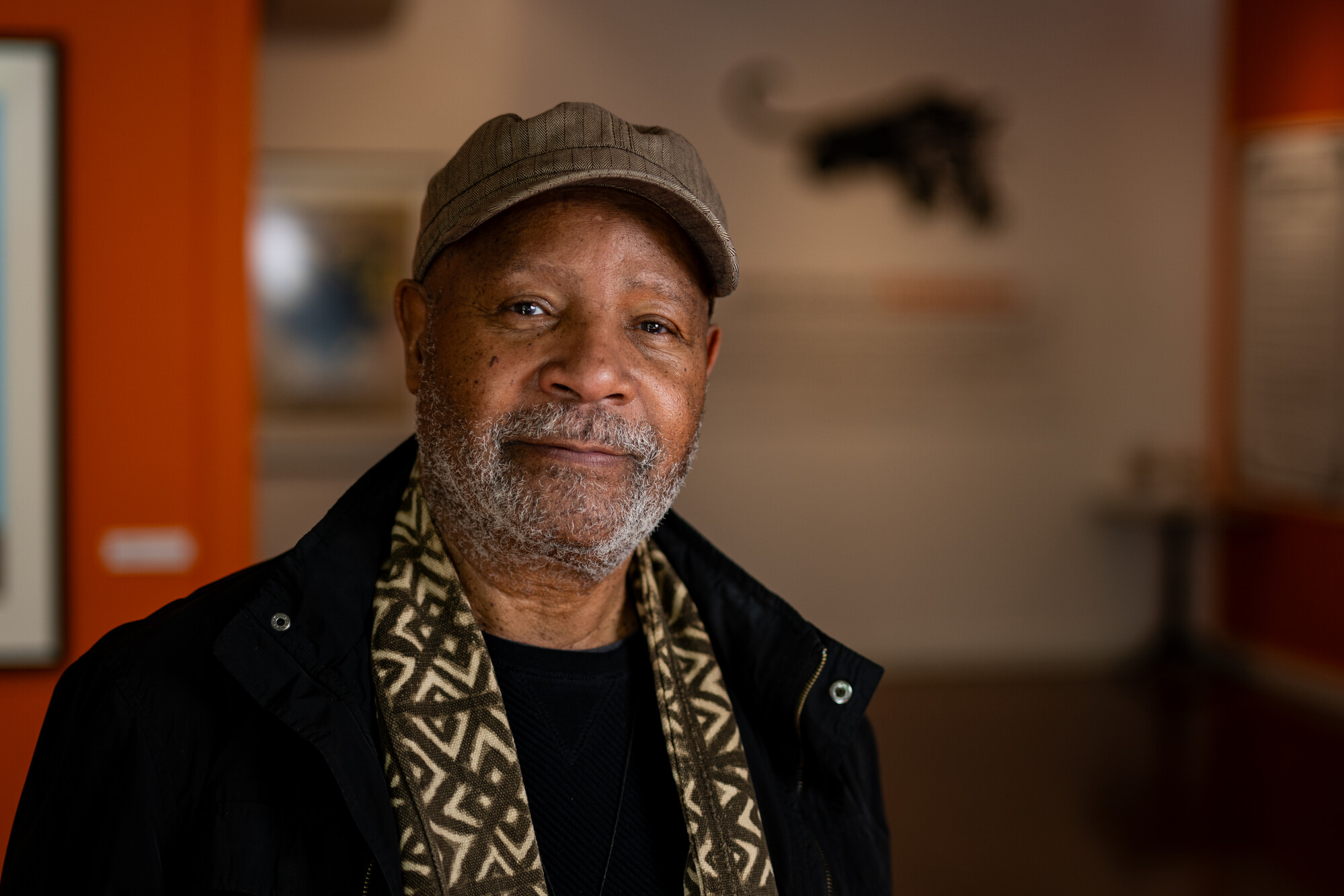
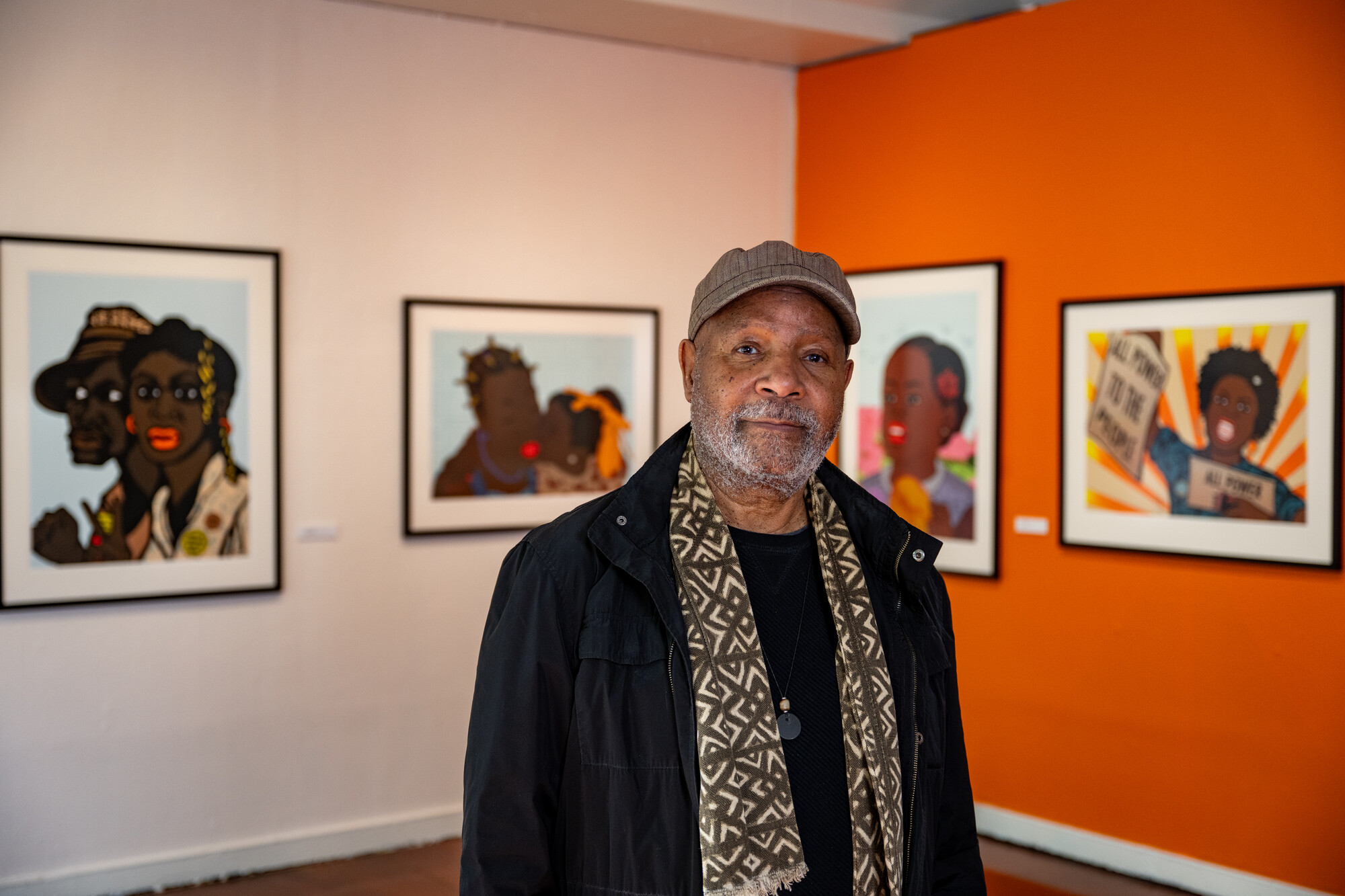
Artist Emory Douglas poses for a portrait at the African American Art & Culture Complex in San Francisco on Feb. 18, 2026, where his exhibition ‘In Our Lifetime’ is on view. The show highlights more than five decades of his influential political artwork, including pieces created for the Black Panther Party. (Beth LaBerge/KQED)
The Panthers’ timelessly cool uniform of shades, Afros and leather jackets ensured that cameras flashed any time one of their leaders approached a podium. The party became a fixture in the media, and their own newspaper was incredibly popular. At its peak, they distributed an estimated 300,000 copies a week around the country.
Related Article
On the front page of every paper, Emory Douglas boldly illustrated the Black Panthers’ calls for justice.
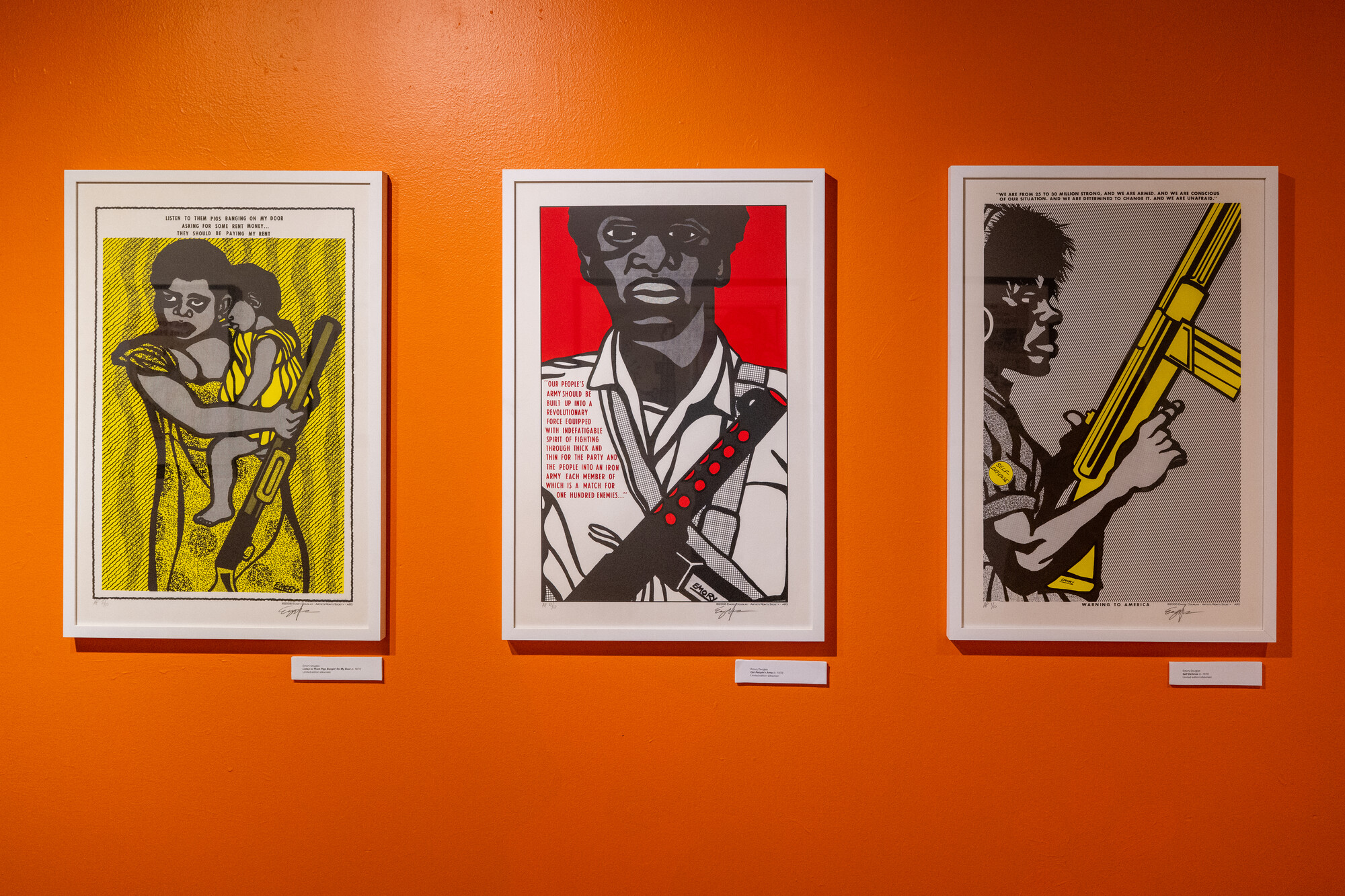
Douglas served as the Panthers’ Minister of Culture from 1967–1982, and the second part of a two-part retrospective of his work is now on view at San Francisco’s African American Arts & Culture Complex. Emory Douglas: In Our Lifetime spans three floors, and includes rare archival works from the 1960s and ’70s: editorial illustrations of police as pigs, and Black families struggling to afford basic necessities like rent and groceries, accompanied by biting captions calling out government hypocrisy.
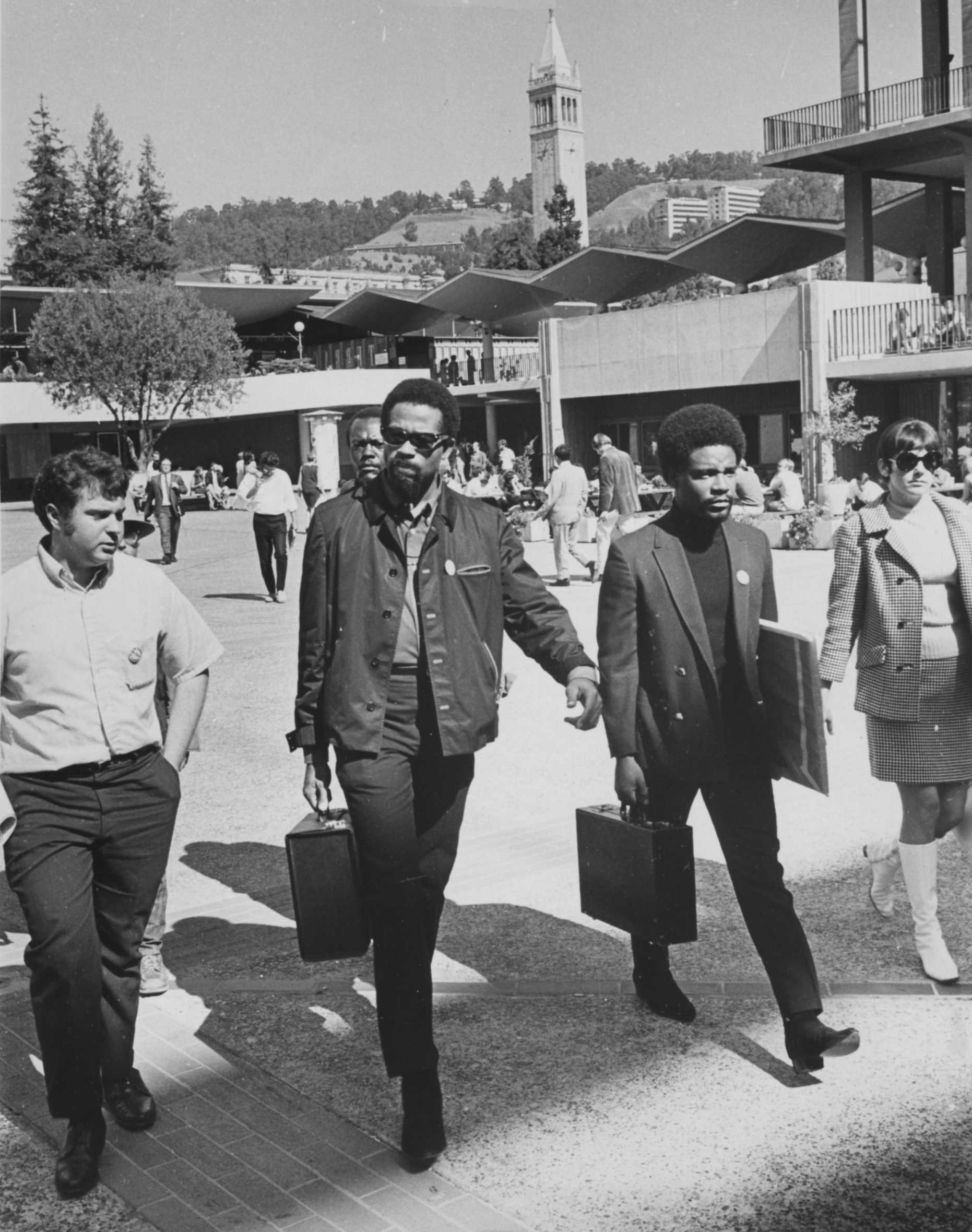
(Left to right) Lawrence Magid, student organizer, Eldridge Cleaver, Emory Douglas, Black Panther Party artist, and an unidentified woman at UC Berkeley in 1968. (Photo by Lonnie Wilson, MediaNews Group/Oakland Tribune via Getty Images)
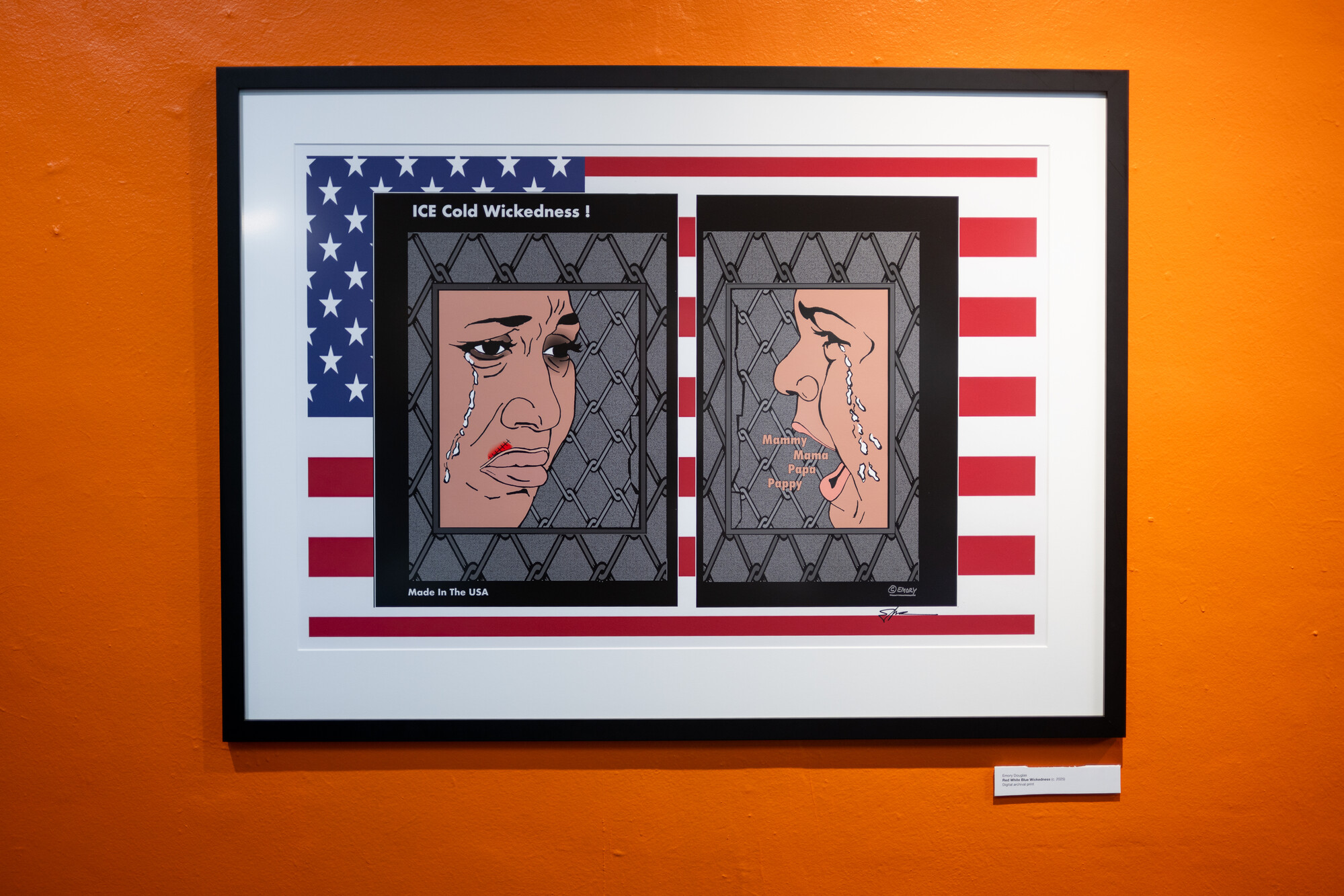
Contemporary pieces depicting modern-day horrors, including immigrant families behind bars and bombs falling over Gaza, show that six decades later, Douglas remains committed to rallying people against oppression.
Now 82 years old, Douglas has lived through intense repression. Under the leadership of J. Edgar Hoover, the FBI launched a counterintelligence program, COINTELPRO, to quell left-wing political groups including the Black Panthers, who found themselves under constant surveillance. Several Panther leaders, including Huey P. Newton and Bobby Seale, were incarcerated; law enforcement killed Illinois chapter leader Fred Hampton and numerous party members. Eventually, the party fractured during a schism between Newton and Minister of Information Eldridge Cleaver, ultimately contributing to its demise.
At the African American Arts & Culture Complex, Douglas sat down with KQED to share his personal memories of these events, and what he hopes today’s younger generations will learn from the Panthers’ legacy.
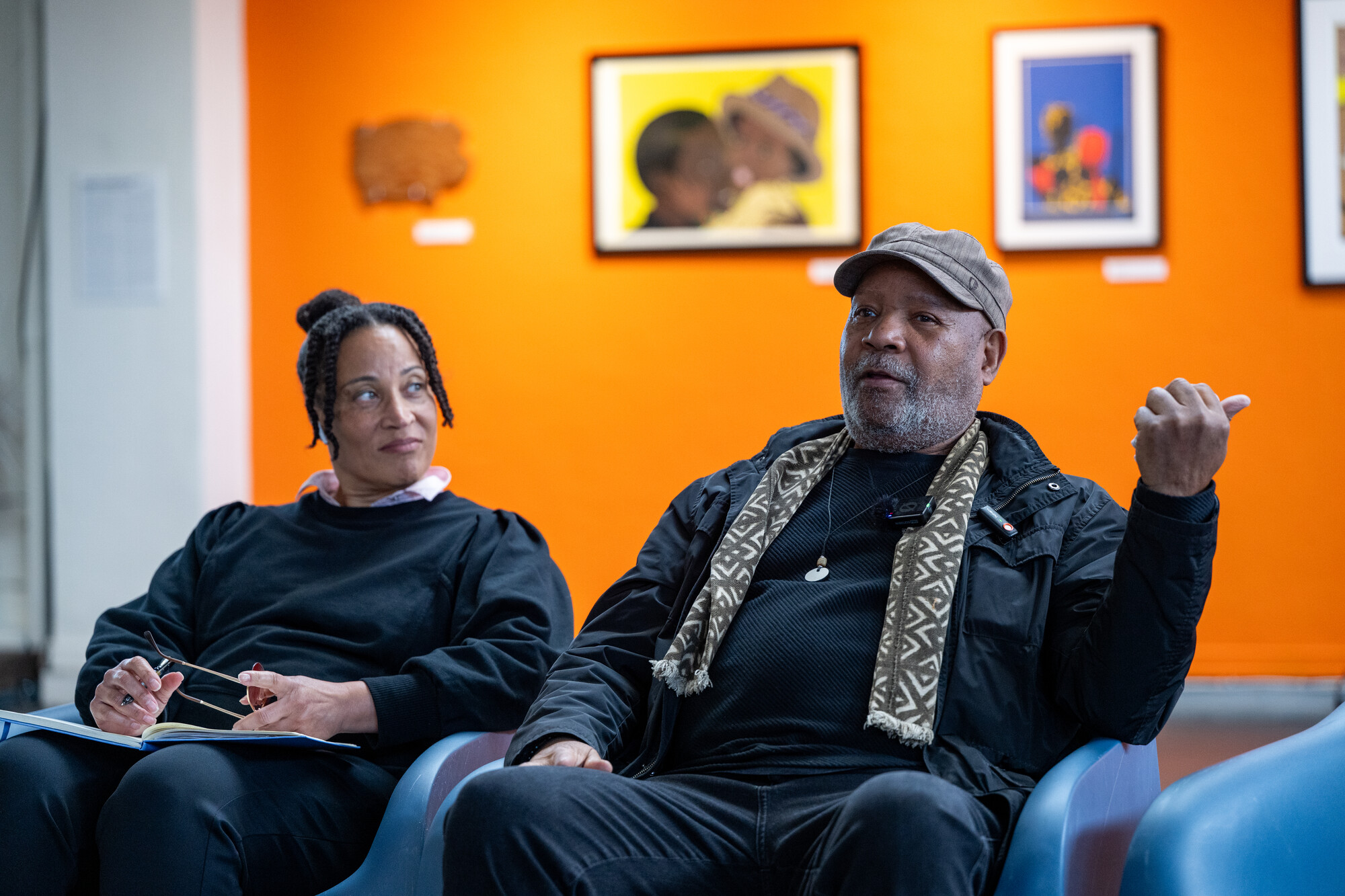
Emory Douglas speaks during a Q&A with co-curator Rosalind McGary at the African American Art & Culture Complex in San Francisco on Feb. 18, 2026. (Beth LaBerge/KQED)
Nastia Voynovskaya: You’ve talked about some of the social conditions that you and the Black community were experiencing in the ’50s and ’60s in San Francisco — poverty, police brutality. Can you take me into your mind as a young man joining the Panthers? What was it like joining an organization that was directly confronting these issues?
Emory Douglas: I was with a group of brothers and sisters prior to the Black Panther Party, and I was also involved in the Black Arts Movement during that time as well. The climate in the country was that there were over 300 rebellions, some small, some big, during all of the ’60s. And so young people were searching, trying to see what we could do. It just so happens that I was invited to do the poster artwork for an event with Malcolm X’s widow, Sister Betty Shabazz, and was able to connect with Huey Newton and Bobby Seale, who were coming over to do security. Then that’s when I knew I wanted to be a part of it.
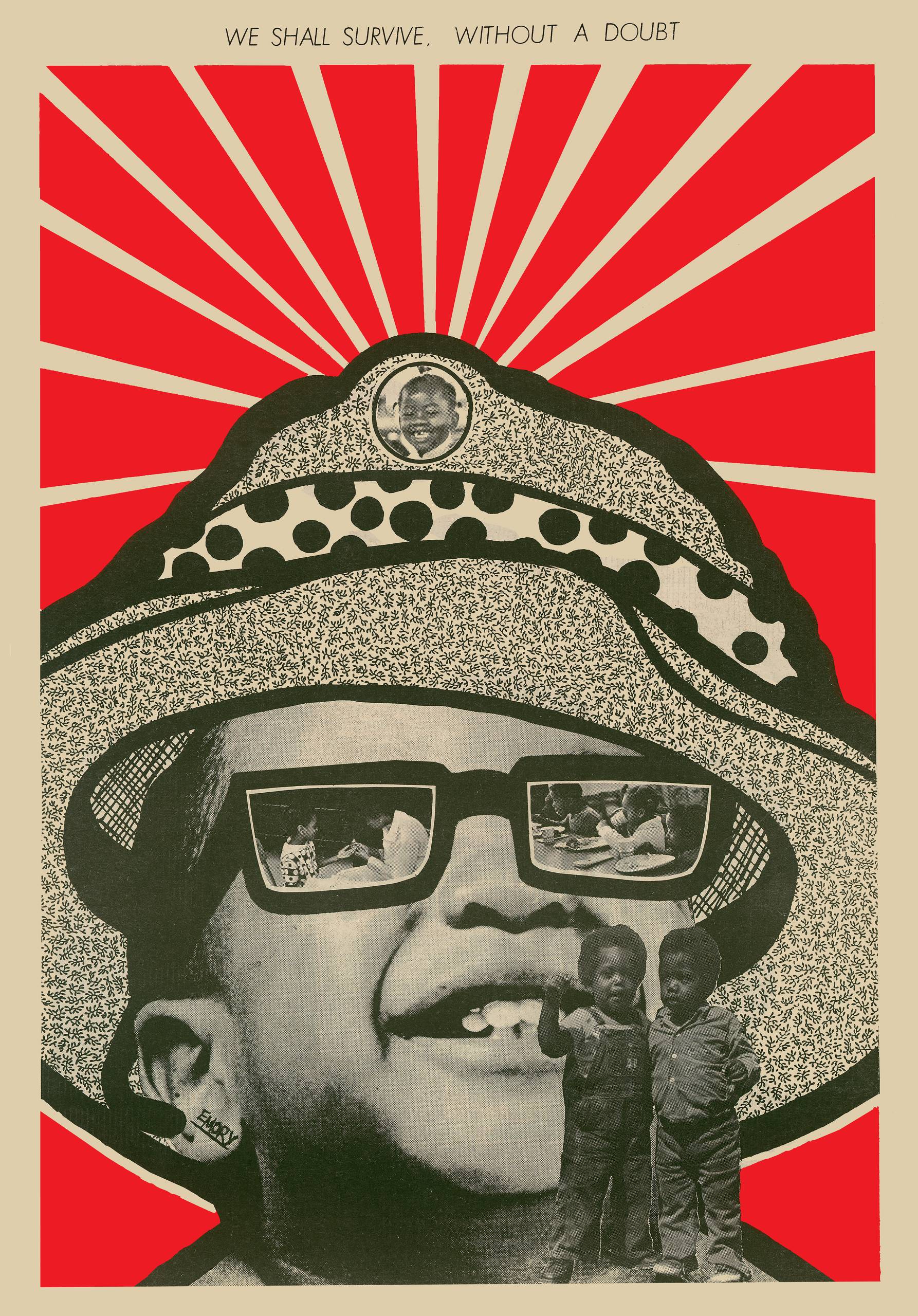
Emory Douglas, ‘We shall survive’ at African American Arts & Culture Complex in San Francisco. (Emory Douglas)
What about their politics did you find compelling?
When they recruited me, they wanted me to be an artist. They had this whole vision — it had a 10-point program that were the guiding principles of the Black Panther Party, about quality-of-life issues. And that was highly important.
When they were going to start the newspaper, I seen Bobby working on that first issue, which was the legal-size sheet of paper, about a young man who had been murdered by the Richmond police named Denzil Dowell. They were trying to help the family get some justice. I told him I could help him improve the quality of it, and that I would go home and get some of my materials that I still have from San Francisco City College during that time.
When I came back, he said, “We’re finished with this issue. But since you’ve been hanging around, and you’re committed, we want you to be the revolutionary artist for the paper.” They wanted to have a lot of photographs in the paper with bold headlines and captions underneath the pictures, so that those who weren’t in the reading community — those who learned through observation and participation — would get the gist of what was going on just by seeing the artwork.
Illustrations from the 1970s by Emory Douglas at the African American Art & Culture Complex in San Francisco on Feb. 18, 2026. (Beth LaBerge/KQED)
What was a typical week like for you, working on the paper?
In the beginning phase, when we didn’t have any headquarters, we worked out of Eldridge Cleaver’s studio apartment. And this was early on, 1967, when the party just had that first cadre and a few other folks. It hadn’t even grown into what it became. We’d start working on the paper and it took us maybe two weeks to get it together. If you worked in other areas of responsibility, there were certain times you would have to come to work on the paper until it was completed, maybe two or three days, then go back to your other responsibilities.
What were some of your other responsibilities?
Protesting, rallies, traveling around with those who were doing speaking engagements. Huey Newton, David Hilliard, Eldridge and Kathleen Cleaver were doing talking presentations at universities, colleges, what have you, and I would be traveling with them.
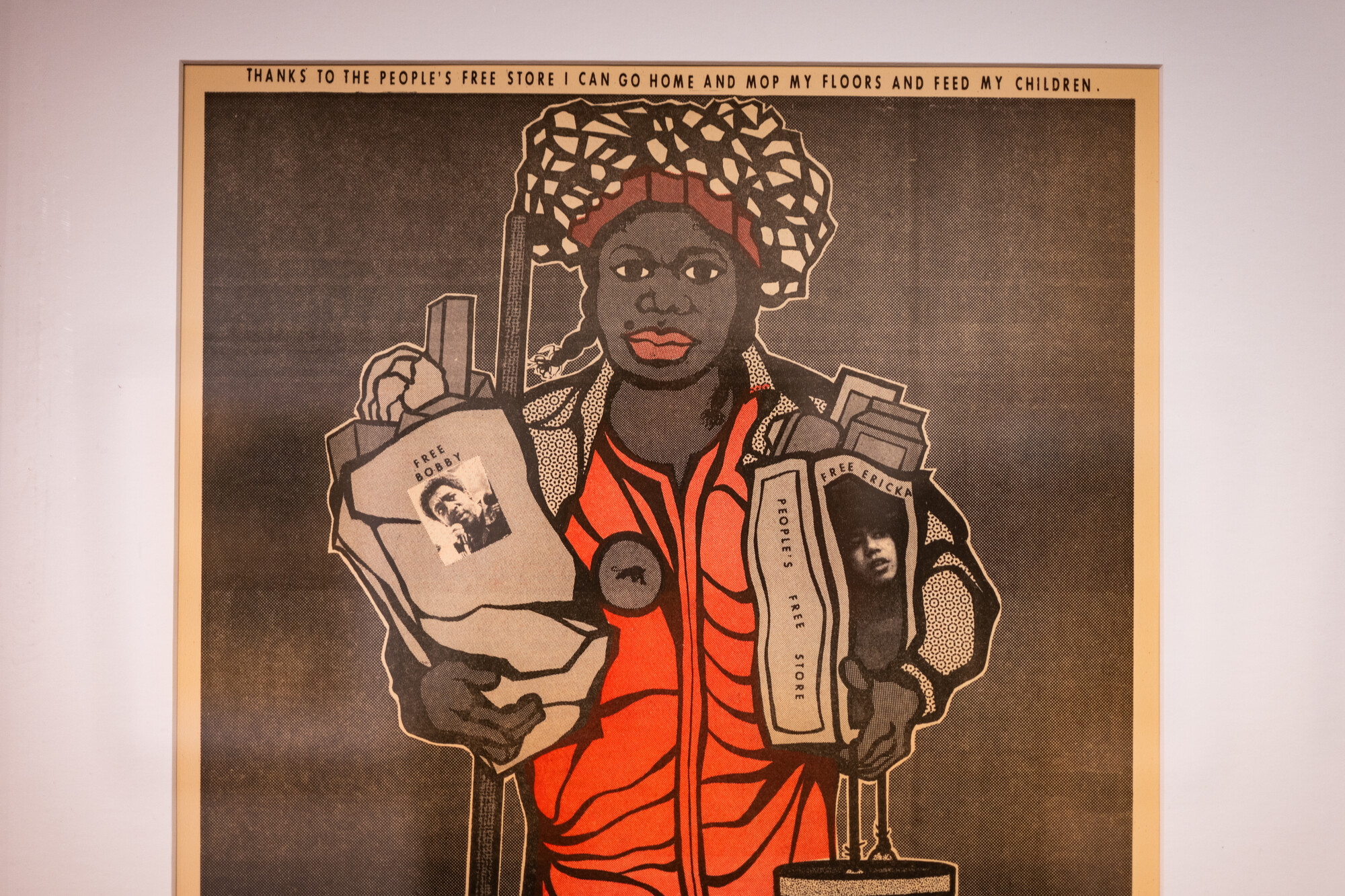
‘BPP People‘s Free store’ (1969) by Emory Douglas at the African American Art & Culture Complex in San Francisco on Feb. 18, 2026. (Beth LaBerge/KQED)
Then in 1967, Huey Newton was incarcerated. What role do you think your art played in the Free Huey movement and getting people to rally around the Panthers’ cause?
Well, it gave a visual interpretation of what the politics was in relationship to point number seven, wanting an end to police brutality, the murder of Black people. Also dealing with the issue of electoral politics, dealing with issues of institutional and structural racism that existed.
Ronald Reagan was the governor of the state of California, and we were very critical of what was going on at the state level, and the local level as well. So I think the artwork itself interprets those subject matters visually. It was meant to be provocative.
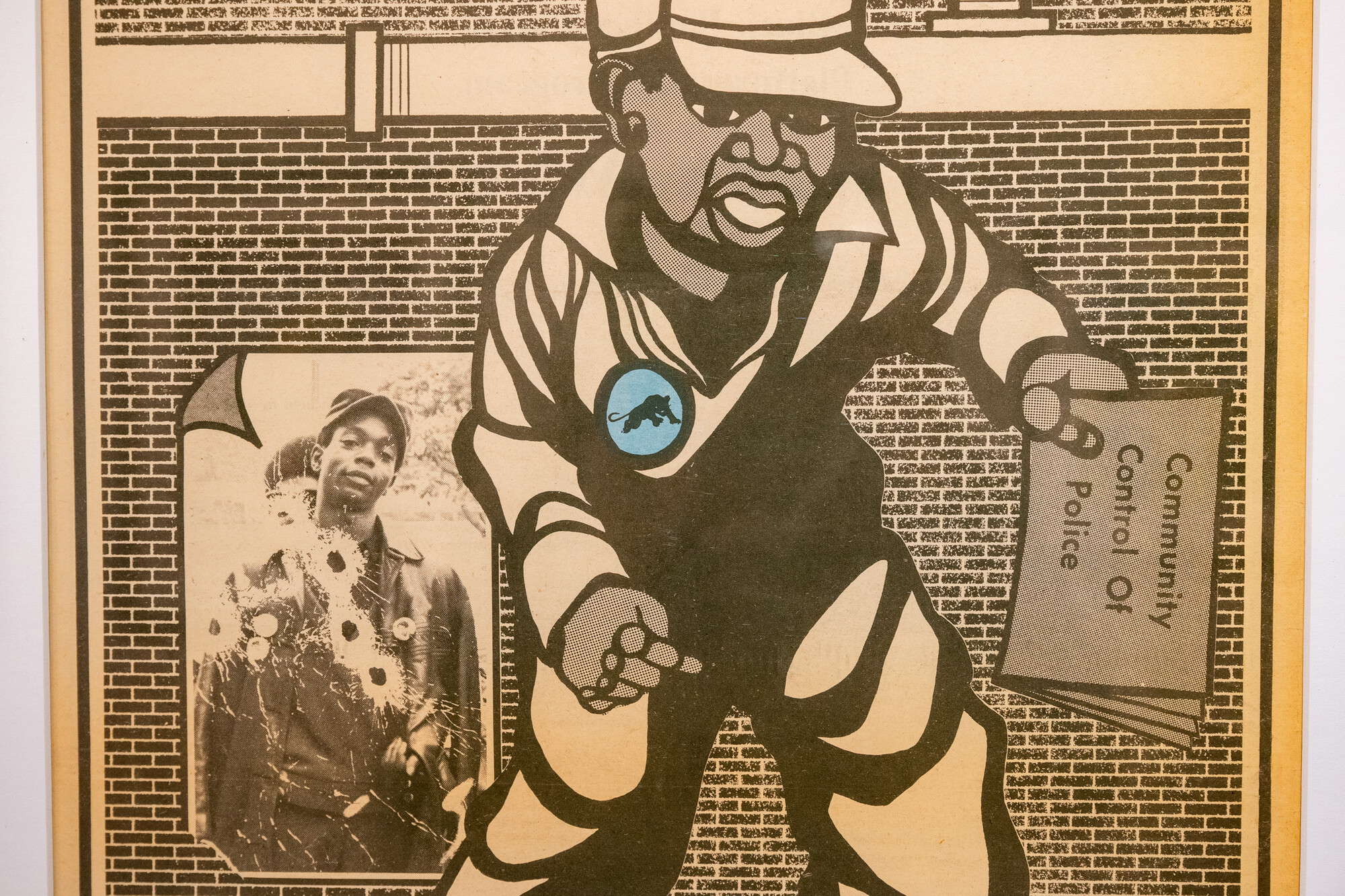
A Black Panther Party newspaper cover by Emory Douglas at the African American Art & Culture Complex in San Francisco on Feb. 18, 2026. (Beth LaBerge/KQED)
What was it like for you during COINTELPRO, when members of the Black Panthers were getting arrested or assassinated, and they were under surveillance by the FBI?
It could have been anybody at any given time. In 1967 we had our office on Shattuck, right across the street from La Peña Cultural Center in Oakland. I think it was a young reporter, or a young policeman, who gave Bobby Seale information in regards to this raid that they had planned. It was documented how they had planned to come block off the streets, and bring in the dead wagon and the ambulances for the wounded.
We didn’t know it was called COINTELPRO, but we began to see these different things that were taking place. During that time, [the FBI] was dressing up people to look like Panthers who were going in, shaking down the vendors who were supporting us. People were beginning to think it was us doing that, when it was the government doing that. You had one young brother who Bobby knew who was a businessman. And I recall being at the office when he came by with this letter. And he was saying, “Bobby, I’m giving y’all what I can. I’m supporting you the best that I can, but why are you threatening me with this letter?” And Bobby explained to him, it’s not us, it’s the government. It was on Panther stationary, all that.
Then you have the disputes that went on, the conflict between Eldridge Cleaver and Huey Newton that caused the separation and relationship to the organization itself. And all those things were a part of the COINTELPRO to discredit the party by any means necessary.
‘Red White Blue Wickedness’ (2025) by Emory Douglas at the African American Art & Culture Complex in San Francisco on Feb. 18, 2026. (Beth LaBerge/KQED)
After all the violence that took place in the late ’60s, what kept you committed to the Black Panther Party for another decade?
You have some people who could go as far as they could, and they just couldn’t go any further. But you know my commitment in serving, and I’ve seen the relevancy of my contribution with the paper. The paper was our lifeline to the community. It was a powerful organ. People used to read our paper to know what was going on in the world. And not only that, but the liberation movements in Africa and Asia, all those had subscriptions to the paper.
You’ve traveled building solidarity with other revolutionary artists. What places made the biggest impact on you?
Well, I would say Cuba and Africa. During the Black Panther Party, I wasn’t traveling outside of the country as much as inside the country. But in 1971, Huey Newton went to China, and they asked him to send a delegation. We were there for about 31 days. We had a diverse ethnic collection of folks, some Panthers, some non-Panthers, some doctors and lawyers, architects, all kinds of folks. And so that was very impactful, knowing [people in China] were in spirit with us.
When Huey Newton was leaving what was then called Peking, which is Beijing now, he met Samora Machel, who was then the leader of the liberation movement of Mozambique, and who later became the president of Mozambique. And they got a photograph of them shaking hands. And so all those were powerful, and powerful things in relation to the paper itself.
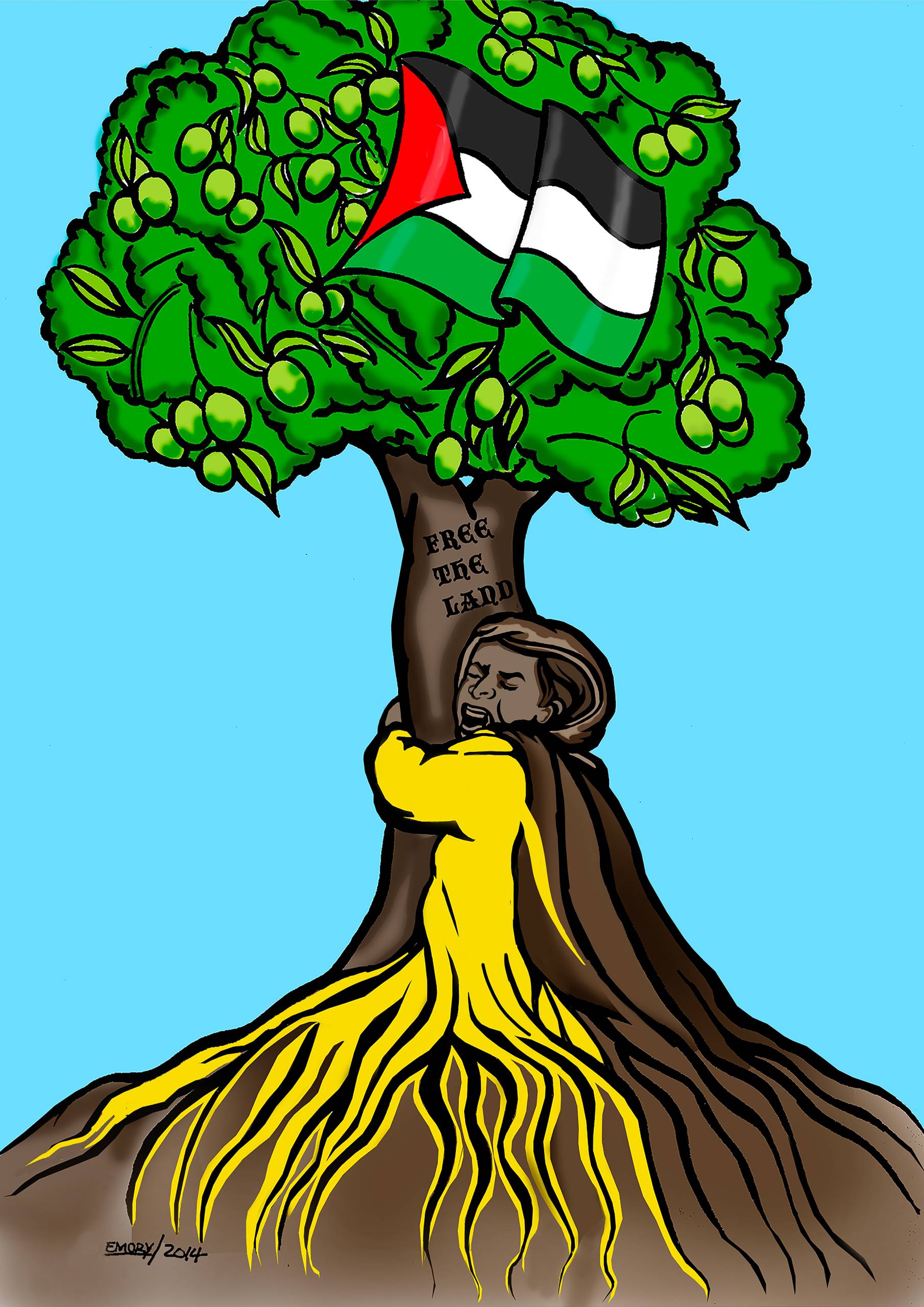
‘Free the Land’ by Emory Douglas. (Emory Douglas)
How did you get involved with the movement for Palestinian human rights?
Well, we always had been. In 1969, before COINTELPRO caused a separation, I was assigned to travel to Algeria. Eldridge had to leave the country, he was in Cuba, and he was going from Cuba to Algeria. I was assigned to travel with Kathleen Cleaver to Algeria. We were invited to the first Pan-African Cultural Festival, which was the next year. When I went back, David Hilliard went with me, and we got information that Yasser Arafat was there for a symposium. We met with Arafat after that symposium to show our solidarity. There’s a photograph of David Hilliard, Eldridge Cleaver and myself sitting there at the press conferences.
In the international section of our paper there was always news about what was going on in Palestine, Africa, Asia, Latin America, in the liberation movements.
Artist Emory Douglas poses for a portrait at the African American Art & Culture Complex in San Francisco on Feb. 18, 2026. (Beth LaBerge/KQED)
What keeps you hopeful, even though a lot of the social struggles you’ve been talking about since the ’60s are still going on today?
What you learn after a while is [laughs] you make progress, and then some things step back, and then step forward. Commitment to it, because you can see the enlightenment from then and now in many different ways. And these young people coming up, they’re very insightful.
What do you hope young people take from this exhibit?
Well, they can be informed by it, be inspired by it — not necessarily to duplicate it, but take it as an example of what can be done.
‘Emory Douglas: In Our Lifetime’ is on view at the African American Arts & Culture Complex in San Francisco through October 2026.