window.__IS_SSR__=true
window.__INITIAL_STATE__={
"attachmentsReducer": {
"audio_0": {
"type": "attachments",
"id": "audio_0",
"imgSizes": {
"kqedFullSize": {
"file": "https://ww2.kqed.org/news/wp-content/themes/KQED-unified/img/audio_bgs/background0.jpg"
}
}
},
"audio_1": {
"type": "attachments",
"id": "audio_1",
"imgSizes": {
"kqedFullSize": {
"file": "https://ww2.kqed.org/news/wp-content/themes/KQED-unified/img/audio_bgs/background1.jpg"
}
}
},
"audio_2": {
"type": "attachments",
"id": "audio_2",
"imgSizes": {
"kqedFullSize": {
"file": "https://ww2.kqed.org/news/wp-content/themes/KQED-unified/img/audio_bgs/background2.jpg"
}
}
},
"audio_3": {
"type": "attachments",
"id": "audio_3",
"imgSizes": {
"kqedFullSize": {
"file": "https://ww2.kqed.org/news/wp-content/themes/KQED-unified/img/audio_bgs/background3.jpg"
}
}
},
"audio_4": {
"type": "attachments",
"id": "audio_4",
"imgSizes": {
"kqedFullSize": {
"file": "https://ww2.kqed.org/news/wp-content/themes/KQED-unified/img/audio_bgs/background4.jpg"
}
}
},
"placeholder": {
"type": "attachments",
"id": "placeholder",
"imgSizes": {
"thumbnail": {
"file": "https://cdn.kqed.org/wp-content/uploads/2024/12/KQED-Default-Image-816638274-2000x1333-1-160x107.jpg",
"width": 160,
"height": 107,
"mimeType": "image/jpeg"
},
"medium": {
"file": "https://cdn.kqed.org/wp-content/uploads/2024/12/KQED-Default-Image-816638274-2000x1333-1-800x533.jpg",
"width": 800,
"height": 533,
"mimeType": "image/jpeg"
},
"medium_large": {
"file": "https://cdn.kqed.org/wp-content/uploads/2024/12/KQED-Default-Image-816638274-2000x1333-1-768x512.jpg",
"width": 768,
"height": 512,
"mimeType": "image/jpeg"
},
"large": {
"file": "https://cdn.kqed.org/wp-content/uploads/2024/12/KQED-Default-Image-816638274-2000x1333-1-1020x680.jpg",
"width": 1020,
"height": 680,
"mimeType": "image/jpeg"
},
"1536x1536": {
"file": "https://cdn.kqed.org/wp-content/uploads/2024/12/KQED-Default-Image-816638274-2000x1333-1-1536x1024.jpg",
"width": 1536,
"height": 1024,
"mimeType": "image/jpeg"
},
"fd-lrg": {
"file": "https://cdn.kqed.org/wp-content/uploads/2024/12/KQED-Default-Image-816638274-2000x1333-1-1536x1024.jpg",
"width": 1536,
"height": 1024,
"mimeType": "image/jpeg"
},
"fd-med": {
"file": "https://cdn.kqed.org/wp-content/uploads/2024/12/KQED-Default-Image-816638274-2000x1333-1-1020x680.jpg",
"width": 1020,
"height": 680,
"mimeType": "image/jpeg"
},
"fd-sm": {
"file": "https://cdn.kqed.org/wp-content/uploads/2024/12/KQED-Default-Image-816638274-2000x1333-1-800x533.jpg",
"width": 800,
"height": 533,
"mimeType": "image/jpeg"
},
"post-thumbnail": {
"file": "https://cdn.kqed.org/wp-content/uploads/2024/12/KQED-Default-Image-816638274-2000x1333-1-672x372.jpg",
"width": 672,
"height": 372,
"mimeType": "image/jpeg"
},
"twentyfourteen-full-width": {
"file": "https://cdn.kqed.org/wp-content/uploads/2024/12/KQED-Default-Image-816638274-2000x1333-1-1038x576.jpg",
"width": 1038,
"height": 576,
"mimeType": "image/jpeg"
},
"xxsmall": {
"file": "https://cdn.kqed.org/wp-content/uploads/2024/12/KQED-Default-Image-816638274-2000x1333-1-160x107.jpg",
"width": 160,
"height": 107,
"mimeType": "image/jpeg"
},
"xsmall": {
"file": "https://cdn.kqed.org/wp-content/uploads/2024/12/KQED-Default-Image-816638274-2000x1333-1-672x372.jpg",
"width": 672,
"height": 372,
"mimeType": "image/jpeg"
},
"small": {
"file": "https://cdn.kqed.org/wp-content/uploads/2024/12/KQED-Default-Image-816638274-2000x1333-1-672x372.jpg",
"width": 672,
"height": 372,
"mimeType": "image/jpeg"
},
"xlarge": {
"file": "https://cdn.kqed.org/wp-content/uploads/2024/12/KQED-Default-Image-816638274-2000x1333-1-1020x680.jpg",
"width": 1020,
"height": 680,
"mimeType": "image/jpeg"
},
"full-width": {
"file": "https://cdn.kqed.org/wp-content/uploads/2024/12/KQED-Default-Image-816638274-2000x1333-1-1920x1280.jpg",
"width": 1920,
"height": 1280,
"mimeType": "image/jpeg"
},
"guest-author-32": {
"file": "https://cdn.kqed.org/wp-content/uploads/2025/01/KQED-Default-Image-816638274-1333x1333-1-160x160.jpg",
"width": 32,
"height": 32,
"mimeType": "image/jpeg"
},
"guest-author-50": {
"file": "https://cdn.kqed.org/wp-content/uploads/2025/01/KQED-Default-Image-816638274-1333x1333-1-160x160.jpg",
"width": 50,
"height": 50,
"mimeType": "image/jpeg"
},
"guest-author-64": {
"file": "https://cdn.kqed.org/wp-content/uploads/2025/01/KQED-Default-Image-816638274-1333x1333-1-160x160.jpg",
"width": 64,
"height": 64,
"mimeType": "image/jpeg"
},
"guest-author-96": {
"file": "https://cdn.kqed.org/wp-content/uploads/2025/01/KQED-Default-Image-816638274-1333x1333-1-160x160.jpg",
"width": 96,
"height": 96,
"mimeType": "image/jpeg"
},
"guest-author-128": {
"file": "https://cdn.kqed.org/wp-content/uploads/2025/01/KQED-Default-Image-816638274-1333x1333-1-160x160.jpg",
"width": 128,
"height": 128,
"mimeType": "image/jpeg"
},
"detail": {
"file": "https://cdn.kqed.org/wp-content/uploads/2025/01/KQED-Default-Image-816638274-1333x1333-1-160x160.jpg",
"width": 160,
"height": 160,
"mimeType": "image/jpeg"
},
"kqedFullSize": {
"file": "https://cdn.kqed.org/wp-content/uploads/2024/12/KQED-Default-Image-816638274-2000x1333-1.jpg",
"width": 2000,
"height": 1333
}
}
},
"news_12024138": {
"type": "attachments",
"id": "news_12024138",
"meta": {
"index": "attachments_1716263798",
"site": "news",
"id": "12024138",
"found": true
},
"title": "Unaccompanied Minor From Honduras Joins Extended Family In Indiana After 8 Weeks in US Govt Custody",
"publishDate": 1737770976,
"status": "inherit",
"parent": 12024082,
"modified": 1737771240,
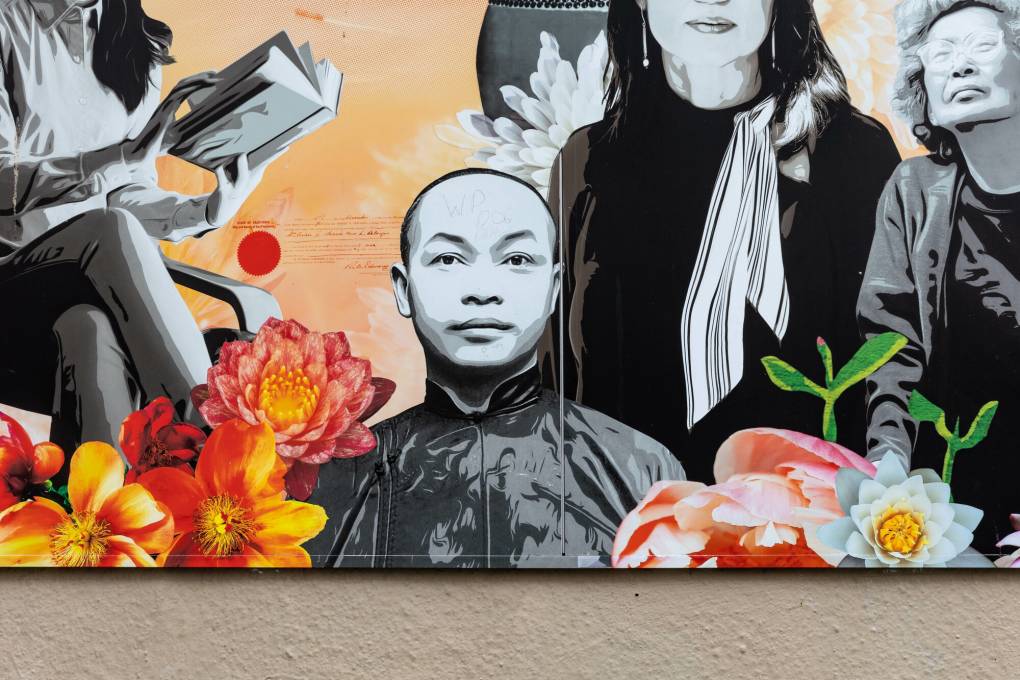
"caption": "Trump's executive order states that only babies born 'within the United States after 30 days from the date of this order' will be affected — which would make Feb. 19, 2025, the official start date of the policy. However a federal judge has frozen the order, which the Justice Department will likely appeal.",
"credit": "John Moore/Getty Images",
"altTag": null,
"description": null,
"imgSizes": {
"medium": {
"file": "https://cdn.kqed.org/wp-content/uploads/sites/10/2030/01/GettyImages-1314541146-800x541.jpg",
"width": 800,
"height": 541,
"mimeType": "image/jpeg"
},
"large": {
"file": "https://cdn.kqed.org/wp-content/uploads/sites/10/2030/01/GettyImages-1314541146-1020x690.jpg",
"width": 1020,
"height": 690,
"mimeType": "image/jpeg"
},
"thumbnail": {
"file": "https://cdn.kqed.org/wp-content/uploads/sites/10/2030/01/GettyImages-1314541146-160x108.jpg",
"width": 160,
"height": 108,
"mimeType": "image/jpeg"
},
"post-thumbnail": {
"file": "https://cdn.kqed.org/wp-content/uploads/sites/10/2030/01/GettyImages-1314541146-672x372.jpg",
"width": 672,
"height": 372,
"mimeType": "image/jpeg"
},
"twentyfourteen-full-width": {
"file": "https://cdn.kqed.org/wp-content/uploads/sites/10/2030/01/GettyImages-1314541146-1024x576.jpg",
"width": 1024,
"height": 576,
"mimeType": "image/jpeg"
},
"kqedFullSize": {
"file": "https://cdn.kqed.org/wp-content/uploads/sites/10/2030/01/GettyImages-1314541146.jpg",
"width": 1024,
"height": 693
}
},
"isLoading": false,
"fetchFailed": false
},
"news_11973461": {
"type": "attachments",
"id": "news_11973461",
"meta": {
"index": "attachments_1716263798",
"site": "news",
"id": "11973461",
"found": true
},
"title": "240123-HMBShootingAnniversary-39-BL",
"publishDate": 1706051862,
"status": "inherit",
"parent": 12039333,
"modified": 1746748542,
"caption": "Dr. Belinda Hernandez-Arriaga speaks during a roundtable discussion at the ALAS Sueño Center in Half Moon Bay on Jan. 23, 2024.",
"credit": "Beth LaBerge/KQED",
"altTag": "A person with long hair stands in front of a group of people in a room painted bright orange.",
"description": null,
"imgSizes": {
"medium": {
"file": "https://cdn.kqed.org/wp-content/uploads/sites/10/2024/01/240123-HMBShootingAnniversary-39-BL-800x533.jpg",
"width": 800,
"height": 533,
"mimeType": "image/jpeg"
},
"large": {
"file": "https://cdn.kqed.org/wp-content/uploads/sites/10/2024/01/240123-HMBShootingAnniversary-39-BL-1020x680.jpg",
"width": 1020,
"height": 680,
"mimeType": "image/jpeg"
},
"thumbnail": {
"file": "https://cdn.kqed.org/wp-content/uploads/sites/10/2024/01/240123-HMBShootingAnniversary-39-BL-160x107.jpg",
"width": 160,
"height": 107,
"mimeType": "image/jpeg"
},
"1536x1536": {
"file": "https://cdn.kqed.org/wp-content/uploads/sites/10/2024/01/240123-HMBShootingAnniversary-39-BL-1536x1024.jpg",
"width": 1536,
"height": 1024,
"mimeType": "image/jpeg"
},
"post-thumbnail": {
"file": "https://cdn.kqed.org/wp-content/uploads/sites/10/2024/01/240123-HMBShootingAnniversary-39-BL-672x372.jpg",
"width": 672,
"height": 372,
"mimeType": "image/jpeg"
},
"twentyfourteen-full-width": {
"file": "https://cdn.kqed.org/wp-content/uploads/sites/10/2024/01/240123-HMBShootingAnniversary-39-BL-1038x576.jpg",
"width": 1038,
"height": 576,
"mimeType": "image/jpeg"
},
"kqedFullSize": {
"file": "https://cdn.kqed.org/wp-content/uploads/sites/10/2024/01/240123-HMBShootingAnniversary-39-BL.jpg",
"width": 1920,
"height": 1280
}
},
"isLoading": false,
"fetchFailed": false
},
"news_12023747": {
"type": "attachments",
"id": "news_12023747",
"meta": {
"index": "attachments_1716263798",
"site": "news",
"id": "12023747",
"found": true
},
"title": "US-POLITICS-TRUMP-INAUGURATION",
"publishDate": 1737658482,
"status": "inherit",
"parent": 12023740,
"modified": 1737660022,
"caption": "U.S. President Donald Trump signs an executive order in the Oval Office of the White House in Washington, D.C., on Jan. 20, 2025.",
"credit": "Jim Watson/Pool/AFP via Getty Images",
"altTag": null,
"description": null,
"imgSizes": {
"medium": {
"file": "https://cdn.kqed.org/wp-content/uploads/sites/10/2025/01/DonaldTrumpEOGetty-800x521.jpg",
"width": 800,
"height": 521,
"mimeType": "image/jpeg"
},
"large": {
"file": "https://cdn.kqed.org/wp-content/uploads/sites/10/2025/01/DonaldTrumpEOGetty-1020x664.jpg",
"width": 1020,
"height": 664,
"mimeType": "image/jpeg"
},
"thumbnail": {
"file": "https://cdn.kqed.org/wp-content/uploads/sites/10/2025/01/DonaldTrumpEOGetty-160x104.jpg",
"width": 160,
"height": 104,
"mimeType": "image/jpeg"
},
"1536x1536": {
"file": "https://cdn.kqed.org/wp-content/uploads/sites/10/2025/01/DonaldTrumpEOGetty-1536x1000.jpg",
"width": 1536,
"height": 1000,
"mimeType": "image/jpeg"
},
"post-thumbnail": {
"file": "https://cdn.kqed.org/wp-content/uploads/sites/10/2025/01/DonaldTrumpEOGetty-672x372.jpg",
"width": 672,
"height": 372,
"mimeType": "image/jpeg"
},
"twentyfourteen-full-width": {
"file": "https://cdn.kqed.org/wp-content/uploads/sites/10/2025/01/DonaldTrumpEOGetty-1038x576.jpg",
"width": 1038,
"height": 576,
"mimeType": "image/jpeg"
},
"full-width": {
"file": "https://cdn.kqed.org/wp-content/uploads/sites/10/2025/01/DonaldTrumpEOGetty-1920x1250.jpg",
"width": 1920,
"height": 1250,
"mimeType": "image/jpeg"
},
"kqedFullSize": {
"file": "https://cdn.kqed.org/wp-content/uploads/sites/10/2025/01/DonaldTrumpEOGetty.jpg",
"width": 2000,
"height": 1302
}
},
"isLoading": false,
"fetchFailed": false
},
"news_12024043": {
"type": "attachments",
"id": "news_12024043",
"meta": {
"index": "attachments_1716263798",
"site": "news",
"id": "12024043",
"found": true
},
"title": "npr.brightspotcdn copy",
"publishDate": 1737752490,
"status": "inherit",
"parent": 12024040,
"modified": 1737752518,
"caption": "Minneapolis police chief Brian O'Hara speaks at a press conference on June 16, 2023 at the US District Court building in Minneapolis.",
"credit": "The Washington Post/Getty Images",
"altTag": null,
"description": null,
"imgSizes": {
"medium": {
"file": "https://cdn.kqed.org/wp-content/uploads/sites/10/2025/01/npr.brightspotcdn-copy-55-800x533.jpg",
"width": 800,
"height": 533,
"mimeType": "image/jpeg"
},
"large": {
"file": "https://cdn.kqed.org/wp-content/uploads/sites/10/2025/01/npr.brightspotcdn-copy-55-1020x680.jpg",
"width": 1020,
"height": 680,
"mimeType": "image/jpeg"
},
"thumbnail": {
"file": "https://cdn.kqed.org/wp-content/uploads/sites/10/2025/01/npr.brightspotcdn-copy-55-160x107.jpg",
"width": 160,
"height": 107,
"mimeType": "image/jpeg"
},
"post-thumbnail": {
"file": "https://cdn.kqed.org/wp-content/uploads/sites/10/2025/01/npr.brightspotcdn-copy-55-672x372.jpg",
"width": 672,
"height": 372,
"mimeType": "image/jpeg"
},
"twentyfourteen-full-width": {
"file": "https://cdn.kqed.org/wp-content/uploads/sites/10/2025/01/npr.brightspotcdn-copy-55-1038x576.jpg",
"width": 1038,
"height": 576,
"mimeType": "image/jpeg"
},
"kqedFullSize": {
"file": "https://cdn.kqed.org/wp-content/uploads/sites/10/2025/01/npr.brightspotcdn-copy-55.jpg",
"width": 1100,
"height": 733
}
},
"isLoading": false,
"fetchFailed": false
},
"news_12023664": {
"type": "attachments",
"id": "news_12023664",
"meta": {
"index": "attachments_1716263798",
"site": "news",
"id": "12023664",
"found": true
},
"title": "US-WEATHER-FIRE",
"publishDate": 1737595552,
"status": "inherit",
"parent": 12023550,
"modified": 1737595633,
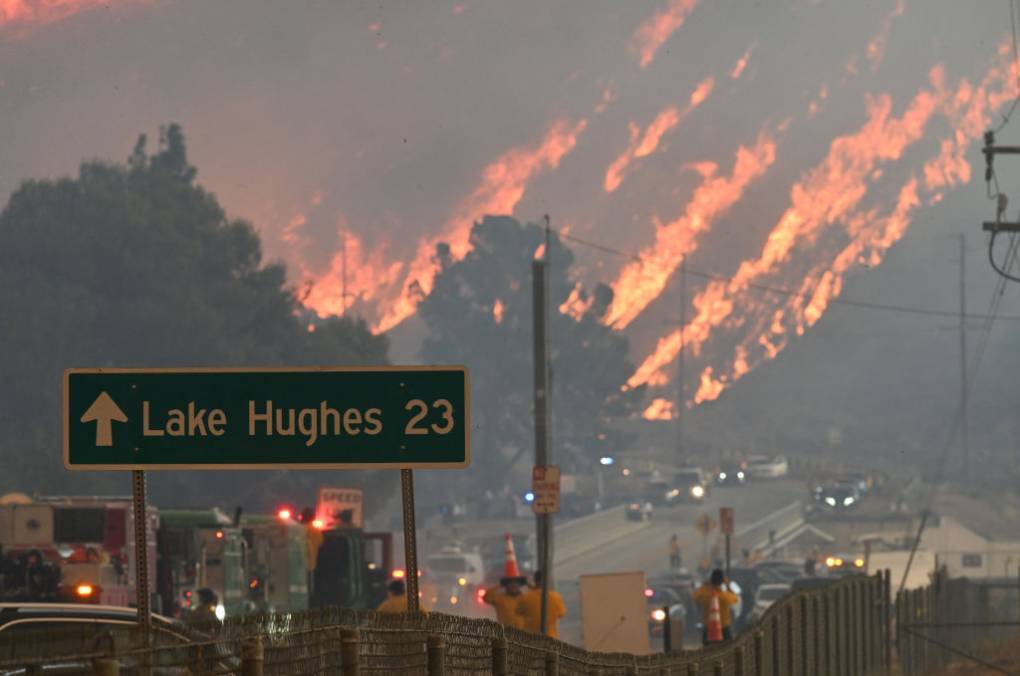
"caption": "Flames from the Hughes Fire burn a hillside in Castaic, a northwestern part of Los Angeles County, on Jan. 22, 2025. ",
"credit": "Robyn Beck/AFP via Getty Images",
"altTag": null,
"description": null,
"imgSizes": {
"medium": {
"file": "https://cdn.kqed.org/wp-content/uploads/sites/10/2025/01/GettyImages-2194744726-800x530.jpg",
"width": 800,
"height": 530,
"mimeType": "image/jpeg"
},
"large": {
"file": "https://cdn.kqed.org/wp-content/uploads/sites/10/2025/01/GettyImages-2194744726-1020x676.jpg",
"width": 1020,
"height": 676,
"mimeType": "image/jpeg"
},
"thumbnail": {
"file": "https://cdn.kqed.org/wp-content/uploads/sites/10/2025/01/GettyImages-2194744726-160x106.jpg",
"width": 160,
"height": 106,
"mimeType": "image/jpeg"
},
"post-thumbnail": {
"file": "https://cdn.kqed.org/wp-content/uploads/sites/10/2025/01/GettyImages-2194744726-672x372.jpg",
"width": 672,
"height": 372,
"mimeType": "image/jpeg"
},
"twentyfourteen-full-width": {
"file": "https://cdn.kqed.org/wp-content/uploads/sites/10/2025/01/GettyImages-2194744726-1024x576.jpg",
"width": 1024,
"height": 576,
"mimeType": "image/jpeg"
},
"kqedFullSize": {
"file": "https://cdn.kqed.org/wp-content/uploads/sites/10/2025/01/GettyImages-2194744726.jpg",
"width": 1024,
"height": 679
}
},
"isLoading": false,
"fetchFailed": false
},
"news_12023317": {
"type": "attachments",
"id": "news_12023317",
"meta": {
"index": "attachments_1716263798",
"site": "news",
"id": "12023317",
"found": true
},
"title": "20250115_JapaneseAmericanActivism_GC-47",
"publishDate": 1737490923,
"status": "inherit",
"parent": 0,
"modified": 1737592311,
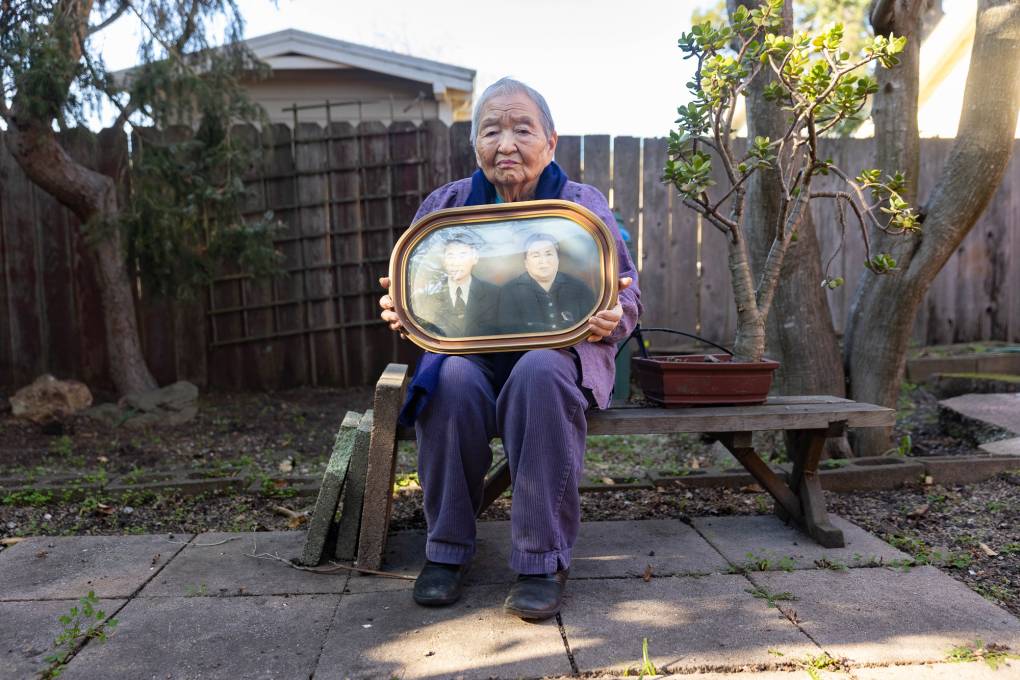
"caption": "Sadako Nimura Kashiwagi, 91, holds a photo of her parents, Juninhi Nimura and Shizuko Nimura, at her home in Berkeley on Jan. 15, 2025. Sadako was incarcerated at Tule Lake concentration camp at the age of 9, where she lived with her family for four years.",
"credit": "Gina Castro/KQED",
"altTag": null,
"description": null,
"imgSizes": {
"medium": {
"file": "https://cdn.kqed.org/wp-content/uploads/sites/10/2025/01/20250115_JapaneseAmericanActivism_GC-47-800x533.jpg",
"width": 800,
"height": 533,
"mimeType": "image/jpeg"
},
"large": {
"file": "https://cdn.kqed.org/wp-content/uploads/sites/10/2025/01/20250115_JapaneseAmericanActivism_GC-47-1020x680.jpg",
"width": 1020,
"height": 680,
"mimeType": "image/jpeg"
},
"thumbnail": {
"file": "https://cdn.kqed.org/wp-content/uploads/sites/10/2025/01/20250115_JapaneseAmericanActivism_GC-47-160x107.jpg",
"width": 160,
"height": 107,
"mimeType": "image/jpeg"
},
"1536x1536": {
"file": "https://cdn.kqed.org/wp-content/uploads/sites/10/2025/01/20250115_JapaneseAmericanActivism_GC-47-1536x1024.jpg",
"width": 1536,
"height": 1024,
"mimeType": "image/jpeg"
},
"post-thumbnail": {
"file": "https://cdn.kqed.org/wp-content/uploads/sites/10/2025/01/20250115_JapaneseAmericanActivism_GC-47-672x372.jpg",
"width": 672,
"height": 372,
"mimeType": "image/jpeg"
},
"twentyfourteen-full-width": {
"file": "https://cdn.kqed.org/wp-content/uploads/sites/10/2025/01/20250115_JapaneseAmericanActivism_GC-47-1038x576.jpg",
"width": 1038,
"height": 576,
"mimeType": "image/jpeg"
},
"full-width": {
"file": "https://cdn.kqed.org/wp-content/uploads/sites/10/2025/01/20250115_JapaneseAmericanActivism_GC-47-1920x1280.jpg",
"width": 1920,
"height": 1280,
"mimeType": "image/jpeg"
},
"kqedFullSize": {
"file": "https://cdn.kqed.org/wp-content/uploads/sites/10/2025/01/20250115_JapaneseAmericanActivism_GC-47.jpg",
"width": 2000,
"height": 1333
}
},
"isLoading": false,
"fetchFailed": false
},
"news_12023545": {
"type": "attachments",
"id": "news_12023545",
"meta": {
"index": "attachments_1716263798",
"site": "news",
"id": "12023545",
"found": true
},
"title": "250122-OaklandImmigrants-28-BL",
"publishDate": 1737580511,
"status": "inherit",
"parent": 12069782,
"modified": 1768439327,
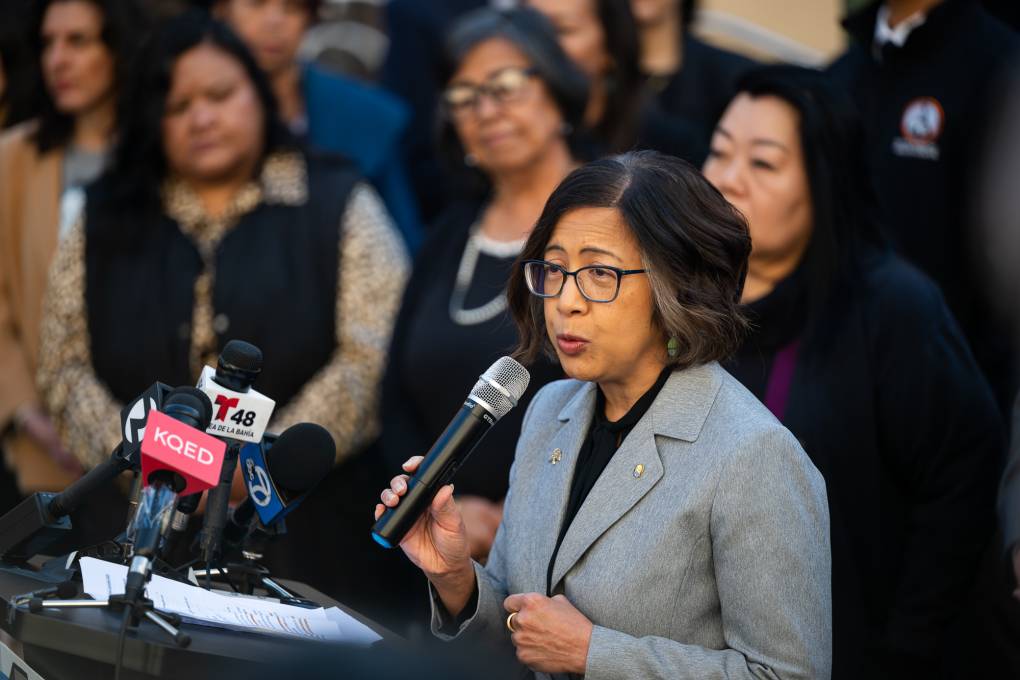
"caption": "Alameda County Supervisor Nikki Fortunato Bas speaks during a press conference with leaders from community groups throughout Alameda County in the Fruitvale neighborhood of Oakland on Jan. 22, 2025, to discuss support for immigrant families in the Bay Area after President Donald Trump promised mass deportations.",
"credit": "Beth LaBerge/KQED",
"altTag": null,
"description": null,
"imgSizes": {
"medium": {
"file": "https://cdn.kqed.org/wp-content/uploads/sites/10/2025/01/250122-OaklandImmigrants-28-BL-800x533.jpg",
"width": 800,
"height": 533,
"mimeType": "image/jpeg"
},
"large": {
"file": "https://cdn.kqed.org/wp-content/uploads/sites/10/2025/01/250122-OaklandImmigrants-28-BL-1020x680.jpg",
"width": 1020,
"height": 680,
"mimeType": "image/jpeg"
},
"thumbnail": {
"file": "https://cdn.kqed.org/wp-content/uploads/sites/10/2025/01/250122-OaklandImmigrants-28-BL-160x107.jpg",
"width": 160,
"height": 107,
"mimeType": "image/jpeg"
},
"1536x1536": {
"file": "https://cdn.kqed.org/wp-content/uploads/sites/10/2025/01/250122-OaklandImmigrants-28-BL-1536x1024.jpg",
"width": 1536,
"height": 1024,
"mimeType": "image/jpeg"
},
"post-thumbnail": {
"file": "https://cdn.kqed.org/wp-content/uploads/sites/10/2025/01/250122-OaklandImmigrants-28-BL-672x372.jpg",
"width": 672,
"height": 372,
"mimeType": "image/jpeg"
},
"twentyfourteen-full-width": {
"file": "https://cdn.kqed.org/wp-content/uploads/sites/10/2025/01/250122-OaklandImmigrants-28-BL-1038x576.jpg",
"width": 1038,
"height": 576,
"mimeType": "image/jpeg"
},
"full-width": {
"file": "https://cdn.kqed.org/wp-content/uploads/sites/10/2025/01/250122-OaklandImmigrants-28-BL-1920x1280.jpg",
"width": 1920,
"height": 1280,
"mimeType": "image/jpeg"
},
"kqedFullSize": {
"file": "https://cdn.kqed.org/wp-content/uploads/sites/10/2025/01/250122-OaklandImmigrants-28-BL.jpg",
"width": 2000,
"height": 1333
}
},
"isLoading": false,
"fetchFailed": false
},
"news_12023453": {
"type": "attachments",
"id": "news_12023453",
"meta": {
"index": "attachments_1716263798",
"site": "news",
"id": "12023453",
"found": true
},
"title": "National Walk and Roll to School Day",
"publishDate": 1737570313,
"status": "inherit",
"parent": 12023442,
"modified": 1737570385,
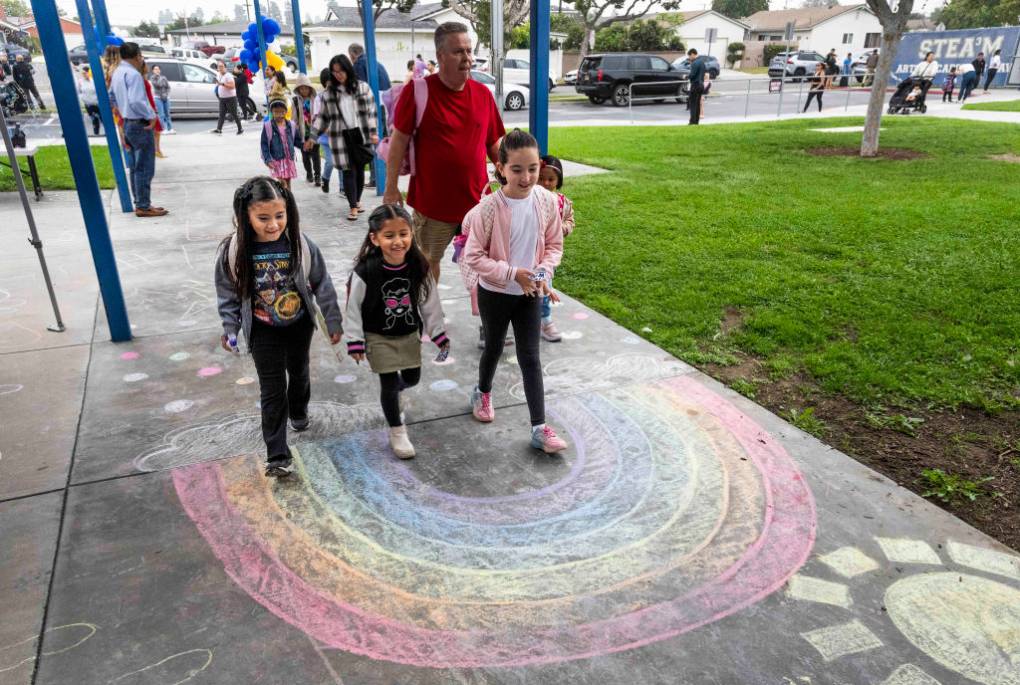
"caption": "Students pass chalk drawings on their way to class at Sequoia Academy in Westminster, Orange County, on Wednesday, Oct. 9, 2024.",
"credit": "Paul Bersebach/MediaNews Group/Orange County Register via Getty Images",
"altTag": null,
"description": null,
"imgSizes": {
"medium": {
"file": "https://cdn.kqed.org/wp-content/uploads/sites/10/2025/01/GettyImages-2177021825-800x538.jpg",
"width": 800,
"height": 538,
"mimeType": "image/jpeg"
},
"large": {
"file": "https://cdn.kqed.org/wp-content/uploads/sites/10/2025/01/GettyImages-2177021825-1020x685.jpg",
"width": 1020,
"height": 685,
"mimeType": "image/jpeg"
},
"thumbnail": {
"file": "https://cdn.kqed.org/wp-content/uploads/sites/10/2025/01/GettyImages-2177021825-160x108.jpg",
"width": 160,
"height": 108,
"mimeType": "image/jpeg"
},
"post-thumbnail": {
"file": "https://cdn.kqed.org/wp-content/uploads/sites/10/2025/01/GettyImages-2177021825-672x372.jpg",
"width": 672,
"height": 372,
"mimeType": "image/jpeg"
},
"twentyfourteen-full-width": {
"file": "https://cdn.kqed.org/wp-content/uploads/sites/10/2025/01/GettyImages-2177021825-1024x576.jpg",
"width": 1024,
"height": 576,
"mimeType": "image/jpeg"
},
"kqedFullSize": {
"file": "https://cdn.kqed.org/wp-content/uploads/sites/10/2025/01/GettyImages-2177021825.jpg",
"width": 1024,
"height": 688
}
},
"isLoading": false,
"fetchFailed": false
},
"news_12015412": {
"type": "attachments",
"id": "news_12015412",
"meta": {
"index": "attachments_1716263798",
"site": "news",
"id": "12015412",
"found": true
},
"title": "20241119_BirthrightCitizenshipExplainer_GC-16_qed",
"publishDate": 1732230026,
"status": "inherit",
"parent": 0,
"modified": 1738115978,
"caption": "Wong Kim Ark, who was born in San Francisco to parents who were Chinese immigrants and whose Supreme Court case established birthright citizenship, is one of the individuals featured on the Asian American Community Heroes mural on Nov. 19, 2024. The Chinese Culture Center led the creation of the mural, which was painted by local artist Anne Marie Lapitan, with the input of neighborhood youth.",
"credit": "Gina Castro/KQED",
"altTag": "A close-up of a mural that features a young man wearing a traditional robe with his hair pulled back in a braid.",
"description": null,
"imgSizes": {
"medium": {
"file": "https://cdn.kqed.org/wp-content/uploads/sites/10/2024/11/20241119_BirthrightCitizenshipExplainer_GC-16_qed-800x533.jpg",
"width": 800,
"height": 533,
"mimeType": "image/jpeg"
},
"large": {
"file": "https://cdn.kqed.org/wp-content/uploads/sites/10/2024/11/20241119_BirthrightCitizenshipExplainer_GC-16_qed-1020x680.jpg",
"width": 1020,
"height": 680,
"mimeType": "image/jpeg"
},
"thumbnail": {
"file": "https://cdn.kqed.org/wp-content/uploads/sites/10/2024/11/20241119_BirthrightCitizenshipExplainer_GC-16_qed-160x107.jpg",
"width": 160,
"height": 107,
"mimeType": "image/jpeg"
},
"1536x1536": {
"file": "https://cdn.kqed.org/wp-content/uploads/sites/10/2024/11/20241119_BirthrightCitizenshipExplainer_GC-16_qed-1536x1024.jpg",
"width": 1536,
"height": 1024,
"mimeType": "image/jpeg"
},
"post-thumbnail": {
"file": "https://cdn.kqed.org/wp-content/uploads/sites/10/2024/11/20241119_BirthrightCitizenshipExplainer_GC-16_qed-672x372.jpg",
"width": 672,
"height": 372,
"mimeType": "image/jpeg"
},
"twentyfourteen-full-width": {
"file": "https://cdn.kqed.org/wp-content/uploads/sites/10/2024/11/20241119_BirthrightCitizenshipExplainer_GC-16_qed-1038x576.jpg",
"width": 1038,
"height": 576,
"mimeType": "image/jpeg"
},
"full-width": {
"file": "https://cdn.kqed.org/wp-content/uploads/sites/10/2024/11/20241119_BirthrightCitizenshipExplainer_GC-16_qed-1920x1280.jpg",
"width": 1920,
"height": 1280,
"mimeType": "image/jpeg"
},
"kqedFullSize": {
"file": "https://cdn.kqed.org/wp-content/uploads/sites/10/2024/11/20241119_BirthrightCitizenshipExplainer_GC-16_qed.jpg",
"width": 2000,
"height": 1333
}
},
"isLoading": false,
"fetchFailed": false
},
"news_12023051": {
"type": "attachments",
"id": "news_12023051",
"meta": {
"index": "attachments_1716263798",
"site": "news",
"id": "12023051",
"found": true
},
"title": "20250118_Peoples-March_DMB_00570",
"publishDate": 1737308023,
"status": "inherit",
"parent": 0,
"modified": 1737484871,
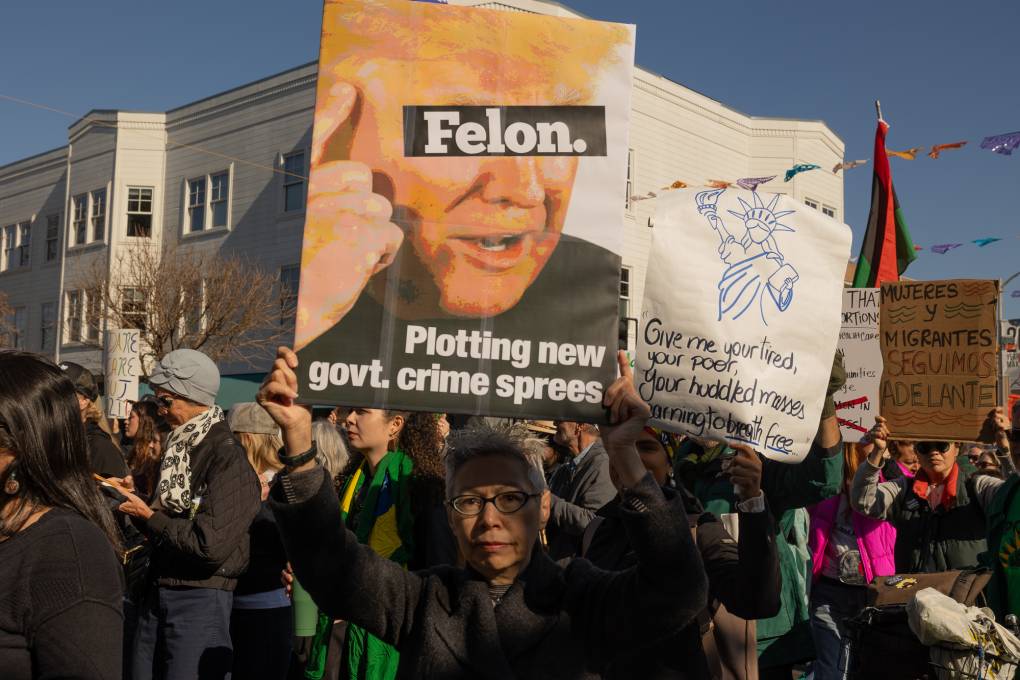
"caption": "Connie Jeung-Mills, of San Francisco, holds a sign with President Trump's face on it while marching with hundreds along 24th Street for the People’s March in San Francisco’s Mission District on Jan. 18, 2025. The protestors represent several causes, including the War in Gaza, Women’s Rights, targeting of undocumented people, minorities, and more, part of a nationwide day of action protesting President-elect Donald Trump’s second term.",
"credit": "David M. Barreda/KQED",
"altTag": "An older woman wearing glasses holds a sign in a large crowd of a man pointing to his head with the words \"Felon. Plotting govt crime sprees.\"",
"description": null,
"imgSizes": {
"medium": {
"file": "https://cdn.kqed.org/wp-content/uploads/sites/10/2025/01/20250118_Peoples-March_DMB_00570-800x533.jpg",
"width": 800,
"height": 533,
"mimeType": "image/jpeg"
},
"large": {
"file": "https://cdn.kqed.org/wp-content/uploads/sites/10/2025/01/20250118_Peoples-March_DMB_00570-1020x680.jpg",
"width": 1020,
"height": 680,
"mimeType": "image/jpeg"
},
"thumbnail": {
"file": "https://cdn.kqed.org/wp-content/uploads/sites/10/2025/01/20250118_Peoples-March_DMB_00570-160x107.jpg",
"width": 160,
"height": 107,
"mimeType": "image/jpeg"
},
"1536x1536": {
"file": "https://cdn.kqed.org/wp-content/uploads/sites/10/2025/01/20250118_Peoples-March_DMB_00570-1536x1024.jpg",
"width": 1536,
"height": 1024,
"mimeType": "image/jpeg"
},
"post-thumbnail": {
"file": "https://cdn.kqed.org/wp-content/uploads/sites/10/2025/01/20250118_Peoples-March_DMB_00570-672x372.jpg",
"width": 672,
"height": 372,
"mimeType": "image/jpeg"
},
"twentyfourteen-full-width": {
"file": "https://cdn.kqed.org/wp-content/uploads/sites/10/2025/01/20250118_Peoples-March_DMB_00570-1038x576.jpg",
"width": 1038,
"height": 576,
"mimeType": "image/jpeg"
},
"full-width": {
"file": "https://cdn.kqed.org/wp-content/uploads/sites/10/2025/01/20250118_Peoples-March_DMB_00570-1920x1280.jpg",
"width": 1920,
"height": 1280,
"mimeType": "image/jpeg"
},
"kqedFullSize": {
"file": "https://cdn.kqed.org/wp-content/uploads/sites/10/2025/01/20250118_Peoples-March_DMB_00570.jpg",
"width": 2000,
"height": 1333
}
},
"isLoading": false,
"fetchFailed": false
},
"news_12023105": {
"type": "attachments",
"id": "news_12023105",
"meta": {
"index": "attachments_1716263798",
"site": "news",
"id": "12023105",
"found": true
},
"title": "060324-CBP-Arrest-GETTY-CM-1",
"publishDate": 1737392456,
"status": "inherit",
"parent": 12023104,
"modified": 1737392496,
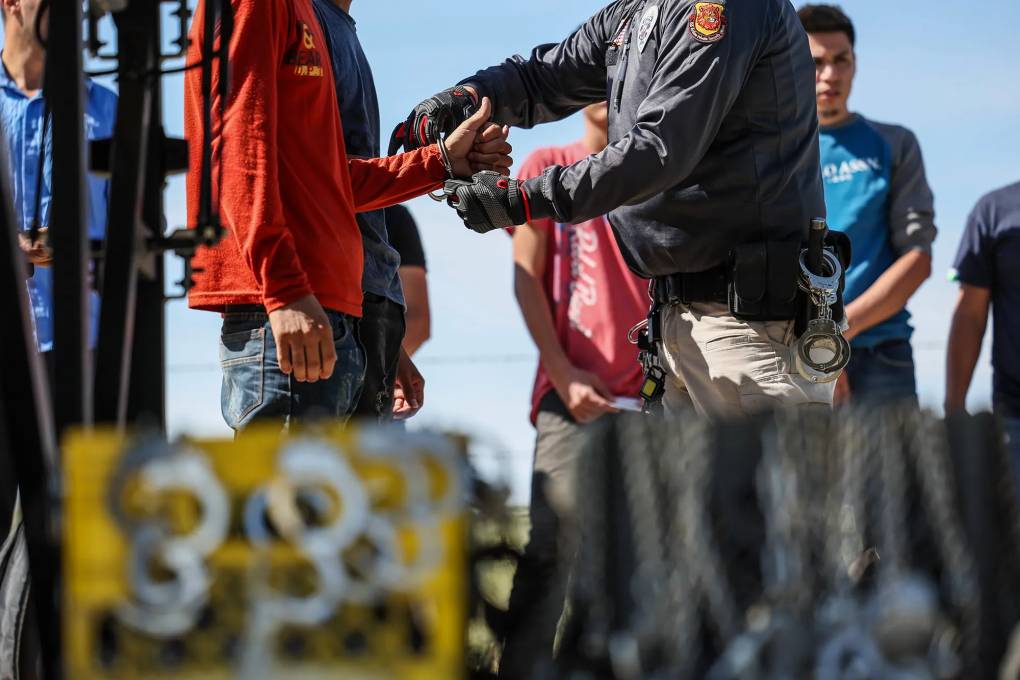
"caption": "Immigrant advocates are closely watching California sheriffs to see how they'll uphold the state's sanctuary law in a new Trump administration. Here, people seeking asylum are detained by border patrol after crossing the U.S. and Mexico border near Campo on June 3, 2024.",
"credit": "Robert Gauthier/Los Angeles Times via Getty Images",
"altTag": null,
"description": null,
"imgSizes": {
"medium": {
"file": "https://cdn.kqed.org/wp-content/uploads/sites/10/2025/01/060324-CBP-Arrest-GETTY-CM-1-800x533.jpg",
"width": 800,
"height": 533,
"mimeType": "image/jpeg"
},
"large": {
"file": "https://cdn.kqed.org/wp-content/uploads/sites/10/2025/01/060324-CBP-Arrest-GETTY-CM-1-1020x680.jpg",
"width": 1020,
"height": 680,
"mimeType": "image/jpeg"
},
"thumbnail": {
"file": "https://cdn.kqed.org/wp-content/uploads/sites/10/2025/01/060324-CBP-Arrest-GETTY-CM-1-160x107.jpg",
"width": 160,
"height": 107,
"mimeType": "image/jpeg"
},
"1536x1536": {
"file": "https://cdn.kqed.org/wp-content/uploads/sites/10/2025/01/060324-CBP-Arrest-GETTY-CM-1-1536x1024.jpg",
"width": 1536,
"height": 1024,
"mimeType": "image/jpeg"
},
"post-thumbnail": {
"file": "https://cdn.kqed.org/wp-content/uploads/sites/10/2025/01/060324-CBP-Arrest-GETTY-CM-1-672x372.jpg",
"width": 672,
"height": 372,
"mimeType": "image/jpeg"
},
"twentyfourteen-full-width": {
"file": "https://cdn.kqed.org/wp-content/uploads/sites/10/2025/01/060324-CBP-Arrest-GETTY-CM-1-1038x576.jpg",
"width": 1038,
"height": 576,
"mimeType": "image/jpeg"
},
"full-width": {
"file": "https://cdn.kqed.org/wp-content/uploads/sites/10/2025/01/060324-CBP-Arrest-GETTY-CM-1-1920x1280.jpg",
"width": 1920,
"height": 1280,
"mimeType": "image/jpeg"
},
"kqedFullSize": {
"file": "https://cdn.kqed.org/wp-content/uploads/sites/10/2025/01/060324-CBP-Arrest-GETTY-CM-1.jpg",
"width": 2000,
"height": 1333
}
},
"isLoading": false,
"fetchFailed": false
}
},
"audioPlayerReducer": {
"postId": "stream_live",
"isPaused": true,
"isPlaying": false,
"pfsActive": false,
"pledgeModalIsOpen": true,
"playerDrawerIsOpen": false,
"liveAudioPlayStartedAt": 0,
"liveAudioPlayContext": ""
},
"authorsReducer": {
"byline_news_12024040": {
"type": "authors",
"id": "byline_news_12024040",
"meta": {
"override": true
},
"slug": "byline_news_12024040",
"name": "\u003ca href=\"https://www.npr.org/people/935764762/brian-mann\">Brian Mann\u003c/a>, NPR",
"isLoading": false
},
"byline_news_12023740": {
"type": "authors",
"id": "byline_news_12023740",
"meta": {
"override": true
},
"slug": "byline_news_12023740",
"name": "Eugene Johnson and Mike Catalini, Associated Press",
"isLoading": false
},
"byline_news_12023442": {
"type": "authors",
"id": "byline_news_12023442",
"meta": {
"override": true
},
"slug": "byline_news_12023442",
"name": "Olga R. Rodriguez, Moriah Balingit, Bianca Vázquez Toness and Jocelyn Gecker, Associated Press",
"isLoading": false
},
"byline_news_12023104": {
"type": "authors",
"id": "byline_news_12023104",
"meta": {
"override": true
},
"slug": "byline_news_12023104",
"name": "Nigel Duara and Tomas Apodaca, CalMatters",
"isLoading": false
},
"gmarzorati": {
"type": "authors",
"id": "227",
"meta": {
"index": "authors_1716337520",
"id": "227",
"found": true
},
"name": "Guy Marzorati",
"firstName": "Guy",
"lastName": "Marzorati",
"slug": "gmarzorati",
"email": "gmarzorati@KQED.org",
"display_author_email": true,
"staff_mastheads": [
"news"
],
"title": "Correspondent",
"bio": "Guy Marzorati is a correspondent on KQED's California Politics and Government Desk, based in San Jose. A graduate of Santa Clara University, Guy joined KQED in 2013. He reports on state and local politics and produces KQED's digital voter guide.",
"avatar": "https://secure.gravatar.com/avatar/e7038b8dbfd55b104369b76b1cd0b9de?s=600&d=blank&r=g",
"twitter": "guymarzorati",
"facebook": null,
"instagram": null,
"linkedin": null,
"sites": [
{
"site": "",
"roles": [
"editor"
]
},
{
"site": "news",
"roles": [
"editor"
]
},
{
"site": "science",
"roles": [
"editor"
]
},
{
"site": "forum",
"roles": [
"editor"
]
},
{
"site": "elections",
"roles": [
"editor"
]
},
{
"site": "liveblog",
"roles": [
"editor"
]
}
],
"headData": {
"title": "Guy Marzorati | KQED",
"description": "Correspondent",
"ogImgSrc": "https://secure.gravatar.com/avatar/e7038b8dbfd55b104369b76b1cd0b9de?s=600&d=blank&r=g",
"twImgSrc": "https://secure.gravatar.com/avatar/e7038b8dbfd55b104369b76b1cd0b9de?s=600&d=blank&r=g"
},
"isLoading": false,
"link": "/author/gmarzorati"
},
"scottshafer": {
"type": "authors",
"id": "255",
"meta": {
"index": "authors_1716337520",
"id": "255",
"found": true
},
"name": "Scott Shafer",
"firstName": "Scott",
"lastName": "Shafer",
"slug": "scottshafer",
"email": "sshafer@kqed.org",
"display_author_email": false,
"staff_mastheads": [
"news"
],
"title": "KQED Contributor",
"bio": "Scott Shafer is a senior editor with the KQED Politics and Government desk. He is co-host of Political Breakdown, the award-winning radio show and podcast with a personal take on the world of politics. Scott came to KQED in 1998 to host the statewide\u003cem> California Report\u003c/em>. Prior to that he had extended stints in politics and government\u003cem>.\u003c/em> He uses that inside experience at KQED in his, reporting, hosting and analysis for the politics desk. Scott collaborated \u003cem>Political Breakdown a\u003c/em>nd on \u003cem>The Political Mind of Jerry Brown, \u003c/em>an eight-part series about the life and extraordinary political career of the former governor. For fun, he plays water polo with the San Francisco Tsunami.",
"avatar": "https://secure.gravatar.com/avatar/a62ebae45b79d7aed1a39a0e3bf68104?s=600&d=blank&r=g",
"twitter": "scottshafer",
"bluesky": null,
"facebook": null,
"instagram": null,
"linkedin": null,
"sites": [
{
"site": "news",
"roles": [
"editor"
]
},
{
"site": "stateofhealth",
"roles": [
"author"
]
},
{
"site": "science",
"roles": [
"author"
]
},
{
"site": "forum",
"roles": [
"subscriber"
]
},
{
"site": "liveblog",
"roles": [
"author"
]
}
],
"headData": {
"title": "Scott Shafer | KQED",
"description": "KQED Contributor",
"ogImgSrc": "https://secure.gravatar.com/avatar/a62ebae45b79d7aed1a39a0e3bf68104?s=600&d=blank&r=g",
"twImgSrc": "https://secure.gravatar.com/avatar/a62ebae45b79d7aed1a39a0e3bf68104?s=600&d=blank&r=g"
},
"isLoading": false,
"link": "/author/scottshafer"
},
"tychehendricks": {
"type": "authors",
"id": "259",
"meta": {
"index": "authors_1716337520",
"id": "259",
"found": true
},
"name": "Tyche Hendricks",
"firstName": "Tyche",
"lastName": "Hendricks",
"slug": "tychehendricks",
"email": "thendricks@kqed.org",
"display_author_email": true,
"staff_mastheads": [
"news"
],
"title": "KQED Senior Editor, Immigration",
"bio": "\u003cspan style=\"font-weight: 400;\">Tyche Hendricks is KQED’s senior editor for immigration, leading coverage of the policy and politics that affect California’s immigrant communities. Her work for KQED’s radio and online audiences is also carried on NPR and other national outlets. She has been recognized with awards from the Radio and Television News Directors Association, the Society for Professional Journalists; the Education Writers Association; the Best of the West and the National Federation of Community Broadcasters. Before joining KQED in 2010, Tyche spent more than a dozen years as a newspaper reporter, notably at the \u003c/span>\u003ci>\u003cspan style=\"font-weight: 400;\">San Francisco Chronicle\u003c/span>\u003c/i>\u003cspan style=\"font-weight: 400;\">. At different times she has covered criminal justice, government and politics and urban planning. Tyche has taught in the MFA Creative Writing program at the University of San Francisco and at UC Berkeley’s Graduate School of Journalism, where she was co-director of a national immigration symposium for professional journalists. She is the author of \u003c/span>\u003ci>\u003cspan style=\"font-weight: 400;\">The Wind Doesn't Need a Passport: Stories from the U.S.-Mexico Borderlands\u003c/span>\u003c/i>\u003cspan style=\"font-weight: 400;\"> (University of California Press). \u003c/span>",
"avatar": "https://secure.gravatar.com/avatar/b8ee458e2731c2d43df86882ce17267e?s=600&d=blank&r=g",
"twitter": "tychehendricks",
"facebook": null,
"instagram": null,
"linkedin": null,
"sites": [
{
"site": "news",
"roles": [
"editor"
]
},
{
"site": "stateofhealth",
"roles": [
"editor"
]
}
],
"headData": {
"title": "Tyche Hendricks | KQED",
"description": "KQED Senior Editor, Immigration",
"ogImgSrc": "https://secure.gravatar.com/avatar/b8ee458e2731c2d43df86882ce17267e?s=600&d=blank&r=g",
"twImgSrc": "https://secure.gravatar.com/avatar/b8ee458e2731c2d43df86882ce17267e?s=600&d=blank&r=g"
},
"isLoading": false,
"link": "/author/tychehendricks"
},
"mlagos": {
"type": "authors",
"id": "3239",
"meta": {
"index": "authors_1716337520",
"id": "3239",
"found": true
},
"name": "Marisa Lagos",
"firstName": "Marisa",
"lastName": "Lagos",
"slug": "mlagos",
"email": "mlagos@kqed.org",
"display_author_email": false,
"staff_mastheads": [
"news"
],
"title": "KQED Contributor",
"bio": "Marisa Lagos is a correspondent for KQED’s California Politics and Government Desk and co-hosts the award-winning show and podcast, Political Breakdown. At KQED, Lagos also conducts reporting, analysis and investigations into state, local and national politics for radio, TV, online and onstage. In 2022, she and co-host, Scott Shafer, moderated the only gubernatorial debate in California. In 2020, the \u003ci>Washington Post\u003c/i> named her one of the top political journalists in California; she was nominated for a Peabody and won several other awards for her work investigating the 2017 California wildfires. She has worked at the \u003ci>San Francisco Chronicle\u003c/i>, \u003ci>San Francisco Examiner\u003c/i> and \u003ci>Los Angeles Times\u003c/i>. A UC Santa Barbara graduate, she lives in San Francisco with her two sons and husband.",
"avatar": "https://secure.gravatar.com/avatar/a261a0d3696fc066871ef96b85b5e7d2?s=600&d=blank&r=g",
"twitter": "@mlagos",
"facebook": null,
"instagram": null,
"linkedin": null,
"sites": [
{
"site": "arts",
"roles": [
"author"
]
},
{
"site": "news",
"roles": [
"editor"
]
},
{
"site": "science",
"roles": [
"editor"
]
},
{
"site": "forum",
"roles": [
"author"
]
},
{
"site": "liveblog",
"roles": [
"author"
]
}
],
"headData": {
"title": "Marisa Lagos | KQED",
"description": "KQED Contributor",
"ogImgSrc": "https://secure.gravatar.com/avatar/a261a0d3696fc066871ef96b85b5e7d2?s=600&d=blank&r=g",
"twImgSrc": "https://secure.gravatar.com/avatar/a261a0d3696fc066871ef96b85b5e7d2?s=600&d=blank&r=g"
},
"isLoading": false,
"link": "/author/mlagos"
},
"clei": {
"type": "authors",
"id": "8617",
"meta": {
"index": "authors_1716337520",
"id": "8617",
"found": true
},
"name": "Cecilia Lei",
"firstName": "Cecilia",
"lastName": "Lei",
"slug": "clei",
"email": "clei@KQED.org",
"display_author_email": false,
"staff_mastheads": [],
"title": "KQED Contributor",
"bio": "Cecilia Lei is an on-call host and producer for KQED News and Podcasts. Previously, she was the executive producer and host of the San Francisco Chronicle's daily news podcast, 'Fifth and Mission'. Cecilia is a graduate of UC Berkeley’s Graduate School of Journalism and the former president of the Asian American Journalists Association San Francisco Bay Area chapter.",
"avatar": "https://secure.gravatar.com/avatar/40975f1f88fccf628ee537bf6ffc2af8?s=600&d=blank&r=g",
"twitter": null,
"facebook": null,
"instagram": null,
"linkedin": null,
"sites": [
{
"site": "arts",
"roles": [
"contributor"
]
},
{
"site": "news",
"roles": [
"author",
"read_private_posts"
]
},
{
"site": "about",
"roles": [
"editor"
]
}
],
"headData": {
"title": "Cecilia Lei | KQED",
"description": "KQED Contributor",
"ogImgSrc": "https://secure.gravatar.com/avatar/40975f1f88fccf628ee537bf6ffc2af8?s=600&d=blank&r=g",
"twImgSrc": "https://secure.gravatar.com/avatar/40975f1f88fccf628ee537bf6ffc2af8?s=600&d=blank&r=g"
},
"isLoading": false,
"link": "/author/clei"
},
"ccabreralomeli": {
"type": "authors",
"id": "11708",
"meta": {
"index": "authors_1716337520",
"id": "11708",
"found": true
},
"name": "Carlos Cabrera-Lomelí",
"firstName": "Carlos",
"lastName": "Cabrera-Lomelí",
"slug": "ccabreralomeli",
"email": "ccabreralomeli@KQED.org",
"display_author_email": true,
"staff_mastheads": [
"news"
],
"title": "Community Reporter",
"bio": "Carlos Cabrera-Lomelí is a community reporter with KQED's digital engagement team. He also reports and co-produces for KQED's bilingual news hub KQED en Español. He grew up in San Francisco's Mission District and has previously worked with Univision, 48 Hills and REFORMA in Mexico City.",
"avatar": "https://secure.gravatar.com/avatar/e95ff80bb2eaf18a8f2af4dcf7ffb54b?s=600&d=mm&r=g",
"twitter": "@LomeliCabrera",
"facebook": null,
"instagram": null,
"linkedin": null,
"sites": [
{
"site": "arts",
"roles": [
"editor"
]
},
{
"site": "news",
"roles": [
"editor"
]
},
{
"site": "about",
"roles": [
"editor"
]
},
{
"site": "science",
"roles": [
"editor"
]
},
{
"site": "perspectives",
"roles": [
"editor"
]
},
{
"site": "elections",
"roles": [
"editor"
]
},
{
"site": "liveblog",
"roles": [
"contributor"
]
}
],
"headData": {
"title": "Carlos Cabrera-Lomelí | KQED",
"description": "Community Reporter",
"ogImgSrc": "https://secure.gravatar.com/avatar/e95ff80bb2eaf18a8f2af4dcf7ffb54b?s=600&d=mm&r=g",
"twImgSrc": "https://secure.gravatar.com/avatar/e95ff80bb2eaf18a8f2af4dcf7ffb54b?s=600&d=mm&r=g"
},
"isLoading": false,
"link": "/author/ccabreralomeli"
},
"slim": {
"type": "authors",
"id": "11920",
"meta": {
"index": "authors_1716337520",
"id": "11920",
"found": true
},
"name": "Samantha Lim",
"firstName": "Samantha",
"lastName": "Lim",
"slug": "slim",
"email": "slim@KQED.org",
"display_author_email": false,
"staff_mastheads": [],
"title": "KQED Contributor",
"bio": null,
"avatar": "https://secure.gravatar.com/avatar/82e592e6c15fe1a04d385e8ad0fb0b4e?s=600&d=blank&r=g",
"twitter": null,
"facebook": null,
"instagram": null,
"linkedin": null,
"sites": [
{
"site": "news",
"roles": []
}
],
"headData": {
"title": "Samantha Lim | KQED",
"description": "KQED Contributor",
"ogImgSrc": "https://secure.gravatar.com/avatar/82e592e6c15fe1a04d385e8ad0fb0b4e?s=600&d=blank&r=g",
"twImgSrc": "https://secure.gravatar.com/avatar/82e592e6c15fe1a04d385e8ad0fb0b4e?s=600&d=blank&r=g"
},
"isLoading": false,
"link": "/author/slim"
}
},
"pagesReducer": {
"news_tag_immigration": {
"type": "terms",
"id": "news_20202",
"meta": {
"index": "terms_1716263798",
"site": "news",
"id": "20202",
"score": 6.90447
},
"featImg": null,
"name": "immigration",
"description": null,
"taxonomy": "tag",
"headData": {
"twImgId": null,
"twTitle": null,
"ogTitle": null,
"ogImgId": null,
"twDescription": null,
"description": null,
"title": "immigration Archives | KQED News",
"ogDescription": null
},
"ttid": 20219,
"slug": "immigration",
"isLoading": false,
"title": "immigration",
"pageMeta": {
"site": "news",
"WpPageTemplate": "page-topic-editorial",
"currentPage": 37
},
"blocks": [
{
"blockName": "kqed/post-list",
"attrs": {
"layout": "cardArticle2",
"query": "posts/news?tag=immigration",
"seeMore": false,
"paginated": true,
"page": 37
}
},
{
"blockName": "kqed/ad"
}
]
}
},
"pfsSessionReducer": {},
"postsReducer": {
"stream_live": {
"type": "live",
"id": "stream_live",
"audioUrl": "https://streams.kqed.org/kqedradio",
"title": "Live Stream",
"excerpt": "Live Stream information currently unavailable.",
"link": "/radio",
"featImg": "",
"label": {
"name": "KQED Live",
"link": "/"
}
},
"stream_kqedNewscast": {
"type": "posts",
"id": "stream_kqedNewscast",
"audioUrl": "https://www.kqed.org/.stream/anon/radio/RDnews/newscast.mp3?_=1",
"title": "KQED Newscast",
"featImg": "",
"label": {
"name": "88.5 FM",
"link": "/"
}
},
"news_12024082": {
"type": "posts",
"id": "news_12024082",
"meta": {
"index": "posts_1716263798",
"site": "news",
"id": "12024082",
"score": null,
"sort": [
1737838813000
]
},
"guestAuthors": [],
"slug": "qa-what-to-know-about-birthright-citizenship",
"title": "What Is Birthright Citizenship and Who Could Trump’s Executive Order Affect?",
"publishDate": 1737838813,
"format": "standard",
"headTitle": "What Is Birthright Citizenship and Who Could Trump’s Executive Order Affect? | KQED",
"labelTerm": {
"site": "news"
},
"content": "\u003cp>\u003ca href=\"https://www.kqed.org/news/12025342/ciudadania-por-nacimiento-trump\">Leer en español\u003c/a>\u003c/p>\n\u003cp>\u003cem>This story is from January. Looking for the latest updates on the rules for U.S. birthright citizenship? \u003ca href=\"https://www.kqed.org/news/12046217/what-the-supreme-courts-latest-ruling-means-for-birthright-citizenship\">Find them in our latest guide.\u003c/a>\u003c/em>\u003c/p>\n\u003cp>On Day One back in The White House, President Donald Trump signed \u003ca href=\"https://www.kqed.org/news/12023126/california-leaders-to-sue-trump-over-birthright-citizenship-border-policies\">an executive order that seeks to transform who gets to be a United States citizen at birth\u003c/a>.\u003c/p>\n\u003cp>During his 2024 campaign, Trump \u003ca href=\"https://x.com/TrumpWarRoom/status/1663537082633953282\">promised to end birthright citizenship for children born in the U.S. to parents who are undocumented\u003c/a>.\u003c/p>\n\u003cp>But his Jan. 20 executive order, titled “\u003ca href=\"https://www.whitehouse.gov/presidential-actions/2025/01/protecting-the-meaning-and-value-of-american-citizenship/\">Protecting the Meaning and Value of American Citizenship\u003c/a>,” goes even further: It denies birthright citizenship to babies born on or after Feb. 19, 2025, who don’t have at least one parent who is a citizen or a lawful permanent resident.\u003c/p>\n\u003cp>Federal judges, however, have pushed back against Trump’s plans. On Feb. 6, U.S. District Judge John Coughenour of Washington State \u003ca href=\"https://www.nytimes.com/2025/02/06/us/federal-judge-trump-birthright-citizenship.html\">issued a preliminary injunction against the executive order\u003c/a>, which means the order is frozen until the courts reach a final decision — which could take weeks or even months. Coughenour had previously blocked the order for a period of 14 days back in January, \u003ca href=\"https://www.kqed.org/news/12023740/federal-judge-temporarily-blocks-trumps-executive-order-ending-birthright-citizenship\">after declaring that the order is “blatantly unconstitutional.”\u003c/a>\u003c/p>\n\u003cp>This is the \u003ca href=\"https://abcnews.go.com/US/judge-future-trumps-order-blocking-birthright-citizenship/story?id=118460936\">second preliminary injunction a federal judge has issued\u003c/a> against the executive order and the Trump administration could soon face more legal obstacles, as more than 22 states — \u003ca href=\"https://www.kqed.org/news/12023126/california-leaders-to-sue-trump-over-birthright-citizenship-border-policies\">including California\u003c/a> — have filed different lawsuits against the order in order to overturn it completely.\u003c/p>\n\u003cp>\u003cstrong>Jump straight to:\u003c/strong>\u003c/p>\n\u003cul>\n\u003cli>\u003cstrong>\u003ca href=\"#A\">What is birthright citizenship?\u003c/a>\u003c/strong>\u003c/li>\n\u003cli>\u003cstrong>\u003ca href=\"#B\">Who is affected by Trump’s executive order?\u003c/a>\u003c/strong>\u003c/li>\n\u003cli>\u003cstrong>\u003ca href=\"#C\">Will this order strip anyone of their existing American citizenship?\u003c/a>\u003c/strong>\u003c/li>\n\u003cli>\u003cstrong>\u003ca href=\"#D\">I’m having a baby soon. What do I need to know?\u003c/a>\u003c/strong>\u003c/li>\n\u003c/ul>\n\u003cp>This executive order has created \u003ca href=\"https://www.nytimes.com/2025/01/21/us/birthright-citizen-children-migrant.html\">a great deal of confusion and even panic\u003c/a> — especially among parents who worry if their kids and future children will lose their right to citizenship.\u003c/p>\n\u003cp>Keep reading for a breakdown of what birthright citizenship really means, who would actually be impacted by this executive order and the latest on the legal battle that could put a stop to Trump’s plans.\u003c/p>\n\u003cp>[ad fullwidth]\u003c/p>\n\u003ch2>\u003ca id=\"A\">\u003c/a>What is birthright citizenship?\u003c/h2>\n\u003cp>If you’ve been hearing the term “birthright citizenship” repeated over and over on the news and you’re feeling a bit confused about what this actually means, here’s the breakdown: Under law and the U.S. Constitution, \u003ca href=\"https://crsreports.congress.gov/product/pdf/LSB/LSB10214/2\">people born on American soil are automatically recognized as American citizens\u003c/a> at the time of their birth.\u003c/p>\n\u003cp>The 14th Amendment in the Constitution — a document which is more powerful than any branch of government — \u003ca href=\"https://www.kqed.org/news/12015449/a-129-year-old-san-francisco-lawsuit-could-stop-trump-from-ending-birthright-citizenship\">established birthright citizenship in 1868\u003c/a>. The amendment’s first clause states:\u003c/p>\n\u003cp>\u003cem>All persons born or naturalized in the United States, and subject to the jurisdiction thereof, are citizens of the United States and of the State wherein they reside.\u003c/em>\u003c/p>\n\u003cp>When Congress first proposed adding the 14th Amendment to the Constitution, it was in response to laws passed by many Southern states after the Civil War that severely restricted the rights of formerly enslaved Black Americans and their children.\u003c/p>\n\u003cp>And while lawmakers who wrote the amendment were responding to the needs of Black Americans, the Supreme Court — which has the responsibility to interpret what the Constitution actually \u003cem>means \u003c/em>— declared in 1898 that birthright citizenship \u003ca href=\"https://www.law.cornell.edu/supremecourt/text/169/649\">also includes children born to immigrant parents who are not citizens of the United States\u003c/a>.\u003c/p>\n\u003cp>The Supreme Court established this precedent in the landmark case \u003ca href=\"https://www.kqed.org/news/12015449/a-129-year-old-san-francisco-lawsuit-could-stop-trump-from-ending-birthright-citizenship\">\u003cem>United States v. Wong Kim Ark\u003c/em>, named for a man born in San Francisco in the 1870s to Chinese immigrant parents\u003c/a>. Wong was denied re-entry into the U.S. after travelling to China to visit his family. Officials insisted that he was not an American citizen but rather a Chinese national — a group essentially banned from coming into the country, due to the \u003ca href=\"https://www.britannica.com/question/What-is-the-Chinese-Exclusion-Act\">Chinese Exclusion Act of 1882\u003c/a>.\u003c/p>\n\u003cp>During the legal battle that followed, the government argued that Wong’s citizenship depended not on where he was born but rather on the nationality of his parents. But the Supreme Court didn’t buy that argument and ruled that Wong was a citizen due to the fact that he was born in San Francisco — and added that the 14th Amendment “in clear words and in manifest intent, includes the children born within the territory of the United States of all other persons, of whatever race or color, domiciled within the United States.” \u003ca href=\"https://www.kqed.org/news/12015449/a-129-year-old-san-francisco-lawsuit-could-stop-trump-from-ending-birthright-citizenship\">Read more about this landmark birthright citizenship case.\u003c/a>\u003c/p>\n\u003ch2>Are there exceptions to birthright citizenship?\u003c/h2>\n\u003cp>Yes, but they only apply in very specific circumstances.\u003c/p>\n\u003cp>Since the \u003cem>Wong Kim Ark\u003c/em> case, the Supreme Court \u003ca href=\"https://sgp.fas.org/crs/misc/LSB10214.pdf\">has provided three exceptions to the 14th Amendment\u003c/a>:\u003c/p>\n\u003cul>\n\u003cli>If, at the time of your birth, your parents are in the U.S. as high-ranking foreign diplomats who are subject to the jurisdiction of the United States. This could include the ambassador of a foreign country who has diplomatic immunity and is exempt from following certain U.S. laws and taxes.\u003c/li>\n\u003cli>If, at the time of your birth, your parents are in the U.S. as part of an invading army.\u003c/li>\n\u003cli>Children born into Native American tribes with a specific autonomy from the federal government — but this exception was later eliminated when Congress passed the \u003ca href=\"https://www.loc.gov/item/today-in-history/june-02/#:~:text=to%20this%20page-,Indian%20Citizenship%20Act,barred%20Native%20Americans%20from%20voting.\">Indian Citizenship Act of 1924, granting citizenship to all Native people born in the U.S.\u003c/a>\u003c/li>\n\u003c/ul>\n\u003cp>Throughout the 20th century, Congress passed a series of laws that also granted birthright citizenship to people born in certain U.S. territories, including \u003ca href=\"https://www.cga.ct.gov/PS97/rpt/olr/htm/97-R-0359.htm#:~:text=The%20Nationality%20Act%20of%201940,1187%2C%201139).\">Puerto Rico\u003c/a> and \u003ca href=\"https://uscode.house.gov/view.xhtml?path=/prelim@title48/chapter8A&edition=prelim\">Guam\u003c/a>.\u003c/p>\n\u003cfigure id=\"attachment_12024134\" class=\"wp-caption aligncenter\" style=\"max-width: 1024px\">\u003cimg loading=\"lazy\" decoding=\"async\" class=\"size-full wp-image-12024134\" src=\"https://cdn.kqed.org/wp-content/uploads/sites/10/2030/01/GettyImages-2194985045.jpg\" alt=\"\" width=\"1024\" height=\"683\" srcset=\"https://cdn.kqed.org/wp-content/uploads/sites/10/2030/01/GettyImages-2194985045.jpg 1024w, https://cdn.kqed.org/wp-content/uploads/sites/10/2030/01/GettyImages-2194985045-800x534.jpg 800w, https://cdn.kqed.org/wp-content/uploads/sites/10/2030/01/GettyImages-2194985045-1020x680.jpg 1020w, https://cdn.kqed.org/wp-content/uploads/sites/10/2030/01/GettyImages-2194985045-160x107.jpg 160w\" sizes=\"auto, (max-width: 1024px) 100vw, 1024px\">\u003cfigcaption class=\"wp-caption-text\">President Donald Trump signs executive orders in the Oval Office on Jan. 20, 2025 in Washington, DC. \u003ccite>(Anna Moneymaker/Getty Images)\u003c/cite>\u003c/figcaption>\u003c/figure>\n\u003ch2>\u003cstrong>\u003ca id=\"B\">\u003c/a>Who does Trump’s birthright citizenship order affect?\u003c/strong>\u003c/h2>\n\u003cp>The order declares that American citizenship “\u003ca href=\"https://www.whitehouse.gov/presidential-actions/2025/01/protecting-the-meaning-and-value-of-american-citizenship/\">is a priceless and profound gift\u003c/a>” and then goes on to argue that the 14th Amendment “has never been interpreted to extend citizenship universally to everyone born within the United States.”\u003c/p>\n\u003cp>If the courts were to decide in favor of the Trump administration in the ongoing legal battles and allow the executive order to move forward, the federal government will no longer grant documents that confirm citizenship, like a Social Security Number or passport, to children born on or after Feb. 19, who are in the following situations:\u003c/p>\n\u003cul>\n\u003cli>At the time of birth, the baby’s biological mother is “unlawfully present” (with no legal status) in the U.S. and the biological father was not a U.S. citizen or lawful permanent resident.\u003c/li>\n\u003cli>At the time of birth, the baby’s biological mother was in the U.S. with a temporary visa or permit, and the biological father was not a U.S. citizen or lawful permanent resident.\u003c/li>\n\u003c/ul>\n\u003cp>If an individual state or local government provides documents that state a child in this situation is an American citizen, the federal government will not recognize that documentation.\u003c/p>\n\u003cp>The text of the executive order can be confusing for many to read, as it’s meant to be read primarily by lawmakers and attorneys. But based on the circumstances the order describes, these are families that could be affected by Trump’s birthright citizenship executive order:\u003c/p>\n\u003cul>\n\u003cli>Families where both parents have no legal immigration documents at the time of their baby’s birth.\u003c/li>\n\u003cli>Families where both parents only have a temporary legal status, which could include: \u003ca href=\"https://www.uscis.gov/humanitarian/temporary-protected-status\">Temporary Protected Status (TPS)\u003c/a>, \u003ca href=\"https://www.uscis.gov/DACA\">Deferred Action for Childhood Arrivals\u003c/a> (DACA), H1-B holders, a student J-1 visa or an H-2A visa for agricultural workers, another temporary visa or humanitarian parole. Their baby would not have birthright citizenship.\u003c/li>\n\u003cli>If one parent has no legal status and the other only has a temporary legal status, which could include: \u003ca href=\"https://www.uscis.gov/humanitarian/temporary-protected-status\">Temporary Protected Status (TPS)\u003c/a>, \u003ca href=\"https://www.uscis.gov/DACA\">Deferred Action for Childhood Arrivals\u003c/a> (DACA), H1-B holders, a student J-1 visa or an H-2A visa for agricultural workers, another temporary visa or humanitarian parole. Their baby would not have birthright citizenship.\u003c/li>\n\u003c/ul>\n\u003cp>But it’s very important to remember that on Feb. 6, a federal judge \u003ca href=\"https://www.nytimes.com/2025/02/06/us/federal-judge-trump-birthright-citizenship.html\">froze this executive order\u003c/a> and the federal government cannot enforce it until the courts have reached a final decision — which could happen at the Supreme Court or at a federal court of appeals.\u003c/p>\n\u003ch2>\u003ca id=\"C\">\u003c/a>I’m worried: Is my baby still a US citizen?\u003c/h2>\n\u003cp>As the executive order was written, only babies born “within the United States after 30 days from the date of this order” will be affected — which would make Feb. 19, 2025, the official start date of this policy.\u003c/p>\n\u003cp>If your baby is born any time before that date, the federal government will still recognize them as a U.S. citizen, regardless of your immigration status.\u003c/p>\n\u003ch2>\u003cstrong>I’m seeing that Trump’s executive order ‘repealed the 14th Amendment.’ Is that true?\u003c/strong>\u003c/h2>\n\u003cp>No, Trump’s executive order did not repeal the 14th Amendment — as doing so would require a complicated process in Congress, and at least 37 out of the 50 states would need to vote in favor of the change.\u003c/p>\n\u003ch2>\u003cstrong>Would anyone be stripped of their existing American citizenship with this order?\u003c/strong>\u003c/h2>\n\u003cp>Trump’s executive order will only move forward if the courts end up ruling in his favor. If that were to happen, and the order is enforced on Feb. 19, no one born before that date will lose their U.S. citizenship.\u003c/p>\n\u003cp>The executive order says nothing about taking away the citizenship of people already born in the U.S. before Feb. 19, regardless of the immigration status of their parents.\u003c/p>\n\u003ch2>\u003cstrong>\u003ca id=\"D\">\u003c/a>I’m expecting a baby that could be born after Feb. 19. Will they still become a US citizen automatically?\u003c/strong>\u003c/h2>\n\u003cp>This one’s complicated, as this depends entirely on what the courts decide.\u003c/p>\n\u003cp>Two federal judges — Coughenour in Washington state and Deborah Boardman in Maryland — have already issued preliminary injunctions against Trump’s birthright citizenship executive order. These injunctions come from separate lawsuits against the federal government and they prevent the administration from enforcing the order until the courts reach a decision in the respective cases.\u003c/p>\n\u003cp>As long as these preliminary injunctions stays in place, the Trump administration cannot enforce the executive order and deny birthright citizenship to children born after Feb. 19 who don’t have at least one parent who is a citizen or a lawful permanent resident. And more preliminary injunctions could be announced in the coming weeks as there’s dozens of other lawsuits from states and civil rights groups seeking to overturn the order.\u003c/p>\n\u003cp>The Department of Justice, which is representing the federal government has repeatedly stated that \u003ca href=\"https://apnews.com/article/birthright-citizenship-donald-trump-lawsuit-immigration-9ac27b234c854a68a9b9f8c0d6cd8a1c\">it will “vigorously defend” Trump’s order\u003c/a>, and is expected to appeal any decision that tries to stop the order. A case would have to make it up the different levels in the judicial system before reaching the Supreme Court, which would then make a binding, permanent decision.\u003c/p>\n\u003cp>We will be updating this section to include the latest information from the courts.\u003c/p>\n\u003cp>[ad floatright]\u003c/p>\n",
"blocks": [],
"excerpt": "Trump's executive order on birthright citizenship would only affect babies born after Feb. 19, 2025. But the legal future of this order is uncertain.",
"status": "publish",
"parent": 0,
"modified": 1752278729,
"stats": {
"hasAudio": false,
"hasVideo": false,
"hasChartOrMap": false,
"iframeSrcs": [],
"hasGoogleForm": false,
"hasGallery": false,
"hasHearkenModule": false,
"hasPolis": false,
"paragraphCount": 37,
"wordCount": 1867
},
"headData": {
"title": "What Is Birthright Citizenship and Who Could Trump’s Executive Order Affect? | KQED",
"description": "Trump's executive order on birthright citizenship would only affect babies born after Feb. 19, 2025. But the legal future of this order is uncertain.",
"ogTitle": "",
"ogDescription": "",
"ogImgId": "",
"twTitle": "",
"twDescription": "",
"twImgId": "",
"schema": {
"@context": "https://schema.org",
"@type": "NewsArticle",
"headline": "What Is Birthright Citizenship and Who Could Trump’s Executive Order Affect?",
"datePublished": "2025-01-25T13:00:13-08:00",
"dateModified": "2025-07-11T17:05:29-07:00",
"image": "https://cdn.kqed.org/wp-content/uploads/2020/02/KQED-OG-Image@1x.png",
"isAccessibleForFree": "True",
"publisher": {
"@type": "NewsMediaOrganization",
"@id": "https://www.kqed.org/#organization",
"name": "KQED",
"logo": "https://cdn.kqed.org/wp-content/uploads/2020/02/KQED-OG-Image@1x.png",
"url": "https://www.kqed.org",
"sameAs": [
"https://www.facebook.com/KQED",
"https://twitter.com/KQED",
"https://www.instagram.com/kqed/",
"https://www.tiktok.com/@kqedofficial",
"https://www.linkedin.com/company/kqed",
"https://www.youtube.com/channel/UCeC0IOo7i1P_61zVUWbJ4nw"
]
}
}
},
"primaryCategory": {
"termId": 8,
"slug": "news",
"name": "News"
},
"audioUrl": "https://cdn.kqed.org/wp-content/uploads/sites/10/2025/01/A-129-Year-Old-San-Francisco-Lawsuit-Could-Stop-Trump-From-Ending-Birthright-Cit.mp3",
"sticky": false,
"nprStoryId": "kqed-12024082",
"templateType": "standard",
"featuredImageType": "standard",
"excludeFromSiteSearch": "Include",
"articleAge": "0",
"path": "/news/12024082/qa-what-to-know-about-birthright-citizenship",
"audioTrackLength": null,
"parsedContent": [
{
"type": "contentString",
"content": "\u003cdiv class=\"post-body\">\u003cp>\u003cp>\u003ca href=\"https://www.kqed.org/news/12025342/ciudadania-por-nacimiento-trump\">Leer en español\u003c/a>\u003c/p>\n\u003cp>\u003cem>This story is from January. Looking for the latest updates on the rules for U.S. birthright citizenship? \u003ca href=\"https://www.kqed.org/news/12046217/what-the-supreme-courts-latest-ruling-means-for-birthright-citizenship\">Find them in our latest guide.\u003c/a>\u003c/em>\u003c/p>\n\u003cp>On Day One back in The White House, President Donald Trump signed \u003ca href=\"https://www.kqed.org/news/12023126/california-leaders-to-sue-trump-over-birthright-citizenship-border-policies\">an executive order that seeks to transform who gets to be a United States citizen at birth\u003c/a>.\u003c/p>\n\u003cp>During his 2024 campaign, Trump \u003ca href=\"https://x.com/TrumpWarRoom/status/1663537082633953282\">promised to end birthright citizenship for children born in the U.S. to parents who are undocumented\u003c/a>.\u003c/p>\n\u003cp>But his Jan. 20 executive order, titled “\u003ca href=\"https://www.whitehouse.gov/presidential-actions/2025/01/protecting-the-meaning-and-value-of-american-citizenship/\">Protecting the Meaning and Value of American Citizenship\u003c/a>,” goes even further: It denies birthright citizenship to babies born on or after Feb. 19, 2025, who don’t have at least one parent who is a citizen or a lawful permanent resident.\u003c/p>\n\u003cp>Federal judges, however, have pushed back against Trump’s plans. On Feb. 6, U.S. District Judge John Coughenour of Washington State \u003ca href=\"https://www.nytimes.com/2025/02/06/us/federal-judge-trump-birthright-citizenship.html\">issued a preliminary injunction against the executive order\u003c/a>, which means the order is frozen until the courts reach a final decision — which could take weeks or even months. Coughenour had previously blocked the order for a period of 14 days back in January, \u003ca href=\"https://www.kqed.org/news/12023740/federal-judge-temporarily-blocks-trumps-executive-order-ending-birthright-citizenship\">after declaring that the order is “blatantly unconstitutional.”\u003c/a>\u003c/p>\n\u003cp>This is the \u003ca href=\"https://abcnews.go.com/US/judge-future-trumps-order-blocking-birthright-citizenship/story?id=118460936\">second preliminary injunction a federal judge has issued\u003c/a> against the executive order and the Trump administration could soon face more legal obstacles, as more than 22 states — \u003ca href=\"https://www.kqed.org/news/12023126/california-leaders-to-sue-trump-over-birthright-citizenship-border-policies\">including California\u003c/a> — have filed different lawsuits against the order in order to overturn it completely.\u003c/p>\n\u003cp>\u003cstrong>Jump straight to:\u003c/strong>\u003c/p>\n\u003cul>\n\u003cli>\u003cstrong>\u003ca href=\"#A\">What is birthright citizenship?\u003c/a>\u003c/strong>\u003c/li>\n\u003cli>\u003cstrong>\u003ca href=\"#B\">Who is affected by Trump’s executive order?\u003c/a>\u003c/strong>\u003c/li>\n\u003cli>\u003cstrong>\u003ca href=\"#C\">Will this order strip anyone of their existing American citizenship?\u003c/a>\u003c/strong>\u003c/li>\n\u003cli>\u003cstrong>\u003ca href=\"#D\">I’m having a baby soon. What do I need to know?\u003c/a>\u003c/strong>\u003c/li>\n\u003c/ul>\n\u003cp>This executive order has created \u003ca href=\"https://www.nytimes.com/2025/01/21/us/birthright-citizen-children-migrant.html\">a great deal of confusion and even panic\u003c/a> — especially among parents who worry if their kids and future children will lose their right to citizenship.\u003c/p>\n\u003cp>Keep reading for a breakdown of what birthright citizenship really means, who would actually be impacted by this executive order and the latest on the legal battle that could put a stop to Trump’s plans.\u003c/p>\n\u003cp>\u003c/p>\u003c/div>",
"attributes": {
"named": {},
"numeric": []
}
},
{
"type": "component",
"content": "",
"name": "ad",
"attributes": {
"named": {
"label": "fullwidth"
},
"numeric": [
"fullwidth"
]
}
},
{
"type": "contentString",
"content": "\u003cdiv class=\"post-body\">\u003cp>\u003c/p>\n\u003ch2>\u003ca id=\"A\">\u003c/a>What is birthright citizenship?\u003c/h2>\n\u003cp>If you’ve been hearing the term “birthright citizenship” repeated over and over on the news and you’re feeling a bit confused about what this actually means, here’s the breakdown: Under law and the U.S. Constitution, \u003ca href=\"https://crsreports.congress.gov/product/pdf/LSB/LSB10214/2\">people born on American soil are automatically recognized as American citizens\u003c/a> at the time of their birth.\u003c/p>\n\u003cp>The 14th Amendment in the Constitution — a document which is more powerful than any branch of government — \u003ca href=\"https://www.kqed.org/news/12015449/a-129-year-old-san-francisco-lawsuit-could-stop-trump-from-ending-birthright-citizenship\">established birthright citizenship in 1868\u003c/a>. The amendment’s first clause states:\u003c/p>\n\u003cp>\u003cem>All persons born or naturalized in the United States, and subject to the jurisdiction thereof, are citizens of the United States and of the State wherein they reside.\u003c/em>\u003c/p>\n\u003cp>When Congress first proposed adding the 14th Amendment to the Constitution, it was in response to laws passed by many Southern states after the Civil War that severely restricted the rights of formerly enslaved Black Americans and their children.\u003c/p>\n\u003cp>And while lawmakers who wrote the amendment were responding to the needs of Black Americans, the Supreme Court — which has the responsibility to interpret what the Constitution actually \u003cem>means \u003c/em>— declared in 1898 that birthright citizenship \u003ca href=\"https://www.law.cornell.edu/supremecourt/text/169/649\">also includes children born to immigrant parents who are not citizens of the United States\u003c/a>.\u003c/p>\n\u003cp>The Supreme Court established this precedent in the landmark case \u003ca href=\"https://www.kqed.org/news/12015449/a-129-year-old-san-francisco-lawsuit-could-stop-trump-from-ending-birthright-citizenship\">\u003cem>United States v. Wong Kim Ark\u003c/em>, named for a man born in San Francisco in the 1870s to Chinese immigrant parents\u003c/a>. Wong was denied re-entry into the U.S. after travelling to China to visit his family. Officials insisted that he was not an American citizen but rather a Chinese national — a group essentially banned from coming into the country, due to the \u003ca href=\"https://www.britannica.com/question/What-is-the-Chinese-Exclusion-Act\">Chinese Exclusion Act of 1882\u003c/a>.\u003c/p>\n\u003cp>During the legal battle that followed, the government argued that Wong’s citizenship depended not on where he was born but rather on the nationality of his parents. But the Supreme Court didn’t buy that argument and ruled that Wong was a citizen due to the fact that he was born in San Francisco — and added that the 14th Amendment “in clear words and in manifest intent, includes the children born within the territory of the United States of all other persons, of whatever race or color, domiciled within the United States.” \u003ca href=\"https://www.kqed.org/news/12015449/a-129-year-old-san-francisco-lawsuit-could-stop-trump-from-ending-birthright-citizenship\">Read more about this landmark birthright citizenship case.\u003c/a>\u003c/p>\n\u003ch2>Are there exceptions to birthright citizenship?\u003c/h2>\n\u003cp>Yes, but they only apply in very specific circumstances.\u003c/p>\n\u003cp>Since the \u003cem>Wong Kim Ark\u003c/em> case, the Supreme Court \u003ca href=\"https://sgp.fas.org/crs/misc/LSB10214.pdf\">has provided three exceptions to the 14th Amendment\u003c/a>:\u003c/p>\n\u003cul>\n\u003cli>If, at the time of your birth, your parents are in the U.S. as high-ranking foreign diplomats who are subject to the jurisdiction of the United States. This could include the ambassador of a foreign country who has diplomatic immunity and is exempt from following certain U.S. laws and taxes.\u003c/li>\n\u003cli>If, at the time of your birth, your parents are in the U.S. as part of an invading army.\u003c/li>\n\u003cli>Children born into Native American tribes with a specific autonomy from the federal government — but this exception was later eliminated when Congress passed the \u003ca href=\"https://www.loc.gov/item/today-in-history/june-02/#:~:text=to%20this%20page-,Indian%20Citizenship%20Act,barred%20Native%20Americans%20from%20voting.\">Indian Citizenship Act of 1924, granting citizenship to all Native people born in the U.S.\u003c/a>\u003c/li>\n\u003c/ul>\n\u003cp>Throughout the 20th century, Congress passed a series of laws that also granted birthright citizenship to people born in certain U.S. territories, including \u003ca href=\"https://www.cga.ct.gov/PS97/rpt/olr/htm/97-R-0359.htm#:~:text=The%20Nationality%20Act%20of%201940,1187%2C%201139).\">Puerto Rico\u003c/a> and \u003ca href=\"https://uscode.house.gov/view.xhtml?path=/prelim@title48/chapter8A&edition=prelim\">Guam\u003c/a>.\u003c/p>\n\u003cfigure id=\"attachment_12024134\" class=\"wp-caption aligncenter\" style=\"max-width: 1024px\">\u003cimg loading=\"lazy\" decoding=\"async\" class=\"size-full wp-image-12024134\" src=\"https://cdn.kqed.org/wp-content/uploads/sites/10/2030/01/GettyImages-2194985045.jpg\" alt=\"\" width=\"1024\" height=\"683\" srcset=\"https://cdn.kqed.org/wp-content/uploads/sites/10/2030/01/GettyImages-2194985045.jpg 1024w, https://cdn.kqed.org/wp-content/uploads/sites/10/2030/01/GettyImages-2194985045-800x534.jpg 800w, https://cdn.kqed.org/wp-content/uploads/sites/10/2030/01/GettyImages-2194985045-1020x680.jpg 1020w, https://cdn.kqed.org/wp-content/uploads/sites/10/2030/01/GettyImages-2194985045-160x107.jpg 160w\" sizes=\"auto, (max-width: 1024px) 100vw, 1024px\">\u003cfigcaption class=\"wp-caption-text\">President Donald Trump signs executive orders in the Oval Office on Jan. 20, 2025 in Washington, DC. \u003ccite>(Anna Moneymaker/Getty Images)\u003c/cite>\u003c/figcaption>\u003c/figure>\n\u003ch2>\u003cstrong>\u003ca id=\"B\">\u003c/a>Who does Trump’s birthright citizenship order affect?\u003c/strong>\u003c/h2>\n\u003cp>The order declares that American citizenship “\u003ca href=\"https://www.whitehouse.gov/presidential-actions/2025/01/protecting-the-meaning-and-value-of-american-citizenship/\">is a priceless and profound gift\u003c/a>” and then goes on to argue that the 14th Amendment “has never been interpreted to extend citizenship universally to everyone born within the United States.”\u003c/p>\n\u003cp>If the courts were to decide in favor of the Trump administration in the ongoing legal battles and allow the executive order to move forward, the federal government will no longer grant documents that confirm citizenship, like a Social Security Number or passport, to children born on or after Feb. 19, who are in the following situations:\u003c/p>\n\u003cul>\n\u003cli>At the time of birth, the baby’s biological mother is “unlawfully present” (with no legal status) in the U.S. and the biological father was not a U.S. citizen or lawful permanent resident.\u003c/li>\n\u003cli>At the time of birth, the baby’s biological mother was in the U.S. with a temporary visa or permit, and the biological father was not a U.S. citizen or lawful permanent resident.\u003c/li>\n\u003c/ul>\n\u003cp>If an individual state or local government provides documents that state a child in this situation is an American citizen, the federal government will not recognize that documentation.\u003c/p>\n\u003cp>The text of the executive order can be confusing for many to read, as it’s meant to be read primarily by lawmakers and attorneys. But based on the circumstances the order describes, these are families that could be affected by Trump’s birthright citizenship executive order:\u003c/p>\n\u003cul>\n\u003cli>Families where both parents have no legal immigration documents at the time of their baby’s birth.\u003c/li>\n\u003cli>Families where both parents only have a temporary legal status, which could include: \u003ca href=\"https://www.uscis.gov/humanitarian/temporary-protected-status\">Temporary Protected Status (TPS)\u003c/a>, \u003ca href=\"https://www.uscis.gov/DACA\">Deferred Action for Childhood Arrivals\u003c/a> (DACA), H1-B holders, a student J-1 visa or an H-2A visa for agricultural workers, another temporary visa or humanitarian parole. Their baby would not have birthright citizenship.\u003c/li>\n\u003cli>If one parent has no legal status and the other only has a temporary legal status, which could include: \u003ca href=\"https://www.uscis.gov/humanitarian/temporary-protected-status\">Temporary Protected Status (TPS)\u003c/a>, \u003ca href=\"https://www.uscis.gov/DACA\">Deferred Action for Childhood Arrivals\u003c/a> (DACA), H1-B holders, a student J-1 visa or an H-2A visa for agricultural workers, another temporary visa or humanitarian parole. Their baby would not have birthright citizenship.\u003c/li>\n\u003c/ul>\n\u003cp>But it’s very important to remember that on Feb. 6, a federal judge \u003ca href=\"https://www.nytimes.com/2025/02/06/us/federal-judge-trump-birthright-citizenship.html\">froze this executive order\u003c/a> and the federal government cannot enforce it until the courts have reached a final decision — which could happen at the Supreme Court or at a federal court of appeals.\u003c/p>\n\u003ch2>\u003ca id=\"C\">\u003c/a>I’m worried: Is my baby still a US citizen?\u003c/h2>\n\u003cp>As the executive order was written, only babies born “within the United States after 30 days from the date of this order” will be affected — which would make Feb. 19, 2025, the official start date of this policy.\u003c/p>\n\u003cp>If your baby is born any time before that date, the federal government will still recognize them as a U.S. citizen, regardless of your immigration status.\u003c/p>\n\u003ch2>\u003cstrong>I’m seeing that Trump’s executive order ‘repealed the 14th Amendment.’ Is that true?\u003c/strong>\u003c/h2>\n\u003cp>No, Trump’s executive order did not repeal the 14th Amendment — as doing so would require a complicated process in Congress, and at least 37 out of the 50 states would need to vote in favor of the change.\u003c/p>\n\u003ch2>\u003cstrong>Would anyone be stripped of their existing American citizenship with this order?\u003c/strong>\u003c/h2>\n\u003cp>Trump’s executive order will only move forward if the courts end up ruling in his favor. If that were to happen, and the order is enforced on Feb. 19, no one born before that date will lose their U.S. citizenship.\u003c/p>\n\u003cp>The executive order says nothing about taking away the citizenship of people already born in the U.S. before Feb. 19, regardless of the immigration status of their parents.\u003c/p>\n\u003ch2>\u003cstrong>\u003ca id=\"D\">\u003c/a>I’m expecting a baby that could be born after Feb. 19. Will they still become a US citizen automatically?\u003c/strong>\u003c/h2>\n\u003cp>This one’s complicated, as this depends entirely on what the courts decide.\u003c/p>\n\u003cp>Two federal judges — Coughenour in Washington state and Deborah Boardman in Maryland — have already issued preliminary injunctions against Trump’s birthright citizenship executive order. These injunctions come from separate lawsuits against the federal government and they prevent the administration from enforcing the order until the courts reach a decision in the respective cases.\u003c/p>\n\u003cp>As long as these preliminary injunctions stays in place, the Trump administration cannot enforce the executive order and deny birthright citizenship to children born after Feb. 19 who don’t have at least one parent who is a citizen or a lawful permanent resident. And more preliminary injunctions could be announced in the coming weeks as there’s dozens of other lawsuits from states and civil rights groups seeking to overturn the order.\u003c/p>\n\u003cp>The Department of Justice, which is representing the federal government has repeatedly stated that \u003ca href=\"https://apnews.com/article/birthright-citizenship-donald-trump-lawsuit-immigration-9ac27b234c854a68a9b9f8c0d6cd8a1c\">it will “vigorously defend” Trump’s order\u003c/a>, and is expected to appeal any decision that tries to stop the order. A case would have to make it up the different levels in the judicial system before reaching the Supreme Court, which would then make a binding, permanent decision.\u003c/p>\n\u003cp>We will be updating this section to include the latest information from the courts.\u003c/p>\n\u003cp>\u003c/p>\u003c/div>",
"attributes": {
"named": {},
"numeric": []
}
},
{
"type": "component",
"content": "",
"name": "ad",
"attributes": {
"named": {
"label": "floatright"
},
"numeric": [
"floatright"
]
}
},
{
"type": "contentString",
"content": "\u003cdiv class=\"post-body\">\u003cp>\u003c/p>\n\u003c/div>\u003c/p>",
"attributes": {
"named": {},
"numeric": []
}
}
],
"link": "/news/12024082/qa-what-to-know-about-birthright-citizenship",
"authors": [
"11708"
],
"categories": [
"news_34168",
"news_1169",
"news_6188",
"news_8",
"news_13"
],
"tags": [
"news_22880",
"news_32707",
"news_1323",
"news_27626",
"news_20202"
],
"featImg": "news_12024138",
"label": "news"
},
"news_12024013": {
"type": "posts",
"id": "news_12024013",
"meta": {
"index": "posts_1716263798",
"site": "news",
"id": "12024013",
"score": null,
"sort": [
1737813602000
]
},
"guestAuthors": [],
"slug": "trump-is-coming-california-farmworker-groups-rattled-by-threatening-postcards",
"title": "‘Trump's Coming’: California Farmworker Groups Rattled by Threatening Postcards",
"publishDate": 1737813602,
"format": "standard",
"headTitle": "‘Trump’s Coming’: California Farmworker Groups Rattled by Threatening Postcards | KQED",
"labelTerm": {
"site": "news"
},
"content": "\u003cp>Belinda Hernandez-Arriaga, the executive director of Ayudando Latinos A Soñar, had just returned to work after a long weekend when she was notified that an anonymous postcard threatening\u003ca href=\"https://www.kqed.org/news/tag/immigration\"> immigrant workers\u003c/a> had been sent to the nonprofit.\u003c/p>\n\u003cp>The postcard sent to ALAS, which was discovered Tuesday, told workers to pack their bags because “Trump’s coming.” It also included contact information for Homeland Security and immigration enforcement, as well as a list of where undocumented persons could be found — schools, work, church, restaurants and “in your neighborhood.”\u003c/p>\n\u003cp>Hernandez-Arriaga, whose organization works to \u003ca href=\"https://www.kqed.org/news/12021877/california-nonprofit-empowers-half-moon-bay-farmworkers-healing-resources\">empower Latino farmworkers\u003c/a> in Half Moon Bay, said her initial reaction was shock and fear.\u003c/p>\n\u003cp>[ad fullwidth]\u003c/p>\n\u003cp>Since his inauguration this week, President Trump has moved to reshape immigration enforcement, taking the first steps toward following through on his campaign pledge of mass deportations and increased border security. In California, \u003ca href=\"https://www.kqed.org/news/12021487/an-immigration-raid-in-kern-county-foreshadows-what-awaits-farmworkers-and-the-economy\">reports of federal raids and deportations\u003c/a> in cities including Bakersfield have left many in the immigrant community scared to leave their homes.\u003c/p>\n\u003cp>“A mom called me this morning and said her son doesn’t want to go to school. He’s crying. He’s very upset,” Hernandez-Arriaga said. “This is trauma. … It’s not just threats. It’s not only political. This is a medical crisis. People are suffering because of this.”\u003c/p>\n\u003cp>Three offices owned by the United Farm Workers, the largest union of its kind, also received postcards that read “report illegal aliens” and “there is nowhere to hide,” a threat aimed at the union’s undocumented laborers, KVPR reported. The same messages appeared on the postcard sent to ALAS, and they were all reportedly postmarked in Oakland.\u003c/p>\n\u003cp>ALAS said it reported the postcard to the San Mateo County Sheriff’s Office, Supervisor Ray Mueller and U.S. Sen. Adam Schiff (D–Calif.).\u003c/p>\n\u003cp>“Hate has no place in our community. Threats and intimidation will not be tolerated,” said Supervisor Ray Mueller. “I fully denounce this unacceptable act and expect it to be met with the full weight of justice.”\u003c/p>\n\u003cfigure id=\"attachment_12024121\" class=\"wp-caption alignnone\" style=\"max-width: 1239px\">\u003ca href=\"https://cdn.kqed.org/wp-content/uploads/sites/10/2025/01/IMG_9893_duo.jpg\">\u003cimg loading=\"lazy\" decoding=\"async\" class=\"size-full wp-image-12024121\" src=\"https://cdn.kqed.org/wp-content/uploads/sites/10/2025/01/IMG_9893_duo.jpg\" alt=\"\" width=\"1239\" height=\"467\" srcset=\"https://cdn.kqed.org/wp-content/uploads/sites/10/2025/01/IMG_9893_duo.jpg 1239w, https://cdn.kqed.org/wp-content/uploads/sites/10/2025/01/IMG_9893_duo-800x302.jpg 800w, https://cdn.kqed.org/wp-content/uploads/sites/10/2025/01/IMG_9893_duo-1020x384.jpg 1020w, https://cdn.kqed.org/wp-content/uploads/sites/10/2025/01/IMG_9893_duo-160x60.jpg 160w\" sizes=\"auto, (max-width: 1239px) 100vw, 1239px\">\u003c/a>\u003cfigcaption class=\"wp-caption-text\">Anonymous postcards containing threatening messages were sent to Ayudando Latinos A Soñar (ALAS) and other immigrant worker organizations on Jan. 21, 2025. \u003ccite>(Belinda Hernandez-Arriaga)\u003c/cite>\u003c/figcaption>\u003c/figure>\n\u003cp>For Hernandez-Arriaga, the postcard serves as a devastating reminder of the \u003ca href=\"https://www.kqed.org/news/11973730/how-a-mass-shooting-changed-half-moon-bay-one-year-later\">obstacles facing her community\u003c/a>. Wednesday marked the second anniversary of \u003ca href=\"https://www.kqed.org/news/11973071/survivors-of-half-moon-bay-mass-shooting-struggle-to-rebuild-1-year-later\">a mass shooting\u003c/a> in Half Moon Bay that left seven farmworkers dead, an alleged act of workplace violence that exposed laborers’ poor living conditions and low pay.\u003c/p>\n\u003cp>“We started the week so emotional, and we knew that this was coming,” Hernandez-Arriaga said. “We cannot lose sight of the pain and the tragedy but also the tremendous contributions that our farmworkers make to all of us. Whether it’s seen or unseen, whether we see them or do not see them, everyday when we sit down to eat, our food comes from them.”\u003c/p>\n\u003cp>Hernandez-Arriaga said she sees this as the moment to effect change and to remind people of the important role that farmers and farm laborers play in the community and the state.\u003c/p>\n\u003cp>Despite producing much of California’s agricultural product, many farmworkers in San Mateo County suffer from extremely poor housing conditions and low wages. An investigation by the U.S. Department of Labor in 2024 found that workers employed by the two Half Moon Bay mushroom farms where the 2023 shootings took place were being forced to sleep in cramped spaces infested by rodents and garbage.\u003c/p>\n\u003cp>ALAS, which Hernandez-Arriaga founded more than a decade ago, works to provide basic resources and immigration services to farmworkers, many of whom are migrants living in the U.S. without permanent legal status. In 2022, ALAS partnered with a nonprofit developer to build affordable housing for senior farmworkers in Half Moon Bay’s downtown area.[aside postID=news_12021877 hero='https://cdn.kqed.org/wp-content/uploads/sites/10/2024/12/20241216-KOndaJanuary-JY-009.jpg']\u003c/p>\n\u003cp>The project was finally approved last year after considerable pushback from community members.\u003c/p>\n\u003cp>“As a community, we need to remember all the sentiments and feelings after what we saw two years ago and not lose sight of the commitment and the resolve that we all made to champion our farmworkers,” Hernandez-Arriaga said. “We really need to make laws that protect our workers, our farmworkers.”\u003c/p>\n\u003cp>ALAS is working with other groups and state officials to prepare for the new Trump administration. Hernandez-Arriaga said the nonprofit is hiring an immigration attorney, and organizations are also banding together to create a safety team that can provide information on potential raids and deportations to community members.\u003c/p>\n\u003cp>They are also starting a “Know Your Rights” campaign to educate farmworkers who are undocumented on what they should do if they are confronted by immigration enforcement officials.\u003c/p>\n\u003cp>In the Bay Area, elected officials \u003ca href=\"https://www.kqed.org/news/12023126/california-leaders-to-sue-trump-over-birthright-citizenship-border-policies\">are pushing back against \u003c/a>the Trump administration’s attacks on sanctuary cities and immigrant communities. Emergency hotlines are available for undocumented residents who need legal assistance, and the state Senate recently approved $50 million for litigation against the federal government and legal aid for Californians at risk of deportation or detention.\u003c/p>\n\u003cp>Attorney General Rob Bonta has already filed a lawsuit against Trump’s executive order to end birthright citizenship for children born in the U.S. whose parents are not citizens or legal permanent residents. The order was temporarily halted Thursday by a federal judge in a separate lawsuit.\u003c/p>\n\u003cp>Hernandez-Arriaga continued: “We have to be united in this effort, in this process and in standing in solidarity with one another to do everything we can.”\u003c/p>\n\u003cp>\u003cem>KQED’s \u003ca href=\"https://www.kqed.org/author/daisynguyen\">Daisy Nguyen\u003c/a> contributed to this report.\u003c/em>\u003c/p>\n\u003cp>\u003c/p>\n",
"blocks": [],
"excerpt": "A postcard sent to a Half Moon Bay nonprofit told workers to pack their bags. Similar messages were sent to United Farm Workers offices. ",
"status": "publish",
"parent": 0,
"modified": 1738109810,
"stats": {
"hasAudio": false,
"hasVideo": false,
"hasChartOrMap": false,
"iframeSrcs": [],
"hasGoogleForm": false,
"hasGallery": false,
"hasHearkenModule": false,
"hasPolis": false,
"paragraphCount": 23,
"wordCount": 979
},
"headData": {
"title": "‘Trump's Coming’: California Farmworker Groups Rattled by Threatening Postcards | KQED",
"description": "A postcard sent to a Half Moon Bay nonprofit told workers to pack their bags. Similar messages were sent to United Farm Workers offices. ",
"ogTitle": "",
"ogDescription": "",
"ogImgId": "",
"twTitle": "",
"twDescription": "",
"twImgId": "",
"schema": {
"@context": "https://schema.org",
"@type": "NewsArticle",
"headline": "‘Trump's Coming’: California Farmworker Groups Rattled by Threatening Postcards",
"datePublished": "2025-01-25T06:00:02-08:00",
"dateModified": "2025-01-28T16:16:50-08:00",
"image": "https://cdn.kqed.org/wp-content/uploads/2020/02/KQED-OG-Image@1x.png",
"isAccessibleForFree": "True",
"publisher": {
"@type": "NewsMediaOrganization",
"@id": "https://www.kqed.org/#organization",
"name": "KQED",
"logo": "https://cdn.kqed.org/wp-content/uploads/2020/02/KQED-OG-Image@1x.png",
"url": "https://www.kqed.org",
"sameAs": [
"https://www.facebook.com/KQED",
"https://twitter.com/KQED",
"https://www.instagram.com/kqed/",
"https://www.tiktok.com/@kqedofficial",
"https://www.linkedin.com/company/kqed",
"https://www.youtube.com/channel/UCeC0IOo7i1P_61zVUWbJ4nw"
]
}
}
},
"sticky": false,
"nprStoryId": "kqed-12024013",
"excludeFromSiteSearch": "Include",
"articleAge": "0",
"path": "/news/12024013/trump-is-coming-california-farmworker-groups-rattled-by-threatening-postcards",
"audioTrackLength": null,
"parsedContent": [
{
"type": "contentString",
"content": "\u003cdiv class=\"post-body\">\u003cp>\u003cp>Belinda Hernandez-Arriaga, the executive director of Ayudando Latinos A Soñar, had just returned to work after a long weekend when she was notified that an anonymous postcard threatening\u003ca href=\"https://www.kqed.org/news/tag/immigration\"> immigrant workers\u003c/a> had been sent to the nonprofit.\u003c/p>\n\u003cp>The postcard sent to ALAS, which was discovered Tuesday, told workers to pack their bags because “Trump’s coming.” It also included contact information for Homeland Security and immigration enforcement, as well as a list of where undocumented persons could be found — schools, work, church, restaurants and “in your neighborhood.”\u003c/p>\n\u003cp>Hernandez-Arriaga, whose organization works to \u003ca href=\"https://www.kqed.org/news/12021877/california-nonprofit-empowers-half-moon-bay-farmworkers-healing-resources\">empower Latino farmworkers\u003c/a> in Half Moon Bay, said her initial reaction was shock and fear.\u003c/p>\n\u003cp>\u003c/p>\u003c/div>",
"attributes": {
"named": {},
"numeric": []
}
},
{
"type": "component",
"content": "",
"name": "ad",
"attributes": {
"named": {
"label": "fullwidth"
},
"numeric": [
"fullwidth"
]
}
},
{
"type": "contentString",
"content": "\u003cdiv class=\"post-body\">\u003cp>\u003c/p>\n\u003cp>Since his inauguration this week, President Trump has moved to reshape immigration enforcement, taking the first steps toward following through on his campaign pledge of mass deportations and increased border security. In California, \u003ca href=\"https://www.kqed.org/news/12021487/an-immigration-raid-in-kern-county-foreshadows-what-awaits-farmworkers-and-the-economy\">reports of federal raids and deportations\u003c/a> in cities including Bakersfield have left many in the immigrant community scared to leave their homes.\u003c/p>\n\u003cp>“A mom called me this morning and said her son doesn’t want to go to school. He’s crying. He’s very upset,” Hernandez-Arriaga said. “This is trauma. … It’s not just threats. It’s not only political. This is a medical crisis. People are suffering because of this.”\u003c/p>\n\u003cp>Three offices owned by the United Farm Workers, the largest union of its kind, also received postcards that read “report illegal aliens” and “there is nowhere to hide,” a threat aimed at the union’s undocumented laborers, KVPR reported. The same messages appeared on the postcard sent to ALAS, and they were all reportedly postmarked in Oakland.\u003c/p>\n\u003cp>ALAS said it reported the postcard to the San Mateo County Sheriff’s Office, Supervisor Ray Mueller and U.S. Sen. Adam Schiff (D–Calif.).\u003c/p>\n\u003cp>“Hate has no place in our community. Threats and intimidation will not be tolerated,” said Supervisor Ray Mueller. “I fully denounce this unacceptable act and expect it to be met with the full weight of justice.”\u003c/p>\n\u003cfigure id=\"attachment_12024121\" class=\"wp-caption alignnone\" style=\"max-width: 1239px\">\u003ca href=\"https://cdn.kqed.org/wp-content/uploads/sites/10/2025/01/IMG_9893_duo.jpg\">\u003cimg loading=\"lazy\" decoding=\"async\" class=\"size-full wp-image-12024121\" src=\"https://cdn.kqed.org/wp-content/uploads/sites/10/2025/01/IMG_9893_duo.jpg\" alt=\"\" width=\"1239\" height=\"467\" srcset=\"https://cdn.kqed.org/wp-content/uploads/sites/10/2025/01/IMG_9893_duo.jpg 1239w, https://cdn.kqed.org/wp-content/uploads/sites/10/2025/01/IMG_9893_duo-800x302.jpg 800w, https://cdn.kqed.org/wp-content/uploads/sites/10/2025/01/IMG_9893_duo-1020x384.jpg 1020w, https://cdn.kqed.org/wp-content/uploads/sites/10/2025/01/IMG_9893_duo-160x60.jpg 160w\" sizes=\"auto, (max-width: 1239px) 100vw, 1239px\">\u003c/a>\u003cfigcaption class=\"wp-caption-text\">Anonymous postcards containing threatening messages were sent to Ayudando Latinos A Soñar (ALAS) and other immigrant worker organizations on Jan. 21, 2025. \u003ccite>(Belinda Hernandez-Arriaga)\u003c/cite>\u003c/figcaption>\u003c/figure>\n\u003cp>For Hernandez-Arriaga, the postcard serves as a devastating reminder of the \u003ca href=\"https://www.kqed.org/news/11973730/how-a-mass-shooting-changed-half-moon-bay-one-year-later\">obstacles facing her community\u003c/a>. Wednesday marked the second anniversary of \u003ca href=\"https://www.kqed.org/news/11973071/survivors-of-half-moon-bay-mass-shooting-struggle-to-rebuild-1-year-later\">a mass shooting\u003c/a> in Half Moon Bay that left seven farmworkers dead, an alleged act of workplace violence that exposed laborers’ poor living conditions and low pay.\u003c/p>\n\u003cp>“We started the week so emotional, and we knew that this was coming,” Hernandez-Arriaga said. “We cannot lose sight of the pain and the tragedy but also the tremendous contributions that our farmworkers make to all of us. Whether it’s seen or unseen, whether we see them or do not see them, everyday when we sit down to eat, our food comes from them.”\u003c/p>\n\u003cp>Hernandez-Arriaga said she sees this as the moment to effect change and to remind people of the important role that farmers and farm laborers play in the community and the state.\u003c/p>\n\u003cp>Despite producing much of California’s agricultural product, many farmworkers in San Mateo County suffer from extremely poor housing conditions and low wages. An investigation by the U.S. Department of Labor in 2024 found that workers employed by the two Half Moon Bay mushroom farms where the 2023 shootings took place were being forced to sleep in cramped spaces infested by rodents and garbage.\u003c/p>\n\u003cp>ALAS, which Hernandez-Arriaga founded more than a decade ago, works to provide basic resources and immigration services to farmworkers, many of whom are migrants living in the U.S. without permanent legal status. In 2022, ALAS partnered with a nonprofit developer to build affordable housing for senior farmworkers in Half Moon Bay’s downtown area.\u003c/p>\u003c/div>",
"attributes": {
"named": {},
"numeric": []
}
},
{
"type": "component",
"content": "",
"name": "aside",
"attributes": {
"named": {
"postid": "news_12021877",
"hero": "https://cdn.kqed.org/wp-content/uploads/sites/10/2024/12/20241216-KOndaJanuary-JY-009.jpg",
"label": ""
},
"numeric": []
}
},
{
"type": "contentString",
"content": "\u003cdiv class=\"post-body\">\u003cp>\u003c/p>\n\u003cp>The project was finally approved last year after considerable pushback from community members.\u003c/p>\n\u003cp>“As a community, we need to remember all the sentiments and feelings after what we saw two years ago and not lose sight of the commitment and the resolve that we all made to champion our farmworkers,” Hernandez-Arriaga said. “We really need to make laws that protect our workers, our farmworkers.”\u003c/p>\n\u003cp>ALAS is working with other groups and state officials to prepare for the new Trump administration. Hernandez-Arriaga said the nonprofit is hiring an immigration attorney, and organizations are also banding together to create a safety team that can provide information on potential raids and deportations to community members.\u003c/p>\n\u003cp>They are also starting a “Know Your Rights” campaign to educate farmworkers who are undocumented on what they should do if they are confronted by immigration enforcement officials.\u003c/p>\n\u003cp>In the Bay Area, elected officials \u003ca href=\"https://www.kqed.org/news/12023126/california-leaders-to-sue-trump-over-birthright-citizenship-border-policies\">are pushing back against \u003c/a>the Trump administration’s attacks on sanctuary cities and immigrant communities. Emergency hotlines are available for undocumented residents who need legal assistance, and the state Senate recently approved $50 million for litigation against the federal government and legal aid for Californians at risk of deportation or detention.\u003c/p>\n\u003cp>Attorney General Rob Bonta has already filed a lawsuit against Trump’s executive order to end birthright citizenship for children born in the U.S. whose parents are not citizens or legal permanent residents. The order was temporarily halted Thursday by a federal judge in a separate lawsuit.\u003c/p>\n\u003cp>Hernandez-Arriaga continued: “We have to be united in this effort, in this process and in standing in solidarity with one another to do everything we can.”\u003c/p>\n\u003cp>\u003cem>KQED’s \u003ca href=\"https://www.kqed.org/author/daisynguyen\">Daisy Nguyen\u003c/a> contributed to this report.\u003c/em>\u003c/p>\n\u003cp>\u003c/p>\n\u003c/div>\u003c/p>",
"attributes": {
"named": {},
"numeric": []
}
}
],
"link": "/news/12024013/trump-is-coming-california-farmworker-groups-rattled-by-threatening-postcards",
"authors": [
"11920"
],
"categories": [
"news_31795",
"news_19906",
"news_1169",
"news_8",
"news_13"
],
"tags": [
"news_4092",
"news_18538",
"news_1323",
"news_27626",
"news_1164",
"news_32889",
"news_20202",
"news_1102"
],
"featImg": "news_11973461",
"label": "news"
},
"news_12024085": {
"type": "posts",
"id": "news_12024085",
"meta": {
"index": "posts_1716263798",
"site": "news",
"id": "12024085",
"score": null,
"sort": [
1737760443000
]
},
"guestAuthors": [],
"slug": "friday-roundtable-the-politics-of-wildfires-and-immigration",
"title": "The Politics of Wildfires and Immigration",
"publishDate": 1737760443,
"format": "audio",
"headTitle": "The Politics of Wildfires and Immigration | KQED",
"labelTerm": {},
"content": "\u003cp>President Donald Trump visits Los Angeles today to view the devastation of the recent wildfires, leaving Governor Gavin Newsom hanging as Trump ties federal disaster funding to water policy changes and voter IDs. Scott, Marisa and Guy discuss whether this is just talk or if aid to California will really be held hostage to politics.\u003c/p>\n\u003cp>Then, they’re joined by San Francisco Chronicle senior political reporter Joe Garofoli, who’s in Washington D.C. covering Trump’s first week back in office and his slew of executive actions.\u003c/p>\n\u003cp>[ad fullwidth]\u003c/p>\u003cp>\u003c/p>\n",
"blocks": [],
"excerpt": null,
"status": "publish",
"parent": 0,
"modified": 1737761025,
"stats": {
"hasAudio": false,
"hasVideo": false,
"hasChartOrMap": false,
"iframeSrcs": [],
"hasGoogleForm": false,
"hasGallery": false,
"hasHearkenModule": false,
"hasPolis": false,
"paragraphCount": 4,
"wordCount": 93
},
"headData": {
"title": "The Politics of Wildfires and Immigration | KQED",
"description": "President Donald Trump visits Los Angeles today to view the devastation of the recent wildfires, leaving Governor Gavin Newsom hanging as Trump ties federal disaster funding to water policy changes and voter IDs. Scott, Marisa and Guy discuss whether this is just talk or if aid to California will really be held hostage to politics. Then, they're joined by San Francisco Chronicle senior political reporter Joe Garofoli, who's in Washington D.C. covering Trump's first week back in office and his slew of executive actions.",
"ogTitle": "",
"ogDescription": "",
"ogImgId": "",
"twTitle": "",
"twDescription": "",
"twImgId": "",
"schema": {
"@context": "https://schema.org",
"@type": "NewsArticle",
"headline": "The Politics of Wildfires and Immigration",
"datePublished": "2025-01-24T15:14:03-08:00",
"dateModified": "2025-01-24T15:23:45-08:00",
"image": "https://cdn.kqed.org/wp-content/uploads/2020/02/KQED-OG-Image@1x.png",
"isAccessibleForFree": "True",
"publisher": {
"@type": "NewsMediaOrganization",
"@id": "https://www.kqed.org/#organization",
"name": "KQED",
"logo": "https://cdn.kqed.org/wp-content/uploads/2020/02/KQED-OG-Image@1x.png",
"url": "https://www.kqed.org",
"sameAs": [
"https://www.facebook.com/KQED",
"https://twitter.com/KQED",
"https://www.instagram.com/kqed/",
"https://www.tiktok.com/@kqedofficial",
"https://www.linkedin.com/company/kqed",
"https://www.youtube.com/channel/UCeC0IOo7i1P_61zVUWbJ4nw"
]
}
}
},
"source": "Political Breakdown",
"audioUrl": "https://www.podtrac.com/pts/redirect.mp3/chrt.fm/track/G6C7C3/traffic.megaphone.fm/KQINC6766930582.mp3?updated=1737760442",
"sticky": false,
"nprStoryId": "kqed-12024085",
"excludeFromSiteSearch": "Include",
"articleAge": "0",
"path": "/news/12024085/friday-roundtable-the-politics-of-wildfires-and-immigration",
"audioTrackLength": null,
"parsedContent": [
{
"type": "contentString",
"content": "\u003cdiv class=\"post-body\">\u003cp>\u003cp>President Donald Trump visits Los Angeles today to view the devastation of the recent wildfires, leaving Governor Gavin Newsom hanging as Trump ties federal disaster funding to water policy changes and voter IDs. Scott, Marisa and Guy discuss whether this is just talk or if aid to California will really be held hostage to politics.\u003c/p>\n\u003cp>Then, they’re joined by San Francisco Chronicle senior political reporter Joe Garofoli, who’s in Washington D.C. covering Trump’s first week back in office and his slew of executive actions.\u003c/p>\n\u003cp>\u003c/p>\u003c/div>",
"attributes": {
"named": {},
"numeric": []
}
},
{
"type": "component",
"content": "",
"name": "ad",
"attributes": {
"named": {
"label": "fullwidth"
},
"numeric": [
"fullwidth"
]
}
},
{
"type": "contentString",
"content": "\u003cdiv class=\"post-body\">\u003cp>\u003c/p>\u003cp>\u003c/p>\n\u003c/div>\u003c/p>",
"attributes": {
"named": {},
"numeric": []
}
}
],
"link": "/news/12024085/friday-roundtable-the-politics-of-wildfires-and-immigration",
"authors": [
"255",
"3239",
"227"
],
"programs": [
"news_33544"
],
"categories": [
"news_21291"
],
"tags": [
"news_20202",
"news_34868",
"news_22235",
"news_17968",
"news_34624",
"news_4463"
],
"featImg": "news_12023747",
"label": "source_news_12024085"
},
"news_12024040": {
"type": "posts",
"id": "news_12024040",
"meta": {
"index": "posts_1716263798",
"site": "news",
"id": "12024040",
"score": null,
"sort": [
1737759653000
]
},
"guestAuthors": [],
"slug": "local-governments-across-us-signal-they-wont-aid-trump-migrant-crackdown",
"title": "Local Governments Across US Signal They Won't Aid Trump Migrant Crackdown",
"publishDate": 1737759653,
"format": "standard",
"headTitle": "Local Governments Across US Signal They Won’t Aid Trump Migrant Crackdown | KQED",
"labelTerm": {
"term": 253,
"site": "news"
},
"content": "\u003cp>A growing number of cities, states, police departments, school districts and other local governments are signaling they won’t cooperate with what Trump administration officials are describing as the largest migrant deportation effort in U.S. history.\u003c/p>\n\u003cp>“The Omaha police department has no plans to participate in any raids,” said Chief Todd Schmaderer, who heads the Omaha, Nebraska police department\u003ca href=\"https://www.youtube.com/watch?v=XBHJUXlMIdE\"> in a video posted on Youtube\u003c/a>. He added that local officers “do not and will not” stop people to check their legal status.\u003c/p>\n\u003cp>Officials with the Department of Homeland Security say they’ve launched efforts nationally to identify, detain and deport far more migrants without legal status, including some allowed into the U.S. by the Biden administration. DHS officials also say their agents are now free to conduct raids at churches and schools, canceling guidelines that made “sensitive” areas off-limits.\u003c/p>\n\u003cp>[ad fullwidth]\u003c/p>\n\u003cp>Appearing in the same video, Omaha’s Republican Mayor Jean Stothert said threats of a nationwide immigration crackdown are causing “concern and fear” in her community. “Enforcing immigration law is the responsibility of federal law enforcement agencies, not the Omaha police department,” she said.\u003c/p>\n\u003cp>Omaha officials aren’t alone. Leaders in Chicago, Denver, Los Angeles, Minneapolis, New York City and other communities have made it clear they’ll \u003ca href=\"https://www.npr.org/2025/01/21/nx-s1-5269899/trump-immigration-enforcement-schools-churches\">play no role aiding any round-ups\u003c/a> of migrants without legal status — and may actively oppose them with lawsuits and other efforts.\u003c/p>\n\u003cp>“It would have a very chilling effect on our ability to provide public safety in the city if people were afraid to call the Minneapolis police because they think we’re going to call Immigration on them,” said Minneapolis police Chief Brian O’Hara in an \u003ca href=\"https://www.mprnews.org/story/2025/01/17/minneapolis-police-chief-reiterates-policy-prohibiting-officers-enforcing-immigration-law\">interview with MPR News\u003c/a>.\u003c/p>\n\u003cp>At an event last week in Grand Prairie, Texas, police Chief Daniel Scesney said his department also won’t support immigration sweeps. “My officers would not be using their time efficiently if they were driving around trying to find people who might have been born in another place,”\u003ca href=\"https://www.keranews.org/news/2025-01-17/grand-prairie-police-chief-immigration-status-deportations\"> Scesney said\u003c/a>.\u003c/p>\n\u003cp>Other cities publicly opposed some or all of the federal crackdown:\u003c/p>\n\u003cul class=\"edTag\">\n\u003cli>Denver’s city government \u003ca href=\"https://denvergov.org/Government/Agencies-Departments-Offices/Agencies-Departments-Offices-Directory/Mayors-Office/News/ICYMI-Denver-Takes-Commonsense-Approach-to-Trump-Mass-Deportation-Plans\">posted an editorial this week on its official website\u003c/a> describing the federal immigration crackdown as “a calamity.” Mayor Mike Johnson, a Democrat, said it’s likely the city will join lawsuits aimed at protecting migrant rights.\u003c/li>\n\u003cli>The school district in Bridgeport, Connecticut issued a statement saying U.S. Immigration and Customs Enforcement agents will be denied access to school buildings, buses or events without permission from officials. “Every student … regardless of their immigration status has the right to feel secure and supported,” said interim Superintendent Royce Avery.\u003c/li>\n\u003cli>In November, the city of Los Angeles \u003ca href=\"https://cd4.lacity.gov/press-releases/city-council-votes-to-establish-los-angeles-as-a-sanctuary-city/\">passed an ordinance\u003c/a> that prohibited use of city resources in immigration enforcement efforts while limiting information sharing with federal immigration authorities.\u003c/li>\n\u003cli>At a \u003ca href=\"https://x.com/NYCMayor/status/1882217228424081889\">gathering Wednesday in New York City\u003c/a>, Mayor Eric Adams, a former police officer, said city officials would “stand up for all New Yorkers, documented or undocumented” and “make sure you get the services you deserve.”\u003c/li>\n\u003cli>In El Paso, Texas, Mayor Renard Johnson, who describes himself as nonpartisan, criticized Trump’s immigration plans to deploy U.S. troops along the southern border, which he described as “very safe.” At a public meeting this week, Renard spoke to migrant families: “You can live in peace in our communities, you can go to the schools, you can go to the churches, and you’re going to be okay.”\u003c/li>\n\u003c/ul>\n\u003cp>Before President Trump took office, many local jurisdictions around the U.S. passed measures strictly limiting cooperation with U.S. immigration authorities. The Center for Immigration Studies, which advocates for tighter restrictions on migrants entering the U.S., identified \u003ca href=\"https://cis.org/Map-Sanctuary-Cities-Counties-and-States\">13 states and more than 200 cities and counties\u003c/a> with some form of “sanctuary” law or ordinance protecting migrants.[aside label=\"Related Stories\" postID=\"forum_2010101908578,news_12023442,news_12021487\"]Some cities have embraced Trump’s migrant deportation plan. Huntington Beach, California, passed a measure this week declaring the community a “non-sanctuary city.”\u003ca href=\"https://www.huntingtonbeachca.gov/news_detail_T4_R263.php\"> In a statement, Mayor Pat Burns\u003c/a>, a Republican, blasted other California officials for “subverting our federal government’s enforcement of our immigration laws.”\u003c/p>\n\u003cp>Trump administration officials have made it clear they plan to pressure local governments that don’t cooperate. A \u003ca href=\"https://www.npr.org/2025/01/22/nx-s1-5271541/doj-immigration-trump-memo-prosecution\">Justice Department memo\u003c/a> distributed this week said state and local officials could face prosecution if they fail to aid enforcement efforts.\u003c/p>\n\u003cp>“Federal law prohibits state and local actors from resisting, obstructing, and otherwise failing to comply with lawful immigration-related commands or requests,” the memo states, raising the possibility of charges for harboring immigrants without legal status or for failing to share information with immigration authorities.\u003c/p>\n\u003cp>\u003c/p>\n",
"blocks": [],
"excerpt": "Trump administration officials have made it clear they plan to pressure local governments that don't cooperate, with the Justice Department saying state and local officials could face prosecution.",
"status": "publish",
"parent": 0,
"modified": 1738715681,
"stats": {
"hasAudio": false,
"hasVideo": false,
"hasChartOrMap": false,
"iframeSrcs": [],
"hasGoogleForm": false,
"hasGallery": false,
"hasHearkenModule": false,
"hasPolis": false,
"paragraphCount": 13,
"wordCount": 833
},
"headData": {
"title": "Local Governments Across US Signal They Won't Aid Trump Migrant Crackdown | KQED",
"description": "Trump administration officials have made it clear they plan to pressure local governments that don't cooperate, with the Justice Department saying state and local officials could face prosecution.",
"ogTitle": "",
"ogDescription": "",
"ogImgId": "",
"twTitle": "",
"twDescription": "",
"twImgId": "",
"schema": {
"@context": "https://schema.org",
"@type": "NewsArticle",
"headline": "Local Governments Across US Signal They Won't Aid Trump Migrant Crackdown",
"datePublished": "2025-01-24T15:00:53-08:00",
"dateModified": "2025-02-04T16:34:41-08:00",
"image": "https://cdn.kqed.org/wp-content/uploads/2020/02/KQED-OG-Image@1x.png",
"isAccessibleForFree": "True",
"publisher": {
"@type": "NewsMediaOrganization",
"@id": "https://www.kqed.org/#organization",
"name": "KQED",
"logo": "https://cdn.kqed.org/wp-content/uploads/2020/02/KQED-OG-Image@1x.png",
"url": "https://www.kqed.org",
"sameAs": [
"https://www.facebook.com/KQED",
"https://twitter.com/KQED",
"https://www.instagram.com/kqed/",
"https://www.tiktok.com/@kqedofficial",
"https://www.linkedin.com/company/kqed",
"https://www.youtube.com/channel/UCeC0IOo7i1P_61zVUWbJ4nw"
]
}
}
},
"sticky": false,
"nprByline": "\u003ca href=\"https://www.npr.org/people/935764762/brian-mann\">Brian Mann\u003c/a>, NPR",
"excludeFromSiteSearch": "Include",
"showOnAuthorArchivePages": "No",
"articleAge": "0",
"path": "/news/12024040/local-governments-across-us-signal-they-wont-aid-trump-migrant-crackdown",
"audioTrackLength": null,
"parsedContent": [
{
"type": "contentString",
"content": "\u003cdiv class=\"post-body\">\u003cp>\u003cp>A growing number of cities, states, police departments, school districts and other local governments are signaling they won’t cooperate with what Trump administration officials are describing as the largest migrant deportation effort in U.S. history.\u003c/p>\n\u003cp>“The Omaha police department has no plans to participate in any raids,” said Chief Todd Schmaderer, who heads the Omaha, Nebraska police department\u003ca href=\"https://www.youtube.com/watch?v=XBHJUXlMIdE\"> in a video posted on Youtube\u003c/a>. He added that local officers “do not and will not” stop people to check their legal status.\u003c/p>\n\u003cp>Officials with the Department of Homeland Security say they’ve launched efforts nationally to identify, detain and deport far more migrants without legal status, including some allowed into the U.S. by the Biden administration. DHS officials also say their agents are now free to conduct raids at churches and schools, canceling guidelines that made “sensitive” areas off-limits.\u003c/p>\n\u003cp>\u003c/p>\u003c/div>",
"attributes": {
"named": {},
"numeric": []
}
},
{
"type": "component",
"content": "",
"name": "ad",
"attributes": {
"named": {
"label": "fullwidth"
},
"numeric": [
"fullwidth"
]
}
},
{
"type": "contentString",
"content": "\u003cdiv class=\"post-body\">\u003cp>\u003c/p>\n\u003cp>Appearing in the same video, Omaha’s Republican Mayor Jean Stothert said threats of a nationwide immigration crackdown are causing “concern and fear” in her community. “Enforcing immigration law is the responsibility of federal law enforcement agencies, not the Omaha police department,” she said.\u003c/p>\n\u003cp>Omaha officials aren’t alone. Leaders in Chicago, Denver, Los Angeles, Minneapolis, New York City and other communities have made it clear they’ll \u003ca href=\"https://www.npr.org/2025/01/21/nx-s1-5269899/trump-immigration-enforcement-schools-churches\">play no role aiding any round-ups\u003c/a> of migrants without legal status — and may actively oppose them with lawsuits and other efforts.\u003c/p>\n\u003cp>“It would have a very chilling effect on our ability to provide public safety in the city if people were afraid to call the Minneapolis police because they think we’re going to call Immigration on them,” said Minneapolis police Chief Brian O’Hara in an \u003ca href=\"https://www.mprnews.org/story/2025/01/17/minneapolis-police-chief-reiterates-policy-prohibiting-officers-enforcing-immigration-law\">interview with MPR News\u003c/a>.\u003c/p>\n\u003cp>At an event last week in Grand Prairie, Texas, police Chief Daniel Scesney said his department also won’t support immigration sweeps. “My officers would not be using their time efficiently if they were driving around trying to find people who might have been born in another place,”\u003ca href=\"https://www.keranews.org/news/2025-01-17/grand-prairie-police-chief-immigration-status-deportations\"> Scesney said\u003c/a>.\u003c/p>\n\u003cp>Other cities publicly opposed some or all of the federal crackdown:\u003c/p>\n\u003cul class=\"edTag\">\n\u003cli>Denver’s city government \u003ca href=\"https://denvergov.org/Government/Agencies-Departments-Offices/Agencies-Departments-Offices-Directory/Mayors-Office/News/ICYMI-Denver-Takes-Commonsense-Approach-to-Trump-Mass-Deportation-Plans\">posted an editorial this week on its official website\u003c/a> describing the federal immigration crackdown as “a calamity.” Mayor Mike Johnson, a Democrat, said it’s likely the city will join lawsuits aimed at protecting migrant rights.\u003c/li>\n\u003cli>The school district in Bridgeport, Connecticut issued a statement saying U.S. Immigration and Customs Enforcement agents will be denied access to school buildings, buses or events without permission from officials. “Every student … regardless of their immigration status has the right to feel secure and supported,” said interim Superintendent Royce Avery.\u003c/li>\n\u003cli>In November, the city of Los Angeles \u003ca href=\"https://cd4.lacity.gov/press-releases/city-council-votes-to-establish-los-angeles-as-a-sanctuary-city/\">passed an ordinance\u003c/a> that prohibited use of city resources in immigration enforcement efforts while limiting information sharing with federal immigration authorities.\u003c/li>\n\u003cli>At a \u003ca href=\"https://x.com/NYCMayor/status/1882217228424081889\">gathering Wednesday in New York City\u003c/a>, Mayor Eric Adams, a former police officer, said city officials would “stand up for all New Yorkers, documented or undocumented” and “make sure you get the services you deserve.”\u003c/li>\n\u003cli>In El Paso, Texas, Mayor Renard Johnson, who describes himself as nonpartisan, criticized Trump’s immigration plans to deploy U.S. troops along the southern border, which he described as “very safe.” At a public meeting this week, Renard spoke to migrant families: “You can live in peace in our communities, you can go to the schools, you can go to the churches, and you’re going to be okay.”\u003c/li>\n\u003c/ul>\n\u003cp>Before President Trump took office, many local jurisdictions around the U.S. passed measures strictly limiting cooperation with U.S. immigration authorities. The Center for Immigration Studies, which advocates for tighter restrictions on migrants entering the U.S., identified \u003ca href=\"https://cis.org/Map-Sanctuary-Cities-Counties-and-States\">13 states and more than 200 cities and counties\u003c/a> with some form of “sanctuary” law or ordinance protecting migrants.\u003c/p>\u003c/div>",
"attributes": {
"named": {},
"numeric": []
}
},
{
"type": "component",
"content": "",
"name": "aside",
"attributes": {
"named": {
"label": "Related Stories ",
"postid": "forum_2010101908578,news_12023442,news_12021487"
},
"numeric": []
}
},
{
"type": "contentString",
"content": "\u003cdiv class=\"post-body\">\u003cp>Some cities have embraced Trump’s migrant deportation plan. Huntington Beach, California, passed a measure this week declaring the community a “non-sanctuary city.”\u003ca href=\"https://www.huntingtonbeachca.gov/news_detail_T4_R263.php\"> In a statement, Mayor Pat Burns\u003c/a>, a Republican, blasted other California officials for “subverting our federal government’s enforcement of our immigration laws.”\u003c/p>\n\u003cp>Trump administration officials have made it clear they plan to pressure local governments that don’t cooperate. A \u003ca href=\"https://www.npr.org/2025/01/22/nx-s1-5271541/doj-immigration-trump-memo-prosecution\">Justice Department memo\u003c/a> distributed this week said state and local officials could face prosecution if they fail to aid enforcement efforts.\u003c/p>\n\u003cp>“Federal law prohibits state and local actors from resisting, obstructing, and otherwise failing to comply with lawful immigration-related commands or requests,” the memo states, raising the possibility of charges for harboring immigrants without legal status or for failing to share information with immigration authorities.\u003c/p>\n\u003cp>\u003c/p>\n\u003c/div>\u003c/p>",
"attributes": {
"named": {},
"numeric": []
}
}
],
"link": "/news/12024040/local-governments-across-us-signal-they-wont-aid-trump-migrant-crackdown",
"authors": [
"byline_news_12024040"
],
"categories": [
"news_1169",
"news_6188",
"news_8",
"news_13"
],
"tags": [
"news_21027",
"news_6904",
"news_23687",
"news_20202",
"news_21791",
"news_22719",
"news_25305",
"news_32380"
],
"affiliates": [
"news_253"
],
"featImg": "news_12024043",
"label": "news_253"
},
"news_12023852": {
"type": "posts",
"id": "news_12023852",
"meta": {
"index": "posts_1716263798",
"site": "news",
"id": "12023852",
"score": null,
"sort": [
1737680731000
]
},
"guestAuthors": [],
"slug": "congressman-whitesides-on-the-latest-wildfires-in-his-district",
"title": "Congressman Whitesides On The Latest Wildfires In His District",
"publishDate": 1737680731,
"format": "audio",
"headTitle": "Congressman Whitesides On The Latest Wildfires In His District | KQED",
"labelTerm": {},
"content": "\u003cp>Congressman George Whitesides has been warning about catastrophic wildfires in California even before he was elected to one of the most competitive House districts in the country in November. Now, the freshman lawmaker and former aerospace executive represents an area of northern Los Angeles grappling with a new wildfire that ignited on Wednesday. Whitesides joins Marisa and Scott to talk about the Hughes Fire, policies to prevent “megafires” and President Trump’s executive actions on immigration.\u003c/p>\n\u003cp>[ad fullwidth]\u003c/p>\u003cp>\u003c/p>\n",
"blocks": [],
"excerpt": null,
"status": "publish",
"parent": 0,
"modified": 1737678813,
"stats": {
"hasAudio": false,
"hasVideo": false,
"hasChartOrMap": false,
"iframeSrcs": [],
"hasGoogleForm": false,
"hasGallery": false,
"hasHearkenModule": false,
"hasPolis": false,
"paragraphCount": 3,
"wordCount": 81
},
"headData": {
"title": "Congressman Whitesides On The Latest Wildfires In His District | KQED",
"description": "Congressman George Whitesides has been warning about catastrophic wildfires in California even before he was elected to one of the most competitive House districts in the country in November. Now, the freshman lawmaker and former aerospace executive represents an area of northern Los Angeles grappling with a new wildfire that ignited on Wednesday. Whitesides joins",
"ogTitle": "",
"ogDescription": "",
"ogImgId": "",
"twTitle": "",
"twDescription": "",
"twImgId": "",
"schema": {
"@context": "https://schema.org",
"@type": "NewsArticle",
"headline": "Congressman Whitesides On The Latest Wildfires In His District",
"datePublished": "2025-01-23T17:05:31-08:00",
"dateModified": "2025-01-23T16:33:33-08:00",
"image": "https://cdn.kqed.org/wp-content/uploads/2020/02/KQED-OG-Image@1x.png",
"isAccessibleForFree": "True",
"publisher": {
"@type": "NewsMediaOrganization",
"@id": "https://www.kqed.org/#organization",
"name": "KQED",
"logo": "https://cdn.kqed.org/wp-content/uploads/2020/02/KQED-OG-Image@1x.png",
"url": "https://www.kqed.org",
"sameAs": [
"https://www.facebook.com/KQED",
"https://twitter.com/KQED",
"https://www.instagram.com/kqed/",
"https://www.tiktok.com/@kqedofficial",
"https://www.linkedin.com/company/kqed",
"https://www.youtube.com/channel/UCeC0IOo7i1P_61zVUWbJ4nw"
]
}
}
},
"source": "Political Breakdown",
"audioUrl": "https://www.podtrac.com/pts/redirect.mp3/chrt.fm/track/G6C7C3/traffic.megaphone.fm/KQINC4421855902.mp3?updated=1737678621",
"sticky": false,
"excludeFromSiteSearch": "Include",
"articleAge": "0",
"path": "/news/12023852/congressman-whitesides-on-the-latest-wildfires-in-his-district",
"audioTrackLength": null,
"parsedContent": [
{
"type": "contentString",
"content": "\u003cdiv class=\"post-body\">\u003cp>\u003cp>Congressman George Whitesides has been warning about catastrophic wildfires in California even before he was elected to one of the most competitive House districts in the country in November. Now, the freshman lawmaker and former aerospace executive represents an area of northern Los Angeles grappling with a new wildfire that ignited on Wednesday. Whitesides joins Marisa and Scott to talk about the Hughes Fire, policies to prevent “megafires” and President Trump’s executive actions on immigration.\u003c/p>\n\u003cp>\u003c/p>\u003c/div>",
"attributes": {
"named": {},
"numeric": []
}
},
{
"type": "component",
"content": "",
"name": "ad",
"attributes": {
"named": {
"label": "fullwidth"
},
"numeric": [
"fullwidth"
]
}
},
{
"type": "contentString",
"content": "\u003cdiv class=\"post-body\">\u003cp>\u003c/p>\u003cp>\u003c/p>\n\u003c/div>\u003c/p>",
"attributes": {
"named": {},
"numeric": []
}
}
],
"link": "/news/12023852/congressman-whitesides-on-the-latest-wildfires-in-his-district",
"authors": [
"3239",
"255"
],
"categories": [
"news_8"
],
"tags": [
"news_1323",
"news_34909",
"news_34908",
"news_20202",
"news_34868",
"news_22235",
"news_17968",
"news_34624"
],
"featImg": "news_12023664",
"label": "source_news_12023852"
},
"news_12023740": {
"type": "posts",
"id": "news_12023740",
"meta": {
"index": "posts_1716263798",
"site": "news",
"id": "12023740",
"score": null,
"sort": [
1737659213000
]
},
"guestAuthors": [],
"slug": "federal-judge-temporarily-blocks-trumps-executive-order-ending-birthright-citizenship",
"title": "Federal Judge Temporarily Blocks Trump’s Executive Order Ending Birthright Citizenship",
"publishDate": 1737659213,
"format": "standard",
"headTitle": "Federal Judge Temporarily Blocks Trump’s Executive Order Ending Birthright Citizenship | KQED",
"labelTerm": {
"site": "news"
},
"content": "\u003cp>A federal judge on Thursday temporarily blocked President Donald Trump’s executive order \u003ca style=\"font-weight: var(--font-weight-reg)\" href=\"https://apnews.com/article/birthright-citizenship-immigration-trump-20919d26029cf0f98ecb0dc7f90a066b\">ending the constitutional guarantee of birthright citizenship\u003c/a> regardless of the parent’s immigration status.\u003c/p>\n\u003cp>U.S. District Judge John C. Coughenour ruled in the case brought by the states of Washington, Arizona, Illinois and Oregon, which argue the 14th Amendment and Supreme Court case law have cemented birthright citizenship.\u003c/p>\n\u003cp>The case is one of \u003ca style=\"font-weight: var(--font-weight-reg)\" href=\"https://apnews.com/article/birthright-citizenship-trump-executive-order-immigrants-fc7dd75ba1fb0a10f56b2a85b92dbe53\">five lawsuits being brought by 22 states\u003c/a> and a number of immigrant rights groups across the country. The suits include personal testimonies from attorneys general who are U.S. citizens by birthright and names of pregnant women who are afraid their children won’t become U.S. citizens.\u003c/p>\n\u003cp>[ad fullwidth]\u003c/p>\n\u003cp>California Attorney General \u003ca href=\"https://www.kqed.org/news/12023126/california-leaders-to-sue-trump-over-birthright-citizenship-border-policies\">Rob Bonta is co-leading one of those other lawsuits\u003c/a>, which is joined by the city of San Francisco.\u003c/p>\n\u003cp>“Our North Star is the rule of law. And the question we ask ourselves is, ‘Is he violating the law?’” Bonta told KQED this week. “To undermine birthright citizenship without going through the process … to amend the Constitution? We will take him to court, and we believe very strongly that we will prevail. The president cannot amend the Constitution unilaterally.”\u003c/p>\n\u003cp>\u003ca href=\"https://apnews.com/article/what-has-trump-done-trump-executive-orders-f061fbe7f08c08d81509a6af20ef8fc0\">Signed by Trump on Inauguration Day\u003c/a>, the order is slated to take effect on Feb. 19. It could impact hundreds of thousands of people born in the country, according to one of the lawsuits. In 2022, there were about 255,000 births of citizen children to mothers living in the country illegally and about 153,000 births to two such parents, according to the four-state suit filed in Seattle.\u003c/p>\n\u003cp>[aside postID=news_12021919 hero='https://cdn.kqed.org/wp-content/uploads/sites/10/2025/01/20250115_JapaneseAmericanActivism_GC-47-1020x680.jpg']\u003c/p>\n\u003cp>The U.S. is among about 30 countries where birthright citizenship — the principle of jus soli or “right of the soil” — is applied. Most are in the Americas, and Canada and Mexico are among them.\u003c/p>\n\u003cp>The lawsuits argue that the 14th Amendment to the U.S. Constitution guarantees citizenship for people born and naturalized in the U.S., and states have been interpreting the amendment that way for a century.\u003c/p>\n\u003cp>Ratified in 1868 in the aftermath of the Civil War, the amendment says: “All persons born or naturalized in the United States and subject to the jurisdiction thereof, are citizens of the United States and of the State wherein they reside.”\u003c/p>\n\u003cp>Trump’s order asserts that the children of noncitizens are not subject to the jurisdiction of the United States and orders federal agencies not to recognize citizenship for children who don’t have at least one parent who is a citizen.\u003c/p>\n\u003cp>A \u003ca href=\"https://www.kqed.org/news/12015449/a-129-year-old-san-francisco-lawsuit-could-stop-trump-from-ending-birthright-citizenship\">key case involving birthright citizenship unfolded in 1898\u003c/a>. The Supreme Court held that Wong Kim Ark, who was born in San Francisco to Chinese immigrants, was a U.S. citizen because he was born in the country. After a trip abroad, he faced being denied reentry by the federal government because he wasn’t a citizen under the Chinese Exclusion Act.\u003c/p>\n\u003cp>However, some advocates of immigration restrictions have argued that the case clearly applied to children born to parents who were both legal immigrants. They say it’s less clear whether it applies to children born to parents living in the country illegally.\u003c/p>\n\u003cp>Trump’s executive order prompted attorneys general to share their personal connections to birthright citizenship. Connecticut Attorney General William Tong, for instance, a U.S. citizen by birthright and the nation’s first Chinese American elected attorney general, said the lawsuit was personal to him.\u003c/p>\n\u003cp>“There is no legitimate legal debate on this question. But the fact that Trump is dead wrong will not prevent him from inflicting serious harm right now on American families like my own,” Tong said this week.\u003c/p>\n\u003cp>One of the lawsuits aimed at blocking the executive order includes the case of a pregnant woman, identified as “Carmen,” who is not a citizen but has lived in the United States for more than 15 years and has a pending visa application that could lead to permanent residency status.\u003c/p>\n\u003cp>“Stripping children of the ‘priceless treasure’ of citizenship is a grave injury,” the suit said. “It denies them the full membership in U.S. society to which they are entitled.”\u003c/p>\n\u003cp>\u003cem>KQED’s \u003ca href=\"https://www.kqed.org/author/tychehendricks\">Tyche Hendricks\u003c/a> contributed to this report.\u003c/em>\u003c/p>\n\u003cp>\u003c/p>\n",
"blocks": [],
"excerpt": "A federal judge has temporarily blocked President Donald Trump’s executive order ending the constitutional guarantee of birthright citizenship regardless of the parents’ immigration status.",
"status": "publish",
"parent": 0,
"modified": 1737660871,
"stats": {
"hasAudio": false,
"hasVideo": false,
"hasChartOrMap": false,
"iframeSrcs": [],
"hasGoogleForm": false,
"hasGallery": false,
"hasHearkenModule": false,
"hasPolis": false,
"paragraphCount": 20,
"wordCount": 750
},
"headData": {
"title": "Federal Judge Temporarily Blocks Trump’s Executive Order Ending Birthright Citizenship | KQED",
"description": "A federal judge has temporarily blocked President Donald Trump’s executive order ending the constitutional guarantee of birthright citizenship regardless of the parents’ immigration status.",
"ogTitle": "",
"ogDescription": "",
"ogImgId": "",
"twTitle": "",
"twDescription": "",
"twImgId": "",
"schema": {
"@context": "https://schema.org",
"@type": "NewsArticle",
"headline": "Federal Judge Temporarily Blocks Trump’s Executive Order Ending Birthright Citizenship",
"datePublished": "2025-01-23T11:06:53-08:00",
"dateModified": "2025-01-23T11:34:31-08:00",
"image": "https://cdn.kqed.org/wp-content/uploads/2020/02/KQED-OG-Image@1x.png",
"isAccessibleForFree": "True",
"publisher": {
"@type": "NewsMediaOrganization",
"@id": "https://www.kqed.org/#organization",
"name": "KQED",
"logo": "https://cdn.kqed.org/wp-content/uploads/2020/02/KQED-OG-Image@1x.png",
"url": "https://www.kqed.org",
"sameAs": [
"https://www.facebook.com/KQED",
"https://twitter.com/KQED",
"https://www.instagram.com/kqed/",
"https://www.tiktok.com/@kqedofficial",
"https://www.linkedin.com/company/kqed",
"https://www.youtube.com/channel/UCeC0IOo7i1P_61zVUWbJ4nw"
]
}
}
},
"sticky": false,
"nprByline": "Eugene Johnson and Mike Catalini, Associated Press",
"nprStoryId": "kqed-12023740",
"excludeFromSiteSearch": "Include",
"showOnAuthorArchivePages": "No",
"articleAge": "0",
"path": "/news/12023740/federal-judge-temporarily-blocks-trumps-executive-order-ending-birthright-citizenship",
"audioTrackLength": null,
"parsedContent": [
{
"type": "contentString",
"content": "\u003cdiv class=\"post-body\">\u003cp>\u003cp>A federal judge on Thursday temporarily blocked President Donald Trump’s executive order \u003ca style=\"font-weight: var(--font-weight-reg)\" href=\"https://apnews.com/article/birthright-citizenship-immigration-trump-20919d26029cf0f98ecb0dc7f90a066b\">ending the constitutional guarantee of birthright citizenship\u003c/a> regardless of the parent’s immigration status.\u003c/p>\n\u003cp>U.S. District Judge John C. Coughenour ruled in the case brought by the states of Washington, Arizona, Illinois and Oregon, which argue the 14th Amendment and Supreme Court case law have cemented birthright citizenship.\u003c/p>\n\u003cp>The case is one of \u003ca style=\"font-weight: var(--font-weight-reg)\" href=\"https://apnews.com/article/birthright-citizenship-trump-executive-order-immigrants-fc7dd75ba1fb0a10f56b2a85b92dbe53\">five lawsuits being brought by 22 states\u003c/a> and a number of immigrant rights groups across the country. The suits include personal testimonies from attorneys general who are U.S. citizens by birthright and names of pregnant women who are afraid their children won’t become U.S. citizens.\u003c/p>\n\u003cp>\u003c/p>\u003c/div>",
"attributes": {
"named": {},
"numeric": []
}
},
{
"type": "component",
"content": "",
"name": "ad",
"attributes": {
"named": {
"label": "fullwidth"
},
"numeric": [
"fullwidth"
]
}
},
{
"type": "contentString",
"content": "\u003cdiv class=\"post-body\">\u003cp>\u003c/p>\n\u003cp>California Attorney General \u003ca href=\"https://www.kqed.org/news/12023126/california-leaders-to-sue-trump-over-birthright-citizenship-border-policies\">Rob Bonta is co-leading one of those other lawsuits\u003c/a>, which is joined by the city of San Francisco.\u003c/p>\n\u003cp>“Our North Star is the rule of law. And the question we ask ourselves is, ‘Is he violating the law?’” Bonta told KQED this week. “To undermine birthright citizenship without going through the process … to amend the Constitution? We will take him to court, and we believe very strongly that we will prevail. The president cannot amend the Constitution unilaterally.”\u003c/p>\n\u003cp>\u003ca href=\"https://apnews.com/article/what-has-trump-done-trump-executive-orders-f061fbe7f08c08d81509a6af20ef8fc0\">Signed by Trump on Inauguration Day\u003c/a>, the order is slated to take effect on Feb. 19. It could impact hundreds of thousands of people born in the country, according to one of the lawsuits. In 2022, there were about 255,000 births of citizen children to mothers living in the country illegally and about 153,000 births to two such parents, according to the four-state suit filed in Seattle.\u003c/p>\n\u003cp>\u003c/p>\u003c/div>",
"attributes": {
"named": {},
"numeric": []
}
},
{
"type": "component",
"content": "",
"name": "aside",
"attributes": {
"named": {
"postid": "news_12021919",
"hero": "https://cdn.kqed.org/wp-content/uploads/sites/10/2025/01/20250115_JapaneseAmericanActivism_GC-47-1020x680.jpg",
"label": ""
},
"numeric": []
}
},
{
"type": "contentString",
"content": "\u003cdiv class=\"post-body\">\u003cp>\u003c/p>\n\u003cp>The U.S. is among about 30 countries where birthright citizenship — the principle of jus soli or “right of the soil” — is applied. Most are in the Americas, and Canada and Mexico are among them.\u003c/p>\n\u003cp>The lawsuits argue that the 14th Amendment to the U.S. Constitution guarantees citizenship for people born and naturalized in the U.S., and states have been interpreting the amendment that way for a century.\u003c/p>\n\u003cp>Ratified in 1868 in the aftermath of the Civil War, the amendment says: “All persons born or naturalized in the United States and subject to the jurisdiction thereof, are citizens of the United States and of the State wherein they reside.”\u003c/p>\n\u003cp>Trump’s order asserts that the children of noncitizens are not subject to the jurisdiction of the United States and orders federal agencies not to recognize citizenship for children who don’t have at least one parent who is a citizen.\u003c/p>\n\u003cp>A \u003ca href=\"https://www.kqed.org/news/12015449/a-129-year-old-san-francisco-lawsuit-could-stop-trump-from-ending-birthright-citizenship\">key case involving birthright citizenship unfolded in 1898\u003c/a>. The Supreme Court held that Wong Kim Ark, who was born in San Francisco to Chinese immigrants, was a U.S. citizen because he was born in the country. After a trip abroad, he faced being denied reentry by the federal government because he wasn’t a citizen under the Chinese Exclusion Act.\u003c/p>\n\u003cp>However, some advocates of immigration restrictions have argued that the case clearly applied to children born to parents who were both legal immigrants. They say it’s less clear whether it applies to children born to parents living in the country illegally.\u003c/p>\n\u003cp>Trump’s executive order prompted attorneys general to share their personal connections to birthright citizenship. Connecticut Attorney General William Tong, for instance, a U.S. citizen by birthright and the nation’s first Chinese American elected attorney general, said the lawsuit was personal to him.\u003c/p>\n\u003cp>“There is no legitimate legal debate on this question. But the fact that Trump is dead wrong will not prevent him from inflicting serious harm right now on American families like my own,” Tong said this week.\u003c/p>\n\u003cp>One of the lawsuits aimed at blocking the executive order includes the case of a pregnant woman, identified as “Carmen,” who is not a citizen but has lived in the United States for more than 15 years and has a pending visa application that could lead to permanent residency status.\u003c/p>\n\u003cp>“Stripping children of the ‘priceless treasure’ of citizenship is a grave injury,” the suit said. “It denies them the full membership in U.S. society to which they are entitled.”\u003c/p>\n\u003cp>\u003cem>KQED’s \u003ca href=\"https://www.kqed.org/author/tychehendricks\">Tyche Hendricks\u003c/a> contributed to this report.\u003c/em>\u003c/p>\n\u003cp>\u003c/p>\n\u003c/div>\u003c/p>",
"attributes": {
"named": {},
"numeric": []
}
}
],
"link": "/news/12023740/federal-judge-temporarily-blocks-trumps-executive-order-ending-birthright-citizenship",
"authors": [
"byline_news_12023740"
],
"categories": [
"news_1169",
"news_8",
"news_13"
],
"tags": [
"news_34903",
"news_1323",
"news_34377",
"news_20202",
"news_17968"
],
"featImg": "news_12023747",
"label": "news"
},
"news_12021919": {
"type": "posts",
"id": "news_12021919",
"meta": {
"index": "posts_1716263798",
"site": "news",
"id": "12021919",
"score": null,
"sort": [
1737640907000
]
},
"guestAuthors": [],
"slug": "bay-area-japanese-americans-draw-on-wwii-trauma-resist-deportation-threats",
"title": "Bay Area Japanese Americans Draw on WWII Trauma to Resist Deportation Threats",
"publishDate": 1737640907,
"format": "standard",
"headTitle": "Bay Area Japanese Americans Draw on WWII Trauma to Resist Deportation Threats | KQED",
"labelTerm": {
"site": "news"
},
"content": "\u003cp>Sadako Kashiwagi is haunted by the memory of her family scrambling to leave their home as her father discarded books.\u003c/p>\n\u003cp>“We could take only what we could carry. And I remember him pitching his books — he loved his books — into the fireplace because it had Japanese written on it,” said Kashiwagi, who was 8 when the Imperial Japanese Navy Air Service attacked Pearl Harbor.\u003c/p>\n\u003cp>The surprise bombing launched the United States into World War II. Beginning in December 1941, the U.S. government used the Alien Enemies Act of 1798 to authorize the immediate imprisonment of Japanese nationals, claiming that wartime incarceration was necessary to prevent sabotage and spying.\u003c/p>\n\u003cp>[ad fullwidth]\u003c/p>\n\u003cp>The law was used alongside \u003ca href=\"https://www.archives.gov/milestone-documents/executive-order-9066\">Executive Order 9066\u003c/a> to force the removal and relocation of an \u003ca href=\"https://www.kqed.org/news/11906015/how-japanese-americans-in-the-bay-area-are-carrying-forward-the-legacy-of-reparations\">estimated 120,000 people of Japanese descent\u003c/a>. Most of those incarcerated under the executive order were American citizens.\u003c/p>\n\u003cp>Under the Alien Enemies Act, a president can authorize the arrest, relocation or deportation of any citizen of a foreign country deemed an enemy. In addition to World War II, it has been used two other times in American history: the War of 1812 and World War I.\u003c/p>\n\u003cp>It could soon be used for massive deportation operations.\u003c/p>\n\u003cfigure id=\"attachment_12023316\" class=\"wp-caption aligncenter\" style=\"max-width: 2000px\">\u003cimg loading=\"lazy\" decoding=\"async\" class=\"size-full wp-image-12023316\" src=\"https://cdn.kqed.org/wp-content/uploads/sites/10/2025/01/20250115_JapaneseAmericanActivism_GC-30.jpg\" alt=\"\" width=\"2000\" height=\"1333\" srcset=\"https://cdn.kqed.org/wp-content/uploads/sites/10/2025/01/20250115_JapaneseAmericanActivism_GC-30.jpg 2000w, https://cdn.kqed.org/wp-content/uploads/sites/10/2025/01/20250115_JapaneseAmericanActivism_GC-30-800x533.jpg 800w, https://cdn.kqed.org/wp-content/uploads/sites/10/2025/01/20250115_JapaneseAmericanActivism_GC-30-1020x680.jpg 1020w, https://cdn.kqed.org/wp-content/uploads/sites/10/2025/01/20250115_JapaneseAmericanActivism_GC-30-160x107.jpg 160w, https://cdn.kqed.org/wp-content/uploads/sites/10/2025/01/20250115_JapaneseAmericanActivism_GC-30-1536x1024.jpg 1536w, https://cdn.kqed.org/wp-content/uploads/sites/10/2025/01/20250115_JapaneseAmericanActivism_GC-30-1920x1280.jpg 1920w\" sizes=\"auto, (max-width: 2000px) 100vw, 2000px\">\u003cfigcaption class=\"wp-caption-text\">A drawing of Tule Lake concentration camp, made by artist Jimmy Tsutomu Mirikitani, who was also incarcerated at Tule Lake, is displayed at Sadako Nimura Kashiwagi’s home in Berkeley on Jan. 15, 2025. \u003ccite>(Gina Castro/KQED)\u003c/cite>\u003c/figcaption>\u003c/figure>\n\u003cp>On the campaign trail, \u003ca href=\"https://www.kqed.org/news/tag/donald-trump\">President Donald Trump\u003c/a> vowed to use the centuries-old law to expedite the removal of undocumented migrants. During his inaugural speech on Monday, he said the obscure law would be used to target drug cartels.\u003c/p>\n\u003cp>“And by invoking the Alien Enemies Act of 1798, I will direct our government to use the full and immense power of federal and state law enforcement to eliminate the presence of all foreign gang criminal networks, bringing devastating crime to U.S. soil, including our cities and inner cities,” he said.\u003c/p>\n\u003cp>Trump’s anti-immigrant rhetoric has mobilized Japanese Americans in the Bay Area. They are forming a multigenerational resistance effort that includes building solidarity efforts with ally organizations, planning rapid response teams and doubling down on a campaign to educate the public about their community’s incarceration history.\u003c/p>\n\u003cp>“This brings back all kinds of memories, even tears,” said Kashiwagi, a 91-year-old Berkeley resident. “You don’t think I’d remember much, but it’s amazing how much I do remember.”\u003c/p>\n\u003cfigure id=\"attachment_12023312\" class=\"wp-caption aligncenter\" style=\"max-width: 2000px\">\u003cimg loading=\"lazy\" decoding=\"async\" class=\"size-full wp-image-12023312\" src=\"https://cdn.kqed.org/wp-content/uploads/sites/10/2025/01/20250115_JapaneseAmericanActivism_GC-1.jpg\" alt=\"\" width=\"2000\" height=\"1333\" srcset=\"https://cdn.kqed.org/wp-content/uploads/sites/10/2025/01/20250115_JapaneseAmericanActivism_GC-1.jpg 2000w, https://cdn.kqed.org/wp-content/uploads/sites/10/2025/01/20250115_JapaneseAmericanActivism_GC-1-800x533.jpg 800w, https://cdn.kqed.org/wp-content/uploads/sites/10/2025/01/20250115_JapaneseAmericanActivism_GC-1-1020x680.jpg 1020w, https://cdn.kqed.org/wp-content/uploads/sites/10/2025/01/20250115_JapaneseAmericanActivism_GC-1-160x107.jpg 160w, https://cdn.kqed.org/wp-content/uploads/sites/10/2025/01/20250115_JapaneseAmericanActivism_GC-1-1536x1024.jpg 1536w, https://cdn.kqed.org/wp-content/uploads/sites/10/2025/01/20250115_JapaneseAmericanActivism_GC-1-1920x1280.jpg 1920w\" sizes=\"auto, (max-width: 2000px) 100vw, 2000px\">\u003cfigcaption class=\"wp-caption-text\">Sadako Nimura Kashiwagi, 91, points to the bunker that her and her family lived in, at Tule Lake concentration camp, for four years, at her home in Berkeley on Jan. 15, 2025. Tule Lake became the largest of the 10 War Relocation Authority (WRA) camps. \u003ccite>(Gina Castro/KQED)\u003c/cite>\u003c/figcaption>\u003c/figure>\n\u003cp>One week before Inauguration Day, Kashiwagi and a group of Japanese American seniors gathered at J-Sei, a cultural center in Emeryville, to share musubis, baked goods and fruit — and discuss ways to prevent history from repeating. Since 2017, the group, mostly in their 80s and 90s, has met monthly as part of Let’s Talk.\u003c/p>\n\u003cp>Many, like Kashiwagi, are survivors of World War II incarceration.\u003c/p>\n\u003cp>As usual, they shared their families’ prison camp stories and the lasting impacts of family separations and detention.\u003c/p>\n\u003cp>Albany resident Geri Handa’s family, like many other families of Japanese ancestry, was separated during the war. She said family separation is relatable.\u003c/p>\n\u003cp>“That parents will be separated from their children, or they have to make the difficult decision of having to leave here and go back to Mexico, or wherever it may be, and start again,” Handa, 76, said.\u003c/p>\n\u003cfigure id=\"attachment_12023318\" class=\"wp-caption aligncenter\" style=\"max-width: 2000px\">\u003cimg loading=\"lazy\" decoding=\"async\" class=\"size-full wp-image-12023318\" src=\"https://cdn.kqed.org/wp-content/uploads/sites/10/2025/01/20250115_JapaneseAmericanActivism_GC-10.jpg\" alt=\"\" width=\"2000\" height=\"1333\" srcset=\"https://cdn.kqed.org/wp-content/uploads/sites/10/2025/01/20250115_JapaneseAmericanActivism_GC-10.jpg 2000w, https://cdn.kqed.org/wp-content/uploads/sites/10/2025/01/20250115_JapaneseAmericanActivism_GC-10-800x533.jpg 800w, https://cdn.kqed.org/wp-content/uploads/sites/10/2025/01/20250115_JapaneseAmericanActivism_GC-10-1020x680.jpg 1020w, https://cdn.kqed.org/wp-content/uploads/sites/10/2025/01/20250115_JapaneseAmericanActivism_GC-10-160x107.jpg 160w, https://cdn.kqed.org/wp-content/uploads/sites/10/2025/01/20250115_JapaneseAmericanActivism_GC-10-1536x1024.jpg 1536w, https://cdn.kqed.org/wp-content/uploads/sites/10/2025/01/20250115_JapaneseAmericanActivism_GC-10-1920x1280.jpg 1920w\" sizes=\"auto, (max-width: 2000px) 100vw, 2000px\">\u003cfigcaption class=\"wp-caption-text\">An altar of Sadako Nimura Kashiwagi’s family members at her home in Berkeley on Jan. 15, 2025. \u003ccite>(Gina Castro/KQED)\u003c/cite>\u003c/figcaption>\u003c/figure>\n\u003cp>Let’s Talk is led by Satsuki Ina, who was born at the Tule Lake Segregation Center, which was near the Oregon border and the largest of the 10 relocation camps.\u003c/p>\n\u003cp>In 2019, she co-founded \u003ca href=\"https://tsuruforsolidarity.org/\">Tsuru for Solidarity\u003c/a>, a Japanese American social justice advocacy group that works to end immigrant detention sites and support communities targeted by anti-immigration policies. The group started holding protests outside of immigrant detention centers during Trump’s first term.\u003c/p>\n\u003cp>The group, along with other Japanese American community advocates and organizers, has been vocal about the parallels between current-day anti-immigration rhetoric and wartime incarceration.\u003c/p>\n\u003cp>According to Ina, the incarceration of Japanese families burdened the community with long-lasting intergenerational trauma, something she specializes in as a licensed psychotherapist. A central part of her community work is helping Japanese American elders feel safe enough to unearth their family’s stories of detention, long a source of quiet shame.\u003c/p>\n\u003cfigure id=\"attachment_12023571\" class=\"wp-caption aligncenter\" style=\"max-width: 1024px\">\u003cimg loading=\"lazy\" decoding=\"async\" class=\"size-full wp-image-12023571\" src=\"https://cdn.kqed.org/wp-content/uploads/sites/10/2025/01/JapaneseActivism.jpg\" alt=\"\" width=\"1024\" height=\"848\" srcset=\"https://cdn.kqed.org/wp-content/uploads/sites/10/2025/01/JapaneseActivism.jpg 1024w, https://cdn.kqed.org/wp-content/uploads/sites/10/2025/01/JapaneseActivism-800x663.jpg 800w, https://cdn.kqed.org/wp-content/uploads/sites/10/2025/01/JapaneseActivism-1020x845.jpg 1020w, https://cdn.kqed.org/wp-content/uploads/sites/10/2025/01/JapaneseActivism-160x133.jpg 160w\" sizes=\"auto, (max-width: 1024px) 100vw, 1024px\">\u003cfigcaption class=\"wp-caption-text\">Shizuko Ina and others wait in line to register for relocation in April 1942 in San Francisco, California. Shizuko Ina is the mother of Bay Area resident Satsuki Ina, who was born in an incarceration camp. \u003ccite>(Dorothea Lange/Library of Congress 1942)\u003c/cite>\u003c/figcaption>\u003c/figure>\n\u003cp>Ina has \u003ca href=\"https://www.kqed.org/news/11979430/the-poet-and-the-silk-girl-a-japanese-american-story-of-love-imprisonment-and-protest\">published a memoir about her family’s survival\u003c/a>. Her mother was \u003ca href=\"https://blogs.loc.gov/picturethis/2021/05/her-name-is-shizuko-a-mothers-influence/\">photographed waiting in line\u003c/a> for a registration number by the famous documentary photographer Dorothea Lange.\u003c/p>\n\u003cp>“We’ve done many things to now get the fourth and fifth generation [of Japanese Americans] to recognize that there have been long-term impacts and that they have a stake in stopping the same injustice that was perpetrated against us back then,” said Ina, 80.\u003c/p>\n\u003cp>Carl Takei, a lawyer and program director of civil liberties and community safety at the Asian Law Caucus, a San Francisco-based legal nonprofit organization, said the Alien Enemies Act spurred the vilification of Japanese immigrants like his great-grandfather.\u003c/p>\n\u003cp>[aside postID=news_12015449 hero='https://cdn.kqed.org/wp-content/uploads/sites/10/2024/11/20241119_BirthrightCitizenshipExplainer_GC-16_qed-1020x680.jpg']\u003c/p>\n\u003cp>“The Alien Enemies Act was used to target the\u003cem> Issei \u003c/em>generation, the immigrant generation, who had come to the United States and raised families here,” Takei said. “It creates specific authority, under certain circumstances, to detain and deport people who are designated alien enemies based purely on their ancestry in the country that they were born in.”\u003c/p>\n\u003cp>A \u003ca href=\"https://www.brennancenter.org/our-work/policy-solutions/alien-enemies-act\">paper published in October\u003c/a> by the Brennan Center for Justice, a law and policy institute in New York, warned that the Alien Enemies Act is “an authority that permits summarily detaining and deporting civilians merely on the basis of their ancestry.” The paper argues that repealing the act “is crucial to preventing presidential overreach” and “ancestry-based internment and expulsion in the future.”\u003c/p>\n\u003cp>Repeated attempts to repeal it by civil rights groups and Democratic politicians have been unsuccessful. South Bay congressman Mike Honda introduced a bill in 2010 that stalled. In recent years, he has supported efforts by Rep. Ilhan Omar (D–Minnesota) and Sen. Mazie Hirano (D–Hawaii), though their bill hasn’t gained traction.\u003c/p>\n\u003cp>The Alien Enemies Act has only been used in the context of declared wars, but Takei said it is also permissible to use in the event of “any invasion or predatory incursion” against the United States. Legal experts told KQED that if it is invoked, it would be challenged in court.\u003c/p>\n\u003cfigure id=\"attachment_12023314\" class=\"wp-caption aligncenter\" style=\"max-width: 2000px\">\u003cimg loading=\"lazy\" decoding=\"async\" class=\"size-full wp-image-12023314\" src=\"https://cdn.kqed.org/wp-content/uploads/sites/10/2025/01/20250115_JapaneseAmericanActivism_GC-16.jpg\" alt=\"\" width=\"2000\" height=\"1333\" srcset=\"https://cdn.kqed.org/wp-content/uploads/sites/10/2025/01/20250115_JapaneseAmericanActivism_GC-16.jpg 2000w, https://cdn.kqed.org/wp-content/uploads/sites/10/2025/01/20250115_JapaneseAmericanActivism_GC-16-800x533.jpg 800w, https://cdn.kqed.org/wp-content/uploads/sites/10/2025/01/20250115_JapaneseAmericanActivism_GC-16-1020x680.jpg 1020w, https://cdn.kqed.org/wp-content/uploads/sites/10/2025/01/20250115_JapaneseAmericanActivism_GC-16-160x107.jpg 160w, https://cdn.kqed.org/wp-content/uploads/sites/10/2025/01/20250115_JapaneseAmericanActivism_GC-16-1536x1024.jpg 1536w, https://cdn.kqed.org/wp-content/uploads/sites/10/2025/01/20250115_JapaneseAmericanActivism_GC-16-1920x1280.jpg 1920w\" sizes=\"auto, (max-width: 2000px) 100vw, 2000px\">\u003cfigcaption class=\"wp-caption-text\">Hiroshi Kashiwagi, Sadako Nimura Kashiwagi’s husband’s ashes rest at her home in Berkeley on Jan. 15, 2025.\u003cbr>Hiroshi was also incarcerated at Tule Lake. \u003ccite>(Gina Castro/KQED)\u003c/cite>\u003c/figcaption>\u003c/figure>\n\u003cp>“A lot of this is centered around [Trump’s] rhetoric, where he talks about people coming to the United States — to build a better life here — as being invaders,” Takei said. “Whether or not it is a legally valid way of invoking the act, it certainly relies on the language of the Alien Enemy Act.”\u003c/p>\n\u003cp>Gabriel “Jack” Chin, a law professor at UC Davis, believes Trump’s reference to the Alien Enemies Act is a strategic move to rally his anti-immigration supporters.\u003c/p>\n\u003cp>“If you are trying to sell the message that immigrants are coming here and stealing your jobs or immigrants are coming here and eating your pets — if you’re trying to wave the bloody shirt, then it’s a good title to get people riled up,” he said. “The argument that we’re being invaded and we need to take war-like measures to respond seems to be the point.”\u003c/p>\n\u003cp>The inflammatory rhetoric has stirred strong emotions among many Japanese Americans, including Berkeley resident Alan Maeda. At Let’s Talk, he shared that learning more than half the country voted for such divisiveness left him fearful.\u003c/p>\n\u003cp>“I feel unsafe with people that don’t look like me,” Maeda, 77, said, as tears formed at the corner of his eyes.\u003c/p>\n\u003cp>Maeda’s grandfather was relocated because he was a religious leader. During his incarceration, his son — Maeda’s father — fought in the 100th Infantry Battalion, the first Japanese American soldiers to fight in World War II.\u003c/p>\n\u003cp>“It’s like dad had to prove himself, but that’s not enough,” Maeda said.\u003c/p>\n\u003cp>Japanese elders, who have stepped out of their comfort zones to speak up and protest during the late stages of their lives, have inspired young people such as KC Mukai, a Yonsei or fourth-generation Japanese American. Mukai, a volunteer with Tsuru for Solidarity, is also co-chair of the Japanese American Youth Alliance, which works to empower and unite young Japanese Americans in Northern California.\u003c/p>\n\u003cfigure id=\"attachment_12023190\" class=\"wp-caption aligncenter\" style=\"max-width: 2000px\">\u003cimg loading=\"lazy\" decoding=\"async\" class=\"size-full wp-image-12023190\" src=\"https://cdn.kqed.org/wp-content/uploads/sites/10/2025/01/20250118_Japanese-American-Activist_DMB_00535.jpg\" alt=\"\" width=\"2000\" height=\"1333\" srcset=\"https://cdn.kqed.org/wp-content/uploads/sites/10/2025/01/20250118_Japanese-American-Activist_DMB_00535.jpg 2000w, https://cdn.kqed.org/wp-content/uploads/sites/10/2025/01/20250118_Japanese-American-Activist_DMB_00535-800x533.jpg 800w, https://cdn.kqed.org/wp-content/uploads/sites/10/2025/01/20250118_Japanese-American-Activist_DMB_00535-1020x680.jpg 1020w, https://cdn.kqed.org/wp-content/uploads/sites/10/2025/01/20250118_Japanese-American-Activist_DMB_00535-160x107.jpg 160w, https://cdn.kqed.org/wp-content/uploads/sites/10/2025/01/20250118_Japanese-American-Activist_DMB_00535-1536x1024.jpg 1536w, https://cdn.kqed.org/wp-content/uploads/sites/10/2025/01/20250118_Japanese-American-Activist_DMB_00535-1920x1280.jpg 1920w\" sizes=\"auto, (max-width: 2000px) 100vw, 2000px\">\u003cfigcaption class=\"wp-caption-text\">KC Mukai, of Berkeley, a young Japanese American activist and organizer, poses at the Japan Center Malls in San Francisco’s Japantown on Jan. 18, 2025. \u003ccite>(David M. Barreda/KQED)\u003c/cite>\u003c/figcaption>\u003c/figure>\n\u003cp>“Our Bay Area hub has been hard at work, leaning into education and activation of our community here,” Mukai said. “We really want to rally all Japanese Americans to come together and educate themselves on know-your-rights training, how to be a sanctuary people or a sanctuary organization, and start really thinking about our role in this.”\u003c/p>\n\u003cp>Mukai is helping plan the National Japanese American Historical Society’s \u003ca href=\"https://www.njahs.org/events/dor25\">2025 Bay Area Day of Remembrance\u003c/a> event, the annual commemoration of World War II incarceration. Each year, the event takes place at the AMC Kabuki 8 theater in San Francisco’s Japantown, and this year’s theme is “Carrying the Light for Justice: Neighbors Not Enemies.”\u003c/p>\n\u003cp>Jeffery Matsuoka, chair of the event’s organizing committee, said the theme is a direct response to Trump’s threat to invoke the Alien Enemies Act.\u003c/p>\n\u003cp>“We wanted to play off of that, to indicate that immigrants are not our enemies … they’re our neighbors who are embedded throughout our society,” Matsuoka said. “The great majority of immigrants are trying to seek a better life, as did our ancestors who came from Japan.”\u003c/p>\n\u003cfigure id=\"attachment_12023193\" class=\"wp-caption aligncenter\" style=\"max-width: 2000px\">\u003cimg loading=\"lazy\" decoding=\"async\" class=\"size-full wp-image-12023193\" src=\"https://cdn.kqed.org/wp-content/uploads/sites/10/2025/01/20250118_Japanese-American-Activist_DMB_00664.jpg\" alt=\"\" width=\"2000\" height=\"1333\" srcset=\"https://cdn.kqed.org/wp-content/uploads/sites/10/2025/01/20250118_Japanese-American-Activist_DMB_00664.jpg 2000w, https://cdn.kqed.org/wp-content/uploads/sites/10/2025/01/20250118_Japanese-American-Activist_DMB_00664-800x533.jpg 800w, https://cdn.kqed.org/wp-content/uploads/sites/10/2025/01/20250118_Japanese-American-Activist_DMB_00664-1020x680.jpg 1020w, https://cdn.kqed.org/wp-content/uploads/sites/10/2025/01/20250118_Japanese-American-Activist_DMB_00664-160x107.jpg 160w, https://cdn.kqed.org/wp-content/uploads/sites/10/2025/01/20250118_Japanese-American-Activist_DMB_00664-1536x1024.jpg 1536w, https://cdn.kqed.org/wp-content/uploads/sites/10/2025/01/20250118_Japanese-American-Activist_DMB_00664-1920x1280.jpg 1920w\" sizes=\"auto, (max-width: 2000px) 100vw, 2000px\">\u003cfigcaption class=\"wp-caption-text\">KC Mukai, of Berkeley, organizes a Japanese American Youth Alliance conference at the Japan Center Malls in San Francisco’s Japantown, Jan. 18, 2025. \u003ccite>(David M. Barreda/KQED)\u003c/cite>\u003c/figcaption>\u003c/figure>\n\u003cp>Takei believes the demonization of immigrants is an American tradition that needs to be challenged.\u003c/p>\n\u003cp>“If we bend to this kind of xenophobic rhetoric — if we accept it — then it means that any ethnic group is at risk,” he said.\u003c/p>\n\u003cp>Tsuru for Solidarity is working with Latinx, Black and Indigenous community groups to prepare in case there’s an immediate call to action. In response to Trump’s day-one executive orders, group members are coordinating with local counties to ensure rapid response systems are in place. They are also offering their homes as safe spaces for undocumented immigrants during ICE raids and holding resiliency training to provide mental health strategies for activists and organizers.\u003c/p>\n\u003cp>[aside postID=news_12023560 hero='https://cdn.kqed.org/wp-content/uploads/sites/10/2025/01/250122-OaklandImmigrants-28-BL-1020x680.jpg']\u003c/p>\n\u003cp>In March, Tsuru for Solidarity and the Japanese Community Youth Council will host a gathering in San Francisco’s Japantown to equip Japanese Americans with concrete strategies to protect vulnerable immigrants.\u003c/p>\n\u003cp>“We’re talking about connecting with people ahead of time so that …if we need a rapid response, we already have an established communication process,” Ina said. “What often happens is the administration makes efforts to divide us and to work against each other.”\u003c/p>\n\u003cp>Tsuru for Solidarity is also working with other Bay Area organizations, including the Interfaith Movement for Human Integrity, the Center for Empowering Refugees and Immigrants and New Light Wellness.\u003c/p>\n\u003cp>“When we started, we lit the flame, and the flame’s been burning since,” Ina said, recalling Trump’s first administration when many Japanese Americans were reluctant to protest because of cultural taboos. “When us old folk showed up with our canes and hearing aids and walkers and all of our necessary equipment that drew the press, it gave us an opportunity to say why this is so important.”\u003c/p>\n\u003cp>For the past couple of years, Kashiwagi, a former librarian, has visited students at Oakland’s Roosevelt Middle School to share her family’s history. She told KQED that being vulnerable and telling her family’s incarceration story in public isn’t easy, but she wants to continue her family’s legacy of activism.\u003c/p>\n\u003cfigure id=\"attachment_12023315\" class=\"wp-caption aligncenter\" style=\"max-width: 2000px\">\u003cimg loading=\"lazy\" decoding=\"async\" class=\"size-full wp-image-12023315\" src=\"https://cdn.kqed.org/wp-content/uploads/sites/10/2025/01/20250115_JapaneseAmericanActivism_GC-28.jpg\" alt=\"\" width=\"2000\" height=\"1333\" srcset=\"https://cdn.kqed.org/wp-content/uploads/sites/10/2025/01/20250115_JapaneseAmericanActivism_GC-28.jpg 2000w, https://cdn.kqed.org/wp-content/uploads/sites/10/2025/01/20250115_JapaneseAmericanActivism_GC-28-800x533.jpg 800w, https://cdn.kqed.org/wp-content/uploads/sites/10/2025/01/20250115_JapaneseAmericanActivism_GC-28-1020x680.jpg 1020w, https://cdn.kqed.org/wp-content/uploads/sites/10/2025/01/20250115_JapaneseAmericanActivism_GC-28-160x107.jpg 160w, https://cdn.kqed.org/wp-content/uploads/sites/10/2025/01/20250115_JapaneseAmericanActivism_GC-28-1536x1024.jpg 1536w, https://cdn.kqed.org/wp-content/uploads/sites/10/2025/01/20250115_JapaneseAmericanActivism_GC-28-1920x1280.jpg 1920w\" sizes=\"auto, (max-width: 2000px) 100vw, 2000px\">\u003cfigcaption class=\"wp-caption-text\">Sadako Nimura Kashiwagi, 91, poses for a photo at her home in Berkeley on Jan. 15, 2025. \u003ccite>(Gina Castro/KQED)\u003c/cite>\u003c/figcaption>\u003c/figure>\n\u003cp>During a recent visit to her Berkeley home, Kashiwagi walked carefully with a cane. She carries emotional and physical scars from being incarcerated. To prove it, she pulled up her shirt sleeve, revealing a scar on her wrist. It’s a reminder of when her hand accidentally went through a window while she played with her brothers during recess at Tule Lake.\u003c/p>\n\u003cp>She received 20 stitches.\u003c/p>\n\u003cp>“I look at it and I say, ‘Well, you know, don’t tell me I didn’t go to camp. I have proof that I did,’” she said.\u003c/p>\n\u003cp>Kashiwagi said it didn’t hurt much when she injured her wrist as a child but that her scar has become oddly sensitive.\u003c/p>\n\u003cp>“It’s starting to itch, and it just hurts through here,” she said, tracing the white lines against the paper-thin skin of her wrist.\u003c/p>\n\u003cp>“Here we go again,” she muttered. “Here we go again.”\u003c/p>\n\u003cp>[ad floatright]\u003c/p>\n",
"blocks": [],
"excerpt": "President Donald Trump’s campaign pledge to use the Alien Enemies Act of 1798 to expedite deportations has rekindled trauma for Japanese Americans who were relocated and imprisoned during World War II.",
"status": "publish",
"parent": 0,
"modified": 1739900310,
"stats": {
"hasAudio": false,
"hasVideo": false,
"hasChartOrMap": false,
"iframeSrcs": [],
"hasGoogleForm": false,
"hasGallery": false,
"hasHearkenModule": false,
"hasPolis": false,
"paragraphCount": 56,
"wordCount": 2457
},
"headData": {
"title": "Bay Area Japanese Americans Draw on WWII Trauma to Resist Deportation Threats | KQED",
"description": "President Donald Trump’s campaign pledge to use the Alien Enemies Act of 1798 to expedite deportations has rekindled trauma for Japanese Americans who were relocated and imprisoned during World War II.",
"ogTitle": "",
"ogDescription": "",
"ogImgId": "",
"twTitle": "",
"twDescription": "",
"twImgId": "",
"schema": {
"@context": "https://schema.org",
"@type": "NewsArticle",
"headline": "Bay Area Japanese Americans Draw on WWII Trauma to Resist Deportation Threats",
"datePublished": "2025-01-23T06:01:47-08:00",
"dateModified": "2025-02-18T09:38:30-08:00",
"image": "https://cdn.kqed.org/wp-content/uploads/2020/02/KQED-OG-Image@1x.png",
"isAccessibleForFree": "True",
"publisher": {
"@type": "NewsMediaOrganization",
"@id": "https://www.kqed.org/#organization",
"name": "KQED",
"logo": "https://cdn.kqed.org/wp-content/uploads/2020/02/KQED-OG-Image@1x.png",
"url": "https://www.kqed.org",
"sameAs": [
"https://www.facebook.com/KQED",
"https://twitter.com/KQED",
"https://www.instagram.com/kqed/",
"https://www.tiktok.com/@kqedofficial",
"https://www.linkedin.com/company/kqed",
"https://www.youtube.com/channel/UCeC0IOo7i1P_61zVUWbJ4nw"
]
}
}
},
"audioUrl": "https://traffic.omny.fm/d/clips/0af137ef-751e-4b19-a055-aaef00d2d578/ffca7e9f-6831-41c5-bcaf-aaef00f5a073/13615e1a-f347-4e3a-bb88-b26e011a3058/audio.mp3",
"sticky": false,
"nprStoryId": "kqed-12021919",
"excludeFromSiteSearch": "Include",
"showOnAuthorArchivePages": "No",
"articleAge": "0",
"path": "/news/12021919/bay-area-japanese-americans-draw-on-wwii-trauma-resist-deportation-threats",
"audioTrackLength": null,
"parsedContent": [
{
"type": "contentString",
"content": "\u003cdiv class=\"post-body\">\u003cp>\u003cp>Sadako Kashiwagi is haunted by the memory of her family scrambling to leave their home as her father discarded books.\u003c/p>\n\u003cp>“We could take only what we could carry. And I remember him pitching his books — he loved his books — into the fireplace because it had Japanese written on it,” said Kashiwagi, who was 8 when the Imperial Japanese Navy Air Service attacked Pearl Harbor.\u003c/p>\n\u003cp>The surprise bombing launched the United States into World War II. Beginning in December 1941, the U.S. government used the Alien Enemies Act of 1798 to authorize the immediate imprisonment of Japanese nationals, claiming that wartime incarceration was necessary to prevent sabotage and spying.\u003c/p>\n\u003cp>\u003c/p>\u003c/div>",
"attributes": {
"named": {},
"numeric": []
}
},
{
"type": "component",
"content": "",
"name": "ad",
"attributes": {
"named": {
"label": "fullwidth"
},
"numeric": [
"fullwidth"
]
}
},
{
"type": "contentString",
"content": "\u003cdiv class=\"post-body\">\u003cp>\u003c/p>\n\u003cp>The law was used alongside \u003ca href=\"https://www.archives.gov/milestone-documents/executive-order-9066\">Executive Order 9066\u003c/a> to force the removal and relocation of an \u003ca href=\"https://www.kqed.org/news/11906015/how-japanese-americans-in-the-bay-area-are-carrying-forward-the-legacy-of-reparations\">estimated 120,000 people of Japanese descent\u003c/a>. Most of those incarcerated under the executive order were American citizens.\u003c/p>\n\u003cp>Under the Alien Enemies Act, a president can authorize the arrest, relocation or deportation of any citizen of a foreign country deemed an enemy. In addition to World War II, it has been used two other times in American history: the War of 1812 and World War I.\u003c/p>\n\u003cp>It could soon be used for massive deportation operations.\u003c/p>\n\u003cfigure id=\"attachment_12023316\" class=\"wp-caption aligncenter\" style=\"max-width: 2000px\">\u003cimg loading=\"lazy\" decoding=\"async\" class=\"size-full wp-image-12023316\" src=\"https://cdn.kqed.org/wp-content/uploads/sites/10/2025/01/20250115_JapaneseAmericanActivism_GC-30.jpg\" alt=\"\" width=\"2000\" height=\"1333\" srcset=\"https://cdn.kqed.org/wp-content/uploads/sites/10/2025/01/20250115_JapaneseAmericanActivism_GC-30.jpg 2000w, https://cdn.kqed.org/wp-content/uploads/sites/10/2025/01/20250115_JapaneseAmericanActivism_GC-30-800x533.jpg 800w, https://cdn.kqed.org/wp-content/uploads/sites/10/2025/01/20250115_JapaneseAmericanActivism_GC-30-1020x680.jpg 1020w, https://cdn.kqed.org/wp-content/uploads/sites/10/2025/01/20250115_JapaneseAmericanActivism_GC-30-160x107.jpg 160w, https://cdn.kqed.org/wp-content/uploads/sites/10/2025/01/20250115_JapaneseAmericanActivism_GC-30-1536x1024.jpg 1536w, https://cdn.kqed.org/wp-content/uploads/sites/10/2025/01/20250115_JapaneseAmericanActivism_GC-30-1920x1280.jpg 1920w\" sizes=\"auto, (max-width: 2000px) 100vw, 2000px\">\u003cfigcaption class=\"wp-caption-text\">A drawing of Tule Lake concentration camp, made by artist Jimmy Tsutomu Mirikitani, who was also incarcerated at Tule Lake, is displayed at Sadako Nimura Kashiwagi’s home in Berkeley on Jan. 15, 2025. \u003ccite>(Gina Castro/KQED)\u003c/cite>\u003c/figcaption>\u003c/figure>\n\u003cp>On the campaign trail, \u003ca href=\"https://www.kqed.org/news/tag/donald-trump\">President Donald Trump\u003c/a> vowed to use the centuries-old law to expedite the removal of undocumented migrants. During his inaugural speech on Monday, he said the obscure law would be used to target drug cartels.\u003c/p>\n\u003cp>“And by invoking the Alien Enemies Act of 1798, I will direct our government to use the full and immense power of federal and state law enforcement to eliminate the presence of all foreign gang criminal networks, bringing devastating crime to U.S. soil, including our cities and inner cities,” he said.\u003c/p>\n\u003cp>Trump’s anti-immigrant rhetoric has mobilized Japanese Americans in the Bay Area. They are forming a multigenerational resistance effort that includes building solidarity efforts with ally organizations, planning rapid response teams and doubling down on a campaign to educate the public about their community’s incarceration history.\u003c/p>\n\u003cp>“This brings back all kinds of memories, even tears,” said Kashiwagi, a 91-year-old Berkeley resident. “You don’t think I’d remember much, but it’s amazing how much I do remember.”\u003c/p>\n\u003cfigure id=\"attachment_12023312\" class=\"wp-caption aligncenter\" style=\"max-width: 2000px\">\u003cimg loading=\"lazy\" decoding=\"async\" class=\"size-full wp-image-12023312\" src=\"https://cdn.kqed.org/wp-content/uploads/sites/10/2025/01/20250115_JapaneseAmericanActivism_GC-1.jpg\" alt=\"\" width=\"2000\" height=\"1333\" srcset=\"https://cdn.kqed.org/wp-content/uploads/sites/10/2025/01/20250115_JapaneseAmericanActivism_GC-1.jpg 2000w, https://cdn.kqed.org/wp-content/uploads/sites/10/2025/01/20250115_JapaneseAmericanActivism_GC-1-800x533.jpg 800w, https://cdn.kqed.org/wp-content/uploads/sites/10/2025/01/20250115_JapaneseAmericanActivism_GC-1-1020x680.jpg 1020w, https://cdn.kqed.org/wp-content/uploads/sites/10/2025/01/20250115_JapaneseAmericanActivism_GC-1-160x107.jpg 160w, https://cdn.kqed.org/wp-content/uploads/sites/10/2025/01/20250115_JapaneseAmericanActivism_GC-1-1536x1024.jpg 1536w, https://cdn.kqed.org/wp-content/uploads/sites/10/2025/01/20250115_JapaneseAmericanActivism_GC-1-1920x1280.jpg 1920w\" sizes=\"auto, (max-width: 2000px) 100vw, 2000px\">\u003cfigcaption class=\"wp-caption-text\">Sadako Nimura Kashiwagi, 91, points to the bunker that her and her family lived in, at Tule Lake concentration camp, for four years, at her home in Berkeley on Jan. 15, 2025. Tule Lake became the largest of the 10 War Relocation Authority (WRA) camps. \u003ccite>(Gina Castro/KQED)\u003c/cite>\u003c/figcaption>\u003c/figure>\n\u003cp>One week before Inauguration Day, Kashiwagi and a group of Japanese American seniors gathered at J-Sei, a cultural center in Emeryville, to share musubis, baked goods and fruit — and discuss ways to prevent history from repeating. Since 2017, the group, mostly in their 80s and 90s, has met monthly as part of Let’s Talk.\u003c/p>\n\u003cp>Many, like Kashiwagi, are survivors of World War II incarceration.\u003c/p>\n\u003cp>As usual, they shared their families’ prison camp stories and the lasting impacts of family separations and detention.\u003c/p>\n\u003cp>Albany resident Geri Handa’s family, like many other families of Japanese ancestry, was separated during the war. She said family separation is relatable.\u003c/p>\n\u003cp>“That parents will be separated from their children, or they have to make the difficult decision of having to leave here and go back to Mexico, or wherever it may be, and start again,” Handa, 76, said.\u003c/p>\n\u003cfigure id=\"attachment_12023318\" class=\"wp-caption aligncenter\" style=\"max-width: 2000px\">\u003cimg loading=\"lazy\" decoding=\"async\" class=\"size-full wp-image-12023318\" src=\"https://cdn.kqed.org/wp-content/uploads/sites/10/2025/01/20250115_JapaneseAmericanActivism_GC-10.jpg\" alt=\"\" width=\"2000\" height=\"1333\" srcset=\"https://cdn.kqed.org/wp-content/uploads/sites/10/2025/01/20250115_JapaneseAmericanActivism_GC-10.jpg 2000w, https://cdn.kqed.org/wp-content/uploads/sites/10/2025/01/20250115_JapaneseAmericanActivism_GC-10-800x533.jpg 800w, https://cdn.kqed.org/wp-content/uploads/sites/10/2025/01/20250115_JapaneseAmericanActivism_GC-10-1020x680.jpg 1020w, https://cdn.kqed.org/wp-content/uploads/sites/10/2025/01/20250115_JapaneseAmericanActivism_GC-10-160x107.jpg 160w, https://cdn.kqed.org/wp-content/uploads/sites/10/2025/01/20250115_JapaneseAmericanActivism_GC-10-1536x1024.jpg 1536w, https://cdn.kqed.org/wp-content/uploads/sites/10/2025/01/20250115_JapaneseAmericanActivism_GC-10-1920x1280.jpg 1920w\" sizes=\"auto, (max-width: 2000px) 100vw, 2000px\">\u003cfigcaption class=\"wp-caption-text\">An altar of Sadako Nimura Kashiwagi’s family members at her home in Berkeley on Jan. 15, 2025. \u003ccite>(Gina Castro/KQED)\u003c/cite>\u003c/figcaption>\u003c/figure>\n\u003cp>Let’s Talk is led by Satsuki Ina, who was born at the Tule Lake Segregation Center, which was near the Oregon border and the largest of the 10 relocation camps.\u003c/p>\n\u003cp>In 2019, she co-founded \u003ca href=\"https://tsuruforsolidarity.org/\">Tsuru for Solidarity\u003c/a>, a Japanese American social justice advocacy group that works to end immigrant detention sites and support communities targeted by anti-immigration policies. The group started holding protests outside of immigrant detention centers during Trump’s first term.\u003c/p>\n\u003cp>The group, along with other Japanese American community advocates and organizers, has been vocal about the parallels between current-day anti-immigration rhetoric and wartime incarceration.\u003c/p>\n\u003cp>According to Ina, the incarceration of Japanese families burdened the community with long-lasting intergenerational trauma, something she specializes in as a licensed psychotherapist. A central part of her community work is helping Japanese American elders feel safe enough to unearth their family’s stories of detention, long a source of quiet shame.\u003c/p>\n\u003cfigure id=\"attachment_12023571\" class=\"wp-caption aligncenter\" style=\"max-width: 1024px\">\u003cimg loading=\"lazy\" decoding=\"async\" class=\"size-full wp-image-12023571\" src=\"https://cdn.kqed.org/wp-content/uploads/sites/10/2025/01/JapaneseActivism.jpg\" alt=\"\" width=\"1024\" height=\"848\" srcset=\"https://cdn.kqed.org/wp-content/uploads/sites/10/2025/01/JapaneseActivism.jpg 1024w, https://cdn.kqed.org/wp-content/uploads/sites/10/2025/01/JapaneseActivism-800x663.jpg 800w, https://cdn.kqed.org/wp-content/uploads/sites/10/2025/01/JapaneseActivism-1020x845.jpg 1020w, https://cdn.kqed.org/wp-content/uploads/sites/10/2025/01/JapaneseActivism-160x133.jpg 160w\" sizes=\"auto, (max-width: 1024px) 100vw, 1024px\">\u003cfigcaption class=\"wp-caption-text\">Shizuko Ina and others wait in line to register for relocation in April 1942 in San Francisco, California. Shizuko Ina is the mother of Bay Area resident Satsuki Ina, who was born in an incarceration camp. \u003ccite>(Dorothea Lange/Library of Congress 1942)\u003c/cite>\u003c/figcaption>\u003c/figure>\n\u003cp>Ina has \u003ca href=\"https://www.kqed.org/news/11979430/the-poet-and-the-silk-girl-a-japanese-american-story-of-love-imprisonment-and-protest\">published a memoir about her family’s survival\u003c/a>. Her mother was \u003ca href=\"https://blogs.loc.gov/picturethis/2021/05/her-name-is-shizuko-a-mothers-influence/\">photographed waiting in line\u003c/a> for a registration number by the famous documentary photographer Dorothea Lange.\u003c/p>\n\u003cp>“We’ve done many things to now get the fourth and fifth generation [of Japanese Americans] to recognize that there have been long-term impacts and that they have a stake in stopping the same injustice that was perpetrated against us back then,” said Ina, 80.\u003c/p>\n\u003cp>Carl Takei, a lawyer and program director of civil liberties and community safety at the Asian Law Caucus, a San Francisco-based legal nonprofit organization, said the Alien Enemies Act spurred the vilification of Japanese immigrants like his great-grandfather.\u003c/p>\n\u003cp>\u003c/p>\u003c/div>",
"attributes": {
"named": {},
"numeric": []
}
},
{
"type": "component",
"content": "",
"name": "aside",
"attributes": {
"named": {
"postid": "news_12015449",
"hero": "https://cdn.kqed.org/wp-content/uploads/sites/10/2024/11/20241119_BirthrightCitizenshipExplainer_GC-16_qed-1020x680.jpg",
"label": ""
},
"numeric": []
}
},
{
"type": "contentString",
"content": "\u003cdiv class=\"post-body\">\u003cp>\u003c/p>\n\u003cp>“The Alien Enemies Act was used to target the\u003cem> Issei \u003c/em>generation, the immigrant generation, who had come to the United States and raised families here,” Takei said. “It creates specific authority, under certain circumstances, to detain and deport people who are designated alien enemies based purely on their ancestry in the country that they were born in.”\u003c/p>\n\u003cp>A \u003ca href=\"https://www.brennancenter.org/our-work/policy-solutions/alien-enemies-act\">paper published in October\u003c/a> by the Brennan Center for Justice, a law and policy institute in New York, warned that the Alien Enemies Act is “an authority that permits summarily detaining and deporting civilians merely on the basis of their ancestry.” The paper argues that repealing the act “is crucial to preventing presidential overreach” and “ancestry-based internment and expulsion in the future.”\u003c/p>\n\u003cp>Repeated attempts to repeal it by civil rights groups and Democratic politicians have been unsuccessful. South Bay congressman Mike Honda introduced a bill in 2010 that stalled. In recent years, he has supported efforts by Rep. Ilhan Omar (D–Minnesota) and Sen. Mazie Hirano (D–Hawaii), though their bill hasn’t gained traction.\u003c/p>\n\u003cp>The Alien Enemies Act has only been used in the context of declared wars, but Takei said it is also permissible to use in the event of “any invasion or predatory incursion” against the United States. Legal experts told KQED that if it is invoked, it would be challenged in court.\u003c/p>\n\u003cfigure id=\"attachment_12023314\" class=\"wp-caption aligncenter\" style=\"max-width: 2000px\">\u003cimg loading=\"lazy\" decoding=\"async\" class=\"size-full wp-image-12023314\" src=\"https://cdn.kqed.org/wp-content/uploads/sites/10/2025/01/20250115_JapaneseAmericanActivism_GC-16.jpg\" alt=\"\" width=\"2000\" height=\"1333\" srcset=\"https://cdn.kqed.org/wp-content/uploads/sites/10/2025/01/20250115_JapaneseAmericanActivism_GC-16.jpg 2000w, https://cdn.kqed.org/wp-content/uploads/sites/10/2025/01/20250115_JapaneseAmericanActivism_GC-16-800x533.jpg 800w, https://cdn.kqed.org/wp-content/uploads/sites/10/2025/01/20250115_JapaneseAmericanActivism_GC-16-1020x680.jpg 1020w, https://cdn.kqed.org/wp-content/uploads/sites/10/2025/01/20250115_JapaneseAmericanActivism_GC-16-160x107.jpg 160w, https://cdn.kqed.org/wp-content/uploads/sites/10/2025/01/20250115_JapaneseAmericanActivism_GC-16-1536x1024.jpg 1536w, https://cdn.kqed.org/wp-content/uploads/sites/10/2025/01/20250115_JapaneseAmericanActivism_GC-16-1920x1280.jpg 1920w\" sizes=\"auto, (max-width: 2000px) 100vw, 2000px\">\u003cfigcaption class=\"wp-caption-text\">Hiroshi Kashiwagi, Sadako Nimura Kashiwagi’s husband’s ashes rest at her home in Berkeley on Jan. 15, 2025.\u003cbr>Hiroshi was also incarcerated at Tule Lake. \u003ccite>(Gina Castro/KQED)\u003c/cite>\u003c/figcaption>\u003c/figure>\n\u003cp>“A lot of this is centered around [Trump’s] rhetoric, where he talks about people coming to the United States — to build a better life here — as being invaders,” Takei said. “Whether or not it is a legally valid way of invoking the act, it certainly relies on the language of the Alien Enemy Act.”\u003c/p>\n\u003cp>Gabriel “Jack” Chin, a law professor at UC Davis, believes Trump’s reference to the Alien Enemies Act is a strategic move to rally his anti-immigration supporters.\u003c/p>\n\u003cp>“If you are trying to sell the message that immigrants are coming here and stealing your jobs or immigrants are coming here and eating your pets — if you’re trying to wave the bloody shirt, then it’s a good title to get people riled up,” he said. “The argument that we’re being invaded and we need to take war-like measures to respond seems to be the point.”\u003c/p>\n\u003cp>The inflammatory rhetoric has stirred strong emotions among many Japanese Americans, including Berkeley resident Alan Maeda. At Let’s Talk, he shared that learning more than half the country voted for such divisiveness left him fearful.\u003c/p>\n\u003cp>“I feel unsafe with people that don’t look like me,” Maeda, 77, said, as tears formed at the corner of his eyes.\u003c/p>\n\u003cp>Maeda’s grandfather was relocated because he was a religious leader. During his incarceration, his son — Maeda’s father — fought in the 100th Infantry Battalion, the first Japanese American soldiers to fight in World War II.\u003c/p>\n\u003cp>“It’s like dad had to prove himself, but that’s not enough,” Maeda said.\u003c/p>\n\u003cp>Japanese elders, who have stepped out of their comfort zones to speak up and protest during the late stages of their lives, have inspired young people such as KC Mukai, a Yonsei or fourth-generation Japanese American. Mukai, a volunteer with Tsuru for Solidarity, is also co-chair of the Japanese American Youth Alliance, which works to empower and unite young Japanese Americans in Northern California.\u003c/p>\n\u003cfigure id=\"attachment_12023190\" class=\"wp-caption aligncenter\" style=\"max-width: 2000px\">\u003cimg loading=\"lazy\" decoding=\"async\" class=\"size-full wp-image-12023190\" src=\"https://cdn.kqed.org/wp-content/uploads/sites/10/2025/01/20250118_Japanese-American-Activist_DMB_00535.jpg\" alt=\"\" width=\"2000\" height=\"1333\" srcset=\"https://cdn.kqed.org/wp-content/uploads/sites/10/2025/01/20250118_Japanese-American-Activist_DMB_00535.jpg 2000w, https://cdn.kqed.org/wp-content/uploads/sites/10/2025/01/20250118_Japanese-American-Activist_DMB_00535-800x533.jpg 800w, https://cdn.kqed.org/wp-content/uploads/sites/10/2025/01/20250118_Japanese-American-Activist_DMB_00535-1020x680.jpg 1020w, https://cdn.kqed.org/wp-content/uploads/sites/10/2025/01/20250118_Japanese-American-Activist_DMB_00535-160x107.jpg 160w, https://cdn.kqed.org/wp-content/uploads/sites/10/2025/01/20250118_Japanese-American-Activist_DMB_00535-1536x1024.jpg 1536w, https://cdn.kqed.org/wp-content/uploads/sites/10/2025/01/20250118_Japanese-American-Activist_DMB_00535-1920x1280.jpg 1920w\" sizes=\"auto, (max-width: 2000px) 100vw, 2000px\">\u003cfigcaption class=\"wp-caption-text\">KC Mukai, of Berkeley, a young Japanese American activist and organizer, poses at the Japan Center Malls in San Francisco’s Japantown on Jan. 18, 2025. \u003ccite>(David M. Barreda/KQED)\u003c/cite>\u003c/figcaption>\u003c/figure>\n\u003cp>“Our Bay Area hub has been hard at work, leaning into education and activation of our community here,” Mukai said. “We really want to rally all Japanese Americans to come together and educate themselves on know-your-rights training, how to be a sanctuary people or a sanctuary organization, and start really thinking about our role in this.”\u003c/p>\n\u003cp>Mukai is helping plan the National Japanese American Historical Society’s \u003ca href=\"https://www.njahs.org/events/dor25\">2025 Bay Area Day of Remembrance\u003c/a> event, the annual commemoration of World War II incarceration. Each year, the event takes place at the AMC Kabuki 8 theater in San Francisco’s Japantown, and this year’s theme is “Carrying the Light for Justice: Neighbors Not Enemies.”\u003c/p>\n\u003cp>Jeffery Matsuoka, chair of the event’s organizing committee, said the theme is a direct response to Trump’s threat to invoke the Alien Enemies Act.\u003c/p>\n\u003cp>“We wanted to play off of that, to indicate that immigrants are not our enemies … they’re our neighbors who are embedded throughout our society,” Matsuoka said. “The great majority of immigrants are trying to seek a better life, as did our ancestors who came from Japan.”\u003c/p>\n\u003cfigure id=\"attachment_12023193\" class=\"wp-caption aligncenter\" style=\"max-width: 2000px\">\u003cimg loading=\"lazy\" decoding=\"async\" class=\"size-full wp-image-12023193\" src=\"https://cdn.kqed.org/wp-content/uploads/sites/10/2025/01/20250118_Japanese-American-Activist_DMB_00664.jpg\" alt=\"\" width=\"2000\" height=\"1333\" srcset=\"https://cdn.kqed.org/wp-content/uploads/sites/10/2025/01/20250118_Japanese-American-Activist_DMB_00664.jpg 2000w, https://cdn.kqed.org/wp-content/uploads/sites/10/2025/01/20250118_Japanese-American-Activist_DMB_00664-800x533.jpg 800w, https://cdn.kqed.org/wp-content/uploads/sites/10/2025/01/20250118_Japanese-American-Activist_DMB_00664-1020x680.jpg 1020w, https://cdn.kqed.org/wp-content/uploads/sites/10/2025/01/20250118_Japanese-American-Activist_DMB_00664-160x107.jpg 160w, https://cdn.kqed.org/wp-content/uploads/sites/10/2025/01/20250118_Japanese-American-Activist_DMB_00664-1536x1024.jpg 1536w, https://cdn.kqed.org/wp-content/uploads/sites/10/2025/01/20250118_Japanese-American-Activist_DMB_00664-1920x1280.jpg 1920w\" sizes=\"auto, (max-width: 2000px) 100vw, 2000px\">\u003cfigcaption class=\"wp-caption-text\">KC Mukai, of Berkeley, organizes a Japanese American Youth Alliance conference at the Japan Center Malls in San Francisco’s Japantown, Jan. 18, 2025. \u003ccite>(David M. Barreda/KQED)\u003c/cite>\u003c/figcaption>\u003c/figure>\n\u003cp>Takei believes the demonization of immigrants is an American tradition that needs to be challenged.\u003c/p>\n\u003cp>“If we bend to this kind of xenophobic rhetoric — if we accept it — then it means that any ethnic group is at risk,” he said.\u003c/p>\n\u003cp>Tsuru for Solidarity is working with Latinx, Black and Indigenous community groups to prepare in case there’s an immediate call to action. In response to Trump’s day-one executive orders, group members are coordinating with local counties to ensure rapid response systems are in place. They are also offering their homes as safe spaces for undocumented immigrants during ICE raids and holding resiliency training to provide mental health strategies for activists and organizers.\u003c/p>\n\u003cp>\u003c/p>\u003c/div>",
"attributes": {
"named": {},
"numeric": []
}
},
{
"type": "component",
"content": "",
"name": "aside",
"attributes": {
"named": {
"postid": "news_12023560",
"hero": "https://cdn.kqed.org/wp-content/uploads/sites/10/2025/01/250122-OaklandImmigrants-28-BL-1020x680.jpg",
"label": ""
},
"numeric": []
}
},
{
"type": "contentString",
"content": "\u003cdiv class=\"post-body\">\u003cp>\u003c/p>\n\u003cp>In March, Tsuru for Solidarity and the Japanese Community Youth Council will host a gathering in San Francisco’s Japantown to equip Japanese Americans with concrete strategies to protect vulnerable immigrants.\u003c/p>\n\u003cp>“We’re talking about connecting with people ahead of time so that …if we need a rapid response, we already have an established communication process,” Ina said. “What often happens is the administration makes efforts to divide us and to work against each other.”\u003c/p>\n\u003cp>Tsuru for Solidarity is also working with other Bay Area organizations, including the Interfaith Movement for Human Integrity, the Center for Empowering Refugees and Immigrants and New Light Wellness.\u003c/p>\n\u003cp>“When we started, we lit the flame, and the flame’s been burning since,” Ina said, recalling Trump’s first administration when many Japanese Americans were reluctant to protest because of cultural taboos. “When us old folk showed up with our canes and hearing aids and walkers and all of our necessary equipment that drew the press, it gave us an opportunity to say why this is so important.”\u003c/p>\n\u003cp>For the past couple of years, Kashiwagi, a former librarian, has visited students at Oakland’s Roosevelt Middle School to share her family’s history. She told KQED that being vulnerable and telling her family’s incarceration story in public isn’t easy, but she wants to continue her family’s legacy of activism.\u003c/p>\n\u003cfigure id=\"attachment_12023315\" class=\"wp-caption aligncenter\" style=\"max-width: 2000px\">\u003cimg loading=\"lazy\" decoding=\"async\" class=\"size-full wp-image-12023315\" src=\"https://cdn.kqed.org/wp-content/uploads/sites/10/2025/01/20250115_JapaneseAmericanActivism_GC-28.jpg\" alt=\"\" width=\"2000\" height=\"1333\" srcset=\"https://cdn.kqed.org/wp-content/uploads/sites/10/2025/01/20250115_JapaneseAmericanActivism_GC-28.jpg 2000w, https://cdn.kqed.org/wp-content/uploads/sites/10/2025/01/20250115_JapaneseAmericanActivism_GC-28-800x533.jpg 800w, https://cdn.kqed.org/wp-content/uploads/sites/10/2025/01/20250115_JapaneseAmericanActivism_GC-28-1020x680.jpg 1020w, https://cdn.kqed.org/wp-content/uploads/sites/10/2025/01/20250115_JapaneseAmericanActivism_GC-28-160x107.jpg 160w, https://cdn.kqed.org/wp-content/uploads/sites/10/2025/01/20250115_JapaneseAmericanActivism_GC-28-1536x1024.jpg 1536w, https://cdn.kqed.org/wp-content/uploads/sites/10/2025/01/20250115_JapaneseAmericanActivism_GC-28-1920x1280.jpg 1920w\" sizes=\"auto, (max-width: 2000px) 100vw, 2000px\">\u003cfigcaption class=\"wp-caption-text\">Sadako Nimura Kashiwagi, 91, poses for a photo at her home in Berkeley on Jan. 15, 2025. \u003ccite>(Gina Castro/KQED)\u003c/cite>\u003c/figcaption>\u003c/figure>\n\u003cp>During a recent visit to her Berkeley home, Kashiwagi walked carefully with a cane. She carries emotional and physical scars from being incarcerated. To prove it, she pulled up her shirt sleeve, revealing a scar on her wrist. It’s a reminder of when her hand accidentally went through a window while she played with her brothers during recess at Tule Lake.\u003c/p>\n\u003cp>She received 20 stitches.\u003c/p>\n\u003cp>“I look at it and I say, ‘Well, you know, don’t tell me I didn’t go to camp. I have proof that I did,’” she said.\u003c/p>\n\u003cp>Kashiwagi said it didn’t hurt much when she injured her wrist as a child but that her scar has become oddly sensitive.\u003c/p>\n\u003cp>“It’s starting to itch, and it just hurts through here,” she said, tracing the white lines against the paper-thin skin of her wrist.\u003c/p>\n\u003cp>“Here we go again,” she muttered. “Here we go again.”\u003c/p>\n\u003cp>\u003c/p>\u003c/div>",
"attributes": {
"named": {},
"numeric": []
}
},
{
"type": "component",
"content": "",
"name": "ad",
"attributes": {
"named": {
"label": "floatright"
},
"numeric": [
"floatright"
]
}
},
{
"type": "contentString",
"content": "\u003cdiv class=\"post-body\">\u003cp>\u003c/p>\n\u003c/div>\u003c/p>",
"attributes": {
"named": {},
"numeric": []
}
}
],
"link": "/news/12021919/bay-area-japanese-americans-draw-on-wwii-trauma-resist-deportation-threats",
"authors": [
"8617"
],
"categories": [
"news_31795",
"news_1169",
"news_8",
"news_13"
],
"tags": [
"news_30652",
"news_1323",
"news_32839",
"news_34377",
"news_20202",
"news_6431",
"news_17856",
"news_2267",
"news_17968",
"news_29111",
"news_6501",
"news_19216",
"news_236"
],
"featImg": "news_12023317",
"label": "news"
},
"news_12023560": {
"type": "posts",
"id": "news_12023560",
"meta": {
"index": "posts_1716263798",
"site": "news",
"id": "12023560",
"score": null,
"sort": [
1737587062000
]
},
"guestAuthors": [],
"slug": "bay-area-officials-vow-uphold-sanctuary-immigrants-despite-threats-from-trump",
"title": "Bay Area Officials Vow to Uphold Sanctuary for Immigrants Despite Threats From Trump",
"publishDate": 1737587062,
"format": "standard",
"headTitle": "Bay Area Officials Vow to Uphold Sanctuary for Immigrants Despite Threats From Trump | KQED",
"labelTerm": {
"site": "news"
},
"content": "\u003cp>With \u003ca href=\"https://www.kqed.org/news/tag/donald-trump\">President Donald Trump\u003c/a> continuing to call for mass deportations and his administration threatening recalcitrant state and local leaders with federal prosecution, officials in sanctuary cities like Oakland and San Francisco are preparing for the worst.\u003c/p>\n\u003cp>Only a few hours after entering the Oval Office on Monday, Trump signed several executive orders on immigration, including one that \u003ca href=\"https://www.kqed.org/news/12023126/california-leaders-to-sue-trump-over-birthright-citizenship-border-policies\">threatens to end birthright citizenship\u003c/a> for children whose parents are living in the U.S. without permanent legal status. Meanwhile, fears of federal raids and deportations have gripped immigrant communities.\u003c/p>\n\u003cp>Despite pressure from the Trump administration, officials in Oakland and San Francisco said they are committed to shielding members of the immigrant community, including those without legal status.\u003c/p>\n\u003cp>[ad fullwidth]\u003c/p>\n\u003cp>“Whatever Trump says or threatens, we are a sanctuary city, and we are a sanctuary state,” state Sen. Jesse Arreguín (D–Berkeley) said Wednesday in Oakland, where officials discussed new initiatives and protections for immigrant families. “We are ready to protect our immigrant families. That’s what Oakland does as a proud sanctuary city and a place of refuge for decades, and the state of California is a committed partner in this work.”\u003c/p>\n\u003cp>Arreguín pointed to bills being \u003ca href=\"https://www.kqed.org/news/12023345/california-legislatures-special-session-fire-aid-trump-lawsuits-faces-1st-test\">considered in a special legislative session\u003c/a> to allocate $25 million to funding litigation against the Trump administration and another $25 million for nonprofit legal aid providers assisting Californians at risk of deportation or detention.\u003c/p>\n\u003cfigure id=\"attachment_12023544\" class=\"wp-caption aligncenter\" style=\"max-width: 2000px\">\u003cimg loading=\"lazy\" decoding=\"async\" class=\"wp-image-12023544 size-full\" src=\"https://cdn.kqed.org/wp-content/uploads/sites/10/2025/01/250122-OaklandImmigrants-22-BL.jpg\" alt=\"\" width=\"2000\" height=\"1333\" srcset=\"https://cdn.kqed.org/wp-content/uploads/sites/10/2025/01/250122-OaklandImmigrants-22-BL.jpg 2000w, https://cdn.kqed.org/wp-content/uploads/sites/10/2025/01/250122-OaklandImmigrants-22-BL-800x533.jpg 800w, https://cdn.kqed.org/wp-content/uploads/sites/10/2025/01/250122-OaklandImmigrants-22-BL-1020x680.jpg 1020w, https://cdn.kqed.org/wp-content/uploads/sites/10/2025/01/250122-OaklandImmigrants-22-BL-160x107.jpg 160w, https://cdn.kqed.org/wp-content/uploads/sites/10/2025/01/250122-OaklandImmigrants-22-BL-1536x1024.jpg 1536w, https://cdn.kqed.org/wp-content/uploads/sites/10/2025/01/250122-OaklandImmigrants-22-BL-1920x1280.jpg 1920w\" sizes=\"auto, (max-width: 2000px) 100vw, 2000px\">\u003cfigcaption class=\"wp-caption-text\">Sen. Jesse Arreguín speaks during a press conference with leaders from community groups throughout Alameda County in the Fruitvale neighborhood of Oakland on Jan. 22, 2025. \u003ccite>(Beth LaBerge/KQED)\u003c/cite>\u003c/figcaption>\u003c/figure>\n\u003cp>The efforts come amid reports of \u003ca href=\"https://www.documentcloud.org/documents/25501043-memorandum-from-the-acting-deputy-attorney-general-01/?mode=document\">a Justice Department memorandum\u003c/a> sent Tuesday directing the FBI’s Joint Terrorism Task Forces to take part in the enforcement of the president’s directives and instructing U.S. attorneys to \u003ca href=\"https://www.politico.com/news/2025/01/22/donald-trump-justice-department-immigration-005783\">pursue prosecutions and legal action\u003c/a> against state and local officials who resist the beefed-up immigration protocol — a veiled threat against states such as California.\u003c/p>\n\u003cp>State officials passed several sanctuary laws during Trump’s first administration and frequently \u003ca href=\"https://kqed.org/news/12023094/california-has-sued-trump-123-times-heres-where-it-won-and-lost\">pushed back\u003c/a> against the president’s anti-immigrant policies.\u003c/p>\n\u003cp>[aside postID=news_12023252 hero='https://cdn.kqed.org/wp-content/uploads/sites/10/2025/01/DonaldTrumpJanuary6PardonsGetty-1020x686.jpg']\u003c/p>\n\u003cp>Joaquín Torres, the elected assessor-recorder in San Francisco, said city officials there are also prepared to defend undocumented residents against the Trump administration’s hostile policies regardless of what federal officials threaten to do.\u003c/p>\n\u003cp>San Francisco is working with community organizations to educate people on their rights and the protections they’re guaranteed through the city’s sanctuary laws, Torres said. He noted that San Francisco County has an \u003ca href=\"https://immigrants.sf.gov/help/rapid-response\">emergency hotline for immigrants\u003c/a> that is monitored 24/7.\u003c/p>\n\u003cp>“We have been preparing and getting information out to communities so that they can know their rights no matter what actions are taken by the federal government,” Torres said.\u003c/p>\n\u003cp>He continued: “We’re not going to fall prey to scare tactics. We are not going to allow fear to divide our communities.”\u003c/p>\n\u003cfigure id=\"attachment_12023542\" class=\"wp-caption aligncenter\" style=\"max-width: 2000px\">\u003cimg loading=\"lazy\" decoding=\"async\" class=\"size-full wp-image-12023542\" src=\"https://cdn.kqed.org/wp-content/uploads/sites/10/2025/01/250122-OaklandImmigrants-13-BL.jpg\" alt=\"\" width=\"2000\" height=\"1333\" srcset=\"https://cdn.kqed.org/wp-content/uploads/sites/10/2025/01/250122-OaklandImmigrants-13-BL.jpg 2000w, https://cdn.kqed.org/wp-content/uploads/sites/10/2025/01/250122-OaklandImmigrants-13-BL-800x533.jpg 800w, https://cdn.kqed.org/wp-content/uploads/sites/10/2025/01/250122-OaklandImmigrants-13-BL-1020x680.jpg 1020w, https://cdn.kqed.org/wp-content/uploads/sites/10/2025/01/250122-OaklandImmigrants-13-BL-160x107.jpg 160w, https://cdn.kqed.org/wp-content/uploads/sites/10/2025/01/250122-OaklandImmigrants-13-BL-1536x1024.jpg 1536w, https://cdn.kqed.org/wp-content/uploads/sites/10/2025/01/250122-OaklandImmigrants-13-BL-1920x1280.jpg 1920w\" sizes=\"auto, (max-width: 2000px) 100vw, 2000px\">\u003cfigcaption class=\"wp-caption-text\">Monique Berlanga, Executive Director for Centro Legal de La Raza, speaks during a press conference with leaders from community groups throughout Alameda County in the Fruitvale neighborhood of Oakland on Jan. 22, 2025. \u003ccite>(Beth LaBerge/KQED)\u003c/cite>\u003c/figcaption>\u003c/figure>\n\u003cp>East Bay officials will also revive a rapid response hotline that residents can use to report Immigration and Customs Enforcement activity or to access legal assistance, they said at Wednesday’s press conference.\u003c/p>\n\u003cp>The hotline will be run by a coalition of community organizations headed by the legal nonprofit Centro Legal de la Raza. According to Monique Berlanga, executive director of the group, the emergency line will be active for the next three years and will cost around $4.5 million.\u003c/p>\n\u003cp>Alameda County Supervisor Nikki Fortunato Bas said at the press conference that the Board of Supervisors has created a committee that specifically focuses on protecting immigrant communities in the county.\u003c/p>\n\u003cp>“We want to make sure that we uphold our collective vision to ensure that everyone, whether you are an immigrant, a resident, undocumented or not, that you are able to go to school safely, able to seek health care services safely and able to go about your daily routine without fear,” Bas said.\u003c/p>\n\u003cp>\u003cem>KQED’s \u003ca href=\"https://www.kqed.org/author/rcooke\">Riley Cooke\u003c/a> contributed to this report.\u003c/em>\u003c/p>\n\u003cp>\u003c/p>\n",
"blocks": [],
"excerpt": "Leaders in sanctuary cities like Oakland and San Francisco outlined efforts to protect immigrant communities, even as they could draw legal action from Trump’s Justice Department.",
"status": "publish",
"parent": 0,
"modified": 1738715688,
"stats": {
"hasAudio": false,
"hasVideo": false,
"hasChartOrMap": false,
"iframeSrcs": [],
"hasGoogleForm": false,
"hasGallery": false,
"hasHearkenModule": false,
"hasPolis": false,
"paragraphCount": 19,
"wordCount": 730
},
"headData": {
"title": "Bay Area Officials Vow to Uphold Sanctuary for Immigrants Despite Threats From Trump | KQED",
"description": "Leaders in sanctuary cities like Oakland and San Francisco outlined efforts to protect immigrant communities, even as they could draw legal action from Trump’s Justice Department.",
"ogTitle": "",
"ogDescription": "",
"ogImgId": "",
"twTitle": "",
"twDescription": "",
"twImgId": "",
"schema": {
"@context": "https://schema.org",
"@type": "NewsArticle",
"headline": "Bay Area Officials Vow to Uphold Sanctuary for Immigrants Despite Threats From Trump",
"datePublished": "2025-01-22T15:04:22-08:00",
"dateModified": "2025-02-04T16:34:48-08:00",
"image": "https://cdn.kqed.org/wp-content/uploads/2020/02/KQED-OG-Image@1x.png",
"isAccessibleForFree": "True",
"publisher": {
"@type": "NewsMediaOrganization",
"@id": "https://www.kqed.org/#organization",
"name": "KQED",
"logo": "https://cdn.kqed.org/wp-content/uploads/2020/02/KQED-OG-Image@1x.png",
"url": "https://www.kqed.org",
"sameAs": [
"https://www.facebook.com/KQED",
"https://twitter.com/KQED",
"https://www.instagram.com/kqed/",
"https://www.tiktok.com/@kqedofficial",
"https://www.linkedin.com/company/kqed",
"https://www.youtube.com/channel/UCeC0IOo7i1P_61zVUWbJ4nw"
]
}
}
},
"sticky": false,
"nprStoryId": "kqed-12023560",
"excludeFromSiteSearch": "Include",
"articleAge": "0",
"path": "/news/12023560/bay-area-officials-vow-uphold-sanctuary-immigrants-despite-threats-from-trump",
"audioTrackLength": null,
"parsedContent": [
{
"type": "contentString",
"content": "\u003cdiv class=\"post-body\">\u003cp>\u003cp>With \u003ca href=\"https://www.kqed.org/news/tag/donald-trump\">President Donald Trump\u003c/a> continuing to call for mass deportations and his administration threatening recalcitrant state and local leaders with federal prosecution, officials in sanctuary cities like Oakland and San Francisco are preparing for the worst.\u003c/p>\n\u003cp>Only a few hours after entering the Oval Office on Monday, Trump signed several executive orders on immigration, including one that \u003ca href=\"https://www.kqed.org/news/12023126/california-leaders-to-sue-trump-over-birthright-citizenship-border-policies\">threatens to end birthright citizenship\u003c/a> for children whose parents are living in the U.S. without permanent legal status. Meanwhile, fears of federal raids and deportations have gripped immigrant communities.\u003c/p>\n\u003cp>Despite pressure from the Trump administration, officials in Oakland and San Francisco said they are committed to shielding members of the immigrant community, including those without legal status.\u003c/p>\n\u003cp>\u003c/p>\u003c/div>",
"attributes": {
"named": {},
"numeric": []
}
},
{
"type": "component",
"content": "",
"name": "ad",
"attributes": {
"named": {
"label": "fullwidth"
},
"numeric": [
"fullwidth"
]
}
},
{
"type": "contentString",
"content": "\u003cdiv class=\"post-body\">\u003cp>\u003c/p>\n\u003cp>“Whatever Trump says or threatens, we are a sanctuary city, and we are a sanctuary state,” state Sen. Jesse Arreguín (D–Berkeley) said Wednesday in Oakland, where officials discussed new initiatives and protections for immigrant families. “We are ready to protect our immigrant families. That’s what Oakland does as a proud sanctuary city and a place of refuge for decades, and the state of California is a committed partner in this work.”\u003c/p>\n\u003cp>Arreguín pointed to bills being \u003ca href=\"https://www.kqed.org/news/12023345/california-legislatures-special-session-fire-aid-trump-lawsuits-faces-1st-test\">considered in a special legislative session\u003c/a> to allocate $25 million to funding litigation against the Trump administration and another $25 million for nonprofit legal aid providers assisting Californians at risk of deportation or detention.\u003c/p>\n\u003cfigure id=\"attachment_12023544\" class=\"wp-caption aligncenter\" style=\"max-width: 2000px\">\u003cimg loading=\"lazy\" decoding=\"async\" class=\"wp-image-12023544 size-full\" src=\"https://cdn.kqed.org/wp-content/uploads/sites/10/2025/01/250122-OaklandImmigrants-22-BL.jpg\" alt=\"\" width=\"2000\" height=\"1333\" srcset=\"https://cdn.kqed.org/wp-content/uploads/sites/10/2025/01/250122-OaklandImmigrants-22-BL.jpg 2000w, https://cdn.kqed.org/wp-content/uploads/sites/10/2025/01/250122-OaklandImmigrants-22-BL-800x533.jpg 800w, https://cdn.kqed.org/wp-content/uploads/sites/10/2025/01/250122-OaklandImmigrants-22-BL-1020x680.jpg 1020w, https://cdn.kqed.org/wp-content/uploads/sites/10/2025/01/250122-OaklandImmigrants-22-BL-160x107.jpg 160w, https://cdn.kqed.org/wp-content/uploads/sites/10/2025/01/250122-OaklandImmigrants-22-BL-1536x1024.jpg 1536w, https://cdn.kqed.org/wp-content/uploads/sites/10/2025/01/250122-OaklandImmigrants-22-BL-1920x1280.jpg 1920w\" sizes=\"auto, (max-width: 2000px) 100vw, 2000px\">\u003cfigcaption class=\"wp-caption-text\">Sen. Jesse Arreguín speaks during a press conference with leaders from community groups throughout Alameda County in the Fruitvale neighborhood of Oakland on Jan. 22, 2025. \u003ccite>(Beth LaBerge/KQED)\u003c/cite>\u003c/figcaption>\u003c/figure>\n\u003cp>The efforts come amid reports of \u003ca href=\"https://www.documentcloud.org/documents/25501043-memorandum-from-the-acting-deputy-attorney-general-01/?mode=document\">a Justice Department memorandum\u003c/a> sent Tuesday directing the FBI’s Joint Terrorism Task Forces to take part in the enforcement of the president’s directives and instructing U.S. attorneys to \u003ca href=\"https://www.politico.com/news/2025/01/22/donald-trump-justice-department-immigration-005783\">pursue prosecutions and legal action\u003c/a> against state and local officials who resist the beefed-up immigration protocol — a veiled threat against states such as California.\u003c/p>\n\u003cp>State officials passed several sanctuary laws during Trump’s first administration and frequently \u003ca href=\"https://kqed.org/news/12023094/california-has-sued-trump-123-times-heres-where-it-won-and-lost\">pushed back\u003c/a> against the president’s anti-immigrant policies.\u003c/p>\n\u003cp>\u003c/p>\u003c/div>",
"attributes": {
"named": {},
"numeric": []
}
},
{
"type": "component",
"content": "",
"name": "aside",
"attributes": {
"named": {
"postid": "news_12023252",
"hero": "https://cdn.kqed.org/wp-content/uploads/sites/10/2025/01/DonaldTrumpJanuary6PardonsGetty-1020x686.jpg",
"label": ""
},
"numeric": []
}
},
{
"type": "contentString",
"content": "\u003cdiv class=\"post-body\">\u003cp>\u003c/p>\n\u003cp>Joaquín Torres, the elected assessor-recorder in San Francisco, said city officials there are also prepared to defend undocumented residents against the Trump administration’s hostile policies regardless of what federal officials threaten to do.\u003c/p>\n\u003cp>San Francisco is working with community organizations to educate people on their rights and the protections they’re guaranteed through the city’s sanctuary laws, Torres said. He noted that San Francisco County has an \u003ca href=\"https://immigrants.sf.gov/help/rapid-response\">emergency hotline for immigrants\u003c/a> that is monitored 24/7.\u003c/p>\n\u003cp>“We have been preparing and getting information out to communities so that they can know their rights no matter what actions are taken by the federal government,” Torres said.\u003c/p>\n\u003cp>He continued: “We’re not going to fall prey to scare tactics. We are not going to allow fear to divide our communities.”\u003c/p>\n\u003cfigure id=\"attachment_12023542\" class=\"wp-caption aligncenter\" style=\"max-width: 2000px\">\u003cimg loading=\"lazy\" decoding=\"async\" class=\"size-full wp-image-12023542\" src=\"https://cdn.kqed.org/wp-content/uploads/sites/10/2025/01/250122-OaklandImmigrants-13-BL.jpg\" alt=\"\" width=\"2000\" height=\"1333\" srcset=\"https://cdn.kqed.org/wp-content/uploads/sites/10/2025/01/250122-OaklandImmigrants-13-BL.jpg 2000w, https://cdn.kqed.org/wp-content/uploads/sites/10/2025/01/250122-OaklandImmigrants-13-BL-800x533.jpg 800w, https://cdn.kqed.org/wp-content/uploads/sites/10/2025/01/250122-OaklandImmigrants-13-BL-1020x680.jpg 1020w, https://cdn.kqed.org/wp-content/uploads/sites/10/2025/01/250122-OaklandImmigrants-13-BL-160x107.jpg 160w, https://cdn.kqed.org/wp-content/uploads/sites/10/2025/01/250122-OaklandImmigrants-13-BL-1536x1024.jpg 1536w, https://cdn.kqed.org/wp-content/uploads/sites/10/2025/01/250122-OaklandImmigrants-13-BL-1920x1280.jpg 1920w\" sizes=\"auto, (max-width: 2000px) 100vw, 2000px\">\u003cfigcaption class=\"wp-caption-text\">Monique Berlanga, Executive Director for Centro Legal de La Raza, speaks during a press conference with leaders from community groups throughout Alameda County in the Fruitvale neighborhood of Oakland on Jan. 22, 2025. \u003ccite>(Beth LaBerge/KQED)\u003c/cite>\u003c/figcaption>\u003c/figure>\n\u003cp>East Bay officials will also revive a rapid response hotline that residents can use to report Immigration and Customs Enforcement activity or to access legal assistance, they said at Wednesday’s press conference.\u003c/p>\n\u003cp>The hotline will be run by a coalition of community organizations headed by the legal nonprofit Centro Legal de la Raza. According to Monique Berlanga, executive director of the group, the emergency line will be active for the next three years and will cost around $4.5 million.\u003c/p>\n\u003cp>Alameda County Supervisor Nikki Fortunato Bas said at the press conference that the Board of Supervisors has created a committee that specifically focuses on protecting immigrant communities in the county.\u003c/p>\n\u003cp>“We want to make sure that we uphold our collective vision to ensure that everyone, whether you are an immigrant, a resident, undocumented or not, that you are able to go to school safely, able to seek health care services safely and able to go about your daily routine without fear,” Bas said.\u003c/p>\n\u003cp>\u003cem>KQED’s \u003ca href=\"https://www.kqed.org/author/rcooke\">Riley Cooke\u003c/a> contributed to this report.\u003c/em>\u003c/p>\n\u003cp>\u003c/p>\n\u003c/div>\u003c/p>",
"attributes": {
"named": {},
"numeric": []
}
}
],
"link": "/news/12023560/bay-area-officials-vow-uphold-sanctuary-immigrants-despite-threats-from-trump",
"authors": [
"11920"
],
"categories": [
"news_31795",
"news_1169",
"news_8",
"news_13"
],
"tags": [
"news_260",
"news_18538",
"news_1323",
"news_27626",
"news_34377",
"news_16",
"news_21027",
"news_20202",
"news_34468",
"news_34054",
"news_17968",
"news_38",
"news_20445"
],
"featImg": "news_12023545",
"label": "news"
},
"news_12023442": {
"type": "posts",
"id": "news_12023442",
"meta": {
"index": "posts_1716263798",
"site": "news",
"id": "12023442",
"score": null,
"sort": [
1737576001000
]
},
"guestAuthors": [],
"slug": "some-parents-weigh-school-attendance-amid-fear-of-immigration-arrests",
"title": "Some Parents Weigh School Attendance Amid Fear of Immigration Arrests",
"publishDate": 1737576001,
"format": "standard",
"headTitle": "Some Parents Weigh School Attendance Amid Fear of Immigration Arrests | KQED",
"labelTerm": {
"site": "news"
},
"content": "\u003cp>As President Donald Trump \u003ca href=\"https://apnews.com/article/trump-deportation-immigration-homan-asylum-inauguration-ac10480dc636b758ab3c435b974aeb19\">cracks down on immigrants\u003c/a> in the U.S. illegally, some families are wondering if it is safe to send their children to school.\u003c/p>\n\u003cp>In many districts, educators have sought to reassure immigrant parents that schools are safe places for their kids, despite the president’s campaign pledge to carry out mass deportations. But fears intensified for some when the Trump administration announced Tuesday it would allow federal immigration agencies to \u003ca href=\"https://apnews.com/article/immigration-enforcement-sensitive-locations-trump-ab0d2d2652e9df696f14410ebb52a1fc\">make arrests at schools\u003c/a>, churches and hospitals, ending a policy that had been in effect since 2011.\u003c/p>\n\u003cp>“Oh, dear God! I can’t imagine why they would do that,” said Carmen, an immigrant from Mexico, after hearing that the Trump administration had rescinded the policy against arrests in “sensitive locations.”\u003c/p>\n\u003cp>[ad fullwidth]\u003c/p>\n\u003cp>She took her two grandchildren, ages 6 and 4, to their school Wednesday in the San Francisco Bay Area after school officials assured her it is safe.\u003c/p>\n\u003cp>“What has helped calm my nerves is knowing that the school stands with us and promised to inform us if it’s not safe at school,” said Carmen, who spoke on condition that only her first name be used, out of fear she could be targeted by immigration officials.\u003c/p>\n\u003cp>Immigrants across the country have been anxious about Trump’s pledge to \u003ca href=\"https://apnews.com/article/trump-immigration-mass-deportations-kobach-kansas-1918efac421cf5772a932917757a4642\">deport millions of people\u003c/a>. While fears of raids did not come to pass on the administration’s first day, rapid changes on immigration policy have left many confused and uncertain about their future.\u003c/p>\n\u003cp>At a time when many migrant families — even those in the country legally — are assessing whether and how to go about in public, many school systems are watching for effects on \u003ca href=\"https://apnews.com/article/immigration-school-deportation-9747be35d2eb109693930f114f148b94\">student attendance\u003c/a>. Several schools said they were fielding calls from worried parents about rumors that immigration agents would try to enter schools, but it was too early to tell whether large numbers of families are keeping their children home.\u003c/p>\n\u003cp>Missing school can deprive students of more than learning. For students from low-income families, including many immigrants, schools are a primary way to access \u003ca href=\"https://apnews.com/article/school-lunch-fees-usda-bbe8dcf809018369e561613585c18a43\">food\u003c/a>, mental health services and other support.\u003c/p>\n\u003cp>Tuesday’s move to clear the way for arrests at schools reverses guidance that restricted two federal agencies — Immigration and Customs Enforcement and Customs and Border Protection — from carrying out enforcement in sensitive locations. In a statement, the Department of Homeland Security said: “Criminals will no longer be able to hide in America’s schools and churches to avoid arrest.”\u003c/p>\n\u003cp>Daniela Anello, who heads D.C. Bilingual Public Charter School in the nation’s capital, said she was shocked by the announcement.\u003c/p>\n\u003cp>“It’s horrific,” Anello said. “There’s no such thing as hiding anyone. It doesn’t happen, hasn’t happened. … It’s ridiculous.”\u003c/p>\n\u003cp>An estimated \u003ca href=\"https://www.migrationpolicy.org/data/unauthorized-immigrant-population/state/US\">733,000 school-aged children\u003c/a> are in the U.S. illegally, according to the Migration Policy Institute. Many more have U.S. citizenship but have parents who are in the country illegally.\u003c/p>\n\u003ch2 class=\"mb-0 pb-2 ap-font-bold\">Schools work to reassure parents\u003c/h2>\n\u003cp>Education officials in some states and districts have vowed to stand up for immigrant students, including their \u003ca href=\"https://apnews.com/article/immigration-students-education-plyler-d16e72263e68fd7fa12991ae5057897d\">right to a public education\u003c/a>. In California, for one, officials have offered guidance to schools on state law limiting local participation in immigration enforcement.\u003c/p>\n\u003cp>A \u003ca href=\"https://www.cpsboe.org/content/actions/2024_11s/24-1114-RS2.pdf\">resolution (PDF)\u003c/a> passed by Chicago Public Schools’ Board of Education in November said schools would not assist ICE in enforcing immigration law. Agents would not be allowed into schools without a criminal warrant, it said. And New York City principals last month were reminded by the district of policies including one against collecting information on a student’s immigration status.\u003c/p>\n\u003cp>That’s not the case everywhere. Many districts have not offered any reassurances for immigrant families.\u003c/p>\n\u003cp>Educators at Georgia Fugees Academy Charter School have learned even students and families in the country legally are intimidated by Trump’s wide-ranging proposals to deport millions of immigrants and roll back non-citizens’ rights.\u003c/p>\n\u003cp>“They’re not even at risk of deportation and they’re still scared,” Chief Operating Officer Luma Mufleh said. Officials at the small Atlanta charter school focused on serving refugees and immigrants expected so many students to miss school the day after Trump took office that educators accelerated the school’s exam schedule so students wouldn’t miss important tests.\u003c/p>\n\u003cp>Asked on Tuesday for attendance data, school officials did not feel comfortable sharing it. “We don’t want our school to be targeted,“ Mufleh said.\u003c/p>\n\u003cp>The new policy on immigration enforcement at schools likely will prompt some immigrant parents who fear deportation to keep their children home, even if they face little risk, said Michael Lukens, executive director for the Amica Center for Immigrant Rights. He said he believes it’s part of the administration’s goal to make life so untenable that immigrants eventually leave the United States on their own.\u003c/p>\n\u003cp>While many U.S. adults are on board with the idea of undertaking some targeted deportations, a shift toward arresting people in the country illegally at places like schools would be \u003ca href=\"https://apnews.com/article/immigration-poll-deportation-trump-border-security-40b2a28e34f8d0c76b4a6589f3db1ba3\">highly unpopular\u003c/a>, according to a survey from The Associated Press-NORC Center for Public Affairs Research. It found only about 2 in 10 U.S. adults somewhat or strongly favor arresting children who are in the country illegally while they are at school.\u003c/p>\n\u003ch2 class=\"mb-0 pb-2 ap-font-bold\">Some parents see school as one of the last safe places\u003c/h2>\n\u003cp>For Iris Gonzalez in Boston, schools seem like just about the only safe place for her to go as someone in the country illegally. She’s had children in Boston schools for nearly a decade and she doesn’t expect anyone there to bother her or her daughters for proof they’re here legally. So her children will keep going to school. “Education is important,” she said in Spanish.[aside label=\"Related Stories\" postID=\"news_12020308,news_12023167,forum_2010101908347\"]Gonzalez, who came to the U.S. from Guatemala illegally 14 years ago, does worry about entering a courthouse or driving, even though she has a license. “What if they stop me?” she wonders.\u003c/p>\n\u003cp>“I don’t sleep,” she said. “There’s a lot of uncertainty about how to look for work, whether to keep driving and what’s going to change.”\u003c/p>\n\u003cp>Carmen, the Mexican grandmother who now lives in California, said returning home is not an option for her family, which faced threats after her son-in-law was kidnapped two years from their home in Michoacan state, an area overrun with drug trafficking gangs.\u003c/p>\n\u003cp>Her family arrived two years ago under former President Joe Biden’s program allowing asylum-seekers to enter the U.S. and then apply for permission to stay. Following his inauguration Monday, Trump promptly \u003ca href=\"https://apnews.com/article/trump-deportation-immigration-homan-asylum-inauguration-ac10480dc636b758ab3c435b974aeb19\">shut down the CBP One app\u003c/a> that processed these and other arrivals and has promised to “end asylum” during his presidency.\u003c/p>\n\u003cp>Carmen has had several hearings on her asylum request, which has not yet been granted.\u003c/p>\n\u003cp>“My biggest fear is that we don’t have anywhere to go back to,” she said. “It’s about saving our lives. And protecting our children.”\u003c/p>\n\u003cp>[ad floatright]\u003c/p>\n",
"blocks": [],
"excerpt": "Many migrants’ fears intensified when the Trump administration announced Tuesday it would allow federal immigration agencies to make arrests at schools, churches and hospitals, ending a policy that had been in effect since 2011.",
"status": "publish",
"parent": 0,
"modified": 1737571060,
"stats": {
"hasAudio": false,
"hasVideo": false,
"hasChartOrMap": false,
"iframeSrcs": [],
"hasGoogleForm": false,
"hasGallery": false,
"hasHearkenModule": false,
"hasPolis": false,
"paragraphCount": 28,
"wordCount": 1248
},
"headData": {
"title": "Some Parents Weigh School Attendance Amid Fear of Immigration Arrests | KQED",
"description": "Many migrants’ fears intensified when the Trump administration announced Tuesday it would allow federal immigration agencies to make arrests at schools, churches and hospitals, ending a policy that had been in effect since 2011.",
"ogTitle": "",
"ogDescription": "",
"ogImgId": "",
"twTitle": "",
"twDescription": "",
"twImgId": "",
"schema": {
"@context": "https://schema.org",
"@type": "NewsArticle",
"headline": "Some Parents Weigh School Attendance Amid Fear of Immigration Arrests",
"datePublished": "2025-01-22T12:00:01-08:00",
"dateModified": "2025-01-22T10:37:40-08:00",
"image": "https://cdn.kqed.org/wp-content/uploads/2020/02/KQED-OG-Image@1x.png",
"isAccessibleForFree": "True",
"publisher": {
"@type": "NewsMediaOrganization",
"@id": "https://www.kqed.org/#organization",
"name": "KQED",
"logo": "https://cdn.kqed.org/wp-content/uploads/2020/02/KQED-OG-Image@1x.png",
"url": "https://www.kqed.org",
"sameAs": [
"https://www.facebook.com/KQED",
"https://twitter.com/KQED",
"https://www.instagram.com/kqed/",
"https://www.tiktok.com/@kqedofficial",
"https://www.linkedin.com/company/kqed",
"https://www.youtube.com/channel/UCeC0IOo7i1P_61zVUWbJ4nw"
]
}
}
},
"sticky": false,
"nprByline": "Olga R. Rodriguez, Moriah Balingit, Bianca Vázquez Toness and Jocelyn Gecker, Associated Press",
"excludeFromSiteSearch": "Include",
"showOnAuthorArchivePages": "No",
"articleAge": "0",
"path": "/news/12023442/some-parents-weigh-school-attendance-amid-fear-of-immigration-arrests",
"audioTrackLength": null,
"parsedContent": [
{
"type": "contentString",
"content": "\u003cdiv class=\"post-body\">\u003cp>\u003cp>As President Donald Trump \u003ca href=\"https://apnews.com/article/trump-deportation-immigration-homan-asylum-inauguration-ac10480dc636b758ab3c435b974aeb19\">cracks down on immigrants\u003c/a> in the U.S. illegally, some families are wondering if it is safe to send their children to school.\u003c/p>\n\u003cp>In many districts, educators have sought to reassure immigrant parents that schools are safe places for their kids, despite the president’s campaign pledge to carry out mass deportations. But fears intensified for some when the Trump administration announced Tuesday it would allow federal immigration agencies to \u003ca href=\"https://apnews.com/article/immigration-enforcement-sensitive-locations-trump-ab0d2d2652e9df696f14410ebb52a1fc\">make arrests at schools\u003c/a>, churches and hospitals, ending a policy that had been in effect since 2011.\u003c/p>\n\u003cp>“Oh, dear God! I can’t imagine why they would do that,” said Carmen, an immigrant from Mexico, after hearing that the Trump administration had rescinded the policy against arrests in “sensitive locations.”\u003c/p>\n\u003cp>\u003c/p>\u003c/div>",
"attributes": {
"named": {},
"numeric": []
}
},
{
"type": "component",
"content": "",
"name": "ad",
"attributes": {
"named": {
"label": "fullwidth"
},
"numeric": [
"fullwidth"
]
}
},
{
"type": "contentString",
"content": "\u003cdiv class=\"post-body\">\u003cp>\u003c/p>\n\u003cp>She took her two grandchildren, ages 6 and 4, to their school Wednesday in the San Francisco Bay Area after school officials assured her it is safe.\u003c/p>\n\u003cp>“What has helped calm my nerves is knowing that the school stands with us and promised to inform us if it’s not safe at school,” said Carmen, who spoke on condition that only her first name be used, out of fear she could be targeted by immigration officials.\u003c/p>\n\u003cp>Immigrants across the country have been anxious about Trump’s pledge to \u003ca href=\"https://apnews.com/article/trump-immigration-mass-deportations-kobach-kansas-1918efac421cf5772a932917757a4642\">deport millions of people\u003c/a>. While fears of raids did not come to pass on the administration’s first day, rapid changes on immigration policy have left many confused and uncertain about their future.\u003c/p>\n\u003cp>At a time when many migrant families — even those in the country legally — are assessing whether and how to go about in public, many school systems are watching for effects on \u003ca href=\"https://apnews.com/article/immigration-school-deportation-9747be35d2eb109693930f114f148b94\">student attendance\u003c/a>. Several schools said they were fielding calls from worried parents about rumors that immigration agents would try to enter schools, but it was too early to tell whether large numbers of families are keeping their children home.\u003c/p>\n\u003cp>Missing school can deprive students of more than learning. For students from low-income families, including many immigrants, schools are a primary way to access \u003ca href=\"https://apnews.com/article/school-lunch-fees-usda-bbe8dcf809018369e561613585c18a43\">food\u003c/a>, mental health services and other support.\u003c/p>\n\u003cp>Tuesday’s move to clear the way for arrests at schools reverses guidance that restricted two federal agencies — Immigration and Customs Enforcement and Customs and Border Protection — from carrying out enforcement in sensitive locations. In a statement, the Department of Homeland Security said: “Criminals will no longer be able to hide in America’s schools and churches to avoid arrest.”\u003c/p>\n\u003cp>Daniela Anello, who heads D.C. Bilingual Public Charter School in the nation’s capital, said she was shocked by the announcement.\u003c/p>\n\u003cp>“It’s horrific,” Anello said. “There’s no such thing as hiding anyone. It doesn’t happen, hasn’t happened. … It’s ridiculous.”\u003c/p>\n\u003cp>An estimated \u003ca href=\"https://www.migrationpolicy.org/data/unauthorized-immigrant-population/state/US\">733,000 school-aged children\u003c/a> are in the U.S. illegally, according to the Migration Policy Institute. Many more have U.S. citizenship but have parents who are in the country illegally.\u003c/p>\n\u003ch2 class=\"mb-0 pb-2 ap-font-bold\">Schools work to reassure parents\u003c/h2>\n\u003cp>Education officials in some states and districts have vowed to stand up for immigrant students, including their \u003ca href=\"https://apnews.com/article/immigration-students-education-plyler-d16e72263e68fd7fa12991ae5057897d\">right to a public education\u003c/a>. In California, for one, officials have offered guidance to schools on state law limiting local participation in immigration enforcement.\u003c/p>\n\u003cp>A \u003ca href=\"https://www.cpsboe.org/content/actions/2024_11s/24-1114-RS2.pdf\">resolution (PDF)\u003c/a> passed by Chicago Public Schools’ Board of Education in November said schools would not assist ICE in enforcing immigration law. Agents would not be allowed into schools without a criminal warrant, it said. And New York City principals last month were reminded by the district of policies including one against collecting information on a student’s immigration status.\u003c/p>\n\u003cp>That’s not the case everywhere. Many districts have not offered any reassurances for immigrant families.\u003c/p>\n\u003cp>Educators at Georgia Fugees Academy Charter School have learned even students and families in the country legally are intimidated by Trump’s wide-ranging proposals to deport millions of immigrants and roll back non-citizens’ rights.\u003c/p>\n\u003cp>“They’re not even at risk of deportation and they’re still scared,” Chief Operating Officer Luma Mufleh said. Officials at the small Atlanta charter school focused on serving refugees and immigrants expected so many students to miss school the day after Trump took office that educators accelerated the school’s exam schedule so students wouldn’t miss important tests.\u003c/p>\n\u003cp>Asked on Tuesday for attendance data, school officials did not feel comfortable sharing it. “We don’t want our school to be targeted,“ Mufleh said.\u003c/p>\n\u003cp>The new policy on immigration enforcement at schools likely will prompt some immigrant parents who fear deportation to keep their children home, even if they face little risk, said Michael Lukens, executive director for the Amica Center for Immigrant Rights. He said he believes it’s part of the administration’s goal to make life so untenable that immigrants eventually leave the United States on their own.\u003c/p>\n\u003cp>While many U.S. adults are on board with the idea of undertaking some targeted deportations, a shift toward arresting people in the country illegally at places like schools would be \u003ca href=\"https://apnews.com/article/immigration-poll-deportation-trump-border-security-40b2a28e34f8d0c76b4a6589f3db1ba3\">highly unpopular\u003c/a>, according to a survey from The Associated Press-NORC Center for Public Affairs Research. It found only about 2 in 10 U.S. adults somewhat or strongly favor arresting children who are in the country illegally while they are at school.\u003c/p>\n\u003ch2 class=\"mb-0 pb-2 ap-font-bold\">Some parents see school as one of the last safe places\u003c/h2>\n\u003cp>For Iris Gonzalez in Boston, schools seem like just about the only safe place for her to go as someone in the country illegally. She’s had children in Boston schools for nearly a decade and she doesn’t expect anyone there to bother her or her daughters for proof they’re here legally. So her children will keep going to school. “Education is important,” she said in Spanish.\u003c/p>\u003c/div>",
"attributes": {
"named": {},
"numeric": []
}
},
{
"type": "component",
"content": "",
"name": "aside",
"attributes": {
"named": {
"label": "Related Stories ",
"postid": "news_12020308,news_12023167,forum_2010101908347"
},
"numeric": []
}
},
{
"type": "contentString",
"content": "\u003cdiv class=\"post-body\">\u003cp>Gonzalez, who came to the U.S. from Guatemala illegally 14 years ago, does worry about entering a courthouse or driving, even though she has a license. “What if they stop me?” she wonders.\u003c/p>\n\u003cp>“I don’t sleep,” she said. “There’s a lot of uncertainty about how to look for work, whether to keep driving and what’s going to change.”\u003c/p>\n\u003cp>Carmen, the Mexican grandmother who now lives in California, said returning home is not an option for her family, which faced threats after her son-in-law was kidnapped two years from their home in Michoacan state, an area overrun with drug trafficking gangs.\u003c/p>\n\u003cp>Her family arrived two years ago under former President Joe Biden’s program allowing asylum-seekers to enter the U.S. and then apply for permission to stay. Following his inauguration Monday, Trump promptly \u003ca href=\"https://apnews.com/article/trump-deportation-immigration-homan-asylum-inauguration-ac10480dc636b758ab3c435b974aeb19\">shut down the CBP One app\u003c/a> that processed these and other arrivals and has promised to “end asylum” during his presidency.\u003c/p>\n\u003cp>Carmen has had several hearings on her asylum request, which has not yet been granted.\u003c/p>\n\u003cp>“My biggest fear is that we don’t have anywhere to go back to,” she said. “It’s about saving our lives. And protecting our children.”\u003c/p>\n\u003cp>\u003c/p>\u003c/div>",
"attributes": {
"named": {},
"numeric": []
}
},
{
"type": "component",
"content": "",
"name": "ad",
"attributes": {
"named": {
"label": "floatright"
},
"numeric": [
"floatright"
]
}
},
{
"type": "contentString",
"content": "\u003cdiv class=\"post-body\">\u003cp>\u003c/p>\n\u003c/div>\u003c/p>",
"attributes": {
"named": {},
"numeric": []
}
}
],
"link": "/news/12023442/some-parents-weigh-school-attendance-amid-fear-of-immigration-arrests",
"authors": [
"byline_news_12023442"
],
"categories": [
"news_18540",
"news_1169",
"news_8",
"news_13"
],
"tags": [
"news_1323",
"news_20013",
"news_20202",
"news_17968",
"news_244"
],
"featImg": "news_12023453",
"label": "news"
},
"news_12015449": {
"type": "posts",
"id": "news_12015449",
"meta": {
"index": "posts_1716263798",
"site": "news",
"id": "12015449",
"score": null,
"sort": [
1737506440000
]
},
"guestAuthors": [],
"slug": "a-129-year-old-san-francisco-lawsuit-could-stop-trump-from-ending-birthright-citizenship",
"title": "A 129-Year-Old San Francisco Lawsuit Could Stop Trump From Ending Birthright Citizenship",
"publishDate": 1737506440,
"format": "standard",
"headTitle": "A 129-Year-Old San Francisco Lawsuit Could Stop Trump From Ending Birthright Citizenship | KQED",
"labelTerm": {
"site": "news"
},
"content": "\u003cp>\u003ca id=\"birthright-citizenship-legal-updates\">\u003c/a>\u003cstrong>Update, 2 p.m. Thursday: Two federal judges have issued temporary injunctions blocking President Donald Trump’s executive order that seeks to end the constitutional guarantee of birthright citizenship regardless of the parents’ immigration status. \u003c/strong>\u003cstrong>These temporary injunctions stop the federal government from enforcing the executive order until the courts reach a decision. \u003ca href=\"https://www.kqed.org/news/12024082/qa-what-to-know-about-birthright-citizenship\">Read more about the ongoing legal battles.\u003c/a>\u003c/strong>\u003c/p>\n\u003cp>[dropcap]O[/dropcap]nly a few hours after being\u003ca href=\"https://www.kqed.org/news/12023112/trump-supporters-celebrate-san-francisco-inauguration-party\"> sworn in once again as President of the United States\u003c/a>, Donald Trump began signing dozens of executive actions \u003ca href=\"https://www.npr.org/2025/01/21/nx-s1-5269600/trump-executive-actions-orders-memoranda-proclamation\">to deliver on his 2024 campaign promises\u003c/a>. One of these orders, titled ‘\u003ca href=\"https://www.whitehouse.gov/presidential-actions/2025/01/protecting-the-meaning-and-value-of-american-citizenship/\">Protecting the Meaning and Value of American Citizenship\u003c/a>,’ could radically transform who gets to be a U.S. citizen.\u003c/p>\n\u003cp>The order states that federal departments and agencies will no longer grant birthright citizenship — that is, automatic American citizenship — to children born to immigrant parents who are in the United States “unlawfully” at the time of their birth. Children whose mother is in the U.S. with a temporary visa but whose father is not a U.S. citizen or permanent resident at the time of birth \u003ca href=\"https://www.whitehouse.gov/presidential-actions/2025/01/protecting-the-meaning-and-value-of-american-citizenship/\">will also no longer be recognized as citizens by the federal government\u003c/a>. The order only affects children born on or after Feb. 19, 2025 — 30 days after Trump signed his Jan. 20. executive action.\u003c/p>\n\u003cp>Granting U.S. citizenship to anyone born on U.S. soil, regardless of their parents’ immigration status, acts as a “magnet” for people and “is a reward for breaking the laws of the U.S.,” Trump said \u003ca href=\"https://x.com/TrumpWarRoom/status/1663537082633953282\">on social media back in 2023\u003c/a>. He’s doubled down on this rhetoric since returning to the presidency, \u003ca href=\"https://www.whitehouse.gov/remarks/2025/01/the-inaugural-address/\">claiming in his Inauguration speech\u003c/a> that immigrants coming to the U.S. without legal documents “are dangerous criminals, many from prisons and mental institutions.”\u003c/p>\n\u003cp>[ad fullwidth]\u003c/p>\n\u003ch2>Legal challenges to Trump’s plans\u003c/h2>\n\u003cp>Within 24 hours of Trump signing the executive order, 18 state attorney generals — led by California’s Rob Bonta, alongside officials from New Jersey and Massachusetts —\u003ca href=\"https://www.kqed.org/news/12023126/california-leaders-to-sue-trump-over-birthright-citizenship-border-policies\"> announced a lawsuit against the Trump administration in response\u003c/a>. “The president chose to start his second term by knocking down one of our country’s foundational, long-standing rights,” Bonta said at a press conference on Tuesday.\u003c/p>\n\u003cp>Not only does the Constitution protect birthright citizenship, Bonta said, but so does a Supreme Court case that was decided over 120 years ago: \u003ci>United States v. Wong Kim Ark\u003c/i>.\u003c/p>\n\u003cp>In 1898, San Francisco-born man Wong Kim Ark successfully defended his claim to being a U.S. citizen in the Supreme Court after officials claimed that his parents being Chinese nationals at the time of his birth disqualified him from being an American citizen. For the Bay Area’s Chinese community, who quickly mobilized to defend Wong, the case represented a major victory at a time when anti-Chinese sentiment and xenophobia were rampant across the country.\u003c/p>\n\u003cp>And as California and dozens of other states prepare for a complicated legal battle against Trump over birthright citizenship, the story of Wong Kim Ark is more relevant than ever.\u003c/p>\n\u003cfigure id=\"attachment_12015410\" class=\"wp-caption alignnone\" style=\"max-width: 2000px\">\u003cimg loading=\"lazy\" decoding=\"async\" class=\"size-full wp-image-12015410\" src=\"https://cdn.kqed.org/wp-content/uploads/sites/10/2024/11/20241119_BirthrightCitizenshipExplainer_GC-15_qed.jpg\" alt=\"\" width=\"2000\" height=\"1333\" srcset=\"https://cdn.kqed.org/wp-content/uploads/sites/10/2024/11/20241119_BirthrightCitizenshipExplainer_GC-15_qed.jpg 2000w, https://cdn.kqed.org/wp-content/uploads/sites/10/2024/11/20241119_BirthrightCitizenshipExplainer_GC-15_qed-800x533.jpg 800w, https://cdn.kqed.org/wp-content/uploads/sites/10/2024/11/20241119_BirthrightCitizenshipExplainer_GC-15_qed-1020x680.jpg 1020w, https://cdn.kqed.org/wp-content/uploads/sites/10/2024/11/20241119_BirthrightCitizenshipExplainer_GC-15_qed-160x107.jpg 160w, https://cdn.kqed.org/wp-content/uploads/sites/10/2024/11/20241119_BirthrightCitizenshipExplainer_GC-15_qed-1536x1024.jpg 1536w, https://cdn.kqed.org/wp-content/uploads/sites/10/2024/11/20241119_BirthrightCitizenshipExplainer_GC-15_qed-1920x1280.jpg 1920w\" sizes=\"auto, (max-width: 2000px) 100vw, 2000px\">\u003cfigcaption class=\"wp-caption-text\">The intersection of Grant Avenue and Sacramento Street photographed on Nov. 19, 2024. this intersection is where Wong Kim Ark is said to have been born. \u003ccite>(Gina Castro/KQED)\u003c/cite>\u003c/figcaption>\u003c/figure>\n\u003ch2>\u003cb>A cook from San Francisco’s Chinatown\u003c/b>\u003c/h2>\n\u003cp>In the 1870s, San Francisco was\u003ca href=\"https://www.kqed.org/news/10399051/draft-2-boomtown\"> transitioning from a Gold Rush boomtown to an established American metropolis\u003c/a> — largely thanks to the labor of tens of thousands of immigrant workers from all over the world. Two of these immigrants were\u003ca href=\"https://www.smithsonianmag.com/history/how-the-fight-for-birthright-citizenship-reshaped-asian-american-families-180981866/\"> Wee Lee and her husband Wong Si Ping\u003c/a>, who came from China and gave birth to a son, Wong Kim Ark, in their home located above their shop on Sacramento Street in the heart of San Francisco’s Chinatown.\u003c/p>\n\u003cp>As an adult, Wong\u003ca href=\"https://www.npr.org/2022/06/06/1103291268/by-accident-of-birth\"> traveled back and forth between California and his family’s village in southern China\u003c/a>. On one of these trips to China, he met and married his wife, who stayed behind with their children, while Wong returned to California, where he worked as a cook.\u003c/p>\n\u003cp>But on his return to the U.S. from a trip to China in 1896, Wong was detained by customs officials in San Francisco, who blocked him from reentering the U.S. and insisted that he was not an American citizen but rather a Chinese national — a group who at the time faced intense immigration restrictions thanks to the\u003ca href=\"https://www.britannica.com/question/What-is-the-Chinese-Exclusion-Act\"> Chinese Exclusion Act of 1882\u003c/a>. Officials told Wong that his citizenship depended not on where he was born but rather on the nationality of his parents.\u003c/p>\n\u003cp>Wong was in a complicated situation, said David Lei, a community historian and board member of the San Francisco-based\u003ca href=\"https://chsa.org/\"> Chinese Historical Society of America\u003c/a>.\u003c/p>\n\u003cp>“He was a cook. He was in his early 20s. No money — he was really a nobody,” Lei said.\u003c/p>\n\u003cp>Help for Wong came in the form of the Chinese Consolidated Benevolent Association (CCBA), also known as the Chinese Six Companies, an organization\u003ca href=\"https://www.windnewspaper.com/article/chinese-consolidated-benevolent-association-ccba-celebrates-its-175th-anniversary-on-october-5-2024\"> established 175 years ago in Chinatown\u003c/a> that pooled the resources of many Chinese families and businesses to buy land, develop property and\u003ca href=\"https://chinesehospital-sf.org/history/\"> even help finance a hospital.\u003c/a>\u003c/p>\n\u003cp>“They were the GoFundMe for the Chinese community, and every time there was a lawsuit, they would raise the money to hire the best lawyers for their community,” he said, enabling CCBA to “fight against racist laws.”\u003c/p>\n\u003cp>From the 1880s onward, the Chinese immigrant community throughout the U.S.\u003ca href=\"https://www.pbs.org/becomingamerican/ap_prog2.html\"> filed over 10,000 lawsuits challenging anti-Chinese laws\u003c/a>. One powerful tool in their fight against discrimination was a fairly recent addition to the Constitution: the Fourteenth Amendment.\u003c/p>\n\u003cfigure id=\"attachment_12015411\" class=\"wp-caption alignnone\" style=\"max-width: 2000px\">\u003cimg loading=\"lazy\" decoding=\"async\" class=\"size-full wp-image-12015411\" src=\"https://cdn.kqed.org/wp-content/uploads/sites/10/2024/11/20241119_BirthrightCitizenshipExplainer_GC-11_qed.jpg\" alt=\"\" width=\"2000\" height=\"1333\" srcset=\"https://cdn.kqed.org/wp-content/uploads/sites/10/2024/11/20241119_BirthrightCitizenshipExplainer_GC-11_qed.jpg 2000w, https://cdn.kqed.org/wp-content/uploads/sites/10/2024/11/20241119_BirthrightCitizenshipExplainer_GC-11_qed-800x533.jpg 800w, https://cdn.kqed.org/wp-content/uploads/sites/10/2024/11/20241119_BirthrightCitizenshipExplainer_GC-11_qed-1020x680.jpg 1020w, https://cdn.kqed.org/wp-content/uploads/sites/10/2024/11/20241119_BirthrightCitizenshipExplainer_GC-11_qed-160x107.jpg 160w, https://cdn.kqed.org/wp-content/uploads/sites/10/2024/11/20241119_BirthrightCitizenshipExplainer_GC-11_qed-1536x1024.jpg 1536w, https://cdn.kqed.org/wp-content/uploads/sites/10/2024/11/20241119_BirthrightCitizenshipExplainer_GC-11_qed-1920x1280.jpg 1920w\" sizes=\"auto, (max-width: 2000px) 100vw, 2000px\">\u003cfigcaption class=\"wp-caption-text\">David Lei, board member of the Chinese Historical Society of America, poses for a photo at the Chinese Consolidated Benevolent Association on Nov. 19, 2024. \u003ccite>(Gina Castro/KQED)\u003c/cite>\u003c/figcaption>\u003c/figure>\n\u003ch2>Who decides what citizenship is?\u003c/h2>\n\u003cp>Birthright citizenship for all children born in the U.S. is articulated in the Fourteenth Amendment and is not the result of a Biden administration policy, as Trump has claimed in the past.\u003c/p>\n\u003cp>“The Constitution is our foundational document. All three branches of government have to serve the Constitution,” said Ming H. Chen, professor at UC Law San Francisco and faculty-director of the school’s\u003ca href=\"https://www.uclawsf.edu/academics/centers/the-center-on-race-immigration-citizenship-and-equality-rice/\"> Center for Race, Immigration, Citizenship, and Equality\u003c/a>. What’s more, she said, “the president can’t go beyond the bounds of the Constitution in issuing an executive order.”\u003c/p>\n\u003cp>Enacted in 1868, the Fourteenth Amendment states in its first clause that “All persons born or naturalized in the United States, and subject to the jurisdiction thereof, are citizens of the United States.”\u003c/p>\n\u003cp>This amendment — which protects rights like birthright citizenship, due process and equal protection of the laws into the Constitution — was Congress’s response to the laws being passed by many Southern states after the Civil War that\u003ca href=\"https://www.npr.org/2024/08/26/nx-s1-5088040/the-story-of-how-the-14th-amendment-has-remade-america-and-how-america-has-remade-the-14th#:~:text=States%20throughout%20the%20South%20passed,you%20can%27t%20do%20that.\"> severely restricted the rights of formerly enslaved Black Americans\u003c/a> and their children.\u003c/p>\n\u003cp>At the time, most countries based citizenship on bloodline, Chen said.\u003c/p>\n\u003cp>“The United States from its very beginning was struggling to define its own […] national identity,” she said. “Do they want it to be based on a conception of citizenship similar to what we’ve seen in Europe and a lot of the world, which bases citizenship on parentage?”\u003c/p>\n\u003cp>Another option was having citizenship based on where you were born — a more egalitarian idea, Chen said. “When you look at the 14th Amendment, I think it tells us that the United States really tried to enact a promise of equality.”\u003c/p>\n\u003ch2>\u003cb>Wong goes to the Supreme Court\u003c/b>\u003c/h2>\n\u003cp>Unable to step on U.S. soil., Wong lived on ships in the waters of the San Francisco Bay. Meanwhile, in Chinatown, the CCBA hired a team of lawyers to represent Wong, who argued that he was an American citizen based on the fact that he was born in the U.S. and not on the nationality of his parents.\u003c/p>\n\u003cp>When\u003ca href=\"https://www.law.cornell.edu/supremecourt/text/169/649\"> \u003ci>United States v. Wong Kim Ark\u003c/i>\u003c/a> reached the Supreme Court, it represented a “pivotal moment where [SCOTUS] took up — for the very first time — this question of how to interpret the Fourteenth Amendment’s citizenship clause for everybody,” said Leti Volpp, a law professor at UC Berkeley.\u003c/p>\n\u003cp>“And not just for people whose parents were illegally imported as enslaved people from Africa or were born to persons who were Black in the U.S,” she said.\u003c/p>\n\u003cp>Volpp said that when the Fourteenth Amendment was enacted, there were three exceptions to the citizenship clause:\u003c/p>\n\u003cul>\n\u003cli>If, at the time of your birth, your parents are in the U.S. as high-ranking foreign diplomats who are “not considered subject to the jurisdiction of the United States.”\u003c/li>\n\u003cli>If, at the time of your birth, your parents are in the U.S. as an invading army.\u003c/li>\n\u003cli>Children who were born “into what was at that time considered a quasi-sovereign native tribal authority” — an exception that was later eliminated when Congress passed the Indian Citizenship Act of 1924,\u003ca href=\"https://www.loc.gov/item/today-in-history/june-02/#:~:text=to%20this%20page-,Indian%20Citizenship%20Act,barred%20Native%20Americans%20from%20voting.\"> which granted citizenship to all Native people born in the U.S.\u003c/a>\u003c/li>\n\u003c/ul>\n\u003cp>In its legal argument, the U.S. government insisted that at the time of Wong’s birth, his parents — despite being merchants and not diplomats — were subjects to the Emperor of China and not the jurisdiction of the U.S. government. However, after a two-year legal battle, the Supreme Court ruled in favor of Wong Kim Ark in 1898, affirming his status as an American citizen, along with all the rights that came with it.\u003c/p>\n\u003cp>“The amendment, in clear words and in manifest intent, includes the children born within the territory of the United States of all other persons, of whatever race or color, domiciled within the United States,” Justice Horace Gray wrote in the majority opinion. He noted that if citizenship was denied to the children of parents that were citizens of other countries, that would in turn “deny citizenship to thousands of persons of English, Scotch, Irish, German, or other European parentage, who have always been considered and treated as citizens of the United States.”\u003c/p>\n\u003cfigure id=\"attachment_12015479\" class=\"wp-caption alignnone\" style=\"max-width: 2000px\">\u003cimg loading=\"lazy\" decoding=\"async\" class=\"size-full wp-image-12015479\" src=\"https://cdn.kqed.org/wp-content/uploads/sites/10/2024/11/20241119_BirthrightCitizenshipExplainer_GC-18_qed-1.jpg\" alt=\"\" width=\"2000\" height=\"1333\" srcset=\"https://cdn.kqed.org/wp-content/uploads/sites/10/2024/11/20241119_BirthrightCitizenshipExplainer_GC-18_qed-1.jpg 2000w, https://cdn.kqed.org/wp-content/uploads/sites/10/2024/11/20241119_BirthrightCitizenshipExplainer_GC-18_qed-1-800x533.jpg 800w, https://cdn.kqed.org/wp-content/uploads/sites/10/2024/11/20241119_BirthrightCitizenshipExplainer_GC-18_qed-1-1020x680.jpg 1020w, https://cdn.kqed.org/wp-content/uploads/sites/10/2024/11/20241119_BirthrightCitizenshipExplainer_GC-18_qed-1-160x107.jpg 160w, https://cdn.kqed.org/wp-content/uploads/sites/10/2024/11/20241119_BirthrightCitizenshipExplainer_GC-18_qed-1-1536x1024.jpg 1536w, https://cdn.kqed.org/wp-content/uploads/sites/10/2024/11/20241119_BirthrightCitizenshipExplainer_GC-18_qed-1-1920x1280.jpg 1920w\" sizes=\"auto, (max-width: 2000px) 100vw, 2000px\">\u003cfigcaption class=\"wp-caption-text\">An individual takes a photo of the Asian American Community Heroes Mural on Jackson Street on Nov. 19, 2024. \u003ccite>(Gina Castro/KQED)\u003c/cite>\u003c/figcaption>\u003c/figure>\n\u003ch2>\u003cb>Wong Kim Ark and Donald Trump\u003c/b>\u003c/h2>\n\u003cp>So, how does an 1898 Supreme Court ruling influence what an American president can do in 2025?\u003c/p>\n\u003cp>As it’s written, Trump’s executive order requires federal agencies to no longer grant documents that recognize the U.S. citizenship of children who are born on or after Feb. 19, 2025, to undocumented or temporary immigrants. These documents could include a U.S. passport or a Social Security number. If an individual state or local government provides documents that state a child in this situation \u003ci>is \u003c/i>an American citizen, the federal government will not recognize that documentation.\u003c/p>\n\u003cp>Any child born from now until Feb. 18, 2025 — or born before Trump signed the executive action on Jan. 20 — will still be recognized as a U.S. citizen by the federal government.\u003c/p>\n\u003cp>But the legal battle against this order has already begun.\u003c/p>\n\u003cp>On Feb. 6, U.S. District Judge John Coughenour of Washington state \u003ca href=\"https://www.nytimes.com/2025/02/06/us/federal-judge-trump-birthright-citizenship.html\">issued a preliminary injunction against the executive order\u003c/a>, which means the order is frozen indefinitely until the courts reach a final decision. Coughenour had previously blocked the order for a period of 14 days back in January, after declaring that the order is “blatantly unconstitutional.”\u003c/p>\n\u003cp>In this case, brought by Arizona, Illinois, Oregon and Washington, the federal government has argued that the children of parents living in the country illegally are not “subject to the jurisdiction” of the United States — and therefore not protected by the Fourteenth Amendment.\u003c/p>\n\u003cp>That’s a similar argument \u003ca href=\"https://www.chapman.edu/law/_files/publications/clr-vol-22/10eastman_online.pdf\">to the one presented by federal lawyers during the \u003cem>Wong Kim Ark\u003c/em> case\u003c/a>: they claimed Wong’s parents were subject to the Emperor of China. This legal strategy did not succeed for the federal government.\u003c/p>\n\u003cp>Since its ruling, \u003ci>United States v. Wong Kim Ark\u003c/i> established a legal interpretation of the Fourteenth Amendment that the Supreme Court has never questioned — and other rulings in major citizenship cases since then have also relied on the Wong Kim Ark case.\u003c/p>\n\u003cp>“We have a legal system which is based on precedent, which means that there’s this accretion of cases from the past that build up to develop a particular vision of how to interpret the law,” UC Berkeley’s Volpp said.\u003c/p>\n\u003cp>The more a case has been around, the more weight it has in deciding legal questions today.\u003c/p>\n\u003cp>Of course, the Supreme Court \u003ci>has \u003c/i>recently shown its willingness to overturn long-standing decisions — like when it overturned \u003ci>Roe v. Wade\u003c/i> in 2022, ruling that a national right to abortion was not “deeply rooted in this Nation’s history or tradition.” Could the same happen to \u003ci>Wong Kim Ark\u003c/i>?\u003c/p>\n\u003cp>That’s unlikely, Volpp said. “In the case of Wong Kim Ark (and unlike with Roe), there has been no chipping away at precedent through other decisions.”\u003c/p>\n\u003cp>“If the court wants to look backwards to history, it is very clear that the original intent of the framers was to guarantee birthright citizenship to children of immigrants,” she said.\u003c/p>\n\u003cp>If he wants to permanently change what the Constitution says about birthright citizenship, Trump would need a new constitutional amendment, UC Law San Francisco’s Chen said.\u003c/p>\n\u003cp>“In order to go against a constitutional amendment and a Supreme Court case that has enshrined this interpretation of birthright citizenship as being very broad, you would need [another] constitutional amendment,” she said. And any amendment would require the votes of two-thirds of both the Senate and the House of Representatives, along with the approval of three-fourths of state governments — with at least 37 out of the 50 states voting in favor of the change.\u003c/p>\n\u003cp>With the results of the 2024 election, Republicans\u003ca href=\"https://www.npr.org/2024/11/15/nx-s1-5191885/legislature-election-results-2024\"> will have complete control over 27 state legislatures\u003c/a>, still far below what they need. For their part, Democrats have made it clear\u003ca href=\"https://abcnews.go.com/Politics/trump-birthright-threat-pelosi/story?id=58867579\"> that they are not interested in limiting birthright citizenship\u003c/a>.\u003c/p>\n\u003cfigure id=\"attachment_12015406\" class=\"wp-caption alignnone\" style=\"max-width: 2000px\">\u003cimg loading=\"lazy\" decoding=\"async\" class=\"size-full wp-image-12015406\" src=\"https://cdn.kqed.org/wp-content/uploads/sites/10/2024/11/20241119_BirthrightCitizenshipExplainer_GC-21.jpg\" alt=\"\" width=\"2000\" height=\"1332\" srcset=\"https://cdn.kqed.org/wp-content/uploads/sites/10/2024/11/20241119_BirthrightCitizenshipExplainer_GC-21.jpg 2000w, https://cdn.kqed.org/wp-content/uploads/sites/10/2024/11/20241119_BirthrightCitizenshipExplainer_GC-21-800x533.jpg 800w, https://cdn.kqed.org/wp-content/uploads/sites/10/2024/11/20241119_BirthrightCitizenshipExplainer_GC-21-1020x679.jpg 1020w, https://cdn.kqed.org/wp-content/uploads/sites/10/2024/11/20241119_BirthrightCitizenshipExplainer_GC-21-160x107.jpg 160w, https://cdn.kqed.org/wp-content/uploads/sites/10/2024/11/20241119_BirthrightCitizenshipExplainer_GC-21-1536x1023.jpg 1536w, https://cdn.kqed.org/wp-content/uploads/sites/10/2024/11/20241119_BirthrightCitizenshipExplainer_GC-21-1920x1279.jpg 1920w\" sizes=\"auto, (max-width: 2000px) 100vw, 2000px\">\u003cfigcaption class=\"wp-caption-text\">Individuals walk past Gordon J. Lau Elementary School, which was created in 1885 to segregate Chinese from white students in public schools, on Clay Street on Nov. 19, 2024. \u003ccite>(Gina Castro/KQED)\u003c/cite>\u003c/figcaption>\u003c/figure>\n\u003ch2>\u003cb>‘So many different corners of America’\u003c/b>\u003c/h2>\n\u003cp>After winning his case in the Supreme Court, Wong Kim Ark continued to work and travel back and forth between China and San Francisco.\u003ca href=\"https://www.npr.org/2015/10/02/445346769/he-famously-fought-for-his-u-s-citizenship-where-are-his-descendants-now\"> His descendants now live all over California\u003c/a>.\u003c/p>\n\u003cp>Meanwhile, the CCBA — which celebrated its 175th birthday last year — continued to support other Chinese American families as they took on discriminatory policies at every level of government throughout the 19th and 20th centuries. When California Attorney General Bonta announced the state’s lawsuit against Trump’s executive order, CCBA leaders stood alongside him.\u003c/p>\n\u003cp>“The Chinese community has taken on [these legal fights] deliberately, as a community, as a strategy, winning all these rights for all Americans,” said Lei, from the Chinese Historical Society of America, pointing to 1974’s \u003ci>Lau v. Nichols\u003c/i>,\u003ca href=\"https://www-tc.pbs.org/beyondbrown/brownpdfs/launichols.pdf\"> a class action suit brought by Chinese students\u003c/a> in the San Francisco Unified School District who did not speak English\u003ca href=\"https://www.windnewspaper.com/article/50th-anniversary-of-lau-v-nichols-landmark-ruling-on-the-rights-of-immigrant-students-for-bilingual-education\"> that helped establish bilingual education in schools across the country\u003c/a>.\u003c/p>\n\u003cp>For Chen, the Wong Kim Ark case — which hinged on an amendment first intended to preserve citizenship for the descendants of formerly-enslaved Black people — is symbolic of how legal battles for equality in the U.S. have been furthered by various communities for different groups.\u003c/p>\n\u003cp>“A lot of the modern debate is largely about DACA recipients, DREAMers, people who came to the United States from Mexico and other parts of Latin America,” she said. “I think you can really see that this issue touches so many different corners of America.”\u003c/p>\n\u003cp>“That’s where birthright citizenship is so important,” she said. “And trying to challenge it is so dangerous because it’s not just about trying to find equality in one lifetime. It’s about trying to cut off the possibility forever for a community.”\u003c/p>\n\u003cp>\u003cem>This story was originally published on Nov. 22, 2024\u003c/em>\u003c/p>\n\u003cp>[ad floatright]\u003c/p>\n",
"blocks": [],
"excerpt": "In 1898, Wong Kim Ark, a man born in the U.S. to Chinese parents, won a Supreme Court battle to defend his claim to citizenship. His case could prevent Trump from fulfilling his promise to end birthright citizenship in the U.S. ",
"status": "publish",
"parent": 0,
"modified": 1738881374,
"stats": {
"hasAudio": false,
"hasVideo": false,
"hasChartOrMap": false,
"iframeSrcs": [],
"hasGoogleForm": false,
"hasGallery": false,
"hasHearkenModule": false,
"hasPolis": false,
"paragraphCount": 54,
"wordCount": 2780
},
"headData": {
"title": "A 129-Year-Old San Francisco Lawsuit Could Stop Trump From Ending Birthright Citizenship | KQED",
"description": "In 1898, Wong Kim Ark, a man born in the U.S. to Chinese parents, won a Supreme Court battle to defend his claim to citizenship. His case could prevent Trump from fulfilling his promise to end birthright citizenship in the U.S. ",
"ogTitle": "",
"ogDescription": "",
"ogImgId": "",
"twTitle": "",
"twDescription": "",
"twImgId": "",
"schema": {
"@context": "https://schema.org",
"@type": "NewsArticle",
"headline": "A 129-Year-Old San Francisco Lawsuit Could Stop Trump From Ending Birthright Citizenship",
"datePublished": "2025-01-21T16:40:40-08:00",
"dateModified": "2025-02-06T14:36:14-08:00",
"image": "https://cdn.kqed.org/wp-content/uploads/2020/02/KQED-OG-Image@1x.png",
"isAccessibleForFree": "True",
"publisher": {
"@type": "NewsMediaOrganization",
"@id": "https://www.kqed.org/#organization",
"name": "KQED",
"logo": "https://cdn.kqed.org/wp-content/uploads/2020/02/KQED-OG-Image@1x.png",
"url": "https://www.kqed.org",
"sameAs": [
"https://www.facebook.com/KQED",
"https://twitter.com/KQED",
"https://www.instagram.com/kqed/",
"https://www.tiktok.com/@kqedofficial",
"https://www.linkedin.com/company/kqed",
"https://www.youtube.com/channel/UCeC0IOo7i1P_61zVUWbJ4nw"
]
}
}
},
"audioUrl": "https://traffic.omny.fm/d/clips/0af137ef-751e-4b19-a055-aaef00d2d578/ffca7e9f-6831-41c5-bcaf-aaef00f5a073/356ee871-0885-49b3-bbfe-b26f016337b1/audio.mp3",
"sticky": false,
"nprStoryId": "kqed-12015449",
"excludeFromSiteSearch": "Include",
"articleAge": "0",
"path": "/news/12015449/a-129-year-old-san-francisco-lawsuit-could-stop-trump-from-ending-birthright-citizenship",
"audioTrackLength": null,
"parsedContent": [
{
"type": "contentString",
"content": "\u003cdiv class=\"post-body\">\u003cp>\u003cp>\u003ca id=\"birthright-citizenship-legal-updates\">\u003c/a>\u003cstrong>Update, 2 p.m. Thursday: Two federal judges have issued temporary injunctions blocking President Donald Trump’s executive order that seeks to end the constitutional guarantee of birthright citizenship regardless of the parents’ immigration status. \u003c/strong>\u003cstrong>These temporary injunctions stop the federal government from enforcing the executive order until the courts reach a decision. \u003ca href=\"https://www.kqed.org/news/12024082/qa-what-to-know-about-birthright-citizenship\">Read more about the ongoing legal battles.\u003c/a>\u003c/strong>\u003c/p>\n\u003cp>\u003c/p>\u003cp>\u003cspan class=\"utils-parseShortcode-shortcodes-__dropcapShortcode__dropcap\">O\u003c/span>\u003c/p>\u003cp>nly a few hours after being\u003ca href=\"https://www.kqed.org/news/12023112/trump-supporters-celebrate-san-francisco-inauguration-party\"> sworn in once again as President of the United States\u003c/a>, Donald Trump began signing dozens of executive actions \u003ca href=\"https://www.npr.org/2025/01/21/nx-s1-5269600/trump-executive-actions-orders-memoranda-proclamation\">to deliver on his 2024 campaign promises\u003c/a>. One of these orders, titled ‘\u003ca href=\"https://www.whitehouse.gov/presidential-actions/2025/01/protecting-the-meaning-and-value-of-american-citizenship/\">Protecting the Meaning and Value of American Citizenship\u003c/a>,’ could radically transform who gets to be a U.S. citizen.\u003c/p>\n\u003cp>The order states that federal departments and agencies will no longer grant birthright citizenship — that is, automatic American citizenship — to children born to immigrant parents who are in the United States “unlawfully” at the time of their birth. Children whose mother is in the U.S. with a temporary visa but whose father is not a U.S. citizen or permanent resident at the time of birth \u003ca href=\"https://www.whitehouse.gov/presidential-actions/2025/01/protecting-the-meaning-and-value-of-american-citizenship/\">will also no longer be recognized as citizens by the federal government\u003c/a>. The order only affects children born on or after Feb. 19, 2025 — 30 days after Trump signed his Jan. 20. executive action.\u003c/p>\n\u003cp>Granting U.S. citizenship to anyone born on U.S. soil, regardless of their parents’ immigration status, acts as a “magnet” for people and “is a reward for breaking the laws of the U.S.,” Trump said \u003ca href=\"https://x.com/TrumpWarRoom/status/1663537082633953282\">on social media back in 2023\u003c/a>. He’s doubled down on this rhetoric since returning to the presidency, \u003ca href=\"https://www.whitehouse.gov/remarks/2025/01/the-inaugural-address/\">claiming in his Inauguration speech\u003c/a> that immigrants coming to the U.S. without legal documents “are dangerous criminals, many from prisons and mental institutions.”\u003c/p>\n\u003cp>\u003c/p>\u003c/div>",
"attributes": {
"named": {},
"numeric": []
}
},
{
"type": "component",
"content": "",
"name": "ad",
"attributes": {
"named": {
"label": "fullwidth"
},
"numeric": [
"fullwidth"
]
}
},
{
"type": "contentString",
"content": "\u003cdiv class=\"post-body\">\u003cp>\u003c/p>\n\u003ch2>Legal challenges to Trump’s plans\u003c/h2>\n\u003cp>Within 24 hours of Trump signing the executive order, 18 state attorney generals — led by California’s Rob Bonta, alongside officials from New Jersey and Massachusetts —\u003ca href=\"https://www.kqed.org/news/12023126/california-leaders-to-sue-trump-over-birthright-citizenship-border-policies\"> announced a lawsuit against the Trump administration in response\u003c/a>. “The president chose to start his second term by knocking down one of our country’s foundational, long-standing rights,” Bonta said at a press conference on Tuesday.\u003c/p>\n\u003cp>Not only does the Constitution protect birthright citizenship, Bonta said, but so does a Supreme Court case that was decided over 120 years ago: \u003ci>United States v. Wong Kim Ark\u003c/i>.\u003c/p>\n\u003cp>In 1898, San Francisco-born man Wong Kim Ark successfully defended his claim to being a U.S. citizen in the Supreme Court after officials claimed that his parents being Chinese nationals at the time of his birth disqualified him from being an American citizen. For the Bay Area’s Chinese community, who quickly mobilized to defend Wong, the case represented a major victory at a time when anti-Chinese sentiment and xenophobia were rampant across the country.\u003c/p>\n\u003cp>And as California and dozens of other states prepare for a complicated legal battle against Trump over birthright citizenship, the story of Wong Kim Ark is more relevant than ever.\u003c/p>\n\u003cfigure id=\"attachment_12015410\" class=\"wp-caption alignnone\" style=\"max-width: 2000px\">\u003cimg loading=\"lazy\" decoding=\"async\" class=\"size-full wp-image-12015410\" src=\"https://cdn.kqed.org/wp-content/uploads/sites/10/2024/11/20241119_BirthrightCitizenshipExplainer_GC-15_qed.jpg\" alt=\"\" width=\"2000\" height=\"1333\" srcset=\"https://cdn.kqed.org/wp-content/uploads/sites/10/2024/11/20241119_BirthrightCitizenshipExplainer_GC-15_qed.jpg 2000w, https://cdn.kqed.org/wp-content/uploads/sites/10/2024/11/20241119_BirthrightCitizenshipExplainer_GC-15_qed-800x533.jpg 800w, https://cdn.kqed.org/wp-content/uploads/sites/10/2024/11/20241119_BirthrightCitizenshipExplainer_GC-15_qed-1020x680.jpg 1020w, https://cdn.kqed.org/wp-content/uploads/sites/10/2024/11/20241119_BirthrightCitizenshipExplainer_GC-15_qed-160x107.jpg 160w, https://cdn.kqed.org/wp-content/uploads/sites/10/2024/11/20241119_BirthrightCitizenshipExplainer_GC-15_qed-1536x1024.jpg 1536w, https://cdn.kqed.org/wp-content/uploads/sites/10/2024/11/20241119_BirthrightCitizenshipExplainer_GC-15_qed-1920x1280.jpg 1920w\" sizes=\"auto, (max-width: 2000px) 100vw, 2000px\">\u003cfigcaption class=\"wp-caption-text\">The intersection of Grant Avenue and Sacramento Street photographed on Nov. 19, 2024. this intersection is where Wong Kim Ark is said to have been born. \u003ccite>(Gina Castro/KQED)\u003c/cite>\u003c/figcaption>\u003c/figure>\n\u003ch2>\u003cb>A cook from San Francisco’s Chinatown\u003c/b>\u003c/h2>\n\u003cp>In the 1870s, San Francisco was\u003ca href=\"https://www.kqed.org/news/10399051/draft-2-boomtown\"> transitioning from a Gold Rush boomtown to an established American metropolis\u003c/a> — largely thanks to the labor of tens of thousands of immigrant workers from all over the world. Two of these immigrants were\u003ca href=\"https://www.smithsonianmag.com/history/how-the-fight-for-birthright-citizenship-reshaped-asian-american-families-180981866/\"> Wee Lee and her husband Wong Si Ping\u003c/a>, who came from China and gave birth to a son, Wong Kim Ark, in their home located above their shop on Sacramento Street in the heart of San Francisco’s Chinatown.\u003c/p>\n\u003cp>As an adult, Wong\u003ca href=\"https://www.npr.org/2022/06/06/1103291268/by-accident-of-birth\"> traveled back and forth between California and his family’s village in southern China\u003c/a>. On one of these trips to China, he met and married his wife, who stayed behind with their children, while Wong returned to California, where he worked as a cook.\u003c/p>\n\u003cp>But on his return to the U.S. from a trip to China in 1896, Wong was detained by customs officials in San Francisco, who blocked him from reentering the U.S. and insisted that he was not an American citizen but rather a Chinese national — a group who at the time faced intense immigration restrictions thanks to the\u003ca href=\"https://www.britannica.com/question/What-is-the-Chinese-Exclusion-Act\"> Chinese Exclusion Act of 1882\u003c/a>. Officials told Wong that his citizenship depended not on where he was born but rather on the nationality of his parents.\u003c/p>\n\u003cp>Wong was in a complicated situation, said David Lei, a community historian and board member of the San Francisco-based\u003ca href=\"https://chsa.org/\"> Chinese Historical Society of America\u003c/a>.\u003c/p>\n\u003cp>“He was a cook. He was in his early 20s. No money — he was really a nobody,” Lei said.\u003c/p>\n\u003cp>Help for Wong came in the form of the Chinese Consolidated Benevolent Association (CCBA), also known as the Chinese Six Companies, an organization\u003ca href=\"https://www.windnewspaper.com/article/chinese-consolidated-benevolent-association-ccba-celebrates-its-175th-anniversary-on-october-5-2024\"> established 175 years ago in Chinatown\u003c/a> that pooled the resources of many Chinese families and businesses to buy land, develop property and\u003ca href=\"https://chinesehospital-sf.org/history/\"> even help finance a hospital.\u003c/a>\u003c/p>\n\u003cp>“They were the GoFundMe for the Chinese community, and every time there was a lawsuit, they would raise the money to hire the best lawyers for their community,” he said, enabling CCBA to “fight against racist laws.”\u003c/p>\n\u003cp>From the 1880s onward, the Chinese immigrant community throughout the U.S.\u003ca href=\"https://www.pbs.org/becomingamerican/ap_prog2.html\"> filed over 10,000 lawsuits challenging anti-Chinese laws\u003c/a>. One powerful tool in their fight against discrimination was a fairly recent addition to the Constitution: the Fourteenth Amendment.\u003c/p>\n\u003cfigure id=\"attachment_12015411\" class=\"wp-caption alignnone\" style=\"max-width: 2000px\">\u003cimg loading=\"lazy\" decoding=\"async\" class=\"size-full wp-image-12015411\" src=\"https://cdn.kqed.org/wp-content/uploads/sites/10/2024/11/20241119_BirthrightCitizenshipExplainer_GC-11_qed.jpg\" alt=\"\" width=\"2000\" height=\"1333\" srcset=\"https://cdn.kqed.org/wp-content/uploads/sites/10/2024/11/20241119_BirthrightCitizenshipExplainer_GC-11_qed.jpg 2000w, https://cdn.kqed.org/wp-content/uploads/sites/10/2024/11/20241119_BirthrightCitizenshipExplainer_GC-11_qed-800x533.jpg 800w, https://cdn.kqed.org/wp-content/uploads/sites/10/2024/11/20241119_BirthrightCitizenshipExplainer_GC-11_qed-1020x680.jpg 1020w, https://cdn.kqed.org/wp-content/uploads/sites/10/2024/11/20241119_BirthrightCitizenshipExplainer_GC-11_qed-160x107.jpg 160w, https://cdn.kqed.org/wp-content/uploads/sites/10/2024/11/20241119_BirthrightCitizenshipExplainer_GC-11_qed-1536x1024.jpg 1536w, https://cdn.kqed.org/wp-content/uploads/sites/10/2024/11/20241119_BirthrightCitizenshipExplainer_GC-11_qed-1920x1280.jpg 1920w\" sizes=\"auto, (max-width: 2000px) 100vw, 2000px\">\u003cfigcaption class=\"wp-caption-text\">David Lei, board member of the Chinese Historical Society of America, poses for a photo at the Chinese Consolidated Benevolent Association on Nov. 19, 2024. \u003ccite>(Gina Castro/KQED)\u003c/cite>\u003c/figcaption>\u003c/figure>\n\u003ch2>Who decides what citizenship is?\u003c/h2>\n\u003cp>Birthright citizenship for all children born in the U.S. is articulated in the Fourteenth Amendment and is not the result of a Biden administration policy, as Trump has claimed in the past.\u003c/p>\n\u003cp>“The Constitution is our foundational document. All three branches of government have to serve the Constitution,” said Ming H. Chen, professor at UC Law San Francisco and faculty-director of the school’s\u003ca href=\"https://www.uclawsf.edu/academics/centers/the-center-on-race-immigration-citizenship-and-equality-rice/\"> Center for Race, Immigration, Citizenship, and Equality\u003c/a>. What’s more, she said, “the president can’t go beyond the bounds of the Constitution in issuing an executive order.”\u003c/p>\n\u003cp>Enacted in 1868, the Fourteenth Amendment states in its first clause that “All persons born or naturalized in the United States, and subject to the jurisdiction thereof, are citizens of the United States.”\u003c/p>\n\u003cp>This amendment — which protects rights like birthright citizenship, due process and equal protection of the laws into the Constitution — was Congress’s response to the laws being passed by many Southern states after the Civil War that\u003ca href=\"https://www.npr.org/2024/08/26/nx-s1-5088040/the-story-of-how-the-14th-amendment-has-remade-america-and-how-america-has-remade-the-14th#:~:text=States%20throughout%20the%20South%20passed,you%20can%27t%20do%20that.\"> severely restricted the rights of formerly enslaved Black Americans\u003c/a> and their children.\u003c/p>\n\u003cp>At the time, most countries based citizenship on bloodline, Chen said.\u003c/p>\n\u003cp>“The United States from its very beginning was struggling to define its own […] national identity,” she said. “Do they want it to be based on a conception of citizenship similar to what we’ve seen in Europe and a lot of the world, which bases citizenship on parentage?”\u003c/p>\n\u003cp>Another option was having citizenship based on where you were born — a more egalitarian idea, Chen said. “When you look at the 14th Amendment, I think it tells us that the United States really tried to enact a promise of equality.”\u003c/p>\n\u003ch2>\u003cb>Wong goes to the Supreme Court\u003c/b>\u003c/h2>\n\u003cp>Unable to step on U.S. soil., Wong lived on ships in the waters of the San Francisco Bay. Meanwhile, in Chinatown, the CCBA hired a team of lawyers to represent Wong, who argued that he was an American citizen based on the fact that he was born in the U.S. and not on the nationality of his parents.\u003c/p>\n\u003cp>When\u003ca href=\"https://www.law.cornell.edu/supremecourt/text/169/649\"> \u003ci>United States v. Wong Kim Ark\u003c/i>\u003c/a> reached the Supreme Court, it represented a “pivotal moment where [SCOTUS] took up — for the very first time — this question of how to interpret the Fourteenth Amendment’s citizenship clause for everybody,” said Leti Volpp, a law professor at UC Berkeley.\u003c/p>\n\u003cp>“And not just for people whose parents were illegally imported as enslaved people from Africa or were born to persons who were Black in the U.S,” she said.\u003c/p>\n\u003cp>Volpp said that when the Fourteenth Amendment was enacted, there were three exceptions to the citizenship clause:\u003c/p>\n\u003cul>\n\u003cli>If, at the time of your birth, your parents are in the U.S. as high-ranking foreign diplomats who are “not considered subject to the jurisdiction of the United States.”\u003c/li>\n\u003cli>If, at the time of your birth, your parents are in the U.S. as an invading army.\u003c/li>\n\u003cli>Children who were born “into what was at that time considered a quasi-sovereign native tribal authority” — an exception that was later eliminated when Congress passed the Indian Citizenship Act of 1924,\u003ca href=\"https://www.loc.gov/item/today-in-history/june-02/#:~:text=to%20this%20page-,Indian%20Citizenship%20Act,barred%20Native%20Americans%20from%20voting.\"> which granted citizenship to all Native people born in the U.S.\u003c/a>\u003c/li>\n\u003c/ul>\n\u003cp>In its legal argument, the U.S. government insisted that at the time of Wong’s birth, his parents — despite being merchants and not diplomats — were subjects to the Emperor of China and not the jurisdiction of the U.S. government. However, after a two-year legal battle, the Supreme Court ruled in favor of Wong Kim Ark in 1898, affirming his status as an American citizen, along with all the rights that came with it.\u003c/p>\n\u003cp>“The amendment, in clear words and in manifest intent, includes the children born within the territory of the United States of all other persons, of whatever race or color, domiciled within the United States,” Justice Horace Gray wrote in the majority opinion. He noted that if citizenship was denied to the children of parents that were citizens of other countries, that would in turn “deny citizenship to thousands of persons of English, Scotch, Irish, German, or other European parentage, who have always been considered and treated as citizens of the United States.”\u003c/p>\n\u003cfigure id=\"attachment_12015479\" class=\"wp-caption alignnone\" style=\"max-width: 2000px\">\u003cimg loading=\"lazy\" decoding=\"async\" class=\"size-full wp-image-12015479\" src=\"https://cdn.kqed.org/wp-content/uploads/sites/10/2024/11/20241119_BirthrightCitizenshipExplainer_GC-18_qed-1.jpg\" alt=\"\" width=\"2000\" height=\"1333\" srcset=\"https://cdn.kqed.org/wp-content/uploads/sites/10/2024/11/20241119_BirthrightCitizenshipExplainer_GC-18_qed-1.jpg 2000w, https://cdn.kqed.org/wp-content/uploads/sites/10/2024/11/20241119_BirthrightCitizenshipExplainer_GC-18_qed-1-800x533.jpg 800w, https://cdn.kqed.org/wp-content/uploads/sites/10/2024/11/20241119_BirthrightCitizenshipExplainer_GC-18_qed-1-1020x680.jpg 1020w, https://cdn.kqed.org/wp-content/uploads/sites/10/2024/11/20241119_BirthrightCitizenshipExplainer_GC-18_qed-1-160x107.jpg 160w, https://cdn.kqed.org/wp-content/uploads/sites/10/2024/11/20241119_BirthrightCitizenshipExplainer_GC-18_qed-1-1536x1024.jpg 1536w, https://cdn.kqed.org/wp-content/uploads/sites/10/2024/11/20241119_BirthrightCitizenshipExplainer_GC-18_qed-1-1920x1280.jpg 1920w\" sizes=\"auto, (max-width: 2000px) 100vw, 2000px\">\u003cfigcaption class=\"wp-caption-text\">An individual takes a photo of the Asian American Community Heroes Mural on Jackson Street on Nov. 19, 2024. \u003ccite>(Gina Castro/KQED)\u003c/cite>\u003c/figcaption>\u003c/figure>\n\u003ch2>\u003cb>Wong Kim Ark and Donald Trump\u003c/b>\u003c/h2>\n\u003cp>So, how does an 1898 Supreme Court ruling influence what an American president can do in 2025?\u003c/p>\n\u003cp>As it’s written, Trump’s executive order requires federal agencies to no longer grant documents that recognize the U.S. citizenship of children who are born on or after Feb. 19, 2025, to undocumented or temporary immigrants. These documents could include a U.S. passport or a Social Security number. If an individual state or local government provides documents that state a child in this situation \u003ci>is \u003c/i>an American citizen, the federal government will not recognize that documentation.\u003c/p>\n\u003cp>Any child born from now until Feb. 18, 2025 — or born before Trump signed the executive action on Jan. 20 — will still be recognized as a U.S. citizen by the federal government.\u003c/p>\n\u003cp>But the legal battle against this order has already begun.\u003c/p>\n\u003cp>On Feb. 6, U.S. District Judge John Coughenour of Washington state \u003ca href=\"https://www.nytimes.com/2025/02/06/us/federal-judge-trump-birthright-citizenship.html\">issued a preliminary injunction against the executive order\u003c/a>, which means the order is frozen indefinitely until the courts reach a final decision. Coughenour had previously blocked the order for a period of 14 days back in January, after declaring that the order is “blatantly unconstitutional.”\u003c/p>\n\u003cp>In this case, brought by Arizona, Illinois, Oregon and Washington, the federal government has argued that the children of parents living in the country illegally are not “subject to the jurisdiction” of the United States — and therefore not protected by the Fourteenth Amendment.\u003c/p>\n\u003cp>That’s a similar argument \u003ca href=\"https://www.chapman.edu/law/_files/publications/clr-vol-22/10eastman_online.pdf\">to the one presented by federal lawyers during the \u003cem>Wong Kim Ark\u003c/em> case\u003c/a>: they claimed Wong’s parents were subject to the Emperor of China. This legal strategy did not succeed for the federal government.\u003c/p>\n\u003cp>Since its ruling, \u003ci>United States v. Wong Kim Ark\u003c/i> established a legal interpretation of the Fourteenth Amendment that the Supreme Court has never questioned — and other rulings in major citizenship cases since then have also relied on the Wong Kim Ark case.\u003c/p>\n\u003cp>“We have a legal system which is based on precedent, which means that there’s this accretion of cases from the past that build up to develop a particular vision of how to interpret the law,” UC Berkeley’s Volpp said.\u003c/p>\n\u003cp>The more a case has been around, the more weight it has in deciding legal questions today.\u003c/p>\n\u003cp>Of course, the Supreme Court \u003ci>has \u003c/i>recently shown its willingness to overturn long-standing decisions — like when it overturned \u003ci>Roe v. Wade\u003c/i> in 2022, ruling that a national right to abortion was not “deeply rooted in this Nation’s history or tradition.” Could the same happen to \u003ci>Wong Kim Ark\u003c/i>?\u003c/p>\n\u003cp>That’s unlikely, Volpp said. “In the case of Wong Kim Ark (and unlike with Roe), there has been no chipping away at precedent through other decisions.”\u003c/p>\n\u003cp>“If the court wants to look backwards to history, it is very clear that the original intent of the framers was to guarantee birthright citizenship to children of immigrants,” she said.\u003c/p>\n\u003cp>If he wants to permanently change what the Constitution says about birthright citizenship, Trump would need a new constitutional amendment, UC Law San Francisco’s Chen said.\u003c/p>\n\u003cp>“In order to go against a constitutional amendment and a Supreme Court case that has enshrined this interpretation of birthright citizenship as being very broad, you would need [another] constitutional amendment,” she said. And any amendment would require the votes of two-thirds of both the Senate and the House of Representatives, along with the approval of three-fourths of state governments — with at least 37 out of the 50 states voting in favor of the change.\u003c/p>\n\u003cp>With the results of the 2024 election, Republicans\u003ca href=\"https://www.npr.org/2024/11/15/nx-s1-5191885/legislature-election-results-2024\"> will have complete control over 27 state legislatures\u003c/a>, still far below what they need. For their part, Democrats have made it clear\u003ca href=\"https://abcnews.go.com/Politics/trump-birthright-threat-pelosi/story?id=58867579\"> that they are not interested in limiting birthright citizenship\u003c/a>.\u003c/p>\n\u003cfigure id=\"attachment_12015406\" class=\"wp-caption alignnone\" style=\"max-width: 2000px\">\u003cimg loading=\"lazy\" decoding=\"async\" class=\"size-full wp-image-12015406\" src=\"https://cdn.kqed.org/wp-content/uploads/sites/10/2024/11/20241119_BirthrightCitizenshipExplainer_GC-21.jpg\" alt=\"\" width=\"2000\" height=\"1332\" srcset=\"https://cdn.kqed.org/wp-content/uploads/sites/10/2024/11/20241119_BirthrightCitizenshipExplainer_GC-21.jpg 2000w, https://cdn.kqed.org/wp-content/uploads/sites/10/2024/11/20241119_BirthrightCitizenshipExplainer_GC-21-800x533.jpg 800w, https://cdn.kqed.org/wp-content/uploads/sites/10/2024/11/20241119_BirthrightCitizenshipExplainer_GC-21-1020x679.jpg 1020w, https://cdn.kqed.org/wp-content/uploads/sites/10/2024/11/20241119_BirthrightCitizenshipExplainer_GC-21-160x107.jpg 160w, https://cdn.kqed.org/wp-content/uploads/sites/10/2024/11/20241119_BirthrightCitizenshipExplainer_GC-21-1536x1023.jpg 1536w, https://cdn.kqed.org/wp-content/uploads/sites/10/2024/11/20241119_BirthrightCitizenshipExplainer_GC-21-1920x1279.jpg 1920w\" sizes=\"auto, (max-width: 2000px) 100vw, 2000px\">\u003cfigcaption class=\"wp-caption-text\">Individuals walk past Gordon J. Lau Elementary School, which was created in 1885 to segregate Chinese from white students in public schools, on Clay Street on Nov. 19, 2024. \u003ccite>(Gina Castro/KQED)\u003c/cite>\u003c/figcaption>\u003c/figure>\n\u003ch2>\u003cb>‘So many different corners of America’\u003c/b>\u003c/h2>\n\u003cp>After winning his case in the Supreme Court, Wong Kim Ark continued to work and travel back and forth between China and San Francisco.\u003ca href=\"https://www.npr.org/2015/10/02/445346769/he-famously-fought-for-his-u-s-citizenship-where-are-his-descendants-now\"> His descendants now live all over California\u003c/a>.\u003c/p>\n\u003cp>Meanwhile, the CCBA — which celebrated its 175th birthday last year — continued to support other Chinese American families as they took on discriminatory policies at every level of government throughout the 19th and 20th centuries. When California Attorney General Bonta announced the state’s lawsuit against Trump’s executive order, CCBA leaders stood alongside him.\u003c/p>\n\u003cp>“The Chinese community has taken on [these legal fights] deliberately, as a community, as a strategy, winning all these rights for all Americans,” said Lei, from the Chinese Historical Society of America, pointing to 1974’s \u003ci>Lau v. Nichols\u003c/i>,\u003ca href=\"https://www-tc.pbs.org/beyondbrown/brownpdfs/launichols.pdf\"> a class action suit brought by Chinese students\u003c/a> in the San Francisco Unified School District who did not speak English\u003ca href=\"https://www.windnewspaper.com/article/50th-anniversary-of-lau-v-nichols-landmark-ruling-on-the-rights-of-immigrant-students-for-bilingual-education\"> that helped establish bilingual education in schools across the country\u003c/a>.\u003c/p>\n\u003cp>For Chen, the Wong Kim Ark case — which hinged on an amendment first intended to preserve citizenship for the descendants of formerly-enslaved Black people — is symbolic of how legal battles for equality in the U.S. have been furthered by various communities for different groups.\u003c/p>\n\u003cp>“A lot of the modern debate is largely about DACA recipients, DREAMers, people who came to the United States from Mexico and other parts of Latin America,” she said. “I think you can really see that this issue touches so many different corners of America.”\u003c/p>\n\u003cp>“That’s where birthright citizenship is so important,” she said. “And trying to challenge it is so dangerous because it’s not just about trying to find equality in one lifetime. It’s about trying to cut off the possibility forever for a community.”\u003c/p>\n\u003cp>\u003cem>This story was originally published on Nov. 22, 2024\u003c/em>\u003c/p>\n\u003cp>\u003c/p>\u003c/div>",
"attributes": {
"named": {},
"numeric": []
}
},
{
"type": "component",
"content": "",
"name": "ad",
"attributes": {
"named": {
"label": "floatright"
},
"numeric": [
"floatright"
]
}
},
{
"type": "contentString",
"content": "\u003cdiv class=\"post-body\">\u003cp>\u003c/p>\n\u003c/div>\u003c/p>",
"attributes": {
"named": {},
"numeric": []
}
}
],
"link": "/news/12015449/a-129-year-old-san-francisco-lawsuit-could-stop-trump-from-ending-birthright-citizenship",
"authors": [
"11708"
],
"categories": [
"news_31795",
"news_8",
"news_13"
],
"tags": [
"news_22883",
"news_1323",
"news_20202"
],
"featImg": "news_12015412",
"label": "news"
},
"news_12023126": {
"type": "posts",
"id": "news_12023126",
"meta": {
"index": "posts_1716263798",
"site": "news",
"id": "12023126",
"score": null,
"sort": [
1737481716000
]
},
"guestAuthors": [],
"slug": "california-leaders-to-sue-trump-over-birthright-citizenship-border-policies",
"title": "California Takes Aim at Trump’s ‘Un-American’ Citizenship Order in New Lawsuit",
"publishDate": 1737481716,
"format": "standard",
"headTitle": "California Takes Aim at Trump’s ‘Un-American’ Citizenship Order in New Lawsuit | KQED",
"labelTerm": {
"site": "news"
},
"content": "\u003cp>\u003cem>Updated 11:53 a.m. Tuesday\u003c/em>\u003c/p>\n\u003cp>\u003ca href=\"https://www.kqed.org/news/tag/california\">California\u003c/a> Attorney General Rob Bonta on Tuesday morning filed a lawsuit challenging President Donald Trump’s plan to \u003ca href=\"https://www.whitehouse.gov/presidential-actions/2025/01/protecting-the-meaning-and-value-of-american-citizenship/\">stop recognizing birthright citizenship\u003c/a> for children born in the U.S. to parents who are not citizens or lawful permanent residents.\u003c/p>\n\u003cp>The lawsuit asks the court for a preliminary injunction to immediately block Trump’s executive order from taking effect, Bonta said at a press conference in San Francisco, saying the order flouts over 125 years of settled legal precedent. It is also being led by the attorneys general from Massachusetts and New Jersey, and is joined by those from 15 other states and Washington, as well as the city attorney of San Francisco.\u003c/p>\n\u003cp>It marks the first lawsuit filed against the new Trump administration by California, which has promised to serve as a bulwark against actions that state officials see as unconstitutional.\u003c/p>\n\u003cp>[ad fullwidth]\u003c/p>\n\u003cp>“I am deeply disappointed that we’re here one day into the new administration and also not at all surprised,” Bonta said at the press conference.\u003c/p>\n\u003cp>“Trump is following through on a campaign promise,” he continued. “Today, I’m also following through on a promise to take action if Trump violates the law and infringes on our rights, on your rights, as he did today with what is frankly an un-American executive order. I have one message for President Trump: I’ll see you in court.”\u003c/p>\n\u003cfigure id=\"attachment_12023242\" class=\"wp-caption aligncenter\" style=\"max-width: 2000px\">\u003cimg loading=\"lazy\" decoding=\"async\" class=\"wp-image-12023242 size-full\" src=\"https://cdn.kqed.org/wp-content/uploads/sites/10/2025/01/Presser_IMG_5746.jpg\" alt=\"\" width=\"2000\" height=\"1500\" srcset=\"https://cdn.kqed.org/wp-content/uploads/sites/10/2025/01/Presser_IMG_5746.jpg 2000w, https://cdn.kqed.org/wp-content/uploads/sites/10/2025/01/Presser_IMG_5746-800x600.jpg 800w, https://cdn.kqed.org/wp-content/uploads/sites/10/2025/01/Presser_IMG_5746-1020x765.jpg 1020w, https://cdn.kqed.org/wp-content/uploads/sites/10/2025/01/Presser_IMG_5746-160x120.jpg 160w, https://cdn.kqed.org/wp-content/uploads/sites/10/2025/01/Presser_IMG_5746-1536x1152.jpg 1536w, https://cdn.kqed.org/wp-content/uploads/sites/10/2025/01/Presser_IMG_5746-1920x1440.jpg 1920w\" sizes=\"auto, (max-width: 2000px) 100vw, 2000px\">\u003cfigcaption class=\"wp-caption-text\">Attorney General Rob Bonta (second from right), City Attorney David Chiu (center), Gabriel Medina from La Raza Immigration Services, and others, at a press conference on Tuesday, Jan 21, 2025, to announce preliminary injunction against President Donald Trump’s birthright citizenship order. \u003ccite>(Gilare Zada/KQED)\u003c/cite>\u003c/figcaption>\u003c/figure>\n\u003cp>Noting the century-plus of Supreme Court precedent, Bonta said the questions around birthright citizenship were “done and dusted.” “Of course, to Trump, law and order, judicial precedents, constitutional rights have little bearing,” he said.\u003c/p>\n\u003cp>Meanwhile, state political leaders and immigrant advocates are also considering lawsuits over Trump’s directive to use the \u003ca href=\"https://www.whitehouse.gov/presidential-actions/2025/01/declaring-a-national-emergency-at-the-southern-border-of-the-united-states/\">military for immigration enforcement\u003c/a> and border security.\u003c/p>\n\u003cp>Those measures are part of a raft of executive actions Trump signed Monday addressing immigration and border security.\u003c/p>\n\u003cp>Bonta told KQED on Monday that his office has spent months preparing and coordinating with Democratic attorneys general from other states and advocacy organizations within California.\u003c/p>\n\u003cp>[aside postID=news_12015449 hero='https://cdn.kqed.org/wp-content/uploads/sites/10/2024/11/20241119_BirthrightCitizenshipExplainer_GC-16_qed-1020x680.jpg']\u003c/p>\n\u003cp>“Our North Star is the rule of law. And the question we ask ourselves is, ‘Is he violating the law?’” Bonta said. “To undermine birthright citizenship without going through the process … to amend the Constitution? We will take him to court, and we believe very strongly that we will prevail. The president cannot amend the Constitution unilaterally.”\u003c/p>\n\u003cp>Bonta pointed out that it was a San Francisco-born son of Chinese immigrants, Wong Kim Ark, who sued all the way to the Supreme Court in 1898 when his citizenship was challenged at the border. \u003ca href=\"https://constitutioncenter.org/the-constitution/supreme-court-case-library/united-states-v-wong-kim-ark-1898\">His case set the precedent establishing birthright citizenship\u003c/a> under the 14th Amendment of the Constitution.\u003c/p>\n\u003cp>“That’s very much a California story and a Bay Area story,” Bonta said. “It’s obviously now impacting millions of people who enjoy birthright citizenship from a lot of different heritages and national origins.”\u003c/p>\n\u003cp>City Attorney David Chiu, who joined the lawsuit, spoke Tuesday about Wong’s case and said “The story of birthright citizenship is as San Francisco as they come.”\u003c/p>\n\u003cp>“To deny some children the basic rights that other children in our country have will create a permanent, multi-generational underclass of those who will have been born in our country but will never have lived anywhere else and be effectively stateless,” Chiu said. “These children will not be able to naturalize or obtain citizenship from another country. They will live under constant threat of deportation. And as they age, they won’t be able to work lawfully or vote.”\u003c/p>\n\u003cfigure id=\"attachment_12009320\" class=\"wp-caption aligncenter\" style=\"max-width: 1999px\">\u003cimg loading=\"lazy\" decoding=\"async\" class=\"size-full wp-image-12009320\" src=\"https://cdn.kqed.org/wp-content/uploads/sites/10/2024/10/240815-CityAttorneyDeepfakes-10-BL_qed.jpg\" alt=\"\" width=\"1999\" height=\"1333\" srcset=\"https://cdn.kqed.org/wp-content/uploads/sites/10/2024/10/240815-CityAttorneyDeepfakes-10-BL_qed.jpg 1999w, https://cdn.kqed.org/wp-content/uploads/sites/10/2024/10/240815-CityAttorneyDeepfakes-10-BL_qed-800x533.jpg 800w, https://cdn.kqed.org/wp-content/uploads/sites/10/2024/10/240815-CityAttorneyDeepfakes-10-BL_qed-1020x680.jpg 1020w, https://cdn.kqed.org/wp-content/uploads/sites/10/2024/10/240815-CityAttorneyDeepfakes-10-BL_qed-160x107.jpg 160w, https://cdn.kqed.org/wp-content/uploads/sites/10/2024/10/240815-CityAttorneyDeepfakes-10-BL_qed-1536x1024.jpg 1536w, https://cdn.kqed.org/wp-content/uploads/sites/10/2024/10/240815-CityAttorneyDeepfakes-10-BL_qed-1920x1280.jpg 1920w\" sizes=\"auto, (max-width: 1999px) 100vw, 1999px\">\u003cfigcaption class=\"wp-caption-text\">City Attorney David Chiu speaks during a press conference at City Hall in San Francisco on Aug. 15, 2024. \u003ccite>(Beth LaBerge/KQED)\u003c/cite>\u003c/figcaption>\u003c/figure>\n\u003cp>In addition to the “personal chaos” that Chiu said Trump’s order would create for the immigrant community, he noted that it would lead to the loss of federal funding for public benefits programs like food stamps.\u003c/p>\n\u003cp>Such funding is based in part on the number of eligible recipients, and “without Social Security numbers, San Francisco cannot verify otherwise eligible newborns who qualify for these programs,” Chiu said, although the city “will still have to bear the inherent costs of caring for our residents, whether or not they have Social Security numbers.”\u003c/p>\n\u003cp>Bonta added that his office will be reviewing the president’s order to use the military for immigration enforcement and deciding whether to challenge it.\u003c/p>\n\u003cp>San Francisco’s Asian Law Caucus joined the American Civil Liberties Union and other groups to \u003ca href=\"https://statedemocracydefenders.org/wp-content/uploads/2025/01/birthright-final-complaint.pdf\">file a lawsuit\u003c/a> over Trump’s birthright citizenship order on Monday.\u003c/p>\n\u003cp>Aarti Kohli, the Asian Law Caucus’ executive director, said her organization is determined to protect the civil rights of Bay Area immigrants and their families.\u003c/p>\n\u003cp>“If you’re born here, you are a citizen — period. No politician, including President Trump, can decide who is American and who is not,” she said.\u003c/p>\n\u003cfigure id=\"attachment_11936087\" class=\"wp-caption aligncenter\" style=\"max-width: 2000px\">\u003cimg loading=\"lazy\" decoding=\"async\" class=\"size-full wp-image-11936087\" src=\"https://cdn.kqed.org/wp-content/uploads/sites/10/2022/12/GettyImages-915911080-e1737482651615.jpg\" alt=\"A border patrol vehicle in partial view behind a tall border fence.\" width=\"2000\" height=\"1333\">\u003cfigcaption class=\"wp-caption-text\">A US Border Patrol vehicle sits parked next to a secondary fence along the US-Mexico border in San Diego. \u003ccite>(Daniel Acker/Bloomberg via Getty Images)\u003c/cite>\u003c/figcaption>\u003c/figure>\n\u003cp>Kohli said she was also alarmed by the possibility that Trump could invoke the Alien Enemies Act, a 1798 law that allows the deportation of foreign nationals of a country at war with the U.S., to go after immigrant gang members, something he pledged in his inaugural address.\u003c/p>\n\u003cp>The act was last used during World War II to imprison Japanese, German and Italian immigrants, a move the federal government later repudiated as discriminatory. In 1983, the Asian Law Caucus helped overturn the conviction of \u003ca href=\"https://korematsuinstitute.org\">Fred Korematsu\u003c/a>, an Oakland man who refused the U.S. Army’s order to go into an incarceration camp.\u003c/p>\n\u003cp>“We’ve seen this playbook before — using national security as a pretext to target specific communities,” Kohli said. “History shows that harsh immigration policies don’t make us safer or more prosperous. They destabilize communities, hurt local businesses that depend on immigrant workers and divert resources from addressing genuine public safety concerns.”\u003c/p>\n\u003cp>In recent weeks, Bonta has been touring the state to spread the word about the state’s “sanctuary laws,” such as the \u003ca href=\"https://leginfo.legislature.ca.gov/faces/billNavClient.xhtml?bill_id=201720180SB54\">2017 California Values Act\u003c/a>, which limit local law enforcement and public resources from being used to assist the federal government in immigration enforcement.[aside postID=news_12023124 hero='https://cdn.kqed.org/wp-content/uploads/sites/10/2025/01/DonaldTrumpInaugurationAP-1020x680.jpg']State laws don’t prevent immigration enforcement agencies from operating in California, and the U.S. Border Patrol arrested 78 people in Kern County last week. The incident sparked fear in immigrant communities, and some agricultural workers reportedly stayed away from their jobs for days.\u003c/p>\n\u003cp>Masih Fouladi, executive director of the California Immigrant Policy Center, said his organization is working with other groups to offer “know your rights” workshops to immigrants who may lack legal status. Among other things, he counsels immigrants not to open the door for immigration agents unless they can produce a judicial warrant.\u003c/p>\n\u003cp>Fouladi said he is concerned that Trump’s declaration of a national emergency at the border to mobilize military resources could lead to mistreatment of migrants and violations of their rights, similar to what occurred when the first Trump administration declared a “zero tolerance” policy, which led to migrant children being forcibly separated from their parents.\u003c/p>\n\u003cp>“Those types of policies the last time around were so dehumanizing that tore families apart and led to family separation,” he said. “We will be working with local and state elected officials to see how we can make sure that families, at least here in California, are as protected as possible.”\u003c/p>\n\u003cp>On Monday, Trump rescinded a number of former President Joe Biden’s \u003ca href=\"https://www.whitehouse.gov/presidential-actions/2025/01/initial-rescissions-of-harmful-executive-orders-and-actions/\">executive orders on immigration\u003c/a>, including measures to coordinate with other countries in addressing the causes of migration, reunify separated migrant families and rebuild the refugee resettlement program dismantled during the first Trump administration.\u003c/p>\n\u003cp>Trump also signed presidential actions to:\u003c/p>\n\u003cul>\n\u003cli>Halt refugee admissions for at least four months.\u003c/li>\n\u003cli>Prosecute unauthorized immigrants.\u003c/li>\n\u003cli>Hold more unauthorized immigrants in detention until they are deported.\u003c/li>\n\u003cli>Terminate Biden-era humanitarian parole protections to certain migrants from countries including Cuba, Haiti, Nicaragua and Venezuela, as well as those vetted at border appointments scheduled with the \u003ca href=\"https://www.cbp.gov/about/mobile-apps-directory/cbpone\">CBP One smartphone app\u003c/a>.\u003c/li>\n\u003cli>Continue the wall on the U.S.-Mexico border.\u003c/li>\n\u003cli>Designate cartels as terrorist organizations.\u003c/li>\n\u003cli>Reinstate the “Remain in Mexico” policy of his first term, which required asylum seekers to await their immigration court hearings outside the U.S.\u003c/li>\n\u003cli>Establish new Homeland Security task forces in every state, with local as well as federal law enforcement participation, a move that would challenge California’s sanctuary laws.\u003c/li>\n\u003c/ul>\n\u003cp>[ad floatright]\u003c/p>\n",
"blocks": [],
"excerpt": "California Attorney General Rob Bonta on Tuesday announced the state’s first lawsuit against the new Trump administration as officials lead legal challenges to the president’s orders on birthright citizenship and immigration enforcement. ",
"status": "publish",
"parent": 0,
"modified": 1737493524,
"stats": {
"hasAudio": false,
"hasVideo": false,
"hasChartOrMap": false,
"iframeSrcs": [],
"hasGoogleForm": false,
"hasGallery": false,
"hasHearkenModule": false,
"hasPolis": false,
"paragraphCount": 33,
"wordCount": 1570
},
"headData": {
"title": "California Takes Aim at Trump’s ‘Un-American’ Citizenship Order in New Lawsuit | KQED",
"description": "California Attorney General Rob Bonta on Tuesday announced the state’s first lawsuit against the new Trump administration as officials lead legal challenges to the president’s orders on birthright citizenship and immigration enforcement. ",
"ogTitle": "",
"ogDescription": "",
"ogImgId": "",
"twTitle": "",
"twDescription": "",
"twImgId": "",
"schema": {
"@context": "https://schema.org",
"@type": "NewsArticle",
"headline": "California Takes Aim at Trump’s ‘Un-American’ Citizenship Order in New Lawsuit",
"datePublished": "2025-01-21T09:48:36-08:00",
"dateModified": "2025-01-21T13:05:24-08:00",
"image": "https://cdn.kqed.org/wp-content/uploads/2020/02/KQED-OG-Image@1x.png",
"isAccessibleForFree": "True",
"publisher": {
"@type": "NewsMediaOrganization",
"@id": "https://www.kqed.org/#organization",
"name": "KQED",
"logo": "https://cdn.kqed.org/wp-content/uploads/2020/02/KQED-OG-Image@1x.png",
"url": "https://www.kqed.org",
"sameAs": [
"https://www.facebook.com/KQED",
"https://twitter.com/KQED",
"https://www.instagram.com/kqed/",
"https://www.tiktok.com/@kqedofficial",
"https://www.linkedin.com/company/kqed",
"https://www.youtube.com/channel/UCeC0IOo7i1P_61zVUWbJ4nw"
]
}
}
},
"audioUrl": "https://traffic.omny.fm/d/clips/0af137ef-751e-4b19-a055-aaef00d2d578/ffca7e9f-6831-41c5-bcaf-aaef00f5a073/12cef920-1641-4a6e-97ae-b26c011449f6/audio.mp3",
"sticky": false,
"nprStoryId": "kqed-12023126",
"excludeFromSiteSearch": "Include",
"articleAge": "0",
"path": "/news/12023126/california-leaders-to-sue-trump-over-birthright-citizenship-border-policies",
"audioTrackLength": null,
"parsedContent": [
{
"type": "contentString",
"content": "\u003cdiv class=\"post-body\">\u003cp>\u003cp>\u003cem>Updated 11:53 a.m. Tuesday\u003c/em>\u003c/p>\n\u003cp>\u003ca href=\"https://www.kqed.org/news/tag/california\">California\u003c/a> Attorney General Rob Bonta on Tuesday morning filed a lawsuit challenging President Donald Trump’s plan to \u003ca href=\"https://www.whitehouse.gov/presidential-actions/2025/01/protecting-the-meaning-and-value-of-american-citizenship/\">stop recognizing birthright citizenship\u003c/a> for children born in the U.S. to parents who are not citizens or lawful permanent residents.\u003c/p>\n\u003cp>The lawsuit asks the court for a preliminary injunction to immediately block Trump’s executive order from taking effect, Bonta said at a press conference in San Francisco, saying the order flouts over 125 years of settled legal precedent. It is also being led by the attorneys general from Massachusetts and New Jersey, and is joined by those from 15 other states and Washington, as well as the city attorney of San Francisco.\u003c/p>\n\u003cp>It marks the first lawsuit filed against the new Trump administration by California, which has promised to serve as a bulwark against actions that state officials see as unconstitutional.\u003c/p>\n\u003cp>\u003c/p>\u003c/div>",
"attributes": {
"named": {},
"numeric": []
}
},
{
"type": "component",
"content": "",
"name": "ad",
"attributes": {
"named": {
"label": "fullwidth"
},
"numeric": [
"fullwidth"
]
}
},
{
"type": "contentString",
"content": "\u003cdiv class=\"post-body\">\u003cp>\u003c/p>\n\u003cp>“I am deeply disappointed that we’re here one day into the new administration and also not at all surprised,” Bonta said at the press conference.\u003c/p>\n\u003cp>“Trump is following through on a campaign promise,” he continued. “Today, I’m also following through on a promise to take action if Trump violates the law and infringes on our rights, on your rights, as he did today with what is frankly an un-American executive order. I have one message for President Trump: I’ll see you in court.”\u003c/p>\n\u003cfigure id=\"attachment_12023242\" class=\"wp-caption aligncenter\" style=\"max-width: 2000px\">\u003cimg loading=\"lazy\" decoding=\"async\" class=\"wp-image-12023242 size-full\" src=\"https://cdn.kqed.org/wp-content/uploads/sites/10/2025/01/Presser_IMG_5746.jpg\" alt=\"\" width=\"2000\" height=\"1500\" srcset=\"https://cdn.kqed.org/wp-content/uploads/sites/10/2025/01/Presser_IMG_5746.jpg 2000w, https://cdn.kqed.org/wp-content/uploads/sites/10/2025/01/Presser_IMG_5746-800x600.jpg 800w, https://cdn.kqed.org/wp-content/uploads/sites/10/2025/01/Presser_IMG_5746-1020x765.jpg 1020w, https://cdn.kqed.org/wp-content/uploads/sites/10/2025/01/Presser_IMG_5746-160x120.jpg 160w, https://cdn.kqed.org/wp-content/uploads/sites/10/2025/01/Presser_IMG_5746-1536x1152.jpg 1536w, https://cdn.kqed.org/wp-content/uploads/sites/10/2025/01/Presser_IMG_5746-1920x1440.jpg 1920w\" sizes=\"auto, (max-width: 2000px) 100vw, 2000px\">\u003cfigcaption class=\"wp-caption-text\">Attorney General Rob Bonta (second from right), City Attorney David Chiu (center), Gabriel Medina from La Raza Immigration Services, and others, at a press conference on Tuesday, Jan 21, 2025, to announce preliminary injunction against President Donald Trump’s birthright citizenship order. \u003ccite>(Gilare Zada/KQED)\u003c/cite>\u003c/figcaption>\u003c/figure>\n\u003cp>Noting the century-plus of Supreme Court precedent, Bonta said the questions around birthright citizenship were “done and dusted.” “Of course, to Trump, law and order, judicial precedents, constitutional rights have little bearing,” he said.\u003c/p>\n\u003cp>Meanwhile, state political leaders and immigrant advocates are also considering lawsuits over Trump’s directive to use the \u003ca href=\"https://www.whitehouse.gov/presidential-actions/2025/01/declaring-a-national-emergency-at-the-southern-border-of-the-united-states/\">military for immigration enforcement\u003c/a> and border security.\u003c/p>\n\u003cp>Those measures are part of a raft of executive actions Trump signed Monday addressing immigration and border security.\u003c/p>\n\u003cp>Bonta told KQED on Monday that his office has spent months preparing and coordinating with Democratic attorneys general from other states and advocacy organizations within California.\u003c/p>\n\u003cp>\u003c/p>\u003c/div>",
"attributes": {
"named": {},
"numeric": []
}
},
{
"type": "component",
"content": "",
"name": "aside",
"attributes": {
"named": {
"postid": "news_12015449",
"hero": "https://cdn.kqed.org/wp-content/uploads/sites/10/2024/11/20241119_BirthrightCitizenshipExplainer_GC-16_qed-1020x680.jpg",
"label": ""
},
"numeric": []
}
},
{
"type": "contentString",
"content": "\u003cdiv class=\"post-body\">\u003cp>\u003c/p>\n\u003cp>“Our North Star is the rule of law. And the question we ask ourselves is, ‘Is he violating the law?’” Bonta said. “To undermine birthright citizenship without going through the process … to amend the Constitution? We will take him to court, and we believe very strongly that we will prevail. The president cannot amend the Constitution unilaterally.”\u003c/p>\n\u003cp>Bonta pointed out that it was a San Francisco-born son of Chinese immigrants, Wong Kim Ark, who sued all the way to the Supreme Court in 1898 when his citizenship was challenged at the border. \u003ca href=\"https://constitutioncenter.org/the-constitution/supreme-court-case-library/united-states-v-wong-kim-ark-1898\">His case set the precedent establishing birthright citizenship\u003c/a> under the 14th Amendment of the Constitution.\u003c/p>\n\u003cp>“That’s very much a California story and a Bay Area story,” Bonta said. “It’s obviously now impacting millions of people who enjoy birthright citizenship from a lot of different heritages and national origins.”\u003c/p>\n\u003cp>City Attorney David Chiu, who joined the lawsuit, spoke Tuesday about Wong’s case and said “The story of birthright citizenship is as San Francisco as they come.”\u003c/p>\n\u003cp>“To deny some children the basic rights that other children in our country have will create a permanent, multi-generational underclass of those who will have been born in our country but will never have lived anywhere else and be effectively stateless,” Chiu said. “These children will not be able to naturalize or obtain citizenship from another country. They will live under constant threat of deportation. And as they age, they won’t be able to work lawfully or vote.”\u003c/p>\n\u003cfigure id=\"attachment_12009320\" class=\"wp-caption aligncenter\" style=\"max-width: 1999px\">\u003cimg loading=\"lazy\" decoding=\"async\" class=\"size-full wp-image-12009320\" src=\"https://cdn.kqed.org/wp-content/uploads/sites/10/2024/10/240815-CityAttorneyDeepfakes-10-BL_qed.jpg\" alt=\"\" width=\"1999\" height=\"1333\" srcset=\"https://cdn.kqed.org/wp-content/uploads/sites/10/2024/10/240815-CityAttorneyDeepfakes-10-BL_qed.jpg 1999w, https://cdn.kqed.org/wp-content/uploads/sites/10/2024/10/240815-CityAttorneyDeepfakes-10-BL_qed-800x533.jpg 800w, https://cdn.kqed.org/wp-content/uploads/sites/10/2024/10/240815-CityAttorneyDeepfakes-10-BL_qed-1020x680.jpg 1020w, https://cdn.kqed.org/wp-content/uploads/sites/10/2024/10/240815-CityAttorneyDeepfakes-10-BL_qed-160x107.jpg 160w, https://cdn.kqed.org/wp-content/uploads/sites/10/2024/10/240815-CityAttorneyDeepfakes-10-BL_qed-1536x1024.jpg 1536w, https://cdn.kqed.org/wp-content/uploads/sites/10/2024/10/240815-CityAttorneyDeepfakes-10-BL_qed-1920x1280.jpg 1920w\" sizes=\"auto, (max-width: 1999px) 100vw, 1999px\">\u003cfigcaption class=\"wp-caption-text\">City Attorney David Chiu speaks during a press conference at City Hall in San Francisco on Aug. 15, 2024. \u003ccite>(Beth LaBerge/KQED)\u003c/cite>\u003c/figcaption>\u003c/figure>\n\u003cp>In addition to the “personal chaos” that Chiu said Trump’s order would create for the immigrant community, he noted that it would lead to the loss of federal funding for public benefits programs like food stamps.\u003c/p>\n\u003cp>Such funding is based in part on the number of eligible recipients, and “without Social Security numbers, San Francisco cannot verify otherwise eligible newborns who qualify for these programs,” Chiu said, although the city “will still have to bear the inherent costs of caring for our residents, whether or not they have Social Security numbers.”\u003c/p>\n\u003cp>Bonta added that his office will be reviewing the president’s order to use the military for immigration enforcement and deciding whether to challenge it.\u003c/p>\n\u003cp>San Francisco’s Asian Law Caucus joined the American Civil Liberties Union and other groups to \u003ca href=\"https://statedemocracydefenders.org/wp-content/uploads/2025/01/birthright-final-complaint.pdf\">file a lawsuit\u003c/a> over Trump’s birthright citizenship order on Monday.\u003c/p>\n\u003cp>Aarti Kohli, the Asian Law Caucus’ executive director, said her organization is determined to protect the civil rights of Bay Area immigrants and their families.\u003c/p>\n\u003cp>“If you’re born here, you are a citizen — period. No politician, including President Trump, can decide who is American and who is not,” she said.\u003c/p>\n\u003cfigure id=\"attachment_11936087\" class=\"wp-caption aligncenter\" style=\"max-width: 2000px\">\u003cimg loading=\"lazy\" decoding=\"async\" class=\"size-full wp-image-11936087\" src=\"https://cdn.kqed.org/wp-content/uploads/sites/10/2022/12/GettyImages-915911080-e1737482651615.jpg\" alt=\"A border patrol vehicle in partial view behind a tall border fence.\" width=\"2000\" height=\"1333\">\u003cfigcaption class=\"wp-caption-text\">A US Border Patrol vehicle sits parked next to a secondary fence along the US-Mexico border in San Diego. \u003ccite>(Daniel Acker/Bloomberg via Getty Images)\u003c/cite>\u003c/figcaption>\u003c/figure>\n\u003cp>Kohli said she was also alarmed by the possibility that Trump could invoke the Alien Enemies Act, a 1798 law that allows the deportation of foreign nationals of a country at war with the U.S., to go after immigrant gang members, something he pledged in his inaugural address.\u003c/p>\n\u003cp>The act was last used during World War II to imprison Japanese, German and Italian immigrants, a move the federal government later repudiated as discriminatory. In 1983, the Asian Law Caucus helped overturn the conviction of \u003ca href=\"https://korematsuinstitute.org\">Fred Korematsu\u003c/a>, an Oakland man who refused the U.S. Army’s order to go into an incarceration camp.\u003c/p>\n\u003cp>“We’ve seen this playbook before — using national security as a pretext to target specific communities,” Kohli said. “History shows that harsh immigration policies don’t make us safer or more prosperous. They destabilize communities, hurt local businesses that depend on immigrant workers and divert resources from addressing genuine public safety concerns.”\u003c/p>\n\u003cp>In recent weeks, Bonta has been touring the state to spread the word about the state’s “sanctuary laws,” such as the \u003ca href=\"https://leginfo.legislature.ca.gov/faces/billNavClient.xhtml?bill_id=201720180SB54\">2017 California Values Act\u003c/a>, which limit local law enforcement and public resources from being used to assist the federal government in immigration enforcement.\u003c/p>\u003c/div>",
"attributes": {
"named": {},
"numeric": []
}
},
{
"type": "component",
"content": "",
"name": "aside",
"attributes": {
"named": {
"postid": "news_12023124",
"hero": "https://cdn.kqed.org/wp-content/uploads/sites/10/2025/01/DonaldTrumpInaugurationAP-1020x680.jpg",
"label": ""
},
"numeric": []
}
},
{
"type": "contentString",
"content": "\u003cdiv class=\"post-body\">\u003cp>State laws don’t prevent immigration enforcement agencies from operating in California, and the U.S. Border Patrol arrested 78 people in Kern County last week. The incident sparked fear in immigrant communities, and some agricultural workers reportedly stayed away from their jobs for days.\u003c/p>\n\u003cp>Masih Fouladi, executive director of the California Immigrant Policy Center, said his organization is working with other groups to offer “know your rights” workshops to immigrants who may lack legal status. Among other things, he counsels immigrants not to open the door for immigration agents unless they can produce a judicial warrant.\u003c/p>\n\u003cp>Fouladi said he is concerned that Trump’s declaration of a national emergency at the border to mobilize military resources could lead to mistreatment of migrants and violations of their rights, similar to what occurred when the first Trump administration declared a “zero tolerance” policy, which led to migrant children being forcibly separated from their parents.\u003c/p>\n\u003cp>“Those types of policies the last time around were so dehumanizing that tore families apart and led to family separation,” he said. “We will be working with local and state elected officials to see how we can make sure that families, at least here in California, are as protected as possible.”\u003c/p>\n\u003cp>On Monday, Trump rescinded a number of former President Joe Biden’s \u003ca href=\"https://www.whitehouse.gov/presidential-actions/2025/01/initial-rescissions-of-harmful-executive-orders-and-actions/\">executive orders on immigration\u003c/a>, including measures to coordinate with other countries in addressing the causes of migration, reunify separated migrant families and rebuild the refugee resettlement program dismantled during the first Trump administration.\u003c/p>\n\u003cp>Trump also signed presidential actions to:\u003c/p>\n\u003cul>\n\u003cli>Halt refugee admissions for at least four months.\u003c/li>\n\u003cli>Prosecute unauthorized immigrants.\u003c/li>\n\u003cli>Hold more unauthorized immigrants in detention until they are deported.\u003c/li>\n\u003cli>Terminate Biden-era humanitarian parole protections to certain migrants from countries including Cuba, Haiti, Nicaragua and Venezuela, as well as those vetted at border appointments scheduled with the \u003ca href=\"https://www.cbp.gov/about/mobile-apps-directory/cbpone\">CBP One smartphone app\u003c/a>.\u003c/li>\n\u003cli>Continue the wall on the U.S.-Mexico border.\u003c/li>\n\u003cli>Designate cartels as terrorist organizations.\u003c/li>\n\u003cli>Reinstate the “Remain in Mexico” policy of his first term, which required asylum seekers to await their immigration court hearings outside the U.S.\u003c/li>\n\u003cli>Establish new Homeland Security task forces in every state, with local as well as federal law enforcement participation, a move that would challenge California’s sanctuary laws.\u003c/li>\n\u003c/ul>\n\u003cp>\u003c/p>\u003c/div>",
"attributes": {
"named": {},
"numeric": []
}
},
{
"type": "component",
"content": "",
"name": "ad",
"attributes": {
"named": {
"label": "floatright"
},
"numeric": [
"floatright"
]
}
},
{
"type": "contentString",
"content": "\u003cdiv class=\"post-body\">\u003cp>\u003c/p>\n\u003c/div>\u003c/p>",
"attributes": {
"named": {},
"numeric": []
}
}
],
"link": "/news/12023126/california-leaders-to-sue-trump-over-birthright-citizenship-border-policies",
"authors": [
"259"
],
"categories": [
"news_1169",
"news_8",
"news_13"
],
"tags": [
"news_1386",
"news_18538",
"news_20226",
"news_1323",
"news_27626",
"news_34377",
"news_22215",
"news_32889",
"news_20579",
"news_20202",
"news_20857",
"news_20222",
"news_17968",
"news_29111",
"news_38"
],
"featImg": "news_12023051",
"label": "news"
},
"news_12023104": {
"type": "posts",
"id": "news_12023104",
"meta": {
"index": "posts_1716263798",
"site": "news",
"id": "12023104",
"score": null,
"sort": [
1737460804000
]
},
"guestAuthors": [],
"slug": "trump-wants-to-deport-immigrants-accused-of-crimes-california-sheriffs-could-play-a-key-role",
"title": "Trump Wants to Deport Immigrants Accused of Crimes. California Sheriffs Could Play a Key Role",
"publishDate": 1737460804,
"format": "standard",
"headTitle": "Trump Wants to Deport Immigrants Accused of Crimes. California Sheriffs Could Play a Key Role | KQED",
"labelTerm": {},
"content": "\u003cp>California sheriffs once again find themselves navigating a difficult political calculus on immigration as President \u003ca href=\"https://calmatters.org/tag/donald-trump/\">Donald Trump\u003c/a> begins his second term.\u003c/p>\n\u003cp>They can enforce a state sanctuary law that some of them personally oppose, or they can roll out the welcome mat to federal immigration enforcement authorities whom Trump has promised will carry out the largest deportation program in American history.\u003c/p>\n\u003cp>Some California sheriffs have pledged not to cooperate with federal immigration enforcement authorities, based on their own policies or laws passed by their counties, and will forbid immigration agents from using county personnel, property or databases without a federal warrant.\u003c/p>\n\u003cp>Others said that while California law prevents direct cooperation with U.S. Immigration and Customs Enforcement, immigration authorities are free to use their jail websites and fingerprints databases to identify people of interest.\u003c/p>\n\u003cp>“Several state leaders would prefer we do not have any communication with ICE, however, that is not what (the laws) say,” said Fresno County Sheriff John Zanoni. “ICE may access jail bookings through our public website and fingerprint information put into the national database to identify any incarcerated persons of interest to them.”\u003c/p>\n\u003cp>[ad fullwidth]\u003c/p>\n\u003cp>And one sheriff, Chad Bianco of Riverside County, said he would work around California law, if he could, to ensure more people are deported.\u003c/p>\n\u003cp>CalMatters attempted to \u003ca href=\"https://calmatters.org/politics/2025/01/california-sheriffs-immigration-ice-tracker/\">contact all 58 sheriff’s offices in California\u003c/a>. Twenty-seven responded by Friday afternoon. Most sheriffs who responded simply said they will follow state law, spelled out in a \u003ca href=\"https://leginfo.legislature.ca.gov/faces/billTextClient.xhtml?bill_id=201720180SB54\">bill passed during the first Trump administration\u003c/a> that limited California law enforcement participation in immigration enforcement.\u003c/p>\n\u003cp>Before Trump’s inauguration today, \u003ca href=\"https://calmatters.org/economy/2025/01/kern-county-immigration-sweep/\">immigration raids in the Central Valley\u003c/a> earlier this month already had undocumented migrants and their families concerned about massive enforcement sweeps on immigrant-dependent industries like agriculture. Trump and cabinet officials from his first term have \u003ca href=\"https://www.newyorker.com/news/the-lede/how-sheriffs-might-power-trumps-deportation-machine\">pledged “targeted arrests”\u003c/a> of undocumented people, and view local law enforcement as “force multipliers” of that effort.\u003c/p>\n\u003cp>California sheriffs could play an influential role in determining whether someone gets arrested and deported because they manage the state’s local jail system, where people suspected of committing crimes are held while awaiting trial. A bill named after a slain Georgia nursing student that is expected to pass in Congress could enhance sheriffs’ sway over \u003ca href=\"https://calmatters.org/tag/immigration/\">immigration enforcement\u003c/a> by prioritizing deportations of undocumented immigrants \u003ca href=\"https://www.axios.com/2025/01/17/laken-riley-act-clears-critical-senate-hurdle\">arrested on suspicion of burglary\u003c/a> and shoplifting, regardless of whether they’re convicted.\u003c/p>\n\u003cp>The majority of sheriffs who responded to a CalMatters inquiry said they were balancing their duties with their need for cooperation from frightened immigrant communities. They worry those communities will shun all law enforcement if they fear deportation based on their immigration status alone.\u003c/p>\n\u003cp>“You don’t know how many calls I’ve gotten from Hispanics in my area that I’ve known, I’ve grown up with, they’re all worried about family members,” said Mendocino County Sheriff Matt Kendall. “I’ve got in-laws through my children calling me because they’re concerned, but let’s look at the ability to actually enforce this crap.\u003c/p>\n\u003cp>“Hell, I’ve got 50 deputies and I can barely keep a lid on crime in a county of 90,000. How are these guys coming out here with all of this ‘We’re gonna deport 10 million people’ or something. No, that’s ridiculous. It’s not gonna happen.”\u003c/p>\n\u003cp>Kendall said he undoubtedly has people in his community who have committed serious crimes and are also undocumented, and wants those people arrested.\u003c/p>\n\u003cp>“If they want to go out and deport all the criminals, knock yourselves out, but let’s pick and choose what’s important and what is not,”he said.\u003c/p>\n\u003cp>One consistent theme: Every sheriff who responded to CalMatters said immigration enforcement isn’t their job. But some of them went further, pledging not to honor immigration holds, while others said they will neither “prevent nor hinder” immigration enforcement agents from doing their jobs.\u003c/p>\n\u003ch2>Sanctuary law divided California sheriffs\u003c/h2>\n\u003cp>When Gov. Jerry Brown signed legislation making California \u003ca href=\"https://apnews.com/general-news-5b325d95a9c548e29b887de8b2303b76%20California%20becomes%20sanctuary%20state%20as%20governor%20signs%20bill\">a sanctuary state\u003c/a> in 2017, barring police from inquiring about people’s immigration status and participating in federal immigration enforcement, the reaction from the Trump administration was immediate.\u003c/p>\n\u003cp>The administration cut off hundreds of millions of dollars in law enforcement grants to sanctuary cities that limited cooperation with federal immigration authorities. The \u003ca href=\"https://www.reuters.com/world/us/exclusive-us-justice-department-ends-trump-era-limits-grants-sanctuary-cities-2021-04-28/\">Biden administration restored the grants\u003c/a> in 2021.\u003c/p>\n\u003cp>Several California sheriffs were outspoken critics of the sanctuary law during Trump’s previous presidency. A group of San Joaquin Valley sheriffs traveled with Trump to the border in 2019, where they endorsed his immigration policies.\u003c/p>\n\u003cp>\u003cimg loading=\"lazy\" decoding=\"async\" class=\"aligncenter size-full wp-image-12023106\" src=\"https://cdn.kqed.org/wp-content/uploads/sites/10/2025/01/020323_Mike-Boudreaux_AP_CM_02.jpg\" alt=\"\" width=\"1200\" height=\"800\" srcset=\"https://cdn.kqed.org/wp-content/uploads/sites/10/2025/01/020323_Mike-Boudreaux_AP_CM_02.jpg 1200w, https://cdn.kqed.org/wp-content/uploads/sites/10/2025/01/020323_Mike-Boudreaux_AP_CM_02-800x533.jpg 800w, https://cdn.kqed.org/wp-content/uploads/sites/10/2025/01/020323_Mike-Boudreaux_AP_CM_02-1020x680.jpg 1020w, https://cdn.kqed.org/wp-content/uploads/sites/10/2025/01/020323_Mike-Boudreaux_AP_CM_02-160x107.jpg 160w\" sizes=\"auto, (max-width: 1200px) 100vw, 1200px\">\u003c/p>\n\u003cp>One of them, Tulare County Sheriff Mike Boudreaux, said he doesn’t agree with California’s sanctuary law, and said any governor who supports it should be removed from office.\u003c/p>\n\u003cp>But Boudreaux said he wants to distinguish between targeted enforcement of “felonious” people, which he supports, and massive immigration raids.\u003c/p>\n\u003cp>“Now, if they come into the area saying, ‘Hey, we’re just going to scoop up as many people as we can that are here illegally,’ we’re not going to do that, because (we) have a community to serve,” Boudreaux said. “If you can separate the difference between that, you should be able to see what I mean.”\u003c/p>\n\u003cp>Boudreaux pledged to keep working with federal immigration authorities within the parameters of California law.\u003c/p>\n\u003cp>“(If) I have a federal counterpart that comes into my county asking for assistance, I’m going to give it to them,” Boudreaux said.\u003c/p>\n\u003cp>Bianco, the Riverside County sheriff and one of Trump’s most outspoken allies in California, took office in 2019. Now, Bianco said he’s ready to work around state law to step up immigration enforcement.\u003c/p>\n\u003cp>“I will do everything in my power to make sure I keep the residents of Riverside County safe,” Bianco \u003ca href=\"https://www.foxla.com/news/how-local-sheriffs-plan-trumps-immigration-policy\">said to KTTV-TV in November\u003c/a>. “If that involves working somehow around (California’s sanctuary law) with ICE so we can deport these people victimizing us and our residents, you can be 100% sure I’m going to do that.”\u003c/p>\n\u003ch2>Immigrant advocates watching sheriffs\u003c/h2>\n\u003cp>Eva Bitran, Immigrants’ Rights project coordinator at the American Civil Liberties Union of Southern California, said her organization would be watching for violations of the state sanctuary law, which would typically involve police calling federal immigration authorities at jails or during arrests.\u003c/p>\n\u003cp>That’s what happened to Daniel Valenzuela in 2019, when Corona police interrogated him about his immigration status during a traffic stop, then transferred him to U.S. Customs and Border Protection agents. Valenzuela was then deported.\u003c/p>\n\u003cp>The ACLU sued the city of Corona, which paid Valenzuela a \u003ca href=\"https://www.aclusocal.org/en/press-releases/city-corona-pay-settlement-man-turned-over-border-agents\">$35,000 settlement\u003c/a>.\u003c/p>\n\u003cp>“Our expectation is that the sheriffs will follow the law,” Bitran said. “We will be watching to ensure they do so.”\u003c/p>\n\u003cfigure id=\"attachment_12023107\" class=\"wp-caption aligncenter\" style=\"max-width: 1200px\">\u003cimg loading=\"lazy\" decoding=\"async\" class=\"size-full wp-image-12023107\" src=\"https://cdn.kqed.org/wp-content/uploads/sites/10/2025/01/072623_Movimiento_Juventud_Migrants_AH_CM_03.jpg\" alt=\"\" width=\"1200\" height=\"800\" srcset=\"https://cdn.kqed.org/wp-content/uploads/sites/10/2025/01/072623_Movimiento_Juventud_Migrants_AH_CM_03.jpg 1200w, https://cdn.kqed.org/wp-content/uploads/sites/10/2025/01/072623_Movimiento_Juventud_Migrants_AH_CM_03-800x533.jpg 800w, https://cdn.kqed.org/wp-content/uploads/sites/10/2025/01/072623_Movimiento_Juventud_Migrants_AH_CM_03-1020x680.jpg 1020w, https://cdn.kqed.org/wp-content/uploads/sites/10/2025/01/072623_Movimiento_Juventud_Migrants_AH_CM_03-160x107.jpg 160w\" sizes=\"auto, (max-width: 1200px) 100vw, 1200px\">\u003cfigcaption class=\"wp-caption-text\">Migrants wait to receive toiletry items at Moviemiento Juventud 2000 in Tijuana on July 26, 2023. \u003ccite>(Adriana Heldiz/CalMatters)\u003c/cite>\u003c/figcaption>\u003c/figure>\n\u003cp>In 2020, Los Angeles County banned the warrantless transfer of inmates to immigration enforcement custody. Los Angeles County Sheriff Robert Luna said his department does not honor immigration detainers unless presented with a federal warrant.\u003c/p>\n\u003cp>[aside tag='immigration' label='More Immigration Coverage']\u003c/p>\n\u003cp>Between 2018 and 2023, the last date for which data was available, there were \u003ca href=\"https://data-openjustice.doj.ca.gov/sites/default/files/dataset/2024-07/SB54%20Transfers%202018-2023_07022024.csv\">4,192 transfers of people\u003c/a> from California jails to immigration authorities.\u003c/p>\n\u003cp>But it’s street enforcement that has people worried in both the Central Valley and downtown Oakland, where the Alameda County Sheriff’s Office is already trying to tamp down rumors of immigration raids.\u003c/p>\n\u003cp>“We want to assure you that this information is false,” said Alameda County Sheriff’s Sgt. Roberto Morales. “This information has caused panic and anxiety in our communities.\u003c/p>\n\u003cp>“While we respect criminal warrants issued by a judge, Sheriff’s Office personnel do not comply with administrative immigration warrants. Importantly, we believe that local law enforcement involvement in ICE deportation operations undermines our community policing strategies and depletes local resources.”\u003c/p>\n\u003cp>[ad floatright]\u003c/p>\n\u003cp>\u003cem>CalMatters reporter Cayla Mihalovich contributed to this story.\u003c/em>\u003c/p>\n\n",
"blocks": [],
"excerpt": "President Donald Trump wants to deport undocumented immigrants arrested on suspicion of various crimes. That could put sheriffs overseeing California jails in conflict with the state’s sanctuary law.",
"status": "publish",
"parent": 0,
"modified": 1737480768,
"stats": {
"hasAudio": false,
"hasVideo": false,
"hasChartOrMap": false,
"iframeSrcs": [],
"hasGoogleForm": false,
"hasGallery": false,
"hasHearkenModule": false,
"hasPolis": false,
"paragraphCount": 39,
"wordCount": 1395
},
"headData": {
"title": "Trump Wants to Deport Immigrants Accused of Crimes. California Sheriffs Could Play a Key Role | KQED",
"description": "President Donald Trump wants to deport undocumented immigrants arrested on suspicion of various crimes. That could put sheriffs overseeing California jails in conflict with the state’s sanctuary law.",
"ogTitle": "",
"ogDescription": "",
"ogImgId": "",
"twTitle": "",
"twDescription": "",
"twImgId": "",
"schema": {
"@context": "https://schema.org",
"@type": "NewsArticle",
"headline": "Trump Wants to Deport Immigrants Accused of Crimes. California Sheriffs Could Play a Key Role",
"datePublished": "2025-01-21T04:00:04-08:00",
"dateModified": "2025-01-21T09:32:48-08:00",
"image": "https://cdn.kqed.org/wp-content/uploads/2020/02/KQED-OG-Image@1x.png",
"isAccessibleForFree": "True",
"publisher": {
"@type": "NewsMediaOrganization",
"@id": "https://www.kqed.org/#organization",
"name": "KQED",
"logo": "https://cdn.kqed.org/wp-content/uploads/2020/02/KQED-OG-Image@1x.png",
"url": "https://www.kqed.org",
"sameAs": [
"https://www.facebook.com/KQED",
"https://twitter.com/KQED",
"https://www.instagram.com/kqed/",
"https://www.tiktok.com/@kqedofficial",
"https://www.linkedin.com/company/kqed",
"https://www.youtube.com/channel/UCeC0IOo7i1P_61zVUWbJ4nw"
]
}
}
},
"source": "CalMatters",
"sourceUrl": "https://calmatters.org/",
"sticky": false,
"nprByline": "Nigel Duara and Tomas Apodaca, CalMatters",
"nprStoryId": "kqed-12023104",
"excludeFromSiteSearch": "Include",
"showOnAuthorArchivePages": "No",
"articleAge": "0",
"path": "/news/12023104/trump-wants-to-deport-immigrants-accused-of-crimes-california-sheriffs-could-play-a-key-role",
"audioTrackLength": null,
"parsedContent": [
{
"type": "contentString",
"content": "\u003cdiv class=\"post-body\">\u003cp>\u003cp>California sheriffs once again find themselves navigating a difficult political calculus on immigration as President \u003ca href=\"https://calmatters.org/tag/donald-trump/\">Donald Trump\u003c/a> begins his second term.\u003c/p>\n\u003cp>They can enforce a state sanctuary law that some of them personally oppose, or they can roll out the welcome mat to federal immigration enforcement authorities whom Trump has promised will carry out the largest deportation program in American history.\u003c/p>\n\u003cp>Some California sheriffs have pledged not to cooperate with federal immigration enforcement authorities, based on their own policies or laws passed by their counties, and will forbid immigration agents from using county personnel, property or databases without a federal warrant.\u003c/p>\n\u003cp>Others said that while California law prevents direct cooperation with U.S. Immigration and Customs Enforcement, immigration authorities are free to use their jail websites and fingerprints databases to identify people of interest.\u003c/p>\n\u003cp>“Several state leaders would prefer we do not have any communication with ICE, however, that is not what (the laws) say,” said Fresno County Sheriff John Zanoni. “ICE may access jail bookings through our public website and fingerprint information put into the national database to identify any incarcerated persons of interest to them.”\u003c/p>\n\u003cp>\u003c/p>\u003c/div>",
"attributes": {
"named": {},
"numeric": []
}
},
{
"type": "component",
"content": "",
"name": "ad",
"attributes": {
"named": {
"label": "fullwidth"
},
"numeric": [
"fullwidth"
]
}
},
{
"type": "contentString",
"content": "\u003cdiv class=\"post-body\">\u003cp>\u003c/p>\n\u003cp>And one sheriff, Chad Bianco of Riverside County, said he would work around California law, if he could, to ensure more people are deported.\u003c/p>\n\u003cp>CalMatters attempted to \u003ca href=\"https://calmatters.org/politics/2025/01/california-sheriffs-immigration-ice-tracker/\">contact all 58 sheriff’s offices in California\u003c/a>. Twenty-seven responded by Friday afternoon. Most sheriffs who responded simply said they will follow state law, spelled out in a \u003ca href=\"https://leginfo.legislature.ca.gov/faces/billTextClient.xhtml?bill_id=201720180SB54\">bill passed during the first Trump administration\u003c/a> that limited California law enforcement participation in immigration enforcement.\u003c/p>\n\u003cp>Before Trump’s inauguration today, \u003ca href=\"https://calmatters.org/economy/2025/01/kern-county-immigration-sweep/\">immigration raids in the Central Valley\u003c/a> earlier this month already had undocumented migrants and their families concerned about massive enforcement sweeps on immigrant-dependent industries like agriculture. Trump and cabinet officials from his first term have \u003ca href=\"https://www.newyorker.com/news/the-lede/how-sheriffs-might-power-trumps-deportation-machine\">pledged “targeted arrests”\u003c/a> of undocumented people, and view local law enforcement as “force multipliers” of that effort.\u003c/p>\n\u003cp>California sheriffs could play an influential role in determining whether someone gets arrested and deported because they manage the state’s local jail system, where people suspected of committing crimes are held while awaiting trial. A bill named after a slain Georgia nursing student that is expected to pass in Congress could enhance sheriffs’ sway over \u003ca href=\"https://calmatters.org/tag/immigration/\">immigration enforcement\u003c/a> by prioritizing deportations of undocumented immigrants \u003ca href=\"https://www.axios.com/2025/01/17/laken-riley-act-clears-critical-senate-hurdle\">arrested on suspicion of burglary\u003c/a> and shoplifting, regardless of whether they’re convicted.\u003c/p>\n\u003cp>The majority of sheriffs who responded to a CalMatters inquiry said they were balancing their duties with their need for cooperation from frightened immigrant communities. They worry those communities will shun all law enforcement if they fear deportation based on their immigration status alone.\u003c/p>\n\u003cp>“You don’t know how many calls I’ve gotten from Hispanics in my area that I’ve known, I’ve grown up with, they’re all worried about family members,” said Mendocino County Sheriff Matt Kendall. “I’ve got in-laws through my children calling me because they’re concerned, but let’s look at the ability to actually enforce this crap.\u003c/p>\n\u003cp>“Hell, I’ve got 50 deputies and I can barely keep a lid on crime in a county of 90,000. How are these guys coming out here with all of this ‘We’re gonna deport 10 million people’ or something. No, that’s ridiculous. It’s not gonna happen.”\u003c/p>\n\u003cp>Kendall said he undoubtedly has people in his community who have committed serious crimes and are also undocumented, and wants those people arrested.\u003c/p>\n\u003cp>“If they want to go out and deport all the criminals, knock yourselves out, but let’s pick and choose what’s important and what is not,”he said.\u003c/p>\n\u003cp>One consistent theme: Every sheriff who responded to CalMatters said immigration enforcement isn’t their job. But some of them went further, pledging not to honor immigration holds, while others said they will neither “prevent nor hinder” immigration enforcement agents from doing their jobs.\u003c/p>\n\u003ch2>Sanctuary law divided California sheriffs\u003c/h2>\n\u003cp>When Gov. Jerry Brown signed legislation making California \u003ca href=\"https://apnews.com/general-news-5b325d95a9c548e29b887de8b2303b76%20California%20becomes%20sanctuary%20state%20as%20governor%20signs%20bill\">a sanctuary state\u003c/a> in 2017, barring police from inquiring about people’s immigration status and participating in federal immigration enforcement, the reaction from the Trump administration was immediate.\u003c/p>\n\u003cp>The administration cut off hundreds of millions of dollars in law enforcement grants to sanctuary cities that limited cooperation with federal immigration authorities. The \u003ca href=\"https://www.reuters.com/world/us/exclusive-us-justice-department-ends-trump-era-limits-grants-sanctuary-cities-2021-04-28/\">Biden administration restored the grants\u003c/a> in 2021.\u003c/p>\n\u003cp>Several California sheriffs were outspoken critics of the sanctuary law during Trump’s previous presidency. A group of San Joaquin Valley sheriffs traveled with Trump to the border in 2019, where they endorsed his immigration policies.\u003c/p>\n\u003cp>\u003cimg loading=\"lazy\" decoding=\"async\" class=\"aligncenter size-full wp-image-12023106\" src=\"https://cdn.kqed.org/wp-content/uploads/sites/10/2025/01/020323_Mike-Boudreaux_AP_CM_02.jpg\" alt=\"\" width=\"1200\" height=\"800\" srcset=\"https://cdn.kqed.org/wp-content/uploads/sites/10/2025/01/020323_Mike-Boudreaux_AP_CM_02.jpg 1200w, https://cdn.kqed.org/wp-content/uploads/sites/10/2025/01/020323_Mike-Boudreaux_AP_CM_02-800x533.jpg 800w, https://cdn.kqed.org/wp-content/uploads/sites/10/2025/01/020323_Mike-Boudreaux_AP_CM_02-1020x680.jpg 1020w, https://cdn.kqed.org/wp-content/uploads/sites/10/2025/01/020323_Mike-Boudreaux_AP_CM_02-160x107.jpg 160w\" sizes=\"auto, (max-width: 1200px) 100vw, 1200px\">\u003c/p>\n\u003cp>One of them, Tulare County Sheriff Mike Boudreaux, said he doesn’t agree with California’s sanctuary law, and said any governor who supports it should be removed from office.\u003c/p>\n\u003cp>But Boudreaux said he wants to distinguish between targeted enforcement of “felonious” people, which he supports, and massive immigration raids.\u003c/p>\n\u003cp>“Now, if they come into the area saying, ‘Hey, we’re just going to scoop up as many people as we can that are here illegally,’ we’re not going to do that, because (we) have a community to serve,” Boudreaux said. “If you can separate the difference between that, you should be able to see what I mean.”\u003c/p>\n\u003cp>Boudreaux pledged to keep working with federal immigration authorities within the parameters of California law.\u003c/p>\n\u003cp>“(If) I have a federal counterpart that comes into my county asking for assistance, I’m going to give it to them,” Boudreaux said.\u003c/p>\n\u003cp>Bianco, the Riverside County sheriff and one of Trump’s most outspoken allies in California, took office in 2019. Now, Bianco said he’s ready to work around state law to step up immigration enforcement.\u003c/p>\n\u003cp>“I will do everything in my power to make sure I keep the residents of Riverside County safe,” Bianco \u003ca href=\"https://www.foxla.com/news/how-local-sheriffs-plan-trumps-immigration-policy\">said to KTTV-TV in November\u003c/a>. “If that involves working somehow around (California’s sanctuary law) with ICE so we can deport these people victimizing us and our residents, you can be 100% sure I’m going to do that.”\u003c/p>\n\u003ch2>Immigrant advocates watching sheriffs\u003c/h2>\n\u003cp>Eva Bitran, Immigrants’ Rights project coordinator at the American Civil Liberties Union of Southern California, said her organization would be watching for violations of the state sanctuary law, which would typically involve police calling federal immigration authorities at jails or during arrests.\u003c/p>\n\u003cp>That’s what happened to Daniel Valenzuela in 2019, when Corona police interrogated him about his immigration status during a traffic stop, then transferred him to U.S. Customs and Border Protection agents. Valenzuela was then deported.\u003c/p>\n\u003cp>The ACLU sued the city of Corona, which paid Valenzuela a \u003ca href=\"https://www.aclusocal.org/en/press-releases/city-corona-pay-settlement-man-turned-over-border-agents\">$35,000 settlement\u003c/a>.\u003c/p>\n\u003cp>“Our expectation is that the sheriffs will follow the law,” Bitran said. “We will be watching to ensure they do so.”\u003c/p>\n\u003cfigure id=\"attachment_12023107\" class=\"wp-caption aligncenter\" style=\"max-width: 1200px\">\u003cimg loading=\"lazy\" decoding=\"async\" class=\"size-full wp-image-12023107\" src=\"https://cdn.kqed.org/wp-content/uploads/sites/10/2025/01/072623_Movimiento_Juventud_Migrants_AH_CM_03.jpg\" alt=\"\" width=\"1200\" height=\"800\" srcset=\"https://cdn.kqed.org/wp-content/uploads/sites/10/2025/01/072623_Movimiento_Juventud_Migrants_AH_CM_03.jpg 1200w, https://cdn.kqed.org/wp-content/uploads/sites/10/2025/01/072623_Movimiento_Juventud_Migrants_AH_CM_03-800x533.jpg 800w, https://cdn.kqed.org/wp-content/uploads/sites/10/2025/01/072623_Movimiento_Juventud_Migrants_AH_CM_03-1020x680.jpg 1020w, https://cdn.kqed.org/wp-content/uploads/sites/10/2025/01/072623_Movimiento_Juventud_Migrants_AH_CM_03-160x107.jpg 160w\" sizes=\"auto, (max-width: 1200px) 100vw, 1200px\">\u003cfigcaption class=\"wp-caption-text\">Migrants wait to receive toiletry items at Moviemiento Juventud 2000 in Tijuana on July 26, 2023. \u003ccite>(Adriana Heldiz/CalMatters)\u003c/cite>\u003c/figcaption>\u003c/figure>\n\u003cp>In 2020, Los Angeles County banned the warrantless transfer of inmates to immigration enforcement custody. Los Angeles County Sheriff Robert Luna said his department does not honor immigration detainers unless presented with a federal warrant.\u003c/p>\n\u003cp>\u003c/p>\u003c/div>",
"attributes": {
"named": {},
"numeric": []
}
},
{
"type": "component",
"content": "",
"name": "aside",
"attributes": {
"named": {
"tag": "immigration",
"label": "More Immigration Coverage "
},
"numeric": []
}
},
{
"type": "contentString",
"content": "\u003cdiv class=\"post-body\">\u003cp>\u003c/p>\n\u003cp>Between 2018 and 2023, the last date for which data was available, there were \u003ca href=\"https://data-openjustice.doj.ca.gov/sites/default/files/dataset/2024-07/SB54%20Transfers%202018-2023_07022024.csv\">4,192 transfers of people\u003c/a> from California jails to immigration authorities.\u003c/p>\n\u003cp>But it’s street enforcement that has people worried in both the Central Valley and downtown Oakland, where the Alameda County Sheriff’s Office is already trying to tamp down rumors of immigration raids.\u003c/p>\n\u003cp>“We want to assure you that this information is false,” said Alameda County Sheriff’s Sgt. Roberto Morales. “This information has caused panic and anxiety in our communities.\u003c/p>\n\u003cp>“While we respect criminal warrants issued by a judge, Sheriff’s Office personnel do not comply with administrative immigration warrants. Importantly, we believe that local law enforcement involvement in ICE deportation operations undermines our community policing strategies and depletes local resources.”\u003c/p>\n\u003cp>\u003c/p>\u003c/div>",
"attributes": {
"named": {},
"numeric": []
}
},
{
"type": "component",
"content": "",
"name": "ad",
"attributes": {
"named": {
"label": "floatright"
},
"numeric": [
"floatright"
]
}
},
{
"type": "contentString",
"content": "\u003cdiv class=\"post-body\">\u003cp>\u003c/p>\n\u003cp>\u003cem>CalMatters reporter Cayla Mihalovich contributed to this story.\u003c/em>\u003c/p>\n\n\u003c/div>\u003c/p>",
"attributes": {
"named": {},
"numeric": []
}
}
],
"link": "/news/12023104/trump-wants-to-deport-immigrants-accused-of-crimes-california-sheriffs-could-play-a-key-role",
"authors": [
"byline_news_12023104"
],
"categories": [
"news_1169",
"news_8",
"news_13"
],
"tags": [
"news_350",
"news_18906",
"news_1323",
"news_27626",
"news_20202",
"news_30",
"news_17968"
],
"affiliates": [
"news_18481"
],
"featImg": "news_12023105",
"label": "source_news_12023104"
}
},
"podcastsReducer": {
"isFetching": false,
"fetchFailed": false,
"hasFetched": false,
"podcasts": {}
},
"radioProgramsReducer": {
"isFetching": false,
"fetchFailed": false,
"hasFetched": false,
"radioPrograms": {}
},
"programsReducer": {
"all-things-considered": {
"id": "all-things-considered",
"title": "All Things Considered",
"info": "Every weekday, \u003cem>All Things Considered\u003c/em> hosts Robert Siegel, Audie Cornish, Ari Shapiro, and Kelly McEvers present the program's trademark mix of news, interviews, commentaries, reviews, and offbeat features. Michel Martin hosts on the weekends.",
"airtime": "MON-FRI 1pm-2pm, 4:30pm-6:30pm\u003cbr />SAT-SUN 5pm-6pm",
"imageSrc": "https://cdn.kqed.org/wp-content/uploads/2024/04/All-Things-Considered-Podcast-Tile-360x360-1.jpg",
"officialWebsiteLink": "https://www.npr.org/programs/all-things-considered/",
"meta": {
"site": "news",
"source": "npr"
},
"link": "/radio/program/all-things-considered"
},
"american-suburb-podcast": {
"id": "american-suburb-podcast",
"title": "American Suburb: The Podcast",
"tagline": "The flip side of gentrification, told through one town",
"info": "Gentrification is changing cities across America, forcing people from neighborhoods they have long called home. Call them the displaced. Now those priced out of the Bay Area are looking for a better life in an unlikely place. American Suburb follows this migration to one California town along the Delta, 45 miles from San Francisco. But is this once sleepy suburb ready for them?",
"imageSrc": "https://cdn.kqed.org/wp-content/uploads/2024/04/American-Suburb-Podcast-Tile-703x703-1.jpg",
"officialWebsiteLink": "/news/series/american-suburb-podcast",
"meta": {
"site": "news",
"source": "kqed",
"order": 19
},
"link": "/news/series/american-suburb-podcast/",
"subscribe": {
"npr": "https://rpb3r.app.goo.gl/RBrW",
"apple": "https://itunes.apple.com/WebObjects/MZStore.woa/wa/viewPodcast?mt=2&id=1287748328",
"tuneIn": "https://tunein.com/radio/American-Suburb-p1086805/",
"rss": "https://ww2.kqed.org/news/series/american-suburb-podcast/feed/podcast",
"google": "https://podcasts.google.com/feed/aHR0cHM6Ly9mZWVkcy5tZWdhcGhvbmUuZm0vS1FJTkMzMDExODgxNjA5"
}
},
"baycurious": {
"id": "baycurious",
"title": "Bay Curious",
"tagline": "Exploring the Bay Area, one question at a time",
"info": "KQED’s new podcast, Bay Curious, gets to the bottom of the mysteries — both profound and peculiar — that give the Bay Area its unique identity. And we’ll do it with your help! You ask the questions. You decide what Bay Curious investigates. And you join us on the journey to find the answers.",
"imageSrc": "https://cdn.kqed.org/wp-content/uploads/2024/04/Bay-Curious-Podcast-Tile-703x703-1.jpg",
"imageAlt": "KQED Bay Curious",
"officialWebsiteLink": "/news/series/baycurious",
"meta": {
"site": "news",
"source": "kqed",
"order": 3
},
"link": "/podcasts/baycurious",
"subscribe": {
"apple": "https://podcasts.apple.com/us/podcast/bay-curious/id1172473406",
"npr": "https://www.npr.org/podcasts/500557090/bay-curious",
"rss": "https://ww2.kqed.org/news/category/bay-curious-podcast/feed/podcast",
"amazon": "https://music.amazon.com/podcasts/9a90d476-aa04-455d-9a4c-0871ed6216d4/bay-curious",
"stitcher": "https://www.stitcher.com/podcast/kqed/bay-curious",
"spotify": "https://open.spotify.com/show/6O76IdmhixfijmhTZLIJ8k"
}
},
"bbc-world-service": {
"id": "bbc-world-service",
"title": "BBC World Service",
"info": "The day's top stories from BBC News compiled twice daily in the week, once at weekends.",
"airtime": "MON-FRI 9pm-10pm, TUE-FRI 1am-2am",
"imageSrc": "https://cdn.kqed.org/wp-content/uploads/2024/04/BBC-World-Service-Podcast-Tile-360x360-1.jpg",
"officialWebsiteLink": "https://www.bbc.co.uk/sounds/play/live:bbc_world_service",
"meta": {
"site": "news",
"source": "BBC World Service"
},
"link": "/radio/program/bbc-world-service",
"subscribe": {
"apple": "https://itunes.apple.com/us/podcast/global-news-podcast/id135067274?mt=2",
"tuneIn": "https://tunein.com/radio/BBC-World-Service-p455581/",
"rss": "https://podcasts.files.bbci.co.uk/p02nq0gn.rss"
}
},
"californiareport": {
"id": "californiareport",
"title": "The California Report",
"tagline": "California, day by day",
"info": "KQED’s statewide radio news program providing daily coverage of issues, trends and public policy decisions.",
"imageSrc": "https://cdn.kqed.org/wp-content/uploads/2024/04/The-California-Report-Podcast-Tile-703x703-1.jpg",
"imageAlt": "KQED The California Report",
"officialWebsiteLink": "/californiareport",
"meta": {
"site": "news",
"source": "kqed",
"order": 8
},
"link": "/californiareport",
"subscribe": {
"apple": "https://podcasts.apple.com/us/podcast/kqeds-the-california-report/id79681292",
"amazon": "https://music.amazon.com/podcasts/26099305-72af-4542-9dde-ac1807fe36d5/kqed-s-the-california-report",
"npr": "https://www.npr.org/podcasts/432285393/the-california-report",
"stitcher": "https://www.stitcher.com/podcast/kqedfm-kqeds-the-california-report-podcast-8838",
"rss": "https://ww2.kqed.org/news/tag/tcram/feed/podcast"
}
},
"californiareportmagazine": {
"id": "californiareportmagazine",
"title": "The California Report Magazine",
"tagline": "Your state, your stories",
"info": "Every week, The California Report Magazine takes you on a road trip for the ears: to visit the places and meet the people who make California unique. The in-depth storytelling podcast from the California Report.",
"airtime": "FRI 4:30pm-5pm, 6:30pm-7pm, 11pm-11:30pm",
"imageSrc": "https://cdn.kqed.org/wp-content/uploads/2024/04/The-California-Report-Magazine-Podcast-Tile-703x703-1.jpg",
"imageAlt": "KQED The California Report Magazine",
"officialWebsiteLink": "/californiareportmagazine",
"meta": {
"site": "news",
"source": "kqed",
"order": 10
},
"link": "/californiareportmagazine",
"subscribe": {
"apple": "https://podcasts.apple.com/us/podcast/the-california-report-magazine/id1314750545",
"google": "https://podcasts.google.com/feed/aHR0cHM6Ly9mZWVkcy5tZWdhcGhvbmUuZm0vS1FJTkM3NjkwNjk1OTAz",
"npr": "https://www.npr.org/podcasts/564733126/the-california-report-magazine",
"stitcher": "https://www.stitcher.com/podcast/kqed/the-california-report-magazine",
"rss": "https://ww2.kqed.org/news/tag/tcrmag/feed/podcast"
}
},
"city-arts": {
"id": "city-arts",
"title": "City Arts & Lectures",
"info": "A one-hour radio program to hear celebrated writers, artists and thinkers address contemporary ideas and values, often discussing the creative process. Please note: tapes or transcripts are not available",
"imageSrc": "https://ww2.kqed.org/radio/wp-content/uploads/sites/50/2018/05/cityartsandlecture-300x300.jpg",
"officialWebsiteLink": "https://www.cityarts.net/",
"airtime": "SUN 1pm-2pm, TUE 10pm, WED 1am",
"meta": {
"site": "news",
"source": "City Arts & Lectures"
},
"link": "https://www.cityarts.net",
"subscribe": {
"tuneIn": "https://tunein.com/radio/City-Arts-and-Lectures-p692/",
"rss": "https://www.cityarts.net/feed/"
}
},
"closealltabs": {
"id": "closealltabs",
"title": "Close All Tabs",
"tagline": "Your irreverent guide to the trends redefining our world",
"info": "Close All Tabs breaks down how digital culture shapes our world through thoughtful insights and irreverent humor.",
"imageSrc": "https://cdn.kqed.org/wp-content/uploads/2025/02/CAT_2_Tile-scaled.jpg",
"imageAlt": "KQED Close All Tabs",
"officialWebsiteLink": "/podcasts/closealltabs",
"meta": {
"site": "news",
"source": "kqed",
"order": 1
},
"link": "/podcasts/closealltabs",
"subscribe": {
"apple": "https://podcasts.apple.com/us/podcast/close-all-tabs/id214663465",
"rss": "https://feeds.megaphone.fm/KQINC6993880386",
"amazon": "https://music.amazon.com/podcasts/92d9d4ac-67a3-4eed-b10a-fb45d45b1ef2/close-all-tabs",
"spotify": "https://open.spotify.com/show/6LAJFHnGK1pYXYzv6SIol6?si=deb0cae19813417c"
}
},
"code-switch-life-kit": {
"id": "code-switch-life-kit",
"title": "Code Switch / Life Kit",
"info": "\u003cem>Code Switch\u003c/em>, which listeners will hear in the first part of the hour, has fearless and much-needed conversations about race. Hosted by journalists of color, the show tackles the subject of race head-on, exploring how it impacts every part of society — from politics and pop culture to history, sports and more.\u003cbr />\u003cbr />\u003cem>Life Kit\u003c/em>, which will be in the second part of the hour, guides you through spaces and feelings no one prepares you for — from finances to mental health, from workplace microaggressions to imposter syndrome, from relationships to parenting. The show features experts with real world experience and shares their knowledge. Because everyone needs a little help being human.\u003cbr />\u003cbr />\u003ca href=\"https://www.npr.org/podcasts/510312/codeswitch\">\u003cem>Code Switch\u003c/em> offical site and podcast\u003c/a>\u003cbr />\u003ca href=\"https://www.npr.org/lifekit\">\u003cem>Life Kit\u003c/em> offical site and podcast\u003c/a>\u003cbr />",
"airtime": "SUN 9pm-10pm",
"imageSrc": "https://cdn.kqed.org/wp-content/uploads/2024/04/Code-Switch-Life-Kit-Podcast-Tile-360x360-1.jpg",
"meta": {
"site": "radio",
"source": "npr"
},
"link": "/radio/program/code-switch-life-kit",
"subscribe": {
"apple": "https://podcasts.apple.com/podcast/1112190608?mt=2&at=11l79Y&ct=nprdirectory",
"google": "https://podcasts.google.com/feed/aHR0cHM6Ly93d3cubnByLm9yZy9yc3MvcG9kY2FzdC5waHA_aWQ9NTEwMzEy",
"spotify": "https://open.spotify.com/show/3bExJ9JQpkwNhoHvaIIuyV",
"rss": "https://feeds.npr.org/510312/podcast.xml"
}
},
"commonwealth-club": {
"id": "commonwealth-club",
"title": "Commonwealth Club of California Podcast",
"info": "The Commonwealth Club of California is the nation's oldest and largest public affairs forum. As a non-partisan forum, The Club brings to the public airwaves diverse viewpoints on important topics. The Club's weekly radio broadcast - the oldest in the U.S., dating back to 1924 - is carried across the nation on public radio stations and is now podcasting. Our website archive features audio of our recent programs, as well as selected speeches from our long and distinguished history. This podcast feed is usually updated twice a week and is always un-edited.",
"airtime": "THU 10pm, FRI 1am",
"imageSrc": "https://cdn.kqed.org/wp-content/uploads/2024/04/Commonwealth-Club-Podcast-Tile-360x360-1.jpg",
"officialWebsiteLink": "https://www.commonwealthclub.org/podcasts",
"meta": {
"site": "news",
"source": "Commonwealth Club of California"
},
"link": "/radio/program/commonwealth-club",
"subscribe": {
"apple": "https://itunes.apple.com/us/podcast/commonwealth-club-of-california-podcast/id976334034?mt=2",
"google": "https://podcasts.google.com/feed/aHR0cDovL3d3dy5jb21tb253ZWFsdGhjbHViLm9yZy9hdWRpby9wb2RjYXN0L3dlZWtseS54bWw",
"tuneIn": "https://tunein.com/radio/Commonwealth-Club-of-California-p1060/"
}
},
"forum": {
"id": "forum",
"title": "Forum",
"tagline": "The conversation starts here",
"info": "KQED’s live call-in program discussing local, state, national and international issues, as well as in-depth interviews.",
"airtime": "MON-FRI 9am-11am, 10pm-11pm",
"imageSrc": "https://cdn.kqed.org/wp-content/uploads/2024/04/Forum-Podcast-Tile-703x703-1.jpg",
"imageAlt": "KQED Forum with Mina Kim and Alexis Madrigal",
"officialWebsiteLink": "/forum",
"meta": {
"site": "news",
"source": "kqed",
"order": 9
},
"link": "/forum",
"subscribe": {
"apple": "https://podcasts.apple.com/us/podcast/kqeds-forum/id73329719",
"google": "https://podcasts.google.com/feed/aHR0cHM6Ly9mZWVkcy5tZWdhcGhvbmUuZm0vS1FJTkM5NTU3MzgxNjMz",
"npr": "https://www.npr.org/podcasts/432307980/forum",
"stitcher": "https://www.stitcher.com/podcast/kqedfm-kqeds-forum-podcast",
"rss": "https://feeds.megaphone.fm/KQINC9557381633"
}
},
"freakonomics-radio": {
"id": "freakonomics-radio",
"title": "Freakonomics Radio",
"info": "Freakonomics Radio is a one-hour award-winning podcast and public-radio project hosted by Stephen Dubner, with co-author Steve Levitt as a regular guest. It is produced in partnership with WNYC.",
"imageSrc": "https://ww2.kqed.org/news/wp-content/uploads/sites/10/2018/05/freakonomicsRadio.png",
"officialWebsiteLink": "http://freakonomics.com/",
"airtime": "SUN 1am-2am, SAT 3pm-4pm",
"meta": {
"site": "radio",
"source": "WNYC"
},
"link": "/radio/program/freakonomics-radio",
"subscribe": {
"npr": "https://rpb3r.app.goo.gl/4s8b",
"apple": "https://itunes.apple.com/us/podcast/freakonomics-radio/id354668519",
"tuneIn": "https://tunein.com/podcasts/WNYC-Podcasts/Freakonomics-Radio-p272293/",
"rss": "https://feeds.feedburner.com/freakonomicsradio"
}
},
"fresh-air": {
"id": "fresh-air",
"title": "Fresh Air",
"info": "Hosted by Terry Gross, \u003cem>Fresh Air from WHYY\u003c/em> is the Peabody Award-winning weekday magazine of contemporary arts and issues. One of public radio's most popular programs, Fresh Air features intimate conversations with today's biggest luminaries.",
"airtime": "MON-FRI 7pm-8pm",
"imageSrc": "https://cdn.kqed.org/wp-content/uploads/2024/04/Fresh-Air-Podcast-Tile-360x360-1.jpg",
"officialWebsiteLink": "https://www.npr.org/programs/fresh-air/",
"meta": {
"site": "radio",
"source": "npr"
},
"link": "/radio/program/fresh-air",
"subscribe": {
"npr": "https://rpb3r.app.goo.gl/4s8b",
"apple": "https://itunes.apple.com/WebObjects/MZStore.woa/wa/viewPodcast?s=143441&mt=2&id=214089682&at=11l79Y&ct=nprdirectory",
"tuneIn": "https://tunein.com/radio/Fresh-Air-p17/",
"rss": "https://feeds.npr.org/381444908/podcast.xml"
}
},
"here-and-now": {
"id": "here-and-now",
"title": "Here & Now",
"info": "A live production of NPR and WBUR Boston, in collaboration with stations across the country, Here & Now reflects the fluid world of news as it's happening in the middle of the day, with timely, in-depth news, interviews and conversation. Hosted by Robin Young, Jeremy Hobson and Tonya Mosley.",
"airtime": "MON-THU 11am-12pm",
"imageSrc": "https://cdn.kqed.org/wp-content/uploads/2024/04/Here-And-Now-Podcast-Tile-360x360-1.jpg",
"officialWebsiteLink": "http://www.wbur.org/hereandnow",
"meta": {
"site": "news",
"source": "npr"
},
"link": "/radio/program/here-and-now",
"subsdcribe": {
"apple": "https://itunes.apple.com/WebObjects/MZStore.woa/wa/viewPodcast?mt=2&id=426698661",
"tuneIn": "https://tunein.com/radio/Here--Now-p211/",
"rss": "https://feeds.npr.org/510051/podcast.xml"
}
},
"hidden-brain": {
"id": "hidden-brain",
"title": "Hidden Brain",
"info": "Shankar Vedantam uses science and storytelling to reveal the unconscious patterns that drive human behavior, shape our choices and direct our relationships.",
"imageSrc": "https://ww2.kqed.org/radio/wp-content/uploads/sites/50/2018/05/hiddenbrain.jpg",
"officialWebsiteLink": "https://www.npr.org/series/423302056/hidden-brain",
"airtime": "SUN 7pm-8pm",
"meta": {
"site": "news",
"source": "NPR"
},
"link": "/radio/program/hidden-brain",
"subscribe": {
"apple": "https://itunes.apple.com/us/podcast/hidden-brain/id1028908750?mt=2",
"tuneIn": "https://tunein.com/podcasts/Science-Podcasts/Hidden-Brain-p787503/",
"rss": "https://feeds.npr.org/510308/podcast.xml"
}
},
"how-i-built-this": {
"id": "how-i-built-this",
"title": "How I Built This with Guy Raz",
"info": "Guy Raz dives into the stories behind some of the world's best known companies. How I Built This weaves a narrative journey about innovators, entrepreneurs and idealists—and the movements they built.",
"imageSrc": "https://ww2.kqed.org/news/wp-content/uploads/sites/10/2018/05/howIBuiltThis.png",
"officialWebsiteLink": "https://www.npr.org/podcasts/510313/how-i-built-this",
"airtime": "SUN 7:30pm-8pm",
"meta": {
"site": "news",
"source": "npr"
},
"link": "/radio/program/how-i-built-this",
"subscribe": {
"npr": "https://rpb3r.app.goo.gl/3zxy",
"apple": "https://itunes.apple.com/us/podcast/how-i-built-this-with-guy-raz/id1150510297?mt=2",
"tuneIn": "https://tunein.com/podcasts/Arts--Culture-Podcasts/How-I-Built-This-p910896/",
"rss": "https://feeds.npr.org/510313/podcast.xml"
}
},
"hyphenacion": {
"id": "hyphenacion",
"title": "Hyphenación",
"tagline": "Where conversation and cultura meet",
"info": "What kind of no sabo word is Hyphenación? For us, it’s about living within a hyphenation. Like being a third-gen Mexican-American from the Texas border now living that Bay Area Chicano life. Like Xorje! Each week we bring together a couple of hyphenated Latinos to talk all about personal life choices: family, careers, relationships, belonging … everything is on the table. ",
"imageSrc": "https://cdn.kqed.org/wp-content/uploads/2025/03/Hyphenacion_FinalAssets_PodcastTile.png",
"imageAlt": "KQED Hyphenación",
"officialWebsiteLink": "/podcasts/hyphenacion",
"meta": {
"site": "news",
"source": "kqed",
"order": 15
},
"link": "/podcasts/hyphenacion",
"subscribe": {
"apple": "https://podcasts.apple.com/us/podcast/hyphenaci%C3%B3n/id1191591838",
"spotify": "https://open.spotify.com/show/2p3Fifq96nw9BPcmFdIq0o?si=39209f7b25774f38",
"youtube": "https://www.youtube.com/c/kqedarts",
"amazon": "https://music.amazon.com/podcasts/6c3dd23c-93fb-4aab-97ba-1725fa6315f1/hyphenaci%C3%B3n",
"rss": "https://feeds.megaphone.fm/KQINC2275451163"
}
},
"jerrybrown": {
"id": "jerrybrown",
"title": "The Political Mind of Jerry Brown",
"tagline": "Lessons from a lifetime in politics",
"info": "The Political Mind of Jerry Brown brings listeners the wisdom of the former Governor, Mayor, and presidential candidate. Scott Shafer interviewed Brown for more than 40 hours, covering the former governor's life and half-century in the political game – and Brown has some lessons he'd like to share. ",
"imageSrc": "https://cdn.kqed.org/wp-content/uploads/2024/04/The-Political-Mind-of-Jerry-Brown-Podcast-Tile-703x703-1.jpg",
"imageAlt": "KQED The Political Mind of Jerry Brown",
"officialWebsiteLink": "/podcasts/jerrybrown",
"meta": {
"site": "news",
"source": "kqed",
"order": 18
},
"link": "/podcasts/jerrybrown",
"subscribe": {
"npr": "https://www.npr.org/podcasts/790253322/the-political-mind-of-jerry-brown",
"apple": "https://itunes.apple.com/us/podcast/id1492194549",
"rss": "https://ww2.kqed.org/news/series/jerrybrown/feed/podcast/",
"tuneIn": "http://tun.in/pjGcK",
"stitcher": "https://www.stitcher.com/podcast/kqed/the-political-mind-of-jerry-brown",
"spotify": "https://open.spotify.com/show/54C1dmuyFyKMFttY6X2j6r?si=K8SgRCoISNK6ZbjpXrX5-w",
"amazon": "https://music.amazon.com/podcasts/44420f75-3b0e-4301-ab3b-16da6b09e543/the-political-mind-of-jerry-brown"
}
},
"latino-usa": {
"id": "latino-usa",
"title": "Latino USA",
"airtime": "MON 1am-2am, SUN 6pm-7pm",
"info": "Latino USA, the radio journal of news and culture, is the only national, English-language radio program produced from a Latino perspective.",
"imageSrc": "https://ww2.kqed.org/radio/wp-content/uploads/sites/50/2018/04/latinoUsa.jpg",
"officialWebsiteLink": "http://latinousa.org/",
"meta": {
"site": "news",
"source": "npr"
},
"link": "/radio/program/latino-usa",
"subscribe": {
"npr": "https://rpb3r.app.goo.gl/xtTd",
"apple": "https://itunes.apple.com/WebObjects/MZStore.woa/wa/viewPodcast?s=143441&mt=2&id=79681317&at=11l79Y&ct=nprdirectory",
"tuneIn": "https://tunein.com/radio/Latino-USA-p621/",
"rss": "https://feeds.npr.org/510016/podcast.xml"
}
},
"marketplace": {
"id": "marketplace",
"title": "Marketplace",
"info": "Our flagship program, helmed by Kai Ryssdal, examines what the day in money delivered, through stories, conversations, newsworthy numbers and more. Updated Monday through Friday at about 3:30 p.m. PT.",
"airtime": "MON-FRI 4pm-4:30pm, MON-WED 6:30pm-7pm",
"imageSrc": "https://cdn.kqed.org/wp-content/uploads/2024/04/Marketplace-Podcast-Tile-360x360-1.jpg",
"officialWebsiteLink": "https://www.marketplace.org/",
"meta": {
"site": "news",
"source": "American Public Media"
},
"link": "/radio/program/marketplace",
"subscribe": {
"apple": "https://itunes.apple.com/WebObjects/MZStore.woa/wa/viewPodcast?s=143441&mt=2&id=201853034&at=11l79Y&ct=nprdirectory",
"tuneIn": "https://tunein.com/radio/APM-Marketplace-p88/",
"rss": "https://feeds.publicradio.org/public_feeds/marketplace-pm/rss/rss"
}
},
"masters-of-scale": {
"id": "masters-of-scale",
"title": "Masters of Scale",
"info": "Masters of Scale is an original podcast in which LinkedIn co-founder and Greylock Partner Reid Hoffman sets out to describe and prove theories that explain how great entrepreneurs take their companies from zero to a gazillion in ingenious fashion.",
"airtime": "Every other Wednesday June 12 through October 16 at 8pm (repeats Thursdays at 2am)",
"imageSrc": "https://cdn.kqed.org/wp-content/uploads/2024/04/Masters-of-Scale-Podcast-Tile-360x360-1.jpg",
"officialWebsiteLink": "https://mastersofscale.com/",
"meta": {
"site": "radio",
"source": "WaitWhat"
},
"link": "/radio/program/masters-of-scale",
"subscribe": {
"apple": "http://mastersofscale.app.link/",
"rss": "https://rss.art19.com/masters-of-scale"
}
},
"mindshift": {
"id": "mindshift",
"title": "MindShift",
"tagline": "A podcast about the future of learning and how we raise our kids",
"info": "The MindShift podcast explores the innovations in education that are shaping how kids learn. Hosts Ki Sung and Katrina Schwartz introduce listeners to educators, researchers, parents and students who are developing effective ways to improve how kids learn. We cover topics like how fed-up administrators are developing surprising tactics to deal with classroom disruptions; how listening to podcasts are helping kids develop reading skills; the consequences of overparenting; and why interdisciplinary learning can engage students on all ends of the traditional achievement spectrum. This podcast is part of the MindShift education site, a division of KQED News. KQED is an NPR/PBS member station based in San Francisco. You can also visit the MindShift website for episodes and supplemental blog posts or tweet us \u003ca href=\"https://twitter.com/MindShiftKQED\">@MindShiftKQED\u003c/a> or visit us at \u003ca href=\"/mindshift\">MindShift.KQED.org\u003c/a>",
"imageSrc": "https://cdn.kqed.org/wp-content/uploads/2024/04/Mindshift-Podcast-Tile-703x703-1.jpg",
"imageAlt": "KQED MindShift: How We Will Learn",
"officialWebsiteLink": "/mindshift/",
"meta": {
"site": "news",
"source": "kqed",
"order": 12
},
"link": "/podcasts/mindshift",
"subscribe": {
"apple": "https://podcasts.apple.com/us/podcast/mindshift-podcast/id1078765985",
"google": "https://podcasts.google.com/feed/aHR0cHM6Ly9mZWVkcy5tZWdhcGhvbmUuZm0vS1FJTkM1NzY0NjAwNDI5",
"npr": "https://www.npr.org/podcasts/464615685/mind-shift-podcast",
"stitcher": "https://www.stitcher.com/podcast/kqed/stories-teachers-share",
"spotify": "https://open.spotify.com/show/0MxSpNYZKNprFLCl7eEtyx"
}
},
"morning-edition": {
"id": "morning-edition",
"title": "Morning Edition",
"info": "\u003cem>Morning Edition\u003c/em> takes listeners around the country and the world with multi-faceted stories and commentaries every weekday. Hosts Steve Inskeep, David Greene and Rachel Martin bring you the latest breaking news and features to prepare you for the day.",
"airtime": "MON-FRI 3am-9am",
"imageSrc": "https://cdn.kqed.org/wp-content/uploads/2024/04/Morning-Edition-Podcast-Tile-360x360-1.jpg",
"officialWebsiteLink": "https://www.npr.org/programs/morning-edition/",
"meta": {
"site": "news",
"source": "npr"
},
"link": "/radio/program/morning-edition"
},
"onourwatch": {
"id": "onourwatch",
"title": "On Our Watch",
"tagline": "Deeply-reported investigative journalism",
"info": "For decades, the process for how police police themselves has been inconsistent – if not opaque. In some states, like California, these proceedings were completely hidden. After a new police transparency law unsealed scores of internal affairs files, our reporters set out to examine these cases and the shadow world of police discipline. On Our Watch brings listeners into the rooms where officers are questioned and witnesses are interrogated to find out who this system is really protecting. Is it the officers, or the public they've sworn to serve?",
"imageSrc": "https://cdn.kqed.org/wp-content/uploads/2024/04/On-Our-Watch-Podcast-Tile-703x703-1.jpg",
"imageAlt": "On Our Watch from NPR and KQED",
"officialWebsiteLink": "/podcasts/onourwatch",
"meta": {
"site": "news",
"source": "kqed",
"order": 11
},
"link": "/podcasts/onourwatch",
"subscribe": {
"apple": "https://podcasts.apple.com/podcast/id1567098962",
"google": "https://podcasts.google.com/feed/aHR0cHM6Ly9mZWVkcy5ucHIub3JnLzUxMDM2MC9wb2RjYXN0LnhtbD9zYz1nb29nbGVwb2RjYXN0cw",
"npr": "https://rpb3r.app.goo.gl/onourwatch",
"spotify": "https://open.spotify.com/show/0OLWoyizopu6tY1XiuX70x",
"tuneIn": "https://tunein.com/radio/On-Our-Watch-p1436229/",
"stitcher": "https://www.stitcher.com/show/on-our-watch",
"rss": "https://feeds.npr.org/510360/podcast.xml"
}
},
"on-the-media": {
"id": "on-the-media",
"title": "On The Media",
"info": "Our weekly podcast explores how the media 'sausage' is made, casts an incisive eye on fluctuations in the marketplace of ideas, and examines threats to the freedom of information and expression in America and abroad. For one hour a week, the show tries to lift the veil from the process of \"making media,\" especially news media, because it's through that lens that we see the world and the world sees us",
"airtime": "SUN 2pm-3pm, MON 12am-1am",
"imageSrc": "https://ww2.kqed.org/radio/wp-content/uploads/sites/50/2018/04/onTheMedia.png",
"officialWebsiteLink": "https://www.wnycstudios.org/shows/otm",
"meta": {
"site": "news",
"source": "wnyc"
},
"link": "/radio/program/on-the-media",
"subscribe": {
"apple": "https://itunes.apple.com/us/podcast/on-the-media/id73330715?mt=2",
"tuneIn": "https://tunein.com/radio/On-the-Media-p69/",
"rss": "http://feeds.wnyc.org/onthemedia"
}
},
"pbs-newshour": {
"id": "pbs-newshour",
"title": "PBS NewsHour",
"info": "Analysis, background reports and updates from the PBS NewsHour putting today's news in context.",
"airtime": "MON-FRI 3pm-4pm",
"imageSrc": "https://cdn.kqed.org/wp-content/uploads/2024/04/PBS-News-Hour-Podcast-Tile-360x360-1.jpg",
"officialWebsiteLink": "https://www.pbs.org/newshour/",
"meta": {
"site": "news",
"source": "pbs"
},
"link": "/radio/program/pbs-newshour",
"subscribe": {
"apple": "https://itunes.apple.com/us/podcast/pbs-newshour-full-show/id394432287?mt=2",
"tuneIn": "https://tunein.com/radio/PBS-NewsHour---Full-Show-p425698/",
"rss": "https://www.pbs.org/newshour/feeds/rss/podcasts/show"
}
},
"perspectives": {
"id": "perspectives",
"title": "Perspectives",
"tagline": "KQED's series of daily listener commentaries since 1991",
"info": "KQED's series of daily listener commentaries since 1991.",
"imageSrc": "https://cdn.kqed.org/wp-content/uploads/2025/01/Perspectives_Tile_Final.jpg",
"imageAlt": "KQED Perspectives",
"officialWebsiteLink": "/perspectives/",
"meta": {
"site": "radio",
"source": "kqed",
"order": 14
},
"link": "/perspectives",
"subscribe": {
"apple": "https://podcasts.apple.com/us/podcast/id73801135",
"npr": "https://www.npr.org/podcasts/432309616/perspectives",
"rss": "https://ww2.kqed.org/perspectives/category/perspectives/feed/",
"google": "https://podcasts.google.com/feed/aHR0cHM6Ly93dzIua3FlZC5vcmcvcGVyc3BlY3RpdmVzL2NhdGVnb3J5L3BlcnNwZWN0aXZlcy9mZWVkLw"
}
},
"planet-money": {
"id": "planet-money",
"title": "Planet Money",
"info": "The economy explained. Imagine you could call up a friend and say, Meet me at the bar and tell me what's going on with the economy. Now imagine that's actually a fun evening.",
"airtime": "SUN 3pm-4pm",
"imageSrc": "https://ww2.kqed.org/radio/wp-content/uploads/sites/50/2018/04/planetmoney.jpg",
"officialWebsiteLink": "https://www.npr.org/sections/money/",
"meta": {
"site": "news",
"source": "npr"
},
"link": "/radio/program/planet-money",
"subscribe": {
"npr": "https://rpb3r.app.goo.gl/M4f5",
"apple": "https://itunes.apple.com/us/podcast/planet-money/id290783428?mt=2",
"tuneIn": "https://tunein.com/podcasts/Business--Economics-Podcasts/Planet-Money-p164680/",
"rss": "https://feeds.npr.org/510289/podcast.xml"
}
},
"politicalbreakdown": {
"id": "politicalbreakdown",
"title": "Political Breakdown",
"tagline": "Politics from a personal perspective",
"info": "Political Breakdown is a new series that explores the political intersection of California and the nation. Each week hosts Scott Shafer and Marisa Lagos are joined with a new special guest to unpack politics -- with personality — and offer an insider’s glimpse at how politics happens.",
"airtime": "THU 6:30pm-7pm",
"imageSrc": "https://cdn.kqed.org/wp-content/uploads/2024/04/Political-Breakdown-2024-Podcast-Tile-703x703-1.jpg",
"imageAlt": "KQED Political Breakdown",
"officialWebsiteLink": "/podcasts/politicalbreakdown",
"meta": {
"site": "radio",
"source": "kqed",
"order": 5
},
"link": "/podcasts/politicalbreakdown",
"subscribe": {
"apple": "https://podcasts.apple.com/us/podcast/political-breakdown/id1327641087",
"amazon": "https://music.amazon.com/podcasts/e0c2d153-ad36-4c8d-901d-f1da6a724824/political-breakdown",
"npr": "https://www.npr.org/podcasts/572155894/political-breakdown",
"stitcher": "https://www.stitcher.com/podcast/kqed/political-breakdown",
"spotify": "https://open.spotify.com/show/07RVyIjIdk2WDuVehvBMoN",
"rss": "https://ww2.kqed.org/news/tag/political-breakdown/feed/podcast"
}
},
"possible": {
"id": "possible",
"title": "Possible",
"info": "Possible is hosted by entrepreneur Reid Hoffman and writer Aria Finger. Together in Possible, Hoffman and Finger lead enlightening discussions about building a brighter collective future. The show features interviews with visionary guests like Trevor Noah, Sam Altman and Janette Sadik-Khan. Possible paints an optimistic portrait of the world we can create through science, policy, business, art and our shared humanity. It asks: What if everything goes right for once? How can we get there? Each episode also includes a short fiction story generated by advanced AI GPT-4, serving as a thought-provoking springboard to speculate how humanity could leverage technology for good.",
"airtime": "SUN 2pm",
"imageSrc": "https://cdn.kqed.org/wp-content/uploads/2024/04/Possible-Podcast-Tile-360x360-1.jpg",
"officialWebsiteLink": "https://www.possible.fm/",
"meta": {
"site": "news",
"source": "Possible"
},
"link": "/radio/program/possible",
"subscribe": {
"apple": "https://podcasts.apple.com/us/podcast/possible/id1677184070",
"spotify": "https://open.spotify.com/show/730YpdUSNlMyPQwNnyjp4k"
}
},
"pri-the-world": {
"id": "pri-the-world",
"title": "PRI's The World: Latest Edition",
"info": "Each weekday, host Marco Werman and his team of producers bring you the world's most interesting stories in an hour of radio that reminds us just how small our planet really is.",
"airtime": "MON-FRI 2pm-3pm",
"imageSrc": "https://cdn.kqed.org/wp-content/uploads/2024/04/The-World-Podcast-Tile-360x360-1.jpg",
"officialWebsiteLink": "https://www.pri.org/programs/the-world",
"meta": {
"site": "news",
"source": "PRI"
},
"link": "/radio/program/pri-the-world",
"subscribe": {
"apple": "https://itunes.apple.com/us/podcast/pris-the-world-latest-edition/id278196007?mt=2",
"tuneIn": "https://tunein.com/podcasts/News--Politics-Podcasts/PRIs-The-World-p24/",
"rss": "http://feeds.feedburner.com/pri/theworld"
}
},
"radiolab": {
"id": "radiolab",
"title": "Radiolab",
"info": "A two-time Peabody Award-winner, Radiolab is an investigation told through sounds and stories, and centered around one big idea. In the Radiolab world, information sounds like music and science and culture collide. Hosted by Jad Abumrad and Robert Krulwich, the show is designed for listeners who demand skepticism, but appreciate wonder. WNYC Studios is the producer of other leading podcasts including Freakonomics Radio, Death, Sex & Money, On the Media and many more.",
"airtime": "SUN 12am-1am, SAT 2pm-3pm",
"imageSrc": "https://ww2.kqed.org/radio/wp-content/uploads/sites/50/2018/04/radiolab1400.png",
"officialWebsiteLink": "https://www.wnycstudios.org/shows/radiolab/",
"meta": {
"site": "science",
"source": "WNYC"
},
"link": "/radio/program/radiolab",
"subscribe": {
"apple": "https://itunes.apple.com/us/podcast/radiolab/id152249110?mt=2",
"tuneIn": "https://tunein.com/radio/RadioLab-p68032/",
"rss": "https://feeds.wnyc.org/radiolab"
}
},
"reveal": {
"id": "reveal",
"title": "Reveal",
"info": "Created by The Center for Investigative Reporting and PRX, Reveal is public radios first one-hour weekly radio show and podcast dedicated to investigative reporting. Credible, fact based and without a partisan agenda, Reveal combines the power and artistry of driveway moment storytelling with data-rich reporting on critically important issues. The result is stories that inform and inspire, arming our listeners with information to right injustices, hold the powerful accountable and improve lives.Reveal is hosted by Al Letson and showcases the award-winning work of CIR and newsrooms large and small across the nation. In a radio and podcast market crowded with choices, Reveal focuses on important and often surprising stories that illuminate the world for our listeners.",
"airtime": "SAT 4pm-5pm",
"imageSrc": "https://ww2.kqed.org/radio/wp-content/uploads/sites/50/2018/04/reveal300px.png",
"officialWebsiteLink": "https://www.revealnews.org/episodes/",
"meta": {
"site": "news",
"source": "npr"
},
"link": "/radio/program/reveal",
"subscribe": {
"apple": "https://itunes.apple.com/us/podcast/reveal/id886009669",
"tuneIn": "https://tunein.com/radio/Reveal-p679597/",
"rss": "http://feeds.revealradio.org/revealpodcast"
}
},
"rightnowish": {
"id": "rightnowish",
"title": "Rightnowish",
"tagline": "Art is where you find it",
"info": "Rightnowish digs into life in the Bay Area right now… ish. Journalist Pendarvis Harshaw takes us to galleries painted on the sides of liquor stores in West Oakland. We'll dance in warehouses in the Bayview, make smoothies with kids in South Berkeley, and listen to classical music in a 1984 Cutlass Supreme in Richmond. Every week, Pen talks to movers and shakers about how the Bay Area shapes what they create, and how they shape the place we call home.",
"imageSrc": "https://cdn.kqed.org/wp-content/uploads/2024/04/Rightnowish-Podcast-Tile-500x500-1.jpg",
"imageAlt": "KQED Rightnowish with Pendarvis Harshaw",
"officialWebsiteLink": "/podcasts/rightnowish",
"meta": {
"site": "arts",
"source": "kqed",
"order": 16
},
"link": "/podcasts/rightnowish",
"subscribe": {
"npr": "https://www.npr.org/podcasts/721590300/rightnowish",
"rss": "https://ww2.kqed.org/arts/programs/rightnowish/feed/podcast",
"apple": "https://podcasts.apple.com/us/podcast/rightnowish/id1482187648",
"stitcher": "https://www.stitcher.com/podcast/kqed/rightnowish",
"google": "https://podcasts.google.com/feed/aHR0cHM6Ly9mZWVkcy5tZWdhcGhvbmUuZm0vS1FJTkMxMjU5MTY3NDc4",
"spotify": "https://open.spotify.com/show/7kEJuafTzTVan7B78ttz1I"
}
},
"science-friday": {
"id": "science-friday",
"title": "Science Friday",
"info": "Science Friday is a weekly science talk show, broadcast live over public radio stations nationwide. Each week, the show focuses on science topics that are in the news and tries to bring an educated, balanced discussion to bear on the scientific issues at hand. Panels of expert guests join host Ira Flatow, a veteran science journalist, to discuss science and to take questions from listeners during the call-in portion of the program.",
"airtime": "FRI 11am-1pm",
"imageSrc": "https://cdn.kqed.org/wp-content/uploads/2024/04/Science-Friday-Podcast-Tile-360x360-1.jpg",
"officialWebsiteLink": "https://www.wnycstudios.org/shows/science-friday",
"meta": {
"site": "news",
"source": "npr"
},
"link": "/radio/program/science-friday",
"subscribe": {
"apple": "https://itunes.apple.com/WebObjects/MZStore.woa/wa/viewPodcast?s=143441&mt=2&id=73329284&at=11l79Y&ct=nprdirectory",
"tuneIn": "https://tunein.com/radio/Science-Friday-p394/",
"rss": "http://feeds.wnyc.org/science-friday"
}
},
"snap-judgment": {
"id": "snap-judgment",
"title": "Snap Judgment",
"tagline": "Real stories with killer beats",
"info": "The Snap Judgment radio show and podcast mixes real stories with killer beats to produce cinematic, dramatic radio. Snap's musical brand of storytelling dares listeners to see the world through the eyes of another. This is storytelling... with a BEAT!! Snap first aired on public radio stations nationwide in July 2010. Today, Snap Judgment airs on over 450 public radio stations and is brought to the airwaves by KQED & PRX.",
"airtime": "SAT 1pm-2pm, 9pm-10pm",
"imageSrc": "https://cdn.kqed.org/wp-content/uploads/2024/05/Snap-Judgment-Podcast-Tile-703x703-1.jpg",
"imageAlt": "KQED Snap Judgment",
"officialWebsiteLink": "https://snapjudgment.org",
"meta": {
"site": "arts",
"source": "kqed",
"order": 4
},
"link": "https://snapjudgment.org",
"subscribe": {
"apple": "https://podcasts.apple.com/us/podcast/snap-judgment/id283657561",
"npr": "https://www.npr.org/podcasts/449018144/snap-judgment",
"stitcher": "https://www.pandora.com/podcast/snap-judgment/PC:241?source=stitcher-sunset",
"spotify": "https://open.spotify.com/show/3Cct7ZWmxHNAtLgBTqjC5v",
"rss": "https://snap.feed.snapjudgment.org/"
}
},
"soldout": {
"id": "soldout",
"title": "SOLD OUT: Rethinking Housing in America",
"tagline": "A new future for housing",
"info": "Sold Out: Rethinking Housing in America",
"imageSrc": "https://cdn.kqed.org/wp-content/uploads/2024/04/Sold-Out-Podcast-Tile-703x703-1.jpg",
"imageAlt": "KQED Sold Out: Rethinking Housing in America",
"officialWebsiteLink": "/podcasts/soldout",
"meta": {
"site": "news",
"source": "kqed",
"order": 13
},
"link": "/podcasts/soldout",
"subscribe": {
"npr": "https://www.npr.org/podcasts/911586047/s-o-l-d-o-u-t-a-new-future-for-housing",
"apple": "https://podcasts.apple.com/us/podcast/introducing-sold-out-rethinking-housing-in-america/id1531354937",
"rss": "https://feeds.megaphone.fm/soldout",
"spotify": "https://open.spotify.com/show/38dTBSk2ISFoPiyYNoKn1X",
"stitcher": "https://www.stitcher.com/podcast/kqed/sold-out-rethinking-housing-in-america",
"tunein": "https://tunein.com/radio/SOLD-OUT-Rethinking-Housing-in-America-p1365871/"
}
},
"spooked": {
"id": "spooked",
"title": "Spooked",
"tagline": "True-life supernatural stories",
"info": "",
"imageSrc": "https://cdn.kqed.org/wp-content/uploads/2024/10/Spooked-Podcast-Tile-703x703-1.jpg",
"imageAlt": "KQED Spooked",
"officialWebsiteLink": "https://spookedpodcast.org/",
"meta": {
"site": "news",
"source": "kqed",
"order": 7
},
"link": "https://spookedpodcast.org/",
"subscribe": {
"apple": "https://podcasts.apple.com/us/podcast/spooked/id1279361017",
"npr": "https://www.npr.org/podcasts/549547848/snap-judgment-presents-spooked",
"spotify": "https://open.spotify.com/show/76571Rfl3m7PLJQZKQIGCT",
"rss": "https://feeds.simplecast.com/TBotaapn"
}
},
"tech-nation": {
"id": "tech-nation",
"title": "Tech Nation Radio Podcast",
"info": "Tech Nation is a weekly public radio program, hosted by Dr. Moira Gunn. Founded in 1993, it has grown from a simple interview show to a multi-faceted production, featuring conversations with noted technology and science leaders, and a weekly science and technology-related commentary.",
"airtime": "FRI 10pm",
"imageSrc": "https://cdn.kqed.org/wp-content/uploads/2024/04/Tech-Nation-Radio-Podcast-Tile-360x360-1.jpg",
"officialWebsiteLink": "http://technation.podomatic.com/",
"meta": {
"site": "science",
"source": "Tech Nation Media"
},
"link": "/radio/program/tech-nation",
"subscribe": {
"rss": "https://technation.podomatic.com/rss2.xml"
}
},
"ted-radio-hour": {
"id": "ted-radio-hour",
"title": "TED Radio Hour",
"info": "The TED Radio Hour is a journey through fascinating ideas, astonishing inventions, fresh approaches to old problems, and new ways to think and create.",
"airtime": "SUN 3pm-4pm, SAT 10pm-11pm",
"imageSrc": "https://ww2.kqed.org/radio/wp-content/uploads/sites/50/2018/04/tedRadioHour.jpg",
"officialWebsiteLink": "https://www.npr.org/programs/ted-radio-hour/?showDate=2018-06-22",
"meta": {
"site": "news",
"source": "npr"
},
"link": "/radio/program/ted-radio-hour",
"subscribe": {
"npr": "https://rpb3r.app.goo.gl/8vsS",
"apple": "https://itunes.apple.com/WebObjects/MZStore.woa/wa/viewPodcast?s=143441&mt=2&id=523121474&at=11l79Y&ct=nprdirectory",
"tuneIn": "https://tunein.com/radio/TED-Radio-Hour-p418021/",
"rss": "https://feeds.npr.org/510298/podcast.xml"
}
},
"thebay": {
"id": "thebay",
"title": "The Bay",
"tagline": "Local news to keep you rooted",
"info": "Host Devin Katayama walks you through the biggest story of the day with reporters and newsmakers.",
"imageSrc": "https://cdn.kqed.org/wp-content/uploads/2024/04/The-Bay-Podcast-Tile-703x703-1.jpg",
"imageAlt": "KQED The Bay",
"officialWebsiteLink": "/podcasts/thebay",
"meta": {
"site": "radio",
"source": "kqed",
"order": 2
},
"link": "/podcasts/thebay",
"subscribe": {
"apple": "https://podcasts.apple.com/us/podcast/the-bay/id1350043452",
"amazon": "https://music.amazon.com/podcasts/d800ea4c-7a2c-42f2-b861-edaf78a5db0b/the-bay",
"npr": "https://www.npr.org/podcasts/586725995/the-bay",
"stitcher": "https://www.stitcher.com/podcast/kqed/the-bay",
"spotify": "https://open.spotify.com/show/4BIKBKIujizLHlIlBNaAqQ",
"rss": "https://feeds.megaphone.fm/KQINC8259786327"
}
},
"thelatest": {
"id": "thelatest",
"title": "The Latest",
"tagline": "Trusted local news in real time",
"info": "",
"imageSrc": "https://cdn.kqed.org/wp-content/uploads/2025/05/The-Latest-2025-Podcast-Tile-703x703-1.jpg",
"imageAlt": "KQED The Latest",
"officialWebsiteLink": "/thelatest",
"meta": {
"site": "news",
"source": "kqed",
"order": 6
},
"link": "/thelatest",
"subscribe": {
"apple": "https://podcasts.apple.com/us/podcast/the-latest-from-kqed/id1197721799",
"npr": "https://www.npr.org/podcasts/1257949365/the-latest-from-k-q-e-d",
"spotify": "https://open.spotify.com/show/5KIIXMgM9GTi5AepwOYvIZ?si=bd3053fec7244dba",
"rss": "https://feeds.megaphone.fm/KQINC9137121918"
}
},
"theleap": {
"id": "theleap",
"title": "The Leap",
"tagline": "What if you closed your eyes, and jumped?",
"info": "Stories about people making dramatic, risky changes, told by award-winning public radio reporter Judy Campbell.",
"imageSrc": "https://cdn.kqed.org/wp-content/uploads/2024/04/The-Leap-Podcast-Tile-703x703-1.jpg",
"imageAlt": "KQED The Leap",
"officialWebsiteLink": "/podcasts/theleap",
"meta": {
"site": "news",
"source": "kqed",
"order": 17
},
"link": "/podcasts/theleap",
"subscribe": {
"apple": "https://podcasts.apple.com/us/podcast/the-leap/id1046668171",
"npr": "https://www.npr.org/podcasts/447248267/the-leap",
"stitcher": "https://www.stitcher.com/podcast/kqed/the-leap",
"spotify": "https://open.spotify.com/show/3sSlVHHzU0ytLwuGs1SD1U",
"rss": "https://ww2.kqed.org/news/programs/the-leap/feed/podcast"
}
},
"the-moth-radio-hour": {
"id": "the-moth-radio-hour",
"title": "The Moth Radio Hour",
"info": "Since its launch in 1997, The Moth has presented thousands of true stories, told live and without notes, to standing-room-only crowds worldwide. Moth storytellers stand alone, under a spotlight, with only a microphone and a roomful of strangers. The storyteller and the audience embark on a high-wire act of shared experience which is both terrifying and exhilarating. Since 2008, The Moth podcast has featured many of our favorite stories told live on Moth stages around the country. For information on all of our programs and live events, visit themoth.org.",
"airtime": "SAT 8pm-9pm and SUN 11am-12pm",
"imageSrc": "https://ww2.kqed.org/radio/wp-content/uploads/sites/50/2018/04/theMoth.jpg",
"officialWebsiteLink": "https://themoth.org/",
"meta": {
"site": "arts",
"source": "prx"
},
"link": "/radio/program/the-moth-radio-hour",
"subscribe": {
"apple": "https://itunes.apple.com/us/podcast/the-moth-podcast/id275699983?mt=2",
"tuneIn": "https://tunein.com/radio/The-Moth-p273888/",
"rss": "http://feeds.themoth.org/themothpodcast"
}
},
"the-new-yorker-radio-hour": {
"id": "the-new-yorker-radio-hour",
"title": "The New Yorker Radio Hour",
"info": "The New Yorker Radio Hour is a weekly program presented by the magazine's editor, David Remnick, and produced by WNYC Studios and The New Yorker. Each episode features a diverse mix of interviews, profiles, storytelling, and an occasional burst of humor inspired by the magazine, and shaped by its writers, artists, and editors. This isn't a radio version of a magazine, but something all its own, reflecting the rich possibilities of audio storytelling and conversation. Theme music for the show was composed and performed by Merrill Garbus of tUnE-YArDs.",
"airtime": "SAT 10am-11am",
"imageSrc": "https://cdn.kqed.org/wp-content/uploads/2024/04/The-New-Yorker-Podcast-Tile-360x360-1.jpg",
"officialWebsiteLink": "https://www.wnycstudios.org/shows/tnyradiohour",
"meta": {
"site": "arts",
"source": "WNYC"
},
"link": "/radio/program/the-new-yorker-radio-hour",
"subscribe": {
"apple": "https://itunes.apple.com/us/podcast/id1050430296",
"tuneIn": "https://tunein.com/podcasts/WNYC-Podcasts/New-Yorker-Radio-Hour-p803804/",
"rss": "https://feeds.feedburner.com/newyorkerradiohour"
}
},
"the-sam-sanders-show": {
"id": "the-sam-sanders-show",
"title": "The Sam Sanders Show",
"info": "One of public radio's most dynamic voices, Sam Sanders helped launch The NPR Politics Podcast and hosted NPR's hit show It's Been A Minute. Now, the award-winning host returns with something brand new, The Sam Sanders Show. Every week, Sam Sanders and friends dig into the culture that shapes our lives: what's driving the biggest trends, how artists really think, and even the memes you can't stop scrolling past. Sam is beloved for his way of unpacking the world and bringing you up close to fresh currents and engaging conversations. The Sam Sanders Show is smart, funny and always a good time.",
"airtime": "FRI 12-1pm AND SAT 11am-12pm",
"imageSrc": "https://cdn.kqed.org/wp-content/uploads/2025/11/The-Sam-Sanders-Show-Podcast-Tile-400x400-1.jpg",
"officialWebsiteLink": "https://www.kcrw.com/shows/the-sam-sanders-show/latest",
"meta": {
"site": "arts",
"source": "KCRW"
},
"link": "https://www.kcrw.com/shows/the-sam-sanders-show/latest",
"subscribe": {
"rss": "https://feed.cdnstream1.com/zjb/feed/download/ac/28/59/ac28594c-e1d0-4231-8728-61865cdc80e8.xml"
}
},
"the-splendid-table": {
"id": "the-splendid-table",
"title": "The Splendid Table",
"info": "\u003cem>The Splendid Table\u003c/em> hosts our nation's conversations about cooking, sustainability and food culture.",
"imageSrc": "https://cdn.kqed.org/wp-content/uploads/2024/04/The-Splendid-Table-Podcast-Tile-360x360-1.jpg",
"officialWebsiteLink": "https://www.splendidtable.org/",
"airtime": "SUN 10-11 pm",
"meta": {
"site": "radio",
"source": "npr"
},
"link": "/radio/program/the-splendid-table"
},
"this-american-life": {
"id": "this-american-life",
"title": "This American Life",
"info": "This American Life is a weekly public radio show, heard by 2.2 million people on more than 500 stations. Another 2.5 million people download the weekly podcast. It is hosted by Ira Glass, produced in collaboration with Chicago Public Media, delivered to stations by PRX The Public Radio Exchange, and has won all of the major broadcasting awards.",
"airtime": "SAT 12pm-1pm, 7pm-8pm",
"imageSrc": "https://ww2.kqed.org/radio/wp-content/uploads/sites/50/2018/04/thisAmericanLife.png",
"officialWebsiteLink": "https://www.thisamericanlife.org/",
"meta": {
"site": "news",
"source": "wbez"
},
"link": "/radio/program/this-american-life",
"subscribe": {
"apple": "https://itunes.apple.com/WebObjects/MZStore.woa/wa/viewPodcast?s=143441&mt=2&id=201671138&at=11l79Y&ct=nprdirectory",
"rss": "https://www.thisamericanlife.org/podcast/rss.xml"
}
},
"tinydeskradio": {
"id": "tinydeskradio",
"title": "Tiny Desk Radio",
"info": "We're bringing the best of Tiny Desk to the airwaves, only on public radio.",
"airtime": "SUN 8pm and SAT 9pm",
"imageSrc": "https://cdn.kqed.org/wp-content/uploads/2025/04/300x300-For-Member-Station-Logo-Tiny-Desk-Radio-@2x.png",
"officialWebsiteLink": "https://www.npr.org/series/g-s1-52030/tiny-desk-radio",
"meta": {
"site": "news",
"source": "npr"
},
"link": "/radio/program/tinydeskradio",
"subscribe": {
"rss": "https://feeds.npr.org/g-s1-52030/rss.xml"
}
},
"wait-wait-dont-tell-me": {
"id": "wait-wait-dont-tell-me",
"title": "Wait Wait... Don't Tell Me!",
"info": "Peter Sagal and Bill Kurtis host the weekly NPR News quiz show alongside some of the best and brightest news and entertainment personalities.",
"airtime": "SUN 10am-11am, SAT 11am-12pm, SAT 6pm-7pm",
"imageSrc": "https://cdn.kqed.org/wp-content/uploads/2024/04/Wait-Wait-Podcast-Tile-300x300-1.jpg",
"officialWebsiteLink": "https://www.npr.org/programs/wait-wait-dont-tell-me/",
"meta": {
"site": "news",
"source": "npr"
},
"link": "/radio/program/wait-wait-dont-tell-me",
"subscribe": {
"npr": "https://rpb3r.app.goo.gl/Xogv",
"apple": "https://itunes.apple.com/WebObjects/MZStore.woa/wa/viewPodcast?s=143441&mt=2&id=121493804&at=11l79Y&ct=nprdirectory",
"tuneIn": "https://tunein.com/radio/Wait-Wait-Dont-Tell-Me-p46/",
"rss": "https://feeds.npr.org/344098539/podcast.xml"
}
},
"weekend-edition-saturday": {
"id": "weekend-edition-saturday",
"title": "Weekend Edition Saturday",
"info": "Weekend Edition Saturday wraps up the week's news and offers a mix of analysis and features on a wide range of topics, including arts, sports, entertainment, and human interest stories. The two-hour program is hosted by NPR's Peabody Award-winning Scott Simon.",
"airtime": "SAT 5am-10am",
"imageSrc": "https://cdn.kqed.org/wp-content/uploads/2024/04/Weekend-Edition-Podcast-Tile-360x360-1.jpg",
"officialWebsiteLink": "https://www.npr.org/programs/weekend-edition-saturday/",
"meta": {
"site": "news",
"source": "npr"
},
"link": "/radio/program/weekend-edition-saturday"
},
"weekend-edition-sunday": {
"id": "weekend-edition-sunday",
"title": "Weekend Edition Sunday",
"info": "Weekend Edition Sunday features interviews with newsmakers, artists, scientists, politicians, musicians, writers, theologians and historians. The program has covered news events from Nelson Mandela's 1990 release from a South African prison to the capture of Saddam Hussein.",
"airtime": "SUN 5am-10am",
"imageSrc": "https://cdn.kqed.org/wp-content/uploads/2024/04/Weekend-Edition-Podcast-Tile-360x360-1.jpg",
"officialWebsiteLink": "https://www.npr.org/programs/weekend-edition-sunday/",
"meta": {
"site": "news",
"source": "npr"
},
"link": "/radio/program/weekend-edition-sunday"
}
},
"racesReducer": {},
"racesGenElectionReducer": {},
"racesGenElection2026Reducer": {},
"radioSchedulesReducer": {},
"listsReducer": {
"posts/news?tag=immigration": {
"isFetching": false,
"latestQuery": {
"from": 432,
"size": 12
},
"vitalsOnly": false,
"totalRequested": 12,
"isLoading": false,
"isLoadingMore": true,
"total": {
"value": 1098,
"relation": "eq"
},
"items": [
"news_12024082",
"news_12024013",
"news_12024085",
"news_12024040",
"news_12023852",
"news_12023740",
"news_12021919",
"news_12023560",
"news_12023442",
"news_12015449",
"news_12023126",
"news_12023104"
],
"complete": true
}
},
"recallGuideReducer": {
"intros": {},
"policy": {},
"candidates": {}
},
"savedArticleReducer": {
"articles": [],
"status": {}
},
"newslettersReducer": {
"isFetching": false,
"fetchFailed": false,
"hasFetched": false,
"newsletters": {},
"isSubscribing": false,
"isUnsubscribing": false,
"subscribedNewsletters": {}
},
"termsReducer": {
"about": {
"name": "About",
"type": "terms",
"id": "about",
"slug": "about",
"link": "/about",
"taxonomy": "site"
},
"arts": {
"name": "Arts & Culture",
"grouping": [
"arts",
"pop",
"trulyca"
],
"description": "KQED Arts provides daily in-depth coverage of the Bay Area's music, art, film, performing arts, literature and arts news, as well as cultural commentary and criticism.",
"type": "terms",
"id": "arts",
"slug": "arts",
"link": "/arts",
"taxonomy": "site"
},
"artschool": {
"name": "Art School",
"parent": "arts",
"type": "terms",
"id": "artschool",
"slug": "artschool",
"link": "/artschool",
"taxonomy": "site"
},
"bayareabites": {
"name": "KQED food",
"grouping": [
"food",
"bayareabites",
"checkplease"
],
"parent": "food",
"type": "terms",
"id": "bayareabites",
"slug": "bayareabites",
"link": "/food",
"taxonomy": "site"
},
"bayareahiphop": {
"name": "Bay Area Hiphop",
"type": "terms",
"id": "bayareahiphop",
"slug": "bayareahiphop",
"link": "/bayareahiphop",
"taxonomy": "site"
},
"campaign21": {
"name": "Campaign 21",
"type": "terms",
"id": "campaign21",
"slug": "campaign21",
"link": "/campaign21",
"taxonomy": "site"
},
"careers": {
"name": "Careers",
"type": "terms",
"id": "careers",
"slug": "careers",
"link": "/careers",
"taxonomy": "site"
},
"checkplease": {
"name": "KQED food",
"grouping": [
"food",
"bayareabites",
"checkplease"
],
"parent": "food",
"type": "terms",
"id": "checkplease",
"slug": "checkplease",
"link": "/food",
"taxonomy": "site"
},
"education": {
"name": "Education",
"grouping": [
"education"
],
"type": "terms",
"id": "education",
"slug": "education",
"link": "/education",
"taxonomy": "site"
},
"elections": {
"name": "Elections",
"type": "terms",
"id": "elections",
"slug": "elections",
"link": "/elections",
"taxonomy": "site"
},
"events": {
"name": "Events",
"type": "terms",
"id": "events",
"slug": "events",
"link": "/events",
"taxonomy": "site"
},
"event": {
"name": "Event",
"alias": "events",
"type": "terms",
"id": "event",
"slug": "event",
"link": "/event",
"taxonomy": "site"
},
"filmschoolshorts": {
"name": "Film School Shorts",
"type": "terms",
"id": "filmschoolshorts",
"slug": "filmschoolshorts",
"link": "/filmschoolshorts",
"taxonomy": "site"
},
"food": {
"name": "KQED food",
"grouping": [
"food",
"bayareabites",
"checkplease"
],
"type": "terms",
"id": "food",
"slug": "food",
"link": "/food",
"taxonomy": "site"
},
"forum": {
"name": "Forum",
"relatedContentQuery": "posts/forum?",
"parent": "news",
"type": "terms",
"id": "forum",
"slug": "forum",
"link": "/forum",
"taxonomy": "site"
},
"futureofyou": {
"name": "Future of You",
"grouping": [
"science",
"futureofyou"
],
"parent": "science",
"type": "terms",
"id": "futureofyou",
"slug": "futureofyou",
"link": "/futureofyou",
"taxonomy": "site"
},
"jpepinheart": {
"name": "KQED food",
"relatedContentQuery": "posts/food,bayareabites,checkplease",
"parent": "food",
"type": "terms",
"id": "jpepinheart",
"slug": "jpepinheart",
"link": "/food",
"taxonomy": "site"
},
"liveblog": {
"name": "Live Blog",
"type": "terms",
"id": "liveblog",
"slug": "liveblog",
"link": "/liveblog",
"taxonomy": "site"
},
"livetv": {
"name": "Live TV",
"parent": "tv",
"type": "terms",
"id": "livetv",
"slug": "livetv",
"link": "/livetv",
"taxonomy": "site"
},
"lowdown": {
"name": "The Lowdown",
"relatedContentQuery": "posts/lowdown?",
"parent": "news",
"type": "terms",
"id": "lowdown",
"slug": "lowdown",
"link": "/lowdown",
"taxonomy": "site"
},
"mindshift": {
"name": "Mindshift",
"parent": "news",
"description": "MindShift explores the future of education by highlighting the innovative – and sometimes counterintuitive – ways educators and parents are helping all children succeed.",
"type": "terms",
"id": "mindshift",
"slug": "mindshift",
"link": "/mindshift",
"taxonomy": "site"
},
"news": {
"name": "News",
"grouping": [
"news",
"forum"
],
"type": "terms",
"id": "news",
"slug": "news",
"link": "/news",
"taxonomy": "site"
},
"newsletters": {
"name": "newsletters",
"type": "terms",
"id": "newsletters",
"slug": "newsletters",
"link": "/newsletters",
"taxonomy": "site"
},
"perspectives": {
"name": "Perspectives",
"parent": "radio",
"type": "terms",
"id": "perspectives",
"slug": "perspectives",
"link": "/perspectives",
"taxonomy": "site"
},
"podcasts": {
"name": "Podcasts",
"type": "terms",
"id": "podcasts",
"slug": "podcasts",
"link": "/podcasts",
"taxonomy": "site"
},
"pop": {
"name": "Pop",
"parent": "arts",
"type": "terms",
"id": "pop",
"slug": "pop",
"link": "/pop",
"taxonomy": "site"
},
"pressroom": {
"name": "Pressroom",
"type": "terms",
"id": "pressroom",
"slug": "pressroom",
"link": "/pressroom",
"taxonomy": "site"
},
"quest": {
"name": "Quest",
"parent": "science",
"type": "terms",
"id": "quest",
"slug": "quest",
"link": "/quest",
"taxonomy": "site"
},
"radio": {
"name": "Radio",
"grouping": [
"forum",
"perspectives"
],
"description": "Listen to KQED Public Radio – home of Forum and The California Report – on 88.5 FM in San Francisco, 89.3 FM in Sacramento, 88.3 FM in Santa Rosa and 88.1 FM in Martinez.",
"type": "terms",
"id": "radio",
"slug": "radio",
"link": "/radio",
"taxonomy": "site"
},
"root": {
"name": "KQED",
"image": "https://ww2.kqed.org/app/uploads/2020/02/KQED-OG-Image@1x.png",
"imageWidth": 1200,
"imageHeight": 630,
"headData": {
"title": "KQED | News, Radio, Podcasts, TV | Public Media for Northern California",
"description": "KQED provides public radio, television, and independent reporting on issues that matter to the Bay Area. We’re the NPR and PBS member station for Northern California."
},
"type": "terms",
"id": "root",
"slug": "root",
"link": "/root",
"taxonomy": "site"
},
"science": {
"name": "Science",
"grouping": [
"science",
"futureofyou"
],
"description": "KQED Science brings you award-winning science and environment coverage from the Bay Area and beyond.",
"type": "terms",
"id": "science",
"slug": "science",
"link": "/science",
"taxonomy": "site"
},
"stateofhealth": {
"name": "State of Health",
"parent": "science",
"type": "terms",
"id": "stateofhealth",
"slug": "stateofhealth",
"link": "/stateofhealth",
"taxonomy": "site"
},
"support": {
"name": "Support",
"type": "terms",
"id": "support",
"slug": "support",
"link": "/support",
"taxonomy": "site"
},
"thedolist": {
"name": "The Do List",
"parent": "arts",
"type": "terms",
"id": "thedolist",
"slug": "thedolist",
"link": "/thedolist",
"taxonomy": "site"
},
"trulyca": {
"name": "Truly CA",
"grouping": [
"arts",
"pop",
"trulyca"
],
"parent": "arts",
"type": "terms",
"id": "trulyca",
"slug": "trulyca",
"link": "/trulyca",
"taxonomy": "site"
},
"tv": {
"name": "TV",
"type": "terms",
"id": "tv",
"slug": "tv",
"link": "/tv",
"taxonomy": "site"
},
"voterguide": {
"name": "Voter Guide",
"parent": "elections",
"alias": "elections",
"type": "terms",
"id": "voterguide",
"slug": "voterguide",
"link": "/voterguide",
"taxonomy": "site"
},
"guiaelectoral": {
"name": "Guia Electoral",
"parent": "elections",
"alias": "elections",
"type": "terms",
"id": "guiaelectoral",
"slug": "guiaelectoral",
"link": "/guiaelectoral",
"taxonomy": "site"
},
"news_tag_immigration": {
"isLoading": true
},
"news_20202": {
"type": "terms",
"id": "news_20202",
"meta": {
"index": "terms_1716263798",
"site": "news",
"id": "20202",
"found": true
},
"relationships": {},
"featImg": null,
"name": "immigration",
"description": null,
"taxonomy": "tag",
"headData": {
"twImgId": null,
"twTitle": null,
"ogTitle": null,
"ogImgId": null,
"twDescription": null,
"description": null,
"title": "immigration Archives | KQED News",
"ogDescription": null
},
"ttid": 20219,
"slug": "immigration",
"isLoading": false,
"link": "/news/tag/immigration"
},
"source_news_12024085": {
"type": "terms",
"id": "source_news_12024085",
"meta": {
"override": true
},
"name": "Political Breakdown",
"isLoading": false
},
"source_news_12023852": {
"type": "terms",
"id": "source_news_12023852",
"meta": {
"override": true
},
"name": "Political Breakdown",
"isLoading": false
},
"source_news_12023104": {
"type": "terms",
"id": "source_news_12023104",
"meta": {
"override": true
},
"name": "CalMatters",
"link": "https://calmatters.org/",
"isLoading": false
},
"news_34168": {
"type": "terms",
"id": "news_34168",
"meta": {
"index": "terms_1716263798",
"site": "news",
"id": "34168",
"found": true
},
"relationships": {},
"name": "Guides and Explainers",
"slug": "guides-and-explainers",
"taxonomy": "category",
"description": null,
"featImg": null,
"headData": {
"title": "Guides and Explainers Archives | KQED News",
"description": null,
"ogTitle": null,
"ogDescription": null,
"ogImgId": null,
"twTitle": null,
"twDescription": null,
"twImgId": null
},
"ttid": 34185,
"isLoading": false,
"link": "/news/category/guides-and-explainers"
},
"news_1169": {
"type": "terms",
"id": "news_1169",
"meta": {
"index": "terms_1716263798",
"site": "news",
"id": "1169",
"found": true
},
"relationships": {},
"featImg": null,
"name": "Immigration",
"description": null,
"taxonomy": "category",
"headData": {
"twImgId": null,
"twTitle": null,
"ogTitle": null,
"ogImgId": null,
"twDescription": null,
"description": null,
"title": "Immigration Archives | KQED News",
"ogDescription": null
},
"ttid": 1180,
"slug": "immigration",
"isLoading": false,
"link": "/news/category/immigration"
},
"news_6188": {
"type": "terms",
"id": "news_6188",
"meta": {
"index": "terms_1716263798",
"site": "news",
"id": "6188",
"found": true
},
"relationships": {},
"featImg": null,
"name": "Law and Justice",
"description": null,
"taxonomy": "category",
"headData": {
"twImgId": null,
"twTitle": null,
"ogTitle": null,
"ogImgId": null,
"twDescription": null,
"description": null,
"title": "Law and Justice Archives | KQED News",
"ogDescription": null
},
"ttid": 6212,
"slug": "law-and-justice",
"isLoading": false,
"link": "/news/category/law-and-justice"
},
"news_8": {
"type": "terms",
"id": "news_8",
"meta": {
"index": "terms_1716263798",
"site": "news",
"id": "8",
"found": true
},
"relationships": {},
"featImg": null,
"name": "News",
"description": null,
"taxonomy": "category",
"headData": {
"twImgId": null,
"twTitle": null,
"ogTitle": null,
"ogImgId": null,
"twDescription": null,
"description": null,
"title": "News Archives | KQED News",
"ogDescription": null
},
"ttid": 8,
"slug": "news",
"isLoading": false,
"link": "/news/category/news"
},
"news_13": {
"type": "terms",
"id": "news_13",
"meta": {
"index": "terms_1716263798",
"site": "news",
"id": "13",
"found": true
},
"relationships": {},
"name": "Politics",
"slug": "politics",
"taxonomy": "category",
"description": null,
"featImg": null,
"headData": {
"title": "Politics | KQED News",
"description": null,
"ogTitle": null,
"ogDescription": null,
"ogImgId": null,
"twTitle": null,
"twDescription": null,
"twImgId": null
},
"ttid": 13,
"isLoading": false,
"link": "/news/category/politics"
},
"news_22880": {
"type": "terms",
"id": "news_22880",
"meta": {
"index": "terms_1716263798",
"site": "news",
"id": "22880",
"found": true
},
"relationships": {},
"featImg": null,
"name": "abortion rights",
"description": null,
"taxonomy": "tag",
"headData": {
"twImgId": null,
"twTitle": null,
"ogTitle": null,
"ogImgId": null,
"twDescription": null,
"description": null,
"title": "abortion rights Archives | KQED News",
"ogDescription": null
},
"ttid": 22897,
"slug": "abortion-rights",
"isLoading": false,
"link": "/news/tag/abortion-rights"
},
"news_32707": {
"type": "terms",
"id": "news_32707",
"meta": {
"index": "terms_1716263798",
"site": "news",
"id": "32707",
"found": true
},
"relationships": {},
"featImg": null,
"name": "audience-news",
"description": null,
"taxonomy": "tag",
"headData": {
"twImgId": null,
"twTitle": null,
"ogTitle": null,
"ogImgId": null,
"twDescription": null,
"description": null,
"title": "audience-news Archives | KQED News",
"ogDescription": null
},
"ttid": 32724,
"slug": "audience-news",
"isLoading": false,
"link": "/news/tag/audience-news"
},
"news_1323": {
"type": "terms",
"id": "news_1323",
"meta": {
"index": "terms_1716263798",
"site": "news",
"id": "1323",
"found": true
},
"relationships": {},
"featImg": null,
"name": "Donald Trump",
"description": null,
"taxonomy": "tag",
"headData": {
"twImgId": null,
"twTitle": null,
"ogTitle": null,
"ogImgId": null,
"twDescription": null,
"description": null,
"title": "Donald Trump Archives | KQED News",
"ogDescription": null
},
"ttid": 1335,
"slug": "donald-trump",
"isLoading": false,
"link": "/news/tag/donald-trump"
},
"news_27626": {
"type": "terms",
"id": "news_27626",
"meta": {
"index": "terms_1716263798",
"site": "news",
"id": "27626",
"found": true
},
"relationships": {},
"featImg": null,
"name": "featured-news",
"description": null,
"taxonomy": "tag",
"headData": {
"twImgId": null,
"twTitle": null,
"ogTitle": null,
"ogImgId": null,
"twDescription": null,
"description": null,
"title": "featured-news Archives | KQED News",
"ogDescription": null
},
"ttid": 27643,
"slug": "featured-news",
"isLoading": false,
"link": "/news/tag/featured-news"
},
"news_33748": {
"type": "terms",
"id": "news_33748",
"meta": {
"index": "terms_1716263798",
"site": "news",
"id": "33748",
"found": true
},
"relationships": {},
"featImg": null,
"name": "Immigration",
"description": null,
"taxonomy": "interest",
"headData": {
"twImgId": null,
"twTitle": null,
"ogTitle": null,
"ogImgId": null,
"twDescription": null,
"description": null,
"title": "Immigration Archives | KQED News",
"ogDescription": null
},
"ttid": 33765,
"slug": "immigration",
"isLoading": false,
"link": "/news/interest/immigration"
},
"news_33733": {
"type": "terms",
"id": "news_33733",
"meta": {
"index": "terms_1716263798",
"site": "news",
"id": "33733",
"found": true
},
"relationships": {},
"featImg": null,
"name": "News",
"description": null,
"taxonomy": "interest",
"headData": {
"twImgId": null,
"twTitle": null,
"ogTitle": null,
"ogImgId": null,
"twDescription": null,
"description": null,
"title": "News Archives | KQED News",
"ogDescription": null
},
"ttid": 33750,
"slug": "news",
"isLoading": false,
"link": "/news/interest/news"
},
"news_31795": {
"type": "terms",
"id": "news_31795",
"meta": {
"index": "terms_1716263798",
"site": "news",
"id": "31795",
"found": true
},
"relationships": {},
"featImg": null,
"name": "California",
"description": null,
"taxonomy": "category",
"headData": {
"twImgId": null,
"twTitle": null,
"ogTitle": null,
"ogImgId": null,
"twDescription": null,
"description": null,
"title": "California Archives | KQED News",
"ogDescription": null
},
"ttid": 31812,
"slug": "california",
"isLoading": false,
"link": "/news/category/california"
},
"news_19906": {
"type": "terms",
"id": "news_19906",
"meta": {
"index": "terms_1716263798",
"site": "news",
"id": "19906",
"found": true
},
"relationships": {},
"featImg": null,
"name": "Environment",
"description": null,
"taxonomy": "category",
"headData": {
"twImgId": null,
"twTitle": null,
"ogTitle": null,
"ogImgId": null,
"twDescription": null,
"description": null,
"title": "Environment Archives | KQED News",
"ogDescription": null
},
"ttid": 19923,
"slug": "environment",
"isLoading": false,
"link": "/news/category/environment"
},
"news_4092": {
"type": "terms",
"id": "news_4092",
"meta": {
"index": "terms_1716263798",
"site": "news",
"id": "4092",
"found": true
},
"relationships": {},
"featImg": null,
"name": "agriculture",
"description": null,
"taxonomy": "tag",
"headData": {
"twImgId": null,
"twTitle": null,
"ogTitle": null,
"ogImgId": null,
"twDescription": null,
"description": null,
"title": "agriculture Archives | KQED News",
"ogDescription": null
},
"ttid": 4111,
"slug": "agriculture-2",
"isLoading": false,
"link": "/news/tag/agriculture-2"
},
"news_18538": {
"type": "terms",
"id": "news_18538",
"meta": {
"index": "terms_1716263798",
"site": "news",
"id": "18538",
"found": true
},
"relationships": {},
"featImg": null,
"name": "California",
"description": null,
"taxonomy": "tag",
"headData": {
"twImgId": null,
"twTitle": null,
"ogTitle": null,
"ogImgId": null,
"twDescription": null,
"description": null,
"title": "California Archives | KQED News",
"ogDescription": null
},
"ttid": 31,
"slug": "california",
"isLoading": false,
"link": "/news/tag/california"
},
"news_1164": {
"type": "terms",
"id": "news_1164",
"meta": {
"index": "terms_1716263798",
"site": "news",
"id": "1164",
"found": true
},
"relationships": {},
"featImg": null,
"name": "Half Moon Bay",
"description": null,
"taxonomy": "tag",
"headData": {
"twImgId": null,
"twTitle": null,
"ogTitle": null,
"ogImgId": null,
"twDescription": null,
"description": null,
"title": "Half Moon Bay Archives | KQED News",
"ogDescription": null
},
"ttid": 1175,
"slug": "half-moon-bay",
"isLoading": false,
"link": "/news/tag/half-moon-bay"
},
"news_32889": {
"type": "terms",
"id": "news_32889",
"meta": {
"index": "terms_1716263798",
"site": "news",
"id": "32889",
"found": true
},
"relationships": {},
"featImg": null,
"name": "immigrant farmworkers",
"description": null,
"taxonomy": "tag",
"headData": {
"twImgId": null,
"twTitle": null,
"ogTitle": null,
"ogImgId": null,
"twDescription": null,
"description": null,
"title": "immigrant farmworkers Archives | KQED News",
"ogDescription": null
},
"ttid": 32906,
"slug": "immigrant-farmworkers",
"isLoading": false,
"link": "/news/tag/immigrant-farmworkers"
},
"news_1102": {
"type": "terms",
"id": "news_1102",
"meta": {
"index": "terms_1716263798",
"site": "news",
"id": "1102",
"found": true
},
"relationships": {},
"featImg": null,
"name": "shooting",
"description": null,
"taxonomy": "tag",
"headData": {
"twImgId": null,
"twTitle": null,
"ogTitle": null,
"ogImgId": null,
"twDescription": null,
"description": null,
"title": "shooting Archives | KQED News",
"ogDescription": null
},
"ttid": 1113,
"slug": "shooting",
"isLoading": false,
"link": "/news/tag/shooting"
},
"news_33738": {
"type": "terms",
"id": "news_33738",
"meta": {
"index": "terms_1716263798",
"site": "news",
"id": "33738",
"found": true
},
"relationships": {},
"featImg": null,
"name": "California",
"description": null,
"taxonomy": "interest",
"headData": {
"twImgId": null,
"twTitle": null,
"ogTitle": null,
"ogImgId": null,
"twDescription": null,
"description": null,
"title": "California Archives | KQED News",
"ogDescription": null
},
"ttid": 33755,
"slug": "california",
"isLoading": false,
"link": "/news/interest/california"
},
"news_33731": {
"type": "terms",
"id": "news_33731",
"meta": {
"index": "terms_1716263798",
"site": "news",
"id": "33731",
"found": true
},
"relationships": {},
"featImg": null,
"name": "South Bay",
"description": null,
"taxonomy": "interest",
"headData": {
"twImgId": null,
"twTitle": null,
"ogTitle": null,
"ogImgId": null,
"twDescription": null,
"description": null,
"title": "South Bay Archives | KQED News",
"ogDescription": null
},
"ttid": 33748,
"slug": "south-bay",
"isLoading": false,
"link": "/news/interest/south-bay"
},
"news_33544": {
"type": "terms",
"id": "news_33544",
"meta": {
"index": "terms_1716263798",
"site": "news",
"id": "33544",
"found": true
},
"relationships": {},
"featImg": null,
"name": "Political Breakdown",
"description": null,
"taxonomy": "program",
"headData": {
"twImgId": null,
"twTitle": null,
"ogTitle": null,
"ogImgId": null,
"twDescription": null,
"description": null,
"title": "Political Breakdown Archives | KQED News",
"ogDescription": null
},
"ttid": 33561,
"slug": "political-breakdown",
"isLoading": false,
"link": "/news/program/political-breakdown"
},
"news_21291": {
"type": "terms",
"id": "news_21291",
"meta": {
"index": "terms_1716263798",
"site": "news",
"id": "21291",
"found": true
},
"relationships": {},
"featImg": null,
"name": "Uncategorized",
"description": null,
"taxonomy": "category",
"headData": {
"twImgId": null,
"twTitle": null,
"ogTitle": null,
"ogImgId": null,
"twDescription": null,
"description": null,
"title": "Uncategorized Archives | KQED News",
"ogDescription": null
},
"ttid": 21308,
"slug": "uncategorized",
"isLoading": false,
"link": "/news/category/uncategorized"
},
"news_34868": {
"type": "terms",
"id": "news_34868",
"meta": {
"index": "terms_1716263798",
"site": "news",
"id": "34868",
"found": true
},
"relationships": {},
"name": "los angeles fires",
"slug": "los-angeles-fires",
"taxonomy": "tag",
"description": null,
"featImg": null,
"headData": {
"title": "los angeles fires | KQED News",
"description": null,
"ogTitle": null,
"ogDescription": null,
"ogImgId": null,
"twTitle": null,
"twDescription": null,
"twImgId": null
},
"ttid": 34885,
"isLoading": false,
"link": "/news/tag/los-angeles-fires"
},
"news_22235": {
"type": "terms",
"id": "news_22235",
"meta": {
"index": "terms_1716263798",
"site": "news",
"id": "22235",
"found": true
},
"relationships": {},
"featImg": null,
"name": "Political Breakdown",
"description": "\u003cimg class=\"alignnone size-medium wp-image-11638190\" src=\"https://ww2.kqed.org/news/wp-content/uploads/sites/10/2018/01/PB-for-FB-links.png\" alt=\"\" />\r\n\r\nJoin hosts\u003cstrong> Scott Shafer\u003c/strong> and \u003cstrong>Marisa Lagos\u003c/strong> as they unpack the week in politics with a California perspective. Featuring interviews with reporters and other insiders involved in the craft of politics—including elected officials, candidates, pollsters, campaign managers, fundraisers, and other political players—\u003ci>Political Breakdown \u003c/i>pulls back the curtain to offer an insider’s glimpse at how politics works today.\r\n\r\n\u003ca href=\"https://itunes.apple.com/us/podcast/political-breakdown/id1327641087?mt=2\">\u003cimg src=\"https://ww2.kqed.org/news/wp-content/uploads/sites/10/2018/01/Listen_on_Apple_Podcasts_sRGB_US-e1515635079510.png\" />\u003c/a>",
"taxonomy": "tag",
"headData": {
"twImgId": null,
"twTitle": null,
"ogTitle": null,
"ogImgId": null,
"twDescription": null,
"description": "Join hosts Scott Shafer and Marisa Lagos as they unpack the week in politics with a California perspective. Featuring interviews with reporters and other insiders involved in the craft of politics—including elected officials, candidates, pollsters, campaign managers, fundraisers, and other political players—Political Breakdown pulls back the curtain to offer an insider’s glimpse at how politics works today.",
"title": "Political Breakdown Archives | KQED News",
"ogDescription": null
},
"ttid": 22252,
"slug": "political-breakdown",
"isLoading": false,
"link": "/news/tag/political-breakdown"
},
"news_17968": {
"type": "terms",
"id": "news_17968",
"meta": {
"index": "terms_1716263798",
"site": "news",
"id": "17968",
"found": true
},
"relationships": {},
"name": "Politics",
"slug": "politics",
"taxonomy": "tag",
"description": null,
"featImg": null,
"headData": {
"title": "Politics | KQED News",
"description": null,
"ogTitle": null,
"ogDescription": null,
"ogImgId": null,
"twTitle": null,
"twDescription": null,
"twImgId": null
},
"ttid": 18002,
"isLoading": false,
"link": "/news/tag/politics"
},
"news_34624": {
"type": "terms",
"id": "news_34624",
"meta": {
"index": "terms_1716263798",
"site": "news",
"id": "34624",
"found": true
},
"relationships": {},
"name": "politics featured",
"slug": "politics-featured",
"taxonomy": "tag",
"description": null,
"featImg": null,
"headData": {
"title": "politics featured | KQED News",
"description": null,
"ogTitle": null,
"ogDescription": null,
"ogImgId": null,
"twTitle": null,
"twDescription": null,
"twImgId": null
},
"ttid": 34641,
"isLoading": false,
"link": "/news/tag/politics-featured"
},
"news_4463": {
"type": "terms",
"id": "news_4463",
"meta": {
"index": "terms_1716263798",
"site": "news",
"id": "4463",
"found": true
},
"relationships": {},
"featImg": null,
"name": "wildfires",
"description": null,
"taxonomy": "tag",
"headData": {
"twImgId": null,
"twTitle": null,
"ogTitle": null,
"ogImgId": null,
"twDescription": null,
"description": null,
"title": "wildfires Archives | KQED News",
"ogDescription": null
},
"ttid": 4482,
"slug": "wildfires",
"isLoading": false,
"link": "/news/tag/wildfires"
},
"news_21027": {
"type": "terms",
"id": "news_21027",
"meta": {
"index": "terms_1716263798",
"site": "news",
"id": "21027",
"found": true
},
"relationships": {},
"featImg": null,
"name": "ICE",
"description": null,
"taxonomy": "tag",
"headData": {
"twImgId": null,
"twTitle": null,
"ogTitle": null,
"ogImgId": null,
"twDescription": null,
"description": null,
"title": "ICE Archives | KQED News",
"ogDescription": null
},
"ttid": 21044,
"slug": "ice",
"isLoading": false,
"link": "/news/tag/ice"
},
"news_6904": {
"type": "terms",
"id": "news_6904",
"meta": {
"index": "terms_1716263798",
"site": "news",
"id": "6904",
"found": true
},
"relationships": {},
"featImg": null,
"name": "immigrant children",
"description": null,
"taxonomy": "tag",
"headData": {
"twImgId": null,
"twTitle": null,
"ogTitle": null,
"ogImgId": null,
"twDescription": null,
"description": null,
"title": "immigrant children Archives | KQED News",
"ogDescription": null
},
"ttid": 6928,
"slug": "immigrant-children",
"isLoading": false,
"link": "/news/tag/immigrant-children"
},
"news_23687": {
"type": "terms",
"id": "news_23687",
"meta": {
"index": "terms_1716263798",
"site": "news",
"id": "23687",
"found": true
},
"relationships": {},
"featImg": null,
"name": "immigrant detention",
"description": null,
"taxonomy": "tag",
"headData": {
"twImgId": null,
"twTitle": null,
"ogTitle": null,
"ogImgId": null,
"twDescription": null,
"description": null,
"title": "immigrant detention Archives | KQED News",
"ogDescription": null
},
"ttid": 23704,
"slug": "immigrant-detention",
"isLoading": false,
"link": "/news/tag/immigrant-detention"
},
"news_21791": {
"type": "terms",
"id": "news_21791",
"meta": {
"index": "terms_1716263798",
"site": "news",
"id": "21791",
"found": true
},
"relationships": {},
"featImg": null,
"name": "immigration enforcement",
"description": null,
"taxonomy": "tag",
"headData": {
"twImgId": null,
"twTitle": null,
"ogTitle": null,
"ogImgId": null,
"twDescription": null,
"description": null,
"title": "immigration enforcement Archives | KQED News",
"ogDescription": null
},
"ttid": 21808,
"slug": "immigration-enforcement",
"isLoading": false,
"link": "/news/tag/immigration-enforcement"
},
"news_22719": {
"type": "terms",
"id": "news_22719",
"meta": {
"index": "terms_1716263798",
"site": "news",
"id": "22719",
"found": true
},
"relationships": {},
"featImg": null,
"name": "Sanctuary Policy",
"description": null,
"taxonomy": "tag",
"headData": {
"twImgId": null,
"twTitle": null,
"ogTitle": null,
"ogImgId": null,
"twDescription": null,
"description": null,
"title": "Sanctuary Policy Archives | KQED News",
"ogDescription": null
},
"ttid": 22736,
"slug": "sanctuary-policy",
"isLoading": false,
"link": "/news/tag/sanctuary-policy"
},
"news_25305": {
"type": "terms",
"id": "news_25305",
"meta": {
"index": "terms_1716263798",
"site": "news",
"id": "25305",
"found": true
},
"relationships": {},
"featImg": null,
"name": "undocumented immigrant",
"description": null,
"taxonomy": "tag",
"headData": {
"twImgId": null,
"twTitle": null,
"ogTitle": null,
"ogImgId": null,
"twDescription": null,
"description": null,
"title": "undocumented immigrant Archives | KQED News",
"ogDescription": null
},
"ttid": 25322,
"slug": "undocumented-immigrant",
"isLoading": false,
"link": "/news/tag/undocumented-immigrant"
},
"news_32380": {
"type": "terms",
"id": "news_32380",
"meta": {
"index": "terms_1716263798",
"site": "news",
"id": "32380",
"found": true
},
"relationships": {},
"featImg": null,
"name": "undocumented workers",
"description": null,
"taxonomy": "tag",
"headData": {
"twImgId": null,
"twTitle": null,
"ogTitle": null,
"ogImgId": null,
"twDescription": null,
"description": null,
"title": "undocumented workers Archives | KQED News",
"ogDescription": null
},
"ttid": 32397,
"slug": "undocumented-workers",
"isLoading": false,
"link": "/news/tag/undocumented-workers"
},
"news_253": {
"type": "terms",
"id": "news_253",
"meta": {
"index": "terms_1716263798",
"site": "news",
"id": "253",
"found": true
},
"relationships": {},
"featImg": null,
"name": "NPR",
"description": null,
"taxonomy": "affiliate",
"headData": {
"twImgId": null,
"twTitle": null,
"ogTitle": null,
"ogImgId": null,
"twDescription": null,
"description": "KQED is the NPR station for the Bay Area, providing award-winning news, programming, and community engagement.",
"title": "NPR Archives - Get the Latest News and Reports from California | KQED",
"ogDescription": null
},
"ttid": 7083,
"slug": "npr",
"isLoading": false,
"link": "/news/affiliate/npr"
},
"news_33734": {
"type": "terms",
"id": "news_33734",
"meta": {
"index": "terms_1716263798",
"site": "news",
"id": "33734",
"found": true
},
"relationships": {},
"featImg": null,
"name": "Local Politics",
"description": null,
"taxonomy": "interest",
"headData": {
"twImgId": null,
"twTitle": null,
"ogTitle": null,
"ogImgId": null,
"twDescription": null,
"description": null,
"title": "Local Politics Archives | KQED News",
"ogDescription": null
},
"ttid": 33751,
"slug": "local-politics",
"isLoading": false,
"link": "/news/interest/local-politics"
},
"news_34909": {
"type": "terms",
"id": "news_34909",
"meta": {
"index": "terms_1716263798",
"site": "news",
"id": "34909",
"found": true
},
"relationships": {},
"name": "George Whitesides",
"slug": "george-whitesides",
"taxonomy": "tag",
"description": null,
"featImg": null,
"headData": {
"title": "George Whitesides | KQED News",
"description": null,
"ogTitle": null,
"ogDescription": null,
"ogImgId": null,
"twTitle": null,
"twDescription": null,
"twImgId": null
},
"ttid": 34926,
"isLoading": false,
"link": "/news/tag/george-whitesides"
},
"news_34908": {
"type": "terms",
"id": "news_34908",
"meta": {
"index": "terms_1716263798",
"site": "news",
"id": "34908",
"found": true
},
"relationships": {},
"name": "Hughes Fire",
"slug": "hughes-fire",
"taxonomy": "tag",
"description": null,
"featImg": null,
"headData": {
"title": "Hughes Fire | KQED News",
"description": null,
"ogTitle": null,
"ogDescription": null,
"ogImgId": null,
"twTitle": null,
"twDescription": null,
"twImgId": null
},
"ttid": 34925,
"isLoading": false,
"link": "/news/tag/hughes-fire"
},
"news_34903": {
"type": "terms",
"id": "news_34903",
"meta": {
"index": "terms_1716263798",
"site": "news",
"id": "34903",
"found": true
},
"relationships": {},
"name": "birthright citizenship",
"slug": "birthright-citizenship",
"taxonomy": "tag",
"description": null,
"featImg": null,
"headData": {
"title": "birthright citizenship | KQED News",
"description": null,
"ogTitle": null,
"ogDescription": null,
"ogImgId": null,
"twTitle": null,
"twDescription": null,
"twImgId": null
},
"ttid": 34920,
"isLoading": false,
"link": "/news/tag/birthright-citizenship"
},
"news_34377": {
"type": "terms",
"id": "news_34377",
"meta": {
"index": "terms_1716263798",
"site": "news",
"id": "34377",
"found": true
},
"relationships": {},
"name": "featured-politics",
"slug": "featured-politics",
"taxonomy": "tag",
"description": null,
"featImg": null,
"headData": {
"title": "featured-politics Archives | KQED News",
"description": null,
"ogTitle": null,
"ogDescription": null,
"ogImgId": null,
"twTitle": null,
"twDescription": null,
"twImgId": null
},
"ttid": 34394,
"isLoading": false,
"link": "/news/tag/featured-politics"
},
"news_30652": {
"type": "terms",
"id": "news_30652",
"meta": {
"index": "terms_1716263798",
"site": "news",
"id": "30652",
"found": true
},
"relationships": {},
"featImg": null,
"name": "california-reparations",
"description": null,
"taxonomy": "tag",
"headData": {
"twImgId": null,
"twTitle": null,
"ogTitle": null,
"ogImgId": null,
"twDescription": null,
"description": null,
"title": "california-reparations Archives | KQED News",
"ogDescription": null
},
"ttid": 30669,
"slug": "california-reparations",
"isLoading": false,
"link": "/news/tag/california-reparations"
},
"news_32839": {
"type": "terms",
"id": "news_32839",
"meta": {
"index": "terms_1716263798",
"site": "news",
"id": "32839",
"found": true
},
"relationships": {},
"featImg": null,
"name": "Election 2024",
"description": null,
"taxonomy": "tag",
"headData": {
"twImgId": null,
"twTitle": null,
"ogTitle": null,
"ogImgId": null,
"twDescription": null,
"description": null,
"title": "Election 2024 Archives | KQED News",
"ogDescription": null
},
"ttid": 32856,
"slug": "election-2024",
"isLoading": false,
"link": "/news/tag/election-2024"
},
"news_6431": {
"type": "terms",
"id": "news_6431",
"meta": {
"index": "terms_1716263798",
"site": "news",
"id": "6431",
"found": true
},
"relationships": {},
"featImg": null,
"name": "Japanese American internment",
"description": null,
"taxonomy": "tag",
"headData": {
"twImgId": null,
"twTitle": null,
"ogTitle": null,
"ogImgId": null,
"twDescription": null,
"description": null,
"title": "Japanese American internment Archives | KQED News",
"ogDescription": null
},
"ttid": 6455,
"slug": "japanese-american-internment",
"isLoading": false,
"link": "/news/tag/japanese-american-internment"
},
"news_17856": {
"type": "terms",
"id": "news_17856",
"meta": {
"index": "terms_1716263798",
"site": "news",
"id": "17856",
"found": true
},
"relationships": {},
"featImg": null,
"name": "Japanese Americans",
"description": null,
"taxonomy": "tag",
"headData": {
"twImgId": null,
"twTitle": null,
"ogTitle": null,
"ogImgId": null,
"twDescription": null,
"description": null,
"title": "Japanese Americans Archives | KQED News",
"ogDescription": null
},
"ttid": 17890,
"slug": "japanese-americans",
"isLoading": false,
"link": "/news/tag/japanese-americans"
},
"news_2267": {
"type": "terms",
"id": "news_2267",
"meta": {
"index": "terms_1716263798",
"site": "news",
"id": "2267",
"found": true
},
"relationships": {},
"featImg": null,
"name": "Japanese internment",
"description": null,
"taxonomy": "tag",
"headData": {
"twImgId": null,
"twTitle": null,
"ogTitle": null,
"ogImgId": null,
"twDescription": null,
"description": null,
"title": "Japanese internment Archives | KQED News",
"ogDescription": null
},
"ttid": 2282,
"slug": "japanese-internment",
"isLoading": false,
"link": "/news/tag/japanese-internment"
},
"news_29111": {
"type": "terms",
"id": "news_29111",
"meta": {
"index": "terms_1716263798",
"site": "news",
"id": "29111",
"found": true
},
"relationships": {},
"name": "Presidential Election",
"slug": "presidential-election",
"taxonomy": "tag",
"description": null,
"featImg": null,
"headData": {
"title": "Presidential Election Archives | KQED News",
"description": null,
"ogTitle": null,
"ogDescription": null,
"ogImgId": null,
"twTitle": null,
"twDescription": null,
"twImgId": null
},
"ttid": 29128,
"isLoading": false,
"link": "/news/tag/presidential-election"
},
"news_6501": {
"type": "terms",
"id": "news_6501",
"meta": {
"index": "terms_1716263798",
"site": "news",
"id": "6501",
"found": true
},
"relationships": {},
"featImg": null,
"name": "racial profiling",
"description": null,
"taxonomy": "tag",
"headData": {
"twImgId": null,
"twTitle": null,
"ogTitle": null,
"ogImgId": null,
"twDescription": null,
"description": null,
"title": "racial profiling Archives | KQED News",
"ogDescription": null
},
"ttid": 6525,
"slug": "racial-profiling",
"isLoading": false,
"link": "/news/tag/racial-profiling"
},
"news_19216": {
"type": "terms",
"id": "news_19216",
"meta": {
"index": "terms_1716263798",
"site": "news",
"id": "19216",
"found": true
},
"relationships": {},
"featImg": null,
"name": "racism",
"description": null,
"taxonomy": "tag",
"headData": {
"twImgId": null,
"twTitle": null,
"ogTitle": null,
"ogImgId": null,
"twDescription": null,
"description": null,
"title": "racism Archives | KQED News",
"ogDescription": null
},
"ttid": 19233,
"slug": "racism",
"isLoading": false,
"link": "/news/tag/racism"
},
"news_236": {
"type": "terms",
"id": "news_236",
"meta": {
"index": "terms_1716263798",
"site": "news",
"id": "236",
"found": true
},
"relationships": {},
"featImg": null,
"name": "World War II",
"description": null,
"taxonomy": "tag",
"headData": {
"twImgId": null,
"twTitle": null,
"ogTitle": null,
"ogImgId": null,
"twDescription": null,
"description": null,
"title": "World War II Archives | KQED News",
"ogDescription": null
},
"ttid": 244,
"slug": "world-war-ii",
"isLoading": false,
"link": "/news/tag/world-war-ii"
},
"news_260": {
"type": "terms",
"id": "news_260",
"meta": {
"index": "terms_1716263798",
"site": "news",
"id": "260",
"found": true
},
"relationships": {},
"featImg": null,
"name": "Alameda County",
"description": null,
"taxonomy": "tag",
"headData": {
"twImgId": null,
"twTitle": null,
"ogTitle": null,
"ogImgId": null,
"twDescription": null,
"description": null,
"title": "Alameda County Archives | KQED News",
"ogDescription": null
},
"ttid": 268,
"slug": "alameda-county",
"isLoading": false,
"link": "/news/tag/alameda-county"
},
"news_16": {
"type": "terms",
"id": "news_16",
"meta": {
"index": "terms_1716263798",
"site": "news",
"id": "16",
"found": true
},
"relationships": {},
"featImg": null,
"name": "Gavin Newsom",
"description": null,
"taxonomy": "tag",
"headData": {
"twImgId": null,
"twTitle": null,
"ogTitle": null,
"ogImgId": null,
"twDescription": null,
"description": null,
"title": "Gavin Newsom Archives | KQED News",
"ogDescription": null
},
"ttid": 16,
"slug": "gavin-newsom",
"isLoading": false,
"link": "/news/tag/gavin-newsom"
},
"news_34468": {
"type": "terms",
"id": "news_34468",
"meta": {
"index": "terms_1716263798",
"site": "news",
"id": "34468",
"found": true
},
"relationships": {},
"name": "mass deportations",
"slug": "mass-deportations",
"taxonomy": "tag",
"description": null,
"featImg": null,
"headData": {
"title": "mass deportations | KQED News",
"description": null,
"ogTitle": null,
"ogDescription": null,
"ogImgId": null,
"twTitle": null,
"twDescription": null,
"twImgId": null
},
"ttid": 34485,
"isLoading": false,
"link": "/news/tag/mass-deportations"
},
"news_34054": {
"type": "terms",
"id": "news_34054",
"meta": {
"index": "terms_1716263798",
"site": "news",
"id": "34054",
"found": true
},
"relationships": {},
"featImg": null,
"name": "oakland",
"description": null,
"taxonomy": "tag",
"headData": {
"twImgId": null,
"twTitle": null,
"ogTitle": null,
"ogImgId": null,
"twDescription": null,
"description": null,
"title": "oakland Archives | KQED News",
"ogDescription": null
},
"ttid": 34071,
"slug": "oakland",
"isLoading": false,
"link": "/news/tag/oakland"
},
"news_38": {
"type": "terms",
"id": "news_38",
"meta": {
"index": "terms_1716263798",
"site": "news",
"id": "38",
"found": true
},
"relationships": {},
"featImg": null,
"name": "San Francisco",
"description": null,
"taxonomy": "tag",
"headData": {
"twImgId": null,
"twTitle": null,
"ogTitle": null,
"ogImgId": null,
"twDescription": null,
"description": null,
"title": "San Francisco Archives | KQED News",
"ogDescription": null
},
"ttid": 58,
"slug": "san-francisco",
"isLoading": false,
"link": "/news/tag/san-francisco"
},
"news_20445": {
"type": "terms",
"id": "news_20445",
"meta": {
"index": "terms_1716263798",
"site": "news",
"id": "20445",
"found": true
},
"relationships": {},
"featImg": null,
"name": "Sanctuary Cities",
"description": null,
"taxonomy": "tag",
"headData": {
"twImgId": null,
"twTitle": null,
"ogTitle": null,
"ogImgId": null,
"twDescription": null,
"description": null,
"title": "Sanctuary Cities Archives | KQED News",
"ogDescription": null
},
"ttid": 20462,
"slug": "sanctuary-cities",
"isLoading": false,
"link": "/news/tag/sanctuary-cities"
},
"news_33730": {
"type": "terms",
"id": "news_33730",
"meta": {
"index": "terms_1716263798",
"site": "news",
"id": "33730",
"found": true
},
"relationships": {},
"featImg": null,
"name": "Oakland",
"description": null,
"taxonomy": "interest",
"headData": {
"twImgId": null,
"twTitle": null,
"ogTitle": null,
"ogImgId": null,
"twDescription": null,
"description": null,
"title": "Oakland Archives | KQED News",
"ogDescription": null
},
"ttid": 33747,
"slug": "oakland",
"isLoading": false,
"link": "/news/interest/oakland"
},
"news_33729": {
"type": "terms",
"id": "news_33729",
"meta": {
"index": "terms_1716263798",
"site": "news",
"id": "33729",
"found": true
},
"relationships": {},
"featImg": null,
"name": "San Francisco",
"description": null,
"taxonomy": "interest",
"headData": {
"twImgId": null,
"twTitle": null,
"ogTitle": null,
"ogImgId": null,
"twDescription": null,
"description": null,
"title": "San Francisco Archives | KQED News",
"ogDescription": null
},
"ttid": 33746,
"slug": "san-francisco",
"isLoading": false,
"link": "/news/interest/san-francisco"
},
"news_18540": {
"type": "terms",
"id": "news_18540",
"meta": {
"index": "terms_1716263798",
"site": "news",
"id": "18540",
"found": true
},
"relationships": {},
"featImg": null,
"name": "Education",
"description": null,
"taxonomy": "category",
"headData": {
"twImgId": null,
"twTitle": null,
"ogTitle": null,
"ogImgId": null,
"twDescription": null,
"description": null,
"title": "Education Archives | KQED News",
"ogDescription": null
},
"ttid": 2595,
"slug": "education",
"isLoading": false,
"link": "/news/category/education"
},
"news_20013": {
"type": "terms",
"id": "news_20013",
"meta": {
"index": "terms_1716263798",
"site": "news",
"id": "20013",
"found": true
},
"relationships": {},
"featImg": null,
"name": "education",
"description": null,
"taxonomy": "tag",
"headData": {
"twImgId": null,
"twTitle": null,
"ogTitle": null,
"ogImgId": null,
"twDescription": null,
"description": null,
"title": "education Archives | KQED News",
"ogDescription": null
},
"ttid": 20030,
"slug": "education",
"isLoading": false,
"link": "/news/tag/education"
},
"news_244": {
"type": "terms",
"id": "news_244",
"meta": {
"index": "terms_1716263798",
"site": "news",
"id": "244",
"found": true
},
"relationships": {},
"featImg": null,
"name": "undocumented immigrants",
"description": null,
"taxonomy": "tag",
"headData": {
"twImgId": null,
"twTitle": null,
"ogTitle": null,
"ogImgId": null,
"twDescription": null,
"description": null,
"title": "undocumented immigrants Archives | KQED News",
"ogDescription": null
},
"ttid": 252,
"slug": "undocumented-immigrants",
"isLoading": false,
"link": "/news/tag/undocumented-immigrants"
},
"news_33746": {
"type": "terms",
"id": "news_33746",
"meta": {
"index": "terms_1716263798",
"site": "news",
"id": "33746",
"found": true
},
"relationships": {},
"featImg": null,
"name": "Education",
"description": null,
"taxonomy": "interest",
"headData": {
"twImgId": null,
"twTitle": null,
"ogTitle": null,
"ogImgId": null,
"twDescription": null,
"description": null,
"title": "Education Archives | KQED News",
"ogDescription": null
},
"ttid": 33763,
"slug": "education",
"isLoading": false,
"link": "/news/interest/education"
},
"news_22883": {
"type": "terms",
"id": "news_22883",
"meta": {
"index": "terms_1716263798",
"site": "news",
"id": "22883",
"found": true
},
"relationships": {},
"featImg": null,
"name": "citizenship",
"description": null,
"taxonomy": "tag",
"headData": {
"twImgId": null,
"twTitle": null,
"ogTitle": null,
"ogImgId": null,
"twDescription": null,
"description": null,
"title": "citizenship Archives | KQED News",
"ogDescription": null
},
"ttid": 22900,
"slug": "citizenship",
"isLoading": false,
"link": "/news/tag/citizenship"
},
"news_1386": {
"type": "terms",
"id": "news_1386",
"meta": {
"index": "terms_1716263798",
"site": "news",
"id": "1386",
"found": true
},
"relationships": {},
"featImg": null,
"name": "Bay Area",
"description": null,
"taxonomy": "tag",
"headData": {
"twImgId": null,
"twTitle": null,
"ogTitle": null,
"ogImgId": null,
"twDescription": null,
"description": null,
"title": "Bay Area Archives | KQED News",
"ogDescription": null
},
"ttid": 1398,
"slug": "bay-area",
"isLoading": false,
"link": "/news/tag/bay-area"
},
"news_20226": {
"type": "terms",
"id": "news_20226",
"meta": {
"index": "terms_1716263798",
"site": "news",
"id": "20226",
"found": true
},
"relationships": {},
"featImg": null,
"name": "DACA",
"description": null,
"taxonomy": "tag",
"headData": {
"twImgId": null,
"twTitle": null,
"ogTitle": null,
"ogImgId": null,
"twDescription": null,
"description": null,
"title": "DACA Archives | KQED News",
"ogDescription": null
},
"ttid": 20243,
"slug": "daca",
"isLoading": false,
"link": "/news/tag/daca"
},
"news_22215": {
"type": "terms",
"id": "news_22215",
"meta": {
"index": "terms_1716263798",
"site": "news",
"id": "22215",
"found": true
},
"relationships": {},
"featImg": null,
"name": "immigrant detention centers",
"description": null,
"taxonomy": "tag",
"headData": {
"twImgId": null,
"twTitle": null,
"ogTitle": null,
"ogImgId": null,
"twDescription": null,
"description": null,
"title": "immigrant detention centers Archives | KQED News",
"ogDescription": null
},
"ttid": 22232,
"slug": "immigrant-detention-centers",
"isLoading": false,
"link": "/news/tag/immigrant-detention-centers"
},
"news_20579": {
"type": "terms",
"id": "news_20579",
"meta": {
"index": "terms_1716263798",
"site": "news",
"id": "20579",
"found": true
},
"relationships": {},
"featImg": null,
"name": "immigrant rights",
"description": null,
"taxonomy": "tag",
"headData": {
"twImgId": null,
"twTitle": null,
"ogTitle": null,
"ogImgId": null,
"twDescription": null,
"description": null,
"title": "immigrant rights Archives | KQED News",
"ogDescription": null
},
"ttid": 20596,
"slug": "immigrant-rights",
"isLoading": false,
"link": "/news/tag/immigrant-rights"
},
"news_20857": {
"type": "terms",
"id": "news_20857",
"meta": {
"index": "terms_1716263798",
"site": "news",
"id": "20857",
"found": true
},
"relationships": {},
"featImg": null,
"name": "Immigration Customs and Enforcement",
"description": null,
"taxonomy": "tag",
"headData": {
"twImgId": null,
"twTitle": null,
"ogTitle": null,
"ogImgId": null,
"twDescription": null,
"description": null,
"title": "Immigration Customs and Enforcement Archives | KQED News",
"ogDescription": null
},
"ttid": 20874,
"slug": "immigration-customs-and-enforcement",
"isLoading": false,
"link": "/news/tag/immigration-customs-and-enforcement"
},
"news_20222": {
"type": "terms",
"id": "news_20222",
"meta": {
"index": "terms_1716263798",
"site": "news",
"id": "20222",
"found": true
},
"relationships": {},
"featImg": null,
"name": "inauguration",
"description": null,
"taxonomy": "tag",
"headData": {
"twImgId": null,
"twTitle": null,
"ogTitle": null,
"ogImgId": null,
"twDescription": null,
"description": null,
"title": "inauguration Archives | KQED News",
"ogDescription": null
},
"ttid": 20239,
"slug": "inauguration",
"isLoading": false,
"link": "/news/tag/inauguration"
},
"news_350": {
"type": "terms",
"id": "news_350",
"meta": {
"index": "terms_1716263798",
"site": "news",
"id": "350",
"found": true
},
"relationships": {},
"featImg": null,
"name": "ACLU",
"description": null,
"taxonomy": "tag",
"headData": {
"twImgId": null,
"twTitle": null,
"ogTitle": null,
"ogImgId": null,
"twDescription": null,
"description": null,
"title": "ACLU Archives | KQED News",
"ogDescription": null
},
"ttid": 358,
"slug": "aclu",
"isLoading": false,
"link": "/news/tag/aclu"
},
"news_18906": {
"type": "terms",
"id": "news_18906",
"meta": {
"index": "terms_1716263798",
"site": "news",
"id": "18906",
"found": true
},
"relationships": {},
"featImg": null,
"name": "Alameda County Sheriff's Office",
"description": null,
"taxonomy": "tag",
"headData": {
"twImgId": null,
"twTitle": null,
"ogTitle": null,
"ogImgId": null,
"twDescription": null,
"description": null,
"title": "Alameda County Sheriff's Office Archives | KQED News",
"ogDescription": null
},
"ttid": 18923,
"slug": "alameda-county-sheriffs-office",
"isLoading": false,
"link": "/news/tag/alameda-county-sheriffs-office"
},
"news_30": {
"type": "terms",
"id": "news_30",
"meta": {
"index": "terms_1716263798",
"site": "news",
"id": "30",
"found": true
},
"relationships": {},
"featImg": null,
"name": "Jerry Brown",
"description": null,
"taxonomy": "tag",
"headData": {
"twImgId": null,
"twTitle": null,
"ogTitle": null,
"ogImgId": null,
"twDescription": null,
"description": null,
"title": "Jerry Brown Archives | KQED News",
"ogDescription": null
},
"ttid": 30,
"slug": "jerry-brown",
"isLoading": false,
"link": "/news/tag/jerry-brown"
},
"news_18481": {
"type": "terms",
"id": "news_18481",
"meta": {
"index": "terms_1716263798",
"site": "news",
"id": "18481",
"found": true
},
"relationships": {},
"featImg": null,
"name": "CALmatters",
"description": null,
"taxonomy": "affiliate",
"headData": {
"twImgId": null,
"twTitle": null,
"ogTitle": null,
"ogImgId": null,
"twDescription": null,
"description": null,
"title": "CALmatters Archives | KQED Arts",
"ogDescription": null
},
"ttid": 18515,
"slug": "calmatters",
"isLoading": false,
"link": "/news/affiliate/calmatters"
},
"news_33745": {
"type": "terms",
"id": "news_33745",
"meta": {
"index": "terms_1716263798",
"site": "news",
"id": "33745",
"found": true
},
"relationships": {},
"featImg": null,
"name": "Criminal Justice",
"description": null,
"taxonomy": "interest",
"headData": {
"twImgId": null,
"twTitle": null,
"ogTitle": null,
"ogImgId": null,
"twDescription": null,
"description": null,
"title": "Criminal Justice Archives | KQED News",
"ogDescription": null
},
"ttid": 33762,
"slug": "criminal-justice",
"isLoading": false,
"link": "/news/interest/criminal-justice"
}
},
"userPermissionsReducer": {
"wpLoggedIn": false
},
"eventsReducer": {},
"fssReducer": {},
"tvDailyScheduleReducer": {},
"tvWeeklyScheduleReducer": {},
"tvPrimetimeScheduleReducer": {},
"tvMonthlyScheduleReducer": {},
"userAccountReducer": {
"user": {
"email": null,
"emailStatus": "EMAIL_UNVALIDATED",
"loggedStatus": "LOGGED_OUT",
"loggingChecked": false,
"articles": [],
"firstName": null,
"lastName": null,
"phoneNumber": null,
"fetchingMembership": false,
"membershipError": false,
"memberships": [
{
"id": null,
"startDate": null,
"firstName": null,
"lastName": null,
"familyNumber": null,
"memberNumber": null,
"memberSince": null,
"expirationDate": null,
"pfsEligible": false,
"isSustaining": false,
"membershipLevel": "Prospect",
"membershipStatus": "Non Member",
"lastGiftDate": null,
"renewalDate": null,
"lastDonationAmount": null
}
]
},
"authModal": {
"isOpen": false,
"view": "LANDING_VIEW"
},
"error": null
},
"youthMediaReducer": {},
"checkPleaseReducer": {
"filterData": {
"region": {
"key": "Restaurant Region",
"filters": [
"Any Region"
]
},
"cuisine": {
"key": "Restaurant Cuisine",
"filters": [
"Any Cuisine"
]
}
},
"restaurantDataById": {},
"restaurantIdsSorted": [],
"error": null
},
"userAgentReducer": {
"userAgent": "Mozilla/5.0 AppleWebKit/537.36 (KHTML, like Gecko; compatible; ClaudeBot/1.0; +claudebot@anthropic.com)",
"isBot": true
}
}