window.__IS_SSR__=true
window.__INITIAL_STATE__={
"attachmentsReducer": {
"audio_0": {
"type": "attachments",
"id": "audio_0",
"imgSizes": {
"kqedFullSize": {
"file": "https://ww2.kqed.org/news/wp-content/themes/KQED-unified/img/audio_bgs/background0.jpg"
}
}
},
"audio_1": {
"type": "attachments",
"id": "audio_1",
"imgSizes": {
"kqedFullSize": {
"file": "https://ww2.kqed.org/news/wp-content/themes/KQED-unified/img/audio_bgs/background1.jpg"
}
}
},
"audio_2": {
"type": "attachments",
"id": "audio_2",
"imgSizes": {
"kqedFullSize": {
"file": "https://ww2.kqed.org/news/wp-content/themes/KQED-unified/img/audio_bgs/background2.jpg"
}
}
},
"audio_3": {
"type": "attachments",
"id": "audio_3",
"imgSizes": {
"kqedFullSize": {
"file": "https://ww2.kqed.org/news/wp-content/themes/KQED-unified/img/audio_bgs/background3.jpg"
}
}
},
"audio_4": {
"type": "attachments",
"id": "audio_4",
"imgSizes": {
"kqedFullSize": {
"file": "https://ww2.kqed.org/news/wp-content/themes/KQED-unified/img/audio_bgs/background4.jpg"
}
}
},
"placeholder": {
"type": "attachments",
"id": "placeholder",
"imgSizes": {
"thumbnail": {
"file": "https://cdn.kqed.org/wp-content/uploads/2024/12/KQED-Default-Image-816638274-2000x1333-1-160x107.jpg",
"width": 160,
"height": 107,
"mimeType": "image/jpeg"
},
"medium": {
"file": "https://cdn.kqed.org/wp-content/uploads/2024/12/KQED-Default-Image-816638274-2000x1333-1-800x533.jpg",
"width": 800,
"height": 533,
"mimeType": "image/jpeg"
},
"medium_large": {
"file": "https://cdn.kqed.org/wp-content/uploads/2024/12/KQED-Default-Image-816638274-2000x1333-1-768x512.jpg",
"width": 768,
"height": 512,
"mimeType": "image/jpeg"
},
"large": {
"file": "https://cdn.kqed.org/wp-content/uploads/2024/12/KQED-Default-Image-816638274-2000x1333-1-1020x680.jpg",
"width": 1020,
"height": 680,
"mimeType": "image/jpeg"
},
"1536x1536": {
"file": "https://cdn.kqed.org/wp-content/uploads/2024/12/KQED-Default-Image-816638274-2000x1333-1-1536x1024.jpg",
"width": 1536,
"height": 1024,
"mimeType": "image/jpeg"
},
"fd-lrg": {
"file": "https://cdn.kqed.org/wp-content/uploads/2024/12/KQED-Default-Image-816638274-2000x1333-1-1536x1024.jpg",
"width": 1536,
"height": 1024,
"mimeType": "image/jpeg"
},
"fd-med": {
"file": "https://cdn.kqed.org/wp-content/uploads/2024/12/KQED-Default-Image-816638274-2000x1333-1-1020x680.jpg",
"width": 1020,
"height": 680,
"mimeType": "image/jpeg"
},
"fd-sm": {
"file": "https://cdn.kqed.org/wp-content/uploads/2024/12/KQED-Default-Image-816638274-2000x1333-1-800x533.jpg",
"width": 800,
"height": 533,
"mimeType": "image/jpeg"
},
"post-thumbnail": {
"file": "https://cdn.kqed.org/wp-content/uploads/2024/12/KQED-Default-Image-816638274-2000x1333-1-672x372.jpg",
"width": 672,
"height": 372,
"mimeType": "image/jpeg"
},
"twentyfourteen-full-width": {
"file": "https://cdn.kqed.org/wp-content/uploads/2024/12/KQED-Default-Image-816638274-2000x1333-1-1038x576.jpg",
"width": 1038,
"height": 576,
"mimeType": "image/jpeg"
},
"xxsmall": {
"file": "https://cdn.kqed.org/wp-content/uploads/2024/12/KQED-Default-Image-816638274-2000x1333-1-160x107.jpg",
"width": 160,
"height": 107,
"mimeType": "image/jpeg"
},
"xsmall": {
"file": "https://cdn.kqed.org/wp-content/uploads/2024/12/KQED-Default-Image-816638274-2000x1333-1-672x372.jpg",
"width": 672,
"height": 372,
"mimeType": "image/jpeg"
},
"small": {
"file": "https://cdn.kqed.org/wp-content/uploads/2024/12/KQED-Default-Image-816638274-2000x1333-1-672x372.jpg",
"width": 672,
"height": 372,
"mimeType": "image/jpeg"
},
"xlarge": {
"file": "https://cdn.kqed.org/wp-content/uploads/2024/12/KQED-Default-Image-816638274-2000x1333-1-1020x680.jpg",
"width": 1020,
"height": 680,
"mimeType": "image/jpeg"
},
"full-width": {
"file": "https://cdn.kqed.org/wp-content/uploads/2024/12/KQED-Default-Image-816638274-2000x1333-1-1920x1280.jpg",
"width": 1920,
"height": 1280,
"mimeType": "image/jpeg"
},
"guest-author-32": {
"file": "https://cdn.kqed.org/wp-content/uploads/2025/01/KQED-Default-Image-816638274-1333x1333-1-160x160.jpg",
"width": 32,
"height": 32,
"mimeType": "image/jpeg"
},
"guest-author-50": {
"file": "https://cdn.kqed.org/wp-content/uploads/2025/01/KQED-Default-Image-816638274-1333x1333-1-160x160.jpg",
"width": 50,
"height": 50,
"mimeType": "image/jpeg"
},
"guest-author-64": {
"file": "https://cdn.kqed.org/wp-content/uploads/2025/01/KQED-Default-Image-816638274-1333x1333-1-160x160.jpg",
"width": 64,
"height": 64,
"mimeType": "image/jpeg"
},
"guest-author-96": {
"file": "https://cdn.kqed.org/wp-content/uploads/2025/01/KQED-Default-Image-816638274-1333x1333-1-160x160.jpg",
"width": 96,
"height": 96,
"mimeType": "image/jpeg"
},
"guest-author-128": {
"file": "https://cdn.kqed.org/wp-content/uploads/2025/01/KQED-Default-Image-816638274-1333x1333-1-160x160.jpg",
"width": 128,
"height": 128,
"mimeType": "image/jpeg"
},
"detail": {
"file": "https://cdn.kqed.org/wp-content/uploads/2025/01/KQED-Default-Image-816638274-1333x1333-1-160x160.jpg",
"width": 160,
"height": 160,
"mimeType": "image/jpeg"
},
"kqedFullSize": {
"file": "https://cdn.kqed.org/wp-content/uploads/2024/12/KQED-Default-Image-816638274-2000x1333-1.jpg",
"width": 2000,
"height": 1333
}
}
},
"news_12056087": {
"type": "attachments",
"id": "news_12056087",
"meta": {
"index": "attachments_1716263798",
"site": "news",
"id": "12056087",
"found": true
},
"title": "250913-NIMISHAAUNTY00688_TV-KQED",
"publishDate": 1758042143,
"status": "inherit",
"parent": 0,
"modified": 1759869561,
"caption": "Rupa Gupta (left) and Nimisha Jadav (right) chat at Jadav’s home-based clothing business, Nivy’s Nook, in Morgan Hill on Sept. 13, 2025. Jadav, known as Nimisha Aunty, runs an Indian clothing shop from her home in Morgan Hill, creating a vibrant hub for South Asians in the South Bay while serving as a trusted community builder who supports and uplifts immigrant women through shared knowledge and cultural connection.",
"credit": "Tâm Vũ/KQED",
"altTag": null,
"description": null,
"imgSizes": {
"thumbnail": {
"file": "https://cdn.kqed.org/wp-content/uploads/sites/10/2025/09/250913-NIMISHAAUNTY00688_TV-KQED-160x107.jpg",
"width": 160,
"height": 107,
"mimeType": "image/jpeg"
},
"1536x1536": {
"file": "https://cdn.kqed.org/wp-content/uploads/sites/10/2025/09/250913-NIMISHAAUNTY00688_TV-KQED-1536x1024.jpg",
"width": 1536,
"height": 1024,
"mimeType": "image/jpeg"
},
"post-thumbnail": {
"file": "https://cdn.kqed.org/wp-content/uploads/sites/10/2025/09/250913-NIMISHAAUNTY00688_TV-KQED-672x372.jpg",
"width": 672,
"height": 372,
"mimeType": "image/jpeg"
},
"twentyfourteen-full-width": {
"file": "https://cdn.kqed.org/wp-content/uploads/sites/10/2025/09/250913-NIMISHAAUNTY00688_TV-KQED-1038x576.jpg",
"width": 1038,
"height": 576,
"mimeType": "image/jpeg"
},
"kqedFullSize": {
"file": "https://cdn.kqed.org/wp-content/uploads/sites/10/2025/09/250913-NIMISHAAUNTY00688_TV-KQED.jpg",
"width": 2000,
"height": 1333
}
},
"isLoading": false,
"fetchFailed": false
},
"news_12058492": {
"type": "attachments",
"id": "news_12058492",
"meta": {
"index": "attachments_1716263798",
"site": "news",
"id": "12058492",
"found": true
},
"title": "20250930_HISPANICSERVINGINSTITUTIONS_GC-14-KQED",
"publishDate": 1759447546,
"status": "inherit",
"parent": 0,
"modified": 1760127539,
"caption": "Vanessa Perez Rojas, a fourth-year student, poses for a photo at Saint Mary’s College of California in Moraga on Sept. 30, 2025. Vanessa says spirituality is a big reason why she is at this university.",
"credit": "Gina Castro/KQED",
"altTag": null,
"description": null,
"imgSizes": {
"thumbnail": {
"file": "https://cdn.kqed.org/wp-content/uploads/sites/10/2025/10/20250930_HISPANICSERVINGINSTITUTIONS_GC-14-KQED-160x107.jpg",
"width": 160,
"height": 107,
"mimeType": "image/jpeg"
},
"1536x1536": {
"file": "https://cdn.kqed.org/wp-content/uploads/sites/10/2025/10/20250930_HISPANICSERVINGINSTITUTIONS_GC-14-KQED-1536x1024.jpg",
"width": 1536,
"height": 1024,
"mimeType": "image/jpeg"
},
"post-thumbnail": {
"file": "https://cdn.kqed.org/wp-content/uploads/sites/10/2025/10/20250930_HISPANICSERVINGINSTITUTIONS_GC-14-KQED-672x372.jpg",
"width": 672,
"height": 372,
"mimeType": "image/jpeg"
},
"twentyfourteen-full-width": {
"file": "https://cdn.kqed.org/wp-content/uploads/sites/10/2025/10/20250930_HISPANICSERVINGINSTITUTIONS_GC-14-KQED-1038x576.jpg",
"width": 1038,
"height": 576,
"mimeType": "image/jpeg"
},
"kqedFullSize": {
"file": "https://cdn.kqed.org/wp-content/uploads/sites/10/2025/10/20250930_HISPANICSERVINGINSTITUTIONS_GC-14-KQED.jpg",
"width": 2000,
"height": 1333
}
},
"isLoading": false,
"fetchFailed": false
},
"news_12053411": {
"type": "attachments",
"id": "news_12053411",
"meta": {
"index": "attachments_1716263798",
"site": "news",
"id": "12053411",
"found": true
},
"title": "DSC02098",
"publishDate": 1755896823,
"status": "inherit",
"parent": 12053380,
"modified": 1755898471,
"caption": "California National Guard patrol downtown Los Angeles on June 18, 2025. ",
"credit": "Aisha Wallace-Palomares/KQED",
"altTag": null,
"description": null,
"imgSizes": {
"medium": {
"file": "https://cdn.kqed.org/wp-content/uploads/sites/10/2025/08/DSC02098-2000x1333.jpg",
"width": 2000,
"height": 1333,
"mimeType": "image/jpeg"
},
"large": {
"file": "https://cdn.kqed.org/wp-content/uploads/sites/10/2025/08/DSC02098-2000x1333.jpg",
"width": 2000,
"height": 1333,
"mimeType": "image/jpeg"
},
"thumbnail": {
"file": "https://cdn.kqed.org/wp-content/uploads/sites/10/2025/08/DSC02098-160x107.jpg",
"width": 160,
"height": 107,
"mimeType": "image/jpeg"
},
"1536x1536": {
"file": "https://cdn.kqed.org/wp-content/uploads/sites/10/2025/08/DSC02098-1536x1024.jpg",
"width": 1536,
"height": 1024,
"mimeType": "image/jpeg"
},
"2048x2048": {
"file": "https://cdn.kqed.org/wp-content/uploads/sites/10/2025/08/DSC02098-2048x1365.jpg",
"width": 2048,
"height": 1365,
"mimeType": "image/jpeg"
},
"post-thumbnail": {
"file": "https://cdn.kqed.org/wp-content/uploads/sites/10/2025/08/DSC02098-672x372.jpg",
"width": 672,
"height": 372,
"mimeType": "image/jpeg"
},
"twentyfourteen-full-width": {
"file": "https://cdn.kqed.org/wp-content/uploads/sites/10/2025/08/DSC02098-1038x576.jpg",
"width": 1038,
"height": 576,
"mimeType": "image/jpeg"
},
"full-width": {
"file": "https://cdn.kqed.org/wp-content/uploads/sites/10/2025/08/DSC02098-2000x1333.jpg",
"width": 2000,
"height": 1333,
"mimeType": "image/jpeg"
},
"kqedFullSize": {
"file": "https://cdn.kqed.org/wp-content/uploads/sites/10/2025/08/DSC02098-scaled-e1755897157954.jpg",
"width": 2000,
"height": 1334
}
},
"isLoading": false,
"fetchFailed": false
},
"news_12058946": {
"type": "attachments",
"id": "news_12058946",
"meta": {
"index": "attachments_1716263798",
"site": "news",
"id": "12058946",
"found": true
},
"title": "ICE in Little Tokyo",
"publishDate": 1759861710,
"status": "inherit",
"parent": 12058936,
"modified": 1759880054,
"caption": "Gregory Bovino, chief patrol agent of the El Centro sector (center), marches with federal agents to the Edward R. Roybal Federal Building after U.S. Border Patrol agents produced a show of force outside the Japanese American National Museum, where Gov. Newsom was holding a redistricting press conference on Aug. 14, 2025, in Los Angeles, California.",
"credit": "Carlin Stiehl/Los Angeles Times via Getty Images",
"altTag": null,
"description": null,
"imgSizes": {
"thumbnail": {
"file": "https://cdn.kqed.org/wp-content/uploads/sites/10/2025/10/BorderPatrolAgentsGetty-160x107.jpg",
"width": 160,
"height": 107,
"mimeType": "image/jpeg"
},
"1536x1536": {
"file": "https://cdn.kqed.org/wp-content/uploads/sites/10/2025/10/BorderPatrolAgentsGetty-1536x1025.jpg",
"width": 1536,
"height": 1025,
"mimeType": "image/jpeg"
},
"post-thumbnail": {
"file": "https://cdn.kqed.org/wp-content/uploads/sites/10/2025/10/BorderPatrolAgentsGetty-672x372.jpg",
"width": 672,
"height": 372,
"mimeType": "image/jpeg"
},
"twentyfourteen-full-width": {
"file": "https://cdn.kqed.org/wp-content/uploads/sites/10/2025/10/BorderPatrolAgentsGetty-1038x576.jpg",
"width": 1038,
"height": 576,
"mimeType": "image/jpeg"
},
"kqedFullSize": {
"file": "https://cdn.kqed.org/wp-content/uploads/sites/10/2025/10/BorderPatrolAgentsGetty.jpg",
"width": 2000,
"height": 1334
}
},
"isLoading": false,
"fetchFailed": false
},
"news_12048135": {
"type": "attachments",
"id": "news_12048135",
"meta": {
"index": "attachments_1716263798",
"site": "news",
"id": "12048135",
"found": true
},
"title": "Protests Erupt In L.A. County Sparked By Federal Immigration Raids",
"publishDate": 1752605450,
"status": "inherit",
"parent": 12048121,
"modified": 1779816898,
"caption": "Federal agents guard outside of a federal building and Immigration and Customs Enforcement (ICE) detention center in downtown Los Angeles as demonstrations continue after a series of immigration raids began June 13, 2025, in Los Angeles. Tensions in the city remain high after the Trump administration called in the National Guard and the Marines against the wishes of city leaders.",
"credit": "Spencer Platt/Getty Images",
"altTag": null,
"description": null,
"imgSizes": {
"medium": {
"file": "https://cdn.kqed.org/wp-content/uploads/sites/10/2025/07/GettyImages-2220045842-2000x1334.jpg",
"width": 2000,
"height": 1334,
"mimeType": "image/jpeg"
},
"large": {
"file": "https://cdn.kqed.org/wp-content/uploads/sites/10/2025/07/GettyImages-2220045842-2000x1334.jpg",
"width": 2000,
"height": 1334,
"mimeType": "image/jpeg"
},
"thumbnail": {
"file": "https://cdn.kqed.org/wp-content/uploads/sites/10/2025/07/GettyImages-2220045842-160x107.jpg",
"width": 160,
"height": 107,
"mimeType": "image/jpeg"
},
"1536x1536": {
"file": "https://cdn.kqed.org/wp-content/uploads/sites/10/2025/07/GettyImages-2220045842-1536x1025.jpg",
"width": 1536,
"height": 1025,
"mimeType": "image/jpeg"
},
"2048x2048": {
"file": "https://cdn.kqed.org/wp-content/uploads/sites/10/2025/07/GettyImages-2220045842-2048x1366.jpg",
"width": 2048,
"height": 1366,
"mimeType": "image/jpeg"
},
"post-thumbnail": {
"file": "https://cdn.kqed.org/wp-content/uploads/sites/10/2025/07/GettyImages-2220045842-672x372.jpg",
"width": 672,
"height": 372,
"mimeType": "image/jpeg"
},
"twentyfourteen-full-width": {
"file": "https://cdn.kqed.org/wp-content/uploads/sites/10/2025/07/GettyImages-2220045842-1038x576.jpg",
"width": 1038,
"height": 576,
"mimeType": "image/jpeg"
},
"full-width": {
"file": "https://cdn.kqed.org/wp-content/uploads/sites/10/2025/07/GettyImages-2220045842-2000x1334.jpg",
"width": 2000,
"height": 1334,
"mimeType": "image/jpeg"
},
"kqedFullSize": {
"file": "https://cdn.kqed.org/wp-content/uploads/sites/10/2025/07/GettyImages-2220045842-scaled-e1752857672682.jpg",
"width": 2000,
"height": 1334
}
},
"isLoading": false,
"fetchFailed": false
},
"news_12058166": {
"type": "attachments",
"id": "news_12058166",
"meta": {
"index": "attachments_1716263798",
"site": "news",
"id": "12058166",
"found": true
},
"title": "President Trump And Pete Hegseth Address U.S. Senior Military Leaders At Quantico",
"publishDate": 1759276159,
"status": "inherit",
"parent": 12058130,
"modified": 1759276199,
"caption": "U.S. President Donald Trump speaks to senior military leaders at Marine Corps Base Quantico on Sept. 30, 2025, in Quantico, Virginia. In an unprecedented gathering, almost 800 generals, admirals and their senior enlisted leaders have been ordered into one location from around the world on short notice. ",
"credit": "Andrew Harnik/Getty Images",
"altTag": null,
"description": null,
"imgSizes": {
"thumbnail": {
"file": "https://cdn.kqed.org/wp-content/uploads/sites/10/2025/09/DonaldTrumpVirginaGetty-160x107.jpg",
"width": 160,
"height": 107,
"mimeType": "image/jpeg"
},
"1536x1536": {
"file": "https://cdn.kqed.org/wp-content/uploads/sites/10/2025/09/DonaldTrumpVirginaGetty-1536x1024.jpg",
"width": 1536,
"height": 1024,
"mimeType": "image/jpeg"
},
"post-thumbnail": {
"file": "https://cdn.kqed.org/wp-content/uploads/sites/10/2025/09/DonaldTrumpVirginaGetty-672x372.jpg",
"width": 672,
"height": 372,
"mimeType": "image/jpeg"
},
"twentyfourteen-full-width": {
"file": "https://cdn.kqed.org/wp-content/uploads/sites/10/2025/09/DonaldTrumpVirginaGetty-1038x576.jpg",
"width": 1038,
"height": 576,
"mimeType": "image/jpeg"
},
"kqedFullSize": {
"file": "https://cdn.kqed.org/wp-content/uploads/sites/10/2025/09/DonaldTrumpVirginaGetty.jpg",
"width": 2000,
"height": 1333
}
},
"isLoading": false,
"fetchFailed": false
},
"news_12057746": {
"type": "attachments",
"id": "news_12057746",
"meta": {
"index": "attachments_1716263798",
"site": "news",
"id": "12057746",
"found": true
},
"title": "President Trump Signs Executive Order At The White House",
"publishDate": 1758907661,
"status": "inherit",
"parent": 12057742,
"modified": 1758917101,
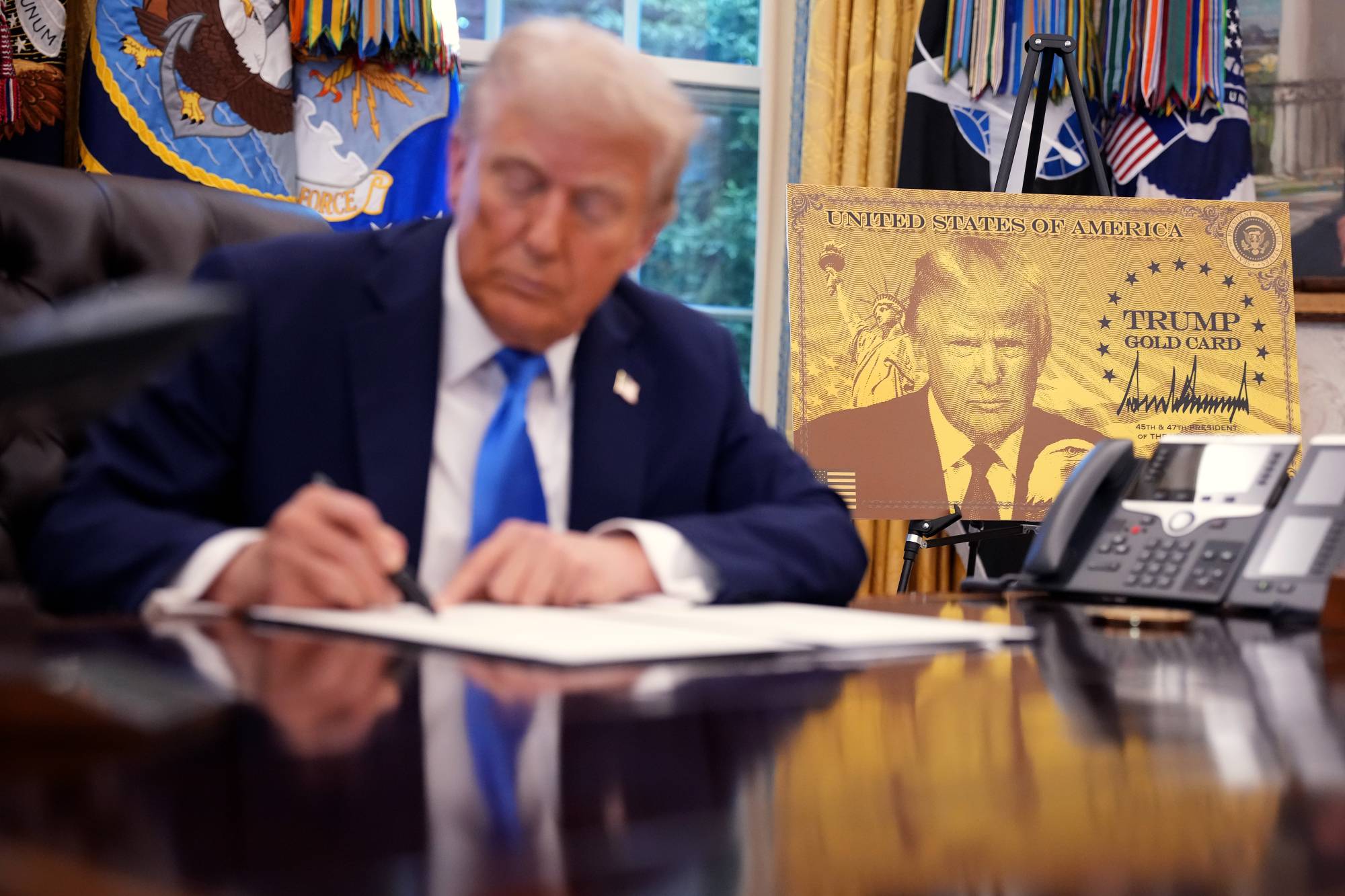
"caption": "A poster of the \"Trump Gold Card\" is seen as President Donald Trump signs an executive order in the Oval Office at the White House on Sept. 19, 2025 in Washington, DC. KQED’s Forum spoke to experts about how H-1B visa holders in the Bay Area are reacting to the latest White House order.",
"credit": "Andrew Harnik/Getty Images",
"altTag": null,
"description": null,
"imgSizes": {
"medium": {
"file": "https://cdn.kqed.org/wp-content/uploads/sites/10/2025/09/GettyImages-2236329361-2000x1333.jpg",
"width": 2000,
"height": 1333,
"mimeType": "image/jpeg"
},
"large": {
"file": "https://cdn.kqed.org/wp-content/uploads/sites/10/2025/09/GettyImages-2236329361-2000x1333.jpg",
"width": 2000,
"height": 1333,
"mimeType": "image/jpeg"
},
"thumbnail": {
"file": "https://cdn.kqed.org/wp-content/uploads/sites/10/2025/09/GettyImages-2236329361-160x107.jpg",
"width": 160,
"height": 107,
"mimeType": "image/jpeg"
},
"1536x1536": {
"file": "https://cdn.kqed.org/wp-content/uploads/sites/10/2025/09/GettyImages-2236329361-1536x1024.jpg",
"width": 1536,
"height": 1024,
"mimeType": "image/jpeg"
},
"2048x2048": {
"file": "https://cdn.kqed.org/wp-content/uploads/sites/10/2025/09/GettyImages-2236329361-2048x1365.jpg",
"width": 2048,
"height": 1365,
"mimeType": "image/jpeg"
},
"post-thumbnail": {
"file": "https://cdn.kqed.org/wp-content/uploads/sites/10/2025/09/GettyImages-2236329361-672x372.jpg",
"width": 672,
"height": 372,
"mimeType": "image/jpeg"
},
"twentyfourteen-full-width": {
"file": "https://cdn.kqed.org/wp-content/uploads/sites/10/2025/09/GettyImages-2236329361-1038x576.jpg",
"width": 1038,
"height": 576,
"mimeType": "image/jpeg"
},
"full-width": {
"file": "https://cdn.kqed.org/wp-content/uploads/sites/10/2025/09/GettyImages-2236329361-2000x1333.jpg",
"width": 2000,
"height": 1333,
"mimeType": "image/jpeg"
},
"kqedFullSize": {
"file": "https://cdn.kqed.org/wp-content/uploads/sites/10/2025/09/GettyImages-2236329361-scaled-e1760568167148.jpg",
"width": 2000,
"height": 1333
}
},
"isLoading": false,
"fetchFailed": false
},
"news_12030712": {
"type": "attachments",
"id": "news_12030712",
"meta": {
"index": "attachments_1716263798",
"site": "news",
"id": "12030712",
"found": true
},
"title": "California Governor Porter",
"publishDate": 1741705079,
"status": "inherit",
"parent": 12030710,
"modified": 1758832591,
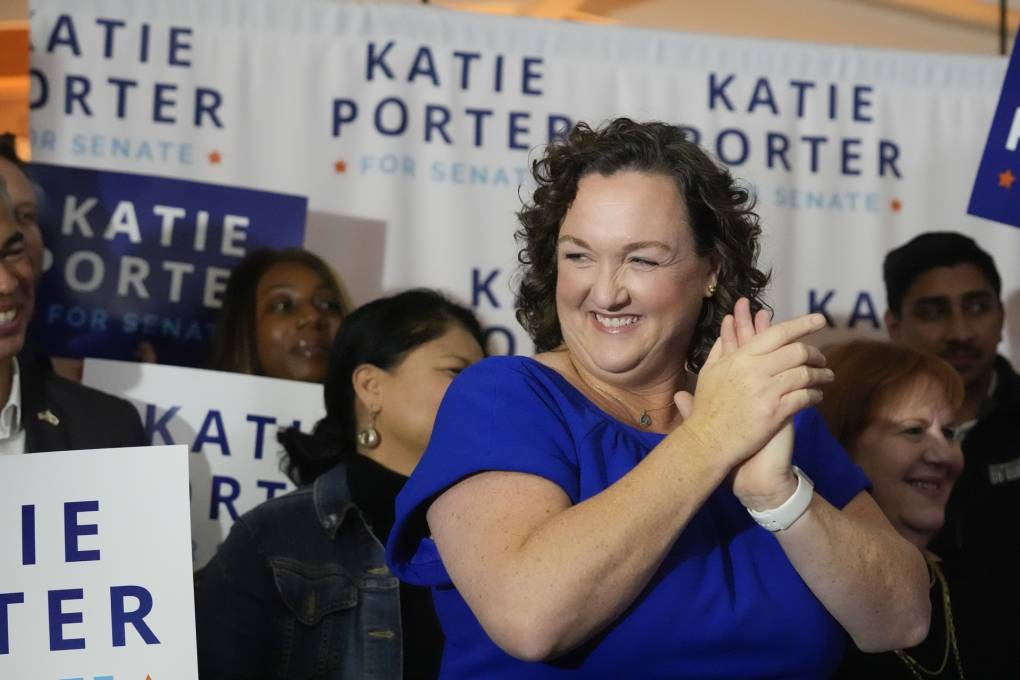
"caption": "Former U.S. Rep. Katie Porter (D-Irvine) smiles as she prepares to address supporters at an election night party, Tuesday, March 5, 2024, in Long Beach, California.",
"credit": "Damian Dovarganes/Associated Press",
"altTag": null,
"description": null,
"imgSizes": {
"medium": {
"file": "https://cdn.kqed.org/wp-content/uploads/sites/10/2025/03/AP25069706250720-800x533.jpg",
"width": 800,
"height": 533,
"mimeType": "image/jpeg"
},
"large": {
"file": "https://cdn.kqed.org/wp-content/uploads/sites/10/2025/03/AP25069706250720-1020x680.jpg",
"width": 1020,
"height": 680,
"mimeType": "image/jpeg"
},
"thumbnail": {
"file": "https://cdn.kqed.org/wp-content/uploads/sites/10/2025/03/AP25069706250720-160x107.jpg",
"width": 160,
"height": 107,
"mimeType": "image/jpeg"
},
"1536x1536": {
"file": "https://cdn.kqed.org/wp-content/uploads/sites/10/2025/03/AP25069706250720-1536x1024.jpg",
"width": 1536,
"height": 1024,
"mimeType": "image/jpeg"
},
"post-thumbnail": {
"file": "https://cdn.kqed.org/wp-content/uploads/sites/10/2025/03/AP25069706250720-672x372.jpg",
"width": 672,
"height": 372,
"mimeType": "image/jpeg"
},
"twentyfourteen-full-width": {
"file": "https://cdn.kqed.org/wp-content/uploads/sites/10/2025/03/AP25069706250720-1038x576.jpg",
"width": 1038,
"height": 576,
"mimeType": "image/jpeg"
},
"kqedFullSize": {
"file": "https://cdn.kqed.org/wp-content/uploads/sites/10/2025/03/AP25069706250720.jpg",
"width": 1920,
"height": 1280
}
},
"isLoading": false,
"fetchFailed": false
},
"news_11688236": {
"type": "attachments",
"id": "news_11688236",
"meta": {
"index": "attachments_1716263798",
"site": "news",
"id": "11688236",
"found": true
},
"title": "RS24077_Courthouse closeup-qut",
"publishDate": 1534965497,
"status": "inherit",
"parent": 11688225,
"modified": 1758739783,
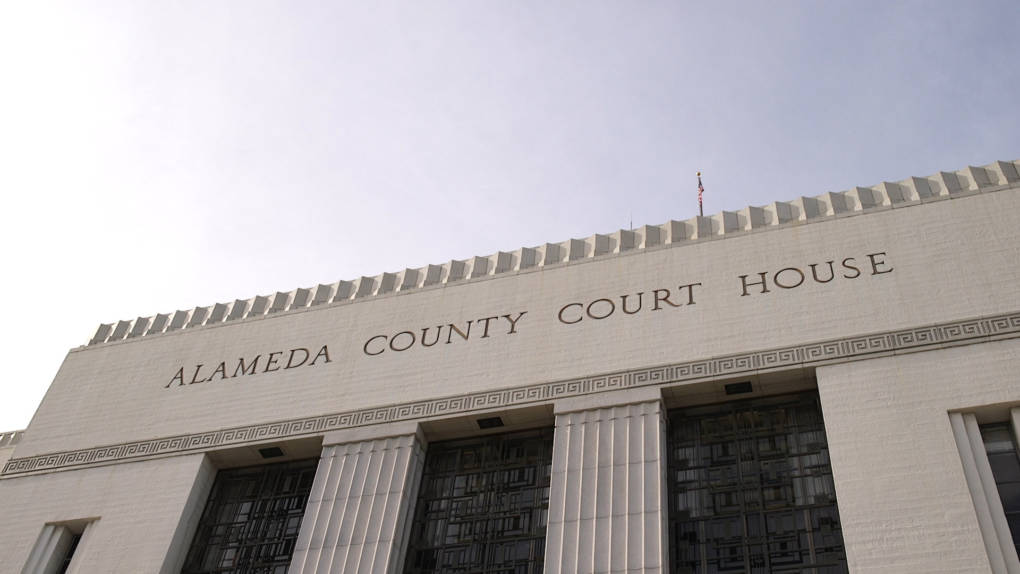
"caption": "Immigration officers detained a man inside an Alameda County courthouse for the first time last week, according to the public defender — a move that would appear to break California law.",
"credit": "Adam Grossberg/KQED",
"altTag": "An image of a courthouse's facade.",
"description": null,
"imgSizes": {
"thumbnail": {
"file": "https://cdn.kqed.org/wp-content/uploads/sites/10/2018/08/RS24077_Courthouse-closeup-qut-160x90.jpg",
"width": 160,
"height": 90,
"mimeType": "image/jpeg"
},
"medium": {
"file": "https://cdn.kqed.org/wp-content/uploads/sites/10/2018/08/RS24077_Courthouse-closeup-qut-800x450.jpg",
"width": 800,
"height": 450,
"mimeType": "image/jpeg"
},
"large": {
"file": "https://cdn.kqed.org/wp-content/uploads/sites/10/2018/08/RS24077_Courthouse-closeup-qut-1020x574.jpg",
"width": 1020,
"height": 574,
"mimeType": "image/jpeg"
},
"complete_open_graph": {
"file": "https://cdn.kqed.org/wp-content/uploads/sites/10/2018/08/RS24077_Courthouse-closeup-qut-1200x675.jpg",
"width": 1200,
"height": 675,
"mimeType": "image/jpeg"
},
"fd-lrg": {
"file": "https://cdn.kqed.org/wp-content/uploads/sites/10/2018/08/RS24077_Courthouse-closeup-qut-1920x1080.jpg",
"width": 1920,
"height": 1080,
"mimeType": "image/jpeg"
},
"fd-med": {
"file": "https://cdn.kqed.org/wp-content/uploads/sites/10/2018/08/RS24077_Courthouse-closeup-qut-1180x664.jpg",
"width": 1180,
"height": 664,
"mimeType": "image/jpeg"
},
"fd-sm": {
"file": "https://cdn.kqed.org/wp-content/uploads/sites/10/2018/08/RS24077_Courthouse-closeup-qut-960x540.jpg",
"width": 960,
"height": 540,
"mimeType": "image/jpeg"
},
"post-thumbnail": {
"file": "https://cdn.kqed.org/wp-content/uploads/sites/10/2018/08/RS24077_Courthouse-closeup-qut-672x372.jpg",
"width": 672,
"height": 372,
"mimeType": "image/jpeg"
},
"twentyfourteen-full-width": {
"file": "https://cdn.kqed.org/wp-content/uploads/sites/10/2018/08/RS24077_Courthouse-closeup-qut-1038x576.jpg",
"width": 1038,
"height": 576,
"mimeType": "image/jpeg"
},
"xxsmall": {
"file": "https://cdn.kqed.org/wp-content/uploads/sites/10/2018/08/RS24077_Courthouse-closeup-qut-240x135.jpg",
"width": 240,
"height": 135,
"mimeType": "image/jpeg"
},
"xsmall": {
"file": "https://cdn.kqed.org/wp-content/uploads/sites/10/2018/08/RS24077_Courthouse-closeup-qut-375x211.jpg",
"width": 375,
"height": 211,
"mimeType": "image/jpeg"
},
"small": {
"file": "https://cdn.kqed.org/wp-content/uploads/sites/10/2018/08/RS24077_Courthouse-closeup-qut-520x293.jpg",
"width": 520,
"height": 293,
"mimeType": "image/jpeg"
},
"xlarge": {
"file": "https://cdn.kqed.org/wp-content/uploads/sites/10/2018/08/RS24077_Courthouse-closeup-qut-1180x664.jpg",
"width": 1180,
"height": 664,
"mimeType": "image/jpeg"
},
"full-width": {
"file": "https://cdn.kqed.org/wp-content/uploads/sites/10/2018/08/RS24077_Courthouse-closeup-qut-1920x1080.jpg",
"width": 1920,
"height": 1080,
"mimeType": "image/jpeg"
},
"guest-author-32": {
"file": "https://cdn.kqed.org/wp-content/uploads/sites/10/2018/08/RS24077_Courthouse-closeup-qut-32x32.jpg",
"width": 32,
"height": 32,
"mimeType": "image/jpeg"
},
"guest-author-50": {
"file": "https://cdn.kqed.org/wp-content/uploads/sites/10/2018/08/RS24077_Courthouse-closeup-qut-50x50.jpg",
"width": 50,
"height": 50,
"mimeType": "image/jpeg"
},
"guest-author-64": {
"file": "https://cdn.kqed.org/wp-content/uploads/sites/10/2018/08/RS24077_Courthouse-closeup-qut-64x64.jpg",
"width": 64,
"height": 64,
"mimeType": "image/jpeg"
},
"guest-author-96": {
"file": "https://cdn.kqed.org/wp-content/uploads/sites/10/2018/08/RS24077_Courthouse-closeup-qut-96x96.jpg",
"width": 96,
"height": 96,
"mimeType": "image/jpeg"
},
"guest-author-128": {
"file": "https://cdn.kqed.org/wp-content/uploads/sites/10/2018/08/RS24077_Courthouse-closeup-qut-128x128.jpg",
"width": 128,
"height": 128,
"mimeType": "image/jpeg"
},
"detail": {
"file": "https://cdn.kqed.org/wp-content/uploads/sites/10/2018/08/RS24077_Courthouse-closeup-qut-150x150.jpg",
"width": 150,
"height": 150,
"mimeType": "image/jpeg"
},
"kqedFullSize": {
"file": "https://cdn.kqed.org/wp-content/uploads/sites/10/2018/08/RS24077_Courthouse-closeup-qut.jpg",
"width": 1920,
"height": 1080
}
},
"isLoading": false,
"fetchFailed": false
},
"news_12057283": {
"type": "attachments",
"id": "news_12057283",
"meta": {
"index": "attachments_1716263798",
"site": "news",
"id": "12057283",
"found": true
},
"title": "calmatters_091825_Fresno-Courthouse_LV_10",
"publishDate": 1758654977,
"status": "inherit",
"parent": 12057278,
"modified": 1758655019,
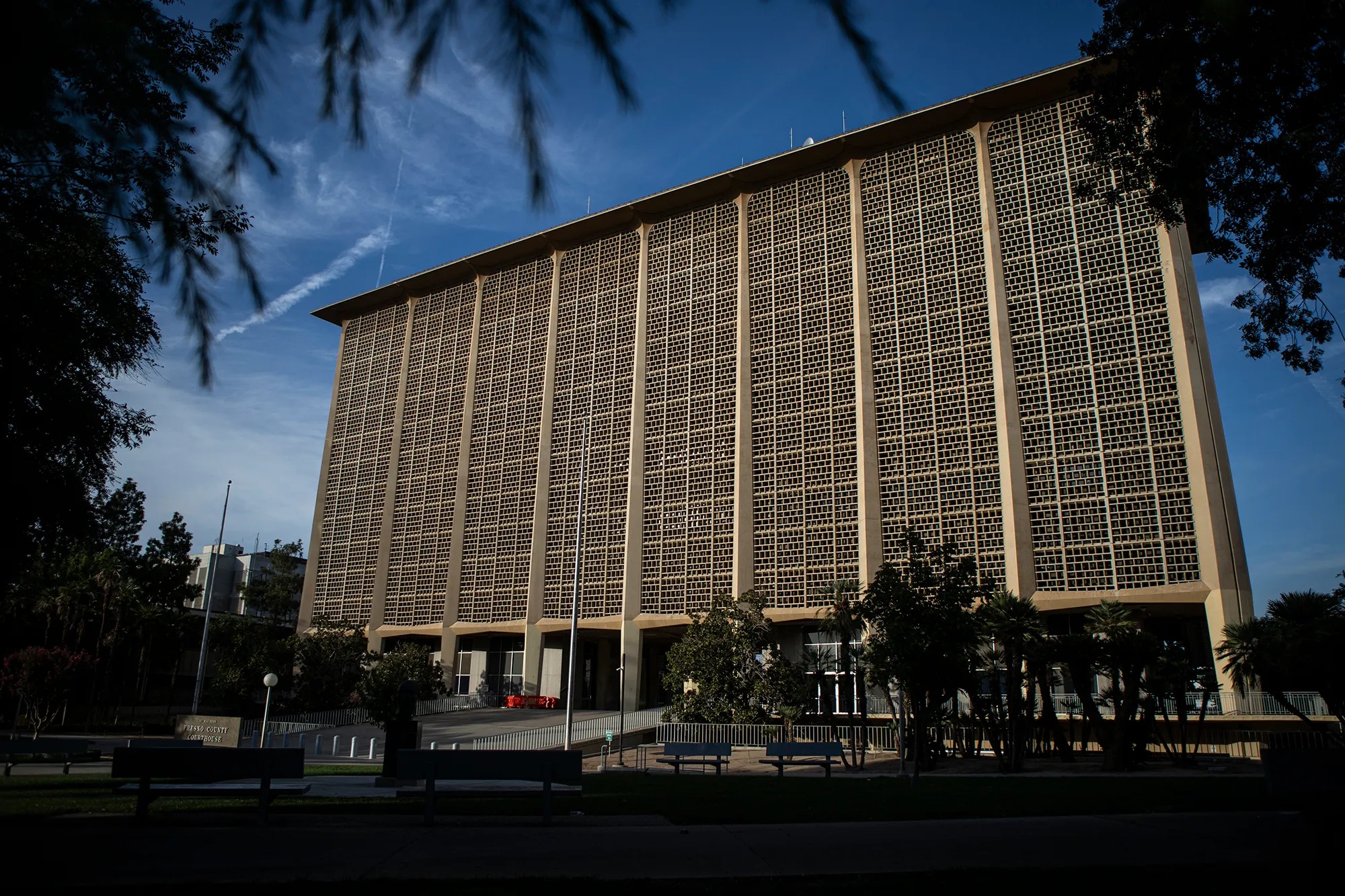
"caption": "The Fresno County Courthouse on Sept. 17, 2025.",
"credit": "Larry Valenzuela, CalMatters/CatchLight Local",
"altTag": null,
"description": null,
"imgSizes": {
"thumbnail": {
"file": "https://cdn.kqed.org/wp-content/uploads/sites/10/2025/09/calmatters_091825_Fresno-Courthouse_LV_10-160x107.jpg",
"width": 160,
"height": 107,
"mimeType": "image/jpeg"
},
"1536x1536": {
"file": "https://cdn.kqed.org/wp-content/uploads/sites/10/2025/09/calmatters_091825_Fresno-Courthouse_LV_10-1536x1024.jpg",
"width": 1536,
"height": 1024,
"mimeType": "image/jpeg"
},
"post-thumbnail": {
"file": "https://cdn.kqed.org/wp-content/uploads/sites/10/2025/09/calmatters_091825_Fresno-Courthouse_LV_10-672x372.jpg",
"width": 672,
"height": 372,
"mimeType": "image/jpeg"
},
"twentyfourteen-full-width": {
"file": "https://cdn.kqed.org/wp-content/uploads/sites/10/2025/09/calmatters_091825_Fresno-Courthouse_LV_10-1038x576.jpg",
"width": 1038,
"height": 576,
"mimeType": "image/jpeg"
},
"kqedFullSize": {
"file": "https://cdn.kqed.org/wp-content/uploads/sites/10/2025/09/calmatters_091825_Fresno-Courthouse_LV_10.jpg",
"width": 2000,
"height": 1333
}
},
"isLoading": false,
"fetchFailed": false
},
"news_12056974": {
"type": "attachments",
"id": "news_12056974",
"meta": {
"index": "attachments_1716263798",
"site": "news",
"id": "12056974",
"found": true
},
"title": "071625_Newsom-ICE-Raids_CM_36 copy",
"publishDate": 1758399342,
"status": "inherit",
"parent": 12056972,
"modified": 1758399371,
"caption": "Gov. Gavin Newsom speaks to the media at Downey Memorial Christian Church after visiting Los Angeles communities affected by immigration raids, in Downey on July 16, 2025. ",
"credit": "Ted Soqui for CalMatters",
"altTag": null,
"description": null,
"imgSizes": {
"thumbnail": {
"file": "https://cdn.kqed.org/wp-content/uploads/sites/10/2025/09/071625_Newsom-ICE-Raids_CM_36-copy-160x107.jpg",
"width": 160,
"height": 107,
"mimeType": "image/jpeg"
},
"1536x1536": {
"file": "https://cdn.kqed.org/wp-content/uploads/sites/10/2025/09/071625_Newsom-ICE-Raids_CM_36-copy-1536x1025.jpg",
"width": 1536,
"height": 1025,
"mimeType": "image/jpeg"
},
"post-thumbnail": {
"file": "https://cdn.kqed.org/wp-content/uploads/sites/10/2025/09/071625_Newsom-ICE-Raids_CM_36-copy-672x372.jpg",
"width": 672,
"height": 372,
"mimeType": "image/jpeg"
},
"twentyfourteen-full-width": {
"file": "https://cdn.kqed.org/wp-content/uploads/sites/10/2025/09/071625_Newsom-ICE-Raids_CM_36-copy-1038x576.jpg",
"width": 1038,
"height": 576,
"mimeType": "image/jpeg"
},
"kqedFullSize": {
"file": "https://cdn.kqed.org/wp-content/uploads/sites/10/2025/09/071625_Newsom-ICE-Raids_CM_36-copy.jpg",
"width": 2000,
"height": 1334
}
},
"isLoading": false,
"fetchFailed": false
},
"news_12056765": {
"type": "attachments",
"id": "news_12056765",
"meta": {
"index": "attachments_1716263798",
"site": "news",
"id": "12056765",
"found": true
},
"title": "250715-ImmigrationCourtProtests-16-BL_qed",
"publishDate": 1758299414,
"status": "inherit",
"parent": 12056762,
"modified": 1758299424,
"caption": "Supporters rally outside the U.S. District Court in San Francisco on July 15, 2025, calling on ICE to release Guillermo Medina Reyes ahead of his preliminary injunction hearing.",
"credit": "Beth LaBerge/KQED",
"altTag": null,
"description": null,
"imgSizes": {
"thumbnail": {
"file": "https://cdn.kqed.org/wp-content/uploads/sites/10/2025/09/250715-ImmigrationCourtProtests-16-BL_qed-160x107.jpg",
"width": 160,
"height": 107,
"mimeType": "image/jpeg"
},
"1536x1536": {
"file": "https://cdn.kqed.org/wp-content/uploads/sites/10/2025/09/250715-ImmigrationCourtProtests-16-BL_qed-1536x1024.jpg",
"width": 1536,
"height": 1024,
"mimeType": "image/jpeg"
},
"post-thumbnail": {
"file": "https://cdn.kqed.org/wp-content/uploads/sites/10/2025/09/250715-ImmigrationCourtProtests-16-BL_qed-672x372.jpg",
"width": 672,
"height": 372,
"mimeType": "image/jpeg"
},
"twentyfourteen-full-width": {
"file": "https://cdn.kqed.org/wp-content/uploads/sites/10/2025/09/250715-ImmigrationCourtProtests-16-BL_qed-1038x576.jpg",
"width": 1038,
"height": 576,
"mimeType": "image/jpeg"
},
"kqedFullSize": {
"file": "https://cdn.kqed.org/wp-content/uploads/sites/10/2025/09/250715-ImmigrationCourtProtests-16-BL_qed.jpg",
"width": 2000,
"height": 1333
}
},
"isLoading": false,
"fetchFailed": false
}
},
"audioPlayerReducer": {
"postId": "stream_live",
"isPaused": true,
"isPlaying": false,
"pfsActive": false,
"pledgeModalIsOpen": true,
"playerDrawerIsOpen": false,
"liveAudioPlayStartedAt": 0,
"liveAudioPlayContext": ""
},
"authorsReducer": {
"byline_news_12057278": {
"type": "authors",
"id": "byline_news_12057278",
"meta": {
"override": true
},
"slug": "byline_news_12057278",
"name": "Nigel Duara, CalMatters",
"isLoading": false
},
"byline_news_12056972": {
"type": "authors",
"id": "byline_news_12056972",
"meta": {
"override": true
},
"slug": "byline_news_12056972",
"name": "Cayla Mihalovich and Jeanne Kuang, CalMatters",
"isLoading": false
},
"scottshafer": {
"type": "authors",
"id": "255",
"meta": {
"index": "authors_1716337520",
"id": "255",
"found": true
},
"name": "Scott Shafer",
"firstName": "Scott",
"lastName": "Shafer",
"slug": "scottshafer",
"email": "sshafer@kqed.org",
"display_author_email": false,
"staff_mastheads": [
"news"
],
"title": "KQED Contributor",
"bio": "Scott Shafer is a senior editor with the KQED Politics and Government desk. He is co-host of Political Breakdown, the award-winning radio show and podcast with a personal take on the world of politics. Scott came to KQED in 1998 to host the statewide\u003cem> California Report\u003c/em>. Prior to that he had extended stints in politics and government\u003cem>.\u003c/em> He uses that inside experience at KQED in his, reporting, hosting and analysis for the politics desk. Scott collaborated \u003cem>Political Breakdown a\u003c/em>nd on \u003cem>The Political Mind of Jerry Brown, \u003c/em>an eight-part series about the life and extraordinary political career of the former governor. For fun, he plays water polo with the San Francisco Tsunami.",
"avatar": "https://secure.gravatar.com/avatar/a62ebae45b79d7aed1a39a0e3bf68104?s=600&d=blank&r=g",
"twitter": "scottshafer",
"bluesky": null,
"facebook": null,
"instagram": null,
"linkedin": null,
"sites": [
{
"site": "news",
"roles": [
"editor"
]
},
{
"site": "stateofhealth",
"roles": [
"author"
]
},
{
"site": "science",
"roles": [
"author"
]
},
{
"site": "forum",
"roles": [
"subscriber"
]
},
{
"site": "liveblog",
"roles": [
"author"
]
}
],
"headData": {
"title": "Scott Shafer | KQED",
"description": "KQED Contributor",
"ogImgSrc": "https://secure.gravatar.com/avatar/a62ebae45b79d7aed1a39a0e3bf68104?s=600&d=blank&r=g",
"twImgSrc": "https://secure.gravatar.com/avatar/a62ebae45b79d7aed1a39a0e3bf68104?s=600&d=blank&r=g"
},
"isLoading": false,
"link": "/author/scottshafer"
},
"tychehendricks": {
"type": "authors",
"id": "259",
"meta": {
"index": "authors_1716337520",
"id": "259",
"found": true
},
"name": "Tyche Hendricks",
"firstName": "Tyche",
"lastName": "Hendricks",
"slug": "tychehendricks",
"email": "thendricks@kqed.org",
"display_author_email": true,
"staff_mastheads": [
"news"
],
"title": "KQED Senior Editor, Immigration",
"bio": "\u003cspan style=\"font-weight: 400;\">Tyche Hendricks is KQED’s senior editor for immigration, leading coverage of the policy and politics that affect California’s immigrant communities. Her work for KQED’s radio and online audiences is also carried on NPR and other national outlets. She has been recognized with awards from the Radio and Television News Directors Association, the Society for Professional Journalists; the Education Writers Association; the Best of the West and the National Federation of Community Broadcasters. Before joining KQED in 2010, Tyche spent more than a dozen years as a newspaper reporter, notably at the \u003c/span>\u003ci>\u003cspan style=\"font-weight: 400;\">San Francisco Chronicle\u003c/span>\u003c/i>\u003cspan style=\"font-weight: 400;\">. At different times she has covered criminal justice, government and politics and urban planning. Tyche has taught in the MFA Creative Writing program at the University of San Francisco and at UC Berkeley’s Graduate School of Journalism, where she was co-director of a national immigration symposium for professional journalists. She is the author of \u003c/span>\u003ci>\u003cspan style=\"font-weight: 400;\">The Wind Doesn't Need a Passport: Stories from the U.S.-Mexico Borderlands\u003c/span>\u003c/i>\u003cspan style=\"font-weight: 400;\"> (University of California Press). \u003c/span>",
"avatar": "https://secure.gravatar.com/avatar/b8ee458e2731c2d43df86882ce17267e?s=600&d=blank&r=g",
"twitter": "tychehendricks",
"facebook": null,
"instagram": null,
"linkedin": null,
"sites": [
{
"site": "news",
"roles": [
"editor"
]
},
{
"site": "stateofhealth",
"roles": [
"editor"
]
}
],
"headData": {
"title": "Tyche Hendricks | KQED",
"description": "KQED Senior Editor, Immigration",
"ogImgSrc": "https://secure.gravatar.com/avatar/b8ee458e2731c2d43df86882ce17267e?s=600&d=blank&r=g",
"twImgSrc": "https://secure.gravatar.com/avatar/b8ee458e2731c2d43df86882ce17267e?s=600&d=blank&r=g"
},
"isLoading": false,
"link": "/author/tychehendricks"
},
"mlagos": {
"type": "authors",
"id": "3239",
"meta": {
"index": "authors_1716337520",
"id": "3239",
"found": true
},
"name": "Marisa Lagos",
"firstName": "Marisa",
"lastName": "Lagos",
"slug": "mlagos",
"email": "mlagos@kqed.org",
"display_author_email": false,
"staff_mastheads": [
"news"
],
"title": "KQED Contributor",
"bio": "Marisa Lagos is a correspondent for KQED’s California Politics and Government Desk and co-hosts the award-winning show and podcast, Political Breakdown. At KQED, Lagos also conducts reporting, analysis and investigations into state, local and national politics for radio, TV, online and onstage. In 2022, she and co-host, Scott Shafer, moderated the only gubernatorial debate in California. In 2020, the \u003ci>Washington Post\u003c/i> named her one of the top political journalists in California; she was nominated for a Peabody and won several other awards for her work investigating the 2017 California wildfires. She has worked at the \u003ci>San Francisco Chronicle\u003c/i>, \u003ci>San Francisco Examiner\u003c/i> and \u003ci>Los Angeles Times\u003c/i>. A UC Santa Barbara graduate, she lives in San Francisco with her two sons and husband.",
"avatar": "https://secure.gravatar.com/avatar/a261a0d3696fc066871ef96b85b5e7d2?s=600&d=blank&r=g",
"twitter": "@mlagos",
"facebook": null,
"instagram": null,
"linkedin": null,
"sites": [
{
"site": "arts",
"roles": [
"author"
]
},
{
"site": "news",
"roles": [
"editor"
]
},
{
"site": "science",
"roles": [
"editor"
]
},
{
"site": "forum",
"roles": [
"author"
]
},
{
"site": "liveblog",
"roles": [
"author"
]
}
],
"headData": {
"title": "Marisa Lagos | KQED",
"description": "KQED Contributor",
"ogImgSrc": "https://secure.gravatar.com/avatar/a261a0d3696fc066871ef96b85b5e7d2?s=600&d=blank&r=g",
"twImgSrc": "https://secure.gravatar.com/avatar/a261a0d3696fc066871ef96b85b5e7d2?s=600&d=blank&r=g"
},
"isLoading": false,
"link": "/author/mlagos"
},
"btorres": {
"type": "authors",
"id": "11666",
"meta": {
"index": "authors_1716337520",
"id": "11666",
"found": true
},
"name": "Blanca Torres",
"firstName": "Blanca",
"lastName": "Torres",
"slug": "btorres",
"email": "btorres@kqed.org",
"display_author_email": true,
"staff_mastheads": [
"news"
],
"title": "Producer, Forum",
"bio": "Blanca Torres brings sharp news judgement and keen sense of lively conversation to her work as producer for Forum. She loves producing shows that leave listeners feeling like they heard distinctive voices, learned something new and gained a fresh perspective.\r\n\r\nShe joined KQED in January of 2020 after 16 years of working as a newspaper reporter most recently at the \u003cem>San Francisco Business Times,\u003c/em> where she wrote about real estate and economic development. Before that, she covered a variety of beats including crime, education, retail, workplace, the economy, consumer issues, and small business for the \u003cem>Contra Costa Times, Baltimore Sun\u003c/em> and\u003cem> The Seattle Times\u003c/em>. In addition to reporting, she worked as an editorial writer and columnist for the \u003cem>Seattle Times\u003c/em>. From 2017 to 2020, Blanca won a total of ten awards from the National Association of Real Estate Editors and won first place for land use reporting from the California News Publishers Association two years in a row. She is also a member and former board member for the National Association of Hispanic Journalists.\r\n\r\nA native of the Pacific Northwest, Blanca earned her bachelor's degree from Vanderbilt University in Nashville and a master's in fine arts in creative writing at Mills College. She lives in the East Bay with her family.",
"avatar": "https://secure.gravatar.com/avatar/f2322ff46076d337f7ba731ee6068cb1?s=600&d=blank&r=g",
"twitter": "@blancawrites",
"facebook": null,
"instagram": null,
"linkedin": null,
"sites": [
{
"site": "arts",
"roles": [
"editor"
]
},
{
"site": "news",
"roles": [
"editor"
]
},
{
"site": "forum",
"roles": [
"editor"
]
}
],
"headData": {
"title": "Blanca Torres | KQED",
"description": "Producer, Forum",
"ogImgSrc": "https://secure.gravatar.com/avatar/f2322ff46076d337f7ba731ee6068cb1?s=600&d=blank&r=g",
"twImgSrc": "https://secure.gravatar.com/avatar/f2322ff46076d337f7ba731ee6068cb1?s=600&d=blank&r=g"
},
"isLoading": false,
"link": "/author/btorres"
},
"amadrigal": {
"type": "authors",
"id": "11757",
"meta": {
"index": "authors_1716337520",
"id": "11757",
"found": true
},
"name": "Alexis Madrigal",
"firstName": "Alexis",
"lastName": "Madrigal",
"slug": "amadrigal",
"email": "amadrigal@kqed.org",
"display_author_email": true,
"staff_mastheads": [],
"title": "Co-Host Forum",
"bio": "Alexis Madrigal is the co-host of Forum. He is also a contributing writer at \u003cem>The Atlantic \u003c/em>and the co-founder of the COVID Tracking Project. He's the creator of the podcast, \u003cem>Containers\u003c/em>, and has been a staff writer at \u003cem>Wired. \u003c/em>He was a visiting scholar at UC Berkeley's Information School, and is working on a book about Oakland and the Bay Area's revolutionary ideas.",
"avatar": "https://secure.gravatar.com/avatar/200d13dd6cebef55bf04327dec901b3d?s=600&d=blank&r=g",
"twitter": "alexismadrigal",
"bluesky": null,
"facebook": null,
"instagram": null,
"linkedin": null,
"sites": [
{
"site": "arts",
"roles": [
"editor"
]
},
{
"site": "news",
"roles": [
"editor"
]
},
{
"site": "forum",
"roles": [
"editor"
]
}
],
"headData": {
"title": "Alexis Madrigal | KQED",
"description": "Co-Host Forum",
"ogImgSrc": "https://secure.gravatar.com/avatar/200d13dd6cebef55bf04327dec901b3d?s=600&d=blank&r=g",
"twImgSrc": "https://secure.gravatar.com/avatar/200d13dd6cebef55bf04327dec901b3d?s=600&d=blank&r=g"
},
"isLoading": false,
"link": "/author/amadrigal"
},
"sjohnson": {
"type": "authors",
"id": "11840",
"meta": {
"index": "authors_1716337520",
"id": "11840",
"found": true
},
"name": "Sydney Johnson",
"firstName": "Sydney",
"lastName": "Johnson",
"slug": "sjohnson",
"email": "sjohnson@kqed.org",
"display_author_email": false,
"staff_mastheads": [
"news"
],
"title": "KQED Reporter",
"bio": "Sydney Johnson is a general assignment reporter at KQED. She previously reported on public health and city government at the San Francisco Examiner, and before that, she covered statewide education policy for EdSource. Her reporting has won multiple local, state and national awards. Sydney is a graduate of the University of California, Berkeley and lives in San Francisco.",
"avatar": "https://secure.gravatar.com/avatar/97855f2719b72ad6190b7c535fe642c8?s=600&d=blank&r=g",
"twitter": "sydneyfjohnson",
"facebook": null,
"instagram": null,
"linkedin": null,
"sites": [
{
"site": "news",
"roles": [
"editor"
]
}
],
"headData": {
"title": "Sydney Johnson | KQED",
"description": "KQED Reporter",
"ogImgSrc": "https://secure.gravatar.com/avatar/97855f2719b72ad6190b7c535fe642c8?s=600&d=blank&r=g",
"twImgSrc": "https://secure.gravatar.com/avatar/97855f2719b72ad6190b7c535fe642c8?s=600&d=blank&r=g"
},
"isLoading": false,
"link": "/author/sjohnson"
},
"nkhan": {
"type": "authors",
"id": "11867",
"meta": {
"index": "authors_1716337520",
"id": "11867",
"found": true
},
"name": "Nisa Khan",
"firstName": "Nisa",
"lastName": "Khan",
"slug": "nkhan",
"email": "nkhan@kqed.org",
"display_author_email": false,
"staff_mastheads": [],
"title": "KQED Contributor",
"bio": "Nisa Khan is a reporter for KQED's Audience News Desk. She was formerly a data reporter at Michigan Radio. She earned a Bachelor of Science in Information from the University of Michigan and a Master of Arts in Communication from Stanford University.",
"avatar": "https://secure.gravatar.com/avatar/a3bf1efcfbe7658d13a434cc54d0b2e3?s=600&d=blank&r=g",
"twitter": "mnisakhan",
"bluesky": null,
"facebook": null,
"instagram": null,
"linkedin": null,
"sites": [
{
"site": "arts",
"roles": [
"editor"
]
},
{
"site": "news",
"roles": [
"editor"
]
},
{
"site": "science",
"roles": [
"editor",
"author"
]
},
{
"site": "forum",
"roles": [
"editor"
]
},
{
"site": "liveblog",
"roles": [
"contributor"
]
}
],
"headData": {
"title": "Nisa Khan | KQED",
"description": "KQED Contributor",
"ogImgSrc": "https://secure.gravatar.com/avatar/a3bf1efcfbe7658d13a434cc54d0b2e3?s=600&d=blank&r=g",
"twImgSrc": "https://secure.gravatar.com/avatar/a3bf1efcfbe7658d13a434cc54d0b2e3?s=600&d=blank&r=g"
},
"isLoading": false,
"link": "/author/nkhan"
},
"jgeha": {
"type": "authors",
"id": "11906",
"meta": {
"index": "authors_1716337520",
"id": "11906",
"found": true
},
"name": "Joseph Geha",
"firstName": "Joseph",
"lastName": "Geha",
"slug": "jgeha",
"email": "jgeha@kqed.org",
"display_author_email": false,
"staff_mastheads": [
"news",
"science"
],
"title": "KQED Contributor",
"bio": null,
"avatar": "https://secure.gravatar.com/avatar/ea84d2b6dd93d6369d453edf19dd583f117cd1759d2d9c9c92f9de77017354fe?s=600&d=blank&r=g",
"twitter": null,
"bluesky": null,
"facebook": null,
"instagram": null,
"linkedin": null,
"sites": [
{
"site": "news",
"roles": [
"editor"
]
},
{
"site": "liveblog",
"roles": [
"author"
]
}
],
"headData": {
"title": "Joseph Geha | KQED",
"description": "KQED Contributor",
"ogImgSrc": "https://secure.gravatar.com/avatar/ea84d2b6dd93d6369d453edf19dd583f117cd1759d2d9c9c92f9de77017354fe?s=600&d=blank&r=g",
"twImgSrc": "https://secure.gravatar.com/avatar/ea84d2b6dd93d6369d453edf19dd583f117cd1759d2d9c9c92f9de77017354fe?s=600&d=blank&r=g"
},
"isLoading": false,
"link": "/author/jgeha"
},
"kdebenedetti": {
"type": "authors",
"id": "11913",
"meta": {
"index": "authors_1716337520",
"id": "11913",
"found": true
},
"name": "Katie DeBenedetti",
"firstName": "Katie",
"lastName": "DeBenedetti",
"slug": "kdebenedetti",
"email": "kdebenedetti@kqed.org",
"display_author_email": false,
"staff_mastheads": [
"news",
"science"
],
"title": "KQED Contributor",
"bio": "Katie DeBenedetti is a digital reporter covering daily news for the Express Desk. Prior to joining KQED as a culture reporting intern in January 2024, she covered education and city government for the Napa Valley Register.",
"avatar": "https://secure.gravatar.com/avatar/6e31073cb8f7e4214ab03f42771d0f45?s=600&d=blank&r=g",
"twitter": null,
"facebook": null,
"instagram": null,
"linkedin": null,
"sites": [
{
"site": "news",
"roles": [
"author"
]
},
{
"site": "science",
"roles": [
"author"
]
},
{
"site": "liveblog",
"roles": [
"author"
]
}
],
"headData": {
"title": "Katie DeBenedetti | KQED",
"description": "KQED Contributor",
"ogImgSrc": "https://secure.gravatar.com/avatar/6e31073cb8f7e4214ab03f42771d0f45?s=600&d=blank&r=g",
"twImgSrc": "https://secure.gravatar.com/avatar/6e31073cb8f7e4214ab03f42771d0f45?s=600&d=blank&r=g"
},
"isLoading": false,
"link": "/author/kdebenedetti"
},
"sprabha": {
"type": "authors",
"id": "11976",
"meta": {
"index": "authors_1716337520",
"id": "11976",
"found": true
},
"name": "Srishti Prabha",
"firstName": "Srishti",
"lastName": "Prabha",
"slug": "sprabha",
"email": "sprabha@KQED.org",
"display_author_email": false,
"staff_mastheads": [],
"title": "KQED Contributor",
"bio": null,
"avatar": "https://secure.gravatar.com/avatar/cc4d8ef770090714faad7e1d24857f806d09340456c5734167b9a6361b175d7d?s=600&d=blank&r=g",
"twitter": null,
"bluesky": null,
"facebook": null,
"instagram": null,
"linkedin": null,
"sites": [
{
"site": "news",
"roles": [
"editor"
]
}
],
"headData": {
"title": "Srishti Prabha | KQED",
"description": "KQED Contributor",
"ogImgSrc": "https://secure.gravatar.com/avatar/cc4d8ef770090714faad7e1d24857f806d09340456c5734167b9a6361b175d7d?s=600&d=blank&r=g",
"twImgSrc": "https://secure.gravatar.com/avatar/cc4d8ef770090714faad7e1d24857f806d09340456c5734167b9a6361b175d7d?s=600&d=blank&r=g"
},
"isLoading": false,
"link": "/author/sprabha"
}
},
"pagesReducer": {
"news_tag_immigration": {
"type": "terms",
"id": "news_20202",
"meta": {
"index": "terms_1716263798",
"site": "news",
"id": "20202",
"score": 6.90445
},
"featImg": null,
"name": "immigration",
"description": null,
"taxonomy": "tag",
"headData": {
"twImgId": null,
"twTitle": null,
"ogTitle": null,
"ogImgId": null,
"twDescription": null,
"description": null,
"title": "immigration Archives | KQED News",
"ogDescription": null
},
"ttid": 20219,
"slug": "immigration",
"isLoading": false,
"title": "immigration",
"pageMeta": {
"site": "news",
"WpPageTemplate": "page-topic-editorial",
"currentPage": 17
},
"blocks": [
{
"blockName": "kqed/post-list",
"attrs": {
"layout": "cardArticle2",
"query": "posts/news?tag=immigration",
"seeMore": false,
"paginated": true,
"page": 17
}
},
{
"blockName": "kqed/ad"
}
]
}
},
"pfsSessionReducer": {},
"postsReducer": {
"stream_live": {
"type": "live",
"id": "stream_live",
"audioUrl": "https://streams.kqed.org/kqedradio",
"title": "Live Stream",
"excerpt": "Live Stream information currently unavailable.",
"link": "/radio",
"featImg": "",
"label": {
"name": "KQED Live",
"link": "/"
}
},
"stream_kqedNewscast": {
"type": "posts",
"id": "stream_kqedNewscast",
"audioUrl": "https://www.kqed.org/.stream/anon/radio/RDnews/newscast.mp3?_=1",
"title": "KQED Newscast",
"featImg": "",
"label": {
"name": "88.5 FM",
"link": "/"
}
},
"news_12058796": {
"type": "posts",
"id": "news_12058796",
"meta": {
"index": "posts_1716263798",
"site": "news",
"id": "12058796",
"score": null,
"sort": [
1760277608000
]
},
"guestAuthors": [],
"slug": "need-a-gorgeous-diwali-outfit-nimisha-aunty-will-take-care-of-you",
"title": "Need a Gorgeous Diwali Outfit? Nimisha Aunty Will Take Care of You",
"publishDate": 1760277608,
"format": "standard",
"headTitle": "Need a Gorgeous Diwali Outfit? Nimisha Aunty Will Take Care of You | KQED",
"labelTerm": {
"term": 26731,
"site": "news"
},
"content": "\u003cp>On a recent weekend, a Morgan Hill home’s two-car garage was transformed into something dazzling.\u003c/p>\n\u003cp>Fingers grazed sequined saris and embroidered chaniya cholis lining the walls, and reached for the gold and silver jewelry that shimmered from the center table. Shoppers chattered in Hindi and Gujarati.\u003c/p>\n\u003cp>“Aunty, you are sparkling,” one woman called across the room to an elderly woman trying on a patterned salwar.\u003c/p>\n\u003cp>[ad fullwidth]\u003c/p>\n\u003cp>This is Nivy’s Nook, the homegrown boutique Nimisha Jadav runs out of her garage. In between hangers and clothing racks, she pulled options for shoppers and peeled away packaging, excitedly showing Rakhee Mohanty what she brought back for Mohanty’s daughter from India.\u003c/p>\n\u003cp>“I felt like I was shopping for my daughter,” laughed Jadav, holding up a multicolored sharara with a sequined crop top.\u003c/p>\n\u003cfigure id=\"attachment_12056082\" class=\"wp-caption aligncenter\" style=\"max-width: 2000px\">\u003ca href=\"https://cdn.kqed.org/wp-content/uploads/sites/10/2025/09/250913-NIMISHAAUNTY00237_TV-KQED.jpg\">\u003cimg loading=\"lazy\" decoding=\"async\" class=\"size-full wp-image-12056082\" src=\"https://cdn.kqed.org/wp-content/uploads/sites/10/2025/09/250913-NIMISHAAUNTY00237_TV-KQED.jpg\" alt=\"\" width=\"2000\" height=\"1333\" srcset=\"https://cdn.kqed.org/wp-content/uploads/sites/10/2025/09/250913-NIMISHAAUNTY00237_TV-KQED.jpg 2000w, https://cdn.kqed.org/wp-content/uploads/sites/10/2025/09/250913-NIMISHAAUNTY00237_TV-KQED-160x107.jpg 160w, https://cdn.kqed.org/wp-content/uploads/sites/10/2025/09/250913-NIMISHAAUNTY00237_TV-KQED-1536x1024.jpg 1536w\" sizes=\"auto, (max-width: 2000px) 100vw, 2000px\">\u003c/a>\u003cfigcaption class=\"wp-caption-text\">Nimisha Jadav measures a top for a customer at her home-based business Nivy’s Nook in Morgan Hill on September 13, 2025. \u003ccite>(Tâm Vũ/KQED)\u003c/cite>\u003c/figcaption>\u003c/figure>\n\u003cp>“It’s so beautiful,” replies Mohanty. “Perfect for Diwali.”\u003c/p>\n\u003cp>As the festival of lights and new beginnings approaches, Nivy’s Nook stands as a cultural anchor in the South Bay: a gathering place, and a touchstone of culture, memory and belonging.\u003c/p>\n\u003cp>Looking in a mirror, Pooja Sharma held an earring up to her ear.\u003c/p>\n\u003cp>“Once you move out of India, you really want to embrace the roots more,” she explained. “The fact that [Jadav] is even conducting this [pop-up shop] close to the festival shows that we all want to be connected. I think the importance is there’s a sense of belongingness where you feel like you have your people here.”\u003c/p>\n\u003ch2>Every thread carries a memory\u003c/h2>\n\u003cp>Jadav started the business nearly a decade ago, despite the many warnings from her friends, she said. At first she kept her job as an accountant, but last year she devoted herself to the boutique full time.\u003c/p>\n\u003cp>“I think of it as my passion,” she said. “I have the opportunity to turn [it] into something that is out there to help people.”[aside postID=news_12058091 hero='https://cdn.kqed.org/wp-content/uploads/sites/10/2025/09/250831-CREATIVEMUTUALAID00140_TV-KQED.jpg']Each year Jadav returns to her home country of India, gathering textiles and jewelry to bring back to the Bay Area. But the shop is more than a marketplace — every thread carries a memory.\u003c/p>\n\u003cp>“It’s my tradition,” she said. “It’s something I’ve seen our mothers wear, our grandmothers wear and I feel like when I wear a sari, it takes me back home.”\u003c/p>\n\u003cp>That sense of belonging is what Jadav craved when she first immigrated to the U.S. as a young adult in 1986. She lived in Washington and Texas before moving to the Bay Area. She recalled being ridiculed for her skin color, food and clothing.\u003c/p>\n\u003cp>“I was picked upon because I was brown-skinned. I was picked upon because I was eating this weird food that the normal American people don’t eat,” she said.\u003c/p>\n\u003cp>But when she moved to San José in 1999, she said she felt welcomed.\u003c/p>\n\u003cp>“The way I dressed was not an issue, putting a bindi on was not an issue and wearing Indian clothes and going to the grocery store is not a weird thing,” she said. “So that is where you feel like you belong.”\u003c/p>\n\u003cfigure id=\"attachment_12056085\" class=\"wp-caption aligncenter\" style=\"max-width: 2000px\">\u003ca href=\"https://cdn.kqed.org/wp-content/uploads/sites/10/2025/09/250913-NIMISHAAUNTY00487_TV-KQED.jpg\">\u003cimg loading=\"lazy\" decoding=\"async\" class=\"size-full wp-image-12056085\" src=\"https://cdn.kqed.org/wp-content/uploads/sites/10/2025/09/250913-NIMISHAAUNTY00487_TV-KQED.jpg\" alt=\"\" width=\"2000\" height=\"1333\" srcset=\"https://cdn.kqed.org/wp-content/uploads/sites/10/2025/09/250913-NIMISHAAUNTY00487_TV-KQED.jpg 2000w, https://cdn.kqed.org/wp-content/uploads/sites/10/2025/09/250913-NIMISHAAUNTY00487_TV-KQED-160x107.jpg 160w, https://cdn.kqed.org/wp-content/uploads/sites/10/2025/09/250913-NIMISHAAUNTY00487_TV-KQED-1536x1024.jpg 1536w\" sizes=\"auto, (max-width: 2000px) 100vw, 2000px\">\u003c/a>\u003cfigcaption class=\"wp-caption-text\">Alpa Nagarsheth (left) shops with the help of Nimisha Jadav (right) at Jadav’s home-based clothing business, Nivy’s Nook, in Morgan Hill on September 13, 2025. \u003ccite>(Tâm Vũ/KQED)\u003c/cite>\u003c/figcaption>\u003c/figure>\n\u003cp>Her experience is part of a much longer history of South Asians making a home in California. The first documented Indian immigrants \u003ca href=\"https://guides.lib.berkeley.edu/echoes-of-freedom\">arrived as early as 1857\u003c/a>, possibly working in the gold fields. But it wasn’t until the passage of the Immigration and Nationality Act of 1965 — which removed quotas on Asian immigrants — that South Asians increasingly made their way to California, drawn by educational opportunities and high-tech jobs.\u003c/p>\n\u003cp>Many settled in Silicon Valley, helping make California one of the \u003ca href=\"https://saalt.org/wp-content/uploads/2019/04/SAALT-Demographic-Snapshot-2019.pdf\">top three\u003c/a> states for South Asian immigrants. By 1993, Indians made up \u003ca href=\"https://www.ppic.org/wp-content/uploads/content/pubs/report/R_699ASR.pdf\">23%\u003c/a> of the Bay Area’s foreign-born engineers. Today, Asians account for \u003ca href=\"https://siliconvalleyindicators.org/data/people/talent-flows-diversity/racial-and-ethnic-composition/population-share-by-race-ethnicity/\">37%\u003c/a> of the population in Santa Clara and San Mateo counties, with a large share of that growth driven by Chinese and Indian communities.\u003c/p>\n\u003ch2>A business that became a lifeline\u003c/h2>\n\u003cp>The connections forged at Nivy’s Nook rarely end with a sale. For Vidya Srinivas of Los Banos, a sari she bought from Jadav ten years ago marked the beginning of a relationship that still endures.\u003c/p>\n\u003cp>“We are a family,” Srinivas said. “I’ve seen her kids grow up, she knows my kids [and] they know Nimisha Aunty.”[aside postID=news_12056999 hero='https://cdn.kqed.org/wp-content/uploads/sites/10/2025/08/250806-HOLOCAUSTREPARATIONS-06-KQED.jpg']When Srinivas lost a cousin suddenly, she said Jadav was there to comfort her.\u003c/p>\n\u003cp>“I was crying and she just called and said, ‘what’s happening?’ and we shared that bond,” said Srinivas. “She knew what to do, just being there, just to listen.”\u003c/p>\n\u003cp>Jadav, too, has leaned on this community. After losing her mother, brother and sister in quick succession, she said the Nivy’s Nook circle carried her through grief.\u003c/p>\n\u003cp>“A lot of unknown people that didn’t know me, they all came together,” she remembered.\u003c/p>\n\u003cp>Customers dropped off food and texted her messages of support, she said.\u003c/p>\n\u003cp>“‘Hope you’re okay today. You’ll get through this,’” she recalled. “It made me realize that I’m not alone and I have somebody who’s got my back and I wanna be that for someone.”\u003c/p>\n\u003ch2>A multi-generational gathering place\u003c/h2>\n\u003cp>For many shoppers, Jadav’s garage feels like stepping into India.\u003c/p>\n\u003cp>Harbans Chhabra, an elderly woman living in Morgan Hill, explained in Hindi: “Even in India, I have to look for places to go. Here, you can easily get clothes — Especially at my age, it’s nice to be able to do that.”\u003c/p>\n\u003cfigure id=\"attachment_12056083\" class=\"wp-caption aligncenter\" style=\"max-width: 2000px\">\u003ca href=\"https://cdn.kqed.org/wp-content/uploads/sites/10/2025/09/250913-NIMISHAAUNTY00373_TV-KQED.jpg\">\u003cimg loading=\"lazy\" decoding=\"async\" class=\"size-full wp-image-12056083\" src=\"https://cdn.kqed.org/wp-content/uploads/sites/10/2025/09/250913-NIMISHAAUNTY00373_TV-KQED.jpg\" alt=\"\" width=\"2000\" height=\"1333\" srcset=\"https://cdn.kqed.org/wp-content/uploads/sites/10/2025/09/250913-NIMISHAAUNTY00373_TV-KQED.jpg 2000w, https://cdn.kqed.org/wp-content/uploads/sites/10/2025/09/250913-NIMISHAAUNTY00373_TV-KQED-160x107.jpg 160w, https://cdn.kqed.org/wp-content/uploads/sites/10/2025/09/250913-NIMISHAAUNTY00373_TV-KQED-1536x1024.jpg 1536w\" sizes=\"auto, (max-width: 2000px) 100vw, 2000px\">\u003c/a>\u003cfigcaption class=\"wp-caption-text\">Harbans Chabra shops at Nivy’s Nook, a home-based business run by Nimisha Jadav, in Morgan Hill on September 13, 2025. \u003ccite>(Tâm Vũ/KQED)\u003c/cite>\u003c/figcaption>\u003c/figure>\n\u003cp>Younger visitors see the space as a bridge to their heritage. Ritika Kumar, who grew up in San José, said Jadav — who she also affectionately calls “Aunty” — holds generational knowledge.\u003c/p>\n\u003cp>“There’s all these different prints that come from different parts of India, and Nimisha Aunty, whether or not she carries it directly, has access to getting those, which as a first generation, I could have never dreamt of having access to,” Kumar said. “I want to stay connected to my roots and it matters to me because it is my identity.”\u003c/p>\n\u003cp>Srinivas adds that Jadav has to be well-versed in the diverse traditions of India to source the right materials.\u003c/p>\n\u003cp>“She knows for [the Hindu festival] Sankranti, usually for South Indians, that’s the only time we wear black,” Srinivas described. “So she will have a range of black with different prints.”\u003c/p>\n\u003cp>Deepali Khullar, who recently visited for the first time, said she was struck by the energy in the room.[aside postID=news_12055649 hero='https://cdn.kqed.org/wp-content/uploads/sites/10/2025/09/250905-JackieKeliiaa-01-BL_qed.jpg']“People are chit-chatting, catching up with each other. Some know each other, some don’t,” Khullar said. “I really appreciate somebody like Nimisha who’s taking that commitment to really converting her home into a place where community members can come and find good things and feel pretty.”\u003c/p>\n\u003cp>Sharma stressed the role Jadav plays in local festivals. Sharma, who helps organize South Bay Diwali events, said: “[Nivy’s Nook] was one of the sponsors [of our annual festival] and they supported the community.”\u003c/p>\n\u003cp>Nimisha Jadav is building community piece by piece, showing up for her friends, and sometimes precious moments are just facilitated by her space.\u003c/p>\n\u003cp>Jadav brushes off the idea that her work is unusual. “I think somewhere in our Desi culture … there is always willingness to help and step up and be there for someone in time of need,” she said.\u003c/p>\n\u003cp>Nivy’s Nook is a place for refuge, a mirror of cultural pride and sometimes even a shoulder to cry on.\u003c/p>\n\u003cp>And many times, as her friend Srinivas put it: “It starts with one sari.”\u003c/p>\n\u003cp>[ad floatright]\u003c/p>\n",
"blocks": [],
"excerpt": "For Bay Area South Asians, a home boutique in Morgan Hill becomes a hub for culture, care and generational knowledge.",
"status": "publish",
"parent": 0,
"modified": 1765835992,
"stats": {
"hasAudio": false,
"hasVideo": false,
"hasChartOrMap": false,
"iframeSrcs": [],
"hasGoogleForm": false,
"hasGallery": false,
"hasHearkenModule": false,
"hasPolis": false,
"paragraphCount": 39,
"wordCount": 1503
},
"headData": {
"title": "Need a Gorgeous Diwali Outfit? Nimisha Aunty Will Take Care of You | KQED",
"description": "For Bay Area South Asians, a home boutique in Morgan Hill becomes a hub for culture, care and generational knowledge.",
"ogTitle": "",
"ogDescription": "",
"ogImgId": "",
"twTitle": "",
"twDescription": "",
"twImgId": "",
"schema": {
"@context": "https://schema.org",
"@type": "NewsArticle",
"headline": "Need a Gorgeous Diwali Outfit? Nimisha Aunty Will Take Care of You",
"datePublished": "2025-10-12T07:00:08-07:00",
"dateModified": "2025-12-15T13:59:52-08:00",
"image": "https://cdn.kqed.org/wp-content/uploads/2020/02/KQED-OG-Image@1x.png",
"isAccessibleForFree": "True",
"publisher": {
"@type": "NewsMediaOrganization",
"@id": "https://www.kqed.org/#organization",
"name": "KQED",
"logo": "https://cdn.kqed.org/wp-content/uploads/2020/02/KQED-OG-Image@1x.png",
"url": "https://www.kqed.org",
"sameAs": [
"https://www.facebook.com/KQED",
"https://twitter.com/KQED",
"https://www.instagram.com/kqed/",
"https://www.tiktok.com/@kqedofficial",
"https://www.linkedin.com/company/kqed",
"https://www.youtube.com/channel/UCeC0IOo7i1P_61zVUWbJ4nw"
]
}
}
},
"primaryCategory": {
"termId": 33520,
"slug": "podcast",
"name": "Podcast"
},
"audioUrl": "https://traffic.omny.fm/d/clips/0af137ef-751e-4b19-a055-aaef00d2d578/ffca7e9f-6831-41c5-bcaf-aaef00f5a073/8d9ea39e-216b-41d2-b248-b371015bc39c/audio.mp3",
"sticky": false,
"nprStoryId": "kqed-12058796",
"templateType": "standard",
"featuredImageType": "standard",
"excludeFromSiteSearch": "Include",
"showOnAuthorArchivePages": "No",
"articleAge": "0",
"path": "/news/12058796/need-a-gorgeous-diwali-outfit-nimisha-aunty-will-take-care-of-you",
"audioTrackLength": null,
"parsedContent": [
{
"type": "contentString",
"content": "\u003cdiv class=\"post-body\">\u003cp>\u003cp>On a recent weekend, a Morgan Hill home’s two-car garage was transformed into something dazzling.\u003c/p>\n\u003cp>Fingers grazed sequined saris and embroidered chaniya cholis lining the walls, and reached for the gold and silver jewelry that shimmered from the center table. Shoppers chattered in Hindi and Gujarati.\u003c/p>\n\u003cp>“Aunty, you are sparkling,” one woman called across the room to an elderly woman trying on a patterned salwar.\u003c/p>\n\u003cp>\u003c/p>\u003c/div>",
"attributes": {
"named": {},
"numeric": []
}
},
{
"type": "component",
"content": "",
"name": "ad",
"attributes": {
"named": {
"label": "fullwidth"
},
"numeric": [
"fullwidth"
]
}
},
{
"type": "contentString",
"content": "\u003cdiv class=\"post-body\">\u003cp>\u003c/p>\n\u003cp>This is Nivy’s Nook, the homegrown boutique Nimisha Jadav runs out of her garage. In between hangers and clothing racks, she pulled options for shoppers and peeled away packaging, excitedly showing Rakhee Mohanty what she brought back for Mohanty’s daughter from India.\u003c/p>\n\u003cp>“I felt like I was shopping for my daughter,” laughed Jadav, holding up a multicolored sharara with a sequined crop top.\u003c/p>\n\u003cfigure id=\"attachment_12056082\" class=\"wp-caption aligncenter\" style=\"max-width: 2000px\">\u003ca href=\"https://cdn.kqed.org/wp-content/uploads/sites/10/2025/09/250913-NIMISHAAUNTY00237_TV-KQED.jpg\">\u003cimg loading=\"lazy\" decoding=\"async\" class=\"size-full wp-image-12056082\" src=\"https://cdn.kqed.org/wp-content/uploads/sites/10/2025/09/250913-NIMISHAAUNTY00237_TV-KQED.jpg\" alt=\"\" width=\"2000\" height=\"1333\" srcset=\"https://cdn.kqed.org/wp-content/uploads/sites/10/2025/09/250913-NIMISHAAUNTY00237_TV-KQED.jpg 2000w, https://cdn.kqed.org/wp-content/uploads/sites/10/2025/09/250913-NIMISHAAUNTY00237_TV-KQED-160x107.jpg 160w, https://cdn.kqed.org/wp-content/uploads/sites/10/2025/09/250913-NIMISHAAUNTY00237_TV-KQED-1536x1024.jpg 1536w\" sizes=\"auto, (max-width: 2000px) 100vw, 2000px\">\u003c/a>\u003cfigcaption class=\"wp-caption-text\">Nimisha Jadav measures a top for a customer at her home-based business Nivy’s Nook in Morgan Hill on September 13, 2025. \u003ccite>(Tâm Vũ/KQED)\u003c/cite>\u003c/figcaption>\u003c/figure>\n\u003cp>“It’s so beautiful,” replies Mohanty. “Perfect for Diwali.”\u003c/p>\n\u003cp>As the festival of lights and new beginnings approaches, Nivy’s Nook stands as a cultural anchor in the South Bay: a gathering place, and a touchstone of culture, memory and belonging.\u003c/p>\n\u003cp>Looking in a mirror, Pooja Sharma held an earring up to her ear.\u003c/p>\n\u003cp>“Once you move out of India, you really want to embrace the roots more,” she explained. “The fact that [Jadav] is even conducting this [pop-up shop] close to the festival shows that we all want to be connected. I think the importance is there’s a sense of belongingness where you feel like you have your people here.”\u003c/p>\n\u003ch2>Every thread carries a memory\u003c/h2>\n\u003cp>Jadav started the business nearly a decade ago, despite the many warnings from her friends, she said. At first she kept her job as an accountant, but last year she devoted herself to the boutique full time.\u003c/p>\n\u003cp>“I think of it as my passion,” she said. “I have the opportunity to turn [it] into something that is out there to help people.”\u003c/p>\u003c/div>",
"attributes": {
"named": {},
"numeric": []
}
},
{
"type": "component",
"content": "",
"name": "aside",
"attributes": {
"named": {
"postid": "news_12058091",
"hero": "https://cdn.kqed.org/wp-content/uploads/sites/10/2025/09/250831-CREATIVEMUTUALAID00140_TV-KQED.jpg",
"label": ""
},
"numeric": []
}
},
{
"type": "contentString",
"content": "\u003cdiv class=\"post-body\">\u003cp>Each year Jadav returns to her home country of India, gathering textiles and jewelry to bring back to the Bay Area. But the shop is more than a marketplace — every thread carries a memory.\u003c/p>\n\u003cp>“It’s my tradition,” she said. “It’s something I’ve seen our mothers wear, our grandmothers wear and I feel like when I wear a sari, it takes me back home.”\u003c/p>\n\u003cp>That sense of belonging is what Jadav craved when she first immigrated to the U.S. as a young adult in 1986. She lived in Washington and Texas before moving to the Bay Area. She recalled being ridiculed for her skin color, food and clothing.\u003c/p>\n\u003cp>“I was picked upon because I was brown-skinned. I was picked upon because I was eating this weird food that the normal American people don’t eat,” she said.\u003c/p>\n\u003cp>But when she moved to San José in 1999, she said she felt welcomed.\u003c/p>\n\u003cp>“The way I dressed was not an issue, putting a bindi on was not an issue and wearing Indian clothes and going to the grocery store is not a weird thing,” she said. “So that is where you feel like you belong.”\u003c/p>\n\u003cfigure id=\"attachment_12056085\" class=\"wp-caption aligncenter\" style=\"max-width: 2000px\">\u003ca href=\"https://cdn.kqed.org/wp-content/uploads/sites/10/2025/09/250913-NIMISHAAUNTY00487_TV-KQED.jpg\">\u003cimg loading=\"lazy\" decoding=\"async\" class=\"size-full wp-image-12056085\" src=\"https://cdn.kqed.org/wp-content/uploads/sites/10/2025/09/250913-NIMISHAAUNTY00487_TV-KQED.jpg\" alt=\"\" width=\"2000\" height=\"1333\" srcset=\"https://cdn.kqed.org/wp-content/uploads/sites/10/2025/09/250913-NIMISHAAUNTY00487_TV-KQED.jpg 2000w, https://cdn.kqed.org/wp-content/uploads/sites/10/2025/09/250913-NIMISHAAUNTY00487_TV-KQED-160x107.jpg 160w, https://cdn.kqed.org/wp-content/uploads/sites/10/2025/09/250913-NIMISHAAUNTY00487_TV-KQED-1536x1024.jpg 1536w\" sizes=\"auto, (max-width: 2000px) 100vw, 2000px\">\u003c/a>\u003cfigcaption class=\"wp-caption-text\">Alpa Nagarsheth (left) shops with the help of Nimisha Jadav (right) at Jadav’s home-based clothing business, Nivy’s Nook, in Morgan Hill on September 13, 2025. \u003ccite>(Tâm Vũ/KQED)\u003c/cite>\u003c/figcaption>\u003c/figure>\n\u003cp>Her experience is part of a much longer history of South Asians making a home in California. The first documented Indian immigrants \u003ca href=\"https://guides.lib.berkeley.edu/echoes-of-freedom\">arrived as early as 1857\u003c/a>, possibly working in the gold fields. But it wasn’t until the passage of the Immigration and Nationality Act of 1965 — which removed quotas on Asian immigrants — that South Asians increasingly made their way to California, drawn by educational opportunities and high-tech jobs.\u003c/p>\n\u003cp>Many settled in Silicon Valley, helping make California one of the \u003ca href=\"https://saalt.org/wp-content/uploads/2019/04/SAALT-Demographic-Snapshot-2019.pdf\">top three\u003c/a> states for South Asian immigrants. By 1993, Indians made up \u003ca href=\"https://www.ppic.org/wp-content/uploads/content/pubs/report/R_699ASR.pdf\">23%\u003c/a> of the Bay Area’s foreign-born engineers. Today, Asians account for \u003ca href=\"https://siliconvalleyindicators.org/data/people/talent-flows-diversity/racial-and-ethnic-composition/population-share-by-race-ethnicity/\">37%\u003c/a> of the population in Santa Clara and San Mateo counties, with a large share of that growth driven by Chinese and Indian communities.\u003c/p>\n\u003ch2>A business that became a lifeline\u003c/h2>\n\u003cp>The connections forged at Nivy’s Nook rarely end with a sale. For Vidya Srinivas of Los Banos, a sari she bought from Jadav ten years ago marked the beginning of a relationship that still endures.\u003c/p>\n\u003cp>“We are a family,” Srinivas said. “I’ve seen her kids grow up, she knows my kids [and] they know Nimisha Aunty.”\u003c/p>\u003c/div>",
"attributes": {
"named": {},
"numeric": []
}
},
{
"type": "component",
"content": "",
"name": "aside",
"attributes": {
"named": {
"postid": "news_12056999",
"hero": "https://cdn.kqed.org/wp-content/uploads/sites/10/2025/08/250806-HOLOCAUSTREPARATIONS-06-KQED.jpg",
"label": ""
},
"numeric": []
}
},
{
"type": "contentString",
"content": "\u003cdiv class=\"post-body\">\u003cp>When Srinivas lost a cousin suddenly, she said Jadav was there to comfort her.\u003c/p>\n\u003cp>“I was crying and she just called and said, ‘what’s happening?’ and we shared that bond,” said Srinivas. “She knew what to do, just being there, just to listen.”\u003c/p>\n\u003cp>Jadav, too, has leaned on this community. After losing her mother, brother and sister in quick succession, she said the Nivy’s Nook circle carried her through grief.\u003c/p>\n\u003cp>“A lot of unknown people that didn’t know me, they all came together,” she remembered.\u003c/p>\n\u003cp>Customers dropped off food and texted her messages of support, she said.\u003c/p>\n\u003cp>“‘Hope you’re okay today. You’ll get through this,’” she recalled. “It made me realize that I’m not alone and I have somebody who’s got my back and I wanna be that for someone.”\u003c/p>\n\u003ch2>A multi-generational gathering place\u003c/h2>\n\u003cp>For many shoppers, Jadav’s garage feels like stepping into India.\u003c/p>\n\u003cp>Harbans Chhabra, an elderly woman living in Morgan Hill, explained in Hindi: “Even in India, I have to look for places to go. Here, you can easily get clothes — Especially at my age, it’s nice to be able to do that.”\u003c/p>\n\u003cfigure id=\"attachment_12056083\" class=\"wp-caption aligncenter\" style=\"max-width: 2000px\">\u003ca href=\"https://cdn.kqed.org/wp-content/uploads/sites/10/2025/09/250913-NIMISHAAUNTY00373_TV-KQED.jpg\">\u003cimg loading=\"lazy\" decoding=\"async\" class=\"size-full wp-image-12056083\" src=\"https://cdn.kqed.org/wp-content/uploads/sites/10/2025/09/250913-NIMISHAAUNTY00373_TV-KQED.jpg\" alt=\"\" width=\"2000\" height=\"1333\" srcset=\"https://cdn.kqed.org/wp-content/uploads/sites/10/2025/09/250913-NIMISHAAUNTY00373_TV-KQED.jpg 2000w, https://cdn.kqed.org/wp-content/uploads/sites/10/2025/09/250913-NIMISHAAUNTY00373_TV-KQED-160x107.jpg 160w, https://cdn.kqed.org/wp-content/uploads/sites/10/2025/09/250913-NIMISHAAUNTY00373_TV-KQED-1536x1024.jpg 1536w\" sizes=\"auto, (max-width: 2000px) 100vw, 2000px\">\u003c/a>\u003cfigcaption class=\"wp-caption-text\">Harbans Chabra shops at Nivy’s Nook, a home-based business run by Nimisha Jadav, in Morgan Hill on September 13, 2025. \u003ccite>(Tâm Vũ/KQED)\u003c/cite>\u003c/figcaption>\u003c/figure>\n\u003cp>Younger visitors see the space as a bridge to their heritage. Ritika Kumar, who grew up in San José, said Jadav — who she also affectionately calls “Aunty” — holds generational knowledge.\u003c/p>\n\u003cp>“There’s all these different prints that come from different parts of India, and Nimisha Aunty, whether or not she carries it directly, has access to getting those, which as a first generation, I could have never dreamt of having access to,” Kumar said. “I want to stay connected to my roots and it matters to me because it is my identity.”\u003c/p>\n\u003cp>Srinivas adds that Jadav has to be well-versed in the diverse traditions of India to source the right materials.\u003c/p>\n\u003cp>“She knows for [the Hindu festival] Sankranti, usually for South Indians, that’s the only time we wear black,” Srinivas described. “So she will have a range of black with different prints.”\u003c/p>\n\u003cp>Deepali Khullar, who recently visited for the first time, said she was struck by the energy in the room.\u003c/p>\u003c/div>",
"attributes": {
"named": {},
"numeric": []
}
},
{
"type": "component",
"content": "",
"name": "aside",
"attributes": {
"named": {
"postid": "news_12055649",
"hero": "https://cdn.kqed.org/wp-content/uploads/sites/10/2025/09/250905-JackieKeliiaa-01-BL_qed.jpg",
"label": ""
},
"numeric": []
}
},
{
"type": "contentString",
"content": "\u003cdiv class=\"post-body\">\u003cp>“People are chit-chatting, catching up with each other. Some know each other, some don’t,” Khullar said. “I really appreciate somebody like Nimisha who’s taking that commitment to really converting her home into a place where community members can come and find good things and feel pretty.”\u003c/p>\n\u003cp>Sharma stressed the role Jadav plays in local festivals. Sharma, who helps organize South Bay Diwali events, said: “[Nivy’s Nook] was one of the sponsors [of our annual festival] and they supported the community.”\u003c/p>\n\u003cp>Nimisha Jadav is building community piece by piece, showing up for her friends, and sometimes precious moments are just facilitated by her space.\u003c/p>\n\u003cp>Jadav brushes off the idea that her work is unusual. “I think somewhere in our Desi culture … there is always willingness to help and step up and be there for someone in time of need,” she said.\u003c/p>\n\u003cp>Nivy’s Nook is a place for refuge, a mirror of cultural pride and sometimes even a shoulder to cry on.\u003c/p>\n\u003cp>And many times, as her friend Srinivas put it: “It starts with one sari.”\u003c/p>\n\u003cp>\u003c/p>\u003c/div>",
"attributes": {
"named": {},
"numeric": []
}
},
{
"type": "component",
"content": "",
"name": "ad",
"attributes": {
"named": {
"label": "floatright"
},
"numeric": [
"floatright"
]
}
},
{
"type": "contentString",
"content": "\u003cdiv class=\"post-body\">\u003cp>\u003c/p>\n\u003c/div>\u003c/p>",
"attributes": {
"named": {},
"numeric": []
}
}
],
"link": "/news/12058796/need-a-gorgeous-diwali-outfit-nimisha-aunty-will-take-care-of-you",
"authors": [
"11976"
],
"programs": [
"news_26731"
],
"categories": [
"news_223",
"news_31795",
"news_1169",
"news_8",
"news_33520"
],
"tags": [
"news_18538",
"news_22960",
"news_35951",
"news_27626",
"news_20202",
"news_34319",
"news_2538",
"news_18541",
"news_21285"
],
"featImg": "news_12056087",
"label": "news_26731"
},
"news_12059504": {
"type": "posts",
"id": "news_12059504",
"meta": {
"index": "posts_1716263798",
"site": "news",
"id": "12059504",
"score": null,
"sort": [
1760202038000
]
},
"guestAuthors": [],
"slug": "california-colleges-fear-loss-of-federal-funding-for-hispanic-serving-institutions",
"title": "California Colleges Fear Loss of Federal Funding for Hispanic-Serving Institutions",
"publishDate": 1760202038,
"format": "standard",
"headTitle": "California Colleges Fear Loss of Federal Funding for Hispanic-Serving Institutions | KQED",
"labelTerm": {
"site": "news"
},
"content": "\u003cp>\u003cspan style=\"font-weight: 400;\">When Vanessa Perez Rojas began her first year at Saint Mary’s College in Moraga, she recalled feeling a bit lost and out of place. Growing up in \u003ca href=\"https://www.kqed.org/news/tag/san-francisco\">San Francisco\u003c/a> with parents who migrated from Mexico and El Salvador, she said she wasn’t exposed to much information about college.\u003c/span>\u003c/p>\n\u003cp>\u003cspan style=\"font-weight: 400;\">“I had no idea how to even declare a major. I didn’t really even know where to look,” said the 21-year-old speaking from campus, where graduation celebrations often include mariachi bands and taco bars.\u003c/span>\u003c/p>\n\u003cp>\u003cspan style=\"font-weight: 400;\">Perez Rojas knew of Saint Mary’s because her older brother had attended — which gave her the confidence that she could find support as a first-generation college student. More than one-third of St. Mary’s students are Latino, and the school is designated a Hispanic Serving Institution, a federal program that allows colleges to apply for grants if at least 25% of their students identify as Hispanic.\u003c/span>\u003c/p>\n\u003cp>[ad fullwidth]\u003c/p>\n\u003cp>\u003cspan style=\"font-weight: 400;\">“I’ve been able to meet great mentors who also fit that description of being first generation, and far beyond being able to see myself through them, they want to see people like myself succeed,” Perez Rojas said.\u003c/span>\u003c/p>\n\u003cp>\u003cspan style=\"font-weight: 400;\">There are 171 Hispanic-Serving Institutions in California — the most of any state — and they have long relied on federal funding to \u003c/span>\u003ca href=\"https://www.kqed.org/news/12057033/california-faces-steepest-cuts-as-trump-ends-diversity-grants-how-one-college-is-faring\">\u003cspan style=\"font-weight: 400;\">pay for programs, staff, and support services\u003c/span>\u003cspan style=\"font-weight: 400;\">. Now, those schools are worried about \u003c/span>\u003c/a>\u003cspan style=\"font-weight: 400;\">the program’s future. Last month, the U.S. Department of Education pulled $350 million that had been allocated to HSIs. \u003c/span>\u003c/p>\n\u003cfigure id=\"attachment_12058488\" class=\"wp-caption aligncenter\" style=\"max-width: 2000px\">\u003cimg loading=\"lazy\" decoding=\"async\" class=\"size-full wp-image-12058488\" src=\"https://cdn.kqed.org/wp-content/uploads/sites/10/2025/10/20250930_HISPANICSERVINGINSTITUTIONS_GC-9-KQED.jpg\" alt=\"\" width=\"2000\" height=\"1333\" srcset=\"https://cdn.kqed.org/wp-content/uploads/sites/10/2025/10/20250930_HISPANICSERVINGINSTITUTIONS_GC-9-KQED.jpg 2000w, https://cdn.kqed.org/wp-content/uploads/sites/10/2025/10/20250930_HISPANICSERVINGINSTITUTIONS_GC-9-KQED-160x107.jpg 160w, https://cdn.kqed.org/wp-content/uploads/sites/10/2025/10/20250930_HISPANICSERVINGINSTITUTIONS_GC-9-KQED-1536x1024.jpg 1536w\" sizes=\"auto, (max-width: 2000px) 100vw, 2000px\">\u003cfigcaption class=\"wp-caption-text\">The chapel at Saint Mary’s College of California in Moraga on Sept. 30, 2025. \u003ccite>(Gina Castro/KQED)\u003c/cite>\u003c/figcaption>\u003c/figure>\n\u003cp>\u003cspan style=\"font-weight: 400;\">In a statement, Secretary of Education Linda McMahon \u003c/span>\u003ca href=\"https://www.ed.gov/about/news/press-release/us-department-of-education-ends-funding-racially-discriminatory-discretionary-grant-programs-minority-serving-institutions\">\u003cspan style=\"font-weight: 400;\">said\u003c/span>\u003c/a>\u003cspan style=\"font-weight: 400;\"> the HSI program amounts to “discrimination based upon race or ethnicity,” as the Trump administration scales back initiatives related to diversity, equity and inclusion. \u003c/span>\u003c/p>\n\u003cp>\u003cspan style=\"font-weight: 400;\">“The Department will no longer award Minority-Serving Institution grants that discriminate by restricting eligibility to institutions that meet government-mandated racial quotas,” McMahon said.[aside postID=news_12057037 hero='https://cdn.kqed.org/wp-content/uploads/sites/10/2025/09/250904_K-ONDA-SEPTEMBER-NAIL-ARTIST-_GH-2-KQED.jpg']\u003c/span>\u003cspan style=\"font-weight: 400;\">The program’s existence was already under threat. In June, the state of Tennessee and Students for Fair Admissions,\u003c/span> \u003cspan style=\"font-weight: 400;\">a nonprofit legal advocacy organization founded by conservative activist Edward Blum for the purpose of challenging affirmative action admissions policies at schools, filed\u003c/span>\u003ca href=\"https://www.tn.gov/attorneygeneral/news/2025/6/11/pr25-33.html\">\u003cspan style=\"font-weight: 400;\"> a federal lawsuit\u003c/span>\u003c/a>\u003cspan style=\"font-weight: 400;\"> claiming HSI funding is unconstitutional. The Trump administration declined to contest the case.\u003c/span>\u003c/p>\n\u003cp>\u003cspan style=\"font-weight: 400;\">The idea that the program is discriminatory is misleading, said Gina Ann Garcia, a professor in the UC Berkeley School of Education who studies HSIs and hosts a podcast about them. \u003c/span>\u003c/p>\n\u003cp>\u003cspan style=\"font-weight: 400;\">“A lot of campuses do benefit, including our community college system in California, and have had a good success rate of getting those HSI grants to advance programs that we know are serving students,” Garcia said. “It would be detrimental to California if we no longer have access to those funds.”\u003c/span>\u003c/p>\n\u003cp>\u003cspan style=\"font-weight: 400;\">HSIs were created in the 1990s to ensure that colleges enrolling large numbers of Latino students received adequate funding to help those students graduate. \u003c/span>\u003c/p>\n\u003cfigure id=\"attachment_12058491\" class=\"wp-caption aligncenter\" style=\"max-width: 2000px\">\u003cimg loading=\"lazy\" decoding=\"async\" class=\"size-full wp-image-12058491\" src=\"https://cdn.kqed.org/wp-content/uploads/sites/10/2025/10/20250930_HISPANICSERVINGINSTITUTIONS_GC-11-KQED.jpg\" alt=\"\" width=\"2000\" height=\"1333\" srcset=\"https://cdn.kqed.org/wp-content/uploads/sites/10/2025/10/20250930_HISPANICSERVINGINSTITUTIONS_GC-11-KQED.jpg 2000w, https://cdn.kqed.org/wp-content/uploads/sites/10/2025/10/20250930_HISPANICSERVINGINSTITUTIONS_GC-11-KQED-160x107.jpg 160w, https://cdn.kqed.org/wp-content/uploads/sites/10/2025/10/20250930_HISPANICSERVINGINSTITUTIONS_GC-11-KQED-1536x1024.jpg 1536w\" sizes=\"auto, (max-width: 2000px) 100vw, 2000px\">\u003cfigcaption class=\"wp-caption-text\">A poster reading “Hispanic Culture and Heritage” is displayed in the Intercultural Center at Saint Mary’s College of California in Moraga on Sept. 30, 2025. \u003ccite>(Gina Castro/KQED)\u003c/cite>\u003c/figcaption>\u003c/figure>\n\u003cp>\u003cspan style=\"font-weight: 400;\">In California, more than 90% of community colleges, and 21 out of 22 California State Universities and seven of nine University of California undergraduate campuses qualify as HSIs. Community colleges in the state estimate they\u003c/span>\u003ca href=\"https://edsource.org/updates/california-community-colleges-to-lose-20-million-next-year-amid-hispanic-serving-institution-grant-cuts\">\u003cspan style=\"font-weight: 400;\"> will lose at least $20 million this year.\u003c/span>\u003c/a>\u003cspan style=\"font-weight: 400;\"> \u003c/span>\u003c/p>\n\u003cp>\u003cspan style=\"font-weight: 400;\">“The mission of our colleges is to ensure that all students, regardless of background, have the opportunity to succeed,” California Community Colleges Chancellor Sonya Christian said in a statement after the Education Department pulled HSI funding. “We are deeply troubled that this action could limit access to resources that support their educational advancement and economic mobility.”\u003c/span>\u003c/p>\n\u003cp>\u003cspan style=\"font-weight: 400;\">HSI funds have helped pay for high school students to take community college classes, cover students’ living expenses and provide mentorship — efforts shown to\u003c/span>\u003ca href=\"https://www.kqed.org/mindshift/65399/how-some-colleges-are-working-to-engage-and-better-recruit-latino-students\">\u003cspan style=\"font-weight: 400;\"> increase graduation rates\u003c/span>\u003c/a>\u003cspan style=\"font-weight: 400;\"> and long-term socioeconomic mobility for Latinos, Garcia said. \u003c/span>\u003c/p>\n\u003cfigure id=\"attachment_12058487\" class=\"wp-caption alignleft\" style=\"max-width: 1333px\">\u003cimg loading=\"lazy\" decoding=\"async\" class=\"size-full wp-image-12058487\" src=\"https://cdn.kqed.org/wp-content/uploads/sites/10/2025/10/20250930_HISPANICSERVINGINSTITUTIONS_GC-7-KQED.jpg\" alt=\"\" width=\"1333\" height=\"2000\" srcset=\"https://cdn.kqed.org/wp-content/uploads/sites/10/2025/10/20250930_HISPANICSERVINGINSTITUTIONS_GC-7-KQED.jpg 1333w, https://cdn.kqed.org/wp-content/uploads/sites/10/2025/10/20250930_HISPANICSERVINGINSTITUTIONS_GC-7-KQED-160x240.jpg 160w, https://cdn.kqed.org/wp-content/uploads/sites/10/2025/10/20250930_HISPANICSERVINGINSTITUTIONS_GC-7-KQED-1024x1536.jpg 1024w\" sizes=\"auto, (max-width: 1333px) 100vw, 1333px\">\u003cfigcaption class=\"wp-caption-text\">Vanessa Perez Rojas, a fourth-year student, prays in the chapel at Saint Mary’s College of California in Moraga on Sept. 30, 2025. \u003ccite>(Gina Castro/KQED)\u003c/cite>\u003c/figcaption>\u003c/figure>\n\u003cp>\u003cspan style=\"font-weight: 400;\">At Saint Mary’s, the school will not see an immediate financial hit because it doesn’t currently have active HSI grants, but participation in the program signals a commitment to serving Latino students, Provost Carol Ann Gittens said.\u003c/span>\u003c/p>\n\u003cp>\u003cspan style=\"font-weight: 400;\">“What that says to students and families is that if you come to Saint Mary’s College, you’re going to be supported,” Roger Thompson, president of Saint Mary’s, told KQED. “Latino students are the fastest growing demographic in the state and the country, but it’s also one of the least likely to go to college. We are leaning in in every way possible to try to build and increase our Hispanic student population.” \u003c/span>\u003c/p>\n\u003cp>\u003cspan style=\"font-weight: 400;\">Perez Rojas is on track to graduate next spring with a degree in business administration. Her path wasn’t always certain. In 2020, when the pandemic hit, she had to transfer after her high school closed. Her new school offered little college guidance, so she relied on her brother for help.\u003c/span>\u003c/p>\n\u003cp>\u003cspan style=\"font-weight: 400;\">At Saint Mary’s, admissions and financial aid counselors met with her parents in person — in Spanish. \u003c/span>\u003c/p>\n\u003cp>\u003cspan style=\"font-weight: 400;\">“Just sitting down and explaining things really made a difference,” Perez Rojas said. “I don’t think I would be in college if that wasn’t the case.” \u003c/span>\u003c/p>\n\u003cp>\u003cspan style=\"font-weight: 400;\">A combination of financial aid and scholarships, including one for students with family alumni, made her education possible.\u003c/span>\u003cb> \u003c/b>\u003c/p>\n\u003cp>\u003cspan style=\"font-weight: 400;\">But once she arrived on campus, Perez Rojas said she still struggled to adapt. She recalled attending a panel discussion about imposter syndrome at the college’s Intercultural Center that had a profound impact. \u003c/span>\u003c/p>\n\u003cp>\u003cspan style=\"font-weight: 400;\">“I realized that there are other people on this campus that feel that same way. It definitely changed my perspective on being worthy of having a bachelor’s degree,” said Perez Rojas, who hopes to use her business background to serve the Latino community. “I want to promote, hopefully, more Latinx students to come to Saint Mary’s, but also to foster that idea that you are important, you are known and you can be safe here.”\u003c/span>\u003c/p>\n\u003cp>[ad floatright]\u003c/p>\n",
"blocks": [],
"excerpt": "After the Trump administration cut $350 million in Hispanic-Serving Institution funding, Saint Mary’s College in Moraga says it remains committed to supporting Latino students. ",
"status": "publish",
"parent": 0,
"modified": 1761762797,
"stats": {
"hasAudio": false,
"hasVideo": false,
"hasChartOrMap": false,
"iframeSrcs": [],
"hasGoogleForm": false,
"hasGallery": false,
"hasHearkenModule": false,
"hasPolis": false,
"paragraphCount": 23,
"wordCount": 1120
},
"headData": {
"title": "California Colleges Fear Loss of Federal Funding for Hispanic-Serving Institutions | KQED",
"description": "After the Trump administration cut $350 million in Hispanic-Serving Institution funding, Saint Mary’s College in Moraga says it remains committed to supporting Latino students. ",
"ogTitle": "",
"ogDescription": "",
"ogImgId": "",
"twTitle": "",
"twDescription": "",
"twImgId": "",
"schema": {
"@context": "https://schema.org",
"@type": "NewsArticle",
"headline": "California Colleges Fear Loss of Federal Funding for Hispanic-Serving Institutions",
"datePublished": "2025-10-11T10:00:38-07:00",
"dateModified": "2025-10-29T11:33:17-07:00",
"image": "https://cdn.kqed.org/wp-content/uploads/2020/02/KQED-OG-Image@1x.png",
"isAccessibleForFree": "True",
"publisher": {
"@type": "NewsMediaOrganization",
"@id": "https://www.kqed.org/#organization",
"name": "KQED",
"logo": "https://cdn.kqed.org/wp-content/uploads/2020/02/KQED-OG-Image@1x.png",
"url": "https://www.kqed.org",
"sameAs": [
"https://www.facebook.com/KQED",
"https://twitter.com/KQED",
"https://www.instagram.com/kqed/",
"https://www.tiktok.com/@kqedofficial",
"https://www.linkedin.com/company/kqed",
"https://www.youtube.com/channel/UCeC0IOo7i1P_61zVUWbJ4nw"
]
}
}
},
"primaryCategory": {
"termId": 18540,
"slug": "education",
"name": "Education"
},
"audioUrl": "https://traffic.omny.fm/d/clips/0af137ef-751e-4b19-a055-aaef00d2d578/ffca7e9f-6831-41c5-bcaf-aaef00f5a073/62bd7e32-aa28-4d7f-94a9-b3850111efd3/audio.mp3",
"sticky": false,
"nprStoryId": "kqed-12059504",
"templateType": "standard",
"featuredImageType": "standard",
"excludeFromSiteSearch": "Include",
"articleAge": "0",
"path": "/news/12059504/california-colleges-fear-loss-of-federal-funding-for-hispanic-serving-institutions",
"audioTrackLength": null,
"parsedContent": [
{
"type": "contentString",
"content": "\u003cdiv class=\"post-body\">\u003cp>\u003cp>\u003cspan style=\"font-weight: 400;\">When Vanessa Perez Rojas began her first year at Saint Mary’s College in Moraga, she recalled feeling a bit lost and out of place. Growing up in \u003ca href=\"https://www.kqed.org/news/tag/san-francisco\">San Francisco\u003c/a> with parents who migrated from Mexico and El Salvador, she said she wasn’t exposed to much information about college.\u003c/span>\u003c/p>\n\u003cp>\u003cspan style=\"font-weight: 400;\">“I had no idea how to even declare a major. I didn’t really even know where to look,” said the 21-year-old speaking from campus, where graduation celebrations often include mariachi bands and taco bars.\u003c/span>\u003c/p>\n\u003cp>\u003cspan style=\"font-weight: 400;\">Perez Rojas knew of Saint Mary’s because her older brother had attended — which gave her the confidence that she could find support as a first-generation college student. More than one-third of St. Mary’s students are Latino, and the school is designated a Hispanic Serving Institution, a federal program that allows colleges to apply for grants if at least 25% of their students identify as Hispanic.\u003c/span>\u003c/p>\n\u003cp>\u003c/p>\u003c/div>",
"attributes": {
"named": {},
"numeric": []
}
},
{
"type": "component",
"content": "",
"name": "ad",
"attributes": {
"named": {
"label": "fullwidth"
},
"numeric": [
"fullwidth"
]
}
},
{
"type": "contentString",
"content": "\u003cdiv class=\"post-body\">\u003cp>\u003c/p>\n\u003cp>\u003cspan style=\"font-weight: 400;\">“I’ve been able to meet great mentors who also fit that description of being first generation, and far beyond being able to see myself through them, they want to see people like myself succeed,” Perez Rojas said.\u003c/span>\u003c/p>\n\u003cp>\u003cspan style=\"font-weight: 400;\">There are 171 Hispanic-Serving Institutions in California — the most of any state — and they have long relied on federal funding to \u003c/span>\u003ca href=\"https://www.kqed.org/news/12057033/california-faces-steepest-cuts-as-trump-ends-diversity-grants-how-one-college-is-faring\">\u003cspan style=\"font-weight: 400;\">pay for programs, staff, and support services\u003c/span>\u003cspan style=\"font-weight: 400;\">. Now, those schools are worried about \u003c/span>\u003c/a>\u003cspan style=\"font-weight: 400;\">the program’s future. Last month, the U.S. Department of Education pulled $350 million that had been allocated to HSIs. \u003c/span>\u003c/p>\n\u003cfigure id=\"attachment_12058488\" class=\"wp-caption aligncenter\" style=\"max-width: 2000px\">\u003cimg loading=\"lazy\" decoding=\"async\" class=\"size-full wp-image-12058488\" src=\"https://cdn.kqed.org/wp-content/uploads/sites/10/2025/10/20250930_HISPANICSERVINGINSTITUTIONS_GC-9-KQED.jpg\" alt=\"\" width=\"2000\" height=\"1333\" srcset=\"https://cdn.kqed.org/wp-content/uploads/sites/10/2025/10/20250930_HISPANICSERVINGINSTITUTIONS_GC-9-KQED.jpg 2000w, https://cdn.kqed.org/wp-content/uploads/sites/10/2025/10/20250930_HISPANICSERVINGINSTITUTIONS_GC-9-KQED-160x107.jpg 160w, https://cdn.kqed.org/wp-content/uploads/sites/10/2025/10/20250930_HISPANICSERVINGINSTITUTIONS_GC-9-KQED-1536x1024.jpg 1536w\" sizes=\"auto, (max-width: 2000px) 100vw, 2000px\">\u003cfigcaption class=\"wp-caption-text\">The chapel at Saint Mary’s College of California in Moraga on Sept. 30, 2025. \u003ccite>(Gina Castro/KQED)\u003c/cite>\u003c/figcaption>\u003c/figure>\n\u003cp>\u003cspan style=\"font-weight: 400;\">In a statement, Secretary of Education Linda McMahon \u003c/span>\u003ca href=\"https://www.ed.gov/about/news/press-release/us-department-of-education-ends-funding-racially-discriminatory-discretionary-grant-programs-minority-serving-institutions\">\u003cspan style=\"font-weight: 400;\">said\u003c/span>\u003c/a>\u003cspan style=\"font-weight: 400;\"> the HSI program amounts to “discrimination based upon race or ethnicity,” as the Trump administration scales back initiatives related to diversity, equity and inclusion. \u003c/span>\u003c/p>\n\u003cp>\u003cspan style=\"font-weight: 400;\">“The Department will no longer award Minority-Serving Institution grants that discriminate by restricting eligibility to institutions that meet government-mandated racial quotas,” McMahon said.\u003c/p>\u003c/div>",
"attributes": {
"named": {},
"numeric": []
}
},
{
"type": "component",
"content": "",
"name": "aside",
"attributes": {
"named": {
"postid": "news_12057037",
"hero": "https://cdn.kqed.org/wp-content/uploads/sites/10/2025/09/250904_K-ONDA-SEPTEMBER-NAIL-ARTIST-_GH-2-KQED.jpg",
"label": ""
},
"numeric": []
}
},
{
"type": "contentString",
"content": "\u003cdiv class=\"post-body\">\u003cp>\u003c/span>\u003cspan style=\"font-weight: 400;\">The program’s existence was already under threat. In June, the state of Tennessee and Students for Fair Admissions,\u003c/span> \u003cspan style=\"font-weight: 400;\">a nonprofit legal advocacy organization founded by conservative activist Edward Blum for the purpose of challenging affirmative action admissions policies at schools, filed\u003c/span>\u003ca href=\"https://www.tn.gov/attorneygeneral/news/2025/6/11/pr25-33.html\">\u003cspan style=\"font-weight: 400;\"> a federal lawsuit\u003c/span>\u003c/a>\u003cspan style=\"font-weight: 400;\"> claiming HSI funding is unconstitutional. The Trump administration declined to contest the case.\u003c/span>\u003c/p>\n\u003cp>\u003cspan style=\"font-weight: 400;\">The idea that the program is discriminatory is misleading, said Gina Ann Garcia, a professor in the UC Berkeley School of Education who studies HSIs and hosts a podcast about them. \u003c/span>\u003c/p>\n\u003cp>\u003cspan style=\"font-weight: 400;\">“A lot of campuses do benefit, including our community college system in California, and have had a good success rate of getting those HSI grants to advance programs that we know are serving students,” Garcia said. “It would be detrimental to California if we no longer have access to those funds.”\u003c/span>\u003c/p>\n\u003cp>\u003cspan style=\"font-weight: 400;\">HSIs were created in the 1990s to ensure that colleges enrolling large numbers of Latino students received adequate funding to help those students graduate. \u003c/span>\u003c/p>\n\u003cfigure id=\"attachment_12058491\" class=\"wp-caption aligncenter\" style=\"max-width: 2000px\">\u003cimg loading=\"lazy\" decoding=\"async\" class=\"size-full wp-image-12058491\" src=\"https://cdn.kqed.org/wp-content/uploads/sites/10/2025/10/20250930_HISPANICSERVINGINSTITUTIONS_GC-11-KQED.jpg\" alt=\"\" width=\"2000\" height=\"1333\" srcset=\"https://cdn.kqed.org/wp-content/uploads/sites/10/2025/10/20250930_HISPANICSERVINGINSTITUTIONS_GC-11-KQED.jpg 2000w, https://cdn.kqed.org/wp-content/uploads/sites/10/2025/10/20250930_HISPANICSERVINGINSTITUTIONS_GC-11-KQED-160x107.jpg 160w, https://cdn.kqed.org/wp-content/uploads/sites/10/2025/10/20250930_HISPANICSERVINGINSTITUTIONS_GC-11-KQED-1536x1024.jpg 1536w\" sizes=\"auto, (max-width: 2000px) 100vw, 2000px\">\u003cfigcaption class=\"wp-caption-text\">A poster reading “Hispanic Culture and Heritage” is displayed in the Intercultural Center at Saint Mary’s College of California in Moraga on Sept. 30, 2025. \u003ccite>(Gina Castro/KQED)\u003c/cite>\u003c/figcaption>\u003c/figure>\n\u003cp>\u003cspan style=\"font-weight: 400;\">In California, more than 90% of community colleges, and 21 out of 22 California State Universities and seven of nine University of California undergraduate campuses qualify as HSIs. Community colleges in the state estimate they\u003c/span>\u003ca href=\"https://edsource.org/updates/california-community-colleges-to-lose-20-million-next-year-amid-hispanic-serving-institution-grant-cuts\">\u003cspan style=\"font-weight: 400;\"> will lose at least $20 million this year.\u003c/span>\u003c/a>\u003cspan style=\"font-weight: 400;\"> \u003c/span>\u003c/p>\n\u003cp>\u003cspan style=\"font-weight: 400;\">“The mission of our colleges is to ensure that all students, regardless of background, have the opportunity to succeed,” California Community Colleges Chancellor Sonya Christian said in a statement after the Education Department pulled HSI funding. “We are deeply troubled that this action could limit access to resources that support their educational advancement and economic mobility.”\u003c/span>\u003c/p>\n\u003cp>\u003cspan style=\"font-weight: 400;\">HSI funds have helped pay for high school students to take community college classes, cover students’ living expenses and provide mentorship — efforts shown to\u003c/span>\u003ca href=\"https://www.kqed.org/mindshift/65399/how-some-colleges-are-working-to-engage-and-better-recruit-latino-students\">\u003cspan style=\"font-weight: 400;\"> increase graduation rates\u003c/span>\u003c/a>\u003cspan style=\"font-weight: 400;\"> and long-term socioeconomic mobility for Latinos, Garcia said. \u003c/span>\u003c/p>\n\u003cfigure id=\"attachment_12058487\" class=\"wp-caption alignleft\" style=\"max-width: 1333px\">\u003cimg loading=\"lazy\" decoding=\"async\" class=\"size-full wp-image-12058487\" src=\"https://cdn.kqed.org/wp-content/uploads/sites/10/2025/10/20250930_HISPANICSERVINGINSTITUTIONS_GC-7-KQED.jpg\" alt=\"\" width=\"1333\" height=\"2000\" srcset=\"https://cdn.kqed.org/wp-content/uploads/sites/10/2025/10/20250930_HISPANICSERVINGINSTITUTIONS_GC-7-KQED.jpg 1333w, https://cdn.kqed.org/wp-content/uploads/sites/10/2025/10/20250930_HISPANICSERVINGINSTITUTIONS_GC-7-KQED-160x240.jpg 160w, https://cdn.kqed.org/wp-content/uploads/sites/10/2025/10/20250930_HISPANICSERVINGINSTITUTIONS_GC-7-KQED-1024x1536.jpg 1024w\" sizes=\"auto, (max-width: 1333px) 100vw, 1333px\">\u003cfigcaption class=\"wp-caption-text\">Vanessa Perez Rojas, a fourth-year student, prays in the chapel at Saint Mary’s College of California in Moraga on Sept. 30, 2025. \u003ccite>(Gina Castro/KQED)\u003c/cite>\u003c/figcaption>\u003c/figure>\n\u003cp>\u003cspan style=\"font-weight: 400;\">At Saint Mary’s, the school will not see an immediate financial hit because it doesn’t currently have active HSI grants, but participation in the program signals a commitment to serving Latino students, Provost Carol Ann Gittens said.\u003c/span>\u003c/p>\n\u003cp>\u003cspan style=\"font-weight: 400;\">“What that says to students and families is that if you come to Saint Mary’s College, you’re going to be supported,” Roger Thompson, president of Saint Mary’s, told KQED. “Latino students are the fastest growing demographic in the state and the country, but it’s also one of the least likely to go to college. We are leaning in in every way possible to try to build and increase our Hispanic student population.” \u003c/span>\u003c/p>\n\u003cp>\u003cspan style=\"font-weight: 400;\">Perez Rojas is on track to graduate next spring with a degree in business administration. Her path wasn’t always certain. In 2020, when the pandemic hit, she had to transfer after her high school closed. Her new school offered little college guidance, so she relied on her brother for help.\u003c/span>\u003c/p>\n\u003cp>\u003cspan style=\"font-weight: 400;\">At Saint Mary’s, admissions and financial aid counselors met with her parents in person — in Spanish. \u003c/span>\u003c/p>\n\u003cp>\u003cspan style=\"font-weight: 400;\">“Just sitting down and explaining things really made a difference,” Perez Rojas said. “I don’t think I would be in college if that wasn’t the case.” \u003c/span>\u003c/p>\n\u003cp>\u003cspan style=\"font-weight: 400;\">A combination of financial aid and scholarships, including one for students with family alumni, made her education possible.\u003c/span>\u003cb> \u003c/b>\u003c/p>\n\u003cp>\u003cspan style=\"font-weight: 400;\">But once she arrived on campus, Perez Rojas said she still struggled to adapt. She recalled attending a panel discussion about imposter syndrome at the college’s Intercultural Center that had a profound impact. \u003c/span>\u003c/p>\n\u003cp>\u003cspan style=\"font-weight: 400;\">“I realized that there are other people on this campus that feel that same way. It definitely changed my perspective on being worthy of having a bachelor’s degree,” said Perez Rojas, who hopes to use her business background to serve the Latino community. “I want to promote, hopefully, more Latinx students to come to Saint Mary’s, but also to foster that idea that you are important, you are known and you can be safe here.”\u003c/span>\u003c/p>\n\u003cp>\u003c/p>\u003c/div>",
"attributes": {
"named": {},
"numeric": []
}
},
{
"type": "component",
"content": "",
"name": "ad",
"attributes": {
"named": {
"label": "floatright"
},
"numeric": [
"floatright"
]
}
},
{
"type": "contentString",
"content": "\u003cdiv class=\"post-body\">\u003cp>\u003c/p>\n\u003c/div>\u003c/p>",
"attributes": {
"named": {},
"numeric": []
}
}
],
"link": "/news/12059504/california-colleges-fear-loss-of-federal-funding-for-hispanic-serving-institutions",
"authors": [
"11666"
],
"categories": [
"news_31795",
"news_18540",
"news_1169",
"news_8",
"news_13"
],
"tags": [
"news_18538",
"news_33638",
"news_20013",
"news_27626",
"news_35063",
"news_34927",
"news_2968",
"news_35606",
"news_20202",
"news_31420",
"news_18142",
"news_25409",
"news_17968",
"news_20529"
],
"featImg": "news_12058492",
"label": "news"
},
"news_12059176": {
"type": "posts",
"id": "news_12059176",
"meta": {
"index": "posts_1716263798",
"site": "news",
"id": "12059176",
"score": null,
"sort": [
1760014848000
]
},
"guestAuthors": [],
"slug": "california-leads-resistance-as-trump-sends-troops-into-american-cities",
"title": "California Leads Resistance as Trump Sends Troops Into American Cities",
"publishDate": 1760014848,
"format": "standard",
"headTitle": "California Leads Resistance as Trump Sends Troops Into American Cities | KQED",
"labelTerm": {},
"content": "\u003cp>\u003cem>\u003cstrong>[This column was reported for Political Breakdown, a bimonthly newsletter offering analysis and context on Bay Area and California political news. \u003ca href=\"https://www.kqed.org/newsletters/political-breakdown\">Click here to subscribe\u003c/a>.]\u003c/strong>\u003c/em>\u003c/p>\n\u003cp>\u003cstrong>It’s a \u003ca href=\"https://www.kqed.org/news/12058799/trumps-national-guard-moves-are-part-of-a-dangerous-plan-california-ag-warns\">threat\u003c/a> President Trump has made before:\u003c/strong> He first publicly mused about using military troops to quell civilian protests in 2020, during his first term, when demonstrations roiled the nation after Minneapolis police killed George Floyd.\u003c/p>\n\u003cp>He didn’t send troops across the country, but did dispatch National Guard troops from 11 states to Washington, D.C., where they controversially helped clear protesters from Lafayette Square ahead of a presidential photo-op in front of a church. (An \u003ca href=\"https://www.npr.org/2021/06/09/1004832399/watchdog-report-says-police-did-not-clear-protesters-to-make-way-for-trump-last-\">investigation\u003c/a> later found that the park police and Guard members decided to disperse the crowd — using tear gas — independently of the president’s plans.)\u003c/p>\n\u003cp>It’s important to note that Washington, D.C., unlike cities in sovereign states, falls under greater federal control — the president commands the D.C. National Guard. Still, even before Trump’s reelection, pro-democracy experts saw the threats to use troops against civilians as part of a \u003ca href=\"https://www.kqed.org/news/11991317/protect-democracy-warns-how-trump-2-0-could-lead-to-authoritarianism\">troubling pattern of authoritarian tendencies\u003c/a>.\u003c/p>\n\u003cp>[ad fullwidth]\u003c/p>\n\u003cp>\u003cstrong>Things escalated in June, when Trump sent troops to L.A.:\u003c/strong> Trump said he was responding to “out-of-control” immigration protests when he \u003ca href=\"https://www.kqed.org/news/12043221/protesters-and-immigration-authorities-face-off-for-a-2nd-day-in-la-area-after-arrests\">seized control of the California National Guard\u003c/a> from Gov. Gavin Newsom and deployed Guard members — and eventually 700 U.S. Marines — to the nation’s second largest city. State and local officials disputed that the protests were beyond their control and \u003ca href=\"https://www.kqed.org/news/12043314/california-to-sue-trump-for-sending-national-guard-troops-into-la-after-ice-protests\">quickly sued\u003c/a>, asking a court to \u003ca href=\"https://www.kqed.org/news/12043548/california-asks-court-to-stop-national-guard-marines-from-patrolling-la-streets\">remove the troops\u003c/a> from the streets. While the state has had \u003ca href=\"https://www.kqed.org/news/12043935/how-solid-is-californias-legal-case-against-trump-deploying-troops-to-la\">success\u003c/a> in a district court, \u003ca href=\"https://www.kqed.org/news/12043920/judge-weighs-californias-lawsuit-over-trumps-troop-deployment-in-la\">an appeals court halted\u003c/a> the lower judge’s order to remove the troops.\u003c/p>\n\u003cp>After a \u003ca href=\"https://www.kqed.org/news/12051797/california-argues-trumps-use-of-troops-in-l-a-violated-federal-law\">three-day trial\u003c/a> in August, a judge \u003ca href=\"https://www.kqed.org/news/12054322/judge-rules-trump-violated-law-by-sending-troops-to-los-angeles\">ruled in favor of California\u003c/a>, ruling that Trump had violated federal law and ordering him to stop using troops for policing, but an appeals court paused that decision. The case is still pending and is expected to be heard by the Ninth Circuit Court of Appeals later this month.\u003c/p>\n\u003cp>But in general, some judges have appeared \u003ca href=\"https://www.kqed.org/news/12044621/appeals-court-hears-newsoms-case-against-trumps-national-guard-mobilization\">reticent to second-guess\u003c/a> the president’s authority on an issue related to national security.\u003c/p>\n\u003cfigure id=\"attachment_12059095\" class=\"wp-caption aligncenter\" style=\"max-width: 2560px\">\u003cimg loading=\"lazy\" decoding=\"async\" class=\"size-full wp-image-12059095\" src=\"https://cdn.kqed.org/wp-content/uploads/sites/10/2025/10/GettyImages-2220483644-scaled.jpg\" alt=\"\" width=\"2560\" height=\"1707\" srcset=\"https://cdn.kqed.org/wp-content/uploads/sites/10/2025/10/GettyImages-2220483644-scaled.jpg 2560w, https://cdn.kqed.org/wp-content/uploads/sites/10/2025/10/GettyImages-2220483644-2000x1333.jpg 2000w, https://cdn.kqed.org/wp-content/uploads/sites/10/2025/10/GettyImages-2220483644-160x107.jpg 160w, https://cdn.kqed.org/wp-content/uploads/sites/10/2025/10/GettyImages-2220483644-1536x1024.jpg 1536w, https://cdn.kqed.org/wp-content/uploads/sites/10/2025/10/GettyImages-2220483644-2048x1365.jpg 2048w\" sizes=\"auto, (max-width: 2560px) 100vw, 2560px\">\u003cfigcaption class=\"wp-caption-text\">Residents surround federal and Border Patrol agents as they plan their exit after an immigration raid on Atlantic Boulevard in Bell, California, on June 19, 2025. \u003ccite>(Genaro Molina/Los Angeles Times via Getty Images)\u003c/cite>\u003c/figcaption>\u003c/figure>\n\u003cp>\u003cstrong>First Washington, D.C., then an escalation with Oregon and Illinois:\u003c/strong> Trump argued that he needed troops in D.C. to combat crime — a rationale that shifted as he began sending forces to Portland and Chicago. He has claimed the troops are needed to protect immigration facilities and agents from protesters, though he often conflates crime and immigration enforcement.\u003c/p>\n\u003cp>The deployments have turned into a partisan showdown between blue states and red states, now playing out in multiple courts. California joined Oregon’s lawsuit after Trump \u003ca href=\"https://www.kqed.org/news/12058677/newsom-says-trump-is-sending-300-california-national-guard-members-to-oregon\">tried to send California Guard members to Portland\u003c/a>, successfully securing a temporary order \u003ca href=\"https://www.kqed.org/news/12058715/trumps-order-to-deploy-california-national-guard-to-oregon-sparks-legal-showdown\">blocking that deployment\u003c/a>. Chicago and Illinois were not successful. Both cases are moving through appeals court.[aside postID=news_12058715 hero='https://cdn.kqed.org/wp-content/uploads/sites/10/2025/10/AP25278748416734-scaled.jpg']Both cases are moving through appeals courts.\u003c/p>\n\u003cp>Republicans and Democrats are telling starkly different stories and military experts are concerned. The Trump administration insists the deployments are about public safety and the rule of law. On Monday, White House Press Secretary Karoline Leavitt said ICE facilities in Portland had been “under siege by these anarchists” for months and accused protesters of inciting violence.\u003c/p>\n\u003cp>Democrats, including California Attorney General Rob Bonta, see Trump’s moves as a precursor to potentially \u003ca href=\"https://www.kqed.org/news/12058799/trumps-national-guard-moves-are-part-of-a-dangerous-plan-california-ag-warns\">more frightening uses of the military\u003c/a>.\u003c/p>\n\u003cp>“Trump does think that the military is his personal police force and his personal army. And he wants that force behind his policy decisions,” Bonta said. “He wants to weaponize the military against blue states and blue cities…. he’s also, I think, socializing the idea of the military in American cities.”\u003c/p>\n\u003cp>Newsom and other Democrats have warned that Trump may use the troops to intimidate voters in blue states and to \u003ca href=\"https://www.sfchronicle.com/politics/article/proposition-50-election-newsom-trump-21088506.php\">suppress the vote\u003c/a> in November’s special election and beyond.\u003c/p>\n\u003cp>Bonta, though, said that the U.S. “is a nation that will never accept military rule.” And some former military leaders are speaking out. Retired Gen. Randy Manner, who will join Political Breakdown on Thursday, has warned that the president’s actions risk driving a wedge between the armed forces and the public.\u003c/p>\n\u003cp>\u003c/p>\n",
"blocks": [],
"excerpt": "President Trump’s decision to deploy U.S. troops to Los Angeles, Portland and Chicago has ignited legal battles with California and other blue states, escalating tensions over presidential power, immigration enforcement, and the use of the military in American cities.",
"status": "publish",
"parent": 0,
"modified": 1760027088,
"stats": {
"hasAudio": false,
"hasVideo": false,
"hasChartOrMap": false,
"iframeSrcs": [],
"hasGoogleForm": false,
"hasGallery": false,
"hasHearkenModule": false,
"hasPolis": false,
"paragraphCount": 16,
"wordCount": 781
},
"headData": {
"title": "California Leads Resistance as Trump Sends Troops Into American Cities | KQED",
"description": "President Trump’s decision to deploy U.S. troops to Los Angeles, Portland and Chicago has ignited legal battles with California and other blue states, escalating tensions over presidential power, immigration enforcement, and the use of the military in American cities.",
"ogTitle": "",
"ogDescription": "",
"ogImgId": "",
"twTitle": "",
"twDescription": "",
"twImgId": "",
"schema": {
"@context": "https://schema.org",
"@type": "NewsArticle",
"headline": "California Leads Resistance as Trump Sends Troops Into American Cities",
"datePublished": "2025-10-09T06:00:48-07:00",
"dateModified": "2025-10-09T09:24:48-07:00",
"image": "https://cdn.kqed.org/wp-content/uploads/2020/02/KQED-OG-Image@1x.png",
"isAccessibleForFree": "True",
"publisher": {
"@type": "NewsMediaOrganization",
"@id": "https://www.kqed.org/#organization",
"name": "KQED",
"logo": "https://cdn.kqed.org/wp-content/uploads/2020/02/KQED-OG-Image@1x.png",
"url": "https://www.kqed.org",
"sameAs": [
"https://www.facebook.com/KQED",
"https://twitter.com/KQED",
"https://www.instagram.com/kqed/",
"https://www.tiktok.com/@kqedofficial",
"https://www.linkedin.com/company/kqed",
"https://www.youtube.com/channel/UCeC0IOo7i1P_61zVUWbJ4nw"
]
}
}
},
"primaryCategory": {
"termId": 13,
"slug": "politics",
"name": "Politics"
},
"source": "COMMENTARY",
"sticky": false,
"nprStoryId": "kqed-12059176",
"templateType": "standard",
"featuredImageType": "standard",
"excludeFromSiteSearch": "Include",
"articleAge": "0",
"path": "/news/12059176/california-leads-resistance-as-trump-sends-troops-into-american-cities",
"audioTrackLength": null,
"parsedContent": [
{
"type": "contentString",
"content": "\u003cdiv class=\"post-body\">\u003cp>\u003cp>\u003cem>\u003cstrong>[This column was reported for Political Breakdown, a bimonthly newsletter offering analysis and context on Bay Area and California political news. \u003ca href=\"https://www.kqed.org/newsletters/political-breakdown\">Click here to subscribe\u003c/a>.]\u003c/strong>\u003c/em>\u003c/p>\n\u003cp>\u003cstrong>It’s a \u003ca href=\"https://www.kqed.org/news/12058799/trumps-national-guard-moves-are-part-of-a-dangerous-plan-california-ag-warns\">threat\u003c/a> President Trump has made before:\u003c/strong> He first publicly mused about using military troops to quell civilian protests in 2020, during his first term, when demonstrations roiled the nation after Minneapolis police killed George Floyd.\u003c/p>\n\u003cp>He didn’t send troops across the country, but did dispatch National Guard troops from 11 states to Washington, D.C., where they controversially helped clear protesters from Lafayette Square ahead of a presidential photo-op in front of a church. (An \u003ca href=\"https://www.npr.org/2021/06/09/1004832399/watchdog-report-says-police-did-not-clear-protesters-to-make-way-for-trump-last-\">investigation\u003c/a> later found that the park police and Guard members decided to disperse the crowd — using tear gas — independently of the president’s plans.)\u003c/p>\n\u003cp>It’s important to note that Washington, D.C., unlike cities in sovereign states, falls under greater federal control — the president commands the D.C. National Guard. Still, even before Trump’s reelection, pro-democracy experts saw the threats to use troops against civilians as part of a \u003ca href=\"https://www.kqed.org/news/11991317/protect-democracy-warns-how-trump-2-0-could-lead-to-authoritarianism\">troubling pattern of authoritarian tendencies\u003c/a>.\u003c/p>\n\u003cp>\u003c/p>\u003c/div>",
"attributes": {
"named": {},
"numeric": []
}
},
{
"type": "component",
"content": "",
"name": "ad",
"attributes": {
"named": {
"label": "fullwidth"
},
"numeric": [
"fullwidth"
]
}
},
{
"type": "contentString",
"content": "\u003cdiv class=\"post-body\">\u003cp>\u003c/p>\n\u003cp>\u003cstrong>Things escalated in June, when Trump sent troops to L.A.:\u003c/strong> Trump said he was responding to “out-of-control” immigration protests when he \u003ca href=\"https://www.kqed.org/news/12043221/protesters-and-immigration-authorities-face-off-for-a-2nd-day-in-la-area-after-arrests\">seized control of the California National Guard\u003c/a> from Gov. Gavin Newsom and deployed Guard members — and eventually 700 U.S. Marines — to the nation’s second largest city. State and local officials disputed that the protests were beyond their control and \u003ca href=\"https://www.kqed.org/news/12043314/california-to-sue-trump-for-sending-national-guard-troops-into-la-after-ice-protests\">quickly sued\u003c/a>, asking a court to \u003ca href=\"https://www.kqed.org/news/12043548/california-asks-court-to-stop-national-guard-marines-from-patrolling-la-streets\">remove the troops\u003c/a> from the streets. While the state has had \u003ca href=\"https://www.kqed.org/news/12043935/how-solid-is-californias-legal-case-against-trump-deploying-troops-to-la\">success\u003c/a> in a district court, \u003ca href=\"https://www.kqed.org/news/12043920/judge-weighs-californias-lawsuit-over-trumps-troop-deployment-in-la\">an appeals court halted\u003c/a> the lower judge’s order to remove the troops.\u003c/p>\n\u003cp>After a \u003ca href=\"https://www.kqed.org/news/12051797/california-argues-trumps-use-of-troops-in-l-a-violated-federal-law\">three-day trial\u003c/a> in August, a judge \u003ca href=\"https://www.kqed.org/news/12054322/judge-rules-trump-violated-law-by-sending-troops-to-los-angeles\">ruled in favor of California\u003c/a>, ruling that Trump had violated federal law and ordering him to stop using troops for policing, but an appeals court paused that decision. The case is still pending and is expected to be heard by the Ninth Circuit Court of Appeals later this month.\u003c/p>\n\u003cp>But in general, some judges have appeared \u003ca href=\"https://www.kqed.org/news/12044621/appeals-court-hears-newsoms-case-against-trumps-national-guard-mobilization\">reticent to second-guess\u003c/a> the president’s authority on an issue related to national security.\u003c/p>\n\u003cfigure id=\"attachment_12059095\" class=\"wp-caption aligncenter\" style=\"max-width: 2560px\">\u003cimg loading=\"lazy\" decoding=\"async\" class=\"size-full wp-image-12059095\" src=\"https://cdn.kqed.org/wp-content/uploads/sites/10/2025/10/GettyImages-2220483644-scaled.jpg\" alt=\"\" width=\"2560\" height=\"1707\" srcset=\"https://cdn.kqed.org/wp-content/uploads/sites/10/2025/10/GettyImages-2220483644-scaled.jpg 2560w, https://cdn.kqed.org/wp-content/uploads/sites/10/2025/10/GettyImages-2220483644-2000x1333.jpg 2000w, https://cdn.kqed.org/wp-content/uploads/sites/10/2025/10/GettyImages-2220483644-160x107.jpg 160w, https://cdn.kqed.org/wp-content/uploads/sites/10/2025/10/GettyImages-2220483644-1536x1024.jpg 1536w, https://cdn.kqed.org/wp-content/uploads/sites/10/2025/10/GettyImages-2220483644-2048x1365.jpg 2048w\" sizes=\"auto, (max-width: 2560px) 100vw, 2560px\">\u003cfigcaption class=\"wp-caption-text\">Residents surround federal and Border Patrol agents as they plan their exit after an immigration raid on Atlantic Boulevard in Bell, California, on June 19, 2025. \u003ccite>(Genaro Molina/Los Angeles Times via Getty Images)\u003c/cite>\u003c/figcaption>\u003c/figure>\n\u003cp>\u003cstrong>First Washington, D.C., then an escalation with Oregon and Illinois:\u003c/strong> Trump argued that he needed troops in D.C. to combat crime — a rationale that shifted as he began sending forces to Portland and Chicago. He has claimed the troops are needed to protect immigration facilities and agents from protesters, though he often conflates crime and immigration enforcement.\u003c/p>\n\u003cp>The deployments have turned into a partisan showdown between blue states and red states, now playing out in multiple courts. California joined Oregon’s lawsuit after Trump \u003ca href=\"https://www.kqed.org/news/12058677/newsom-says-trump-is-sending-300-california-national-guard-members-to-oregon\">tried to send California Guard members to Portland\u003c/a>, successfully securing a temporary order \u003ca href=\"https://www.kqed.org/news/12058715/trumps-order-to-deploy-california-national-guard-to-oregon-sparks-legal-showdown\">blocking that deployment\u003c/a>. Chicago and Illinois were not successful. Both cases are moving through appeals court.\u003c/p>\u003c/div>",
"attributes": {
"named": {},
"numeric": []
}
},
{
"type": "component",
"content": "",
"name": "aside",
"attributes": {
"named": {
"postid": "news_12058715",
"hero": "https://cdn.kqed.org/wp-content/uploads/sites/10/2025/10/AP25278748416734-scaled.jpg",
"label": ""
},
"numeric": []
}
},
{
"type": "contentString",
"content": "\u003cdiv class=\"post-body\">\u003cp>Both cases are moving through appeals courts.\u003c/p>\n\u003cp>Republicans and Democrats are telling starkly different stories and military experts are concerned. The Trump administration insists the deployments are about public safety and the rule of law. On Monday, White House Press Secretary Karoline Leavitt said ICE facilities in Portland had been “under siege by these anarchists” for months and accused protesters of inciting violence.\u003c/p>\n\u003cp>Democrats, including California Attorney General Rob Bonta, see Trump’s moves as a precursor to potentially \u003ca href=\"https://www.kqed.org/news/12058799/trumps-national-guard-moves-are-part-of-a-dangerous-plan-california-ag-warns\">more frightening uses of the military\u003c/a>.\u003c/p>\n\u003cp>“Trump does think that the military is his personal police force and his personal army. And he wants that force behind his policy decisions,” Bonta said. “He wants to weaponize the military against blue states and blue cities…. he’s also, I think, socializing the idea of the military in American cities.”\u003c/p>\n\u003cp>Newsom and other Democrats have warned that Trump may use the troops to intimidate voters in blue states and to \u003ca href=\"https://www.sfchronicle.com/politics/article/proposition-50-election-newsom-trump-21088506.php\">suppress the vote\u003c/a> in November’s special election and beyond.\u003c/p>\n\u003cp>Bonta, though, said that the U.S. “is a nation that will never accept military rule.” And some former military leaders are speaking out. Retired Gen. Randy Manner, who will join Political Breakdown on Thursday, has warned that the president’s actions risk driving a wedge between the armed forces and the public.\u003c/p>\n\u003cp>\u003c/p>\n\u003c/div>\u003c/p>",
"attributes": {
"named": {},
"numeric": []
}
}
],
"link": "/news/12059176/california-leads-resistance-as-trump-sends-troops-into-american-cities",
"authors": [
"3239"
],
"categories": [
"news_31795",
"news_1169",
"news_8",
"news_13"
],
"tags": [
"news_18538",
"news_1323",
"news_27626",
"news_34377",
"news_16",
"news_20202",
"news_17968"
],
"featImg": "news_12053411",
"label": "source_news_12059176"
},
"news_12058936": {
"type": "posts",
"id": "news_12058936",
"meta": {
"index": "posts_1716263798",
"site": "news",
"id": "12058936",
"score": null,
"sort": [
1759939244000
]
},
"guestAuthors": [],
"slug": "masking-bill-fuels-california-legal-battle-over-federal-immigration-agents",
"title": "Masking Bill Fuels California Legal Battle Over Federal Immigration Agents",
"publishDate": 1759939244,
"format": "standard",
"headTitle": "Masking Bill Fuels California Legal Battle Over Federal Immigration Agents | KQED",
"labelTerm": {
"site": "news"
},
"content": "\u003cp>The videos have become almost routine: men in dark clothing and vests, \u003ca href=\"https://www.kqed.org/news/12044570/california-bill-would-prohibit-ice-officers-from-wearing-masks-in-the-state\">often wearing masks\u003c/a>, wrestling people to the ground and whisking them away in unmarked vehicles.\u003c/p>\n\u003cp>It could look like a kidnapping or a scene from a movie, but they are American immigration officers, and some of the people being swept up are U.S. citizens.\u003c/p>\n\u003cp>“That’s happening in the United States of America. Masked men jumping out of unmarked cars, people disappearing, no due process, no oversight, zero accountability,” California Gov. Gavin Newsom \u003ca href=\"https://www.youtube.com/watch?v=OC71635to-I\">said recently on “The Late Show with Stephen Colbert\u003c/a>.”\u003c/p>\n\u003cp>[ad fullwidth]\u003c/p>\n\u003cp>“We’re losing confidence and trust in law enforcement,” he said, citing incidents where federal officers \u003ca href=\"https://www.theguardian.com/us-news/2025/aug/29/immigration-agents-los-angeles-detention-damages-claim\">pointed guns\u003c/a> at a teenager. “We had a 15-year-old disabled kid in Los Angeles who was waiting for his sister to come out of high school and they pulled out guns on this kid. They pulled out guns and handcuffed this young child.”\u003c/p>\n\u003cp>In response to the scenes, Newsom signed a bill last month barring local and federal law enforcement from wearing masks while on duty.\u003c/p>\n\u003cfigure id=\"attachment_12046313\" class=\"wp-caption aligncenter\" style=\"max-width: 2000px\">\u003cimg loading=\"lazy\" decoding=\"async\" class=\"size-full wp-image-12046313\" src=\"https://cdn.kqed.org/wp-content/uploads/sites/10/2025/06/GavinNewsomGetty2.jpg\" alt=\"\" width=\"2000\" height=\"1333\" srcset=\"https://cdn.kqed.org/wp-content/uploads/sites/10/2025/06/GavinNewsomGetty2.jpg 2000w, https://cdn.kqed.org/wp-content/uploads/sites/10/2025/06/GavinNewsomGetty2-160x107.jpg 160w, https://cdn.kqed.org/wp-content/uploads/sites/10/2025/06/GavinNewsomGetty2-1536x1024.jpg 1536w\" sizes=\"auto, (max-width: 2000px) 100vw, 2000px\">\u003cfigcaption class=\"wp-caption-text\">Gov. Gavin Newsom speaks after U.S. District Judge Charles Breyer granted an emergency temporary restraining order to stop President Trump’s deployment of the California National Guard, on Thursday, June 12, 2025, at the California State Supreme Court building in San Francisco. \u003ccite>(Santiago Mejia/San Francisco Chronicle via Getty Images)\u003c/cite>\u003c/figcaption>\u003c/figure>\n\u003cp>The new law quickly drew fire from federal officials. Acting U.S. Attorney Bill Essayli instructed federal officers to \u003ca href=\"https://x.com/USAttyEssayli/status/1971625330722119843\">disregard\u003c/a> what he called a dangerous and unconstitutional law. In a recent \u003ca href=\"https://www.youtube.com/watch?v=fEbtGwPLi6E\">interview\u003c/a> on KCRA, Essayli accused California officials of passing the law because they “don’t want our immigration laws being enforced.”\u003c/p>\n\u003cp>“So they’re dehumanizing, and they’re delegitimizing the federal government. They call ICE agents kidnappers. They’re saying they’re making people disappear,” he said. “People are being arrested in compliance with federal law and the Constitution. … And all they’re doing with this bill and this rhetoric is putting the lives of our agents in danger.”\u003c/p>\n\u003ch2>California’s latest immigration battle\u003c/h2>\n\u003cp>The masking bill is the latest skirmish in an ongoing battle between California and the Trump administration over how federal law enforcement agencies operate in the state — a fight likely headed to court.\u003c/p>\n\u003cp>There’s already a \u003ca href=\"https://www.kqed.org/news/12054322/judge-rules-trump-violated-law-by-sending-troops-to-los-angeles\">pending federal lawsuit\u003c/a> over President Donald Trump’s decision to seize control of the California National Guard earlier this summer and deploy guard troops and U.S. Marines to assist in immigration raids.\u003c/p>\n\u003cfigure id=\"attachment_12058608\" class=\"wp-caption aligncenter\" style=\"max-width: 2000px\">\u003cimg loading=\"lazy\" decoding=\"async\" class=\"wp-image-12058608 size-full\" src=\"https://cdn.kqed.org/wp-content/uploads/sites/10/2025/10/GettyImages-2237687579-scaled-e1759877176351.jpg\" alt=\"\" width=\"2000\" height=\"1334\">\u003cfigcaption class=\"wp-caption-text\">Federal agents confront protesters outside of the U.S. Immigration and Customs Enforcement building on Sept. 28, 2025, in Portland, Oregon. In a Truth Social post on Sept. 27, President Donald Trump authorized the deployment of military troops to “protect war-ravaged Portland, and any of our ICE Facilities under siege from attack by Antifa, and other domestic terrorists.” \u003ccite>(Mathieu Lewis-Rolland/Getty Images)\u003c/cite>\u003c/figcaption>\u003c/figure>\n\u003cp>Last weekend, California also joined a lawsuit in Oregon challenging the president’s move to send National Guard troops into Portland. And \u003ca href=\"https://www.kqed.org/news/12031821/legal-showdown-over-sanctuary-laws-tests-federal-vs-state-power-again\">legal battles over the state’s sanctuary laws\u003c/a>, which prohibit state and local police from assisting in immigration enforcement, date back to Trump’s first term.\u003c/p>\n\u003cp>Essayli and other federal prosecutors have also \u003ca href=\"https://www.latimes.com/california/story/2025-07-23/protester-charges-essayli\">aggressively pursued criminal charges\u003c/a> against people who come into contact with federal officers, though many cases have been dismissed or reduced after grand juries \u003ca href=\"https://www.nytimes.com/2025/09/06/us/trump-dc-national-guard-grand-juries-crime.html\">declined to hand down indictments\u003c/a>. In some cases, evidence \u003ca href=\"https://www.theguardian.com/us-news/2025/jul/28/doj-la-protesters-false-claims\">contradicted\u003c/a> Immigration and Customs Enforcement and Department of Homeland Security agents’ claims.\u003c/p>\n\u003cp>Critics say the aggressive tactics and lack of identification by immigration officers raise questions about both the rights of Americans and the accountability of federal law enforcement officers.\u003c/p>\n\u003cfigure id=\"attachment_12000985\" class=\"wp-caption aligncenter\" style=\"max-width: 2000px\">\u003cimg loading=\"lazy\" decoding=\"async\" class=\"wp-image-12000985 size-full\" style=\"font-weight: bold;background-color: transparent;color: #767676\" src=\"https://cdn.kqed.org/wp-content/uploads/sites/10/2024/08/Scott_Wiener_20111118_1473_qed.jpg\" alt=\"\" width=\"2000\" height=\"1333\" srcset=\"https://cdn.kqed.org/wp-content/uploads/sites/10/2024/08/Scott_Wiener_20111118_1473_qed.jpg 2000w, https://cdn.kqed.org/wp-content/uploads/sites/10/2024/08/Scott_Wiener_20111118_1473_qed-800x533.jpg 800w, https://cdn.kqed.org/wp-content/uploads/sites/10/2024/08/Scott_Wiener_20111118_1473_qed-1020x680.jpg 1020w, https://cdn.kqed.org/wp-content/uploads/sites/10/2024/08/Scott_Wiener_20111118_1473_qed-160x107.jpg 160w, https://cdn.kqed.org/wp-content/uploads/sites/10/2024/08/Scott_Wiener_20111118_1473_qed-1536x1024.jpg 1536w, https://cdn.kqed.org/wp-content/uploads/sites/10/2024/08/Scott_Wiener_20111118_1473_qed-1920x1280.jpg 1920w\" sizes=\"auto, (max-width: 2000px) 100vw, 2000px\">\u003cfigcaption class=\"wp-caption-text\">Sen. Scott Wiener, a Democrat, wrote the No Secret Police Act (SB 627), barring law enforcement from wearing masks. \u003ccite>(Michelle Gachet/KQED)\u003c/cite>\u003c/figcaption>\u003c/figure>\n\u003cp>San Francisco state Sen. Scott Wiener, a Democrat, wrote the bill barring law enforcement from wearing masks. He said ICE’s “authoritarian tactics” are creating a combustible situation that makes law enforcement less safe by eroding trust with the public and opening the door to people \u003ca href=\"https://www.usatoday.com/story/news/nation/2025/04/25/ice-agent-impersonate-kidnapping-florida-woman/83271541007/\">impersonating law enforcement\u003c/a>. It also makes it nearly impossible for Americans to know whether the people detaining them are actually law enforcement, he said.\u003c/p>\n\u003cp>The city of San José also passed a policy last week aimed at forcing federal immigration agents to unmask and identify themselves when they are working in the city.\u003c/p>\n\u003cp>“This entire ICE operation, essentially secret police, is terrifying and scary. Having ICE agents, and lord knows who else, vigilantes, bounty hunters, having them patrolling, roving around neighborhoods and grabbing people out of bus stops, out of their front yards, out their workplaces — it’s absolutely terrifying,” Wiener said. “You can’t even see the face of the person you’re dealing with. You don’t know who you’re interacting with.”\u003c/p>\n\u003ch2>‘I’m a citizen. I am not doing anything wrong’\u003c/h2>\n\u003cp>U.S. citizens, including George Retes, are among those being caught up.\u003c/p>\n\u003cp>Retes, a 25-year-old Army veteran and security guard, was arrested in July during a raid on the Ventura County cannabis farm where he works as a security guard. He was held for three days before being released without charges. After he wrote an \u003ca href=\"https://www.sfchronicle.com/opinion/openforum/article/ice-racial-profiling-21045429.php\">op-ed\u003c/a> about his experience, DHS accused him of assault on the social media platform \u003ca href=\"https://x.com/DHSgov/status/1968378912326697368\">X\u003c/a>. No charges have been filed, according to his lawyers.\u003c/p>\n\u003cp>Retes said he tried to comply with orders as he approached the farm in his vehicle, but federal agents gave him contradictory commands before using tear gas, smashing his car window, pepper-spraying his face, pulling him out of the car and pinning him to the ground with their knees. He was transferred to a Los Angeles County facility and released without explanation.\u003c/p>\n\u003cfigure id=\"attachment_12059042\" class=\"wp-caption aligncenter\" style=\"max-width: 2000px\">\u003cimg loading=\"lazy\" decoding=\"async\" class=\"size-full wp-image-12059042\" src=\"https://cdn.kqed.org/wp-content/uploads/sites/10/2025/10/CamarilloCannabisFarmICEGetty.jpg\" alt=\"\" width=\"2000\" height=\"1307\" srcset=\"https://cdn.kqed.org/wp-content/uploads/sites/10/2025/10/CamarilloCannabisFarmICEGetty.jpg 2000w, https://cdn.kqed.org/wp-content/uploads/sites/10/2025/10/CamarilloCannabisFarmICEGetty-160x105.jpg 160w, https://cdn.kqed.org/wp-content/uploads/sites/10/2025/10/CamarilloCannabisFarmICEGetty-1536x1004.jpg 1536w\" sizes=\"auto, (max-width: 2000px) 100vw, 2000px\">\u003cfigcaption class=\"wp-caption-text\">Federal agents block a field and road during an ICE raid at a nearby licensed cannabis farm on July 10, 2025, near Camarillo, California. \u003ccite>(Mario Tama/Getty Images)\u003c/cite>\u003c/figcaption>\u003c/figure>\n\u003cp>Retes has filed a claim alleging unconstitutional detention — the precursor to a lawsuit — but his lawyers have been unable to identify the officers involved.\u003c/p>\n\u003cp>“I’m just trying to get to work. I’m a citizen. I am not doing anything wrong,” he said. “I thought everything was going to be OK.”\u003c/p>\n\u003cp>Retes missed his daughter’s third birthday during his detention, and was suspended from work for three weeks until he could prove he wasn’t charged with a crime.\u003c/p>\n\u003cp>Institute for Justice attorney Anya Bidwell, who represents Retes, alleged that his arrest and detention — and the threat of assault charges now being leveled at him — illustrate how ICE officers are comfortable acting with impunity.\u003c/p>\n\u003cfigure id=\"attachment_12047761\" class=\"wp-caption aligncenter\" style=\"max-width: 2000px\">\u003cimg loading=\"lazy\" decoding=\"async\" class=\"size-full wp-image-12047761\" src=\"https://cdn.kqed.org/wp-content/uploads/sites/10/2025/07/AP25192084195592-scaled-e1759878934178.jpg\" alt=\"\" width=\"2000\" height=\"1331\">\u003cfigcaption class=\"wp-caption-text\">A demonstrator stands in front of a military vehicle approaching a federal immigration agents raid in the agriculture area of Camarillo, California, on July 10, 2025. \u003ccite>(Michael Owen Baker/AP Photo)\u003c/cite>\u003c/figcaption>\u003c/figure>\n\u003cp>Bidwell said \u003ca href=\"https://www.ecfr.gov/current/title-8/chapter-I/subchapter-B/part-287/section-287.8#p-287.8%28c%29\">federal regulations\u003c/a> already require immigration officers to identify themselves when making arrests — a point noted in \u003ca href=\"https://www.kaine.senate.gov/press-releases/warner-kaine-push-ice-to-require-agents-identify-themselves-limit-use-of-masks-and-face-coverings-during-enforcement-operations\">a letter earlier this year\u003c/a> from Virginia Sens. Mark Warner and Tim Kaine, who demanded ICE agents unmask and identify themselves.\u003c/p>\n\u003cp>“This administration is kind of just exploiting the cracks that we have in the system,” Bidwell said. “Federal officials have such a high degree of immunity that they essentially don’t even care if they break the law.”\u003c/p>\n\u003cp>“They’re not following their own regulations,” she added. “But again, it doesn’t matter that they’re not following their own regulations, at least in their mind, because like, go ahead, sue me. What are you going to do?”\u003c/p>\n\u003ch2>Local police caught in the middle\u003c/h2>\n\u003cp>By contrast, local and state police in California are legally required to identify themselves in most cases, said Brian Marvel, president of the Peace Officers Research Association of California, or PORAC. The group represents 87,000 rank-and-file police officers in the state.\u003c/p>\n\u003cp>“You have to have either a badge or a name or identification indicating that you’re a peace officer in the state of California,” Marvel said, adding that after someone is arrested,” their name, their ID number and the agency they work for will be all available to that individual.”\u003c/p>\n\u003cfigure id=\"attachment_12055169\" class=\"wp-caption aligncenter\" style=\"max-width: 1999px\">\u003cimg loading=\"lazy\" decoding=\"async\" class=\"size-full wp-image-12055169\" src=\"https://cdn.kqed.org/wp-content/uploads/sites/10/2025/09/ICECMGETTY.jpg\" alt=\"\" width=\"1999\" height=\"1334\" srcset=\"https://cdn.kqed.org/wp-content/uploads/sites/10/2025/09/ICECMGETTY.jpg 1999w, https://cdn.kqed.org/wp-content/uploads/sites/10/2025/09/ICECMGETTY-160x107.jpg 160w, https://cdn.kqed.org/wp-content/uploads/sites/10/2025/09/ICECMGETTY-1536x1025.jpg 1536w\" sizes=\"auto, (max-width: 1999px) 100vw, 1999px\">\u003cfigcaption class=\"wp-caption-text\">A person is detained as clashes break out after U.S. Customs and Border Protection (CBP) officers attempted to raid a store in Bell, just south of Los Angeles, on June 20, 2025. \u003ccite>(Etienne Laurent/AFP via Getty Images)\u003c/cite>\u003c/figcaption>\u003c/figure>\n\u003cp>PORAC opposed the masking bill, arguing that it unfairly entangles local police in a broader political fight that’s really about federal authorities. Marvel said no California agency uses masks to conceal identity, but the law could expose officers to lawsuits even if they cover their faces for legitimate reasons, like cold weather or to protect their health and safety.\u003c/p>\n\u003cp>Federal officials have made clear they will not comply. Before Newsom signed the bill, Department of Homeland Security officials called on the governor to veto it. In \u003ca href=\"https://www.dhs.gov/news/2025/09/16/dhs-calls-governor-newsom-veto-californias-no-secret-police-act\">a statement\u003c/a>, DHS insisted federal agents do identify themselves but wear masks to prevent doxing and retaliation from “highly sophisticated gangs like Tren de Aragua and MS-13, criminal rings, murderers, and rapists.”\u003c/p>\n\u003cp>DHS Assistant Secretary Tricia McLaughlin went on to blame Wiener for violence against ICE agents, saying that his legislation “and rhetoric comparing them to ‘secret police’ — likening them to the Gestapo — is despicable.”[aside postID=news_12058586 hero='https://cdn.kqed.org/wp-content/uploads/sites/10/2025/10/IMG_1173-2000x1500.jpg']Wiener, who has himself been frequently targeted and doxed, said McLaughlin’s comments are meant to silence critics.\u003c/p>\n\u003cp>“None of us want anyone to be doxed,” he said. “Being a law enforcement officer has certain risks. Just like being an elected official has certain risks … Anyone who says, ‘I can only be a law enforcement officer on patrol if I wear a ski mask,’ I think that person needs to do some introspection and decide if law enforcement is really the right calling for them.”\u003c/p>\n\u003cp>Still, Wiener and others acknowledged that the public runs the risk of criminal charges if they don’t comply with a federal agent. Marvel, from PORAC, recommended compliance even if an agent refuses to show identification.\u003c/p>\n\u003cp>“Here in America, the likelihood of that actually being a legitimate kidnapping is pretty slight. So I would assume that they are legitimate law enforcement officers,” he said. “Compliance is the best route because it’s less likely to escalate a situation, less likely to turn into a violent altercation or an officer-involved shooting.”\u003c/p>\n\u003cp>UC Berkeley Law School Dean Erwin Chemerinsky said police have a clear obligation to identify themselves when arresting someone.\u003c/p>\n\u003cp>“If law enforcement personnel take somebody and arrest them, law enforcement personnel need to let them know that they have been arrested,” he said. “It’s the only way for somebody to know that they haven’t been kidnapped. And so when ICE agents in masks without identification are taking people into custody, that shouldn’t be deemed a lawful arrest.”\u003c/p>\n\u003cp>But Chemerinsky acknowledged the only recourse is a lawsuit or asking a judge to dismiss charges. Neither, he said, is a sure bet.\u003c/p>\n\u003cp>[ad floatright]\u003c/p>\n",
"blocks": [],
"excerpt": "California’s new law banning federal immigration agents from wearing masks heightens tensions with the Trump administration over ICE accountability, enforcement authority and public oversight. ",
"status": "publish",
"parent": 0,
"modified": 1766096405,
"stats": {
"hasAudio": false,
"hasVideo": false,
"hasChartOrMap": false,
"iframeSrcs": [],
"hasGoogleForm": false,
"hasGallery": false,
"hasHearkenModule": false,
"hasPolis": false,
"paragraphCount": 38,
"wordCount": 1951
},
"headData": {
"title": "Masking Bill Fuels California Legal Battle Over Federal Immigration Agents | KQED",
"description": "California’s new law banning federal immigration agents from wearing masks heightens tensions with the Trump administration over ICE accountability, enforcement authority and public oversight. ",
"ogTitle": "",
"ogDescription": "",
"ogImgId": "",
"twTitle": "",
"twDescription": "",
"twImgId": "",
"schema": {
"@context": "https://schema.org",
"@type": "NewsArticle",
"headline": "Masking Bill Fuels California Legal Battle Over Federal Immigration Agents",
"datePublished": "2025-10-08T09:00:44-07:00",
"dateModified": "2025-12-18T14:20:05-08:00",
"image": "https://cdn.kqed.org/wp-content/uploads/2020/02/KQED-OG-Image@1x.png",
"isAccessibleForFree": "True",
"publisher": {
"@type": "NewsMediaOrganization",
"@id": "https://www.kqed.org/#organization",
"name": "KQED",
"logo": "https://cdn.kqed.org/wp-content/uploads/2020/02/KQED-OG-Image@1x.png",
"url": "https://www.kqed.org",
"sameAs": [
"https://www.facebook.com/KQED",
"https://twitter.com/KQED",
"https://www.instagram.com/kqed/",
"https://www.tiktok.com/@kqedofficial",
"https://www.linkedin.com/company/kqed",
"https://www.youtube.com/channel/UCeC0IOo7i1P_61zVUWbJ4nw"
]
}
}
},
"primaryCategory": {
"termId": 13,
"slug": "politics",
"name": "Politics"
},
"audioUrl": "https://traffic.omny.fm/d/clips/0af137ef-751e-4b19-a055-aaef00d2d578/ffca7e9f-6831-41c5-bcaf-aaef00f5a073/85d46495-ba4f-4c59-8fee-b370010e89b6/audio.mp3",
"sticky": false,
"nprStoryId": "kqed-12058936",
"templateType": "standard",
"featuredImageType": "standard",
"excludeFromSiteSearch": "Include",
"articleAge": "0",
"path": "/news/12058936/masking-bill-fuels-california-legal-battle-over-federal-immigration-agents",
"audioTrackLength": null,
"parsedContent": [
{
"type": "contentString",
"content": "\u003cdiv class=\"post-body\">\u003cp>\u003cp>The videos have become almost routine: men in dark clothing and vests, \u003ca href=\"https://www.kqed.org/news/12044570/california-bill-would-prohibit-ice-officers-from-wearing-masks-in-the-state\">often wearing masks\u003c/a>, wrestling people to the ground and whisking them away in unmarked vehicles.\u003c/p>\n\u003cp>It could look like a kidnapping or a scene from a movie, but they are American immigration officers, and some of the people being swept up are U.S. citizens.\u003c/p>\n\u003cp>“That’s happening in the United States of America. Masked men jumping out of unmarked cars, people disappearing, no due process, no oversight, zero accountability,” California Gov. Gavin Newsom \u003ca href=\"https://www.youtube.com/watch?v=OC71635to-I\">said recently on “The Late Show with Stephen Colbert\u003c/a>.”\u003c/p>\n\u003cp>\u003c/p>\u003c/div>",
"attributes": {
"named": {},
"numeric": []
}
},
{
"type": "component",
"content": "",
"name": "ad",
"attributes": {
"named": {
"label": "fullwidth"
},
"numeric": [
"fullwidth"
]
}
},
{
"type": "contentString",
"content": "\u003cdiv class=\"post-body\">\u003cp>\u003c/p>\n\u003cp>“We’re losing confidence and trust in law enforcement,” he said, citing incidents where federal officers \u003ca href=\"https://www.theguardian.com/us-news/2025/aug/29/immigration-agents-los-angeles-detention-damages-claim\">pointed guns\u003c/a> at a teenager. “We had a 15-year-old disabled kid in Los Angeles who was waiting for his sister to come out of high school and they pulled out guns on this kid. They pulled out guns and handcuffed this young child.”\u003c/p>\n\u003cp>In response to the scenes, Newsom signed a bill last month barring local and federal law enforcement from wearing masks while on duty.\u003c/p>\n\u003cfigure id=\"attachment_12046313\" class=\"wp-caption aligncenter\" style=\"max-width: 2000px\">\u003cimg loading=\"lazy\" decoding=\"async\" class=\"size-full wp-image-12046313\" src=\"https://cdn.kqed.org/wp-content/uploads/sites/10/2025/06/GavinNewsomGetty2.jpg\" alt=\"\" width=\"2000\" height=\"1333\" srcset=\"https://cdn.kqed.org/wp-content/uploads/sites/10/2025/06/GavinNewsomGetty2.jpg 2000w, https://cdn.kqed.org/wp-content/uploads/sites/10/2025/06/GavinNewsomGetty2-160x107.jpg 160w, https://cdn.kqed.org/wp-content/uploads/sites/10/2025/06/GavinNewsomGetty2-1536x1024.jpg 1536w\" sizes=\"auto, (max-width: 2000px) 100vw, 2000px\">\u003cfigcaption class=\"wp-caption-text\">Gov. Gavin Newsom speaks after U.S. District Judge Charles Breyer granted an emergency temporary restraining order to stop President Trump’s deployment of the California National Guard, on Thursday, June 12, 2025, at the California State Supreme Court building in San Francisco. \u003ccite>(Santiago Mejia/San Francisco Chronicle via Getty Images)\u003c/cite>\u003c/figcaption>\u003c/figure>\n\u003cp>The new law quickly drew fire from federal officials. Acting U.S. Attorney Bill Essayli instructed federal officers to \u003ca href=\"https://x.com/USAttyEssayli/status/1971625330722119843\">disregard\u003c/a> what he called a dangerous and unconstitutional law. In a recent \u003ca href=\"https://www.youtube.com/watch?v=fEbtGwPLi6E\">interview\u003c/a> on KCRA, Essayli accused California officials of passing the law because they “don’t want our immigration laws being enforced.”\u003c/p>\n\u003cp>“So they’re dehumanizing, and they’re delegitimizing the federal government. They call ICE agents kidnappers. They’re saying they’re making people disappear,” he said. “People are being arrested in compliance with federal law and the Constitution. … And all they’re doing with this bill and this rhetoric is putting the lives of our agents in danger.”\u003c/p>\n\u003ch2>California’s latest immigration battle\u003c/h2>\n\u003cp>The masking bill is the latest skirmish in an ongoing battle between California and the Trump administration over how federal law enforcement agencies operate in the state — a fight likely headed to court.\u003c/p>\n\u003cp>There’s already a \u003ca href=\"https://www.kqed.org/news/12054322/judge-rules-trump-violated-law-by-sending-troops-to-los-angeles\">pending federal lawsuit\u003c/a> over President Donald Trump’s decision to seize control of the California National Guard earlier this summer and deploy guard troops and U.S. Marines to assist in immigration raids.\u003c/p>\n\u003cfigure id=\"attachment_12058608\" class=\"wp-caption aligncenter\" style=\"max-width: 2000px\">\u003cimg loading=\"lazy\" decoding=\"async\" class=\"wp-image-12058608 size-full\" src=\"https://cdn.kqed.org/wp-content/uploads/sites/10/2025/10/GettyImages-2237687579-scaled-e1759877176351.jpg\" alt=\"\" width=\"2000\" height=\"1334\">\u003cfigcaption class=\"wp-caption-text\">Federal agents confront protesters outside of the U.S. Immigration and Customs Enforcement building on Sept. 28, 2025, in Portland, Oregon. In a Truth Social post on Sept. 27, President Donald Trump authorized the deployment of military troops to “protect war-ravaged Portland, and any of our ICE Facilities under siege from attack by Antifa, and other domestic terrorists.” \u003ccite>(Mathieu Lewis-Rolland/Getty Images)\u003c/cite>\u003c/figcaption>\u003c/figure>\n\u003cp>Last weekend, California also joined a lawsuit in Oregon challenging the president’s move to send National Guard troops into Portland. And \u003ca href=\"https://www.kqed.org/news/12031821/legal-showdown-over-sanctuary-laws-tests-federal-vs-state-power-again\">legal battles over the state’s sanctuary laws\u003c/a>, which prohibit state and local police from assisting in immigration enforcement, date back to Trump’s first term.\u003c/p>\n\u003cp>Essayli and other federal prosecutors have also \u003ca href=\"https://www.latimes.com/california/story/2025-07-23/protester-charges-essayli\">aggressively pursued criminal charges\u003c/a> against people who come into contact with federal officers, though many cases have been dismissed or reduced after grand juries \u003ca href=\"https://www.nytimes.com/2025/09/06/us/trump-dc-national-guard-grand-juries-crime.html\">declined to hand down indictments\u003c/a>. In some cases, evidence \u003ca href=\"https://www.theguardian.com/us-news/2025/jul/28/doj-la-protesters-false-claims\">contradicted\u003c/a> Immigration and Customs Enforcement and Department of Homeland Security agents’ claims.\u003c/p>\n\u003cp>Critics say the aggressive tactics and lack of identification by immigration officers raise questions about both the rights of Americans and the accountability of federal law enforcement officers.\u003c/p>\n\u003cfigure id=\"attachment_12000985\" class=\"wp-caption aligncenter\" style=\"max-width: 2000px\">\u003cimg loading=\"lazy\" decoding=\"async\" class=\"wp-image-12000985 size-full\" style=\"font-weight: bold;background-color: transparent;color: #767676\" src=\"https://cdn.kqed.org/wp-content/uploads/sites/10/2024/08/Scott_Wiener_20111118_1473_qed.jpg\" alt=\"\" width=\"2000\" height=\"1333\" srcset=\"https://cdn.kqed.org/wp-content/uploads/sites/10/2024/08/Scott_Wiener_20111118_1473_qed.jpg 2000w, https://cdn.kqed.org/wp-content/uploads/sites/10/2024/08/Scott_Wiener_20111118_1473_qed-800x533.jpg 800w, https://cdn.kqed.org/wp-content/uploads/sites/10/2024/08/Scott_Wiener_20111118_1473_qed-1020x680.jpg 1020w, https://cdn.kqed.org/wp-content/uploads/sites/10/2024/08/Scott_Wiener_20111118_1473_qed-160x107.jpg 160w, https://cdn.kqed.org/wp-content/uploads/sites/10/2024/08/Scott_Wiener_20111118_1473_qed-1536x1024.jpg 1536w, https://cdn.kqed.org/wp-content/uploads/sites/10/2024/08/Scott_Wiener_20111118_1473_qed-1920x1280.jpg 1920w\" sizes=\"auto, (max-width: 2000px) 100vw, 2000px\">\u003cfigcaption class=\"wp-caption-text\">Sen. Scott Wiener, a Democrat, wrote the No Secret Police Act (SB 627), barring law enforcement from wearing masks. \u003ccite>(Michelle Gachet/KQED)\u003c/cite>\u003c/figcaption>\u003c/figure>\n\u003cp>San Francisco state Sen. Scott Wiener, a Democrat, wrote the bill barring law enforcement from wearing masks. He said ICE’s “authoritarian tactics” are creating a combustible situation that makes law enforcement less safe by eroding trust with the public and opening the door to people \u003ca href=\"https://www.usatoday.com/story/news/nation/2025/04/25/ice-agent-impersonate-kidnapping-florida-woman/83271541007/\">impersonating law enforcement\u003c/a>. It also makes it nearly impossible for Americans to know whether the people detaining them are actually law enforcement, he said.\u003c/p>\n\u003cp>The city of San José also passed a policy last week aimed at forcing federal immigration agents to unmask and identify themselves when they are working in the city.\u003c/p>\n\u003cp>“This entire ICE operation, essentially secret police, is terrifying and scary. Having ICE agents, and lord knows who else, vigilantes, bounty hunters, having them patrolling, roving around neighborhoods and grabbing people out of bus stops, out of their front yards, out their workplaces — it’s absolutely terrifying,” Wiener said. “You can’t even see the face of the person you’re dealing with. You don’t know who you’re interacting with.”\u003c/p>\n\u003ch2>‘I’m a citizen. I am not doing anything wrong’\u003c/h2>\n\u003cp>U.S. citizens, including George Retes, are among those being caught up.\u003c/p>\n\u003cp>Retes, a 25-year-old Army veteran and security guard, was arrested in July during a raid on the Ventura County cannabis farm where he works as a security guard. He was held for three days before being released without charges. After he wrote an \u003ca href=\"https://www.sfchronicle.com/opinion/openforum/article/ice-racial-profiling-21045429.php\">op-ed\u003c/a> about his experience, DHS accused him of assault on the social media platform \u003ca href=\"https://x.com/DHSgov/status/1968378912326697368\">X\u003c/a>. No charges have been filed, according to his lawyers.\u003c/p>\n\u003cp>Retes said he tried to comply with orders as he approached the farm in his vehicle, but federal agents gave him contradictory commands before using tear gas, smashing his car window, pepper-spraying his face, pulling him out of the car and pinning him to the ground with their knees. He was transferred to a Los Angeles County facility and released without explanation.\u003c/p>\n\u003cfigure id=\"attachment_12059042\" class=\"wp-caption aligncenter\" style=\"max-width: 2000px\">\u003cimg loading=\"lazy\" decoding=\"async\" class=\"size-full wp-image-12059042\" src=\"https://cdn.kqed.org/wp-content/uploads/sites/10/2025/10/CamarilloCannabisFarmICEGetty.jpg\" alt=\"\" width=\"2000\" height=\"1307\" srcset=\"https://cdn.kqed.org/wp-content/uploads/sites/10/2025/10/CamarilloCannabisFarmICEGetty.jpg 2000w, https://cdn.kqed.org/wp-content/uploads/sites/10/2025/10/CamarilloCannabisFarmICEGetty-160x105.jpg 160w, https://cdn.kqed.org/wp-content/uploads/sites/10/2025/10/CamarilloCannabisFarmICEGetty-1536x1004.jpg 1536w\" sizes=\"auto, (max-width: 2000px) 100vw, 2000px\">\u003cfigcaption class=\"wp-caption-text\">Federal agents block a field and road during an ICE raid at a nearby licensed cannabis farm on July 10, 2025, near Camarillo, California. \u003ccite>(Mario Tama/Getty Images)\u003c/cite>\u003c/figcaption>\u003c/figure>\n\u003cp>Retes has filed a claim alleging unconstitutional detention — the precursor to a lawsuit — but his lawyers have been unable to identify the officers involved.\u003c/p>\n\u003cp>“I’m just trying to get to work. I’m a citizen. I am not doing anything wrong,” he said. “I thought everything was going to be OK.”\u003c/p>\n\u003cp>Retes missed his daughter’s third birthday during his detention, and was suspended from work for three weeks until he could prove he wasn’t charged with a crime.\u003c/p>\n\u003cp>Institute for Justice attorney Anya Bidwell, who represents Retes, alleged that his arrest and detention — and the threat of assault charges now being leveled at him — illustrate how ICE officers are comfortable acting with impunity.\u003c/p>\n\u003cfigure id=\"attachment_12047761\" class=\"wp-caption aligncenter\" style=\"max-width: 2000px\">\u003cimg loading=\"lazy\" decoding=\"async\" class=\"size-full wp-image-12047761\" src=\"https://cdn.kqed.org/wp-content/uploads/sites/10/2025/07/AP25192084195592-scaled-e1759878934178.jpg\" alt=\"\" width=\"2000\" height=\"1331\">\u003cfigcaption class=\"wp-caption-text\">A demonstrator stands in front of a military vehicle approaching a federal immigration agents raid in the agriculture area of Camarillo, California, on July 10, 2025. \u003ccite>(Michael Owen Baker/AP Photo)\u003c/cite>\u003c/figcaption>\u003c/figure>\n\u003cp>Bidwell said \u003ca href=\"https://www.ecfr.gov/current/title-8/chapter-I/subchapter-B/part-287/section-287.8#p-287.8%28c%29\">federal regulations\u003c/a> already require immigration officers to identify themselves when making arrests — a point noted in \u003ca href=\"https://www.kaine.senate.gov/press-releases/warner-kaine-push-ice-to-require-agents-identify-themselves-limit-use-of-masks-and-face-coverings-during-enforcement-operations\">a letter earlier this year\u003c/a> from Virginia Sens. Mark Warner and Tim Kaine, who demanded ICE agents unmask and identify themselves.\u003c/p>\n\u003cp>“This administration is kind of just exploiting the cracks that we have in the system,” Bidwell said. “Federal officials have such a high degree of immunity that they essentially don’t even care if they break the law.”\u003c/p>\n\u003cp>“They’re not following their own regulations,” she added. “But again, it doesn’t matter that they’re not following their own regulations, at least in their mind, because like, go ahead, sue me. What are you going to do?”\u003c/p>\n\u003ch2>Local police caught in the middle\u003c/h2>\n\u003cp>By contrast, local and state police in California are legally required to identify themselves in most cases, said Brian Marvel, president of the Peace Officers Research Association of California, or PORAC. The group represents 87,000 rank-and-file police officers in the state.\u003c/p>\n\u003cp>“You have to have either a badge or a name or identification indicating that you’re a peace officer in the state of California,” Marvel said, adding that after someone is arrested,” their name, their ID number and the agency they work for will be all available to that individual.”\u003c/p>\n\u003cfigure id=\"attachment_12055169\" class=\"wp-caption aligncenter\" style=\"max-width: 1999px\">\u003cimg loading=\"lazy\" decoding=\"async\" class=\"size-full wp-image-12055169\" src=\"https://cdn.kqed.org/wp-content/uploads/sites/10/2025/09/ICECMGETTY.jpg\" alt=\"\" width=\"1999\" height=\"1334\" srcset=\"https://cdn.kqed.org/wp-content/uploads/sites/10/2025/09/ICECMGETTY.jpg 1999w, https://cdn.kqed.org/wp-content/uploads/sites/10/2025/09/ICECMGETTY-160x107.jpg 160w, https://cdn.kqed.org/wp-content/uploads/sites/10/2025/09/ICECMGETTY-1536x1025.jpg 1536w\" sizes=\"auto, (max-width: 1999px) 100vw, 1999px\">\u003cfigcaption class=\"wp-caption-text\">A person is detained as clashes break out after U.S. Customs and Border Protection (CBP) officers attempted to raid a store in Bell, just south of Los Angeles, on June 20, 2025. \u003ccite>(Etienne Laurent/AFP via Getty Images)\u003c/cite>\u003c/figcaption>\u003c/figure>\n\u003cp>PORAC opposed the masking bill, arguing that it unfairly entangles local police in a broader political fight that’s really about federal authorities. Marvel said no California agency uses masks to conceal identity, but the law could expose officers to lawsuits even if they cover their faces for legitimate reasons, like cold weather or to protect their health and safety.\u003c/p>\n\u003cp>Federal officials have made clear they will not comply. Before Newsom signed the bill, Department of Homeland Security officials called on the governor to veto it. In \u003ca href=\"https://www.dhs.gov/news/2025/09/16/dhs-calls-governor-newsom-veto-californias-no-secret-police-act\">a statement\u003c/a>, DHS insisted federal agents do identify themselves but wear masks to prevent doxing and retaliation from “highly sophisticated gangs like Tren de Aragua and MS-13, criminal rings, murderers, and rapists.”\u003c/p>\n\u003cp>DHS Assistant Secretary Tricia McLaughlin went on to blame Wiener for violence against ICE agents, saying that his legislation “and rhetoric comparing them to ‘secret police’ — likening them to the Gestapo — is despicable.”\u003c/p>\u003c/div>",
"attributes": {
"named": {},
"numeric": []
}
},
{
"type": "component",
"content": "",
"name": "aside",
"attributes": {
"named": {
"postid": "news_12058586",
"hero": "https://cdn.kqed.org/wp-content/uploads/sites/10/2025/10/IMG_1173-2000x1500.jpg",
"label": ""
},
"numeric": []
}
},
{
"type": "contentString",
"content": "\u003cdiv class=\"post-body\">\u003cp>Wiener, who has himself been frequently targeted and doxed, said McLaughlin’s comments are meant to silence critics.\u003c/p>\n\u003cp>“None of us want anyone to be doxed,” he said. “Being a law enforcement officer has certain risks. Just like being an elected official has certain risks … Anyone who says, ‘I can only be a law enforcement officer on patrol if I wear a ski mask,’ I think that person needs to do some introspection and decide if law enforcement is really the right calling for them.”\u003c/p>\n\u003cp>Still, Wiener and others acknowledged that the public runs the risk of criminal charges if they don’t comply with a federal agent. Marvel, from PORAC, recommended compliance even if an agent refuses to show identification.\u003c/p>\n\u003cp>“Here in America, the likelihood of that actually being a legitimate kidnapping is pretty slight. So I would assume that they are legitimate law enforcement officers,” he said. “Compliance is the best route because it’s less likely to escalate a situation, less likely to turn into a violent altercation or an officer-involved shooting.”\u003c/p>\n\u003cp>UC Berkeley Law School Dean Erwin Chemerinsky said police have a clear obligation to identify themselves when arresting someone.\u003c/p>\n\u003cp>“If law enforcement personnel take somebody and arrest them, law enforcement personnel need to let them know that they have been arrested,” he said. “It’s the only way for somebody to know that they haven’t been kidnapped. And so when ICE agents in masks without identification are taking people into custody, that shouldn’t be deemed a lawful arrest.”\u003c/p>\n\u003cp>But Chemerinsky acknowledged the only recourse is a lawsuit or asking a judge to dismiss charges. Neither, he said, is a sure bet.\u003c/p>\n\u003cp>\u003c/p>\u003c/div>",
"attributes": {
"named": {},
"numeric": []
}
},
{
"type": "component",
"content": "",
"name": "ad",
"attributes": {
"named": {
"label": "floatright"
},
"numeric": [
"floatright"
]
}
},
{
"type": "contentString",
"content": "\u003cdiv class=\"post-body\">\u003cp>\u003c/p>\n\u003c/div>\u003c/p>",
"attributes": {
"named": {},
"numeric": []
}
}
],
"link": "/news/12058936/masking-bill-fuels-california-legal-battle-over-federal-immigration-agents",
"authors": [
"3239"
],
"categories": [
"news_31795",
"news_1169",
"news_28250",
"news_8",
"news_13"
],
"tags": [
"news_18538",
"news_4750",
"news_1323",
"news_27626",
"news_34377",
"news_16",
"news_35606",
"news_20579",
"news_20202",
"news_17968",
"news_20529"
],
"featImg": "news_12058946",
"label": "news"
},
"news_12058155": {
"type": "posts",
"id": "news_12058155",
"meta": {
"index": "posts_1716263798",
"site": "news",
"id": "12058155",
"score": null,
"sort": [
1759337822000
]
},
"guestAuthors": [],
"slug": "san-jose-city-council-supports-ice-mask-ban-after-plainclothes-arrest",
"title": "San José City Council Supports ICE Mask Ban After Plainclothes Arrest",
"publishDate": 1759337822,
"format": "standard",
"headTitle": "San José City Council Supports ICE Mask Ban After Plainclothes Arrest | KQED",
"labelTerm": {
"site": "news"
},
"content": "\u003cp>The San José City Council advanced a policy that would make it unlawful for federal immigration officers to \u003ca href=\"https://www.kqed.org/news/12054798/san-jose-joins-the-growing-call-to-unmask-ice-agents\">conceal their identities while working in the city\u003c/a>, moving toward enacting it as law and teeing up a potential legal showdown with the Trump administration.\u003c/p>\n\u003cp>In a unanimous vote on Tuesday, the council directed the city attorney to draft an ordinance that would bar all law enforcement officers, including federal agents, from “wearing any mask or personal disguise” while on duty within San José’s borders, with limited exceptions. Mayor Matt Mahan was absent.\u003c/p>\n\u003cp>[ad fullwidth]\u003c/p>\n\u003cp>The ordinance would also require that all law enforcement officers “wear visible identification and clear agency affiliation while interacting with the public” in the city.\u003c/p>\n\u003cp>The city attorney is expected to return to the council with the draft within 60 days.\u003c/p>\n\u003cp>“These protections are not just about procedure. They are about dignity, fairness and public trust,” District 5 Councilmember Peter Ortiz, who has spearheaded the proposal since introducing it earlier this month, said during the meeting.\u003c/p>\n\u003cfigure id=\"attachment_12057528\" class=\"wp-caption aligncenter\" style=\"max-width: 2000px\">\u003ca href=\"https://cdn.kqed.org/wp-content/uploads/sites/10/2025/09/250924-SJICE-JG-3_qed.jpg\">\u003cimg loading=\"lazy\" decoding=\"async\" class=\"size-full wp-image-12057528\" src=\"https://cdn.kqed.org/wp-content/uploads/sites/10/2025/09/250924-SJICE-JG-3_qed.jpg\" alt=\"\" width=\"2000\" height=\"1333\" srcset=\"https://cdn.kqed.org/wp-content/uploads/sites/10/2025/09/250924-SJICE-JG-3_qed.jpg 2000w, https://cdn.kqed.org/wp-content/uploads/sites/10/2025/09/250924-SJICE-JG-3_qed-160x107.jpg 160w, https://cdn.kqed.org/wp-content/uploads/sites/10/2025/09/250924-SJICE-JG-3_qed-1536x1024.jpg 1536w\" sizes=\"auto, (max-width: 2000px) 100vw, 2000px\">\u003c/a>\u003cfigcaption class=\"wp-caption-text\">San José District 5 City Councilmember Peter Ortiz speaks during a Sept. 24, 2025, press conference about an immigration arrest at a local nonprofit.\u003c/figcaption>\u003c/figure>\n\u003cp>The vote comes amid months of escalating immigration enforcement tactics in cities around the nation, with federal agents often making arrests while wearing plain clothing or generic uniforms with the word “police” printed on them, without clear indication of their agency affiliation.\u003c/p>\n\u003cp>The council’s full-throated support of the proposed policy brings San José in league with the state legislature, which passed SB 627, called the “No Secret Police Act,” from Sen. Scott Wiener, D-San Francisco, earlier this month. Gov. Gavin Newsom \u003ca href=\"https://www.gov.ca.gov/wp-content/uploads/2025/09/SB-627-Signing-Message.pdf\">signed\u003c/a> the bill into law on Sept. 20, though he asked lawmakers to bring back follow-up legislation next year to further clarify the scope of the law.\u003c/p>\n\u003cp>Dozens of other governments across cities, counties and states are pushing similar laws, including in Los Angeles, New York and Pennsylvania. However, it remains unclear whether any state or local law could — or would — compel federal officers to change their tactics to comply.\u003c/p>\n\u003cp>“By doing this, we put ourselves on record as standing with other agencies and the state of California that are calling for federal agents to display visible identification and the prohibition of the use of face coverings unless necessary,” Ortiz said.\u003c/p>\n\u003cp>Even as the authority of such laws is to be determined, several council members said at the meeting, it’s important to back the proposal to address the growing distress in a city where roughly 40% of residents are foreign-born, as the Trump administration’s aggressive immigration enforcement campaign continues.[aside postID=news_12057384 hero='https://cdn.kqed.org/wp-content/uploads/sites/10/2025/09/250905-ADOPTACORNER_00805_TV-KQED.jpg']“During a time where our families continue to live in fear, we need to do everything in our power to protect our community, not just folks who are citizens or folks who have their immigration papers,” District 8 Councilmember Domingo Candelas said.\u003c/p>\n\u003cp>“If you have your papers or your legal ability to be here, but you speak with an accent, you may be targeted,” he said. “We’re showing our neighbors, our community members, where we as leaders stand with what’s going on at the federal level.”\u003c/p>\n\u003cp>Similar to the state bill, San José’s law would include exemptions for officers for health and safety reasons, “including the use of gas masks, fire/smoke protection masks, or medical grade masks, when necessary,” according to city staff reports.\u003c/p>\n\u003cp>City officials and political analysts have suggested the laws are likely to end up the subject of a court fight against the Trump administration, as have many other challenges President Donald Trump has made to states’ rights and the authority of governors or mayors, such as when he sent Marines into Southern California and National Guard troops into other cities like Portland, Oregon and Washington, D.C.\u003c/p>\n\u003cp>“So this, too, will trickle up the judicial system and at some point get some sort of clarity by the Supreme Court,” Larry Gerston, a professor emeritus of political science at San José State University, told KQED. “In the meantime, the states and local governments are fighting tooth and nail to make their case.”\u003c/p>\n\u003cp>Gerston said it could be tough for states and cities that are fighting to win a case on the issue of how police should identify themselves, if a case were to make it to the highest court.\u003c/p>\n\u003cp>“We know that the Supreme Court has been extremely generous with President Trump in terms of allowing him and, by extension, agencies such as ICE to use their powers in ways that other courts would not have allowed,” Gerston said.[aside postID=news_12057368 hero='https://cdn.kqed.org/wp-content/uploads/sites/10/2018/08/RS24077_Courthouse-closeup-qut-1180x664.jpg']The U.S. Department of Homeland Security’s Assistant Secretary Tricia McLaughlin, in a statement earlier this month, called California’s bill “despicable,” and condemned the term secret police, which she said wrongfully likened federal agents to the Gestapo of Nazi Germany.\u003c/p>\n\u003cp>She said federal officers are facing “a 1000% increase” in assaults against them, and said they use masks to “protect themselves from being doxed and targeted by known and suspected terrorist sympathizers.”\u003c/p>\n\u003cp>During the meeting on Tuesday, Ortiz invoked an incident last week at ConXión to Community, a community resource hub and day laborer center in San José’s Little Saigon neighborhood, where a man was taken out of the building by a federal immigration officer in plain clothes before \u003ca href=\"https://www.kqed.org/news/12057384/south-bay-day-laborer-center-staff-devastated-over-immigration-arrest\">being arrested\u003c/a>, causing panic among staff and other clients of the center.\u003c/p>\n\u003cp>“They didn’t know who these individuals were or whether they had any authority to be there. That moment of confusion and fear illustrates exactly why this ordinance is necessary,” Ortiz said.\u003c/p>\n\u003cp>Misrayn Mendoza, the organizing manager for community nonprofit Amigos de Guadalupe, told the council he’s proud of the work the council is doing, but they need to step up further.\u003c/p>\n\u003cp>“Our people, especially our Mexican people, are getting wiped out. We need to do something,” he said, asking all council members to show their faces at protests against federal immigration enforcement. “I also hope when these creeps come to our city, I want to see every one of you shoulder to shoulder with us.”\u003c/p>\n\u003cp>Gerston said while the courts may have the final say on the issue, local and state elected officials passing laws around the expectations of federal law enforcement is still a valuable step, even if it has little tangible effect on the ground in the meantime.\u003c/p>\n\u003cp>“They’re drawing the line in the sand. ‘And maybe we can’t stop it,’ they’re saying. ‘Maybe we can’t stop it, but we can let people, whether it’s the president, the press, other states, or other cities, know that this is something too far, beyond the pale.’”\u003c/p>\n\u003cp>[ad floatright]\u003c/p>\n",
"blocks": [],
"excerpt": "The San José City Council showed strong support for a new policy that would prohibit federal officers from hiding their identity while working in the city.",
"status": "publish",
"parent": 0,
"modified": 1759344594,
"stats": {
"hasAudio": false,
"hasVideo": false,
"hasChartOrMap": false,
"iframeSrcs": [],
"hasGoogleForm": false,
"hasGallery": false,
"hasHearkenModule": false,
"hasPolis": false,
"paragraphCount": 25,
"wordCount": 1228
},
"headData": {
"title": "San José City Council Supports ICE Mask Ban After Plainclothes Arrest | KQED",
"description": "The San José City Council showed strong support for a new policy that would prohibit federal officers from hiding their identity while working in the city.",
"ogTitle": "",
"ogDescription": "",
"ogImgId": "",
"twTitle": "",
"twDescription": "",
"twImgId": "",
"schema": {
"@context": "https://schema.org",
"@type": "NewsArticle",
"headline": "San José City Council Supports ICE Mask Ban After Plainclothes Arrest",
"datePublished": "2025-10-01T09:57:02-07:00",
"dateModified": "2025-10-01T11:49:54-07:00",
"image": "https://cdn.kqed.org/wp-content/uploads/2020/02/KQED-OG-Image@1x.png",
"isAccessibleForFree": "True",
"publisher": {
"@type": "NewsMediaOrganization",
"@id": "https://www.kqed.org/#organization",
"name": "KQED",
"logo": "https://cdn.kqed.org/wp-content/uploads/2020/02/KQED-OG-Image@1x.png",
"url": "https://www.kqed.org",
"sameAs": [
"https://www.facebook.com/KQED",
"https://twitter.com/KQED",
"https://www.instagram.com/kqed/",
"https://www.tiktok.com/@kqedofficial",
"https://www.linkedin.com/company/kqed",
"https://www.youtube.com/channel/UCeC0IOo7i1P_61zVUWbJ4nw"
]
}
}
},
"primaryCategory": {
"termId": 1169,
"slug": "immigration",
"name": "Immigration"
},
"sticky": false,
"nprStoryId": "kqed-12058155",
"templateType": "standard",
"featuredImageType": "standard",
"excludeFromSiteSearch": "Include",
"articleAge": "0",
"path": "/news/12058155/san-jose-city-council-supports-ice-mask-ban-after-plainclothes-arrest",
"audioTrackLength": null,
"parsedContent": [
{
"type": "contentString",
"content": "\u003cdiv class=\"post-body\">\u003cp>\u003cp>The San José City Council advanced a policy that would make it unlawful for federal immigration officers to \u003ca href=\"https://www.kqed.org/news/12054798/san-jose-joins-the-growing-call-to-unmask-ice-agents\">conceal their identities while working in the city\u003c/a>, moving toward enacting it as law and teeing up a potential legal showdown with the Trump administration.\u003c/p>\n\u003cp>In a unanimous vote on Tuesday, the council directed the city attorney to draft an ordinance that would bar all law enforcement officers, including federal agents, from “wearing any mask or personal disguise” while on duty within San José’s borders, with limited exceptions. Mayor Matt Mahan was absent.\u003c/p>\n\u003cp>\u003c/p>\u003c/div>",
"attributes": {
"named": {},
"numeric": []
}
},
{
"type": "component",
"content": "",
"name": "ad",
"attributes": {
"named": {
"label": "fullwidth"
},
"numeric": [
"fullwidth"
]
}
},
{
"type": "contentString",
"content": "\u003cdiv class=\"post-body\">\u003cp>\u003c/p>\n\u003cp>The ordinance would also require that all law enforcement officers “wear visible identification and clear agency affiliation while interacting with the public” in the city.\u003c/p>\n\u003cp>The city attorney is expected to return to the council with the draft within 60 days.\u003c/p>\n\u003cp>“These protections are not just about procedure. They are about dignity, fairness and public trust,” District 5 Councilmember Peter Ortiz, who has spearheaded the proposal since introducing it earlier this month, said during the meeting.\u003c/p>\n\u003cfigure id=\"attachment_12057528\" class=\"wp-caption aligncenter\" style=\"max-width: 2000px\">\u003ca href=\"https://cdn.kqed.org/wp-content/uploads/sites/10/2025/09/250924-SJICE-JG-3_qed.jpg\">\u003cimg loading=\"lazy\" decoding=\"async\" class=\"size-full wp-image-12057528\" src=\"https://cdn.kqed.org/wp-content/uploads/sites/10/2025/09/250924-SJICE-JG-3_qed.jpg\" alt=\"\" width=\"2000\" height=\"1333\" srcset=\"https://cdn.kqed.org/wp-content/uploads/sites/10/2025/09/250924-SJICE-JG-3_qed.jpg 2000w, https://cdn.kqed.org/wp-content/uploads/sites/10/2025/09/250924-SJICE-JG-3_qed-160x107.jpg 160w, https://cdn.kqed.org/wp-content/uploads/sites/10/2025/09/250924-SJICE-JG-3_qed-1536x1024.jpg 1536w\" sizes=\"auto, (max-width: 2000px) 100vw, 2000px\">\u003c/a>\u003cfigcaption class=\"wp-caption-text\">San José District 5 City Councilmember Peter Ortiz speaks during a Sept. 24, 2025, press conference about an immigration arrest at a local nonprofit.\u003c/figcaption>\u003c/figure>\n\u003cp>The vote comes amid months of escalating immigration enforcement tactics in cities around the nation, with federal agents often making arrests while wearing plain clothing or generic uniforms with the word “police” printed on them, without clear indication of their agency affiliation.\u003c/p>\n\u003cp>The council’s full-throated support of the proposed policy brings San José in league with the state legislature, which passed SB 627, called the “No Secret Police Act,” from Sen. Scott Wiener, D-San Francisco, earlier this month. Gov. Gavin Newsom \u003ca href=\"https://www.gov.ca.gov/wp-content/uploads/2025/09/SB-627-Signing-Message.pdf\">signed\u003c/a> the bill into law on Sept. 20, though he asked lawmakers to bring back follow-up legislation next year to further clarify the scope of the law.\u003c/p>\n\u003cp>Dozens of other governments across cities, counties and states are pushing similar laws, including in Los Angeles, New York and Pennsylvania. However, it remains unclear whether any state or local law could — or would — compel federal officers to change their tactics to comply.\u003c/p>\n\u003cp>“By doing this, we put ourselves on record as standing with other agencies and the state of California that are calling for federal agents to display visible identification and the prohibition of the use of face coverings unless necessary,” Ortiz said.\u003c/p>\n\u003cp>Even as the authority of such laws is to be determined, several council members said at the meeting, it’s important to back the proposal to address the growing distress in a city where roughly 40% of residents are foreign-born, as the Trump administration’s aggressive immigration enforcement campaign continues.\u003c/p>\u003c/div>",
"attributes": {
"named": {},
"numeric": []
}
},
{
"type": "component",
"content": "",
"name": "aside",
"attributes": {
"named": {
"postid": "news_12057384",
"hero": "https://cdn.kqed.org/wp-content/uploads/sites/10/2025/09/250905-ADOPTACORNER_00805_TV-KQED.jpg",
"label": ""
},
"numeric": []
}
},
{
"type": "contentString",
"content": "\u003cdiv class=\"post-body\">\u003cp>“During a time where our families continue to live in fear, we need to do everything in our power to protect our community, not just folks who are citizens or folks who have their immigration papers,” District 8 Councilmember Domingo Candelas said.\u003c/p>\n\u003cp>“If you have your papers or your legal ability to be here, but you speak with an accent, you may be targeted,” he said. “We’re showing our neighbors, our community members, where we as leaders stand with what’s going on at the federal level.”\u003c/p>\n\u003cp>Similar to the state bill, San José’s law would include exemptions for officers for health and safety reasons, “including the use of gas masks, fire/smoke protection masks, or medical grade masks, when necessary,” according to city staff reports.\u003c/p>\n\u003cp>City officials and political analysts have suggested the laws are likely to end up the subject of a court fight against the Trump administration, as have many other challenges President Donald Trump has made to states’ rights and the authority of governors or mayors, such as when he sent Marines into Southern California and National Guard troops into other cities like Portland, Oregon and Washington, D.C.\u003c/p>\n\u003cp>“So this, too, will trickle up the judicial system and at some point get some sort of clarity by the Supreme Court,” Larry Gerston, a professor emeritus of political science at San José State University, told KQED. “In the meantime, the states and local governments are fighting tooth and nail to make their case.”\u003c/p>\n\u003cp>Gerston said it could be tough for states and cities that are fighting to win a case on the issue of how police should identify themselves, if a case were to make it to the highest court.\u003c/p>\n\u003cp>“We know that the Supreme Court has been extremely generous with President Trump in terms of allowing him and, by extension, agencies such as ICE to use their powers in ways that other courts would not have allowed,” Gerston said.\u003c/p>\u003c/div>",
"attributes": {
"named": {},
"numeric": []
}
},
{
"type": "component",
"content": "",
"name": "aside",
"attributes": {
"named": {
"postid": "news_12057368",
"hero": "https://cdn.kqed.org/wp-content/uploads/sites/10/2018/08/RS24077_Courthouse-closeup-qut-1180x664.jpg",
"label": ""
},
"numeric": []
}
},
{
"type": "contentString",
"content": "\u003cdiv class=\"post-body\">\u003cp>The U.S. Department of Homeland Security’s Assistant Secretary Tricia McLaughlin, in a statement earlier this month, called California’s bill “despicable,” and condemned the term secret police, which she said wrongfully likened federal agents to the Gestapo of Nazi Germany.\u003c/p>\n\u003cp>She said federal officers are facing “a 1000% increase” in assaults against them, and said they use masks to “protect themselves from being doxed and targeted by known and suspected terrorist sympathizers.”\u003c/p>\n\u003cp>During the meeting on Tuesday, Ortiz invoked an incident last week at ConXión to Community, a community resource hub and day laborer center in San José’s Little Saigon neighborhood, where a man was taken out of the building by a federal immigration officer in plain clothes before \u003ca href=\"https://www.kqed.org/news/12057384/south-bay-day-laborer-center-staff-devastated-over-immigration-arrest\">being arrested\u003c/a>, causing panic among staff and other clients of the center.\u003c/p>\n\u003cp>“They didn’t know who these individuals were or whether they had any authority to be there. That moment of confusion and fear illustrates exactly why this ordinance is necessary,” Ortiz said.\u003c/p>\n\u003cp>Misrayn Mendoza, the organizing manager for community nonprofit Amigos de Guadalupe, told the council he’s proud of the work the council is doing, but they need to step up further.\u003c/p>\n\u003cp>“Our people, especially our Mexican people, are getting wiped out. We need to do something,” he said, asking all council members to show their faces at protests against federal immigration enforcement. “I also hope when these creeps come to our city, I want to see every one of you shoulder to shoulder with us.”\u003c/p>\n\u003cp>Gerston said while the courts may have the final say on the issue, local and state elected officials passing laws around the expectations of federal law enforcement is still a valuable step, even if it has little tangible effect on the ground in the meantime.\u003c/p>\n\u003cp>“They’re drawing the line in the sand. ‘And maybe we can’t stop it,’ they’re saying. ‘Maybe we can’t stop it, but we can let people, whether it’s the president, the press, other states, or other cities, know that this is something too far, beyond the pale.’”\u003c/p>\n\u003cp>\u003c/p>\u003c/div>",
"attributes": {
"named": {},
"numeric": []
}
},
{
"type": "component",
"content": "",
"name": "ad",
"attributes": {
"named": {
"label": "floatright"
},
"numeric": [
"floatright"
]
}
},
{
"type": "contentString",
"content": "\u003cdiv class=\"post-body\">\u003cp>\u003c/p>\n\u003c/div>\u003c/p>",
"attributes": {
"named": {},
"numeric": []
}
}
],
"link": "/news/12058155/san-jose-city-council-supports-ice-mask-ban-after-plainclothes-arrest",
"authors": [
"11906"
],
"categories": [
"news_1169",
"news_28250",
"news_8",
"news_13"
],
"tags": [
"news_35606",
"news_20202",
"news_17968",
"news_18541",
"news_21285",
"news_20529"
],
"featImg": "news_12048135",
"label": "news"
},
"news_12058130": {
"type": "posts",
"id": "news_12058130",
"meta": {
"index": "posts_1716263798",
"site": "news",
"id": "12058130",
"score": null,
"sort": [
1759276516000
]
},
"guestAuthors": [],
"slug": "san-francisco-officials-respond-to-trump-telling-us-generals-were-under-invasion-from-within",
"title": "San Francisco Officials Respond to Trump Telling US Generals: ‘We're Under Invasion From Within’",
"publishDate": 1759276516,
"format": "standard",
"headTitle": "San Francisco Officials Respond to Trump Telling US Generals: ‘We’re Under Invasion From Within’ | KQED",
"labelTerm": {
"site": "news"
},
"content": "\u003cp>California elected officials reacted with concern on Tuesday to President \u003ca href=\"https://www.kqed.org/news/tag/donald-trump\">Donald Trump\u003c/a>’s threat to send troops to Democratic strongholds like \u003ca href=\"https://www.kqed.org/news/tag/san-francisco\">San Francisco\u003c/a> and other major cities to fight what the commander-in-chief called a “war from within.”\u003c/p>\n\u003cp>Speaking to a highly unusual gathering of top U.S. military officials in Virginia, Trump called on generals to defend the country against an internal invasion. He suggested using Democratic-led cities as “training grounds” for the National Guard.\u003c/p>\n\u003cp>The president’s comments quickly drew condemnation from Democratic leaders, including Gov. Gavin Newsom and state Sen. Scott Wiener, as well as immigration advocates across California.\u003c/p>\n\u003cp>[ad fullwidth]\u003c/p>\n\u003cp>“Training the military to ‘quell civil disturbances’ is another step toward authoritarianism,” Wiener posted on social media platform X. “Linking it to ‘the enemy from within’ is absolutely terrifying since that was the phrase Hitler used for Jews & others considered undesirable. He doesn’t even hide what he’s doing.”\u003c/p>\n\u003cp>Trump’s remarks come amid \u003ca href=\"https://www.kqed.org/news/12054322/judge-rules-trump-violated-law-by-sending-troops-to-los-angeles\">an ongoing court battle over his decision\u003c/a> to deploy the National Guard and military to Los Angeles in June in the wake of protests against raids by U.S. Immigration and Customs Enforcement. A federal judge later ruled that deployment violated federal law, and the Trump administration has appealed.\u003c/p>\n\u003cfigure id=\"attachment_12010450\" class=\"wp-caption aligncenter\" style=\"max-width: 2000px\">\u003cimg loading=\"lazy\" decoding=\"async\" class=\"size-full wp-image-12010450\" src=\"https://cdn.kqed.org/wp-content/uploads/sites/10/2024/10/241021-SFUSD-BREED-STATE-PRESSER-MD-09-KQED.jpg\" alt=\"\" width=\"2000\" height=\"1333\" srcset=\"https://cdn.kqed.org/wp-content/uploads/sites/10/2024/10/241021-SFUSD-BREED-STATE-PRESSER-MD-09-KQED.jpg 2000w, https://cdn.kqed.org/wp-content/uploads/sites/10/2024/10/241021-SFUSD-BREED-STATE-PRESSER-MD-09-KQED-800x533.jpg 800w, https://cdn.kqed.org/wp-content/uploads/sites/10/2024/10/241021-SFUSD-BREED-STATE-PRESSER-MD-09-KQED-1020x680.jpg 1020w, https://cdn.kqed.org/wp-content/uploads/sites/10/2024/10/241021-SFUSD-BREED-STATE-PRESSER-MD-09-KQED-160x107.jpg 160w, https://cdn.kqed.org/wp-content/uploads/sites/10/2024/10/241021-SFUSD-BREED-STATE-PRESSER-MD-09-KQED-1536x1024.jpg 1536w, https://cdn.kqed.org/wp-content/uploads/sites/10/2024/10/241021-SFUSD-BREED-STATE-PRESSER-MD-09-KQED-1920x1280.jpg 1920w\" sizes=\"auto, (max-width: 2000px) 100vw, 2000px\">\u003cfigcaption class=\"wp-caption-text\">State Sen. Scott Wiener speaks at a press event in front of the SFUSD offices in San Francisco on Oct. 21, 2024. \u003ccite>(Martin do Nascimento/KQED)\u003c/cite>\u003c/figcaption>\u003c/figure>\n\u003cp>He has repeatedly targeted cities with sanctuary policies, which prohibit local law enforcement from aiding ICE. Federal officers can still carry out immigration enforcement in these cities.\u003c/p>\n\u003cp>In August, Trump called out San Francisco as one of the \u003ca href=\"https://www.sfchronicle.com/politics/article/trump-san-francisco-troops-20883072.php\">cities he’d like to “clean up”\u003c/a> by sending in the National Guard. This week, the president said he would deploy troops to Portland, Oregon, to protect immigration enforcement officials. The city of Portland and the state of Oregon have since sued the Trump administration to stop the deployment.\u003c/p>\n\u003cp>The president’s speech on Tuesday, however, was the first time Trump publicly alluded to cities such as San Francisco, Chicago, New York and Los Angeles as war zones, according to the \u003cem>Washington Post\u003c/em>, and directed military officials to be “a major part” in fighting on the ground.[aside postID=news_12057742 hero='https://cdn.kqed.org/wp-content/uploads/sites/10/2025/09/GettyImages-2236329361-2000x1333.jpg']“San Francisco and Chicago, New York, Los Angeles. They’re very unsafe places,” Trump said. “We’re gonna straighten them out one by one.”\u003c/p>\n\u003cp>An operation is currently underway in Memphis, Tennessee, where 219 officers have been “special deputized,” according to a \u003ca href=\"https://x.com/AGPamBondi/status/1973000379185938582\">post on X\u003c/a> from Attorney General Pamela Bondi. Nine arrests were made on Monday, she said.\u003c/p>\n\u003cp>When asked by reporters for a response at a press conference on Tuesday, San Francisco Mayor Daniel Lurie said crime rates are falling and general welfare in the city is rebounding.\u003c/p>\n\u003cp>“Crime in San Francisco is down 30%, it’s down 40% in our financial district, and we are continuing to drive those numbers down,” Lurie said. “People are feeling better here in San Francisco. And that’s what I can control.”\u003c/p>\n\u003cp>Lurie has largely \u003ca href=\"https://www.kqed.org/news/12023569/lurie-tiptoes-around-trump-as-sf-leaders-challenge-executive-orders\">avoided uttering Trump’s name\u003c/a> and repeatedly said he can only focus on San Francisco, not what happens in Washington, D.C. The mayor’s approach has marked a stark contrast to that of other Democratic leaders, \u003ca href=\"https://www.kqed.org/news/12054630/in-picking-a-fight-with-trump-newsom-gambles-on-his-own-political-future\">like Newsom\u003c/a>, who has staked out a position as a leader of the Trump resistance movement and sought opportunities to spar with the president.\u003c/p>\n\u003cp>“This speech should terrify anyone who cares about our country. Declaring war on our nation’s cities and using our troops as political pawns is what dictators do,” Newsom posted on X on Tuesday. “This man cares about nothing but his own ego and power.”\u003c/p>\n\u003cfigure id=\"attachment_12054634\" class=\"wp-caption aligncenter\" style=\"max-width: 2000px\">\u003cimg loading=\"lazy\" decoding=\"async\" class=\"size-full wp-image-12054634\" src=\"https://cdn.kqed.org/wp-content/uploads/sites/10/2025/09/GavinNewsomAP.jpg\" alt=\"\" width=\"2000\" height=\"1333\" srcset=\"https://cdn.kqed.org/wp-content/uploads/sites/10/2025/09/GavinNewsomAP.jpg 2000w, https://cdn.kqed.org/wp-content/uploads/sites/10/2025/09/GavinNewsomAP-160x107.jpg 160w, https://cdn.kqed.org/wp-content/uploads/sites/10/2025/09/GavinNewsomAP-1536x1024.jpg 1536w\" sizes=\"auto, (max-width: 2000px) 100vw, 2000px\">\u003cfigcaption class=\"wp-caption-text\">Gov. Gavin Newsom at a press conference to discuss the measures to redraw the state’s Congressional districts and put new maps before voters in a special election, in Sacramento, California, on Aug. 21, 2025. \u003ccite>(Rich Pedroncelli/AP Photo)\u003c/cite>\u003c/figcaption>\u003c/figure>\n\u003cp>Trump, known for his off-the-cuff remarks, has previously made threats that don’t transpire and his comments on Tuesday were met with lackluster applause from military leaders. But arrests by ICE outside San Francisco’s immigration court have increased this year already and his comments on Tuesday appear to mark an escalation in his fight against Democrats.\u003c/p>\n\u003cp>Immigration advocates across the state said the president’s words amplify fear in communities and should be taken seriously.\u003c/p>\n\u003cp>“Far from making our neighborhoods safer, the militarization of our streets brought fear, violence and separation of families,” said Masih Fouladi, executive director of the California Immigration Policy Center.\u003c/p>\n\u003cp>Fouladi pointed to events such as the National Guard rolling military vehicles through MacArthur Park in Los Angeles in July in a dramatic show of force.\u003c/p>\n\u003cp>“The deployment led to the detention and deportation of permanent residents … including family members of military veterans. This is not public safety. It is state-sponsored violence and harm.”\u003c/p>\n\u003cp>Several local leaders in Los Angeles, including Mayor Karen Bass, fired back at the president at the time, saying local police were capable of keeping peace in protests and that federal law enforcement was overreaching and stirring fear.\u003c/p>\n\u003cp>“Localities and the state should not take this passively,” Fouladi said. “They should be thinking proactively about how to prepare so that if what happened in L.A. happens in our region, that we protect those who are going to be most vulnerable.”\u003c/p>\n\u003cp>\u003c/p>\n",
"blocks": [],
"excerpt": "The president’s remarks quickly drew criticism from local Democratic leaders and were met with lackluster applause from military officials.",
"status": "publish",
"parent": 0,
"modified": 1759278341,
"stats": {
"hasAudio": false,
"hasVideo": false,
"hasChartOrMap": false,
"iframeSrcs": [],
"hasGoogleForm": false,
"hasGallery": false,
"hasHearkenModule": false,
"hasPolis": false,
"paragraphCount": 22,
"wordCount": 969
},
"headData": {
"title": "San Francisco Officials Respond to Trump Telling US Generals: ‘We're Under Invasion From Within’ | KQED",
"description": "The president’s remarks quickly drew criticism from local Democratic leaders and were met with lackluster applause from military officials.",
"ogTitle": "",
"ogDescription": "",
"ogImgId": "",
"twTitle": "",
"twDescription": "",
"twImgId": "",
"schema": {
"@context": "https://schema.org",
"@type": "NewsArticle",
"headline": "San Francisco Officials Respond to Trump Telling US Generals: ‘We're Under Invasion From Within’",
"datePublished": "2025-09-30T16:55:16-07:00",
"dateModified": "2025-09-30T17:25:41-07:00",
"image": "https://cdn.kqed.org/wp-content/uploads/2020/02/KQED-OG-Image@1x.png",
"isAccessibleForFree": "True",
"publisher": {
"@type": "NewsMediaOrganization",
"@id": "https://www.kqed.org/#organization",
"name": "KQED",
"logo": "https://cdn.kqed.org/wp-content/uploads/2020/02/KQED-OG-Image@1x.png",
"url": "https://www.kqed.org",
"sameAs": [
"https://www.facebook.com/KQED",
"https://twitter.com/KQED",
"https://www.instagram.com/kqed/",
"https://www.tiktok.com/@kqedofficial",
"https://www.linkedin.com/company/kqed",
"https://www.youtube.com/channel/UCeC0IOo7i1P_61zVUWbJ4nw"
]
}
}
},
"primaryCategory": {
"termId": 13,
"slug": "politics",
"name": "Politics"
},
"sticky": false,
"nprStoryId": "kqed-12058130",
"templateType": "standard",
"featuredImageType": "standard",
"excludeFromSiteSearch": "Include",
"articleAge": "0",
"path": "/news/12058130/san-francisco-officials-respond-to-trump-telling-us-generals-were-under-invasion-from-within",
"audioTrackLength": null,
"parsedContent": [
{
"type": "contentString",
"content": "\u003cdiv class=\"post-body\">\u003cp>\u003cp>California elected officials reacted with concern on Tuesday to President \u003ca href=\"https://www.kqed.org/news/tag/donald-trump\">Donald Trump\u003c/a>’s threat to send troops to Democratic strongholds like \u003ca href=\"https://www.kqed.org/news/tag/san-francisco\">San Francisco\u003c/a> and other major cities to fight what the commander-in-chief called a “war from within.”\u003c/p>\n\u003cp>Speaking to a highly unusual gathering of top U.S. military officials in Virginia, Trump called on generals to defend the country against an internal invasion. He suggested using Democratic-led cities as “training grounds” for the National Guard.\u003c/p>\n\u003cp>The president’s comments quickly drew condemnation from Democratic leaders, including Gov. Gavin Newsom and state Sen. Scott Wiener, as well as immigration advocates across California.\u003c/p>\n\u003cp>\u003c/p>\u003c/div>",
"attributes": {
"named": {},
"numeric": []
}
},
{
"type": "component",
"content": "",
"name": "ad",
"attributes": {
"named": {
"label": "fullwidth"
},
"numeric": [
"fullwidth"
]
}
},
{
"type": "contentString",
"content": "\u003cdiv class=\"post-body\">\u003cp>\u003c/p>\n\u003cp>“Training the military to ‘quell civil disturbances’ is another step toward authoritarianism,” Wiener posted on social media platform X. “Linking it to ‘the enemy from within’ is absolutely terrifying since that was the phrase Hitler used for Jews & others considered undesirable. He doesn’t even hide what he’s doing.”\u003c/p>\n\u003cp>Trump’s remarks come amid \u003ca href=\"https://www.kqed.org/news/12054322/judge-rules-trump-violated-law-by-sending-troops-to-los-angeles\">an ongoing court battle over his decision\u003c/a> to deploy the National Guard and military to Los Angeles in June in the wake of protests against raids by U.S. Immigration and Customs Enforcement. A federal judge later ruled that deployment violated federal law, and the Trump administration has appealed.\u003c/p>\n\u003cfigure id=\"attachment_12010450\" class=\"wp-caption aligncenter\" style=\"max-width: 2000px\">\u003cimg loading=\"lazy\" decoding=\"async\" class=\"size-full wp-image-12010450\" src=\"https://cdn.kqed.org/wp-content/uploads/sites/10/2024/10/241021-SFUSD-BREED-STATE-PRESSER-MD-09-KQED.jpg\" alt=\"\" width=\"2000\" height=\"1333\" srcset=\"https://cdn.kqed.org/wp-content/uploads/sites/10/2024/10/241021-SFUSD-BREED-STATE-PRESSER-MD-09-KQED.jpg 2000w, https://cdn.kqed.org/wp-content/uploads/sites/10/2024/10/241021-SFUSD-BREED-STATE-PRESSER-MD-09-KQED-800x533.jpg 800w, https://cdn.kqed.org/wp-content/uploads/sites/10/2024/10/241021-SFUSD-BREED-STATE-PRESSER-MD-09-KQED-1020x680.jpg 1020w, https://cdn.kqed.org/wp-content/uploads/sites/10/2024/10/241021-SFUSD-BREED-STATE-PRESSER-MD-09-KQED-160x107.jpg 160w, https://cdn.kqed.org/wp-content/uploads/sites/10/2024/10/241021-SFUSD-BREED-STATE-PRESSER-MD-09-KQED-1536x1024.jpg 1536w, https://cdn.kqed.org/wp-content/uploads/sites/10/2024/10/241021-SFUSD-BREED-STATE-PRESSER-MD-09-KQED-1920x1280.jpg 1920w\" sizes=\"auto, (max-width: 2000px) 100vw, 2000px\">\u003cfigcaption class=\"wp-caption-text\">State Sen. Scott Wiener speaks at a press event in front of the SFUSD offices in San Francisco on Oct. 21, 2024. \u003ccite>(Martin do Nascimento/KQED)\u003c/cite>\u003c/figcaption>\u003c/figure>\n\u003cp>He has repeatedly targeted cities with sanctuary policies, which prohibit local law enforcement from aiding ICE. Federal officers can still carry out immigration enforcement in these cities.\u003c/p>\n\u003cp>In August, Trump called out San Francisco as one of the \u003ca href=\"https://www.sfchronicle.com/politics/article/trump-san-francisco-troops-20883072.php\">cities he’d like to “clean up”\u003c/a> by sending in the National Guard. This week, the president said he would deploy troops to Portland, Oregon, to protect immigration enforcement officials. The city of Portland and the state of Oregon have since sued the Trump administration to stop the deployment.\u003c/p>\n\u003cp>The president’s speech on Tuesday, however, was the first time Trump publicly alluded to cities such as San Francisco, Chicago, New York and Los Angeles as war zones, according to the \u003cem>Washington Post\u003c/em>, and directed military officials to be “a major part” in fighting on the ground.\u003c/p>\u003c/div>",
"attributes": {
"named": {},
"numeric": []
}
},
{
"type": "component",
"content": "",
"name": "aside",
"attributes": {
"named": {
"postid": "news_12057742",
"hero": "https://cdn.kqed.org/wp-content/uploads/sites/10/2025/09/GettyImages-2236329361-2000x1333.jpg",
"label": ""
},
"numeric": []
}
},
{
"type": "contentString",
"content": "\u003cdiv class=\"post-body\">\u003cp>“San Francisco and Chicago, New York, Los Angeles. They’re very unsafe places,” Trump said. “We’re gonna straighten them out one by one.”\u003c/p>\n\u003cp>An operation is currently underway in Memphis, Tennessee, where 219 officers have been “special deputized,” according to a \u003ca href=\"https://x.com/AGPamBondi/status/1973000379185938582\">post on X\u003c/a> from Attorney General Pamela Bondi. Nine arrests were made on Monday, she said.\u003c/p>\n\u003cp>When asked by reporters for a response at a press conference on Tuesday, San Francisco Mayor Daniel Lurie said crime rates are falling and general welfare in the city is rebounding.\u003c/p>\n\u003cp>“Crime in San Francisco is down 30%, it’s down 40% in our financial district, and we are continuing to drive those numbers down,” Lurie said. “People are feeling better here in San Francisco. And that’s what I can control.”\u003c/p>\n\u003cp>Lurie has largely \u003ca href=\"https://www.kqed.org/news/12023569/lurie-tiptoes-around-trump-as-sf-leaders-challenge-executive-orders\">avoided uttering Trump’s name\u003c/a> and repeatedly said he can only focus on San Francisco, not what happens in Washington, D.C. The mayor’s approach has marked a stark contrast to that of other Democratic leaders, \u003ca href=\"https://www.kqed.org/news/12054630/in-picking-a-fight-with-trump-newsom-gambles-on-his-own-political-future\">like Newsom\u003c/a>, who has staked out a position as a leader of the Trump resistance movement and sought opportunities to spar with the president.\u003c/p>\n\u003cp>“This speech should terrify anyone who cares about our country. Declaring war on our nation’s cities and using our troops as political pawns is what dictators do,” Newsom posted on X on Tuesday. “This man cares about nothing but his own ego and power.”\u003c/p>\n\u003cfigure id=\"attachment_12054634\" class=\"wp-caption aligncenter\" style=\"max-width: 2000px\">\u003cimg loading=\"lazy\" decoding=\"async\" class=\"size-full wp-image-12054634\" src=\"https://cdn.kqed.org/wp-content/uploads/sites/10/2025/09/GavinNewsomAP.jpg\" alt=\"\" width=\"2000\" height=\"1333\" srcset=\"https://cdn.kqed.org/wp-content/uploads/sites/10/2025/09/GavinNewsomAP.jpg 2000w, https://cdn.kqed.org/wp-content/uploads/sites/10/2025/09/GavinNewsomAP-160x107.jpg 160w, https://cdn.kqed.org/wp-content/uploads/sites/10/2025/09/GavinNewsomAP-1536x1024.jpg 1536w\" sizes=\"auto, (max-width: 2000px) 100vw, 2000px\">\u003cfigcaption class=\"wp-caption-text\">Gov. Gavin Newsom at a press conference to discuss the measures to redraw the state’s Congressional districts and put new maps before voters in a special election, in Sacramento, California, on Aug. 21, 2025. \u003ccite>(Rich Pedroncelli/AP Photo)\u003c/cite>\u003c/figcaption>\u003c/figure>\n\u003cp>Trump, known for his off-the-cuff remarks, has previously made threats that don’t transpire and his comments on Tuesday were met with lackluster applause from military leaders. But arrests by ICE outside San Francisco’s immigration court have increased this year already and his comments on Tuesday appear to mark an escalation in his fight against Democrats.\u003c/p>\n\u003cp>Immigration advocates across the state said the president’s words amplify fear in communities and should be taken seriously.\u003c/p>\n\u003cp>“Far from making our neighborhoods safer, the militarization of our streets brought fear, violence and separation of families,” said Masih Fouladi, executive director of the California Immigration Policy Center.\u003c/p>\n\u003cp>Fouladi pointed to events such as the National Guard rolling military vehicles through MacArthur Park in Los Angeles in July in a dramatic show of force.\u003c/p>\n\u003cp>“The deployment led to the detention and deportation of permanent residents … including family members of military veterans. This is not public safety. It is state-sponsored violence and harm.”\u003c/p>\n\u003cp>Several local leaders in Los Angeles, including Mayor Karen Bass, fired back at the president at the time, saying local police were capable of keeping peace in protests and that federal law enforcement was overreaching and stirring fear.\u003c/p>\n\u003cp>“Localities and the state should not take this passively,” Fouladi said. “They should be thinking proactively about how to prepare so that if what happened in L.A. happens in our region, that we protect those who are going to be most vulnerable.”\u003c/p>\n\u003cp>\u003c/p>\n\u003c/div>\u003c/p>",
"attributes": {
"named": {},
"numeric": []
}
}
],
"link": "/news/12058130/san-francisco-officials-respond-to-trump-telling-us-generals-were-under-invasion-from-within",
"authors": [
"11840"
],
"categories": [
"news_31795",
"news_1169",
"news_6188",
"news_28250",
"news_8",
"news_13"
],
"tags": [
"news_20098",
"news_34055",
"news_1323",
"news_34377",
"news_20202",
"news_79",
"news_17968",
"news_38"
],
"featImg": "news_12058166",
"label": "news"
},
"news_12057742": {
"type": "posts",
"id": "news_12057742",
"meta": {
"index": "posts_1716263798",
"site": "news",
"id": "12057742",
"score": null,
"sort": [
1758910468000
]
},
"guestAuthors": [],
"slug": "h1b-visa-executive-order-trump-green-card-citizenship-september-19",
"title": "‘A Big Shock’: How Trump’s $100,000 H-1B Executive Order Unfolded — and What Might Be Next",
"publishDate": 1758910468,
"format": "standard",
"headTitle": "‘A Big Shock’: How Trump’s $100,000 H-1B Executive Order Unfolded — and What Might Be Next | KQED",
"labelTerm": {
"site": "news"
},
"content": "\u003cp>On Sept. 19, panic struck an evening Emirates flight on the runway at SFO International Airport that was about to depart for India — as news spread in the cabin of \u003ca href=\"https://www.kqed.org/forum/2010101911349/trump-dropped-a-100000-fee-on-h-1b-visas-and-sent-silicon-valley-spinning\">President Donald Trump’s executive order concerning H-1B visas.\u003c/a>\u003c/p>\n\u003cp>According to \u003ca href=\"https://www.businessinsider.com/trump-h-1b-visa-fee-silicon-valley-tech-hiring-2025-9\">Business Insider\u003c/a>, \u003ca href=\"https://x.com/fl360aero/status/1969474540674720093?s=46&t=7BBzFwo6eYLzJIVfAlumEQ\">passengers began to stand up\u003c/a> and leave the plane after receiving alerts and calls on their phones. Zarna Joshi, a U.S. citizen on the flight, said passengers had “already been onboard for two hours, and there were no updates — just more people leaving.”\u003c/p>\n\u003cp>[ad fullwidth]\u003c/p>\n\u003cp>\u003ca href=\"https://www.whitehouse.gov/presidential-actions/2025/09/restriction-on-entry-of-certain-nonimmigrant-workers/\">Trump’s executive order \u003c/a>had demanded companies pay $100,000 to supplement a single H-1B visa — a type of temporary visa category that allows employers to hire foreign workers in \u003ca href=\"https://www.americanimmigrationcouncil.org/fact-sheet/h1b-visa-program-fact-sheet/\">“specialty occupations”\u003c/a> that usually require at least a bachelor’s degree. Previously, companies usually paid around \u003ca href=\"https://www.americanimmigrationcouncil.org/blog/trump-100000-fee-h1b-visa/\">$2,000 to $5,000\u003c/a> per H-1B visa.\u003c/p>\n\u003cp>Companies like Microsoft began \u003ca href=\"https://www.businessinsider.com/read-memos-sent-big-tech-trump-h-1b-changes-2025-9\">sending urgent memos to their employees\u003c/a>, recommending H-1B visa holders cancel any upcoming international travel and remain in the United States, or return immediately if they were currently abroad.\u003c/p>\n\u003cp>It took a day for \u003ca href=\"https://www.npr.org/2025/09/20/nx-s1-5548568/h1b-visa-fee-trump-tech\">the White House to clarify\u003c/a> that the $100,000 fee only applied to new visas, and would not actually affect current visa holders or renewals.\u003c/p>\n\u003ch2>Confusion, concern and $100,000\u003c/h2>\n\u003cp>The White House claimed the measures would address what it called a “large-scale replacement of American workers through systemic abuse” of the H-1B program, which “has undermined both our economic and national security.” Many economists have historically pushed back on this claim, emphasizing that visa restrictions actually encourage companies to \u003ca href=\"https://www.americanimmigrationcouncil.org/fact-sheet/h1b-visa-program-fact-sheet/\">expand operations\u003c/a> in other countries.\u003c/p>\n\u003cp>Nevertheless, Trump’s order is another part of the \u003ca href=\"https://www.kqed.org/immigration\">anti-immigration policies\u003c/a> enacted since his inauguration in January.[aside postID=news_12057638 hero='https://cdn.kqed.org/wp-content/uploads/sites/10/2025/03/AP25069706250720-1020x680.jpg']The H-1B visa system is \u003ca href=\"https://www.boundless.com/immigration-resources/the-h-1b-visa-explained/\">notoriously difficult\u003c/a> for applicants to navigate. There is also a limit to the number of visas given out in a year, resulting in long waits and a major backlog.\u003c/p>\n\u003cp>The executive order has already had a major impact in California, a state with the most visa approvals at nearly \u003ca href=\"https://www.uscis.gov/tools/reports-and-studies/h-1b-employer-data-hub\">62,000 visa beneficiaries\u003c/a> in the current fiscal year. According to the \u003cem>Wall Street Journal, \u003c/em>nearly \u003ca href=\"https://www.wsj.com/economy/jobs/h1b-visas-workers-charts-cb81493c\">two-thirds of visa holders\u003c/a> work in tech companies like Amazon and Google — with Amazon alone approving over \u003ca href=\"https://www.uscis.gov/tools/reports-and-studies/h-1b-employer-data-hub\">10,000 visa beneficiaries\u003c/a> in the current fiscal year.\u003c/p>\n\u003cp>A vast majority of visa holders also come from India. In 2024, \u003ca href=\"https://www.wsj.com/economy/jobs/h1b-visas-workers-charts-cb81493c\">71% of approved H-1B visa petitions\u003c/a> were for people born in India. In comparison, people from China made up almost 12% of approved applicants.\u003c/p>\n\u003cp>To understand how communities in the Bay are reacting, \u003ca href=\"https://www.kqed.org/forum/2010101911349/trump-dropped-a-100000-fee-on-h-1b-visas-and-sent-silicon-valley-spinning\">KQED \u003cem>Forum\u003c/em>\u003c/a> spoke with lawyer Emily Neumann and journalists Pranav Dixit and Tanay Gokhale.\u003c/p>\n\u003cp>\u003cem>This interview has been edited for brevity and clarity.\u003c/em>\u003c/p>\n\u003ch2>The scale and scope of the H-1B program\u003c/h2>\n\u003cp>\u003cstrong>Emily Neumann:\u003c/strong> We’re talking about 85,000 visas per year. Every year, that’s the cap: We have 65,000 for regular or bachelor’s degree holders and an extra 20,000 for master’s degree holders.\u003c/p>\n\u003cp>Now, we do have a larger population than that, because these visas are granted for three-year increments and can be extended for a total of six years. So we have six years’ worth of people in the country on this visa.[aside postID=news_12057368 hero='https://cdn.kqed.org/wp-content/uploads/sites/10/2018/08/RS24077_Courthouse-closeup-qut-1180x664.jpg']On top of that, because of green card problems [and] backlogs, because there’s a \u003cem>per-country\u003c/em> cap, we have certain countries where H-1B holders can extend beyond that six-year limit because they’re waiting for their green card. And that is a very large population. There are hundreds of thousands of people in that situation.\u003c/p>\n\u003cp>That’s where it seems like there are so many H-1B holders out there, even though we only give out 85,000 a year.\u003c/p>\n\u003cp>\u003cstrong>Pranav Dixit:\u003c/strong> There are certain rules that even the H-1Bs are subject to. It’s not just “hire whoever you want on an H-1B.”\u003c/p>\n\u003cp>H-1B workers still have to be paid what is known as a prevailing wage. They can’t be paid way less than anybody else in that field makes. So there are already checks and balances in the system.\u003c/p>\n\u003cp>The central argument that tech companies have always made is: “This kind of visa gives us the freedom to hire for roles that we just cannot find American workers for.” Some of that has been challenged in the last couple of years with the thousands of layoffs across the tech industry. There are certainly lots of Americans who are out of jobs in the tech industry. But [there] has always been the central argument that these visas are used to fill roles that there’s just not enough STEM talent in this country for.\u003c/p>\n\u003cp>\u003cstrong>Tanay Gokhale\u003c/strong>: There \u003cem>are \u003c/em>legitimate problems with the H-1B visa system: the way the lottery is run, the way outsourcing has become a bigger problem over the past few years. In fact, before the current administration’s attack on H-1B started, Bernie Sanders wrote about it in \u003ca href=\"https://x.com/sensanders/status/1874918027982172626?s=46\">a Senate report\u003c/a> in February, speaking about the same issues that the current administration is speaking about.\u003c/p>\n\u003cfigure id=\"attachment_11848802\" class=\"wp-caption aligncenter\" style=\"max-width: 1920px\">\u003ca href=\"https://cdn.kqed.org/wp-content/uploads/sites/10/2020/11/iStock-1130785257_1_1920x.jpg\">\u003cimg loading=\"lazy\" decoding=\"async\" class=\"size-full wp-image-11848802\" src=\"https://cdn.kqed.org/wp-content/uploads/sites/10/2020/11/iStock-1130785257_1_1920x.jpg\" alt=\"Biometric passport with visa stamp for United States\" width=\"1920\" height=\"1281\" srcset=\"https://cdn.kqed.org/wp-content/uploads/sites/10/2020/11/iStock-1130785257_1_1920x.jpg 1920w, https://cdn.kqed.org/wp-content/uploads/sites/10/2020/11/iStock-1130785257_1_1920x-800x534.jpg 800w, https://cdn.kqed.org/wp-content/uploads/sites/10/2020/11/iStock-1130785257_1_1920x-1020x681.jpg 1020w, https://cdn.kqed.org/wp-content/uploads/sites/10/2020/11/iStock-1130785257_1_1920x-160x107.jpg 160w, https://cdn.kqed.org/wp-content/uploads/sites/10/2020/11/iStock-1130785257_1_1920x-1536x1025.jpg 1536w\" sizes=\"auto, (max-width: 1920px) 100vw, 1920px\">\u003c/a>\u003cfigcaption class=\"wp-caption-text\">An H-1B visa issued Nov. 30, 2010. KQED’s Forum spoke to experts about how H-1B visa holders in the Bay Area are reacting to the latest White House order. \u003ccite>(iStock)\u003c/cite>\u003c/figcaption>\u003c/figure>\n\u003cp>But on the flip side … if there really is a shortage of domestic workers — and I’ve been hearing that in some cases there is — [it’s] really a sort of supply issue. [If] tomorrow, you just cut off all foreign workers [from] being able to work in these tech companies, these companies will have a hard time. It is really a bigger issue for firms that do not have the resources of the really big tech companies.\u003c/p>\n\u003cp>I understand that there are legitimate concerns. But the sheer volume of workers that are staffing firms in the US, the volume of foreign workers … it just demands a little more thought and a little bit more concerted policy changes.\u003c/p>\n\u003ch2>How the H-1B executive order unfolded\u003c/h2>\n\u003cp>\u003cstrong>Dixit:\u003c/strong> It definitely came as a big shock, right when everyone was trying to wrap up their week and get ready for the weekend. I think the initial chaos stemmed from the way the proclamation was written originally. Everyone felt that even current visa holders might be banned from reentry unless their employers paid $100,000. It was effectively a travel ban for anybody on an H-1B.\u003c/p>\n\u003cp>\u003ca href=\"https://www.pbs.org/newshour/politics/white-house-clarifies-100k-h-1b-visa-fee-wont-apply-to-existing-holders-as-trump-stirs-anxiety\">Within a day\u003c/a>, the White House clarified that the fee doesn’t apply to anyone with an existing visa or anybody who’s renewing a visa, and then things calmed down a little.[aside postID=news_12055606 hero='https://cdn.kqed.org/wp-content/uploads/sites/10/2025/09/USImmigrationCustomsEnforcementHQGetty.jpg']\u003cstrong>Neumann:\u003c/strong> The first email I got was from an HR director saying, “Hey, our CEO is hearing something about a $100,000 fee. How is this going to impact us? Is this true?”\u003c/p>\n\u003cp>And so then we’re scrambling to find out what is going to be in this executive order. We’re listening live, as he’s signing this order, and we have someone saying that this is going to apply to everyone, every H-1B, every year. And \u003cem>then \u003c/em>a few minutes later, we get the actual text of it, which sounds quite different, but also sounds like it applies to everyone. And \u003cem>then \u003c/em>we start getting these clarifications, coming on Twitter of all places, rather than anything official.\u003c/p>\n\u003cp>But \u003cem>then \u003c/em>we have three different agencies posting fact sheets and FAQs, and still we have questions. But at least we know: People who are outside the U.S. could still travel back in. And those that were in the U.S., leaving, were still safe to go out and come back in.\u003c/p>\n\u003cp>In my mind, what [Trump’s] done just now is just the beginning. This is not the only restriction they have planned. We’ve got more coming.\u003c/p>\n\u003ch2>Silicon Valley’s reaction\u003c/h2>\n\u003cp>\u003cstrong>Dixit:\u003c/strong> I thought that \u003ca href=\"https://x.com/reedhastings/status/1969828972688248953\">Reed Hastings’ comment\u003c/a> was really interesting, but I feel like he may also have been a bit of an outlier. [The Netflix chairman and co-founder called the $100,000 fee \u003ca href=\"https://x.com/reedhastings/status/1969828972688248953\">“a great solution”\u003c/a> and said that H-1B will be “used just for very high value jobs.”]\u003c/p>\n\u003cp>H-1B visas are central to the way that most tech companies have hired international workers for more than three decades at this point, for roles that they say they just can’t fill with American workers alone.[aside postID=news_12056762 hero='https://cdn.kqed.org/wp-content/uploads/sites/10/2025/09/250715-ImmigrationCourtProtests-16-BL_qed.jpg']Most H-1B visas are used by the big tech companies: the Microsofts, the Googles, the Apples, and the Amazons. But also a large chunk of them go to the IT consulting and outsourcing firms.\u003c/p>\n\u003cp>There’s a lot of sentiment in the Valley that, “Hey, there are genuine problems with this program right now.” But in the long term, if this fee sticks, it is going to impact the ability of almost everyone to hire for roles that they may not find American workers for.\u003c/p>\n\u003cp>\u003cstrong>Neumann:\u003c/strong> The companies I work with constantly talk about how we have these positions that are going unfilled. Not necessarily the big tech companies, but small, mid-sized companies. They do hire engineers, not just in tech, and all the time we hear about, “We can’t find someone to do this work.”\u003c/p>\n\u003cp>The process itself, the fact that we’re choosing people based on a lottery … because we have these caps that were set before the internet even existed. We also have this green card backlog that impacts the H-1B, because people are stuck on an H-1B for years and years and years based on their country of birth. There are a lot of problems with the program, but I think companies are not happy about this $100,000 fee for sure. I don’t know of any company I’ve come across that is willing to pay it. I think they will hopefully be looking for an exemption.\u003c/p>\n\u003cp>Otherwise, they will look at only sponsoring individuals who are in the U.S., who we think would not be subject to this fee.\u003c/p>\n\u003ch2>The H-1B impact on health care in the US — and who might be exempt\u003c/h2>\n\u003cp>\u003cstrong>Neumann:\u003c/strong> \u003ca href=\"https://www.reuters.com/business/healthcare-pharmaceuticals/trumps-h-1b-visa-fee-increase-raises-us-doctor-shortage-concerns-2025-09-24/\">Universities, hospitals, medical facilities tend to sponsor people\u003c/a> who are outside the U.S. Because most of these are cap-exempt institutions, they can file all year round. They don’t have to worry about this lottery in March and filing in April. And so they do bring a lot of people in [who] are outside the country.[aside postID=news_12055552 hero='https://cdn.kqed.org/wp-content/uploads/sites/10/2025/09/kvcr-mental-health-68c2d0da5f736.jpg']This $100,000 fee applies to \u003cem>any \u003c/em>petition being filed for someone who’s outside the county. The only filings happening right now are going to be these cap-exempt institutions. Which are for our doctors, for our nurses, for our researchers. So it’s really shooting us in the foot.\u003c/p>\n\u003cp>\u003cstrong>Dixit:\u003c/strong> I did hear about an exemption for people like doctors. I think this stuff is changing so rapidly at this point that it’s really hard to tell. I think it’s a wait-and-watch at this time.\u003c/p>\n\u003cp>\u003cstrong>Neumann:\u003c/strong> The Secretary of Homeland Security will get to decide whether an individual is going to be in the national interest, or a particular company, or a particular industry. We have zero information on what factors they will consider.\u003c/p>\n\u003cp>We have a little bit of prior experience with these national interest exemptions from the previous travel ban, but we don’t know if they’re going to be the same. We don’t know if maybe the companies that are liking this provision have already been told behind the scenes that they’re going to get an exemption. We don’t know what the factors are going to be, and there’s no guidance yet.\u003c/p>\n\u003ch2>The legalities — and possible long-term impacts — of the executive order\u003c/h2>\n\u003cp>\u003cstrong>Neumann:\u003c/strong> [Trump’s] authority comes from \u003ca href=\"https://www.americanimmigrationcouncil.org/fact-sheet/understanding-ina-section-212f-president-authority-suspend-entry-migrants/\">the Immigration and Nationality Act, Section 212F\u003c/a>. That’s an entry ban. He can block anyone from entering if he feels it’s in the national interest.\u003c/p>\n\u003cp>He does \u003cem>not \u003c/em>have the ability to impose a $100,000 fee. Fees are set by Congress. And they can be adjusted based on inflation through the regulatory process, but it’s not something the president can unilaterally impose. There’s going to be litigation on that for sure.[aside postID=news_12057569 hero='https://cdn.kqed.org/wp-content/uploads/sites/10/2025/09/healthcare-68d54870be6a1.jpg']We’re also going to have to see how these exemptions work. If they allow for a lot of exemptions where this isn’t that big of an issue for most U.S. companies, it might be workable. But it definitely impacts the overall path for people who are currently in the U.S., as well as those who might be considering the U.S. as a destination. We saw, during the previous Trump administration, that people were looking to Canada, looking to other countries to make their home because of such uncertainty with the H-1B and the path to the green card. So I think we’re going to see that again, we’re going to start losing talent if we continue these types of restrictions.\u003c/p>\n\u003cp>\u003cstrong>Dixit:\u003c/strong> I think people who would have looked at immigrating as a complete no-brainer are increasingly rethinking that decision. They’re increasingly choosing to spend their lives in Canada or Mexico or India.\u003c/p>\n\u003cp>Tech companies are responding to that. We’ve seen lots of offshoring to these countries in the last few years. I remember it was 2023, when Canada opened a special visa for 10,000 U.S. H-1B workers, and \u003ca href=\"https://www.bbc.com/news/articles/cx27lj39e99o\">it filled up in [24] hours\u003c/a>. People are increasingly getting tired of the constant instability.\u003c/p>\n\u003cp>If this sticks — and I think there is a big “if” [around] this $100,000 fee, with litigation and everything — I think companies are going to rethink hiring in the U.S. More than hiring locally, it’s going to lead to an offshoring of jobs to Canada, Mexico, India and maybe other places around the world.\u003c/p>\n\u003ch2>The effect on Bay Area communities\u003c/h2>\n\u003cp>\u003cstrong>Gokhale: \u003c/strong>In the short term, there was obviously panic among visa holders who are outside the country or planning to travel outside the country. And even after the clarification — though there was some amount of relief that “we are not in immediate danger” — the big emotion that has emerged from this is uncertainty and confusion among international workers, [and also] international students, many of whom hope to apply next year for the H-1B.[aside postID=news_12057384 hero='https://cdn.kqed.org/wp-content/uploads/sites/10/2025/09/250905-ADOPTACORNER_00805_TV-KQED.jpg']There is definitely concern about, “Even if they haven’t come for us right now, will they eventually come for us in the next few months, in the next year?” It’s thrown a lot of things into a tailspin for a lot of people who have planned to live their life here, to set up a family, to set up a career in this country.\u003c/p>\n\u003cp>I’ve had conversations in the past few days that signaled to me that there’s a sense of disillusionment with the “H-1B, green card, citizenship” pipeline of the American dream. There just seems to be a massive reevaluation of whether the United States is still a good option to invest your future.\u003c/p>\n\u003cp>I definitely see a lot of anti-Indian hate in general on social media. Reddit, Instagram, TikTok, any social media channel of your choice. There’s a lot of new, sometimes really wild, disturbing stuff coming out about Indians, Indian stereotypes — which I thought were on the way out — are suddenly making a resurgence.\u003c/p>\n\u003cp>I’ve personally covered hate crimes where there’s some \u003ca href=\"https://indiacurrents.com/ca-v-hate-crime-racism-islamophobia-homphobia/\">pretty graphic anti-H-1B graffiti on a public park bathroom\u003c/a>, which is something that I think can only happen in Silicon Valley or in the Bay Area.\u003c/p>\n\u003cp>I don’t think the U.S. is the only place where this is happening. We’re seeing an anti-immigrant sort of sentiment in Australia, specifically targeted toward South Asians, in \u003ca href=\"https://www.newstatesman.com/politics/northern-ireland/2025/06/irelands-anti-immigrant-rage-will-not-go-away\">Ireland\u003c/a>, in \u003ca href=\"https://www.latimes.com/world-nation/story/2024-12-12/housing-crisis-economic-woes-and-trump-how-canada-turned-against-immigrants\">Canada\u003c/a>.\u003c/p>\n\u003cp>It’s a global trend that we’re seeing: \u003ca href=\"https://www.theguardian.com/world/2024/sep/27/anti-immigration-mood-sweeping-eu-capitals-puts-strain-on-blocs-unity\">anti-immigrant sentiment\u003c/a> in general.\u003c/p>\n\u003cp>[ad floatright]\u003c/p>\n",
"blocks": [],
"excerpt": "KQED’s Forum spoke to experts about how H-1B visa holders in the Bay Area are reacting to the latest White House order.",
"status": "publish",
"parent": 0,
"modified": 1758918851,
"stats": {
"hasAudio": false,
"hasVideo": false,
"hasChartOrMap": false,
"iframeSrcs": [],
"hasGoogleForm": false,
"hasGallery": false,
"hasHearkenModule": false,
"hasPolis": false,
"paragraphCount": 48,
"wordCount": 2918
},
"headData": {
"title": "‘A Big Shock’: How Trump’s $100,000 H-1B Executive Order Unfolded — and What Might Be Next | KQED",
"description": "KQED’s Forum spoke to experts about how H-1B visa holders in the Bay Area are reacting to the latest White House order.",
"ogTitle": "",
"ogDescription": "",
"ogImgId": "",
"twTitle": "",
"twDescription": "",
"twImgId": "",
"schema": {
"@context": "https://schema.org",
"@type": "NewsArticle",
"headline": "‘A Big Shock’: How Trump’s $100,000 H-1B Executive Order Unfolded — and What Might Be Next",
"datePublished": "2025-09-26T11:14:28-07:00",
"dateModified": "2025-09-26T13:34:11-07:00",
"image": "https://cdn.kqed.org/wp-content/uploads/2020/02/KQED-OG-Image@1x.png",
"isAccessibleForFree": "True",
"publisher": {
"@type": "NewsMediaOrganization",
"@id": "https://www.kqed.org/#organization",
"name": "KQED",
"logo": "https://cdn.kqed.org/wp-content/uploads/2020/02/KQED-OG-Image@1x.png",
"url": "https://www.kqed.org",
"sameAs": [
"https://www.facebook.com/KQED",
"https://twitter.com/KQED",
"https://www.instagram.com/kqed/",
"https://www.tiktok.com/@kqedofficial",
"https://www.linkedin.com/company/kqed",
"https://www.youtube.com/channel/UCeC0IOo7i1P_61zVUWbJ4nw"
]
}
}
},
"primaryCategory": {
"termId": 1169,
"slug": "immigration",
"name": "Immigration"
},
"sticky": false,
"nprStoryId": "kqed-12057742",
"templateType": "standard",
"featuredImageType": "standard",
"excludeFromSiteSearch": "Include",
"articleAge": "0",
"path": "/news/12057742/h1b-visa-executive-order-trump-green-card-citizenship-september-19",
"audioTrackLength": null,
"parsedContent": [
{
"type": "contentString",
"content": "\u003cdiv class=\"post-body\">\u003cp>\u003cp>On Sept. 19, panic struck an evening Emirates flight on the runway at SFO International Airport that was about to depart for India — as news spread in the cabin of \u003ca href=\"https://www.kqed.org/forum/2010101911349/trump-dropped-a-100000-fee-on-h-1b-visas-and-sent-silicon-valley-spinning\">President Donald Trump’s executive order concerning H-1B visas.\u003c/a>\u003c/p>\n\u003cp>According to \u003ca href=\"https://www.businessinsider.com/trump-h-1b-visa-fee-silicon-valley-tech-hiring-2025-9\">Business Insider\u003c/a>, \u003ca href=\"https://x.com/fl360aero/status/1969474540674720093?s=46&t=7BBzFwo6eYLzJIVfAlumEQ\">passengers began to stand up\u003c/a> and leave the plane after receiving alerts and calls on their phones. Zarna Joshi, a U.S. citizen on the flight, said passengers had “already been onboard for two hours, and there were no updates — just more people leaving.”\u003c/p>\n\u003cp>\u003c/p>\u003c/div>",
"attributes": {
"named": {},
"numeric": []
}
},
{
"type": "component",
"content": "",
"name": "ad",
"attributes": {
"named": {
"label": "fullwidth"
},
"numeric": [
"fullwidth"
]
}
},
{
"type": "contentString",
"content": "\u003cdiv class=\"post-body\">\u003cp>\u003c/p>\n\u003cp>\u003ca href=\"https://www.whitehouse.gov/presidential-actions/2025/09/restriction-on-entry-of-certain-nonimmigrant-workers/\">Trump’s executive order \u003c/a>had demanded companies pay $100,000 to supplement a single H-1B visa — a type of temporary visa category that allows employers to hire foreign workers in \u003ca href=\"https://www.americanimmigrationcouncil.org/fact-sheet/h1b-visa-program-fact-sheet/\">“specialty occupations”\u003c/a> that usually require at least a bachelor’s degree. Previously, companies usually paid around \u003ca href=\"https://www.americanimmigrationcouncil.org/blog/trump-100000-fee-h1b-visa/\">$2,000 to $5,000\u003c/a> per H-1B visa.\u003c/p>\n\u003cp>Companies like Microsoft began \u003ca href=\"https://www.businessinsider.com/read-memos-sent-big-tech-trump-h-1b-changes-2025-9\">sending urgent memos to their employees\u003c/a>, recommending H-1B visa holders cancel any upcoming international travel and remain in the United States, or return immediately if they were currently abroad.\u003c/p>\n\u003cp>It took a day for \u003ca href=\"https://www.npr.org/2025/09/20/nx-s1-5548568/h1b-visa-fee-trump-tech\">the White House to clarify\u003c/a> that the $100,000 fee only applied to new visas, and would not actually affect current visa holders or renewals.\u003c/p>\n\u003ch2>Confusion, concern and $100,000\u003c/h2>\n\u003cp>The White House claimed the measures would address what it called a “large-scale replacement of American workers through systemic abuse” of the H-1B program, which “has undermined both our economic and national security.” Many economists have historically pushed back on this claim, emphasizing that visa restrictions actually encourage companies to \u003ca href=\"https://www.americanimmigrationcouncil.org/fact-sheet/h1b-visa-program-fact-sheet/\">expand operations\u003c/a> in other countries.\u003c/p>\n\u003cp>Nevertheless, Trump’s order is another part of the \u003ca href=\"https://www.kqed.org/immigration\">anti-immigration policies\u003c/a> enacted since his inauguration in January.\u003c/p>\u003c/div>",
"attributes": {
"named": {},
"numeric": []
}
},
{
"type": "component",
"content": "",
"name": "aside",
"attributes": {
"named": {
"postid": "news_12057638",
"hero": "https://cdn.kqed.org/wp-content/uploads/sites/10/2025/03/AP25069706250720-1020x680.jpg",
"label": ""
},
"numeric": []
}
},
{
"type": "contentString",
"content": "\u003cdiv class=\"post-body\">\u003cp>The H-1B visa system is \u003ca href=\"https://www.boundless.com/immigration-resources/the-h-1b-visa-explained/\">notoriously difficult\u003c/a> for applicants to navigate. There is also a limit to the number of visas given out in a year, resulting in long waits and a major backlog.\u003c/p>\n\u003cp>The executive order has already had a major impact in California, a state with the most visa approvals at nearly \u003ca href=\"https://www.uscis.gov/tools/reports-and-studies/h-1b-employer-data-hub\">62,000 visa beneficiaries\u003c/a> in the current fiscal year. According to the \u003cem>Wall Street Journal, \u003c/em>nearly \u003ca href=\"https://www.wsj.com/economy/jobs/h1b-visas-workers-charts-cb81493c\">two-thirds of visa holders\u003c/a> work in tech companies like Amazon and Google — with Amazon alone approving over \u003ca href=\"https://www.uscis.gov/tools/reports-and-studies/h-1b-employer-data-hub\">10,000 visa beneficiaries\u003c/a> in the current fiscal year.\u003c/p>\n\u003cp>A vast majority of visa holders also come from India. In 2024, \u003ca href=\"https://www.wsj.com/economy/jobs/h1b-visas-workers-charts-cb81493c\">71% of approved H-1B visa petitions\u003c/a> were for people born in India. In comparison, people from China made up almost 12% of approved applicants.\u003c/p>\n\u003cp>To understand how communities in the Bay are reacting, \u003ca href=\"https://www.kqed.org/forum/2010101911349/trump-dropped-a-100000-fee-on-h-1b-visas-and-sent-silicon-valley-spinning\">KQED \u003cem>Forum\u003c/em>\u003c/a> spoke with lawyer Emily Neumann and journalists Pranav Dixit and Tanay Gokhale.\u003c/p>\n\u003cp>\u003cem>This interview has been edited for brevity and clarity.\u003c/em>\u003c/p>\n\u003ch2>The scale and scope of the H-1B program\u003c/h2>\n\u003cp>\u003cstrong>Emily Neumann:\u003c/strong> We’re talking about 85,000 visas per year. Every year, that’s the cap: We have 65,000 for regular or bachelor’s degree holders and an extra 20,000 for master’s degree holders.\u003c/p>\n\u003cp>Now, we do have a larger population than that, because these visas are granted for three-year increments and can be extended for a total of six years. So we have six years’ worth of people in the country on this visa.\u003c/p>\u003c/div>",
"attributes": {
"named": {},
"numeric": []
}
},
{
"type": "component",
"content": "",
"name": "aside",
"attributes": {
"named": {
"postid": "news_12057368",
"hero": "https://cdn.kqed.org/wp-content/uploads/sites/10/2018/08/RS24077_Courthouse-closeup-qut-1180x664.jpg",
"label": ""
},
"numeric": []
}
},
{
"type": "contentString",
"content": "\u003cdiv class=\"post-body\">\u003cp>On top of that, because of green card problems [and] backlogs, because there’s a \u003cem>per-country\u003c/em> cap, we have certain countries where H-1B holders can extend beyond that six-year limit because they’re waiting for their green card. And that is a very large population. There are hundreds of thousands of people in that situation.\u003c/p>\n\u003cp>That’s where it seems like there are so many H-1B holders out there, even though we only give out 85,000 a year.\u003c/p>\n\u003cp>\u003cstrong>Pranav Dixit:\u003c/strong> There are certain rules that even the H-1Bs are subject to. It’s not just “hire whoever you want on an H-1B.”\u003c/p>\n\u003cp>H-1B workers still have to be paid what is known as a prevailing wage. They can’t be paid way less than anybody else in that field makes. So there are already checks and balances in the system.\u003c/p>\n\u003cp>The central argument that tech companies have always made is: “This kind of visa gives us the freedom to hire for roles that we just cannot find American workers for.” Some of that has been challenged in the last couple of years with the thousands of layoffs across the tech industry. There are certainly lots of Americans who are out of jobs in the tech industry. But [there] has always been the central argument that these visas are used to fill roles that there’s just not enough STEM talent in this country for.\u003c/p>\n\u003cp>\u003cstrong>Tanay Gokhale\u003c/strong>: There \u003cem>are \u003c/em>legitimate problems with the H-1B visa system: the way the lottery is run, the way outsourcing has become a bigger problem over the past few years. In fact, before the current administration’s attack on H-1B started, Bernie Sanders wrote about it in \u003ca href=\"https://x.com/sensanders/status/1874918027982172626?s=46\">a Senate report\u003c/a> in February, speaking about the same issues that the current administration is speaking about.\u003c/p>\n\u003cfigure id=\"attachment_11848802\" class=\"wp-caption aligncenter\" style=\"max-width: 1920px\">\u003ca href=\"https://cdn.kqed.org/wp-content/uploads/sites/10/2020/11/iStock-1130785257_1_1920x.jpg\">\u003cimg loading=\"lazy\" decoding=\"async\" class=\"size-full wp-image-11848802\" src=\"https://cdn.kqed.org/wp-content/uploads/sites/10/2020/11/iStock-1130785257_1_1920x.jpg\" alt=\"Biometric passport with visa stamp for United States\" width=\"1920\" height=\"1281\" srcset=\"https://cdn.kqed.org/wp-content/uploads/sites/10/2020/11/iStock-1130785257_1_1920x.jpg 1920w, https://cdn.kqed.org/wp-content/uploads/sites/10/2020/11/iStock-1130785257_1_1920x-800x534.jpg 800w, https://cdn.kqed.org/wp-content/uploads/sites/10/2020/11/iStock-1130785257_1_1920x-1020x681.jpg 1020w, https://cdn.kqed.org/wp-content/uploads/sites/10/2020/11/iStock-1130785257_1_1920x-160x107.jpg 160w, https://cdn.kqed.org/wp-content/uploads/sites/10/2020/11/iStock-1130785257_1_1920x-1536x1025.jpg 1536w\" sizes=\"auto, (max-width: 1920px) 100vw, 1920px\">\u003c/a>\u003cfigcaption class=\"wp-caption-text\">An H-1B visa issued Nov. 30, 2010. KQED’s Forum spoke to experts about how H-1B visa holders in the Bay Area are reacting to the latest White House order. \u003ccite>(iStock)\u003c/cite>\u003c/figcaption>\u003c/figure>\n\u003cp>But on the flip side … if there really is a shortage of domestic workers — and I’ve been hearing that in some cases there is — [it’s] really a sort of supply issue. [If] tomorrow, you just cut off all foreign workers [from] being able to work in these tech companies, these companies will have a hard time. It is really a bigger issue for firms that do not have the resources of the really big tech companies.\u003c/p>\n\u003cp>I understand that there are legitimate concerns. But the sheer volume of workers that are staffing firms in the US, the volume of foreign workers … it just demands a little more thought and a little bit more concerted policy changes.\u003c/p>\n\u003ch2>How the H-1B executive order unfolded\u003c/h2>\n\u003cp>\u003cstrong>Dixit:\u003c/strong> It definitely came as a big shock, right when everyone was trying to wrap up their week and get ready for the weekend. I think the initial chaos stemmed from the way the proclamation was written originally. Everyone felt that even current visa holders might be banned from reentry unless their employers paid $100,000. It was effectively a travel ban for anybody on an H-1B.\u003c/p>\n\u003cp>\u003ca href=\"https://www.pbs.org/newshour/politics/white-house-clarifies-100k-h-1b-visa-fee-wont-apply-to-existing-holders-as-trump-stirs-anxiety\">Within a day\u003c/a>, the White House clarified that the fee doesn’t apply to anyone with an existing visa or anybody who’s renewing a visa, and then things calmed down a little.\u003c/p>\u003c/div>",
"attributes": {
"named": {},
"numeric": []
}
},
{
"type": "component",
"content": "",
"name": "aside",
"attributes": {
"named": {
"postid": "news_12055606",
"hero": "https://cdn.kqed.org/wp-content/uploads/sites/10/2025/09/USImmigrationCustomsEnforcementHQGetty.jpg",
"label": ""
},
"numeric": []
}
},
{
"type": "contentString",
"content": "\u003cdiv class=\"post-body\">\u003cp>\u003cstrong>Neumann:\u003c/strong> The first email I got was from an HR director saying, “Hey, our CEO is hearing something about a $100,000 fee. How is this going to impact us? Is this true?”\u003c/p>\n\u003cp>And so then we’re scrambling to find out what is going to be in this executive order. We’re listening live, as he’s signing this order, and we have someone saying that this is going to apply to everyone, every H-1B, every year. And \u003cem>then \u003c/em>a few minutes later, we get the actual text of it, which sounds quite different, but also sounds like it applies to everyone. And \u003cem>then \u003c/em>we start getting these clarifications, coming on Twitter of all places, rather than anything official.\u003c/p>\n\u003cp>But \u003cem>then \u003c/em>we have three different agencies posting fact sheets and FAQs, and still we have questions. But at least we know: People who are outside the U.S. could still travel back in. And those that were in the U.S., leaving, were still safe to go out and come back in.\u003c/p>\n\u003cp>In my mind, what [Trump’s] done just now is just the beginning. This is not the only restriction they have planned. We’ve got more coming.\u003c/p>\n\u003ch2>Silicon Valley’s reaction\u003c/h2>\n\u003cp>\u003cstrong>Dixit:\u003c/strong> I thought that \u003ca href=\"https://x.com/reedhastings/status/1969828972688248953\">Reed Hastings’ comment\u003c/a> was really interesting, but I feel like he may also have been a bit of an outlier. [The Netflix chairman and co-founder called the $100,000 fee \u003ca href=\"https://x.com/reedhastings/status/1969828972688248953\">“a great solution”\u003c/a> and said that H-1B will be “used just for very high value jobs.”]\u003c/p>\n\u003cp>H-1B visas are central to the way that most tech companies have hired international workers for more than three decades at this point, for roles that they say they just can’t fill with American workers alone.\u003c/p>\u003c/div>",
"attributes": {
"named": {},
"numeric": []
}
},
{
"type": "component",
"content": "",
"name": "aside",
"attributes": {
"named": {
"postid": "news_12056762",
"hero": "https://cdn.kqed.org/wp-content/uploads/sites/10/2025/09/250715-ImmigrationCourtProtests-16-BL_qed.jpg",
"label": ""
},
"numeric": []
}
},
{
"type": "contentString",
"content": "\u003cdiv class=\"post-body\">\u003cp>Most H-1B visas are used by the big tech companies: the Microsofts, the Googles, the Apples, and the Amazons. But also a large chunk of them go to the IT consulting and outsourcing firms.\u003c/p>\n\u003cp>There’s a lot of sentiment in the Valley that, “Hey, there are genuine problems with this program right now.” But in the long term, if this fee sticks, it is going to impact the ability of almost everyone to hire for roles that they may not find American workers for.\u003c/p>\n\u003cp>\u003cstrong>Neumann:\u003c/strong> The companies I work with constantly talk about how we have these positions that are going unfilled. Not necessarily the big tech companies, but small, mid-sized companies. They do hire engineers, not just in tech, and all the time we hear about, “We can’t find someone to do this work.”\u003c/p>\n\u003cp>The process itself, the fact that we’re choosing people based on a lottery … because we have these caps that were set before the internet even existed. We also have this green card backlog that impacts the H-1B, because people are stuck on an H-1B for years and years and years based on their country of birth. There are a lot of problems with the program, but I think companies are not happy about this $100,000 fee for sure. I don’t know of any company I’ve come across that is willing to pay it. I think they will hopefully be looking for an exemption.\u003c/p>\n\u003cp>Otherwise, they will look at only sponsoring individuals who are in the U.S., who we think would not be subject to this fee.\u003c/p>\n\u003ch2>The H-1B impact on health care in the US — and who might be exempt\u003c/h2>\n\u003cp>\u003cstrong>Neumann:\u003c/strong> \u003ca href=\"https://www.reuters.com/business/healthcare-pharmaceuticals/trumps-h-1b-visa-fee-increase-raises-us-doctor-shortage-concerns-2025-09-24/\">Universities, hospitals, medical facilities tend to sponsor people\u003c/a> who are outside the U.S. Because most of these are cap-exempt institutions, they can file all year round. They don’t have to worry about this lottery in March and filing in April. And so they do bring a lot of people in [who] are outside the country.\u003c/p>\u003c/div>",
"attributes": {
"named": {},
"numeric": []
}
},
{
"type": "component",
"content": "",
"name": "aside",
"attributes": {
"named": {
"postid": "news_12055552",
"hero": "https://cdn.kqed.org/wp-content/uploads/sites/10/2025/09/kvcr-mental-health-68c2d0da5f736.jpg",
"label": ""
},
"numeric": []
}
},
{
"type": "contentString",
"content": "\u003cdiv class=\"post-body\">\u003cp>This $100,000 fee applies to \u003cem>any \u003c/em>petition being filed for someone who’s outside the county. The only filings happening right now are going to be these cap-exempt institutions. Which are for our doctors, for our nurses, for our researchers. So it’s really shooting us in the foot.\u003c/p>\n\u003cp>\u003cstrong>Dixit:\u003c/strong> I did hear about an exemption for people like doctors. I think this stuff is changing so rapidly at this point that it’s really hard to tell. I think it’s a wait-and-watch at this time.\u003c/p>\n\u003cp>\u003cstrong>Neumann:\u003c/strong> The Secretary of Homeland Security will get to decide whether an individual is going to be in the national interest, or a particular company, or a particular industry. We have zero information on what factors they will consider.\u003c/p>\n\u003cp>We have a little bit of prior experience with these national interest exemptions from the previous travel ban, but we don’t know if they’re going to be the same. We don’t know if maybe the companies that are liking this provision have already been told behind the scenes that they’re going to get an exemption. We don’t know what the factors are going to be, and there’s no guidance yet.\u003c/p>\n\u003ch2>The legalities — and possible long-term impacts — of the executive order\u003c/h2>\n\u003cp>\u003cstrong>Neumann:\u003c/strong> [Trump’s] authority comes from \u003ca href=\"https://www.americanimmigrationcouncil.org/fact-sheet/understanding-ina-section-212f-president-authority-suspend-entry-migrants/\">the Immigration and Nationality Act, Section 212F\u003c/a>. That’s an entry ban. He can block anyone from entering if he feels it’s in the national interest.\u003c/p>\n\u003cp>He does \u003cem>not \u003c/em>have the ability to impose a $100,000 fee. Fees are set by Congress. And they can be adjusted based on inflation through the regulatory process, but it’s not something the president can unilaterally impose. There’s going to be litigation on that for sure.\u003c/p>\u003c/div>",
"attributes": {
"named": {},
"numeric": []
}
},
{
"type": "component",
"content": "",
"name": "aside",
"attributes": {
"named": {
"postid": "news_12057569",
"hero": "https://cdn.kqed.org/wp-content/uploads/sites/10/2025/09/healthcare-68d54870be6a1.jpg",
"label": ""
},
"numeric": []
}
},
{
"type": "contentString",
"content": "\u003cdiv class=\"post-body\">\u003cp>We’re also going to have to see how these exemptions work. If they allow for a lot of exemptions where this isn’t that big of an issue for most U.S. companies, it might be workable. But it definitely impacts the overall path for people who are currently in the U.S., as well as those who might be considering the U.S. as a destination. We saw, during the previous Trump administration, that people were looking to Canada, looking to other countries to make their home because of such uncertainty with the H-1B and the path to the green card. So I think we’re going to see that again, we’re going to start losing talent if we continue these types of restrictions.\u003c/p>\n\u003cp>\u003cstrong>Dixit:\u003c/strong> I think people who would have looked at immigrating as a complete no-brainer are increasingly rethinking that decision. They’re increasingly choosing to spend their lives in Canada or Mexico or India.\u003c/p>\n\u003cp>Tech companies are responding to that. We’ve seen lots of offshoring to these countries in the last few years. I remember it was 2023, when Canada opened a special visa for 10,000 U.S. H-1B workers, and \u003ca href=\"https://www.bbc.com/news/articles/cx27lj39e99o\">it filled up in [24] hours\u003c/a>. People are increasingly getting tired of the constant instability.\u003c/p>\n\u003cp>If this sticks — and I think there is a big “if” [around] this $100,000 fee, with litigation and everything — I think companies are going to rethink hiring in the U.S. More than hiring locally, it’s going to lead to an offshoring of jobs to Canada, Mexico, India and maybe other places around the world.\u003c/p>\n\u003ch2>The effect on Bay Area communities\u003c/h2>\n\u003cp>\u003cstrong>Gokhale: \u003c/strong>In the short term, there was obviously panic among visa holders who are outside the country or planning to travel outside the country. And even after the clarification — though there was some amount of relief that “we are not in immediate danger” — the big emotion that has emerged from this is uncertainty and confusion among international workers, [and also] international students, many of whom hope to apply next year for the H-1B.\u003c/p>\u003c/div>",
"attributes": {
"named": {},
"numeric": []
}
},
{
"type": "component",
"content": "",
"name": "aside",
"attributes": {
"named": {
"postid": "news_12057384",
"hero": "https://cdn.kqed.org/wp-content/uploads/sites/10/2025/09/250905-ADOPTACORNER_00805_TV-KQED.jpg",
"label": ""
},
"numeric": []
}
},
{
"type": "contentString",
"content": "\u003cdiv class=\"post-body\">\u003cp>There is definitely concern about, “Even if they haven’t come for us right now, will they eventually come for us in the next few months, in the next year?” It’s thrown a lot of things into a tailspin for a lot of people who have planned to live their life here, to set up a family, to set up a career in this country.\u003c/p>\n\u003cp>I’ve had conversations in the past few days that signaled to me that there’s a sense of disillusionment with the “H-1B, green card, citizenship” pipeline of the American dream. There just seems to be a massive reevaluation of whether the United States is still a good option to invest your future.\u003c/p>\n\u003cp>I definitely see a lot of anti-Indian hate in general on social media. Reddit, Instagram, TikTok, any social media channel of your choice. There’s a lot of new, sometimes really wild, disturbing stuff coming out about Indians, Indian stereotypes — which I thought were on the way out — are suddenly making a resurgence.\u003c/p>\n\u003cp>I’ve personally covered hate crimes where there’s some \u003ca href=\"https://indiacurrents.com/ca-v-hate-crime-racism-islamophobia-homphobia/\">pretty graphic anti-H-1B graffiti on a public park bathroom\u003c/a>, which is something that I think can only happen in Silicon Valley or in the Bay Area.\u003c/p>\n\u003cp>I don’t think the U.S. is the only place where this is happening. We’re seeing an anti-immigrant sort of sentiment in Australia, specifically targeted toward South Asians, in \u003ca href=\"https://www.newstatesman.com/politics/northern-ireland/2025/06/irelands-anti-immigrant-rage-will-not-go-away\">Ireland\u003c/a>, in \u003ca href=\"https://www.latimes.com/world-nation/story/2024-12-12/housing-crisis-economic-woes-and-trump-how-canada-turned-against-immigrants\">Canada\u003c/a>.\u003c/p>\n\u003cp>It’s a global trend that we’re seeing: \u003ca href=\"https://www.theguardian.com/world/2024/sep/27/anti-immigration-mood-sweeping-eu-capitals-puts-strain-on-blocs-unity\">anti-immigrant sentiment\u003c/a> in general.\u003c/p>\n\u003cp>\u003c/p>\u003c/div>",
"attributes": {
"named": {},
"numeric": []
}
},
{
"type": "component",
"content": "",
"name": "ad",
"attributes": {
"named": {
"label": "floatright"
},
"numeric": [
"floatright"
]
}
},
{
"type": "contentString",
"content": "\u003cdiv class=\"post-body\">\u003cp>\u003c/p>\n\u003c/div>\u003c/p>",
"attributes": {
"named": {},
"numeric": []
}
}
],
"link": "/news/12057742/h1b-visa-executive-order-trump-green-card-citizenship-september-19",
"authors": [
"11867",
"11757"
],
"categories": [
"news_31795",
"news_34168",
"news_1169",
"news_34551",
"news_28250",
"news_8"
],
"tags": [
"news_1386",
"news_1323",
"news_35888",
"news_28145",
"news_20202",
"news_19904",
"news_17996"
],
"featImg": "news_12057746",
"label": "news"
},
"news_12057638": {
"type": "posts",
"id": "news_12057638",
"meta": {
"index": "posts_1716263798",
"site": "news",
"id": "12057638",
"score": null,
"sort": [
1758843058000
]
},
"guestAuthors": [],
"slug": "gubernatorial-candidate-katie-porter-on-kimmel-ice-and-prop-50",
"title": "Gubernatorial Candidate Katie Porter on Kimmel, ICE and Prop. 50",
"publishDate": 1758843058,
"format": "audio",
"headTitle": "Gubernatorial Candidate Katie Porter on Kimmel, ICE and Prop. 50 | KQED",
"labelTerm": {},
"content": "\u003cp>\u003cspan style=\"font-weight: 400\">Former Orange County Rep. Katie Porter joins Marisa and Scott in studio to discuss the latest news, including a looming government shutdown, the national redistricting fight, \u003c/span>\u003cspan style=\"font-weight: 400\">ICE’s implementation of Trump’s deportation policies and Jimmy Kimmel’s broadcast return. Porter is running for governor of California in 2026. \u003c/span>\u003c/p>\n\u003cp>Check out \u003ca class=\"c-link\" href=\"https://www.kqed.org/newsletters/political-breakdown\" target=\"_blank\" rel=\"noopener noreferrer\" data-stringify-link=\"https://www.kqed.org/newsletters/political-breakdown\" data-sk=\"tooltip_parent\">Political Breakdown’s weekly newsletter\u003c/a>, delivered straight to your inbox.\u003c/p>\n\u003cp>[ad fullwidth]\u003c/p>\u003cp>\u003c/p>\n",
"blocks": [],
"excerpt": null,
"status": "publish",
"parent": 0,
"modified": 1758843058,
"stats": {
"hasAudio": false,
"hasVideo": false,
"hasChartOrMap": false,
"iframeSrcs": [],
"hasGoogleForm": false,
"hasGallery": false,
"hasHearkenModule": false,
"hasPolis": false,
"paragraphCount": 4,
"wordCount": 69
},
"headData": {
"title": "Gubernatorial Candidate Katie Porter on Kimmel, ICE and Prop. 50 | KQED",
"description": "Former Orange County Rep. Katie Porter joins Marisa and Scott in studio to discuss the latest news, including a looming government shutdown, the national redistricting fight, ICE’s implementation of Trump’s deportation policies and Jimmy Kimmel's broadcast return. Porter is running for governor of California in 2026. Check out Political Breakdown’s weekly newsletter, delivered straight to your inbox.",
"ogTitle": "",
"ogDescription": "",
"ogImgId": "",
"twTitle": "",
"twDescription": "",
"twImgId": "",
"schema": {
"@context": "https://schema.org",
"@type": "NewsArticle",
"headline": "Gubernatorial Candidate Katie Porter on Kimmel, ICE and Prop. 50",
"datePublished": "2025-09-25T16:30:58-07:00",
"dateModified": "2025-09-25T16:30:58-07:00",
"image": "https://cdn.kqed.org/wp-content/uploads/2020/02/KQED-OG-Image@1x.png",
"isAccessibleForFree": "True",
"publisher": {
"@type": "NewsMediaOrganization",
"@id": "https://www.kqed.org/#organization",
"name": "KQED",
"logo": "https://cdn.kqed.org/wp-content/uploads/2020/02/KQED-OG-Image@1x.png",
"url": "https://www.kqed.org",
"sameAs": [
"https://www.facebook.com/KQED",
"https://twitter.com/KQED",
"https://www.instagram.com/kqed/",
"https://www.tiktok.com/@kqedofficial",
"https://www.linkedin.com/company/kqed",
"https://www.youtube.com/channel/UCeC0IOo7i1P_61zVUWbJ4nw"
]
}
}
},
"primaryCategory": {
"termId": 8,
"slug": "news",
"name": "News"
},
"source": "Political Breakdown",
"audioUrl": "https://www.podtrac.com/pts/redirect.mp3/chrt.fm/track/G6C7C3/traffic.megaphone.fm/KQINC4325818502.mp3",
"sticky": false,
"nprStoryId": "kqed-12057638",
"templateType": "standard",
"featuredImageType": "standard",
"excludeFromSiteSearch": "Include",
"articleAge": "0",
"path": "/news/12057638/gubernatorial-candidate-katie-porter-on-kimmel-ice-and-prop-50",
"audioTrackLength": null,
"parsedContent": [
{
"type": "contentString",
"content": "\u003cdiv class=\"post-body\">\u003cp>\u003cp>\u003cspan style=\"font-weight: 400\">Former Orange County Rep. Katie Porter joins Marisa and Scott in studio to discuss the latest news, including a looming government shutdown, the national redistricting fight, \u003c/span>\u003cspan style=\"font-weight: 400\">ICE’s implementation of Trump’s deportation policies and Jimmy Kimmel’s broadcast return. Porter is running for governor of California in 2026. \u003c/span>\u003c/p>\n\u003cp>Check out \u003ca class=\"c-link\" href=\"https://www.kqed.org/newsletters/political-breakdown\" target=\"_blank\" rel=\"noopener noreferrer\" data-stringify-link=\"https://www.kqed.org/newsletters/political-breakdown\" data-sk=\"tooltip_parent\">Political Breakdown’s weekly newsletter\u003c/a>, delivered straight to your inbox.\u003c/p>\n\u003cp>\u003c/p>\u003c/div>",
"attributes": {
"named": {},
"numeric": []
}
},
{
"type": "component",
"content": "",
"name": "ad",
"attributes": {
"named": {
"label": "fullwidth"
},
"numeric": [
"fullwidth"
]
}
},
{
"type": "contentString",
"content": "\u003cdiv class=\"post-body\">\u003cp>\u003c/p>\u003cp>\u003c/p>\n\u003c/div>\u003c/p>",
"attributes": {
"named": {},
"numeric": []
}
}
],
"link": "/news/12057638/gubernatorial-candidate-katie-porter-on-kimmel-ice-and-prop-50",
"authors": [
"3239",
"255"
],
"programs": [
"news_33544"
],
"categories": [
"news_8"
],
"tags": [
"news_34377",
"news_1204",
"news_21027",
"news_20202",
"news_35911",
"news_61",
"news_24206",
"news_22235",
"news_17968",
"news_34624"
],
"featImg": "news_12030712",
"label": "source_news_12057638"
},
"news_12057368": {
"type": "posts",
"id": "news_12057368",
"meta": {
"index": "posts_1716263798",
"site": "news",
"id": "12057368",
"score": null,
"sort": [
1758739365000
]
},
"guestAuthors": [],
"slug": "unprecedented-ice-arrest-inside-oakland-courthouse-draws-backlash",
"title": "Unprecedented ICE Arrest Inside Oakland Courthouse Draws Backlash",
"publishDate": 1758739365,
"format": "standard",
"headTitle": "Unprecedented ICE Arrest Inside Oakland Courthouse Draws Backlash | KQED",
"labelTerm": {
"site": "news"
},
"content": "\u003cp>Officials are raising dire concerns after federal \u003ca href=\"https://www.kqed.org/immigration\">immigration\u003c/a> officers detained a man inside an Alameda County courthouse for the first time last week, according to the public defender’s office.\u003c/p>\n\u003cp>The arrest would appear to be illegal under a California law passed during President Trump’s first term. It marks the latest in a series of escalations by an emboldened Immigration and Customs Enforcement as the agency aims to carry out Trump’s mass deportation agenda.\u003c/p>\n\u003cp>“ICE raids at our courthouses must stop immediately,” Public Defender Brendon Woods said in a statement. “People who follow a judge’s orders to attend court should not have to fear federal agents kidnapping them and dragging them away to detention centers. Our democracy cannot function if this continues.”\u003c/p>\n\u003cp>[ad fullwidth]\u003c/p>\n\u003cp>A client of the public defender’s office was detained in the hallways of Wiley Manuel Courthouse in Oakland on Sept. 15, Woods said Monday. Two plainclothes agents who said they worked for ICE reportedly ushered him into an unmarked vehicle and took him to a detention center, where he remains.\u003c/p>\n\u003cp>The public defender’s office did not disclose any details of the client’s pending case or say whether or not the man had legal status in the U.S. He does not appear to have any criminal convictions, according to the office.\u003c/p>\n\u003cfigure id=\"attachment_11357784\" class=\"wp-caption aligncenter\" style=\"max-width: 1920px\">\u003cimg loading=\"lazy\" decoding=\"async\" class=\"size-full wp-image-11357784\" src=\"https://cdn.kqed.org/wp-content/uploads/sites/10/2017/03/RS24598_GettyImages-492659324-qut.jpg\" alt=\"\" width=\"1920\" height=\"1280\" srcset=\"https://cdn.kqed.org/wp-content/uploads/sites/10/2017/03/RS24598_GettyImages-492659324-qut.jpg 1920w, https://cdn.kqed.org/wp-content/uploads/sites/10/2017/03/RS24598_GettyImages-492659324-qut-160x107.jpg 160w, https://cdn.kqed.org/wp-content/uploads/sites/10/2017/03/RS24598_GettyImages-492659324-qut-800x533.jpg 800w, https://cdn.kqed.org/wp-content/uploads/sites/10/2017/03/RS24598_GettyImages-492659324-qut-1020x680.jpg 1020w, https://cdn.kqed.org/wp-content/uploads/sites/10/2017/03/RS24598_GettyImages-492659324-qut-1180x787.jpg 1180w, https://cdn.kqed.org/wp-content/uploads/sites/10/2017/03/RS24598_GettyImages-492659324-qut-960x640.jpg 960w, https://cdn.kqed.org/wp-content/uploads/sites/10/2017/03/RS24598_GettyImages-492659324-qut-240x160.jpg 240w, https://cdn.kqed.org/wp-content/uploads/sites/10/2017/03/RS24598_GettyImages-492659324-qut-375x250.jpg 375w, https://cdn.kqed.org/wp-content/uploads/sites/10/2017/03/RS24598_GettyImages-492659324-qut-520x347.jpg 520w\" sizes=\"auto, (max-width: 1920px) 100vw, 1920px\">\u003cfigcaption class=\"wp-caption-text\">A man is detained by Immigration and Customs Enforcement (ICE) agents early on Oct. 14, 2015, in Los Angeles. \u003ccite>(John Moore/Getty Images)\u003c/cite>\u003c/figcaption>\u003c/figure>\n\u003cp>ICE has been making \u003ca href=\"https://www.kqed.org/news/12041473/unprecedented-ice-officers-operating-inside-bay-area-immigration-courts-lawyers-say\">previously unprecedented arrests\u003c/a> at California’s immigration courthouses — controlled by the federal government — since the spring, but arrests in state courts are still much more rare and, in most cases, illegal.\u003c/p>\n\u003cp>California legislators barred immigration enforcement officers from conducting arrests inside state courthouses in most cases in 2019.\u003c/p>\n\u003cp>A \u003ca href=\"https://www.kqed.org/news/12057278/california-law-forbids-ice-from-making-arrests-at-courthouses-officers-are-showing-up-anyway\">\u003cem>CalMatters\u003c/em> report\u003c/a> found that in some jurisdictions, ICE has been skirting these rules in recent months by waiting just outside the buildings, where the legality of conducting an arrest is more hazy. But Tuesday’s arrest inside the Alameda County Superior Court building is a clearer violation.\u003c/p>\n\u003cp>After a judge called the man’s case and issued him a new court date, he reportedly stepped into the hall while his public defender remained inside the courtroom. He was arrested in the hallway, according to the public defender’s office.[aside postID=news_12057278 hero='https://cdn.kqed.org/wp-content/uploads/sites/10/2025/09/calmatters_091825_Fresno-Courthouse_LV_10.jpg']There’s only been one other known instance of an arrest inside a courthouse in California this year, according to the \u003cem>CalMatters \u003c/em>report. ICE agents arrested a person inside the Oroville courthouse in Butte County on July 28.\u003c/p>\n\u003cp>Both actions appear to directly violate the 2019 law, which says that if people fear they will be arrested while attending judicial proceedings, they will be less likely to show up, threatening the function of California’s government and Californians’ rights.\u003c/p>\n\u003cp>During the immigration crackdown of Trump’s first term, the state prohibited law enforcement agencies from making civil arrests, including immigration arrests, in courthouses when people are attending a court proceeding or conducting other legal business.\u003c/p>\n\u003cp>“No one should be punished for obeying a court’s request for a personal appearance,” said Alameda County deputy public defender Raha Jorjani, who supervises the office’s immigration unit. “By appearing before the criminal court, our client was obeying the rules. This is about more than one arrest. It’s about whether we are building a system rooted in justice — or one rooted in fear.”\u003c/p>\n\u003cp>It wasn’t immediately clear what legal action the state or county could take over the apparent violation of California law, but Woods said he would work with the sheriff, district attorney and local judges to protect the county’s courts from future ICE action.\u003c/p>\n\u003cp>He called on the agencies to commit to not cooperating with ICE and notifying each other if they learn of planned enforcement near a courthouse or jail in the county — policies included in many local sanctuary ordinances.\u003c/p>\n\u003cp>While Alameda County does not have a countywide ordinance, it adheres to California’s sanctuary state law, and multiple cities, including Oakland, have their own sanctuary ordinances.\u003c/p>\n\u003cp>Woods also asked that the county post signage requiring ICE and law enforcement officers to identify themselves upon entering courthouses.\u003c/p>\n\u003cp>“We cannot allow a racist, authoritarian regime to interfere with our local courts like this,” he said. “It’s time to pick a side. Either you allow this to happen to members of our community, or you take action to prevent it.”\u003c/p>\n\u003cp>\u003c/p>\n",
"blocks": [],
"excerpt": "Immigration officers detained a man inside an Alameda County courthouse for the first time last week, according to the public defender — a move that would appear to break California law.",
"status": "publish",
"parent": 0,
"modified": 1758740444,
"stats": {
"hasAudio": false,
"hasVideo": false,
"hasChartOrMap": false,
"iframeSrcs": [],
"hasGoogleForm": false,
"hasGallery": false,
"hasHearkenModule": false,
"hasPolis": false,
"paragraphCount": 19,
"wordCount": 794
},
"headData": {
"title": "Unprecedented ICE Arrest Inside Oakland Courthouse Draws Backlash | KQED",
"description": "Immigration officers detained a man inside an Alameda County courthouse for the first time last week, according to the public defender — a move that would appear to break California law.",
"ogTitle": "",
"ogDescription": "",
"ogImgId": "",
"twTitle": "",
"twDescription": "",
"twImgId": "",
"schema": {
"@context": "https://schema.org",
"@type": "NewsArticle",
"headline": "Unprecedented ICE Arrest Inside Oakland Courthouse Draws Backlash",
"datePublished": "2025-09-24T11:42:45-07:00",
"dateModified": "2025-09-24T12:00:44-07:00",
"image": "https://cdn.kqed.org/wp-content/uploads/2020/02/KQED-OG-Image@1x.png",
"isAccessibleForFree": "True",
"publisher": {
"@type": "NewsMediaOrganization",
"@id": "https://www.kqed.org/#organization",
"name": "KQED",
"logo": "https://cdn.kqed.org/wp-content/uploads/2020/02/KQED-OG-Image@1x.png",
"url": "https://www.kqed.org",
"sameAs": [
"https://www.facebook.com/KQED",
"https://twitter.com/KQED",
"https://www.instagram.com/kqed/",
"https://www.tiktok.com/@kqedofficial",
"https://www.linkedin.com/company/kqed",
"https://www.youtube.com/channel/UCeC0IOo7i1P_61zVUWbJ4nw"
]
}
}
},
"primaryCategory": {
"termId": 1169,
"slug": "immigration",
"name": "Immigration"
},
"sticky": false,
"nprStoryId": "kqed-12057368",
"templateType": "standard",
"featuredImageType": "standard",
"excludeFromSiteSearch": "Include",
"articleAge": "0",
"path": "/news/12057368/unprecedented-ice-arrest-inside-oakland-courthouse-draws-backlash",
"audioTrackLength": null,
"parsedContent": [
{
"type": "contentString",
"content": "\u003cdiv class=\"post-body\">\u003cp>\u003cp>Officials are raising dire concerns after federal \u003ca href=\"https://www.kqed.org/immigration\">immigration\u003c/a> officers detained a man inside an Alameda County courthouse for the first time last week, according to the public defender’s office.\u003c/p>\n\u003cp>The arrest would appear to be illegal under a California law passed during President Trump’s first term. It marks the latest in a series of escalations by an emboldened Immigration and Customs Enforcement as the agency aims to carry out Trump’s mass deportation agenda.\u003c/p>\n\u003cp>“ICE raids at our courthouses must stop immediately,” Public Defender Brendon Woods said in a statement. “People who follow a judge’s orders to attend court should not have to fear federal agents kidnapping them and dragging them away to detention centers. Our democracy cannot function if this continues.”\u003c/p>\n\u003cp>\u003c/p>\u003c/div>",
"attributes": {
"named": {},
"numeric": []
}
},
{
"type": "component",
"content": "",
"name": "ad",
"attributes": {
"named": {
"label": "fullwidth"
},
"numeric": [
"fullwidth"
]
}
},
{
"type": "contentString",
"content": "\u003cdiv class=\"post-body\">\u003cp>\u003c/p>\n\u003cp>A client of the public defender’s office was detained in the hallways of Wiley Manuel Courthouse in Oakland on Sept. 15, Woods said Monday. Two plainclothes agents who said they worked for ICE reportedly ushered him into an unmarked vehicle and took him to a detention center, where he remains.\u003c/p>\n\u003cp>The public defender’s office did not disclose any details of the client’s pending case or say whether or not the man had legal status in the U.S. He does not appear to have any criminal convictions, according to the office.\u003c/p>\n\u003cfigure id=\"attachment_11357784\" class=\"wp-caption aligncenter\" style=\"max-width: 1920px\">\u003cimg loading=\"lazy\" decoding=\"async\" class=\"size-full wp-image-11357784\" src=\"https://cdn.kqed.org/wp-content/uploads/sites/10/2017/03/RS24598_GettyImages-492659324-qut.jpg\" alt=\"\" width=\"1920\" height=\"1280\" srcset=\"https://cdn.kqed.org/wp-content/uploads/sites/10/2017/03/RS24598_GettyImages-492659324-qut.jpg 1920w, https://cdn.kqed.org/wp-content/uploads/sites/10/2017/03/RS24598_GettyImages-492659324-qut-160x107.jpg 160w, https://cdn.kqed.org/wp-content/uploads/sites/10/2017/03/RS24598_GettyImages-492659324-qut-800x533.jpg 800w, https://cdn.kqed.org/wp-content/uploads/sites/10/2017/03/RS24598_GettyImages-492659324-qut-1020x680.jpg 1020w, https://cdn.kqed.org/wp-content/uploads/sites/10/2017/03/RS24598_GettyImages-492659324-qut-1180x787.jpg 1180w, https://cdn.kqed.org/wp-content/uploads/sites/10/2017/03/RS24598_GettyImages-492659324-qut-960x640.jpg 960w, https://cdn.kqed.org/wp-content/uploads/sites/10/2017/03/RS24598_GettyImages-492659324-qut-240x160.jpg 240w, https://cdn.kqed.org/wp-content/uploads/sites/10/2017/03/RS24598_GettyImages-492659324-qut-375x250.jpg 375w, https://cdn.kqed.org/wp-content/uploads/sites/10/2017/03/RS24598_GettyImages-492659324-qut-520x347.jpg 520w\" sizes=\"auto, (max-width: 1920px) 100vw, 1920px\">\u003cfigcaption class=\"wp-caption-text\">A man is detained by Immigration and Customs Enforcement (ICE) agents early on Oct. 14, 2015, in Los Angeles. \u003ccite>(John Moore/Getty Images)\u003c/cite>\u003c/figcaption>\u003c/figure>\n\u003cp>ICE has been making \u003ca href=\"https://www.kqed.org/news/12041473/unprecedented-ice-officers-operating-inside-bay-area-immigration-courts-lawyers-say\">previously unprecedented arrests\u003c/a> at California’s immigration courthouses — controlled by the federal government — since the spring, but arrests in state courts are still much more rare and, in most cases, illegal.\u003c/p>\n\u003cp>California legislators barred immigration enforcement officers from conducting arrests inside state courthouses in most cases in 2019.\u003c/p>\n\u003cp>A \u003ca href=\"https://www.kqed.org/news/12057278/california-law-forbids-ice-from-making-arrests-at-courthouses-officers-are-showing-up-anyway\">\u003cem>CalMatters\u003c/em> report\u003c/a> found that in some jurisdictions, ICE has been skirting these rules in recent months by waiting just outside the buildings, where the legality of conducting an arrest is more hazy. But Tuesday’s arrest inside the Alameda County Superior Court building is a clearer violation.\u003c/p>\n\u003cp>After a judge called the man’s case and issued him a new court date, he reportedly stepped into the hall while his public defender remained inside the courtroom. He was arrested in the hallway, according to the public defender’s office.\u003c/p>\u003c/div>",
"attributes": {
"named": {},
"numeric": []
}
},
{
"type": "component",
"content": "",
"name": "aside",
"attributes": {
"named": {
"postid": "news_12057278",
"hero": "https://cdn.kqed.org/wp-content/uploads/sites/10/2025/09/calmatters_091825_Fresno-Courthouse_LV_10.jpg",
"label": ""
},
"numeric": []
}
},
{
"type": "contentString",
"content": "\u003cdiv class=\"post-body\">\u003cp>There’s only been one other known instance of an arrest inside a courthouse in California this year, according to the \u003cem>CalMatters \u003c/em>report. ICE agents arrested a person inside the Oroville courthouse in Butte County on July 28.\u003c/p>\n\u003cp>Both actions appear to directly violate the 2019 law, which says that if people fear they will be arrested while attending judicial proceedings, they will be less likely to show up, threatening the function of California’s government and Californians’ rights.\u003c/p>\n\u003cp>During the immigration crackdown of Trump’s first term, the state prohibited law enforcement agencies from making civil arrests, including immigration arrests, in courthouses when people are attending a court proceeding or conducting other legal business.\u003c/p>\n\u003cp>“No one should be punished for obeying a court’s request for a personal appearance,” said Alameda County deputy public defender Raha Jorjani, who supervises the office’s immigration unit. “By appearing before the criminal court, our client was obeying the rules. This is about more than one arrest. It’s about whether we are building a system rooted in justice — or one rooted in fear.”\u003c/p>\n\u003cp>It wasn’t immediately clear what legal action the state or county could take over the apparent violation of California law, but Woods said he would work with the sheriff, district attorney and local judges to protect the county’s courts from future ICE action.\u003c/p>\n\u003cp>He called on the agencies to commit to not cooperating with ICE and notifying each other if they learn of planned enforcement near a courthouse or jail in the county — policies included in many local sanctuary ordinances.\u003c/p>\n\u003cp>While Alameda County does not have a countywide ordinance, it adheres to California’s sanctuary state law, and multiple cities, including Oakland, have their own sanctuary ordinances.\u003c/p>\n\u003cp>Woods also asked that the county post signage requiring ICE and law enforcement officers to identify themselves upon entering courthouses.\u003c/p>\n\u003cp>“We cannot allow a racist, authoritarian regime to interfere with our local courts like this,” he said. “It’s time to pick a side. Either you allow this to happen to members of our community, or you take action to prevent it.”\u003c/p>\n\u003cp>\u003c/p>\n\u003c/div>\u003c/p>",
"attributes": {
"named": {},
"numeric": []
}
}
],
"link": "/news/12057368/unprecedented-ice-arrest-inside-oakland-courthouse-draws-backlash",
"authors": [
"11913"
],
"categories": [
"news_1169",
"news_6188",
"news_8"
],
"tags": [
"news_260",
"news_20202",
"news_35766",
"news_6883",
"news_20857"
],
"featImg": "news_11688236",
"label": "news"
},
"news_12057278": {
"type": "posts",
"id": "news_12057278",
"meta": {
"index": "posts_1716263798",
"site": "news",
"id": "12057278",
"score": null,
"sort": [
1758733252000
]
},
"guestAuthors": [],
"slug": "california-law-forbids-ice-from-making-arrests-at-courthouses-officers-are-showing-up-anyway",
"title": "California Law Forbids ICE From Making Arrests at Courthouses. Officers are Showing Up Anyway",
"publishDate": 1758733252,
"format": "standard",
"headTitle": "California Law Forbids ICE From Making Arrests at Courthouses. Officers are Showing Up Anyway | KQED",
"labelTerm": {},
"content": "\u003cp>\u003cem>This story was originally published by \u003ca href=\"https://calmatters.org/\">CalMatters\u003c/a>. \u003ca href=\"https://calmatters.org/subscribe-to-calmatters/\">Sign up\u003c/a> for their newsletters.\u003c/em>\u003c/p>\n\u003cp>Jennifer isn’t saying her brother is a saint. Far from it. He was convicted of domestic violence last year and entered a one-year intervention program. He graduated on July 23 in a \u003ca href=\"https://www.kqed.org/news/tag/fresno\">Fresno\u003c/a> County courtroom, where a judge told him he had done a good job.\u003c/p>\n\u003cp>Minutes later, while leaving the courthouse, five men and one woman in plain clothes approached him.\u003c/p>\n\u003cp>“Someone came up to him, got in his face and said his name,” said Jennifer, who did not want CalMatters to use her last name because she was concerned about immigration enforcement agents targeting other relatives. “And they grabbed him, and I tried to get between them.”\u003c/p>\n\u003cp>[ad fullwidth]\u003c/p>\n\u003cp>Her brother, who is undocumented, didn’t provide them with an identification.\u003c/p>\n\u003cp>“They shoved him in this car, which was a plain, beat-up van,” Jennifer said. “Then one of them asked if they should wait for ‘the other guy,’ and a different person said ‘we’re good with this one,’ like he was just part of their quota that day.”\u003c/p>\n\u003cp>Her brother is already back in Mexico.\u003c/p>\n\u003cfigure id=\"attachment_11658200\" class=\"wp-caption aligncenter\" style=\"max-width: 1920px\">\u003cimg loading=\"lazy\" decoding=\"async\" class=\"wp-image-11658200 size-full\" src=\"https://cdn.kqed.org/wp-content/uploads/sites/10/2018/03/RS24379_GettyImages-492659304-qut.jpg\" alt=\"A man is detained by Immigration and Customs Enforcement (ICE), agents early on October 14, 2015 in Los Angeles, California.\" width=\"1920\" height=\"1280\" srcset=\"https://cdn.kqed.org/wp-content/uploads/sites/10/2018/03/RS24379_GettyImages-492659304-qut.jpg 1920w, https://cdn.kqed.org/wp-content/uploads/sites/10/2018/03/RS24379_GettyImages-492659304-qut-160x107.jpg 160w, https://cdn.kqed.org/wp-content/uploads/sites/10/2018/03/RS24379_GettyImages-492659304-qut-800x533.jpg 800w, https://cdn.kqed.org/wp-content/uploads/sites/10/2018/03/RS24379_GettyImages-492659304-qut-1020x680.jpg 1020w, https://cdn.kqed.org/wp-content/uploads/sites/10/2018/03/RS24379_GettyImages-492659304-qut-1180x787.jpg 1180w, https://cdn.kqed.org/wp-content/uploads/sites/10/2018/03/RS24379_GettyImages-492659304-qut-960x640.jpg 960w, https://cdn.kqed.org/wp-content/uploads/sites/10/2018/03/RS24379_GettyImages-492659304-qut-240x160.jpg 240w, https://cdn.kqed.org/wp-content/uploads/sites/10/2018/03/RS24379_GettyImages-492659304-qut-375x250.jpg 375w, https://cdn.kqed.org/wp-content/uploads/sites/10/2018/03/RS24379_GettyImages-492659304-qut-520x347.jpg 520w\" sizes=\"auto, (max-width: 1920px) 100vw, 1920px\">\u003cfigcaption class=\"wp-caption-text\">A man is detained by Immigration and Customs Enforcement (ICE) agents early on Oct. 14, 2015, in Los Angeles, California. \u003ccite>(John Moore/Getty Images)\u003c/cite>\u003c/figcaption>\u003c/figure>\n\u003cp>Social media is awash with videos of federal agents making arrests at immigration court hearings, which are on federal property, inside federal courthouses.\u003c/p>\n\u003cp>What’s different about the detention of Jennifer’s brother is that it took place on the grounds of a state courthouse. Local media have reported the detention of at least two dozen other people on the grounds of California court buildings in \u003ca href=\"https://www.modbee.com/news/local/article311886762.html\">Stanislaus\u003c/a>, \u003ca href=\"https://www.sacbee.com/news/politics-government/capitol-alert/article311556058.html\">Glenn\u003c/a>, \u003ca href=\"https://www.cbsnews.com/losangeles/news/la-county-judge-denounces-ice-arrest-outside-downtown-courthouse/\">Los Angeles\u003c/a> and Fresno counties, and \u003ca href=\"https://www.npr.org/2025/08/08/nx-s1-5496530/legal-experts-ice-criminal-courts-a-slower-path-to-justice\">NPR reports\u003c/a> federal immigration detentions in state courthouses across the country, from the Chicago suburbs to a county south of Boston.\u003c/p>\n\u003cp>During the last Trump administration, California Democrats were so concerned about ICE making arrests at superior court buildings and potentially discouraging witnesses from testifying that they \u003ca href=\"https://leginfo.legislature.ca.gov/faces/billTextClient.xhtml?bill_id=201920200AB668\">passed a law to forbid that kind of enforcement\u003c/a>.[aside postID=news_12055651 hero='https://cdn.kqed.org/wp-content/uploads/sites/10/2025/04/TravisAirForceBaseGetty3-1020x603.jpg']Picking people up at a courthouse can have a “potential chilling effect” on witnesses, victims and even suspects who are afraid to show up for court, California Supreme Court Chief Justice Patricia Guerrero \u003ca href=\"https://newsroom.courts.ca.gov/news/california-chief-justice-issues-statement-immigration-enforcement-california-courthouses\">said earlier this summer.\u003c/a>\u003c/p>\n\u003cp>“Making courthouses a focus of immigration enforcement hinders, rather than helps, the administration of justice by deterring witnesses and victims from coming forward and discouraging individuals from asserting their rights,” Guerrero said.\u003c/p>\n\u003cp>By waiting outside the courthouse, immigration agents appear to be complying with California law, though it’s unclear whether the word “courthouse” in the law includes the grounds outside the courthouse. Attorney General Rob Bonta’s office wouldn’t provide what it a spokesperson called “legal analysis” of those actions when CalMatters asked about them.\u003c/p>\n\u003cp>But at least one immigration enforcement action was a clear violation of state law.\u003c/p>\n\u003cp>In Butte County, immigration enforcement agents conducted an operation inside the county’s Oroville courthouse on July 28. State law forbids civil arrests “in a courthouse while attending a court proceeding or having legal business in the courthouse.”\u003c/p>\n\u003cfigure id=\"attachment_12056765\" class=\"wp-caption aligncenter\" style=\"max-width: 2000px\">\u003cimg loading=\"lazy\" decoding=\"async\" class=\"wp-image-12056765 size-full\" src=\"https://cdn.kqed.org/wp-content/uploads/sites/10/2025/09/250715-ImmigrationCourtProtests-16-BL_qed.jpg\" alt=\"\" width=\"2000\" height=\"1333\" srcset=\"https://cdn.kqed.org/wp-content/uploads/sites/10/2025/09/250715-ImmigrationCourtProtests-16-BL_qed.jpg 2000w, https://cdn.kqed.org/wp-content/uploads/sites/10/2025/09/250715-ImmigrationCourtProtests-16-BL_qed-160x107.jpg 160w, https://cdn.kqed.org/wp-content/uploads/sites/10/2025/09/250715-ImmigrationCourtProtests-16-BL_qed-1536x1024.jpg 1536w\" sizes=\"auto, (max-width: 2000px) 100vw, 2000px\">\u003cfigcaption class=\"wp-caption-text\">Supporters rally outside the U.S. District Court in San Francisco on July 15, 2025, calling on ICE to release a person ahead of a preliminary injunction hearing. \u003ccite>(Beth LaBerge/KQED)\u003c/cite>\u003c/figcaption>\u003c/figure>\n\u003cp>“As far as the court is aware, ICE had not conducted enforcement actions inside one of its courthouses prior to Monday, July 28th,” Butte County Superior Court executive officer Sharif Elmallah said in a statement.\u003c/p>\n\u003cp>“The court is concerned by the potential chilling effect and other potential adverse impacts on participation in the legal system that may occur due to these enforcement actions being conducted in and around courthouses.”\u003c/p>\n\u003cp>As with the \u003ca href=\"https://calmatters.org/justice/2025/09/newsom-new-immigration-laws/\">package of bills\u003c/a> Gov. Gavin Newsom signed Saturday meant to keep immigration enforcement agents out of schools and hospitals, it’s unclear what California law enforcement can actually do to enforce the law forbidding immigration agents from making arrests inside courthouses.\u003c/p>\n\u003cp>The state Justice Department’s \u003ca href=\"https://oag.ca.gov/immigrant#resources\">guidance to state courthouses\u003c/a> provides some latitude to immigration enforcement agents. They may make arrests inside a courthouse if the case involves a national security threat, someone’s life is in danger, evidence is in danger or agents are in “hot pursuit.”\u003c/p>\n\u003cp>Failing all of that, under California law, immigration agents can enter a courthouse to detain someone whom they believe poses a danger to public safety if they can’t find an alternate location and they have the approval of a federal immigration enforcement supervisor.\u003c/p>\n\u003ch2>ICE defends courthouse arrests\u003c/h2>\n\u003cp>Jennifer believes immigration agents ran her brother’s name through their own database when it was posted on the Fresno County Superior Court’s public online court docket, then waited for him to appear.\u003c/p>\n\u003cp>In response to questions from CalMatters, U.S. Immigration and Customs Enforcement responded with a July quote from a Department of Homeland Security spokesperson, which asserted the agency’s right to make arrests of “a lawbreaker where you find them.” The spokesperson also said the arrests are safer for immigration agents, since the people they’re arresting have been through security.\u003c/p>\n\u003cfigure id=\"attachment_12046907\" class=\"wp-caption aligncenter\" style=\"max-width: 2560px\">\u003cimg loading=\"lazy\" decoding=\"async\" class=\"wp-image-12046907 size-full\" src=\"https://cdn.kqed.org/wp-content/uploads/sites/10/2025/07/IMG_1067.jpg\" alt=\"\" width=\"2560\" height=\"1920\" srcset=\"https://cdn.kqed.org/wp-content/uploads/sites/10/2025/07/IMG_1067.jpg 2560w, https://cdn.kqed.org/wp-content/uploads/sites/10/2025/07/IMG_1067-2000x1500.jpg 2000w, https://cdn.kqed.org/wp-content/uploads/sites/10/2025/07/IMG_1067-160x120.jpg 160w, https://cdn.kqed.org/wp-content/uploads/sites/10/2025/07/IMG_1067-1536x1152.jpg 1536w, https://cdn.kqed.org/wp-content/uploads/sites/10/2025/07/IMG_1067-2048x1536.jpg 2048w\" sizes=\"auto, (max-width: 2560px) 100vw, 2560px\">\u003cfigcaption class=\"wp-caption-text\">ICE presence in immigration courts. \u003ccite>(Anna Vignet/KQED)\u003c/cite>\u003c/figcaption>\u003c/figure>\n\u003cp>Policies on courthouse arrests have seesawed through Democratic and Republican administrations.\u003c/p>\n\u003cp>The Obama administration in 2011 \u003ca href=\"https://www.ice.gov/doclib/ero-outreach/pdf/10029.2-policy.pdf\">designated schools, hospitals and religious buildings\u003c/a> as “sensitive locations” where immigration agents need permission to operate. ICE at the time said the list of sensitive locations was longer than those three types of places and urged agents to get permission from higher-ups before making arrests at any organization assisting “victims of crime.”\u003c/p>\n\u003cp>Trump undid that policy in 2018 with a directive instructing ICE agents to make arrests at state and local courthouses. They proceeded to do so, \u003ca href=\"https://apnews.com/56303dd4fea7b23d9375c1400d997364\">even in California\u003c/a>. In 2021, the Biden administration \u003ca href=\"https://www.dhs.gov/archive/news/2021/04/27/dhs-announces-new-guidance-limit-ice-and-cbp-civil-enforcement-actions-or-near\">reversed that guidance\u003c/a>, putting courthouses mostly off-limits. In May, Wired reported that the new Trump administration went even further than its 2018 directive, \u003ca href=\"https://www.wired.com/story/ice-quietly-scales-back-rules-for-courthouse-raids/\">explicitly removing instructions\u003c/a> to agents that they should respect local laws that would prevent them from arresting people.\u003c/p>\n\u003ch2>Are immigrants avoiding court?\u003c/h2>\n\u003cp>Jennifer said word has already gotten out among the immigrant community in Fresno to stop attending court. Family members even tried to discourage her brother from appearing on the day he was detained.\u003c/p>\n\u003cp>“In general, people are just avoiding going to the courthouse, even after meeting with groups who inform them that there’s consequences to not showing up,” said Nora Zaragoza-Yáñez, a program manager for the Valley Watch Network, an immigrant rights group.\u003c/p>\n\u003cfigure id=\"attachment_12043437\" class=\"wp-caption aligncenter\" style=\"max-width: 2000px\">\u003cimg loading=\"lazy\" decoding=\"async\" class=\"wp-image-12043437 size-full\" src=\"https://cdn.kqed.org/wp-content/uploads/sites/10/2025/06/250609-SEIUPROTESTS-22-BL-KQED.jpg\" alt=\"\" width=\"2000\" height=\"1333\" srcset=\"https://cdn.kqed.org/wp-content/uploads/sites/10/2025/06/250609-SEIUPROTESTS-22-BL-KQED.jpg 2000w, https://cdn.kqed.org/wp-content/uploads/sites/10/2025/06/250609-SEIUPROTESTS-22-BL-KQED-160x107.jpg 160w, https://cdn.kqed.org/wp-content/uploads/sites/10/2025/06/250609-SEIUPROTESTS-22-BL-KQED-1536x1024.jpg 1536w\" sizes=\"auto, (max-width: 2000px) 100vw, 2000px\">\u003cfigcaption class=\"wp-caption-text\">Demonstrators rally outside the California State Building in San Francisco on June 9, 2025. \u003ccite>(Beth LaBerge/KQED)\u003c/cite>\u003c/figcaption>\u003c/figure>\n\u003cp>A Fresno County Superior Court spokesperson said the court hasn’t seen a change in the number of people appearing, but noted that in a county of 1 million people, such shifts among a relatively small population would be hard to notice.\u003c/p>\n\u003cp>The state Department of Justice said it’s aware of the courthouse arrests. As a former member of the Assembly, Bonta, now the state attorney general, was a co-author of the law that was meant to deter immigration enforcement at California courthouses.\u003c/p>\n\u003cp>“We are very concerned with the Trump administration’s actions, which make our communities less safe by deterring victims or witnesses of crimes from coming forward out of fear of getting caught up in the President’s mass deportation dragnet,” the California Department of Justice said in an unsigned statement to CalMatters.\u003c/p>\n\u003cp>\u003cem>This article was \u003ca href=\"https://calmatters.org/justice/2025/09/ice-courthouse-arrests/\">originally published on CalMatters\u003c/a> and was republished under the \u003ca href=\"https://creativecommons.org/licenses/by-nc-nd/4.0/\">Creative Commons Attribution-NonCommercial-NoDerivatives\u003c/a> license.\u003c/em>\u003c/p>\n\u003cp>[ad floatright]\u003c/p>\n",
"blocks": [],
"excerpt": "A California law bans immigration enforcement at courthouses. ICE under the Trump administration is detaining people there, anyway, arguing it’s a safe place to apprehend someone.",
"status": "publish",
"parent": 0,
"modified": 1758733557,
"stats": {
"hasAudio": false,
"hasVideo": false,
"hasChartOrMap": false,
"iframeSrcs": [],
"hasGoogleForm": false,
"hasGallery": false,
"hasHearkenModule": false,
"hasPolis": false,
"paragraphCount": 32,
"wordCount": 1343
},
"headData": {
"title": "California Law Forbids ICE From Making Arrests at Courthouses. Officers are Showing Up Anyway | KQED",
"description": "A California law bans immigration enforcement at courthouses. ICE under the Trump administration is detaining people there, anyway, arguing it’s a safe place to apprehend someone.",
"ogTitle": "",
"ogDescription": "",
"ogImgId": "",
"twTitle": "",
"twDescription": "",
"twImgId": "",
"schema": {
"@context": "https://schema.org",
"@type": "NewsArticle",
"headline": "California Law Forbids ICE From Making Arrests at Courthouses. Officers are Showing Up Anyway",
"datePublished": "2025-09-24T10:00:52-07:00",
"dateModified": "2025-09-24T10:05:57-07:00",
"image": "https://cdn.kqed.org/wp-content/uploads/2020/02/KQED-OG-Image@1x.png",
"isAccessibleForFree": "True",
"publisher": {
"@type": "NewsMediaOrganization",
"@id": "https://www.kqed.org/#organization",
"name": "KQED",
"logo": "https://cdn.kqed.org/wp-content/uploads/2020/02/KQED-OG-Image@1x.png",
"url": "https://www.kqed.org",
"sameAs": [
"https://www.facebook.com/KQED",
"https://twitter.com/KQED",
"https://www.instagram.com/kqed/",
"https://www.tiktok.com/@kqedofficial",
"https://www.linkedin.com/company/kqed",
"https://www.youtube.com/channel/UCeC0IOo7i1P_61zVUWbJ4nw"
]
}
}
},
"primaryCategory": {
"termId": 1169,
"slug": "immigration",
"name": "Immigration"
},
"source": "CalMatters",
"sourceUrl": "http://calmatters.org",
"sticky": false,
"nprByline": "Nigel Duara, CalMatters",
"nprStoryId": "kqed-12057278",
"templateType": "standard",
"featuredImageType": "standard",
"excludeFromSiteSearch": "Include",
"showOnAuthorArchivePages": "No",
"articleAge": "0",
"path": "/news/12057278/california-law-forbids-ice-from-making-arrests-at-courthouses-officers-are-showing-up-anyway",
"audioTrackLength": null,
"parsedContent": [
{
"type": "contentString",
"content": "\u003cdiv class=\"post-body\">\u003cp>\u003cp>\u003cem>This story was originally published by \u003ca href=\"https://calmatters.org/\">CalMatters\u003c/a>. \u003ca href=\"https://calmatters.org/subscribe-to-calmatters/\">Sign up\u003c/a> for their newsletters.\u003c/em>\u003c/p>\n\u003cp>Jennifer isn’t saying her brother is a saint. Far from it. He was convicted of domestic violence last year and entered a one-year intervention program. He graduated on July 23 in a \u003ca href=\"https://www.kqed.org/news/tag/fresno\">Fresno\u003c/a> County courtroom, where a judge told him he had done a good job.\u003c/p>\n\u003cp>Minutes later, while leaving the courthouse, five men and one woman in plain clothes approached him.\u003c/p>\n\u003cp>“Someone came up to him, got in his face and said his name,” said Jennifer, who did not want CalMatters to use her last name because she was concerned about immigration enforcement agents targeting other relatives. “And they grabbed him, and I tried to get between them.”\u003c/p>\n\u003cp>\u003c/p>\u003c/div>",
"attributes": {
"named": {},
"numeric": []
}
},
{
"type": "component",
"content": "",
"name": "ad",
"attributes": {
"named": {
"label": "fullwidth"
},
"numeric": [
"fullwidth"
]
}
},
{
"type": "contentString",
"content": "\u003cdiv class=\"post-body\">\u003cp>\u003c/p>\n\u003cp>Her brother, who is undocumented, didn’t provide them with an identification.\u003c/p>\n\u003cp>“They shoved him in this car, which was a plain, beat-up van,” Jennifer said. “Then one of them asked if they should wait for ‘the other guy,’ and a different person said ‘we’re good with this one,’ like he was just part of their quota that day.”\u003c/p>\n\u003cp>Her brother is already back in Mexico.\u003c/p>\n\u003cfigure id=\"attachment_11658200\" class=\"wp-caption aligncenter\" style=\"max-width: 1920px\">\u003cimg loading=\"lazy\" decoding=\"async\" class=\"wp-image-11658200 size-full\" src=\"https://cdn.kqed.org/wp-content/uploads/sites/10/2018/03/RS24379_GettyImages-492659304-qut.jpg\" alt=\"A man is detained by Immigration and Customs Enforcement (ICE), agents early on October 14, 2015 in Los Angeles, California.\" width=\"1920\" height=\"1280\" srcset=\"https://cdn.kqed.org/wp-content/uploads/sites/10/2018/03/RS24379_GettyImages-492659304-qut.jpg 1920w, https://cdn.kqed.org/wp-content/uploads/sites/10/2018/03/RS24379_GettyImages-492659304-qut-160x107.jpg 160w, https://cdn.kqed.org/wp-content/uploads/sites/10/2018/03/RS24379_GettyImages-492659304-qut-800x533.jpg 800w, https://cdn.kqed.org/wp-content/uploads/sites/10/2018/03/RS24379_GettyImages-492659304-qut-1020x680.jpg 1020w, https://cdn.kqed.org/wp-content/uploads/sites/10/2018/03/RS24379_GettyImages-492659304-qut-1180x787.jpg 1180w, https://cdn.kqed.org/wp-content/uploads/sites/10/2018/03/RS24379_GettyImages-492659304-qut-960x640.jpg 960w, https://cdn.kqed.org/wp-content/uploads/sites/10/2018/03/RS24379_GettyImages-492659304-qut-240x160.jpg 240w, https://cdn.kqed.org/wp-content/uploads/sites/10/2018/03/RS24379_GettyImages-492659304-qut-375x250.jpg 375w, https://cdn.kqed.org/wp-content/uploads/sites/10/2018/03/RS24379_GettyImages-492659304-qut-520x347.jpg 520w\" sizes=\"auto, (max-width: 1920px) 100vw, 1920px\">\u003cfigcaption class=\"wp-caption-text\">A man is detained by Immigration and Customs Enforcement (ICE) agents early on Oct. 14, 2015, in Los Angeles, California. \u003ccite>(John Moore/Getty Images)\u003c/cite>\u003c/figcaption>\u003c/figure>\n\u003cp>Social media is awash with videos of federal agents making arrests at immigration court hearings, which are on federal property, inside federal courthouses.\u003c/p>\n\u003cp>What’s different about the detention of Jennifer’s brother is that it took place on the grounds of a state courthouse. Local media have reported the detention of at least two dozen other people on the grounds of California court buildings in \u003ca href=\"https://www.modbee.com/news/local/article311886762.html\">Stanislaus\u003c/a>, \u003ca href=\"https://www.sacbee.com/news/politics-government/capitol-alert/article311556058.html\">Glenn\u003c/a>, \u003ca href=\"https://www.cbsnews.com/losangeles/news/la-county-judge-denounces-ice-arrest-outside-downtown-courthouse/\">Los Angeles\u003c/a> and Fresno counties, and \u003ca href=\"https://www.npr.org/2025/08/08/nx-s1-5496530/legal-experts-ice-criminal-courts-a-slower-path-to-justice\">NPR reports\u003c/a> federal immigration detentions in state courthouses across the country, from the Chicago suburbs to a county south of Boston.\u003c/p>\n\u003cp>During the last Trump administration, California Democrats were so concerned about ICE making arrests at superior court buildings and potentially discouraging witnesses from testifying that they \u003ca href=\"https://leginfo.legislature.ca.gov/faces/billTextClient.xhtml?bill_id=201920200AB668\">passed a law to forbid that kind of enforcement\u003c/a>.\u003c/p>\u003c/div>",
"attributes": {
"named": {},
"numeric": []
}
},
{
"type": "component",
"content": "",
"name": "aside",
"attributes": {
"named": {
"postid": "news_12055651",
"hero": "https://cdn.kqed.org/wp-content/uploads/sites/10/2025/04/TravisAirForceBaseGetty3-1020x603.jpg",
"label": ""
},
"numeric": []
}
},
{
"type": "contentString",
"content": "\u003cdiv class=\"post-body\">\u003cp>Picking people up at a courthouse can have a “potential chilling effect” on witnesses, victims and even suspects who are afraid to show up for court, California Supreme Court Chief Justice Patricia Guerrero \u003ca href=\"https://newsroom.courts.ca.gov/news/california-chief-justice-issues-statement-immigration-enforcement-california-courthouses\">said earlier this summer.\u003c/a>\u003c/p>\n\u003cp>“Making courthouses a focus of immigration enforcement hinders, rather than helps, the administration of justice by deterring witnesses and victims from coming forward and discouraging individuals from asserting their rights,” Guerrero said.\u003c/p>\n\u003cp>By waiting outside the courthouse, immigration agents appear to be complying with California law, though it’s unclear whether the word “courthouse” in the law includes the grounds outside the courthouse. Attorney General Rob Bonta’s office wouldn’t provide what it a spokesperson called “legal analysis” of those actions when CalMatters asked about them.\u003c/p>\n\u003cp>But at least one immigration enforcement action was a clear violation of state law.\u003c/p>\n\u003cp>In Butte County, immigration enforcement agents conducted an operation inside the county’s Oroville courthouse on July 28. State law forbids civil arrests “in a courthouse while attending a court proceeding or having legal business in the courthouse.”\u003c/p>\n\u003cfigure id=\"attachment_12056765\" class=\"wp-caption aligncenter\" style=\"max-width: 2000px\">\u003cimg loading=\"lazy\" decoding=\"async\" class=\"wp-image-12056765 size-full\" src=\"https://cdn.kqed.org/wp-content/uploads/sites/10/2025/09/250715-ImmigrationCourtProtests-16-BL_qed.jpg\" alt=\"\" width=\"2000\" height=\"1333\" srcset=\"https://cdn.kqed.org/wp-content/uploads/sites/10/2025/09/250715-ImmigrationCourtProtests-16-BL_qed.jpg 2000w, https://cdn.kqed.org/wp-content/uploads/sites/10/2025/09/250715-ImmigrationCourtProtests-16-BL_qed-160x107.jpg 160w, https://cdn.kqed.org/wp-content/uploads/sites/10/2025/09/250715-ImmigrationCourtProtests-16-BL_qed-1536x1024.jpg 1536w\" sizes=\"auto, (max-width: 2000px) 100vw, 2000px\">\u003cfigcaption class=\"wp-caption-text\">Supporters rally outside the U.S. District Court in San Francisco on July 15, 2025, calling on ICE to release a person ahead of a preliminary injunction hearing. \u003ccite>(Beth LaBerge/KQED)\u003c/cite>\u003c/figcaption>\u003c/figure>\n\u003cp>“As far as the court is aware, ICE had not conducted enforcement actions inside one of its courthouses prior to Monday, July 28th,” Butte County Superior Court executive officer Sharif Elmallah said in a statement.\u003c/p>\n\u003cp>“The court is concerned by the potential chilling effect and other potential adverse impacts on participation in the legal system that may occur due to these enforcement actions being conducted in and around courthouses.”\u003c/p>\n\u003cp>As with the \u003ca href=\"https://calmatters.org/justice/2025/09/newsom-new-immigration-laws/\">package of bills\u003c/a> Gov. Gavin Newsom signed Saturday meant to keep immigration enforcement agents out of schools and hospitals, it’s unclear what California law enforcement can actually do to enforce the law forbidding immigration agents from making arrests inside courthouses.\u003c/p>\n\u003cp>The state Justice Department’s \u003ca href=\"https://oag.ca.gov/immigrant#resources\">guidance to state courthouses\u003c/a> provides some latitude to immigration enforcement agents. They may make arrests inside a courthouse if the case involves a national security threat, someone’s life is in danger, evidence is in danger or agents are in “hot pursuit.”\u003c/p>\n\u003cp>Failing all of that, under California law, immigration agents can enter a courthouse to detain someone whom they believe poses a danger to public safety if they can’t find an alternate location and they have the approval of a federal immigration enforcement supervisor.\u003c/p>\n\u003ch2>ICE defends courthouse arrests\u003c/h2>\n\u003cp>Jennifer believes immigration agents ran her brother’s name through their own database when it was posted on the Fresno County Superior Court’s public online court docket, then waited for him to appear.\u003c/p>\n\u003cp>In response to questions from CalMatters, U.S. Immigration and Customs Enforcement responded with a July quote from a Department of Homeland Security spokesperson, which asserted the agency’s right to make arrests of “a lawbreaker where you find them.” The spokesperson also said the arrests are safer for immigration agents, since the people they’re arresting have been through security.\u003c/p>\n\u003cfigure id=\"attachment_12046907\" class=\"wp-caption aligncenter\" style=\"max-width: 2560px\">\u003cimg loading=\"lazy\" decoding=\"async\" class=\"wp-image-12046907 size-full\" src=\"https://cdn.kqed.org/wp-content/uploads/sites/10/2025/07/IMG_1067.jpg\" alt=\"\" width=\"2560\" height=\"1920\" srcset=\"https://cdn.kqed.org/wp-content/uploads/sites/10/2025/07/IMG_1067.jpg 2560w, https://cdn.kqed.org/wp-content/uploads/sites/10/2025/07/IMG_1067-2000x1500.jpg 2000w, https://cdn.kqed.org/wp-content/uploads/sites/10/2025/07/IMG_1067-160x120.jpg 160w, https://cdn.kqed.org/wp-content/uploads/sites/10/2025/07/IMG_1067-1536x1152.jpg 1536w, https://cdn.kqed.org/wp-content/uploads/sites/10/2025/07/IMG_1067-2048x1536.jpg 2048w\" sizes=\"auto, (max-width: 2560px) 100vw, 2560px\">\u003cfigcaption class=\"wp-caption-text\">ICE presence in immigration courts. \u003ccite>(Anna Vignet/KQED)\u003c/cite>\u003c/figcaption>\u003c/figure>\n\u003cp>Policies on courthouse arrests have seesawed through Democratic and Republican administrations.\u003c/p>\n\u003cp>The Obama administration in 2011 \u003ca href=\"https://www.ice.gov/doclib/ero-outreach/pdf/10029.2-policy.pdf\">designated schools, hospitals and religious buildings\u003c/a> as “sensitive locations” where immigration agents need permission to operate. ICE at the time said the list of sensitive locations was longer than those three types of places and urged agents to get permission from higher-ups before making arrests at any organization assisting “victims of crime.”\u003c/p>\n\u003cp>Trump undid that policy in 2018 with a directive instructing ICE agents to make arrests at state and local courthouses. They proceeded to do so, \u003ca href=\"https://apnews.com/56303dd4fea7b23d9375c1400d997364\">even in California\u003c/a>. In 2021, the Biden administration \u003ca href=\"https://www.dhs.gov/archive/news/2021/04/27/dhs-announces-new-guidance-limit-ice-and-cbp-civil-enforcement-actions-or-near\">reversed that guidance\u003c/a>, putting courthouses mostly off-limits. In May, Wired reported that the new Trump administration went even further than its 2018 directive, \u003ca href=\"https://www.wired.com/story/ice-quietly-scales-back-rules-for-courthouse-raids/\">explicitly removing instructions\u003c/a> to agents that they should respect local laws that would prevent them from arresting people.\u003c/p>\n\u003ch2>Are immigrants avoiding court?\u003c/h2>\n\u003cp>Jennifer said word has already gotten out among the immigrant community in Fresno to stop attending court. Family members even tried to discourage her brother from appearing on the day he was detained.\u003c/p>\n\u003cp>“In general, people are just avoiding going to the courthouse, even after meeting with groups who inform them that there’s consequences to not showing up,” said Nora Zaragoza-Yáñez, a program manager for the Valley Watch Network, an immigrant rights group.\u003c/p>\n\u003cfigure id=\"attachment_12043437\" class=\"wp-caption aligncenter\" style=\"max-width: 2000px\">\u003cimg loading=\"lazy\" decoding=\"async\" class=\"wp-image-12043437 size-full\" src=\"https://cdn.kqed.org/wp-content/uploads/sites/10/2025/06/250609-SEIUPROTESTS-22-BL-KQED.jpg\" alt=\"\" width=\"2000\" height=\"1333\" srcset=\"https://cdn.kqed.org/wp-content/uploads/sites/10/2025/06/250609-SEIUPROTESTS-22-BL-KQED.jpg 2000w, https://cdn.kqed.org/wp-content/uploads/sites/10/2025/06/250609-SEIUPROTESTS-22-BL-KQED-160x107.jpg 160w, https://cdn.kqed.org/wp-content/uploads/sites/10/2025/06/250609-SEIUPROTESTS-22-BL-KQED-1536x1024.jpg 1536w\" sizes=\"auto, (max-width: 2000px) 100vw, 2000px\">\u003cfigcaption class=\"wp-caption-text\">Demonstrators rally outside the California State Building in San Francisco on June 9, 2025. \u003ccite>(Beth LaBerge/KQED)\u003c/cite>\u003c/figcaption>\u003c/figure>\n\u003cp>A Fresno County Superior Court spokesperson said the court hasn’t seen a change in the number of people appearing, but noted that in a county of 1 million people, such shifts among a relatively small population would be hard to notice.\u003c/p>\n\u003cp>The state Department of Justice said it’s aware of the courthouse arrests. As a former member of the Assembly, Bonta, now the state attorney general, was a co-author of the law that was meant to deter immigration enforcement at California courthouses.\u003c/p>\n\u003cp>“We are very concerned with the Trump administration’s actions, which make our communities less safe by deterring victims or witnesses of crimes from coming forward out of fear of getting caught up in the President’s mass deportation dragnet,” the California Department of Justice said in an unsigned statement to CalMatters.\u003c/p>\n\u003cp>\u003cem>This article was \u003ca href=\"https://calmatters.org/justice/2025/09/ice-courthouse-arrests/\">originally published on CalMatters\u003c/a> and was republished under the \u003ca href=\"https://creativecommons.org/licenses/by-nc-nd/4.0/\">Creative Commons Attribution-NonCommercial-NoDerivatives\u003c/a> license.\u003c/em>\u003c/p>\n\u003cp>\u003c/p>\u003c/div>",
"attributes": {
"named": {},
"numeric": []
}
},
{
"type": "component",
"content": "",
"name": "ad",
"attributes": {
"named": {
"label": "floatright"
},
"numeric": [
"floatright"
]
}
},
{
"type": "contentString",
"content": "\u003cdiv class=\"post-body\">\u003cp>\u003c/p>\n\u003c/div>\u003c/p>",
"attributes": {
"named": {},
"numeric": []
}
}
],
"link": "/news/12057278/california-law-forbids-ice-from-making-arrests-at-courthouses-officers-are-showing-up-anyway",
"authors": [
"byline_news_12057278"
],
"categories": [
"news_31795",
"news_1169",
"news_34551",
"news_6188",
"news_8"
],
"tags": [
"news_18538",
"news_21216",
"news_20202",
"news_35766",
"news_6883",
"news_20857",
"news_21791"
],
"affiliates": [
"news_18481"
],
"featImg": "news_12057283",
"label": "source_news_12057278"
},
"news_12056972": {
"type": "posts",
"id": "news_12056972",
"meta": {
"index": "posts_1716263798",
"site": "news",
"id": "12056972",
"score": null,
"sort": [
1758399726000
]
},
"guestAuthors": [],
"slug": "newsom-signs-laws-to-resist-trumps-immigration-crackdown-including-ban-on-masks-for-ice-agents",
"title": "Newsom Signs Laws to Resist Trump’s Immigration Crackdown, Including Ban on Masks for ICE Agents",
"publishDate": 1758399726,
"format": "standard",
"headTitle": "Newsom Signs Laws to Resist Trump’s Immigration Crackdown, Including Ban on Masks for ICE Agents | KQED",
"labelTerm": {
"term": 18481,
"site": "news"
},
"content": "\u003cp>\u003c!-- Creative Commons Attribution-NonCommercial-NoDerivatives https://creativecommons.org/licenses/by-nc-nd/4.0/ -->\u003c/p>\n\u003cp>\u003cem>This story was originally published by \u003ca href=\"https://calmatters.org/\">CalMatters\u003c/a>. \u003ca href=\"https://calmatters.org/subscribe-to-calmatters/\">Sign up\u003c/a> for their newsletters.\u003c/em>\u003c/p>\n\u003cp>Gov. \u003ca href=\"https://calmatters.org/tag/gavin-newsom/\">Gavin Newsom\u003c/a> today signed a set of bills meant to check the Trump administration’s aggressive immigration crackdown in California, including a first-in-the nation measure to prohibit officers from wearing masks and others that limit their access to schools and hospitals.\u003c/p>\n\u003cp>The new laws echo the “resistance” measures California adopted during the first administration, when it passed a \u003ca href=\"https://calmatters.org/justice/2025/01/california-sanctuary-state/\">so-called sanctuary law\u003c/a> to limit local law enforcement from cooperating with immigration agents, among other policies.\u003c/p>\n\u003cp>“Immigrants have rights and we have the right to stand up and push back,” Newsom said at an event in Los Angeles where he signed the legislation.\u003c/p>\n\u003cp>[ad fullwidth]\u003c/p>\n\u003cp>\u003ca href=\"https://calmatters.org/tag/donald-trump/\">President Trump\u003c/a> promised a historic deportation effort and assault on \u003ca href=\"https://calmatters.org/justice/2024/12/sanctuary-cities-san-diego-letter/\">sanctuary-style policies\u003c/a> when he took office for the second time. His administration criticized the state’s new immigration laws even before Newsom signed them.\u003c/p>\n\u003cp>The Department of Homeland Security earlier this week \u003ca href=\"https://www.dhs.gov/news/2025/09/16/dhs-calls-governor-newsom-veto-californias-no-secret-police-act#:~:text=WASHINGTON%20%E2%80%94%20The%20Department%20of%20Homeland,coverings%20to%20conceal%20their%20identities.\">called on Newsom to veto the mask bill\u003c/a> — one of the more contentious pieces of immigration legislation — calling it “despicable.”\u003c/p>\n\u003cp>“Once again sanctuary politicians are trying to outlaw officers wearing masks to protect themselves from being doxed and targeted by known and suspected terrorist sympathizers,” said Assistant Secretary Tricia McLaughlin in a Sept. 16 press release.\u003c/p>\n\u003cp>[aside postID=forum_2010101911301 hero='https://cdn.kqed.org/wp-content/uploads/sites/43/2025/09/Cali-vs-Florida.png']\u003c/p>\n\u003cp>California may struggle to enforce the new laws, some of which have already raised constitutional questions around the state’s role in federal operations, but lawmakers maintain that they are legally defensible.\u003c/p>\n\u003cp>California political consultant Mike Madrid said in signing the laws Newsom is showing that he can stand up and fight, whether or not he has a chance of winning.\u003c/p>\n\u003cp>“In this moment, when there are very few cards to play for state governments and state legislatures, California has done what no other state has done: establish itself as the tip of the spear on resisting a lot of these efforts that are an affront to its values,” said Madrid, a longtime Republican consultant who co-founded the anti-Trump Lincoln Project.\u003c/p>\n\u003cp>“99% of this is the purview of the federal government. So a lot of it is just symbolic, but symbolism matters. It’s both politically astute but also morally right,” he said.\u003c/p>\n\u003cp>The package of bills Newsom signed included:\u003c/p>\n\u003cul>\n\u003cli>\u003ca href=\"https://calmatters.digitaldemocracy.org/bills/ca_202520260ab49\">Assembly Bill 49\u003c/a> prohibits schools from allowing immigration enforcement officers on campus without a warrant.\u003c/li>\n\u003cli>\u003ca href=\"https://calmatters.digitaldemocracy.org/bills/ca_202520260sb627\">Senate Bill 627\u003c/a> widely prohibits federal and local law enforcement officers from wearing face masks while conducting their duties.\u003c/li>\n\u003cli>\u003ca href=\"https://calmatters.digitaldemocracy.org/bills/ca_202520260sb805\">Senate Bill 805\u003c/a> requires that law enforcement officers identify themselves while conducting their duties, with some exceptions.\u003c/li>\n\u003cli>\u003ca href=\"https://calmatters.digitaldemocracy.org/bills/ca_202520260sb81\">Senate Bill 81\u003c/a> prohibits immigration enforcement from entering restricted areas of a health facility without a judicial warrant or court order.\u003c/li>\n\u003cli>\u003ca href=\"https://calmatters.digitaldemocracy.org/bills/ca_202520260sb98\">Senate Bill 98\u003c/a> requires schools and higher education institutions to send community notifications when immigration enforcement is on campus, and prohibits immigration enforcement from entering certain areas without a judicial warrant or court order.\u003c/li>\n\u003c/ul>\n\u003cp>California Democrats began drafting immigration-related bills almost as soon Trump took office in January. Those efforts accelerated after the Trump administration launched \u003ca href=\"https://calmatters.org/investigation/2025/06/taken-la-immigration-raids/\">aggressive immigration sweeps\u003c/a> throughout Los Angeles, which led to weeks of protests and a subsequent \u003ca href=\"https://calmatters.org/justice/2025/09/trump-national-guard-posse-comitatus/\">National Guard deployment\u003c/a>.\u003c/p>\n\u003cp>“All of this legislative resistance is to protect Angelenos from their own federal government. That is profound,” Los Angeles Mayor Karen Bass said at a news conference with Newsom and other Democratic leaders.\u003c/p>\n\u003ch2>Will the laws make a difference?\u003c/h2>\n\u003cp>Kevin Johnson, an immigration law professor and former dean of the UC Davis School of Law, said the legislation may have a marginal impact on federal immigration enforcement operations.\u003c/p>\n\u003cp>In 2018, for instance, California passed a law to restrict \u003ca href=\"https://leginfo.legislature.ca.gov/faces/billTextClient.xhtml?bill_id=201920200AB668\">immigration arrests at superior court buildings\u003c/a>. That hasn’t stopped the Trump administration from \u003ca href=\"https://www.dailyjournal.com/articles/386953-california-chief-justice-condemns-immigration-enforcement-at-courthouses\">detaining people at those courts\u003c/a> this year.\u003c/p>\n\u003cp>“The federal government is going to continue doing what it’s doing, in one form or another,” he said. “I do think the legislation gives some hope and optimism to communities that feel under fire, vulnerable and basically hated by the federal government.”\u003c/p>\n\u003cp>Shiu-Ming Cheer, deputy director at California Immigrant Policy Center, remains hopeful that the package of bills will ensure safety for people attending school and accessing health care.\u003c/p>\n\u003cp>“With most laws, there has to be really vigorous monitoring, both by the state as well as by advocates to ensure that it’s truly being implemented and followed,” she said.\u003c/p>\n\u003ch2>California police opposed mask ban\u003c/h2>\n\u003cp>The most controversial bill in the package was Democratic Sen. Scott Wiener’s proposal to widely ban federal and local law enforcement officers from \u003ca href=\"https://calmatters.org/justice/2025/07/immigration-raids-who/\">wearing face masks while conducting their duties\u003c/a>. The law, also known as the “No Secret Police Act,” does not apply to certain forms of face coverings, such as face shields, and it exempts some officers, including those who are undercover. Officers who violate the law will face an infraction or misdemeanor.\u003c/p>\n\u003cp>Wiener and Democratic Sens. Jesse Arreguín, Sasha Pérez and Aisha Wahab championed the legislation after seeing footage of \u003ca href=\"https://calmatters.org/justice/2025/07/immigration-raids-who/\">masked and unidentifiable agents\u003c/a> carrying out operations.[aside postID=news_12055416 hero='https://cdn.kqed.org/wp-content/uploads/sites/10/2025/07/250715-ImmigrationCourtProtests-16-BL_qed.jpg']“ICE’s recklessness creates chaos as agents run around with what are effectively ski masks and no identification, grabbing people, throwing them in unmarked vehicles, and disappearing them,” Wiener of San Francisco said at a legislative hearing in August. “When law enforcement officers hide their identities, it destroys community trust.”\u003c/p>\n\u003cp>California’s law enforcement groups widely opposed the bill, arguing it will largely apply to local police, rather than federal agents, because the federal government is likely to sue on constitutional grounds.\u003c/p>\n\u003cp>“It’s using an emotionally charged issue on a federal level to pass a bill that will only affect local peace officers,” said Brian Marvel, president of the Peace Officers Research Association of California, an umbrella labor organization that lobbies on behalf of police unions. “You’re upset with the feds, but you’re going to punish us.”\u003c/p>\n\u003cp>Other law enforcement experts echoed those concerns, arguing that it’s illegal to interfere with federal operations.\u003c/p>\n\u003cp>“California cops are not going to enforce this law,” said Ed Obayashi, a longtime California police officer who now is a special prosecutor and policy adviser to the Modoc County Sheriff’s Office. “You cannot regulate lawful federal conduct, whether the Legislature likes it or not.”\u003c/p>\n\u003cp>The law allows officers to be sued personally for “tortious conduct,” including if they assault or falsely arrest someone while masked.\u003c/p>\n\u003cp>“Private enforcement could be the avenue where enforcement is the likeliest,” said Johnson.\u003c/p>\n\u003cp>The bill caused hours of contentious debate on the Senate and Assembly floors, with many Republicans calling it misguided.\u003c/p>\n\u003cp>“My immigrant family is not afraid” of ramped-up immigration enforcement, Fresno Republican Assemblymember David Tangipa said, “because we did not break the law.”\u003c/p>\n\u003cp>But Democrats were animated because just days before, the U.S. Supreme Court had sided with the Trump administration and ICE for \u003ca href=\"https://calmatters.org/justice/2025/09/la-immigration-sweeps-supreme-court/\">conducting roving sweeps through Los Angeles\u003c/a>, apparently catching bystander day laborers or anyone who appeared Latino in their dragnet. The bill, they said, was their way of pushing back.\u003c/p>\n\u003cp>“We need a full front defense for the violence that is coming from this regime,” said Hector Pereyra, policy manager for the nonprofit Inland Coalition for Immigrant Justice, which co-sponsored the mask bill and another bill \u003ca href=\"https://calmatters.digitaldemocracy.org/bills/ca_202520260sb635\">to protect the private data of street vendors\u003c/a>. “We have to respond with a united front of strength and aggressiveness, not of passiveness.”\u003c/p>\n\u003cp>\u003cem>Cayla Mihalovich is a California Local News fellow.\u003c/em>\u003c/p>\n\u003cp>\u003cem>This article was \u003ca href=\"https://calmatters.org/justice/2025/09/newsom-new-immigration-laws/\">originally published on CalMatters\u003c/a> and was republished under the \u003ca href=\"https://creativecommons.org/licenses/by-nc-nd/4.0/\">Creative Commons Attribution-NonCommercial-NoDerivatives\u003c/a> license.\u003c/em>\u003c/p>\n\u003cp>[ad floatright]\u003c/p>\n",
"blocks": [],
"excerpt": "Gov. Newsom signed laws meant to protect immigrants during President Trump’s extensive deportation program. Some of the measures raise constitutional questions and likely will be challenged.",
"status": "publish",
"parent": 0,
"modified": 1758399726,
"stats": {
"hasAudio": false,
"hasVideo": false,
"hasChartOrMap": false,
"iframeSrcs": [],
"hasGoogleForm": false,
"hasGallery": false,
"hasHearkenModule": false,
"hasPolis": false,
"paragraphCount": 37,
"wordCount": 1358
},
"headData": {
"title": "Newsom Signs Laws to Resist Trump’s Immigration Crackdown, Including Ban on Masks for ICE Agents | KQED",
"description": "Gov. Newsom signed laws meant to protect immigrants during President Trump’s extensive deportation program. Some of the measures raise constitutional questions and likely will be challenged.",
"ogTitle": "",
"ogDescription": "",
"ogImgId": "",
"twTitle": "",
"twDescription": "",
"twImgId": "",
"schema": {
"@context": "https://schema.org",
"@type": "NewsArticle",
"headline": "Newsom Signs Laws to Resist Trump’s Immigration Crackdown, Including Ban on Masks for ICE Agents",
"datePublished": "2025-09-20T13:22:06-07:00",
"dateModified": "2025-09-20T13:22:06-07:00",
"image": "https://cdn.kqed.org/wp-content/uploads/2020/02/KQED-OG-Image@1x.png",
"isAccessibleForFree": "True",
"publisher": {
"@type": "NewsMediaOrganization",
"@id": "https://www.kqed.org/#organization",
"name": "KQED",
"logo": "https://cdn.kqed.org/wp-content/uploads/2020/02/KQED-OG-Image@1x.png",
"url": "https://www.kqed.org",
"sameAs": [
"https://www.facebook.com/KQED",
"https://twitter.com/KQED",
"https://www.instagram.com/kqed/",
"https://www.tiktok.com/@kqedofficial",
"https://www.linkedin.com/company/kqed",
"https://www.youtube.com/channel/UCeC0IOo7i1P_61zVUWbJ4nw"
]
}
}
},
"primaryCategory": {
"termId": 8,
"slug": "news",
"name": "News"
},
"sticky": false,
"nprByline": "Cayla Mihalovich and Jeanne Kuang, CalMatters",
"nprStoryId": "kqed-12056972",
"templateType": "standard",
"featuredImageType": "standard",
"excludeFromSiteSearch": "Include",
"showOnAuthorArchivePages": "No",
"articleAge": "0",
"path": "/news/12056972/newsom-signs-laws-to-resist-trumps-immigration-crackdown-including-ban-on-masks-for-ice-agents",
"audioTrackLength": null,
"parsedContent": [
{
"type": "contentString",
"content": "\u003cdiv class=\"post-body\">\u003cp>\u003cp>\u003c!-- Creative Commons Attribution-NonCommercial-NoDerivatives https://creativecommons.org/licenses/by-nc-nd/4.0/ -->\u003c/p>\n\u003cp>\u003cem>This story was originally published by \u003ca href=\"https://calmatters.org/\">CalMatters\u003c/a>. \u003ca href=\"https://calmatters.org/subscribe-to-calmatters/\">Sign up\u003c/a> for their newsletters.\u003c/em>\u003c/p>\n\u003cp>Gov. \u003ca href=\"https://calmatters.org/tag/gavin-newsom/\">Gavin Newsom\u003c/a> today signed a set of bills meant to check the Trump administration’s aggressive immigration crackdown in California, including a first-in-the nation measure to prohibit officers from wearing masks and others that limit their access to schools and hospitals.\u003c/p>\n\u003cp>The new laws echo the “resistance” measures California adopted during the first administration, when it passed a \u003ca href=\"https://calmatters.org/justice/2025/01/california-sanctuary-state/\">so-called sanctuary law\u003c/a> to limit local law enforcement from cooperating with immigration agents, among other policies.\u003c/p>\n\u003cp>“Immigrants have rights and we have the right to stand up and push back,” Newsom said at an event in Los Angeles where he signed the legislation.\u003c/p>\n\u003cp>\u003c/p>\u003c/div>",
"attributes": {
"named": {},
"numeric": []
}
},
{
"type": "component",
"content": "",
"name": "ad",
"attributes": {
"named": {
"label": "fullwidth"
},
"numeric": [
"fullwidth"
]
}
},
{
"type": "contentString",
"content": "\u003cdiv class=\"post-body\">\u003cp>\u003c/p>\n\u003cp>\u003ca href=\"https://calmatters.org/tag/donald-trump/\">President Trump\u003c/a> promised a historic deportation effort and assault on \u003ca href=\"https://calmatters.org/justice/2024/12/sanctuary-cities-san-diego-letter/\">sanctuary-style policies\u003c/a> when he took office for the second time. His administration criticized the state’s new immigration laws even before Newsom signed them.\u003c/p>\n\u003cp>The Department of Homeland Security earlier this week \u003ca href=\"https://www.dhs.gov/news/2025/09/16/dhs-calls-governor-newsom-veto-californias-no-secret-police-act#:~:text=WASHINGTON%20%E2%80%94%20The%20Department%20of%20Homeland,coverings%20to%20conceal%20their%20identities.\">called on Newsom to veto the mask bill\u003c/a> — one of the more contentious pieces of immigration legislation — calling it “despicable.”\u003c/p>\n\u003cp>“Once again sanctuary politicians are trying to outlaw officers wearing masks to protect themselves from being doxed and targeted by known and suspected terrorist sympathizers,” said Assistant Secretary Tricia McLaughlin in a Sept. 16 press release.\u003c/p>\n\u003cp>\u003c/p>\u003c/div>",
"attributes": {
"named": {},
"numeric": []
}
},
{
"type": "component",
"content": "",
"name": "aside",
"attributes": {
"named": {
"postid": "forum_2010101911301",
"hero": "https://cdn.kqed.org/wp-content/uploads/sites/43/2025/09/Cali-vs-Florida.png",
"label": ""
},
"numeric": []
}
},
{
"type": "contentString",
"content": "\u003cdiv class=\"post-body\">\u003cp>\u003c/p>\n\u003cp>California may struggle to enforce the new laws, some of which have already raised constitutional questions around the state’s role in federal operations, but lawmakers maintain that they are legally defensible.\u003c/p>\n\u003cp>California political consultant Mike Madrid said in signing the laws Newsom is showing that he can stand up and fight, whether or not he has a chance of winning.\u003c/p>\n\u003cp>“In this moment, when there are very few cards to play for state governments and state legislatures, California has done what no other state has done: establish itself as the tip of the spear on resisting a lot of these efforts that are an affront to its values,” said Madrid, a longtime Republican consultant who co-founded the anti-Trump Lincoln Project.\u003c/p>\n\u003cp>“99% of this is the purview of the federal government. So a lot of it is just symbolic, but symbolism matters. It’s both politically astute but also morally right,” he said.\u003c/p>\n\u003cp>The package of bills Newsom signed included:\u003c/p>\n\u003cul>\n\u003cli>\u003ca href=\"https://calmatters.digitaldemocracy.org/bills/ca_202520260ab49\">Assembly Bill 49\u003c/a> prohibits schools from allowing immigration enforcement officers on campus without a warrant.\u003c/li>\n\u003cli>\u003ca href=\"https://calmatters.digitaldemocracy.org/bills/ca_202520260sb627\">Senate Bill 627\u003c/a> widely prohibits federal and local law enforcement officers from wearing face masks while conducting their duties.\u003c/li>\n\u003cli>\u003ca href=\"https://calmatters.digitaldemocracy.org/bills/ca_202520260sb805\">Senate Bill 805\u003c/a> requires that law enforcement officers identify themselves while conducting their duties, with some exceptions.\u003c/li>\n\u003cli>\u003ca href=\"https://calmatters.digitaldemocracy.org/bills/ca_202520260sb81\">Senate Bill 81\u003c/a> prohibits immigration enforcement from entering restricted areas of a health facility without a judicial warrant or court order.\u003c/li>\n\u003cli>\u003ca href=\"https://calmatters.digitaldemocracy.org/bills/ca_202520260sb98\">Senate Bill 98\u003c/a> requires schools and higher education institutions to send community notifications when immigration enforcement is on campus, and prohibits immigration enforcement from entering certain areas without a judicial warrant or court order.\u003c/li>\n\u003c/ul>\n\u003cp>California Democrats began drafting immigration-related bills almost as soon Trump took office in January. Those efforts accelerated after the Trump administration launched \u003ca href=\"https://calmatters.org/investigation/2025/06/taken-la-immigration-raids/\">aggressive immigration sweeps\u003c/a> throughout Los Angeles, which led to weeks of protests and a subsequent \u003ca href=\"https://calmatters.org/justice/2025/09/trump-national-guard-posse-comitatus/\">National Guard deployment\u003c/a>.\u003c/p>\n\u003cp>“All of this legislative resistance is to protect Angelenos from their own federal government. That is profound,” Los Angeles Mayor Karen Bass said at a news conference with Newsom and other Democratic leaders.\u003c/p>\n\u003ch2>Will the laws make a difference?\u003c/h2>\n\u003cp>Kevin Johnson, an immigration law professor and former dean of the UC Davis School of Law, said the legislation may have a marginal impact on federal immigration enforcement operations.\u003c/p>\n\u003cp>In 2018, for instance, California passed a law to restrict \u003ca href=\"https://leginfo.legislature.ca.gov/faces/billTextClient.xhtml?bill_id=201920200AB668\">immigration arrests at superior court buildings\u003c/a>. That hasn’t stopped the Trump administration from \u003ca href=\"https://www.dailyjournal.com/articles/386953-california-chief-justice-condemns-immigration-enforcement-at-courthouses\">detaining people at those courts\u003c/a> this year.\u003c/p>\n\u003cp>“The federal government is going to continue doing what it’s doing, in one form or another,” he said. “I do think the legislation gives some hope and optimism to communities that feel under fire, vulnerable and basically hated by the federal government.”\u003c/p>\n\u003cp>Shiu-Ming Cheer, deputy director at California Immigrant Policy Center, remains hopeful that the package of bills will ensure safety for people attending school and accessing health care.\u003c/p>\n\u003cp>“With most laws, there has to be really vigorous monitoring, both by the state as well as by advocates to ensure that it’s truly being implemented and followed,” she said.\u003c/p>\n\u003ch2>California police opposed mask ban\u003c/h2>\n\u003cp>The most controversial bill in the package was Democratic Sen. Scott Wiener’s proposal to widely ban federal and local law enforcement officers from \u003ca href=\"https://calmatters.org/justice/2025/07/immigration-raids-who/\">wearing face masks while conducting their duties\u003c/a>. The law, also known as the “No Secret Police Act,” does not apply to certain forms of face coverings, such as face shields, and it exempts some officers, including those who are undercover. Officers who violate the law will face an infraction or misdemeanor.\u003c/p>\n\u003cp>Wiener and Democratic Sens. Jesse Arreguín, Sasha Pérez and Aisha Wahab championed the legislation after seeing footage of \u003ca href=\"https://calmatters.org/justice/2025/07/immigration-raids-who/\">masked and unidentifiable agents\u003c/a> carrying out operations.\u003c/p>\u003c/div>",
"attributes": {
"named": {},
"numeric": []
}
},
{
"type": "component",
"content": "",
"name": "aside",
"attributes": {
"named": {
"postid": "news_12055416",
"hero": "https://cdn.kqed.org/wp-content/uploads/sites/10/2025/07/250715-ImmigrationCourtProtests-16-BL_qed.jpg",
"label": ""
},
"numeric": []
}
},
{
"type": "contentString",
"content": "\u003cdiv class=\"post-body\">\u003cp>“ICE’s recklessness creates chaos as agents run around with what are effectively ski masks and no identification, grabbing people, throwing them in unmarked vehicles, and disappearing them,” Wiener of San Francisco said at a legislative hearing in August. “When law enforcement officers hide their identities, it destroys community trust.”\u003c/p>\n\u003cp>California’s law enforcement groups widely opposed the bill, arguing it will largely apply to local police, rather than federal agents, because the federal government is likely to sue on constitutional grounds.\u003c/p>\n\u003cp>“It’s using an emotionally charged issue on a federal level to pass a bill that will only affect local peace officers,” said Brian Marvel, president of the Peace Officers Research Association of California, an umbrella labor organization that lobbies on behalf of police unions. “You’re upset with the feds, but you’re going to punish us.”\u003c/p>\n\u003cp>Other law enforcement experts echoed those concerns, arguing that it’s illegal to interfere with federal operations.\u003c/p>\n\u003cp>“California cops are not going to enforce this law,” said Ed Obayashi, a longtime California police officer who now is a special prosecutor and policy adviser to the Modoc County Sheriff’s Office. “You cannot regulate lawful federal conduct, whether the Legislature likes it or not.”\u003c/p>\n\u003cp>The law allows officers to be sued personally for “tortious conduct,” including if they assault or falsely arrest someone while masked.\u003c/p>\n\u003cp>“Private enforcement could be the avenue where enforcement is the likeliest,” said Johnson.\u003c/p>\n\u003cp>The bill caused hours of contentious debate on the Senate and Assembly floors, with many Republicans calling it misguided.\u003c/p>\n\u003cp>“My immigrant family is not afraid” of ramped-up immigration enforcement, Fresno Republican Assemblymember David Tangipa said, “because we did not break the law.”\u003c/p>\n\u003cp>But Democrats were animated because just days before, the U.S. Supreme Court had sided with the Trump administration and ICE for \u003ca href=\"https://calmatters.org/justice/2025/09/la-immigration-sweeps-supreme-court/\">conducting roving sweeps through Los Angeles\u003c/a>, apparently catching bystander day laborers or anyone who appeared Latino in their dragnet. The bill, they said, was their way of pushing back.\u003c/p>\n\u003cp>“We need a full front defense for the violence that is coming from this regime,” said Hector Pereyra, policy manager for the nonprofit Inland Coalition for Immigrant Justice, which co-sponsored the mask bill and another bill \u003ca href=\"https://calmatters.digitaldemocracy.org/bills/ca_202520260sb635\">to protect the private data of street vendors\u003c/a>. “We have to respond with a united front of strength and aggressiveness, not of passiveness.”\u003c/p>\n\u003cp>\u003cem>Cayla Mihalovich is a California Local News fellow.\u003c/em>\u003c/p>\n\u003cp>\u003cem>This article was \u003ca href=\"https://calmatters.org/justice/2025/09/newsom-new-immigration-laws/\">originally published on CalMatters\u003c/a> and was republished under the \u003ca href=\"https://creativecommons.org/licenses/by-nc-nd/4.0/\">Creative Commons Attribution-NonCommercial-NoDerivatives\u003c/a> license.\u003c/em>\u003c/p>\n\u003cp>\u003c/p>\u003c/div>",
"attributes": {
"named": {},
"numeric": []
}
},
{
"type": "component",
"content": "",
"name": "ad",
"attributes": {
"named": {
"label": "floatright"
},
"numeric": [
"floatright"
]
}
},
{
"type": "contentString",
"content": "\u003cdiv class=\"post-body\">\u003cp>\u003c/p>\n\u003c/div>\u003c/p>",
"attributes": {
"named": {},
"numeric": []
}
}
],
"link": "/news/12056972/newsom-signs-laws-to-resist-trumps-immigration-crackdown-including-ban-on-masks-for-ice-agents",
"authors": [
"byline_news_12056972"
],
"categories": [
"news_31795",
"news_1169",
"news_8",
"news_13"
],
"tags": [
"news_18538",
"news_16",
"news_20202",
"news_20529"
],
"affiliates": [
"news_18481"
],
"featImg": "news_12056974",
"label": "news_18481"
},
"news_12056762": {
"type": "posts",
"id": "news_12056762",
"meta": {
"index": "posts_1716263798",
"site": "news",
"id": "12056762",
"score": null,
"sort": [
1758303963000
]
},
"guestAuthors": [],
"slug": "bay-area-immigrant-advocates-sue-the-trump-administration-to-end-courthouse-arrests",
"title": "Bay Area Immigrant Advocates Sue the Trump Administration to End Courthouse Arrests",
"publishDate": 1758303963,
"format": "standard",
"headTitle": "Bay Area Immigrant Advocates Sue the Trump Administration to End Courthouse Arrests | KQED",
"labelTerm": {
"site": "news"
},
"content": "\u003cp>Bay Area immigrant rights advocates have filed a federal lawsuit against the Trump administration to end its \u003ca href=\"https://www.kqed.org/news/12041473/unprecedented-ice-officers-operating-inside-bay-area-immigration-courts-lawyers-say\">controversial immigration courthouse arrests\u003c/a> and stop federal officers from detaining people for days in a San Francisco holding facility not meant for overnight use.\u003c/p>\n\u003cp>Since late May, U.S. Immigration and Customs Enforcement officers have been arresting asylum seekers and others in the halls of immigration courts in San Francisco, Concord and Sacramento. Lawyers say at least 85 people have been detained.\u003c/p>\n\u003cp>“These arrests are often traumatic and needlessly violent,” the complaint said. “Immigrants leaving court are shackled and thrown to the floor while their families watch helplessly.”\u003c/p>\n\u003cp>[ad fullwidth]\u003c/p>\n\u003cp>The unprecedented tactic has \u003ca href=\"https://www.kqed.org/news/12043596/protesters-swarm-sf-immigration-court-after-more-ice-arrests\">triggered heated protests\u003c/a>, with some activists attempting to block arrests and \u003ca href=\"https://www.kqed.org/news/12052975/federal-officers-detain-protester-after-clash-outside-san-francisco-ice-office\">getting into clashes\u003c/a> with ICE officers.\u003c/p>\n\u003cp>The class action \u003ca href=\"https://lccrsf.org/wp-content/uploads/2025/09/32.pdf\">lawsuit\u003c/a>, filed late Thursday, challenges ICE and the Executive Office of Immigration Review, which runs the courts, for abruptly reversing longstanding policies that had protected immigration hearings to ensure people fighting to stay in the U.S. got their day in court.\u003c/p>\n\u003cp>“It’s really turned our immigration courts into a trap,” said Nisha Kashyap, an attorney with the Lawyers Committee for Civil Rights of the San Francisco Bay Area, one of the groups suing.\u003c/p>\n\u003cfigure id=\"attachment_12044758\" class=\"wp-caption aligncenter\" style=\"max-width: 2000px\">\u003cimg loading=\"lazy\" decoding=\"async\" class=\"size-full wp-image-12044758\" src=\"https://cdn.kqed.org/wp-content/uploads/sites/10/2025/06/250609-SEIUProtests-05-BL_qed.jpg\" alt=\"\" width=\"2000\" height=\"1333\" srcset=\"https://cdn.kqed.org/wp-content/uploads/sites/10/2025/06/250609-SEIUProtests-05-BL_qed.jpg 2000w, https://cdn.kqed.org/wp-content/uploads/sites/10/2025/06/250609-SEIUProtests-05-BL_qed-160x107.jpg 160w, https://cdn.kqed.org/wp-content/uploads/sites/10/2025/06/250609-SEIUProtests-05-BL_qed-1536x1024.jpg 1536w\" sizes=\"auto, (max-width: 2000px) 100vw, 2000px\">\u003cfigcaption class=\"wp-caption-text\">Susan Solomon, with the Labor Council, rallies outside the California State Building in San Francisco on June 9, 2025, calling for the release of SEIU California President David Huerta. Huerta was arrested by federal agents on June 6 in Los Angeles while serving as a community observer during a workplace Immigration and Customs Enforcement (ICE) raid. \u003ccite>(Beth LaBerge/KQED)\u003c/cite>\u003c/figcaption>\u003c/figure>\n\u003cp>“If they miss court, they automatically receive an \u003cem>in absentia \u003c/em>order ordering their deportation,” she said. “On the other hand, folks who do come to court are now at risk of being arrested.”\u003c/p>\n\u003cp>Kashyap said the arrests are taking place in other cities, including New York, “but San Francisco, which has one of the busiest immigration courts in the country, is one of the places where the pattern has been most pronounced.”\u003c/p>\n\u003cp>The lawsuit also calls out ICE for holding detained immigrants for days at a time in a short-term processing center at ICE’s field office at 630 Sansome St. — a federal government office building in San Francisco. In January, ICE rescinded a policy that said people must not be kept in such temporary “hold rooms” for longer than 12 hours.[aside postID=news_12055651 hero='https://cdn.kqed.org/wp-content/uploads/sites/10/2025/04/TravisAirForceBaseGetty3-1020x603.jpg']Now, people arrested at immigration court, at ICE check-in appointments and elsewhere are locked up overnight — some as long as six days — without bedding, hygiene products or access to prescribed medication, according to the lawsuit.\u003c/p>\n\u003cp>“There’s a single, shared toilet in the room that everyone has to use in front of each other,” Kashyap said. “The rooms are often very cold and so people who are kept there overnight are forced to try and sleep in a freezing cold metal box with no bed, where the lights are on all the time. The conditions are really punitive and punishing in a way that our lawsuit contends is unconstitutional.”\u003c/p>\n\u003cp>Officials with ICE and the Executive Office of Immigration Review said their agencies do not comment on pending litigation.\u003c/p>\n\u003cp>The lawsuit was filed on behalf of two asylum seekers arrested at immigration court, a third asylum seeker who narrowly avoided arrest at court because she was with her 9-month-old baby, and a man who’s lived in the U.S. for three decades and was arrested at a scheduled interview with an asylum officer — as well as others who’ve faced similar treatment.\u003c/p>\n\u003cp>The suit alleges that the courthouse arrests and the extended use of the short-term holding cells are a consequence of the Trump administration’s sweeping mass deportation campaign and its \u003ca href=\"https://www.foxnews.com/video/6373591405112\">stated goal\u003c/a> of arresting at least 3,000 immigrants a day.\u003c/p>\n\u003cp>\u003c/p>\n",
"blocks": [],
"excerpt": "The suit also calls on U.S. Immigration and Customs Enforcement to stop detaining people for days in temporary holding rooms without beds and proper hygiene.",
"status": "publish",
"parent": 0,
"modified": 1758307367,
"stats": {
"hasAudio": false,
"hasVideo": false,
"hasChartOrMap": false,
"iframeSrcs": [],
"hasGoogleForm": false,
"hasGallery": false,
"hasHearkenModule": false,
"hasPolis": false,
"paragraphCount": 15,
"wordCount": 681
},
"headData": {
"title": "Bay Area Immigrant Advocates Sue the Trump Administration to End Courthouse Arrests | KQED",
"description": "The suit also calls on U.S. Immigration and Customs Enforcement to stop detaining people for days in temporary holding rooms without beds and proper hygiene.",
"ogTitle": "",
"ogDescription": "",
"ogImgId": "",
"twTitle": "",
"twDescription": "",
"twImgId": "",
"schema": {
"@context": "https://schema.org",
"@type": "NewsArticle",
"headline": "Bay Area Immigrant Advocates Sue the Trump Administration to End Courthouse Arrests",
"datePublished": "2025-09-19T10:46:03-07:00",
"dateModified": "2025-09-19T11:42:47-07:00",
"image": "https://cdn.kqed.org/wp-content/uploads/2020/02/KQED-OG-Image@1x.png",
"isAccessibleForFree": "True",
"publisher": {
"@type": "NewsMediaOrganization",
"@id": "https://www.kqed.org/#organization",
"name": "KQED",
"logo": "https://cdn.kqed.org/wp-content/uploads/2020/02/KQED-OG-Image@1x.png",
"url": "https://www.kqed.org",
"sameAs": [
"https://www.facebook.com/KQED",
"https://twitter.com/KQED",
"https://www.instagram.com/kqed/",
"https://www.tiktok.com/@kqedofficial",
"https://www.linkedin.com/company/kqed",
"https://www.youtube.com/channel/UCeC0IOo7i1P_61zVUWbJ4nw"
]
}
}
},
"primaryCategory": {
"termId": 1169,
"slug": "immigration",
"name": "Immigration"
},
"audioUrl": "https://traffic.omny.fm/d/clips/0af137ef-751e-4b19-a055-aaef00d2d578/ffca7e9f-6831-4[…]f-aaef00f5a073/1d4630a1-d10f-4d48-8ea5-b35d010d3c8f/audio.mp3",
"sticky": false,
"nprStoryId": "kqed-12056762",
"templateType": "standard",
"featuredImageType": "standard",
"excludeFromSiteSearch": "Include",
"articleAge": "0",
"path": "/news/12056762/bay-area-immigrant-advocates-sue-the-trump-administration-to-end-courthouse-arrests",
"audioTrackLength": null,
"parsedContent": [
{
"type": "contentString",
"content": "\u003cdiv class=\"post-body\">\u003cp>\u003cp>Bay Area immigrant rights advocates have filed a federal lawsuit against the Trump administration to end its \u003ca href=\"https://www.kqed.org/news/12041473/unprecedented-ice-officers-operating-inside-bay-area-immigration-courts-lawyers-say\">controversial immigration courthouse arrests\u003c/a> and stop federal officers from detaining people for days in a San Francisco holding facility not meant for overnight use.\u003c/p>\n\u003cp>Since late May, U.S. Immigration and Customs Enforcement officers have been arresting asylum seekers and others in the halls of immigration courts in San Francisco, Concord and Sacramento. Lawyers say at least 85 people have been detained.\u003c/p>\n\u003cp>“These arrests are often traumatic and needlessly violent,” the complaint said. “Immigrants leaving court are shackled and thrown to the floor while their families watch helplessly.”\u003c/p>\n\u003cp>\u003c/p>\u003c/div>",
"attributes": {
"named": {},
"numeric": []
}
},
{
"type": "component",
"content": "",
"name": "ad",
"attributes": {
"named": {
"label": "fullwidth"
},
"numeric": [
"fullwidth"
]
}
},
{
"type": "contentString",
"content": "\u003cdiv class=\"post-body\">\u003cp>\u003c/p>\n\u003cp>The unprecedented tactic has \u003ca href=\"https://www.kqed.org/news/12043596/protesters-swarm-sf-immigration-court-after-more-ice-arrests\">triggered heated protests\u003c/a>, with some activists attempting to block arrests and \u003ca href=\"https://www.kqed.org/news/12052975/federal-officers-detain-protester-after-clash-outside-san-francisco-ice-office\">getting into clashes\u003c/a> with ICE officers.\u003c/p>\n\u003cp>The class action \u003ca href=\"https://lccrsf.org/wp-content/uploads/2025/09/32.pdf\">lawsuit\u003c/a>, filed late Thursday, challenges ICE and the Executive Office of Immigration Review, which runs the courts, for abruptly reversing longstanding policies that had protected immigration hearings to ensure people fighting to stay in the U.S. got their day in court.\u003c/p>\n\u003cp>“It’s really turned our immigration courts into a trap,” said Nisha Kashyap, an attorney with the Lawyers Committee for Civil Rights of the San Francisco Bay Area, one of the groups suing.\u003c/p>\n\u003cfigure id=\"attachment_12044758\" class=\"wp-caption aligncenter\" style=\"max-width: 2000px\">\u003cimg loading=\"lazy\" decoding=\"async\" class=\"size-full wp-image-12044758\" src=\"https://cdn.kqed.org/wp-content/uploads/sites/10/2025/06/250609-SEIUProtests-05-BL_qed.jpg\" alt=\"\" width=\"2000\" height=\"1333\" srcset=\"https://cdn.kqed.org/wp-content/uploads/sites/10/2025/06/250609-SEIUProtests-05-BL_qed.jpg 2000w, https://cdn.kqed.org/wp-content/uploads/sites/10/2025/06/250609-SEIUProtests-05-BL_qed-160x107.jpg 160w, https://cdn.kqed.org/wp-content/uploads/sites/10/2025/06/250609-SEIUProtests-05-BL_qed-1536x1024.jpg 1536w\" sizes=\"auto, (max-width: 2000px) 100vw, 2000px\">\u003cfigcaption class=\"wp-caption-text\">Susan Solomon, with the Labor Council, rallies outside the California State Building in San Francisco on June 9, 2025, calling for the release of SEIU California President David Huerta. Huerta was arrested by federal agents on June 6 in Los Angeles while serving as a community observer during a workplace Immigration and Customs Enforcement (ICE) raid. \u003ccite>(Beth LaBerge/KQED)\u003c/cite>\u003c/figcaption>\u003c/figure>\n\u003cp>“If they miss court, they automatically receive an \u003cem>in absentia \u003c/em>order ordering their deportation,” she said. “On the other hand, folks who do come to court are now at risk of being arrested.”\u003c/p>\n\u003cp>Kashyap said the arrests are taking place in other cities, including New York, “but San Francisco, which has one of the busiest immigration courts in the country, is one of the places where the pattern has been most pronounced.”\u003c/p>\n\u003cp>The lawsuit also calls out ICE for holding detained immigrants for days at a time in a short-term processing center at ICE’s field office at 630 Sansome St. — a federal government office building in San Francisco. In January, ICE rescinded a policy that said people must not be kept in such temporary “hold rooms” for longer than 12 hours.\u003c/p>\u003c/div>",
"attributes": {
"named": {},
"numeric": []
}
},
{
"type": "component",
"content": "",
"name": "aside",
"attributes": {
"named": {
"postid": "news_12055651",
"hero": "https://cdn.kqed.org/wp-content/uploads/sites/10/2025/04/TravisAirForceBaseGetty3-1020x603.jpg",
"label": ""
},
"numeric": []
}
},
{
"type": "contentString",
"content": "\u003cdiv class=\"post-body\">\u003cp>Now, people arrested at immigration court, at ICE check-in appointments and elsewhere are locked up overnight — some as long as six days — without bedding, hygiene products or access to prescribed medication, according to the lawsuit.\u003c/p>\n\u003cp>“There’s a single, shared toilet in the room that everyone has to use in front of each other,” Kashyap said. “The rooms are often very cold and so people who are kept there overnight are forced to try and sleep in a freezing cold metal box with no bed, where the lights are on all the time. The conditions are really punitive and punishing in a way that our lawsuit contends is unconstitutional.”\u003c/p>\n\u003cp>Officials with ICE and the Executive Office of Immigration Review said their agencies do not comment on pending litigation.\u003c/p>\n\u003cp>The lawsuit was filed on behalf of two asylum seekers arrested at immigration court, a third asylum seeker who narrowly avoided arrest at court because she was with her 9-month-old baby, and a man who’s lived in the U.S. for three decades and was arrested at a scheduled interview with an asylum officer — as well as others who’ve faced similar treatment.\u003c/p>\n\u003cp>The suit alleges that the courthouse arrests and the extended use of the short-term holding cells are a consequence of the Trump administration’s sweeping mass deportation campaign and its \u003ca href=\"https://www.foxnews.com/video/6373591405112\">stated goal\u003c/a> of arresting at least 3,000 immigrants a day.\u003c/p>\n\u003cp>\u003c/p>\n\u003c/div>\u003c/p>",
"attributes": {
"named": {},
"numeric": []
}
}
],
"link": "/news/12056762/bay-area-immigrant-advocates-sue-the-trump-administration-to-end-courthouse-arrests",
"authors": [
"259"
],
"categories": [
"news_1169",
"news_6188",
"news_28250",
"news_8"
],
"tags": [
"news_1323",
"news_20606",
"news_20579",
"news_20202",
"news_20199",
"news_17996",
"news_38"
],
"featImg": "news_12056765",
"label": "news"
}
},
"podcastsReducer": {
"isFetching": false,
"fetchFailed": false,
"hasFetched": false,
"podcasts": {}
},
"radioProgramsReducer": {
"isFetching": false,
"fetchFailed": false,
"hasFetched": false,
"radioPrograms": {}
},
"programsReducer": {
"all-things-considered": {
"id": "all-things-considered",
"title": "All Things Considered",
"info": "Every weekday, \u003cem>All Things Considered\u003c/em> hosts Robert Siegel, Audie Cornish, Ari Shapiro, and Kelly McEvers present the program's trademark mix of news, interviews, commentaries, reviews, and offbeat features. Michel Martin hosts on the weekends.",
"airtime": "MON-FRI 1pm-2pm, 4:30pm-6:30pm\u003cbr />SAT-SUN 5pm-6pm",
"imageSrc": "https://cdn.kqed.org/wp-content/uploads/2024/04/All-Things-Considered-Podcast-Tile-360x360-1.jpg",
"officialWebsiteLink": "https://www.npr.org/programs/all-things-considered/",
"meta": {
"site": "news",
"source": "npr"
},
"link": "/radio/program/all-things-considered"
},
"american-suburb-podcast": {
"id": "american-suburb-podcast",
"title": "American Suburb: The Podcast",
"tagline": "The flip side of gentrification, told through one town",
"info": "Gentrification is changing cities across America, forcing people from neighborhoods they have long called home. Call them the displaced. Now those priced out of the Bay Area are looking for a better life in an unlikely place. American Suburb follows this migration to one California town along the Delta, 45 miles from San Francisco. But is this once sleepy suburb ready for them?",
"imageSrc": "https://cdn.kqed.org/wp-content/uploads/2024/04/American-Suburb-Podcast-Tile-703x703-1.jpg",
"officialWebsiteLink": "/news/series/american-suburb-podcast",
"meta": {
"site": "news",
"source": "kqed",
"order": 19
},
"link": "/news/series/american-suburb-podcast/",
"subscribe": {
"npr": "https://rpb3r.app.goo.gl/RBrW",
"apple": "https://itunes.apple.com/WebObjects/MZStore.woa/wa/viewPodcast?mt=2&id=1287748328",
"tuneIn": "https://tunein.com/radio/American-Suburb-p1086805/",
"rss": "https://ww2.kqed.org/news/series/american-suburb-podcast/feed/podcast",
"google": "https://podcasts.google.com/feed/aHR0cHM6Ly9mZWVkcy5tZWdhcGhvbmUuZm0vS1FJTkMzMDExODgxNjA5"
}
},
"baycurious": {
"id": "baycurious",
"title": "Bay Curious",
"tagline": "Exploring the Bay Area, one question at a time",
"info": "KQED’s new podcast, Bay Curious, gets to the bottom of the mysteries — both profound and peculiar — that give the Bay Area its unique identity. And we’ll do it with your help! You ask the questions. You decide what Bay Curious investigates. And you join us on the journey to find the answers.",
"imageSrc": "https://cdn.kqed.org/wp-content/uploads/2024/04/Bay-Curious-Podcast-Tile-703x703-1.jpg",
"imageAlt": "KQED Bay Curious",
"officialWebsiteLink": "/news/series/baycurious",
"meta": {
"site": "news",
"source": "kqed",
"order": 3
},
"link": "/podcasts/baycurious",
"subscribe": {
"apple": "https://podcasts.apple.com/us/podcast/bay-curious/id1172473406",
"npr": "https://www.npr.org/podcasts/500557090/bay-curious",
"rss": "https://ww2.kqed.org/news/category/bay-curious-podcast/feed/podcast",
"amazon": "https://music.amazon.com/podcasts/9a90d476-aa04-455d-9a4c-0871ed6216d4/bay-curious",
"stitcher": "https://www.stitcher.com/podcast/kqed/bay-curious",
"spotify": "https://open.spotify.com/show/6O76IdmhixfijmhTZLIJ8k"
}
},
"bbc-world-service": {
"id": "bbc-world-service",
"title": "BBC World Service",
"info": "The day's top stories from BBC News compiled twice daily in the week, once at weekends.",
"airtime": "MON-FRI 9pm-10pm, TUE-FRI 1am-2am",
"imageSrc": "https://cdn.kqed.org/wp-content/uploads/2024/04/BBC-World-Service-Podcast-Tile-360x360-1.jpg",
"officialWebsiteLink": "https://www.bbc.co.uk/sounds/play/live:bbc_world_service",
"meta": {
"site": "news",
"source": "BBC World Service"
},
"link": "/radio/program/bbc-world-service",
"subscribe": {
"apple": "https://itunes.apple.com/us/podcast/global-news-podcast/id135067274?mt=2",
"tuneIn": "https://tunein.com/radio/BBC-World-Service-p455581/",
"rss": "https://podcasts.files.bbci.co.uk/p02nq0gn.rss"
}
},
"californiareport": {
"id": "californiareport",
"title": "The California Report",
"tagline": "California, day by day",
"info": "KQED’s statewide radio news program providing daily coverage of issues, trends and public policy decisions.",
"imageSrc": "https://cdn.kqed.org/wp-content/uploads/2024/04/The-California-Report-Podcast-Tile-703x703-1.jpg",
"imageAlt": "KQED The California Report",
"officialWebsiteLink": "/californiareport",
"meta": {
"site": "news",
"source": "kqed",
"order": 8
},
"link": "/californiareport",
"subscribe": {
"apple": "https://podcasts.apple.com/us/podcast/kqeds-the-california-report/id79681292",
"amazon": "https://music.amazon.com/podcasts/26099305-72af-4542-9dde-ac1807fe36d5/kqed-s-the-california-report",
"npr": "https://www.npr.org/podcasts/432285393/the-california-report",
"stitcher": "https://www.stitcher.com/podcast/kqedfm-kqeds-the-california-report-podcast-8838",
"rss": "https://ww2.kqed.org/news/tag/tcram/feed/podcast"
}
},
"californiareportmagazine": {
"id": "californiareportmagazine",
"title": "The California Report Magazine",
"tagline": "Your state, your stories",
"info": "Every week, The California Report Magazine takes you on a road trip for the ears: to visit the places and meet the people who make California unique. The in-depth storytelling podcast from the California Report.",
"airtime": "FRI 4:30pm-5pm, 6:30pm-7pm, 11pm-11:30pm",
"imageSrc": "https://cdn.kqed.org/wp-content/uploads/2024/04/The-California-Report-Magazine-Podcast-Tile-703x703-1.jpg",
"imageAlt": "KQED The California Report Magazine",
"officialWebsiteLink": "/californiareportmagazine",
"meta": {
"site": "news",
"source": "kqed",
"order": 10
},
"link": "/californiareportmagazine",
"subscribe": {
"apple": "https://podcasts.apple.com/us/podcast/the-california-report-magazine/id1314750545",
"google": "https://podcasts.google.com/feed/aHR0cHM6Ly9mZWVkcy5tZWdhcGhvbmUuZm0vS1FJTkM3NjkwNjk1OTAz",
"npr": "https://www.npr.org/podcasts/564733126/the-california-report-magazine",
"stitcher": "https://www.stitcher.com/podcast/kqed/the-california-report-magazine",
"rss": "https://ww2.kqed.org/news/tag/tcrmag/feed/podcast"
}
},
"city-arts": {
"id": "city-arts",
"title": "City Arts & Lectures",
"info": "A one-hour radio program to hear celebrated writers, artists and thinkers address contemporary ideas and values, often discussing the creative process. Please note: tapes or transcripts are not available",
"imageSrc": "https://ww2.kqed.org/radio/wp-content/uploads/sites/50/2018/05/cityartsandlecture-300x300.jpg",
"officialWebsiteLink": "https://www.cityarts.net/",
"airtime": "SUN 1pm-2pm, TUE 10pm, WED 1am",
"meta": {
"site": "news",
"source": "City Arts & Lectures"
},
"link": "https://www.cityarts.net",
"subscribe": {
"tuneIn": "https://tunein.com/radio/City-Arts-and-Lectures-p692/",
"rss": "https://www.cityarts.net/feed/"
}
},
"closealltabs": {
"id": "closealltabs",
"title": "Close All Tabs",
"tagline": "Your irreverent guide to the trends redefining our world",
"info": "Close All Tabs breaks down how digital culture shapes our world through thoughtful insights and irreverent humor.",
"imageSrc": "https://cdn.kqed.org/wp-content/uploads/2025/02/CAT_2_Tile-scaled.jpg",
"imageAlt": "KQED Close All Tabs",
"officialWebsiteLink": "/podcasts/closealltabs",
"meta": {
"site": "news",
"source": "kqed",
"order": 1
},
"link": "/podcasts/closealltabs",
"subscribe": {
"apple": "https://podcasts.apple.com/us/podcast/close-all-tabs/id214663465",
"rss": "https://feeds.megaphone.fm/KQINC6993880386",
"amazon": "https://music.amazon.com/podcasts/92d9d4ac-67a3-4eed-b10a-fb45d45b1ef2/close-all-tabs",
"spotify": "https://open.spotify.com/show/6LAJFHnGK1pYXYzv6SIol6?si=deb0cae19813417c"
}
},
"code-switch-life-kit": {
"id": "code-switch-life-kit",
"title": "Code Switch / Life Kit",
"info": "\u003cem>Code Switch\u003c/em>, which listeners will hear in the first part of the hour, has fearless and much-needed conversations about race. Hosted by journalists of color, the show tackles the subject of race head-on, exploring how it impacts every part of society — from politics and pop culture to history, sports and more.\u003cbr />\u003cbr />\u003cem>Life Kit\u003c/em>, which will be in the second part of the hour, guides you through spaces and feelings no one prepares you for — from finances to mental health, from workplace microaggressions to imposter syndrome, from relationships to parenting. The show features experts with real world experience and shares their knowledge. Because everyone needs a little help being human.\u003cbr />\u003cbr />\u003ca href=\"https://www.npr.org/podcasts/510312/codeswitch\">\u003cem>Code Switch\u003c/em> offical site and podcast\u003c/a>\u003cbr />\u003ca href=\"https://www.npr.org/lifekit\">\u003cem>Life Kit\u003c/em> offical site and podcast\u003c/a>\u003cbr />",
"airtime": "SUN 9pm-10pm",
"imageSrc": "https://cdn.kqed.org/wp-content/uploads/2024/04/Code-Switch-Life-Kit-Podcast-Tile-360x360-1.jpg",
"meta": {
"site": "radio",
"source": "npr"
},
"link": "/radio/program/code-switch-life-kit",
"subscribe": {
"apple": "https://podcasts.apple.com/podcast/1112190608?mt=2&at=11l79Y&ct=nprdirectory",
"google": "https://podcasts.google.com/feed/aHR0cHM6Ly93d3cubnByLm9yZy9yc3MvcG9kY2FzdC5waHA_aWQ9NTEwMzEy",
"spotify": "https://open.spotify.com/show/3bExJ9JQpkwNhoHvaIIuyV",
"rss": "https://feeds.npr.org/510312/podcast.xml"
}
},
"commonwealth-club": {
"id": "commonwealth-club",
"title": "Commonwealth Club of California Podcast",
"info": "The Commonwealth Club of California is the nation's oldest and largest public affairs forum. As a non-partisan forum, The Club brings to the public airwaves diverse viewpoints on important topics. The Club's weekly radio broadcast - the oldest in the U.S., dating back to 1924 - is carried across the nation on public radio stations and is now podcasting. Our website archive features audio of our recent programs, as well as selected speeches from our long and distinguished history. This podcast feed is usually updated twice a week and is always un-edited.",
"airtime": "THU 10pm, FRI 1am",
"imageSrc": "https://cdn.kqed.org/wp-content/uploads/2024/04/Commonwealth-Club-Podcast-Tile-360x360-1.jpg",
"officialWebsiteLink": "https://www.commonwealthclub.org/podcasts",
"meta": {
"site": "news",
"source": "Commonwealth Club of California"
},
"link": "/radio/program/commonwealth-club",
"subscribe": {
"apple": "https://itunes.apple.com/us/podcast/commonwealth-club-of-california-podcast/id976334034?mt=2",
"google": "https://podcasts.google.com/feed/aHR0cDovL3d3dy5jb21tb253ZWFsdGhjbHViLm9yZy9hdWRpby9wb2RjYXN0L3dlZWtseS54bWw",
"tuneIn": "https://tunein.com/radio/Commonwealth-Club-of-California-p1060/"
}
},
"forum": {
"id": "forum",
"title": "Forum",
"tagline": "The conversation starts here",
"info": "KQED’s live call-in program discussing local, state, national and international issues, as well as in-depth interviews.",
"airtime": "MON-FRI 9am-11am, 10pm-11pm",
"imageSrc": "https://cdn.kqed.org/wp-content/uploads/2024/04/Forum-Podcast-Tile-703x703-1.jpg",
"imageAlt": "KQED Forum with Mina Kim and Alexis Madrigal",
"officialWebsiteLink": "/forum",
"meta": {
"site": "news",
"source": "kqed",
"order": 9
},
"link": "/forum",
"subscribe": {
"apple": "https://podcasts.apple.com/us/podcast/kqeds-forum/id73329719",
"google": "https://podcasts.google.com/feed/aHR0cHM6Ly9mZWVkcy5tZWdhcGhvbmUuZm0vS1FJTkM5NTU3MzgxNjMz",
"npr": "https://www.npr.org/podcasts/432307980/forum",
"stitcher": "https://www.stitcher.com/podcast/kqedfm-kqeds-forum-podcast",
"rss": "https://feeds.megaphone.fm/KQINC9557381633"
}
},
"freakonomics-radio": {
"id": "freakonomics-radio",
"title": "Freakonomics Radio",
"info": "Freakonomics Radio is a one-hour award-winning podcast and public-radio project hosted by Stephen Dubner, with co-author Steve Levitt as a regular guest. It is produced in partnership with WNYC.",
"imageSrc": "https://ww2.kqed.org/news/wp-content/uploads/sites/10/2018/05/freakonomicsRadio.png",
"officialWebsiteLink": "http://freakonomics.com/",
"airtime": "SUN 1am-2am, SAT 3pm-4pm",
"meta": {
"site": "radio",
"source": "WNYC"
},
"link": "/radio/program/freakonomics-radio",
"subscribe": {
"npr": "https://rpb3r.app.goo.gl/4s8b",
"apple": "https://itunes.apple.com/us/podcast/freakonomics-radio/id354668519",
"tuneIn": "https://tunein.com/podcasts/WNYC-Podcasts/Freakonomics-Radio-p272293/",
"rss": "https://feeds.feedburner.com/freakonomicsradio"
}
},
"fresh-air": {
"id": "fresh-air",
"title": "Fresh Air",
"info": "Hosted by Terry Gross, \u003cem>Fresh Air from WHYY\u003c/em> is the Peabody Award-winning weekday magazine of contemporary arts and issues. One of public radio's most popular programs, Fresh Air features intimate conversations with today's biggest luminaries.",
"airtime": "MON-FRI 7pm-8pm",
"imageSrc": "https://cdn.kqed.org/wp-content/uploads/2024/04/Fresh-Air-Podcast-Tile-360x360-1.jpg",
"officialWebsiteLink": "https://www.npr.org/programs/fresh-air/",
"meta": {
"site": "radio",
"source": "npr"
},
"link": "/radio/program/fresh-air",
"subscribe": {
"npr": "https://rpb3r.app.goo.gl/4s8b",
"apple": "https://itunes.apple.com/WebObjects/MZStore.woa/wa/viewPodcast?s=143441&mt=2&id=214089682&at=11l79Y&ct=nprdirectory",
"tuneIn": "https://tunein.com/radio/Fresh-Air-p17/",
"rss": "https://feeds.npr.org/381444908/podcast.xml"
}
},
"here-and-now": {
"id": "here-and-now",
"title": "Here & Now",
"info": "A live production of NPR and WBUR Boston, in collaboration with stations across the country, Here & Now reflects the fluid world of news as it's happening in the middle of the day, with timely, in-depth news, interviews and conversation. Hosted by Robin Young, Jeremy Hobson and Tonya Mosley.",
"airtime": "MON-THU 11am-12pm",
"imageSrc": "https://cdn.kqed.org/wp-content/uploads/2024/04/Here-And-Now-Podcast-Tile-360x360-1.jpg",
"officialWebsiteLink": "http://www.wbur.org/hereandnow",
"meta": {
"site": "news",
"source": "npr"
},
"link": "/radio/program/here-and-now",
"subsdcribe": {
"apple": "https://itunes.apple.com/WebObjects/MZStore.woa/wa/viewPodcast?mt=2&id=426698661",
"tuneIn": "https://tunein.com/radio/Here--Now-p211/",
"rss": "https://feeds.npr.org/510051/podcast.xml"
}
},
"hidden-brain": {
"id": "hidden-brain",
"title": "Hidden Brain",
"info": "Shankar Vedantam uses science and storytelling to reveal the unconscious patterns that drive human behavior, shape our choices and direct our relationships.",
"imageSrc": "https://ww2.kqed.org/radio/wp-content/uploads/sites/50/2018/05/hiddenbrain.jpg",
"officialWebsiteLink": "https://www.npr.org/series/423302056/hidden-brain",
"airtime": "SUN 7pm-8pm",
"meta": {
"site": "news",
"source": "NPR"
},
"link": "/radio/program/hidden-brain",
"subscribe": {
"apple": "https://itunes.apple.com/us/podcast/hidden-brain/id1028908750?mt=2",
"tuneIn": "https://tunein.com/podcasts/Science-Podcasts/Hidden-Brain-p787503/",
"rss": "https://feeds.npr.org/510308/podcast.xml"
}
},
"how-i-built-this": {
"id": "how-i-built-this",
"title": "How I Built This with Guy Raz",
"info": "Guy Raz dives into the stories behind some of the world's best known companies. How I Built This weaves a narrative journey about innovators, entrepreneurs and idealists—and the movements they built.",
"imageSrc": "https://ww2.kqed.org/news/wp-content/uploads/sites/10/2018/05/howIBuiltThis.png",
"officialWebsiteLink": "https://www.npr.org/podcasts/510313/how-i-built-this",
"airtime": "SUN 7:30pm-8pm",
"meta": {
"site": "news",
"source": "npr"
},
"link": "/radio/program/how-i-built-this",
"subscribe": {
"npr": "https://rpb3r.app.goo.gl/3zxy",
"apple": "https://itunes.apple.com/us/podcast/how-i-built-this-with-guy-raz/id1150510297?mt=2",
"tuneIn": "https://tunein.com/podcasts/Arts--Culture-Podcasts/How-I-Built-This-p910896/",
"rss": "https://feeds.npr.org/510313/podcast.xml"
}
},
"hyphenacion": {
"id": "hyphenacion",
"title": "Hyphenación",
"tagline": "Where conversation and cultura meet",
"info": "What kind of no sabo word is Hyphenación? For us, it’s about living within a hyphenation. Like being a third-gen Mexican-American from the Texas border now living that Bay Area Chicano life. Like Xorje! Each week we bring together a couple of hyphenated Latinos to talk all about personal life choices: family, careers, relationships, belonging … everything is on the table. ",
"imageSrc": "https://cdn.kqed.org/wp-content/uploads/2025/03/Hyphenacion_FinalAssets_PodcastTile.png",
"imageAlt": "KQED Hyphenación",
"officialWebsiteLink": "/podcasts/hyphenacion",
"meta": {
"site": "news",
"source": "kqed",
"order": 15
},
"link": "/podcasts/hyphenacion",
"subscribe": {
"apple": "https://podcasts.apple.com/us/podcast/hyphenaci%C3%B3n/id1191591838",
"spotify": "https://open.spotify.com/show/2p3Fifq96nw9BPcmFdIq0o?si=39209f7b25774f38",
"youtube": "https://www.youtube.com/c/kqedarts",
"amazon": "https://music.amazon.com/podcasts/6c3dd23c-93fb-4aab-97ba-1725fa6315f1/hyphenaci%C3%B3n",
"rss": "https://feeds.megaphone.fm/KQINC2275451163"
}
},
"jerrybrown": {
"id": "jerrybrown",
"title": "The Political Mind of Jerry Brown",
"tagline": "Lessons from a lifetime in politics",
"info": "The Political Mind of Jerry Brown brings listeners the wisdom of the former Governor, Mayor, and presidential candidate. Scott Shafer interviewed Brown for more than 40 hours, covering the former governor's life and half-century in the political game – and Brown has some lessons he'd like to share. ",
"imageSrc": "https://cdn.kqed.org/wp-content/uploads/2024/04/The-Political-Mind-of-Jerry-Brown-Podcast-Tile-703x703-1.jpg",
"imageAlt": "KQED The Political Mind of Jerry Brown",
"officialWebsiteLink": "/podcasts/jerrybrown",
"meta": {
"site": "news",
"source": "kqed",
"order": 18
},
"link": "/podcasts/jerrybrown",
"subscribe": {
"npr": "https://www.npr.org/podcasts/790253322/the-political-mind-of-jerry-brown",
"apple": "https://itunes.apple.com/us/podcast/id1492194549",
"rss": "https://ww2.kqed.org/news/series/jerrybrown/feed/podcast/",
"tuneIn": "http://tun.in/pjGcK",
"stitcher": "https://www.stitcher.com/podcast/kqed/the-political-mind-of-jerry-brown",
"spotify": "https://open.spotify.com/show/54C1dmuyFyKMFttY6X2j6r?si=K8SgRCoISNK6ZbjpXrX5-w",
"amazon": "https://music.amazon.com/podcasts/44420f75-3b0e-4301-ab3b-16da6b09e543/the-political-mind-of-jerry-brown"
}
},
"latino-usa": {
"id": "latino-usa",
"title": "Latino USA",
"airtime": "MON 1am-2am, SUN 6pm-7pm",
"info": "Latino USA, the radio journal of news and culture, is the only national, English-language radio program produced from a Latino perspective.",
"imageSrc": "https://ww2.kqed.org/radio/wp-content/uploads/sites/50/2018/04/latinoUsa.jpg",
"officialWebsiteLink": "http://latinousa.org/",
"meta": {
"site": "news",
"source": "npr"
},
"link": "/radio/program/latino-usa",
"subscribe": {
"npr": "https://rpb3r.app.goo.gl/xtTd",
"apple": "https://itunes.apple.com/WebObjects/MZStore.woa/wa/viewPodcast?s=143441&mt=2&id=79681317&at=11l79Y&ct=nprdirectory",
"tuneIn": "https://tunein.com/radio/Latino-USA-p621/",
"rss": "https://feeds.npr.org/510016/podcast.xml"
}
},
"marketplace": {
"id": "marketplace",
"title": "Marketplace",
"info": "Our flagship program, helmed by Kai Ryssdal, examines what the day in money delivered, through stories, conversations, newsworthy numbers and more. Updated Monday through Friday at about 3:30 p.m. PT.",
"airtime": "MON-FRI 4pm-4:30pm, MON-WED 6:30pm-7pm",
"imageSrc": "https://cdn.kqed.org/wp-content/uploads/2024/04/Marketplace-Podcast-Tile-360x360-1.jpg",
"officialWebsiteLink": "https://www.marketplace.org/",
"meta": {
"site": "news",
"source": "American Public Media"
},
"link": "/radio/program/marketplace",
"subscribe": {
"apple": "https://itunes.apple.com/WebObjects/MZStore.woa/wa/viewPodcast?s=143441&mt=2&id=201853034&at=11l79Y&ct=nprdirectory",
"tuneIn": "https://tunein.com/radio/APM-Marketplace-p88/",
"rss": "https://feeds.publicradio.org/public_feeds/marketplace-pm/rss/rss"
}
},
"masters-of-scale": {
"id": "masters-of-scale",
"title": "Masters of Scale",
"info": "Masters of Scale is an original podcast in which LinkedIn co-founder and Greylock Partner Reid Hoffman sets out to describe and prove theories that explain how great entrepreneurs take their companies from zero to a gazillion in ingenious fashion.",
"airtime": "Every other Wednesday June 12 through October 16 at 8pm (repeats Thursdays at 2am)",
"imageSrc": "https://cdn.kqed.org/wp-content/uploads/2024/04/Masters-of-Scale-Podcast-Tile-360x360-1.jpg",
"officialWebsiteLink": "https://mastersofscale.com/",
"meta": {
"site": "radio",
"source": "WaitWhat"
},
"link": "/radio/program/masters-of-scale",
"subscribe": {
"apple": "http://mastersofscale.app.link/",
"rss": "https://rss.art19.com/masters-of-scale"
}
},
"mindshift": {
"id": "mindshift",
"title": "MindShift",
"tagline": "A podcast about the future of learning and how we raise our kids",
"info": "The MindShift podcast explores the innovations in education that are shaping how kids learn. Hosts Ki Sung and Katrina Schwartz introduce listeners to educators, researchers, parents and students who are developing effective ways to improve how kids learn. We cover topics like how fed-up administrators are developing surprising tactics to deal with classroom disruptions; how listening to podcasts are helping kids develop reading skills; the consequences of overparenting; and why interdisciplinary learning can engage students on all ends of the traditional achievement spectrum. This podcast is part of the MindShift education site, a division of KQED News. KQED is an NPR/PBS member station based in San Francisco. You can also visit the MindShift website for episodes and supplemental blog posts or tweet us \u003ca href=\"https://twitter.com/MindShiftKQED\">@MindShiftKQED\u003c/a> or visit us at \u003ca href=\"/mindshift\">MindShift.KQED.org\u003c/a>",
"imageSrc": "https://cdn.kqed.org/wp-content/uploads/2024/04/Mindshift-Podcast-Tile-703x703-1.jpg",
"imageAlt": "KQED MindShift: How We Will Learn",
"officialWebsiteLink": "/mindshift/",
"meta": {
"site": "news",
"source": "kqed",
"order": 12
},
"link": "/podcasts/mindshift",
"subscribe": {
"apple": "https://podcasts.apple.com/us/podcast/mindshift-podcast/id1078765985",
"google": "https://podcasts.google.com/feed/aHR0cHM6Ly9mZWVkcy5tZWdhcGhvbmUuZm0vS1FJTkM1NzY0NjAwNDI5",
"npr": "https://www.npr.org/podcasts/464615685/mind-shift-podcast",
"stitcher": "https://www.stitcher.com/podcast/kqed/stories-teachers-share",
"spotify": "https://open.spotify.com/show/0MxSpNYZKNprFLCl7eEtyx"
}
},
"morning-edition": {
"id": "morning-edition",
"title": "Morning Edition",
"info": "\u003cem>Morning Edition\u003c/em> takes listeners around the country and the world with multi-faceted stories and commentaries every weekday. Hosts Steve Inskeep, David Greene and Rachel Martin bring you the latest breaking news and features to prepare you for the day.",
"airtime": "MON-FRI 3am-9am",
"imageSrc": "https://cdn.kqed.org/wp-content/uploads/2024/04/Morning-Edition-Podcast-Tile-360x360-1.jpg",
"officialWebsiteLink": "https://www.npr.org/programs/morning-edition/",
"meta": {
"site": "news",
"source": "npr"
},
"link": "/radio/program/morning-edition"
},
"onourwatch": {
"id": "onourwatch",
"title": "On Our Watch",
"tagline": "Deeply-reported investigative journalism",
"info": "For decades, the process for how police police themselves has been inconsistent – if not opaque. In some states, like California, these proceedings were completely hidden. After a new police transparency law unsealed scores of internal affairs files, our reporters set out to examine these cases and the shadow world of police discipline. On Our Watch brings listeners into the rooms where officers are questioned and witnesses are interrogated to find out who this system is really protecting. Is it the officers, or the public they've sworn to serve?",
"imageSrc": "https://cdn.kqed.org/wp-content/uploads/2024/04/On-Our-Watch-Podcast-Tile-703x703-1.jpg",
"imageAlt": "On Our Watch from NPR and KQED",
"officialWebsiteLink": "/podcasts/onourwatch",
"meta": {
"site": "news",
"source": "kqed",
"order": 11
},
"link": "/podcasts/onourwatch",
"subscribe": {
"apple": "https://podcasts.apple.com/podcast/id1567098962",
"google": "https://podcasts.google.com/feed/aHR0cHM6Ly9mZWVkcy5ucHIub3JnLzUxMDM2MC9wb2RjYXN0LnhtbD9zYz1nb29nbGVwb2RjYXN0cw",
"npr": "https://rpb3r.app.goo.gl/onourwatch",
"spotify": "https://open.spotify.com/show/0OLWoyizopu6tY1XiuX70x",
"tuneIn": "https://tunein.com/radio/On-Our-Watch-p1436229/",
"stitcher": "https://www.stitcher.com/show/on-our-watch",
"rss": "https://feeds.npr.org/510360/podcast.xml"
}
},
"on-the-media": {
"id": "on-the-media",
"title": "On The Media",
"info": "Our weekly podcast explores how the media 'sausage' is made, casts an incisive eye on fluctuations in the marketplace of ideas, and examines threats to the freedom of information and expression in America and abroad. For one hour a week, the show tries to lift the veil from the process of \"making media,\" especially news media, because it's through that lens that we see the world and the world sees us",
"airtime": "SUN 2pm-3pm, MON 12am-1am",
"imageSrc": "https://ww2.kqed.org/radio/wp-content/uploads/sites/50/2018/04/onTheMedia.png",
"officialWebsiteLink": "https://www.wnycstudios.org/shows/otm",
"meta": {
"site": "news",
"source": "wnyc"
},
"link": "/radio/program/on-the-media",
"subscribe": {
"apple": "https://itunes.apple.com/us/podcast/on-the-media/id73330715?mt=2",
"tuneIn": "https://tunein.com/radio/On-the-Media-p69/",
"rss": "http://feeds.wnyc.org/onthemedia"
}
},
"pbs-newshour": {
"id": "pbs-newshour",
"title": "PBS NewsHour",
"info": "Analysis, background reports and updates from the PBS NewsHour putting today's news in context.",
"airtime": "MON-FRI 3pm-4pm",
"imageSrc": "https://cdn.kqed.org/wp-content/uploads/2024/04/PBS-News-Hour-Podcast-Tile-360x360-1.jpg",
"officialWebsiteLink": "https://www.pbs.org/newshour/",
"meta": {
"site": "news",
"source": "pbs"
},
"link": "/radio/program/pbs-newshour",
"subscribe": {
"apple": "https://itunes.apple.com/us/podcast/pbs-newshour-full-show/id394432287?mt=2",
"tuneIn": "https://tunein.com/radio/PBS-NewsHour---Full-Show-p425698/",
"rss": "https://www.pbs.org/newshour/feeds/rss/podcasts/show"
}
},
"perspectives": {
"id": "perspectives",
"title": "Perspectives",
"tagline": "KQED's series of daily listener commentaries since 1991",
"info": "KQED's series of daily listener commentaries since 1991.",
"imageSrc": "https://cdn.kqed.org/wp-content/uploads/2025/01/Perspectives_Tile_Final.jpg",
"imageAlt": "KQED Perspectives",
"officialWebsiteLink": "/perspectives/",
"meta": {
"site": "radio",
"source": "kqed",
"order": 14
},
"link": "/perspectives",
"subscribe": {
"apple": "https://podcasts.apple.com/us/podcast/id73801135",
"npr": "https://www.npr.org/podcasts/432309616/perspectives",
"rss": "https://ww2.kqed.org/perspectives/category/perspectives/feed/",
"google": "https://podcasts.google.com/feed/aHR0cHM6Ly93dzIua3FlZC5vcmcvcGVyc3BlY3RpdmVzL2NhdGVnb3J5L3BlcnNwZWN0aXZlcy9mZWVkLw"
}
},
"planet-money": {
"id": "planet-money",
"title": "Planet Money",
"info": "The economy explained. Imagine you could call up a friend and say, Meet me at the bar and tell me what's going on with the economy. Now imagine that's actually a fun evening.",
"airtime": "SUN 3pm-4pm",
"imageSrc": "https://ww2.kqed.org/radio/wp-content/uploads/sites/50/2018/04/planetmoney.jpg",
"officialWebsiteLink": "https://www.npr.org/sections/money/",
"meta": {
"site": "news",
"source": "npr"
},
"link": "/radio/program/planet-money",
"subscribe": {
"npr": "https://rpb3r.app.goo.gl/M4f5",
"apple": "https://itunes.apple.com/us/podcast/planet-money/id290783428?mt=2",
"tuneIn": "https://tunein.com/podcasts/Business--Economics-Podcasts/Planet-Money-p164680/",
"rss": "https://feeds.npr.org/510289/podcast.xml"
}
},
"politicalbreakdown": {
"id": "politicalbreakdown",
"title": "Political Breakdown",
"tagline": "Politics from a personal perspective",
"info": "Political Breakdown is a new series that explores the political intersection of California and the nation. Each week hosts Scott Shafer and Marisa Lagos are joined with a new special guest to unpack politics -- with personality — and offer an insider’s glimpse at how politics happens.",
"airtime": "THU 6:30pm-7pm",
"imageSrc": "https://cdn.kqed.org/wp-content/uploads/2024/04/Political-Breakdown-2024-Podcast-Tile-703x703-1.jpg",
"imageAlt": "KQED Political Breakdown",
"officialWebsiteLink": "/podcasts/politicalbreakdown",
"meta": {
"site": "radio",
"source": "kqed",
"order": 5
},
"link": "/podcasts/politicalbreakdown",
"subscribe": {
"apple": "https://podcasts.apple.com/us/podcast/political-breakdown/id1327641087",
"amazon": "https://music.amazon.com/podcasts/e0c2d153-ad36-4c8d-901d-f1da6a724824/political-breakdown",
"npr": "https://www.npr.org/podcasts/572155894/political-breakdown",
"stitcher": "https://www.stitcher.com/podcast/kqed/political-breakdown",
"spotify": "https://open.spotify.com/show/07RVyIjIdk2WDuVehvBMoN",
"rss": "https://ww2.kqed.org/news/tag/political-breakdown/feed/podcast"
}
},
"possible": {
"id": "possible",
"title": "Possible",
"info": "Possible is hosted by entrepreneur Reid Hoffman and writer Aria Finger. Together in Possible, Hoffman and Finger lead enlightening discussions about building a brighter collective future. The show features interviews with visionary guests like Trevor Noah, Sam Altman and Janette Sadik-Khan. Possible paints an optimistic portrait of the world we can create through science, policy, business, art and our shared humanity. It asks: What if everything goes right for once? How can we get there? Each episode also includes a short fiction story generated by advanced AI GPT-4, serving as a thought-provoking springboard to speculate how humanity could leverage technology for good.",
"airtime": "SUN 2pm",
"imageSrc": "https://cdn.kqed.org/wp-content/uploads/2024/04/Possible-Podcast-Tile-360x360-1.jpg",
"officialWebsiteLink": "https://www.possible.fm/",
"meta": {
"site": "news",
"source": "Possible"
},
"link": "/radio/program/possible",
"subscribe": {
"apple": "https://podcasts.apple.com/us/podcast/possible/id1677184070",
"spotify": "https://open.spotify.com/show/730YpdUSNlMyPQwNnyjp4k"
}
},
"pri-the-world": {
"id": "pri-the-world",
"title": "PRI's The World: Latest Edition",
"info": "Each weekday, host Marco Werman and his team of producers bring you the world's most interesting stories in an hour of radio that reminds us just how small our planet really is.",
"airtime": "MON-FRI 2pm-3pm",
"imageSrc": "https://cdn.kqed.org/wp-content/uploads/2024/04/The-World-Podcast-Tile-360x360-1.jpg",
"officialWebsiteLink": "https://www.pri.org/programs/the-world",
"meta": {
"site": "news",
"source": "PRI"
},
"link": "/radio/program/pri-the-world",
"subscribe": {
"apple": "https://itunes.apple.com/us/podcast/pris-the-world-latest-edition/id278196007?mt=2",
"tuneIn": "https://tunein.com/podcasts/News--Politics-Podcasts/PRIs-The-World-p24/",
"rss": "http://feeds.feedburner.com/pri/theworld"
}
},
"radiolab": {
"id": "radiolab",
"title": "Radiolab",
"info": "A two-time Peabody Award-winner, Radiolab is an investigation told through sounds and stories, and centered around one big idea. In the Radiolab world, information sounds like music and science and culture collide. Hosted by Jad Abumrad and Robert Krulwich, the show is designed for listeners who demand skepticism, but appreciate wonder. WNYC Studios is the producer of other leading podcasts including Freakonomics Radio, Death, Sex & Money, On the Media and many more.",
"airtime": "SUN 12am-1am, SAT 2pm-3pm",
"imageSrc": "https://ww2.kqed.org/radio/wp-content/uploads/sites/50/2018/04/radiolab1400.png",
"officialWebsiteLink": "https://www.wnycstudios.org/shows/radiolab/",
"meta": {
"site": "science",
"source": "WNYC"
},
"link": "/radio/program/radiolab",
"subscribe": {
"apple": "https://itunes.apple.com/us/podcast/radiolab/id152249110?mt=2",
"tuneIn": "https://tunein.com/radio/RadioLab-p68032/",
"rss": "https://feeds.wnyc.org/radiolab"
}
},
"reveal": {
"id": "reveal",
"title": "Reveal",
"info": "Created by The Center for Investigative Reporting and PRX, Reveal is public radios first one-hour weekly radio show and podcast dedicated to investigative reporting. Credible, fact based and without a partisan agenda, Reveal combines the power and artistry of driveway moment storytelling with data-rich reporting on critically important issues. The result is stories that inform and inspire, arming our listeners with information to right injustices, hold the powerful accountable and improve lives.Reveal is hosted by Al Letson and showcases the award-winning work of CIR and newsrooms large and small across the nation. In a radio and podcast market crowded with choices, Reveal focuses on important and often surprising stories that illuminate the world for our listeners.",
"airtime": "SAT 4pm-5pm",
"imageSrc": "https://ww2.kqed.org/radio/wp-content/uploads/sites/50/2018/04/reveal300px.png",
"officialWebsiteLink": "https://www.revealnews.org/episodes/",
"meta": {
"site": "news",
"source": "npr"
},
"link": "/radio/program/reveal",
"subscribe": {
"apple": "https://itunes.apple.com/us/podcast/reveal/id886009669",
"tuneIn": "https://tunein.com/radio/Reveal-p679597/",
"rss": "http://feeds.revealradio.org/revealpodcast"
}
},
"rightnowish": {
"id": "rightnowish",
"title": "Rightnowish",
"tagline": "Art is where you find it",
"info": "Rightnowish digs into life in the Bay Area right now… ish. Journalist Pendarvis Harshaw takes us to galleries painted on the sides of liquor stores in West Oakland. We'll dance in warehouses in the Bayview, make smoothies with kids in South Berkeley, and listen to classical music in a 1984 Cutlass Supreme in Richmond. Every week, Pen talks to movers and shakers about how the Bay Area shapes what they create, and how they shape the place we call home.",
"imageSrc": "https://cdn.kqed.org/wp-content/uploads/2024/04/Rightnowish-Podcast-Tile-500x500-1.jpg",
"imageAlt": "KQED Rightnowish with Pendarvis Harshaw",
"officialWebsiteLink": "/podcasts/rightnowish",
"meta": {
"site": "arts",
"source": "kqed",
"order": 16
},
"link": "/podcasts/rightnowish",
"subscribe": {
"npr": "https://www.npr.org/podcasts/721590300/rightnowish",
"rss": "https://ww2.kqed.org/arts/programs/rightnowish/feed/podcast",
"apple": "https://podcasts.apple.com/us/podcast/rightnowish/id1482187648",
"stitcher": "https://www.stitcher.com/podcast/kqed/rightnowish",
"google": "https://podcasts.google.com/feed/aHR0cHM6Ly9mZWVkcy5tZWdhcGhvbmUuZm0vS1FJTkMxMjU5MTY3NDc4",
"spotify": "https://open.spotify.com/show/7kEJuafTzTVan7B78ttz1I"
}
},
"science-friday": {
"id": "science-friday",
"title": "Science Friday",
"info": "Science Friday is a weekly science talk show, broadcast live over public radio stations nationwide. Each week, the show focuses on science topics that are in the news and tries to bring an educated, balanced discussion to bear on the scientific issues at hand. Panels of expert guests join host Ira Flatow, a veteran science journalist, to discuss science and to take questions from listeners during the call-in portion of the program.",
"airtime": "FRI 11am-1pm",
"imageSrc": "https://cdn.kqed.org/wp-content/uploads/2024/04/Science-Friday-Podcast-Tile-360x360-1.jpg",
"officialWebsiteLink": "https://www.wnycstudios.org/shows/science-friday",
"meta": {
"site": "news",
"source": "npr"
},
"link": "/radio/program/science-friday",
"subscribe": {
"apple": "https://itunes.apple.com/WebObjects/MZStore.woa/wa/viewPodcast?s=143441&mt=2&id=73329284&at=11l79Y&ct=nprdirectory",
"tuneIn": "https://tunein.com/radio/Science-Friday-p394/",
"rss": "http://feeds.wnyc.org/science-friday"
}
},
"snap-judgment": {
"id": "snap-judgment",
"title": "Snap Judgment",
"tagline": "Real stories with killer beats",
"info": "The Snap Judgment radio show and podcast mixes real stories with killer beats to produce cinematic, dramatic radio. Snap's musical brand of storytelling dares listeners to see the world through the eyes of another. This is storytelling... with a BEAT!! Snap first aired on public radio stations nationwide in July 2010. Today, Snap Judgment airs on over 450 public radio stations and is brought to the airwaves by KQED & PRX.",
"airtime": "SAT 1pm-2pm, 9pm-10pm",
"imageSrc": "https://cdn.kqed.org/wp-content/uploads/2024/05/Snap-Judgment-Podcast-Tile-703x703-1.jpg",
"imageAlt": "KQED Snap Judgment",
"officialWebsiteLink": "https://snapjudgment.org",
"meta": {
"site": "arts",
"source": "kqed",
"order": 4
},
"link": "https://snapjudgment.org",
"subscribe": {
"apple": "https://podcasts.apple.com/us/podcast/snap-judgment/id283657561",
"npr": "https://www.npr.org/podcasts/449018144/snap-judgment",
"stitcher": "https://www.pandora.com/podcast/snap-judgment/PC:241?source=stitcher-sunset",
"spotify": "https://open.spotify.com/show/3Cct7ZWmxHNAtLgBTqjC5v",
"rss": "https://snap.feed.snapjudgment.org/"
}
},
"soldout": {
"id": "soldout",
"title": "SOLD OUT: Rethinking Housing in America",
"tagline": "A new future for housing",
"info": "Sold Out: Rethinking Housing in America",
"imageSrc": "https://cdn.kqed.org/wp-content/uploads/2024/04/Sold-Out-Podcast-Tile-703x703-1.jpg",
"imageAlt": "KQED Sold Out: Rethinking Housing in America",
"officialWebsiteLink": "/podcasts/soldout",
"meta": {
"site": "news",
"source": "kqed",
"order": 13
},
"link": "/podcasts/soldout",
"subscribe": {
"npr": "https://www.npr.org/podcasts/911586047/s-o-l-d-o-u-t-a-new-future-for-housing",
"apple": "https://podcasts.apple.com/us/podcast/introducing-sold-out-rethinking-housing-in-america/id1531354937",
"rss": "https://feeds.megaphone.fm/soldout",
"spotify": "https://open.spotify.com/show/38dTBSk2ISFoPiyYNoKn1X",
"stitcher": "https://www.stitcher.com/podcast/kqed/sold-out-rethinking-housing-in-america",
"tunein": "https://tunein.com/radio/SOLD-OUT-Rethinking-Housing-in-America-p1365871/"
}
},
"spooked": {
"id": "spooked",
"title": "Spooked",
"tagline": "True-life supernatural stories",
"info": "",
"imageSrc": "https://cdn.kqed.org/wp-content/uploads/2024/10/Spooked-Podcast-Tile-703x703-1.jpg",
"imageAlt": "KQED Spooked",
"officialWebsiteLink": "https://spookedpodcast.org/",
"meta": {
"site": "news",
"source": "kqed",
"order": 7
},
"link": "https://spookedpodcast.org/",
"subscribe": {
"apple": "https://podcasts.apple.com/us/podcast/spooked/id1279361017",
"npr": "https://www.npr.org/podcasts/549547848/snap-judgment-presents-spooked",
"spotify": "https://open.spotify.com/show/76571Rfl3m7PLJQZKQIGCT",
"rss": "https://feeds.simplecast.com/TBotaapn"
}
},
"tech-nation": {
"id": "tech-nation",
"title": "Tech Nation Radio Podcast",
"info": "Tech Nation is a weekly public radio program, hosted by Dr. Moira Gunn. Founded in 1993, it has grown from a simple interview show to a multi-faceted production, featuring conversations with noted technology and science leaders, and a weekly science and technology-related commentary.",
"airtime": "FRI 10pm",
"imageSrc": "https://cdn.kqed.org/wp-content/uploads/2024/04/Tech-Nation-Radio-Podcast-Tile-360x360-1.jpg",
"officialWebsiteLink": "http://technation.podomatic.com/",
"meta": {
"site": "science",
"source": "Tech Nation Media"
},
"link": "/radio/program/tech-nation",
"subscribe": {
"rss": "https://technation.podomatic.com/rss2.xml"
}
},
"ted-radio-hour": {
"id": "ted-radio-hour",
"title": "TED Radio Hour",
"info": "The TED Radio Hour is a journey through fascinating ideas, astonishing inventions, fresh approaches to old problems, and new ways to think and create.",
"airtime": "SUN 3pm-4pm, SAT 10pm-11pm",
"imageSrc": "https://ww2.kqed.org/radio/wp-content/uploads/sites/50/2018/04/tedRadioHour.jpg",
"officialWebsiteLink": "https://www.npr.org/programs/ted-radio-hour/?showDate=2018-06-22",
"meta": {
"site": "news",
"source": "npr"
},
"link": "/radio/program/ted-radio-hour",
"subscribe": {
"npr": "https://rpb3r.app.goo.gl/8vsS",
"apple": "https://itunes.apple.com/WebObjects/MZStore.woa/wa/viewPodcast?s=143441&mt=2&id=523121474&at=11l79Y&ct=nprdirectory",
"tuneIn": "https://tunein.com/radio/TED-Radio-Hour-p418021/",
"rss": "https://feeds.npr.org/510298/podcast.xml"
}
},
"thebay": {
"id": "thebay",
"title": "The Bay",
"tagline": "Local news to keep you rooted",
"info": "Host Devin Katayama walks you through the biggest story of the day with reporters and newsmakers.",
"imageSrc": "https://cdn.kqed.org/wp-content/uploads/2024/04/The-Bay-Podcast-Tile-703x703-1.jpg",
"imageAlt": "KQED The Bay",
"officialWebsiteLink": "/podcasts/thebay",
"meta": {
"site": "radio",
"source": "kqed",
"order": 2
},
"link": "/podcasts/thebay",
"subscribe": {
"apple": "https://podcasts.apple.com/us/podcast/the-bay/id1350043452",
"amazon": "https://music.amazon.com/podcasts/d800ea4c-7a2c-42f2-b861-edaf78a5db0b/the-bay",
"npr": "https://www.npr.org/podcasts/586725995/the-bay",
"stitcher": "https://www.stitcher.com/podcast/kqed/the-bay",
"spotify": "https://open.spotify.com/show/4BIKBKIujizLHlIlBNaAqQ",
"rss": "https://feeds.megaphone.fm/KQINC8259786327"
}
},
"thelatest": {
"id": "thelatest",
"title": "The Latest",
"tagline": "Trusted local news in real time",
"info": "",
"imageSrc": "https://cdn.kqed.org/wp-content/uploads/2025/05/The-Latest-2025-Podcast-Tile-703x703-1.jpg",
"imageAlt": "KQED The Latest",
"officialWebsiteLink": "/thelatest",
"meta": {
"site": "news",
"source": "kqed",
"order": 6
},
"link": "/thelatest",
"subscribe": {
"apple": "https://podcasts.apple.com/us/podcast/the-latest-from-kqed/id1197721799",
"npr": "https://www.npr.org/podcasts/1257949365/the-latest-from-k-q-e-d",
"spotify": "https://open.spotify.com/show/5KIIXMgM9GTi5AepwOYvIZ?si=bd3053fec7244dba",
"rss": "https://feeds.megaphone.fm/KQINC9137121918"
}
},
"theleap": {
"id": "theleap",
"title": "The Leap",
"tagline": "What if you closed your eyes, and jumped?",
"info": "Stories about people making dramatic, risky changes, told by award-winning public radio reporter Judy Campbell.",
"imageSrc": "https://cdn.kqed.org/wp-content/uploads/2024/04/The-Leap-Podcast-Tile-703x703-1.jpg",
"imageAlt": "KQED The Leap",
"officialWebsiteLink": "/podcasts/theleap",
"meta": {
"site": "news",
"source": "kqed",
"order": 17
},
"link": "/podcasts/theleap",
"subscribe": {
"apple": "https://podcasts.apple.com/us/podcast/the-leap/id1046668171",
"npr": "https://www.npr.org/podcasts/447248267/the-leap",
"stitcher": "https://www.stitcher.com/podcast/kqed/the-leap",
"spotify": "https://open.spotify.com/show/3sSlVHHzU0ytLwuGs1SD1U",
"rss": "https://ww2.kqed.org/news/programs/the-leap/feed/podcast"
}
},
"the-moth-radio-hour": {
"id": "the-moth-radio-hour",
"title": "The Moth Radio Hour",
"info": "Since its launch in 1997, The Moth has presented thousands of true stories, told live and without notes, to standing-room-only crowds worldwide. Moth storytellers stand alone, under a spotlight, with only a microphone and a roomful of strangers. The storyteller and the audience embark on a high-wire act of shared experience which is both terrifying and exhilarating. Since 2008, The Moth podcast has featured many of our favorite stories told live on Moth stages around the country. For information on all of our programs and live events, visit themoth.org.",
"airtime": "SAT 8pm-9pm and SUN 11am-12pm",
"imageSrc": "https://ww2.kqed.org/radio/wp-content/uploads/sites/50/2018/04/theMoth.jpg",
"officialWebsiteLink": "https://themoth.org/",
"meta": {
"site": "arts",
"source": "prx"
},
"link": "/radio/program/the-moth-radio-hour",
"subscribe": {
"apple": "https://itunes.apple.com/us/podcast/the-moth-podcast/id275699983?mt=2",
"tuneIn": "https://tunein.com/radio/The-Moth-p273888/",
"rss": "http://feeds.themoth.org/themothpodcast"
}
},
"the-new-yorker-radio-hour": {
"id": "the-new-yorker-radio-hour",
"title": "The New Yorker Radio Hour",
"info": "The New Yorker Radio Hour is a weekly program presented by the magazine's editor, David Remnick, and produced by WNYC Studios and The New Yorker. Each episode features a diverse mix of interviews, profiles, storytelling, and an occasional burst of humor inspired by the magazine, and shaped by its writers, artists, and editors. This isn't a radio version of a magazine, but something all its own, reflecting the rich possibilities of audio storytelling and conversation. Theme music for the show was composed and performed by Merrill Garbus of tUnE-YArDs.",
"airtime": "SAT 10am-11am",
"imageSrc": "https://cdn.kqed.org/wp-content/uploads/2024/04/The-New-Yorker-Podcast-Tile-360x360-1.jpg",
"officialWebsiteLink": "https://www.wnycstudios.org/shows/tnyradiohour",
"meta": {
"site": "arts",
"source": "WNYC"
},
"link": "/radio/program/the-new-yorker-radio-hour",
"subscribe": {
"apple": "https://itunes.apple.com/us/podcast/id1050430296",
"tuneIn": "https://tunein.com/podcasts/WNYC-Podcasts/New-Yorker-Radio-Hour-p803804/",
"rss": "https://feeds.feedburner.com/newyorkerradiohour"
}
},
"the-sam-sanders-show": {
"id": "the-sam-sanders-show",
"title": "The Sam Sanders Show",
"info": "One of public radio's most dynamic voices, Sam Sanders helped launch The NPR Politics Podcast and hosted NPR's hit show It's Been A Minute. Now, the award-winning host returns with something brand new, The Sam Sanders Show. Every week, Sam Sanders and friends dig into the culture that shapes our lives: what's driving the biggest trends, how artists really think, and even the memes you can't stop scrolling past. Sam is beloved for his way of unpacking the world and bringing you up close to fresh currents and engaging conversations. The Sam Sanders Show is smart, funny and always a good time.",
"airtime": "FRI 12-1pm AND SAT 11am-12pm",
"imageSrc": "https://cdn.kqed.org/wp-content/uploads/2025/11/The-Sam-Sanders-Show-Podcast-Tile-400x400-1.jpg",
"officialWebsiteLink": "https://www.kcrw.com/shows/the-sam-sanders-show/latest",
"meta": {
"site": "arts",
"source": "KCRW"
},
"link": "https://www.kcrw.com/shows/the-sam-sanders-show/latest",
"subscribe": {
"rss": "https://feed.cdnstream1.com/zjb/feed/download/ac/28/59/ac28594c-e1d0-4231-8728-61865cdc80e8.xml"
}
},
"the-splendid-table": {
"id": "the-splendid-table",
"title": "The Splendid Table",
"info": "\u003cem>The Splendid Table\u003c/em> hosts our nation's conversations about cooking, sustainability and food culture.",
"imageSrc": "https://cdn.kqed.org/wp-content/uploads/2024/04/The-Splendid-Table-Podcast-Tile-360x360-1.jpg",
"officialWebsiteLink": "https://www.splendidtable.org/",
"airtime": "SUN 10-11 pm",
"meta": {
"site": "radio",
"source": "npr"
},
"link": "/radio/program/the-splendid-table"
},
"this-american-life": {
"id": "this-american-life",
"title": "This American Life",
"info": "This American Life is a weekly public radio show, heard by 2.2 million people on more than 500 stations. Another 2.5 million people download the weekly podcast. It is hosted by Ira Glass, produced in collaboration with Chicago Public Media, delivered to stations by PRX The Public Radio Exchange, and has won all of the major broadcasting awards.",
"airtime": "SAT 12pm-1pm, 7pm-8pm",
"imageSrc": "https://ww2.kqed.org/radio/wp-content/uploads/sites/50/2018/04/thisAmericanLife.png",
"officialWebsiteLink": "https://www.thisamericanlife.org/",
"meta": {
"site": "news",
"source": "wbez"
},
"link": "/radio/program/this-american-life",
"subscribe": {
"apple": "https://itunes.apple.com/WebObjects/MZStore.woa/wa/viewPodcast?s=143441&mt=2&id=201671138&at=11l79Y&ct=nprdirectory",
"rss": "https://www.thisamericanlife.org/podcast/rss.xml"
}
},
"tinydeskradio": {
"id": "tinydeskradio",
"title": "Tiny Desk Radio",
"info": "We're bringing the best of Tiny Desk to the airwaves, only on public radio.",
"airtime": "SUN 8pm and SAT 9pm",
"imageSrc": "https://cdn.kqed.org/wp-content/uploads/2025/04/300x300-For-Member-Station-Logo-Tiny-Desk-Radio-@2x.png",
"officialWebsiteLink": "https://www.npr.org/series/g-s1-52030/tiny-desk-radio",
"meta": {
"site": "news",
"source": "npr"
},
"link": "/radio/program/tinydeskradio",
"subscribe": {
"rss": "https://feeds.npr.org/g-s1-52030/rss.xml"
}
},
"wait-wait-dont-tell-me": {
"id": "wait-wait-dont-tell-me",
"title": "Wait Wait... Don't Tell Me!",
"info": "Peter Sagal and Bill Kurtis host the weekly NPR News quiz show alongside some of the best and brightest news and entertainment personalities.",
"airtime": "SUN 10am-11am, SAT 11am-12pm, SAT 6pm-7pm",
"imageSrc": "https://cdn.kqed.org/wp-content/uploads/2024/04/Wait-Wait-Podcast-Tile-300x300-1.jpg",
"officialWebsiteLink": "https://www.npr.org/programs/wait-wait-dont-tell-me/",
"meta": {
"site": "news",
"source": "npr"
},
"link": "/radio/program/wait-wait-dont-tell-me",
"subscribe": {
"npr": "https://rpb3r.app.goo.gl/Xogv",
"apple": "https://itunes.apple.com/WebObjects/MZStore.woa/wa/viewPodcast?s=143441&mt=2&id=121493804&at=11l79Y&ct=nprdirectory",
"tuneIn": "https://tunein.com/radio/Wait-Wait-Dont-Tell-Me-p46/",
"rss": "https://feeds.npr.org/344098539/podcast.xml"
}
},
"weekend-edition-saturday": {
"id": "weekend-edition-saturday",
"title": "Weekend Edition Saturday",
"info": "Weekend Edition Saturday wraps up the week's news and offers a mix of analysis and features on a wide range of topics, including arts, sports, entertainment, and human interest stories. The two-hour program is hosted by NPR's Peabody Award-winning Scott Simon.",
"airtime": "SAT 5am-10am",
"imageSrc": "https://cdn.kqed.org/wp-content/uploads/2024/04/Weekend-Edition-Podcast-Tile-360x360-1.jpg",
"officialWebsiteLink": "https://www.npr.org/programs/weekend-edition-saturday/",
"meta": {
"site": "news",
"source": "npr"
},
"link": "/radio/program/weekend-edition-saturday"
},
"weekend-edition-sunday": {
"id": "weekend-edition-sunday",
"title": "Weekend Edition Sunday",
"info": "Weekend Edition Sunday features interviews with newsmakers, artists, scientists, politicians, musicians, writers, theologians and historians. The program has covered news events from Nelson Mandela's 1990 release from a South African prison to the capture of Saddam Hussein.",
"airtime": "SUN 5am-10am",
"imageSrc": "https://cdn.kqed.org/wp-content/uploads/2024/04/Weekend-Edition-Podcast-Tile-360x360-1.jpg",
"officialWebsiteLink": "https://www.npr.org/programs/weekend-edition-sunday/",
"meta": {
"site": "news",
"source": "npr"
},
"link": "/radio/program/weekend-edition-sunday"
}
},
"racesReducer": {},
"racesGenElectionReducer": {},
"racesGenElection2026Reducer": {},
"radioSchedulesReducer": {},
"listsReducer": {
"posts/news?tag=immigration": {
"isFetching": false,
"latestQuery": {
"from": 192,
"size": 12
},
"vitalsOnly": false,
"totalRequested": 12,
"isLoading": false,
"isLoadingMore": true,
"total": {
"value": 1097,
"relation": "eq"
},
"items": [
"news_12058796",
"news_12059504",
"news_12059176",
"news_12058936",
"news_12058155",
"news_12058130",
"news_12057742",
"news_12057638",
"news_12057368",
"news_12057278",
"news_12056972",
"news_12056762"
],
"complete": true
}
},
"recallGuideReducer": {
"intros": {},
"policy": {},
"candidates": {}
},
"savedArticleReducer": {
"articles": [],
"status": {}
},
"newslettersReducer": {
"isFetching": false,
"fetchFailed": false,
"hasFetched": false,
"newsletters": {},
"isSubscribing": false,
"isUnsubscribing": false,
"subscribedNewsletters": {}
},
"termsReducer": {
"about": {
"name": "About",
"type": "terms",
"id": "about",
"slug": "about",
"link": "/about",
"taxonomy": "site"
},
"arts": {
"name": "Arts & Culture",
"grouping": [
"arts",
"pop",
"trulyca"
],
"description": "KQED Arts provides daily in-depth coverage of the Bay Area's music, art, film, performing arts, literature and arts news, as well as cultural commentary and criticism.",
"type": "terms",
"id": "arts",
"slug": "arts",
"link": "/arts",
"taxonomy": "site"
},
"artschool": {
"name": "Art School",
"parent": "arts",
"type": "terms",
"id": "artschool",
"slug": "artschool",
"link": "/artschool",
"taxonomy": "site"
},
"bayareabites": {
"name": "KQED food",
"grouping": [
"food",
"bayareabites",
"checkplease"
],
"parent": "food",
"type": "terms",
"id": "bayareabites",
"slug": "bayareabites",
"link": "/food",
"taxonomy": "site"
},
"bayareahiphop": {
"name": "Bay Area Hiphop",
"type": "terms",
"id": "bayareahiphop",
"slug": "bayareahiphop",
"link": "/bayareahiphop",
"taxonomy": "site"
},
"campaign21": {
"name": "Campaign 21",
"type": "terms",
"id": "campaign21",
"slug": "campaign21",
"link": "/campaign21",
"taxonomy": "site"
},
"careers": {
"name": "Careers",
"type": "terms",
"id": "careers",
"slug": "careers",
"link": "/careers",
"taxonomy": "site"
},
"checkplease": {
"name": "KQED food",
"grouping": [
"food",
"bayareabites",
"checkplease"
],
"parent": "food",
"type": "terms",
"id": "checkplease",
"slug": "checkplease",
"link": "/food",
"taxonomy": "site"
},
"education": {
"name": "Education",
"grouping": [
"education"
],
"type": "terms",
"id": "education",
"slug": "education",
"link": "/education",
"taxonomy": "site"
},
"elections": {
"name": "Elections",
"type": "terms",
"id": "elections",
"slug": "elections",
"link": "/elections",
"taxonomy": "site"
},
"events": {
"name": "Events",
"type": "terms",
"id": "events",
"slug": "events",
"link": "/events",
"taxonomy": "site"
},
"event": {
"name": "Event",
"alias": "events",
"type": "terms",
"id": "event",
"slug": "event",
"link": "/event",
"taxonomy": "site"
},
"filmschoolshorts": {
"name": "Film School Shorts",
"type": "terms",
"id": "filmschoolshorts",
"slug": "filmschoolshorts",
"link": "/filmschoolshorts",
"taxonomy": "site"
},
"food": {
"name": "KQED food",
"grouping": [
"food",
"bayareabites",
"checkplease"
],
"type": "terms",
"id": "food",
"slug": "food",
"link": "/food",
"taxonomy": "site"
},
"forum": {
"name": "Forum",
"relatedContentQuery": "posts/forum?",
"parent": "news",
"type": "terms",
"id": "forum",
"slug": "forum",
"link": "/forum",
"taxonomy": "site"
},
"futureofyou": {
"name": "Future of You",
"grouping": [
"science",
"futureofyou"
],
"parent": "science",
"type": "terms",
"id": "futureofyou",
"slug": "futureofyou",
"link": "/futureofyou",
"taxonomy": "site"
},
"jpepinheart": {
"name": "KQED food",
"relatedContentQuery": "posts/food,bayareabites,checkplease",
"parent": "food",
"type": "terms",
"id": "jpepinheart",
"slug": "jpepinheart",
"link": "/food",
"taxonomy": "site"
},
"liveblog": {
"name": "Live Blog",
"type": "terms",
"id": "liveblog",
"slug": "liveblog",
"link": "/liveblog",
"taxonomy": "site"
},
"livetv": {
"name": "Live TV",
"parent": "tv",
"type": "terms",
"id": "livetv",
"slug": "livetv",
"link": "/livetv",
"taxonomy": "site"
},
"lowdown": {
"name": "The Lowdown",
"relatedContentQuery": "posts/lowdown?",
"parent": "news",
"type": "terms",
"id": "lowdown",
"slug": "lowdown",
"link": "/lowdown",
"taxonomy": "site"
},
"mindshift": {
"name": "Mindshift",
"parent": "news",
"description": "MindShift explores the future of education by highlighting the innovative – and sometimes counterintuitive – ways educators and parents are helping all children succeed.",
"type": "terms",
"id": "mindshift",
"slug": "mindshift",
"link": "/mindshift",
"taxonomy": "site"
},
"news": {
"name": "News",
"grouping": [
"news",
"forum"
],
"type": "terms",
"id": "news",
"slug": "news",
"link": "/news",
"taxonomy": "site"
},
"newsletters": {
"name": "newsletters",
"type": "terms",
"id": "newsletters",
"slug": "newsletters",
"link": "/newsletters",
"taxonomy": "site"
},
"perspectives": {
"name": "Perspectives",
"parent": "radio",
"type": "terms",
"id": "perspectives",
"slug": "perspectives",
"link": "/perspectives",
"taxonomy": "site"
},
"podcasts": {
"name": "Podcasts",
"type": "terms",
"id": "podcasts",
"slug": "podcasts",
"link": "/podcasts",
"taxonomy": "site"
},
"pop": {
"name": "Pop",
"parent": "arts",
"type": "terms",
"id": "pop",
"slug": "pop",
"link": "/pop",
"taxonomy": "site"
},
"pressroom": {
"name": "Pressroom",
"type": "terms",
"id": "pressroom",
"slug": "pressroom",
"link": "/pressroom",
"taxonomy": "site"
},
"quest": {
"name": "Quest",
"parent": "science",
"type": "terms",
"id": "quest",
"slug": "quest",
"link": "/quest",
"taxonomy": "site"
},
"radio": {
"name": "Radio",
"grouping": [
"forum",
"perspectives"
],
"description": "Listen to KQED Public Radio – home of Forum and The California Report – on 88.5 FM in San Francisco, 89.3 FM in Sacramento, 88.3 FM in Santa Rosa and 88.1 FM in Martinez.",
"type": "terms",
"id": "radio",
"slug": "radio",
"link": "/radio",
"taxonomy": "site"
},
"root": {
"name": "KQED",
"image": "https://ww2.kqed.org/app/uploads/2020/02/KQED-OG-Image@1x.png",
"imageWidth": 1200,
"imageHeight": 630,
"headData": {
"title": "KQED | News, Radio, Podcasts, TV | Public Media for Northern California",
"description": "KQED provides public radio, television, and independent reporting on issues that matter to the Bay Area. We’re the NPR and PBS member station for Northern California."
},
"type": "terms",
"id": "root",
"slug": "root",
"link": "/root",
"taxonomy": "site"
},
"science": {
"name": "Science",
"grouping": [
"science",
"futureofyou"
],
"description": "KQED Science brings you award-winning science and environment coverage from the Bay Area and beyond.",
"type": "terms",
"id": "science",
"slug": "science",
"link": "/science",
"taxonomy": "site"
},
"stateofhealth": {
"name": "State of Health",
"parent": "science",
"type": "terms",
"id": "stateofhealth",
"slug": "stateofhealth",
"link": "/stateofhealth",
"taxonomy": "site"
},
"support": {
"name": "Support",
"type": "terms",
"id": "support",
"slug": "support",
"link": "/support",
"taxonomy": "site"
},
"thedolist": {
"name": "The Do List",
"parent": "arts",
"type": "terms",
"id": "thedolist",
"slug": "thedolist",
"link": "/thedolist",
"taxonomy": "site"
},
"trulyca": {
"name": "Truly CA",
"grouping": [
"arts",
"pop",
"trulyca"
],
"parent": "arts",
"type": "terms",
"id": "trulyca",
"slug": "trulyca",
"link": "/trulyca",
"taxonomy": "site"
},
"tv": {
"name": "TV",
"type": "terms",
"id": "tv",
"slug": "tv",
"link": "/tv",
"taxonomy": "site"
},
"voterguide": {
"name": "Voter Guide",
"parent": "elections",
"alias": "elections",
"type": "terms",
"id": "voterguide",
"slug": "voterguide",
"link": "/voterguide",
"taxonomy": "site"
},
"guiaelectoral": {
"name": "Guia Electoral",
"parent": "elections",
"alias": "elections",
"type": "terms",
"id": "guiaelectoral",
"slug": "guiaelectoral",
"link": "/guiaelectoral",
"taxonomy": "site"
},
"news_tag_immigration": {
"isLoading": true
},
"news_20202": {
"type": "terms",
"id": "news_20202",
"meta": {
"index": "terms_1716263798",
"site": "news",
"id": "20202",
"found": true
},
"relationships": {},
"featImg": null,
"name": "immigration",
"description": null,
"taxonomy": "tag",
"headData": {
"twImgId": null,
"twTitle": null,
"ogTitle": null,
"ogImgId": null,
"twDescription": null,
"description": null,
"title": "immigration Archives | KQED News",
"ogDescription": null
},
"ttid": 20219,
"slug": "immigration",
"isLoading": false,
"link": "/news/tag/immigration"
},
"source_news_12059176": {
"type": "terms",
"id": "source_news_12059176",
"meta": {
"override": true
},
"name": "COMMENTARY",
"isLoading": false
},
"source_news_12057638": {
"type": "terms",
"id": "source_news_12057638",
"meta": {
"override": true
},
"name": "Political Breakdown",
"isLoading": false
},
"source_news_12057278": {
"type": "terms",
"id": "source_news_12057278",
"meta": {
"override": true
},
"name": "CalMatters",
"link": "http://calmatters.org",
"isLoading": false
},
"news_26731": {
"type": "terms",
"id": "news_26731",
"meta": {
"index": "terms_1716263798",
"site": "news",
"id": "26731",
"found": true
},
"relationships": {},
"featImg": null,
"name": "The California Report Magazine",
"description": null,
"taxonomy": "program",
"headData": {
"twImgId": null,
"twTitle": null,
"ogTitle": null,
"ogImgId": null,
"twDescription": null,
"description": null,
"title": "The California Report Magazine Archives | KQED News",
"ogDescription": null
},
"ttid": 26748,
"slug": "the-california-report-magazine",
"isLoading": false,
"link": "/news/program/the-california-report-magazine"
},
"news_223": {
"type": "terms",
"id": "news_223",
"meta": {
"index": "terms_1716263798",
"site": "news",
"id": "223",
"found": true
},
"relationships": {},
"featImg": null,
"name": "Arts and Culture",
"description": null,
"taxonomy": "category",
"headData": {
"twImgId": null,
"twTitle": null,
"ogTitle": null,
"ogImgId": null,
"twDescription": null,
"description": null,
"title": "Arts and Culture Archives | KQED News",
"ogDescription": null
},
"ttid": 231,
"slug": "arts-and-culture",
"isLoading": false,
"link": "/news/category/arts-and-culture"
},
"news_31795": {
"type": "terms",
"id": "news_31795",
"meta": {
"index": "terms_1716263798",
"site": "news",
"id": "31795",
"found": true
},
"relationships": {},
"featImg": null,
"name": "California",
"description": null,
"taxonomy": "category",
"headData": {
"twImgId": null,
"twTitle": null,
"ogTitle": null,
"ogImgId": null,
"twDescription": null,
"description": null,
"title": "California Archives | KQED News",
"ogDescription": null
},
"ttid": 31812,
"slug": "california",
"isLoading": false,
"link": "/news/category/california"
},
"news_1169": {
"type": "terms",
"id": "news_1169",
"meta": {
"index": "terms_1716263798",
"site": "news",
"id": "1169",
"found": true
},
"relationships": {},
"featImg": null,
"name": "Immigration",
"description": null,
"taxonomy": "category",
"headData": {
"twImgId": null,
"twTitle": null,
"ogTitle": null,
"ogImgId": null,
"twDescription": null,
"description": null,
"title": "Immigration Archives | KQED News",
"ogDescription": null
},
"ttid": 1180,
"slug": "immigration",
"isLoading": false,
"link": "/news/category/immigration"
},
"news_8": {
"type": "terms",
"id": "news_8",
"meta": {
"index": "terms_1716263798",
"site": "news",
"id": "8",
"found": true
},
"relationships": {},
"featImg": null,
"name": "News",
"description": null,
"taxonomy": "category",
"headData": {
"twImgId": null,
"twTitle": null,
"ogTitle": null,
"ogImgId": null,
"twDescription": null,
"description": null,
"title": "News Archives | KQED News",
"ogDescription": null
},
"ttid": 8,
"slug": "news",
"isLoading": false,
"link": "/news/category/news"
},
"news_33520": {
"type": "terms",
"id": "news_33520",
"meta": {
"index": "terms_1716263798",
"site": "news",
"id": "33520",
"found": true
},
"relationships": {},
"featImg": null,
"name": "Podcast",
"description": null,
"taxonomy": "category",
"headData": {
"twImgId": null,
"twTitle": null,
"ogTitle": null,
"ogImgId": null,
"twDescription": null,
"description": null,
"title": "Podcast Archives | KQED News",
"ogDescription": null
},
"ttid": 33537,
"slug": "podcast",
"isLoading": false,
"link": "/news/category/podcast"
},
"news_18538": {
"type": "terms",
"id": "news_18538",
"meta": {
"index": "terms_1716263798",
"site": "news",
"id": "18538",
"found": true
},
"relationships": {},
"featImg": null,
"name": "California",
"description": null,
"taxonomy": "tag",
"headData": {
"twImgId": null,
"twTitle": null,
"ogTitle": null,
"ogImgId": null,
"twDescription": null,
"description": null,
"title": "California Archives | KQED News",
"ogDescription": null
},
"ttid": 31,
"slug": "california",
"isLoading": false,
"link": "/news/tag/california"
},
"news_22960": {
"type": "terms",
"id": "news_22960",
"meta": {
"index": "terms_1716263798",
"site": "news",
"id": "22960",
"found": true
},
"relationships": {},
"featImg": null,
"name": "community",
"description": null,
"taxonomy": "tag",
"headData": {
"twImgId": null,
"twTitle": null,
"ogTitle": null,
"ogImgId": null,
"twDescription": null,
"description": null,
"title": "community Archives | KQED News",
"ogDescription": null
},
"ttid": 22977,
"slug": "community",
"isLoading": false,
"link": "/news/tag/community"
},
"news_35951": {
"type": "terms",
"id": "news_35951",
"meta": {
"index": "terms_1716263798",
"site": "news",
"id": "35951",
"found": true
},
"relationships": {},
"name": "Diwali",
"slug": "diwali",
"taxonomy": "tag",
"description": null,
"featImg": null,
"headData": {
"title": "Diwali | KQED News",
"description": null,
"ogTitle": null,
"ogDescription": null,
"ogImgId": null,
"twTitle": null,
"twDescription": null,
"twImgId": null
},
"ttid": 35968,
"isLoading": false,
"link": "/news/tag/diwali"
},
"news_27626": {
"type": "terms",
"id": "news_27626",
"meta": {
"index": "terms_1716263798",
"site": "news",
"id": "27626",
"found": true
},
"relationships": {},
"featImg": null,
"name": "featured-news",
"description": null,
"taxonomy": "tag",
"headData": {
"twImgId": null,
"twTitle": null,
"ogTitle": null,
"ogImgId": null,
"twDescription": null,
"description": null,
"title": "featured-news Archives | KQED News",
"ogDescription": null
},
"ttid": 27643,
"slug": "featured-news",
"isLoading": false,
"link": "/news/tag/featured-news"
},
"news_34319": {
"type": "terms",
"id": "news_34319",
"meta": {
"index": "terms_1716263798",
"site": "news",
"id": "34319",
"found": true
},
"relationships": {},
"name": "Indian American",
"slug": "indian-american",
"taxonomy": "tag",
"description": null,
"featImg": null,
"headData": {
"title": "Indian American | KQED News",
"description": null,
"ogTitle": null,
"ogDescription": null,
"ogImgId": null,
"twTitle": null,
"twDescription": null,
"twImgId": null,
"metaRobotsNoIndex": "noindex"
},
"ttid": 34336,
"isLoading": false,
"link": "/news/tag/indian-american"
},
"news_2538": {
"type": "terms",
"id": "news_2538",
"meta": {
"index": "terms_1716263798",
"site": "news",
"id": "2538",
"found": true
},
"relationships": {},
"featImg": null,
"name": "morgan hill",
"description": null,
"taxonomy": "tag",
"headData": {
"twImgId": null,
"twTitle": null,
"ogTitle": null,
"ogImgId": null,
"twDescription": null,
"description": null,
"title": "morgan hill Archives | KQED News",
"ogDescription": null
},
"ttid": 2553,
"slug": "morgan-hill",
"isLoading": false,
"link": "/news/tag/morgan-hill"
},
"news_18541": {
"type": "terms",
"id": "news_18541",
"meta": {
"index": "terms_1716263798",
"site": "news",
"id": "18541",
"found": true
},
"relationships": {},
"featImg": null,
"name": "San Jose",
"description": null,
"taxonomy": "tag",
"headData": {
"twImgId": null,
"twTitle": null,
"ogTitle": null,
"ogImgId": null,
"twDescription": null,
"description": null,
"title": "San Jose Archives | KQED News",
"ogDescription": null
},
"ttid": 91,
"slug": "san-jose",
"isLoading": false,
"link": "/news/tag/san-jose"
},
"news_21285": {
"type": "terms",
"id": "news_21285",
"meta": {
"index": "terms_1716263798",
"site": "news",
"id": "21285",
"found": true
},
"relationships": {},
"featImg": null,
"name": "South Bay",
"description": null,
"taxonomy": "tag",
"headData": {
"twImgId": null,
"twTitle": null,
"ogTitle": null,
"ogImgId": null,
"twDescription": null,
"description": null,
"title": "South Bay Archives | KQED News",
"ogDescription": null
},
"ttid": 21302,
"slug": "south-bay",
"isLoading": false,
"link": "/news/tag/south-bay"
},
"news_33738": {
"type": "terms",
"id": "news_33738",
"meta": {
"index": "terms_1716263798",
"site": "news",
"id": "33738",
"found": true
},
"relationships": {},
"featImg": null,
"name": "California",
"description": null,
"taxonomy": "interest",
"headData": {
"twImgId": null,
"twTitle": null,
"ogTitle": null,
"ogImgId": null,
"twDescription": null,
"description": null,
"title": "California Archives | KQED News",
"ogDescription": null
},
"ttid": 33755,
"slug": "california",
"isLoading": false,
"link": "/news/interest/california"
},
"news_33748": {
"type": "terms",
"id": "news_33748",
"meta": {
"index": "terms_1716263798",
"site": "news",
"id": "33748",
"found": true
},
"relationships": {},
"featImg": null,
"name": "Immigration",
"description": null,
"taxonomy": "interest",
"headData": {
"twImgId": null,
"twTitle": null,
"ogTitle": null,
"ogImgId": null,
"twDescription": null,
"description": null,
"title": "Immigration Archives | KQED News",
"ogDescription": null
},
"ttid": 33765,
"slug": "immigration",
"isLoading": false,
"link": "/news/interest/immigration"
},
"news_33733": {
"type": "terms",
"id": "news_33733",
"meta": {
"index": "terms_1716263798",
"site": "news",
"id": "33733",
"found": true
},
"relationships": {},
"featImg": null,
"name": "News",
"description": null,
"taxonomy": "interest",
"headData": {
"twImgId": null,
"twTitle": null,
"ogTitle": null,
"ogImgId": null,
"twDescription": null,
"description": null,
"title": "News Archives | KQED News",
"ogDescription": null
},
"ttid": 33750,
"slug": "news",
"isLoading": false,
"link": "/news/interest/news"
},
"news_18540": {
"type": "terms",
"id": "news_18540",
"meta": {
"index": "terms_1716263798",
"site": "news",
"id": "18540",
"found": true
},
"relationships": {},
"featImg": null,
"name": "Education",
"description": null,
"taxonomy": "category",
"headData": {
"twImgId": null,
"twTitle": null,
"ogTitle": null,
"ogImgId": null,
"twDescription": null,
"description": null,
"title": "Education Archives | KQED News",
"ogDescription": null
},
"ttid": 2595,
"slug": "education",
"isLoading": false,
"link": "/news/category/education"
},
"news_13": {
"type": "terms",
"id": "news_13",
"meta": {
"index": "terms_1716263798",
"site": "news",
"id": "13",
"found": true
},
"relationships": {},
"name": "Politics",
"slug": "politics",
"taxonomy": "category",
"description": null,
"featImg": null,
"headData": {
"title": "Politics | KQED News",
"description": null,
"ogTitle": null,
"ogDescription": null,
"ogImgId": null,
"twTitle": null,
"twDescription": null,
"twImgId": null
},
"ttid": 13,
"isLoading": false,
"link": "/news/category/politics"
},
"news_33638": {
"type": "terms",
"id": "news_33638",
"meta": {
"index": "terms_1716263798",
"site": "news",
"id": "33638",
"found": true
},
"relationships": {},
"featImg": null,
"name": "california colleges",
"description": null,
"taxonomy": "tag",
"headData": {
"twImgId": null,
"twTitle": null,
"ogTitle": null,
"ogImgId": null,
"twDescription": null,
"description": null,
"title": "california colleges Archives | KQED News",
"ogDescription": null
},
"ttid": 33655,
"slug": "california-colleges",
"isLoading": false,
"link": "/news/tag/california-colleges"
},
"news_20013": {
"type": "terms",
"id": "news_20013",
"meta": {
"index": "terms_1716263798",
"site": "news",
"id": "20013",
"found": true
},
"relationships": {},
"featImg": null,
"name": "education",
"description": null,
"taxonomy": "tag",
"headData": {
"twImgId": null,
"twTitle": null,
"ogTitle": null,
"ogImgId": null,
"twDescription": null,
"description": null,
"title": "education Archives | KQED News",
"ogDescription": null
},
"ttid": 20030,
"slug": "education",
"isLoading": false,
"link": "/news/tag/education"
},
"news_35063": {
"type": "terms",
"id": "news_35063",
"meta": {
"index": "terms_1716263798",
"site": "news",
"id": "35063",
"found": true
},
"relationships": {},
"name": "federal funding",
"slug": "federal-funding",
"taxonomy": "tag",
"description": null,
"featImg": null,
"headData": {
"title": "federal funding | KQED News",
"description": null,
"ogTitle": null,
"ogDescription": null,
"ogImgId": null,
"twTitle": null,
"twDescription": null,
"twImgId": null
},
"ttid": 35080,
"isLoading": false,
"link": "/news/tag/federal-funding"
},
"news_34927": {
"type": "terms",
"id": "news_34927",
"meta": {
"index": "terms_1716263798",
"site": "news",
"id": "34927",
"found": true
},
"relationships": {},
"name": "federal funds",
"slug": "federal-funds",
"taxonomy": "tag",
"description": null,
"featImg": null,
"headData": {
"title": "federal funds | KQED News",
"description": null,
"ogTitle": null,
"ogDescription": null,
"ogImgId": null,
"twTitle": null,
"twDescription": null,
"twImgId": null
},
"ttid": 34944,
"isLoading": false,
"link": "/news/tag/federal-funds"
},
"news_2968": {
"type": "terms",
"id": "news_2968",
"meta": {
"index": "terms_1716263798",
"site": "news",
"id": "2968",
"found": true
},
"relationships": {},
"name": "Hispanic",
"slug": "hispanic",
"taxonomy": "tag",
"description": null,
"featImg": null,
"headData": {
"title": "Hispanic | KQED News",
"description": null,
"ogTitle": null,
"ogDescription": null,
"ogImgId": null,
"twTitle": null,
"twDescription": null,
"twImgId": null,
"metaRobotsNoIndex": "noindex"
},
"ttid": 2986,
"isLoading": false,
"link": "/news/tag/hispanic"
},
"news_35606": {
"type": "terms",
"id": "news_35606",
"meta": {
"index": "terms_1716263798",
"site": "news",
"id": "35606",
"found": true
},
"relationships": {},
"name": "ICE raids",
"slug": "ice-raids",
"taxonomy": "tag",
"description": null,
"featImg": null,
"headData": {
"title": "ICE raids | KQED News",
"description": null,
"ogTitle": null,
"ogDescription": null,
"ogImgId": null,
"twTitle": null,
"twDescription": null,
"twImgId": null
},
"ttid": 35623,
"isLoading": false,
"link": "/news/tag/ice-raids"
},
"news_31420": {
"type": "terms",
"id": "news_31420",
"meta": {
"index": "terms_1716263798",
"site": "news",
"id": "31420",
"found": true
},
"relationships": {},
"featImg": null,
"name": "latino community",
"description": null,
"taxonomy": "tag",
"headData": {
"twImgId": null,
"twTitle": null,
"ogTitle": null,
"ogImgId": null,
"twDescription": null,
"description": null,
"title": "latino community Archives | KQED News",
"ogDescription": null
},
"ttid": 31437,
"slug": "latino-community",
"isLoading": false,
"link": "/news/tag/latino-community"
},
"news_18142": {
"type": "terms",
"id": "news_18142",
"meta": {
"index": "terms_1716263798",
"site": "news",
"id": "18142",
"found": true
},
"relationships": {},
"featImg": null,
"name": "Latinos",
"description": null,
"taxonomy": "tag",
"headData": {
"twImgId": null,
"twTitle": null,
"ogTitle": null,
"ogImgId": null,
"twDescription": null,
"description": null,
"title": "Latinos Archives | KQED News",
"ogDescription": null
},
"ttid": 18176,
"slug": "latinos",
"isLoading": false,
"link": "/news/tag/latinos"
},
"news_25409": {
"type": "terms",
"id": "news_25409",
"meta": {
"index": "terms_1716263798",
"site": "news",
"id": "25409",
"found": true
},
"relationships": {},
"featImg": null,
"name": "Latinx",
"description": null,
"taxonomy": "tag",
"headData": {
"twImgId": null,
"twTitle": null,
"ogTitle": null,
"ogImgId": null,
"twDescription": null,
"description": null,
"title": "Latinx Archives | KQED News",
"ogDescription": null
},
"ttid": 25426,
"slug": "latinx",
"isLoading": false,
"link": "/news/tag/latinx"
},
"news_17968": {
"type": "terms",
"id": "news_17968",
"meta": {
"index": "terms_1716263798",
"site": "news",
"id": "17968",
"found": true
},
"relationships": {},
"name": "Politics",
"slug": "politics",
"taxonomy": "tag",
"description": null,
"featImg": null,
"headData": {
"title": "Politics | KQED News",
"description": null,
"ogTitle": null,
"ogDescription": null,
"ogImgId": null,
"twTitle": null,
"twDescription": null,
"twImgId": null
},
"ttid": 18002,
"isLoading": false,
"link": "/news/tag/politics"
},
"news_20529": {
"type": "terms",
"id": "news_20529",
"meta": {
"index": "terms_1716263798",
"site": "news",
"id": "20529",
"found": true
},
"relationships": {},
"featImg": null,
"name": "U.S. Immigration and Customs Enforcement",
"description": null,
"taxonomy": "tag",
"headData": {
"twImgId": null,
"twTitle": null,
"ogTitle": null,
"ogImgId": null,
"twDescription": null,
"description": null,
"title": "U.S. Immigration and Customs Enforcement Archives | KQED News",
"ogDescription": null
},
"ttid": 20546,
"slug": "u-s-immigration-and-customs-enforcement",
"isLoading": false,
"link": "/news/tag/u-s-immigration-and-customs-enforcement"
},
"news_33746": {
"type": "terms",
"id": "news_33746",
"meta": {
"index": "terms_1716263798",
"site": "news",
"id": "33746",
"found": true
},
"relationships": {},
"featImg": null,
"name": "Education",
"description": null,
"taxonomy": "interest",
"headData": {
"twImgId": null,
"twTitle": null,
"ogTitle": null,
"ogImgId": null,
"twDescription": null,
"description": null,
"title": "Education Archives | KQED News",
"ogDescription": null
},
"ttid": 33763,
"slug": "education",
"isLoading": false,
"link": "/news/interest/education"
},
"news_1323": {
"type": "terms",
"id": "news_1323",
"meta": {
"index": "terms_1716263798",
"site": "news",
"id": "1323",
"found": true
},
"relationships": {},
"featImg": null,
"name": "Donald Trump",
"description": null,
"taxonomy": "tag",
"headData": {
"twImgId": null,
"twTitle": null,
"ogTitle": null,
"ogImgId": null,
"twDescription": null,
"description": null,
"title": "Donald Trump Archives | KQED News",
"ogDescription": null
},
"ttid": 1335,
"slug": "donald-trump",
"isLoading": false,
"link": "/news/tag/donald-trump"
},
"news_34377": {
"type": "terms",
"id": "news_34377",
"meta": {
"index": "terms_1716263798",
"site": "news",
"id": "34377",
"found": true
},
"relationships": {},
"name": "featured-politics",
"slug": "featured-politics",
"taxonomy": "tag",
"description": null,
"featImg": null,
"headData": {
"title": "featured-politics Archives | KQED News",
"description": null,
"ogTitle": null,
"ogDescription": null,
"ogImgId": null,
"twTitle": null,
"twDescription": null,
"twImgId": null
},
"ttid": 34394,
"isLoading": false,
"link": "/news/tag/featured-politics"
},
"news_16": {
"type": "terms",
"id": "news_16",
"meta": {
"index": "terms_1716263798",
"site": "news",
"id": "16",
"found": true
},
"relationships": {},
"featImg": null,
"name": "Gavin Newsom",
"description": null,
"taxonomy": "tag",
"headData": {
"twImgId": null,
"twTitle": null,
"ogTitle": null,
"ogImgId": null,
"twDescription": null,
"description": null,
"title": "Gavin Newsom Archives | KQED News",
"ogDescription": null
},
"ttid": 16,
"slug": "gavin-newsom",
"isLoading": false,
"link": "/news/tag/gavin-newsom"
},
"news_33734": {
"type": "terms",
"id": "news_33734",
"meta": {
"index": "terms_1716263798",
"site": "news",
"id": "33734",
"found": true
},
"relationships": {},
"featImg": null,
"name": "Local Politics",
"description": null,
"taxonomy": "interest",
"headData": {
"twImgId": null,
"twTitle": null,
"ogTitle": null,
"ogImgId": null,
"twDescription": null,
"description": null,
"title": "Local Politics Archives | KQED News",
"ogDescription": null
},
"ttid": 33751,
"slug": "local-politics",
"isLoading": false,
"link": "/news/interest/local-politics"
},
"news_28250": {
"type": "terms",
"id": "news_28250",
"meta": {
"index": "terms_1716263798",
"site": "news",
"id": "28250",
"found": true
},
"relationships": {},
"featImg": null,
"name": "Local",
"description": null,
"taxonomy": "category",
"headData": {
"twImgId": null,
"twTitle": null,
"ogTitle": null,
"ogImgId": null,
"twDescription": null,
"description": null,
"title": "Local Archives | KQED News",
"ogDescription": null
},
"ttid": 28267,
"slug": "local",
"isLoading": false,
"link": "/news/category/local"
},
"news_4750": {
"type": "terms",
"id": "news_4750",
"meta": {
"index": "terms_1716263798",
"site": "news",
"id": "4750",
"found": true
},
"relationships": {},
"featImg": null,
"name": "civil rights",
"description": null,
"taxonomy": "tag",
"headData": {
"twImgId": null,
"twTitle": null,
"ogTitle": null,
"ogImgId": null,
"twDescription": null,
"description": null,
"title": "civil rights Archives | KQED News",
"ogDescription": null
},
"ttid": 4769,
"slug": "civil-rights",
"isLoading": false,
"link": "/news/tag/civil-rights"
},
"news_20579": {
"type": "terms",
"id": "news_20579",
"meta": {
"index": "terms_1716263798",
"site": "news",
"id": "20579",
"found": true
},
"relationships": {},
"featImg": null,
"name": "immigrant rights",
"description": null,
"taxonomy": "tag",
"headData": {
"twImgId": null,
"twTitle": null,
"ogTitle": null,
"ogImgId": null,
"twDescription": null,
"description": null,
"title": "immigrant rights Archives | KQED News",
"ogDescription": null
},
"ttid": 20596,
"slug": "immigrant-rights",
"isLoading": false,
"link": "/news/tag/immigrant-rights"
},
"news_33731": {
"type": "terms",
"id": "news_33731",
"meta": {
"index": "terms_1716263798",
"site": "news",
"id": "33731",
"found": true
},
"relationships": {},
"featImg": null,
"name": "South Bay",
"description": null,
"taxonomy": "interest",
"headData": {
"twImgId": null,
"twTitle": null,
"ogTitle": null,
"ogImgId": null,
"twDescription": null,
"description": null,
"title": "South Bay Archives | KQED News",
"ogDescription": null
},
"ttid": 33748,
"slug": "south-bay",
"isLoading": false,
"link": "/news/interest/south-bay"
},
"news_6188": {
"type": "terms",
"id": "news_6188",
"meta": {
"index": "terms_1716263798",
"site": "news",
"id": "6188",
"found": true
},
"relationships": {},
"featImg": null,
"name": "Law and Justice",
"description": null,
"taxonomy": "category",
"headData": {
"twImgId": null,
"twTitle": null,
"ogTitle": null,
"ogImgId": null,
"twDescription": null,
"description": null,
"title": "Law and Justice Archives | KQED News",
"ogDescription": null
},
"ttid": 6212,
"slug": "law-and-justice",
"isLoading": false,
"link": "/news/category/law-and-justice"
},
"news_20098": {
"type": "terms",
"id": "news_20098",
"meta": {
"index": "terms_1716263798",
"site": "news",
"id": "20098",
"found": true
},
"relationships": {},
"featImg": null,
"name": "California National Guard",
"description": null,
"taxonomy": "tag",
"headData": {
"twImgId": null,
"twTitle": null,
"ogTitle": null,
"ogImgId": null,
"twDescription": null,
"description": null,
"title": "California National Guard Archives | KQED News",
"ogDescription": null
},
"ttid": 20115,
"slug": "california-national-guard",
"isLoading": false,
"link": "/news/tag/california-national-guard"
},
"news_34055": {
"type": "terms",
"id": "news_34055",
"meta": {
"index": "terms_1716263798",
"site": "news",
"id": "34055",
"found": true
},
"relationships": {},
"name": "Daniel Lurie",
"slug": "daniel-lurie",
"taxonomy": "tag",
"description": null,
"featImg": null,
"headData": {
"title": "Daniel Lurie | KQED News",
"description": null,
"ogTitle": null,
"ogDescription": null,
"ogImgId": null,
"twTitle": null,
"twDescription": null,
"twImgId": null
},
"ttid": 34072,
"isLoading": false,
"link": "/news/tag/daniel-lurie"
},
"news_79": {
"type": "terms",
"id": "news_79",
"meta": {
"index": "terms_1716263798",
"site": "news",
"id": "79",
"found": true
},
"relationships": {},
"featImg": null,
"name": "National Guard",
"description": null,
"taxonomy": "tag",
"headData": {
"twImgId": null,
"twTitle": null,
"ogTitle": null,
"ogImgId": null,
"twDescription": null,
"description": null,
"title": "National Guard Archives | KQED News",
"ogDescription": null
},
"ttid": 80,
"slug": "national-guard",
"isLoading": false,
"link": "/news/tag/national-guard"
},
"news_38": {
"type": "terms",
"id": "news_38",
"meta": {
"index": "terms_1716263798",
"site": "news",
"id": "38",
"found": true
},
"relationships": {},
"featImg": null,
"name": "San Francisco",
"description": null,
"taxonomy": "tag",
"headData": {
"twImgId": null,
"twTitle": null,
"ogTitle": null,
"ogImgId": null,
"twDescription": null,
"description": null,
"title": "San Francisco Archives | KQED News",
"ogDescription": null
},
"ttid": 58,
"slug": "san-francisco",
"isLoading": false,
"link": "/news/tag/san-francisco"
},
"news_33729": {
"type": "terms",
"id": "news_33729",
"meta": {
"index": "terms_1716263798",
"site": "news",
"id": "33729",
"found": true
},
"relationships": {},
"featImg": null,
"name": "San Francisco",
"description": null,
"taxonomy": "interest",
"headData": {
"twImgId": null,
"twTitle": null,
"ogTitle": null,
"ogImgId": null,
"twDescription": null,
"description": null,
"title": "San Francisco Archives | KQED News",
"ogDescription": null
},
"ttid": 33746,
"slug": "san-francisco",
"isLoading": false,
"link": "/news/interest/san-francisco"
},
"news_34168": {
"type": "terms",
"id": "news_34168",
"meta": {
"index": "terms_1716263798",
"site": "news",
"id": "34168",
"found": true
},
"relationships": {},
"name": "Guides and Explainers",
"slug": "guides-and-explainers",
"taxonomy": "category",
"description": null,
"featImg": null,
"headData": {
"title": "Guides and Explainers Archives | KQED News",
"description": null,
"ogTitle": null,
"ogDescription": null,
"ogImgId": null,
"twTitle": null,
"twDescription": null,
"twImgId": null
},
"ttid": 34185,
"isLoading": false,
"link": "/news/category/guides-and-explainers"
},
"news_34551": {
"type": "terms",
"id": "news_34551",
"meta": {
"index": "terms_1716263798",
"site": "news",
"id": "34551",
"found": true
},
"relationships": {},
"name": "Labor",
"slug": "labor",
"taxonomy": "category",
"description": "We examine worker safety, workplace regulation, employment trends and union organizing.",
"featImg": null,
"headData": {
"title": "Labor | KQED News",
"description": "We examine worker safety, workplace regulation, employment trends and union organizing.",
"ogTitle": null,
"ogDescription": null,
"ogImgId": null,
"twTitle": null,
"twDescription": null,
"twImgId": null
},
"ttid": 34568,
"isLoading": false,
"link": "/news/category/labor"
},
"news_1386": {
"type": "terms",
"id": "news_1386",
"meta": {
"index": "terms_1716263798",
"site": "news",
"id": "1386",
"found": true
},
"relationships": {},
"featImg": null,
"name": "Bay Area",
"description": null,
"taxonomy": "tag",
"headData": {
"twImgId": null,
"twTitle": null,
"ogTitle": null,
"ogImgId": null,
"twDescription": null,
"description": null,
"title": "Bay Area Archives | KQED News",
"ogDescription": null
},
"ttid": 1398,
"slug": "bay-area",
"isLoading": false,
"link": "/news/tag/bay-area"
},
"news_35888": {
"type": "terms",
"id": "news_35888",
"meta": {
"index": "terms_1716263798",
"site": "news",
"id": "35888",
"found": true
},
"relationships": {},
"name": "featured-audience-news",
"slug": "featured-audience-news",
"taxonomy": "tag",
"description": null,
"featImg": null,
"headData": {
"title": "featured-audience-news | KQED News",
"description": null,
"ogTitle": null,
"ogDescription": null,
"ogImgId": null,
"twTitle": null,
"twDescription": null,
"twImgId": null
},
"ttid": 35905,
"isLoading": false,
"link": "/news/tag/featured-audience-news"
},
"news_28145": {
"type": "terms",
"id": "news_28145",
"meta": {
"index": "terms_1716263798",
"site": "news",
"id": "28145",
"found": true
},
"relationships": {},
"featImg": null,
"name": "H1B visas",
"description": null,
"taxonomy": "tag",
"headData": {
"twImgId": null,
"twTitle": null,
"ogTitle": null,
"ogImgId": null,
"twDescription": null,
"description": null,
"title": "H1B visas Archives | KQED News",
"ogDescription": null
},
"ttid": 28162,
"slug": "h1b-visas",
"isLoading": false,
"link": "/news/tag/h1b-visas"
},
"news_19904": {
"type": "terms",
"id": "news_19904",
"meta": {
"index": "terms_1716263798",
"site": "news",
"id": "19904",
"found": true
},
"relationships": {},
"name": "Labor",
"slug": "labor",
"taxonomy": "tag",
"description": null,
"featImg": null,
"headData": {
"title": "Labor | KQED News",
"description": null,
"ogTitle": null,
"ogDescription": null,
"ogImgId": null,
"twTitle": null,
"twDescription": null,
"twImgId": null
},
"ttid": 19921,
"isLoading": false,
"link": "/news/tag/labor"
},
"news_17996": {
"type": "terms",
"id": "news_17996",
"meta": {
"index": "terms_1716263798",
"site": "news",
"id": "17996",
"found": true
},
"relationships": {},
"featImg": null,
"name": "News",
"description": null,
"taxonomy": "tag",
"headData": {
"twImgId": null,
"twTitle": null,
"ogTitle": null,
"ogImgId": null,
"twDescription": null,
"description": null,
"title": "News Archives | KQED News",
"ogDescription": null
},
"ttid": 18030,
"slug": "news",
"isLoading": false,
"link": "/news/tag/news"
},
"news_33544": {
"type": "terms",
"id": "news_33544",
"meta": {
"index": "terms_1716263798",
"site": "news",
"id": "33544",
"found": true
},
"relationships": {},
"featImg": null,
"name": "Political Breakdown",
"description": null,
"taxonomy": "program",
"headData": {
"twImgId": null,
"twTitle": null,
"ogTitle": null,
"ogImgId": null,
"twDescription": null,
"description": null,
"title": "Political Breakdown Archives | KQED News",
"ogDescription": null
},
"ttid": 33561,
"slug": "political-breakdown",
"isLoading": false,
"link": "/news/program/political-breakdown"
},
"news_1204": {
"type": "terms",
"id": "news_1204",
"meta": {
"index": "terms_1716263798",
"site": "news",
"id": "1204",
"found": true
},
"relationships": {},
"featImg": null,
"name": "government shutdown",
"description": null,
"taxonomy": "tag",
"headData": {
"twImgId": null,
"twTitle": null,
"ogTitle": null,
"ogImgId": null,
"twDescription": null,
"description": null,
"title": "government shutdown Archives | KQED News",
"ogDescription": null
},
"ttid": 1216,
"slug": "government-shutdown",
"isLoading": false,
"link": "/news/tag/government-shutdown"
},
"news_21027": {
"type": "terms",
"id": "news_21027",
"meta": {
"index": "terms_1716263798",
"site": "news",
"id": "21027",
"found": true
},
"relationships": {},
"featImg": null,
"name": "ICE",
"description": null,
"taxonomy": "tag",
"headData": {
"twImgId": null,
"twTitle": null,
"ogTitle": null,
"ogImgId": null,
"twDescription": null,
"description": null,
"title": "ICE Archives | KQED News",
"ogDescription": null
},
"ttid": 21044,
"slug": "ice",
"isLoading": false,
"link": "/news/tag/ice"
},
"news_35911": {
"type": "terms",
"id": "news_35911",
"meta": {
"index": "terms_1716263798",
"site": "news",
"id": "35911",
"found": true
},
"relationships": {},
"name": "jimmy kimmel",
"slug": "jimmy-kimmel",
"taxonomy": "tag",
"description": null,
"featImg": null,
"headData": {
"title": "jimmy kimmel | KQED News",
"description": null,
"ogTitle": null,
"ogDescription": null,
"ogImgId": null,
"twTitle": null,
"twDescription": null,
"twImgId": null
},
"ttid": 35928,
"isLoading": false,
"link": "/news/tag/jimmy-kimmel"
},
"news_61": {
"type": "terms",
"id": "news_61",
"meta": {
"index": "terms_1716263798",
"site": "news",
"id": "61",
"found": true
},
"relationships": {},
"name": "Kamala Harris",
"slug": "kamala-harris",
"taxonomy": "tag",
"description": "Browse all our stories on Vice President Kamala Harris, including archive coverage of her accomplishments — and controversies — during her time in Bay Area and California politics before 2020.\r\n\r\nThe Oakland-born, Berkeley-raised Harris was San Francisco district attorney from 2004–10, California attorney general from 2011–17 and United States senator for California from 2017–21. In 2020, she became the first woman, the first Black woman and the first South Asian woman to be elected to vice president.",
"featImg": null,
"headData": {
"title": "Kamala Harris Archives | KQED News",
"description": "Browse all our stories on Vice President Kamala Harris, including archive coverage of her accomplishments — and controversies — during her time in Bay Area and California politics before 2020. The Oakland-born, Berkeley-raised Harris was San Francisco district attorney from 2004–10, California attorney general from 2011–17 and United States senator for California from 2017–21. In 2020, she became the first woman, the first Black woman and the first South Asian woman to be elected to vice president.",
"ogTitle": null,
"ogDescription": null,
"ogImgId": null,
"twTitle": null,
"twDescription": null,
"twImgId": null
},
"ttid": 62,
"isLoading": false,
"link": "/news/tag/kamala-harris"
},
"news_24206": {
"type": "terms",
"id": "news_24206",
"meta": {
"index": "terms_1716263798",
"site": "news",
"id": "24206",
"found": true
},
"relationships": {},
"featImg": null,
"name": "Katie Porter",
"description": null,
"taxonomy": "tag",
"headData": {
"twImgId": null,
"twTitle": null,
"ogTitle": null,
"ogImgId": null,
"twDescription": null,
"description": null,
"title": "Katie Porter Archives | KQED News",
"ogDescription": null
},
"ttid": 24223,
"slug": "katie-porter",
"isLoading": false,
"link": "/news/tag/katie-porter"
},
"news_22235": {
"type": "terms",
"id": "news_22235",
"meta": {
"index": "terms_1716263798",
"site": "news",
"id": "22235",
"found": true
},
"relationships": {},
"featImg": null,
"name": "Political Breakdown",
"description": "\u003cimg class=\"alignnone size-medium wp-image-11638190\" src=\"https://ww2.kqed.org/news/wp-content/uploads/sites/10/2018/01/PB-for-FB-links.png\" alt=\"\" />\r\n\r\nJoin hosts\u003cstrong> Scott Shafer\u003c/strong> and \u003cstrong>Marisa Lagos\u003c/strong> as they unpack the week in politics with a California perspective. Featuring interviews with reporters and other insiders involved in the craft of politics—including elected officials, candidates, pollsters, campaign managers, fundraisers, and other political players—\u003ci>Political Breakdown \u003c/i>pulls back the curtain to offer an insider’s glimpse at how politics works today.\r\n\r\n\u003ca href=\"https://itunes.apple.com/us/podcast/political-breakdown/id1327641087?mt=2\">\u003cimg src=\"https://ww2.kqed.org/news/wp-content/uploads/sites/10/2018/01/Listen_on_Apple_Podcasts_sRGB_US-e1515635079510.png\" />\u003c/a>",
"taxonomy": "tag",
"headData": {
"twImgId": null,
"twTitle": null,
"ogTitle": null,
"ogImgId": null,
"twDescription": null,
"description": "Join hosts Scott Shafer and Marisa Lagos as they unpack the week in politics with a California perspective. Featuring interviews with reporters and other insiders involved in the craft of politics—including elected officials, candidates, pollsters, campaign managers, fundraisers, and other political players—Political Breakdown pulls back the curtain to offer an insider’s glimpse at how politics works today.",
"title": "Political Breakdown Archives | KQED News",
"ogDescription": null
},
"ttid": 22252,
"slug": "political-breakdown",
"isLoading": false,
"link": "/news/tag/political-breakdown"
},
"news_34624": {
"type": "terms",
"id": "news_34624",
"meta": {
"index": "terms_1716263798",
"site": "news",
"id": "34624",
"found": true
},
"relationships": {},
"name": "politics featured",
"slug": "politics-featured",
"taxonomy": "tag",
"description": null,
"featImg": null,
"headData": {
"title": "politics featured | KQED News",
"description": null,
"ogTitle": null,
"ogDescription": null,
"ogImgId": null,
"twTitle": null,
"twDescription": null,
"twImgId": null
},
"ttid": 34641,
"isLoading": false,
"link": "/news/tag/politics-featured"
},
"news_260": {
"type": "terms",
"id": "news_260",
"meta": {
"index": "terms_1716263798",
"site": "news",
"id": "260",
"found": true
},
"relationships": {},
"featImg": null,
"name": "Alameda County",
"description": null,
"taxonomy": "tag",
"headData": {
"twImgId": null,
"twTitle": null,
"ogTitle": null,
"ogImgId": null,
"twDescription": null,
"description": null,
"title": "Alameda County Archives | KQED News",
"ogDescription": null
},
"ttid": 268,
"slug": "alameda-county",
"isLoading": false,
"link": "/news/tag/alameda-county"
},
"news_35766": {
"type": "terms",
"id": "news_35766",
"meta": {
"index": "terms_1716263798",
"site": "news",
"id": "35766",
"found": true
},
"relationships": {},
"name": "immigration arrest",
"slug": "immigration-arrest",
"taxonomy": "tag",
"description": null,
"featImg": null,
"headData": {
"title": "immigration arrest | KQED News",
"description": null,
"ogTitle": null,
"ogDescription": null,
"ogImgId": null,
"twTitle": null,
"twDescription": null,
"twImgId": null
},
"ttid": 35783,
"isLoading": false,
"link": "/news/tag/immigration-arrest"
},
"news_6883": {
"type": "terms",
"id": "news_6883",
"meta": {
"index": "terms_1716263798",
"site": "news",
"id": "6883",
"found": true
},
"relationships": {},
"featImg": null,
"name": "immigration courts",
"description": null,
"taxonomy": "tag",
"headData": {
"twImgId": null,
"twTitle": null,
"ogTitle": null,
"ogImgId": null,
"twDescription": null,
"description": null,
"title": "immigration courts Archives | KQED News",
"ogDescription": null
},
"ttid": 6907,
"slug": "immigration-courts",
"isLoading": false,
"link": "/news/tag/immigration-courts"
},
"news_20857": {
"type": "terms",
"id": "news_20857",
"meta": {
"index": "terms_1716263798",
"site": "news",
"id": "20857",
"found": true
},
"relationships": {},
"featImg": null,
"name": "Immigration Customs and Enforcement",
"description": null,
"taxonomy": "tag",
"headData": {
"twImgId": null,
"twTitle": null,
"ogTitle": null,
"ogImgId": null,
"twDescription": null,
"description": null,
"title": "Immigration Customs and Enforcement Archives | KQED News",
"ogDescription": null
},
"ttid": 20874,
"slug": "immigration-customs-and-enforcement",
"isLoading": false,
"link": "/news/tag/immigration-customs-and-enforcement"
},
"news_33745": {
"type": "terms",
"id": "news_33745",
"meta": {
"index": "terms_1716263798",
"site": "news",
"id": "33745",
"found": true
},
"relationships": {},
"featImg": null,
"name": "Criminal Justice",
"description": null,
"taxonomy": "interest",
"headData": {
"twImgId": null,
"twTitle": null,
"ogTitle": null,
"ogImgId": null,
"twDescription": null,
"description": null,
"title": "Criminal Justice Archives | KQED News",
"ogDescription": null
},
"ttid": 33762,
"slug": "criminal-justice",
"isLoading": false,
"link": "/news/interest/criminal-justice"
},
"news_21216": {
"type": "terms",
"id": "news_21216",
"meta": {
"index": "terms_1716263798",
"site": "news",
"id": "21216",
"found": true
},
"relationships": {},
"featImg": null,
"name": "Fresno County",
"description": null,
"taxonomy": "tag",
"headData": {
"twImgId": null,
"twTitle": null,
"ogTitle": null,
"ogImgId": null,
"twDescription": null,
"description": null,
"title": "Fresno County Archives | KQED News",
"ogDescription": null
},
"ttid": 21233,
"slug": "fresno-county",
"isLoading": false,
"link": "/news/tag/fresno-county"
},
"news_21791": {
"type": "terms",
"id": "news_21791",
"meta": {
"index": "terms_1716263798",
"site": "news",
"id": "21791",
"found": true
},
"relationships": {},
"featImg": null,
"name": "immigration enforcement",
"description": null,
"taxonomy": "tag",
"headData": {
"twImgId": null,
"twTitle": null,
"ogTitle": null,
"ogImgId": null,
"twDescription": null,
"description": null,
"title": "immigration enforcement Archives | KQED News",
"ogDescription": null
},
"ttid": 21808,
"slug": "immigration-enforcement",
"isLoading": false,
"link": "/news/tag/immigration-enforcement"
},
"news_18481": {
"type": "terms",
"id": "news_18481",
"meta": {
"index": "terms_1716263798",
"site": "news",
"id": "18481",
"found": true
},
"relationships": {},
"featImg": null,
"name": "CALmatters",
"description": null,
"taxonomy": "affiliate",
"headData": {
"twImgId": null,
"twTitle": null,
"ogTitle": null,
"ogImgId": null,
"twDescription": null,
"description": null,
"title": "CALmatters Archives | KQED Arts",
"ogDescription": null
},
"ttid": 18515,
"slug": "calmatters",
"isLoading": false,
"link": "/news/affiliate/calmatters"
},
"news_20606": {
"type": "terms",
"id": "news_20606",
"meta": {
"index": "terms_1716263798",
"site": "news",
"id": "20606",
"found": true
},
"relationships": {},
"featImg": null,
"name": "immigrant detainees",
"description": null,
"taxonomy": "tag",
"headData": {
"twImgId": null,
"twTitle": null,
"ogTitle": null,
"ogImgId": null,
"twDescription": null,
"description": null,
"title": "immigrant detainees Archives | KQED News",
"ogDescription": null
},
"ttid": 20623,
"slug": "immigrant-detainees",
"isLoading": false,
"link": "/news/tag/immigrant-detainees"
},
"news_20199": {
"type": "terms",
"id": "news_20199",
"meta": {
"index": "terms_1716263798",
"site": "news",
"id": "20199",
"found": true
},
"relationships": {},
"featImg": null,
"name": "lawsuit",
"description": null,
"taxonomy": "tag",
"headData": {
"twImgId": null,
"twTitle": null,
"ogTitle": null,
"ogImgId": null,
"twDescription": null,
"description": null,
"title": "lawsuit Archives | KQED News",
"ogDescription": null
},
"ttid": 20216,
"slug": "lawsuit",
"isLoading": false,
"link": "/news/tag/lawsuit"
}
},
"userPermissionsReducer": {
"wpLoggedIn": false
},
"eventsReducer": {},
"fssReducer": {},
"tvDailyScheduleReducer": {},
"tvWeeklyScheduleReducer": {},
"tvPrimetimeScheduleReducer": {},
"tvMonthlyScheduleReducer": {},
"userAccountReducer": {
"user": {
"email": null,
"emailStatus": "EMAIL_UNVALIDATED",
"loggedStatus": "LOGGED_OUT",
"loggingChecked": false,
"articles": [],
"firstName": null,
"lastName": null,
"phoneNumber": null,
"fetchingMembership": false,
"membershipError": false,
"memberships": [
{
"id": null,
"startDate": null,
"firstName": null,
"lastName": null,
"familyNumber": null,
"memberNumber": null,
"memberSince": null,
"expirationDate": null,
"pfsEligible": false,
"isSustaining": false,
"membershipLevel": "Prospect",
"membershipStatus": "Non Member",
"lastGiftDate": null,
"renewalDate": null,
"lastDonationAmount": null
}
]
},
"authModal": {
"isOpen": false,
"view": "LANDING_VIEW"
},
"error": null
},
"youthMediaReducer": {},
"checkPleaseReducer": {
"filterData": {
"region": {
"key": "Restaurant Region",
"filters": [
"Any Region"
]
},
"cuisine": {
"key": "Restaurant Cuisine",
"filters": [
"Any Cuisine"
]
}
},
"restaurantDataById": {},
"restaurantIdsSorted": [],
"error": null
},
"userAgentReducer": {
"userAgent": "Mozilla/5.0 AppleWebKit/537.36 (KHTML, like Gecko; compatible; ClaudeBot/1.0; +claudebot@anthropic.com)",
"isBot": true
}
}