window.__IS_SSR__=true
window.__INITIAL_STATE__={
"attachmentsReducer": {
"audio_0": {
"type": "attachments",
"id": "audio_0",
"imgSizes": {
"kqedFullSize": {
"file": "https://ww2.kqed.org/news/wp-content/themes/KQED-unified/img/audio_bgs/background0.jpg"
}
}
},
"audio_1": {
"type": "attachments",
"id": "audio_1",
"imgSizes": {
"kqedFullSize": {
"file": "https://ww2.kqed.org/news/wp-content/themes/KQED-unified/img/audio_bgs/background1.jpg"
}
}
},
"audio_2": {
"type": "attachments",
"id": "audio_2",
"imgSizes": {
"kqedFullSize": {
"file": "https://ww2.kqed.org/news/wp-content/themes/KQED-unified/img/audio_bgs/background2.jpg"
}
}
},
"audio_3": {
"type": "attachments",
"id": "audio_3",
"imgSizes": {
"kqedFullSize": {
"file": "https://ww2.kqed.org/news/wp-content/themes/KQED-unified/img/audio_bgs/background3.jpg"
}
}
},
"audio_4": {
"type": "attachments",
"id": "audio_4",
"imgSizes": {
"kqedFullSize": {
"file": "https://ww2.kqed.org/news/wp-content/themes/KQED-unified/img/audio_bgs/background4.jpg"
}
}
},
"placeholder": {
"type": "attachments",
"id": "placeholder",
"imgSizes": {
"thumbnail": {
"file": "https://cdn.kqed.org/wp-content/uploads/2024/12/KQED-Default-Image-816638274-2000x1333-1-160x107.jpg",
"width": 160,
"height": 107,
"mimeType": "image/jpeg"
},
"medium": {
"file": "https://cdn.kqed.org/wp-content/uploads/2024/12/KQED-Default-Image-816638274-2000x1333-1-800x533.jpg",
"width": 800,
"height": 533,
"mimeType": "image/jpeg"
},
"medium_large": {
"file": "https://cdn.kqed.org/wp-content/uploads/2024/12/KQED-Default-Image-816638274-2000x1333-1-768x512.jpg",
"width": 768,
"height": 512,
"mimeType": "image/jpeg"
},
"large": {
"file": "https://cdn.kqed.org/wp-content/uploads/2024/12/KQED-Default-Image-816638274-2000x1333-1-1020x680.jpg",
"width": 1020,
"height": 680,
"mimeType": "image/jpeg"
},
"1536x1536": {
"file": "https://cdn.kqed.org/wp-content/uploads/2024/12/KQED-Default-Image-816638274-2000x1333-1-1536x1024.jpg",
"width": 1536,
"height": 1024,
"mimeType": "image/jpeg"
},
"fd-lrg": {
"file": "https://cdn.kqed.org/wp-content/uploads/2024/12/KQED-Default-Image-816638274-2000x1333-1-1536x1024.jpg",
"width": 1536,
"height": 1024,
"mimeType": "image/jpeg"
},
"fd-med": {
"file": "https://cdn.kqed.org/wp-content/uploads/2024/12/KQED-Default-Image-816638274-2000x1333-1-1020x680.jpg",
"width": 1020,
"height": 680,
"mimeType": "image/jpeg"
},
"fd-sm": {
"file": "https://cdn.kqed.org/wp-content/uploads/2024/12/KQED-Default-Image-816638274-2000x1333-1-800x533.jpg",
"width": 800,
"height": 533,
"mimeType": "image/jpeg"
},
"post-thumbnail": {
"file": "https://cdn.kqed.org/wp-content/uploads/2024/12/KQED-Default-Image-816638274-2000x1333-1-672x372.jpg",
"width": 672,
"height": 372,
"mimeType": "image/jpeg"
},
"twentyfourteen-full-width": {
"file": "https://cdn.kqed.org/wp-content/uploads/2024/12/KQED-Default-Image-816638274-2000x1333-1-1038x576.jpg",
"width": 1038,
"height": 576,
"mimeType": "image/jpeg"
},
"xxsmall": {
"file": "https://cdn.kqed.org/wp-content/uploads/2024/12/KQED-Default-Image-816638274-2000x1333-1-160x107.jpg",
"width": 160,
"height": 107,
"mimeType": "image/jpeg"
},
"xsmall": {
"file": "https://cdn.kqed.org/wp-content/uploads/2024/12/KQED-Default-Image-816638274-2000x1333-1-672x372.jpg",
"width": 672,
"height": 372,
"mimeType": "image/jpeg"
},
"small": {
"file": "https://cdn.kqed.org/wp-content/uploads/2024/12/KQED-Default-Image-816638274-2000x1333-1-672x372.jpg",
"width": 672,
"height": 372,
"mimeType": "image/jpeg"
},
"xlarge": {
"file": "https://cdn.kqed.org/wp-content/uploads/2024/12/KQED-Default-Image-816638274-2000x1333-1-1020x680.jpg",
"width": 1020,
"height": 680,
"mimeType": "image/jpeg"
},
"full-width": {
"file": "https://cdn.kqed.org/wp-content/uploads/2024/12/KQED-Default-Image-816638274-2000x1333-1-1920x1280.jpg",
"width": 1920,
"height": 1280,
"mimeType": "image/jpeg"
},
"guest-author-32": {
"file": "https://cdn.kqed.org/wp-content/uploads/2025/01/KQED-Default-Image-816638274-1333x1333-1-160x160.jpg",
"width": 32,
"height": 32,
"mimeType": "image/jpeg"
},
"guest-author-50": {
"file": "https://cdn.kqed.org/wp-content/uploads/2025/01/KQED-Default-Image-816638274-1333x1333-1-160x160.jpg",
"width": 50,
"height": 50,
"mimeType": "image/jpeg"
},
"guest-author-64": {
"file": "https://cdn.kqed.org/wp-content/uploads/2025/01/KQED-Default-Image-816638274-1333x1333-1-160x160.jpg",
"width": 64,
"height": 64,
"mimeType": "image/jpeg"
},
"guest-author-96": {
"file": "https://cdn.kqed.org/wp-content/uploads/2025/01/KQED-Default-Image-816638274-1333x1333-1-160x160.jpg",
"width": 96,
"height": 96,
"mimeType": "image/jpeg"
},
"guest-author-128": {
"file": "https://cdn.kqed.org/wp-content/uploads/2025/01/KQED-Default-Image-816638274-1333x1333-1-160x160.jpg",
"width": 128,
"height": 128,
"mimeType": "image/jpeg"
},
"detail": {
"file": "https://cdn.kqed.org/wp-content/uploads/2025/01/KQED-Default-Image-816638274-1333x1333-1-160x160.jpg",
"width": 160,
"height": 160,
"mimeType": "image/jpeg"
},
"kqedFullSize": {
"file": "https://cdn.kqed.org/wp-content/uploads/2024/12/KQED-Default-Image-816638274-2000x1333-1.jpg",
"width": 2000,
"height": 1333
}
}
},
"news_11981653": {
"type": "attachments",
"id": "news_11981653",
"meta": {
"index": "attachments_1716263798",
"site": "news",
"id": "11981653",
"found": true
},
"parent": 11981650,
"imgSizes": {
"twentyfourteen-full-width": {
"file": "https://cdn.kqed.org/wp-content/uploads/sites/10/2024/04/ap22319625331778-0570c74fc6d212d0ae33ea325335634352467b60-s1600-c85-copy-1038x576.jpg",
"width": 1038,
"mimeType": "image/jpeg",
"height": 576
},
"thumbnail": {
"file": "https://cdn.kqed.org/wp-content/uploads/sites/10/2024/04/ap22319625331778-0570c74fc6d212d0ae33ea325335634352467b60-s1600-c85-copy-160x120.jpg",
"width": 160,
"mimeType": "image/jpeg",
"height": 120
},
"post-thumbnail": {
"file": "https://cdn.kqed.org/wp-content/uploads/sites/10/2024/04/ap22319625331778-0570c74fc6d212d0ae33ea325335634352467b60-s1600-c85-copy-672x372.jpg",
"width": 672,
"mimeType": "image/jpeg",
"height": 372
},
"kqedFullSize": {
"file": "https://cdn.kqed.org/wp-content/uploads/sites/10/2024/04/ap22319625331778-0570c74fc6d212d0ae33ea325335634352467b60-s1600-c85-copy.jpg",
"width": 1600,
"height": 1199
},
"large": {
"file": "https://cdn.kqed.org/wp-content/uploads/sites/10/2024/04/ap22319625331778-0570c74fc6d212d0ae33ea325335634352467b60-s1600-c85-copy-1020x764.jpg",
"width": 1020,
"mimeType": "image/jpeg",
"height": 764
},
"1536x1536": {
"file": "https://cdn.kqed.org/wp-content/uploads/sites/10/2024/04/ap22319625331778-0570c74fc6d212d0ae33ea325335634352467b60-s1600-c85-copy-1536x1151.jpg",
"width": 1536,
"mimeType": "image/jpeg",
"height": 1151
},
"medium": {
"file": "https://cdn.kqed.org/wp-content/uploads/sites/10/2024/04/ap22319625331778-0570c74fc6d212d0ae33ea325335634352467b60-s1600-c85-copy-800x600.jpg",
"width": 800,
"mimeType": "image/jpeg",
"height": 600
}
},
"publishDate": 1712092475,
"modified": 1712092700,
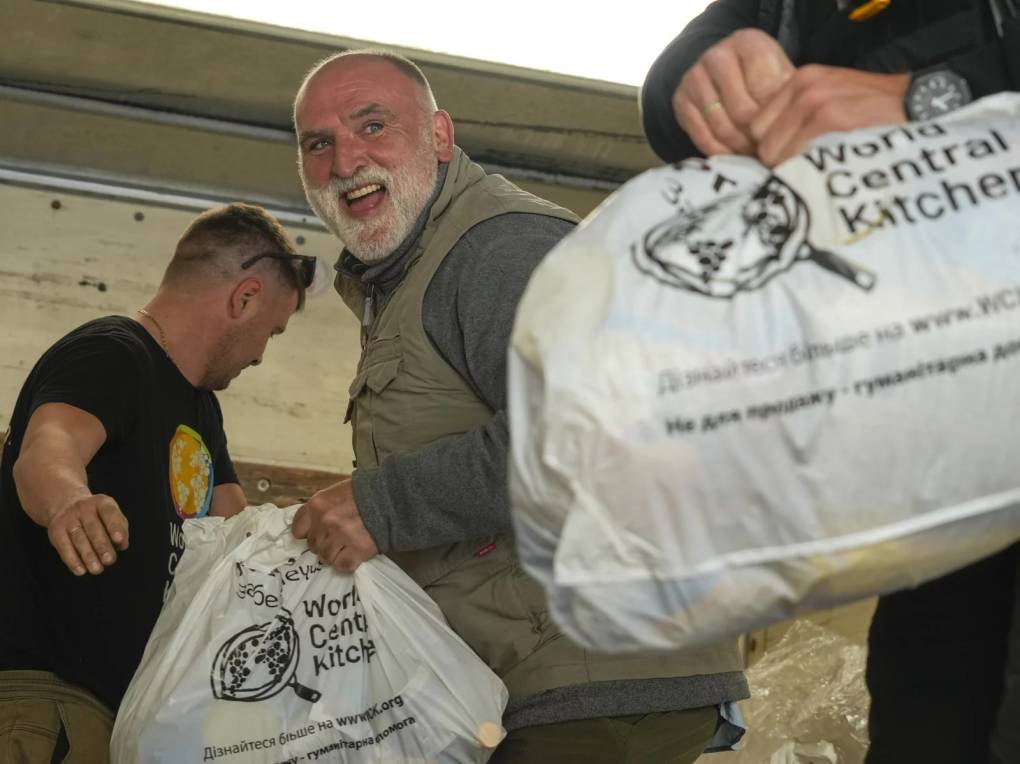
"caption": "Jose Andres, a Spanish chef, and founder of World Central Kitchen unloads the humanitarian food packages delivered with WCK's truck in Kherson, Ukraine, Nov. 15, 2022.",
"description": null,
"title": "ap22319625331778-0570c74fc6d212d0ae33ea325335634352467b60-s1600-c85 copy",
"credit": "Efrem Lukatsky/AP Photo",
"status": "inherit",
"altTag": null,
"isLoading": false,
"fetchFailed": false
},
"news_11979477": {
"type": "attachments",
"id": "news_11979477",
"meta": {
"index": "attachments_1716263798",
"site": "news",
"id": "11979477",
"found": true
},
"parent": 11979450,
"imgSizes": {
"twentyfourteen-full-width": {
"file": "https://cdn.kqed.org/wp-content/uploads/sites/10/2024/03/GettyImages-1267034854-1038x576.jpg",
"width": 1038,
"mimeType": "image/jpeg",
"height": 576
},
"thumbnail": {
"file": "https://cdn.kqed.org/wp-content/uploads/sites/10/2024/03/GettyImages-1267034854-160x107.jpg",
"width": 160,
"mimeType": "image/jpeg",
"height": 107
},
"post-thumbnail": {
"file": "https://cdn.kqed.org/wp-content/uploads/sites/10/2024/03/GettyImages-1267034854-672x372.jpg",
"width": 672,
"mimeType": "image/jpeg",
"height": 372
},
"kqedFullSize": {
"file": "https://cdn.kqed.org/wp-content/uploads/sites/10/2024/03/GettyImages-1267034854.jpg",
"width": 2121,
"height": 1414
},
"2048x2048": {
"file": "https://cdn.kqed.org/wp-content/uploads/sites/10/2024/03/GettyImages-1267034854-2048x1365.jpg",
"width": 2048,
"mimeType": "image/jpeg",
"height": 1365
},
"large": {
"file": "https://cdn.kqed.org/wp-content/uploads/sites/10/2024/03/GettyImages-1267034854-1020x680.jpg",
"width": 1020,
"mimeType": "image/jpeg",
"height": 680
},
"1536x1536": {
"file": "https://cdn.kqed.org/wp-content/uploads/sites/10/2024/03/GettyImages-1267034854-1536x1024.jpg",
"width": 1536,
"mimeType": "image/jpeg",
"height": 1024
},
"full-width": {
"file": "https://cdn.kqed.org/wp-content/uploads/sites/10/2024/03/GettyImages-1267034854-1920x1280.jpg",
"width": 1920,
"mimeType": "image/jpeg",
"height": 1280
},
"medium": {
"file": "https://cdn.kqed.org/wp-content/uploads/sites/10/2024/03/GettyImages-1267034854-800x533.jpg",
"width": 800,
"mimeType": "image/jpeg",
"height": 533
}
},
"publishDate": 1710448702,
"modified": 1710959258,
"caption": null,
"description": null,
"title": "Woman voting from home for the USA Election",
"credit": "Leo Patrizi/Getty Images",
"status": "inherit",
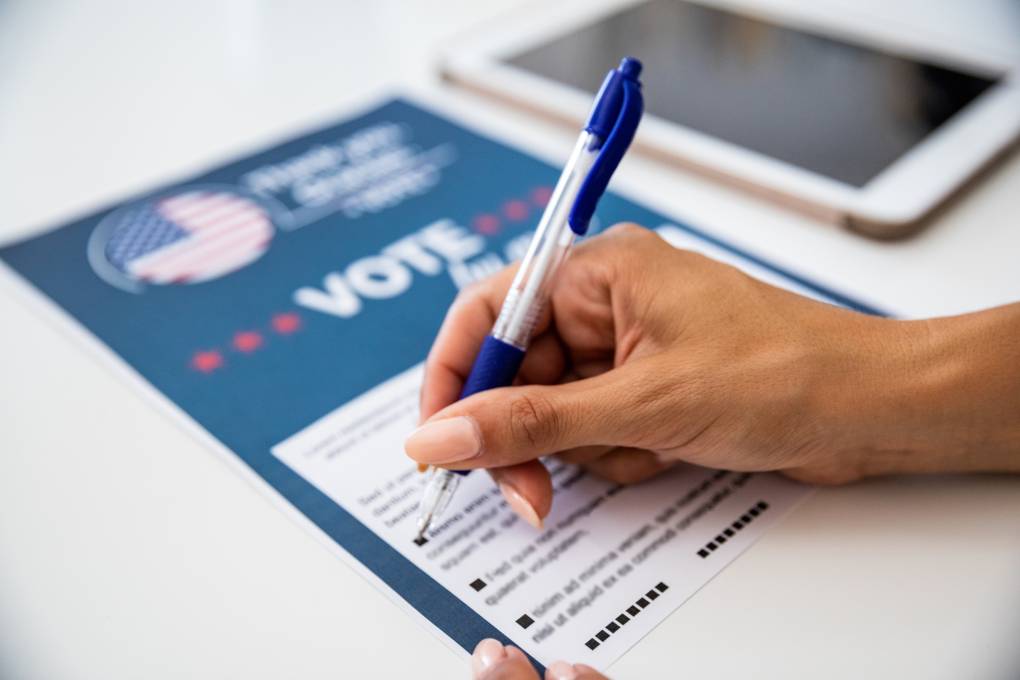
"altTag": "A hand of a woman holding a pen and filling out a voting form.",
"isLoading": false,
"fetchFailed": false
},
"news_11978755": {
"type": "attachments",
"id": "news_11978755",
"meta": {
"index": "attachments_1716263798",
"site": "news",
"id": "11978755",
"found": true
},
"parent": 11978744,
"imgSizes": {
"twentyfourteen-full-width": {
"file": "https://cdn.kqed.org/wp-content/uploads/sites/10/2024/03/20231017-Gaza-Vigil-030-JY_qut-1038x576.jpg",
"width": 1038,
"mimeType": "image/jpeg",
"height": 576
},
"thumbnail": {
"file": "https://cdn.kqed.org/wp-content/uploads/sites/10/2024/03/20231017-Gaza-Vigil-030-JY_qut-160x107.jpg",
"width": 160,
"mimeType": "image/jpeg",
"height": 107
},
"post-thumbnail": {
"file": "https://cdn.kqed.org/wp-content/uploads/sites/10/2024/03/20231017-Gaza-Vigil-030-JY_qut-672x372.jpg",
"width": 672,
"mimeType": "image/jpeg",
"height": 372
},
"kqedFullSize": {
"file": "https://cdn.kqed.org/wp-content/uploads/sites/10/2024/03/20231017-Gaza-Vigil-030-JY_qut.jpg",
"width": 1920,
"height": 1280
},
"large": {
"file": "https://cdn.kqed.org/wp-content/uploads/sites/10/2024/03/20231017-Gaza-Vigil-030-JY_qut-1020x680.jpg",
"width": 1020,
"mimeType": "image/jpeg",
"height": 680
},
"1536x1536": {
"file": "https://cdn.kqed.org/wp-content/uploads/sites/10/2024/03/20231017-Gaza-Vigil-030-JY_qut-1536x1024.jpg",
"width": 1536,
"mimeType": "image/jpeg",
"height": 1024
},
"medium": {
"file": "https://cdn.kqed.org/wp-content/uploads/sites/10/2024/03/20231017-Gaza-Vigil-030-JY_qut-800x533.jpg",
"width": 800,
"mimeType": "image/jpeg",
"height": 533
}
},
"publishDate": 1709941897,
"modified": 1710182434,
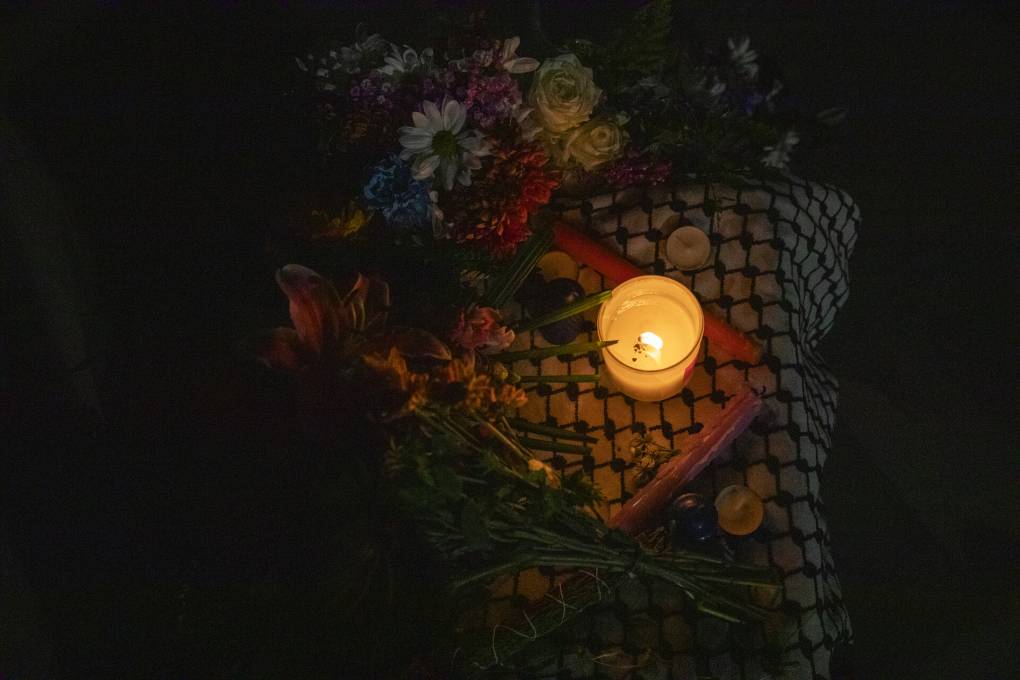
"caption": "An altar covered by a kufiyah, a Palestinian scarf, is seen at a candlelight vigil to honor lives lost in Gaza at Dolores Park in San Francisco on Tuesday, Oct. 17, 2023. ",
"description": null,
"title": "Gaza Vigil",
"credit": "Juliana Yamada/KQED",
"status": "inherit",
"altTag": null,
"isLoading": false,
"fetchFailed": false
},
"news_11978968": {
"type": "attachments",
"id": "news_11978968",
"meta": {
"index": "attachments_1716263798",
"site": "news",
"id": "11978968",
"found": true
},
"parent": 0,
"imgSizes": {
"twentyfourteen-full-width": {
"file": "https://cdn.kqed.org/wp-content/uploads/sites/10/2024/03/240311-JEWISHPROTEST-JY-31-KQED-1038x576.jpg",
"width": 1038,
"mimeType": "image/jpeg",
"height": 576
},
"thumbnail": {
"file": "https://cdn.kqed.org/wp-content/uploads/sites/10/2024/03/240311-JEWISHPROTEST-JY-31-KQED-160x107.jpg",
"width": 160,
"mimeType": "image/jpeg",
"height": 107
},
"post-thumbnail": {
"file": "https://cdn.kqed.org/wp-content/uploads/sites/10/2024/03/240311-JEWISHPROTEST-JY-31-KQED-672x372.jpg",
"width": 672,
"mimeType": "image/jpeg",
"height": 372
},
"kqedFullSize": {
"file": "https://cdn.kqed.org/wp-content/uploads/sites/10/2024/03/240311-JEWISHPROTEST-JY-31-KQED.jpg",
"width": 2000,
"height": 1333
},
"large": {
"file": "https://cdn.kqed.org/wp-content/uploads/sites/10/2024/03/240311-JEWISHPROTEST-JY-31-KQED-1020x680.jpg",
"width": 1020,
"mimeType": "image/jpeg",
"height": 680
},
"1536x1536": {
"file": "https://cdn.kqed.org/wp-content/uploads/sites/10/2024/03/240311-JEWISHPROTEST-JY-31-KQED-1536x1024.jpg",
"width": 1536,
"mimeType": "image/jpeg",
"height": 1024
},
"full-width": {
"file": "https://cdn.kqed.org/wp-content/uploads/sites/10/2024/03/240311-JEWISHPROTEST-JY-31-KQED-1920x1280.jpg",
"width": 1920,
"mimeType": "image/jpeg",
"height": 1280
},
"medium": {
"file": "https://cdn.kqed.org/wp-content/uploads/sites/10/2024/03/240311-JEWISHPROTEST-JY-31-KQED-800x533.jpg",
"width": 800,
"mimeType": "image/jpeg",
"height": 533
}
},
"publishDate": 1710194572,
"modified": 1710204689,
"caption": "UC Berkeley staff member Karen Shuker, center, rallies with other Jewish staff, students, faculty and community members in front of California Hall on March 11, 2024.",
"description": null,
"title": "240311-JEWISHPROTEST-JY-31-KQED",
"credit": "Juliana Yamada/KQED",
"status": "inherit",
"altTag": "A large group of people stands together, holding signs.",
"isLoading": false,
"fetchFailed": false
},
"news_11977735": {
"type": "attachments",
"id": "news_11977735",
"meta": {
"index": "attachments_1716263798",
"site": "news",
"id": "11977735",
"found": true
},
"parent": 11977734,
"imgSizes": {
"twentyfourteen-full-width": {
"file": "https://cdn.kqed.org/wp-content/uploads/sites/10/2024/03/ap18199004577985-604b2a9767b228b213086057a919192437b0eee0-1038x576.jpg",
"width": 1038,
"mimeType": "image/jpeg",
"height": 576
},
"thumbnail": {
"file": "https://cdn.kqed.org/wp-content/uploads/sites/10/2024/03/ap18199004577985-604b2a9767b228b213086057a919192437b0eee0-160x120.jpg",
"width": 160,
"mimeType": "image/jpeg",
"height": 120
},
"post-thumbnail": {
"file": "https://cdn.kqed.org/wp-content/uploads/sites/10/2024/03/ap18199004577985-604b2a9767b228b213086057a919192437b0eee0-672x372.jpg",
"width": 672,
"mimeType": "image/jpeg",
"height": 372
},
"kqedFullSize": {
"file": "https://cdn.kqed.org/wp-content/uploads/sites/10/2024/03/ap18199004577985-604b2a9767b228b213086057a919192437b0eee0-scaled.jpg",
"width": 2560,
"height": 1920
},
"2048x2048": {
"file": "https://cdn.kqed.org/wp-content/uploads/sites/10/2024/03/ap18199004577985-604b2a9767b228b213086057a919192437b0eee0-2048x1536.jpg",
"width": 2048,
"mimeType": "image/jpeg",
"height": 1536
},
"large": {
"file": "https://cdn.kqed.org/wp-content/uploads/sites/10/2024/03/ap18199004577985-604b2a9767b228b213086057a919192437b0eee0-1020x765.jpg",
"width": 1020,
"mimeType": "image/jpeg",
"height": 765
},
"1536x1536": {
"file": "https://cdn.kqed.org/wp-content/uploads/sites/10/2024/03/ap18199004577985-604b2a9767b228b213086057a919192437b0eee0-1536x1152.jpg",
"width": 1536,
"mimeType": "image/jpeg",
"height": 1152
},
"full-width": {
"file": "https://cdn.kqed.org/wp-content/uploads/sites/10/2024/03/ap18199004577985-604b2a9767b228b213086057a919192437b0eee0-1920x1440.jpg",
"width": 1920,
"mimeType": "image/jpeg",
"height": 1440
},
"medium": {
"file": "https://cdn.kqed.org/wp-content/uploads/sites/10/2024/03/ap18199004577985-604b2a9767b228b213086057a919192437b0eee0-800x600.jpg",
"width": 800,
"mimeType": "image/jpeg",
"height": 600
}
},
"publishDate": 1709315554,
"modified": 1709346516,
"caption": "Alyssa Milano at a protest following President Trump's meetings with Russia's Vladimir Putin in July 2018. A longtime activist, Milano says it's impossible to avoid 'the vitriol,' especially when talking about the Middle East.",
"description": "Actress Alyssa Milano holds out her microphone as she starts a chat while speaking at a protest outside the White House, Tuesday, July 17, 2018, in Washington. This is the second day in a row the group has held a protest following President Donald Trump's meetings with Russian President Vladimir Putin. (AP Photo/Andrew Harnik)",
"title": "Alyssa Milano says that celebrity activism is at its best \"when we are able to hand over the microphone\" to the \"incredible heroes\" doing activism work day to day. She's pictured above in July 2018 at a protest following President Trump's meetings with Russia's Vladimir Putin. A longtime activist, Milano says it's impossible to avoid \"the vitriol,\" especially when talking about the Middle East.",
"credit": null,
"status": "inherit",
"altTag": null,
"isLoading": false,
"fetchFailed": false
},
"news_11974266": {
"type": "attachments",
"id": "news_11974266",
"meta": {
"index": "attachments_1716263798",
"site": "news",
"id": "11974266",
"found": true
},
"parent": 11976509,
"imgSizes": {
"twentyfourteen-full-width": {
"file": "https://cdn.kqed.org/wp-content/uploads/sites/10/2024/01/240126-GAZAIMMIGRATION-03-BL-KQED-1038x576.jpg",
"width": 1038,
"mimeType": "image/jpeg",
"height": 576
},
"thumbnail": {
"file": "https://cdn.kqed.org/wp-content/uploads/sites/10/2024/01/240126-GAZAIMMIGRATION-03-BL-KQED-160x107.jpg",
"width": 160,
"mimeType": "image/jpeg",
"height": 107
},
"post-thumbnail": {
"file": "https://cdn.kqed.org/wp-content/uploads/sites/10/2024/01/240126-GAZAIMMIGRATION-03-BL-KQED-672x372.jpg",
"width": 672,
"mimeType": "image/jpeg",
"height": 372
},
"kqedFullSize": {
"file": "https://cdn.kqed.org/wp-content/uploads/sites/10/2024/01/240126-GAZAIMMIGRATION-03-BL-KQED.jpg",
"width": 2000,
"height": 1333
},
"large": {
"file": "https://cdn.kqed.org/wp-content/uploads/sites/10/2024/01/240126-GAZAIMMIGRATION-03-BL-KQED-1020x680.jpg",
"width": 1020,
"mimeType": "image/jpeg",
"height": 680
},
"1536x1536": {
"file": "https://cdn.kqed.org/wp-content/uploads/sites/10/2024/01/240126-GAZAIMMIGRATION-03-BL-KQED-1536x1024.jpg",
"width": 1536,
"mimeType": "image/jpeg",
"height": 1024
},
"full-width": {
"file": "https://cdn.kqed.org/wp-content/uploads/sites/10/2024/01/240126-GAZAIMMIGRATION-03-BL-KQED-1920x1280.jpg",
"width": 1920,
"mimeType": "image/jpeg",
"height": 1280
},
"medium": {
"file": "https://cdn.kqed.org/wp-content/uploads/sites/10/2024/01/240126-GAZAIMMIGRATION-03-BL-KQED-800x533.jpg",
"width": 800,
"mimeType": "image/jpeg",
"height": 533
}
},
"publishDate": 1706653785,
"modified": 1708548767,
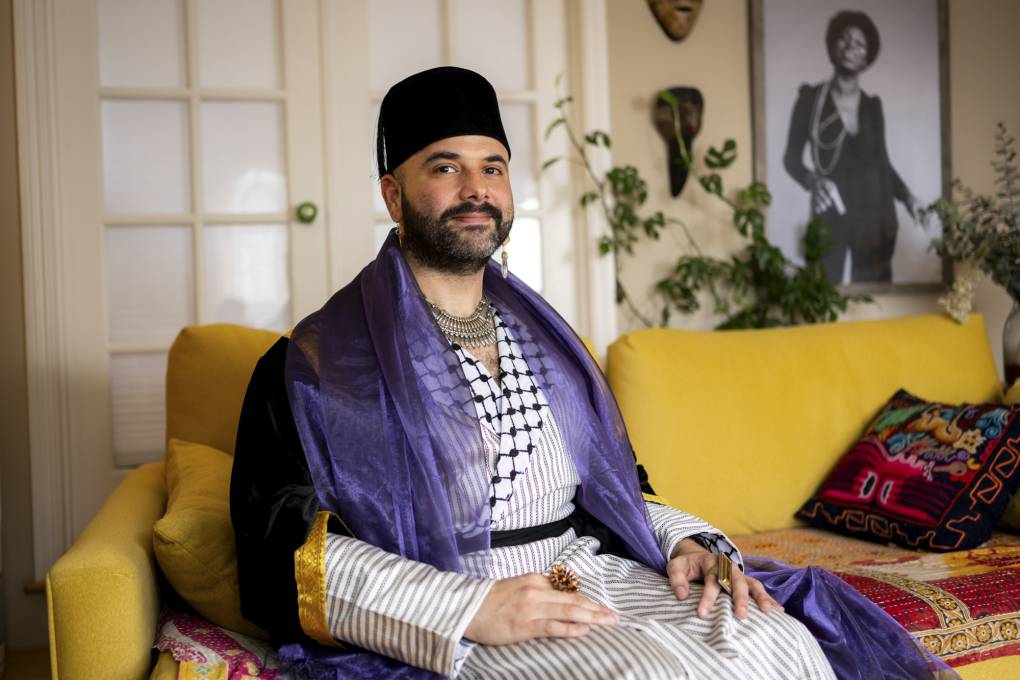
"caption": "Mama Ganuush poses for a portrait in their home in San Francisco on Jan. 26, 2024.",
"description": null,
"title": "240126-GAZAIMMIGRATION-03-BL-KQED",
"credit": "Beth LaBerge/KQED",
"status": "inherit",
"altTag": "A person with a beard wears a hat and sits on a sofa smiling and looking at the camera.",
"isLoading": false,
"fetchFailed": false
},
"news_11969733": {
"type": "attachments",
"id": "news_11969733",
"meta": {
"index": "attachments_1716263798",
"site": "news",
"id": "11969733",
"found": true
},
"parent": 11969701,
"imgSizes": {
"twentyfourteen-full-width": {
"file": "https://cdn.kqed.org/wp-content/uploads/sites/10/2023/12/231213-Pinkwashing-01-KQED-1038x576.jpg",
"width": 1038,
"mimeType": "image/jpeg",
"height": 576
},
"thumbnail": {
"file": "https://cdn.kqed.org/wp-content/uploads/sites/10/2023/12/231213-Pinkwashing-01-KQED-160x107.jpg",
"width": 160,
"mimeType": "image/jpeg",
"height": 107
},
"post-thumbnail": {
"file": "https://cdn.kqed.org/wp-content/uploads/sites/10/2023/12/231213-Pinkwashing-01-KQED-672x372.jpg",
"width": 672,
"mimeType": "image/jpeg",
"height": 372
},
"kqedFullSize": {
"file": "https://cdn.kqed.org/wp-content/uploads/sites/10/2023/12/231213-Pinkwashing-01-KQED.jpg",
"width": 2000,
"height": 1333
},
"large": {
"file": "https://cdn.kqed.org/wp-content/uploads/sites/10/2023/12/231213-Pinkwashing-01-KQED-1020x680.jpg",
"width": 1020,
"mimeType": "image/jpeg",
"height": 680
},
"1536x1536": {
"file": "https://cdn.kqed.org/wp-content/uploads/sites/10/2023/12/231213-Pinkwashing-01-KQED-1536x1024.jpg",
"width": 1536,
"mimeType": "image/jpeg",
"height": 1024
},
"full-width": {
"file": "https://cdn.kqed.org/wp-content/uploads/sites/10/2023/12/231213-Pinkwashing-01-KQED-1920x1280.jpg",
"width": 1920,
"mimeType": "image/jpeg",
"height": 1280
},
"medium": {
"file": "https://cdn.kqed.org/wp-content/uploads/sites/10/2023/12/231213-Pinkwashing-01-KQED-800x533.jpg",
"width": 800,
"mimeType": "image/jpeg",
"height": 533
}
},
"publishDate": 1702493455,
"modified": 1708546481,
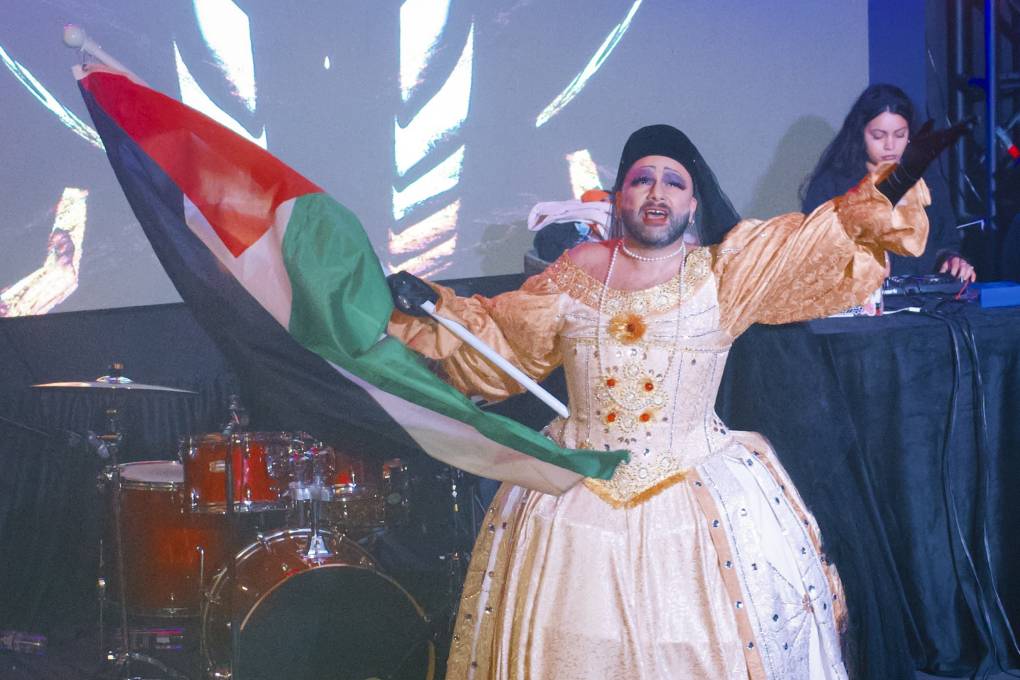
"caption": "Mama Ganuush, an African-Palestinian drag artist, waves a Palestinian flag as they perform at Oakland's Continental Club on Oct. 29, 2023.",
"description": null,
"title": "231213-Pinkwashing-01-KQED",
"credit": "Photo courtesy of Saman Qadir",
"status": "inherit",
"altTag": "A person with a beard and wearing a dress and a long necklace holds the Palestinian flag on a stage.",
"isLoading": false,
"fetchFailed": false
},
"news_11976329": {
"type": "attachments",
"id": "news_11976329",
"meta": {
"index": "attachments_1716263798",
"site": "news",
"id": "11976329",
"found": true
},
"parent": 11976328,
"imgSizes": {
"twentyfourteen-full-width": {
"file": "https://cdn.kqed.org/wp-content/uploads/sites/10/2024/02/28A0285-1038x576.jpg",
"width": 1038,
"mimeType": "image/jpeg",
"height": 576
},
"thumbnail": {
"file": "https://cdn.kqed.org/wp-content/uploads/sites/10/2024/02/28A0285-160x107.jpg",
"width": 160,
"mimeType": "image/jpeg",
"height": 107
},
"post-thumbnail": {
"file": "https://cdn.kqed.org/wp-content/uploads/sites/10/2024/02/28A0285-672x372.jpg",
"width": 672,
"mimeType": "image/jpeg",
"height": 372
},
"kqedFullSize": {
"file": "https://cdn.kqed.org/wp-content/uploads/sites/10/2024/02/28A0285-scaled.jpg",
"width": 2560,
"height": 1707
},
"2048x2048": {
"file": "https://cdn.kqed.org/wp-content/uploads/sites/10/2024/02/28A0285-2048x1365.jpg",
"width": 2048,
"mimeType": "image/jpeg",
"height": 1365
},
"large": {
"file": "https://cdn.kqed.org/wp-content/uploads/sites/10/2024/02/28A0285-1020x680.jpg",
"width": 1020,
"mimeType": "image/jpeg",
"height": 680
},
"1536x1536": {
"file": "https://cdn.kqed.org/wp-content/uploads/sites/10/2024/02/28A0285-1536x1024.jpg",
"width": 1536,
"mimeType": "image/jpeg",
"height": 1024
},
"full-width": {
"file": "https://cdn.kqed.org/wp-content/uploads/sites/10/2024/02/28A0285-1920x1280.jpg",
"width": 1920,
"mimeType": "image/jpeg",
"height": 1280
},
"medium": {
"file": "https://cdn.kqed.org/wp-content/uploads/sites/10/2024/02/28A0285-800x533.jpg",
"width": 800,
"mimeType": "image/jpeg",
"height": 533
}
},
"publishDate": 1708381869,
"modified": 1708718568,
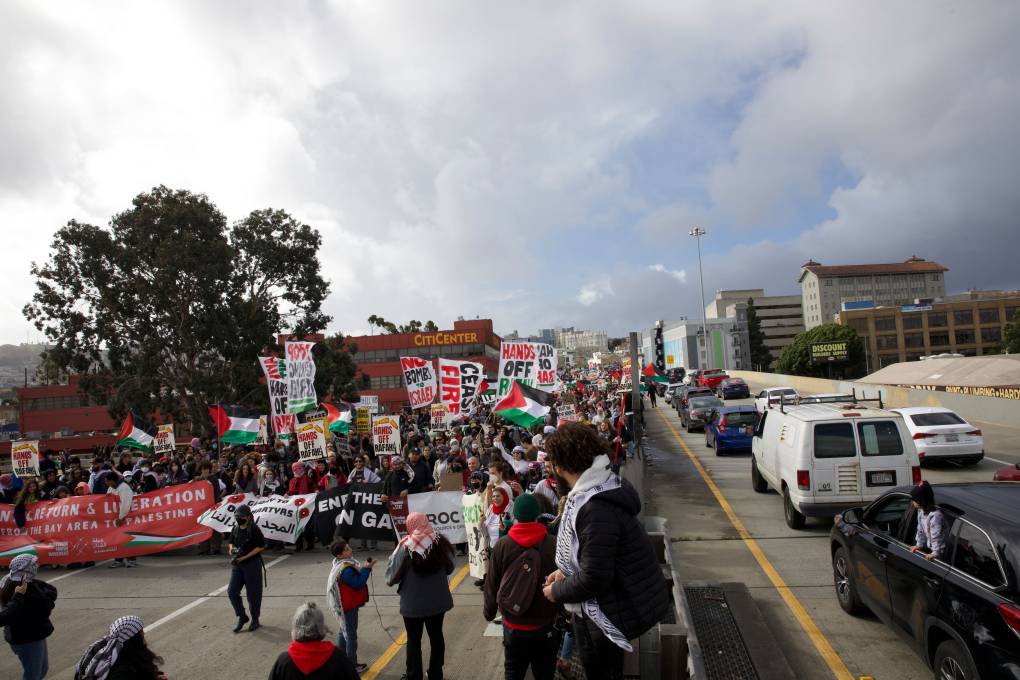
"caption": "Protesters, calling for a cease-fire, briefly blocked the Highway 101 entrance ramp.",
"description": null,
"title": "_28A0285",
"credit": "Kathryn Styer Martínez/KQED",
"status": "inherit",
"altTag": "A crowd carrying signs blocks half a roadway, with cars backed up on the other side of the divider.",
"isLoading": false,
"fetchFailed": false
},
"news_11975868": {
"type": "attachments",
"id": "news_11975868",
"meta": {
"index": "attachments_1716263798",
"site": "news",
"id": "11975868",
"found": true
},
"title": "240214-GOLDEN GATE BRIDGE PROTEST-JCL-01-KQED",
"publishDate": 1707928417,
"status": "inherit",
"parent": 11984807,
"modified": 1762559079,
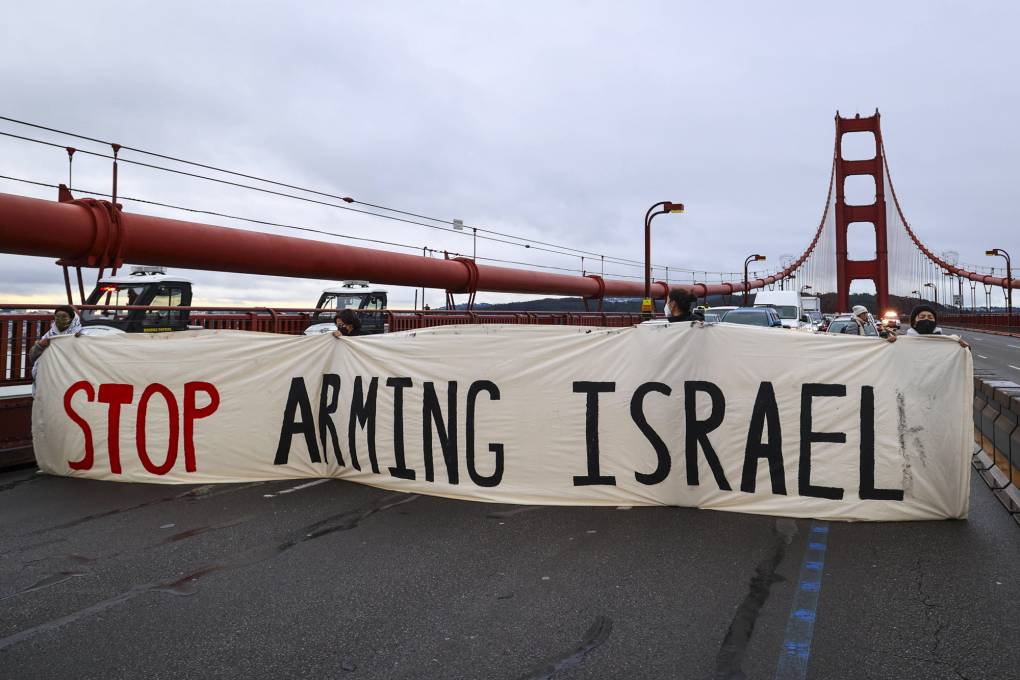
"caption": "Pro-Palestinian protesters calling for a ceasefire in Gaza briefly block traffic on the Golden Gate Bridge on the morning of Feb. 14, 2024.",
"credit": "Juan Carlos Lara/KQED",
"altTag": "People hold up a banner that reads \"Stop Arming Israel\" across the Golden Gate Bridge, blocking traffic.",
"description": null,
"imgSizes": {
"medium": {
"file": "https://cdn.kqed.org/wp-content/uploads/sites/10/2024/02/240214-GOLDEN-GATE-BRIDGE-PROTEST-JCL-01-KQED-800x533.jpg",
"width": 800,
"height": 533,
"mimeType": "image/jpeg"
},
"large": {
"file": "https://cdn.kqed.org/wp-content/uploads/sites/10/2024/02/240214-GOLDEN-GATE-BRIDGE-PROTEST-JCL-01-KQED-1020x680.jpg",
"width": 1020,
"height": 680,
"mimeType": "image/jpeg"
},
"thumbnail": {
"file": "https://cdn.kqed.org/wp-content/uploads/sites/10/2024/02/240214-GOLDEN-GATE-BRIDGE-PROTEST-JCL-01-KQED-160x107.jpg",
"width": 160,
"height": 107,
"mimeType": "image/jpeg"
},
"1536x1536": {
"file": "https://cdn.kqed.org/wp-content/uploads/sites/10/2024/02/240214-GOLDEN-GATE-BRIDGE-PROTEST-JCL-01-KQED-1536x1024.jpg",
"width": 1536,
"height": 1024,
"mimeType": "image/jpeg"
},
"post-thumbnail": {
"file": "https://cdn.kqed.org/wp-content/uploads/sites/10/2024/02/240214-GOLDEN-GATE-BRIDGE-PROTEST-JCL-01-KQED-672x372.jpg",
"width": 672,
"height": 372,
"mimeType": "image/jpeg"
},
"twentyfourteen-full-width": {
"file": "https://cdn.kqed.org/wp-content/uploads/sites/10/2024/02/240214-GOLDEN-GATE-BRIDGE-PROTEST-JCL-01-KQED-1038x576.jpg",
"width": 1038,
"height": 576,
"mimeType": "image/jpeg"
},
"full-width": {
"file": "https://cdn.kqed.org/wp-content/uploads/sites/10/2024/02/240214-GOLDEN-GATE-BRIDGE-PROTEST-JCL-01-KQED-1920x1280.jpg",
"width": 1920,
"height": 1280,
"mimeType": "image/jpeg"
},
"kqedFullSize": {
"file": "https://cdn.kqed.org/wp-content/uploads/sites/10/2024/02/240214-GOLDEN-GATE-BRIDGE-PROTEST-JCL-01-KQED.jpg",
"width": 2000,
"height": 1333
}
},
"isLoading": false,
"fetchFailed": false
},
"news_11973923": {
"type": "attachments",
"id": "news_11973923",
"meta": {
"index": "attachments_1716263798",
"site": "news",
"id": "11973923",
"found": true
},
"parent": 11973881,
"imgSizes": {
"twentyfourteen-full-width": {
"file": "https://cdn.kqed.org/wp-content/uploads/sites/10/2024/01/240126-GazaLawsuit-13-BL-1038x576.jpg",
"width": 1038,
"mimeType": "image/jpeg",
"height": 576
},
"thumbnail": {
"file": "https://cdn.kqed.org/wp-content/uploads/sites/10/2024/01/240126-GazaLawsuit-13-BL-160x107.jpg",
"width": 160,
"mimeType": "image/jpeg",
"height": 107
},
"post-thumbnail": {
"file": "https://cdn.kqed.org/wp-content/uploads/sites/10/2024/01/240126-GazaLawsuit-13-BL-672x372.jpg",
"width": 672,
"mimeType": "image/jpeg",
"height": 372
},
"kqedFullSize": {
"file": "https://cdn.kqed.org/wp-content/uploads/sites/10/2024/01/240126-GazaLawsuit-13-BL.jpg",
"width": 1920,
"height": 1280
},
"large": {
"file": "https://cdn.kqed.org/wp-content/uploads/sites/10/2024/01/240126-GazaLawsuit-13-BL-1020x680.jpg",
"width": 1020,
"mimeType": "image/jpeg",
"height": 680
},
"1536x1536": {
"file": "https://cdn.kqed.org/wp-content/uploads/sites/10/2024/01/240126-GazaLawsuit-13-BL-1536x1024.jpg",
"width": 1536,
"mimeType": "image/jpeg",
"height": 1024
},
"medium": {
"file": "https://cdn.kqed.org/wp-content/uploads/sites/10/2024/01/240126-GazaLawsuit-13-BL-800x533.jpg",
"width": 800,
"mimeType": "image/jpeg",
"height": 533
}
},
"publishDate": 1706312502,
"modified": 1706749850,
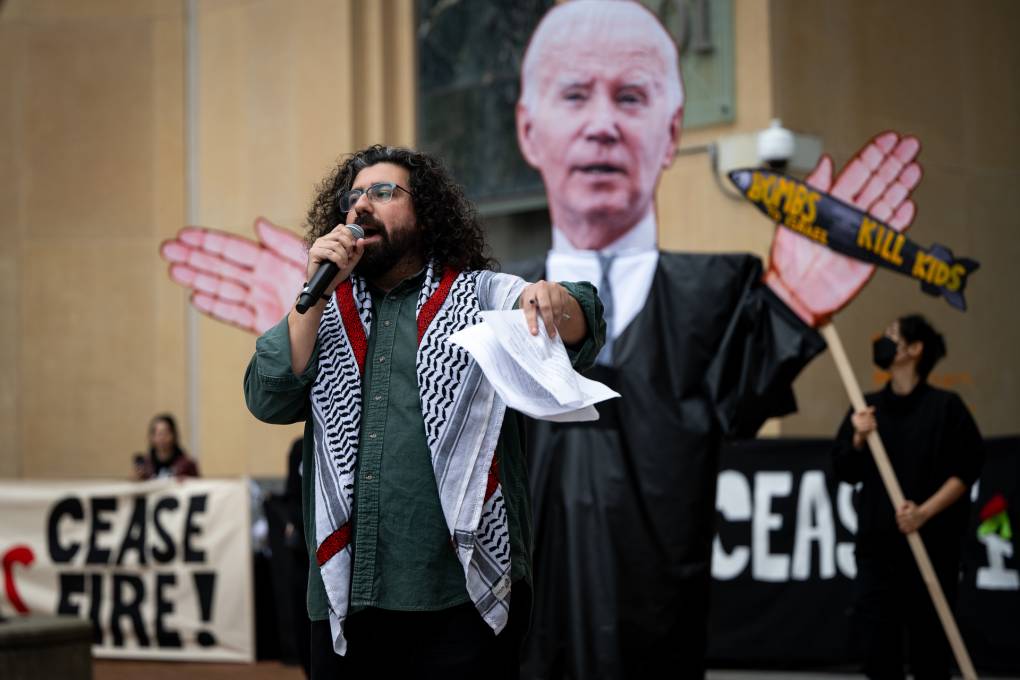
"caption": "Sharif Zakout, from the Arab Resource and Organizing Center, speaks outside of the US District Court during a hearing on a lawsuit asking for a court order to stop US aid to Israel. Protestors accused President Biden and other administration officials of abetting a genocide of the Palestinian people.",
"description": null,
"title": "240126-GazaLawsuit-13-BL",
"credit": "Beth LaBerge/KQED",
"status": "inherit",
"altTag": "A man with a microphone stands in front of a giant poster of President Joe Biden",
"isLoading": false,
"fetchFailed": false
},
"news_11974187": {
"type": "attachments",
"id": "news_11974187",
"meta": {
"index": "attachments_1716263798",
"site": "news",
"id": "11974187",
"found": true
},
"parent": 11974081,
"imgSizes": {
"twentyfourteen-full-width": {
"file": "https://cdn.kqed.org/wp-content/uploads/sites/10/2024/01/240129-KAMALA-HARRIS-SAN-JOSE-MD-13-KQED-1038x576.jpg",
"width": 1038,
"mimeType": "image/jpeg",
"height": 576
},
"thumbnail": {
"file": "https://cdn.kqed.org/wp-content/uploads/sites/10/2024/01/240129-KAMALA-HARRIS-SAN-JOSE-MD-13-KQED-160x107.jpg",
"width": 160,
"mimeType": "image/jpeg",
"height": 107
},
"post-thumbnail": {
"file": "https://cdn.kqed.org/wp-content/uploads/sites/10/2024/01/240129-KAMALA-HARRIS-SAN-JOSE-MD-13-KQED-672x372.jpg",
"width": 672,
"mimeType": "image/jpeg",
"height": 372
},
"kqedFullSize": {
"file": "https://cdn.kqed.org/wp-content/uploads/sites/10/2024/01/240129-KAMALA-HARRIS-SAN-JOSE-MD-13-KQED.jpg",
"width": 2000,
"height": 1333
},
"large": {
"file": "https://cdn.kqed.org/wp-content/uploads/sites/10/2024/01/240129-KAMALA-HARRIS-SAN-JOSE-MD-13-KQED-1020x680.jpg",
"width": 1020,
"mimeType": "image/jpeg",
"height": 680
},
"1536x1536": {
"file": "https://cdn.kqed.org/wp-content/uploads/sites/10/2024/01/240129-KAMALA-HARRIS-SAN-JOSE-MD-13-KQED-1536x1024.jpg",
"width": 1536,
"mimeType": "image/jpeg",
"height": 1024
},
"full-width": {
"file": "https://cdn.kqed.org/wp-content/uploads/sites/10/2024/01/240129-KAMALA-HARRIS-SAN-JOSE-MD-13-KQED-1920x1280.jpg",
"width": 1920,
"mimeType": "image/jpeg",
"height": 1280
},
"medium": {
"file": "https://cdn.kqed.org/wp-content/uploads/sites/10/2024/01/240129-KAMALA-HARRIS-SAN-JOSE-MD-13-KQED-800x533.jpg",
"width": 800,
"mimeType": "image/jpeg",
"height": 533
}
},
"publishDate": 1706576508,
"modified": 1706576530,
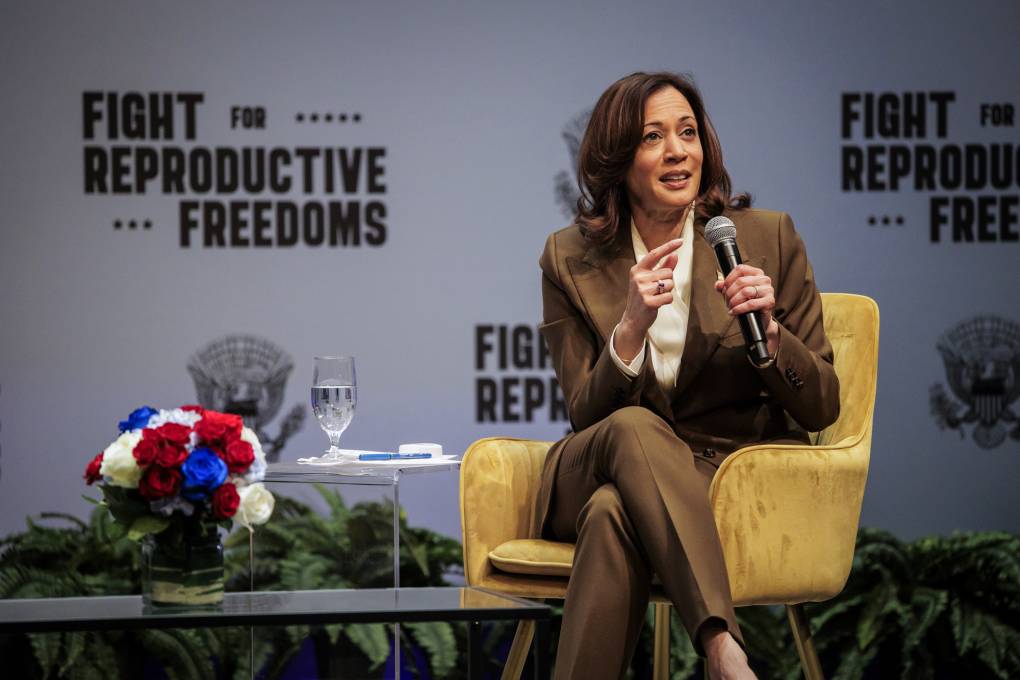
"caption": "Vice President Kamala Harris speaks during the 'Fight for Reproductive Freedoms' tour at Mexican Heritage Plaza in San José on Jan. 29, 2024.",
"description": null,
"title": "240129-KAMALA HARRIS SAN JOSE-MD-13-KQED",
"credit": "Martin do Nascimento/KQED",
"status": "inherit",
"altTag": "Vice President Kamala Harris is pictured sitting in a yellow seat on a stage.",
"isLoading": false,
"fetchFailed": false
},
"news_11973559": {
"type": "attachments",
"id": "news_11973559",
"meta": {
"index": "attachments_1716263798",
"site": "news",
"id": "11973559",
"found": true
},
"parent": 0,
"imgSizes": {
"twentyfourteen-full-width": {
"file": "https://cdn.kqed.org/wp-content/uploads/sites/10/2024/01/240124-HEALTCARE-GAZA-RALLY-MD-02-KQED_1-1038x576.jpg",
"width": 1038,
"mimeType": "image/jpeg",
"height": 576
},
"thumbnail": {
"file": "https://cdn.kqed.org/wp-content/uploads/sites/10/2024/01/240124-HEALTCARE-GAZA-RALLY-MD-02-KQED_1-160x107.jpg",
"width": 160,
"mimeType": "image/jpeg",
"height": 107
},
"post-thumbnail": {
"file": "https://cdn.kqed.org/wp-content/uploads/sites/10/2024/01/240124-HEALTCARE-GAZA-RALLY-MD-02-KQED_1-672x372.jpg",
"width": 672,
"mimeType": "image/jpeg",
"height": 372
},
"kqedFullSize": {
"file": "https://cdn.kqed.org/wp-content/uploads/sites/10/2024/01/240124-HEALTCARE-GAZA-RALLY-MD-02-KQED_1.jpg",
"width": 2000,
"height": 1333
},
"large": {
"file": "https://cdn.kqed.org/wp-content/uploads/sites/10/2024/01/240124-HEALTCARE-GAZA-RALLY-MD-02-KQED_1-1020x680.jpg",
"width": 1020,
"mimeType": "image/jpeg",
"height": 680
},
"1536x1536": {
"file": "https://cdn.kqed.org/wp-content/uploads/sites/10/2024/01/240124-HEALTCARE-GAZA-RALLY-MD-02-KQED_1-1536x1024.jpg",
"width": 1536,
"mimeType": "image/jpeg",
"height": 1024
},
"full-width": {
"file": "https://cdn.kqed.org/wp-content/uploads/sites/10/2024/01/240124-HEALTCARE-GAZA-RALLY-MD-02-KQED_1-1920x1280.jpg",
"width": 1920,
"mimeType": "image/jpeg",
"height": 1280
},
"medium": {
"file": "https://cdn.kqed.org/wp-content/uploads/sites/10/2024/01/240124-HEALTCARE-GAZA-RALLY-MD-02-KQED_1-800x533.jpg",
"width": 800,
"mimeType": "image/jpeg",
"height": 533
}
},
"publishDate": 1706129799,
"modified": 1706146386,
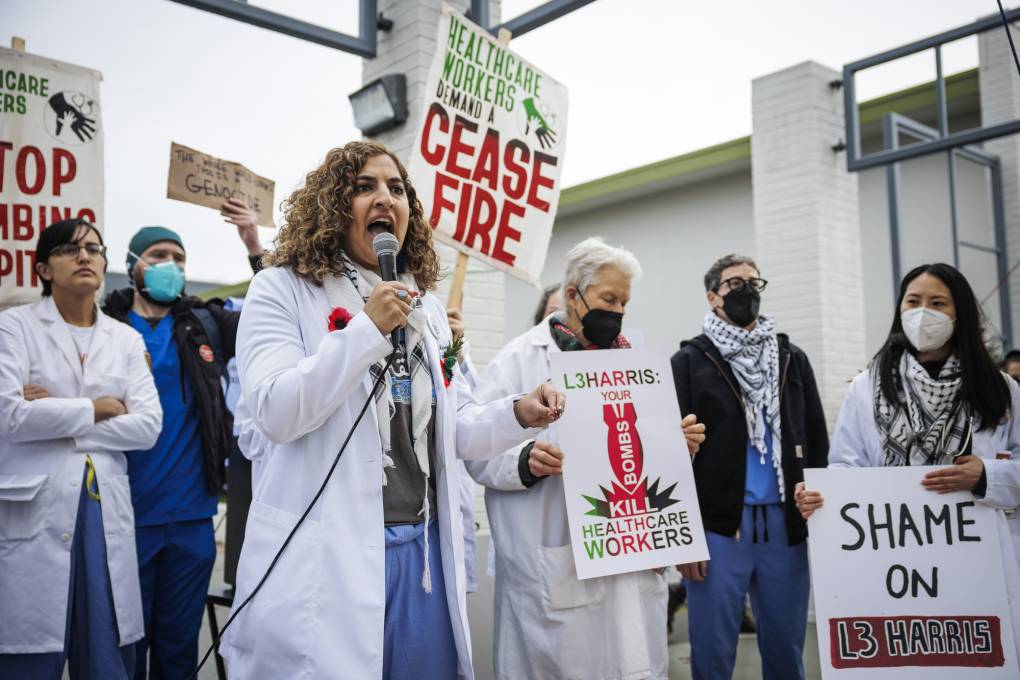
"caption": "Maisa Morrar speaks at a rally of health care workers in front of the L3 Harris office in San Leandro on Jan. 24, 2024.",
"description": null,
"title": "240124-HEALTCARE GAZA RALLY-MD-02-KQED_1",
"credit": "Martin do Nascimento/KQED",
"status": "inherit",
"altTag": "A woman wearing a labcoat talks into a microphone at a rally of health care workers also wearing labcoats holding posters calling for a cease-fire in Gaza.",
"isLoading": false,
"fetchFailed": false
}
},
"audioPlayerReducer": {
"postId": "stream_live",
"isPaused": true,
"isPlaying": false,
"pfsActive": false,
"pledgeModalIsOpen": true,
"playerDrawerIsOpen": false,
"liveAudioPlayStartedAt": 0,
"liveAudioPlayContext": ""
},
"authorsReducer": {
"byline_news_11981650": {
"type": "authors",
"id": "byline_news_11981650",
"meta": {
"override": true
},
"slug": "byline_news_11981650",
"name": "\u003ca href=\"https://www.npr.org/people/776048102/rachel-treisman\">Rachel Treisman\u003c/a>",
"isLoading": false
},
"byline_news_11977734": {
"type": "authors",
"id": "byline_news_11977734",
"meta": {
"override": true
},
"slug": "byline_news_11977734",
"name": "Elizabeth Blair",
"isLoading": false
},
"gmarzorati": {
"type": "authors",
"id": "227",
"meta": {
"index": "authors_1716337520",
"id": "227",
"found": true
},
"name": "Guy Marzorati",
"firstName": "Guy",
"lastName": "Marzorati",
"slug": "gmarzorati",
"email": "gmarzorati@KQED.org",
"display_author_email": true,
"staff_mastheads": [
"news"
],
"title": "Correspondent",
"bio": "Guy Marzorati is a correspondent on KQED's California Politics and Government Desk, based in San Jose. A graduate of Santa Clara University, Guy joined KQED in 2013. He reports on state and local politics and produces KQED's digital voter guide.",
"avatar": "https://secure.gravatar.com/avatar/e7038b8dbfd55b104369b76b1cd0b9de?s=600&d=blank&r=g",
"twitter": "guymarzorati",
"facebook": null,
"instagram": null,
"linkedin": null,
"sites": [
{
"site": "",
"roles": [
"editor"
]
},
{
"site": "news",
"roles": [
"editor"
]
},
{
"site": "science",
"roles": [
"editor"
]
},
{
"site": "forum",
"roles": [
"editor"
]
},
{
"site": "elections",
"roles": [
"editor"
]
},
{
"site": "liveblog",
"roles": [
"editor"
]
}
],
"headData": {
"title": "Guy Marzorati | KQED",
"description": "Correspondent",
"ogImgSrc": "https://secure.gravatar.com/avatar/e7038b8dbfd55b104369b76b1cd0b9de?s=600&d=blank&r=g",
"twImgSrc": "https://secure.gravatar.com/avatar/e7038b8dbfd55b104369b76b1cd0b9de?s=600&d=blank&r=g"
},
"isLoading": false,
"link": "/author/gmarzorati"
},
"matthewgreen": {
"type": "authors",
"id": "1263",
"meta": {
"index": "authors_1716337520",
"id": "1263",
"found": true
},
"name": "Matthew Green",
"firstName": "Matthew",
"lastName": "Green",
"slug": "matthewgreen",
"email": "mgreen@kqed.org",
"display_author_email": false,
"staff_mastheads": [],
"title": "KQED Editor/Reporter",
"bio": "Matthew Green is a digital media producer for KQED News. He previously produced \u003ca href=\"http://www.kqed.org/lowdown\">The Lowdown\u003c/a>, KQED’s multimedia news education blog. Matthew's written for numerous Bay Area publications, including the Oakland Tribune and San Francisco Chronicle. He also taught journalism classes at Fremont High School in East Oakland.\r\n\r\nEmail: mgreen@kqed.org; Twitter: @MGreenKQED",
"avatar": "https://secure.gravatar.com/avatar/3bf498d1267ca02c8494f33d8cfc575e?s=600&d=blank&r=g",
"twitter": "MGreenKQED",
"facebook": null,
"instagram": null,
"linkedin": null,
"sites": [
{
"site": "news",
"roles": []
},
{
"site": "lowdown",
"roles": []
},
{
"site": "science",
"roles": []
},
{
"site": "education",
"roles": []
},
{
"site": "quest",
"roles": []
},
{
"site": "liveblog",
"roles": []
}
],
"headData": {
"title": "Matthew Green | KQED",
"description": "KQED Editor/Reporter",
"ogImgSrc": "https://secure.gravatar.com/avatar/3bf498d1267ca02c8494f33d8cfc575e?s=600&d=blank&r=g",
"twImgSrc": "https://secure.gravatar.com/avatar/3bf498d1267ca02c8494f33d8cfc575e?s=600&d=blank&r=g"
},
"isLoading": false,
"link": "/author/matthewgreen"
},
"kdomara": {
"type": "authors",
"id": "1459",
"meta": {
"index": "authors_1716337520",
"id": "1459",
"found": true
},
"name": "Kelly O'Mara",
"firstName": "Kelly",
"lastName": "O'Mara",
"slug": "kdomara",
"email": "komara@kqed.org",
"display_author_email": false,
"staff_mastheads": [
"news"
],
"title": "KQED Contributor",
"bio": "Kelly O'Mara is a writer and reporter in the San Francisco Bay Area. She writes about food, health, sports, travel, business and California news. Her work has appeared on KQED, online for Outside Magazine, epsnW, VICE and in Competitor Magazine, among others. Follow Kelly on Twitter \u003ca href=\"https://twitter.com/kellydomara\">@kellydomara\u003c/a>.",
"avatar": "https://secure.gravatar.com/avatar/768fec7412028b72f13bdd0f5f9d8186?s=600&d=blank&r=g",
"twitter": null,
"facebook": null,
"instagram": null,
"linkedin": null,
"sites": [
{
"site": "arts",
"roles": []
},
{
"site": "news",
"roles": []
},
{
"site": "bayareabites",
"roles": []
},
{
"site": "stateofhealth",
"roles": []
},
{
"site": "science",
"roles": []
},
{
"site": "checkplease",
"roles": [
"editor"
]
},
{
"site": "food",
"roles": []
},
{
"site": "forum",
"roles": [
"editor"
]
},
{
"site": "liveblog",
"roles": [
"editor"
]
}
],
"headData": {
"title": "Kelly O'Mara | KQED",
"description": "KQED Contributor",
"ogImgSrc": "https://secure.gravatar.com/avatar/768fec7412028b72f13bdd0f5f9d8186?s=600&d=blank&r=g",
"twImgSrc": "https://secure.gravatar.com/avatar/768fec7412028b72f13bdd0f5f9d8186?s=600&d=blank&r=g"
},
"isLoading": false,
"link": "/author/kdomara"
},
"ecruzguevarra": {
"type": "authors",
"id": "8654",
"meta": {
"index": "authors_1716337520",
"id": "8654",
"found": true
},
"name": "Ericka Cruz Guevarra",
"firstName": "Ericka",
"lastName": "Cruz Guevarra",
"slug": "ecruzguevarra",
"email": "ecruzguevarra@kqed.org",
"display_author_email": true,
"staff_mastheads": [
"news"
],
"title": "Producer, The Bay Podcast",
"bio": "Ericka Cruz Guevarra is host of \u003ca href=\"https://www.kqed.org/podcasts/thebay\">\u003cem>The Bay\u003c/em>\u003c/a> podcast at KQED. Before host, she was the show’s producer. Her work in that capacity includes a three-part reported series on policing in Vallejo, which won a 2020 excellence in journalism award from the Society of Professional Journalists. Ericka has worked as a breaking news reporter at Oregon Public Broadcasting, helped produce the Code Switch podcast, and was KQED’s inaugural Raul Ramirez Diversity Fund intern. She’s also an alumna of NPR’s Next Generation Radio program. Send her an email if you have strong feelings about whether Fairfield and Suisun City are the Bay. Ericka is represented by SAG-AFTRA.",
"avatar": "https://secure.gravatar.com/avatar/accefc1de4bafc7e234b69bcb9b6f6536c130fd84709bc3069ef11a78787e1bb?s=600&d=blank&r=g",
"twitter": "NotoriousECG",
"bluesky": null,
"facebook": null,
"instagram": null,
"linkedin": null,
"sites": [
{
"site": "arts",
"roles": [
"subscriber"
]
},
{
"site": "news",
"roles": [
"editor",
"manage_categories"
]
},
{
"site": "futureofyou",
"roles": [
"subscriber"
]
},
{
"site": "stateofhealth",
"roles": [
"subscriber"
]
},
{
"site": "science",
"roles": [
"editor"
]
},
{
"site": "forum",
"roles": [
"subscriber"
]
}
],
"headData": {
"title": "Ericka Cruz Guevarra | KQED",
"description": "Producer, The Bay Podcast",
"ogImgSrc": "https://secure.gravatar.com/avatar/accefc1de4bafc7e234b69bcb9b6f6536c130fd84709bc3069ef11a78787e1bb?s=600&d=blank&r=g",
"twImgSrc": "https://secure.gravatar.com/avatar/accefc1de4bafc7e234b69bcb9b6f6536c130fd84709bc3069ef11a78787e1bb?s=600&d=blank&r=g"
},
"isLoading": false,
"link": "/author/ecruzguevarra"
},
"csmith": {
"type": "authors",
"id": "11603",
"meta": {
"index": "authors_1716337520",
"id": "11603",
"found": true
},
"name": "Caroline Smith",
"firstName": "Caroline",
"lastName": "Smith",
"slug": "csmith",
"email": "csmith@kqed.org",
"display_author_email": true,
"staff_mastheads": [
"news"
],
"title": "Producer, Forum",
"bio": "Caroline Smith is a producer for \u003cem>Forum\u003c/em>, producing more than 500 segments since joining the team in 2019 as an intern. From the Bay Area, Smith graduated with a B.A. in Rhetoric from UC Berkeley and is an alumnus of \u003cem>The Daily Californian.\u003c/em> They have received multiple San Francisco Press Club awards, a Fulbright scholarship and the ICFJ's Arthur F. Burns Fellowship, through which they reported from Berlin for one of Germany's largest national newspapers.",
"avatar": "https://secure.gravatar.com/avatar/191832bcd9809e2c67810a34b813b4b6c43fcba15f499f526da57b7161b4c778?s=600&d=blank&r=g",
"twitter": null,
"bluesky": null,
"facebook": null,
"instagram": null,
"linkedin": null,
"sites": [
{
"site": "arts",
"roles": [
"editor"
]
},
{
"site": "news",
"roles": [
"author"
]
},
{
"site": "mindshift",
"roles": [
"editor"
]
},
{
"site": "forum",
"roles": [
"administrator"
]
},
{
"site": "perspectives",
"roles": [
"editor"
]
}
],
"headData": {
"title": "Caroline Smith | KQED",
"description": "Producer, Forum",
"ogImgSrc": "https://secure.gravatar.com/avatar/191832bcd9809e2c67810a34b813b4b6c43fcba15f499f526da57b7161b4c778?s=600&d=blank&r=g",
"twImgSrc": "https://secure.gravatar.com/avatar/191832bcd9809e2c67810a34b813b4b6c43fcba15f499f526da57b7161b4c778?s=600&d=blank&r=g"
},
"isLoading": false,
"link": "/author/csmith"
},
"smohamad": {
"type": "authors",
"id": "11631",
"meta": {
"index": "authors_1716337520",
"id": "11631",
"found": true
},
"name": "Sarah Mohamad",
"firstName": "Sarah",
"lastName": "Mohamad",
"slug": "smohamad",
"email": "smohamad@KQED.org",
"display_author_email": true,
"staff_mastheads": [],
"title": "Engagement Producer and Reporter, KQED Science",
"bio": "Sarah Mohamad is an audience engagement reporter and producer for KQED Science. She reports on audience-focused science and environment stories and manages the team's social media, newsletter, and engagement efforts. Prior to this role, she played a key role as project manager for NSF's \u003ca href=\"https://www.kqed.org/crackingthecode\">\u003cem>Cracking the Code: Influencing Millennial Science Engagement\u003c/em> \u003c/a>audience research.",
"avatar": "https://secure.gravatar.com/avatar/e6224957cd82d015183756ddde1f928013a563d7ca2e4565f8c4de1ec64886c5?s=600&d=blank&r=g",
"twitter": "sarahkmohamad",
"bluesky": null,
"facebook": null,
"instagram": null,
"linkedin": null,
"sites": [
{
"site": "",
"roles": [
"editor"
]
},
{
"site": "arts",
"roles": [
"editor"
]
},
{
"site": "news",
"roles": [
"editor"
]
},
{
"site": "about",
"roles": [
"editor"
]
},
{
"site": "science",
"roles": [
"editor"
]
}
],
"headData": {
"title": "Sarah Mohamad | KQED",
"description": "Engagement Producer and Reporter, KQED Science",
"ogImgSrc": "https://secure.gravatar.com/avatar/e6224957cd82d015183756ddde1f928013a563d7ca2e4565f8c4de1ec64886c5?s=600&d=blank&r=g",
"twImgSrc": "https://secure.gravatar.com/avatar/e6224957cd82d015183756ddde1f928013a563d7ca2e4565f8c4de1ec64886c5?s=600&d=blank&r=g"
},
"isLoading": false,
"link": "/author/smohamad"
},
"amontecillo": {
"type": "authors",
"id": "11649",
"meta": {
"index": "authors_1716337520",
"id": "11649",
"found": true
},
"name": "Alan Montecillo",
"firstName": "Alan",
"lastName": "Montecillo",
"slug": "amontecillo",
"email": "amontecillo@kqed.org",
"display_author_email": false,
"staff_mastheads": [
"news"
],
"title": "KQED Contributor",
"bio": "Alan Montecillo is the senior editor of \u003cem>\u003ca href=\"http://kqed.org/thebay\">The Bay\u003c/a>, \u003c/em> KQED's local news podcast. Before moving to the Bay Area, he worked as a senior talk show producer for WILL in Champaign-Urbana, Illinois and at Oregon Public Broadcasting in Portland, Oregon. He has won journalism awards from the Society of Professional Journalists Northern California, the Public Media Journalists Association, The Signal Awards, and has also received a regional Edward R. Murrow award. Alan is a Filipino American from Hong Kong and a graduate of Reed College.",
"avatar": "https://secure.gravatar.com/avatar/268f53a2066899ea9efdd8a5900218b17c822d9862cbc9326cccec53ef41d349?s=600&d=blank&r=g",
"twitter": "alanmontecillo",
"bluesky": null,
"facebook": null,
"instagram": null,
"linkedin": null,
"sites": [
{
"site": "",
"roles": [
"editor"
]
},
{
"site": "news",
"roles": [
"editor",
"manage_categories"
]
}
],
"headData": {
"title": "Alan Montecillo | KQED",
"description": "KQED Contributor",
"ogImgSrc": "https://secure.gravatar.com/avatar/268f53a2066899ea9efdd8a5900218b17c822d9862cbc9326cccec53ef41d349?s=600&d=blank&r=g",
"twImgSrc": "https://secure.gravatar.com/avatar/268f53a2066899ea9efdd8a5900218b17c822d9862cbc9326cccec53ef41d349?s=600&d=blank&r=g"
},
"isLoading": false,
"link": "/author/amontecillo"
},
"jlara": {
"type": "authors",
"id": "11761",
"meta": {
"index": "authors_1716337520",
"id": "11761",
"found": true
},
"name": "Juan Carlos Lara",
"firstName": "Juan Carlos",
"lastName": "Lara",
"slug": "jlara",
"email": "jlara@kqed.org",
"display_author_email": false,
"staff_mastheads": [],
"title": "KQED Contributor",
"bio": null,
"avatar": "https://secure.gravatar.com/avatar/19e2052b9b05657c5ff2af2121846e9c?s=600&d=blank&r=g",
"twitter": null,
"facebook": null,
"instagram": null,
"linkedin": null,
"sites": [
{
"site": "arts",
"roles": [
"editor"
]
},
{
"site": "news",
"roles": [
"editor"
]
},
{
"site": "forum",
"roles": [
"editor"
]
},
{
"site": "liveblog",
"roles": [
"contributor"
]
}
],
"headData": {
"title": "Juan Carlos Lara | KQED",
"description": "KQED Contributor",
"ogImgSrc": "https://secure.gravatar.com/avatar/19e2052b9b05657c5ff2af2121846e9c?s=600&d=blank&r=g",
"twImgSrc": "https://secure.gravatar.com/avatar/19e2052b9b05657c5ff2af2121846e9c?s=600&d=blank&r=g"
},
"isLoading": false,
"link": "/author/jlara"
},
"mesquinca": {
"type": "authors",
"id": "11802",
"meta": {
"index": "authors_1716337520",
"id": "11802",
"found": true
},
"name": "Maria Esquinca",
"firstName": "Maria",
"lastName": "Esquinca",
"slug": "mesquinca",
"email": "mesquinca@kqed.org",
"display_author_email": false,
"staff_mastheads": [],
"title": "Producer, The Bay",
"bio": "María Esquinca is a producer of The Bay. Before that, she was a New York Women’s Foundation IGNITE Fellow at Latino USA. She worked at Radio Bilingue where she covered the San Joaquin Valley. Maria has interned at WLRN, News 21, The New York Times Student Journalism Institute and at Crain’s Detroit Business as a Dow Jones News Fund Business Reporting Intern. She is an MFA graduate from the University of Miami. In 2017, she graduated from the Walter Cronkite School of Journalism and Mass Communication with a Master of Mass Communication. A fronteriza, she was born in Ciudad Juárez, Chihuahua, Mexico and grew up in El Paso, Texas.",
"avatar": "https://secure.gravatar.com/avatar/77cedba18aae91da775038ba06dcd8d0?s=600&d=blank&r=g",
"twitter": "@m_esquinca",
"facebook": null,
"instagram": null,
"linkedin": null,
"sites": [
{
"site": "news",
"roles": []
}
],
"headData": {
"title": "Maria Esquinca | KQED",
"description": "Producer, The Bay",
"ogImgSrc": "https://secure.gravatar.com/avatar/77cedba18aae91da775038ba06dcd8d0?s=600&d=blank&r=g",
"twImgSrc": "https://secure.gravatar.com/avatar/77cedba18aae91da775038ba06dcd8d0?s=600&d=blank&r=g"
},
"isLoading": false,
"link": "/author/mesquinca"
},
"sjohnson": {
"type": "authors",
"id": "11840",
"meta": {
"index": "authors_1716337520",
"id": "11840",
"found": true
},
"name": "Sydney Johnson",
"firstName": "Sydney",
"lastName": "Johnson",
"slug": "sjohnson",
"email": "sjohnson@kqed.org",
"display_author_email": false,
"staff_mastheads": [
"news"
],
"title": "KQED Reporter",
"bio": "Sydney Johnson is a general assignment reporter at KQED. She previously reported on public health and city government at the San Francisco Examiner, and before that, she covered statewide education policy for EdSource. Her reporting has won multiple local, state and national awards. Sydney is a graduate of the University of California, Berkeley and lives in San Francisco.",
"avatar": "https://secure.gravatar.com/avatar/97855f2719b72ad6190b7c535fe642c8?s=600&d=blank&r=g",
"twitter": "sydneyfjohnson",
"facebook": null,
"instagram": null,
"linkedin": null,
"sites": [
{
"site": "news",
"roles": [
"editor"
]
}
],
"headData": {
"title": "Sydney Johnson | KQED",
"description": "KQED Reporter",
"ogImgSrc": "https://secure.gravatar.com/avatar/97855f2719b72ad6190b7c535fe642c8?s=600&d=blank&r=g",
"twImgSrc": "https://secure.gravatar.com/avatar/97855f2719b72ad6190b7c535fe642c8?s=600&d=blank&r=g"
},
"isLoading": false,
"link": "/author/sjohnson"
},
"nkhan": {
"type": "authors",
"id": "11867",
"meta": {
"index": "authors_1716337520",
"id": "11867",
"found": true
},
"name": "Nisa Khan",
"firstName": "Nisa",
"lastName": "Khan",
"slug": "nkhan",
"email": "nkhan@kqed.org",
"display_author_email": false,
"staff_mastheads": [],
"title": "KQED Contributor",
"bio": "Nisa Khan is a reporter for KQED's Audience News Desk. She was formerly a data reporter at Michigan Radio. She earned a Bachelor of Science in Information from the University of Michigan and a Master of Arts in Communication from Stanford University.",
"avatar": "https://secure.gravatar.com/avatar/8720459eef081ff64582b3506b124d58523e80e120704a0cbd9892533c914991?s=600&d=blank&r=g",
"twitter": "mnisakhan",
"bluesky": null,
"facebook": null,
"instagram": null,
"linkedin": null,
"sites": [
{
"site": "arts",
"roles": [
"editor"
]
},
{
"site": "news",
"roles": [
"editor"
]
},
{
"site": "science",
"roles": [
"editor",
"author"
]
},
{
"site": "forum",
"roles": [
"editor"
]
},
{
"site": "liveblog",
"roles": [
"contributor"
]
}
],
"headData": {
"title": "Nisa Khan | KQED",
"description": "KQED Contributor",
"ogImgSrc": "https://secure.gravatar.com/avatar/8720459eef081ff64582b3506b124d58523e80e120704a0cbd9892533c914991?s=600&d=blank&r=g",
"twImgSrc": "https://secure.gravatar.com/avatar/8720459eef081ff64582b3506b124d58523e80e120704a0cbd9892533c914991?s=600&d=blank&r=g"
},
"isLoading": false,
"link": "/author/nkhan"
},
"naltenberg": {
"type": "authors",
"id": "11896",
"meta": {
"index": "authors_1716337520",
"id": "11896",
"found": true
},
"name": "Nik Altenberg",
"firstName": "Nik",
"lastName": "Altenberg",
"slug": "naltenberg",
"email": "naltenberg@kqed.org",
"display_author_email": false,
"staff_mastheads": [],
"title": "KQED Contributor",
"bio": "Nik Altenberg is an on-call reporter for KQED and a copy editor and fact checker for Santa Cruz Local. Nik’s reporting interests include policing, public health, environment, immigration, housing and the places where these issues intersect.",
"avatar": "https://secure.gravatar.com/avatar/e391b3a18ce4a53a7ca3f3065c74418b?s=600&d=blank&r=g",
"twitter": null,
"facebook": null,
"instagram": "https://www.instagram.com/nikaltenberg/",
"linkedin": null,
"sites": [
{
"site": "news",
"roles": []
}
],
"headData": {
"title": "Nik Altenberg | KQED",
"description": "KQED Contributor",
"ogImgSrc": "https://secure.gravatar.com/avatar/e391b3a18ce4a53a7ca3f3065c74418b?s=600&d=blank&r=g",
"twImgSrc": "https://secure.gravatar.com/avatar/e391b3a18ce4a53a7ca3f3065c74418b?s=600&d=blank&r=g"
},
"isLoading": false,
"link": "/author/naltenberg"
},
"eprickettmorgan": {
"type": "authors",
"id": "11898",
"meta": {
"index": "authors_1716337520",
"id": "11898",
"found": true
},
"name": "Ellie Prickett-Morgan",
"firstName": "Ellie",
"lastName": "Prickett-Morgan",
"slug": "eprickettmorgan",
"email": "eprickettmorgan@kqed.org",
"display_author_email": false,
"staff_mastheads": [],
"title": "KQED Contributor",
"bio": null,
"avatar": "https://secure.gravatar.com/avatar/fb236cba85704b1a64dc213889cd2886?s=600&d=blank&r=g",
"twitter": null,
"facebook": null,
"instagram": null,
"linkedin": null,
"sites": [
{
"site": "news",
"roles": []
}
],
"headData": {
"title": "Ellie Prickett-Morgan | KQED",
"description": "KQED Contributor",
"ogImgSrc": "https://secure.gravatar.com/avatar/fb236cba85704b1a64dc213889cd2886?s=600&d=blank&r=g",
"twImgSrc": "https://secure.gravatar.com/avatar/fb236cba85704b1a64dc213889cd2886?s=600&d=blank&r=g"
},
"isLoading": false,
"link": "/author/eprickettmorgan"
}
},
"pagesReducer": {
"news_tag_gaza": {
"type": "terms",
"id": "news_6631",
"meta": {
"index": "terms_1716263798",
"site": "news",
"id": "6631",
"score": 9.304595
},
"featImg": null,
"name": "Gaza",
"description": null,
"taxonomy": "tag",
"headData": {
"twImgId": null,
"twTitle": null,
"ogTitle": null,
"ogImgId": null,
"twDescription": null,
"description": null,
"title": "Gaza Archives | KQED News",
"ogDescription": null
},
"ttid": 6655,
"slug": "gaza",
"isLoading": false,
"title": "Gaza",
"pageMeta": {
"site": "news",
"WpPageTemplate": "page-topic-editorial",
"currentPage": 13
},
"blocks": [
{
"blockName": "kqed/post-list",
"attrs": {
"layout": "cardArticle2",
"query": "posts/news?tag=gaza",
"seeMore": false,
"paginated": true,
"page": 13
}
},
{
"blockName": "kqed/ad"
}
]
}
},
"pfsSessionReducer": {},
"postsReducer": {
"stream_live": {
"type": "live",
"id": "stream_live",
"audioUrl": "https://streams.kqed.org/kqedradio",
"title": "Live Stream",
"excerpt": "Live Stream information currently unavailable.",
"link": "/radio",
"featImg": "",
"label": {
"name": "KQED Live",
"link": "/"
}
},
"stream_kqedNewscast": {
"type": "posts",
"id": "stream_kqedNewscast",
"audioUrl": "https://www.kqed.org/.stream/anon/radio/RDnews/newscast.mp3?_=1",
"title": "KQED Newscast",
"featImg": "",
"label": {
"name": "88.5 FM",
"link": "/"
}
},
"news_11981650": {
"type": "posts",
"id": "news_11981650",
"meta": {
"index": "posts_1716263798",
"site": "news",
"id": "11981650",
"score": null,
"sort": [
1712154614000
]
},
"guestAuthors": [],
"slug": "world-central-kitchen-has-fed-crisis-zones-for-years-including-in-california",
"title": "World Central Kitchen Has Fed Crisis Zones for Years, Including in California",
"publishDate": 1712154614,
"format": "standard",
"headTitle": "World Central Kitchen Has Fed Crisis Zones for Years, Including in California | KQED",
"labelTerm": {
"term": 253,
"site": "news"
},
"content": "\u003cp>The aid group World Central Kitchen said Tuesday that it is pausing its efforts to feed Palestinians in Gaza after seven of its workers were killed by an Israeli strike.\u003c/p>\n\u003cp>The nonprofit\u003cstrong> \u003c/strong>\u003ca href=\"https://wck.org/news/gaza-team-update\">said in a statement\u003c/a> that the team was hit while leaving a warehouse where they had unloaded more than 100 tons of humanitarian food aid brought to Gaza by sea, a route that World Central Kitchen \u003ca href=\"https://www.npr.org/2024/03/14/1238355996/gaza-aid-ship-world-central-kitchen\">helped establish\u003c/a> just last month.\u003c/p>\n\u003cp>The organization said the convoy had been traveling in a deconflicted zone, in armored cars branded with their logo, and after coordinating movements with Israel’s military, which now says it will investigate “at the highest levels.” Erin Gore, the CEO of World Central Kitchen, called it a “targeted attack.”\u003c/p>\n\u003cp>[ad fullwidth]\u003c/p>\n\u003cp>“This is not only an attack against WCK; this is an attack on humanitarian organizations showing up in the most dire of situations where food is being used as a weapon of war,” she said.\u003c/p>\n\u003cp>The U.S.-based organization, which was founded by celebrity chef José Andrés and his wife Patricia in 2010, delivers food to people on the front lines of natural and humanitarian disasters around the world.\u003c/p>\n\u003cp>It has been \u003ca href=\"https://wck.org/relief/middle-east-2023\">working on the ground\u003c/a> in the region since Hamas\u003cstrong>–\u003c/strong>led militants attacked Israel on Oct. 7 and killed more than 1,200 people, according to the Israeli government. Israeli’s military response in Gaza has killed more than 32,000 Palestinians, according to the Gaza Ministry of Health, displaced an estimated \u003ca href=\"https://www.securitycouncilreport.org/monthly-forecast/2024-04/the-middle-east-including-the-palestinian-question-15.php\">1.7 million\u003c/a> and left the territory on the\u003ca href=\"https://www.npr.org/2024/03/19/1239394316/gaza-famine-israel-humanitarian-aid\"> brink of famine\u003c/a>.\u003c/p>\n\u003cp>WCK \u003ca href=\"https://wck.org/news/wck-in-gaza\">said last week\u003c/a> that it had provided some 42 million meals to people in Gaza over 175 days, calling the situation there “the most dire we’ve ever seen or experienced in our 15-year history.”\u003c/p>\n\u003cp>“More and more people, particularly children, are dying of starvation,” Gore and Andrés said in a joint statement. “We’ve known for months that famine is imminent, and the situation is getting worse.”\u003c/p>\n\u003cp>With \u003ca href=\"https://www.npr.org/2024/03/29/1241148952/gaza-hunger-famine-aid-israel-hamas-war\">food scarce and malnutrition rising\u003c/a>, international experts have warned that some 30% of Gaza’s population is already facing “\u003ca href=\"https://www.npr.org/sections/goatsandsoda/2024/03/22/1239276897/theres-already-catastrophic-hunger-in-gaza-who-decides-when-to-call-it-a-famine\">catastrophic” levels of hunger\u003c/a> and that northern Gaza could \u003ca href=\"https://www.npr.org/2024/03/19/1239394316/gaza-famine-israel-humanitarian-aid\">officially see famine\u003c/a> anytime between now and May.\u003c/p>\n\u003cp>[aside postID=forum_2010101905110 hero='https://cdn.kqed.org/wp-content/uploads/sites/43/2024/03/Gaza-Famine-Getty-Images-crop-1020x574.jpg']World Central Kitchen isn’t the only organization working to get food into Gaza, where Israeli border restrictions, logistical challenges and ongoing fighting severely limit aid deliveries. However, it has played a major role in the humanitarian response, including sending two shipments of hundreds of tons of food to Gaza by sea.\u003c/p>\n\u003cp>The second such shipment — stocked with shelf-stable items like rice, canned vegetables and proteins, as well as dates in honor of Ramadan — \u003ca href=\"https://wck.org/en-us/news/sea-aid-2\">left Cyprus on Saturday\u003c/a>. The Cypriot foreign ministry said Tuesday that some 100 tons of aid had been unloaded in Gaza before WCK announced it was pausing its operations in the enclave, and the remaining 240 tons would be returned to Cyprus, according to the \u003ca href=\"https://apnews.com/article/israel-hamas-war-news-04-02-2024-9bdf66771b62af37d85a2800f71c0e6c\">\u003cem>Associated Press\u003c/em>\u003c/a>.\u003c/p>\n\u003cp>Just days ago, WCK vowed to keep pushing to get food into Gaza “until there is substantial aid getting in via land.” Now those plans are up in the air — it says it will be “making decisions about the future of our work soon.”\u003c/p>\n\u003cp>In the meantime, here’s what else to know about the organization:\u003c/p>\n\u003ch2>WCK brings food to the front lines of disasters\u003c/h2>\n\u003cfigure id=\"attachment_11981655\" class=\"wp-caption alignnone\" style=\"max-width: 1600px\">\u003cimg loading=\"lazy\" decoding=\"async\" class=\"size-full wp-image-11981655\" src=\"https://cdn.kqed.org/wp-content/uploads/sites/10/2024/04/ap22362642138270-a3df0d2f7f98537f5cc64fe0c646d0d97ab60332-s1600-c85-copy.jpg\" alt=\"\" width=\"1600\" height=\"1199\" srcset=\"https://cdn.kqed.org/wp-content/uploads/sites/10/2024/04/ap22362642138270-a3df0d2f7f98537f5cc64fe0c646d0d97ab60332-s1600-c85-copy.jpg 1600w, https://cdn.kqed.org/wp-content/uploads/sites/10/2024/04/ap22362642138270-a3df0d2f7f98537f5cc64fe0c646d0d97ab60332-s1600-c85-copy-800x600.jpg 800w, https://cdn.kqed.org/wp-content/uploads/sites/10/2024/04/ap22362642138270-a3df0d2f7f98537f5cc64fe0c646d0d97ab60332-s1600-c85-copy-1020x764.jpg 1020w, https://cdn.kqed.org/wp-content/uploads/sites/10/2024/04/ap22362642138270-a3df0d2f7f98537f5cc64fe0c646d0d97ab60332-s1600-c85-copy-160x120.jpg 160w, https://cdn.kqed.org/wp-content/uploads/sites/10/2024/04/ap22362642138270-a3df0d2f7f98537f5cc64fe0c646d0d97ab60332-s1600-c85-copy-1536x1151.jpg 1536w\" sizes=\"(max-width: 1600px) 100vw, 1600px\">\u003cfigcaption class=\"wp-caption-text\">Local residents in Kupiansk, Kharkiv region, Ukraine, wait to receive a hot meal from volunteers of World Central Kitchen after living without electricity for more than four months on Dec. 28, 2022. \u003ccite>(Evgeniy Maloletka/AP Photo)\u003c/cite>\u003c/figcaption>\u003c/figure>\n\u003cp>Andrés is a Spanish-American chef known for his numerous U.S. restaurants, PBS travel series and humanitarian work of over a decade.\u003c/p>\n\u003cp>He traveled to Haiti after it was struck by a 7.0-magnitude earthquake in 2010, cooking for displaced people in camps — an ad hoc relief mission that helped set World Central Kitchen in motion.\u003c/p>\n\u003cp>WCK has responded to a long list of natural and man-made disasters ever since, working with local partners on the ground.\u003c/p>\n\u003cp>[pullquote align=\"right\" size=\"medium\" citation=\"Erin Gore, the CEO of World Central Kitchen\"]‘This is not only an attack against WCK, this is an attack on humanitarian organizations showing up in the most dire of situations where food is being used as a weapon of war.’[/pullquote]It served more than 20,000 meals in the Houston area after \u003ca href=\"https://wck.org/news/20000-meals-harvey\">Hurricane Harvey\u003c/a> in 2017 and another 3.7 million across Puerto Rico in the wake of \u003ca href=\"https://wck.org/relief/wck-hurricane-maria\">Hurricane Maria\u003c/a>, for which Andrés was named the \u003ca href=\"https://www.jamesbeard.org/blog/jose-andres-named-2018-humanitarian-of-the-year\">James Beard humanitarian\u003c/a> of the year in 2018 (seven years after winning its “outstanding chef” award).\u003c/p>\n\u003cp>\u003ca href=\"https://www.npr.org/2024/04/02/1242221379/world-central-kitchen-history-about#646242247/after-hurricane-maria-chef-jos-andr-s-had-a-crazy-dream-to-feed-puerto-rico\">He told NPR \u003c/a>that same year that he expected to see more chefs getting involved in disaster response, since “restaurant people” are particularly well suited to managing chaos.\u003c/p>\n\u003cp>“What we are very good at is understanding the problem and adapting,” he said. “And so a problem becomes an opportunity … We’re practical. We’re efficient. And we can do it quicker, faster and better than anybody.”\u003c/p>\n\u003cp>The \u003ca href=\"https://wck.org/story\">organization has grown\u003c/a> substantially over the years and expanded its efforts to focus not only on disaster response but also resilience training and longer-term community needs, including opening a culinary school in Port-au-Prince several years after the earthquake that started it.\u003c/p>\n\u003cp>It has fed survivors of major wildfires in \u003ca href=\"https://wck.org/news/chefsforcalifornia-camp-fire-and-woolsey-fire-update\">California\u003c/a> and \u003ca href=\"https://wck.org/relief/hawaii-wildfires-2023\">Hawaii\u003c/a>, \u003ca href=\"https://wck.org/news/chefsforfedsupdate\">federal workers in D.C.\u003c/a> during the 2019 government shutdown and \u003ca href=\"https://www.bamco.com/blog/bon-appetit-joins-forces-with-world-central-kitchen-to-feed-stranded-cruise-ship-passengers/\">stranded cruise ship passengers\u003c/a> during the early days of the \u003ca href=\"https://wck.org/relief/chefs-for-america\">COVID-19 pandemic\u003c/a>, throughout which it provided food for front-line workers and other vulnerable groups in the U.S. as well as Spain, Indonesia and the Dominican Republic.\u003c/p>\n\u003cp>It delivered hot meals and fresh produce to a Buffalo, N.Y., neighborhood after 10 people were killed in a \u003ca href=\"https://wck.org/relief/buffalo-newyork\">mass shooting at a supermarket\u003c/a> and \u003ca href=\"https://wck.org/es-es/relief/uvalde-texas\">distributed food\u003c/a> after the Uvalde school shooting in Texas.\u003c/p>\n\u003cp>More recently, WCK provided more than \u003ca href=\"https://wck.org/relief/turkiye-syria-earthquakes\">20 million meals\u003c/a> to people impacted by the dual earthquakes in Turkey and Syria last April. It has also responded to Russia’s full-scale invasion of Ukraine by providing \u003ca href=\"https://wck.org/timeline/ukraine-2-years\">millions of meals to people there\u003c/a>, first in hard-hit population centers and neighboring countries, and increasingly in more remote and vulnerable areas.\u003c/p>\n\u003ch2>This is not the first time WCK has lost workers in a conflict zone\u003c/h2>\n\u003cfigure id=\"attachment_11981657\" class=\"wp-caption alignnone\" style=\"max-width: 1600px\">\u003cimg loading=\"lazy\" decoding=\"async\" class=\"size-full wp-image-11981657\" src=\"https://cdn.kqed.org/wp-content/uploads/sites/10/2024/04/gettyimages-2132321739-85b6cbccce65b49592fd48dc1cba22640d6008f0-s1600-c85-copy.jpg\" alt=\"Two men are hugging, one man's shirt reads "Relief Team."\" width=\"1600\" height=\"1199\" srcset=\"https://cdn.kqed.org/wp-content/uploads/sites/10/2024/04/gettyimages-2132321739-85b6cbccce65b49592fd48dc1cba22640d6008f0-s1600-c85-copy.jpg 1600w, https://cdn.kqed.org/wp-content/uploads/sites/10/2024/04/gettyimages-2132321739-85b6cbccce65b49592fd48dc1cba22640d6008f0-s1600-c85-copy-800x600.jpg 800w, https://cdn.kqed.org/wp-content/uploads/sites/10/2024/04/gettyimages-2132321739-85b6cbccce65b49592fd48dc1cba22640d6008f0-s1600-c85-copy-1020x764.jpg 1020w, https://cdn.kqed.org/wp-content/uploads/sites/10/2024/04/gettyimages-2132321739-85b6cbccce65b49592fd48dc1cba22640d6008f0-s1600-c85-copy-160x120.jpg 160w, https://cdn.kqed.org/wp-content/uploads/sites/10/2024/04/gettyimages-2132321739-85b6cbccce65b49592fd48dc1cba22640d6008f0-s1600-c85-copy-1536x1151.jpg 1536w\" sizes=\"(max-width: 1600px) 100vw, 1600px\">\u003cfigcaption class=\"wp-caption-text\">Workers hug on Tuesday after recovering the bodies of World Central Kitchen staff who were killed by Israeli air strikes in Rafah, Gaza. \u003ccite>(Ahmad Hasaballah/Getty Images)\u003c/cite>\u003c/figcaption>\u003c/figure>\n\u003cp>World Central Kitchen has lost workers before.\u003c/p>\n\u003cp>Several team members have been killed in Ukraine in recent years, according to the organization.\u003c/p>\n\u003cp>It said in June that a 60-year-old \u003ca href=\"https://wck.org/news/remembering-igor\">volunteer named Igor\u003c/a> was killed when Russian shelling hit his apartment building in Kharkiv and that two other volunteers, Sardor and Viktoria, had been killed in a strike in Chuhuiv the previous July. (The group only identified them by their first names.)\u003c/p>\n\u003cp>[aside label=\"Related Stories\" postID=\"news_11976509,news_11978744,forum_2010101904469\"]\u003ca href=\"https://www.npr.org/2023/12/28/1221942443/gaza-food-crisis-is-nothing-like-anything-chef-jose-andres-had-seen-before\">Andrés told NPR’s \u003cem>Morning Edition\u003c/em>\u003c/a> in December that WCK had lost a total of six people in Ukraine.\u003c/p>\n\u003cp>“As a cook, as a chef, when I founded this organization, I never expected that this will happen,” he said. “And I almost wanted to pull World Central Kitchen immediately out of Ukraine. But the locals told me: ‘José, You cannot leave. We need you. We need your organization.'”\u003c/p>\n\u003cp>While conflict zones are inherently dangerous, the organization has also faced criticism over its safety record in the past.\u003c/p>\n\u003cp>In December, \u003ca href=\"https://www.bloomberg.com/news/features/2023-12-08/jose-andres-world-central-kitchen-charity-faces-internal-crisis?cmpid=socialflow-twitter-businessweek&utm_content=businessweek&utm_medium=social&utm_campaign=socialflow-organic&utm_source=twitter\">\u003cem>Bloomberg\u003c/em> published a story\u003c/a> alleging — among other accusations — that Andrés looked the other way on matters of staff safety, including demanding that staff send a food truck into parts of Turkey that local officials had declared “no-gos” due to landslides.\u003c/p>\n\u003cp>Andrés told NPR that disaster and war zones come with risks, and the organization doesn’t “push anybody to go.”\u003c/p>\n\u003cp>“Obviously, it’s people that maybe they don’t feel safe doing this job, but then they shouldn’t be in these kind of humanitarian situations,” he added. “But from there to say that José Andrés puts people in danger — I’d never be able to tell anybody to do what I’m not willing to do on my own.”\u003c/p>\n\u003ch2>The organization has won awards and faced upheaval\u003c/h2>\n\u003cfigure id=\"attachment_11981659\" class=\"wp-caption alignnone\" style=\"max-width: 1600px\">\u003cimg loading=\"lazy\" decoding=\"async\" class=\"size-full wp-image-11981659\" src=\"https://cdn.kqed.org/wp-content/uploads/sites/10/2024/04/gettyimages-1166140781-7887e774f4a122a5426d40f3d6087538b371292e-s1600-c85-copy.jpg\" alt=\"A white helicopter on a tarmac with people taking cases and boxes out of it, and another peron in foreground arranging boxes of food and supplies.\" width=\"1600\" height=\"1200\" srcset=\"https://cdn.kqed.org/wp-content/uploads/sites/10/2024/04/gettyimages-1166140781-7887e774f4a122a5426d40f3d6087538b371292e-s1600-c85-copy.jpg 1600w, https://cdn.kqed.org/wp-content/uploads/sites/10/2024/04/gettyimages-1166140781-7887e774f4a122a5426d40f3d6087538b371292e-s1600-c85-copy-800x600.jpg 800w, https://cdn.kqed.org/wp-content/uploads/sites/10/2024/04/gettyimages-1166140781-7887e774f4a122a5426d40f3d6087538b371292e-s1600-c85-copy-1020x765.jpg 1020w, https://cdn.kqed.org/wp-content/uploads/sites/10/2024/04/gettyimages-1166140781-7887e774f4a122a5426d40f3d6087538b371292e-s1600-c85-copy-160x120.jpg 160w, https://cdn.kqed.org/wp-content/uploads/sites/10/2024/04/gettyimages-1166140781-7887e774f4a122a5426d40f3d6087538b371292e-s1600-c85-copy-1536x1152.jpg 1536w\" sizes=\"(max-width: 1600px) 100vw, 1600px\">\u003cfigcaption class=\"wp-caption-text\">World Central Kitchen brought food to the Bahamas after Hurricane Dorian in September 2019, one of many natural disasters to which it responded. \u003ccite>(Brendan Smialowski/AFP via Getty Images)\u003c/cite>\u003c/figcaption>\u003c/figure>\n\u003cp>WCK has earned plenty of accolades for its work over the years but has also recently weathered a string of scandals.\u003c/p>\n\u003cp>Andrés was awarded the 2015 National Humanities Medal by President Barack Obama and has twice been named one of \u003cem>TIME\u003c/em>‘s most influential people among them. A handful of Democratic lawmakers \u003ca href=\"https://thehill.com/blogs/in-the-know/4439439-democrats-nominate-chef-jose-andres-for-nobel-peace-prize/\">nominated WCK and Andrés\u003c/a> himself for the Nobel Peace Prize earlier this year.\u003c/p>\n\u003cp>The nonprofit — which operates on \u003ca href=\"https://www.influencewatch.org/non-profit/world-central-kitchen/\">non-governmental contributions\u003c/a> — has grown exponentially since its founding. It brought in \u003ca href=\"https://projects.propublica.org/nonprofits/organizations/273521132/202343199349310414/full\">more than $500 million\u003c/a> in contributions and grants in 2022, which the \u003ca href=\"https://www.nytimes.com/2024/04/02/world/middleeast/what-is-world-central-kitchen.html\">\u003cem>New York Times \u003c/em>reports\u003c/a> was a fourfold increase from the year before.\u003c/p>\n\u003cp>While WCK gets perfect scores on watchdog sites like Charity Navigator and Charity Watch, there have been some concerns and criticisms raised recently about where exactly that money is going — including from within the organization itself.\u003c/p>\n\u003cp>WCK \u003ca href=\"https://wck.org/news/working-with-the-fierce-urgency-of-now\">announced last June\u003c/a> that as it was spending some $2 million a day in Ukraine, it “learned of suspected instances of fraud” and commissioned a law firm to investigate. It ultimately confirmed instances of fraud that amounted to several million dollars, which the organization called “unacceptable, but still represents a tiny percentage of the $432 million we spent feeding people impacted by war.”\u003c/p>\n\u003cp>It acknowledged it could have invested more in its internal operations to discover “bad actors” and said it was making changes among personnel and partners in both Ukraine and Turkey as a result — as well as implementing additional safeguards to combat fraud, like an anonymous tip line.\u003c/p>\n\u003cp>The organization has also grown in size, now counting thousands of volunteers and 94 employees, according to \u003ca href=\"https://www.causeiq.com/organizations/world-central-kitchen,273521132/\">2022 filings\u003c/a>.\u003c/p>\n\u003ch2>Humanitarian leaders are condemning the strike\u003c/h2>\n\u003cfigure id=\"attachment_11981661\" class=\"wp-caption alignnone\" style=\"max-width: 1600px\">\u003cimg loading=\"lazy\" decoding=\"async\" class=\"size-full wp-image-11981661\" src=\"https://cdn.kqed.org/wp-content/uploads/sites/10/2024/04/gettyimages-2123636509-fd20c6b0d3feaa8aa00b8607c02cb9f094f63bac-s1600-c85-copy.jpg\" alt=\"Two men with hats and blue vests speak behind a wreckage.\" width=\"1600\" height=\"1200\" srcset=\"https://cdn.kqed.org/wp-content/uploads/sites/10/2024/04/gettyimages-2123636509-fd20c6b0d3feaa8aa00b8607c02cb9f094f63bac-s1600-c85-copy.jpg 1600w, https://cdn.kqed.org/wp-content/uploads/sites/10/2024/04/gettyimages-2123636509-fd20c6b0d3feaa8aa00b8607c02cb9f094f63bac-s1600-c85-copy-800x600.jpg 800w, https://cdn.kqed.org/wp-content/uploads/sites/10/2024/04/gettyimages-2123636509-fd20c6b0d3feaa8aa00b8607c02cb9f094f63bac-s1600-c85-copy-1020x765.jpg 1020w, https://cdn.kqed.org/wp-content/uploads/sites/10/2024/04/gettyimages-2123636509-fd20c6b0d3feaa8aa00b8607c02cb9f094f63bac-s1600-c85-copy-160x120.jpg 160w, https://cdn.kqed.org/wp-content/uploads/sites/10/2024/04/gettyimages-2123636509-fd20c6b0d3feaa8aa00b8607c02cb9f094f63bac-s1600-c85-copy-1536x1152.jpg 1536w\" sizes=\"(max-width: 1600px) 100vw, 1600px\">\u003cfigcaption class=\"wp-caption-text\">United Nations staff members gather around the car of the US-based aid group World Central Kitchen that was hit by an Israeli strike the previous day in Deir al-Balah in the central Gaza Strip on April 2, 2024. \u003ccite>(AFP)\u003c/cite>\u003c/figcaption>\u003c/figure>\n\u003cp>WCK said the seven workers killed in the Israeli strike included a Palestinian and citizens of Australia, Poland, the United Kingdom and Canada — with one a dual citizen of the U.S.\u003c/p>\n\u003cp>U.S. and foreign leaders, as well as international organizations, are offering their condolences and condemnations and calling for an independent investigation into the Israeli military strike.\u003c/p>\n\u003cp>\u003ca href=\"https://x.com/UNLazzarini/status/1775061743615557935?s=20\">Philippe Lazzarini\u003c/a>, the commissioner-general of the United Nations Relief and Works Agency for Palestine Refugees in the Near East (UNRWA) — which has lost at least \u003ca href=\"https://x.com/UNRWA/status/1775158002405761135?s=20\">176 employees\u003c/a> in Gaza — said the organization provides “much-needed food assistance to a starving population.”\u003c/p>\n\u003cp>He said humanitarian workers are #NotATarget, a hashtag that other human rights groups and public officials are using in their posts about the attack.\u003c/p>\n\u003cp>Andrés \u003ca href=\"https://x.com/chefjoseandres/status/1774947232539644286?s=20\">wrote on X\u003c/a> that he is heartbroken and grieving for the loved ones of those killed, whom he described as “people … angels.”\u003c/p>\n\u003cp>“The Israeli government needs to stop this indiscriminate killing,” he said. “It needs to stop restricting humanitarian aid, stop killing civilians and aid workers, and stop using food as a weapon. No more innocent lives lost. Peace starts with our shared humanity. It needs to start now.”\u003c/p>\n\u003cp>[ad floatright]\u003c/p>\n",
"blocks": [],
"excerpt": "The U.S.-based nonprofit founded by celebrity chef José Andrés and his wife announced a pause to its Gaza aid operations after an Israeli strike killed seven World Central Kitchen workers on April 1.",
"status": "publish",
"parent": 0,
"modified": 1721157453,
"stats": {
"hasAudio": false,
"hasVideo": false,
"hasChartOrMap": false,
"iframeSrcs": [],
"hasGoogleForm": false,
"hasGallery": false,
"hasHearkenModule": false,
"hasPolis": false,
"paragraphCount": 47,
"wordCount": 2110
},
"headData": {
"title": "World Central Kitchen Has Fed Crisis Zones for Years, Including in California | KQED",
"description": "The U.S.-based nonprofit founded by celebrity chef José Andrés and his wife announced a pause to its Gaza aid operations after an Israeli strike killed seven World Central Kitchen workers on April 1.",
"ogTitle": "",
"ogDescription": "",
"ogImgId": "",
"twTitle": "",
"twDescription": "",
"twImgId": "",
"schema": {
"@context": "https://schema.org",
"@type": "NewsArticle",
"headline": "World Central Kitchen Has Fed Crisis Zones for Years, Including in California",
"datePublished": "2024-04-03T07:30:14-07:00",
"dateModified": "2024-07-16T12:17:33-07:00",
"image": "https://cdn.kqed.org/wp-content/uploads/2020/02/KQED-OG-Image@1x.png",
"isAccessibleForFree": "True",
"publisher": {
"@type": "NewsMediaOrganization",
"@id": "https://www.kqed.org/#organization",
"name": "KQED",
"logo": "https://cdn.kqed.org/wp-content/uploads/2020/02/KQED-OG-Image@1x.png",
"url": "https://www.kqed.org",
"sameAs": [
"https://www.facebook.com/KQED",
"https://twitter.com/KQED",
"https://www.instagram.com/kqed/",
"https://www.tiktok.com/@kqedofficial",
"https://www.linkedin.com/company/kqed",
"https://www.youtube.com/channel/UCeC0IOo7i1P_61zVUWbJ4nw"
]
}
}
},
"sticky": false,
"nprByline": "\u003ca href=\"https://www.npr.org/people/776048102/rachel-treisman\">Rachel Treisman\u003c/a>",
"templateType": "standard",
"featuredImageType": "standard",
"excludeFromSiteSearch": "Include",
"showOnAuthorArchivePages": "No",
"articleAge": "0",
"path": "/news/11981650/world-central-kitchen-has-fed-crisis-zones-for-years-including-in-california",
"audioTrackLength": null,
"parsedContent": [
{
"type": "contentString",
"content": "\u003cdiv class=\"post-body\">\u003cp>\u003cp>The aid group World Central Kitchen said Tuesday that it is pausing its efforts to feed Palestinians in Gaza after seven of its workers were killed by an Israeli strike.\u003c/p>\n\u003cp>The nonprofit\u003cstrong> \u003c/strong>\u003ca href=\"https://wck.org/news/gaza-team-update\">said in a statement\u003c/a> that the team was hit while leaving a warehouse where they had unloaded more than 100 tons of humanitarian food aid brought to Gaza by sea, a route that World Central Kitchen \u003ca href=\"https://www.npr.org/2024/03/14/1238355996/gaza-aid-ship-world-central-kitchen\">helped establish\u003c/a> just last month.\u003c/p>\n\u003cp>The organization said the convoy had been traveling in a deconflicted zone, in armored cars branded with their logo, and after coordinating movements with Israel’s military, which now says it will investigate “at the highest levels.” Erin Gore, the CEO of World Central Kitchen, called it a “targeted attack.”\u003c/p>\n\u003cp>\u003c/p>\u003c/div>",
"attributes": {
"named": {},
"numeric": []
}
},
{
"type": "component",
"content": "",
"name": "ad",
"attributes": {
"named": {
"label": "fullwidth"
},
"numeric": [
"fullwidth"
]
}
},
{
"type": "contentString",
"content": "\u003cdiv class=\"post-body\">\u003cp>\u003c/p>\n\u003cp>“This is not only an attack against WCK; this is an attack on humanitarian organizations showing up in the most dire of situations where food is being used as a weapon of war,” she said.\u003c/p>\n\u003cp>The U.S.-based organization, which was founded by celebrity chef José Andrés and his wife Patricia in 2010, delivers food to people on the front lines of natural and humanitarian disasters around the world.\u003c/p>\n\u003cp>It has been \u003ca href=\"https://wck.org/relief/middle-east-2023\">working on the ground\u003c/a> in the region since Hamas\u003cstrong>–\u003c/strong>led militants attacked Israel on Oct. 7 and killed more than 1,200 people, according to the Israeli government. Israeli’s military response in Gaza has killed more than 32,000 Palestinians, according to the Gaza Ministry of Health, displaced an estimated \u003ca href=\"https://www.securitycouncilreport.org/monthly-forecast/2024-04/the-middle-east-including-the-palestinian-question-15.php\">1.7 million\u003c/a> and left the territory on the\u003ca href=\"https://www.npr.org/2024/03/19/1239394316/gaza-famine-israel-humanitarian-aid\"> brink of famine\u003c/a>.\u003c/p>\n\u003cp>WCK \u003ca href=\"https://wck.org/news/wck-in-gaza\">said last week\u003c/a> that it had provided some 42 million meals to people in Gaza over 175 days, calling the situation there “the most dire we’ve ever seen or experienced in our 15-year history.”\u003c/p>\n\u003cp>“More and more people, particularly children, are dying of starvation,” Gore and Andrés said in a joint statement. “We’ve known for months that famine is imminent, and the situation is getting worse.”\u003c/p>\n\u003cp>With \u003ca href=\"https://www.npr.org/2024/03/29/1241148952/gaza-hunger-famine-aid-israel-hamas-war\">food scarce and malnutrition rising\u003c/a>, international experts have warned that some 30% of Gaza’s population is already facing “\u003ca href=\"https://www.npr.org/sections/goatsandsoda/2024/03/22/1239276897/theres-already-catastrophic-hunger-in-gaza-who-decides-when-to-call-it-a-famine\">catastrophic” levels of hunger\u003c/a> and that northern Gaza could \u003ca href=\"https://www.npr.org/2024/03/19/1239394316/gaza-famine-israel-humanitarian-aid\">officially see famine\u003c/a> anytime between now and May.\u003c/p>\n\u003cp>\u003c/p>\u003c/div>",
"attributes": {
"named": {},
"numeric": []
}
},
{
"type": "component",
"content": "",
"name": "aside",
"attributes": {
"named": {
"postid": "forum_2010101905110",
"hero": "https://cdn.kqed.org/wp-content/uploads/sites/43/2024/03/Gaza-Famine-Getty-Images-crop-1020x574.jpg",
"label": ""
},
"numeric": []
}
},
{
"type": "contentString",
"content": "\u003cdiv class=\"post-body\">\u003cp>World Central Kitchen isn’t the only organization working to get food into Gaza, where Israeli border restrictions, logistical challenges and ongoing fighting severely limit aid deliveries. However, it has played a major role in the humanitarian response, including sending two shipments of hundreds of tons of food to Gaza by sea.\u003c/p>\n\u003cp>The second such shipment — stocked with shelf-stable items like rice, canned vegetables and proteins, as well as dates in honor of Ramadan — \u003ca href=\"https://wck.org/en-us/news/sea-aid-2\">left Cyprus on Saturday\u003c/a>. The Cypriot foreign ministry said Tuesday that some 100 tons of aid had been unloaded in Gaza before WCK announced it was pausing its operations in the enclave, and the remaining 240 tons would be returned to Cyprus, according to the \u003ca href=\"https://apnews.com/article/israel-hamas-war-news-04-02-2024-9bdf66771b62af37d85a2800f71c0e6c\">\u003cem>Associated Press\u003c/em>\u003c/a>.\u003c/p>\n\u003cp>Just days ago, WCK vowed to keep pushing to get food into Gaza “until there is substantial aid getting in via land.” Now those plans are up in the air — it says it will be “making decisions about the future of our work soon.”\u003c/p>\n\u003cp>In the meantime, here’s what else to know about the organization:\u003c/p>\n\u003ch2>WCK brings food to the front lines of disasters\u003c/h2>\n\u003cfigure id=\"attachment_11981655\" class=\"wp-caption alignnone\" style=\"max-width: 1600px\">\u003cimg loading=\"lazy\" decoding=\"async\" class=\"size-full wp-image-11981655\" src=\"https://cdn.kqed.org/wp-content/uploads/sites/10/2024/04/ap22362642138270-a3df0d2f7f98537f5cc64fe0c646d0d97ab60332-s1600-c85-copy.jpg\" alt=\"\" width=\"1600\" height=\"1199\" srcset=\"https://cdn.kqed.org/wp-content/uploads/sites/10/2024/04/ap22362642138270-a3df0d2f7f98537f5cc64fe0c646d0d97ab60332-s1600-c85-copy.jpg 1600w, https://cdn.kqed.org/wp-content/uploads/sites/10/2024/04/ap22362642138270-a3df0d2f7f98537f5cc64fe0c646d0d97ab60332-s1600-c85-copy-800x600.jpg 800w, https://cdn.kqed.org/wp-content/uploads/sites/10/2024/04/ap22362642138270-a3df0d2f7f98537f5cc64fe0c646d0d97ab60332-s1600-c85-copy-1020x764.jpg 1020w, https://cdn.kqed.org/wp-content/uploads/sites/10/2024/04/ap22362642138270-a3df0d2f7f98537f5cc64fe0c646d0d97ab60332-s1600-c85-copy-160x120.jpg 160w, https://cdn.kqed.org/wp-content/uploads/sites/10/2024/04/ap22362642138270-a3df0d2f7f98537f5cc64fe0c646d0d97ab60332-s1600-c85-copy-1536x1151.jpg 1536w\" sizes=\"(max-width: 1600px) 100vw, 1600px\">\u003cfigcaption class=\"wp-caption-text\">Local residents in Kupiansk, Kharkiv region, Ukraine, wait to receive a hot meal from volunteers of World Central Kitchen after living without electricity for more than four months on Dec. 28, 2022. \u003ccite>(Evgeniy Maloletka/AP Photo)\u003c/cite>\u003c/figcaption>\u003c/figure>\n\u003cp>Andrés is a Spanish-American chef known for his numerous U.S. restaurants, PBS travel series and humanitarian work of over a decade.\u003c/p>\n\u003cp>He traveled to Haiti after it was struck by a 7.0-magnitude earthquake in 2010, cooking for displaced people in camps — an ad hoc relief mission that helped set World Central Kitchen in motion.\u003c/p>\n\u003cp>WCK has responded to a long list of natural and man-made disasters ever since, working with local partners on the ground.\u003c/p>\n\u003cp>\u003c/p>\u003c/div>",
"attributes": {
"named": {},
"numeric": []
}
},
{
"type": "component",
"content": "‘This is not only an attack against WCK, this is an attack on humanitarian organizations showing up in the most dire of situations where food is being used as a weapon of war.’",
"name": "pullquote",
"attributes": {
"named": {
"align": "right",
"size": "medium",
"citation": "Erin Gore, the CEO of World Central Kitchen",
"label": ""
},
"numeric": []
}
},
{
"type": "contentString",
"content": "\u003cdiv class=\"post-body\">\u003cp>It served more than 20,000 meals in the Houston area after \u003ca href=\"https://wck.org/news/20000-meals-harvey\">Hurricane Harvey\u003c/a> in 2017 and another 3.7 million across Puerto Rico in the wake of \u003ca href=\"https://wck.org/relief/wck-hurricane-maria\">Hurricane Maria\u003c/a>, for which Andrés was named the \u003ca href=\"https://www.jamesbeard.org/blog/jose-andres-named-2018-humanitarian-of-the-year\">James Beard humanitarian\u003c/a> of the year in 2018 (seven years after winning its “outstanding chef” award).\u003c/p>\n\u003cp>\u003ca href=\"https://www.npr.org/2024/04/02/1242221379/world-central-kitchen-history-about#646242247/after-hurricane-maria-chef-jos-andr-s-had-a-crazy-dream-to-feed-puerto-rico\">He told NPR \u003c/a>that same year that he expected to see more chefs getting involved in disaster response, since “restaurant people” are particularly well suited to managing chaos.\u003c/p>\n\u003cp>“What we are very good at is understanding the problem and adapting,” he said. “And so a problem becomes an opportunity … We’re practical. We’re efficient. And we can do it quicker, faster and better than anybody.”\u003c/p>\n\u003cp>The \u003ca href=\"https://wck.org/story\">organization has grown\u003c/a> substantially over the years and expanded its efforts to focus not only on disaster response but also resilience training and longer-term community needs, including opening a culinary school in Port-au-Prince several years after the earthquake that started it.\u003c/p>\n\u003cp>It has fed survivors of major wildfires in \u003ca href=\"https://wck.org/news/chefsforcalifornia-camp-fire-and-woolsey-fire-update\">California\u003c/a> and \u003ca href=\"https://wck.org/relief/hawaii-wildfires-2023\">Hawaii\u003c/a>, \u003ca href=\"https://wck.org/news/chefsforfedsupdate\">federal workers in D.C.\u003c/a> during the 2019 government shutdown and \u003ca href=\"https://www.bamco.com/blog/bon-appetit-joins-forces-with-world-central-kitchen-to-feed-stranded-cruise-ship-passengers/\">stranded cruise ship passengers\u003c/a> during the early days of the \u003ca href=\"https://wck.org/relief/chefs-for-america\">COVID-19 pandemic\u003c/a>, throughout which it provided food for front-line workers and other vulnerable groups in the U.S. as well as Spain, Indonesia and the Dominican Republic.\u003c/p>\n\u003cp>It delivered hot meals and fresh produce to a Buffalo, N.Y., neighborhood after 10 people were killed in a \u003ca href=\"https://wck.org/relief/buffalo-newyork\">mass shooting at a supermarket\u003c/a> and \u003ca href=\"https://wck.org/es-es/relief/uvalde-texas\">distributed food\u003c/a> after the Uvalde school shooting in Texas.\u003c/p>\n\u003cp>More recently, WCK provided more than \u003ca href=\"https://wck.org/relief/turkiye-syria-earthquakes\">20 million meals\u003c/a> to people impacted by the dual earthquakes in Turkey and Syria last April. It has also responded to Russia’s full-scale invasion of Ukraine by providing \u003ca href=\"https://wck.org/timeline/ukraine-2-years\">millions of meals to people there\u003c/a>, first in hard-hit population centers and neighboring countries, and increasingly in more remote and vulnerable areas.\u003c/p>\n\u003ch2>This is not the first time WCK has lost workers in a conflict zone\u003c/h2>\n\u003cfigure id=\"attachment_11981657\" class=\"wp-caption alignnone\" style=\"max-width: 1600px\">\u003cimg loading=\"lazy\" decoding=\"async\" class=\"size-full wp-image-11981657\" src=\"https://cdn.kqed.org/wp-content/uploads/sites/10/2024/04/gettyimages-2132321739-85b6cbccce65b49592fd48dc1cba22640d6008f0-s1600-c85-copy.jpg\" alt=\"Two men are hugging, one man's shirt reads "Relief Team."\" width=\"1600\" height=\"1199\" srcset=\"https://cdn.kqed.org/wp-content/uploads/sites/10/2024/04/gettyimages-2132321739-85b6cbccce65b49592fd48dc1cba22640d6008f0-s1600-c85-copy.jpg 1600w, https://cdn.kqed.org/wp-content/uploads/sites/10/2024/04/gettyimages-2132321739-85b6cbccce65b49592fd48dc1cba22640d6008f0-s1600-c85-copy-800x600.jpg 800w, https://cdn.kqed.org/wp-content/uploads/sites/10/2024/04/gettyimages-2132321739-85b6cbccce65b49592fd48dc1cba22640d6008f0-s1600-c85-copy-1020x764.jpg 1020w, https://cdn.kqed.org/wp-content/uploads/sites/10/2024/04/gettyimages-2132321739-85b6cbccce65b49592fd48dc1cba22640d6008f0-s1600-c85-copy-160x120.jpg 160w, https://cdn.kqed.org/wp-content/uploads/sites/10/2024/04/gettyimages-2132321739-85b6cbccce65b49592fd48dc1cba22640d6008f0-s1600-c85-copy-1536x1151.jpg 1536w\" sizes=\"(max-width: 1600px) 100vw, 1600px\">\u003cfigcaption class=\"wp-caption-text\">Workers hug on Tuesday after recovering the bodies of World Central Kitchen staff who were killed by Israeli air strikes in Rafah, Gaza. \u003ccite>(Ahmad Hasaballah/Getty Images)\u003c/cite>\u003c/figcaption>\u003c/figure>\n\u003cp>World Central Kitchen has lost workers before.\u003c/p>\n\u003cp>Several team members have been killed in Ukraine in recent years, according to the organization.\u003c/p>\n\u003cp>It said in June that a 60-year-old \u003ca href=\"https://wck.org/news/remembering-igor\">volunteer named Igor\u003c/a> was killed when Russian shelling hit his apartment building in Kharkiv and that two other volunteers, Sardor and Viktoria, had been killed in a strike in Chuhuiv the previous July. (The group only identified them by their first names.)\u003c/p>\n\u003cp>\u003c/p>\u003c/div>",
"attributes": {
"named": {},
"numeric": []
}
},
{
"type": "component",
"content": "",
"name": "aside",
"attributes": {
"named": {
"label": "Related Stories ",
"postid": "news_11976509,news_11978744,forum_2010101904469"
},
"numeric": []
}
},
{
"type": "contentString",
"content": "\u003cdiv class=\"post-body\">\u003cp>\u003ca href=\"https://www.npr.org/2023/12/28/1221942443/gaza-food-crisis-is-nothing-like-anything-chef-jose-andres-had-seen-before\">Andrés told NPR’s \u003cem>Morning Edition\u003c/em>\u003c/a> in December that WCK had lost a total of six people in Ukraine.\u003c/p>\n\u003cp>“As a cook, as a chef, when I founded this organization, I never expected that this will happen,” he said. “And I almost wanted to pull World Central Kitchen immediately out of Ukraine. But the locals told me: ‘José, You cannot leave. We need you. We need your organization.'”\u003c/p>\n\u003cp>While conflict zones are inherently dangerous, the organization has also faced criticism over its safety record in the past.\u003c/p>\n\u003cp>In December, \u003ca href=\"https://www.bloomberg.com/news/features/2023-12-08/jose-andres-world-central-kitchen-charity-faces-internal-crisis?cmpid=socialflow-twitter-businessweek&utm_content=businessweek&utm_medium=social&utm_campaign=socialflow-organic&utm_source=twitter\">\u003cem>Bloomberg\u003c/em> published a story\u003c/a> alleging — among other accusations — that Andrés looked the other way on matters of staff safety, including demanding that staff send a food truck into parts of Turkey that local officials had declared “no-gos” due to landslides.\u003c/p>\n\u003cp>Andrés told NPR that disaster and war zones come with risks, and the organization doesn’t “push anybody to go.”\u003c/p>\n\u003cp>“Obviously, it’s people that maybe they don’t feel safe doing this job, but then they shouldn’t be in these kind of humanitarian situations,” he added. “But from there to say that José Andrés puts people in danger — I’d never be able to tell anybody to do what I’m not willing to do on my own.”\u003c/p>\n\u003ch2>The organization has won awards and faced upheaval\u003c/h2>\n\u003cfigure id=\"attachment_11981659\" class=\"wp-caption alignnone\" style=\"max-width: 1600px\">\u003cimg loading=\"lazy\" decoding=\"async\" class=\"size-full wp-image-11981659\" src=\"https://cdn.kqed.org/wp-content/uploads/sites/10/2024/04/gettyimages-1166140781-7887e774f4a122a5426d40f3d6087538b371292e-s1600-c85-copy.jpg\" alt=\"A white helicopter on a tarmac with people taking cases and boxes out of it, and another peron in foreground arranging boxes of food and supplies.\" width=\"1600\" height=\"1200\" srcset=\"https://cdn.kqed.org/wp-content/uploads/sites/10/2024/04/gettyimages-1166140781-7887e774f4a122a5426d40f3d6087538b371292e-s1600-c85-copy.jpg 1600w, https://cdn.kqed.org/wp-content/uploads/sites/10/2024/04/gettyimages-1166140781-7887e774f4a122a5426d40f3d6087538b371292e-s1600-c85-copy-800x600.jpg 800w, https://cdn.kqed.org/wp-content/uploads/sites/10/2024/04/gettyimages-1166140781-7887e774f4a122a5426d40f3d6087538b371292e-s1600-c85-copy-1020x765.jpg 1020w, https://cdn.kqed.org/wp-content/uploads/sites/10/2024/04/gettyimages-1166140781-7887e774f4a122a5426d40f3d6087538b371292e-s1600-c85-copy-160x120.jpg 160w, https://cdn.kqed.org/wp-content/uploads/sites/10/2024/04/gettyimages-1166140781-7887e774f4a122a5426d40f3d6087538b371292e-s1600-c85-copy-1536x1152.jpg 1536w\" sizes=\"(max-width: 1600px) 100vw, 1600px\">\u003cfigcaption class=\"wp-caption-text\">World Central Kitchen brought food to the Bahamas after Hurricane Dorian in September 2019, one of many natural disasters to which it responded. \u003ccite>(Brendan Smialowski/AFP via Getty Images)\u003c/cite>\u003c/figcaption>\u003c/figure>\n\u003cp>WCK has earned plenty of accolades for its work over the years but has also recently weathered a string of scandals.\u003c/p>\n\u003cp>Andrés was awarded the 2015 National Humanities Medal by President Barack Obama and has twice been named one of \u003cem>TIME\u003c/em>‘s most influential people among them. A handful of Democratic lawmakers \u003ca href=\"https://thehill.com/blogs/in-the-know/4439439-democrats-nominate-chef-jose-andres-for-nobel-peace-prize/\">nominated WCK and Andrés\u003c/a> himself for the Nobel Peace Prize earlier this year.\u003c/p>\n\u003cp>The nonprofit — which operates on \u003ca href=\"https://www.influencewatch.org/non-profit/world-central-kitchen/\">non-governmental contributions\u003c/a> — has grown exponentially since its founding. It brought in \u003ca href=\"https://projects.propublica.org/nonprofits/organizations/273521132/202343199349310414/full\">more than $500 million\u003c/a> in contributions and grants in 2022, which the \u003ca href=\"https://www.nytimes.com/2024/04/02/world/middleeast/what-is-world-central-kitchen.html\">\u003cem>New York Times \u003c/em>reports\u003c/a> was a fourfold increase from the year before.\u003c/p>\n\u003cp>While WCK gets perfect scores on watchdog sites like Charity Navigator and Charity Watch, there have been some concerns and criticisms raised recently about where exactly that money is going — including from within the organization itself.\u003c/p>\n\u003cp>WCK \u003ca href=\"https://wck.org/news/working-with-the-fierce-urgency-of-now\">announced last June\u003c/a> that as it was spending some $2 million a day in Ukraine, it “learned of suspected instances of fraud” and commissioned a law firm to investigate. It ultimately confirmed instances of fraud that amounted to several million dollars, which the organization called “unacceptable, but still represents a tiny percentage of the $432 million we spent feeding people impacted by war.”\u003c/p>\n\u003cp>It acknowledged it could have invested more in its internal operations to discover “bad actors” and said it was making changes among personnel and partners in both Ukraine and Turkey as a result — as well as implementing additional safeguards to combat fraud, like an anonymous tip line.\u003c/p>\n\u003cp>The organization has also grown in size, now counting thousands of volunteers and 94 employees, according to \u003ca href=\"https://www.causeiq.com/organizations/world-central-kitchen,273521132/\">2022 filings\u003c/a>.\u003c/p>\n\u003ch2>Humanitarian leaders are condemning the strike\u003c/h2>\n\u003cfigure id=\"attachment_11981661\" class=\"wp-caption alignnone\" style=\"max-width: 1600px\">\u003cimg loading=\"lazy\" decoding=\"async\" class=\"size-full wp-image-11981661\" src=\"https://cdn.kqed.org/wp-content/uploads/sites/10/2024/04/gettyimages-2123636509-fd20c6b0d3feaa8aa00b8607c02cb9f094f63bac-s1600-c85-copy.jpg\" alt=\"Two men with hats and blue vests speak behind a wreckage.\" width=\"1600\" height=\"1200\" srcset=\"https://cdn.kqed.org/wp-content/uploads/sites/10/2024/04/gettyimages-2123636509-fd20c6b0d3feaa8aa00b8607c02cb9f094f63bac-s1600-c85-copy.jpg 1600w, https://cdn.kqed.org/wp-content/uploads/sites/10/2024/04/gettyimages-2123636509-fd20c6b0d3feaa8aa00b8607c02cb9f094f63bac-s1600-c85-copy-800x600.jpg 800w, https://cdn.kqed.org/wp-content/uploads/sites/10/2024/04/gettyimages-2123636509-fd20c6b0d3feaa8aa00b8607c02cb9f094f63bac-s1600-c85-copy-1020x765.jpg 1020w, https://cdn.kqed.org/wp-content/uploads/sites/10/2024/04/gettyimages-2123636509-fd20c6b0d3feaa8aa00b8607c02cb9f094f63bac-s1600-c85-copy-160x120.jpg 160w, https://cdn.kqed.org/wp-content/uploads/sites/10/2024/04/gettyimages-2123636509-fd20c6b0d3feaa8aa00b8607c02cb9f094f63bac-s1600-c85-copy-1536x1152.jpg 1536w\" sizes=\"(max-width: 1600px) 100vw, 1600px\">\u003cfigcaption class=\"wp-caption-text\">United Nations staff members gather around the car of the US-based aid group World Central Kitchen that was hit by an Israeli strike the previous day in Deir al-Balah in the central Gaza Strip on April 2, 2024. \u003ccite>(AFP)\u003c/cite>\u003c/figcaption>\u003c/figure>\n\u003cp>WCK said the seven workers killed in the Israeli strike included a Palestinian and citizens of Australia, Poland, the United Kingdom and Canada — with one a dual citizen of the U.S.\u003c/p>\n\u003cp>U.S. and foreign leaders, as well as international organizations, are offering their condolences and condemnations and calling for an independent investigation into the Israeli military strike.\u003c/p>\n\u003cp>\u003ca href=\"https://x.com/UNLazzarini/status/1775061743615557935?s=20\">Philippe Lazzarini\u003c/a>, the commissioner-general of the United Nations Relief and Works Agency for Palestine Refugees in the Near East (UNRWA) — which has lost at least \u003ca href=\"https://x.com/UNRWA/status/1775158002405761135?s=20\">176 employees\u003c/a> in Gaza — said the organization provides “much-needed food assistance to a starving population.”\u003c/p>\n\u003cp>He said humanitarian workers are #NotATarget, a hashtag that other human rights groups and public officials are using in their posts about the attack.\u003c/p>\n\u003cp>Andrés \u003ca href=\"https://x.com/chefjoseandres/status/1774947232539644286?s=20\">wrote on X\u003c/a> that he is heartbroken and grieving for the loved ones of those killed, whom he described as “people … angels.”\u003c/p>\n\u003cp>“The Israeli government needs to stop this indiscriminate killing,” he said. “It needs to stop restricting humanitarian aid, stop killing civilians and aid workers, and stop using food as a weapon. No more innocent lives lost. Peace starts with our shared humanity. It needs to start now.”\u003c/p>\n\u003cp>\u003c/p>\u003c/div>",
"attributes": {
"named": {},
"numeric": []
}
},
{
"type": "component",
"content": "",
"name": "ad",
"attributes": {
"named": {
"label": "floatright"
},
"numeric": [
"floatright"
]
}
},
{
"type": "contentString",
"content": "\u003cdiv class=\"post-body\">\u003cp>\u003c/p>\n\u003c/div>\u003c/p>",
"attributes": {
"named": {},
"numeric": []
}
}
],
"link": "/news/11981650/world-central-kitchen-has-fed-crisis-zones-for-years-including-in-california",
"authors": [
"byline_news_11981650"
],
"categories": [
"news_8"
],
"tags": [
"news_6631",
"news_32406",
"news_33673"
],
"affiliates": [
"news_253"
],
"featImg": "news_11981653",
"label": "news_253"
},
"news_11979450": {
"type": "posts",
"id": "news_11979450",
"meta": {
"index": "posts_1716263798",
"site": "news",
"id": "11979450",
"score": null,
"sort": [
1710450330000
]
},
"guestAuthors": [],
"slug": "how-many-californians-wrote-ceasefire-on-the-primary-ballot-its-complicated",
"title": "How Many Californians Voted 'Ceasefire' on the Primary Ballot? It's Complicated",
"publishDate": 1710450330,
"format": "standard",
"headTitle": "How Many Californians Voted ‘Ceasefire’ on the Primary Ballot? It’s Complicated | KQED",
"labelTerm": {
"site": "news"
},
"content": "\u003cp>Ahead of last week’s March 5 California primary election, \u003ca href=\"https://www.kqed.org/liveblog/election-2024#vote-ceasefire-group-urges-california-voters-to-signal-gaza-support-through-ballot\">a national campaign called “Vote Ceasefire” urged voters to use their ballots\u003c/a> to send a message on Gaza to President Joe Biden — \u003ca href=\"https://www.npr.org/2024/03/08/1236782758/state-of-the-union-address-biden-trump\">whose support of Israel\u003c/a> has caused division among left-leaning voters.\u003c/p>\n\u003cp>Unlike other states, California ballots do not offer an “uncommitted” option. Instead, the Vote Ceasefire campaign suggested that California primary voters write in the phrase “cease-fire” in the blank space below the presidential candidates on their ballot.\u003c/p>\n\u003cp>But post-election, measuring exactly how many voters in California actually did this has not proved simple.\u003c/p>\n\u003ch2>A national movement in California’s primary?\u003c/h2>\n\u003cp>Fresno resident Dennis Jeppson is one voter who said he used a write-in on their ballot to send a message on Gaza to Biden. “I’m very much a supporter of Biden,” Jeppson said. “I do think he’s done an excellent job. … It’s just Palestine is a very hard thing to overlook as a voter.”\u003c/p>\n\u003cp>Jeppson said he was motivated to write in “cease-fire” on his ballot by what he described as a constant stream of \u003ca href=\"https://www.cnn.com/2024/01/19/world/palestinians-x-tiktok-instagram-gaza-cec/index.html\">images and videos of “horrifying things” happening in Gaza\u003c/a> on his social media feed — and he said he is not seeing the U.S. doing anything to try and stop the violence actively. “It’s been a very, I feel, blasé response,” he said.\u003c/p>\n\u003cp>Gaza has been \u003ca href=\"https://www.kqed.org/news/tag/gaza/\">bombarded by Israeli forces for five months now,\u003c/a> with over \u003ca href=\"https://www.npr.org/2024/02/29/1234159514/gaza-death-toll-30000-palestinians-israel-hamas-war#:~:text=Hourly%20News-,Gaza%20death%20toll%20surpasses%2030%2C000%20but%20it's%20an%20incomplete%20count,under%20the%20weight%20of%20war.\">30,000 Palestinians\u003c/a> killed, according to the most recent numbers from Gaza’s health ministry. The violence has prompted thousands in the Bay Area to march in support of a cease-fire, and a UC Berkeley poll earlier this year found that \u003ca href=\"https://escholarship.org/uc/item/2r03r3ss\">55% of registered California voters do not approve of President Biden’s handling of the conflict.\u003c/a>\u003c/p>\n\u003cp>[ad fullwidth]\u003c/p>\n\u003cp>Vote Ceasefire’s campaign in California was preceded by the “Listen to Michigan” campaign, in which progressives in that state called upon residents to vote “uncommitted” on their Democratic primary ballot to indicate their support of a cease-fire. Michigan — a battleground state home to a large Arab American and Muslim population — saw \u003ca href=\"https://www.michiganpublic.org/podcast/stateside/2024-03-01/stateside-podcast-100-000-michiganders-voted-uncommitted\">over 100,000 uncommitted votes\u003c/a>.\u003c/p>\n\u003cp>Shortly after the Michigan primary, \u003ca href=\"https://www.npr.org/2024/03/04/1234822836/kamala-harris-benny-gantz-gaza-cease-fire-israel-hamas\">Vice President Kamala Harris showed support for a six-week temporary cease-fire\u003c/a>. On Tuesday, several senators called upon Biden to \u003ca href=\"https://www.nytimes.com/2024/03/12/us/politics/democrats-biden-israel-letter.html\">stop providing weapons to Israel\u003c/a>.\u003c/p>\n\u003cp>Alan Minsky, head of the national group Progressive Democrats of America, attributes those shifts to the Michigan result. “If there wasn’t a public outcry campaign, I don’t know when they ever would have moved,” he said.\u003c/p>\n\u003cp>Similar campaigns have emerged in other states like \u003ca href=\"https://www.thenation.com/article/politics/uncommitted-movement-growing-biden/\">Minnesota, North Carolina, and Washington\u003c/a>, each tailored to that state’s ballot. In California, \u003ca href=\"https://voteceasefire.info/\">Vote Ceasefire\u003c/a> worked with local groups like Oakland Rising Action and Bay Resistance and suggested voters use a write-in option, as well as vote down the ballot for pro-cease-fire candidates. (Barbara Lee, for example, was a longtime congresswoman with a \u003ca href=\"https://www.newyorker.com/news/persons-of-interest/barbara-lees-antiwar-campaign-for-the-senate\">prominent anti-war record in California\u003c/a>. However, she recently \u003ca href=\"https://www.kqed.org/liveblog/election-2024#east-bay-politicos-honor-barbara-lees-legacy\">lost her bid for Senate\u003c/a>.)\u003c/p>\n\u003cp>[pullquote align=\"right\" size=\"medium\" citation=\"Syed Quadri, Santa Clara resident\"]‘If you are not calling for an immediate and permanent cease-fire at this moment, then you are not a person of principle and of integrity.’[/pullquote]Santa Clara resident Syed Quadri handed out flyers about pro-cease-fire candidates on the weekend before the primary and told KQED he “want[ed] to make sure we use this opportunity to send a message that we need the platform of the Democratic Party in particular to change.”\u003c/p>\n\u003cp>“If you are not calling for an immediate and permanent cease-fire at this moment, then you are not a person of principle and of integrity,” he said.\u003c/p>\n\u003cp>In Fresno, Jeppson said he learned about the campaign from friends and advocates online. He said he knew the vote wouldn’t hurt Biden’s chances in a solidly Democratic state like California compared to more swing states like Michigan and North Carolina. “It’s really just hammering home that even in solid blue states, that there is a dissenting opinion on the issue of Palestine to the current policy that’s being undertaken,” he said.\u003c/p>\n\u003cp>The same UC Berkeley poll also found that \u003ca href=\"https://escholarship.org/uc/item/2r03r3ss\">55% of California Democratic voters support a cease-fire\u003c/a>.\u003c/p>\n\u003ch2>\u003cstrong>Measuring the results of the protest will be difficult in California\u003c/strong>\u003c/h2>\n\u003cp>A press release sent out by Vote Ceasefire the day before the California primary election stated that supporters of the campaign “argue that writing ‘ceasefire’ on the blank line below the names of presidential candidates listed on the ballot is an immediate, unmistakably clear message that will be counted and reported by state elections officials.”\u003c/p>\n\u003cp>But election officials told KQED that California does not track \u003ca href=\"https://calmatters.org/politics/elections/2024/02/gaza-ceasefire-democrats-california-election/\">unqualified write-in votes\u003c/a>, like writing in “cease-fire” on the presidential option.\u003c/p>\n\u003cp>Instead, “we would be reporting out on how many people did not vote for a specific candidate in our statement of the vote,” Sonoma County Registrar of Voters Deva Proto said — votes that are called “undervotes.”\u003c/p>\n\u003cp>The press office for the California Secretary of State Shirley Weber told KQED that “[c]ounties are not required to report undervotes nor are they required to report votes cast for non-qualified write-ins to our office.”\u003c/p>\n\u003cp>[pullquote align=\"right\" size=\"medium\" citation=\"California Secretary of State Shirley Weber\"]‘Only votes cast for qualified candidates and measures are required to be reported and will be published in the Statement of the Vote or the Supplemental Statement of the Vote.’[/pullquote]“Only votes cast for qualified candidates and measures are required to be reported and will be published in the Statement of the Vote or the Supplemental Statement of the Vote,” Weber’s press office wrote in an email.\u003c/p>\n\u003cp>Something that also complicates counting any potential protest vote in California is the fact that Democratic voters who are officially registered as “no party preference” (NPP) must \u003ca href=\"https://www.kqed.org/news/11974134/no-party-preference-how-to-vote-california-presidential-primary\">request a cross-over ballot to vote in the Democratic presidential primary\u003c/a>. And tallying up the number of NPP voters who requested a Democratic ballot — whether to vote for Biden, to purposefully not choose a Democratic primary candidate or to write in a message like “cease-fire” — is not automatic, said elections data expert Paul Mitchell, vice president at Political Data, Inc.\u003c/p>\n\u003cp>“In this election cycle, we got 129,000 people requesting a Democratic ballot, and that was only from some counties that gave [the data] to us,” Mitchell said. “The point is that we don’t — right now — have the data on even how many people \u003cem>had \u003c/em>Democratic ballots. … So that lack of knowing what the denominator is means that we can’t really tell you what percentage of under vote we had.”\u003c/p>\n\u003cp>The Vote Ceasefire write-in campaign in California “probably won’t ever be quantified by anyone,” Mitchell said. “Because I don’t think anybody’s going to go through the trouble of going to all 58 counties and trying to identify exactly how many ballot requests they got for the Democratic ticket.”\u003c/p>\n\u003ch2>Advocates are still pursuing options\u003c/h2>\n\u003cp>Rachel Rybaczuk, Vote Ceasefire’s national coordinator, said she and her colleagues have still been trying to find a way to quantify the “cease-fire” write-in campaign. Specifically, Rybaczuk said they have reached out to the state by phone to request disaggregated numbers for the March 5 primary.\u003c/p>\n\u003cp>[aside label=\"Related Stories\" postID=\"news_11974081,news_11976562,news_11979206,news_11978645\"]The state, however, subsequently told KQED that they were “not aware” of such a request. The department also said it was not yet aware of any large turnout of “write-ins.” (For context, \u003ca href=\"https://www.kqed.org/news/11978751/why-was-voter-turnout-so-low-for-californias-presidential-primary\">it takes around a month to count California’s votes fully\u003c/a>.)\u003c/p>\n\u003cp>Rybaczuk pointed to Los Angeles County’s vote count from the March 5 primary, noting that 21,168 write-ins appeared on those ballots — more than the number of votes cast in the county for \u003ca href=\"https://www.latimes.com/world-nation/story/2024-03-06/minnesota-rep-dean-phillips-ends-democratic-primary-challenge-and-endorses-president-joe-biden\">Minnesota presidential candidate Dean Phillips, which stand at 15,892\u003c/a>. \u003ca href=\"https://calmatters.org/politics/elections/2024/03/gaza-ceasefire-california-election-results/\">A CalMatters analysis of the votes counted so far \u003c/a>in Los Angeles County found that about 15% of Democrats didn’t vote for Biden.\u003c/p>\n\u003cp>Rybaczuk said the write-in category has been used for jokes in the past but should be taken seriously by election officials.\u003c/p>\n\u003cp>“People have used it to write things like ‘Mickey Mouse,’” she said. “[But] this is a clear, unequivocal position. People are communicating to the administration that they are using their vote to demand a permanent, meaningful cease-fire for everybody involved.”\u003c/p>\n\u003cp>California could also have a more effective voting system for presidential primaries, Political Data, Inc.’s Paul Mitchell said, by having the parties on the same ticket.\u003c/p>\n\u003cp>“The reality is that voters would be much better off if we had the same system,” he said, “rather than \u003ca href=\"https://www.kqed.org/news/11974134/no-party-preference-how-to-vote-california-presidential-primary\">this goofy thing\u003c/a> where independents who want to vote for the Republican primary have to re-register, go through those hoops, and independents who are leaning Democratic, have to request a ballot.”\u003c/p>\n\u003cp>“It’s a paperwork mess,” Mitchell said. “It doesn’t really empower voters, and it doesn’t help turnout.”\u003c/p>\n\u003cp>\u003cem>KQED’s Annelise Finney contributed to this story.\u003c/em>\u003c/p>\n\u003cp>[ad floatright]\u003c/p>\n",
"blocks": [],
"excerpt": "A national campaign urged California voters to use their primary election ballots to send a message on a Gaza cease-fire to Biden. But counting how many people did just that poses surprising challenges.",
"status": "publish",
"parent": 0,
"modified": 1721126782,
"stats": {
"hasAudio": false,
"hasVideo": false,
"hasChartOrMap": false,
"iframeSrcs": [],
"hasGoogleForm": false,
"hasGallery": false,
"hasHearkenModule": false,
"hasPolis": false,
"paragraphCount": 33,
"wordCount": 1642
},
"headData": {
"title": "How Many Californians Voted 'Ceasefire' on the Primary Ballot? It's Complicated | KQED",
"description": "A national campaign urged California voters to use their primary election ballots to send a message on a Gaza cease-fire to Biden. But counting how many people did just that poses surprising challenges.",
"ogTitle": "",
"ogDescription": "",
"ogImgId": "",
"twTitle": "",
"twDescription": "",
"twImgId": "",
"schema": {
"@context": "https://schema.org",
"@type": "NewsArticle",
"headline": "How Many Californians Voted 'Ceasefire' on the Primary Ballot? It's Complicated",
"datePublished": "2024-03-14T14:05:30-07:00",
"dateModified": "2024-07-16T03:46:22-07:00",
"image": "https://cdn.kqed.org/wp-content/uploads/2020/02/KQED-OG-Image@1x.png",
"isAccessibleForFree": "True",
"publisher": {
"@type": "NewsMediaOrganization",
"@id": "https://www.kqed.org/#organization",
"name": "KQED",
"logo": "https://cdn.kqed.org/wp-content/uploads/2020/02/KQED-OG-Image@1x.png",
"url": "https://www.kqed.org",
"sameAs": [
"https://www.facebook.com/KQED",
"https://twitter.com/KQED",
"https://www.instagram.com/kqed/",
"https://www.tiktok.com/@kqedofficial",
"https://www.linkedin.com/company/kqed",
"https://www.youtube.com/channel/UCeC0IOo7i1P_61zVUWbJ4nw"
]
}
}
},
"audioUrl": "https://traffic.omny.fm/d/clips/0af137ef-751e-4b19-a055-aaef00d2d578/ffca7e9f-6831-4[…]f-aaef00f5a073/1437f38b-c602-4ddd-b34b-b133010f2c34/audio.mp3",
"sticky": false,
"excludeFromSiteSearch": "Include",
"articleAge": "0",
"path": "/news/11979450/how-many-californians-wrote-ceasefire-on-the-primary-ballot-its-complicated",
"audioTrackLength": null,
"parsedContent": [
{
"type": "contentString",
"content": "\u003cdiv class=\"post-body\">\u003cp>\u003cp>Ahead of last week’s March 5 California primary election, \u003ca href=\"https://www.kqed.org/liveblog/election-2024#vote-ceasefire-group-urges-california-voters-to-signal-gaza-support-through-ballot\">a national campaign called “Vote Ceasefire” urged voters to use their ballots\u003c/a> to send a message on Gaza to President Joe Biden — \u003ca href=\"https://www.npr.org/2024/03/08/1236782758/state-of-the-union-address-biden-trump\">whose support of Israel\u003c/a> has caused division among left-leaning voters.\u003c/p>\n\u003cp>Unlike other states, California ballots do not offer an “uncommitted” option. Instead, the Vote Ceasefire campaign suggested that California primary voters write in the phrase “cease-fire” in the blank space below the presidential candidates on their ballot.\u003c/p>\n\u003cp>But post-election, measuring exactly how many voters in California actually did this has not proved simple.\u003c/p>\n\u003ch2>A national movement in California’s primary?\u003c/h2>\n\u003cp>Fresno resident Dennis Jeppson is one voter who said he used a write-in on their ballot to send a message on Gaza to Biden. “I’m very much a supporter of Biden,” Jeppson said. “I do think he’s done an excellent job. … It’s just Palestine is a very hard thing to overlook as a voter.”\u003c/p>\n\u003cp>Jeppson said he was motivated to write in “cease-fire” on his ballot by what he described as a constant stream of \u003ca href=\"https://www.cnn.com/2024/01/19/world/palestinians-x-tiktok-instagram-gaza-cec/index.html\">images and videos of “horrifying things” happening in Gaza\u003c/a> on his social media feed — and he said he is not seeing the U.S. doing anything to try and stop the violence actively. “It’s been a very, I feel, blasé response,” he said.\u003c/p>\n\u003cp>Gaza has been \u003ca href=\"https://www.kqed.org/news/tag/gaza/\">bombarded by Israeli forces for five months now,\u003c/a> with over \u003ca href=\"https://www.npr.org/2024/02/29/1234159514/gaza-death-toll-30000-palestinians-israel-hamas-war#:~:text=Hourly%20News-,Gaza%20death%20toll%20surpasses%2030%2C000%20but%20it's%20an%20incomplete%20count,under%20the%20weight%20of%20war.\">30,000 Palestinians\u003c/a> killed, according to the most recent numbers from Gaza’s health ministry. The violence has prompted thousands in the Bay Area to march in support of a cease-fire, and a UC Berkeley poll earlier this year found that \u003ca href=\"https://escholarship.org/uc/item/2r03r3ss\">55% of registered California voters do not approve of President Biden’s handling of the conflict.\u003c/a>\u003c/p>\n\u003cp>\u003c/p>\u003c/div>",
"attributes": {
"named": {},
"numeric": []
}
},
{
"type": "component",
"content": "",
"name": "ad",
"attributes": {
"named": {
"label": "fullwidth"
},
"numeric": [
"fullwidth"
]
}
},
{
"type": "contentString",
"content": "\u003cdiv class=\"post-body\">\u003cp>\u003c/p>\n\u003cp>Vote Ceasefire’s campaign in California was preceded by the “Listen to Michigan” campaign, in which progressives in that state called upon residents to vote “uncommitted” on their Democratic primary ballot to indicate their support of a cease-fire. Michigan — a battleground state home to a large Arab American and Muslim population — saw \u003ca href=\"https://www.michiganpublic.org/podcast/stateside/2024-03-01/stateside-podcast-100-000-michiganders-voted-uncommitted\">over 100,000 uncommitted votes\u003c/a>.\u003c/p>\n\u003cp>Shortly after the Michigan primary, \u003ca href=\"https://www.npr.org/2024/03/04/1234822836/kamala-harris-benny-gantz-gaza-cease-fire-israel-hamas\">Vice President Kamala Harris showed support for a six-week temporary cease-fire\u003c/a>. On Tuesday, several senators called upon Biden to \u003ca href=\"https://www.nytimes.com/2024/03/12/us/politics/democrats-biden-israel-letter.html\">stop providing weapons to Israel\u003c/a>.\u003c/p>\n\u003cp>Alan Minsky, head of the national group Progressive Democrats of America, attributes those shifts to the Michigan result. “If there wasn’t a public outcry campaign, I don’t know when they ever would have moved,” he said.\u003c/p>\n\u003cp>Similar campaigns have emerged in other states like \u003ca href=\"https://www.thenation.com/article/politics/uncommitted-movement-growing-biden/\">Minnesota, North Carolina, and Washington\u003c/a>, each tailored to that state’s ballot. In California, \u003ca href=\"https://voteceasefire.info/\">Vote Ceasefire\u003c/a> worked with local groups like Oakland Rising Action and Bay Resistance and suggested voters use a write-in option, as well as vote down the ballot for pro-cease-fire candidates. (Barbara Lee, for example, was a longtime congresswoman with a \u003ca href=\"https://www.newyorker.com/news/persons-of-interest/barbara-lees-antiwar-campaign-for-the-senate\">prominent anti-war record in California\u003c/a>. However, she recently \u003ca href=\"https://www.kqed.org/liveblog/election-2024#east-bay-politicos-honor-barbara-lees-legacy\">lost her bid for Senate\u003c/a>.)\u003c/p>\n\u003cp>\u003c/p>\u003c/div>",
"attributes": {
"named": {},
"numeric": []
}
},
{
"type": "component",
"content": "‘If you are not calling for an immediate and permanent cease-fire at this moment, then you are not a person of principle and of integrity.’",
"name": "pullquote",
"attributes": {
"named": {
"align": "right",
"size": "medium",
"citation": "Syed Quadri, Santa Clara resident",
"label": ""
},
"numeric": []
}
},
{
"type": "contentString",
"content": "\u003cdiv class=\"post-body\">\u003cp>Santa Clara resident Syed Quadri handed out flyers about pro-cease-fire candidates on the weekend before the primary and told KQED he “want[ed] to make sure we use this opportunity to send a message that we need the platform of the Democratic Party in particular to change.”\u003c/p>\n\u003cp>“If you are not calling for an immediate and permanent cease-fire at this moment, then you are not a person of principle and of integrity,” he said.\u003c/p>\n\u003cp>In Fresno, Jeppson said he learned about the campaign from friends and advocates online. He said he knew the vote wouldn’t hurt Biden’s chances in a solidly Democratic state like California compared to more swing states like Michigan and North Carolina. “It’s really just hammering home that even in solid blue states, that there is a dissenting opinion on the issue of Palestine to the current policy that’s being undertaken,” he said.\u003c/p>\n\u003cp>The same UC Berkeley poll also found that \u003ca href=\"https://escholarship.org/uc/item/2r03r3ss\">55% of California Democratic voters support a cease-fire\u003c/a>.\u003c/p>\n\u003ch2>\u003cstrong>Measuring the results of the protest will be difficult in California\u003c/strong>\u003c/h2>\n\u003cp>A press release sent out by Vote Ceasefire the day before the California primary election stated that supporters of the campaign “argue that writing ‘ceasefire’ on the blank line below the names of presidential candidates listed on the ballot is an immediate, unmistakably clear message that will be counted and reported by state elections officials.”\u003c/p>\n\u003cp>But election officials told KQED that California does not track \u003ca href=\"https://calmatters.org/politics/elections/2024/02/gaza-ceasefire-democrats-california-election/\">unqualified write-in votes\u003c/a>, like writing in “cease-fire” on the presidential option.\u003c/p>\n\u003cp>Instead, “we would be reporting out on how many people did not vote for a specific candidate in our statement of the vote,” Sonoma County Registrar of Voters Deva Proto said — votes that are called “undervotes.”\u003c/p>\n\u003cp>The press office for the California Secretary of State Shirley Weber told KQED that “[c]ounties are not required to report undervotes nor are they required to report votes cast for non-qualified write-ins to our office.”\u003c/p>\n\u003cp>\u003c/p>\u003c/div>",
"attributes": {
"named": {},
"numeric": []
}
},
{
"type": "component",
"content": "‘Only votes cast for qualified candidates and measures are required to be reported and will be published in the Statement of the Vote or the Supplemental Statement of the Vote.’",
"name": "pullquote",
"attributes": {
"named": {
"align": "right",
"size": "medium",
"citation": "California Secretary of State Shirley Weber",
"label": ""
},
"numeric": []
}
},
{
"type": "contentString",
"content": "\u003cdiv class=\"post-body\">\u003cp>“Only votes cast for qualified candidates and measures are required to be reported and will be published in the Statement of the Vote or the Supplemental Statement of the Vote,” Weber’s press office wrote in an email.\u003c/p>\n\u003cp>Something that also complicates counting any potential protest vote in California is the fact that Democratic voters who are officially registered as “no party preference” (NPP) must \u003ca href=\"https://www.kqed.org/news/11974134/no-party-preference-how-to-vote-california-presidential-primary\">request a cross-over ballot to vote in the Democratic presidential primary\u003c/a>. And tallying up the number of NPP voters who requested a Democratic ballot — whether to vote for Biden, to purposefully not choose a Democratic primary candidate or to write in a message like “cease-fire” — is not automatic, said elections data expert Paul Mitchell, vice president at Political Data, Inc.\u003c/p>\n\u003cp>“In this election cycle, we got 129,000 people requesting a Democratic ballot, and that was only from some counties that gave [the data] to us,” Mitchell said. “The point is that we don’t — right now — have the data on even how many people \u003cem>had \u003c/em>Democratic ballots. … So that lack of knowing what the denominator is means that we can’t really tell you what percentage of under vote we had.”\u003c/p>\n\u003cp>The Vote Ceasefire write-in campaign in California “probably won’t ever be quantified by anyone,” Mitchell said. “Because I don’t think anybody’s going to go through the trouble of going to all 58 counties and trying to identify exactly how many ballot requests they got for the Democratic ticket.”\u003c/p>\n\u003ch2>Advocates are still pursuing options\u003c/h2>\n\u003cp>Rachel Rybaczuk, Vote Ceasefire’s national coordinator, said she and her colleagues have still been trying to find a way to quantify the “cease-fire” write-in campaign. Specifically, Rybaczuk said they have reached out to the state by phone to request disaggregated numbers for the March 5 primary.\u003c/p>\n\u003cp>\u003c/p>\u003c/div>",
"attributes": {
"named": {},
"numeric": []
}
},
{
"type": "component",
"content": "",
"name": "aside",
"attributes": {
"named": {
"label": "Related Stories ",
"postid": "news_11974081,news_11976562,news_11979206,news_11978645"
},
"numeric": []
}
},
{
"type": "contentString",
"content": "\u003cdiv class=\"post-body\">\u003cp>The state, however, subsequently told KQED that they were “not aware” of such a request. The department also said it was not yet aware of any large turnout of “write-ins.” (For context, \u003ca href=\"https://www.kqed.org/news/11978751/why-was-voter-turnout-so-low-for-californias-presidential-primary\">it takes around a month to count California’s votes fully\u003c/a>.)\u003c/p>\n\u003cp>Rybaczuk pointed to Los Angeles County’s vote count from the March 5 primary, noting that 21,168 write-ins appeared on those ballots — more than the number of votes cast in the county for \u003ca href=\"https://www.latimes.com/world-nation/story/2024-03-06/minnesota-rep-dean-phillips-ends-democratic-primary-challenge-and-endorses-president-joe-biden\">Minnesota presidential candidate Dean Phillips, which stand at 15,892\u003c/a>. \u003ca href=\"https://calmatters.org/politics/elections/2024/03/gaza-ceasefire-california-election-results/\">A CalMatters analysis of the votes counted so far \u003c/a>in Los Angeles County found that about 15% of Democrats didn’t vote for Biden.\u003c/p>\n\u003cp>Rybaczuk said the write-in category has been used for jokes in the past but should be taken seriously by election officials.\u003c/p>\n\u003cp>“People have used it to write things like ‘Mickey Mouse,’” she said. “[But] this is a clear, unequivocal position. People are communicating to the administration that they are using their vote to demand a permanent, meaningful cease-fire for everybody involved.”\u003c/p>\n\u003cp>California could also have a more effective voting system for presidential primaries, Political Data, Inc.’s Paul Mitchell said, by having the parties on the same ticket.\u003c/p>\n\u003cp>“The reality is that voters would be much better off if we had the same system,” he said, “rather than \u003ca href=\"https://www.kqed.org/news/11974134/no-party-preference-how-to-vote-california-presidential-primary\">this goofy thing\u003c/a> where independents who want to vote for the Republican primary have to re-register, go through those hoops, and independents who are leaning Democratic, have to request a ballot.”\u003c/p>\n\u003cp>“It’s a paperwork mess,” Mitchell said. “It doesn’t really empower voters, and it doesn’t help turnout.”\u003c/p>\n\u003cp>\u003cem>KQED’s Annelise Finney contributed to this story.\u003c/em>\u003c/p>\n\u003cp>\u003c/p>\u003c/div>",
"attributes": {
"named": {},
"numeric": []
}
},
{
"type": "component",
"content": "",
"name": "ad",
"attributes": {
"named": {
"label": "floatright"
},
"numeric": [
"floatright"
]
}
},
{
"type": "contentString",
"content": "\u003cdiv class=\"post-body\">\u003cp>\u003c/p>\n\u003c/div>\u003c/p>",
"attributes": {
"named": {},
"numeric": []
}
}
],
"link": "/news/11979450/how-many-californians-wrote-ceasefire-on-the-primary-ballot-its-complicated",
"authors": [
"11867"
],
"categories": [
"news_8"
],
"tags": [
"news_32707",
"news_33448",
"news_6631",
"news_17968"
],
"featImg": "news_11979477",
"label": "news"
},
"news_11978744": {
"type": "posts",
"id": "news_11978744",
"meta": {
"index": "posts_1716263798",
"site": "news",
"id": "11978744",
"score": null,
"sort": [
1710241200000
]
},
"parent": 0,
"labelTerm": {
"site": "news"
},
"blocks": [],
"publishDate": 1710241200,
"format": "standard",
"title": "'We're All Hurting': For Bay Area Muslim Leaders, Gaza Is Ever-Present During Ramadan 2024",
"headTitle": "‘We’re All Hurting’: For Bay Area Muslim Leaders, Gaza Is Ever-Present During Ramadan 2024 | KQED",
"content": "\u003cp>For many Muslims in the Bay Area, Ramadan this year will feel very different — especially those with family in the Middle East.\u003c/p>\n\u003cp>With \u003ca href=\"https://www.npr.org/2024/02/29/1234159514/gaza-death-toll-30000-palestinians-israel-hamas-war#:~:text=Hourly%20News-,Gaza%20death%20toll%20surpasses%2030%2C000%20but%20it's%20an%20incomplete%20count,under%20the%20weight%20of%20war.\">over 30,000 people killed in Gaza in the past five months,\u003c/a> according to the latest figures from the Gaza health ministry, the suffering of Palestinians in the region will be at the top of people’s minds during this holy month — in which followers abstain from food and drink from sunrise to sunset, and partake in special prayers and charitable efforts. (\u003ca href=\"https://www.prb.org/resources/the-west-bank-and-gaza-a-population-profile/\">Ninety-nine percent of Gaza’s population are Muslim.\u003c/a>)\u003c/p>\n\u003cp>[aside label=\"related coverage\" tag=\"ramadan\"]“I love Ramadan. It’s when you see the entire community from all different ages and backgrounds coming together,” said Samer Darwish, president of \u003ca href=\"https://mcabayarea.org/\">Bay Area’s Muslim Community Association (MCA Bay Area)\u003c/a> in Santa Clara. Darwish has been involved in the county’s community for over 30 years.\u003c/p>\n\u003cp>Darwish, who is Palestinian and originally from Jerusalem, moved to the Bay Area in the 1980s to pursue his studies in electrical engineering and then a career in the semiconductor industry. “I’ve been engaging with the communities [in the Bay Area] since university,” Darwish said.\u003c/p>\n\u003cp>Darwish’s parents and grandparents fled their home in the Palestinian town of Al-’Abbasiyya to the West Bank in 1948. His grandparents had been landowning farmers, but “they lost all that during the 1948 Nakba,” Darwish said, referring to the \u003ca href=\"https://www.npr.org/2023/05/15/1176097958/un-nakba-day-explained-anniversary-palestine-israel\">Palestinian commemoration of the mass displacement\u003c/a> they faced during the establishment of Israel.\u003c/p>\n\u003cp>[ad fullwidth]\u003c/p>\n\u003cp>In Arabic, Nakba means “‘catastrophe.” Last May, \u003ca href=\"https://www.un.org/unispal/document/statement-by-chair-of-the-palestinian-rights-committee-at-security-council-open-debate-9/\">the United Nations formally commemorated the Nakba for the first time\u003c/a>, in part to “serve as a reminder of the historic injustice suffered by the Palestinian people,” organizers said.\u003c/p>\n\u003cp>Darwish said that so far, 20 members of his extended family have been killed during \u003ca href=\"https://www.kqed.org/news/tag/gaza\">the war in Gaza since Oct. 7\u003c/a>. “It’s very sad. We lost so many people during [this] war,” he said.\u003c/p>\n\u003cp>At MCA Bay Area, Darwish said there are programs supporting refugees and community members who have been affected by the war or have family members in war zones, including services like financial assistance, social services, counseling, and mental health services for local Muslims. The goal, he said, is to get people back on their feet and empower them to become self-sustainable after periods of hardship.\u003c/p>\n\u003cp>[pullquote align=\"right\" size=\"medium\" citation=\"Samer Darwish, president of Bay Area’s Muslim Community Association (MCA Bay Area)\"]“This Ramadan, in light of the situation in the Middle East, the community is very emotional. Palestine is on their minds every day, every minute.”[/pullquote]During Ramadan, MCA Bay Area will be hosting Iftars at sunset for the community to break their fast from Monday to Thursday. People of all faiths are welcome to join in, Darwish said.\u003c/p>\n\u003cp>But with the devastation in Gaza happening thousands of miles away, these gatherings will take on a somber tone, he said — and that the suffering in Gaza will now be felt even more keenly during Ramadan.\u003c/p>\n\u003cp>One big reason for that, Darwish said: As people in the Bay Area fast throughout this month, they are still able to eat at the end of the day but will do so in the knowledge that many in Gaza \u003ca href=\"https://www.reuters.com/world/middle-east/israel-destroying-gazas-food-system-starvation-tactic-un-expert-says-2024-03-07/\">are suffering from starvation\u003c/a>.\u003c/p>\n\u003cp>“This Ramadan, in light of the situation in the Middle East, the community is very emotional,” Darwish said. “Palestine is on their minds every day, every minute.”\u003c/p>\n\u003ch2>‘The entire Muslim community is hurting’\u003c/h2>\n\u003cp>Attacks on Palestinian Muslims during Ramadan are not new — for example when \u003ca href=\"https://www.aljazeera.com/news/2023/4/5/al-aqsa-mosque-compound-and-recurrent-ramadan-tensions\">Israeli forces attacked worshippers at Al-Aqsa mosque in East Jerusalem\u003c/a> during Ramadan in 2023. But \u003ca href=\"https://time.com/6696507/palestinian-death-toll-gaza-israel-hamas/\">the scale of the death toll and destruction in Gaza since Oct. 7\u003c/a> has been the worst in recent history.\u003c/p>\n\u003cp>\u003ca href=\"https://www.theguardian.com/world/2024/feb/12/uk-places-sanctions-on-israeli-settlers-for-forcing-palestinians-from-their-land\">Attacks on Palestinians have also been perpetrated by Israeli settlers in other parts of the region\u003c/a>, including the West Bank.\u003c/p>\n\u003cp>“Our heart bleeds for our brothers and sisters in Gaza and other parts of Palestine that are suffering and being attacked,” said Athar Siddiqee, chairman of the board of South Bay Islamic Association (SBIA). A Silicon Valley executive, Siddiqee has lived in the Bay Area since the 1970s.\u003c/p>\n\u003cp>While Ramadan is a time for physical and spiritual cleansing, Siddiqee said a big part of the spirit of the holy month is community and charity work. And for Muslims, he said, it’s a requirement to donate a percentage of our earnings to charity every year during Ramadan, as the spiritual reward is believed to be multiplied immensely during this month.\u003c/p>\n\u003cp>[pullquote align=\"right\" size=\"medium\" citation=\"Athar Siddiqee, chairman of the board of South Bay Islamic Association (SBIA)\"]“Our heart bleeds for our brothers and sisters in Gaza and other parts of Palestine that are suffering and being attacked.”[/pullquote]SBIA, along with many other Muslim community associations in the Bay Area, has been helping to raise funds for both international and local causes. In addition to sponsored daily Iftars for the community during Ramadan, SBIA also offers hot meals to unhoused people on certain days during Ramadan.\u003c/p>\n\u003cp>More recently, a big part of that charity effort has been through fundraising for Gaza relief funds.\u003c/p>\n\u003cp>“In Islam, there’s a feeling that if one part of the global Muslim community is hurting, the entire Muslim community is hurting and should share that pain,” Siddiqee said.\u003c/p>\n\u003cp>\u003c/p>\n\u003cp>“So right now, we’re all hurting.”\u003c/p>\n\n",
"stats": {
"hasVideo": false,
"hasChartOrMap": false,
"hasAudio": false,
"hasPolis": false,
"wordCount": 946,
"hasGoogleForm": false,
"hasGallery": false,
"hasHearkenModule": false,
"iframeSrcs": [],
"paragraphCount": 22
},
"modified": 1710265109,
"excerpt": "As thousands of Muslims around the Bay Area observe Ramadan, many thoughts are also turned toward the suffering in Gaza.",
"headData": {
"twImgId": "",
"twTitle": "",
"ogTitle": "",
"ogImgId": "",
"twDescription": "",
"description": "As thousands of Muslims around the Bay Area observe Ramadan, many thoughts are also turned toward the suffering in Gaza.",
"title": "'We're All Hurting': For Bay Area Muslim Leaders, Gaza Is Ever-Present During Ramadan 2024 | KQED",
"ogDescription": "",
"schema": {
"@context": "https://schema.org",
"@type": "NewsArticle",
"headline": "'We're All Hurting': For Bay Area Muslim Leaders, Gaza Is Ever-Present During Ramadan 2024",
"datePublished": "2024-03-12T04:00:00-07:00",
"dateModified": "2024-03-12T10:38:29-07:00",
"image": "https://cdn.kqed.org/wp-content/uploads/2020/02/KQED-OG-Image@1x.png",
"isAccessibleForFree": "True",
"publisher": {
"@type": "NewsMediaOrganization",
"@id": "https://www.kqed.org/#organization",
"name": "KQED",
"logo": "https://cdn.kqed.org/wp-content/uploads/2020/02/KQED-OG-Image@1x.png",
"url": "https://www.kqed.org",
"sameAs": [
"https://www.facebook.com/KQED",
"https://twitter.com/KQED",
"https://www.instagram.com/kqed/",
"https://www.tiktok.com/@kqedofficial",
"https://www.linkedin.com/company/kqed",
"https://www.youtube.com/channel/UCeC0IOo7i1P_61zVUWbJ4nw"
]
}
}
},
"guestAuthors": [],
"slug": "were-all-hurting-for-bay-area-muslim-leaders-gaza-is-ever-present-during-ramadan-2024",
"status": "publish",
"excludeFromSiteSearch": "Include",
"sticky": false,
"articleAge": "0",
"path": "/news/11978744/were-all-hurting-for-bay-area-muslim-leaders-gaza-is-ever-present-during-ramadan-2024",
"audioTrackLength": null,
"parsedContent": [
{
"type": "contentString",
"content": "\u003cdiv class=\"post-body\">\u003cp>\u003cp>For many Muslims in the Bay Area, Ramadan this year will feel very different — especially those with family in the Middle East.\u003c/p>\n\u003cp>With \u003ca href=\"https://www.npr.org/2024/02/29/1234159514/gaza-death-toll-30000-palestinians-israel-hamas-war#:~:text=Hourly%20News-,Gaza%20death%20toll%20surpasses%2030%2C000%20but%20it's%20an%20incomplete%20count,under%20the%20weight%20of%20war.\">over 30,000 people killed in Gaza in the past five months,\u003c/a> according to the latest figures from the Gaza health ministry, the suffering of Palestinians in the region will be at the top of people’s minds during this holy month — in which followers abstain from food and drink from sunrise to sunset, and partake in special prayers and charitable efforts. (\u003ca href=\"https://www.prb.org/resources/the-west-bank-and-gaza-a-population-profile/\">Ninety-nine percent of Gaza’s population are Muslim.\u003c/a>)\u003c/p>\n\u003cp>\u003c/p>\u003c/div>",
"attributes": {
"named": {},
"numeric": []
}
},
{
"type": "component",
"content": "",
"name": "aside",
"attributes": {
"named": {
"label": "related coverage ",
"tag": "ramadan"
},
"numeric": []
}
},
{
"type": "contentString",
"content": "\u003cdiv class=\"post-body\">\u003cp>“I love Ramadan. It’s when you see the entire community from all different ages and backgrounds coming together,” said Samer Darwish, president of \u003ca href=\"https://mcabayarea.org/\">Bay Area’s Muslim Community Association (MCA Bay Area)\u003c/a> in Santa Clara. Darwish has been involved in the county’s community for over 30 years.\u003c/p>\n\u003cp>Darwish, who is Palestinian and originally from Jerusalem, moved to the Bay Area in the 1980s to pursue his studies in electrical engineering and then a career in the semiconductor industry. “I’ve been engaging with the communities [in the Bay Area] since university,” Darwish said.\u003c/p>\n\u003cp>Darwish’s parents and grandparents fled their home in the Palestinian town of Al-’Abbasiyya to the West Bank in 1948. His grandparents had been landowning farmers, but “they lost all that during the 1948 Nakba,” Darwish said, referring to the \u003ca href=\"https://www.npr.org/2023/05/15/1176097958/un-nakba-day-explained-anniversary-palestine-israel\">Palestinian commemoration of the mass displacement\u003c/a> they faced during the establishment of Israel.\u003c/p>\n\u003cp>\u003c/p>\u003c/div>",
"attributes": {
"named": {},
"numeric": []
}
},
{
"type": "component",
"content": "",
"name": "ad",
"attributes": {
"named": {
"label": "fullwidth"
},
"numeric": [
"fullwidth"
]
}
},
{
"type": "contentString",
"content": "\u003cdiv class=\"post-body\">\u003cp>\u003c/p>\n\u003cp>In Arabic, Nakba means “‘catastrophe.” Last May, \u003ca href=\"https://www.un.org/unispal/document/statement-by-chair-of-the-palestinian-rights-committee-at-security-council-open-debate-9/\">the United Nations formally commemorated the Nakba for the first time\u003c/a>, in part to “serve as a reminder of the historic injustice suffered by the Palestinian people,” organizers said.\u003c/p>\n\u003cp>Darwish said that so far, 20 members of his extended family have been killed during \u003ca href=\"https://www.kqed.org/news/tag/gaza\">the war in Gaza since Oct. 7\u003c/a>. “It’s very sad. We lost so many people during [this] war,” he said.\u003c/p>\n\u003cp>At MCA Bay Area, Darwish said there are programs supporting refugees and community members who have been affected by the war or have family members in war zones, including services like financial assistance, social services, counseling, and mental health services for local Muslims. The goal, he said, is to get people back on their feet and empower them to become self-sustainable after periods of hardship.\u003c/p>\n\u003cp>\u003c/p>\u003c/div>",
"attributes": {
"named": {},
"numeric": []
}
},
{
"type": "component",
"content": "“This Ramadan, in light of the situation in the Middle East, the community is very emotional. Palestine is on their minds every day, every minute.”",
"name": "pullquote",
"attributes": {
"named": {
"align": "right",
"size": "medium",
"citation": "Samer Darwish, president of Bay Area’s Muslim Community Association (MCA Bay Area)",
"label": ""
},
"numeric": []
}
},
{
"type": "contentString",
"content": "\u003cdiv class=\"post-body\">\u003cp>During Ramadan, MCA Bay Area will be hosting Iftars at sunset for the community to break their fast from Monday to Thursday. People of all faiths are welcome to join in, Darwish said.\u003c/p>\n\u003cp>But with the devastation in Gaza happening thousands of miles away, these gatherings will take on a somber tone, he said — and that the suffering in Gaza will now be felt even more keenly during Ramadan.\u003c/p>\n\u003cp>One big reason for that, Darwish said: As people in the Bay Area fast throughout this month, they are still able to eat at the end of the day but will do so in the knowledge that many in Gaza \u003ca href=\"https://www.reuters.com/world/middle-east/israel-destroying-gazas-food-system-starvation-tactic-un-expert-says-2024-03-07/\">are suffering from starvation\u003c/a>.\u003c/p>\n\u003cp>“This Ramadan, in light of the situation in the Middle East, the community is very emotional,” Darwish said. “Palestine is on their minds every day, every minute.”\u003c/p>\n\u003ch2>‘The entire Muslim community is hurting’\u003c/h2>\n\u003cp>Attacks on Palestinian Muslims during Ramadan are not new — for example when \u003ca href=\"https://www.aljazeera.com/news/2023/4/5/al-aqsa-mosque-compound-and-recurrent-ramadan-tensions\">Israeli forces attacked worshippers at Al-Aqsa mosque in East Jerusalem\u003c/a> during Ramadan in 2023. But \u003ca href=\"https://time.com/6696507/palestinian-death-toll-gaza-israel-hamas/\">the scale of the death toll and destruction in Gaza since Oct. 7\u003c/a> has been the worst in recent history.\u003c/p>\n\u003cp>\u003ca href=\"https://www.theguardian.com/world/2024/feb/12/uk-places-sanctions-on-israeli-settlers-for-forcing-palestinians-from-their-land\">Attacks on Palestinians have also been perpetrated by Israeli settlers in other parts of the region\u003c/a>, including the West Bank.\u003c/p>\n\u003cp>“Our heart bleeds for our brothers and sisters in Gaza and other parts of Palestine that are suffering and being attacked,” said Athar Siddiqee, chairman of the board of South Bay Islamic Association (SBIA). A Silicon Valley executive, Siddiqee has lived in the Bay Area since the 1970s.\u003c/p>\n\u003cp>While Ramadan is a time for physical and spiritual cleansing, Siddiqee said a big part of the spirit of the holy month is community and charity work. And for Muslims, he said, it’s a requirement to donate a percentage of our earnings to charity every year during Ramadan, as the spiritual reward is believed to be multiplied immensely during this month.\u003c/p>\n\u003cp>\u003c/p>\u003c/div>",
"attributes": {
"named": {},
"numeric": []
}
},
{
"type": "component",
"content": "“Our heart bleeds for our brothers and sisters in Gaza and other parts of Palestine that are suffering and being attacked.”",
"name": "pullquote",
"attributes": {
"named": {
"align": "right",
"size": "medium",
"citation": "Athar Siddiqee, chairman of the board of South Bay Islamic Association (SBIA)",
"label": ""
},
"numeric": []
}
},
{
"type": "contentString",
"content": "\u003cdiv class=\"post-body\">\u003cp>SBIA, along with many other Muslim community associations in the Bay Area, has been helping to raise funds for both international and local causes. In addition to sponsored daily Iftars for the community during Ramadan, SBIA also offers hot meals to unhoused people on certain days during Ramadan.\u003c/p>\n\u003cp>More recently, a big part of that charity effort has been through fundraising for Gaza relief funds.\u003c/p>\n\u003cp>“In Islam, there’s a feeling that if one part of the global Muslim community is hurting, the entire Muslim community is hurting and should share that pain,” Siddiqee said.\u003c/p>\n\u003cp>\u003c/p>\n\u003cp>“So right now, we’re all hurting.”\u003c/p>\n\n\u003c/div>\u003c/p>",
"attributes": {
"named": {},
"numeric": []
}
}
],
"link": "/news/11978744/were-all-hurting-for-bay-area-muslim-leaders-gaza-is-ever-present-during-ramadan-2024",
"authors": [
"11631"
],
"categories": [
"news_8"
],
"tags": [
"news_27626",
"news_6631",
"news_33641",
"news_33333",
"news_1767"
],
"featImg": "news_11978755",
"label": "news"
},
"news_11978998": {
"type": "posts",
"id": "news_11978998",
"meta": {
"index": "posts_1716263798",
"site": "news",
"id": "11978998",
"score": null,
"sort": [
1710202029000
]
},
"parent": 0,
"labelTerm": {
"site": "news"
},
"blocks": [],
"publishDate": 1710202029,
"format": "standard",
"title": "UC Berkeley Jewish Community Members March on Campus Amid Rising Tensions",
"headTitle": "UC Berkeley Jewish Community Members March on Campus Amid Rising Tensions | KQED",
"content": "\u003cp>Approximately 180 Jewish community members and students at UC Berkeley gathered on campus Monday to protest what they said were university failures to adhere to its campus access policies as well as the handling of recent claims of discrimination and harassment on campus.\u003c/p>\n\u003cp>The mostly mellow march follows months of high tensions between students following Hamas’ Oct. 7 attack on Israel and Israel’s ongoing assault on Gaza. It also comes on top of “dozens” of claims of discrimination from people identifying as Jewish or Muslim in the campus community made since Oct. 7, according to campus officials.\u003c/p>\n\u003cp>“Jewish students have had to avoid harassment, have had to walk in a creek, avoid classes out of fear of going through [Sather] Gate,” said Noah Cohen, a third-year law student at UC Berkeley who helped lead the march on Monday. He and other students are seeking for the university to enforce policies around blocking the gate, a landmark on the university’s south side that spans Strawberry Creek and connects Sproul Plaza to the rest of campus.\u003c/p>\n\u003cp>[ad fullwidth]\u003c/p>\n\u003cp>For nearly four weeks, members of Graduate Students for Justice in Palestine have placed caution tape and erected a sign at the gate calling attention to the more than 29,000 Palestinians who have been killed by Israeli air strikes and other violence since Oct. 7, according to the Gaza Health Ministry.\u003c/p>\n\u003cp>The sign covers the central opening of the gate, but two side walkways remain open. University officials confirmed to KQED that the group never fully blocked the thoroughfare.\u003c/p>\n\u003cp>“In no way are we against free speech or protests, but we are against the university permitting violating those policies when it comes at the expense of Jewish students,” Cohen said, arguing that the group violated policies against blocking the gate and playing loud noise.\u003c/p>\n\u003cp>The demonstration did previously violate university protest rules against affixing a sign directly to the gate and amplifying sound, according to UC Berkeley spokesman Dan Mogulof. But by Monday, the sign was no longer affixed to the gate, and the noise issue had been resolved, he said.\u003c/p>\n\u003cp>At the same time, the university also maintains a policy to prioritize avoiding conflict in the course of nonviolent civil disobedience rather than emphasizing enforcement of campus rules, which arose following student protests in 2008.\u003c/p>\n\u003cp>“That is the policy and practice that we follow with every group that engages with nonviolent protest,” Mogulof said. “We have been making efforts to end those aspects of the nonviolent protest at Sather Gate that violate those restrictions.”\u003c/p>\n\u003cfigure id=\"attachment_11978963\" class=\"wp-caption aligncenter\" style=\"max-width: 2000px\">\u003cimg loading=\"lazy\" decoding=\"async\" class=\"size-full wp-image-11978963\" src=\"https://cdn.kqed.org/wp-content/uploads/sites/10/2024/03/240311-JEWISHPROTEST-JY-13-KQED.jpg\" alt=\"A group of people stand near each other in front of an ornate gateway.\" width=\"2000\" height=\"1333\" srcset=\"https://cdn.kqed.org/wp-content/uploads/sites/10/2024/03/240311-JEWISHPROTEST-JY-13-KQED.jpg 2000w, https://cdn.kqed.org/wp-content/uploads/sites/10/2024/03/240311-JEWISHPROTEST-JY-13-KQED-800x533.jpg 800w, https://cdn.kqed.org/wp-content/uploads/sites/10/2024/03/240311-JEWISHPROTEST-JY-13-KQED-1020x680.jpg 1020w, https://cdn.kqed.org/wp-content/uploads/sites/10/2024/03/240311-JEWISHPROTEST-JY-13-KQED-160x107.jpg 160w, https://cdn.kqed.org/wp-content/uploads/sites/10/2024/03/240311-JEWISHPROTEST-JY-13-KQED-1536x1024.jpg 1536w, https://cdn.kqed.org/wp-content/uploads/sites/10/2024/03/240311-JEWISHPROTEST-JY-13-KQED-1920x1280.jpg 1920w\" sizes=\"(max-width: 2000px) 100vw, 2000px\">\u003cfigcaption class=\"wp-caption-text\">Jewish UC Berkeley students, faculty and community members stand in lines in front of Sather Gate on Monday. The group attempted to block foot traffic to protest what they said were ongoing blockages by pro-Palestinian protesters, stating that the university had not been enforcing its policy of keeping the path clear. \u003ccite>(Juliana Yamada/KQED)\u003c/cite>\u003c/figcaption>\u003c/figure>\n\u003cp>On Monday, Ethan Katz, director of the UC-Berkeley Center for Jewish Studies, addressed the crowd after a bagel brunch in front of Zellerbach Playhouse before protesters started the silent march at noon.\u003c/p>\n\u003cp>“UC-Berkeley Jewish students and our allies insist that this campus be a safe and harassment-free environment for all of us,” Hannah Schlachter, a student at the Haas School of Business who organized the march, said in an email after the event ended.\u003c/p>\n\u003cp>Over at Sather Gate, pro-Palestinian students held a banner that read, “Today is the first day of Ramadan. Israel and the U.S. are starving 2.2. million. Gazans have nothing to break their fast with.”\u003c/p>\n\u003cp>Banan Abdelrahman, a graduate student at UC Berkeley, was holding the sign with fellow supporters on Monday. She said the group’s goal is to draw attention to ongoing violence against Palestinians and to put pressure on campus officials to divest from companies like BlackRock, which invests in weapons producers like Lockheed Martin and Boeing.\u003c/p>\n\u003cp>“Both sides of the gate are freely open. A full blockade is what’s in Gaza, where you don’t let anything in. This is not a blockade,” Abdelrahman told KQED. “We make sure the sides are open to make sure our community is able to pass through and walk freely and is ADA compliant.”\u003c/p>\n\u003cfigure id=\"attachment_11978960\" class=\"wp-caption aligncenter\" style=\"max-width: 2000px\">\u003cimg loading=\"lazy\" decoding=\"async\" class=\"size-full wp-image-11978960\" src=\"https://cdn.kqed.org/wp-content/uploads/sites/10/2024/03/240311-JEWISHPROTEST-JY-05-KQED.jpg\" alt=\"A sign blocks passage through an ornate gateway.\" width=\"2000\" height=\"1333\" srcset=\"https://cdn.kqed.org/wp-content/uploads/sites/10/2024/03/240311-JEWISHPROTEST-JY-05-KQED.jpg 2000w, https://cdn.kqed.org/wp-content/uploads/sites/10/2024/03/240311-JEWISHPROTEST-JY-05-KQED-800x533.jpg 800w, https://cdn.kqed.org/wp-content/uploads/sites/10/2024/03/240311-JEWISHPROTEST-JY-05-KQED-1020x680.jpg 1020w, https://cdn.kqed.org/wp-content/uploads/sites/10/2024/03/240311-JEWISHPROTEST-JY-05-KQED-160x107.jpg 160w, https://cdn.kqed.org/wp-content/uploads/sites/10/2024/03/240311-JEWISHPROTEST-JY-05-KQED-1536x1024.jpg 1536w, https://cdn.kqed.org/wp-content/uploads/sites/10/2024/03/240311-JEWISHPROTEST-JY-05-KQED-1920x1280.jpg 1920w\" sizes=\"(max-width: 2000px) 100vw, 2000px\">\u003cfigcaption class=\"wp-caption-text\">A large pro-Palestine banner held by students blocks the central entrance to Sather Gate on the Berkeley campus on Monday. The banner reads, ‘Today is the first day of Ramadan. Israel and the U.S. are starving 2.2. million. Gazans have nothing to break their fast with.’ Walkways through the gate on either side of the banner remain open. \u003ccite>(Juliana Yamada/KQED)\u003c/cite>\u003c/figcaption>\u003c/figure>\n\u003cp>Things escalated on Feb. 26 when a group of pro-Palestinian students protested a talk by Israeli attorney and former Israeli Defense Forces member Ran Bar-Yoshafat. Students opposing the speaking event criticized Bar-Yoshafat for promoting violence against Palestinians and for spreading “propaganda,” the student newspaper \u003cem>The Daily Californian\u003c/em> reported.\u003c/p>\n\u003cp>[aside label='Related Coverage' tag='gaza']But the event was shut down before Bar-Yoshafat spoke. Nearly 200 protesters crowded the entrances of Zellerbach Playhouse, where the talk was set to take place after being moved at the last minute from Wheeler Hall. The university sent out a WarnMe notification to the entire campus community about the protest activity. It has subsequently opened up a criminal investigation into the protest.\u003c/p>\n\u003cp>“This university has a long history of commitment to and support for nonviolent political protest that respects the First Amendment rights of others,” UC Berkeley Chancellor Carol Christ wrote to the campus community on March 4. “That is not what occurred on Feb. 26. It was not peaceful civil disobedience. We condemn it in the strongest possible terms.”\u003c/p>\n\u003cp>The message didn’t appease some students, regardless of whether they were protesting or supporting the event on Feb. 26.\u003c/p>\n\u003cp>“Repeatedly, she said she was concerned and dismayed, but nothing has happened,” Cohen said.\u003c/p>\n\u003cp>Mogulof said the campus administration is “aware and is concerned about rising tensions on campus.”\u003c/p>\n\u003cfigure id=\"attachment_11978967\" class=\"wp-caption aligncenter\" style=\"max-width: 2000px\">\u003cimg loading=\"lazy\" decoding=\"async\" class=\"size-full wp-image-11978967\" src=\"https://cdn.kqed.org/wp-content/uploads/sites/10/2024/03/240311-JEWISHPROTEST-JY-22-KQED.jpg\" alt='A person stands in an outdoor setting in front of a large group of people holding a sign that reads \"Jews Against Genocide in Palestine\".' width=\"2000\" height=\"1333\" srcset=\"https://cdn.kqed.org/wp-content/uploads/sites/10/2024/03/240311-JEWISHPROTEST-JY-22-KQED.jpg 2000w, https://cdn.kqed.org/wp-content/uploads/sites/10/2024/03/240311-JEWISHPROTEST-JY-22-KQED-800x533.jpg 800w, https://cdn.kqed.org/wp-content/uploads/sites/10/2024/03/240311-JEWISHPROTEST-JY-22-KQED-1020x680.jpg 1020w, https://cdn.kqed.org/wp-content/uploads/sites/10/2024/03/240311-JEWISHPROTEST-JY-22-KQED-160x107.jpg 160w, https://cdn.kqed.org/wp-content/uploads/sites/10/2024/03/240311-JEWISHPROTEST-JY-22-KQED-1536x1024.jpg 1536w, https://cdn.kqed.org/wp-content/uploads/sites/10/2024/03/240311-JEWISHPROTEST-JY-22-KQED-1920x1280.jpg 1920w\" sizes=\"(max-width: 2000px) 100vw, 2000px\">\u003cfigcaption class=\"wp-caption-text\">Berkeley resident Laurie Winestock holds a sign stating her support for Palestine as Jewish UC Berkeley students, faculty and community members rally on campus on Monday. \u003ccite>(Juliana Yamada/KQED)\u003c/cite>\u003c/figcaption>\u003c/figure>\n\u003cp>Pro-Palestinian student groups were invited to speak with Chancellor Christ on Monday. Students declined the opportunity because they said they are seeking a commitment around divestment, which the Chancellor has yet to signal any openness to. In 2018, all 10 UC chancellors signed on to a letter opposing an academic boycott of Israel.\u003c/p>\n\u003cp>“Unless she is willing to take tangible steps toward divestment, there is nothing we can tell her that she hasn’t heard before,” Abdelrahman said.\u003c/p>\n\u003cp>Meanwhile, the U.S. Department of Education has opened up a separate inquiry into possible discrimination based on ancestry on UC Berkeley’s campus.\u003c/p>\n\u003cp>“We recognize and are responding to the unavoidable challenges that arise when groups with strongly held and conflicting views exercise their First Amendment rights,” Mogulof said, “rights that we are compelled to uphold.”\u003c/p>\n\u003cp>\u003cem>KQED’s Sara Hossaini contributed to this story.\u003c/em>\u003c/p>\n\u003cp>[ad floatright]\u003c/p>\n",
"stats": {
"hasVideo": false,
"hasChartOrMap": false,
"hasAudio": false,
"hasPolis": false,
"wordCount": 1217,
"hasGoogleForm": false,
"hasGallery": false,
"hasHearkenModule": false,
"iframeSrcs": [],
"paragraphCount": 27
},
"modified": 1710204998,
"excerpt": "About 180 Jewish community members and students at UC Berkeley marched on Monday to protest what they said were university failures to adhere to campus policies as well as the handling of recent claims of discrimination and harassment on campus.",
"headData": {
"twImgId": "",
"twTitle": "",
"ogTitle": "",
"ogImgId": "",
"twDescription": "",
"description": "About 180 Jewish community members and students at UC Berkeley marched on Monday to protest what they said were university failures to adhere to campus policies as well as the handling of recent claims of discrimination and harassment on campus.",
"title": "UC Berkeley Jewish Community Members March on Campus Amid Rising Tensions | KQED",
"ogDescription": "",
"schema": {
"@context": "https://schema.org",
"@type": "NewsArticle",
"headline": "UC Berkeley Jewish Community Members March on Campus Amid Rising Tensions",
"datePublished": "2024-03-11T17:07:09-07:00",
"dateModified": "2024-03-11T17:56:38-07:00",
"image": "https://cdn.kqed.org/wp-content/uploads/2020/02/KQED-OG-Image@1x.png",
"isAccessibleForFree": "True",
"publisher": {
"@type": "NewsMediaOrganization",
"@id": "https://www.kqed.org/#organization",
"name": "KQED",
"logo": "https://cdn.kqed.org/wp-content/uploads/2020/02/KQED-OG-Image@1x.png",
"url": "https://www.kqed.org",
"sameAs": [
"https://www.facebook.com/KQED",
"https://twitter.com/KQED",
"https://www.instagram.com/kqed/",
"https://www.tiktok.com/@kqedofficial",
"https://www.linkedin.com/company/kqed",
"https://www.youtube.com/channel/UCeC0IOo7i1P_61zVUWbJ4nw"
]
}
}
},
"guestAuthors": [],
"slug": "uc-berkeley-jewish-community-members-march-on-campus-amid-rising-tensions",
"status": "publish",
"excludeFromSiteSearch": "Include",
"sticky": false,
"articleAge": "0",
"path": "/news/11978998/uc-berkeley-jewish-community-members-march-on-campus-amid-rising-tensions",
"audioTrackLength": null,
"parsedContent": [
{
"type": "contentString",
"content": "\u003cdiv class=\"post-body\">\u003cp>\u003cp>Approximately 180 Jewish community members and students at UC Berkeley gathered on campus Monday to protest what they said were university failures to adhere to its campus access policies as well as the handling of recent claims of discrimination and harassment on campus.\u003c/p>\n\u003cp>The mostly mellow march follows months of high tensions between students following Hamas’ Oct. 7 attack on Israel and Israel’s ongoing assault on Gaza. It also comes on top of “dozens” of claims of discrimination from people identifying as Jewish or Muslim in the campus community made since Oct. 7, according to campus officials.\u003c/p>\n\u003cp>“Jewish students have had to avoid harassment, have had to walk in a creek, avoid classes out of fear of going through [Sather] Gate,” said Noah Cohen, a third-year law student at UC Berkeley who helped lead the march on Monday. He and other students are seeking for the university to enforce policies around blocking the gate, a landmark on the university’s south side that spans Strawberry Creek and connects Sproul Plaza to the rest of campus.\u003c/p>\n\u003cp>\u003c/p>\u003c/div>",
"attributes": {
"named": {},
"numeric": []
}
},
{
"type": "component",
"content": "",
"name": "ad",
"attributes": {
"named": {
"label": "fullwidth"
},
"numeric": [
"fullwidth"
]
}
},
{
"type": "contentString",
"content": "\u003cdiv class=\"post-body\">\u003cp>\u003c/p>\n\u003cp>For nearly four weeks, members of Graduate Students for Justice in Palestine have placed caution tape and erected a sign at the gate calling attention to the more than 29,000 Palestinians who have been killed by Israeli air strikes and other violence since Oct. 7, according to the Gaza Health Ministry.\u003c/p>\n\u003cp>The sign covers the central opening of the gate, but two side walkways remain open. University officials confirmed to KQED that the group never fully blocked the thoroughfare.\u003c/p>\n\u003cp>“In no way are we against free speech or protests, but we are against the university permitting violating those policies when it comes at the expense of Jewish students,” Cohen said, arguing that the group violated policies against blocking the gate and playing loud noise.\u003c/p>\n\u003cp>The demonstration did previously violate university protest rules against affixing a sign directly to the gate and amplifying sound, according to UC Berkeley spokesman Dan Mogulof. But by Monday, the sign was no longer affixed to the gate, and the noise issue had been resolved, he said.\u003c/p>\n\u003cp>At the same time, the university also maintains a policy to prioritize avoiding conflict in the course of nonviolent civil disobedience rather than emphasizing enforcement of campus rules, which arose following student protests in 2008.\u003c/p>\n\u003cp>“That is the policy and practice that we follow with every group that engages with nonviolent protest,” Mogulof said. “We have been making efforts to end those aspects of the nonviolent protest at Sather Gate that violate those restrictions.”\u003c/p>\n\u003cfigure id=\"attachment_11978963\" class=\"wp-caption aligncenter\" style=\"max-width: 2000px\">\u003cimg loading=\"lazy\" decoding=\"async\" class=\"size-full wp-image-11978963\" src=\"https://cdn.kqed.org/wp-content/uploads/sites/10/2024/03/240311-JEWISHPROTEST-JY-13-KQED.jpg\" alt=\"A group of people stand near each other in front of an ornate gateway.\" width=\"2000\" height=\"1333\" srcset=\"https://cdn.kqed.org/wp-content/uploads/sites/10/2024/03/240311-JEWISHPROTEST-JY-13-KQED.jpg 2000w, https://cdn.kqed.org/wp-content/uploads/sites/10/2024/03/240311-JEWISHPROTEST-JY-13-KQED-800x533.jpg 800w, https://cdn.kqed.org/wp-content/uploads/sites/10/2024/03/240311-JEWISHPROTEST-JY-13-KQED-1020x680.jpg 1020w, https://cdn.kqed.org/wp-content/uploads/sites/10/2024/03/240311-JEWISHPROTEST-JY-13-KQED-160x107.jpg 160w, https://cdn.kqed.org/wp-content/uploads/sites/10/2024/03/240311-JEWISHPROTEST-JY-13-KQED-1536x1024.jpg 1536w, https://cdn.kqed.org/wp-content/uploads/sites/10/2024/03/240311-JEWISHPROTEST-JY-13-KQED-1920x1280.jpg 1920w\" sizes=\"(max-width: 2000px) 100vw, 2000px\">\u003cfigcaption class=\"wp-caption-text\">Jewish UC Berkeley students, faculty and community members stand in lines in front of Sather Gate on Monday. The group attempted to block foot traffic to protest what they said were ongoing blockages by pro-Palestinian protesters, stating that the university had not been enforcing its policy of keeping the path clear. \u003ccite>(Juliana Yamada/KQED)\u003c/cite>\u003c/figcaption>\u003c/figure>\n\u003cp>On Monday, Ethan Katz, director of the UC-Berkeley Center for Jewish Studies, addressed the crowd after a bagel brunch in front of Zellerbach Playhouse before protesters started the silent march at noon.\u003c/p>\n\u003cp>“UC-Berkeley Jewish students and our allies insist that this campus be a safe and harassment-free environment for all of us,” Hannah Schlachter, a student at the Haas School of Business who organized the march, said in an email after the event ended.\u003c/p>\n\u003cp>Over at Sather Gate, pro-Palestinian students held a banner that read, “Today is the first day of Ramadan. Israel and the U.S. are starving 2.2. million. Gazans have nothing to break their fast with.”\u003c/p>\n\u003cp>Banan Abdelrahman, a graduate student at UC Berkeley, was holding the sign with fellow supporters on Monday. She said the group’s goal is to draw attention to ongoing violence against Palestinians and to put pressure on campus officials to divest from companies like BlackRock, which invests in weapons producers like Lockheed Martin and Boeing.\u003c/p>\n\u003cp>“Both sides of the gate are freely open. A full blockade is what’s in Gaza, where you don’t let anything in. This is not a blockade,” Abdelrahman told KQED. “We make sure the sides are open to make sure our community is able to pass through and walk freely and is ADA compliant.”\u003c/p>\n\u003cfigure id=\"attachment_11978960\" class=\"wp-caption aligncenter\" style=\"max-width: 2000px\">\u003cimg loading=\"lazy\" decoding=\"async\" class=\"size-full wp-image-11978960\" src=\"https://cdn.kqed.org/wp-content/uploads/sites/10/2024/03/240311-JEWISHPROTEST-JY-05-KQED.jpg\" alt=\"A sign blocks passage through an ornate gateway.\" width=\"2000\" height=\"1333\" srcset=\"https://cdn.kqed.org/wp-content/uploads/sites/10/2024/03/240311-JEWISHPROTEST-JY-05-KQED.jpg 2000w, https://cdn.kqed.org/wp-content/uploads/sites/10/2024/03/240311-JEWISHPROTEST-JY-05-KQED-800x533.jpg 800w, https://cdn.kqed.org/wp-content/uploads/sites/10/2024/03/240311-JEWISHPROTEST-JY-05-KQED-1020x680.jpg 1020w, https://cdn.kqed.org/wp-content/uploads/sites/10/2024/03/240311-JEWISHPROTEST-JY-05-KQED-160x107.jpg 160w, https://cdn.kqed.org/wp-content/uploads/sites/10/2024/03/240311-JEWISHPROTEST-JY-05-KQED-1536x1024.jpg 1536w, https://cdn.kqed.org/wp-content/uploads/sites/10/2024/03/240311-JEWISHPROTEST-JY-05-KQED-1920x1280.jpg 1920w\" sizes=\"(max-width: 2000px) 100vw, 2000px\">\u003cfigcaption class=\"wp-caption-text\">A large pro-Palestine banner held by students blocks the central entrance to Sather Gate on the Berkeley campus on Monday. The banner reads, ‘Today is the first day of Ramadan. Israel and the U.S. are starving 2.2. million. Gazans have nothing to break their fast with.’ Walkways through the gate on either side of the banner remain open. \u003ccite>(Juliana Yamada/KQED)\u003c/cite>\u003c/figcaption>\u003c/figure>\n\u003cp>Things escalated on Feb. 26 when a group of pro-Palestinian students protested a talk by Israeli attorney and former Israeli Defense Forces member Ran Bar-Yoshafat. Students opposing the speaking event criticized Bar-Yoshafat for promoting violence against Palestinians and for spreading “propaganda,” the student newspaper \u003cem>The Daily Californian\u003c/em> reported.\u003c/p>\n\u003cp>\u003c/p>\u003c/div>",
"attributes": {
"named": {},
"numeric": []
}
},
{
"type": "component",
"content": "",
"name": "aside",
"attributes": {
"named": {
"label": "Related Coverage ",
"tag": "gaza"
},
"numeric": []
}
},
{
"type": "contentString",
"content": "\u003cdiv class=\"post-body\">\u003cp>But the event was shut down before Bar-Yoshafat spoke. Nearly 200 protesters crowded the entrances of Zellerbach Playhouse, where the talk was set to take place after being moved at the last minute from Wheeler Hall. The university sent out a WarnMe notification to the entire campus community about the protest activity. It has subsequently opened up a criminal investigation into the protest.\u003c/p>\n\u003cp>“This university has a long history of commitment to and support for nonviolent political protest that respects the First Amendment rights of others,” UC Berkeley Chancellor Carol Christ wrote to the campus community on March 4. “That is not what occurred on Feb. 26. It was not peaceful civil disobedience. We condemn it in the strongest possible terms.”\u003c/p>\n\u003cp>The message didn’t appease some students, regardless of whether they were protesting or supporting the event on Feb. 26.\u003c/p>\n\u003cp>“Repeatedly, she said she was concerned and dismayed, but nothing has happened,” Cohen said.\u003c/p>\n\u003cp>Mogulof said the campus administration is “aware and is concerned about rising tensions on campus.”\u003c/p>\n\u003cfigure id=\"attachment_11978967\" class=\"wp-caption aligncenter\" style=\"max-width: 2000px\">\u003cimg loading=\"lazy\" decoding=\"async\" class=\"size-full wp-image-11978967\" src=\"https://cdn.kqed.org/wp-content/uploads/sites/10/2024/03/240311-JEWISHPROTEST-JY-22-KQED.jpg\" alt='A person stands in an outdoor setting in front of a large group of people holding a sign that reads \"Jews Against Genocide in Palestine\".' width=\"2000\" height=\"1333\" srcset=\"https://cdn.kqed.org/wp-content/uploads/sites/10/2024/03/240311-JEWISHPROTEST-JY-22-KQED.jpg 2000w, https://cdn.kqed.org/wp-content/uploads/sites/10/2024/03/240311-JEWISHPROTEST-JY-22-KQED-800x533.jpg 800w, https://cdn.kqed.org/wp-content/uploads/sites/10/2024/03/240311-JEWISHPROTEST-JY-22-KQED-1020x680.jpg 1020w, https://cdn.kqed.org/wp-content/uploads/sites/10/2024/03/240311-JEWISHPROTEST-JY-22-KQED-160x107.jpg 160w, https://cdn.kqed.org/wp-content/uploads/sites/10/2024/03/240311-JEWISHPROTEST-JY-22-KQED-1536x1024.jpg 1536w, https://cdn.kqed.org/wp-content/uploads/sites/10/2024/03/240311-JEWISHPROTEST-JY-22-KQED-1920x1280.jpg 1920w\" sizes=\"(max-width: 2000px) 100vw, 2000px\">\u003cfigcaption class=\"wp-caption-text\">Berkeley resident Laurie Winestock holds a sign stating her support for Palestine as Jewish UC Berkeley students, faculty and community members rally on campus on Monday. \u003ccite>(Juliana Yamada/KQED)\u003c/cite>\u003c/figcaption>\u003c/figure>\n\u003cp>Pro-Palestinian student groups were invited to speak with Chancellor Christ on Monday. Students declined the opportunity because they said they are seeking a commitment around divestment, which the Chancellor has yet to signal any openness to. In 2018, all 10 UC chancellors signed on to a letter opposing an academic boycott of Israel.\u003c/p>\n\u003cp>“Unless she is willing to take tangible steps toward divestment, there is nothing we can tell her that she hasn’t heard before,” Abdelrahman said.\u003c/p>\n\u003cp>Meanwhile, the U.S. Department of Education has opened up a separate inquiry into possible discrimination based on ancestry on UC Berkeley’s campus.\u003c/p>\n\u003cp>“We recognize and are responding to the unavoidable challenges that arise when groups with strongly held and conflicting views exercise their First Amendment rights,” Mogulof said, “rights that we are compelled to uphold.”\u003c/p>\n\u003cp>\u003cem>KQED’s Sara Hossaini contributed to this story.\u003c/em>\u003c/p>\n\u003cp>\u003c/p>\u003c/div>",
"attributes": {
"named": {},
"numeric": []
}
},
{
"type": "component",
"content": "",
"name": "ad",
"attributes": {
"named": {
"label": "floatright"
},
"numeric": [
"floatright"
]
}
},
{
"type": "contentString",
"content": "\u003cdiv class=\"post-body\">\u003cp>\u003c/p>\n\u003c/div>\u003c/p>",
"attributes": {
"named": {},
"numeric": []
}
}
],
"link": "/news/11978998/uc-berkeley-jewish-community-members-march-on-campus-amid-rising-tensions",
"authors": [
"11840"
],
"categories": [
"news_18540",
"news_8",
"news_13"
],
"tags": [
"news_20013",
"news_27626",
"news_6631",
"news_17597"
],
"featImg": "news_11978968",
"label": "news"
},
"news_11977734": {
"type": "posts",
"id": "news_11977734",
"meta": {
"index": "posts_1716263798",
"site": "news",
"id": "11977734",
"score": null,
"sort": [
1709395259000
]
},
"parent": 0,
"labelTerm": {
"site": "news",
"term": 253
},
"blocks": [],
"publishDate": 1709395259,
"format": "standard",
"title": "As Celebrities Join Protests, Media Follows — and So Does the Backlash",
"headTitle": "As Celebrities Join Protests, Media Follows — and So Does the Backlash | KQED",
"content": "\u003cp>Alyssa Milano first became an activist more than 30 years ago. But she tells the story of her eureka moment like it was yesterday.\u003c/p>\n\u003cp>In the late 1980s, when she starred in the sitcom \u003cem>Who’s the Boss?, \u003c/em>one of her fans was a \u003ca href=\"https://ryanwhite.hrsa.gov/livinghistory/\">teenager \u003c/a>named Ryan White, who was HIV positive. The two became friends.\u003c/p>\n\u003cp>[pullquote size=\"medium\" align=\"right\" citation=\"Alyssa Milano, actor and UNICEF National Ambassador\"]‘It was the first time I felt that my being an actor, being on TV, had a purpose that was bigger than I was.’[/pullquote]“He asked me if I would go on TV and give him a kiss to show that you couldn’t get AIDS from casual contact,” Milano recalls. She agreed and kissed White on Phil Donahue’s national talk show.\u003c/p>\n\u003cp>“It was the first time I felt that my being an actor, being on TV, had a purpose that was bigger than I was,” she says.\u003c/p>\n\u003cp>Since then, she’s \u003ca href=\"https://www.aclu.org/bio/alyssa-milano\">championed\u003c/a> many causes, including reproductive rights, gun reform and the #MeToo movement. Over time, she learned the good and bad of having both a high profile and a sense of purpose.\u003c/p>\n\u003cp>After Hamas attacked Israel on Oct. 7, Milano, a UNICEF National Ambassador, used her social media platform to \u003ca href=\"https://www.instagram.com/p/Cyg6ricyfam/\">share\u003c/a> the NGO’s messages.\u003c/p>\n\u003cp>[ad fullwidth]\u003c/p>\n\u003cp>She says the backlash was swift. “I felt like every time I posted from this place of peace, I was either a terrorist sympathizer, or I did not fight strong enough for the oppression of the Palestinian people,” Milano explains. She says, while social media is a powerful tool for activism, “There’s no way to not be exposed to the vitriol” you get in return.\u003c/p>\n\u003ch2>Celebrities are amplifiers\u003c/h2>\n\u003cp>Oscar-winning actor and \u003cem>Thelma & Louise\u003c/em> star Susan Sarandon describes her lifelong activism as something that’s ingrained in her being.\u003c/p>\n\u003cp>“It’s a personality flaw,” she laughs, “I mean, when I was little, I thought that my dolls all came alive at midnight, and I rotated their dresses so one doll didn’t have all the nice dresses all the time. Anything that’s unfair always really hurt me.”\u003c/p>\n\u003cp>Sarandon has been voicing her support for Palestinians for many years, so she says she was “shocked” when she was \u003ca href=\"https://www.npr.org/2023/11/22/1214833761/melissa-barrera-susan-sarandon-israel-gaza\">dropped\u003c/a> by United Talent Agency (UTA) for a speech she gave at a rally calling for a cease-fire in Gaza.\u003c/p>\n\u003cp>She says her words were taken out of context. Nonetheless, she issued a \u003ca href=\"https://www.instagram.com/p/C0VdJBjuTFa/?utm_source=ig_web_copy_link\">statement\u003c/a> on social media apologizing if she offended anyone. UTA declined NPR’s request for comment.\u003c/p>\n\u003cp>Sarandon says that while the “isolation from my tribe” has been “painful,” she will continue lending her voice to calls for a cease-fire. [pullquote size=\"medium\" align=\"right\" citation=\"Medea Benjamin, co-founder, CODEPINK\"]‘We’ve been walking these halls for three months, and nobody pays attention to us, especially the Congress people. But having her with us brings out the media, and we get the Congress people themselves.’[/pullquote]Sarandon recently attended a protest calling for a cease-fire on Capitol Hill organized by \u003ca href=\"https://www.codepink.org/\">CODEPINK\u003c/a>. The feminist group alerted the press she was coming. \u003cem>NBC\u003c/em>, \u003cem>Al Jazeera\u003c/em> and other outlets showed up. CODEPINK co-founder Medea Benjamin says Sarandon’s presence was a game changer.\u003c/p>\n\u003cp>“We’ve been walking these halls for three months, and nobody pays attention to us, especially the Congress people. But having her with us brings out the media, and we get the Congress people themselves,” she gushes.\u003c/p>\n\u003cp>Not all of the Congress people. Sarandon met with Reps. Rashida Tlaib and Cori Bush. But Ritchie Torres refused to see her. Sarandon told reporters she suspected that’s because he receives money from the pro-Israel lobby AIPAC. On social media, Torres says Sarandon trafficked in “anti-Semitic victim blaming.”\u003c/p>\n\u003cp>Despite the harsh repercussions that can result, some artists are still using their star power to call for a cease-fire. Fans of \u003cem>Euphoria\u003c/em> actor Hunter Schafer learned that she and dozens of anti-war protesters were arrested earlier this week in the lobby of NBC’s headquarters at 30 Rockefeller Plaza, timed to President Biden’s interview on \u003cem>Late Night with Seth Meyers\u003c/em>.\u003c/p>\n\u003cp>Schafer’s arrest was covered by numerous media outlets, including the \u003ca href=\"https://apnews.com/article/hunter-schafer-arrest-protest-israel-gaza-biden-seth-myers-e1cd343fae8d02dbd322dfa7ebec4775\">\u003cem>Associated Press\u003c/em>\u003c/a>\u003cem>,\u003c/em> \u003ca href=\"https://www.usatoday.com/story/entertainment/celebrities/2024/02/28/hunter-schafer-arrested-anti-zionism-israel-hamas-war-rally/72772198007/\">\u003cem>USA Today\u003c/em>\u003c/a> and \u003ca href=\"https://www.latimes.com/entertainment-arts/tv/story/2024-02-28/hunter-schafer-euphoria-arrest-in-cease-fire-30-rock-jvp\">\u003cem>The Los Angeles Times\u003c/em>\u003c/a>\u003cem>, \u003c/em>amplifying the cease-fire message.\u003c/p>\n\u003ch2>But backlash can be swift\u003c/h2>\n\u003cp>\u003cem>Will and Grace \u003c/em>star Debra Messing is one of several celebrities who’ve been outspoken in their support of Israel. Others include actors Michael Rapaport and Amy Schumer.\u003c/p>\n\u003cp>At the March for Israel \u003ca href=\"https://www.youtube.com/watch?v=qJPA_gww57Q\">rally\u003c/a> in Washington, D.C., last November, Messing told the crowd of some 300,000 people, “We will pray for the success of the IDF in a war Israel did not start and did not want but a war Israel will win.”\u003c/p>\n\u003cp>Messing also traveled to Israel and met with family members of hostages held by Hamas and \u003ca href=\"https://www.instagram.com/p/C1V0PoQxVCa/\">posted\u003c/a> videos of those visits on social media. She visited a tunnel built by Hamas.\u003c/p>\n\u003cp>Her trip was coordinated by \u003ca href=\"https://www.creativecommunityforpeace.com/\">Creative Community for Peace\u003c/a> (CCFP), an organization working to “promote the arts as a bridge to peace” and “educate about rising antisemitism within the entertainment industry.” The trips to Israel are intended to help artists “bear witness to what happened in the kibbutzim to meet people and survivors of the attack,” CCFP’s executive director Ari Ingel says. [pullquote size=\"medium\" align=\"right\" citation=\"Ari Ingel, executive director, Creative Community for Peace\"]‘I think a lot of Jews in the entertainment community felt abandoned, not just by their silence, but by their condemnation.’[/pullquote]While many people on social media thanked Messing for sharing stories about the hostages and their families, she was also called out for only talking about one side of the conflict and not addressing the humanitarian crisis in Gaza or the tens of thousands of Palestinians who Israeli forces have killed.\u003c/p>\n\u003cp>“Something about standing with a colonial force that is expelling people from their homes and killing thousands of civilians doesn’t exactly say ‘activist,'” \u003ca href=\"https://www.instagram.com/p/CzXy3deMR4I/\">reads one comment\u003c/a> on Messing’s Instagram.\u003c/p>\n\u003cp>Ingel says more than 2,000 artists and industry leaders, including Gal Gadot, Jamie Lee Curtis, Jerry Seinfeld, Mayim Bialik, Chris Pine and Michael Douglas, \u003ca href=\"https://www.creativecommunityforpeace.com/blog/2023/10/12/israel-under-attack-open-letter/\">signed CCFP’s open letter supporting Israel\u003c/a>.\u003c/p>\n\u003cp>The letter calls for the “entertainment community to speak out forcefully against Hamas, to support Israel, to refrain from sharing misinformation about the war, and do whatever is in their power to urge the terrorist organization to return the innocent hostages to their families.”\u003c/p>\n\u003cp>Ingel says celebrities who’ve spoken up in support of Israel have faced “condemnation.” He points to a \u003ca href=\"https://cnycentral.com/news/local/activists-march-for-shut-it-down-for-palestine-movement-through-downtown-syracuse\">protest\u003c/a> outside a Syracuse theater where Seinfeld performed. Equally troubling, he says, was the “silence” from individuals and organizations after the Hamas attacks. He points to the Writers Guild of America \u003ca href=\"https://variety.com/2023/biz/news/wga-israel-attack-open-letter-1235756946/\">waiting\u003c/a> more than two weeks to comment on the atrocity.\u003c/p>\n\u003cp>“I think a lot of Jews in the entertainment community felt abandoned, not just by their silence, but by their condemnation,” Ingel says.\u003c/p>\n\u003ch2>\u003cstrong> ‘Taking a stand’ vs. ‘Nag, Nag, Nag’\u003c/strong>\u003c/h2>\n\u003cp>At the storied March on Washington in 1963, the late activist and entertainer Harry Belafonte \u003ca href=\"https://abcnews.go.com/US/video/archival-video-harry-belafonte-speaks-march-washington-1963-45832971\">told the crowd\u003c/a> that he believed artists “revealed” society to itself. Sometimes, that means revealing things that are hard to hear.\u003c/p>\n\u003cp>Jane Fonda has done that often throughout her life. In 1973, speaking to KQED about the Vietnam War, she asked, “What business have we to try and exterminate a people?” Fonda was insistent, “My father fought against people in the Second World War who were trying to exterminate a people. I don’t think today we should repudiate everything that our fathers fought against.”[aside postID=news_11969701 hero='https://cdn.kqed.org/wp-content/uploads/sites/10/2023/12/Queer-Palestinian-Artists_2-1020x659.jpg']Fonda was widely criticized for things she said about U.S. troops in Vietnam. But her antiwar stance resonated with millions of people.\u003c/p>\n\u003cp>“We often see celebrities getting a lot of backlash for their activism when they speak out about foreign policy,” says Sarah King, an assistant professor of History at the University of South Carolina-Aiken who has studied celebrity activism \u003ca href=\"https://onlinelibrary.wiley.com/doi/abs/10.1111/pech.12458\">during\u003c/a> the Vietnam War.\u003c/p>\n\u003cp>The backlash appears to be especially degrading toward women, King says. She notes that Fonda’s activism was described more harshly than her fellow actor Donald Sutherland’s.\u003c/p>\n\u003cp>“He is discussed as taking a stand, whereas Jane Fonda is described in much more negative terms,” King notes. “\u003cem>Nag, Nag, Nag,”\u003c/em> read the headline of a 1971 \u003cem>Life\u003c/em> magazine \u003ca href=\"https://www.life.com/page/29/?p=0\">article\u003c/a>.\u003c/p>\n\u003ch2>Should artists speak out?\u003c/h2>\n\u003cp>“We live in a time … where celebrity voices matter more than most,” says Rania Batrice, who spearheaded the Artists4Ceasefire \u003ca href=\"https://www.artists4ceasefire.org/\">letter\u003c/a> addressed to President Biden and signed by more than 300 people, including Jon Stewart, Jordan Peele, Bella Hadid, Dua Lipa, Jennifer Lopez and Bradley Cooper.\u003c/p>\n\u003cp>Calling for an immediate cease-fire in Gaza, the letter cites the tens of thousands of dead and injured, “numbers that any person of conscience knows are catastrophic,” it says. “We believe all life is sacred, no matter faith or ethnicity and we condemn the killing of Palestinian and Israeli civilians.”\u003c/p>\n\u003cp>Batrice says many of the artists were discouraged from signing the letter by their agents or publicists, and those who did face pushback from friends and others in the entertainment industry.[pullquote size=\"medium\" align=\"right\" citation=\"Rania Batrice, activist and leader in creating the Artists4Ceasefire letter]‘I also am incredibly grateful for those artists who stepped up despite having all of these voices in their ears telling them not to do it.’[/pullquote]Still, Batrice believes if they have a platform, they should use it to help those who need it.\u003c/p>\n\u003cp>“I sort of have this expectation that people will step up and utilize their privilege,” Batrice says, “I also am incredibly grateful for those artists who stepped up despite having all of these voices in their ears telling them not to do it.”\u003c/p>\n\u003cp>Actor Melissa Barrera has vowed to continue her activism. She was fired from the cast of the next \u003cem>Scream \u003c/em>movie when she posted pro-Palestinian messages on social media. But instead of retreating, she doubled down. She issued a \u003ca href=\"https://www.instagram.com/p/Cz-SbMgsjGQ/?utm_source=ig_web_copy_link&igsh=MzRlODBiNWFlZA==\">statement\u003c/a> that says she condemned “Anti-Semitism and Islamophobia” and that she would, quote, “continue to speak out for those that need it most.” She joined a protest calling for a cease-fire at the Sundance Film Festival and \u003ca href=\"https://apnews.com/video/movie-premieres-movies-park-city-utah-melissa-barrera-6bcfc464baad4b3e87b5fb3258ce8da7\">expressed\u003c/a> no regrets.\u003c/p>\n\u003cp>“Honestly, I feel like I finally am becoming who I’m supposed to be in life, and the last few months have been awakening of that,” she told the \u003cem>Associated Press\u003c/em>.\u003c/p>\n\u003cp>Artists, a publicist told me, are “supposed to show emotion … That’s the whole point of art.” He preferred not to be identified.\u003c/p>\n\u003cp>[ad floatright]\u003c/p>\n",
"stats": {
"hasVideo": false,
"hasChartOrMap": false,
"hasAudio": false,
"hasPolis": false,
"wordCount": 1911,
"hasGoogleForm": false,
"hasGallery": false,
"hasHearkenModule": false,
"iframeSrcs": [],
"paragraphCount": 39
},
"modified": 1709346519,
"excerpt": "The Middle East crisis has sharply divided Hollywood. Celebrities who've spoken out have lost jobs and been harassed. But there's a long history of celebrities lending their voices to bigger causes.",
"headData": {
"twImgId": "",
"twTitle": "",
"ogTitle": "",
"ogImgId": "",
"twDescription": "",
"description": "The Middle East crisis has sharply divided Hollywood. Celebrities who've spoken out have lost jobs and been harassed. But there's a long history of celebrities lending their voices to bigger causes.",
"title": "As Celebrities Join Protests, Media Follows — and So Does the Backlash | KQED",
"ogDescription": "",
"schema": {
"@context": "https://schema.org",
"@type": "NewsArticle",
"headline": "As Celebrities Join Protests, Media Follows — and So Does the Backlash",
"datePublished": "2024-03-02T08:00:59-08:00",
"dateModified": "2024-03-01T18:28:39-08:00",
"image": "https://cdn.kqed.org/wp-content/uploads/2020/02/KQED-OG-Image@1x.png",
"isAccessibleForFree": "True",
"publisher": {
"@type": "NewsMediaOrganization",
"@id": "https://www.kqed.org/#organization",
"name": "KQED",
"logo": "https://cdn.kqed.org/wp-content/uploads/2020/02/KQED-OG-Image@1x.png",
"url": "https://www.kqed.org",
"sameAs": [
"https://www.facebook.com/KQED",
"https://twitter.com/KQED",
"https://www.instagram.com/kqed/",
"https://www.tiktok.com/@kqedofficial",
"https://www.linkedin.com/company/kqed",
"https://www.youtube.com/channel/UCeC0IOo7i1P_61zVUWbJ4nw"
]
}
}
},
"guestAuthors": [],
"slug": "as-celebrities-join-protests-media-follows-and-so-does-the-backlash",
"status": "publish",
"nprApiLink": "http://api.npr.org/query?id=1232497188&apiKey=MDAxOTAwOTE4MDEyMTkxMDAzNjczZDljZA004",
"nprStoryDate": "Fri, 01 Mar 2024 11:18:07 -0500",
"excludeFromSiteSearch": "Include",
"nprLastModifiedDate": "Fri, 01 Mar 2024 11:18:07 -0500",
"nprHtmlLink": "https://www.npr.org/2024/03/01/1232497188/israel-hamas-celebrity-activism?ft=nprml&f=1232497188",
"nprImageAgency": "AP",
"nprStoryId": "1232497188",
"nprByline": "Elizabeth Blair",
"sticky": false,
"nprImageCredit": "Andrew Harnik",
"showOnAuthorArchivePages": "No",
"articleAge": "0",
"nprRetrievedStory": "1",
"nprPubDate": "Fri, 01 Mar 2024 11:18:00 -0500",
"path": "/news/11977734/as-celebrities-join-protests-media-follows-and-so-does-the-backlash",
"audioTrackLength": null,
"parsedContent": [
{
"type": "contentString",
"content": "\u003cdiv class=\"post-body\">\u003cp>\u003cp>Alyssa Milano first became an activist more than 30 years ago. But she tells the story of her eureka moment like it was yesterday.\u003c/p>\n\u003cp>In the late 1980s, when she starred in the sitcom \u003cem>Who’s the Boss?, \u003c/em>one of her fans was a \u003ca href=\"https://ryanwhite.hrsa.gov/livinghistory/\">teenager \u003c/a>named Ryan White, who was HIV positive. The two became friends.\u003c/p>\n\u003cp>\u003c/p>\u003c/div>",
"attributes": {
"named": {},
"numeric": []
}
},
{
"type": "component",
"content": "‘It was the first time I felt that my being an actor, being on TV, had a purpose that was bigger than I was.’",
"name": "pullquote",
"attributes": {
"named": {
"size": "medium",
"align": "right",
"citation": "Alyssa Milano, actor and UNICEF National Ambassador",
"label": ""
},
"numeric": []
}
},
{
"type": "contentString",
"content": "\u003cdiv class=\"post-body\">\u003cp>“He asked me if I would go on TV and give him a kiss to show that you couldn’t get AIDS from casual contact,” Milano recalls. She agreed and kissed White on Phil Donahue’s national talk show.\u003c/p>\n\u003cp>“It was the first time I felt that my being an actor, being on TV, had a purpose that was bigger than I was,” she says.\u003c/p>\n\u003cp>Since then, she’s \u003ca href=\"https://www.aclu.org/bio/alyssa-milano\">championed\u003c/a> many causes, including reproductive rights, gun reform and the #MeToo movement. Over time, she learned the good and bad of having both a high profile and a sense of purpose.\u003c/p>\n\u003cp>After Hamas attacked Israel on Oct. 7, Milano, a UNICEF National Ambassador, used her social media platform to \u003ca href=\"https://www.instagram.com/p/Cyg6ricyfam/\">share\u003c/a> the NGO’s messages.\u003c/p>\n\u003cp>\u003c/p>\u003c/div>",
"attributes": {
"named": {},
"numeric": []
}
},
{
"type": "component",
"content": "",
"name": "ad",
"attributes": {
"named": {
"label": "fullwidth"
},
"numeric": [
"fullwidth"
]
}
},
{
"type": "contentString",
"content": "\u003cdiv class=\"post-body\">\u003cp>\u003c/p>\n\u003cp>She says the backlash was swift. “I felt like every time I posted from this place of peace, I was either a terrorist sympathizer, or I did not fight strong enough for the oppression of the Palestinian people,” Milano explains. She says, while social media is a powerful tool for activism, “There’s no way to not be exposed to the vitriol” you get in return.\u003c/p>\n\u003ch2>Celebrities are amplifiers\u003c/h2>\n\u003cp>Oscar-winning actor and \u003cem>Thelma & Louise\u003c/em> star Susan Sarandon describes her lifelong activism as something that’s ingrained in her being.\u003c/p>\n\u003cp>“It’s a personality flaw,” she laughs, “I mean, when I was little, I thought that my dolls all came alive at midnight, and I rotated their dresses so one doll didn’t have all the nice dresses all the time. Anything that’s unfair always really hurt me.”\u003c/p>\n\u003cp>Sarandon has been voicing her support for Palestinians for many years, so she says she was “shocked” when she was \u003ca href=\"https://www.npr.org/2023/11/22/1214833761/melissa-barrera-susan-sarandon-israel-gaza\">dropped\u003c/a> by United Talent Agency (UTA) for a speech she gave at a rally calling for a cease-fire in Gaza.\u003c/p>\n\u003cp>She says her words were taken out of context. Nonetheless, she issued a \u003ca href=\"https://www.instagram.com/p/C0VdJBjuTFa/?utm_source=ig_web_copy_link\">statement\u003c/a> on social media apologizing if she offended anyone. UTA declined NPR’s request for comment.\u003c/p>\n\u003cp>Sarandon says that while the “isolation from my tribe” has been “painful,” she will continue lending her voice to calls for a cease-fire. \u003c/p>\u003c/div>",
"attributes": {
"named": {},
"numeric": []
}
},
{
"type": "component",
"content": "‘We’ve been walking these halls for three months, and nobody pays attention to us, especially the Congress people. But having her with us brings out the media, and we get the Congress people themselves.’",
"name": "pullquote",
"attributes": {
"named": {
"size": "medium",
"align": "right",
"citation": "Medea Benjamin, co-founder, CODEPINK",
"label": ""
},
"numeric": []
}
},
{
"type": "contentString",
"content": "\u003cdiv class=\"post-body\">\u003cp>Sarandon recently attended a protest calling for a cease-fire on Capitol Hill organized by \u003ca href=\"https://www.codepink.org/\">CODEPINK\u003c/a>. The feminist group alerted the press she was coming. \u003cem>NBC\u003c/em>, \u003cem>Al Jazeera\u003c/em> and other outlets showed up. CODEPINK co-founder Medea Benjamin says Sarandon’s presence was a game changer.\u003c/p>\n\u003cp>“We’ve been walking these halls for three months, and nobody pays attention to us, especially the Congress people. But having her with us brings out the media, and we get the Congress people themselves,” she gushes.\u003c/p>\n\u003cp>Not all of the Congress people. Sarandon met with Reps. Rashida Tlaib and Cori Bush. But Ritchie Torres refused to see her. Sarandon told reporters she suspected that’s because he receives money from the pro-Israel lobby AIPAC. On social media, Torres says Sarandon trafficked in “anti-Semitic victim blaming.”\u003c/p>\n\u003cp>Despite the harsh repercussions that can result, some artists are still using their star power to call for a cease-fire. Fans of \u003cem>Euphoria\u003c/em> actor Hunter Schafer learned that she and dozens of anti-war protesters were arrested earlier this week in the lobby of NBC’s headquarters at 30 Rockefeller Plaza, timed to President Biden’s interview on \u003cem>Late Night with Seth Meyers\u003c/em>.\u003c/p>\n\u003cp>Schafer’s arrest was covered by numerous media outlets, including the \u003ca href=\"https://apnews.com/article/hunter-schafer-arrest-protest-israel-gaza-biden-seth-myers-e1cd343fae8d02dbd322dfa7ebec4775\">\u003cem>Associated Press\u003c/em>\u003c/a>\u003cem>,\u003c/em> \u003ca href=\"https://www.usatoday.com/story/entertainment/celebrities/2024/02/28/hunter-schafer-arrested-anti-zionism-israel-hamas-war-rally/72772198007/\">\u003cem>USA Today\u003c/em>\u003c/a> and \u003ca href=\"https://www.latimes.com/entertainment-arts/tv/story/2024-02-28/hunter-schafer-euphoria-arrest-in-cease-fire-30-rock-jvp\">\u003cem>The Los Angeles Times\u003c/em>\u003c/a>\u003cem>, \u003c/em>amplifying the cease-fire message.\u003c/p>\n\u003ch2>But backlash can be swift\u003c/h2>\n\u003cp>\u003cem>Will and Grace \u003c/em>star Debra Messing is one of several celebrities who’ve been outspoken in their support of Israel. Others include actors Michael Rapaport and Amy Schumer.\u003c/p>\n\u003cp>At the March for Israel \u003ca href=\"https://www.youtube.com/watch?v=qJPA_gww57Q\">rally\u003c/a> in Washington, D.C., last November, Messing told the crowd of some 300,000 people, “We will pray for the success of the IDF in a war Israel did not start and did not want but a war Israel will win.”\u003c/p>\n\u003cp>Messing also traveled to Israel and met with family members of hostages held by Hamas and \u003ca href=\"https://www.instagram.com/p/C1V0PoQxVCa/\">posted\u003c/a> videos of those visits on social media. She visited a tunnel built by Hamas.\u003c/p>\n\u003cp>Her trip was coordinated by \u003ca href=\"https://www.creativecommunityforpeace.com/\">Creative Community for Peace\u003c/a> (CCFP), an organization working to “promote the arts as a bridge to peace” and “educate about rising antisemitism within the entertainment industry.” The trips to Israel are intended to help artists “bear witness to what happened in the kibbutzim to meet people and survivors of the attack,” CCFP’s executive director Ari Ingel says. \u003c/p>\u003c/div>",
"attributes": {
"named": {},
"numeric": []
}
},
{
"type": "component",
"content": "‘I think a lot of Jews in the entertainment community felt abandoned, not just by their silence, but by their condemnation.’",
"name": "pullquote",
"attributes": {
"named": {
"size": "medium",
"align": "right",
"citation": "Ari Ingel, executive director, Creative Community for Peace",
"label": ""
},
"numeric": []
}
},
{
"type": "contentString",
"content": "\u003cdiv class=\"post-body\">\u003cp>While many people on social media thanked Messing for sharing stories about the hostages and their families, she was also called out for only talking about one side of the conflict and not addressing the humanitarian crisis in Gaza or the tens of thousands of Palestinians who Israeli forces have killed.\u003c/p>\n\u003cp>“Something about standing with a colonial force that is expelling people from their homes and killing thousands of civilians doesn’t exactly say ‘activist,'” \u003ca href=\"https://www.instagram.com/p/CzXy3deMR4I/\">reads one comment\u003c/a> on Messing’s Instagram.\u003c/p>\n\u003cp>Ingel says more than 2,000 artists and industry leaders, including Gal Gadot, Jamie Lee Curtis, Jerry Seinfeld, Mayim Bialik, Chris Pine and Michael Douglas, \u003ca href=\"https://www.creativecommunityforpeace.com/blog/2023/10/12/israel-under-attack-open-letter/\">signed CCFP’s open letter supporting Israel\u003c/a>.\u003c/p>\n\u003cp>The letter calls for the “entertainment community to speak out forcefully against Hamas, to support Israel, to refrain from sharing misinformation about the war, and do whatever is in their power to urge the terrorist organization to return the innocent hostages to their families.”\u003c/p>\n\u003cp>Ingel says celebrities who’ve spoken up in support of Israel have faced “condemnation.” He points to a \u003ca href=\"https://cnycentral.com/news/local/activists-march-for-shut-it-down-for-palestine-movement-through-downtown-syracuse\">protest\u003c/a> outside a Syracuse theater where Seinfeld performed. Equally troubling, he says, was the “silence” from individuals and organizations after the Hamas attacks. He points to the Writers Guild of America \u003ca href=\"https://variety.com/2023/biz/news/wga-israel-attack-open-letter-1235756946/\">waiting\u003c/a> more than two weeks to comment on the atrocity.\u003c/p>\n\u003cp>“I think a lot of Jews in the entertainment community felt abandoned, not just by their silence, but by their condemnation,” Ingel says.\u003c/p>\n\u003ch2>\u003cstrong> ‘Taking a stand’ vs. ‘Nag, Nag, Nag’\u003c/strong>\u003c/h2>\n\u003cp>At the storied March on Washington in 1963, the late activist and entertainer Harry Belafonte \u003ca href=\"https://abcnews.go.com/US/video/archival-video-harry-belafonte-speaks-march-washington-1963-45832971\">told the crowd\u003c/a> that he believed artists “revealed” society to itself. Sometimes, that means revealing things that are hard to hear.\u003c/p>\n\u003cp>Jane Fonda has done that often throughout her life. In 1973, speaking to KQED about the Vietnam War, she asked, “What business have we to try and exterminate a people?” Fonda was insistent, “My father fought against people in the Second World War who were trying to exterminate a people. I don’t think today we should repudiate everything that our fathers fought against.”\u003c/p>\u003c/div>",
"attributes": {
"named": {},
"numeric": []
}
},
{
"type": "component",
"content": "",
"name": "aside",
"attributes": {
"named": {
"postid": "news_11969701",
"hero": "https://cdn.kqed.org/wp-content/uploads/sites/10/2023/12/Queer-Palestinian-Artists_2-1020x659.jpg",
"label": ""
},
"numeric": []
}
},
{
"type": "contentString",
"content": "\u003cdiv class=\"post-body\">\u003cp>Fonda was widely criticized for things she said about U.S. troops in Vietnam. But her antiwar stance resonated with millions of people.\u003c/p>\n\u003cp>“We often see celebrities getting a lot of backlash for their activism when they speak out about foreign policy,” says Sarah King, an assistant professor of History at the University of South Carolina-Aiken who has studied celebrity activism \u003ca href=\"https://onlinelibrary.wiley.com/doi/abs/10.1111/pech.12458\">during\u003c/a> the Vietnam War.\u003c/p>\n\u003cp>The backlash appears to be especially degrading toward women, King says. She notes that Fonda’s activism was described more harshly than her fellow actor Donald Sutherland’s.\u003c/p>\n\u003cp>“He is discussed as taking a stand, whereas Jane Fonda is described in much more negative terms,” King notes. “\u003cem>Nag, Nag, Nag,”\u003c/em> read the headline of a 1971 \u003cem>Life\u003c/em> magazine \u003ca href=\"https://www.life.com/page/29/?p=0\">article\u003c/a>.\u003c/p>\n\u003ch2>Should artists speak out?\u003c/h2>\n\u003cp>“We live in a time … where celebrity voices matter more than most,” says Rania Batrice, who spearheaded the Artists4Ceasefire \u003ca href=\"https://www.artists4ceasefire.org/\">letter\u003c/a> addressed to President Biden and signed by more than 300 people, including Jon Stewart, Jordan Peele, Bella Hadid, Dua Lipa, Jennifer Lopez and Bradley Cooper.\u003c/p>\n\u003cp>Calling for an immediate cease-fire in Gaza, the letter cites the tens of thousands of dead and injured, “numbers that any person of conscience knows are catastrophic,” it says. “We believe all life is sacred, no matter faith or ethnicity and we condemn the killing of Palestinian and Israeli civilians.”\u003c/p>\n\u003cp>Batrice says many of the artists were discouraged from signing the letter by their agents or publicists, and those who did face pushback from friends and others in the entertainment industry.\u003c/p>\u003c/div>",
"attributes": {
"named": {},
"numeric": []
}
},
{
"type": "component",
"content": "‘I also am incredibly grateful for those artists who stepped up despite having all of these voices in their ears telling them not to do it.’",
"name": "pullquote",
"attributes": {
"named": {
"size": "medium",
"align": "right",
"label": "citation=\"Rania Batrice, activist and leader in creating the Artists4Ceasefire letter"
},
"numeric": [
"citation=\"Rania",
"Batrice,",
"activist",
"and",
"leader",
"in",
"creating",
"the",
"Artists4Ceasefire",
"letter"
]
}
},
{
"type": "contentString",
"content": "\u003cdiv class=\"post-body\">\u003cp>Still, Batrice believes if they have a platform, they should use it to help those who need it.\u003c/p>\n\u003cp>“I sort of have this expectation that people will step up and utilize their privilege,” Batrice says, “I also am incredibly grateful for those artists who stepped up despite having all of these voices in their ears telling them not to do it.”\u003c/p>\n\u003cp>Actor Melissa Barrera has vowed to continue her activism. She was fired from the cast of the next \u003cem>Scream \u003c/em>movie when she posted pro-Palestinian messages on social media. But instead of retreating, she doubled down. She issued a \u003ca href=\"https://www.instagram.com/p/Cz-SbMgsjGQ/?utm_source=ig_web_copy_link&igsh=MzRlODBiNWFlZA==\">statement\u003c/a> that says she condemned “Anti-Semitism and Islamophobia” and that she would, quote, “continue to speak out for those that need it most.” She joined a protest calling for a cease-fire at the Sundance Film Festival and \u003ca href=\"https://apnews.com/video/movie-premieres-movies-park-city-utah-melissa-barrera-6bcfc464baad4b3e87b5fb3258ce8da7\">expressed\u003c/a> no regrets.\u003c/p>\n\u003cp>“Honestly, I feel like I finally am becoming who I’m supposed to be in life, and the last few months have been awakening of that,” she told the \u003cem>Associated Press\u003c/em>.\u003c/p>\n\u003cp>Artists, a publicist told me, are “supposed to show emotion … That’s the whole point of art.” He preferred not to be identified.\u003c/p>\n\u003cp>\u003c/p>\u003c/div>",
"attributes": {
"named": {},
"numeric": []
}
},
{
"type": "component",
"content": "",
"name": "ad",
"attributes": {
"named": {
"label": "floatright"
},
"numeric": [
"floatright"
]
}
},
{
"type": "contentString",
"content": "\u003cdiv class=\"post-body\">\u003cp>\u003c/p>\n\u003c/div>\u003c/p>",
"attributes": {
"named": {},
"numeric": []
}
}
],
"link": "/news/11977734/as-celebrities-join-protests-media-follows-and-so-does-the-backlash",
"authors": [
"byline_news_11977734"
],
"categories": [
"news_8"
],
"tags": [
"news_5394",
"news_28043",
"news_27626",
"news_6631",
"news_33641",
"news_1100"
],
"affiliates": [
"news_253"
],
"featImg": "news_11977735",
"label": "news_253"
},
"news_11976509": {
"type": "posts",
"id": "news_11976509",
"meta": {
"index": "posts_1716263798",
"site": "news",
"id": "11976509",
"score": null,
"sort": [
1708553320000
]
},
"parent": 0,
"labelTerm": {
"site": "news"
},
"blocks": [],
"publishDate": 1708553320,
"format": "standard",
"title": "'Do Whatever It Takes': California's Palestinian Americans Seek Safety for Loved Ones in Gaza",
"headTitle": "‘Do Whatever It Takes’: California’s Palestinian Americans Seek Safety for Loved Ones in Gaza | KQED",
"content": "\u003cp>[dropcap]O[/dropcap]ne day in October 2023, Rolla Alaydi woke up in her home in Pacific Grove, outside Monterey — and found that overnight, she had become responsible for the lives of 21 members of her family in Gaza.\u003c/p>\n\u003cp>“Because for them, I’m the only one in the U.S.,” Alaydi said. “I’m their only hope for them to survive.”\u003c/p>\n\u003cp>Alaydi’s four younger brothers and their families — with 13 children between them — are currently in Gaza, which \u003ca href=\"https://www.kqed.org/news/tag/gaza/\">Israeli forces have bombarded for nearly five months now\u003c/a>. Since the Oct. 7 attack by Hamas, Israel’s siege on Gaza has resulted in a Palestinian \u003ca href=\"https://www.unrwa.org/resources/reports/unrwa-situation-report-79-situation-gaza-strip-and-west-bank-including-east-Jerusalem\">death toll topping 28,000 and over 68,000 wounded\u003c/a>, according to Gazan health officials.\u003c/p>\n\u003cp>And for those who have survived so far, their lives have been forever altered.\u003c/p>\n\u003cp>Tens of thousands of Palestinians have been completely uprooted, with over \u003ca href=\"https://www.unrwa.org/resources/reports/unrwa-situation-report-79-situation-gaza-strip-and-west-bank-including-east-Jerusalem\">75% of Gaza’s population displaced\u003c/a>. Nearly \u003ca href=\"https://www.npr.org/2024/01/19/1225250933/gaza-rafah-tents-shortage\">a quarter of Gazans do not have a home\u003c/a> to return to after an \u003ca href=\"https://www.conflict-damage.org/\">estimated 54% to 66% of buildings\u003c/a> in the Gaza Strip have been damaged or destroyed, according to researchers from Oregon State University and City University of New York. These buildings include Alaydi’s family home.\u003c/p>\n\u003cfigure id=\"attachment_11976514\" class=\"wp-caption alignnone\" style=\"max-width: 1067px\">\u003cimg loading=\"lazy\" decoding=\"async\" class=\"size-full wp-image-11976514\" src=\"https://cdn.kqed.org/wp-content/uploads/sites/10/2024/02/240130-GazaImmigrationEDITS-01.jpg\" alt=\"A woman dressed in a graduate gown and standing next to a flag with red, white, black and green.\" width=\"1067\" height=\"762\" srcset=\"https://cdn.kqed.org/wp-content/uploads/sites/10/2024/02/240130-GazaImmigrationEDITS-01.jpg 1067w, https://cdn.kqed.org/wp-content/uploads/sites/10/2024/02/240130-GazaImmigrationEDITS-01-800x571.jpg 800w, https://cdn.kqed.org/wp-content/uploads/sites/10/2024/02/240130-GazaImmigrationEDITS-01-1020x728.jpg 1020w, https://cdn.kqed.org/wp-content/uploads/sites/10/2024/02/240130-GazaImmigrationEDITS-01-160x114.jpg 160w\" sizes=\"(max-width: 1067px) 100vw, 1067px\">\u003cfigcaption class=\"wp-caption-text\">Rolla Alaydi graduates from the \u003cem>University\u003c/em> of the \u003cem>Incarnate Word\u003c/em> in 2016. \u003ccite>(Photo courtesy of Rolla Alaydi)\u003c/cite>\u003c/figcaption>\u003c/figure>\n\u003cp>Since Israel’s military assault on Gaza began, Alaydi’s family has been displaced multiple times, she said. First, they were forced to flee their family home in North Gaza where they all lived — where one of her brothers planted olive trees, where another planned on opening his own law firm for his community — when it was destroyed by artillery. In the desperate rush, they were unable to grab any documentation like passports.\u003c/p>\n\u003cp>Now,\u003ca href=\"https://www.npr.org/2024/01/19/1225250933/gaza-rafah-tents-shortage\"> the family is living in a tent in South Gaza\u003c/a> near Rafah’s Crossing: \u003ca href=\"https://www.npr.org/2024/02/14/1231310479/rafah-cease-fire-gaza-israel-hamas-cairo\">An area at the border of Gaza and Egypt, which has recently been under attack by Israeli authorities\u003c/a>.\u003c/p>\n\u003cp>“If they are not killed by a missile, the starvation is hunting them,” Alaydi said — along with disease because of the unsanitary conditions in such camps. “Death is chasing them.”\u003c/p>\n\u003cfigure id=\"attachment_11976515\" class=\"wp-caption alignnone\" style=\"max-width: 1581px\">\u003cimg loading=\"lazy\" decoding=\"async\" class=\"size-full wp-image-11976515\" src=\"https://cdn.kqed.org/wp-content/uploads/sites/10/2024/02/240130-GazaImmigrationEDITS-02_qut.jpg\" alt=\"Two small children look at the tool and can in their hands.\" width=\"1581\" height=\"1129\" srcset=\"https://cdn.kqed.org/wp-content/uploads/sites/10/2024/02/240130-GazaImmigrationEDITS-02_qut.jpg 1581w, https://cdn.kqed.org/wp-content/uploads/sites/10/2024/02/240130-GazaImmigrationEDITS-02_qut-800x571.jpg 800w, https://cdn.kqed.org/wp-content/uploads/sites/10/2024/02/240130-GazaImmigrationEDITS-02_qut-1020x728.jpg 1020w, https://cdn.kqed.org/wp-content/uploads/sites/10/2024/02/240130-GazaImmigrationEDITS-02_qut-160x114.jpg 160w, https://cdn.kqed.org/wp-content/uploads/sites/10/2024/02/240130-GazaImmigrationEDITS-02_qut-1536x1097.jpg 1536w\" sizes=\"(max-width: 1581px) 100vw, 1581px\">\u003cfigcaption class=\"wp-caption-text\">Ola and Hayah, the nieces of Rolla Alaydi, in Gaza in January 2024. \u003ccite>(Photo courtesy of Rolla Alaydi)\u003c/cite>\u003c/figcaption>\u003c/figure>\n\u003ch2>‘Do whatever it takes’\u003c/h2>\n\u003cp>Alaydi is not alone. Around the wider Bay Area, the state and around the globe, the Palestinian diaspora is scrambling to find legal options to help their families in Gaza.\u003c/p>\n\u003cp>And when family members aren’t U.S. citizens — as Alaydi’s aren’t — one of those options is through immigration.\u003c/p>\n\u003cp>Alaydi herself was born in a refugee camp in central Gaza, and has lived in California for six years after coming to the United States as a Master’s student in Texas. Now, she is currently working with an attorney with hopes of securing \u003ca href=\"https://www.uscis.gov/humanitarian/humanitarian_parole\">humanitarian parole\u003c/a> for her family. This temporary emergency immigration status allows certain family members to enter the U.S., and while the legal help she’s receiving is pro-bono, Alaydi is also privately fundraising to cover costs such as filing fees and travel.\u003c/p>\n\u003cfigure id=\"attachment_11976516\" class=\"wp-caption alignnone\" style=\"max-width: 1152px\">\u003cimg loading=\"lazy\" decoding=\"async\" class=\"size-full wp-image-11976516\" src=\"https://cdn.kqed.org/wp-content/uploads/sites/10/2024/02/240130-GazaImmigrationEDITS-03_qut.jpg\" alt=\"A small child with a cartoon embroidered on their grey shirt looks up on a beach.\" width=\"1152\" height=\"1613\" srcset=\"https://cdn.kqed.org/wp-content/uploads/sites/10/2024/02/240130-GazaImmigrationEDITS-03_qut.jpg 1152w, https://cdn.kqed.org/wp-content/uploads/sites/10/2024/02/240130-GazaImmigrationEDITS-03_qut-800x1120.jpg 800w, https://cdn.kqed.org/wp-content/uploads/sites/10/2024/02/240130-GazaImmigrationEDITS-03_qut-1020x1428.jpg 1020w, https://cdn.kqed.org/wp-content/uploads/sites/10/2024/02/240130-GazaImmigrationEDITS-03_qut-160x224.jpg 160w, https://cdn.kqed.org/wp-content/uploads/sites/10/2024/02/240130-GazaImmigrationEDITS-03_qut-1097x1536.jpg 1097w\" sizes=\"(max-width: 1152px) 100vw, 1152px\">\u003cfigcaption class=\"wp-caption-text\">Ola, the niece of Rolla Alaydi, in Gaza in January 2024. \u003ccite>(Photo courtesy of Rolla Alaydi)\u003c/cite>\u003c/figcaption>\u003c/figure>\n\u003cp>“The minute I put my head in the pillow, I just see their faces,” Alaydi said through tears. “And they are just calling me for help and [to] rescue them.”\u003c/p>\n\u003cp>One of Alaydi’s brothers, Musbah, is diabetic and has gone without access to insulin for months now, she said. Her youngest brother Hammam, age 26, was diagnosed with stage one cancer before Israel’s attacks on Gaza began.\u003c/p>\n\u003cp>Hammam resisted leaving Gaza at first, Alaydi said, telling her he was going to die. And then, changing his mind, he left Alaydi a voice message one day: “‘Do whatever it takes,” he told her. “I want to get out from Gaza. I want to live. Life is precious.’”\u003c/p>\n\u003cp>[pullquote size=\"medium\" align=\"right\" citation=\"Rolla Alaydi\"]‘The minute I put my head in the pillow, I just see their faces’[/pullquote]Nightmares and guilt eat at her, said Alaydi — when she checks the news, when she sleeps, when she eats a meal in the knowledge that her family in Gaza barely gets one meal a day. The stress, she said, has driven her to the emergency room three times.\u003c/p>\n\u003cp>“I just miss them,” Alaydi said. “I just want to be with them and just give them a big, warm hug and just to hold them — like they are going to be okay and they will survive this, and I will see them, Inshallah.”\u003c/p>\n\u003ch2>‘I felt his fear to my bones’\u003c/h2>\n\u003cp>Like Alaydi, San Francisco resident Mama Ganuush — \u003ca href=\"https://www.kqed.org/news/11969701/this-is-resistance-how-queer-palestinian-artists-and-activists-in-the-bay-area-are-making-themselves-heard\">an African Palestinian advocate and drag artist \u003c/a>— also has multiple extended family members still trapped in Gaza.\u003c/p>\n\u003cp>These include the surviving family of their cousin Mohamed, who Ganuush said \u003ca href=\"https://www.aljazeera.com/news/2023/12/21/idf-executed-palestinian-men-in-front-of-their-families-un-confirms\">was killed during a mid-December Israeli attack on a residential neighborhood\u003c/a>. Watching Al Jazeera coverage of the attack, Ganuush said they glimpsed their cousin’s face, “thrown dead between dead bodies.”\u003c/p>\n\u003cfigure id=\"attachment_11974265\" class=\"wp-caption aligncenter\" style=\"max-width: 2000px\">\u003ca href=\"https://cdn.kqed.org/wp-content/uploads/sites/10/2024/01/240126-GAZAIMMIGRATION-01-BL-KQED.jpg\">\u003cimg loading=\"lazy\" decoding=\"async\" class=\"size-full wp-image-11974265\" src=\"https://cdn.kqed.org/wp-content/uploads/sites/10/2024/01/240126-GAZAIMMIGRATION-01-BL-KQED.jpg\" alt='Two hands hold an earring with a circular element with the word \"Palestine\" written on it.' width=\"2000\" height=\"1333\" srcset=\"https://cdn.kqed.org/wp-content/uploads/sites/10/2024/01/240126-GAZAIMMIGRATION-01-BL-KQED.jpg 2000w, https://cdn.kqed.org/wp-content/uploads/sites/10/2024/01/240126-GAZAIMMIGRATION-01-BL-KQED-800x533.jpg 800w, https://cdn.kqed.org/wp-content/uploads/sites/10/2024/01/240126-GAZAIMMIGRATION-01-BL-KQED-1020x680.jpg 1020w, https://cdn.kqed.org/wp-content/uploads/sites/10/2024/01/240126-GAZAIMMIGRATION-01-BL-KQED-160x107.jpg 160w, https://cdn.kqed.org/wp-content/uploads/sites/10/2024/01/240126-GAZAIMMIGRATION-01-BL-KQED-1536x1024.jpg 1536w, https://cdn.kqed.org/wp-content/uploads/sites/10/2024/01/240126-GAZAIMMIGRATION-01-BL-KQED-1920x1280.jpg 1920w\" sizes=\"(max-width: 2000px) 100vw, 2000px\">\u003c/a>\u003cfigcaption class=\"wp-caption-text\">Mama Ganuush holds their Palestinian coin earring at their home in San Francisco on Jan. 26, 2024. \u003ccite>(Beth LaBerge/KQED)\u003c/cite>\u003c/figcaption>\u003c/figure>\n\u003cp>“I felt his fear to my bones,” Ganuush said.\u003c/p>\n\u003cp>Ganuush has been writing testimonies about these family members, about their lives and deaths, to various courts — including \u003ca href=\"https://www.kqed.org/news/11973881/lawsuit-seeking-to-stop-u-s-aid-to-israel-holds-first-court-hearing-in-oakland\">the United States case in Oakland\u003c/a> and \u003ca href=\"https://www.ohchr.org/en/press-releases/2024/01/gaza-icj-ruling-offers-hope-protection-civilians-enduring-apocalyptic#:~:text=The%20ICJ%20found%20it%20plausible,under%20siege%20in%20Gaza%2C%20and\">the United Nations’ International Court of Justice\u003c/a> — to advocate for a cease-fire in Gaza and detail potential war crimes committed by the Israeli government. (\u003ca href=\"https://www.npr.org/2023/12/12/1218927939/un-general-assembly-gaza-israel-resolution-cease-fire-us\">Despite U.S. opposition\u003c/a>, the \u003ca href=\"https://www.npr.org/2023/12/12/1218927939/un-general-assembly-gaza-israel-resolution-cease-fire-us\">U.N. voted for a cease-fire on Dec. 12.\u003c/a>)\u003c/p>\n\u003cp>When it came to Mohamed, Ganuush said their words were intended to show that their cousin had “a whole life”: His college years in Arizona and his long-standing desire to start his own family. But it is “exhausting” work, Ganuush said, “[writing] down the details for the U.N, or for someone to help his wife … and his children get out of Gaza because of what happened.”\u003c/p>\n\u003cp>“I don’t need to explain to people that he’s a human by telling them these stories,” Ganuush said through sobs.\u003c/p>\n\u003cp>Now, Ganuush is also working with an attorney to help Mohamed’s widow — who is suffering from her own injuries, with almost \u003ca href=\"https://www.npr.org/2024/01/27/1227388681/gaza-largest-hospital-collapse-doctors-without-borders-nasser\">no medical infrastructure left to aid her\u003c/a> — and her children make it out of Gaza.\u003c/p>\n\u003ch2>‘Out of the danger zone’\u003c/h2>\n\u003cp>Many Palestinian Americans who \u003ci>do \u003c/i>have citizenship have also struggled to leave Gaza. This situation prompted San Francisco lawyer Ghassan Shamieh to sue \u003ca href=\"https://www.kqed.org/news/11966303/san-francisco-law-firm-sues-biden-administration-in-push-to-immediately-evacuate-palestinian-americans-stuck-in-gaza\">the Biden administration in November for violating the civil rights of its citizens\u003c/a>, saying the government failed to quickly evacuate Palestinian Americans from Gaza.\u003c/p>\n\u003cp>The lawsuit was ultimately withdrawn after Shamieh’s clients — whose situation had prompted the lawsuit — could leave the region and reach the U.S. One client remains in Egypt to care for her now-orphaned nieces and nephews, who are not U.S. citizens.\u003c/p>\n\u003cfigure id=\"attachment_11974267\" class=\"wp-caption aligncenter\" style=\"max-width: 2000px\">\u003ca href=\"https://cdn.kqed.org/wp-content/uploads/sites/10/2024/01/240126-GAZAIMMIGRATION-09-BL-KQED.jpg\">\u003cimg loading=\"lazy\" decoding=\"async\" class=\"size-full wp-image-11974267\" src=\"https://cdn.kqed.org/wp-content/uploads/sites/10/2024/01/240126-GAZAIMMIGRATION-09-BL-KQED.jpg\" alt=\"A person holds a megaphone with stickers including the Palestinian flag on it.\" width=\"2000\" height=\"1333\" srcset=\"https://cdn.kqed.org/wp-content/uploads/sites/10/2024/01/240126-GAZAIMMIGRATION-09-BL-KQED.jpg 2000w, https://cdn.kqed.org/wp-content/uploads/sites/10/2024/01/240126-GAZAIMMIGRATION-09-BL-KQED-800x533.jpg 800w, https://cdn.kqed.org/wp-content/uploads/sites/10/2024/01/240126-GAZAIMMIGRATION-09-BL-KQED-1020x680.jpg 1020w, https://cdn.kqed.org/wp-content/uploads/sites/10/2024/01/240126-GAZAIMMIGRATION-09-BL-KQED-160x107.jpg 160w, https://cdn.kqed.org/wp-content/uploads/sites/10/2024/01/240126-GAZAIMMIGRATION-09-BL-KQED-1536x1024.jpg 1536w, https://cdn.kqed.org/wp-content/uploads/sites/10/2024/01/240126-GAZAIMMIGRATION-09-BL-KQED-1920x1280.jpg 1920w\" sizes=\"(max-width: 2000px) 100vw, 2000px\">\u003c/a>\u003cfigcaption class=\"wp-caption-text\">Mama Ganuush holds a megaphone they use during protests in their home in San Francisco on Jan. 26, 2024. \u003ccite>(Beth LaBerge/KQED)\u003c/cite>\u003c/figcaption>\u003c/figure>\n\u003cp>However, this lawsuit was just one example of lawyers across the country organizing together on this issue. \u003ca href=\"https://www.araborganizing.org/page/immigration/\">Project Immigration Justice for Palestinians\u003c/a> is a national collaboration of over a hundred volunteer attorneys working on outreach, immigration and humanitarian options for Palestinians and U.S. citizens with family in Gaza, headquartered out of the Bay Area’s \u003ca href=\"https://www.araborganizing.org/\">Arab Resource and Organizing Center\u003c/a>.\u003c/p>\n\u003cp>“A lot of attorneys started looking towards each other to say, ‘Okay, we have decades and decades and decades of this experience,’” said Los Angeles-based Ban Al-Wardi, one of these volunteer attorneys. “Not just with the Palestinian community, but with so many Arab and Muslim communities” who have experienced war, she said.\u003c/p>\n\u003cp>And the U.S.-based fight for people trapped in Gaza has a special precedent, Project Immigration Justice for Palestinians coordinator Amria Ahmed said — because the formation of Project Immigration Justice for Palestinians itself was modeled off a similar collaboration aiding Afghans in 2021 called \u003ca href=\"https://www.projectanar.org/\">Project ANAR\u003c/a>.\u003c/p>\n\u003cp>Around 200 legal professionals answered Project Immigration Justice for Palestinians’ original call for volunteers back in November, Ahmed said — bringing over 200 clients and their extended families with them. The requests for help come from the U.S., Gaza, or countries where Gazans fled, such as Turkey, Jordan, and Egypt.\u003c/p>\n\u003cp>Ahmed said that many of the calls to the group come from community members “trying to understand how to get their family out of the danger zone as fast as possible.”\u003c/p>\n\u003cp>[ad fullwidth]\u003c/p>\n\u003ch2>‘Always been a hurdle’\u003c/h2>\n\u003cp>Whether a Palestinian is a U.S. citizen or not, one of the greatest barriers they’ll face in being able to physically leave Gaza is the need for \u003ca href=\"https://www.reuters.com/world/middle-east/gaza-border-authority-says-rafah-crossing-open-only-listed-egyptians-foreigners-2023-11-06/\">their names to be on a list\u003c/a>.\u003c/p>\n\u003cp>Gazans are now unable to go to Jerusalem’s embassy and are exiting through \u003ca href=\"https://www.npr.org/2023/11/07/1210897789/rafah-crossing-gaza-egypt-israel-hamas-war\">Rafah’s crossing, which borders Egypt\u003c/a>, Al-Wardi said. And in order for a Palestinian in Gaza to leave the area, they must have their name added to a crossing’s list.\u003c/p>\n\u003cp>However, “getting permission from the Israeli government to exit from any area within the Palestinian territories has always been a hurdle, and a barrier for people to have freedom of movement,” Al-Wardi said. (\u003ca href=\"https://apnews.com/article/israel-palestinians-gaza-egypt-wall-07a40fddeaf9dbc82c2a33e1f1614419\">Recent satellite images show that Egypt is now building a wall\u003c/a> after Israel’s attack on Rafah.)\u003c/p>\n\u003cp>The U.S. State Department, the Egyptian government and the Israeli government are all involved in adding a name to the list, San Francisco lawyer Shamieh said. But “because there are so many different parties who are involved,” he said, “it’s difficult to really get to the bottom of who really is responsible for this evacuation list.” (\u003ca href=\"https://mytravel.state.gov/s/crisis-intake\">The U.S. government previously did have a crisis intake form\u003c/a>, which has since been taken down.)\u003ci>\u003c/i>\u003c/p>\n\u003cfigure id=\"attachment_11966268\" class=\"wp-caption aligncenter\" style=\"max-width: 2000px\">\u003ca href=\"https://cdn.kqed.org/wp-content/uploads/sites/10/2023/11/230211-GAZA-LAWSUIT-MD-01-KQED.jpg?ver=1698969062\">\u003cimg loading=\"lazy\" decoding=\"async\" class=\"size-full wp-image-11966268\" src=\"https://cdn.kqed.org/wp-content/uploads/sites/10/2023/11/230211-GAZA-LAWSUIT-MD-01-KQED.jpg\" alt=\"A person with a beard and wearing a suit speaks at a bank of microphones in front of a large building.\" width=\"2000\" height=\"1333\" srcset=\"https://cdn.kqed.org/wp-content/uploads/sites/10/2023/11/230211-GAZA-LAWSUIT-MD-01-KQED.jpg 2000w, https://cdn.kqed.org/wp-content/uploads/sites/10/2023/11/230211-GAZA-LAWSUIT-MD-01-KQED-800x533.jpg 800w, https://cdn.kqed.org/wp-content/uploads/sites/10/2023/11/230211-GAZA-LAWSUIT-MD-01-KQED-1020x680.jpg 1020w, https://cdn.kqed.org/wp-content/uploads/sites/10/2023/11/230211-GAZA-LAWSUIT-MD-01-KQED-160x107.jpg 160w, https://cdn.kqed.org/wp-content/uploads/sites/10/2023/11/230211-GAZA-LAWSUIT-MD-01-KQED-1536x1024.jpg 1536w, https://cdn.kqed.org/wp-content/uploads/sites/10/2023/11/230211-GAZA-LAWSUIT-MD-01-KQED-1920x1280.jpg 1920w\" sizes=\"(max-width: 2000px) 100vw, 2000px\">\u003c/a>\u003cfigcaption class=\"wp-caption-text\">Attorney Ghassan J. Shamieh announces the filing of a lawsuit against the Biden administration to ensure the safe evacuation of US citizens from the Gaza Strip in front of the Phillip Burton Federal Building in San Francisco on Nov. 2, 2023. \u003ccite>(Martin do Nascimento/KQED)\u003c/cite>\u003c/figcaption>\u003c/figure>\n\u003cp>Ahmed said some U.S. citizens \u003ci>have \u003c/i>been able to cross into Egypt. But those who have not, she said, have received little help from the U.S. government.\u003c/p>\n\u003cp>Government officials told her that the U.S. can only suggest that names be added to the list, Ahmed said. “That’s very perplexing,” she said: “The government of the United States of America, saying that its hands are tied with respect to their own U.S. citizens being able to leave the war zone of Gaza to enter into Egypt safely.”\u003c/p>\n\u003cp>“Egypt and Israel are two countries that are not hostile countries to the U.S. They are allies and friends,” she said, \u003ca href=\"https://apnews.com/article/us-israel-gaza-arms-hamas-bypass-congress-1dc77f20aac4a797df6a2338b677da4f#:~:text=WASHINGTON%20(AP)%20%E2%80%94%20For%20the,Gaza%20under%20increasing%20international%20criticism.\">adding that the U.S. also provides millions of dollars in funds to Israel\u003c/a> and \u003ca href=\"https://www.nytimes.com/2023/09/14/us/politics/egypt-biden-military-aid.html#:~:text=Prioritizing%20U.S.%20national%20security%20interests,of%20the%20country's%20repressive%20policies.\">Egypt\u003c/a>.\u003c/p>\n\u003cp>One of the group’s U.S. citizen clients was stuck in Gaza for two months, Ahmed said — because although his wife and daughters were on the crossing list, he wasn’t. “That’s not something that any American should accept,” Ahmed said.\u003c/p>\n\u003ch2>‘Seeing disparate treatment’\u003c/h2>\n\u003cp>For Palestinian Americans with family in Gaza who aren’t U.S. citizens, exploring family immigration visas is one avenue. However, the application process has a long backlog. Sometimes, the U.S. citizen will be required to travel to Egypt to meet their Palestinian family in person, Ahmed said — that is if that family member can even make it across the border.\u003c/p>\n\u003cp>Another route is humanitarian parole — which Shamieh describes as a “long, expensive process” — when a person outside the U.S. requests to be brought into the country on special humanitarian grounds such as a medical emergency. Often, these are family-based petitions, “which can be rather quick if the relationship [to the U.S. citizen] is close enough,” Shamieh said.\u003c/p>\n\u003cp>[pullquote size=\"medium\" align=\"right\" citation=\"San Francisco lawyer Ghassan Shamieh\"]‘Immigration attorneys across the country are saddened because, again, we’re seeing disparate treatment’[/pullquote]Then there’s the possibility of \u003ca href=\"https://www.uscis.gov/humanitarian/temporary-protected-status\">Temporary Protected Status\u003c/a> (TPS): A designation from the U.S. Secretary of Homeland Security for certain foreign countries “due to conditions in the country that temporarily prevent the country’s nationals from returning safely.” According to the U.S. government, these conditions include “Ongoing armed conflict.”\u003c/p>\n\u003cp>This status allows people to stay in the United States for an extended period of time, with a work permit and social security — meaning they would not be considered undocumented. And TPS, Shamieh said, is based on the United States’s own list of countries that “they add and remove as they see fit” — nations whose residents have “suffered from natural disasters to an extent that is unimaginable, like \u003ca href=\"https://www.uscis.gov/humanitarian/temporary-protected-status/temporary-protected-status-designated-country-haiti\">Haiti\u003c/a>,” he noted. “Or if there is extreme civil unrest, like in \u003ca href=\"https://www.kqed.org/news/tag/afghanistan\">Afghanistan when the Taliban took ove\u003c/a>r — or in \u003ca href=\"https://www.kqed.org/news/tag/ukraine\">Ukraine when the war broke out.\u003c/a>”\u003c/p>\n\u003cp>However, after months, Israel began its military campaign against Gaza, no such program — through TPS or otherwise — has been created for Gazans.\u003c/p>\n\u003cp>“Immigration attorneys across the country are saddened because, again, we’re seeing disparate treatment,” Shamieh said: “From not just American citizens by our government, but disparate treatment for different nationalities.”\u003c/p>\n\u003cp>[aside postID=news_11972100 hero='https://cdn.kqed.org/wp-content/uploads/sites/10/2024/01/IMG_7300-1020x680.jpeg']He notes that when Russia invaded Ukraine, “the [U.S.] government was very quick to adopt \u003ca href=\"https://www.uscis.gov/ukraine\">Uniting for Ukraine\u003c/a>” — \u003ca href=\"https://www.uscis.gov/humanitarian/uniting-for-ukraine/frequently-asked-questions-about-uniting-for-ukraine\">a temporary parole program \u003c/a>that is available in addition to \u003ca href=\"https://www.uscis.gov/humanitarian/temporary-protected-status/TPS-Ukraine\">the now-extended TPS option for Ukrainians\u003c/a>. But for Gazans, “we are not seeing that equal level of treatment,” Shamieh said.\u003c/p>\n\u003cp>Ahmed, Project Immigration Justice for Palestinians coordinator, said that Arab American lawyers have held individual meetings with members of the Biden administration and learned that officials would not, in fact, designate Palestinians for TPS and have instead opted to \u003ca href=\"https://www.theguardian.com/us-news/2024/feb/14/biden-order-shields-palestinians-deportation\">defer the deportation of 6,000 Palestinians\u003c/a> in the United States for 18 months, as announced Feb. 14.\u003c/p>\n\u003cp>The volunteers who make up Project Immigration Justice for Palestinians say they are now lobbying the U.S. government to create a program similar to \u003ca href=\"https://www.uscis.gov/ukraine\">Uniting for Ukraine\u003c/a> for people in Gaza. Ahmed said that to her group, the violence Gazans are facing — “violence that’s been called ethnic cleansing,” she said — is a “clear-cut example of a case where it merits a TPS designation.”\u003c/p>\n\u003cp>“If it could be done for one nationality, why can’t it be done for another?” Ahmed said.\u003c/p>\n\u003ch2>“I feel like my politicians failed me.”\u003c/h2>\n\u003cp>\u003ca href=\"https://www.kqed.org/news/11967439/how-can-i-call-my-representative-a-step-by-step-guide-to-the-process\">Seeking assistance from politicians\u003c/a> has been another way to get their family’s plight recognized. San Francisco’s Mama Ganuush reached out to California Sen. Alex Padilla’s office seeking help for their extended family trapped in Gaza or a statement supporting a cease-fire. Padilla replied with an email saying he “strongly support[ed] Israel’s right to defend itself and the Administration’s swift action to provide support for our ally.”\u003c/p>\n\u003cp>Ganuush also contacted Nancy Pelosi’s office for assistance. After an initial response stating that her representatives would reach out to the state department about possibly getting their family’s names onto the Rafah crossing list, Ganuush said they hadn’t heard anything back since January.\u003c/p>\n\u003cp>[pullquote size=\"medium\" align=\"right\" citation=\"Mama Ganuush\"]‘They just want to escape the killing — until they’re able to go back safely’[/pullquote]“I feel like my politicians failed me,” Ganuush said, referring to the fact that the California officials, as well as the Biden administration, have shown \u003ca href=\"https://www.npr.org/2024/01/20/1225748334/biden-netanyahu-two-state-solution-2024#:~:text=Biden's%20commitment%20to%20Israel%20has,left%20some%201%2C200%20Israelis%20dead.\">mostly unwavering support for the Israeli military during the siege and that repeated calls for a cease-fire in the Middle East have not been met.\u003c/a>\u003c/p>\n\u003cp>If a cease-fire were to take place, Ganuush stressed that their family would not necessarily “need to leave Palestine.”\u003c/p>\n\u003cp>“They want to just go home or have safety and have some sort of source of food for their children,” Ganuush said. “They just want to escape the killing — until they’re able to go back safely.”\u003c/p>\n\u003cp>For the Bay Area’s Rolla Alaydi, her role as the eldest sibling drives her to continue fighting for the lives of her loved ones in Gaza. “[I’m] going to do whatever it takes just to save their lives and save the lives of my little nieces and nephews,” she said.\u003c/p>\n\u003cp>“[The lawyers] are very, very supportive, very dedicated people. The only thing that I’m fearing [is the] time … Time is very important. And I’m afraid. My family will survive today, but I don’t know if they’re going to survive tomorrow.”\u003c/p>\n\u003cp>[ad floatright]\u003c/p>\n",
"stats": {
"hasVideo": false,
"hasChartOrMap": false,
"hasAudio": false,
"hasPolis": false,
"wordCount": 2981,
"hasGoogleForm": false,
"hasGallery": false,
"hasHearkenModule": false,
"iframeSrcs": [],
"paragraphCount": 57
},
"modified": 1708974449,
"excerpt": "For months now, people in the Bay Area with ties to Gaza have been desperately trying to stay in touch with their Palestinian loved ones — and are seeking legal help to get them to safety.",
"headData": {
"twImgId": "",
"twTitle": "",
"ogTitle": "",
"ogImgId": "",
"twDescription": "",
"description": "For months now, people in the Bay Area with ties to Gaza have been desperately trying to stay in touch with their Palestinian loved ones — and are seeking legal help to get them to safety.",
"title": "'Do Whatever It Takes': California's Palestinian Americans Seek Safety for Loved Ones in Gaza | KQED",
"ogDescription": "",
"schema": {
"@context": "https://schema.org",
"@type": "NewsArticle",
"headline": "'Do Whatever It Takes': California's Palestinian Americans Seek Safety for Loved Ones in Gaza",
"datePublished": "2024-02-21T14:08:40-08:00",
"dateModified": "2024-02-26T11:07:29-08:00",
"image": "https://cdn.kqed.org/wp-content/uploads/2020/02/KQED-OG-Image@1x.png",
"isAccessibleForFree": "True",
"publisher": {
"@type": "NewsMediaOrganization",
"@id": "https://www.kqed.org/#organization",
"name": "KQED",
"logo": "https://cdn.kqed.org/wp-content/uploads/2020/02/KQED-OG-Image@1x.png",
"url": "https://www.kqed.org",
"sameAs": [
"https://www.facebook.com/KQED",
"https://twitter.com/KQED",
"https://www.instagram.com/kqed/",
"https://www.tiktok.com/@kqedofficial",
"https://www.linkedin.com/company/kqed",
"https://www.youtube.com/channel/UCeC0IOo7i1P_61zVUWbJ4nw"
]
}
}
},
"guestAuthors": [],
"slug": "california-palestinian-americans-seek-safety-for-loved-ones-in-gaza",
"status": "publish",
"audioUrl": "https://traffic.omny.fm/d/clips/0af137ef-751e-4b19-a055-aaef00d2d578/ffca7e9f-6831-41c5-bcaf-aaef00f5a073/893129cc-a5cb-43b3-882d-b11d01121890/audio.mp3",
"excludeFromSiteSearch": "Include",
"sticky": false,
"articleAge": "0",
"path": "/news/11976509/california-palestinian-americans-seek-safety-for-loved-ones-in-gaza",
"audioTrackLength": null,
"parsedContent": [
{
"type": "contentString",
"content": "\u003cdiv class=\"post-body\">\u003cp>\u003cp>\u003c/p>\u003cp>\u003cspan class=\"utils-parseShortcode-shortcodes-__dropcapShortcode__dropcap\">O\u003c/span>\u003c/p>\u003cp>ne day in October 2023, Rolla Alaydi woke up in her home in Pacific Grove, outside Monterey — and found that overnight, she had become responsible for the lives of 21 members of her family in Gaza.\u003c/p>\n\u003cp>“Because for them, I’m the only one in the U.S.,” Alaydi said. “I’m their only hope for them to survive.”\u003c/p>\n\u003cp>Alaydi’s four younger brothers and their families — with 13 children between them — are currently in Gaza, which \u003ca href=\"https://www.kqed.org/news/tag/gaza/\">Israeli forces have bombarded for nearly five months now\u003c/a>. Since the Oct. 7 attack by Hamas, Israel’s siege on Gaza has resulted in a Palestinian \u003ca href=\"https://www.unrwa.org/resources/reports/unrwa-situation-report-79-situation-gaza-strip-and-west-bank-including-east-Jerusalem\">death toll topping 28,000 and over 68,000 wounded\u003c/a>, according to Gazan health officials.\u003c/p>\n\u003cp>And for those who have survived so far, their lives have been forever altered.\u003c/p>\n\u003cp>Tens of thousands of Palestinians have been completely uprooted, with over \u003ca href=\"https://www.unrwa.org/resources/reports/unrwa-situation-report-79-situation-gaza-strip-and-west-bank-including-east-Jerusalem\">75% of Gaza’s population displaced\u003c/a>. Nearly \u003ca href=\"https://www.npr.org/2024/01/19/1225250933/gaza-rafah-tents-shortage\">a quarter of Gazans do not have a home\u003c/a> to return to after an \u003ca href=\"https://www.conflict-damage.org/\">estimated 54% to 66% of buildings\u003c/a> in the Gaza Strip have been damaged or destroyed, according to researchers from Oregon State University and City University of New York. These buildings include Alaydi’s family home.\u003c/p>\n\u003cfigure id=\"attachment_11976514\" class=\"wp-caption alignnone\" style=\"max-width: 1067px\">\u003cimg loading=\"lazy\" decoding=\"async\" class=\"size-full wp-image-11976514\" src=\"https://cdn.kqed.org/wp-content/uploads/sites/10/2024/02/240130-GazaImmigrationEDITS-01.jpg\" alt=\"A woman dressed in a graduate gown and standing next to a flag with red, white, black and green.\" width=\"1067\" height=\"762\" srcset=\"https://cdn.kqed.org/wp-content/uploads/sites/10/2024/02/240130-GazaImmigrationEDITS-01.jpg 1067w, https://cdn.kqed.org/wp-content/uploads/sites/10/2024/02/240130-GazaImmigrationEDITS-01-800x571.jpg 800w, https://cdn.kqed.org/wp-content/uploads/sites/10/2024/02/240130-GazaImmigrationEDITS-01-1020x728.jpg 1020w, https://cdn.kqed.org/wp-content/uploads/sites/10/2024/02/240130-GazaImmigrationEDITS-01-160x114.jpg 160w\" sizes=\"(max-width: 1067px) 100vw, 1067px\">\u003cfigcaption class=\"wp-caption-text\">Rolla Alaydi graduates from the \u003cem>University\u003c/em> of the \u003cem>Incarnate Word\u003c/em> in 2016. \u003ccite>(Photo courtesy of Rolla Alaydi)\u003c/cite>\u003c/figcaption>\u003c/figure>\n\u003cp>Since Israel’s military assault on Gaza began, Alaydi’s family has been displaced multiple times, she said. First, they were forced to flee their family home in North Gaza where they all lived — where one of her brothers planted olive trees, where another planned on opening his own law firm for his community — when it was destroyed by artillery. In the desperate rush, they were unable to grab any documentation like passports.\u003c/p>\n\u003cp>Now,\u003ca href=\"https://www.npr.org/2024/01/19/1225250933/gaza-rafah-tents-shortage\"> the family is living in a tent in South Gaza\u003c/a> near Rafah’s Crossing: \u003ca href=\"https://www.npr.org/2024/02/14/1231310479/rafah-cease-fire-gaza-israel-hamas-cairo\">An area at the border of Gaza and Egypt, which has recently been under attack by Israeli authorities\u003c/a>.\u003c/p>\n\u003cp>“If they are not killed by a missile, the starvation is hunting them,” Alaydi said — along with disease because of the unsanitary conditions in such camps. “Death is chasing them.”\u003c/p>\n\u003cfigure id=\"attachment_11976515\" class=\"wp-caption alignnone\" style=\"max-width: 1581px\">\u003cimg loading=\"lazy\" decoding=\"async\" class=\"size-full wp-image-11976515\" src=\"https://cdn.kqed.org/wp-content/uploads/sites/10/2024/02/240130-GazaImmigrationEDITS-02_qut.jpg\" alt=\"Two small children look at the tool and can in their hands.\" width=\"1581\" height=\"1129\" srcset=\"https://cdn.kqed.org/wp-content/uploads/sites/10/2024/02/240130-GazaImmigrationEDITS-02_qut.jpg 1581w, https://cdn.kqed.org/wp-content/uploads/sites/10/2024/02/240130-GazaImmigrationEDITS-02_qut-800x571.jpg 800w, https://cdn.kqed.org/wp-content/uploads/sites/10/2024/02/240130-GazaImmigrationEDITS-02_qut-1020x728.jpg 1020w, https://cdn.kqed.org/wp-content/uploads/sites/10/2024/02/240130-GazaImmigrationEDITS-02_qut-160x114.jpg 160w, https://cdn.kqed.org/wp-content/uploads/sites/10/2024/02/240130-GazaImmigrationEDITS-02_qut-1536x1097.jpg 1536w\" sizes=\"(max-width: 1581px) 100vw, 1581px\">\u003cfigcaption class=\"wp-caption-text\">Ola and Hayah, the nieces of Rolla Alaydi, in Gaza in January 2024. \u003ccite>(Photo courtesy of Rolla Alaydi)\u003c/cite>\u003c/figcaption>\u003c/figure>\n\u003ch2>‘Do whatever it takes’\u003c/h2>\n\u003cp>Alaydi is not alone. Around the wider Bay Area, the state and around the globe, the Palestinian diaspora is scrambling to find legal options to help their families in Gaza.\u003c/p>\n\u003cp>And when family members aren’t U.S. citizens — as Alaydi’s aren’t — one of those options is through immigration.\u003c/p>\n\u003cp>Alaydi herself was born in a refugee camp in central Gaza, and has lived in California for six years after coming to the United States as a Master’s student in Texas. Now, she is currently working with an attorney with hopes of securing \u003ca href=\"https://www.uscis.gov/humanitarian/humanitarian_parole\">humanitarian parole\u003c/a> for her family. This temporary emergency immigration status allows certain family members to enter the U.S., and while the legal help she’s receiving is pro-bono, Alaydi is also privately fundraising to cover costs such as filing fees and travel.\u003c/p>\n\u003cfigure id=\"attachment_11976516\" class=\"wp-caption alignnone\" style=\"max-width: 1152px\">\u003cimg loading=\"lazy\" decoding=\"async\" class=\"size-full wp-image-11976516\" src=\"https://cdn.kqed.org/wp-content/uploads/sites/10/2024/02/240130-GazaImmigrationEDITS-03_qut.jpg\" alt=\"A small child with a cartoon embroidered on their grey shirt looks up on a beach.\" width=\"1152\" height=\"1613\" srcset=\"https://cdn.kqed.org/wp-content/uploads/sites/10/2024/02/240130-GazaImmigrationEDITS-03_qut.jpg 1152w, https://cdn.kqed.org/wp-content/uploads/sites/10/2024/02/240130-GazaImmigrationEDITS-03_qut-800x1120.jpg 800w, https://cdn.kqed.org/wp-content/uploads/sites/10/2024/02/240130-GazaImmigrationEDITS-03_qut-1020x1428.jpg 1020w, https://cdn.kqed.org/wp-content/uploads/sites/10/2024/02/240130-GazaImmigrationEDITS-03_qut-160x224.jpg 160w, https://cdn.kqed.org/wp-content/uploads/sites/10/2024/02/240130-GazaImmigrationEDITS-03_qut-1097x1536.jpg 1097w\" sizes=\"(max-width: 1152px) 100vw, 1152px\">\u003cfigcaption class=\"wp-caption-text\">Ola, the niece of Rolla Alaydi, in Gaza in January 2024. \u003ccite>(Photo courtesy of Rolla Alaydi)\u003c/cite>\u003c/figcaption>\u003c/figure>\n\u003cp>“The minute I put my head in the pillow, I just see their faces,” Alaydi said through tears. “And they are just calling me for help and [to] rescue them.”\u003c/p>\n\u003cp>One of Alaydi’s brothers, Musbah, is diabetic and has gone without access to insulin for months now, she said. Her youngest brother Hammam, age 26, was diagnosed with stage one cancer before Israel’s attacks on Gaza began.\u003c/p>\n\u003cp>Hammam resisted leaving Gaza at first, Alaydi said, telling her he was going to die. And then, changing his mind, he left Alaydi a voice message one day: “‘Do whatever it takes,” he told her. “I want to get out from Gaza. I want to live. Life is precious.’”\u003c/p>\n\u003cp>\u003c/p>\u003c/div>",
"attributes": {
"named": {},
"numeric": []
}
},
{
"type": "component",
"content": "‘The minute I put my head in the pillow, I just see their faces’",
"name": "pullquote",
"attributes": {
"named": {
"size": "medium",
"align": "right",
"citation": "Rolla Alaydi",
"label": ""
},
"numeric": []
}
},
{
"type": "contentString",
"content": "\u003cdiv class=\"post-body\">\u003cp>Nightmares and guilt eat at her, said Alaydi — when she checks the news, when she sleeps, when she eats a meal in the knowledge that her family in Gaza barely gets one meal a day. The stress, she said, has driven her to the emergency room three times.\u003c/p>\n\u003cp>“I just miss them,” Alaydi said. “I just want to be with them and just give them a big, warm hug and just to hold them — like they are going to be okay and they will survive this, and I will see them, Inshallah.”\u003c/p>\n\u003ch2>‘I felt his fear to my bones’\u003c/h2>\n\u003cp>Like Alaydi, San Francisco resident Mama Ganuush — \u003ca href=\"https://www.kqed.org/news/11969701/this-is-resistance-how-queer-palestinian-artists-and-activists-in-the-bay-area-are-making-themselves-heard\">an African Palestinian advocate and drag artist \u003c/a>— also has multiple extended family members still trapped in Gaza.\u003c/p>\n\u003cp>These include the surviving family of their cousin Mohamed, who Ganuush said \u003ca href=\"https://www.aljazeera.com/news/2023/12/21/idf-executed-palestinian-men-in-front-of-their-families-un-confirms\">was killed during a mid-December Israeli attack on a residential neighborhood\u003c/a>. Watching Al Jazeera coverage of the attack, Ganuush said they glimpsed their cousin’s face, “thrown dead between dead bodies.”\u003c/p>\n\u003cfigure id=\"attachment_11974265\" class=\"wp-caption aligncenter\" style=\"max-width: 2000px\">\u003ca href=\"https://cdn.kqed.org/wp-content/uploads/sites/10/2024/01/240126-GAZAIMMIGRATION-01-BL-KQED.jpg\">\u003cimg loading=\"lazy\" decoding=\"async\" class=\"size-full wp-image-11974265\" src=\"https://cdn.kqed.org/wp-content/uploads/sites/10/2024/01/240126-GAZAIMMIGRATION-01-BL-KQED.jpg\" alt='Two hands hold an earring with a circular element with the word \"Palestine\" written on it.' width=\"2000\" height=\"1333\" srcset=\"https://cdn.kqed.org/wp-content/uploads/sites/10/2024/01/240126-GAZAIMMIGRATION-01-BL-KQED.jpg 2000w, https://cdn.kqed.org/wp-content/uploads/sites/10/2024/01/240126-GAZAIMMIGRATION-01-BL-KQED-800x533.jpg 800w, https://cdn.kqed.org/wp-content/uploads/sites/10/2024/01/240126-GAZAIMMIGRATION-01-BL-KQED-1020x680.jpg 1020w, https://cdn.kqed.org/wp-content/uploads/sites/10/2024/01/240126-GAZAIMMIGRATION-01-BL-KQED-160x107.jpg 160w, https://cdn.kqed.org/wp-content/uploads/sites/10/2024/01/240126-GAZAIMMIGRATION-01-BL-KQED-1536x1024.jpg 1536w, https://cdn.kqed.org/wp-content/uploads/sites/10/2024/01/240126-GAZAIMMIGRATION-01-BL-KQED-1920x1280.jpg 1920w\" sizes=\"(max-width: 2000px) 100vw, 2000px\">\u003c/a>\u003cfigcaption class=\"wp-caption-text\">Mama Ganuush holds their Palestinian coin earring at their home in San Francisco on Jan. 26, 2024. \u003ccite>(Beth LaBerge/KQED)\u003c/cite>\u003c/figcaption>\u003c/figure>\n\u003cp>“I felt his fear to my bones,” Ganuush said.\u003c/p>\n\u003cp>Ganuush has been writing testimonies about these family members, about their lives and deaths, to various courts — including \u003ca href=\"https://www.kqed.org/news/11973881/lawsuit-seeking-to-stop-u-s-aid-to-israel-holds-first-court-hearing-in-oakland\">the United States case in Oakland\u003c/a> and \u003ca href=\"https://www.ohchr.org/en/press-releases/2024/01/gaza-icj-ruling-offers-hope-protection-civilians-enduring-apocalyptic#:~:text=The%20ICJ%20found%20it%20plausible,under%20siege%20in%20Gaza%2C%20and\">the United Nations’ International Court of Justice\u003c/a> — to advocate for a cease-fire in Gaza and detail potential war crimes committed by the Israeli government. (\u003ca href=\"https://www.npr.org/2023/12/12/1218927939/un-general-assembly-gaza-israel-resolution-cease-fire-us\">Despite U.S. opposition\u003c/a>, the \u003ca href=\"https://www.npr.org/2023/12/12/1218927939/un-general-assembly-gaza-israel-resolution-cease-fire-us\">U.N. voted for a cease-fire on Dec. 12.\u003c/a>)\u003c/p>\n\u003cp>When it came to Mohamed, Ganuush said their words were intended to show that their cousin had “a whole life”: His college years in Arizona and his long-standing desire to start his own family. But it is “exhausting” work, Ganuush said, “[writing] down the details for the U.N, or for someone to help his wife … and his children get out of Gaza because of what happened.”\u003c/p>\n\u003cp>“I don’t need to explain to people that he’s a human by telling them these stories,” Ganuush said through sobs.\u003c/p>\n\u003cp>Now, Ganuush is also working with an attorney to help Mohamed’s widow — who is suffering from her own injuries, with almost \u003ca href=\"https://www.npr.org/2024/01/27/1227388681/gaza-largest-hospital-collapse-doctors-without-borders-nasser\">no medical infrastructure left to aid her\u003c/a> — and her children make it out of Gaza.\u003c/p>\n\u003ch2>‘Out of the danger zone’\u003c/h2>\n\u003cp>Many Palestinian Americans who \u003ci>do \u003c/i>have citizenship have also struggled to leave Gaza. This situation prompted San Francisco lawyer Ghassan Shamieh to sue \u003ca href=\"https://www.kqed.org/news/11966303/san-francisco-law-firm-sues-biden-administration-in-push-to-immediately-evacuate-palestinian-americans-stuck-in-gaza\">the Biden administration in November for violating the civil rights of its citizens\u003c/a>, saying the government failed to quickly evacuate Palestinian Americans from Gaza.\u003c/p>\n\u003cp>The lawsuit was ultimately withdrawn after Shamieh’s clients — whose situation had prompted the lawsuit — could leave the region and reach the U.S. One client remains in Egypt to care for her now-orphaned nieces and nephews, who are not U.S. citizens.\u003c/p>\n\u003cfigure id=\"attachment_11974267\" class=\"wp-caption aligncenter\" style=\"max-width: 2000px\">\u003ca href=\"https://cdn.kqed.org/wp-content/uploads/sites/10/2024/01/240126-GAZAIMMIGRATION-09-BL-KQED.jpg\">\u003cimg loading=\"lazy\" decoding=\"async\" class=\"size-full wp-image-11974267\" src=\"https://cdn.kqed.org/wp-content/uploads/sites/10/2024/01/240126-GAZAIMMIGRATION-09-BL-KQED.jpg\" alt=\"A person holds a megaphone with stickers including the Palestinian flag on it.\" width=\"2000\" height=\"1333\" srcset=\"https://cdn.kqed.org/wp-content/uploads/sites/10/2024/01/240126-GAZAIMMIGRATION-09-BL-KQED.jpg 2000w, https://cdn.kqed.org/wp-content/uploads/sites/10/2024/01/240126-GAZAIMMIGRATION-09-BL-KQED-800x533.jpg 800w, https://cdn.kqed.org/wp-content/uploads/sites/10/2024/01/240126-GAZAIMMIGRATION-09-BL-KQED-1020x680.jpg 1020w, https://cdn.kqed.org/wp-content/uploads/sites/10/2024/01/240126-GAZAIMMIGRATION-09-BL-KQED-160x107.jpg 160w, https://cdn.kqed.org/wp-content/uploads/sites/10/2024/01/240126-GAZAIMMIGRATION-09-BL-KQED-1536x1024.jpg 1536w, https://cdn.kqed.org/wp-content/uploads/sites/10/2024/01/240126-GAZAIMMIGRATION-09-BL-KQED-1920x1280.jpg 1920w\" sizes=\"(max-width: 2000px) 100vw, 2000px\">\u003c/a>\u003cfigcaption class=\"wp-caption-text\">Mama Ganuush holds a megaphone they use during protests in their home in San Francisco on Jan. 26, 2024. \u003ccite>(Beth LaBerge/KQED)\u003c/cite>\u003c/figcaption>\u003c/figure>\n\u003cp>However, this lawsuit was just one example of lawyers across the country organizing together on this issue. \u003ca href=\"https://www.araborganizing.org/page/immigration/\">Project Immigration Justice for Palestinians\u003c/a> is a national collaboration of over a hundred volunteer attorneys working on outreach, immigration and humanitarian options for Palestinians and U.S. citizens with family in Gaza, headquartered out of the Bay Area’s \u003ca href=\"https://www.araborganizing.org/\">Arab Resource and Organizing Center\u003c/a>.\u003c/p>\n\u003cp>“A lot of attorneys started looking towards each other to say, ‘Okay, we have decades and decades and decades of this experience,’” said Los Angeles-based Ban Al-Wardi, one of these volunteer attorneys. “Not just with the Palestinian community, but with so many Arab and Muslim communities” who have experienced war, she said.\u003c/p>\n\u003cp>And the U.S.-based fight for people trapped in Gaza has a special precedent, Project Immigration Justice for Palestinians coordinator Amria Ahmed said — because the formation of Project Immigration Justice for Palestinians itself was modeled off a similar collaboration aiding Afghans in 2021 called \u003ca href=\"https://www.projectanar.org/\">Project ANAR\u003c/a>.\u003c/p>\n\u003cp>Around 200 legal professionals answered Project Immigration Justice for Palestinians’ original call for volunteers back in November, Ahmed said — bringing over 200 clients and their extended families with them. The requests for help come from the U.S., Gaza, or countries where Gazans fled, such as Turkey, Jordan, and Egypt.\u003c/p>\n\u003cp>Ahmed said that many of the calls to the group come from community members “trying to understand how to get their family out of the danger zone as fast as possible.”\u003c/p>\n\u003cp>\u003c/p>\u003c/div>",
"attributes": {
"named": {},
"numeric": []
}
},
{
"type": "component",
"content": "",
"name": "ad",
"attributes": {
"named": {
"label": "fullwidth"
},
"numeric": [
"fullwidth"
]
}
},
{
"type": "contentString",
"content": "\u003cdiv class=\"post-body\">\u003cp>\u003c/p>\n\u003ch2>‘Always been a hurdle’\u003c/h2>\n\u003cp>Whether a Palestinian is a U.S. citizen or not, one of the greatest barriers they’ll face in being able to physically leave Gaza is the need for \u003ca href=\"https://www.reuters.com/world/middle-east/gaza-border-authority-says-rafah-crossing-open-only-listed-egyptians-foreigners-2023-11-06/\">their names to be on a list\u003c/a>.\u003c/p>\n\u003cp>Gazans are now unable to go to Jerusalem’s embassy and are exiting through \u003ca href=\"https://www.npr.org/2023/11/07/1210897789/rafah-crossing-gaza-egypt-israel-hamas-war\">Rafah’s crossing, which borders Egypt\u003c/a>, Al-Wardi said. And in order for a Palestinian in Gaza to leave the area, they must have their name added to a crossing’s list.\u003c/p>\n\u003cp>However, “getting permission from the Israeli government to exit from any area within the Palestinian territories has always been a hurdle, and a barrier for people to have freedom of movement,” Al-Wardi said. (\u003ca href=\"https://apnews.com/article/israel-palestinians-gaza-egypt-wall-07a40fddeaf9dbc82c2a33e1f1614419\">Recent satellite images show that Egypt is now building a wall\u003c/a> after Israel’s attack on Rafah.)\u003c/p>\n\u003cp>The U.S. State Department, the Egyptian government and the Israeli government are all involved in adding a name to the list, San Francisco lawyer Shamieh said. But “because there are so many different parties who are involved,” he said, “it’s difficult to really get to the bottom of who really is responsible for this evacuation list.” (\u003ca href=\"https://mytravel.state.gov/s/crisis-intake\">The U.S. government previously did have a crisis intake form\u003c/a>, which has since been taken down.)\u003ci>\u003c/i>\u003c/p>\n\u003cfigure id=\"attachment_11966268\" class=\"wp-caption aligncenter\" style=\"max-width: 2000px\">\u003ca href=\"https://cdn.kqed.org/wp-content/uploads/sites/10/2023/11/230211-GAZA-LAWSUIT-MD-01-KQED.jpg?ver=1698969062\">\u003cimg loading=\"lazy\" decoding=\"async\" class=\"size-full wp-image-11966268\" src=\"https://cdn.kqed.org/wp-content/uploads/sites/10/2023/11/230211-GAZA-LAWSUIT-MD-01-KQED.jpg\" alt=\"A person with a beard and wearing a suit speaks at a bank of microphones in front of a large building.\" width=\"2000\" height=\"1333\" srcset=\"https://cdn.kqed.org/wp-content/uploads/sites/10/2023/11/230211-GAZA-LAWSUIT-MD-01-KQED.jpg 2000w, https://cdn.kqed.org/wp-content/uploads/sites/10/2023/11/230211-GAZA-LAWSUIT-MD-01-KQED-800x533.jpg 800w, https://cdn.kqed.org/wp-content/uploads/sites/10/2023/11/230211-GAZA-LAWSUIT-MD-01-KQED-1020x680.jpg 1020w, https://cdn.kqed.org/wp-content/uploads/sites/10/2023/11/230211-GAZA-LAWSUIT-MD-01-KQED-160x107.jpg 160w, https://cdn.kqed.org/wp-content/uploads/sites/10/2023/11/230211-GAZA-LAWSUIT-MD-01-KQED-1536x1024.jpg 1536w, https://cdn.kqed.org/wp-content/uploads/sites/10/2023/11/230211-GAZA-LAWSUIT-MD-01-KQED-1920x1280.jpg 1920w\" sizes=\"(max-width: 2000px) 100vw, 2000px\">\u003c/a>\u003cfigcaption class=\"wp-caption-text\">Attorney Ghassan J. Shamieh announces the filing of a lawsuit against the Biden administration to ensure the safe evacuation of US citizens from the Gaza Strip in front of the Phillip Burton Federal Building in San Francisco on Nov. 2, 2023. \u003ccite>(Martin do Nascimento/KQED)\u003c/cite>\u003c/figcaption>\u003c/figure>\n\u003cp>Ahmed said some U.S. citizens \u003ci>have \u003c/i>been able to cross into Egypt. But those who have not, she said, have received little help from the U.S. government.\u003c/p>\n\u003cp>Government officials told her that the U.S. can only suggest that names be added to the list, Ahmed said. “That’s very perplexing,” she said: “The government of the United States of America, saying that its hands are tied with respect to their own U.S. citizens being able to leave the war zone of Gaza to enter into Egypt safely.”\u003c/p>\n\u003cp>“Egypt and Israel are two countries that are not hostile countries to the U.S. They are allies and friends,” she said, \u003ca href=\"https://apnews.com/article/us-israel-gaza-arms-hamas-bypass-congress-1dc77f20aac4a797df6a2338b677da4f#:~:text=WASHINGTON%20(AP)%20%E2%80%94%20For%20the,Gaza%20under%20increasing%20international%20criticism.\">adding that the U.S. also provides millions of dollars in funds to Israel\u003c/a> and \u003ca href=\"https://www.nytimes.com/2023/09/14/us/politics/egypt-biden-military-aid.html#:~:text=Prioritizing%20U.S.%20national%20security%20interests,of%20the%20country's%20repressive%20policies.\">Egypt\u003c/a>.\u003c/p>\n\u003cp>One of the group’s U.S. citizen clients was stuck in Gaza for two months, Ahmed said — because although his wife and daughters were on the crossing list, he wasn’t. “That’s not something that any American should accept,” Ahmed said.\u003c/p>\n\u003ch2>‘Seeing disparate treatment’\u003c/h2>\n\u003cp>For Palestinian Americans with family in Gaza who aren’t U.S. citizens, exploring family immigration visas is one avenue. However, the application process has a long backlog. Sometimes, the U.S. citizen will be required to travel to Egypt to meet their Palestinian family in person, Ahmed said — that is if that family member can even make it across the border.\u003c/p>\n\u003cp>Another route is humanitarian parole — which Shamieh describes as a “long, expensive process” — when a person outside the U.S. requests to be brought into the country on special humanitarian grounds such as a medical emergency. Often, these are family-based petitions, “which can be rather quick if the relationship [to the U.S. citizen] is close enough,” Shamieh said.\u003c/p>\n\u003cp>\u003c/p>\u003c/div>",
"attributes": {
"named": {},
"numeric": []
}
},
{
"type": "component",
"content": "‘Immigration attorneys across the country are saddened because, again, we’re seeing disparate treatment’",
"name": "pullquote",
"attributes": {
"named": {
"size": "medium",
"align": "right",
"citation": "San Francisco lawyer Ghassan Shamieh",
"label": ""
},
"numeric": []
}
},
{
"type": "contentString",
"content": "\u003cdiv class=\"post-body\">\u003cp>Then there’s the possibility of \u003ca href=\"https://www.uscis.gov/humanitarian/temporary-protected-status\">Temporary Protected Status\u003c/a> (TPS): A designation from the U.S. Secretary of Homeland Security for certain foreign countries “due to conditions in the country that temporarily prevent the country’s nationals from returning safely.” According to the U.S. government, these conditions include “Ongoing armed conflict.”\u003c/p>\n\u003cp>This status allows people to stay in the United States for an extended period of time, with a work permit and social security — meaning they would not be considered undocumented. And TPS, Shamieh said, is based on the United States’s own list of countries that “they add and remove as they see fit” — nations whose residents have “suffered from natural disasters to an extent that is unimaginable, like \u003ca href=\"https://www.uscis.gov/humanitarian/temporary-protected-status/temporary-protected-status-designated-country-haiti\">Haiti\u003c/a>,” he noted. “Or if there is extreme civil unrest, like in \u003ca href=\"https://www.kqed.org/news/tag/afghanistan\">Afghanistan when the Taliban took ove\u003c/a>r — or in \u003ca href=\"https://www.kqed.org/news/tag/ukraine\">Ukraine when the war broke out.\u003c/a>”\u003c/p>\n\u003cp>However, after months, Israel began its military campaign against Gaza, no such program — through TPS or otherwise — has been created for Gazans.\u003c/p>\n\u003cp>“Immigration attorneys across the country are saddened because, again, we’re seeing disparate treatment,” Shamieh said: “From not just American citizens by our government, but disparate treatment for different nationalities.”\u003c/p>\n\u003cp>\u003c/p>\u003c/div>",
"attributes": {
"named": {},
"numeric": []
}
},
{
"type": "component",
"content": "",
"name": "aside",
"attributes": {
"named": {
"postid": "news_11972100",
"hero": "https://cdn.kqed.org/wp-content/uploads/sites/10/2024/01/IMG_7300-1020x680.jpeg",
"label": ""
},
"numeric": []
}
},
{
"type": "contentString",
"content": "\u003cdiv class=\"post-body\">\u003cp>He notes that when Russia invaded Ukraine, “the [U.S.] government was very quick to adopt \u003ca href=\"https://www.uscis.gov/ukraine\">Uniting for Ukraine\u003c/a>” — \u003ca href=\"https://www.uscis.gov/humanitarian/uniting-for-ukraine/frequently-asked-questions-about-uniting-for-ukraine\">a temporary parole program \u003c/a>that is available in addition to \u003ca href=\"https://www.uscis.gov/humanitarian/temporary-protected-status/TPS-Ukraine\">the now-extended TPS option for Ukrainians\u003c/a>. But for Gazans, “we are not seeing that equal level of treatment,” Shamieh said.\u003c/p>\n\u003cp>Ahmed, Project Immigration Justice for Palestinians coordinator, said that Arab American lawyers have held individual meetings with members of the Biden administration and learned that officials would not, in fact, designate Palestinians for TPS and have instead opted to \u003ca href=\"https://www.theguardian.com/us-news/2024/feb/14/biden-order-shields-palestinians-deportation\">defer the deportation of 6,000 Palestinians\u003c/a> in the United States for 18 months, as announced Feb. 14.\u003c/p>\n\u003cp>The volunteers who make up Project Immigration Justice for Palestinians say they are now lobbying the U.S. government to create a program similar to \u003ca href=\"https://www.uscis.gov/ukraine\">Uniting for Ukraine\u003c/a> for people in Gaza. Ahmed said that to her group, the violence Gazans are facing — “violence that’s been called ethnic cleansing,” she said — is a “clear-cut example of a case where it merits a TPS designation.”\u003c/p>\n\u003cp>“If it could be done for one nationality, why can’t it be done for another?” Ahmed said.\u003c/p>\n\u003ch2>“I feel like my politicians failed me.”\u003c/h2>\n\u003cp>\u003ca href=\"https://www.kqed.org/news/11967439/how-can-i-call-my-representative-a-step-by-step-guide-to-the-process\">Seeking assistance from politicians\u003c/a> has been another way to get their family’s plight recognized. San Francisco’s Mama Ganuush reached out to California Sen. Alex Padilla’s office seeking help for their extended family trapped in Gaza or a statement supporting a cease-fire. Padilla replied with an email saying he “strongly support[ed] Israel’s right to defend itself and the Administration’s swift action to provide support for our ally.”\u003c/p>\n\u003cp>Ganuush also contacted Nancy Pelosi’s office for assistance. After an initial response stating that her representatives would reach out to the state department about possibly getting their family’s names onto the Rafah crossing list, Ganuush said they hadn’t heard anything back since January.\u003c/p>\n\u003cp>\u003c/p>\u003c/div>",
"attributes": {
"named": {},
"numeric": []
}
},
{
"type": "component",
"content": "‘They just want to escape the killing — until they’re able to go back safely’",
"name": "pullquote",
"attributes": {
"named": {
"size": "medium",
"align": "right",
"citation": "Mama Ganuush",
"label": ""
},
"numeric": []
}
},
{
"type": "contentString",
"content": "\u003cdiv class=\"post-body\">\u003cp>“I feel like my politicians failed me,” Ganuush said, referring to the fact that the California officials, as well as the Biden administration, have shown \u003ca href=\"https://www.npr.org/2024/01/20/1225748334/biden-netanyahu-two-state-solution-2024#:~:text=Biden's%20commitment%20to%20Israel%20has,left%20some%201%2C200%20Israelis%20dead.\">mostly unwavering support for the Israeli military during the siege and that repeated calls for a cease-fire in the Middle East have not been met.\u003c/a>\u003c/p>\n\u003cp>If a cease-fire were to take place, Ganuush stressed that their family would not necessarily “need to leave Palestine.”\u003c/p>\n\u003cp>“They want to just go home or have safety and have some sort of source of food for their children,” Ganuush said. “They just want to escape the killing — until they’re able to go back safely.”\u003c/p>\n\u003cp>For the Bay Area’s Rolla Alaydi, her role as the eldest sibling drives her to continue fighting for the lives of her loved ones in Gaza. “[I’m] going to do whatever it takes just to save their lives and save the lives of my little nieces and nephews,” she said.\u003c/p>\n\u003cp>“[The lawyers] are very, very supportive, very dedicated people. The only thing that I’m fearing [is the] time … Time is very important. And I’m afraid. My family will survive today, but I don’t know if they’re going to survive tomorrow.”\u003c/p>\n\u003cp>\u003c/p>\u003c/div>",
"attributes": {
"named": {},
"numeric": []
}
},
{
"type": "component",
"content": "",
"name": "ad",
"attributes": {
"named": {
"label": "floatright"
},
"numeric": [
"floatright"
]
}
},
{
"type": "contentString",
"content": "\u003cdiv class=\"post-body\">\u003cp>\u003c/p>\n\u003c/div>\u003c/p>",
"attributes": {
"named": {},
"numeric": []
}
}
],
"link": "/news/11976509/california-palestinian-americans-seek-safety-for-loved-ones-in-gaza",
"authors": [
"11867"
],
"categories": [
"news_8"
],
"tags": [
"news_33717",
"news_27626",
"news_6631",
"news_33333"
],
"featImg": "news_11974266",
"label": "news"
},
"news_11976415": {
"type": "posts",
"id": "news_11976415",
"meta": {
"index": "posts_1716263798",
"site": "news",
"id": "11976415",
"score": null,
"sort": [
1708513214000
]
},
"guestAuthors": [],
"slug": "gaza-is-a-queer-issue-for-bay-area-lgbtq-artists",
"title": "For Palestinian LGBTQ+ Artists, Gaza Is a Queer Issue Too",
"publishDate": 1708513214,
"format": "audio",
"headTitle": "For Palestinian LGBTQ+ Artists, Gaza Is a Queer Issue Too | KQED",
"labelTerm": {},
"content": "\u003cp class=\"p1\">\u003ci>View the full episode transcript.\u003c/i>\u003c/p>\n\u003cp>\u003cspan style=\"font-weight: 400\">Queer Palestinian artists in the Bay are calling for a cease-fire as Israel continues its bombardment of Gaza. Some say that the war has forced them to “come out as Palestinian” to the Bay Area LGBTQ+ community.\u003c/span>\u003c/p>\n\u003cp>\u003cspan style=\"font-weight: 400\">KQED’s Nisa Khan talks to us about how Palestinian artists are pushing San Francisco’s queer community to stand up for Palestine. \u003c/span>\u003c/p>\n\u003cdiv class=\"card card--enclosed grey\">\n\u003cp id=\"embed-code\" class=\"inconsolata\">\n\u003c!-- iframe plugin v.4.3 wordpress.org/plugins/iframe/ -->\u003cbr>\n\u003ciframe loading=\"lazy\" frameborder=\"0\" height=\"200\" scrolling=\"no\" src=\"https://playlist.megaphone.fm/?e=KQINC9299926012\" width=\"100%\" class=\"iframe-class\">\u003c/iframe>\n\u003c/p>\n\u003c/div>\n\u003cp>\u003cstrong>Links:\u003c/strong>\u003c/p>\n\u003cul>\n\u003cli style=\"font-weight: 400\">\u003ca href=\"https://www.kqed.org/news/11969701/this-is-resistance-how-queer-palestinian-artists-and-activists-in-the-bay-area-are-making-themselves-heard\">\u003cspan style=\"font-weight: 400\">‘This Is Resistance’: Queer Palestinian Artists and Activists in the Bay Area Are Speaking Out\u003c/span>\u003c/a>\u003c/li>\n\u003c/ul>\n\u003ch2 id=\"episode-transcript\">Episode Transcript\u003c/h2>\n\u003cp class=\"p1\">\u003ci>This is a computer-generated transcript. While our team has reviewed it, there may be errors.\u003c/i>\u003c/p>\n\u003cp>[ad fullwidth]\u003c/p>\n\u003cp>\u003cstrong>Ericka Cruz Guevarra: \u003c/strong>I’m Ericka Cruz Guevarra and Welcome to the Bay. Local news to keep you rooted. Mama Ganuush is a drag performer based in the Castro. They’re also Palestinian, but they haven’t always felt like that part of their identity has been supported by the larger queer community.\u003c/p>\n\u003cp>\u003cstrong>Mama Ganuush: \u003c/strong>I feel like the conversation is owned by white mainstream gays Ryan Murphy, for instance, and others. People of color like Billy Porter who have signed pro-Israeli support statements. And I was extremely, honestly hurt, appalled, angry, but at the same time extremely disappointed in them.\u003c/p>\n\u003cp>\u003cstrong>Ericka Cruz Guevarra: \u003c/strong>These days. They’re working desperately to help their family in Gaza get out, and they’re using their art to speak out and push the larger queer community in San Francisco to stand up for all marginalized people, including Palestinians.\u003c/p>\n\u003cp>\u003cstrong>Mama Ganuush: \u003c/strong>I feel like the Palestinian issue is a queer issue, and because as a queer community, they stand up for marginalized people. We always stand up facing oppression from authoritarian systems.\u003c/p>\n\u003cp>\u003cstrong>Ericka Cruz Guevarra: \u003c/strong>Today, I talk with KQED audience engagement reporter Nisa Khan about how queer Palestinian artists are using their art to protest Israel’s siege of Gaza.\u003c/p>\n\u003cp>\u003cstrong>Nisa Khan: \u003c/strong>Artists have been doing a lot of demonstrations, a lot of art. I think one of the biggest protests recently was at the Yerba Buena Center for the Arts. Eight artists painted and draped over pro-Palestine messages over their own work. That’s just some of the ways that artists have been kind of trying to get their institutions to make a statement on Palestine.\u003c/p>\n\u003cp>\u003cstrong>Nisa Khan: \u003c/strong>There was recently a petition for queer artist or Palestine petitions, where a bunch of artists, you know, across the country, like 200 plus a lot of like famous drag queens were reciting on to it. And then here in Castro, we had a lot of like, queer and trans activists marching down Castro or like blocking highways on Monday for President’s Day.\u003c/p>\n\u003cp>\u003cstrong>Mama Ganuush: \u003c/strong>I want to introduce another form of Palestinian resistance through art.\u003c/p>\n\u003cp>\u003cstrong>Nisa Khan: \u003c/strong>So Mama Ganuush is an Afghan Palestinian drag artist.\u003c/p>\n\u003cp>\u003cstrong>Mama Ganuush: \u003c/strong>My parents were both displaced from Palestine, so we had to grow up in Egypt as refugees. So I grew up in Cairo. Currently, Palestinian art forms that we preserve our culture, indigenous culture with this embroidery. It’s a deep okay, which is our dance. It’s singing, it’s food and cooking, but also drag.\u003c/p>\n\u003cp>\u003cstrong>Nisa Khan: \u003c/strong>One thing about Mama Ganuush’s drag is that it’s very Palestinian.\u003c/p>\n\u003cp>\u003cstrong>Mama Ganuush: \u003c/strong>Through my drag art, I want to show. What does it mean to to be a queer, drag Palestinian artist? I performed with a Palestinian flag. My drag is inspired by sex workers that I used to interview, and trans folks for Human Rights Watch that has been abused by police brutality in Egypt before becoming a refugee and coming to San Francisco, an asylum.\u003c/p>\n\u003cp>\u003cstrong>Nisa Khan: \u003c/strong>There, like a bearded drag artist. They have these big gowns, pearl jewelry, and then sometimes their performance, they’re lip syncing to to Arabic songs.\u003c/p>\n\u003cp>\u003cstrong>Mama Ganuush: \u003c/strong>And then I was able to perform for the first time on a resistance song for Julia Beatriz. It’s called a hero that call him, which means justice is my weapon and I will resist. It’s a song that was done by Julia Boutrous, who is a Lebanese singer who’s very pro-Palestine for the people of Gaza two years ago when they bombed Gaza. So we’ll see now he won’t go and. And then that moment I realized that I was like, I am a Palestinian drag queen. This is resistance on some.\u003c/p>\n\u003cp>\u003cstrong>Ericka Cruz Guevarra: \u003c/strong>I imagine, like many folks here in the diaspora, they’re constantly checking in and and worried about what’s happening back home. What do they tell you about what the last few months have been like for them on that end?\u003c/p>\n\u003cp>\u003cstrong>Nisa Khan: \u003c/strong>I think in the past few months they’ve just been like between kind of their very, very like passionate activism. They’re just wracked with terror and panic.\u003c/p>\n\u003cp>\u003cstrong>Mama Ganuush: \u003c/strong>Israel killed members of my family the past six weeks. I literally check on the, Ministry of Health names that they show about that people. And I check for my family’s last names to see if they’re alive or not.\u003c/p>\n\u003cp>\u003cstrong>Nisa Khan: \u003c/strong>Mama Ganuush’s family is from Gaza, and they have extended family currently in Gaza.\u003c/p>\n\u003cp>\u003cstrong>Mama Ganuush: \u003c/strong>I sometimes ask, my partner to check my WhatsApp groups, or ask a friend of mine because I cannot read like I just can’t.\u003c/p>\n\u003cp>\u003cstrong>Ericka Cruz Guevarra: \u003c/strong>Have artists like Mama Ganuush, Nisa, felt supported by the queer community more broadly in San Francisco over the last few months, would you say?\u003c/p>\n\u003cp>\u003cstrong>Nisa Khan: \u003c/strong>I think at the beginning, I think a lot of people just didn’t think they needed to make a statement. And I think, that was kind of something that a lot of like artists like mom and kind of been have been trying to prompt people on.\u003c/p>\n\u003cp>\u003cstrong>Mama Ganuush: \u003c/strong>Is a lot of strong gay voices in the community that every pro-Israel that has been unfortunately, the sentiment across Scott Wiener, I cross Rafael Mendelson, my my district representative, who are both of them are gay.\u003c/p>\n\u003cp>\u003cstrong>Nisa Khan: \u003c/strong>They say often, like, I feel like I’ve been let down by my representatives in California. And they say, like, I feel guilty because I voted for Biden and I voted for an administration does not like, you know, supporting a, war on my extended family members and the place I’m from.\u003c/p>\n\u003cp>\u003cstrong>Ericka Cruz Guevarra: \u003c/strong>What about other queer Palestinian artists? Is that something that you’ve heard from them as well, that they they don’t quite feel that support from the queer community here in the Bay?\u003c/p>\n\u003cp>\u003cstrong>Nisa Khan: \u003c/strong>So, yeah, I spoke to Palestinian DJ Zaheer Suboh.\u003c/p>\n\u003cp>\u003cstrong>Zaheer Suboh: \u003c/strong>I am a queer Palestinian, DJ in the San Francisco Bay area. I lived in Falasteen from 1999 till about 2008, so about ten years from the ages of 6 to 16.\u003c/p>\n\u003cp>\u003cstrong>Nisa Khan: \u003c/strong>One thing that I suppose says is that often, like, people are like, oh, why would you, support Palestine? These Hamas agents would want to kill you. So while you’re fighting, right, they’re Palestinians. This is being said to him. And he’s just like, But I’m also Palestinian. Like, these are not identities I can split.\u003c/p>\n\u003cp>\u003cstrong>Zaheer Suboh: \u003c/strong>And that’s really upsetting because they don’t really consider that queer Palestinians actually exist. They’re not really taking into consideration that we are fighting a battle on both fronts.\u003c/p>\n\u003cp>\u003cstrong>Ericka Cruz Guevarra: \u003c/strong>For queer Palestinians, the response to Israel’s war has brought up another big issue. Pink washing. According to,Sa’ed Atshan, an associate professor of peace and conflict studies at Swarthmore College, it’s when supporters of the right wing Israeli state draw attention to Israel’s purportedly advanced record on LGBTQ rights as a way of detracting from and justifying Israel’s assault on Palestinian people.\u003c/p>\n\u003cp>\u003cstrong>Ericka Cruz Guevarra: \u003c/strong>One big example of pink washing that got a lot of attention happened last November, after an Israeli soldier posted a photo of himself standing over the rubble in Gaza while holding a pride flag. The soldier told the New York Post that he had intended to protest Hamas’s treatment of LGBT people.\u003c/p>\n\u003cp>\u003cstrong>Nisa Khan: \u003c/strong>One thing pink washing does is ignores the very specific struggles of queer Palestinians. One thing that, I suppose says is that often, like, people are like, oh, why would you, support Palestine? These Hamas agents would want to kill you. So while you’re fighting, right. For Palestinians, this is being said to him. And he’s just like, But I’m also Palestinian. Like, these are not identities I can split.\u003c/p>\n\u003cp>\u003cstrong>Zaheer Suboh: \u003c/strong>It’s essentially legitimizing the apartheid mission of Israel by saying that Israel is the only safe place for gay people in the Middle East, which is not true, because it’s not a safe place for gay people. It’s not a safe place for gay Palestinians.\u003c/p>\n\u003cp>\u003cstrong>Ericka Cruz Guevarra: \u003c/strong>Well, given all that, Nisa, how do artists like Mama Gunuush, Zaheer Suboh talk about why their Palestinian identity is so important to their queer activism specifically?\u003c/p>\n\u003cp>\u003cstrong>Nisa Khan: \u003c/strong>You can’t separate one from the other. Right. And I think also, it’s very tied to people’s families and their family history. And like mama said this, in our interviews, it’s like I am carrying my family’s trauma in, like, in my body. And I really do think that this moment will bring greater awareness to queer activism in the Swan region, which is, south West Asia, in North Africa. It’s considered the decolonized version of Middle East.\u003c/p>\n\u003cp>\u003cstrong>Ericka Cruz Guevarra: \u003c/strong>What are Mama Gunuush’s hopes with their art and activism?\u003c/p>\n\u003cp>\u003cstrong>Nisa Khan: \u003c/strong>I think really the practical one is that people are just looking for a cease fire. Mama Ganesh, for example, is trying to help their family get relocated to America, their cousin’s wife. But one thing that, like they said it again and again, if there was a cease fire, they wouldn’t have to leave. If people don’t want to leave their homes.\u003c/p>\n\u003cp>\u003cstrong>Mama Ganuush: \u003c/strong>I really wish one day in my lifetime that I’m able to go to Palestine when this Israeli apartheid state is resolved and Palestinians are free.\u003c/p>\n\u003cp>\u003cstrong>Nisa Khan: \u003c/strong>I think one thing my immigration also talk to me is that their future hopes for their drug is being able to perform one day in class.\u003c/p>\n\u003cp>\u003cstrong>Mama Ganuush: \u003c/strong>Even if I’m 90 years old, I really wish I would love to do that in Palestine, but I wish one day I could actually enter Palestine because I’m not allowed to enter. I also wish to be in Palestine to visit my grandparents house and Yaffa.\u003c/p>\n\u003cp>\u003cstrong>Nisa Khan: \u003c/strong>Yeah, I think those are just some of those kind of future hopes. But I think right now they’re really just hoping for like the immediate violence and stuff.\u003c/p>\n\u003cp>\u003cstrong>Ericka Cruz Guevarra: \u003c/strong>Well, Nisa, thank you so much.\u003c/p>\n\u003cp>\u003cstrong>Nisa Khan: \u003c/strong>Thank you so much for having me.\u003c/p>\n\u003cp>[ad floatright]\u003c/p>\n\u003cp>\u003cstrong>Ericka Cruz Guevarra: \u003c/strong>That was Nisa Khan, an audience engagement reporter for KQED. This 35 minute conversation with Nisa was cut down and edited by senior editor Alan Montecillo. Maria Esquinca is our producer. She scored this episode and added all the tape. Our intern is Ellie Prickett-Morgan. Music courtesy of the Audio Network. The Bay is a production of listener supported KQED in San Francisco. I’m Ericka Cruz Guevarra. Thanks for listening. Talk to you next time.\u003c/p>\n\n",
"blocks": [],
"excerpt": null,
"status": "publish",
"parent": 0,
"modified": 1718050421,
"stats": {
"hasAudio": true,
"hasVideo": false,
"hasChartOrMap": false,
"iframeSrcs": [],
"hasGoogleForm": false,
"hasGallery": false,
"hasHearkenModule": false,
"hasPolis": false,
"paragraphCount": 48,
"wordCount": 2019
},
"headData": {
"title": "For Palestinian LGBTQ+ Artists, Gaza Is a Queer Issue Too | KQED",
"description": "View the full episode transcript. Queer Palestinian artists in the Bay are calling for a cease-fire as Israel continues its bombardment of Gaza. Some say that the war has forced them to “come out as Palestinian” to the Bay Area LGBTQ+ community. KQED’s Nisa Khan talks to us about how Palestinian artists are pushing San Francisco’s queer community to stand up for Palestine. Links: ‘This Is Resistance’: Queer Palestinian Artists and Activists in the Bay Area Are Speaking Out Episode Transcript This is a computer-generated transcript. While our team has reviewed it, there may be errors. Ericka Cruz Guevarra: I'm",
"ogTitle": "",
"ogDescription": "",
"ogImgId": "",
"twTitle": "",
"twDescription": "",
"twImgId": "",
"schema": {
"@context": "https://schema.org",
"@type": "NewsArticle",
"headline": "For Palestinian LGBTQ+ Artists, Gaza Is a Queer Issue Too",
"datePublished": "2024-02-21T03:00:14-08:00",
"dateModified": "2024-06-10T13:13:41-07:00",
"image": "https://cdn.kqed.org/wp-content/uploads/2020/02/KQED-OG-Image@1x.png",
"isAccessibleForFree": "True",
"publisher": {
"@type": "NewsMediaOrganization",
"@id": "https://www.kqed.org/#organization",
"name": "KQED",
"logo": "https://cdn.kqed.org/wp-content/uploads/2020/02/KQED-OG-Image@1x.png",
"url": "https://www.kqed.org",
"sameAs": [
"https://www.facebook.com/KQED",
"https://twitter.com/KQED",
"https://www.instagram.com/kqed/",
"https://www.tiktok.com/@kqedofficial",
"https://www.linkedin.com/company/kqed",
"https://www.youtube.com/channel/UCeC0IOo7i1P_61zVUWbJ4nw"
]
}
}
},
"source": "The Bay",
"sourceUrl": "https://www.kqed.org/podcasts/thebay",
"audioUrl": "https://www.podtrac.com/pts/redirect.mp3/chrt.fm/track/G6C7C3/traffic.megaphone.fm/KQINC9299926012.mp3?updated=1708459275",
"sticky": false,
"excludeFromSiteSearch": "Include",
"articleAge": "0",
"path": "/news/11976415/gaza-is-a-queer-issue-for-bay-area-lgbtq-artists",
"audioTrackLength": null,
"parsedContent": [
{
"type": "contentString",
"content": "\u003cdiv class=\"post-body\">\u003cp>\u003cp class=\"p1\">\u003ci>View the full episode transcript.\u003c/i>\u003c/p>\n\u003cp>\u003cspan style=\"font-weight: 400\">Queer Palestinian artists in the Bay are calling for a cease-fire as Israel continues its bombardment of Gaza. Some say that the war has forced them to “come out as Palestinian” to the Bay Area LGBTQ+ community.\u003c/span>\u003c/p>\n\u003cp>\u003cspan style=\"font-weight: 400\">KQED’s Nisa Khan talks to us about how Palestinian artists are pushing San Francisco’s queer community to stand up for Palestine. \u003c/span>\u003c/p>\n\u003cdiv class=\"card card--enclosed grey\">\n\u003cp id=\"embed-code\" class=\"inconsolata\">\n\u003c!-- iframe plugin v.4.3 wordpress.org/plugins/iframe/ -->\u003cbr>\n\u003ciframe loading=\"lazy\" frameborder=\"0\" height=\"200\" scrolling=\"no\" src=\"https://playlist.megaphone.fm/?e=KQINC9299926012\" width=\"100%\" class=\"iframe-class\">\u003c/iframe>\n\u003c/p>\n\u003c/div>\n\u003cp>\u003cstrong>Links:\u003c/strong>\u003c/p>\n\u003cul>\n\u003cli style=\"font-weight: 400\">\u003ca href=\"https://www.kqed.org/news/11969701/this-is-resistance-how-queer-palestinian-artists-and-activists-in-the-bay-area-are-making-themselves-heard\">\u003cspan style=\"font-weight: 400\">‘This Is Resistance’: Queer Palestinian Artists and Activists in the Bay Area Are Speaking Out\u003c/span>\u003c/a>\u003c/li>\n\u003c/ul>\u003c/div>",
"attributes": {
"named": {},
"numeric": []
}
},
{
"type": "contentString",
"content": "\u003cdiv class=\"post-content post-body\">\u003ch2 id=\"episode-transcript\">Episode Transcript\u003c/h2>\n\u003cp class=\"p1\">\u003ci>This is a computer-generated transcript. While our team has reviewed it, there may be errors.\u003c/i>\u003c/p>\n\u003cp>\u003c/p>\n\u003cp>\u003cstrong>Ericka Cruz Guevarra: \u003c/strong>I’m Ericka Cruz Guevarra and Welcome to the Bay. Local news to keep you rooted. Mama Ganuush is a drag performer based in the Castro. They’re also Palestinian, but they haven’t always felt like that part of their identity has been supported by the larger queer community.\u003c/p>\n\u003cp>\u003cstrong>Mama Ganuush: \u003c/strong>I feel like the conversation is owned by white mainstream gays Ryan Murphy, for instance, and others. People of color like Billy Porter who have signed pro-Israeli support statements. And I was extremely, honestly hurt, appalled, angry, but at the same time extremely disappointed in them.\u003c/p>\n\u003cp>\u003cstrong>Ericka Cruz Guevarra: \u003c/strong>These days. They’re working desperately to help their family in Gaza get out, and they’re using their art to speak out and push the larger queer community in San Francisco to stand up for all marginalized people, including Palestinians.\u003c/p>\n\u003cp>\u003cstrong>Mama Ganuush: \u003c/strong>I feel like the Palestinian issue is a queer issue, and because as a queer community, they stand up for marginalized people. We always stand up facing oppression from authoritarian systems.\u003c/p>\n\u003cp>\u003cstrong>Ericka Cruz Guevarra: \u003c/strong>Today, I talk with KQED audience engagement reporter Nisa Khan about how queer Palestinian artists are using their art to protest Israel’s siege of Gaza.\u003c/p>\n\u003cp>\u003cstrong>Nisa Khan: \u003c/strong>Artists have been doing a lot of demonstrations, a lot of art. I think one of the biggest protests recently was at the Yerba Buena Center for the Arts. Eight artists painted and draped over pro-Palestine messages over their own work. That’s just some of the ways that artists have been kind of trying to get their institutions to make a statement on Palestine.\u003c/p>\n\u003cp>\u003cstrong>Nisa Khan: \u003c/strong>There was recently a petition for queer artist or Palestine petitions, where a bunch of artists, you know, across the country, like 200 plus a lot of like famous drag queens were reciting on to it. And then here in Castro, we had a lot of like, queer and trans activists marching down Castro or like blocking highways on Monday for President’s Day.\u003c/p>\n\u003cp>\u003cstrong>Mama Ganuush: \u003c/strong>I want to introduce another form of Palestinian resistance through art.\u003c/p>\n\u003cp>\u003cstrong>Nisa Khan: \u003c/strong>So Mama Ganuush is an Afghan Palestinian drag artist.\u003c/p>\n\u003cp>\u003cstrong>Mama Ganuush: \u003c/strong>My parents were both displaced from Palestine, so we had to grow up in Egypt as refugees. So I grew up in Cairo. Currently, Palestinian art forms that we preserve our culture, indigenous culture with this embroidery. It’s a deep okay, which is our dance. It’s singing, it’s food and cooking, but also drag.\u003c/p>\n\u003cp>\u003cstrong>Nisa Khan: \u003c/strong>One thing about Mama Ganuush’s drag is that it’s very Palestinian.\u003c/p>\n\u003cp>\u003cstrong>Mama Ganuush: \u003c/strong>Through my drag art, I want to show. What does it mean to to be a queer, drag Palestinian artist? I performed with a Palestinian flag. My drag is inspired by sex workers that I used to interview, and trans folks for Human Rights Watch that has been abused by police brutality in Egypt before becoming a refugee and coming to San Francisco, an asylum.\u003c/p>\n\u003cp>\u003cstrong>Nisa Khan: \u003c/strong>There, like a bearded drag artist. They have these big gowns, pearl jewelry, and then sometimes their performance, they’re lip syncing to to Arabic songs.\u003c/p>\n\u003cp>\u003cstrong>Mama Ganuush: \u003c/strong>And then I was able to perform for the first time on a resistance song for Julia Beatriz. It’s called a hero that call him, which means justice is my weapon and I will resist. It’s a song that was done by Julia Boutrous, who is a Lebanese singer who’s very pro-Palestine for the people of Gaza two years ago when they bombed Gaza. So we’ll see now he won’t go and. And then that moment I realized that I was like, I am a Palestinian drag queen. This is resistance on some.\u003c/p>\n\u003cp>\u003cstrong>Ericka Cruz Guevarra: \u003c/strong>I imagine, like many folks here in the diaspora, they’re constantly checking in and and worried about what’s happening back home. What do they tell you about what the last few months have been like for them on that end?\u003c/p>\n\u003cp>\u003cstrong>Nisa Khan: \u003c/strong>I think in the past few months they’ve just been like between kind of their very, very like passionate activism. They’re just wracked with terror and panic.\u003c/p>\n\u003cp>\u003cstrong>Mama Ganuush: \u003c/strong>Israel killed members of my family the past six weeks. I literally check on the, Ministry of Health names that they show about that people. And I check for my family’s last names to see if they’re alive or not.\u003c/p>\n\u003cp>\u003cstrong>Nisa Khan: \u003c/strong>Mama Ganuush’s family is from Gaza, and they have extended family currently in Gaza.\u003c/p>\n\u003cp>\u003cstrong>Mama Ganuush: \u003c/strong>I sometimes ask, my partner to check my WhatsApp groups, or ask a friend of mine because I cannot read like I just can’t.\u003c/p>\n\u003cp>\u003cstrong>Ericka Cruz Guevarra: \u003c/strong>Have artists like Mama Ganuush, Nisa, felt supported by the queer community more broadly in San Francisco over the last few months, would you say?\u003c/p>\n\u003cp>\u003cstrong>Nisa Khan: \u003c/strong>I think at the beginning, I think a lot of people just didn’t think they needed to make a statement. And I think, that was kind of something that a lot of like artists like mom and kind of been have been trying to prompt people on.\u003c/p>\n\u003cp>\u003cstrong>Mama Ganuush: \u003c/strong>Is a lot of strong gay voices in the community that every pro-Israel that has been unfortunately, the sentiment across Scott Wiener, I cross Rafael Mendelson, my my district representative, who are both of them are gay.\u003c/p>\n\u003cp>\u003cstrong>Nisa Khan: \u003c/strong>They say often, like, I feel like I’ve been let down by my representatives in California. And they say, like, I feel guilty because I voted for Biden and I voted for an administration does not like, you know, supporting a, war on my extended family members and the place I’m from.\u003c/p>\n\u003cp>\u003cstrong>Ericka Cruz Guevarra: \u003c/strong>What about other queer Palestinian artists? Is that something that you’ve heard from them as well, that they they don’t quite feel that support from the queer community here in the Bay?\u003c/p>\n\u003cp>\u003cstrong>Nisa Khan: \u003c/strong>So, yeah, I spoke to Palestinian DJ Zaheer Suboh.\u003c/p>\n\u003cp>\u003cstrong>Zaheer Suboh: \u003c/strong>I am a queer Palestinian, DJ in the San Francisco Bay area. I lived in Falasteen from 1999 till about 2008, so about ten years from the ages of 6 to 16.\u003c/p>\n\u003cp>\u003cstrong>Nisa Khan: \u003c/strong>One thing that I suppose says is that often, like, people are like, oh, why would you, support Palestine? These Hamas agents would want to kill you. So while you’re fighting, right, they’re Palestinians. This is being said to him. And he’s just like, But I’m also Palestinian. Like, these are not identities I can split.\u003c/p>\n\u003cp>\u003cstrong>Zaheer Suboh: \u003c/strong>And that’s really upsetting because they don’t really consider that queer Palestinians actually exist. They’re not really taking into consideration that we are fighting a battle on both fronts.\u003c/p>\n\u003cp>\u003cstrong>Ericka Cruz Guevarra: \u003c/strong>For queer Palestinians, the response to Israel’s war has brought up another big issue. Pink washing. According to,Sa’ed Atshan, an associate professor of peace and conflict studies at Swarthmore College, it’s when supporters of the right wing Israeli state draw attention to Israel’s purportedly advanced record on LGBTQ rights as a way of detracting from and justifying Israel’s assault on Palestinian people.\u003c/p>\n\u003cp>\u003cstrong>Ericka Cruz Guevarra: \u003c/strong>One big example of pink washing that got a lot of attention happened last November, after an Israeli soldier posted a photo of himself standing over the rubble in Gaza while holding a pride flag. The soldier told the New York Post that he had intended to protest Hamas’s treatment of LGBT people.\u003c/p>\n\u003cp>\u003cstrong>Nisa Khan: \u003c/strong>One thing pink washing does is ignores the very specific struggles of queer Palestinians. One thing that, I suppose says is that often, like, people are like, oh, why would you, support Palestine? These Hamas agents would want to kill you. So while you’re fighting, right. For Palestinians, this is being said to him. And he’s just like, But I’m also Palestinian. Like, these are not identities I can split.\u003c/p>\n\u003cp>\u003cstrong>Zaheer Suboh: \u003c/strong>It’s essentially legitimizing the apartheid mission of Israel by saying that Israel is the only safe place for gay people in the Middle East, which is not true, because it’s not a safe place for gay people. It’s not a safe place for gay Palestinians.\u003c/p>\n\u003cp>\u003cstrong>Ericka Cruz Guevarra: \u003c/strong>Well, given all that, Nisa, how do artists like Mama Gunuush, Zaheer Suboh talk about why their Palestinian identity is so important to their queer activism specifically?\u003c/p>\n\u003cp>\u003cstrong>Nisa Khan: \u003c/strong>You can’t separate one from the other. Right. And I think also, it’s very tied to people’s families and their family history. And like mama said this, in our interviews, it’s like I am carrying my family’s trauma in, like, in my body. And I really do think that this moment will bring greater awareness to queer activism in the Swan region, which is, south West Asia, in North Africa. It’s considered the decolonized version of Middle East.\u003c/p>\n\u003cp>\u003cstrong>Ericka Cruz Guevarra: \u003c/strong>What are Mama Gunuush’s hopes with their art and activism?\u003c/p>\n\u003cp>\u003cstrong>Nisa Khan: \u003c/strong>I think really the practical one is that people are just looking for a cease fire. Mama Ganesh, for example, is trying to help their family get relocated to America, their cousin’s wife. But one thing that, like they said it again and again, if there was a cease fire, they wouldn’t have to leave. If people don’t want to leave their homes.\u003c/p>\n\u003cp>\u003cstrong>Mama Ganuush: \u003c/strong>I really wish one day in my lifetime that I’m able to go to Palestine when this Israeli apartheid state is resolved and Palestinians are free.\u003c/p>\n\u003cp>\u003cstrong>Nisa Khan: \u003c/strong>I think one thing my immigration also talk to me is that their future hopes for their drug is being able to perform one day in class.\u003c/p>\n\u003cp>\u003cstrong>Mama Ganuush: \u003c/strong>Even if I’m 90 years old, I really wish I would love to do that in Palestine, but I wish one day I could actually enter Palestine because I’m not allowed to enter. I also wish to be in Palestine to visit my grandparents house and Yaffa.\u003c/p>\n\u003cp>\u003cstrong>Nisa Khan: \u003c/strong>Yeah, I think those are just some of those kind of future hopes. But I think right now they’re really just hoping for like the immediate violence and stuff.\u003c/p>\n\u003cp>\u003cstrong>Ericka Cruz Guevarra: \u003c/strong>Well, Nisa, thank you so much.\u003c/p>\n\u003cp>\u003cstrong>Nisa Khan: \u003c/strong>Thank you so much for having me.\u003c/p>\n\u003cp>\u003c/p>\n\u003cp>\u003cstrong>Ericka Cruz Guevarra: \u003c/strong>That was Nisa Khan, an audience engagement reporter for KQED. This 35 minute conversation with Nisa was cut down and edited by senior editor Alan Montecillo. Maria Esquinca is our producer. She scored this episode and added all the tape. Our intern is Ellie Prickett-Morgan. Music courtesy of the Audio Network. The Bay is a production of listener supported KQED in San Francisco. I’m Ericka Cruz Guevarra. Thanks for listening. Talk to you next time.\u003c/p>\n\n\u003c/div>"
}
],
"link": "/news/11976415/gaza-is-a-queer-issue-for-bay-area-lgbtq-artists",
"authors": [
"8654",
"11649",
"11802",
"11867",
"11898"
],
"categories": [
"news_8"
],
"tags": [
"news_32616",
"news_6631",
"news_34161",
"news_33642",
"news_22598"
],
"featImg": "news_11969733",
"label": "source_news_11976415"
},
"news_11976328": {
"type": "posts",
"id": "news_11976328",
"meta": {
"index": "posts_1716263798",
"site": "news",
"id": "11976328",
"score": null,
"sort": [
1708385443000
]
},
"parent": 0,
"labelTerm": {
"site": "news"
},
"blocks": [],
"publishDate": 1708385443,
"format": "standard",
"title": "Protesters Briefly Block Highway 101 in SF, Call for End to War in Gaza",
"headTitle": "Protesters Briefly Block Highway 101 in SF, Call for End to War in Gaza | KQED",
"content": "\u003cp>Over 1,000 protesters gathered in downtown San Francisco on Monday to call for an immediate cease-fire in Israeli attacks on Gaza and to demand President Biden end U.S. military aid to Israel.\u003c/p>\n\u003cp>The crowd marched from Civic Center Plaza to the Highway 101 entrance ramp at Market Street and Octavia Boulevard. The entrance to 101 was blocked for about 30 minutes starting around 1:45 p.m. by protesters and CHP. Back-up officers from the San Francisco Police Department arrived shortly after 2 p.m., and the crowd soon began to disperse peacefully.\u003c/p>\n\u003cp>“On President’s Day, we’re not here to celebrate our president. We are here to continue to demand that he calls for an immediate and permanent cease-fire, that he stops the genocide and that ultimately he has the power to do this,” said Lujain Al-Saleh of the Arab Resource & Organizing Center.\u003c/p>\n\u003cp>[aside postID=news_11971971 hero='https://cdn.kqed.org/wp-content/uploads/sites/10/2023/11/231114-APECProtest-05-JY-1020x680.jpg']This is the latest in a number of pro-Palestine protests throughout the Bay Area that come as Israel has announced an impending military campaign in Rafah, a city in the southernmost region of the Gaza Strip, where some 1.4 million Palestinians have sought refuge, many of whom have fled from elsewhere within the region. A top United Nations official last week \u003ca href=\"https://www.usatoday.com/story/news/world/israel-hamas/2024/02/13/israel-hamas-war-gaza-live-updates/72580245007/\">warned of a “slaughter”\u003c/a> if Israel follows through with its plans to attack the city, and President Biden has said he’s pushed Israeli Prime Minister Benjamin Netanyahu to “\u003ca href=\"https://www.npr.org/2024/02/11/1230699953/biden-netanyahu-rafah\">not proceed\u003c/a>” without a plan to protect civilians.\u003c/p>\n\u003cp>Last Wednesday, about two dozen activists \u003ca href=\"https://www.kqed.org/news/11975859/golden-gate-bridge-blocked-by-activists-calling-for-cease-fire-in-gaza\">also halted traffic on the Golden Gate Bridge for approximately 20 minutes\u003c/a>. According to officials, no arrests were reported on the Golden Gate Bridge or out of Monday’s march.\u003c/p>\n\u003cp>“We say ‘not in our name’ means never again for anyone, and right now it means never again for Palestinians,” said Ellen Brodsky from Jewish Voice for Peace, which was one of the supporting organizations of Monday’s action.\u003c/p>\n\u003cp>This follows much larger protests on the Bay Bridge back on Nov. 16, which stopped traffic for several hours during the morning commute and resulted in about 80 arrests. There have also been \u003ca href=\"https://www.kqed.org/news/11971971/san-francisco-is-considering-a-gaza-cease-fire-resolution-what-is-a-resolution\">a growing number of cities in the Bay Area considering cease-fire resolutions\u003c/a> since the start of the war back in October, when approximately 1,400 Israelis were killed and over 240 were taken hostage in the initial attacks. According to the Gaza Health Ministry, more than 29,000 Palestinians have now been killed and millions displaced in the response.\u003c/p>\n\u003cp>[ad fullwidth]\u003c/p>\n\u003cp>\u003c/p>\n",
"stats": {
"hasVideo": false,
"hasChartOrMap": false,
"hasAudio": false,
"hasPolis": false,
"wordCount": 458,
"hasGoogleForm": false,
"hasGallery": false,
"hasHearkenModule": false,
"iframeSrcs": [],
"paragraphCount": 9
},
"modified": 1708454724,
"excerpt": "The crowd marched through downtown San Francisco and blocked a freeway entrance ramp for about 30 minutes.",
"headData": {
"twImgId": "",
"twTitle": "",
"ogTitle": "",
"ogImgId": "",
"twDescription": "",
"description": "The crowd marched through downtown San Francisco and blocked a freeway entrance ramp for about 30 minutes.",
"title": "Protesters Briefly Block Highway 101 in SF, Call for End to War in Gaza | KQED",
"ogDescription": "",
"schema": {
"@context": "https://schema.org",
"@type": "NewsArticle",
"headline": "Protesters Briefly Block Highway 101 in SF, Call for End to War in Gaza",
"datePublished": "2024-02-19T15:30:43-08:00",
"dateModified": "2024-02-20T10:45:24-08:00",
"image": "https://cdn.kqed.org/wp-content/uploads/2020/02/KQED-OG-Image@1x.png",
"isAccessibleForFree": "True",
"publisher": {
"@type": "NewsMediaOrganization",
"@id": "https://www.kqed.org/#organization",
"name": "KQED",
"logo": "https://cdn.kqed.org/wp-content/uploads/2020/02/KQED-OG-Image@1x.png",
"url": "https://www.kqed.org",
"sameAs": [
"https://www.facebook.com/KQED",
"https://twitter.com/KQED",
"https://www.instagram.com/kqed/",
"https://www.tiktok.com/@kqedofficial",
"https://www.linkedin.com/company/kqed",
"https://www.youtube.com/channel/UCeC0IOo7i1P_61zVUWbJ4nw"
]
}
}
},
"guestAuthors": [],
"slug": "protesters-briefly-block-highway-101-in-sf-call-for-end-to-war-in-gaza",
"status": "publish",
"excludeFromSiteSearch": "Include",
"sticky": false,
"articleAge": "0",
"path": "/news/11976328/protesters-briefly-block-highway-101-in-sf-call-for-end-to-war-in-gaza",
"audioTrackLength": null,
"parsedContent": [
{
"type": "contentString",
"content": "\u003cdiv class=\"post-body\">\u003cp>\u003cp>Over 1,000 protesters gathered in downtown San Francisco on Monday to call for an immediate cease-fire in Israeli attacks on Gaza and to demand President Biden end U.S. military aid to Israel.\u003c/p>\n\u003cp>The crowd marched from Civic Center Plaza to the Highway 101 entrance ramp at Market Street and Octavia Boulevard. The entrance to 101 was blocked for about 30 minutes starting around 1:45 p.m. by protesters and CHP. Back-up officers from the San Francisco Police Department arrived shortly after 2 p.m., and the crowd soon began to disperse peacefully.\u003c/p>\n\u003cp>“On President’s Day, we’re not here to celebrate our president. We are here to continue to demand that he calls for an immediate and permanent cease-fire, that he stops the genocide and that ultimately he has the power to do this,” said Lujain Al-Saleh of the Arab Resource & Organizing Center.\u003c/p>\n\u003cp>\u003c/p>\u003c/div>",
"attributes": {
"named": {},
"numeric": []
}
},
{
"type": "component",
"content": "",
"name": "aside",
"attributes": {
"named": {
"postid": "news_11971971",
"hero": "https://cdn.kqed.org/wp-content/uploads/sites/10/2023/11/231114-APECProtest-05-JY-1020x680.jpg",
"label": ""
},
"numeric": []
}
},
{
"type": "contentString",
"content": "\u003cdiv class=\"post-body\">\u003cp>This is the latest in a number of pro-Palestine protests throughout the Bay Area that come as Israel has announced an impending military campaign in Rafah, a city in the southernmost region of the Gaza Strip, where some 1.4 million Palestinians have sought refuge, many of whom have fled from elsewhere within the region. A top United Nations official last week \u003ca href=\"https://www.usatoday.com/story/news/world/israel-hamas/2024/02/13/israel-hamas-war-gaza-live-updates/72580245007/\">warned of a “slaughter”\u003c/a> if Israel follows through with its plans to attack the city, and President Biden has said he’s pushed Israeli Prime Minister Benjamin Netanyahu to “\u003ca href=\"https://www.npr.org/2024/02/11/1230699953/biden-netanyahu-rafah\">not proceed\u003c/a>” without a plan to protect civilians.\u003c/p>\n\u003cp>Last Wednesday, about two dozen activists \u003ca href=\"https://www.kqed.org/news/11975859/golden-gate-bridge-blocked-by-activists-calling-for-cease-fire-in-gaza\">also halted traffic on the Golden Gate Bridge for approximately 20 minutes\u003c/a>. According to officials, no arrests were reported on the Golden Gate Bridge or out of Monday’s march.\u003c/p>\n\u003cp>“We say ‘not in our name’ means never again for anyone, and right now it means never again for Palestinians,” said Ellen Brodsky from Jewish Voice for Peace, which was one of the supporting organizations of Monday’s action.\u003c/p>\n\u003cp>This follows much larger protests on the Bay Bridge back on Nov. 16, which stopped traffic for several hours during the morning commute and resulted in about 80 arrests. There have also been \u003ca href=\"https://www.kqed.org/news/11971971/san-francisco-is-considering-a-gaza-cease-fire-resolution-what-is-a-resolution\">a growing number of cities in the Bay Area considering cease-fire resolutions\u003c/a> since the start of the war back in October, when approximately 1,400 Israelis were killed and over 240 were taken hostage in the initial attacks. According to the Gaza Health Ministry, more than 29,000 Palestinians have now been killed and millions displaced in the response.\u003c/p>\n\u003cp>\u003c/p>\u003c/div>",
"attributes": {
"named": {},
"numeric": []
}
},
{
"type": "component",
"content": "",
"name": "ad",
"attributes": {
"named": {
"label": "fullwidth"
},
"numeric": [
"fullwidth"
]
}
},
{
"type": "contentString",
"content": "\u003cdiv class=\"post-body\">\u003cp>\u003c/p>\n\u003cp>\u003c/p>\n\u003c/div>\u003c/p>",
"attributes": {
"named": {},
"numeric": []
}
}
],
"link": "/news/11976328/protesters-briefly-block-highway-101-in-sf-call-for-end-to-war-in-gaza",
"authors": [
"1459",
"11603"
],
"categories": [
"news_8"
],
"tags": [
"news_6631"
],
"featImg": "news_11976329",
"label": "news"
},
"news_11975859": {
"type": "posts",
"id": "news_11975859",
"meta": {
"index": "posts_1716263798",
"site": "news",
"id": "11975859",
"score": null,
"sort": [
1707927413000
]
},
"parent": 0,
"labelTerm": {
"site": "news"
},
"blocks": [],
"publishDate": 1707927413,
"format": "standard",
"title": "Golden Gate Bridge Briefly Blocked by Activists Calling for Cease-Fire in Gaza",
"headTitle": "Golden Gate Bridge Briefly Blocked by Activists Calling for Cease-Fire in Gaza | KQED",
"content": "\u003cp>Roughly two dozen pro-Palestinian activists calling for a cease-fire in Gaza briefly blocked traffic in both directions on the Golden Gate Bridge on Wednesday morning.\u003c/p>\n\u003cp>The protest, which began shortly after 7:30 a.m., halted traffic at the mid-span of the bridge for approximately 20 minutes and was cleared just after 8 a.m., according to Paolo Cosulich-Schwartz, director of public affairs for the Golden Gate Bridge, Highway & Transportation District.\u003c/p>\n\u003cp>Chanting “Free Palestine,” protesters locked arms across all lanes of the bridge and unfurled a banner that said “Stop Arming Israel” and “Hands off Rafah.”\u003c/p>\n\u003cp>https://twitter.com/jc__lara/status/1757793743095144688\u003c/p>\n\u003cp>“Our security staff were on scene within minutes and the protesters cleared soon thereafter without incident,” Cosulich-Schwartz said in an email. “No arrests are currently being reported by CHP.”\u003c/p>\n\u003cp>A California Highway Patrol official added that there were “some possible scuffles between motorists and some of the protesters” but said no injuries had been reported.\u003c/p>\n\u003cp>The protest comes in response to news of Israeli bombings and an impending military campaign in Rafah, a city in the southernmost region of the Gaza Strip, where some 1.4 million Palestinians have sought refuge, many of whom have fled from elsewhere in the war-torn enclave. A top United Nations official this week \u003ca href=\"https://www.usatoday.com/story/news/world/israel-hamas/2024/02/13/israel-hamas-war-gaza-live-updates/72580245007/\">warned of a “slaughter”\u003c/a> if Israel follows through with its plans to attack the city, and President Biden told Israeli Prime Minister Benjamin Netanyahu \u003ca href=\"https://www.npr.org/2024/02/11/1230699953/biden-netanyahu-rafah\">to “not proceed”\u003c/a> without a plan to protect civilians.\u003c/p>\n\u003cfigure id=\"attachment_11975874\" class=\"wp-caption alignnone\" style=\"max-width: 2000px\">\u003ca href=\"https://cdn.kqed.org/wp-content/uploads/sites/10/2024/02/240214-GOLDEN-GATE-BRIDGE-PROTEST-JCL-03-KQED.jpg\">\u003cimg loading=\"lazy\" decoding=\"async\" class=\"size-full wp-image-11975874\" src=\"https://cdn.kqed.org/wp-content/uploads/sites/10/2024/02/240214-GOLDEN-GATE-BRIDGE-PROTEST-JCL-03-KQED.jpg\" alt=\"A woman wearing a mask stands on the Golden Gate Bridge holding a white banner.\" width=\"2000\" height=\"1333\" srcset=\"https://cdn.kqed.org/wp-content/uploads/sites/10/2024/02/240214-GOLDEN-GATE-BRIDGE-PROTEST-JCL-03-KQED.jpg 2000w, https://cdn.kqed.org/wp-content/uploads/sites/10/2024/02/240214-GOLDEN-GATE-BRIDGE-PROTEST-JCL-03-KQED-800x533.jpg 800w, https://cdn.kqed.org/wp-content/uploads/sites/10/2024/02/240214-GOLDEN-GATE-BRIDGE-PROTEST-JCL-03-KQED-1020x680.jpg 1020w, https://cdn.kqed.org/wp-content/uploads/sites/10/2024/02/240214-GOLDEN-GATE-BRIDGE-PROTEST-JCL-03-KQED-160x107.jpg 160w, https://cdn.kqed.org/wp-content/uploads/sites/10/2024/02/240214-GOLDEN-GATE-BRIDGE-PROTEST-JCL-03-KQED-1536x1024.jpg 1536w, https://cdn.kqed.org/wp-content/uploads/sites/10/2024/02/240214-GOLDEN-GATE-BRIDGE-PROTEST-JCL-03-KQED-1920x1280.jpg 1920w\" sizes=\"(max-width: 2000px) 100vw, 2000px\">\u003c/a>\u003cfigcaption class=\"wp-caption-text\">Bridget Rochios helps block traffic on the Golden Gate Bridge on Wednesday morning, as part of a pro-Palestinian protest calling for a cease-fire in Gaza. \u003ccite>(Juan Carlos Lara/KQED)\u003c/cite>\u003c/figcaption>\u003c/figure>\n\u003cp>The protesters on Wednesday renewed calls for a cease-fire in the region and demanded an end to U.S. aid to Israel and an increase in humanitarian support in Gaza.\u003c/p>\n\u003cp>[aside label=\"more on the war in gaza\" tag=\"gaza\"]“There is a genocide being committed in Palestine right now that’s being entirely funded and emboldened by the United States,” said Mansi Kathuria, who helped organize the action. “In this moment, we specifically are heartbroken seeing the violence unfolding in Rafah, where 1.5 million Palestinians who have already been displaced are now being bombed as well as being starved.”\u003c/p>\n\u003cp>Wednesday’s action follows \u003ca href=\"https://www.kqed.org/news/11967536/protesters-calling-for-gaza-ceasefire-block-bay-bridges-westbound-lanes\">a much larger pro-Palestinian protest on the Bay Bridge\u003c/a> on Nov. 16, which snarled traffic for several hours during the morning commute and \u003ca href=\"https://www.kqed.org/news/11970252/san-francisco-district-attorney-charges-80-people-over-protest-that-shut-down-traffic-on-bay-bridge\">resulted in about 80 arrests\u003c/a>.\u003c/p>\n\u003cp>Since Oct. 7, when Hamas attacked southern Israel, killing about 1,200 people and kidnapping some 250 others, Israel has engaged in a relentless air and ground bombardment of Gaza, killing more than 28,000 people, according to the Gazan Health Ministry and creating a humanitarian disaster. The ongoing conflict has sparked frequent, intense protests throughout the Bay Area and in cities across the country, \u003ca href=\"https://www.kqed.org/news/11971971/san-francisco-is-considering-a-gaza-cease-fire-resolution-what-is-a-resolution\">prompting a small but growing number of local governments\u003c/a> to pass resolutions calling for a cease-fire.\u003c/p>\n\u003cp>[ad fullwidth]\u003c/p>\n\u003cp>\u003c/p>\n",
"stats": {
"hasVideo": false,
"hasChartOrMap": false,
"hasAudio": false,
"hasPolis": false,
"wordCount": 523,
"hasGoogleForm": false,
"hasGallery": false,
"hasHearkenModule": false,
"iframeSrcs": [],
"paragraphCount": 12
},
"modified": 1707947810,
"excerpt": "Amid news of Israeli attacks on the Gazan city of Rafah, pro-Palestinian activists briefly blocked traffic in both directions on the Golden Gate Bridge on Wednesday morning, demanding a cease-fire and an end to U.S. aid to Israel. No arrests were reported.",
"headData": {
"twImgId": "",
"twTitle": "",
"ogTitle": "",
"ogImgId": "",
"twDescription": "",
"description": "Amid news of Israeli attacks on the Gazan city of Rafah, pro-Palestinian activists briefly blocked traffic in both directions on the Golden Gate Bridge on Wednesday morning, demanding a cease-fire and an end to U.S. aid to Israel. No arrests were reported.",
"title": "Golden Gate Bridge Briefly Blocked by Activists Calling for Cease-Fire in Gaza | KQED",
"ogDescription": "",
"schema": {
"@context": "https://schema.org",
"@type": "NewsArticle",
"headline": "Golden Gate Bridge Briefly Blocked by Activists Calling for Cease-Fire in Gaza",
"datePublished": "2024-02-14T08:16:53-08:00",
"dateModified": "2024-02-14T13:56:50-08:00",
"image": "https://cdn.kqed.org/wp-content/uploads/2020/02/KQED-OG-Image@1x.png",
"isAccessibleForFree": "True",
"publisher": {
"@type": "NewsMediaOrganization",
"@id": "https://www.kqed.org/#organization",
"name": "KQED",
"logo": "https://cdn.kqed.org/wp-content/uploads/2020/02/KQED-OG-Image@1x.png",
"url": "https://www.kqed.org",
"sameAs": [
"https://www.facebook.com/KQED",
"https://twitter.com/KQED",
"https://www.instagram.com/kqed/",
"https://www.tiktok.com/@kqedofficial",
"https://www.linkedin.com/company/kqed",
"https://www.youtube.com/channel/UCeC0IOo7i1P_61zVUWbJ4nw"
]
}
}
},
"guestAuthors": [],
"slug": "golden-gate-bridge-blocked-by-activists-calling-for-cease-fire-in-gaza",
"status": "publish",
"excludeFromSiteSearch": "Include",
"sticky": false,
"showOnAuthorArchivePages": "No",
"articleAge": "0",
"path": "/news/11975859/golden-gate-bridge-blocked-by-activists-calling-for-cease-fire-in-gaza",
"audioTrackLength": null,
"parsedContent": [
{
"type": "contentString",
"content": "\u003cdiv class=\"post-body\">\u003cp>\u003cp>Roughly two dozen pro-Palestinian activists calling for a cease-fire in Gaza briefly blocked traffic in both directions on the Golden Gate Bridge on Wednesday morning.\u003c/p>\n\u003cp>The protest, which began shortly after 7:30 a.m., halted traffic at the mid-span of the bridge for approximately 20 minutes and was cleared just after 8 a.m., according to Paolo Cosulich-Schwartz, director of public affairs for the Golden Gate Bridge, Highway & Transportation District.\u003c/p>\n\u003cp>Chanting “Free Palestine,” protesters locked arms across all lanes of the bridge and unfurled a banner that said “Stop Arming Israel” and “Hands off Rafah.”\u003c/p>\u003c/p>\u003c/div>",
"attributes": {
"named": {},
"numeric": []
}
},
{
"type": "component",
"content": "",
"name": "singleTwitterStatus",
"attributes": {
"named": {
"id": "1757793743095144688"
},
"numeric": []
}
},
{
"type": "contentString",
"content": "\u003cdiv class=\"post-body\">\u003cp>\n\u003cp>“Our security staff were on scene within minutes and the protesters cleared soon thereafter without incident,” Cosulich-Schwartz said in an email. “No arrests are currently being reported by CHP.”\u003c/p>\n\u003cp>A California Highway Patrol official added that there were “some possible scuffles between motorists and some of the protesters” but said no injuries had been reported.\u003c/p>\n\u003cp>The protest comes in response to news of Israeli bombings and an impending military campaign in Rafah, a city in the southernmost region of the Gaza Strip, where some 1.4 million Palestinians have sought refuge, many of whom have fled from elsewhere in the war-torn enclave. A top United Nations official this week \u003ca href=\"https://www.usatoday.com/story/news/world/israel-hamas/2024/02/13/israel-hamas-war-gaza-live-updates/72580245007/\">warned of a “slaughter”\u003c/a> if Israel follows through with its plans to attack the city, and President Biden told Israeli Prime Minister Benjamin Netanyahu \u003ca href=\"https://www.npr.org/2024/02/11/1230699953/biden-netanyahu-rafah\">to “not proceed”\u003c/a> without a plan to protect civilians.\u003c/p>\n\u003cfigure id=\"attachment_11975874\" class=\"wp-caption alignnone\" style=\"max-width: 2000px\">\u003ca href=\"https://cdn.kqed.org/wp-content/uploads/sites/10/2024/02/240214-GOLDEN-GATE-BRIDGE-PROTEST-JCL-03-KQED.jpg\">\u003cimg loading=\"lazy\" decoding=\"async\" class=\"size-full wp-image-11975874\" src=\"https://cdn.kqed.org/wp-content/uploads/sites/10/2024/02/240214-GOLDEN-GATE-BRIDGE-PROTEST-JCL-03-KQED.jpg\" alt=\"A woman wearing a mask stands on the Golden Gate Bridge holding a white banner.\" width=\"2000\" height=\"1333\" srcset=\"https://cdn.kqed.org/wp-content/uploads/sites/10/2024/02/240214-GOLDEN-GATE-BRIDGE-PROTEST-JCL-03-KQED.jpg 2000w, https://cdn.kqed.org/wp-content/uploads/sites/10/2024/02/240214-GOLDEN-GATE-BRIDGE-PROTEST-JCL-03-KQED-800x533.jpg 800w, https://cdn.kqed.org/wp-content/uploads/sites/10/2024/02/240214-GOLDEN-GATE-BRIDGE-PROTEST-JCL-03-KQED-1020x680.jpg 1020w, https://cdn.kqed.org/wp-content/uploads/sites/10/2024/02/240214-GOLDEN-GATE-BRIDGE-PROTEST-JCL-03-KQED-160x107.jpg 160w, https://cdn.kqed.org/wp-content/uploads/sites/10/2024/02/240214-GOLDEN-GATE-BRIDGE-PROTEST-JCL-03-KQED-1536x1024.jpg 1536w, https://cdn.kqed.org/wp-content/uploads/sites/10/2024/02/240214-GOLDEN-GATE-BRIDGE-PROTEST-JCL-03-KQED-1920x1280.jpg 1920w\" sizes=\"(max-width: 2000px) 100vw, 2000px\">\u003c/a>\u003cfigcaption class=\"wp-caption-text\">Bridget Rochios helps block traffic on the Golden Gate Bridge on Wednesday morning, as part of a pro-Palestinian protest calling for a cease-fire in Gaza. \u003ccite>(Juan Carlos Lara/KQED)\u003c/cite>\u003c/figcaption>\u003c/figure>\n\u003cp>The protesters on Wednesday renewed calls for a cease-fire in the region and demanded an end to U.S. aid to Israel and an increase in humanitarian support in Gaza.\u003c/p>\n\u003cp>\u003c/p>\u003c/div>",
"attributes": {
"named": {},
"numeric": []
}
},
{
"type": "component",
"content": "",
"name": "aside",
"attributes": {
"named": {
"label": "more on the war in gaza ",
"tag": "gaza"
},
"numeric": []
}
},
{
"type": "contentString",
"content": "\u003cdiv class=\"post-body\">\u003cp>“There is a genocide being committed in Palestine right now that’s being entirely funded and emboldened by the United States,” said Mansi Kathuria, who helped organize the action. “In this moment, we specifically are heartbroken seeing the violence unfolding in Rafah, where 1.5 million Palestinians who have already been displaced are now being bombed as well as being starved.”\u003c/p>\n\u003cp>Wednesday’s action follows \u003ca href=\"https://www.kqed.org/news/11967536/protesters-calling-for-gaza-ceasefire-block-bay-bridges-westbound-lanes\">a much larger pro-Palestinian protest on the Bay Bridge\u003c/a> on Nov. 16, which snarled traffic for several hours during the morning commute and \u003ca href=\"https://www.kqed.org/news/11970252/san-francisco-district-attorney-charges-80-people-over-protest-that-shut-down-traffic-on-bay-bridge\">resulted in about 80 arrests\u003c/a>.\u003c/p>\n\u003cp>Since Oct. 7, when Hamas attacked southern Israel, killing about 1,200 people and kidnapping some 250 others, Israel has engaged in a relentless air and ground bombardment of Gaza, killing more than 28,000 people, according to the Gazan Health Ministry and creating a humanitarian disaster. The ongoing conflict has sparked frequent, intense protests throughout the Bay Area and in cities across the country, \u003ca href=\"https://www.kqed.org/news/11971971/san-francisco-is-considering-a-gaza-cease-fire-resolution-what-is-a-resolution\">prompting a small but growing number of local governments\u003c/a> to pass resolutions calling for a cease-fire.\u003c/p>\n\u003cp>\u003c/p>\u003c/div>",
"attributes": {
"named": {},
"numeric": []
}
},
{
"type": "component",
"content": "",
"name": "ad",
"attributes": {
"named": {
"label": "fullwidth"
},
"numeric": [
"fullwidth"
]
}
},
{
"type": "contentString",
"content": "\u003cdiv class=\"post-body\">\u003cp>\u003c/p>\n\u003cp>\u003c/p>\n\u003c/div>\u003c/p>",
"attributes": {
"named": {},
"numeric": []
}
}
],
"link": "/news/11975859/golden-gate-bridge-blocked-by-activists-calling-for-cease-fire-in-gaza",
"authors": [
"11761",
"1263"
],
"categories": [
"news_8"
],
"tags": [
"news_33672",
"news_33448",
"news_6631",
"news_1276",
"news_32406"
],
"featImg": "news_11975868",
"label": "news"
},
"news_11973881": {
"type": "posts",
"id": "news_11973881",
"meta": {
"index": "posts_1716263798",
"site": "news",
"id": "11973881",
"score": null,
"sort": [
1706746103000
]
},
"parent": 0,
"labelTerm": {
"site": "news"
},
"blocks": [],
"publishDate": 1706746103,
"format": "standard",
"title": "Judge Dismisses Lawsuit Seeking to Stop US Aid to Israel",
"headTitle": "Judge Dismisses Lawsuit Seeking to Stop US Aid to Israel | KQED",
"content": "\u003cp>\u003cstrong>Update, 4:30 p.m. Wednesday:\u003c/strong> A federal judge in Oakland on Wednesday dismissed a lawsuit alleging that the Biden administration is complicit in genocide against residents in Gaza.\u003c/p>\n\u003cp>Plaintiffs in the case sought to block the U.S. government from providing military aid to Israel, arguing in court last Friday that doing so was in violation of international and domestic genocide laws.\u003c/p>\n\u003cp>The judge ultimately sided with attorneys for the U.S. government, who argued that the courts lack authority over certain political decisions made by Congress and the executive branch.\u003c/p>\n\u003cp>\u003cstrong>Original story, 4 p.m. Friday (Jan. 26)\u003c/strong>\u003cbr>\nCrowds of at least 200 people protested outside an Oakland federal courthouse on Friday as attorneys gave arguments in a lawsuit seeking to stop U.S. aid for the Israeli government’s attacks on Gaza.\u003c/p>\n\u003cp>Attorneys from the Center for Constitutional Rights, representing Palestinians in the U.S. and abroad, filed the \u003ca href=\"https://ccrjustice.org/sites/default/files/attach/2023/11/Complaint_DCI-Pal-v-Biden_ww.pdf\">lawsuit (PDF)\u003c/a> in November. They are \u003ca href=\"https://ccrjustice.org/sites/default/files/attach/2023/11/PI%20Motion_w.pdf\">seeking a court order (PDF)\u003c/a> to stop U.S. military aid to Israel, arguing it is fueling a genocide against Palestinian people and urging the Biden administration to pursue a cease-fire. On Dec. 8, the federal government responded with a motion to dismiss the case, saying the court had no oversight on foreign policy.\u003c/p>\n\u003cp>Friday’s single-day hearing laid out arguments from Palestinians and U.S. officials. Plaintiffs argued that by aiding Israel’s military operations in Gaza, the U.S. government has violated international law codified in the 1948 Genocide Convention, as well as the U.S. Genocide Convention Implementation Act of 1988.\u003c/p>\n\u003cp>[aside postID=news_11964576,news_11972100,forum_2010101904469 label='More on Israel & Gaza']Plaintiffs had seven witnesses call in, including a doctor currently based in Gaza. “Every single one of the testimonies that we heard was gut-wrenching,” Diala Shamas, senior staff attorney at the Center for Constitutional Rights, told KQED.\u003c/p>\n\u003cp>U.S. District Judge Jeffrey S. White said he would take a hard look at the arguments and evidence and is expected to deliver a decision in the coming weeks. “The question of what he can do is what he’s sitting with,” Shamas said, adding that they are hopeful he will “issue some kind of order to stop the genocide.”\u003c/p>\n\u003cp>Lawyers for the U.S. Department of Justice, however, argued that the court does not have authority over international policy decisions made by the president and Congress.\u003c/p>\n\u003cp>“It is not the court’s role to sit in judgment of U.S. foreign policy decisions concerning the conflict in Gaza or to assess whether Israel has transgressed limits imposed by international law,” Biden’s defense attorneys wrote in \u003ca href=\"https://ccrjustice.org/sites/default/files/attach/2024/01/64_1-12-24_Govt-reply-MTD_w.pdf\">a court brief (PDF)\u003c/a> this month.\u003c/p>\n\u003cp>It’s a concern Judge White had also expressed in the days leading up to the hearing. He questioned what authority the courts have in foreign policy decisions typically decided by other branches of government.\u003c/p>\n\u003cfigure id=\"attachment_11973925\" class=\"wp-caption aligncenter\" style=\"max-width: 1920px\">\u003ca href=\"https://ww2.kqed.org/news/2024/01/26/lawsuit-seeking-to-stop-u-s-aid-to-israel-holds-first-court-hearing-in-oakland/240126-gazalawsuit-02-bl/\" rel=\"attachment wp-att-11973925\">\u003cimg loading=\"lazy\" decoding=\"async\" class=\"size-full wp-image-11973925\" src=\"https://cdn.kqed.org/wp-content/uploads/sites/10/2024/01/240126-GazaLawsuit-02-BL.jpg\" alt=\"a large sign hangs from a courthouse building that reads 'we charge Biden with genocide'\" width=\"1920\" height=\"1280\" srcset=\"https://cdn.kqed.org/wp-content/uploads/sites/10/2024/01/240126-GazaLawsuit-02-BL.jpg 1920w, https://cdn.kqed.org/wp-content/uploads/sites/10/2024/01/240126-GazaLawsuit-02-BL-800x533.jpg 800w, https://cdn.kqed.org/wp-content/uploads/sites/10/2024/01/240126-GazaLawsuit-02-BL-1020x680.jpg 1020w, https://cdn.kqed.org/wp-content/uploads/sites/10/2024/01/240126-GazaLawsuit-02-BL-160x107.jpg 160w, https://cdn.kqed.org/wp-content/uploads/sites/10/2024/01/240126-GazaLawsuit-02-BL-1536x1024.jpg 1536w\" sizes=\"(max-width: 1920px) 100vw, 1920px\">\u003c/a>\u003cfigcaption class=\"wp-caption-text\">Demonstrators hold a sign that says, ‘We Charge Biden With Genocide’ outside of the US District Court in Oakland on Jan. 26, 2024, during a court hearing to urge the White House to withdraw US support for Israel. \u003ccite>(Beth LaBerge/KQED)\u003c/cite>\u003c/figcaption>\u003c/figure>\n\u003cp>Since Oct. 7, when an attack led by Hamas killed about 1,200 Israelis, more than 26,000 Palestinians have been killed in Israel’s counterattacks, according to Gaza’s Health Ministry.\u003c/p>\n\u003cp>Palestinian author Laila El-Haddad said in court testimony on Friday that she has lost more than 85 family members in Gaza air strikes and other attacks from Israel in the last 16 weeks.\u003c/p>\n\u003cp>“Israel has displaced or is starving the surviving family members, and they are having trouble just trying to survive at this point,” El-Haddad said. “It’s consumed every aspect of my life. It’s been a living nightmare, figuratively and literally.”\u003c/p>\n\u003cp>Friday’s hearing brought a packed courtroom, and a digital livestream of the proceedings, capped at 1,000 people, quickly reached capacity. Hundreds who were turned away from the courthouse painted phrases like “no bombs” and “Biden complicit in genocide” on the streets outside the federal building in downtown Oakland, while other supporters of the lawsuit handed out coffee and snacks.\u003c/p>\n\u003cp>Early Friday morning, the U.N.’s International Court of Justice \u003ca href=\"https://www.theguardian.com/world/2024/jan/26/un-court-orders-israel-to-ensure-acts-of-genocide-are-not-committed-in-gaza\">ordered Israel to prevent death, destruction and acts of genocide in Gaza\u003c/a>. However, the court did not order an end to Israel’s military offensive. Shamas of CCR said that the ruling and Friday’s effort in Oakland to stop the genocide are in “parallel postures.”\u003c/p>\n\u003cp>“The ICJ was looking at this plausibility threshold to issue what they call provisional measures in those contexts to stop immediate harms,” she said. “That’s what we are asking the judge here to do.”\u003c/p>\n\u003cp>In the meantime, the Biden administration has continued to fund weapons for Israel and has \u003ca href=\"https://www.aljazeera.com/news/2023/12/30/biden-administration-bypasses-congress-on-weapon-sales-to-israel\">bypassed\u003c/a> congressional approval to do so. And in December, the U.S. vetoed a U.N. resolution to order a cease-fire for both sides.\u003c/p>\n\u003cfigure id=\"attachment_11973924\" class=\"wp-caption aligncenter\" style=\"max-width: 1920px\">\u003ca href=\"https://ww2.kqed.org/news/2024/01/26/lawsuit-seeking-to-stop-u-s-aid-to-israel-holds-first-court-hearing-in-oakland/240126-gazalawsuit-06-bl/\" rel=\"attachment wp-att-11973924\">\u003cimg loading=\"lazy\" decoding=\"async\" class=\"size-full wp-image-11973924\" src=\"https://cdn.kqed.org/wp-content/uploads/sites/10/2024/01/240126-GazaLawsuit-06-BL.jpg\" alt=\"a group of demonstrators hold signs outside a court building\" width=\"1920\" height=\"1280\" srcset=\"https://cdn.kqed.org/wp-content/uploads/sites/10/2024/01/240126-GazaLawsuit-06-BL.jpg 1920w, https://cdn.kqed.org/wp-content/uploads/sites/10/2024/01/240126-GazaLawsuit-06-BL-800x533.jpg 800w, https://cdn.kqed.org/wp-content/uploads/sites/10/2024/01/240126-GazaLawsuit-06-BL-1020x680.jpg 1020w, https://cdn.kqed.org/wp-content/uploads/sites/10/2024/01/240126-GazaLawsuit-06-BL-160x107.jpg 160w, https://cdn.kqed.org/wp-content/uploads/sites/10/2024/01/240126-GazaLawsuit-06-BL-1536x1024.jpg 1536w\" sizes=\"(max-width: 1920px) 100vw, 1920px\">\u003c/a>\u003cfigcaption class=\"wp-caption-text\">Demonstrators gather outside of the US District Court in Oakland. Many were turned away from the courtroom after it reached capacity. \u003ccite>(Beth LaBerge/KQED)\u003c/cite>\u003c/figcaption>\u003c/figure>\n\u003cp>Mike Zerelli, who has several family members currently in Gaza, was outside the courthouse on Friday morning waving a Palestinian flag.\u003c/p>\n\u003cp>“They are struggling to survive. My brother’s home was totally bombed. His father had a farm there in the north of Gaza that’s totally gone,” Zerelli told KQED. “They have been moving from the U.N. school shelter and they were bombed out of that. Water and food is extremely hard to get. We have been getting funds to them for some of it.”\u003c/p>\n\u003cp>He and others said they hope the lawsuit can stop the violence and the subsequent health and environmental disasters happening in Gaza.\u003c/p>\n\u003cp>“There are people getting the flu, getting COVID, all of these things are easily treated and prevented,” said Dr. Mahz Shaikh-Gingras, who was at Friday’s action along with more than a dozen other health care workers calling for a cease-fire. “There is nothing that can be done about any of it now because there is no health care infrastructure there now.”\u003c/p>\n\u003cp>[ad fullwidth]\u003c/p>\n\u003cp>\u003c/p>\n",
"stats": {
"hasVideo": false,
"hasChartOrMap": false,
"hasAudio": false,
"hasPolis": false,
"wordCount": 1074,
"hasGoogleForm": false,
"hasGallery": false,
"hasHearkenModule": false,
"iframeSrcs": [],
"paragraphCount": 24
},
"modified": 1706752885,
"excerpt": "A federal judge on Wednesday rejected the plaintiffs' argument that providing military aid to Israel violated both international and US genocide laws.",
"headData": {
"twImgId": "",
"twTitle": "",
"ogTitle": "",
"ogImgId": "",
"twDescription": "",
"description": "A federal judge on Wednesday rejected the plaintiffs' argument that providing military aid to Israel violated both international and US genocide laws.",
"title": "Judge Dismisses Lawsuit Seeking to Stop US Aid to Israel | KQED",
"ogDescription": "",
"schema": {
"@context": "https://schema.org",
"@type": "NewsArticle",
"headline": "Judge Dismisses Lawsuit Seeking to Stop US Aid to Israel",
"datePublished": "2024-01-31T16:08:23-08:00",
"dateModified": "2024-01-31T18:01:25-08:00",
"image": "https://cdn.kqed.org/wp-content/uploads/2020/02/KQED-OG-Image@1x.png",
"isAccessibleForFree": "True",
"publisher": {
"@type": "NewsMediaOrganization",
"@id": "https://www.kqed.org/#organization",
"name": "KQED",
"logo": "https://cdn.kqed.org/wp-content/uploads/2020/02/KQED-OG-Image@1x.png",
"url": "https://www.kqed.org",
"sameAs": [
"https://www.facebook.com/KQED",
"https://twitter.com/KQED",
"https://www.instagram.com/kqed/",
"https://www.tiktok.com/@kqedofficial",
"https://www.linkedin.com/company/kqed",
"https://www.youtube.com/channel/UCeC0IOo7i1P_61zVUWbJ4nw"
]
}
}
},
"guestAuthors": [],
"slug": "lawsuit-seeking-to-stop-u-s-aid-to-israel-holds-first-court-hearing-in-oakland",
"status": "publish",
"excludeFromSiteSearch": "Include",
"sticky": false,
"articleAge": "0",
"path": "/news/11973881/lawsuit-seeking-to-stop-u-s-aid-to-israel-holds-first-court-hearing-in-oakland",
"audioTrackLength": null,
"parsedContent": [
{
"type": "contentString",
"content": "\u003cdiv class=\"post-body\">\u003cp>\u003cp>\u003cstrong>Update, 4:30 p.m. Wednesday:\u003c/strong> A federal judge in Oakland on Wednesday dismissed a lawsuit alleging that the Biden administration is complicit in genocide against residents in Gaza.\u003c/p>\n\u003cp>Plaintiffs in the case sought to block the U.S. government from providing military aid to Israel, arguing in court last Friday that doing so was in violation of international and domestic genocide laws.\u003c/p>\n\u003cp>The judge ultimately sided with attorneys for the U.S. government, who argued that the courts lack authority over certain political decisions made by Congress and the executive branch.\u003c/p>\n\u003cp>\u003cstrong>Original story, 4 p.m. Friday (Jan. 26)\u003c/strong>\u003cbr>\nCrowds of at least 200 people protested outside an Oakland federal courthouse on Friday as attorneys gave arguments in a lawsuit seeking to stop U.S. aid for the Israeli government’s attacks on Gaza.\u003c/p>\n\u003cp>Attorneys from the Center for Constitutional Rights, representing Palestinians in the U.S. and abroad, filed the \u003ca href=\"https://ccrjustice.org/sites/default/files/attach/2023/11/Complaint_DCI-Pal-v-Biden_ww.pdf\">lawsuit (PDF)\u003c/a> in November. They are \u003ca href=\"https://ccrjustice.org/sites/default/files/attach/2023/11/PI%20Motion_w.pdf\">seeking a court order (PDF)\u003c/a> to stop U.S. military aid to Israel, arguing it is fueling a genocide against Palestinian people and urging the Biden administration to pursue a cease-fire. On Dec. 8, the federal government responded with a motion to dismiss the case, saying the court had no oversight on foreign policy.\u003c/p>\n\u003cp>Friday’s single-day hearing laid out arguments from Palestinians and U.S. officials. Plaintiffs argued that by aiding Israel’s military operations in Gaza, the U.S. government has violated international law codified in the 1948 Genocide Convention, as well as the U.S. Genocide Convention Implementation Act of 1988.\u003c/p>\n\u003cp>\u003c/p>\u003c/div>",
"attributes": {
"named": {},
"numeric": []
}
},
{
"type": "component",
"content": "",
"name": "aside",
"attributes": {
"named": {
"postid": "news_11964576,news_11972100,forum_2010101904469",
"label": "More on Israel & Gaza "
},
"numeric": []
}
},
{
"type": "contentString",
"content": "\u003cdiv class=\"post-body\">\u003cp>Plaintiffs had seven witnesses call in, including a doctor currently based in Gaza. “Every single one of the testimonies that we heard was gut-wrenching,” Diala Shamas, senior staff attorney at the Center for Constitutional Rights, told KQED.\u003c/p>\n\u003cp>U.S. District Judge Jeffrey S. White said he would take a hard look at the arguments and evidence and is expected to deliver a decision in the coming weeks. “The question of what he can do is what he’s sitting with,” Shamas said, adding that they are hopeful he will “issue some kind of order to stop the genocide.”\u003c/p>\n\u003cp>Lawyers for the U.S. Department of Justice, however, argued that the court does not have authority over international policy decisions made by the president and Congress.\u003c/p>\n\u003cp>“It is not the court’s role to sit in judgment of U.S. foreign policy decisions concerning the conflict in Gaza or to assess whether Israel has transgressed limits imposed by international law,” Biden’s defense attorneys wrote in \u003ca href=\"https://ccrjustice.org/sites/default/files/attach/2024/01/64_1-12-24_Govt-reply-MTD_w.pdf\">a court brief (PDF)\u003c/a> this month.\u003c/p>\n\u003cp>It’s a concern Judge White had also expressed in the days leading up to the hearing. He questioned what authority the courts have in foreign policy decisions typically decided by other branches of government.\u003c/p>\n\u003cfigure id=\"attachment_11973925\" class=\"wp-caption aligncenter\" style=\"max-width: 1920px\">\u003ca href=\"https://ww2.kqed.org/news/2024/01/26/lawsuit-seeking-to-stop-u-s-aid-to-israel-holds-first-court-hearing-in-oakland/240126-gazalawsuit-02-bl/\" rel=\"attachment wp-att-11973925\">\u003cimg loading=\"lazy\" decoding=\"async\" class=\"size-full wp-image-11973925\" src=\"https://cdn.kqed.org/wp-content/uploads/sites/10/2024/01/240126-GazaLawsuit-02-BL.jpg\" alt=\"a large sign hangs from a courthouse building that reads 'we charge Biden with genocide'\" width=\"1920\" height=\"1280\" srcset=\"https://cdn.kqed.org/wp-content/uploads/sites/10/2024/01/240126-GazaLawsuit-02-BL.jpg 1920w, https://cdn.kqed.org/wp-content/uploads/sites/10/2024/01/240126-GazaLawsuit-02-BL-800x533.jpg 800w, https://cdn.kqed.org/wp-content/uploads/sites/10/2024/01/240126-GazaLawsuit-02-BL-1020x680.jpg 1020w, https://cdn.kqed.org/wp-content/uploads/sites/10/2024/01/240126-GazaLawsuit-02-BL-160x107.jpg 160w, https://cdn.kqed.org/wp-content/uploads/sites/10/2024/01/240126-GazaLawsuit-02-BL-1536x1024.jpg 1536w\" sizes=\"(max-width: 1920px) 100vw, 1920px\">\u003c/a>\u003cfigcaption class=\"wp-caption-text\">Demonstrators hold a sign that says, ‘We Charge Biden With Genocide’ outside of the US District Court in Oakland on Jan. 26, 2024, during a court hearing to urge the White House to withdraw US support for Israel. \u003ccite>(Beth LaBerge/KQED)\u003c/cite>\u003c/figcaption>\u003c/figure>\n\u003cp>Since Oct. 7, when an attack led by Hamas killed about 1,200 Israelis, more than 26,000 Palestinians have been killed in Israel’s counterattacks, according to Gaza’s Health Ministry.\u003c/p>\n\u003cp>Palestinian author Laila El-Haddad said in court testimony on Friday that she has lost more than 85 family members in Gaza air strikes and other attacks from Israel in the last 16 weeks.\u003c/p>\n\u003cp>“Israel has displaced or is starving the surviving family members, and they are having trouble just trying to survive at this point,” El-Haddad said. “It’s consumed every aspect of my life. It’s been a living nightmare, figuratively and literally.”\u003c/p>\n\u003cp>Friday’s hearing brought a packed courtroom, and a digital livestream of the proceedings, capped at 1,000 people, quickly reached capacity. Hundreds who were turned away from the courthouse painted phrases like “no bombs” and “Biden complicit in genocide” on the streets outside the federal building in downtown Oakland, while other supporters of the lawsuit handed out coffee and snacks.\u003c/p>\n\u003cp>Early Friday morning, the U.N.’s International Court of Justice \u003ca href=\"https://www.theguardian.com/world/2024/jan/26/un-court-orders-israel-to-ensure-acts-of-genocide-are-not-committed-in-gaza\">ordered Israel to prevent death, destruction and acts of genocide in Gaza\u003c/a>. However, the court did not order an end to Israel’s military offensive. Shamas of CCR said that the ruling and Friday’s effort in Oakland to stop the genocide are in “parallel postures.”\u003c/p>\n\u003cp>“The ICJ was looking at this plausibility threshold to issue what they call provisional measures in those contexts to stop immediate harms,” she said. “That’s what we are asking the judge here to do.”\u003c/p>\n\u003cp>In the meantime, the Biden administration has continued to fund weapons for Israel and has \u003ca href=\"https://www.aljazeera.com/news/2023/12/30/biden-administration-bypasses-congress-on-weapon-sales-to-israel\">bypassed\u003c/a> congressional approval to do so. And in December, the U.S. vetoed a U.N. resolution to order a cease-fire for both sides.\u003c/p>\n\u003cfigure id=\"attachment_11973924\" class=\"wp-caption aligncenter\" style=\"max-width: 1920px\">\u003ca href=\"https://ww2.kqed.org/news/2024/01/26/lawsuit-seeking-to-stop-u-s-aid-to-israel-holds-first-court-hearing-in-oakland/240126-gazalawsuit-06-bl/\" rel=\"attachment wp-att-11973924\">\u003cimg loading=\"lazy\" decoding=\"async\" class=\"size-full wp-image-11973924\" src=\"https://cdn.kqed.org/wp-content/uploads/sites/10/2024/01/240126-GazaLawsuit-06-BL.jpg\" alt=\"a group of demonstrators hold signs outside a court building\" width=\"1920\" height=\"1280\" srcset=\"https://cdn.kqed.org/wp-content/uploads/sites/10/2024/01/240126-GazaLawsuit-06-BL.jpg 1920w, https://cdn.kqed.org/wp-content/uploads/sites/10/2024/01/240126-GazaLawsuit-06-BL-800x533.jpg 800w, https://cdn.kqed.org/wp-content/uploads/sites/10/2024/01/240126-GazaLawsuit-06-BL-1020x680.jpg 1020w, https://cdn.kqed.org/wp-content/uploads/sites/10/2024/01/240126-GazaLawsuit-06-BL-160x107.jpg 160w, https://cdn.kqed.org/wp-content/uploads/sites/10/2024/01/240126-GazaLawsuit-06-BL-1536x1024.jpg 1536w\" sizes=\"(max-width: 1920px) 100vw, 1920px\">\u003c/a>\u003cfigcaption class=\"wp-caption-text\">Demonstrators gather outside of the US District Court in Oakland. Many were turned away from the courtroom after it reached capacity. \u003ccite>(Beth LaBerge/KQED)\u003c/cite>\u003c/figcaption>\u003c/figure>\n\u003cp>Mike Zerelli, who has several family members currently in Gaza, was outside the courthouse on Friday morning waving a Palestinian flag.\u003c/p>\n\u003cp>“They are struggling to survive. My brother’s home was totally bombed. His father had a farm there in the north of Gaza that’s totally gone,” Zerelli told KQED. “They have been moving from the U.N. school shelter and they were bombed out of that. Water and food is extremely hard to get. We have been getting funds to them for some of it.”\u003c/p>\n\u003cp>He and others said they hope the lawsuit can stop the violence and the subsequent health and environmental disasters happening in Gaza.\u003c/p>\n\u003cp>“There are people getting the flu, getting COVID, all of these things are easily treated and prevented,” said Dr. Mahz Shaikh-Gingras, who was at Friday’s action along with more than a dozen other health care workers calling for a cease-fire. “There is nothing that can be done about any of it now because there is no health care infrastructure there now.”\u003c/p>\n\u003cp>\u003c/p>\u003c/div>",
"attributes": {
"named": {},
"numeric": []
}
},
{
"type": "component",
"content": "",
"name": "ad",
"attributes": {
"named": {
"label": "fullwidth"
},
"numeric": [
"fullwidth"
]
}
},
{
"type": "contentString",
"content": "\u003cdiv class=\"post-body\">\u003cp>\u003c/p>\n\u003cp>\u003c/p>\n\u003c/div>\u003c/p>",
"attributes": {
"named": {},
"numeric": []
}
}
],
"link": "/news/11973881/lawsuit-seeking-to-stop-u-s-aid-to-israel-holds-first-court-hearing-in-oakland",
"authors": [
"11840"
],
"categories": [
"news_8"
],
"tags": [
"news_6631",
"news_28141",
"news_33333",
"news_717"
],
"featImg": "news_11973923",
"label": "news"
},
"news_11974081": {
"type": "posts",
"id": "news_11974081",
"meta": {
"index": "posts_1716263798",
"site": "news",
"id": "11974081",
"score": null,
"sort": [
1706565839000
]
},
"parent": 0,
"labelTerm": {
"site": "news"
},
"blocks": [],
"publishDate": 1706565839,
"format": "standard",
"title": "Protesters Demand Permanent Cease-Fire, Interrupting VP Harris' Stop in San José",
"headTitle": "Protesters Demand Permanent Cease-Fire, Interrupting VP Harris’ Stop in San José | KQED",
"content": "\u003cp>Vice President Kamala Harris’ push to rally voters in San José around support for reproductive rights ran headlong into protests Monday, demanding an immediate cease-fire in the Israel-Hamas War in Gaza. [pullquote size=\"medium\" align=\"right\" citation=\"U.S. Vice President Kamala Harris\"]‘Let me say, in a real democracy, everyone has a right to have their voice heard. The President and I are working on that every single day.’[/pullquote]At times, protest chants of “cease-fire now” broke out during the rally, interrupting Harris’ speech at least four times. Outside, dozens of protesters lined up along King Road and Alum Rock Avenue, waving signs outside Mexican Heritage Plaza.\u003c/p>\n\u003cp>“Let me say, in a real democracy, everyone has a right to have their voice heard,” Harris told the crowd after protests broke out inside, adding “We all want this conflict to end as soon as possible and the president and I are working on that every single day.”\u003c/p>\n\u003cp>The colliding forces at the Harris rally exposed a key election year challenge for Democrats: many of the younger, progressive voters who the party hopes to win over with a platform of protecting abortion rights are deeply dissatisfied with the Biden administration’s support of Israel.\u003c/p>\n\u003cfigure id=\"attachment_11974090\" class=\"wp-caption aligncenter\" style=\"max-width: 2000px\">\u003cimg loading=\"lazy\" decoding=\"async\" class=\"size-full wp-image-11974090\" src=\"https://ww2.kqed.org/app/uploads/sites/10/2024/01/240129-KAMALA-HARRIS-SAN-JOSE-MD-01-KQED.jpg\" alt='Dozens of protesters with signs calling for a \"cease-fire.\"' width=\"2000\" height=\"1333\" srcset=\"https://cdn.kqed.org/wp-content/uploads/sites/10/2024/01/240129-KAMALA-HARRIS-SAN-JOSE-MD-01-KQED.jpg 2000w, https://cdn.kqed.org/wp-content/uploads/sites/10/2024/01/240129-KAMALA-HARRIS-SAN-JOSE-MD-01-KQED-800x533.jpg 800w, https://cdn.kqed.org/wp-content/uploads/sites/10/2024/01/240129-KAMALA-HARRIS-SAN-JOSE-MD-01-KQED-1020x680.jpg 1020w, https://cdn.kqed.org/wp-content/uploads/sites/10/2024/01/240129-KAMALA-HARRIS-SAN-JOSE-MD-01-KQED-160x107.jpg 160w, https://cdn.kqed.org/wp-content/uploads/sites/10/2024/01/240129-KAMALA-HARRIS-SAN-JOSE-MD-01-KQED-1536x1024.jpg 1536w, https://cdn.kqed.org/wp-content/uploads/sites/10/2024/01/240129-KAMALA-HARRIS-SAN-JOSE-MD-01-KQED-1920x1280.jpg 1920w\" sizes=\"(max-width: 2000px) 100vw, 2000px\">\u003cfigcaption class=\"wp-caption-text\">Seema Badar (center) and others chant ‘cease-fire now’ outside of Mexican Heritage Plaza in San José, where Vice President Kamala Harris is scheduled to speak on Jan. 29, 2024. \u003ccite>(Martin do Nascimento/KQED)\u003c/cite>\u003c/figcaption>\u003c/figure>\n\u003cp>Holding signs and banners bearing “Free Palestine” and “End U.S. Aid to Israel,” members from the Council on American-Islamic Relations joined a coalition of multi-faith, multiracial organizations with other supporters to demand a permanent cease-fire in Gaza.\u003c/p>\n\u003cp>Allie Felker said she was invited to the Harris event for her work advocating for prenatal care to prevent stillbirths.\u003cbr>\n[pullquote size=\"medium\" align=\"right\" citation=\"Allie Felker, advocate who attended the event\"]‘I can’t come here and advocate for reproductive justice without also standing with Palestine, standing with the women and children of Gaza …’[/pullquote]But less than three minutes into Harris’ on-stage conversation with actress and activist Sophia Bush, Felker stood up and joined in calls for a cease-fire. Felker told KQED she was motivated by the risks to pregnant women caused by the Israeli invasion.\u003c/p>\n\u003cp>“I can’t come here and advocate for reproductive justice without also standing with Palestine, standing with the women and children of Gaza and saying that the reproductive justice we’re seeking in this country needs to also be equated with what’s happening in Gaza,” Felker told KQED.\u003c/p>\n\u003cp>Harris’ stop in San José was a part of her nationwide “Fight for Reproductive Freedoms” tour. Democrats are hoping to continue their run of electoral success on the issue of reproductive rights after the 2022 Supreme Court ruling that overturned a constitutional right to an abortion.\u003c/p>\n\u003cfigure id=\"attachment_11974147\" class=\"wp-caption aligncenter\" style=\"max-width: 2000px\">\u003cimg loading=\"lazy\" decoding=\"async\" class=\"size-full wp-image-11974147\" src=\"https://cdn.kqed.org/wp-content/uploads/sites/10/2024/01/240129-KAMALA-HARRIS-SAN-JOSE-MD-04-KQED.jpg\" alt=\"A protestor holds up a Palestinian flag in red, black, white and green colors inside an event where the Vice President was speaking in San Jose.\" width=\"2000\" height=\"1333\" srcset=\"https://cdn.kqed.org/wp-content/uploads/sites/10/2024/01/240129-KAMALA-HARRIS-SAN-JOSE-MD-04-KQED.jpg 2000w, https://cdn.kqed.org/wp-content/uploads/sites/10/2024/01/240129-KAMALA-HARRIS-SAN-JOSE-MD-04-KQED-800x533.jpg 800w, https://cdn.kqed.org/wp-content/uploads/sites/10/2024/01/240129-KAMALA-HARRIS-SAN-JOSE-MD-04-KQED-1020x680.jpg 1020w, https://cdn.kqed.org/wp-content/uploads/sites/10/2024/01/240129-KAMALA-HARRIS-SAN-JOSE-MD-04-KQED-160x107.jpg 160w, https://cdn.kqed.org/wp-content/uploads/sites/10/2024/01/240129-KAMALA-HARRIS-SAN-JOSE-MD-04-KQED-1536x1024.jpg 1536w, https://cdn.kqed.org/wp-content/uploads/sites/10/2024/01/240129-KAMALA-HARRIS-SAN-JOSE-MD-04-KQED-1920x1280.jpg 1920w\" sizes=\"(max-width: 2000px) 100vw, 2000px\">\u003cfigcaption class=\"wp-caption-text\">Protesters interrupted Vice President Kamala Harris during an event at Mexican Heritage Plaza in San José to demand a cease-fire in Gaza on Jan. 29, 2024. \u003ccite>(Martin do Nascimento/KQED)\u003c/cite>\u003c/figcaption>\u003c/figure>\n\u003cp>More than 500 people lined up around the plaza for a chance to hear from the vice president. Dozens more were turned away at the door after the theater was filled to capacity. Supporters of the vice president chanted “M-V-P” (Madam Vice President) and “Four more years!” to drown out the pro-cease-fire protests. [aside postID=news_11973881 hero='https://cdn.kqed.org/wp-content/uploads/sites/10/2024/01/240126-GazaLawsuit-13-BL-1020x680.jpg'] “She’s a woman, specifically, who can speak to this,” said Vanessa Grijalva, a board member with the Latina Coalition of Silicon Valley. “We’ve had so many men speak on women’s health and our bodies and things like that, so I think it’s just important for her to come out here … and it’s so important for us people of color to come out and to rock the vote this year and for her doing that in our community, it just highlights the importance of that.”\u003c/p>\n\u003cp>After the court overturned Roe v. Wade, ballot measures to protect abortion rights have passed in states from California to Kansas, and Democrats were able to use the issue to blunt Republican gains in the 2022 midterm elections.\u003c/p>\n\u003cp>The issue has also galvanized the young voters Biden and Harris will need to keep the White House. \u003ca href=\"https://news.gallup.com/poll/246206/abortion-trends-age.aspx\">Polling by Gallup shows\u003c/a> that the share of voters under age 30 who identify as “pro-choice” has risen to 64%, while the share of those young voters identifying as “pro-life” has fallen to 29%.\u003c/p>\n\u003cp>On Monday, Harris warned that state protections in liberal areas of the country might not withstand Republican victories at the ballot box. [pullquote size=\"medium\" align=\"right\" citation=\"Zahra Billoo, executive director, CAIR’s San Francisco Bay Area office\"]‘So long as President Biden and Vice President Harris ignore that call [for a cease-fire] they are complicit in genocide, but they are also demonstrating their disconnect with the electorate.’[/pullquote]“If these folks have their way and they’ve already articulated as part of their agenda, they’ll get a national ban,” she said. “So let’s understand, none of us can afford to sit back and say, ‘Thank God we’re in California.’”\u003c/p>\n\u003cp>However, the ongoing war in Gaza has proven costly to the Biden administration among young voters. A Gallup poll from December found that 50% of Americans under 35 believe the U.S. is giving “too much” support to Israel — compared to 21% who believe the country is lending “too little” support to Israel.\u003c/p>\n\u003cp>“So long as President Biden and Vice President Harris ignore that call [for a cease-fire], they are complicit in genocide, but they are also demonstrating their disconnect with the electorate,” said Zahra Billoo, executive director of CAIR’s San Francisco Bay Area office.\u003c/p>\n\u003cp>\u003cem>KQED’s \u003ca href=\"https://www.kqed.org/author/msolomon\">Molly Solomon\u003c/a> contributed to this report.\u003c/em>\u003c/p>\n\u003cp>[ad fullwidth]\u003c/p>\n\u003cp>\u003c/p>\n",
"stats": {
"hasVideo": false,
"hasChartOrMap": false,
"hasAudio": false,
"hasPolis": false,
"wordCount": 1064,
"hasGoogleForm": false,
"hasGallery": false,
"hasHearkenModule": false,
"iframeSrcs": [],
"paragraphCount": 16
},
"modified": 1706637764,
"excerpt": "Vice President Kamala Harris stopped at Mexican Heritage Plaza in San José as a part of her nationwide 'Fight for Reproductive Freedoms' tour. The event is expected to highlight what states like California have done to protect abortion access since the U.S. Supreme Court decision to overturn Roe v. Wade.",
"headData": {
"twImgId": "",
"twTitle": "",
"ogTitle": "",
"ogImgId": "",
"twDescription": "",
"description": "Vice President Kamala Harris stopped at Mexican Heritage Plaza in San José as a part of her nationwide 'Fight for Reproductive Freedoms' tour. The event is expected to highlight what states like California have done to protect abortion access since the U.S. Supreme Court decision to overturn Roe v. Wade.",
"title": "Protesters Demand Permanent Cease-Fire, Interrupting VP Harris' Stop in San José | KQED",
"ogDescription": "",
"schema": {
"@context": "https://schema.org",
"@type": "NewsArticle",
"headline": "Protesters Demand Permanent Cease-Fire, Interrupting VP Harris' Stop in San José",
"datePublished": "2024-01-29T14:03:59-08:00",
"dateModified": "2024-01-30T10:02:44-08:00",
"image": "https://cdn.kqed.org/wp-content/uploads/2020/02/KQED-OG-Image@1x.png",
"isAccessibleForFree": "True",
"publisher": {
"@type": "NewsMediaOrganization",
"@id": "https://www.kqed.org/#organization",
"name": "KQED",
"logo": "https://cdn.kqed.org/wp-content/uploads/2020/02/KQED-OG-Image@1x.png",
"url": "https://www.kqed.org",
"sameAs": [
"https://www.facebook.com/KQED",
"https://twitter.com/KQED",
"https://www.instagram.com/kqed/",
"https://www.tiktok.com/@kqedofficial",
"https://www.linkedin.com/company/kqed",
"https://www.youtube.com/channel/UCeC0IOo7i1P_61zVUWbJ4nw"
]
}
}
},
"guestAuthors": [],
"slug": "protesters-demand-permanent-cease-fire-interrupting-vp-harris-stop-in-san-jose",
"status": "publish",
"excludeFromSiteSearch": "Include",
"sticky": false,
"articleAge": "0",
"path": "/news/11974081/protesters-demand-permanent-cease-fire-interrupting-vp-harris-stop-in-san-jose",
"audioTrackLength": null,
"parsedContent": [
{
"type": "contentString",
"content": "\u003cdiv class=\"post-body\">\u003cp>\u003cp>Vice President Kamala Harris’ push to rally voters in San José around support for reproductive rights ran headlong into protests Monday, demanding an immediate cease-fire in the Israel-Hamas War in Gaza. \u003c/p>\u003c/div>",
"attributes": {
"named": {},
"numeric": []
}
},
{
"type": "component",
"content": "‘Let me say, in a real democracy, everyone has a right to have their voice heard. The President and I are working on that every single day.’",
"name": "pullquote",
"attributes": {
"named": {
"size": "medium",
"align": "right",
"citation": "U.S. Vice President Kamala Harris",
"label": ""
},
"numeric": []
}
},
{
"type": "contentString",
"content": "\u003cdiv class=\"post-body\">\u003cp>At times, protest chants of “cease-fire now” broke out during the rally, interrupting Harris’ speech at least four times. Outside, dozens of protesters lined up along King Road and Alum Rock Avenue, waving signs outside Mexican Heritage Plaza.\u003c/p>\n\u003cp>“Let me say, in a real democracy, everyone has a right to have their voice heard,” Harris told the crowd after protests broke out inside, adding “We all want this conflict to end as soon as possible and the president and I are working on that every single day.”\u003c/p>\n\u003cp>The colliding forces at the Harris rally exposed a key election year challenge for Democrats: many of the younger, progressive voters who the party hopes to win over with a platform of protecting abortion rights are deeply dissatisfied with the Biden administration’s support of Israel.\u003c/p>\n\u003cfigure id=\"attachment_11974090\" class=\"wp-caption aligncenter\" style=\"max-width: 2000px\">\u003cimg loading=\"lazy\" decoding=\"async\" class=\"size-full wp-image-11974090\" src=\"https://ww2.kqed.org/app/uploads/sites/10/2024/01/240129-KAMALA-HARRIS-SAN-JOSE-MD-01-KQED.jpg\" alt='Dozens of protesters with signs calling for a \"cease-fire.\"' width=\"2000\" height=\"1333\" srcset=\"https://cdn.kqed.org/wp-content/uploads/sites/10/2024/01/240129-KAMALA-HARRIS-SAN-JOSE-MD-01-KQED.jpg 2000w, https://cdn.kqed.org/wp-content/uploads/sites/10/2024/01/240129-KAMALA-HARRIS-SAN-JOSE-MD-01-KQED-800x533.jpg 800w, https://cdn.kqed.org/wp-content/uploads/sites/10/2024/01/240129-KAMALA-HARRIS-SAN-JOSE-MD-01-KQED-1020x680.jpg 1020w, https://cdn.kqed.org/wp-content/uploads/sites/10/2024/01/240129-KAMALA-HARRIS-SAN-JOSE-MD-01-KQED-160x107.jpg 160w, https://cdn.kqed.org/wp-content/uploads/sites/10/2024/01/240129-KAMALA-HARRIS-SAN-JOSE-MD-01-KQED-1536x1024.jpg 1536w, https://cdn.kqed.org/wp-content/uploads/sites/10/2024/01/240129-KAMALA-HARRIS-SAN-JOSE-MD-01-KQED-1920x1280.jpg 1920w\" sizes=\"(max-width: 2000px) 100vw, 2000px\">\u003cfigcaption class=\"wp-caption-text\">Seema Badar (center) and others chant ‘cease-fire now’ outside of Mexican Heritage Plaza in San José, where Vice President Kamala Harris is scheduled to speak on Jan. 29, 2024. \u003ccite>(Martin do Nascimento/KQED)\u003c/cite>\u003c/figcaption>\u003c/figure>\n\u003cp>Holding signs and banners bearing “Free Palestine” and “End U.S. Aid to Israel,” members from the Council on American-Islamic Relations joined a coalition of multi-faith, multiracial organizations with other supporters to demand a permanent cease-fire in Gaza.\u003c/p>\n\u003cp>Allie Felker said she was invited to the Harris event for her work advocating for prenatal care to prevent stillbirths.\u003cbr>\n\u003c/p>\u003c/div>",
"attributes": {
"named": {},
"numeric": []
}
},
{
"type": "component",
"content": "‘I can’t come here and advocate for reproductive justice without also standing with Palestine, standing with the women and children of Gaza …’",
"name": "pullquote",
"attributes": {
"named": {
"size": "medium",
"align": "right",
"citation": "Allie Felker, advocate who attended the event",
"label": ""
},
"numeric": []
}
},
{
"type": "contentString",
"content": "\u003cdiv class=\"post-body\">\u003cp>But less than three minutes into Harris’ on-stage conversation with actress and activist Sophia Bush, Felker stood up and joined in calls for a cease-fire. Felker told KQED she was motivated by the risks to pregnant women caused by the Israeli invasion.\u003c/p>\n\u003cp>“I can’t come here and advocate for reproductive justice without also standing with Palestine, standing with the women and children of Gaza and saying that the reproductive justice we’re seeking in this country needs to also be equated with what’s happening in Gaza,” Felker told KQED.\u003c/p>\n\u003cp>Harris’ stop in San José was a part of her nationwide “Fight for Reproductive Freedoms” tour. Democrats are hoping to continue their run of electoral success on the issue of reproductive rights after the 2022 Supreme Court ruling that overturned a constitutional right to an abortion.\u003c/p>\n\u003cfigure id=\"attachment_11974147\" class=\"wp-caption aligncenter\" style=\"max-width: 2000px\">\u003cimg loading=\"lazy\" decoding=\"async\" class=\"size-full wp-image-11974147\" src=\"https://cdn.kqed.org/wp-content/uploads/sites/10/2024/01/240129-KAMALA-HARRIS-SAN-JOSE-MD-04-KQED.jpg\" alt=\"A protestor holds up a Palestinian flag in red, black, white and green colors inside an event where the Vice President was speaking in San Jose.\" width=\"2000\" height=\"1333\" srcset=\"https://cdn.kqed.org/wp-content/uploads/sites/10/2024/01/240129-KAMALA-HARRIS-SAN-JOSE-MD-04-KQED.jpg 2000w, https://cdn.kqed.org/wp-content/uploads/sites/10/2024/01/240129-KAMALA-HARRIS-SAN-JOSE-MD-04-KQED-800x533.jpg 800w, https://cdn.kqed.org/wp-content/uploads/sites/10/2024/01/240129-KAMALA-HARRIS-SAN-JOSE-MD-04-KQED-1020x680.jpg 1020w, https://cdn.kqed.org/wp-content/uploads/sites/10/2024/01/240129-KAMALA-HARRIS-SAN-JOSE-MD-04-KQED-160x107.jpg 160w, https://cdn.kqed.org/wp-content/uploads/sites/10/2024/01/240129-KAMALA-HARRIS-SAN-JOSE-MD-04-KQED-1536x1024.jpg 1536w, https://cdn.kqed.org/wp-content/uploads/sites/10/2024/01/240129-KAMALA-HARRIS-SAN-JOSE-MD-04-KQED-1920x1280.jpg 1920w\" sizes=\"(max-width: 2000px) 100vw, 2000px\">\u003cfigcaption class=\"wp-caption-text\">Protesters interrupted Vice President Kamala Harris during an event at Mexican Heritage Plaza in San José to demand a cease-fire in Gaza on Jan. 29, 2024. \u003ccite>(Martin do Nascimento/KQED)\u003c/cite>\u003c/figcaption>\u003c/figure>\n\u003cp>More than 500 people lined up around the plaza for a chance to hear from the vice president. Dozens more were turned away at the door after the theater was filled to capacity. Supporters of the vice president chanted “M-V-P” (Madam Vice President) and “Four more years!” to drown out the pro-cease-fire protests. \u003c/p>\u003c/div>",
"attributes": {
"named": {},
"numeric": []
}
},
{
"type": "component",
"content": "",
"name": "aside",
"attributes": {
"named": {
"postid": "news_11973881",
"hero": "https://cdn.kqed.org/wp-content/uploads/sites/10/2024/01/240126-GazaLawsuit-13-BL-1020x680.jpg",
"label": ""
},
"numeric": []
}
},
{
"type": "contentString",
"content": "\u003cdiv class=\"post-body\">\u003cp> “She’s a woman, specifically, who can speak to this,” said Vanessa Grijalva, a board member with the Latina Coalition of Silicon Valley. “We’ve had so many men speak on women’s health and our bodies and things like that, so I think it’s just important for her to come out here … and it’s so important for us people of color to come out and to rock the vote this year and for her doing that in our community, it just highlights the importance of that.”\u003c/p>\n\u003cp>After the court overturned Roe v. Wade, ballot measures to protect abortion rights have passed in states from California to Kansas, and Democrats were able to use the issue to blunt Republican gains in the 2022 midterm elections.\u003c/p>\n\u003cp>The issue has also galvanized the young voters Biden and Harris will need to keep the White House. \u003ca href=\"https://news.gallup.com/poll/246206/abortion-trends-age.aspx\">Polling by Gallup shows\u003c/a> that the share of voters under age 30 who identify as “pro-choice” has risen to 64%, while the share of those young voters identifying as “pro-life” has fallen to 29%.\u003c/p>\n\u003cp>On Monday, Harris warned that state protections in liberal areas of the country might not withstand Republican victories at the ballot box. \u003c/p>\u003c/div>",
"attributes": {
"named": {},
"numeric": []
}
},
{
"type": "component",
"content": "‘So long as President Biden and Vice President Harris ignore that call [for a cease-fire] they are complicit in genocide, but they are also demonstrating their disconnect with the electorate.’",
"name": "pullquote",
"attributes": {
"named": {
"size": "medium",
"align": "right",
"citation": "Zahra Billoo, executive director, CAIR’s San Francisco Bay Area office",
"label": ""
},
"numeric": []
}
},
{
"type": "contentString",
"content": "\u003cdiv class=\"post-body\">\u003cp>“If these folks have their way and they’ve already articulated as part of their agenda, they’ll get a national ban,” she said. “So let’s understand, none of us can afford to sit back and say, ‘Thank God we’re in California.’”\u003c/p>\n\u003cp>However, the ongoing war in Gaza has proven costly to the Biden administration among young voters. A Gallup poll from December found that 50% of Americans under 35 believe the U.S. is giving “too much” support to Israel — compared to 21% who believe the country is lending “too little” support to Israel.\u003c/p>\n\u003cp>“So long as President Biden and Vice President Harris ignore that call [for a cease-fire], they are complicit in genocide, but they are also demonstrating their disconnect with the electorate,” said Zahra Billoo, executive director of CAIR’s San Francisco Bay Area office.\u003c/p>\n\u003cp>\u003cem>KQED’s \u003ca href=\"https://www.kqed.org/author/msolomon\">Molly Solomon\u003c/a> contributed to this report.\u003c/em>\u003c/p>\n\u003cp>\u003c/p>\u003c/div>",
"attributes": {
"named": {},
"numeric": []
}
},
{
"type": "component",
"content": "",
"name": "ad",
"attributes": {
"named": {
"label": "fullwidth"
},
"numeric": [
"fullwidth"
]
}
},
{
"type": "contentString",
"content": "\u003cdiv class=\"post-body\">\u003cp>\u003c/p>\n\u003cp>\u003c/p>\n\u003c/div>\u003c/p>",
"attributes": {
"named": {},
"numeric": []
}
}
],
"link": "/news/11974081/protesters-demand-permanent-cease-fire-interrupting-vp-harris-stop-in-san-jose",
"authors": [
"227"
],
"categories": [
"news_8",
"news_13"
],
"tags": [
"news_30251",
"news_18538",
"news_33706",
"news_32839",
"news_27626",
"news_6631",
"news_61",
"news_17968",
"news_23688",
"news_18541"
],
"featImg": "news_11974187",
"label": "news"
},
"news_11973562": {
"type": "posts",
"id": "news_11973562",
"meta": {
"index": "posts_1716263798",
"site": "news",
"id": "11973562",
"score": null,
"sort": [
1706144405000
]
},
"guestAuthors": [],
"slug": "bay-area-health-care-workers-protest-arms-sales-to-israel",
"title": "Bay Area Health Care Workers Protest Arms Sales to Israel",
"publishDate": 1706144405,
"format": "standard",
"headTitle": "Bay Area Health Care Workers Protest Arms Sales to Israel | KQED",
"labelTerm": {
"site": "news"
},
"content": "\u003cp>Bay Area health care workers rallied outside the San Leandro facility of military contractor L3Harris on Wednesday. About 200 nurses, pediatricians, psychiatrists and other doctors and activists gathered to protest what they call “war profiteering” by the company, which has provided surveillance technologies to Israel for years and whose components are used in missiles, warplanes and tanks.\u003c/p>\n\u003cp>“We are here today in front of L3Harris because we know with certainty that they are complicit in mass civilian casualties,” said Dr. Nida Bajwa, a family medicine doctor at San Francisco General Hospital.\u003c/p>\n\u003cp>Protesters pointed to “joint direct attack munitions,” or JDAMs, which Boeing manufactures with components from L3Harris. In a \u003ca href=\"https://www.amnesty.org/en/latest/news/2023/12/israel-opt-us-made-munitions-killed-43-civilians-in-two-documented-israeli-air-strikes-in-gaza-new-investigation/\">December report from Amnesty International\u003c/a>, these weapons were linked to “two deadly, unlawful air strikes on homes full of civilians” in Gaza on Oct. 10 and Oct. 22 that killed 43 people, including 19 children.\u003c/p>\n\u003cfigure id=\"attachment_11973553\" class=\"wp-caption alignnone\" style=\"max-width: 2000px\">\u003cimg loading=\"lazy\" decoding=\"async\" class=\"size-full wp-image-11973553\" src=\"https://cdn.kqed.org/wp-content/uploads/sites/10/2024/01/240124-HEALTCARE-GAZA-RALLY-MD-06-KQED.jpg\" alt=\"Healthcare workers rally in front of the L3 Harris office in San Leandro on Jan. 24, 2024.\" width=\"2000\" height=\"1333\" srcset=\"https://cdn.kqed.org/wp-content/uploads/sites/10/2024/01/240124-HEALTCARE-GAZA-RALLY-MD-06-KQED.jpg 2000w, https://cdn.kqed.org/wp-content/uploads/sites/10/2024/01/240124-HEALTCARE-GAZA-RALLY-MD-06-KQED-800x533.jpg 800w, https://cdn.kqed.org/wp-content/uploads/sites/10/2024/01/240124-HEALTCARE-GAZA-RALLY-MD-06-KQED-1020x680.jpg 1020w, https://cdn.kqed.org/wp-content/uploads/sites/10/2024/01/240124-HEALTCARE-GAZA-RALLY-MD-06-KQED-160x107.jpg 160w, https://cdn.kqed.org/wp-content/uploads/sites/10/2024/01/240124-HEALTCARE-GAZA-RALLY-MD-06-KQED-1536x1024.jpg 1536w, https://cdn.kqed.org/wp-content/uploads/sites/10/2024/01/240124-HEALTCARE-GAZA-RALLY-MD-06-KQED-1920x1280.jpg 1920w\" sizes=\"auto, (max-width: 2000px) 100vw, 2000px\">\u003cfigcaption class=\"wp-caption-text\">Health care workers rally in front of the L3Harris office in San Leandro on Jan. 24, 2024. \u003ccite>(Martin do Nascimento/KQED)\u003c/cite>\u003c/figcaption>\u003c/figure>\n\u003cp>Joint direct attack munitions are essentially an upgrade that converts unguided “dumb” bombs into precision-guided “smart” bombs. Protesters said this technology is being used to target hospitals and other vital civilian infrastructure in the Gaza Strip.\u003c/p>\n\u003cp>L3Harris did not respond to requests for comment.\u003c/p>\n\u003cp>[pullquote align=\"right\" size=\"medium\" citation=\"Jess Ghannam, clinical professor of psychiatry, UCSF\"]‘We stand against the destruction of any health care facility, any hospital, the killing of any doctor, any nurse. For me, it’s personal because my colleagues, my friends, my peers have been killed in Gaza.’[/pullquote]“We stand against the destruction of any health care facility, any hospital, the killing of any doctor, any nurse,” said Jess Ghannam, a Palestinian American clinical professor of psychiatry at UCSF who has worked in Gaza for decades. “For me, it’s personal because my colleagues, my friends, my peers have been killed in Gaza.”\u003c/p>\n\u003cp>Since Oct. 7, at least 300 health care workers have died as a result of Israeli strikes in Gaza, \u003ca href=\"https://www.ochaopt.org/content/hostilities-gaza-strip-and-israel-reported-impact-day-68\">according to the United Nations\u003c/a>. A shortage of medical supplies has left doctors to perform surgeries and amputations without anesthesia or adequate sanitation.\u003c/p>\n\u003cp>“Mothers in Gaza are being forced to choose between risking their lives going to an already overwhelmed health care system or giving birth in the streets amidst rubble,” said Dr. Saba Ali, a pediatrician at UCSF. “In hospitals, mothers are undergoing cesarean sections without anesthesia, and at times without electricity. Some are being \u003ca href=\"https://news.un.org/en/story/2024/01/1145677\">discharged as early as three hours after giving birth\u003c/a> because health care facilities don’t have enough beds.”\u003c/p>\n\u003cfigure id=\"attachment_11973554\" class=\"wp-caption alignnone\" style=\"max-width: 2000px\">\u003cimg loading=\"lazy\" decoding=\"async\" class=\"size-full wp-image-11973554\" src=\"https://cdn.kqed.org/wp-content/uploads/sites/10/2024/01/240124-HEALTCARE-GAZA-RALLY-MD-07-KQED.jpg\" alt=\"Jess Ghannam speaks at a rally of healthcare workers in front of the L3 Harris office in San Leandro on Jan. 24, 2024.\" width=\"2000\" height=\"1333\" srcset=\"https://cdn.kqed.org/wp-content/uploads/sites/10/2024/01/240124-HEALTCARE-GAZA-RALLY-MD-07-KQED.jpg 2000w, https://cdn.kqed.org/wp-content/uploads/sites/10/2024/01/240124-HEALTCARE-GAZA-RALLY-MD-07-KQED-800x533.jpg 800w, https://cdn.kqed.org/wp-content/uploads/sites/10/2024/01/240124-HEALTCARE-GAZA-RALLY-MD-07-KQED-1020x680.jpg 1020w, https://cdn.kqed.org/wp-content/uploads/sites/10/2024/01/240124-HEALTCARE-GAZA-RALLY-MD-07-KQED-160x107.jpg 160w, https://cdn.kqed.org/wp-content/uploads/sites/10/2024/01/240124-HEALTCARE-GAZA-RALLY-MD-07-KQED-1536x1024.jpg 1536w, https://cdn.kqed.org/wp-content/uploads/sites/10/2024/01/240124-HEALTCARE-GAZA-RALLY-MD-07-KQED-1920x1280.jpg 1920w\" sizes=\"auto, (max-width: 2000px) 100vw, 2000px\">\u003cfigcaption class=\"wp-caption-text\">Jess Ghannam speaks at a rally of health care workers in front of the L3Harris office in San Leandro on Jan. 24, 2024. \u003ccite>(Martin do Nascimento/KQED)\u003c/cite>\u003c/figcaption>\u003c/figure>\n\u003cp>In northern Gaza, seven out of 24 hospitals remain partially functional, and in southern Gaza, seven of 12 hospitals are partially functional, according to the World Health Organization.\u003c/p>\n\u003cp>Outside L3Harris, protesters painted the sidewalk with the words “war profiteer.” A \u003ca href=\"https://www.l3harris.com/sites/default/files/2023-12/LHX_InvestorDay_ExecutivePresentations_Final.pdf\">Dec. 12 report\u003c/a> for L3Harris investors stated that there was “increased demand for missiles driven by Ukraine (and) Israel.”\u003c/p>\n\u003cp>“A 2,000-pound bomb, somehow smart, dropped in the most densely populated area on the planet,” Ghannam said. “L3Harris has blood on its hands, it’s complicit, it’s culpable.”\u003c/p>\n\u003cfigure id=\"attachment_11973555\" class=\"wp-caption alignnone\" style=\"max-width: 2000px\">\u003cimg loading=\"lazy\" decoding=\"async\" class=\"size-full wp-image-11973555\" src=\"https://cdn.kqed.org/wp-content/uploads/sites/10/2024/01/240124-HEALTCARE-GAZA-RALLY-MD-08-KQED.jpg\" alt=\"Rally-goers raise their fists in support of Gaza in front of the L3 Harris office in San Leandro on Jan. 24, 2024.\" width=\"2000\" height=\"1333\" srcset=\"https://cdn.kqed.org/wp-content/uploads/sites/10/2024/01/240124-HEALTCARE-GAZA-RALLY-MD-08-KQED.jpg 2000w, https://cdn.kqed.org/wp-content/uploads/sites/10/2024/01/240124-HEALTCARE-GAZA-RALLY-MD-08-KQED-800x533.jpg 800w, https://cdn.kqed.org/wp-content/uploads/sites/10/2024/01/240124-HEALTCARE-GAZA-RALLY-MD-08-KQED-1020x680.jpg 1020w, https://cdn.kqed.org/wp-content/uploads/sites/10/2024/01/240124-HEALTCARE-GAZA-RALLY-MD-08-KQED-160x107.jpg 160w, https://cdn.kqed.org/wp-content/uploads/sites/10/2024/01/240124-HEALTCARE-GAZA-RALLY-MD-08-KQED-1536x1024.jpg 1536w, https://cdn.kqed.org/wp-content/uploads/sites/10/2024/01/240124-HEALTCARE-GAZA-RALLY-MD-08-KQED-1920x1280.jpg 1920w\" sizes=\"auto, (max-width: 2000px) 100vw, 2000px\">\u003cfigcaption class=\"wp-caption-text\">Rallygoers raise their fists in support of Gaza in front of the L3Harris office in San Leandro on Jan. 24, 2024. \u003ccite>(Martin do Nascimento/KQED)\u003c/cite>\u003c/figcaption>\u003c/figure>\n\u003cp>At the entrance to the facility, protesters hung banners that read “Stop Bombing Hospitals” and “Genocide Manufactured Here.” On a clothesline hung light blue scrubs, each printed with the name of a health care worker who died in Gaza. Between protesters speaking, they played audio clips of doctors in Gaza that described hospital walls shaking from nearby bombardment, airstrikes on hospitals killing patients and doctors and an operating room ceiling collapsing after an explosion.\u003c/p>\n\u003cp>Protest organizers said 200 employees left the facility by early afternoon, and operations were halted for the day.\u003c/p>\n\u003cfigure id=\"attachment_11973556\" class=\"wp-caption alignnone\" style=\"max-width: 2000px\">\u003cimg loading=\"lazy\" decoding=\"async\" class=\"size-full wp-image-11973556\" src=\"https://cdn.kqed.org/wp-content/uploads/sites/10/2024/01/240124-HEALTCARE-GAZA-RALLY-MD-09-KQED.jpg\" alt=\"The names of healthcare workers killed in Gaza are printed on scrubs hung in front of the L3 Harris office in San Leandro on Jan. 24, 2024.\" width=\"2000\" height=\"1333\" srcset=\"https://cdn.kqed.org/wp-content/uploads/sites/10/2024/01/240124-HEALTCARE-GAZA-RALLY-MD-09-KQED.jpg 2000w, https://cdn.kqed.org/wp-content/uploads/sites/10/2024/01/240124-HEALTCARE-GAZA-RALLY-MD-09-KQED-800x533.jpg 800w, https://cdn.kqed.org/wp-content/uploads/sites/10/2024/01/240124-HEALTCARE-GAZA-RALLY-MD-09-KQED-1020x680.jpg 1020w, https://cdn.kqed.org/wp-content/uploads/sites/10/2024/01/240124-HEALTCARE-GAZA-RALLY-MD-09-KQED-160x107.jpg 160w, https://cdn.kqed.org/wp-content/uploads/sites/10/2024/01/240124-HEALTCARE-GAZA-RALLY-MD-09-KQED-1536x1024.jpg 1536w, https://cdn.kqed.org/wp-content/uploads/sites/10/2024/01/240124-HEALTCARE-GAZA-RALLY-MD-09-KQED-1920x1280.jpg 1920w\" sizes=\"auto, (max-width: 2000px) 100vw, 2000px\">\u003cfigcaption class=\"wp-caption-text\">The names of health care workers killed in Gaza are printed on scrubs hung in front of the L3Harris office in San Leandro on Jan. 24, 2024. \u003ccite>(Martin do Nascimento/KQED)\u003c/cite>\u003c/figcaption>\u003c/figure>\n\u003cp>In another protest on Wednesday, nearly 50 students rallied at a meeting of UC regents at the UCSF Mission Bay Campus in San Francisco, calling on the university system to divest from companies they say are profiting from the war in Gaza.\u003c/p>\n\u003cp>[aside label=\"Related Stories\" postID=\"news_11972100,news_11971593,forum_2010101904469\"]Yara Kaadan, political director for Students for Justice in Palestine at UC Davis, said her campus has financial contracts with RTX (formerly Raytheon Technologies), which manufactures and sells weapons and military technology.\u003c/p>\n\u003cp>“We want this academic institution to invest its money in the community and education, not through war or the occupation of anybody in the Global South or the Middle East,” Kaadan said.\u003c/p>\n\u003cp>Kaadan also said the coalition was protesting \u003ca href=\"https://regents.universityofcalifornia.edu/regmeet/jan24/jointacadaudit.pdf\">item J3 on the UC Board of Regents’ agenda\u003c/a>, which she said, “seeks to ban any department or organization under UC jurisdiction from releasing any political statements that quote-unquote, go against UC values.”\u003c/p>\n\u003cp>“I think this is a huge violation of the First Amendment,” Kaadan said. “\u003cb>\u003c/b>People should be allowed to have political discourse within the system and have political agreements that don’t always align with the people who are in charge.”\u003c/p>\n\u003cp>The UC regents did not immediately respond to a request for comment.\u003c/p>\n\u003cp>\u003cem>KQED’s Madi Bolaños contributed reporting to this story.\u003c/em>\u003c/p>\n\u003cp>[ad fullwidth]\u003c/p>\n\u003cp>\u003c/p>\n",
"blocks": [],
"excerpt": "Hundreds of health care workers chanted 'stop bombing hospitals' at the protest in San Leandro outside L3Harris, a defense manufacturer that builds components for precision weapons sold to Israel. ",
"status": "publish",
"parent": 0,
"modified": 1738186268,
"stats": {
"hasAudio": false,
"hasVideo": false,
"hasChartOrMap": false,
"iframeSrcs": [],
"hasGoogleForm": false,
"hasGallery": false,
"hasHearkenModule": false,
"hasPolis": false,
"paragraphCount": 22,
"wordCount": 964
},
"headData": {
"title": "Bay Area Health Care Workers Protest Arms Sales to Israel | KQED",
"description": "Hundreds of health care workers chanted 'stop bombing hospitals' at the protest in San Leandro outside L3Harris, a defense manufacturer that builds components for precision weapons sold to Israel. ",
"ogTitle": "",
"ogDescription": "",
"ogImgId": "",
"twTitle": "",
"twDescription": "",
"twImgId": "",
"schema": {
"@context": "https://schema.org",
"@type": "NewsArticle",
"headline": "Bay Area Health Care Workers Protest Arms Sales to Israel",
"datePublished": "2024-01-24T17:00:05-08:00",
"dateModified": "2025-01-29T13:31:08-08:00",
"image": "https://cdn.kqed.org/wp-content/uploads/2020/02/KQED-OG-Image@1x.png",
"isAccessibleForFree": "True",
"publisher": {
"@type": "NewsMediaOrganization",
"@id": "https://www.kqed.org/#organization",
"name": "KQED",
"logo": "https://cdn.kqed.org/wp-content/uploads/2020/02/KQED-OG-Image@1x.png",
"url": "https://www.kqed.org",
"sameAs": [
"https://www.facebook.com/KQED",
"https://twitter.com/KQED",
"https://www.instagram.com/kqed/",
"https://www.tiktok.com/@kqedofficial",
"https://www.linkedin.com/company/kqed",
"https://www.youtube.com/channel/UCeC0IOo7i1P_61zVUWbJ4nw"
]
}
}
},
"sticky": false,
"excludeFromSiteSearch": "Include",
"showOnAuthorArchivePages": "No",
"articleAge": "0",
"path": "/news/11973562/bay-area-health-care-workers-protest-arms-sales-to-israel",
"audioTrackLength": null,
"parsedContent": [
{
"type": "contentString",
"content": "\u003cdiv class=\"post-body\">\u003cp>\u003cp>Bay Area health care workers rallied outside the San Leandro facility of military contractor L3Harris on Wednesday. About 200 nurses, pediatricians, psychiatrists and other doctors and activists gathered to protest what they call “war profiteering” by the company, which has provided surveillance technologies to Israel for years and whose components are used in missiles, warplanes and tanks.\u003c/p>\n\u003cp>“We are here today in front of L3Harris because we know with certainty that they are complicit in mass civilian casualties,” said Dr. Nida Bajwa, a family medicine doctor at San Francisco General Hospital.\u003c/p>\n\u003cp>Protesters pointed to “joint direct attack munitions,” or JDAMs, which Boeing manufactures with components from L3Harris. In a \u003ca href=\"https://www.amnesty.org/en/latest/news/2023/12/israel-opt-us-made-munitions-killed-43-civilians-in-two-documented-israeli-air-strikes-in-gaza-new-investigation/\">December report from Amnesty International\u003c/a>, these weapons were linked to “two deadly, unlawful air strikes on homes full of civilians” in Gaza on Oct. 10 and Oct. 22 that killed 43 people, including 19 children.\u003c/p>\n\u003cfigure id=\"attachment_11973553\" class=\"wp-caption alignnone\" style=\"max-width: 2000px\">\u003cimg loading=\"lazy\" decoding=\"async\" class=\"size-full wp-image-11973553\" src=\"https://cdn.kqed.org/wp-content/uploads/sites/10/2024/01/240124-HEALTCARE-GAZA-RALLY-MD-06-KQED.jpg\" alt=\"Healthcare workers rally in front of the L3 Harris office in San Leandro on Jan. 24, 2024.\" width=\"2000\" height=\"1333\" srcset=\"https://cdn.kqed.org/wp-content/uploads/sites/10/2024/01/240124-HEALTCARE-GAZA-RALLY-MD-06-KQED.jpg 2000w, https://cdn.kqed.org/wp-content/uploads/sites/10/2024/01/240124-HEALTCARE-GAZA-RALLY-MD-06-KQED-800x533.jpg 800w, https://cdn.kqed.org/wp-content/uploads/sites/10/2024/01/240124-HEALTCARE-GAZA-RALLY-MD-06-KQED-1020x680.jpg 1020w, https://cdn.kqed.org/wp-content/uploads/sites/10/2024/01/240124-HEALTCARE-GAZA-RALLY-MD-06-KQED-160x107.jpg 160w, https://cdn.kqed.org/wp-content/uploads/sites/10/2024/01/240124-HEALTCARE-GAZA-RALLY-MD-06-KQED-1536x1024.jpg 1536w, https://cdn.kqed.org/wp-content/uploads/sites/10/2024/01/240124-HEALTCARE-GAZA-RALLY-MD-06-KQED-1920x1280.jpg 1920w\" sizes=\"auto, (max-width: 2000px) 100vw, 2000px\">\u003cfigcaption class=\"wp-caption-text\">Health care workers rally in front of the L3Harris office in San Leandro on Jan. 24, 2024. \u003ccite>(Martin do Nascimento/KQED)\u003c/cite>\u003c/figcaption>\u003c/figure>\n\u003cp>Joint direct attack munitions are essentially an upgrade that converts unguided “dumb” bombs into precision-guided “smart” bombs. Protesters said this technology is being used to target hospitals and other vital civilian infrastructure in the Gaza Strip.\u003c/p>\n\u003cp>L3Harris did not respond to requests for comment.\u003c/p>\n\u003cp>\u003c/p>\u003c/div>",
"attributes": {
"named": {},
"numeric": []
}
},
{
"type": "component",
"content": "‘We stand against the destruction of any health care facility, any hospital, the killing of any doctor, any nurse. For me, it’s personal because my colleagues, my friends, my peers have been killed in Gaza.’",
"name": "pullquote",
"attributes": {
"named": {
"align": "right",
"size": "medium",
"citation": "Jess Ghannam, clinical professor of psychiatry, UCSF",
"label": ""
},
"numeric": []
}
},
{
"type": "contentString",
"content": "\u003cdiv class=\"post-body\">\u003cp>“We stand against the destruction of any health care facility, any hospital, the killing of any doctor, any nurse,” said Jess Ghannam, a Palestinian American clinical professor of psychiatry at UCSF who has worked in Gaza for decades. “For me, it’s personal because my colleagues, my friends, my peers have been killed in Gaza.”\u003c/p>\n\u003cp>Since Oct. 7, at least 300 health care workers have died as a result of Israeli strikes in Gaza, \u003ca href=\"https://www.ochaopt.org/content/hostilities-gaza-strip-and-israel-reported-impact-day-68\">according to the United Nations\u003c/a>. A shortage of medical supplies has left doctors to perform surgeries and amputations without anesthesia or adequate sanitation.\u003c/p>\n\u003cp>“Mothers in Gaza are being forced to choose between risking their lives going to an already overwhelmed health care system or giving birth in the streets amidst rubble,” said Dr. Saba Ali, a pediatrician at UCSF. “In hospitals, mothers are undergoing cesarean sections without anesthesia, and at times without electricity. Some are being \u003ca href=\"https://news.un.org/en/story/2024/01/1145677\">discharged as early as three hours after giving birth\u003c/a> because health care facilities don’t have enough beds.”\u003c/p>\n\u003cfigure id=\"attachment_11973554\" class=\"wp-caption alignnone\" style=\"max-width: 2000px\">\u003cimg loading=\"lazy\" decoding=\"async\" class=\"size-full wp-image-11973554\" src=\"https://cdn.kqed.org/wp-content/uploads/sites/10/2024/01/240124-HEALTCARE-GAZA-RALLY-MD-07-KQED.jpg\" alt=\"Jess Ghannam speaks at a rally of healthcare workers in front of the L3 Harris office in San Leandro on Jan. 24, 2024.\" width=\"2000\" height=\"1333\" srcset=\"https://cdn.kqed.org/wp-content/uploads/sites/10/2024/01/240124-HEALTCARE-GAZA-RALLY-MD-07-KQED.jpg 2000w, https://cdn.kqed.org/wp-content/uploads/sites/10/2024/01/240124-HEALTCARE-GAZA-RALLY-MD-07-KQED-800x533.jpg 800w, https://cdn.kqed.org/wp-content/uploads/sites/10/2024/01/240124-HEALTCARE-GAZA-RALLY-MD-07-KQED-1020x680.jpg 1020w, https://cdn.kqed.org/wp-content/uploads/sites/10/2024/01/240124-HEALTCARE-GAZA-RALLY-MD-07-KQED-160x107.jpg 160w, https://cdn.kqed.org/wp-content/uploads/sites/10/2024/01/240124-HEALTCARE-GAZA-RALLY-MD-07-KQED-1536x1024.jpg 1536w, https://cdn.kqed.org/wp-content/uploads/sites/10/2024/01/240124-HEALTCARE-GAZA-RALLY-MD-07-KQED-1920x1280.jpg 1920w\" sizes=\"auto, (max-width: 2000px) 100vw, 2000px\">\u003cfigcaption class=\"wp-caption-text\">Jess Ghannam speaks at a rally of health care workers in front of the L3Harris office in San Leandro on Jan. 24, 2024. \u003ccite>(Martin do Nascimento/KQED)\u003c/cite>\u003c/figcaption>\u003c/figure>\n\u003cp>In northern Gaza, seven out of 24 hospitals remain partially functional, and in southern Gaza, seven of 12 hospitals are partially functional, according to the World Health Organization.\u003c/p>\n\u003cp>Outside L3Harris, protesters painted the sidewalk with the words “war profiteer.” A \u003ca href=\"https://www.l3harris.com/sites/default/files/2023-12/LHX_InvestorDay_ExecutivePresentations_Final.pdf\">Dec. 12 report\u003c/a> for L3Harris investors stated that there was “increased demand for missiles driven by Ukraine (and) Israel.”\u003c/p>\n\u003cp>“A 2,000-pound bomb, somehow smart, dropped in the most densely populated area on the planet,” Ghannam said. “L3Harris has blood on its hands, it’s complicit, it’s culpable.”\u003c/p>\n\u003cfigure id=\"attachment_11973555\" class=\"wp-caption alignnone\" style=\"max-width: 2000px\">\u003cimg loading=\"lazy\" decoding=\"async\" class=\"size-full wp-image-11973555\" src=\"https://cdn.kqed.org/wp-content/uploads/sites/10/2024/01/240124-HEALTCARE-GAZA-RALLY-MD-08-KQED.jpg\" alt=\"Rally-goers raise their fists in support of Gaza in front of the L3 Harris office in San Leandro on Jan. 24, 2024.\" width=\"2000\" height=\"1333\" srcset=\"https://cdn.kqed.org/wp-content/uploads/sites/10/2024/01/240124-HEALTCARE-GAZA-RALLY-MD-08-KQED.jpg 2000w, https://cdn.kqed.org/wp-content/uploads/sites/10/2024/01/240124-HEALTCARE-GAZA-RALLY-MD-08-KQED-800x533.jpg 800w, https://cdn.kqed.org/wp-content/uploads/sites/10/2024/01/240124-HEALTCARE-GAZA-RALLY-MD-08-KQED-1020x680.jpg 1020w, https://cdn.kqed.org/wp-content/uploads/sites/10/2024/01/240124-HEALTCARE-GAZA-RALLY-MD-08-KQED-160x107.jpg 160w, https://cdn.kqed.org/wp-content/uploads/sites/10/2024/01/240124-HEALTCARE-GAZA-RALLY-MD-08-KQED-1536x1024.jpg 1536w, https://cdn.kqed.org/wp-content/uploads/sites/10/2024/01/240124-HEALTCARE-GAZA-RALLY-MD-08-KQED-1920x1280.jpg 1920w\" sizes=\"auto, (max-width: 2000px) 100vw, 2000px\">\u003cfigcaption class=\"wp-caption-text\">Rallygoers raise their fists in support of Gaza in front of the L3Harris office in San Leandro on Jan. 24, 2024. \u003ccite>(Martin do Nascimento/KQED)\u003c/cite>\u003c/figcaption>\u003c/figure>\n\u003cp>At the entrance to the facility, protesters hung banners that read “Stop Bombing Hospitals” and “Genocide Manufactured Here.” On a clothesline hung light blue scrubs, each printed with the name of a health care worker who died in Gaza. Between protesters speaking, they played audio clips of doctors in Gaza that described hospital walls shaking from nearby bombardment, airstrikes on hospitals killing patients and doctors and an operating room ceiling collapsing after an explosion.\u003c/p>\n\u003cp>Protest organizers said 200 employees left the facility by early afternoon, and operations were halted for the day.\u003c/p>\n\u003cfigure id=\"attachment_11973556\" class=\"wp-caption alignnone\" style=\"max-width: 2000px\">\u003cimg loading=\"lazy\" decoding=\"async\" class=\"size-full wp-image-11973556\" src=\"https://cdn.kqed.org/wp-content/uploads/sites/10/2024/01/240124-HEALTCARE-GAZA-RALLY-MD-09-KQED.jpg\" alt=\"The names of healthcare workers killed in Gaza are printed on scrubs hung in front of the L3 Harris office in San Leandro on Jan. 24, 2024.\" width=\"2000\" height=\"1333\" srcset=\"https://cdn.kqed.org/wp-content/uploads/sites/10/2024/01/240124-HEALTCARE-GAZA-RALLY-MD-09-KQED.jpg 2000w, https://cdn.kqed.org/wp-content/uploads/sites/10/2024/01/240124-HEALTCARE-GAZA-RALLY-MD-09-KQED-800x533.jpg 800w, https://cdn.kqed.org/wp-content/uploads/sites/10/2024/01/240124-HEALTCARE-GAZA-RALLY-MD-09-KQED-1020x680.jpg 1020w, https://cdn.kqed.org/wp-content/uploads/sites/10/2024/01/240124-HEALTCARE-GAZA-RALLY-MD-09-KQED-160x107.jpg 160w, https://cdn.kqed.org/wp-content/uploads/sites/10/2024/01/240124-HEALTCARE-GAZA-RALLY-MD-09-KQED-1536x1024.jpg 1536w, https://cdn.kqed.org/wp-content/uploads/sites/10/2024/01/240124-HEALTCARE-GAZA-RALLY-MD-09-KQED-1920x1280.jpg 1920w\" sizes=\"auto, (max-width: 2000px) 100vw, 2000px\">\u003cfigcaption class=\"wp-caption-text\">The names of health care workers killed in Gaza are printed on scrubs hung in front of the L3Harris office in San Leandro on Jan. 24, 2024. \u003ccite>(Martin do Nascimento/KQED)\u003c/cite>\u003c/figcaption>\u003c/figure>\n\u003cp>In another protest on Wednesday, nearly 50 students rallied at a meeting of UC regents at the UCSF Mission Bay Campus in San Francisco, calling on the university system to divest from companies they say are profiting from the war in Gaza.\u003c/p>\n\u003cp>\u003c/p>\u003c/div>",
"attributes": {
"named": {},
"numeric": []
}
},
{
"type": "component",
"content": "",
"name": "aside",
"attributes": {
"named": {
"label": "Related Stories ",
"postid": "news_11972100,news_11971593,forum_2010101904469"
},
"numeric": []
}
},
{
"type": "contentString",
"content": "\u003cdiv class=\"post-body\">\u003cp>Yara Kaadan, political director for Students for Justice in Palestine at UC Davis, said her campus has financial contracts with RTX (formerly Raytheon Technologies), which manufactures and sells weapons and military technology.\u003c/p>\n\u003cp>“We want this academic institution to invest its money in the community and education, not through war or the occupation of anybody in the Global South or the Middle East,” Kaadan said.\u003c/p>\n\u003cp>Kaadan also said the coalition was protesting \u003ca href=\"https://regents.universityofcalifornia.edu/regmeet/jan24/jointacadaudit.pdf\">item J3 on the UC Board of Regents’ agenda\u003c/a>, which she said, “seeks to ban any department or organization under UC jurisdiction from releasing any political statements that quote-unquote, go against UC values.”\u003c/p>\n\u003cp>“I think this is a huge violation of the First Amendment,” Kaadan said. “\u003cb>\u003c/b>People should be allowed to have political discourse within the system and have political agreements that don’t always align with the people who are in charge.”\u003c/p>\n\u003cp>The UC regents did not immediately respond to a request for comment.\u003c/p>\n\u003cp>\u003cem>KQED’s Madi Bolaños contributed reporting to this story.\u003c/em>\u003c/p>\n\u003cp>\u003c/p>\u003c/div>",
"attributes": {
"named": {},
"numeric": []
}
},
{
"type": "component",
"content": "",
"name": "ad",
"attributes": {
"named": {
"label": "fullwidth"
},
"numeric": [
"fullwidth"
]
}
},
{
"type": "contentString",
"content": "\u003cdiv class=\"post-body\">\u003cp>\u003c/p>\n\u003cp>\u003c/p>\n\u003c/div>\u003c/p>",
"attributes": {
"named": {},
"numeric": []
}
}
],
"link": "/news/11973562/bay-area-health-care-workers-protest-arms-sales-to-israel",
"authors": [
"11896"
],
"categories": [
"news_8"
],
"tags": [
"news_27626",
"news_6631",
"news_18543",
"news_18659",
"news_745"
],
"featImg": "news_11973559",
"label": "news"
}
},
"podcastsReducer": {
"isFetching": false,
"fetchFailed": false,
"hasFetched": false,
"podcasts": {}
},
"radioProgramsReducer": {
"isFetching": false,
"fetchFailed": false,
"hasFetched": false,
"radioPrograms": {}
},
"radioSearchSegmentsReducer": {},
"programsReducer": {
"all-things-considered": {
"id": "all-things-considered",
"title": "All Things Considered",
"info": "Every weekday, \u003cem>All Things Considered\u003c/em> hosts Robert Siegel, Audie Cornish, Ari Shapiro, and Kelly McEvers present the program's trademark mix of news, interviews, commentaries, reviews, and offbeat features. Michel Martin hosts on the weekends.",
"airtime": "MON-FRI 1pm-2pm, 4:30pm-6:30pm\u003cbr />SAT-SUN 5pm-6pm",
"imageSrc": "https://cdn.kqed.org/wp-content/uploads/2024/04/All-Things-Considered-Podcast-Tile-360x360-1.jpg",
"officialWebsiteLink": "https://www.npr.org/programs/all-things-considered/",
"meta": {
"site": "news",
"source": "npr"
},
"link": "/radio/program/all-things-considered"
},
"american-suburb-podcast": {
"id": "american-suburb-podcast",
"title": "American Suburb: The Podcast",
"tagline": "The flip side of gentrification, told through one town",
"info": "Gentrification is changing cities across America, forcing people from neighborhoods they have long called home. Call them the displaced. Now those priced out of the Bay Area are looking for a better life in an unlikely place. American Suburb follows this migration to one California town along the Delta, 45 miles from San Francisco. But is this once sleepy suburb ready for them?",
"imageSrc": "https://cdn.kqed.org/wp-content/uploads/2024/04/American-Suburb-Podcast-Tile-703x703-1.jpg",
"officialWebsiteLink": "/news/series/american-suburb-podcast",
"meta": {
"site": "news",
"source": "kqed",
"order": 19
},
"link": "/news/series/american-suburb-podcast/",
"subscribe": {
"npr": "https://rpb3r.app.goo.gl/RBrW",
"apple": "https://itunes.apple.com/WebObjects/MZStore.woa/wa/viewPodcast?mt=2&id=1287748328",
"tuneIn": "https://tunein.com/radio/American-Suburb-p1086805/",
"rss": "https://ww2.kqed.org/news/series/american-suburb-podcast/feed/podcast",
"google": "https://podcasts.google.com/feed/aHR0cHM6Ly9mZWVkcy5tZWdhcGhvbmUuZm0vS1FJTkMzMDExODgxNjA5"
}
},
"baycurious": {
"id": "baycurious",
"title": "Bay Curious",
"tagline": "Exploring the Bay Area, one question at a time",
"info": "KQED’s new podcast, Bay Curious, gets to the bottom of the mysteries — both profound and peculiar — that give the Bay Area its unique identity. And we’ll do it with your help! You ask the questions. You decide what Bay Curious investigates. And you join us on the journey to find the answers.",
"imageSrc": "https://cdn.kqed.org/wp-content/uploads/2024/04/Bay-Curious-Podcast-Tile-703x703-1.jpg",
"imageAlt": "KQED Bay Curious",
"officialWebsiteLink": "/news/series/baycurious",
"meta": {
"site": "news",
"source": "kqed",
"order": 3
},
"link": "/podcasts/baycurious",
"subscribe": {
"apple": "https://podcasts.apple.com/us/podcast/bay-curious/id1172473406",
"npr": "https://www.npr.org/podcasts/500557090/bay-curious",
"rss": "https://ww2.kqed.org/news/category/bay-curious-podcast/feed/podcast",
"amazon": "https://music.amazon.com/podcasts/9a90d476-aa04-455d-9a4c-0871ed6216d4/bay-curious",
"stitcher": "https://www.stitcher.com/podcast/kqed/bay-curious",
"spotify": "https://open.spotify.com/show/6O76IdmhixfijmhTZLIJ8k"
}
},
"bbc-world-service": {
"id": "bbc-world-service",
"title": "BBC World Service",
"info": "The day's top stories from BBC News compiled twice daily in the week, once at weekends.",
"airtime": "MON-FRI 9pm-10pm, TUE-FRI 1am-2am",
"imageSrc": "https://cdn.kqed.org/wp-content/uploads/2024/04/BBC-World-Service-Podcast-Tile-360x360-1.jpg",
"officialWebsiteLink": "https://www.bbc.co.uk/sounds/play/live:bbc_world_service",
"meta": {
"site": "news",
"source": "BBC World Service"
},
"link": "/radio/program/bbc-world-service",
"subscribe": {
"apple": "https://itunes.apple.com/us/podcast/global-news-podcast/id135067274?mt=2",
"tuneIn": "https://tunein.com/radio/BBC-World-Service-p455581/",
"rss": "https://podcasts.files.bbci.co.uk/p02nq0gn.rss"
}
},
"californiareport": {
"id": "californiareport",
"title": "The California Report",
"tagline": "California, day by day",
"info": "KQED’s statewide radio news program providing daily coverage of issues, trends and public policy decisions.",
"imageSrc": "https://cdn.kqed.org/wp-content/uploads/2024/04/The-California-Report-Podcast-Tile-703x703-1.jpg",
"imageAlt": "KQED The California Report",
"officialWebsiteLink": "/californiareport",
"meta": {
"site": "news",
"source": "kqed",
"order": 8
},
"link": "/californiareport",
"subscribe": {
"apple": "https://podcasts.apple.com/us/podcast/kqeds-the-california-report/id79681292",
"amazon": "https://music.amazon.com/podcasts/26099305-72af-4542-9dde-ac1807fe36d5/kqed-s-the-california-report",
"npr": "https://www.npr.org/podcasts/432285393/the-california-report",
"stitcher": "https://www.stitcher.com/podcast/kqedfm-kqeds-the-california-report-podcast-8838",
"rss": "https://ww2.kqed.org/news/tag/tcram/feed/podcast"
}
},
"californiareportmagazine": {
"id": "californiareportmagazine",
"title": "The California Report Magazine",
"tagline": "Your state, your stories",
"info": "Every week, The California Report Magazine takes you on a road trip for the ears: to visit the places and meet the people who make California unique. The in-depth storytelling podcast from the California Report.",
"airtime": "FRI 4:30pm-5pm, 6:30pm-7pm, 11pm-11:30pm",
"imageSrc": "https://cdn.kqed.org/wp-content/uploads/2024/04/The-California-Report-Magazine-Podcast-Tile-703x703-1.jpg",
"imageAlt": "KQED The California Report Magazine",
"officialWebsiteLink": "/californiareportmagazine",
"meta": {
"site": "news",
"source": "kqed",
"order": 10
},
"link": "/californiareportmagazine",
"subscribe": {
"apple": "https://podcasts.apple.com/us/podcast/the-california-report-magazine/id1314750545",
"google": "https://podcasts.google.com/feed/aHR0cHM6Ly9mZWVkcy5tZWdhcGhvbmUuZm0vS1FJTkM3NjkwNjk1OTAz",
"npr": "https://www.npr.org/podcasts/564733126/the-california-report-magazine",
"stitcher": "https://www.stitcher.com/podcast/kqed/the-california-report-magazine",
"rss": "https://ww2.kqed.org/news/tag/tcrmag/feed/podcast"
}
},
"city-arts": {
"id": "city-arts",
"title": "City Arts & Lectures",
"info": "A one-hour radio program to hear celebrated writers, artists and thinkers address contemporary ideas and values, often discussing the creative process. Please note: tapes or transcripts are not available",
"imageSrc": "https://ww2.kqed.org/radio/wp-content/uploads/sites/50/2018/05/cityartsandlecture-300x300.jpg",
"officialWebsiteLink": "https://www.cityarts.net/",
"airtime": "SUN 1pm-2pm, TUE 10pm, WED 1am",
"meta": {
"site": "news",
"source": "City Arts & Lectures"
},
"link": "https://www.cityarts.net",
"subscribe": {
"tuneIn": "https://tunein.com/radio/City-Arts-and-Lectures-p692/",
"rss": "https://www.cityarts.net/feed/"
}
},
"closealltabs": {
"id": "closealltabs",
"title": "Close All Tabs",
"tagline": "Your irreverent guide to the trends redefining our world",
"info": "Close All Tabs breaks down how digital culture shapes our world through thoughtful insights and irreverent humor.",
"imageSrc": "https://cdn.kqed.org/wp-content/uploads/2025/02/CAT_2_Tile-scaled.jpg",
"imageAlt": "KQED Close All Tabs",
"officialWebsiteLink": "/podcasts/closealltabs",
"meta": {
"site": "news",
"source": "kqed",
"order": 1
},
"link": "/podcasts/closealltabs",
"subscribe": {
"apple": "https://podcasts.apple.com/us/podcast/close-all-tabs/id214663465",
"rss": "https://feeds.megaphone.fm/KQINC6993880386",
"amazon": "https://music.amazon.com/podcasts/92d9d4ac-67a3-4eed-b10a-fb45d45b1ef2/close-all-tabs",
"spotify": "https://open.spotify.com/show/6LAJFHnGK1pYXYzv6SIol6?si=deb0cae19813417c"
}
},
"code-switch-life-kit": {
"id": "code-switch-life-kit",
"title": "Code Switch / Life Kit",
"info": "\u003cem>Code Switch\u003c/em>, which listeners will hear in the first part of the hour, has fearless and much-needed conversations about race. Hosted by journalists of color, the show tackles the subject of race head-on, exploring how it impacts every part of society — from politics and pop culture to history, sports and more.\u003cbr />\u003cbr />\u003cem>Life Kit\u003c/em>, which will be in the second part of the hour, guides you through spaces and feelings no one prepares you for — from finances to mental health, from workplace microaggressions to imposter syndrome, from relationships to parenting. The show features experts with real world experience and shares their knowledge. Because everyone needs a little help being human.\u003cbr />\u003cbr />\u003ca href=\"https://www.npr.org/podcasts/510312/codeswitch\">\u003cem>Code Switch\u003c/em> offical site and podcast\u003c/a>\u003cbr />\u003ca href=\"https://www.npr.org/lifekit\">\u003cem>Life Kit\u003c/em> offical site and podcast\u003c/a>\u003cbr />",
"airtime": "SUN 9pm-10pm",
"imageSrc": "https://cdn.kqed.org/wp-content/uploads/2024/04/Code-Switch-Life-Kit-Podcast-Tile-360x360-1.jpg",
"meta": {
"site": "radio",
"source": "npr"
},
"link": "/radio/program/code-switch-life-kit",
"subscribe": {
"apple": "https://podcasts.apple.com/podcast/1112190608?mt=2&at=11l79Y&ct=nprdirectory",
"google": "https://podcasts.google.com/feed/aHR0cHM6Ly93d3cubnByLm9yZy9yc3MvcG9kY2FzdC5waHA_aWQ9NTEwMzEy",
"spotify": "https://open.spotify.com/show/3bExJ9JQpkwNhoHvaIIuyV",
"rss": "https://feeds.npr.org/510312/podcast.xml"
}
},
"commonwealth-club": {
"id": "commonwealth-club",
"title": "Commonwealth Club of California Podcast",
"info": "The Commonwealth Club of California is the nation's oldest and largest public affairs forum. As a non-partisan forum, The Club brings to the public airwaves diverse viewpoints on important topics. The Club's weekly radio broadcast - the oldest in the U.S., dating back to 1924 - is carried across the nation on public radio stations and is now podcasting. Our website archive features audio of our recent programs, as well as selected speeches from our long and distinguished history. This podcast feed is usually updated twice a week and is always un-edited.",
"airtime": "THU 10pm, FRI 1am",
"imageSrc": "https://cdn.kqed.org/wp-content/uploads/2024/04/Commonwealth-Club-Podcast-Tile-360x360-1.jpg",
"officialWebsiteLink": "https://www.commonwealthclub.org/podcasts",
"meta": {
"site": "news",
"source": "Commonwealth Club of California"
},
"link": "/radio/program/commonwealth-club",
"subscribe": {
"apple": "https://itunes.apple.com/us/podcast/commonwealth-club-of-california-podcast/id976334034?mt=2",
"google": "https://podcasts.google.com/feed/aHR0cDovL3d3dy5jb21tb253ZWFsdGhjbHViLm9yZy9hdWRpby9wb2RjYXN0L3dlZWtseS54bWw",
"tuneIn": "https://tunein.com/radio/Commonwealth-Club-of-California-p1060/"
}
},
"forum": {
"id": "forum",
"title": "Forum",
"tagline": "The conversation starts here",
"info": "KQED’s live call-in program discussing local, state, national and international issues, as well as in-depth interviews.",
"airtime": "MON-FRI 9am-11am, 10pm-11pm",
"imageSrc": "https://cdn.kqed.org/wp-content/uploads/2024/04/Forum-Podcast-Tile-703x703-1.jpg",
"imageAlt": "KQED Forum with Mina Kim and Alexis Madrigal",
"officialWebsiteLink": "/forum",
"meta": {
"site": "news",
"source": "kqed",
"order": 9
},
"link": "/forum",
"subscribe": {
"apple": "https://podcasts.apple.com/us/podcast/kqeds-forum/id73329719",
"google": "https://podcasts.google.com/feed/aHR0cHM6Ly9mZWVkcy5tZWdhcGhvbmUuZm0vS1FJTkM5NTU3MzgxNjMz",
"npr": "https://www.npr.org/podcasts/432307980/forum",
"stitcher": "https://www.stitcher.com/podcast/kqedfm-kqeds-forum-podcast",
"rss": "https://feeds.megaphone.fm/KQINC9557381633"
}
},
"freakonomics-radio": {
"id": "freakonomics-radio",
"title": "Freakonomics Radio",
"info": "Freakonomics Radio is a one-hour award-winning podcast and public-radio project hosted by Stephen Dubner, with co-author Steve Levitt as a regular guest. It is produced in partnership with WNYC.",
"imageSrc": "https://ww2.kqed.org/news/wp-content/uploads/sites/10/2018/05/freakonomicsRadio.png",
"officialWebsiteLink": "http://freakonomics.com/",
"airtime": "SUN 1am-2am, SAT 3pm-4pm",
"meta": {
"site": "radio",
"source": "WNYC"
},
"link": "/radio/program/freakonomics-radio",
"subscribe": {
"npr": "https://rpb3r.app.goo.gl/4s8b",
"apple": "https://itunes.apple.com/us/podcast/freakonomics-radio/id354668519",
"tuneIn": "https://tunein.com/podcasts/WNYC-Podcasts/Freakonomics-Radio-p272293/",
"rss": "https://feeds.feedburner.com/freakonomicsradio"
}
},
"fresh-air": {
"id": "fresh-air",
"title": "Fresh Air",
"info": "Hosted by Terry Gross, \u003cem>Fresh Air from WHYY\u003c/em> is the Peabody Award-winning weekday magazine of contemporary arts and issues. One of public radio's most popular programs, Fresh Air features intimate conversations with today's biggest luminaries.",
"airtime": "MON-FRI 7pm-8pm",
"imageSrc": "https://cdn.kqed.org/wp-content/uploads/2024/04/Fresh-Air-Podcast-Tile-360x360-1.jpg",
"officialWebsiteLink": "https://www.npr.org/programs/fresh-air/",
"meta": {
"site": "radio",
"source": "npr"
},
"link": "/radio/program/fresh-air",
"subscribe": {
"npr": "https://rpb3r.app.goo.gl/4s8b",
"apple": "https://itunes.apple.com/WebObjects/MZStore.woa/wa/viewPodcast?s=143441&mt=2&id=214089682&at=11l79Y&ct=nprdirectory",
"tuneIn": "https://tunein.com/radio/Fresh-Air-p17/",
"rss": "https://feeds.npr.org/381444908/podcast.xml"
}
},
"here-and-now": {
"id": "here-and-now",
"title": "Here & Now",
"info": "A live production of NPR and WBUR Boston, in collaboration with stations across the country, Here & Now reflects the fluid world of news as it's happening in the middle of the day, with timely, in-depth news, interviews and conversation. Hosted by Robin Young, Jeremy Hobson and Tonya Mosley.",
"airtime": "MON-THU 11am-12pm",
"imageSrc": "https://cdn.kqed.org/wp-content/uploads/2024/04/Here-And-Now-Podcast-Tile-360x360-1.jpg",
"officialWebsiteLink": "http://www.wbur.org/hereandnow",
"meta": {
"site": "news",
"source": "npr"
},
"link": "/radio/program/here-and-now",
"subsdcribe": {
"apple": "https://itunes.apple.com/WebObjects/MZStore.woa/wa/viewPodcast?mt=2&id=426698661",
"tuneIn": "https://tunein.com/radio/Here--Now-p211/",
"rss": "https://feeds.npr.org/510051/podcast.xml"
}
},
"hidden-brain": {
"id": "hidden-brain",
"title": "Hidden Brain",
"info": "Shankar Vedantam uses science and storytelling to reveal the unconscious patterns that drive human behavior, shape our choices and direct our relationships.",
"imageSrc": "https://ww2.kqed.org/radio/wp-content/uploads/sites/50/2018/05/hiddenbrain.jpg",
"officialWebsiteLink": "https://www.npr.org/series/423302056/hidden-brain",
"airtime": "SUN 7pm-8pm",
"meta": {
"site": "news",
"source": "NPR"
},
"link": "/radio/program/hidden-brain",
"subscribe": {
"apple": "https://itunes.apple.com/us/podcast/hidden-brain/id1028908750?mt=2",
"tuneIn": "https://tunein.com/podcasts/Science-Podcasts/Hidden-Brain-p787503/",
"rss": "https://feeds.npr.org/510308/podcast.xml"
}
},
"how-i-built-this": {
"id": "how-i-built-this",
"title": "How I Built This with Guy Raz",
"info": "Guy Raz dives into the stories behind some of the world's best known companies. How I Built This weaves a narrative journey about innovators, entrepreneurs and idealists—and the movements they built.",
"imageSrc": "https://ww2.kqed.org/news/wp-content/uploads/sites/10/2018/05/howIBuiltThis.png",
"officialWebsiteLink": "https://www.npr.org/podcasts/510313/how-i-built-this",
"airtime": "SUN 7:30pm-8pm",
"meta": {
"site": "news",
"source": "npr"
},
"link": "/radio/program/how-i-built-this",
"subscribe": {
"npr": "https://rpb3r.app.goo.gl/3zxy",
"apple": "https://itunes.apple.com/us/podcast/how-i-built-this-with-guy-raz/id1150510297?mt=2",
"tuneIn": "https://tunein.com/podcasts/Arts--Culture-Podcasts/How-I-Built-This-p910896/",
"rss": "https://feeds.npr.org/510313/podcast.xml"
}
},
"hyphenacion": {
"id": "hyphenacion",
"title": "Hyphenación",
"tagline": "Where conversation and cultura meet",
"info": "What kind of no sabo word is Hyphenación? For us, it’s about living within a hyphenation. Like being a third-gen Mexican-American from the Texas border now living that Bay Area Chicano life. Like Xorje! Each week we bring together a couple of hyphenated Latinos to talk all about personal life choices: family, careers, relationships, belonging … everything is on the table. ",
"imageSrc": "https://cdn.kqed.org/wp-content/uploads/2025/03/Hyphenacion_FinalAssets_PodcastTile.png",
"imageAlt": "KQED Hyphenación",
"officialWebsiteLink": "/podcasts/hyphenacion",
"meta": {
"site": "news",
"source": "kqed",
"order": 15
},
"link": "/podcasts/hyphenacion",
"subscribe": {
"apple": "https://podcasts.apple.com/us/podcast/hyphenaci%C3%B3n/id1191591838",
"spotify": "https://open.spotify.com/show/2p3Fifq96nw9BPcmFdIq0o?si=39209f7b25774f38",
"youtube": "https://www.youtube.com/c/kqedarts",
"amazon": "https://music.amazon.com/podcasts/6c3dd23c-93fb-4aab-97ba-1725fa6315f1/hyphenaci%C3%B3n",
"rss": "https://feeds.megaphone.fm/KQINC2275451163"
}
},
"jerrybrown": {
"id": "jerrybrown",
"title": "The Political Mind of Jerry Brown",
"tagline": "Lessons from a lifetime in politics",
"info": "The Political Mind of Jerry Brown brings listeners the wisdom of the former Governor, Mayor, and presidential candidate. Scott Shafer interviewed Brown for more than 40 hours, covering the former governor's life and half-century in the political game – and Brown has some lessons he'd like to share. ",
"imageSrc": "https://cdn.kqed.org/wp-content/uploads/2024/04/The-Political-Mind-of-Jerry-Brown-Podcast-Tile-703x703-1.jpg",
"imageAlt": "KQED The Political Mind of Jerry Brown",
"officialWebsiteLink": "/podcasts/jerrybrown",
"meta": {
"site": "news",
"source": "kqed",
"order": 18
},
"link": "/podcasts/jerrybrown",
"subscribe": {
"npr": "https://www.npr.org/podcasts/790253322/the-political-mind-of-jerry-brown",
"apple": "https://itunes.apple.com/us/podcast/id1492194549",
"rss": "https://ww2.kqed.org/news/series/jerrybrown/feed/podcast/",
"tuneIn": "http://tun.in/pjGcK",
"stitcher": "https://www.stitcher.com/podcast/kqed/the-political-mind-of-jerry-brown",
"spotify": "https://open.spotify.com/show/54C1dmuyFyKMFttY6X2j6r?si=K8SgRCoISNK6ZbjpXrX5-w",
"amazon": "https://music.amazon.com/podcasts/44420f75-3b0e-4301-ab3b-16da6b09e543/the-political-mind-of-jerry-brown"
}
},
"latino-usa": {
"id": "latino-usa",
"title": "Latino USA",
"airtime": "MON 1am-2am, SUN 6pm-7pm",
"info": "Latino USA, the radio journal of news and culture, is the only national, English-language radio program produced from a Latino perspective.",
"imageSrc": "https://ww2.kqed.org/radio/wp-content/uploads/sites/50/2018/04/latinoUsa.jpg",
"officialWebsiteLink": "http://latinousa.org/",
"meta": {
"site": "news",
"source": "npr"
},
"link": "/radio/program/latino-usa",
"subscribe": {
"npr": "https://rpb3r.app.goo.gl/xtTd",
"apple": "https://itunes.apple.com/WebObjects/MZStore.woa/wa/viewPodcast?s=143441&mt=2&id=79681317&at=11l79Y&ct=nprdirectory",
"tuneIn": "https://tunein.com/radio/Latino-USA-p621/",
"rss": "https://feeds.npr.org/510016/podcast.xml"
}
},
"marketplace": {
"id": "marketplace",
"title": "Marketplace",
"info": "Our flagship program, helmed by Kai Ryssdal, examines what the day in money delivered, through stories, conversations, newsworthy numbers and more. Updated Monday through Friday at about 3:30 p.m. PT.",
"airtime": "MON-FRI 4pm-4:30pm, MON-WED 6:30pm-7pm",
"imageSrc": "https://cdn.kqed.org/wp-content/uploads/2024/04/Marketplace-Podcast-Tile-360x360-1.jpg",
"officialWebsiteLink": "https://www.marketplace.org/",
"meta": {
"site": "news",
"source": "American Public Media"
},
"link": "/radio/program/marketplace",
"subscribe": {
"apple": "https://itunes.apple.com/WebObjects/MZStore.woa/wa/viewPodcast?s=143441&mt=2&id=201853034&at=11l79Y&ct=nprdirectory",
"tuneIn": "https://tunein.com/radio/APM-Marketplace-p88/",
"rss": "https://feeds.publicradio.org/public_feeds/marketplace-pm/rss/rss"
}
},
"masters-of-scale": {
"id": "masters-of-scale",
"title": "Masters of Scale",
"info": "Masters of Scale is an original podcast in which LinkedIn co-founder and Greylock Partner Reid Hoffman sets out to describe and prove theories that explain how great entrepreneurs take their companies from zero to a gazillion in ingenious fashion.",
"airtime": "Every other Wednesday June 12 through October 16 at 8pm (repeats Thursdays at 2am)",
"imageSrc": "https://cdn.kqed.org/wp-content/uploads/2024/04/Masters-of-Scale-Podcast-Tile-360x360-1.jpg",
"officialWebsiteLink": "https://mastersofscale.com/",
"meta": {
"site": "radio",
"source": "WaitWhat"
},
"link": "/radio/program/masters-of-scale",
"subscribe": {
"apple": "http://mastersofscale.app.link/",
"rss": "https://rss.art19.com/masters-of-scale"
}
},
"mindshift": {
"id": "mindshift",
"title": "MindShift",
"tagline": "A podcast about the future of learning and how we raise our kids",
"info": "The MindShift podcast explores the innovations in education that are shaping how kids learn. Hosts Ki Sung and Katrina Schwartz introduce listeners to educators, researchers, parents and students who are developing effective ways to improve how kids learn. We cover topics like how fed-up administrators are developing surprising tactics to deal with classroom disruptions; how listening to podcasts are helping kids develop reading skills; the consequences of overparenting; and why interdisciplinary learning can engage students on all ends of the traditional achievement spectrum. This podcast is part of the MindShift education site, a division of KQED News. KQED is an NPR/PBS member station based in San Francisco. You can also visit the MindShift website for episodes and supplemental blog posts or tweet us \u003ca href=\"https://twitter.com/MindShiftKQED\">@MindShiftKQED\u003c/a> or visit us at \u003ca href=\"/mindshift\">MindShift.KQED.org\u003c/a>",
"imageSrc": "https://cdn.kqed.org/wp-content/uploads/2024/04/Mindshift-Podcast-Tile-703x703-1.jpg",
"imageAlt": "KQED MindShift: How We Will Learn",
"officialWebsiteLink": "/mindshift/",
"meta": {
"site": "news",
"source": "kqed",
"order": 12
},
"link": "/podcasts/mindshift",
"subscribe": {
"apple": "https://podcasts.apple.com/us/podcast/mindshift-podcast/id1078765985",
"google": "https://podcasts.google.com/feed/aHR0cHM6Ly9mZWVkcy5tZWdhcGhvbmUuZm0vS1FJTkM1NzY0NjAwNDI5",
"npr": "https://www.npr.org/podcasts/464615685/mind-shift-podcast",
"stitcher": "https://www.stitcher.com/podcast/kqed/stories-teachers-share",
"spotify": "https://open.spotify.com/show/0MxSpNYZKNprFLCl7eEtyx"
}
},
"morning-edition": {
"id": "morning-edition",
"title": "Morning Edition",
"info": "\u003cem>Morning Edition\u003c/em> takes listeners around the country and the world with multi-faceted stories and commentaries every weekday. Hosts Steve Inskeep, David Greene and Rachel Martin bring you the latest breaking news and features to prepare you for the day.",
"airtime": "MON-FRI 3am-9am",
"imageSrc": "https://cdn.kqed.org/wp-content/uploads/2024/04/Morning-Edition-Podcast-Tile-360x360-1.jpg",
"officialWebsiteLink": "https://www.npr.org/programs/morning-edition/",
"meta": {
"site": "news",
"source": "npr"
},
"link": "/radio/program/morning-edition"
},
"onourwatch": {
"id": "onourwatch",
"title": "On Our Watch",
"tagline": "Deeply-reported investigative journalism",
"info": "For decades, the process for how police police themselves has been inconsistent – if not opaque. In some states, like California, these proceedings were completely hidden. After a new police transparency law unsealed scores of internal affairs files, our reporters set out to examine these cases and the shadow world of police discipline. On Our Watch brings listeners into the rooms where officers are questioned and witnesses are interrogated to find out who this system is really protecting. Is it the officers, or the public they've sworn to serve?",
"imageSrc": "https://cdn.kqed.org/wp-content/uploads/2024/04/On-Our-Watch-Podcast-Tile-703x703-1.jpg",
"imageAlt": "On Our Watch from NPR and KQED",
"officialWebsiteLink": "/podcasts/onourwatch",
"meta": {
"site": "news",
"source": "kqed",
"order": 11
},
"link": "/podcasts/onourwatch",
"subscribe": {
"apple": "https://podcasts.apple.com/podcast/id1567098962",
"google": "https://podcasts.google.com/feed/aHR0cHM6Ly9mZWVkcy5ucHIub3JnLzUxMDM2MC9wb2RjYXN0LnhtbD9zYz1nb29nbGVwb2RjYXN0cw",
"npr": "https://rpb3r.app.goo.gl/onourwatch",
"spotify": "https://open.spotify.com/show/0OLWoyizopu6tY1XiuX70x",
"tuneIn": "https://tunein.com/radio/On-Our-Watch-p1436229/",
"stitcher": "https://www.stitcher.com/show/on-our-watch",
"rss": "https://feeds.npr.org/510360/podcast.xml"
}
},
"on-the-media": {
"id": "on-the-media",
"title": "On The Media",
"info": "Our weekly podcast explores how the media 'sausage' is made, casts an incisive eye on fluctuations in the marketplace of ideas, and examines threats to the freedom of information and expression in America and abroad. For one hour a week, the show tries to lift the veil from the process of \"making media,\" especially news media, because it's through that lens that we see the world and the world sees us",
"airtime": "SUN 2pm-3pm, MON 12am-1am",
"imageSrc": "https://ww2.kqed.org/radio/wp-content/uploads/sites/50/2018/04/onTheMedia.png",
"officialWebsiteLink": "https://www.wnycstudios.org/shows/otm",
"meta": {
"site": "news",
"source": "wnyc"
},
"link": "/radio/program/on-the-media",
"subscribe": {
"apple": "https://itunes.apple.com/us/podcast/on-the-media/id73330715?mt=2",
"tuneIn": "https://tunein.com/radio/On-the-Media-p69/",
"rss": "http://feeds.wnyc.org/onthemedia"
}
},
"pbs-newshour": {
"id": "pbs-newshour",
"title": "PBS NewsHour",
"info": "Analysis, background reports and updates from the PBS NewsHour putting today's news in context.",
"airtime": "MON-FRI 3pm-4pm",
"imageSrc": "https://cdn.kqed.org/wp-content/uploads/2024/04/PBS-News-Hour-Podcast-Tile-360x360-1.jpg",
"officialWebsiteLink": "https://www.pbs.org/newshour/",
"meta": {
"site": "news",
"source": "pbs"
},
"link": "/radio/program/pbs-newshour",
"subscribe": {
"apple": "https://itunes.apple.com/us/podcast/pbs-newshour-full-show/id394432287?mt=2",
"tuneIn": "https://tunein.com/radio/PBS-NewsHour---Full-Show-p425698/",
"rss": "https://www.pbs.org/newshour/feeds/rss/podcasts/show"
}
},
"perspectives": {
"id": "perspectives",
"title": "Perspectives",
"tagline": "KQED's series of daily listener commentaries since 1991",
"info": "KQED's series of daily listener commentaries since 1991.",
"imageSrc": "https://cdn.kqed.org/wp-content/uploads/2025/01/Perspectives_Tile_Final.jpg",
"imageAlt": "KQED Perspectives",
"officialWebsiteLink": "/perspectives/",
"meta": {
"site": "radio",
"source": "kqed",
"order": 14
},
"link": "/perspectives",
"subscribe": {
"apple": "https://podcasts.apple.com/us/podcast/id73801135",
"npr": "https://www.npr.org/podcasts/432309616/perspectives",
"rss": "https://ww2.kqed.org/perspectives/category/perspectives/feed/",
"google": "https://podcasts.google.com/feed/aHR0cHM6Ly93dzIua3FlZC5vcmcvcGVyc3BlY3RpdmVzL2NhdGVnb3J5L3BlcnNwZWN0aXZlcy9mZWVkLw"
}
},
"planet-money": {
"id": "planet-money",
"title": "Planet Money",
"info": "The economy explained. Imagine you could call up a friend and say, Meet me at the bar and tell me what's going on with the economy. Now imagine that's actually a fun evening.",
"airtime": "SUN 3pm-4pm",
"imageSrc": "https://ww2.kqed.org/radio/wp-content/uploads/sites/50/2018/04/planetmoney.jpg",
"officialWebsiteLink": "https://www.npr.org/sections/money/",
"meta": {
"site": "news",
"source": "npr"
},
"link": "/radio/program/planet-money",
"subscribe": {
"npr": "https://rpb3r.app.goo.gl/M4f5",
"apple": "https://itunes.apple.com/us/podcast/planet-money/id290783428?mt=2",
"tuneIn": "https://tunein.com/podcasts/Business--Economics-Podcasts/Planet-Money-p164680/",
"rss": "https://feeds.npr.org/510289/podcast.xml"
}
},
"politicalbreakdown": {
"id": "politicalbreakdown",
"title": "Political Breakdown",
"tagline": "Politics from a personal perspective",
"info": "Political Breakdown is a new series that explores the political intersection of California and the nation. Each week hosts Scott Shafer and Marisa Lagos are joined with a new special guest to unpack politics -- with personality — and offer an insider’s glimpse at how politics happens.",
"airtime": "THU 6:30pm-7pm",
"imageSrc": "https://cdn.kqed.org/wp-content/uploads/2024/04/Political-Breakdown-2024-Podcast-Tile-703x703-1.jpg",
"imageAlt": "KQED Political Breakdown",
"officialWebsiteLink": "/podcasts/politicalbreakdown",
"meta": {
"site": "radio",
"source": "kqed",
"order": 5
},
"link": "/podcasts/politicalbreakdown",
"subscribe": {
"apple": "https://podcasts.apple.com/us/podcast/political-breakdown/id1327641087",
"amazon": "https://music.amazon.com/podcasts/e0c2d153-ad36-4c8d-901d-f1da6a724824/political-breakdown",
"npr": "https://www.npr.org/podcasts/572155894/political-breakdown",
"stitcher": "https://www.stitcher.com/podcast/kqed/political-breakdown",
"spotify": "https://open.spotify.com/show/07RVyIjIdk2WDuVehvBMoN",
"rss": "https://ww2.kqed.org/news/tag/political-breakdown/feed/podcast"
}
},
"possible": {
"id": "possible",
"title": "Possible",
"info": "Possible is hosted by entrepreneur Reid Hoffman and writer Aria Finger. Together in Possible, Hoffman and Finger lead enlightening discussions about building a brighter collective future. The show features interviews with visionary guests like Trevor Noah, Sam Altman and Janette Sadik-Khan. Possible paints an optimistic portrait of the world we can create through science, policy, business, art and our shared humanity. It asks: What if everything goes right for once? How can we get there? Each episode also includes a short fiction story generated by advanced AI GPT-4, serving as a thought-provoking springboard to speculate how humanity could leverage technology for good.",
"airtime": "SUN 2pm",
"imageSrc": "https://cdn.kqed.org/wp-content/uploads/2024/04/Possible-Podcast-Tile-360x360-1.jpg",
"officialWebsiteLink": "https://www.possible.fm/",
"meta": {
"site": "news",
"source": "Possible"
},
"link": "/radio/program/possible",
"subscribe": {
"apple": "https://podcasts.apple.com/us/podcast/possible/id1677184070",
"spotify": "https://open.spotify.com/show/730YpdUSNlMyPQwNnyjp4k"
}
},
"pri-the-world": {
"id": "pri-the-world",
"title": "PRI's The World: Latest Edition",
"info": "Each weekday, host Marco Werman and his team of producers bring you the world's most interesting stories in an hour of radio that reminds us just how small our planet really is.",
"airtime": "MON-FRI 2pm-3pm",
"imageSrc": "https://cdn.kqed.org/wp-content/uploads/2024/04/The-World-Podcast-Tile-360x360-1.jpg",
"officialWebsiteLink": "https://www.pri.org/programs/the-world",
"meta": {
"site": "news",
"source": "PRI"
},
"link": "/radio/program/pri-the-world",
"subscribe": {
"apple": "https://itunes.apple.com/us/podcast/pris-the-world-latest-edition/id278196007?mt=2",
"tuneIn": "https://tunein.com/podcasts/News--Politics-Podcasts/PRIs-The-World-p24/",
"rss": "http://feeds.feedburner.com/pri/theworld"
}
},
"radiolab": {
"id": "radiolab",
"title": "Radiolab",
"info": "A two-time Peabody Award-winner, Radiolab is an investigation told through sounds and stories, and centered around one big idea. In the Radiolab world, information sounds like music and science and culture collide. Hosted by Jad Abumrad and Robert Krulwich, the show is designed for listeners who demand skepticism, but appreciate wonder. WNYC Studios is the producer of other leading podcasts including Freakonomics Radio, Death, Sex & Money, On the Media and many more.",
"airtime": "SUN 12am-1am, SAT 2pm-3pm",
"imageSrc": "https://ww2.kqed.org/radio/wp-content/uploads/sites/50/2018/04/radiolab1400.png",
"officialWebsiteLink": "https://www.wnycstudios.org/shows/radiolab/",
"meta": {
"site": "science",
"source": "WNYC"
},
"link": "/radio/program/radiolab",
"subscribe": {
"apple": "https://itunes.apple.com/us/podcast/radiolab/id152249110?mt=2",
"tuneIn": "https://tunein.com/radio/RadioLab-p68032/",
"rss": "https://feeds.wnyc.org/radiolab"
}
},
"reveal": {
"id": "reveal",
"title": "Reveal",
"info": "Created by The Center for Investigative Reporting and PRX, Reveal is public radios first one-hour weekly radio show and podcast dedicated to investigative reporting. Credible, fact based and without a partisan agenda, Reveal combines the power and artistry of driveway moment storytelling with data-rich reporting on critically important issues. The result is stories that inform and inspire, arming our listeners with information to right injustices, hold the powerful accountable and improve lives.Reveal is hosted by Al Letson and showcases the award-winning work of CIR and newsrooms large and small across the nation. In a radio and podcast market crowded with choices, Reveal focuses on important and often surprising stories that illuminate the world for our listeners.",
"airtime": "SAT 4pm-5pm",
"imageSrc": "https://ww2.kqed.org/radio/wp-content/uploads/sites/50/2018/04/reveal300px.png",
"officialWebsiteLink": "https://www.revealnews.org/episodes/",
"meta": {
"site": "news",
"source": "npr"
},
"link": "/radio/program/reveal",
"subscribe": {
"apple": "https://itunes.apple.com/us/podcast/reveal/id886009669",
"tuneIn": "https://tunein.com/radio/Reveal-p679597/",
"rss": "http://feeds.revealradio.org/revealpodcast"
}
},
"rightnowish": {
"id": "rightnowish",
"title": "Rightnowish",
"tagline": "Art is where you find it",
"info": "Rightnowish digs into life in the Bay Area right now… ish. Journalist Pendarvis Harshaw takes us to galleries painted on the sides of liquor stores in West Oakland. We'll dance in warehouses in the Bayview, make smoothies with kids in South Berkeley, and listen to classical music in a 1984 Cutlass Supreme in Richmond. Every week, Pen talks to movers and shakers about how the Bay Area shapes what they create, and how they shape the place we call home.",
"imageSrc": "https://cdn.kqed.org/wp-content/uploads/2024/04/Rightnowish-Podcast-Tile-500x500-1.jpg",
"imageAlt": "KQED Rightnowish with Pendarvis Harshaw",
"officialWebsiteLink": "/podcasts/rightnowish",
"meta": {
"site": "arts",
"source": "kqed",
"order": 16
},
"link": "/podcasts/rightnowish",
"subscribe": {
"npr": "https://www.npr.org/podcasts/721590300/rightnowish",
"rss": "https://ww2.kqed.org/arts/programs/rightnowish/feed/podcast",
"apple": "https://podcasts.apple.com/us/podcast/rightnowish/id1482187648",
"stitcher": "https://www.stitcher.com/podcast/kqed/rightnowish",
"google": "https://podcasts.google.com/feed/aHR0cHM6Ly9mZWVkcy5tZWdhcGhvbmUuZm0vS1FJTkMxMjU5MTY3NDc4",
"spotify": "https://open.spotify.com/show/7kEJuafTzTVan7B78ttz1I"
}
},
"science-friday": {
"id": "science-friday",
"title": "Science Friday",
"info": "Science Friday is a weekly science talk show, broadcast live over public radio stations nationwide. Each week, the show focuses on science topics that are in the news and tries to bring an educated, balanced discussion to bear on the scientific issues at hand. Panels of expert guests join host Ira Flatow, a veteran science journalist, to discuss science and to take questions from listeners during the call-in portion of the program.",
"airtime": "FRI 11am-1pm",
"imageSrc": "https://cdn.kqed.org/wp-content/uploads/2024/04/Science-Friday-Podcast-Tile-360x360-1.jpg",
"officialWebsiteLink": "https://www.wnycstudios.org/shows/science-friday",
"meta": {
"site": "news",
"source": "npr"
},
"link": "/radio/program/science-friday",
"subscribe": {
"apple": "https://itunes.apple.com/WebObjects/MZStore.woa/wa/viewPodcast?s=143441&mt=2&id=73329284&at=11l79Y&ct=nprdirectory",
"tuneIn": "https://tunein.com/radio/Science-Friday-p394/",
"rss": "http://feeds.wnyc.org/science-friday"
}
},
"snap-judgment": {
"id": "snap-judgment",
"title": "Snap Judgment",
"tagline": "Real stories with killer beats",
"info": "The Snap Judgment radio show and podcast mixes real stories with killer beats to produce cinematic, dramatic radio. Snap's musical brand of storytelling dares listeners to see the world through the eyes of another. This is storytelling... with a BEAT!! Snap first aired on public radio stations nationwide in July 2010. Today, Snap Judgment airs on over 450 public radio stations and is brought to the airwaves by KQED & PRX.",
"airtime": "SAT 1pm-2pm, 9pm-10pm",
"imageSrc": "https://cdn.kqed.org/wp-content/uploads/2024/05/Snap-Judgment-Podcast-Tile-703x703-1.jpg",
"imageAlt": "KQED Snap Judgment",
"officialWebsiteLink": "https://snapjudgment.org",
"meta": {
"site": "arts",
"source": "kqed",
"order": 4
},
"link": "https://snapjudgment.org",
"subscribe": {
"apple": "https://podcasts.apple.com/us/podcast/snap-judgment/id283657561",
"npr": "https://www.npr.org/podcasts/449018144/snap-judgment",
"stitcher": "https://www.pandora.com/podcast/snap-judgment/PC:241?source=stitcher-sunset",
"spotify": "https://open.spotify.com/show/3Cct7ZWmxHNAtLgBTqjC5v",
"rss": "https://snap.feed.snapjudgment.org/"
}
},
"soldout": {
"id": "soldout",
"title": "SOLD OUT: Rethinking Housing in America",
"tagline": "A new future for housing",
"info": "Sold Out: Rethinking Housing in America",
"imageSrc": "https://cdn.kqed.org/wp-content/uploads/2024/04/Sold-Out-Podcast-Tile-703x703-1.jpg",
"imageAlt": "KQED Sold Out: Rethinking Housing in America",
"officialWebsiteLink": "/podcasts/soldout",
"meta": {
"site": "news",
"source": "kqed",
"order": 13
},
"link": "/podcasts/soldout",
"subscribe": {
"npr": "https://www.npr.org/podcasts/911586047/s-o-l-d-o-u-t-a-new-future-for-housing",
"apple": "https://podcasts.apple.com/us/podcast/introducing-sold-out-rethinking-housing-in-america/id1531354937",
"rss": "https://feeds.megaphone.fm/soldout",
"spotify": "https://open.spotify.com/show/38dTBSk2ISFoPiyYNoKn1X",
"stitcher": "https://www.stitcher.com/podcast/kqed/sold-out-rethinking-housing-in-america",
"tunein": "https://tunein.com/radio/SOLD-OUT-Rethinking-Housing-in-America-p1365871/"
}
},
"spooked": {
"id": "spooked",
"title": "Spooked",
"tagline": "True-life supernatural stories",
"info": "",
"imageSrc": "https://cdn.kqed.org/wp-content/uploads/2024/10/Spooked-Podcast-Tile-703x703-1.jpg",
"imageAlt": "KQED Spooked",
"officialWebsiteLink": "https://spookedpodcast.org/",
"meta": {
"site": "news",
"source": "kqed",
"order": 7
},
"link": "https://spookedpodcast.org/",
"subscribe": {
"apple": "https://podcasts.apple.com/us/podcast/spooked/id1279361017",
"npr": "https://www.npr.org/podcasts/549547848/snap-judgment-presents-spooked",
"spotify": "https://open.spotify.com/show/76571Rfl3m7PLJQZKQIGCT",
"rss": "https://feeds.simplecast.com/TBotaapn"
}
},
"tech-nation": {
"id": "tech-nation",
"title": "Tech Nation Radio Podcast",
"info": "Tech Nation is a weekly public radio program, hosted by Dr. Moira Gunn. Founded in 1993, it has grown from a simple interview show to a multi-faceted production, featuring conversations with noted technology and science leaders, and a weekly science and technology-related commentary.",
"airtime": "FRI 10pm",
"imageSrc": "https://cdn.kqed.org/wp-content/uploads/2024/04/Tech-Nation-Radio-Podcast-Tile-360x360-1.jpg",
"officialWebsiteLink": "http://technation.podomatic.com/",
"meta": {
"site": "science",
"source": "Tech Nation Media"
},
"link": "/radio/program/tech-nation",
"subscribe": {
"rss": "https://technation.podomatic.com/rss2.xml"
}
},
"ted-radio-hour": {
"id": "ted-radio-hour",
"title": "TED Radio Hour",
"info": "The TED Radio Hour is a journey through fascinating ideas, astonishing inventions, fresh approaches to old problems, and new ways to think and create.",
"airtime": "SUN 3pm-4pm, SAT 10pm-11pm",
"imageSrc": "https://ww2.kqed.org/radio/wp-content/uploads/sites/50/2018/04/tedRadioHour.jpg",
"officialWebsiteLink": "https://www.npr.org/programs/ted-radio-hour/?showDate=2018-06-22",
"meta": {
"site": "news",
"source": "npr"
},
"link": "/radio/program/ted-radio-hour",
"subscribe": {
"npr": "https://rpb3r.app.goo.gl/8vsS",
"apple": "https://itunes.apple.com/WebObjects/MZStore.woa/wa/viewPodcast?s=143441&mt=2&id=523121474&at=11l79Y&ct=nprdirectory",
"tuneIn": "https://tunein.com/radio/TED-Radio-Hour-p418021/",
"rss": "https://feeds.npr.org/510298/podcast.xml"
}
},
"thebay": {
"id": "thebay",
"title": "The Bay",
"tagline": "Local news to keep you rooted",
"info": "Host Devin Katayama walks you through the biggest story of the day with reporters and newsmakers.",
"imageSrc": "https://cdn.kqed.org/wp-content/uploads/2024/04/The-Bay-Podcast-Tile-703x703-1.jpg",
"imageAlt": "KQED The Bay",
"officialWebsiteLink": "/podcasts/thebay",
"meta": {
"site": "radio",
"source": "kqed",
"order": 2
},
"link": "/podcasts/thebay",
"subscribe": {
"apple": "https://podcasts.apple.com/us/podcast/the-bay/id1350043452",
"amazon": "https://music.amazon.com/podcasts/d800ea4c-7a2c-42f2-b861-edaf78a5db0b/the-bay",
"npr": "https://www.npr.org/podcasts/586725995/the-bay",
"stitcher": "https://www.stitcher.com/podcast/kqed/the-bay",
"spotify": "https://open.spotify.com/show/4BIKBKIujizLHlIlBNaAqQ",
"rss": "https://feeds.megaphone.fm/KQINC8259786327"
}
},
"thelatest": {
"id": "thelatest",
"title": "The Latest",
"tagline": "Trusted local news in real time",
"info": "",
"imageSrc": "https://cdn.kqed.org/wp-content/uploads/2025/05/The-Latest-2025-Podcast-Tile-703x703-1.jpg",
"imageAlt": "KQED The Latest",
"officialWebsiteLink": "/thelatest",
"meta": {
"site": "news",
"source": "kqed",
"order": 6
},
"link": "/thelatest",
"subscribe": {
"apple": "https://podcasts.apple.com/us/podcast/the-latest-from-kqed/id1197721799",
"npr": "https://www.npr.org/podcasts/1257949365/the-latest-from-k-q-e-d",
"spotify": "https://open.spotify.com/show/5KIIXMgM9GTi5AepwOYvIZ?si=bd3053fec7244dba",
"rss": "https://feeds.megaphone.fm/KQINC9137121918"
}
},
"theleap": {
"id": "theleap",
"title": "The Leap",
"tagline": "What if you closed your eyes, and jumped?",
"info": "Stories about people making dramatic, risky changes, told by award-winning public radio reporter Judy Campbell.",
"imageSrc": "https://cdn.kqed.org/wp-content/uploads/2024/04/The-Leap-Podcast-Tile-703x703-1.jpg",
"imageAlt": "KQED The Leap",
"officialWebsiteLink": "/podcasts/theleap",
"meta": {
"site": "news",
"source": "kqed",
"order": 17
},
"link": "/podcasts/theleap",
"subscribe": {
"apple": "https://podcasts.apple.com/us/podcast/the-leap/id1046668171",
"npr": "https://www.npr.org/podcasts/447248267/the-leap",
"stitcher": "https://www.stitcher.com/podcast/kqed/the-leap",
"spotify": "https://open.spotify.com/show/3sSlVHHzU0ytLwuGs1SD1U",
"rss": "https://ww2.kqed.org/news/programs/the-leap/feed/podcast"
}
},
"the-moth-radio-hour": {
"id": "the-moth-radio-hour",
"title": "The Moth Radio Hour",
"info": "Since its launch in 1997, The Moth has presented thousands of true stories, told live and without notes, to standing-room-only crowds worldwide. Moth storytellers stand alone, under a spotlight, with only a microphone and a roomful of strangers. The storyteller and the audience embark on a high-wire act of shared experience which is both terrifying and exhilarating. Since 2008, The Moth podcast has featured many of our favorite stories told live on Moth stages around the country. For information on all of our programs and live events, visit themoth.org.",
"airtime": "SAT 8pm-9pm and SUN 11am-12pm",
"imageSrc": "https://ww2.kqed.org/radio/wp-content/uploads/sites/50/2018/04/theMoth.jpg",
"officialWebsiteLink": "https://themoth.org/",
"meta": {
"site": "arts",
"source": "prx"
},
"link": "/radio/program/the-moth-radio-hour",
"subscribe": {
"apple": "https://itunes.apple.com/us/podcast/the-moth-podcast/id275699983?mt=2",
"tuneIn": "https://tunein.com/radio/The-Moth-p273888/",
"rss": "http://feeds.themoth.org/themothpodcast"
}
},
"the-new-yorker-radio-hour": {
"id": "the-new-yorker-radio-hour",
"title": "The New Yorker Radio Hour",
"info": "The New Yorker Radio Hour is a weekly program presented by the magazine's editor, David Remnick, and produced by WNYC Studios and The New Yorker. Each episode features a diverse mix of interviews, profiles, storytelling, and an occasional burst of humor inspired by the magazine, and shaped by its writers, artists, and editors. This isn't a radio version of a magazine, but something all its own, reflecting the rich possibilities of audio storytelling and conversation. Theme music for the show was composed and performed by Merrill Garbus of tUnE-YArDs.",
"airtime": "SAT 10am-11am",
"imageSrc": "https://cdn.kqed.org/wp-content/uploads/2024/04/The-New-Yorker-Podcast-Tile-360x360-1.jpg",
"officialWebsiteLink": "https://www.wnycstudios.org/shows/tnyradiohour",
"meta": {
"site": "arts",
"source": "WNYC"
},
"link": "/radio/program/the-new-yorker-radio-hour",
"subscribe": {
"apple": "https://itunes.apple.com/us/podcast/id1050430296",
"tuneIn": "https://tunein.com/podcasts/WNYC-Podcasts/New-Yorker-Radio-Hour-p803804/",
"rss": "https://feeds.feedburner.com/newyorkerradiohour"
}
},
"the-sam-sanders-show": {
"id": "the-sam-sanders-show",
"title": "The Sam Sanders Show",
"info": "One of public radio's most dynamic voices, Sam Sanders helped launch The NPR Politics Podcast and hosted NPR's hit show It's Been A Minute. Now, the award-winning host returns with something brand new, The Sam Sanders Show. Every week, Sam Sanders and friends dig into the culture that shapes our lives: what's driving the biggest trends, how artists really think, and even the memes you can't stop scrolling past. Sam is beloved for his way of unpacking the world and bringing you up close to fresh currents and engaging conversations. The Sam Sanders Show is smart, funny and always a good time.",
"airtime": "FRI 12-1pm AND SAT 11am-12pm",
"imageSrc": "https://cdn.kqed.org/wp-content/uploads/2025/11/The-Sam-Sanders-Show-Podcast-Tile-400x400-1.jpg",
"officialWebsiteLink": "https://www.kcrw.com/shows/the-sam-sanders-show/latest",
"meta": {
"site": "arts",
"source": "KCRW"
},
"link": "https://www.kcrw.com/shows/the-sam-sanders-show/latest",
"subscribe": {
"rss": "https://feed.cdnstream1.com/zjb/feed/download/ac/28/59/ac28594c-e1d0-4231-8728-61865cdc80e8.xml"
}
},
"the-splendid-table": {
"id": "the-splendid-table",
"title": "The Splendid Table",
"info": "\u003cem>The Splendid Table\u003c/em> hosts our nation's conversations about cooking, sustainability and food culture.",
"imageSrc": "https://cdn.kqed.org/wp-content/uploads/2024/04/The-Splendid-Table-Podcast-Tile-360x360-1.jpg",
"officialWebsiteLink": "https://www.splendidtable.org/",
"airtime": "SUN 10-11 pm",
"meta": {
"site": "radio",
"source": "npr"
},
"link": "/radio/program/the-splendid-table"
},
"this-american-life": {
"id": "this-american-life",
"title": "This American Life",
"info": "This American Life is a weekly public radio show, heard by 2.2 million people on more than 500 stations. Another 2.5 million people download the weekly podcast. It is hosted by Ira Glass, produced in collaboration with Chicago Public Media, delivered to stations by PRX The Public Radio Exchange, and has won all of the major broadcasting awards.",
"airtime": "SAT 12pm-1pm, 7pm-8pm",
"imageSrc": "https://ww2.kqed.org/radio/wp-content/uploads/sites/50/2018/04/thisAmericanLife.png",
"officialWebsiteLink": "https://www.thisamericanlife.org/",
"meta": {
"site": "news",
"source": "wbez"
},
"link": "/radio/program/this-american-life",
"subscribe": {
"apple": "https://itunes.apple.com/WebObjects/MZStore.woa/wa/viewPodcast?s=143441&mt=2&id=201671138&at=11l79Y&ct=nprdirectory",
"rss": "https://www.thisamericanlife.org/podcast/rss.xml"
}
},
"tinydeskradio": {
"id": "tinydeskradio",
"title": "Tiny Desk Radio",
"info": "We're bringing the best of Tiny Desk to the airwaves, only on public radio.",
"airtime": "SUN 8pm and SAT 9pm",
"imageSrc": "https://cdn.kqed.org/wp-content/uploads/2025/04/300x300-For-Member-Station-Logo-Tiny-Desk-Radio-@2x.png",
"officialWebsiteLink": "https://www.npr.org/series/g-s1-52030/tiny-desk-radio",
"meta": {
"site": "news",
"source": "npr"
},
"link": "/radio/program/tinydeskradio",
"subscribe": {
"rss": "https://feeds.npr.org/g-s1-52030/rss.xml"
}
},
"wait-wait-dont-tell-me": {
"id": "wait-wait-dont-tell-me",
"title": "Wait Wait... Don't Tell Me!",
"info": "Peter Sagal and Bill Kurtis host the weekly NPR News quiz show alongside some of the best and brightest news and entertainment personalities.",
"airtime": "SUN 10am-11am, SAT 11am-12pm, SAT 6pm-7pm",
"imageSrc": "https://cdn.kqed.org/wp-content/uploads/2024/04/Wait-Wait-Podcast-Tile-300x300-1.jpg",
"officialWebsiteLink": "https://www.npr.org/programs/wait-wait-dont-tell-me/",
"meta": {
"site": "news",
"source": "npr"
},
"link": "/radio/program/wait-wait-dont-tell-me",
"subscribe": {
"npr": "https://rpb3r.app.goo.gl/Xogv",
"apple": "https://itunes.apple.com/WebObjects/MZStore.woa/wa/viewPodcast?s=143441&mt=2&id=121493804&at=11l79Y&ct=nprdirectory",
"tuneIn": "https://tunein.com/radio/Wait-Wait-Dont-Tell-Me-p46/",
"rss": "https://feeds.npr.org/344098539/podcast.xml"
}
},
"weekend-edition-saturday": {
"id": "weekend-edition-saturday",
"title": "Weekend Edition Saturday",
"info": "Weekend Edition Saturday wraps up the week's news and offers a mix of analysis and features on a wide range of topics, including arts, sports, entertainment, and human interest stories. The two-hour program is hosted by NPR's Peabody Award-winning Scott Simon.",
"airtime": "SAT 5am-10am",
"imageSrc": "https://cdn.kqed.org/wp-content/uploads/2024/04/Weekend-Edition-Podcast-Tile-360x360-1.jpg",
"officialWebsiteLink": "https://www.npr.org/programs/weekend-edition-saturday/",
"meta": {
"site": "news",
"source": "npr"
},
"link": "/radio/program/weekend-edition-saturday"
},
"weekend-edition-sunday": {
"id": "weekend-edition-sunday",
"title": "Weekend Edition Sunday",
"info": "Weekend Edition Sunday features interviews with newsmakers, artists, scientists, politicians, musicians, writers, theologians and historians. The program has covered news events from Nelson Mandela's 1990 release from a South African prison to the capture of Saddam Hussein.",
"airtime": "SUN 5am-10am",
"imageSrc": "https://cdn.kqed.org/wp-content/uploads/2024/04/Weekend-Edition-Podcast-Tile-360x360-1.jpg",
"officialWebsiteLink": "https://www.npr.org/programs/weekend-edition-sunday/",
"meta": {
"site": "news",
"source": "npr"
},
"link": "/radio/program/weekend-edition-sunday"
}
},
"racesReducer": {},
"racesGenElectionReducer": {},
"racesGenElection2026Reducer": {},
"radioSchedulesReducer": {},
"listsReducer": {
"posts/news?tag=gaza": {
"isFetching": false,
"latestQuery": {
"from": 144,
"size": 12
},
"vitalsOnly": false,
"totalRequested": 12,
"isLoading": false,
"isLoadingMore": true,
"total": {
"value": 188,
"relation": "eq"
},
"items": [
"news_11981650",
"news_11979450",
"news_11978744",
"news_11978998",
"news_11977734",
"news_11976509",
"news_11976415",
"news_11976328",
"news_11975859",
"news_11973881",
"news_11974081",
"news_11973562"
],
"complete": true
}
},
"recallGuideReducer": {
"intros": {},
"policy": {},
"candidates": {}
},
"savedArticleReducer": {
"articles": [],
"status": {}
},
"newslettersReducer": {
"isFetching": false,
"fetchFailed": false,
"hasFetched": false,
"newsletters": {},
"isSubscribing": false,
"isUnsubscribing": false,
"subscribedNewsletters": {}
},
"termsReducer": {
"about": {
"name": "About",
"type": "terms",
"id": "about",
"slug": "about",
"link": "/about",
"taxonomy": "site"
},
"arts": {
"name": "Arts & Culture",
"grouping": [
"arts",
"pop",
"trulyca"
],
"description": "KQED Arts provides daily in-depth coverage of the Bay Area's music, art, film, performing arts, literature and arts news, as well as cultural commentary and criticism.",
"type": "terms",
"id": "arts",
"slug": "arts",
"link": "/arts",
"taxonomy": "site"
},
"artschool": {
"name": "Art School",
"parent": "arts",
"type": "terms",
"id": "artschool",
"slug": "artschool",
"link": "/artschool",
"taxonomy": "site"
},
"bayareabites": {
"name": "KQED food",
"grouping": [
"food",
"bayareabites",
"checkplease"
],
"parent": "food",
"type": "terms",
"id": "bayareabites",
"slug": "bayareabites",
"link": "/food",
"taxonomy": "site"
},
"bayareahiphop": {
"name": "Bay Area Hiphop",
"type": "terms",
"id": "bayareahiphop",
"slug": "bayareahiphop",
"link": "/bayareahiphop",
"taxonomy": "site"
},
"campaign21": {
"name": "Campaign 21",
"type": "terms",
"id": "campaign21",
"slug": "campaign21",
"link": "/campaign21",
"taxonomy": "site"
},
"careers": {
"name": "Careers",
"type": "terms",
"id": "careers",
"slug": "careers",
"link": "/careers",
"taxonomy": "site"
},
"checkplease": {
"name": "KQED food",
"grouping": [
"food",
"bayareabites",
"checkplease"
],
"parent": "food",
"type": "terms",
"id": "checkplease",
"slug": "checkplease",
"link": "/food",
"taxonomy": "site"
},
"education": {
"name": "Education",
"grouping": [
"education"
],
"type": "terms",
"id": "education",
"slug": "education",
"link": "/education",
"taxonomy": "site"
},
"elections": {
"name": "Elections",
"type": "terms",
"id": "elections",
"slug": "elections",
"link": "/elections",
"taxonomy": "site"
},
"events": {
"name": "Events",
"type": "terms",
"id": "events",
"slug": "events",
"link": "/events",
"taxonomy": "site"
},
"event": {
"name": "Event",
"alias": "events",
"type": "terms",
"id": "event",
"slug": "event",
"link": "/event",
"taxonomy": "site"
},
"filmschoolshorts": {
"name": "Film School Shorts",
"type": "terms",
"id": "filmschoolshorts",
"slug": "filmschoolshorts",
"link": "/filmschoolshorts",
"taxonomy": "site"
},
"food": {
"name": "KQED food",
"grouping": [
"food",
"bayareabites",
"checkplease"
],
"type": "terms",
"id": "food",
"slug": "food",
"link": "/food",
"taxonomy": "site"
},
"forum": {
"name": "Forum",
"relatedContentQuery": "posts/forum?",
"parent": "news",
"type": "terms",
"id": "forum",
"slug": "forum",
"link": "/forum",
"taxonomy": "site"
},
"futureofyou": {
"name": "Future of You",
"grouping": [
"science",
"futureofyou"
],
"parent": "science",
"type": "terms",
"id": "futureofyou",
"slug": "futureofyou",
"link": "/futureofyou",
"taxonomy": "site"
},
"jpepinheart": {
"name": "KQED food",
"relatedContentQuery": "posts/food,bayareabites,checkplease",
"parent": "food",
"type": "terms",
"id": "jpepinheart",
"slug": "jpepinheart",
"link": "/food",
"taxonomy": "site"
},
"liveblog": {
"name": "Live Blog",
"type": "terms",
"id": "liveblog",
"slug": "liveblog",
"link": "/liveblog",
"taxonomy": "site"
},
"livetv": {
"name": "Live TV",
"parent": "tv",
"type": "terms",
"id": "livetv",
"slug": "livetv",
"link": "/livetv",
"taxonomy": "site"
},
"lowdown": {
"name": "The Lowdown",
"relatedContentQuery": "posts/lowdown?",
"parent": "news",
"type": "terms",
"id": "lowdown",
"slug": "lowdown",
"link": "/lowdown",
"taxonomy": "site"
},
"mindshift": {
"name": "Mindshift",
"parent": "news",
"description": "MindShift explores the future of education by highlighting the innovative – and sometimes counterintuitive – ways educators and parents are helping all children succeed.",
"type": "terms",
"id": "mindshift",
"slug": "mindshift",
"link": "/mindshift",
"taxonomy": "site"
},
"news": {
"name": "News",
"grouping": [
"news",
"forum"
],
"type": "terms",
"id": "news",
"slug": "news",
"link": "/news",
"taxonomy": "site"
},
"newsletters": {
"name": "newsletters",
"type": "terms",
"id": "newsletters",
"slug": "newsletters",
"link": "/newsletters",
"taxonomy": "site"
},
"perspectives": {
"name": "Perspectives",
"parent": "radio",
"type": "terms",
"id": "perspectives",
"slug": "perspectives",
"link": "/perspectives",
"taxonomy": "site"
},
"podcasts": {
"name": "Podcasts",
"type": "terms",
"id": "podcasts",
"slug": "podcasts",
"link": "/podcasts",
"taxonomy": "site"
},
"pop": {
"name": "Pop",
"parent": "arts",
"type": "terms",
"id": "pop",
"slug": "pop",
"link": "/pop",
"taxonomy": "site"
},
"pressroom": {
"name": "Pressroom",
"type": "terms",
"id": "pressroom",
"slug": "pressroom",
"link": "/pressroom",
"taxonomy": "site"
},
"quest": {
"name": "Quest",
"parent": "science",
"type": "terms",
"id": "quest",
"slug": "quest",
"link": "/quest",
"taxonomy": "site"
},
"radio": {
"name": "Radio",
"grouping": [
"forum",
"perspectives"
],
"description": "Listen to KQED Public Radio – home of Forum and The California Report – on 88.5 FM in San Francisco, 89.3 FM in Sacramento, 88.3 FM in Santa Rosa and 88.1 FM in Martinez.",
"type": "terms",
"id": "radio",
"slug": "radio",
"link": "/radio",
"taxonomy": "site"
},
"root": {
"name": "KQED",
"image": "https://ww2.kqed.org/app/uploads/2020/02/KQED-OG-Image@1x.png",
"imageWidth": 1200,
"imageHeight": 630,
"headData": {
"title": "KQED | News, Radio, Podcasts, TV | Public Media for Northern California",
"description": "KQED provides public radio, television, and independent reporting on issues that matter to the Bay Area. We’re the NPR and PBS member station for Northern California."
},
"type": "terms",
"id": "root",
"slug": "root",
"link": "/root",
"taxonomy": "site"
},
"science": {
"name": "Science",
"grouping": [
"science",
"futureofyou"
],
"description": "KQED Science brings you award-winning science and environment coverage from the Bay Area and beyond.",
"type": "terms",
"id": "science",
"slug": "science",
"link": "/science",
"taxonomy": "site"
},
"stateofhealth": {
"name": "State of Health",
"parent": "science",
"type": "terms",
"id": "stateofhealth",
"slug": "stateofhealth",
"link": "/stateofhealth",
"taxonomy": "site"
},
"support": {
"name": "Support",
"type": "terms",
"id": "support",
"slug": "support",
"link": "/support",
"taxonomy": "site"
},
"thedolist": {
"name": "The Do List",
"parent": "arts",
"type": "terms",
"id": "thedolist",
"slug": "thedolist",
"link": "/thedolist",
"taxonomy": "site"
},
"trulyca": {
"name": "Truly CA",
"grouping": [
"arts",
"pop",
"trulyca"
],
"parent": "arts",
"type": "terms",
"id": "trulyca",
"slug": "trulyca",
"link": "/trulyca",
"taxonomy": "site"
},
"tv": {
"name": "TV",
"type": "terms",
"id": "tv",
"slug": "tv",
"link": "/tv",
"taxonomy": "site"
},
"voterguide": {
"name": "Voter Guide",
"parent": "elections",
"alias": "elections",
"type": "terms",
"id": "voterguide",
"slug": "voterguide",
"link": "/voterguide",
"taxonomy": "site"
},
"guiaelectoral": {
"name": "Guia Electoral",
"parent": "elections",
"alias": "elections",
"type": "terms",
"id": "guiaelectoral",
"slug": "guiaelectoral",
"link": "/guiaelectoral",
"taxonomy": "site"
},
"news_tag_gaza": {
"isLoading": true
},
"news_6631": {
"type": "terms",
"id": "news_6631",
"meta": {
"index": "terms_1716263798",
"site": "news",
"id": "6631",
"found": true
},
"relationships": {},
"featImg": null,
"name": "Gaza",
"description": null,
"taxonomy": "tag",
"headData": {
"twImgId": null,
"twTitle": null,
"ogTitle": null,
"ogImgId": null,
"twDescription": null,
"description": null,
"title": "Gaza Archives | KQED News",
"ogDescription": null
},
"ttid": 6655,
"slug": "gaza",
"isLoading": false,
"link": "/news/tag/gaza"
},
"source_news_11976415": {
"type": "terms",
"id": "source_news_11976415",
"meta": {
"override": true
},
"name": "The Bay",
"link": "https://www.kqed.org/podcasts/thebay",
"isLoading": false
},
"news_8": {
"type": "terms",
"id": "news_8",
"meta": {
"index": "terms_1716263798",
"site": "news",
"id": "8",
"found": true
},
"relationships": {},
"featImg": null,
"name": "News",
"description": null,
"taxonomy": "category",
"headData": {
"twImgId": null,
"twTitle": null,
"ogTitle": null,
"ogImgId": null,
"twDescription": null,
"description": null,
"title": "News Archives | KQED News",
"ogDescription": null
},
"ttid": 8,
"slug": "news",
"isLoading": false,
"link": "/news/category/news"
},
"news_32406": {
"type": "terms",
"id": "news_32406",
"meta": {
"index": "terms_1716263798",
"site": "news",
"id": "32406",
"found": true
},
"relationships": {},
"featImg": null,
"name": "humanitarian aid",
"description": null,
"taxonomy": "tag",
"headData": {
"twImgId": null,
"twTitle": null,
"ogTitle": null,
"ogImgId": null,
"twDescription": null,
"description": null,
"title": "humanitarian aid Archives | KQED News",
"ogDescription": null
},
"ttid": 32423,
"slug": "humanitarian-aid",
"isLoading": false,
"link": "/news/tag/humanitarian-aid"
},
"news_33673": {
"type": "terms",
"id": "news_33673",
"meta": {
"index": "terms_1716263798",
"site": "news",
"id": "33673",
"found": true
},
"relationships": {},
"featImg": null,
"name": "israel-gaza war",
"description": null,
"taxonomy": "tag",
"headData": {
"twImgId": null,
"twTitle": null,
"ogTitle": null,
"ogImgId": null,
"twDescription": null,
"description": null,
"title": "israel-gaza war Archives | KQED News",
"ogDescription": null
},
"ttid": 33690,
"slug": "israel-gaza-war",
"isLoading": false,
"link": "/news/tag/israel-gaza-war"
},
"news_253": {
"type": "terms",
"id": "news_253",
"meta": {
"index": "terms_1716263798",
"site": "news",
"id": "253",
"found": true
},
"relationships": {},
"featImg": null,
"name": "NPR",
"description": null,
"taxonomy": "affiliate",
"headData": {
"twImgId": null,
"twTitle": null,
"ogTitle": null,
"ogImgId": null,
"twDescription": null,
"description": "KQED is the NPR station for the Bay Area, providing award-winning news, programming, and community engagement.",
"title": "NPR Archives - Get the Latest News and Reports from California | KQED",
"ogDescription": null
},
"ttid": 7083,
"slug": "npr",
"isLoading": false,
"link": "/news/affiliate/npr"
},
"news_33733": {
"type": "terms",
"id": "news_33733",
"meta": {
"index": "terms_1716263798",
"site": "news",
"id": "33733",
"found": true
},
"relationships": {},
"featImg": null,
"name": "News",
"description": null,
"taxonomy": "interest",
"headData": {
"twImgId": null,
"twTitle": null,
"ogTitle": null,
"ogImgId": null,
"twDescription": null,
"description": null,
"title": "News Archives | KQED News",
"ogDescription": null
},
"ttid": 33750,
"slug": "news",
"isLoading": false,
"link": "/news/interest/news"
},
"news_32707": {
"type": "terms",
"id": "news_32707",
"meta": {
"index": "terms_1716263798",
"site": "news",
"id": "32707",
"found": true
},
"relationships": {},
"featImg": null,
"name": "audience-news",
"description": null,
"taxonomy": "tag",
"headData": {
"twImgId": null,
"twTitle": null,
"ogTitle": null,
"ogImgId": null,
"twDescription": null,
"description": null,
"title": "audience-news Archives | KQED News",
"ogDescription": null
},
"ttid": 32724,
"slug": "audience-news",
"isLoading": false,
"link": "/news/tag/audience-news"
},
"news_33448": {
"type": "terms",
"id": "news_33448",
"meta": {
"index": "terms_1716263798",
"site": "news",
"id": "33448",
"found": true
},
"relationships": {},
"featImg": null,
"name": "cease-fire",
"description": null,
"taxonomy": "tag",
"headData": {
"twImgId": null,
"twTitle": null,
"ogTitle": null,
"ogImgId": null,
"twDescription": null,
"description": null,
"title": "cease-fire Archives | KQED News",
"ogDescription": null
},
"ttid": 33465,
"slug": "cease-fire",
"isLoading": false,
"link": "/news/tag/cease-fire"
},
"news_17968": {
"type": "terms",
"id": "news_17968",
"meta": {
"index": "terms_1716263798",
"site": "news",
"id": "17968",
"found": true
},
"relationships": {},
"name": "Politics",
"slug": "politics",
"taxonomy": "tag",
"description": null,
"featImg": null,
"headData": {
"title": "Politics | KQED News",
"description": null,
"ogTitle": null,
"ogDescription": null,
"ogImgId": null,
"twTitle": null,
"twDescription": null,
"twImgId": null
},
"ttid": 18002,
"isLoading": false,
"link": "/news/tag/politics"
},
"news_27626": {
"type": "terms",
"id": "news_27626",
"meta": {
"index": "terms_1716263798",
"site": "news",
"id": "27626",
"found": true
},
"relationships": {},
"featImg": null,
"name": "featured-news",
"description": null,
"taxonomy": "tag",
"headData": {
"twImgId": null,
"twTitle": null,
"ogTitle": null,
"ogImgId": null,
"twDescription": null,
"description": null,
"title": "featured-news Archives | KQED News",
"ogDescription": null
},
"ttid": 27643,
"slug": "featured-news",
"isLoading": false,
"link": "/news/tag/featured-news"
},
"news_33641": {
"type": "terms",
"id": "news_33641",
"meta": {
"index": "terms_1716263798",
"site": "news",
"id": "33641",
"found": true
},
"relationships": {},
"featImg": null,
"name": "Israel-gaza",
"description": null,
"taxonomy": "tag",
"headData": {
"twImgId": null,
"twTitle": null,
"ogTitle": null,
"ogImgId": null,
"twDescription": null,
"description": null,
"title": "Israel-gaza Archives | KQED News",
"ogDescription": null
},
"ttid": 33658,
"slug": "israel-gaza",
"isLoading": false,
"link": "/news/tag/israel-gaza"
},
"news_33333": {
"type": "terms",
"id": "news_33333",
"meta": {
"index": "terms_1716263798",
"site": "news",
"id": "33333",
"found": true
},
"relationships": {},
"featImg": null,
"name": "Israel-Hamas War",
"description": null,
"taxonomy": "tag",
"headData": {
"twImgId": null,
"twTitle": null,
"ogTitle": null,
"ogImgId": null,
"twDescription": null,
"description": null,
"title": "Israel-Hamas War Archives | KQED News",
"ogDescription": null
},
"ttid": 33350,
"slug": "israel-hamas-war",
"isLoading": false,
"link": "/news/tag/israel-hamas-war"
},
"news_1767": {
"type": "terms",
"id": "news_1767",
"meta": {
"index": "terms_1716263798",
"site": "news",
"id": "1767",
"found": true
},
"relationships": {},
"featImg": null,
"name": "Ramadan",
"description": null,
"taxonomy": "tag",
"headData": {
"twImgId": null,
"twTitle": null,
"ogTitle": null,
"ogImgId": null,
"twDescription": null,
"description": null,
"title": "Ramadan Archives | KQED News",
"ogDescription": null
},
"ttid": 1781,
"slug": "ramadan",
"isLoading": false,
"link": "/news/tag/ramadan"
},
"news_18540": {
"type": "terms",
"id": "news_18540",
"meta": {
"index": "terms_1716263798",
"site": "news",
"id": "18540",
"found": true
},
"relationships": {},
"featImg": null,
"name": "Education",
"description": null,
"taxonomy": "category",
"headData": {
"twImgId": null,
"twTitle": null,
"ogTitle": null,
"ogImgId": null,
"twDescription": null,
"description": null,
"title": "Education Archives | KQED News",
"ogDescription": null
},
"ttid": 2595,
"slug": "education",
"isLoading": false,
"link": "/news/category/education"
},
"news_13": {
"type": "terms",
"id": "news_13",
"meta": {
"index": "terms_1716263798",
"site": "news",
"id": "13",
"found": true
},
"relationships": {},
"name": "Politics",
"slug": "politics",
"taxonomy": "category",
"description": null,
"featImg": null,
"headData": {
"title": "Politics | KQED News",
"description": null,
"ogTitle": null,
"ogDescription": null,
"ogImgId": null,
"twTitle": null,
"twDescription": null,
"twImgId": null
},
"ttid": 13,
"isLoading": false,
"link": "/news/category/politics"
},
"news_20013": {
"type": "terms",
"id": "news_20013",
"meta": {
"index": "terms_1716263798",
"site": "news",
"id": "20013",
"found": true
},
"relationships": {},
"featImg": null,
"name": "education",
"description": null,
"taxonomy": "tag",
"headData": {
"twImgId": null,
"twTitle": null,
"ogTitle": null,
"ogImgId": null,
"twDescription": null,
"description": null,
"title": "education Archives | KQED News",
"ogDescription": null
},
"ttid": 20030,
"slug": "education",
"isLoading": false,
"link": "/news/tag/education"
},
"news_17597": {
"type": "terms",
"id": "news_17597",
"meta": {
"index": "terms_1716263798",
"site": "news",
"id": "17597",
"found": true
},
"relationships": {},
"featImg": null,
"name": "UC Berkeley",
"description": null,
"taxonomy": "tag",
"headData": {
"twImgId": null,
"twTitle": null,
"ogTitle": null,
"ogImgId": null,
"twDescription": null,
"description": null,
"title": "UC Berkeley Archives | KQED News",
"ogDescription": null
},
"ttid": 17631,
"slug": "uc-berkeley",
"isLoading": false,
"link": "/news/tag/uc-berkeley"
},
"news_5394": {
"type": "terms",
"id": "news_5394",
"meta": {
"index": "terms_1716263798",
"site": "news",
"id": "5394",
"found": true
},
"relationships": {},
"name": "celebrities",
"slug": "celebrities",
"taxonomy": "tag",
"description": null,
"featImg": null,
"headData": {
"title": "celebrities | KQED News",
"description": null,
"ogTitle": null,
"ogDescription": null,
"ogImgId": null,
"twTitle": null,
"twDescription": null,
"twImgId": null,
"metaRobotsNoIndex": "noindex"
},
"ttid": 5417,
"isLoading": false,
"link": "/news/tag/celebrities"
},
"news_28043": {
"type": "terms",
"id": "news_28043",
"meta": {
"index": "terms_1716263798",
"site": "news",
"id": "28043",
"found": true
},
"relationships": {},
"name": "demonstration",
"slug": "demonstration",
"taxonomy": "tag",
"description": null,
"featImg": null,
"headData": {
"title": "demonstration | KQED News",
"description": null,
"ogTitle": null,
"ogDescription": null,
"ogImgId": null,
"twTitle": null,
"twDescription": null,
"twImgId": null,
"metaRobotsNoIndex": "noindex"
},
"ttid": 28060,
"isLoading": false,
"link": "/news/tag/demonstration"
},
"news_1100": {
"type": "terms",
"id": "news_1100",
"meta": {
"index": "terms_1716263798",
"site": "news",
"id": "1100",
"found": true
},
"relationships": {},
"featImg": null,
"name": "protest",
"description": null,
"taxonomy": "tag",
"headData": {
"twImgId": null,
"twTitle": null,
"ogTitle": null,
"ogImgId": null,
"twDescription": null,
"description": null,
"title": "protest Archives | KQED News",
"ogDescription": null
},
"ttid": 1111,
"slug": "protest",
"isLoading": false,
"link": "/news/tag/protest"
},
"news_33749": {
"type": "terms",
"id": "news_33749",
"meta": {
"index": "terms_1716263798",
"site": "news",
"id": "33749",
"found": true
},
"relationships": {},
"featImg": null,
"name": "Entertainment",
"description": null,
"taxonomy": "interest",
"headData": {
"twImgId": null,
"twTitle": null,
"ogTitle": null,
"ogImgId": null,
"twDescription": null,
"description": null,
"title": "Entertainment Archives | KQED News",
"ogDescription": null
},
"ttid": 33766,
"slug": "entertainment",
"isLoading": false,
"link": "/news/interest/entertainment"
},
"news_33717": {
"type": "terms",
"id": "news_33717",
"meta": {
"index": "terms_1716263798",
"site": "news",
"id": "33717",
"found": true
},
"relationships": {},
"name": "cease-fire resolution",
"slug": "cease-fire-resolution",
"taxonomy": "tag",
"description": null,
"featImg": null,
"headData": {
"title": "cease-fire resolution | KQED News",
"description": null,
"ogTitle": null,
"ogDescription": null,
"ogImgId": null,
"twTitle": null,
"twDescription": null,
"twImgId": null,
"metaRobotsNoIndex": "noindex"
},
"ttid": 33734,
"isLoading": false,
"link": "/news/tag/cease-fire-resolution"
},
"news_32616": {
"type": "terms",
"id": "news_32616",
"meta": {
"index": "terms_1716263798",
"site": "news",
"id": "32616",
"found": true
},
"relationships": {},
"name": "Drag artists",
"slug": "drag-artists",
"taxonomy": "tag",
"description": null,
"featImg": null,
"headData": {
"title": "Drag artists | KQED News",
"description": null,
"ogTitle": null,
"ogDescription": null,
"ogImgId": null,
"twTitle": null,
"twDescription": null,
"twImgId": null,
"metaRobotsNoIndex": "noindex"
},
"ttid": 32633,
"isLoading": false,
"link": "/news/tag/drag-artists"
},
"news_34161": {
"type": "terms",
"id": "news_34161",
"meta": {
"index": "terms_1716263798",
"site": "news",
"id": "34161",
"found": true
},
"relationships": {},
"name": "pride resources",
"slug": "pride-resources",
"taxonomy": "tag",
"description": null,
"featImg": null,
"headData": {
"title": "pride resources | KQED News",
"description": null,
"ogTitle": null,
"ogDescription": null,
"ogImgId": null,
"twTitle": null,
"twDescription": null,
"twImgId": null,
"metaRobotsNoIndex": "noindex"
},
"ttid": 34178,
"isLoading": false,
"link": "/news/tag/pride-resources"
},
"news_33642": {
"type": "terms",
"id": "news_33642",
"meta": {
"index": "terms_1716263798",
"site": "news",
"id": "33642",
"found": true
},
"relationships": {},
"featImg": null,
"name": "Queer activism",
"description": null,
"taxonomy": "tag",
"headData": {
"twImgId": null,
"twTitle": null,
"ogTitle": null,
"ogImgId": null,
"twDescription": null,
"description": null,
"title": "Queer activism Archives | KQED News",
"ogDescription": null
},
"ttid": 33659,
"slug": "queer-activism",
"isLoading": false,
"link": "/news/tag/queer-activism"
},
"news_22598": {
"type": "terms",
"id": "news_22598",
"meta": {
"index": "terms_1716263798",
"site": "news",
"id": "22598",
"found": true
},
"relationships": {},
"featImg": null,
"name": "The Bay",
"description": "\u003cimg class=\"alignnone size-medium wp-image-11638190\" src=\"https://ww2.kqed.org/news/wp-content/uploads/sites/10/2018/02/TheBay_1200x6301.png\" alt=\"\" />\r\n\u003cbr/>\r\n\r\nEvery good story starts local. So that’s where we start. \u003ci>The Bay\u003c/i> is storytelling for daily news. KQED host Devin Katayama talks with reporters to help us make sense of what’s happening in the Bay Area. One story. One conversation. One idea.\r\n\r\n\u003cstrong>Subscribe to The Bay:\u003c/strong>\r\n\r\n\u003ca href=\"https://itunes.apple.com/us/podcast/the-bay/id1350043452?mt=2\">\u003cimg src=\"https://ww2.kqed.org/news/wp-content/uploads/sites/10/2018/01/Listen_on_Apple_Podcasts_sRGB_US-e1515635079510.png\" />\u003c/a>",
"taxonomy": "tag",
"headData": {
"twImgId": null,
"twTitle": null,
"ogTitle": null,
"ogImgId": null,
"twDescription": null,
"description": "Every good story starts local. So that’s where we start. The Bay is storytelling for daily news. KQED host Devin Katayama talks with reporters to help us make sense of what’s happening in the Bay Area. One story. One conversation. One idea. Subscribe to The Bay:",
"title": "The Bay Archives | KQED News",
"ogDescription": null
},
"ttid": 22615,
"slug": "the-bay",
"isLoading": false,
"link": "/news/tag/the-bay"
},
"news_33672": {
"type": "terms",
"id": "news_33672",
"meta": {
"index": "terms_1716263798",
"site": "news",
"id": "33672",
"found": true
},
"relationships": {},
"name": "Bay Bridge protest",
"slug": "bay-bridge-protest",
"taxonomy": "tag",
"description": null,
"featImg": null,
"headData": {
"title": "Bay Bridge protest | KQED News",
"description": null,
"ogTitle": null,
"ogDescription": null,
"ogImgId": null,
"twTitle": null,
"twDescription": null,
"twImgId": null,
"metaRobotsNoIndex": "noindex"
},
"ttid": 33689,
"isLoading": false,
"link": "/news/tag/bay-bridge-protest"
},
"news_1276": {
"type": "terms",
"id": "news_1276",
"meta": {
"index": "terms_1716263798",
"site": "news",
"id": "1276",
"found": true
},
"relationships": {},
"featImg": null,
"name": "Golden Gate Bridge",
"description": null,
"taxonomy": "tag",
"headData": {
"twImgId": null,
"twTitle": null,
"ogTitle": null,
"ogImgId": null,
"twDescription": null,
"description": null,
"title": "Golden Gate Bridge Archives | KQED News",
"ogDescription": null
},
"ttid": 1288,
"slug": "golden-gate-bridge",
"isLoading": false,
"link": "/news/tag/golden-gate-bridge"
},
"news_28141": {
"type": "terms",
"id": "news_28141",
"meta": {
"index": "terms_1716263798",
"site": "news",
"id": "28141",
"found": true
},
"relationships": {},
"featImg": null,
"name": "genocide",
"description": null,
"taxonomy": "tag",
"headData": {
"twImgId": null,
"twTitle": null,
"ogTitle": null,
"ogImgId": null,
"twDescription": null,
"description": null,
"title": "genocide Archives | KQED News",
"ogDescription": null
},
"ttid": 28158,
"slug": "genocide",
"isLoading": false,
"link": "/news/tag/genocide"
},
"news_717": {
"type": "terms",
"id": "news_717",
"meta": {
"index": "terms_1716263798",
"site": "news",
"id": "717",
"found": true
},
"relationships": {},
"featImg": null,
"name": "Joe Biden",
"description": null,
"taxonomy": "tag",
"headData": {
"twImgId": null,
"twTitle": null,
"ogTitle": null,
"ogImgId": null,
"twDescription": null,
"description": null,
"title": "Joe Biden Archives | KQED News",
"ogDescription": null
},
"ttid": 726,
"slug": "joe-biden",
"isLoading": false,
"link": "/news/tag/joe-biden"
},
"news_30251": {
"type": "terms",
"id": "news_30251",
"meta": {
"index": "terms_1716263798",
"site": "news",
"id": "30251",
"found": true
},
"relationships": {},
"featImg": null,
"name": "abortion access",
"description": null,
"taxonomy": "tag",
"headData": {
"twImgId": null,
"twTitle": null,
"ogTitle": null,
"ogImgId": null,
"twDescription": null,
"description": null,
"title": "abortion access Archives | KQED News",
"ogDescription": null
},
"ttid": 30268,
"slug": "abortion-access",
"isLoading": false,
"link": "/news/tag/abortion-access"
},
"news_18538": {
"type": "terms",
"id": "news_18538",
"meta": {
"index": "terms_1716263798",
"site": "news",
"id": "18538",
"found": true
},
"relationships": {},
"featImg": null,
"name": "California",
"description": null,
"taxonomy": "tag",
"headData": {
"twImgId": null,
"twTitle": null,
"ogTitle": null,
"ogImgId": null,
"twDescription": null,
"description": null,
"title": "California Archives | KQED News",
"ogDescription": null
},
"ttid": 31,
"slug": "california",
"isLoading": false,
"link": "/news/tag/california"
},
"news_33706": {
"type": "terms",
"id": "news_33706",
"meta": {
"index": "terms_1716263798",
"site": "news",
"id": "33706",
"found": true
},
"relationships": {},
"featImg": null,
"name": "ceasefire",
"description": null,
"taxonomy": "tag",
"headData": {
"twImgId": null,
"twTitle": null,
"ogTitle": null,
"ogImgId": null,
"twDescription": null,
"description": null,
"title": "ceasefire Archives | KQED News",
"ogDescription": null
},
"ttid": 33723,
"slug": "ceasefire",
"isLoading": false,
"link": "/news/tag/ceasefire"
},
"news_32839": {
"type": "terms",
"id": "news_32839",
"meta": {
"index": "terms_1716263798",
"site": "news",
"id": "32839",
"found": true
},
"relationships": {},
"featImg": null,
"name": "Election 2024",
"description": null,
"taxonomy": "tag",
"headData": {
"twImgId": null,
"twTitle": null,
"ogTitle": null,
"ogImgId": null,
"twDescription": null,
"description": null,
"title": "Election 2024 Archives | KQED News",
"ogDescription": null
},
"ttid": 32856,
"slug": "election-2024",
"isLoading": false,
"link": "/news/tag/election-2024"
},
"news_61": {
"type": "terms",
"id": "news_61",
"meta": {
"index": "terms_1716263798",
"site": "news",
"id": "61",
"found": true
},
"relationships": {},
"name": "Kamala Harris",
"slug": "kamala-harris",
"taxonomy": "tag",
"description": "Browse all our stories on Vice President Kamala Harris, including archive coverage of her accomplishments — and controversies — during her time in Bay Area and California politics before 2020.\r\n\r\nThe Oakland-born, Berkeley-raised Harris was San Francisco district attorney from 2004–10, California attorney general from 2011–17 and United States senator for California from 2017–21. In 2020, she became the first woman, the first Black woman and the first South Asian woman to be elected to vice president.",
"featImg": null,
"headData": {
"title": "Kamala Harris Archives | KQED News",
"description": "Browse all our stories on Vice President Kamala Harris, including archive coverage of her accomplishments — and controversies — during her time in Bay Area and California politics before 2020. The Oakland-born, Berkeley-raised Harris was San Francisco district attorney from 2004–10, California attorney general from 2011–17 and United States senator for California from 2017–21. In 2020, she became the first woman, the first Black woman and the first South Asian woman to be elected to vice president.",
"ogTitle": null,
"ogDescription": null,
"ogImgId": null,
"twTitle": null,
"twDescription": null,
"twImgId": null
},
"ttid": 62,
"isLoading": false,
"link": "/news/tag/kamala-harris"
},
"news_23688": {
"type": "terms",
"id": "news_23688",
"meta": {
"index": "terms_1716263798",
"site": "news",
"id": "23688",
"found": true
},
"relationships": {},
"featImg": null,
"name": "roe v. wade",
"description": null,
"taxonomy": "tag",
"headData": {
"twImgId": null,
"twTitle": null,
"ogTitle": null,
"ogImgId": null,
"twDescription": null,
"description": null,
"title": "roe v. wade Archives | KQED News",
"ogDescription": null
},
"ttid": 23705,
"slug": "roe-v-wade",
"isLoading": false,
"link": "/news/tag/roe-v-wade"
},
"news_18541": {
"type": "terms",
"id": "news_18541",
"meta": {
"index": "terms_1716263798",
"site": "news",
"id": "18541",
"found": true
},
"relationships": {},
"featImg": null,
"name": "San Jose",
"description": null,
"taxonomy": "tag",
"headData": {
"twImgId": null,
"twTitle": null,
"ogTitle": null,
"ogImgId": null,
"twDescription": null,
"description": null,
"title": "San Jose Archives | KQED News",
"ogDescription": null
},
"ttid": 91,
"slug": "san-jose",
"isLoading": false,
"link": "/news/tag/san-jose"
},
"news_18543": {
"type": "terms",
"id": "news_18543",
"meta": {
"index": "terms_1716263798",
"site": "news",
"id": "18543",
"found": true
},
"relationships": {},
"featImg": null,
"name": "Health",
"description": null,
"taxonomy": "tag",
"headData": {
"twImgId": null,
"twTitle": null,
"ogTitle": null,
"ogImgId": null,
"twDescription": null,
"description": null,
"title": "Health Archives | KQED News",
"ogDescription": null
},
"ttid": 466,
"slug": "health",
"isLoading": false,
"link": "/news/tag/health"
},
"news_18659": {
"type": "terms",
"id": "news_18659",
"meta": {
"index": "terms_1716263798",
"site": "news",
"id": "18659",
"found": true
},
"relationships": {},
"featImg": null,
"name": "hospitals",
"description": null,
"taxonomy": "tag",
"headData": {
"twImgId": null,
"twTitle": null,
"ogTitle": null,
"ogImgId": null,
"twDescription": null,
"description": null,
"title": "hospitals Archives | KQED News",
"ogDescription": null
},
"ttid": 18676,
"slug": "hospitals",
"isLoading": false,
"link": "/news/tag/hospitals"
},
"news_745": {
"type": "terms",
"id": "news_745",
"meta": {
"index": "terms_1716263798",
"site": "news",
"id": "745",
"found": true
},
"relationships": {},
"featImg": null,
"name": "protests",
"description": null,
"taxonomy": "tag",
"headData": {
"twImgId": null,
"twTitle": null,
"ogTitle": null,
"ogImgId": null,
"twDescription": null,
"description": null,
"title": "protests Archives | KQED News",
"ogDescription": null
},
"ttid": 754,
"slug": "protests",
"isLoading": false,
"link": "/news/tag/protests"
}
},
"userPermissionsReducer": {
"wpLoggedIn": false
},
"eventsReducer": {},
"fssReducer": {},
"tvDailyScheduleReducer": {},
"tvWeeklyScheduleReducer": {},
"tvPrimetimeScheduleReducer": {},
"tvMonthlyScheduleReducer": {},
"userAccountReducer": {
"user": {
"email": null,
"emailStatus": "EMAIL_UNVALIDATED",
"loggedStatus": "LOGGED_OUT",
"loggingChecked": false,
"articles": [],
"firstName": null,
"lastName": null,
"phoneNumber": null,
"fetchingMembership": false,
"membershipError": false,
"memberships": [
{
"id": null,
"startDate": null,
"firstName": null,
"lastName": null,
"familyNumber": null,
"memberNumber": null,
"memberSince": null,
"expirationDate": null,
"pfsEligible": false,
"isSustaining": false,
"membershipLevel": "Prospect",
"membershipStatus": "Non Member",
"lastGiftDate": null,
"renewalDate": null,
"lastDonationAmount": null
}
]
},
"authModal": {
"isOpen": false,
"view": "LANDING_VIEW"
},
"error": null
},
"youthMediaReducer": {},
"checkPleaseReducer": {
"filterData": {
"region": {
"key": "Restaurant Region",
"filters": [
"Any Region"
]
},
"cuisine": {
"key": "Restaurant Cuisine",
"filters": [
"Any Cuisine"
]
}
},
"restaurantDataById": {},
"restaurantIdsSorted": [],
"error": null
},
"userAgentReducer": {
"userAgent": "Mozilla/5.0 AppleWebKit/537.36 (KHTML, like Gecko; compatible; ClaudeBot/1.0; +claudebot@anthropic.com)",
"isBot": true
},
"requestOutcomesReducer": {
"notFound": []
}
}