Los campesinos de California: Entre el legado de César Chávez y el dolor por presuntos abusos
Cómo reaccionó California a las acusaciones de abuso sexual contra César Chávez
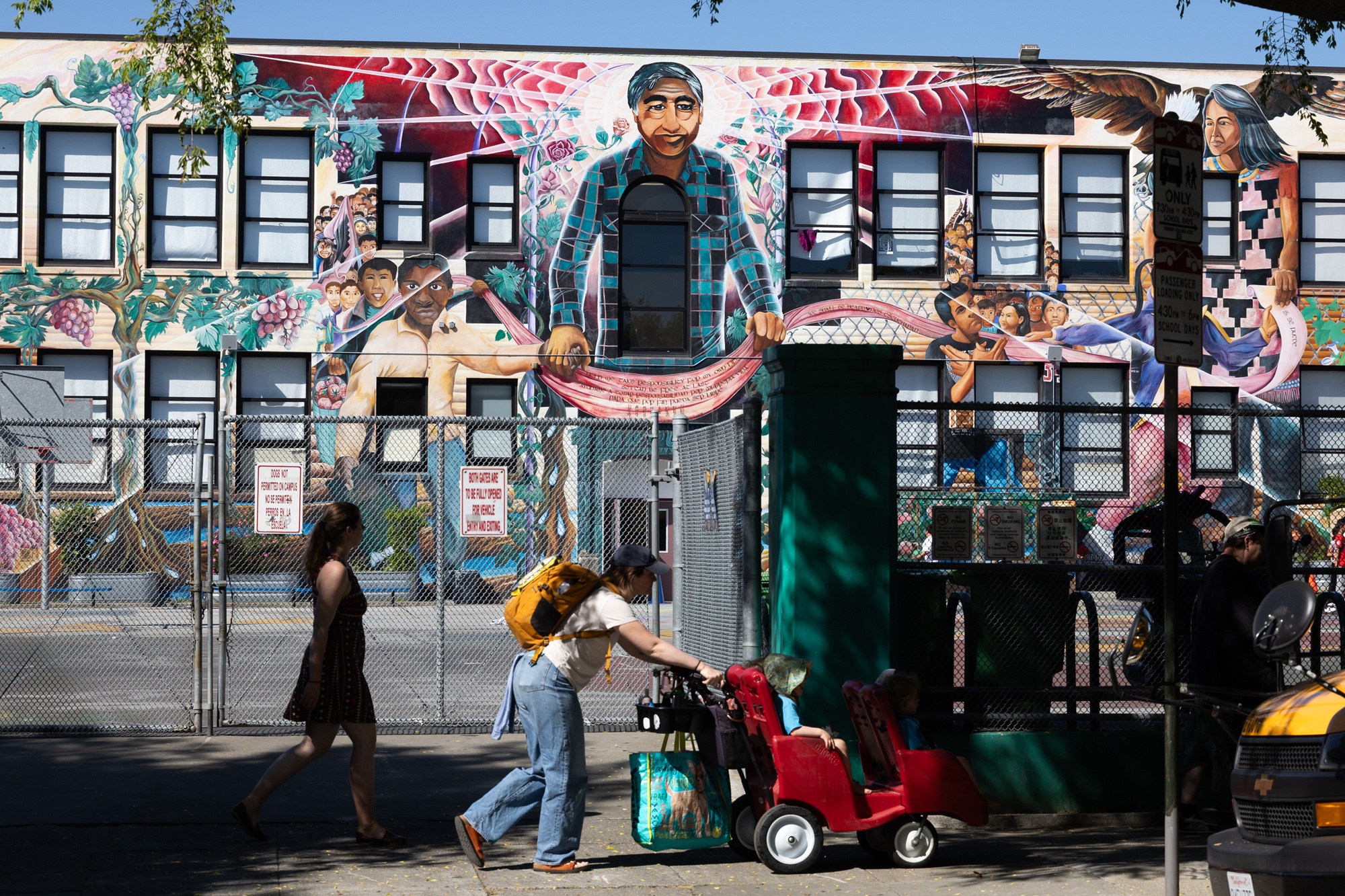
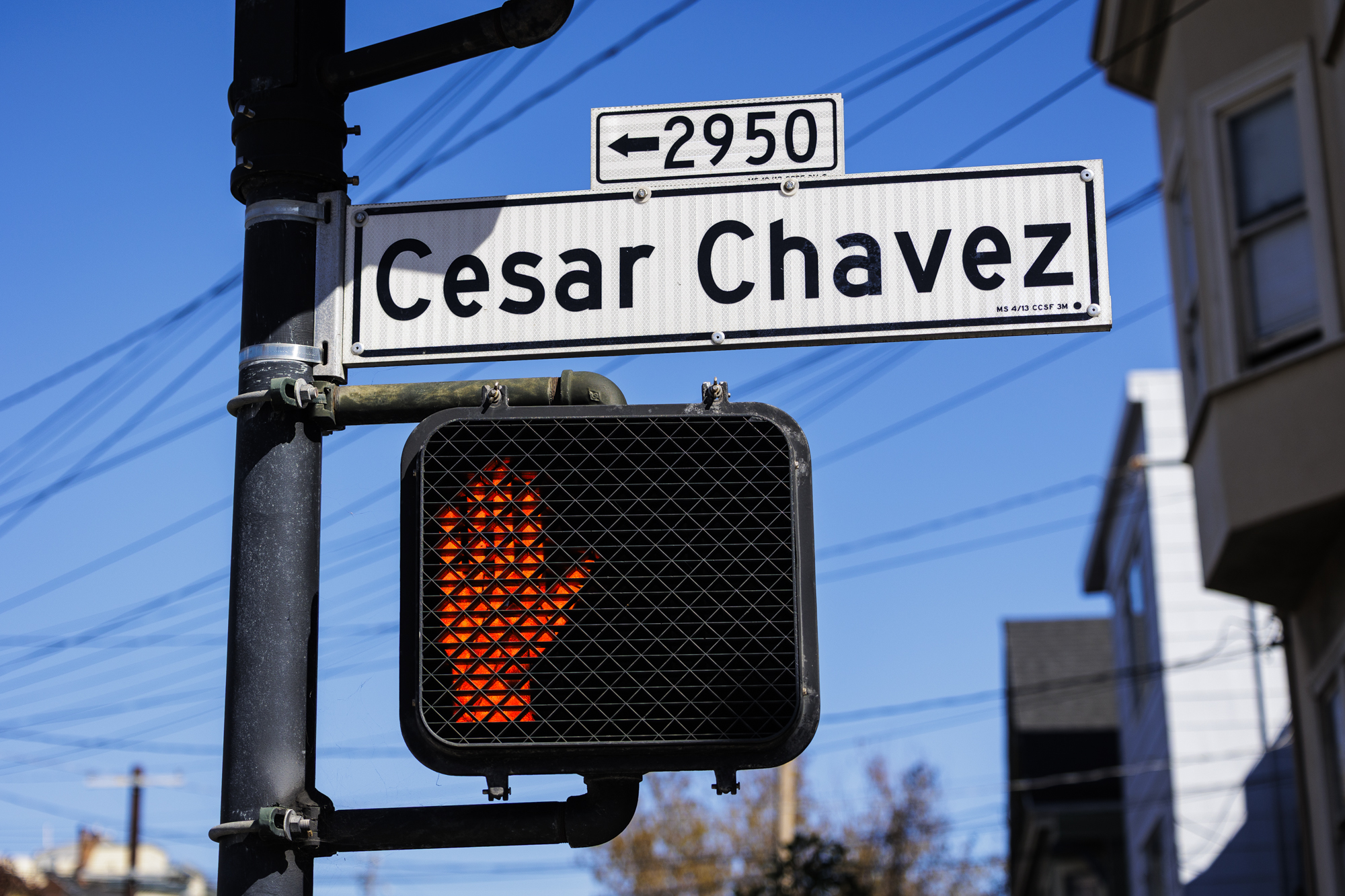
San Francisco Fought to Name a Major Street After Cesar Chavez. Will It Be Renamed Again?
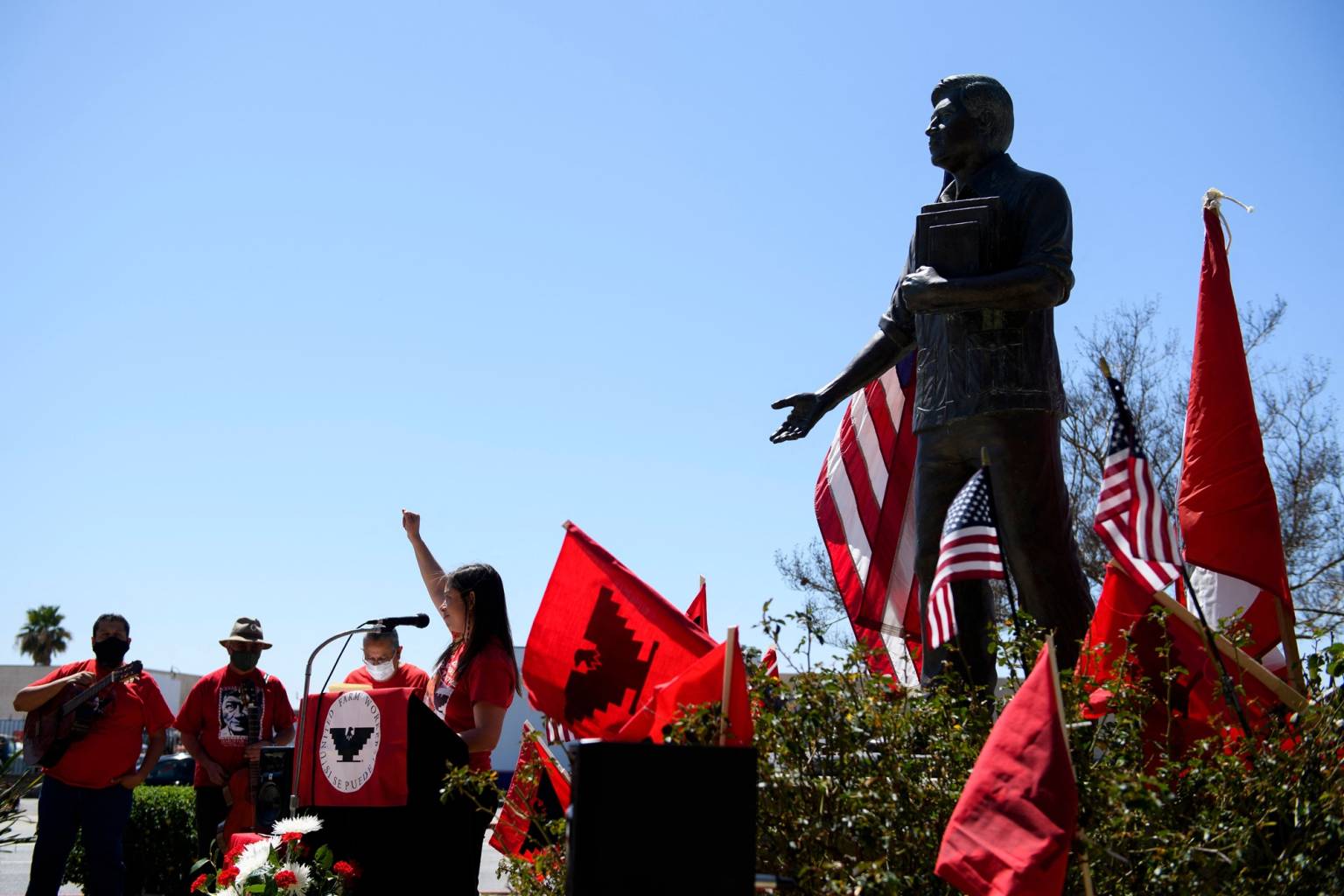
Sexual Abuse Allegations Against César Chavez Rock California
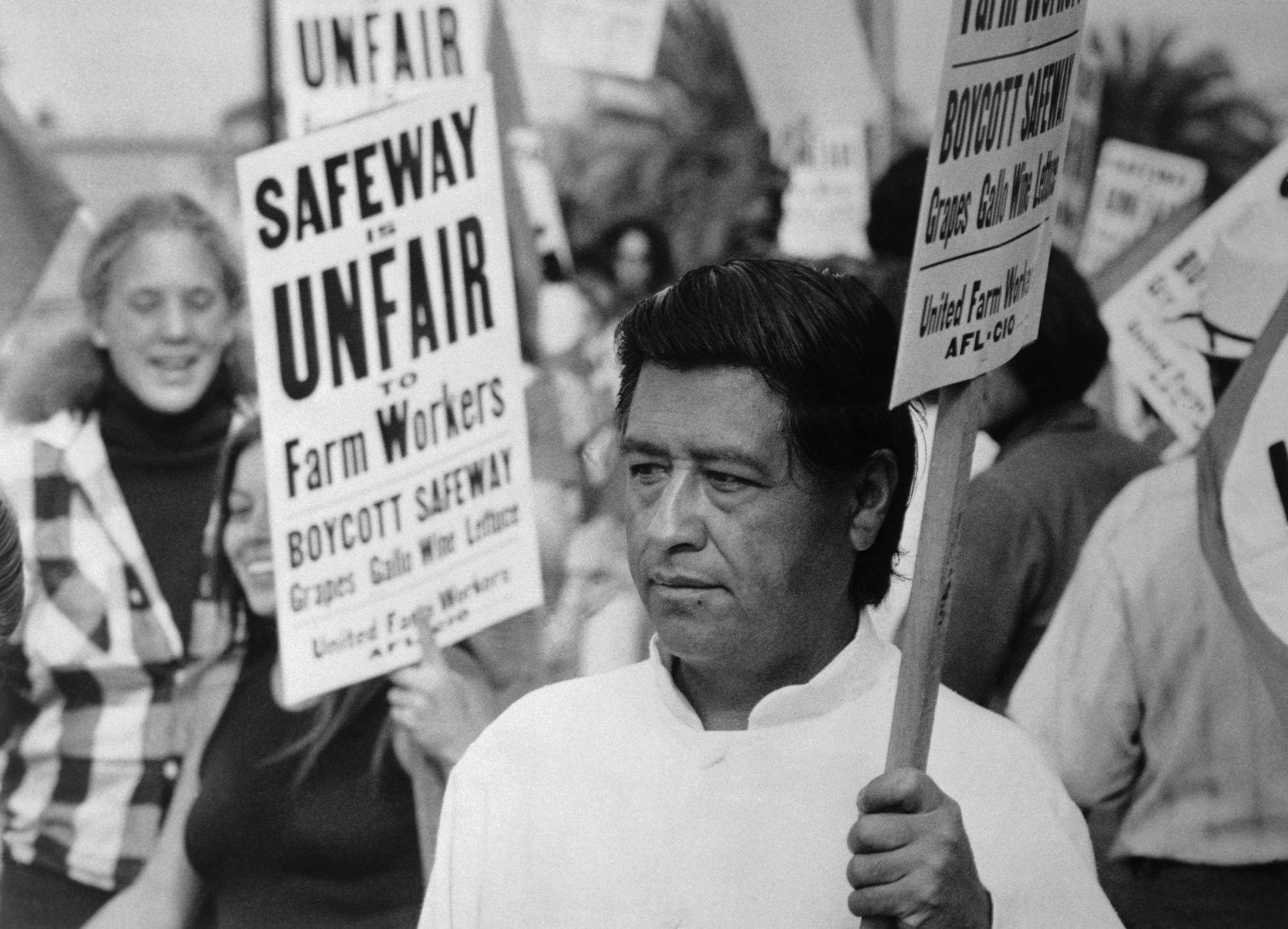
California Reacts to Allegations Against Labor Leader Cesar Chavez
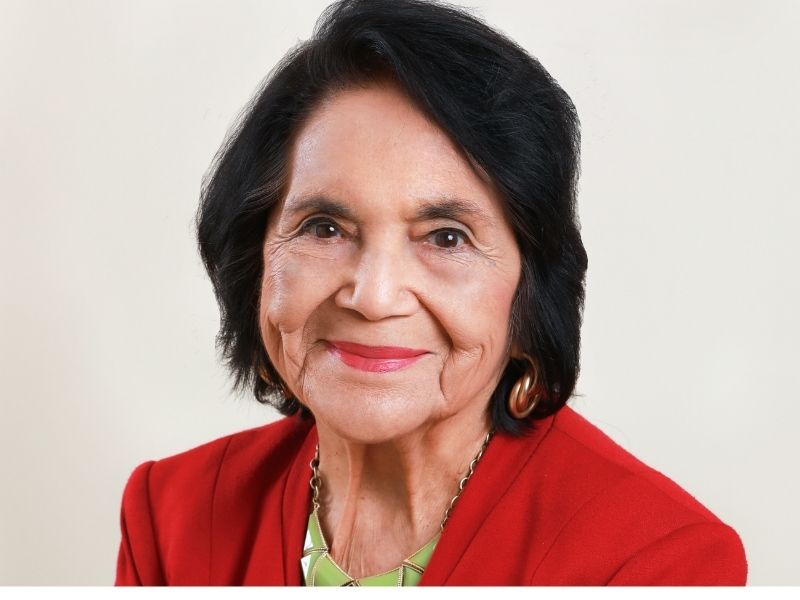
Dolores Huerta On The State Of Worker's Rights In California
Where Past Meets Possible: Black Futures Ball Illuminates Dreams in Oakland
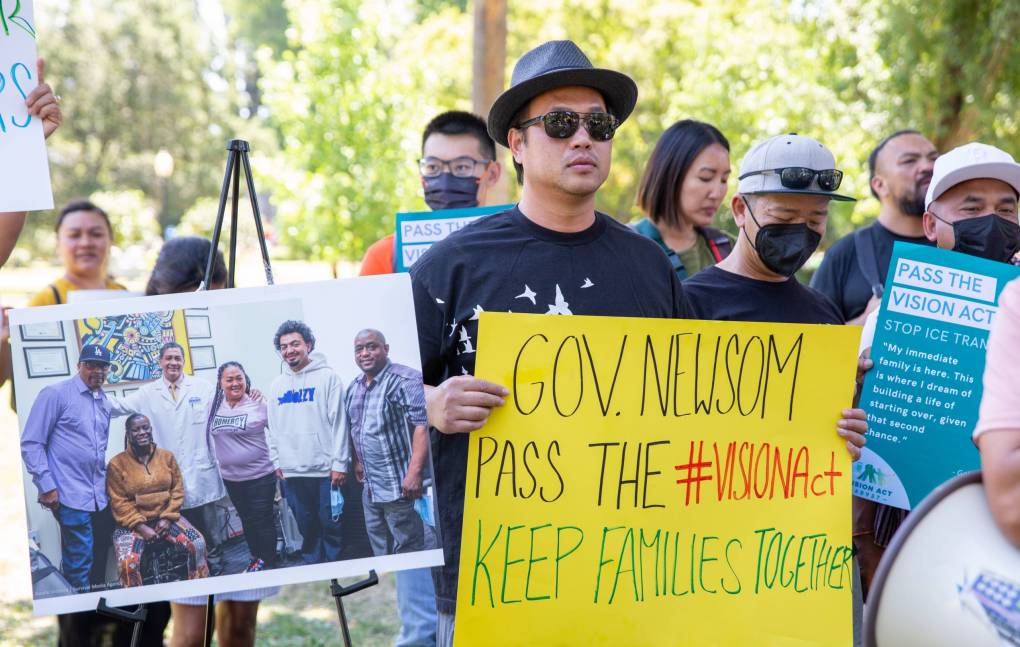
Immigrant Advocates Make Final Push to Pass Bill Ending Prison-to-ICE Transfers in California
Petition Afoot to Change South Van Ness Avenue to Dolores Huerta Boulevard
Perspectives on DACA, Labor Activist Dolores Huerta
Interview: Dolores Huerta on the Dedication of UFW Site as National Historic Landmark
Player sponsored by
window.__IS_SSR__=true
window.__INITIAL_STATE__={
"attachmentsReducer": {
"audio_0": {
"type": "attachments",
"id": "audio_0",
"imgSizes": {
"kqedFullSize": {
"file": "https://ww2.kqed.org/news/wp-content/themes/KQED-unified/img/audio_bgs/background0.jpg"
}
}
},
"audio_1": {
"type": "attachments",
"id": "audio_1",
"imgSizes": {
"kqedFullSize": {
"file": "https://ww2.kqed.org/news/wp-content/themes/KQED-unified/img/audio_bgs/background1.jpg"
}
}
},
"audio_2": {
"type": "attachments",
"id": "audio_2",
"imgSizes": {
"kqedFullSize": {
"file": "https://ww2.kqed.org/news/wp-content/themes/KQED-unified/img/audio_bgs/background2.jpg"
}
}
},
"audio_3": {
"type": "attachments",
"id": "audio_3",
"imgSizes": {
"kqedFullSize": {
"file": "https://ww2.kqed.org/news/wp-content/themes/KQED-unified/img/audio_bgs/background3.jpg"
}
}
},
"audio_4": {
"type": "attachments",
"id": "audio_4",
"imgSizes": {
"kqedFullSize": {
"file": "https://ww2.kqed.org/news/wp-content/themes/KQED-unified/img/audio_bgs/background4.jpg"
}
}
},
"placeholder": {
"type": "attachments",
"id": "placeholder",
"imgSizes": {
"thumbnail": {
"file": "https://cdn.kqed.org/wp-content/uploads/2024/12/KQED-Default-Image-816638274-2000x1333-1-160x107.jpg",
"width": 160,
"height": 107,
"mimeType": "image/jpeg"
},
"medium": {
"file": "https://cdn.kqed.org/wp-content/uploads/2024/12/KQED-Default-Image-816638274-2000x1333-1-800x533.jpg",
"width": 800,
"height": 533,
"mimeType": "image/jpeg"
},
"medium_large": {
"file": "https://cdn.kqed.org/wp-content/uploads/2024/12/KQED-Default-Image-816638274-2000x1333-1-768x512.jpg",
"width": 768,
"height": 512,
"mimeType": "image/jpeg"
},
"large": {
"file": "https://cdn.kqed.org/wp-content/uploads/2024/12/KQED-Default-Image-816638274-2000x1333-1-1020x680.jpg",
"width": 1020,
"height": 680,
"mimeType": "image/jpeg"
},
"1536x1536": {
"file": "https://cdn.kqed.org/wp-content/uploads/2024/12/KQED-Default-Image-816638274-2000x1333-1-1536x1024.jpg",
"width": 1536,
"height": 1024,
"mimeType": "image/jpeg"
},
"fd-lrg": {
"file": "https://cdn.kqed.org/wp-content/uploads/2024/12/KQED-Default-Image-816638274-2000x1333-1-1536x1024.jpg",
"width": 1536,
"height": 1024,
"mimeType": "image/jpeg"
},
"fd-med": {
"file": "https://cdn.kqed.org/wp-content/uploads/2024/12/KQED-Default-Image-816638274-2000x1333-1-1020x680.jpg",
"width": 1020,
"height": 680,
"mimeType": "image/jpeg"
},
"fd-sm": {
"file": "https://cdn.kqed.org/wp-content/uploads/2024/12/KQED-Default-Image-816638274-2000x1333-1-800x533.jpg",
"width": 800,
"height": 533,
"mimeType": "image/jpeg"
},
"post-thumbnail": {
"file": "https://cdn.kqed.org/wp-content/uploads/2024/12/KQED-Default-Image-816638274-2000x1333-1-672x372.jpg",
"width": 672,
"height": 372,
"mimeType": "image/jpeg"
},
"twentyfourteen-full-width": {
"file": "https://cdn.kqed.org/wp-content/uploads/2024/12/KQED-Default-Image-816638274-2000x1333-1-1038x576.jpg",
"width": 1038,
"height": 576,
"mimeType": "image/jpeg"
},
"xxsmall": {
"file": "https://cdn.kqed.org/wp-content/uploads/2024/12/KQED-Default-Image-816638274-2000x1333-1-160x107.jpg",
"width": 160,
"height": 107,
"mimeType": "image/jpeg"
},
"xsmall": {
"file": "https://cdn.kqed.org/wp-content/uploads/2024/12/KQED-Default-Image-816638274-2000x1333-1-672x372.jpg",
"width": 672,
"height": 372,
"mimeType": "image/jpeg"
},
"small": {
"file": "https://cdn.kqed.org/wp-content/uploads/2024/12/KQED-Default-Image-816638274-2000x1333-1-672x372.jpg",
"width": 672,
"height": 372,
"mimeType": "image/jpeg"
},
"xlarge": {
"file": "https://cdn.kqed.org/wp-content/uploads/2024/12/KQED-Default-Image-816638274-2000x1333-1-1020x680.jpg",
"width": 1020,
"height": 680,
"mimeType": "image/jpeg"
},
"full-width": {
"file": "https://cdn.kqed.org/wp-content/uploads/2024/12/KQED-Default-Image-816638274-2000x1333-1-1920x1280.jpg",
"width": 1920,
"height": 1280,
"mimeType": "image/jpeg"
},
"guest-author-32": {
"file": "https://cdn.kqed.org/wp-content/uploads/2025/01/KQED-Default-Image-816638274-1333x1333-1-160x160.jpg",
"width": 32,
"height": 32,
"mimeType": "image/jpeg"
},
"guest-author-50": {
"file": "https://cdn.kqed.org/wp-content/uploads/2025/01/KQED-Default-Image-816638274-1333x1333-1-160x160.jpg",
"width": 50,
"height": 50,
"mimeType": "image/jpeg"
},
"guest-author-64": {
"file": "https://cdn.kqed.org/wp-content/uploads/2025/01/KQED-Default-Image-816638274-1333x1333-1-160x160.jpg",
"width": 64,
"height": 64,
"mimeType": "image/jpeg"
},
"guest-author-96": {
"file": "https://cdn.kqed.org/wp-content/uploads/2025/01/KQED-Default-Image-816638274-1333x1333-1-160x160.jpg",
"width": 96,
"height": 96,
"mimeType": "image/jpeg"
},
"guest-author-128": {
"file": "https://cdn.kqed.org/wp-content/uploads/2025/01/KQED-Default-Image-816638274-1333x1333-1-160x160.jpg",
"width": 128,
"height": 128,
"mimeType": "image/jpeg"
},
"detail": {
"file": "https://cdn.kqed.org/wp-content/uploads/2025/01/KQED-Default-Image-816638274-1333x1333-1-160x160.jpg",
"width": 160,
"height": 160,
"mimeType": "image/jpeg"
},
"kqedFullSize": {
"file": "https://cdn.kqed.org/wp-content/uploads/2024/12/KQED-Default-Image-816638274-2000x1333-1.jpg",
"width": 2000,
"height": 1333
}
}
},
"news_12077474": {
"type": "attachments",
"id": "news_12077474",
"meta": {
"index": "attachments_1716263798",
"site": "news",
"id": "12077474",
"found": true
},
"title": "Chavez Statue",
"publishDate": 1774410664,
"status": "inherit",
"parent": 12077473,
"modified": 1774468842,
"caption": "Una estatua de César Chávez se alza mientras los miembros del comité conmemorativo del Valle de San Fernando celebran el Día de César Chávez el 31 de marzo de 2021 en San Fernando, California. Las comunidades de trabajadores agrícolas de California se esforzaban por asimilar los inquietantes detalles de las acusaciones de agresión sexual contra este ícono sindical y luchador por los derechos civiles.",
"credit": "Patrick T. Fallon/AFP vía Getty Images",
"altTag": null,
"description": null,
"imgSizes": {
"thumbnail": {
"file": "https://cdn.kqed.org/wp-content/uploads/sites/10/2026/03/Chavez-Statue-1-160x107.jpg",
"width": 160,
"height": 107,
"mimeType": "image/jpeg"
},
"post-thumbnail": {
"file": "https://cdn.kqed.org/wp-content/uploads/sites/10/2026/03/Chavez-Statue-1-672x372.jpg",
"width": 672,
"height": 372,
"mimeType": "image/jpeg"
},
"twentyfourteen-full-width": {
"file": "https://cdn.kqed.org/wp-content/uploads/sites/10/2026/03/Chavez-Statue-1-1038x576.jpg",
"width": 1038,
"height": 576,
"mimeType": "image/jpeg"
},
"npr-cds-wide": {
"file": "https://cdn.kqed.org/wp-content/uploads/sites/10/2026/03/Chavez-Statue-1-1200x675.jpg",
"width": 1200,
"height": 675,
"mimeType": "image/jpeg"
},
"npr-cds-square": {
"file": "https://cdn.kqed.org/wp-content/uploads/sites/10/2026/03/Chavez-Statue-1-600x600.jpg",
"width": 600,
"height": 600,
"mimeType": "image/jpeg"
},
"kqedFullSize": {
"file": "https://cdn.kqed.org/wp-content/uploads/sites/10/2026/03/Chavez-Statue-1.jpg",
"width": 1536,
"height": 1024
}
},
"isLoading": false,
"fetchFailed": false
},
"news_12077337": {
"type": "attachments",
"id": "news_12077337",
"meta": {
"index": "attachments_1716263798",
"site": "news",
"id": "12077337",
"found": true
},
"title": "Farmworker Union Icon Cesar Chavez Accused Of Sex Abuse Of Girls In Explosive New Report",
"publishDate": 1774329078,
"status": "inherit",
"parent": 12077336,
"modified": 1774329114,
"caption": "Unos peatones pasan junto a la escuela primaria César Chávez el 18 de marzo de 2026, en San Francisco, California. El activista sindical César Chávez ha sido acusado, en el marco de una investigación, de abusos sexuales a mujeres y menores.",
"credit": "Benjamin Fanjoy/Getty Images",
"altTag": null,
"description": null,
"imgSizes": {
"thumbnail": {
"file": "https://cdn.kqed.org/wp-content/uploads/sites/10/2026/03/Cesar-Chavez-Elementary-160x107.jpg",
"width": 160,
"height": 107,
"mimeType": "image/jpeg"
},
"1536x1536": {
"file": "https://cdn.kqed.org/wp-content/uploads/sites/10/2026/03/Cesar-Chavez-Elementary-1536x1024.jpg",
"width": 1536,
"height": 1024,
"mimeType": "image/jpeg"
},
"post-thumbnail": {
"file": "https://cdn.kqed.org/wp-content/uploads/sites/10/2026/03/Cesar-Chavez-Elementary-672x372.jpg",
"width": 672,
"height": 372,
"mimeType": "image/jpeg"
},
"twentyfourteen-full-width": {
"file": "https://cdn.kqed.org/wp-content/uploads/sites/10/2026/03/Cesar-Chavez-Elementary-1038x576.jpg",
"width": 1038,
"height": 576,
"mimeType": "image/jpeg"
},
"npr-cds-wide": {
"file": "https://cdn.kqed.org/wp-content/uploads/sites/10/2026/03/Cesar-Chavez-Elementary-1200x675.jpg",
"width": 1200,
"height": 675,
"mimeType": "image/jpeg"
},
"kqedFullSize": {
"file": "https://cdn.kqed.org/wp-content/uploads/sites/10/2026/03/Cesar-Chavez-Elementary.jpg",
"width": 2000,
"height": 1333
}
},
"isLoading": false,
"fetchFailed": false
},
"news_12077058": {
"type": "attachments",
"id": "news_12077058",
"meta": {
"index": "attachments_1716263798",
"site": "news",
"id": "12077058",
"found": true
},
"title": "A street sign on Cesar Chavez Street in San Francisco on March 19, 2026.",
"publishDate": 1773944010,
"status": "inherit",
"parent": 12077691,
"modified": 1774556186,
"caption": "A street sign on Cesar Chavez Street in San Francisco on March 19, 2026.",
"credit": "Martin do Nascimento/KQED",
"altTag": null,
"description": null,
"imgSizes": {
"thumbnail": {
"file": "https://cdn.kqed.org/wp-content/uploads/sites/10/2026/03/260319-CESAR-CHAVEZ-STREET-MD-01-KQED-160x107.jpg",
"width": 160,
"height": 107,
"mimeType": "image/jpeg"
},
"1536x1536": {
"file": "https://cdn.kqed.org/wp-content/uploads/sites/10/2026/03/260319-CESAR-CHAVEZ-STREET-MD-01-KQED-1536x1024.jpg",
"width": 1536,
"height": 1024,
"mimeType": "image/jpeg"
},
"post-thumbnail": {
"file": "https://cdn.kqed.org/wp-content/uploads/sites/10/2026/03/260319-CESAR-CHAVEZ-STREET-MD-01-KQED-672x372.jpg",
"width": 672,
"height": 372,
"mimeType": "image/jpeg"
},
"twentyfourteen-full-width": {
"file": "https://cdn.kqed.org/wp-content/uploads/sites/10/2026/03/260319-CESAR-CHAVEZ-STREET-MD-01-KQED-1038x576.jpg",
"width": 1038,
"height": 576,
"mimeType": "image/jpeg"
},
"npr-cds-wide": {
"file": "https://cdn.kqed.org/wp-content/uploads/sites/10/2026/03/260319-CESAR-CHAVEZ-STREET-MD-01-KQED-1200x675.jpg",
"width": 1200,
"height": 675,
"mimeType": "image/jpeg"
},
"kqedFullSize": {
"file": "https://cdn.kqed.org/wp-content/uploads/sites/10/2026/03/260319-CESAR-CHAVEZ-STREET-MD-01-KQED.jpg",
"width": 2000,
"height": 1333
}
},
"isLoading": false,
"fetchFailed": false
},
"news_12077027": {
"type": "attachments",
"id": "news_12077027",
"meta": {
"index": "attachments_1716263798",
"site": "news",
"id": "12077027",
"found": true
},
"title": "Cesar Chavez Leading Strike",
"publishDate": 1773928170,
"status": "inherit",
"parent": 12077025,
"modified": 1773940406,
"caption": "Farm labor leader Cesar Chavez pickets outside the San Diego-area headquarters of Safeway markets. It was in protest over the arrest of 29 persons at a Delano, California, Safeway. ",
"credit": "Getty Images",
"altTag": null,
"description": null,
"imgSizes": {
"medium": {
"file": "https://cdn.kqed.org/wp-content/uploads/sites/10/2026/03/GettyImages-515109272-2000x1443.jpg",
"width": 2000,
"height": 1443,
"mimeType": "image/jpeg"
},
"large": {
"file": "https://cdn.kqed.org/wp-content/uploads/sites/10/2026/03/GettyImages-515109272-2000x1443.jpg",
"width": 2000,
"height": 1443,
"mimeType": "image/jpeg"
},
"thumbnail": {
"file": "https://cdn.kqed.org/wp-content/uploads/sites/10/2026/03/GettyImages-515109272-160x115.jpg",
"width": 160,
"height": 115,
"mimeType": "image/jpeg"
},
"1536x1536": {
"file": "https://cdn.kqed.org/wp-content/uploads/sites/10/2026/03/GettyImages-515109272-1536x1108.jpg",
"width": 1536,
"height": 1108,
"mimeType": "image/jpeg"
},
"2048x2048": {
"file": "https://cdn.kqed.org/wp-content/uploads/sites/10/2026/03/GettyImages-515109272-2048x1478.jpg",
"width": 2048,
"height": 1478,
"mimeType": "image/jpeg"
},
"post-thumbnail": {
"file": "https://cdn.kqed.org/wp-content/uploads/sites/10/2026/03/GettyImages-515109272-672x372.jpg",
"width": 672,
"height": 372,
"mimeType": "image/jpeg"
},
"twentyfourteen-full-width": {
"file": "https://cdn.kqed.org/wp-content/uploads/sites/10/2026/03/GettyImages-515109272-1038x576.jpg",
"width": 1038,
"height": 576,
"mimeType": "image/jpeg"
},
"full-width": {
"file": "https://cdn.kqed.org/wp-content/uploads/sites/10/2026/03/GettyImages-515109272-2000x1443.jpg",
"width": 2000,
"height": 1443,
"mimeType": "image/jpeg"
},
"npr-cds-wide": {
"file": "https://cdn.kqed.org/wp-content/uploads/sites/10/2026/03/GettyImages-515109272-1200x675.jpg",
"width": 1200,
"height": 675,
"mimeType": "image/jpeg"
},
"kqedFullSize": {
"file": "https://cdn.kqed.org/wp-content/uploads/sites/10/2026/03/GettyImages-515109272-scaled-e1773940356467.jpg",
"width": 2000,
"height": 1443
}
},
"isLoading": false,
"fetchFailed": false
},
"news_12054314": {
"type": "attachments",
"id": "news_12054314",
"meta": {
"index": "attachments_1716263798",
"site": "news",
"id": "12054314",
"found": true
},
"title": "Untitled design",
"publishDate": 1756738999,
"status": "inherit",
"parent": 12054312,
"modified": 1756739048,
"caption": "Portrait of Dolores Huerta in 2024.",
"credit": "Photo courtesy of Dolores Huerta Foundation",
"altTag": null,
"description": null,
"imgSizes": {
"thumbnail": {
"file": "https://cdn.kqed.org/wp-content/uploads/sites/10/2025/09/Untitled-design-160x120.jpg",
"width": 160,
"height": 120,
"mimeType": "image/jpeg"
},
"post-thumbnail": {
"file": "https://cdn.kqed.org/wp-content/uploads/sites/10/2025/09/Untitled-design-672x372.jpg",
"width": 672,
"height": 372,
"mimeType": "image/jpeg"
},
"twentyfourteen-full-width": {
"file": "https://cdn.kqed.org/wp-content/uploads/sites/10/2025/09/Untitled-design-800x576.jpg",
"width": 800,
"height": 576,
"mimeType": "image/jpeg"
},
"kqedFullSize": {
"file": "https://cdn.kqed.org/wp-content/uploads/sites/10/2025/09/Untitled-design.jpg",
"width": 800,
"height": 600
}
},
"isLoading": false,
"fetchFailed": false
},
"news_12051414": {
"type": "attachments",
"id": "news_12051414",
"meta": {
"index": "attachments_1716263798",
"site": "news",
"id": "12051414",
"found": true
},
"title": "250802-AFROFUTURES_01253_TV-KQED-1",
"publishDate": 1754660438,
"status": "inherit",
"parent": 0,
"modified": 1754672001,
"caption": "Selena Wilson, CEO of the EOYDC, speaks at the Black Futures Ball Banquet hosted by The East Oakland Youth Development Center at Chabot Space and Science Center in Oakland on Aug. 2, 2025.",
"credit": "Tâm Vũ/KQED",
"altTag": null,
"description": null,
"imgSizes": {
"thumbnail": {
"file": "https://cdn.kqed.org/wp-content/uploads/sites/10/2025/08/250802-AFROFUTURES_01253_TV-KQED-1-160x107.jpg",
"width": 160,
"height": 107,
"mimeType": "image/jpeg"
},
"1536x1536": {
"file": "https://cdn.kqed.org/wp-content/uploads/sites/10/2025/08/250802-AFROFUTURES_01253_TV-KQED-1-1536x1024.jpg",
"width": 1536,
"height": 1024,
"mimeType": "image/jpeg"
},
"post-thumbnail": {
"file": "https://cdn.kqed.org/wp-content/uploads/sites/10/2025/08/250802-AFROFUTURES_01253_TV-KQED-1-672x372.jpg",
"width": 672,
"height": 372,
"mimeType": "image/jpeg"
},
"twentyfourteen-full-width": {
"file": "https://cdn.kqed.org/wp-content/uploads/sites/10/2025/08/250802-AFROFUTURES_01253_TV-KQED-1-1038x576.jpg",
"width": 1038,
"height": 576,
"mimeType": "image/jpeg"
},
"kqedFullSize": {
"file": "https://cdn.kqed.org/wp-content/uploads/sites/10/2025/08/250802-AFROFUTURES_01253_TV-KQED-1.jpg",
"width": 2000,
"height": 1333
}
},
"isLoading": false,
"fetchFailed": false
},
"news_11923545": {
"type": "attachments",
"id": "news_11923545",
"meta": {
"index": "attachments_1716263798",
"site": "news",
"id": "11923545",
"found": true
},
"parent": 0,
"imgSizes": {
"twentyfourteen-full-width": {
"file": "https://ww2.kqed.org/app/uploads/sites/10/2022/08/6.21.22-Vision-Act-Rally_Joyce-Xi-7-scaled-e1661451509669-1038x576.jpg",
"width": 1038,
"mimeType": "image/jpeg",
"height": 576
},
"thumbnail": {
"file": "https://ww2.kqed.org/app/uploads/sites/10/2022/08/6.21.22-Vision-Act-Rally_Joyce-Xi-7-scaled-e1661451509669-160x102.jpg",
"width": 160,
"mimeType": "image/jpeg",
"height": 102
},
"post-thumbnail": {
"file": "https://ww2.kqed.org/app/uploads/sites/10/2022/08/6.21.22-Vision-Act-Rally_Joyce-Xi-7-scaled-e1661451509669-672x372.jpg",
"width": 672,
"mimeType": "image/jpeg",
"height": 372
},
"kqedFullSize": {
"file": "https://ww2.kqed.org/app/uploads/sites/10/2022/08/6.21.22-Vision-Act-Rally_Joyce-Xi-7-scaled-e1661451509669.jpg",
"width": 2540,
"height": 1612
},
"2048x2048": {
"file": "https://ww2.kqed.org/app/uploads/sites/10/2022/08/6.21.22-Vision-Act-Rally_Joyce-Xi-7-scaled-e1661451509669-2048x1300.jpg",
"width": 2048,
"mimeType": "image/jpeg",
"height": 1300
},
"large": {
"file": "https://ww2.kqed.org/app/uploads/sites/10/2022/08/6.21.22-Vision-Act-Rally_Joyce-Xi-7-scaled-e1661451509669-1020x647.jpg",
"width": 1020,
"mimeType": "image/jpeg",
"height": 647
},
"1536x1536": {
"file": "https://ww2.kqed.org/app/uploads/sites/10/2022/08/6.21.22-Vision-Act-Rally_Joyce-Xi-7-scaled-e1661451509669-1536x975.jpg",
"width": 1536,
"mimeType": "image/jpeg",
"height": 975
},
"full-width": {
"file": "https://ww2.kqed.org/app/uploads/sites/10/2022/08/6.21.22-Vision-Act-Rally_Joyce-Xi-7-scaled-e1661451509669-1920x1219.jpg",
"width": 1920,
"mimeType": "image/jpeg",
"height": 1219
},
"medium": {
"file": "https://ww2.kqed.org/app/uploads/sites/10/2022/08/6.21.22-Vision-Act-Rally_Joyce-Xi-7-scaled-e1661451509669-800x508.jpg",
"width": 800,
"mimeType": "image/jpeg",
"height": 508
}
},
"publishDate": 1661447263,
"modified": 1661452518,
"caption": "Immigrant advocates rally for the passage of the VISION Act, in Sacramento on June 21, 2022. The bill would end the transfer of immigrants to U.S. Immigration and Customs Enforcement when they are released from California prisons.\n\n",
"description": null,
"title": "6.21.22 Vision Act Rally_Joyce Xi-7",
"credit": "Photo by Joyce Xi, courtesy of the Asian Law Caucus",
"status": "inherit",
"altTag": "Demonstrators stand in a group, holding signs and photos. One sign says: 'Gov. Newsom Pass The #VisionAct Keep Families Together'",
"isLoading": false,
"fetchFailed": false
},
"arts_13807552": {
"type": "attachments",
"id": "arts_13807552",
"meta": {
"index": "attachments_1716263798",
"site": "arts",
"id": "13807552",
"found": true
},
"parent": 13807547,
"imgSizes": {
"small": {
"file": "https://ww2.kqed.org/app/uploads/sites/2/2017/09/4-Dolores-Huerta-speaks-at-the-podium.-c1970s.-Courtesy-of-Walter-P.-Reuther-Library-Archives-of-Labor-and-Urban-Affairs-Wayne-State-University-520x292.jpg",
"width": 520,
"mimeType": "image/jpeg",
"height": 292
},
"twentyfourteen-full-width": {
"file": "https://ww2.kqed.org/app/uploads/sites/2/2017/09/4-Dolores-Huerta-speaks-at-the-podium.-c1970s.-Courtesy-of-Walter-P.-Reuther-Library-Archives-of-Labor-and-Urban-Affairs-Wayne-State-University-1038x576.jpg",
"width": 1038,
"mimeType": "image/jpeg",
"height": 576
},
"thumbnail": {
"file": "https://ww2.kqed.org/app/uploads/sites/2/2017/09/4-Dolores-Huerta-speaks-at-the-podium.-c1970s.-Courtesy-of-Walter-P.-Reuther-Library-Archives-of-Labor-and-Urban-Affairs-Wayne-State-University-160x90.jpg",
"width": 160,
"mimeType": "image/jpeg",
"height": 90
},
"fd-sm": {
"file": "https://ww2.kqed.org/app/uploads/sites/2/2017/09/4-Dolores-Huerta-speaks-at-the-podium.-c1970s.-Courtesy-of-Walter-P.-Reuther-Library-Archives-of-Labor-and-Urban-Affairs-Wayne-State-University-960x540.jpg",
"width": 960,
"mimeType": "image/jpeg",
"height": 540
},
"post-thumbnail": {
"file": "https://ww2.kqed.org/app/uploads/sites/2/2017/09/4-Dolores-Huerta-speaks-at-the-podium.-c1970s.-Courtesy-of-Walter-P.-Reuther-Library-Archives-of-Labor-and-Urban-Affairs-Wayne-State-University-672x372.jpg",
"width": 672,
"mimeType": "image/jpeg",
"height": 372
},
"xsmall": {
"file": "https://ww2.kqed.org/app/uploads/sites/2/2017/09/4-Dolores-Huerta-speaks-at-the-podium.-c1970s.-Courtesy-of-Walter-P.-Reuther-Library-Archives-of-Labor-and-Urban-Affairs-Wayne-State-University-375x211.jpg",
"width": 375,
"mimeType": "image/jpeg",
"height": 211
},
"kqedFullSize": {
"file": "https://ww2.kqed.org/app/uploads/sites/2/2017/09/4-Dolores-Huerta-speaks-at-the-podium.-c1970s.-Courtesy-of-Walter-P.-Reuther-Library-Archives-of-Labor-and-Urban-Affairs-Wayne-State-University.jpg",
"width": 3999,
"height": 2249
},
"large": {
"file": "https://ww2.kqed.org/app/uploads/sites/2/2017/09/4-Dolores-Huerta-speaks-at-the-podium.-c1970s.-Courtesy-of-Walter-P.-Reuther-Library-Archives-of-Labor-and-Urban-Affairs-Wayne-State-University-1020x574.jpg",
"width": 1020,
"mimeType": "image/jpeg",
"height": 574
},
"xlarge": {
"file": "https://ww2.kqed.org/app/uploads/sites/2/2017/09/4-Dolores-Huerta-speaks-at-the-podium.-c1970s.-Courtesy-of-Walter-P.-Reuther-Library-Archives-of-Labor-and-Urban-Affairs-Wayne-State-University-1180x664.jpg",
"width": 1180,
"mimeType": "image/jpeg",
"height": 664
},
"guest-author-50": {
"file": "https://ww2.kqed.org/app/uploads/sites/2/2017/09/4-Dolores-Huerta-speaks-at-the-podium.-c1970s.-Courtesy-of-Walter-P.-Reuther-Library-Archives-of-Labor-and-Urban-Affairs-Wayne-State-University-50x50.jpg",
"width": 50,
"mimeType": "image/jpeg",
"height": 50
},
"guest-author-96": {
"file": "https://ww2.kqed.org/app/uploads/sites/2/2017/09/4-Dolores-Huerta-speaks-at-the-podium.-c1970s.-Courtesy-of-Walter-P.-Reuther-Library-Archives-of-Labor-and-Urban-Affairs-Wayne-State-University-96x96.jpg",
"width": 96,
"mimeType": "image/jpeg",
"height": 96
},
"medium": {
"file": "https://ww2.kqed.org/app/uploads/sites/2/2017/09/4-Dolores-Huerta-speaks-at-the-podium.-c1970s.-Courtesy-of-Walter-P.-Reuther-Library-Archives-of-Labor-and-Urban-Affairs-Wayne-State-University-800x450.jpg",
"width": 800,
"mimeType": "image/jpeg",
"height": 450
},
"guest-author-64": {
"file": "https://ww2.kqed.org/app/uploads/sites/2/2017/09/4-Dolores-Huerta-speaks-at-the-podium.-c1970s.-Courtesy-of-Walter-P.-Reuther-Library-Archives-of-Labor-and-Urban-Affairs-Wayne-State-University-64x64.jpg",
"width": 64,
"mimeType": "image/jpeg",
"height": 64
},
"guest-author-32": {
"file": "https://ww2.kqed.org/app/uploads/sites/2/2017/09/4-Dolores-Huerta-speaks-at-the-podium.-c1970s.-Courtesy-of-Walter-P.-Reuther-Library-Archives-of-Labor-and-Urban-Affairs-Wayne-State-University-32x32.jpg",
"width": 32,
"mimeType": "image/jpeg",
"height": 32
},
"fd-lrg": {
"file": "https://ww2.kqed.org/app/uploads/sites/2/2017/09/4-Dolores-Huerta-speaks-at-the-podium.-c1970s.-Courtesy-of-Walter-P.-Reuther-Library-Archives-of-Labor-and-Urban-Affairs-Wayne-State-University-1920x1080.jpg",
"width": 1920,
"mimeType": "image/jpeg",
"height": 1080
},
"fd-med": {
"file": "https://ww2.kqed.org/app/uploads/sites/2/2017/09/4-Dolores-Huerta-speaks-at-the-podium.-c1970s.-Courtesy-of-Walter-P.-Reuther-Library-Archives-of-Labor-and-Urban-Affairs-Wayne-State-University-1180x664.jpg",
"width": 1180,
"mimeType": "image/jpeg",
"height": 664
},
"full-width": {
"file": "https://ww2.kqed.org/app/uploads/sites/2/2017/09/4-Dolores-Huerta-speaks-at-the-podium.-c1970s.-Courtesy-of-Walter-P.-Reuther-Library-Archives-of-Labor-and-Urban-Affairs-Wayne-State-University-1920x1080.jpg",
"width": 1920,
"mimeType": "image/jpeg",
"height": 1080
},
"detail": {
"file": "https://ww2.kqed.org/app/uploads/sites/2/2017/09/4-Dolores-Huerta-speaks-at-the-podium.-c1970s.-Courtesy-of-Walter-P.-Reuther-Library-Archives-of-Labor-and-Urban-Affairs-Wayne-State-University-150x150.jpg",
"width": 150,
"mimeType": "image/jpeg",
"height": 150
},
"medium_large": {
"file": "https://ww2.kqed.org/app/uploads/sites/2/2017/09/4-Dolores-Huerta-speaks-at-the-podium.-c1970s.-Courtesy-of-Walter-P.-Reuther-Library-Archives-of-Labor-and-Urban-Affairs-Wayne-State-University-768x432.jpg",
"width": 768,
"mimeType": "image/jpeg",
"height": 432
},
"guest-author-128": {
"file": "https://ww2.kqed.org/app/uploads/sites/2/2017/09/4-Dolores-Huerta-speaks-at-the-podium.-c1970s.-Courtesy-of-Walter-P.-Reuther-Library-Archives-of-Labor-and-Urban-Affairs-Wayne-State-University-128x128.jpg",
"width": 128,
"mimeType": "image/jpeg",
"height": 128
},
"xxsmall": {
"file": "https://ww2.kqed.org/app/uploads/sites/2/2017/09/4-Dolores-Huerta-speaks-at-the-podium.-c1970s.-Courtesy-of-Walter-P.-Reuther-Library-Archives-of-Labor-and-Urban-Affairs-Wayne-State-University-240x135.jpg",
"width": 240,
"mimeType": "image/jpeg",
"height": 135
}
},
"publishDate": 1504657797,
"modified": 1504737773,
"caption": "Dolores Huerta speaks at the podium, circa 1970s. ",
"description": null,
"title": "#4 - Dolores Huerta speaks at the podium. c1970s. Courtesy of Walter P. Reuther Library Archives of Labor and Urban Affairs Wayne State University",
"credit": "Courtesy of Walter P. Reuther Library Archives of Labor and Urban Affairs Wayne State University",
"status": "inherit",
"isLoading": false,
"fetchFailed": false
},
"news_11616155": {
"type": "attachments",
"id": "news_11616155",
"meta": {
"index": "attachments_1716263798",
"site": "news",
"id": "11616155",
"found": true
},
"parent": 11616134,
"imgSizes": {
"small": {
"file": "https://ww2.kqed.org/app/uploads/sites/10/2017/09/NR_466_WEB-VERISON-2_MARQ-520x293.jpg",
"width": 520,
"mimeType": "image/jpeg",
"height": 293
},
"twentyfourteen-full-width": {
"file": "https://ww2.kqed.org/app/uploads/sites/10/2017/09/NR_466_WEB-VERISON-2_MARQ-1038x576.jpg",
"width": 1038,
"mimeType": "image/jpeg",
"height": 576
},
"thumbnail": {
"file": "https://ww2.kqed.org/app/uploads/sites/10/2017/09/NR_466_WEB-VERISON-2_MARQ-160x90.jpg",
"width": 160,
"mimeType": "image/jpeg",
"height": 90
},
"fd-sm": {
"file": "https://ww2.kqed.org/app/uploads/sites/10/2017/09/NR_466_WEB-VERISON-2_MARQ-960x540.jpg",
"width": 960,
"mimeType": "image/jpeg",
"height": 540
},
"post-thumbnail": {
"file": "https://ww2.kqed.org/app/uploads/sites/10/2017/09/NR_466_WEB-VERISON-2_MARQ-672x372.jpg",
"width": 672,
"mimeType": "image/jpeg",
"height": 372
},
"xsmall": {
"file": "https://ww2.kqed.org/app/uploads/sites/10/2017/09/NR_466_WEB-VERISON-2_MARQ-375x211.jpg",
"width": 375,
"mimeType": "image/jpeg",
"height": 211
},
"kqedFullSize": {
"file": "https://ww2.kqed.org/app/uploads/sites/10/2017/09/NR_466_WEB-VERISON-2_MARQ.jpg",
"width": 1280,
"height": 720
},
"large": {
"file": "https://ww2.kqed.org/app/uploads/sites/10/2017/09/NR_466_WEB-VERISON-2_MARQ-1020x574.jpg",
"width": 1020,
"mimeType": "image/jpeg",
"height": 574
},
"xlarge": {
"file": "https://ww2.kqed.org/app/uploads/sites/10/2017/09/NR_466_WEB-VERISON-2_MARQ-1180x664.jpg",
"width": 1180,
"mimeType": "image/jpeg",
"height": 664
},
"guest-author-50": {
"file": "https://ww2.kqed.org/app/uploads/sites/10/2017/09/NR_466_WEB-VERISON-2_MARQ-50x50.jpg",
"width": 50,
"mimeType": "image/jpeg",
"height": 50
},
"guest-author-96": {
"file": "https://ww2.kqed.org/app/uploads/sites/10/2017/09/NR_466_WEB-VERISON-2_MARQ-96x96.jpg",
"width": 96,
"mimeType": "image/jpeg",
"height": 96
},
"medium": {
"file": "https://ww2.kqed.org/app/uploads/sites/10/2017/09/NR_466_WEB-VERISON-2_MARQ-800x450.jpg",
"width": 800,
"mimeType": "image/jpeg",
"height": 450
},
"guest-author-64": {
"file": "https://ww2.kqed.org/app/uploads/sites/10/2017/09/NR_466_WEB-VERISON-2_MARQ-64x64.jpg",
"width": 64,
"mimeType": "image/jpeg",
"height": 64
},
"guest-author-32": {
"file": "https://ww2.kqed.org/app/uploads/sites/10/2017/09/NR_466_WEB-VERISON-2_MARQ-32x32.jpg",
"width": 32,
"mimeType": "image/jpeg",
"height": 32
},
"fd-med": {
"file": "https://ww2.kqed.org/app/uploads/sites/10/2017/09/NR_466_WEB-VERISON-2_MARQ-1180x664.jpg",
"width": 1180,
"mimeType": "image/jpeg",
"height": 664
},
"detail": {
"file": "https://ww2.kqed.org/app/uploads/sites/10/2017/09/NR_466_WEB-VERISON-2_MARQ-150x150.jpg",
"width": 150,
"mimeType": "image/jpeg",
"height": 150
},
"guest-author-128": {
"file": "https://ww2.kqed.org/app/uploads/sites/10/2017/09/NR_466_WEB-VERISON-2_MARQ-128x128.jpg",
"width": 128,
"mimeType": "image/jpeg",
"height": 128
},
"xxsmall": {
"file": "https://ww2.kqed.org/app/uploads/sites/10/2017/09/NR_466_WEB-VERISON-2_MARQ-240x135.jpg",
"width": 240,
"mimeType": "image/jpeg",
"height": 135
}
},
"publishDate": 1504910418,
"modified": 1504910418,
"caption": null,
"description": null,
"title": "NR_466_WEB VERISON 2_MARQ",
"credit": null,
"status": "inherit",
"isLoading": false,
"fetchFailed": false
}
},
"audioPlayerReducer": {
"postId": "stream_live",
"isPaused": true,
"isPlaying": false,
"pfsActive": false,
"pledgeModalIsOpen": true,
"playerDrawerIsOpen": false,
"liveAudioPlayStartedAt": 0,
"liveAudioPlayContext": ""
},
"authorsReducer": {
"jbrooks": {
"type": "authors",
"id": "80",
"meta": {
"index": "authors_1716337520",
"id": "80",
"found": true
},
"name": "Jon Brooks",
"firstName": "Jon",
"lastName": "Brooks",
"slug": "jbrooks",
"email": "jbrooks@kqed.org",
"display_author_email": true,
"staff_mastheads": [
"science"
],
"title": "Digital Editor",
"bio": "Jon Brooks is a former Digital Editor for KQED Science. He is the former editor of KQED’s daily news blog, News Fix. In 2014, he won a California Journalism Award for his coverage of ride services like Uber and Lyft and the taxi industry. A veteran blogger, he previously worked for Yahoo! in various news writing and editing roles. Jon is also a playwright whose work has been produced in San Francisco, New York, Italy, and around the U.S. He has written about film for his own blog and studied film at Boston University.",
"avatar": "https://secure.gravatar.com/avatar/98887f7ed1c876ed414d4c915e969584?s=600&d=blank&r=g",
"twitter": "jbrooksfoy",
"facebook": null,
"instagram": null,
"linkedin": null,
"sites": [
{
"site": "arts",
"roles": [
"Contributor",
"editor"
]
},
{
"site": "news",
"roles": [
"author"
]
},
{
"site": "futureofyou",
"roles": [
"administrator"
]
},
{
"site": "mindshift",
"roles": [
"editor"
]
},
{
"site": "stateofhealth",
"roles": [
"editor"
]
},
{
"site": "science",
"roles": [
"administrator"
]
},
{
"site": "quest",
"roles": [
"editor"
]
}
],
"headData": {
"title": "Jon Brooks | KQED",
"description": "Digital Editor",
"ogImgSrc": "https://secure.gravatar.com/avatar/98887f7ed1c876ed414d4c915e969584?s=600&d=blank&r=g",
"twImgSrc": "https://secure.gravatar.com/avatar/98887f7ed1c876ed414d4c915e969584?s=600&d=blank&r=g"
},
"isLoading": false,
"link": "/author/jbrooks"
},
"kqed": {
"type": "authors",
"id": "236",
"meta": {
"index": "authors_1716337520",
"id": "236",
"found": true
},
"name": "KQED News Staff",
"firstName": "KQED News Staff",
"lastName": null,
"slug": "kqed",
"email": "faq@kqed.org",
"display_author_email": false,
"staff_mastheads": [],
"title": null,
"bio": null,
"avatar": "https://secure.gravatar.com/avatar/ef0e801a68c4c54afa9180db14084167?s=600&d=blank&r=g",
"twitter": null,
"facebook": null,
"instagram": null,
"linkedin": null,
"sites": [
{
"site": "arts",
"roles": [
"contributor"
]
},
{
"site": "news",
"roles": [
"editor"
]
},
{
"site": "futureofyou",
"roles": [
"author"
]
}
],
"headData": {
"title": "KQED News Staff | KQED",
"description": null,
"ogImgSrc": "https://secure.gravatar.com/avatar/ef0e801a68c4c54afa9180db14084167?s=600&d=blank&r=g",
"twImgSrc": "https://secure.gravatar.com/avatar/ef0e801a68c4c54afa9180db14084167?s=600&d=blank&r=g"
},
"isLoading": false,
"link": "/author/kqed"
},
"tychehendricks": {
"type": "authors",
"id": "259",
"meta": {
"index": "authors_1716337520",
"id": "259",
"found": true
},
"name": "Tyche Hendricks",
"firstName": "Tyche",
"lastName": "Hendricks",
"slug": "tychehendricks",
"email": "thendricks@kqed.org",
"display_author_email": true,
"staff_mastheads": [
"news"
],
"title": "KQED Senior Editor, Immigration",
"bio": "\u003cspan style=\"font-weight: 400;\">Tyche Hendricks is KQED’s senior editor for immigration, leading coverage of the policy and politics that affect California’s immigrant communities. Her work for KQED’s radio and online audiences is also carried on NPR and other national outlets. She has been recognized with awards from the Radio and Television News Directors Association, the Society for Professional Journalists; the Education Writers Association; the Best of the West and the National Federation of Community Broadcasters. Before joining KQED in 2010, Tyche spent more than a dozen years as a newspaper reporter, notably at the \u003c/span>\u003ci>\u003cspan style=\"font-weight: 400;\">San Francisco Chronicle\u003c/span>\u003c/i>\u003cspan style=\"font-weight: 400;\">. At different times she has covered criminal justice, government and politics and urban planning. Tyche has taught in the MFA Creative Writing program at the University of San Francisco and at UC Berkeley’s Graduate School of Journalism, where she was co-director of a national immigration symposium for professional journalists. She is the author of \u003c/span>\u003ci>\u003cspan style=\"font-weight: 400;\">The Wind Doesn't Need a Passport: Stories from the U.S.-Mexico Borderlands\u003c/span>\u003c/i>\u003cspan style=\"font-weight: 400;\"> (University of California Press). \u003c/span>",
"avatar": "https://secure.gravatar.com/avatar/b8ee458e2731c2d43df86882ce17267e?s=600&d=blank&r=g",
"twitter": "tychehendricks",
"facebook": null,
"instagram": null,
"linkedin": null,
"sites": [
{
"site": "news",
"roles": [
"editor"
]
},
{
"site": "stateofhealth",
"roles": [
"editor"
]
}
],
"headData": {
"title": "Tyche Hendricks | KQED",
"description": "KQED Senior Editor, Immigration",
"ogImgSrc": "https://secure.gravatar.com/avatar/b8ee458e2731c2d43df86882ce17267e?s=600&d=blank&r=g",
"twImgSrc": "https://secure.gravatar.com/avatar/b8ee458e2731c2d43df86882ce17267e?s=600&d=blank&r=g"
},
"isLoading": false,
"link": "/author/tychehendricks"
},
"cveltman": {
"type": "authors",
"id": "8608",
"meta": {
"index": "authors_1716337520",
"id": "8608",
"found": true
},
"name": "Chloe Veltman",
"firstName": "Chloe",
"lastName": "Veltman",
"slug": "cveltman",
"email": "cveltman@kqed.org",
"display_author_email": true,
"staff_mastheads": [],
"title": "Arts and Culture Reporter",
"bio": "Chloe Veltman is a former arts and culture reporter for KQED. Prior to joining the organization, she launched and led the arts bureau at Colorado Public Radio, served as the Bay Area's culture columnist for the New York Times, and was the founder, host and executive producer of VoiceBox, a national award-winning weekly podcast/radio show and live events series all about the human voice. Chloe is the recipient of numerous prizes, grants and fellowships including a Webby Award for her work on interactive storytelling, both the John S Knight Journalism Fellowship and Humanities Center Fellowship at Stanford University, the Sundance Arts Writing Fellowship and a Library of Congress Research Fellowship. She is the author of the book \"On Acting\" and has appeared as a guest lecturer at Yale University and the San Francisco Conservatory of Music among other institutions. She holds a BA in english literature from King's College, Cambridge, and a Masters in Dramaturgy from the Central School of Speech and Drama/Harvard Institute for Advanced Theater Training.\r\n\u003ca href=\"https://www.chloeveltman.com\">www.chloeveltman.com\u003c/a>",
"avatar": "https://secure.gravatar.com/avatar/55403394b00a1ddab683952c2eb2cf85?s=600&d=blank&r=g",
"twitter": "chloeveltman",
"facebook": null,
"instagram": null,
"linkedin": null,
"sites": [
{
"site": "arts",
"roles": []
},
{
"site": "news",
"roles": [
"author"
]
},
{
"site": "pop",
"roles": [
"editor"
]
},
{
"site": "science",
"roles": []
}
],
"headData": {
"title": "Chloe Veltman | KQED",
"description": "Arts and Culture Reporter",
"ogImgSrc": "https://secure.gravatar.com/avatar/55403394b00a1ddab683952c2eb2cf85?s=600&d=blank&r=g",
"twImgSrc": "https://secure.gravatar.com/avatar/55403394b00a1ddab683952c2eb2cf85?s=600&d=blank&r=g"
},
"isLoading": false,
"link": "/author/cveltman"
},
"ecruzguevarra": {
"type": "authors",
"id": "8654",
"meta": {
"index": "authors_1716337520",
"id": "8654",
"found": true
},
"name": "Ericka Cruz Guevarra",
"firstName": "Ericka",
"lastName": "Cruz Guevarra",
"slug": "ecruzguevarra",
"email": "ecruzguevarra@kqed.org",
"display_author_email": true,
"staff_mastheads": [
"news"
],
"title": "Producer, The Bay Podcast",
"bio": "Ericka Cruz Guevarra is host of \u003ca href=\"https://www.kqed.org/podcasts/thebay\">\u003cem>The Bay\u003c/em>\u003c/a> podcast at KQED. Before host, she was the show’s producer. Her work in that capacity includes a three-part reported series on policing in Vallejo, which won a 2020 excellence in journalism award from the Society of Professional Journalists. Ericka has worked as a breaking news reporter at Oregon Public Broadcasting, helped produce the Code Switch podcast, and was KQED’s inaugural Raul Ramirez Diversity Fund intern. She’s also an alumna of NPR’s Next Generation Radio program. Send her an email if you have strong feelings about whether Fairfield and Suisun City are the Bay. Ericka is represented by SAG-AFTRA.",
"avatar": "https://secure.gravatar.com/avatar/accefc1de4bafc7e234b69bcb9b6f6536c130fd84709bc3069ef11a78787e1bb?s=600&d=blank&r=g",
"twitter": "NotoriousECG",
"bluesky": null,
"facebook": null,
"instagram": null,
"linkedin": null,
"sites": [
{
"site": "arts",
"roles": [
"subscriber"
]
},
{
"site": "news",
"roles": [
"editor",
"manage_categories"
]
},
{
"site": "futureofyou",
"roles": [
"subscriber"
]
},
{
"site": "stateofhealth",
"roles": [
"subscriber"
]
},
{
"site": "science",
"roles": [
"editor"
]
},
{
"site": "forum",
"roles": [
"subscriber"
]
}
],
"headData": {
"title": "Ericka Cruz Guevarra | KQED",
"description": "Producer, The Bay Podcast",
"ogImgSrc": "https://secure.gravatar.com/avatar/accefc1de4bafc7e234b69bcb9b6f6536c130fd84709bc3069ef11a78787e1bb?s=600&d=blank&r=g",
"twImgSrc": "https://secure.gravatar.com/avatar/accefc1de4bafc7e234b69bcb9b6f6536c130fd84709bc3069ef11a78787e1bb?s=600&d=blank&r=g"
},
"isLoading": false,
"link": "/author/ecruzguevarra"
},
"fjhabvala": {
"type": "authors",
"id": "8659",
"meta": {
"index": "authors_1716337520",
"id": "8659",
"found": true
},
"name": "Farida Jhabvala Romero",
"firstName": "Farida",
"lastName": "Jhabvala Romero",
"slug": "fjhabvala",
"email": "fjhabvala@kqed.org",
"display_author_email": true,
"staff_mastheads": [
"news"
],
"title": "KQED Contributor",
"bio": "Farida Jhabvala Romero is a Labor Correspondent for KQED. She previously covered immigration. Farida was \u003ca href=\"https://www.ccnma.org/2022-most-influential-latina-journalists\">named\u003c/a> one of the 10 Most Influential Latina Journalists in California in 2022 by the California Chicano News Media Association. Her work has won awards from the Society of Professional Journalists (Northern California), as well as a national and regional Edward M. Murrow Award for the collaborative reporting projects “Dangerous Air” and “Graying California.” Before joining KQED, Farida worked as a producer at Radio Bilingüe, a national public radio network. Farida earned her master’s degree in journalism from Stanford University.",
"avatar": "https://secure.gravatar.com/avatar/f9f022d4e2609741874222a1e9d41f48fea74011aa7c615eef91d9a50c944ebe?s=600&d=blank&r=g",
"twitter": "FaridaJhabvala",
"bluesky": null,
"facebook": null,
"instagram": null,
"linkedin": "https://www.linkedin.com/in/faridajhabvala/",
"sites": [
{
"site": "news",
"roles": [
"editor"
]
},
{
"site": "stateofhealth",
"roles": [
"author"
]
},
{
"site": "liveblog",
"roles": [
"author"
]
}
],
"headData": {
"title": "Farida Jhabvala Romero | KQED",
"description": "KQED Contributor",
"ogImgSrc": "https://secure.gravatar.com/avatar/f9f022d4e2609741874222a1e9d41f48fea74011aa7c615eef91d9a50c944ebe?s=600&d=blank&r=g",
"twImgSrc": "https://secure.gravatar.com/avatar/f9f022d4e2609741874222a1e9d41f48fea74011aa7c615eef91d9a50c944ebe?s=600&d=blank&r=g"
},
"isLoading": false,
"link": "/author/fjhabvala"
},
"amontecillo": {
"type": "authors",
"id": "11649",
"meta": {
"index": "authors_1716337520",
"id": "11649",
"found": true
},
"name": "Alan Montecillo",
"firstName": "Alan",
"lastName": "Montecillo",
"slug": "amontecillo",
"email": "amontecillo@kqed.org",
"display_author_email": false,
"staff_mastheads": [
"news"
],
"title": "KQED Contributor",
"bio": "Alan Montecillo is the senior editor of \u003cem>\u003ca href=\"http://kqed.org/thebay\">The Bay\u003c/a>, \u003c/em> KQED's local news podcast. Before moving to the Bay Area, he worked as a senior talk show producer for WILL in Champaign-Urbana, Illinois and at Oregon Public Broadcasting in Portland, Oregon. He has won journalism awards from the Society of Professional Journalists Northern California, the Public Media Journalists Association, The Signal Awards, and has also received a regional Edward R. Murrow award. Alan is a Filipino American from Hong Kong and a graduate of Reed College.",
"avatar": "https://secure.gravatar.com/avatar/268f53a2066899ea9efdd8a5900218b17c822d9862cbc9326cccec53ef41d349?s=600&d=blank&r=g",
"twitter": "alanmontecillo",
"bluesky": null,
"facebook": null,
"instagram": null,
"linkedin": null,
"sites": [
{
"site": "",
"roles": [
"editor"
]
},
{
"site": "news",
"roles": [
"editor",
"manage_categories"
]
}
],
"headData": {
"title": "Alan Montecillo | KQED",
"description": "KQED Contributor",
"ogImgSrc": "https://secure.gravatar.com/avatar/268f53a2066899ea9efdd8a5900218b17c822d9862cbc9326cccec53ef41d349?s=600&d=blank&r=g",
"twImgSrc": "https://secure.gravatar.com/avatar/268f53a2066899ea9efdd8a5900218b17c822d9862cbc9326cccec53ef41d349?s=600&d=blank&r=g"
},
"isLoading": false,
"link": "/author/amontecillo"
},
"kmizuguchi": {
"type": "authors",
"id": "11739",
"meta": {
"index": "authors_1716337520",
"id": "11739",
"found": true
},
"name": "Keith Mizuguchi",
"firstName": "Keith",
"lastName": "Mizuguchi",
"slug": "kmizuguchi",
"email": "kmizuguchi@kqed.org",
"display_author_email": false,
"staff_mastheads": [],
"title": "KQED Contributor",
"bio": null,
"avatar": "https://secure.gravatar.com/avatar/64d8a7de0723d4099b9fe4e915136103febcc20809abce228ee4415bcb237023?s=600&d=blank&r=g",
"twitter": null,
"bluesky": null,
"facebook": null,
"instagram": null,
"linkedin": null,
"sites": [
{
"site": "news",
"roles": [
"editor"
]
},
{
"site": "science",
"roles": [
"editor"
]
}
],
"headData": {
"title": "Keith Mizuguchi | KQED",
"description": "KQED Contributor",
"ogImgSrc": "https://secure.gravatar.com/avatar/64d8a7de0723d4099b9fe4e915136103febcc20809abce228ee4415bcb237023?s=600&d=blank&r=g",
"twImgSrc": "https://secure.gravatar.com/avatar/64d8a7de0723d4099b9fe4e915136103febcc20809abce228ee4415bcb237023?s=600&d=blank&r=g"
},
"isLoading": false,
"link": "/author/kmizuguchi"
},
"jessicakariisa": {
"type": "authors",
"id": "11831",
"meta": {
"index": "authors_1716337520",
"id": "11831",
"found": true
},
"name": "Jessica Kariisa",
"firstName": "Jessica",
"lastName": "Kariisa",
"slug": "jessicakariisa",
"email": "jkariisa@kqed.org",
"display_author_email": false,
"staff_mastheads": [],
"title": "Producer, The Bay",
"bio": "Jessica Kariisa is the producer of The Bay. She first joined KQED as an intern for The California Report Magazine, after which she became an on-call producer. She reported a Bay Curious episode on the use of rap lyrics in criminal trials which won a Society of Professional Journalists award in 2023 for Excellence in Features Journalism and the 2023 Signal Award for Best Conversation Starter. She’s worked on podcasts for Snap Judgment and American Public Media. Before embarking on her audio career, she was a music journalist.\r\n\r\nJessica Kariisa is represented by SAG-AFTRA.",
"avatar": "https://secure.gravatar.com/avatar/522e97b28ac0b3d411621c0fde8f3419c7b71ea2c5c262c57c4bb600963f328c?s=600&d=blank&r=g",
"twitter": null,
"bluesky": null,
"facebook": null,
"instagram": null,
"linkedin": null,
"sites": [
{
"site": "arts",
"roles": [
"author"
]
},
{
"site": "news",
"roles": [
"editor",
"manage_categories"
]
}
],
"headData": {
"title": "Jessica Kariisa | KQED",
"description": "Producer, The Bay",
"ogImgSrc": "https://secure.gravatar.com/avatar/522e97b28ac0b3d411621c0fde8f3419c7b71ea2c5c262c57c4bb600963f328c?s=600&d=blank&r=g",
"twImgSrc": "https://secure.gravatar.com/avatar/522e97b28ac0b3d411621c0fde8f3419c7b71ea2c5c262c57c4bb600963f328c?s=600&d=blank&r=g"
},
"isLoading": false,
"link": "/author/jessicakariisa"
},
"kdebenedetti": {
"type": "authors",
"id": "11913",
"meta": {
"index": "authors_1716337520",
"id": "11913",
"found": true
},
"name": "Katie DeBenedetti",
"firstName": "Katie",
"lastName": "DeBenedetti",
"slug": "kdebenedetti",
"email": "kdebenedetti@kqed.org",
"display_author_email": false,
"staff_mastheads": [
"news",
"science"
],
"title": "KQED Contributor",
"bio": "Katie DeBenedetti is a digital reporter covering daily news for the Express Desk. Prior to joining KQED as a culture reporting intern in January 2024, she covered education and city government for the Napa Valley Register.",
"avatar": "https://secure.gravatar.com/avatar/6e31073cb8f7e4214ab03f42771d0f45?s=600&d=blank&r=g",
"twitter": null,
"facebook": null,
"instagram": null,
"linkedin": null,
"sites": [
{
"site": "news",
"roles": [
"author"
]
},
{
"site": "science",
"roles": [
"author"
]
},
{
"site": "liveblog",
"roles": [
"author"
]
}
],
"headData": {
"title": "Katie DeBenedetti | KQED",
"description": "KQED Contributor",
"ogImgSrc": "https://secure.gravatar.com/avatar/6e31073cb8f7e4214ab03f42771d0f45?s=600&d=blank&r=g",
"twImgSrc": "https://secure.gravatar.com/avatar/6e31073cb8f7e4214ab03f42771d0f45?s=600&d=blank&r=g"
},
"isLoading": false,
"link": "/author/kdebenedetti"
},
"gzada": {
"type": "authors",
"id": "11929",
"meta": {
"index": "authors_1716337520",
"id": "11929",
"found": true
},
"name": "Gilare Zada",
"firstName": "Gilare",
"lastName": "Zada",
"slug": "gzada",
"email": "gzada@kqed.org",
"display_author_email": true,
"staff_mastheads": [
"news"
],
"title": null,
"bio": "Gilare Zada is a Kurdish-American from San Diego, CA. Storytelling, fitness, and binge reading are some of her passions outside of news reporting. Her work has appeared in Mission Local, the Peninsula Press, the San Francisco Press Club, and more. She also writes as a class correspondent for the Stanford Magazine - go Card!",
"avatar": "https://secure.gravatar.com/avatar/33a75f2b947669a488a805edec3fbf3838c1cedaedda710e983770633b4d6a75?s=600&d=blank&r=g",
"twitter": null,
"bluesky": null,
"facebook": null,
"instagram": null,
"linkedin": null,
"sites": [
{
"site": "",
"roles": [
"editor"
]
},
{
"site": "arts",
"roles": [
"editor"
]
},
{
"site": "news",
"roles": [
"administrator"
]
},
{
"site": "science",
"roles": [
"editor"
]
}
],
"headData": {
"title": "Gilare Zada | KQED",
"description": null,
"ogImgSrc": "https://secure.gravatar.com/avatar/33a75f2b947669a488a805edec3fbf3838c1cedaedda710e983770633b4d6a75?s=600&d=blank&r=g",
"twImgSrc": "https://secure.gravatar.com/avatar/33a75f2b947669a488a805edec3fbf3838c1cedaedda710e983770633b4d6a75?s=600&d=blank&r=g"
},
"isLoading": false,
"link": "/author/gzada"
}
},
"pagesReducer": {
"news_tag_dolores-huerta": {
"type": "terms",
"id": "news_886",
"meta": {
"index": "terms_1716263798",
"site": "news",
"id": "886",
"score": 9.55733
},
"name": "Dolores Huerta",
"slug": "dolores-huerta",
"taxonomy": "tag",
"description": null,
"featImg": null,
"headData": {
"title": "Dolores Huerta | KQED News",
"description": null,
"ogTitle": null,
"ogDescription": null,
"ogImgId": null,
"twTitle": null,
"twDescription": null,
"twImgId": null,
"metaRobotsNoIndex": "noindex"
},
"ttid": 896,
"isLoading": false,
"title": "Dolores Huerta",
"pageMeta": {
"site": "news",
"WpPageTemplate": "page-topic-editorial",
"currentPage": 1
},
"blocks": [
{
"blockName": "kqed/post-list",
"attrs": {
"layout": "cardArticle2",
"query": "posts/news?tag=dolores-huerta",
"seeMore": false,
"paginated": true,
"page": 1
}
},
{
"blockName": "kqed/ad"
}
]
}
},
"pfsSessionReducer": {},
"postsReducer": {
"stream_live": {
"type": "live",
"id": "stream_live",
"audioUrl": "https://streams.kqed.org/kqedradio",
"title": "Live Stream",
"excerpt": "Live Stream information currently unavailable.",
"link": "/radio",
"featImg": "",
"label": {
"name": "KQED Live",
"link": "/"
}
},
"stream_kqedNewscast": {
"type": "posts",
"id": "stream_kqedNewscast",
"audioUrl": "https://www.kqed.org/.stream/anon/radio/RDnews/newscast.mp3?_=1",
"title": "KQED Newscast",
"featImg": "",
"label": {
"name": "88.5 FM",
"link": "/"
}
},
"news_12077473": {
"type": "posts",
"id": "news_12077473",
"meta": {
"index": "posts_1716263798",
"site": "news",
"id": "12077473",
"score": null,
"sort": [
1774467058000
]
},
"guestAuthors": [],
"slug": "cesar-chavez-fue-un-heroe-para-los-trabajadores-agricolas-ellos-ahora-enfrentan-un-legado-mas-complicado",
"title": "Los campesinos de California: Entre el legado de César Chávez y el dolor por presuntos abusos",
"publishDate": 1774467058,
"format": "standard",
"headTitle": "Los campesinos de California: Entre el legado de César Chávez y el dolor por presuntos abusos | KQED",
"labelTerm": {},
"content": "\u003cp>\u003cem>\u003ca href=\"https://www.kqed.org/news/12077073/cesar-chavez-was-a-hero-to-farmworkers-now-they-confront-the-pain-of-alleged-abuse\">Read in English\u003c/a>\u003c/em>\u003c/p>\n\u003cp>A una semana de que se dio a conocer la noticia de las \u003ca href=\"https://www.kqed.org/news/12076859/california-reacts-to-shocking-cesar-chavez-sexual-misconduct-revelations\">acusaciones de abuso sexual\u003c/a> contra César Chávez, los trabajadores agrícolas de California se enfrentaban a la difícil tarea de asimilar y conciliar los inquietantes detalles con la imagen de un ícono laboral y defensor de los derechos civiles a quien muchos consideraban un héroe.\u003c/p>\n\u003cp>Por teléfono, las personas describían sentirse atónitas tras enterarse de la noticia a través de la llamada de un vecino, conversaciones con familiares, reuniones de trabajo o las redes sociales.\u003c/p>\n\u003cp>“Es casi imposible creer lo que está pasando”, dijo María García Hernández, trabajadora agrícola desde hace más de 30 años. Esta mujer de 52 años, que vive en el condado de Tulare, afirmó que tanto ella como sus padres se beneficiaron del activismo de Chávez, quien apoyó la última gran ley de reforma migratoria que se adoptó en la década de 1980.\u003c/p>\n\u003cp>“Todavía no me lo puedo creer del todo, que una persona tan valiente que luchó por todos nosotros para garantizar que pudiéramos tener sombra, agua, baños limpios y mejores condiciones laborales, que una persona tan dedicada al pueblo… pudiera hacer algo así”, afirmó García, que se dedica a sembrar y cosechar plantas en un trabajo representado por el Sindicato de Trabajadores Agrícolas (o UFW por sus siglas en inglés), el sindicato que Chávez y Dolores Huerta establecieron juntos.\u003c/p>\n\u003cp>[ad fullwidth]\u003c/p>\n\u003cp>Huerta, que ahora tiene 95 años, reveló por primera vez públicamente que Chávez la manipuló para mantener relaciones sexuales con ella y la violó en la década de 1960, y declaró al \u003cem>The New York Times\u003c/em> que ambos encuentros la dejaron embarazada. La investigación de varios años del \u003cem>New York Times\u003c/em>, \u003ca href=\"https://www.nytimes.com/2026/03/18/us/cesar-chavez-sexual-abuse-allegations-ufw.html\">publicada el 18 de marzo\u003c/a>, también detalla las acusaciones de dos mujeres, hijas de organizadores sindicales, que afirmaron que Chávez las abusó sexualmente cuando eran niñas en la década de 1970.\u003c/p>\n\u003cfigure id=\"attachment_12077475\" class=\"wp-caption aligncenter\" style=\"max-width: 1536px\">\u003cimg loading=\"lazy\" decoding=\"async\" class=\"size-full wp-image-12077475\" src=\"https://cdn.kqed.org/wp-content/uploads/sites/10/2026/03/Farmworker-picks-grapes.jpg\" alt=\"\" width=\"1536\" height=\"1024\" srcset=\"https://cdn.kqed.org/wp-content/uploads/sites/10/2026/03/Farmworker-picks-grapes.jpg 1536w, https://cdn.kqed.org/wp-content/uploads/sites/10/2026/03/Farmworker-picks-grapes-160x107.jpg 160w\" sizes=\"auto, (max-width: 1536px) 100vw, 1536px\">\u003cfigcaption class=\"wp-caption-text\">Un trabajador agrícola recolecta uvas en un campo de Fresno el 3 de septiembre de 2025. \u003ccite>(Gina Castro para KQED)\u003c/cite>\u003c/figcaption>\u003c/figure>\n\u003cp>Cuando Rolando Hernández se enteró por primera vez de las acusaciones a través de sus compañeros de trabajo durante una reunión de formación laboral, el extrabajador agrícola se quedó desconcertado. Pensó que la conversación debía de referirse a otra persona.\u003c/p>\n\u003cp>“Disculpen, pero ¿de qué César Chávez están hablando?”, preguntó Hernández, de 33 años, en la reunión. “Porque yo solo sé de un César Chávez que luchó por los derechos de los trabajadores agrícolas para que se les pagaran mejores salarios y hubiese menos injusticias en los campos”.\u003c/p>\n\u003cp>“Ese mismo”, fue la respuesta, lo que dejó a Hernández sin palabras.\u003c/p>\n\u003cp>“Fue un golpe muy duro”, dijo Hernández, quien trabaja para organización sin fines de lucro para trabajadores agrícolas con sede en Fresno. Él comenzó a cosechar chiles en Arizona a los 14 años de edad antes de trabajar con viñedos y naranjales en California.\u003c/p>\n\u003cp>La reacción a las revelaciones \u003ca href=\"https://www.kqed.org/news/12077336/como-reacciono-california-a-las-acusaciones-de-supuesta-conducta-sexual-inapropiada-de-cesar-chavez\">fue casi inmediata\u003c/a>. Los legisladores de California planean cambiar el nombre de la festividad estatal dedicada a Chávez por el de “Día de los Trabajadores Agrícolas”. Ciudades, estados y organizaciones, incluida la UFW, tomaron medidas para posponer o cancelar las celebraciones previstas para el 31 de marzo en honor al cumpleaños del líder sindical mexicano-estadounidense. Las autoridades están considerando \u003ca href=\"https://www.kqed.org/news/12077059/san-francisco-fought-to-name-a-major-street-after-cesar-chavez-will-it-be-renamed-again\">cambiar el nombre de calles\u003c/a>, parques, bibliotecas, escuelas y otros edificios que llevan el nombre de Chávez.[aside label='Más en español' tag='kqed-en-espanol']Durante décadas, la colaboración entre Chávez y Huerta para promover los derechos de los trabajadores agrícolas se ha conmemorado en libros de texto infantiles, biografías, películas y desfiles. Ahora, varias madres, García entre ellas, se sienten por la falta de medidas para prevenir y responder a las presuntas agresiones.\u003c/p>\n\u003cp>“Lo siento mucho por ellas. Lo que les ha pasado me duele en lo más profundo del alma” dijo García. “Si es verdad lo que pasó, ¿por qué no se habló hace mucho tiempo? ¿Por qué hasta ahora?”\u003c/p>\n\u003cp>Chávez falleció en 1993. Huerta dijo que guardó silencio durante 60 años porque temía dañar la reputación de un hombre que se convirtió en el rostro del movimiento por los derechos civiles de los mexicoamericanos, conocido por los boicots, las marchas y las huelgas a nivel nacional que lograron avances significativos para miles de trabajadores agrícolas.\u003c/p>\n\u003cp>“Guardé este secreto durante tanto tiempo porque construir el movimiento y garantizar los derechos de los trabajadores agrícolas ha sido el trabajo de mi vida”, dijo Huerta en un comunicado tras la publicación de la investigación del \u003cem>New York Times\u003c/em>. “Nunca me he identificado como víctima, pero ahora entiendo que soy una víctimas: de la violencia, del abuso sexual, de hombres dominantes que me veían a mí, y a otras mujeres, como propiedad o como objetos que controlar”.\u003c/p>\n\u003cp>Luz Gallegos, cuyas experiencias de niña acompañando a sus padres a los mítines y marchas de la UFW la inspiraron a convertirse en defensora de los trabajadores agrícolas, afirmó sentirse devastada por las revelaciones. Gallegos, que actualmente es directora del Centro Legal TODEC, una organización sin fines de lucro dedicada a los inmigrantes y trabajadores agrícolas en la región de Inland Empire y el Valle de Coachella, elogió la valentía de Huerta y del resto de las víctimas que cargaron con su dolor antes de decidir hablar.\u003c/p>\n\u003cp>“Nos solidarizamos con nuestra compañera Dolores Huerta y a las víctimas. Lo que se ha revelado es muy doloroso y profundamente perturbador”, dijo Gallegos, con la voz entrecortada. “Sabemos de primera mano que el silencio nunca ha protegido a nuestras comunidades de trabajadores agrícolas, y ningún movimiento ni la justicia pueden pedir a la gente que guarde silencio ante los abusos, nunca lo han hecho y nunca lo harán”.\u003c/p>\n\u003cfigure id=\"attachment_12077476\" class=\"wp-caption aligncenter\" style=\"max-width: 1536px\">\u003cimg loading=\"lazy\" decoding=\"async\" class=\"size-full wp-image-12077476\" src=\"https://cdn.kqed.org/wp-content/uploads/sites/10/2026/03/Mandarin-orchard.jpg\" alt=\"\" width=\"1536\" height=\"1024\" srcset=\"https://cdn.kqed.org/wp-content/uploads/sites/10/2026/03/Mandarin-orchard.jpg 1536w, https://cdn.kqed.org/wp-content/uploads/sites/10/2026/03/Mandarin-orchard-160x107.jpg 160w\" sizes=\"auto, (max-width: 1536px) 100vw, 1536px\">\u003cfigcaption class=\"wp-caption-text\">Un huerto de mandarinos al oeste de Fresno, California, el 21 de marzo de 2017. \u003ccite>(Alexandra Hall/KQED)\u003c/cite>\u003c/figcaption>\u003c/figure>\n\u003cp>Ella, al igual que otras personas que hablaron con KQED horas después de conocer la noticia, afirmó que quieren que este momento de rendición de cuentas contribuya a evitar abusos similares en el futuro. Esperan que las acusaciones contra Chávez no socaven los logros del movimiento de trabajadores agrícolas en su conjunto, construidos por muchos trabajadores y sus familias a lo largo de décadas.\u003c/p>\n\u003cp>“En este momento, estamos sumidos en el dolor. Siento un gran dolor en el pecho, en la mente, en el corazón”, dijo Gallegos. “Al mismo tiempo, es una reflexión de que no podemos quedarnos callados, no podemos dejar que nuestro movimiento termine…asegurando a nuestra comunidad que su voz importa y que nadie debería soportar ningún tipo de abuso”.\u003c/p>\n\u003cp>García, que empezó a acompañar a sus padres a trabajar en la agricultura desde los 10 años de edad, dijo que el acoso sexual por parte de los contratistas y supervisores agrícolas era algo frecuente. Según contó, la despidieron de varios trabajos como represalia por no aceptar las insinuaciones de los hombres. Sin embargo, afiliarse a la UFW le ayudó a mejorar sus condiciones laborales y a sentirse respaldada para quejarse si surgían problemas, afirmó.\u003c/p>\n\u003cfigure id=\"attachment_12077477\" class=\"wp-caption aligncenter\" style=\"max-width: 1536px\">\u003cimg loading=\"lazy\" decoding=\"async\" class=\"size-full wp-image-12077477\" src=\"https://cdn.kqed.org/wp-content/uploads/sites/10/2026/03/Farmworker-1-1.jpg\" alt=\"\" width=\"1536\" height=\"1024\" srcset=\"https://cdn.kqed.org/wp-content/uploads/sites/10/2026/03/Farmworker-1-1.jpg 1536w, https://cdn.kqed.org/wp-content/uploads/sites/10/2026/03/Farmworker-1-1-160x107.jpg 160w\" sizes=\"auto, (max-width: 1536px) 100vw, 1536px\">\u003cfigcaption class=\"wp-caption-text\">Un trabajador agrícola recolecta uvas en un campo de Fresno el 3 de septiembre de 2025. \u003ccite>(Gina Castro para KQED)\u003c/cite>\u003c/figcaption>\u003c/figure>\n\u003cp>García afirmó que, si algún miembro del sindicato o cualquier otra persona tenía conocimiento de las acusaciones contra Chávez y no las investigó o bien ignoró deliberadamente a las víctimas menores de edad, eso debería tener consecuencias.\u003c/p>\n\u003cp>“Si esas personas siguen por ahí, si siguen con vida, entonces deben rendir cuentas”, afirmó.\u003c/p>\n\u003cp>Fuera de un tribunal de Fresno, la presidenta del sindicato, Teresa Romero, pidió al público que respetara la privacidad de las víctimas que se atrevieron a denunciar, según \u003ca href=\"https://calmatters.org/justice/2026/03/cesar-chavez-ufw-romero/\">CalMatters\u003c/a>.\u003c/p>\n\u003cp>“No aprobamos las acciones de César Chávez”, dijo Romero. “Está mal”.\u003c/p>\n\u003chr>\n\u003cp>\u003cem>Este artículo fue traducido por la periodista \u003ca href=\"https://www.kqed.org/author/mpena/\">María Peña\u003c/a> y esa traducción fue editada por el periodista \u003ca href=\"https://www.kqed.org/author/ccabreralomeli\">Carlos Cabrera-Lomelí\u003c/a>.\u003c/em>\u003c/p>\n\u003cp>[ad fullwidth]\u003c/p>\n\u003cp>[ad floatright]\u003c/p>\n",
"blocks": [],
"excerpt": "Por décadas, César Chávez fue el líder del movimiento a favor de los campesinos. Pero después de las acusaciones de abuso sexual contra Chávez, los trabajadores de campo proponen una nueva visión para esta lucha social.",
"status": "publish",
"parent": 0,
"modified": 1774470297,
"stats": {
"hasAudio": false,
"hasVideo": false,
"hasChartOrMap": false,
"iframeSrcs": [],
"hasGoogleForm": false,
"hasGallery": false,
"hasHearkenModule": false,
"hasPolis": false,
"paragraphCount": 27,
"wordCount": 1656
},
"headData": {
"title": "Los campesinos de California: Entre el legado de César Chávez y el dolor por presuntos abusos | KQED",
"description": "Por décadas, César Chávez fue el líder del movimiento a favor de los campesinos. Pero después de las acusaciones de abuso sexual contra Chávez, los trabajadores de campo proponen una nueva visión para esta lucha social.",
"ogTitle": "",
"ogDescription": "",
"ogImgId": "",
"twTitle": "",
"twDescription": "",
"twImgId": "",
"translatedArticles": [
{
"path": "/news/12077073/cesar-chavez-was-a-hero-to-farmworkers-now-they-confront-the-pain-of-alleged-abuse",
"lang": "en"
},
{
"path": "/news/12077473/cesar-chavez-fue-un-heroe-para-los-trabajadores-agricolas-ellos-ahora-enfrentan-un-legado-mas-complicado",
"lang": "es"
}
],
"schema": {
"@context": "https://schema.org",
"@type": "NewsArticle",
"headline": "Los campesinos de California: Entre el legado de César Chávez y el dolor por presuntos abusos",
"datePublished": "2026-03-25T12:30:58-07:00",
"dateModified": "2026-03-25T13:24:57-07:00",
"image": "https://cdn.kqed.org/wp-content/uploads/2020/02/KQED-OG-Image@1x.png",
"isAccessibleForFree": "True",
"publisher": {
"@type": "NewsMediaOrganization",
"@id": "https://www.kqed.org/#organization",
"name": "KQED",
"logo": "https://cdn.kqed.org/wp-content/uploads/2020/02/KQED-OG-Image@1x.png",
"url": "https://www.kqed.org",
"sameAs": [
"https://www.facebook.com/KQED",
"https://twitter.com/KQED",
"https://www.instagram.com/kqed/",
"https://www.tiktok.com/@kqedofficial",
"https://www.linkedin.com/company/kqed",
"https://www.youtube.com/channel/UCeC0IOo7i1P_61zVUWbJ4nw"
]
}
}
},
"primaryCategory": {
"termId": 28523,
"slug": "kqed-en-espanol",
"name": "KQED en Español"
},
"source": "KQED en Español",
"sourceUrl": "https://www.kqed.org/kqedenespanol",
"sticky": false,
"nprStoryId": "kqed-12077473",
"templateType": "standard",
"featuredImageType": "standard",
"excludeFromSiteSearch": "Include",
"articleAge": "0",
"path": "/news/12077473/cesar-chavez-fue-un-heroe-para-los-trabajadores-agricolas-ellos-ahora-enfrentan-un-legado-mas-complicado",
"audioTrackLength": null,
"parsedContent": [
{
"type": "contentString",
"content": "\u003cdiv class=\"post-body\">\u003cp>\u003cp>\u003cem>\u003ca href=\"https://www.kqed.org/news/12077073/cesar-chavez-was-a-hero-to-farmworkers-now-they-confront-the-pain-of-alleged-abuse\">Read in English\u003c/a>\u003c/em>\u003c/p>\n\u003cp>A una semana de que se dio a conocer la noticia de las \u003ca href=\"https://www.kqed.org/news/12076859/california-reacts-to-shocking-cesar-chavez-sexual-misconduct-revelations\">acusaciones de abuso sexual\u003c/a> contra César Chávez, los trabajadores agrícolas de California se enfrentaban a la difícil tarea de asimilar y conciliar los inquietantes detalles con la imagen de un ícono laboral y defensor de los derechos civiles a quien muchos consideraban un héroe.\u003c/p>\n\u003cp>Por teléfono, las personas describían sentirse atónitas tras enterarse de la noticia a través de la llamada de un vecino, conversaciones con familiares, reuniones de trabajo o las redes sociales.\u003c/p>\n\u003cp>“Es casi imposible creer lo que está pasando”, dijo María García Hernández, trabajadora agrícola desde hace más de 30 años. Esta mujer de 52 años, que vive en el condado de Tulare, afirmó que tanto ella como sus padres se beneficiaron del activismo de Chávez, quien apoyó la última gran ley de reforma migratoria que se adoptó en la década de 1980.\u003c/p>\n\u003cp>“Todavía no me lo puedo creer del todo, que una persona tan valiente que luchó por todos nosotros para garantizar que pudiéramos tener sombra, agua, baños limpios y mejores condiciones laborales, que una persona tan dedicada al pueblo… pudiera hacer algo así”, afirmó García, que se dedica a sembrar y cosechar plantas en un trabajo representado por el Sindicato de Trabajadores Agrícolas (o UFW por sus siglas en inglés), el sindicato que Chávez y Dolores Huerta establecieron juntos.\u003c/p>\n\u003cp>\u003c/p>\u003c/div>",
"attributes": {
"named": {},
"numeric": []
}
},
{
"type": "component",
"content": "",
"name": "ad",
"attributes": {
"named": {
"label": "fullwidth"
},
"numeric": [
"fullwidth"
]
}
},
{
"type": "contentString",
"content": "\u003cdiv class=\"post-body\">\u003cp>\u003c/p>\n\u003cp>Huerta, que ahora tiene 95 años, reveló por primera vez públicamente que Chávez la manipuló para mantener relaciones sexuales con ella y la violó en la década de 1960, y declaró al \u003cem>The New York Times\u003c/em> que ambos encuentros la dejaron embarazada. La investigación de varios años del \u003cem>New York Times\u003c/em>, \u003ca href=\"https://www.nytimes.com/2026/03/18/us/cesar-chavez-sexual-abuse-allegations-ufw.html\">publicada el 18 de marzo\u003c/a>, también detalla las acusaciones de dos mujeres, hijas de organizadores sindicales, que afirmaron que Chávez las abusó sexualmente cuando eran niñas en la década de 1970.\u003c/p>\n\u003cfigure id=\"attachment_12077475\" class=\"wp-caption aligncenter\" style=\"max-width: 1536px\">\u003cimg loading=\"lazy\" decoding=\"async\" class=\"size-full wp-image-12077475\" src=\"https://cdn.kqed.org/wp-content/uploads/sites/10/2026/03/Farmworker-picks-grapes.jpg\" alt=\"\" width=\"1536\" height=\"1024\" srcset=\"https://cdn.kqed.org/wp-content/uploads/sites/10/2026/03/Farmworker-picks-grapes.jpg 1536w, https://cdn.kqed.org/wp-content/uploads/sites/10/2026/03/Farmworker-picks-grapes-160x107.jpg 160w\" sizes=\"auto, (max-width: 1536px) 100vw, 1536px\">\u003cfigcaption class=\"wp-caption-text\">Un trabajador agrícola recolecta uvas en un campo de Fresno el 3 de septiembre de 2025. \u003ccite>(Gina Castro para KQED)\u003c/cite>\u003c/figcaption>\u003c/figure>\n\u003cp>Cuando Rolando Hernández se enteró por primera vez de las acusaciones a través de sus compañeros de trabajo durante una reunión de formación laboral, el extrabajador agrícola se quedó desconcertado. Pensó que la conversación debía de referirse a otra persona.\u003c/p>\n\u003cp>“Disculpen, pero ¿de qué César Chávez están hablando?”, preguntó Hernández, de 33 años, en la reunión. “Porque yo solo sé de un César Chávez que luchó por los derechos de los trabajadores agrícolas para que se les pagaran mejores salarios y hubiese menos injusticias en los campos”.\u003c/p>\n\u003cp>“Ese mismo”, fue la respuesta, lo que dejó a Hernández sin palabras.\u003c/p>\n\u003cp>“Fue un golpe muy duro”, dijo Hernández, quien trabaja para organización sin fines de lucro para trabajadores agrícolas con sede en Fresno. Él comenzó a cosechar chiles en Arizona a los 14 años de edad antes de trabajar con viñedos y naranjales en California.\u003c/p>\n\u003cp>La reacción a las revelaciones \u003ca href=\"https://www.kqed.org/news/12077336/como-reacciono-california-a-las-acusaciones-de-supuesta-conducta-sexual-inapropiada-de-cesar-chavez\">fue casi inmediata\u003c/a>. Los legisladores de California planean cambiar el nombre de la festividad estatal dedicada a Chávez por el de “Día de los Trabajadores Agrícolas”. Ciudades, estados y organizaciones, incluida la UFW, tomaron medidas para posponer o cancelar las celebraciones previstas para el 31 de marzo en honor al cumpleaños del líder sindical mexicano-estadounidense. Las autoridades están considerando \u003ca href=\"https://www.kqed.org/news/12077059/san-francisco-fought-to-name-a-major-street-after-cesar-chavez-will-it-be-renamed-again\">cambiar el nombre de calles\u003c/a>, parques, bibliotecas, escuelas y otros edificios que llevan el nombre de Chávez.\u003c/p>\u003c/div>",
"attributes": {
"named": {},
"numeric": []
}
},
{
"type": "component",
"content": "",
"name": "aside",
"attributes": {
"named": {
"label": "Más en español ",
"tag": "kqed-en-espanol"
},
"numeric": []
}
},
{
"type": "contentString",
"content": "\u003cdiv class=\"post-body\">\u003cp>Durante décadas, la colaboración entre Chávez y Huerta para promover los derechos de los trabajadores agrícolas se ha conmemorado en libros de texto infantiles, biografías, películas y desfiles. Ahora, varias madres, García entre ellas, se sienten por la falta de medidas para prevenir y responder a las presuntas agresiones.\u003c/p>\n\u003cp>“Lo siento mucho por ellas. Lo que les ha pasado me duele en lo más profundo del alma” dijo García. “Si es verdad lo que pasó, ¿por qué no se habló hace mucho tiempo? ¿Por qué hasta ahora?”\u003c/p>\n\u003cp>Chávez falleció en 1993. Huerta dijo que guardó silencio durante 60 años porque temía dañar la reputación de un hombre que se convirtió en el rostro del movimiento por los derechos civiles de los mexicoamericanos, conocido por los boicots, las marchas y las huelgas a nivel nacional que lograron avances significativos para miles de trabajadores agrícolas.\u003c/p>\n\u003cp>“Guardé este secreto durante tanto tiempo porque construir el movimiento y garantizar los derechos de los trabajadores agrícolas ha sido el trabajo de mi vida”, dijo Huerta en un comunicado tras la publicación de la investigación del \u003cem>New York Times\u003c/em>. “Nunca me he identificado como víctima, pero ahora entiendo que soy una víctimas: de la violencia, del abuso sexual, de hombres dominantes que me veían a mí, y a otras mujeres, como propiedad o como objetos que controlar”.\u003c/p>\n\u003cp>Luz Gallegos, cuyas experiencias de niña acompañando a sus padres a los mítines y marchas de la UFW la inspiraron a convertirse en defensora de los trabajadores agrícolas, afirmó sentirse devastada por las revelaciones. Gallegos, que actualmente es directora del Centro Legal TODEC, una organización sin fines de lucro dedicada a los inmigrantes y trabajadores agrícolas en la región de Inland Empire y el Valle de Coachella, elogió la valentía de Huerta y del resto de las víctimas que cargaron con su dolor antes de decidir hablar.\u003c/p>\n\u003cp>“Nos solidarizamos con nuestra compañera Dolores Huerta y a las víctimas. Lo que se ha revelado es muy doloroso y profundamente perturbador”, dijo Gallegos, con la voz entrecortada. “Sabemos de primera mano que el silencio nunca ha protegido a nuestras comunidades de trabajadores agrícolas, y ningún movimiento ni la justicia pueden pedir a la gente que guarde silencio ante los abusos, nunca lo han hecho y nunca lo harán”.\u003c/p>\n\u003cfigure id=\"attachment_12077476\" class=\"wp-caption aligncenter\" style=\"max-width: 1536px\">\u003cimg loading=\"lazy\" decoding=\"async\" class=\"size-full wp-image-12077476\" src=\"https://cdn.kqed.org/wp-content/uploads/sites/10/2026/03/Mandarin-orchard.jpg\" alt=\"\" width=\"1536\" height=\"1024\" srcset=\"https://cdn.kqed.org/wp-content/uploads/sites/10/2026/03/Mandarin-orchard.jpg 1536w, https://cdn.kqed.org/wp-content/uploads/sites/10/2026/03/Mandarin-orchard-160x107.jpg 160w\" sizes=\"auto, (max-width: 1536px) 100vw, 1536px\">\u003cfigcaption class=\"wp-caption-text\">Un huerto de mandarinos al oeste de Fresno, California, el 21 de marzo de 2017. \u003ccite>(Alexandra Hall/KQED)\u003c/cite>\u003c/figcaption>\u003c/figure>\n\u003cp>Ella, al igual que otras personas que hablaron con KQED horas después de conocer la noticia, afirmó que quieren que este momento de rendición de cuentas contribuya a evitar abusos similares en el futuro. Esperan que las acusaciones contra Chávez no socaven los logros del movimiento de trabajadores agrícolas en su conjunto, construidos por muchos trabajadores y sus familias a lo largo de décadas.\u003c/p>\n\u003cp>“En este momento, estamos sumidos en el dolor. Siento un gran dolor en el pecho, en la mente, en el corazón”, dijo Gallegos. “Al mismo tiempo, es una reflexión de que no podemos quedarnos callados, no podemos dejar que nuestro movimiento termine…asegurando a nuestra comunidad que su voz importa y que nadie debería soportar ningún tipo de abuso”.\u003c/p>\n\u003cp>García, que empezó a acompañar a sus padres a trabajar en la agricultura desde los 10 años de edad, dijo que el acoso sexual por parte de los contratistas y supervisores agrícolas era algo frecuente. Según contó, la despidieron de varios trabajos como represalia por no aceptar las insinuaciones de los hombres. Sin embargo, afiliarse a la UFW le ayudó a mejorar sus condiciones laborales y a sentirse respaldada para quejarse si surgían problemas, afirmó.\u003c/p>\n\u003cfigure id=\"attachment_12077477\" class=\"wp-caption aligncenter\" style=\"max-width: 1536px\">\u003cimg loading=\"lazy\" decoding=\"async\" class=\"size-full wp-image-12077477\" src=\"https://cdn.kqed.org/wp-content/uploads/sites/10/2026/03/Farmworker-1-1.jpg\" alt=\"\" width=\"1536\" height=\"1024\" srcset=\"https://cdn.kqed.org/wp-content/uploads/sites/10/2026/03/Farmworker-1-1.jpg 1536w, https://cdn.kqed.org/wp-content/uploads/sites/10/2026/03/Farmworker-1-1-160x107.jpg 160w\" sizes=\"auto, (max-width: 1536px) 100vw, 1536px\">\u003cfigcaption class=\"wp-caption-text\">Un trabajador agrícola recolecta uvas en un campo de Fresno el 3 de septiembre de 2025. \u003ccite>(Gina Castro para KQED)\u003c/cite>\u003c/figcaption>\u003c/figure>\n\u003cp>García afirmó que, si algún miembro del sindicato o cualquier otra persona tenía conocimiento de las acusaciones contra Chávez y no las investigó o bien ignoró deliberadamente a las víctimas menores de edad, eso debería tener consecuencias.\u003c/p>\n\u003cp>“Si esas personas siguen por ahí, si siguen con vida, entonces deben rendir cuentas”, afirmó.\u003c/p>\n\u003cp>Fuera de un tribunal de Fresno, la presidenta del sindicato, Teresa Romero, pidió al público que respetara la privacidad de las víctimas que se atrevieron a denunciar, según \u003ca href=\"https://calmatters.org/justice/2026/03/cesar-chavez-ufw-romero/\">CalMatters\u003c/a>.\u003c/p>\n\u003cp>“No aprobamos las acciones de César Chávez”, dijo Romero. “Está mal”.\u003c/p>\n\u003chr>\n\u003cp>\u003cem>Este artículo fue traducido por la periodista \u003ca href=\"https://www.kqed.org/author/mpena/\">María Peña\u003c/a> y esa traducción fue editada por el periodista \u003ca href=\"https://www.kqed.org/author/ccabreralomeli\">Carlos Cabrera-Lomelí\u003c/a>.\u003c/em>\u003c/p>\n\u003cp>\u003c/p>\u003c/div>",
"attributes": {
"named": {},
"numeric": []
}
},
{
"type": "component",
"content": "",
"name": "ad",
"attributes": {
"named": {
"label": "fullwidth"
},
"numeric": [
"fullwidth"
]
}
},
{
"type": "contentString",
"content": "\u003cdiv class=\"post-body\">\u003cp>\u003c/p>\n\u003cp>\u003c/p>\u003c/div>",
"attributes": {
"named": {},
"numeric": []
}
},
{
"type": "component",
"content": "",
"name": "ad",
"attributes": {
"named": {
"label": "floatright"
},
"numeric": [
"floatright"
]
}
},
{
"type": "contentString",
"content": "\u003cdiv class=\"post-body\">\u003cp>\u003c/p>\n\u003c/div>\u003c/p>",
"attributes": {
"named": {},
"numeric": []
}
}
],
"link": "/news/12077473/cesar-chavez-fue-un-heroe-para-los-trabajadores-agricolas-ellos-ahora-enfrentan-un-legado-mas-complicado",
"authors": [
"8659"
],
"categories": [
"news_31795",
"news_28523",
"news_34551",
"news_8"
],
"tags": [
"news_885",
"news_886",
"news_28586",
"news_18269",
"news_27775",
"news_28444"
],
"featImg": "news_12077474",
"label": "source_news_12077473"
},
"news_12077336": {
"type": "posts",
"id": "news_12077336",
"meta": {
"index": "posts_1716263798",
"site": "news",
"id": "12077336",
"score": null,
"sort": [
1774465230000
]
},
"guestAuthors": [],
"slug": "como-reacciono-california-a-las-acusaciones-de-supuesta-conducta-sexual-inapropiada-de-cesar-chavez",
"title": "Cómo reaccionó California a las acusaciones de abuso sexual contra César Chávez",
"publishDate": 1774465230,
"format": "standard",
"headTitle": "Cómo reaccionó California a las acusaciones de abuso sexual contra César Chávez | KQED",
"labelTerm": {},
"content": "\u003cp>\u003ca href=\"https://www.kqed.org/news/12076859/california-reacts-to-shocking-cesar-chavez-sexual-misconduct-revelations\">Read in English\u003c/a>\u003c/p>\n\u003cp>Las acusaciones de \u003ca href=\"https://www.kqed.org/news/12076825/unspecified-allegations-prompt-cancellation-of-cesar-chavez-celebrations\">conducta sexual inapropiada\u003c/a> contra el ícono sindical \u003ca href=\"https://www.kqed.org/news/tag/cesar-chavez\">César Chávez\u003c/a> están causando una gran conmoción en California, donde el fundador del movimiento de trabajadores agrícolas ha sido venerado durante décadas.\u003c/p>\n\u003cp>Las acusaciones, que salieron a la luz en una investigación del periódico \u003cem>The New York Times\u003c/em> publicada el 18 de marzo, acusan a Chávez de un patrón de conducta sexual inapropiada contra niñas y mujeres que trabajaron junto a él en el movimiento por los derechos civiles de los latinos en las décadas de 1960 y 1970.\u003c/p>\n\u003cp>Dos mujeres, ambas de 66 años en la actualidad, contaron \u003ca href=\"https://www.nytimes.com/2026/03/18/us/cesar-chavez-sexual-assault-allegations-takeaways.html\">al periódico\u003c/a> que habían sido agredidas repetidamente por Chávez durante años en la década de 1970, cuando ellas tenían 12 y 13 años respectivamente, y él más de 40. La investigación también detalla las acusaciones formuladas contra Chávez por otras mujeres, entre ellas \u003ca href=\"https://www.kqed.org/news/12054312/dolores-huerta-on-the-state-of-workers-rights-in-california\">Dolores Huerta\u003c/a>, la cofundadora de la Unión de Campesinos (o UFW en inglés). Huerta reveló que Chávez la violó y la presionó para que mantuviera relaciones sexuales en dos ocasiones distintas en la década de 1960.\u003c/p>\n\u003cp>La noticia ha suscitado una amplia reacción entre los líderes sindicales y políticos de toda el Área de Bahía, donde el nombre de Chávez figura en escuelas, calles y parques. Chávez inició su carrera como activista comunitario en San José e impulsó huelgas de campesinos por toda California, el primer estado en celebrar el Día de César Chávez el 31 de marzo de 2000.\u003cbr>\n[ad fullwidth]\u003cbr>\n“Estoy enojado. Estoy perturbado. Y estoy pensando en lo que se tiene que hacer en este momento”, declaró Rudy González, miembro del comité ejecutivo del Consejo Laboral de San Francisco, la semana pasada, cuando empezaron a circular rumores sobre las acusaciones.\u003c/p>\n\u003cp>El día antes de que se publicara la investigación del \u003cem>New York Times\u003c/em>, la Unión de Campesinos anunció que cancelaría todas las actividades previstas para celebrar el Día de César Chávez, el 31 de marzo, a raíz de las “acusaciones de comportamiento abusivo”. La Fundación César Chávez también informó que había tenido conocimiento de “acusaciones alarmantes”.\u003c/p>\n\u003cfigure id=\"attachment_12077338\" class=\"wp-caption aligncenter\" style=\"max-width: 1536px\">\u003cimg loading=\"lazy\" decoding=\"async\" class=\"size-full wp-image-12077338\" src=\"https://cdn.kqed.org/wp-content/uploads/sites/10/2026/03/Chavez-Statue.jpg\" alt=\"\" width=\"1536\" height=\"1024\" srcset=\"https://cdn.kqed.org/wp-content/uploads/sites/10/2026/03/Chavez-Statue.jpg 1536w, https://cdn.kqed.org/wp-content/uploads/sites/10/2026/03/Chavez-Statue-160x107.jpg 160w\" sizes=\"auto, (max-width: 1536px) 100vw, 1536px\">\u003cfigcaption class=\"wp-caption-text\">Una estatua de César E. Chávez se alza mientras los miembros del comité conmemorativo del Valle de San Fernando celebran el Día de César Chávez el 31 de marzo de 2021, en San Fernando, California. Chávez era conocido por emplear medios no violentos para conseguir mejores condiciones laborales para miles de trabajadores agrícolas que sufrían salarios bajos y condiciones de trabajo muy duras. En 1962, fundó la Asociación Nacional de Trabajadores Agrícolas, que más tarde se convirtió en Unión de Campesinos. \u003ccite>(Patrick T. Fallon/AFP vía Getty Images)\u003c/cite>\u003c/figcaption>\u003c/figure>\n\u003cp>“Como líder sindical mexicano-estadounidense, crecí con la historia del movimiento de los trabajadores agrícolas: sobre el sacrificio, la fe y la convicción de que los trabajadores merecen dignidad”, dijo González.\u003c/p>\n\u003cp>“Pero permítanme ser claro: nuestro movimiento nunca ha girado en torno a un solo hombre”, continuó. “Siempre ha girado en torno a los trabajadores filipinos, mexicanos, afroestadounidenses e inmigrantes, que se unen y exigen respeto”.\u003c/p>\n\u003cp>Varias organizaciones ya anunciaron que cancelarán o evaluarán los actos previstos en honor a Chávez en San José, incluida una cena conmemorativa y varios eventos programados en el centro de acción comunitaria César E. Chávez de la Universidad Estatal de San José.\u003c/p>\n\u003cp>El alcalde de San José Matt Mahan anunció que la ciudad cancelaba todos los actos previstos relacionados con el día festivo estatal y que su equipo “buscará formas de honrar el legado del movimiento de los trabajadores agrícolas sin celebrar a personas que causaron un daño tan profundo a la comunidad”.\u003c/p>\n\u003cp>“Reconocemos que los vínculos de Chávez con San José conllevan la responsabilidad de no causar más trauma a las víctimas”, declaró en un comunicado.\u003c/p>\n\u003cp>El condado de Contra Costa también indicó que estaba “revisando los detalles” de su celebración anual prevista para el próximo mes.\u003c/p>\n\u003cp>“Siguiendo el ejemplo del Sindicato de Trabajadores Agrícolas, el condado de Contra Costa sigue enfocado en apoyar a los trabajadores agrícolas y en promover la equidad, la seguridad y las oportunidades en la agricultura”, declaró la portavoz Kristi Jourdan por correo electrónico. “Nuestro objetivo es garantizar que este evento sea un homenaje a los trabajadores agrícolas, ponga de relieve cuestiones urgentes como los salarios justos y las condiciones de trabajo seguras, y refleje nuestros valores compartidos de dignidad e inclusión”.\u003c/p>\n\u003cp>El Caucus Hispano del Congreso afirmó que este año rendirá homenaje a los trabajadores agrícolas y a su “arduo y esencial trabajo” el 31 de marzo, fecha reconocida a nivel nacional como el Día de César Chávez.\u003c/p>\n\u003cp>“No podemos celebrar a un hombre, independientemente de sus logros, si ha hecho daño a mujeres y niños de formas tan viles”, declaró el Caucus en un comunicado. “Aunque es desgarrador que se revele que los líderes tienen defectos imperdonables, una sociedad justa tiene el deber de exigir que se responsabilice a los abusadores sin excepción”.\u003c/p>\n\u003cp>“Un movimiento se sustenta en sus valores, no en la mala conducta de un individuo”, continuó. Los organizadores del desfile y festival anual del Día de César Chávez y Dolores Huerta de San Francisco anunciaron que el evento pasaría a llamarse sólo en honor a Huerta, cuyo cumpleaños es el 10 de abril.\u003c/p>\n\u003cp>“¡Viva la causa! Apoya el movimiento de los trabajadores agrícolas”, dijo Eva Royale en un correo electrónico.\u003c/p>\n\u003cp>La investigación publicada la semana pasada incluye acusaciones de al menos una docena de mujeres que afirman haber sido \u003ca href=\"https://www.nytimes.com/2026/03/18/us/cesar-chavez-sexual-assault-allegations-takeaways.html\">perseguidas, acosadas o agredidas\u003c/a> por Chávez cuando este se encontraba en la cima de su carrera, entre ellas Ana Murguía, quien declaró al\u003cem> New York Times\u003c/em> que fue convocada por primera vez a la oficina de Chávez cuando tenía 13 años y vivía con su familia en La Paz. Afirmó que, durante los cuatro años siguientes, mantuvo docenas de encuentros sexuales con él.\u003c/p>\n\u003cfigure id=\"attachment_12077339\" class=\"wp-caption aligncenter\" style=\"max-width: 1536px\">\u003cimg loading=\"lazy\" decoding=\"async\" class=\"size-full wp-image-12077339\" src=\"https://cdn.kqed.org/wp-content/uploads/sites/10/2026/03/Farmworker-1.jpg\" alt=\"\" width=\"1536\" height=\"1024\" srcset=\"https://cdn.kqed.org/wp-content/uploads/sites/10/2026/03/Farmworker-1.jpg 1536w, https://cdn.kqed.org/wp-content/uploads/sites/10/2026/03/Farmworker-1-160x107.jpg 160w\" sizes=\"auto, (max-width: 1536px) 100vw, 1536px\">\u003cfigcaption class=\"wp-caption-text\">Un trabajador agrícola recolecta uvas en un campo de Fresno el 3 de septiembre de 2025. \u003ccite>(Gina Castro para KQED)\u003c/cite>\u003c/figcaption>\u003c/figure>\n\u003cp>Debra Rojas declaró a The Times que tenía 12 años cuando Chávez la tocó de forma inapropiada por primera vez, y que, cuando tenía 15, él la violó en un motel durante la Marcha de las mil Millas de la UFW en California.\u003c/p>\n\u003cp>Huerta, cofundadora de la UFW junto a Chávez y su estrecha aliada al frente del Movimiento de Trabajadores Agrícolas, declaró en un \u003ca href=\"https://medium.com/@dolores_huerta/march-18-2026-e74c20430555\">comunicado\u003c/a> que tuvo dos encuentros sexuales no consensuados con Chávez en la década de 1960, ambos resultando en embarazos que ocultó al público.\u003c/p>\n\u003cp>Huerta afirmó que no había hablado de sus experiencias durante los últimos 60 años porque “creía que revelar la verdad perjudicaría al movimiento de trabajadores agrícolas por el que he luchado toda mi vida”.\u003c/p>\n\u003cp>“Cuento mi historia porque \u003cem>The New York Times\u003c/em> ha indicado que no fui la única, que hubo otras”, dijo Huerta. “Saber que él hizo daño a chicas jóvenes me repugna. Me duele el corazón por todas las que sufrieron solas y en silencio durante años. No hay palabras lo suficientemente fuertes para condenar esas acciones deplorables que él cometió. Las acciones de César no reflejan los valores de nuestra comunidad y nuestro movimiento”.\u003c/p>\n\u003cfigure id=\"attachment_12077340\" class=\"wp-caption aligncenter\" style=\"max-width: 1536px\">\u003cimg loading=\"lazy\" decoding=\"async\" class=\"size-full wp-image-12077340\" src=\"https://cdn.kqed.org/wp-content/uploads/sites/10/2026/03/Dolores-Huerta.jpg\" alt=\"\" width=\"1536\" height=\"1070\" srcset=\"https://cdn.kqed.org/wp-content/uploads/sites/10/2026/03/Dolores-Huerta.jpg 1536w, https://cdn.kqed.org/wp-content/uploads/sites/10/2026/03/Dolores-Huerta-160x111.jpg 160w\" sizes=\"auto, (max-width: 1536px) 100vw, 1536px\">\u003cfigcaption class=\"wp-caption-text\">Retrato de la activista sindical Dolores Huerta, cofundadora de la Unión de Campesinos (o UFW en inglés) (conocida en inglés como UFW), con una bandera sindical en la que se lee “Viva La Causa”, hacia la década de 1970. \u003ccite>(Cathy Murphy/Getty Images)\u003c/cite>\u003c/figcaption>\u003c/figure>\n\u003cp>El día que se publicó la investigación, muchos en el distrito de la Misión de San Francisco aún se estaban enterando de las acusaciones.\u003c/p>\n\u003cp>Richard Hingel dijo que recuerda cuando la calle César Chávez pasó a llamarse así en 1995, sustituyendo a la calle Army.\u003c/p>\n\u003cp>“Siempre lo consideré un pionero extraordinario”, declaró a KQED. “Me temo que estoy un poco desilusionado. He oído esta historia tantas veces sobre líderes carismáticos en el poder que abusan de las mujeres”.\u003c/p>\n\u003cp>“Es triste, y me lo creo”, dijo Sharon Garland. “Mi abuelo era campesino y abusó de mí cuando era niña… en aquella época no había muchas consecuencias y la gente no creía a las mujeres”.\u003c/p>\n\u003cp>María Menjibar dijo que recordaba el bien que hizo Chávez.\u003c/p>\n\u003cp>“Para nosotros es un ídolo, alguien que lucha por todos los derechos”, dijo. “No puedo decir nada en su contra”.\u003c/p>\n\u003cp>Joshua Arce, presidente de la Comisión de servicios públicos de San Francisco, expresó su apoyo a Huerta.[aside label='Más en español' tag='kqed-en-espanol']“Durante 60 años, llevó en silencio una dolorosa carga que sólo ella conocía, para que el movimiento que ayudó a construir y que ama profundamente pudiera continuar, sin saber hasta ahora que otras personas también habían sufrido daños”, escribió en una \u003ca href=\"https://www.facebook.com/josharcesf/posts/pfbid0CkDw4vRPd989iRGqj6KrzBjjpeoofF93PAxh7setcg8d7isyMVe4htfs8JzBzqNtl\">publicación en Facebook\u003c/a>. “Al romper ese silencio, Dolores habla no sólo por sí misma, sino por todas las mujeres y niñas que fueron heridas y obligadas a sufrir en soledad”.\u003c/p>\n\u003cp>En un comunicado, el presidente de la Asamblea de California, Robert Rivas, afirmó que su principal prioridad es escuchar a las víctimas, y añadió que “el movimiento de los trabajadores agrícolas nunca ha girado en torno a un solo hombre”.\u003c/p>\n\u003cp>“Es más grande que cualquier persona, y sus valores de dignidad y justicia son ahora más importantes que nunca”, escribió. “A quienes han encontrado el valor para dar un paso al frente, mi corazón está con ustedes”.\u003c/p>\n\u003cfigure id=\"attachment_12077341\" class=\"wp-caption aligncenter\" style=\"max-width: 1536px\">\u003cimg loading=\"lazy\" decoding=\"async\" class=\"size-full wp-image-12077341\" src=\"https://cdn.kqed.org/wp-content/uploads/sites/10/2026/03/Alex-Padilla.jpg\" alt=\"\" width=\"1536\" height=\"1024\" srcset=\"https://cdn.kqed.org/wp-content/uploads/sites/10/2026/03/Alex-Padilla.jpg 1536w, https://cdn.kqed.org/wp-content/uploads/sites/10/2026/03/Alex-Padilla-160x107.jpg 160w\" sizes=\"auto, (max-width: 1536px) 100vw, 1536px\">\u003cfigcaption class=\"wp-caption-text\">El senador Alex Padilla participa en una rueda de prensa celebrada en San Francisco el 1 de junio de 2021. \u003ccite>(Beth LaBerge/KQED)\u003c/cite>\u003c/figcaption>\u003c/figure>\n\u003cp>El senador Alex Padilla, quien el año pasado propuso una ley para crear un parque nacional en honor a Chávez que abarcaría partes de California y Arizona, dijo que las revelaciones son “relatos desgarradores y horribles de abusos”.\u003c/p>\n\u003cp>“Debe haber tolerancia cero con el abuso, la explotación y el acallamiento de las víctimas, independientemente de quiénes sean los implicados”, afirmó en un comunicado. Afrontar verdades dolorosas y garantizar la rendición de cuentas es esencial para honrar los valores que defiende el movimiento de los trabajadores agrícolas en su conjunto, valores arraigados en la dignidad y la justicia para todos”.\u003c/p>\n\u003cp>La oficina de Padilla indicó que tiene previsto cambiar el nombre y reformular la legislación sobre el parque nacional para honrar a los trabajadores agrícolas.\u003c/p>\n\u003cp>Los hijos de Chávez también expresaron su apoyo a las víctimas.\u003c/p>\n\u003cp>“Nuestra familia está conmocionada y entristecida al conocer la noticia de que nuestro padre, César Chávez, cometió actos de conducta sexual inapropiada con mujeres y menores hace casi 50 años”, escribieron en un comunicado. “Como una familia comprometida con los valores de la equidad y la justicia, rendimos homenaje a las voces de quienes se sienten ignorados y dan a conocer los casos de abuso sexual”.\u003c/p>\n\u003cp>“Esto resulta muy doloroso para nuestra familia. Esperamos que estos asuntos se aborden con prudencia y objetividad”, señala el comunicado.\u003c/p>\n\u003chr>\n\u003cp>\u003cem>Este artículo fue traducido por la periodista \u003ca href=\"https://www.kqed.org/author/mpena/\">María Peña\u003c/a> y esa traducción fue editada por el periodista \u003ca href=\"https://www.kqed.org/author/ccabreralomeli\">Carlos Cabrera-Lomelí\u003c/a>.\u003c/em>\u003c/p>\n\u003cp>[ad fullwidth]\u003c/p>\n\u003cp>[ad floatright]\u003c/p>\n",
"blocks": [],
"excerpt": "Una semana después de que varias mujeres, entre ellas Dolores Huerta, hablaran con los medios sobre el supuesto abuso sexual que sufrieron a las manos de César Chávez, líderes de California buscan la mejor manera de cómo responder a estas declaraciones.",
"status": "publish",
"parent": 0,
"modified": 1774470414,
"stats": {
"hasAudio": false,
"hasVideo": false,
"hasChartOrMap": false,
"iframeSrcs": [],
"hasGoogleForm": false,
"hasGallery": false,
"hasHearkenModule": false,
"hasPolis": false,
"paragraphCount": 40,
"wordCount": 2339
},
"headData": {
"title": "Cómo reaccionó California a las acusaciones de abuso sexual contra César Chávez | KQED",
"description": "Una semana después de que varias mujeres, entre ellas Dolores Huerta, hablaran con los medios sobre el supuesto abuso sexual que sufrieron a las manos de César Chávez, líderes de California buscan la mejor manera de cómo responder a estas declaraciones.",
"ogTitle": "",
"ogDescription": "",
"ogImgId": "",
"twTitle": "",
"twDescription": "",
"twImgId": "",
"translatedArticles": [
{
"path": "/news/12076859/california-reacts-to-shocking-cesar-chavez-sexual-misconduct-revelations",
"lang": "en"
},
{
"path": "/news/12077336/como-reacciono-california-a-las-acusaciones-de-supuesta-conducta-sexual-inapropiada-de-cesar-chavez",
"lang": "es"
}
],
"schema": {
"@context": "https://schema.org",
"@type": "NewsArticle",
"headline": "Cómo reaccionó California a las acusaciones de abuso sexual contra César Chávez",
"datePublished": "2026-03-25T12:00:30-07:00",
"dateModified": "2026-03-25T13:26:54-07:00",
"image": "https://cdn.kqed.org/wp-content/uploads/2020/02/KQED-OG-Image@1x.png",
"isAccessibleForFree": "True",
"publisher": {
"@type": "NewsMediaOrganization",
"@id": "https://www.kqed.org/#organization",
"name": "KQED",
"logo": "https://cdn.kqed.org/wp-content/uploads/2020/02/KQED-OG-Image@1x.png",
"url": "https://www.kqed.org",
"sameAs": [
"https://www.facebook.com/KQED",
"https://twitter.com/KQED",
"https://www.instagram.com/kqed/",
"https://www.tiktok.com/@kqedofficial",
"https://www.linkedin.com/company/kqed",
"https://www.youtube.com/channel/UCeC0IOo7i1P_61zVUWbJ4nw"
]
}
}
},
"primaryCategory": {
"termId": 28523,
"slug": "kqed-en-espanol",
"name": "KQED en Español"
},
"source": "KQED en Español",
"sourceUrl": "https://www.kqed.org/kqedenespanol",
"sticky": false,
"nprStoryId": "kqed-12077336",
"templateType": "standard",
"featuredImageType": "standard",
"excludeFromSiteSearch": "Include",
"articleAge": "0",
"path": "/news/12077336/como-reacciono-california-a-las-acusaciones-de-supuesta-conducta-sexual-inapropiada-de-cesar-chavez",
"audioTrackLength": null,
"parsedContent": [
{
"type": "contentString",
"content": "\u003cdiv class=\"post-body\">\u003cp>\u003cp>\u003ca href=\"https://www.kqed.org/news/12076859/california-reacts-to-shocking-cesar-chavez-sexual-misconduct-revelations\">Read in English\u003c/a>\u003c/p>\n\u003cp>Las acusaciones de \u003ca href=\"https://www.kqed.org/news/12076825/unspecified-allegations-prompt-cancellation-of-cesar-chavez-celebrations\">conducta sexual inapropiada\u003c/a> contra el ícono sindical \u003ca href=\"https://www.kqed.org/news/tag/cesar-chavez\">César Chávez\u003c/a> están causando una gran conmoción en California, donde el fundador del movimiento de trabajadores agrícolas ha sido venerado durante décadas.\u003c/p>\n\u003cp>Las acusaciones, que salieron a la luz en una investigación del periódico \u003cem>The New York Times\u003c/em> publicada el 18 de marzo, acusan a Chávez de un patrón de conducta sexual inapropiada contra niñas y mujeres que trabajaron junto a él en el movimiento por los derechos civiles de los latinos en las décadas de 1960 y 1970.\u003c/p>\n\u003cp>Dos mujeres, ambas de 66 años en la actualidad, contaron \u003ca href=\"https://www.nytimes.com/2026/03/18/us/cesar-chavez-sexual-assault-allegations-takeaways.html\">al periódico\u003c/a> que habían sido agredidas repetidamente por Chávez durante años en la década de 1970, cuando ellas tenían 12 y 13 años respectivamente, y él más de 40. La investigación también detalla las acusaciones formuladas contra Chávez por otras mujeres, entre ellas \u003ca href=\"https://www.kqed.org/news/12054312/dolores-huerta-on-the-state-of-workers-rights-in-california\">Dolores Huerta\u003c/a>, la cofundadora de la Unión de Campesinos (o UFW en inglés). Huerta reveló que Chávez la violó y la presionó para que mantuviera relaciones sexuales en dos ocasiones distintas en la década de 1960.\u003c/p>\n\u003cp>La noticia ha suscitado una amplia reacción entre los líderes sindicales y políticos de toda el Área de Bahía, donde el nombre de Chávez figura en escuelas, calles y parques. Chávez inició su carrera como activista comunitario en San José e impulsó huelgas de campesinos por toda California, el primer estado en celebrar el Día de César Chávez el 31 de marzo de 2000.\u003cbr>\n\u003c/p>\u003c/div>",
"attributes": {
"named": {},
"numeric": []
}
},
{
"type": "component",
"content": "",
"name": "ad",
"attributes": {
"named": {
"label": "fullwidth"
},
"numeric": [
"fullwidth"
]
}
},
{
"type": "contentString",
"content": "\u003cdiv class=\"post-body\">\u003cp>\u003cbr>\n“Estoy enojado. Estoy perturbado. Y estoy pensando en lo que se tiene que hacer en este momento”, declaró Rudy González, miembro del comité ejecutivo del Consejo Laboral de San Francisco, la semana pasada, cuando empezaron a circular rumores sobre las acusaciones.\u003c/p>\n\u003cp>El día antes de que se publicara la investigación del \u003cem>New York Times\u003c/em>, la Unión de Campesinos anunció que cancelaría todas las actividades previstas para celebrar el Día de César Chávez, el 31 de marzo, a raíz de las “acusaciones de comportamiento abusivo”. La Fundación César Chávez también informó que había tenido conocimiento de “acusaciones alarmantes”.\u003c/p>\n\u003cfigure id=\"attachment_12077338\" class=\"wp-caption aligncenter\" style=\"max-width: 1536px\">\u003cimg loading=\"lazy\" decoding=\"async\" class=\"size-full wp-image-12077338\" src=\"https://cdn.kqed.org/wp-content/uploads/sites/10/2026/03/Chavez-Statue.jpg\" alt=\"\" width=\"1536\" height=\"1024\" srcset=\"https://cdn.kqed.org/wp-content/uploads/sites/10/2026/03/Chavez-Statue.jpg 1536w, https://cdn.kqed.org/wp-content/uploads/sites/10/2026/03/Chavez-Statue-160x107.jpg 160w\" sizes=\"auto, (max-width: 1536px) 100vw, 1536px\">\u003cfigcaption class=\"wp-caption-text\">Una estatua de César E. Chávez se alza mientras los miembros del comité conmemorativo del Valle de San Fernando celebran el Día de César Chávez el 31 de marzo de 2021, en San Fernando, California. Chávez era conocido por emplear medios no violentos para conseguir mejores condiciones laborales para miles de trabajadores agrícolas que sufrían salarios bajos y condiciones de trabajo muy duras. En 1962, fundó la Asociación Nacional de Trabajadores Agrícolas, que más tarde se convirtió en Unión de Campesinos. \u003ccite>(Patrick T. Fallon/AFP vía Getty Images)\u003c/cite>\u003c/figcaption>\u003c/figure>\n\u003cp>“Como líder sindical mexicano-estadounidense, crecí con la historia del movimiento de los trabajadores agrícolas: sobre el sacrificio, la fe y la convicción de que los trabajadores merecen dignidad”, dijo González.\u003c/p>\n\u003cp>“Pero permítanme ser claro: nuestro movimiento nunca ha girado en torno a un solo hombre”, continuó. “Siempre ha girado en torno a los trabajadores filipinos, mexicanos, afroestadounidenses e inmigrantes, que se unen y exigen respeto”.\u003c/p>\n\u003cp>Varias organizaciones ya anunciaron que cancelarán o evaluarán los actos previstos en honor a Chávez en San José, incluida una cena conmemorativa y varios eventos programados en el centro de acción comunitaria César E. Chávez de la Universidad Estatal de San José.\u003c/p>\n\u003cp>El alcalde de San José Matt Mahan anunció que la ciudad cancelaba todos los actos previstos relacionados con el día festivo estatal y que su equipo “buscará formas de honrar el legado del movimiento de los trabajadores agrícolas sin celebrar a personas que causaron un daño tan profundo a la comunidad”.\u003c/p>\n\u003cp>“Reconocemos que los vínculos de Chávez con San José conllevan la responsabilidad de no causar más trauma a las víctimas”, declaró en un comunicado.\u003c/p>\n\u003cp>El condado de Contra Costa también indicó que estaba “revisando los detalles” de su celebración anual prevista para el próximo mes.\u003c/p>\n\u003cp>“Siguiendo el ejemplo del Sindicato de Trabajadores Agrícolas, el condado de Contra Costa sigue enfocado en apoyar a los trabajadores agrícolas y en promover la equidad, la seguridad y las oportunidades en la agricultura”, declaró la portavoz Kristi Jourdan por correo electrónico. “Nuestro objetivo es garantizar que este evento sea un homenaje a los trabajadores agrícolas, ponga de relieve cuestiones urgentes como los salarios justos y las condiciones de trabajo seguras, y refleje nuestros valores compartidos de dignidad e inclusión”.\u003c/p>\n\u003cp>El Caucus Hispano del Congreso afirmó que este año rendirá homenaje a los trabajadores agrícolas y a su “arduo y esencial trabajo” el 31 de marzo, fecha reconocida a nivel nacional como el Día de César Chávez.\u003c/p>\n\u003cp>“No podemos celebrar a un hombre, independientemente de sus logros, si ha hecho daño a mujeres y niños de formas tan viles”, declaró el Caucus en un comunicado. “Aunque es desgarrador que se revele que los líderes tienen defectos imperdonables, una sociedad justa tiene el deber de exigir que se responsabilice a los abusadores sin excepción”.\u003c/p>\n\u003cp>“Un movimiento se sustenta en sus valores, no en la mala conducta de un individuo”, continuó. Los organizadores del desfile y festival anual del Día de César Chávez y Dolores Huerta de San Francisco anunciaron que el evento pasaría a llamarse sólo en honor a Huerta, cuyo cumpleaños es el 10 de abril.\u003c/p>\n\u003cp>“¡Viva la causa! Apoya el movimiento de los trabajadores agrícolas”, dijo Eva Royale en un correo electrónico.\u003c/p>\n\u003cp>La investigación publicada la semana pasada incluye acusaciones de al menos una docena de mujeres que afirman haber sido \u003ca href=\"https://www.nytimes.com/2026/03/18/us/cesar-chavez-sexual-assault-allegations-takeaways.html\">perseguidas, acosadas o agredidas\u003c/a> por Chávez cuando este se encontraba en la cima de su carrera, entre ellas Ana Murguía, quien declaró al\u003cem> New York Times\u003c/em> que fue convocada por primera vez a la oficina de Chávez cuando tenía 13 años y vivía con su familia en La Paz. Afirmó que, durante los cuatro años siguientes, mantuvo docenas de encuentros sexuales con él.\u003c/p>\n\u003cfigure id=\"attachment_12077339\" class=\"wp-caption aligncenter\" style=\"max-width: 1536px\">\u003cimg loading=\"lazy\" decoding=\"async\" class=\"size-full wp-image-12077339\" src=\"https://cdn.kqed.org/wp-content/uploads/sites/10/2026/03/Farmworker-1.jpg\" alt=\"\" width=\"1536\" height=\"1024\" srcset=\"https://cdn.kqed.org/wp-content/uploads/sites/10/2026/03/Farmworker-1.jpg 1536w, https://cdn.kqed.org/wp-content/uploads/sites/10/2026/03/Farmworker-1-160x107.jpg 160w\" sizes=\"auto, (max-width: 1536px) 100vw, 1536px\">\u003cfigcaption class=\"wp-caption-text\">Un trabajador agrícola recolecta uvas en un campo de Fresno el 3 de septiembre de 2025. \u003ccite>(Gina Castro para KQED)\u003c/cite>\u003c/figcaption>\u003c/figure>\n\u003cp>Debra Rojas declaró a The Times que tenía 12 años cuando Chávez la tocó de forma inapropiada por primera vez, y que, cuando tenía 15, él la violó en un motel durante la Marcha de las mil Millas de la UFW en California.\u003c/p>\n\u003cp>Huerta, cofundadora de la UFW junto a Chávez y su estrecha aliada al frente del Movimiento de Trabajadores Agrícolas, declaró en un \u003ca href=\"https://medium.com/@dolores_huerta/march-18-2026-e74c20430555\">comunicado\u003c/a> que tuvo dos encuentros sexuales no consensuados con Chávez en la década de 1960, ambos resultando en embarazos que ocultó al público.\u003c/p>\n\u003cp>Huerta afirmó que no había hablado de sus experiencias durante los últimos 60 años porque “creía que revelar la verdad perjudicaría al movimiento de trabajadores agrícolas por el que he luchado toda mi vida”.\u003c/p>\n\u003cp>“Cuento mi historia porque \u003cem>The New York Times\u003c/em> ha indicado que no fui la única, que hubo otras”, dijo Huerta. “Saber que él hizo daño a chicas jóvenes me repugna. Me duele el corazón por todas las que sufrieron solas y en silencio durante años. No hay palabras lo suficientemente fuertes para condenar esas acciones deplorables que él cometió. Las acciones de César no reflejan los valores de nuestra comunidad y nuestro movimiento”.\u003c/p>\n\u003cfigure id=\"attachment_12077340\" class=\"wp-caption aligncenter\" style=\"max-width: 1536px\">\u003cimg loading=\"lazy\" decoding=\"async\" class=\"size-full wp-image-12077340\" src=\"https://cdn.kqed.org/wp-content/uploads/sites/10/2026/03/Dolores-Huerta.jpg\" alt=\"\" width=\"1536\" height=\"1070\" srcset=\"https://cdn.kqed.org/wp-content/uploads/sites/10/2026/03/Dolores-Huerta.jpg 1536w, https://cdn.kqed.org/wp-content/uploads/sites/10/2026/03/Dolores-Huerta-160x111.jpg 160w\" sizes=\"auto, (max-width: 1536px) 100vw, 1536px\">\u003cfigcaption class=\"wp-caption-text\">Retrato de la activista sindical Dolores Huerta, cofundadora de la Unión de Campesinos (o UFW en inglés) (conocida en inglés como UFW), con una bandera sindical en la que se lee “Viva La Causa”, hacia la década de 1970. \u003ccite>(Cathy Murphy/Getty Images)\u003c/cite>\u003c/figcaption>\u003c/figure>\n\u003cp>El día que se publicó la investigación, muchos en el distrito de la Misión de San Francisco aún se estaban enterando de las acusaciones.\u003c/p>\n\u003cp>Richard Hingel dijo que recuerda cuando la calle César Chávez pasó a llamarse así en 1995, sustituyendo a la calle Army.\u003c/p>\n\u003cp>“Siempre lo consideré un pionero extraordinario”, declaró a KQED. “Me temo que estoy un poco desilusionado. He oído esta historia tantas veces sobre líderes carismáticos en el poder que abusan de las mujeres”.\u003c/p>\n\u003cp>“Es triste, y me lo creo”, dijo Sharon Garland. “Mi abuelo era campesino y abusó de mí cuando era niña… en aquella época no había muchas consecuencias y la gente no creía a las mujeres”.\u003c/p>\n\u003cp>María Menjibar dijo que recordaba el bien que hizo Chávez.\u003c/p>\n\u003cp>“Para nosotros es un ídolo, alguien que lucha por todos los derechos”, dijo. “No puedo decir nada en su contra”.\u003c/p>\n\u003cp>Joshua Arce, presidente de la Comisión de servicios públicos de San Francisco, expresó su apoyo a Huerta.\u003c/p>\u003c/div>",
"attributes": {
"named": {},
"numeric": []
}
},
{
"type": "component",
"content": "",
"name": "aside",
"attributes": {
"named": {
"label": "Más en español ",
"tag": "kqed-en-espanol"
},
"numeric": []
}
},
{
"type": "contentString",
"content": "\u003cdiv class=\"post-body\">\u003cp>“Durante 60 años, llevó en silencio una dolorosa carga que sólo ella conocía, para que el movimiento que ayudó a construir y que ama profundamente pudiera continuar, sin saber hasta ahora que otras personas también habían sufrido daños”, escribió en una \u003ca href=\"https://www.facebook.com/josharcesf/posts/pfbid0CkDw4vRPd989iRGqj6KrzBjjpeoofF93PAxh7setcg8d7isyMVe4htfs8JzBzqNtl\">publicación en Facebook\u003c/a>. “Al romper ese silencio, Dolores habla no sólo por sí misma, sino por todas las mujeres y niñas que fueron heridas y obligadas a sufrir en soledad”.\u003c/p>\n\u003cp>En un comunicado, el presidente de la Asamblea de California, Robert Rivas, afirmó que su principal prioridad es escuchar a las víctimas, y añadió que “el movimiento de los trabajadores agrícolas nunca ha girado en torno a un solo hombre”.\u003c/p>\n\u003cp>“Es más grande que cualquier persona, y sus valores de dignidad y justicia son ahora más importantes que nunca”, escribió. “A quienes han encontrado el valor para dar un paso al frente, mi corazón está con ustedes”.\u003c/p>\n\u003cfigure id=\"attachment_12077341\" class=\"wp-caption aligncenter\" style=\"max-width: 1536px\">\u003cimg loading=\"lazy\" decoding=\"async\" class=\"size-full wp-image-12077341\" src=\"https://cdn.kqed.org/wp-content/uploads/sites/10/2026/03/Alex-Padilla.jpg\" alt=\"\" width=\"1536\" height=\"1024\" srcset=\"https://cdn.kqed.org/wp-content/uploads/sites/10/2026/03/Alex-Padilla.jpg 1536w, https://cdn.kqed.org/wp-content/uploads/sites/10/2026/03/Alex-Padilla-160x107.jpg 160w\" sizes=\"auto, (max-width: 1536px) 100vw, 1536px\">\u003cfigcaption class=\"wp-caption-text\">El senador Alex Padilla participa en una rueda de prensa celebrada en San Francisco el 1 de junio de 2021. \u003ccite>(Beth LaBerge/KQED)\u003c/cite>\u003c/figcaption>\u003c/figure>\n\u003cp>El senador Alex Padilla, quien el año pasado propuso una ley para crear un parque nacional en honor a Chávez que abarcaría partes de California y Arizona, dijo que las revelaciones son “relatos desgarradores y horribles de abusos”.\u003c/p>\n\u003cp>“Debe haber tolerancia cero con el abuso, la explotación y el acallamiento de las víctimas, independientemente de quiénes sean los implicados”, afirmó en un comunicado. Afrontar verdades dolorosas y garantizar la rendición de cuentas es esencial para honrar los valores que defiende el movimiento de los trabajadores agrícolas en su conjunto, valores arraigados en la dignidad y la justicia para todos”.\u003c/p>\n\u003cp>La oficina de Padilla indicó que tiene previsto cambiar el nombre y reformular la legislación sobre el parque nacional para honrar a los trabajadores agrícolas.\u003c/p>\n\u003cp>Los hijos de Chávez también expresaron su apoyo a las víctimas.\u003c/p>\n\u003cp>“Nuestra familia está conmocionada y entristecida al conocer la noticia de que nuestro padre, César Chávez, cometió actos de conducta sexual inapropiada con mujeres y menores hace casi 50 años”, escribieron en un comunicado. “Como una familia comprometida con los valores de la equidad y la justicia, rendimos homenaje a las voces de quienes se sienten ignorados y dan a conocer los casos de abuso sexual”.\u003c/p>\n\u003cp>“Esto resulta muy doloroso para nuestra familia. Esperamos que estos asuntos se aborden con prudencia y objetividad”, señala el comunicado.\u003c/p>\n\u003chr>\n\u003cp>\u003cem>Este artículo fue traducido por la periodista \u003ca href=\"https://www.kqed.org/author/mpena/\">María Peña\u003c/a> y esa traducción fue editada por el periodista \u003ca href=\"https://www.kqed.org/author/ccabreralomeli\">Carlos Cabrera-Lomelí\u003c/a>.\u003c/em>\u003c/p>\n\u003cp>\u003c/p>\u003c/div>",
"attributes": {
"named": {},
"numeric": []
}
},
{
"type": "component",
"content": "",
"name": "ad",
"attributes": {
"named": {
"label": "fullwidth"
},
"numeric": [
"fullwidth"
]
}
},
{
"type": "contentString",
"content": "\u003cdiv class=\"post-body\">\u003cp>\u003c/p>\n\u003cp>\u003c/p>\u003c/div>",
"attributes": {
"named": {},
"numeric": []
}
},
{
"type": "component",
"content": "",
"name": "ad",
"attributes": {
"named": {
"label": "floatright"
},
"numeric": [
"floatright"
]
}
},
{
"type": "contentString",
"content": "\u003cdiv class=\"post-body\">\u003cp>\u003c/p>\n\u003c/div>\u003c/p>",
"attributes": {
"named": {},
"numeric": []
}
}
],
"link": "/news/12077336/como-reacciono-california-a-las-acusaciones-de-supuesta-conducta-sexual-inapropiada-de-cesar-chavez",
"authors": [
"11913"
],
"categories": [
"news_31795",
"news_28523",
"news_34551",
"news_28250"
],
"tags": [
"news_885",
"news_886",
"news_28586",
"news_27775",
"news_28444",
"news_1602"
],
"featImg": "news_12077337",
"label": "source_news_12077336"
},
"news_12077059": {
"type": "posts",
"id": "news_12077059",
"meta": {
"index": "posts_1716263798",
"site": "news",
"id": "12077059",
"score": null,
"sort": [
1774025291000
]
},
"guestAuthors": [],
"slug": "san-francisco-fought-to-name-a-major-street-after-cesar-chavez-will-it-be-renamed-again",
"title": "San Francisco Fought to Name a Major Street After Cesar Chavez. Will It Be Renamed Again?",
"publishDate": 1774025291,
"format": "standard",
"headTitle": "San Francisco Fought to Name a Major Street After Cesar Chavez. Will It Be Renamed Again? | KQED",
"labelTerm": {
"site": "news"
},
"content": "\u003cp>On \u003ca href=\"https://www.kqed.org/news/tag/cesar-chavez\">Cesar Chavez\u003c/a>‘s birthday in 1995, a crowd of hundreds gathered in San Francisco’s Mission District to commemorate new street signs, installed along the 3-mile thoroughfare stretching from the Bayview waterfront to Noe Valley.\u003c/p>\n\u003cp>City supervisors voted unanimously that year to change the name of Army Street to Cesar Chavez Street in honor of the labor leader, who had died two years prior.\u003c/p>\n\u003cp>“Cesar Chavez lives in our hearts, and from now on he will live on this street,” Frank Martin Del Campo, a spokesperson for the local 790 United Public Employees, told the \u003ca href=\"https://www.newspapers.com/image/1231549583/?match=1&terms=cesar%20chavez%20street\">\u003cem>San Francisco Chronicle\u003c/em>\u003c/a> that year.\u003c/p>\n\u003cp>[ad fullwidth]\u003c/p>\n\u003cp>Many Latino San Franciscans saw the dedication as an acknowledgment of the farmworker movement Chavez helped build.\u003c/p>\n\u003cp>But after allegations surfaced this week that the civil rights icon sexually abused multiple young girls, and United Farm Workers co-founder Dolores Huerta, as he led the movement in the 1960s and ’70s, politicians have quickly proposed stripping his name from \u003ca href=\"https://www.kqed.org/news/12077014/california-weighs-renaming-parks-streets-after-cesar-chavez-amid-abuse-allegations\">dozens of streets, schools, parks and monuments\u003c/a>, and the state holiday in his honor at the end of the month.\u003c/p>\n\u003cp>The revelations have raised questions about how to further the movement’s legacy, without Chavez as the figurehead.\u003c/p>\n\u003cfigure id=\"attachment_12077135\" class=\"wp-caption aligncenter\" style=\"max-width: 2000px\">\u003cimg loading=\"lazy\" decoding=\"async\" class=\"size-full wp-image-12077135\" src=\"https://cdn.kqed.org/wp-content/uploads/sites/10/2026/03/SF_Examiner_Cesar_Chavez_1.jpg\" alt=\"\" width=\"2000\" height=\"1415\" srcset=\"https://cdn.kqed.org/wp-content/uploads/sites/10/2026/03/SF_Examiner_Cesar_Chavez_1.jpg 2000w, https://cdn.kqed.org/wp-content/uploads/sites/10/2026/03/SF_Examiner_Cesar_Chavez_1-160x113.jpg 160w, https://cdn.kqed.org/wp-content/uploads/sites/10/2026/03/SF_Examiner_Cesar_Chavez_1-1536x1087.jpg 1536w\" sizes=\"auto, (max-width: 2000px) 100vw, 2000px\">\u003cfigcaption class=\"wp-caption-text\">The ballot measure to strip Chavez’s name from the street failed by a wide margin in November 1995, as reported in the San Francisco Examiner, on Nov. 8, 1995. \u003ccite>(The San Francisco Examiner via Newspapers.com)\u003c/cite>\u003c/figcaption>\u003c/figure>\n\u003cp>“He was a symbol,” San Francisco State University labor historian John Logan said, “for a recognition of the farmworker movement, of the Chicano civil rights movement.”\u003c/p>\n\u003cp>“This [is an] incredibly important social movement and incredibly important worker movement,” he said, adding that now, it will be important “to find a way of trying to recognize those things without using his name.”\u003c/p>\n\u003ch2>Reckoning with abuse\u003c/h2>\n\u003cp>On Wednesday, \u003ca href=\"https://www.nytimes.com/2026/03/18/us/cesar-chavez-sexual-abuse-allegations-ufw.html\">\u003cem>The\u003c/em> \u003cem>New York Times\u003c/em>\u003c/a> published an investigation revealing accounts from two women, now in their 60s, who said that they had been assaulted repeatedly by Chavez for years in the 1970s, beginning when they were 12 and 13, and he was in his 40s.\u003c/p>\n\u003cp>Huerta came forward with her own allegations that on two separate occasions in the 1960s, Chavez had pressured her into intercourse and later raped her.\u003c/p>\n\u003cp>Within hours, local officials and organizations across California launched efforts to strip Chavez’s name from public view. Sacramento’s mayor appointed city council members to \u003ca href=\"https://x.com/MayorMcCarty/status/2034359028583960962\">rename \u003c/a>Cesar Chavez Plaza in the state capital.\u003c/p>\n\u003cfigure id=\"attachment_12077043\" class=\"wp-caption aligncenter\" style=\"max-width: 2000px\">\u003cimg loading=\"lazy\" decoding=\"async\" class=\"size-full wp-image-12077043\" src=\"https://cdn.kqed.org/wp-content/uploads/sites/10/2026/03/chavezstudentcenter.jpg\" alt=\"\" width=\"2000\" height=\"1500\" srcset=\"https://cdn.kqed.org/wp-content/uploads/sites/10/2026/03/chavezstudentcenter.jpg 2000w, https://cdn.kqed.org/wp-content/uploads/sites/10/2026/03/chavezstudentcenter-160x120.jpg 160w, https://cdn.kqed.org/wp-content/uploads/sites/10/2026/03/chavezstudentcenter-1536x1152.jpg 1536w\" sizes=\"auto, (max-width: 2000px) 100vw, 2000px\">\u003cfigcaption class=\"wp-caption-text\">The Cesar Chavez Student Center at San Francisco State University on June 24, 2005. \u003ccite>(Brian Trejo/Wikimedia Commons)\u003c/cite>\u003c/figcaption>\u003c/figure>\n\u003cp>Fresno officials set a meeting for this week to \u003ca href=\"https://fresno.legistar.com/MeetingDetail.aspx?ID=1402336&GUID=DEFF00CA-9492-4094-B66A-E64AB03FC28F&Options=info%7C&Search=\">remove\u003c/a> Cesar Chavez Boulevard street signs and groups at San Francisco State and Sonoma State University announced plans to shroud his image and name on campus murals and on buildings.\u003c/p>\n\u003cp>Early Thursday, California Assembly Speaker Robert Rivas and Senate President Pro Tempore Monique Limón announced legislation that would rename the state holiday honoring Chavez at the end of March to Farmworkers Day.\u003c/p>\n\u003cp>“This moment calls for honesty. It calls for reflection. And it calls for a renewed commitment to the values that the farmworker movement was built on,” Rivas said, speaking on the California Assembly floor on Thursday.\u003c/p>\n\u003cfigure id=\"attachment_12076930\" class=\"wp-caption aligncenter\" style=\"max-width: 2000px\">\u003cimg loading=\"lazy\" decoding=\"async\" class=\"size-full wp-image-12076930\" src=\"https://cdn.kqed.org/wp-content/uploads/sites/10/2026/03/CesarChavezGetty1.jpg\" alt=\"\" width=\"2000\" height=\"1333\" srcset=\"https://cdn.kqed.org/wp-content/uploads/sites/10/2026/03/CesarChavezGetty1.jpg 2000w, https://cdn.kqed.org/wp-content/uploads/sites/10/2026/03/CesarChavezGetty1-160x107.jpg 160w, https://cdn.kqed.org/wp-content/uploads/sites/10/2026/03/CesarChavezGetty1-1536x1024.jpg 1536w\" sizes=\"auto, (max-width: 2000px) 100vw, 2000px\">\u003cfigcaption class=\"wp-caption-text\">Pedestrians walk past César Chávez Elementary School on March 18, 2026, in San Francisco, California. Labor activist César Chávez has been accused in an investigation of sexual abuse of women and minors. \u003ccite>(Benjamin Fanjoy/Getty Images)\u003c/cite>\u003c/figcaption>\u003c/figure>\n\u003cp>While San Francisco leaders haven’t taken any concrete steps to strip Chavez’s name from the street, or from the public elementary school renamed in his honor around the same time, it seems more than likely in the coming weeks.\u003c/p>\n\u003cp>“My office will support community efforts to remove Cesar Chavez’s name from any District 9 institutions,” said Supervisor Jackie Fielder, who represents the Mission, which includes both sites.\u003c/p>\n\u003cp>“I think there should be no hesitation,” said former Supervisor Susan Leal, who served from 1993 to 1997, and helped lead the renaming effort.\u003c/p>\n\u003ch2>A divisive renaming\u003c/h2>\n\u003cp>Leal said the decision to name Army Street after Chavez was meant to acknowledge “unrecognized work of a lot of farmworkers.”\u003c/p>\n\u003cp>“The meaning of having Cesar Chavez Street is that it signifies we have a place here too,” Maria Paya, a grocer in the Mission District, \u003ca href=\"https://www.latimes.com/archives/la-xpm-1995-10-30-mn-62893-story.html\">told the \u003cem>Los Angeles Times\u003c/em>\u003c/a> that year.\u003c/p>\n\u003cp>But by the time the new street signs were unveiled that April, the decision had already sparked controversy, and a campaign to repeal the name change. Opponents put a citywide measure on that year’s general election ballot to restore the road’s name to Army Street.\u003c/p>\n\u003cfigure id=\"attachment_12077136\" class=\"wp-caption aligncenter\" style=\"max-width: 1854px\">\u003cimg loading=\"lazy\" decoding=\"async\" class=\"size-full wp-image-12077136\" src=\"https://cdn.kqed.org/wp-content/uploads/sites/10/2026/03/SF_Chron_Cesar_Chavez_2.jpg\" alt=\"\" width=\"1854\" height=\"1390\" srcset=\"https://cdn.kqed.org/wp-content/uploads/sites/10/2026/03/SF_Chron_Cesar_Chavez_2.jpg 1854w, https://cdn.kqed.org/wp-content/uploads/sites/10/2026/03/SF_Chron_Cesar_Chavez_2-160x120.jpg 160w, https://cdn.kqed.org/wp-content/uploads/sites/10/2026/03/SF_Chron_Cesar_Chavez_2-1536x1152.jpg 1536w\" sizes=\"auto, (max-width: 1854px) 100vw, 1854px\">\u003cfigcaption class=\"wp-caption-text\">Opponents of the ballot measure to restore Cesar Chavez Street to Army Street celebrate with a caravan after it failed in 1995, as reported by the San Francisco Chronicle on Nov. 9, 1995. \u003ccite>(The San Francisco Chronicle via Newspapers.com)\u003c/cite>\u003c/figcaption>\u003c/figure>\n\u003cp>The battle became one of the most divisive that election cycle, according to newspaper reports at the time\u003cem>,\u003c/em> pitting residents of the then-predominantly Latino Mission District, backed by thousands of United Farm Workers volunteers who traveled from as far as Bakersfield to campaign, against wealthy, majority white Noe Valley residents and small business owners who said they had an affinity for their addresses, and the 140-year-old Army Street name.\u003c/p>\n\u003cp>The renaming came at a time of heightened anti-immigrant sentiment, Leal said, not unlike today. The year prior, California voters passed \u003ca href=\"https://www.kqed.org/news/12045374/from-save-our-state-to-sanctuary-californias-immigration-views-have-shifted-dramatically\">Proposition 187\u003c/a>, which aimed to block undocumented immigrants from accessing most health care services, public education and social services.\u003c/p>\n\u003cp>“If you would come up with another San Franciscan who was not of the farmworker movement, I think he might’ve gotten more support. It was not unlike Prop. 187,” Leal said.[aside postID=news_12077073 hero='https://cdn.kqed.org/wp-content/uploads/sites/10/2026/03/CesarChavezGetty2.jpg']“It was very personal about him being Latino,” she said. “Some of the comments were, ‘He’s not even a citizen.’” Chavez was born in Yuma, Arizona.\u003c/p>\n\u003cp>When the city voted by a wide margin to uphold the new name that November, it was seen as an affirmation of support not just for Chavez, but for Latino San Franciscans, and the farmworker movement.\u003c/p>\n\u003cp>“It was more than him,” Leal said. “It was about Dolores. It was about, for a lot Latino people … pushing back,” against efforts like Proposition 187.\u003c/p>\n\u003cp>If San Francisco did launch an effort to rename Cesar Chavez Street, Leal said she’d hope to see that sentiment remain.\u003c/p>\n\u003cp>“It should be named for something connected to that movement. Probably Dolores Huerta,” Leal told KQED.\u003c/p>\n\u003cp>Plans already in motion to scrub Chavez’s name from other public places are also taking similar considerations.\u003c/p>\n\u003cp>“The farmworker movement was never ever about one man,” Rivas said Thursday. “It was built by tens of thousands of workers. People who labored in the fields. People who organized, who sacrificed, and who stood up when it was hard.”\u003c/p>\n\u003cp>“Now, we have a responsibility not just to remember that movement, but to carry it forward with integrity,” he said.\u003c/p>\n\u003cp>[ad floatright]\u003c/p>\n",
"blocks": [],
"excerpt": "Disturbing revelations about the late labor leader’s history of abuse have raised questions about continuing the California farmworker movement’s legacy, without Chavez as its figurehead. ",
"status": "publish",
"parent": 0,
"modified": 1774985431,
"stats": {
"hasAudio": false,
"hasVideo": false,
"hasChartOrMap": false,
"iframeSrcs": [],
"hasGoogleForm": false,
"hasGallery": false,
"hasHearkenModule": false,
"hasPolis": false,
"paragraphCount": 32,
"wordCount": 1241
},
"headData": {
"title": "San Francisco Fought to Name a Major Street After Cesar Chavez. Will It Be Renamed Again? | KQED",
"description": "Disturbing revelations about the late labor leader’s history of abuse have raised questions about continuing the California farmworker movement’s legacy, without Chavez as its figurehead. ",
"ogTitle": "",
"ogDescription": "",
"ogImgId": "",
"twTitle": "",
"twDescription": "",
"twImgId": "",
"schema": {
"@context": "https://schema.org",
"@type": "NewsArticle",
"headline": "San Francisco Fought to Name a Major Street After Cesar Chavez. Will It Be Renamed Again?",
"datePublished": "2026-03-20T09:48:11-07:00",
"dateModified": "2026-03-31T12:30:31-07:00",
"image": "https://cdn.kqed.org/wp-content/uploads/2020/02/KQED-OG-Image@1x.png",
"isAccessibleForFree": "True",
"publisher": {
"@type": "NewsMediaOrganization",
"@id": "https://www.kqed.org/#organization",
"name": "KQED",
"logo": "https://cdn.kqed.org/wp-content/uploads/2020/02/KQED-OG-Image@1x.png",
"url": "https://www.kqed.org",
"sameAs": [
"https://www.facebook.com/KQED",
"https://twitter.com/KQED",
"https://www.instagram.com/kqed/",
"https://www.tiktok.com/@kqedofficial",
"https://www.linkedin.com/company/kqed",
"https://www.youtube.com/channel/UCeC0IOo7i1P_61zVUWbJ4nw"
]
}
}
},
"primaryCategory": {
"termId": 28250,
"slug": "local",
"name": "Local"
},
"audioUrl": "https://traffic.omny.fm/d/clips/0af137ef-751e-4b19-a055-aaef00d2d578/ffca7e9f-6831-41c5-bcaf-aaef00f5a073/c8fed568-c1da-462c-9fc2-b41d010b3b5b/audio.mp3",
"sticky": false,
"nprStoryId": "kqed-12077059",
"templateType": "standard",
"featuredImageType": "standard",
"excludeFromSiteSearch": "Include",
"articleAge": "0",
"path": "/news/12077059/san-francisco-fought-to-name-a-major-street-after-cesar-chavez-will-it-be-renamed-again",
"audioTrackLength": null,
"parsedContent": [
{
"type": "contentString",
"content": "\u003cdiv class=\"post-body\">\u003cp>\u003cp>On \u003ca href=\"https://www.kqed.org/news/tag/cesar-chavez\">Cesar Chavez\u003c/a>‘s birthday in 1995, a crowd of hundreds gathered in San Francisco’s Mission District to commemorate new street signs, installed along the 3-mile thoroughfare stretching from the Bayview waterfront to Noe Valley.\u003c/p>\n\u003cp>City supervisors voted unanimously that year to change the name of Army Street to Cesar Chavez Street in honor of the labor leader, who had died two years prior.\u003c/p>\n\u003cp>“Cesar Chavez lives in our hearts, and from now on he will live on this street,” Frank Martin Del Campo, a spokesperson for the local 790 United Public Employees, told the \u003ca href=\"https://www.newspapers.com/image/1231549583/?match=1&terms=cesar%20chavez%20street\">\u003cem>San Francisco Chronicle\u003c/em>\u003c/a> that year.\u003c/p>\n\u003cp>\u003c/p>\u003c/div>",
"attributes": {
"named": {},
"numeric": []
}
},
{
"type": "component",
"content": "",
"name": "ad",
"attributes": {
"named": {
"label": "fullwidth"
},
"numeric": [
"fullwidth"
]
}
},
{
"type": "contentString",
"content": "\u003cdiv class=\"post-body\">\u003cp>\u003c/p>\n\u003cp>Many Latino San Franciscans saw the dedication as an acknowledgment of the farmworker movement Chavez helped build.\u003c/p>\n\u003cp>But after allegations surfaced this week that the civil rights icon sexually abused multiple young girls, and United Farm Workers co-founder Dolores Huerta, as he led the movement in the 1960s and ’70s, politicians have quickly proposed stripping his name from \u003ca href=\"https://www.kqed.org/news/12077014/california-weighs-renaming-parks-streets-after-cesar-chavez-amid-abuse-allegations\">dozens of streets, schools, parks and monuments\u003c/a>, and the state holiday in his honor at the end of the month.\u003c/p>\n\u003cp>The revelations have raised questions about how to further the movement’s legacy, without Chavez as the figurehead.\u003c/p>\n\u003cfigure id=\"attachment_12077135\" class=\"wp-caption aligncenter\" style=\"max-width: 2000px\">\u003cimg loading=\"lazy\" decoding=\"async\" class=\"size-full wp-image-12077135\" src=\"https://cdn.kqed.org/wp-content/uploads/sites/10/2026/03/SF_Examiner_Cesar_Chavez_1.jpg\" alt=\"\" width=\"2000\" height=\"1415\" srcset=\"https://cdn.kqed.org/wp-content/uploads/sites/10/2026/03/SF_Examiner_Cesar_Chavez_1.jpg 2000w, https://cdn.kqed.org/wp-content/uploads/sites/10/2026/03/SF_Examiner_Cesar_Chavez_1-160x113.jpg 160w, https://cdn.kqed.org/wp-content/uploads/sites/10/2026/03/SF_Examiner_Cesar_Chavez_1-1536x1087.jpg 1536w\" sizes=\"auto, (max-width: 2000px) 100vw, 2000px\">\u003cfigcaption class=\"wp-caption-text\">The ballot measure to strip Chavez’s name from the street failed by a wide margin in November 1995, as reported in the San Francisco Examiner, on Nov. 8, 1995. \u003ccite>(The San Francisco Examiner via Newspapers.com)\u003c/cite>\u003c/figcaption>\u003c/figure>\n\u003cp>“He was a symbol,” San Francisco State University labor historian John Logan said, “for a recognition of the farmworker movement, of the Chicano civil rights movement.”\u003c/p>\n\u003cp>“This [is an] incredibly important social movement and incredibly important worker movement,” he said, adding that now, it will be important “to find a way of trying to recognize those things without using his name.”\u003c/p>\n\u003ch2>Reckoning with abuse\u003c/h2>\n\u003cp>On Wednesday, \u003ca href=\"https://www.nytimes.com/2026/03/18/us/cesar-chavez-sexual-abuse-allegations-ufw.html\">\u003cem>The\u003c/em> \u003cem>New York Times\u003c/em>\u003c/a> published an investigation revealing accounts from two women, now in their 60s, who said that they had been assaulted repeatedly by Chavez for years in the 1970s, beginning when they were 12 and 13, and he was in his 40s.\u003c/p>\n\u003cp>Huerta came forward with her own allegations that on two separate occasions in the 1960s, Chavez had pressured her into intercourse and later raped her.\u003c/p>\n\u003cp>Within hours, local officials and organizations across California launched efforts to strip Chavez’s name from public view. Sacramento’s mayor appointed city council members to \u003ca href=\"https://x.com/MayorMcCarty/status/2034359028583960962\">rename \u003c/a>Cesar Chavez Plaza in the state capital.\u003c/p>\n\u003cfigure id=\"attachment_12077043\" class=\"wp-caption aligncenter\" style=\"max-width: 2000px\">\u003cimg loading=\"lazy\" decoding=\"async\" class=\"size-full wp-image-12077043\" src=\"https://cdn.kqed.org/wp-content/uploads/sites/10/2026/03/chavezstudentcenter.jpg\" alt=\"\" width=\"2000\" height=\"1500\" srcset=\"https://cdn.kqed.org/wp-content/uploads/sites/10/2026/03/chavezstudentcenter.jpg 2000w, https://cdn.kqed.org/wp-content/uploads/sites/10/2026/03/chavezstudentcenter-160x120.jpg 160w, https://cdn.kqed.org/wp-content/uploads/sites/10/2026/03/chavezstudentcenter-1536x1152.jpg 1536w\" sizes=\"auto, (max-width: 2000px) 100vw, 2000px\">\u003cfigcaption class=\"wp-caption-text\">The Cesar Chavez Student Center at San Francisco State University on June 24, 2005. \u003ccite>(Brian Trejo/Wikimedia Commons)\u003c/cite>\u003c/figcaption>\u003c/figure>\n\u003cp>Fresno officials set a meeting for this week to \u003ca href=\"https://fresno.legistar.com/MeetingDetail.aspx?ID=1402336&GUID=DEFF00CA-9492-4094-B66A-E64AB03FC28F&Options=info%7C&Search=\">remove\u003c/a> Cesar Chavez Boulevard street signs and groups at San Francisco State and Sonoma State University announced plans to shroud his image and name on campus murals and on buildings.\u003c/p>\n\u003cp>Early Thursday, California Assembly Speaker Robert Rivas and Senate President Pro Tempore Monique Limón announced legislation that would rename the state holiday honoring Chavez at the end of March to Farmworkers Day.\u003c/p>\n\u003cp>“This moment calls for honesty. It calls for reflection. And it calls for a renewed commitment to the values that the farmworker movement was built on,” Rivas said, speaking on the California Assembly floor on Thursday.\u003c/p>\n\u003cfigure id=\"attachment_12076930\" class=\"wp-caption aligncenter\" style=\"max-width: 2000px\">\u003cimg loading=\"lazy\" decoding=\"async\" class=\"size-full wp-image-12076930\" src=\"https://cdn.kqed.org/wp-content/uploads/sites/10/2026/03/CesarChavezGetty1.jpg\" alt=\"\" width=\"2000\" height=\"1333\" srcset=\"https://cdn.kqed.org/wp-content/uploads/sites/10/2026/03/CesarChavezGetty1.jpg 2000w, https://cdn.kqed.org/wp-content/uploads/sites/10/2026/03/CesarChavezGetty1-160x107.jpg 160w, https://cdn.kqed.org/wp-content/uploads/sites/10/2026/03/CesarChavezGetty1-1536x1024.jpg 1536w\" sizes=\"auto, (max-width: 2000px) 100vw, 2000px\">\u003cfigcaption class=\"wp-caption-text\">Pedestrians walk past César Chávez Elementary School on March 18, 2026, in San Francisco, California. Labor activist César Chávez has been accused in an investigation of sexual abuse of women and minors. \u003ccite>(Benjamin Fanjoy/Getty Images)\u003c/cite>\u003c/figcaption>\u003c/figure>\n\u003cp>While San Francisco leaders haven’t taken any concrete steps to strip Chavez’s name from the street, or from the public elementary school renamed in his honor around the same time, it seems more than likely in the coming weeks.\u003c/p>\n\u003cp>“My office will support community efforts to remove Cesar Chavez’s name from any District 9 institutions,” said Supervisor Jackie Fielder, who represents the Mission, which includes both sites.\u003c/p>\n\u003cp>“I think there should be no hesitation,” said former Supervisor Susan Leal, who served from 1993 to 1997, and helped lead the renaming effort.\u003c/p>\n\u003ch2>A divisive renaming\u003c/h2>\n\u003cp>Leal said the decision to name Army Street after Chavez was meant to acknowledge “unrecognized work of a lot of farmworkers.”\u003c/p>\n\u003cp>“The meaning of having Cesar Chavez Street is that it signifies we have a place here too,” Maria Paya, a grocer in the Mission District, \u003ca href=\"https://www.latimes.com/archives/la-xpm-1995-10-30-mn-62893-story.html\">told the \u003cem>Los Angeles Times\u003c/em>\u003c/a> that year.\u003c/p>\n\u003cp>But by the time the new street signs were unveiled that April, the decision had already sparked controversy, and a campaign to repeal the name change. Opponents put a citywide measure on that year’s general election ballot to restore the road’s name to Army Street.\u003c/p>\n\u003cfigure id=\"attachment_12077136\" class=\"wp-caption aligncenter\" style=\"max-width: 1854px\">\u003cimg loading=\"lazy\" decoding=\"async\" class=\"size-full wp-image-12077136\" src=\"https://cdn.kqed.org/wp-content/uploads/sites/10/2026/03/SF_Chron_Cesar_Chavez_2.jpg\" alt=\"\" width=\"1854\" height=\"1390\" srcset=\"https://cdn.kqed.org/wp-content/uploads/sites/10/2026/03/SF_Chron_Cesar_Chavez_2.jpg 1854w, https://cdn.kqed.org/wp-content/uploads/sites/10/2026/03/SF_Chron_Cesar_Chavez_2-160x120.jpg 160w, https://cdn.kqed.org/wp-content/uploads/sites/10/2026/03/SF_Chron_Cesar_Chavez_2-1536x1152.jpg 1536w\" sizes=\"auto, (max-width: 1854px) 100vw, 1854px\">\u003cfigcaption class=\"wp-caption-text\">Opponents of the ballot measure to restore Cesar Chavez Street to Army Street celebrate with a caravan after it failed in 1995, as reported by the San Francisco Chronicle on Nov. 9, 1995. \u003ccite>(The San Francisco Chronicle via Newspapers.com)\u003c/cite>\u003c/figcaption>\u003c/figure>\n\u003cp>The battle became one of the most divisive that election cycle, according to newspaper reports at the time\u003cem>,\u003c/em> pitting residents of the then-predominantly Latino Mission District, backed by thousands of United Farm Workers volunteers who traveled from as far as Bakersfield to campaign, against wealthy, majority white Noe Valley residents and small business owners who said they had an affinity for their addresses, and the 140-year-old Army Street name.\u003c/p>\n\u003cp>The renaming came at a time of heightened anti-immigrant sentiment, Leal said, not unlike today. The year prior, California voters passed \u003ca href=\"https://www.kqed.org/news/12045374/from-save-our-state-to-sanctuary-californias-immigration-views-have-shifted-dramatically\">Proposition 187\u003c/a>, which aimed to block undocumented immigrants from accessing most health care services, public education and social services.\u003c/p>\n\u003cp>“If you would come up with another San Franciscan who was not of the farmworker movement, I think he might’ve gotten more support. It was not unlike Prop. 187,” Leal said.\u003c/p>\u003c/div>",
"attributes": {
"named": {},
"numeric": []
}
},
{
"type": "component",
"content": "",
"name": "aside",
"attributes": {
"named": {
"postid": "news_12077073",
"hero": "https://cdn.kqed.org/wp-content/uploads/sites/10/2026/03/CesarChavezGetty2.jpg",
"label": ""
},
"numeric": []
}
},
{
"type": "contentString",
"content": "\u003cdiv class=\"post-body\">\u003cp>“It was very personal about him being Latino,” she said. “Some of the comments were, ‘He’s not even a citizen.’” Chavez was born in Yuma, Arizona.\u003c/p>\n\u003cp>When the city voted by a wide margin to uphold the new name that November, it was seen as an affirmation of support not just for Chavez, but for Latino San Franciscans, and the farmworker movement.\u003c/p>\n\u003cp>“It was more than him,” Leal said. “It was about Dolores. It was about, for a lot Latino people … pushing back,” against efforts like Proposition 187.\u003c/p>\n\u003cp>If San Francisco did launch an effort to rename Cesar Chavez Street, Leal said she’d hope to see that sentiment remain.\u003c/p>\n\u003cp>“It should be named for something connected to that movement. Probably Dolores Huerta,” Leal told KQED.\u003c/p>\n\u003cp>Plans already in motion to scrub Chavez’s name from other public places are also taking similar considerations.\u003c/p>\n\u003cp>“The farmworker movement was never ever about one man,” Rivas said Thursday. “It was built by tens of thousands of workers. People who labored in the fields. People who organized, who sacrificed, and who stood up when it was hard.”\u003c/p>\n\u003cp>“Now, we have a responsibility not just to remember that movement, but to carry it forward with integrity,” he said.\u003c/p>\n\u003cp>\u003c/p>\u003c/div>",
"attributes": {
"named": {},
"numeric": []
}
},
{
"type": "component",
"content": "",
"name": "ad",
"attributes": {
"named": {
"label": "floatright"
},
"numeric": [
"floatright"
]
}
},
{
"type": "contentString",
"content": "\u003cdiv class=\"post-body\">\u003cp>\u003c/p>\n\u003c/div>\u003c/p>",
"attributes": {
"named": {},
"numeric": []
}
}
],
"link": "/news/12077059/san-francisco-fought-to-name-a-major-street-after-cesar-chavez-will-it-be-renamed-again",
"authors": [
"11913"
],
"categories": [
"news_31795",
"news_1169",
"news_34551",
"news_28250",
"news_8"
],
"tags": [
"news_1386",
"news_18538",
"news_885",
"news_344",
"news_886",
"news_18269",
"news_27626",
"news_32889",
"news_20202",
"news_19904",
"news_4435",
"news_38",
"news_2700",
"news_1527",
"news_1602"
],
"featImg": "news_12077058",
"label": "news"
},
"news_12077113": {
"type": "posts",
"id": "news_12077113",
"meta": {
"index": "posts_1716263798",
"site": "news",
"id": "12077113",
"score": null,
"sort": [
1774000837000
]
},
"guestAuthors": [],
"slug": "the-movement-wasnt-him-sexual-assault-allegations-against-cesar-chavez-rock-the-bay",
"title": "Sexual Abuse Allegations Against César Chavez Rock California",
"publishDate": 1774000837,
"format": "audio",
"headTitle": "Sexual Abuse Allegations Against César Chavez Rock California | KQED",
"labelTerm": {},
"content": "\u003cp>\u003ca href=\"https://www.nytimes.com/2026/03/18/us/cesar-chavez-sexual-abuse-allegations-ufw.html\">\u003cspan style=\"font-weight: 400\">A New York Times investigation\u003c/span>\u003c/a>\u003cspan style=\"font-weight: 400\"> published Wednesday revealed that iconic farmworker organizer César Chavez sexually abused women and underage girls for years. Chavez, who died in 1993, is honored and memorialized in public schools, street names, and buildings across California and the Bay Area. The news has sent shockwaves throughout the state, especially among Latino organizers, farmworkers, and people in the labor movement.\u003c/span>\u003c/p>\n\u003cp>\u003cstrong>Links:\u003c/strong>\u003c/p>\n\u003cul>\n\u003cli>\u003ca href=\"https://www.kqed.org/news/12077073/cesar-chavez-was-a-hero-to-farmworkers-now-they-confront-the-pain-of-alleged-abuse\">César Chavez Was a Hero to Farmworkers. Now They Confront the Pain of Alleged Abuse | KQED\u003c/a>\u003c/li>\n\u003cli style=\"font-weight: 400\">\u003ca href=\"https://www.kqed.org/news/12077014/california-weighs-renaming-parks-streets-after-cesar-chavez-amid-abuse-allegations\">\u003cspan style=\"font-weight: 400\">California Weighs Renaming Parks, Streets After Cesar Chavez Amid Abuse Allegations | KQED\u003c/span>\u003c/a>\u003c/li>\n\u003c/ul>\n\u003cp>\u003c!-- iframe plugin v.4.3 wordpress.org/plugins/iframe/ -->\u003cbr>\n\u003ciframe loading=\"lazy\" frameborder=\"0\" height=\"200\" scrolling=\"no\" src=\"https://playlist.megaphone.fm?e=KQINC4563285952&light=true\" width=\"100%\" class=\"iframe-class\">\u003c/iframe>\u003c/p>\n\u003cp>\u003ci>\u003cspan style=\"font-weight: 400\">Some members of the KQED podcast team are represented by The Screen Actors Guild, American Federation of Television and Radio Artists, San Francisco-Northern California Local.\u003c/span>\u003c/i>\u003c/p>\n\u003cp>\u003ci>This is a computer-generated transcript. While our team has reviewed it, there may be errors.\u003c/i>\u003c/p>\n\u003cp>[ad fullwidth]\u003c/p>\n\u003cp>\u003cstrong>Ericka Cruz Guevarra \u003c/strong>[00:00:00] I’m Ericka Cruz-Guevarra and welcome to The Bay, local news to keep you rooted. Back when I was a student at San Francisco State, I used to walk by the Cesar Chavez Student Center almost every day. There’s also this mural above the entrance of the building of him carrying a torch. Chavez died in 1993, but he’s memorialized and honored on dozens of buildings, streets, murals, and even schools that celebrate his work as the co-founder of the United Farm Workers, which fought and won historic labor protections for farm workers. Growing up here, we learned that Cesar Chavez’s story is a California story, that it’s our history. Now California is reckoning with the more painful parts of Chavez’ legacy, after the New York Times published an investigation into allegations that Chavez sexually abused women and girls. Citing dozens of interviews, union records, emails, and photographs. Two women now in their 60s, Ana Murguia and Debra Rojas, say Chavez groomed and sexually abused them when they were children. Chavez’ prominent ally, Dolores Huerta, also says Chavez sexually assaulted her twice, but was discouraged from speaking out for years. Because of the stain it could leave on his legacy and the broader farm worker movement. Now Californians around the state say, it’s time to learn from this.\u003c/p>\n\u003cp>\u003cstrong>Luz Gallegos \u003c/strong>[00:01:49] Silence has never protected our farm worker communities. And we know that no movement for justice can ask people to stay silent about abuse, not then and not now.\u003c/p>\n\u003cp>\u003cstrong>Ericka Cruz Guevarra \u003c/strong>[00:02:02] Today we hear from organizers and farm workers about how the allegations against Cesar Chavez have rocked California.\u003c/p>\n\u003cp>\u003cstrong>Jessica Paz-Cedillos \u003c/strong>[00:02:20] Good afternoon. My name is Jessica Paz-Cedillos. I am the CEO here at the Mexican Heritage Plaza. I wish we were gathering under different circumstances, but we’re not, and this is a heavy moment. First and foremost, we stand with survivors. We believe you. This moment forces us to hold two truths at once. The farm workers movement transformed lives. And at the same time, we are confronting firsthand accounts of harm that cannot be ignored or minimized. For us here in East San Jose, this is personal. This is Cesar Chavez’s neighborhood. That proximity makes this moment more painful, but also more important. Because we don’t have the luxury of distancing ourselves from it. We have to face it. Movements for justice are not immune from harm. And survivors should never have to choose between telling the truth and protecting a movement.\u003c/p>\n\u003cp>\u003cstrong>Joseph Geha \u003c/strong>[00:03:51] So Maritza, will you just say your first, last name, titles, and so we can hear how you sound.\u003c/p>\n\u003cp>\u003cstrong>Maritza Maldonado \u003c/strong>[00:03:56] Maritza Maldonado, founder and executive director of Amigos Guadalupe Center for Justice and Empowerment. So this hits very personal to me as a child who was raised in East San Jose, a proud, proud East Sider. Cesar Chavez was our hero. It’s who we looked up to. And so to read what we heard this week has been beyond devastating. Every book that I read about Cesar and a historian of the movement has been really hard. The women as a woman of color and the campesinas that endured, our hearts are with them and we stand firmly with them in solidarity and know that this movement will continue by the people here, that it was never about one man.\u003c/p>\n\u003cp>\u003cstrong>Joseph Geha \u003c/strong>[00:04:53] And Amigos de Guadalupe purchased Cesar Chavez’s, was his, the home he lived in for a portion of his youth. Am I correct? Not too far from here, right? Tell us about that home. Tell us why your organization bought that home and tell us what comes next with that.\u003c/p>\n\u003cp>\u003cstrong>Maritza Maldonado \u003c/strong>[00:05:08] So obviously, it’s to lift up the Chavez legacy, right? It was important for me, for Amigos, to have that be part of the legacy of the San Jose. That said, that house will remain the people’s house. We are deciding what we’re going to name it, but it will remain a place for community organizers, a place for healing, a place for, a place of love. We are in deep, deep grief. Trust has been broken. But what I do know is “Si Se Puede” lives here every single day. The motto that Dolores Huerta said, “Si Se Puede.”\u003c/p>\n\u003cp>\u003cstrong>Maria Garcia Hernandez \u003c/strong>[00:06:14] My name is Maria García Hernández.\u003c/p>\n\u003cp>\u003cstrong>English Voiceover \u003c/strong>[00:06:21] I have been working in the fields for more than 30 years. I have worked on the entire grape harvest, from the clearing, the weeding, and the pruning of the grapevines.\u003c/p>\n\u003cp>\u003cstrong>Maria Garcia Hernandez \u003c/strong>[00:06:30] Yo estoy todavía de no creerlo porque…\u003c/p>\n\u003cp>\u003cstrong>English Voiceover \u003c/strong>[00:06:35] I still don’t believe it because such a courageous person who fought for all of us, for everything we have, because if this person hadn’t fought, if Cesar Chavez hadn’t fight to give us so much protection, to give a shade, water, clean bathrooms, better working conditions, better salaries, a person so dedicated to people, so humane, it’s hard to believe what’s going on.\u003c/p>\n\u003cp>\u003cstrong>Maria Garcia Hernandez \u003c/strong>[00:07:00] Es dificil creer…\u003c/p>\n\u003cp>\u003cstrong>English Voiceover \u003c/strong>[00:07:09] I also know Mrs. Dolores Huerta. My respects to her as well. I highly value her because we have had the opportunity to accompany her at events that she has also done to support us, so I am also super grateful to her too.\u003c/p>\n\u003cp>\u003cstrong>Maria Garcia Hernandez \u003c/strong>[00:07:22] Es demasiado…\u003c/p>\n\u003cp>\u003cstrong>English Voiceover \u003c/strong>[00:07:31] This is too much. If it’s true what happened, why wasn’t it talked about long ago? Why now? Mr. Cesar Chavez, may he rest in peace, has been dead already for many years. I think this should have been brought up a long time ago.\u003c/p>\n\u003cp>\u003cstrong>Maria Garcia Hernandez \u003c/strong>[00:07:45] Antes de este tema…\u003c/p>\n\u003cp>\u003cstrong>English Voiceover \u003c/strong>[00:07:53] I feel very sorry for them, truly, I was not there at the time, but if I was, if I had known, we could have done something, right?\u003c/p>\n\u003cp>\u003cstrong>Rolando Hernandez \u003c/strong>[00:08:16] Rolando Hernández,Yo creo que mucho de las veces…\u003c/p>\n\u003cp>\u003cstrong>English Voiceover \u003c/strong>[00:08:26] People keep quiet to protect the reputation of a leader. But I really think it’s something that you have to talk about. Because because otherwise, the root of the problem will always be there.\u003c/p>\n\u003cp>\u003cstrong>English Voiceover \u003c/strong>[00:08:44] We continue to fight so workers have better salaries. Because I truly believe that farm workers are still not valued enough for their work. They are still paid very unfairly. Maybe you get sick with something like diabetes, you’re dealing with all the stress of not getting paid enough, where you can’t even pay rent, the electricity bill, gas or even food. The cost of living keeps going up, but what workers are getting paid?\u003c/p>\n\u003cp>\u003cstrong>English Voiceover \u003c/strong>[00:09:28] I am worried about how much we’ve gained. The innocent should not pay for what the sinners have done. In other words, those of us who are still alive and fighting should not have to pay for what that person did.\u003c/p>\n\u003cp>[ad floatright]\u003c/p>\n\u003cp>\u003cstrong>Luz Gallegos \u003c/strong>[00:09:51] I’m going through a lot of heaviness in my heart, a lot of pain. Hi, I’m Luz Gallegos with TODEC legal center. It’s a very challenging day today. It has been a very challenging, a very heavy day for myself. Definitely was caught by surprise by the news. Also the extraordinary courage from Dolores and the survivors to carry this truth for so many decades, and to still choose to speak on it and to speak up on it. As women, as community, we stand in solidarity with our compañera Dolores and the survivors. And again, what has been revealed is very painful and deeply disturbing. Silence has never protected our farm worker communities. And we know that no movement for justice can ask people to stay silent about abuse, not then and not now. And we know it’s not a betrayal. By standing with our survivors through this time of pain, it is a commitment to our values as a movement. It’s painful to learn what our compañeras have endured these decades and what they kept secret and in their hearts. And only they know the pain, right? Because they’re the ones that went through it, but we were in solidarity with them because their pain is our pain, their struggle is our struggle, and we can’t stop.\u003c/p>\n\n",
"blocks": [],
"excerpt": "An investigation published Wednesday revealed that iconic farmworker organizer Cesar Chavez sexually abused women and underage girls for years.",
"status": "publish",
"parent": 0,
"modified": 1774035440,
"stats": {
"hasAudio": true,
"hasVideo": false,
"hasChartOrMap": false,
"iframeSrcs": [],
"hasGoogleForm": false,
"hasGallery": false,
"hasHearkenModule": false,
"hasPolis": false,
"paragraphCount": 30,
"wordCount": 1665
},
"headData": {
"title": "Sexual Abuse Allegations Against César Chavez Rock California | KQED",
"description": "An investigation published Wednesday revealed that iconic farmworker organizer Cesar Chavez sexually abused women and underage girls for years.",
"ogTitle": "",
"ogDescription": "",
"ogImgId": "",
"twTitle": "",
"twDescription": "",
"twImgId": "",
"schema": {
"@context": "https://schema.org",
"@type": "NewsArticle",
"headline": "Sexual Abuse Allegations Against César Chavez Rock California",
"datePublished": "2026-03-20T03:00:37-07:00",
"dateModified": "2026-03-20T12:37:20-07:00",
"image": "https://cdn.kqed.org/wp-content/uploads/2020/02/KQED-OG-Image@1x.png",
"isAccessibleForFree": "True",
"publisher": {
"@type": "NewsMediaOrganization",
"@id": "https://www.kqed.org/#organization",
"name": "KQED",
"logo": "https://cdn.kqed.org/wp-content/uploads/2020/02/KQED-OG-Image@1x.png",
"url": "https://www.kqed.org",
"sameAs": [
"https://www.facebook.com/KQED",
"https://twitter.com/KQED",
"https://www.instagram.com/kqed/",
"https://www.tiktok.com/@kqedofficial",
"https://www.linkedin.com/company/kqed",
"https://www.youtube.com/channel/UCeC0IOo7i1P_61zVUWbJ4nw"
]
}
}
},
"primaryCategory": {
"termId": 1169,
"slug": "immigration",
"name": "Immigration"
},
"source": "The Bay",
"sourceUrl": "https://www.kqed.org/podcasts/thebay",
"audioUrl": "https://www.podtrac.com/pts/redirect.mp3/traffic.megaphone.fm/KQINC4563285952.mp3",
"sticky": false,
"nprStoryId": "kqed-12077113",
"templateType": "standard",
"featuredImageType": "standard",
"excludeFromSiteSearch": "Include",
"articleAge": "0",
"path": "/news/12077113/the-movement-wasnt-him-sexual-assault-allegations-against-cesar-chavez-rock-the-bay",
"audioTrackLength": null,
"parsedContent": [
{
"type": "contentString",
"content": "\u003cdiv class=\"post-body\">\u003cp>\u003cp>\u003ca href=\"https://www.nytimes.com/2026/03/18/us/cesar-chavez-sexual-abuse-allegations-ufw.html\">\u003cspan style=\"font-weight: 400\">A New York Times investigation\u003c/span>\u003c/a>\u003cspan style=\"font-weight: 400\"> published Wednesday revealed that iconic farmworker organizer César Chavez sexually abused women and underage girls for years. Chavez, who died in 1993, is honored and memorialized in public schools, street names, and buildings across California and the Bay Area. The news has sent shockwaves throughout the state, especially among Latino organizers, farmworkers, and people in the labor movement.\u003c/span>\u003c/p>\n\u003cp>\u003cstrong>Links:\u003c/strong>\u003c/p>\n\u003cul>\n\u003cli>\u003ca href=\"https://www.kqed.org/news/12077073/cesar-chavez-was-a-hero-to-farmworkers-now-they-confront-the-pain-of-alleged-abuse\">César Chavez Was a Hero to Farmworkers. Now They Confront the Pain of Alleged Abuse | KQED\u003c/a>\u003c/li>\n\u003cli style=\"font-weight: 400\">\u003ca href=\"https://www.kqed.org/news/12077014/california-weighs-renaming-parks-streets-after-cesar-chavez-amid-abuse-allegations\">\u003cspan style=\"font-weight: 400\">California Weighs Renaming Parks, Streets After Cesar Chavez Amid Abuse Allegations | KQED\u003c/span>\u003c/a>\u003c/li>\n\u003c/ul>\n\u003cp>\u003c!-- iframe plugin v.4.3 wordpress.org/plugins/iframe/ -->\u003cbr>\n\u003ciframe loading=\"lazy\" frameborder=\"0\" height=\"200\" scrolling=\"no\" src=\"https://playlist.megaphone.fm?e=KQINC4563285952&light=true\" width=\"100%\" class=\"iframe-class\">\u003c/iframe>\u003c/p>\n\u003cp>\u003ci>\u003cspan style=\"font-weight: 400\">Some members of the KQED podcast team are represented by The Screen Actors Guild, American Federation of Television and Radio Artists, San Francisco-Northern California Local.\u003c/span>\u003c/i>\u003c/p>\n\u003cp>\u003ci>This is a computer-generated transcript. While our team has reviewed it, there may be errors.\u003c/i>\u003c/p>\n\u003cp>\u003c/p>\u003c/div>",
"attributes": {
"named": {},
"numeric": []
}
},
{
"type": "component",
"content": "",
"name": "ad",
"attributes": {
"named": {
"label": "fullwidth"
},
"numeric": [
"fullwidth"
]
}
},
{
"type": "contentString",
"content": "\u003cdiv class=\"post-body\">\u003cp>\u003c/p>\n\u003cp>\u003cstrong>Ericka Cruz Guevarra \u003c/strong>[00:00:00] I’m Ericka Cruz-Guevarra and welcome to The Bay, local news to keep you rooted. Back when I was a student at San Francisco State, I used to walk by the Cesar Chavez Student Center almost every day. There’s also this mural above the entrance of the building of him carrying a torch. Chavez died in 1993, but he’s memorialized and honored on dozens of buildings, streets, murals, and even schools that celebrate his work as the co-founder of the United Farm Workers, which fought and won historic labor protections for farm workers. Growing up here, we learned that Cesar Chavez’s story is a California story, that it’s our history. Now California is reckoning with the more painful parts of Chavez’ legacy, after the New York Times published an investigation into allegations that Chavez sexually abused women and girls. Citing dozens of interviews, union records, emails, and photographs. Two women now in their 60s, Ana Murguia and Debra Rojas, say Chavez groomed and sexually abused them when they were children. Chavez’ prominent ally, Dolores Huerta, also says Chavez sexually assaulted her twice, but was discouraged from speaking out for years. Because of the stain it could leave on his legacy and the broader farm worker movement. Now Californians around the state say, it’s time to learn from this.\u003c/p>\n\u003cp>\u003cstrong>Luz Gallegos \u003c/strong>[00:01:49] Silence has never protected our farm worker communities. And we know that no movement for justice can ask people to stay silent about abuse, not then and not now.\u003c/p>\n\u003cp>\u003cstrong>Ericka Cruz Guevarra \u003c/strong>[00:02:02] Today we hear from organizers and farm workers about how the allegations against Cesar Chavez have rocked California.\u003c/p>\n\u003cp>\u003cstrong>Jessica Paz-Cedillos \u003c/strong>[00:02:20] Good afternoon. My name is Jessica Paz-Cedillos. I am the CEO here at the Mexican Heritage Plaza. I wish we were gathering under different circumstances, but we’re not, and this is a heavy moment. First and foremost, we stand with survivors. We believe you. This moment forces us to hold two truths at once. The farm workers movement transformed lives. And at the same time, we are confronting firsthand accounts of harm that cannot be ignored or minimized. For us here in East San Jose, this is personal. This is Cesar Chavez’s neighborhood. That proximity makes this moment more painful, but also more important. Because we don’t have the luxury of distancing ourselves from it. We have to face it. Movements for justice are not immune from harm. And survivors should never have to choose between telling the truth and protecting a movement.\u003c/p>\n\u003cp>\u003cstrong>Joseph Geha \u003c/strong>[00:03:51] So Maritza, will you just say your first, last name, titles, and so we can hear how you sound.\u003c/p>\n\u003cp>\u003cstrong>Maritza Maldonado \u003c/strong>[00:03:56] Maritza Maldonado, founder and executive director of Amigos Guadalupe Center for Justice and Empowerment. So this hits very personal to me as a child who was raised in East San Jose, a proud, proud East Sider. Cesar Chavez was our hero. It’s who we looked up to. And so to read what we heard this week has been beyond devastating. Every book that I read about Cesar and a historian of the movement has been really hard. The women as a woman of color and the campesinas that endured, our hearts are with them and we stand firmly with them in solidarity and know that this movement will continue by the people here, that it was never about one man.\u003c/p>\n\u003cp>\u003cstrong>Joseph Geha \u003c/strong>[00:04:53] And Amigos de Guadalupe purchased Cesar Chavez’s, was his, the home he lived in for a portion of his youth. Am I correct? Not too far from here, right? Tell us about that home. Tell us why your organization bought that home and tell us what comes next with that.\u003c/p>\n\u003cp>\u003cstrong>Maritza Maldonado \u003c/strong>[00:05:08] So obviously, it’s to lift up the Chavez legacy, right? It was important for me, for Amigos, to have that be part of the legacy of the San Jose. That said, that house will remain the people’s house. We are deciding what we’re going to name it, but it will remain a place for community organizers, a place for healing, a place for, a place of love. We are in deep, deep grief. Trust has been broken. But what I do know is “Si Se Puede” lives here every single day. The motto that Dolores Huerta said, “Si Se Puede.”\u003c/p>\n\u003cp>\u003cstrong>Maria Garcia Hernandez \u003c/strong>[00:06:14] My name is Maria García Hernández.\u003c/p>\n\u003cp>\u003cstrong>English Voiceover \u003c/strong>[00:06:21] I have been working in the fields for more than 30 years. I have worked on the entire grape harvest, from the clearing, the weeding, and the pruning of the grapevines.\u003c/p>\n\u003cp>\u003cstrong>Maria Garcia Hernandez \u003c/strong>[00:06:30] Yo estoy todavía de no creerlo porque…\u003c/p>\n\u003cp>\u003cstrong>English Voiceover \u003c/strong>[00:06:35] I still don’t believe it because such a courageous person who fought for all of us, for everything we have, because if this person hadn’t fought, if Cesar Chavez hadn’t fight to give us so much protection, to give a shade, water, clean bathrooms, better working conditions, better salaries, a person so dedicated to people, so humane, it’s hard to believe what’s going on.\u003c/p>\n\u003cp>\u003cstrong>Maria Garcia Hernandez \u003c/strong>[00:07:00] Es dificil creer…\u003c/p>\n\u003cp>\u003cstrong>English Voiceover \u003c/strong>[00:07:09] I also know Mrs. Dolores Huerta. My respects to her as well. I highly value her because we have had the opportunity to accompany her at events that she has also done to support us, so I am also super grateful to her too.\u003c/p>\n\u003cp>\u003cstrong>Maria Garcia Hernandez \u003c/strong>[00:07:22] Es demasiado…\u003c/p>\n\u003cp>\u003cstrong>English Voiceover \u003c/strong>[00:07:31] This is too much. If it’s true what happened, why wasn’t it talked about long ago? Why now? Mr. Cesar Chavez, may he rest in peace, has been dead already for many years. I think this should have been brought up a long time ago.\u003c/p>\n\u003cp>\u003cstrong>Maria Garcia Hernandez \u003c/strong>[00:07:45] Antes de este tema…\u003c/p>\n\u003cp>\u003cstrong>English Voiceover \u003c/strong>[00:07:53] I feel very sorry for them, truly, I was not there at the time, but if I was, if I had known, we could have done something, right?\u003c/p>\n\u003cp>\u003cstrong>Rolando Hernandez \u003c/strong>[00:08:16] Rolando Hernández,Yo creo que mucho de las veces…\u003c/p>\n\u003cp>\u003cstrong>English Voiceover \u003c/strong>[00:08:26] People keep quiet to protect the reputation of a leader. But I really think it’s something that you have to talk about. Because because otherwise, the root of the problem will always be there.\u003c/p>\n\u003cp>\u003cstrong>English Voiceover \u003c/strong>[00:08:44] We continue to fight so workers have better salaries. Because I truly believe that farm workers are still not valued enough for their work. They are still paid very unfairly. Maybe you get sick with something like diabetes, you’re dealing with all the stress of not getting paid enough, where you can’t even pay rent, the electricity bill, gas or even food. The cost of living keeps going up, but what workers are getting paid?\u003c/p>\n\u003cp>\u003cstrong>English Voiceover \u003c/strong>[00:09:28] I am worried about how much we’ve gained. The innocent should not pay for what the sinners have done. In other words, those of us who are still alive and fighting should not have to pay for what that person did.\u003c/p>\n\u003cp>\u003c/p>\u003c/div>",
"attributes": {
"named": {},
"numeric": []
}
},
{
"type": "component",
"content": "",
"name": "ad",
"attributes": {
"named": {
"label": "floatright"
},
"numeric": [
"floatright"
]
}
},
{
"type": "contentString",
"content": "\u003cdiv class=\"post-body\">\u003cp>\u003c/p>\n\u003cp>\u003cstrong>Luz Gallegos \u003c/strong>[00:09:51] I’m going through a lot of heaviness in my heart, a lot of pain. Hi, I’m Luz Gallegos with TODEC legal center. It’s a very challenging day today. It has been a very challenging, a very heavy day for myself. Definitely was caught by surprise by the news. Also the extraordinary courage from Dolores and the survivors to carry this truth for so many decades, and to still choose to speak on it and to speak up on it. As women, as community, we stand in solidarity with our compañera Dolores and the survivors. And again, what has been revealed is very painful and deeply disturbing. Silence has never protected our farm worker communities. And we know that no movement for justice can ask people to stay silent about abuse, not then and not now. And we know it’s not a betrayal. By standing with our survivors through this time of pain, it is a commitment to our values as a movement. It’s painful to learn what our compañeras have endured these decades and what they kept secret and in their hearts. And only they know the pain, right? Because they’re the ones that went through it, but we were in solidarity with them because their pain is our pain, their struggle is our struggle, and we can’t stop.\u003c/p>\n\n\u003c/div>\u003c/p>",
"attributes": {
"named": {},
"numeric": []
}
}
],
"link": "/news/12077113/the-movement-wasnt-him-sexual-assault-allegations-against-cesar-chavez-rock-the-bay",
"authors": [
"8654",
"11831",
"11649"
],
"categories": [
"news_31795",
"news_1169",
"news_34551"
],
"tags": [
"news_885",
"news_886",
"news_18269",
"news_33812",
"news_22598",
"news_884"
],
"featImg": "news_12077027",
"label": "source_news_12077113"
},
"news_12077025": {
"type": "posts",
"id": "news_12077025",
"meta": {
"index": "posts_1716263798",
"site": "news",
"id": "12077025",
"score": null,
"sort": [
1773946837000
]
},
"guestAuthors": [],
"slug": "california-reacts-to-allegations-against-labor-leader-cesar-chavez",
"title": "California Reacts to Allegations Against Labor Leader Cesar Chavez",
"publishDate": 1773946837,
"format": "standard",
"headTitle": "California Reacts to Allegations Against Labor Leader Cesar Chavez | KQED",
"labelTerm": {},
"content": "\u003cp>\u003cb>Here are the morning’s top stories on Thursday, March 19, 2026\u003c/b>\u003c/p>\n\u003cul>\n\u003cli style=\"font-weight: 400\">\u003cspan style=\"font-weight: 400\">A major \u003ca href=\"https://www.nytimes.com/2026/03/18/us/cesar-chavez-sexual-abuse-allegations-ufw.html\">investigation by the New York Times\u003c/a> is raising serious allegations about Cesar Chavez, one of the most admired figures in Latino civil rights history. The reporting includes accounts from multiple women, including co-organizer and civil rights leader, Dolores Huerta. They say Chavez sexually abused them, in some cases, when they were children.\u003c/span>\u003c/li>\n\u003cli style=\"font-weight: 400\">\u003cspan style=\"font-weight: 400\">Following the harrowing accounts from these women, \u003ca href=\"https://calmatters.org/justice/2026/03/cesar-chavez-ufw-romero/\">the United Farm Workers union\u003c/a> is now distancing itself from Chavez, its co-founder. \u003c/span>\u003c/li>\n\u003c/ul>\n\u003ch2>\u003cstrong>A moment of reflection for Californians following publication of allegations against Cesar Chavez\u003c/strong>\u003c/h2>\n\u003cp>Labor rights activist Dolores Huerta revealed she was among \u003ca href=\"https://apnews.com/article/latino-leaders-speak-out-about-chavez-allegations-f1b24d3c6bdf71b326b63d51f80ea957\">women and girls who say they were sexually abused by César Chavez\u003c/a>, the widely admired Latino icon who brought to light the struggles of farmhands while leading the United Farm Workers union.\u003c/p>\n\u003cp>The stunning allegations, \u003ca href=\"https://www.nytimes.com/2026/03/18/us/cesar-chavez-sexual-abuse-allegations-ufw.html\">reported by the New York Times\u003c/a>, against Chavez, who died more than three decades ago, drew immediate calls to alter memorials honoring the man who in the 1960s helped secure better wages and working conditions for farmworkers and has been long \u003cspan class=\"LinkEnhancement\">\u003ca class=\"Link AnClick-LinkEnhancement\" href=\"https://apnews.com/article/cesar-chavez-legacy-biden-white-house-b582b1e7b43ccd25d61e1fdad9607db1\" data-gtm-enhancement-style=\"LinkEnhancementA\">revered by many Democratic leaders\u003c/a>\u003c/span> in the U.S.\u003c/p>\n\u003cp>Los Angeles Times Columnist Gustavo Arellano said the alleged victims need to be believed. “Every victim or survivor of sexual abuse and assault has their own path to follow. I covered the Catholic Church sex abuse scandal for decades, so I very well know, and I’m not surprised that something like this would take as long as it did, because in some cases, some of these allegations never come up,” he said. “So I know that there are some people who are saying that the timing is suspicious, but people need to disabuse themselves of those thoughts. And we need to first and foremost center our thoughts on those survivors who have come up to share their story. The reckoning, this is something that’s going to go on for days, weeks, months, years, even an entire generation.”\u003c/p>\n\u003cp>Municipalities across California are grappling with whether to \u003ca href=\"https://www.kqed.org/news/12077014/california-weighs-renaming-parks-streets-after-cesar-chavez-amid-abuse-allegations\">rename dozens of buildings, parks and roads\u003c/a> currently honoring him. Government leaders from across the state have called for some of these name changes, including in Fresno and Sacramento. In Bakersfield, city officials announced Wednesday they would pause efforts to rename a street after Chavez. State lawmakers have called for Cesar Chavez Day to be renamed “Farm Worker Day” in light of the allegations.\u003c/p>\n\u003ch2 class=\"entry-title \">\u003ca href=\"https://calmatters.org/justice/2026/03/cesar-chavez-ufw-romero/\">\u003cstrong>UFW president: ‘We do not condone the actions of César Chávez’\u003c/strong>\u003c/a>\u003c/h2>\n\u003cp>United Farm Workers President Teresa Romero said the rape allegations against the late labor leader César Chávez were “very difficult to hear,” and not something the organization expected.\u003c/p>\n\u003cp>[ad fullwidth]\u003c/p>\n\u003cp>In an interview with CalMatters, Romero urged the public to respect the women who came forward and give them “the space they deserve to process this.”\u003c/p>\n\u003cp>“We do not condone the actions of César Chávez,” said Romero. “It’s wrong.” Romero said the union is looking into ways to ensure survivors can come forward safely and independently.\u003c/p>\n\u003cp>“We’re learning from this,” Romero said. “We’re going to try to get a system where any victim or anybody who wants to talk about it would be able to do it in a safe space, not necessarily talking to us directly, but to an independent organization that has dealt with victims of sexual abuse for years.”\u003c/p>\n\u003cp>\u003c/p>\n\u003cp>Chávez is widely-recognized as one of the most influential labor leaders in U.S. history, known for founding the United Farm Workers and for leading national boycotts to improve working conditions for farmworkers.\u003c/p>\n\n",
"blocks": [],
"excerpt": "Chavez is accused of sexually abusing women and girls.",
"status": "publish",
"parent": 0,
"modified": 1774014456,
"stats": {
"hasAudio": false,
"hasVideo": false,
"hasChartOrMap": false,
"iframeSrcs": [],
"hasGoogleForm": false,
"hasGallery": false,
"hasHearkenModule": false,
"hasPolis": false,
"paragraphCount": 12,
"wordCount": 641
},
"headData": {
"title": "California Reacts to Allegations Against Labor Leader Cesar Chavez | KQED",
"description": "Chavez is accused of sexually abusing women and girls.",
"ogTitle": "",
"ogDescription": "",
"ogImgId": "",
"twTitle": "",
"twDescription": "",
"twImgId": "",
"schema": {
"@context": "https://schema.org",
"@type": "NewsArticle",
"headline": "California Reacts to Allegations Against Labor Leader Cesar Chavez",
"datePublished": "2026-03-19T12:00:37-07:00",
"dateModified": "2026-03-20T06:47:36-07:00",
"image": "https://cdn.kqed.org/wp-content/uploads/2020/02/KQED-OG-Image@1x.png",
"isAccessibleForFree": "True",
"publisher": {
"@type": "NewsMediaOrganization",
"@id": "https://www.kqed.org/#organization",
"name": "KQED",
"logo": "https://cdn.kqed.org/wp-content/uploads/2020/02/KQED-OG-Image@1x.png",
"url": "https://www.kqed.org",
"sameAs": [
"https://www.facebook.com/KQED",
"https://twitter.com/KQED",
"https://www.instagram.com/kqed/",
"https://www.tiktok.com/@kqedofficial",
"https://www.linkedin.com/company/kqed",
"https://www.youtube.com/channel/UCeC0IOo7i1P_61zVUWbJ4nw"
]
}
}
},
"primaryCategory": {
"termId": 33520,
"slug": "podcast",
"name": "Podcast"
},
"source": "The California Report",
"sourceUrl": "https://www.kqed.org/news/tag/tcrarchive/",
"audioUrl": "https://www.podtrac.com/pts/redirect.mp3/traffic.megaphone.fm/KQINC3371225916.mp3?updated=1773929199",
"sticky": false,
"templateType": "standard",
"featuredImageType": "standard",
"excludeFromSiteSearch": "Include",
"articleAge": "0",
"path": "/news/12077025/california-reacts-to-allegations-against-labor-leader-cesar-chavez",
"audioTrackLength": null,
"parsedContent": [
{
"type": "contentString",
"content": "\u003cdiv class=\"post-body\">\u003cp>\u003cp>\u003cb>Here are the morning’s top stories on Thursday, March 19, 2026\u003c/b>\u003c/p>\n\u003cul>\n\u003cli style=\"font-weight: 400\">\u003cspan style=\"font-weight: 400\">A major \u003ca href=\"https://www.nytimes.com/2026/03/18/us/cesar-chavez-sexual-abuse-allegations-ufw.html\">investigation by the New York Times\u003c/a> is raising serious allegations about Cesar Chavez, one of the most admired figures in Latino civil rights history. The reporting includes accounts from multiple women, including co-organizer and civil rights leader, Dolores Huerta. They say Chavez sexually abused them, in some cases, when they were children.\u003c/span>\u003c/li>\n\u003cli style=\"font-weight: 400\">\u003cspan style=\"font-weight: 400\">Following the harrowing accounts from these women, \u003ca href=\"https://calmatters.org/justice/2026/03/cesar-chavez-ufw-romero/\">the United Farm Workers union\u003c/a> is now distancing itself from Chavez, its co-founder. \u003c/span>\u003c/li>\n\u003c/ul>\n\u003ch2>\u003cstrong>A moment of reflection for Californians following publication of allegations against Cesar Chavez\u003c/strong>\u003c/h2>\n\u003cp>Labor rights activist Dolores Huerta revealed she was among \u003ca href=\"https://apnews.com/article/latino-leaders-speak-out-about-chavez-allegations-f1b24d3c6bdf71b326b63d51f80ea957\">women and girls who say they were sexually abused by César Chavez\u003c/a>, the widely admired Latino icon who brought to light the struggles of farmhands while leading the United Farm Workers union.\u003c/p>\n\u003cp>The stunning allegations, \u003ca href=\"https://www.nytimes.com/2026/03/18/us/cesar-chavez-sexual-abuse-allegations-ufw.html\">reported by the New York Times\u003c/a>, against Chavez, who died more than three decades ago, drew immediate calls to alter memorials honoring the man who in the 1960s helped secure better wages and working conditions for farmworkers and has been long \u003cspan class=\"LinkEnhancement\">\u003ca class=\"Link AnClick-LinkEnhancement\" href=\"https://apnews.com/article/cesar-chavez-legacy-biden-white-house-b582b1e7b43ccd25d61e1fdad9607db1\" data-gtm-enhancement-style=\"LinkEnhancementA\">revered by many Democratic leaders\u003c/a>\u003c/span> in the U.S.\u003c/p>\n\u003cp>Los Angeles Times Columnist Gustavo Arellano said the alleged victims need to be believed. “Every victim or survivor of sexual abuse and assault has their own path to follow. I covered the Catholic Church sex abuse scandal for decades, so I very well know, and I’m not surprised that something like this would take as long as it did, because in some cases, some of these allegations never come up,” he said. “So I know that there are some people who are saying that the timing is suspicious, but people need to disabuse themselves of those thoughts. And we need to first and foremost center our thoughts on those survivors who have come up to share their story. The reckoning, this is something that’s going to go on for days, weeks, months, years, even an entire generation.”\u003c/p>\n\u003cp>Municipalities across California are grappling with whether to \u003ca href=\"https://www.kqed.org/news/12077014/california-weighs-renaming-parks-streets-after-cesar-chavez-amid-abuse-allegations\">rename dozens of buildings, parks and roads\u003c/a> currently honoring him. Government leaders from across the state have called for some of these name changes, including in Fresno and Sacramento. In Bakersfield, city officials announced Wednesday they would pause efforts to rename a street after Chavez. State lawmakers have called for Cesar Chavez Day to be renamed “Farm Worker Day” in light of the allegations.\u003c/p>\n\u003ch2 class=\"entry-title \">\u003ca href=\"https://calmatters.org/justice/2026/03/cesar-chavez-ufw-romero/\">\u003cstrong>UFW president: ‘We do not condone the actions of César Chávez’\u003c/strong>\u003c/a>\u003c/h2>\n\u003cp>United Farm Workers President Teresa Romero said the rape allegations against the late labor leader César Chávez were “very difficult to hear,” and not something the organization expected.\u003c/p>\n\u003cp>\u003c/p>\u003c/div>",
"attributes": {
"named": {},
"numeric": []
}
},
{
"type": "component",
"content": "",
"name": "ad",
"attributes": {
"named": {
"label": "fullwidth"
},
"numeric": [
"fullwidth"
]
}
},
{
"type": "contentString",
"content": "\u003cdiv class=\"post-body\">\u003cp>\u003c/p>\n\u003cp>In an interview with CalMatters, Romero urged the public to respect the women who came forward and give them “the space they deserve to process this.”\u003c/p>\n\u003cp>“We do not condone the actions of César Chávez,” said Romero. “It’s wrong.” Romero said the union is looking into ways to ensure survivors can come forward safely and independently.\u003c/p>\n\u003cp>“We’re learning from this,” Romero said. “We’re going to try to get a system where any victim or anybody who wants to talk about it would be able to do it in a safe space, not necessarily talking to us directly, but to an independent organization that has dealt with victims of sexual abuse for years.”\u003c/p>\n\u003cp>\u003c/p>\n\u003cp>Chávez is widely-recognized as one of the most influential labor leaders in U.S. history, known for founding the United Farm Workers and for leading national boycotts to improve working conditions for farmworkers.\u003c/p>\n\n\u003c/div>\u003c/p>",
"attributes": {
"named": {},
"numeric": []
}
}
],
"link": "/news/12077025/california-reacts-to-allegations-against-labor-leader-cesar-chavez",
"authors": [
"11739"
],
"programs": [
"news_72"
],
"categories": [
"news_33520",
"news_34018"
],
"tags": [
"news_885",
"news_886",
"news_2700",
"news_21998",
"news_21268",
"news_1602"
],
"featImg": "news_12077027",
"label": "source_news_12077025"
},
"news_12054312": {
"type": "posts",
"id": "news_12054312",
"meta": {
"index": "posts_1716263798",
"site": "news",
"id": "12054312",
"score": null,
"sort": [
1756746052000
]
},
"guestAuthors": [],
"slug": "dolores-huerta-on-the-state-of-workers-rights-in-california",
"title": "Dolores Huerta On The State Of Worker's Rights In California",
"publishDate": 1756746052,
"format": "audio",
"headTitle": "Dolores Huerta On The State Of Worker’s Rights In California | KQED",
"labelTerm": {},
"content": "\u003cp>\u003cb>Here are the morning’s top stories on Monday, September 1, 2025…\u003c/b>\u003c/p>\n\u003cul>\n\u003cli style=\"font-weight: 400\">\u003cspan style=\"font-weight: 400\">On this Labor Day, we’re taking a closer look at the labor force here in California. With increased immigration enforcement from the Trump administration, the state of the immigrant workforce has perhaps never been more in flux.\u003c/span>\u003c/li>\n\u003c/ul>\n\u003ch2>\u003cstrong>Longtime Labor Advocate Dolores Huerta Says Immigration Enforcement Taking Toll On Workforce\u003c/strong>\u003c/h2>\n\u003cp>The Trump administration’s stepped-up immigration enforcement in California has rattled the immigrant community as a whole. But perhaps the biggest effect has been on immigrant workers in the state, many of whom are scared about the possibility of deportation.\u003c/p>\n\u003cp>Dolores Huerta is co-founder of the United Farm Workers and founder and president of the Dolores Huerta Foundation. “People are afraid to go to work, people are afraid go to school, people are afraid to go shopping,” she said. “It’s just a kind of reign of terror that has come upon the community. Kern County, we were the first place that was hit here, in Bakersfield. They arrested 90 people. Of the 90 people that they arrested, only one person had any kind of a criminal record.”\u003c/p>\n\u003cp>A longtime labor advocate, Huerta said the Trump administration has already taken steps when it comes to protections for labor unions. “So you have a situation today where labor unions – they organize the workers. Then they win the election, workers are voted for representation, and then the employers just refuse to bargain,” she said.\u003c/p>\n\u003cp>Huerta said that particularly when it come to farmworkers, there’s little understanding of how much pride immigrants take in the work they’re doing. “There’s an awful lot of pride,” she said. “This whole perception that the employers themselves have put out there that somehow a farm worker is below someone’s level of competence or someone’s level of pride that they have kind of created that mentality. And unfortunately that still sits there. ”\u003c/p>\n\u003cp>[ad fullwidth]\u003c/p>\n\u003cp>\u003c/p>\n\u003cp> \u003c/p>\n\n",
"blocks": [],
"excerpt": "The longtime activist said with increased immigration enforcement, there's growing fear within the worker community. ",
"status": "publish",
"parent": 0,
"modified": 1756833285,
"stats": {
"hasAudio": false,
"hasVideo": false,
"hasChartOrMap": false,
"iframeSrcs": [],
"hasGoogleForm": false,
"hasGallery": false,
"hasHearkenModule": false,
"hasPolis": false,
"paragraphCount": 7,
"wordCount": 347
},
"headData": {
"title": "Dolores Huerta On The State Of Worker's Rights In California | KQED",
"description": "The longtime activist said with increased immigration enforcement, there's growing fear within the worker community. ",
"ogTitle": "",
"ogDescription": "",
"ogImgId": "",
"twTitle": "",
"twDescription": "",
"twImgId": "",
"schema": {
"@context": "https://schema.org",
"@type": "NewsArticle",
"headline": "Dolores Huerta On The State Of Worker's Rights In California",
"datePublished": "2025-09-01T10:00:52-07:00",
"dateModified": "2025-09-02T10:14:45-07:00",
"image": "https://cdn.kqed.org/wp-content/uploads/2020/02/KQED-OG-Image@1x.png",
"isAccessibleForFree": "True",
"publisher": {
"@type": "NewsMediaOrganization",
"@id": "https://www.kqed.org/#organization",
"name": "KQED",
"logo": "https://cdn.kqed.org/wp-content/uploads/2020/02/KQED-OG-Image@1x.png",
"url": "https://www.kqed.org",
"sameAs": [
"https://www.facebook.com/KQED",
"https://twitter.com/KQED",
"https://www.instagram.com/kqed/",
"https://www.tiktok.com/@kqedofficial",
"https://www.linkedin.com/company/kqed",
"https://www.youtube.com/channel/UCeC0IOo7i1P_61zVUWbJ4nw"
]
}
}
},
"primaryCategory": {
"termId": 33520,
"slug": "podcast",
"name": "Podcast"
},
"source": "The California Report",
"sourceUrl": "https://www.kqed.org/news/tag/tcrarchive/",
"audioUrl": "https://www.podtrac.com/pts/redirect.mp3/chrt.fm/track/G6C7C3/traffic.megaphone.fm/KQINC8256180919.mp3?updated=1756740549",
"sticky": false,
"nprStoryId": "kqed-12054312",
"templateType": "standard",
"featuredImageType": "standard",
"excludeFromSiteSearch": "Include",
"articleAge": "0",
"path": "/news/12054312/dolores-huerta-on-the-state-of-workers-rights-in-california",
"audioTrackLength": null,
"parsedContent": [
{
"type": "contentString",
"content": "\u003cdiv class=\"post-body\">\u003cp>\u003cp>\u003cb>Here are the morning’s top stories on Monday, September 1, 2025…\u003c/b>\u003c/p>\n\u003cul>\n\u003cli style=\"font-weight: 400\">\u003cspan style=\"font-weight: 400\">On this Labor Day, we’re taking a closer look at the labor force here in California. With increased immigration enforcement from the Trump administration, the state of the immigrant workforce has perhaps never been more in flux.\u003c/span>\u003c/li>\n\u003c/ul>\n\u003ch2>\u003cstrong>Longtime Labor Advocate Dolores Huerta Says Immigration Enforcement Taking Toll On Workforce\u003c/strong>\u003c/h2>\n\u003cp>The Trump administration’s stepped-up immigration enforcement in California has rattled the immigrant community as a whole. But perhaps the biggest effect has been on immigrant workers in the state, many of whom are scared about the possibility of deportation.\u003c/p>\n\u003cp>Dolores Huerta is co-founder of the United Farm Workers and founder and president of the Dolores Huerta Foundation. “People are afraid to go to work, people are afraid go to school, people are afraid to go shopping,” she said. “It’s just a kind of reign of terror that has come upon the community. Kern County, we were the first place that was hit here, in Bakersfield. They arrested 90 people. Of the 90 people that they arrested, only one person had any kind of a criminal record.”\u003c/p>\n\u003cp>A longtime labor advocate, Huerta said the Trump administration has already taken steps when it comes to protections for labor unions. “So you have a situation today where labor unions – they organize the workers. Then they win the election, workers are voted for representation, and then the employers just refuse to bargain,” she said.\u003c/p>\n\u003cp>Huerta said that particularly when it come to farmworkers, there’s little understanding of how much pride immigrants take in the work they’re doing. “There’s an awful lot of pride,” she said. “This whole perception that the employers themselves have put out there that somehow a farm worker is below someone’s level of competence or someone’s level of pride that they have kind of created that mentality. And unfortunately that still sits there. ”\u003c/p>\n\u003cp>\u003c/p>\u003c/div>",
"attributes": {
"named": {},
"numeric": []
}
},
{
"type": "component",
"content": "",
"name": "ad",
"attributes": {
"named": {
"label": "fullwidth"
},
"numeric": [
"fullwidth"
]
}
},
{
"type": "contentString",
"content": "\u003cdiv class=\"post-body\">\u003cp>\u003c/p>\n\u003cp>\u003c/p>\n\u003cp> \u003c/p>\n\n\u003c/div>\u003c/p>",
"attributes": {
"named": {},
"numeric": []
}
}
],
"link": "/news/12054312/dolores-huerta-on-the-state-of-workers-rights-in-california",
"authors": [
"11739"
],
"programs": [
"news_72"
],
"categories": [
"news_33520",
"news_34018"
],
"tags": [
"news_886",
"news_18269",
"news_35825",
"news_19904",
"news_21998",
"news_21268"
],
"featImg": "news_12054314",
"label": "source_news_12054312"
},
"news_12050844": {
"type": "posts",
"id": "news_12050844",
"meta": {
"index": "posts_1716263798",
"site": "news",
"id": "12050844",
"score": null,
"sort": [
1754751617000
]
},
"guestAuthors": [],
"slug": "where-past-meets-possible-black-futures-ball-illuminates-dreams-in-oakland",
"title": "Where Past Meets Possible: Black Futures Ball Illuminates Dreams in Oakland",
"publishDate": 1754751617,
"format": "standard",
"headTitle": "Where Past Meets Possible: Black Futures Ball Illuminates Dreams in Oakland | KQED",
"labelTerm": {
"site": "news"
},
"content": "\u003cp>On the first Saturday night in August, the sun set on the Chabot Space and Science Center in \u003ca href=\"https://www.kqed.org/news/tag/oakland\">Oakland\u003c/a>, a steel-framed, futuristic campus reaching toward the sky.\u003c/p>\n\u003cp>At one of the entrances, a line formed. Spilling down the center’s stairs were patrons dressed head to toe in glittering silvers and golds, some in radiant fabrics that beamed like Technicolor.\u003c/p>\n\u003cp>A passerby might have mistaken the scene for a mini Met Gala — women sashaying in golden sun-shaped crowns, men in silver suits that caught the light and scattered it in a cascade.\u003c/p>\n\u003cp>[ad fullwidth]\u003c/p>\n\u003cp>But this wasn’t the Met Gala — it was the 2025 Black Futures Ball, an annual fundraiser hosted by the East Oakland Youth Development Center. Since its founding in 1978, the EOYDC has stood as a beacon of hope and support for Oakland’s youth, offering resources in career development, wellness, college preparation and arts programming.\u003c/p>\n\u003cp>The gala took place amid a rising tide of investment in East Oakland’s future — most notably, a $100 million community-led initiative known as \u003ca href=\"https://www.kqed.org/news/12021914/rise-east-unlocks-100-million-to-reimagine-east-oakland\">Rise East\u003c/a>, aimed at reversing generations of disinvestment. Powered by local leaders and a national funder, the effort centers Black and brown families and aims to transform a 40-block stretch of East Oakland through long-term support for housing, education and public safety.\u003c/p>\n\u003cfigure id=\"attachment_12051410\" class=\"wp-caption aligncenter\" style=\"max-width: 2000px\">\u003cimg loading=\"lazy\" decoding=\"async\" class=\"size-full wp-image-12051410\" src=\"https://cdn.kqed.org/wp-content/uploads/sites/10/2025/08/250802-AFROFUTURES_01096_TV-KQED.jpg\" alt=\"\" width=\"2000\" height=\"1333\" srcset=\"https://cdn.kqed.org/wp-content/uploads/sites/10/2025/08/250802-AFROFUTURES_01096_TV-KQED.jpg 2000w, https://cdn.kqed.org/wp-content/uploads/sites/10/2025/08/250802-AFROFUTURES_01096_TV-KQED-160x107.jpg 160w, https://cdn.kqed.org/wp-content/uploads/sites/10/2025/08/250802-AFROFUTURES_01096_TV-KQED-1536x1024.jpg 1536w\" sizes=\"auto, (max-width: 2000px) 100vw, 2000px\">\u003cfigcaption class=\"wp-caption-text\">Guests dance together at the Black Futures Ball hosted by The East Oakland Youth Development Center at Chabot Space and Science Center in Oakland on Aug. 2, 2025. \u003ccite>(Tâm Vũ/KQED)\u003c/cite>\u003c/figcaption>\u003c/figure>\n\u003cp>The EOYDC is part of the 40×40 Council, a coalition of community-based organizations working to improve health and quality of life in East Oakland.\u003c/p>\n\u003cp>One key EOYDC initiative is the Pathway to College and Careers Program, which helps prospective college students navigate the application process and provides financial scholarships to support their journeys.\u003c/p>\n\u003cp>This was the fourth year of the Black Futures Ball, which the EOYDC hosts to celebrate those scholars and raise funds to help ensure future generations dream big.[aside postID=news_12021914 hero='https://cdn.kqed.org/wp-content/uploads/sites/10/2024/12/241010-RiseEastDeepDown-07-BL-672x372.jpg']On Aug. 2, the past, present and future converged at the gala with the theme Space is the Place — Visionary Dreamwork. Many donors and attendees were once EOYDC participants themselves, giving youth a glimpse of what might await them — futures already mapped among the stars.\u003c/p>\n\u003cp>Selena Wilson, the EOYDC’s CEO, said the ball’s theme — while futuristic — is grounded in Oakland’s history. She said the 1974 Afrofuturist film \u003cem>Space is the Place \u003c/em>inspired her\u003cem>,\u003c/em> which starred \u003ca href=\"https://www.kqed.org/arts/13931735/sun-ra-where-to-begin\">jazz legend Sun Ra\u003c/a> and was largely shot in Oakland.\u003c/p>\n\u003cp>“We wanted to lean into radical imagination,” Wilson told KQED. “Making space for joy.”\u003c/p>\n\u003cp>The theme’s double meaning, Wilson said, is about embracing ambition and breaking boundaries, while also making room to uplift and celebrate each other.\u003c/p>\n\u003cp>To Jada White, a rising senior at UCLA and an EOYDC scholar, the theme takes on many meanings.\u003c/p>\n\u003cfigure id=\"attachment_12051407\" class=\"wp-caption aligncenter\" style=\"max-width: 2000px\">\u003cimg loading=\"lazy\" decoding=\"async\" class=\"wp-image-12051407 size-full\" src=\"https://cdn.kqed.org/wp-content/uploads/sites/10/2025/08/250802-AFROFUTURES_00907_TV-KQED.jpg\" alt=\"\" width=\"2000\" height=\"1333\" srcset=\"https://cdn.kqed.org/wp-content/uploads/sites/10/2025/08/250802-AFROFUTURES_00907_TV-KQED.jpg 2000w, https://cdn.kqed.org/wp-content/uploads/sites/10/2025/08/250802-AFROFUTURES_00907_TV-KQED-160x107.jpg 160w, https://cdn.kqed.org/wp-content/uploads/sites/10/2025/08/250802-AFROFUTURES_00907_TV-KQED-1536x1024.jpg 1536w\" sizes=\"auto, (max-width: 2000px) 100vw, 2000px\">\u003cfigcaption class=\"wp-caption-text\">(L-R) Kahnetah Thomas, Shoshonie Torres, Erin Dixon, and Alexandria Rivera pose for a portrait together at the Black Futures Ball hosted by The East Oakland Youth Development Center at Chabot Space and Science Center in Oakland on Aug. 2, 2025. \u003ccite>(Tâm Vũ/KQED)\u003c/cite>\u003c/figcaption>\u003c/figure>\n\u003cp>“As a Black student, I think I have to remind myself that my journey has a lot more obstacles than somebody else,” White, 21, said. “Me being in the same room as them is a feat within itself.”\u003c/p>\n\u003cp>Still, White added, it’s not just about taking up space — it’s about “making sure that we’re allowing space for others like us to enter.”\u003c/p>\n\u003cp>“That’s why it’s really important to have events like this, because most of these donors are Black scholars,” White said. “They were in our shoes before, and I think that seeing that as a scholar is kind of inspiring and endearing.”\u003c/p>\n\u003cfigure id=\"attachment_12051388\" class=\"wp-caption aligncenter\" style=\"max-width: 2000px\">\u003cimg loading=\"lazy\" decoding=\"async\" class=\"size-full wp-image-12051388\" src=\"https://cdn.kqed.org/wp-content/uploads/sites/10/2025/08/250802-AFROFUTURES_00394_TV-KQED.jpg\" alt=\"\" width=\"2000\" height=\"1333\" srcset=\"https://cdn.kqed.org/wp-content/uploads/sites/10/2025/08/250802-AFROFUTURES_00394_TV-KQED.jpg 2000w, https://cdn.kqed.org/wp-content/uploads/sites/10/2025/08/250802-AFROFUTURES_00394_TV-KQED-160x107.jpg 160w, https://cdn.kqed.org/wp-content/uploads/sites/10/2025/08/250802-AFROFUTURES_00394_TV-KQED-1536x1024.jpg 1536w\" sizes=\"auto, (max-width: 2000px) 100vw, 2000px\">\u003cfigcaption class=\"wp-caption-text\">Charlene Richardson (left) and Charlette Richardson (right), also known as The LoveLove Twins, pose for a portrait at the Black Futures Ball hosted by The East Oakland Youth Development Center at Chabot Space and Science Center in Oakland on Aug. 2, 2025. \u003ccite>(Tâm Vũ/KQED)\u003c/cite>\u003c/figcaption>\u003c/figure>\n\u003cp>Leila Fite, an incoming freshman at Temple University, said radical imagination helped shape her future in public health. At Skyline High School, where many of the scholars attended, Fite did her senior project on Black maternal health and was connected to resources through the EOYDC.\u003c/p>\n\u003cp>“I got to talk to a whole bunch of Black women in very different, specific medical fields that I had never even heard of,” Fite said. “It really just opened up a whole new scope of possibilities for me.”\u003c/p>\n\u003cp>Inside the banquet hall, students shared their college plans and majors with families and donors before hearing from guest speakers. This year’s honorary guests included Oakland Mayor Barbara Lee and Dolores Huerta, the labor leader and activist whose name is synonymous with the national farm workers movement.\u003c/p>\n\u003cfigure id=\"attachment_12051394\" class=\"wp-caption aligncenter\" style=\"max-width: 2000px\">\u003cimg loading=\"lazy\" decoding=\"async\" class=\"size-full wp-image-12051394\" src=\"https://cdn.kqed.org/wp-content/uploads/sites/10/2025/08/250802-AFROFUTURES_00563_TV-KQED.jpg\" alt=\"\" width=\"2000\" height=\"1333\" srcset=\"https://cdn.kqed.org/wp-content/uploads/sites/10/2025/08/250802-AFROFUTURES_00563_TV-KQED.jpg 2000w, https://cdn.kqed.org/wp-content/uploads/sites/10/2025/08/250802-AFROFUTURES_00563_TV-KQED-160x107.jpg 160w, https://cdn.kqed.org/wp-content/uploads/sites/10/2025/08/250802-AFROFUTURES_00563_TV-KQED-1536x1024.jpg 1536w\" sizes=\"auto, (max-width: 2000px) 100vw, 2000px\">\u003cfigcaption class=\"wp-caption-text\">Oakland Mayor Barbara Lee (left) and Dolores Huerta (right) pose for a photo at the Black Futures Ball banquet hosted by The East Oakland Youth Development Center at Chabot Space and Science Center in Oakland on Aug. 2, 2025. \u003ccite>(Tâm Vũ/KQED)\u003c/cite>\u003c/figcaption>\u003c/figure>\n\u003cp>Tears fell when a scholarship was announced in the memory of Marvin Boomer, a \u003ca href=\"https://www.kqed.org/news/12043904/oakland-watchdogs-say-chp-should-follow-opd-pursuit-policy-following-deadly-crash\">beloved Castlemont High School teacher\u003c/a> who was killed in June when he was struck by a driver fleeing from the California Highway Patrol.\u003c/p>\n\u003cp>Tears fell again when Rev. Dereca Blackmon led a libation ceremony.\u003c/p>\n\u003cp>She called forth the ancestors “not just to remember them, but to invite them to be with us right here, right now, to bless us as we’ve carved new spaces for our children and our communities.”\u003c/p>\n\u003cp>She also invoked “the young ones who are yet to be born, that they may call our names with pride.”\u003c/p>\n\u003cfigure id=\"attachment_12051392\" class=\"wp-caption aligncenter\" style=\"max-width: 2000px\">\u003cimg loading=\"lazy\" decoding=\"async\" class=\"size-full wp-image-12051392\" src=\"https://cdn.kqed.org/wp-content/uploads/sites/10/2025/08/250802-AFROFUTURES_00517_TV-KQED.jpg\" alt=\"\" width=\"2000\" height=\"1333\" srcset=\"https://cdn.kqed.org/wp-content/uploads/sites/10/2025/08/250802-AFROFUTURES_00517_TV-KQED.jpg 2000w, https://cdn.kqed.org/wp-content/uploads/sites/10/2025/08/250802-AFROFUTURES_00517_TV-KQED-160x107.jpg 160w, https://cdn.kqed.org/wp-content/uploads/sites/10/2025/08/250802-AFROFUTURES_00517_TV-KQED-1536x1024.jpg 1536w\" sizes=\"auto, (max-width: 2000px) 100vw, 2000px\">\u003cfigcaption class=\"wp-caption-text\">Oakland Mayor Barbara Lee walks up to the stage with a mayoral proclamation at the Black Futures Ball banquet hosted by The East Oakland Youth Development Center at Chabot Space and Science Center in Oakland on Aug. 2, 2025. \u003ccite>(Tâm Vũ/KQED)\u003c/cite>\u003c/figcaption>\u003c/figure>\n\u003cp>Lee presented the Ida Louise Jackson Award. She knew the trailblazing educator and philanthropist personally and called the moment “Sankofa” — a Ghanaian concept of reflecting on one’s history and heritage to look toward the future.\u003c/p>\n\u003cp>“Just know that those who had the vision are proud,” Lee told the scholars. “You all are making sure that the world survives, and you are secure in the world, for the future.”\u003c/p>\n\u003cp>When Huerta, now 95, made her way to the podium, the room fell silent.\u003c/p>\n\u003cfigure id=\"attachment_12051393\" class=\"wp-caption aligncenter\" style=\"max-width: 2000px\">\u003cimg loading=\"lazy\" decoding=\"async\" class=\"size-full wp-image-12051393\" src=\"https://cdn.kqed.org/wp-content/uploads/sites/10/2025/08/250802-AFROFUTURES_00554_TV-KQED.jpg\" alt=\"\" width=\"2000\" height=\"1333\" srcset=\"https://cdn.kqed.org/wp-content/uploads/sites/10/2025/08/250802-AFROFUTURES_00554_TV-KQED.jpg 2000w, https://cdn.kqed.org/wp-content/uploads/sites/10/2025/08/250802-AFROFUTURES_00554_TV-KQED-160x107.jpg 160w, https://cdn.kqed.org/wp-content/uploads/sites/10/2025/08/250802-AFROFUTURES_00554_TV-KQED-1536x1024.jpg 1536w\" sizes=\"auto, (max-width: 2000px) 100vw, 2000px\">\u003cfigcaption class=\"wp-caption-text\">Ryan Nicole Austin (left) helps Dolores Huerta (right) walk to the stage at the Black Futures Ball banquet hosted by The East Oakland Youth Development Center at Chabot Space and Science Center in Oakland on Aug. 2, 2025. \u003ccite>(Tâm Vũ/KQED)\u003c/cite>\u003c/figcaption>\u003c/figure>\n\u003cp>She reminded the audience of the importance of education and awareness — especially in a time when the federal government has placed those keystone values on a chopping block. Racial and religious divisions, she said, are bolstered by withholding education.\u003c/p>\n\u003cp>“Si Se Puede,” Huerta said, and the entire room bellowed back: “YES YOU CAN!”\u003c/p>\n\u003cp>Other speakers included Tajai and DJ Toure from the Oakland hip-hop collective Hieroglyphics. Tajai described “the beautiful vortex” of movements born in the Bay Area — the Black Panthers, hippies, disability rights — and the homegrown talent that Oakland has gifted the world.\u003c/p>\n\u003cp>“Y’all are the people that are gonna save us,” he said.\u003c/p>\n\u003cfigure id=\"attachment_12051398\" class=\"wp-caption aligncenter\" style=\"max-width: 2000px\">\u003cimg loading=\"lazy\" decoding=\"async\" class=\"size-full wp-image-12051398\" src=\"https://cdn.kqed.org/wp-content/uploads/sites/10/2025/08/250802-AFROFUTURES_00748_TV-KQED.jpg\" alt=\"\" width=\"2000\" height=\"1333\" srcset=\"https://cdn.kqed.org/wp-content/uploads/sites/10/2025/08/250802-AFROFUTURES_00748_TV-KQED.jpg 2000w, https://cdn.kqed.org/wp-content/uploads/sites/10/2025/08/250802-AFROFUTURES_00748_TV-KQED-160x107.jpg 160w, https://cdn.kqed.org/wp-content/uploads/sites/10/2025/08/250802-AFROFUTURES_00748_TV-KQED-1536x1024.jpg 1536w\" sizes=\"auto, (max-width: 2000px) 100vw, 2000px\">\u003cfigcaption class=\"wp-caption-text\">Charlay King hugs a friend at the Black Futures Ball hosted by The East Oakland Youth Development Center at Chabot Space and Science Center in Oakland on Aug. 2, 2025. \u003ccite>(Tâm Vũ/KQED)\u003c/cite>\u003c/figcaption>\u003c/figure>\n\u003cp>After the speeches and fundraising, the crowd poured onto the dance floor. Lights bounced off space helmets and NASA decals. A brilliant dome glowed overhead.\u003c/p>\n\u003cp>The crowd, blending in a mix of silver and neon, traditional African dress and elaborate face paint, bestows upon the present an insignia, the past marrying the future. Local Black and POC artisans filled tables with jewelry, desserts and more in celebration of abundance, art and joy.\u003c/p>\n\u003cp>Alyce Kareem, an incoming sophomore at Xavier University of Louisiana, has big dreams. A Skyline graduate and lifelong EOYDC participant, Kareem told KQED she wants to pursue both filmmaking and medicine — two passions she is certain can be blended into one path.\u003c/p>\n\u003cfigure id=\"attachment_12051403\" class=\"wp-caption aligncenter\" style=\"max-width: 2000px\">\u003cimg loading=\"lazy\" decoding=\"async\" class=\"size-full wp-image-12051403\" src=\"https://cdn.kqed.org/wp-content/uploads/sites/10/2025/08/250802-AFROFUTURES_00828_TV-KQED.jpg\" alt=\"\" width=\"2000\" height=\"1333\" srcset=\"https://cdn.kqed.org/wp-content/uploads/sites/10/2025/08/250802-AFROFUTURES_00828_TV-KQED.jpg 2000w, https://cdn.kqed.org/wp-content/uploads/sites/10/2025/08/250802-AFROFUTURES_00828_TV-KQED-160x107.jpg 160w, https://cdn.kqed.org/wp-content/uploads/sites/10/2025/08/250802-AFROFUTURES_00828_TV-KQED-1536x1024.jpg 1536w\" sizes=\"auto, (max-width: 2000px) 100vw, 2000px\">\u003cfigcaption class=\"wp-caption-text\">Sabrina Melton poses for a portrait showing off her jewelry at the Black Futures Ball hosted by The East Oakland Youth Development Center at Chabot Space and Science Center in Oakland on Aug. 2, 2025. \u003ccite>(Tâm Vũ/KQED)\u003c/cite>\u003c/figcaption>\u003c/figure>\n\u003cp>“These spaces push me to express myself and not put myself in a box,” Kareem said, gesturing to the flickering strobe lights and the crowd dancing near her.\u003c/p>\n\u003cp>When asked about her night and her time at the EOYDC, she simply said: “A dream of mine came true.”\u003c/p>\n\u003cp>As the midnight fog settled over Skyline Boulevard, the Chabot Center still glowed — lights and music spilling from every door — as though the night sky itself were alive and full of stars.\u003c/p>\n\u003cp>[ad floatright]\u003c/p>\n",
"blocks": [],
"excerpt": "The East Oakland Youth Development Center’s fourth annual gala fused Afrofuturism, legacy and the empowerment of Oakland youth to raise scholarship funds and celebrate the next generation of Black leaders.",
"status": "publish",
"parent": 0,
"modified": 1754758631,
"stats": {
"hasAudio": false,
"hasVideo": false,
"hasChartOrMap": false,
"iframeSrcs": [],
"hasGoogleForm": false,
"hasGallery": false,
"hasHearkenModule": false,
"hasPolis": false,
"paragraphCount": 37,
"wordCount": 1613
},
"headData": {
"title": "Where Past Meets Possible: Black Futures Ball Illuminates Dreams in Oakland | KQED",
"description": "The East Oakland Youth Development Center’s fourth annual gala fused Afrofuturism, legacy and the empowerment of Oakland youth to raise scholarship funds and celebrate the next generation of Black leaders.",
"ogTitle": "",
"ogDescription": "",
"ogImgId": "",
"twTitle": "",
"twDescription": "",
"twImgId": "",
"schema": {
"@context": "https://schema.org",
"@type": "NewsArticle",
"headline": "Where Past Meets Possible: Black Futures Ball Illuminates Dreams in Oakland",
"datePublished": "2025-08-09T08:00:17-07:00",
"dateModified": "2025-08-09T09:57:11-07:00",
"image": "https://cdn.kqed.org/wp-content/uploads/2020/02/KQED-OG-Image@1x.png",
"isAccessibleForFree": "True",
"publisher": {
"@type": "NewsMediaOrganization",
"@id": "https://www.kqed.org/#organization",
"name": "KQED",
"logo": "https://cdn.kqed.org/wp-content/uploads/2020/02/KQED-OG-Image@1x.png",
"url": "https://www.kqed.org",
"sameAs": [
"https://www.facebook.com/KQED",
"https://twitter.com/KQED",
"https://www.instagram.com/kqed/",
"https://www.tiktok.com/@kqedofficial",
"https://www.linkedin.com/company/kqed",
"https://www.youtube.com/channel/UCeC0IOo7i1P_61zVUWbJ4nw"
]
}
}
},
"primaryCategory": {
"termId": 8,
"slug": "news",
"name": "News"
},
"sticky": false,
"nprStoryId": "kqed-12050844",
"templateType": "standard",
"featuredImageType": "standard",
"excludeFromSiteSearch": "Include",
"articleAge": "0",
"path": "/news/12050844/where-past-meets-possible-black-futures-ball-illuminates-dreams-in-oakland",
"audioTrackLength": null,
"parsedContent": [
{
"type": "contentString",
"content": "\u003cdiv class=\"post-body\">\u003cp>\u003cp>On the first Saturday night in August, the sun set on the Chabot Space and Science Center in \u003ca href=\"https://www.kqed.org/news/tag/oakland\">Oakland\u003c/a>, a steel-framed, futuristic campus reaching toward the sky.\u003c/p>\n\u003cp>At one of the entrances, a line formed. Spilling down the center’s stairs were patrons dressed head to toe in glittering silvers and golds, some in radiant fabrics that beamed like Technicolor.\u003c/p>\n\u003cp>A passerby might have mistaken the scene for a mini Met Gala — women sashaying in golden sun-shaped crowns, men in silver suits that caught the light and scattered it in a cascade.\u003c/p>\n\u003cp>\u003c/p>\u003c/div>",
"attributes": {
"named": {},
"numeric": []
}
},
{
"type": "component",
"content": "",
"name": "ad",
"attributes": {
"named": {
"label": "fullwidth"
},
"numeric": [
"fullwidth"
]
}
},
{
"type": "contentString",
"content": "\u003cdiv class=\"post-body\">\u003cp>\u003c/p>\n\u003cp>But this wasn’t the Met Gala — it was the 2025 Black Futures Ball, an annual fundraiser hosted by the East Oakland Youth Development Center. Since its founding in 1978, the EOYDC has stood as a beacon of hope and support for Oakland’s youth, offering resources in career development, wellness, college preparation and arts programming.\u003c/p>\n\u003cp>The gala took place amid a rising tide of investment in East Oakland’s future — most notably, a $100 million community-led initiative known as \u003ca href=\"https://www.kqed.org/news/12021914/rise-east-unlocks-100-million-to-reimagine-east-oakland\">Rise East\u003c/a>, aimed at reversing generations of disinvestment. Powered by local leaders and a national funder, the effort centers Black and brown families and aims to transform a 40-block stretch of East Oakland through long-term support for housing, education and public safety.\u003c/p>\n\u003cfigure id=\"attachment_12051410\" class=\"wp-caption aligncenter\" style=\"max-width: 2000px\">\u003cimg loading=\"lazy\" decoding=\"async\" class=\"size-full wp-image-12051410\" src=\"https://cdn.kqed.org/wp-content/uploads/sites/10/2025/08/250802-AFROFUTURES_01096_TV-KQED.jpg\" alt=\"\" width=\"2000\" height=\"1333\" srcset=\"https://cdn.kqed.org/wp-content/uploads/sites/10/2025/08/250802-AFROFUTURES_01096_TV-KQED.jpg 2000w, https://cdn.kqed.org/wp-content/uploads/sites/10/2025/08/250802-AFROFUTURES_01096_TV-KQED-160x107.jpg 160w, https://cdn.kqed.org/wp-content/uploads/sites/10/2025/08/250802-AFROFUTURES_01096_TV-KQED-1536x1024.jpg 1536w\" sizes=\"auto, (max-width: 2000px) 100vw, 2000px\">\u003cfigcaption class=\"wp-caption-text\">Guests dance together at the Black Futures Ball hosted by The East Oakland Youth Development Center at Chabot Space and Science Center in Oakland on Aug. 2, 2025. \u003ccite>(Tâm Vũ/KQED)\u003c/cite>\u003c/figcaption>\u003c/figure>\n\u003cp>The EOYDC is part of the 40×40 Council, a coalition of community-based organizations working to improve health and quality of life in East Oakland.\u003c/p>\n\u003cp>One key EOYDC initiative is the Pathway to College and Careers Program, which helps prospective college students navigate the application process and provides financial scholarships to support their journeys.\u003c/p>\n\u003cp>This was the fourth year of the Black Futures Ball, which the EOYDC hosts to celebrate those scholars and raise funds to help ensure future generations dream big.\u003c/p>\u003c/div>",
"attributes": {
"named": {},
"numeric": []
}
},
{
"type": "component",
"content": "",
"name": "aside",
"attributes": {
"named": {
"postid": "news_12021914",
"hero": "https://cdn.kqed.org/wp-content/uploads/sites/10/2024/12/241010-RiseEastDeepDown-07-BL-672x372.jpg",
"label": ""
},
"numeric": []
}
},
{
"type": "contentString",
"content": "\u003cdiv class=\"post-body\">\u003cp>On Aug. 2, the past, present and future converged at the gala with the theme Space is the Place — Visionary Dreamwork. Many donors and attendees were once EOYDC participants themselves, giving youth a glimpse of what might await them — futures already mapped among the stars.\u003c/p>\n\u003cp>Selena Wilson, the EOYDC’s CEO, said the ball’s theme — while futuristic — is grounded in Oakland’s history. She said the 1974 Afrofuturist film \u003cem>Space is the Place \u003c/em>inspired her\u003cem>,\u003c/em> which starred \u003ca href=\"https://www.kqed.org/arts/13931735/sun-ra-where-to-begin\">jazz legend Sun Ra\u003c/a> and was largely shot in Oakland.\u003c/p>\n\u003cp>“We wanted to lean into radical imagination,” Wilson told KQED. “Making space for joy.”\u003c/p>\n\u003cp>The theme’s double meaning, Wilson said, is about embracing ambition and breaking boundaries, while also making room to uplift and celebrate each other.\u003c/p>\n\u003cp>To Jada White, a rising senior at UCLA and an EOYDC scholar, the theme takes on many meanings.\u003c/p>\n\u003cfigure id=\"attachment_12051407\" class=\"wp-caption aligncenter\" style=\"max-width: 2000px\">\u003cimg loading=\"lazy\" decoding=\"async\" class=\"wp-image-12051407 size-full\" src=\"https://cdn.kqed.org/wp-content/uploads/sites/10/2025/08/250802-AFROFUTURES_00907_TV-KQED.jpg\" alt=\"\" width=\"2000\" height=\"1333\" srcset=\"https://cdn.kqed.org/wp-content/uploads/sites/10/2025/08/250802-AFROFUTURES_00907_TV-KQED.jpg 2000w, https://cdn.kqed.org/wp-content/uploads/sites/10/2025/08/250802-AFROFUTURES_00907_TV-KQED-160x107.jpg 160w, https://cdn.kqed.org/wp-content/uploads/sites/10/2025/08/250802-AFROFUTURES_00907_TV-KQED-1536x1024.jpg 1536w\" sizes=\"auto, (max-width: 2000px) 100vw, 2000px\">\u003cfigcaption class=\"wp-caption-text\">(L-R) Kahnetah Thomas, Shoshonie Torres, Erin Dixon, and Alexandria Rivera pose for a portrait together at the Black Futures Ball hosted by The East Oakland Youth Development Center at Chabot Space and Science Center in Oakland on Aug. 2, 2025. \u003ccite>(Tâm Vũ/KQED)\u003c/cite>\u003c/figcaption>\u003c/figure>\n\u003cp>“As a Black student, I think I have to remind myself that my journey has a lot more obstacles than somebody else,” White, 21, said. “Me being in the same room as them is a feat within itself.”\u003c/p>\n\u003cp>Still, White added, it’s not just about taking up space — it’s about “making sure that we’re allowing space for others like us to enter.”\u003c/p>\n\u003cp>“That’s why it’s really important to have events like this, because most of these donors are Black scholars,” White said. “They were in our shoes before, and I think that seeing that as a scholar is kind of inspiring and endearing.”\u003c/p>\n\u003cfigure id=\"attachment_12051388\" class=\"wp-caption aligncenter\" style=\"max-width: 2000px\">\u003cimg loading=\"lazy\" decoding=\"async\" class=\"size-full wp-image-12051388\" src=\"https://cdn.kqed.org/wp-content/uploads/sites/10/2025/08/250802-AFROFUTURES_00394_TV-KQED.jpg\" alt=\"\" width=\"2000\" height=\"1333\" srcset=\"https://cdn.kqed.org/wp-content/uploads/sites/10/2025/08/250802-AFROFUTURES_00394_TV-KQED.jpg 2000w, https://cdn.kqed.org/wp-content/uploads/sites/10/2025/08/250802-AFROFUTURES_00394_TV-KQED-160x107.jpg 160w, https://cdn.kqed.org/wp-content/uploads/sites/10/2025/08/250802-AFROFUTURES_00394_TV-KQED-1536x1024.jpg 1536w\" sizes=\"auto, (max-width: 2000px) 100vw, 2000px\">\u003cfigcaption class=\"wp-caption-text\">Charlene Richardson (left) and Charlette Richardson (right), also known as The LoveLove Twins, pose for a portrait at the Black Futures Ball hosted by The East Oakland Youth Development Center at Chabot Space and Science Center in Oakland on Aug. 2, 2025. \u003ccite>(Tâm Vũ/KQED)\u003c/cite>\u003c/figcaption>\u003c/figure>\n\u003cp>Leila Fite, an incoming freshman at Temple University, said radical imagination helped shape her future in public health. At Skyline High School, where many of the scholars attended, Fite did her senior project on Black maternal health and was connected to resources through the EOYDC.\u003c/p>\n\u003cp>“I got to talk to a whole bunch of Black women in very different, specific medical fields that I had never even heard of,” Fite said. “It really just opened up a whole new scope of possibilities for me.”\u003c/p>\n\u003cp>Inside the banquet hall, students shared their college plans and majors with families and donors before hearing from guest speakers. This year’s honorary guests included Oakland Mayor Barbara Lee and Dolores Huerta, the labor leader and activist whose name is synonymous with the national farm workers movement.\u003c/p>\n\u003cfigure id=\"attachment_12051394\" class=\"wp-caption aligncenter\" style=\"max-width: 2000px\">\u003cimg loading=\"lazy\" decoding=\"async\" class=\"size-full wp-image-12051394\" src=\"https://cdn.kqed.org/wp-content/uploads/sites/10/2025/08/250802-AFROFUTURES_00563_TV-KQED.jpg\" alt=\"\" width=\"2000\" height=\"1333\" srcset=\"https://cdn.kqed.org/wp-content/uploads/sites/10/2025/08/250802-AFROFUTURES_00563_TV-KQED.jpg 2000w, https://cdn.kqed.org/wp-content/uploads/sites/10/2025/08/250802-AFROFUTURES_00563_TV-KQED-160x107.jpg 160w, https://cdn.kqed.org/wp-content/uploads/sites/10/2025/08/250802-AFROFUTURES_00563_TV-KQED-1536x1024.jpg 1536w\" sizes=\"auto, (max-width: 2000px) 100vw, 2000px\">\u003cfigcaption class=\"wp-caption-text\">Oakland Mayor Barbara Lee (left) and Dolores Huerta (right) pose for a photo at the Black Futures Ball banquet hosted by The East Oakland Youth Development Center at Chabot Space and Science Center in Oakland on Aug. 2, 2025. \u003ccite>(Tâm Vũ/KQED)\u003c/cite>\u003c/figcaption>\u003c/figure>\n\u003cp>Tears fell when a scholarship was announced in the memory of Marvin Boomer, a \u003ca href=\"https://www.kqed.org/news/12043904/oakland-watchdogs-say-chp-should-follow-opd-pursuit-policy-following-deadly-crash\">beloved Castlemont High School teacher\u003c/a> who was killed in June when he was struck by a driver fleeing from the California Highway Patrol.\u003c/p>\n\u003cp>Tears fell again when Rev. Dereca Blackmon led a libation ceremony.\u003c/p>\n\u003cp>She called forth the ancestors “not just to remember them, but to invite them to be with us right here, right now, to bless us as we’ve carved new spaces for our children and our communities.”\u003c/p>\n\u003cp>She also invoked “the young ones who are yet to be born, that they may call our names with pride.”\u003c/p>\n\u003cfigure id=\"attachment_12051392\" class=\"wp-caption aligncenter\" style=\"max-width: 2000px\">\u003cimg loading=\"lazy\" decoding=\"async\" class=\"size-full wp-image-12051392\" src=\"https://cdn.kqed.org/wp-content/uploads/sites/10/2025/08/250802-AFROFUTURES_00517_TV-KQED.jpg\" alt=\"\" width=\"2000\" height=\"1333\" srcset=\"https://cdn.kqed.org/wp-content/uploads/sites/10/2025/08/250802-AFROFUTURES_00517_TV-KQED.jpg 2000w, https://cdn.kqed.org/wp-content/uploads/sites/10/2025/08/250802-AFROFUTURES_00517_TV-KQED-160x107.jpg 160w, https://cdn.kqed.org/wp-content/uploads/sites/10/2025/08/250802-AFROFUTURES_00517_TV-KQED-1536x1024.jpg 1536w\" sizes=\"auto, (max-width: 2000px) 100vw, 2000px\">\u003cfigcaption class=\"wp-caption-text\">Oakland Mayor Barbara Lee walks up to the stage with a mayoral proclamation at the Black Futures Ball banquet hosted by The East Oakland Youth Development Center at Chabot Space and Science Center in Oakland on Aug. 2, 2025. \u003ccite>(Tâm Vũ/KQED)\u003c/cite>\u003c/figcaption>\u003c/figure>\n\u003cp>Lee presented the Ida Louise Jackson Award. She knew the trailblazing educator and philanthropist personally and called the moment “Sankofa” — a Ghanaian concept of reflecting on one’s history and heritage to look toward the future.\u003c/p>\n\u003cp>“Just know that those who had the vision are proud,” Lee told the scholars. “You all are making sure that the world survives, and you are secure in the world, for the future.”\u003c/p>\n\u003cp>When Huerta, now 95, made her way to the podium, the room fell silent.\u003c/p>\n\u003cfigure id=\"attachment_12051393\" class=\"wp-caption aligncenter\" style=\"max-width: 2000px\">\u003cimg loading=\"lazy\" decoding=\"async\" class=\"size-full wp-image-12051393\" src=\"https://cdn.kqed.org/wp-content/uploads/sites/10/2025/08/250802-AFROFUTURES_00554_TV-KQED.jpg\" alt=\"\" width=\"2000\" height=\"1333\" srcset=\"https://cdn.kqed.org/wp-content/uploads/sites/10/2025/08/250802-AFROFUTURES_00554_TV-KQED.jpg 2000w, https://cdn.kqed.org/wp-content/uploads/sites/10/2025/08/250802-AFROFUTURES_00554_TV-KQED-160x107.jpg 160w, https://cdn.kqed.org/wp-content/uploads/sites/10/2025/08/250802-AFROFUTURES_00554_TV-KQED-1536x1024.jpg 1536w\" sizes=\"auto, (max-width: 2000px) 100vw, 2000px\">\u003cfigcaption class=\"wp-caption-text\">Ryan Nicole Austin (left) helps Dolores Huerta (right) walk to the stage at the Black Futures Ball banquet hosted by The East Oakland Youth Development Center at Chabot Space and Science Center in Oakland on Aug. 2, 2025. \u003ccite>(Tâm Vũ/KQED)\u003c/cite>\u003c/figcaption>\u003c/figure>\n\u003cp>She reminded the audience of the importance of education and awareness — especially in a time when the federal government has placed those keystone values on a chopping block. Racial and religious divisions, she said, are bolstered by withholding education.\u003c/p>\n\u003cp>“Si Se Puede,” Huerta said, and the entire room bellowed back: “YES YOU CAN!”\u003c/p>\n\u003cp>Other speakers included Tajai and DJ Toure from the Oakland hip-hop collective Hieroglyphics. Tajai described “the beautiful vortex” of movements born in the Bay Area — the Black Panthers, hippies, disability rights — and the homegrown talent that Oakland has gifted the world.\u003c/p>\n\u003cp>“Y’all are the people that are gonna save us,” he said.\u003c/p>\n\u003cfigure id=\"attachment_12051398\" class=\"wp-caption aligncenter\" style=\"max-width: 2000px\">\u003cimg loading=\"lazy\" decoding=\"async\" class=\"size-full wp-image-12051398\" src=\"https://cdn.kqed.org/wp-content/uploads/sites/10/2025/08/250802-AFROFUTURES_00748_TV-KQED.jpg\" alt=\"\" width=\"2000\" height=\"1333\" srcset=\"https://cdn.kqed.org/wp-content/uploads/sites/10/2025/08/250802-AFROFUTURES_00748_TV-KQED.jpg 2000w, https://cdn.kqed.org/wp-content/uploads/sites/10/2025/08/250802-AFROFUTURES_00748_TV-KQED-160x107.jpg 160w, https://cdn.kqed.org/wp-content/uploads/sites/10/2025/08/250802-AFROFUTURES_00748_TV-KQED-1536x1024.jpg 1536w\" sizes=\"auto, (max-width: 2000px) 100vw, 2000px\">\u003cfigcaption class=\"wp-caption-text\">Charlay King hugs a friend at the Black Futures Ball hosted by The East Oakland Youth Development Center at Chabot Space and Science Center in Oakland on Aug. 2, 2025. \u003ccite>(Tâm Vũ/KQED)\u003c/cite>\u003c/figcaption>\u003c/figure>\n\u003cp>After the speeches and fundraising, the crowd poured onto the dance floor. Lights bounced off space helmets and NASA decals. A brilliant dome glowed overhead.\u003c/p>\n\u003cp>The crowd, blending in a mix of silver and neon, traditional African dress and elaborate face paint, bestows upon the present an insignia, the past marrying the future. Local Black and POC artisans filled tables with jewelry, desserts and more in celebration of abundance, art and joy.\u003c/p>\n\u003cp>Alyce Kareem, an incoming sophomore at Xavier University of Louisiana, has big dreams. A Skyline graduate and lifelong EOYDC participant, Kareem told KQED she wants to pursue both filmmaking and medicine — two passions she is certain can be blended into one path.\u003c/p>\n\u003cfigure id=\"attachment_12051403\" class=\"wp-caption aligncenter\" style=\"max-width: 2000px\">\u003cimg loading=\"lazy\" decoding=\"async\" class=\"size-full wp-image-12051403\" src=\"https://cdn.kqed.org/wp-content/uploads/sites/10/2025/08/250802-AFROFUTURES_00828_TV-KQED.jpg\" alt=\"\" width=\"2000\" height=\"1333\" srcset=\"https://cdn.kqed.org/wp-content/uploads/sites/10/2025/08/250802-AFROFUTURES_00828_TV-KQED.jpg 2000w, https://cdn.kqed.org/wp-content/uploads/sites/10/2025/08/250802-AFROFUTURES_00828_TV-KQED-160x107.jpg 160w, https://cdn.kqed.org/wp-content/uploads/sites/10/2025/08/250802-AFROFUTURES_00828_TV-KQED-1536x1024.jpg 1536w\" sizes=\"auto, (max-width: 2000px) 100vw, 2000px\">\u003cfigcaption class=\"wp-caption-text\">Sabrina Melton poses for a portrait showing off her jewelry at the Black Futures Ball hosted by The East Oakland Youth Development Center at Chabot Space and Science Center in Oakland on Aug. 2, 2025. \u003ccite>(Tâm Vũ/KQED)\u003c/cite>\u003c/figcaption>\u003c/figure>\n\u003cp>“These spaces push me to express myself and not put myself in a box,” Kareem said, gesturing to the flickering strobe lights and the crowd dancing near her.\u003c/p>\n\u003cp>When asked about her night and her time at the EOYDC, she simply said: “A dream of mine came true.”\u003c/p>\n\u003cp>As the midnight fog settled over Skyline Boulevard, the Chabot Center still glowed — lights and music spilling from every door — as though the night sky itself were alive and full of stars.\u003c/p>\n\u003cp>\u003c/p>\u003c/div>",
"attributes": {
"named": {},
"numeric": []
}
},
{
"type": "component",
"content": "",
"name": "ad",
"attributes": {
"named": {
"label": "floatright"
},
"numeric": [
"floatright"
]
}
},
{
"type": "contentString",
"content": "\u003cdiv class=\"post-body\">\u003cp>\u003c/p>\n\u003c/div>\u003c/p>",
"attributes": {
"named": {},
"numeric": []
}
}
],
"link": "/news/12050844/where-past-meets-possible-black-futures-ball-illuminates-dreams-in-oakland",
"authors": [
"11929"
],
"categories": [
"news_223",
"news_28250",
"news_8"
],
"tags": [
"news_19133",
"news_32662",
"news_22185",
"news_32487",
"news_18538",
"news_30652",
"news_22973",
"news_34638",
"news_886",
"news_18066",
"news_20013",
"news_33935",
"news_27626",
"news_34512",
"news_34054",
"news_2672",
"news_2923",
"news_3578"
],
"featImg": "news_12051414",
"label": "news"
},
"news_11923465": {
"type": "posts",
"id": "news_11923465",
"meta": {
"index": "posts_1716263798",
"site": "news",
"id": "11923465",
"score": null,
"sort": [
1661443245000
]
},
"guestAuthors": [],
"slug": "immigrant-advocates-make-final-push-to-pass-bill-ending-prison-to-ice-transfers-in-california",
"title": "Immigrant Advocates Make Final Push to Pass Bill Ending Prison-to-ICE Transfers in California",
"publishDate": 1661443245,
"format": "standard",
"headTitle": "Immigrant Advocates Make Final Push to Pass Bill Ending Prison-to-ICE Transfers in California | KQED",
"labelTerm": {
"site": "news"
},
"content": "\u003cp>California immigrant advocates are making a final push to persuade state lawmakers to pass a bill that would end the practice of transferring noncitizens to immigration custody when they’re released from jail or prison — legislation that would go further than California’s existing so-called “sanctuary state” law.\u003c/p>\n\u003cp>The bill, known as the VISION Act, overwhelmingly passed the state Assembly last year but fell short of the 21 votes needed for Senate passage, so it carried over as a “two-year bill.” Now it’s awaiting a floor vote in the state Senate before the legislative session concludes at the end of August.\u003c/p>\n\u003cp>The bill’s backers are looking for support from three more senators, and they’ve been \u003ca href=\"https://vietrise.org/wp-content/uploads/sites/38/2022/08/2022.08.16_OC-Elected-Officials-Support-the-VISION-Act.pdf\">sending letters\u003c/a> and \u003ca href=\"https://sanfernandosun.com/2022/08/10/valley-organizations-urge-hertzberg-to-support-the-vision-act/\">holding rallies\u003c/a> in the districts of several Democrats still on the fence. If the session ends without a vote, the bill will die.\u003c/p>\n\u003cp>Late Tuesday, the authors made amendments to \u003ca href=\"https://leginfo.legislature.ca.gov/faces/billTextClient.xhtml?bill_id=202120220AB937\">AB 937\u003c/a> that they hope will address concerns from Democratic senators who pulled back their support last year over opposition from law enforcement groups. One change would allow the state parole board to notify ICE if an immigrant who was released on parole is later convicted of a serious new offense.\u003c/p>\n\u003cp>At a recent press conference, Assemblymember Wendy Carrillo, the bill’s author, emphasized that it would still require incarcerated immigrants to serve their sentences. But under the VISION Act, state and local officials would no longer hand them over to U.S. Immigration and Customs Enforcement upon release, unless served with a warrant issued by a judge. State and local officials would also stop tracking the birthplace of offenders in their criminal records systems.\u003c/p>\n\u003cp>[ad fullwidth]\u003c/p>\n\u003cp>“If individuals have served their time, have paid their debt to society, regardless of where you are born you have a right to restart your life,” she said. “That is the societal contract that we have. And California should not be in the business of collaborating with ICE.”\u003c/p>\n\u003cp>On average, \u003ca href=\"https://leginfo.legislature.ca.gov/faces/billAnalysisClient.xhtml?bill_id=202120220AB937\">nearly 1,600 people come out of state prison each year with an immigration hold\u003c/a> that leads to their transfer to ICE to be deported, according to an estimate by state Senate staff.[pullquote align=\"right\" size=\"medium\" citation=\"California Assemblymember Wendy Carrillo\"]‘If individuals have served their time, have paid their debt to society, regardless of where you are born, you have a right to restart your life. That is the societal contract that we have.’[/pullquote]The VISION Act would close a loophole in an earlier law, the 2018 California Values Act, \u003ca href=\"https://leginfo.legislature.ca.gov/faces/billNavClient.xhtml?bill_id=201720180SB54\">SB 54\u003c/a>, sometimes known as the “sanctuary state” law, which limited police and sheriff’s departments from collaborating with U.S. Immigration and Customs Enforcement, with exceptions for a wide range of crimes, from violent felonies to certain misdemeanors. The Values Act didn’t prohibit transfers to ICE by prisons, but the VISION Act would.\u003c/p>\n\u003cp>Police and sheriff’s groups oppose the bill. They point to federal law, which says immigrants, even those who are legal with green cards, can be deported if they’ve committed a so-called “aggravated felony,” from a long list of crimes that includes some misdemeanors. And they say it’s safer for ICE to take custody of a person inside a locked facility than to arrest them at their home or a public location.\u003c/p>\n\u003cp>“This proposed legislation puts local law enforcement in a no-win situation, having to choose between state and federal laws,” the Police Officers Research Association of California said in a statement last year.\u003c/p>\n\u003cp>And in a joint statement, \u003ca href=\"https://ct3.blob.core.windows.net/21blobs/58984f34-e091-4208-93db-4e804b666038\">law enforcement groups noted that the VISION Act would prevent them\u003c/a> from notifying immigration authorities of the release of people who had served sentences for crimes such as rape, murder and torture.\u003c/p>\n\u003cp>“We are also not arguing that immigrants somehow pose any more threat than citizens or asking to involve immigration authorities in low-level offenses. However, there should be a point, in the most egregious cases, where we do not provide protections for dangerous persons from enforcement,” the statement said.\u003c/p>\n\u003cp>But advocates for the bill say it’s not California’s responsibility to do the work of immigration enforcement, and ICE can still bring deportation proceedings against someone whether or not they’re incarcerated. They point to other states — including Oregon and Illinois — which have passed laws to end most prison-to-ICE transfers.\u003c/p>\n\u003cp>“In California, we’re always proud to say that we’re the first when it comes to social justice,” said veteran civil rights and labor organizer Dolores Huerta. “Well, now we’re not the first, because other states have already taken care of this issue. … It’s time for us to act.”[pullquote align=\"right\" size=\"medium\" citation=\"Sandra Castañeda, Los Angeles resident\"]‘I thought I would never say this, but prison is better than this place.’[/pullquote]Huerta called the transfers “double jeopardy” because people often wind up spending additional months or years in ICE detention, where it’s more difficult to mount a defense against deportation.\u003c/p>\n\u003cp>Los Angeles resident Sandra Castañeda lived through that. When her conviction for a murder she didn’t commit was vacated last summer, she thought she’d be going home after 19 years in prison. Instead, she was handed to ICE and held for a year in a private detention center in rural Georgia. She said she saw many women there give up their cases in desperation and accept deportation, because they couldn’t bear the conditions.\u003c/p>\n\u003cp>“I thought I would never say this, but prison is better than this place,” Castañeda said last month in a phone call from the Stewart Detention Center in Lumpkin, Ga. “In prison you have a routine. You have a job, there’s classes, there’s things to do. … Here, you’re stuck in a dorm with 23 people, all day, every day.”\u003c/p>\n\u003cp>Castañeda was released this month with the help of a pro bono lawyer, Anoop Prasad of the Asian Law Caucus in San Francisco. An immigration judge ruled that she’s not deportable because she no longer has an aggravated felony on her record.\u003c/p>\n\u003cp>Castañeda’s conviction was wiped away by a California judge after the Legislature eliminated the state’s “felony murder” rule, which had allowed her to be charged with murder because she was driving a car out of which a fatal shot was fired, even though she had no indication that her passenger would shoot. But Prasad noted that Castañeda also earned a commutation from Gov. Gavin Newsom because of her exemplary behavior in prison.\u003c/p>\n\u003cp>“For the governor on the one hand to be like, ‘I’m granting clemency. You’re a model for other incarcerated people.’ And then in the next breath to say, ‘Oh, call up ICE and have this person deported,’” makes no sense, Prasad said. “California needs to end this hypocrisy of working with an agency that’s so cruel.”\u003c/p>\n\u003cp>A UC San Diego poll last summer found \u003ca href=\"https://usipc.ucsd.edu/publications/usipc-vision-act-final-20210803.pdf\">two-thirds of California voters supported the VISION Act\u003c/a>.\u003c/p>\n\u003cp>The bill could go to a vote in the state Senate next week. Newsom has not given any indication of whether he will sign the bill if it reaches his desk.\u003c/p>\n\u003cp>[ad floatright]\u003c/p>\n\u003cp>\u003cem>Aug. 26 Correction: A previous version of this story mischaracterized SB 54, the California Values Act, saying it allowed police and sheriffs to collaborate with ICE only in cases of immigrants convicted of serious or violent crimes. In fact, the law allows them to do so when a person has been convicted (or in some cases charged) with a long list of crimes, including some misdemeanors.\u003c/em>\u003c/p>\n\n",
"blocks": [],
"excerpt": "Backers of the VISION Act, moving through the state Senate this month, say noncitizens released from prison should not be handed over for deportation.",
"status": "publish",
"parent": 0,
"modified": 1721158596,
"stats": {
"hasAudio": false,
"hasVideo": false,
"hasChartOrMap": false,
"iframeSrcs": [],
"hasGoogleForm": false,
"hasGallery": false,
"hasHearkenModule": false,
"hasPolis": false,
"paragraphCount": 23,
"wordCount": 1353
},
"headData": {
"title": "Immigrant Advocates Make Final Push to Pass Bill Ending Prison-to-ICE Transfers in California | KQED",
"description": "Backers of the VISION Act, moving through the state Senate this month, say noncitizens released from prison should not be handed over for deportation.",
"ogTitle": "",
"ogDescription": "",
"ogImgId": "",
"twTitle": "",
"twDescription": "",
"twImgId": "",
"schema": {
"@context": "https://schema.org",
"@type": "NewsArticle",
"headline": "Immigrant Advocates Make Final Push to Pass Bill Ending Prison-to-ICE Transfers in California",
"datePublished": "2022-08-25T09:00:45-07:00",
"dateModified": "2024-07-16T12:36:36-07:00",
"image": "https://cdn.kqed.org/wp-content/uploads/2020/02/KQED-OG-Image@1x.png",
"isAccessibleForFree": "True",
"publisher": {
"@type": "NewsMediaOrganization",
"@id": "https://www.kqed.org/#organization",
"name": "KQED",
"logo": "https://cdn.kqed.org/wp-content/uploads/2020/02/KQED-OG-Image@1x.png",
"url": "https://www.kqed.org",
"sameAs": [
"https://www.facebook.com/KQED",
"https://twitter.com/KQED",
"https://www.instagram.com/kqed/",
"https://www.tiktok.com/@kqedofficial",
"https://www.linkedin.com/company/kqed",
"https://www.youtube.com/channel/UCeC0IOo7i1P_61zVUWbJ4nw"
]
}
}
},
"audioUrl": "https://traffic.omny.fm/d/clips/0af137ef-751e-4b19-a055-aaef00d2d578/ffca7e9f-6831-4[…]f-aaef00f5a073/ef0bfdc7-39e8-4fc2-84ec-aefb0125f855/audio.mp3",
"sticky": false,
"excludeFromSiteSearch": "Include",
"path": "/news/11923465/immigrant-advocates-make-final-push-to-pass-bill-ending-prison-to-ice-transfers-in-california",
"audioTrackLength": null,
"parsedContent": [
{
"type": "contentString",
"content": "\u003cdiv class=\"post-body\">\u003cp>\u003cp>California immigrant advocates are making a final push to persuade state lawmakers to pass a bill that would end the practice of transferring noncitizens to immigration custody when they’re released from jail or prison — legislation that would go further than California’s existing so-called “sanctuary state” law.\u003c/p>\n\u003cp>The bill, known as the VISION Act, overwhelmingly passed the state Assembly last year but fell short of the 21 votes needed for Senate passage, so it carried over as a “two-year bill.” Now it’s awaiting a floor vote in the state Senate before the legislative session concludes at the end of August.\u003c/p>\n\u003cp>The bill’s backers are looking for support from three more senators, and they’ve been \u003ca href=\"https://vietrise.org/wp-content/uploads/sites/38/2022/08/2022.08.16_OC-Elected-Officials-Support-the-VISION-Act.pdf\">sending letters\u003c/a> and \u003ca href=\"https://sanfernandosun.com/2022/08/10/valley-organizations-urge-hertzberg-to-support-the-vision-act/\">holding rallies\u003c/a> in the districts of several Democrats still on the fence. If the session ends without a vote, the bill will die.\u003c/p>\n\u003cp>Late Tuesday, the authors made amendments to \u003ca href=\"https://leginfo.legislature.ca.gov/faces/billTextClient.xhtml?bill_id=202120220AB937\">AB 937\u003c/a> that they hope will address concerns from Democratic senators who pulled back their support last year over opposition from law enforcement groups. One change would allow the state parole board to notify ICE if an immigrant who was released on parole is later convicted of a serious new offense.\u003c/p>\n\u003cp>At a recent press conference, Assemblymember Wendy Carrillo, the bill’s author, emphasized that it would still require incarcerated immigrants to serve their sentences. But under the VISION Act, state and local officials would no longer hand them over to U.S. Immigration and Customs Enforcement upon release, unless served with a warrant issued by a judge. State and local officials would also stop tracking the birthplace of offenders in their criminal records systems.\u003c/p>\n\u003cp>\u003c/p>\u003c/div>",
"attributes": {
"named": {},
"numeric": []
}
},
{
"type": "component",
"content": "",
"name": "ad",
"attributes": {
"named": {
"label": "fullwidth"
},
"numeric": [
"fullwidth"
]
}
},
{
"type": "contentString",
"content": "\u003cdiv class=\"post-body\">\u003cp>\u003c/p>\n\u003cp>“If individuals have served their time, have paid their debt to society, regardless of where you are born you have a right to restart your life,” she said. “That is the societal contract that we have. And California should not be in the business of collaborating with ICE.”\u003c/p>\n\u003cp>On average, \u003ca href=\"https://leginfo.legislature.ca.gov/faces/billAnalysisClient.xhtml?bill_id=202120220AB937\">nearly 1,600 people come out of state prison each year with an immigration hold\u003c/a> that leads to their transfer to ICE to be deported, according to an estimate by state Senate staff.\u003c/p>\u003c/div>",
"attributes": {
"named": {},
"numeric": []
}
},
{
"type": "component",
"content": "‘If individuals have served their time, have paid their debt to society, regardless of where you are born, you have a right to restart your life. That is the societal contract that we have.’",
"name": "pullquote",
"attributes": {
"named": {
"align": "right",
"size": "medium",
"citation": "California Assemblymember Wendy Carrillo",
"label": ""
},
"numeric": []
}
},
{
"type": "contentString",
"content": "\u003cdiv class=\"post-body\">\u003cp>The VISION Act would close a loophole in an earlier law, the 2018 California Values Act, \u003ca href=\"https://leginfo.legislature.ca.gov/faces/billNavClient.xhtml?bill_id=201720180SB54\">SB 54\u003c/a>, sometimes known as the “sanctuary state” law, which limited police and sheriff’s departments from collaborating with U.S. Immigration and Customs Enforcement, with exceptions for a wide range of crimes, from violent felonies to certain misdemeanors. The Values Act didn’t prohibit transfers to ICE by prisons, but the VISION Act would.\u003c/p>\n\u003cp>Police and sheriff’s groups oppose the bill. They point to federal law, which says immigrants, even those who are legal with green cards, can be deported if they’ve committed a so-called “aggravated felony,” from a long list of crimes that includes some misdemeanors. And they say it’s safer for ICE to take custody of a person inside a locked facility than to arrest them at their home or a public location.\u003c/p>\n\u003cp>“This proposed legislation puts local law enforcement in a no-win situation, having to choose between state and federal laws,” the Police Officers Research Association of California said in a statement last year.\u003c/p>\n\u003cp>And in a joint statement, \u003ca href=\"https://ct3.blob.core.windows.net/21blobs/58984f34-e091-4208-93db-4e804b666038\">law enforcement groups noted that the VISION Act would prevent them\u003c/a> from notifying immigration authorities of the release of people who had served sentences for crimes such as rape, murder and torture.\u003c/p>\n\u003cp>“We are also not arguing that immigrants somehow pose any more threat than citizens or asking to involve immigration authorities in low-level offenses. However, there should be a point, in the most egregious cases, where we do not provide protections for dangerous persons from enforcement,” the statement said.\u003c/p>\n\u003cp>But advocates for the bill say it’s not California’s responsibility to do the work of immigration enforcement, and ICE can still bring deportation proceedings against someone whether or not they’re incarcerated. They point to other states — including Oregon and Illinois — which have passed laws to end most prison-to-ICE transfers.\u003c/p>\n\u003cp>“In California, we’re always proud to say that we’re the first when it comes to social justice,” said veteran civil rights and labor organizer Dolores Huerta. “Well, now we’re not the first, because other states have already taken care of this issue. … It’s time for us to act.”\u003c/p>\u003c/div>",
"attributes": {
"named": {},
"numeric": []
}
},
{
"type": "component",
"content": "‘I thought I would never say this, but prison is better than this place.’",
"name": "pullquote",
"attributes": {
"named": {
"align": "right",
"size": "medium",
"citation": "Sandra Castañeda, Los Angeles resident",
"label": ""
},
"numeric": []
}
},
{
"type": "contentString",
"content": "\u003cdiv class=\"post-body\">\u003cp>Huerta called the transfers “double jeopardy” because people often wind up spending additional months or years in ICE detention, where it’s more difficult to mount a defense against deportation.\u003c/p>\n\u003cp>Los Angeles resident Sandra Castañeda lived through that. When her conviction for a murder she didn’t commit was vacated last summer, she thought she’d be going home after 19 years in prison. Instead, she was handed to ICE and held for a year in a private detention center in rural Georgia. She said she saw many women there give up their cases in desperation and accept deportation, because they couldn’t bear the conditions.\u003c/p>\n\u003cp>“I thought I would never say this, but prison is better than this place,” Castañeda said last month in a phone call from the Stewart Detention Center in Lumpkin, Ga. “In prison you have a routine. You have a job, there’s classes, there’s things to do. … Here, you’re stuck in a dorm with 23 people, all day, every day.”\u003c/p>\n\u003cp>Castañeda was released this month with the help of a pro bono lawyer, Anoop Prasad of the Asian Law Caucus in San Francisco. An immigration judge ruled that she’s not deportable because she no longer has an aggravated felony on her record.\u003c/p>\n\u003cp>Castañeda’s conviction was wiped away by a California judge after the Legislature eliminated the state’s “felony murder” rule, which had allowed her to be charged with murder because she was driving a car out of which a fatal shot was fired, even though she had no indication that her passenger would shoot. But Prasad noted that Castañeda also earned a commutation from Gov. Gavin Newsom because of her exemplary behavior in prison.\u003c/p>\n\u003cp>“For the governor on the one hand to be like, ‘I’m granting clemency. You’re a model for other incarcerated people.’ And then in the next breath to say, ‘Oh, call up ICE and have this person deported,’” makes no sense, Prasad said. “California needs to end this hypocrisy of working with an agency that’s so cruel.”\u003c/p>\n\u003cp>A UC San Diego poll last summer found \u003ca href=\"https://usipc.ucsd.edu/publications/usipc-vision-act-final-20210803.pdf\">two-thirds of California voters supported the VISION Act\u003c/a>.\u003c/p>\n\u003cp>The bill could go to a vote in the state Senate next week. Newsom has not given any indication of whether he will sign the bill if it reaches his desk.\u003c/p>\n\u003cp>\u003c/p>\u003c/div>",
"attributes": {
"named": {},
"numeric": []
}
},
{
"type": "component",
"content": "",
"name": "ad",
"attributes": {
"named": {
"label": "floatright"
},
"numeric": [
"floatright"
]
}
},
{
"type": "contentString",
"content": "\u003cdiv class=\"post-body\">\u003cp>\u003c/p>\n\u003cp>\u003cem>Aug. 26 Correction: A previous version of this story mischaracterized SB 54, the California Values Act, saying it allowed police and sheriffs to collaborate with ICE only in cases of immigrants convicted of serious or violent crimes. In fact, the law allows them to do so when a person has been convicted (or in some cases charged) with a long list of crimes, including some misdemeanors.\u003c/em>\u003c/p>\n\n\u003c/div>\u003c/p>",
"attributes": {
"named": {},
"numeric": []
}
}
],
"link": "/news/11923465/immigrant-advocates-make-final-push-to-pass-bill-ending-prison-to-ice-transfers-in-california",
"authors": [
"259"
],
"categories": [
"news_1169",
"news_8",
"news_13"
],
"tags": [
"news_3149",
"news_18123",
"news_886",
"news_23883",
"news_21027",
"news_20202",
"news_25409",
"news_20750",
"news_3883",
"news_20529"
],
"featImg": "news_11923545",
"label": "news"
},
"arts_13873873": {
"type": "posts",
"id": "arts_13873873",
"meta": {
"index": "posts_1716263798",
"site": "arts",
"id": "13873873",
"score": null,
"sort": [
1580145170000
]
},
"guestAuthors": [],
"slug": "petition-afoot-to-change-south-van-ness-avenue-to-dolores-huerta-boulevard",
"title": "Petition Afoot to Change South Van Ness Avenue to Dolores Huerta Boulevard",
"publishDate": 1580145170,
"format": "audio",
"headTitle": "Petition Afoot to Change South Van Ness Avenue to Dolores Huerta Boulevard | KQED",
"labelTerm": {
"site": "arts"
},
"content": "\u003cp>A group of San Francisco residents is campaigning to change the name of a major city street to honor a famous California labor leader and civil rights activist.\u003c/p>\n\u003cp>An \u003ca href=\"https://sign.moveon.org/petitions/rename-south-van-ness-as-dolores-huerta-boulevard?bucket&source=facebook-share-button&time=1579398959&utm_campaign&utm_source=facebook&share=7760f4cc-e5ea-4828-bde1-cd1390af1c5d&fbclid=IwAR2hy78R7jqGIop_1VFnAoBygt9qlJ2lWDJZemCOfdMIIdxeZAx4Sh0SgOU\" target=\"_blank\" rel=\"noopener noreferrer\">online petition\u003c/a> to rename South Van Ness Avenue to Dolores Huerta Boulevard has so far attracted over 1,100 signatures.\u003c/p>\n\u003cp>Local resident Sean Scullion is behind the petition. He says it’s high time the city honored Huerta, who co-founded the National Farmworkers Association (now \u003ca href=\"https://ufw.org/\" target=\"_blank\" rel=\"noopener noreferrer\">United Farm Workers\u003c/a>) with Cesar Chavez and fought tirelessly for decades on behalf of workers rights, in the same way it’s honored Chavez.\u003c/p>\n\u003cp>“I was around San Francisco when Cesar Chavez Street was named,” Scullion says of the thoroughfare formerly known as Army Street. “And I always thought it was strange that Dolores didn’t get a street as well.”\u003c/p>\n\u003cp>Scullion, a resident of the Haight-Ashbury neighborhood, says he’s known of Chavez and Huerta since he was a child, and that his parents participated in the Delano Grape Strike of 1965. Huerta led the fight against table grape growers in Delano, California to stop the exploitation of farm workers.\u003c/p>\n\u003cp>“Over the years, I’ve read news articles about her and always considered her a personal hero,” Scullion says. “I saw the documentary \u003cem>Dolores\u003c/em> and went to hear her speak at the Herbst Theater.”\u003c/p>\n\u003cp>\u003ciframe loading=\"lazy\" title=\"DOLORES Official Theatrical Trailer\" width=\"640\" height=\"360\" src=\"https://www.youtube.com/embed/Unzr9kiFScQ?feature=oembed\" frameborder=\"0\" allow=\"accelerometer; autoplay; clipboard-write; encrypted-media; gyroscope; picture-in-picture; web-share\" referrerpolicy=\"strict-origin-when-cross-origin\" allowfullscreen>\u003c/iframe>\u003c/p>\n\u003cp>Some public officials are aware of the campaign, and supportive of it—in principle.\u003c/p>\n\u003cp>“Dolores Huerta is one of my all-time heroes, and it’s exciting and fitting that people are raising the idea of renaming a major street running through the Latino Cultural District in her honor,” says \u003ca href=\"https://sfbos.org/supervisor-ronen-district-9\" target=\"_blank\" rel=\"noopener noreferrer\">District 9 Supervisor Hillary Ronen\u003c/a>, in whose jurisdiction the proposed street name change partially falls. “I would be happy to carry it forward if we see broad community support for the change.”\u003c/p>\n\u003cp>Huerta is 89 years old. The Presidential Medal of Freedom honoree already has a square named after her in Los Angeles, as well as several schools in California and beyond. Scullion says naming a San Francisco street after Huerta would be a fitting tribute for her upcoming 90th birthday. (April 10, Huerta’s birthday, is Dolores Huerta Day in California.)\u003c/p>\n\u003cp>“Renaming South Van Ness seems like a win for everyone,” Scullion says. “The mayor and supervisors can have a chance to shine a spotlight on someone who exemplifies the spirit of San Francisco, the neighborhood and city get a constant reminder of a role model, and Ms. Huerta can be given a birthday gift acknowledging her contributions and sacrifices.”\u003c/p>\n\u003cp>The petition comes at a time when the city of San Francisco has \u003ca href=\"https://sfgov.legistar.com/View.ashx?M=F&ID=6652905&GUID=6042BF04-6B7C-4319-A442-E535F3E9F012\" target=\"_blank\" rel=\"noopener noreferrer\">legislation\u003c/a> in place to increase the representation of women on the city’s street names, public buildings, and public art by 30 percent before the end of 2020.\u003c/p>\n\u003cp>Despite the race to meet the legislative requirements, it seems unlikely that the street name change, if it comes to pass, will happen in time for Huerta’s birthday.\u003c/p>\n\u003cp>\u003ca href=\"https://sfpublicworks.org/\" target=\"_blank\" rel=\"noopener noreferrer\">San Francisco Department of Public Works\u003c/a> spokeswoman Rachel Gordon says street name changes involve getting a groundswell of community buy-in before her department begins its in-depth review process, and then potentially sends the request on to the board of supervisors and mayor for approval.\u003c/p>\n\u003cp>“The ones that succeed are the ones where there is a lot of community outreach,” Rosen says. “And the ones where there are not a lot of properties on the street.”\u003c/p>\n\u003cp>An \u003ca href=\"https://sfpublicworks.org/services/establishing-street-names\" target=\"_blank\" rel=\"noopener noreferrer\">online Department of Public Works information sheet\u003c/a> about the process mentions the need for property owners to be on board with the potential street name change: “If a member of the public initiates the request, they must present their petition to Public Works with signatures from property owners whose lots are abutting the subject street. The number of signatures must indicate a very strong majority in favor of the change.”\u003c/p>\n\u003cp>[ad fullwidth]\u003c/p>\n\u003cp>While some local street name changes, like the \u003ca href=\"http://kqed.org/news/11710877/san-francisco-unveils-frida-kahlo-way-renaming-phelan-avenue\">2018 switch from Phelan Avenue to Frida Kahlo Way\u003c/a>, don’t meet with too much opposition, some street name changes are controversial.\u003c/p>\n\u003cp>Gordon says many people in San Francisco opposed the decision to rename Army Street to Cesar Chavez Street in the mid-1990s.\u003c/p>\n\u003cp>“It’s an old school San Francisco street,” Gordon says. “There are still some bumper stickers you see around town that say ‘It Will Always Be Army Street To Me.'”\u003c/p>\n\u003cp>Because of the number of properties on South Van Ness, Gordon says getting the necessary community buy-in could be tough.\u003c/p>\n\u003cp>“That would be a huge undertaking, to change the name of South Van Ness,” Gordon says. “Possibly even bigger than Cesar Chavez Street.”\u003c/p>\n\u003cp>\u003c/p>\n",
"blocks": [],
"excerpt": "A group of San Francisco residents are petitioning the city to change the name of a major city street to honor the famous California labor leader and civil rights activist.",
"status": "publish",
"parent": 0,
"modified": 1726764380,
"stats": {
"hasAudio": false,
"hasVideo": true,
"hasChartOrMap": false,
"iframeSrcs": [],
"hasGoogleForm": false,
"hasGallery": false,
"hasHearkenModule": false,
"hasPolis": false,
"paragraphCount": 23,
"wordCount": 811
},
"headData": {
"title": "Petition Afoot to Change South Van Ness Avenue to Dolores Huerta Boulevard | KQED",
"description": "A group of San Francisco residents are petitioning the city to change the name of a major city street to honor the famous California labor leader and civil rights activist.",
"ogTitle": "",
"ogDescription": "",
"ogImgId": "",
"twTitle": "",
"twDescription": "",
"twImgId": "",
"schema": {
"@context": "https://schema.org",
"@type": "Article",
"headline": "Petition Afoot to Change South Van Ness Avenue to Dolores Huerta Boulevard",
"datePublished": "2020-01-27T09:12:50-08:00",
"dateModified": "2024-09-19T09:46:20-07:00",
"image": "https://cdn.kqed.org/wp-content/uploads/2020/02/KQED-OG-Image@1x.png"
}
},
"audioUrl": "https://www.kqed.org/.stream/anon/radio/RDnews/2020/01/VeltmanVanNessNameChange.mp3",
"sticky": false,
"templateType": "standard",
"featuredImageType": "standard",
"path": "/arts/13873873/petition-afoot-to-change-south-van-ness-avenue-to-dolores-huerta-boulevard",
"audioTrackLength": null,
"parsedContent": [
{
"type": "contentString",
"content": "\u003cdiv class=\"post-body\">\u003cp>\u003cp>A group of San Francisco residents is campaigning to change the name of a major city street to honor a famous California labor leader and civil rights activist.\u003c/p>\n\u003cp>An \u003ca href=\"https://sign.moveon.org/petitions/rename-south-van-ness-as-dolores-huerta-boulevard?bucket&source=facebook-share-button&time=1579398959&utm_campaign&utm_source=facebook&share=7760f4cc-e5ea-4828-bde1-cd1390af1c5d&fbclid=IwAR2hy78R7jqGIop_1VFnAoBygt9qlJ2lWDJZemCOfdMIIdxeZAx4Sh0SgOU\" target=\"_blank\" rel=\"noopener noreferrer\">online petition\u003c/a> to rename South Van Ness Avenue to Dolores Huerta Boulevard has so far attracted over 1,100 signatures.\u003c/p>\n\u003cp>Local resident Sean Scullion is behind the petition. He says it’s high time the city honored Huerta, who co-founded the National Farmworkers Association (now \u003ca href=\"https://ufw.org/\" target=\"_blank\" rel=\"noopener noreferrer\">United Farm Workers\u003c/a>) with Cesar Chavez and fought tirelessly for decades on behalf of workers rights, in the same way it’s honored Chavez.\u003c/p>\n\u003cp>“I was around San Francisco when Cesar Chavez Street was named,” Scullion says of the thoroughfare formerly known as Army Street. “And I always thought it was strange that Dolores didn’t get a street as well.”\u003c/p>\n\u003cp>Scullion, a resident of the Haight-Ashbury neighborhood, says he’s known of Chavez and Huerta since he was a child, and that his parents participated in the Delano Grape Strike of 1965. Huerta led the fight against table grape growers in Delano, California to stop the exploitation of farm workers.\u003c/p>\n\u003cp>“Over the years, I’ve read news articles about her and always considered her a personal hero,” Scullion says. “I saw the documentary \u003cem>Dolores\u003c/em> and went to hear her speak at the Herbst Theater.”\u003c/p>\n\u003cp>\u003ciframe loading=\"lazy\" title=\"DOLORES Official Theatrical Trailer\" width=\"640\" height=\"360\" src=\"https://www.youtube.com/embed/Unzr9kiFScQ?feature=oembed\" frameborder=\"0\" allow=\"accelerometer; autoplay; clipboard-write; encrypted-media; gyroscope; picture-in-picture; web-share\" referrerpolicy=\"strict-origin-when-cross-origin\" allowfullscreen>\u003c/iframe>\u003c/p>\n\u003cp>Some public officials are aware of the campaign, and supportive of it—in principle.\u003c/p>\n\u003cp>“Dolores Huerta is one of my all-time heroes, and it’s exciting and fitting that people are raising the idea of renaming a major street running through the Latino Cultural District in her honor,” says \u003ca href=\"https://sfbos.org/supervisor-ronen-district-9\" target=\"_blank\" rel=\"noopener noreferrer\">District 9 Supervisor Hillary Ronen\u003c/a>, in whose jurisdiction the proposed street name change partially falls. “I would be happy to carry it forward if we see broad community support for the change.”\u003c/p>\n\u003cp>Huerta is 89 years old. The Presidential Medal of Freedom honoree already has a square named after her in Los Angeles, as well as several schools in California and beyond. Scullion says naming a San Francisco street after Huerta would be a fitting tribute for her upcoming 90th birthday. (April 10, Huerta’s birthday, is Dolores Huerta Day in California.)\u003c/p>\n\u003cp>“Renaming South Van Ness seems like a win for everyone,” Scullion says. “The mayor and supervisors can have a chance to shine a spotlight on someone who exemplifies the spirit of San Francisco, the neighborhood and city get a constant reminder of a role model, and Ms. Huerta can be given a birthday gift acknowledging her contributions and sacrifices.”\u003c/p>\n\u003cp>The petition comes at a time when the city of San Francisco has \u003ca href=\"https://sfgov.legistar.com/View.ashx?M=F&ID=6652905&GUID=6042BF04-6B7C-4319-A442-E535F3E9F012\" target=\"_blank\" rel=\"noopener noreferrer\">legislation\u003c/a> in place to increase the representation of women on the city’s street names, public buildings, and public art by 30 percent before the end of 2020.\u003c/p>\n\u003cp>Despite the race to meet the legislative requirements, it seems unlikely that the street name change, if it comes to pass, will happen in time for Huerta’s birthday.\u003c/p>\n\u003cp>\u003ca href=\"https://sfpublicworks.org/\" target=\"_blank\" rel=\"noopener noreferrer\">San Francisco Department of Public Works\u003c/a> spokeswoman Rachel Gordon says street name changes involve getting a groundswell of community buy-in before her department begins its in-depth review process, and then potentially sends the request on to the board of supervisors and mayor for approval.\u003c/p>\n\u003cp>“The ones that succeed are the ones where there is a lot of community outreach,” Rosen says. “And the ones where there are not a lot of properties on the street.”\u003c/p>\n\u003cp>An \u003ca href=\"https://sfpublicworks.org/services/establishing-street-names\" target=\"_blank\" rel=\"noopener noreferrer\">online Department of Public Works information sheet\u003c/a> about the process mentions the need for property owners to be on board with the potential street name change: “If a member of the public initiates the request, they must present their petition to Public Works with signatures from property owners whose lots are abutting the subject street. The number of signatures must indicate a very strong majority in favor of the change.”\u003c/p>\n\u003cp>\u003c/p>\u003c/div>",
"attributes": {
"named": {},
"numeric": []
}
},
{
"type": "component",
"content": "",
"name": "ad",
"attributes": {
"named": {
"label": "fullwidth"
},
"numeric": [
"fullwidth"
]
}
},
{
"type": "contentString",
"content": "\u003cdiv class=\"post-body\">\u003cp>\u003c/p>\n\u003cp>While some local street name changes, like the \u003ca href=\"http://kqed.org/news/11710877/san-francisco-unveils-frida-kahlo-way-renaming-phelan-avenue\">2018 switch from Phelan Avenue to Frida Kahlo Way\u003c/a>, don’t meet with too much opposition, some street name changes are controversial.\u003c/p>\n\u003cp>Gordon says many people in San Francisco opposed the decision to rename Army Street to Cesar Chavez Street in the mid-1990s.\u003c/p>\n\u003cp>“It’s an old school San Francisco street,” Gordon says. “There are still some bumper stickers you see around town that say ‘It Will Always Be Army Street To Me.'”\u003c/p>\n\u003cp>Because of the number of properties on South Van Ness, Gordon says getting the necessary community buy-in could be tough.\u003c/p>\n\u003cp>“That would be a huge undertaking, to change the name of South Van Ness,” Gordon says. “Possibly even bigger than Cesar Chavez Street.”\u003c/p>\n\u003cp>\u003c/p>\n\u003c/div>\u003c/p>",
"attributes": {
"named": {},
"numeric": []
}
}
],
"link": "/arts/13873873/petition-afoot-to-change-south-van-ness-avenue-to-dolores-huerta-boulevard",
"authors": [
"8608"
],
"categories": [
"arts_1",
"arts_235"
],
"tags": [
"arts_3419"
],
"featImg": "arts_13807552",
"label": "arts"
},
"news_11616134": {
"type": "posts",
"id": "news_11616134",
"meta": {
"index": "posts_1716263798",
"site": "news",
"id": "11616134",
"score": null,
"sort": [
1504915037000
]
},
"guestAuthors": [],
"slug": "perspectives-on-daca-labor-activist-dolores-huerta",
"title": "Perspectives on DACA, Labor Activist Dolores Huerta",
"publishDate": 1504915037,
"format": "video",
"headTitle": "Perspectives on DACA, Labor Activist Dolores Huerta | KQED",
"labelTerm": {
"term": 7052,
"site": "news"
},
"content": "\u003cp>\u003cstrong>Perspectives on DACA\u003c/strong>\u003cbr>\nIn the wake of the Trump administration’s Tuesday announcement that it is ending the Obama-era DACA program, we look at several perspectives on immigration policy. Dubbed DACA for “Deferred Action for Childhood Arrivals,” the program allowed young, undocumented immigrants brought to the U.S. illegally as children to obtain temporary work visas and avoid deportation.\u003c/p>\n\u003cul>\n\u003cli>\u003cstrong>Congressman Jeff Denham\u003c/strong>\u003cbr>\nCentral Valley Rep. Jeff Denham (R-Turlock) supports the DACA program, but says Congress should craft a more permanent legislative solution.\u003c/li>\n\u003cli>\u003cstrong>California Attorney General Xavier Becerra\u003c/strong>\u003cbr>\nCalifornia Attorney General Xavier Becerra plans to sue the Trump administration for its decision to rescind DACA, which he says will cost California’s economy a billion dollars and hurt roughly 200,000 DACA beneficiaries living in the state.\u003c/li>\n\u003cli>\u003cstrong>‘Dreamer’ Robert Nuñez\u003c/strong>\u003cbr>\nLike many DACA beneficiaries known as “Dreamers,” 23-year-old Robert Nuñez has been able to live, study and work in the U.S. without fear of deportation. Nuñez came to the U.S. as a toddler from Mexico and just recently graduated from UC Berkeley with hopes of working as an immigration attorney.\u003c/li>\n\u003c/ul>\n\u003cp>\u003cstrong>Dolores Huerta and Peter Bratt on \u003cem>Dolores\u003c/em>\u003c/strong>\u003cbr>\nThe name Cesar Chavez is synonymous with farm worker rights, but Dolores Huerta, the woman who co-founded the United Farm Workers union with Chavez, is much less known. The new documentary, \u003cem>Dolores\u003c/em>, aims to change that by highlighting the critical role Huerta played, and continues to play, as an activist and civil rights leader.\u003c/p>\n\u003cp>Guests:\u003c/p>\n\u003cul>\n\u003cli>Dolores Huerta, President, Dolores Huerta Foundation\u003c/li>\n\u003cli>Peter Bratt, Director, \u003cem>Dolores\u003c/em>\u003c/li>\n\u003c/ul>\n\u003cp>[ad fullwidth]\u003c/p>\u003cp>\u003c/p>\n",
"blocks": [],
"excerpt": "We hear several perspectives on the decision to end the DACA program, and labor icon Dolores Huerta joins us in the studio. ",
"status": "publish",
"parent": 0,
"modified": 1721111890,
"stats": {
"hasAudio": false,
"hasVideo": false,
"hasChartOrMap": false,
"iframeSrcs": [],
"hasGoogleForm": false,
"hasGallery": false,
"hasHearkenModule": false,
"hasPolis": false,
"paragraphCount": 5,
"wordCount": 274
},
"headData": {
"title": "Perspectives on DACA, Labor Activist Dolores Huerta | KQED",
"description": "We hear several perspectives on the decision to end the DACA program, and labor icon Dolores Huerta joins us in the studio. ",
"ogTitle": "",
"ogDescription": "",
"ogImgId": "",
"twTitle": "",
"twDescription": "",
"twImgId": "",
"schema": {
"@context": "https://schema.org",
"@type": "NewsArticle",
"headline": "Perspectives on DACA, Labor Activist Dolores Huerta",
"datePublished": "2017-09-08T16:57:17-07:00",
"dateModified": "2024-07-15T23:38:10-07:00",
"image": "https://cdn.kqed.org/wp-content/uploads/2020/02/KQED-OG-Image@1x.png",
"isAccessibleForFree": "True",
"publisher": {
"@type": "NewsMediaOrganization",
"@id": "https://www.kqed.org/#organization",
"name": "KQED",
"logo": "https://cdn.kqed.org/wp-content/uploads/2020/02/KQED-OG-Image@1x.png",
"url": "https://www.kqed.org",
"sameAs": [
"https://www.facebook.com/KQED",
"https://twitter.com/KQED",
"https://www.instagram.com/kqed/",
"https://www.tiktok.com/@kqedofficial",
"https://www.linkedin.com/company/kqed",
"https://www.youtube.com/channel/UCeC0IOo7i1P_61zVUWbJ4nw"
]
}
}
},
"videoEmbed": "https://youtu.be/fKVP5e5BcAE",
"sticky": false,
"path": "/news/11616134/perspectives-on-daca-labor-activist-dolores-huerta",
"audioTrackLength": null,
"parsedContent": [
{
"type": "contentString",
"content": "\u003cdiv class=\"post-body\">\u003cp>\u003cp>\u003cstrong>Perspectives on DACA\u003c/strong>\u003cbr>\nIn the wake of the Trump administration’s Tuesday announcement that it is ending the Obama-era DACA program, we look at several perspectives on immigration policy. Dubbed DACA for “Deferred Action for Childhood Arrivals,” the program allowed young, undocumented immigrants brought to the U.S. illegally as children to obtain temporary work visas and avoid deportation.\u003c/p>\n\u003cul>\n\u003cli>\u003cstrong>Congressman Jeff Denham\u003c/strong>\u003cbr>\nCentral Valley Rep. Jeff Denham (R-Turlock) supports the DACA program, but says Congress should craft a more permanent legislative solution.\u003c/li>\n\u003cli>\u003cstrong>California Attorney General Xavier Becerra\u003c/strong>\u003cbr>\nCalifornia Attorney General Xavier Becerra plans to sue the Trump administration for its decision to rescind DACA, which he says will cost California’s economy a billion dollars and hurt roughly 200,000 DACA beneficiaries living in the state.\u003c/li>\n\u003cli>\u003cstrong>‘Dreamer’ Robert Nuñez\u003c/strong>\u003cbr>\nLike many DACA beneficiaries known as “Dreamers,” 23-year-old Robert Nuñez has been able to live, study and work in the U.S. without fear of deportation. Nuñez came to the U.S. as a toddler from Mexico and just recently graduated from UC Berkeley with hopes of working as an immigration attorney.\u003c/li>\n\u003c/ul>\n\u003cp>\u003cstrong>Dolores Huerta and Peter Bratt on \u003cem>Dolores\u003c/em>\u003c/strong>\u003cbr>\nThe name Cesar Chavez is synonymous with farm worker rights, but Dolores Huerta, the woman who co-founded the United Farm Workers union with Chavez, is much less known. The new documentary, \u003cem>Dolores\u003c/em>, aims to change that by highlighting the critical role Huerta played, and continues to play, as an activist and civil rights leader.\u003c/p>\n\u003cp>Guests:\u003c/p>\n\u003cul>\n\u003cli>Dolores Huerta, President, Dolores Huerta Foundation\u003c/li>\n\u003cli>Peter Bratt, Director, \u003cem>Dolores\u003c/em>\u003c/li>\n\u003c/ul>\n\u003cp>\u003c/p>\u003c/div>",
"attributes": {
"named": {},
"numeric": []
}
},
{
"type": "component",
"content": "",
"name": "ad",
"attributes": {
"named": {
"label": "fullwidth"
},
"numeric": [
"fullwidth"
]
}
},
{
"type": "contentString",
"content": "\u003cdiv class=\"post-body\">\u003cp>\u003c/p>\u003cp>\u003c/p>\n\u003c/div>\u003c/p>",
"attributes": {
"named": {},
"numeric": []
}
}
],
"link": "/news/11616134/perspectives-on-daca-labor-activist-dolores-huerta",
"authors": [
"236"
],
"programs": [
"news_7052"
],
"categories": [
"news_1169",
"news_8"
],
"tags": [
"news_20226",
"news_886",
"news_20202",
"news_4874",
"news_20297",
"news_20052",
"news_19177",
"news_17968",
"news_20378"
],
"featImg": "news_11616155",
"label": "news_7052"
},
"news_17411": {
"type": "posts",
"id": "news_17411",
"meta": {
"index": "posts_1716263798",
"site": "news",
"id": "17411",
"score": null,
"sort": [
1298405509000
]
},
"parent": 0,
"labelTerm": {
"site": "news",
"term": 6944
},
"blocks": [],
"publishDate": 1298405509,
"format": "aside",
"disqusTitle": "Interview: Dolores Huerta on the Dedication of UFW Site as National Historic Landmark",
"title": "Interview: Dolores Huerta on the Dedication of UFW Site as National Historic Landmark",
"headTitle": "News Fix | KQED News",
"content": "\u003cfigure id=\"attachment_17458\" class=\"wp-caption alignright\" style=\"max-width: 200px\">\u003ca href=\"http://ww2.kqed.org/news/wp-content/uploads/sites/10/2011/02/doloreshuerta.jpg\">\u003cimg src=\"http://ww2.kqed.org/news/wp-content/uploads/sites/10/2011/02/doloreshuerta.jpg\" alt=\"\" title=\"doloreshuerta\" width=\"200\" height=\"132\" class=\"size-full wp-image-17458\">\u003c/a>\u003cfigcaption class=\"wp-caption-text\">Dolores Huerta outside the White House, 2010. Photo: SAUL LOEB/AFP/Getty)\u003c/figcaption>\u003c/figure>\n\u003cp>Yesterday U.S. Secretary of the Interior Ken Salazar was on hand to dedicate the headquarters of the United Farmworkers as a National Historic Landmark. \u003c/p>\n\u003cp>\u003c/p>\n\u003cp>From the \u003ca href=\"http://www.bakersfield.com/news/local/x130284229/Dignitaries-honor-Cesar-Chavez-Forty-Acres\">Bakersfield Californian\u003c/a>:\u003c/p>\n\u003cblockquote>\u003cp>The plot of land at Garces Highway West and Mettler Road just outside Delano was the movement's headquarters from 1968 to 1971, when it moved to La Paz in Keene. Forty Acres is where Chavez and others planned and carried out some of the most important initiatives of the farm worker movement. Chavez fasted there twice, once in 1968 to rededicate the movement to nonviolence; and again in 1988 over the pesticide poisoning of farm workers and their children.\u003c/p>\n\u003cp>U.S. Sen. Robert Kennedy met Chavez there before the activist ended his first fast, and United Farm Workers signed its first historic labor contract at the site in 1970.\u003c/p>\u003c/blockquote>\n\u003cp>Yesterday, KQED's Rachel Dornhelm interviewed \u003ca href=\"http://www.answers.com/topic/dolores-huerta\">Dolores Huerta\u003c/a>, the UFW co-founder with the late Cesar Chavez, who was also at the dedication ceremony.\u003c/p>\n\u003cp>\u003ca href=\"http://ww2.kqed.org/news/wp-content/uploads/sites/10/2011/02/HuertaHistoricSignificance40Acres.mp3\">\u003cem>Dolores Huerta on the historic significance of Forty Acres\u003c/em>\u003c/a>[audio:http://ww2.kqed.org/news/wp-content/uploads/sites/10/2011/02/HuertaHistoricSignificance40Acres.mp3] \u003c/p>\n\u003cp>[ad fullwidth]\u003c/p>\n\u003cp>\u003ca>\u003cem>\u003ca href=\"http://ww2.kqed.org/news/wp-content/uploads/sites/10/2011/02/HuertaHistory40Acres.mp3\">Huerta on the history of the site\u003c/a>\u003c/em>\u003c/a>[audio:http://ww2.kqed.org/news/wp-content/uploads/sites/10/2011/02/HuertaHistory40Acres.mp3] \u003c/p>\n\u003cp>\u003c/p>\n\u003cp>\u003ca href=\"http://ww2.kqed.org/news/wp-content/uploads/sites/10/2011/02/HuertaLegacyChavez.mp3\">\u003cem>Huerta on the legacy of Cesar Chavez\u003c/em>\u003c/a>[audio:http://ww2.kqed.org/news/wp-content/uploads/sites/10/2011/02/HuertaLegacyChavez.mp3]\u003c/p>\n\n",
"disqusIdentifier": "17411 http://ww2.kqed.org/news/?p=17411",
"disqusUrl": "https://ww2.kqed.org/news/2011/02/22/dolores-huerta-interview-on-40-acres/",
"stats": {
"hasVideo": false,
"hasChartOrMap": false,
"hasAudio": true,
"hasPolis": false,
"wordCount": 245,
"hasGoogleForm": false,
"hasGallery": false,
"hasHearkenModule": false,
"iframeSrcs": [],
"paragraphCount": 11
},
"modified": 1298406717,
"excerpt": null,
"headData": {
"twImgId": "",
"twTitle": "",
"ogTitle": "",
"ogImgId": "",
"twDescription": "",
"description": "Yesterday U.S. Secretary of the Interior Ken Salazar was on hand to dedicate the headquarters of the United Farmworkers as a National Historic Landmark. From the Bakersfield Californian: The plot of land at Garces Highway West and Mettler Road just outside Delano was the movement's headquarters from 1968 to 1971, when it moved to La",
"title": "Interview: Dolores Huerta on the Dedication of UFW Site as National Historic Landmark | KQED",
"ogDescription": "",
"schema": {
"@context": "https://schema.org",
"@type": "NewsArticle",
"headline": "Interview: Dolores Huerta on the Dedication of UFW Site as National Historic Landmark",
"datePublished": "2011-02-22T12:11:49-08:00",
"dateModified": "2011-02-22T12:31:57-08:00",
"image": "https://cdn.kqed.org/wp-content/uploads/2020/02/KQED-OG-Image@1x.png",
"isAccessibleForFree": "True",
"publisher": {
"@type": "NewsMediaOrganization",
"@id": "https://www.kqed.org/#organization",
"name": "KQED",
"logo": "https://cdn.kqed.org/wp-content/uploads/2020/02/KQED-OG-Image@1x.png",
"url": "https://www.kqed.org",
"sameAs": [
"https://www.facebook.com/KQED",
"https://twitter.com/KQED",
"https://www.instagram.com/kqed/",
"https://www.tiktok.com/@kqedofficial",
"https://www.linkedin.com/company/kqed",
"https://www.youtube.com/channel/UCeC0IOo7i1P_61zVUWbJ4nw"
]
}
}
},
"guestAuthors": [],
"slug": "dolores-huerta-interview-on-40-acres",
"status": "publish",
"path": "/news/17411/dolores-huerta-interview-on-40-acres",
"audioUrl": "http://ww2.kqed.org/news/files/2011/02/HuertaHistoricSignificance40Acres.mp3",
"audioDuration": null,
"audioTrackLength": null,
"parsedContent": [
{
"type": "contentString",
"content": "\u003cdiv class=\"post-body\">\u003cp>\u003cfigure id=\"attachment_17458\" class=\"wp-caption alignright\" style=\"max-width: 200px\">\u003ca href=\"http://ww2.kqed.org/news/wp-content/uploads/sites/10/2011/02/doloreshuerta.jpg\">\u003cimg src=\"http://ww2.kqed.org/news/wp-content/uploads/sites/10/2011/02/doloreshuerta.jpg\" alt=\"\" title=\"doloreshuerta\" width=\"200\" height=\"132\" class=\"size-full wp-image-17458\">\u003c/a>\u003cfigcaption class=\"wp-caption-text\">Dolores Huerta outside the White House, 2010. Photo: SAUL LOEB/AFP/Getty)\u003c/figcaption>\u003c/figure>\n\u003cp>Yesterday U.S. Secretary of the Interior Ken Salazar was on hand to dedicate the headquarters of the United Farmworkers as a National Historic Landmark. \u003c/p>\n\u003cp>\u003c/p>\n\u003cp>From the \u003ca href=\"http://www.bakersfield.com/news/local/x130284229/Dignitaries-honor-Cesar-Chavez-Forty-Acres\">Bakersfield Californian\u003c/a>:\u003c/p>\n\u003cblockquote>\u003cp>The plot of land at Garces Highway West and Mettler Road just outside Delano was the movement's headquarters from 1968 to 1971, when it moved to La Paz in Keene. Forty Acres is where Chavez and others planned and carried out some of the most important initiatives of the farm worker movement. Chavez fasted there twice, once in 1968 to rededicate the movement to nonviolence; and again in 1988 over the pesticide poisoning of farm workers and their children.\u003c/p>\n\u003cp>U.S. Sen. Robert Kennedy met Chavez there before the activist ended his first fast, and United Farm Workers signed its first historic labor contract at the site in 1970.\u003c/p>\u003c/blockquote>\n\u003cp>Yesterday, KQED's Rachel Dornhelm interviewed \u003ca href=\"http://www.answers.com/topic/dolores-huerta\">Dolores Huerta\u003c/a>, the UFW co-founder with the late Cesar Chavez, who was also at the dedication ceremony.\u003c/p>\n\u003cp>\u003ca href=\"http://ww2.kqed.org/news/wp-content/uploads/sites/10/2011/02/HuertaHistoricSignificance40Acres.mp3\">\u003cem>Dolores Huerta on the historic significance of Forty Acres\u003c/em>\u003c/a>\u003c/p>\u003c/div>",
"attributes": {
"named": {},
"numeric": []
}
},
{
"type": "component",
"content": "",
"name": "audio",
"attributes": {
"named": {
"label": ":http://ww2.kqed.org/news/wp-content/uploads/sites/10/2011/02/HuertaHistoricSignificance40Acres.mp3"
},
"numeric": [
":http://ww2.kqed.org/news/wp-content/uploads/sites/10/2011/02/HuertaHistoricSignificance40Acres.mp3"
]
}
},
{
"type": "contentString",
"content": "\u003cdiv class=\"post-body\">\u003cp> \u003c/p>\n\u003cp>\u003c/p>\u003c/div>",
"attributes": {
"named": {},
"numeric": []
}
},
{
"type": "component",
"content": "",
"name": "ad",
"attributes": {
"named": {
"label": "fullwidth"
},
"numeric": [
"fullwidth"
]
}
},
{
"type": "contentString",
"content": "\u003cdiv class=\"post-body\">\u003cp>\u003c/p>\n\u003cp>\u003ca>\u003cem>\u003ca href=\"http://ww2.kqed.org/news/wp-content/uploads/sites/10/2011/02/HuertaHistory40Acres.mp3\">Huerta on the history of the site\u003c/a>\u003c/em>\u003c/a>\u003c/p>\u003c/div>",
"attributes": {
"named": {},
"numeric": []
}
},
{
"type": "component",
"content": "",
"name": "audio",
"attributes": {
"named": {
"label": ":http://ww2.kqed.org/news/wp-content/uploads/sites/10/2011/02/HuertaHistory40Acres.mp3"
},
"numeric": [
":http://ww2.kqed.org/news/wp-content/uploads/sites/10/2011/02/HuertaHistory40Acres.mp3"
]
}
},
{
"type": "contentString",
"content": "\u003cdiv class=\"post-body\">\u003cp> \u003c/p>\n\u003cp>\u003c/p>\n\u003cp>\u003ca href=\"http://ww2.kqed.org/news/wp-content/uploads/sites/10/2011/02/HuertaLegacyChavez.mp3\">\u003cem>Huerta on the legacy of Cesar Chavez\u003c/em>\u003c/a>\u003c/p>\u003c/div>",
"attributes": {
"named": {},
"numeric": []
}
},
{
"type": "component",
"content": "",
"name": "audio",
"attributes": {
"named": {
"label": ":http://ww2.kqed.org/news/wp-content/uploads/sites/10/2011/02/HuertaLegacyChavez.mp3"
},
"numeric": [
":http://ww2.kqed.org/news/wp-content/uploads/sites/10/2011/02/HuertaLegacyChavez.mp3"
]
}
},
{
"type": "contentString",
"content": "\u003cdiv class=\"post-body\">\u003cp>\u003c/p>\n\n\u003c/div>\u003c/p>",
"attributes": {
"named": {},
"numeric": []
}
}
],
"link": "/news/17411/dolores-huerta-interview-on-40-acres",
"authors": [
"80"
],
"programs": [
"news_6944"
],
"tags": [
"news_885",
"news_886",
"news_887",
"news_888",
"news_19904",
"news_884"
],
"label": "news_6944"
}
},
"podcastsReducer": {
"isFetching": false,
"fetchFailed": false,
"hasFetched": false,
"podcasts": {}
},
"radioProgramsReducer": {
"isFetching": false,
"fetchFailed": false,
"hasFetched": false,
"radioPrograms": {}
},
"radioSearchSegmentsReducer": {},
"programsReducer": {
"all-things-considered": {
"id": "all-things-considered",
"title": "All Things Considered",
"info": "Every weekday, \u003cem>All Things Considered\u003c/em> hosts Robert Siegel, Audie Cornish, Ari Shapiro, and Kelly McEvers present the program's trademark mix of news, interviews, commentaries, reviews, and offbeat features. Michel Martin hosts on the weekends.",
"airtime": "MON-FRI 1pm-2pm, 4:30pm-6:30pm\u003cbr />SAT-SUN 5pm-6pm",
"imageSrc": "https://cdn.kqed.org/wp-content/uploads/2024/04/All-Things-Considered-Podcast-Tile-360x360-1.jpg",
"officialWebsiteLink": "https://www.npr.org/programs/all-things-considered/",
"meta": {
"site": "news",
"source": "npr"
},
"link": "/radio/program/all-things-considered"
},
"american-suburb-podcast": {
"id": "american-suburb-podcast",
"title": "American Suburb: The Podcast",
"tagline": "The flip side of gentrification, told through one town",
"info": "Gentrification is changing cities across America, forcing people from neighborhoods they have long called home. Call them the displaced. Now those priced out of the Bay Area are looking for a better life in an unlikely place. American Suburb follows this migration to one California town along the Delta, 45 miles from San Francisco. But is this once sleepy suburb ready for them?",
"imageSrc": "https://cdn.kqed.org/wp-content/uploads/2024/04/American-Suburb-Podcast-Tile-703x703-1.jpg",
"officialWebsiteLink": "/news/series/american-suburb-podcast",
"meta": {
"site": "news",
"source": "kqed",
"order": 19
},
"link": "/news/series/american-suburb-podcast/",
"subscribe": {
"npr": "https://rpb3r.app.goo.gl/RBrW",
"apple": "https://itunes.apple.com/WebObjects/MZStore.woa/wa/viewPodcast?mt=2&id=1287748328",
"tuneIn": "https://tunein.com/radio/American-Suburb-p1086805/",
"rss": "https://ww2.kqed.org/news/series/american-suburb-podcast/feed/podcast",
"google": "https://podcasts.google.com/feed/aHR0cHM6Ly9mZWVkcy5tZWdhcGhvbmUuZm0vS1FJTkMzMDExODgxNjA5"
}
},
"baycurious": {
"id": "baycurious",
"title": "Bay Curious",
"tagline": "Exploring the Bay Area, one question at a time",
"info": "KQED’s new podcast, Bay Curious, gets to the bottom of the mysteries — both profound and peculiar — that give the Bay Area its unique identity. And we’ll do it with your help! You ask the questions. You decide what Bay Curious investigates. And you join us on the journey to find the answers.",
"imageSrc": "https://cdn.kqed.org/wp-content/uploads/2024/04/Bay-Curious-Podcast-Tile-703x703-1.jpg",
"imageAlt": "KQED Bay Curious",
"officialWebsiteLink": "/news/series/baycurious",
"meta": {
"site": "news",
"source": "kqed",
"order": 3
},
"link": "/podcasts/baycurious",
"subscribe": {
"apple": "https://podcasts.apple.com/us/podcast/bay-curious/id1172473406",
"npr": "https://www.npr.org/podcasts/500557090/bay-curious",
"rss": "https://ww2.kqed.org/news/category/bay-curious-podcast/feed/podcast",
"amazon": "https://music.amazon.com/podcasts/9a90d476-aa04-455d-9a4c-0871ed6216d4/bay-curious",
"stitcher": "https://www.stitcher.com/podcast/kqed/bay-curious",
"spotify": "https://open.spotify.com/show/6O76IdmhixfijmhTZLIJ8k"
}
},
"bbc-world-service": {
"id": "bbc-world-service",
"title": "BBC World Service",
"info": "The day's top stories from BBC News compiled twice daily in the week, once at weekends.",
"airtime": "MON-FRI 9pm-10pm, TUE-FRI 1am-2am",
"imageSrc": "https://cdn.kqed.org/wp-content/uploads/2024/04/BBC-World-Service-Podcast-Tile-360x360-1.jpg",
"officialWebsiteLink": "https://www.bbc.co.uk/sounds/play/live:bbc_world_service",
"meta": {
"site": "news",
"source": "BBC World Service"
},
"link": "/radio/program/bbc-world-service",
"subscribe": {
"apple": "https://itunes.apple.com/us/podcast/global-news-podcast/id135067274?mt=2",
"tuneIn": "https://tunein.com/radio/BBC-World-Service-p455581/",
"rss": "https://podcasts.files.bbci.co.uk/p02nq0gn.rss"
}
},
"californiareport": {
"id": "californiareport",
"title": "The California Report",
"tagline": "California, day by day",
"info": "KQED’s statewide radio news program providing daily coverage of issues, trends and public policy decisions.",
"imageSrc": "https://cdn.kqed.org/wp-content/uploads/2024/04/The-California-Report-Podcast-Tile-703x703-1.jpg",
"imageAlt": "KQED The California Report",
"officialWebsiteLink": "/californiareport",
"meta": {
"site": "news",
"source": "kqed",
"order": 8
},
"link": "/californiareport",
"subscribe": {
"apple": "https://podcasts.apple.com/us/podcast/kqeds-the-california-report/id79681292",
"amazon": "https://music.amazon.com/podcasts/26099305-72af-4542-9dde-ac1807fe36d5/kqed-s-the-california-report",
"npr": "https://www.npr.org/podcasts/432285393/the-california-report",
"stitcher": "https://www.stitcher.com/podcast/kqedfm-kqeds-the-california-report-podcast-8838",
"rss": "https://ww2.kqed.org/news/tag/tcram/feed/podcast"
}
},
"californiareportmagazine": {
"id": "californiareportmagazine",
"title": "The California Report Magazine",
"tagline": "Your state, your stories",
"info": "Every week, The California Report Magazine takes you on a road trip for the ears: to visit the places and meet the people who make California unique. The in-depth storytelling podcast from the California Report.",
"airtime": "FRI 4:30pm-5pm, 6:30pm-7pm, 11pm-11:30pm",
"imageSrc": "https://cdn.kqed.org/wp-content/uploads/2024/04/The-California-Report-Magazine-Podcast-Tile-703x703-1.jpg",
"imageAlt": "KQED The California Report Magazine",
"officialWebsiteLink": "/californiareportmagazine",
"meta": {
"site": "news",
"source": "kqed",
"order": 10
},
"link": "/californiareportmagazine",
"subscribe": {
"apple": "https://podcasts.apple.com/us/podcast/the-california-report-magazine/id1314750545",
"google": "https://podcasts.google.com/feed/aHR0cHM6Ly9mZWVkcy5tZWdhcGhvbmUuZm0vS1FJTkM3NjkwNjk1OTAz",
"npr": "https://www.npr.org/podcasts/564733126/the-california-report-magazine",
"stitcher": "https://www.stitcher.com/podcast/kqed/the-california-report-magazine",
"rss": "https://ww2.kqed.org/news/tag/tcrmag/feed/podcast"
}
},
"city-arts": {
"id": "city-arts",
"title": "City Arts & Lectures",
"info": "A one-hour radio program to hear celebrated writers, artists and thinkers address contemporary ideas and values, often discussing the creative process. Please note: tapes or transcripts are not available",
"imageSrc": "https://ww2.kqed.org/radio/wp-content/uploads/sites/50/2018/05/cityartsandlecture-300x300.jpg",
"officialWebsiteLink": "https://www.cityarts.net/",
"airtime": "SUN 1pm-2pm, TUE 10pm, WED 1am",
"meta": {
"site": "news",
"source": "City Arts & Lectures"
},
"link": "https://www.cityarts.net",
"subscribe": {
"tuneIn": "https://tunein.com/radio/City-Arts-and-Lectures-p692/",
"rss": "https://www.cityarts.net/feed/"
}
},
"closealltabs": {
"id": "closealltabs",
"title": "Close All Tabs",
"tagline": "Your irreverent guide to the trends redefining our world",
"info": "Close All Tabs breaks down how digital culture shapes our world through thoughtful insights and irreverent humor.",
"imageSrc": "https://cdn.kqed.org/wp-content/uploads/2025/02/CAT_2_Tile-scaled.jpg",
"imageAlt": "KQED Close All Tabs",
"officialWebsiteLink": "/podcasts/closealltabs",
"meta": {
"site": "news",
"source": "kqed",
"order": 1
},
"link": "/podcasts/closealltabs",
"subscribe": {
"apple": "https://podcasts.apple.com/us/podcast/close-all-tabs/id214663465",
"rss": "https://feeds.megaphone.fm/KQINC6993880386",
"amazon": "https://music.amazon.com/podcasts/92d9d4ac-67a3-4eed-b10a-fb45d45b1ef2/close-all-tabs",
"spotify": "https://open.spotify.com/show/6LAJFHnGK1pYXYzv6SIol6?si=deb0cae19813417c"
}
},
"code-switch-life-kit": {
"id": "code-switch-life-kit",
"title": "Code Switch / Life Kit",
"info": "\u003cem>Code Switch\u003c/em>, which listeners will hear in the first part of the hour, has fearless and much-needed conversations about race. Hosted by journalists of color, the show tackles the subject of race head-on, exploring how it impacts every part of society — from politics and pop culture to history, sports and more.\u003cbr />\u003cbr />\u003cem>Life Kit\u003c/em>, which will be in the second part of the hour, guides you through spaces and feelings no one prepares you for — from finances to mental health, from workplace microaggressions to imposter syndrome, from relationships to parenting. The show features experts with real world experience and shares their knowledge. Because everyone needs a little help being human.\u003cbr />\u003cbr />\u003ca href=\"https://www.npr.org/podcasts/510312/codeswitch\">\u003cem>Code Switch\u003c/em> offical site and podcast\u003c/a>\u003cbr />\u003ca href=\"https://www.npr.org/lifekit\">\u003cem>Life Kit\u003c/em> offical site and podcast\u003c/a>\u003cbr />",
"airtime": "SUN 9pm-10pm",
"imageSrc": "https://cdn.kqed.org/wp-content/uploads/2024/04/Code-Switch-Life-Kit-Podcast-Tile-360x360-1.jpg",
"meta": {
"site": "radio",
"source": "npr"
},
"link": "/radio/program/code-switch-life-kit",
"subscribe": {
"apple": "https://podcasts.apple.com/podcast/1112190608?mt=2&at=11l79Y&ct=nprdirectory",
"google": "https://podcasts.google.com/feed/aHR0cHM6Ly93d3cubnByLm9yZy9yc3MvcG9kY2FzdC5waHA_aWQ9NTEwMzEy",
"spotify": "https://open.spotify.com/show/3bExJ9JQpkwNhoHvaIIuyV",
"rss": "https://feeds.npr.org/510312/podcast.xml"
}
},
"commonwealth-club": {
"id": "commonwealth-club",
"title": "Commonwealth Club of California Podcast",
"info": "The Commonwealth Club of California is the nation's oldest and largest public affairs forum. As a non-partisan forum, The Club brings to the public airwaves diverse viewpoints on important topics. The Club's weekly radio broadcast - the oldest in the U.S., dating back to 1924 - is carried across the nation on public radio stations and is now podcasting. Our website archive features audio of our recent programs, as well as selected speeches from our long and distinguished history. This podcast feed is usually updated twice a week and is always un-edited.",
"airtime": "THU 10pm, FRI 1am",
"imageSrc": "https://cdn.kqed.org/wp-content/uploads/2024/04/Commonwealth-Club-Podcast-Tile-360x360-1.jpg",
"officialWebsiteLink": "https://www.commonwealthclub.org/podcasts",
"meta": {
"site": "news",
"source": "Commonwealth Club of California"
},
"link": "/radio/program/commonwealth-club",
"subscribe": {
"apple": "https://itunes.apple.com/us/podcast/commonwealth-club-of-california-podcast/id976334034?mt=2",
"google": "https://podcasts.google.com/feed/aHR0cDovL3d3dy5jb21tb253ZWFsdGhjbHViLm9yZy9hdWRpby9wb2RjYXN0L3dlZWtseS54bWw",
"tuneIn": "https://tunein.com/radio/Commonwealth-Club-of-California-p1060/"
}
},
"forum": {
"id": "forum",
"title": "Forum",
"tagline": "The conversation starts here",
"info": "KQED’s live call-in program discussing local, state, national and international issues, as well as in-depth interviews.",
"airtime": "MON-FRI 9am-11am, 10pm-11pm",
"imageSrc": "https://cdn.kqed.org/wp-content/uploads/2024/04/Forum-Podcast-Tile-703x703-1.jpg",
"imageAlt": "KQED Forum with Mina Kim and Alexis Madrigal",
"officialWebsiteLink": "/forum",
"meta": {
"site": "news",
"source": "kqed",
"order": 9
},
"link": "/forum",
"subscribe": {
"apple": "https://podcasts.apple.com/us/podcast/kqeds-forum/id73329719",
"google": "https://podcasts.google.com/feed/aHR0cHM6Ly9mZWVkcy5tZWdhcGhvbmUuZm0vS1FJTkM5NTU3MzgxNjMz",
"npr": "https://www.npr.org/podcasts/432307980/forum",
"stitcher": "https://www.stitcher.com/podcast/kqedfm-kqeds-forum-podcast",
"rss": "https://feeds.megaphone.fm/KQINC9557381633"
}
},
"freakonomics-radio": {
"id": "freakonomics-radio",
"title": "Freakonomics Radio",
"info": "Freakonomics Radio is a one-hour award-winning podcast and public-radio project hosted by Stephen Dubner, with co-author Steve Levitt as a regular guest. It is produced in partnership with WNYC.",
"imageSrc": "https://ww2.kqed.org/news/wp-content/uploads/sites/10/2018/05/freakonomicsRadio.png",
"officialWebsiteLink": "http://freakonomics.com/",
"airtime": "SUN 1am-2am, SAT 3pm-4pm",
"meta": {
"site": "radio",
"source": "WNYC"
},
"link": "/radio/program/freakonomics-radio",
"subscribe": {
"npr": "https://rpb3r.app.goo.gl/4s8b",
"apple": "https://itunes.apple.com/us/podcast/freakonomics-radio/id354668519",
"tuneIn": "https://tunein.com/podcasts/WNYC-Podcasts/Freakonomics-Radio-p272293/",
"rss": "https://feeds.feedburner.com/freakonomicsradio"
}
},
"fresh-air": {
"id": "fresh-air",
"title": "Fresh Air",
"info": "Hosted by Terry Gross, \u003cem>Fresh Air from WHYY\u003c/em> is the Peabody Award-winning weekday magazine of contemporary arts and issues. One of public radio's most popular programs, Fresh Air features intimate conversations with today's biggest luminaries.",
"airtime": "MON-FRI 7pm-8pm",
"imageSrc": "https://cdn.kqed.org/wp-content/uploads/2024/04/Fresh-Air-Podcast-Tile-360x360-1.jpg",
"officialWebsiteLink": "https://www.npr.org/programs/fresh-air/",
"meta": {
"site": "radio",
"source": "npr"
},
"link": "/radio/program/fresh-air",
"subscribe": {
"npr": "https://rpb3r.app.goo.gl/4s8b",
"apple": "https://itunes.apple.com/WebObjects/MZStore.woa/wa/viewPodcast?s=143441&mt=2&id=214089682&at=11l79Y&ct=nprdirectory",
"tuneIn": "https://tunein.com/radio/Fresh-Air-p17/",
"rss": "https://feeds.npr.org/381444908/podcast.xml"
}
},
"here-and-now": {
"id": "here-and-now",
"title": "Here & Now",
"info": "A live production of NPR and WBUR Boston, in collaboration with stations across the country, Here & Now reflects the fluid world of news as it's happening in the middle of the day, with timely, in-depth news, interviews and conversation. Hosted by Robin Young, Jeremy Hobson and Tonya Mosley.",
"airtime": "MON-THU 11am-12pm",
"imageSrc": "https://cdn.kqed.org/wp-content/uploads/2024/04/Here-And-Now-Podcast-Tile-360x360-1.jpg",
"officialWebsiteLink": "http://www.wbur.org/hereandnow",
"meta": {
"site": "news",
"source": "npr"
},
"link": "/radio/program/here-and-now",
"subsdcribe": {
"apple": "https://itunes.apple.com/WebObjects/MZStore.woa/wa/viewPodcast?mt=2&id=426698661",
"tuneIn": "https://tunein.com/radio/Here--Now-p211/",
"rss": "https://feeds.npr.org/510051/podcast.xml"
}
},
"hidden-brain": {
"id": "hidden-brain",
"title": "Hidden Brain",
"info": "Shankar Vedantam uses science and storytelling to reveal the unconscious patterns that drive human behavior, shape our choices and direct our relationships.",
"imageSrc": "https://ww2.kqed.org/radio/wp-content/uploads/sites/50/2018/05/hiddenbrain.jpg",
"officialWebsiteLink": "https://www.npr.org/series/423302056/hidden-brain",
"airtime": "SUN 7pm-8pm",
"meta": {
"site": "news",
"source": "NPR"
},
"link": "/radio/program/hidden-brain",
"subscribe": {
"apple": "https://itunes.apple.com/us/podcast/hidden-brain/id1028908750?mt=2",
"tuneIn": "https://tunein.com/podcasts/Science-Podcasts/Hidden-Brain-p787503/",
"rss": "https://feeds.npr.org/510308/podcast.xml"
}
},
"how-i-built-this": {
"id": "how-i-built-this",
"title": "How I Built This with Guy Raz",
"info": "Guy Raz dives into the stories behind some of the world's best known companies. How I Built This weaves a narrative journey about innovators, entrepreneurs and idealists—and the movements they built.",
"imageSrc": "https://ww2.kqed.org/news/wp-content/uploads/sites/10/2018/05/howIBuiltThis.png",
"officialWebsiteLink": "https://www.npr.org/podcasts/510313/how-i-built-this",
"airtime": "SUN 7:30pm-8pm",
"meta": {
"site": "news",
"source": "npr"
},
"link": "/radio/program/how-i-built-this",
"subscribe": {
"npr": "https://rpb3r.app.goo.gl/3zxy",
"apple": "https://itunes.apple.com/us/podcast/how-i-built-this-with-guy-raz/id1150510297?mt=2",
"tuneIn": "https://tunein.com/podcasts/Arts--Culture-Podcasts/How-I-Built-This-p910896/",
"rss": "https://feeds.npr.org/510313/podcast.xml"
}
},
"hyphenacion": {
"id": "hyphenacion",
"title": "Hyphenación",
"tagline": "Where conversation and cultura meet",
"info": "What kind of no sabo word is Hyphenación? For us, it’s about living within a hyphenation. Like being a third-gen Mexican-American from the Texas border now living that Bay Area Chicano life. Like Xorje! Each week we bring together a couple of hyphenated Latinos to talk all about personal life choices: family, careers, relationships, belonging … everything is on the table. ",
"imageSrc": "https://cdn.kqed.org/wp-content/uploads/2025/03/Hyphenacion_FinalAssets_PodcastTile.png",
"imageAlt": "KQED Hyphenación",
"officialWebsiteLink": "/podcasts/hyphenacion",
"meta": {
"site": "news",
"source": "kqed",
"order": 15
},
"link": "/podcasts/hyphenacion",
"subscribe": {
"apple": "https://podcasts.apple.com/us/podcast/hyphenaci%C3%B3n/id1191591838",
"spotify": "https://open.spotify.com/show/2p3Fifq96nw9BPcmFdIq0o?si=39209f7b25774f38",
"youtube": "https://www.youtube.com/c/kqedarts",
"amazon": "https://music.amazon.com/podcasts/6c3dd23c-93fb-4aab-97ba-1725fa6315f1/hyphenaci%C3%B3n",
"rss": "https://feeds.megaphone.fm/KQINC2275451163"
}
},
"jerrybrown": {
"id": "jerrybrown",
"title": "The Political Mind of Jerry Brown",
"tagline": "Lessons from a lifetime in politics",
"info": "The Political Mind of Jerry Brown brings listeners the wisdom of the former Governor, Mayor, and presidential candidate. Scott Shafer interviewed Brown for more than 40 hours, covering the former governor's life and half-century in the political game – and Brown has some lessons he'd like to share. ",
"imageSrc": "https://cdn.kqed.org/wp-content/uploads/2024/04/The-Political-Mind-of-Jerry-Brown-Podcast-Tile-703x703-1.jpg",
"imageAlt": "KQED The Political Mind of Jerry Brown",
"officialWebsiteLink": "/podcasts/jerrybrown",
"meta": {
"site": "news",
"source": "kqed",
"order": 18
},
"link": "/podcasts/jerrybrown",
"subscribe": {
"npr": "https://www.npr.org/podcasts/790253322/the-political-mind-of-jerry-brown",
"apple": "https://itunes.apple.com/us/podcast/id1492194549",
"rss": "https://ww2.kqed.org/news/series/jerrybrown/feed/podcast/",
"tuneIn": "http://tun.in/pjGcK",
"stitcher": "https://www.stitcher.com/podcast/kqed/the-political-mind-of-jerry-brown",
"spotify": "https://open.spotify.com/show/54C1dmuyFyKMFttY6X2j6r?si=K8SgRCoISNK6ZbjpXrX5-w",
"amazon": "https://music.amazon.com/podcasts/44420f75-3b0e-4301-ab3b-16da6b09e543/the-political-mind-of-jerry-brown"
}
},
"latino-usa": {
"id": "latino-usa",
"title": "Latino USA",
"airtime": "MON 1am-2am, SUN 6pm-7pm",
"info": "Latino USA, the radio journal of news and culture, is the only national, English-language radio program produced from a Latino perspective.",
"imageSrc": "https://ww2.kqed.org/radio/wp-content/uploads/sites/50/2018/04/latinoUsa.jpg",
"officialWebsiteLink": "http://latinousa.org/",
"meta": {
"site": "news",
"source": "npr"
},
"link": "/radio/program/latino-usa",
"subscribe": {
"npr": "https://rpb3r.app.goo.gl/xtTd",
"apple": "https://itunes.apple.com/WebObjects/MZStore.woa/wa/viewPodcast?s=143441&mt=2&id=79681317&at=11l79Y&ct=nprdirectory",
"tuneIn": "https://tunein.com/radio/Latino-USA-p621/",
"rss": "https://feeds.npr.org/510016/podcast.xml"
}
},
"marketplace": {
"id": "marketplace",
"title": "Marketplace",
"info": "Our flagship program, helmed by Kai Ryssdal, examines what the day in money delivered, through stories, conversations, newsworthy numbers and more. Updated Monday through Friday at about 3:30 p.m. PT.",
"airtime": "MON-FRI 4pm-4:30pm, MON-WED 6:30pm-7pm",
"imageSrc": "https://cdn.kqed.org/wp-content/uploads/2024/04/Marketplace-Podcast-Tile-360x360-1.jpg",
"officialWebsiteLink": "https://www.marketplace.org/",
"meta": {
"site": "news",
"source": "American Public Media"
},
"link": "/radio/program/marketplace",
"subscribe": {
"apple": "https://itunes.apple.com/WebObjects/MZStore.woa/wa/viewPodcast?s=143441&mt=2&id=201853034&at=11l79Y&ct=nprdirectory",
"tuneIn": "https://tunein.com/radio/APM-Marketplace-p88/",
"rss": "https://feeds.publicradio.org/public_feeds/marketplace-pm/rss/rss"
}
},
"masters-of-scale": {
"id": "masters-of-scale",
"title": "Masters of Scale",
"info": "Masters of Scale is an original podcast in which LinkedIn co-founder and Greylock Partner Reid Hoffman sets out to describe and prove theories that explain how great entrepreneurs take their companies from zero to a gazillion in ingenious fashion.",
"airtime": "Every other Wednesday June 12 through October 16 at 8pm (repeats Thursdays at 2am)",
"imageSrc": "https://cdn.kqed.org/wp-content/uploads/2024/04/Masters-of-Scale-Podcast-Tile-360x360-1.jpg",
"officialWebsiteLink": "https://mastersofscale.com/",
"meta": {
"site": "radio",
"source": "WaitWhat"
},
"link": "/radio/program/masters-of-scale",
"subscribe": {
"apple": "http://mastersofscale.app.link/",
"rss": "https://rss.art19.com/masters-of-scale"
}
},
"mindshift": {
"id": "mindshift",
"title": "MindShift",
"tagline": "A podcast about the future of learning and how we raise our kids",
"info": "The MindShift podcast explores the innovations in education that are shaping how kids learn. Hosts Ki Sung and Katrina Schwartz introduce listeners to educators, researchers, parents and students who are developing effective ways to improve how kids learn. We cover topics like how fed-up administrators are developing surprising tactics to deal with classroom disruptions; how listening to podcasts are helping kids develop reading skills; the consequences of overparenting; and why interdisciplinary learning can engage students on all ends of the traditional achievement spectrum. This podcast is part of the MindShift education site, a division of KQED News. KQED is an NPR/PBS member station based in San Francisco. You can also visit the MindShift website for episodes and supplemental blog posts or tweet us \u003ca href=\"https://twitter.com/MindShiftKQED\">@MindShiftKQED\u003c/a> or visit us at \u003ca href=\"/mindshift\">MindShift.KQED.org\u003c/a>",
"imageSrc": "https://cdn.kqed.org/wp-content/uploads/2024/04/Mindshift-Podcast-Tile-703x703-1.jpg",
"imageAlt": "KQED MindShift: How We Will Learn",
"officialWebsiteLink": "/mindshift/",
"meta": {
"site": "news",
"source": "kqed",
"order": 12
},
"link": "/podcasts/mindshift",
"subscribe": {
"apple": "https://podcasts.apple.com/us/podcast/mindshift-podcast/id1078765985",
"google": "https://podcasts.google.com/feed/aHR0cHM6Ly9mZWVkcy5tZWdhcGhvbmUuZm0vS1FJTkM1NzY0NjAwNDI5",
"npr": "https://www.npr.org/podcasts/464615685/mind-shift-podcast",
"stitcher": "https://www.stitcher.com/podcast/kqed/stories-teachers-share",
"spotify": "https://open.spotify.com/show/0MxSpNYZKNprFLCl7eEtyx"
}
},
"morning-edition": {
"id": "morning-edition",
"title": "Morning Edition",
"info": "\u003cem>Morning Edition\u003c/em> takes listeners around the country and the world with multi-faceted stories and commentaries every weekday. Hosts Steve Inskeep, David Greene and Rachel Martin bring you the latest breaking news and features to prepare you for the day.",
"airtime": "MON-FRI 3am-9am",
"imageSrc": "https://cdn.kqed.org/wp-content/uploads/2024/04/Morning-Edition-Podcast-Tile-360x360-1.jpg",
"officialWebsiteLink": "https://www.npr.org/programs/morning-edition/",
"meta": {
"site": "news",
"source": "npr"
},
"link": "/radio/program/morning-edition"
},
"onourwatch": {
"id": "onourwatch",
"title": "On Our Watch",
"tagline": "Deeply-reported investigative journalism",
"info": "For decades, the process for how police police themselves has been inconsistent – if not opaque. In some states, like California, these proceedings were completely hidden. After a new police transparency law unsealed scores of internal affairs files, our reporters set out to examine these cases and the shadow world of police discipline. On Our Watch brings listeners into the rooms where officers are questioned and witnesses are interrogated to find out who this system is really protecting. Is it the officers, or the public they've sworn to serve?",
"imageSrc": "https://cdn.kqed.org/wp-content/uploads/2024/04/On-Our-Watch-Podcast-Tile-703x703-1.jpg",
"imageAlt": "On Our Watch from NPR and KQED",
"officialWebsiteLink": "/podcasts/onourwatch",
"meta": {
"site": "news",
"source": "kqed",
"order": 11
},
"link": "/podcasts/onourwatch",
"subscribe": {
"apple": "https://podcasts.apple.com/podcast/id1567098962",
"google": "https://podcasts.google.com/feed/aHR0cHM6Ly9mZWVkcy5ucHIub3JnLzUxMDM2MC9wb2RjYXN0LnhtbD9zYz1nb29nbGVwb2RjYXN0cw",
"npr": "https://rpb3r.app.goo.gl/onourwatch",
"spotify": "https://open.spotify.com/show/0OLWoyizopu6tY1XiuX70x",
"tuneIn": "https://tunein.com/radio/On-Our-Watch-p1436229/",
"stitcher": "https://www.stitcher.com/show/on-our-watch",
"rss": "https://feeds.npr.org/510360/podcast.xml"
}
},
"on-the-media": {
"id": "on-the-media",
"title": "On The Media",
"info": "Our weekly podcast explores how the media 'sausage' is made, casts an incisive eye on fluctuations in the marketplace of ideas, and examines threats to the freedom of information and expression in America and abroad. For one hour a week, the show tries to lift the veil from the process of \"making media,\" especially news media, because it's through that lens that we see the world and the world sees us",
"airtime": "SUN 2pm-3pm, MON 12am-1am",
"imageSrc": "https://ww2.kqed.org/radio/wp-content/uploads/sites/50/2018/04/onTheMedia.png",
"officialWebsiteLink": "https://www.wnycstudios.org/shows/otm",
"meta": {
"site": "news",
"source": "wnyc"
},
"link": "/radio/program/on-the-media",
"subscribe": {
"apple": "https://itunes.apple.com/us/podcast/on-the-media/id73330715?mt=2",
"tuneIn": "https://tunein.com/radio/On-the-Media-p69/",
"rss": "http://feeds.wnyc.org/onthemedia"
}
},
"pbs-newshour": {
"id": "pbs-newshour",
"title": "PBS NewsHour",
"info": "Analysis, background reports and updates from the PBS NewsHour putting today's news in context.",
"airtime": "MON-FRI 3pm-4pm",
"imageSrc": "https://cdn.kqed.org/wp-content/uploads/2024/04/PBS-News-Hour-Podcast-Tile-360x360-1.jpg",
"officialWebsiteLink": "https://www.pbs.org/newshour/",
"meta": {
"site": "news",
"source": "pbs"
},
"link": "/radio/program/pbs-newshour",
"subscribe": {
"apple": "https://itunes.apple.com/us/podcast/pbs-newshour-full-show/id394432287?mt=2",
"tuneIn": "https://tunein.com/radio/PBS-NewsHour---Full-Show-p425698/",
"rss": "https://www.pbs.org/newshour/feeds/rss/podcasts/show"
}
},
"perspectives": {
"id": "perspectives",
"title": "Perspectives",
"tagline": "KQED's series of daily listener commentaries since 1991",
"info": "KQED's series of daily listener commentaries since 1991.",
"imageSrc": "https://cdn.kqed.org/wp-content/uploads/2025/01/Perspectives_Tile_Final.jpg",
"imageAlt": "KQED Perspectives",
"officialWebsiteLink": "/perspectives/",
"meta": {
"site": "radio",
"source": "kqed",
"order": 14
},
"link": "/perspectives",
"subscribe": {
"apple": "https://podcasts.apple.com/us/podcast/id73801135",
"npr": "https://www.npr.org/podcasts/432309616/perspectives",
"rss": "https://ww2.kqed.org/perspectives/category/perspectives/feed/",
"google": "https://podcasts.google.com/feed/aHR0cHM6Ly93dzIua3FlZC5vcmcvcGVyc3BlY3RpdmVzL2NhdGVnb3J5L3BlcnNwZWN0aXZlcy9mZWVkLw"
}
},
"planet-money": {
"id": "planet-money",
"title": "Planet Money",
"info": "The economy explained. Imagine you could call up a friend and say, Meet me at the bar and tell me what's going on with the economy. Now imagine that's actually a fun evening.",
"airtime": "SUN 3pm-4pm",
"imageSrc": "https://ww2.kqed.org/radio/wp-content/uploads/sites/50/2018/04/planetmoney.jpg",
"officialWebsiteLink": "https://www.npr.org/sections/money/",
"meta": {
"site": "news",
"source": "npr"
},
"link": "/radio/program/planet-money",
"subscribe": {
"npr": "https://rpb3r.app.goo.gl/M4f5",
"apple": "https://itunes.apple.com/us/podcast/planet-money/id290783428?mt=2",
"tuneIn": "https://tunein.com/podcasts/Business--Economics-Podcasts/Planet-Money-p164680/",
"rss": "https://feeds.npr.org/510289/podcast.xml"
}
},
"politicalbreakdown": {
"id": "politicalbreakdown",
"title": "Political Breakdown",
"tagline": "Politics from a personal perspective",
"info": "Political Breakdown is a new series that explores the political intersection of California and the nation. Each week hosts Scott Shafer and Marisa Lagos are joined with a new special guest to unpack politics -- with personality — and offer an insider’s glimpse at how politics happens.",
"airtime": "THU 6:30pm-7pm",
"imageSrc": "https://cdn.kqed.org/wp-content/uploads/2024/04/Political-Breakdown-2024-Podcast-Tile-703x703-1.jpg",
"imageAlt": "KQED Political Breakdown",
"officialWebsiteLink": "/podcasts/politicalbreakdown",
"meta": {
"site": "radio",
"source": "kqed",
"order": 5
},
"link": "/podcasts/politicalbreakdown",
"subscribe": {
"apple": "https://podcasts.apple.com/us/podcast/political-breakdown/id1327641087",
"amazon": "https://music.amazon.com/podcasts/e0c2d153-ad36-4c8d-901d-f1da6a724824/political-breakdown",
"npr": "https://www.npr.org/podcasts/572155894/political-breakdown",
"stitcher": "https://www.stitcher.com/podcast/kqed/political-breakdown",
"spotify": "https://open.spotify.com/show/07RVyIjIdk2WDuVehvBMoN",
"rss": "https://ww2.kqed.org/news/tag/political-breakdown/feed/podcast"
}
},
"possible": {
"id": "possible",
"title": "Possible",
"info": "Possible is hosted by entrepreneur Reid Hoffman and writer Aria Finger. Together in Possible, Hoffman and Finger lead enlightening discussions about building a brighter collective future. The show features interviews with visionary guests like Trevor Noah, Sam Altman and Janette Sadik-Khan. Possible paints an optimistic portrait of the world we can create through science, policy, business, art and our shared humanity. It asks: What if everything goes right for once? How can we get there? Each episode also includes a short fiction story generated by advanced AI GPT-4, serving as a thought-provoking springboard to speculate how humanity could leverage technology for good.",
"airtime": "SUN 2pm",
"imageSrc": "https://cdn.kqed.org/wp-content/uploads/2024/04/Possible-Podcast-Tile-360x360-1.jpg",
"officialWebsiteLink": "https://www.possible.fm/",
"meta": {
"site": "news",
"source": "Possible"
},
"link": "/radio/program/possible",
"subscribe": {
"apple": "https://podcasts.apple.com/us/podcast/possible/id1677184070",
"spotify": "https://open.spotify.com/show/730YpdUSNlMyPQwNnyjp4k"
}
},
"pri-the-world": {
"id": "pri-the-world",
"title": "PRI's The World: Latest Edition",
"info": "Each weekday, host Marco Werman and his team of producers bring you the world's most interesting stories in an hour of radio that reminds us just how small our planet really is.",
"airtime": "MON-FRI 2pm-3pm",
"imageSrc": "https://cdn.kqed.org/wp-content/uploads/2024/04/The-World-Podcast-Tile-360x360-1.jpg",
"officialWebsiteLink": "https://www.pri.org/programs/the-world",
"meta": {
"site": "news",
"source": "PRI"
},
"link": "/radio/program/pri-the-world",
"subscribe": {
"apple": "https://itunes.apple.com/us/podcast/pris-the-world-latest-edition/id278196007?mt=2",
"tuneIn": "https://tunein.com/podcasts/News--Politics-Podcasts/PRIs-The-World-p24/",
"rss": "http://feeds.feedburner.com/pri/theworld"
}
},
"radiolab": {
"id": "radiolab",
"title": "Radiolab",
"info": "A two-time Peabody Award-winner, Radiolab is an investigation told through sounds and stories, and centered around one big idea. In the Radiolab world, information sounds like music and science and culture collide. Hosted by Jad Abumrad and Robert Krulwich, the show is designed for listeners who demand skepticism, but appreciate wonder. WNYC Studios is the producer of other leading podcasts including Freakonomics Radio, Death, Sex & Money, On the Media and many more.",
"airtime": "SUN 12am-1am, SAT 2pm-3pm",
"imageSrc": "https://ww2.kqed.org/radio/wp-content/uploads/sites/50/2018/04/radiolab1400.png",
"officialWebsiteLink": "https://www.wnycstudios.org/shows/radiolab/",
"meta": {
"site": "science",
"source": "WNYC"
},
"link": "/radio/program/radiolab",
"subscribe": {
"apple": "https://itunes.apple.com/us/podcast/radiolab/id152249110?mt=2",
"tuneIn": "https://tunein.com/radio/RadioLab-p68032/",
"rss": "https://feeds.wnyc.org/radiolab"
}
},
"reveal": {
"id": "reveal",
"title": "Reveal",
"info": "Created by The Center for Investigative Reporting and PRX, Reveal is public radios first one-hour weekly radio show and podcast dedicated to investigative reporting. Credible, fact based and without a partisan agenda, Reveal combines the power and artistry of driveway moment storytelling with data-rich reporting on critically important issues. The result is stories that inform and inspire, arming our listeners with information to right injustices, hold the powerful accountable and improve lives.Reveal is hosted by Al Letson and showcases the award-winning work of CIR and newsrooms large and small across the nation. In a radio and podcast market crowded with choices, Reveal focuses on important and often surprising stories that illuminate the world for our listeners.",
"airtime": "SAT 4pm-5pm",
"imageSrc": "https://ww2.kqed.org/radio/wp-content/uploads/sites/50/2018/04/reveal300px.png",
"officialWebsiteLink": "https://www.revealnews.org/episodes/",
"meta": {
"site": "news",
"source": "npr"
},
"link": "/radio/program/reveal",
"subscribe": {
"apple": "https://itunes.apple.com/us/podcast/reveal/id886009669",
"tuneIn": "https://tunein.com/radio/Reveal-p679597/",
"rss": "http://feeds.revealradio.org/revealpodcast"
}
},
"rightnowish": {
"id": "rightnowish",
"title": "Rightnowish",
"tagline": "Art is where you find it",
"info": "Rightnowish digs into life in the Bay Area right now… ish. Journalist Pendarvis Harshaw takes us to galleries painted on the sides of liquor stores in West Oakland. We'll dance in warehouses in the Bayview, make smoothies with kids in South Berkeley, and listen to classical music in a 1984 Cutlass Supreme in Richmond. Every week, Pen talks to movers and shakers about how the Bay Area shapes what they create, and how they shape the place we call home.",
"imageSrc": "https://cdn.kqed.org/wp-content/uploads/2024/04/Rightnowish-Podcast-Tile-500x500-1.jpg",
"imageAlt": "KQED Rightnowish with Pendarvis Harshaw",
"officialWebsiteLink": "/podcasts/rightnowish",
"meta": {
"site": "arts",
"source": "kqed",
"order": 16
},
"link": "/podcasts/rightnowish",
"subscribe": {
"npr": "https://www.npr.org/podcasts/721590300/rightnowish",
"rss": "https://ww2.kqed.org/arts/programs/rightnowish/feed/podcast",
"apple": "https://podcasts.apple.com/us/podcast/rightnowish/id1482187648",
"stitcher": "https://www.stitcher.com/podcast/kqed/rightnowish",
"google": "https://podcasts.google.com/feed/aHR0cHM6Ly9mZWVkcy5tZWdhcGhvbmUuZm0vS1FJTkMxMjU5MTY3NDc4",
"spotify": "https://open.spotify.com/show/7kEJuafTzTVan7B78ttz1I"
}
},
"science-friday": {
"id": "science-friday",
"title": "Science Friday",
"info": "Science Friday is a weekly science talk show, broadcast live over public radio stations nationwide. Each week, the show focuses on science topics that are in the news and tries to bring an educated, balanced discussion to bear on the scientific issues at hand. Panels of expert guests join host Ira Flatow, a veteran science journalist, to discuss science and to take questions from listeners during the call-in portion of the program.",
"airtime": "FRI 11am-1pm",
"imageSrc": "https://cdn.kqed.org/wp-content/uploads/2024/04/Science-Friday-Podcast-Tile-360x360-1.jpg",
"officialWebsiteLink": "https://www.wnycstudios.org/shows/science-friday",
"meta": {
"site": "news",
"source": "npr"
},
"link": "/radio/program/science-friday",
"subscribe": {
"apple": "https://itunes.apple.com/WebObjects/MZStore.woa/wa/viewPodcast?s=143441&mt=2&id=73329284&at=11l79Y&ct=nprdirectory",
"tuneIn": "https://tunein.com/radio/Science-Friday-p394/",
"rss": "http://feeds.wnyc.org/science-friday"
}
},
"snap-judgment": {
"id": "snap-judgment",
"title": "Snap Judgment",
"tagline": "Real stories with killer beats",
"info": "The Snap Judgment radio show and podcast mixes real stories with killer beats to produce cinematic, dramatic radio. Snap's musical brand of storytelling dares listeners to see the world through the eyes of another. This is storytelling... with a BEAT!! Snap first aired on public radio stations nationwide in July 2010. Today, Snap Judgment airs on over 450 public radio stations and is brought to the airwaves by KQED & PRX.",
"airtime": "SAT 1pm-2pm, 9pm-10pm",
"imageSrc": "https://cdn.kqed.org/wp-content/uploads/2024/05/Snap-Judgment-Podcast-Tile-703x703-1.jpg",
"imageAlt": "KQED Snap Judgment",
"officialWebsiteLink": "https://snapjudgment.org",
"meta": {
"site": "arts",
"source": "kqed",
"order": 4
},
"link": "https://snapjudgment.org",
"subscribe": {
"apple": "https://podcasts.apple.com/us/podcast/snap-judgment/id283657561",
"npr": "https://www.npr.org/podcasts/449018144/snap-judgment",
"stitcher": "https://www.pandora.com/podcast/snap-judgment/PC:241?source=stitcher-sunset",
"spotify": "https://open.spotify.com/show/3Cct7ZWmxHNAtLgBTqjC5v",
"rss": "https://snap.feed.snapjudgment.org/"
}
},
"soldout": {
"id": "soldout",
"title": "SOLD OUT: Rethinking Housing in America",
"tagline": "A new future for housing",
"info": "Sold Out: Rethinking Housing in America",
"imageSrc": "https://cdn.kqed.org/wp-content/uploads/2024/04/Sold-Out-Podcast-Tile-703x703-1.jpg",
"imageAlt": "KQED Sold Out: Rethinking Housing in America",
"officialWebsiteLink": "/podcasts/soldout",
"meta": {
"site": "news",
"source": "kqed",
"order": 13
},
"link": "/podcasts/soldout",
"subscribe": {
"npr": "https://www.npr.org/podcasts/911586047/s-o-l-d-o-u-t-a-new-future-for-housing",
"apple": "https://podcasts.apple.com/us/podcast/introducing-sold-out-rethinking-housing-in-america/id1531354937",
"rss": "https://feeds.megaphone.fm/soldout",
"spotify": "https://open.spotify.com/show/38dTBSk2ISFoPiyYNoKn1X",
"stitcher": "https://www.stitcher.com/podcast/kqed/sold-out-rethinking-housing-in-america",
"tunein": "https://tunein.com/radio/SOLD-OUT-Rethinking-Housing-in-America-p1365871/"
}
},
"spooked": {
"id": "spooked",
"title": "Spooked",
"tagline": "True-life supernatural stories",
"info": "",
"imageSrc": "https://cdn.kqed.org/wp-content/uploads/2024/10/Spooked-Podcast-Tile-703x703-1.jpg",
"imageAlt": "KQED Spooked",
"officialWebsiteLink": "https://spookedpodcast.org/",
"meta": {
"site": "news",
"source": "kqed",
"order": 7
},
"link": "https://spookedpodcast.org/",
"subscribe": {
"apple": "https://podcasts.apple.com/us/podcast/spooked/id1279361017",
"npr": "https://www.npr.org/podcasts/549547848/snap-judgment-presents-spooked",
"spotify": "https://open.spotify.com/show/76571Rfl3m7PLJQZKQIGCT",
"rss": "https://feeds.simplecast.com/TBotaapn"
}
},
"tech-nation": {
"id": "tech-nation",
"title": "Tech Nation Radio Podcast",
"info": "Tech Nation is a weekly public radio program, hosted by Dr. Moira Gunn. Founded in 1993, it has grown from a simple interview show to a multi-faceted production, featuring conversations with noted technology and science leaders, and a weekly science and technology-related commentary.",
"airtime": "FRI 10pm",
"imageSrc": "https://cdn.kqed.org/wp-content/uploads/2024/04/Tech-Nation-Radio-Podcast-Tile-360x360-1.jpg",
"officialWebsiteLink": "http://technation.podomatic.com/",
"meta": {
"site": "science",
"source": "Tech Nation Media"
},
"link": "/radio/program/tech-nation",
"subscribe": {
"rss": "https://technation.podomatic.com/rss2.xml"
}
},
"ted-radio-hour": {
"id": "ted-radio-hour",
"title": "TED Radio Hour",
"info": "The TED Radio Hour is a journey through fascinating ideas, astonishing inventions, fresh approaches to old problems, and new ways to think and create.",
"airtime": "SUN 3pm-4pm, SAT 10pm-11pm",
"imageSrc": "https://ww2.kqed.org/radio/wp-content/uploads/sites/50/2018/04/tedRadioHour.jpg",
"officialWebsiteLink": "https://www.npr.org/programs/ted-radio-hour/?showDate=2018-06-22",
"meta": {
"site": "news",
"source": "npr"
},
"link": "/radio/program/ted-radio-hour",
"subscribe": {
"npr": "https://rpb3r.app.goo.gl/8vsS",
"apple": "https://itunes.apple.com/WebObjects/MZStore.woa/wa/viewPodcast?s=143441&mt=2&id=523121474&at=11l79Y&ct=nprdirectory",
"tuneIn": "https://tunein.com/radio/TED-Radio-Hour-p418021/",
"rss": "https://feeds.npr.org/510298/podcast.xml"
}
},
"thebay": {
"id": "thebay",
"title": "The Bay",
"tagline": "Local news to keep you rooted",
"info": "Host Devin Katayama walks you through the biggest story of the day with reporters and newsmakers.",
"imageSrc": "https://cdn.kqed.org/wp-content/uploads/2024/04/The-Bay-Podcast-Tile-703x703-1.jpg",
"imageAlt": "KQED The Bay",
"officialWebsiteLink": "/podcasts/thebay",
"meta": {
"site": "radio",
"source": "kqed",
"order": 2
},
"link": "/podcasts/thebay",
"subscribe": {
"apple": "https://podcasts.apple.com/us/podcast/the-bay/id1350043452",
"amazon": "https://music.amazon.com/podcasts/d800ea4c-7a2c-42f2-b861-edaf78a5db0b/the-bay",
"npr": "https://www.npr.org/podcasts/586725995/the-bay",
"stitcher": "https://www.stitcher.com/podcast/kqed/the-bay",
"spotify": "https://open.spotify.com/show/4BIKBKIujizLHlIlBNaAqQ",
"rss": "https://feeds.megaphone.fm/KQINC8259786327"
}
},
"thelatest": {
"id": "thelatest",
"title": "The Latest",
"tagline": "Trusted local news in real time",
"info": "",
"imageSrc": "https://cdn.kqed.org/wp-content/uploads/2025/05/The-Latest-2025-Podcast-Tile-703x703-1.jpg",
"imageAlt": "KQED The Latest",
"officialWebsiteLink": "/thelatest",
"meta": {
"site": "news",
"source": "kqed",
"order": 6
},
"link": "/thelatest",
"subscribe": {
"apple": "https://podcasts.apple.com/us/podcast/the-latest-from-kqed/id1197721799",
"npr": "https://www.npr.org/podcasts/1257949365/the-latest-from-k-q-e-d",
"spotify": "https://open.spotify.com/show/5KIIXMgM9GTi5AepwOYvIZ?si=bd3053fec7244dba",
"rss": "https://feeds.megaphone.fm/KQINC9137121918"
}
},
"theleap": {
"id": "theleap",
"title": "The Leap",
"tagline": "What if you closed your eyes, and jumped?",
"info": "Stories about people making dramatic, risky changes, told by award-winning public radio reporter Judy Campbell.",
"imageSrc": "https://cdn.kqed.org/wp-content/uploads/2024/04/The-Leap-Podcast-Tile-703x703-1.jpg",
"imageAlt": "KQED The Leap",
"officialWebsiteLink": "/podcasts/theleap",
"meta": {
"site": "news",
"source": "kqed",
"order": 17
},
"link": "/podcasts/theleap",
"subscribe": {
"apple": "https://podcasts.apple.com/us/podcast/the-leap/id1046668171",
"npr": "https://www.npr.org/podcasts/447248267/the-leap",
"stitcher": "https://www.stitcher.com/podcast/kqed/the-leap",
"spotify": "https://open.spotify.com/show/3sSlVHHzU0ytLwuGs1SD1U",
"rss": "https://ww2.kqed.org/news/programs/the-leap/feed/podcast"
}
},
"the-moth-radio-hour": {
"id": "the-moth-radio-hour",
"title": "The Moth Radio Hour",
"info": "Since its launch in 1997, The Moth has presented thousands of true stories, told live and without notes, to standing-room-only crowds worldwide. Moth storytellers stand alone, under a spotlight, with only a microphone and a roomful of strangers. The storyteller and the audience embark on a high-wire act of shared experience which is both terrifying and exhilarating. Since 2008, The Moth podcast has featured many of our favorite stories told live on Moth stages around the country. For information on all of our programs and live events, visit themoth.org.",
"airtime": "SAT 8pm-9pm and SUN 11am-12pm",
"imageSrc": "https://ww2.kqed.org/radio/wp-content/uploads/sites/50/2018/04/theMoth.jpg",
"officialWebsiteLink": "https://themoth.org/",
"meta": {
"site": "arts",
"source": "prx"
},
"link": "/radio/program/the-moth-radio-hour",
"subscribe": {
"apple": "https://itunes.apple.com/us/podcast/the-moth-podcast/id275699983?mt=2",
"tuneIn": "https://tunein.com/radio/The-Moth-p273888/",
"rss": "http://feeds.themoth.org/themothpodcast"
}
},
"the-new-yorker-radio-hour": {
"id": "the-new-yorker-radio-hour",
"title": "The New Yorker Radio Hour",
"info": "The New Yorker Radio Hour is a weekly program presented by the magazine's editor, David Remnick, and produced by WNYC Studios and The New Yorker. Each episode features a diverse mix of interviews, profiles, storytelling, and an occasional burst of humor inspired by the magazine, and shaped by its writers, artists, and editors. This isn't a radio version of a magazine, but something all its own, reflecting the rich possibilities of audio storytelling and conversation. Theme music for the show was composed and performed by Merrill Garbus of tUnE-YArDs.",
"airtime": "SAT 10am-11am",
"imageSrc": "https://cdn.kqed.org/wp-content/uploads/2024/04/The-New-Yorker-Podcast-Tile-360x360-1.jpg",
"officialWebsiteLink": "https://www.wnycstudios.org/shows/tnyradiohour",
"meta": {
"site": "arts",
"source": "WNYC"
},
"link": "/radio/program/the-new-yorker-radio-hour",
"subscribe": {
"apple": "https://itunes.apple.com/us/podcast/id1050430296",
"tuneIn": "https://tunein.com/podcasts/WNYC-Podcasts/New-Yorker-Radio-Hour-p803804/",
"rss": "https://feeds.feedburner.com/newyorkerradiohour"
}
},
"the-sam-sanders-show": {
"id": "the-sam-sanders-show",
"title": "The Sam Sanders Show",
"info": "One of public radio's most dynamic voices, Sam Sanders helped launch The NPR Politics Podcast and hosted NPR's hit show It's Been A Minute. Now, the award-winning host returns with something brand new, The Sam Sanders Show. Every week, Sam Sanders and friends dig into the culture that shapes our lives: what's driving the biggest trends, how artists really think, and even the memes you can't stop scrolling past. Sam is beloved for his way of unpacking the world and bringing you up close to fresh currents and engaging conversations. The Sam Sanders Show is smart, funny and always a good time.",
"airtime": "FRI 12-1pm AND SAT 11am-12pm",
"imageSrc": "https://cdn.kqed.org/wp-content/uploads/2025/11/The-Sam-Sanders-Show-Podcast-Tile-400x400-1.jpg",
"officialWebsiteLink": "https://www.kcrw.com/shows/the-sam-sanders-show/latest",
"meta": {
"site": "arts",
"source": "KCRW"
},
"link": "https://www.kcrw.com/shows/the-sam-sanders-show/latest",
"subscribe": {
"rss": "https://feed.cdnstream1.com/zjb/feed/download/ac/28/59/ac28594c-e1d0-4231-8728-61865cdc80e8.xml"
}
},
"the-splendid-table": {
"id": "the-splendid-table",
"title": "The Splendid Table",
"info": "\u003cem>The Splendid Table\u003c/em> hosts our nation's conversations about cooking, sustainability and food culture.",
"imageSrc": "https://cdn.kqed.org/wp-content/uploads/2024/04/The-Splendid-Table-Podcast-Tile-360x360-1.jpg",
"officialWebsiteLink": "https://www.splendidtable.org/",
"airtime": "SUN 10-11 pm",
"meta": {
"site": "radio",
"source": "npr"
},
"link": "/radio/program/the-splendid-table"
},
"this-american-life": {
"id": "this-american-life",
"title": "This American Life",
"info": "This American Life is a weekly public radio show, heard by 2.2 million people on more than 500 stations. Another 2.5 million people download the weekly podcast. It is hosted by Ira Glass, produced in collaboration with Chicago Public Media, delivered to stations by PRX The Public Radio Exchange, and has won all of the major broadcasting awards.",
"airtime": "SAT 12pm-1pm, 7pm-8pm",
"imageSrc": "https://ww2.kqed.org/radio/wp-content/uploads/sites/50/2018/04/thisAmericanLife.png",
"officialWebsiteLink": "https://www.thisamericanlife.org/",
"meta": {
"site": "news",
"source": "wbez"
},
"link": "/radio/program/this-american-life",
"subscribe": {
"apple": "https://itunes.apple.com/WebObjects/MZStore.woa/wa/viewPodcast?s=143441&mt=2&id=201671138&at=11l79Y&ct=nprdirectory",
"rss": "https://www.thisamericanlife.org/podcast/rss.xml"
}
},
"tinydeskradio": {
"id": "tinydeskradio",
"title": "Tiny Desk Radio",
"info": "We're bringing the best of Tiny Desk to the airwaves, only on public radio.",
"airtime": "SUN 8pm and SAT 9pm",
"imageSrc": "https://cdn.kqed.org/wp-content/uploads/2025/04/300x300-For-Member-Station-Logo-Tiny-Desk-Radio-@2x.png",
"officialWebsiteLink": "https://www.npr.org/series/g-s1-52030/tiny-desk-radio",
"meta": {
"site": "news",
"source": "npr"
},
"link": "/radio/program/tinydeskradio",
"subscribe": {
"rss": "https://feeds.npr.org/g-s1-52030/rss.xml"
}
},
"wait-wait-dont-tell-me": {
"id": "wait-wait-dont-tell-me",
"title": "Wait Wait... Don't Tell Me!",
"info": "Peter Sagal and Bill Kurtis host the weekly NPR News quiz show alongside some of the best and brightest news and entertainment personalities.",
"airtime": "SUN 10am-11am, SAT 11am-12pm, SAT 6pm-7pm",
"imageSrc": "https://cdn.kqed.org/wp-content/uploads/2024/04/Wait-Wait-Podcast-Tile-300x300-1.jpg",
"officialWebsiteLink": "https://www.npr.org/programs/wait-wait-dont-tell-me/",
"meta": {
"site": "news",
"source": "npr"
},
"link": "/radio/program/wait-wait-dont-tell-me",
"subscribe": {
"npr": "https://rpb3r.app.goo.gl/Xogv",
"apple": "https://itunes.apple.com/WebObjects/MZStore.woa/wa/viewPodcast?s=143441&mt=2&id=121493804&at=11l79Y&ct=nprdirectory",
"tuneIn": "https://tunein.com/radio/Wait-Wait-Dont-Tell-Me-p46/",
"rss": "https://feeds.npr.org/344098539/podcast.xml"
}
},
"weekend-edition-saturday": {
"id": "weekend-edition-saturday",
"title": "Weekend Edition Saturday",
"info": "Weekend Edition Saturday wraps up the week's news and offers a mix of analysis and features on a wide range of topics, including arts, sports, entertainment, and human interest stories. The two-hour program is hosted by NPR's Peabody Award-winning Scott Simon.",
"airtime": "SAT 5am-10am",
"imageSrc": "https://cdn.kqed.org/wp-content/uploads/2024/04/Weekend-Edition-Podcast-Tile-360x360-1.jpg",
"officialWebsiteLink": "https://www.npr.org/programs/weekend-edition-saturday/",
"meta": {
"site": "news",
"source": "npr"
},
"link": "/radio/program/weekend-edition-saturday"
},
"weekend-edition-sunday": {
"id": "weekend-edition-sunday",
"title": "Weekend Edition Sunday",
"info": "Weekend Edition Sunday features interviews with newsmakers, artists, scientists, politicians, musicians, writers, theologians and historians. The program has covered news events from Nelson Mandela's 1990 release from a South African prison to the capture of Saddam Hussein.",
"airtime": "SUN 5am-10am",
"imageSrc": "https://cdn.kqed.org/wp-content/uploads/2024/04/Weekend-Edition-Podcast-Tile-360x360-1.jpg",
"officialWebsiteLink": "https://www.npr.org/programs/weekend-edition-sunday/",
"meta": {
"site": "news",
"source": "npr"
},
"link": "/radio/program/weekend-edition-sunday"
}
},
"racesReducer": {},
"racesGenElectionReducer": {},
"racesGenElection2026Reducer": {},
"racesGenElection2026PresidentialReducer": {},
"radioSchedulesReducer": {},
"listsReducer": {
"posts/news?tag=dolores-huerta": {
"isFetching": false,
"latestQuery": {
"from": 0,
"size": 12
},
"vitalsOnly": false,
"totalRequested": 11,
"isLoading": false,
"isLoadingMore": true,
"total": {
"value": 11,
"relation": "eq"
},
"items": [
"news_12077473",
"news_12077336",
"news_12077059",
"news_12077113",
"news_12077025",
"news_12054312",
"news_12050844",
"news_11923465",
"arts_13873873",
"news_11616134",
"news_17411"
],
"complete": true
}
},
"recallGuideReducer": {
"intros": {},
"policy": {},
"candidates": {}
},
"savedArticleReducer": {
"articles": [],
"status": {}
},
"newslettersReducer": {
"isFetching": false,
"fetchFailed": false,
"hasFetched": false,
"newsletters": {},
"isSubscribing": false,
"isUnsubscribing": false,
"subscribedNewsletters": {}
},
"termsReducer": {
"about": {
"name": "About",
"type": "terms",
"id": "about",
"slug": "about",
"link": "/about",
"taxonomy": "site"
},
"arts": {
"name": "Arts & Culture",
"grouping": [
"arts",
"pop",
"trulyca"
],
"description": "KQED Arts provides daily in-depth coverage of the Bay Area's music, art, film, performing arts, literature and arts news, as well as cultural commentary and criticism.",
"type": "terms",
"id": "arts",
"slug": "arts",
"link": "/arts",
"taxonomy": "site"
},
"artschool": {
"name": "Art School",
"parent": "arts",
"type": "terms",
"id": "artschool",
"slug": "artschool",
"link": "/artschool",
"taxonomy": "site"
},
"bayareabites": {
"name": "KQED food",
"grouping": [
"food",
"bayareabites",
"checkplease"
],
"parent": "food",
"type": "terms",
"id": "bayareabites",
"slug": "bayareabites",
"link": "/food",
"taxonomy": "site"
},
"bayareahiphop": {
"name": "Bay Area Hiphop",
"type": "terms",
"id": "bayareahiphop",
"slug": "bayareahiphop",
"link": "/bayareahiphop",
"taxonomy": "site"
},
"campaign21": {
"name": "Campaign 21",
"type": "terms",
"id": "campaign21",
"slug": "campaign21",
"link": "/campaign21",
"taxonomy": "site"
},
"careers": {
"name": "Careers",
"type": "terms",
"id": "careers",
"slug": "careers",
"link": "/careers",
"taxonomy": "site"
},
"checkplease": {
"name": "KQED food",
"grouping": [
"food",
"bayareabites",
"checkplease"
],
"parent": "food",
"type": "terms",
"id": "checkplease",
"slug": "checkplease",
"link": "/food",
"taxonomy": "site"
},
"education": {
"name": "Education",
"grouping": [
"education"
],
"type": "terms",
"id": "education",
"slug": "education",
"link": "/education",
"taxonomy": "site"
},
"elections": {
"name": "Elections",
"type": "terms",
"id": "elections",
"slug": "elections",
"link": "/elections",
"taxonomy": "site"
},
"events": {
"name": "Events",
"type": "terms",
"id": "events",
"slug": "events",
"link": "/events",
"taxonomy": "site"
},
"event": {
"name": "Event",
"alias": "events",
"type": "terms",
"id": "event",
"slug": "event",
"link": "/event",
"taxonomy": "site"
},
"filmschoolshorts": {
"name": "Film School Shorts",
"type": "terms",
"id": "filmschoolshorts",
"slug": "filmschoolshorts",
"link": "/filmschoolshorts",
"taxonomy": "site"
},
"food": {
"name": "KQED food",
"grouping": [
"food",
"bayareabites",
"checkplease"
],
"type": "terms",
"id": "food",
"slug": "food",
"link": "/food",
"taxonomy": "site"
},
"forum": {
"name": "Forum",
"relatedContentQuery": "posts/forum?",
"parent": "news",
"type": "terms",
"id": "forum",
"slug": "forum",
"link": "/forum",
"taxonomy": "site"
},
"futureofyou": {
"name": "Future of You",
"grouping": [
"science",
"futureofyou"
],
"parent": "science",
"type": "terms",
"id": "futureofyou",
"slug": "futureofyou",
"link": "/futureofyou",
"taxonomy": "site"
},
"jpepinheart": {
"name": "KQED food",
"relatedContentQuery": "posts/food,bayareabites,checkplease",
"parent": "food",
"type": "terms",
"id": "jpepinheart",
"slug": "jpepinheart",
"link": "/food",
"taxonomy": "site"
},
"liveblog": {
"name": "Live Blog",
"type": "terms",
"id": "liveblog",
"slug": "liveblog",
"link": "/liveblog",
"taxonomy": "site"
},
"livetv": {
"name": "Live TV",
"parent": "tv",
"type": "terms",
"id": "livetv",
"slug": "livetv",
"link": "/livetv",
"taxonomy": "site"
},
"lowdown": {
"name": "The Lowdown",
"relatedContentQuery": "posts/lowdown?",
"parent": "news",
"type": "terms",
"id": "lowdown",
"slug": "lowdown",
"link": "/lowdown",
"taxonomy": "site"
},
"mindshift": {
"name": "Mindshift",
"parent": "news",
"description": "MindShift explores the future of education by highlighting the innovative – and sometimes counterintuitive – ways educators and parents are helping all children succeed.",
"type": "terms",
"id": "mindshift",
"slug": "mindshift",
"link": "/mindshift",
"taxonomy": "site"
},
"news": {
"name": "News",
"grouping": [
"news",
"forum"
],
"type": "terms",
"id": "news",
"slug": "news",
"link": "/news",
"taxonomy": "site"
},
"newsletters": {
"name": "newsletters",
"type": "terms",
"id": "newsletters",
"slug": "newsletters",
"link": "/newsletters",
"taxonomy": "site"
},
"perspectives": {
"name": "Perspectives",
"parent": "radio",
"type": "terms",
"id": "perspectives",
"slug": "perspectives",
"link": "/perspectives",
"taxonomy": "site"
},
"podcasts": {
"name": "Podcasts",
"type": "terms",
"id": "podcasts",
"slug": "podcasts",
"link": "/podcasts",
"taxonomy": "site"
},
"pop": {
"name": "Pop",
"parent": "arts",
"type": "terms",
"id": "pop",
"slug": "pop",
"link": "/pop",
"taxonomy": "site"
},
"pressroom": {
"name": "Pressroom",
"type": "terms",
"id": "pressroom",
"slug": "pressroom",
"link": "/pressroom",
"taxonomy": "site"
},
"quest": {
"name": "Quest",
"parent": "science",
"type": "terms",
"id": "quest",
"slug": "quest",
"link": "/quest",
"taxonomy": "site"
},
"radio": {
"name": "Radio",
"grouping": [
"forum",
"perspectives"
],
"description": "Listen to KQED Public Radio – home of Forum and The California Report – on 88.5 FM in San Francisco, 89.3 FM in Sacramento, 88.3 FM in Santa Rosa and 88.1 FM in Martinez.",
"type": "terms",
"id": "radio",
"slug": "radio",
"link": "/radio",
"taxonomy": "site"
},
"root": {
"name": "KQED",
"image": "https://ww2.kqed.org/app/uploads/2020/02/KQED-OG-Image@1x.png",
"imageWidth": 1200,
"imageHeight": 630,
"headData": {
"title": "KQED | News, Radio, Podcasts, TV | Public Media for Northern California",
"description": "KQED provides public radio, television, and independent reporting on issues that matter to the Bay Area. We’re the NPR and PBS member station for Northern California."
},
"type": "terms",
"id": "root",
"slug": "root",
"link": "/root",
"taxonomy": "site"
},
"science": {
"name": "Science",
"grouping": [
"science",
"futureofyou"
],
"description": "KQED Science brings you award-winning science and environment coverage from the Bay Area and beyond.",
"type": "terms",
"id": "science",
"slug": "science",
"link": "/science",
"taxonomy": "site"
},
"stateofhealth": {
"name": "State of Health",
"parent": "science",
"type": "terms",
"id": "stateofhealth",
"slug": "stateofhealth",
"link": "/stateofhealth",
"taxonomy": "site"
},
"support": {
"name": "Support",
"type": "terms",
"id": "support",
"slug": "support",
"link": "/support",
"taxonomy": "site"
},
"thedolist": {
"name": "The Do List",
"parent": "arts",
"type": "terms",
"id": "thedolist",
"slug": "thedolist",
"link": "/thedolist",
"taxonomy": "site"
},
"trulyca": {
"name": "Truly CA",
"grouping": [
"arts",
"pop",
"trulyca"
],
"parent": "arts",
"type": "terms",
"id": "trulyca",
"slug": "trulyca",
"link": "/trulyca",
"taxonomy": "site"
},
"tv": {
"name": "TV",
"type": "terms",
"id": "tv",
"slug": "tv",
"link": "/tv",
"taxonomy": "site"
},
"voterguide": {
"name": "Voter Guide",
"parent": "elections",
"alias": "elections",
"type": "terms",
"id": "voterguide",
"slug": "voterguide",
"link": "/voterguide",
"taxonomy": "site"
},
"guiaelectoral": {
"name": "Guia Electoral",
"parent": "elections",
"alias": "elections",
"type": "terms",
"id": "guiaelectoral",
"slug": "guiaelectoral",
"link": "/guiaelectoral",
"taxonomy": "site"
},
"news_tag_dolores-huerta": {
"isLoading": true
},
"news_886": {
"type": "terms",
"id": "news_886",
"meta": {
"index": "terms_1716263798",
"site": "news",
"id": "886",
"found": true
},
"relationships": {},
"name": "Dolores Huerta",
"slug": "dolores-huerta",
"taxonomy": "tag",
"description": null,
"featImg": null,
"headData": {
"title": "Dolores Huerta | KQED News",
"description": null,
"ogTitle": null,
"ogDescription": null,
"ogImgId": null,
"twTitle": null,
"twDescription": null,
"twImgId": null,
"metaRobotsNoIndex": "noindex"
},
"ttid": 896,
"isLoading": false,
"link": "/news/tag/dolores-huerta"
},
"source_news_12077473": {
"type": "terms",
"id": "source_news_12077473",
"meta": {
"override": true
},
"name": "KQED en Español",
"link": "https://www.kqed.org/kqedenespanol",
"isLoading": false
},
"source_news_12077336": {
"type": "terms",
"id": "source_news_12077336",
"meta": {
"override": true
},
"name": "KQED en Español",
"link": "https://www.kqed.org/kqedenespanol",
"isLoading": false
},
"source_news_12077113": {
"type": "terms",
"id": "source_news_12077113",
"meta": {
"override": true
},
"name": "The Bay",
"link": "https://www.kqed.org/podcasts/thebay",
"isLoading": false
},
"source_news_12077025": {
"type": "terms",
"id": "source_news_12077025",
"meta": {
"override": true
},
"name": "The California Report",
"link": "https://www.kqed.org/news/tag/tcrarchive/",
"isLoading": false
},
"source_news_12054312": {
"type": "terms",
"id": "source_news_12054312",
"meta": {
"override": true
},
"name": "The California Report",
"link": "https://www.kqed.org/news/tag/tcrarchive/",
"isLoading": false
},
"news_31795": {
"type": "terms",
"id": "news_31795",
"meta": {
"index": "terms_1716263798",
"site": "news",
"id": "31795",
"found": true
},
"relationships": {},
"featImg": null,
"name": "California",
"description": null,
"taxonomy": "category",
"headData": {
"twImgId": null,
"twTitle": null,
"ogTitle": null,
"ogImgId": null,
"twDescription": null,
"description": null,
"title": "California Archives | KQED News",
"ogDescription": null
},
"ttid": 31812,
"slug": "california",
"isLoading": false,
"link": "/news/category/california"
},
"news_28523": {
"type": "terms",
"id": "news_28523",
"meta": {
"index": "terms_1716263798",
"site": "news",
"id": "28523",
"found": true
},
"relationships": {},
"featImg": null,
"name": "KQED en Español",
"description": null,
"taxonomy": "category",
"headData": {
"twImgId": null,
"twTitle": null,
"ogTitle": null,
"ogImgId": null,
"twDescription": null,
"description": null,
"title": "KQED en Español Archives | KQED News",
"ogDescription": null
},
"ttid": 28540,
"slug": "kqed-en-espanol",
"isLoading": false,
"link": "/news/category/kqed-en-espanol"
},
"news_34551": {
"type": "terms",
"id": "news_34551",
"meta": {
"index": "terms_1716263798",
"site": "news",
"id": "34551",
"found": true
},
"relationships": {},
"name": "Labor",
"slug": "labor",
"taxonomy": "category",
"description": "We examine worker safety, workplace regulation, employment trends and union organizing.",
"featImg": null,
"headData": {
"title": "Labor | KQED News",
"description": "We examine worker safety, workplace regulation, employment trends and union organizing.",
"ogTitle": null,
"ogDescription": null,
"ogImgId": null,
"twTitle": null,
"twDescription": null,
"twImgId": null
},
"ttid": 34568,
"isLoading": false,
"link": "/news/category/labor"
},
"news_8": {
"type": "terms",
"id": "news_8",
"meta": {
"index": "terms_1716263798",
"site": "news",
"id": "8",
"found": true
},
"relationships": {},
"featImg": null,
"name": "News",
"description": null,
"taxonomy": "category",
"headData": {
"twImgId": null,
"twTitle": null,
"ogTitle": null,
"ogImgId": null,
"twDescription": null,
"description": null,
"title": "News Archives | KQED News",
"ogDescription": null
},
"ttid": 8,
"slug": "news",
"isLoading": false,
"link": "/news/category/news"
},
"news_885": {
"type": "terms",
"id": "news_885",
"meta": {
"index": "terms_1716263798",
"site": "news",
"id": "885",
"found": true
},
"relationships": {},
"featImg": null,
"name": "Cesar Chavez",
"description": null,
"taxonomy": "tag",
"headData": {
"twImgId": null,
"twTitle": null,
"ogTitle": null,
"ogImgId": null,
"twDescription": null,
"description": null,
"title": "Cesar Chavez Archives | KQED News",
"ogDescription": null
},
"ttid": 895,
"slug": "cesar-chavez",
"isLoading": false,
"link": "/news/tag/cesar-chavez"
},
"news_28586": {
"type": "terms",
"id": "news_28586",
"meta": {
"index": "terms_1716263798",
"site": "news",
"id": "28586",
"found": true
},
"relationships": {},
"featImg": null,
"name": "en español",
"description": null,
"taxonomy": "tag",
"headData": {
"twImgId": null,
"twTitle": null,
"ogTitle": null,
"ogImgId": null,
"twDescription": null,
"description": null,
"title": "en español Archives | KQED News",
"ogDescription": null
},
"ttid": 28603,
"slug": "en-espanol",
"isLoading": false,
"link": "/news/tag/en-espanol"
},
"news_18269": {
"type": "terms",
"id": "news_18269",
"meta": {
"index": "terms_1716263798",
"site": "news",
"id": "18269",
"found": true
},
"relationships": {},
"featImg": null,
"name": "farmworkers",
"description": null,
"taxonomy": "tag",
"headData": {
"twImgId": null,
"twTitle": null,
"ogTitle": null,
"ogImgId": null,
"twDescription": null,
"description": null,
"title": "farmworkers Archives | KQED News",
"ogDescription": null
},
"ttid": 18303,
"slug": "farmworkers",
"isLoading": false,
"link": "/news/tag/farmworkers"
},
"news_27775": {
"type": "terms",
"id": "news_27775",
"meta": {
"index": "terms_1716263798",
"site": "news",
"id": "27775",
"found": true
},
"relationships": {},
"featImg": null,
"name": "kqed en español",
"description": null,
"taxonomy": "tag",
"headData": {
"twImgId": null,
"twTitle": null,
"ogTitle": null,
"ogImgId": null,
"twDescription": null,
"description": null,
"title": "kqed en español Archives | KQED News",
"ogDescription": null
},
"ttid": 27792,
"slug": "kqed-en-espanol",
"isLoading": false,
"link": "/news/tag/kqed-en-espanol"
},
"news_28444": {
"type": "terms",
"id": "news_28444",
"meta": {
"index": "terms_1716263798",
"site": "news",
"id": "28444",
"found": true
},
"relationships": {},
"featImg": null,
"name": "kqedenespanol",
"description": null,
"taxonomy": "tag",
"headData": {
"twImgId": null,
"twTitle": null,
"ogTitle": null,
"ogImgId": null,
"twDescription": null,
"description": null,
"title": "kqedenespanol Archives | KQED News",
"ogDescription": null
},
"ttid": 28461,
"slug": "kqedenespanol",
"isLoading": false,
"link": "/news/tag/kqedenespanol"
},
"news_33738": {
"type": "terms",
"id": "news_33738",
"meta": {
"index": "terms_1716263798",
"site": "news",
"id": "33738",
"found": true
},
"relationships": {},
"featImg": null,
"name": "California",
"description": null,
"taxonomy": "interest",
"headData": {
"twImgId": null,
"twTitle": null,
"ogTitle": null,
"ogImgId": null,
"twDescription": null,
"description": null,
"title": "California Archives | KQED News",
"ogDescription": null
},
"ttid": 33755,
"slug": "california",
"isLoading": false,
"link": "/news/interest/california"
},
"news_33748": {
"type": "terms",
"id": "news_33748",
"meta": {
"index": "terms_1716263798",
"site": "news",
"id": "33748",
"found": true
},
"relationships": {},
"featImg": null,
"name": "Immigration",
"description": null,
"taxonomy": "interest",
"headData": {
"twImgId": null,
"twTitle": null,
"ogTitle": null,
"ogImgId": null,
"twDescription": null,
"description": null,
"title": "Immigration Archives | KQED News",
"ogDescription": null
},
"ttid": 33765,
"slug": "immigration",
"isLoading": false,
"link": "/news/interest/immigration"
},
"news_28250": {
"type": "terms",
"id": "news_28250",
"meta": {
"index": "terms_1716263798",
"site": "news",
"id": "28250",
"found": true
},
"relationships": {},
"featImg": null,
"name": "Local",
"description": null,
"taxonomy": "category",
"headData": {
"twImgId": null,
"twTitle": null,
"ogTitle": null,
"ogImgId": null,
"twDescription": null,
"description": null,
"title": "Local Archives | KQED News",
"ogDescription": null
},
"ttid": 28267,
"slug": "local",
"isLoading": false,
"link": "/news/category/local"
},
"news_1602": {
"type": "terms",
"id": "news_1602",
"meta": {
"index": "terms_1716263798",
"site": "news",
"id": "1602",
"found": true
},
"relationships": {},
"featImg": null,
"name": "united farm workers",
"description": null,
"taxonomy": "tag",
"headData": {
"twImgId": null,
"twTitle": null,
"ogTitle": null,
"ogImgId": null,
"twDescription": null,
"description": null,
"title": "united farm workers Archives | KQED News",
"ogDescription": null
},
"ttid": 1614,
"slug": "united-farm-workers",
"isLoading": false,
"link": "/news/tag/united-farm-workers"
},
"news_33734": {
"type": "terms",
"id": "news_33734",
"meta": {
"index": "terms_1716263798",
"site": "news",
"id": "33734",
"found": true
},
"relationships": {},
"featImg": null,
"name": "Local Politics",
"description": null,
"taxonomy": "interest",
"headData": {
"twImgId": null,
"twTitle": null,
"ogTitle": null,
"ogImgId": null,
"twDescription": null,
"description": null,
"title": "Local Politics Archives | KQED News",
"ogDescription": null
},
"ttid": 33751,
"slug": "local-politics",
"isLoading": false,
"link": "/news/interest/local-politics"
},
"news_1169": {
"type": "terms",
"id": "news_1169",
"meta": {
"index": "terms_1716263798",
"site": "news",
"id": "1169",
"found": true
},
"relationships": {},
"featImg": null,
"name": "Immigration",
"description": null,
"taxonomy": "category",
"headData": {
"twImgId": null,
"twTitle": null,
"ogTitle": null,
"ogImgId": null,
"twDescription": null,
"description": null,
"title": "Immigration Archives | KQED News",
"ogDescription": null
},
"ttid": 1180,
"slug": "immigration",
"isLoading": false,
"link": "/news/category/immigration"
},
"news_1386": {
"type": "terms",
"id": "news_1386",
"meta": {
"index": "terms_1716263798",
"site": "news",
"id": "1386",
"found": true
},
"relationships": {},
"featImg": null,
"name": "Bay Area",
"description": null,
"taxonomy": "tag",
"headData": {
"twImgId": null,
"twTitle": null,
"ogTitle": null,
"ogImgId": null,
"twDescription": null,
"description": null,
"title": "Bay Area Archives | KQED News",
"ogDescription": null
},
"ttid": 1398,
"slug": "bay-area",
"isLoading": false,
"link": "/news/tag/bay-area"
},
"news_18538": {
"type": "terms",
"id": "news_18538",
"meta": {
"index": "terms_1716263798",
"site": "news",
"id": "18538",
"found": true
},
"relationships": {},
"featImg": null,
"name": "California",
"description": null,
"taxonomy": "tag",
"headData": {
"twImgId": null,
"twTitle": null,
"ogTitle": null,
"ogImgId": null,
"twDescription": null,
"description": null,
"title": "California Archives | KQED News",
"ogDescription": null
},
"ttid": 31,
"slug": "california",
"isLoading": false,
"link": "/news/tag/california"
},
"news_344": {
"type": "terms",
"id": "news_344",
"meta": {
"index": "terms_1716263798",
"site": "news",
"id": "344",
"found": true
},
"relationships": {},
"featImg": null,
"name": "Cesar Chavez Street",
"description": null,
"taxonomy": "tag",
"headData": {
"twImgId": null,
"twTitle": null,
"ogTitle": null,
"ogImgId": null,
"twDescription": null,
"description": null,
"title": "Cesar Chavez Street Archives | KQED News",
"ogDescription": null
},
"ttid": 352,
"slug": "cesar-chavez-street",
"isLoading": false,
"link": "/news/tag/cesar-chavez-street"
},
"news_27626": {
"type": "terms",
"id": "news_27626",
"meta": {
"index": "terms_1716263798",
"site": "news",
"id": "27626",
"found": true
},
"relationships": {},
"featImg": null,
"name": "featured-news",
"description": null,
"taxonomy": "tag",
"headData": {
"twImgId": null,
"twTitle": null,
"ogTitle": null,
"ogImgId": null,
"twDescription": null,
"description": null,
"title": "featured-news Archives | KQED News",
"ogDescription": null
},
"ttid": 27643,
"slug": "featured-news",
"isLoading": false,
"link": "/news/tag/featured-news"
},
"news_32889": {
"type": "terms",
"id": "news_32889",
"meta": {
"index": "terms_1716263798",
"site": "news",
"id": "32889",
"found": true
},
"relationships": {},
"featImg": null,
"name": "immigrant farmworkers",
"description": null,
"taxonomy": "tag",
"headData": {
"twImgId": null,
"twTitle": null,
"ogTitle": null,
"ogImgId": null,
"twDescription": null,
"description": null,
"title": "immigrant farmworkers Archives | KQED News",
"ogDescription": null
},
"ttid": 32906,
"slug": "immigrant-farmworkers",
"isLoading": false,
"link": "/news/tag/immigrant-farmworkers"
},
"news_20202": {
"type": "terms",
"id": "news_20202",
"meta": {
"index": "terms_1716263798",
"site": "news",
"id": "20202",
"found": true
},
"relationships": {},
"featImg": null,
"name": "immigration",
"description": null,
"taxonomy": "tag",
"headData": {
"twImgId": null,
"twTitle": null,
"ogTitle": null,
"ogImgId": null,
"twDescription": null,
"description": null,
"title": "immigration Archives | KQED News",
"ogDescription": null
},
"ttid": 20219,
"slug": "immigration",
"isLoading": false,
"link": "/news/tag/immigration"
},
"news_19904": {
"type": "terms",
"id": "news_19904",
"meta": {
"index": "terms_1716263798",
"site": "news",
"id": "19904",
"found": true
},
"relationships": {},
"name": "Labor",
"slug": "labor",
"taxonomy": "tag",
"description": null,
"featImg": null,
"headData": {
"title": "Labor | KQED News",
"description": null,
"ogTitle": null,
"ogDescription": null,
"ogImgId": null,
"twTitle": null,
"twDescription": null,
"twImgId": null
},
"ttid": 19921,
"isLoading": false,
"link": "/news/tag/labor"
},
"news_4435": {
"type": "terms",
"id": "news_4435",
"meta": {
"index": "terms_1716263798",
"site": "news",
"id": "4435",
"found": true
},
"relationships": {},
"featImg": null,
"name": "Rape",
"description": null,
"taxonomy": "tag",
"headData": {
"twImgId": null,
"twTitle": null,
"ogTitle": null,
"ogImgId": null,
"twDescription": null,
"description": null,
"title": "Rape Archives | KQED News",
"ogDescription": null
},
"ttid": 4454,
"slug": "rape",
"isLoading": false,
"link": "/news/tag/rape"
},
"news_38": {
"type": "terms",
"id": "news_38",
"meta": {
"index": "terms_1716263798",
"site": "news",
"id": "38",
"found": true
},
"relationships": {},
"featImg": null,
"name": "San Francisco",
"description": null,
"taxonomy": "tag",
"headData": {
"twImgId": null,
"twTitle": null,
"ogTitle": null,
"ogImgId": null,
"twDescription": null,
"description": null,
"title": "San Francisco Archives | KQED News",
"ogDescription": null
},
"ttid": 58,
"slug": "san-francisco",
"isLoading": false,
"link": "/news/tag/san-francisco"
},
"news_2700": {
"type": "terms",
"id": "news_2700",
"meta": {
"index": "terms_1716263798",
"site": "news",
"id": "2700",
"found": true
},
"relationships": {},
"featImg": null,
"name": "sexual abuse",
"description": null,
"taxonomy": "tag",
"headData": {
"twImgId": null,
"twTitle": null,
"ogTitle": null,
"ogImgId": null,
"twDescription": null,
"description": null,
"title": "sexual abuse Archives | KQED News",
"ogDescription": null
},
"ttid": 2718,
"slug": "sexual-abuse",
"isLoading": false,
"link": "/news/tag/sexual-abuse"
},
"news_1527": {
"type": "terms",
"id": "news_1527",
"meta": {
"index": "terms_1716263798",
"site": "news",
"id": "1527",
"found": true
},
"relationships": {},
"featImg": null,
"name": "sexual assault",
"description": null,
"taxonomy": "tag",
"headData": {
"twImgId": null,
"twTitle": null,
"ogTitle": null,
"ogImgId": null,
"twDescription": null,
"description": null,
"title": "sexual assault Archives | KQED News",
"ogDescription": null
},
"ttid": 1539,
"slug": "sexual-assault",
"isLoading": false,
"link": "/news/tag/sexual-assault"
},
"news_33733": {
"type": "terms",
"id": "news_33733",
"meta": {
"index": "terms_1716263798",
"site": "news",
"id": "33733",
"found": true
},
"relationships": {},
"featImg": null,
"name": "News",
"description": null,
"taxonomy": "interest",
"headData": {
"twImgId": null,
"twTitle": null,
"ogTitle": null,
"ogImgId": null,
"twDescription": null,
"description": null,
"title": "News Archives | KQED News",
"ogDescription": null
},
"ttid": 33750,
"slug": "news",
"isLoading": false,
"link": "/news/interest/news"
},
"news_33729": {
"type": "terms",
"id": "news_33729",
"meta": {
"index": "terms_1716263798",
"site": "news",
"id": "33729",
"found": true
},
"relationships": {},
"featImg": null,
"name": "San Francisco",
"description": null,
"taxonomy": "interest",
"headData": {
"twImgId": null,
"twTitle": null,
"ogTitle": null,
"ogImgId": null,
"twDescription": null,
"description": null,
"title": "San Francisco Archives | KQED News",
"ogDescription": null
},
"ttid": 33746,
"slug": "san-francisco",
"isLoading": false,
"link": "/news/interest/san-francisco"
},
"news_33812": {
"type": "terms",
"id": "news_33812",
"meta": {
"index": "terms_1716263798",
"site": "news",
"id": "33812",
"found": true
},
"relationships": {},
"featImg": null,
"name": "Interests",
"description": null,
"taxonomy": "tag",
"headData": {
"twImgId": null,
"twTitle": null,
"ogTitle": null,
"ogImgId": null,
"twDescription": null,
"description": null,
"title": "Interests Archives | KQED News",
"ogDescription": null
},
"ttid": 33829,
"slug": "interests",
"isLoading": false,
"link": "/news/tag/interests"
},
"news_22598": {
"type": "terms",
"id": "news_22598",
"meta": {
"index": "terms_1716263798",
"site": "news",
"id": "22598",
"found": true
},
"relationships": {},
"featImg": null,
"name": "The Bay",
"description": "\u003cimg class=\"alignnone size-medium wp-image-11638190\" src=\"https://ww2.kqed.org/news/wp-content/uploads/sites/10/2018/02/TheBay_1200x6301.png\" alt=\"\" />\r\n\u003cbr/>\r\n\r\nEvery good story starts local. So that’s where we start. \u003ci>The Bay\u003c/i> is storytelling for daily news. KQED host Devin Katayama talks with reporters to help us make sense of what’s happening in the Bay Area. One story. One conversation. One idea.\r\n\r\n\u003cstrong>Subscribe to The Bay:\u003c/strong>\r\n\r\n\u003ca href=\"https://itunes.apple.com/us/podcast/the-bay/id1350043452?mt=2\">\u003cimg src=\"https://ww2.kqed.org/news/wp-content/uploads/sites/10/2018/01/Listen_on_Apple_Podcasts_sRGB_US-e1515635079510.png\" />\u003c/a>",
"taxonomy": "tag",
"headData": {
"twImgId": null,
"twTitle": null,
"ogTitle": null,
"ogImgId": null,
"twDescription": null,
"description": "Every good story starts local. So that’s where we start. The Bay is storytelling for daily news. KQED host Devin Katayama talks with reporters to help us make sense of what’s happening in the Bay Area. One story. One conversation. One idea. Subscribe to The Bay:",
"title": "The Bay Archives | KQED News",
"ogDescription": null
},
"ttid": 22615,
"slug": "the-bay",
"isLoading": false,
"link": "/news/tag/the-bay"
},
"news_884": {
"type": "terms",
"id": "news_884",
"meta": {
"index": "terms_1716263798",
"site": "news",
"id": "884",
"found": true
},
"relationships": {},
"featImg": null,
"name": "UFW",
"description": null,
"taxonomy": "tag",
"headData": {
"twImgId": null,
"twTitle": null,
"ogTitle": null,
"ogImgId": null,
"twDescription": null,
"description": null,
"title": "UFW Archives | KQED News",
"ogDescription": null
},
"ttid": 894,
"slug": "ufw",
"isLoading": false,
"link": "/news/tag/ufw"
},
"news_72": {
"type": "terms",
"id": "news_72",
"meta": {
"index": "terms_1716263798",
"site": "news",
"id": "72",
"found": true
},
"relationships": {},
"featImg": "https://ww2.kqed.org/app/uploads/sites/10/2014/10/TCR-2-Logo-Web-Banners-03.png",
"name": "The California Report",
"description": null,
"taxonomy": "program",
"headData": {
"twImgId": null,
"twTitle": null,
"ogTitle": null,
"ogImgId": null,
"twDescription": null,
"description": null,
"title": "The California Report Archives | KQED News",
"ogDescription": null
},
"ttid": 6969,
"slug": "the-california-report",
"isLoading": false,
"link": "/news/program/the-california-report"
},
"news_33520": {
"type": "terms",
"id": "news_33520",
"meta": {
"index": "terms_1716263798",
"site": "news",
"id": "33520",
"found": true
},
"relationships": {},
"featImg": null,
"name": "Podcast",
"description": null,
"taxonomy": "category",
"headData": {
"twImgId": null,
"twTitle": null,
"ogTitle": null,
"ogImgId": null,
"twDescription": null,
"description": null,
"title": "Podcast Archives | KQED News",
"ogDescription": null
},
"ttid": 33537,
"slug": "podcast",
"isLoading": false,
"link": "/news/category/podcast"
},
"news_34018": {
"type": "terms",
"id": "news_34018",
"meta": {
"index": "terms_1716263798",
"site": "news",
"id": "34018",
"found": true
},
"relationships": {},
"featImg": null,
"name": "tcr",
"description": null,
"taxonomy": "category",
"headData": {
"twImgId": null,
"twTitle": null,
"ogTitle": null,
"ogImgId": null,
"twDescription": null,
"description": null,
"title": "tcr Archives | KQED News",
"ogDescription": null
},
"ttid": 34035,
"slug": "tcr",
"isLoading": false,
"link": "/news/category/tcr"
},
"news_21998": {
"type": "terms",
"id": "news_21998",
"meta": {
"index": "terms_1716263798",
"site": "news",
"id": "21998",
"found": true
},
"relationships": {},
"featImg": null,
"name": "TCRAM",
"description": null,
"taxonomy": "tag",
"headData": {
"twImgId": null,
"twTitle": null,
"ogTitle": null,
"ogImgId": null,
"twDescription": null,
"description": null,
"title": "TCRAM Archives | KQED News",
"ogDescription": null
},
"ttid": 22015,
"slug": "tcram",
"isLoading": false,
"link": "/news/tag/tcram"
},
"news_21268": {
"type": "terms",
"id": "news_21268",
"meta": {
"index": "terms_1716263798",
"site": "news",
"id": "21268",
"found": true
},
"relationships": {},
"featImg": null,
"name": "tcrarchive",
"description": null,
"taxonomy": "tag",
"headData": {
"twImgId": null,
"twTitle": null,
"ogTitle": null,
"ogImgId": null,
"twDescription": null,
"description": null,
"title": "tcrarchive Archives | KQED News",
"ogDescription": null
},
"ttid": 21285,
"slug": "tcrarchive",
"isLoading": false,
"link": "/news/tag/tcrarchive"
},
"news_35825": {
"type": "terms",
"id": "news_35825",
"meta": {
"index": "terms_1716263798",
"site": "news",
"id": "35825",
"found": true
},
"relationships": {},
"name": "immigrant workers",
"slug": "immigrant-workers",
"taxonomy": "tag",
"description": null,
"featImg": null,
"headData": {
"title": "immigrant workers | KQED News",
"description": null,
"ogTitle": null,
"ogDescription": null,
"ogImgId": null,
"twTitle": null,
"twDescription": null,
"twImgId": null
},
"ttid": 35842,
"isLoading": false,
"link": "/news/tag/immigrant-workers"
},
"news_223": {
"type": "terms",
"id": "news_223",
"meta": {
"index": "terms_1716263798",
"site": "news",
"id": "223",
"found": true
},
"relationships": {},
"featImg": null,
"name": "Arts and Culture",
"description": null,
"taxonomy": "category",
"headData": {
"twImgId": null,
"twTitle": null,
"ogTitle": null,
"ogImgId": null,
"twDescription": null,
"description": null,
"title": "Arts and Culture Archives | KQED News",
"ogDescription": null
},
"ttid": 231,
"slug": "arts-and-culture",
"isLoading": false,
"link": "/news/category/arts-and-culture"
},
"news_19133": {
"type": "terms",
"id": "news_19133",
"meta": {
"index": "terms_1716263798",
"site": "news",
"id": "19133",
"found": true
},
"relationships": {},
"featImg": null,
"name": "Arts",
"description": null,
"taxonomy": "tag",
"headData": {
"twImgId": null,
"twTitle": null,
"ogTitle": null,
"ogImgId": null,
"twDescription": null,
"description": null,
"title": "Arts Archives | KQED News",
"ogDescription": null
},
"ttid": 19150,
"slug": "arts",
"isLoading": false,
"link": "/news/tag/arts"
},
"news_32662": {
"type": "terms",
"id": "news_32662",
"meta": {
"index": "terms_1716263798",
"site": "news",
"id": "32662",
"found": true
},
"relationships": {},
"featImg": null,
"name": "arts and culture",
"description": null,
"taxonomy": "tag",
"headData": {
"twImgId": null,
"twTitle": null,
"ogTitle": null,
"ogImgId": null,
"twDescription": null,
"description": null,
"title": "arts and culture Archives | KQED News",
"ogDescription": null
},
"ttid": 32679,
"slug": "arts-and-culture",
"isLoading": false,
"link": "/news/tag/arts-and-culture"
},
"news_22185": {
"type": "terms",
"id": "news_22185",
"meta": {
"index": "terms_1716263798",
"site": "news",
"id": "22185",
"found": true
},
"relationships": {},
"featImg": null,
"name": "Barbara Lee",
"description": null,
"taxonomy": "tag",
"headData": {
"twImgId": null,
"twTitle": null,
"ogTitle": null,
"ogImgId": null,
"twDescription": null,
"description": null,
"title": "Barbara Lee Archives | KQED News",
"ogDescription": null
},
"ttid": 22202,
"slug": "barbara-lee",
"isLoading": false,
"link": "/news/tag/barbara-lee"
},
"news_32487": {
"type": "terms",
"id": "news_32487",
"meta": {
"index": "terms_1716263798",
"site": "news",
"id": "32487",
"found": true
},
"relationships": {},
"featImg": null,
"name": "Black reparations",
"description": null,
"taxonomy": "tag",
"headData": {
"twImgId": null,
"twTitle": null,
"ogTitle": null,
"ogImgId": null,
"twDescription": null,
"description": null,
"title": "Black reparations Archives | KQED News",
"ogDescription": null
},
"ttid": 32504,
"slug": "black-reparations",
"isLoading": false,
"link": "/news/tag/black-reparations"
},
"news_30652": {
"type": "terms",
"id": "news_30652",
"meta": {
"index": "terms_1716263798",
"site": "news",
"id": "30652",
"found": true
},
"relationships": {},
"featImg": null,
"name": "california-reparations",
"description": null,
"taxonomy": "tag",
"headData": {
"twImgId": null,
"twTitle": null,
"ogTitle": null,
"ogImgId": null,
"twDescription": null,
"description": null,
"title": "california-reparations Archives | KQED News",
"ogDescription": null
},
"ttid": 30669,
"slug": "california-reparations",
"isLoading": false,
"link": "/news/tag/california-reparations"
},
"news_22973": {
"type": "terms",
"id": "news_22973",
"meta": {
"index": "terms_1716263798",
"site": "news",
"id": "22973",
"found": true
},
"relationships": {},
"featImg": null,
"name": "culture",
"description": null,
"taxonomy": "tag",
"headData": {
"twImgId": null,
"twTitle": null,
"ogTitle": null,
"ogImgId": null,
"twDescription": null,
"description": null,
"title": "culture Archives | KQED News",
"ogDescription": null
},
"ttid": 22990,
"slug": "culture",
"isLoading": false,
"link": "/news/tag/culture"
},
"news_34638": {
"type": "terms",
"id": "news_34638",
"meta": {
"index": "terms_1716263798",
"site": "news",
"id": "34638",
"found": true
},
"relationships": {},
"name": "deep east oakland",
"slug": "deep-east-oakland",
"taxonomy": "tag",
"description": null,
"featImg": null,
"headData": {
"title": "deep east oakland | KQED News",
"description": null,
"ogTitle": null,
"ogDescription": null,
"ogImgId": null,
"twTitle": null,
"twDescription": null,
"twImgId": null
},
"ttid": 34655,
"isLoading": false,
"link": "/news/tag/deep-east-oakland"
},
"news_18066": {
"type": "terms",
"id": "news_18066",
"meta": {
"index": "terms_1716263798",
"site": "news",
"id": "18066",
"found": true
},
"relationships": {},
"featImg": null,
"name": "east oakland",
"description": null,
"taxonomy": "tag",
"headData": {
"twImgId": null,
"twTitle": null,
"ogTitle": null,
"ogImgId": null,
"twDescription": null,
"description": null,
"title": "east oakland Archives | KQED News",
"ogDescription": null
},
"ttid": 18100,
"slug": "east-oakland",
"isLoading": false,
"link": "/news/tag/east-oakland"
},
"news_20013": {
"type": "terms",
"id": "news_20013",
"meta": {
"index": "terms_1716263798",
"site": "news",
"id": "20013",
"found": true
},
"relationships": {},
"featImg": null,
"name": "education",
"description": null,
"taxonomy": "tag",
"headData": {
"twImgId": null,
"twTitle": null,
"ogTitle": null,
"ogImgId": null,
"twDescription": null,
"description": null,
"title": "education Archives | KQED News",
"ogDescription": null
},
"ttid": 20030,
"slug": "education",
"isLoading": false,
"link": "/news/tag/education"
},
"news_33935": {
"type": "terms",
"id": "news_33935",
"meta": {
"index": "terms_1716263798",
"site": "news",
"id": "33935",
"found": true
},
"relationships": {},
"featImg": null,
"name": "featured-california-reparations",
"description": null,
"taxonomy": "tag",
"headData": {
"twImgId": null,
"twTitle": null,
"ogTitle": null,
"ogImgId": null,
"twDescription": null,
"description": null,
"title": "featured-california-reparations Archives | KQED News",
"ogDescription": null
},
"ttid": 33952,
"slug": "featured-california-reparations",
"isLoading": false,
"link": "/news/tag/featured-california-reparations"
},
"news_34512": {
"type": "terms",
"id": "news_34512",
"meta": {
"index": "terms_1716263798",
"site": "news",
"id": "34512",
"found": true
},
"relationships": {},
"name": "featured-reparations",
"slug": "featured-reparations",
"taxonomy": "tag",
"description": null,
"featImg": null,
"headData": {
"title": "featured-reparations | KQED News",
"description": null,
"ogTitle": null,
"ogDescription": null,
"ogImgId": null,
"twTitle": null,
"twDescription": null,
"twImgId": null
},
"ttid": 34529,
"isLoading": false,
"link": "/news/tag/featured-reparations"
},
"news_34054": {
"type": "terms",
"id": "news_34054",
"meta": {
"index": "terms_1716263798",
"site": "news",
"id": "34054",
"found": true
},
"relationships": {},
"featImg": null,
"name": "oakland",
"description": null,
"taxonomy": "tag",
"headData": {
"twImgId": null,
"twTitle": null,
"ogTitle": null,
"ogImgId": null,
"twDescription": null,
"description": null,
"title": "oakland Archives | KQED News",
"ogDescription": null
},
"ttid": 34071,
"slug": "oakland",
"isLoading": false,
"link": "/news/tag/oakland"
},
"news_2672": {
"type": "terms",
"id": "news_2672",
"meta": {
"index": "terms_1716263798",
"site": "news",
"id": "2672",
"found": true
},
"relationships": {},
"featImg": null,
"name": "Photography",
"description": "Witness the Bay Area through captivating images and compelling narratives. Explore the latest visually-driven storytelling by KQED and immerse yourself in the heart of our community.",
"taxonomy": "tag",
"headData": {
"twImgId": null,
"twTitle": null,
"ogTitle": null,
"ogImgId": null,
"twDescription": null,
"description": "Witness the Bay Area through captivating images and compelling narratives. Explore the latest visually-driven storytelling by KQED and immerse yourself in the heart of our community.",
"title": "Photography Archives | KQED News",
"ogDescription": null
},
"ttid": 2689,
"slug": "photography",
"isLoading": false,
"link": "/news/tag/photography"
},
"news_2923": {
"type": "terms",
"id": "news_2923",
"meta": {
"index": "terms_1716263798",
"site": "news",
"id": "2923",
"found": true
},
"relationships": {},
"featImg": null,
"name": "reparations",
"description": null,
"taxonomy": "tag",
"headData": {
"twImgId": null,
"twTitle": null,
"ogTitle": null,
"ogImgId": null,
"twDescription": null,
"description": null,
"title": "reparations Archives | KQED News",
"ogDescription": null
},
"ttid": 2941,
"slug": "reparations",
"isLoading": false,
"link": "/news/tag/reparations"
},
"news_3578": {
"type": "terms",
"id": "news_3578",
"meta": {
"index": "terms_1716263798",
"site": "news",
"id": "3578",
"found": true
},
"relationships": {},
"featImg": null,
"name": "scholarships",
"description": null,
"taxonomy": "tag",
"headData": {
"twImgId": null,
"twTitle": null,
"ogTitle": null,
"ogImgId": null,
"twDescription": null,
"description": null,
"title": "scholarships Archives | KQED News",
"ogDescription": null
},
"ttid": 3596,
"slug": "scholarships",
"isLoading": false,
"link": "/news/tag/scholarships"
},
"news_33736": {
"type": "terms",
"id": "news_33736",
"meta": {
"index": "terms_1716263798",
"site": "news",
"id": "33736",
"found": true
},
"relationships": {},
"featImg": null,
"name": "Arts and Culture",
"description": null,
"taxonomy": "interest",
"headData": {
"twImgId": null,
"twTitle": null,
"ogTitle": null,
"ogImgId": null,
"twDescription": null,
"description": null,
"title": "Arts and Culture Archives | KQED News",
"ogDescription": null
},
"ttid": 33753,
"slug": "arts-and-culture",
"isLoading": false,
"link": "/news/interest/arts-and-culture"
},
"news_33730": {
"type": "terms",
"id": "news_33730",
"meta": {
"index": "terms_1716263798",
"site": "news",
"id": "33730",
"found": true
},
"relationships": {},
"featImg": null,
"name": "Oakland",
"description": null,
"taxonomy": "interest",
"headData": {
"twImgId": null,
"twTitle": null,
"ogTitle": null,
"ogImgId": null,
"twDescription": null,
"description": null,
"title": "Oakland Archives | KQED News",
"ogDescription": null
},
"ttid": 33747,
"slug": "oakland",
"isLoading": false,
"link": "/news/interest/oakland"
},
"news_13": {
"type": "terms",
"id": "news_13",
"meta": {
"index": "terms_1716263798",
"site": "news",
"id": "13",
"found": true
},
"relationships": {},
"name": "Politics",
"slug": "politics",
"taxonomy": "category",
"description": null,
"featImg": null,
"headData": {
"title": "Politics | KQED News",
"description": null,
"ogTitle": null,
"ogDescription": null,
"ogImgId": null,
"twTitle": null,
"twDescription": null,
"twImgId": null
},
"ttid": 13,
"isLoading": false,
"link": "/news/category/politics"
},
"news_3149": {
"type": "terms",
"id": "news_3149",
"meta": {
"index": "terms_1716263798",
"site": "news",
"id": "3149",
"found": true
},
"relationships": {},
"featImg": null,
"name": "California State Prison",
"description": null,
"taxonomy": "tag",
"headData": {
"twImgId": null,
"twTitle": null,
"ogTitle": null,
"ogImgId": null,
"twDescription": null,
"description": null,
"title": "California State Prison Archives | KQED News",
"ogDescription": null
},
"ttid": 3167,
"slug": "california-state-prison",
"isLoading": false,
"link": "/news/tag/california-state-prison"
},
"news_18123": {
"type": "terms",
"id": "news_18123",
"meta": {
"index": "terms_1716263798",
"site": "news",
"id": "18123",
"found": true
},
"relationships": {},
"featImg": null,
"name": "deportation",
"description": null,
"taxonomy": "tag",
"headData": {
"twImgId": null,
"twTitle": null,
"ogTitle": null,
"ogImgId": null,
"twDescription": null,
"description": null,
"title": "deportation Archives | KQED News",
"ogDescription": null
},
"ttid": 18157,
"slug": "deportation",
"isLoading": false,
"link": "/news/tag/deportation"
},
"news_23883": {
"type": "terms",
"id": "news_23883",
"meta": {
"index": "terms_1716263798",
"site": "news",
"id": "23883",
"found": true
},
"relationships": {},
"featImg": null,
"name": "felony murder",
"description": null,
"taxonomy": "tag",
"headData": {
"twImgId": null,
"twTitle": null,
"ogTitle": null,
"ogImgId": null,
"twDescription": null,
"description": null,
"title": "felony murder Archives | KQED News",
"ogDescription": null
},
"ttid": 23900,
"slug": "felony-murder",
"isLoading": false,
"link": "/news/tag/felony-murder"
},
"news_21027": {
"type": "terms",
"id": "news_21027",
"meta": {
"index": "terms_1716263798",
"site": "news",
"id": "21027",
"found": true
},
"relationships": {},
"featImg": null,
"name": "ICE",
"description": null,
"taxonomy": "tag",
"headData": {
"twImgId": null,
"twTitle": null,
"ogTitle": null,
"ogImgId": null,
"twDescription": null,
"description": null,
"title": "ICE Archives | KQED News",
"ogDescription": null
},
"ttid": 21044,
"slug": "ice",
"isLoading": false,
"link": "/news/tag/ice"
},
"news_25409": {
"type": "terms",
"id": "news_25409",
"meta": {
"index": "terms_1716263798",
"site": "news",
"id": "25409",
"found": true
},
"relationships": {},
"featImg": null,
"name": "Latinx",
"description": null,
"taxonomy": "tag",
"headData": {
"twImgId": null,
"twTitle": null,
"ogTitle": null,
"ogImgId": null,
"twDescription": null,
"description": null,
"title": "Latinx Archives | KQED News",
"ogDescription": null
},
"ttid": 25426,
"slug": "latinx",
"isLoading": false,
"link": "/news/tag/latinx"
},
"news_20750": {
"type": "terms",
"id": "news_20750",
"meta": {
"index": "terms_1716263798",
"site": "news",
"id": "20750",
"found": true
},
"relationships": {},
"featImg": null,
"name": "SB 54",
"description": null,
"taxonomy": "tag",
"headData": {
"twImgId": null,
"twTitle": null,
"ogTitle": null,
"ogImgId": null,
"twDescription": null,
"description": null,
"title": "SB 54 Archives | KQED News",
"ogDescription": null
},
"ttid": 20767,
"slug": "sb-54",
"isLoading": false,
"link": "/news/tag/sb-54"
},
"news_3883": {
"type": "terms",
"id": "news_3883",
"meta": {
"index": "terms_1716263798",
"site": "news",
"id": "3883",
"found": true
},
"relationships": {},
"featImg": null,
"name": "State Senate",
"description": null,
"taxonomy": "tag",
"headData": {
"twImgId": null,
"twTitle": null,
"ogTitle": null,
"ogImgId": null,
"twDescription": null,
"description": null,
"title": "State Senate Archives | KQED News",
"ogDescription": null
},
"ttid": 3902,
"slug": "state-senate",
"isLoading": false,
"link": "/news/tag/state-senate"
},
"news_20529": {
"type": "terms",
"id": "news_20529",
"meta": {
"index": "terms_1716263798",
"site": "news",
"id": "20529",
"found": true
},
"relationships": {},
"featImg": null,
"name": "U.S. Immigration and Customs Enforcement",
"description": null,
"taxonomy": "tag",
"headData": {
"twImgId": null,
"twTitle": null,
"ogTitle": null,
"ogImgId": null,
"twDescription": null,
"description": null,
"title": "U.S. Immigration and Customs Enforcement Archives | KQED News",
"ogDescription": null
},
"ttid": 20546,
"slug": "u-s-immigration-and-customs-enforcement",
"isLoading": false,
"link": "/news/tag/u-s-immigration-and-customs-enforcement"
},
"arts_1": {
"type": "terms",
"id": "arts_1",
"meta": {
"index": "terms_1716263798",
"site": "arts",
"id": "1",
"found": true
},
"relationships": {},
"featImg": null,
"name": "Arts",
"description": null,
"taxonomy": "category",
"headData": {
"twImgId": null,
"twTitle": null,
"ogTitle": null,
"ogImgId": null,
"twDescription": null,
"description": null,
"title": "Arts Archives | KQED Arts",
"ogDescription": null
},
"ttid": 1,
"slug": "arts",
"isLoading": false,
"link": "/arts/category/arts"
},
"arts_235": {
"type": "terms",
"id": "arts_235",
"meta": {
"index": "terms_1716263798",
"site": "arts",
"id": "235",
"found": true
},
"relationships": {},
"featImg": null,
"name": "News",
"description": null,
"taxonomy": "category",
"headData": {
"twImgId": null,
"twTitle": null,
"ogTitle": null,
"ogImgId": null,
"twDescription": null,
"description": null,
"title": "News Archives | KQED Arts",
"ogDescription": null
},
"ttid": 236,
"slug": "news",
"isLoading": false,
"link": "/arts/category/news"
},
"arts_3419": {
"type": "terms",
"id": "arts_3419",
"meta": {
"index": "terms_1716263798",
"site": "arts",
"id": "3419",
"found": true
},
"relationships": {},
"featImg": null,
"name": "Chicano",
"description": null,
"taxonomy": "tag",
"headData": {
"twImgId": null,
"twTitle": null,
"ogTitle": null,
"ogImgId": null,
"twDescription": null,
"description": null,
"title": "Chicano Archives | KQED Arts",
"ogDescription": null
},
"ttid": 3431,
"slug": "chicano",
"isLoading": false,
"link": "/arts/tag/chicano"
},
"news_7052": {
"type": "terms",
"id": "news_7052",
"meta": {
"index": "terms_1716263798",
"site": "news",
"id": "7052",
"found": true
},
"relationships": {
"ogImgId": {
"data": {
"type": "attachments",
"id": "news_117396"
}
}
},
"featImg": "https://ww2.kqed.org/app/uploads/sites/10/2014/10/KQED-Newsroom-Logo-Web-Banners-051.png",
"name": "KQED Newsroom",
"description": null,
"taxonomy": "program",
"headData": {
"twImgId": null,
"twTitle": null,
"ogTitle": "KQED Newsroom",
"ogImgId": "news_117396",
"twDescription": null,
"description": "KQED Newsroom airs every Friday on KQED-9",
"title": "KQED Newsroom | KQED Arts",
"ogDescription": "KQED Newsroom is our weekly show highlighting the issues that matter most to the people of Northern California."
},
"ttid": 7078,
"slug": "kqed-newsroom",
"isLoading": false,
"link": "/news/program/kqed-newsroom"
},
"news_20226": {
"type": "terms",
"id": "news_20226",
"meta": {
"index": "terms_1716263798",
"site": "news",
"id": "20226",
"found": true
},
"relationships": {},
"featImg": null,
"name": "DACA",
"description": null,
"taxonomy": "tag",
"headData": {
"twImgId": null,
"twTitle": null,
"ogTitle": null,
"ogImgId": null,
"twDescription": null,
"description": null,
"title": "DACA Archives | KQED News",
"ogDescription": null
},
"ttid": 20243,
"slug": "daca",
"isLoading": false,
"link": "/news/tag/daca"
},
"news_4874": {
"type": "terms",
"id": "news_4874",
"meta": {
"index": "terms_1716263798",
"site": "news",
"id": "4874",
"found": true
},
"relationships": {},
"featImg": null,
"name": "Jeff Denham",
"description": null,
"taxonomy": "tag",
"headData": {
"twImgId": null,
"twTitle": null,
"ogTitle": null,
"ogImgId": null,
"twDescription": null,
"description": null,
"title": "Jeff Denham Archives | KQED News",
"ogDescription": null
},
"ttid": 4893,
"slug": "jeff-denham",
"isLoading": false,
"link": "/news/tag/jeff-denham"
},
"news_20297": {
"type": "terms",
"id": "news_20297",
"meta": {
"index": "terms_1716263798",
"site": "news",
"id": "20297",
"found": true
},
"relationships": {},
"featImg": "https://ww2.kqed.org/app/uploads/sites/10/2014/10/KQED-Newsroom-Logo-Web-Banners-051.png",
"name": "KQED Newsroom Full Episodes",
"description": null,
"taxonomy": "tag",
"headData": {
"twImgId": null,
"twTitle": null,
"ogTitle": null,
"ogImgId": null,
"twDescription": null,
"description": null,
"title": "KQED Newsroom Full Episodes Archives | KQED News",
"ogDescription": null
},
"ttid": 20314,
"slug": "kqed-newsroom-episode",
"isLoading": false,
"link": "/news/tag/kqed-newsroom-episode"
},
"news_20052": {
"type": "terms",
"id": "news_20052",
"meta": {
"index": "terms_1716263798",
"site": "news",
"id": "20052",
"found": true
},
"relationships": {},
"featImg": null,
"name": "KQED Newsroom Segments",
"description": null,
"taxonomy": "tag",
"headData": {
"twImgId": null,
"twTitle": null,
"ogTitle": null,
"ogImgId": null,
"twDescription": null,
"description": null,
"title": "KQED Newsroom Segments Archives | KQED News",
"ogDescription": null
},
"ttid": 20069,
"slug": "kqed-newsroom-video",
"isLoading": false,
"link": "/news/tag/kqed-newsroom-video"
},
"news_19177": {
"type": "terms",
"id": "news_19177",
"meta": {
"index": "terms_1716263798",
"site": "news",
"id": "19177",
"found": true
},
"relationships": {},
"featImg": null,
"name": "kqed-newsroom-featured",
"description": null,
"taxonomy": "tag",
"headData": {
"twImgId": null,
"twTitle": null,
"ogTitle": null,
"ogImgId": null,
"twDescription": null,
"description": null,
"title": "kqed-newsroom-featured Archives | KQED News",
"ogDescription": null
},
"ttid": 19194,
"slug": "kqed-newsroom-featured",
"isLoading": false,
"link": "/news/tag/kqed-newsroom-featured"
},
"news_17968": {
"type": "terms",
"id": "news_17968",
"meta": {
"index": "terms_1716263798",
"site": "news",
"id": "17968",
"found": true
},
"relationships": {},
"name": "Politics",
"slug": "politics",
"taxonomy": "tag",
"description": null,
"featImg": null,
"headData": {
"title": "Politics | KQED News",
"description": null,
"ogTitle": null,
"ogDescription": null,
"ogImgId": null,
"twTitle": null,
"twDescription": null,
"twImgId": null
},
"ttid": 18002,
"isLoading": false,
"link": "/news/tag/politics"
},
"news_20378": {
"type": "terms",
"id": "news_20378",
"meta": {
"index": "terms_1716263798",
"site": "news",
"id": "20378",
"found": true
},
"relationships": {},
"featImg": null,
"name": "Xavier Becerra",
"description": null,
"taxonomy": "tag",
"headData": {
"twImgId": null,
"twTitle": null,
"ogTitle": null,
"ogImgId": null,
"twDescription": null,
"description": null,
"title": "Xavier Becerra Archives | KQED News",
"ogDescription": null
},
"ttid": 20395,
"slug": "xavier-becerra",
"isLoading": false,
"link": "/news/tag/xavier-becerra"
},
"news_6944": {
"type": "terms",
"id": "news_6944",
"meta": {
"index": "terms_1716263798",
"site": "news",
"id": "6944",
"found": true
},
"relationships": {},
"featImg": "https://ww2.kqed.org/app/uploads/sites/10/2014/10/News-Fix-Logo-Web-Banners-04.png",
"name": "News Fix",
"description": null,
"taxonomy": "program",
"headData": {
"twImgId": null,
"twTitle": null,
"ogTitle": null,
"ogImgId": null,
"twDescription": null,
"description": "The News Fix is a daily news podcast from KQED that breaks down the latest headlines and provides in-depth analysis of the stories that matter to the Bay Area.",
"title": "News Fix - Daily Dose of Bay Area News | KQED",
"ogDescription": null
},
"ttid": 6968,
"slug": "news-fix",
"isLoading": false,
"link": "/news/program/news-fix"
},
"news_887": {
"type": "terms",
"id": "news_887",
"meta": {
"index": "terms_1716263798",
"site": "news",
"id": "887",
"found": true
},
"relationships": {},
"featImg": null,
"name": "Forty Acres",
"description": null,
"taxonomy": "tag",
"headData": {
"twImgId": null,
"twTitle": null,
"ogTitle": null,
"ogImgId": null,
"twDescription": null,
"description": null,
"title": "Forty Acres Archives | KQED News",
"ogDescription": null
},
"ttid": 897,
"slug": "forty-acres",
"isLoading": false,
"link": "/news/tag/forty-acres"
},
"news_888": {
"type": "terms",
"id": "news_888",
"meta": {
"index": "terms_1716263798",
"site": "news",
"id": "888",
"found": true
},
"relationships": {},
"featImg": null,
"name": "Ken Salazar",
"description": null,
"taxonomy": "tag",
"headData": {
"twImgId": null,
"twTitle": null,
"ogTitle": null,
"ogImgId": null,
"twDescription": null,
"description": null,
"title": "Ken Salazar Archives | KQED News",
"ogDescription": null
},
"ttid": 898,
"slug": "ken-salazar",
"isLoading": false,
"link": "/news/tag/ken-salazar"
}
},
"userPermissionsReducer": {
"wpLoggedIn": false
},
"eventsReducer": {},
"fssReducer": {},
"tvDailyScheduleReducer": {},
"tvWeeklyScheduleReducer": {},
"tvPrimetimeScheduleReducer": {},
"tvMonthlyScheduleReducer": {},
"userAccountReducer": {
"user": {
"email": null,
"emailStatus": "EMAIL_UNVALIDATED",
"loggedStatus": "LOGGED_OUT",
"loggingChecked": false,
"articles": [],
"firstName": null,
"lastName": null,
"phoneNumber": null,
"fetchingMembership": false,
"membershipError": false,
"memberships": [
{
"id": null,
"startDate": null,
"firstName": null,
"lastName": null,
"familyNumber": null,
"memberNumber": null,
"memberSince": null,
"expirationDate": null,
"pfsEligible": false,
"isSustaining": false,
"membershipLevel": "Prospect",
"membershipStatus": "Non Member",
"lastGiftDate": null,
"renewalDate": null,
"lastDonationAmount": null
}
]
},
"authModal": {
"isOpen": false,
"view": "LANDING_VIEW"
},
"error": null
},
"youthMediaReducer": {},
"checkPleaseReducer": {
"filterData": {
"region": {
"key": "Restaurant Region",
"filters": [
"Any Region"
]
},
"cuisine": {
"key": "Restaurant Cuisine",
"filters": [
"Any Cuisine"
]
}
},
"restaurantDataById": {},
"restaurantIdsSorted": [],
"error": null
},
"userAgentReducer": {
"userAgent": "Mozilla/5.0 AppleWebKit/537.36 (KHTML, like Gecko; compatible; ClaudeBot/1.0; +claudebot@anthropic.com)",
"isBot": true
},
"requestOutcomesReducer": {
"notFound": []
}
}