window.__IS_SSR__=true
window.__INITIAL_STATE__={
"attachmentsReducer": {
"audio_0": {
"type": "attachments",
"id": "audio_0",
"imgSizes": {
"kqedFullSize": {
"file": "https://ww2.kqed.org/news/wp-content/themes/KQED-unified/img/audio_bgs/background0.jpg"
}
}
},
"audio_1": {
"type": "attachments",
"id": "audio_1",
"imgSizes": {
"kqedFullSize": {
"file": "https://ww2.kqed.org/news/wp-content/themes/KQED-unified/img/audio_bgs/background1.jpg"
}
}
},
"audio_2": {
"type": "attachments",
"id": "audio_2",
"imgSizes": {
"kqedFullSize": {
"file": "https://ww2.kqed.org/news/wp-content/themes/KQED-unified/img/audio_bgs/background2.jpg"
}
}
},
"audio_3": {
"type": "attachments",
"id": "audio_3",
"imgSizes": {
"kqedFullSize": {
"file": "https://ww2.kqed.org/news/wp-content/themes/KQED-unified/img/audio_bgs/background3.jpg"
}
}
},
"audio_4": {
"type": "attachments",
"id": "audio_4",
"imgSizes": {
"kqedFullSize": {
"file": "https://ww2.kqed.org/news/wp-content/themes/KQED-unified/img/audio_bgs/background4.jpg"
}
}
},
"placeholder": {
"type": "attachments",
"id": "placeholder",
"imgSizes": {
"thumbnail": {
"file": "https://cdn.kqed.org/wp-content/uploads/2024/12/KQED-Default-Image-816638274-2000x1333-1-160x107.jpg",
"width": 160,
"height": 107,
"mimeType": "image/jpeg"
},
"medium": {
"file": "https://cdn.kqed.org/wp-content/uploads/2024/12/KQED-Default-Image-816638274-2000x1333-1-800x533.jpg",
"width": 800,
"height": 533,
"mimeType": "image/jpeg"
},
"medium_large": {
"file": "https://cdn.kqed.org/wp-content/uploads/2024/12/KQED-Default-Image-816638274-2000x1333-1-768x512.jpg",
"width": 768,
"height": 512,
"mimeType": "image/jpeg"
},
"large": {
"file": "https://cdn.kqed.org/wp-content/uploads/2024/12/KQED-Default-Image-816638274-2000x1333-1-1020x680.jpg",
"width": 1020,
"height": 680,
"mimeType": "image/jpeg"
},
"1536x1536": {
"file": "https://cdn.kqed.org/wp-content/uploads/2024/12/KQED-Default-Image-816638274-2000x1333-1-1536x1024.jpg",
"width": 1536,
"height": 1024,
"mimeType": "image/jpeg"
},
"fd-lrg": {
"file": "https://cdn.kqed.org/wp-content/uploads/2024/12/KQED-Default-Image-816638274-2000x1333-1-1536x1024.jpg",
"width": 1536,
"height": 1024,
"mimeType": "image/jpeg"
},
"fd-med": {
"file": "https://cdn.kqed.org/wp-content/uploads/2024/12/KQED-Default-Image-816638274-2000x1333-1-1020x680.jpg",
"width": 1020,
"height": 680,
"mimeType": "image/jpeg"
},
"fd-sm": {
"file": "https://cdn.kqed.org/wp-content/uploads/2024/12/KQED-Default-Image-816638274-2000x1333-1-800x533.jpg",
"width": 800,
"height": 533,
"mimeType": "image/jpeg"
},
"post-thumbnail": {
"file": "https://cdn.kqed.org/wp-content/uploads/2024/12/KQED-Default-Image-816638274-2000x1333-1-672x372.jpg",
"width": 672,
"height": 372,
"mimeType": "image/jpeg"
},
"twentyfourteen-full-width": {
"file": "https://cdn.kqed.org/wp-content/uploads/2024/12/KQED-Default-Image-816638274-2000x1333-1-1038x576.jpg",
"width": 1038,
"height": 576,
"mimeType": "image/jpeg"
},
"xxsmall": {
"file": "https://cdn.kqed.org/wp-content/uploads/2024/12/KQED-Default-Image-816638274-2000x1333-1-160x107.jpg",
"width": 160,
"height": 107,
"mimeType": "image/jpeg"
},
"xsmall": {
"file": "https://cdn.kqed.org/wp-content/uploads/2024/12/KQED-Default-Image-816638274-2000x1333-1-672x372.jpg",
"width": 672,
"height": 372,
"mimeType": "image/jpeg"
},
"small": {
"file": "https://cdn.kqed.org/wp-content/uploads/2024/12/KQED-Default-Image-816638274-2000x1333-1-672x372.jpg",
"width": 672,
"height": 372,
"mimeType": "image/jpeg"
},
"xlarge": {
"file": "https://cdn.kqed.org/wp-content/uploads/2024/12/KQED-Default-Image-816638274-2000x1333-1-1020x680.jpg",
"width": 1020,
"height": 680,
"mimeType": "image/jpeg"
},
"full-width": {
"file": "https://cdn.kqed.org/wp-content/uploads/2024/12/KQED-Default-Image-816638274-2000x1333-1-1920x1280.jpg",
"width": 1920,
"height": 1280,
"mimeType": "image/jpeg"
},
"guest-author-32": {
"file": "https://cdn.kqed.org/wp-content/uploads/2025/01/KQED-Default-Image-816638274-1333x1333-1-160x160.jpg",
"width": 32,
"height": 32,
"mimeType": "image/jpeg"
},
"guest-author-50": {
"file": "https://cdn.kqed.org/wp-content/uploads/2025/01/KQED-Default-Image-816638274-1333x1333-1-160x160.jpg",
"width": 50,
"height": 50,
"mimeType": "image/jpeg"
},
"guest-author-64": {
"file": "https://cdn.kqed.org/wp-content/uploads/2025/01/KQED-Default-Image-816638274-1333x1333-1-160x160.jpg",
"width": 64,
"height": 64,
"mimeType": "image/jpeg"
},
"guest-author-96": {
"file": "https://cdn.kqed.org/wp-content/uploads/2025/01/KQED-Default-Image-816638274-1333x1333-1-160x160.jpg",
"width": 96,
"height": 96,
"mimeType": "image/jpeg"
},
"guest-author-128": {
"file": "https://cdn.kqed.org/wp-content/uploads/2025/01/KQED-Default-Image-816638274-1333x1333-1-160x160.jpg",
"width": 128,
"height": 128,
"mimeType": "image/jpeg"
},
"detail": {
"file": "https://cdn.kqed.org/wp-content/uploads/2025/01/KQED-Default-Image-816638274-1333x1333-1-160x160.jpg",
"width": 160,
"height": 160,
"mimeType": "image/jpeg"
},
"kqedFullSize": {
"file": "https://cdn.kqed.org/wp-content/uploads/2024/12/KQED-Default-Image-816638274-2000x1333-1.jpg",
"width": 2000,
"height": 1333
}
}
},
"news_12049579": {
"type": "attachments",
"id": "news_12049579",
"meta": {
"index": "attachments_1716263798",
"site": "news",
"id": "12049579",
"found": true
},
"title": "Garlic Ice Cream booth at Gilroy Garlic Festival",
"publishDate": 1753384538,
"status": "inherit",
"parent": 12049560,
"modified": 1753384574,
"caption": "People lined up to buy garlic ice cream at the 2007 Garlic Festival in Gilroy, California. Six years after a mass shooting left three dead and many injured, the Gilroy Garlic Festival returns in a scaled-down form — with tickets selling out in hours.",
"credit": "Mardis Coers/Getty Images",
"altTag": null,
"description": null,
"imgSizes": {
"thumbnail": {
"file": "https://cdn.kqed.org/wp-content/uploads/sites/10/2025/07/GilroyGarlicFestivalGetty-160x107.jpg",
"width": 160,
"height": 107,
"mimeType": "image/jpeg"
},
"1536x1536": {
"file": "https://cdn.kqed.org/wp-content/uploads/sites/10/2025/07/GilroyGarlicFestivalGetty-1536x1024.jpg",
"width": 1536,
"height": 1024,
"mimeType": "image/jpeg"
},
"post-thumbnail": {
"file": "https://cdn.kqed.org/wp-content/uploads/sites/10/2025/07/GilroyGarlicFestivalGetty-672x372.jpg",
"width": 672,
"height": 372,
"mimeType": "image/jpeg"
},
"twentyfourteen-full-width": {
"file": "https://cdn.kqed.org/wp-content/uploads/sites/10/2025/07/GilroyGarlicFestivalGetty-1038x576.jpg",
"width": 1038,
"height": 576,
"mimeType": "image/jpeg"
},
"kqedFullSize": {
"file": "https://cdn.kqed.org/wp-content/uploads/sites/10/2025/07/GilroyGarlicFestivalGetty.jpg",
"width": 2000,
"height": 1333
}
},
"isLoading": false,
"fetchFailed": false
},
"news_12049632": {
"type": "attachments",
"id": "news_12049632",
"meta": {
"index": "attachments_1716263798",
"site": "news",
"id": "12049632",
"found": true
},
"title": "07032019_sonomacoaststatepark_qed",
"publishDate": 1753390231,
"status": "inherit",
"parent": 12049616,
"modified": 1753390255,
"caption": "A hiker in Sonoma Coast State Park in March 2018.",
"credit": "Miranda Leitsinger/KQED",
"altTag": null,
"description": null,
"imgSizes": {
"thumbnail": {
"file": "https://cdn.kqed.org/wp-content/uploads/sites/10/2025/07/07032019_sonomacoaststatepark_qed-160x120.jpg",
"width": 160,
"height": 120,
"mimeType": "image/jpeg"
},
"1536x1536": {
"file": "https://cdn.kqed.org/wp-content/uploads/sites/10/2025/07/07032019_sonomacoaststatepark_qed-1536x1152.jpg",
"width": 1536,
"height": 1152,
"mimeType": "image/jpeg"
},
"post-thumbnail": {
"file": "https://cdn.kqed.org/wp-content/uploads/sites/10/2025/07/07032019_sonomacoaststatepark_qed-672x372.jpg",
"width": 672,
"height": 372,
"mimeType": "image/jpeg"
},
"twentyfourteen-full-width": {
"file": "https://cdn.kqed.org/wp-content/uploads/sites/10/2025/07/07032019_sonomacoaststatepark_qed-1038x576.jpg",
"width": 1038,
"height": 576,
"mimeType": "image/jpeg"
},
"kqedFullSize": {
"file": "https://cdn.kqed.org/wp-content/uploads/sites/10/2025/07/07032019_sonomacoaststatepark_qed.jpg",
"width": 1777,
"height": 1333
}
},
"isLoading": false,
"fetchFailed": false
},
"news_12049639": {
"type": "attachments",
"id": "news_12049639",
"meta": {
"index": "attachments_1716263798",
"site": "news",
"id": "12049639",
"found": true
},
"title": "California Guns Ammunition",
"publishDate": 1753391319,
"status": "inherit",
"parent": 12049635,
"modified": 1753391409,
"caption": "A .45-caliber ammunition for sale at Foothill Ammo in Shingle Springs, California, on June 11, 2019.",
"credit": "Rich Pedroncelli/AP Photo",
"altTag": null,
"description": null,
"imgSizes": {
"thumbnail": {
"file": "https://cdn.kqed.org/wp-content/uploads/sites/10/2025/07/CaliforniaAmmoAP-160x105.jpg",
"width": 160,
"height": 105,
"mimeType": "image/jpeg"
},
"1536x1536": {
"file": "https://cdn.kqed.org/wp-content/uploads/sites/10/2025/07/CaliforniaAmmoAP-1536x1009.jpg",
"width": 1536,
"height": 1009,
"mimeType": "image/jpeg"
},
"post-thumbnail": {
"file": "https://cdn.kqed.org/wp-content/uploads/sites/10/2025/07/CaliforniaAmmoAP-672x372.jpg",
"width": 672,
"height": 372,
"mimeType": "image/jpeg"
},
"twentyfourteen-full-width": {
"file": "https://cdn.kqed.org/wp-content/uploads/sites/10/2025/07/CaliforniaAmmoAP-1038x576.jpg",
"width": 1038,
"height": 576,
"mimeType": "image/jpeg"
},
"kqedFullSize": {
"file": "https://cdn.kqed.org/wp-content/uploads/sites/10/2025/07/CaliforniaAmmoAP.jpg",
"width": 2000,
"height": 1314
}
},
"isLoading": false,
"fetchFailed": false
},
"news_12049680": {
"type": "attachments",
"id": "news_12049680",
"meta": {
"index": "attachments_1716263798",
"site": "news",
"id": "12049680",
"found": true
},
"title": "033023-Hollister-Hospital-LV_CM_06",
"publishDate": 1753395671,
"status": "inherit",
"parent": 12049673,
"modified": 1759436131,
"caption": "A medical worker pushing a bed through the corridors of Hazel Hawkins Memorial Hospital in Hollister on March 30, 2023.",
"credit": "Larry Valenzuela, CalMatters/CatchLight Local",
"altTag": null,
"description": null,
"imgSizes": {
"thumbnail": {
"file": "https://cdn.kqed.org/wp-content/uploads/sites/10/2025/07/033023-Hollister-Hospital-LV_CM_06-160x107.jpg",
"width": 160,
"height": 107,
"mimeType": "image/jpeg"
},
"1536x1536": {
"file": "https://cdn.kqed.org/wp-content/uploads/sites/10/2025/07/033023-Hollister-Hospital-LV_CM_06-1536x1024.jpg",
"width": 1536,
"height": 1024,
"mimeType": "image/jpeg"
},
"post-thumbnail": {
"file": "https://cdn.kqed.org/wp-content/uploads/sites/10/2025/07/033023-Hollister-Hospital-LV_CM_06-672x372.jpg",
"width": 672,
"height": 372,
"mimeType": "image/jpeg"
},
"twentyfourteen-full-width": {
"file": "https://cdn.kqed.org/wp-content/uploads/sites/10/2025/07/033023-Hollister-Hospital-LV_CM_06-1038x576.jpg",
"width": 1038,
"height": 576,
"mimeType": "image/jpeg"
},
"kqedFullSize": {
"file": "https://cdn.kqed.org/wp-content/uploads/sites/10/2025/07/033023-Hollister-Hospital-LV_CM_06.jpg",
"width": 2000,
"height": 1333
}
},
"isLoading": false,
"fetchFailed": false
},
"news_12049492": {
"type": "attachments",
"id": "news_12049492",
"meta": {
"index": "attachments_1716263798",
"site": "news",
"id": "12049492",
"found": true
},
"title": "010_KQED_InternetArchiveOffices_03242023_qed",
"publishDate": 1753313633,
"status": "inherit",
"parent": 12049420,
"modified": 1753313642,
"caption": "Various types of electronics sit on a shelf at the Internet Archive offices in San Francisco on March 24, 2023.",
"credit": "Beth LaBerge/KQED",
"altTag": null,
"description": null,
"imgSizes": {
"thumbnail": {
"file": "https://cdn.kqed.org/wp-content/uploads/sites/10/2025/07/010_KQED_InternetArchiveOffices_03242023_qed-160x107.jpg",
"width": 160,
"height": 107,
"mimeType": "image/jpeg"
},
"1536x1536": {
"file": "https://cdn.kqed.org/wp-content/uploads/sites/10/2025/07/010_KQED_InternetArchiveOffices_03242023_qed-1536x1024.jpg",
"width": 1536,
"height": 1024,
"mimeType": "image/jpeg"
},
"post-thumbnail": {
"file": "https://cdn.kqed.org/wp-content/uploads/sites/10/2025/07/010_KQED_InternetArchiveOffices_03242023_qed-672x372.jpg",
"width": 672,
"height": 372,
"mimeType": "image/jpeg"
},
"twentyfourteen-full-width": {
"file": "https://cdn.kqed.org/wp-content/uploads/sites/10/2025/07/010_KQED_InternetArchiveOffices_03242023_qed-1038x576.jpg",
"width": 1038,
"height": 576,
"mimeType": "image/jpeg"
},
"kqedFullSize": {
"file": "https://cdn.kqed.org/wp-content/uploads/sites/10/2025/07/010_KQED_InternetArchiveOffices_03242023_qed.jpg",
"width": 2000,
"height": 1333
}
},
"isLoading": false,
"fetchFailed": false
},
"news_12049414": {
"type": "attachments",
"id": "news_12049414",
"meta": {
"index": "attachments_1716263798",
"site": "news",
"id": "12049414",
"found": true
},
"title": "Richmond High School in Richmond on July 23, 2025.",
"publishDate": 1753306857,
"status": "inherit",
"parent": 0,
"modified": 1753307085,
"caption": "Richmond High School in Richmond on July 23, 2025.",
"credit": "Martin do Nascimento/KQED",
"altTag": null,
"description": null,
"imgSizes": {
"thumbnail": {
"file": "https://cdn.kqed.org/wp-content/uploads/sites/10/2025/07/250723-WEST-CO-CO-ICE-MD-02-KQED-160x107.jpg",
"width": 160,
"height": 107,
"mimeType": "image/jpeg"
},
"1536x1536": {
"file": "https://cdn.kqed.org/wp-content/uploads/sites/10/2025/07/250723-WEST-CO-CO-ICE-MD-02-KQED-1536x1025.jpg",
"width": 1536,
"height": 1025,
"mimeType": "image/jpeg"
},
"post-thumbnail": {
"file": "https://cdn.kqed.org/wp-content/uploads/sites/10/2025/07/250723-WEST-CO-CO-ICE-MD-02-KQED-672x372.jpg",
"width": 672,
"height": 372,
"mimeType": "image/jpeg"
},
"twentyfourteen-full-width": {
"file": "https://cdn.kqed.org/wp-content/uploads/sites/10/2025/07/250723-WEST-CO-CO-ICE-MD-02-KQED-1038x576.jpg",
"width": 1038,
"height": 576,
"mimeType": "image/jpeg"
},
"kqedFullSize": {
"file": "https://cdn.kqed.org/wp-content/uploads/sites/10/2025/07/250723-WEST-CO-CO-ICE-MD-02-KQED.jpg",
"width": 2000,
"height": 1334
}
},
"isLoading": false,
"fetchFailed": false
},
"news_11997608": {
"type": "attachments",
"id": "news_11997608",
"meta": {
"index": "attachments_1716263798",
"site": "news",
"id": "11997608",
"found": true
},
"title": "2013 San Francisco Marathon",
"publishDate": 1722025402,
"status": "inherit",
"parent": 11997524,
"modified": 1722026405,
"caption": "Runners cross the Golden Gate Bridge during the 2013 San Francisco Marathon and Half-Marathon on June 16, 2013, in San Francisco. ",
"credit": "Ezra Shaw/Getty Images",
"altTag": null,
"description": null,
"imgSizes": {
"medium": {
"file": "https://cdn.kqed.org/wp-content/uploads/sites/10/2024/07/GettyImages-170700422-800x548.jpg",
"width": 800,
"height": 548,
"mimeType": "image/jpeg"
},
"large": {
"file": "https://cdn.kqed.org/wp-content/uploads/sites/10/2024/07/GettyImages-170700422-1020x699.jpg",
"width": 1020,
"height": 699,
"mimeType": "image/jpeg"
},
"thumbnail": {
"file": "https://cdn.kqed.org/wp-content/uploads/sites/10/2024/07/GettyImages-170700422-160x110.jpg",
"width": 160,
"height": 110,
"mimeType": "image/jpeg"
},
"post-thumbnail": {
"file": "https://cdn.kqed.org/wp-content/uploads/sites/10/2024/07/GettyImages-170700422-672x372.jpg",
"width": 672,
"height": 372,
"mimeType": "image/jpeg"
},
"twentyfourteen-full-width": {
"file": "https://cdn.kqed.org/wp-content/uploads/sites/10/2024/07/GettyImages-170700422-1024x576.jpg",
"width": 1024,
"height": 576,
"mimeType": "image/jpeg"
},
"kqedFullSize": {
"file": "https://cdn.kqed.org/wp-content/uploads/sites/10/2024/07/GettyImages-170700422.jpg",
"width": 1024,
"height": 702
}
},
"isLoading": false,
"fetchFailed": false
},
"news_12049475": {
"type": "attachments",
"id": "news_12049475",
"meta": {
"index": "attachments_1716263798",
"site": "news",
"id": "12049475",
"found": true
},
"title": "011_KQED_Housing_Oakland_02212020_3522_qed",
"publishDate": 1753312098,
"status": "inherit",
"parent": 12048961,
"modified": 1753312121,
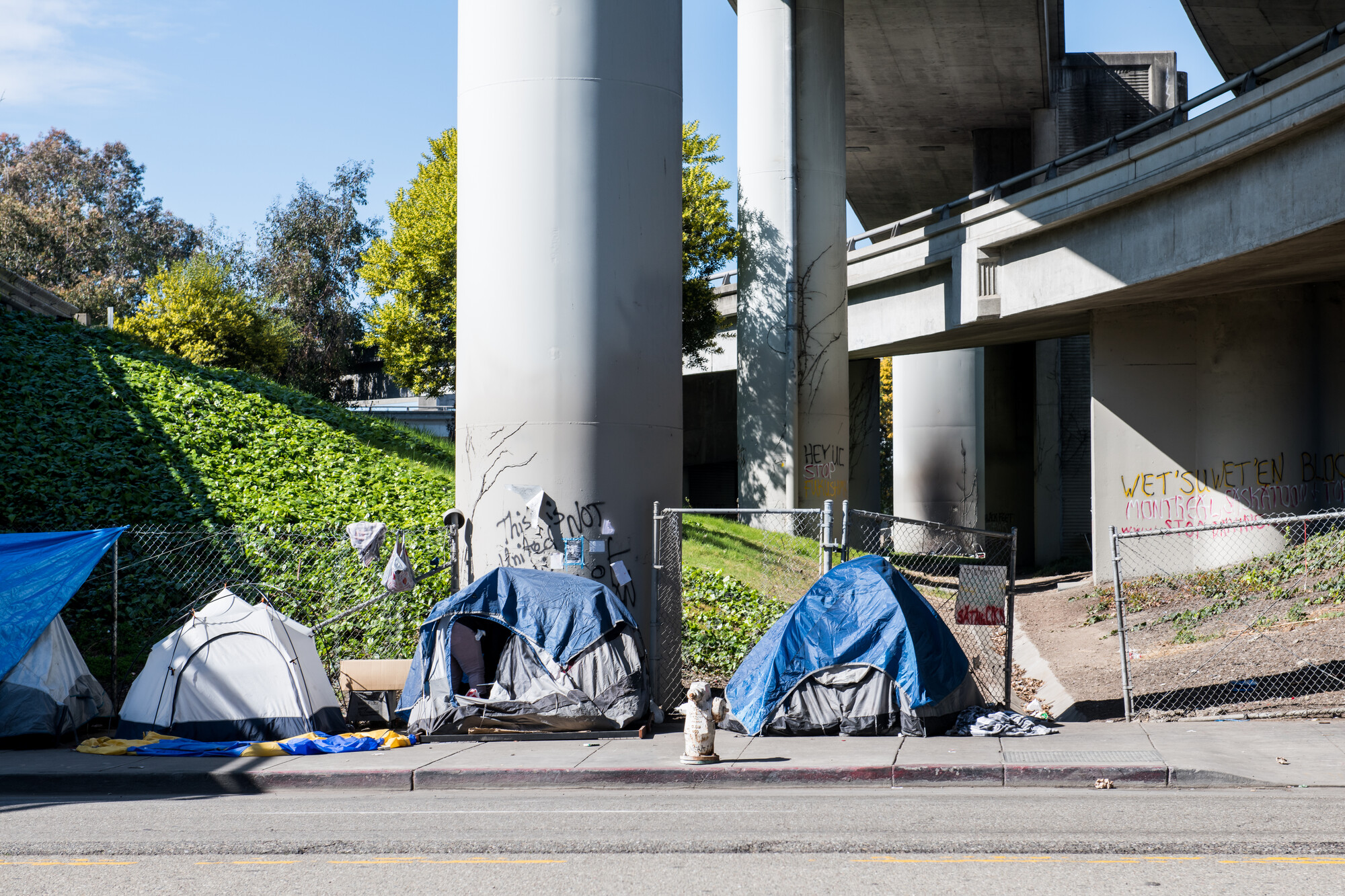
"caption": "Tents under an overpass in Oakland, on Feb. 21, 2020.",
"credit": "Beth LaBerge/KQED",
"altTag": null,
"description": null,
"imgSizes": {
"thumbnail": {
"file": "https://cdn.kqed.org/wp-content/uploads/sites/10/2025/07/011_KQED_Housing_Oakland_02212020_3522_qed-160x107.jpg",
"width": 160,
"height": 107,
"mimeType": "image/jpeg"
},
"1536x1536": {
"file": "https://cdn.kqed.org/wp-content/uploads/sites/10/2025/07/011_KQED_Housing_Oakland_02212020_3522_qed-1536x1024.jpg",
"width": 1536,
"height": 1024,
"mimeType": "image/jpeg"
},
"post-thumbnail": {
"file": "https://cdn.kqed.org/wp-content/uploads/sites/10/2025/07/011_KQED_Housing_Oakland_02212020_3522_qed-672x372.jpg",
"width": 672,
"height": 372,
"mimeType": "image/jpeg"
},
"twentyfourteen-full-width": {
"file": "https://cdn.kqed.org/wp-content/uploads/sites/10/2025/07/011_KQED_Housing_Oakland_02212020_3522_qed-1038x576.jpg",
"width": 1038,
"height": 576,
"mimeType": "image/jpeg"
},
"kqedFullSize": {
"file": "https://cdn.kqed.org/wp-content/uploads/sites/10/2025/07/011_KQED_Housing_Oakland_02212020_3522_qed.jpg",
"width": 2000,
"height": 1333
}
},
"isLoading": false,
"fetchFailed": false
},
"news_12049457": {
"type": "attachments",
"id": "news_12049457",
"meta": {
"index": "attachments_1716263798",
"site": "news",
"id": "12049457",
"found": true
},
"title": "Muir Woods Exhibit (1)",
"publishDate": 1753310562,
"status": "inherit",
"parent": 12049405,
"modified": 1758226708,
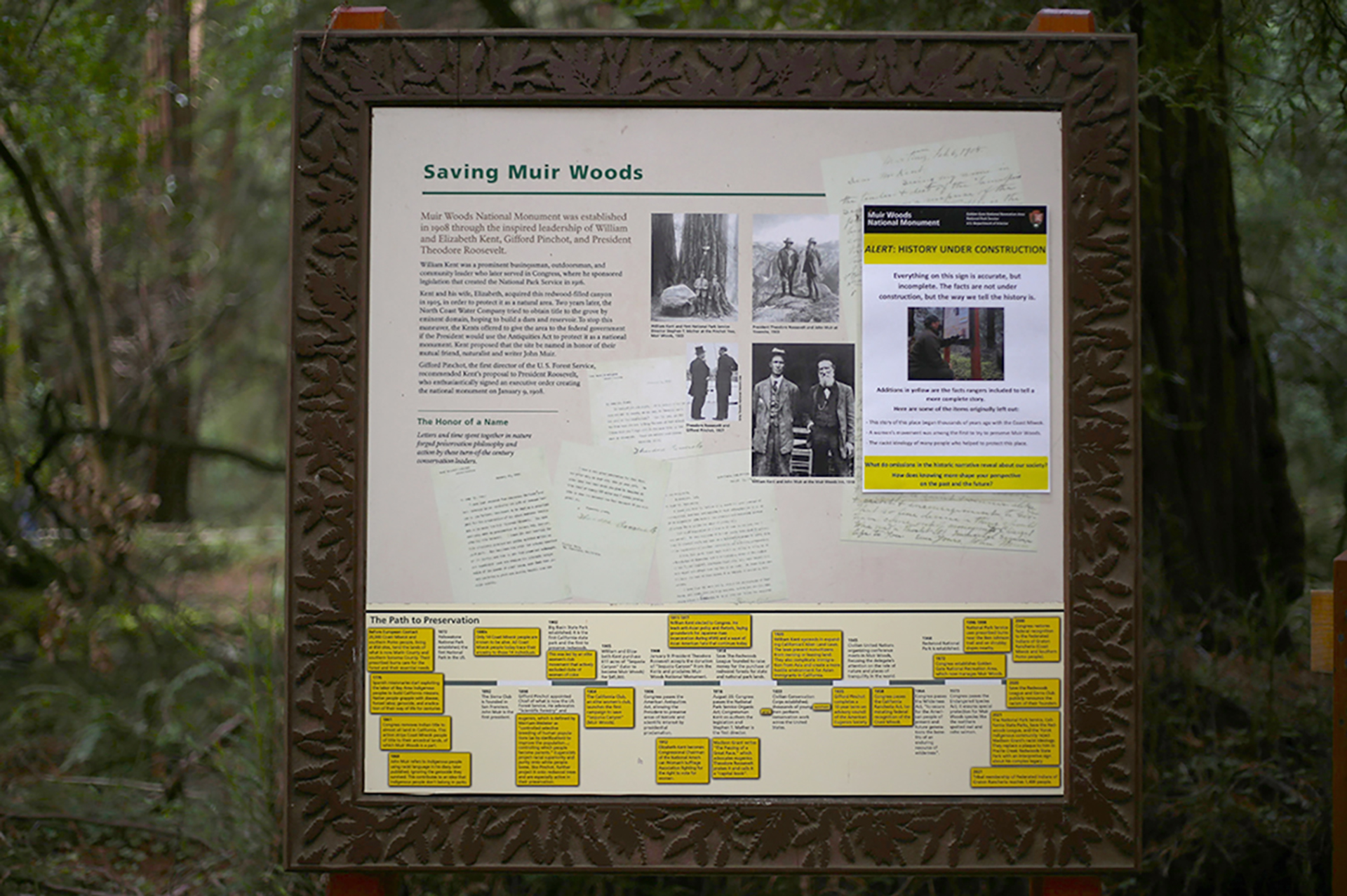
"caption": "The Muir Woods 'History in Construction' Exhibit, which was put up in 2021 to honor previously undocumented contributions to the park's stewardship. Signs like this one were part of the Trump Administration's removal order.",
"credit": "Courtesy of NPS/Jace Ritchey",
"altTag": null,
"description": null,
"imgSizes": {
"thumbnail": {
"file": "https://cdn.kqed.org/wp-content/uploads/sites/10/2025/07/Muir-Woods-Exhibit-1-160x106.png",
"width": 160,
"height": 106,
"mimeType": "image/png"
},
"1536x1536": {
"file": "https://cdn.kqed.org/wp-content/uploads/sites/10/2025/07/Muir-Woods-Exhibit-1-1536x1022.png",
"width": 1536,
"height": 1022,
"mimeType": "image/png"
},
"post-thumbnail": {
"file": "https://cdn.kqed.org/wp-content/uploads/sites/10/2025/07/Muir-Woods-Exhibit-1-672x372.png",
"width": 672,
"height": 372,
"mimeType": "image/png"
},
"twentyfourteen-full-width": {
"file": "https://cdn.kqed.org/wp-content/uploads/sites/10/2025/07/Muir-Woods-Exhibit-1-1038x576.png",
"width": 1038,
"height": 576,
"mimeType": "image/png"
},
"kqedFullSize": {
"file": "https://cdn.kqed.org/wp-content/uploads/sites/10/2025/07/Muir-Woods-Exhibit-1.png",
"width": 1920,
"height": 1277
}
},
"isLoading": false,
"fetchFailed": false
},
"news_12049369": {
"type": "attachments",
"id": "news_12049369",
"meta": {
"index": "attachments_1716263798",
"site": "news",
"id": "12049369",
"found": true
},
"title": "070125_Migrant-Outdoor-Ed_LV_20 (1)",
"publishDate": 1753298664,
"status": "inherit",
"parent": 12049366,
"modified": 1753298739,
"caption": "Students of the Migrant Outdoor Education Program canoe along the San Joaquin River near the Scout Island Education Center in Fresno on July 11, 2025.",
"credit": "Photo by Larry Valenzuela, CalMatters/CatchLight Local",
"altTag": null,
"description": null,
"imgSizes": {
"thumbnail": {
"file": "https://cdn.kqed.org/wp-content/uploads/sites/10/2025/07/070125_Migrant-Outdoor-Ed_LV_20-1-160x107.jpg",
"width": 160,
"height": 107,
"mimeType": "image/jpeg"
},
"1536x1536": {
"file": "https://cdn.kqed.org/wp-content/uploads/sites/10/2025/07/070125_Migrant-Outdoor-Ed_LV_20-1-1536x1024.jpg",
"width": 1536,
"height": 1024,
"mimeType": "image/jpeg"
},
"post-thumbnail": {
"file": "https://cdn.kqed.org/wp-content/uploads/sites/10/2025/07/070125_Migrant-Outdoor-Ed_LV_20-1-672x372.jpg",
"width": 672,
"height": 372,
"mimeType": "image/jpeg"
},
"twentyfourteen-full-width": {
"file": "https://cdn.kqed.org/wp-content/uploads/sites/10/2025/07/070125_Migrant-Outdoor-Ed_LV_20-1-1038x576.jpg",
"width": 1038,
"height": 576,
"mimeType": "image/jpeg"
},
"kqedFullSize": {
"file": "https://cdn.kqed.org/wp-content/uploads/sites/10/2025/07/070125_Migrant-Outdoor-Ed_LV_20-1.jpg",
"width": 2000,
"height": 1333
}
},
"isLoading": false,
"fetchFailed": false
},
"news_12049477": {
"type": "attachments",
"id": "news_12049477",
"meta": {
"index": "attachments_1716263798",
"site": "news",
"id": "12049477",
"found": true
},
"title": "240822-ACTION-AGAINST-HOMELESS-SWEEPS-MD-01-KQED-2",
"publishDate": 1753312235,
"status": "inherit",
"parent": 0,
"modified": 1753312267,
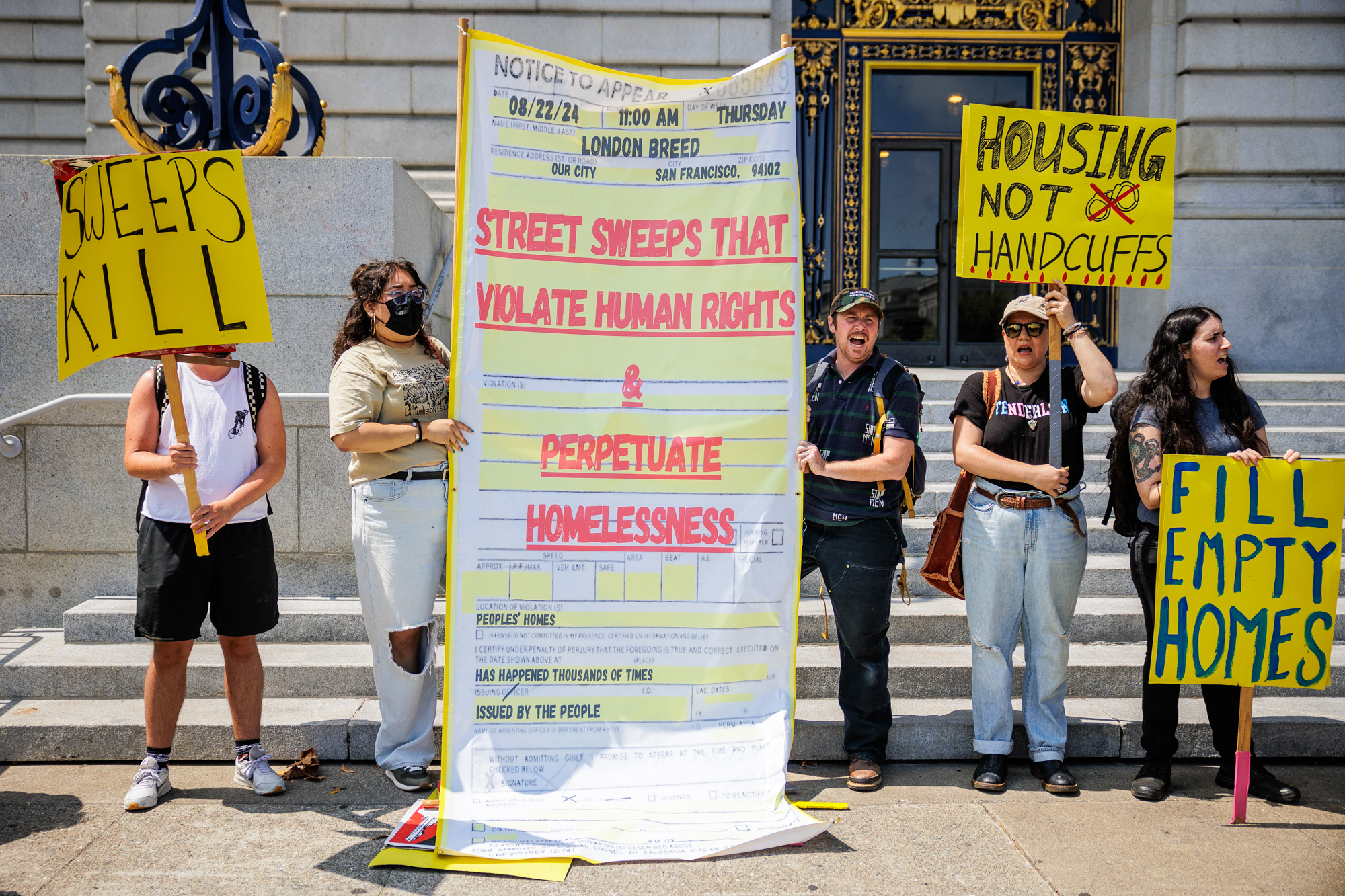
"caption": "Advocates rally against San Francisco’s homeless encampment sweeps outside City Hall on Aug. 22, 2024.",
"credit": "Martin do Nascimento/KQED",
"altTag": null,
"description": null,
"imgSizes": {
"thumbnail": {
"file": "https://cdn.kqed.org/wp-content/uploads/sites/10/2025/07/240822-ACTION-AGAINST-HOMELESS-SWEEPS-MD-01-KQED-2-160x107.jpg",
"width": 160,
"height": 107,
"mimeType": "image/jpeg"
},
"1536x1536": {
"file": "https://cdn.kqed.org/wp-content/uploads/sites/10/2025/07/240822-ACTION-AGAINST-HOMELESS-SWEEPS-MD-01-KQED-2-1536x1024.jpg",
"width": 1536,
"height": 1024,
"mimeType": "image/jpeg"
},
"post-thumbnail": {
"file": "https://cdn.kqed.org/wp-content/uploads/sites/10/2025/07/240822-ACTION-AGAINST-HOMELESS-SWEEPS-MD-01-KQED-2-672x372.jpg",
"width": 672,
"height": 372,
"mimeType": "image/jpeg"
},
"twentyfourteen-full-width": {
"file": "https://cdn.kqed.org/wp-content/uploads/sites/10/2025/07/240822-ACTION-AGAINST-HOMELESS-SWEEPS-MD-01-KQED-2-1038x576.jpg",
"width": 1038,
"height": 576,
"mimeType": "image/jpeg"
},
"kqedFullSize": {
"file": "https://cdn.kqed.org/wp-content/uploads/sites/10/2025/07/240822-ACTION-AGAINST-HOMELESS-SWEEPS-MD-01-KQED-2.jpg",
"width": 2000,
"height": 1333
}
},
"isLoading": false,
"fetchFailed": false
},
"news_12049285": {
"type": "attachments",
"id": "news_12049285",
"meta": {
"index": "attachments_1716263798",
"site": "news",
"id": "12049285",
"found": true
},
"title": "Permanente Creek2",
"publishDate": 1753224942,
"status": "inherit",
"parent": 0,
"modified": 1753225067,
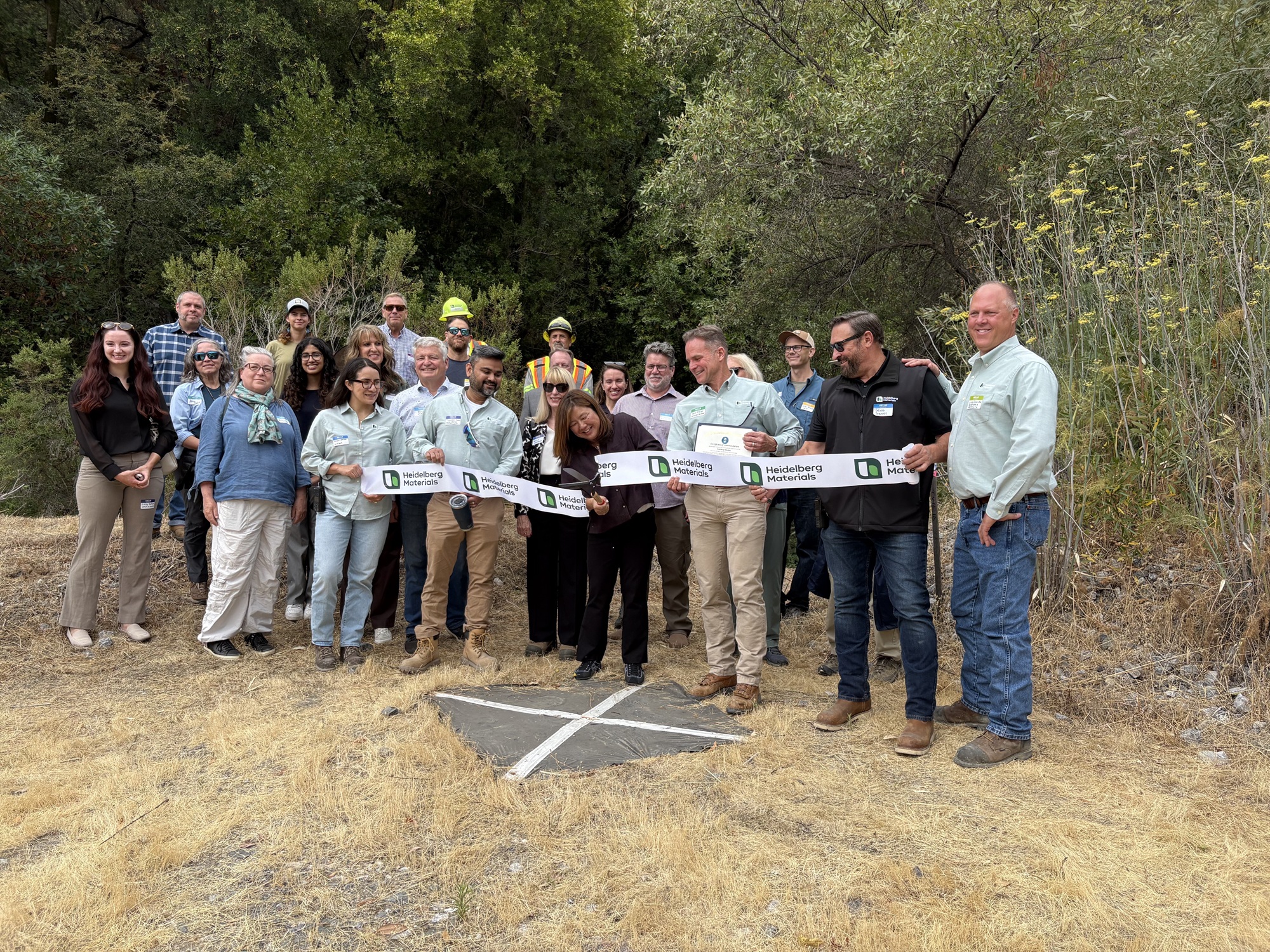
"caption": "Supervisor Margaret Abe-Koga (center) wielded a pair of hedge clippers for the official \"ribbon-cutting\" hosted by Heidelberg Materials to kick off the start of the Permanente Creek Restoration Project, which must be completed in five years, per the consent decree from the lawsuit filed by the Sierra Club. Also pictured: Members of the Sierra Club, Santa Clara County staff, which approved the project, David Perkins of Heidelberg Materials (next to Abe-Koga) and several stakeholders, ranging from the Midpeninsula Regional Open Space District, whose Rancho San Antonio Open Space Preserve abuts the sprawling property, to residents and engineers for the restoration project.",
"credit": "Courtesy of L.A. Chung",
"altTag": null,
"description": null,
"imgSizes": {
"thumbnail": {
"file": "https://cdn.kqed.org/wp-content/uploads/sites/10/2025/07/Permanente-Creek2-160x120.jpg",
"width": 160,
"height": 120,
"mimeType": "image/jpeg"
},
"1536x1536": {
"file": "https://cdn.kqed.org/wp-content/uploads/sites/10/2025/07/Permanente-Creek2-1536x1152.jpg",
"width": 1536,
"height": 1152,
"mimeType": "image/jpeg"
},
"post-thumbnail": {
"file": "https://cdn.kqed.org/wp-content/uploads/sites/10/2025/07/Permanente-Creek2-672x372.jpg",
"width": 672,
"height": 372,
"mimeType": "image/jpeg"
},
"twentyfourteen-full-width": {
"file": "https://cdn.kqed.org/wp-content/uploads/sites/10/2025/07/Permanente-Creek2-1038x576.jpg",
"width": 1038,
"height": 576,
"mimeType": "image/jpeg"
},
"kqedFullSize": {
"file": "https://cdn.kqed.org/wp-content/uploads/sites/10/2025/07/Permanente-Creek2.jpg",
"width": 2000,
"height": 1500
}
},
"isLoading": false,
"fetchFailed": false
}
},
"audioPlayerReducer": {
"postId": "stream_live",
"isPaused": true,
"isPlaying": false,
"pfsActive": false,
"pledgeModalIsOpen": true,
"playerDrawerIsOpen": false,
"liveAudioPlayStartedAt": 0,
"liveAudioPlayContext": ""
},
"authorsReducer": {
"byline_news_12049673": {
"type": "authors",
"id": "byline_news_12049673",
"meta": {
"override": true
},
"slug": "byline_news_12049673",
"name": "Ana B. Ibarra and Kristen Hwang, CalMatters",
"isLoading": false
},
"byline_news_12049366": {
"type": "authors",
"id": "byline_news_12049366",
"meta": {
"override": true
},
"slug": "byline_news_12049366",
"name": "Carolyn Jones, CalMatters",
"isLoading": false
},
"matthewgreen": {
"type": "authors",
"id": "1263",
"meta": {
"index": "authors_1716337520",
"id": "1263",
"found": true
},
"name": "Matthew Green",
"firstName": "Matthew",
"lastName": "Green",
"slug": "matthewgreen",
"email": "mgreen@kqed.org",
"display_author_email": false,
"staff_mastheads": [],
"title": "KQED Editor/Reporter",
"bio": "Matthew Green is a digital media producer for KQED News. He previously produced \u003ca href=\"http://www.kqed.org/lowdown\">The Lowdown\u003c/a>, KQED’s multimedia news education blog. Matthew's written for numerous Bay Area publications, including the Oakland Tribune and San Francisco Chronicle. He also taught journalism classes at Fremont High School in East Oakland.\r\n\r\nEmail: mgreen@kqed.org; Twitter: @MGreenKQED",
"avatar": "https://secure.gravatar.com/avatar/3bf498d1267ca02c8494f33d8cfc575e?s=600&d=blank&r=g",
"twitter": "MGreenKQED",
"facebook": null,
"instagram": null,
"linkedin": null,
"sites": [
{
"site": "news",
"roles": []
},
{
"site": "lowdown",
"roles": []
},
{
"site": "science",
"roles": []
},
{
"site": "education",
"roles": []
},
{
"site": "quest",
"roles": []
},
{
"site": "liveblog",
"roles": []
}
],
"headData": {
"title": "Matthew Green | KQED",
"description": "KQED Editor/Reporter",
"ogImgSrc": "https://secure.gravatar.com/avatar/3bf498d1267ca02c8494f33d8cfc575e?s=600&d=blank&r=g",
"twImgSrc": "https://secure.gravatar.com/avatar/3bf498d1267ca02c8494f33d8cfc575e?s=600&d=blank&r=g"
},
"isLoading": false,
"link": "/author/matthewgreen"
},
"abandlamudi": {
"type": "authors",
"id": "11672",
"meta": {
"index": "authors_1716337520",
"id": "11672",
"found": true
},
"name": "Adhiti Bandlamudi",
"firstName": "Adhiti",
"lastName": "Bandlamudi",
"slug": "abandlamudi",
"email": "abandlamudi@kqed.org",
"display_author_email": false,
"staff_mastheads": [
"news"
],
"title": "KQED Housing Reporter",
"bio": "Adhiti Bandlamudi reports for KQED's Housing desk. She focuses on how housing gets built across the Bay Area. Before joining KQED in 2020, she reported for WUNC in Durham, North Carolina, WABE in Atlanta, Georgia and Capital Public Radio in Sacramento. In 2017, she was awarded a Kroc Fellowship at NPR where she reported on everything from sprinkles to the Golden State Killer's arrest. When she's not reporting, she's baking new recipes in her kitchen or watching movies with friends and family. She's originally from Georgia and has strong opinions about Great British Bake Off.",
"avatar": "https://secure.gravatar.com/avatar/868129c8b257bb99a3500e2c86a65400?s=600&d=mm&r=g",
"twitter": "oddity_adhiti",
"facebook": null,
"instagram": null,
"linkedin": null,
"sites": [
{
"site": "arts",
"roles": [
"author"
]
},
{
"site": "news",
"roles": [
"editor"
]
},
{
"site": "liveblog",
"roles": [
"author"
]
}
],
"headData": {
"title": "Adhiti Bandlamudi | KQED",
"description": "KQED Housing Reporter",
"ogImgSrc": "https://secure.gravatar.com/avatar/868129c8b257bb99a3500e2c86a65400?s=600&d=mm&r=g",
"twImgSrc": "https://secure.gravatar.com/avatar/868129c8b257bb99a3500e2c86a65400?s=600&d=mm&r=g"
},
"isLoading": false,
"link": "/author/abandlamudi"
},
"amadrigal": {
"type": "authors",
"id": "11757",
"meta": {
"index": "authors_1716337520",
"id": "11757",
"found": true
},
"name": "Alexis Madrigal",
"firstName": "Alexis",
"lastName": "Madrigal",
"slug": "amadrigal",
"email": "amadrigal@kqed.org",
"display_author_email": true,
"staff_mastheads": [],
"title": "Co-Host Forum",
"bio": "Alexis Madrigal is the co-host of Forum. He is also a contributing writer at \u003cem>The Atlantic \u003c/em>and the co-founder of the COVID Tracking Project. He's the creator of the podcast, \u003cem>Containers\u003c/em>, and has been a staff writer at \u003cem>Wired. \u003c/em>He was a visiting scholar at UC Berkeley's Information School, and is working on a book about Oakland and the Bay Area's revolutionary ideas.",
"avatar": "https://secure.gravatar.com/avatar/200d13dd6cebef55bf04327dec901b3d?s=600&d=blank&r=g",
"twitter": "alexismadrigal",
"bluesky": null,
"facebook": null,
"instagram": null,
"linkedin": null,
"sites": [
{
"site": "arts",
"roles": [
"editor"
]
},
{
"site": "news",
"roles": [
"editor"
]
},
{
"site": "forum",
"roles": [
"editor"
]
}
],
"headData": {
"title": "Alexis Madrigal | KQED",
"description": "Co-Host Forum",
"ogImgSrc": "https://secure.gravatar.com/avatar/200d13dd6cebef55bf04327dec901b3d?s=600&d=blank&r=g",
"twImgSrc": "https://secure.gravatar.com/avatar/200d13dd6cebef55bf04327dec901b3d?s=600&d=blank&r=g"
},
"isLoading": false,
"link": "/author/amadrigal"
},
"nkhan": {
"type": "authors",
"id": "11867",
"meta": {
"index": "authors_1716337520",
"id": "11867",
"found": true
},
"name": "Nisa Khan",
"firstName": "Nisa",
"lastName": "Khan",
"slug": "nkhan",
"email": "nkhan@kqed.org",
"display_author_email": false,
"staff_mastheads": [],
"title": "KQED Contributor",
"bio": "Nisa Khan is a reporter for KQED's Audience News Desk. She was formerly a data reporter at Michigan Radio. She earned a Bachelor of Science in Information from the University of Michigan and a Master of Arts in Communication from Stanford University.",
"avatar": "https://secure.gravatar.com/avatar/a3bf1efcfbe7658d13a434cc54d0b2e3?s=600&d=blank&r=g",
"twitter": "mnisakhan",
"bluesky": null,
"facebook": null,
"instagram": null,
"linkedin": null,
"sites": [
{
"site": "arts",
"roles": [
"editor"
]
},
{
"site": "news",
"roles": [
"editor"
]
},
{
"site": "science",
"roles": [
"editor",
"author"
]
},
{
"site": "forum",
"roles": [
"editor"
]
},
{
"site": "liveblog",
"roles": [
"contributor"
]
}
],
"headData": {
"title": "Nisa Khan | KQED",
"description": "KQED Contributor",
"ogImgSrc": "https://secure.gravatar.com/avatar/a3bf1efcfbe7658d13a434cc54d0b2e3?s=600&d=blank&r=g",
"twImgSrc": "https://secure.gravatar.com/avatar/a3bf1efcfbe7658d13a434cc54d0b2e3?s=600&d=blank&r=g"
},
"isLoading": false,
"link": "/author/nkhan"
},
"kdebenedetti": {
"type": "authors",
"id": "11913",
"meta": {
"index": "authors_1716337520",
"id": "11913",
"found": true
},
"name": "Katie DeBenedetti",
"firstName": "Katie",
"lastName": "DeBenedetti",
"slug": "kdebenedetti",
"email": "kdebenedetti@kqed.org",
"display_author_email": false,
"staff_mastheads": [
"news",
"science"
],
"title": "KQED Contributor",
"bio": "Katie DeBenedetti is a digital reporter covering daily news for the Express Desk. Prior to joining KQED as a culture reporting intern in January 2024, she covered education and city government for the Napa Valley Register.",
"avatar": "https://secure.gravatar.com/avatar/6e31073cb8f7e4214ab03f42771d0f45?s=600&d=blank&r=g",
"twitter": null,
"facebook": null,
"instagram": null,
"linkedin": null,
"sites": [
{
"site": "news",
"roles": [
"author"
]
},
{
"site": "science",
"roles": [
"author"
]
},
{
"site": "liveblog",
"roles": [
"author"
]
}
],
"headData": {
"title": "Katie DeBenedetti | KQED",
"description": "KQED Contributor",
"ogImgSrc": "https://secure.gravatar.com/avatar/6e31073cb8f7e4214ab03f42771d0f45?s=600&d=blank&r=g",
"twImgSrc": "https://secure.gravatar.com/avatar/6e31073cb8f7e4214ab03f42771d0f45?s=600&d=blank&r=g"
},
"isLoading": false,
"link": "/author/kdebenedetti"
},
"slim": {
"type": "authors",
"id": "11920",
"meta": {
"index": "authors_1716337520",
"id": "11920",
"found": true
},
"name": "Samantha Lim",
"firstName": "Samantha",
"lastName": "Lim",
"slug": "slim",
"email": "slim@KQED.org",
"display_author_email": false,
"staff_mastheads": [],
"title": "KQED Contributor",
"bio": null,
"avatar": "https://secure.gravatar.com/avatar/82e592e6c15fe1a04d385e8ad0fb0b4e?s=600&d=blank&r=g",
"twitter": null,
"facebook": null,
"instagram": null,
"linkedin": null,
"sites": [
{
"site": "news",
"roles": []
}
],
"headData": {
"title": "Samantha Lim | KQED",
"description": "KQED Contributor",
"ogImgSrc": "https://secure.gravatar.com/avatar/82e592e6c15fe1a04d385e8ad0fb0b4e?s=600&d=blank&r=g",
"twImgSrc": "https://secure.gravatar.com/avatar/82e592e6c15fe1a04d385e8ad0fb0b4e?s=600&d=blank&r=g"
},
"isLoading": false,
"link": "/author/slim"
},
"gzada": {
"type": "authors",
"id": "11929",
"meta": {
"index": "authors_1716337520",
"id": "11929",
"found": true
},
"name": "Gilare Zada",
"firstName": "Gilare",
"lastName": "Zada",
"slug": "gzada",
"email": "gzada@kqed.org",
"display_author_email": true,
"staff_mastheads": [
"news"
],
"title": null,
"bio": "Gilare Zada is a Kurdish-American from San Diego, CA. Storytelling, fitness, and binge reading are some of her passions outside of news reporting. Her work has appeared in Mission Local, the Peninsula Press, the San Francisco Press Club, and more. She also writes as a class correspondent for the Stanford Magazine - go Card!",
"avatar": "https://secure.gravatar.com/avatar/33a75f2b947669a488a805edec3fbf3838c1cedaedda710e983770633b4d6a75?s=600&d=blank&r=g",
"twitter": null,
"bluesky": null,
"facebook": null,
"instagram": null,
"linkedin": null,
"sites": [
{
"site": "arts",
"roles": [
"editor"
]
},
{
"site": "news",
"roles": [
"editor",
"contributor"
]
},
{
"site": "science",
"roles": [
"editor"
]
}
],
"headData": {
"title": "Gilare Zada | KQED",
"description": null,
"ogImgSrc": "https://secure.gravatar.com/avatar/33a75f2b947669a488a805edec3fbf3838c1cedaedda710e983770633b4d6a75?s=600&d=blank&r=g",
"twImgSrc": "https://secure.gravatar.com/avatar/33a75f2b947669a488a805edec3fbf3838c1cedaedda710e983770633b4d6a75?s=600&d=blank&r=g"
},
"isLoading": false,
"link": "/author/gzada"
},
"msung": {
"type": "authors",
"id": "11944",
"meta": {
"index": "authors_1716337520",
"id": "11944",
"found": true
},
"name": "Morgan Sung",
"firstName": "Morgan",
"lastName": "Sung",
"slug": "msung",
"email": "msung@kqed.org",
"display_author_email": false,
"staff_mastheads": [],
"title": "Close All Tabs Host",
"bio": null,
"avatar": "https://secure.gravatar.com/avatar/34033b8d232ee6c987ca6f0a1a28f0e5?s=600&d=blank&r=g",
"twitter": null,
"facebook": null,
"instagram": null,
"linkedin": null,
"sites": [
{
"site": "news",
"roles": [
"editor"
]
}
],
"headData": {
"title": "Morgan Sung | KQED",
"description": "Close All Tabs Host",
"ogImgSrc": "https://secure.gravatar.com/avatar/34033b8d232ee6c987ca6f0a1a28f0e5?s=600&d=blank&r=g",
"twImgSrc": "https://secure.gravatar.com/avatar/34033b8d232ee6c987ca6f0a1a28f0e5?s=600&d=blank&r=g"
},
"isLoading": false,
"link": "/author/msung"
},
"sarahwright": {
"type": "authors",
"id": "11956",
"meta": {
"index": "authors_1716337520",
"id": "11956",
"found": true
},
"name": "Sarah Wright",
"firstName": "Sarah",
"lastName": "Wright",
"slug": "sarahwright",
"email": "swright@kqed.org",
"display_author_email": true,
"staff_mastheads": [],
"title": "Outdoors Engagement Reporter",
"bio": "Sarah Wright is KQED's Outdoors Engagement Reporter. Originally from Lake Tahoe, she completed a thru-hike of the Pacific Crest Trail in 2019 and was a U.S. Fulbright Program grantee to Argentina in 2023. Her journalism has appeared in The Guardian, The San Francisco Standard, The Palo Alto Weekly and the Half Moon Bay Review.",
"avatar": "https://secure.gravatar.com/avatar/c161a3d6441865cba25e6db4fa561099ad665799e9432e34da2b84d7e371524c?s=600&d=blank&r=g",
"twitter": null,
"bluesky": null,
"facebook": null,
"instagram": null,
"linkedin": null,
"sites": [
{
"site": "arts",
"roles": [
"editor"
]
},
{
"site": "news",
"roles": [
"editor"
]
},
{
"site": "science",
"roles": [
"contributor",
"author"
]
},
{
"site": "forum",
"roles": [
"editor"
]
}
],
"headData": {
"title": "Sarah Wright | KQED",
"description": "Outdoors Engagement Reporter",
"ogImgSrc": "https://secure.gravatar.com/avatar/c161a3d6441865cba25e6db4fa561099ad665799e9432e34da2b84d7e371524c?s=600&d=blank&r=g",
"twImgSrc": "https://secure.gravatar.com/avatar/c161a3d6441865cba25e6db4fa561099ad665799e9432e34da2b84d7e371524c?s=600&d=blank&r=g"
},
"isLoading": false,
"link": "/author/sarahwright"
}
},
"pagesReducer": {
"news_tag_california": {
"type": "terms",
"id": "news_18538",
"meta": {
"index": "terms_1716263798",
"site": "news",
"id": "18538",
"score": 6.845103
},
"featImg": null,
"name": "California",
"description": null,
"taxonomy": "tag",
"headData": {
"twImgId": null,
"twTitle": null,
"ogTitle": null,
"ogImgId": null,
"twDescription": null,
"description": null,
"title": "California Archives | KQED News",
"ogDescription": null
},
"ttid": 31,
"slug": "california",
"isLoading": false,
"title": "California",
"pageMeta": {
"site": "news",
"WpPageTemplate": "page-topic-editorial",
"currentPage": 71
},
"blocks": [
{
"blockName": "kqed/post-list",
"attrs": {
"layout": "cardArticle2",
"query": "posts/news?tag=california",
"seeMore": false,
"paginated": true,
"page": 71
}
},
{
"blockName": "kqed/ad"
}
]
}
},
"pfsSessionReducer": {},
"postsReducer": {
"stream_live": {
"type": "live",
"id": "stream_live",
"audioUrl": "https://streams.kqed.org/kqedradio",
"title": "Live Stream",
"excerpt": "Live Stream information currently unavailable.",
"link": "/radio",
"featImg": "",
"label": {
"name": "KQED Live",
"link": "/"
}
},
"stream_kqedNewscast": {
"type": "posts",
"id": "stream_kqedNewscast",
"audioUrl": "https://www.kqed.org/.stream/anon/radio/RDnews/newscast.mp3?_=1",
"title": "KQED Newscast",
"featImg": "",
"label": {
"name": "88.5 FM",
"link": "/"
}
},
"news_12049560": {
"type": "posts",
"id": "news_12049560",
"meta": {
"index": "posts_1716263798",
"site": "news",
"id": "12049560",
"score": null,
"sort": [
1753446648000
]
},
"guestAuthors": [],
"slug": "gilroy-garlic-festival-makes-return-years-after-shooting-and-pandemic-pauses",
"title": "Gilroy Garlic Festival Makes Return Years After Shooting and Pandemic Pauses",
"publishDate": 1753446648,
"format": "standard",
"headTitle": "Gilroy Garlic Festival Makes Return Years After Shooting and Pandemic Pauses | KQED",
"labelTerm": {
"site": "news"
},
"content": "\u003cp>On Friday morning, just before 10 a.m., Gilroy’s Garlic Queen will take a torch to the famed 8-foot garlic bulb sitting in the grassy field beyond the gates of Gilroy Gardens and light its tip, marking the official opening of the city’s \u003ca href=\"https://www.kqed.org/news/11764226/the-heart-of-gilroy-how-the-garlic-festival-became-a-community-bedrock\">three-day garlic festival\u003c/a>.\u003c/p>\n\u003cp>Garzilla, the 1,000-pound steel bulb sculpture, will burn through Sunday night, as has been the Gilroy Garlic Festival’s tradition for more than 30 years.\u003c/p>\n\u003cp>“We light the bulb and the day begins,” said Tom Cline, a city councilmember and former president of the Gilroy Garlic Festival Association, the nonprofit that puts on the event. “That’s what I’m looking forward to,” he said, “being able to watch people come into the venue and seeing them smile and just looking forward to a fun weekend.”\u003c/p>\n\u003cp>[ad fullwidth]\u003c/p>\n\u003cp>When the festivities kick off, it will be for the first time in six years, since the world-renowned event ended in a devastating shooting that killed three people.\u003c/p>\n\u003cp>On the evening of July 28, 2019, as the 41st annual festival was wrapping up, 19-year-old Santino Legan crept along Uvas Creek with an AK-47 style rifle, a backpack full of ammunition and bolt cutters. After cutting open a chain-link fence on the eastern edge of Christmas Hill Park, where the event was held, he opened fire near an inflatable slide where children and adults were soaking in the final minutes of the year’s festivities.\u003c/p>\n\u003cp>In an attack that lasted less than a minute, Legan fired more than 36 rounds of ammunition, striking 20 victims.\u003c/p>\n\u003cfigure id=\"attachment_11765339\" class=\"wp-caption aligncenter\" style=\"max-width: 1920px\">\u003cimg loading=\"lazy\" decoding=\"async\" class=\"size-full wp-image-11765339\" src=\"https://cdn.kqed.org/wp-content/uploads/sites/10/2019/08/Gilroy-Shooting-Memorial.jpg\" alt=\"A makeshift memorial sits outside the site of the Gilroy Garlic Festival two days after a mass shooting there on July 30, 2019 in Gilroy.\" width=\"1920\" height=\"1278\" srcset=\"https://cdn.kqed.org/wp-content/uploads/sites/10/2019/08/Gilroy-Shooting-Memorial.jpg 1920w, https://cdn.kqed.org/wp-content/uploads/sites/10/2019/08/Gilroy-Shooting-Memorial-160x107.jpg 160w, https://cdn.kqed.org/wp-content/uploads/sites/10/2019/08/Gilroy-Shooting-Memorial-800x533.jpg 800w, https://cdn.kqed.org/wp-content/uploads/sites/10/2019/08/Gilroy-Shooting-Memorial-1020x679.jpg 1020w, https://cdn.kqed.org/wp-content/uploads/sites/10/2019/08/Gilroy-Shooting-Memorial-1200x799.jpg 1200w\" sizes=\"auto, (max-width: 1920px) 100vw, 1920px\">\u003cfigcaption class=\"wp-caption-text\">A makeshift memorial sits outside the site of the Gilroy Garlic Festival on July 30, 2019, two days after a mass shooting there. \u003ccite>(Mario Tama/Getty Images)\u003c/cite>\u003c/figcaption>\u003c/figure>\n\u003cp>Three festival-goers, including two children, died. Seventeen others were injured. Law enforcement officers shot at Legan, a Gilroy native, before he died of a self-inflicted gunshot wound to the head.\u003c/p>\n\u003cp>In the years since, the small Santa Clara County town famed for the sharp, sulfurous smell of its signature crop has struggled to bring the Garlic Festival back.\u003c/p>\n\u003cp>The COVID-19 pandemic and skyrocketing insurance costs driven by the shooting made it unfeasible for the festival association to pull off the large event, leading them to cancel it for the “foreseeable future” in 2022.[aside postID=news_11766987 hero='https://ww2.kqed.org/app/uploads/sites/10/2019/08/08082019_colin-diep_gilroy-shooting_paint-party-qut-1020x680.jpg']The city estimated insuring the event would cost $10 million after the violence, according to Greg Bozzo, Gilroy’s mayor and one of the figures instrumental in the festival’s return. Gilroy was also embroiled in a protracted lawsuit brought by shooting victims, who alleged the city and other event organizers’ lax security was to blame. A judge dismissed the city from the suit in 2023.\u003c/p>\n\u003cp>The festival association has tried to maintain some kind of annual event since. But 2025 is the first year it’s been able to host a festival, even though it will be a scaled-back version of the event Bay Area fans are used to.\u003c/p>\n\u003cp>The festival will be held at South County Grove, a private event space within Gilroy Gardens, which is also home to a family theme park. The smaller footprint means instead of drawing crowds up to 40,000 like it used to, tickets for this year were capped at 3,000 per day. All 9,000 sold out within hours.\u003c/p>\n\u003cp>Bozzo said the smaller event isn’t necessarily the new normal, though.\u003c/p>\n\u003cp>“This is the size of the event that we could have this year based on the hand that we were dealt,” he told KQED. “My message to people who are unable to come is that 3,000 people per day is not the new era, it’s the beginning of the new era. Looking ahead, we are optimistic about the future of the Garlic Festival, which includes growth.”\u003c/p>\n\u003cfigure id=\"attachment_11765399\" class=\"wp-caption aligncenter\" style=\"max-width: 2048px\">\u003cimg loading=\"lazy\" decoding=\"async\" class=\"size-full wp-image-11765399\" src=\"https://cdn.kqed.org/wp-content/uploads/sites/10/2019/08/IMG_4841.jpg\" alt=\"\" width=\"2048\" height=\"1536\" srcset=\"https://cdn.kqed.org/wp-content/uploads/sites/10/2019/08/IMG_4841.jpg 2048w, https://cdn.kqed.org/wp-content/uploads/sites/10/2019/08/IMG_4841-160x120.jpg 160w, https://cdn.kqed.org/wp-content/uploads/sites/10/2019/08/IMG_4841-800x600.jpg 800w, https://cdn.kqed.org/wp-content/uploads/sites/10/2019/08/IMG_4841-1020x765.jpg 1020w, https://cdn.kqed.org/wp-content/uploads/sites/10/2019/08/IMG_4841-1200x900.jpg 1200w, https://cdn.kqed.org/wp-content/uploads/sites/10/2019/08/IMG_4841-1920x1440.jpg 1920w, https://cdn.kqed.org/wp-content/uploads/sites/10/2019/08/IMG_4841-1832x1374.jpg 1832w, https://cdn.kqed.org/wp-content/uploads/sites/10/2019/08/IMG_4841-1376x1032.jpg 1376w, https://cdn.kqed.org/wp-content/uploads/sites/10/2019/08/IMG_4841-1044x783.jpg 1044w, https://cdn.kqed.org/wp-content/uploads/sites/10/2019/08/IMG_4841-632x474.jpg 632w, https://cdn.kqed.org/wp-content/uploads/sites/10/2019/08/IMG_4841-536x402.jpg 536w\" sizes=\"auto, (max-width: 2048px) 100vw, 2048px\">\u003cfigcaption class=\"wp-caption-text\">A Gilroy Strong banner hangs in downtown Gilroy after a gunman opened fire at the Gilroy Garlic Festival on July 28, 2019, killing three people and injuring more than a dozen others. \u003ccite>(Devin Katayama/KQED)\u003c/cite>\u003c/figcaption>\u003c/figure>\n\u003cp>The event’s signature “Gourmet Alley,” known for preparing all kinds of garlic-forward dishes, will still be serving pepper steak sandwiches and garlicky calamari. There’ll also be live music on the main stage throughout the three days, as well as live cooking demonstrations, an arts and crafts area and a beer and wine garden with drinks for purchase.\u003c/p>\n\u003cp>While the weekend is bound to bring back memories of the 2019 tragedy for Bozzo and many Gilroy residents, he said it’s also an opportunity to begin moving forward, and to restore some of the joy and pride that has surrounded the event for nearly 50 years.\u003c/p>\n\u003cp>“In Gilroy, even though we appreciate garlic as much as anybody, this Garlic Festival is and mostly always has been about the people,” Bozzo said. “The Garlic Festival is a source of pride, community identity and camaraderie, and that’s what I’m looking forward to.”\u003c/p>\n\u003cp>\u003c/p>\n",
"blocks": [],
"excerpt": "Six years after a mass shooting left three dead and many injured, the Gilroy Garlic Festival returns in a scaled-down form — with tickets selling out in hours.",
"status": "publish",
"parent": 0,
"modified": 1753403973,
"stats": {
"hasAudio": false,
"hasVideo": false,
"hasChartOrMap": false,
"iframeSrcs": [],
"hasGoogleForm": false,
"hasGallery": false,
"hasHearkenModule": false,
"hasPolis": false,
"paragraphCount": 18,
"wordCount": 887
},
"headData": {
"title": "Gilroy Garlic Festival Makes Return Years After Shooting and Pandemic Pauses | KQED",
"description": "Six years after a mass shooting left three dead and many injured, the Gilroy Garlic Festival returns in a scaled-down form — with tickets selling out in hours.",
"ogTitle": "",
"ogDescription": "",
"ogImgId": "",
"twTitle": "",
"twDescription": "",
"twImgId": "",
"schema": {
"@context": "https://schema.org",
"@type": "NewsArticle",
"headline": "Gilroy Garlic Festival Makes Return Years After Shooting and Pandemic Pauses",
"datePublished": "2025-07-25T05:30:48-07:00",
"dateModified": "2025-07-24T17:39:33-07:00",
"image": "https://cdn.kqed.org/wp-content/uploads/2020/02/KQED-OG-Image@1x.png",
"isAccessibleForFree": "True",
"publisher": {
"@type": "NewsMediaOrganization",
"@id": "https://www.kqed.org/#organization",
"name": "KQED",
"logo": "https://cdn.kqed.org/wp-content/uploads/2020/02/KQED-OG-Image@1x.png",
"url": "https://www.kqed.org",
"sameAs": [
"https://www.facebook.com/KQED",
"https://twitter.com/KQED",
"https://www.instagram.com/kqed/",
"https://www.tiktok.com/@kqedofficial",
"https://www.linkedin.com/company/kqed",
"https://www.youtube.com/channel/UCeC0IOo7i1P_61zVUWbJ4nw"
]
}
}
},
"primaryCategory": {
"termId": 8,
"slug": "news",
"name": "News"
},
"sticky": false,
"templateType": "standard",
"featuredImageType": "standard",
"excludeFromSiteSearch": "Include",
"articleAge": "0",
"path": "/news/12049560/gilroy-garlic-festival-makes-return-years-after-shooting-and-pandemic-pauses",
"audioTrackLength": null,
"parsedContent": [
{
"type": "contentString",
"content": "\u003cdiv class=\"post-body\">\u003cp>\u003cp>On Friday morning, just before 10 a.m., Gilroy’s Garlic Queen will take a torch to the famed 8-foot garlic bulb sitting in the grassy field beyond the gates of Gilroy Gardens and light its tip, marking the official opening of the city’s \u003ca href=\"https://www.kqed.org/news/11764226/the-heart-of-gilroy-how-the-garlic-festival-became-a-community-bedrock\">three-day garlic festival\u003c/a>.\u003c/p>\n\u003cp>Garzilla, the 1,000-pound steel bulb sculpture, will burn through Sunday night, as has been the Gilroy Garlic Festival’s tradition for more than 30 years.\u003c/p>\n\u003cp>“We light the bulb and the day begins,” said Tom Cline, a city councilmember and former president of the Gilroy Garlic Festival Association, the nonprofit that puts on the event. “That’s what I’m looking forward to,” he said, “being able to watch people come into the venue and seeing them smile and just looking forward to a fun weekend.”\u003c/p>\n\u003cp>\u003c/p>\u003c/div>",
"attributes": {
"named": {},
"numeric": []
}
},
{
"type": "component",
"content": "",
"name": "ad",
"attributes": {
"named": {
"label": "fullwidth"
},
"numeric": [
"fullwidth"
]
}
},
{
"type": "contentString",
"content": "\u003cdiv class=\"post-body\">\u003cp>\u003c/p>\n\u003cp>When the festivities kick off, it will be for the first time in six years, since the world-renowned event ended in a devastating shooting that killed three people.\u003c/p>\n\u003cp>On the evening of July 28, 2019, as the 41st annual festival was wrapping up, 19-year-old Santino Legan crept along Uvas Creek with an AK-47 style rifle, a backpack full of ammunition and bolt cutters. After cutting open a chain-link fence on the eastern edge of Christmas Hill Park, where the event was held, he opened fire near an inflatable slide where children and adults were soaking in the final minutes of the year’s festivities.\u003c/p>\n\u003cp>In an attack that lasted less than a minute, Legan fired more than 36 rounds of ammunition, striking 20 victims.\u003c/p>\n\u003cfigure id=\"attachment_11765339\" class=\"wp-caption aligncenter\" style=\"max-width: 1920px\">\u003cimg loading=\"lazy\" decoding=\"async\" class=\"size-full wp-image-11765339\" src=\"https://cdn.kqed.org/wp-content/uploads/sites/10/2019/08/Gilroy-Shooting-Memorial.jpg\" alt=\"A makeshift memorial sits outside the site of the Gilroy Garlic Festival two days after a mass shooting there on July 30, 2019 in Gilroy.\" width=\"1920\" height=\"1278\" srcset=\"https://cdn.kqed.org/wp-content/uploads/sites/10/2019/08/Gilroy-Shooting-Memorial.jpg 1920w, https://cdn.kqed.org/wp-content/uploads/sites/10/2019/08/Gilroy-Shooting-Memorial-160x107.jpg 160w, https://cdn.kqed.org/wp-content/uploads/sites/10/2019/08/Gilroy-Shooting-Memorial-800x533.jpg 800w, https://cdn.kqed.org/wp-content/uploads/sites/10/2019/08/Gilroy-Shooting-Memorial-1020x679.jpg 1020w, https://cdn.kqed.org/wp-content/uploads/sites/10/2019/08/Gilroy-Shooting-Memorial-1200x799.jpg 1200w\" sizes=\"auto, (max-width: 1920px) 100vw, 1920px\">\u003cfigcaption class=\"wp-caption-text\">A makeshift memorial sits outside the site of the Gilroy Garlic Festival on July 30, 2019, two days after a mass shooting there. \u003ccite>(Mario Tama/Getty Images)\u003c/cite>\u003c/figcaption>\u003c/figure>\n\u003cp>Three festival-goers, including two children, died. Seventeen others were injured. Law enforcement officers shot at Legan, a Gilroy native, before he died of a self-inflicted gunshot wound to the head.\u003c/p>\n\u003cp>In the years since, the small Santa Clara County town famed for the sharp, sulfurous smell of its signature crop has struggled to bring the Garlic Festival back.\u003c/p>\n\u003cp>The COVID-19 pandemic and skyrocketing insurance costs driven by the shooting made it unfeasible for the festival association to pull off the large event, leading them to cancel it for the “foreseeable future” in 2022.\u003c/p>\u003c/div>",
"attributes": {
"named": {},
"numeric": []
}
},
{
"type": "component",
"content": "",
"name": "aside",
"attributes": {
"named": {
"postid": "news_11766987",
"hero": "https://ww2.kqed.org/app/uploads/sites/10/2019/08/08082019_colin-diep_gilroy-shooting_paint-party-qut-1020x680.jpg",
"label": ""
},
"numeric": []
}
},
{
"type": "contentString",
"content": "\u003cdiv class=\"post-body\">\u003cp>The city estimated insuring the event would cost $10 million after the violence, according to Greg Bozzo, Gilroy’s mayor and one of the figures instrumental in the festival’s return. Gilroy was also embroiled in a protracted lawsuit brought by shooting victims, who alleged the city and other event organizers’ lax security was to blame. A judge dismissed the city from the suit in 2023.\u003c/p>\n\u003cp>The festival association has tried to maintain some kind of annual event since. But 2025 is the first year it’s been able to host a festival, even though it will be a scaled-back version of the event Bay Area fans are used to.\u003c/p>\n\u003cp>The festival will be held at South County Grove, a private event space within Gilroy Gardens, which is also home to a family theme park. The smaller footprint means instead of drawing crowds up to 40,000 like it used to, tickets for this year were capped at 3,000 per day. All 9,000 sold out within hours.\u003c/p>\n\u003cp>Bozzo said the smaller event isn’t necessarily the new normal, though.\u003c/p>\n\u003cp>“This is the size of the event that we could have this year based on the hand that we were dealt,” he told KQED. “My message to people who are unable to come is that 3,000 people per day is not the new era, it’s the beginning of the new era. Looking ahead, we are optimistic about the future of the Garlic Festival, which includes growth.”\u003c/p>\n\u003cfigure id=\"attachment_11765399\" class=\"wp-caption aligncenter\" style=\"max-width: 2048px\">\u003cimg loading=\"lazy\" decoding=\"async\" class=\"size-full wp-image-11765399\" src=\"https://cdn.kqed.org/wp-content/uploads/sites/10/2019/08/IMG_4841.jpg\" alt=\"\" width=\"2048\" height=\"1536\" srcset=\"https://cdn.kqed.org/wp-content/uploads/sites/10/2019/08/IMG_4841.jpg 2048w, https://cdn.kqed.org/wp-content/uploads/sites/10/2019/08/IMG_4841-160x120.jpg 160w, https://cdn.kqed.org/wp-content/uploads/sites/10/2019/08/IMG_4841-800x600.jpg 800w, https://cdn.kqed.org/wp-content/uploads/sites/10/2019/08/IMG_4841-1020x765.jpg 1020w, https://cdn.kqed.org/wp-content/uploads/sites/10/2019/08/IMG_4841-1200x900.jpg 1200w, https://cdn.kqed.org/wp-content/uploads/sites/10/2019/08/IMG_4841-1920x1440.jpg 1920w, https://cdn.kqed.org/wp-content/uploads/sites/10/2019/08/IMG_4841-1832x1374.jpg 1832w, https://cdn.kqed.org/wp-content/uploads/sites/10/2019/08/IMG_4841-1376x1032.jpg 1376w, https://cdn.kqed.org/wp-content/uploads/sites/10/2019/08/IMG_4841-1044x783.jpg 1044w, https://cdn.kqed.org/wp-content/uploads/sites/10/2019/08/IMG_4841-632x474.jpg 632w, https://cdn.kqed.org/wp-content/uploads/sites/10/2019/08/IMG_4841-536x402.jpg 536w\" sizes=\"auto, (max-width: 2048px) 100vw, 2048px\">\u003cfigcaption class=\"wp-caption-text\">A Gilroy Strong banner hangs in downtown Gilroy after a gunman opened fire at the Gilroy Garlic Festival on July 28, 2019, killing three people and injuring more than a dozen others. \u003ccite>(Devin Katayama/KQED)\u003c/cite>\u003c/figcaption>\u003c/figure>\n\u003cp>The event’s signature “Gourmet Alley,” known for preparing all kinds of garlic-forward dishes, will still be serving pepper steak sandwiches and garlicky calamari. There’ll also be live music on the main stage throughout the three days, as well as live cooking demonstrations, an arts and crafts area and a beer and wine garden with drinks for purchase.\u003c/p>\n\u003cp>While the weekend is bound to bring back memories of the 2019 tragedy for Bozzo and many Gilroy residents, he said it’s also an opportunity to begin moving forward, and to restore some of the joy and pride that has surrounded the event for nearly 50 years.\u003c/p>\n\u003cp>“In Gilroy, even though we appreciate garlic as much as anybody, this Garlic Festival is and mostly always has been about the people,” Bozzo said. “The Garlic Festival is a source of pride, community identity and camaraderie, and that’s what I’m looking forward to.”\u003c/p>\n\u003cp>\u003c/p>\n\u003c/div>\u003c/p>",
"attributes": {
"named": {},
"numeric": []
}
}
],
"link": "/news/12049560/gilroy-garlic-festival-makes-return-years-after-shooting-and-pandemic-pauses",
"authors": [
"11913"
],
"categories": [
"news_223",
"news_31795",
"news_24114",
"news_28250",
"news_8"
],
"tags": [
"news_4092",
"news_18538",
"news_34081",
"news_333",
"news_25066",
"news_26324",
"news_26309"
],
"featImg": "news_12049579",
"label": "news"
},
"news_12049616": {
"type": "posts",
"id": "news_12049616",
"meta": {
"index": "posts_1716263798",
"site": "news",
"id": "12049616",
"score": null,
"sort": [
1753441244000
]
},
"guestAuthors": [],
"slug": "public-lands-blm-california-united-states-hiking-camping-under-threat-josh-jackson-enduring-wild",
"title": "‘Get Out There and See’: As America’s Public Lands Come Under Threat, Here’s Why They’re Worth Saving",
"publishDate": 1753441244,
"format": "standard",
"headTitle": "‘Get Out There and See’: As America’s Public Lands Come Under Threat, Here’s Why They’re Worth Saving | KQED",
"labelTerm": {
"term": 18537,
"site": "news"
},
"content": "\u003cp>Earlier this summer, \u003ca href=\"https://www.kqed.org/news/12046147/incredibly-short-sighted-land-conservation-groups-rally-against-gop-proposal-to-sell-off-public-lands-like-tahoe\">Republicans in Congress proposed a massive selloff of public lands\u003c/a> across the United States, arguing that these lands would be better off in private hands to be used for housing or other economically driven uses like mining or drilling.\u003c/p>\n\u003cp>The pushback to the proposal from the public, joined by outdoors and land conservation advocacy groups, was swift and loud. But while the proposal was \u003ca href=\"https://thehill.com/policy/energy-environment/5375473-senate-removes-provision-that-would-sell-off-public-lands-from-megabill/\">ultimately scrapped from this year’s so-called “Big Beautiful Bill” budget\u003c/a>, the idea of selling off public lands remains alive and well in lawmakers’ minds, most notably Sen. Mike Lee of Utah, \u003ca href=\"https://x.com/SenMikeLee/status/1939132778605388207\">who promised to bring the proposal back in the future.\u003c/a>\u003c/p>\n\u003cp>Public lands make up around half of the land in the state of California. That includes around \u003ca href=\"https://www.blm.gov/about/what-we-manage/california\">15 million acres of Bureau of Land Management lands\u003c/a> that themselves comprise around 15% of the state, but “these BLM lands have been under threat to land sale, to private developers and land barons, \u003ca href=\"https://www.blm.gov/about/history/history-by-region/california\">since their inception in 1946,\u003c/a>” said Josh Jackson, author of \u003cem>The Enduring Wild: A Journey into California’s Public Lands\u003c/em>. For Jackson, this recent effort to sell this land “wasn’t a great surprise.”\u003c/p>\n\u003cp>[ad fullwidth]\u003c/p>\n\u003cp>“We don’t have the Eiffel Tower, we don’t have the Great Barrier Reef or the Great Wall of China, but what we have in America, and what makes us so unique, is our public land system across the West that we’ve set aside,” said Jackson. “It’s one of the unique things that we get to experience here in the States.”\u003c/p>\n\u003cp>\u003ca href=\"https://www.kqed.org/forum/2010101910647/the-threat-to-california-public-lands\">KQED Forum spoke to Jackson \u003c/a>about the history of public lands, the crucial role they play in California conservation, why they’re under threat and how you can get out and discover them for yourself.\u003c/p>\n\u003cp>\u003cem>This interview has been edited for brevity and clarity.\u003c/em>\u003c/p>\n\u003cul>\n\u003cli>\u003cstrong>Jump straight to: \u003ca href=\"#HowyoucanmakethemostofBLMlandnearyouwithcampingandhiking\">How you can make the most of BLM land near you with camping and hiking?\u003c/a>\u003c/strong>\u003c/li>\n\u003c/ul>\n\u003ch2>How did this latest Republican effort to sell public lands come about?\u003c/h2>\n\u003cp>\u003cstrong>Josh Jackson: \u003c/strong>It came at the last minute in the first reconciliation package from the House of Natural Resources to \u003ca href=\"https://stateline.org/2025/06/04/long-thwarted-efforts-to-sell-public-lands-see-new-life-under-trump/\">sell off roughly half a million acres of BLM land\u003c/a> in Nevada and Utah.\u003c/p>\n\u003cp>Thankfully, thanks to a really robust group of people around the West, that land sale was kind of taken out of the reconciliation package, only to be added later by Mike Lee, Senator of Utah.\u003c/p>\n\u003cp>That proposal was much more dire: \u003ca href=\"https://www.google.com/search?q=1.5+million+acress+sell+off&rlz=1C1GCCA_enUS1161US1161&oq=1.5+million+acress+sell+off&gs_lcrp=EgZjaHJvbWUyBggAEEUYOTIICAEQABgWGB4yDQgCEAAYhgMYgAQYigUyDQgDEAAYhgMYgAQYigUyCggEEAAYgAQYogQyCggFEAAYogQYiQUyCggGEAAYogQYiQUyCggHEAAYgAQYogQyCggIEAAYgAQYogTSAQg1NjE0ajBqNKgCALACAA&sourceid=chrome&ie=UTF-8&safe=active&ssui=on\">up to 1.5 million acres of BLM land to be sold off across the West\u003c/a>. And then, also thanks to bipartisan support against these land sales, which was \u003ca href=\"https://www.latimes.com/environment/story/2025-06-24/public-lands-sell-off-halted-mike-lee\">taken out of the reconciliation package as well.\u003c/a>\u003c/p>\n\u003ch2>What’s the history of public lands in the U.S.?\u003c/h2>\n\u003cp>\u003cstrong>Josh Jackson\u003c/strong>: Behind every story of the places I was going was a heartbreaking story of loss. Through genocide at times and lopsided deals with the government and a number of other factors,\u003ca href=\"https://www.loc.gov/classroom-materials/immigration/native-american/removing-native-americans-from-their-land/\"> these Indigenous peoples who lived and engaged with these landscapes were booted off.\u003c/a>\u003c/p>\n\u003cp>Most of the BLM land is in the Western 11 states and in Alaska. We have \u003ca href=\"https://www.blm.gov/about/what-we-manage\">245 million acres\u003c/a> across those states. It’s mostly desert, a lot of sea of sagebrush in places like Nevada and Eastern California. You’ve got red rock country in Utah, but then you have these really isolated pockets of BLM lands, for example, in the northwest in California’s King Range in the Lost Coast area, which is old-growth forest of Douglas fir and redwoods.\u003c/p>\n\u003cfigure id=\"attachment_11716102\" class=\"wp-caption aligncenter\" style=\"max-width: 1920px\">\u003cimg loading=\"lazy\" decoding=\"async\" class=\"size-full wp-image-11716102\" src=\"https://cdn.kqed.org/wp-content/uploads/sites/10/2019/01/img_7376_wide-e848890206768711978760ed1053bb57e3f367b7-e1546701706131.jpg\" alt=\"\" width=\"1920\" height=\"1080\" srcset=\"https://cdn.kqed.org/wp-content/uploads/sites/10/2019/01/img_7376_wide-e848890206768711978760ed1053bb57e3f367b7-e1546701706131.jpg 1920w, https://cdn.kqed.org/wp-content/uploads/sites/10/2019/01/img_7376_wide-e848890206768711978760ed1053bb57e3f367b7-e1546701706131-160x90.jpg 160w, https://cdn.kqed.org/wp-content/uploads/sites/10/2019/01/img_7376_wide-e848890206768711978760ed1053bb57e3f367b7-e1546701706131-800x450.jpg 800w, https://cdn.kqed.org/wp-content/uploads/sites/10/2019/01/img_7376_wide-e848890206768711978760ed1053bb57e3f367b7-e1546701706131-1020x574.jpg 1020w, https://cdn.kqed.org/wp-content/uploads/sites/10/2019/01/img_7376_wide-e848890206768711978760ed1053bb57e3f367b7-e1546701706131-1200x675.jpg 1200w\" sizes=\"auto, (max-width: 1920px) 100vw, 1920px\">\u003cfigcaption class=\"wp-caption-text\">The Eastern Sierra Nevada near Mammoth Lakes. \u003ccite>(Kirk Siegler/NPR)\u003c/cite>\u003c/figcaption>\u003c/figure>\n\u003cp>These 245 million acres: historians often \u003ca href=\"https://www.blm.gov/about/history#:~:text=Our%20Heritage%2C%20Our%20Future,%2C%20historical%2C%20and%20cultural%20resources.\">refer to them as the “leftover lands.”\u003c/a> They weren’t picked up during \u003ca href=\"https://www.nps.gov/home/learn/historyculture/abouthomesteadactlaw.htm\">the Homestead Act\u003c/a>. They weren’t bought by railroads or developers or land barons. The other federal land management agencies did not even pick them up. … As I started diving into the history of these landscapes, I started thinking of them as the scrappy underdogs of our public lands. These places that not many people know about or understand, or even visit.\u003c/p>\n\u003cp>And \u003ca href=\"https://www.aldoleopold.org/about/aldo-leopold\">Aldo Leopold\u003c/a>, one of the great writers and thinkers and ecologists of the 20th century, wrote, “American conservation is, I fear, still concerned for the most part with showpieces. We have not yet learned to think in terms of small cogs and wheels.”\u003c/p>\n\u003cp>I started to think of these BLM lands as the small cogs and wheels of present-day conservation.\u003c/p>\n\u003ch2>What purpose do BLM and other public lands serve today?\u003c/h2>\n\u003cp>These landscapes that maybe don’t have that same blast of scenic beauty that the national parks have, they serve as really important ecological places for different flora and fauna. These are landscapes that are on the edges of national parks and national forest and provide these really amazing wildlife corridors that are really important. So even if you look out on these places that look like an empty landscape, these are places that wildlife roam.[aside postID=news_12049405 hero='https://cdn.kqed.org/wp-content/uploads/sites/10/2025/07/Muir-Woods-Exhibit-1.png']\u003ca href=\"https://www.blm.gov/programs/national-conservation-lands/california/carrizo-plain-national-monument\">The Carrizo Plain\u003c/a> is the last largest intact native grassland we have in California. The Sacramento and San Joaquin valleys that run through the heart of the state used to be these really diverse, vibrant grasslands. Between agriculture and private ownership, these lands have been turned into a different thing. But we have this last vestige of grassland in the 250,000-acre Carrizo Plain National Monument. It’s only three hours outside of Los Angeles, and it’s this really wonderful place.\u003c/p>\n\u003cp>This is where a lot of endangered species live, and there’s a lake that, when it fills up after a lot of rain, becomes an important flyover stop for migrating birds. And it’s really important to Indigenous history: Some of the most elaborate rock art in the world is found in the Carrizo Plain at a place called \u003ca href=\"https://www.blm.gov/visit/painted-rock\">Painted Rock\u003c/a>.\u003c/p>\n\u003cp>Because of agriculture and private land ownership, we’ve boxed in these species that rely on the Carrizo Plain. Luckily, in 2001, \u003ca href=\"https://clintonwhitehouse5.archives.gov/library/hot_releases/January_17_2001_13.html\">it was protected as a national monument under the Clinton administration\u003c/a>.\u003c/p>\n\u003cp>\u003ca href=\"https://theodorepayne.org/learn/wildflower-hotline/\">The superbloom\u003c/a> is one of those things that \u003ca href=\"https://www.kqed.org/science/1996323/where-to-see-wildflowers-near-you-in-the-bay-area\">draws a lot of people\u003c/a>. But to a place like the Carrizo Plain, it’s important that people get out there and see these BLM lands.\u003c/p>\n\u003ch2>What’s the case for making some BLM land private?\u003c/h2>\n\u003cp>The BLM is already authorized to sell small plots of land, and if you’re near one of those or you think that it would be better off, and the BLM could sell it off, that’s an option. They don’t need any Congressional act to be passed.\u003c/p>\n\u003cp>In 1998, the \u003ca href=\"https://www.blm.gov/programs/lands-and-realty/regional-information/nevada/snplma\">Southern Nevada Public Land Management Act\u003c/a> allowed for the sale of BLM lands around Las Vegas to be turned into housing and development. But a lot of those lands weren’t just sold off. They were also traded for other private lands, like in more ecologically sensitive areas.\u003c/p>\n\u003cfigure id=\"attachment_12047193\" class=\"wp-caption aligncenter\" style=\"max-width: 2560px\">\u003cimg loading=\"lazy\" decoding=\"async\" class=\"size-full wp-image-12047193\" src=\"https://cdn.kqed.org/wp-content/uploads/sites/10/2025/07/Sonora-Pass-3-1-scaled.jpg\" alt=\"\" width=\"2560\" height=\"1634\" srcset=\"https://cdn.kqed.org/wp-content/uploads/sites/10/2025/07/Sonora-Pass-3-1-scaled.jpg 2560w, https://cdn.kqed.org/wp-content/uploads/sites/10/2025/07/Sonora-Pass-3-1-2000x1276.jpg 2000w, https://cdn.kqed.org/wp-content/uploads/sites/10/2025/07/Sonora-Pass-3-1-160x102.jpg 160w, https://cdn.kqed.org/wp-content/uploads/sites/10/2025/07/Sonora-Pass-3-1-1536x980.jpg 1536w, https://cdn.kqed.org/wp-content/uploads/sites/10/2025/07/Sonora-Pass-3-1-2048x1307.jpg 2048w\" sizes=\"auto, (max-width: 2560px) 100vw, 2560px\">\u003cfigcaption class=\"wp-caption-text\">At 9,600 feet, Sonora Pass features sweeping views of the Sierra Nevada Mountain Range, including waterfalls, wildflowers and high alpine lakes. \u003ccite>(Courtesy of Amanda Carlson/Mono County Tourism)\u003c/cite>\u003c/figcaption>\u003c/figure>\n\u003cp>But even in those places, \u003ca href=\"https://www.leg.state.nv.us/App/InterimCommittee/REL/Document/23817?rewrote=1\">85% of the sales went directly back to the state of Nevada for conservation\u003c/a> and for new parks around Las Vegas, and they were traded off for lands up in the northwest of Nevada, near Lake Tahoe, that were important habitats or on the edge of conservation areas. That took ten years to hammer out all the details, with lots of compromise involved from both sides of the aisle.\u003c/p>\n\u003cp>I think it’s an important lesson that really good bipartisan laws take a lot of time and compromise to develop, and the opposite was happening in the last couple of months, where these giant land sales were thrown in without a lot of support from either side of the aisle. Let alone all of the constituents that represent these places.\u003c/p>\n\u003ch2>\u003ca id=\"HowyoucanmakethemostofBLMlandnearyouwithcampingandhiking\">\u003c/a>How can you enjoy BLM land?\u003c/h2>\n\u003cp>On BLM land in California, \u003ca href=\"https://www.blm.gov/blog/2025-06-26/blm-public-lands-know-you-go\">we have 60-plus campgrounds\u003c/a> that are all no-reservation. \u003ca href=\"https://www.blm.gov/programs/recreation/camping\">The fees are typically free to about $10 a night\u003c/a>. Those are the easiest places to access BLM land, as are places like national monuments. But you’re often on your own trying to figure out where these places are, how to access them and what road conditions are like.\u003c/p>\n\u003cp>I would typically build an itinerary before I even left, which was really important to understand, not just the landscape I was going to, in the flora and fauna [and] Indigenous history that existed there, but also how to get there safely.\u003c/p>\n\u003cp>I would always \u003ca href=\"https://www.blm.gov/office/california-state-office\">call the local BLM field office\u003c/a>. They were so incredibly helpful because they could give you up-to-date road conditions. And then I used an app called \u003ca href=\"https://www.onxmaps.com/offroad/app\">onX Off-Road \u003c/a>that allowed me to download offline maps before I went to a landscape, so I never was lost, even if I didn’t have cell reception.\u003c/p>\n\u003cp>It’s kind of an amazing part of being out in the West. If you have the right toolkit, lots of water, sunscreen, a tent and a sleeping bag, \u003ca href=\"https://www.kqed.org/news/11920867/how-to-find-free-camping-in-californias-national-forests\">you can pull over and camp on BLM land almost anywhere. \u003c/a>\u003c/p>\n\u003cp>[ad floatright]\u003c/p>\n",
"blocks": [],
"excerpt": "One author gives his perspective after touring remote public lands across California. ",
"status": "publish",
"parent": 0,
"modified": 1753393027,
"stats": {
"hasAudio": false,
"hasVideo": false,
"hasChartOrMap": false,
"iframeSrcs": [],
"hasGoogleForm": false,
"hasGallery": false,
"hasHearkenModule": false,
"hasPolis": false,
"paragraphCount": 28,
"wordCount": 1593
},
"headData": {
"title": "‘Get Out There and See’: As America’s Public Lands Come Under Threat, Here’s Why They’re Worth Saving | KQED",
"description": "One author gives his perspective after touring remote public lands across California. ",
"ogTitle": "",
"ogDescription": "",
"ogImgId": "",
"twTitle": "",
"twDescription": "",
"twImgId": "",
"schema": {
"@context": "https://schema.org",
"@type": "NewsArticle",
"headline": "‘Get Out There and See’: As America’s Public Lands Come Under Threat, Here’s Why They’re Worth Saving",
"datePublished": "2025-07-25T04:00:44-07:00",
"dateModified": "2025-07-24T14:37:07-07:00",
"image": "https://cdn.kqed.org/wp-content/uploads/2020/02/KQED-OG-Image@1x.png",
"isAccessibleForFree": "True",
"publisher": {
"@type": "NewsMediaOrganization",
"@id": "https://www.kqed.org/#organization",
"name": "KQED",
"logo": "https://cdn.kqed.org/wp-content/uploads/2020/02/KQED-OG-Image@1x.png",
"url": "https://www.kqed.org",
"sameAs": [
"https://www.facebook.com/KQED",
"https://twitter.com/KQED",
"https://www.instagram.com/kqed/",
"https://www.tiktok.com/@kqedofficial",
"https://www.linkedin.com/company/kqed",
"https://www.youtube.com/channel/UCeC0IOo7i1P_61zVUWbJ4nw"
]
}
}
},
"primaryCategory": {
"termId": 8,
"slug": "news",
"name": "News"
},
"sticky": false,
"templateType": "standard",
"featuredImageType": "standard",
"excludeFromSiteSearch": "Include",
"articleAge": "0",
"path": "/news/12049616/public-lands-blm-california-united-states-hiking-camping-under-threat-josh-jackson-enduring-wild",
"audioTrackLength": null,
"parsedContent": [
{
"type": "contentString",
"content": "\u003cdiv class=\"post-body\">\u003cp>\u003cp>Earlier this summer, \u003ca href=\"https://www.kqed.org/news/12046147/incredibly-short-sighted-land-conservation-groups-rally-against-gop-proposal-to-sell-off-public-lands-like-tahoe\">Republicans in Congress proposed a massive selloff of public lands\u003c/a> across the United States, arguing that these lands would be better off in private hands to be used for housing or other economically driven uses like mining or drilling.\u003c/p>\n\u003cp>The pushback to the proposal from the public, joined by outdoors and land conservation advocacy groups, was swift and loud. But while the proposal was \u003ca href=\"https://thehill.com/policy/energy-environment/5375473-senate-removes-provision-that-would-sell-off-public-lands-from-megabill/\">ultimately scrapped from this year’s so-called “Big Beautiful Bill” budget\u003c/a>, the idea of selling off public lands remains alive and well in lawmakers’ minds, most notably Sen. Mike Lee of Utah, \u003ca href=\"https://x.com/SenMikeLee/status/1939132778605388207\">who promised to bring the proposal back in the future.\u003c/a>\u003c/p>\n\u003cp>Public lands make up around half of the land in the state of California. That includes around \u003ca href=\"https://www.blm.gov/about/what-we-manage/california\">15 million acres of Bureau of Land Management lands\u003c/a> that themselves comprise around 15% of the state, but “these BLM lands have been under threat to land sale, to private developers and land barons, \u003ca href=\"https://www.blm.gov/about/history/history-by-region/california\">since their inception in 1946,\u003c/a>” said Josh Jackson, author of \u003cem>The Enduring Wild: A Journey into California’s Public Lands\u003c/em>. For Jackson, this recent effort to sell this land “wasn’t a great surprise.”\u003c/p>\n\u003cp>\u003c/p>\u003c/div>",
"attributes": {
"named": {},
"numeric": []
}
},
{
"type": "component",
"content": "",
"name": "ad",
"attributes": {
"named": {
"label": "fullwidth"
},
"numeric": [
"fullwidth"
]
}
},
{
"type": "contentString",
"content": "\u003cdiv class=\"post-body\">\u003cp>\u003c/p>\n\u003cp>“We don’t have the Eiffel Tower, we don’t have the Great Barrier Reef or the Great Wall of China, but what we have in America, and what makes us so unique, is our public land system across the West that we’ve set aside,” said Jackson. “It’s one of the unique things that we get to experience here in the States.”\u003c/p>\n\u003cp>\u003ca href=\"https://www.kqed.org/forum/2010101910647/the-threat-to-california-public-lands\">KQED Forum spoke to Jackson \u003c/a>about the history of public lands, the crucial role they play in California conservation, why they’re under threat and how you can get out and discover them for yourself.\u003c/p>\n\u003cp>\u003cem>This interview has been edited for brevity and clarity.\u003c/em>\u003c/p>\n\u003cul>\n\u003cli>\u003cstrong>Jump straight to: \u003ca href=\"#HowyoucanmakethemostofBLMlandnearyouwithcampingandhiking\">How you can make the most of BLM land near you with camping and hiking?\u003c/a>\u003c/strong>\u003c/li>\n\u003c/ul>\n\u003ch2>How did this latest Republican effort to sell public lands come about?\u003c/h2>\n\u003cp>\u003cstrong>Josh Jackson: \u003c/strong>It came at the last minute in the first reconciliation package from the House of Natural Resources to \u003ca href=\"https://stateline.org/2025/06/04/long-thwarted-efforts-to-sell-public-lands-see-new-life-under-trump/\">sell off roughly half a million acres of BLM land\u003c/a> in Nevada and Utah.\u003c/p>\n\u003cp>Thankfully, thanks to a really robust group of people around the West, that land sale was kind of taken out of the reconciliation package, only to be added later by Mike Lee, Senator of Utah.\u003c/p>\n\u003cp>That proposal was much more dire: \u003ca href=\"https://www.google.com/search?q=1.5+million+acress+sell+off&rlz=1C1GCCA_enUS1161US1161&oq=1.5+million+acress+sell+off&gs_lcrp=EgZjaHJvbWUyBggAEEUYOTIICAEQABgWGB4yDQgCEAAYhgMYgAQYigUyDQgDEAAYhgMYgAQYigUyCggEEAAYgAQYogQyCggFEAAYogQYiQUyCggGEAAYogQYiQUyCggHEAAYgAQYogQyCggIEAAYgAQYogTSAQg1NjE0ajBqNKgCALACAA&sourceid=chrome&ie=UTF-8&safe=active&ssui=on\">up to 1.5 million acres of BLM land to be sold off across the West\u003c/a>. And then, also thanks to bipartisan support against these land sales, which was \u003ca href=\"https://www.latimes.com/environment/story/2025-06-24/public-lands-sell-off-halted-mike-lee\">taken out of the reconciliation package as well.\u003c/a>\u003c/p>\n\u003ch2>What’s the history of public lands in the U.S.?\u003c/h2>\n\u003cp>\u003cstrong>Josh Jackson\u003c/strong>: Behind every story of the places I was going was a heartbreaking story of loss. Through genocide at times and lopsided deals with the government and a number of other factors,\u003ca href=\"https://www.loc.gov/classroom-materials/immigration/native-american/removing-native-americans-from-their-land/\"> these Indigenous peoples who lived and engaged with these landscapes were booted off.\u003c/a>\u003c/p>\n\u003cp>Most of the BLM land is in the Western 11 states and in Alaska. We have \u003ca href=\"https://www.blm.gov/about/what-we-manage\">245 million acres\u003c/a> across those states. It’s mostly desert, a lot of sea of sagebrush in places like Nevada and Eastern California. You’ve got red rock country in Utah, but then you have these really isolated pockets of BLM lands, for example, in the northwest in California’s King Range in the Lost Coast area, which is old-growth forest of Douglas fir and redwoods.\u003c/p>\n\u003cfigure id=\"attachment_11716102\" class=\"wp-caption aligncenter\" style=\"max-width: 1920px\">\u003cimg loading=\"lazy\" decoding=\"async\" class=\"size-full wp-image-11716102\" src=\"https://cdn.kqed.org/wp-content/uploads/sites/10/2019/01/img_7376_wide-e848890206768711978760ed1053bb57e3f367b7-e1546701706131.jpg\" alt=\"\" width=\"1920\" height=\"1080\" srcset=\"https://cdn.kqed.org/wp-content/uploads/sites/10/2019/01/img_7376_wide-e848890206768711978760ed1053bb57e3f367b7-e1546701706131.jpg 1920w, https://cdn.kqed.org/wp-content/uploads/sites/10/2019/01/img_7376_wide-e848890206768711978760ed1053bb57e3f367b7-e1546701706131-160x90.jpg 160w, https://cdn.kqed.org/wp-content/uploads/sites/10/2019/01/img_7376_wide-e848890206768711978760ed1053bb57e3f367b7-e1546701706131-800x450.jpg 800w, https://cdn.kqed.org/wp-content/uploads/sites/10/2019/01/img_7376_wide-e848890206768711978760ed1053bb57e3f367b7-e1546701706131-1020x574.jpg 1020w, https://cdn.kqed.org/wp-content/uploads/sites/10/2019/01/img_7376_wide-e848890206768711978760ed1053bb57e3f367b7-e1546701706131-1200x675.jpg 1200w\" sizes=\"auto, (max-width: 1920px) 100vw, 1920px\">\u003cfigcaption class=\"wp-caption-text\">The Eastern Sierra Nevada near Mammoth Lakes. \u003ccite>(Kirk Siegler/NPR)\u003c/cite>\u003c/figcaption>\u003c/figure>\n\u003cp>These 245 million acres: historians often \u003ca href=\"https://www.blm.gov/about/history#:~:text=Our%20Heritage%2C%20Our%20Future,%2C%20historical%2C%20and%20cultural%20resources.\">refer to them as the “leftover lands.”\u003c/a> They weren’t picked up during \u003ca href=\"https://www.nps.gov/home/learn/historyculture/abouthomesteadactlaw.htm\">the Homestead Act\u003c/a>. They weren’t bought by railroads or developers or land barons. The other federal land management agencies did not even pick them up. … As I started diving into the history of these landscapes, I started thinking of them as the scrappy underdogs of our public lands. These places that not many people know about or understand, or even visit.\u003c/p>\n\u003cp>And \u003ca href=\"https://www.aldoleopold.org/about/aldo-leopold\">Aldo Leopold\u003c/a>, one of the great writers and thinkers and ecologists of the 20th century, wrote, “American conservation is, I fear, still concerned for the most part with showpieces. We have not yet learned to think in terms of small cogs and wheels.”\u003c/p>\n\u003cp>I started to think of these BLM lands as the small cogs and wheels of present-day conservation.\u003c/p>\n\u003ch2>What purpose do BLM and other public lands serve today?\u003c/h2>\n\u003cp>These landscapes that maybe don’t have that same blast of scenic beauty that the national parks have, they serve as really important ecological places for different flora and fauna. These are landscapes that are on the edges of national parks and national forest and provide these really amazing wildlife corridors that are really important. So even if you look out on these places that look like an empty landscape, these are places that wildlife roam.\u003c/p>\u003c/div>",
"attributes": {
"named": {},
"numeric": []
}
},
{
"type": "component",
"content": "",
"name": "aside",
"attributes": {
"named": {
"postid": "news_12049405",
"hero": "https://cdn.kqed.org/wp-content/uploads/sites/10/2025/07/Muir-Woods-Exhibit-1.png",
"label": ""
},
"numeric": []
}
},
{
"type": "contentString",
"content": "\u003cdiv class=\"post-body\">\u003cp>\u003ca href=\"https://www.blm.gov/programs/national-conservation-lands/california/carrizo-plain-national-monument\">The Carrizo Plain\u003c/a> is the last largest intact native grassland we have in California. The Sacramento and San Joaquin valleys that run through the heart of the state used to be these really diverse, vibrant grasslands. Between agriculture and private ownership, these lands have been turned into a different thing. But we have this last vestige of grassland in the 250,000-acre Carrizo Plain National Monument. It’s only three hours outside of Los Angeles, and it’s this really wonderful place.\u003c/p>\n\u003cp>This is where a lot of endangered species live, and there’s a lake that, when it fills up after a lot of rain, becomes an important flyover stop for migrating birds. And it’s really important to Indigenous history: Some of the most elaborate rock art in the world is found in the Carrizo Plain at a place called \u003ca href=\"https://www.blm.gov/visit/painted-rock\">Painted Rock\u003c/a>.\u003c/p>\n\u003cp>Because of agriculture and private land ownership, we’ve boxed in these species that rely on the Carrizo Plain. Luckily, in 2001, \u003ca href=\"https://clintonwhitehouse5.archives.gov/library/hot_releases/January_17_2001_13.html\">it was protected as a national monument under the Clinton administration\u003c/a>.\u003c/p>\n\u003cp>\u003ca href=\"https://theodorepayne.org/learn/wildflower-hotline/\">The superbloom\u003c/a> is one of those things that \u003ca href=\"https://www.kqed.org/science/1996323/where-to-see-wildflowers-near-you-in-the-bay-area\">draws a lot of people\u003c/a>. But to a place like the Carrizo Plain, it’s important that people get out there and see these BLM lands.\u003c/p>\n\u003ch2>What’s the case for making some BLM land private?\u003c/h2>\n\u003cp>The BLM is already authorized to sell small plots of land, and if you’re near one of those or you think that it would be better off, and the BLM could sell it off, that’s an option. They don’t need any Congressional act to be passed.\u003c/p>\n\u003cp>In 1998, the \u003ca href=\"https://www.blm.gov/programs/lands-and-realty/regional-information/nevada/snplma\">Southern Nevada Public Land Management Act\u003c/a> allowed for the sale of BLM lands around Las Vegas to be turned into housing and development. But a lot of those lands weren’t just sold off. They were also traded for other private lands, like in more ecologically sensitive areas.\u003c/p>\n\u003cfigure id=\"attachment_12047193\" class=\"wp-caption aligncenter\" style=\"max-width: 2560px\">\u003cimg loading=\"lazy\" decoding=\"async\" class=\"size-full wp-image-12047193\" src=\"https://cdn.kqed.org/wp-content/uploads/sites/10/2025/07/Sonora-Pass-3-1-scaled.jpg\" alt=\"\" width=\"2560\" height=\"1634\" srcset=\"https://cdn.kqed.org/wp-content/uploads/sites/10/2025/07/Sonora-Pass-3-1-scaled.jpg 2560w, https://cdn.kqed.org/wp-content/uploads/sites/10/2025/07/Sonora-Pass-3-1-2000x1276.jpg 2000w, https://cdn.kqed.org/wp-content/uploads/sites/10/2025/07/Sonora-Pass-3-1-160x102.jpg 160w, https://cdn.kqed.org/wp-content/uploads/sites/10/2025/07/Sonora-Pass-3-1-1536x980.jpg 1536w, https://cdn.kqed.org/wp-content/uploads/sites/10/2025/07/Sonora-Pass-3-1-2048x1307.jpg 2048w\" sizes=\"auto, (max-width: 2560px) 100vw, 2560px\">\u003cfigcaption class=\"wp-caption-text\">At 9,600 feet, Sonora Pass features sweeping views of the Sierra Nevada Mountain Range, including waterfalls, wildflowers and high alpine lakes. \u003ccite>(Courtesy of Amanda Carlson/Mono County Tourism)\u003c/cite>\u003c/figcaption>\u003c/figure>\n\u003cp>But even in those places, \u003ca href=\"https://www.leg.state.nv.us/App/InterimCommittee/REL/Document/23817?rewrote=1\">85% of the sales went directly back to the state of Nevada for conservation\u003c/a> and for new parks around Las Vegas, and they were traded off for lands up in the northwest of Nevada, near Lake Tahoe, that were important habitats or on the edge of conservation areas. That took ten years to hammer out all the details, with lots of compromise involved from both sides of the aisle.\u003c/p>\n\u003cp>I think it’s an important lesson that really good bipartisan laws take a lot of time and compromise to develop, and the opposite was happening in the last couple of months, where these giant land sales were thrown in without a lot of support from either side of the aisle. Let alone all of the constituents that represent these places.\u003c/p>\n\u003ch2>\u003ca id=\"HowyoucanmakethemostofBLMlandnearyouwithcampingandhiking\">\u003c/a>How can you enjoy BLM land?\u003c/h2>\n\u003cp>On BLM land in California, \u003ca href=\"https://www.blm.gov/blog/2025-06-26/blm-public-lands-know-you-go\">we have 60-plus campgrounds\u003c/a> that are all no-reservation. \u003ca href=\"https://www.blm.gov/programs/recreation/camping\">The fees are typically free to about $10 a night\u003c/a>. Those are the easiest places to access BLM land, as are places like national monuments. But you’re often on your own trying to figure out where these places are, how to access them and what road conditions are like.\u003c/p>\n\u003cp>I would typically build an itinerary before I even left, which was really important to understand, not just the landscape I was going to, in the flora and fauna [and] Indigenous history that existed there, but also how to get there safely.\u003c/p>\n\u003cp>I would always \u003ca href=\"https://www.blm.gov/office/california-state-office\">call the local BLM field office\u003c/a>. They were so incredibly helpful because they could give you up-to-date road conditions. And then I used an app called \u003ca href=\"https://www.onxmaps.com/offroad/app\">onX Off-Road \u003c/a>that allowed me to download offline maps before I went to a landscape, so I never was lost, even if I didn’t have cell reception.\u003c/p>\n\u003cp>It’s kind of an amazing part of being out in the West. If you have the right toolkit, lots of water, sunscreen, a tent and a sleeping bag, \u003ca href=\"https://www.kqed.org/news/11920867/how-to-find-free-camping-in-californias-national-forests\">you can pull over and camp on BLM land almost anywhere. \u003c/a>\u003c/p>\n\u003cp>\u003c/p>\u003c/div>",
"attributes": {
"named": {},
"numeric": []
}
},
{
"type": "component",
"content": "",
"name": "ad",
"attributes": {
"named": {
"label": "floatright"
},
"numeric": [
"floatright"
]
}
},
{
"type": "contentString",
"content": "\u003cdiv class=\"post-body\">\u003cp>\u003c/p>\n\u003c/div>\u003c/p>",
"attributes": {
"named": {},
"numeric": []
}
}
],
"link": "/news/12049616/public-lands-blm-california-united-states-hiking-camping-under-threat-josh-jackson-enduring-wild",
"authors": [
"11956",
"11757"
],
"programs": [
"news_18537"
],
"categories": [
"news_31795",
"news_34168",
"news_8",
"news_13"
],
"tags": [
"news_32707",
"news_21256",
"news_18538",
"news_24345",
"news_1323",
"news_27626",
"news_29828",
"news_17925",
"news_1430",
"news_21950",
"news_3034",
"news_17968",
"news_35145",
"news_4747",
"news_1419"
],
"featImg": "news_12049632",
"label": "news_18537"
},
"news_12049635": {
"type": "posts",
"id": "news_12049635",
"meta": {
"index": "posts_1716263798",
"site": "news",
"id": "12049635",
"score": null,
"sort": [
1753401470000
]
},
"guestAuthors": [],
"slug": "court-strikes-down-california-ammunition-background-check-law",
"title": "Court Strikes Down California Ammunition Background Check Law",
"publishDate": 1753401470,
"format": "standard",
"headTitle": "Court Strikes Down California Ammunition Background Check Law | KQED",
"labelTerm": {
"site": "news"
},
"content": "\u003cp>State officials and gun control advocates are raising alarms about the future of firearm safety after the 9th U.S. Circuit Court of Appeals on Thursday struck down a California law that requires a \u003ca href=\"https://www.kqed.org/news/11757439/california-will-soon-require-background-checks-for-ammunition-purchases\">background check for people purchasing ammunition\u003c/a>.\u003c/p>\n\u003cp>Under the law, firearm owners had to prove they were registered with the state Department of Justice and were legally allowed to possess guns and ammunition. A federal appeals court declared the requirement unconstitutional in a 2-1 vote, a decision advocates say could jeopardize California’s progress on gun safety.\u003c/p>\n\u003cp>“We’re really devastated, really hurt and really outraged to sort of see the decision of the court today,” said Christian Heyne, chief officer of policy and programs at Brady United Against Gun Violence. “When you look at the fact that guns are the leading killer of children and young people in this country, we have got to do everything we possibly can in the name of public safety.”\u003c/p>\n\u003cp>[ad fullwidth]\u003c/p>\n\u003cp>The ammunition law, passed in 2019, has faced legal challenges for years. Last year, a federal district court judge issued a permanent injunction against blocking the background check requirement. The 9th Circuit later stayed the injunction after the state appealed.\u003c/p>\n\u003cp>In the court’s majority opinion, Judge Sandra Ikuta wrote that the law violates a citizen’s constitutionally protected right to purchase and own operable arms, which also includes the purchase of ammunition.\u003c/p>\n\u003cp>“By subjecting Californians to background checks for all ammunition purchases, California’s ammunition background check regime infringes on the fundamental right to keep and bear arms,” the majority opinion stated.\u003c/p>\n\u003cp>Heyne said the state’s comprehensive gun laws are the main reason why California sees lower rates of gun-related casualties. Despite high gun sales, public health initiatives focused on violence intervention and purchasing restrictions to keep people safe.[aside postID=news_11757439 hero='https://ww2.kqed.org/app/uploads/sites/10/2018/11/RS7516_RS4844_GunStoreHandgun-e1541888825944-1020x711.jpg']Because background checks for firearms purchases have been upheld as constitutional, Heyne said the same logic should apply to ammunition. He added that he hopes to see the decision appealed.\u003c/p>\n\u003cp>“We’re talking about background checks here,” Heyne said. “Taking the extra step to go through a one-minute background check when procuring ammunition, it can save so many lives.”\u003c/p>\n\u003cp>Christine Lee, a spokesperson for the Department of Justice, called the ruling “deeply disappointing,” saying it overturns a law that prevents ammunition from falling into the wrong hands and helps keep families and neighborhoods safe. The department is evaluating its legal options.\u003c/p>\n\u003cp>Meanwhile, some gun owners in the Bay Area are praising the ruling as a protection of Second Amendment rights in a state with some of the country’s most restrictive gun laws.\u003c/p>\n\u003cp>John Parkin, president and owner of Coyote Point Armory in Burlingame, described the state law as a nuisance for gun store owners and their customers. He said the restriction prevents him from selling to lawful gun owners — especially those whose older firearm purchases are missing from state records or who are licensed outside California.\u003c/p>\n\u003cp>If a customer changed their address or purchased their firearm decades ago, Parkin said, the system would block them from selling them ammunition. He argued the state should focus instead on the illegal arms and ammunition sold on the streets.\u003c/p>\n\u003cp>Illegal guns “are available on the streets, just like illegal drugs,” Parkin said. “An illegitimate purchaser is not going to come into a gun store and just buy a gun. They’re going to be denied.”\u003c/p>\n\u003cp>\u003c/p>\n",
"blocks": [],
"excerpt": "Gun control advocates warn that striking down California’s ammunition background check law could undermine public safety and set back the state’s efforts to prevent gun violence.",
"status": "publish",
"parent": 0,
"modified": 1753402469,
"stats": {
"hasAudio": false,
"hasVideo": false,
"hasChartOrMap": false,
"iframeSrcs": [],
"hasGoogleForm": false,
"hasGallery": false,
"hasHearkenModule": false,
"hasPolis": false,
"paragraphCount": 15,
"wordCount": 612
},
"headData": {
"title": "Court Strikes Down California Ammunition Background Check Law | KQED",
"description": "Gun control advocates warn that striking down California’s ammunition background check law could undermine public safety and set back the state’s efforts to prevent gun violence.",
"ogTitle": "",
"ogDescription": "",
"ogImgId": "",
"twTitle": "",
"twDescription": "",
"twImgId": "",
"schema": {
"@context": "https://schema.org",
"@type": "NewsArticle",
"headline": "Court Strikes Down California Ammunition Background Check Law",
"datePublished": "2025-07-24T16:57:50-07:00",
"dateModified": "2025-07-24T17:14:29-07:00",
"image": "https://cdn.kqed.org/wp-content/uploads/2020/02/KQED-OG-Image@1x.png",
"isAccessibleForFree": "True",
"publisher": {
"@type": "NewsMediaOrganization",
"@id": "https://www.kqed.org/#organization",
"name": "KQED",
"logo": "https://cdn.kqed.org/wp-content/uploads/2020/02/KQED-OG-Image@1x.png",
"url": "https://www.kqed.org",
"sameAs": [
"https://www.facebook.com/KQED",
"https://twitter.com/KQED",
"https://www.instagram.com/kqed/",
"https://www.tiktok.com/@kqedofficial",
"https://www.linkedin.com/company/kqed",
"https://www.youtube.com/channel/UCeC0IOo7i1P_61zVUWbJ4nw"
]
}
}
},
"primaryCategory": {
"termId": 8,
"slug": "news",
"name": "News"
},
"sticky": false,
"nprStoryId": "kqed-12049635",
"templateType": "standard",
"featuredImageType": "standard",
"excludeFromSiteSearch": "Include",
"articleAge": "0",
"path": "/news/12049635/court-strikes-down-california-ammunition-background-check-law",
"audioTrackLength": null,
"parsedContent": [
{
"type": "contentString",
"content": "\u003cdiv class=\"post-body\">\u003cp>\u003cp>State officials and gun control advocates are raising alarms about the future of firearm safety after the 9th U.S. Circuit Court of Appeals on Thursday struck down a California law that requires a \u003ca href=\"https://www.kqed.org/news/11757439/california-will-soon-require-background-checks-for-ammunition-purchases\">background check for people purchasing ammunition\u003c/a>.\u003c/p>\n\u003cp>Under the law, firearm owners had to prove they were registered with the state Department of Justice and were legally allowed to possess guns and ammunition. A federal appeals court declared the requirement unconstitutional in a 2-1 vote, a decision advocates say could jeopardize California’s progress on gun safety.\u003c/p>\n\u003cp>“We’re really devastated, really hurt and really outraged to sort of see the decision of the court today,” said Christian Heyne, chief officer of policy and programs at Brady United Against Gun Violence. “When you look at the fact that guns are the leading killer of children and young people in this country, we have got to do everything we possibly can in the name of public safety.”\u003c/p>\n\u003cp>\u003c/p>\u003c/div>",
"attributes": {
"named": {},
"numeric": []
}
},
{
"type": "component",
"content": "",
"name": "ad",
"attributes": {
"named": {
"label": "fullwidth"
},
"numeric": [
"fullwidth"
]
}
},
{
"type": "contentString",
"content": "\u003cdiv class=\"post-body\">\u003cp>\u003c/p>\n\u003cp>The ammunition law, passed in 2019, has faced legal challenges for years. Last year, a federal district court judge issued a permanent injunction against blocking the background check requirement. The 9th Circuit later stayed the injunction after the state appealed.\u003c/p>\n\u003cp>In the court’s majority opinion, Judge Sandra Ikuta wrote that the law violates a citizen’s constitutionally protected right to purchase and own operable arms, which also includes the purchase of ammunition.\u003c/p>\n\u003cp>“By subjecting Californians to background checks for all ammunition purchases, California’s ammunition background check regime infringes on the fundamental right to keep and bear arms,” the majority opinion stated.\u003c/p>\n\u003cp>Heyne said the state’s comprehensive gun laws are the main reason why California sees lower rates of gun-related casualties. Despite high gun sales, public health initiatives focused on violence intervention and purchasing restrictions to keep people safe.\u003c/p>\u003c/div>",
"attributes": {
"named": {},
"numeric": []
}
},
{
"type": "component",
"content": "",
"name": "aside",
"attributes": {
"named": {
"postid": "news_11757439",
"hero": "https://ww2.kqed.org/app/uploads/sites/10/2018/11/RS7516_RS4844_GunStoreHandgun-e1541888825944-1020x711.jpg",
"label": ""
},
"numeric": []
}
},
{
"type": "contentString",
"content": "\u003cdiv class=\"post-body\">\u003cp>Because background checks for firearms purchases have been upheld as constitutional, Heyne said the same logic should apply to ammunition. He added that he hopes to see the decision appealed.\u003c/p>\n\u003cp>“We’re talking about background checks here,” Heyne said. “Taking the extra step to go through a one-minute background check when procuring ammunition, it can save so many lives.”\u003c/p>\n\u003cp>Christine Lee, a spokesperson for the Department of Justice, called the ruling “deeply disappointing,” saying it overturns a law that prevents ammunition from falling into the wrong hands and helps keep families and neighborhoods safe. The department is evaluating its legal options.\u003c/p>\n\u003cp>Meanwhile, some gun owners in the Bay Area are praising the ruling as a protection of Second Amendment rights in a state with some of the country’s most restrictive gun laws.\u003c/p>\n\u003cp>John Parkin, president and owner of Coyote Point Armory in Burlingame, described the state law as a nuisance for gun store owners and their customers. He said the restriction prevents him from selling to lawful gun owners — especially those whose older firearm purchases are missing from state records or who are licensed outside California.\u003c/p>\n\u003cp>If a customer changed their address or purchased their firearm decades ago, Parkin said, the system would block them from selling them ammunition. He argued the state should focus instead on the illegal arms and ammunition sold on the streets.\u003c/p>\n\u003cp>Illegal guns “are available on the streets, just like illegal drugs,” Parkin said. “An illegitimate purchaser is not going to come into a gun store and just buy a gun. They’re going to be denied.”\u003c/p>\n\u003cp>\u003c/p>\n\u003c/div>\u003c/p>",
"attributes": {
"named": {},
"numeric": []
}
}
],
"link": "/news/12049635/court-strikes-down-california-ammunition-background-check-law",
"authors": [
"11920"
],
"categories": [
"news_31795",
"news_8",
"news_13"
],
"tags": [
"news_1386",
"news_18538",
"news_30069",
"news_1103",
"news_22456"
],
"featImg": "news_12049639",
"label": "news"
},
"news_12049673": {
"type": "posts",
"id": "news_12049673",
"meta": {
"index": "posts_1716263798",
"site": "news",
"id": "12049673",
"score": null,
"sort": [
1753396625000
]
},
"guestAuthors": [],
"slug": "get-insurance-on-covered-california-what-you-need-to-know-about-cost-increases",
"title": "Get Insurance on Covered California? What You Need to Know About Cost Increases",
"publishDate": 1753396625,
"format": "standard",
"headTitle": "Get Insurance on Covered California? What You Need to Know About Cost Increases | KQED",
"labelTerm": {
"term": 18481,
"site": "news"
},
"content": "\u003cp>\u003cem>This story was originally published by \u003ca href=\"https://calmatters.org/\">CalMatters\u003c/a>. \u003ca href=\"https://calmatters.org/subscribe-to-calmatters/\">Sign up\u003c/a> for their newsletters.\u003c/em>\u003c/p>\n\u003cp>The new federal budget signed into law by \u003ca href=\"https://www.kqed.org/news/tag/donald-trump\">President Donald Trump\u003c/a> is expected to raise some health care insurance premiums and force millions off coverage, reverberating the most in\u003ca href=\"https://www.kqed.org/news/12047647/trumps-health-law-spurs-big-medi-cal-changes-what-californians-need-to-know\"> lower-income families and communities\u003c/a> that are already struggling.\u003c/p>\n\u003cp>Trump’s new budget reduces spending for Medicaid — \u003ca href=\"https://www.kqed.org/news/12047635\">called Medi-Cal in California\u003c/a> — by $1 trillion over the next 10 years. These savings would happen in part because new requirements will result in people falling off coverage.\u003c/p>\n\u003cp>In addition, some people enrolled in Covered California, the state’s marketplace for subsidized health plans, can expect new rules and higher costs, which means more people will be unable to afford the insurance.\u003c/p>\n\u003cp>[ad fullwidth]\u003c/p>\n\u003cp>Over the next 10 years, the federal changes are estimated to cost the state $28.4 billion and result in 3.4 million Californians losing coverage, according to an estimate from Gov. Gavin Newsom and state health officials.\u003c/p>\n\u003cp>Less federal funding for Medi-Cal means California will have to make decisions on who is covered and which services are offered. That loss of coverage could be a big blow to California, where lawmakers like to boast about having one of the nation’s lowest uninsured rates.\u003c/p>\n\u003cfigure id=\"attachment_12031545\" class=\"wp-caption aligncenter\" style=\"max-width: 2000px\">\u003ca href=\"https://cdn.kqed.org/wp-content/uploads/sites/10/2025/03/033023_Hollister-Hospital_LV_CM_21-copy.jpg\">\u003cimg loading=\"lazy\" decoding=\"async\" class=\"size-full wp-image-12031545\" src=\"https://cdn.kqed.org/wp-content/uploads/sites/10/2025/03/033023_Hollister-Hospital_LV_CM_21-copy.jpg\" alt=\"\" width=\"2000\" height=\"1333\" srcset=\"https://cdn.kqed.org/wp-content/uploads/sites/10/2025/03/033023_Hollister-Hospital_LV_CM_21-copy.jpg 2000w, https://cdn.kqed.org/wp-content/uploads/sites/10/2025/03/033023_Hollister-Hospital_LV_CM_21-copy-800x533.jpg 800w, https://cdn.kqed.org/wp-content/uploads/sites/10/2025/03/033023_Hollister-Hospital_LV_CM_21-copy-1020x680.jpg 1020w, https://cdn.kqed.org/wp-content/uploads/sites/10/2025/03/033023_Hollister-Hospital_LV_CM_21-copy-160x107.jpg 160w, https://cdn.kqed.org/wp-content/uploads/sites/10/2025/03/033023_Hollister-Hospital_LV_CM_21-copy-1536x1024.jpg 1536w, https://cdn.kqed.org/wp-content/uploads/sites/10/2025/03/033023_Hollister-Hospital_LV_CM_21-copy-1920x1280.jpg 1920w\" sizes=\"auto, (max-width: 2000px) 100vw, 2000px\">\u003c/a>\u003cfigcaption class=\"wp-caption-text\">More Californians are using Medi-Cal for health care coverage than state officials expected, and the Newsom administration is moving money from the general fund to cover increased costs. Here, Medical personnel work in the emergency room unit at the Hazel Hawkins Memorial Hospital in Hollister on March 30, 2023. \u003ccite>(Larry Valenzuela/CalMatters/CatchLight Local)\u003c/cite>\u003c/figcaption>\u003c/figure>\n\u003cp>Alex Rossel, CEO of the community clinic Families Together of Orange County, says as people lose coverage, they’ll get sicker and be left in debt. “All that hard work that clinics have been doing to help people manage their chronic illnesses… is going to be in jeopardy,” he said.\u003c/p>\n\u003cp>And the effects of these changes could be felt beyond people enrolled in Medi-Cal and Covered California as clinics and hospitals warn that their financial challenges are likely to be exacerbated. Some may have to reduce services or close their doors.\u003c/p>\n\u003cp>Here are five things to know about how the new federal budget will affect Californians:\u003c/p>\n\u003ch2>\u003cstrong>Some Medi-Cal enrollees will have work requirements and co-pays \u003c/strong>\u003c/h2>\n\u003cp>Most notably, the new law requires adults ages 19 to 64 to report at least 80 hours a month of “community engagement,” which could be employment, school or volunteer work.\u003c/p>\n\u003cp>People who fail to do so will no longer qualify for Medi-Cal. Parents of children 13 and under and people with mental and physical disabilities will be exempt from the work requirements. The new requirement takes effect Dec. 31, 2026, although states could choose to start sooner.[aside postID=news_12047647 hero='https://ww2.kqed.org/app/uploads/sites/10/2017/03/hospital-1180x787.jpg']The Urban Institute estimates that this rule alone could force \u003ca href=\"https://calmatters.org/health/2025/05/medicaid-work-requirement-california-congress/\">up to 1.4 million Californians\u003c/a> off their Medi-Cal insurance in the first year of implementation — not necessarily because they don’t work, but because filing paperwork is likely to pose a challenge for many enrollees. Enrollment counselors say some workers, such as housekeepers and gardeners, don’t have regular paychecks or documentation to prove their employment.\u003c/p>\n\u003cp>This same group of adults will have to reapply for coverage every six months, instead of once a year. And those who earn more than $15,060 a year, starting in October 2028, may have a co-pay of up to $35 per visit — although the exact amount will be up to states. Some visits will be exempt, such as prenatal and primary care, pediatric care and emergency room visits. (A single adult qualifies for Medi-Cal with an annual income of up to $21,597.)\u003c/p>\n\u003ch2>\u003cstrong>Higher premiums for Covered California\u003c/strong>\u003c/h2>\n\u003cp>One of the most significant changes is by omission: The Republican-led Congress opted to not renew some Affordable Care Act subsidies that will expire at the end of this year.\u003c/p>\n\u003cp>Nearly 90% of Californians who purchase insurance through Covered California, the state’s Affordable Care Act insurance exchange, receive financial assistance from federal subsidies that help lower monthly premiums.[aside postID=news_12039102 hero='https://cdn.kqed.org/wp-content/uploads/sites/10/2025/03/072820-Doctor-Pediatrician-Kid-GETTY-CM-01-copy-1020x680.jpg']On average, for all enrollees, premiums are expected to increase by 66%, or $101, per month starting next year. Lower-income people will see the biggest premium increase because they receive more subsidies, said Covered California Executive Director Jessica Altman.\u003c/p>\n\u003cp>Those making less than 400% of the federal poverty level (about $60,240 per year for an individual) are \u003ca href=\"https://hbex.coveredca.com/data-research/library/Brief%201%20IRA%20ACA%20Premium%20Impacts%202025.pdf\">projected to pay an average of $191 more monthly\u003c/a>, according to Covered California data.\u003c/p>\n\u003cp>More than 170,000 middle-income enrollees will lose financial assistance entirely.\u003c/p>\n\u003cp>Other changes made in Trump’s sweeping budget and policy bill include the elimination of automatic renewal, more income verification requirements and limiting special enrollment periods. The groups most likely to forego coverage because of administrative barriers are those who are young and healthy, Altman said.\u003c/p>\n\u003cp>Combined, the added enrollment complexities, along with higher out-of-pocket costs, are expected to drive nearly 600,000 Californians off of coverage, according to Covered California projections.\u003c/p>\n\u003ch2>\u003cstrong>Hospital cuts could impact everyone\u003c/strong>\u003c/h2>\n\u003cp>When people lose coverage, they are likely to skip routine care; they wait until they are very sick and then visit an emergency room. And without insurance, most people cannot afford to pay their hospital bills.\u003c/p>\n\u003cp>For hospitals, more uninsured patients means less compensation.\u003c/p>\n\u003cfigure id=\"attachment_11944683\" class=\"wp-caption aligncenter\" style=\"max-width: 1920px\">\u003ca href=\"https://cdn.kqed.org/wp-content/uploads/sites/10/2023/03/pexels-thirdman-5327584.jpg\">\u003cimg loading=\"lazy\" decoding=\"async\" src=\"https://cdn.kqed.org/wp-content/uploads/sites/10/2023/03/pexels-thirdman-5327584.jpg\" alt=\"A photograph of a person with lighter skin in medical uniform wearing a stethoscope, attending to another person whose face we can't see, wearing a beige shirt.\" width=\"1920\" height=\"1280\" class=\"size-full wp-image-11944683\" srcset=\"https://cdn.kqed.org/wp-content/uploads/sites/10/2023/03/pexels-thirdman-5327584.jpg 1920w, https://cdn.kqed.org/wp-content/uploads/sites/10/2023/03/pexels-thirdman-5327584-800x533.jpg 800w, https://cdn.kqed.org/wp-content/uploads/sites/10/2023/03/pexels-thirdman-5327584-1020x680.jpg 1020w, https://cdn.kqed.org/wp-content/uploads/sites/10/2023/03/pexels-thirdman-5327584-160x107.jpg 160w, https://cdn.kqed.org/wp-content/uploads/sites/10/2023/03/pexels-thirdman-5327584-1536x1024.jpg 1536w\" sizes=\"auto, (max-width: 1920px) 100vw, 1920px\">\u003c/a>\u003cfigcaption class=\"wp-caption-text\">Medi-Cal eligibility changes mean you’ll need to take action to keep your coverage, starting April. \u003ccite>(Thirdman/Pexels)\u003c/cite>\u003c/figcaption>\u003c/figure>\n\u003cp>The law also adds new restrictions on provider taxes that states levy on hospitals and insurers to draw down matching federal funds to help pay for Medi-Cal. Hospitals receive payments from the revenue generated by these taxes that help them fill the gaps from traditional reimbursement.\u003c/p>\n\u003cp>Rural and community hospitals that care for a large share of low-income patients enrolled in Medi-Cal may have an especially difficult time absorbing the losses, so they may have to \u003ca href=\"https://www.aha.org/press-releases/2025-07-01-aha-statement-senate-passage-one-big-beautiful-bill-act\">cut services, reduce staff or close\u003c/a>, hospital leaders say.\u003c/p>\n\u003cp>“Hospitals will be forced to make difficult decisions, and access to vital health care services will be jeopardized for all Californians — not just those who rely on Medi-Cal for their health care coverage,” Carmela Coyle, the president of the California Hospital Association said in a statement.\u003c/p>\n\u003cp>In a recent press briefing, Newsom noted that a number of hospitals in California have been struggling for some time. In 2023, California \u003ca href=\"https://calmatters.org/health/2023/08/california-hospitals-bailout-loans/\">rolled out $300 million in interest-free loans\u003c/a> to bail out 17 distressed hospitals. The state, currently dealing with a budget deficit, would have a harder time helping hospitals again.\u003c/p>\n\u003cp>“Those distressed hospital loans came at a time of abundance. Those distressed hospital loans came at a time when we had much more stability with state funds and federal funds, and they were 3x the request for support,” Newsom said.\u003c/p>\n\u003ch2>\u003cstrong>A funding ban for Planned Parenthood\u003c/strong>\u003c/h2>\n\u003cp>Effective immediately after Trump signed the bill, Planned Parenthood clinics were banned from receiving federal Medi-Cal payments. Three days later, a federal judge \u003ca href=\"https://www.nytimes.com/2025/07/07/us/planned-parenthood-medicaid-funding.html\">temporarily blocked the funding cut\u003c/a> after Planned Parenthood sued.\u003c/p>\n\u003cp>But as the litigation plays out, advocates say the move could be financially devastating to clinics across the country. In California, a million people use Planned Parenthood clinics each year, and Medi-Cal makes up 80% of its patients.[aside postID=news_12048636 hero='https://cdn.kqed.org/wp-content/uploads/sites/10/2025/05/npr.brightspotcdn-1020x680.jpg']Federal law already prohibits the use of federal dollars to pay for abortions except in\u003ca href=\"https://www.kff.org/womens-health-policy/issue-brief/the-hyde-amendment-and-coverage-for-abortion-services-under-medicaid-in-the-post-roe-era/\"> extremely limited instances\u003c/a>. But Planned Parenthood does much more than that for patients. While it’s the largest abortion provider in the state, abortions account for less than 10% of its services. Contraceptives, sexually transmitted infection testing and treatment and check ups account for the vast majority of patient visits.\u003c/p>\n\u003cp>California Planned Parenthood clinics stand to lose more than $300 million, jeopardizing their ability to remain open. The national Planned Parenthood association estimates that 200 clinics across two dozen states are at risk of closure.\u003c/p>\n\u003cp>All clinics are open and taking patients, said Jodi Hicks, affiliate CEO and president. But the funding cuts could amount to a de facto abortion ban because in many California communities, Planned Parenthood is the only provider that performs abortions.\u003c/p>\n\u003cp>“People should be angry,” Hicks said. “We will fight back with every tool that we have to ensure that patients are able to be seen at our health centers, but the damage of defunding an entity that has such a large footprint in California is deep.”\u003c/p>\n\u003ch2>\u003cstrong>Some kids will lose health care and food stamps \u003c/strong>\u003c/h2>\n\u003cp>The vast majority of health and social services cuts in the federal budget are aimed at adults, but experts say \u003ca href=\"https://assets-us-01.kc-usercontent.com/9fd8e81d-74db-00ef-d0b1-5d17c12fdda9/2c986338-438c-491e-9420-e07c99ead14d/No%20Place%20to%20Hide%20-%20Children%20Will%20Be%20Hurt%20by%20Medicaid%20Cuts%20-%20Brief%20FINAL%2005%2006%202025.pdf\">kids will suffer as well\u003c/a>. That’s because many of the changes implemented for adults, like work requirements and more frequent income eligibility checks can impact the eligibility of the entire family.\u003c/p>\n\u003cp>“There are a lot of ways that kids can fall through the cracks,” said Mike Odeh, senior health policy director for Children Now.\u003c/p>\n\u003cp>About 5.5 million children in California, half of the state’s youths, use Medi-Cal. The state insurance program also pays for some school-based health services, such as counseling and speech therapy.[aside postID=news_12021287 hero='https://cdn.kqed.org/wp-content/uploads/sites/10/2024/11/20241112_TRADITIONALHEALING_GC-15-KQED-1020x680.jpg']One of the biggest health cuts targeting children specifically restricts eligibility for the Children’s Health Insurance Program to legal permanent residents, meaning other immigrant children with temporary legal status such as visas or refugee status could not qualify. California already provides health care for all children regardless of immigration status, but the federal prohibition means the state will have to pay more if it wants to continue covering them.\u003c/p>\n\u003cp>On top of the Medi-Cal cuts, the budget bill makes significant changes to the Supplemental Nutrition Assistance Program, often referred to as food stamps. It institutes stricter work requirements for many adults including veterans and parents of teenagers, ties future spending to inflation and shifts more of the cost-sharing onto states. Similar to the immigration requirement for children’s Medi-Cal, food stamp eligibility will also be restricted to legal permanent residents.\u003c/p>\n\u003cp>Newsom’s office estimates that 735,000 people will lose food stamps. Early estimates from the \u003ca href=\"https://www.urban.org/research/publication/how-senate-budget-reconciliation-snap-proposals-will-affect-families-every-us\">Urban Institute\u003c/a> project that 3.1 million California families will lose at least some of their food assistance. About a third of all newborns in California are enrolled in food stamp programs, according to the \u003ca href=\"https://www.ppic.org/publication/policy-brief-tracking-calfresh-participation-among-young-children/\">Public Policy Institute of California.\u003c/a>\u003c/p>\n\u003cp>\u003cem>Supported by the California Health Care Foundation (CHCF), which works to ensure that people have access to the care they need, when they need it, at a price they can afford. Visit \u003ca href=\"http://www.chcf.org/\">www.chcf.org\u003c/a> to learn more.\u003c/em>\u003c/p>\n\u003cp>This article was \u003ca href=\"https://calmatters.org/health/2025/07/federal-budget-health-care-medicaid-medi-cal/\">originally published on CalMatters\u003c/a> and was republished under the \u003ca href=\"https://creativecommons.org/licenses/by-nc-nd/4.0/\">Creative Commons Attribution-NonCommercial-NoDerivatives\u003c/a> license.\u003c/p>\n\u003cp>[ad floatright]\u003c/p>\n",
"blocks": [],
"excerpt": "Lower-income people will be the hardest hit. Over the next 10 years, 3.4 million Californians could lose coverage.",
"status": "publish",
"parent": 0,
"modified": 1753396625,
"stats": {
"hasAudio": false,
"hasVideo": false,
"hasChartOrMap": false,
"iframeSrcs": [],
"hasGoogleForm": false,
"hasGallery": false,
"hasHearkenModule": false,
"hasPolis": false,
"paragraphCount": 39,
"wordCount": 1895
},
"headData": {
"title": "Get Insurance on Covered California? What You Need to Know About Cost Increases | KQED",
"description": "Lower-income people will be the hardest hit. Over the next 10 years, 3.4 million Californians could lose coverage.",
"ogTitle": "",
"ogDescription": "",
"ogImgId": "",
"twTitle": "",
"twDescription": "",
"twImgId": "",
"schema": {
"@context": "https://schema.org",
"@type": "NewsArticle",
"headline": "Get Insurance on Covered California? What You Need to Know About Cost Increases",
"datePublished": "2025-07-24T15:37:05-07:00",
"dateModified": "2025-07-24T15:37:05-07:00",
"image": "https://cdn.kqed.org/wp-content/uploads/2020/02/KQED-OG-Image@1x.png",
"isAccessibleForFree": "True",
"publisher": {
"@type": "NewsMediaOrganization",
"@id": "https://www.kqed.org/#organization",
"name": "KQED",
"logo": "https://cdn.kqed.org/wp-content/uploads/2020/02/KQED-OG-Image@1x.png",
"url": "https://www.kqed.org",
"sameAs": [
"https://www.facebook.com/KQED",
"https://twitter.com/KQED",
"https://www.instagram.com/kqed/",
"https://www.tiktok.com/@kqedofficial",
"https://www.linkedin.com/company/kqed",
"https://www.youtube.com/channel/UCeC0IOo7i1P_61zVUWbJ4nw"
]
}
}
},
"primaryCategory": {
"termId": 8,
"slug": "news",
"name": "News"
},
"sticky": false,
"nprByline": "Ana B. Ibarra and Kristen Hwang, CalMatters",
"nprStoryId": "kqed-12049673",
"templateType": "standard",
"featuredImageType": "standard",
"excludeFromSiteSearch": "Include",
"showOnAuthorArchivePages": "No",
"articleAge": "0",
"path": "/news/12049673/get-insurance-on-covered-california-what-you-need-to-know-about-cost-increases",
"audioTrackLength": null,
"parsedContent": [
{
"type": "contentString",
"content": "\u003cdiv class=\"post-body\">\u003cp>\u003cp>\u003cem>This story was originally published by \u003ca href=\"https://calmatters.org/\">CalMatters\u003c/a>. \u003ca href=\"https://calmatters.org/subscribe-to-calmatters/\">Sign up\u003c/a> for their newsletters.\u003c/em>\u003c/p>\n\u003cp>The new federal budget signed into law by \u003ca href=\"https://www.kqed.org/news/tag/donald-trump\">President Donald Trump\u003c/a> is expected to raise some health care insurance premiums and force millions off coverage, reverberating the most in\u003ca href=\"https://www.kqed.org/news/12047647/trumps-health-law-spurs-big-medi-cal-changes-what-californians-need-to-know\"> lower-income families and communities\u003c/a> that are already struggling.\u003c/p>\n\u003cp>Trump’s new budget reduces spending for Medicaid — \u003ca href=\"https://www.kqed.org/news/12047635\">called Medi-Cal in California\u003c/a> — by $1 trillion over the next 10 years. These savings would happen in part because new requirements will result in people falling off coverage.\u003c/p>\n\u003cp>In addition, some people enrolled in Covered California, the state’s marketplace for subsidized health plans, can expect new rules and higher costs, which means more people will be unable to afford the insurance.\u003c/p>\n\u003cp>\u003c/p>\u003c/div>",
"attributes": {
"named": {},
"numeric": []
}
},
{
"type": "component",
"content": "",
"name": "ad",
"attributes": {
"named": {
"label": "fullwidth"
},
"numeric": [
"fullwidth"
]
}
},
{
"type": "contentString",
"content": "\u003cdiv class=\"post-body\">\u003cp>\u003c/p>\n\u003cp>Over the next 10 years, the federal changes are estimated to cost the state $28.4 billion and result in 3.4 million Californians losing coverage, according to an estimate from Gov. Gavin Newsom and state health officials.\u003c/p>\n\u003cp>Less federal funding for Medi-Cal means California will have to make decisions on who is covered and which services are offered. That loss of coverage could be a big blow to California, where lawmakers like to boast about having one of the nation’s lowest uninsured rates.\u003c/p>\n\u003cfigure id=\"attachment_12031545\" class=\"wp-caption aligncenter\" style=\"max-width: 2000px\">\u003ca href=\"https://cdn.kqed.org/wp-content/uploads/sites/10/2025/03/033023_Hollister-Hospital_LV_CM_21-copy.jpg\">\u003cimg loading=\"lazy\" decoding=\"async\" class=\"size-full wp-image-12031545\" src=\"https://cdn.kqed.org/wp-content/uploads/sites/10/2025/03/033023_Hollister-Hospital_LV_CM_21-copy.jpg\" alt=\"\" width=\"2000\" height=\"1333\" srcset=\"https://cdn.kqed.org/wp-content/uploads/sites/10/2025/03/033023_Hollister-Hospital_LV_CM_21-copy.jpg 2000w, https://cdn.kqed.org/wp-content/uploads/sites/10/2025/03/033023_Hollister-Hospital_LV_CM_21-copy-800x533.jpg 800w, https://cdn.kqed.org/wp-content/uploads/sites/10/2025/03/033023_Hollister-Hospital_LV_CM_21-copy-1020x680.jpg 1020w, https://cdn.kqed.org/wp-content/uploads/sites/10/2025/03/033023_Hollister-Hospital_LV_CM_21-copy-160x107.jpg 160w, https://cdn.kqed.org/wp-content/uploads/sites/10/2025/03/033023_Hollister-Hospital_LV_CM_21-copy-1536x1024.jpg 1536w, https://cdn.kqed.org/wp-content/uploads/sites/10/2025/03/033023_Hollister-Hospital_LV_CM_21-copy-1920x1280.jpg 1920w\" sizes=\"auto, (max-width: 2000px) 100vw, 2000px\">\u003c/a>\u003cfigcaption class=\"wp-caption-text\">More Californians are using Medi-Cal for health care coverage than state officials expected, and the Newsom administration is moving money from the general fund to cover increased costs. Here, Medical personnel work in the emergency room unit at the Hazel Hawkins Memorial Hospital in Hollister on March 30, 2023. \u003ccite>(Larry Valenzuela/CalMatters/CatchLight Local)\u003c/cite>\u003c/figcaption>\u003c/figure>\n\u003cp>Alex Rossel, CEO of the community clinic Families Together of Orange County, says as people lose coverage, they’ll get sicker and be left in debt. “All that hard work that clinics have been doing to help people manage their chronic illnesses… is going to be in jeopardy,” he said.\u003c/p>\n\u003cp>And the effects of these changes could be felt beyond people enrolled in Medi-Cal and Covered California as clinics and hospitals warn that their financial challenges are likely to be exacerbated. Some may have to reduce services or close their doors.\u003c/p>\n\u003cp>Here are five things to know about how the new federal budget will affect Californians:\u003c/p>\n\u003ch2>\u003cstrong>Some Medi-Cal enrollees will have work requirements and co-pays \u003c/strong>\u003c/h2>\n\u003cp>Most notably, the new law requires adults ages 19 to 64 to report at least 80 hours a month of “community engagement,” which could be employment, school or volunteer work.\u003c/p>\n\u003cp>People who fail to do so will no longer qualify for Medi-Cal. Parents of children 13 and under and people with mental and physical disabilities will be exempt from the work requirements. The new requirement takes effect Dec. 31, 2026, although states could choose to start sooner.\u003c/p>\u003c/div>",
"attributes": {
"named": {},
"numeric": []
}
},
{
"type": "component",
"content": "",
"name": "aside",
"attributes": {
"named": {
"postid": "news_12047647",
"hero": "https://ww2.kqed.org/app/uploads/sites/10/2017/03/hospital-1180x787.jpg",
"label": ""
},
"numeric": []
}
},
{
"type": "contentString",
"content": "\u003cdiv class=\"post-body\">\u003cp>The Urban Institute estimates that this rule alone could force \u003ca href=\"https://calmatters.org/health/2025/05/medicaid-work-requirement-california-congress/\">up to 1.4 million Californians\u003c/a> off their Medi-Cal insurance in the first year of implementation — not necessarily because they don’t work, but because filing paperwork is likely to pose a challenge for many enrollees. Enrollment counselors say some workers, such as housekeepers and gardeners, don’t have regular paychecks or documentation to prove their employment.\u003c/p>\n\u003cp>This same group of adults will have to reapply for coverage every six months, instead of once a year. And those who earn more than $15,060 a year, starting in October 2028, may have a co-pay of up to $35 per visit — although the exact amount will be up to states. Some visits will be exempt, such as prenatal and primary care, pediatric care and emergency room visits. (A single adult qualifies for Medi-Cal with an annual income of up to $21,597.)\u003c/p>\n\u003ch2>\u003cstrong>Higher premiums for Covered California\u003c/strong>\u003c/h2>\n\u003cp>One of the most significant changes is by omission: The Republican-led Congress opted to not renew some Affordable Care Act subsidies that will expire at the end of this year.\u003c/p>\n\u003cp>Nearly 90% of Californians who purchase insurance through Covered California, the state’s Affordable Care Act insurance exchange, receive financial assistance from federal subsidies that help lower monthly premiums.\u003c/p>\u003c/div>",
"attributes": {
"named": {},
"numeric": []
}
},
{
"type": "component",
"content": "",
"name": "aside",
"attributes": {
"named": {
"postid": "news_12039102",
"hero": "https://cdn.kqed.org/wp-content/uploads/sites/10/2025/03/072820-Doctor-Pediatrician-Kid-GETTY-CM-01-copy-1020x680.jpg",
"label": ""
},
"numeric": []
}
},
{
"type": "contentString",
"content": "\u003cdiv class=\"post-body\">\u003cp>On average, for all enrollees, premiums are expected to increase by 66%, or $101, per month starting next year. Lower-income people will see the biggest premium increase because they receive more subsidies, said Covered California Executive Director Jessica Altman.\u003c/p>\n\u003cp>Those making less than 400% of the federal poverty level (about $60,240 per year for an individual) are \u003ca href=\"https://hbex.coveredca.com/data-research/library/Brief%201%20IRA%20ACA%20Premium%20Impacts%202025.pdf\">projected to pay an average of $191 more monthly\u003c/a>, according to Covered California data.\u003c/p>\n\u003cp>More than 170,000 middle-income enrollees will lose financial assistance entirely.\u003c/p>\n\u003cp>Other changes made in Trump’s sweeping budget and policy bill include the elimination of automatic renewal, more income verification requirements and limiting special enrollment periods. The groups most likely to forego coverage because of administrative barriers are those who are young and healthy, Altman said.\u003c/p>\n\u003cp>Combined, the added enrollment complexities, along with higher out-of-pocket costs, are expected to drive nearly 600,000 Californians off of coverage, according to Covered California projections.\u003c/p>\n\u003ch2>\u003cstrong>Hospital cuts could impact everyone\u003c/strong>\u003c/h2>\n\u003cp>When people lose coverage, they are likely to skip routine care; they wait until they are very sick and then visit an emergency room. And without insurance, most people cannot afford to pay their hospital bills.\u003c/p>\n\u003cp>For hospitals, more uninsured patients means less compensation.\u003c/p>\n\u003cfigure id=\"attachment_11944683\" class=\"wp-caption aligncenter\" style=\"max-width: 1920px\">\u003ca href=\"https://cdn.kqed.org/wp-content/uploads/sites/10/2023/03/pexels-thirdman-5327584.jpg\">\u003cimg loading=\"lazy\" decoding=\"async\" src=\"https://cdn.kqed.org/wp-content/uploads/sites/10/2023/03/pexels-thirdman-5327584.jpg\" alt=\"A photograph of a person with lighter skin in medical uniform wearing a stethoscope, attending to another person whose face we can't see, wearing a beige shirt.\" width=\"1920\" height=\"1280\" class=\"size-full wp-image-11944683\" srcset=\"https://cdn.kqed.org/wp-content/uploads/sites/10/2023/03/pexels-thirdman-5327584.jpg 1920w, https://cdn.kqed.org/wp-content/uploads/sites/10/2023/03/pexels-thirdman-5327584-800x533.jpg 800w, https://cdn.kqed.org/wp-content/uploads/sites/10/2023/03/pexels-thirdman-5327584-1020x680.jpg 1020w, https://cdn.kqed.org/wp-content/uploads/sites/10/2023/03/pexels-thirdman-5327584-160x107.jpg 160w, https://cdn.kqed.org/wp-content/uploads/sites/10/2023/03/pexels-thirdman-5327584-1536x1024.jpg 1536w\" sizes=\"auto, (max-width: 1920px) 100vw, 1920px\">\u003c/a>\u003cfigcaption class=\"wp-caption-text\">Medi-Cal eligibility changes mean you’ll need to take action to keep your coverage, starting April. \u003ccite>(Thirdman/Pexels)\u003c/cite>\u003c/figcaption>\u003c/figure>\n\u003cp>The law also adds new restrictions on provider taxes that states levy on hospitals and insurers to draw down matching federal funds to help pay for Medi-Cal. Hospitals receive payments from the revenue generated by these taxes that help them fill the gaps from traditional reimbursement.\u003c/p>\n\u003cp>Rural and community hospitals that care for a large share of low-income patients enrolled in Medi-Cal may have an especially difficult time absorbing the losses, so they may have to \u003ca href=\"https://www.aha.org/press-releases/2025-07-01-aha-statement-senate-passage-one-big-beautiful-bill-act\">cut services, reduce staff or close\u003c/a>, hospital leaders say.\u003c/p>\n\u003cp>“Hospitals will be forced to make difficult decisions, and access to vital health care services will be jeopardized for all Californians — not just those who rely on Medi-Cal for their health care coverage,” Carmela Coyle, the president of the California Hospital Association said in a statement.\u003c/p>\n\u003cp>In a recent press briefing, Newsom noted that a number of hospitals in California have been struggling for some time. In 2023, California \u003ca href=\"https://calmatters.org/health/2023/08/california-hospitals-bailout-loans/\">rolled out $300 million in interest-free loans\u003c/a> to bail out 17 distressed hospitals. The state, currently dealing with a budget deficit, would have a harder time helping hospitals again.\u003c/p>\n\u003cp>“Those distressed hospital loans came at a time of abundance. Those distressed hospital loans came at a time when we had much more stability with state funds and federal funds, and they were 3x the request for support,” Newsom said.\u003c/p>\n\u003ch2>\u003cstrong>A funding ban for Planned Parenthood\u003c/strong>\u003c/h2>\n\u003cp>Effective immediately after Trump signed the bill, Planned Parenthood clinics were banned from receiving federal Medi-Cal payments. Three days later, a federal judge \u003ca href=\"https://www.nytimes.com/2025/07/07/us/planned-parenthood-medicaid-funding.html\">temporarily blocked the funding cut\u003c/a> after Planned Parenthood sued.\u003c/p>\n\u003cp>But as the litigation plays out, advocates say the move could be financially devastating to clinics across the country. In California, a million people use Planned Parenthood clinics each year, and Medi-Cal makes up 80% of its patients.\u003c/p>\u003c/div>",
"attributes": {
"named": {},
"numeric": []
}
},
{
"type": "component",
"content": "",
"name": "aside",
"attributes": {
"named": {
"postid": "news_12048636",
"hero": "https://cdn.kqed.org/wp-content/uploads/sites/10/2025/05/npr.brightspotcdn-1020x680.jpg",
"label": ""
},
"numeric": []
}
},
{
"type": "contentString",
"content": "\u003cdiv class=\"post-body\">\u003cp>Federal law already prohibits the use of federal dollars to pay for abortions except in\u003ca href=\"https://www.kff.org/womens-health-policy/issue-brief/the-hyde-amendment-and-coverage-for-abortion-services-under-medicaid-in-the-post-roe-era/\"> extremely limited instances\u003c/a>. But Planned Parenthood does much more than that for patients. While it’s the largest abortion provider in the state, abortions account for less than 10% of its services. Contraceptives, sexually transmitted infection testing and treatment and check ups account for the vast majority of patient visits.\u003c/p>\n\u003cp>California Planned Parenthood clinics stand to lose more than $300 million, jeopardizing their ability to remain open. The national Planned Parenthood association estimates that 200 clinics across two dozen states are at risk of closure.\u003c/p>\n\u003cp>All clinics are open and taking patients, said Jodi Hicks, affiliate CEO and president. But the funding cuts could amount to a de facto abortion ban because in many California communities, Planned Parenthood is the only provider that performs abortions.\u003c/p>\n\u003cp>“People should be angry,” Hicks said. “We will fight back with every tool that we have to ensure that patients are able to be seen at our health centers, but the damage of defunding an entity that has such a large footprint in California is deep.”\u003c/p>\n\u003ch2>\u003cstrong>Some kids will lose health care and food stamps \u003c/strong>\u003c/h2>\n\u003cp>The vast majority of health and social services cuts in the federal budget are aimed at adults, but experts say \u003ca href=\"https://assets-us-01.kc-usercontent.com/9fd8e81d-74db-00ef-d0b1-5d17c12fdda9/2c986338-438c-491e-9420-e07c99ead14d/No%20Place%20to%20Hide%20-%20Children%20Will%20Be%20Hurt%20by%20Medicaid%20Cuts%20-%20Brief%20FINAL%2005%2006%202025.pdf\">kids will suffer as well\u003c/a>. That’s because many of the changes implemented for adults, like work requirements and more frequent income eligibility checks can impact the eligibility of the entire family.\u003c/p>\n\u003cp>“There are a lot of ways that kids can fall through the cracks,” said Mike Odeh, senior health policy director for Children Now.\u003c/p>\n\u003cp>About 5.5 million children in California, half of the state’s youths, use Medi-Cal. The state insurance program also pays for some school-based health services, such as counseling and speech therapy.\u003c/p>\u003c/div>",
"attributes": {
"named": {},
"numeric": []
}
},
{
"type": "component",
"content": "",
"name": "aside",
"attributes": {
"named": {
"postid": "news_12021287",
"hero": "https://cdn.kqed.org/wp-content/uploads/sites/10/2024/11/20241112_TRADITIONALHEALING_GC-15-KQED-1020x680.jpg",
"label": ""
},
"numeric": []
}
},
{
"type": "contentString",
"content": "\u003cdiv class=\"post-body\">\u003cp>One of the biggest health cuts targeting children specifically restricts eligibility for the Children’s Health Insurance Program to legal permanent residents, meaning other immigrant children with temporary legal status such as visas or refugee status could not qualify. California already provides health care for all children regardless of immigration status, but the federal prohibition means the state will have to pay more if it wants to continue covering them.\u003c/p>\n\u003cp>On top of the Medi-Cal cuts, the budget bill makes significant changes to the Supplemental Nutrition Assistance Program, often referred to as food stamps. It institutes stricter work requirements for many adults including veterans and parents of teenagers, ties future spending to inflation and shifts more of the cost-sharing onto states. Similar to the immigration requirement for children’s Medi-Cal, food stamp eligibility will also be restricted to legal permanent residents.\u003c/p>\n\u003cp>Newsom’s office estimates that 735,000 people will lose food stamps. Early estimates from the \u003ca href=\"https://www.urban.org/research/publication/how-senate-budget-reconciliation-snap-proposals-will-affect-families-every-us\">Urban Institute\u003c/a> project that 3.1 million California families will lose at least some of their food assistance. About a third of all newborns in California are enrolled in food stamp programs, according to the \u003ca href=\"https://www.ppic.org/publication/policy-brief-tracking-calfresh-participation-among-young-children/\">Public Policy Institute of California.\u003c/a>\u003c/p>\n\u003cp>\u003cem>Supported by the California Health Care Foundation (CHCF), which works to ensure that people have access to the care they need, when they need it, at a price they can afford. Visit \u003ca href=\"http://www.chcf.org/\">www.chcf.org\u003c/a> to learn more.\u003c/em>\u003c/p>\n\u003cp>This article was \u003ca href=\"https://calmatters.org/health/2025/07/federal-budget-health-care-medicaid-medi-cal/\">originally published on CalMatters\u003c/a> and was republished under the \u003ca href=\"https://creativecommons.org/licenses/by-nc-nd/4.0/\">Creative Commons Attribution-NonCommercial-NoDerivatives\u003c/a> license.\u003c/p>\n\u003cp>\u003c/p>\u003c/div>",
"attributes": {
"named": {},
"numeric": []
}
},
{
"type": "component",
"content": "",
"name": "ad",
"attributes": {
"named": {
"label": "floatright"
},
"numeric": [
"floatright"
]
}
},
{
"type": "contentString",
"content": "\u003cdiv class=\"post-body\">\u003cp>\u003c/p>\n\u003c/div>\u003c/p>",
"attributes": {
"named": {},
"numeric": []
}
}
],
"link": "/news/12049673/get-insurance-on-covered-california-what-you-need-to-know-about-cost-increases",
"authors": [
"byline_news_12049673"
],
"categories": [
"news_31795",
"news_457",
"news_8"
],
"tags": [
"news_18538",
"news_5164",
"news_35258",
"news_2605",
"news_26763",
"news_35337"
],
"affiliates": [
"news_18481"
],
"featImg": "news_12049680",
"label": "news_18481"
},
"news_12049420": {
"type": "posts",
"id": "news_12049420",
"meta": {
"index": "posts_1716263798",
"site": "news",
"id": "12049420",
"score": null,
"sort": [
1753376411000
]
},
"guestAuthors": [],
"slug": "sf-based-internet-archive-is-now-a-federal-depository-library-what-does-that-mean",
"title": "SF-Based Internet Archive Is Now a Federal Depository Library. What Does That Mean?",
"publishDate": 1753376411,
"format": "standard",
"headTitle": "SF-Based Internet Archive Is Now a Federal Depository Library. What Does That Mean? | KQED",
"labelTerm": {},
"content": "\u003cp>The San Francisco-based \u003ca href=\"https://www.kqed.org/news/12031980/what-happens-if-the-internet-archive-goes-dark\">Internet Archive\u003c/a> now has federal depository status, joining a network of over 1,100 libraries that archive government documents and make them accessible to the public — even as ongoing legal challenges pose an existential threat to the organization.\u003c/p>\n\u003cp>California Sen. Alex Padilla made the designation in \u003ca href=\"https://drive.google.com/file/d/1kDxXsYfhc0QRMGBURP5X5JmfUftjIM_U/view?usp=sharing\">a letter\u003c/a> sent Thursday to the Government Publishing Office, which \u003ca href=\"https://www.gpo.gov/how-to-work-with-us/agency/services-for-agencies/federal-depository-library-program\">oversees the program\u003c/a>. In the letter, shared exclusively with KQED, Padilla praised the Internet Archive for its “digital focus” and said it “is leading the way when it comes to providing online library services.”\u003c/p>\n\u003cp>“The Archive’s digital-first approach makes it the perfect fit for a modern federal depository library, expanding access to federal government publications amid an increasingly digital landscape,” Padilla said in a statement to KQED. “The Internet Archive has broken down countless barriers to accessing information, and it is my honor to provide this designation to help further their mission of providing ‘Universal Access to All Knowledge.’”\u003c/p>\n\u003cp>[ad fullwidth]\u003c/p>\n\u003cp>Under federal law, members of Congress can designate up to two qualified libraries for federal depository status.\u003c/p>\n\u003cp>Internet Archive founder Brewster Kahle said that while the nonprofit organization has always functioned as a library, this new designation makes it easier to work with the other federal depository libraries. That, he said, is a service to everyone.\u003c/p>\n\u003cfigure id=\"attachment_11945692\" class=\"wp-caption aligncenter\" style=\"max-width: 1920px\">\u003cimg loading=\"lazy\" decoding=\"async\" class=\"size-full wp-image-11945692\" src=\"https://cdn.kqed.org/wp-content/uploads/sites/10/2023/04/021_KQED_InternetArchiveWarehouse_03302023.jpg\" alt=\"An older white man with grey-white hair wearing a dark sweater reaches out to close a grey metallic door as huge cardboard boxes labeled as containing books sit in the background\" width=\"1920\" height=\"1280\" srcset=\"https://cdn.kqed.org/wp-content/uploads/sites/10/2023/04/021_KQED_InternetArchiveWarehouse_03302023.jpg 1920w, https://cdn.kqed.org/wp-content/uploads/sites/10/2023/04/021_KQED_InternetArchiveWarehouse_03302023-800x533.jpg 800w, https://cdn.kqed.org/wp-content/uploads/sites/10/2023/04/021_KQED_InternetArchiveWarehouse_03302023-1020x680.jpg 1020w, https://cdn.kqed.org/wp-content/uploads/sites/10/2023/04/021_KQED_InternetArchiveWarehouse_03302023-160x107.jpg 160w, https://cdn.kqed.org/wp-content/uploads/sites/10/2023/04/021_KQED_InternetArchiveWarehouse_03302023-1536x1024.jpg 1536w\" sizes=\"auto, (max-width: 1920px) 100vw, 1920px\">\u003cfigcaption class=\"wp-caption-text\">Brewster Kahle closes a storage container with books from the Allen County Public Library at an Internet Archive storage facility in Richmond on March 30. \u003ccite>(Beth LaBerge/KQED)\u003c/cite>\u003c/figcaption>\u003c/figure>\n\u003cp>“ I think there is a great deal of excitement to have an organization such as the Internet Archive, which has physical collections of materials, but is really known mostly for being accessible as part of the internet,” Kahle said. “And helping integrate these materials into things like Wikipedia, so that the whole internet ecosystem gets stronger as digital learners get closer access into the government materials.”\u003c/p>\n\u003cp>The Federal Depository Library Program was established by Congress in 1813, with the intention of ensuring that government records would be accessible to the American public. It includes maps, environmental reports, health studies, congressional records, newspapers and books.\u003c/p>\n\u003cp>These records account for “millions and millions of pages” that can take up entire floors of public libraries, Kahle said. San Diego’s public library \u003ca href=\"https://www.latimes.com/california/story/2020-02-26/san-diego-library-giving-up-federal-document-depository-status-after-137-years\">decided to give up its federal depository status in 2020\u003c/a> because its government documents took up so much space and often went unused. The library \u003ca href=\"https://www.sandiegouniontribune.com/2020/12/23/san-diego-library-reverses-decision-to-give-up-federal-government-document-status-will-keep-small-collection/\">reversed the decision\u003c/a> later that year after \u003ca href=\"https://www.sandiegouniontribune.com/2020/06/25/group-protesting-san-diegos-decision-to-give-up-librarys-federal-document-depository-status/\">local protest\u003c/a>, though it culled documents unrelated to the city. Now, it maintains a smaller, more selective collection.[aside postID=news_12003819 hero='https://cdn.kqed.org/wp-content/uploads/sites/10/2024/09/045_KQED_InternetArchiveOffices_03242023_qed-1020x680.jpg']While documents stored on microfiche or microfilm are easy to copy, they aren’t easy to access. The GPO has been moving toward digital preservation since 2016 and runs an \u003ca href=\"https://www.govinfo.gov/about\">online database\u003c/a> of government records, and in recent years, it has \u003ca href=\"https://www.gpo.gov/who-we-are/news-media/news-and-press-releases/task-force-recommends-a-digital-federal-depository-library-program\">ramped up efforts\u003c/a> to digitize the Federal Depository Library Program.\u003c/p>\n\u003cp>Participating libraries have largely pivoted to the GPO’s digital approach, but digitizing countless physical documents is a massive undertaking — one that the Internet Archive has experience with.\u003c/p>\n\u003cp>For years, the Internet Archive has helped libraries and other academic institutions in digitizing their collections and hosting them online. In 2022, it launched \u003ca href=\"https://blog.archive.org/2022/10/19/announcing-democracys-library/\">Democracy’s Library\u003c/a>, a free online compendium of government research and publications.\u003c/p>\n\u003cp>Joining the Federal Depository Library Program is the next step in the evolution of Democracy’s Library, Kahle said. The Archive is “just doing what it’s always been doing,” but now, it’s more convenient.\u003c/p>\n\u003cp>“By being part of the program itself, it just gets us closer to the source of where the materials are coming from, so that it’s more reliably delivered to the Internet Archive, to then be made available to the patrons of the Internet Archive or partner libraries,” he continued.\u003c/p>\n\u003cfigure id=\"attachment_11945699\" class=\"wp-caption aligncenter\" style=\"max-width: 1920px\">\u003cimg loading=\"lazy\" decoding=\"async\" class=\"size-full wp-image-11945699\" src=\"https://cdn.kqed.org/wp-content/uploads/sites/10/2023/04/031_KQED_InternetArchiveOffices_03242023.jpg\" alt=\"A middle-aged white woman with glasses and grey hair stands in front of what appears to be a large shelving unit full of memorabilia in a large, clean, well lit room\" width=\"1920\" height=\"1280\" srcset=\"https://cdn.kqed.org/wp-content/uploads/sites/10/2023/04/031_KQED_InternetArchiveOffices_03242023.jpg 1920w, https://cdn.kqed.org/wp-content/uploads/sites/10/2023/04/031_KQED_InternetArchiveOffices_03242023-800x533.jpg 800w, https://cdn.kqed.org/wp-content/uploads/sites/10/2023/04/031_KQED_InternetArchiveOffices_03242023-1020x680.jpg 1020w, https://cdn.kqed.org/wp-content/uploads/sites/10/2023/04/031_KQED_InternetArchiveOffices_03242023-160x107.jpg 160w, https://cdn.kqed.org/wp-content/uploads/sites/10/2023/04/031_KQED_InternetArchiveOffices_03242023-1536x1024.jpg 1536w\" sizes=\"auto, (max-width: 1920px) 100vw, 1920px\">\u003cfigcaption class=\"wp-caption-text\">Laura Gibbs looks at memorabilia at the Internet Archive offices in San Francisco. \u003ccite>(Beth LaBerge/KQED)\u003c/cite>\u003c/figcaption>\u003c/figure>\n\u003cp>The organization has faced legal challenges over some of its archival practices. Its Open Library was at the center of a yearslong \u003ca href=\"https://www.kqed.org/news/12003100/internet-archive-loses-appeal-in-major-copyright-case\">legal battle\u003c/a> after four major publishers sued the Internet Archive for\u003ca href=\"https://www.kqed.org/news/12003819/internet-archives-open-library-faces-uncertain-future-after-court-sides-with-publishers\"> temporarily lifting its waitlists\u003c/a> in 2020 — instead of loaning its digital copies to one user at a time. By doing so, the publishers alleged, the Internet Archive illegally provided free e-books.\u003c/p>\n\u003cp>Last year, an appeals court upheld a 2023 federal court decision that ruled against the Internet Archive. The organization has had to remove more than half a million titles since the lawsuit started.\u003c/p>\n\u003cp>The Internet Archive has also been targeted by major music labels, including Sony Music Entertainment and Universal Music Group, over the \u003ca href=\"https://www.engadget.com/entertainment/music/musicians-demand-music-labels-drop-their-internet-archive-lawsuit-214139644.html?guccounter=1&guce_referrer=aHR0cHM6Ly93d3cuZ29vZ2xlLmNvbS8&guce_referrer_sig=AQAAAK2IFY7PAMZw0BT91Rg2Pvhx66osGJFtnuFHxCEEx9slXFq6Lu1c6VJvuUZm0sVSQBFj11ViHZ6hZN6a_JMUEDU_hhjxeh_HxVHNP47DDOj9w5pnFaUWg81zH_miG2pKzGHH68STu0eXU_K2zFYpaJcNSunaSm1U71VVfyL2DIlF\">Great 78 Project\u003c/a>, an initiative to preserve 78 RPM records. Though most of the records are out of print, 4,000 of the 400,000 digitized recordings are copyrighted, including Bing Crosby’s “White Christmas.” The organization could owe \u003ca href=\"https://blog.archive.org/2025/04/17/take-action-defend-the-internet-archive/\">upwards of $700 million\u003c/a> in damages if the labels win the lawsuit — a financial hit that would threaten to shut it down.\u003c/p>\n\u003cp>“I think we’re really starting to understand, in our digital era, what it means for libraries to exist, to have copies of materials for the long term,” Kahle said. “To go and make those available is ever important.”\u003c/p>\n\u003cfigure id=\"attachment_11945695\" class=\"wp-caption aligncenter\" style=\"max-width: 1920px\">\u003cimg loading=\"lazy\" decoding=\"async\" class=\"size-full wp-image-11945695\" src=\"https://cdn.kqed.org/wp-content/uploads/sites/10/2023/04/021_KQED_InternetArchiveOffices_03242023.jpg\" alt=\"A white woman with short brown hair stands facing a middle-aged white man, both smiling and engaged in conversation, with an old time record player in the background within a corridor which appears to be lined with vinyl records\" width=\"1920\" height=\"1280\" srcset=\"https://cdn.kqed.org/wp-content/uploads/sites/10/2023/04/021_KQED_InternetArchiveOffices_03242023.jpg 1920w, https://cdn.kqed.org/wp-content/uploads/sites/10/2023/04/021_KQED_InternetArchiveOffices_03242023-800x533.jpg 800w, https://cdn.kqed.org/wp-content/uploads/sites/10/2023/04/021_KQED_InternetArchiveOffices_03242023-1020x680.jpg 1020w, https://cdn.kqed.org/wp-content/uploads/sites/10/2023/04/021_KQED_InternetArchiveOffices_03242023-160x107.jpg 160w, https://cdn.kqed.org/wp-content/uploads/sites/10/2023/04/021_KQED_InternetArchiveOffices_03242023-1536x1024.jpg 1536w\" sizes=\"auto, (max-width: 1920px) 100vw, 1920px\">\u003cfigcaption class=\"wp-caption-text\">Brewster Kahle shows Amsterdam-based novelist Bette Adriaanse an early record player at the Internet Archive offices in San Francisco. \u003ccite>(Beth LaBerge/KQED)\u003c/cite>\u003c/figcaption>\u003c/figure>\n\u003cp>The ongoing copyright conflicts have put the Internet Archive’s status as a library \u003ca href=\"https://www.cjr.org/the_media_today/internet_archive_library_case.php\">up for debate\u003c/a>. The \u003ca href=\"https://publishers.org/news/statement-from-terrence-hart-general-counsel-association-of-american-publishers-on-the-internet-archive-case/\">American Association of Publishers\u003c/a> argues that the Internet Archive “is not a library,” but an “unlicensed digital copyrighting and distribution business.”\u003c/p>\n\u003cp>Others disagree, including a \u003ca href=\"https://lithub.com/hundreds-of-authors-signed-a-letter-in-support-of-libraries-digital-rights/\">coalition of hundreds of authors\u003c/a>. A group of current and former university librarians \u003ca href=\"https://www.insidehighered.com/opinion/views/2023/03/16/librarians-should-stand-internet-archive-opinion\">wrote an op-ed\u003c/a> in support of the Internet Archive, calling the organization “the most significant specialized library to emerge in decades” and a “modern-day cultural institution built intentionally in response to the technological revolution.”\u003c/p>\n\u003cp>It’s unclear whether joining the Federal Depository Library Program would do anything to bolster the Internet Archive’s defense in copyright lawsuits. Kahle said that the designation doesn’t change the organization’s practices and clarified that government publications, such as environmental reports and congressional records, are not copyrighted, so they can be digitized, archived and distributed without issue.[aside postID=news_12049405 hero='https://cdn.kqed.org/wp-content/uploads/sites/10/2025/07/Muir-Woods-Exhibit-1.png']“And so they can be free flowing and be woven in the fabric of our knowledge ecosystem if they’re in digital form,” Kahle added. “So this kind of change of adapting to the digital era, it’s just another step, just the same way that we all adapted from print to microfilm, to CDs, to DVDs, and now, to digital. It’s just a natural step that we libraries are all going through.”\u003c/p>\n\u003cp>The Internet Archive also operates the \u003ca href=\"https://web.archive.org/\">Wayback Machine\u003c/a>, which saves webpages across the internet and stores archived versions in a searchable online database. Following President Trump’s return to the White House, it \u003ca href=\"https://www.npr.org/2025/03/23/nx-s1-5326573/internet-archive-wayback-machine-trump\">scrambled to preserve\u003c/a> government agencies’ pages that were being wiped in a purge of mentions of climate change, reproductive health, gender and sexuality and public health information.\u003c/p>\n\u003cp>Joining the Federal Depository Library Program, Kahle said, is part of the Internet Archive’s mission to keep knowledge accessible.\u003c/p>\n\u003cp>“Toward the fantasticness and vastness of what’s going on online, in October, the Internet Archive will hit a milestone of 1 trillion pages. And that 1 trillion is not just a testament to what libraries are able to do, but actually the sharing that people and governments have to try and create an educated populace,” Kahle continued. “We should be celebrating what it is that’s going on in the broader internet, towards sharing and creating materials that we’re all learning from, and we’re very happy to be part of the Federal Depository Library Program.”\u003c/p>\n\u003cp>\u003cem>KQED’s \u003c/em>\u003ca href=\"https://www.kqed.org/author/cegusa\">\u003cem>Chris Egusa\u003c/em>\u003c/a>\u003cem> contributed to this report.\u003c/em>\u003c/p>\n\u003cp>\u003cem>Correction: A previous version of this article misstated the San Diego Public Library’s federal depository status. The library considered withdrawing from the program in early 2020 but ultimately retained its status.\u003c/em>\u003c/p>\n\u003cp>\u003cem>This story is a follow-up to our Close All Tabs episode about the Internet Archive and the legal fight over digital book lending. You can listen to that original episode \u003c/em>\u003ca href=\"https://www.kqed.org/news/12031980/what-happens-if-the-internet-archive-goes-dark\">\u003cem>here\u003c/em>\u003c/a>\u003cem>. \u003c/em>\u003c/p>\n\u003cp>\u003cem>We’re also covering this latest development in a new audio update on our podcast feed — find it by searching Close All Tabs wherever you get your podcasts. \u003c/em>\u003c/p>\n\u003cp>[ad floatright]\u003c/p>\n",
"blocks": [],
"excerpt": "The Internet Archive, thanks to its designation by California Sen. Alex Padilla, joins a network of over 1,100 libraries that make government documents accessible to the public.",
"status": "publish",
"parent": 0,
"modified": 1753509747,
"stats": {
"hasAudio": false,
"hasVideo": false,
"hasChartOrMap": false,
"iframeSrcs": [],
"hasGoogleForm": false,
"hasGallery": false,
"hasHearkenModule": false,
"hasPolis": false,
"paragraphCount": 28,
"wordCount": 1507
},
"headData": {
"title": "SF-Based Internet Archive Is Now a Federal Depository Library. What Does That Mean? | KQED",
"description": "The Internet Archive, thanks to its designation by California Sen. Alex Padilla, joins a network of over 1,100 libraries that make government documents accessible to the public.",
"ogTitle": "",
"ogDescription": "",
"ogImgId": "",
"twTitle": "",
"twDescription": "",
"twImgId": "",
"schema": {
"@context": "https://schema.org",
"@type": "NewsArticle",
"headline": "SF-Based Internet Archive Is Now a Federal Depository Library. What Does That Mean?",
"datePublished": "2025-07-24T10:00:11-07:00",
"dateModified": "2025-07-25T23:02:27-07:00",
"image": "https://cdn.kqed.org/wp-content/uploads/2020/02/KQED-OG-Image@1x.png",
"isAccessibleForFree": "True",
"publisher": {
"@type": "NewsMediaOrganization",
"@id": "https://www.kqed.org/#organization",
"name": "KQED",
"logo": "https://cdn.kqed.org/wp-content/uploads/2020/02/KQED-OG-Image@1x.png",
"url": "https://www.kqed.org",
"sameAs": [
"https://www.facebook.com/KQED",
"https://twitter.com/KQED",
"https://www.instagram.com/kqed/",
"https://www.tiktok.com/@kqedofficial",
"https://www.linkedin.com/company/kqed",
"https://www.youtube.com/channel/UCeC0IOo7i1P_61zVUWbJ4nw"
]
}
}
},
"primaryCategory": {
"termId": 8,
"slug": "news",
"name": "News"
},
"source": "Close All Tabs",
"sourceUrl": "https://www.kqed.org/podcasts/closealltabs",
"sticky": false,
"nprStoryId": "kqed-12049420",
"templateType": "standard",
"featuredImageType": "standard",
"excludeFromSiteSearch": "Include",
"articleAge": "0",
"path": "/news/12049420/sf-based-internet-archive-is-now-a-federal-depository-library-what-does-that-mean",
"audioTrackLength": null,
"parsedContent": [
{
"type": "contentString",
"content": "\u003cdiv class=\"post-body\">\u003cp>\u003cp>The San Francisco-based \u003ca href=\"https://www.kqed.org/news/12031980/what-happens-if-the-internet-archive-goes-dark\">Internet Archive\u003c/a> now has federal depository status, joining a network of over 1,100 libraries that archive government documents and make them accessible to the public — even as ongoing legal challenges pose an existential threat to the organization.\u003c/p>\n\u003cp>California Sen. Alex Padilla made the designation in \u003ca href=\"https://drive.google.com/file/d/1kDxXsYfhc0QRMGBURP5X5JmfUftjIM_U/view?usp=sharing\">a letter\u003c/a> sent Thursday to the Government Publishing Office, which \u003ca href=\"https://www.gpo.gov/how-to-work-with-us/agency/services-for-agencies/federal-depository-library-program\">oversees the program\u003c/a>. In the letter, shared exclusively with KQED, Padilla praised the Internet Archive for its “digital focus” and said it “is leading the way when it comes to providing online library services.”\u003c/p>\n\u003cp>“The Archive’s digital-first approach makes it the perfect fit for a modern federal depository library, expanding access to federal government publications amid an increasingly digital landscape,” Padilla said in a statement to KQED. “The Internet Archive has broken down countless barriers to accessing information, and it is my honor to provide this designation to help further their mission of providing ‘Universal Access to All Knowledge.’”\u003c/p>\n\u003cp>\u003c/p>\u003c/div>",
"attributes": {
"named": {},
"numeric": []
}
},
{
"type": "component",
"content": "",
"name": "ad",
"attributes": {
"named": {
"label": "fullwidth"
},
"numeric": [
"fullwidth"
]
}
},
{
"type": "contentString",
"content": "\u003cdiv class=\"post-body\">\u003cp>\u003c/p>\n\u003cp>Under federal law, members of Congress can designate up to two qualified libraries for federal depository status.\u003c/p>\n\u003cp>Internet Archive founder Brewster Kahle said that while the nonprofit organization has always functioned as a library, this new designation makes it easier to work with the other federal depository libraries. That, he said, is a service to everyone.\u003c/p>\n\u003cfigure id=\"attachment_11945692\" class=\"wp-caption aligncenter\" style=\"max-width: 1920px\">\u003cimg loading=\"lazy\" decoding=\"async\" class=\"size-full wp-image-11945692\" src=\"https://cdn.kqed.org/wp-content/uploads/sites/10/2023/04/021_KQED_InternetArchiveWarehouse_03302023.jpg\" alt=\"An older white man with grey-white hair wearing a dark sweater reaches out to close a grey metallic door as huge cardboard boxes labeled as containing books sit in the background\" width=\"1920\" height=\"1280\" srcset=\"https://cdn.kqed.org/wp-content/uploads/sites/10/2023/04/021_KQED_InternetArchiveWarehouse_03302023.jpg 1920w, https://cdn.kqed.org/wp-content/uploads/sites/10/2023/04/021_KQED_InternetArchiveWarehouse_03302023-800x533.jpg 800w, https://cdn.kqed.org/wp-content/uploads/sites/10/2023/04/021_KQED_InternetArchiveWarehouse_03302023-1020x680.jpg 1020w, https://cdn.kqed.org/wp-content/uploads/sites/10/2023/04/021_KQED_InternetArchiveWarehouse_03302023-160x107.jpg 160w, https://cdn.kqed.org/wp-content/uploads/sites/10/2023/04/021_KQED_InternetArchiveWarehouse_03302023-1536x1024.jpg 1536w\" sizes=\"auto, (max-width: 1920px) 100vw, 1920px\">\u003cfigcaption class=\"wp-caption-text\">Brewster Kahle closes a storage container with books from the Allen County Public Library at an Internet Archive storage facility in Richmond on March 30. \u003ccite>(Beth LaBerge/KQED)\u003c/cite>\u003c/figcaption>\u003c/figure>\n\u003cp>“ I think there is a great deal of excitement to have an organization such as the Internet Archive, which has physical collections of materials, but is really known mostly for being accessible as part of the internet,” Kahle said. “And helping integrate these materials into things like Wikipedia, so that the whole internet ecosystem gets stronger as digital learners get closer access into the government materials.”\u003c/p>\n\u003cp>The Federal Depository Library Program was established by Congress in 1813, with the intention of ensuring that government records would be accessible to the American public. It includes maps, environmental reports, health studies, congressional records, newspapers and books.\u003c/p>\n\u003cp>These records account for “millions and millions of pages” that can take up entire floors of public libraries, Kahle said. San Diego’s public library \u003ca href=\"https://www.latimes.com/california/story/2020-02-26/san-diego-library-giving-up-federal-document-depository-status-after-137-years\">decided to give up its federal depository status in 2020\u003c/a> because its government documents took up so much space and often went unused. The library \u003ca href=\"https://www.sandiegouniontribune.com/2020/12/23/san-diego-library-reverses-decision-to-give-up-federal-government-document-status-will-keep-small-collection/\">reversed the decision\u003c/a> later that year after \u003ca href=\"https://www.sandiegouniontribune.com/2020/06/25/group-protesting-san-diegos-decision-to-give-up-librarys-federal-document-depository-status/\">local protest\u003c/a>, though it culled documents unrelated to the city. Now, it maintains a smaller, more selective collection.\u003c/p>\u003c/div>",
"attributes": {
"named": {},
"numeric": []
}
},
{
"type": "component",
"content": "",
"name": "aside",
"attributes": {
"named": {
"postid": "news_12003819",
"hero": "https://cdn.kqed.org/wp-content/uploads/sites/10/2024/09/045_KQED_InternetArchiveOffices_03242023_qed-1020x680.jpg",
"label": ""
},
"numeric": []
}
},
{
"type": "contentString",
"content": "\u003cdiv class=\"post-body\">\u003cp>While documents stored on microfiche or microfilm are easy to copy, they aren’t easy to access. The GPO has been moving toward digital preservation since 2016 and runs an \u003ca href=\"https://www.govinfo.gov/about\">online database\u003c/a> of government records, and in recent years, it has \u003ca href=\"https://www.gpo.gov/who-we-are/news-media/news-and-press-releases/task-force-recommends-a-digital-federal-depository-library-program\">ramped up efforts\u003c/a> to digitize the Federal Depository Library Program.\u003c/p>\n\u003cp>Participating libraries have largely pivoted to the GPO’s digital approach, but digitizing countless physical documents is a massive undertaking — one that the Internet Archive has experience with.\u003c/p>\n\u003cp>For years, the Internet Archive has helped libraries and other academic institutions in digitizing their collections and hosting them online. In 2022, it launched \u003ca href=\"https://blog.archive.org/2022/10/19/announcing-democracys-library/\">Democracy’s Library\u003c/a>, a free online compendium of government research and publications.\u003c/p>\n\u003cp>Joining the Federal Depository Library Program is the next step in the evolution of Democracy’s Library, Kahle said. The Archive is “just doing what it’s always been doing,” but now, it’s more convenient.\u003c/p>\n\u003cp>“By being part of the program itself, it just gets us closer to the source of where the materials are coming from, so that it’s more reliably delivered to the Internet Archive, to then be made available to the patrons of the Internet Archive or partner libraries,” he continued.\u003c/p>\n\u003cfigure id=\"attachment_11945699\" class=\"wp-caption aligncenter\" style=\"max-width: 1920px\">\u003cimg loading=\"lazy\" decoding=\"async\" class=\"size-full wp-image-11945699\" src=\"https://cdn.kqed.org/wp-content/uploads/sites/10/2023/04/031_KQED_InternetArchiveOffices_03242023.jpg\" alt=\"A middle-aged white woman with glasses and grey hair stands in front of what appears to be a large shelving unit full of memorabilia in a large, clean, well lit room\" width=\"1920\" height=\"1280\" srcset=\"https://cdn.kqed.org/wp-content/uploads/sites/10/2023/04/031_KQED_InternetArchiveOffices_03242023.jpg 1920w, https://cdn.kqed.org/wp-content/uploads/sites/10/2023/04/031_KQED_InternetArchiveOffices_03242023-800x533.jpg 800w, https://cdn.kqed.org/wp-content/uploads/sites/10/2023/04/031_KQED_InternetArchiveOffices_03242023-1020x680.jpg 1020w, https://cdn.kqed.org/wp-content/uploads/sites/10/2023/04/031_KQED_InternetArchiveOffices_03242023-160x107.jpg 160w, https://cdn.kqed.org/wp-content/uploads/sites/10/2023/04/031_KQED_InternetArchiveOffices_03242023-1536x1024.jpg 1536w\" sizes=\"auto, (max-width: 1920px) 100vw, 1920px\">\u003cfigcaption class=\"wp-caption-text\">Laura Gibbs looks at memorabilia at the Internet Archive offices in San Francisco. \u003ccite>(Beth LaBerge/KQED)\u003c/cite>\u003c/figcaption>\u003c/figure>\n\u003cp>The organization has faced legal challenges over some of its archival practices. Its Open Library was at the center of a yearslong \u003ca href=\"https://www.kqed.org/news/12003100/internet-archive-loses-appeal-in-major-copyright-case\">legal battle\u003c/a> after four major publishers sued the Internet Archive for\u003ca href=\"https://www.kqed.org/news/12003819/internet-archives-open-library-faces-uncertain-future-after-court-sides-with-publishers\"> temporarily lifting its waitlists\u003c/a> in 2020 — instead of loaning its digital copies to one user at a time. By doing so, the publishers alleged, the Internet Archive illegally provided free e-books.\u003c/p>\n\u003cp>Last year, an appeals court upheld a 2023 federal court decision that ruled against the Internet Archive. The organization has had to remove more than half a million titles since the lawsuit started.\u003c/p>\n\u003cp>The Internet Archive has also been targeted by major music labels, including Sony Music Entertainment and Universal Music Group, over the \u003ca href=\"https://www.engadget.com/entertainment/music/musicians-demand-music-labels-drop-their-internet-archive-lawsuit-214139644.html?guccounter=1&guce_referrer=aHR0cHM6Ly93d3cuZ29vZ2xlLmNvbS8&guce_referrer_sig=AQAAAK2IFY7PAMZw0BT91Rg2Pvhx66osGJFtnuFHxCEEx9slXFq6Lu1c6VJvuUZm0sVSQBFj11ViHZ6hZN6a_JMUEDU_hhjxeh_HxVHNP47DDOj9w5pnFaUWg81zH_miG2pKzGHH68STu0eXU_K2zFYpaJcNSunaSm1U71VVfyL2DIlF\">Great 78 Project\u003c/a>, an initiative to preserve 78 RPM records. Though most of the records are out of print, 4,000 of the 400,000 digitized recordings are copyrighted, including Bing Crosby’s “White Christmas.” The organization could owe \u003ca href=\"https://blog.archive.org/2025/04/17/take-action-defend-the-internet-archive/\">upwards of $700 million\u003c/a> in damages if the labels win the lawsuit — a financial hit that would threaten to shut it down.\u003c/p>\n\u003cp>“I think we’re really starting to understand, in our digital era, what it means for libraries to exist, to have copies of materials for the long term,” Kahle said. “To go and make those available is ever important.”\u003c/p>\n\u003cfigure id=\"attachment_11945695\" class=\"wp-caption aligncenter\" style=\"max-width: 1920px\">\u003cimg loading=\"lazy\" decoding=\"async\" class=\"size-full wp-image-11945695\" src=\"https://cdn.kqed.org/wp-content/uploads/sites/10/2023/04/021_KQED_InternetArchiveOffices_03242023.jpg\" alt=\"A white woman with short brown hair stands facing a middle-aged white man, both smiling and engaged in conversation, with an old time record player in the background within a corridor which appears to be lined with vinyl records\" width=\"1920\" height=\"1280\" srcset=\"https://cdn.kqed.org/wp-content/uploads/sites/10/2023/04/021_KQED_InternetArchiveOffices_03242023.jpg 1920w, https://cdn.kqed.org/wp-content/uploads/sites/10/2023/04/021_KQED_InternetArchiveOffices_03242023-800x533.jpg 800w, https://cdn.kqed.org/wp-content/uploads/sites/10/2023/04/021_KQED_InternetArchiveOffices_03242023-1020x680.jpg 1020w, https://cdn.kqed.org/wp-content/uploads/sites/10/2023/04/021_KQED_InternetArchiveOffices_03242023-160x107.jpg 160w, https://cdn.kqed.org/wp-content/uploads/sites/10/2023/04/021_KQED_InternetArchiveOffices_03242023-1536x1024.jpg 1536w\" sizes=\"auto, (max-width: 1920px) 100vw, 1920px\">\u003cfigcaption class=\"wp-caption-text\">Brewster Kahle shows Amsterdam-based novelist Bette Adriaanse an early record player at the Internet Archive offices in San Francisco. \u003ccite>(Beth LaBerge/KQED)\u003c/cite>\u003c/figcaption>\u003c/figure>\n\u003cp>The ongoing copyright conflicts have put the Internet Archive’s status as a library \u003ca href=\"https://www.cjr.org/the_media_today/internet_archive_library_case.php\">up for debate\u003c/a>. The \u003ca href=\"https://publishers.org/news/statement-from-terrence-hart-general-counsel-association-of-american-publishers-on-the-internet-archive-case/\">American Association of Publishers\u003c/a> argues that the Internet Archive “is not a library,” but an “unlicensed digital copyrighting and distribution business.”\u003c/p>\n\u003cp>Others disagree, including a \u003ca href=\"https://lithub.com/hundreds-of-authors-signed-a-letter-in-support-of-libraries-digital-rights/\">coalition of hundreds of authors\u003c/a>. A group of current and former university librarians \u003ca href=\"https://www.insidehighered.com/opinion/views/2023/03/16/librarians-should-stand-internet-archive-opinion\">wrote an op-ed\u003c/a> in support of the Internet Archive, calling the organization “the most significant specialized library to emerge in decades” and a “modern-day cultural institution built intentionally in response to the technological revolution.”\u003c/p>\n\u003cp>It’s unclear whether joining the Federal Depository Library Program would do anything to bolster the Internet Archive’s defense in copyright lawsuits. Kahle said that the designation doesn’t change the organization’s practices and clarified that government publications, such as environmental reports and congressional records, are not copyrighted, so they can be digitized, archived and distributed without issue.\u003c/p>\u003c/div>",
"attributes": {
"named": {},
"numeric": []
}
},
{
"type": "component",
"content": "",
"name": "aside",
"attributes": {
"named": {
"postid": "news_12049405",
"hero": "https://cdn.kqed.org/wp-content/uploads/sites/10/2025/07/Muir-Woods-Exhibit-1.png",
"label": ""
},
"numeric": []
}
},
{
"type": "contentString",
"content": "\u003cdiv class=\"post-body\">\u003cp>“And so they can be free flowing and be woven in the fabric of our knowledge ecosystem if they’re in digital form,” Kahle added. “So this kind of change of adapting to the digital era, it’s just another step, just the same way that we all adapted from print to microfilm, to CDs, to DVDs, and now, to digital. It’s just a natural step that we libraries are all going through.”\u003c/p>\n\u003cp>The Internet Archive also operates the \u003ca href=\"https://web.archive.org/\">Wayback Machine\u003c/a>, which saves webpages across the internet and stores archived versions in a searchable online database. Following President Trump’s return to the White House, it \u003ca href=\"https://www.npr.org/2025/03/23/nx-s1-5326573/internet-archive-wayback-machine-trump\">scrambled to preserve\u003c/a> government agencies’ pages that were being wiped in a purge of mentions of climate change, reproductive health, gender and sexuality and public health information.\u003c/p>\n\u003cp>Joining the Federal Depository Library Program, Kahle said, is part of the Internet Archive’s mission to keep knowledge accessible.\u003c/p>\n\u003cp>“Toward the fantasticness and vastness of what’s going on online, in October, the Internet Archive will hit a milestone of 1 trillion pages. And that 1 trillion is not just a testament to what libraries are able to do, but actually the sharing that people and governments have to try and create an educated populace,” Kahle continued. “We should be celebrating what it is that’s going on in the broader internet, towards sharing and creating materials that we’re all learning from, and we’re very happy to be part of the Federal Depository Library Program.”\u003c/p>\n\u003cp>\u003cem>KQED’s \u003c/em>\u003ca href=\"https://www.kqed.org/author/cegusa\">\u003cem>Chris Egusa\u003c/em>\u003c/a>\u003cem> contributed to this report.\u003c/em>\u003c/p>\n\u003cp>\u003cem>Correction: A previous version of this article misstated the San Diego Public Library’s federal depository status. The library considered withdrawing from the program in early 2020 but ultimately retained its status.\u003c/em>\u003c/p>\n\u003cp>\u003cem>This story is a follow-up to our Close All Tabs episode about the Internet Archive and the legal fight over digital book lending. You can listen to that original episode \u003c/em>\u003ca href=\"https://www.kqed.org/news/12031980/what-happens-if-the-internet-archive-goes-dark\">\u003cem>here\u003c/em>\u003c/a>\u003cem>. \u003c/em>\u003c/p>\n\u003cp>\u003cem>We’re also covering this latest development in a new audio update on our podcast feed — find it by searching Close All Tabs wherever you get your podcasts. \u003c/em>\u003c/p>\n\u003cp>\u003c/p>\u003c/div>",
"attributes": {
"named": {},
"numeric": []
}
},
{
"type": "component",
"content": "",
"name": "ad",
"attributes": {
"named": {
"label": "floatright"
},
"numeric": [
"floatright"
]
}
},
{
"type": "contentString",
"content": "\u003cdiv class=\"post-body\">\u003cp>\u003c/p>\n\u003c/div>\u003c/p>",
"attributes": {
"named": {},
"numeric": []
}
}
],
"link": "/news/12049420/sf-based-internet-archive-is-now-a-federal-depository-library-what-does-that-mean",
"authors": [
"11944"
],
"programs": [
"news_35082"
],
"categories": [
"news_28250",
"news_8",
"news_13"
],
"tags": [
"news_19112",
"news_1386",
"news_18538",
"news_34645",
"news_35092",
"news_27626",
"news_2582",
"news_3137",
"news_18179",
"news_17968",
"news_38"
],
"featImg": "news_12049492",
"label": "source_news_12049420"
},
"news_12049389": {
"type": "posts",
"id": "news_12049389",
"meta": {
"index": "posts_1716263798",
"site": "news",
"id": "12049389",
"score": null,
"sort": [
1753376047000
]
},
"guestAuthors": [],
"slug": "richmond-school-district-to-train-staff-on-ice-raids-due-to-falling-attendance",
"title": "Richmond School District to Train Staff on ICE Raids Due to Falling Attendance",
"publishDate": 1753376047,
"format": "standard",
"headTitle": "Richmond School District to Train Staff on ICE Raids Due to Falling Attendance | KQED",
"labelTerm": {
"site": "news"
},
"content": "\u003cp>\u003cstrong>\u003cem>Updated at 12:15 p.m.\u003c/em>\u003c/strong>\u003c/p>\n\u003cp>West Contra Costa Unified School District is launching a new mandatory training program to teach administrators to protect students and families from \u003ca href=\"https://www.kqed.org/news/tag/immigration\">immigration raids\u003c/a>.\u003c/p>\n\u003cp>The policy aims to curb falling attendance rates amid community concerns about increasing ICE \u003ca href=\"https://www.kqed.org/news/12028076/afraid-to-go-to-school-immigrant-families-in-the-salinas-valley-are-gripped-by-fear\">presence\u003c/a> on school grounds across the state. As part of the training, educators will learn how to recognize immigration warrants and respond if they’re valid.\u003c/p>\n\u003cp>It’s expected to go into effect after the school board gives it final approval on Aug. 6.\u003c/p>\n\u003cp>[ad fullwidth]\u003c/p>\n\u003cp>The district’s current \u003ca href=\"https://drive.google.com/file/d/1jzyLgkvBuUpqS1P035V_Mn8cZBCjV4V5/view\">policy\u003c/a>, which was updated in December 2024, protects all students from immigration enforcement activity on school grounds and prohibits district personnel from sharing information relating to students’ immigration statuses.\u003c/p>\n\u003cp>But the updated plan, shared last week at the school board meeting, requires administrators to receive annual training on how to \u003ca href=\"https://www.nilc.org/wp-content/uploads/2025/01/2025-Subpoenas-Warrants_.pdf\">differentiate\u003c/a> between administrative and judicial warrants.\u003c/p>\n\u003cfigure id=\"attachment_12049415\" class=\"wp-caption aligncenter\" style=\"max-width: 2000px\">\u003cimg loading=\"lazy\" decoding=\"async\" class=\"size-full wp-image-12049415\" src=\"https://cdn.kqed.org/wp-content/uploads/sites/10/2025/07/250723-WEST-CO-CO-ICE-MD-03-KQED.jpg\" alt=\"\" width=\"2000\" height=\"1334\" srcset=\"https://cdn.kqed.org/wp-content/uploads/sites/10/2025/07/250723-WEST-CO-CO-ICE-MD-03-KQED.jpg 2000w, https://cdn.kqed.org/wp-content/uploads/sites/10/2025/07/250723-WEST-CO-CO-ICE-MD-03-KQED-160x107.jpg 160w, https://cdn.kqed.org/wp-content/uploads/sites/10/2025/07/250723-WEST-CO-CO-ICE-MD-03-KQED-1536x1025.jpg 1536w\" sizes=\"auto, (max-width: 2000px) 100vw, 2000px\">\u003cfigcaption class=\"wp-caption-text\">The West Contra Costa School District Offices in Richmond on July 23, 2025. \u003ccite>(Martin do Nascimento/KQED)\u003c/cite>\u003c/figcaption>\u003c/figure>\n\u003cp>Judicial warrants are formal written orders by federal or state judges that authorize law enforcement officers to make arrests, seizures or searches. ICE agents who present judicial warrants are permitted to search school grounds and records.\u003c/p>\n\u003cp>Administrative warrants, however, are issued by federal agencies such as the Department of Homeland Security and do not authorize searches. Schools are not legally required to comply with administrative warrants and can refuse entry.\u003c/p>\n\u003cp>UC Berkeley Labor and Education Center’s Executive Director Brenda Muñoz said that while the district has good intentions, there are some potential issues that could arise from the new policy.[aside postID=news_12049124 hero='https://cdn.kqed.org/wp-content/uploads/sites/10/2025/07/Out-of-ICE-SF-sign.jpg']Muñoz, who specializes in policymaking and education, said differentiating between warrants “is very difficult to do if you don’t have a legal background.”\u003c/p>\n\u003cp>She sees a better solution in UC Berkeley’s protocol for dealing with ICE agents, which entails redirecting them to a central office where legally trained employees can verify their right to enforce.\u003c/p>\n\u003cp>The board at last week’s meeting announced that the district’s safety and emergency preparedness consultant, Michael Booker, is creating signage for school entrances, “so that families, students, staff, and law enforcement know our procedures.”\u003c/p>\n\u003cp>As part of these preparations, the board directed administrators to train faculty and staff on the updated policy, especially secretaries who are the first to communicate with outside visitors.\u003c/p>\n\u003cp>District officials have partly attributed decreased school attendance to fears of immigration enforcement.\u003c/p>\n\u003cfigure id=\"attachment_12049416\" class=\"wp-caption aligncenter\" style=\"max-width: 2000px\">\u003cimg loading=\"lazy\" decoding=\"async\" class=\"size-full wp-image-12049416\" src=\"https://cdn.kqed.org/wp-content/uploads/sites/10/2025/07/250723-WEST-CO-CO-ICE-MD-04-KQED.jpg\" alt=\"\" width=\"2000\" height=\"1334\" srcset=\"https://cdn.kqed.org/wp-content/uploads/sites/10/2025/07/250723-WEST-CO-CO-ICE-MD-04-KQED.jpg 2000w, https://cdn.kqed.org/wp-content/uploads/sites/10/2025/07/250723-WEST-CO-CO-ICE-MD-04-KQED-160x107.jpg 160w, https://cdn.kqed.org/wp-content/uploads/sites/10/2025/07/250723-WEST-CO-CO-ICE-MD-04-KQED-1536x1025.jpg 1536w\" sizes=\"auto, (max-width: 2000px) 100vw, 2000px\">\u003cfigcaption class=\"wp-caption-text\">The West Contra Costa School District Offices in Richmond on July 23, 2025. \u003ccite>(Martin do Nascimento/KQED)\u003c/cite>\u003c/figcaption>\u003c/figure>\n\u003cp>“After Mr. Trump was elected, he made it very clear that immigration and deportation was a priority,” Board President Leslie Reckler told KQED. “And so, I think people were very scared.”\u003c/p>\n\u003cp>At a board meeting in April, the district’s director of positive school climate, LaShante Smith, presented data that showed attendance rates fell by 1% in February alone.\u003c/p>\n\u003cp>“There was a real shift in our political climate,” Smith said. “We did see the impact and the effects of students not coming to school as regularly as before.”[aside postID=news_12047018 hero='https://cdn.kqed.org/wp-content/uploads/sites/10/2025/07/IMG_1067-2000x1500.jpg']Aside from protecting students from unlawful enforcement activity, the training should curb the concerns that have prevented students from attending, according to Superintendent Cheryl Cotton’s presentation at last week’s meeting.\u003c/p>\n\u003cp>“We want to make sure that families know, students know, school is a safe place for them to be,” Cotton said.\u003c/p>\n\u003cp>But Muñoz said the new training is only one piece of the puzzle when it comes to boosting attendance rates.\u003c/p>\n\u003cp>She said even if the student is a citizen, they could have undocumented parents who fear dropping their kids off at school.\u003c/p>\n\u003cp>“Of course, there’s a negative impact when their kid’s not going to school,” Muñoz said. “But there’s a higher risk if they were to get deported and their kid is left here without parents.”\u003c/p>\n\u003cp>The mandatory immigration enforcement training is slated to begin for administrators before school starts on Aug. 19.\u003c/p>\n\u003cp>\u003c/p>\n",
"blocks": [],
"excerpt": "The Contra Costa County school district, based in Richmond, is launching a mandatory training policy requiring administrators to learn how to recognize valid immigration warrants amid falling attendance rates and community concerns about ICE enforcement on school grounds.",
"status": "publish",
"parent": 0,
"modified": 1753386620,
"stats": {
"hasAudio": false,
"hasVideo": false,
"hasChartOrMap": false,
"iframeSrcs": [],
"hasGoogleForm": false,
"hasGallery": false,
"hasHearkenModule": false,
"hasPolis": false,
"paragraphCount": 23,
"wordCount": 737
},
"headData": {
"title": "Richmond School District to Train Staff on ICE Raids Due to Falling Attendance | KQED",
"description": "The Contra Costa County school district, based in Richmond, is launching a mandatory training policy requiring administrators to learn how to recognize valid immigration warrants amid falling attendance rates and community concerns about ICE enforcement on school grounds.",
"ogTitle": "",
"ogDescription": "",
"ogImgId": "",
"twTitle": "",
"twDescription": "",
"twImgId": "",
"schema": {
"@context": "https://schema.org",
"@type": "NewsArticle",
"headline": "Richmond School District to Train Staff on ICE Raids Due to Falling Attendance",
"datePublished": "2025-07-24T09:54:07-07:00",
"dateModified": "2025-07-24T12:50:20-07:00",
"image": "https://cdn.kqed.org/wp-content/uploads/2020/02/KQED-OG-Image@1x.png",
"isAccessibleForFree": "True",
"publisher": {
"@type": "NewsMediaOrganization",
"@id": "https://www.kqed.org/#organization",
"name": "KQED",
"logo": "https://cdn.kqed.org/wp-content/uploads/2020/02/KQED-OG-Image@1x.png",
"url": "https://www.kqed.org",
"sameAs": [
"https://www.facebook.com/KQED",
"https://twitter.com/KQED",
"https://www.instagram.com/kqed/",
"https://www.tiktok.com/@kqedofficial",
"https://www.linkedin.com/company/kqed",
"https://www.youtube.com/channel/UCeC0IOo7i1P_61zVUWbJ4nw"
]
}
}
},
"primaryCategory": {
"termId": 8,
"slug": "news",
"name": "News"
},
"sticky": false,
"nprStoryId": "kqed-12049389",
"templateType": "standard",
"featuredImageType": "standard",
"excludeFromSiteSearch": "Include",
"articleAge": "0",
"path": "/news/12049389/richmond-school-district-to-train-staff-on-ice-raids-due-to-falling-attendance",
"audioTrackLength": null,
"parsedContent": [
{
"type": "contentString",
"content": "\u003cdiv class=\"post-body\">\u003cp>\u003cp>\u003cstrong>\u003cem>Updated at 12:15 p.m.\u003c/em>\u003c/strong>\u003c/p>\n\u003cp>West Contra Costa Unified School District is launching a new mandatory training program to teach administrators to protect students and families from \u003ca href=\"https://www.kqed.org/news/tag/immigration\">immigration raids\u003c/a>.\u003c/p>\n\u003cp>The policy aims to curb falling attendance rates amid community concerns about increasing ICE \u003ca href=\"https://www.kqed.org/news/12028076/afraid-to-go-to-school-immigrant-families-in-the-salinas-valley-are-gripped-by-fear\">presence\u003c/a> on school grounds across the state. As part of the training, educators will learn how to recognize immigration warrants and respond if they’re valid.\u003c/p>\n\u003cp>It’s expected to go into effect after the school board gives it final approval on Aug. 6.\u003c/p>\n\u003cp>\u003c/p>\u003c/div>",
"attributes": {
"named": {},
"numeric": []
}
},
{
"type": "component",
"content": "",
"name": "ad",
"attributes": {
"named": {
"label": "fullwidth"
},
"numeric": [
"fullwidth"
]
}
},
{
"type": "contentString",
"content": "\u003cdiv class=\"post-body\">\u003cp>\u003c/p>\n\u003cp>The district’s current \u003ca href=\"https://drive.google.com/file/d/1jzyLgkvBuUpqS1P035V_Mn8cZBCjV4V5/view\">policy\u003c/a>, which was updated in December 2024, protects all students from immigration enforcement activity on school grounds and prohibits district personnel from sharing information relating to students’ immigration statuses.\u003c/p>\n\u003cp>But the updated plan, shared last week at the school board meeting, requires administrators to receive annual training on how to \u003ca href=\"https://www.nilc.org/wp-content/uploads/2025/01/2025-Subpoenas-Warrants_.pdf\">differentiate\u003c/a> between administrative and judicial warrants.\u003c/p>\n\u003cfigure id=\"attachment_12049415\" class=\"wp-caption aligncenter\" style=\"max-width: 2000px\">\u003cimg loading=\"lazy\" decoding=\"async\" class=\"size-full wp-image-12049415\" src=\"https://cdn.kqed.org/wp-content/uploads/sites/10/2025/07/250723-WEST-CO-CO-ICE-MD-03-KQED.jpg\" alt=\"\" width=\"2000\" height=\"1334\" srcset=\"https://cdn.kqed.org/wp-content/uploads/sites/10/2025/07/250723-WEST-CO-CO-ICE-MD-03-KQED.jpg 2000w, https://cdn.kqed.org/wp-content/uploads/sites/10/2025/07/250723-WEST-CO-CO-ICE-MD-03-KQED-160x107.jpg 160w, https://cdn.kqed.org/wp-content/uploads/sites/10/2025/07/250723-WEST-CO-CO-ICE-MD-03-KQED-1536x1025.jpg 1536w\" sizes=\"auto, (max-width: 2000px) 100vw, 2000px\">\u003cfigcaption class=\"wp-caption-text\">The West Contra Costa School District Offices in Richmond on July 23, 2025. \u003ccite>(Martin do Nascimento/KQED)\u003c/cite>\u003c/figcaption>\u003c/figure>\n\u003cp>Judicial warrants are formal written orders by federal or state judges that authorize law enforcement officers to make arrests, seizures or searches. ICE agents who present judicial warrants are permitted to search school grounds and records.\u003c/p>\n\u003cp>Administrative warrants, however, are issued by federal agencies such as the Department of Homeland Security and do not authorize searches. Schools are not legally required to comply with administrative warrants and can refuse entry.\u003c/p>\n\u003cp>UC Berkeley Labor and Education Center’s Executive Director Brenda Muñoz said that while the district has good intentions, there are some potential issues that could arise from the new policy.\u003c/p>\u003c/div>",
"attributes": {
"named": {},
"numeric": []
}
},
{
"type": "component",
"content": "",
"name": "aside",
"attributes": {
"named": {
"postid": "news_12049124",
"hero": "https://cdn.kqed.org/wp-content/uploads/sites/10/2025/07/Out-of-ICE-SF-sign.jpg",
"label": ""
},
"numeric": []
}
},
{
"type": "contentString",
"content": "\u003cdiv class=\"post-body\">\u003cp>Muñoz, who specializes in policymaking and education, said differentiating between warrants “is very difficult to do if you don’t have a legal background.”\u003c/p>\n\u003cp>She sees a better solution in UC Berkeley’s protocol for dealing with ICE agents, which entails redirecting them to a central office where legally trained employees can verify their right to enforce.\u003c/p>\n\u003cp>The board at last week’s meeting announced that the district’s safety and emergency preparedness consultant, Michael Booker, is creating signage for school entrances, “so that families, students, staff, and law enforcement know our procedures.”\u003c/p>\n\u003cp>As part of these preparations, the board directed administrators to train faculty and staff on the updated policy, especially secretaries who are the first to communicate with outside visitors.\u003c/p>\n\u003cp>District officials have partly attributed decreased school attendance to fears of immigration enforcement.\u003c/p>\n\u003cfigure id=\"attachment_12049416\" class=\"wp-caption aligncenter\" style=\"max-width: 2000px\">\u003cimg loading=\"lazy\" decoding=\"async\" class=\"size-full wp-image-12049416\" src=\"https://cdn.kqed.org/wp-content/uploads/sites/10/2025/07/250723-WEST-CO-CO-ICE-MD-04-KQED.jpg\" alt=\"\" width=\"2000\" height=\"1334\" srcset=\"https://cdn.kqed.org/wp-content/uploads/sites/10/2025/07/250723-WEST-CO-CO-ICE-MD-04-KQED.jpg 2000w, https://cdn.kqed.org/wp-content/uploads/sites/10/2025/07/250723-WEST-CO-CO-ICE-MD-04-KQED-160x107.jpg 160w, https://cdn.kqed.org/wp-content/uploads/sites/10/2025/07/250723-WEST-CO-CO-ICE-MD-04-KQED-1536x1025.jpg 1536w\" sizes=\"auto, (max-width: 2000px) 100vw, 2000px\">\u003cfigcaption class=\"wp-caption-text\">The West Contra Costa School District Offices in Richmond on July 23, 2025. \u003ccite>(Martin do Nascimento/KQED)\u003c/cite>\u003c/figcaption>\u003c/figure>\n\u003cp>“After Mr. Trump was elected, he made it very clear that immigration and deportation was a priority,” Board President Leslie Reckler told KQED. “And so, I think people were very scared.”\u003c/p>\n\u003cp>At a board meeting in April, the district’s director of positive school climate, LaShante Smith, presented data that showed attendance rates fell by 1% in February alone.\u003c/p>\n\u003cp>“There was a real shift in our political climate,” Smith said. “We did see the impact and the effects of students not coming to school as regularly as before.”\u003c/p>\u003c/div>",
"attributes": {
"named": {},
"numeric": []
}
},
{
"type": "component",
"content": "",
"name": "aside",
"attributes": {
"named": {
"postid": "news_12047018",
"hero": "https://cdn.kqed.org/wp-content/uploads/sites/10/2025/07/IMG_1067-2000x1500.jpg",
"label": ""
},
"numeric": []
}
},
{
"type": "contentString",
"content": "\u003cdiv class=\"post-body\">\u003cp>Aside from protecting students from unlawful enforcement activity, the training should curb the concerns that have prevented students from attending, according to Superintendent Cheryl Cotton’s presentation at last week’s meeting.\u003c/p>\n\u003cp>“We want to make sure that families know, students know, school is a safe place for them to be,” Cotton said.\u003c/p>\n\u003cp>But Muñoz said the new training is only one piece of the puzzle when it comes to boosting attendance rates.\u003c/p>\n\u003cp>She said even if the student is a citizen, they could have undocumented parents who fear dropping their kids off at school.\u003c/p>\n\u003cp>“Of course, there’s a negative impact when their kid’s not going to school,” Muñoz said. “But there’s a higher risk if they were to get deported and their kid is left here without parents.”\u003c/p>\n\u003cp>The mandatory immigration enforcement training is slated to begin for administrators before school starts on Aug. 19.\u003c/p>\n\u003cp>\u003c/p>\n\u003c/div>\u003c/p>",
"attributes": {
"named": {},
"numeric": []
}
}
],
"link": "/news/12049389/richmond-school-district-to-train-staff-on-ice-raids-due-to-falling-attendance",
"authors": [
"11929"
],
"categories": [
"news_31795",
"news_18540",
"news_1169",
"news_8",
"news_13"
],
"tags": [
"news_18538",
"news_1467",
"news_1323",
"news_20013",
"news_27626",
"news_35606",
"news_27924",
"news_20202",
"news_20529",
"news_244",
"news_35285"
],
"featImg": "news_12049414",
"label": "news"
},
"news_12047632": {
"type": "posts",
"id": "news_12047632",
"meta": {
"index": "posts_1716263798",
"site": "news",
"id": "12047632",
"score": null,
"sort": [
1753365324000
]
},
"guestAuthors": [],
"slug": "sf-marathon-2025-routes-road-closures-registration-muni-how-to-watch-july-26-27",
"title": "SF Marathon 2025: The Races, Routes and Road Closures This Weekend (Plus How to Watch It All)",
"publishDate": 1753365324,
"format": "standard",
"headTitle": "SF Marathon 2025: The Races, Routes and Road Closures This Weekend (Plus How to Watch It All) | KQED",
"labelTerm": {
"site": "news"
},
"content": "\u003cp>On your mark, get set: the \u003ca href=\"https://www.thesfmarathon.com/history/\">2025 San Francisco Marathon\u003c/a> is returning to the city this weekend, on Saturday and Sunday.\u003c/p>\n\u003cp>It’s the ultimate event for runners in the Bay Area — and according to organizers, \u003ca href=\"https://www.thesfmarathon.com/\">the race is almost sold out.\u003c/a>\u003c/p>\n\u003cp>All this also means that this weekend may be tricky for pedestrians and drivers to move around the city, with the multiple road closures the San Francisco Marathon will bring to the city to accommodate thousands of runners.\u003c/p>\n\u003cp>[ad fullwidth]\u003c/p>\n\u003cp>Keep reading for the 2025 SF Marathon route, which roads will be closed, where to find public transit changes and how to watch from the sidelines if you’re a spectator.\u003c/p>\n\u003cp>We’ll also give an overview of the weekend’s events and races themselves if you’re feeling spontaneously athletic (or \u003ca href=\"https://www.thecut.com/article/are-running-clubs-a-good-alternative-to-dating-apps.html\">want to meet people?\u003c/a>) and decide to join the big challenge at short notice. And yes, several of these races now allow dogs.\u003c/p>\n\u003cp>\u003cstrong>Jump straight to:\u003c/strong>\u003c/p>\n\u003cul>\n\u003cli>\u003cstrong>\u003ca href=\"#sfmarathonsignup\">Can I still sign up for the full marathon or one of the shorter races?\u003c/a>\u003c/strong>\u003c/li>\n\u003cli>\u003cstrong>\u003ca href=\"#watchsfmarathon\">How can I cheer my friends on in the SF Marathon, or just spectate?\u003c/a>\u003c/strong>\u003c/li>\n\u003cli>\u003ca href=\"#sfmarathonroute\">\u003cstrong>What routes within San Francisco will be closed to cars and public transit?\u003c/strong>\u003c/a>\u003c/li>\n\u003c/ul>\n\u003ch2>What is the SF Marathon route, and when are the races?\u003c/h2>\n\u003cp>The 26.2-mile main event — \u003ca href=\"https://www.thesfmarathon.com/full-marathon/\">the full SF Marathon\u003c/a> — is on Sunday, July 27. The full marathon starts at 5:15 a.m. on Embarcadero Street at Market Street and finishes on Embarcadero Street at Howard Street.\u003c/p>\n\u003cfigure id=\"attachment_12048112\" class=\"wp-caption alignnone\" style=\"max-width: 1219px\">\u003cimg loading=\"lazy\" decoding=\"async\" class=\"size-full wp-image-12048112\" src=\"https://cdn.kqed.org/wp-content/uploads/sites/10/2025/07/2025sfmap.png\" alt=\"\" width=\"1219\" height=\"789\" srcset=\"https://cdn.kqed.org/wp-content/uploads/sites/10/2025/07/2025sfmap.png 1219w, https://cdn.kqed.org/wp-content/uploads/sites/10/2025/07/2025sfmap-160x104.png 160w\" sizes=\"auto, (max-width: 1219px) 100vw, 1219px\">\u003cfigcaption class=\"wp-caption-text\">The SF Marathon’s website has a map illustrating the route for the full San Francisco marathon taking place on Sunday.\u003c/figcaption>\u003c/figure>\n\u003cp>There are several other races taking place both Saturday, July 26, and Sunday, July 27, including half marathons, 10K races and 5K races, as well as a family-friendly run and a dog-friendly race. And if that’s not enough, you can run an ultramarathon this weekend in San Francisco, too. Jump to \u003ca href=\"#sfmarathonsignup\">more information about the races taking place around the SF Marathon\u003c/a> this weekend and how to register.\u003c/p>\n\u003ch2>What will the weather be like in San Francisco this weekend for the marathon?\u003c/h2>\n\u003cp>\u003ca href=\"https://forecast.weather.gov/MapClick.php?lat=37.7771&lon=-122.4196\">Check the weather forecast again\u003c/a> before you head out, as San Francisco weather can turn on a dime. \u003ca href=\"https://forecast.weather.gov/MapClick.php?lat=37.7771&lon=-122.4196\">The National Weather Service forecasts\u003c/a> the weather a week out, so you’ll be able to get an idea of the prediction for July 26-27 starting this weekend.\u003c/p>\n\u003cp>Whether you’re planning to participate in a race or just spectate, be sure to drink plenty of water well before going out. You can also \u003ca href=\"https://www.kqed.org/news/11878134/bay-area-heat-wave-how-to-stay-safe-during-dangerously-hot-weather\">be strategic about how to combat heat\u003c/a> by cooling your body’s pulse points such as your neck, inside your elbows, and behind your knees. It can bring quick relief. In case things get toasty, KQED has \u003ca href=\"https://www.kqed.org/news/11878134/bay-area-heat-wave-how-to-stay-safe-during-dangerously-hot-weather\">a thorough guide on how to stay safe during a heat wave\u003c/a>.\u003c/p>\n\u003cp>\u003ca href=\"https://support.thesfmarathon.com/hc/en-us/articles/5199699746067-How-many-water-and-fuel-stops-are-on-course-\">The full marathon has 14 hydration stations\u003c/a>, which include water, electrolytes, medical assistance, and toilets. The SF Marathon encourages runners to bring refillable water bottles that are 50 gallons or less.\u003c/p>\n\u003cfigure id=\"attachment_11956031\" class=\"wp-caption alignnone\" style=\"max-width: 1920px\">\u003cimg loading=\"lazy\" decoding=\"async\" class=\"size-full wp-image-11956031\" src=\"https://ww2.kqed.org/app/uploads/sites/10/2023/07/RS67104_GettyImages-1437937016-qut.jpg\" alt=\"An image of a person with lighter skin crouching with one knee bent to tie the laces of their neon orange running shoes. We can't see their face.\" width=\"1920\" height=\"1280\" srcset=\"https://cdn.kqed.org/wp-content/uploads/sites/10/2023/07/RS67104_GettyImages-1437937016-qut.jpg 1920w, https://cdn.kqed.org/wp-content/uploads/sites/10/2023/07/RS67104_GettyImages-1437937016-qut-800x533.jpg 800w, https://cdn.kqed.org/wp-content/uploads/sites/10/2023/07/RS67104_GettyImages-1437937016-qut-1020x680.jpg 1020w, https://cdn.kqed.org/wp-content/uploads/sites/10/2023/07/RS67104_GettyImages-1437937016-qut-160x107.jpg 160w, https://cdn.kqed.org/wp-content/uploads/sites/10/2023/07/RS67104_GettyImages-1437937016-qut-1536x1024.jpg 1536w\" sizes=\"auto, (max-width: 1920px) 100vw, 1920px\">\u003cfigcaption class=\"wp-caption-text\">If you still want to sign up for the SF Marathon, you still have time. \u003ccite>(AN Studio/Getty)\u003c/cite>\u003c/figcaption>\u003c/figure>\n\u003ch2>I need to bail. Can I defer my SF Marathon registration until next year?\u003c/h2>\n\u003cp>In the marathon but not feeling up to the task this weekend? You can \u003ca href=\"https://support.thesfmarathon.com/hc/en-us/articles/9410510855315-Can-I-defer-my-entry-to-next-year-?_gl=1*sii0x1*_gcl_au*MjA1OTc5MTE4LjE2ODk3MDQ0NTA.&_ga=2.182608742.1703521653.1689704450-11086041.1689704450\">defer your registration to next year \u003c/a>for a $39 fee. The ability to defer has extended to the weekend of the race, but the SF Marathon says organizers “reserve the right to end the option to defer at any time for any reason.”\u003c/p>\n\u003ch2>\u003ca id=\"sfmarathonsignup\">\u003c/a>I want to run in the SF Marathon or one of the other races. What do I need to know?\u003c/h2>\n\u003cp>Feeling motivated all of a sudden? You can still \u003ca href=\"https://register.thereghub.com/register/1?day=5&_gl=1*1ul998c*_gcl_au*NzQ5MzYwMjEzLjE3MjIwMTE5Nzk.*_ga*Mzc1OTc2MzguMTcyMjAxMTk3OA..*_ga_49LDBFFZ2M*MTcyMjAxMTk3OS4xLjEuMTcyMjAxMjgxNS42MC4wLjA.\">register for one of the SF Marathon races online. \u003c/a>The last day to register is July 26.\u003c/p>\n\u003cp>Prices went up after July 20, so the cost of attending now ranges from $408.11 for the big marathon to $44.64 for the smaller events.\u003c/p>\n\u003cul>\n\u003cli>\u003cstrong>\u003ca href=\"https://www.thesfmarathon.com/full-marathon/\">The Full Marathon\u003c/a> (Sunday)\u003c/strong> is 26.2 miles with a six-hour time limit. It starts at 5:15 a.m. from Embarcadero at Market to Howard.\u003c/li>\n\u003cli>\u003cstrong>\u003ca href=\"https://www.thesfmarathon.com/1st-half-marathon/\">The Bridge Half Marathon\u003c/a> (Sunday)\u003c/strong> is the one where you get to run the Golden Gate Bridge. It is 13.1 miles with a three-hour time limit. It starts at 6:30 a.m. from Embarcadero at Market to Presidio, Lincoln at Ralston.\u003c/li>\n\u003cli>\u003cstrong>\u003ca href=\"https://www.thesfmarathon.com/2nd-half-marathon/\">The City Half Marathon\u003c/a> (Sunday)\u003c/strong> is the race where you get to run through the neighborhoods. It is 13.1 miles with a 3.5-hour time limit. It starts at 8:30 a.m. from MLK Jr. Drive at Golden Gate Park to Embarcadero at Howard. You can save 13% on this purchase by using the code 13SFM.\u003c/li>\n\u003cli>\u003cstrong>\u003ca href=\"https://www.thesfmarathon.com/10k/\">The Alexi Pappas SFM 10K\u003c/a> (Sunday)\u003c/strong> is \u003ca href=\"https://runningmagazine.ca/the-scene/alexi-pappas-gets-a-race-named-after-her-at-san-francisco-marathon/\">named after the Olympian\u003c/a>. It is a flat 6.2 miles and starts at 7 a.m. from The Embarcadero near Mission Street to the Embarcadero near Washington Street. Dogs are now welcome for this race.\u003c/li>\n\u003c/ul>\n\u003cp>There are also two 5K runs taking place over the weekend:\u003c/p>\n\u003cul>\n\u003cli>\u003ca href=\"https://www.thesfmarathon.com/saturday-5k/\">The Saturday 5K race\u003c/a> allows your dog to run with you on the waterfront. It starts at 7 a.m. and is at Crissy Field Stadium. It is a 3.1-mile course, and you have an hour.\u003c/li>\n\u003cli>There’s \u003ca href=\"https://www.thesfmarathon.com/sunday-5k/\">another 5K run on Sunday down the Embarcadero\u003c/a>, at which dogs are also allowed. It starts at 9 a.m., and it is a 3.1-mile course, and you have an hour.\u003c/li>\n\u003c/ul>\n\u003cp>If all this sounds a little \u003cem>too\u003c/em> relaxed, you can also \u003ca href=\"https://www.thesfmarathon.com/ultramarathon/\">do the marathon on both Saturday and Sunday as an ultramarathon\u003c/a>.\u003c/p>\n\u003cp>Looking for something more family-friendly and chill? There is the \u003ca href=\"https://www.thesfmarathon.com/family-lollipop-1k/\">Lollipop Family 1K race\u003c/a> on Saturday, which is a little under a mile. It starts at 8 a.m. from the Presidio Sports Basement, near the water, and is $44.64 to register.\u003c/p>\n\u003cp>If you can’t make it to San Francisco, you can \u003ca href=\"https://www.thesfmarathon.com/the-races/virtual/\">join the race virtually by registering on the SF Marathon’s app\u003c/a>. It is $131.44 to join, and you’ll need to download the SF Marathon tracking app to follow your progress.\u003c/p>\n\u003cp>You can get all of the \u003ca href=\"https://www.thesfmarathon.com/race-results-and-photos/\">results and photos on the SF Marathon website\u003c/a> after the end of the race.\u003c/p>\n\u003cfigure id=\"attachment_11956032\" class=\"wp-caption alignnone\" style=\"max-width: 1920px\">\u003cimg loading=\"lazy\" decoding=\"async\" class=\"size-full wp-image-11956032\" src=\"https://ww2.kqed.org/app/uploads/sites/10/2023/07/RS67105_GettyImages-1426678862-qut.jpg\" alt=\"An image of several people's legs photographed in a running motion.\" width=\"1920\" height=\"1080\" srcset=\"https://cdn.kqed.org/wp-content/uploads/sites/10/2023/07/RS67105_GettyImages-1426678862-qut.jpg 1920w, https://cdn.kqed.org/wp-content/uploads/sites/10/2023/07/RS67105_GettyImages-1426678862-qut-800x450.jpg 800w, https://cdn.kqed.org/wp-content/uploads/sites/10/2023/07/RS67105_GettyImages-1426678862-qut-1020x574.jpg 1020w, https://cdn.kqed.org/wp-content/uploads/sites/10/2023/07/RS67105_GettyImages-1426678862-qut-160x90.jpg 160w, https://cdn.kqed.org/wp-content/uploads/sites/10/2023/07/RS67105_GettyImages-1426678862-qut-1536x864.jpg 1536w\" sizes=\"auto, (max-width: 1920px) 100vw, 1920px\">\u003cfigcaption class=\"wp-caption-text\">Be aware of street closures and changes to Muni this weekend because of the SF Marathon. \u003ccite>(Elena Popova/Getty)\u003c/cite>\u003c/figcaption>\u003c/figure>\n\u003ch2>\u003ca id=\"watchsfmarathon\">\u003c/a>How can I cheer the SF Marathon runners on?\u003c/h2>\n\u003cp>Are you a good friend cheering on a runner? \u003ca href=\"https://www.thesfmarathon.com/events-summary/\">Make sure you know which race they are running in\u003c/a> — after all, there are six of them. Look at the above section to check out the times and routes. You can also \u003ca href=\"https://www.thesfmarathon.com/race-weekend/spectator-information-and-busing/\">track a runner’s progress using the SF Marathon app\u003c/a> using a bib number.\u003c/p>\n\u003cp>Whether you’re just planning to watch for fun or will be looking out for someone, \u003ca href=\"https://www.thesfmarathon.com/race-weekend/spectator-information-and-busing/\">read the SF Marathon’s tips for getting to the race as a spectator.\u003c/a>\u003c/p>\n\u003ch2>\u003ca id=\"sfmarathonroute\">\u003c/a>What routes within San Francisco will be closed to cars and public transit?\u003c/h2>\n\u003cp>If you’re trying to get to the race for the full marathon’s 5:15 a.m. start time on Sunday, remember: \u003ca href=\"https://support.thesfmarathon.com/hc/en-us/articles/5199725062675-Does-BART-run-on-race-morning-\">BART service does not start early enough to get you there\u003c/a>.\u003c/p>\n\u003cp>Instead, \u003ca href=\"https://www.thesfmarathon.com/race-weekend/hotel-and-travel-info/\">the SF Marathon will have shuttles from six BART stations\u003c/a> to get you to the starting line. Buses will run very early in the morning from Walnut Creek, El Cerrito Plaza, MacArthur, Bay Fair, Daly City, and Millbrae BART stations and arrive by 4:30 a.m. at the Main Start Line on the Embarcadero. \u003ca href=\"https://www.thesfmarathon.com/race-weekend/hotel-and-travel-info/\">You’ll need to purchase your bus ticket ahead of time, though.\u003c/a>\u003c/p>\n\u003cfigure id=\"attachment_12048123\" class=\"wp-caption alignnone\" style=\"max-width: 2000px\">\u003cimg loading=\"lazy\" decoding=\"async\" class=\"size-medium wp-image-12048123\" src=\"https://cdn.kqed.org/wp-content/uploads/sites/10/2025/07/SFM-2025-2000x1303.jpg\" alt=\"\" width=\"2000\" height=\"1303\" srcset=\"https://cdn.kqed.org/wp-content/uploads/sites/10/2025/07/SFM-2025-2000x1303.jpg 2000w, https://cdn.kqed.org/wp-content/uploads/sites/10/2025/07/SFM-2025-160x104.jpg 160w, https://cdn.kqed.org/wp-content/uploads/sites/10/2025/07/SFM-2025-1536x1001.jpg 1536w, https://cdn.kqed.org/wp-content/uploads/sites/10/2025/07/SFM-2025-2048x1334.jpg 2048w\" sizes=\"auto, (max-width: 2000px) 100vw, 2000px\">\u003cfigcaption class=\"wp-caption-text\">Road closures, as detailed by the SF Marathon.\u003c/figcaption>\u003c/figure>\n\u003cp>The SF Marathon website breaks down \u003ca href=\"https://www.thesfmarathon.com/race-weekend/traffic-advisory/\">which city streets will be closed for races at what time\u003c/a>, along with some recommended detours. Vehicle traffic on the Golden Gate Bridge, which is on the route, will remain open in both directions throughout the marathon.\u003c/p>\n\u003cp>A lot of SF Muni lines will be rerouted due to marathon weekend events. SFMTA has a regularly updated list of \u003ca href=\"https://www.sfmta.com/project-updates/san-francisco-marathon\">route alterations, changes and closures on its website.\u003c/a>\u003c/p>\n\u003cp>Working out closures and timings isn’t super simple, and the SFMTA encourages people to \u003ca href=\"https://www.sfmta.com/people/311-customer-service-center\">call 415-701-2311 with any questions about transit\u003c/a>. The SF Marathon event hotline is 415-684-7458.\u003c/p>\n\u003cp>\u003cem>This story was originally published on July 17.\u003c/em>\u003c/p>\n\u003cp>[ad floatright]\u003c/p>\n",
"blocks": [],
"excerpt": "Everything you need to know about the 2025 San Francisco Marathon on July 26-27, including the route, how to watch a friend race, road closures and whether it's too late to sign up (it isn't).",
"status": "publish",
"parent": 0,
"modified": 1753366043,
"stats": {
"hasAudio": false,
"hasVideo": false,
"hasChartOrMap": false,
"iframeSrcs": [],
"hasGoogleForm": false,
"hasGallery": false,
"hasHearkenModule": false,
"hasPolis": false,
"paragraphCount": 29,
"wordCount": 1441
},
"headData": {
"title": "SF Marathon 2025: The Races, Routes and Road Closures This Weekend (Plus How to Watch It All) | KQED",
"description": "Everything you need to know about the 2025 San Francisco Marathon on July 26-27, including the route, how to watch a friend race, road closures and whether it's too late to sign up (it isn't).",
"ogTitle": "",
"ogDescription": "",
"ogImgId": "",
"twTitle": "",
"twDescription": "",
"twImgId": "",
"schema": {
"@context": "https://schema.org",
"@type": "NewsArticle",
"headline": "SF Marathon 2025: The Races, Routes and Road Closures This Weekend (Plus How to Watch It All)",
"datePublished": "2025-07-24T06:55:24-07:00",
"dateModified": "2025-07-24T07:07:23-07:00",
"image": "https://cdn.kqed.org/wp-content/uploads/2020/02/KQED-OG-Image@1x.png",
"isAccessibleForFree": "True",
"publisher": {
"@type": "NewsMediaOrganization",
"@id": "https://www.kqed.org/#organization",
"name": "KQED",
"logo": "https://cdn.kqed.org/wp-content/uploads/2020/02/KQED-OG-Image@1x.png",
"url": "https://www.kqed.org",
"sameAs": [
"https://www.facebook.com/KQED",
"https://twitter.com/KQED",
"https://www.instagram.com/kqed/",
"https://www.tiktok.com/@kqedofficial",
"https://www.linkedin.com/company/kqed",
"https://www.youtube.com/channel/UCeC0IOo7i1P_61zVUWbJ4nw"
]
}
}
},
"primaryCategory": {
"termId": 8,
"slug": "news",
"name": "News"
},
"sticky": false,
"WpOldSlug": "sf-marathon-2025-routes-road-closures-registration-muni-how-to-watch",
"templateType": "standard",
"featuredImageType": "standard",
"excludeFromSiteSearch": "Include",
"articleAge": "0",
"path": "/news/12047632/sf-marathon-2025-routes-road-closures-registration-muni-how-to-watch-july-26-27",
"audioTrackLength": null,
"parsedContent": [
{
"type": "contentString",
"content": "\u003cdiv class=\"post-body\">\u003cp>\u003cp>On your mark, get set: the \u003ca href=\"https://www.thesfmarathon.com/history/\">2025 San Francisco Marathon\u003c/a> is returning to the city this weekend, on Saturday and Sunday.\u003c/p>\n\u003cp>It’s the ultimate event for runners in the Bay Area — and according to organizers, \u003ca href=\"https://www.thesfmarathon.com/\">the race is almost sold out.\u003c/a>\u003c/p>\n\u003cp>All this also means that this weekend may be tricky for pedestrians and drivers to move around the city, with the multiple road closures the San Francisco Marathon will bring to the city to accommodate thousands of runners.\u003c/p>\n\u003cp>\u003c/p>\u003c/div>",
"attributes": {
"named": {},
"numeric": []
}
},
{
"type": "component",
"content": "",
"name": "ad",
"attributes": {
"named": {
"label": "fullwidth"
},
"numeric": [
"fullwidth"
]
}
},
{
"type": "contentString",
"content": "\u003cdiv class=\"post-body\">\u003cp>\u003c/p>\n\u003cp>Keep reading for the 2025 SF Marathon route, which roads will be closed, where to find public transit changes and how to watch from the sidelines if you’re a spectator.\u003c/p>\n\u003cp>We’ll also give an overview of the weekend’s events and races themselves if you’re feeling spontaneously athletic (or \u003ca href=\"https://www.thecut.com/article/are-running-clubs-a-good-alternative-to-dating-apps.html\">want to meet people?\u003c/a>) and decide to join the big challenge at short notice. And yes, several of these races now allow dogs.\u003c/p>\n\u003cp>\u003cstrong>Jump straight to:\u003c/strong>\u003c/p>\n\u003cul>\n\u003cli>\u003cstrong>\u003ca href=\"#sfmarathonsignup\">Can I still sign up for the full marathon or one of the shorter races?\u003c/a>\u003c/strong>\u003c/li>\n\u003cli>\u003cstrong>\u003ca href=\"#watchsfmarathon\">How can I cheer my friends on in the SF Marathon, or just spectate?\u003c/a>\u003c/strong>\u003c/li>\n\u003cli>\u003ca href=\"#sfmarathonroute\">\u003cstrong>What routes within San Francisco will be closed to cars and public transit?\u003c/strong>\u003c/a>\u003c/li>\n\u003c/ul>\n\u003ch2>What is the SF Marathon route, and when are the races?\u003c/h2>\n\u003cp>The 26.2-mile main event — \u003ca href=\"https://www.thesfmarathon.com/full-marathon/\">the full SF Marathon\u003c/a> — is on Sunday, July 27. The full marathon starts at 5:15 a.m. on Embarcadero Street at Market Street and finishes on Embarcadero Street at Howard Street.\u003c/p>\n\u003cfigure id=\"attachment_12048112\" class=\"wp-caption alignnone\" style=\"max-width: 1219px\">\u003cimg loading=\"lazy\" decoding=\"async\" class=\"size-full wp-image-12048112\" src=\"https://cdn.kqed.org/wp-content/uploads/sites/10/2025/07/2025sfmap.png\" alt=\"\" width=\"1219\" height=\"789\" srcset=\"https://cdn.kqed.org/wp-content/uploads/sites/10/2025/07/2025sfmap.png 1219w, https://cdn.kqed.org/wp-content/uploads/sites/10/2025/07/2025sfmap-160x104.png 160w\" sizes=\"auto, (max-width: 1219px) 100vw, 1219px\">\u003cfigcaption class=\"wp-caption-text\">The SF Marathon’s website has a map illustrating the route for the full San Francisco marathon taking place on Sunday.\u003c/figcaption>\u003c/figure>\n\u003cp>There are several other races taking place both Saturday, July 26, and Sunday, July 27, including half marathons, 10K races and 5K races, as well as a family-friendly run and a dog-friendly race. And if that’s not enough, you can run an ultramarathon this weekend in San Francisco, too. Jump to \u003ca href=\"#sfmarathonsignup\">more information about the races taking place around the SF Marathon\u003c/a> this weekend and how to register.\u003c/p>\n\u003ch2>What will the weather be like in San Francisco this weekend for the marathon?\u003c/h2>\n\u003cp>\u003ca href=\"https://forecast.weather.gov/MapClick.php?lat=37.7771&lon=-122.4196\">Check the weather forecast again\u003c/a> before you head out, as San Francisco weather can turn on a dime. \u003ca href=\"https://forecast.weather.gov/MapClick.php?lat=37.7771&lon=-122.4196\">The National Weather Service forecasts\u003c/a> the weather a week out, so you’ll be able to get an idea of the prediction for July 26-27 starting this weekend.\u003c/p>\n\u003cp>Whether you’re planning to participate in a race or just spectate, be sure to drink plenty of water well before going out. You can also \u003ca href=\"https://www.kqed.org/news/11878134/bay-area-heat-wave-how-to-stay-safe-during-dangerously-hot-weather\">be strategic about how to combat heat\u003c/a> by cooling your body’s pulse points such as your neck, inside your elbows, and behind your knees. It can bring quick relief. In case things get toasty, KQED has \u003ca href=\"https://www.kqed.org/news/11878134/bay-area-heat-wave-how-to-stay-safe-during-dangerously-hot-weather\">a thorough guide on how to stay safe during a heat wave\u003c/a>.\u003c/p>\n\u003cp>\u003ca href=\"https://support.thesfmarathon.com/hc/en-us/articles/5199699746067-How-many-water-and-fuel-stops-are-on-course-\">The full marathon has 14 hydration stations\u003c/a>, which include water, electrolytes, medical assistance, and toilets. The SF Marathon encourages runners to bring refillable water bottles that are 50 gallons or less.\u003c/p>\n\u003cfigure id=\"attachment_11956031\" class=\"wp-caption alignnone\" style=\"max-width: 1920px\">\u003cimg loading=\"lazy\" decoding=\"async\" class=\"size-full wp-image-11956031\" src=\"https://ww2.kqed.org/app/uploads/sites/10/2023/07/RS67104_GettyImages-1437937016-qut.jpg\" alt=\"An image of a person with lighter skin crouching with one knee bent to tie the laces of their neon orange running shoes. We can't see their face.\" width=\"1920\" height=\"1280\" srcset=\"https://cdn.kqed.org/wp-content/uploads/sites/10/2023/07/RS67104_GettyImages-1437937016-qut.jpg 1920w, https://cdn.kqed.org/wp-content/uploads/sites/10/2023/07/RS67104_GettyImages-1437937016-qut-800x533.jpg 800w, https://cdn.kqed.org/wp-content/uploads/sites/10/2023/07/RS67104_GettyImages-1437937016-qut-1020x680.jpg 1020w, https://cdn.kqed.org/wp-content/uploads/sites/10/2023/07/RS67104_GettyImages-1437937016-qut-160x107.jpg 160w, https://cdn.kqed.org/wp-content/uploads/sites/10/2023/07/RS67104_GettyImages-1437937016-qut-1536x1024.jpg 1536w\" sizes=\"auto, (max-width: 1920px) 100vw, 1920px\">\u003cfigcaption class=\"wp-caption-text\">If you still want to sign up for the SF Marathon, you still have time. \u003ccite>(AN Studio/Getty)\u003c/cite>\u003c/figcaption>\u003c/figure>\n\u003ch2>I need to bail. Can I defer my SF Marathon registration until next year?\u003c/h2>\n\u003cp>In the marathon but not feeling up to the task this weekend? You can \u003ca href=\"https://support.thesfmarathon.com/hc/en-us/articles/9410510855315-Can-I-defer-my-entry-to-next-year-?_gl=1*sii0x1*_gcl_au*MjA1OTc5MTE4LjE2ODk3MDQ0NTA.&_ga=2.182608742.1703521653.1689704450-11086041.1689704450\">defer your registration to next year \u003c/a>for a $39 fee. The ability to defer has extended to the weekend of the race, but the SF Marathon says organizers “reserve the right to end the option to defer at any time for any reason.”\u003c/p>\n\u003ch2>\u003ca id=\"sfmarathonsignup\">\u003c/a>I want to run in the SF Marathon or one of the other races. What do I need to know?\u003c/h2>\n\u003cp>Feeling motivated all of a sudden? You can still \u003ca href=\"https://register.thereghub.com/register/1?day=5&_gl=1*1ul998c*_gcl_au*NzQ5MzYwMjEzLjE3MjIwMTE5Nzk.*_ga*Mzc1OTc2MzguMTcyMjAxMTk3OA..*_ga_49LDBFFZ2M*MTcyMjAxMTk3OS4xLjEuMTcyMjAxMjgxNS42MC4wLjA.\">register for one of the SF Marathon races online. \u003c/a>The last day to register is July 26.\u003c/p>\n\u003cp>Prices went up after July 20, so the cost of attending now ranges from $408.11 for the big marathon to $44.64 for the smaller events.\u003c/p>\n\u003cul>\n\u003cli>\u003cstrong>\u003ca href=\"https://www.thesfmarathon.com/full-marathon/\">The Full Marathon\u003c/a> (Sunday)\u003c/strong> is 26.2 miles with a six-hour time limit. It starts at 5:15 a.m. from Embarcadero at Market to Howard.\u003c/li>\n\u003cli>\u003cstrong>\u003ca href=\"https://www.thesfmarathon.com/1st-half-marathon/\">The Bridge Half Marathon\u003c/a> (Sunday)\u003c/strong> is the one where you get to run the Golden Gate Bridge. It is 13.1 miles with a three-hour time limit. It starts at 6:30 a.m. from Embarcadero at Market to Presidio, Lincoln at Ralston.\u003c/li>\n\u003cli>\u003cstrong>\u003ca href=\"https://www.thesfmarathon.com/2nd-half-marathon/\">The City Half Marathon\u003c/a> (Sunday)\u003c/strong> is the race where you get to run through the neighborhoods. It is 13.1 miles with a 3.5-hour time limit. It starts at 8:30 a.m. from MLK Jr. Drive at Golden Gate Park to Embarcadero at Howard. You can save 13% on this purchase by using the code 13SFM.\u003c/li>\n\u003cli>\u003cstrong>\u003ca href=\"https://www.thesfmarathon.com/10k/\">The Alexi Pappas SFM 10K\u003c/a> (Sunday)\u003c/strong> is \u003ca href=\"https://runningmagazine.ca/the-scene/alexi-pappas-gets-a-race-named-after-her-at-san-francisco-marathon/\">named after the Olympian\u003c/a>. It is a flat 6.2 miles and starts at 7 a.m. from The Embarcadero near Mission Street to the Embarcadero near Washington Street. Dogs are now welcome for this race.\u003c/li>\n\u003c/ul>\n\u003cp>There are also two 5K runs taking place over the weekend:\u003c/p>\n\u003cul>\n\u003cli>\u003ca href=\"https://www.thesfmarathon.com/saturday-5k/\">The Saturday 5K race\u003c/a> allows your dog to run with you on the waterfront. It starts at 7 a.m. and is at Crissy Field Stadium. It is a 3.1-mile course, and you have an hour.\u003c/li>\n\u003cli>There’s \u003ca href=\"https://www.thesfmarathon.com/sunday-5k/\">another 5K run on Sunday down the Embarcadero\u003c/a>, at which dogs are also allowed. It starts at 9 a.m., and it is a 3.1-mile course, and you have an hour.\u003c/li>\n\u003c/ul>\n\u003cp>If all this sounds a little \u003cem>too\u003c/em> relaxed, you can also \u003ca href=\"https://www.thesfmarathon.com/ultramarathon/\">do the marathon on both Saturday and Sunday as an ultramarathon\u003c/a>.\u003c/p>\n\u003cp>Looking for something more family-friendly and chill? There is the \u003ca href=\"https://www.thesfmarathon.com/family-lollipop-1k/\">Lollipop Family 1K race\u003c/a> on Saturday, which is a little under a mile. It starts at 8 a.m. from the Presidio Sports Basement, near the water, and is $44.64 to register.\u003c/p>\n\u003cp>If you can’t make it to San Francisco, you can \u003ca href=\"https://www.thesfmarathon.com/the-races/virtual/\">join the race virtually by registering on the SF Marathon’s app\u003c/a>. It is $131.44 to join, and you’ll need to download the SF Marathon tracking app to follow your progress.\u003c/p>\n\u003cp>You can get all of the \u003ca href=\"https://www.thesfmarathon.com/race-results-and-photos/\">results and photos on the SF Marathon website\u003c/a> after the end of the race.\u003c/p>\n\u003cfigure id=\"attachment_11956032\" class=\"wp-caption alignnone\" style=\"max-width: 1920px\">\u003cimg loading=\"lazy\" decoding=\"async\" class=\"size-full wp-image-11956032\" src=\"https://ww2.kqed.org/app/uploads/sites/10/2023/07/RS67105_GettyImages-1426678862-qut.jpg\" alt=\"An image of several people's legs photographed in a running motion.\" width=\"1920\" height=\"1080\" srcset=\"https://cdn.kqed.org/wp-content/uploads/sites/10/2023/07/RS67105_GettyImages-1426678862-qut.jpg 1920w, https://cdn.kqed.org/wp-content/uploads/sites/10/2023/07/RS67105_GettyImages-1426678862-qut-800x450.jpg 800w, https://cdn.kqed.org/wp-content/uploads/sites/10/2023/07/RS67105_GettyImages-1426678862-qut-1020x574.jpg 1020w, https://cdn.kqed.org/wp-content/uploads/sites/10/2023/07/RS67105_GettyImages-1426678862-qut-160x90.jpg 160w, https://cdn.kqed.org/wp-content/uploads/sites/10/2023/07/RS67105_GettyImages-1426678862-qut-1536x864.jpg 1536w\" sizes=\"auto, (max-width: 1920px) 100vw, 1920px\">\u003cfigcaption class=\"wp-caption-text\">Be aware of street closures and changes to Muni this weekend because of the SF Marathon. \u003ccite>(Elena Popova/Getty)\u003c/cite>\u003c/figcaption>\u003c/figure>\n\u003ch2>\u003ca id=\"watchsfmarathon\">\u003c/a>How can I cheer the SF Marathon runners on?\u003c/h2>\n\u003cp>Are you a good friend cheering on a runner? \u003ca href=\"https://www.thesfmarathon.com/events-summary/\">Make sure you know which race they are running in\u003c/a> — after all, there are six of them. Look at the above section to check out the times and routes. You can also \u003ca href=\"https://www.thesfmarathon.com/race-weekend/spectator-information-and-busing/\">track a runner’s progress using the SF Marathon app\u003c/a> using a bib number.\u003c/p>\n\u003cp>Whether you’re just planning to watch for fun or will be looking out for someone, \u003ca href=\"https://www.thesfmarathon.com/race-weekend/spectator-information-and-busing/\">read the SF Marathon’s tips for getting to the race as a spectator.\u003c/a>\u003c/p>\n\u003ch2>\u003ca id=\"sfmarathonroute\">\u003c/a>What routes within San Francisco will be closed to cars and public transit?\u003c/h2>\n\u003cp>If you’re trying to get to the race for the full marathon’s 5:15 a.m. start time on Sunday, remember: \u003ca href=\"https://support.thesfmarathon.com/hc/en-us/articles/5199725062675-Does-BART-run-on-race-morning-\">BART service does not start early enough to get you there\u003c/a>.\u003c/p>\n\u003cp>Instead, \u003ca href=\"https://www.thesfmarathon.com/race-weekend/hotel-and-travel-info/\">the SF Marathon will have shuttles from six BART stations\u003c/a> to get you to the starting line. Buses will run very early in the morning from Walnut Creek, El Cerrito Plaza, MacArthur, Bay Fair, Daly City, and Millbrae BART stations and arrive by 4:30 a.m. at the Main Start Line on the Embarcadero. \u003ca href=\"https://www.thesfmarathon.com/race-weekend/hotel-and-travel-info/\">You’ll need to purchase your bus ticket ahead of time, though.\u003c/a>\u003c/p>\n\u003cfigure id=\"attachment_12048123\" class=\"wp-caption alignnone\" style=\"max-width: 2000px\">\u003cimg loading=\"lazy\" decoding=\"async\" class=\"size-medium wp-image-12048123\" src=\"https://cdn.kqed.org/wp-content/uploads/sites/10/2025/07/SFM-2025-2000x1303.jpg\" alt=\"\" width=\"2000\" height=\"1303\" srcset=\"https://cdn.kqed.org/wp-content/uploads/sites/10/2025/07/SFM-2025-2000x1303.jpg 2000w, https://cdn.kqed.org/wp-content/uploads/sites/10/2025/07/SFM-2025-160x104.jpg 160w, https://cdn.kqed.org/wp-content/uploads/sites/10/2025/07/SFM-2025-1536x1001.jpg 1536w, https://cdn.kqed.org/wp-content/uploads/sites/10/2025/07/SFM-2025-2048x1334.jpg 2048w\" sizes=\"auto, (max-width: 2000px) 100vw, 2000px\">\u003cfigcaption class=\"wp-caption-text\">Road closures, as detailed by the SF Marathon.\u003c/figcaption>\u003c/figure>\n\u003cp>The SF Marathon website breaks down \u003ca href=\"https://www.thesfmarathon.com/race-weekend/traffic-advisory/\">which city streets will be closed for races at what time\u003c/a>, along with some recommended detours. Vehicle traffic on the Golden Gate Bridge, which is on the route, will remain open in both directions throughout the marathon.\u003c/p>\n\u003cp>A lot of SF Muni lines will be rerouted due to marathon weekend events. SFMTA has a regularly updated list of \u003ca href=\"https://www.sfmta.com/project-updates/san-francisco-marathon\">route alterations, changes and closures on its website.\u003c/a>\u003c/p>\n\u003cp>Working out closures and timings isn’t super simple, and the SFMTA encourages people to \u003ca href=\"https://www.sfmta.com/people/311-customer-service-center\">call 415-701-2311 with any questions about transit\u003c/a>. The SF Marathon event hotline is 415-684-7458.\u003c/p>\n\u003cp>\u003cem>This story was originally published on July 17.\u003c/em>\u003c/p>\n\u003cp>\u003c/p>\u003c/div>",
"attributes": {
"named": {},
"numeric": []
}
},
{
"type": "component",
"content": "",
"name": "ad",
"attributes": {
"named": {
"label": "floatright"
},
"numeric": [
"floatright"
]
}
},
{
"type": "contentString",
"content": "\u003cdiv class=\"post-body\">\u003cp>\u003c/p>\n\u003c/div>\u003c/p>",
"attributes": {
"named": {},
"numeric": []
}
}
],
"link": "/news/12047632/sf-marathon-2025-routes-road-closures-registration-muni-how-to-watch-july-26-27",
"authors": [
"11867"
],
"categories": [
"news_31795",
"news_34168",
"news_28250",
"news_8",
"news_10"
],
"tags": [
"news_29692",
"news_32707",
"news_1386",
"news_33130",
"news_18538",
"news_1426",
"news_38",
"news_6658",
"news_34078",
"news_2746"
],
"featImg": "news_11997608",
"label": "news"
},
"news_12048961": {
"type": "posts",
"id": "news_12048961",
"meta": {
"index": "posts_1716263798",
"site": "news",
"id": "12048961",
"score": null,
"sort": [
1753354827000
]
},
"guestAuthors": [],
"slug": "alameda-county-officials-will-dedicate-nearly-1b-to-homelessness-in-untapped-sales-tax-revenue",
"title": "Alameda County Officials Will Dedicate Nearly $1B to Homelessness in Untapped Sales Tax Revenue",
"publishDate": 1753354827,
"format": "standard",
"headTitle": "Alameda County Officials Will Dedicate Nearly $1B to Homelessness in Untapped Sales Tax Revenue | KQED",
"labelTerm": {
"site": "news"
},
"content": "\u003cp>After a five-year legal battle, nearly $1 billion generated from an \u003ca href=\"https://www.kqed.org/news/tag/alameda-county\">Alameda County\u003c/a> sales tax can finally go toward solving its homelessness crisis.\u003c/p>\n\u003cp>The unanimous decision on Tuesday by the Board of Supervisors came amid \u003ca href=\"http://oaklandside.org/2025/07/02/measure-w-alameda-county-homelessness-bas/\">some uncertainty\u003c/a> over whether all the revenue would go toward housing and homelessness — as initially billed to voters, when the measure narrowly passed in 2020 — or if some should go to other county programs, such as mental health or violence prevention.\u003c/p>\n\u003cp>Ultimately, the board decided to allocate the vast majority of the funds to its original purpose, with a smaller portion going to other county programs. The 10-year half-cent sales tax has accrued about $810 million through June, according to county officials. Those funds will continue to grow through 2031, and officials estimate they could generate a total of more than $1.8 billion, with roughly $1.4 billion dedicated to solving the county’s homelessness crisis.\u003c/p>\n\u003cp>[ad fullwidth]\u003c/p>\n\u003cp>The windfall comes amid federal reductions in other safety net programs, such as \u003ca href=\"https://frac.org/news/senatevotejuly25\">food stamps\u003c/a> and \u003ca href=\"https://www.kff.org/medicaid/issue-brief/putting-880-billion-in-potential-federal-medicaid-cuts-in-context-of-state-budgets-and-coverage/\">Medicaid\u003c/a>. At the state level, Gov. Gavin Newsom signed a budget late last month, which includes \u003ca href=\"https://www.kqed.org/news/12045673/newsom-slashes-funding-for-homelessness-in-state-budget-leaving-cities-scrambling\">no new funding for a key statewide homelessness grant program\u003c/a> in the current fiscal year.\u003c/p>\n\u003cp>Local leaders argued that the recently released cash from Measure W puts Alameda County in a unique position to continue progress on housing people experiencing homelessness.\u003c/p>\n\u003cp>“We haven’t made a dent in the last 20 years, 10 years,” Board President David Haubert said. “We have more needs than we have resources, which is why we have to be smart about the dollars that we’re spending.”\u003c/p>\n\u003cfigure id=\"attachment_11985917\" class=\"wp-caption aligncenter\" style=\"max-width: 1920px\">\u003cimg loading=\"lazy\" decoding=\"async\" class=\"size-full wp-image-11985917\" src=\"https://cdn.kqed.org/wp-content/uploads/sites/10/2024/05/20170131_AlamedaCountyHomelessCount_Credit_BertJohnson-4_qut.jpg\" alt=\"\" width=\"1920\" height=\"1280\" srcset=\"https://cdn.kqed.org/wp-content/uploads/sites/10/2024/05/20170131_AlamedaCountyHomelessCount_Credit_BertJohnson-4_qut.jpg 1920w, https://cdn.kqed.org/wp-content/uploads/sites/10/2024/05/20170131_AlamedaCountyHomelessCount_Credit_BertJohnson-4_qut-800x533.jpg 800w, https://cdn.kqed.org/wp-content/uploads/sites/10/2024/05/20170131_AlamedaCountyHomelessCount_Credit_BertJohnson-4_qut-1020x680.jpg 1020w, https://cdn.kqed.org/wp-content/uploads/sites/10/2024/05/20170131_AlamedaCountyHomelessCount_Credit_BertJohnson-4_qut-160x107.jpg 160w, https://cdn.kqed.org/wp-content/uploads/sites/10/2024/05/20170131_AlamedaCountyHomelessCount_Credit_BertJohnson-4_qut-1536x1024.jpg 1536w\" sizes=\"auto, (max-width: 1920px) 100vw, 1920px\">\u003cfigcaption class=\"wp-caption-text\">A tent under a freeway overpass in Oakland on Jan. 31, 2017, the day of the point-in-time survey of Alameda County’s homeless population. \u003ccite>(Bert Johnson/KQED)\u003c/cite>\u003c/figcaption>\u003c/figure>\n\u003cp>According to \u003ca href=\"https://homelessness.acgov.org/homelessness-assets/docs/infographic/Alameda%20County%202024%20PIT%20Homelessness%20Report%20-%20FINAL%20.pdf\">Alameda County’s most recent count,\u003c/a> more than 9,400 people were estimated to be experiencing homelessness in the county, but for the first time since 2013, that number has declined — down 3% compared to 2022. Unsheltered homelessness declined even more — 11% during the same time frame.\u003c/p>\n\u003cp>“We realize that the Trump administration means that there are significant cuts that are coming your way,” Oakland City Council President Kevin Jenkins told supervisors at the meeting. “All of you guys represent an area where people are literally dying in our streets. And so we have the resources with Measure W to start getting people off the streets.”\u003c/p>\n\u003cp>The measure had been held up in litigation after the Alameda Taxpayers Association sued the county, a\u003ca href=\"https://law.justia.com/cases/california/court-of-appeal/2025/a168775.html\">rguing it was actually a special tax\u003c/a>, requiring a two-thirds majority to pass. Voters had only narrowly approved it with a 50.09% majority. Earlier this year, however, a judge ruled the measure was indeed a general tax and released the funds, which had been sitting in escrow.\u003c/p>\n\u003cp>San Francisco faced a \u003ca href=\"https://www.kqed.org/news/11837613/proposition-c-court-win-delivers-nearly-500-million-for-san-franciscos-homeless-but-how-will-it-be-spent\">similar battle\u003c/a> over Proposition C, which voters approved in 2018 and was subsequently tied up in litigation. In 2020, the state supreme court ruled the tax was valid and could be implemented as originally promised. Earlier this year, \u003ca href=\"https://www.kqed.org/news/12044180/spike-in-homelessness-stalled-after-sf-started-these-programs-lurie-is-slashing-them\">Mayor Daniel Lurie announced plans\u003c/a> to reallocate some of the funds from homelessness prevention programs to interim shelters.[aside postID=news_12044180 hero='https://cdn.kqed.org/wp-content/uploads/sites/10/2025/06/20250428_WarrantlessSearches_GC-29_qed.jpg']When Measure W was presented to Alameda County voters, officials estimated it could generate $150 million per year. Since the tax started collection in July 2021, its revenue has mildly exceeded expectations, generating a little more than $160 million per year. County officials expect future years will yield roughly $170 million for the duration of the tax.\u003c/p>\n\u003cp>The board agreed to allocate 80% of Measure W funds to the county’s Home Together Fund, which is used for a wide range of services, including acquiring and maintaining temporary and permanent housing and providing services for people experiencing or exiting homelessness. And if the tax generates more than $170 million in a given year, any additional funds would also go into the Home Together Fund.\u003c/p>\n\u003cp>The remaining 20% of Measure W’s revenue will be set aside for safety net programs, including food security, behavioral health care and senior services. And, following a recommendation from county staff, the board created a $170 million reserve, which the county can dip into if economic conditions worsen.\u003c/p>\n\u003cp>While Alameda supervisors adopted guiding principles for how the fund will be allocated on Tuesday, the granular allocations will be decided at a special meeting next Wednesday. In the meantime, cities are vying for their piece of the pie. Oakland’s newly elected mayor, Barbara Lee, campaigned on a promise to get \u003ca href=\"https://oaklandside.org/2025/03/19/oakland-mayor-election-loren-taylor-barbara-lee-difference-comparison/#h-homelessness-and-housing\">her city’s fair share of Measure W\u003c/a> funds. \u003ca href=\"https://homelessness.acgov.org/homelessness-assets/docs/infographic/Alameda%20County%202024%20PIT%20Homelessness%20Report%20-%20FINAL%20.pdf\">More than half\u003c/a> of Alameda County’s homeless population lives in Oakland, despite its residents making up only a quarter of the county’s total population.\u003c/p>\n\u003cfigure id=\"attachment_12044478\" class=\"wp-caption aligncenter\" style=\"max-width: 2000px\">\u003cimg loading=\"lazy\" decoding=\"async\" class=\"size-full wp-image-12044478\" src=\"https://cdn.kqed.org/wp-content/uploads/sites/10/2025/06/20250614_NOKINGSOAKLAND_GC-2-KQED.jpg\" alt=\"\" width=\"2000\" height=\"1333\" srcset=\"https://cdn.kqed.org/wp-content/uploads/sites/10/2025/06/20250614_NOKINGSOAKLAND_GC-2-KQED.jpg 2000w, https://cdn.kqed.org/wp-content/uploads/sites/10/2025/06/20250614_NOKINGSOAKLAND_GC-2-KQED-160x107.jpg 160w, https://cdn.kqed.org/wp-content/uploads/sites/10/2025/06/20250614_NOKINGSOAKLAND_GC-2-KQED-1536x1024.jpg 1536w\" sizes=\"auto, (max-width: 2000px) 100vw, 2000px\">\u003cfigcaption class=\"wp-caption-text\">Oakland mayor Barbara Lee speaks to a crowd of protesters at the No Kings protest in Oakland on June 14, 2025. \u003ccite>(Gina Castro/KQED)\u003c/cite>\u003c/figcaption>\u003c/figure>\n\u003cp>\u003cstrong>“\u003c/strong>As decisions are being made about where those dollars go, it’s important to ground those conversations based on the need,” Lee said at the meeting. “In Oakland, that need is urgent.”\u003c/p>\n\u003cp>Supervisor Nikki Fortunato Bas, who represents Oakland, agreed with Lee, while also emphasizing the need to address racial disparities in the county’s homeless population. According to \u003ca href=\"https://homelessness.acgov.org/homelessness-assets/docs/infographic/Alameda%20County%202024%20PIT%20Homelessness%20Report%20-%20FINAL%20.pdf\">county data\u003c/a>, the largest racial group experiencing homelessness in Alameda County is Black. Black residents make up 41% of people experiencing homelessness, despite representing only a tenth of the general public.\u003c/p>\n\u003cp>“When it comes to Measure W, I do agree that we have to invest the funds where there is the most need,” she told KQED. “And we have to work towards eliminating those racial disparities.”\u003c/p>\n\u003cp>But during the board’s discussion on Tuesday, Haubert challenged the idea that throwing money at the problem will actually solve it.\u003c/p>\n\u003cp>“In fact, I think it’s kind of the opposite — the more money you pour into something, the less urgency there is to actually perform,” he said. “I wanna see progress on things year by year, so I’d like to see us reallocate this every year based on what’s working.”\u003c/p>\n\u003cp>\u003c/p>\n",
"blocks": [],
"excerpt": "Since Measure W started collecting revenue in 2021, the general sales tax has accrued $810 million as of June. The Alameda County Board of Supervisors decided to spend most of it on housing and homelessness services. ",
"status": "publish",
"parent": 0,
"modified": 1753315272,
"stats": {
"hasAudio": false,
"hasVideo": false,
"hasChartOrMap": false,
"iframeSrcs": [],
"hasGoogleForm": false,
"hasGallery": false,
"hasHearkenModule": false,
"hasPolis": false,
"paragraphCount": 20,
"wordCount": 1076
},
"headData": {
"title": "Alameda County Officials Will Dedicate Nearly $1B to Homelessness in Untapped Sales Tax Revenue | KQED",
"description": "Since Measure W started collecting revenue in 2021, the general sales tax has accrued $810 million as of June. The Alameda County Board of Supervisors decided to spend most of it on housing and homelessness services. ",
"ogTitle": "",
"ogDescription": "",
"ogImgId": "",
"twTitle": "",
"twDescription": "",
"twImgId": "",
"schema": {
"@context": "https://schema.org",
"@type": "NewsArticle",
"headline": "Alameda County Officials Will Dedicate Nearly $1B to Homelessness in Untapped Sales Tax Revenue",
"datePublished": "2025-07-24T04:00:27-07:00",
"dateModified": "2025-07-23T17:01:12-07:00",
"image": "https://cdn.kqed.org/wp-content/uploads/2020/02/KQED-OG-Image@1x.png",
"isAccessibleForFree": "True",
"publisher": {
"@type": "NewsMediaOrganization",
"@id": "https://www.kqed.org/#organization",
"name": "KQED",
"logo": "https://cdn.kqed.org/wp-content/uploads/2020/02/KQED-OG-Image@1x.png",
"url": "https://www.kqed.org",
"sameAs": [
"https://www.facebook.com/KQED",
"https://twitter.com/KQED",
"https://www.instagram.com/kqed/",
"https://www.tiktok.com/@kqedofficial",
"https://www.linkedin.com/company/kqed",
"https://www.youtube.com/channel/UCeC0IOo7i1P_61zVUWbJ4nw"
]
}
}
},
"primaryCategory": {
"termId": 8,
"slug": "news",
"name": "News"
},
"sticky": false,
"templateType": "standard",
"featuredImageType": "standard",
"excludeFromSiteSearch": "Include",
"articleAge": "0",
"path": "/news/12048961/alameda-county-officials-will-dedicate-nearly-1b-to-homelessness-in-untapped-sales-tax-revenue",
"audioTrackLength": null,
"parsedContent": [
{
"type": "contentString",
"content": "\u003cdiv class=\"post-body\">\u003cp>\u003cp>After a five-year legal battle, nearly $1 billion generated from an \u003ca href=\"https://www.kqed.org/news/tag/alameda-county\">Alameda County\u003c/a> sales tax can finally go toward solving its homelessness crisis.\u003c/p>\n\u003cp>The unanimous decision on Tuesday by the Board of Supervisors came amid \u003ca href=\"http://oaklandside.org/2025/07/02/measure-w-alameda-county-homelessness-bas/\">some uncertainty\u003c/a> over whether all the revenue would go toward housing and homelessness — as initially billed to voters, when the measure narrowly passed in 2020 — or if some should go to other county programs, such as mental health or violence prevention.\u003c/p>\n\u003cp>Ultimately, the board decided to allocate the vast majority of the funds to its original purpose, with a smaller portion going to other county programs. The 10-year half-cent sales tax has accrued about $810 million through June, according to county officials. Those funds will continue to grow through 2031, and officials estimate they could generate a total of more than $1.8 billion, with roughly $1.4 billion dedicated to solving the county’s homelessness crisis.\u003c/p>\n\u003cp>\u003c/p>\u003c/div>",
"attributes": {
"named": {},
"numeric": []
}
},
{
"type": "component",
"content": "",
"name": "ad",
"attributes": {
"named": {
"label": "fullwidth"
},
"numeric": [
"fullwidth"
]
}
},
{
"type": "contentString",
"content": "\u003cdiv class=\"post-body\">\u003cp>\u003c/p>\n\u003cp>The windfall comes amid federal reductions in other safety net programs, such as \u003ca href=\"https://frac.org/news/senatevotejuly25\">food stamps\u003c/a> and \u003ca href=\"https://www.kff.org/medicaid/issue-brief/putting-880-billion-in-potential-federal-medicaid-cuts-in-context-of-state-budgets-and-coverage/\">Medicaid\u003c/a>. At the state level, Gov. Gavin Newsom signed a budget late last month, which includes \u003ca href=\"https://www.kqed.org/news/12045673/newsom-slashes-funding-for-homelessness-in-state-budget-leaving-cities-scrambling\">no new funding for a key statewide homelessness grant program\u003c/a> in the current fiscal year.\u003c/p>\n\u003cp>Local leaders argued that the recently released cash from Measure W puts Alameda County in a unique position to continue progress on housing people experiencing homelessness.\u003c/p>\n\u003cp>“We haven’t made a dent in the last 20 years, 10 years,” Board President David Haubert said. “We have more needs than we have resources, which is why we have to be smart about the dollars that we’re spending.”\u003c/p>\n\u003cfigure id=\"attachment_11985917\" class=\"wp-caption aligncenter\" style=\"max-width: 1920px\">\u003cimg loading=\"lazy\" decoding=\"async\" class=\"size-full wp-image-11985917\" src=\"https://cdn.kqed.org/wp-content/uploads/sites/10/2024/05/20170131_AlamedaCountyHomelessCount_Credit_BertJohnson-4_qut.jpg\" alt=\"\" width=\"1920\" height=\"1280\" srcset=\"https://cdn.kqed.org/wp-content/uploads/sites/10/2024/05/20170131_AlamedaCountyHomelessCount_Credit_BertJohnson-4_qut.jpg 1920w, https://cdn.kqed.org/wp-content/uploads/sites/10/2024/05/20170131_AlamedaCountyHomelessCount_Credit_BertJohnson-4_qut-800x533.jpg 800w, https://cdn.kqed.org/wp-content/uploads/sites/10/2024/05/20170131_AlamedaCountyHomelessCount_Credit_BertJohnson-4_qut-1020x680.jpg 1020w, https://cdn.kqed.org/wp-content/uploads/sites/10/2024/05/20170131_AlamedaCountyHomelessCount_Credit_BertJohnson-4_qut-160x107.jpg 160w, https://cdn.kqed.org/wp-content/uploads/sites/10/2024/05/20170131_AlamedaCountyHomelessCount_Credit_BertJohnson-4_qut-1536x1024.jpg 1536w\" sizes=\"auto, (max-width: 1920px) 100vw, 1920px\">\u003cfigcaption class=\"wp-caption-text\">A tent under a freeway overpass in Oakland on Jan. 31, 2017, the day of the point-in-time survey of Alameda County’s homeless population. \u003ccite>(Bert Johnson/KQED)\u003c/cite>\u003c/figcaption>\u003c/figure>\n\u003cp>According to \u003ca href=\"https://homelessness.acgov.org/homelessness-assets/docs/infographic/Alameda%20County%202024%20PIT%20Homelessness%20Report%20-%20FINAL%20.pdf\">Alameda County’s most recent count,\u003c/a> more than 9,400 people were estimated to be experiencing homelessness in the county, but for the first time since 2013, that number has declined — down 3% compared to 2022. Unsheltered homelessness declined even more — 11% during the same time frame.\u003c/p>\n\u003cp>“We realize that the Trump administration means that there are significant cuts that are coming your way,” Oakland City Council President Kevin Jenkins told supervisors at the meeting. “All of you guys represent an area where people are literally dying in our streets. And so we have the resources with Measure W to start getting people off the streets.”\u003c/p>\n\u003cp>The measure had been held up in litigation after the Alameda Taxpayers Association sued the county, a\u003ca href=\"https://law.justia.com/cases/california/court-of-appeal/2025/a168775.html\">rguing it was actually a special tax\u003c/a>, requiring a two-thirds majority to pass. Voters had only narrowly approved it with a 50.09% majority. Earlier this year, however, a judge ruled the measure was indeed a general tax and released the funds, which had been sitting in escrow.\u003c/p>\n\u003cp>San Francisco faced a \u003ca href=\"https://www.kqed.org/news/11837613/proposition-c-court-win-delivers-nearly-500-million-for-san-franciscos-homeless-but-how-will-it-be-spent\">similar battle\u003c/a> over Proposition C, which voters approved in 2018 and was subsequently tied up in litigation. In 2020, the state supreme court ruled the tax was valid and could be implemented as originally promised. Earlier this year, \u003ca href=\"https://www.kqed.org/news/12044180/spike-in-homelessness-stalled-after-sf-started-these-programs-lurie-is-slashing-them\">Mayor Daniel Lurie announced plans\u003c/a> to reallocate some of the funds from homelessness prevention programs to interim shelters.\u003c/p>\u003c/div>",
"attributes": {
"named": {},
"numeric": []
}
},
{
"type": "component",
"content": "",
"name": "aside",
"attributes": {
"named": {
"postid": "news_12044180",
"hero": "https://cdn.kqed.org/wp-content/uploads/sites/10/2025/06/20250428_WarrantlessSearches_GC-29_qed.jpg",
"label": ""
},
"numeric": []
}
},
{
"type": "contentString",
"content": "\u003cdiv class=\"post-body\">\u003cp>When Measure W was presented to Alameda County voters, officials estimated it could generate $150 million per year. Since the tax started collection in July 2021, its revenue has mildly exceeded expectations, generating a little more than $160 million per year. County officials expect future years will yield roughly $170 million for the duration of the tax.\u003c/p>\n\u003cp>The board agreed to allocate 80% of Measure W funds to the county’s Home Together Fund, which is used for a wide range of services, including acquiring and maintaining temporary and permanent housing and providing services for people experiencing or exiting homelessness. And if the tax generates more than $170 million in a given year, any additional funds would also go into the Home Together Fund.\u003c/p>\n\u003cp>The remaining 20% of Measure W’s revenue will be set aside for safety net programs, including food security, behavioral health care and senior services. And, following a recommendation from county staff, the board created a $170 million reserve, which the county can dip into if economic conditions worsen.\u003c/p>\n\u003cp>While Alameda supervisors adopted guiding principles for how the fund will be allocated on Tuesday, the granular allocations will be decided at a special meeting next Wednesday. In the meantime, cities are vying for their piece of the pie. Oakland’s newly elected mayor, Barbara Lee, campaigned on a promise to get \u003ca href=\"https://oaklandside.org/2025/03/19/oakland-mayor-election-loren-taylor-barbara-lee-difference-comparison/#h-homelessness-and-housing\">her city’s fair share of Measure W\u003c/a> funds. \u003ca href=\"https://homelessness.acgov.org/homelessness-assets/docs/infographic/Alameda%20County%202024%20PIT%20Homelessness%20Report%20-%20FINAL%20.pdf\">More than half\u003c/a> of Alameda County’s homeless population lives in Oakland, despite its residents making up only a quarter of the county’s total population.\u003c/p>\n\u003cfigure id=\"attachment_12044478\" class=\"wp-caption aligncenter\" style=\"max-width: 2000px\">\u003cimg loading=\"lazy\" decoding=\"async\" class=\"size-full wp-image-12044478\" src=\"https://cdn.kqed.org/wp-content/uploads/sites/10/2025/06/20250614_NOKINGSOAKLAND_GC-2-KQED.jpg\" alt=\"\" width=\"2000\" height=\"1333\" srcset=\"https://cdn.kqed.org/wp-content/uploads/sites/10/2025/06/20250614_NOKINGSOAKLAND_GC-2-KQED.jpg 2000w, https://cdn.kqed.org/wp-content/uploads/sites/10/2025/06/20250614_NOKINGSOAKLAND_GC-2-KQED-160x107.jpg 160w, https://cdn.kqed.org/wp-content/uploads/sites/10/2025/06/20250614_NOKINGSOAKLAND_GC-2-KQED-1536x1024.jpg 1536w\" sizes=\"auto, (max-width: 2000px) 100vw, 2000px\">\u003cfigcaption class=\"wp-caption-text\">Oakland mayor Barbara Lee speaks to a crowd of protesters at the No Kings protest in Oakland on June 14, 2025. \u003ccite>(Gina Castro/KQED)\u003c/cite>\u003c/figcaption>\u003c/figure>\n\u003cp>\u003cstrong>“\u003c/strong>As decisions are being made about where those dollars go, it’s important to ground those conversations based on the need,” Lee said at the meeting. “In Oakland, that need is urgent.”\u003c/p>\n\u003cp>Supervisor Nikki Fortunato Bas, who represents Oakland, agreed with Lee, while also emphasizing the need to address racial disparities in the county’s homeless population. According to \u003ca href=\"https://homelessness.acgov.org/homelessness-assets/docs/infographic/Alameda%20County%202024%20PIT%20Homelessness%20Report%20-%20FINAL%20.pdf\">county data\u003c/a>, the largest racial group experiencing homelessness in Alameda County is Black. Black residents make up 41% of people experiencing homelessness, despite representing only a tenth of the general public.\u003c/p>\n\u003cp>“When it comes to Measure W, I do agree that we have to invest the funds where there is the most need,” she told KQED. “And we have to work towards eliminating those racial disparities.”\u003c/p>\n\u003cp>But during the board’s discussion on Tuesday, Haubert challenged the idea that throwing money at the problem will actually solve it.\u003c/p>\n\u003cp>“In fact, I think it’s kind of the opposite — the more money you pour into something, the less urgency there is to actually perform,” he said. “I wanna see progress on things year by year, so I’d like to see us reallocate this every year based on what’s working.”\u003c/p>\n\u003cp>\u003c/p>\n\u003c/div>\u003c/p>",
"attributes": {
"named": {},
"numeric": []
}
}
],
"link": "/news/12048961/alameda-county-officials-will-dedicate-nearly-1b-to-homelessness-in-untapped-sales-tax-revenue",
"authors": [
"11672"
],
"categories": [
"news_31795",
"news_6266",
"news_8"
],
"tags": [
"news_3921",
"news_260",
"news_22185",
"news_1386",
"news_18538",
"news_18352",
"news_27626",
"news_35129",
"news_21214",
"news_35213",
"news_4020",
"news_1775",
"news_34054",
"news_3327"
],
"featImg": "news_12049475",
"label": "news"
},
"news_12049405": {
"type": "posts",
"id": "news_12049405",
"meta": {
"index": "posts_1716263798",
"site": "news",
"id": "12049405",
"score": null,
"sort": [
1753311931000
]
},
"guestAuthors": [],
"slug": "muir-woods-national-monument-exhibit-removal-trump-executive-order-national-parks-history-under-construction-sticky-notes",
"title": "What’s Going on With the Muir Woods Exhibit Removal?",
"publishDate": 1753311931,
"format": "standard",
"headTitle": "What’s Going on With the Muir Woods Exhibit Removal? | KQED",
"labelTerm": {
"site": "news"
},
"content": "\u003cp>Staff at \u003ca href=\"https://www.nps.gov/muwo/\">Muir Woods National Monument\u003c/a> in Marin County have removed signage that spotlighted Indigenous history, women’s contributions to the park and instances of racism in the space’s history — following \u003ca href=\"https://www.whitehouse.gov/presidential-actions/2025/03/restoring-truth-and-sanity-to-american-history/\">an executive order from President Donald Trump.\u003c/a>\u003c/p>\n\u003cp>The March 27 executive order criticized materials, monuments and signage within the Department of the Interior’s jurisdiction — which includes national parks — that “rewrite our Nation’s history” and “undermine the remarkable achievements of the United States by casting its founding principles and historical milestones in a negative light.”\u003c/p>\n\u003cp>As reported by outlets like \u003ca href=\"https://19thnews.org/2025/07/public-lands-women-monuments-erasure/\">the\u003cem> 19th\u003c/em>\u003c/a>, \u003ca href=\"https://www.nytimes.com/2025/07/22/climate/trump-national-park-service-history-changes.html?unlocked_article_code=1.YU8.pD7e.gGRCQPevwA7m&smid=url-share\">the\u003cem> New York Times\u003c/em>\u003c/a> and \u003cem>POLITICO\u003c/em>’s \u003ca href=\"https://www.eenews.net/articles/burgum-asked-park-rangers-to-flag-negative-us-history-theyre-delivering/\">\u003cem>E&E News\u003c/em>\u003c/a>, the White House directed national parks staff to flag any signage that could violate the order.\u003c/p>\n\u003cp>[ad fullwidth]\u003c/p>\n\u003cp>In a statement to the \u003ca href=\"https://www.nytimes.com/2025/07/22/climate/trump-national-park-service-history-changes.html\">\u003cem>New York Times\u003c/em>\u003c/a>, a spokesperson for the Golden Gate National Recreation Area, Joshua Winchell, confirmed that last week Muir Woods staff had removed sticky notes that were \u003ca href=\"https://www.sfgate.com/california-parks/article/muir-woods-national-park-history-timeline-project-16414800.php\">added to existing signage in 2021\u003c/a>. These notes were accompanied by a poster explaining the staff’s aim “to tell the full story” of Muir Woods — for example, by acknowledging the role of Native American stewardship in the redwoods’ history.\u003c/p>\n\u003cp>“The stories protected at our national parks bring us closer together as a country, not further apart,” said Alan Spears, senior director for cultural resources at the \u003ca href=\"https://www.npca.org/\">National Parks Conservation Association\u003c/a>, in a statement emailed to KQED. “Our history is complex, and as national park advocates, we trust national park staff to navigate those complexities and do their jobs without interference.”\u003c/p>\n\u003cp>“Great countries don’t hide from or sanitize their history,” Spears said.\u003c/p>\n\u003cp>Here’s what you need to know about the signs, why they were removed and what’s happening at other national parks across the country.\u003c/p>\n\u003ch2>What was removed at Muir Woods and why?\u003c/h2>\n\u003cp>\u003ca href=\"https://www.sfgate.com/california-parks/article/muir-woods-national-park-history-timeline-project-16414800.php\">The now-removed sticky notes at Muir Woods\u003c/a> were part of a 2021 exhibit called “\u003ca href=\"https://www.nps.gov/articles/history-under-construction.htm\">History Under Construction\u003c/a>” developed by park rangers at the national monument.\u003c/p>\n\u003cp>As an accompanying poster — also now removed — explained, staff made the sticky note additions to the existing signage in an effort to add context to the park’s history, highlighting the foundational roles of women and Indigenous people in its creation and the oftentimes racist and violent past of its more notable founders.\u003c/p>\n\u003cfigure id=\"attachment_11740793\" class=\"wp-caption aligncenter\" style=\"max-width: 1920px\">\u003cimg loading=\"lazy\" decoding=\"async\" class=\"size-full wp-image-11740793\" src=\"https://cdn.kqed.org/wp-content/uploads/sites/10/2019/04/RS29830_Redwoods_007-qut.jpg\" alt=\"\" width=\"1920\" height=\"1282\" srcset=\"https://cdn.kqed.org/wp-content/uploads/sites/10/2019/04/RS29830_Redwoods_007-qut.jpg 1920w, https://cdn.kqed.org/wp-content/uploads/sites/10/2019/04/RS29830_Redwoods_007-qut-160x107.jpg 160w, https://cdn.kqed.org/wp-content/uploads/sites/10/2019/04/RS29830_Redwoods_007-qut-800x534.jpg 800w, https://cdn.kqed.org/wp-content/uploads/sites/10/2019/04/RS29830_Redwoods_007-qut-1020x681.jpg 1020w, https://cdn.kqed.org/wp-content/uploads/sites/10/2019/04/RS29830_Redwoods_007-qut-1200x801.jpg 1200w\" sizes=\"auto, (max-width: 1920px) 100vw, 1920px\">\u003cfigcaption class=\"wp-caption-text\">Redwood trees in Muir Woods \u003ccite>(Lauren Hanussak/KQED)\u003c/cite>\u003c/figcaption>\u003c/figure>\n\u003cp>“This sign credits influential, philanthropic white men with saving Muir Woods,” the poster read. “While they undoubtedly contributed to the forest becoming a national monument, part of our duty in the national parks service is to tell the full story of how that happened.”\u003c/p>\n\u003cp>“Everything on this sign is true but incomplete,” the poster read.\u003c/p>\n\u003cp>In particular, the sticky notes pointed out founder Gifford Pinchot’s ties to the American Eugenics Society, John Muir’s use of racist language against Indigenous people in his writing and Congressman William Kent’s work on legislation that targeted Asian immigrants.\u003c/p>\n\u003ch2>What was in the executive order around materials in national parks?\u003c/h2>\n\u003cp>In March, Trump issued an executive order, called “\u003ca href=\"https://www.whitehouse.gov/presidential-actions/2025/03/restoring-truth-and-sanity-to-american-history/\">Restoring Truth and Sanity to American History,\u003c/a>” which took aim at what the White House called a “distorted narrative” that Trump claimed was permeating the United States’ national parks, monuments and other federal institutions like the Smithsonian.\u003c/p>\n\u003cp>“Under this historical revision, our Nation’s unparalleled legacy of advancing liberty, individual rights, and human happiness is reconstructed as inherently racist, sexist, oppressive, or otherwise irredeemably flawed,” Trump wrote.\u003c/p>\n\u003cfigure id=\"attachment_11741058\" class=\"wp-caption aligncenter\" style=\"max-width: 2048px\">\u003cimg loading=\"lazy\" decoding=\"async\" class=\"size-full wp-image-11741058\" src=\"https://cdn.kqed.org/wp-content/uploads/sites/10/2019/04/RS36596_GettyImages-177068764.jpg\" alt=\"\" width=\"2048\" height=\"1372\" srcset=\"https://cdn.kqed.org/wp-content/uploads/sites/10/2019/04/RS36596_GettyImages-177068764.jpg 2048w, https://cdn.kqed.org/wp-content/uploads/sites/10/2019/04/RS36596_GettyImages-177068764-160x107.jpg 160w, https://cdn.kqed.org/wp-content/uploads/sites/10/2019/04/RS36596_GettyImages-177068764-800x536.jpg 800w, https://cdn.kqed.org/wp-content/uploads/sites/10/2019/04/RS36596_GettyImages-177068764-1020x683.jpg 1020w, https://cdn.kqed.org/wp-content/uploads/sites/10/2019/04/RS36596_GettyImages-177068764-1200x804.jpg 1200w, https://cdn.kqed.org/wp-content/uploads/sites/10/2019/04/RS36596_GettyImages-177068764-1920x1286.jpg 1920w\" sizes=\"auto, (max-width: 2048px) 100vw, 2048px\">\u003cfigcaption class=\"wp-caption-text\">Majestic coastal redwoods in Muir Woods National Monument \u003ccite>(Justin Sullivan/Getty Images)\u003c/cite>\u003c/figcaption>\u003c/figure>\n\u003cp>\u003ca href=\"https://www.npca.org/articles/8858-new-order-threatens-park-service-s-efforts-to-protect-and-explore-american\">The Trump administration\u003c/a> also instructed staff at national parks to publicly post signs with QR codes inviting visitors to themselves report any signage they found to “inappropriately disparage Americans past or living.”\u003c/p>\n\u003cp>The order then gave parks a deadline: By mid-July, they had to flag any materials for possible editing or removal, which the Trump administration said it would carry out by \u003ca href=\"https://www.nytimes.com/2025/07/22/climate/trump-national-park-service-history-changes.html?smid=nytcore-ios-share&referringSource=articleShare\">Sept. 17, according to the \u003cem>New York Times\u003c/em>\u003c/a>.\u003c/p>\n\u003cp>The order stated that Secretary of the Interior Doug Burgum would review materials “within the Department of the Interior’s jurisdiction” for “improper partisan ideology” and then take action to ensure they did not “contain descriptions, depictions, or other content that inappropriately disparage Americans past or living (including persons living in colonial times).”\u003c/p>\n\u003cp>Many cultural and outdoor organizations swiftly decried the order, including the \u003ca href=\"https://www.historians.org/news/historians-defend-the-smithsonian/\">American Historical Association\u003c/a> and the \u003ca href=\"https://www.sierraclub.org/press-releases/2025/05/sierra-club-statement-interior-attempt-erase-truth-and-history-public-lands\">Sierra Club\u003c/a>. Some visitors, too, \u003ca href=\"https://www.npr.org/2025/06/26/nx-s1-5444323/national-park-trump-signs\">used the opportunity to criticize the administration’s order\u003c/a> — or \u003ca href=\"https://www.forbes.com/sites/suzannerowankelleher/2025/06/30/national-parks-snitch-signs-backfiring/\">praise parks staff\u003c/a> — rather than flag parks content for removal.\u003c/p>\n\u003ch2>So what happened at Muir Woods?\u003c/h2>\n\u003cp>Muir Woods officials did not respond to KQED’s request for comment. But Golden Gate National Recreation Area spokesperson Winchell said the sticky notes had been removed last week pending a review following the executive order.[aside postID=news_12049014 hero='https://cdn.kqed.org/wp-content/uploads/sites/10/2025/07/S_ElYose1_ENLARGED.jpg']“As we implement the order, we will review all signs in the park as well as all the public input we receive about the signs,” Winchell told the \u003cem>New York Times\u003c/em>. \u003ca href=\"https://www.nps.gov/articles/history-under-construction.htm\">The “History Under Construction” webpage \u003c/a>at \u003ca href=\"http://nps.gov\">nps.gov\u003c/a>, with full details of the exhibit and the additions made, is still online.\u003c/p>\n\u003cp>Elizabeth Villano, a former park ranger at Muir Woods who worked on the 2021 sticky notes, \u003ca href=\"https://www.sfgate.com/california-parks/article/muir-woods-national-monument-history-erased-20781301.php\">told SFGate\u003c/a> that to her, “the biggest irony is that the Trump administration says it wants to tell a more balanced version of history, and that’s exactly what this sign did.”\u003c/p>\n\u003cp>“It didn’t remove anything,” Villano said. “It just layered in what had been missing.”\u003c/p>\n\u003cp>“National park staff have made tremendous strides in recent decades, teaching the facts about difficult topics like slavery, racism and climate change,” NPCA’s Spears said.\u003c/p>\n\u003cp>“If some of these proposed changes are made, visitors may miss out on the full picture of history and nature that they deserve at our parks,” he said.\u003c/p>\n\u003ch2>Why are some parks staff complying with Trump’s executive order?\u003c/h2>\n\u003cp>“If park staff don’t comply with this directive, they may lose their jobs,” Spears said.\u003c/p>\n\u003cp>In February, the Trump administration \u003ca href=\"https://www.npr.org/2025/02/26/nx-s1-5307908/national-parks-layoffs-visitors-disruptions\">fired over a thousand NPS staff across the country \u003c/a>as part of a \u003ca href=\"https://www.npr.org/2025/02/07/nx-s1-5288988/doge-elon-musk-staff-trump\">broader plan \u003c/a>to cut federal spending. Although the parks service was authorized to \u003ca href=\"https://www.npca.org/articles/7538-parks-group-welcomes-reinstatement-of-probationary-park-staff-but-warns-of\">reinstate those probationary workers in March\u003c/a>, \u003ca href=\"https://www.npca.org/articles/9551-staffing-crisis-at-national-parks-reaches-breaking-point-new-data-shows-24\">permanent staffing at national parks around the United States has fallen 24%\u003c/a> since Trump took office, according to NPCA.\u003c/p>\n\u003cfigure id=\"attachment_12029490\" class=\"wp-caption aligncenter\" style=\"max-width: 2000px\">\u003cimg loading=\"lazy\" decoding=\"async\" class=\"size-full wp-image-12029490\" src=\"https://cdn.kqed.org/wp-content/uploads/sites/10/2025/03/CaliforniaPublicLandGetty2.jpg\" alt=\"\" width=\"2000\" height=\"1335\" srcset=\"https://cdn.kqed.org/wp-content/uploads/sites/10/2025/03/CaliforniaPublicLandGetty2.jpg 2000w, https://cdn.kqed.org/wp-content/uploads/sites/10/2025/03/CaliforniaPublicLandGetty2-800x534.jpg 800w, https://cdn.kqed.org/wp-content/uploads/sites/10/2025/03/CaliforniaPublicLandGetty2-1020x681.jpg 1020w, https://cdn.kqed.org/wp-content/uploads/sites/10/2025/03/CaliforniaPublicLandGetty2-160x107.jpg 160w, https://cdn.kqed.org/wp-content/uploads/sites/10/2025/03/CaliforniaPublicLandGetty2-1536x1025.jpg 1536w, https://cdn.kqed.org/wp-content/uploads/sites/10/2025/03/CaliforniaPublicLandGetty2-1920x1282.jpg 1920w\" sizes=\"auto, (max-width: 2000px) 100vw, 2000px\">\u003cfigcaption class=\"wp-caption-text\">People demonstrate against federal employee layoffs at Yosemite National Park on March 1, 2025. \u003ccite>(Laure Andrillon/AFP via Getty)\u003c/cite>\u003c/figcaption>\u003c/figure>\n\u003cp>In that time, the White House has \u003ca href=\"https://www.kqed.org/news/12041320/in-crisis-mode-former-national-park-leaders-say-cuts-will-hit-public-lands-hard\">threatened deep cuts\u003c/a> to national parks budgets, which \u003ca href=\"https://www.npr.org/2025/06/23/nx-s1-5393641/trump-budget-cuts-national-parks-joshua-tree-safety\">some staff say has created a cloud of uncertainty in the department and at parks all over the country.\u003c/a>\u003c/p>\n\u003cp>“Policies like these do not help Park Service staff protect these incredible places,” Spears said. “The administration is making their jobs harder and killing their morale, at a time when Park Service staff numbers dwindle near historic lows.”\u003c/p>\n\u003ch2>What are other parks doing in light of the executive order?\u003c/h2>\n\u003cp>\u003cem>The New York Times\u003c/em> investigation reports that Muir Woods appears to be the first park to have actually changed or removed its signage ahead of the White House deadline, but employees at other parks across the country have also flagged exhibits for their “inappropriate” language.\u003c/p>\n\u003cp>That includes: exhibits naming slave owners and describing violence against enslaved people at \u003ca href=\"https://www.nps.gov/cari/index.htm\">Cane River Creole National Historical Park\u003c/a> in Louisiana; signs discussing sea level rise and erosion at \u003ca href=\"https://www.nps.gov/caha/index.htm\">Cape Hatteras National Seashore\u003c/a> in North Carolina; and wording on the U.S. government’s removal and imprisonment of Native Americans at \u003ca href=\"https://www.nps.gov/casa/index.htm\">Castillo de San Marcos National Monument\u003c/a> in Florida, the National Parks Conservation Association said.\u003c/p>\n\u003cp>“Americans count on our parks to tell truthful stories and accurate information,” Spears said. “The public can handle the truth.”\u003c/p>\n\u003cp>\u003cem>KQED’s \u003c/em>\u003ca href=\"https://www.kqed.org/author/carlysevern\">\u003cem>Carly Severn\u003c/em>\u003c/a>\u003cem> contributed to this report.\u003c/em>\u003c/p>\n\u003cp>[ad floatright]\u003c/p>\n",
"blocks": [],
"excerpt": "Park staff at Muir Woods National Monument in the Bay Area took down an exhibit annotating the park’s history, in compliance with a Trump executive order. Here’s what to know.",
"status": "publish",
"parent": 0,
"modified": 1753316625,
"stats": {
"hasAudio": false,
"hasVideo": false,
"hasChartOrMap": false,
"iframeSrcs": [],
"hasGoogleForm": false,
"hasGallery": false,
"hasHearkenModule": false,
"hasPolis": false,
"paragraphCount": 33,
"wordCount": 1396
},
"headData": {
"title": "What’s Going on With the Muir Woods Exhibit Removal? | KQED",
"description": "Park staff at Muir Woods National Monument in the Bay Area took down an exhibit annotating the park’s history, in compliance with a Trump executive order. Here’s what to know.",
"ogTitle": "",
"ogDescription": "",
"ogImgId": "",
"twTitle": "",
"twDescription": "",
"twImgId": "",
"schema": {
"@context": "https://schema.org",
"@type": "NewsArticle",
"headline": "What’s Going on With the Muir Woods Exhibit Removal?",
"datePublished": "2025-07-23T16:05:31-07:00",
"dateModified": "2025-07-23T17:23:45-07:00",
"image": "https://cdn.kqed.org/wp-content/uploads/2020/02/KQED-OG-Image@1x.png",
"isAccessibleForFree": "True",
"publisher": {
"@type": "NewsMediaOrganization",
"@id": "https://www.kqed.org/#organization",
"name": "KQED",
"logo": "https://cdn.kqed.org/wp-content/uploads/2020/02/KQED-OG-Image@1x.png",
"url": "https://www.kqed.org",
"sameAs": [
"https://www.facebook.com/KQED",
"https://twitter.com/KQED",
"https://www.instagram.com/kqed/",
"https://www.tiktok.com/@kqedofficial",
"https://www.linkedin.com/company/kqed",
"https://www.youtube.com/channel/UCeC0IOo7i1P_61zVUWbJ4nw"
]
}
}
},
"primaryCategory": {
"termId": 8,
"slug": "news",
"name": "News"
},
"sticky": false,
"nprStoryId": "kqed-12049405",
"templateType": "standard",
"featuredImageType": "standard",
"excludeFromSiteSearch": "Include",
"articleAge": "0",
"path": "/news/12049405/muir-woods-national-monument-exhibit-removal-trump-executive-order-national-parks-history-under-construction-sticky-notes",
"audioTrackLength": null,
"parsedContent": [
{
"type": "contentString",
"content": "\u003cdiv class=\"post-body\">\u003cp>\u003cp>Staff at \u003ca href=\"https://www.nps.gov/muwo/\">Muir Woods National Monument\u003c/a> in Marin County have removed signage that spotlighted Indigenous history, women’s contributions to the park and instances of racism in the space’s history — following \u003ca href=\"https://www.whitehouse.gov/presidential-actions/2025/03/restoring-truth-and-sanity-to-american-history/\">an executive order from President Donald Trump.\u003c/a>\u003c/p>\n\u003cp>The March 27 executive order criticized materials, monuments and signage within the Department of the Interior’s jurisdiction — which includes national parks — that “rewrite our Nation’s history” and “undermine the remarkable achievements of the United States by casting its founding principles and historical milestones in a negative light.”\u003c/p>\n\u003cp>As reported by outlets like \u003ca href=\"https://19thnews.org/2025/07/public-lands-women-monuments-erasure/\">the\u003cem> 19th\u003c/em>\u003c/a>, \u003ca href=\"https://www.nytimes.com/2025/07/22/climate/trump-national-park-service-history-changes.html?unlocked_article_code=1.YU8.pD7e.gGRCQPevwA7m&smid=url-share\">the\u003cem> New York Times\u003c/em>\u003c/a> and \u003cem>POLITICO\u003c/em>’s \u003ca href=\"https://www.eenews.net/articles/burgum-asked-park-rangers-to-flag-negative-us-history-theyre-delivering/\">\u003cem>E&E News\u003c/em>\u003c/a>, the White House directed national parks staff to flag any signage that could violate the order.\u003c/p>\n\u003cp>\u003c/p>\u003c/div>",
"attributes": {
"named": {},
"numeric": []
}
},
{
"type": "component",
"content": "",
"name": "ad",
"attributes": {
"named": {
"label": "fullwidth"
},
"numeric": [
"fullwidth"
]
}
},
{
"type": "contentString",
"content": "\u003cdiv class=\"post-body\">\u003cp>\u003c/p>\n\u003cp>In a statement to the \u003ca href=\"https://www.nytimes.com/2025/07/22/climate/trump-national-park-service-history-changes.html\">\u003cem>New York Times\u003c/em>\u003c/a>, a spokesperson for the Golden Gate National Recreation Area, Joshua Winchell, confirmed that last week Muir Woods staff had removed sticky notes that were \u003ca href=\"https://www.sfgate.com/california-parks/article/muir-woods-national-park-history-timeline-project-16414800.php\">added to existing signage in 2021\u003c/a>. These notes were accompanied by a poster explaining the staff’s aim “to tell the full story” of Muir Woods — for example, by acknowledging the role of Native American stewardship in the redwoods’ history.\u003c/p>\n\u003cp>“The stories protected at our national parks bring us closer together as a country, not further apart,” said Alan Spears, senior director for cultural resources at the \u003ca href=\"https://www.npca.org/\">National Parks Conservation Association\u003c/a>, in a statement emailed to KQED. “Our history is complex, and as national park advocates, we trust national park staff to navigate those complexities and do their jobs without interference.”\u003c/p>\n\u003cp>“Great countries don’t hide from or sanitize their history,” Spears said.\u003c/p>\n\u003cp>Here’s what you need to know about the signs, why they were removed and what’s happening at other national parks across the country.\u003c/p>\n\u003ch2>What was removed at Muir Woods and why?\u003c/h2>\n\u003cp>\u003ca href=\"https://www.sfgate.com/california-parks/article/muir-woods-national-park-history-timeline-project-16414800.php\">The now-removed sticky notes at Muir Woods\u003c/a> were part of a 2021 exhibit called “\u003ca href=\"https://www.nps.gov/articles/history-under-construction.htm\">History Under Construction\u003c/a>” developed by park rangers at the national monument.\u003c/p>\n\u003cp>As an accompanying poster — also now removed — explained, staff made the sticky note additions to the existing signage in an effort to add context to the park’s history, highlighting the foundational roles of women and Indigenous people in its creation and the oftentimes racist and violent past of its more notable founders.\u003c/p>\n\u003cfigure id=\"attachment_11740793\" class=\"wp-caption aligncenter\" style=\"max-width: 1920px\">\u003cimg loading=\"lazy\" decoding=\"async\" class=\"size-full wp-image-11740793\" src=\"https://cdn.kqed.org/wp-content/uploads/sites/10/2019/04/RS29830_Redwoods_007-qut.jpg\" alt=\"\" width=\"1920\" height=\"1282\" srcset=\"https://cdn.kqed.org/wp-content/uploads/sites/10/2019/04/RS29830_Redwoods_007-qut.jpg 1920w, https://cdn.kqed.org/wp-content/uploads/sites/10/2019/04/RS29830_Redwoods_007-qut-160x107.jpg 160w, https://cdn.kqed.org/wp-content/uploads/sites/10/2019/04/RS29830_Redwoods_007-qut-800x534.jpg 800w, https://cdn.kqed.org/wp-content/uploads/sites/10/2019/04/RS29830_Redwoods_007-qut-1020x681.jpg 1020w, https://cdn.kqed.org/wp-content/uploads/sites/10/2019/04/RS29830_Redwoods_007-qut-1200x801.jpg 1200w\" sizes=\"auto, (max-width: 1920px) 100vw, 1920px\">\u003cfigcaption class=\"wp-caption-text\">Redwood trees in Muir Woods \u003ccite>(Lauren Hanussak/KQED)\u003c/cite>\u003c/figcaption>\u003c/figure>\n\u003cp>“This sign credits influential, philanthropic white men with saving Muir Woods,” the poster read. “While they undoubtedly contributed to the forest becoming a national monument, part of our duty in the national parks service is to tell the full story of how that happened.”\u003c/p>\n\u003cp>“Everything on this sign is true but incomplete,” the poster read.\u003c/p>\n\u003cp>In particular, the sticky notes pointed out founder Gifford Pinchot’s ties to the American Eugenics Society, John Muir’s use of racist language against Indigenous people in his writing and Congressman William Kent’s work on legislation that targeted Asian immigrants.\u003c/p>\n\u003ch2>What was in the executive order around materials in national parks?\u003c/h2>\n\u003cp>In March, Trump issued an executive order, called “\u003ca href=\"https://www.whitehouse.gov/presidential-actions/2025/03/restoring-truth-and-sanity-to-american-history/\">Restoring Truth and Sanity to American History,\u003c/a>” which took aim at what the White House called a “distorted narrative” that Trump claimed was permeating the United States’ national parks, monuments and other federal institutions like the Smithsonian.\u003c/p>\n\u003cp>“Under this historical revision, our Nation’s unparalleled legacy of advancing liberty, individual rights, and human happiness is reconstructed as inherently racist, sexist, oppressive, or otherwise irredeemably flawed,” Trump wrote.\u003c/p>\n\u003cfigure id=\"attachment_11741058\" class=\"wp-caption aligncenter\" style=\"max-width: 2048px\">\u003cimg loading=\"lazy\" decoding=\"async\" class=\"size-full wp-image-11741058\" src=\"https://cdn.kqed.org/wp-content/uploads/sites/10/2019/04/RS36596_GettyImages-177068764.jpg\" alt=\"\" width=\"2048\" height=\"1372\" srcset=\"https://cdn.kqed.org/wp-content/uploads/sites/10/2019/04/RS36596_GettyImages-177068764.jpg 2048w, https://cdn.kqed.org/wp-content/uploads/sites/10/2019/04/RS36596_GettyImages-177068764-160x107.jpg 160w, https://cdn.kqed.org/wp-content/uploads/sites/10/2019/04/RS36596_GettyImages-177068764-800x536.jpg 800w, https://cdn.kqed.org/wp-content/uploads/sites/10/2019/04/RS36596_GettyImages-177068764-1020x683.jpg 1020w, https://cdn.kqed.org/wp-content/uploads/sites/10/2019/04/RS36596_GettyImages-177068764-1200x804.jpg 1200w, https://cdn.kqed.org/wp-content/uploads/sites/10/2019/04/RS36596_GettyImages-177068764-1920x1286.jpg 1920w\" sizes=\"auto, (max-width: 2048px) 100vw, 2048px\">\u003cfigcaption class=\"wp-caption-text\">Majestic coastal redwoods in Muir Woods National Monument \u003ccite>(Justin Sullivan/Getty Images)\u003c/cite>\u003c/figcaption>\u003c/figure>\n\u003cp>\u003ca href=\"https://www.npca.org/articles/8858-new-order-threatens-park-service-s-efforts-to-protect-and-explore-american\">The Trump administration\u003c/a> also instructed staff at national parks to publicly post signs with QR codes inviting visitors to themselves report any signage they found to “inappropriately disparage Americans past or living.”\u003c/p>\n\u003cp>The order then gave parks a deadline: By mid-July, they had to flag any materials for possible editing or removal, which the Trump administration said it would carry out by \u003ca href=\"https://www.nytimes.com/2025/07/22/climate/trump-national-park-service-history-changes.html?smid=nytcore-ios-share&referringSource=articleShare\">Sept. 17, according to the \u003cem>New York Times\u003c/em>\u003c/a>.\u003c/p>\n\u003cp>The order stated that Secretary of the Interior Doug Burgum would review materials “within the Department of the Interior’s jurisdiction” for “improper partisan ideology” and then take action to ensure they did not “contain descriptions, depictions, or other content that inappropriately disparage Americans past or living (including persons living in colonial times).”\u003c/p>\n\u003cp>Many cultural and outdoor organizations swiftly decried the order, including the \u003ca href=\"https://www.historians.org/news/historians-defend-the-smithsonian/\">American Historical Association\u003c/a> and the \u003ca href=\"https://www.sierraclub.org/press-releases/2025/05/sierra-club-statement-interior-attempt-erase-truth-and-history-public-lands\">Sierra Club\u003c/a>. Some visitors, too, \u003ca href=\"https://www.npr.org/2025/06/26/nx-s1-5444323/national-park-trump-signs\">used the opportunity to criticize the administration’s order\u003c/a> — or \u003ca href=\"https://www.forbes.com/sites/suzannerowankelleher/2025/06/30/national-parks-snitch-signs-backfiring/\">praise parks staff\u003c/a> — rather than flag parks content for removal.\u003c/p>\n\u003ch2>So what happened at Muir Woods?\u003c/h2>\n\u003cp>Muir Woods officials did not respond to KQED’s request for comment. But Golden Gate National Recreation Area spokesperson Winchell said the sticky notes had been removed last week pending a review following the executive order.\u003c/p>\u003c/div>",
"attributes": {
"named": {},
"numeric": []
}
},
{
"type": "component",
"content": "",
"name": "aside",
"attributes": {
"named": {
"postid": "news_12049014",
"hero": "https://cdn.kqed.org/wp-content/uploads/sites/10/2025/07/S_ElYose1_ENLARGED.jpg",
"label": ""
},
"numeric": []
}
},
{
"type": "contentString",
"content": "\u003cdiv class=\"post-body\">\u003cp>“As we implement the order, we will review all signs in the park as well as all the public input we receive about the signs,” Winchell told the \u003cem>New York Times\u003c/em>. \u003ca href=\"https://www.nps.gov/articles/history-under-construction.htm\">The “History Under Construction” webpage \u003c/a>at \u003ca href=\"http://nps.gov\">nps.gov\u003c/a>, with full details of the exhibit and the additions made, is still online.\u003c/p>\n\u003cp>Elizabeth Villano, a former park ranger at Muir Woods who worked on the 2021 sticky notes, \u003ca href=\"https://www.sfgate.com/california-parks/article/muir-woods-national-monument-history-erased-20781301.php\">told SFGate\u003c/a> that to her, “the biggest irony is that the Trump administration says it wants to tell a more balanced version of history, and that’s exactly what this sign did.”\u003c/p>\n\u003cp>“It didn’t remove anything,” Villano said. “It just layered in what had been missing.”\u003c/p>\n\u003cp>“National park staff have made tremendous strides in recent decades, teaching the facts about difficult topics like slavery, racism and climate change,” NPCA’s Spears said.\u003c/p>\n\u003cp>“If some of these proposed changes are made, visitors may miss out on the full picture of history and nature that they deserve at our parks,” he said.\u003c/p>\n\u003ch2>Why are some parks staff complying with Trump’s executive order?\u003c/h2>\n\u003cp>“If park staff don’t comply with this directive, they may lose their jobs,” Spears said.\u003c/p>\n\u003cp>In February, the Trump administration \u003ca href=\"https://www.npr.org/2025/02/26/nx-s1-5307908/national-parks-layoffs-visitors-disruptions\">fired over a thousand NPS staff across the country \u003c/a>as part of a \u003ca href=\"https://www.npr.org/2025/02/07/nx-s1-5288988/doge-elon-musk-staff-trump\">broader plan \u003c/a>to cut federal spending. Although the parks service was authorized to \u003ca href=\"https://www.npca.org/articles/7538-parks-group-welcomes-reinstatement-of-probationary-park-staff-but-warns-of\">reinstate those probationary workers in March\u003c/a>, \u003ca href=\"https://www.npca.org/articles/9551-staffing-crisis-at-national-parks-reaches-breaking-point-new-data-shows-24\">permanent staffing at national parks around the United States has fallen 24%\u003c/a> since Trump took office, according to NPCA.\u003c/p>\n\u003cfigure id=\"attachment_12029490\" class=\"wp-caption aligncenter\" style=\"max-width: 2000px\">\u003cimg loading=\"lazy\" decoding=\"async\" class=\"size-full wp-image-12029490\" src=\"https://cdn.kqed.org/wp-content/uploads/sites/10/2025/03/CaliforniaPublicLandGetty2.jpg\" alt=\"\" width=\"2000\" height=\"1335\" srcset=\"https://cdn.kqed.org/wp-content/uploads/sites/10/2025/03/CaliforniaPublicLandGetty2.jpg 2000w, https://cdn.kqed.org/wp-content/uploads/sites/10/2025/03/CaliforniaPublicLandGetty2-800x534.jpg 800w, https://cdn.kqed.org/wp-content/uploads/sites/10/2025/03/CaliforniaPublicLandGetty2-1020x681.jpg 1020w, https://cdn.kqed.org/wp-content/uploads/sites/10/2025/03/CaliforniaPublicLandGetty2-160x107.jpg 160w, https://cdn.kqed.org/wp-content/uploads/sites/10/2025/03/CaliforniaPublicLandGetty2-1536x1025.jpg 1536w, https://cdn.kqed.org/wp-content/uploads/sites/10/2025/03/CaliforniaPublicLandGetty2-1920x1282.jpg 1920w\" sizes=\"auto, (max-width: 2000px) 100vw, 2000px\">\u003cfigcaption class=\"wp-caption-text\">People demonstrate against federal employee layoffs at Yosemite National Park on March 1, 2025. \u003ccite>(Laure Andrillon/AFP via Getty)\u003c/cite>\u003c/figcaption>\u003c/figure>\n\u003cp>In that time, the White House has \u003ca href=\"https://www.kqed.org/news/12041320/in-crisis-mode-former-national-park-leaders-say-cuts-will-hit-public-lands-hard\">threatened deep cuts\u003c/a> to national parks budgets, which \u003ca href=\"https://www.npr.org/2025/06/23/nx-s1-5393641/trump-budget-cuts-national-parks-joshua-tree-safety\">some staff say has created a cloud of uncertainty in the department and at parks all over the country.\u003c/a>\u003c/p>\n\u003cp>“Policies like these do not help Park Service staff protect these incredible places,” Spears said. “The administration is making their jobs harder and killing their morale, at a time when Park Service staff numbers dwindle near historic lows.”\u003c/p>\n\u003ch2>What are other parks doing in light of the executive order?\u003c/h2>\n\u003cp>\u003cem>The New York Times\u003c/em> investigation reports that Muir Woods appears to be the first park to have actually changed or removed its signage ahead of the White House deadline, but employees at other parks across the country have also flagged exhibits for their “inappropriate” language.\u003c/p>\n\u003cp>That includes: exhibits naming slave owners and describing violence against enslaved people at \u003ca href=\"https://www.nps.gov/cari/index.htm\">Cane River Creole National Historical Park\u003c/a> in Louisiana; signs discussing sea level rise and erosion at \u003ca href=\"https://www.nps.gov/caha/index.htm\">Cape Hatteras National Seashore\u003c/a> in North Carolina; and wording on the U.S. government’s removal and imprisonment of Native Americans at \u003ca href=\"https://www.nps.gov/casa/index.htm\">Castillo de San Marcos National Monument\u003c/a> in Florida, the National Parks Conservation Association said.\u003c/p>\n\u003cp>“Americans count on our parks to tell truthful stories and accurate information,” Spears said. “The public can handle the truth.”\u003c/p>\n\u003cp>\u003cem>KQED’s \u003c/em>\u003ca href=\"https://www.kqed.org/author/carlysevern\">\u003cem>Carly Severn\u003c/em>\u003c/a>\u003cem> contributed to this report.\u003c/em>\u003c/p>\n\u003cp>\u003c/p>\u003c/div>",
"attributes": {
"named": {},
"numeric": []
}
},
{
"type": "component",
"content": "",
"name": "ad",
"attributes": {
"named": {
"label": "floatright"
},
"numeric": [
"floatright"
]
}
},
{
"type": "contentString",
"content": "\u003cdiv class=\"post-body\">\u003cp>\u003c/p>\n\u003c/div>\u003c/p>",
"attributes": {
"named": {},
"numeric": []
}
}
],
"link": "/news/12049405/muir-woods-national-monument-exhibit-removal-trump-executive-order-national-parks-history-under-construction-sticky-notes",
"authors": [
"11956"
],
"categories": [
"news_31795",
"news_34168",
"news_8",
"news_13"
],
"tags": [
"news_32707",
"news_18538",
"news_24345",
"news_1323",
"news_29828",
"news_17925",
"news_3971",
"news_2715",
"news_21950",
"news_17968"
],
"featImg": "news_12049457",
"label": "news"
},
"news_12049366": {
"type": "posts",
"id": "news_12049366",
"meta": {
"index": "posts_1716263798",
"site": "news",
"id": "12049366",
"score": null,
"sort": [
1753311618000
]
},
"guestAuthors": [],
"slug": "their-families-keep-california-farms-running-trump-cuts-just-stripped-a-lifeline-from-them",
"title": "Their Families Keep California Farms Running. Trump Cuts Just Stripped a Lifeline From Them",
"publishDate": 1753311618,
"format": "standard",
"headTitle": "Their Families Keep California Farms Running. Trump Cuts Just Stripped a Lifeline From Them | KQED",
"labelTerm": {
"term": 18481,
"site": "news"
},
"content": "\u003cp>When Yvette Medina was growing up in the labor camps of \u003ca href=\"https://www.kqed.org/news/tag/central-valley\">California’s Central Valley\u003c/a>, she’d often accompany her father to the bank to cash checks.\u003c/p>\n\u003cp>“He’d tell me, ‘You should be a bank teller. You’re inside all day, out of the sun,’” Medina recalled. “For me, growing up, there weren’t a lot of options or things to aspire to. My parents just didn’t know what was out there.”\u003c/p>\n\u003cp>A program called Mini-Corps changed all that.\u003c/p>\n\u003cp>[ad fullwidth]\u003c/p>\n\u003cp>Mini-Corps, part of the state’s Migrant Education program, sends bilingual tutors to schools and labor camps to help children whose parents work in California’s agricultural fields, dairies, fisheries and timberlands. Medina credits Mini-Corps tutors with getting her through high school and helping her enroll in college, where she ultimately earned a teaching credential.\u003c/p>\n\u003cp>But now the Migrant Education program is defunded, at least temporarily, after President Donald Trump withheld its grant money on July 1. \u003ca href=\"https://calmatters.org/education/k-12-education/2025/07/education-funding-california/\">Several other education programs\u003c/a> were also halted, including after-school centers, English learner programs and professional development for teachers. In California, the cuts totaled more than $810 million.\u003c/p>\n\u003cfigure id=\"attachment_12049506\" class=\"wp-caption aligncenter\" style=\"max-width: 1536px\">\u003ca href=\"https://cdn.kqed.org/wp-content/uploads/sites/10/2025/07/070125_Migrant-Outdoor-Ed_LV_04-1.jpg\">\u003cimg loading=\"lazy\" decoding=\"async\" src=\"https://cdn.kqed.org/wp-content/uploads/sites/10/2025/07/070125_Migrant-Outdoor-Ed_LV_04-1.jpg\" alt=\"\" width=\"1536\" height=\"1024\" class=\"size-full wp-image-12049506\" srcset=\"https://cdn.kqed.org/wp-content/uploads/sites/10/2025/07/070125_Migrant-Outdoor-Ed_LV_04-1.jpg 1536w, https://cdn.kqed.org/wp-content/uploads/sites/10/2025/07/070125_Migrant-Outdoor-Ed_LV_04-1-160x107.jpg 160w\" sizes=\"auto, (max-width: 1536px) 100vw, 1536px\">\u003c/a>\u003cfigcaption class=\"wp-caption-text\">Students of the Migrant Outdoor Education Program canoe along the San Joaquin River near the Scout Island Education Center in Fresno on July 11, 2025. \u003ccite>(Larry Valenzuela, CalMatters/CatchLight Local)\u003c/cite>\u003c/figcaption>\u003c/figure>\n\u003cp>The U.S. Department of Education said it would not release the money until it completed a review of the programs to ensure “taxpayer resources are spent in accordance with the President’s priorities and the Department’s statutory responsibilities.” Last week it \u003ca href=\"https://calmatters.org/education/2025/07/after-school-california/\">released the after-school grants\u003c/a>, but nothing else.\u003c/p>\n\u003cp>The department didn’t say when that review would happen. Meanwhile, California and 23 other states have \u003ca href=\"https://oag.ca.gov/news/press-releases/attorney-general-bonta-sues-trump-administration-freezing-billions-education\">sued\u003c/a>, saying that Trump had no right to withhold the money because it had already been appropriated by Congress.\u003c/p>\n\u003cp>Almost every county in California has Migrant Education programs. Kern has the largest number of migrant students — nearly 5,000 — but even urban counties like San Francisco have at least a few dozen.[aside postID=news_12047875 hero='https://cdn.kqed.org/wp-content/uploads/sites/10/2025/07/250715-ImmigrationCourtProtests-13-BL_qed.jpg']Now, programs for those students have been put on hold or cut back. Some school districts scraped together money to keep the programs running through summer, but others canceled programs altogether and laid off staff.\u003c/p>\n\u003cp>The Butte County Office of Education, which oversees the Mini-Corps program for the state, laid off more than 400 employees as a result of the cuts. The Santa Clara County Office of Education laid off 22 staff and shuttered many services for migrant students, including college visits, a math and science program, a debate tournament and summer programs.\u003c/p>\n\u003cp>“Our hope is that we find some other finding source,” said Tad Alexander, deputy superintendent of the Butte County Office of Education. “But right now it feels like they’re trying to bleed it out.”\u003c/p>\n\u003ch2>On the move with the harvest\u003c/h2>\n\u003cp>Nearly 80,000 students in California are migrants, moving every few months with their parents for work, according to a \u003ca href=\"https://mephelpcenter.wested.org/hc/en-us/articles/34555377299988-2023-24-Migrant-Re-interview-Report\">recent report by West Ed\u003c/a>, an educational research and development organization. \u003c/p>\n\u003cp>That could mean winter in Porterville for the orange harvest, spring in Salinas for strawberries, summer in Madera for peaches, fall in Oroville for almonds. Some families even venture to Washington for cherry season, or to Mexico between harvests. The majority of migrant farm workers are legally authorized to live and work in the U.S., according to WestEd.\u003c/p>\n\u003cfigure id=\"attachment_12049507\" class=\"wp-caption aligncenter\" style=\"max-width: 1536px\">\u003ca href=\"https://cdn.kqed.org/wp-content/uploads/sites/10/2025/07/070125_Migrant-Outdoor-Ed_LV_23.jpg\">\u003cimg loading=\"lazy\" decoding=\"async\" src=\"https://cdn.kqed.org/wp-content/uploads/sites/10/2025/07/070125_Migrant-Outdoor-Ed_LV_23.jpg\" alt=\"\" width=\"1536\" height=\"1024\" class=\"size-full wp-image-12049507\" srcset=\"https://cdn.kqed.org/wp-content/uploads/sites/10/2025/07/070125_Migrant-Outdoor-Ed_LV_23.jpg 1536w, https://cdn.kqed.org/wp-content/uploads/sites/10/2025/07/070125_Migrant-Outdoor-Ed_LV_23-160x107.jpg 160w\" sizes=\"auto, (max-width: 1536px) 100vw, 1536px\">\u003c/a>\u003cfigcaption class=\"wp-caption-text\">Students of the Migrant Outdoor Education Program canoe along the San Joaquin River near the Scout Island Education Center in Fresno on July 11, 2025. \u003ccite>(Photos by Larry Valenzuela, CalMatters/CatchLight Local)\u003c/cite>\u003c/figcaption>\u003c/figure>\n\u003cp>Although most migrant students are in school at least part of the time, some aren’t enrolled in school at all. They’re either working in the fields themselves, caring for younger siblings or otherwise helping their families.\u003c/p>\n\u003cp>But migrant students had relatively high graduation and college-going rates – primarily community college – in part thanks to the Migrant Education program. Students can get help with reading, math, science, English language skills, one-on-one tutoring, health and social-emotional support, and help enrolling in college and navigating life after high school.\u003c/p>\n\u003cp>For nearly a century, the U.S. has offered services and protections to farm laborers from other countries. The Bracero program, an agreement between the U.S. and Mexico starting in 1942, allowed Mexican laborers to legally work in U.S. agricultural fields.\u003c/p>\n\u003cp>That program ended in 1964, but President Lyndon Johnson stepped in to enact a host of other programs that benefitted migrant laborers, including the landmark \u003ca href=\"https://www.lbjlibrary.org/news-and-press/media-kits/immigration-and-nationality-act\">Immigration and Nationality Act \u003c/a>and the Migrant Education program.\u003c/p>\n\u003cp>Early in his career, Johnson had worked as a teacher at a school along the Texas-Mexico border where most of his students were the children of immigrants. He helped teach them English, started sports and literary clubs and drove them to nearby towns for athletic and speech competitions. He used his first paycheck to buy playground equipment.\u003c/p>\n\u003cp>That experience was the inspiration for the Migrant Education program as well as Johnson’s other anti-poverty programs from that era, according to the National Archives.\u003c/p>\n\u003cp>The Migrant Education program served about 270,000 students nationwide last year, and is among the smallest of the federal education grants. Of all the programs Trump defunded on July 1, Migrant Education has the lowest price tag: $121 million for California, $375 million nationwide.\u003c/p>\n\u003ch2>‘Dark times’\u003c/h2>\n\u003cp>De-funding the program has had a chilling effect on migrant families everywhere, said Debra Benitez, director of migrant education services for WestEd. Most migrant families deeply value education, she said, and are willing to make extraordinary sacrifices for their children to go to school.\u003c/p>\n\u003cp>The Migrant Education program allows that to happen, she said.[aside postID=news_12049156 hero='https://cdn.kqed.org/wp-content/uploads/sites/10/2025/07/250722-SUPERVISORBILALMAHMOODPB-11-BL-KQED.jpg']“This is a population of individuals who’ve dedicated their lives to agricultural labor, very difficult work which we know historically no one else is willing to do,” said Benitez, whose grandparents were migrant laborers in the San Joaquin Valley.\u003c/p>\n\u003cp>“All they want is for their children to be educated.”\u003c/p>\n\u003cp>She believes that defunding Migrant Education will ultimately hurt the economy because immigrants play such a crucial role in farming, dairy, fishing and other industries.\u003c/p>\n\u003cp>“These families who have historically worked as migratory farm laborers, their plight has long been hard and arduous. But they’re proud to contribute to California’s economy,” Benitez said. “And then there’s the human side of it. It’s painful. These feel like dark times.”\u003c/p>\n\u003ch2>Bilingual teacher pipeline\u003c/h2>\n\u003cp>Mini-Corps works with 28 colleges and universities in the state to train tutors to work in schools and camps. Tutors earn $17.25 an hour and gain classroom experience that can give them a leg up for a teaching career. Most are bilingual Spanish speakers, but some speak Punjabi, Chinese, Hmong and other languages of California migrants.\u003c/p>\n\u003cp>The idea is to help migrant children while also creating a pipeline of bilingual teachers.\u003c/p>\n\u003cfigure id=\"attachment_12049511\" class=\"wp-caption aligncenter\" style=\"max-width: 1536px\">\u003ca href=\"https://cdn.kqed.org/wp-content/uploads/sites/10/2025/07/070125_Migrant-Outdoor-Ed_LV_23-1.jpg\">\u003cimg loading=\"lazy\" decoding=\"async\" src=\"https://cdn.kqed.org/wp-content/uploads/sites/10/2025/07/070125_Migrant-Outdoor-Ed_LV_23-1.jpg\" alt=\"\" width=\"1536\" height=\"1024\" class=\"size-full wp-image-12049511\" srcset=\"https://cdn.kqed.org/wp-content/uploads/sites/10/2025/07/070125_Migrant-Outdoor-Ed_LV_23-1.jpg 1536w, https://cdn.kqed.org/wp-content/uploads/sites/10/2025/07/070125_Migrant-Outdoor-Ed_LV_23-1-160x107.jpg 160w\" sizes=\"auto, (max-width: 1536px) 100vw, 1536px\">\u003c/a>\u003cfigcaption class=\"wp-caption-text\">Students of the Migrant Outdoor Education Program canoe along the San Joaquin River near the Scout Island Education Center in Fresno on July 11, 2025. \u003ccite>( Photo by Larry Valenzuela, CalMatters/CatchLight Local)\u003c/cite>\u003c/figcaption>\u003c/figure>\n\u003cp>Daniel Martinez-Osornio worked as a Mini-Corps tutor for migrant children when he was a student at Cal State San Marcos. He spent his time at schools in Vista and San Marcos, helping students with classwork but also “building connections, helping kids so they didn’t feel called out or uncomfortable,” he said.\u003c/p>\n\u003cp>Having grown up in Salinas, Martinez-Osornio understood the challenges that migrant students faced. Although his family didn’t move frequently for work, many of his cousins and friends did. With more than 4,300 migrant students, Monterey County has one of the highest percentages of migrant students in the state.\u003c/p>\n\u003cp>“I know it’s tough. The parents are working all day, and kids have to be home to take care of their siblings — or be taken care of by siblings,” he said. “The kids just want someone to talk to about their day, what’s going on, express their feelings. They just want to have some happiness.”\u003c/p>\n\u003cp>Martinez-Osornio was so inspired by his work in the Mini-Corps program that he decided to become a teacher. He recently earned his credential at Stanford and hopes to be a bilingual elementary teacher in Salinas.\u003c/p>\n\u003cp>He was shocked when he heard that the federal government stopped funding the program.\u003c/p>\n\u003cp>“It breaks my heart,” he said. “I just couldn’t believe it, considering the impact it has on kids and families. It’s generational impact.”\u003c/p>\n\u003ch2>Waiting and hoping\u003c/h2>\n\u003cp>Some counties have been able to salvage their summer migrant programs without laying off staff, at least for now. The Fresno County Office of Education, which has the state’s third-largest migrant program with 6,300 students, has converted half of its summer programming to a hybrid virtual format.\u003c/p>\n\u003cp>Instead of two weeks at an outdoor education camp called Scout Island, students will spend one week there and one week on other activities, including online learning.[aside postID=news_12049124 hero='https://cdn.kqed.org/wp-content/uploads/sites/10/2025/07/Out-of-ICE-SF-sign.jpg']Fresno County Superintendent of Schools Michele Cantwell-Copher said her office would continue to help migrant students as best it can, but it will likely have to make deep program cuts.\u003c/p>\n\u003cp>“(This program) is a lifeline for thousands of students in Fresno County,” she said. “The students who are impacted by cuts to migrant services are the same students whose families put food on our tables. We will continue to advocate fiercely to ensure these young people get the support they deserve.”\u003c/p>\n\u003cp>Imperial County, which has 3,543 migrant students, received nearly $5 million last year for its migrant education program. Nonetheless, the county doesn’t plan any layoffs or program cuts, in part because County Superintendent of Schools Todd Finnell said he’s confident that the federal money will come through eventually. Also, the program is worth keeping even without the federal resources, he said.\u003c/p>\n\u003cp>“Our students and families benefit significantly from the program and any reduction or elimination would certainly be a loss in our mission to improve the quality of life in Imperial County,” Finnell said.\u003c/p>\n\u003ch2>‘Hope that you didn’t have before’\u003c/h2>\n\u003cp>Yvette Medina, whose parents are laborers from Mexico, moved every few months as a child. Her parents picked cherries, tomatoes, watermelon, asparagus and apricots, sometimes working in packing plants in Stockton or Tracy. Medina didn’t spend an entire year at one school until her senior year in high school, when she stayed with an aunt in Manteca.\u003c/p>\n\u003cp>Mentors in the Migrant Education program helped her enroll at Sacramento State, and inspired her to become a Mini-Corps tutor herself.\u003c/p>\n\u003cfigure>\u003cimg decoding=\"async\" src=\"https://calmatters.org/wp-content/uploads/2025/07/070125_Migrant-Outdoor-Ed_LV_28-1024x682.jpg\" alt=\"A group of three children with towels, swim gear, and backpacks walk along a dirt path in a forest area near a river.\">\u003cfigcaption>Students of the Migrant Outdoor Education Program walk along a path near the San Joaquin River at the Scout Island Education Center in Fresno on July 11, 2025. Photo by Larry Valenzuela, CalMatters/CatchLight Local\u003c/figcaption>\u003c/figure>\n\u003cp>“In a world where you feel lost, it’s another person who speaks your language, reflects your culture,” Medina said. “They’re in college, they’re role models. You think, oh my gosh, I want to be like that too.”\u003c/p>\n\u003cp>Medina worked as an elementary school teacher for several years after graduating, and now runs the Mini-Corps program at the Butte County Office of Education. In addition to running that program, the office oversees Migrant Education for 22 counties between Sacramento and the Oregon border.\u003c/p>\n\u003cp>“Mini-Corps changed my life, it changed my family’s life,” Medina said. “It introduced me to a profession where I’d have access to a salary, benefits, networks. It gives you hope that you didn’t have before.”\u003c/p>\n\u003cp>This article was \u003ca href=\"https://calmatters.org/education/k-12-education/2025/07/migrant-california/\">originally published on CalMatters\u003c/a> and was republished under the \u003ca href=\"https://creativecommons.org/licenses/by-nc-nd/4.0/\">Creative Commons Attribution-NonCommercial-NoDerivatives\u003c/a> license.\u003c/p>\n\u003cp>[ad floatright]\u003c/p>\n",
"blocks": [],
"excerpt": "Migrant Education programs that serve students whose parents work in California’s agricultural fields, dairies, fisheries and timberlands are now under threat from the Trump administration.",
"status": "publish",
"parent": 0,
"modified": 1753316406,
"stats": {
"hasAudio": false,
"hasVideo": false,
"hasChartOrMap": false,
"iframeSrcs": [],
"hasGoogleForm": false,
"hasGallery": false,
"hasHearkenModule": false,
"hasPolis": false,
"paragraphCount": 45,
"wordCount": 2100
},
"headData": {
"title": "Their Families Keep California Farms Running. Trump Cuts Just Stripped a Lifeline From Them | KQED",
"description": "Migrant Education programs that serve students whose parents work in California’s agricultural fields, dairies, fisheries and timberlands are now under threat from the Trump administration.",
"ogTitle": "",
"ogDescription": "",
"ogImgId": "",
"twTitle": "",
"twDescription": "",
"twImgId": "",
"schema": {
"@context": "https://schema.org",
"@type": "NewsArticle",
"headline": "Their Families Keep California Farms Running. Trump Cuts Just Stripped a Lifeline From Them",
"datePublished": "2025-07-23T16:00:18-07:00",
"dateModified": "2025-07-23T17:20:06-07:00",
"image": "https://cdn.kqed.org/wp-content/uploads/2020/02/KQED-OG-Image@1x.png",
"isAccessibleForFree": "True",
"publisher": {
"@type": "NewsMediaOrganization",
"@id": "https://www.kqed.org/#organization",
"name": "KQED",
"logo": "https://cdn.kqed.org/wp-content/uploads/2020/02/KQED-OG-Image@1x.png",
"url": "https://www.kqed.org",
"sameAs": [
"https://www.facebook.com/KQED",
"https://twitter.com/KQED",
"https://www.instagram.com/kqed/",
"https://www.tiktok.com/@kqedofficial",
"https://www.linkedin.com/company/kqed",
"https://www.youtube.com/channel/UCeC0IOo7i1P_61zVUWbJ4nw"
]
}
}
},
"primaryCategory": {
"termId": 8,
"slug": "news",
"name": "News"
},
"sticky": false,
"nprByline": "Carolyn Jones, CalMatters",
"nprStoryId": "kqed-12049366",
"templateType": "standard",
"featuredImageType": "standard",
"excludeFromSiteSearch": "Include",
"showOnAuthorArchivePages": "No",
"articleAge": "0",
"path": "/news/12049366/their-families-keep-california-farms-running-trump-cuts-just-stripped-a-lifeline-from-them",
"audioTrackLength": null,
"parsedContent": [
{
"type": "contentString",
"content": "\u003cdiv class=\"post-body\">\u003cp>\u003cp>When Yvette Medina was growing up in the labor camps of \u003ca href=\"https://www.kqed.org/news/tag/central-valley\">California’s Central Valley\u003c/a>, she’d often accompany her father to the bank to cash checks.\u003c/p>\n\u003cp>“He’d tell me, ‘You should be a bank teller. You’re inside all day, out of the sun,’” Medina recalled. “For me, growing up, there weren’t a lot of options or things to aspire to. My parents just didn’t know what was out there.”\u003c/p>\n\u003cp>A program called Mini-Corps changed all that.\u003c/p>\n\u003cp>\u003c/p>\u003c/div>",
"attributes": {
"named": {},
"numeric": []
}
},
{
"type": "component",
"content": "",
"name": "ad",
"attributes": {
"named": {
"label": "fullwidth"
},
"numeric": [
"fullwidth"
]
}
},
{
"type": "contentString",
"content": "\u003cdiv class=\"post-body\">\u003cp>\u003c/p>\n\u003cp>Mini-Corps, part of the state’s Migrant Education program, sends bilingual tutors to schools and labor camps to help children whose parents work in California’s agricultural fields, dairies, fisheries and timberlands. Medina credits Mini-Corps tutors with getting her through high school and helping her enroll in college, where she ultimately earned a teaching credential.\u003c/p>\n\u003cp>But now the Migrant Education program is defunded, at least temporarily, after President Donald Trump withheld its grant money on July 1. \u003ca href=\"https://calmatters.org/education/k-12-education/2025/07/education-funding-california/\">Several other education programs\u003c/a> were also halted, including after-school centers, English learner programs and professional development for teachers. In California, the cuts totaled more than $810 million.\u003c/p>\n\u003cfigure id=\"attachment_12049506\" class=\"wp-caption aligncenter\" style=\"max-width: 1536px\">\u003ca href=\"https://cdn.kqed.org/wp-content/uploads/sites/10/2025/07/070125_Migrant-Outdoor-Ed_LV_04-1.jpg\">\u003cimg loading=\"lazy\" decoding=\"async\" src=\"https://cdn.kqed.org/wp-content/uploads/sites/10/2025/07/070125_Migrant-Outdoor-Ed_LV_04-1.jpg\" alt=\"\" width=\"1536\" height=\"1024\" class=\"size-full wp-image-12049506\" srcset=\"https://cdn.kqed.org/wp-content/uploads/sites/10/2025/07/070125_Migrant-Outdoor-Ed_LV_04-1.jpg 1536w, https://cdn.kqed.org/wp-content/uploads/sites/10/2025/07/070125_Migrant-Outdoor-Ed_LV_04-1-160x107.jpg 160w\" sizes=\"auto, (max-width: 1536px) 100vw, 1536px\">\u003c/a>\u003cfigcaption class=\"wp-caption-text\">Students of the Migrant Outdoor Education Program canoe along the San Joaquin River near the Scout Island Education Center in Fresno on July 11, 2025. \u003ccite>(Larry Valenzuela, CalMatters/CatchLight Local)\u003c/cite>\u003c/figcaption>\u003c/figure>\n\u003cp>The U.S. Department of Education said it would not release the money until it completed a review of the programs to ensure “taxpayer resources are spent in accordance with the President’s priorities and the Department’s statutory responsibilities.” Last week it \u003ca href=\"https://calmatters.org/education/2025/07/after-school-california/\">released the after-school grants\u003c/a>, but nothing else.\u003c/p>\n\u003cp>The department didn’t say when that review would happen. Meanwhile, California and 23 other states have \u003ca href=\"https://oag.ca.gov/news/press-releases/attorney-general-bonta-sues-trump-administration-freezing-billions-education\">sued\u003c/a>, saying that Trump had no right to withhold the money because it had already been appropriated by Congress.\u003c/p>\n\u003cp>Almost every county in California has Migrant Education programs. Kern has the largest number of migrant students — nearly 5,000 — but even urban counties like San Francisco have at least a few dozen.\u003c/p>\u003c/div>",
"attributes": {
"named": {},
"numeric": []
}
},
{
"type": "component",
"content": "",
"name": "aside",
"attributes": {
"named": {
"postid": "news_12047875",
"hero": "https://cdn.kqed.org/wp-content/uploads/sites/10/2025/07/250715-ImmigrationCourtProtests-13-BL_qed.jpg",
"label": ""
},
"numeric": []
}
},
{
"type": "contentString",
"content": "\u003cdiv class=\"post-body\">\u003cp>Now, programs for those students have been put on hold or cut back. Some school districts scraped together money to keep the programs running through summer, but others canceled programs altogether and laid off staff.\u003c/p>\n\u003cp>The Butte County Office of Education, which oversees the Mini-Corps program for the state, laid off more than 400 employees as a result of the cuts. The Santa Clara County Office of Education laid off 22 staff and shuttered many services for migrant students, including college visits, a math and science program, a debate tournament and summer programs.\u003c/p>\n\u003cp>“Our hope is that we find some other finding source,” said Tad Alexander, deputy superintendent of the Butte County Office of Education. “But right now it feels like they’re trying to bleed it out.”\u003c/p>\n\u003ch2>On the move with the harvest\u003c/h2>\n\u003cp>Nearly 80,000 students in California are migrants, moving every few months with their parents for work, according to a \u003ca href=\"https://mephelpcenter.wested.org/hc/en-us/articles/34555377299988-2023-24-Migrant-Re-interview-Report\">recent report by West Ed\u003c/a>, an educational research and development organization. \u003c/p>\n\u003cp>That could mean winter in Porterville for the orange harvest, spring in Salinas for strawberries, summer in Madera for peaches, fall in Oroville for almonds. Some families even venture to Washington for cherry season, or to Mexico between harvests. The majority of migrant farm workers are legally authorized to live and work in the U.S., according to WestEd.\u003c/p>\n\u003cfigure id=\"attachment_12049507\" class=\"wp-caption aligncenter\" style=\"max-width: 1536px\">\u003ca href=\"https://cdn.kqed.org/wp-content/uploads/sites/10/2025/07/070125_Migrant-Outdoor-Ed_LV_23.jpg\">\u003cimg loading=\"lazy\" decoding=\"async\" src=\"https://cdn.kqed.org/wp-content/uploads/sites/10/2025/07/070125_Migrant-Outdoor-Ed_LV_23.jpg\" alt=\"\" width=\"1536\" height=\"1024\" class=\"size-full wp-image-12049507\" srcset=\"https://cdn.kqed.org/wp-content/uploads/sites/10/2025/07/070125_Migrant-Outdoor-Ed_LV_23.jpg 1536w, https://cdn.kqed.org/wp-content/uploads/sites/10/2025/07/070125_Migrant-Outdoor-Ed_LV_23-160x107.jpg 160w\" sizes=\"auto, (max-width: 1536px) 100vw, 1536px\">\u003c/a>\u003cfigcaption class=\"wp-caption-text\">Students of the Migrant Outdoor Education Program canoe along the San Joaquin River near the Scout Island Education Center in Fresno on July 11, 2025. \u003ccite>(Photos by Larry Valenzuela, CalMatters/CatchLight Local)\u003c/cite>\u003c/figcaption>\u003c/figure>\n\u003cp>Although most migrant students are in school at least part of the time, some aren’t enrolled in school at all. They’re either working in the fields themselves, caring for younger siblings or otherwise helping their families.\u003c/p>\n\u003cp>But migrant students had relatively high graduation and college-going rates – primarily community college – in part thanks to the Migrant Education program. Students can get help with reading, math, science, English language skills, one-on-one tutoring, health and social-emotional support, and help enrolling in college and navigating life after high school.\u003c/p>\n\u003cp>For nearly a century, the U.S. has offered services and protections to farm laborers from other countries. The Bracero program, an agreement between the U.S. and Mexico starting in 1942, allowed Mexican laborers to legally work in U.S. agricultural fields.\u003c/p>\n\u003cp>That program ended in 1964, but President Lyndon Johnson stepped in to enact a host of other programs that benefitted migrant laborers, including the landmark \u003ca href=\"https://www.lbjlibrary.org/news-and-press/media-kits/immigration-and-nationality-act\">Immigration and Nationality Act \u003c/a>and the Migrant Education program.\u003c/p>\n\u003cp>Early in his career, Johnson had worked as a teacher at a school along the Texas-Mexico border where most of his students were the children of immigrants. He helped teach them English, started sports and literary clubs and drove them to nearby towns for athletic and speech competitions. He used his first paycheck to buy playground equipment.\u003c/p>\n\u003cp>That experience was the inspiration for the Migrant Education program as well as Johnson’s other anti-poverty programs from that era, according to the National Archives.\u003c/p>\n\u003cp>The Migrant Education program served about 270,000 students nationwide last year, and is among the smallest of the federal education grants. Of all the programs Trump defunded on July 1, Migrant Education has the lowest price tag: $121 million for California, $375 million nationwide.\u003c/p>\n\u003ch2>‘Dark times’\u003c/h2>\n\u003cp>De-funding the program has had a chilling effect on migrant families everywhere, said Debra Benitez, director of migrant education services for WestEd. Most migrant families deeply value education, she said, and are willing to make extraordinary sacrifices for their children to go to school.\u003c/p>\n\u003cp>The Migrant Education program allows that to happen, she said.\u003c/p>\u003c/div>",
"attributes": {
"named": {},
"numeric": []
}
},
{
"type": "component",
"content": "",
"name": "aside",
"attributes": {
"named": {
"postid": "news_12049156",
"hero": "https://cdn.kqed.org/wp-content/uploads/sites/10/2025/07/250722-SUPERVISORBILALMAHMOODPB-11-BL-KQED.jpg",
"label": ""
},
"numeric": []
}
},
{
"type": "contentString",
"content": "\u003cdiv class=\"post-body\">\u003cp>“This is a population of individuals who’ve dedicated their lives to agricultural labor, very difficult work which we know historically no one else is willing to do,” said Benitez, whose grandparents were migrant laborers in the San Joaquin Valley.\u003c/p>\n\u003cp>“All they want is for their children to be educated.”\u003c/p>\n\u003cp>She believes that defunding Migrant Education will ultimately hurt the economy because immigrants play such a crucial role in farming, dairy, fishing and other industries.\u003c/p>\n\u003cp>“These families who have historically worked as migratory farm laborers, their plight has long been hard and arduous. But they’re proud to contribute to California’s economy,” Benitez said. “And then there’s the human side of it. It’s painful. These feel like dark times.”\u003c/p>\n\u003ch2>Bilingual teacher pipeline\u003c/h2>\n\u003cp>Mini-Corps works with 28 colleges and universities in the state to train tutors to work in schools and camps. Tutors earn $17.25 an hour and gain classroom experience that can give them a leg up for a teaching career. Most are bilingual Spanish speakers, but some speak Punjabi, Chinese, Hmong and other languages of California migrants.\u003c/p>\n\u003cp>The idea is to help migrant children while also creating a pipeline of bilingual teachers.\u003c/p>\n\u003cfigure id=\"attachment_12049511\" class=\"wp-caption aligncenter\" style=\"max-width: 1536px\">\u003ca href=\"https://cdn.kqed.org/wp-content/uploads/sites/10/2025/07/070125_Migrant-Outdoor-Ed_LV_23-1.jpg\">\u003cimg loading=\"lazy\" decoding=\"async\" src=\"https://cdn.kqed.org/wp-content/uploads/sites/10/2025/07/070125_Migrant-Outdoor-Ed_LV_23-1.jpg\" alt=\"\" width=\"1536\" height=\"1024\" class=\"size-full wp-image-12049511\" srcset=\"https://cdn.kqed.org/wp-content/uploads/sites/10/2025/07/070125_Migrant-Outdoor-Ed_LV_23-1.jpg 1536w, https://cdn.kqed.org/wp-content/uploads/sites/10/2025/07/070125_Migrant-Outdoor-Ed_LV_23-1-160x107.jpg 160w\" sizes=\"auto, (max-width: 1536px) 100vw, 1536px\">\u003c/a>\u003cfigcaption class=\"wp-caption-text\">Students of the Migrant Outdoor Education Program canoe along the San Joaquin River near the Scout Island Education Center in Fresno on July 11, 2025. \u003ccite>( Photo by Larry Valenzuela, CalMatters/CatchLight Local)\u003c/cite>\u003c/figcaption>\u003c/figure>\n\u003cp>Daniel Martinez-Osornio worked as a Mini-Corps tutor for migrant children when he was a student at Cal State San Marcos. He spent his time at schools in Vista and San Marcos, helping students with classwork but also “building connections, helping kids so they didn’t feel called out or uncomfortable,” he said.\u003c/p>\n\u003cp>Having grown up in Salinas, Martinez-Osornio understood the challenges that migrant students faced. Although his family didn’t move frequently for work, many of his cousins and friends did. With more than 4,300 migrant students, Monterey County has one of the highest percentages of migrant students in the state.\u003c/p>\n\u003cp>“I know it’s tough. The parents are working all day, and kids have to be home to take care of their siblings — or be taken care of by siblings,” he said. “The kids just want someone to talk to about their day, what’s going on, express their feelings. They just want to have some happiness.”\u003c/p>\n\u003cp>Martinez-Osornio was so inspired by his work in the Mini-Corps program that he decided to become a teacher. He recently earned his credential at Stanford and hopes to be a bilingual elementary teacher in Salinas.\u003c/p>\n\u003cp>He was shocked when he heard that the federal government stopped funding the program.\u003c/p>\n\u003cp>“It breaks my heart,” he said. “I just couldn’t believe it, considering the impact it has on kids and families. It’s generational impact.”\u003c/p>\n\u003ch2>Waiting and hoping\u003c/h2>\n\u003cp>Some counties have been able to salvage their summer migrant programs without laying off staff, at least for now. The Fresno County Office of Education, which has the state’s third-largest migrant program with 6,300 students, has converted half of its summer programming to a hybrid virtual format.\u003c/p>\n\u003cp>Instead of two weeks at an outdoor education camp called Scout Island, students will spend one week there and one week on other activities, including online learning.\u003c/p>\u003c/div>",
"attributes": {
"named": {},
"numeric": []
}
},
{
"type": "component",
"content": "",
"name": "aside",
"attributes": {
"named": {
"postid": "news_12049124",
"hero": "https://cdn.kqed.org/wp-content/uploads/sites/10/2025/07/Out-of-ICE-SF-sign.jpg",
"label": ""
},
"numeric": []
}
},
{
"type": "contentString",
"content": "\u003cdiv class=\"post-body\">\u003cp>Fresno County Superintendent of Schools Michele Cantwell-Copher said her office would continue to help migrant students as best it can, but it will likely have to make deep program cuts.\u003c/p>\n\u003cp>“(This program) is a lifeline for thousands of students in Fresno County,” she said. “The students who are impacted by cuts to migrant services are the same students whose families put food on our tables. We will continue to advocate fiercely to ensure these young people get the support they deserve.”\u003c/p>\n\u003cp>Imperial County, which has 3,543 migrant students, received nearly $5 million last year for its migrant education program. Nonetheless, the county doesn’t plan any layoffs or program cuts, in part because County Superintendent of Schools Todd Finnell said he’s confident that the federal money will come through eventually. Also, the program is worth keeping even without the federal resources, he said.\u003c/p>\n\u003cp>“Our students and families benefit significantly from the program and any reduction or elimination would certainly be a loss in our mission to improve the quality of life in Imperial County,” Finnell said.\u003c/p>\n\u003ch2>‘Hope that you didn’t have before’\u003c/h2>\n\u003cp>Yvette Medina, whose parents are laborers from Mexico, moved every few months as a child. Her parents picked cherries, tomatoes, watermelon, asparagus and apricots, sometimes working in packing plants in Stockton or Tracy. Medina didn’t spend an entire year at one school until her senior year in high school, when she stayed with an aunt in Manteca.\u003c/p>\n\u003cp>Mentors in the Migrant Education program helped her enroll at Sacramento State, and inspired her to become a Mini-Corps tutor herself.\u003c/p>\n\u003cfigure>\u003cimg decoding=\"async\" src=\"https://calmatters.org/wp-content/uploads/2025/07/070125_Migrant-Outdoor-Ed_LV_28-1024x682.jpg\" alt=\"A group of three children with towels, swim gear, and backpacks walk along a dirt path in a forest area near a river.\">\u003cfigcaption>Students of the Migrant Outdoor Education Program walk along a path near the San Joaquin River at the Scout Island Education Center in Fresno on July 11, 2025. Photo by Larry Valenzuela, CalMatters/CatchLight Local\u003c/figcaption>\u003c/figure>\n\u003cp>“In a world where you feel lost, it’s another person who speaks your language, reflects your culture,” Medina said. “They’re in college, they’re role models. You think, oh my gosh, I want to be like that too.”\u003c/p>\n\u003cp>Medina worked as an elementary school teacher for several years after graduating, and now runs the Mini-Corps program at the Butte County Office of Education. In addition to running that program, the office oversees Migrant Education for 22 counties between Sacramento and the Oregon border.\u003c/p>\n\u003cp>“Mini-Corps changed my life, it changed my family’s life,” Medina said. “It introduced me to a profession where I’d have access to a salary, benefits, networks. It gives you hope that you didn’t have before.”\u003c/p>\n\u003cp>This article was \u003ca href=\"https://calmatters.org/education/k-12-education/2025/07/migrant-california/\">originally published on CalMatters\u003c/a> and was republished under the \u003ca href=\"https://creativecommons.org/licenses/by-nc-nd/4.0/\">Creative Commons Attribution-NonCommercial-NoDerivatives\u003c/a> license.\u003c/p>\n\u003cp>\u003c/p>\u003c/div>",
"attributes": {
"named": {},
"numeric": []
}
},
{
"type": "component",
"content": "",
"name": "ad",
"attributes": {
"named": {
"label": "floatright"
},
"numeric": [
"floatright"
]
}
},
{
"type": "contentString",
"content": "\u003cdiv class=\"post-body\">\u003cp>\u003c/p>\n\u003c/div>\u003c/p>",
"attributes": {
"named": {},
"numeric": []
}
}
],
"link": "/news/12049366/their-families-keep-california-farms-running-trump-cuts-just-stripped-a-lifeline-from-them",
"authors": [
"byline_news_12049366"
],
"categories": [
"news_18540",
"news_1169",
"news_8"
],
"tags": [
"news_18538",
"news_26800",
"news_20202",
"news_35337",
"news_20529"
],
"affiliates": [
"news_18481"
],
"featImg": "news_12049369",
"label": "news_18481"
},
"news_12049434": {
"type": "posts",
"id": "news_12049434",
"meta": {
"index": "posts_1716263798",
"site": "news",
"id": "12049434",
"score": null,
"sort": [
1753310567000
]
},
"guestAuthors": [],
"slug": "sf-agrees-to-2-8-million-settlement-plans-reform-of-homeless-encampment-sweeps",
"title": "SF Agrees to $2.8 Million Settlement, Plans Reform of Homeless Encampment Sweeps",
"publishDate": 1753310567,
"format": "standard",
"headTitle": "SF Agrees to $2.8 Million Settlement, Plans Reform of Homeless Encampment Sweeps | KQED",
"labelTerm": {
"site": "news"
},
"content": "\u003cp>\u003cstrong>\u003cem>Updated at 4:55 p.m.\u003c/em>\u003c/strong>\u003c/p>\n\u003cp>San Francisco will settle a \u003ca href=\"https://www.kqed.org/news/11926891/unhoused-san-francisco-residents-sue-city-over-displacement-rights-violations\">yearslong legal battle\u003c/a> over its approach to homeless encampment sweeps, which advocates say violated state and federal laws, the city attorney’s office announced Wednesday.\u003c/p>\n\u003cp>The city said it was able to reach an agreement with the Coalition on Homelessness and seven unhoused residents who sued in 2022, alleging some of its policies displaced them and destroyed their property in violation of their constitutional rights.\u003c/p>\n\u003cp>The city has agreed to pay the attorneys representing the Coalition on Homelessness more than $2.8 million, abide by existing policies governing sweeps and follow new requirements that promote transparency, including providing reports to the suit’s attorneys and giving them access to confiscated property.\u003c/p>\n\u003cp>[ad fullwidth]\u003c/p>\n\u003cp>In a statement on Wednesday, City Attorney David Chiu’s office said the agreement was the “best outcome for all parties.”\u003c/p>\n\u003cp>“We are happy to be putting this lawsuit behind us so that all sides can focus on providing services and addressing homelessness,” spokesperson Jen Kwart said in a statement. “Homelessness is a complex, nationwide problem that San Francisco has put immense resources towards alleviating.[aside postID=news_11926891 hero='https://cdn.kqed.org/wp-content/uploads/sites/10/2025/03/20241217-UnhousedDemonstrations-JY-111_qed.jpg']“There are many people on our streets who are in crisis, and San Francisco genuinely wants to help them onto a better path. But, the law must appropriately balance the rights of unhoused people with the rights of governments to keep order on the streets,” her statement continued.\u003c/p>\n\u003cp>The legal battle began in September 2022, when attorneys with the Lawyers’ Committee for Civil Rights of the San Francisco Bay Area and the ACLU of Northern California sued the city of San Francisco, then-Mayor London Breed and multiple city departments, alleging that the city’s street sweeps constituted cruel and unusual punishment.\u003c/p>\n\u003cp>The complaint — filed on behalf of the coalition and residents — said the people experiencing “involuntary” homelessness should not be punished for sleeping on public property unless the city could confirm that every unhoused resident had “immediately available, appropriate, accessible and voluntary shelter.”\u003c/p>\n\u003cp>In December 2022, U.S. District Judge Donna M. Ryu granted the plaintiffs a temporary injunction that prevented the city from enforcing city rules and related California laws that would “punish” sleeping or camping on public property. It also barred the city from violating its “bag and tag policy,” which requires it to mark any unattended personal property that is collected at a sweep and store it for 90 days, give unhoused residents advanced notice of planned sweeps and document them with photographs and a written report.\u003c/p>\n\u003cfigure id=\"attachment_12029622\" class=\"wp-caption aligncenter\" style=\"max-width: 2000px\">\u003cimg loading=\"lazy\" decoding=\"async\" class=\"size-full wp-image-12029622\" src=\"https://cdn.kqed.org/wp-content/uploads/sites/10/2025/03/20241217-UnhousedDemonstrations-JY-355_qed.jpg\" alt=\"\" width=\"2000\" height=\"1333\" srcset=\"https://cdn.kqed.org/wp-content/uploads/sites/10/2025/03/20241217-UnhousedDemonstrations-JY-355_qed.jpg 2000w, https://cdn.kqed.org/wp-content/uploads/sites/10/2025/03/20241217-UnhousedDemonstrations-JY-355_qed-800x533.jpg 800w, https://cdn.kqed.org/wp-content/uploads/sites/10/2025/03/20241217-UnhousedDemonstrations-JY-355_qed-1020x680.jpg 1020w, https://cdn.kqed.org/wp-content/uploads/sites/10/2025/03/20241217-UnhousedDemonstrations-JY-355_qed-160x107.jpg 160w, https://cdn.kqed.org/wp-content/uploads/sites/10/2025/03/20241217-UnhousedDemonstrations-JY-355_qed-1536x1024.jpg 1536w, https://cdn.kqed.org/wp-content/uploads/sites/10/2025/03/20241217-UnhousedDemonstrations-JY-355_qed-1920x1280.jpg 1920w\" sizes=\"auto, (max-width: 2000px) 100vw, 2000px\">\u003cfigcaption class=\"wp-caption-text\">Maks Doulton paints on a tent during a demonstration against the rise in encampment sweeps in front of City Hall in San Francisco on Tuesday, Dec. 17, 2024. \u003ccite>(Juliana Yamada/KQED)\u003c/cite>\u003c/figcaption>\u003c/figure>\n\u003cp>The order was set to last until the city no longer had more unhoused residents than housing options available, but its restrictions were lifted by a magistrate judge last year after the Supreme Court’s landmark \u003ca href=\"https://www.kqed.org/news/11983492/how-a-pivotal-case-on-homelessness-could-redefine-policies-in-california-and-the-nation\">Grants Pass ruling\u003c/a>, which allowed cities to sweep encampments even when shelter wasn’t available. The part of the injunction requiring the city to follow its “bag and tag” policy was left in place.\u003c/p>\n\u003cp>In the new settlement, the city will ensure that the Department of Public Works follows its “bag and tag” and increases transparency measures, including providing the suit’s attorneys with quarterly reports of records related to sweeps and giving them access to the yard where the Department of Public Works keeps unhoused residents’ possessions.\u003c/p>\n\u003cp>Before the settlement can be final, it will need the approval of both the Board of Supervisors and a district judge.\u003c/p>\n\u003cp>“We are pleased that the parties have reached a settlement in this case that is so important to our unhoused neighbors and look forward to approval by the San Francisco Board of Supervisors and the Mayor,” Coalition on Homelessness Executive Director Jennifer Friedenbach said in a statement. “The settlement has important mechanisms to ensure that the city complies with its policy for handling unhoused people’s property.”\u003c/p>\n\u003cp>\u003cem>\u003cstrong>Clarification:\u003c/strong> An earlier version of this story said the city agreed to pay the Coalition on Homelessness more than $2.8 million. To clarify, the settlement funds will be paid directly to the attorneys representing the plaintiffs, not to the Coalition itself.\u003c/em>\u003c/p>\n\u003cp>\u003c/p>\n",
"blocks": [],
"excerpt": "San Francisco will overhaul how it conducts homeless encampment sweeps and increase transparency as part of a $2.8 million legal settlement with unhoused residents and advocacy groups who alleged civil rights violations.",
"status": "publish",
"parent": 0,
"modified": 1753316555,
"stats": {
"hasAudio": false,
"hasVideo": false,
"hasChartOrMap": false,
"iframeSrcs": [],
"hasGoogleForm": false,
"hasGallery": false,
"hasHearkenModule": false,
"hasPolis": false,
"paragraphCount": 16,
"wordCount": 760
},
"headData": {
"title": "SF Agrees to $2.8 Million Settlement, Plans Reform of Homeless Encampment Sweeps | KQED",
"description": "San Francisco will overhaul how it conducts homeless encampment sweeps and increase transparency as part of a $2.8 million legal settlement with unhoused residents and advocacy groups who alleged civil rights violations.",
"ogTitle": "",
"ogDescription": "",
"ogImgId": "",
"twTitle": "",
"twDescription": "",
"twImgId": "",
"schema": {
"@context": "https://schema.org",
"@type": "NewsArticle",
"headline": "SF Agrees to $2.8 Million Settlement, Plans Reform of Homeless Encampment Sweeps",
"datePublished": "2025-07-23T15:42:47-07:00",
"dateModified": "2025-07-23T17:22:35-07:00",
"image": "https://cdn.kqed.org/wp-content/uploads/2020/02/KQED-OG-Image@1x.png",
"isAccessibleForFree": "True",
"publisher": {
"@type": "NewsMediaOrganization",
"@id": "https://www.kqed.org/#organization",
"name": "KQED",
"logo": "https://cdn.kqed.org/wp-content/uploads/2020/02/KQED-OG-Image@1x.png",
"url": "https://www.kqed.org",
"sameAs": [
"https://www.facebook.com/KQED",
"https://twitter.com/KQED",
"https://www.instagram.com/kqed/",
"https://www.tiktok.com/@kqedofficial",
"https://www.linkedin.com/company/kqed",
"https://www.youtube.com/channel/UCeC0IOo7i1P_61zVUWbJ4nw"
]
}
}
},
"primaryCategory": {
"termId": 8,
"slug": "news",
"name": "News"
},
"sticky": false,
"nprStoryId": "kqed-12049434",
"templateType": "standard",
"featuredImageType": "standard",
"excludeFromSiteSearch": "Include",
"articleAge": "0",
"path": "/news/12049434/sf-agrees-to-2-8-million-settlement-plans-reform-of-homeless-encampment-sweeps",
"audioTrackLength": null,
"parsedContent": [
{
"type": "contentString",
"content": "\u003cdiv class=\"post-body\">\u003cp>\u003cp>\u003cstrong>\u003cem>Updated at 4:55 p.m.\u003c/em>\u003c/strong>\u003c/p>\n\u003cp>San Francisco will settle a \u003ca href=\"https://www.kqed.org/news/11926891/unhoused-san-francisco-residents-sue-city-over-displacement-rights-violations\">yearslong legal battle\u003c/a> over its approach to homeless encampment sweeps, which advocates say violated state and federal laws, the city attorney’s office announced Wednesday.\u003c/p>\n\u003cp>The city said it was able to reach an agreement with the Coalition on Homelessness and seven unhoused residents who sued in 2022, alleging some of its policies displaced them and destroyed their property in violation of their constitutional rights.\u003c/p>\n\u003cp>The city has agreed to pay the attorneys representing the Coalition on Homelessness more than $2.8 million, abide by existing policies governing sweeps and follow new requirements that promote transparency, including providing reports to the suit’s attorneys and giving them access to confiscated property.\u003c/p>\n\u003cp>\u003c/p>\u003c/div>",
"attributes": {
"named": {},
"numeric": []
}
},
{
"type": "component",
"content": "",
"name": "ad",
"attributes": {
"named": {
"label": "fullwidth"
},
"numeric": [
"fullwidth"
]
}
},
{
"type": "contentString",
"content": "\u003cdiv class=\"post-body\">\u003cp>\u003c/p>\n\u003cp>In a statement on Wednesday, City Attorney David Chiu’s office said the agreement was the “best outcome for all parties.”\u003c/p>\n\u003cp>“We are happy to be putting this lawsuit behind us so that all sides can focus on providing services and addressing homelessness,” spokesperson Jen Kwart said in a statement. “Homelessness is a complex, nationwide problem that San Francisco has put immense resources towards alleviating.\u003c/p>\u003c/div>",
"attributes": {
"named": {},
"numeric": []
}
},
{
"type": "component",
"content": "",
"name": "aside",
"attributes": {
"named": {
"postid": "news_11926891",
"hero": "https://cdn.kqed.org/wp-content/uploads/sites/10/2025/03/20241217-UnhousedDemonstrations-JY-111_qed.jpg",
"label": ""
},
"numeric": []
}
},
{
"type": "contentString",
"content": "\u003cdiv class=\"post-body\">\u003cp>“There are many people on our streets who are in crisis, and San Francisco genuinely wants to help them onto a better path. But, the law must appropriately balance the rights of unhoused people with the rights of governments to keep order on the streets,” her statement continued.\u003c/p>\n\u003cp>The legal battle began in September 2022, when attorneys with the Lawyers’ Committee for Civil Rights of the San Francisco Bay Area and the ACLU of Northern California sued the city of San Francisco, then-Mayor London Breed and multiple city departments, alleging that the city’s street sweeps constituted cruel and unusual punishment.\u003c/p>\n\u003cp>The complaint — filed on behalf of the coalition and residents — said the people experiencing “involuntary” homelessness should not be punished for sleeping on public property unless the city could confirm that every unhoused resident had “immediately available, appropriate, accessible and voluntary shelter.”\u003c/p>\n\u003cp>In December 2022, U.S. District Judge Donna M. Ryu granted the plaintiffs a temporary injunction that prevented the city from enforcing city rules and related California laws that would “punish” sleeping or camping on public property. It also barred the city from violating its “bag and tag policy,” which requires it to mark any unattended personal property that is collected at a sweep and store it for 90 days, give unhoused residents advanced notice of planned sweeps and document them with photographs and a written report.\u003c/p>\n\u003cfigure id=\"attachment_12029622\" class=\"wp-caption aligncenter\" style=\"max-width: 2000px\">\u003cimg loading=\"lazy\" decoding=\"async\" class=\"size-full wp-image-12029622\" src=\"https://cdn.kqed.org/wp-content/uploads/sites/10/2025/03/20241217-UnhousedDemonstrations-JY-355_qed.jpg\" alt=\"\" width=\"2000\" height=\"1333\" srcset=\"https://cdn.kqed.org/wp-content/uploads/sites/10/2025/03/20241217-UnhousedDemonstrations-JY-355_qed.jpg 2000w, https://cdn.kqed.org/wp-content/uploads/sites/10/2025/03/20241217-UnhousedDemonstrations-JY-355_qed-800x533.jpg 800w, https://cdn.kqed.org/wp-content/uploads/sites/10/2025/03/20241217-UnhousedDemonstrations-JY-355_qed-1020x680.jpg 1020w, https://cdn.kqed.org/wp-content/uploads/sites/10/2025/03/20241217-UnhousedDemonstrations-JY-355_qed-160x107.jpg 160w, https://cdn.kqed.org/wp-content/uploads/sites/10/2025/03/20241217-UnhousedDemonstrations-JY-355_qed-1536x1024.jpg 1536w, https://cdn.kqed.org/wp-content/uploads/sites/10/2025/03/20241217-UnhousedDemonstrations-JY-355_qed-1920x1280.jpg 1920w\" sizes=\"auto, (max-width: 2000px) 100vw, 2000px\">\u003cfigcaption class=\"wp-caption-text\">Maks Doulton paints on a tent during a demonstration against the rise in encampment sweeps in front of City Hall in San Francisco on Tuesday, Dec. 17, 2024. \u003ccite>(Juliana Yamada/KQED)\u003c/cite>\u003c/figcaption>\u003c/figure>\n\u003cp>The order was set to last until the city no longer had more unhoused residents than housing options available, but its restrictions were lifted by a magistrate judge last year after the Supreme Court’s landmark \u003ca href=\"https://www.kqed.org/news/11983492/how-a-pivotal-case-on-homelessness-could-redefine-policies-in-california-and-the-nation\">Grants Pass ruling\u003c/a>, which allowed cities to sweep encampments even when shelter wasn’t available. The part of the injunction requiring the city to follow its “bag and tag” policy was left in place.\u003c/p>\n\u003cp>In the new settlement, the city will ensure that the Department of Public Works follows its “bag and tag” and increases transparency measures, including providing the suit’s attorneys with quarterly reports of records related to sweeps and giving them access to the yard where the Department of Public Works keeps unhoused residents’ possessions.\u003c/p>\n\u003cp>Before the settlement can be final, it will need the approval of both the Board of Supervisors and a district judge.\u003c/p>\n\u003cp>“We are pleased that the parties have reached a settlement in this case that is so important to our unhoused neighbors and look forward to approval by the San Francisco Board of Supervisors and the Mayor,” Coalition on Homelessness Executive Director Jennifer Friedenbach said in a statement. “The settlement has important mechanisms to ensure that the city complies with its policy for handling unhoused people’s property.”\u003c/p>\n\u003cp>\u003cem>\u003cstrong>Clarification:\u003c/strong> An earlier version of this story said the city agreed to pay the Coalition on Homelessness more than $2.8 million. To clarify, the settlement funds will be paid directly to the attorneys representing the plaintiffs, not to the Coalition itself.\u003c/em>\u003c/p>\n\u003cp>\u003c/p>\n\u003c/div>\u003c/p>",
"attributes": {
"named": {},
"numeric": []
}
}
],
"link": "/news/12049434/sf-agrees-to-2-8-million-settlement-plans-reform-of-homeless-encampment-sweeps",
"authors": [
"11913"
],
"categories": [
"news_31795",
"news_6266",
"news_8"
],
"tags": [
"news_18538",
"news_167",
"news_27626",
"news_34377",
"news_35129",
"news_21214",
"news_38"
],
"featImg": "news_12049477",
"label": "news"
},
"news_12049248": {
"type": "posts",
"id": "news_12049248",
"meta": {
"index": "posts_1716263798",
"site": "news",
"id": "12049248",
"score": null,
"sort": [
1753292322000
]
},
"guestAuthors": [],
"slug": "cupertino-quarry-owner-begins-25-million-permanente-creek-cleanup-effort",
"title": "Cupertino Quarry Owner Begins $25 Million Permanente Creek Cleanup Effort",
"publishDate": 1753292322,
"format": "standard",
"headTitle": "Cupertino Quarry Owner Begins $25 Million Permanente Creek Cleanup Effort | KQED",
"labelTerm": {
"site": "news"
},
"content": "\u003cp>The owners of a large South Bay quarry and cement plant broke ground this week on a massive effort to \u003ca href=\"https://www.kqed.org/news/category/environment\">remove tons of toxic waste\u003c/a> from a creek that flows from the Santa Cruz Mountains into the San Francisco Bay.\u003c/p>\n\u003cp>Heidelberg Materials, which owns the facility in the hills west of Cupertino, is required under a settlement with the Sierra Club to restore nearly two miles of the most contaminated stretches of Permanente Creek by 2030.\u003c/p>\n\u003cp>The undertaking comes 14 years after the environmental group sued the Lehigh Southwest Cement company, the plant’s previous owners. The lawsuit accused the company of illegally discharging selenium, nickel and other toxic metals into the creek, in violation of the federal Clean Water Act.\u003c/p>\n\u003cp>[ad fullwidth]\u003c/p>\n\u003cp>The U.S. Environmental Protection Agency in 2015 also \u003ca href=\"https://www.sfgate.com/bayarea/article/Cupertino-area-cement-plant-fined-7-million-for-6231855.php\">slapped\u003c/a> the company with more than $2.5 million in fines for water quality violations and forced it to spend another $5 million on a new wastewater treatment plant to protect the creek from toxic discharges.\u003c/p>\n\u003cp>As part of the settlement, Heidelberg has agreed to restore roughly 9,000 feet of the creek over a six-year period, at an estimated cost of $25 million, the company said.\u003c/p>\n\u003cp>The project includes the removal of thousands of tons of contaminated sediment and mining infrastructure. The company has also committed to replanting native vegetation, building pools for trout and stabilizing creek banks, among other restoration efforts.\u003c/p>\n\u003cfigure id=\"attachment_12049283\" class=\"wp-caption aligncenter\" style=\"max-width: 2000px\">\u003cimg loading=\"lazy\" decoding=\"async\" class=\"wp-image-12049283 size-full\" src=\"https://cdn.kqed.org/wp-content/uploads/sites/10/2025/07/Permanente-Creek1.jpg\" alt=\"\" width=\"2000\" height=\"1500\" srcset=\"https://cdn.kqed.org/wp-content/uploads/sites/10/2025/07/Permanente-Creek1.jpg 2000w, https://cdn.kqed.org/wp-content/uploads/sites/10/2025/07/Permanente-Creek1-160x120.jpg 160w, https://cdn.kqed.org/wp-content/uploads/sites/10/2025/07/Permanente-Creek1-1536x1152.jpg 1536w\" sizes=\"auto, (max-width: 2000px) 100vw, 2000px\">\u003cfigcaption class=\"wp-caption-text\">Santa Clara Supervisor Margaret Abe-Koga chats with David Perkin, Heidelberg Materials spokesperson, of the Texas-based international company. \u003ccite>(Courtesy of L.A. Chung)\u003c/cite>\u003c/figcaption>\u003c/figure>\n\u003cp>Mike Ferreira, chair of the Sierra Club’s Loma Prieta chapter, said the restoration project is long overdue and will finally address “decades of toxic pollution that residents have been forced to live with.”\u003c/p>\n\u003cp>“We are relieved that we have finally gotten to this point,” he said.\u003c/p>\n\u003cp>Permanente Creek flows past the facility before heading north through Mountain View and Los Altos as it makes its way to the bay. The waterway provides important habitat for rainbow trout and California red-legged frogs, which are listed as threatened under the Endangered Species Act, the Sierra Club said.\u003c/p>\n\u003cp>“It’s an exciting day, and much anticipated for a very long time,” said Santa Clara County Supervisor Margaret Abe-Koga, whose district encompasses the creek. “Today was a milestone, but it will be many years in the making, and it will be important for community members to continue to be engaged in the process.”[aside postID=news_12020340 hero='https://cdn.kqed.org/wp-content/uploads/sites/10/2025/01/20250104_SantaCruzWharfReopen_DMB_00288-1020x680.jpg']Heidelberg, a German company with U.S. headquarters in Texas, signed an \u003ca href=\"https://www.supervisorsimitian.com/press-releases/end-supervisors-approve-agreement-close-lehigh-cement-plant.html\">agreement \u003c/a>in 2023 with the \u003ca href=\"https://www.kqed.org/news/tag/santa-clara-county\">Santa Clara County\u003c/a> Board of Supervisors to wind down operations at its nearly century-old cement plant, which has long been one of the region’s largest sources of air and water pollution.\u003c/p>\n\u003cp>David Perkins, a Heidelberg spokesperson, said the creek project will improve conditions on dozens of acres around the creek bed, and “exemplifies” the company’s commitment to delivering on its restoration promises.\u003c/p>\n\u003cp>Calling the effort “ambitious in scope,” he pledged his company would see it through to completion.\u003c/p>\n\u003cp>“Our work continues, and we’re committed to staying engaged and responsive over the long term,” Perkins said in a statement.\u003c/p>\n\u003cp>But Reed Zars, the lead attorney representing the Sierra Club, said the company had been “a reluctant defendant” in the prolonged legal battle over the creek cleanup, and is only now taking action after being compelled to do so.\u003c/p>\n\u003cp>Nonetheless, he said, the beginning of the restoration effort marks a significant environmental victory.\u003c/p>\n\u003cp>“Where we are now is to bring that creek back to its natural state,” he said. “It’s just very exciting for us to see it now take place on the ground.”\u003c/p>\n\u003cp>Zars noted that the fight against the company was largely driven by community members involved with the Sierra Club, not by local and federal regulators, who he said fell short of adequately holding the company accountable.\u003c/p>\n\u003cp>“We brought the action even though the California Water Board could have, even though EPA could have,” he said. “But that hadn’t happened.”\u003c/p>\n\u003cp>\u003c/p>\n",
"blocks": [],
"excerpt": "After a lawsuit filed by the Sierra Club more than a decade ago, the owner of a Santa Clara County quarry and cement plant will remove thousands of tons of mining waste from the creek’s waters.",
"status": "publish",
"parent": 0,
"modified": 1753294172,
"stats": {
"hasAudio": false,
"hasVideo": false,
"hasChartOrMap": false,
"iframeSrcs": [],
"hasGoogleForm": false,
"hasGallery": false,
"hasHearkenModule": false,
"hasPolis": false,
"paragraphCount": 20,
"wordCount": 726
},
"headData": {
"title": "Cupertino Quarry Owner Begins $25 Million Permanente Creek Cleanup Effort | KQED",
"description": "After a lawsuit filed by the Sierra Club more than a decade ago, the owner of a Santa Clara County quarry and cement plant will remove thousands of tons of mining waste from the creek’s waters.",
"ogTitle": "",
"ogDescription": "",
"ogImgId": "",
"twTitle": "",
"twDescription": "",
"twImgId": "",
"schema": {
"@context": "https://schema.org",
"@type": "NewsArticle",
"headline": "Cupertino Quarry Owner Begins $25 Million Permanente Creek Cleanup Effort",
"datePublished": "2025-07-23T10:38:42-07:00",
"dateModified": "2025-07-23T11:09:32-07:00",
"image": "https://cdn.kqed.org/wp-content/uploads/2020/02/KQED-OG-Image@1x.png",
"isAccessibleForFree": "True",
"publisher": {
"@type": "NewsMediaOrganization",
"@id": "https://www.kqed.org/#organization",
"name": "KQED",
"logo": "https://cdn.kqed.org/wp-content/uploads/2020/02/KQED-OG-Image@1x.png",
"url": "https://www.kqed.org",
"sameAs": [
"https://www.facebook.com/KQED",
"https://twitter.com/KQED",
"https://www.instagram.com/kqed/",
"https://www.tiktok.com/@kqedofficial",
"https://www.linkedin.com/company/kqed",
"https://www.youtube.com/channel/UCeC0IOo7i1P_61zVUWbJ4nw"
]
}
}
},
"primaryCategory": {
"termId": 8,
"slug": "news",
"name": "News"
},
"sticky": false,
"nprStoryId": "kqed-12049248",
"templateType": "standard",
"featuredImageType": "standard",
"excludeFromSiteSearch": "Include",
"articleAge": "0",
"path": "/news/12049248/cupertino-quarry-owner-begins-25-million-permanente-creek-cleanup-effort",
"audioTrackLength": null,
"parsedContent": [
{
"type": "contentString",
"content": "\u003cdiv class=\"post-body\">\u003cp>\u003cp>The owners of a large South Bay quarry and cement plant broke ground this week on a massive effort to \u003ca href=\"https://www.kqed.org/news/category/environment\">remove tons of toxic waste\u003c/a> from a creek that flows from the Santa Cruz Mountains into the San Francisco Bay.\u003c/p>\n\u003cp>Heidelberg Materials, which owns the facility in the hills west of Cupertino, is required under a settlement with the Sierra Club to restore nearly two miles of the most contaminated stretches of Permanente Creek by 2030.\u003c/p>\n\u003cp>The undertaking comes 14 years after the environmental group sued the Lehigh Southwest Cement company, the plant’s previous owners. The lawsuit accused the company of illegally discharging selenium, nickel and other toxic metals into the creek, in violation of the federal Clean Water Act.\u003c/p>\n\u003cp>\u003c/p>\u003c/div>",
"attributes": {
"named": {},
"numeric": []
}
},
{
"type": "component",
"content": "",
"name": "ad",
"attributes": {
"named": {
"label": "fullwidth"
},
"numeric": [
"fullwidth"
]
}
},
{
"type": "contentString",
"content": "\u003cdiv class=\"post-body\">\u003cp>\u003c/p>\n\u003cp>The U.S. Environmental Protection Agency in 2015 also \u003ca href=\"https://www.sfgate.com/bayarea/article/Cupertino-area-cement-plant-fined-7-million-for-6231855.php\">slapped\u003c/a> the company with more than $2.5 million in fines for water quality violations and forced it to spend another $5 million on a new wastewater treatment plant to protect the creek from toxic discharges.\u003c/p>\n\u003cp>As part of the settlement, Heidelberg has agreed to restore roughly 9,000 feet of the creek over a six-year period, at an estimated cost of $25 million, the company said.\u003c/p>\n\u003cp>The project includes the removal of thousands of tons of contaminated sediment and mining infrastructure. The company has also committed to replanting native vegetation, building pools for trout and stabilizing creek banks, among other restoration efforts.\u003c/p>\n\u003cfigure id=\"attachment_12049283\" class=\"wp-caption aligncenter\" style=\"max-width: 2000px\">\u003cimg loading=\"lazy\" decoding=\"async\" class=\"wp-image-12049283 size-full\" src=\"https://cdn.kqed.org/wp-content/uploads/sites/10/2025/07/Permanente-Creek1.jpg\" alt=\"\" width=\"2000\" height=\"1500\" srcset=\"https://cdn.kqed.org/wp-content/uploads/sites/10/2025/07/Permanente-Creek1.jpg 2000w, https://cdn.kqed.org/wp-content/uploads/sites/10/2025/07/Permanente-Creek1-160x120.jpg 160w, https://cdn.kqed.org/wp-content/uploads/sites/10/2025/07/Permanente-Creek1-1536x1152.jpg 1536w\" sizes=\"auto, (max-width: 2000px) 100vw, 2000px\">\u003cfigcaption class=\"wp-caption-text\">Santa Clara Supervisor Margaret Abe-Koga chats with David Perkin, Heidelberg Materials spokesperson, of the Texas-based international company. \u003ccite>(Courtesy of L.A. Chung)\u003c/cite>\u003c/figcaption>\u003c/figure>\n\u003cp>Mike Ferreira, chair of the Sierra Club’s Loma Prieta chapter, said the restoration project is long overdue and will finally address “decades of toxic pollution that residents have been forced to live with.”\u003c/p>\n\u003cp>“We are relieved that we have finally gotten to this point,” he said.\u003c/p>\n\u003cp>Permanente Creek flows past the facility before heading north through Mountain View and Los Altos as it makes its way to the bay. The waterway provides important habitat for rainbow trout and California red-legged frogs, which are listed as threatened under the Endangered Species Act, the Sierra Club said.\u003c/p>\n\u003cp>“It’s an exciting day, and much anticipated for a very long time,” said Santa Clara County Supervisor Margaret Abe-Koga, whose district encompasses the creek. “Today was a milestone, but it will be many years in the making, and it will be important for community members to continue to be engaged in the process.”\u003c/p>\u003c/div>",
"attributes": {
"named": {},
"numeric": []
}
},
{
"type": "component",
"content": "",
"name": "aside",
"attributes": {
"named": {
"postid": "news_12020340",
"hero": "https://cdn.kqed.org/wp-content/uploads/sites/10/2025/01/20250104_SantaCruzWharfReopen_DMB_00288-1020x680.jpg",
"label": ""
},
"numeric": []
}
},
{
"type": "contentString",
"content": "\u003cdiv class=\"post-body\">\u003cp>Heidelberg, a German company with U.S. headquarters in Texas, signed an \u003ca href=\"https://www.supervisorsimitian.com/press-releases/end-supervisors-approve-agreement-close-lehigh-cement-plant.html\">agreement \u003c/a>in 2023 with the \u003ca href=\"https://www.kqed.org/news/tag/santa-clara-county\">Santa Clara County\u003c/a> Board of Supervisors to wind down operations at its nearly century-old cement plant, which has long been one of the region’s largest sources of air and water pollution.\u003c/p>\n\u003cp>David Perkins, a Heidelberg spokesperson, said the creek project will improve conditions on dozens of acres around the creek bed, and “exemplifies” the company’s commitment to delivering on its restoration promises.\u003c/p>\n\u003cp>Calling the effort “ambitious in scope,” he pledged his company would see it through to completion.\u003c/p>\n\u003cp>“Our work continues, and we’re committed to staying engaged and responsive over the long term,” Perkins said in a statement.\u003c/p>\n\u003cp>But Reed Zars, the lead attorney representing the Sierra Club, said the company had been “a reluctant defendant” in the prolonged legal battle over the creek cleanup, and is only now taking action after being compelled to do so.\u003c/p>\n\u003cp>Nonetheless, he said, the beginning of the restoration effort marks a significant environmental victory.\u003c/p>\n\u003cp>“Where we are now is to bring that creek back to its natural state,” he said. “It’s just very exciting for us to see it now take place on the ground.”\u003c/p>\n\u003cp>Zars noted that the fight against the company was largely driven by community members involved with the Sierra Club, not by local and federal regulators, who he said fell short of adequately holding the company accountable.\u003c/p>\n\u003cp>“We brought the action even though the California Water Board could have, even though EPA could have,” he said. “But that hadn’t happened.”\u003c/p>\n\u003cp>\u003c/p>\n\u003c/div>\u003c/p>",
"attributes": {
"named": {},
"numeric": []
}
}
],
"link": "/news/12049248/cupertino-quarry-owner-begins-25-million-permanente-creek-cleanup-effort",
"authors": [
"1263"
],
"categories": [
"news_31795",
"news_28250",
"news_8"
],
"tags": [
"news_18538",
"news_255",
"news_19960",
"news_38",
"news_1861",
"news_721",
"news_21801"
],
"featImg": "news_12049285",
"label": "news"
}
},
"podcastsReducer": {
"isFetching": false,
"fetchFailed": false,
"hasFetched": false,
"podcasts": {}
},
"radioProgramsReducer": {
"isFetching": false,
"fetchFailed": false,
"hasFetched": false,
"radioPrograms": {}
},
"programsReducer": {
"all-things-considered": {
"id": "all-things-considered",
"title": "All Things Considered",
"info": "Every weekday, \u003cem>All Things Considered\u003c/em> hosts Robert Siegel, Audie Cornish, Ari Shapiro, and Kelly McEvers present the program's trademark mix of news, interviews, commentaries, reviews, and offbeat features. Michel Martin hosts on the weekends.",
"airtime": "MON-FRI 1pm-2pm, 4:30pm-6:30pm\u003cbr />SAT-SUN 5pm-6pm",
"imageSrc": "https://cdn.kqed.org/wp-content/uploads/2024/04/All-Things-Considered-Podcast-Tile-360x360-1.jpg",
"officialWebsiteLink": "https://www.npr.org/programs/all-things-considered/",
"meta": {
"site": "news",
"source": "npr"
},
"link": "/radio/program/all-things-considered"
},
"american-suburb-podcast": {
"id": "american-suburb-podcast",
"title": "American Suburb: The Podcast",
"tagline": "The flip side of gentrification, told through one town",
"info": "Gentrification is changing cities across America, forcing people from neighborhoods they have long called home. Call them the displaced. Now those priced out of the Bay Area are looking for a better life in an unlikely place. American Suburb follows this migration to one California town along the Delta, 45 miles from San Francisco. But is this once sleepy suburb ready for them?",
"imageSrc": "https://cdn.kqed.org/wp-content/uploads/2024/04/American-Suburb-Podcast-Tile-703x703-1.jpg",
"officialWebsiteLink": "/news/series/american-suburb-podcast",
"meta": {
"site": "news",
"source": "kqed",
"order": 19
},
"link": "/news/series/american-suburb-podcast/",
"subscribe": {
"npr": "https://rpb3r.app.goo.gl/RBrW",
"apple": "https://itunes.apple.com/WebObjects/MZStore.woa/wa/viewPodcast?mt=2&id=1287748328",
"tuneIn": "https://tunein.com/radio/American-Suburb-p1086805/",
"rss": "https://ww2.kqed.org/news/series/american-suburb-podcast/feed/podcast",
"google": "https://podcasts.google.com/feed/aHR0cHM6Ly9mZWVkcy5tZWdhcGhvbmUuZm0vS1FJTkMzMDExODgxNjA5"
}
},
"baycurious": {
"id": "baycurious",
"title": "Bay Curious",
"tagline": "Exploring the Bay Area, one question at a time",
"info": "KQED’s new podcast, Bay Curious, gets to the bottom of the mysteries — both profound and peculiar — that give the Bay Area its unique identity. And we’ll do it with your help! You ask the questions. You decide what Bay Curious investigates. And you join us on the journey to find the answers.",
"imageSrc": "https://cdn.kqed.org/wp-content/uploads/2024/04/Bay-Curious-Podcast-Tile-703x703-1.jpg",
"imageAlt": "KQED Bay Curious",
"officialWebsiteLink": "/news/series/baycurious",
"meta": {
"site": "news",
"source": "kqed",
"order": 3
},
"link": "/podcasts/baycurious",
"subscribe": {
"apple": "https://podcasts.apple.com/us/podcast/bay-curious/id1172473406",
"npr": "https://www.npr.org/podcasts/500557090/bay-curious",
"rss": "https://ww2.kqed.org/news/category/bay-curious-podcast/feed/podcast",
"amazon": "https://music.amazon.com/podcasts/9a90d476-aa04-455d-9a4c-0871ed6216d4/bay-curious",
"stitcher": "https://www.stitcher.com/podcast/kqed/bay-curious",
"spotify": "https://open.spotify.com/show/6O76IdmhixfijmhTZLIJ8k"
}
},
"bbc-world-service": {
"id": "bbc-world-service",
"title": "BBC World Service",
"info": "The day's top stories from BBC News compiled twice daily in the week, once at weekends.",
"airtime": "MON-FRI 9pm-10pm, TUE-FRI 1am-2am",
"imageSrc": "https://cdn.kqed.org/wp-content/uploads/2024/04/BBC-World-Service-Podcast-Tile-360x360-1.jpg",
"officialWebsiteLink": "https://www.bbc.co.uk/sounds/play/live:bbc_world_service",
"meta": {
"site": "news",
"source": "BBC World Service"
},
"link": "/radio/program/bbc-world-service",
"subscribe": {
"apple": "https://itunes.apple.com/us/podcast/global-news-podcast/id135067274?mt=2",
"tuneIn": "https://tunein.com/radio/BBC-World-Service-p455581/",
"rss": "https://podcasts.files.bbci.co.uk/p02nq0gn.rss"
}
},
"californiareport": {
"id": "californiareport",
"title": "The California Report",
"tagline": "California, day by day",
"info": "KQED’s statewide radio news program providing daily coverage of issues, trends and public policy decisions.",
"imageSrc": "https://cdn.kqed.org/wp-content/uploads/2024/04/The-California-Report-Podcast-Tile-703x703-1.jpg",
"imageAlt": "KQED The California Report",
"officialWebsiteLink": "/californiareport",
"meta": {
"site": "news",
"source": "kqed",
"order": 8
},
"link": "/californiareport",
"subscribe": {
"apple": "https://podcasts.apple.com/us/podcast/kqeds-the-california-report/id79681292",
"amazon": "https://music.amazon.com/podcasts/26099305-72af-4542-9dde-ac1807fe36d5/kqed-s-the-california-report",
"npr": "https://www.npr.org/podcasts/432285393/the-california-report",
"stitcher": "https://www.stitcher.com/podcast/kqedfm-kqeds-the-california-report-podcast-8838",
"rss": "https://ww2.kqed.org/news/tag/tcram/feed/podcast"
}
},
"californiareportmagazine": {
"id": "californiareportmagazine",
"title": "The California Report Magazine",
"tagline": "Your state, your stories",
"info": "Every week, The California Report Magazine takes you on a road trip for the ears: to visit the places and meet the people who make California unique. The in-depth storytelling podcast from the California Report.",
"airtime": "FRI 4:30pm-5pm, 6:30pm-7pm, 11pm-11:30pm",
"imageSrc": "https://cdn.kqed.org/wp-content/uploads/2024/04/The-California-Report-Magazine-Podcast-Tile-703x703-1.jpg",
"imageAlt": "KQED The California Report Magazine",
"officialWebsiteLink": "/californiareportmagazine",
"meta": {
"site": "news",
"source": "kqed",
"order": 10
},
"link": "/californiareportmagazine",
"subscribe": {
"apple": "https://podcasts.apple.com/us/podcast/the-california-report-magazine/id1314750545",
"google": "https://podcasts.google.com/feed/aHR0cHM6Ly9mZWVkcy5tZWdhcGhvbmUuZm0vS1FJTkM3NjkwNjk1OTAz",
"npr": "https://www.npr.org/podcasts/564733126/the-california-report-magazine",
"stitcher": "https://www.stitcher.com/podcast/kqed/the-california-report-magazine",
"rss": "https://ww2.kqed.org/news/tag/tcrmag/feed/podcast"
}
},
"city-arts": {
"id": "city-arts",
"title": "City Arts & Lectures",
"info": "A one-hour radio program to hear celebrated writers, artists and thinkers address contemporary ideas and values, often discussing the creative process. Please note: tapes or transcripts are not available",
"imageSrc": "https://ww2.kqed.org/radio/wp-content/uploads/sites/50/2018/05/cityartsandlecture-300x300.jpg",
"officialWebsiteLink": "https://www.cityarts.net/",
"airtime": "SUN 1pm-2pm, TUE 10pm, WED 1am",
"meta": {
"site": "news",
"source": "City Arts & Lectures"
},
"link": "https://www.cityarts.net",
"subscribe": {
"tuneIn": "https://tunein.com/radio/City-Arts-and-Lectures-p692/",
"rss": "https://www.cityarts.net/feed/"
}
},
"closealltabs": {
"id": "closealltabs",
"title": "Close All Tabs",
"tagline": "Your irreverent guide to the trends redefining our world",
"info": "Close All Tabs breaks down how digital culture shapes our world through thoughtful insights and irreverent humor.",
"imageSrc": "https://cdn.kqed.org/wp-content/uploads/2025/02/CAT_2_Tile-scaled.jpg",
"imageAlt": "KQED Close All Tabs",
"officialWebsiteLink": "/podcasts/closealltabs",
"meta": {
"site": "news",
"source": "kqed",
"order": 1
},
"link": "/podcasts/closealltabs",
"subscribe": {
"apple": "https://podcasts.apple.com/us/podcast/close-all-tabs/id214663465",
"rss": "https://feeds.megaphone.fm/KQINC6993880386",
"amazon": "https://music.amazon.com/podcasts/92d9d4ac-67a3-4eed-b10a-fb45d45b1ef2/close-all-tabs",
"spotify": "https://open.spotify.com/show/6LAJFHnGK1pYXYzv6SIol6?si=deb0cae19813417c"
}
},
"code-switch-life-kit": {
"id": "code-switch-life-kit",
"title": "Code Switch / Life Kit",
"info": "\u003cem>Code Switch\u003c/em>, which listeners will hear in the first part of the hour, has fearless and much-needed conversations about race. Hosted by journalists of color, the show tackles the subject of race head-on, exploring how it impacts every part of society — from politics and pop culture to history, sports and more.\u003cbr />\u003cbr />\u003cem>Life Kit\u003c/em>, which will be in the second part of the hour, guides you through spaces and feelings no one prepares you for — from finances to mental health, from workplace microaggressions to imposter syndrome, from relationships to parenting. The show features experts with real world experience and shares their knowledge. Because everyone needs a little help being human.\u003cbr />\u003cbr />\u003ca href=\"https://www.npr.org/podcasts/510312/codeswitch\">\u003cem>Code Switch\u003c/em> offical site and podcast\u003c/a>\u003cbr />\u003ca href=\"https://www.npr.org/lifekit\">\u003cem>Life Kit\u003c/em> offical site and podcast\u003c/a>\u003cbr />",
"airtime": "SUN 9pm-10pm",
"imageSrc": "https://cdn.kqed.org/wp-content/uploads/2024/04/Code-Switch-Life-Kit-Podcast-Tile-360x360-1.jpg",
"meta": {
"site": "radio",
"source": "npr"
},
"link": "/radio/program/code-switch-life-kit",
"subscribe": {
"apple": "https://podcasts.apple.com/podcast/1112190608?mt=2&at=11l79Y&ct=nprdirectory",
"google": "https://podcasts.google.com/feed/aHR0cHM6Ly93d3cubnByLm9yZy9yc3MvcG9kY2FzdC5waHA_aWQ9NTEwMzEy",
"spotify": "https://open.spotify.com/show/3bExJ9JQpkwNhoHvaIIuyV",
"rss": "https://feeds.npr.org/510312/podcast.xml"
}
},
"commonwealth-club": {
"id": "commonwealth-club",
"title": "Commonwealth Club of California Podcast",
"info": "The Commonwealth Club of California is the nation's oldest and largest public affairs forum. As a non-partisan forum, The Club brings to the public airwaves diverse viewpoints on important topics. The Club's weekly radio broadcast - the oldest in the U.S., dating back to 1924 - is carried across the nation on public radio stations and is now podcasting. Our website archive features audio of our recent programs, as well as selected speeches from our long and distinguished history. This podcast feed is usually updated twice a week and is always un-edited.",
"airtime": "THU 10pm, FRI 1am",
"imageSrc": "https://cdn.kqed.org/wp-content/uploads/2024/04/Commonwealth-Club-Podcast-Tile-360x360-1.jpg",
"officialWebsiteLink": "https://www.commonwealthclub.org/podcasts",
"meta": {
"site": "news",
"source": "Commonwealth Club of California"
},
"link": "/radio/program/commonwealth-club",
"subscribe": {
"apple": "https://itunes.apple.com/us/podcast/commonwealth-club-of-california-podcast/id976334034?mt=2",
"google": "https://podcasts.google.com/feed/aHR0cDovL3d3dy5jb21tb253ZWFsdGhjbHViLm9yZy9hdWRpby9wb2RjYXN0L3dlZWtseS54bWw",
"tuneIn": "https://tunein.com/radio/Commonwealth-Club-of-California-p1060/"
}
},
"forum": {
"id": "forum",
"title": "Forum",
"tagline": "The conversation starts here",
"info": "KQED’s live call-in program discussing local, state, national and international issues, as well as in-depth interviews.",
"airtime": "MON-FRI 9am-11am, 10pm-11pm",
"imageSrc": "https://cdn.kqed.org/wp-content/uploads/2024/04/Forum-Podcast-Tile-703x703-1.jpg",
"imageAlt": "KQED Forum with Mina Kim and Alexis Madrigal",
"officialWebsiteLink": "/forum",
"meta": {
"site": "news",
"source": "kqed",
"order": 9
},
"link": "/forum",
"subscribe": {
"apple": "https://podcasts.apple.com/us/podcast/kqeds-forum/id73329719",
"google": "https://podcasts.google.com/feed/aHR0cHM6Ly9mZWVkcy5tZWdhcGhvbmUuZm0vS1FJTkM5NTU3MzgxNjMz",
"npr": "https://www.npr.org/podcasts/432307980/forum",
"stitcher": "https://www.stitcher.com/podcast/kqedfm-kqeds-forum-podcast",
"rss": "https://feeds.megaphone.fm/KQINC9557381633"
}
},
"freakonomics-radio": {
"id": "freakonomics-radio",
"title": "Freakonomics Radio",
"info": "Freakonomics Radio is a one-hour award-winning podcast and public-radio project hosted by Stephen Dubner, with co-author Steve Levitt as a regular guest. It is produced in partnership with WNYC.",
"imageSrc": "https://ww2.kqed.org/news/wp-content/uploads/sites/10/2018/05/freakonomicsRadio.png",
"officialWebsiteLink": "http://freakonomics.com/",
"airtime": "SUN 1am-2am, SAT 3pm-4pm",
"meta": {
"site": "radio",
"source": "WNYC"
},
"link": "/radio/program/freakonomics-radio",
"subscribe": {
"npr": "https://rpb3r.app.goo.gl/4s8b",
"apple": "https://itunes.apple.com/us/podcast/freakonomics-radio/id354668519",
"tuneIn": "https://tunein.com/podcasts/WNYC-Podcasts/Freakonomics-Radio-p272293/",
"rss": "https://feeds.feedburner.com/freakonomicsradio"
}
},
"fresh-air": {
"id": "fresh-air",
"title": "Fresh Air",
"info": "Hosted by Terry Gross, \u003cem>Fresh Air from WHYY\u003c/em> is the Peabody Award-winning weekday magazine of contemporary arts and issues. One of public radio's most popular programs, Fresh Air features intimate conversations with today's biggest luminaries.",
"airtime": "MON-FRI 7pm-8pm",
"imageSrc": "https://cdn.kqed.org/wp-content/uploads/2024/04/Fresh-Air-Podcast-Tile-360x360-1.jpg",
"officialWebsiteLink": "https://www.npr.org/programs/fresh-air/",
"meta": {
"site": "radio",
"source": "npr"
},
"link": "/radio/program/fresh-air",
"subscribe": {
"npr": "https://rpb3r.app.goo.gl/4s8b",
"apple": "https://itunes.apple.com/WebObjects/MZStore.woa/wa/viewPodcast?s=143441&mt=2&id=214089682&at=11l79Y&ct=nprdirectory",
"tuneIn": "https://tunein.com/radio/Fresh-Air-p17/",
"rss": "https://feeds.npr.org/381444908/podcast.xml"
}
},
"here-and-now": {
"id": "here-and-now",
"title": "Here & Now",
"info": "A live production of NPR and WBUR Boston, in collaboration with stations across the country, Here & Now reflects the fluid world of news as it's happening in the middle of the day, with timely, in-depth news, interviews and conversation. Hosted by Robin Young, Jeremy Hobson and Tonya Mosley.",
"airtime": "MON-THU 11am-12pm",
"imageSrc": "https://cdn.kqed.org/wp-content/uploads/2024/04/Here-And-Now-Podcast-Tile-360x360-1.jpg",
"officialWebsiteLink": "http://www.wbur.org/hereandnow",
"meta": {
"site": "news",
"source": "npr"
},
"link": "/radio/program/here-and-now",
"subsdcribe": {
"apple": "https://itunes.apple.com/WebObjects/MZStore.woa/wa/viewPodcast?mt=2&id=426698661",
"tuneIn": "https://tunein.com/radio/Here--Now-p211/",
"rss": "https://feeds.npr.org/510051/podcast.xml"
}
},
"hidden-brain": {
"id": "hidden-brain",
"title": "Hidden Brain",
"info": "Shankar Vedantam uses science and storytelling to reveal the unconscious patterns that drive human behavior, shape our choices and direct our relationships.",
"imageSrc": "https://ww2.kqed.org/radio/wp-content/uploads/sites/50/2018/05/hiddenbrain.jpg",
"officialWebsiteLink": "https://www.npr.org/series/423302056/hidden-brain",
"airtime": "SUN 7pm-8pm",
"meta": {
"site": "news",
"source": "NPR"
},
"link": "/radio/program/hidden-brain",
"subscribe": {
"apple": "https://itunes.apple.com/us/podcast/hidden-brain/id1028908750?mt=2",
"tuneIn": "https://tunein.com/podcasts/Science-Podcasts/Hidden-Brain-p787503/",
"rss": "https://feeds.npr.org/510308/podcast.xml"
}
},
"how-i-built-this": {
"id": "how-i-built-this",
"title": "How I Built This with Guy Raz",
"info": "Guy Raz dives into the stories behind some of the world's best known companies. How I Built This weaves a narrative journey about innovators, entrepreneurs and idealists—and the movements they built.",
"imageSrc": "https://ww2.kqed.org/news/wp-content/uploads/sites/10/2018/05/howIBuiltThis.png",
"officialWebsiteLink": "https://www.npr.org/podcasts/510313/how-i-built-this",
"airtime": "SUN 7:30pm-8pm",
"meta": {
"site": "news",
"source": "npr"
},
"link": "/radio/program/how-i-built-this",
"subscribe": {
"npr": "https://rpb3r.app.goo.gl/3zxy",
"apple": "https://itunes.apple.com/us/podcast/how-i-built-this-with-guy-raz/id1150510297?mt=2",
"tuneIn": "https://tunein.com/podcasts/Arts--Culture-Podcasts/How-I-Built-This-p910896/",
"rss": "https://feeds.npr.org/510313/podcast.xml"
}
},
"hyphenacion": {
"id": "hyphenacion",
"title": "Hyphenación",
"tagline": "Where conversation and cultura meet",
"info": "What kind of no sabo word is Hyphenación? For us, it’s about living within a hyphenation. Like being a third-gen Mexican-American from the Texas border now living that Bay Area Chicano life. Like Xorje! Each week we bring together a couple of hyphenated Latinos to talk all about personal life choices: family, careers, relationships, belonging … everything is on the table. ",
"imageSrc": "https://cdn.kqed.org/wp-content/uploads/2025/03/Hyphenacion_FinalAssets_PodcastTile.png",
"imageAlt": "KQED Hyphenación",
"officialWebsiteLink": "/podcasts/hyphenacion",
"meta": {
"site": "news",
"source": "kqed",
"order": 15
},
"link": "/podcasts/hyphenacion",
"subscribe": {
"apple": "https://podcasts.apple.com/us/podcast/hyphenaci%C3%B3n/id1191591838",
"spotify": "https://open.spotify.com/show/2p3Fifq96nw9BPcmFdIq0o?si=39209f7b25774f38",
"youtube": "https://www.youtube.com/c/kqedarts",
"amazon": "https://music.amazon.com/podcasts/6c3dd23c-93fb-4aab-97ba-1725fa6315f1/hyphenaci%C3%B3n",
"rss": "https://feeds.megaphone.fm/KQINC2275451163"
}
},
"jerrybrown": {
"id": "jerrybrown",
"title": "The Political Mind of Jerry Brown",
"tagline": "Lessons from a lifetime in politics",
"info": "The Political Mind of Jerry Brown brings listeners the wisdom of the former Governor, Mayor, and presidential candidate. Scott Shafer interviewed Brown for more than 40 hours, covering the former governor's life and half-century in the political game – and Brown has some lessons he'd like to share. ",
"imageSrc": "https://cdn.kqed.org/wp-content/uploads/2024/04/The-Political-Mind-of-Jerry-Brown-Podcast-Tile-703x703-1.jpg",
"imageAlt": "KQED The Political Mind of Jerry Brown",
"officialWebsiteLink": "/podcasts/jerrybrown",
"meta": {
"site": "news",
"source": "kqed",
"order": 18
},
"link": "/podcasts/jerrybrown",
"subscribe": {
"npr": "https://www.npr.org/podcasts/790253322/the-political-mind-of-jerry-brown",
"apple": "https://itunes.apple.com/us/podcast/id1492194549",
"rss": "https://ww2.kqed.org/news/series/jerrybrown/feed/podcast/",
"tuneIn": "http://tun.in/pjGcK",
"stitcher": "https://www.stitcher.com/podcast/kqed/the-political-mind-of-jerry-brown",
"spotify": "https://open.spotify.com/show/54C1dmuyFyKMFttY6X2j6r?si=K8SgRCoISNK6ZbjpXrX5-w",
"amazon": "https://music.amazon.com/podcasts/44420f75-3b0e-4301-ab3b-16da6b09e543/the-political-mind-of-jerry-brown"
}
},
"latino-usa": {
"id": "latino-usa",
"title": "Latino USA",
"airtime": "MON 1am-2am, SUN 6pm-7pm",
"info": "Latino USA, the radio journal of news and culture, is the only national, English-language radio program produced from a Latino perspective.",
"imageSrc": "https://ww2.kqed.org/radio/wp-content/uploads/sites/50/2018/04/latinoUsa.jpg",
"officialWebsiteLink": "http://latinousa.org/",
"meta": {
"site": "news",
"source": "npr"
},
"link": "/radio/program/latino-usa",
"subscribe": {
"npr": "https://rpb3r.app.goo.gl/xtTd",
"apple": "https://itunes.apple.com/WebObjects/MZStore.woa/wa/viewPodcast?s=143441&mt=2&id=79681317&at=11l79Y&ct=nprdirectory",
"tuneIn": "https://tunein.com/radio/Latino-USA-p621/",
"rss": "https://feeds.npr.org/510016/podcast.xml"
}
},
"marketplace": {
"id": "marketplace",
"title": "Marketplace",
"info": "Our flagship program, helmed by Kai Ryssdal, examines what the day in money delivered, through stories, conversations, newsworthy numbers and more. Updated Monday through Friday at about 3:30 p.m. PT.",
"airtime": "MON-FRI 4pm-4:30pm, MON-WED 6:30pm-7pm",
"imageSrc": "https://cdn.kqed.org/wp-content/uploads/2024/04/Marketplace-Podcast-Tile-360x360-1.jpg",
"officialWebsiteLink": "https://www.marketplace.org/",
"meta": {
"site": "news",
"source": "American Public Media"
},
"link": "/radio/program/marketplace",
"subscribe": {
"apple": "https://itunes.apple.com/WebObjects/MZStore.woa/wa/viewPodcast?s=143441&mt=2&id=201853034&at=11l79Y&ct=nprdirectory",
"tuneIn": "https://tunein.com/radio/APM-Marketplace-p88/",
"rss": "https://feeds.publicradio.org/public_feeds/marketplace-pm/rss/rss"
}
},
"masters-of-scale": {
"id": "masters-of-scale",
"title": "Masters of Scale",
"info": "Masters of Scale is an original podcast in which LinkedIn co-founder and Greylock Partner Reid Hoffman sets out to describe and prove theories that explain how great entrepreneurs take their companies from zero to a gazillion in ingenious fashion.",
"airtime": "Every other Wednesday June 12 through October 16 at 8pm (repeats Thursdays at 2am)",
"imageSrc": "https://cdn.kqed.org/wp-content/uploads/2024/04/Masters-of-Scale-Podcast-Tile-360x360-1.jpg",
"officialWebsiteLink": "https://mastersofscale.com/",
"meta": {
"site": "radio",
"source": "WaitWhat"
},
"link": "/radio/program/masters-of-scale",
"subscribe": {
"apple": "http://mastersofscale.app.link/",
"rss": "https://rss.art19.com/masters-of-scale"
}
},
"mindshift": {
"id": "mindshift",
"title": "MindShift",
"tagline": "A podcast about the future of learning and how we raise our kids",
"info": "The MindShift podcast explores the innovations in education that are shaping how kids learn. Hosts Ki Sung and Katrina Schwartz introduce listeners to educators, researchers, parents and students who are developing effective ways to improve how kids learn. We cover topics like how fed-up administrators are developing surprising tactics to deal with classroom disruptions; how listening to podcasts are helping kids develop reading skills; the consequences of overparenting; and why interdisciplinary learning can engage students on all ends of the traditional achievement spectrum. This podcast is part of the MindShift education site, a division of KQED News. KQED is an NPR/PBS member station based in San Francisco. You can also visit the MindShift website for episodes and supplemental blog posts or tweet us \u003ca href=\"https://twitter.com/MindShiftKQED\">@MindShiftKQED\u003c/a> or visit us at \u003ca href=\"/mindshift\">MindShift.KQED.org\u003c/a>",
"imageSrc": "https://cdn.kqed.org/wp-content/uploads/2024/04/Mindshift-Podcast-Tile-703x703-1.jpg",
"imageAlt": "KQED MindShift: How We Will Learn",
"officialWebsiteLink": "/mindshift/",
"meta": {
"site": "news",
"source": "kqed",
"order": 12
},
"link": "/podcasts/mindshift",
"subscribe": {
"apple": "https://podcasts.apple.com/us/podcast/mindshift-podcast/id1078765985",
"google": "https://podcasts.google.com/feed/aHR0cHM6Ly9mZWVkcy5tZWdhcGhvbmUuZm0vS1FJTkM1NzY0NjAwNDI5",
"npr": "https://www.npr.org/podcasts/464615685/mind-shift-podcast",
"stitcher": "https://www.stitcher.com/podcast/kqed/stories-teachers-share",
"spotify": "https://open.spotify.com/show/0MxSpNYZKNprFLCl7eEtyx"
}
},
"morning-edition": {
"id": "morning-edition",
"title": "Morning Edition",
"info": "\u003cem>Morning Edition\u003c/em> takes listeners around the country and the world with multi-faceted stories and commentaries every weekday. Hosts Steve Inskeep, David Greene and Rachel Martin bring you the latest breaking news and features to prepare you for the day.",
"airtime": "MON-FRI 3am-9am",
"imageSrc": "https://cdn.kqed.org/wp-content/uploads/2024/04/Morning-Edition-Podcast-Tile-360x360-1.jpg",
"officialWebsiteLink": "https://www.npr.org/programs/morning-edition/",
"meta": {
"site": "news",
"source": "npr"
},
"link": "/radio/program/morning-edition"
},
"onourwatch": {
"id": "onourwatch",
"title": "On Our Watch",
"tagline": "Deeply-reported investigative journalism",
"info": "For decades, the process for how police police themselves has been inconsistent – if not opaque. In some states, like California, these proceedings were completely hidden. After a new police transparency law unsealed scores of internal affairs files, our reporters set out to examine these cases and the shadow world of police discipline. On Our Watch brings listeners into the rooms where officers are questioned and witnesses are interrogated to find out who this system is really protecting. Is it the officers, or the public they've sworn to serve?",
"imageSrc": "https://cdn.kqed.org/wp-content/uploads/2024/04/On-Our-Watch-Podcast-Tile-703x703-1.jpg",
"imageAlt": "On Our Watch from NPR and KQED",
"officialWebsiteLink": "/podcasts/onourwatch",
"meta": {
"site": "news",
"source": "kqed",
"order": 11
},
"link": "/podcasts/onourwatch",
"subscribe": {
"apple": "https://podcasts.apple.com/podcast/id1567098962",
"google": "https://podcasts.google.com/feed/aHR0cHM6Ly9mZWVkcy5ucHIub3JnLzUxMDM2MC9wb2RjYXN0LnhtbD9zYz1nb29nbGVwb2RjYXN0cw",
"npr": "https://rpb3r.app.goo.gl/onourwatch",
"spotify": "https://open.spotify.com/show/0OLWoyizopu6tY1XiuX70x",
"tuneIn": "https://tunein.com/radio/On-Our-Watch-p1436229/",
"stitcher": "https://www.stitcher.com/show/on-our-watch",
"rss": "https://feeds.npr.org/510360/podcast.xml"
}
},
"on-the-media": {
"id": "on-the-media",
"title": "On The Media",
"info": "Our weekly podcast explores how the media 'sausage' is made, casts an incisive eye on fluctuations in the marketplace of ideas, and examines threats to the freedom of information and expression in America and abroad. For one hour a week, the show tries to lift the veil from the process of \"making media,\" especially news media, because it's through that lens that we see the world and the world sees us",
"airtime": "SUN 2pm-3pm, MON 12am-1am",
"imageSrc": "https://ww2.kqed.org/radio/wp-content/uploads/sites/50/2018/04/onTheMedia.png",
"officialWebsiteLink": "https://www.wnycstudios.org/shows/otm",
"meta": {
"site": "news",
"source": "wnyc"
},
"link": "/radio/program/on-the-media",
"subscribe": {
"apple": "https://itunes.apple.com/us/podcast/on-the-media/id73330715?mt=2",
"tuneIn": "https://tunein.com/radio/On-the-Media-p69/",
"rss": "http://feeds.wnyc.org/onthemedia"
}
},
"pbs-newshour": {
"id": "pbs-newshour",
"title": "PBS NewsHour",
"info": "Analysis, background reports and updates from the PBS NewsHour putting today's news in context.",
"airtime": "MON-FRI 3pm-4pm",
"imageSrc": "https://cdn.kqed.org/wp-content/uploads/2024/04/PBS-News-Hour-Podcast-Tile-360x360-1.jpg",
"officialWebsiteLink": "https://www.pbs.org/newshour/",
"meta": {
"site": "news",
"source": "pbs"
},
"link": "/radio/program/pbs-newshour",
"subscribe": {
"apple": "https://itunes.apple.com/us/podcast/pbs-newshour-full-show/id394432287?mt=2",
"tuneIn": "https://tunein.com/radio/PBS-NewsHour---Full-Show-p425698/",
"rss": "https://www.pbs.org/newshour/feeds/rss/podcasts/show"
}
},
"perspectives": {
"id": "perspectives",
"title": "Perspectives",
"tagline": "KQED's series of daily listener commentaries since 1991",
"info": "KQED's series of daily listener commentaries since 1991.",
"imageSrc": "https://cdn.kqed.org/wp-content/uploads/2025/01/Perspectives_Tile_Final.jpg",
"imageAlt": "KQED Perspectives",
"officialWebsiteLink": "/perspectives/",
"meta": {
"site": "radio",
"source": "kqed",
"order": 14
},
"link": "/perspectives",
"subscribe": {
"apple": "https://podcasts.apple.com/us/podcast/id73801135",
"npr": "https://www.npr.org/podcasts/432309616/perspectives",
"rss": "https://ww2.kqed.org/perspectives/category/perspectives/feed/",
"google": "https://podcasts.google.com/feed/aHR0cHM6Ly93dzIua3FlZC5vcmcvcGVyc3BlY3RpdmVzL2NhdGVnb3J5L3BlcnNwZWN0aXZlcy9mZWVkLw"
}
},
"planet-money": {
"id": "planet-money",
"title": "Planet Money",
"info": "The economy explained. Imagine you could call up a friend and say, Meet me at the bar and tell me what's going on with the economy. Now imagine that's actually a fun evening.",
"airtime": "SUN 3pm-4pm",
"imageSrc": "https://ww2.kqed.org/radio/wp-content/uploads/sites/50/2018/04/planetmoney.jpg",
"officialWebsiteLink": "https://www.npr.org/sections/money/",
"meta": {
"site": "news",
"source": "npr"
},
"link": "/radio/program/planet-money",
"subscribe": {
"npr": "https://rpb3r.app.goo.gl/M4f5",
"apple": "https://itunes.apple.com/us/podcast/planet-money/id290783428?mt=2",
"tuneIn": "https://tunein.com/podcasts/Business--Economics-Podcasts/Planet-Money-p164680/",
"rss": "https://feeds.npr.org/510289/podcast.xml"
}
},
"politicalbreakdown": {
"id": "politicalbreakdown",
"title": "Political Breakdown",
"tagline": "Politics from a personal perspective",
"info": "Political Breakdown is a new series that explores the political intersection of California and the nation. Each week hosts Scott Shafer and Marisa Lagos are joined with a new special guest to unpack politics -- with personality — and offer an insider’s glimpse at how politics happens.",
"airtime": "THU 6:30pm-7pm",
"imageSrc": "https://cdn.kqed.org/wp-content/uploads/2024/04/Political-Breakdown-2024-Podcast-Tile-703x703-1.jpg",
"imageAlt": "KQED Political Breakdown",
"officialWebsiteLink": "/podcasts/politicalbreakdown",
"meta": {
"site": "radio",
"source": "kqed",
"order": 5
},
"link": "/podcasts/politicalbreakdown",
"subscribe": {
"apple": "https://podcasts.apple.com/us/podcast/political-breakdown/id1327641087",
"amazon": "https://music.amazon.com/podcasts/e0c2d153-ad36-4c8d-901d-f1da6a724824/political-breakdown",
"npr": "https://www.npr.org/podcasts/572155894/political-breakdown",
"stitcher": "https://www.stitcher.com/podcast/kqed/political-breakdown",
"spotify": "https://open.spotify.com/show/07RVyIjIdk2WDuVehvBMoN",
"rss": "https://ww2.kqed.org/news/tag/political-breakdown/feed/podcast"
}
},
"possible": {
"id": "possible",
"title": "Possible",
"info": "Possible is hosted by entrepreneur Reid Hoffman and writer Aria Finger. Together in Possible, Hoffman and Finger lead enlightening discussions about building a brighter collective future. The show features interviews with visionary guests like Trevor Noah, Sam Altman and Janette Sadik-Khan. Possible paints an optimistic portrait of the world we can create through science, policy, business, art and our shared humanity. It asks: What if everything goes right for once? How can we get there? Each episode also includes a short fiction story generated by advanced AI GPT-4, serving as a thought-provoking springboard to speculate how humanity could leverage technology for good.",
"airtime": "SUN 2pm",
"imageSrc": "https://cdn.kqed.org/wp-content/uploads/2024/04/Possible-Podcast-Tile-360x360-1.jpg",
"officialWebsiteLink": "https://www.possible.fm/",
"meta": {
"site": "news",
"source": "Possible"
},
"link": "/radio/program/possible",
"subscribe": {
"apple": "https://podcasts.apple.com/us/podcast/possible/id1677184070",
"spotify": "https://open.spotify.com/show/730YpdUSNlMyPQwNnyjp4k"
}
},
"pri-the-world": {
"id": "pri-the-world",
"title": "PRI's The World: Latest Edition",
"info": "Each weekday, host Marco Werman and his team of producers bring you the world's most interesting stories in an hour of radio that reminds us just how small our planet really is.",
"airtime": "MON-FRI 2pm-3pm",
"imageSrc": "https://cdn.kqed.org/wp-content/uploads/2024/04/The-World-Podcast-Tile-360x360-1.jpg",
"officialWebsiteLink": "https://www.pri.org/programs/the-world",
"meta": {
"site": "news",
"source": "PRI"
},
"link": "/radio/program/pri-the-world",
"subscribe": {
"apple": "https://itunes.apple.com/us/podcast/pris-the-world-latest-edition/id278196007?mt=2",
"tuneIn": "https://tunein.com/podcasts/News--Politics-Podcasts/PRIs-The-World-p24/",
"rss": "http://feeds.feedburner.com/pri/theworld"
}
},
"radiolab": {
"id": "radiolab",
"title": "Radiolab",
"info": "A two-time Peabody Award-winner, Radiolab is an investigation told through sounds and stories, and centered around one big idea. In the Radiolab world, information sounds like music and science and culture collide. Hosted by Jad Abumrad and Robert Krulwich, the show is designed for listeners who demand skepticism, but appreciate wonder. WNYC Studios is the producer of other leading podcasts including Freakonomics Radio, Death, Sex & Money, On the Media and many more.",
"airtime": "SUN 12am-1am, SAT 2pm-3pm",
"imageSrc": "https://ww2.kqed.org/radio/wp-content/uploads/sites/50/2018/04/radiolab1400.png",
"officialWebsiteLink": "https://www.wnycstudios.org/shows/radiolab/",
"meta": {
"site": "science",
"source": "WNYC"
},
"link": "/radio/program/radiolab",
"subscribe": {
"apple": "https://itunes.apple.com/us/podcast/radiolab/id152249110?mt=2",
"tuneIn": "https://tunein.com/radio/RadioLab-p68032/",
"rss": "https://feeds.wnyc.org/radiolab"
}
},
"reveal": {
"id": "reveal",
"title": "Reveal",
"info": "Created by The Center for Investigative Reporting and PRX, Reveal is public radios first one-hour weekly radio show and podcast dedicated to investigative reporting. Credible, fact based and without a partisan agenda, Reveal combines the power and artistry of driveway moment storytelling with data-rich reporting on critically important issues. The result is stories that inform and inspire, arming our listeners with information to right injustices, hold the powerful accountable and improve lives.Reveal is hosted by Al Letson and showcases the award-winning work of CIR and newsrooms large and small across the nation. In a radio and podcast market crowded with choices, Reveal focuses on important and often surprising stories that illuminate the world for our listeners.",
"airtime": "SAT 4pm-5pm",
"imageSrc": "https://ww2.kqed.org/radio/wp-content/uploads/sites/50/2018/04/reveal300px.png",
"officialWebsiteLink": "https://www.revealnews.org/episodes/",
"meta": {
"site": "news",
"source": "npr"
},
"link": "/radio/program/reveal",
"subscribe": {
"apple": "https://itunes.apple.com/us/podcast/reveal/id886009669",
"tuneIn": "https://tunein.com/radio/Reveal-p679597/",
"rss": "http://feeds.revealradio.org/revealpodcast"
}
},
"rightnowish": {
"id": "rightnowish",
"title": "Rightnowish",
"tagline": "Art is where you find it",
"info": "Rightnowish digs into life in the Bay Area right now… ish. Journalist Pendarvis Harshaw takes us to galleries painted on the sides of liquor stores in West Oakland. We'll dance in warehouses in the Bayview, make smoothies with kids in South Berkeley, and listen to classical music in a 1984 Cutlass Supreme in Richmond. Every week, Pen talks to movers and shakers about how the Bay Area shapes what they create, and how they shape the place we call home.",
"imageSrc": "https://cdn.kqed.org/wp-content/uploads/2024/04/Rightnowish-Podcast-Tile-500x500-1.jpg",
"imageAlt": "KQED Rightnowish with Pendarvis Harshaw",
"officialWebsiteLink": "/podcasts/rightnowish",
"meta": {
"site": "arts",
"source": "kqed",
"order": 16
},
"link": "/podcasts/rightnowish",
"subscribe": {
"npr": "https://www.npr.org/podcasts/721590300/rightnowish",
"rss": "https://ww2.kqed.org/arts/programs/rightnowish/feed/podcast",
"apple": "https://podcasts.apple.com/us/podcast/rightnowish/id1482187648",
"stitcher": "https://www.stitcher.com/podcast/kqed/rightnowish",
"google": "https://podcasts.google.com/feed/aHR0cHM6Ly9mZWVkcy5tZWdhcGhvbmUuZm0vS1FJTkMxMjU5MTY3NDc4",
"spotify": "https://open.spotify.com/show/7kEJuafTzTVan7B78ttz1I"
}
},
"science-friday": {
"id": "science-friday",
"title": "Science Friday",
"info": "Science Friday is a weekly science talk show, broadcast live over public radio stations nationwide. Each week, the show focuses on science topics that are in the news and tries to bring an educated, balanced discussion to bear on the scientific issues at hand. Panels of expert guests join host Ira Flatow, a veteran science journalist, to discuss science and to take questions from listeners during the call-in portion of the program.",
"airtime": "FRI 11am-1pm",
"imageSrc": "https://cdn.kqed.org/wp-content/uploads/2024/04/Science-Friday-Podcast-Tile-360x360-1.jpg",
"officialWebsiteLink": "https://www.wnycstudios.org/shows/science-friday",
"meta": {
"site": "news",
"source": "npr"
},
"link": "/radio/program/science-friday",
"subscribe": {
"apple": "https://itunes.apple.com/WebObjects/MZStore.woa/wa/viewPodcast?s=143441&mt=2&id=73329284&at=11l79Y&ct=nprdirectory",
"tuneIn": "https://tunein.com/radio/Science-Friday-p394/",
"rss": "http://feeds.wnyc.org/science-friday"
}
},
"snap-judgment": {
"id": "snap-judgment",
"title": "Snap Judgment",
"tagline": "Real stories with killer beats",
"info": "The Snap Judgment radio show and podcast mixes real stories with killer beats to produce cinematic, dramatic radio. Snap's musical brand of storytelling dares listeners to see the world through the eyes of another. This is storytelling... with a BEAT!! Snap first aired on public radio stations nationwide in July 2010. Today, Snap Judgment airs on over 450 public radio stations and is brought to the airwaves by KQED & PRX.",
"airtime": "SAT 1pm-2pm, 9pm-10pm",
"imageSrc": "https://cdn.kqed.org/wp-content/uploads/2024/05/Snap-Judgment-Podcast-Tile-703x703-1.jpg",
"imageAlt": "KQED Snap Judgment",
"officialWebsiteLink": "https://snapjudgment.org",
"meta": {
"site": "arts",
"source": "kqed",
"order": 4
},
"link": "https://snapjudgment.org",
"subscribe": {
"apple": "https://podcasts.apple.com/us/podcast/snap-judgment/id283657561",
"npr": "https://www.npr.org/podcasts/449018144/snap-judgment",
"stitcher": "https://www.pandora.com/podcast/snap-judgment/PC:241?source=stitcher-sunset",
"spotify": "https://open.spotify.com/show/3Cct7ZWmxHNAtLgBTqjC5v",
"rss": "https://snap.feed.snapjudgment.org/"
}
},
"soldout": {
"id": "soldout",
"title": "SOLD OUT: Rethinking Housing in America",
"tagline": "A new future for housing",
"info": "Sold Out: Rethinking Housing in America",
"imageSrc": "https://cdn.kqed.org/wp-content/uploads/2024/04/Sold-Out-Podcast-Tile-703x703-1.jpg",
"imageAlt": "KQED Sold Out: Rethinking Housing in America",
"officialWebsiteLink": "/podcasts/soldout",
"meta": {
"site": "news",
"source": "kqed",
"order": 13
},
"link": "/podcasts/soldout",
"subscribe": {
"npr": "https://www.npr.org/podcasts/911586047/s-o-l-d-o-u-t-a-new-future-for-housing",
"apple": "https://podcasts.apple.com/us/podcast/introducing-sold-out-rethinking-housing-in-america/id1531354937",
"rss": "https://feeds.megaphone.fm/soldout",
"spotify": "https://open.spotify.com/show/38dTBSk2ISFoPiyYNoKn1X",
"stitcher": "https://www.stitcher.com/podcast/kqed/sold-out-rethinking-housing-in-america",
"tunein": "https://tunein.com/radio/SOLD-OUT-Rethinking-Housing-in-America-p1365871/"
}
},
"spooked": {
"id": "spooked",
"title": "Spooked",
"tagline": "True-life supernatural stories",
"info": "",
"imageSrc": "https://cdn.kqed.org/wp-content/uploads/2024/10/Spooked-Podcast-Tile-703x703-1.jpg",
"imageAlt": "KQED Spooked",
"officialWebsiteLink": "https://spookedpodcast.org/",
"meta": {
"site": "news",
"source": "kqed",
"order": 7
},
"link": "https://spookedpodcast.org/",
"subscribe": {
"apple": "https://podcasts.apple.com/us/podcast/spooked/id1279361017",
"npr": "https://www.npr.org/podcasts/549547848/snap-judgment-presents-spooked",
"spotify": "https://open.spotify.com/show/76571Rfl3m7PLJQZKQIGCT",
"rss": "https://feeds.simplecast.com/TBotaapn"
}
},
"tech-nation": {
"id": "tech-nation",
"title": "Tech Nation Radio Podcast",
"info": "Tech Nation is a weekly public radio program, hosted by Dr. Moira Gunn. Founded in 1993, it has grown from a simple interview show to a multi-faceted production, featuring conversations with noted technology and science leaders, and a weekly science and technology-related commentary.",
"airtime": "FRI 10pm",
"imageSrc": "https://cdn.kqed.org/wp-content/uploads/2024/04/Tech-Nation-Radio-Podcast-Tile-360x360-1.jpg",
"officialWebsiteLink": "http://technation.podomatic.com/",
"meta": {
"site": "science",
"source": "Tech Nation Media"
},
"link": "/radio/program/tech-nation",
"subscribe": {
"rss": "https://technation.podomatic.com/rss2.xml"
}
},
"ted-radio-hour": {
"id": "ted-radio-hour",
"title": "TED Radio Hour",
"info": "The TED Radio Hour is a journey through fascinating ideas, astonishing inventions, fresh approaches to old problems, and new ways to think and create.",
"airtime": "SUN 3pm-4pm, SAT 10pm-11pm",
"imageSrc": "https://ww2.kqed.org/radio/wp-content/uploads/sites/50/2018/04/tedRadioHour.jpg",
"officialWebsiteLink": "https://www.npr.org/programs/ted-radio-hour/?showDate=2018-06-22",
"meta": {
"site": "news",
"source": "npr"
},
"link": "/radio/program/ted-radio-hour",
"subscribe": {
"npr": "https://rpb3r.app.goo.gl/8vsS",
"apple": "https://itunes.apple.com/WebObjects/MZStore.woa/wa/viewPodcast?s=143441&mt=2&id=523121474&at=11l79Y&ct=nprdirectory",
"tuneIn": "https://tunein.com/radio/TED-Radio-Hour-p418021/",
"rss": "https://feeds.npr.org/510298/podcast.xml"
}
},
"thebay": {
"id": "thebay",
"title": "The Bay",
"tagline": "Local news to keep you rooted",
"info": "Host Devin Katayama walks you through the biggest story of the day with reporters and newsmakers.",
"imageSrc": "https://cdn.kqed.org/wp-content/uploads/2024/04/The-Bay-Podcast-Tile-703x703-1.jpg",
"imageAlt": "KQED The Bay",
"officialWebsiteLink": "/podcasts/thebay",
"meta": {
"site": "radio",
"source": "kqed",
"order": 2
},
"link": "/podcasts/thebay",
"subscribe": {
"apple": "https://podcasts.apple.com/us/podcast/the-bay/id1350043452",
"amazon": "https://music.amazon.com/podcasts/d800ea4c-7a2c-42f2-b861-edaf78a5db0b/the-bay",
"npr": "https://www.npr.org/podcasts/586725995/the-bay",
"stitcher": "https://www.stitcher.com/podcast/kqed/the-bay",
"spotify": "https://open.spotify.com/show/4BIKBKIujizLHlIlBNaAqQ",
"rss": "https://feeds.megaphone.fm/KQINC8259786327"
}
},
"thelatest": {
"id": "thelatest",
"title": "The Latest",
"tagline": "Trusted local news in real time",
"info": "",
"imageSrc": "https://cdn.kqed.org/wp-content/uploads/2025/05/The-Latest-2025-Podcast-Tile-703x703-1.jpg",
"imageAlt": "KQED The Latest",
"officialWebsiteLink": "/thelatest",
"meta": {
"site": "news",
"source": "kqed",
"order": 6
},
"link": "/thelatest",
"subscribe": {
"apple": "https://podcasts.apple.com/us/podcast/the-latest-from-kqed/id1197721799",
"npr": "https://www.npr.org/podcasts/1257949365/the-latest-from-k-q-e-d",
"spotify": "https://open.spotify.com/show/5KIIXMgM9GTi5AepwOYvIZ?si=bd3053fec7244dba",
"rss": "https://feeds.megaphone.fm/KQINC9137121918"
}
},
"theleap": {
"id": "theleap",
"title": "The Leap",
"tagline": "What if you closed your eyes, and jumped?",
"info": "Stories about people making dramatic, risky changes, told by award-winning public radio reporter Judy Campbell.",
"imageSrc": "https://cdn.kqed.org/wp-content/uploads/2024/04/The-Leap-Podcast-Tile-703x703-1.jpg",
"imageAlt": "KQED The Leap",
"officialWebsiteLink": "/podcasts/theleap",
"meta": {
"site": "news",
"source": "kqed",
"order": 17
},
"link": "/podcasts/theleap",
"subscribe": {
"apple": "https://podcasts.apple.com/us/podcast/the-leap/id1046668171",
"npr": "https://www.npr.org/podcasts/447248267/the-leap",
"stitcher": "https://www.stitcher.com/podcast/kqed/the-leap",
"spotify": "https://open.spotify.com/show/3sSlVHHzU0ytLwuGs1SD1U",
"rss": "https://ww2.kqed.org/news/programs/the-leap/feed/podcast"
}
},
"the-moth-radio-hour": {
"id": "the-moth-radio-hour",
"title": "The Moth Radio Hour",
"info": "Since its launch in 1997, The Moth has presented thousands of true stories, told live and without notes, to standing-room-only crowds worldwide. Moth storytellers stand alone, under a spotlight, with only a microphone and a roomful of strangers. The storyteller and the audience embark on a high-wire act of shared experience which is both terrifying and exhilarating. Since 2008, The Moth podcast has featured many of our favorite stories told live on Moth stages around the country. For information on all of our programs and live events, visit themoth.org.",
"airtime": "SAT 8pm-9pm and SUN 11am-12pm",
"imageSrc": "https://ww2.kqed.org/radio/wp-content/uploads/sites/50/2018/04/theMoth.jpg",
"officialWebsiteLink": "https://themoth.org/",
"meta": {
"site": "arts",
"source": "prx"
},
"link": "/radio/program/the-moth-radio-hour",
"subscribe": {
"apple": "https://itunes.apple.com/us/podcast/the-moth-podcast/id275699983?mt=2",
"tuneIn": "https://tunein.com/radio/The-Moth-p273888/",
"rss": "http://feeds.themoth.org/themothpodcast"
}
},
"the-new-yorker-radio-hour": {
"id": "the-new-yorker-radio-hour",
"title": "The New Yorker Radio Hour",
"info": "The New Yorker Radio Hour is a weekly program presented by the magazine's editor, David Remnick, and produced by WNYC Studios and The New Yorker. Each episode features a diverse mix of interviews, profiles, storytelling, and an occasional burst of humor inspired by the magazine, and shaped by its writers, artists, and editors. This isn't a radio version of a magazine, but something all its own, reflecting the rich possibilities of audio storytelling and conversation. Theme music for the show was composed and performed by Merrill Garbus of tUnE-YArDs.",
"airtime": "SAT 10am-11am",
"imageSrc": "https://cdn.kqed.org/wp-content/uploads/2024/04/The-New-Yorker-Podcast-Tile-360x360-1.jpg",
"officialWebsiteLink": "https://www.wnycstudios.org/shows/tnyradiohour",
"meta": {
"site": "arts",
"source": "WNYC"
},
"link": "/radio/program/the-new-yorker-radio-hour",
"subscribe": {
"apple": "https://itunes.apple.com/us/podcast/id1050430296",
"tuneIn": "https://tunein.com/podcasts/WNYC-Podcasts/New-Yorker-Radio-Hour-p803804/",
"rss": "https://feeds.feedburner.com/newyorkerradiohour"
}
},
"the-sam-sanders-show": {
"id": "the-sam-sanders-show",
"title": "The Sam Sanders Show",
"info": "One of public radio's most dynamic voices, Sam Sanders helped launch The NPR Politics Podcast and hosted NPR's hit show It's Been A Minute. Now, the award-winning host returns with something brand new, The Sam Sanders Show. Every week, Sam Sanders and friends dig into the culture that shapes our lives: what's driving the biggest trends, how artists really think, and even the memes you can't stop scrolling past. Sam is beloved for his way of unpacking the world and bringing you up close to fresh currents and engaging conversations. The Sam Sanders Show is smart, funny and always a good time.",
"airtime": "FRI 12-1pm AND SAT 11am-12pm",
"imageSrc": "https://cdn.kqed.org/wp-content/uploads/2025/11/The-Sam-Sanders-Show-Podcast-Tile-400x400-1.jpg",
"officialWebsiteLink": "https://www.kcrw.com/shows/the-sam-sanders-show/latest",
"meta": {
"site": "arts",
"source": "KCRW"
},
"link": "https://www.kcrw.com/shows/the-sam-sanders-show/latest",
"subscribe": {
"rss": "https://feed.cdnstream1.com/zjb/feed/download/ac/28/59/ac28594c-e1d0-4231-8728-61865cdc80e8.xml"
}
},
"the-splendid-table": {
"id": "the-splendid-table",
"title": "The Splendid Table",
"info": "\u003cem>The Splendid Table\u003c/em> hosts our nation's conversations about cooking, sustainability and food culture.",
"imageSrc": "https://cdn.kqed.org/wp-content/uploads/2024/04/The-Splendid-Table-Podcast-Tile-360x360-1.jpg",
"officialWebsiteLink": "https://www.splendidtable.org/",
"airtime": "SUN 10-11 pm",
"meta": {
"site": "radio",
"source": "npr"
},
"link": "/radio/program/the-splendid-table"
},
"this-american-life": {
"id": "this-american-life",
"title": "This American Life",
"info": "This American Life is a weekly public radio show, heard by 2.2 million people on more than 500 stations. Another 2.5 million people download the weekly podcast. It is hosted by Ira Glass, produced in collaboration with Chicago Public Media, delivered to stations by PRX The Public Radio Exchange, and has won all of the major broadcasting awards.",
"airtime": "SAT 12pm-1pm, 7pm-8pm",
"imageSrc": "https://ww2.kqed.org/radio/wp-content/uploads/sites/50/2018/04/thisAmericanLife.png",
"officialWebsiteLink": "https://www.thisamericanlife.org/",
"meta": {
"site": "news",
"source": "wbez"
},
"link": "/radio/program/this-american-life",
"subscribe": {
"apple": "https://itunes.apple.com/WebObjects/MZStore.woa/wa/viewPodcast?s=143441&mt=2&id=201671138&at=11l79Y&ct=nprdirectory",
"rss": "https://www.thisamericanlife.org/podcast/rss.xml"
}
},
"tinydeskradio": {
"id": "tinydeskradio",
"title": "Tiny Desk Radio",
"info": "We're bringing the best of Tiny Desk to the airwaves, only on public radio.",
"airtime": "SUN 8pm and SAT 9pm",
"imageSrc": "https://cdn.kqed.org/wp-content/uploads/2025/04/300x300-For-Member-Station-Logo-Tiny-Desk-Radio-@2x.png",
"officialWebsiteLink": "https://www.npr.org/series/g-s1-52030/tiny-desk-radio",
"meta": {
"site": "news",
"source": "npr"
},
"link": "/radio/program/tinydeskradio",
"subscribe": {
"rss": "https://feeds.npr.org/g-s1-52030/rss.xml"
}
},
"wait-wait-dont-tell-me": {
"id": "wait-wait-dont-tell-me",
"title": "Wait Wait... Don't Tell Me!",
"info": "Peter Sagal and Bill Kurtis host the weekly NPR News quiz show alongside some of the best and brightest news and entertainment personalities.",
"airtime": "SUN 10am-11am, SAT 11am-12pm, SAT 6pm-7pm",
"imageSrc": "https://cdn.kqed.org/wp-content/uploads/2024/04/Wait-Wait-Podcast-Tile-300x300-1.jpg",
"officialWebsiteLink": "https://www.npr.org/programs/wait-wait-dont-tell-me/",
"meta": {
"site": "news",
"source": "npr"
},
"link": "/radio/program/wait-wait-dont-tell-me",
"subscribe": {
"npr": "https://rpb3r.app.goo.gl/Xogv",
"apple": "https://itunes.apple.com/WebObjects/MZStore.woa/wa/viewPodcast?s=143441&mt=2&id=121493804&at=11l79Y&ct=nprdirectory",
"tuneIn": "https://tunein.com/radio/Wait-Wait-Dont-Tell-Me-p46/",
"rss": "https://feeds.npr.org/344098539/podcast.xml"
}
},
"weekend-edition-saturday": {
"id": "weekend-edition-saturday",
"title": "Weekend Edition Saturday",
"info": "Weekend Edition Saturday wraps up the week's news and offers a mix of analysis and features on a wide range of topics, including arts, sports, entertainment, and human interest stories. The two-hour program is hosted by NPR's Peabody Award-winning Scott Simon.",
"airtime": "SAT 5am-10am",
"imageSrc": "https://cdn.kqed.org/wp-content/uploads/2024/04/Weekend-Edition-Podcast-Tile-360x360-1.jpg",
"officialWebsiteLink": "https://www.npr.org/programs/weekend-edition-saturday/",
"meta": {
"site": "news",
"source": "npr"
},
"link": "/radio/program/weekend-edition-saturday"
},
"weekend-edition-sunday": {
"id": "weekend-edition-sunday",
"title": "Weekend Edition Sunday",
"info": "Weekend Edition Sunday features interviews with newsmakers, artists, scientists, politicians, musicians, writers, theologians and historians. The program has covered news events from Nelson Mandela's 1990 release from a South African prison to the capture of Saddam Hussein.",
"airtime": "SUN 5am-10am",
"imageSrc": "https://cdn.kqed.org/wp-content/uploads/2024/04/Weekend-Edition-Podcast-Tile-360x360-1.jpg",
"officialWebsiteLink": "https://www.npr.org/programs/weekend-edition-sunday/",
"meta": {
"site": "news",
"source": "npr"
},
"link": "/radio/program/weekend-edition-sunday"
}
},
"racesReducer": {},
"racesGenElectionReducer": {},
"racesGenElection2026Reducer": {},
"radioSchedulesReducer": {},
"listsReducer": {
"posts/news?tag=california": {
"isFetching": false,
"latestQuery": {
"from": 840,
"size": 12
},
"vitalsOnly": false,
"totalRequested": 12,
"isLoading": false,
"isLoadingMore": true,
"total": {
"value": 2772,
"relation": "eq"
},
"items": [
"news_12049560",
"news_12049616",
"news_12049635",
"news_12049673",
"news_12049420",
"news_12049389",
"news_12047632",
"news_12048961",
"news_12049405",
"news_12049366",
"news_12049434",
"news_12049248"
],
"complete": true
}
},
"recallGuideReducer": {
"intros": {},
"policy": {},
"candidates": {}
},
"savedArticleReducer": {
"articles": [],
"status": {}
},
"newslettersReducer": {
"isFetching": false,
"fetchFailed": false,
"hasFetched": false,
"newsletters": {},
"isSubscribing": false,
"isUnsubscribing": false,
"subscribedNewsletters": {}
},
"termsReducer": {
"about": {
"name": "About",
"type": "terms",
"id": "about",
"slug": "about",
"link": "/about",
"taxonomy": "site"
},
"arts": {
"name": "Arts & Culture",
"grouping": [
"arts",
"pop",
"trulyca"
],
"description": "KQED Arts provides daily in-depth coverage of the Bay Area's music, art, film, performing arts, literature and arts news, as well as cultural commentary and criticism.",
"type": "terms",
"id": "arts",
"slug": "arts",
"link": "/arts",
"taxonomy": "site"
},
"artschool": {
"name": "Art School",
"parent": "arts",
"type": "terms",
"id": "artschool",
"slug": "artschool",
"link": "/artschool",
"taxonomy": "site"
},
"bayareabites": {
"name": "KQED food",
"grouping": [
"food",
"bayareabites",
"checkplease"
],
"parent": "food",
"type": "terms",
"id": "bayareabites",
"slug": "bayareabites",
"link": "/food",
"taxonomy": "site"
},
"bayareahiphop": {
"name": "Bay Area Hiphop",
"type": "terms",
"id": "bayareahiphop",
"slug": "bayareahiphop",
"link": "/bayareahiphop",
"taxonomy": "site"
},
"campaign21": {
"name": "Campaign 21",
"type": "terms",
"id": "campaign21",
"slug": "campaign21",
"link": "/campaign21",
"taxonomy": "site"
},
"careers": {
"name": "Careers",
"type": "terms",
"id": "careers",
"slug": "careers",
"link": "/careers",
"taxonomy": "site"
},
"checkplease": {
"name": "KQED food",
"grouping": [
"food",
"bayareabites",
"checkplease"
],
"parent": "food",
"type": "terms",
"id": "checkplease",
"slug": "checkplease",
"link": "/food",
"taxonomy": "site"
},
"education": {
"name": "Education",
"grouping": [
"education"
],
"type": "terms",
"id": "education",
"slug": "education",
"link": "/education",
"taxonomy": "site"
},
"elections": {
"name": "Elections",
"type": "terms",
"id": "elections",
"slug": "elections",
"link": "/elections",
"taxonomy": "site"
},
"events": {
"name": "Events",
"type": "terms",
"id": "events",
"slug": "events",
"link": "/events",
"taxonomy": "site"
},
"event": {
"name": "Event",
"alias": "events",
"type": "terms",
"id": "event",
"slug": "event",
"link": "/event",
"taxonomy": "site"
},
"filmschoolshorts": {
"name": "Film School Shorts",
"type": "terms",
"id": "filmschoolshorts",
"slug": "filmschoolshorts",
"link": "/filmschoolshorts",
"taxonomy": "site"
},
"food": {
"name": "KQED food",
"grouping": [
"food",
"bayareabites",
"checkplease"
],
"type": "terms",
"id": "food",
"slug": "food",
"link": "/food",
"taxonomy": "site"
},
"forum": {
"name": "Forum",
"relatedContentQuery": "posts/forum?",
"parent": "news",
"type": "terms",
"id": "forum",
"slug": "forum",
"link": "/forum",
"taxonomy": "site"
},
"futureofyou": {
"name": "Future of You",
"grouping": [
"science",
"futureofyou"
],
"parent": "science",
"type": "terms",
"id": "futureofyou",
"slug": "futureofyou",
"link": "/futureofyou",
"taxonomy": "site"
},
"jpepinheart": {
"name": "KQED food",
"relatedContentQuery": "posts/food,bayareabites,checkplease",
"parent": "food",
"type": "terms",
"id": "jpepinheart",
"slug": "jpepinheart",
"link": "/food",
"taxonomy": "site"
},
"liveblog": {
"name": "Live Blog",
"type": "terms",
"id": "liveblog",
"slug": "liveblog",
"link": "/liveblog",
"taxonomy": "site"
},
"livetv": {
"name": "Live TV",
"parent": "tv",
"type": "terms",
"id": "livetv",
"slug": "livetv",
"link": "/livetv",
"taxonomy": "site"
},
"lowdown": {
"name": "The Lowdown",
"relatedContentQuery": "posts/lowdown?",
"parent": "news",
"type": "terms",
"id": "lowdown",
"slug": "lowdown",
"link": "/lowdown",
"taxonomy": "site"
},
"mindshift": {
"name": "Mindshift",
"parent": "news",
"description": "MindShift explores the future of education by highlighting the innovative – and sometimes counterintuitive – ways educators and parents are helping all children succeed.",
"type": "terms",
"id": "mindshift",
"slug": "mindshift",
"link": "/mindshift",
"taxonomy": "site"
},
"news": {
"name": "News",
"grouping": [
"news",
"forum"
],
"type": "terms",
"id": "news",
"slug": "news",
"link": "/news",
"taxonomy": "site"
},
"newsletters": {
"name": "newsletters",
"type": "terms",
"id": "newsletters",
"slug": "newsletters",
"link": "/newsletters",
"taxonomy": "site"
},
"perspectives": {
"name": "Perspectives",
"parent": "radio",
"type": "terms",
"id": "perspectives",
"slug": "perspectives",
"link": "/perspectives",
"taxonomy": "site"
},
"podcasts": {
"name": "Podcasts",
"type": "terms",
"id": "podcasts",
"slug": "podcasts",
"link": "/podcasts",
"taxonomy": "site"
},
"pop": {
"name": "Pop",
"parent": "arts",
"type": "terms",
"id": "pop",
"slug": "pop",
"link": "/pop",
"taxonomy": "site"
},
"pressroom": {
"name": "Pressroom",
"type": "terms",
"id": "pressroom",
"slug": "pressroom",
"link": "/pressroom",
"taxonomy": "site"
},
"quest": {
"name": "Quest",
"parent": "science",
"type": "terms",
"id": "quest",
"slug": "quest",
"link": "/quest",
"taxonomy": "site"
},
"radio": {
"name": "Radio",
"grouping": [
"forum",
"perspectives"
],
"description": "Listen to KQED Public Radio – home of Forum and The California Report – on 88.5 FM in San Francisco, 89.3 FM in Sacramento, 88.3 FM in Santa Rosa and 88.1 FM in Martinez.",
"type": "terms",
"id": "radio",
"slug": "radio",
"link": "/radio",
"taxonomy": "site"
},
"root": {
"name": "KQED",
"image": "https://ww2.kqed.org/app/uploads/2020/02/KQED-OG-Image@1x.png",
"imageWidth": 1200,
"imageHeight": 630,
"headData": {
"title": "KQED | News, Radio, Podcasts, TV | Public Media for Northern California",
"description": "KQED provides public radio, television, and independent reporting on issues that matter to the Bay Area. We’re the NPR and PBS member station for Northern California."
},
"type": "terms",
"id": "root",
"slug": "root",
"link": "/root",
"taxonomy": "site"
},
"science": {
"name": "Science",
"grouping": [
"science",
"futureofyou"
],
"description": "KQED Science brings you award-winning science and environment coverage from the Bay Area and beyond.",
"type": "terms",
"id": "science",
"slug": "science",
"link": "/science",
"taxonomy": "site"
},
"stateofhealth": {
"name": "State of Health",
"parent": "science",
"type": "terms",
"id": "stateofhealth",
"slug": "stateofhealth",
"link": "/stateofhealth",
"taxonomy": "site"
},
"support": {
"name": "Support",
"type": "terms",
"id": "support",
"slug": "support",
"link": "/support",
"taxonomy": "site"
},
"thedolist": {
"name": "The Do List",
"parent": "arts",
"type": "terms",
"id": "thedolist",
"slug": "thedolist",
"link": "/thedolist",
"taxonomy": "site"
},
"trulyca": {
"name": "Truly CA",
"grouping": [
"arts",
"pop",
"trulyca"
],
"parent": "arts",
"type": "terms",
"id": "trulyca",
"slug": "trulyca",
"link": "/trulyca",
"taxonomy": "site"
},
"tv": {
"name": "TV",
"type": "terms",
"id": "tv",
"slug": "tv",
"link": "/tv",
"taxonomy": "site"
},
"voterguide": {
"name": "Voter Guide",
"parent": "elections",
"alias": "elections",
"type": "terms",
"id": "voterguide",
"slug": "voterguide",
"link": "/voterguide",
"taxonomy": "site"
},
"guiaelectoral": {
"name": "Guia Electoral",
"parent": "elections",
"alias": "elections",
"type": "terms",
"id": "guiaelectoral",
"slug": "guiaelectoral",
"link": "/guiaelectoral",
"taxonomy": "site"
},
"news_tag_california": {
"isLoading": true
},
"news_18538": {
"type": "terms",
"id": "news_18538",
"meta": {
"index": "terms_1716263798",
"site": "news",
"id": "18538",
"found": true
},
"relationships": {},
"featImg": null,
"name": "California",
"description": null,
"taxonomy": "tag",
"headData": {
"twImgId": null,
"twTitle": null,
"ogTitle": null,
"ogImgId": null,
"twDescription": null,
"description": null,
"title": "California Archives | KQED News",
"ogDescription": null
},
"ttid": 31,
"slug": "california",
"isLoading": false,
"link": "/news/tag/california"
},
"source_news_12049420": {
"type": "terms",
"id": "source_news_12049420",
"meta": {
"override": true
},
"name": "Close All Tabs",
"link": "https://www.kqed.org/podcasts/closealltabs",
"isLoading": false
},
"news_223": {
"type": "terms",
"id": "news_223",
"meta": {
"index": "terms_1716263798",
"site": "news",
"id": "223",
"found": true
},
"relationships": {},
"featImg": null,
"name": "Arts and Culture",
"description": null,
"taxonomy": "category",
"headData": {
"twImgId": null,
"twTitle": null,
"ogTitle": null,
"ogImgId": null,
"twDescription": null,
"description": null,
"title": "Arts and Culture Archives | KQED News",
"ogDescription": null
},
"ttid": 231,
"slug": "arts-and-culture",
"isLoading": false,
"link": "/news/category/arts-and-culture"
},
"news_31795": {
"type": "terms",
"id": "news_31795",
"meta": {
"index": "terms_1716263798",
"site": "news",
"id": "31795",
"found": true
},
"relationships": {},
"featImg": null,
"name": "California",
"description": null,
"taxonomy": "category",
"headData": {
"twImgId": null,
"twTitle": null,
"ogTitle": null,
"ogImgId": null,
"twDescription": null,
"description": null,
"title": "California Archives | KQED News",
"ogDescription": null
},
"ttid": 31812,
"slug": "california",
"isLoading": false,
"link": "/news/category/california"
},
"news_24114": {
"type": "terms",
"id": "news_24114",
"meta": {
"index": "terms_1716263798",
"site": "news",
"id": "24114",
"found": true
},
"relationships": {},
"featImg": null,
"name": "Food",
"description": null,
"taxonomy": "category",
"headData": {
"twImgId": null,
"twTitle": null,
"ogTitle": null,
"ogImgId": null,
"twDescription": null,
"description": null,
"title": "Food Archives | KQED News",
"ogDescription": null
},
"ttid": 24131,
"slug": "food",
"isLoading": false,
"link": "/news/category/food"
},
"news_28250": {
"type": "terms",
"id": "news_28250",
"meta": {
"index": "terms_1716263798",
"site": "news",
"id": "28250",
"found": true
},
"relationships": {},
"featImg": null,
"name": "Local",
"description": null,
"taxonomy": "category",
"headData": {
"twImgId": null,
"twTitle": null,
"ogTitle": null,
"ogImgId": null,
"twDescription": null,
"description": null,
"title": "Local Archives | KQED News",
"ogDescription": null
},
"ttid": 28267,
"slug": "local",
"isLoading": false,
"link": "/news/category/local"
},
"news_8": {
"type": "terms",
"id": "news_8",
"meta": {
"index": "terms_1716263798",
"site": "news",
"id": "8",
"found": true
},
"relationships": {},
"featImg": null,
"name": "News",
"description": null,
"taxonomy": "category",
"headData": {
"twImgId": null,
"twTitle": null,
"ogTitle": null,
"ogImgId": null,
"twDescription": null,
"description": null,
"title": "News Archives | KQED News",
"ogDescription": null
},
"ttid": 8,
"slug": "news",
"isLoading": false,
"link": "/news/category/news"
},
"news_4092": {
"type": "terms",
"id": "news_4092",
"meta": {
"index": "terms_1716263798",
"site": "news",
"id": "4092",
"found": true
},
"relationships": {},
"featImg": null,
"name": "agriculture",
"description": null,
"taxonomy": "tag",
"headData": {
"twImgId": null,
"twTitle": null,
"ogTitle": null,
"ogImgId": null,
"twDescription": null,
"description": null,
"title": "agriculture Archives | KQED News",
"ogDescription": null
},
"ttid": 4111,
"slug": "agriculture-2",
"isLoading": false,
"link": "/news/tag/agriculture-2"
},
"news_34081": {
"type": "terms",
"id": "news_34081",
"meta": {
"index": "terms_1716263798",
"site": "news",
"id": "34081",
"found": true
},
"relationships": {},
"featImg": null,
"name": "events",
"description": null,
"taxonomy": "tag",
"headData": {
"twImgId": null,
"twTitle": null,
"ogTitle": null,
"ogImgId": null,
"twDescription": null,
"description": null,
"title": "events Archives | KQED News",
"ogDescription": null
},
"ttid": 34098,
"slug": "events",
"isLoading": false,
"link": "/news/tag/events"
},
"news_333": {
"type": "terms",
"id": "news_333",
"meta": {
"index": "terms_1716263798",
"site": "news",
"id": "333",
"found": true
},
"relationships": {},
"featImg": null,
"name": "Food",
"description": null,
"taxonomy": "tag",
"headData": {
"twImgId": null,
"twTitle": null,
"ogTitle": null,
"ogImgId": null,
"twDescription": null,
"description": null,
"title": "Food Archives | KQED News",
"ogDescription": null
},
"ttid": 341,
"slug": "food",
"isLoading": false,
"link": "/news/tag/food"
},
"news_25066": {
"type": "terms",
"id": "news_25066",
"meta": {
"index": "terms_1716263798",
"site": "news",
"id": "25066",
"found": true
},
"relationships": {},
"featImg": null,
"name": "Gilroy",
"description": null,
"taxonomy": "tag",
"headData": {
"twImgId": null,
"twTitle": null,
"ogTitle": null,
"ogImgId": null,
"twDescription": null,
"description": null,
"title": "Gilroy Archives | KQED News",
"ogDescription": null
},
"ttid": 25083,
"slug": "gilroy",
"isLoading": false,
"link": "/news/tag/gilroy"
},
"news_26324": {
"type": "terms",
"id": "news_26324",
"meta": {
"index": "terms_1716263798",
"site": "news",
"id": "26324",
"found": true
},
"relationships": {},
"featImg": null,
"name": "gilroy garlic festival",
"description": null,
"taxonomy": "tag",
"headData": {
"twImgId": null,
"twTitle": null,
"ogTitle": null,
"ogImgId": null,
"twDescription": null,
"description": null,
"title": "gilroy garlic festival Archives | KQED News",
"ogDescription": null
},
"ttid": 26341,
"slug": "gilroy-garlic-festival",
"isLoading": false,
"link": "/news/tag/gilroy-garlic-festival"
},
"news_26309": {
"type": "terms",
"id": "news_26309",
"meta": {
"index": "terms_1716263798",
"site": "news",
"id": "26309",
"found": true
},
"relationships": {},
"featImg": null,
"name": "Gilroy Garlic Festival shooting",
"description": null,
"taxonomy": "tag",
"headData": {
"twImgId": null,
"twTitle": null,
"ogTitle": null,
"ogImgId": null,
"twDescription": null,
"description": null,
"title": "Gilroy Garlic Festival shooting Archives | KQED News",
"ogDescription": null
},
"ttid": 26326,
"slug": "gilroy-garlic-festival-shooting",
"isLoading": false,
"link": "/news/tag/gilroy-garlic-festival-shooting"
},
"news_33738": {
"type": "terms",
"id": "news_33738",
"meta": {
"index": "terms_1716263798",
"site": "news",
"id": "33738",
"found": true
},
"relationships": {},
"featImg": null,
"name": "California",
"description": null,
"taxonomy": "interest",
"headData": {
"twImgId": null,
"twTitle": null,
"ogTitle": null,
"ogImgId": null,
"twDescription": null,
"description": null,
"title": "California Archives | KQED News",
"ogDescription": null
},
"ttid": 33755,
"slug": "california",
"isLoading": false,
"link": "/news/interest/california"
},
"news_33740": {
"type": "terms",
"id": "news_33740",
"meta": {
"index": "terms_1716263798",
"site": "news",
"id": "33740",
"found": true
},
"relationships": {},
"featImg": null,
"name": "Events",
"description": null,
"taxonomy": "interest",
"headData": {
"twImgId": null,
"twTitle": null,
"ogTitle": null,
"ogImgId": null,
"twDescription": null,
"description": null,
"title": "Events Archives | KQED News",
"ogDescription": null
},
"ttid": 33757,
"slug": "events",
"isLoading": false,
"link": "/news/interest/events"
},
"news_33733": {
"type": "terms",
"id": "news_33733",
"meta": {
"index": "terms_1716263798",
"site": "news",
"id": "33733",
"found": true
},
"relationships": {},
"featImg": null,
"name": "News",
"description": null,
"taxonomy": "interest",
"headData": {
"twImgId": null,
"twTitle": null,
"ogTitle": null,
"ogImgId": null,
"twDescription": null,
"description": null,
"title": "News Archives | KQED News",
"ogDescription": null
},
"ttid": 33750,
"slug": "news",
"isLoading": false,
"link": "/news/interest/news"
},
"news_18537": {
"type": "terms",
"id": "news_18537",
"meta": {
"index": "terms_1716263798",
"site": "news",
"id": "18537",
"found": true
},
"relationships": {},
"featImg": "https://ww2.kqed.org/app/uploads/sites/10/2014/10/Forum-Logo-Web-Banners-06.png",
"name": "Forum",
"description": null,
"taxonomy": "program",
"headData": {
"twImgId": null,
"twTitle": null,
"ogTitle": null,
"ogImgId": null,
"twDescription": null,
"description": null,
"title": "Forum Archives | KQED News",
"ogDescription": null
},
"ttid": 7076,
"slug": "forum",
"isLoading": false,
"link": "/news/program/forum"
},
"news_34168": {
"type": "terms",
"id": "news_34168",
"meta": {
"index": "terms_1716263798",
"site": "news",
"id": "34168",
"found": true
},
"relationships": {},
"name": "Guides and Explainers",
"slug": "guides-and-explainers",
"taxonomy": "category",
"description": null,
"featImg": null,
"headData": {
"title": "Guides and Explainers Archives | KQED News",
"description": null,
"ogTitle": null,
"ogDescription": null,
"ogImgId": null,
"twTitle": null,
"twDescription": null,
"twImgId": null
},
"ttid": 34185,
"isLoading": false,
"link": "/news/category/guides-and-explainers"
},
"news_13": {
"type": "terms",
"id": "news_13",
"meta": {
"index": "terms_1716263798",
"site": "news",
"id": "13",
"found": true
},
"relationships": {},
"name": "Politics",
"slug": "politics",
"taxonomy": "category",
"description": null,
"featImg": null,
"headData": {
"title": "Politics | KQED News",
"description": null,
"ogTitle": null,
"ogDescription": null,
"ogImgId": null,
"twTitle": null,
"twDescription": null,
"twImgId": null
},
"ttid": 13,
"isLoading": false,
"link": "/news/category/politics"
},
"news_32707": {
"type": "terms",
"id": "news_32707",
"meta": {
"index": "terms_1716263798",
"site": "news",
"id": "32707",
"found": true
},
"relationships": {},
"featImg": null,
"name": "audience-news",
"description": null,
"taxonomy": "tag",
"headData": {
"twImgId": null,
"twTitle": null,
"ogTitle": null,
"ogImgId": null,
"twDescription": null,
"description": null,
"title": "audience-news Archives | KQED News",
"ogDescription": null
},
"ttid": 32724,
"slug": "audience-news",
"isLoading": false,
"link": "/news/tag/audience-news"
},
"news_21256": {
"type": "terms",
"id": "news_21256",
"meta": {
"index": "terms_1716263798",
"site": "news",
"id": "21256",
"found": true
},
"relationships": {},
"featImg": null,
"name": "Bureau of Land Management",
"description": null,
"taxonomy": "tag",
"headData": {
"twImgId": null,
"twTitle": null,
"ogTitle": null,
"ogImgId": null,
"twDescription": null,
"description": null,
"title": "Bureau of Land Management Archives | KQED News",
"ogDescription": null
},
"ttid": 21273,
"slug": "bureau-of-land-management",
"isLoading": false,
"link": "/news/tag/bureau-of-land-management"
},
"news_24345": {
"type": "terms",
"id": "news_24345",
"meta": {
"index": "terms_1716263798",
"site": "news",
"id": "24345",
"found": true
},
"relationships": {},
"featImg": null,
"name": "California State Parks",
"description": null,
"taxonomy": "tag",
"headData": {
"twImgId": null,
"twTitle": null,
"ogTitle": null,
"ogImgId": null,
"twDescription": null,
"description": null,
"title": "California State Parks Archives | KQED News",
"ogDescription": null
},
"ttid": 24362,
"slug": "california-state-parks",
"isLoading": false,
"link": "/news/tag/california-state-parks"
},
"news_1323": {
"type": "terms",
"id": "news_1323",
"meta": {
"index": "terms_1716263798",
"site": "news",
"id": "1323",
"found": true
},
"relationships": {},
"featImg": null,
"name": "Donald Trump",
"description": null,
"taxonomy": "tag",
"headData": {
"twImgId": null,
"twTitle": null,
"ogTitle": null,
"ogImgId": null,
"twDescription": null,
"description": null,
"title": "Donald Trump Archives | KQED News",
"ogDescription": null
},
"ttid": 1335,
"slug": "donald-trump",
"isLoading": false,
"link": "/news/tag/donald-trump"
},
"news_27626": {
"type": "terms",
"id": "news_27626",
"meta": {
"index": "terms_1716263798",
"site": "news",
"id": "27626",
"found": true
},
"relationships": {},
"featImg": null,
"name": "featured-news",
"description": null,
"taxonomy": "tag",
"headData": {
"twImgId": null,
"twTitle": null,
"ogTitle": null,
"ogImgId": null,
"twDescription": null,
"description": null,
"title": "featured-news Archives | KQED News",
"ogDescription": null
},
"ttid": 27643,
"slug": "featured-news",
"isLoading": false,
"link": "/news/tag/featured-news"
},
"news_29828": {
"type": "terms",
"id": "news_29828",
"meta": {
"index": "terms_1716263798",
"site": "news",
"id": "29828",
"found": true
},
"relationships": {},
"featImg": null,
"name": "hikes",
"description": null,
"taxonomy": "tag",
"headData": {
"twImgId": null,
"twTitle": null,
"ogTitle": null,
"ogImgId": null,
"twDescription": null,
"description": null,
"title": "hikes Archives | KQED News",
"ogDescription": null
},
"ttid": 29845,
"slug": "hikes",
"isLoading": false,
"link": "/news/tag/hikes"
},
"news_17925": {
"type": "terms",
"id": "news_17925",
"meta": {
"index": "terms_1716263798",
"site": "news",
"id": "17925",
"found": true
},
"relationships": {},
"featImg": null,
"name": "hiking",
"description": null,
"taxonomy": "tag",
"headData": {
"twImgId": null,
"twTitle": null,
"ogTitle": null,
"ogImgId": null,
"twDescription": null,
"description": null,
"title": "hiking Archives | KQED News",
"ogDescription": null
},
"ttid": 17959,
"slug": "hiking",
"isLoading": false,
"link": "/news/tag/hiking"
},
"news_1430": {
"type": "terms",
"id": "news_1430",
"meta": {
"index": "terms_1716263798",
"site": "news",
"id": "1430",
"found": true
},
"relationships": {},
"featImg": null,
"name": "Lake Tahoe",
"description": null,
"taxonomy": "tag",
"headData": {
"twImgId": null,
"twTitle": null,
"ogTitle": null,
"ogImgId": null,
"twDescription": null,
"description": null,
"title": "Lake Tahoe Archives | KQED News",
"ogDescription": null
},
"ttid": 1442,
"slug": "lake-tahoe",
"isLoading": false,
"link": "/news/tag/lake-tahoe"
},
"news_21950": {
"type": "terms",
"id": "news_21950",
"meta": {
"index": "terms_1716263798",
"site": "news",
"id": "21950",
"found": true
},
"relationships": {},
"featImg": null,
"name": "nature",
"description": null,
"taxonomy": "tag",
"headData": {
"twImgId": null,
"twTitle": null,
"ogTitle": null,
"ogImgId": null,
"twDescription": null,
"description": null,
"title": "nature Archives | KQED News",
"ogDescription": null
},
"ttid": 21967,
"slug": "nature",
"isLoading": false,
"link": "/news/tag/nature"
},
"news_3034": {
"type": "terms",
"id": "news_3034",
"meta": {
"index": "terms_1716263798",
"site": "news",
"id": "3034",
"found": true
},
"relationships": {},
"featImg": null,
"name": "Nevada",
"description": null,
"taxonomy": "tag",
"headData": {
"twImgId": null,
"twTitle": null,
"ogTitle": null,
"ogImgId": null,
"twDescription": null,
"description": null,
"title": "Nevada Archives | KQED News",
"ogDescription": null
},
"ttid": 3052,
"slug": "nevada",
"isLoading": false,
"link": "/news/tag/nevada"
},
"news_17968": {
"type": "terms",
"id": "news_17968",
"meta": {
"index": "terms_1716263798",
"site": "news",
"id": "17968",
"found": true
},
"relationships": {},
"name": "Politics",
"slug": "politics",
"taxonomy": "tag",
"description": null,
"featImg": null,
"headData": {
"title": "Politics | KQED News",
"description": null,
"ogTitle": null,
"ogDescription": null,
"ogImgId": null,
"twTitle": null,
"twDescription": null,
"twImgId": null
},
"ttid": 18002,
"isLoading": false,
"link": "/news/tag/politics"
},
"news_35145": {
"type": "terms",
"id": "news_35145",
"meta": {
"index": "terms_1716263798",
"site": "news",
"id": "35145",
"found": true
},
"relationships": {},
"name": "public lands",
"slug": "public-lands",
"taxonomy": "tag",
"description": null,
"featImg": null,
"headData": {
"title": "public lands | KQED News",
"description": null,
"ogTitle": null,
"ogDescription": null,
"ogImgId": null,
"twTitle": null,
"twDescription": null,
"twImgId": null
},
"ttid": 35162,
"isLoading": false,
"link": "/news/tag/public-lands"
},
"news_4747": {
"type": "terms",
"id": "news_4747",
"meta": {
"index": "terms_1716263798",
"site": "news",
"id": "4747",
"found": true
},
"relationships": {},
"featImg": null,
"name": "Sierra Nevada",
"description": null,
"taxonomy": "tag",
"headData": {
"twImgId": null,
"twTitle": null,
"ogTitle": null,
"ogImgId": null,
"twDescription": null,
"description": null,
"title": "Sierra Nevada Archives | KQED News",
"ogDescription": null
},
"ttid": 4766,
"slug": "sierra-nevada",
"isLoading": false,
"link": "/news/tag/sierra-nevada"
},
"news_1419": {
"type": "terms",
"id": "news_1419",
"meta": {
"index": "terms_1716263798",
"site": "news",
"id": "1419",
"found": true
},
"relationships": {},
"featImg": null,
"name": "state parks",
"description": null,
"taxonomy": "tag",
"headData": {
"twImgId": null,
"twTitle": null,
"ogTitle": null,
"ogImgId": null,
"twDescription": null,
"description": null,
"title": "state parks Archives | KQED News",
"ogDescription": null
},
"ttid": 1431,
"slug": "state-parks",
"isLoading": false,
"link": "/news/tag/state-parks"
},
"news_33734": {
"type": "terms",
"id": "news_33734",
"meta": {
"index": "terms_1716263798",
"site": "news",
"id": "33734",
"found": true
},
"relationships": {},
"featImg": null,
"name": "Local Politics",
"description": null,
"taxonomy": "interest",
"headData": {
"twImgId": null,
"twTitle": null,
"ogTitle": null,
"ogImgId": null,
"twDescription": null,
"description": null,
"title": "Local Politics Archives | KQED News",
"ogDescription": null
},
"ttid": 33751,
"slug": "local-politics",
"isLoading": false,
"link": "/news/interest/local-politics"
},
"news_1386": {
"type": "terms",
"id": "news_1386",
"meta": {
"index": "terms_1716263798",
"site": "news",
"id": "1386",
"found": true
},
"relationships": {},
"featImg": null,
"name": "Bay Area",
"description": null,
"taxonomy": "tag",
"headData": {
"twImgId": null,
"twTitle": null,
"ogTitle": null,
"ogImgId": null,
"twDescription": null,
"description": null,
"title": "Bay Area Archives | KQED News",
"ogDescription": null
},
"ttid": 1398,
"slug": "bay-area",
"isLoading": false,
"link": "/news/tag/bay-area"
},
"news_30069": {
"type": "terms",
"id": "news_30069",
"meta": {
"index": "terms_1716263798",
"site": "news",
"id": "30069",
"found": true
},
"relationships": {},
"featImg": null,
"name": "california law",
"description": null,
"taxonomy": "tag",
"headData": {
"twImgId": null,
"twTitle": null,
"ogTitle": null,
"ogImgId": null,
"twDescription": null,
"description": null,
"title": "california law Archives | KQED News",
"ogDescription": null
},
"ttid": 30086,
"slug": "california-law",
"isLoading": false,
"link": "/news/tag/california-law"
},
"news_1103": {
"type": "terms",
"id": "news_1103",
"meta": {
"index": "terms_1716263798",
"site": "news",
"id": "1103",
"found": true
},
"relationships": {},
"featImg": null,
"name": "guns",
"description": null,
"taxonomy": "tag",
"headData": {
"twImgId": null,
"twTitle": null,
"ogTitle": null,
"ogImgId": null,
"twDescription": null,
"description": null,
"title": "guns Archives | KQED News",
"ogDescription": null
},
"ttid": 1114,
"slug": "guns",
"isLoading": false,
"link": "/news/tag/guns"
},
"news_22456": {
"type": "terms",
"id": "news_22456",
"meta": {
"index": "terms_1716263798",
"site": "news",
"id": "22456",
"found": true
},
"relationships": {},
"featImg": null,
"name": "public safety",
"description": null,
"taxonomy": "tag",
"headData": {
"twImgId": null,
"twTitle": null,
"ogTitle": null,
"ogImgId": null,
"twDescription": null,
"description": null,
"title": "public safety Archives | KQED News",
"ogDescription": null
},
"ttid": 22473,
"slug": "public-safety",
"isLoading": false,
"link": "/news/tag/public-safety"
},
"news_457": {
"type": "terms",
"id": "news_457",
"meta": {
"index": "terms_1716263798",
"site": "news",
"id": "457",
"found": true
},
"relationships": {},
"featImg": null,
"name": "Health",
"description": null,
"taxonomy": "category",
"headData": {
"twImgId": null,
"twTitle": null,
"ogTitle": null,
"ogImgId": null,
"twDescription": null,
"description": null,
"title": "Health Archives | KQED News",
"ogDescription": null
},
"ttid": 16998,
"slug": "health",
"isLoading": false,
"link": "/news/category/health"
},
"news_5164": {
"type": "terms",
"id": "news_5164",
"meta": {
"index": "terms_1716263798",
"site": "news",
"id": "5164",
"found": true
},
"relationships": {},
"featImg": null,
"name": "Covered California",
"description": null,
"taxonomy": "tag",
"headData": {
"twImgId": null,
"twTitle": null,
"ogTitle": null,
"ogImgId": null,
"twDescription": null,
"description": null,
"title": "Covered California Archives | KQED News",
"ogDescription": null
},
"ttid": 5185,
"slug": "covered-california",
"isLoading": false,
"link": "/news/tag/covered-california"
},
"news_35258": {
"type": "terms",
"id": "news_35258",
"meta": {
"index": "terms_1716263798",
"site": "news",
"id": "35258",
"found": true
},
"relationships": {},
"name": "healthcare",
"slug": "healthcare",
"taxonomy": "tag",
"description": null,
"featImg": null,
"headData": {
"title": "healthcare | KQED News",
"description": null,
"ogTitle": null,
"ogDescription": null,
"ogImgId": null,
"twTitle": null,
"twDescription": null,
"twImgId": null
},
"ttid": 35275,
"isLoading": false,
"link": "/news/tag/healthcare"
},
"news_2605": {
"type": "terms",
"id": "news_2605",
"meta": {
"index": "terms_1716263798",
"site": "news",
"id": "2605",
"found": true
},
"relationships": {},
"featImg": null,
"name": "Medi-Cal",
"description": null,
"taxonomy": "tag",
"headData": {
"twImgId": null,
"twTitle": null,
"ogTitle": null,
"ogImgId": null,
"twDescription": null,
"description": null,
"title": "Medi-Cal Archives | KQED News",
"ogDescription": null
},
"ttid": 2621,
"slug": "medi-cal",
"isLoading": false,
"link": "/news/tag/medi-cal"
},
"news_26763": {
"type": "terms",
"id": "news_26763",
"meta": {
"index": "terms_1716263798",
"site": "news",
"id": "26763",
"found": true
},
"relationships": {},
"featImg": null,
"name": "Medicare",
"description": null,
"taxonomy": "tag",
"headData": {
"twImgId": null,
"twTitle": null,
"ogTitle": null,
"ogImgId": null,
"twDescription": null,
"description": null,
"title": "Medicare Archives | KQED News",
"ogDescription": null
},
"ttid": 26780,
"slug": "medicare",
"isLoading": false,
"link": "/news/tag/medicare"
},
"news_35337": {
"type": "terms",
"id": "news_35337",
"meta": {
"index": "terms_1716263798",
"site": "news",
"id": "35337",
"found": true
},
"relationships": {},
"name": "President Donald Trump",
"slug": "president-donald-trump",
"taxonomy": "tag",
"description": null,
"featImg": null,
"headData": {
"title": "President Donald Trump | KQED News",
"description": null,
"ogTitle": null,
"ogDescription": null,
"ogImgId": null,
"twTitle": null,
"twDescription": null,
"twImgId": null
},
"ttid": 35354,
"isLoading": false,
"link": "/news/tag/president-donald-trump"
},
"news_18481": {
"type": "terms",
"id": "news_18481",
"meta": {
"index": "terms_1716263798",
"site": "news",
"id": "18481",
"found": true
},
"relationships": {},
"featImg": null,
"name": "CALmatters",
"description": null,
"taxonomy": "affiliate",
"headData": {
"twImgId": null,
"twTitle": null,
"ogTitle": null,
"ogImgId": null,
"twDescription": null,
"description": null,
"title": "CALmatters Archives | KQED Arts",
"ogDescription": null
},
"ttid": 18515,
"slug": "calmatters",
"isLoading": false,
"link": "/news/affiliate/calmatters"
},
"news_33747": {
"type": "terms",
"id": "news_33747",
"meta": {
"index": "terms_1716263798",
"site": "news",
"id": "33747",
"found": true
},
"relationships": {},
"featImg": null,
"name": "Health",
"description": null,
"taxonomy": "interest",
"headData": {
"twImgId": null,
"twTitle": null,
"ogTitle": null,
"ogImgId": null,
"twDescription": null,
"description": null,
"title": "Health Archives | KQED News",
"ogDescription": null
},
"ttid": 33764,
"slug": "health",
"isLoading": false,
"link": "/news/interest/health"
},
"news_35082": {
"type": "terms",
"id": "news_35082",
"meta": {
"index": "terms_1716263798",
"site": "news",
"id": "35082",
"found": true
},
"relationships": {},
"name": "Close All Tabs",
"slug": "close-all-tabs",
"taxonomy": "program",
"description": null,
"featImg": null,
"headData": {
"title": "Close All Tabs | KQED News",
"description": null,
"ogTitle": null,
"ogDescription": null,
"ogImgId": null,
"twTitle": null,
"twDescription": null,
"twImgId": null
},
"ttid": 35099,
"isLoading": false,
"link": "/news/program/close-all-tabs"
},
"news_19112": {
"type": "terms",
"id": "news_19112",
"meta": {
"index": "terms_1716263798",
"site": "news",
"id": "19112",
"found": true
},
"relationships": {},
"featImg": null,
"name": "Alex Padilla",
"description": null,
"taxonomy": "tag",
"headData": {
"twImgId": null,
"twTitle": null,
"ogTitle": null,
"ogImgId": null,
"twDescription": null,
"description": null,
"title": "Alex Padilla Archives | KQED News",
"ogDescription": null
},
"ttid": 19129,
"slug": "alex-padilla",
"isLoading": false,
"link": "/news/tag/alex-padilla"
},
"news_34645": {
"type": "terms",
"id": "news_34645",
"meta": {
"index": "terms_1716263798",
"site": "news",
"id": "34645",
"found": true
},
"relationships": {},
"name": "close all tabs",
"slug": "close-all-tabs",
"taxonomy": "tag",
"description": null,
"featImg": null,
"headData": {
"title": "close all tabs | KQED News",
"description": null,
"ogTitle": null,
"ogDescription": null,
"ogImgId": null,
"twTitle": null,
"twDescription": null,
"twImgId": null,
"metaRobotsNoIndex": "noindex"
},
"ttid": 34662,
"isLoading": false,
"link": "/news/tag/close-all-tabs"
},
"news_35092": {
"type": "terms",
"id": "news_35092",
"meta": {
"index": "terms_1716263798",
"site": "news",
"id": "35092",
"found": true
},
"relationships": {},
"name": "closealltabs",
"slug": "closealltabs",
"taxonomy": "tag",
"description": null,
"featImg": null,
"headData": {
"title": "closealltabs | KQED News",
"description": null,
"ogTitle": null,
"ogDescription": null,
"ogImgId": null,
"twTitle": null,
"twDescription": null,
"twImgId": null
},
"ttid": 35109,
"isLoading": false,
"link": "/news/tag/closealltabs"
},
"news_2582": {
"type": "terms",
"id": "news_2582",
"meta": {
"index": "terms_1716263798",
"site": "news",
"id": "2582",
"found": true
},
"relationships": {},
"featImg": null,
"name": "government",
"description": null,
"taxonomy": "tag",
"headData": {
"twImgId": null,
"twTitle": null,
"ogTitle": null,
"ogImgId": null,
"twDescription": null,
"description": null,
"title": "government Archives | KQED News",
"ogDescription": null
},
"ttid": 2598,
"slug": "government-2",
"isLoading": false,
"link": "/news/tag/government-2"
},
"news_3137": {
"type": "terms",
"id": "news_3137",
"meta": {
"index": "terms_1716263798",
"site": "news",
"id": "3137",
"found": true
},
"relationships": {},
"featImg": null,
"name": "internet",
"description": null,
"taxonomy": "tag",
"headData": {
"twImgId": null,
"twTitle": null,
"ogTitle": null,
"ogImgId": null,
"twDescription": null,
"description": null,
"title": "internet Archives | KQED News",
"ogDescription": null
},
"ttid": 3155,
"slug": "internet",
"isLoading": false,
"link": "/news/tag/internet"
},
"news_18179": {
"type": "terms",
"id": "news_18179",
"meta": {
"index": "terms_1716263798",
"site": "news",
"id": "18179",
"found": true
},
"relationships": {},
"featImg": null,
"name": "libraries",
"description": null,
"taxonomy": "tag",
"headData": {
"twImgId": null,
"twTitle": null,
"ogTitle": null,
"ogImgId": null,
"twDescription": null,
"description": null,
"title": "libraries Archives | KQED News",
"ogDescription": null
},
"ttid": 18213,
"slug": "libraries",
"isLoading": false,
"link": "/news/tag/libraries"
},
"news_38": {
"type": "terms",
"id": "news_38",
"meta": {
"index": "terms_1716263798",
"site": "news",
"id": "38",
"found": true
},
"relationships": {},
"featImg": null,
"name": "San Francisco",
"description": null,
"taxonomy": "tag",
"headData": {
"twImgId": null,
"twTitle": null,
"ogTitle": null,
"ogImgId": null,
"twDescription": null,
"description": null,
"title": "San Francisco Archives | KQED News",
"ogDescription": null
},
"ttid": 58,
"slug": "san-francisco",
"isLoading": false,
"link": "/news/tag/san-francisco"
},
"news_33729": {
"type": "terms",
"id": "news_33729",
"meta": {
"index": "terms_1716263798",
"site": "news",
"id": "33729",
"found": true
},
"relationships": {},
"featImg": null,
"name": "San Francisco",
"description": null,
"taxonomy": "interest",
"headData": {
"twImgId": null,
"twTitle": null,
"ogTitle": null,
"ogImgId": null,
"twDescription": null,
"description": null,
"title": "San Francisco Archives | KQED News",
"ogDescription": null
},
"ttid": 33746,
"slug": "san-francisco",
"isLoading": false,
"link": "/news/interest/san-francisco"
},
"news_18540": {
"type": "terms",
"id": "news_18540",
"meta": {
"index": "terms_1716263798",
"site": "news",
"id": "18540",
"found": true
},
"relationships": {},
"featImg": null,
"name": "Education",
"description": null,
"taxonomy": "category",
"headData": {
"twImgId": null,
"twTitle": null,
"ogTitle": null,
"ogImgId": null,
"twDescription": null,
"description": null,
"title": "Education Archives | KQED News",
"ogDescription": null
},
"ttid": 2595,
"slug": "education",
"isLoading": false,
"link": "/news/category/education"
},
"news_1169": {
"type": "terms",
"id": "news_1169",
"meta": {
"index": "terms_1716263798",
"site": "news",
"id": "1169",
"found": true
},
"relationships": {},
"featImg": null,
"name": "Immigration",
"description": null,
"taxonomy": "category",
"headData": {
"twImgId": null,
"twTitle": null,
"ogTitle": null,
"ogImgId": null,
"twDescription": null,
"description": null,
"title": "Immigration Archives | KQED News",
"ogDescription": null
},
"ttid": 1180,
"slug": "immigration",
"isLoading": false,
"link": "/news/category/immigration"
},
"news_1467": {
"type": "terms",
"id": "news_1467",
"meta": {
"index": "terms_1716263798",
"site": "news",
"id": "1467",
"found": true
},
"relationships": {},
"featImg": null,
"name": "Contra Costa County",
"description": null,
"taxonomy": "tag",
"headData": {
"twImgId": null,
"twTitle": null,
"ogTitle": null,
"ogImgId": null,
"twDescription": null,
"description": null,
"title": "Contra Costa County Archives | KQED News",
"ogDescription": null
},
"ttid": 1479,
"slug": "contra-costa-county",
"isLoading": false,
"link": "/news/tag/contra-costa-county"
},
"news_20013": {
"type": "terms",
"id": "news_20013",
"meta": {
"index": "terms_1716263798",
"site": "news",
"id": "20013",
"found": true
},
"relationships": {},
"featImg": null,
"name": "education",
"description": null,
"taxonomy": "tag",
"headData": {
"twImgId": null,
"twTitle": null,
"ogTitle": null,
"ogImgId": null,
"twDescription": null,
"description": null,
"title": "education Archives | KQED News",
"ogDescription": null
},
"ttid": 20030,
"slug": "education",
"isLoading": false,
"link": "/news/tag/education"
},
"news_35606": {
"type": "terms",
"id": "news_35606",
"meta": {
"index": "terms_1716263798",
"site": "news",
"id": "35606",
"found": true
},
"relationships": {},
"name": "ICE raids",
"slug": "ice-raids",
"taxonomy": "tag",
"description": null,
"featImg": null,
"headData": {
"title": "ICE raids | KQED News",
"description": null,
"ogTitle": null,
"ogDescription": null,
"ogImgId": null,
"twTitle": null,
"twDescription": null,
"twImgId": null
},
"ttid": 35623,
"isLoading": false,
"link": "/news/tag/ice-raids"
},
"news_27924": {
"type": "terms",
"id": "news_27924",
"meta": {
"index": "terms_1716263798",
"site": "news",
"id": "27924",
"found": true
},
"relationships": {},
"featImg": null,
"name": "immigrant students",
"description": null,
"taxonomy": "tag",
"headData": {
"twImgId": null,
"twTitle": null,
"ogTitle": null,
"ogImgId": null,
"twDescription": null,
"description": null,
"title": "immigrant students Archives | KQED News",
"ogDescription": null
},
"ttid": 27941,
"slug": "immigrant-students",
"isLoading": false,
"link": "/news/tag/immigrant-students"
},
"news_20202": {
"type": "terms",
"id": "news_20202",
"meta": {
"index": "terms_1716263798",
"site": "news",
"id": "20202",
"found": true
},
"relationships": {},
"featImg": null,
"name": "immigration",
"description": null,
"taxonomy": "tag",
"headData": {
"twImgId": null,
"twTitle": null,
"ogTitle": null,
"ogImgId": null,
"twDescription": null,
"description": null,
"title": "immigration Archives | KQED News",
"ogDescription": null
},
"ttid": 20219,
"slug": "immigration",
"isLoading": false,
"link": "/news/tag/immigration"
},
"news_20529": {
"type": "terms",
"id": "news_20529",
"meta": {
"index": "terms_1716263798",
"site": "news",
"id": "20529",
"found": true
},
"relationships": {},
"featImg": null,
"name": "U.S. Immigration and Customs Enforcement",
"description": null,
"taxonomy": "tag",
"headData": {
"twImgId": null,
"twTitle": null,
"ogTitle": null,
"ogImgId": null,
"twDescription": null,
"description": null,
"title": "U.S. Immigration and Customs Enforcement Archives | KQED News",
"ogDescription": null
},
"ttid": 20546,
"slug": "u-s-immigration-and-customs-enforcement",
"isLoading": false,
"link": "/news/tag/u-s-immigration-and-customs-enforcement"
},
"news_244": {
"type": "terms",
"id": "news_244",
"meta": {
"index": "terms_1716263798",
"site": "news",
"id": "244",
"found": true
},
"relationships": {},
"featImg": null,
"name": "undocumented immigrants",
"description": null,
"taxonomy": "tag",
"headData": {
"twImgId": null,
"twTitle": null,
"ogTitle": null,
"ogImgId": null,
"twDescription": null,
"description": null,
"title": "undocumented immigrants Archives | KQED News",
"ogDescription": null
},
"ttid": 252,
"slug": "undocumented-immigrants",
"isLoading": false,
"link": "/news/tag/undocumented-immigrants"
},
"news_35285": {
"type": "terms",
"id": "news_35285",
"meta": {
"index": "terms_1716263798",
"site": "news",
"id": "35285",
"found": true
},
"relationships": {},
"name": "undocumented students",
"slug": "undocumented-students",
"taxonomy": "tag",
"description": null,
"featImg": null,
"headData": {
"title": "undocumented students | KQED News",
"description": null,
"ogTitle": null,
"ogDescription": null,
"ogImgId": null,
"twTitle": null,
"twDescription": null,
"twImgId": null
},
"ttid": 35302,
"isLoading": false,
"link": "/news/tag/undocumented-students"
},
"news_33748": {
"type": "terms",
"id": "news_33748",
"meta": {
"index": "terms_1716263798",
"site": "news",
"id": "33748",
"found": true
},
"relationships": {},
"featImg": null,
"name": "Immigration",
"description": null,
"taxonomy": "interest",
"headData": {
"twImgId": null,
"twTitle": null,
"ogTitle": null,
"ogImgId": null,
"twDescription": null,
"description": null,
"title": "Immigration Archives | KQED News",
"ogDescription": null
},
"ttid": 33765,
"slug": "immigration",
"isLoading": false,
"link": "/news/interest/immigration"
},
"news_10": {
"type": "terms",
"id": "news_10",
"meta": {
"index": "terms_1716263798",
"site": "news",
"id": "10",
"found": true
},
"relationships": {},
"featImg": null,
"name": "Sports",
"description": null,
"taxonomy": "category",
"headData": {
"twImgId": null,
"twTitle": null,
"ogTitle": null,
"ogImgId": null,
"twDescription": null,
"description": null,
"title": "Sports Archives | KQED News",
"ogDescription": null
},
"ttid": 10,
"slug": "sports",
"isLoading": false,
"link": "/news/category/sports"
},
"news_29692": {
"type": "terms",
"id": "news_29692",
"meta": {
"index": "terms_1716263798",
"site": "news",
"id": "29692",
"found": true
},
"relationships": {},
"featImg": null,
"name": "Athletics",
"description": null,
"taxonomy": "tag",
"headData": {
"twImgId": null,
"twTitle": null,
"ogTitle": null,
"ogImgId": null,
"twDescription": null,
"description": null,
"title": "Athletics Archives | KQED News",
"ogDescription": null
},
"ttid": 29709,
"slug": "athletics",
"isLoading": false,
"link": "/news/tag/athletics"
},
"news_33130": {
"type": "terms",
"id": "news_33130",
"meta": {
"index": "terms_1716263798",
"site": "news",
"id": "33130",
"found": true
},
"relationships": {},
"featImg": null,
"name": "Bay Area sports",
"description": null,
"taxonomy": "tag",
"headData": {
"twImgId": null,
"twTitle": null,
"ogTitle": null,
"ogImgId": null,
"twDescription": null,
"description": null,
"title": "Bay Area sports Archives | KQED News",
"ogDescription": null
},
"ttid": 33147,
"slug": "bay-area-sports",
"isLoading": false,
"link": "/news/tag/bay-area-sports"
},
"news_1426": {
"type": "terms",
"id": "news_1426",
"meta": {
"index": "terms_1716263798",
"site": "news",
"id": "1426",
"found": true
},
"relationships": {},
"featImg": null,
"name": "running",
"description": null,
"taxonomy": "tag",
"headData": {
"twImgId": null,
"twTitle": null,
"ogTitle": null,
"ogImgId": null,
"twDescription": null,
"description": null,
"title": "running Archives | KQED News",
"ogDescription": null
},
"ttid": 1438,
"slug": "running",
"isLoading": false,
"link": "/news/tag/running"
},
"news_6658": {
"type": "terms",
"id": "news_6658",
"meta": {
"index": "terms_1716263798",
"site": "news",
"id": "6658",
"found": true
},
"relationships": {},
"featImg": null,
"name": "San Francisco Half Marathon",
"description": null,
"taxonomy": "tag",
"headData": {
"twImgId": null,
"twTitle": null,
"ogTitle": null,
"ogImgId": null,
"twDescription": null,
"description": null,
"title": "San Francisco Half Marathon Archives | KQED News",
"ogDescription": null
},
"ttid": 6682,
"slug": "san-francisco-half-marathon",
"isLoading": false,
"link": "/news/tag/san-francisco-half-marathon"
},
"news_34078": {
"type": "terms",
"id": "news_34078",
"meta": {
"index": "terms_1716263798",
"site": "news",
"id": "34078",
"found": true
},
"relationships": {},
"featImg": null,
"name": "sports",
"description": null,
"taxonomy": "tag",
"headData": {
"twImgId": null,
"twTitle": null,
"ogTitle": null,
"ogImgId": null,
"twDescription": null,
"description": null,
"title": "sports Archives | KQED News",
"ogDescription": null
},
"ttid": 34095,
"slug": "sports",
"isLoading": false,
"link": "/news/tag/sports"
},
"news_2746": {
"type": "terms",
"id": "news_2746",
"meta": {
"index": "terms_1716263798",
"site": "news",
"id": "2746",
"found": true
},
"relationships": {},
"featImg": null,
"name": "ultra marathon",
"description": null,
"taxonomy": "tag",
"headData": {
"twImgId": null,
"twTitle": null,
"ogTitle": null,
"ogImgId": null,
"twDescription": null,
"description": null,
"title": "ultra marathon Archives | KQED News",
"ogDescription": null
},
"ttid": 2764,
"slug": "ultra-marathon",
"isLoading": false,
"link": "/news/tag/ultra-marathon"
},
"news_6266": {
"type": "terms",
"id": "news_6266",
"meta": {
"index": "terms_1716263798",
"site": "news",
"id": "6266",
"found": true
},
"relationships": {},
"featImg": null,
"name": "Housing",
"description": null,
"taxonomy": "category",
"headData": {
"twImgId": null,
"twTitle": null,
"ogTitle": null,
"ogImgId": null,
"twDescription": null,
"description": null,
"title": "Housing Archives | KQED News",
"ogDescription": null
},
"ttid": 6290,
"slug": "housing",
"isLoading": false,
"link": "/news/category/housing"
},
"news_3921": {
"type": "terms",
"id": "news_3921",
"meta": {
"index": "terms_1716263798",
"site": "news",
"id": "3921",
"found": true
},
"relationships": {},
"featImg": null,
"name": "affordable housing",
"description": null,
"taxonomy": "tag",
"headData": {
"twImgId": null,
"twTitle": null,
"ogTitle": null,
"ogImgId": null,
"twDescription": null,
"description": null,
"title": "affordable housing Archives | KQED News",
"ogDescription": null
},
"ttid": 3940,
"slug": "affordable-housing",
"isLoading": false,
"link": "/news/tag/affordable-housing"
},
"news_260": {
"type": "terms",
"id": "news_260",
"meta": {
"index": "terms_1716263798",
"site": "news",
"id": "260",
"found": true
},
"relationships": {},
"featImg": null,
"name": "Alameda County",
"description": null,
"taxonomy": "tag",
"headData": {
"twImgId": null,
"twTitle": null,
"ogTitle": null,
"ogImgId": null,
"twDescription": null,
"description": null,
"title": "Alameda County Archives | KQED News",
"ogDescription": null
},
"ttid": 268,
"slug": "alameda-county",
"isLoading": false,
"link": "/news/tag/alameda-county"
},
"news_22185": {
"type": "terms",
"id": "news_22185",
"meta": {
"index": "terms_1716263798",
"site": "news",
"id": "22185",
"found": true
},
"relationships": {},
"featImg": null,
"name": "Barbara Lee",
"description": null,
"taxonomy": "tag",
"headData": {
"twImgId": null,
"twTitle": null,
"ogTitle": null,
"ogImgId": null,
"twDescription": null,
"description": null,
"title": "Barbara Lee Archives | KQED News",
"ogDescription": null
},
"ttid": 22202,
"slug": "barbara-lee",
"isLoading": false,
"link": "/news/tag/barbara-lee"
},
"news_18352": {
"type": "terms",
"id": "news_18352",
"meta": {
"index": "terms_1716263798",
"site": "news",
"id": "18352",
"found": true
},
"relationships": {},
"featImg": null,
"name": "East Bay",
"description": null,
"taxonomy": "tag",
"headData": {
"twImgId": null,
"twTitle": null,
"ogTitle": null,
"ogImgId": null,
"twDescription": null,
"description": null,
"title": "East Bay Archives | KQED News",
"ogDescription": null
},
"ttid": 18386,
"slug": "east-bay",
"isLoading": false,
"link": "/news/tag/east-bay"
},
"news_35129": {
"type": "terms",
"id": "news_35129",
"meta": {
"index": "terms_1716263798",
"site": "news",
"id": "35129",
"found": true
},
"relationships": {},
"name": "homeless",
"slug": "homeless",
"taxonomy": "tag",
"description": null,
"featImg": null,
"headData": {
"title": "homeless | KQED News",
"description": null,
"ogTitle": null,
"ogDescription": null,
"ogImgId": null,
"twTitle": null,
"twDescription": null,
"twImgId": null
},
"ttid": 35146,
"isLoading": false,
"link": "/news/tag/homeless"
},
"news_21214": {
"type": "terms",
"id": "news_21214",
"meta": {
"index": "terms_1716263798",
"site": "news",
"id": "21214",
"found": true
},
"relationships": {},
"featImg": null,
"name": "homeless encampments",
"description": null,
"taxonomy": "tag",
"headData": {
"twImgId": null,
"twTitle": null,
"ogTitle": null,
"ogImgId": null,
"twDescription": null,
"description": null,
"title": "homeless encampments Archives | KQED News",
"ogDescription": null
},
"ttid": 21231,
"slug": "homeless-encampments",
"isLoading": false,
"link": "/news/tag/homeless-encampments"
},
"news_35213": {
"type": "terms",
"id": "news_35213",
"meta": {
"index": "terms_1716263798",
"site": "news",
"id": "35213",
"found": true
},
"relationships": {},
"name": "homeless shelters",
"slug": "homeless-shelters",
"taxonomy": "tag",
"description": null,
"featImg": null,
"headData": {
"title": "homeless shelters | KQED News",
"description": null,
"ogTitle": null,
"ogDescription": null,
"ogImgId": null,
"twTitle": null,
"twDescription": null,
"twImgId": null
},
"ttid": 35230,
"isLoading": false,
"link": "/news/tag/homeless-shelters"
},
"news_4020": {
"type": "terms",
"id": "news_4020",
"meta": {
"index": "terms_1716263798",
"site": "news",
"id": "4020",
"found": true
},
"relationships": {},
"name": "Homelessness",
"slug": "homelessness",
"taxonomy": "tag",
"description": null,
"featImg": null,
"headData": {
"title": "Homelessness | KQED News",
"description": null,
"ogTitle": null,
"ogDescription": null,
"ogImgId": null,
"twTitle": null,
"twDescription": null,
"twImgId": null,
"metaRobotsNoIndex": "index"
},
"ttid": 4039,
"isLoading": false,
"link": "/news/tag/homelessness"
},
"news_1775": {
"type": "terms",
"id": "news_1775",
"meta": {
"index": "terms_1716263798",
"site": "news",
"id": "1775",
"found": true
},
"relationships": {},
"featImg": null,
"name": "housing",
"description": null,
"taxonomy": "tag",
"headData": {
"twImgId": null,
"twTitle": null,
"ogTitle": null,
"ogImgId": null,
"twDescription": null,
"description": null,
"title": "housing Archives | KQED News",
"ogDescription": null
},
"ttid": 1790,
"slug": "housing",
"isLoading": false,
"link": "/news/tag/housing"
},
"news_34054": {
"type": "terms",
"id": "news_34054",
"meta": {
"index": "terms_1716263798",
"site": "news",
"id": "34054",
"found": true
},
"relationships": {},
"featImg": null,
"name": "oakland",
"description": null,
"taxonomy": "tag",
"headData": {
"twImgId": null,
"twTitle": null,
"ogTitle": null,
"ogImgId": null,
"twDescription": null,
"description": null,
"title": "oakland Archives | KQED News",
"ogDescription": null
},
"ttid": 34071,
"slug": "oakland",
"isLoading": false,
"link": "/news/tag/oakland"
},
"news_3327": {
"type": "terms",
"id": "news_3327",
"meta": {
"index": "terms_1716263798",
"site": "news",
"id": "3327",
"found": true
},
"relationships": {},
"featImg": null,
"name": "shelter",
"description": null,
"taxonomy": "tag",
"headData": {
"twImgId": null,
"twTitle": null,
"ogTitle": null,
"ogImgId": null,
"twDescription": null,
"description": null,
"title": "shelter Archives | KQED News",
"ogDescription": null
},
"ttid": 3345,
"slug": "shelter",
"isLoading": false,
"link": "/news/tag/shelter"
},
"news_33739": {
"type": "terms",
"id": "news_33739",
"meta": {
"index": "terms_1716263798",
"site": "news",
"id": "33739",
"found": true
},
"relationships": {},
"featImg": null,
"name": "Housing",
"description": null,
"taxonomy": "interest",
"headData": {
"twImgId": null,
"twTitle": null,
"ogTitle": null,
"ogImgId": null,
"twDescription": null,
"description": null,
"title": "Housing Archives | KQED News",
"ogDescription": null
},
"ttid": 33756,
"slug": "housing",
"isLoading": false,
"link": "/news/interest/housing"
},
"news_3971": {
"type": "terms",
"id": "news_3971",
"meta": {
"index": "terms_1716263798",
"site": "news",
"id": "3971",
"found": true
},
"relationships": {},
"featImg": null,
"name": "muir woods",
"description": null,
"taxonomy": "tag",
"headData": {
"twImgId": null,
"twTitle": null,
"ogTitle": null,
"ogImgId": null,
"twDescription": null,
"description": null,
"title": "muir woods Archives | KQED News",
"ogDescription": null
},
"ttid": 3990,
"slug": "muir-woods",
"isLoading": false,
"link": "/news/tag/muir-woods"
},
"news_2715": {
"type": "terms",
"id": "news_2715",
"meta": {
"index": "terms_1716263798",
"site": "news",
"id": "2715",
"found": true
},
"relationships": {},
"featImg": null,
"name": "national parks",
"description": null,
"taxonomy": "tag",
"headData": {
"twImgId": null,
"twTitle": null,
"ogTitle": null,
"ogImgId": null,
"twDescription": null,
"description": null,
"title": "national parks Archives | KQED News",
"ogDescription": null
},
"ttid": 2733,
"slug": "national-parks",
"isLoading": false,
"link": "/news/tag/national-parks"
},
"news_26800": {
"type": "terms",
"id": "news_26800",
"meta": {
"index": "terms_1716263798",
"site": "news",
"id": "26800",
"found": true
},
"relationships": {},
"featImg": null,
"name": "farm workers",
"description": null,
"taxonomy": "tag",
"headData": {
"twImgId": null,
"twTitle": null,
"ogTitle": null,
"ogImgId": null,
"twDescription": null,
"description": null,
"title": "farm workers Archives | KQED News",
"ogDescription": null
},
"ttid": 26817,
"slug": "farm-workers",
"isLoading": false,
"link": "/news/tag/farm-workers"
},
"news_167": {
"type": "terms",
"id": "news_167",
"meta": {
"index": "terms_1716263798",
"site": "news",
"id": "167",
"found": true
},
"relationships": {},
"featImg": null,
"name": "David Chiu",
"description": null,
"taxonomy": "tag",
"headData": {
"twImgId": null,
"twTitle": null,
"ogTitle": null,
"ogImgId": null,
"twDescription": null,
"description": null,
"title": "David Chiu Archives | KQED News",
"ogDescription": null
},
"ttid": 174,
"slug": "david-chiu",
"isLoading": false,
"link": "/news/tag/david-chiu"
},
"news_34377": {
"type": "terms",
"id": "news_34377",
"meta": {
"index": "terms_1716263798",
"site": "news",
"id": "34377",
"found": true
},
"relationships": {},
"name": "featured-politics",
"slug": "featured-politics",
"taxonomy": "tag",
"description": null,
"featImg": null,
"headData": {
"title": "featured-politics Archives | KQED News",
"description": null,
"ogTitle": null,
"ogDescription": null,
"ogImgId": null,
"twTitle": null,
"twDescription": null,
"twImgId": null
},
"ttid": 34394,
"isLoading": false,
"link": "/news/tag/featured-politics"
},
"news_255": {
"type": "terms",
"id": "news_255",
"meta": {
"index": "terms_1716263798",
"site": "news",
"id": "255",
"found": true
},
"relationships": {},
"featImg": null,
"name": "climate change",
"description": null,
"taxonomy": "tag",
"headData": {
"twImgId": null,
"twTitle": null,
"ogTitle": null,
"ogImgId": null,
"twDescription": null,
"description": null,
"title": "climate change Archives | KQED News",
"ogDescription": null
},
"ttid": 263,
"slug": "climate-change",
"isLoading": false,
"link": "/news/tag/climate-change"
},
"news_19960": {
"type": "terms",
"id": "news_19960",
"meta": {
"index": "terms_1716263798",
"site": "news",
"id": "19960",
"found": true
},
"relationships": {},
"featImg": null,
"name": "public health",
"description": null,
"taxonomy": "tag",
"headData": {
"twImgId": null,
"twTitle": null,
"ogTitle": null,
"ogImgId": null,
"twDescription": null,
"description": null,
"title": "public health Archives | KQED News",
"ogDescription": null
},
"ttid": 19977,
"slug": "public-health",
"isLoading": false,
"link": "/news/tag/public-health"
},
"news_1861": {
"type": "terms",
"id": "news_1861",
"meta": {
"index": "terms_1716263798",
"site": "news",
"id": "1861",
"found": true
},
"relationships": {},
"featImg": null,
"name": "San Francisco Bay",
"description": null,
"taxonomy": "tag",
"headData": {
"twImgId": null,
"twTitle": null,
"ogTitle": null,
"ogImgId": null,
"twDescription": null,
"description": null,
"title": "San Francisco Bay Archives | KQED News",
"ogDescription": null
},
"ttid": 1876,
"slug": "san-francisco-bay",
"isLoading": false,
"link": "/news/tag/san-francisco-bay"
},
"news_721": {
"type": "terms",
"id": "news_721",
"meta": {
"index": "terms_1716263798",
"site": "news",
"id": "721",
"found": true
},
"relationships": {},
"featImg": null,
"name": "Santa Cruz",
"description": null,
"taxonomy": "tag",
"headData": {
"twImgId": null,
"twTitle": null,
"ogTitle": null,
"ogImgId": null,
"twDescription": null,
"description": null,
"title": "Santa Cruz Archives | KQED News",
"ogDescription": null
},
"ttid": 730,
"slug": "santa-cruz",
"isLoading": false,
"link": "/news/tag/santa-cruz"
},
"news_21801": {
"type": "terms",
"id": "news_21801",
"meta": {
"index": "terms_1716263798",
"site": "news",
"id": "21801",
"found": true
},
"relationships": {},
"featImg": null,
"name": "Santa Cruz Mountains",
"description": null,
"taxonomy": "tag",
"headData": {
"twImgId": null,
"twTitle": null,
"ogTitle": null,
"ogImgId": null,
"twDescription": null,
"description": null,
"title": "Santa Cruz Mountains Archives | KQED News",
"ogDescription": null
},
"ttid": 21818,
"slug": "santa-cruz-mountains",
"isLoading": false,
"link": "/news/tag/santa-cruz-mountains"
},
"news_33750": {
"type": "terms",
"id": "news_33750",
"meta": {
"index": "terms_1716263798",
"site": "news",
"id": "33750",
"found": true
},
"relationships": {},
"featImg": null,
"name": "Climate",
"description": null,
"taxonomy": "interest",
"headData": {
"twImgId": null,
"twTitle": null,
"ogTitle": null,
"ogImgId": null,
"twDescription": null,
"description": null,
"title": "Climate Archives | KQED News",
"ogDescription": null
},
"ttid": 33767,
"slug": "climate",
"isLoading": false,
"link": "/news/interest/climate"
}
},
"userPermissionsReducer": {
"wpLoggedIn": false
},
"eventsReducer": {},
"fssReducer": {},
"tvDailyScheduleReducer": {},
"tvWeeklyScheduleReducer": {},
"tvPrimetimeScheduleReducer": {},
"tvMonthlyScheduleReducer": {},
"userAccountReducer": {
"user": {
"email": null,
"emailStatus": "EMAIL_UNVALIDATED",
"loggedStatus": "LOGGED_OUT",
"loggingChecked": false,
"articles": [],
"firstName": null,
"lastName": null,
"phoneNumber": null,
"fetchingMembership": false,
"membershipError": false,
"memberships": [
{
"id": null,
"startDate": null,
"firstName": null,
"lastName": null,
"familyNumber": null,
"memberNumber": null,
"memberSince": null,
"expirationDate": null,
"pfsEligible": false,
"isSustaining": false,
"membershipLevel": "Prospect",
"membershipStatus": "Non Member",
"lastGiftDate": null,
"renewalDate": null,
"lastDonationAmount": null
}
]
},
"authModal": {
"isOpen": false,
"view": "LANDING_VIEW"
},
"error": null
},
"youthMediaReducer": {},
"checkPleaseReducer": {
"filterData": {
"region": {
"key": "Restaurant Region",
"filters": [
"Any Region"
]
},
"cuisine": {
"key": "Restaurant Cuisine",
"filters": [
"Any Cuisine"
]
}
},
"restaurantDataById": {},
"restaurantIdsSorted": [],
"error": null
},
"userAgentReducer": {
"userAgent": "Mozilla/5.0 AppleWebKit/537.36 (KHTML, like Gecko; compatible; ClaudeBot/1.0; +claudebot@anthropic.com)",
"isBot": true
}
}