window.__IS_SSR__=true
window.__INITIAL_STATE__={
"attachmentsReducer": {
"audio_0": {
"type": "attachments",
"id": "audio_0",
"imgSizes": {
"kqedFullSize": {
"file": "https://ww2.kqed.org/news/wp-content/themes/KQED-unified/img/audio_bgs/background0.jpg"
}
}
},
"audio_1": {
"type": "attachments",
"id": "audio_1",
"imgSizes": {
"kqedFullSize": {
"file": "https://ww2.kqed.org/news/wp-content/themes/KQED-unified/img/audio_bgs/background1.jpg"
}
}
},
"audio_2": {
"type": "attachments",
"id": "audio_2",
"imgSizes": {
"kqedFullSize": {
"file": "https://ww2.kqed.org/news/wp-content/themes/KQED-unified/img/audio_bgs/background2.jpg"
}
}
},
"audio_3": {
"type": "attachments",
"id": "audio_3",
"imgSizes": {
"kqedFullSize": {
"file": "https://ww2.kqed.org/news/wp-content/themes/KQED-unified/img/audio_bgs/background3.jpg"
}
}
},
"audio_4": {
"type": "attachments",
"id": "audio_4",
"imgSizes": {
"kqedFullSize": {
"file": "https://ww2.kqed.org/news/wp-content/themes/KQED-unified/img/audio_bgs/background4.jpg"
}
}
},
"placeholder": {
"type": "attachments",
"id": "placeholder",
"imgSizes": {
"thumbnail": {
"file": "https://cdn.kqed.org/wp-content/uploads/2024/12/KQED-Default-Image-816638274-2000x1333-1-160x107.jpg",
"width": 160,
"height": 107,
"mimeType": "image/jpeg"
},
"medium": {
"file": "https://cdn.kqed.org/wp-content/uploads/2024/12/KQED-Default-Image-816638274-2000x1333-1-800x533.jpg",
"width": 800,
"height": 533,
"mimeType": "image/jpeg"
},
"medium_large": {
"file": "https://cdn.kqed.org/wp-content/uploads/2024/12/KQED-Default-Image-816638274-2000x1333-1-768x512.jpg",
"width": 768,
"height": 512,
"mimeType": "image/jpeg"
},
"large": {
"file": "https://cdn.kqed.org/wp-content/uploads/2024/12/KQED-Default-Image-816638274-2000x1333-1-1020x680.jpg",
"width": 1020,
"height": 680,
"mimeType": "image/jpeg"
},
"1536x1536": {
"file": "https://cdn.kqed.org/wp-content/uploads/2024/12/KQED-Default-Image-816638274-2000x1333-1-1536x1024.jpg",
"width": 1536,
"height": 1024,
"mimeType": "image/jpeg"
},
"fd-lrg": {
"file": "https://cdn.kqed.org/wp-content/uploads/2024/12/KQED-Default-Image-816638274-2000x1333-1-1536x1024.jpg",
"width": 1536,
"height": 1024,
"mimeType": "image/jpeg"
},
"fd-med": {
"file": "https://cdn.kqed.org/wp-content/uploads/2024/12/KQED-Default-Image-816638274-2000x1333-1-1020x680.jpg",
"width": 1020,
"height": 680,
"mimeType": "image/jpeg"
},
"fd-sm": {
"file": "https://cdn.kqed.org/wp-content/uploads/2024/12/KQED-Default-Image-816638274-2000x1333-1-800x533.jpg",
"width": 800,
"height": 533,
"mimeType": "image/jpeg"
},
"post-thumbnail": {
"file": "https://cdn.kqed.org/wp-content/uploads/2024/12/KQED-Default-Image-816638274-2000x1333-1-672x372.jpg",
"width": 672,
"height": 372,
"mimeType": "image/jpeg"
},
"twentyfourteen-full-width": {
"file": "https://cdn.kqed.org/wp-content/uploads/2024/12/KQED-Default-Image-816638274-2000x1333-1-1038x576.jpg",
"width": 1038,
"height": 576,
"mimeType": "image/jpeg"
},
"xxsmall": {
"file": "https://cdn.kqed.org/wp-content/uploads/2024/12/KQED-Default-Image-816638274-2000x1333-1-160x107.jpg",
"width": 160,
"height": 107,
"mimeType": "image/jpeg"
},
"xsmall": {
"file": "https://cdn.kqed.org/wp-content/uploads/2024/12/KQED-Default-Image-816638274-2000x1333-1-672x372.jpg",
"width": 672,
"height": 372,
"mimeType": "image/jpeg"
},
"small": {
"file": "https://cdn.kqed.org/wp-content/uploads/2024/12/KQED-Default-Image-816638274-2000x1333-1-672x372.jpg",
"width": 672,
"height": 372,
"mimeType": "image/jpeg"
},
"xlarge": {
"file": "https://cdn.kqed.org/wp-content/uploads/2024/12/KQED-Default-Image-816638274-2000x1333-1-1020x680.jpg",
"width": 1020,
"height": 680,
"mimeType": "image/jpeg"
},
"full-width": {
"file": "https://cdn.kqed.org/wp-content/uploads/2024/12/KQED-Default-Image-816638274-2000x1333-1-1920x1280.jpg",
"width": 1920,
"height": 1280,
"mimeType": "image/jpeg"
},
"guest-author-32": {
"file": "https://cdn.kqed.org/wp-content/uploads/2025/01/KQED-Default-Image-816638274-1333x1333-1-160x160.jpg",
"width": 32,
"height": 32,
"mimeType": "image/jpeg"
},
"guest-author-50": {
"file": "https://cdn.kqed.org/wp-content/uploads/2025/01/KQED-Default-Image-816638274-1333x1333-1-160x160.jpg",
"width": 50,
"height": 50,
"mimeType": "image/jpeg"
},
"guest-author-64": {
"file": "https://cdn.kqed.org/wp-content/uploads/2025/01/KQED-Default-Image-816638274-1333x1333-1-160x160.jpg",
"width": 64,
"height": 64,
"mimeType": "image/jpeg"
},
"guest-author-96": {
"file": "https://cdn.kqed.org/wp-content/uploads/2025/01/KQED-Default-Image-816638274-1333x1333-1-160x160.jpg",
"width": 96,
"height": 96,
"mimeType": "image/jpeg"
},
"guest-author-128": {
"file": "https://cdn.kqed.org/wp-content/uploads/2025/01/KQED-Default-Image-816638274-1333x1333-1-160x160.jpg",
"width": 128,
"height": 128,
"mimeType": "image/jpeg"
},
"detail": {
"file": "https://cdn.kqed.org/wp-content/uploads/2025/01/KQED-Default-Image-816638274-1333x1333-1-160x160.jpg",
"width": 160,
"height": 160,
"mimeType": "image/jpeg"
},
"kqedFullSize": {
"file": "https://cdn.kqed.org/wp-content/uploads/2024/12/KQED-Default-Image-816638274-2000x1333-1.jpg",
"width": 2000,
"height": 1333
}
}
},
"news_12017661": {
"type": "attachments",
"id": "news_12017661",
"meta": {
"index": "attachments_1716263798",
"site": "news",
"id": "12017661",
"found": true
},
"title": "070822_Housing-Elk-Grove_RL_CM_21",
"publishDate": 1733943847,
"status": "inherit",
"parent": 12017649,
"modified": 1733944229,
"caption": "Housing construction in a neighborhood in Elk Grove on July 8, 2022. ",
"credit": "Rahul Lal, CalMatters",
"altTag": null,
"description": null,
"imgSizes": {
"medium": {
"file": "https://cdn.kqed.org/wp-content/uploads/sites/10/2024/12/070822_Housing-Elk-Grove_RL_CM_21-800x533.jpg",
"width": 800,
"height": 533,
"mimeType": "image/jpeg"
},
"large": {
"file": "https://cdn.kqed.org/wp-content/uploads/sites/10/2024/12/070822_Housing-Elk-Grove_RL_CM_21-1020x680.jpg",
"width": 1020,
"height": 680,
"mimeType": "image/jpeg"
},
"thumbnail": {
"file": "https://cdn.kqed.org/wp-content/uploads/sites/10/2024/12/070822_Housing-Elk-Grove_RL_CM_21-160x107.jpg",
"width": 160,
"height": 107,
"mimeType": "image/jpeg"
},
"post-thumbnail": {
"file": "https://cdn.kqed.org/wp-content/uploads/sites/10/2024/12/070822_Housing-Elk-Grove_RL_CM_21-672x372.jpg",
"width": 672,
"height": 372,
"mimeType": "image/jpeg"
},
"twentyfourteen-full-width": {
"file": "https://cdn.kqed.org/wp-content/uploads/sites/10/2024/12/070822_Housing-Elk-Grove_RL_CM_21-1038x576.jpg",
"width": 1038,
"height": 576,
"mimeType": "image/jpeg"
},
"kqedFullSize": {
"file": "https://cdn.kqed.org/wp-content/uploads/sites/10/2024/12/070822_Housing-Elk-Grove_RL_CM_21.jpg",
"width": 1200,
"height": 800
}
},
"isLoading": false,
"fetchFailed": false
},
"news_11664162": {
"type": "attachments",
"id": "news_11664162",
"meta": {
"index": "attachments_1716263798",
"site": "news",
"id": "11664162",
"found": true
},
"title": "HarmeetDhillon",
"publishDate": 1524511368,
"status": "inherit",
"parent": 11664139,
"modified": 1733942941,
"caption": "Harmeet Dhillon, a trial lawyer and member of the Republican National Committee. Rather than compromise with Democrats, she says GOP state lawmakers should heighten their opposition.",
"credit": "Bert Johnson/KQED",
"altTag": "Harmeet Dhillon, trial lawyer and member of the Republican National Committee. Rather than compromise with Democrats, she says GOP state lawmakers should heighten their opposition.",
"description": "Harmeet Dhillon, trial lawyer and member of the Republican National Committee. Rather than compromise with Democrats, she says GOP state lawmakers should heighten their opposition.",
"imgSizes": {
"thumbnail": {
"file": "https://cdn.kqed.org/wp-content/uploads/sites/10/2018/04/HarmeetDhillon-160x108.jpg",
"width": 160,
"height": 108,
"mimeType": "image/jpeg"
},
"medium": {
"file": "https://cdn.kqed.org/wp-content/uploads/sites/10/2018/04/HarmeetDhillon-800x538.jpg",
"width": 800,
"height": 538,
"mimeType": "image/jpeg"
},
"large": {
"file": "https://cdn.kqed.org/wp-content/uploads/sites/10/2018/04/HarmeetDhillon-1020x685.jpg",
"width": 1020,
"height": 685,
"mimeType": "image/jpeg"
},
"complete_open_graph": {
"file": "https://cdn.kqed.org/wp-content/uploads/sites/10/2018/04/HarmeetDhillon-1200x806.jpg",
"width": 1200,
"height": 806,
"mimeType": "image/jpeg"
},
"fd-lrg": {
"file": "https://cdn.kqed.org/wp-content/uploads/sites/10/2018/04/HarmeetDhillon-1920x1290.jpg",
"width": 1920,
"height": 1290,
"mimeType": "image/jpeg"
},
"fd-med": {
"file": "https://cdn.kqed.org/wp-content/uploads/sites/10/2018/04/HarmeetDhillon-1180x793.jpg",
"width": 1180,
"height": 793,
"mimeType": "image/jpeg"
},
"fd-sm": {
"file": "https://cdn.kqed.org/wp-content/uploads/sites/10/2018/04/HarmeetDhillon-960x645.jpg",
"width": 960,
"height": 645,
"mimeType": "image/jpeg"
},
"post-thumbnail": {
"file": "https://cdn.kqed.org/wp-content/uploads/sites/10/2018/04/HarmeetDhillon-672x372.jpg",
"width": 672,
"height": 372,
"mimeType": "image/jpeg"
},
"twentyfourteen-full-width": {
"file": "https://cdn.kqed.org/wp-content/uploads/sites/10/2018/04/HarmeetDhillon-1038x576.jpg",
"width": 1038,
"height": 576,
"mimeType": "image/jpeg"
},
"xxsmall": {
"file": "https://cdn.kqed.org/wp-content/uploads/sites/10/2018/04/HarmeetDhillon-240x161.jpg",
"width": 240,
"height": 161,
"mimeType": "image/jpeg"
},
"xsmall": {
"file": "https://cdn.kqed.org/wp-content/uploads/sites/10/2018/04/HarmeetDhillon-375x252.jpg",
"width": 375,
"height": 252,
"mimeType": "image/jpeg"
},
"small": {
"file": "https://cdn.kqed.org/wp-content/uploads/sites/10/2018/04/HarmeetDhillon-520x349.jpg",
"width": 520,
"height": 349,
"mimeType": "image/jpeg"
},
"xlarge": {
"file": "https://cdn.kqed.org/wp-content/uploads/sites/10/2018/04/HarmeetDhillon-1180x793.jpg",
"width": 1180,
"height": 793,
"mimeType": "image/jpeg"
},
"full-width": {
"file": "https://cdn.kqed.org/wp-content/uploads/sites/10/2018/04/HarmeetDhillon-1920x1290.jpg",
"width": 1920,
"height": 1290,
"mimeType": "image/jpeg"
},
"guest-author-32": {
"file": "https://cdn.kqed.org/wp-content/uploads/sites/10/2018/04/HarmeetDhillon-32x32.jpg",
"width": 32,
"height": 32,
"mimeType": "image/jpeg"
},
"guest-author-50": {
"file": "https://cdn.kqed.org/wp-content/uploads/sites/10/2018/04/HarmeetDhillon-50x50.jpg",
"width": 50,
"height": 50,
"mimeType": "image/jpeg"
},
"guest-author-64": {
"file": "https://cdn.kqed.org/wp-content/uploads/sites/10/2018/04/HarmeetDhillon-64x64.jpg",
"width": 64,
"height": 64,
"mimeType": "image/jpeg"
},
"guest-author-96": {
"file": "https://cdn.kqed.org/wp-content/uploads/sites/10/2018/04/HarmeetDhillon-96x96.jpg",
"width": 96,
"height": 96,
"mimeType": "image/jpeg"
},
"guest-author-128": {
"file": "https://cdn.kqed.org/wp-content/uploads/sites/10/2018/04/HarmeetDhillon-128x128.jpg",
"width": 128,
"height": 128,
"mimeType": "image/jpeg"
},
"detail": {
"file": "https://cdn.kqed.org/wp-content/uploads/sites/10/2018/04/HarmeetDhillon-150x150.jpg",
"width": 150,
"height": 150,
"mimeType": "image/jpeg"
},
"kqedFullSize": {
"file": "https://cdn.kqed.org/wp-content/uploads/sites/10/2018/04/HarmeetDhillon.jpg",
"width": 1920,
"height": 1290
}
},
"isLoading": false,
"fetchFailed": false
},
"news_12015784": {
"type": "attachments",
"id": "news_12015784",
"meta": {
"index": "attachments_1716263798",
"site": "news",
"id": "12015784",
"found": true
},
"title": "Bird Flu Outbreak On California Farms Spreads To Raw Milk",
"publishDate": 1732562540,
"status": "inherit",
"parent": 12015779,
"modified": 1732562578,
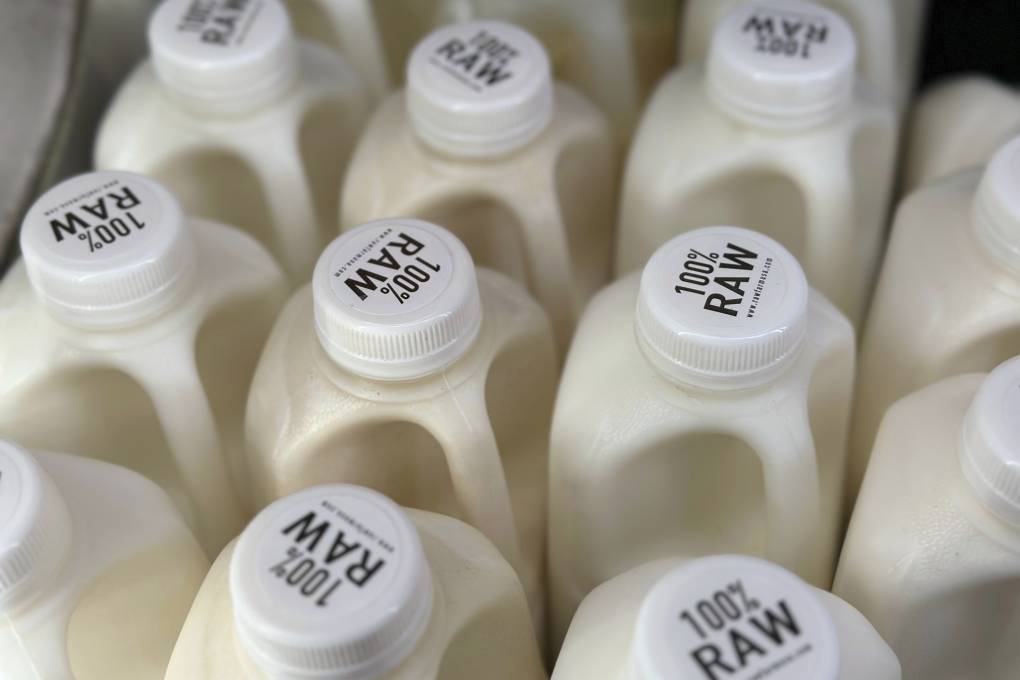
"caption": "Raw Farm raw milk containers are displayed on a shelf at a grocery store on Nov. 25, 2024, in San Anselmo, California. Fresno County dairy Raw Farm has recalled its cream top raw milk after bird flu virus was found in a retail sample of the raw milk product over the weekend. Consumers should avoid milk consumption and are encouraged to return the product to the store where it was purchased.",
"credit": "Justin Sullivan/Getty Images",
"altTag": null,
"description": null,
"imgSizes": {
"medium": {
"file": "https://cdn.kqed.org/wp-content/uploads/sites/10/2024/11/BirdFluMilkFresnoGetty-800x560.jpg",
"width": 800,
"height": 560,
"mimeType": "image/jpeg"
},
"large": {
"file": "https://cdn.kqed.org/wp-content/uploads/sites/10/2024/11/BirdFluMilkFresnoGetty-1020x714.jpg",
"width": 1020,
"height": 714,
"mimeType": "image/jpeg"
},
"thumbnail": {
"file": "https://cdn.kqed.org/wp-content/uploads/sites/10/2024/11/BirdFluMilkFresnoGetty-160x112.jpg",
"width": 160,
"height": 112,
"mimeType": "image/jpeg"
},
"1536x1536": {
"file": "https://cdn.kqed.org/wp-content/uploads/sites/10/2024/11/BirdFluMilkFresnoGetty-1536x1075.jpg",
"width": 1536,
"height": 1075,
"mimeType": "image/jpeg"
},
"post-thumbnail": {
"file": "https://cdn.kqed.org/wp-content/uploads/sites/10/2024/11/BirdFluMilkFresnoGetty-672x372.jpg",
"width": 672,
"height": 372,
"mimeType": "image/jpeg"
},
"twentyfourteen-full-width": {
"file": "https://cdn.kqed.org/wp-content/uploads/sites/10/2024/11/BirdFluMilkFresnoGetty-1038x576.jpg",
"width": 1038,
"height": 576,
"mimeType": "image/jpeg"
},
"full-width": {
"file": "https://cdn.kqed.org/wp-content/uploads/sites/10/2024/11/BirdFluMilkFresnoGetty-1920x1344.jpg",
"width": 1920,
"height": 1344,
"mimeType": "image/jpeg"
},
"kqedFullSize": {
"file": "https://cdn.kqed.org/wp-content/uploads/sites/10/2024/11/BirdFluMilkFresnoGetty.jpg",
"width": 2000,
"height": 1400
}
},
"isLoading": false,
"fetchFailed": false
},
"news_12017275": {
"type": "attachments",
"id": "news_12017275",
"meta": {
"index": "attachments_1716263798",
"site": "news",
"id": "12017275",
"found": true
},
"title": "Caltrain Commuter Train at San Francisco 4th and King Street Station",
"publishDate": 1733770264,
"status": "inherit",
"parent": 12017271,
"modified": 1733875095,
"caption": "Caltrain Commuter Train at San Francisco 4th and King Street Station on Feb. 25, 2023.",
"credit": "iStock/Getty Images Plus",
"altTag": null,
"description": null,
"imgSizes": {
"medium": {
"file": "https://cdn.kqed.org/wp-content/uploads/sites/10/2024/12/CalTrainSFGetty-800x533.jpg",
"width": 800,
"height": 533,
"mimeType": "image/jpeg"
},
"large": {
"file": "https://cdn.kqed.org/wp-content/uploads/sites/10/2024/12/CalTrainSFGetty-1020x680.jpg",
"width": 1020,
"height": 680,
"mimeType": "image/jpeg"
},
"thumbnail": {
"file": "https://cdn.kqed.org/wp-content/uploads/sites/10/2024/12/CalTrainSFGetty-160x107.jpg",
"width": 160,
"height": 107,
"mimeType": "image/jpeg"
},
"1536x1536": {
"file": "https://cdn.kqed.org/wp-content/uploads/sites/10/2024/12/CalTrainSFGetty-1536x1024.jpg",
"width": 1536,
"height": 1024,
"mimeType": "image/jpeg"
},
"post-thumbnail": {
"file": "https://cdn.kqed.org/wp-content/uploads/sites/10/2024/12/CalTrainSFGetty-672x372.jpg",
"width": 672,
"height": 372,
"mimeType": "image/jpeg"
},
"twentyfourteen-full-width": {
"file": "https://cdn.kqed.org/wp-content/uploads/sites/10/2024/12/CalTrainSFGetty-1038x576.jpg",
"width": 1038,
"height": 576,
"mimeType": "image/jpeg"
},
"full-width": {
"file": "https://cdn.kqed.org/wp-content/uploads/sites/10/2024/12/CalTrainSFGetty-1920x1280.jpg",
"width": 1920,
"height": 1280,
"mimeType": "image/jpeg"
},
"kqedFullSize": {
"file": "https://cdn.kqed.org/wp-content/uploads/sites/10/2024/12/CalTrainSFGetty.jpg",
"width": 2000,
"height": 1333
}
},
"isLoading": false,
"fetchFailed": false
},
"news_12003593": {
"type": "attachments",
"id": "news_12003593",
"meta": {
"index": "attachments_1716263798",
"site": "news",
"id": "12003593",
"found": true
},
"title": "APTOPIX California Wildfires",
"publishDate": 1725889187,
"status": "inherit",
"parent": 0,
"modified": 1733534408,
"caption": "Firefighter Nolan Graham sprays water around a scorched garage as the Boyles fire burns in Clearlake, Lake County, on Sept. 8, 2024. ",
"credit": "Noah Berger/AP Photo",
"altTag": null,
"description": null,
"imgSizes": {
"medium": {
"file": "https://cdn.kqed.org/wp-content/uploads/sites/10/2024/09/AP24253126507105-KQED-800x533.jpg",
"width": 800,
"height": 533,
"mimeType": "image/jpeg"
},
"large": {
"file": "https://cdn.kqed.org/wp-content/uploads/sites/10/2024/09/AP24253126507105-KQED-1020x680.jpg",
"width": 1020,
"height": 680,
"mimeType": "image/jpeg"
},
"thumbnail": {
"file": "https://cdn.kqed.org/wp-content/uploads/sites/10/2024/09/AP24253126507105-KQED-160x107.jpg",
"width": 160,
"height": 107,
"mimeType": "image/jpeg"
},
"1536x1536": {
"file": "https://cdn.kqed.org/wp-content/uploads/sites/10/2024/09/AP24253126507105-KQED-1536x1024.jpg",
"width": 1536,
"height": 1024,
"mimeType": "image/jpeg"
},
"post-thumbnail": {
"file": "https://cdn.kqed.org/wp-content/uploads/sites/10/2024/09/AP24253126507105-KQED-672x372.jpg",
"width": 672,
"height": 372,
"mimeType": "image/jpeg"
},
"twentyfourteen-full-width": {
"file": "https://cdn.kqed.org/wp-content/uploads/sites/10/2024/09/AP24253126507105-KQED-1038x576.jpg",
"width": 1038,
"height": 576,
"mimeType": "image/jpeg"
},
"full-width": {
"file": "https://cdn.kqed.org/wp-content/uploads/sites/10/2024/09/AP24253126507105-KQED-1920x1280.jpg",
"width": 1920,
"height": 1280,
"mimeType": "image/jpeg"
},
"kqedFullSize": {
"file": "https://cdn.kqed.org/wp-content/uploads/sites/10/2024/09/AP24253126507105-KQED.jpg",
"width": 2000,
"height": 1333
}
},
"isLoading": false,
"fetchFailed": false
},
"news_12016887": {
"type": "attachments",
"id": "news_12016887",
"meta": {
"index": "attachments_1716263798",
"site": "news",
"id": "12016887",
"found": true
},
"title": "20241205-Tsunami-JY-008",
"publishDate": 1733433874,
"status": "inherit",
"parent": 0,
"modified": 1733517469,
"caption": "A SFFD firefighter warns surfers in the water to evacuate for a tsunami warning at Ocean Beach in San Francisco on Thursday, Dec. 5, 2024.",
"credit": "Juliana Yamada/KQED",
"altTag": null,
"description": null,
"imgSizes": {
"medium": {
"file": "https://cdn.kqed.org/wp-content/uploads/sites/10/2024/12/20241205-Tsunami-JY-008-800x533.jpg",
"width": 800,
"height": 533,
"mimeType": "image/jpeg"
},
"large": {
"file": "https://cdn.kqed.org/wp-content/uploads/sites/10/2024/12/20241205-Tsunami-JY-008-1020x679.jpg",
"width": 1020,
"height": 679,
"mimeType": "image/jpeg"
},
"thumbnail": {
"file": "https://cdn.kqed.org/wp-content/uploads/sites/10/2024/12/20241205-Tsunami-JY-008-160x107.jpg",
"width": 160,
"height": 107,
"mimeType": "image/jpeg"
},
"1536x1536": {
"file": "https://cdn.kqed.org/wp-content/uploads/sites/10/2024/12/20241205-Tsunami-JY-008-1536x1023.jpg",
"width": 1536,
"height": 1023,
"mimeType": "image/jpeg"
},
"post-thumbnail": {
"file": "https://cdn.kqed.org/wp-content/uploads/sites/10/2024/12/20241205-Tsunami-JY-008-672x372.jpg",
"width": 672,
"height": 372,
"mimeType": "image/jpeg"
},
"twentyfourteen-full-width": {
"file": "https://cdn.kqed.org/wp-content/uploads/sites/10/2024/12/20241205-Tsunami-JY-008-1038x576.jpg",
"width": 1038,
"height": 576,
"mimeType": "image/jpeg"
},
"full-width": {
"file": "https://cdn.kqed.org/wp-content/uploads/sites/10/2024/12/20241205-Tsunami-JY-008-1920x1279.jpg",
"width": 1920,
"height": 1279,
"mimeType": "image/jpeg"
},
"kqedFullSize": {
"file": "https://cdn.kqed.org/wp-content/uploads/sites/10/2024/12/20241205-Tsunami-JY-008.jpg",
"width": 2000,
"height": 1332
}
},
"isLoading": false,
"fetchFailed": false
},
"news_12016881": {
"type": "attachments",
"id": "news_12016881",
"meta": {
"index": "attachments_1716263798",
"site": "news",
"id": "12016881",
"found": true
},
"title": "20241205-Tsunami-JY-001",
"publishDate": 1733433849,
"status": "inherit",
"parent": 12025352,
"modified": 1738616045,
"caption": "People watch for a tsunami at Ocean Beach in San Francisco on Thursday, Dec. 5, 2024.",
"credit": "Juliana Yamada/KQED",
"altTag": "People look out over the ocean.",
"description": null,
"imgSizes": {
"medium": {
"file": "https://cdn.kqed.org/wp-content/uploads/sites/10/2024/12/20241205-Tsunami-JY-001-800x533.jpg",
"width": 800,
"height": 533,
"mimeType": "image/jpeg"
},
"large": {
"file": "https://cdn.kqed.org/wp-content/uploads/sites/10/2024/12/20241205-Tsunami-JY-001-1020x679.jpg",
"width": 1020,
"height": 679,
"mimeType": "image/jpeg"
},
"thumbnail": {
"file": "https://cdn.kqed.org/wp-content/uploads/sites/10/2024/12/20241205-Tsunami-JY-001-160x107.jpg",
"width": 160,
"height": 107,
"mimeType": "image/jpeg"
},
"1536x1536": {
"file": "https://cdn.kqed.org/wp-content/uploads/sites/10/2024/12/20241205-Tsunami-JY-001-1536x1023.jpg",
"width": 1536,
"height": 1023,
"mimeType": "image/jpeg"
},
"post-thumbnail": {
"file": "https://cdn.kqed.org/wp-content/uploads/sites/10/2024/12/20241205-Tsunami-JY-001-672x372.jpg",
"width": 672,
"height": 372,
"mimeType": "image/jpeg"
},
"twentyfourteen-full-width": {
"file": "https://cdn.kqed.org/wp-content/uploads/sites/10/2024/12/20241205-Tsunami-JY-001-1038x576.jpg",
"width": 1038,
"height": 576,
"mimeType": "image/jpeg"
},
"full-width": {
"file": "https://cdn.kqed.org/wp-content/uploads/sites/10/2024/12/20241205-Tsunami-JY-001-1920x1279.jpg",
"width": 1920,
"height": 1279,
"mimeType": "image/jpeg"
},
"kqedFullSize": {
"file": "https://cdn.kqed.org/wp-content/uploads/sites/10/2024/12/20241205-Tsunami-JY-001.jpg",
"width": 2000,
"height": 1332
}
},
"isLoading": false,
"fetchFailed": false
},
"news_12012267": {
"type": "attachments",
"id": "news_12012267",
"meta": {
"index": "attachments_1716263798",
"site": "news",
"id": "12012267",
"found": true
},
"title": "Sacramento travel",
"publishDate": 1730504002,
"status": "inherit",
"parent": 0,
"modified": 1730504057,
"caption": "The California State Capitol on March 3, 2024.",
"credit": "Nick Otto for the Washington Post via Getty",
"altTag": null,
"description": null,
"imgSizes": {
"medium": {
"file": "https://cdn.kqed.org/wp-content/uploads/sites/10/2024/11/GETTYIMAGES-1170899609-KQED-800x533.jpg",
"width": 800,
"height": 533,
"mimeType": "image/jpeg"
},
"large": {
"file": "https://cdn.kqed.org/wp-content/uploads/sites/10/2024/11/GETTYIMAGES-1170899609-KQED-1020x680.jpg",
"width": 1020,
"height": 680,
"mimeType": "image/jpeg"
},
"thumbnail": {
"file": "https://cdn.kqed.org/wp-content/uploads/sites/10/2024/11/GETTYIMAGES-1170899609-KQED-160x107.jpg",
"width": 160,
"height": 107,
"mimeType": "image/jpeg"
},
"1536x1536": {
"file": "https://cdn.kqed.org/wp-content/uploads/sites/10/2024/11/GETTYIMAGES-1170899609-KQED-1536x1024.jpg",
"width": 1536,
"height": 1024,
"mimeType": "image/jpeg"
},
"post-thumbnail": {
"file": "https://cdn.kqed.org/wp-content/uploads/sites/10/2024/11/GETTYIMAGES-1170899609-KQED-672x372.jpg",
"width": 672,
"height": 372,
"mimeType": "image/jpeg"
},
"twentyfourteen-full-width": {
"file": "https://cdn.kqed.org/wp-content/uploads/sites/10/2024/11/GETTYIMAGES-1170899609-KQED-1038x576.jpg",
"width": 1038,
"height": 576,
"mimeType": "image/jpeg"
},
"full-width": {
"file": "https://cdn.kqed.org/wp-content/uploads/sites/10/2024/11/GETTYIMAGES-1170899609-KQED-1920x1280.jpg",
"width": 1920,
"height": 1280,
"mimeType": "image/jpeg"
},
"kqedFullSize": {
"file": "https://cdn.kqed.org/wp-content/uploads/sites/10/2024/11/GETTYIMAGES-1170899609-KQED.jpg",
"width": 2000,
"height": 1333
}
},
"isLoading": false,
"fetchFailed": false
},
"news_11986426": {
"type": "attachments",
"id": "news_11986426",
"meta": {
"index": "attachments_1716263798",
"site": "news",
"id": "11986426",
"found": true
},
"title": "Protesters Call For Ceasefire In Middle East On Capitol Hill",
"publishDate": 1715813274,
"status": "inherit",
"parent": 11986412,
"modified": 1733450802,
"caption": "A visitor holds an AIPAC folder in an elevator in Rayburn House Office Building on March 12, 2024 on Capitol Hill in Washington, DC.",
"credit": "Alex Wong/Getty Images",
"altTag": null,
"description": null,
"imgSizes": {
"medium": {
"file": "https://cdn.kqed.org/wp-content/uploads/sites/10/2024/05/GettyImages-2078448808-800x533.jpg",
"width": 800,
"height": 533,
"mimeType": "image/jpeg"
},
"large": {
"file": "https://cdn.kqed.org/wp-content/uploads/sites/10/2024/05/GettyImages-2078448808-1020x680.jpg",
"width": 1020,
"height": 680,
"mimeType": "image/jpeg"
},
"thumbnail": {
"file": "https://cdn.kqed.org/wp-content/uploads/sites/10/2024/05/GettyImages-2078448808-160x107.jpg",
"width": 160,
"height": 107,
"mimeType": "image/jpeg"
},
"1536x1536": {
"file": "https://cdn.kqed.org/wp-content/uploads/sites/10/2024/05/GettyImages-2078448808-1536x1024.jpg",
"width": 1536,
"height": 1024,
"mimeType": "image/jpeg"
},
"2048x2048": {
"file": "https://cdn.kqed.org/wp-content/uploads/sites/10/2024/05/GettyImages-2078448808-2048x1365.jpg",
"width": 2048,
"height": 1365,
"mimeType": "image/jpeg"
},
"post-thumbnail": {
"file": "https://cdn.kqed.org/wp-content/uploads/sites/10/2024/05/GettyImages-2078448808-672x372.jpg",
"width": 672,
"height": 372,
"mimeType": "image/jpeg"
},
"twentyfourteen-full-width": {
"file": "https://cdn.kqed.org/wp-content/uploads/sites/10/2024/05/GettyImages-2078448808-1038x576.jpg",
"width": 1038,
"height": 576,
"mimeType": "image/jpeg"
},
"full-width": {
"file": "https://cdn.kqed.org/wp-content/uploads/sites/10/2024/05/GettyImages-2078448808-1920x1280.jpg",
"width": 1920,
"height": 1280,
"mimeType": "image/jpeg"
},
"kqedFullSize": {
"file": "https://cdn.kqed.org/wp-content/uploads/sites/10/2024/05/GettyImages-2078448808-scaled.jpg",
"width": 2560,
"height": 1707
}
},
"isLoading": false,
"fetchFailed": false
},
"news_12016905": {
"type": "attachments",
"id": "news_12016905",
"meta": {
"index": "attachments_1716263798",
"site": "news",
"id": "12016905",
"found": true
},
"title": "EarthquakeSukeyLewis",
"publishDate": 1733436901,
"status": "inherit",
"parent": 0,
"modified": 1733436945,
"caption": "Ray's Food Place in Fortuna, California, on Dec. 5, 2024.",
"credit": "Sukey Lewis/KQED",
"altTag": null,
"description": null,
"imgSizes": {
"medium": {
"file": "https://cdn.kqed.org/wp-content/uploads/sites/10/2024/12/EarthquakeSukeyLewis-800x600.jpg",
"width": 800,
"height": 600,
"mimeType": "image/jpeg"
},
"large": {
"file": "https://cdn.kqed.org/wp-content/uploads/sites/10/2024/12/EarthquakeSukeyLewis-1020x765.jpg",
"width": 1020,
"height": 765,
"mimeType": "image/jpeg"
},
"thumbnail": {
"file": "https://cdn.kqed.org/wp-content/uploads/sites/10/2024/12/EarthquakeSukeyLewis-160x120.jpg",
"width": 160,
"height": 120,
"mimeType": "image/jpeg"
},
"1536x1536": {
"file": "https://cdn.kqed.org/wp-content/uploads/sites/10/2024/12/EarthquakeSukeyLewis-1536x1152.jpg",
"width": 1536,
"height": 1152,
"mimeType": "image/jpeg"
},
"post-thumbnail": {
"file": "https://cdn.kqed.org/wp-content/uploads/sites/10/2024/12/EarthquakeSukeyLewis-672x372.jpg",
"width": 672,
"height": 372,
"mimeType": "image/jpeg"
},
"twentyfourteen-full-width": {
"file": "https://cdn.kqed.org/wp-content/uploads/sites/10/2024/12/EarthquakeSukeyLewis-1038x576.jpg",
"width": 1038,
"height": 576,
"mimeType": "image/jpeg"
},
"full-width": {
"file": "https://cdn.kqed.org/wp-content/uploads/sites/10/2024/12/EarthquakeSukeyLewis-1920x1440.jpg",
"width": 1920,
"height": 1440,
"mimeType": "image/jpeg"
},
"kqedFullSize": {
"file": "https://cdn.kqed.org/wp-content/uploads/sites/10/2024/12/EarthquakeSukeyLewis.jpg",
"width": 2000,
"height": 1500
}
},
"isLoading": false,
"fetchFailed": false
},
"news_11892955": {
"type": "attachments",
"id": "news_11892955",
"meta": {
"index": "attachments_1716263798",
"site": "news",
"id": "11892955",
"found": true
},
"title": "US-AGRICULTURE-DROUGHT-CLIMATE-WITCH",
"publishDate": 1634685573,
"status": "inherit",
"parent": 11892939,
"modified": 1733351474,
"caption": "Water pumped up from an underground well flows into a cistern on a farm in Fresno on July 24, 2021. ",
"credit": "Robyn Beck/AFP via Getty Images",
"altTag": "A metal cistern pumps a strong flow of water into a field full of green crops on a sunny day.",
"description": "Water pumped up from an underground well flows into a cistern on a farm in Fresno on July 24, 2021.",
"imgSizes": {
"medium": {
"file": "https://cdn.kqed.org/wp-content/uploads/sites/10/2021/10/GettyImages-1234437734-800x532.jpg",
"width": 800,
"height": 532,
"mimeType": "image/jpeg"
},
"large": {
"file": "https://cdn.kqed.org/wp-content/uploads/sites/10/2021/10/GettyImages-1234437734-1020x679.jpg",
"width": 1020,
"height": 679,
"mimeType": "image/jpeg"
},
"thumbnail": {
"file": "https://cdn.kqed.org/wp-content/uploads/sites/10/2021/10/GettyImages-1234437734-160x106.jpg",
"width": 160,
"height": 106,
"mimeType": "image/jpeg"
},
"1536x1536": {
"file": "https://cdn.kqed.org/wp-content/uploads/sites/10/2021/10/GettyImages-1234437734-1536x1022.jpg",
"width": 1536,
"height": 1022,
"mimeType": "image/jpeg"
},
"2048x2048": {
"file": "https://cdn.kqed.org/wp-content/uploads/sites/10/2021/10/GettyImages-1234437734-2048x1363.jpg",
"width": 2048,
"height": 1363,
"mimeType": "image/jpeg"
},
"post-thumbnail": {
"file": "https://cdn.kqed.org/wp-content/uploads/sites/10/2021/10/GettyImages-1234437734-672x372.jpg",
"width": 672,
"height": 372,
"mimeType": "image/jpeg"
},
"twentyfourteen-full-width": {
"file": "https://cdn.kqed.org/wp-content/uploads/sites/10/2021/10/GettyImages-1234437734-1038x576.jpg",
"width": 1038,
"height": 576,
"mimeType": "image/jpeg"
},
"full-width": {
"file": "https://cdn.kqed.org/wp-content/uploads/sites/10/2021/10/GettyImages-1234437734-1920x1278.jpg",
"width": 1920,
"height": 1278,
"mimeType": "image/jpeg"
},
"kqedFullSize": {
"file": "https://cdn.kqed.org/wp-content/uploads/sites/10/2021/10/GettyImages-1234437734-scaled.jpg",
"width": 2560,
"height": 1703
}
},
"isLoading": false,
"fetchFailed": false
},
"news_11986068": {
"type": "attachments",
"id": "news_11986068",
"meta": {
"index": "attachments_1716263798",
"site": "news",
"id": "11986068",
"found": true
},
"title": "Raw Milk",
"publishDate": 1715705344,
"status": "inherit",
"parent": 11986062,
"modified": 1733350359,
"caption": "Bottles of raw milk are displayed for sale at a store in Temecula, on May 8, 2024. ",
"credit": "Jonel Aleccia/AP Photo",
"altTag": "Several jugs of milk.",
"description": null,
"imgSizes": {
"medium": {
"file": "https://cdn.kqed.org/wp-content/uploads/sites/10/2024/05/AP24134604431971-800x533.jpg",
"width": 800,
"height": 533,
"mimeType": "image/jpeg"
},
"large": {
"file": "https://cdn.kqed.org/wp-content/uploads/sites/10/2024/05/AP24134604431971-1020x680.jpg",
"width": 1020,
"height": 680,
"mimeType": "image/jpeg"
},
"thumbnail": {
"file": "https://cdn.kqed.org/wp-content/uploads/sites/10/2024/05/AP24134604431971-160x107.jpg",
"width": 160,
"height": 107,
"mimeType": "image/jpeg"
},
"1536x1536": {
"file": "https://cdn.kqed.org/wp-content/uploads/sites/10/2024/05/AP24134604431971-1536x1024.jpg",
"width": 1536,
"height": 1024,
"mimeType": "image/jpeg"
},
"post-thumbnail": {
"file": "https://cdn.kqed.org/wp-content/uploads/sites/10/2024/05/AP24134604431971-672x372.jpg",
"width": 672,
"height": 372,
"mimeType": "image/jpeg"
},
"twentyfourteen-full-width": {
"file": "https://cdn.kqed.org/wp-content/uploads/sites/10/2024/05/AP24134604431971-1038x576.jpg",
"width": 1038,
"height": 576,
"mimeType": "image/jpeg"
},
"kqedFullSize": {
"file": "https://cdn.kqed.org/wp-content/uploads/sites/10/2024/05/AP24134604431971.jpg",
"width": 1920,
"height": 1280
}
},
"isLoading": false,
"fetchFailed": false
}
},
"audioPlayerReducer": {
"postId": "stream_live",
"isPaused": true,
"isPlaying": false,
"pfsActive": false,
"pledgeModalIsOpen": true,
"playerDrawerIsOpen": false,
"liveAudioPlayStartedAt": 0,
"liveAudioPlayContext": ""
},
"authorsReducer": {
"byline_news_12017649": {
"type": "authors",
"id": "byline_news_12017649",
"meta": {
"override": true
},
"slug": "byline_news_12017649",
"name": "\u003ca href=\"https://calmatters.org/author/jeanne-kuang/\">Jeanne Kuang\u003c/a> and \u003ca href=\"https://calmatters.org/author/jeremia-kimelman/\">Jeremia Kimelman\u003c/a>, CalMatters",
"isLoading": false
},
"byline_news_12017043": {
"type": "authors",
"id": "byline_news_12017043",
"meta": {
"override": true
},
"slug": "byline_news_12017043",
"name": "Megan Myscofski, Srishti Prabha and Gerardo Zavala | CapRadio",
"isLoading": false
},
"byline_news_12016674": {
"type": "authors",
"id": "byline_news_12016674",
"meta": {
"override": true
},
"slug": "byline_news_12016674",
"name": "Amy Taxin, Associated Press",
"isLoading": false
},
"byline_news_12016664": {
"type": "authors",
"id": "byline_news_12016664",
"meta": {
"override": true
},
"slug": "byline_news_12016664",
"name": "Jonel Aleccia, Associated Press",
"isLoading": false
},
"danbrekke": {
"type": "authors",
"id": "222",
"meta": {
"index": "authors_1716337520",
"id": "222",
"found": true
},
"name": "Dan Brekke",
"firstName": "Dan",
"lastName": "Brekke",
"slug": "danbrekke",
"email": "dbrekke@kqed.org",
"display_author_email": true,
"staff_mastheads": [
"news",
"science"
],
"title": "KQED Editor and Reporter",
"bio": "Dan Brekke is a reporter and editor for KQED News, responsible for coverage of topics ranging from California water issues to the Bay Area's transportation challenges. In a newsroom career that began in Chicago in 1972, Dan has worked for \u003cem>The San Francisco Examiner,\u003c/em> Wired and TechTV and has been published in The New York Times, The New York Times Magazine, Business 2.0, Salon and elsewhere.\r\n\r\nSince joining KQED in 2007, Dan has reported, edited and produced both radio and online features and breaking news pieces. He has shared as both editor and reporter in four Society of Professional Journalists Norcal Excellence in Journalism awards and one Edward R. Murrow regional award. He was chosen for a spring 2017 residency at the Mesa Refuge to advance his research on California salmon.\r\n\r\nEmail Dan at: \u003ca href=\"mailto:dbrekke@kqed.org\">dbrekke@kqed.org\u003c/a>\r\n\r\n\u003cstrong>Twitter:\u003c/strong> \u003ca href=\"https://twitter.com/danbrekke\" rel=\"noopener noreferrer\">twitter.com/danbrekke\u003c/a>\r\n\u003cstrong>Facebook:\u003c/strong> \u003ca href=\"https://www.facebook.com/danbrekke\" rel=\"noopener noreferrer\">www.facebook.com/danbrekke\u003c/a>\r\n\u003cstrong>LinkedIn:\u003c/strong> \u003ca href=\"https://www.linkedin.com/in/danbrekke\" rel=\"noopener noreferrer\">www.linkedin.com/in/danbrekke\u003c/a>",
"avatar": "https://secure.gravatar.com/avatar/c8126230345efca3f7aa89b1a402be45?s=600&d=mm&r=g",
"twitter": "danbrekke",
"facebook": null,
"instagram": "https://www.instagram.com/dan.brekke/",
"linkedin": "https://www.linkedin.com/in/danbrekke/",
"sites": [
{
"site": "news",
"roles": [
"administrator",
"create_posts"
]
},
{
"site": "stateofhealth",
"roles": [
"editor"
]
},
{
"site": "science",
"roles": [
"editor"
]
},
{
"site": "quest",
"roles": [
"contributor"
]
},
{
"site": "food",
"roles": [
"contributor"
]
},
{
"site": "forum",
"roles": [
"contributor"
]
},
{
"site": "liveblog",
"roles": [
"editor"
]
}
],
"headData": {
"title": "Dan Brekke | KQED",
"description": "KQED Editor and Reporter",
"ogImgSrc": "https://secure.gravatar.com/avatar/c8126230345efca3f7aa89b1a402be45?s=600&d=mm&r=g",
"twImgSrc": "https://secure.gravatar.com/avatar/c8126230345efca3f7aa89b1a402be45?s=600&d=mm&r=g"
},
"isLoading": false,
"link": "/author/danbrekke"
},
"mlagos": {
"type": "authors",
"id": "3239",
"meta": {
"index": "authors_1716337520",
"id": "3239",
"found": true
},
"name": "Marisa Lagos",
"firstName": "Marisa",
"lastName": "Lagos",
"slug": "mlagos",
"email": "mlagos@kqed.org",
"display_author_email": false,
"staff_mastheads": [
"news"
],
"title": "KQED Contributor",
"bio": "Marisa Lagos is a correspondent for KQED’s California Politics and Government Desk and co-hosts the award-winning show and podcast, Political Breakdown. At KQED, Lagos also conducts reporting, analysis and investigations into state, local and national politics for radio, TV, online and onstage. In 2022, she and co-host, Scott Shafer, moderated the only gubernatorial debate in California. In 2020, the \u003ci>Washington Post\u003c/i> named her one of the top political journalists in California; she was nominated for a Peabody and won several other awards for her work investigating the 2017 California wildfires. She has worked at the \u003ci>San Francisco Chronicle\u003c/i>, \u003ci>San Francisco Examiner\u003c/i> and \u003ci>Los Angeles Times\u003c/i>. A UC Santa Barbara graduate, she lives in San Francisco with her two sons and husband.",
"avatar": "https://secure.gravatar.com/avatar/a261a0d3696fc066871ef96b85b5e7d2?s=600&d=blank&r=g",
"twitter": "@mlagos",
"facebook": null,
"instagram": null,
"linkedin": null,
"sites": [
{
"site": "arts",
"roles": [
"author"
]
},
{
"site": "news",
"roles": [
"editor"
]
},
{
"site": "science",
"roles": [
"editor"
]
},
{
"site": "forum",
"roles": [
"author"
]
},
{
"site": "liveblog",
"roles": [
"author"
]
}
],
"headData": {
"title": "Marisa Lagos | KQED",
"description": "KQED Contributor",
"ogImgSrc": "https://secure.gravatar.com/avatar/a261a0d3696fc066871ef96b85b5e7d2?s=600&d=blank&r=g",
"twImgSrc": "https://secure.gravatar.com/avatar/a261a0d3696fc066871ef96b85b5e7d2?s=600&d=blank&r=g"
},
"isLoading": false,
"link": "/author/mlagos"
},
"lesleymcclurg": {
"type": "authors",
"id": "11229",
"meta": {
"index": "authors_1716337520",
"id": "11229",
"found": true
},
"name": "Lesley McClurg",
"firstName": "Lesley",
"lastName": "McClurg",
"slug": "lesleymcclurg",
"email": "lmcclurg@KQED.org",
"display_author_email": false,
"staff_mastheads": [
"news",
"science"
],
"title": "KQED Health Correspondent",
"bio": "Lesley McClurg is a health correspondent and fill-in host whose work is regularly rebroadcast on NPR and PBS programs. She’s earned multiple regional Emmy awards, a national and a regional Edward R. Murrow award, and was named Best Beat Reporter by the Association of Health Care Journalists. The Society of Professional Journalists has recognized her work several times, and the Society of Environmental Journalists spotlighted her coverage of California’s historic drought.\r\n\r\nBefore joining KQED in 2016, Lesley covered food and sustainability for Capital Public Radio, environmental issues for Colorado Public Radio, and reported for KUOW and KCTS 9 in Seattle. Away from the newsroom, she loves skiing with her daughter, mountain biking with her partner, and playing with Ollie, the family’s goldendoodle. On deadline, she runs almost entirely on chocolate chips.\r\n\r\n ",
"avatar": "https://secure.gravatar.com/avatar/bab49e972ea10c774fe0f5e29dba1722b158f7c0d58a360923d1389d380b2978?s=600&d=blank&r=g",
"twitter": "lesleywmcclurg",
"bluesky": null,
"facebook": null,
"instagram": null,
"linkedin": null,
"sites": [
{
"site": "arts",
"roles": [
"author"
]
},
{
"site": "news",
"roles": [
"editor"
]
},
{
"site": "futureofyou",
"roles": [
"editor"
]
},
{
"site": "stateofhealth",
"roles": [
"author"
]
},
{
"site": "science",
"roles": [
"editor"
]
},
{
"site": "quest",
"roles": [
"subscriber"
]
},
{
"site": "forum",
"roles": [
"administrator"
]
},
{
"site": "liveblog",
"roles": [
"author"
]
}
],
"headData": {
"title": "Lesley McClurg | KQED",
"description": "KQED Health Correspondent",
"ogImgSrc": "https://secure.gravatar.com/avatar/bab49e972ea10c774fe0f5e29dba1722b158f7c0d58a360923d1389d380b2978?s=600&d=blank&r=g",
"twImgSrc": "https://secure.gravatar.com/avatar/bab49e972ea10c774fe0f5e29dba1722b158f7c0d58a360923d1389d380b2978?s=600&d=blank&r=g"
},
"isLoading": false,
"link": "/author/lesleymcclurg"
},
"nkhan": {
"type": "authors",
"id": "11867",
"meta": {
"index": "authors_1716337520",
"id": "11867",
"found": true
},
"name": "Nisa Khan",
"firstName": "Nisa",
"lastName": "Khan",
"slug": "nkhan",
"email": "nkhan@kqed.org",
"display_author_email": false,
"staff_mastheads": [],
"title": "KQED Contributor",
"bio": "Nisa Khan is a reporter for KQED's Audience News Desk. She was formerly a data reporter at Michigan Radio. She earned a Bachelor of Science in Information from the University of Michigan and a Master of Arts in Communication from Stanford University.",
"avatar": "https://secure.gravatar.com/avatar/a3bf1efcfbe7658d13a434cc54d0b2e3?s=600&d=blank&r=g",
"twitter": "mnisakhan",
"bluesky": null,
"facebook": null,
"instagram": null,
"linkedin": null,
"sites": [
{
"site": "arts",
"roles": [
"editor"
]
},
{
"site": "news",
"roles": [
"editor"
]
},
{
"site": "science",
"roles": [
"editor",
"author"
]
},
{
"site": "forum",
"roles": [
"editor"
]
},
{
"site": "liveblog",
"roles": [
"contributor"
]
}
],
"headData": {
"title": "Nisa Khan | KQED",
"description": "KQED Contributor",
"ogImgSrc": "https://secure.gravatar.com/avatar/a3bf1efcfbe7658d13a434cc54d0b2e3?s=600&d=blank&r=g",
"twImgSrc": "https://secure.gravatar.com/avatar/a3bf1efcfbe7658d13a434cc54d0b2e3?s=600&d=blank&r=g"
},
"isLoading": false,
"link": "/author/nkhan"
},
"jservantez": {
"type": "authors",
"id": "11909",
"meta": {
"index": "authors_1716337520",
"id": "11909",
"found": true
},
"name": "Jared Servantez",
"firstName": "Jared",
"lastName": "Servantez",
"slug": "jservantez",
"email": "jservantez@kqed.org",
"display_author_email": true,
"staff_mastheads": [
"news"
],
"title": "KQED Contributor",
"bio": "Jared Servantez is the editor of KQED's Express Desk, leading the newsroom's online breaking news operation. He most recently worked for the Los Angeles Times, where he served as a breaking news editor, the Metro Desk's night editor, and a copy editor. Jared is a graduate of the USC Annenberg School for Communication and Journalism.",
"avatar": "https://secure.gravatar.com/avatar/46e9029cd4e3bc3391184e65511d73e6?s=600&d=mm&r=g",
"twitter": "jservantez",
"facebook": null,
"instagram": null,
"linkedin": null,
"sites": [
{
"site": "news",
"roles": [
"editor"
]
},
{
"site": "science",
"roles": [
"editor",
"author"
]
},
{
"site": "liveblog",
"roles": [
"editor"
]
}
],
"headData": {
"title": "Jared Servantez | KQED",
"description": "KQED Contributor",
"ogImgSrc": "https://secure.gravatar.com/avatar/46e9029cd4e3bc3391184e65511d73e6?s=600&d=mm&r=g",
"twImgSrc": "https://secure.gravatar.com/avatar/46e9029cd4e3bc3391184e65511d73e6?s=600&d=mm&r=g"
},
"isLoading": false,
"link": "/author/jservantez"
},
"kdebenedetti": {
"type": "authors",
"id": "11913",
"meta": {
"index": "authors_1716337520",
"id": "11913",
"found": true
},
"name": "Katie DeBenedetti",
"firstName": "Katie",
"lastName": "DeBenedetti",
"slug": "kdebenedetti",
"email": "kdebenedetti@kqed.org",
"display_author_email": false,
"staff_mastheads": [
"news",
"science"
],
"title": "KQED Contributor",
"bio": "Katie DeBenedetti is a digital reporter covering daily news for the Express Desk. Prior to joining KQED as a culture reporting intern in January 2024, she covered education and city government for the Napa Valley Register.",
"avatar": "https://secure.gravatar.com/avatar/6e31073cb8f7e4214ab03f42771d0f45?s=600&d=blank&r=g",
"twitter": null,
"facebook": null,
"instagram": null,
"linkedin": null,
"sites": [
{
"site": "news",
"roles": [
"author"
]
},
{
"site": "science",
"roles": [
"author"
]
},
{
"site": "liveblog",
"roles": [
"author"
]
}
],
"headData": {
"title": "Katie DeBenedetti | KQED",
"description": "KQED Contributor",
"ogImgSrc": "https://secure.gravatar.com/avatar/6e31073cb8f7e4214ab03f42771d0f45?s=600&d=blank&r=g",
"twImgSrc": "https://secure.gravatar.com/avatar/6e31073cb8f7e4214ab03f42771d0f45?s=600&d=blank&r=g"
},
"isLoading": false,
"link": "/author/kdebenedetti"
}
},
"pagesReducer": {
"news_tag_california": {
"type": "terms",
"id": "news_18538",
"meta": {
"index": "terms_1716263798",
"site": "news",
"id": "18538",
"score": 6.845124
},
"featImg": null,
"name": "California",
"description": null,
"taxonomy": "tag",
"headData": {
"twImgId": null,
"twTitle": null,
"ogTitle": null,
"ogImgId": null,
"twDescription": null,
"description": null,
"title": "California Archives | KQED News",
"ogDescription": null
},
"ttid": 31,
"slug": "california",
"isLoading": false,
"title": "California",
"pageMeta": {
"site": "news",
"WpPageTemplate": "page-topic-editorial",
"currentPage": 119
},
"blocks": [
{
"blockName": "kqed/post-list",
"attrs": {
"layout": "cardArticle2",
"query": "posts/news?tag=california",
"seeMore": false,
"paginated": true,
"page": 119
}
},
{
"blockName": "kqed/ad"
}
]
}
},
"pfsSessionReducer": {},
"postsReducer": {
"stream_live": {
"type": "live",
"id": "stream_live",
"audioUrl": "https://streams.kqed.org/kqedradio",
"title": "Live Stream",
"excerpt": "Live Stream information currently unavailable.",
"link": "/radio",
"featImg": "",
"label": {
"name": "KQED Live",
"link": "/"
}
},
"stream_kqedNewscast": {
"type": "posts",
"id": "stream_kqedNewscast",
"audioUrl": "https://www.kqed.org/.stream/anon/radio/RDnews/newscast.mp3?_=1",
"title": "KQED Newscast",
"featImg": "",
"label": {
"name": "88.5 FM",
"link": "/"
}
},
"news_12017649": {
"type": "posts",
"id": "news_12017649",
"meta": {
"index": "posts_1716263798",
"site": "news",
"id": "12017649",
"score": null,
"sort": [
1733954440000
]
},
"guestAuthors": [],
"slug": "fentanyl-overdoses-are-causing-a-surge-in-workplace-deaths-in-california",
"title": "Fentanyl Overdoses Are Causing a Surge in Workplace Deaths in California",
"publishDate": 1733954440,
"format": "standard",
"headTitle": "Fentanyl Overdoses Are Causing a Surge in Workplace Deaths in California | KQED",
"labelTerm": {},
"content": "\u003cp>As the nation continues to struggle with an opioid crisis now supercharged by fentanyl, overdoses have become one of the leading causes of workplace deaths.\u003c/p>\n\u003cp>California is no different: Workplace overdose deaths have risen so dramatically that in 2021 and 2022, they caused more fatalities than falls at construction sites or being hit by machinery, and in 2022, were second only to car crashes and other transportation incidents.\u003c/p>\n\u003cp>That year, the toll surpassed 110 workers, accounting for 18% of the state’s workplace deaths, compared to 11% nationwide.\u003c/p>\n\u003cp>Federal and state government experts have \u003ca href=\"https://www.bls.gov/opub/ted/2024/unintentional-overdoses-rose-for-the-tenth-straight-year-in-2022.htm\">raised the alarm\u003c/a> over this trend, which has puzzled some policymakers because drug use is not a hazard created directly by the job. After all, those who die of an overdose at work represent a small share of thousands of Californians who overdose each year.\u003c/p>\n\u003cp>Still, business owners and union officials alike are increasingly having to grapple with one of the nation’s most prominent public health challenges.\u003c/p>\n\u003cp>[ad fullwidth]\u003c/p>\n\u003cp>“When fentanyl came around, we started having a huge uptick in overdoses and deaths — even suicides,” said Paul Moreno, president of Ironworkers Local 433 in Southern California.\u003c/p>\n\u003cp>In 2022, his local began holding recovery meetings for members that now draw as many as a dozen attendees a month. Moreno, who said he’s been sober 19 years, visits worksites and the union hall, passing around the 988 \u003ca href=\"https://calmatters.org/health/2021/09/988-911-funding-crisis-hotline-suicide-california/\">mental health crisis hotline number\u003c/a>, giving out his own personal phone number and distributing doses of the overdose reversal drug naloxone (commonly sold as Narcan).\u003c/p>\n\u003cp>“I took Narcan classes. I passed out Narcan on the job sites. I never thought I’d be doing that,” he said. “The phone calls from the members, sometimes I don’t know what to say besides listen. We still need more training.”\u003c/p>\n\u003cp>A new California law directs the state’s workplace safety agencies to require worksites to stock Narcan in their first aid kits, but the regulations haven’t been issued yet. A spokesperson said Cal/OSHA is “in the early stages of rulemaking,” a process that \u003ca href=\"https://calmatters.org/politics/capitol/2024/02/workplace-safety-california-indoor-heat/\">could take years\u003c/a>.\u003c/p>\n\u003cp>Not much is publicly known about overdose deaths at California worksites. A small office in Cal/OSHA that compiles workplace fatality data has, for at least the past two years, noted the rise in overdoses in its \u003ca href=\"https://www.dir.ca.gov/dosh/CFOI/California-Occupational-Fatalities.pdf\">annual reports\u003c/a>. However, the office said it cannot release details due to privacy restrictions.\u003c/p>\n\u003cp>The agency has not responded to a public records request CalMatters filed in September for all overdose incidents, fatal or nonfatal, that have been reported at worksites.\u003c/p>\n\u003ch2>State won’t release details on deaths\u003c/h2>\n\u003cp>County coroners’ offices, which investigate some deaths, vary widely in whether they can identify incidents based on whether a person died at their job. Death records from the past three years obtained from Alameda, San Bernardino and Riverside counties provide glimpses into the grim trend.\u003c/p>\n\u003cp>In 2021, a flooring installer stepped out for a smoke break at a construction site in Temecula and was found by coworkers on the side of the house, dead from a fentanyl overdose. A packing plant worker in Corona went to the bathroom and did not return; coworkers found him bent over with a straw, lighter and piece of foil nearby, having overdosed on methamphetamine, fentanyl and heroin. In Fremont, a manager found a night-shift janitor in the bathroom with a white powdery substance, overdosed on fentanyl. In Livermore this year, a driver was found in his parked semi-truck as he waited to make a scheduled delivery, also dead from fentanyl.\u003c/p>\n\u003cfigure id=\"attachment_12017660\" class=\"wp-caption aligncenter\" style=\"max-width: 1200px\">\u003cimg loading=\"lazy\" decoding=\"async\" class=\"size-full wp-image-12017660\" src=\"https://cdn.kqed.org/wp-content/uploads/sites/10/2024/12/04222LA-Homeless-Court_TS_CM_27.jpg\" alt=\"\" width=\"1200\" height=\"800\" srcset=\"https://cdn.kqed.org/wp-content/uploads/sites/10/2024/12/04222LA-Homeless-Court_TS_CM_27.jpg 1200w, https://cdn.kqed.org/wp-content/uploads/sites/10/2024/12/04222LA-Homeless-Court_TS_CM_27-800x533.jpg 800w, https://cdn.kqed.org/wp-content/uploads/sites/10/2024/12/04222LA-Homeless-Court_TS_CM_27-1020x680.jpg 1020w, https://cdn.kqed.org/wp-content/uploads/sites/10/2024/12/04222LA-Homeless-Court_TS_CM_27-160x107.jpg 160w\" sizes=\"auto, (max-width: 1200px) 100vw, 1200px\">\u003cfigcaption class=\"wp-caption-text\">Narcan nasal spray containers available at a rally at the First Street U.S. Courthouse in Los Angeles on April 22, 2024. \u003ccite>(Ted Soqui for CalMatters)\u003c/cite>\u003c/figcaption>\u003c/figure>\n\u003cp>California officials have little to say about the rising death toll. Cal/OSHA refused to make an official available for an interview and would not explain why overdoses account for a much higher share of the state’s workplace deaths compared to the rest of the nation.\u003c/p>\n\u003cp>Instead, the agency cited the \u003ca href=\"https://calmatters.org/explainers/california-opioid-crisis/\">broader national opioid crisis\u003c/a>. “California had more than 7,000 people die from opioid-related overdose deaths in 2022,” spokesperson Erika Monterroza wrote in an email. “Unfortunately, these deaths happen all over our state, including in our workplaces.”\u003c/p>\n\u003cp>The state Department of Public Health said it is considering conducting a study. That agency’s occupational health branch is “aware of this issue and is considering a project to examine all opioid overdoses by industry and occupation,” a spokesperson said. In October, the department said staff are in the “initial stages of preparing for an analysis” but did not provide a completion date.\u003c/p>\n\u003cp>Studies in other states indicate the problem is worse in certain industries. In Massachusetts, where overdoses are the top cause of workplace deaths, researchers with the state public health agency examined all overdose deaths — whether at work or not — and found deaths occurred disproportionately among those working in manual-labor, high-injury industries.\u003c/p>\n\u003cp>Those jobs, said Emily Sparer-Fine, director of the Massachusetts public health agency’s \u003ca href=\"https://www.mass.gov/orgs/occupational-health-surveillance-program\">Occupational Health Surveillance Program\u003c/a>, are often seasonal or unstable, and workers may be financially strained and pressured to work through pain.\u003c/p>\n\u003cp>“Certain industries and occupations, (such as) construction, fishing had a much higher rate of overdose,” Sparer-Fine said in an interview. “But it was also jobs that had lower access to paid sick leave, higher rates of job insecurity, higher rates of overall workplace injury.”\u003c/p>\n\u003cp>In a new study this year, Sparer-Fine’s team also dug into \u003ca href=\"https://www.mass.gov/doc/opioid-related-overdose-deaths-among-injured-workers-in-massachusetts-findings-from-the-public-health-data-warehouse/download\">workers’ compensation data\u003c/a> and found that working-age Massachusetts residents were 35% more likely to have died of an overdose if they were previously injured on the job.\u003c/p>\n\u003cp>Workers in similar industries are overrepresented in the California workplace overdose deaths, including in trucking and warehousing, according to federal data.\u003c/p>\n\u003cp>So are workers in construction, where unions and employers are confronting a mental health and addiction crisis. Nationwide, construction workers are \u003ca href=\"https://www.cdc.gov/nchs/data/nvsr/nvsr72/nvsr72-07.pdf\">more likely than workers in any other profession\u003c/a> to overdose and also have one of the \u003ca href=\"https://www.cdc.gov/mmwr/volumes/72/wr/mm7250a2.htm?s_cid=mm7250a2_w\">highest rates of suicide\u003c/a>.\u003c/p>\n\u003cp>Chris Trahan Cain, executive director of the National Center for Construction Research and Training, has since 2018 led the response to the industry’s opioid crisis. She has focused on a longtime reliance on painkillers to deal with injuries involving the muscles and bones, which \u003ca href=\"https://www.cpwr.com/wp-content/uploads/KF2020-MSDs-Opioids-US-workers.pdf\">nearly a third of construction workers\u003c/a> report experiencing. Studies like the ones in Massachusetts were among the first to reveal the toll.\u003c/p>\n\u003cp>The center, formed by the nation’s construction unions, has recommended stocking naloxone in union halls, requiring apprentices be taught about opioid abuse and ensuring members have coverage of drug treatment programs. They’re also providing tips on talking to doctors about how to treat injuries without long-term opioids prescriptions. The goal, Cain said, is to avoid blaming individual workers.\u003c/p>\n\u003cp>“When this information first came to light, what I heard was, ‘Oh, it’s just the macho culture, it’s the type of people who go into construction,’” she said. “We can’t tell you how many of these deaths are because somebody started on a prescription, but we know that some of them are. We know a lot of these deaths are also from illicit drug use that have nothing to do with workplaces, but where we can (make) changes as an industry to impact these numbers is what we’re trying to do.”\u003c/p>\n\u003ch2>Businesses respond to crisis\u003c/h2>\n\u003cp>Employers, too, are trying to break the stigma of seeking help. Since 2021, the Associated General Contractors of California has provided materials to hold jobsite meetings about mental health.\u003c/p>\n\u003cp>Not all employers know how to raise the issue and some fear reprisal for appearing to pry into employees’ personal lives, said Frank Nunes, CEO of the Wall and Ceiling Alliance, a Pleasanton-based specialty contractors’ group. Some, Nunes said, are advised by attorneys to avoid talking about it.\u003c/p>\n\u003cp>“It’s still very sensitive,” he said. “You’ve got to be very careful how you ask somebody how (they’re) doing and not offend them.”\u003c/p>\n\u003cp>Still, Nunes joined officials of District Council 16 of the International Union of Painters and Allied Trades at a recovery event in San Leandro in October, promoting treatment programs covered by their contracts and encouraging workers to use them.\u003c/p>\n\u003cp>“We have to address these things in the field,” he told about 100 union members. “There’s a cultural change we all need to work on.”\u003c/p>\n\u003cp>In a cavernous training hall where apprentices learn how to install drywall, union members told their peers how they had recovered from addiction. The union invited former Raiders tight end Darren Waller to talk about his own experiences with addiction and depression.\u003c/p>\n\u003cp>Reflecting on union officials’ numbers on construction worker deaths by overdose or suicide, Waller told the crowd: “Those are lives that still deserve to be among us.”\u003c/p>\n\u003cp>Robert Williams, the local’s business manager and secretary-treasurer, described what he called a familiar scenario: A worker experiences a job site injury or persistent soreness, feels pressure to work through it, then escalates from an over-the-counter pill to a prescription painkiller to an illicit opioid addiction.\u003c/p>\n\u003cp>“We’re only with our families a small portion of the day,” he said. “The people we work with, we’re with 80% of the time. We’ve got to be open on those job sites.”\u003c/p>\n\u003cfigure id=\"attachment_12017662\" class=\"wp-caption aligncenter\" style=\"max-width: 1200px\">\u003cimg loading=\"lazy\" decoding=\"async\" class=\"size-full wp-image-12017662\" src=\"https://cdn.kqed.org/wp-content/uploads/sites/10/2024/12/110624_Construction-Unions_LA_CM_06.jpg\" alt=\"\" width=\"1200\" height=\"800\" srcset=\"https://cdn.kqed.org/wp-content/uploads/sites/10/2024/12/110624_Construction-Unions_LA_CM_06.jpg 1200w, https://cdn.kqed.org/wp-content/uploads/sites/10/2024/12/110624_Construction-Unions_LA_CM_06-800x533.jpg 800w, https://cdn.kqed.org/wp-content/uploads/sites/10/2024/12/110624_Construction-Unions_LA_CM_06-1020x680.jpg 1020w, https://cdn.kqed.org/wp-content/uploads/sites/10/2024/12/110624_Construction-Unions_LA_CM_06-160x107.jpg 160w\" sizes=\"auto, (max-width: 1200px) 100vw, 1200px\">\u003cfigcaption class=\"wp-caption-text\">Robert Williams, left, business manager and secretary-treasurer, and James Boster, right, director of mental health and addiction, with District Council 16 of the International Union of Painters and Allied Trades, at their union office in Livermore on Nov. 6, 2024. \u003ccite>(Laure Andrillon for CalMatters)\u003c/cite>\u003c/figcaption>\u003c/figure>\n\u003cp>The union and local employers realized they had a problem on their hands last summer. After sifting through their health plan records, they found 91 members had died of overdose or suicide (not necessarily at work) in 18 months.\u003c/p>\n\u003cp>The revelation forced union officials to rethink their roles in workers’ lives, Williams said in an interview.\u003c/p>\n\u003cp>“We look out for safety on the jobs, so if there’s a death on a job site because of a safety hazard, it’s front-page news,” he said. “But if there’s death by an overdose or death by suicide of a construction worker when they go home, nobody talks about that. So instead of thinking about just the safety side, it’s that holistic side of, how do we make somebody better for themselves and their families?”\u003c/p>\n\u003cp>Williams quickly appointed a director of addiction and mental health. James Boster, himself in recovery from a painkiller addiction he said he developed after a non-work injury, speaks at apprenticeship programs and worksites, helps workers get into recovery programs and acts as a crisis counselor.\u003c/p>\n\u003cp>In the past year, Boster said he’s helped place 51 union members into residential or outpatient treatment programs. During a recent interview at the union’s headquarters in Livermore, he said he was anxious: He had secured a “scholarship” for one member who hadn’t logged enough hours in recent months to have full health coverage, but the worker had chosen to postpone treatment.\u003c/p>\n\u003cp>“I can never walk away from a member, and something happens, and not hold that personally,” Boster said.\u003c/p>\n\u003cp>Boster and Williams are eager to expand their program. Ideas include installing someone with Boster’s role across the district’s 20 local unions and establishing a fund to help members who haven’t worked enough hours to afford treatment.\u003c/p>\n\u003cp>Other advocates, meanwhile, have pushed the state to require naloxone at worksites as part of an overall strategy to reduce overdoses.\u003c/p>\n\u003cp>Earlier this year, the National Safety Council, an advocacy group, petitioned California labor agencies to do just that. Proponents said the medication, which can temporarily reverse an overdose by blocking the brain’s opioid receptors, is easy to administer and not harmful.\u003c/p>\n\u003cp>[aside tag='fentanyl' label='More on Fentanyl']\u003c/p>\n\u003cp>Citing its workplace death data, Cal/OSHA supported the proposal before the independent Occupational Safety & Health Standards Board, which decides whether to approve such regulations.\u003c/p>\n\u003cp>“It’s in the top two or three killers of workers now, and just a few years ago, it was a very small number,” Eric Berg, Cal/OSHA deputy chief of health and research and standards, said at a June 20 board meeting. “So it’s just become a really serious problem for workers, and it’s killing workers. I think we have an obligation to act.”\u003c/p>\n\u003cp>But board members hesitated. Chairperson David Alioto called the proposal an “odd request.” While addiction is a legitimate public health concern, it’s not a workplace hazard like wildfire smoke for employees who must work outside, he said.\u003c/p>\n\u003cp>“I have not seen a regulation where an employer is providing a remedy for a risk that the employer did not create,” Alioto said.\u003c/p>\n\u003cp>Board members also said they worried about whether all businesses would be able to store the medication at the right temperature and whether employers would bear liability over the medication’s use.\u003c/p>\n\u003cp>The standards board ultimately voted for the agency to discuss the matter before an advisory committee. In September, Gov. Gavin Newsom signed a law directing Cal/OSHA to draft a workplace naloxone rule by December 2027 and giving the board until December 2028 to consider it.\u003c/p>\n\u003cp>So far, no advisory committee has met.\u003c/p>\n\u003cp>[ad floatright]\u003c/p>\n\u003cp>\u003cem>\u003cstrong>Share your story\u003c/strong>: We want to hear from workers, family members and employers. If you have experience with addiction, mental health or overdose on a job site, and you’re willing to share your story with a CalMatters reporter, please reach out to jeanne@calmatters.org.\u003c/em>\u003c/p>\n\n",
"blocks": [],
"excerpt": "Employers and unions are grappling with the opioid crisis, while the state inches toward requiring Narcan in workplaces.",
"status": "publish",
"parent": 0,
"modified": 1733954798,
"stats": {
"hasAudio": false,
"hasVideo": false,
"hasChartOrMap": false,
"iframeSrcs": [],
"hasGoogleForm": false,
"hasGallery": false,
"hasHearkenModule": false,
"hasPolis": false,
"paragraphCount": 54,
"wordCount": 2374
},
"headData": {
"title": "Fentanyl Overdoses Are Causing a Surge in Workplace Deaths in California | KQED",
"description": "Employers and unions are grappling with the opioid crisis, while the state inches toward requiring Narcan in workplaces.",
"ogTitle": "",
"ogDescription": "",
"ogImgId": "",
"twTitle": "",
"twDescription": "",
"twImgId": "",
"schema": {
"@context": "https://schema.org",
"@type": "NewsArticle",
"headline": "Fentanyl Overdoses Are Causing a Surge in Workplace Deaths in California",
"datePublished": "2024-12-11T14:00:40-08:00",
"dateModified": "2024-12-11T14:06:38-08:00",
"image": "https://cdn.kqed.org/wp-content/uploads/2020/02/KQED-OG-Image@1x.png",
"isAccessibleForFree": "True",
"publisher": {
"@type": "NewsMediaOrganization",
"@id": "https://www.kqed.org/#organization",
"name": "KQED",
"logo": "https://cdn.kqed.org/wp-content/uploads/2020/02/KQED-OG-Image@1x.png",
"url": "https://www.kqed.org",
"sameAs": [
"https://www.facebook.com/KQED",
"https://twitter.com/KQED",
"https://www.instagram.com/kqed/",
"https://www.tiktok.com/@kqedofficial",
"https://www.linkedin.com/company/kqed",
"https://www.youtube.com/channel/UCeC0IOo7i1P_61zVUWbJ4nw"
]
}
}
},
"source": "CalMatters",
"sourceUrl": "https://calmatters.org/",
"sticky": false,
"nprByline": "\u003ca href=\"https://calmatters.org/author/jeanne-kuang/\">Jeanne Kuang\u003c/a> and \u003ca href=\"https://calmatters.org/author/jeremia-kimelman/\">Jeremia Kimelman\u003c/a>, CalMatters",
"nprStoryId": "kqed-12017649",
"excludeFromSiteSearch": "Include",
"showOnAuthorArchivePages": "No",
"articleAge": "0",
"path": "/news/12017649/fentanyl-overdoses-are-causing-a-surge-in-workplace-deaths-in-california",
"audioTrackLength": null,
"parsedContent": [
{
"type": "contentString",
"content": "\u003cdiv class=\"post-body\">\u003cp>\u003cp>As the nation continues to struggle with an opioid crisis now supercharged by fentanyl, overdoses have become one of the leading causes of workplace deaths.\u003c/p>\n\u003cp>California is no different: Workplace overdose deaths have risen so dramatically that in 2021 and 2022, they caused more fatalities than falls at construction sites or being hit by machinery, and in 2022, were second only to car crashes and other transportation incidents.\u003c/p>\n\u003cp>That year, the toll surpassed 110 workers, accounting for 18% of the state’s workplace deaths, compared to 11% nationwide.\u003c/p>\n\u003cp>Federal and state government experts have \u003ca href=\"https://www.bls.gov/opub/ted/2024/unintentional-overdoses-rose-for-the-tenth-straight-year-in-2022.htm\">raised the alarm\u003c/a> over this trend, which has puzzled some policymakers because drug use is not a hazard created directly by the job. After all, those who die of an overdose at work represent a small share of thousands of Californians who overdose each year.\u003c/p>\n\u003cp>Still, business owners and union officials alike are increasingly having to grapple with one of the nation’s most prominent public health challenges.\u003c/p>\n\u003cp>\u003c/p>\u003c/div>",
"attributes": {
"named": {},
"numeric": []
}
},
{
"type": "component",
"content": "",
"name": "ad",
"attributes": {
"named": {
"label": "fullwidth"
},
"numeric": [
"fullwidth"
]
}
},
{
"type": "contentString",
"content": "\u003cdiv class=\"post-body\">\u003cp>\u003c/p>\n\u003cp>“When fentanyl came around, we started having a huge uptick in overdoses and deaths — even suicides,” said Paul Moreno, president of Ironworkers Local 433 in Southern California.\u003c/p>\n\u003cp>In 2022, his local began holding recovery meetings for members that now draw as many as a dozen attendees a month. Moreno, who said he’s been sober 19 years, visits worksites and the union hall, passing around the 988 \u003ca href=\"https://calmatters.org/health/2021/09/988-911-funding-crisis-hotline-suicide-california/\">mental health crisis hotline number\u003c/a>, giving out his own personal phone number and distributing doses of the overdose reversal drug naloxone (commonly sold as Narcan).\u003c/p>\n\u003cp>“I took Narcan classes. I passed out Narcan on the job sites. I never thought I’d be doing that,” he said. “The phone calls from the members, sometimes I don’t know what to say besides listen. We still need more training.”\u003c/p>\n\u003cp>A new California law directs the state’s workplace safety agencies to require worksites to stock Narcan in their first aid kits, but the regulations haven’t been issued yet. A spokesperson said Cal/OSHA is “in the early stages of rulemaking,” a process that \u003ca href=\"https://calmatters.org/politics/capitol/2024/02/workplace-safety-california-indoor-heat/\">could take years\u003c/a>.\u003c/p>\n\u003cp>Not much is publicly known about overdose deaths at California worksites. A small office in Cal/OSHA that compiles workplace fatality data has, for at least the past two years, noted the rise in overdoses in its \u003ca href=\"https://www.dir.ca.gov/dosh/CFOI/California-Occupational-Fatalities.pdf\">annual reports\u003c/a>. However, the office said it cannot release details due to privacy restrictions.\u003c/p>\n\u003cp>The agency has not responded to a public records request CalMatters filed in September for all overdose incidents, fatal or nonfatal, that have been reported at worksites.\u003c/p>\n\u003ch2>State won’t release details on deaths\u003c/h2>\n\u003cp>County coroners’ offices, which investigate some deaths, vary widely in whether they can identify incidents based on whether a person died at their job. Death records from the past three years obtained from Alameda, San Bernardino and Riverside counties provide glimpses into the grim trend.\u003c/p>\n\u003cp>In 2021, a flooring installer stepped out for a smoke break at a construction site in Temecula and was found by coworkers on the side of the house, dead from a fentanyl overdose. A packing plant worker in Corona went to the bathroom and did not return; coworkers found him bent over with a straw, lighter and piece of foil nearby, having overdosed on methamphetamine, fentanyl and heroin. In Fremont, a manager found a night-shift janitor in the bathroom with a white powdery substance, overdosed on fentanyl. In Livermore this year, a driver was found in his parked semi-truck as he waited to make a scheduled delivery, also dead from fentanyl.\u003c/p>\n\u003cfigure id=\"attachment_12017660\" class=\"wp-caption aligncenter\" style=\"max-width: 1200px\">\u003cimg loading=\"lazy\" decoding=\"async\" class=\"size-full wp-image-12017660\" src=\"https://cdn.kqed.org/wp-content/uploads/sites/10/2024/12/04222LA-Homeless-Court_TS_CM_27.jpg\" alt=\"\" width=\"1200\" height=\"800\" srcset=\"https://cdn.kqed.org/wp-content/uploads/sites/10/2024/12/04222LA-Homeless-Court_TS_CM_27.jpg 1200w, https://cdn.kqed.org/wp-content/uploads/sites/10/2024/12/04222LA-Homeless-Court_TS_CM_27-800x533.jpg 800w, https://cdn.kqed.org/wp-content/uploads/sites/10/2024/12/04222LA-Homeless-Court_TS_CM_27-1020x680.jpg 1020w, https://cdn.kqed.org/wp-content/uploads/sites/10/2024/12/04222LA-Homeless-Court_TS_CM_27-160x107.jpg 160w\" sizes=\"auto, (max-width: 1200px) 100vw, 1200px\">\u003cfigcaption class=\"wp-caption-text\">Narcan nasal spray containers available at a rally at the First Street U.S. Courthouse in Los Angeles on April 22, 2024. \u003ccite>(Ted Soqui for CalMatters)\u003c/cite>\u003c/figcaption>\u003c/figure>\n\u003cp>California officials have little to say about the rising death toll. Cal/OSHA refused to make an official available for an interview and would not explain why overdoses account for a much higher share of the state’s workplace deaths compared to the rest of the nation.\u003c/p>\n\u003cp>Instead, the agency cited the \u003ca href=\"https://calmatters.org/explainers/california-opioid-crisis/\">broader national opioid crisis\u003c/a>. “California had more than 7,000 people die from opioid-related overdose deaths in 2022,” spokesperson Erika Monterroza wrote in an email. “Unfortunately, these deaths happen all over our state, including in our workplaces.”\u003c/p>\n\u003cp>The state Department of Public Health said it is considering conducting a study. That agency’s occupational health branch is “aware of this issue and is considering a project to examine all opioid overdoses by industry and occupation,” a spokesperson said. In October, the department said staff are in the “initial stages of preparing for an analysis” but did not provide a completion date.\u003c/p>\n\u003cp>Studies in other states indicate the problem is worse in certain industries. In Massachusetts, where overdoses are the top cause of workplace deaths, researchers with the state public health agency examined all overdose deaths — whether at work or not — and found deaths occurred disproportionately among those working in manual-labor, high-injury industries.\u003c/p>\n\u003cp>Those jobs, said Emily Sparer-Fine, director of the Massachusetts public health agency’s \u003ca href=\"https://www.mass.gov/orgs/occupational-health-surveillance-program\">Occupational Health Surveillance Program\u003c/a>, are often seasonal or unstable, and workers may be financially strained and pressured to work through pain.\u003c/p>\n\u003cp>“Certain industries and occupations, (such as) construction, fishing had a much higher rate of overdose,” Sparer-Fine said in an interview. “But it was also jobs that had lower access to paid sick leave, higher rates of job insecurity, higher rates of overall workplace injury.”\u003c/p>\n\u003cp>In a new study this year, Sparer-Fine’s team also dug into \u003ca href=\"https://www.mass.gov/doc/opioid-related-overdose-deaths-among-injured-workers-in-massachusetts-findings-from-the-public-health-data-warehouse/download\">workers’ compensation data\u003c/a> and found that working-age Massachusetts residents were 35% more likely to have died of an overdose if they were previously injured on the job.\u003c/p>\n\u003cp>Workers in similar industries are overrepresented in the California workplace overdose deaths, including in trucking and warehousing, according to federal data.\u003c/p>\n\u003cp>So are workers in construction, where unions and employers are confronting a mental health and addiction crisis. Nationwide, construction workers are \u003ca href=\"https://www.cdc.gov/nchs/data/nvsr/nvsr72/nvsr72-07.pdf\">more likely than workers in any other profession\u003c/a> to overdose and also have one of the \u003ca href=\"https://www.cdc.gov/mmwr/volumes/72/wr/mm7250a2.htm?s_cid=mm7250a2_w\">highest rates of suicide\u003c/a>.\u003c/p>\n\u003cp>Chris Trahan Cain, executive director of the National Center for Construction Research and Training, has since 2018 led the response to the industry’s opioid crisis. She has focused on a longtime reliance on painkillers to deal with injuries involving the muscles and bones, which \u003ca href=\"https://www.cpwr.com/wp-content/uploads/KF2020-MSDs-Opioids-US-workers.pdf\">nearly a third of construction workers\u003c/a> report experiencing. Studies like the ones in Massachusetts were among the first to reveal the toll.\u003c/p>\n\u003cp>The center, formed by the nation’s construction unions, has recommended stocking naloxone in union halls, requiring apprentices be taught about opioid abuse and ensuring members have coverage of drug treatment programs. They’re also providing tips on talking to doctors about how to treat injuries without long-term opioids prescriptions. The goal, Cain said, is to avoid blaming individual workers.\u003c/p>\n\u003cp>“When this information first came to light, what I heard was, ‘Oh, it’s just the macho culture, it’s the type of people who go into construction,’” she said. “We can’t tell you how many of these deaths are because somebody started on a prescription, but we know that some of them are. We know a lot of these deaths are also from illicit drug use that have nothing to do with workplaces, but where we can (make) changes as an industry to impact these numbers is what we’re trying to do.”\u003c/p>\n\u003ch2>Businesses respond to crisis\u003c/h2>\n\u003cp>Employers, too, are trying to break the stigma of seeking help. Since 2021, the Associated General Contractors of California has provided materials to hold jobsite meetings about mental health.\u003c/p>\n\u003cp>Not all employers know how to raise the issue and some fear reprisal for appearing to pry into employees’ personal lives, said Frank Nunes, CEO of the Wall and Ceiling Alliance, a Pleasanton-based specialty contractors’ group. Some, Nunes said, are advised by attorneys to avoid talking about it.\u003c/p>\n\u003cp>“It’s still very sensitive,” he said. “You’ve got to be very careful how you ask somebody how (they’re) doing and not offend them.”\u003c/p>\n\u003cp>Still, Nunes joined officials of District Council 16 of the International Union of Painters and Allied Trades at a recovery event in San Leandro in October, promoting treatment programs covered by their contracts and encouraging workers to use them.\u003c/p>\n\u003cp>“We have to address these things in the field,” he told about 100 union members. “There’s a cultural change we all need to work on.”\u003c/p>\n\u003cp>In a cavernous training hall where apprentices learn how to install drywall, union members told their peers how they had recovered from addiction. The union invited former Raiders tight end Darren Waller to talk about his own experiences with addiction and depression.\u003c/p>\n\u003cp>Reflecting on union officials’ numbers on construction worker deaths by overdose or suicide, Waller told the crowd: “Those are lives that still deserve to be among us.”\u003c/p>\n\u003cp>Robert Williams, the local’s business manager and secretary-treasurer, described what he called a familiar scenario: A worker experiences a job site injury or persistent soreness, feels pressure to work through it, then escalates from an over-the-counter pill to a prescription painkiller to an illicit opioid addiction.\u003c/p>\n\u003cp>“We’re only with our families a small portion of the day,” he said. “The people we work with, we’re with 80% of the time. We’ve got to be open on those job sites.”\u003c/p>\n\u003cfigure id=\"attachment_12017662\" class=\"wp-caption aligncenter\" style=\"max-width: 1200px\">\u003cimg loading=\"lazy\" decoding=\"async\" class=\"size-full wp-image-12017662\" src=\"https://cdn.kqed.org/wp-content/uploads/sites/10/2024/12/110624_Construction-Unions_LA_CM_06.jpg\" alt=\"\" width=\"1200\" height=\"800\" srcset=\"https://cdn.kqed.org/wp-content/uploads/sites/10/2024/12/110624_Construction-Unions_LA_CM_06.jpg 1200w, https://cdn.kqed.org/wp-content/uploads/sites/10/2024/12/110624_Construction-Unions_LA_CM_06-800x533.jpg 800w, https://cdn.kqed.org/wp-content/uploads/sites/10/2024/12/110624_Construction-Unions_LA_CM_06-1020x680.jpg 1020w, https://cdn.kqed.org/wp-content/uploads/sites/10/2024/12/110624_Construction-Unions_LA_CM_06-160x107.jpg 160w\" sizes=\"auto, (max-width: 1200px) 100vw, 1200px\">\u003cfigcaption class=\"wp-caption-text\">Robert Williams, left, business manager and secretary-treasurer, and James Boster, right, director of mental health and addiction, with District Council 16 of the International Union of Painters and Allied Trades, at their union office in Livermore on Nov. 6, 2024. \u003ccite>(Laure Andrillon for CalMatters)\u003c/cite>\u003c/figcaption>\u003c/figure>\n\u003cp>The union and local employers realized they had a problem on their hands last summer. After sifting through their health plan records, they found 91 members had died of overdose or suicide (not necessarily at work) in 18 months.\u003c/p>\n\u003cp>The revelation forced union officials to rethink their roles in workers’ lives, Williams said in an interview.\u003c/p>\n\u003cp>“We look out for safety on the jobs, so if there’s a death on a job site because of a safety hazard, it’s front-page news,” he said. “But if there’s death by an overdose or death by suicide of a construction worker when they go home, nobody talks about that. So instead of thinking about just the safety side, it’s that holistic side of, how do we make somebody better for themselves and their families?”\u003c/p>\n\u003cp>Williams quickly appointed a director of addiction and mental health. James Boster, himself in recovery from a painkiller addiction he said he developed after a non-work injury, speaks at apprenticeship programs and worksites, helps workers get into recovery programs and acts as a crisis counselor.\u003c/p>\n\u003cp>In the past year, Boster said he’s helped place 51 union members into residential or outpatient treatment programs. During a recent interview at the union’s headquarters in Livermore, he said he was anxious: He had secured a “scholarship” for one member who hadn’t logged enough hours in recent months to have full health coverage, but the worker had chosen to postpone treatment.\u003c/p>\n\u003cp>“I can never walk away from a member, and something happens, and not hold that personally,” Boster said.\u003c/p>\n\u003cp>Boster and Williams are eager to expand their program. Ideas include installing someone with Boster’s role across the district’s 20 local unions and establishing a fund to help members who haven’t worked enough hours to afford treatment.\u003c/p>\n\u003cp>Other advocates, meanwhile, have pushed the state to require naloxone at worksites as part of an overall strategy to reduce overdoses.\u003c/p>\n\u003cp>Earlier this year, the National Safety Council, an advocacy group, petitioned California labor agencies to do just that. Proponents said the medication, which can temporarily reverse an overdose by blocking the brain’s opioid receptors, is easy to administer and not harmful.\u003c/p>\n\u003cp>\u003c/p>\u003c/div>",
"attributes": {
"named": {},
"numeric": []
}
},
{
"type": "component",
"content": "",
"name": "aside",
"attributes": {
"named": {
"tag": "fentanyl",
"label": "More on Fentanyl "
},
"numeric": []
}
},
{
"type": "contentString",
"content": "\u003cdiv class=\"post-body\">\u003cp>\u003c/p>\n\u003cp>Citing its workplace death data, Cal/OSHA supported the proposal before the independent Occupational Safety & Health Standards Board, which decides whether to approve such regulations.\u003c/p>\n\u003cp>“It’s in the top two or three killers of workers now, and just a few years ago, it was a very small number,” Eric Berg, Cal/OSHA deputy chief of health and research and standards, said at a June 20 board meeting. “So it’s just become a really serious problem for workers, and it’s killing workers. I think we have an obligation to act.”\u003c/p>\n\u003cp>But board members hesitated. Chairperson David Alioto called the proposal an “odd request.” While addiction is a legitimate public health concern, it’s not a workplace hazard like wildfire smoke for employees who must work outside, he said.\u003c/p>\n\u003cp>“I have not seen a regulation where an employer is providing a remedy for a risk that the employer did not create,” Alioto said.\u003c/p>\n\u003cp>Board members also said they worried about whether all businesses would be able to store the medication at the right temperature and whether employers would bear liability over the medication’s use.\u003c/p>\n\u003cp>The standards board ultimately voted for the agency to discuss the matter before an advisory committee. In September, Gov. Gavin Newsom signed a law directing Cal/OSHA to draft a workplace naloxone rule by December 2027 and giving the board until December 2028 to consider it.\u003c/p>\n\u003cp>So far, no advisory committee has met.\u003c/p>\n\u003cp>\u003c/p>\u003c/div>",
"attributes": {
"named": {},
"numeric": []
}
},
{
"type": "component",
"content": "",
"name": "ad",
"attributes": {
"named": {
"label": "floatright"
},
"numeric": [
"floatright"
]
}
},
{
"type": "contentString",
"content": "\u003cdiv class=\"post-body\">\u003cp>\u003c/p>\n\u003cp>\u003cem>\u003cstrong>Share your story\u003c/strong>: We want to hear from workers, family members and employers. If you have experience with addiction, mental health or overdose on a job site, and you’re willing to share your story with a CalMatters reporter, please reach out to jeanne@calmatters.org.\u003c/em>\u003c/p>\n\n\u003c/div>\u003c/p>",
"attributes": {
"named": {},
"numeric": []
}
}
],
"link": "/news/12017649/fentanyl-overdoses-are-causing-a-surge-in-workplace-deaths-in-california",
"authors": [
"byline_news_12017649"
],
"categories": [
"news_31795",
"news_457",
"news_34551",
"news_8"
],
"tags": [
"news_18538",
"news_23051",
"news_29524",
"news_30252",
"news_30965",
"news_23063"
],
"affiliates": [
"news_18481"
],
"featImg": "news_12017661",
"label": "source_news_12017649"
},
"news_12017430": {
"type": "posts",
"id": "news_12017430",
"meta": {
"index": "posts_1716263798",
"site": "news",
"id": "12017430",
"score": null,
"sort": [
1733937851000
]
},
"guestAuthors": [],
"slug": "trump-taps-harmeet-dhillon-sf-attorney-vocal-supporter-top-civil-rights-post",
"title": "Trump Taps Harmeet Dhillon, SF Attorney and Vocal Supporter, for Top Civil Rights Post",
"publishDate": 1733937851,
"format": "standard",
"headTitle": "Trump Taps Harmeet Dhillon, SF Attorney and Vocal Supporter, for Top Civil Rights Post | KQED",
"labelTerm": {
"site": "news"
},
"content": "\u003cp>President-elect \u003ca href=\"https://www.kqed.org/news/tag/donald-trump\">Donald Trump\u003c/a> has tapped San Francisco lawyer and Republican activist Harmeet Dhillon to head the civil rights division at the U.S. Department of Justice. Dhillon, a longtime GOP booster who unsuccessfully ran for Republican National Committee chair last year, has been a vocal supporter of Trump — but she was passed over for this same job during Trump’s first term.\u003c/p>\n\u003cp>In recent years, Dhillon \u003ca href=\"https://www.kqed.org/news/11814049/conservative-group-sues-gov-newsom-over-coronavirus-relief-for-undocumented-workers\">filed lawsuits\u003c/a> that endeared her to Republican activists, including targeting Big Tech, \u003ca href=\"https://www.reuters.com/legal/government/biden-vaccine-rule-faces-roster-top-conservative-lawyers-6th-circuit-2021-11-19/\">pandemic restrictions like vaccine mandates \u003c/a>and transgender rights. A favorite on right-wing cable news, she also parroted unfounded questions about the COVID-19 vaccine’s safety during its rollout as she became one of the most high-profile lawyers pushing back against the mandates.\u003c/p>\n\u003cp>And she \u003ca href=\"https://www.washingtonpost.com/national-security/2024/12/10/trump-civil-rights-justice-department-dhillon/\">embraced Trump’s baseless denial of the 2020 election results \u003c/a>with gusto as a legal adviser to his campaign, urging the Supreme Court to intervene.\u003c/p>\n\u003cp>[ad fullwidth]\u003c/p>\n\u003cp>In his social media post announcing her nomination, Trump wrote that Dhillon has “stood up consistently to protect our cherished Civil Liberties, including taking on Big Tech for censoring our Free Speech, representing Christians who were prevented from praying together during COVID, and suing corporations who use woke policies to discriminate against their workers.”\u003c/p>\n\u003cp>But civil rights groups like The Leadership Conference on Civil and Human Rights slammed the pick. Maya Wiley, president and CEO of the conference, said her nomination is “yet another clear sign that this administration seeks to advance ideological viewpoints over the rights and protections that protect every person in this country” and that Dhillon has “focused her career on diminishing civil rights, rather than enforcing or protecting them.”\u003c/p>\n\u003cp>[aside postID=news_12017426 hero='https://cdn.kqed.org/wp-content/uploads/sites/10/2022/02/GettyImages-1341705984-1020x680.jpg']\u003c/p>\n\u003cp>Dhillon was born to a Sikh family in India and grew up in North Carolina, as she \u003ca href=\"https://www.kqed.org/news/11656135/trump-in-california-and-harmeet-dhillon-on-life-as-a-san-francisco-republican\">told KQED’s Political Breakdown\u003c/a> in 2018. The family moved to Durham when Dhillon was 6 — she said when the family relocated there, “We didn’t know what the [Ku Klux] Klan was or any of that good stuff.”\u003c/p>\n\u003cp>“My dad and brother wore turbans. And there was one other Sikh family and one Hindu family in the town, all doctors and their kids. And, you know, we stood out [with] our different names and, you know, different styles, I guess. And so there was a lot of bullying and teasing and so forth,” she said.\u003c/p>\n\u003cp>Dhillon said she was introverted and turned her focus toward academics, starting high school at age 12 and college at 16.\u003c/p>\n\u003cp>She became editor-in-chief of the Dartmouth Review and often clashed with the school’s administration, turning at one point to the ACLU for help. After she got a law degree, she made her name legally defending Sikhs from attacks after 9/11.\u003c/p>\n\u003cp>“After 9/11, we had a lot of people being harassed, frankly, by law enforcement, FBI, national security forces and profiling. We had a lot of hate crimes against Sikhs,” she said. “It was life and death. People like my brother who wears a turban, we’re getting called Osama bin Laden at, you know, the Giants games. It was a pretty scary time for people of color from our communities.\u003c/p>\n\u003cp>She later sat on the ACLU of Northern California board for several years, but more recently, has been critical of the civil rights group.\u003c/p>\n\u003cp>In 2018, she told Political Breakdown she was likely passed over for the civil rights position because Trump’s team was looking for people with deeper ties to Washington — “what I would call the swamp.”\u003c/p>\n\u003cp>\u003c/p>\n",
"blocks": [],
"excerpt": "San Francisco lawyer and Republican activist Harmeet Dhillon has filed lawsuits targeting pandemic restrictions and transgender rights and embraced Trump’s 2020 election denial.",
"status": "publish",
"parent": 0,
"modified": 1733943249,
"stats": {
"hasAudio": false,
"hasVideo": false,
"hasChartOrMap": false,
"iframeSrcs": [],
"hasGoogleForm": false,
"hasGallery": false,
"hasHearkenModule": false,
"hasPolis": false,
"paragraphCount": 15,
"wordCount": 629
},
"headData": {
"title": "Trump Taps Harmeet Dhillon, SF Attorney and Vocal Supporter, for Top Civil Rights Post | KQED",
"description": "San Francisco lawyer and Republican activist Harmeet Dhillon has filed lawsuits targeting pandemic restrictions and transgender rights and embraced Trump’s 2020 election denial.",
"ogTitle": "",
"ogDescription": "",
"ogImgId": "",
"twTitle": "",
"twDescription": "",
"twImgId": "",
"schema": {
"@context": "https://schema.org",
"@type": "NewsArticle",
"headline": "Trump Taps Harmeet Dhillon, SF Attorney and Vocal Supporter, for Top Civil Rights Post",
"datePublished": "2024-12-11T09:24:11-08:00",
"dateModified": "2024-12-11T10:54:09-08:00",
"image": "https://cdn.kqed.org/wp-content/uploads/2020/02/KQED-OG-Image@1x.png",
"isAccessibleForFree": "True",
"publisher": {
"@type": "NewsMediaOrganization",
"@id": "https://www.kqed.org/#organization",
"name": "KQED",
"logo": "https://cdn.kqed.org/wp-content/uploads/2020/02/KQED-OG-Image@1x.png",
"url": "https://www.kqed.org",
"sameAs": [
"https://www.facebook.com/KQED",
"https://twitter.com/KQED",
"https://www.instagram.com/kqed/",
"https://www.tiktok.com/@kqedofficial",
"https://www.linkedin.com/company/kqed",
"https://www.youtube.com/channel/UCeC0IOo7i1P_61zVUWbJ4nw"
]
}
}
},
"sticky": false,
"nprStoryId": "kqed-12017430",
"excludeFromSiteSearch": "Include",
"articleAge": "0",
"path": "/news/12017430/trump-taps-harmeet-dhillon-sf-attorney-vocal-supporter-top-civil-rights-post",
"audioTrackLength": null,
"parsedContent": [
{
"type": "contentString",
"content": "\u003cdiv class=\"post-body\">\u003cp>\u003cp>President-elect \u003ca href=\"https://www.kqed.org/news/tag/donald-trump\">Donald Trump\u003c/a> has tapped San Francisco lawyer and Republican activist Harmeet Dhillon to head the civil rights division at the U.S. Department of Justice. Dhillon, a longtime GOP booster who unsuccessfully ran for Republican National Committee chair last year, has been a vocal supporter of Trump — but she was passed over for this same job during Trump’s first term.\u003c/p>\n\u003cp>In recent years, Dhillon \u003ca href=\"https://www.kqed.org/news/11814049/conservative-group-sues-gov-newsom-over-coronavirus-relief-for-undocumented-workers\">filed lawsuits\u003c/a> that endeared her to Republican activists, including targeting Big Tech, \u003ca href=\"https://www.reuters.com/legal/government/biden-vaccine-rule-faces-roster-top-conservative-lawyers-6th-circuit-2021-11-19/\">pandemic restrictions like vaccine mandates \u003c/a>and transgender rights. A favorite on right-wing cable news, she also parroted unfounded questions about the COVID-19 vaccine’s safety during its rollout as she became one of the most high-profile lawyers pushing back against the mandates.\u003c/p>\n\u003cp>And she \u003ca href=\"https://www.washingtonpost.com/national-security/2024/12/10/trump-civil-rights-justice-department-dhillon/\">embraced Trump’s baseless denial of the 2020 election results \u003c/a>with gusto as a legal adviser to his campaign, urging the Supreme Court to intervene.\u003c/p>\n\u003cp>\u003c/p>\u003c/div>",
"attributes": {
"named": {},
"numeric": []
}
},
{
"type": "component",
"content": "",
"name": "ad",
"attributes": {
"named": {
"label": "fullwidth"
},
"numeric": [
"fullwidth"
]
}
},
{
"type": "contentString",
"content": "\u003cdiv class=\"post-body\">\u003cp>\u003c/p>\n\u003cp>In his social media post announcing her nomination, Trump wrote that Dhillon has “stood up consistently to protect our cherished Civil Liberties, including taking on Big Tech for censoring our Free Speech, representing Christians who were prevented from praying together during COVID, and suing corporations who use woke policies to discriminate against their workers.”\u003c/p>\n\u003cp>But civil rights groups like The Leadership Conference on Civil and Human Rights slammed the pick. Maya Wiley, president and CEO of the conference, said her nomination is “yet another clear sign that this administration seeks to advance ideological viewpoints over the rights and protections that protect every person in this country” and that Dhillon has “focused her career on diminishing civil rights, rather than enforcing or protecting them.”\u003c/p>\n\u003cp>\u003c/p>\u003c/div>",
"attributes": {
"named": {},
"numeric": []
}
},
{
"type": "component",
"content": "",
"name": "aside",
"attributes": {
"named": {
"postid": "news_12017426",
"hero": "https://cdn.kqed.org/wp-content/uploads/sites/10/2022/02/GettyImages-1341705984-1020x680.jpg",
"label": ""
},
"numeric": []
}
},
{
"type": "contentString",
"content": "\u003cdiv class=\"post-body\">\u003cp>\u003c/p>\n\u003cp>Dhillon was born to a Sikh family in India and grew up in North Carolina, as she \u003ca href=\"https://www.kqed.org/news/11656135/trump-in-california-and-harmeet-dhillon-on-life-as-a-san-francisco-republican\">told KQED’s Political Breakdown\u003c/a> in 2018. The family moved to Durham when Dhillon was 6 — she said when the family relocated there, “We didn’t know what the [Ku Klux] Klan was or any of that good stuff.”\u003c/p>\n\u003cp>“My dad and brother wore turbans. And there was one other Sikh family and one Hindu family in the town, all doctors and their kids. And, you know, we stood out [with] our different names and, you know, different styles, I guess. And so there was a lot of bullying and teasing and so forth,” she said.\u003c/p>\n\u003cp>Dhillon said she was introverted and turned her focus toward academics, starting high school at age 12 and college at 16.\u003c/p>\n\u003cp>She became editor-in-chief of the Dartmouth Review and often clashed with the school’s administration, turning at one point to the ACLU for help. After she got a law degree, she made her name legally defending Sikhs from attacks after 9/11.\u003c/p>\n\u003cp>“After 9/11, we had a lot of people being harassed, frankly, by law enforcement, FBI, national security forces and profiling. We had a lot of hate crimes against Sikhs,” she said. “It was life and death. People like my brother who wears a turban, we’re getting called Osama bin Laden at, you know, the Giants games. It was a pretty scary time for people of color from our communities.\u003c/p>\n\u003cp>She later sat on the ACLU of Northern California board for several years, but more recently, has been critical of the civil rights group.\u003c/p>\n\u003cp>In 2018, she told Political Breakdown she was likely passed over for the civil rights position because Trump’s team was looking for people with deeper ties to Washington — “what I would call the swamp.”\u003c/p>\n\u003cp>\u003c/p>\n\u003c/div>\u003c/p>",
"attributes": {
"named": {},
"numeric": []
}
}
],
"link": "/news/12017430/trump-taps-harmeet-dhillon-sf-attorney-vocal-supporter-top-civil-rights-post",
"authors": [
"3239"
],
"categories": [
"news_31795",
"news_8",
"news_13"
],
"tags": [
"news_1386",
"news_18538",
"news_1323",
"news_34377",
"news_20359",
"news_17968"
],
"featImg": "news_11664162",
"label": "news"
},
"news_12017517": {
"type": "posts",
"id": "news_12017517",
"meta": {
"index": "posts_1716263798",
"site": "news",
"id": "12017517",
"score": null,
"sort": [
1733876895000
]
},
"guestAuthors": [],
"slug": "california-investigates-possible-marin-county-bird-flu-case-amid-raw-milk-recalls",
"title": "California Investigates Possible Marin County Bird Flu Case Amid Raw Milk Recalls",
"publishDate": 1733876895,
"format": "standard",
"headTitle": "California Investigates Possible Marin County Bird Flu Case Amid Raw Milk Recalls | KQED",
"labelTerm": {
"site": "news"
},
"content": "\u003cp>Since \u003ca href=\"https://www.kqed.org/news/tag/california\">California\u003c/a> issued numerous recalls of raw milk due to bird flu contamination in recent weeks, the state has received 10 reports of illness in people who consumed it, including a child from \u003ca href=\"https://www.kqed.org/news/tag/marin-county\">Marin County\u003c/a>, public health officials say.\u003c/p>\n\u003cp>Initial testing revealed that the child had influenza A — a category that includes both seasonal flu and H5 bird flu — and has since recovered. Marin County Health and Human Services, in collaboration with the California Department of Public Health and the Centers for Disease Control and Prevention, will perform additional testing to confirm or rule out bird flu.\u003c/p>\n\u003cp>The other individuals also did not test positive for bird flu in initial testing.\u003c/p>\n\u003cp>[ad fullwidth]\u003c/p>\n\u003cp>Currently, there have been \u003ca href=\"https://www.cdc.gov/bird-flu/situation-summary/index.html\">58 recorded bird flu infections\u003c/a> in people in the U.S. this year, with most previous cases linked to dairy and poultry workers. The virus can spread from sick cows or birds to people who breathe in droplets of the virus, handle dead animals, drink raw milk or have it splashed on their faces.\u003c/p>\n\u003cp>[aside postID=news_11990735 hero='https://cdn.kqed.org/wp-content/uploads/sites/10/2024/06/CaliforniaCattle082311-1020x656.jpg']\u003c/p>\n\u003cp>Last month, \u003ca href=\"https://www.kqed.org/news/12014955/bay-area-potential-first-bird-flu-case-reported-alameda-county-child\">a child in Alameda County\u003c/a> was diagnosed with bird flu without a clear exposure pathway. That case, which resulted in mild respiratory symptoms, did not spread inside the family or at school. This follows the trend in other human bird flu cases where patients presented mild symptoms — primarily conjunctivitis and nasal stuffiness.\u003c/p>\n\u003cp>\u003ca href=\"https://data.wastewaterscan.org/tracker/?charts=CvgDEAEgAUgAUgY3NGQwMjZSBjA3Y2VkN1IGYjcyM2FlUgYzMDMyYzhSBjI0ZDAzMFIGMTEwN2I2UgY2NTdlYTVSBjY0NzNjMFIGN2NhOTA1UgYxZDYxNDlSBjMyNDllZlIGNWFhNjk5UgYzYTNmYTFSBjc0YjM5YVIGZmEyZDYzUgYwMzI1ZGRSBmI5MjVlN1IGMWE0M2E3UgZhMGZiY2RSBjI1NDgxOVIGNTc1NzM4UgY4YTliNGJSBjI3ODQ3MFIGY2RjZWFkUgYwMmQyNDJSBjcxYTJmNFIGYmNiYjg1UgZiYzc5ZjlSBmU5ZTg3ZVIGMmUwN2U2UgZlZWMyYzJSBjU3OWRhM1IGYTEwODZmUgY3YWExMzZSBmI5YzAyZFIGYzIyMTk3UgY2MjkyMmZSBjM3MzcwMlIGZGRlODhmUgYzMTlhYTZSBjg0ZDQ4OVIGMGM4MDkxUgZhZDg2YTlSBmM4ZDM1N1IGMzE3NDU0UgZlZDlhMWZSBmE4MmNlOVIGY2IwZTFjUgYzNzQzMGFSBjY3YzJlYlIGZGQzNmZiUgZmZWQ5N2ZSBjE4OTFlMFIGZWRlZmI0UgYyOTNiMjVSBjYwOWZjOFIGYzk1ZTY0WgdJbmZBX0g1cgoyMDI0LTEwLTI1cgoyMDI0LTEyLTA2igEGZTA0MjM1&selectedChartId=e04235\">Wastewater surveillance\u003c/a> demonstrates that the virus is widespread throughout the region, including San Francisco, Napa and San José. However, \u003ca href=\"https://www.cdph.ca.gov/Programs/CID/DCDC/Pages/Bird-Flu.aspx\">CDPH says\u003c/a> the current risk of bird flu to the public is low.\u003c/p>\n\u003cp>State health officials continue to monitor raw milk supplies, having suspended and recalled potentially infected batches. Experts recommend pasteurized milk because research shows the process effectively kills bacteria and viruses, including influenza.\u003c/p>\n\u003cp>The raw milk industry finds itself at the center of this unfolding narrative. Mark McAfee of Raw Farm LLC told the \u003cem>Los Angeles Times\u003c/em> that contaminated milk may have reached 90,000 customers.\u003c/p>\n\u003cp>The case underscores the complex and often unpredictable nature of zoonotic disease transmission.\u003c/p>\n\u003cp>\u003c/p>\n",
"blocks": [],
"excerpt": "While no new human cases of bird flu are confirmed, health officials and the CDC are investigating illnesses potentially linked to raw milk consumption.",
"status": "publish",
"parent": 0,
"modified": 1733927628,
"stats": {
"hasAudio": false,
"hasVideo": false,
"hasChartOrMap": false,
"iframeSrcs": [],
"hasGoogleForm": false,
"hasGallery": false,
"hasHearkenModule": false,
"hasPolis": false,
"paragraphCount": 12,
"wordCount": 357
},
"headData": {
"title": "California Investigates Possible Marin County Bird Flu Case Amid Raw Milk Recalls | KQED",
"description": "While no new human cases of bird flu are confirmed, health officials and the CDC are investigating illnesses potentially linked to raw milk consumption.",
"ogTitle": "",
"ogDescription": "",
"ogImgId": "",
"twTitle": "",
"twDescription": "",
"twImgId": "",
"schema": {
"@context": "https://schema.org",
"@type": "NewsArticle",
"headline": "California Investigates Possible Marin County Bird Flu Case Amid Raw Milk Recalls",
"datePublished": "2024-12-10T16:28:15-08:00",
"dateModified": "2024-12-11T06:33:48-08:00",
"image": "https://cdn.kqed.org/wp-content/uploads/2020/02/KQED-OG-Image@1x.png",
"isAccessibleForFree": "True",
"publisher": {
"@type": "NewsMediaOrganization",
"@id": "https://www.kqed.org/#organization",
"name": "KQED",
"logo": "https://cdn.kqed.org/wp-content/uploads/2020/02/KQED-OG-Image@1x.png",
"url": "https://www.kqed.org",
"sameAs": [
"https://www.facebook.com/KQED",
"https://twitter.com/KQED",
"https://www.instagram.com/kqed/",
"https://www.tiktok.com/@kqedofficial",
"https://www.linkedin.com/company/kqed",
"https://www.youtube.com/channel/UCeC0IOo7i1P_61zVUWbJ4nw"
]
}
}
},
"sticky": false,
"nprStoryId": "kqed-12017517",
"excludeFromSiteSearch": "Include",
"articleAge": "0",
"path": "/news/12017517/california-investigates-possible-marin-county-bird-flu-case-amid-raw-milk-recalls",
"audioTrackLength": null,
"parsedContent": [
{
"type": "contentString",
"content": "\u003cdiv class=\"post-body\">\u003cp>\u003cp>Since \u003ca href=\"https://www.kqed.org/news/tag/california\">California\u003c/a> issued numerous recalls of raw milk due to bird flu contamination in recent weeks, the state has received 10 reports of illness in people who consumed it, including a child from \u003ca href=\"https://www.kqed.org/news/tag/marin-county\">Marin County\u003c/a>, public health officials say.\u003c/p>\n\u003cp>Initial testing revealed that the child had influenza A — a category that includes both seasonal flu and H5 bird flu — and has since recovered. Marin County Health and Human Services, in collaboration with the California Department of Public Health and the Centers for Disease Control and Prevention, will perform additional testing to confirm or rule out bird flu.\u003c/p>\n\u003cp>The other individuals also did not test positive for bird flu in initial testing.\u003c/p>\n\u003cp>\u003c/p>\u003c/div>",
"attributes": {
"named": {},
"numeric": []
}
},
{
"type": "component",
"content": "",
"name": "ad",
"attributes": {
"named": {
"label": "fullwidth"
},
"numeric": [
"fullwidth"
]
}
},
{
"type": "contentString",
"content": "\u003cdiv class=\"post-body\">\u003cp>\u003c/p>\n\u003cp>Currently, there have been \u003ca href=\"https://www.cdc.gov/bird-flu/situation-summary/index.html\">58 recorded bird flu infections\u003c/a> in people in the U.S. this year, with most previous cases linked to dairy and poultry workers. The virus can spread from sick cows or birds to people who breathe in droplets of the virus, handle dead animals, drink raw milk or have it splashed on their faces.\u003c/p>\n\u003cp>\u003c/p>\u003c/div>",
"attributes": {
"named": {},
"numeric": []
}
},
{
"type": "component",
"content": "",
"name": "aside",
"attributes": {
"named": {
"postid": "news_11990735",
"hero": "https://cdn.kqed.org/wp-content/uploads/sites/10/2024/06/CaliforniaCattle082311-1020x656.jpg",
"label": ""
},
"numeric": []
}
},
{
"type": "contentString",
"content": "\u003cdiv class=\"post-body\">\u003cp>\u003c/p>\n\u003cp>Last month, \u003ca href=\"https://www.kqed.org/news/12014955/bay-area-potential-first-bird-flu-case-reported-alameda-county-child\">a child in Alameda County\u003c/a> was diagnosed with bird flu without a clear exposure pathway. That case, which resulted in mild respiratory symptoms, did not spread inside the family or at school. This follows the trend in other human bird flu cases where patients presented mild symptoms — primarily conjunctivitis and nasal stuffiness.\u003c/p>\n\u003cp>\u003ca href=\"https://data.wastewaterscan.org/tracker/?charts=CvgDEAEgAUgAUgY3NGQwMjZSBjA3Y2VkN1IGYjcyM2FlUgYzMDMyYzhSBjI0ZDAzMFIGMTEwN2I2UgY2NTdlYTVSBjY0NzNjMFIGN2NhOTA1UgYxZDYxNDlSBjMyNDllZlIGNWFhNjk5UgYzYTNmYTFSBjc0YjM5YVIGZmEyZDYzUgYwMzI1ZGRSBmI5MjVlN1IGMWE0M2E3UgZhMGZiY2RSBjI1NDgxOVIGNTc1NzM4UgY4YTliNGJSBjI3ODQ3MFIGY2RjZWFkUgYwMmQyNDJSBjcxYTJmNFIGYmNiYjg1UgZiYzc5ZjlSBmU5ZTg3ZVIGMmUwN2U2UgZlZWMyYzJSBjU3OWRhM1IGYTEwODZmUgY3YWExMzZSBmI5YzAyZFIGYzIyMTk3UgY2MjkyMmZSBjM3MzcwMlIGZGRlODhmUgYzMTlhYTZSBjg0ZDQ4OVIGMGM4MDkxUgZhZDg2YTlSBmM4ZDM1N1IGMzE3NDU0UgZlZDlhMWZSBmE4MmNlOVIGY2IwZTFjUgYzNzQzMGFSBjY3YzJlYlIGZGQzNmZiUgZmZWQ5N2ZSBjE4OTFlMFIGZWRlZmI0UgYyOTNiMjVSBjYwOWZjOFIGYzk1ZTY0WgdJbmZBX0g1cgoyMDI0LTEwLTI1cgoyMDI0LTEyLTA2igEGZTA0MjM1&selectedChartId=e04235\">Wastewater surveillance\u003c/a> demonstrates that the virus is widespread throughout the region, including San Francisco, Napa and San José. However, \u003ca href=\"https://www.cdph.ca.gov/Programs/CID/DCDC/Pages/Bird-Flu.aspx\">CDPH says\u003c/a> the current risk of bird flu to the public is low.\u003c/p>\n\u003cp>State health officials continue to monitor raw milk supplies, having suspended and recalled potentially infected batches. Experts recommend pasteurized milk because research shows the process effectively kills bacteria and viruses, including influenza.\u003c/p>\n\u003cp>The raw milk industry finds itself at the center of this unfolding narrative. Mark McAfee of Raw Farm LLC told the \u003cem>Los Angeles Times\u003c/em> that contaminated milk may have reached 90,000 customers.\u003c/p>\n\u003cp>The case underscores the complex and often unpredictable nature of zoonotic disease transmission.\u003c/p>\n\u003cp>\u003c/p>\n\u003c/div>\u003c/p>",
"attributes": {
"named": {},
"numeric": []
}
}
],
"link": "/news/12017517/california-investigates-possible-marin-county-bird-flu-case-amid-raw-milk-recalls",
"authors": [
"11229"
],
"categories": [
"news_31795",
"news_457",
"news_8",
"news_356"
],
"tags": [
"news_260",
"news_33648",
"news_18538",
"news_333",
"news_18543",
"news_22327",
"news_3729",
"news_19960"
],
"featImg": "news_12015784",
"label": "news"
},
"news_12017271": {
"type": "posts",
"id": "news_12017271",
"meta": {
"index": "posts_1716263798",
"site": "news",
"id": "12017271",
"score": null,
"sort": [
1733873395000
]
},
"guestAuthors": [],
"slug": "caltrain-sending-old-diesel-fleet-peru-one-state-lawmaker-not-happy",
"title": "Caltrain Is Sending Its Old Diesel Fleet to Peru. One State Lawmaker Is Not Happy",
"publishDate": 1733873395,
"format": "standard",
"headTitle": "Caltrain Is Sending Its Old Diesel Fleet to Peru. One State Lawmaker Is Not Happy | KQED",
"labelTerm": {
"site": "news"
},
"content": "\u003cp>For \u003ca href=\"https://www.kqed.org/news/tag/caltrain\">Caltrain\u003c/a>, its recent deal to sell 19 vintage diesel locomotives and 90 well-used passenger cars to an overseas city that will use them for a badly needed commuter train line is nothing but good news.\u003c/p>\n\u003cp>Not everyone sees it that way.\u003c/p>\n\u003cp>State Sen. Dave Cortese (D–San José) said sending the fossil-fuel-burning engines to Peru is just shifting pollution and greenhouse emissions from one place to another and shouldn’t be allowed. To prevent it from happening again, he’s introduced \u003ca href=\"https://leginfo.legislature.ca.gov/faces/billNavClient.xhtml?bill_id=202520260SB30\">a bill\u003c/a> to block similar transfers in the future.\u003c/p>\n\u003cp>Caltrain, which launched its all-new electric fleet this year, will soon send its 1980s-era rolling stock to be lifted aboard cargo ships in the Bay Area for a trip to Peru, where the equipment will go to work carrying passengers \u003ca href=\"https://www.trains.com/trn/news-reviews/news-wire/caltrain-equipment-will-be-used-to-launch-new-commuter-operation-in-peru/\">between the Lima suburbs of Callao and Chosica\u003c/a>.\u003c/p>\n\u003cp>[ad fullwidth]\u003c/p>\n\u003cp>Sam Sargent, Caltrain’s director of strategy and policy, said the deal gives new life to equipment that would otherwise be scrapped while also promising to help reduce greenhouse gas emissions by giving people an alternative to personal vehicles in a traffic-choked city of 10 million.\u003c/p>\n\u003cp>“This is really just step one towards transit being a tool for environmental sustainability down there,” Sargent said. “We love the idea that we’re going to get to move more people going into the future with the equipment that we lovingly maintained.”\u003c/p>\n\u003cfigure id=\"attachment_11336508\" class=\"wp-caption aligncenter\" style=\"max-width: 733px\">\u003cimg loading=\"lazy\" decoding=\"async\" class=\"size-full wp-image-11336508\" src=\"https://cdn.kqed.org/wp-content/uploads/sites/10/2017/02/Screen-Shot-2017-02-26-at-12.34.20-PM.png\" alt=\"\" width=\"733\" height=\"464\" srcset=\"https://cdn.kqed.org/wp-content/uploads/sites/10/2017/02/Screen-Shot-2017-02-26-at-12.34.20-PM.png 733w, https://cdn.kqed.org/wp-content/uploads/sites/10/2017/02/Screen-Shot-2017-02-26-at-12.34.20-PM-160x101.png 160w, https://cdn.kqed.org/wp-content/uploads/sites/10/2017/02/Screen-Shot-2017-02-26-at-12.34.20-PM-240x152.png 240w, https://cdn.kqed.org/wp-content/uploads/sites/10/2017/02/Screen-Shot-2017-02-26-at-12.34.20-PM-375x237.png 375w, https://cdn.kqed.org/wp-content/uploads/sites/10/2017/02/Screen-Shot-2017-02-26-at-12.34.20-PM-520x329.png 520w\" sizes=\"auto, (max-width: 733px) 100vw, 733px\">\u003cfigcaption class=\"wp-caption-text\">Caltrain’s modernized electric trains began service in 2021. The system — a vital commuter rail link between San Francisco, San Mateo and Santa Clara counties — carries about 65,000 riders a day. \u003ccite>(Image courtesy of Caltrain)\u003c/cite>\u003c/figcaption>\u003c/figure>\n\u003cp>\u003ca href=\"https://www.kqed.org/news/12017428/polluted-communities-hold-their-breath-as-companies-struggle-with-californias-diesel-truck-ban\">Diesel engines\u003c/a>, however, are a target of environmental advocates because they produce high levels of particulate pollution that has been implicated in a wide range of respiratory and circulatory diseases.\u003c/p>\n\u003cp>People living near freeways, rail lines, ports and other major producers of diesel pollution suffer a much higher incidence of illnesses like asthma and various forms of heart disease than those who live farther from those sources.\u003c/p>\n\u003cp>[aside postID=news_12017428 hero='https://cdn.kqed.org/wp-content/uploads/sites/10/2024/12/01_120224_Drumm-Avenue_CS_CM_08-1020x680.jpg']\u003c/p>\n\u003cp>Cortese is among dozens of Bay Area officials who have signed the “\u003ca href=\"https://dieselfree33.baaqmd.gov/\">Diesel Free by ’33\u003c/a>” pledge, a Bay Area Air Quality Management District campaign that aims to reduce diesel emissions “throughout California and beyond.” He said legislators need to “make sure that we’re not exporting the problem outside our state boundaries.”\u003c/p>\n\u003cp>California rail agencies that could be affected by his bill include Altamont Corridor Express (ACE) and Amtrak California, which operates the Capitol Corridor, San Joaquin, Metrolink and Surfliner routes.\u003c/p>\n\u003cp>“I’ve been a big proponent of climate restoration, getting back to pre-industrial levels of carbon in our atmosphere, and they’re not going to do that by swapping out diesel from one area to another, from the Bay Area to Peru or to Arizona or to someplace [with] lax standards just because they’re going to give you a check,” Cortese said. “To me, that’s selling out.”\u003c/p>\n\u003cp>Sargent said the environmental issues Cortese raised were top of mind when Caltrain considered the deal with Peru. He adds that those concerns prompted the U.S. State Department and Commerce Department to support the $6 million sale. The transaction also required and received approval from the air district.\u003c/p>\n\u003cp>“That was in large part because of the environmental benefits of getting people out of their cars,” Sargent said. Those benefits include removing as much as 20,000 metric tons of carbon emissions from Lima’s air every day when the new train service goes into service next year.\u003c/p>\n\u003cp>City transportation officials say the 25-mile Callao-Chosica line will carry about 200,000 passengers a day — more than the current ridership of every California transit agency except L.A. Metro and San Francisco Muni.\u003c/p>\n\u003cp>\u003c/p>\n",
"blocks": [],
"excerpt": "San José Sen. Dave Cortese introduced a bill to block such transfers, saying that sending the fossil-fuel-burning engines abroad is just shifting pollution from one place to another.",
"status": "publish",
"parent": 0,
"modified": 1734107852,
"stats": {
"hasAudio": false,
"hasVideo": false,
"hasChartOrMap": false,
"iframeSrcs": [],
"hasGoogleForm": false,
"hasGallery": false,
"hasHearkenModule": false,
"hasPolis": false,
"paragraphCount": 17,
"wordCount": 677
},
"headData": {
"title": "Caltrain Is Sending Its Old Diesel Fleet to Peru. One State Lawmaker Is Not Happy | KQED",
"description": "San José Sen. Dave Cortese introduced a bill to block such transfers, saying that sending the fossil-fuel-burning engines abroad is just shifting pollution from one place to another.",
"ogTitle": "",
"ogDescription": "",
"ogImgId": "",
"twTitle": "",
"twDescription": "",
"twImgId": "",
"schema": {
"@context": "https://schema.org",
"@type": "NewsArticle",
"headline": "Caltrain Is Sending Its Old Diesel Fleet to Peru. One State Lawmaker Is Not Happy",
"datePublished": "2024-12-10T15:29:55-08:00",
"dateModified": "2024-12-13T08:37:32-08:00",
"image": "https://cdn.kqed.org/wp-content/uploads/2020/02/KQED-OG-Image@1x.png",
"isAccessibleForFree": "True",
"publisher": {
"@type": "NewsMediaOrganization",
"@id": "https://www.kqed.org/#organization",
"name": "KQED",
"logo": "https://cdn.kqed.org/wp-content/uploads/2020/02/KQED-OG-Image@1x.png",
"url": "https://www.kqed.org",
"sameAs": [
"https://www.facebook.com/KQED",
"https://twitter.com/KQED",
"https://www.instagram.com/kqed/",
"https://www.tiktok.com/@kqedofficial",
"https://www.linkedin.com/company/kqed",
"https://www.youtube.com/channel/UCeC0IOo7i1P_61zVUWbJ4nw"
]
}
}
},
"sticky": false,
"nprStoryId": "kqed-12017271",
"excludeFromSiteSearch": "Include",
"articleAge": "0",
"path": "/news/12017271/caltrain-sending-old-diesel-fleet-peru-one-state-lawmaker-not-happy",
"audioTrackLength": null,
"parsedContent": [
{
"type": "contentString",
"content": "\u003cdiv class=\"post-body\">\u003cp>\u003cp>For \u003ca href=\"https://www.kqed.org/news/tag/caltrain\">Caltrain\u003c/a>, its recent deal to sell 19 vintage diesel locomotives and 90 well-used passenger cars to an overseas city that will use them for a badly needed commuter train line is nothing but good news.\u003c/p>\n\u003cp>Not everyone sees it that way.\u003c/p>\n\u003cp>State Sen. Dave Cortese (D–San José) said sending the fossil-fuel-burning engines to Peru is just shifting pollution and greenhouse emissions from one place to another and shouldn’t be allowed. To prevent it from happening again, he’s introduced \u003ca href=\"https://leginfo.legislature.ca.gov/faces/billNavClient.xhtml?bill_id=202520260SB30\">a bill\u003c/a> to block similar transfers in the future.\u003c/p>\n\u003cp>Caltrain, which launched its all-new electric fleet this year, will soon send its 1980s-era rolling stock to be lifted aboard cargo ships in the Bay Area for a trip to Peru, where the equipment will go to work carrying passengers \u003ca href=\"https://www.trains.com/trn/news-reviews/news-wire/caltrain-equipment-will-be-used-to-launch-new-commuter-operation-in-peru/\">between the Lima suburbs of Callao and Chosica\u003c/a>.\u003c/p>\n\u003cp>\u003c/p>\u003c/div>",
"attributes": {
"named": {},
"numeric": []
}
},
{
"type": "component",
"content": "",
"name": "ad",
"attributes": {
"named": {
"label": "fullwidth"
},
"numeric": [
"fullwidth"
]
}
},
{
"type": "contentString",
"content": "\u003cdiv class=\"post-body\">\u003cp>\u003c/p>\n\u003cp>Sam Sargent, Caltrain’s director of strategy and policy, said the deal gives new life to equipment that would otherwise be scrapped while also promising to help reduce greenhouse gas emissions by giving people an alternative to personal vehicles in a traffic-choked city of 10 million.\u003c/p>\n\u003cp>“This is really just step one towards transit being a tool for environmental sustainability down there,” Sargent said. “We love the idea that we’re going to get to move more people going into the future with the equipment that we lovingly maintained.”\u003c/p>\n\u003cfigure id=\"attachment_11336508\" class=\"wp-caption aligncenter\" style=\"max-width: 733px\">\u003cimg loading=\"lazy\" decoding=\"async\" class=\"size-full wp-image-11336508\" src=\"https://cdn.kqed.org/wp-content/uploads/sites/10/2017/02/Screen-Shot-2017-02-26-at-12.34.20-PM.png\" alt=\"\" width=\"733\" height=\"464\" srcset=\"https://cdn.kqed.org/wp-content/uploads/sites/10/2017/02/Screen-Shot-2017-02-26-at-12.34.20-PM.png 733w, https://cdn.kqed.org/wp-content/uploads/sites/10/2017/02/Screen-Shot-2017-02-26-at-12.34.20-PM-160x101.png 160w, https://cdn.kqed.org/wp-content/uploads/sites/10/2017/02/Screen-Shot-2017-02-26-at-12.34.20-PM-240x152.png 240w, https://cdn.kqed.org/wp-content/uploads/sites/10/2017/02/Screen-Shot-2017-02-26-at-12.34.20-PM-375x237.png 375w, https://cdn.kqed.org/wp-content/uploads/sites/10/2017/02/Screen-Shot-2017-02-26-at-12.34.20-PM-520x329.png 520w\" sizes=\"auto, (max-width: 733px) 100vw, 733px\">\u003cfigcaption class=\"wp-caption-text\">Caltrain’s modernized electric trains began service in 2021. The system — a vital commuter rail link between San Francisco, San Mateo and Santa Clara counties — carries about 65,000 riders a day. \u003ccite>(Image courtesy of Caltrain)\u003c/cite>\u003c/figcaption>\u003c/figure>\n\u003cp>\u003ca href=\"https://www.kqed.org/news/12017428/polluted-communities-hold-their-breath-as-companies-struggle-with-californias-diesel-truck-ban\">Diesel engines\u003c/a>, however, are a target of environmental advocates because they produce high levels of particulate pollution that has been implicated in a wide range of respiratory and circulatory diseases.\u003c/p>\n\u003cp>People living near freeways, rail lines, ports and other major producers of diesel pollution suffer a much higher incidence of illnesses like asthma and various forms of heart disease than those who live farther from those sources.\u003c/p>\n\u003cp>\u003c/p>\u003c/div>",
"attributes": {
"named": {},
"numeric": []
}
},
{
"type": "component",
"content": "",
"name": "aside",
"attributes": {
"named": {
"postid": "news_12017428",
"hero": "https://cdn.kqed.org/wp-content/uploads/sites/10/2024/12/01_120224_Drumm-Avenue_CS_CM_08-1020x680.jpg",
"label": ""
},
"numeric": []
}
},
{
"type": "contentString",
"content": "\u003cdiv class=\"post-body\">\u003cp>\u003c/p>\n\u003cp>Cortese is among dozens of Bay Area officials who have signed the “\u003ca href=\"https://dieselfree33.baaqmd.gov/\">Diesel Free by ’33\u003c/a>” pledge, a Bay Area Air Quality Management District campaign that aims to reduce diesel emissions “throughout California and beyond.” He said legislators need to “make sure that we’re not exporting the problem outside our state boundaries.”\u003c/p>\n\u003cp>California rail agencies that could be affected by his bill include Altamont Corridor Express (ACE) and Amtrak California, which operates the Capitol Corridor, San Joaquin, Metrolink and Surfliner routes.\u003c/p>\n\u003cp>“I’ve been a big proponent of climate restoration, getting back to pre-industrial levels of carbon in our atmosphere, and they’re not going to do that by swapping out diesel from one area to another, from the Bay Area to Peru or to Arizona or to someplace [with] lax standards just because they’re going to give you a check,” Cortese said. “To me, that’s selling out.”\u003c/p>\n\u003cp>Sargent said the environmental issues Cortese raised were top of mind when Caltrain considered the deal with Peru. He adds that those concerns prompted the U.S. State Department and Commerce Department to support the $6 million sale. The transaction also required and received approval from the air district.\u003c/p>\n\u003cp>“That was in large part because of the environmental benefits of getting people out of their cars,” Sargent said. Those benefits include removing as much as 20,000 metric tons of carbon emissions from Lima’s air every day when the new train service goes into service next year.\u003c/p>\n\u003cp>City transportation officials say the 25-mile Callao-Chosica line will carry about 200,000 passengers a day — more than the current ridership of every California transit agency except L.A. Metro and San Francisco Muni.\u003c/p>\n\u003cp>\u003c/p>\n\u003c/div>\u003c/p>",
"attributes": {
"named": {},
"numeric": []
}
}
],
"link": "/news/12017271/caltrain-sending-old-diesel-fleet-peru-one-state-lawmaker-not-happy",
"authors": [
"222"
],
"categories": [
"news_31795",
"news_8",
"news_1397"
],
"tags": [
"news_18538",
"news_510",
"news_17768",
"news_6412",
"news_1764",
"news_1533",
"news_38",
"news_18541",
"news_21285",
"news_20517"
],
"featImg": "news_12017275",
"label": "news"
},
"news_12016806": {
"type": "posts",
"id": "news_12016806",
"meta": {
"index": "posts_1716263798",
"site": "news",
"id": "12016806",
"score": null,
"sort": [
1733585403000
]
},
"guestAuthors": [],
"slug": "congress-oks-long-awaited-tax-relief-california-wildfire-victims",
"title": "Congress OKs Long-Awaited Tax Relief for California Wildfire Victims",
"publishDate": 1733585403,
"format": "standard",
"headTitle": "Congress OKs Long-Awaited Tax Relief for California Wildfire Victims | KQED",
"labelTerm": {
"site": "news"
},
"content": "\u003cp>\u003cem>Update, 8 a.m. Dec. 13: President Biden signed the Federal Disaster Tax Relief Act on Thursday, Dec. 12.\u003c/em>\u003c/p>\n\u003cp>\u003cstrong>Original story, 7:30 a.m. Dec. 7: \u003c/strong>Congress has taken final action on a tax bill that will help tens of thousands of \u003ca href=\"https://www.kqed.org/news/tag/northern-california\">Northern California\u003c/a> residents who lost their homes over the past decade to wildfires caused by PG&E equipment.\u003c/p>\n\u003cp>Under the \u003ca href=\"https://www.congress.gov/118/bills/hr5863/BILLS-118hr5863eh.pdf\">Federal Disaster Tax Relief Act of 2023 (PDF)\u003c/a>, payments made to compensate wildfire victims for their losses are exempted from federal income tax.\u003c/p>\n\u003cp>North Bay Democratic Rep. Mike Thompson and Sacramento Valley Republican Rep. Doug LaMalfa steered the bill through the House earlier this year. The Senate, which had delayed action because of wrangling over unrelated provisions in companion tax bills, approved the measure by a unanimous voice vote.\u003c/p>\n\u003cp>[ad fullwidth]\u003c/p>\n\u003cp>President Biden is expected to sign the bill in the next few days.\u003c/p>\n\u003cp>The bill’s authors said the legislation is a matter of simple fairness for people still trying to put their lives back together, in some cases nearly a decade after losing everything they owned.\u003c/p>\n\u003cp>“When a wildfire survivor is combing through the ashes of their former home, the last thing they should have to worry about is how they’re going to pay taxes on any settlement they receive,” California Sen. Alex Padilla, a Democrat who was part of a bipartisan group that carried the bill in the Senate, said in floor remarks after the vote.\u003c/p>\n\u003cp>“Fire survivors have been through enough in the wake of losing their homes and livelihoods to wildfires — it’s wrong to tax them on the settlement money meant to help them rebuild their lives,” Thompson said in a statement.[aside postID=science_1965575 hero='https://cdn.kqed.org/wp-content/uploads/sites/35/2024/07/230809-SOLDOUTPARADISE-45-BL-KQED-1020x680.jpg']Starting in 2015, PG&E equipment sparked fires that burned down tens of thousands of homes, from the North Bay to the Sierra foothills to the Butte County town of Paradise.\u003c/p>\n\u003cp>The company’s role in starting the Camp Fire, which destroyed much of Paradise and surrounding communities and killed 84 people in November 2018, prompted the utility to declare Chapter 11 bankruptcy in January 2019.\u003c/p>\n\u003cp>As part of its court-approved plan to exit bankruptcy, PG&E agreed to fund a trust to compensate the more than 70,000 people who suffered fire-related losses. Those payments have been very slow to arrive, in large part because half of the fund consisted of PG&E stock that the trust sold off gradually.\u003c/p>\n\u003cp>Once payments arrived, fire survivors faced another problem: The money intended to help rebuild homes and get them back on their feet was subject to federal income tax.\u003c/p>\n\u003cp>Will Abrams, who lost his Santa Rosa home in one of the fires that swept the North Bay in October 2017, was among fire survivors who traveled to Washington, D.C., to urge passage of the tax relief bill.\u003c/p>\n\u003cp>He pointed out that the Fire Victim Trust set up by the PG&E bankruptcy settlement is likely to cover only 70% of survivors’ losses, and that the measure is crucial for both individual and community recovery.\u003c/p>\n\u003cp>“Victims are already being left short-changed because of the way that the bankruptcy went,” Abrams said. “And to have Uncle Sam take [settlement] money as if it’s earned income is a real injustice and would leave communities really financially devastated, with people not able to pay bills, not able to rebuild their homes. So this is a huge lift for us and a huge relief for 70,000-plus families.”\u003c/p>\n\u003cp>\u003c/p>\n",
"blocks": [],
"excerpt": "Bipartisan legislation exempts damage payments from federal income tax.",
"status": "publish",
"parent": 0,
"modified": 1734106448,
"stats": {
"hasAudio": false,
"hasVideo": false,
"hasChartOrMap": false,
"iframeSrcs": [],
"hasGoogleForm": false,
"hasGallery": false,
"hasHearkenModule": false,
"hasPolis": false,
"paragraphCount": 16,
"wordCount": 624
},
"headData": {
"title": "Congress OKs Long-Awaited Tax Relief for California Wildfire Victims | KQED",
"description": "Bipartisan legislation exempts damage payments from federal income tax.",
"ogTitle": "",
"ogDescription": "",
"ogImgId": "",
"twTitle": "",
"twDescription": "",
"twImgId": "",
"schema": {
"@context": "https://schema.org",
"@type": "NewsArticle",
"headline": "Congress OKs Long-Awaited Tax Relief for California Wildfire Victims",
"datePublished": "2024-12-07T07:30:03-08:00",
"dateModified": "2024-12-13T08:14:08-08:00",
"image": "https://cdn.kqed.org/wp-content/uploads/2020/02/KQED-OG-Image@1x.png",
"isAccessibleForFree": "True",
"publisher": {
"@type": "NewsMediaOrganization",
"@id": "https://www.kqed.org/#organization",
"name": "KQED",
"logo": "https://cdn.kqed.org/wp-content/uploads/2020/02/KQED-OG-Image@1x.png",
"url": "https://www.kqed.org",
"sameAs": [
"https://www.facebook.com/KQED",
"https://twitter.com/KQED",
"https://www.instagram.com/kqed/",
"https://www.tiktok.com/@kqedofficial",
"https://www.linkedin.com/company/kqed",
"https://www.youtube.com/channel/UCeC0IOo7i1P_61zVUWbJ4nw"
]
}
}
},
"sticky": false,
"nprStoryId": "kqed-12016806",
"excludeFromSiteSearch": "Include",
"articleAge": "0",
"path": "/news/12016806/congress-oks-long-awaited-tax-relief-california-wildfire-victims",
"audioTrackLength": null,
"parsedContent": [
{
"type": "contentString",
"content": "\u003cdiv class=\"post-body\">\u003cp>\u003cp>\u003cem>Update, 8 a.m. Dec. 13: President Biden signed the Federal Disaster Tax Relief Act on Thursday, Dec. 12.\u003c/em>\u003c/p>\n\u003cp>\u003cstrong>Original story, 7:30 a.m. Dec. 7: \u003c/strong>Congress has taken final action on a tax bill that will help tens of thousands of \u003ca href=\"https://www.kqed.org/news/tag/northern-california\">Northern California\u003c/a> residents who lost their homes over the past decade to wildfires caused by PG&E equipment.\u003c/p>\n\u003cp>Under the \u003ca href=\"https://www.congress.gov/118/bills/hr5863/BILLS-118hr5863eh.pdf\">Federal Disaster Tax Relief Act of 2023 (PDF)\u003c/a>, payments made to compensate wildfire victims for their losses are exempted from federal income tax.\u003c/p>\n\u003cp>North Bay Democratic Rep. Mike Thompson and Sacramento Valley Republican Rep. Doug LaMalfa steered the bill through the House earlier this year. The Senate, which had delayed action because of wrangling over unrelated provisions in companion tax bills, approved the measure by a unanimous voice vote.\u003c/p>\n\u003cp>\u003c/p>\u003c/div>",
"attributes": {
"named": {},
"numeric": []
}
},
{
"type": "component",
"content": "",
"name": "ad",
"attributes": {
"named": {
"label": "fullwidth"
},
"numeric": [
"fullwidth"
]
}
},
{
"type": "contentString",
"content": "\u003cdiv class=\"post-body\">\u003cp>\u003c/p>\n\u003cp>President Biden is expected to sign the bill in the next few days.\u003c/p>\n\u003cp>The bill’s authors said the legislation is a matter of simple fairness for people still trying to put their lives back together, in some cases nearly a decade after losing everything they owned.\u003c/p>\n\u003cp>“When a wildfire survivor is combing through the ashes of their former home, the last thing they should have to worry about is how they’re going to pay taxes on any settlement they receive,” California Sen. Alex Padilla, a Democrat who was part of a bipartisan group that carried the bill in the Senate, said in floor remarks after the vote.\u003c/p>\n\u003cp>“Fire survivors have been through enough in the wake of losing their homes and livelihoods to wildfires — it’s wrong to tax them on the settlement money meant to help them rebuild their lives,” Thompson said in a statement.\u003c/p>\u003c/div>",
"attributes": {
"named": {},
"numeric": []
}
},
{
"type": "component",
"content": "",
"name": "aside",
"attributes": {
"named": {
"postid": "science_1965575",
"hero": "https://cdn.kqed.org/wp-content/uploads/sites/35/2024/07/230809-SOLDOUTPARADISE-45-BL-KQED-1020x680.jpg",
"label": ""
},
"numeric": []
}
},
{
"type": "contentString",
"content": "\u003cdiv class=\"post-body\">\u003cp>Starting in 2015, PG&E equipment sparked fires that burned down tens of thousands of homes, from the North Bay to the Sierra foothills to the Butte County town of Paradise.\u003c/p>\n\u003cp>The company’s role in starting the Camp Fire, which destroyed much of Paradise and surrounding communities and killed 84 people in November 2018, prompted the utility to declare Chapter 11 bankruptcy in January 2019.\u003c/p>\n\u003cp>As part of its court-approved plan to exit bankruptcy, PG&E agreed to fund a trust to compensate the more than 70,000 people who suffered fire-related losses. Those payments have been very slow to arrive, in large part because half of the fund consisted of PG&E stock that the trust sold off gradually.\u003c/p>\n\u003cp>Once payments arrived, fire survivors faced another problem: The money intended to help rebuild homes and get them back on their feet was subject to federal income tax.\u003c/p>\n\u003cp>Will Abrams, who lost his Santa Rosa home in one of the fires that swept the North Bay in October 2017, was among fire survivors who traveled to Washington, D.C., to urge passage of the tax relief bill.\u003c/p>\n\u003cp>He pointed out that the Fire Victim Trust set up by the PG&E bankruptcy settlement is likely to cover only 70% of survivors’ losses, and that the measure is crucial for both individual and community recovery.\u003c/p>\n\u003cp>“Victims are already being left short-changed because of the way that the bankruptcy went,” Abrams said. “And to have Uncle Sam take [settlement] money as if it’s earned income is a real injustice and would leave communities really financially devastated, with people not able to pay bills, not able to rebuild their homes. So this is a huge lift for us and a huge relief for 70,000-plus families.”\u003c/p>\n\u003cp>\u003c/p>\n\u003c/div>\u003c/p>",
"attributes": {
"named": {},
"numeric": []
}
}
],
"link": "/news/12016806/congress-oks-long-awaited-tax-relief-california-wildfire-victims",
"authors": [
"222"
],
"categories": [
"news_31795",
"news_8",
"news_13"
],
"tags": [
"news_18538",
"news_27626",
"news_34377",
"news_17968",
"news_4463"
],
"featImg": "news_12003593",
"label": "news"
},
"news_12017058": {
"type": "posts",
"id": "news_12017058",
"meta": {
"index": "posts_1716263798",
"site": "news",
"id": "12017058",
"score": null,
"sort": [
1733529269000
]
},
"guestAuthors": [],
"slug": "how-confusion-over-californias-tsunami-warning-shows-limits-us-forecasting",
"title": "How Confusion Over California's Tsunami Warning Shows the Limits of US Forecasting",
"publishDate": 1733529269,
"format": "standard",
"headTitle": "How Confusion Over California’s Tsunami Warning Shows the Limits of US Forecasting | KQED",
"labelTerm": {
"site": "news"
},
"content": "\u003cp>After Thursday’s blaring tsunami alert sent out \u003ca href=\"https://www.kqed.org/news/12016827/pair-of-large-earthquakes-rattle-northern-california-and-trigger-tsunami-warning\">a wave of confusion across Northern California\u003c/a>, authorities are using it as a lesson in preparing for future disasters.\u003c/p>\n\u003cp>But one expert in Humboldt said the day reveals just how much the country has to learn about forecasting tsunamis, calling it “deja vu all over again.”\u003c/p>\n\u003cp>According to Lori Dengler, an emeritus professor of geology at Cal Poly Humboldt, not much has changed about the U.S.’s \u003ca href=\"https://www.kqed.org/news/12016934/qa-imperfect-science-behind-tsunami-warnings\">tsunami warning system\u003c/a> since a similar near-coast earthquake hit in 2005.\u003c/p>\n\u003cp>[ad fullwidth]\u003c/p>\n\u003cp>“The entire West Coast from San Diego up to the Canadian border was put into a tsunami warning and a tsunami did not materialize,” she said. “[The U.S.] is still in the relative infancy or maybe toddlerhood of the tsunami warning world in terms of having the kinds of instrumentation offshore, having the kinds of models to forecast [their] impacts.”\u003c/p>\n\u003cp>It wasn’t until the 1990s that many people realized that tsunamis don’t only come to the West Coast from far away, she said. They can actually originate as close as the Cascadia Subduction Zone, a fault that spans a long stretch about 100 miles offshore.\u003c/p>\n\u003cfigure id=\"attachment_12016883\" class=\"wp-caption aligncenter\" style=\"max-width: 2000px\">\u003cimg loading=\"lazy\" decoding=\"async\" class=\"size-full wp-image-12016883\" src=\"https://cdn.kqed.org/wp-content/uploads/sites/10/2024/12/20241205-Tsunami-JY-015.jpg\" alt=\"\" width=\"2000\" height=\"1332\" srcset=\"https://cdn.kqed.org/wp-content/uploads/sites/10/2024/12/20241205-Tsunami-JY-015.jpg 2000w, https://cdn.kqed.org/wp-content/uploads/sites/10/2024/12/20241205-Tsunami-JY-015-800x533.jpg 800w, https://cdn.kqed.org/wp-content/uploads/sites/10/2024/12/20241205-Tsunami-JY-015-1020x679.jpg 1020w, https://cdn.kqed.org/wp-content/uploads/sites/10/2024/12/20241205-Tsunami-JY-015-160x107.jpg 160w, https://cdn.kqed.org/wp-content/uploads/sites/10/2024/12/20241205-Tsunami-JY-015-1536x1023.jpg 1536w, https://cdn.kqed.org/wp-content/uploads/sites/10/2024/12/20241205-Tsunami-JY-015-1920x1279.jpg 1920w\" sizes=\"auto, (max-width: 2000px) 100vw, 2000px\">\u003cfigcaption class=\"wp-caption-text\">SFFD arrives on the scene to evacuate people for a tsunami warning at Ocean Beach in San Francisco on Thursday, Dec. 5, 2024. \u003ccite>(Juliana Yamada/KQED)\u003c/cite>\u003c/figcaption>\u003c/figure>\n\u003cp>The U.S. officially began tsunami forecasting in 1949 and has opened two Tsunami Warning Centers in Alaska and Hawaii since. The centers’ notifications have three levels of ascending seriousness: watch, advisory, and what was issued Thursday: warning.\u003c/p>\n\u003cp>Dengler said there are a lot of shades of grey under that “warning” umbrella.\u003c/p>\n\u003cp>“In Japan, they have three levels of tsunami warnings,” she told KQED. “They have a small tsunami, a medium tsunami and a big tsunami. In the U.S., we just have one level. We just have ‘warning.’”\u003c/p>\n\u003cp>An earthquake that meets a prespecified set of standards based on magnitude, location and depth triggers a warning, no matter how close, or far, from the cut-off it is.\u003c/p>\n\u003cp>The map of at-risk zones and guidance for a local response, when there’s a warning issued, is based on a model researchers designed for a worst-case earthquake event on that underwater Cascadia fault — “the big one” — Dengler said.\u003c/p>\n\u003cp>\u003c!-- iframe plugin v.4.3 wordpress.org/plugins/iframe/ -->\u003cbr>\n\u003ciframe loading=\"lazy\" src=\"https://kqedsf.maps.arcgis.com/apps/instant/basic/index.html?appid=3e222feda41b4d1097acecb377cb1b5a\" width=\"1000\" height=\"600\" frameborder=\"0\" style=\"border:0\" scrolling=\"yes\" class=\"iframe-class\">\u003c/iframe>\u003cbr>\n\u003cspan style=\"font-size: 14px;\">Map by Matthew Green/KQED\u003c/span>\u003c/p>\n\u003cp>\u003cem>The tsunami hazard area (shaded orange) represents the “maximum considered tsunami runup from several extreme, infrequent, and realistic tsunami sources,” according to the California Department of Conservation, which provided the geographic data for this map.\u003c/em>\u003c/p>\n\u003cp>“We don’t have a ‘little’ tsunami evacuation zone,” Dengler said. “We can’t tell people, ‘This is only a tsunami ‘C,’ not a tsunami ‘B’ or ‘A,’ and so these are the only areas that are at risk because we don’t have the basic science or the instrumentation to be able to do that level of detail yet.”\u003c/p>\n\u003cp>That’s why Thursday’s tsunami warning — which many people have been tempted to deem an overreaction — was so far-reaching, and confusing for even city governments trying to decide how to keep their populations safe.\u003c/p>\n\u003cp>Berkeley probably took the warning most seriously, implementing an evacuation order for West Berkeley’s evacuation zone within about a half hour. Fourth Street businesses closed\u003cem>, \u003c/em>Interstate 80’s onramp at University Avenue shut down and at least one \u003ca href=\"https://www.berkeleyside.org/2024/12/05/tsunami-warning-issued-for-california-berkeley\">day care asked parents to pick up their kids\u003c/a> before the warning was called off less than an hour later.\u003c/p>\n\u003cp>Officials there say the decision was based on state guidance after the city received the blanket “warning” Dengler referenced.\u003c/p>\n\u003cp>“The message indicated that a ‘Warning-level’ tsunami of at least 3 feet would hit the shores of San Francisco by 12:10pm, implying that Berkeley would likely be hit shortly thereafter,” spokesperson Matthai Chakko wrote via email. “Pre-existing state guidance indicated that such a tsunami could reach as far east as portions of 7th Street” and “prompted the City to issue an evacuation order for the affected area.”\u003c/p>\n\u003cfigure id=\"attachment_12016881\" class=\"wp-caption aligncenter\" style=\"max-width: 2000px\">\u003cimg loading=\"lazy\" decoding=\"async\" class=\"size-full wp-image-12016881\" src=\"https://cdn.kqed.org/wp-content/uploads/sites/10/2024/12/20241205-Tsunami-JY-001.jpg\" alt=\"\" width=\"2000\" height=\"1332\" srcset=\"https://cdn.kqed.org/wp-content/uploads/sites/10/2024/12/20241205-Tsunami-JY-001.jpg 2000w, https://cdn.kqed.org/wp-content/uploads/sites/10/2024/12/20241205-Tsunami-JY-001-800x533.jpg 800w, https://cdn.kqed.org/wp-content/uploads/sites/10/2024/12/20241205-Tsunami-JY-001-1020x679.jpg 1020w, https://cdn.kqed.org/wp-content/uploads/sites/10/2024/12/20241205-Tsunami-JY-001-160x107.jpg 160w, https://cdn.kqed.org/wp-content/uploads/sites/10/2024/12/20241205-Tsunami-JY-001-1536x1023.jpg 1536w, https://cdn.kqed.org/wp-content/uploads/sites/10/2024/12/20241205-Tsunami-JY-001-1920x1279.jpg 1920w\" sizes=\"auto, (max-width: 2000px) 100vw, 2000px\">\u003cfigcaption class=\"wp-caption-text\">People watch for a tsunami at Ocean Beach in San Francisco on Thursday, Dec. 5, 2024. \u003ccite>(Juliana Yamada/KQED)\u003c/cite>\u003c/figcaption>\u003c/figure>\n\u003cp>Other disruptions rippled throughout the bay: BART temporarily shut down service in its Transbay Tube, Salesforce Tower began an evacuation, and San Francisco warned coastal residents to move at least a block inland and avoid evacuation zones.\u003c/p>\n\u003cp>After the immediate threat had passed, San Francisco fire rescue captain Justin Schorr warned residents not to write off the day as a false alarm.\u003c/p>\n\u003cp>“If we weren’t prepared today to evacuate inland or to higher ground, this gives us a great opportunity to be prepared for next time,” he told KQED.\u003c/p>\n\u003cp>So how prepared is the Bay Area, and wider West Coast?[aside postID=news_12016934 hero='https://cdn.kqed.org/wp-content/uploads/sites/10/2024/12/20241205-Tsunami-JY-001-1020x679.jpg']Delger said that refining the national Tsunami Warning System would require investment in offshore instruments and more personnel.\u003c/p>\n\u003cp>“There’s no way right now to pull the San Francisco Bay’s communities — Alameda, the Marin County part that’s on the bay — there’s no way to pull those communities out of the warning,” she told KQED. “The system is not set up now to do localized threats within Puget Sound, within San Francisco Bay, or really parsing the details of any of the coasts.”\u003c/p>\n\u003cp>Local cities also have kinks to work out.\u003c/p>\n\u003cp>Hours after its evacuation was called off, Berkeley sent out a survey requesting feedback about how it handled the morning.\u003c/p>\n\u003cp>In nearby Alameda, resident David Howard said he didn’t receive any of the city’s text messages until after the warning had passed, though it says it sent out multiple through its alert system. Traffic was also backed up at Posey Tube, the westernmost exit off the island.\u003c/p>\n\u003cp>In the event of a tsunami that does materialize, Howard worries the city isn’t prepared to safely evacuate everyone who could be in a risk zone.\u003c/p>\n\u003cfigure id=\"attachment_12016878\" class=\"wp-caption aligncenter\" style=\"max-width: 2000px\">\u003cimg loading=\"lazy\" decoding=\"async\" class=\"size-full wp-image-12016878\" src=\"https://cdn.kqed.org/wp-content/uploads/sites/10/2024/12/20241205_Tsunami-Warning_DMB_0542.jpg\" alt=\"\" width=\"2000\" height=\"1332\" srcset=\"https://cdn.kqed.org/wp-content/uploads/sites/10/2024/12/20241205_Tsunami-Warning_DMB_0542.jpg 2000w, https://cdn.kqed.org/wp-content/uploads/sites/10/2024/12/20241205_Tsunami-Warning_DMB_0542-800x533.jpg 800w, https://cdn.kqed.org/wp-content/uploads/sites/10/2024/12/20241205_Tsunami-Warning_DMB_0542-1020x679.jpg 1020w, https://cdn.kqed.org/wp-content/uploads/sites/10/2024/12/20241205_Tsunami-Warning_DMB_0542-160x107.jpg 160w, https://cdn.kqed.org/wp-content/uploads/sites/10/2024/12/20241205_Tsunami-Warning_DMB_0542-1536x1023.jpg 1536w, https://cdn.kqed.org/wp-content/uploads/sites/10/2024/12/20241205_Tsunami-Warning_DMB_0542-1920x1279.jpg 1920w\" sizes=\"auto, (max-width: 2000px) 100vw, 2000px\">\u003cfigcaption class=\"wp-caption-text\">People watch for signs of a tsunami from an overlook point at Brickyard Cove in Berkeley, on Thursday, Dec. 5, 2024. \u003ccite>(David M. Barreda/KQED)\u003c/cite>\u003c/figcaption>\u003c/figure>\n\u003cp>“It’s about how do we evacuate people off the island? I don’t have faith in my government that we have a good plan,” he said.\u003c/p>\n\u003cp>A comment from the city of Alameda was not available by the time this story was published.\u003c/p>\n\u003cp>In San Francisco, there was a noticeable lack of blaring emergency sirens, which residents got used to \u003ca href=\"https://www.kqed.org/news/11696153/7-things-to-know-about-san-franciscos-tuesday-noon-siren\">hearing at lunchtime on Tuesdays\u003c/a> before they were taken out of commission in 2019 for repairs. The system was expected to return to service after two years, but it remains offline.[aside postID=news_12017000 hero='https://cdn.kqed.org/wp-content/uploads/sites/10/2024/12/EarthquakeSukeyLewis-1020x765.jpg']Mary Ellen Carroll, the executive director of the San Francisco Department of Emergency Management, said that after initial assessments, the total cost to refurbish the system ballooned from about $2 million to over $20 million, and currently, the city has no money budgeted for these repairs.\u003c/p>\n\u003cp>She also said that the most effective channels of communication have evolved since the system was built in the 1940s.\u003c/p>\n\u003cp>“The Wireless Emergency Alert [WEA] yesterday is the way that we do alerting in this country for major events,” she told KQED. “The main thing is that it gave you information, whereas a siren does not. A siren just goes off, and then you have to figure out why is the siren going off. A WEA, a text alert, a phone call — those are ways that are much more effective.”\u003c/p>\n\u003cp>Dengler warned, though, that in the event of a really “big one,” these methods of communication might not be ironclad.\u003c/p>\n\u003cp>“When we have a magnitude 9 earthquake on the Cascadia Subduction Zone, people aren’t going to get an alert because our infrastructure is likely to be damaged,” she said. “They have to know on their own what to do and where to go.”\u003c/p>\n\u003cp>Still, Carroll said repairing the existing Outdoor Public Warning System isn’t a top priority. The DEM has been looking into other ways to provide the same value — reaching people without phones when cell service or power is out — with newer technology that sends more targeted messages.\u003c/p>\n\u003cp>This upgrade, and many others being discussed to prepare the Bay Area for “the big one” will require more investment than seems to be coming from the local or federal level.\u003c/p>\n\u003cp>“If we want a better tsunami warning system, we have to put resources into allowing our warning system to give us more quality, localized information,” Dengler said. “If we had done that, we probably would have seen a very different story in terms of the tsunami warning area for this particular event.”\u003c/p>\n\u003cp>[ad floatright]\u003c/p>\n",
"blocks": [],
"excerpt": "After this week’s warning triggered by a magnitude 7.0 earthquake off the coast of Northern California, one expert said the US tsunami warning system has a long way to go.",
"status": "publish",
"parent": 0,
"modified": 1733533574,
"stats": {
"hasAudio": false,
"hasVideo": false,
"hasChartOrMap": true,
"iframeSrcs": [
"https://kqedsf.maps.arcgis.com/apps/instant/basic/index.html"
],
"hasGoogleForm": false,
"hasGallery": false,
"hasHearkenModule": false,
"hasPolis": false,
"paragraphCount": 38,
"wordCount": 1564
},
"headData": {
"title": "How Confusion Over California's Tsunami Warning Shows the Limits of US Forecasting | KQED",
"description": "After this week’s warning triggered by a magnitude 7.0 earthquake off the coast of Northern California, one expert said the US tsunami warning system has a long way to go.",
"ogTitle": "",
"ogDescription": "",
"ogImgId": "",
"twTitle": "",
"twDescription": "",
"twImgId": "",
"schema": {
"@context": "https://schema.org",
"@type": "NewsArticle",
"headline": "How Confusion Over California's Tsunami Warning Shows the Limits of US Forecasting",
"datePublished": "2024-12-06T15:54:29-08:00",
"dateModified": "2024-12-06T17:06:14-08:00",
"image": "https://cdn.kqed.org/wp-content/uploads/2020/02/KQED-OG-Image@1x.png",
"isAccessibleForFree": "True",
"publisher": {
"@type": "NewsMediaOrganization",
"@id": "https://www.kqed.org/#organization",
"name": "KQED",
"logo": "https://cdn.kqed.org/wp-content/uploads/2020/02/KQED-OG-Image@1x.png",
"url": "https://www.kqed.org",
"sameAs": [
"https://www.facebook.com/KQED",
"https://twitter.com/KQED",
"https://www.instagram.com/kqed/",
"https://www.tiktok.com/@kqedofficial",
"https://www.linkedin.com/company/kqed",
"https://www.youtube.com/channel/UCeC0IOo7i1P_61zVUWbJ4nw"
]
}
}
},
"audioUrl": "https://traffic.omny.fm/d/clips/0af137ef-751e-4b19-a055-aaef00d2d578/ffca7e9f-6831-41c5-bcaf-aaef00f5a073/dad353e9-7370-4faa-9624-b23e011ca7b5/audio.mp3",
"sticky": false,
"nprStoryId": "kqed-12017058",
"excludeFromSiteSearch": "Include",
"articleAge": "0",
"path": "/news/12017058/how-confusion-over-californias-tsunami-warning-shows-limits-us-forecasting",
"audioTrackLength": null,
"parsedContent": [
{
"type": "contentString",
"content": "\u003cdiv class=\"post-body\">\u003cp>\u003cp>After Thursday’s blaring tsunami alert sent out \u003ca href=\"https://www.kqed.org/news/12016827/pair-of-large-earthquakes-rattle-northern-california-and-trigger-tsunami-warning\">a wave of confusion across Northern California\u003c/a>, authorities are using it as a lesson in preparing for future disasters.\u003c/p>\n\u003cp>But one expert in Humboldt said the day reveals just how much the country has to learn about forecasting tsunamis, calling it “deja vu all over again.”\u003c/p>\n\u003cp>According to Lori Dengler, an emeritus professor of geology at Cal Poly Humboldt, not much has changed about the U.S.’s \u003ca href=\"https://www.kqed.org/news/12016934/qa-imperfect-science-behind-tsunami-warnings\">tsunami warning system\u003c/a> since a similar near-coast earthquake hit in 2005.\u003c/p>\n\u003cp>\u003c/p>\u003c/div>",
"attributes": {
"named": {},
"numeric": []
}
},
{
"type": "component",
"content": "",
"name": "ad",
"attributes": {
"named": {
"label": "fullwidth"
},
"numeric": [
"fullwidth"
]
}
},
{
"type": "contentString",
"content": "\u003cdiv class=\"post-body\">\u003cp>\u003c/p>\n\u003cp>“The entire West Coast from San Diego up to the Canadian border was put into a tsunami warning and a tsunami did not materialize,” she said. “[The U.S.] is still in the relative infancy or maybe toddlerhood of the tsunami warning world in terms of having the kinds of instrumentation offshore, having the kinds of models to forecast [their] impacts.”\u003c/p>\n\u003cp>It wasn’t until the 1990s that many people realized that tsunamis don’t only come to the West Coast from far away, she said. They can actually originate as close as the Cascadia Subduction Zone, a fault that spans a long stretch about 100 miles offshore.\u003c/p>\n\u003cfigure id=\"attachment_12016883\" class=\"wp-caption aligncenter\" style=\"max-width: 2000px\">\u003cimg loading=\"lazy\" decoding=\"async\" class=\"size-full wp-image-12016883\" src=\"https://cdn.kqed.org/wp-content/uploads/sites/10/2024/12/20241205-Tsunami-JY-015.jpg\" alt=\"\" width=\"2000\" height=\"1332\" srcset=\"https://cdn.kqed.org/wp-content/uploads/sites/10/2024/12/20241205-Tsunami-JY-015.jpg 2000w, https://cdn.kqed.org/wp-content/uploads/sites/10/2024/12/20241205-Tsunami-JY-015-800x533.jpg 800w, https://cdn.kqed.org/wp-content/uploads/sites/10/2024/12/20241205-Tsunami-JY-015-1020x679.jpg 1020w, https://cdn.kqed.org/wp-content/uploads/sites/10/2024/12/20241205-Tsunami-JY-015-160x107.jpg 160w, https://cdn.kqed.org/wp-content/uploads/sites/10/2024/12/20241205-Tsunami-JY-015-1536x1023.jpg 1536w, https://cdn.kqed.org/wp-content/uploads/sites/10/2024/12/20241205-Tsunami-JY-015-1920x1279.jpg 1920w\" sizes=\"auto, (max-width: 2000px) 100vw, 2000px\">\u003cfigcaption class=\"wp-caption-text\">SFFD arrives on the scene to evacuate people for a tsunami warning at Ocean Beach in San Francisco on Thursday, Dec. 5, 2024. \u003ccite>(Juliana Yamada/KQED)\u003c/cite>\u003c/figcaption>\u003c/figure>\n\u003cp>The U.S. officially began tsunami forecasting in 1949 and has opened two Tsunami Warning Centers in Alaska and Hawaii since. The centers’ notifications have three levels of ascending seriousness: watch, advisory, and what was issued Thursday: warning.\u003c/p>\n\u003cp>Dengler said there are a lot of shades of grey under that “warning” umbrella.\u003c/p>\n\u003cp>“In Japan, they have three levels of tsunami warnings,” she told KQED. “They have a small tsunami, a medium tsunami and a big tsunami. In the U.S., we just have one level. We just have ‘warning.’”\u003c/p>\n\u003cp>An earthquake that meets a prespecified set of standards based on magnitude, location and depth triggers a warning, no matter how close, or far, from the cut-off it is.\u003c/p>\n\u003cp>The map of at-risk zones and guidance for a local response, when there’s a warning issued, is based on a model researchers designed for a worst-case earthquake event on that underwater Cascadia fault — “the big one” — Dengler said.\u003c/p>\n\u003cp>\u003c!-- iframe plugin v.4.3 wordpress.org/plugins/iframe/ -->\u003cbr>\n\u003ciframe loading=\"lazy\" src=\"https://kqedsf.maps.arcgis.com/apps/instant/basic/index.html?appid=3e222feda41b4d1097acecb377cb1b5a\" width=\"1000\" height=\"600\" frameborder=\"0\" style=\"border:0\" scrolling=\"yes\" class=\"iframe-class\">\u003c/iframe>\u003cbr>\n\u003cspan style=\"font-size: 14px;\">Map by Matthew Green/KQED\u003c/span>\u003c/p>\n\u003cp>\u003cem>The tsunami hazard area (shaded orange) represents the “maximum considered tsunami runup from several extreme, infrequent, and realistic tsunami sources,” according to the California Department of Conservation, which provided the geographic data for this map.\u003c/em>\u003c/p>\n\u003cp>“We don’t have a ‘little’ tsunami evacuation zone,” Dengler said. “We can’t tell people, ‘This is only a tsunami ‘C,’ not a tsunami ‘B’ or ‘A,’ and so these are the only areas that are at risk because we don’t have the basic science or the instrumentation to be able to do that level of detail yet.”\u003c/p>\n\u003cp>That’s why Thursday’s tsunami warning — which many people have been tempted to deem an overreaction — was so far-reaching, and confusing for even city governments trying to decide how to keep their populations safe.\u003c/p>\n\u003cp>Berkeley probably took the warning most seriously, implementing an evacuation order for West Berkeley’s evacuation zone within about a half hour. Fourth Street businesses closed\u003cem>, \u003c/em>Interstate 80’s onramp at University Avenue shut down and at least one \u003ca href=\"https://www.berkeleyside.org/2024/12/05/tsunami-warning-issued-for-california-berkeley\">day care asked parents to pick up their kids\u003c/a> before the warning was called off less than an hour later.\u003c/p>\n\u003cp>Officials there say the decision was based on state guidance after the city received the blanket “warning” Dengler referenced.\u003c/p>\n\u003cp>“The message indicated that a ‘Warning-level’ tsunami of at least 3 feet would hit the shores of San Francisco by 12:10pm, implying that Berkeley would likely be hit shortly thereafter,” spokesperson Matthai Chakko wrote via email. “Pre-existing state guidance indicated that such a tsunami could reach as far east as portions of 7th Street” and “prompted the City to issue an evacuation order for the affected area.”\u003c/p>\n\u003cfigure id=\"attachment_12016881\" class=\"wp-caption aligncenter\" style=\"max-width: 2000px\">\u003cimg loading=\"lazy\" decoding=\"async\" class=\"size-full wp-image-12016881\" src=\"https://cdn.kqed.org/wp-content/uploads/sites/10/2024/12/20241205-Tsunami-JY-001.jpg\" alt=\"\" width=\"2000\" height=\"1332\" srcset=\"https://cdn.kqed.org/wp-content/uploads/sites/10/2024/12/20241205-Tsunami-JY-001.jpg 2000w, https://cdn.kqed.org/wp-content/uploads/sites/10/2024/12/20241205-Tsunami-JY-001-800x533.jpg 800w, https://cdn.kqed.org/wp-content/uploads/sites/10/2024/12/20241205-Tsunami-JY-001-1020x679.jpg 1020w, https://cdn.kqed.org/wp-content/uploads/sites/10/2024/12/20241205-Tsunami-JY-001-160x107.jpg 160w, https://cdn.kqed.org/wp-content/uploads/sites/10/2024/12/20241205-Tsunami-JY-001-1536x1023.jpg 1536w, https://cdn.kqed.org/wp-content/uploads/sites/10/2024/12/20241205-Tsunami-JY-001-1920x1279.jpg 1920w\" sizes=\"auto, (max-width: 2000px) 100vw, 2000px\">\u003cfigcaption class=\"wp-caption-text\">People watch for a tsunami at Ocean Beach in San Francisco on Thursday, Dec. 5, 2024. \u003ccite>(Juliana Yamada/KQED)\u003c/cite>\u003c/figcaption>\u003c/figure>\n\u003cp>Other disruptions rippled throughout the bay: BART temporarily shut down service in its Transbay Tube, Salesforce Tower began an evacuation, and San Francisco warned coastal residents to move at least a block inland and avoid evacuation zones.\u003c/p>\n\u003cp>After the immediate threat had passed, San Francisco fire rescue captain Justin Schorr warned residents not to write off the day as a false alarm.\u003c/p>\n\u003cp>“If we weren’t prepared today to evacuate inland or to higher ground, this gives us a great opportunity to be prepared for next time,” he told KQED.\u003c/p>\n\u003cp>So how prepared is the Bay Area, and wider West Coast?\u003c/p>\u003c/div>",
"attributes": {
"named": {},
"numeric": []
}
},
{
"type": "component",
"content": "",
"name": "aside",
"attributes": {
"named": {
"postid": "news_12016934",
"hero": "https://cdn.kqed.org/wp-content/uploads/sites/10/2024/12/20241205-Tsunami-JY-001-1020x679.jpg",
"label": ""
},
"numeric": []
}
},
{
"type": "contentString",
"content": "\u003cdiv class=\"post-body\">\u003cp>Delger said that refining the national Tsunami Warning System would require investment in offshore instruments and more personnel.\u003c/p>\n\u003cp>“There’s no way right now to pull the San Francisco Bay’s communities — Alameda, the Marin County part that’s on the bay — there’s no way to pull those communities out of the warning,” she told KQED. “The system is not set up now to do localized threats within Puget Sound, within San Francisco Bay, or really parsing the details of any of the coasts.”\u003c/p>\n\u003cp>Local cities also have kinks to work out.\u003c/p>\n\u003cp>Hours after its evacuation was called off, Berkeley sent out a survey requesting feedback about how it handled the morning.\u003c/p>\n\u003cp>In nearby Alameda, resident David Howard said he didn’t receive any of the city’s text messages until after the warning had passed, though it says it sent out multiple through its alert system. Traffic was also backed up at Posey Tube, the westernmost exit off the island.\u003c/p>\n\u003cp>In the event of a tsunami that does materialize, Howard worries the city isn’t prepared to safely evacuate everyone who could be in a risk zone.\u003c/p>\n\u003cfigure id=\"attachment_12016878\" class=\"wp-caption aligncenter\" style=\"max-width: 2000px\">\u003cimg loading=\"lazy\" decoding=\"async\" class=\"size-full wp-image-12016878\" src=\"https://cdn.kqed.org/wp-content/uploads/sites/10/2024/12/20241205_Tsunami-Warning_DMB_0542.jpg\" alt=\"\" width=\"2000\" height=\"1332\" srcset=\"https://cdn.kqed.org/wp-content/uploads/sites/10/2024/12/20241205_Tsunami-Warning_DMB_0542.jpg 2000w, https://cdn.kqed.org/wp-content/uploads/sites/10/2024/12/20241205_Tsunami-Warning_DMB_0542-800x533.jpg 800w, https://cdn.kqed.org/wp-content/uploads/sites/10/2024/12/20241205_Tsunami-Warning_DMB_0542-1020x679.jpg 1020w, https://cdn.kqed.org/wp-content/uploads/sites/10/2024/12/20241205_Tsunami-Warning_DMB_0542-160x107.jpg 160w, https://cdn.kqed.org/wp-content/uploads/sites/10/2024/12/20241205_Tsunami-Warning_DMB_0542-1536x1023.jpg 1536w, https://cdn.kqed.org/wp-content/uploads/sites/10/2024/12/20241205_Tsunami-Warning_DMB_0542-1920x1279.jpg 1920w\" sizes=\"auto, (max-width: 2000px) 100vw, 2000px\">\u003cfigcaption class=\"wp-caption-text\">People watch for signs of a tsunami from an overlook point at Brickyard Cove in Berkeley, on Thursday, Dec. 5, 2024. \u003ccite>(David M. Barreda/KQED)\u003c/cite>\u003c/figcaption>\u003c/figure>\n\u003cp>“It’s about how do we evacuate people off the island? I don’t have faith in my government that we have a good plan,” he said.\u003c/p>\n\u003cp>A comment from the city of Alameda was not available by the time this story was published.\u003c/p>\n\u003cp>In San Francisco, there was a noticeable lack of blaring emergency sirens, which residents got used to \u003ca href=\"https://www.kqed.org/news/11696153/7-things-to-know-about-san-franciscos-tuesday-noon-siren\">hearing at lunchtime on Tuesdays\u003c/a> before they were taken out of commission in 2019 for repairs. The system was expected to return to service after two years, but it remains offline.\u003c/p>\u003c/div>",
"attributes": {
"named": {},
"numeric": []
}
},
{
"type": "component",
"content": "",
"name": "aside",
"attributes": {
"named": {
"postid": "news_12017000",
"hero": "https://cdn.kqed.org/wp-content/uploads/sites/10/2024/12/EarthquakeSukeyLewis-1020x765.jpg",
"label": ""
},
"numeric": []
}
},
{
"type": "contentString",
"content": "\u003cdiv class=\"post-body\">\u003cp>Mary Ellen Carroll, the executive director of the San Francisco Department of Emergency Management, said that after initial assessments, the total cost to refurbish the system ballooned from about $2 million to over $20 million, and currently, the city has no money budgeted for these repairs.\u003c/p>\n\u003cp>She also said that the most effective channels of communication have evolved since the system was built in the 1940s.\u003c/p>\n\u003cp>“The Wireless Emergency Alert [WEA] yesterday is the way that we do alerting in this country for major events,” she told KQED. “The main thing is that it gave you information, whereas a siren does not. A siren just goes off, and then you have to figure out why is the siren going off. A WEA, a text alert, a phone call — those are ways that are much more effective.”\u003c/p>\n\u003cp>Dengler warned, though, that in the event of a really “big one,” these methods of communication might not be ironclad.\u003c/p>\n\u003cp>“When we have a magnitude 9 earthquake on the Cascadia Subduction Zone, people aren’t going to get an alert because our infrastructure is likely to be damaged,” she said. “They have to know on their own what to do and where to go.”\u003c/p>\n\u003cp>Still, Carroll said repairing the existing Outdoor Public Warning System isn’t a top priority. The DEM has been looking into other ways to provide the same value — reaching people without phones when cell service or power is out — with newer technology that sends more targeted messages.\u003c/p>\n\u003cp>This upgrade, and many others being discussed to prepare the Bay Area for “the big one” will require more investment than seems to be coming from the local or federal level.\u003c/p>\n\u003cp>“If we want a better tsunami warning system, we have to put resources into allowing our warning system to give us more quality, localized information,” Dengler said. “If we had done that, we probably would have seen a very different story in terms of the tsunami warning area for this particular event.”\u003c/p>\n\u003cp>\u003c/p>\u003c/div>",
"attributes": {
"named": {},
"numeric": []
}
},
{
"type": "component",
"content": "",
"name": "ad",
"attributes": {
"named": {
"label": "floatright"
},
"numeric": [
"floatright"
]
}
},
{
"type": "contentString",
"content": "\u003cdiv class=\"post-body\">\u003cp>\u003c/p>\n\u003c/div>\u003c/p>",
"attributes": {
"named": {},
"numeric": []
}
}
],
"link": "/news/12017058/how-confusion-over-californias-tsunami-warning-shows-limits-us-forecasting",
"authors": [
"11913"
],
"categories": [
"news_31795",
"news_34165",
"news_8"
],
"tags": [
"news_18538",
"news_1012",
"news_27626",
"news_1013"
],
"featImg": "news_12016887",
"label": "news"
},
"news_12016934": {
"type": "posts",
"id": "news_12016934",
"meta": {
"index": "posts_1716263798",
"site": "news",
"id": "12016934",
"score": null,
"sort": [
1733523416000
]
},
"guestAuthors": [],
"slug": "qa-imperfect-science-behind-tsunami-warnings",
"title": "Q&A: The 'Imperfect Science' Behind Tsunami Warnings",
"publishDate": 1733523416,
"format": "standard",
"headTitle": "Q&A: The ‘Imperfect Science’ Behind Tsunami Warnings | KQED",
"labelTerm": {
"site": "news"
},
"content": "\u003cp>Brian Garcia, a warning coordination meteorologist for the \u003ca href=\"https://www.kqed.org/news/tag/national-weather-service\">National Weather Service\u003c/a> based in Monterey, was in the East Bay on Thursday morning when an earthquake alert, then a tsunami alert, hit his phone.\u003c/p>\n\u003cp>He rushed to San Francisco’s Office of Emergency Services to confer with officials as they assessed the local threat from \u003ca href=\"https://www.kqed.org/news/12016827/pair-of-large-earthquakes-rattle-northern-california-and-trigger-tsunami-warning\">a 7.0-magnitude quake\u003c/a> off the coast of Humboldt County. About an hour after the tsunami warning went out, it was canceled — but not before many coastal communities had already started evacuating people.\u003c/p>\n\u003cp>Garcia talked to KQED’s Dan Brekke about the reasons for the dire-sounding advisories issued by the National Tsunami Warning Center in Alaska and what officials hope to learn from the episode.\u003c/p>\n\u003cp>\u003cem>This interview has been edited for length and clarity. \u003c/em>\u003c/p>\n\u003cp>[ad fullwidth]\u003c/p>\n\u003cp>\u003cstrong>Dan Brekke:\u003c/strong> \u003cstrong>So let me ask you about the warning. The warning that went out from NWS Bay Area seemed to use very general but also very alarming language about the potential threat to life and property. \u003c/strong>\u003c/p>\n\u003cp>\u003cstrong>And I wonder if — given the reaction in the city of Berkeley for instance, where the warning prompted mandatory evacuations — was that an appropriate warning to put out there given the history of tsunamis in this part of the coast?\u003c/strong>\u003c/p>\n\u003cp>\u003cstrong>Brian Garcia\u003c/strong>: So the language that’s used in the Wireless Emergency Alert is a prescriptive language that goes out with all the warnings. And when we’re talking [about] \u003ca href=\"https://tsunami.gov/?page=message_definitions\">a warning-level tsunami\u003c/a>, we’re talking 3-plus feet of tsunami amplitude coming in, and in this scenario here, we were looking at an upcoming [high] tide as well — so that had been on top of the already increasing tide. So this definitely could have had some pretty significant consequences.\u003c/p>\n\u003cp>Anytime we’re talking about a warning, we’re talking a threat to life. Whenever we’re telling people to get out of harm’s way, that it’s a threat, immediate threat to their life, we’re not kidding. We don’t want to mince words in these situations. We want to make sure that people have the requisite information to get out of the way.\u003c/p>\n\u003cfigure id=\"attachment_12016885\" class=\"wp-caption aligncenter\" style=\"max-width: 2000px\">\u003cimg loading=\"lazy\" decoding=\"async\" class=\"size-full wp-image-12016885\" src=\"https://cdn.kqed.org/wp-content/uploads/sites/10/2024/12/20241205-Tsunami-JY-007.jpg\" alt=\"\" width=\"2000\" height=\"1332\" srcset=\"https://cdn.kqed.org/wp-content/uploads/sites/10/2024/12/20241205-Tsunami-JY-007.jpg 2000w, https://cdn.kqed.org/wp-content/uploads/sites/10/2024/12/20241205-Tsunami-JY-007-800x533.jpg 800w, https://cdn.kqed.org/wp-content/uploads/sites/10/2024/12/20241205-Tsunami-JY-007-1020x679.jpg 1020w, https://cdn.kqed.org/wp-content/uploads/sites/10/2024/12/20241205-Tsunami-JY-007-160x107.jpg 160w, https://cdn.kqed.org/wp-content/uploads/sites/10/2024/12/20241205-Tsunami-JY-007-1536x1023.jpg 1536w, https://cdn.kqed.org/wp-content/uploads/sites/10/2024/12/20241205-Tsunami-JY-007-1920x1279.jpg 1920w\" sizes=\"auto, (max-width: 2000px) 100vw, 2000px\">\u003cfigcaption class=\"wp-caption-text\">A SFFD firefighter warns surfers in the water to evacuate for a tsunami warning at Ocean Beach in San Francisco on Thursday, Dec. 5, 2024. \u003ccite>(Juliana Yamada/KQED)\u003c/cite>\u003c/figcaption>\u003c/figure>\n\u003cp>\u003cstrong>To what extent are you dependent on information from the National Tsunami Warning Center in Alaska? \u003c/strong>\u003cstrong>That’s one place I went to myself just to see if they had forecast any particular wave heights, and I never saw that they did.\u003c/strong>\u003c/p>\n\u003cp>[aside postID=news_12016827 hero='https://cdn.kqed.org/wp-content/uploads/sites/10/2024/12/EarthquakeSukeyLewis-1020x765.jpg']\u003c/p>\n\u003cp>The National Tsunami Warning Center is one of our centers under the National Weather Service umbrella, and we are wholly and completely dependent on them. They are the experts when it comes to tsunamis.\u003c/p>\n\u003cp>They are the ones actually, when they issue a tsunami warning, it triggers the Wireless Emergency Alert that hits your phones immediately from their office. So it doesn’t even come to our local office before it hits the Wireless Emergency Alerts across phones.\u003c/p>\n\u003cp>\u003cstrong>There was some estimate or projection out there that this event off the coast of Humboldt County could have created a wave height difference that would have been 3 feet above normal. Is that right? \u003c/strong>\u003c/p>\n\u003cp>Anytime we have a warning-level event, that means that the tsunami amplitude is expected to be 3 feet or above. So today, for example, we were going to have a 5-foot high tide. That would have been our highest tide, but another 3 feet on top of that. So now we have an 8-foot water level compared to that normal mean low or low water datum that’s used for the tides.\u003c/p>\n\u003cp>\u003cstrong>I’ve been here since the mid-1970s, and of course, with large earthquakes around the Pacific Basin, tsunami warnings happen — they’re not unheard of. I have to say, in all that time, the one time that a perceptible tsunami actually showed up here in the Bay Area was, of course, in March 2011 after the earthquake off northeastern Japan. \u003c/strong>\u003c/p>\n\u003cp>\u003cstrong>I guess why I’m mentioning this is that when I heard the warnings and saw what the reaction was — the evacuation orders in Berkeley, for instance — I thought they were ridiculous. Am I wrong that the warning was overblown and really not consistent with our actual tsunami history, which includes lots of big earthquakes off of Humboldt County, by the way?\u003c/strong>\u003c/p>\n\u003cp>This is really an imperfect science in this type of scenario and trying to nail down exactly where it occurred, whether it was on\u003ca href=\"https://www.earthscope-program-2003-2018.org/research/synthesis_workshops/mtjo.html\"> the Gorda Plate or the Cascadia subduction zone\u003c/a>.\u003c/p>\n\u003cp>In this event in particular, the earthquake location was close enough to the subduction zone that it created a risk, and we just weren’t willing to take that risk from the Weather Service side to say, “You know what, we’re going to wait and see a little bit more data,” because from that location, the travel time is in tsunami terms negligible to get potentially tens of thousands, if not hundreds of thousands of people out of harm’s way.\u003c/p>\n\u003cfigure id=\"attachment_12017096\" class=\"wp-caption alignright\" style=\"max-width: 800px\">\u003cimg loading=\"lazy\" decoding=\"async\" class=\"size-medium wp-image-12017096\" src=\"https://cdn.kqed.org/wp-content/uploads/sites/10/2024/12/Daily_Independent_Journal_1964_03_30_Page_4-800x767.jpg\" alt=\"\" width=\"800\" height=\"767\" srcset=\"https://cdn.kqed.org/wp-content/uploads/sites/10/2024/12/Daily_Independent_Journal_1964_03_30_Page_4-800x767.jpg 800w, https://cdn.kqed.org/wp-content/uploads/sites/10/2024/12/Daily_Independent_Journal_1964_03_30_Page_4-1020x978.jpg 1020w, https://cdn.kqed.org/wp-content/uploads/sites/10/2024/12/Daily_Independent_Journal_1964_03_30_Page_4-160x153.jpg 160w, https://cdn.kqed.org/wp-content/uploads/sites/10/2024/12/Daily_Independent_Journal_1964_03_30_Page_4-1536x1473.jpg 1536w, https://cdn.kqed.org/wp-content/uploads/sites/10/2024/12/Daily_Independent_Journal_1964_03_30_Page_4-1920x1841.jpg 1920w, https://cdn.kqed.org/wp-content/uploads/sites/10/2024/12/Daily_Independent_Journal_1964_03_30_Page_4.jpg 2000w\" sizes=\"auto, (max-width: 800px) 100vw, 800px\">\u003cfigcaption class=\"wp-caption-text\">Marin County’s Daily Independent Journal reported extensive damage to dock facilities and boats in Sausalito and San Rafael after a tsunami generated by the 1964 Alaska earthquake swept into San Francisco Bay. \u003ccite>(Daily Independent Journal/Newspapers.com)\u003c/cite>\u003c/figcaption>\u003c/figure>\n\u003cp>And so we want to make sure that our emergency management partners across the area can work with our local law enforcement to enact evacuations out of areas.\u003c/p>\n\u003cp>I know you’re kind of a buff of the history of tsunamis here, and in \u003ca href=\"https://www.usgs.gov/centers/alaska-science-center/science/1964-great-alaska-earthquake-and-tsunami\">1964 with the Alaska earthquake and tsunami\u003c/a> we had impacts in bayside Marin.\u003c/p>\n\u003cp>So whenever we think of potential impacts for our friends and family and our residents around the Bay Area, we want to make sure that the information is clear … that they have something that they can say, “OK, there’s a tsunami warning, I’m going to get to high ground,” and they know that it’s only going to be a matter of a couple of hours because of the distance that the tsunami would have to travel in this scenario.\u003c/p>\n\u003cp>Today, for instance, what ultimately happened was as more data came in, it showed that [the earthquake epicenter] was actually on a strike-slip fault and we became more comfortable with saying that the odds of generating an appreciable tsunami are becoming less and less plausible. And all that is to say we’re always going to err on the side of protection of life.\u003c/p>\n\u003cp>\u003cstrong>Do you have any concern about people going through something like this, seeing that nothing happens, and then that desensitizes them to the danger the next time something like this happens?\u003c/strong>\u003c/p>\n\u003cp>Yeah, absolutely. There’s always the concern about desensitization to warning-level events. We see that in Tornado Alley when people get so many tornado warnings. The next one there, they’re just ignoring it because all the other ones before haven’t manifested in a tornado at their location. But that doesn’t negate our responsibility to issue the warnings based off the scientific data that we have at that time, and as soon as we know more data, we update that information.\u003c/p>\n\u003cp>\u003cstrong>What kinds of lessons might forecasters and local officials take from what happened with this warning? \u003c/strong>\u003c/p>\n\u003cp>One of the things that we talk about often internally with the sciences and the response agencies is, you know, these things are now forefront of mind. We have our media partners doing stories on it. We have photos of \u003ca href=\"https://x.com/RobinBuller/status/1864766166465671563\">kids on parking garages\u003c/a>. We’re going to have a lot of after-action reviews and \u003ca href=\"https://www.alertmedia.com/blog/hot-wash/\">hot washes\u003c/a> within these agencies, and we can’t let these events go to waste. We’ve got to look at them and say, “OK, what could I, as a resident of San Francisco or Berkeley or whatever, what could I have done different in this scenario? What do I need to be ready for, for the next one?”\u003c/p>\n\u003cp>So, if there’s one thing to learn from this, it’s what we say after every earthquake: Have a plan, have your go bag, have your kit ready to go at a moment’s notice, so that you can be ready for when the next one happens. We live in a dynamic environment. And we need to be ready for anything.\u003c/p>\n\u003cp>[ad floatright]\u003c/p>\n",
"blocks": [],
"excerpt": "A meteorologist from the National Weather Service's Bay Area office explains the concerns that triggered this week's dramatic alert. ",
"status": "publish",
"parent": 0,
"modified": 1733527536,
"stats": {
"hasAudio": false,
"hasVideo": false,
"hasChartOrMap": false,
"iframeSrcs": [],
"hasGoogleForm": false,
"hasGallery": false,
"hasHearkenModule": false,
"hasPolis": false,
"paragraphCount": 29,
"wordCount": 1475
},
"headData": {
"title": "Q&A: The 'Imperfect Science' Behind Tsunami Warnings | KQED",
"description": "A meteorologist from the National Weather Service's Bay Area office explains the concerns that triggered this week's dramatic alert. ",
"ogTitle": "",
"ogDescription": "",
"ogImgId": "",
"twTitle": "",
"twDescription": "",
"twImgId": "",
"schema": {
"@context": "https://schema.org",
"@type": "NewsArticle",
"headline": "Q&A: The 'Imperfect Science' Behind Tsunami Warnings",
"datePublished": "2024-12-06T14:16:56-08:00",
"dateModified": "2024-12-06T15:25:36-08:00",
"image": "https://cdn.kqed.org/wp-content/uploads/2020/02/KQED-OG-Image@1x.png",
"isAccessibleForFree": "True",
"publisher": {
"@type": "NewsMediaOrganization",
"@id": "https://www.kqed.org/#organization",
"name": "KQED",
"logo": "https://cdn.kqed.org/wp-content/uploads/2020/02/KQED-OG-Image@1x.png",
"url": "https://www.kqed.org",
"sameAs": [
"https://www.facebook.com/KQED",
"https://twitter.com/KQED",
"https://www.instagram.com/kqed/",
"https://www.tiktok.com/@kqedofficial",
"https://www.linkedin.com/company/kqed",
"https://www.youtube.com/channel/UCeC0IOo7i1P_61zVUWbJ4nw"
]
}
}
},
"sticky": false,
"nprStoryId": "kqed-12016934",
"excludeFromSiteSearch": "Include",
"articleAge": "0",
"path": "/news/12016934/qa-imperfect-science-behind-tsunami-warnings",
"audioTrackLength": null,
"parsedContent": [
{
"type": "contentString",
"content": "\u003cdiv class=\"post-body\">\u003cp>\u003cp>Brian Garcia, a warning coordination meteorologist for the \u003ca href=\"https://www.kqed.org/news/tag/national-weather-service\">National Weather Service\u003c/a> based in Monterey, was in the East Bay on Thursday morning when an earthquake alert, then a tsunami alert, hit his phone.\u003c/p>\n\u003cp>He rushed to San Francisco’s Office of Emergency Services to confer with officials as they assessed the local threat from \u003ca href=\"https://www.kqed.org/news/12016827/pair-of-large-earthquakes-rattle-northern-california-and-trigger-tsunami-warning\">a 7.0-magnitude quake\u003c/a> off the coast of Humboldt County. About an hour after the tsunami warning went out, it was canceled — but not before many coastal communities had already started evacuating people.\u003c/p>\n\u003cp>Garcia talked to KQED’s Dan Brekke about the reasons for the dire-sounding advisories issued by the National Tsunami Warning Center in Alaska and what officials hope to learn from the episode.\u003c/p>\n\u003cp>\u003cem>This interview has been edited for length and clarity. \u003c/em>\u003c/p>\n\u003cp>\u003c/p>\u003c/div>",
"attributes": {
"named": {},
"numeric": []
}
},
{
"type": "component",
"content": "",
"name": "ad",
"attributes": {
"named": {
"label": "fullwidth"
},
"numeric": [
"fullwidth"
]
}
},
{
"type": "contentString",
"content": "\u003cdiv class=\"post-body\">\u003cp>\u003c/p>\n\u003cp>\u003cstrong>Dan Brekke:\u003c/strong> \u003cstrong>So let me ask you about the warning. The warning that went out from NWS Bay Area seemed to use very general but also very alarming language about the potential threat to life and property. \u003c/strong>\u003c/p>\n\u003cp>\u003cstrong>And I wonder if — given the reaction in the city of Berkeley for instance, where the warning prompted mandatory evacuations — was that an appropriate warning to put out there given the history of tsunamis in this part of the coast?\u003c/strong>\u003c/p>\n\u003cp>\u003cstrong>Brian Garcia\u003c/strong>: So the language that’s used in the Wireless Emergency Alert is a prescriptive language that goes out with all the warnings. And when we’re talking [about] \u003ca href=\"https://tsunami.gov/?page=message_definitions\">a warning-level tsunami\u003c/a>, we’re talking 3-plus feet of tsunami amplitude coming in, and in this scenario here, we were looking at an upcoming [high] tide as well — so that had been on top of the already increasing tide. So this definitely could have had some pretty significant consequences.\u003c/p>\n\u003cp>Anytime we’re talking about a warning, we’re talking a threat to life. Whenever we’re telling people to get out of harm’s way, that it’s a threat, immediate threat to their life, we’re not kidding. We don’t want to mince words in these situations. We want to make sure that people have the requisite information to get out of the way.\u003c/p>\n\u003cfigure id=\"attachment_12016885\" class=\"wp-caption aligncenter\" style=\"max-width: 2000px\">\u003cimg loading=\"lazy\" decoding=\"async\" class=\"size-full wp-image-12016885\" src=\"https://cdn.kqed.org/wp-content/uploads/sites/10/2024/12/20241205-Tsunami-JY-007.jpg\" alt=\"\" width=\"2000\" height=\"1332\" srcset=\"https://cdn.kqed.org/wp-content/uploads/sites/10/2024/12/20241205-Tsunami-JY-007.jpg 2000w, https://cdn.kqed.org/wp-content/uploads/sites/10/2024/12/20241205-Tsunami-JY-007-800x533.jpg 800w, https://cdn.kqed.org/wp-content/uploads/sites/10/2024/12/20241205-Tsunami-JY-007-1020x679.jpg 1020w, https://cdn.kqed.org/wp-content/uploads/sites/10/2024/12/20241205-Tsunami-JY-007-160x107.jpg 160w, https://cdn.kqed.org/wp-content/uploads/sites/10/2024/12/20241205-Tsunami-JY-007-1536x1023.jpg 1536w, https://cdn.kqed.org/wp-content/uploads/sites/10/2024/12/20241205-Tsunami-JY-007-1920x1279.jpg 1920w\" sizes=\"auto, (max-width: 2000px) 100vw, 2000px\">\u003cfigcaption class=\"wp-caption-text\">A SFFD firefighter warns surfers in the water to evacuate for a tsunami warning at Ocean Beach in San Francisco on Thursday, Dec. 5, 2024. \u003ccite>(Juliana Yamada/KQED)\u003c/cite>\u003c/figcaption>\u003c/figure>\n\u003cp>\u003cstrong>To what extent are you dependent on information from the National Tsunami Warning Center in Alaska? \u003c/strong>\u003cstrong>That’s one place I went to myself just to see if they had forecast any particular wave heights, and I never saw that they did.\u003c/strong>\u003c/p>\n\u003cp>\u003c/p>\u003c/div>",
"attributes": {
"named": {},
"numeric": []
}
},
{
"type": "component",
"content": "",
"name": "aside",
"attributes": {
"named": {
"postid": "news_12016827",
"hero": "https://cdn.kqed.org/wp-content/uploads/sites/10/2024/12/EarthquakeSukeyLewis-1020x765.jpg",
"label": ""
},
"numeric": []
}
},
{
"type": "contentString",
"content": "\u003cdiv class=\"post-body\">\u003cp>\u003c/p>\n\u003cp>The National Tsunami Warning Center is one of our centers under the National Weather Service umbrella, and we are wholly and completely dependent on them. They are the experts when it comes to tsunamis.\u003c/p>\n\u003cp>They are the ones actually, when they issue a tsunami warning, it triggers the Wireless Emergency Alert that hits your phones immediately from their office. So it doesn’t even come to our local office before it hits the Wireless Emergency Alerts across phones.\u003c/p>\n\u003cp>\u003cstrong>There was some estimate or projection out there that this event off the coast of Humboldt County could have created a wave height difference that would have been 3 feet above normal. Is that right? \u003c/strong>\u003c/p>\n\u003cp>Anytime we have a warning-level event, that means that the tsunami amplitude is expected to be 3 feet or above. So today, for example, we were going to have a 5-foot high tide. That would have been our highest tide, but another 3 feet on top of that. So now we have an 8-foot water level compared to that normal mean low or low water datum that’s used for the tides.\u003c/p>\n\u003cp>\u003cstrong>I’ve been here since the mid-1970s, and of course, with large earthquakes around the Pacific Basin, tsunami warnings happen — they’re not unheard of. I have to say, in all that time, the one time that a perceptible tsunami actually showed up here in the Bay Area was, of course, in March 2011 after the earthquake off northeastern Japan. \u003c/strong>\u003c/p>\n\u003cp>\u003cstrong>I guess why I’m mentioning this is that when I heard the warnings and saw what the reaction was — the evacuation orders in Berkeley, for instance — I thought they were ridiculous. Am I wrong that the warning was overblown and really not consistent with our actual tsunami history, which includes lots of big earthquakes off of Humboldt County, by the way?\u003c/strong>\u003c/p>\n\u003cp>This is really an imperfect science in this type of scenario and trying to nail down exactly where it occurred, whether it was on\u003ca href=\"https://www.earthscope-program-2003-2018.org/research/synthesis_workshops/mtjo.html\"> the Gorda Plate or the Cascadia subduction zone\u003c/a>.\u003c/p>\n\u003cp>In this event in particular, the earthquake location was close enough to the subduction zone that it created a risk, and we just weren’t willing to take that risk from the Weather Service side to say, “You know what, we’re going to wait and see a little bit more data,” because from that location, the travel time is in tsunami terms negligible to get potentially tens of thousands, if not hundreds of thousands of people out of harm’s way.\u003c/p>\n\u003cfigure id=\"attachment_12017096\" class=\"wp-caption alignright\" style=\"max-width: 800px\">\u003cimg loading=\"lazy\" decoding=\"async\" class=\"size-medium wp-image-12017096\" src=\"https://cdn.kqed.org/wp-content/uploads/sites/10/2024/12/Daily_Independent_Journal_1964_03_30_Page_4-800x767.jpg\" alt=\"\" width=\"800\" height=\"767\" srcset=\"https://cdn.kqed.org/wp-content/uploads/sites/10/2024/12/Daily_Independent_Journal_1964_03_30_Page_4-800x767.jpg 800w, https://cdn.kqed.org/wp-content/uploads/sites/10/2024/12/Daily_Independent_Journal_1964_03_30_Page_4-1020x978.jpg 1020w, https://cdn.kqed.org/wp-content/uploads/sites/10/2024/12/Daily_Independent_Journal_1964_03_30_Page_4-160x153.jpg 160w, https://cdn.kqed.org/wp-content/uploads/sites/10/2024/12/Daily_Independent_Journal_1964_03_30_Page_4-1536x1473.jpg 1536w, https://cdn.kqed.org/wp-content/uploads/sites/10/2024/12/Daily_Independent_Journal_1964_03_30_Page_4-1920x1841.jpg 1920w, https://cdn.kqed.org/wp-content/uploads/sites/10/2024/12/Daily_Independent_Journal_1964_03_30_Page_4.jpg 2000w\" sizes=\"auto, (max-width: 800px) 100vw, 800px\">\u003cfigcaption class=\"wp-caption-text\">Marin County’s Daily Independent Journal reported extensive damage to dock facilities and boats in Sausalito and San Rafael after a tsunami generated by the 1964 Alaska earthquake swept into San Francisco Bay. \u003ccite>(Daily Independent Journal/Newspapers.com)\u003c/cite>\u003c/figcaption>\u003c/figure>\n\u003cp>And so we want to make sure that our emergency management partners across the area can work with our local law enforcement to enact evacuations out of areas.\u003c/p>\n\u003cp>I know you’re kind of a buff of the history of tsunamis here, and in \u003ca href=\"https://www.usgs.gov/centers/alaska-science-center/science/1964-great-alaska-earthquake-and-tsunami\">1964 with the Alaska earthquake and tsunami\u003c/a> we had impacts in bayside Marin.\u003c/p>\n\u003cp>So whenever we think of potential impacts for our friends and family and our residents around the Bay Area, we want to make sure that the information is clear … that they have something that they can say, “OK, there’s a tsunami warning, I’m going to get to high ground,” and they know that it’s only going to be a matter of a couple of hours because of the distance that the tsunami would have to travel in this scenario.\u003c/p>\n\u003cp>Today, for instance, what ultimately happened was as more data came in, it showed that [the earthquake epicenter] was actually on a strike-slip fault and we became more comfortable with saying that the odds of generating an appreciable tsunami are becoming less and less plausible. And all that is to say we’re always going to err on the side of protection of life.\u003c/p>\n\u003cp>\u003cstrong>Do you have any concern about people going through something like this, seeing that nothing happens, and then that desensitizes them to the danger the next time something like this happens?\u003c/strong>\u003c/p>\n\u003cp>Yeah, absolutely. There’s always the concern about desensitization to warning-level events. We see that in Tornado Alley when people get so many tornado warnings. The next one there, they’re just ignoring it because all the other ones before haven’t manifested in a tornado at their location. But that doesn’t negate our responsibility to issue the warnings based off the scientific data that we have at that time, and as soon as we know more data, we update that information.\u003c/p>\n\u003cp>\u003cstrong>What kinds of lessons might forecasters and local officials take from what happened with this warning? \u003c/strong>\u003c/p>\n\u003cp>One of the things that we talk about often internally with the sciences and the response agencies is, you know, these things are now forefront of mind. We have our media partners doing stories on it. We have photos of \u003ca href=\"https://x.com/RobinBuller/status/1864766166465671563\">kids on parking garages\u003c/a>. We’re going to have a lot of after-action reviews and \u003ca href=\"https://www.alertmedia.com/blog/hot-wash/\">hot washes\u003c/a> within these agencies, and we can’t let these events go to waste. We’ve got to look at them and say, “OK, what could I, as a resident of San Francisco or Berkeley or whatever, what could I have done different in this scenario? What do I need to be ready for, for the next one?”\u003c/p>\n\u003cp>So, if there’s one thing to learn from this, it’s what we say after every earthquake: Have a plan, have your go bag, have your kit ready to go at a moment’s notice, so that you can be ready for when the next one happens. We live in a dynamic environment. And we need to be ready for anything.\u003c/p>\n\u003cp>\u003c/p>\u003c/div>",
"attributes": {
"named": {},
"numeric": []
}
},
{
"type": "component",
"content": "",
"name": "ad",
"attributes": {
"named": {
"label": "floatright"
},
"numeric": [
"floatright"
]
}
},
{
"type": "contentString",
"content": "\u003cdiv class=\"post-body\">\u003cp>\u003c/p>\n\u003c/div>\u003c/p>",
"attributes": {
"named": {},
"numeric": []
}
}
],
"link": "/news/12016934/qa-imperfect-science-behind-tsunami-warnings",
"authors": [
"222"
],
"categories": [
"news_31795",
"news_19906",
"news_8"
],
"tags": [
"news_18538",
"news_17826",
"news_1013"
],
"featImg": "news_12016881",
"label": "news"
},
"news_12017043": {
"type": "posts",
"id": "news_12017043",
"meta": {
"index": "posts_1716263798",
"site": "news",
"id": "12017043",
"score": null,
"sort": [
1733516342000
]
},
"guestAuthors": [],
"slug": "california-state-capitol-is-evacuated-after-emailed-threat",
"title": "California State Capitol Is Reopened After Evacuating Due to Threat",
"publishDate": 1733516342,
"format": "standard",
"headTitle": "California State Capitol Is Reopened After Evacuating Due to Threat | KQED",
"labelTerm": {
"site": "news"
},
"content": "\u003cp>\u003cstrong>Update, 2:20 p.m. Friday: \u003c/strong>California legislators and staff were allowed to return to the state Capitol on Friday several hours after an emailed threat prompted them to evacuate.\u003c/p>\n\u003cp>Law enforcement completed their sweep of the Capitol and surrounding buildings around 12:30 p.m. and determined the area was safe to return to.\u003c/p>\n\u003cp>“Staff may continue to work remotely for the rest of the day, and return to the office on Monday. Staff who need to report back to work in person today are clear to do so,” a memo from the Assembly Committee on Rules reads.\u003c/p>\n\u003cp>[ad fullwidth]\u003c/p>\n\u003cp>The same memo urged staff members to “be patient during the screening process” when they returned, and to report all suspicious activity to the California Highway Patrol.\u003c/p>\n\u003cp>\u003cstrong>Original story, 12:19 p.m. Friday: \u003c/strong>The California State Capitol was evacuated Friday morning after receiving an emailed threat.\u003c/p>\n\u003cp>The Office of the Secretary of the Senate says law enforcement is working to determine the threat’s credibility.\u003c/p>\n\u003cp>Lawmakers and staffers have been directed to leave as a precaution and work remotely until the threat is resolved.\u003c/p>\n\u003cp>California Highway Patrol officers were still on scene searching for threats around 11 a.m., according to CapRadio reporters at the Capitol.\u003c/p>\n\u003cp>https://twitter.com/EytanWallace/status/1865084291828584464\u003c/p>\n\u003cp>Vinay Lall owns a food truck, India Jones, and was stationed outside of the Capitol on Friday.\u003c/p>\n\u003cp>“I don’t know what to expect because we start at 11 o’clock,” he told CapRadio. “[Business] may be impacted if nobody comes in from there. I’m assuming that we might be pretty slow.”\u003c/p>\n\u003cp>He added that he may move his truck if business doesn’t end up picking up.\u003c/p>\n\u003cp>Fourth grade students from Theodore Judah Elementary School had come to the Capitol for a field trip on Friday, but their tour was canceled as law enforcement investigated the threat.\u003c/p>\n\u003cp>“I am a bit scared,” said 10-year-old Aayush Tankhiwale. “I really wanted to see the inside of the whole building, but after this we also get to go somewhere else, just a movie, so it’s fine.”\u003c/p>\n\u003cp>https://twitter.com/chp_capitol/status/1865101911793521046\u003c/p>\n\u003cp>Hundreds of athletes and trainers are descending upon the Sacramento region for the California International Marathon, scheduled to take place on Sunday. James Frank came from Georgia and hoped to visit the Capitol before race day.\u003c/p>\n\u003cp>“Well, there’s people on big horses that said that we can’t go in there,” he said. “My wife and I have toured a lot of different state capitols and so we just wanted to go in and see what it was like here.”\u003c/p>\n\u003cp>\u003cem>This story comes from CapRadio in Sacramento, a member of the \u003ca href=\"https://www.kqed.org/californianewsroom\">California Newsroom\u003c/a> with KQED.\u003c/em>\u003c/p>\n\u003cp>\u003c/p>\n",
"blocks": [],
"excerpt": "A memo from the Assembly Committee on Rules said law enforcement had completed its sweep of the Capitol and surrounding buildings and determined there was no active threat.",
"status": "publish",
"parent": 0,
"modified": 1733525770,
"stats": {
"hasAudio": false,
"hasVideo": false,
"hasChartOrMap": false,
"iframeSrcs": [],
"hasGoogleForm": false,
"hasGallery": false,
"hasHearkenModule": false,
"hasPolis": false,
"paragraphCount": 18,
"wordCount": 478
},
"headData": {
"title": "California State Capitol Is Reopened After Evacuating Due to Threat | KQED",
"description": "A memo from the Assembly Committee on Rules said law enforcement had completed its sweep of the Capitol and surrounding buildings and determined there was no active threat.",
"ogTitle": "",
"ogDescription": "",
"ogImgId": "",
"twTitle": "",
"twDescription": "",
"twImgId": "",
"schema": {
"@context": "https://schema.org",
"@type": "NewsArticle",
"headline": "California State Capitol Is Reopened After Evacuating Due to Threat",
"datePublished": "2024-12-06T12:19:02-08:00",
"dateModified": "2024-12-06T14:56:10-08:00",
"image": "https://cdn.kqed.org/wp-content/uploads/2020/02/KQED-OG-Image@1x.png",
"isAccessibleForFree": "True",
"publisher": {
"@type": "NewsMediaOrganization",
"@id": "https://www.kqed.org/#organization",
"name": "KQED",
"logo": "https://cdn.kqed.org/wp-content/uploads/2020/02/KQED-OG-Image@1x.png",
"url": "https://www.kqed.org",
"sameAs": [
"https://www.facebook.com/KQED",
"https://twitter.com/KQED",
"https://www.instagram.com/kqed/",
"https://www.tiktok.com/@kqedofficial",
"https://www.linkedin.com/company/kqed",
"https://www.youtube.com/channel/UCeC0IOo7i1P_61zVUWbJ4nw"
]
}
}
},
"sticky": false,
"nprByline": "Megan Myscofski, Srishti Prabha and Gerardo Zavala | CapRadio",
"nprStoryId": "kqed-12017043",
"excludeFromSiteSearch": "Include",
"showOnAuthorArchivePages": "No",
"articleAge": "0",
"path": "/news/12017043/california-state-capitol-is-evacuated-after-emailed-threat",
"audioTrackLength": null,
"parsedContent": [
{
"type": "contentString",
"content": "\u003cdiv class=\"post-body\">\u003cp>\u003cp>\u003cstrong>Update, 2:20 p.m. Friday: \u003c/strong>California legislators and staff were allowed to return to the state Capitol on Friday several hours after an emailed threat prompted them to evacuate.\u003c/p>\n\u003cp>Law enforcement completed their sweep of the Capitol and surrounding buildings around 12:30 p.m. and determined the area was safe to return to.\u003c/p>\n\u003cp>“Staff may continue to work remotely for the rest of the day, and return to the office on Monday. Staff who need to report back to work in person today are clear to do so,” a memo from the Assembly Committee on Rules reads.\u003c/p>\n\u003cp>\u003c/p>\u003c/div>",
"attributes": {
"named": {},
"numeric": []
}
},
{
"type": "component",
"content": "",
"name": "ad",
"attributes": {
"named": {
"label": "fullwidth"
},
"numeric": [
"fullwidth"
]
}
},
{
"type": "contentString",
"content": "\u003cdiv class=\"post-body\">\u003cp>\u003c/p>\n\u003cp>The same memo urged staff members to “be patient during the screening process” when they returned, and to report all suspicious activity to the California Highway Patrol.\u003c/p>\n\u003cp>\u003cstrong>Original story, 12:19 p.m. Friday: \u003c/strong>The California State Capitol was evacuated Friday morning after receiving an emailed threat.\u003c/p>\n\u003cp>The Office of the Secretary of the Senate says law enforcement is working to determine the threat’s credibility.\u003c/p>\n\u003cp>Lawmakers and staffers have been directed to leave as a precaution and work remotely until the threat is resolved.\u003c/p>\n\u003cp>California Highway Patrol officers were still on scene searching for threats around 11 a.m., according to CapRadio reporters at the Capitol.\u003c/p>\u003c/p>\u003c/div>",
"attributes": {
"named": {},
"numeric": []
}
},
{
"type": "component",
"content": "",
"name": "singleTwitterStatus",
"attributes": {
"named": {
"id": "1865084291828584464"
},
"numeric": []
}
},
{
"type": "contentString",
"content": "\u003cdiv class=\"post-body\">\u003cp>\n\u003cp>Vinay Lall owns a food truck, India Jones, and was stationed outside of the Capitol on Friday.\u003c/p>\n\u003cp>“I don’t know what to expect because we start at 11 o’clock,” he told CapRadio. “[Business] may be impacted if nobody comes in from there. I’m assuming that we might be pretty slow.”\u003c/p>\n\u003cp>He added that he may move his truck if business doesn’t end up picking up.\u003c/p>\n\u003cp>Fourth grade students from Theodore Judah Elementary School had come to the Capitol for a field trip on Friday, but their tour was canceled as law enforcement investigated the threat.\u003c/p>\n\u003cp>“I am a bit scared,” said 10-year-old Aayush Tankhiwale. “I really wanted to see the inside of the whole building, but after this we also get to go somewhere else, just a movie, so it’s fine.”\u003c/p>\u003c/p>\u003c/div>",
"attributes": {
"named": {},
"numeric": []
}
},
{
"type": "component",
"content": "",
"name": "singleTwitterStatus",
"attributes": {
"named": {
"id": "1865101911793521046"
},
"numeric": []
}
},
{
"type": "contentString",
"content": "\u003cdiv class=\"post-body\">\u003cp>\n\u003cp>Hundreds of athletes and trainers are descending upon the Sacramento region for the California International Marathon, scheduled to take place on Sunday. James Frank came from Georgia and hoped to visit the Capitol before race day.\u003c/p>\n\u003cp>“Well, there’s people on big horses that said that we can’t go in there,” he said. “My wife and I have toured a lot of different state capitols and so we just wanted to go in and see what it was like here.”\u003c/p>\n\u003cp>\u003cem>This story comes from CapRadio in Sacramento, a member of the \u003ca href=\"https://www.kqed.org/californianewsroom\">California Newsroom\u003c/a> with KQED.\u003c/em>\u003c/p>\n\u003cp>\u003c/p>\n\u003c/div>\u003c/p>",
"attributes": {
"named": {},
"numeric": []
}
}
],
"link": "/news/12017043/california-state-capitol-is-evacuated-after-emailed-threat",
"authors": [
"byline_news_12017043"
],
"categories": [
"news_31795",
"news_8"
],
"tags": [
"news_18538",
"news_2704",
"news_26650",
"news_95"
],
"featImg": "news_12012267",
"label": "news"
},
"news_12016915": {
"type": "posts",
"id": "news_12016915",
"meta": {
"index": "posts_1716263798",
"site": "news",
"id": "12016915",
"score": null,
"sort": [
1733486441000
]
},
"guestAuthors": [],
"slug": "aipac-spent-big-in-the-2024-election-how-did-the-money-show-up-in-californias-congressional-races",
"title": "Where Did a Pro-Israel Super PAC Spend in California Congressional Races?",
"publishDate": 1733486441,
"format": "standard",
"headTitle": "Where Did a Pro-Israel Super PAC Spend in California Congressional Races? | KQED",
"labelTerm": {
"site": "news"
},
"content": "\u003cp>The pro-Israel lobby American Israel Public Affairs Committee (AIPAC) is \u003ca href=\"https://www.kqed.org/news/11986412/aipac-israels-political-enforcer-in-the-u-s\">one of the most influential advocacy groups in Washington, D.C.\u003c/a>, with a self-declared mission to “\u003ca href=\"https://www.aipac.org/about\">strengthen and expand the U.S.-Israel relationship\u003c/a>.”\u003c/p>\n\u003cp>And this election season, AIPAC — a group whose focus in previous years was primarily lobbying members of Congress — has drawn national scrutiny for the large sums of money it has spent through its super political action committee (PAC), the \u003ca href=\"https://www.uniteddemocracyproject.org/\">United Democracy Project\u003c/a>.\u003c/p>\n\u003cp>In the March primary, the United Democracy Project spent \u003ca href=\"https://www.opensecrets.org/outside-spending/detail/2024?cmte=C00799031&tab=targeted_candidates\">almost $10 million\u003c/a> supporting the opponent of New York’s Jamaal Bowman, a progressive incumbent critical of Israel who then lost his congressional seat. In August, another pro-Palestinian progressive, Missouri Rep. Cori Bush, was ousted from her seat after the United Democracy Project spent \u003ca href=\"https://www.opensecrets.org/outside-spending/detail/2024?cmte=C00799031&tab=targeted_candidates\">over $5 million\u003c/a> campaigning against her reelection.\u003c/p>\n\u003cp>AIPAC and United Democracy Project \u003ca href=\"https://cnsmaryland.org/2024/02/27/top-pro-israel-group-boosted-political-spending-after-oct-7-hamas-attacks/\">ramped up spending\u003c/a> after Oct. 7, when Hamas-led militants launched a cross-border attack into Southern Israel — killing more than 1,200 people and taking approximately 240 hostages, according to the Israeli government. According to \u003ca href=\"https://www.opensecrets.org/\">nonpartisan political finance tracker Open Secrets\u003c/a>, the United Democracy Project increased its spending this election cycle by over $11 million, for \u003ca href=\"https://www.opensecrets.org/outside-spending/detail/2024?cmte=C00799031&tab=targeted_candidates\">a total of $37 million\u003c/a> to target candidates in the 2024 election compared to the $26 million spent in \u003ca href=\"https://www.opensecrets.org/outside-spending/detail/2022?cmte=C00799031&tab=targeted_candidates\">2022\u003c/a>.\u003c/p>\n\u003cp>But this financial tracking also shows that AIPAC’s money has been flowing in California too — worrying pro-Palestinian advocates in the state who’ve spent over a year protesting \u003ca href=\"https://www.kqed.org/news/tag/gaza\">Israel’s ongoing siege of Gaza\u003c/a> that has killed \u003ca href=\"https://www.reuters.com/world/middle-east/gaza-mourns-children-killed-israeli-strike-death-toll-rises-2024-11-09/\">tens of thousands of Palestinians\u003c/a> and \u003ca href=\"https://www.hrw.org/report/2024/11/14/hopeless-starving-and-besieged/israels-forced-displacement-palestinians-gaza\">displaced almost the entire population\u003c/a> — actions that a United Nations report says are “\u003ca href=\"https://www.ohchr.org/en/press-releases/2024/11/un-special-committee-finds-israels-warfare-methods-gaza-consistent-genocide\">consistent with genocide\u003c/a>.”\u003c/p>\n\u003ch2>Where was AIPAC money spent in California this election?\u003c/h2>\n\u003cp>AIPAC, which was \u003ca href=\"https://www.cambridge.org/core/journals/modern-american-history/article/edge-of-the-abyss-the-origins-of-the-israel-lobby-19491954/E1690BDB5CA87C66B2B65D12CA1D716A\">first founded as a lobby group in the 1950s\u003c/a>, has only begun to \u003ca href=\"https://www.theguardian.com/us-news/2024/apr/20/pro-israel-groups-gaza-us-elections\">actively participate in congressional campaigns\u003c/a> relatively recently with \u003ca href=\"https://jewishcurrents.org/aipac-spent-big-to-defeat-progressives-this-election-cycle\">AIPAC’s PAC and the United Democracy Project super PAC\u003c/a> in 2021. In an interview with the \u003cem>Washington Post\u003c/em>, \u003ca href=\"https://www.washingtonpost.com/politics/2022/08/09/trailer-your-hour-by-hour-guide-what-watch-four-states-tonight/\">AIPAC’s Chief Executive Howard Kohr\u003c/a> said that the super PAC would counter “the rise of a very vocal minority on the far left of the Democratic Party that is anti-Israel.”\u003c/p>\n\u003cp>[ad fullwidth]\u003c/p>\n\u003cp>In a statement to KQED, an AIPAC spokesperson said the results of the 2024 election “reflect America’s pro-Israel sentiment.”\u003c/p>\n\u003cp>“Our 5 million grassroots members have been deeply engaged in the democratic process to support Democratic and Republican candidates who stand with Israel, as it battles aggression from Iran and its terrorist proxies,” the spokesperson said.\u003c/p>\n\u003cp>The United Democracy Project is one of the highest-spending super PACs in the U.S. — the biggest being Make America Great Again Inc., which spent \u003ca href=\"https://www.opensecrets.org/outside-spending/detail?cmte=C00825851&cycle=2024\">$376 million\u003c/a> during the 2024 election. Following the U.S. Supreme Court’s \u003ca href=\"https://www.brennancenter.org/our-work/research-reports/citizens-united-explained\">controversial \u003cem>Citizens United\u003c/em> ruling\u003c/a> in 2010, super PACS have no limit on how much money they can spend to influence elections through \u003ca href=\"https://www.propublica.org/article/how-to-understand-political-contributions-campaign-finance\">independently produced advertisements, messaging and events\u003c/a>. (Super PACs cannot, however, make \u003ca href=\"https://www.brennancenter.org/our-work/research-reports/citizens-united-explained\">donations directly\u003c/a> to candidates like PACs can.) For example, the United Democracy Project \u003ca href=\"https://www.opensecrets.org/outside-spending/detail/2024?cmte=C00832691&tab=donors\">contributed $5 million\u003c/a> to \u003ca href=\"https://www.standingstrongpac.com/\">Standing Strong\u003c/a>, a super PAC supporting Adam Schiff’s run for California senator. This support \u003ca href=\"https://ktla.com/news/local-news/protesters-calling-for-gaza-ceasefire-arrested-at-adam-schiffs-burbank-office/\">sparked criticism\u003c/a> from pro-Palestinian activists.\u003c/p>\n\u003cp>“Candidates do not control spending from outside organizations, and Senator-elect Schiff is one of the staunchest supporters of overturning \u003cem>Citizens United\u003c/em>, authoring the principle constitutional amendment to do so,” a Schiff campaign spokesperson said to KQED in an email. “Adam is grateful for the outpouring of grassroots support he received throughout his campaign and looks forward to representing all Californians.”\u003c/p>\n\u003cp>According to Open Secrets, AIPAC and its affiliated PACs contributed over $200,000 to California congressional candidates in the 2024 election cycle.\u003c/p>\n\u003cp>Additionally, Open Secrets tracks individuals associated with AIPAC — including employees, members, and their immediate family — and how they donated. These donations totaled over $2.7 million in California.\u003c/p>\n\u003cp>View the full amount of money given to California’s congressional candidates in the table below, with highlighting showing candidates from the nine Bay Area counties.\u003c/p>\n\u003cp>\u003ciframe id=\"datawrapper-chart-XAwsS\" style=\"width: 0; min-width: 100% !important; border: none;\" title=\"AIPAC-affiliated spending on congressional races\" src=\"https://datawrapper.dwcdn.net/XAwsS/10/\" height=\"550\" frameborder=\"0\" scrolling=\"no\" aria-label=\"Table\" data-external=\"1\">\u003c/iframe>\u003cscript type=\"text/javascript\">!function(){\"use strict\";window.addEventListener(\"message\",(function(a){if(void 0!==a.data[\"datawrapper-height\"]){var e=document.querySelectorAll(\"iframe\");for(var t in a.data[\"datawrapper-height\"])for(var r=0;r\u003ce.length;r++)if(e[r].contentWindow===a.source){var i=a.data[\"datawrapper-height\"][t]+\"px\";e[r].style.height=i}}}))}();\n\u003c/script>\u003c/p>\n\u003cp>Among the Bay Area’s recipients, incumbent Rep. Jimmy Panetta of the 19th District — which includes most of Santa Cruz county — received the most money from both AIPAC’s affiliate organizations and individuals associated with AIPAC. Panetta's constituents in Santa Cruz protested his ties to the pro-Israel lobby with \u003ca href=\"https://lookout.co/jimmy-panetta-israel-hamas-war-weeklong-sit-in-outside-congressional-office-marks-latest-pressure-on-panettas-israel-position/\">an August sit-in\u003c/a>.\u003c/p>\n\u003cp>Other Bay Area recipients of \u003ca href=\"https://www.aipacpac.org/winning-candidates-2024\">AIPAC PAC money\u003c/a> include Rep. Nancy Pelosi and Rep. Josh Harder, who also won their elections.\u003c/p>\n\u003ch2>In SoCal, two key races see AIPAC spending\u003c/h2>\n\u003cp>In Southern California, the United Democracy Project focused its largest spending on two congressional races. In Los Angeles County's 34th District, the super PAC \u003ca href=\"https://www.opensecrets.org/outside-spending/detail/2024?cmte=C00799031&tab=targeted_candidates\">spent over $1.7 million supporting incumbent Jimmy Gomez\u003c/a> and \u003ca href=\"https://www.opensecrets.org/outside-spending/detail/2024?cmte=C00799031&tab=targeted_candidates\">$576,454 against\u003c/a> progressive challenger David Kim, who had called for a permanent cease-fire in Gaza.\u003c/p>\n\u003cp>Kim gained \u003ca href=\"https://www.nbcnews.com/politics/2024-elections/california-us-house-district-34-results\">44% of the vote\u003c/a> — a decrease from 47% in 2020 and 49% in 2022. In an email to KQED, Kim said “outside AIPAC money contributed to” this loss, noting “the sheer amount of mailers and ads we saw flooding our mailboxes, computer screens and TV screens with AIPAC-UDP-paid ads boosting the incumbent, and attacking me.”\u003c/p>\n\u003cp>Representatives for the United Democracy Project did not respond to KQED's repeated requests for comment for this story. When Gomez won the race, AIPAC \u003ca href=\"https://x.com/AIPAC/status/1854528674810204195\">congratulated him on social media\u003c/a>, saying that they’d “proudly helped pro-Israel progressive leader Jimmy Gomez defeat a challenger who ran on an overtly anti-Israel platform.”\u003c/p>\n\u003cp>\u003ciframe id=\"datawrapper-chart-sT06p\" style=\"width: 0; min-width: 100% !important; border: none;\" title=\"AIPAC super PAC spending on California 2024 congressional races\" src=\"https://datawrapper.dwcdn.net/sT06p/7/\" height=\"331\" frameborder=\"0\" scrolling=\"no\" aria-label=\"Table\" data-external=\"1\">\u003c/iframe>\u003cscript type=\"text/javascript\">!function(){\"use strict\";window.addEventListener(\"message\",(function(a){if(void 0!==a.data[\"datawrapper-height\"]){var e=document.querySelectorAll(\"iframe\");for(var t in a.data[\"datawrapper-height\"])for(var r=0;r\u003ce.length;r++)if(e[r].contentWindow===a.source){var i=a.data[\"datawrapper-height\"][t]+\"px\";e[r].style.height=i}}}))}();\u003c/script>\u003c/p>\n\u003cp>But quite a different dynamic played out in the Southern California city of Irvine’s open-seat race for the 47th Congressional District, where Democrat Dave Min faced Republican Scott Baugh. According to \u003ca href=\"https://www.opensecrets.org/outside-spending/detail/2024?cmte=C00799031&tab=targeted_candidates\">Open Secrets\u003c/a>, the United Democracy Project spent over $4 million against Min, funding multiple \u003ca href=\"https://www.politico.com/news/2024/03/03/aipac-israel-spending-democratic-primaries-00144552\">television spots and mailers\u003c/a> attacking him.\u003c/p>\n\u003cp>Many of these ads did not touch on Israel or Palestinians at all, instead focusing on Min’s past drunk driving arrest.\u003c/p>\n\u003cp>AIPAC’s strategy \u003ca href=\"https://www.kqed.org/news/11986412/aipac-israels-political-enforcer-in-the-u-s\">surprised political analysts and pro-Palestinian activists\u003c/a>, since Min rarely commented on the siege of Gaza and was \u003ca href=\"https://www.facebook.com/DemMaj4Israel/photos/dmfi-pac-is-thrilled-to-endorse-dave-min-as-he-seeks-to-represent-ca47-he-is-a-d/822853166667720/\">endorsed\u003c/a> by another pro-Israel advocacy group, Democratic Majority for Israel. \u003ca href=\"https://www.politico.com/news/2024/02/05/pro-israel-super-pac-california-house-election-00139786\">Min’s campaign claimed\u003c/a> that the opposition was driven by his private conversations with AIPAC members in which he criticized Israeli Prime Minister Benjamin Netanyahu for security failures on Oct. 7 and said he opposed the annexation of the West Bank.\u003c/p>\n\u003cp>Despite the considerable spending against him, \u003ca href=\"https://www.nbcnews.com/news/asian-america/democrat-dave-min-defeats-scott-baugh-critical-california-house-race-rcna176912\">Min still won\u003c/a> the Orange County seat.\u003c/p>\n\u003ch2>‘Good policy and good politics!’\u003c/h2>\n\u003cp>The day after Election Day, AIPAC celebrated that most candidates they'd endorsed won their races, \u003ca href=\"https://x.com/AIPAC/status/1854901705361834451\">declaring on X\u003c/a> that “Being pro-Israel is good policy and good politics!”\u003c/p>\n\u003cp>However, \u003ca href=\"https://theintercept.com/2024/10/24/aipac-spending-congress-elections-israel/\">political analysts\u003c/a> note many candidates AIPAC has supported are \u003ca href=\"https://jewishcurrents.org/aipac-spent-big-to-defeat-progressives-this-election-cycle\">incumbents\u003c/a>, who historically are \u003ca href=\"https://theintercept.com/2024/10/24/aipac-spending-congress-elections-israel/\">more likely to win reelection\u003c/a>. And advertisements funded by AIPAC and its affiliates “actually don't really talk about the war in Gaza or U.S.-Israel relations,” according to \u003cem>The Guardian\u003c/em> reporter Joan Greve.\u003c/p>\n\u003cp>[aside tag='aipac' label='Political Breakdown']\u003c/p>\n\u003cp>Instead, “they choose to focus on other aspects” of a candidate they may be targeting — “particularly progressive candidates who they deem insufficiently supportive of Israel,” Greve \u003ca href=\"https://www.kqed.org/news/11986412/aipac-israels-political-enforcer-in-the-u-s\">told KQED’s Political Breakdown in May\u003c/a>.\u003c/p>\n\u003cp>The scale of AIPAC's financial influence has raised concerns for candidates critical of Israel’s government who fear being targeted by well-funded attack campaigns — with resources that pro-Palestinian advocacy groups don't have.\u003c/p>\n\u003cp>In contrast to the \u003ca href=\"https://jstreet.org/\">more liberal pro-Israel organization JStreet\u003c/a> whose PAC and affiliates also \u003ca href=\"https://www.opensecrets.org/orgs/j-street/recipients?id=D000052457&t2-search=D-CA\">give significant amounts of money\u003c/a> targeting candidates throughout the country, AIPAC has shown \u003ca href=\"https://archive.ph/Asp9f\">more support\u003c/a> for \u003ca href=\"https://www.cnn.com/world/live-news/israel-gaza-netanyahu-11-2024-intl/index.html\">Netanyahu’s government and military\u003c/a>. The group has also leaned \u003ca href=\"https://www.theguardian.com/us-news/2022/mar/23/aipac-pro-israel-group-backs-insurrectionist-republicans\">much more right politically\u003c/a>, such as backing Republicans who attempted to \u003ca href=\"https://www.theguardian.com/us-news/2022/mar/23/aipac-pro-israel-group-backs-insurrectionist-republicans\">block President Joe Biden’s victory\u003c/a> on false claims that the 2020 election was stolen, stating that there is “no moment for the pro-Israel movement to become selective about its friends.”\u003c/p>\n\u003cp>In a statement to KQED, however, a spokesperson for AIPAC emphasized its support for members of groups like the \u003ca href=\"https://theintercept.com/2023/09/21/aipac-cbc-progressive-black-democrats/\">Congressional Black Caucus\u003c/a>, the \u003ca href=\"https://www.facebook.com/AIPAC/photos/aipac-proudly-supported-362-pro-israel-members-of-congress-and-candidates-this-e/1029499432541197/?_rdr\">Hispanic Caucus and the Progressive Caucus\u003c/a>, saying “it is entirely consistent with progressive values to stand with the Jewish state — the region’s only genuine democracy.”\u003c/p>\n\u003cp>When it comes to super PACs like the United Democracy Project, “we now have a much more deregulated campaign finance system than we had before,” said Richard Hasen, professor of political science at UCLA and the director of the \u003ca href=\"https://law.ucla.edu/academics/centers/safeguarding-democracy-project\">Safeguarding Democracy Project\u003c/a>.\u003c/p>\n\u003cp>Super PACs allow the wealthy to have “undue influence” on campaigns of “people who are supposed to represent all of us,” said Los Angeles activist Estee Chandler of \u003ca href=\"https://www.jvpaction.org/\">Jewish Voice for Peace Action\u003c/a>, a group of Jewish activists that organizes for Palestinian human rights.\u003c/p>\n\u003cp>“This is the very, very problematic way that our election campaign financing has been set up,” she said. “We're something that resembles an oligarchy much more than an actual democracy.”\u003c/p>\n\u003cp>Open Secrets also \u003ca href=\"https://www.opensecrets.org/outside-spending/detail/2024?cmte=C00799031&tab=donors_all\">tracks\u003c/a> who is donating to the United Democracy Project, and — like \u003ca href=\"https://www.fec.gov/introduction-campaign-finance/how-to-research-public-records/individual-contributions/\">the FEC\u003c/a> — has a \u003ca href=\"https://www.opensecrets.org/donor-lookup\">search tool to look up donors\u003c/a>.\u003c/p>\n\u003cp>The largest donation to the super PAC came from WhatsApp founder Jan Koum, who is based in San Mateo County. Koum donated $4 million in Sept. 2023 and then $1 million in Oct. 2023, after the Oct. 7 attacks. Koum also \u003ca href=\"https://www.sfchronicle.com/politics/article/daniel-lurie-mayor-donors-19394260.php\">contributed $251,000\u003c/a> to Daniel Lurie, who went on to \u003ca href=\"https://www.kqed.org/news/12013741/daniel-lurie-is-sfs-next-mayor\">win the San Francisco mayor’s race\u003c/a>.\u003c/p>\n\u003cp>See the top ten highest donors to AIPAC’s super PAC below:\u003c/p>\n\u003cp>\u003ciframe id=\"datawrapper-chart-epmyV\" style=\"width: 0; min-width: 100% !important; border: none;\" title=\"10 largest Bay Area contributors to AIPAC's super PAC\" src=\"https://datawrapper.dwcdn.net/epmyV/3/\" height=\"545\" frameborder=\"0\" scrolling=\"no\" aria-label=\"Table\" data-external=\"1\">\u003c/iframe>\u003cscript type=\"text/javascript\">!function(){\"use strict\";window.addEventListener(\"message\",(function(a){if(void 0!==a.data[\"datawrapper-height\"]){var e=document.querySelectorAll(\"iframe\");for(var t in a.data[\"datawrapper-height\"])for(var r=0;r\u003ce.length;r++)if(e[r].contentWindow===a.source){var i=a.data[\"datawrapper-height\"][t]+\"px\";e[r].style.height=i}}}))}();\u003c/script>\u003c/p>\n\u003ch2>What are pro-Palestinian activists trying to do?\u003c/h2>\n\u003cp>As many Americans — \u003ca href=\"https://www.pewresearch.org/short-reads/2024/04/02/younger-americans-stand-out-in-their-views-of-the-israel-hamas-war/\">especially younger ones\u003c/a> — show more sympathy for Palestinians, and Democrats become more willing to express \u003ca href=\"https://www.axios.com/2024/07/24/half-house-senate-democrats-boycott-netanyahu\">more criticism of Netanyahu’s government\u003c/a> than ever before, advocates are forming their own coalitions and \u003ca href=\"https://ajpaction.org/\">lobby groups\u003c/a> in an attempt to contend with AIPAC’s influence, even if they can't compete with their financial power.\u003c/p>\n\u003cp>Prominent among these groups is \u003ca href=\"https://www.rejectaipac.org/\">Reject AIPAC\u003c/a>, which has support from progressive PACs like \u003ca href=\"https://justicedemocrats.com/\">Justice Democrats\u003c/a>, minor political parties like the \u003ca href=\"https://workingfamilies.org/\">Working Families Party\u003c/a>, and activist groups like Jewish Voice for Peace. Reject AIPAC \u003ca href=\"https://www.rejectaipac.org/rejecters\">publicly lists\u003c/a> members of Congress who vow to turn down AIPAC donations — although none are from California. In their \u003ca href=\"https://www.rejectaipac.org/pledge\">pledge\u003c/a>, the group says that “Domestically, AIPAC supports and amplifies far-right politicians and candidates, \u003ca href=\"https://www.theguardian.com/us-news/2022/mar/23/aipac-pro-israel-group-backs-insurrectionist-republicans\">including insurrectionists\u003c/a>, putting our very democracy at risk.”\u003c/p>\n\u003cp>New York Rep. Alexandria Ocasio-Cortez also recently called out AIPAC’s donations, calling it a “\u003ca href=\"https://x.com/AOC/status/1858275868336152645?ref_src=twsrc%5Etfw%7Ctwcamp%5Etweetembed%7Ctwterm%5E1858275868336152645%7Ctwgr%5E9cc6b5e241e830c30456b50ce40ad1b305758e0e%7Ctwcon%5Es1_&ref_url=https%3A%2F%2Fwww.jpost.com%2Famerican-politics%2Farticle-829741\">special interest group pushing a wildly unpopular agenda\u003c/a>,” in response to criticism of the Democrats’ 2024 political strategy.\u003cspan style=\"font-weight: 400;\">[aside tag='2024-election' label='More Election News']\u003c/span>Pro-Palestinian activism is “at a resource disadvantage against pro-militarism candidates,” said Samer Araabi, a member of San Francisco \u003ca href=\"https://arocaction.org/mission/\">pro-Palestinian advocacy group\u003c/a> Arab Resource & Organizing Center (AROC) Action. But “what we have on our side is broad popular support,” he said. \u003ca href=\"https://news.gallup.com/poll/646955/disapproval-israeli-action-gaza-eases-slightly.aspx\">Seventy-seven percent of Democrat voters\u003c/a> disapprove of Israel’s military action in Gaza, according to a Gallup poll this summer, and \u003ca href=\"https://www.kqed.org/news/12011429/these-gen-z-voters-are-choosing-kamala-harris-but-gaza-is-still-a-sticking-point\">some young voters\u003c/a> have cited \u003ca href=\"https://www.kqed.org/news/12014032/dispirited-and-humbled-the-conspicuous-absence-of-bay-area-protests-after-trumps-win\">U.S. support of Israel’s military\u003c/a> to explain their \u003ca href=\"https://theintercept.com/2024/11/06/dearborn-michigan-rashida-tlaib-kamala-harris-gaza/\">lack of enthusiasm\u003c/a> about this year’s election.\u003c/p>\n\u003cp>In the absence of AIPAC-level funding, AROC Action’s focus is on effecting change at the local level, said Araabi. The group endorsed \u003ca href=\"https://arocaction.org/endorsements/\">Lateefah Simon\u003c/a>, who has made several public statements on \u003ca href=\"https://www.kqed.org/elections/results/california/congress-12th-district\">decreasing a global military budget\u003c/a> and went on to win a congressional seat in District 12, which includes Oakland. According to Open Secrets, the United Democracy Project super PAC did not spend money against Simon.\u003c/p>\n\u003cp>“I am very clear that when I go into the halls of Congress, that we keep the value of peace central,” Simon told her supporters in her election night victory speech. “That we will never, ever support endless wars that kill children.”\u003c/p>\n\u003cp>But progressives like Simon will be serving under a second Trump administration — which may crack down \u003ca href=\"https://www.washingtonpost.com/politics/2024/05/27/trump-israel-gaza-policy-donors/\">on the pro-Palestinian movement\u003c/a> in the United States given \u003ca href=\"https://www.npr.org/2024/07/26/nx-s1-5050867/the-political-implications-of-netanyahus-meeting-with-trump\">Trump’s own connections with Netanyahu\u003c/a>. Many advocates are especially concerned about \u003ca href=\"https://theintercept.com/2024/11/15/nonprofits-trump-bill-gop-republicans/\">bills like HR 9495\u003c/a>, which would allow the federal government to designate \u003ca href=\"https://home.treasury.gov/system/files/136/2022-National-Terrorist-Financing-Risk-Assessment.pdf\">some nonprofit organizations\u003c/a> as “\u003ca href=\"https://www.congress.gov/bill/118th-congress/house-bill/9495\">terrorist supporting organizations\u003c/a>” and strip them of their tax-exempt status.\u003c/p>\n\u003cp>Meanwhile, Sen. Bernie Sanders’ Joint Resolutions of Disapproval, which would have \u003ca href=\"https://www.fcnl.org/updates/2024-11/understanding-joint-resolutions-disapproval-arms-sales-israel\">blocked the sales of weapons\u003c/a> to the Israeli military, failed to pass. AIPAC had also \u003ca href=\"https://punchbowl.news/article/senate/aipac-ad-sanders-block-israel-arms/\">worked to denounce that bid\u003c/a>.\u003c/p>\n\u003cp>Araabi calls the post-election landscape “a dark moment” for activists like him, and sees the financial might of AIPAC as “a smaller part of a larger phenomenon.”\u003c/p>\n\u003cp>“Anti-cease-fire or pro-militarism candidates have access to a lot of money and resources because they have the backing of powerful corporate interests and things that benefit from the ongoing wars,” he said.\u003c/p>\n\u003cp>But for Araabi, the question now is how pro-Palestinian advocates can mobilize that “broad popular support” that’s shown among many voters — and “inform the citizenry of what's going on here.”\u003c/p>\n\u003cp>\u003c/p>\n\u003cp>“When they know, I feel like they vote accordingly,” he said.\u003c/p>\n\n",
"blocks": [],
"excerpt": "The pro-Israel lobby AIPAC’s major spending this election season has drawn national attention — but the group has also been spending large amounts in California. Here’s what that looks like.",
"status": "publish",
"parent": 0,
"modified": 1733511053,
"stats": {
"hasAudio": false,
"hasVideo": false,
"hasChartOrMap": true,
"iframeSrcs": [
"https://datawrapper.dwcdn.net/XAwsS/10/",
"https://datawrapper.dwcdn.net/sT06p/7/",
"https://datawrapper.dwcdn.net/epmyV/3/"
],
"hasGoogleForm": false,
"hasGallery": false,
"hasHearkenModule": false,
"hasPolis": false,
"paragraphCount": 15,
"wordCount": 735
},
"headData": {
"title": "Where Did a Pro-Israel Super PAC Spend in California Congressional Races? | KQED",
"description": "The pro-Israel lobby AIPAC’s major spending this election season has drawn national attention — but the group has also been spending large amounts in California. Here’s what that looks like.",
"ogTitle": "",
"ogDescription": "",
"ogImgId": "",
"twTitle": "",
"twDescription": "",
"twImgId": "",
"schema": {
"@context": "https://schema.org",
"@type": "NewsArticle",
"headline": "Where Did a Pro-Israel Super PAC Spend in California Congressional Races?",
"datePublished": "2024-12-06T04:00:41-08:00",
"dateModified": "2024-12-06T10:50:53-08:00",
"image": "https://cdn.kqed.org/wp-content/uploads/2020/02/KQED-OG-Image@1x.png",
"isAccessibleForFree": "True",
"publisher": {
"@type": "NewsMediaOrganization",
"@id": "https://www.kqed.org/#organization",
"name": "KQED",
"logo": "https://cdn.kqed.org/wp-content/uploads/2020/02/KQED-OG-Image@1x.png",
"url": "https://www.kqed.org",
"sameAs": [
"https://www.facebook.com/KQED",
"https://twitter.com/KQED",
"https://www.instagram.com/kqed/",
"https://www.tiktok.com/@kqedofficial",
"https://www.linkedin.com/company/kqed",
"https://www.youtube.com/channel/UCeC0IOo7i1P_61zVUWbJ4nw"
]
}
}
},
"sticky": false,
"nprStoryId": "kqed-12016915",
"excludeFromSiteSearch": "Include",
"articleAge": "0",
"path": "/news/12016915/aipac-spent-big-in-the-2024-election-how-did-the-money-show-up-in-californias-congressional-races",
"audioTrackLength": null,
"parsedContent": [
{
"type": "contentString",
"content": "\u003cdiv class=\"post-body\">\u003cp>\u003cp>The pro-Israel lobby American Israel Public Affairs Committee (AIPAC) is \u003ca href=\"https://www.kqed.org/news/11986412/aipac-israels-political-enforcer-in-the-u-s\">one of the most influential advocacy groups in Washington, D.C.\u003c/a>, with a self-declared mission to “\u003ca href=\"https://www.aipac.org/about\">strengthen and expand the U.S.-Israel relationship\u003c/a>.”\u003c/p>\n\u003cp>And this election season, AIPAC — a group whose focus in previous years was primarily lobbying members of Congress — has drawn national scrutiny for the large sums of money it has spent through its super political action committee (PAC), the \u003ca href=\"https://www.uniteddemocracyproject.org/\">United Democracy Project\u003c/a>.\u003c/p>\n\u003cp>In the March primary, the United Democracy Project spent \u003ca href=\"https://www.opensecrets.org/outside-spending/detail/2024?cmte=C00799031&tab=targeted_candidates\">almost $10 million\u003c/a> supporting the opponent of New York’s Jamaal Bowman, a progressive incumbent critical of Israel who then lost his congressional seat. In August, another pro-Palestinian progressive, Missouri Rep. Cori Bush, was ousted from her seat after the United Democracy Project spent \u003ca href=\"https://www.opensecrets.org/outside-spending/detail/2024?cmte=C00799031&tab=targeted_candidates\">over $5 million\u003c/a> campaigning against her reelection.\u003c/p>\n\u003cp>AIPAC and United Democracy Project \u003ca href=\"https://cnsmaryland.org/2024/02/27/top-pro-israel-group-boosted-political-spending-after-oct-7-hamas-attacks/\">ramped up spending\u003c/a> after Oct. 7, when Hamas-led militants launched a cross-border attack into Southern Israel — killing more than 1,200 people and taking approximately 240 hostages, according to the Israeli government. According to \u003ca href=\"https://www.opensecrets.org/\">nonpartisan political finance tracker Open Secrets\u003c/a>, the United Democracy Project increased its spending this election cycle by over $11 million, for \u003ca href=\"https://www.opensecrets.org/outside-spending/detail/2024?cmte=C00799031&tab=targeted_candidates\">a total of $37 million\u003c/a> to target candidates in the 2024 election compared to the $26 million spent in \u003ca href=\"https://www.opensecrets.org/outside-spending/detail/2022?cmte=C00799031&tab=targeted_candidates\">2022\u003c/a>.\u003c/p>\n\u003cp>But this financial tracking also shows that AIPAC’s money has been flowing in California too — worrying pro-Palestinian advocates in the state who’ve spent over a year protesting \u003ca href=\"https://www.kqed.org/news/tag/gaza\">Israel’s ongoing siege of Gaza\u003c/a> that has killed \u003ca href=\"https://www.reuters.com/world/middle-east/gaza-mourns-children-killed-israeli-strike-death-toll-rises-2024-11-09/\">tens of thousands of Palestinians\u003c/a> and \u003ca href=\"https://www.hrw.org/report/2024/11/14/hopeless-starving-and-besieged/israels-forced-displacement-palestinians-gaza\">displaced almost the entire population\u003c/a> — actions that a United Nations report says are “\u003ca href=\"https://www.ohchr.org/en/press-releases/2024/11/un-special-committee-finds-israels-warfare-methods-gaza-consistent-genocide\">consistent with genocide\u003c/a>.”\u003c/p>\n\u003ch2>Where was AIPAC money spent in California this election?\u003c/h2>\n\u003cp>AIPAC, which was \u003ca href=\"https://www.cambridge.org/core/journals/modern-american-history/article/edge-of-the-abyss-the-origins-of-the-israel-lobby-19491954/E1690BDB5CA87C66B2B65D12CA1D716A\">first founded as a lobby group in the 1950s\u003c/a>, has only begun to \u003ca href=\"https://www.theguardian.com/us-news/2024/apr/20/pro-israel-groups-gaza-us-elections\">actively participate in congressional campaigns\u003c/a> relatively recently with \u003ca href=\"https://jewishcurrents.org/aipac-spent-big-to-defeat-progressives-this-election-cycle\">AIPAC’s PAC and the United Democracy Project super PAC\u003c/a> in 2021. In an interview with the \u003cem>Washington Post\u003c/em>, \u003ca href=\"https://www.washingtonpost.com/politics/2022/08/09/trailer-your-hour-by-hour-guide-what-watch-four-states-tonight/\">AIPAC’s Chief Executive Howard Kohr\u003c/a> said that the super PAC would counter “the rise of a very vocal minority on the far left of the Democratic Party that is anti-Israel.”\u003c/p>\n\u003cp>\u003c/p>\u003c/div>",
"attributes": {
"named": {},
"numeric": []
}
},
{
"type": "component",
"content": "",
"name": "ad",
"attributes": {
"named": {
"label": "fullwidth"
},
"numeric": [
"fullwidth"
]
}
},
{
"type": "contentString",
"content": "\u003cdiv class=\"post-body\">\u003cp>\u003c/p>\n\u003cp>In a statement to KQED, an AIPAC spokesperson said the results of the 2024 election “reflect America’s pro-Israel sentiment.”\u003c/p>\n\u003cp>“Our 5 million grassroots members have been deeply engaged in the democratic process to support Democratic and Republican candidates who stand with Israel, as it battles aggression from Iran and its terrorist proxies,” the spokesperson said.\u003c/p>\n\u003cp>The United Democracy Project is one of the highest-spending super PACs in the U.S. — the biggest being Make America Great Again Inc., which spent \u003ca href=\"https://www.opensecrets.org/outside-spending/detail?cmte=C00825851&cycle=2024\">$376 million\u003c/a> during the 2024 election. Following the U.S. Supreme Court’s \u003ca href=\"https://www.brennancenter.org/our-work/research-reports/citizens-united-explained\">controversial \u003cem>Citizens United\u003c/em> ruling\u003c/a> in 2010, super PACS have no limit on how much money they can spend to influence elections through \u003ca href=\"https://www.propublica.org/article/how-to-understand-political-contributions-campaign-finance\">independently produced advertisements, messaging and events\u003c/a>. (Super PACs cannot, however, make \u003ca href=\"https://www.brennancenter.org/our-work/research-reports/citizens-united-explained\">donations directly\u003c/a> to candidates like PACs can.) For example, the United Democracy Project \u003ca href=\"https://www.opensecrets.org/outside-spending/detail/2024?cmte=C00832691&tab=donors\">contributed $5 million\u003c/a> to \u003ca href=\"https://www.standingstrongpac.com/\">Standing Strong\u003c/a>, a super PAC supporting Adam Schiff’s run for California senator. This support \u003ca href=\"https://ktla.com/news/local-news/protesters-calling-for-gaza-ceasefire-arrested-at-adam-schiffs-burbank-office/\">sparked criticism\u003c/a> from pro-Palestinian activists.\u003c/p>\n\u003cp>“Candidates do not control spending from outside organizations, and Senator-elect Schiff is one of the staunchest supporters of overturning \u003cem>Citizens United\u003c/em>, authoring the principle constitutional amendment to do so,” a Schiff campaign spokesperson said to KQED in an email. “Adam is grateful for the outpouring of grassroots support he received throughout his campaign and looks forward to representing all Californians.”\u003c/p>\n\u003cp>According to Open Secrets, AIPAC and its affiliated PACs contributed over $200,000 to California congressional candidates in the 2024 election cycle.\u003c/p>\n\u003cp>Additionally, Open Secrets tracks individuals associated with AIPAC — including employees, members, and their immediate family — and how they donated. These donations totaled over $2.7 million in California.\u003c/p>\n\u003cp>View the full amount of money given to California’s congressional candidates in the table below, with highlighting showing candidates from the nine Bay Area counties.\u003c/p>\n\u003cp>\u003ciframe id=\"datawrapper-chart-XAwsS\" style=\"width: 0; min-width: 100% !important; border: none;\" title=\"AIPAC-affiliated spending on congressional races\" src=\"https://datawrapper.dwcdn.net/XAwsS/10/\" height=\"550\" frameborder=\"0\" scrolling=\"no\" aria-label=\"Table\" data-external=\"1\">\u003c/iframe>\u003cscript type=\"text/javascript\">!function(){\"use strict\";window.addEventListener(\"message\",(function(a){if(void 0!==a.data[\"datawrapper-height\"]){var e=document.querySelectorAll(\"iframe\");for(var t in a.data[\"datawrapper-height\"])for(var r=0;r\u003ce.length;r++)if(e[r].contentWindow===a.source){var i=a.data[\"datawrapper-height\"][t]+\"px\";e[r].style.height=i}}}))}();\n\u003c/script>\u003c/p>\n\u003cp>Among the Bay Area’s recipients, incumbent Rep. Jimmy Panetta of the 19th District — which includes most of Santa Cruz county — received the most money from both AIPAC’s affiliate organizations and individuals associated with AIPAC. Panetta's constituents in Santa Cruz protested his ties to the pro-Israel lobby with \u003ca href=\"https://lookout.co/jimmy-panetta-israel-hamas-war-weeklong-sit-in-outside-congressional-office-marks-latest-pressure-on-panettas-israel-position/\">an August sit-in\u003c/a>.\u003c/p>\n\u003cp>Other Bay Area recipients of \u003ca href=\"https://www.aipacpac.org/winning-candidates-2024\">AIPAC PAC money\u003c/a> include Rep. Nancy Pelosi and Rep. Josh Harder, who also won their elections.\u003c/p>\n\u003ch2>In SoCal, two key races see AIPAC spending\u003c/h2>\n\u003cp>In Southern California, the United Democracy Project focused its largest spending on two congressional races. In Los Angeles County's 34th District, the super PAC \u003ca href=\"https://www.opensecrets.org/outside-spending/detail/2024?cmte=C00799031&tab=targeted_candidates\">spent over $1.7 million supporting incumbent Jimmy Gomez\u003c/a> and \u003ca href=\"https://www.opensecrets.org/outside-spending/detail/2024?cmte=C00799031&tab=targeted_candidates\">$576,454 against\u003c/a> progressive challenger David Kim, who had called for a permanent cease-fire in Gaza.\u003c/p>\n\u003cp>Kim gained \u003ca href=\"https://www.nbcnews.com/politics/2024-elections/california-us-house-district-34-results\">44% of the vote\u003c/a> — a decrease from 47% in 2020 and 49% in 2022. In an email to KQED, Kim said “outside AIPAC money contributed to” this loss, noting “the sheer amount of mailers and ads we saw flooding our mailboxes, computer screens and TV screens with AIPAC-UDP-paid ads boosting the incumbent, and attacking me.”\u003c/p>\n\u003cp>Representatives for the United Democracy Project did not respond to KQED's repeated requests for comment for this story. When Gomez won the race, AIPAC \u003ca href=\"https://x.com/AIPAC/status/1854528674810204195\">congratulated him on social media\u003c/a>, saying that they’d “proudly helped pro-Israel progressive leader Jimmy Gomez defeat a challenger who ran on an overtly anti-Israel platform.”\u003c/p>\n\u003cp>\u003ciframe id=\"datawrapper-chart-sT06p\" style=\"width: 0; min-width: 100% !important; border: none;\" title=\"AIPAC super PAC spending on California 2024 congressional races\" src=\"https://datawrapper.dwcdn.net/sT06p/7/\" height=\"331\" frameborder=\"0\" scrolling=\"no\" aria-label=\"Table\" data-external=\"1\">\u003c/iframe>\u003cscript type=\"text/javascript\">!function(){\"use strict\";window.addEventListener(\"message\",(function(a){if(void 0!==a.data[\"datawrapper-height\"]){var e=document.querySelectorAll(\"iframe\");for(var t in a.data[\"datawrapper-height\"])for(var r=0;r\u003ce.length;r++)if(e[r].contentWindow===a.source){var i=a.data[\"datawrapper-height\"][t]+\"px\";e[r].style.height=i}}}))}();\u003c/script>\u003c/p>\n\u003cp>But quite a different dynamic played out in the Southern California city of Irvine’s open-seat race for the 47th Congressional District, where Democrat Dave Min faced Republican Scott Baugh. According to \u003ca href=\"https://www.opensecrets.org/outside-spending/detail/2024?cmte=C00799031&tab=targeted_candidates\">Open Secrets\u003c/a>, the United Democracy Project spent over $4 million against Min, funding multiple \u003ca href=\"https://www.politico.com/news/2024/03/03/aipac-israel-spending-democratic-primaries-00144552\">television spots and mailers\u003c/a> attacking him.\u003c/p>\n\u003cp>Many of these ads did not touch on Israel or Palestinians at all, instead focusing on Min’s past drunk driving arrest.\u003c/p>\n\u003cp>AIPAC’s strategy \u003ca href=\"https://www.kqed.org/news/11986412/aipac-israels-political-enforcer-in-the-u-s\">surprised political analysts and pro-Palestinian activists\u003c/a>, since Min rarely commented on the siege of Gaza and was \u003ca href=\"https://www.facebook.com/DemMaj4Israel/photos/dmfi-pac-is-thrilled-to-endorse-dave-min-as-he-seeks-to-represent-ca47-he-is-a-d/822853166667720/\">endorsed\u003c/a> by another pro-Israel advocacy group, Democratic Majority for Israel. \u003ca href=\"https://www.politico.com/news/2024/02/05/pro-israel-super-pac-california-house-election-00139786\">Min’s campaign claimed\u003c/a> that the opposition was driven by his private conversations with AIPAC members in which he criticized Israeli Prime Minister Benjamin Netanyahu for security failures on Oct. 7 and said he opposed the annexation of the West Bank.\u003c/p>\n\u003cp>Despite the considerable spending against him, \u003ca href=\"https://www.nbcnews.com/news/asian-america/democrat-dave-min-defeats-scott-baugh-critical-california-house-race-rcna176912\">Min still won\u003c/a> the Orange County seat.\u003c/p>\n\u003ch2>‘Good policy and good politics!’\u003c/h2>\n\u003cp>The day after Election Day, AIPAC celebrated that most candidates they'd endorsed won their races, \u003ca href=\"https://x.com/AIPAC/status/1854901705361834451\">declaring on X\u003c/a> that “Being pro-Israel is good policy and good politics!”\u003c/p>\n\u003cp>However, \u003ca href=\"https://theintercept.com/2024/10/24/aipac-spending-congress-elections-israel/\">political analysts\u003c/a> note many candidates AIPAC has supported are \u003ca href=\"https://jewishcurrents.org/aipac-spent-big-to-defeat-progressives-this-election-cycle\">incumbents\u003c/a>, who historically are \u003ca href=\"https://theintercept.com/2024/10/24/aipac-spending-congress-elections-israel/\">more likely to win reelection\u003c/a>. And advertisements funded by AIPAC and its affiliates “actually don't really talk about the war in Gaza or U.S.-Israel relations,” according to \u003cem>The Guardian\u003c/em> reporter Joan Greve.\u003c/p>\n\u003cp>\u003c/p>\u003c/div>",
"attributes": {
"named": {},
"numeric": []
}
},
{
"type": "component",
"content": "",
"name": "aside",
"attributes": {
"named": {
"tag": "aipac",
"label": "Political Breakdown "
},
"numeric": []
}
},
{
"type": "contentString",
"content": "\u003cdiv class=\"post-body\">\u003cp>\u003c/p>\n\u003cp>Instead, “they choose to focus on other aspects” of a candidate they may be targeting — “particularly progressive candidates who they deem insufficiently supportive of Israel,” Greve \u003ca href=\"https://www.kqed.org/news/11986412/aipac-israels-political-enforcer-in-the-u-s\">told KQED’s Political Breakdown in May\u003c/a>.\u003c/p>\n\u003cp>The scale of AIPAC's financial influence has raised concerns for candidates critical of Israel’s government who fear being targeted by well-funded attack campaigns — with resources that pro-Palestinian advocacy groups don't have.\u003c/p>\n\u003cp>In contrast to the \u003ca href=\"https://jstreet.org/\">more liberal pro-Israel organization JStreet\u003c/a> whose PAC and affiliates also \u003ca href=\"https://www.opensecrets.org/orgs/j-street/recipients?id=D000052457&t2-search=D-CA\">give significant amounts of money\u003c/a> targeting candidates throughout the country, AIPAC has shown \u003ca href=\"https://archive.ph/Asp9f\">more support\u003c/a> for \u003ca href=\"https://www.cnn.com/world/live-news/israel-gaza-netanyahu-11-2024-intl/index.html\">Netanyahu’s government and military\u003c/a>. The group has also leaned \u003ca href=\"https://www.theguardian.com/us-news/2022/mar/23/aipac-pro-israel-group-backs-insurrectionist-republicans\">much more right politically\u003c/a>, such as backing Republicans who attempted to \u003ca href=\"https://www.theguardian.com/us-news/2022/mar/23/aipac-pro-israel-group-backs-insurrectionist-republicans\">block President Joe Biden’s victory\u003c/a> on false claims that the 2020 election was stolen, stating that there is “no moment for the pro-Israel movement to become selective about its friends.”\u003c/p>\n\u003cp>In a statement to KQED, however, a spokesperson for AIPAC emphasized its support for members of groups like the \u003ca href=\"https://theintercept.com/2023/09/21/aipac-cbc-progressive-black-democrats/\">Congressional Black Caucus\u003c/a>, the \u003ca href=\"https://www.facebook.com/AIPAC/photos/aipac-proudly-supported-362-pro-israel-members-of-congress-and-candidates-this-e/1029499432541197/?_rdr\">Hispanic Caucus and the Progressive Caucus\u003c/a>, saying “it is entirely consistent with progressive values to stand with the Jewish state — the region’s only genuine democracy.”\u003c/p>\n\u003cp>When it comes to super PACs like the United Democracy Project, “we now have a much more deregulated campaign finance system than we had before,” said Richard Hasen, professor of political science at UCLA and the director of the \u003ca href=\"https://law.ucla.edu/academics/centers/safeguarding-democracy-project\">Safeguarding Democracy Project\u003c/a>.\u003c/p>\n\u003cp>Super PACs allow the wealthy to have “undue influence” on campaigns of “people who are supposed to represent all of us,” said Los Angeles activist Estee Chandler of \u003ca href=\"https://www.jvpaction.org/\">Jewish Voice for Peace Action\u003c/a>, a group of Jewish activists that organizes for Palestinian human rights.\u003c/p>\n\u003cp>“This is the very, very problematic way that our election campaign financing has been set up,” she said. “We're something that resembles an oligarchy much more than an actual democracy.”\u003c/p>\n\u003cp>Open Secrets also \u003ca href=\"https://www.opensecrets.org/outside-spending/detail/2024?cmte=C00799031&tab=donors_all\">tracks\u003c/a> who is donating to the United Democracy Project, and — like \u003ca href=\"https://www.fec.gov/introduction-campaign-finance/how-to-research-public-records/individual-contributions/\">the FEC\u003c/a> — has a \u003ca href=\"https://www.opensecrets.org/donor-lookup\">search tool to look up donors\u003c/a>.\u003c/p>\n\u003cp>The largest donation to the super PAC came from WhatsApp founder Jan Koum, who is based in San Mateo County. Koum donated $4 million in Sept. 2023 and then $1 million in Oct. 2023, after the Oct. 7 attacks. Koum also \u003ca href=\"https://www.sfchronicle.com/politics/article/daniel-lurie-mayor-donors-19394260.php\">contributed $251,000\u003c/a> to Daniel Lurie, who went on to \u003ca href=\"https://www.kqed.org/news/12013741/daniel-lurie-is-sfs-next-mayor\">win the San Francisco mayor’s race\u003c/a>.\u003c/p>\n\u003cp>See the top ten highest donors to AIPAC’s super PAC below:\u003c/p>\n\u003cp>\u003ciframe id=\"datawrapper-chart-epmyV\" style=\"width: 0; min-width: 100% !important; border: none;\" title=\"10 largest Bay Area contributors to AIPAC's super PAC\" src=\"https://datawrapper.dwcdn.net/epmyV/3/\" height=\"545\" frameborder=\"0\" scrolling=\"no\" aria-label=\"Table\" data-external=\"1\">\u003c/iframe>\u003cscript type=\"text/javascript\">!function(){\"use strict\";window.addEventListener(\"message\",(function(a){if(void 0!==a.data[\"datawrapper-height\"]){var e=document.querySelectorAll(\"iframe\");for(var t in a.data[\"datawrapper-height\"])for(var r=0;r\u003ce.length;r++)if(e[r].contentWindow===a.source){var i=a.data[\"datawrapper-height\"][t]+\"px\";e[r].style.height=i}}}))}();\u003c/script>\u003c/p>\n\u003ch2>What are pro-Palestinian activists trying to do?\u003c/h2>\n\u003cp>As many Americans — \u003ca href=\"https://www.pewresearch.org/short-reads/2024/04/02/younger-americans-stand-out-in-their-views-of-the-israel-hamas-war/\">especially younger ones\u003c/a> — show more sympathy for Palestinians, and Democrats become more willing to express \u003ca href=\"https://www.axios.com/2024/07/24/half-house-senate-democrats-boycott-netanyahu\">more criticism of Netanyahu’s government\u003c/a> than ever before, advocates are forming their own coalitions and \u003ca href=\"https://ajpaction.org/\">lobby groups\u003c/a> in an attempt to contend with AIPAC’s influence, even if they can't compete with their financial power.\u003c/p>\n\u003cp>Prominent among these groups is \u003ca href=\"https://www.rejectaipac.org/\">Reject AIPAC\u003c/a>, which has support from progressive PACs like \u003ca href=\"https://justicedemocrats.com/\">Justice Democrats\u003c/a>, minor political parties like the \u003ca href=\"https://workingfamilies.org/\">Working Families Party\u003c/a>, and activist groups like Jewish Voice for Peace. Reject AIPAC \u003ca href=\"https://www.rejectaipac.org/rejecters\">publicly lists\u003c/a> members of Congress who vow to turn down AIPAC donations — although none are from California. In their \u003ca href=\"https://www.rejectaipac.org/pledge\">pledge\u003c/a>, the group says that “Domestically, AIPAC supports and amplifies far-right politicians and candidates, \u003ca href=\"https://www.theguardian.com/us-news/2022/mar/23/aipac-pro-israel-group-backs-insurrectionist-republicans\">including insurrectionists\u003c/a>, putting our very democracy at risk.”\u003c/p>\n\u003cp>New York Rep. Alexandria Ocasio-Cortez also recently called out AIPAC’s donations, calling it a “\u003ca href=\"https://x.com/AOC/status/1858275868336152645?ref_src=twsrc%5Etfw%7Ctwcamp%5Etweetembed%7Ctwterm%5E1858275868336152645%7Ctwgr%5E9cc6b5e241e830c30456b50ce40ad1b305758e0e%7Ctwcon%5Es1_&ref_url=https%3A%2F%2Fwww.jpost.com%2Famerican-politics%2Farticle-829741\">special interest group pushing a wildly unpopular agenda\u003c/a>,” in response to criticism of the Democrats’ 2024 political strategy.\u003cspan style=\"font-weight: 400;\">\u003c/p>\u003c/div>",
"attributes": {
"named": {},
"numeric": []
}
},
{
"type": "component",
"content": "",
"name": "aside",
"attributes": {
"named": {
"tag": "2024-election",
"label": "More Election News "
},
"numeric": []
}
},
{
"type": "contentString",
"content": "\u003cdiv class=\"post-body\">\u003cp>\u003c/span>Pro-Palestinian activism is “at a resource disadvantage against pro-militarism candidates,” said Samer Araabi, a member of San Francisco \u003ca href=\"https://arocaction.org/mission/\">pro-Palestinian advocacy group\u003c/a> Arab Resource & Organizing Center (AROC) Action. But “what we have on our side is broad popular support,” he said. \u003ca href=\"https://news.gallup.com/poll/646955/disapproval-israeli-action-gaza-eases-slightly.aspx\">Seventy-seven percent of Democrat voters\u003c/a> disapprove of Israel’s military action in Gaza, according to a Gallup poll this summer, and \u003ca href=\"https://www.kqed.org/news/12011429/these-gen-z-voters-are-choosing-kamala-harris-but-gaza-is-still-a-sticking-point\">some young voters\u003c/a> have cited \u003ca href=\"https://www.kqed.org/news/12014032/dispirited-and-humbled-the-conspicuous-absence-of-bay-area-protests-after-trumps-win\">U.S. support of Israel’s military\u003c/a> to explain their \u003ca href=\"https://theintercept.com/2024/11/06/dearborn-michigan-rashida-tlaib-kamala-harris-gaza/\">lack of enthusiasm\u003c/a> about this year’s election.\u003c/p>\n\u003cp>In the absence of AIPAC-level funding, AROC Action’s focus is on effecting change at the local level, said Araabi. The group endorsed \u003ca href=\"https://arocaction.org/endorsements/\">Lateefah Simon\u003c/a>, who has made several public statements on \u003ca href=\"https://www.kqed.org/elections/results/california/congress-12th-district\">decreasing a global military budget\u003c/a> and went on to win a congressional seat in District 12, which includes Oakland. According to Open Secrets, the United Democracy Project super PAC did not spend money against Simon.\u003c/p>\n\u003cp>“I am very clear that when I go into the halls of Congress, that we keep the value of peace central,” Simon told her supporters in her election night victory speech. “That we will never, ever support endless wars that kill children.”\u003c/p>\n\u003cp>But progressives like Simon will be serving under a second Trump administration — which may crack down \u003ca href=\"https://www.washingtonpost.com/politics/2024/05/27/trump-israel-gaza-policy-donors/\">on the pro-Palestinian movement\u003c/a> in the United States given \u003ca href=\"https://www.npr.org/2024/07/26/nx-s1-5050867/the-political-implications-of-netanyahus-meeting-with-trump\">Trump’s own connections with Netanyahu\u003c/a>. Many advocates are especially concerned about \u003ca href=\"https://theintercept.com/2024/11/15/nonprofits-trump-bill-gop-republicans/\">bills like HR 9495\u003c/a>, which would allow the federal government to designate \u003ca href=\"https://home.treasury.gov/system/files/136/2022-National-Terrorist-Financing-Risk-Assessment.pdf\">some nonprofit organizations\u003c/a> as “\u003ca href=\"https://www.congress.gov/bill/118th-congress/house-bill/9495\">terrorist supporting organizations\u003c/a>” and strip them of their tax-exempt status.\u003c/p>\n\u003cp>Meanwhile, Sen. Bernie Sanders’ Joint Resolutions of Disapproval, which would have \u003ca href=\"https://www.fcnl.org/updates/2024-11/understanding-joint-resolutions-disapproval-arms-sales-israel\">blocked the sales of weapons\u003c/a> to the Israeli military, failed to pass. AIPAC had also \u003ca href=\"https://punchbowl.news/article/senate/aipac-ad-sanders-block-israel-arms/\">worked to denounce that bid\u003c/a>.\u003c/p>\n\u003cp>Araabi calls the post-election landscape “a dark moment” for activists like him, and sees the financial might of AIPAC as “a smaller part of a larger phenomenon.”\u003c/p>\n\u003cp>“Anti-cease-fire or pro-militarism candidates have access to a lot of money and resources because they have the backing of powerful corporate interests and things that benefit from the ongoing wars,” he said.\u003c/p>\n\u003cp>But for Araabi, the question now is how pro-Palestinian advocates can mobilize that “broad popular support” that’s shown among many voters — and “inform the citizenry of what's going on here.”\u003c/p>\n\u003cp>\u003c/p>\n\u003cp>“When they know, I feel like they vote accordingly,” he said.\u003c/p>\n\n\u003c/div>\u003c/p>",
"attributes": {
"named": {},
"numeric": []
}
}
],
"link": "/news/12016915/aipac-spent-big-in-the-2024-election-how-did-the-money-show-up-in-californias-congressional-races",
"authors": [
"11867"
],
"categories": [
"news_31795",
"news_8",
"news_13"
],
"tags": [
"news_34746",
"news_20716",
"news_34056",
"news_18538",
"news_20118",
"news_19905",
"news_27626",
"news_1741",
"news_33333",
"news_177"
],
"featImg": "news_11986426",
"label": "news"
},
"news_12016827": {
"type": "posts",
"id": "news_12016827",
"meta": {
"index": "posts_1716263798",
"site": "news",
"id": "12016827",
"score": null,
"sort": [
1733440245000
]
},
"guestAuthors": [],
"slug": "pair-of-large-earthquakes-rattle-northern-california-and-trigger-tsunami-warning",
"title": "California Tsunami Warning Triggered by Quake Was No False Alarm, Officials Say",
"publishDate": 1733440245,
"format": "standard",
"headTitle": "California Tsunami Warning Triggered by Quake Was No False Alarm, Officials Say | KQED",
"labelTerm": {
"site": "news"
},
"content": "\u003cp>\u003cem>Updated 3:30 p.m., Thursday\u003c/em>\u003c/p>\n\u003cp>A widespread tsunami warning that was triggered by a magnitude 7.0 earthquake Thursday morning set off an hour of scrambled evacuation efforts across coastal Northern California before it was canceled.\u003c/p>\n\u003cp>Shaking from the large quake, which struck at 10:44 a.m. off the coast of Humboldt County, was felt across Northern California and the Bay Area, and it prompted early warning alerts on cellphones. It was followed by at least two dozen smaller aftershocks in the area, \u003ca href=\"https://earthquake.usgs.gov/earthquakes/map/?currentFeatureId=nc75095671&extent=35.78217,-127.19971&extent=42.87596,-110.70923\">according to the U.S. Geological Survey\u003c/a>.\u003c/p>\n\u003cp>By 11:55 a.m., the National Tsunami Warning Center called off the warning, which had covered the Bay Area and other coastal areas stretching from Santa Cruz County to Oregon.\u003c/p>\n\u003cp>[ad fullwidth]\u003c/p>\n\u003cp>In that hour, though, the seemingly dire messages led to a mix of confusion and indifference throughout the Bay Area as people, and their local leaders, tried to figure out what to make of a widespread tsunami warning. Emergency alerts blared on cellphones across Northern California, and officials rushed to order evacuations for coastal areas in the tsunami risk zone, including \u003ca href=\"https://local.nixle.com/alert/11314267/?sub_id=0\">West Berkeley\u003c/a> and \u003ca href=\"https://x.com/ilike_mike/status/1864749582057640250\">parts of Del Norte County\u003c/a>. Schools in Oakland were sheltering in place, and one campus in West Oakland was evacuated.\u003c/p>\n\u003cp>BART halted service in the Transbay Tube for about 45 minutes, and even Salesforce Tower and other downtown San Francisco buildings were in the process of being cleared out, a representative for Pier 39 said before the tsunami warning was canceled.\u003c/p>\n\u003cfigure id=\"attachment_12016885\" class=\"wp-caption aligncenter\" style=\"max-width: 2000px\">\u003cimg loading=\"lazy\" decoding=\"async\" class=\"size-full wp-image-12016885\" src=\"https://cdn.kqed.org/wp-content/uploads/sites/10/2024/12/20241205-Tsunami-JY-007.jpg\" alt=\"\" width=\"2000\" height=\"1332\" srcset=\"https://cdn.kqed.org/wp-content/uploads/sites/10/2024/12/20241205-Tsunami-JY-007.jpg 2000w, https://cdn.kqed.org/wp-content/uploads/sites/10/2024/12/20241205-Tsunami-JY-007-800x533.jpg 800w, https://cdn.kqed.org/wp-content/uploads/sites/10/2024/12/20241205-Tsunami-JY-007-1020x679.jpg 1020w, https://cdn.kqed.org/wp-content/uploads/sites/10/2024/12/20241205-Tsunami-JY-007-160x107.jpg 160w, https://cdn.kqed.org/wp-content/uploads/sites/10/2024/12/20241205-Tsunami-JY-007-1536x1023.jpg 1536w, https://cdn.kqed.org/wp-content/uploads/sites/10/2024/12/20241205-Tsunami-JY-007-1920x1279.jpg 1920w\" sizes=\"auto, (max-width: 2000px) 100vw, 2000px\">\u003cfigcaption class=\"wp-caption-text\">A SFFD firefighter warns surfers in the water to evacuate for a tsunami warning at Ocean Beach in San Francisco on Thursday, Dec. 5, 2024. \u003ccite>(Juliana Yamada/KQED)\u003c/cite>\u003c/figcaption>\u003c/figure>\n\u003cp>After the initial shock — and tsunami warning — had passed, San Francisco officials urged residents to use the morning’s events as an opportunity to prepare for aftershocks and future earthquakes.\u003c/p>\n\u003cp>“We want to make sure that folks don’t clarify today as a false alarm,” said Justin Schorr, a rescue captain with the San Francisco Fire Department. “The alert issued today was the highest level of tsunami warning that we have. If we weren’t prepared today to evacuate inland or to higher ground, this gives us a great opportunity to be prepared for next time.”\u003c/p>\n\u003cp>During the warning, San Francisco \u003ca href=\"https://x.com/LondonBreed/status/1864758048012554283\">urged residents\u003c/a> to move at least a block inland off the coast, and the San Francisco Zoo evacuated its guests.\u003c/p>\n\u003cp>Meanwhile, dozens of people \u003ca href=\"https://x.com/dannydiekroeger/status/1864751979819602406\">gathered at Fort Mason\u003c/a> to get an up-close look at the anticipated waves from 50 feet above sea level. None came, but Schorr said that doesn’t mean the city is totally in the clear.\u003c/p>\n\u003cp>\u003ca href=\"https://cdn.kqed.org/wp-content/uploads/sites/10/2024/12/pbgTA-.png\">\u003cimg loading=\"lazy\" decoding=\"async\" class=\"aligncenter size-large wp-image-12017008\" src=\"https://cdn.kqed.org/wp-content/uploads/sites/10/2024/12/pbgTA--1020x782.png\" alt=\"\" width=\"640\" height=\"491\" srcset=\"https://cdn.kqed.org/wp-content/uploads/sites/10/2024/12/pbgTA--1020x782.png 1020w, https://cdn.kqed.org/wp-content/uploads/sites/10/2024/12/pbgTA--800x614.png 800w, https://cdn.kqed.org/wp-content/uploads/sites/10/2024/12/pbgTA--160x123.png 160w, https://cdn.kqed.org/wp-content/uploads/sites/10/2024/12/pbgTA--1536x1178.png 1536w, https://cdn.kqed.org/wp-content/uploads/sites/10/2024/12/pbgTA-.png 1812w\" sizes=\"auto, (max-width: 640px) 100vw, 640px\">\u003c/a>“Our biggest concern right now is aftershocks, and there could be a significant aftershock that triggers another tsunami warning,” he said.\u003c/p>\n\u003cp>The city’s tsunami evacuation zones are mapped out at \u003ca href=\"https://www.sf72.org/hazard/tsunamis\">sf72.org\u003c/a>, Schorr noted, adding that people should make a plan for where they’ll go if they find themselves within one in the future.\u003c/p>\n\u003cp>The largest areas where evacuations are necessary during tsunami warnings are along Ocean Beach in the Sunset, throughout the Marina as far in as Chestnut Street in some places, and portions of North Beach and the Financial District. But in general, the city — and much of the Bay Area at large — \u003ca href=\"https://www.kqed.org/news/10628782/what-would-really-happen-if-a-tsunami-hit-san-francisco\">isn’t at a huge risk\u003c/a>.\u003c/p>\n\u003cp>Along Fourth Street in Berkeley, an outdoor shopping strip not far from the San Francisco Bay, stores closed temporarily, but business was mostly back to normal shortly after city officials lifted the evacuation order. Several shoppers were unconcerned.\u003c/p>\n\u003cp>San Pablo resident Edna Garcia was shopping in REI when she was told she needed to leave. “It was kind of — not scary, but unusual, right?” she said. “I’m one of those people who are just, ‘Don’t freak out.’ If it’s gonna happen, it’s gonna happen.”[aside postID=news_10628782 hero='https://cdn.kqed.org/wp-content/uploads/sites/10/2015/08/sanandreasmovie.jpg']Richmond resident Lee Glickstein was waiting at the Genius Bar in the Apple Store when the evacuation order came. He left the store, but remained in the area.\u003c/p>\n\u003cp>“I just had to wait around,” he said. “No big deal.”\u003c/p>\n\u003cp>The earthquake’s epicenter was about 40 miles from the community of Petrolia, at a depth of 0.37 miles. It occurred where three tectonic plates meet — the Pacific, North American and Juan de Fuca plates. That’s “historically the most seismically active part of California,” seismologist Lucy Jones said in a \u003ca href=\"https://bsky.app/profile/drlucyjones.bsky.social/post/3lclgtdia222w\">social media post\u003c/a>.\u003c/p>\n\u003cp>Minutes later, another significant earthquake — initially reported as a magnitude 5.8 but later revised down to 4.1 — was reported at 10:47 a.m., centered near the border of Sonoma and Lake counties. It struck several miles off the San Andreas Fault, where the Pacific and North American plates converge.\u003c/p>\n\u003cp>Though the tsunami warning fizzled out without any significant surge in the Bay Area, residents and businesses on the North Coast reported some minor damage from the 7.0 earthquake. Authorities in Humboldt County did not immediately have information on damage to structures or roads, but Caroline Titus, who lives in the small city of Ferndale, said she almost immediately recognized the quake as a big one.\u003c/p>\n\u003cp>“I ran outside, saw my little Honda Fit jumping up and down in the driveway, and then my instincts kicked in,” she said.\u003c/p>\n\u003cp>https://twitter.com/caroline95536/status/1864749359742804200\u003c/p>\n\u003cp>Titus lives just off of Ferndale’s commercial district and walked through many of its stores shortly after the quake hit. There didn’t appear to be any buildings with window or structure damage, she said, but cans were rolling on the floor of the Main Street grocery store, and glasses had shattered behind the bar at a local pub.\u003c/p>\n\u003cp>Across the street at the local cemetery, some headstones had been knocked out of place or repositioned.\u003c/p>\n\u003cp>“Just stuff off shelves, in our house it’s just a mess, lots of glass broken,” Titus said. “We’re pretty good about making sure that we don’t have heavy stuff up high, but it still all comes down and cupboards open.”\u003c/p>\n\u003cp>In Fortuna, about 50 miles from the epicenter of the quake, Ray’s Food Place had minimal damage that shut down the grocery store for a few hours. Manager Brandon Giordano estimated that about $30,000 worth of merchandise was being swept up by other shop employees, including shattered bottles of salad dressing, cans of tomato sauce and jars of pickles.\u003c/p>\n\u003cfigure id=\"attachment_11935962\" class=\"wp-caption aligncenter\" style=\"max-width: 1920px\">\u003cimg loading=\"lazy\" decoding=\"async\" class=\"size-full wp-image-11935962\" src=\"https://cdn.kqed.org/wp-content/uploads/sites/10/2022/12/AP22354568302608-e1671554137455.jpg\" alt=\"Buckled road after an earthquake\" width=\"1920\" height=\"1280\">\u003cfigcaption class=\"wp-caption-text\">A 1,320-foot-long concrete arch bridge that spans the Eel River near Fortuna in Humboldt County was damaged and closed on Tuesday, Dec. 20, 2022, following an early morning 6.4 magnitude earthquake that rattled the region. \u003ccite>(Courtesy Caltrans District 1)\u003c/cite>\u003c/figcaption>\u003c/figure>\n\u003cp>He said the impact wasn’t nearly as bad as the \u003ca href=\"https://www.kqed.org/news/11935961/magnitude-6-4-earthquake-shakes-humboldt-county-many-without-power\">magnitude 6.4 earthquake\u003c/a> that rocked the town in December 2022 and its aftershock on New Year’s Day in 2023.\u003c/p>\n\u003cp>“We’re not going to have to shut down other than temporarily to clean up some mess,” he told KQED. “We’re hoping to be open for the public in about half an hour. Overall, not nearly as bad, but definitely a scare.”\u003c/p>\n\u003cp>Gary Goade, a city building official doing inspections in Fortuna after the shaking subsided, said most buildings he had been to seemed to sustain less damage than in recent quakes. There was some damage to personal items and sheetrock, but he hadn’t seen anything dangerous.\u003c/p>\n\u003cp>“We got real lucky,” he said. “It really moved around here, but most everything where we normally see damage happening to here didn’t happen.”\u003c/p>\n\u003cp>About 10 miles south in Rio Dell, City Manager Kyle Knopp said there was similarly little damage, though one middle school campus had a gas leak that sent students home. The leak at Monument Middle School is now closed off.\u003c/p>\n\u003cp>Power also went out throughout much of the town, and a large crack broke down the road that connects Rio Dell to Fortuna and Ferndale.\u003c/p>\n\u003cp>“We’re working on that, but the road is still passable at this time and there’s no rain in the forecast,” Knopp told KQED. If rain does get into the crack, it could cause further problems.\u003c/p>\n\u003cp>He reiterated Goade’s thankfulness that the damage seemed minimal.\u003c/p>\n\u003cp>“December is becoming earthquake season here, unfortunately,” Knopp said. “Hopefully with the mathematical odds of that, it’ll give December a break for the next three or four decades, but we’ll find out.”\u003c/p>\n\u003cp>\u003cem>KQED’s \u003ca href=\"https://www.kqed.org/author/kevinstark\">Kevin Stark\u003c/a>, \u003ca href=\"https://www.kqed.org/author/ebaldassari\">Erin Baldassari\u003c/a>, \u003ca href=\"https://www.kqed.org/author/danbrekke\">Dan Brekke\u003c/a>, \u003ca href=\"https://www.kqed.org/author/gzada\">Gilare Zada\u003c/a> and \u003ca href=\"https://www.kqed.org/author/slewis\">Sukey Lewis\u003c/a> contributed to this report\u003c/em>.\u003c/p>\n\u003cp>[ad floatright]\u003c/p>\n",
"blocks": [],
"excerpt": "A magnitude 7.0 earthquake was reported at 10:44 a.m. off the coast of Humboldt County, setting off an hour of scrambled evacuation efforts across coastal Northern California.\r\n",
"status": "publish",
"parent": 0,
"modified": 1733507296,
"stats": {
"hasAudio": false,
"hasVideo": false,
"hasChartOrMap": false,
"iframeSrcs": [],
"hasGoogleForm": false,
"hasGallery": false,
"hasHearkenModule": false,
"hasPolis": false,
"paragraphCount": 36,
"wordCount": 1509
},
"headData": {
"title": "California Tsunami Warning Triggered by Quake Was No False Alarm, Officials Say | KQED",
"description": "A magnitude 7.0 earthquake was reported at 10:44 a.m. off the coast of Humboldt County, setting off an hour of scrambled evacuation efforts across coastal Northern California.\r\n",
"ogTitle": "",
"ogDescription": "",
"ogImgId": "",
"twTitle": "",
"twDescription": "",
"twImgId": "",
"schema": {
"@context": "https://schema.org",
"@type": "NewsArticle",
"headline": "California Tsunami Warning Triggered by Quake Was No False Alarm, Officials Say",
"datePublished": "2024-12-05T15:10:45-08:00",
"dateModified": "2024-12-06T09:48:16-08:00",
"image": "https://cdn.kqed.org/wp-content/uploads/2020/02/KQED-OG-Image@1x.png",
"isAccessibleForFree": "True",
"publisher": {
"@type": "NewsMediaOrganization",
"@id": "https://www.kqed.org/#organization",
"name": "KQED",
"logo": "https://cdn.kqed.org/wp-content/uploads/2020/02/KQED-OG-Image@1x.png",
"url": "https://www.kqed.org",
"sameAs": [
"https://www.facebook.com/KQED",
"https://twitter.com/KQED",
"https://www.instagram.com/kqed/",
"https://www.tiktok.com/@kqedofficial",
"https://www.linkedin.com/company/kqed",
"https://www.youtube.com/channel/UCeC0IOo7i1P_61zVUWbJ4nw"
]
}
}
},
"sticky": false,
"nprStoryId": "kqed-12016827",
"excludeFromSiteSearch": "Include",
"articleAge": "0",
"path": "/news/12016827/pair-of-large-earthquakes-rattle-northern-california-and-trigger-tsunami-warning",
"audioTrackLength": null,
"parsedContent": [
{
"type": "contentString",
"content": "\u003cdiv class=\"post-body\">\u003cp>\u003cp>\u003cem>Updated 3:30 p.m., Thursday\u003c/em>\u003c/p>\n\u003cp>A widespread tsunami warning that was triggered by a magnitude 7.0 earthquake Thursday morning set off an hour of scrambled evacuation efforts across coastal Northern California before it was canceled.\u003c/p>\n\u003cp>Shaking from the large quake, which struck at 10:44 a.m. off the coast of Humboldt County, was felt across Northern California and the Bay Area, and it prompted early warning alerts on cellphones. It was followed by at least two dozen smaller aftershocks in the area, \u003ca href=\"https://earthquake.usgs.gov/earthquakes/map/?currentFeatureId=nc75095671&extent=35.78217,-127.19971&extent=42.87596,-110.70923\">according to the U.S. Geological Survey\u003c/a>.\u003c/p>\n\u003cp>By 11:55 a.m., the National Tsunami Warning Center called off the warning, which had covered the Bay Area and other coastal areas stretching from Santa Cruz County to Oregon.\u003c/p>\n\u003cp>\u003c/p>\u003c/div>",
"attributes": {
"named": {},
"numeric": []
}
},
{
"type": "component",
"content": "",
"name": "ad",
"attributes": {
"named": {
"label": "fullwidth"
},
"numeric": [
"fullwidth"
]
}
},
{
"type": "contentString",
"content": "\u003cdiv class=\"post-body\">\u003cp>\u003c/p>\n\u003cp>In that hour, though, the seemingly dire messages led to a mix of confusion and indifference throughout the Bay Area as people, and their local leaders, tried to figure out what to make of a widespread tsunami warning. Emergency alerts blared on cellphones across Northern California, and officials rushed to order evacuations for coastal areas in the tsunami risk zone, including \u003ca href=\"https://local.nixle.com/alert/11314267/?sub_id=0\">West Berkeley\u003c/a> and \u003ca href=\"https://x.com/ilike_mike/status/1864749582057640250\">parts of Del Norte County\u003c/a>. Schools in Oakland were sheltering in place, and one campus in West Oakland was evacuated.\u003c/p>\n\u003cp>BART halted service in the Transbay Tube for about 45 minutes, and even Salesforce Tower and other downtown San Francisco buildings were in the process of being cleared out, a representative for Pier 39 said before the tsunami warning was canceled.\u003c/p>\n\u003cfigure id=\"attachment_12016885\" class=\"wp-caption aligncenter\" style=\"max-width: 2000px\">\u003cimg loading=\"lazy\" decoding=\"async\" class=\"size-full wp-image-12016885\" src=\"https://cdn.kqed.org/wp-content/uploads/sites/10/2024/12/20241205-Tsunami-JY-007.jpg\" alt=\"\" width=\"2000\" height=\"1332\" srcset=\"https://cdn.kqed.org/wp-content/uploads/sites/10/2024/12/20241205-Tsunami-JY-007.jpg 2000w, https://cdn.kqed.org/wp-content/uploads/sites/10/2024/12/20241205-Tsunami-JY-007-800x533.jpg 800w, https://cdn.kqed.org/wp-content/uploads/sites/10/2024/12/20241205-Tsunami-JY-007-1020x679.jpg 1020w, https://cdn.kqed.org/wp-content/uploads/sites/10/2024/12/20241205-Tsunami-JY-007-160x107.jpg 160w, https://cdn.kqed.org/wp-content/uploads/sites/10/2024/12/20241205-Tsunami-JY-007-1536x1023.jpg 1536w, https://cdn.kqed.org/wp-content/uploads/sites/10/2024/12/20241205-Tsunami-JY-007-1920x1279.jpg 1920w\" sizes=\"auto, (max-width: 2000px) 100vw, 2000px\">\u003cfigcaption class=\"wp-caption-text\">A SFFD firefighter warns surfers in the water to evacuate for a tsunami warning at Ocean Beach in San Francisco on Thursday, Dec. 5, 2024. \u003ccite>(Juliana Yamada/KQED)\u003c/cite>\u003c/figcaption>\u003c/figure>\n\u003cp>After the initial shock — and tsunami warning — had passed, San Francisco officials urged residents to use the morning’s events as an opportunity to prepare for aftershocks and future earthquakes.\u003c/p>\n\u003cp>“We want to make sure that folks don’t clarify today as a false alarm,” said Justin Schorr, a rescue captain with the San Francisco Fire Department. “The alert issued today was the highest level of tsunami warning that we have. If we weren’t prepared today to evacuate inland or to higher ground, this gives us a great opportunity to be prepared for next time.”\u003c/p>\n\u003cp>During the warning, San Francisco \u003ca href=\"https://x.com/LondonBreed/status/1864758048012554283\">urged residents\u003c/a> to move at least a block inland off the coast, and the San Francisco Zoo evacuated its guests.\u003c/p>\n\u003cp>Meanwhile, dozens of people \u003ca href=\"https://x.com/dannydiekroeger/status/1864751979819602406\">gathered at Fort Mason\u003c/a> to get an up-close look at the anticipated waves from 50 feet above sea level. None came, but Schorr said that doesn’t mean the city is totally in the clear.\u003c/p>\n\u003cp>\u003ca href=\"https://cdn.kqed.org/wp-content/uploads/sites/10/2024/12/pbgTA-.png\">\u003cimg loading=\"lazy\" decoding=\"async\" class=\"aligncenter size-large wp-image-12017008\" src=\"https://cdn.kqed.org/wp-content/uploads/sites/10/2024/12/pbgTA--1020x782.png\" alt=\"\" width=\"640\" height=\"491\" srcset=\"https://cdn.kqed.org/wp-content/uploads/sites/10/2024/12/pbgTA--1020x782.png 1020w, https://cdn.kqed.org/wp-content/uploads/sites/10/2024/12/pbgTA--800x614.png 800w, https://cdn.kqed.org/wp-content/uploads/sites/10/2024/12/pbgTA--160x123.png 160w, https://cdn.kqed.org/wp-content/uploads/sites/10/2024/12/pbgTA--1536x1178.png 1536w, https://cdn.kqed.org/wp-content/uploads/sites/10/2024/12/pbgTA-.png 1812w\" sizes=\"auto, (max-width: 640px) 100vw, 640px\">\u003c/a>“Our biggest concern right now is aftershocks, and there could be a significant aftershock that triggers another tsunami warning,” he said.\u003c/p>\n\u003cp>The city’s tsunami evacuation zones are mapped out at \u003ca href=\"https://www.sf72.org/hazard/tsunamis\">sf72.org\u003c/a>, Schorr noted, adding that people should make a plan for where they’ll go if they find themselves within one in the future.\u003c/p>\n\u003cp>The largest areas where evacuations are necessary during tsunami warnings are along Ocean Beach in the Sunset, throughout the Marina as far in as Chestnut Street in some places, and portions of North Beach and the Financial District. But in general, the city — and much of the Bay Area at large — \u003ca href=\"https://www.kqed.org/news/10628782/what-would-really-happen-if-a-tsunami-hit-san-francisco\">isn’t at a huge risk\u003c/a>.\u003c/p>\n\u003cp>Along Fourth Street in Berkeley, an outdoor shopping strip not far from the San Francisco Bay, stores closed temporarily, but business was mostly back to normal shortly after city officials lifted the evacuation order. Several shoppers were unconcerned.\u003c/p>\n\u003cp>San Pablo resident Edna Garcia was shopping in REI when she was told she needed to leave. “It was kind of — not scary, but unusual, right?” she said. “I’m one of those people who are just, ‘Don’t freak out.’ If it’s gonna happen, it’s gonna happen.”\u003c/p>\u003c/div>",
"attributes": {
"named": {},
"numeric": []
}
},
{
"type": "component",
"content": "",
"name": "aside",
"attributes": {
"named": {
"postid": "news_10628782",
"hero": "https://cdn.kqed.org/wp-content/uploads/sites/10/2015/08/sanandreasmovie.jpg",
"label": ""
},
"numeric": []
}
},
{
"type": "contentString",
"content": "\u003cdiv class=\"post-body\">\u003cp>Richmond resident Lee Glickstein was waiting at the Genius Bar in the Apple Store when the evacuation order came. He left the store, but remained in the area.\u003c/p>\n\u003cp>“I just had to wait around,” he said. “No big deal.”\u003c/p>\n\u003cp>The earthquake’s epicenter was about 40 miles from the community of Petrolia, at a depth of 0.37 miles. It occurred where three tectonic plates meet — the Pacific, North American and Juan de Fuca plates. That’s “historically the most seismically active part of California,” seismologist Lucy Jones said in a \u003ca href=\"https://bsky.app/profile/drlucyjones.bsky.social/post/3lclgtdia222w\">social media post\u003c/a>.\u003c/p>\n\u003cp>Minutes later, another significant earthquake — initially reported as a magnitude 5.8 but later revised down to 4.1 — was reported at 10:47 a.m., centered near the border of Sonoma and Lake counties. It struck several miles off the San Andreas Fault, where the Pacific and North American plates converge.\u003c/p>\n\u003cp>Though the tsunami warning fizzled out without any significant surge in the Bay Area, residents and businesses on the North Coast reported some minor damage from the 7.0 earthquake. Authorities in Humboldt County did not immediately have information on damage to structures or roads, but Caroline Titus, who lives in the small city of Ferndale, said she almost immediately recognized the quake as a big one.\u003c/p>\n\u003cp>“I ran outside, saw my little Honda Fit jumping up and down in the driveway, and then my instincts kicked in,” she said.\u003c/p>\u003c/p>\u003c/div>",
"attributes": {
"named": {},
"numeric": []
}
},
{
"type": "component",
"content": "",
"name": "singleTwitterStatus",
"attributes": {
"named": {
"id": "1864749359742804200"
},
"numeric": []
}
},
{
"type": "contentString",
"content": "\u003cdiv class=\"post-body\">\u003cp>\n\u003cp>Titus lives just off of Ferndale’s commercial district and walked through many of its stores shortly after the quake hit. There didn’t appear to be any buildings with window or structure damage, she said, but cans were rolling on the floor of the Main Street grocery store, and glasses had shattered behind the bar at a local pub.\u003c/p>\n\u003cp>Across the street at the local cemetery, some headstones had been knocked out of place or repositioned.\u003c/p>\n\u003cp>“Just stuff off shelves, in our house it’s just a mess, lots of glass broken,” Titus said. “We’re pretty good about making sure that we don’t have heavy stuff up high, but it still all comes down and cupboards open.”\u003c/p>\n\u003cp>In Fortuna, about 50 miles from the epicenter of the quake, Ray’s Food Place had minimal damage that shut down the grocery store for a few hours. Manager Brandon Giordano estimated that about $30,000 worth of merchandise was being swept up by other shop employees, including shattered bottles of salad dressing, cans of tomato sauce and jars of pickles.\u003c/p>\n\u003cfigure id=\"attachment_11935962\" class=\"wp-caption aligncenter\" style=\"max-width: 1920px\">\u003cimg loading=\"lazy\" decoding=\"async\" class=\"size-full wp-image-11935962\" src=\"https://cdn.kqed.org/wp-content/uploads/sites/10/2022/12/AP22354568302608-e1671554137455.jpg\" alt=\"Buckled road after an earthquake\" width=\"1920\" height=\"1280\">\u003cfigcaption class=\"wp-caption-text\">A 1,320-foot-long concrete arch bridge that spans the Eel River near Fortuna in Humboldt County was damaged and closed on Tuesday, Dec. 20, 2022, following an early morning 6.4 magnitude earthquake that rattled the region. \u003ccite>(Courtesy Caltrans District 1)\u003c/cite>\u003c/figcaption>\u003c/figure>\n\u003cp>He said the impact wasn’t nearly as bad as the \u003ca href=\"https://www.kqed.org/news/11935961/magnitude-6-4-earthquake-shakes-humboldt-county-many-without-power\">magnitude 6.4 earthquake\u003c/a> that rocked the town in December 2022 and its aftershock on New Year’s Day in 2023.\u003c/p>\n\u003cp>“We’re not going to have to shut down other than temporarily to clean up some mess,” he told KQED. “We’re hoping to be open for the public in about half an hour. Overall, not nearly as bad, but definitely a scare.”\u003c/p>\n\u003cp>Gary Goade, a city building official doing inspections in Fortuna after the shaking subsided, said most buildings he had been to seemed to sustain less damage than in recent quakes. There was some damage to personal items and sheetrock, but he hadn’t seen anything dangerous.\u003c/p>\n\u003cp>“We got real lucky,” he said. “It really moved around here, but most everything where we normally see damage happening to here didn’t happen.”\u003c/p>\n\u003cp>About 10 miles south in Rio Dell, City Manager Kyle Knopp said there was similarly little damage, though one middle school campus had a gas leak that sent students home. The leak at Monument Middle School is now closed off.\u003c/p>\n\u003cp>Power also went out throughout much of the town, and a large crack broke down the road that connects Rio Dell to Fortuna and Ferndale.\u003c/p>\n\u003cp>“We’re working on that, but the road is still passable at this time and there’s no rain in the forecast,” Knopp told KQED. If rain does get into the crack, it could cause further problems.\u003c/p>\n\u003cp>He reiterated Goade’s thankfulness that the damage seemed minimal.\u003c/p>\n\u003cp>“December is becoming earthquake season here, unfortunately,” Knopp said. “Hopefully with the mathematical odds of that, it’ll give December a break for the next three or four decades, but we’ll find out.”\u003c/p>\n\u003cp>\u003cem>KQED’s \u003ca href=\"https://www.kqed.org/author/kevinstark\">Kevin Stark\u003c/a>, \u003ca href=\"https://www.kqed.org/author/ebaldassari\">Erin Baldassari\u003c/a>, \u003ca href=\"https://www.kqed.org/author/danbrekke\">Dan Brekke\u003c/a>, \u003ca href=\"https://www.kqed.org/author/gzada\">Gilare Zada\u003c/a> and \u003ca href=\"https://www.kqed.org/author/slewis\">Sukey Lewis\u003c/a> contributed to this report\u003c/em>.\u003c/p>\n\u003cp>\u003c/p>\u003c/div>",
"attributes": {
"named": {},
"numeric": []
}
},
{
"type": "component",
"content": "",
"name": "ad",
"attributes": {
"named": {
"label": "floatright"
},
"numeric": [
"floatright"
]
}
},
{
"type": "contentString",
"content": "\u003cdiv class=\"post-body\">\u003cp>\u003c/p>\n\u003c/div>\u003c/p>",
"attributes": {
"named": {},
"numeric": []
}
}
],
"link": "/news/12016827/pair-of-large-earthquakes-rattle-northern-california-and-trigger-tsunami-warning",
"authors": [
"11909",
"11913"
],
"categories": [
"news_31795",
"news_8"
],
"tags": [
"news_1386",
"news_18538",
"news_1012",
"news_27626",
"news_22456",
"news_1013"
],
"featImg": "news_12016905",
"label": "news"
},
"news_12016674": {
"type": "posts",
"id": "news_12016674",
"meta": {
"index": "posts_1716263798",
"site": "news",
"id": "12016674",
"score": null,
"sort": [
1733355012000
]
},
"guestAuthors": [],
"slug": "will-trump-deliver-more-water-to-californias-fields-farmers-hope-so",
"title": "Will Trump Deliver More Water to California's Fields? Farmers Hope So",
"publishDate": 1733355012,
"format": "standard",
"headTitle": "Will Trump Deliver More Water to California’s Fields? Farmers Hope So | KQED",
"labelTerm": {
"site": "news"
},
"content": "\u003cp>Since winning the election, President-elect Donald Trump has been talking about immigration, border security and government efficiency.\u003c/p>\n\u003cp>But in California farm country, his comments about water are also getting top attention.\u003c/p>\n\u003cp>The Golden State grows three-quarters of the country’s fruits and nuts and more than a third of its vegetables, largely thanks to a complex network of dams and canals that funnel water to the state’s fertile Central Valley.\u003c/p>\n\u003cp>In recent years, farmers have faced more limits on how much water they can access from this network because of environmental concerns, as well as on how much groundwater they can pump after years of overuse and drought.\u003c/p>\n\u003cp>Now, farmers are hoping the second Trump administration will ensure more stable water flows to their fields from the federally managed Central Valley Project and a plan for future water supplies. Trump recently posted on his Truth Social platform a criticism of the “rerouting of MILLIONS OF GALLONS OF WATER A DAY FROM THE NORTH OUT INTO THE PACIFIC OCEAN, rather than using it, free of charge, for the towns, cities, & farms dotted all throughout California.”\u003c/p>\n\u003cp>[ad fullwidth]\u003c/p>\n\u003cp>[aside label='Related Coverage' tag='farming']\u003c/p>\n\u003cp>“It is the number one issue,” said Jason Phillips, chief executive of the Friant Water Authority, which represents more than a dozen irrigation districts serving a large swath of the crop-rich valley. “You only need labor, and you only need the products and the equipment and everything else to grow food if you have water.”\u003c/p>\n\u003cp>California relies on water supplies from the Central Valley Project and the state-run State Water Project. The federal project provides 5 million acre-feet of water to farms each year and 600,000 acre-feet to cities, as well as water to maintain water quality in the Sacramento-San Joaquin Delta, which provides critical habitat to fish and wildlife.\u003c/p>\n\u003cp>During the prior Trump administration, government officials issued rules to allow for a greater flow of water to California farms.\u003c/p>\n\u003cp>Environmental groups blasted the move. The Biden administration pushed back on those decisions and has been working on new rules aimed at balancing farming with protections for endangered wildlife such as the delta smelt, a tiny fish that is an indicator of the health of California’s waterways, and Chinook salmon.\u003c/p>\n\u003cp>In recent years, California farmers said federal water allocations have been more limited than they feel is necessary after two years of ample rain boosted the state’s reservoirs. The state previously grappled with a yearslong drought that in 2022 saw the driest January-to-March period in at least a century, with scientists saying weather whiplash will likely become more common as the planet warms.\u003c/p>\n\u003cfigure id=\"attachment_11996553\" class=\"wp-caption alignnone\" style=\"max-width: 2000px\">\u003ca href=\"https://cdn.kqed.org/wp-content/uploads/sites/10/2024/07/20240604_CaliforniaForeverFarms_GC-24_qed.jpg\">\u003cimg loading=\"lazy\" decoding=\"async\" class=\"wp-image-11996553 size-full\" src=\"https://cdn.kqed.org/wp-content/uploads/sites/10/2024/07/20240604_CaliforniaForeverFarms_GC-24_qed.jpg\" alt=\"\" width=\"2000\" height=\"1333\" srcset=\"https://cdn.kqed.org/wp-content/uploads/sites/10/2024/07/20240604_CaliforniaForeverFarms_GC-24_qed.jpg 2000w, https://cdn.kqed.org/wp-content/uploads/sites/10/2024/07/20240604_CaliforniaForeverFarms_GC-24_qed-800x533.jpg 800w, https://cdn.kqed.org/wp-content/uploads/sites/10/2024/07/20240604_CaliforniaForeverFarms_GC-24_qed-1020x680.jpg 1020w, https://cdn.kqed.org/wp-content/uploads/sites/10/2024/07/20240604_CaliforniaForeverFarms_GC-24_qed-160x107.jpg 160w, https://cdn.kqed.org/wp-content/uploads/sites/10/2024/07/20240604_CaliforniaForeverFarms_GC-24_qed-1536x1024.jpg 1536w, https://cdn.kqed.org/wp-content/uploads/sites/10/2024/07/20240604_CaliforniaForeverFarms_GC-24_qed-1920x1280.jpg 1920w\" sizes=\"auto, (max-width: 2000px) 100vw, 2000px\">\u003c/a>\u003cfigcaption class=\"wp-caption-text\">Rows of olive trees at Soul Food Farm in Vacaville on June 4, 2024. \u003ccite>(Gina Castro/KQED)\u003c/cite>\u003c/figcaption>\u003c/figure>\n\u003cp>That is a big concern of environmentalists and commercial fishermen, who want to see less water diverted to agriculture and more flowing to the delta. Salmon fishing has been banned off the California coast for the past two years because of dwindling stocks, and critics say Trump’s prior decisions to move water away from salmon-spawning areas are to blame.\u003c/p>\n\u003cp>“They delivered all the cold water behind Shasta Dam. It literally cooked the baby salmon before they were hatched,” said Barry Nelson, policy advisor to the Golden State Salmon Association, a nonprofit focused on restoring California salmon. “Math is a brutal master, and we’ve hit physical limits on the amount of water we can take from the Bay delta, and the sign of that is the collapse of the ecosystem.”\u003c/p>\n\u003cp>Democratic California Gov. Gavin Newsom, a long-time Trump critic, recently called on California lawmakers to gear up ahead of another Trump presidency to safeguard the state’s progressive policies.\u003c/p>\n\u003cp>Environmental advocates, however, contend that Newsom has not done enough to improve the situation in the delta for fish and wildlife. During Trump’s prior administration, Newsom opposed his rules for water flows, filing a legal challenge, but since then put forth his own rules, which Jon Rosenfield, San Francisco Baykeeper’s science director, said “were never that much different.”\u003c/p>\n\u003cp>Competing demands on California’s water have led to numerous battles over who gets how much. Advocates for fishermen, environmental interests and farmers all say more must be done to shore up future water supplies. But what that looks like depends on who is asked, with proposed solutions spanning from more conservation to expanding water storage to technological upgrades.\u003c/p>\n\u003cp>Aubrey Bettencourt, who oversaw the Department of Interior water policy during the prior Trump administration, said she would like to see the system updated to respond to swings in climate rather than setting water releases based on the calendar. One of the issues, she said, is not how much water you get but knowing how much water you will get.\u003c/p>\n\u003cp>“It makes it very hard to plan not just as a farmer but as a city manager,” she said. “I would expect an emphasis on restoring operational certainty.”\u003c/p>\n\u003cp>The incoming Trump administration has discussed a series of economic policies that could also affect agriculture, including tariffs that could wind up affecting some exports and push up input costs for growers, according to a recent Rabobank report.\u003c/p>\n\u003cp>But when it comes to water, many farmers in California are hopeful.\u003c/p>\n\u003cp>Daniel Errotabere, a third-generation farmer and previous Westlands Water District president whose family grows tomatoes, garlic and almonds, is among them. As California ramps up limits on groundwater pumping, it is even more important to ensure a stable flow of surface water to grow the food the country is counting on, he said. Farmers have had to fallow fields and often don’t plant as much as they could because of water uncertainty, he said.\u003c/p>\n\u003cp>\u003c/p>\n\u003cp>“If electricity was delivered this way, there’d be a revolt,” Errotabere said. “This is not any way to operate resources.”\u003c/p>\n\n",
"blocks": [],
"excerpt": "California farmers say they're facing more limits on how much water they can access because of environmental concerns and hope a second Trump administration will ensure more stable water flows to their fields.",
"status": "publish",
"parent": 0,
"modified": 1738096060,
"stats": {
"hasAudio": false,
"hasVideo": false,
"hasChartOrMap": false,
"iframeSrcs": [],
"hasGoogleForm": false,
"hasGallery": false,
"hasHearkenModule": false,
"hasPolis": false,
"paragraphCount": 24,
"wordCount": 1014
},
"headData": {
"title": "Will Trump Deliver More Water to California's Fields? Farmers Hope So | KQED",
"description": "California farmers say they're facing more limits on how much water they can access because of environmental concerns and hope a second Trump administration will ensure more stable water flows to their fields.",
"ogTitle": "",
"ogDescription": "",
"ogImgId": "",
"twTitle": "",
"twDescription": "",
"twImgId": "",
"schema": {
"@context": "https://schema.org",
"@type": "NewsArticle",
"headline": "Will Trump Deliver More Water to California's Fields? Farmers Hope So",
"datePublished": "2024-12-04T15:30:12-08:00",
"dateModified": "2025-01-28T12:27:40-08:00",
"image": "https://cdn.kqed.org/wp-content/uploads/2020/02/KQED-OG-Image@1x.png",
"isAccessibleForFree": "True",
"publisher": {
"@type": "NewsMediaOrganization",
"@id": "https://www.kqed.org/#organization",
"name": "KQED",
"logo": "https://cdn.kqed.org/wp-content/uploads/2020/02/KQED-OG-Image@1x.png",
"url": "https://www.kqed.org",
"sameAs": [
"https://www.facebook.com/KQED",
"https://twitter.com/KQED",
"https://www.instagram.com/kqed/",
"https://www.tiktok.com/@kqedofficial",
"https://www.linkedin.com/company/kqed",
"https://www.youtube.com/channel/UCeC0IOo7i1P_61zVUWbJ4nw"
]
}
}
},
"sticky": false,
"nprByline": "Amy Taxin, Associated Press",
"excludeFromSiteSearch": "Include",
"showOnAuthorArchivePages": "No",
"articleAge": "0",
"path": "/news/12016674/will-trump-deliver-more-water-to-californias-fields-farmers-hope-so",
"audioTrackLength": null,
"parsedContent": [
{
"type": "contentString",
"content": "\u003cdiv class=\"post-body\">\u003cp>\u003cp>Since winning the election, President-elect Donald Trump has been talking about immigration, border security and government efficiency.\u003c/p>\n\u003cp>But in California farm country, his comments about water are also getting top attention.\u003c/p>\n\u003cp>The Golden State grows three-quarters of the country’s fruits and nuts and more than a third of its vegetables, largely thanks to a complex network of dams and canals that funnel water to the state’s fertile Central Valley.\u003c/p>\n\u003cp>In recent years, farmers have faced more limits on how much water they can access from this network because of environmental concerns, as well as on how much groundwater they can pump after years of overuse and drought.\u003c/p>\n\u003cp>Now, farmers are hoping the second Trump administration will ensure more stable water flows to their fields from the federally managed Central Valley Project and a plan for future water supplies. Trump recently posted on his Truth Social platform a criticism of the “rerouting of MILLIONS OF GALLONS OF WATER A DAY FROM THE NORTH OUT INTO THE PACIFIC OCEAN, rather than using it, free of charge, for the towns, cities, & farms dotted all throughout California.”\u003c/p>\n\u003cp>\u003c/p>\u003c/div>",
"attributes": {
"named": {},
"numeric": []
}
},
{
"type": "component",
"content": "",
"name": "ad",
"attributes": {
"named": {
"label": "fullwidth"
},
"numeric": [
"fullwidth"
]
}
},
{
"type": "contentString",
"content": "\u003cdiv class=\"post-body\">\u003cp>\u003c/p>\n\u003cp>\u003c/p>\u003c/div>",
"attributes": {
"named": {},
"numeric": []
}
},
{
"type": "component",
"content": "",
"name": "aside",
"attributes": {
"named": {
"label": "Related Coverage ",
"tag": "farming"
},
"numeric": []
}
},
{
"type": "contentString",
"content": "\u003cdiv class=\"post-body\">\u003cp>\u003c/p>\n\u003cp>“It is the number one issue,” said Jason Phillips, chief executive of the Friant Water Authority, which represents more than a dozen irrigation districts serving a large swath of the crop-rich valley. “You only need labor, and you only need the products and the equipment and everything else to grow food if you have water.”\u003c/p>\n\u003cp>California relies on water supplies from the Central Valley Project and the state-run State Water Project. The federal project provides 5 million acre-feet of water to farms each year and 600,000 acre-feet to cities, as well as water to maintain water quality in the Sacramento-San Joaquin Delta, which provides critical habitat to fish and wildlife.\u003c/p>\n\u003cp>During the prior Trump administration, government officials issued rules to allow for a greater flow of water to California farms.\u003c/p>\n\u003cp>Environmental groups blasted the move. The Biden administration pushed back on those decisions and has been working on new rules aimed at balancing farming with protections for endangered wildlife such as the delta smelt, a tiny fish that is an indicator of the health of California’s waterways, and Chinook salmon.\u003c/p>\n\u003cp>In recent years, California farmers said federal water allocations have been more limited than they feel is necessary after two years of ample rain boosted the state’s reservoirs. The state previously grappled with a yearslong drought that in 2022 saw the driest January-to-March period in at least a century, with scientists saying weather whiplash will likely become more common as the planet warms.\u003c/p>\n\u003cfigure id=\"attachment_11996553\" class=\"wp-caption alignnone\" style=\"max-width: 2000px\">\u003ca href=\"https://cdn.kqed.org/wp-content/uploads/sites/10/2024/07/20240604_CaliforniaForeverFarms_GC-24_qed.jpg\">\u003cimg loading=\"lazy\" decoding=\"async\" class=\"wp-image-11996553 size-full\" src=\"https://cdn.kqed.org/wp-content/uploads/sites/10/2024/07/20240604_CaliforniaForeverFarms_GC-24_qed.jpg\" alt=\"\" width=\"2000\" height=\"1333\" srcset=\"https://cdn.kqed.org/wp-content/uploads/sites/10/2024/07/20240604_CaliforniaForeverFarms_GC-24_qed.jpg 2000w, https://cdn.kqed.org/wp-content/uploads/sites/10/2024/07/20240604_CaliforniaForeverFarms_GC-24_qed-800x533.jpg 800w, https://cdn.kqed.org/wp-content/uploads/sites/10/2024/07/20240604_CaliforniaForeverFarms_GC-24_qed-1020x680.jpg 1020w, https://cdn.kqed.org/wp-content/uploads/sites/10/2024/07/20240604_CaliforniaForeverFarms_GC-24_qed-160x107.jpg 160w, https://cdn.kqed.org/wp-content/uploads/sites/10/2024/07/20240604_CaliforniaForeverFarms_GC-24_qed-1536x1024.jpg 1536w, https://cdn.kqed.org/wp-content/uploads/sites/10/2024/07/20240604_CaliforniaForeverFarms_GC-24_qed-1920x1280.jpg 1920w\" sizes=\"auto, (max-width: 2000px) 100vw, 2000px\">\u003c/a>\u003cfigcaption class=\"wp-caption-text\">Rows of olive trees at Soul Food Farm in Vacaville on June 4, 2024. \u003ccite>(Gina Castro/KQED)\u003c/cite>\u003c/figcaption>\u003c/figure>\n\u003cp>That is a big concern of environmentalists and commercial fishermen, who want to see less water diverted to agriculture and more flowing to the delta. Salmon fishing has been banned off the California coast for the past two years because of dwindling stocks, and critics say Trump’s prior decisions to move water away from salmon-spawning areas are to blame.\u003c/p>\n\u003cp>“They delivered all the cold water behind Shasta Dam. It literally cooked the baby salmon before they were hatched,” said Barry Nelson, policy advisor to the Golden State Salmon Association, a nonprofit focused on restoring California salmon. “Math is a brutal master, and we’ve hit physical limits on the amount of water we can take from the Bay delta, and the sign of that is the collapse of the ecosystem.”\u003c/p>\n\u003cp>Democratic California Gov. Gavin Newsom, a long-time Trump critic, recently called on California lawmakers to gear up ahead of another Trump presidency to safeguard the state’s progressive policies.\u003c/p>\n\u003cp>Environmental advocates, however, contend that Newsom has not done enough to improve the situation in the delta for fish and wildlife. During Trump’s prior administration, Newsom opposed his rules for water flows, filing a legal challenge, but since then put forth his own rules, which Jon Rosenfield, San Francisco Baykeeper’s science director, said “were never that much different.”\u003c/p>\n\u003cp>Competing demands on California’s water have led to numerous battles over who gets how much. Advocates for fishermen, environmental interests and farmers all say more must be done to shore up future water supplies. But what that looks like depends on who is asked, with proposed solutions spanning from more conservation to expanding water storage to technological upgrades.\u003c/p>\n\u003cp>Aubrey Bettencourt, who oversaw the Department of Interior water policy during the prior Trump administration, said she would like to see the system updated to respond to swings in climate rather than setting water releases based on the calendar. One of the issues, she said, is not how much water you get but knowing how much water you will get.\u003c/p>\n\u003cp>“It makes it very hard to plan not just as a farmer but as a city manager,” she said. “I would expect an emphasis on restoring operational certainty.”\u003c/p>\n\u003cp>The incoming Trump administration has discussed a series of economic policies that could also affect agriculture, including tariffs that could wind up affecting some exports and push up input costs for growers, according to a recent Rabobank report.\u003c/p>\n\u003cp>But when it comes to water, many farmers in California are hopeful.\u003c/p>\n\u003cp>Daniel Errotabere, a third-generation farmer and previous Westlands Water District president whose family grows tomatoes, garlic and almonds, is among them. As California ramps up limits on groundwater pumping, it is even more important to ensure a stable flow of surface water to grow the food the country is counting on, he said. Farmers have had to fallow fields and often don’t plant as much as they could because of water uncertainty, he said.\u003c/p>\n\u003cp>\u003c/p>\n\u003cp>“If electricity was delivered this way, there’d be a revolt,” Errotabere said. “This is not any way to operate resources.”\u003c/p>\n\n\u003c/div>\u003c/p>",
"attributes": {
"named": {},
"numeric": []
}
}
],
"link": "/news/12016674/will-trump-deliver-more-water-to-californias-fields-farmers-hope-so",
"authors": [
"byline_news_12016674"
],
"categories": [
"news_8"
],
"tags": [
"news_31711",
"news_18538",
"news_19204",
"news_255",
"news_1323",
"news_20023",
"news_18163",
"news_34683",
"news_5892"
],
"featImg": "news_11892955",
"label": "news"
},
"news_12016664": {
"type": "posts",
"id": "news_12016664",
"meta": {
"index": "posts_1716263798",
"site": "news",
"id": "12016664",
"score": null,
"sort": [
1733347848000
]
},
"guestAuthors": [],
"slug": "california-recalls-more-raw-milk-citing-bird-flu",
"title": "California Expands Raw Milk Recall After More Bird Flu Virus Detected",
"publishDate": 1733347848,
"format": "standard",
"headTitle": "California Expands Raw Milk Recall After More Bird Flu Virus Detected | KQED",
"labelTerm": {
"site": "news"
},
"content": "\u003cp>A California farm expanded a recall of raw milk sold in stores and halted production after state health and agriculture officials found bird flu virus in more milk samples.\u003c/p>\n\u003cp>Raw Farm, of Fresno, voluntarily recalled all whole milk and cream products from stores late Tuesday after tests found bird flu virus in “multiple” retail samples and dairy storage and bottling sites. The recall covers all Raw Farm milk and cream produced between Nov. 9 and Nov. 27.\u003c/p>\n\u003cp>The California Department of Food and Agriculture quarantined the farm and suspended distribution of raw milk, cream, kefir, butter and cheese products produced on or after Nov. 27.\u003c/p>\n\u003cp>“Californians are strongly encouraged not to consume any raw milk or cream products in their possession or still on store shelves,” officials said in a statement.\u003c/p>\n\u003cp>The move followed recalls of two lots of Raw Farm products after bird flu was first detected in retail milk on Nov. 21.\u003c/p>\n\u003cp>[ad fullwidth]\u003c/p>\n\u003cp>[aside label='Related Coverage' tag='bird-flu']\u003c/p>\n\u003cp>No known cases of bird flu virus have been confirmed in people who drank raw milk, health officials said. Pasteurized milk is heat-treated to kill the virus and remains safe to drink.\u003c/p>\n\u003cp>Pet owners also should avoid feeding Raw Farm products sold nationwide as “pet food topper” or “pet food kefir” to their animals, who can become ill, health officials said. Cats on farms with infected cows have developed brain damage and died after drinking contaminated raw milk.\u003c/p>\n\u003cp>Bird flu virus, also known as Type A H5N1 avian influenza, was detected for the first time in U.S. dairy cows in March. The virus has been spreading rapidly, particularly in California, where nearly 500 of the more than 700 infected U.S. herds have been detected.\u003c/p>\n\u003cp>The virus has infected 57 people in the U.S. this year, including 31 in California, according to the U.S. Centers for Disease Control and Prevention. Mild illnesses have been seen in dairy and poultry workers who had close contact with infected animals. In two cases, an adult in Missouri and a child in California, no known source of the illnesses have been identified. No cases of bird flu spreading between people have been detected in the U.S.\u003c/p>\n\u003cp>Health officials have long warned against drinking raw milk because it can contain germs that cause illnesses that range from mild to life-threatening.\u003c/p>\n\u003cp>Raw Farm’s owner, Mark McAfee, has called for less raw milk regulation. In an Instagram post on Wednesday, farm officials said they were working to restore supply quickly.\u003c/p>\n\u003cp>“There are no illnesses associated with H5N1 in our products. But rather, this is a political issue,” the post said. “There are no food safety issues with our products or consumer safety. We are working towards resolving this political issue while being cooperative with our government regulatory agencies.”\u003c/p>\n\u003cp>\u003c/p>\n\u003cp>Robert F. Kennedy, Jr., who has been tapped as the nation’s top health official, has vowed to allow wider distribution of raw milk. McAfee told The Associated Press that Kennedy is a customer of his products. Kennedy has criticized agriculture departments for cracking down on raw milk and promised that the Food and Drug Administration’s “ aggressive suppression ” of unpasteurized milk would end under President-elect Donald Trump.\u003c/p>\n\n",
"blocks": [],
"excerpt": "A California farm expanded the recall of raw milk sold in stores and halted production after officials found bird flu virus in additional samples.",
"status": "publish",
"parent": 0,
"modified": 1733354210,
"stats": {
"hasAudio": false,
"hasVideo": false,
"hasChartOrMap": false,
"iframeSrcs": [],
"hasGoogleForm": false,
"hasGallery": false,
"hasHearkenModule": false,
"hasPolis": false,
"paragraphCount": 16,
"wordCount": 557
},
"headData": {
"title": "California Expands Raw Milk Recall After More Bird Flu Virus Detected | KQED",
"description": "A California farm expanded the recall of raw milk sold in stores and halted production after officials found bird flu virus in additional samples.",
"ogTitle": "",
"ogDescription": "",
"ogImgId": "",
"twTitle": "",
"twDescription": "",
"twImgId": "",
"schema": {
"@context": "https://schema.org",
"@type": "NewsArticle",
"headline": "California Expands Raw Milk Recall After More Bird Flu Virus Detected",
"datePublished": "2024-12-04T13:30:48-08:00",
"dateModified": "2024-12-04T15:16:50-08:00",
"image": "https://cdn.kqed.org/wp-content/uploads/2020/02/KQED-OG-Image@1x.png",
"isAccessibleForFree": "True",
"publisher": {
"@type": "NewsMediaOrganization",
"@id": "https://www.kqed.org/#organization",
"name": "KQED",
"logo": "https://cdn.kqed.org/wp-content/uploads/2020/02/KQED-OG-Image@1x.png",
"url": "https://www.kqed.org",
"sameAs": [
"https://www.facebook.com/KQED",
"https://twitter.com/KQED",
"https://www.instagram.com/kqed/",
"https://www.tiktok.com/@kqedofficial",
"https://www.linkedin.com/company/kqed",
"https://www.youtube.com/channel/UCeC0IOo7i1P_61zVUWbJ4nw"
]
}
}
},
"sticky": false,
"nprByline": "Jonel Aleccia, Associated Press",
"excludeFromSiteSearch": "Include",
"showOnAuthorArchivePages": "No",
"articleAge": "0",
"path": "/news/12016664/california-recalls-more-raw-milk-citing-bird-flu",
"audioTrackLength": null,
"parsedContent": [
{
"type": "contentString",
"content": "\u003cdiv class=\"post-body\">\u003cp>\u003cp>A California farm expanded a recall of raw milk sold in stores and halted production after state health and agriculture officials found bird flu virus in more milk samples.\u003c/p>\n\u003cp>Raw Farm, of Fresno, voluntarily recalled all whole milk and cream products from stores late Tuesday after tests found bird flu virus in “multiple” retail samples and dairy storage and bottling sites. The recall covers all Raw Farm milk and cream produced between Nov. 9 and Nov. 27.\u003c/p>\n\u003cp>The California Department of Food and Agriculture quarantined the farm and suspended distribution of raw milk, cream, kefir, butter and cheese products produced on or after Nov. 27.\u003c/p>\n\u003cp>“Californians are strongly encouraged not to consume any raw milk or cream products in their possession or still on store shelves,” officials said in a statement.\u003c/p>\n\u003cp>The move followed recalls of two lots of Raw Farm products after bird flu was first detected in retail milk on Nov. 21.\u003c/p>\n\u003cp>\u003c/p>\u003c/div>",
"attributes": {
"named": {},
"numeric": []
}
},
{
"type": "component",
"content": "",
"name": "ad",
"attributes": {
"named": {
"label": "fullwidth"
},
"numeric": [
"fullwidth"
]
}
},
{
"type": "contentString",
"content": "\u003cdiv class=\"post-body\">\u003cp>\u003c/p>\n\u003cp>\u003c/p>\u003c/div>",
"attributes": {
"named": {},
"numeric": []
}
},
{
"type": "component",
"content": "",
"name": "aside",
"attributes": {
"named": {
"label": "Related Coverage ",
"tag": "bird-flu"
},
"numeric": []
}
},
{
"type": "contentString",
"content": "\u003cdiv class=\"post-body\">\u003cp>\u003c/p>\n\u003cp>No known cases of bird flu virus have been confirmed in people who drank raw milk, health officials said. Pasteurized milk is heat-treated to kill the virus and remains safe to drink.\u003c/p>\n\u003cp>Pet owners also should avoid feeding Raw Farm products sold nationwide as “pet food topper” or “pet food kefir” to their animals, who can become ill, health officials said. Cats on farms with infected cows have developed brain damage and died after drinking contaminated raw milk.\u003c/p>\n\u003cp>Bird flu virus, also known as Type A H5N1 avian influenza, was detected for the first time in U.S. dairy cows in March. The virus has been spreading rapidly, particularly in California, where nearly 500 of the more than 700 infected U.S. herds have been detected.\u003c/p>\n\u003cp>The virus has infected 57 people in the U.S. this year, including 31 in California, according to the U.S. Centers for Disease Control and Prevention. Mild illnesses have been seen in dairy and poultry workers who had close contact with infected animals. In two cases, an adult in Missouri and a child in California, no known source of the illnesses have been identified. No cases of bird flu spreading between people have been detected in the U.S.\u003c/p>\n\u003cp>Health officials have long warned against drinking raw milk because it can contain germs that cause illnesses that range from mild to life-threatening.\u003c/p>\n\u003cp>Raw Farm’s owner, Mark McAfee, has called for less raw milk regulation. In an Instagram post on Wednesday, farm officials said they were working to restore supply quickly.\u003c/p>\n\u003cp>“There are no illnesses associated with H5N1 in our products. But rather, this is a political issue,” the post said. “There are no food safety issues with our products or consumer safety. We are working towards resolving this political issue while being cooperative with our government regulatory agencies.”\u003c/p>\n\u003cp>\u003c/p>\n\u003cp>Robert F. Kennedy, Jr., who has been tapped as the nation’s top health official, has vowed to allow wider distribution of raw milk. McAfee told The Associated Press that Kennedy is a customer of his products. Kennedy has criticized agriculture departments for cracking down on raw milk and promised that the Food and Drug Administration’s “ aggressive suppression ” of unpasteurized milk would end under President-elect Donald Trump.\u003c/p>\n\n\u003c/div>\u003c/p>",
"attributes": {
"named": {},
"numeric": []
}
}
],
"link": "/news/12016664/california-recalls-more-raw-milk-citing-bird-flu",
"authors": [
"byline_news_12016664"
],
"categories": [
"news_8",
"news_356"
],
"tags": [
"news_33648",
"news_18538",
"news_333",
"news_18543",
"news_21509"
],
"featImg": "news_11986068",
"label": "news"
}
},
"podcastsReducer": {
"isFetching": false,
"fetchFailed": false,
"hasFetched": false,
"podcasts": {}
},
"radioProgramsReducer": {
"isFetching": false,
"fetchFailed": false,
"hasFetched": false,
"radioPrograms": {}
},
"programsReducer": {
"all-things-considered": {
"id": "all-things-considered",
"title": "All Things Considered",
"info": "Every weekday, \u003cem>All Things Considered\u003c/em> hosts Robert Siegel, Audie Cornish, Ari Shapiro, and Kelly McEvers present the program's trademark mix of news, interviews, commentaries, reviews, and offbeat features. Michel Martin hosts on the weekends.",
"airtime": "MON-FRI 1pm-2pm, 4:30pm-6:30pm\u003cbr />SAT-SUN 5pm-6pm",
"imageSrc": "https://cdn.kqed.org/wp-content/uploads/2024/04/All-Things-Considered-Podcast-Tile-360x360-1.jpg",
"officialWebsiteLink": "https://www.npr.org/programs/all-things-considered/",
"meta": {
"site": "news",
"source": "npr"
},
"link": "/radio/program/all-things-considered"
},
"american-suburb-podcast": {
"id": "american-suburb-podcast",
"title": "American Suburb: The Podcast",
"tagline": "The flip side of gentrification, told through one town",
"info": "Gentrification is changing cities across America, forcing people from neighborhoods they have long called home. Call them the displaced. Now those priced out of the Bay Area are looking for a better life in an unlikely place. American Suburb follows this migration to one California town along the Delta, 45 miles from San Francisco. But is this once sleepy suburb ready for them?",
"imageSrc": "https://cdn.kqed.org/wp-content/uploads/2024/04/American-Suburb-Podcast-Tile-703x703-1.jpg",
"officialWebsiteLink": "/news/series/american-suburb-podcast",
"meta": {
"site": "news",
"source": "kqed",
"order": 19
},
"link": "/news/series/american-suburb-podcast/",
"subscribe": {
"npr": "https://rpb3r.app.goo.gl/RBrW",
"apple": "https://itunes.apple.com/WebObjects/MZStore.woa/wa/viewPodcast?mt=2&id=1287748328",
"tuneIn": "https://tunein.com/radio/American-Suburb-p1086805/",
"rss": "https://ww2.kqed.org/news/series/american-suburb-podcast/feed/podcast",
"google": "https://podcasts.google.com/feed/aHR0cHM6Ly9mZWVkcy5tZWdhcGhvbmUuZm0vS1FJTkMzMDExODgxNjA5"
}
},
"baycurious": {
"id": "baycurious",
"title": "Bay Curious",
"tagline": "Exploring the Bay Area, one question at a time",
"info": "KQED’s new podcast, Bay Curious, gets to the bottom of the mysteries — both profound and peculiar — that give the Bay Area its unique identity. And we’ll do it with your help! You ask the questions. You decide what Bay Curious investigates. And you join us on the journey to find the answers.",
"imageSrc": "https://cdn.kqed.org/wp-content/uploads/2024/04/Bay-Curious-Podcast-Tile-703x703-1.jpg",
"imageAlt": "KQED Bay Curious",
"officialWebsiteLink": "/news/series/baycurious",
"meta": {
"site": "news",
"source": "kqed",
"order": 3
},
"link": "/podcasts/baycurious",
"subscribe": {
"apple": "https://podcasts.apple.com/us/podcast/bay-curious/id1172473406",
"npr": "https://www.npr.org/podcasts/500557090/bay-curious",
"rss": "https://ww2.kqed.org/news/category/bay-curious-podcast/feed/podcast",
"amazon": "https://music.amazon.com/podcasts/9a90d476-aa04-455d-9a4c-0871ed6216d4/bay-curious",
"stitcher": "https://www.stitcher.com/podcast/kqed/bay-curious",
"spotify": "https://open.spotify.com/show/6O76IdmhixfijmhTZLIJ8k"
}
},
"bbc-world-service": {
"id": "bbc-world-service",
"title": "BBC World Service",
"info": "The day's top stories from BBC News compiled twice daily in the week, once at weekends.",
"airtime": "MON-FRI 9pm-10pm, TUE-FRI 1am-2am",
"imageSrc": "https://cdn.kqed.org/wp-content/uploads/2024/04/BBC-World-Service-Podcast-Tile-360x360-1.jpg",
"officialWebsiteLink": "https://www.bbc.co.uk/sounds/play/live:bbc_world_service",
"meta": {
"site": "news",
"source": "BBC World Service"
},
"link": "/radio/program/bbc-world-service",
"subscribe": {
"apple": "https://itunes.apple.com/us/podcast/global-news-podcast/id135067274?mt=2",
"tuneIn": "https://tunein.com/radio/BBC-World-Service-p455581/",
"rss": "https://podcasts.files.bbci.co.uk/p02nq0gn.rss"
}
},
"californiareport": {
"id": "californiareport",
"title": "The California Report",
"tagline": "California, day by day",
"info": "KQED’s statewide radio news program providing daily coverage of issues, trends and public policy decisions.",
"imageSrc": "https://cdn.kqed.org/wp-content/uploads/2024/04/The-California-Report-Podcast-Tile-703x703-1.jpg",
"imageAlt": "KQED The California Report",
"officialWebsiteLink": "/californiareport",
"meta": {
"site": "news",
"source": "kqed",
"order": 8
},
"link": "/californiareport",
"subscribe": {
"apple": "https://podcasts.apple.com/us/podcast/kqeds-the-california-report/id79681292",
"amazon": "https://music.amazon.com/podcasts/26099305-72af-4542-9dde-ac1807fe36d5/kqed-s-the-california-report",
"npr": "https://www.npr.org/podcasts/432285393/the-california-report",
"stitcher": "https://www.stitcher.com/podcast/kqedfm-kqeds-the-california-report-podcast-8838",
"rss": "https://ww2.kqed.org/news/tag/tcram/feed/podcast"
}
},
"californiareportmagazine": {
"id": "californiareportmagazine",
"title": "The California Report Magazine",
"tagline": "Your state, your stories",
"info": "Every week, The California Report Magazine takes you on a road trip for the ears: to visit the places and meet the people who make California unique. The in-depth storytelling podcast from the California Report.",
"airtime": "FRI 4:30pm-5pm, 6:30pm-7pm, 11pm-11:30pm",
"imageSrc": "https://cdn.kqed.org/wp-content/uploads/2024/04/The-California-Report-Magazine-Podcast-Tile-703x703-1.jpg",
"imageAlt": "KQED The California Report Magazine",
"officialWebsiteLink": "/californiareportmagazine",
"meta": {
"site": "news",
"source": "kqed",
"order": 10
},
"link": "/californiareportmagazine",
"subscribe": {
"apple": "https://podcasts.apple.com/us/podcast/the-california-report-magazine/id1314750545",
"google": "https://podcasts.google.com/feed/aHR0cHM6Ly9mZWVkcy5tZWdhcGhvbmUuZm0vS1FJTkM3NjkwNjk1OTAz",
"npr": "https://www.npr.org/podcasts/564733126/the-california-report-magazine",
"stitcher": "https://www.stitcher.com/podcast/kqed/the-california-report-magazine",
"rss": "https://ww2.kqed.org/news/tag/tcrmag/feed/podcast"
}
},
"city-arts": {
"id": "city-arts",
"title": "City Arts & Lectures",
"info": "A one-hour radio program to hear celebrated writers, artists and thinkers address contemporary ideas and values, often discussing the creative process. Please note: tapes or transcripts are not available",
"imageSrc": "https://ww2.kqed.org/radio/wp-content/uploads/sites/50/2018/05/cityartsandlecture-300x300.jpg",
"officialWebsiteLink": "https://www.cityarts.net/",
"airtime": "SUN 1pm-2pm, TUE 10pm, WED 1am",
"meta": {
"site": "news",
"source": "City Arts & Lectures"
},
"link": "https://www.cityarts.net",
"subscribe": {
"tuneIn": "https://tunein.com/radio/City-Arts-and-Lectures-p692/",
"rss": "https://www.cityarts.net/feed/"
}
},
"closealltabs": {
"id": "closealltabs",
"title": "Close All Tabs",
"tagline": "Your irreverent guide to the trends redefining our world",
"info": "Close All Tabs breaks down how digital culture shapes our world through thoughtful insights and irreverent humor.",
"imageSrc": "https://cdn.kqed.org/wp-content/uploads/2025/02/CAT_2_Tile-scaled.jpg",
"imageAlt": "KQED Close All Tabs",
"officialWebsiteLink": "/podcasts/closealltabs",
"meta": {
"site": "news",
"source": "kqed",
"order": 1
},
"link": "/podcasts/closealltabs",
"subscribe": {
"apple": "https://podcasts.apple.com/us/podcast/close-all-tabs/id214663465",
"rss": "https://feeds.megaphone.fm/KQINC6993880386",
"amazon": "https://music.amazon.com/podcasts/92d9d4ac-67a3-4eed-b10a-fb45d45b1ef2/close-all-tabs",
"spotify": "https://open.spotify.com/show/6LAJFHnGK1pYXYzv6SIol6?si=deb0cae19813417c"
}
},
"code-switch-life-kit": {
"id": "code-switch-life-kit",
"title": "Code Switch / Life Kit",
"info": "\u003cem>Code Switch\u003c/em>, which listeners will hear in the first part of the hour, has fearless and much-needed conversations about race. Hosted by journalists of color, the show tackles the subject of race head-on, exploring how it impacts every part of society — from politics and pop culture to history, sports and more.\u003cbr />\u003cbr />\u003cem>Life Kit\u003c/em>, which will be in the second part of the hour, guides you through spaces and feelings no one prepares you for — from finances to mental health, from workplace microaggressions to imposter syndrome, from relationships to parenting. The show features experts with real world experience and shares their knowledge. Because everyone needs a little help being human.\u003cbr />\u003cbr />\u003ca href=\"https://www.npr.org/podcasts/510312/codeswitch\">\u003cem>Code Switch\u003c/em> offical site and podcast\u003c/a>\u003cbr />\u003ca href=\"https://www.npr.org/lifekit\">\u003cem>Life Kit\u003c/em> offical site and podcast\u003c/a>\u003cbr />",
"airtime": "SUN 9pm-10pm",
"imageSrc": "https://cdn.kqed.org/wp-content/uploads/2024/04/Code-Switch-Life-Kit-Podcast-Tile-360x360-1.jpg",
"meta": {
"site": "radio",
"source": "npr"
},
"link": "/radio/program/code-switch-life-kit",
"subscribe": {
"apple": "https://podcasts.apple.com/podcast/1112190608?mt=2&at=11l79Y&ct=nprdirectory",
"google": "https://podcasts.google.com/feed/aHR0cHM6Ly93d3cubnByLm9yZy9yc3MvcG9kY2FzdC5waHA_aWQ9NTEwMzEy",
"spotify": "https://open.spotify.com/show/3bExJ9JQpkwNhoHvaIIuyV",
"rss": "https://feeds.npr.org/510312/podcast.xml"
}
},
"commonwealth-club": {
"id": "commonwealth-club",
"title": "Commonwealth Club of California Podcast",
"info": "The Commonwealth Club of California is the nation's oldest and largest public affairs forum. As a non-partisan forum, The Club brings to the public airwaves diverse viewpoints on important topics. The Club's weekly radio broadcast - the oldest in the U.S., dating back to 1924 - is carried across the nation on public radio stations and is now podcasting. Our website archive features audio of our recent programs, as well as selected speeches from our long and distinguished history. This podcast feed is usually updated twice a week and is always un-edited.",
"airtime": "THU 10pm, FRI 1am",
"imageSrc": "https://cdn.kqed.org/wp-content/uploads/2024/04/Commonwealth-Club-Podcast-Tile-360x360-1.jpg",
"officialWebsiteLink": "https://www.commonwealthclub.org/podcasts",
"meta": {
"site": "news",
"source": "Commonwealth Club of California"
},
"link": "/radio/program/commonwealth-club",
"subscribe": {
"apple": "https://itunes.apple.com/us/podcast/commonwealth-club-of-california-podcast/id976334034?mt=2",
"google": "https://podcasts.google.com/feed/aHR0cDovL3d3dy5jb21tb253ZWFsdGhjbHViLm9yZy9hdWRpby9wb2RjYXN0L3dlZWtseS54bWw",
"tuneIn": "https://tunein.com/radio/Commonwealth-Club-of-California-p1060/"
}
},
"forum": {
"id": "forum",
"title": "Forum",
"tagline": "The conversation starts here",
"info": "KQED’s live call-in program discussing local, state, national and international issues, as well as in-depth interviews.",
"airtime": "MON-FRI 9am-11am, 10pm-11pm",
"imageSrc": "https://cdn.kqed.org/wp-content/uploads/2024/04/Forum-Podcast-Tile-703x703-1.jpg",
"imageAlt": "KQED Forum with Mina Kim and Alexis Madrigal",
"officialWebsiteLink": "/forum",
"meta": {
"site": "news",
"source": "kqed",
"order": 9
},
"link": "/forum",
"subscribe": {
"apple": "https://podcasts.apple.com/us/podcast/kqeds-forum/id73329719",
"google": "https://podcasts.google.com/feed/aHR0cHM6Ly9mZWVkcy5tZWdhcGhvbmUuZm0vS1FJTkM5NTU3MzgxNjMz",
"npr": "https://www.npr.org/podcasts/432307980/forum",
"stitcher": "https://www.stitcher.com/podcast/kqedfm-kqeds-forum-podcast",
"rss": "https://feeds.megaphone.fm/KQINC9557381633"
}
},
"freakonomics-radio": {
"id": "freakonomics-radio",
"title": "Freakonomics Radio",
"info": "Freakonomics Radio is a one-hour award-winning podcast and public-radio project hosted by Stephen Dubner, with co-author Steve Levitt as a regular guest. It is produced in partnership with WNYC.",
"imageSrc": "https://ww2.kqed.org/news/wp-content/uploads/sites/10/2018/05/freakonomicsRadio.png",
"officialWebsiteLink": "http://freakonomics.com/",
"airtime": "SUN 1am-2am, SAT 3pm-4pm",
"meta": {
"site": "radio",
"source": "WNYC"
},
"link": "/radio/program/freakonomics-radio",
"subscribe": {
"npr": "https://rpb3r.app.goo.gl/4s8b",
"apple": "https://itunes.apple.com/us/podcast/freakonomics-radio/id354668519",
"tuneIn": "https://tunein.com/podcasts/WNYC-Podcasts/Freakonomics-Radio-p272293/",
"rss": "https://feeds.feedburner.com/freakonomicsradio"
}
},
"fresh-air": {
"id": "fresh-air",
"title": "Fresh Air",
"info": "Hosted by Terry Gross, \u003cem>Fresh Air from WHYY\u003c/em> is the Peabody Award-winning weekday magazine of contemporary arts and issues. One of public radio's most popular programs, Fresh Air features intimate conversations with today's biggest luminaries.",
"airtime": "MON-FRI 7pm-8pm",
"imageSrc": "https://cdn.kqed.org/wp-content/uploads/2024/04/Fresh-Air-Podcast-Tile-360x360-1.jpg",
"officialWebsiteLink": "https://www.npr.org/programs/fresh-air/",
"meta": {
"site": "radio",
"source": "npr"
},
"link": "/radio/program/fresh-air",
"subscribe": {
"npr": "https://rpb3r.app.goo.gl/4s8b",
"apple": "https://itunes.apple.com/WebObjects/MZStore.woa/wa/viewPodcast?s=143441&mt=2&id=214089682&at=11l79Y&ct=nprdirectory",
"tuneIn": "https://tunein.com/radio/Fresh-Air-p17/",
"rss": "https://feeds.npr.org/381444908/podcast.xml"
}
},
"here-and-now": {
"id": "here-and-now",
"title": "Here & Now",
"info": "A live production of NPR and WBUR Boston, in collaboration with stations across the country, Here & Now reflects the fluid world of news as it's happening in the middle of the day, with timely, in-depth news, interviews and conversation. Hosted by Robin Young, Jeremy Hobson and Tonya Mosley.",
"airtime": "MON-THU 11am-12pm",
"imageSrc": "https://cdn.kqed.org/wp-content/uploads/2024/04/Here-And-Now-Podcast-Tile-360x360-1.jpg",
"officialWebsiteLink": "http://www.wbur.org/hereandnow",
"meta": {
"site": "news",
"source": "npr"
},
"link": "/radio/program/here-and-now",
"subsdcribe": {
"apple": "https://itunes.apple.com/WebObjects/MZStore.woa/wa/viewPodcast?mt=2&id=426698661",
"tuneIn": "https://tunein.com/radio/Here--Now-p211/",
"rss": "https://feeds.npr.org/510051/podcast.xml"
}
},
"hidden-brain": {
"id": "hidden-brain",
"title": "Hidden Brain",
"info": "Shankar Vedantam uses science and storytelling to reveal the unconscious patterns that drive human behavior, shape our choices and direct our relationships.",
"imageSrc": "https://ww2.kqed.org/radio/wp-content/uploads/sites/50/2018/05/hiddenbrain.jpg",
"officialWebsiteLink": "https://www.npr.org/series/423302056/hidden-brain",
"airtime": "SUN 7pm-8pm",
"meta": {
"site": "news",
"source": "NPR"
},
"link": "/radio/program/hidden-brain",
"subscribe": {
"apple": "https://itunes.apple.com/us/podcast/hidden-brain/id1028908750?mt=2",
"tuneIn": "https://tunein.com/podcasts/Science-Podcasts/Hidden-Brain-p787503/",
"rss": "https://feeds.npr.org/510308/podcast.xml"
}
},
"how-i-built-this": {
"id": "how-i-built-this",
"title": "How I Built This with Guy Raz",
"info": "Guy Raz dives into the stories behind some of the world's best known companies. How I Built This weaves a narrative journey about innovators, entrepreneurs and idealists—and the movements they built.",
"imageSrc": "https://ww2.kqed.org/news/wp-content/uploads/sites/10/2018/05/howIBuiltThis.png",
"officialWebsiteLink": "https://www.npr.org/podcasts/510313/how-i-built-this",
"airtime": "SUN 7:30pm-8pm",
"meta": {
"site": "news",
"source": "npr"
},
"link": "/radio/program/how-i-built-this",
"subscribe": {
"npr": "https://rpb3r.app.goo.gl/3zxy",
"apple": "https://itunes.apple.com/us/podcast/how-i-built-this-with-guy-raz/id1150510297?mt=2",
"tuneIn": "https://tunein.com/podcasts/Arts--Culture-Podcasts/How-I-Built-This-p910896/",
"rss": "https://feeds.npr.org/510313/podcast.xml"
}
},
"hyphenacion": {
"id": "hyphenacion",
"title": "Hyphenación",
"tagline": "Where conversation and cultura meet",
"info": "What kind of no sabo word is Hyphenación? For us, it’s about living within a hyphenation. Like being a third-gen Mexican-American from the Texas border now living that Bay Area Chicano life. Like Xorje! Each week we bring together a couple of hyphenated Latinos to talk all about personal life choices: family, careers, relationships, belonging … everything is on the table. ",
"imageSrc": "https://cdn.kqed.org/wp-content/uploads/2025/03/Hyphenacion_FinalAssets_PodcastTile.png",
"imageAlt": "KQED Hyphenación",
"officialWebsiteLink": "/podcasts/hyphenacion",
"meta": {
"site": "news",
"source": "kqed",
"order": 15
},
"link": "/podcasts/hyphenacion",
"subscribe": {
"apple": "https://podcasts.apple.com/us/podcast/hyphenaci%C3%B3n/id1191591838",
"spotify": "https://open.spotify.com/show/2p3Fifq96nw9BPcmFdIq0o?si=39209f7b25774f38",
"youtube": "https://www.youtube.com/c/kqedarts",
"amazon": "https://music.amazon.com/podcasts/6c3dd23c-93fb-4aab-97ba-1725fa6315f1/hyphenaci%C3%B3n",
"rss": "https://feeds.megaphone.fm/KQINC2275451163"
}
},
"jerrybrown": {
"id": "jerrybrown",
"title": "The Political Mind of Jerry Brown",
"tagline": "Lessons from a lifetime in politics",
"info": "The Political Mind of Jerry Brown brings listeners the wisdom of the former Governor, Mayor, and presidential candidate. Scott Shafer interviewed Brown for more than 40 hours, covering the former governor's life and half-century in the political game – and Brown has some lessons he'd like to share. ",
"imageSrc": "https://cdn.kqed.org/wp-content/uploads/2024/04/The-Political-Mind-of-Jerry-Brown-Podcast-Tile-703x703-1.jpg",
"imageAlt": "KQED The Political Mind of Jerry Brown",
"officialWebsiteLink": "/podcasts/jerrybrown",
"meta": {
"site": "news",
"source": "kqed",
"order": 18
},
"link": "/podcasts/jerrybrown",
"subscribe": {
"npr": "https://www.npr.org/podcasts/790253322/the-political-mind-of-jerry-brown",
"apple": "https://itunes.apple.com/us/podcast/id1492194549",
"rss": "https://ww2.kqed.org/news/series/jerrybrown/feed/podcast/",
"tuneIn": "http://tun.in/pjGcK",
"stitcher": "https://www.stitcher.com/podcast/kqed/the-political-mind-of-jerry-brown",
"spotify": "https://open.spotify.com/show/54C1dmuyFyKMFttY6X2j6r?si=K8SgRCoISNK6ZbjpXrX5-w",
"amazon": "https://music.amazon.com/podcasts/44420f75-3b0e-4301-ab3b-16da6b09e543/the-political-mind-of-jerry-brown"
}
},
"latino-usa": {
"id": "latino-usa",
"title": "Latino USA",
"airtime": "MON 1am-2am, SUN 6pm-7pm",
"info": "Latino USA, the radio journal of news and culture, is the only national, English-language radio program produced from a Latino perspective.",
"imageSrc": "https://ww2.kqed.org/radio/wp-content/uploads/sites/50/2018/04/latinoUsa.jpg",
"officialWebsiteLink": "http://latinousa.org/",
"meta": {
"site": "news",
"source": "npr"
},
"link": "/radio/program/latino-usa",
"subscribe": {
"npr": "https://rpb3r.app.goo.gl/xtTd",
"apple": "https://itunes.apple.com/WebObjects/MZStore.woa/wa/viewPodcast?s=143441&mt=2&id=79681317&at=11l79Y&ct=nprdirectory",
"tuneIn": "https://tunein.com/radio/Latino-USA-p621/",
"rss": "https://feeds.npr.org/510016/podcast.xml"
}
},
"marketplace": {
"id": "marketplace",
"title": "Marketplace",
"info": "Our flagship program, helmed by Kai Ryssdal, examines what the day in money delivered, through stories, conversations, newsworthy numbers and more. Updated Monday through Friday at about 3:30 p.m. PT.",
"airtime": "MON-FRI 4pm-4:30pm, MON-WED 6:30pm-7pm",
"imageSrc": "https://cdn.kqed.org/wp-content/uploads/2024/04/Marketplace-Podcast-Tile-360x360-1.jpg",
"officialWebsiteLink": "https://www.marketplace.org/",
"meta": {
"site": "news",
"source": "American Public Media"
},
"link": "/radio/program/marketplace",
"subscribe": {
"apple": "https://itunes.apple.com/WebObjects/MZStore.woa/wa/viewPodcast?s=143441&mt=2&id=201853034&at=11l79Y&ct=nprdirectory",
"tuneIn": "https://tunein.com/radio/APM-Marketplace-p88/",
"rss": "https://feeds.publicradio.org/public_feeds/marketplace-pm/rss/rss"
}
},
"masters-of-scale": {
"id": "masters-of-scale",
"title": "Masters of Scale",
"info": "Masters of Scale is an original podcast in which LinkedIn co-founder and Greylock Partner Reid Hoffman sets out to describe and prove theories that explain how great entrepreneurs take their companies from zero to a gazillion in ingenious fashion.",
"airtime": "Every other Wednesday June 12 through October 16 at 8pm (repeats Thursdays at 2am)",
"imageSrc": "https://cdn.kqed.org/wp-content/uploads/2024/04/Masters-of-Scale-Podcast-Tile-360x360-1.jpg",
"officialWebsiteLink": "https://mastersofscale.com/",
"meta": {
"site": "radio",
"source": "WaitWhat"
},
"link": "/radio/program/masters-of-scale",
"subscribe": {
"apple": "http://mastersofscale.app.link/",
"rss": "https://rss.art19.com/masters-of-scale"
}
},
"mindshift": {
"id": "mindshift",
"title": "MindShift",
"tagline": "A podcast about the future of learning and how we raise our kids",
"info": "The MindShift podcast explores the innovations in education that are shaping how kids learn. Hosts Ki Sung and Katrina Schwartz introduce listeners to educators, researchers, parents and students who are developing effective ways to improve how kids learn. We cover topics like how fed-up administrators are developing surprising tactics to deal with classroom disruptions; how listening to podcasts are helping kids develop reading skills; the consequences of overparenting; and why interdisciplinary learning can engage students on all ends of the traditional achievement spectrum. This podcast is part of the MindShift education site, a division of KQED News. KQED is an NPR/PBS member station based in San Francisco. You can also visit the MindShift website for episodes and supplemental blog posts or tweet us \u003ca href=\"https://twitter.com/MindShiftKQED\">@MindShiftKQED\u003c/a> or visit us at \u003ca href=\"/mindshift\">MindShift.KQED.org\u003c/a>",
"imageSrc": "https://cdn.kqed.org/wp-content/uploads/2024/04/Mindshift-Podcast-Tile-703x703-1.jpg",
"imageAlt": "KQED MindShift: How We Will Learn",
"officialWebsiteLink": "/mindshift/",
"meta": {
"site": "news",
"source": "kqed",
"order": 12
},
"link": "/podcasts/mindshift",
"subscribe": {
"apple": "https://podcasts.apple.com/us/podcast/mindshift-podcast/id1078765985",
"google": "https://podcasts.google.com/feed/aHR0cHM6Ly9mZWVkcy5tZWdhcGhvbmUuZm0vS1FJTkM1NzY0NjAwNDI5",
"npr": "https://www.npr.org/podcasts/464615685/mind-shift-podcast",
"stitcher": "https://www.stitcher.com/podcast/kqed/stories-teachers-share",
"spotify": "https://open.spotify.com/show/0MxSpNYZKNprFLCl7eEtyx"
}
},
"morning-edition": {
"id": "morning-edition",
"title": "Morning Edition",
"info": "\u003cem>Morning Edition\u003c/em> takes listeners around the country and the world with multi-faceted stories and commentaries every weekday. Hosts Steve Inskeep, David Greene and Rachel Martin bring you the latest breaking news and features to prepare you for the day.",
"airtime": "MON-FRI 3am-9am",
"imageSrc": "https://cdn.kqed.org/wp-content/uploads/2024/04/Morning-Edition-Podcast-Tile-360x360-1.jpg",
"officialWebsiteLink": "https://www.npr.org/programs/morning-edition/",
"meta": {
"site": "news",
"source": "npr"
},
"link": "/radio/program/morning-edition"
},
"onourwatch": {
"id": "onourwatch",
"title": "On Our Watch",
"tagline": "Deeply-reported investigative journalism",
"info": "For decades, the process for how police police themselves has been inconsistent – if not opaque. In some states, like California, these proceedings were completely hidden. After a new police transparency law unsealed scores of internal affairs files, our reporters set out to examine these cases and the shadow world of police discipline. On Our Watch brings listeners into the rooms where officers are questioned and witnesses are interrogated to find out who this system is really protecting. Is it the officers, or the public they've sworn to serve?",
"imageSrc": "https://cdn.kqed.org/wp-content/uploads/2024/04/On-Our-Watch-Podcast-Tile-703x703-1.jpg",
"imageAlt": "On Our Watch from NPR and KQED",
"officialWebsiteLink": "/podcasts/onourwatch",
"meta": {
"site": "news",
"source": "kqed",
"order": 11
},
"link": "/podcasts/onourwatch",
"subscribe": {
"apple": "https://podcasts.apple.com/podcast/id1567098962",
"google": "https://podcasts.google.com/feed/aHR0cHM6Ly9mZWVkcy5ucHIub3JnLzUxMDM2MC9wb2RjYXN0LnhtbD9zYz1nb29nbGVwb2RjYXN0cw",
"npr": "https://rpb3r.app.goo.gl/onourwatch",
"spotify": "https://open.spotify.com/show/0OLWoyizopu6tY1XiuX70x",
"tuneIn": "https://tunein.com/radio/On-Our-Watch-p1436229/",
"stitcher": "https://www.stitcher.com/show/on-our-watch",
"rss": "https://feeds.npr.org/510360/podcast.xml"
}
},
"on-the-media": {
"id": "on-the-media",
"title": "On The Media",
"info": "Our weekly podcast explores how the media 'sausage' is made, casts an incisive eye on fluctuations in the marketplace of ideas, and examines threats to the freedom of information and expression in America and abroad. For one hour a week, the show tries to lift the veil from the process of \"making media,\" especially news media, because it's through that lens that we see the world and the world sees us",
"airtime": "SUN 2pm-3pm, MON 12am-1am",
"imageSrc": "https://ww2.kqed.org/radio/wp-content/uploads/sites/50/2018/04/onTheMedia.png",
"officialWebsiteLink": "https://www.wnycstudios.org/shows/otm",
"meta": {
"site": "news",
"source": "wnyc"
},
"link": "/radio/program/on-the-media",
"subscribe": {
"apple": "https://itunes.apple.com/us/podcast/on-the-media/id73330715?mt=2",
"tuneIn": "https://tunein.com/radio/On-the-Media-p69/",
"rss": "http://feeds.wnyc.org/onthemedia"
}
},
"pbs-newshour": {
"id": "pbs-newshour",
"title": "PBS NewsHour",
"info": "Analysis, background reports and updates from the PBS NewsHour putting today's news in context.",
"airtime": "MON-FRI 3pm-4pm",
"imageSrc": "https://cdn.kqed.org/wp-content/uploads/2024/04/PBS-News-Hour-Podcast-Tile-360x360-1.jpg",
"officialWebsiteLink": "https://www.pbs.org/newshour/",
"meta": {
"site": "news",
"source": "pbs"
},
"link": "/radio/program/pbs-newshour",
"subscribe": {
"apple": "https://itunes.apple.com/us/podcast/pbs-newshour-full-show/id394432287?mt=2",
"tuneIn": "https://tunein.com/radio/PBS-NewsHour---Full-Show-p425698/",
"rss": "https://www.pbs.org/newshour/feeds/rss/podcasts/show"
}
},
"perspectives": {
"id": "perspectives",
"title": "Perspectives",
"tagline": "KQED's series of daily listener commentaries since 1991",
"info": "KQED's series of daily listener commentaries since 1991.",
"imageSrc": "https://cdn.kqed.org/wp-content/uploads/2025/01/Perspectives_Tile_Final.jpg",
"imageAlt": "KQED Perspectives",
"officialWebsiteLink": "/perspectives/",
"meta": {
"site": "radio",
"source": "kqed",
"order": 14
},
"link": "/perspectives",
"subscribe": {
"apple": "https://podcasts.apple.com/us/podcast/id73801135",
"npr": "https://www.npr.org/podcasts/432309616/perspectives",
"rss": "https://ww2.kqed.org/perspectives/category/perspectives/feed/",
"google": "https://podcasts.google.com/feed/aHR0cHM6Ly93dzIua3FlZC5vcmcvcGVyc3BlY3RpdmVzL2NhdGVnb3J5L3BlcnNwZWN0aXZlcy9mZWVkLw"
}
},
"planet-money": {
"id": "planet-money",
"title": "Planet Money",
"info": "The economy explained. Imagine you could call up a friend and say, Meet me at the bar and tell me what's going on with the economy. Now imagine that's actually a fun evening.",
"airtime": "SUN 3pm-4pm",
"imageSrc": "https://ww2.kqed.org/radio/wp-content/uploads/sites/50/2018/04/planetmoney.jpg",
"officialWebsiteLink": "https://www.npr.org/sections/money/",
"meta": {
"site": "news",
"source": "npr"
},
"link": "/radio/program/planet-money",
"subscribe": {
"npr": "https://rpb3r.app.goo.gl/M4f5",
"apple": "https://itunes.apple.com/us/podcast/planet-money/id290783428?mt=2",
"tuneIn": "https://tunein.com/podcasts/Business--Economics-Podcasts/Planet-Money-p164680/",
"rss": "https://feeds.npr.org/510289/podcast.xml"
}
},
"politicalbreakdown": {
"id": "politicalbreakdown",
"title": "Political Breakdown",
"tagline": "Politics from a personal perspective",
"info": "Political Breakdown is a new series that explores the political intersection of California and the nation. Each week hosts Scott Shafer and Marisa Lagos are joined with a new special guest to unpack politics -- with personality — and offer an insider’s glimpse at how politics happens.",
"airtime": "THU 6:30pm-7pm",
"imageSrc": "https://cdn.kqed.org/wp-content/uploads/2024/04/Political-Breakdown-2024-Podcast-Tile-703x703-1.jpg",
"imageAlt": "KQED Political Breakdown",
"officialWebsiteLink": "/podcasts/politicalbreakdown",
"meta": {
"site": "radio",
"source": "kqed",
"order": 5
},
"link": "/podcasts/politicalbreakdown",
"subscribe": {
"apple": "https://podcasts.apple.com/us/podcast/political-breakdown/id1327641087",
"amazon": "https://music.amazon.com/podcasts/e0c2d153-ad36-4c8d-901d-f1da6a724824/political-breakdown",
"npr": "https://www.npr.org/podcasts/572155894/political-breakdown",
"stitcher": "https://www.stitcher.com/podcast/kqed/political-breakdown",
"spotify": "https://open.spotify.com/show/07RVyIjIdk2WDuVehvBMoN",
"rss": "https://ww2.kqed.org/news/tag/political-breakdown/feed/podcast"
}
},
"possible": {
"id": "possible",
"title": "Possible",
"info": "Possible is hosted by entrepreneur Reid Hoffman and writer Aria Finger. Together in Possible, Hoffman and Finger lead enlightening discussions about building a brighter collective future. The show features interviews with visionary guests like Trevor Noah, Sam Altman and Janette Sadik-Khan. Possible paints an optimistic portrait of the world we can create through science, policy, business, art and our shared humanity. It asks: What if everything goes right for once? How can we get there? Each episode also includes a short fiction story generated by advanced AI GPT-4, serving as a thought-provoking springboard to speculate how humanity could leverage technology for good.",
"airtime": "SUN 2pm",
"imageSrc": "https://cdn.kqed.org/wp-content/uploads/2024/04/Possible-Podcast-Tile-360x360-1.jpg",
"officialWebsiteLink": "https://www.possible.fm/",
"meta": {
"site": "news",
"source": "Possible"
},
"link": "/radio/program/possible",
"subscribe": {
"apple": "https://podcasts.apple.com/us/podcast/possible/id1677184070",
"spotify": "https://open.spotify.com/show/730YpdUSNlMyPQwNnyjp4k"
}
},
"pri-the-world": {
"id": "pri-the-world",
"title": "PRI's The World: Latest Edition",
"info": "Each weekday, host Marco Werman and his team of producers bring you the world's most interesting stories in an hour of radio that reminds us just how small our planet really is.",
"airtime": "MON-FRI 2pm-3pm",
"imageSrc": "https://cdn.kqed.org/wp-content/uploads/2024/04/The-World-Podcast-Tile-360x360-1.jpg",
"officialWebsiteLink": "https://www.pri.org/programs/the-world",
"meta": {
"site": "news",
"source": "PRI"
},
"link": "/radio/program/pri-the-world",
"subscribe": {
"apple": "https://itunes.apple.com/us/podcast/pris-the-world-latest-edition/id278196007?mt=2",
"tuneIn": "https://tunein.com/podcasts/News--Politics-Podcasts/PRIs-The-World-p24/",
"rss": "http://feeds.feedburner.com/pri/theworld"
}
},
"radiolab": {
"id": "radiolab",
"title": "Radiolab",
"info": "A two-time Peabody Award-winner, Radiolab is an investigation told through sounds and stories, and centered around one big idea. In the Radiolab world, information sounds like music and science and culture collide. Hosted by Jad Abumrad and Robert Krulwich, the show is designed for listeners who demand skepticism, but appreciate wonder. WNYC Studios is the producer of other leading podcasts including Freakonomics Radio, Death, Sex & Money, On the Media and many more.",
"airtime": "SUN 12am-1am, SAT 2pm-3pm",
"imageSrc": "https://ww2.kqed.org/radio/wp-content/uploads/sites/50/2018/04/radiolab1400.png",
"officialWebsiteLink": "https://www.wnycstudios.org/shows/radiolab/",
"meta": {
"site": "science",
"source": "WNYC"
},
"link": "/radio/program/radiolab",
"subscribe": {
"apple": "https://itunes.apple.com/us/podcast/radiolab/id152249110?mt=2",
"tuneIn": "https://tunein.com/radio/RadioLab-p68032/",
"rss": "https://feeds.wnyc.org/radiolab"
}
},
"reveal": {
"id": "reveal",
"title": "Reveal",
"info": "Created by The Center for Investigative Reporting and PRX, Reveal is public radios first one-hour weekly radio show and podcast dedicated to investigative reporting. Credible, fact based and without a partisan agenda, Reveal combines the power and artistry of driveway moment storytelling with data-rich reporting on critically important issues. The result is stories that inform and inspire, arming our listeners with information to right injustices, hold the powerful accountable and improve lives.Reveal is hosted by Al Letson and showcases the award-winning work of CIR and newsrooms large and small across the nation. In a radio and podcast market crowded with choices, Reveal focuses on important and often surprising stories that illuminate the world for our listeners.",
"airtime": "SAT 4pm-5pm",
"imageSrc": "https://ww2.kqed.org/radio/wp-content/uploads/sites/50/2018/04/reveal300px.png",
"officialWebsiteLink": "https://www.revealnews.org/episodes/",
"meta": {
"site": "news",
"source": "npr"
},
"link": "/radio/program/reveal",
"subscribe": {
"apple": "https://itunes.apple.com/us/podcast/reveal/id886009669",
"tuneIn": "https://tunein.com/radio/Reveal-p679597/",
"rss": "http://feeds.revealradio.org/revealpodcast"
}
},
"rightnowish": {
"id": "rightnowish",
"title": "Rightnowish",
"tagline": "Art is where you find it",
"info": "Rightnowish digs into life in the Bay Area right now… ish. Journalist Pendarvis Harshaw takes us to galleries painted on the sides of liquor stores in West Oakland. We'll dance in warehouses in the Bayview, make smoothies with kids in South Berkeley, and listen to classical music in a 1984 Cutlass Supreme in Richmond. Every week, Pen talks to movers and shakers about how the Bay Area shapes what they create, and how they shape the place we call home.",
"imageSrc": "https://cdn.kqed.org/wp-content/uploads/2024/04/Rightnowish-Podcast-Tile-500x500-1.jpg",
"imageAlt": "KQED Rightnowish with Pendarvis Harshaw",
"officialWebsiteLink": "/podcasts/rightnowish",
"meta": {
"site": "arts",
"source": "kqed",
"order": 16
},
"link": "/podcasts/rightnowish",
"subscribe": {
"npr": "https://www.npr.org/podcasts/721590300/rightnowish",
"rss": "https://ww2.kqed.org/arts/programs/rightnowish/feed/podcast",
"apple": "https://podcasts.apple.com/us/podcast/rightnowish/id1482187648",
"stitcher": "https://www.stitcher.com/podcast/kqed/rightnowish",
"google": "https://podcasts.google.com/feed/aHR0cHM6Ly9mZWVkcy5tZWdhcGhvbmUuZm0vS1FJTkMxMjU5MTY3NDc4",
"spotify": "https://open.spotify.com/show/7kEJuafTzTVan7B78ttz1I"
}
},
"science-friday": {
"id": "science-friday",
"title": "Science Friday",
"info": "Science Friday is a weekly science talk show, broadcast live over public radio stations nationwide. Each week, the show focuses on science topics that are in the news and tries to bring an educated, balanced discussion to bear on the scientific issues at hand. Panels of expert guests join host Ira Flatow, a veteran science journalist, to discuss science and to take questions from listeners during the call-in portion of the program.",
"airtime": "FRI 11am-1pm",
"imageSrc": "https://cdn.kqed.org/wp-content/uploads/2024/04/Science-Friday-Podcast-Tile-360x360-1.jpg",
"officialWebsiteLink": "https://www.wnycstudios.org/shows/science-friday",
"meta": {
"site": "news",
"source": "npr"
},
"link": "/radio/program/science-friday",
"subscribe": {
"apple": "https://itunes.apple.com/WebObjects/MZStore.woa/wa/viewPodcast?s=143441&mt=2&id=73329284&at=11l79Y&ct=nprdirectory",
"tuneIn": "https://tunein.com/radio/Science-Friday-p394/",
"rss": "http://feeds.wnyc.org/science-friday"
}
},
"snap-judgment": {
"id": "snap-judgment",
"title": "Snap Judgment",
"tagline": "Real stories with killer beats",
"info": "The Snap Judgment radio show and podcast mixes real stories with killer beats to produce cinematic, dramatic radio. Snap's musical brand of storytelling dares listeners to see the world through the eyes of another. This is storytelling... with a BEAT!! Snap first aired on public radio stations nationwide in July 2010. Today, Snap Judgment airs on over 450 public radio stations and is brought to the airwaves by KQED & PRX.",
"airtime": "SAT 1pm-2pm, 9pm-10pm",
"imageSrc": "https://cdn.kqed.org/wp-content/uploads/2024/05/Snap-Judgment-Podcast-Tile-703x703-1.jpg",
"imageAlt": "KQED Snap Judgment",
"officialWebsiteLink": "https://snapjudgment.org",
"meta": {
"site": "arts",
"source": "kqed",
"order": 4
},
"link": "https://snapjudgment.org",
"subscribe": {
"apple": "https://podcasts.apple.com/us/podcast/snap-judgment/id283657561",
"npr": "https://www.npr.org/podcasts/449018144/snap-judgment",
"stitcher": "https://www.pandora.com/podcast/snap-judgment/PC:241?source=stitcher-sunset",
"spotify": "https://open.spotify.com/show/3Cct7ZWmxHNAtLgBTqjC5v",
"rss": "https://snap.feed.snapjudgment.org/"
}
},
"soldout": {
"id": "soldout",
"title": "SOLD OUT: Rethinking Housing in America",
"tagline": "A new future for housing",
"info": "Sold Out: Rethinking Housing in America",
"imageSrc": "https://cdn.kqed.org/wp-content/uploads/2024/04/Sold-Out-Podcast-Tile-703x703-1.jpg",
"imageAlt": "KQED Sold Out: Rethinking Housing in America",
"officialWebsiteLink": "/podcasts/soldout",
"meta": {
"site": "news",
"source": "kqed",
"order": 13
},
"link": "/podcasts/soldout",
"subscribe": {
"npr": "https://www.npr.org/podcasts/911586047/s-o-l-d-o-u-t-a-new-future-for-housing",
"apple": "https://podcasts.apple.com/us/podcast/introducing-sold-out-rethinking-housing-in-america/id1531354937",
"rss": "https://feeds.megaphone.fm/soldout",
"spotify": "https://open.spotify.com/show/38dTBSk2ISFoPiyYNoKn1X",
"stitcher": "https://www.stitcher.com/podcast/kqed/sold-out-rethinking-housing-in-america",
"tunein": "https://tunein.com/radio/SOLD-OUT-Rethinking-Housing-in-America-p1365871/"
}
},
"spooked": {
"id": "spooked",
"title": "Spooked",
"tagline": "True-life supernatural stories",
"info": "",
"imageSrc": "https://cdn.kqed.org/wp-content/uploads/2024/10/Spooked-Podcast-Tile-703x703-1.jpg",
"imageAlt": "KQED Spooked",
"officialWebsiteLink": "https://spookedpodcast.org/",
"meta": {
"site": "news",
"source": "kqed",
"order": 7
},
"link": "https://spookedpodcast.org/",
"subscribe": {
"apple": "https://podcasts.apple.com/us/podcast/spooked/id1279361017",
"npr": "https://www.npr.org/podcasts/549547848/snap-judgment-presents-spooked",
"spotify": "https://open.spotify.com/show/76571Rfl3m7PLJQZKQIGCT",
"rss": "https://feeds.simplecast.com/TBotaapn"
}
},
"tech-nation": {
"id": "tech-nation",
"title": "Tech Nation Radio Podcast",
"info": "Tech Nation is a weekly public radio program, hosted by Dr. Moira Gunn. Founded in 1993, it has grown from a simple interview show to a multi-faceted production, featuring conversations with noted technology and science leaders, and a weekly science and technology-related commentary.",
"airtime": "FRI 10pm",
"imageSrc": "https://cdn.kqed.org/wp-content/uploads/2024/04/Tech-Nation-Radio-Podcast-Tile-360x360-1.jpg",
"officialWebsiteLink": "http://technation.podomatic.com/",
"meta": {
"site": "science",
"source": "Tech Nation Media"
},
"link": "/radio/program/tech-nation",
"subscribe": {
"rss": "https://technation.podomatic.com/rss2.xml"
}
},
"ted-radio-hour": {
"id": "ted-radio-hour",
"title": "TED Radio Hour",
"info": "The TED Radio Hour is a journey through fascinating ideas, astonishing inventions, fresh approaches to old problems, and new ways to think and create.",
"airtime": "SUN 3pm-4pm, SAT 10pm-11pm",
"imageSrc": "https://ww2.kqed.org/radio/wp-content/uploads/sites/50/2018/04/tedRadioHour.jpg",
"officialWebsiteLink": "https://www.npr.org/programs/ted-radio-hour/?showDate=2018-06-22",
"meta": {
"site": "news",
"source": "npr"
},
"link": "/radio/program/ted-radio-hour",
"subscribe": {
"npr": "https://rpb3r.app.goo.gl/8vsS",
"apple": "https://itunes.apple.com/WebObjects/MZStore.woa/wa/viewPodcast?s=143441&mt=2&id=523121474&at=11l79Y&ct=nprdirectory",
"tuneIn": "https://tunein.com/radio/TED-Radio-Hour-p418021/",
"rss": "https://feeds.npr.org/510298/podcast.xml"
}
},
"thebay": {
"id": "thebay",
"title": "The Bay",
"tagline": "Local news to keep you rooted",
"info": "Host Devin Katayama walks you through the biggest story of the day with reporters and newsmakers.",
"imageSrc": "https://cdn.kqed.org/wp-content/uploads/2024/04/The-Bay-Podcast-Tile-703x703-1.jpg",
"imageAlt": "KQED The Bay",
"officialWebsiteLink": "/podcasts/thebay",
"meta": {
"site": "radio",
"source": "kqed",
"order": 2
},
"link": "/podcasts/thebay",
"subscribe": {
"apple": "https://podcasts.apple.com/us/podcast/the-bay/id1350043452",
"amazon": "https://music.amazon.com/podcasts/d800ea4c-7a2c-42f2-b861-edaf78a5db0b/the-bay",
"npr": "https://www.npr.org/podcasts/586725995/the-bay",
"stitcher": "https://www.stitcher.com/podcast/kqed/the-bay",
"spotify": "https://open.spotify.com/show/4BIKBKIujizLHlIlBNaAqQ",
"rss": "https://feeds.megaphone.fm/KQINC8259786327"
}
},
"thelatest": {
"id": "thelatest",
"title": "The Latest",
"tagline": "Trusted local news in real time",
"info": "",
"imageSrc": "https://cdn.kqed.org/wp-content/uploads/2025/05/The-Latest-2025-Podcast-Tile-703x703-1.jpg",
"imageAlt": "KQED The Latest",
"officialWebsiteLink": "/thelatest",
"meta": {
"site": "news",
"source": "kqed",
"order": 6
},
"link": "/thelatest",
"subscribe": {
"apple": "https://podcasts.apple.com/us/podcast/the-latest-from-kqed/id1197721799",
"npr": "https://www.npr.org/podcasts/1257949365/the-latest-from-k-q-e-d",
"spotify": "https://open.spotify.com/show/5KIIXMgM9GTi5AepwOYvIZ?si=bd3053fec7244dba",
"rss": "https://feeds.megaphone.fm/KQINC9137121918"
}
},
"theleap": {
"id": "theleap",
"title": "The Leap",
"tagline": "What if you closed your eyes, and jumped?",
"info": "Stories about people making dramatic, risky changes, told by award-winning public radio reporter Judy Campbell.",
"imageSrc": "https://cdn.kqed.org/wp-content/uploads/2024/04/The-Leap-Podcast-Tile-703x703-1.jpg",
"imageAlt": "KQED The Leap",
"officialWebsiteLink": "/podcasts/theleap",
"meta": {
"site": "news",
"source": "kqed",
"order": 17
},
"link": "/podcasts/theleap",
"subscribe": {
"apple": "https://podcasts.apple.com/us/podcast/the-leap/id1046668171",
"npr": "https://www.npr.org/podcasts/447248267/the-leap",
"stitcher": "https://www.stitcher.com/podcast/kqed/the-leap",
"spotify": "https://open.spotify.com/show/3sSlVHHzU0ytLwuGs1SD1U",
"rss": "https://ww2.kqed.org/news/programs/the-leap/feed/podcast"
}
},
"the-moth-radio-hour": {
"id": "the-moth-radio-hour",
"title": "The Moth Radio Hour",
"info": "Since its launch in 1997, The Moth has presented thousands of true stories, told live and without notes, to standing-room-only crowds worldwide. Moth storytellers stand alone, under a spotlight, with only a microphone and a roomful of strangers. The storyteller and the audience embark on a high-wire act of shared experience which is both terrifying and exhilarating. Since 2008, The Moth podcast has featured many of our favorite stories told live on Moth stages around the country. For information on all of our programs and live events, visit themoth.org.",
"airtime": "SAT 8pm-9pm and SUN 11am-12pm",
"imageSrc": "https://ww2.kqed.org/radio/wp-content/uploads/sites/50/2018/04/theMoth.jpg",
"officialWebsiteLink": "https://themoth.org/",
"meta": {
"site": "arts",
"source": "prx"
},
"link": "/radio/program/the-moth-radio-hour",
"subscribe": {
"apple": "https://itunes.apple.com/us/podcast/the-moth-podcast/id275699983?mt=2",
"tuneIn": "https://tunein.com/radio/The-Moth-p273888/",
"rss": "http://feeds.themoth.org/themothpodcast"
}
},
"the-new-yorker-radio-hour": {
"id": "the-new-yorker-radio-hour",
"title": "The New Yorker Radio Hour",
"info": "The New Yorker Radio Hour is a weekly program presented by the magazine's editor, David Remnick, and produced by WNYC Studios and The New Yorker. Each episode features a diverse mix of interviews, profiles, storytelling, and an occasional burst of humor inspired by the magazine, and shaped by its writers, artists, and editors. This isn't a radio version of a magazine, but something all its own, reflecting the rich possibilities of audio storytelling and conversation. Theme music for the show was composed and performed by Merrill Garbus of tUnE-YArDs.",
"airtime": "SAT 10am-11am",
"imageSrc": "https://cdn.kqed.org/wp-content/uploads/2024/04/The-New-Yorker-Podcast-Tile-360x360-1.jpg",
"officialWebsiteLink": "https://www.wnycstudios.org/shows/tnyradiohour",
"meta": {
"site": "arts",
"source": "WNYC"
},
"link": "/radio/program/the-new-yorker-radio-hour",
"subscribe": {
"apple": "https://itunes.apple.com/us/podcast/id1050430296",
"tuneIn": "https://tunein.com/podcasts/WNYC-Podcasts/New-Yorker-Radio-Hour-p803804/",
"rss": "https://feeds.feedburner.com/newyorkerradiohour"
}
},
"the-sam-sanders-show": {
"id": "the-sam-sanders-show",
"title": "The Sam Sanders Show",
"info": "One of public radio's most dynamic voices, Sam Sanders helped launch The NPR Politics Podcast and hosted NPR's hit show It's Been A Minute. Now, the award-winning host returns with something brand new, The Sam Sanders Show. Every week, Sam Sanders and friends dig into the culture that shapes our lives: what's driving the biggest trends, how artists really think, and even the memes you can't stop scrolling past. Sam is beloved for his way of unpacking the world and bringing you up close to fresh currents and engaging conversations. The Sam Sanders Show is smart, funny and always a good time.",
"airtime": "FRI 12-1pm AND SAT 11am-12pm",
"imageSrc": "https://cdn.kqed.org/wp-content/uploads/2025/11/The-Sam-Sanders-Show-Podcast-Tile-400x400-1.jpg",
"officialWebsiteLink": "https://www.kcrw.com/shows/the-sam-sanders-show/latest",
"meta": {
"site": "arts",
"source": "KCRW"
},
"link": "https://www.kcrw.com/shows/the-sam-sanders-show/latest",
"subscribe": {
"rss": "https://feed.cdnstream1.com/zjb/feed/download/ac/28/59/ac28594c-e1d0-4231-8728-61865cdc80e8.xml"
}
},
"the-splendid-table": {
"id": "the-splendid-table",
"title": "The Splendid Table",
"info": "\u003cem>The Splendid Table\u003c/em> hosts our nation's conversations about cooking, sustainability and food culture.",
"imageSrc": "https://cdn.kqed.org/wp-content/uploads/2024/04/The-Splendid-Table-Podcast-Tile-360x360-1.jpg",
"officialWebsiteLink": "https://www.splendidtable.org/",
"airtime": "SUN 10-11 pm",
"meta": {
"site": "radio",
"source": "npr"
},
"link": "/radio/program/the-splendid-table"
},
"this-american-life": {
"id": "this-american-life",
"title": "This American Life",
"info": "This American Life is a weekly public radio show, heard by 2.2 million people on more than 500 stations. Another 2.5 million people download the weekly podcast. It is hosted by Ira Glass, produced in collaboration with Chicago Public Media, delivered to stations by PRX The Public Radio Exchange, and has won all of the major broadcasting awards.",
"airtime": "SAT 12pm-1pm, 7pm-8pm",
"imageSrc": "https://ww2.kqed.org/radio/wp-content/uploads/sites/50/2018/04/thisAmericanLife.png",
"officialWebsiteLink": "https://www.thisamericanlife.org/",
"meta": {
"site": "news",
"source": "wbez"
},
"link": "/radio/program/this-american-life",
"subscribe": {
"apple": "https://itunes.apple.com/WebObjects/MZStore.woa/wa/viewPodcast?s=143441&mt=2&id=201671138&at=11l79Y&ct=nprdirectory",
"rss": "https://www.thisamericanlife.org/podcast/rss.xml"
}
},
"tinydeskradio": {
"id": "tinydeskradio",
"title": "Tiny Desk Radio",
"info": "We're bringing the best of Tiny Desk to the airwaves, only on public radio.",
"airtime": "SUN 8pm and SAT 9pm",
"imageSrc": "https://cdn.kqed.org/wp-content/uploads/2025/04/300x300-For-Member-Station-Logo-Tiny-Desk-Radio-@2x.png",
"officialWebsiteLink": "https://www.npr.org/series/g-s1-52030/tiny-desk-radio",
"meta": {
"site": "news",
"source": "npr"
},
"link": "/radio/program/tinydeskradio",
"subscribe": {
"rss": "https://feeds.npr.org/g-s1-52030/rss.xml"
}
},
"wait-wait-dont-tell-me": {
"id": "wait-wait-dont-tell-me",
"title": "Wait Wait... Don't Tell Me!",
"info": "Peter Sagal and Bill Kurtis host the weekly NPR News quiz show alongside some of the best and brightest news and entertainment personalities.",
"airtime": "SUN 10am-11am, SAT 11am-12pm, SAT 6pm-7pm",
"imageSrc": "https://cdn.kqed.org/wp-content/uploads/2024/04/Wait-Wait-Podcast-Tile-300x300-1.jpg",
"officialWebsiteLink": "https://www.npr.org/programs/wait-wait-dont-tell-me/",
"meta": {
"site": "news",
"source": "npr"
},
"link": "/radio/program/wait-wait-dont-tell-me",
"subscribe": {
"npr": "https://rpb3r.app.goo.gl/Xogv",
"apple": "https://itunes.apple.com/WebObjects/MZStore.woa/wa/viewPodcast?s=143441&mt=2&id=121493804&at=11l79Y&ct=nprdirectory",
"tuneIn": "https://tunein.com/radio/Wait-Wait-Dont-Tell-Me-p46/",
"rss": "https://feeds.npr.org/344098539/podcast.xml"
}
},
"weekend-edition-saturday": {
"id": "weekend-edition-saturday",
"title": "Weekend Edition Saturday",
"info": "Weekend Edition Saturday wraps up the week's news and offers a mix of analysis and features on a wide range of topics, including arts, sports, entertainment, and human interest stories. The two-hour program is hosted by NPR's Peabody Award-winning Scott Simon.",
"airtime": "SAT 5am-10am",
"imageSrc": "https://cdn.kqed.org/wp-content/uploads/2024/04/Weekend-Edition-Podcast-Tile-360x360-1.jpg",
"officialWebsiteLink": "https://www.npr.org/programs/weekend-edition-saturday/",
"meta": {
"site": "news",
"source": "npr"
},
"link": "/radio/program/weekend-edition-saturday"
},
"weekend-edition-sunday": {
"id": "weekend-edition-sunday",
"title": "Weekend Edition Sunday",
"info": "Weekend Edition Sunday features interviews with newsmakers, artists, scientists, politicians, musicians, writers, theologians and historians. The program has covered news events from Nelson Mandela's 1990 release from a South African prison to the capture of Saddam Hussein.",
"airtime": "SUN 5am-10am",
"imageSrc": "https://cdn.kqed.org/wp-content/uploads/2024/04/Weekend-Edition-Podcast-Tile-360x360-1.jpg",
"officialWebsiteLink": "https://www.npr.org/programs/weekend-edition-sunday/",
"meta": {
"site": "news",
"source": "npr"
},
"link": "/radio/program/weekend-edition-sunday"
}
},
"racesReducer": {},
"racesGenElectionReducer": {},
"racesGenElection2026Reducer": {},
"radioSchedulesReducer": {},
"listsReducer": {
"posts/news?tag=california": {
"isFetching": false,
"latestQuery": {
"from": 1416,
"size": 12
},
"vitalsOnly": false,
"totalRequested": 12,
"isLoading": false,
"isLoadingMore": true,
"total": {
"value": 2773,
"relation": "eq"
},
"items": [
"news_12017649",
"news_12017430",
"news_12017517",
"news_12017271",
"news_12016806",
"news_12017058",
"news_12016934",
"news_12017043",
"news_12016915",
"news_12016827",
"news_12016674",
"news_12016664"
],
"complete": true
}
},
"recallGuideReducer": {
"intros": {},
"policy": {},
"candidates": {}
},
"savedArticleReducer": {
"articles": [],
"status": {}
},
"newslettersReducer": {
"isFetching": false,
"fetchFailed": false,
"hasFetched": false,
"newsletters": {},
"isSubscribing": false,
"isUnsubscribing": false,
"subscribedNewsletters": {}
},
"termsReducer": {
"about": {
"name": "About",
"type": "terms",
"id": "about",
"slug": "about",
"link": "/about",
"taxonomy": "site"
},
"arts": {
"name": "Arts & Culture",
"grouping": [
"arts",
"pop",
"trulyca"
],
"description": "KQED Arts provides daily in-depth coverage of the Bay Area's music, art, film, performing arts, literature and arts news, as well as cultural commentary and criticism.",
"type": "terms",
"id": "arts",
"slug": "arts",
"link": "/arts",
"taxonomy": "site"
},
"artschool": {
"name": "Art School",
"parent": "arts",
"type": "terms",
"id": "artschool",
"slug": "artschool",
"link": "/artschool",
"taxonomy": "site"
},
"bayareabites": {
"name": "KQED food",
"grouping": [
"food",
"bayareabites",
"checkplease"
],
"parent": "food",
"type": "terms",
"id": "bayareabites",
"slug": "bayareabites",
"link": "/food",
"taxonomy": "site"
},
"bayareahiphop": {
"name": "Bay Area Hiphop",
"type": "terms",
"id": "bayareahiphop",
"slug": "bayareahiphop",
"link": "/bayareahiphop",
"taxonomy": "site"
},
"campaign21": {
"name": "Campaign 21",
"type": "terms",
"id": "campaign21",
"slug": "campaign21",
"link": "/campaign21",
"taxonomy": "site"
},
"careers": {
"name": "Careers",
"type": "terms",
"id": "careers",
"slug": "careers",
"link": "/careers",
"taxonomy": "site"
},
"checkplease": {
"name": "KQED food",
"grouping": [
"food",
"bayareabites",
"checkplease"
],
"parent": "food",
"type": "terms",
"id": "checkplease",
"slug": "checkplease",
"link": "/food",
"taxonomy": "site"
},
"education": {
"name": "Education",
"grouping": [
"education"
],
"type": "terms",
"id": "education",
"slug": "education",
"link": "/education",
"taxonomy": "site"
},
"elections": {
"name": "Elections",
"type": "terms",
"id": "elections",
"slug": "elections",
"link": "/elections",
"taxonomy": "site"
},
"events": {
"name": "Events",
"type": "terms",
"id": "events",
"slug": "events",
"link": "/events",
"taxonomy": "site"
},
"event": {
"name": "Event",
"alias": "events",
"type": "terms",
"id": "event",
"slug": "event",
"link": "/event",
"taxonomy": "site"
},
"filmschoolshorts": {
"name": "Film School Shorts",
"type": "terms",
"id": "filmschoolshorts",
"slug": "filmschoolshorts",
"link": "/filmschoolshorts",
"taxonomy": "site"
},
"food": {
"name": "KQED food",
"grouping": [
"food",
"bayareabites",
"checkplease"
],
"type": "terms",
"id": "food",
"slug": "food",
"link": "/food",
"taxonomy": "site"
},
"forum": {
"name": "Forum",
"relatedContentQuery": "posts/forum?",
"parent": "news",
"type": "terms",
"id": "forum",
"slug": "forum",
"link": "/forum",
"taxonomy": "site"
},
"futureofyou": {
"name": "Future of You",
"grouping": [
"science",
"futureofyou"
],
"parent": "science",
"type": "terms",
"id": "futureofyou",
"slug": "futureofyou",
"link": "/futureofyou",
"taxonomy": "site"
},
"jpepinheart": {
"name": "KQED food",
"relatedContentQuery": "posts/food,bayareabites,checkplease",
"parent": "food",
"type": "terms",
"id": "jpepinheart",
"slug": "jpepinheart",
"link": "/food",
"taxonomy": "site"
},
"liveblog": {
"name": "Live Blog",
"type": "terms",
"id": "liveblog",
"slug": "liveblog",
"link": "/liveblog",
"taxonomy": "site"
},
"livetv": {
"name": "Live TV",
"parent": "tv",
"type": "terms",
"id": "livetv",
"slug": "livetv",
"link": "/livetv",
"taxonomy": "site"
},
"lowdown": {
"name": "The Lowdown",
"relatedContentQuery": "posts/lowdown?",
"parent": "news",
"type": "terms",
"id": "lowdown",
"slug": "lowdown",
"link": "/lowdown",
"taxonomy": "site"
},
"mindshift": {
"name": "Mindshift",
"parent": "news",
"description": "MindShift explores the future of education by highlighting the innovative – and sometimes counterintuitive – ways educators and parents are helping all children succeed.",
"type": "terms",
"id": "mindshift",
"slug": "mindshift",
"link": "/mindshift",
"taxonomy": "site"
},
"news": {
"name": "News",
"grouping": [
"news",
"forum"
],
"type": "terms",
"id": "news",
"slug": "news",
"link": "/news",
"taxonomy": "site"
},
"newsletters": {
"name": "newsletters",
"type": "terms",
"id": "newsletters",
"slug": "newsletters",
"link": "/newsletters",
"taxonomy": "site"
},
"perspectives": {
"name": "Perspectives",
"parent": "radio",
"type": "terms",
"id": "perspectives",
"slug": "perspectives",
"link": "/perspectives",
"taxonomy": "site"
},
"podcasts": {
"name": "Podcasts",
"type": "terms",
"id": "podcasts",
"slug": "podcasts",
"link": "/podcasts",
"taxonomy": "site"
},
"pop": {
"name": "Pop",
"parent": "arts",
"type": "terms",
"id": "pop",
"slug": "pop",
"link": "/pop",
"taxonomy": "site"
},
"pressroom": {
"name": "Pressroom",
"type": "terms",
"id": "pressroom",
"slug": "pressroom",
"link": "/pressroom",
"taxonomy": "site"
},
"quest": {
"name": "Quest",
"parent": "science",
"type": "terms",
"id": "quest",
"slug": "quest",
"link": "/quest",
"taxonomy": "site"
},
"radio": {
"name": "Radio",
"grouping": [
"forum",
"perspectives"
],
"description": "Listen to KQED Public Radio – home of Forum and The California Report – on 88.5 FM in San Francisco, 89.3 FM in Sacramento, 88.3 FM in Santa Rosa and 88.1 FM in Martinez.",
"type": "terms",
"id": "radio",
"slug": "radio",
"link": "/radio",
"taxonomy": "site"
},
"root": {
"name": "KQED",
"image": "https://ww2.kqed.org/app/uploads/2020/02/KQED-OG-Image@1x.png",
"imageWidth": 1200,
"imageHeight": 630,
"headData": {
"title": "KQED | News, Radio, Podcasts, TV | Public Media for Northern California",
"description": "KQED provides public radio, television, and independent reporting on issues that matter to the Bay Area. We’re the NPR and PBS member station for Northern California."
},
"type": "terms",
"id": "root",
"slug": "root",
"link": "/root",
"taxonomy": "site"
},
"science": {
"name": "Science",
"grouping": [
"science",
"futureofyou"
],
"description": "KQED Science brings you award-winning science and environment coverage from the Bay Area and beyond.",
"type": "terms",
"id": "science",
"slug": "science",
"link": "/science",
"taxonomy": "site"
},
"stateofhealth": {
"name": "State of Health",
"parent": "science",
"type": "terms",
"id": "stateofhealth",
"slug": "stateofhealth",
"link": "/stateofhealth",
"taxonomy": "site"
},
"support": {
"name": "Support",
"type": "terms",
"id": "support",
"slug": "support",
"link": "/support",
"taxonomy": "site"
},
"thedolist": {
"name": "The Do List",
"parent": "arts",
"type": "terms",
"id": "thedolist",
"slug": "thedolist",
"link": "/thedolist",
"taxonomy": "site"
},
"trulyca": {
"name": "Truly CA",
"grouping": [
"arts",
"pop",
"trulyca"
],
"parent": "arts",
"type": "terms",
"id": "trulyca",
"slug": "trulyca",
"link": "/trulyca",
"taxonomy": "site"
},
"tv": {
"name": "TV",
"type": "terms",
"id": "tv",
"slug": "tv",
"link": "/tv",
"taxonomy": "site"
},
"voterguide": {
"name": "Voter Guide",
"parent": "elections",
"alias": "elections",
"type": "terms",
"id": "voterguide",
"slug": "voterguide",
"link": "/voterguide",
"taxonomy": "site"
},
"guiaelectoral": {
"name": "Guia Electoral",
"parent": "elections",
"alias": "elections",
"type": "terms",
"id": "guiaelectoral",
"slug": "guiaelectoral",
"link": "/guiaelectoral",
"taxonomy": "site"
},
"news_tag_california": {
"isLoading": true
},
"news_18538": {
"type": "terms",
"id": "news_18538",
"meta": {
"index": "terms_1716263798",
"site": "news",
"id": "18538",
"found": true
},
"relationships": {},
"featImg": null,
"name": "California",
"description": null,
"taxonomy": "tag",
"headData": {
"twImgId": null,
"twTitle": null,
"ogTitle": null,
"ogImgId": null,
"twDescription": null,
"description": null,
"title": "California Archives | KQED News",
"ogDescription": null
},
"ttid": 31,
"slug": "california",
"isLoading": false,
"link": "/news/tag/california"
},
"source_news_12017649": {
"type": "terms",
"id": "source_news_12017649",
"meta": {
"override": true
},
"name": "CalMatters",
"link": "https://calmatters.org/",
"isLoading": false
},
"news_31795": {
"type": "terms",
"id": "news_31795",
"meta": {
"index": "terms_1716263798",
"site": "news",
"id": "31795",
"found": true
},
"relationships": {},
"featImg": null,
"name": "California",
"description": null,
"taxonomy": "category",
"headData": {
"twImgId": null,
"twTitle": null,
"ogTitle": null,
"ogImgId": null,
"twDescription": null,
"description": null,
"title": "California Archives | KQED News",
"ogDescription": null
},
"ttid": 31812,
"slug": "california",
"isLoading": false,
"link": "/news/category/california"
},
"news_457": {
"type": "terms",
"id": "news_457",
"meta": {
"index": "terms_1716263798",
"site": "news",
"id": "457",
"found": true
},
"relationships": {},
"featImg": null,
"name": "Health",
"description": null,
"taxonomy": "category",
"headData": {
"twImgId": null,
"twTitle": null,
"ogTitle": null,
"ogImgId": null,
"twDescription": null,
"description": null,
"title": "Health Archives | KQED News",
"ogDescription": null
},
"ttid": 16998,
"slug": "health",
"isLoading": false,
"link": "/news/category/health"
},
"news_34551": {
"type": "terms",
"id": "news_34551",
"meta": {
"index": "terms_1716263798",
"site": "news",
"id": "34551",
"found": true
},
"relationships": {},
"name": "Labor",
"slug": "labor",
"taxonomy": "category",
"description": "We examine worker safety, workplace regulation, employment trends and union organizing.",
"featImg": null,
"headData": {
"title": "Labor | KQED News",
"description": "We examine worker safety, workplace regulation, employment trends and union organizing.",
"ogTitle": null,
"ogDescription": null,
"ogImgId": null,
"twTitle": null,
"twDescription": null,
"twImgId": null
},
"ttid": 34568,
"isLoading": false,
"link": "/news/category/labor"
},
"news_8": {
"type": "terms",
"id": "news_8",
"meta": {
"index": "terms_1716263798",
"site": "news",
"id": "8",
"found": true
},
"relationships": {},
"featImg": null,
"name": "News",
"description": null,
"taxonomy": "category",
"headData": {
"twImgId": null,
"twTitle": null,
"ogTitle": null,
"ogImgId": null,
"twDescription": null,
"description": null,
"title": "News Archives | KQED News",
"ogDescription": null
},
"ttid": 8,
"slug": "news",
"isLoading": false,
"link": "/news/category/news"
},
"news_23051": {
"type": "terms",
"id": "news_23051",
"meta": {
"index": "terms_1716263798",
"site": "news",
"id": "23051",
"found": true
},
"relationships": {},
"featImg": null,
"name": "fentanyl",
"description": null,
"taxonomy": "tag",
"headData": {
"twImgId": null,
"twTitle": null,
"ogTitle": null,
"ogImgId": null,
"twDescription": null,
"description": null,
"title": "fentanyl Archives | KQED News",
"ogDescription": null
},
"ttid": 23068,
"slug": "fentanyl",
"isLoading": false,
"link": "/news/tag/fentanyl"
},
"news_29524": {
"type": "terms",
"id": "news_29524",
"meta": {
"index": "terms_1716263798",
"site": "news",
"id": "29524",
"found": true
},
"relationships": {},
"featImg": null,
"name": "Fentanyl overdoses",
"description": null,
"taxonomy": "tag",
"headData": {
"twImgId": null,
"twTitle": null,
"ogTitle": null,
"ogImgId": null,
"twDescription": null,
"description": null,
"title": "Fentanyl overdoses Archives | KQED News",
"ogDescription": null
},
"ttid": 29541,
"slug": "fentanyl-overdoses",
"isLoading": false,
"link": "/news/tag/fentanyl-overdoses"
},
"news_30252": {
"type": "terms",
"id": "news_30252",
"meta": {
"index": "terms_1716263798",
"site": "news",
"id": "30252",
"found": true
},
"relationships": {},
"featImg": null,
"name": "Naloxone",
"description": null,
"taxonomy": "tag",
"headData": {
"twImgId": null,
"twTitle": null,
"ogTitle": null,
"ogImgId": null,
"twDescription": null,
"description": null,
"title": "Naloxone Archives | KQED News",
"ogDescription": null
},
"ttid": 30269,
"slug": "naloxone",
"isLoading": false,
"link": "/news/tag/naloxone"
},
"news_30965": {
"type": "terms",
"id": "news_30965",
"meta": {
"index": "terms_1716263798",
"site": "news",
"id": "30965",
"found": true
},
"relationships": {},
"featImg": null,
"name": "Narcan",
"description": null,
"taxonomy": "tag",
"headData": {
"twImgId": null,
"twTitle": null,
"ogTitle": null,
"ogImgId": null,
"twDescription": null,
"description": null,
"title": "Narcan Archives | KQED News",
"ogDescription": null
},
"ttid": 30982,
"slug": "narcan",
"isLoading": false,
"link": "/news/tag/narcan"
},
"news_23063": {
"type": "terms",
"id": "news_23063",
"meta": {
"index": "terms_1716263798",
"site": "news",
"id": "23063",
"found": true
},
"relationships": {},
"featImg": null,
"name": "workplace safety",
"description": null,
"taxonomy": "tag",
"headData": {
"twImgId": null,
"twTitle": null,
"ogTitle": null,
"ogImgId": null,
"twDescription": null,
"description": null,
"title": "workplace safety Archives | KQED News",
"ogDescription": null
},
"ttid": 23080,
"slug": "workplace-safety",
"isLoading": false,
"link": "/news/tag/workplace-safety"
},
"news_18481": {
"type": "terms",
"id": "news_18481",
"meta": {
"index": "terms_1716263798",
"site": "news",
"id": "18481",
"found": true
},
"relationships": {},
"featImg": null,
"name": "CALmatters",
"description": null,
"taxonomy": "affiliate",
"headData": {
"twImgId": null,
"twTitle": null,
"ogTitle": null,
"ogImgId": null,
"twDescription": null,
"description": null,
"title": "CALmatters Archives | KQED Arts",
"ogDescription": null
},
"ttid": 18515,
"slug": "calmatters",
"isLoading": false,
"link": "/news/affiliate/calmatters"
},
"news_33738": {
"type": "terms",
"id": "news_33738",
"meta": {
"index": "terms_1716263798",
"site": "news",
"id": "33738",
"found": true
},
"relationships": {},
"featImg": null,
"name": "California",
"description": null,
"taxonomy": "interest",
"headData": {
"twImgId": null,
"twTitle": null,
"ogTitle": null,
"ogImgId": null,
"twDescription": null,
"description": null,
"title": "California Archives | KQED News",
"ogDescription": null
},
"ttid": 33755,
"slug": "california",
"isLoading": false,
"link": "/news/interest/california"
},
"news_33747": {
"type": "terms",
"id": "news_33747",
"meta": {
"index": "terms_1716263798",
"site": "news",
"id": "33747",
"found": true
},
"relationships": {},
"featImg": null,
"name": "Health",
"description": null,
"taxonomy": "interest",
"headData": {
"twImgId": null,
"twTitle": null,
"ogTitle": null,
"ogImgId": null,
"twDescription": null,
"description": null,
"title": "Health Archives | KQED News",
"ogDescription": null
},
"ttid": 33764,
"slug": "health",
"isLoading": false,
"link": "/news/interest/health"
},
"news_33733": {
"type": "terms",
"id": "news_33733",
"meta": {
"index": "terms_1716263798",
"site": "news",
"id": "33733",
"found": true
},
"relationships": {},
"featImg": null,
"name": "News",
"description": null,
"taxonomy": "interest",
"headData": {
"twImgId": null,
"twTitle": null,
"ogTitle": null,
"ogImgId": null,
"twDescription": null,
"description": null,
"title": "News Archives | KQED News",
"ogDescription": null
},
"ttid": 33750,
"slug": "news",
"isLoading": false,
"link": "/news/interest/news"
},
"news_13": {
"type": "terms",
"id": "news_13",
"meta": {
"index": "terms_1716263798",
"site": "news",
"id": "13",
"found": true
},
"relationships": {},
"name": "Politics",
"slug": "politics",
"taxonomy": "category",
"description": null,
"featImg": null,
"headData": {
"title": "Politics | KQED News",
"description": null,
"ogTitle": null,
"ogDescription": null,
"ogImgId": null,
"twTitle": null,
"twDescription": null,
"twImgId": null
},
"ttid": 13,
"isLoading": false,
"link": "/news/category/politics"
},
"news_1386": {
"type": "terms",
"id": "news_1386",
"meta": {
"index": "terms_1716263798",
"site": "news",
"id": "1386",
"found": true
},
"relationships": {},
"featImg": null,
"name": "Bay Area",
"description": null,
"taxonomy": "tag",
"headData": {
"twImgId": null,
"twTitle": null,
"ogTitle": null,
"ogImgId": null,
"twDescription": null,
"description": null,
"title": "Bay Area Archives | KQED News",
"ogDescription": null
},
"ttid": 1398,
"slug": "bay-area",
"isLoading": false,
"link": "/news/tag/bay-area"
},
"news_1323": {
"type": "terms",
"id": "news_1323",
"meta": {
"index": "terms_1716263798",
"site": "news",
"id": "1323",
"found": true
},
"relationships": {},
"featImg": null,
"name": "Donald Trump",
"description": null,
"taxonomy": "tag",
"headData": {
"twImgId": null,
"twTitle": null,
"ogTitle": null,
"ogImgId": null,
"twDescription": null,
"description": null,
"title": "Donald Trump Archives | KQED News",
"ogDescription": null
},
"ttid": 1335,
"slug": "donald-trump",
"isLoading": false,
"link": "/news/tag/donald-trump"
},
"news_34377": {
"type": "terms",
"id": "news_34377",
"meta": {
"index": "terms_1716263798",
"site": "news",
"id": "34377",
"found": true
},
"relationships": {},
"name": "featured-politics",
"slug": "featured-politics",
"taxonomy": "tag",
"description": null,
"featImg": null,
"headData": {
"title": "featured-politics Archives | KQED News",
"description": null,
"ogTitle": null,
"ogDescription": null,
"ogImgId": null,
"twTitle": null,
"twDescription": null,
"twImgId": null
},
"ttid": 34394,
"isLoading": false,
"link": "/news/tag/featured-politics"
},
"news_20359": {
"type": "terms",
"id": "news_20359",
"meta": {
"index": "terms_1716263798",
"site": "news",
"id": "20359",
"found": true
},
"relationships": {},
"featImg": null,
"name": "Harmeet Dhillon",
"description": null,
"taxonomy": "tag",
"headData": {
"twImgId": null,
"twTitle": null,
"ogTitle": null,
"ogImgId": null,
"twDescription": null,
"description": null,
"title": "Harmeet Dhillon Archives | KQED News",
"ogDescription": null
},
"ttid": 20376,
"slug": "harmeet-dhillon",
"isLoading": false,
"link": "/news/tag/harmeet-dhillon"
},
"news_17968": {
"type": "terms",
"id": "news_17968",
"meta": {
"index": "terms_1716263798",
"site": "news",
"id": "17968",
"found": true
},
"relationships": {},
"name": "Politics",
"slug": "politics",
"taxonomy": "tag",
"description": null,
"featImg": null,
"headData": {
"title": "Politics | KQED News",
"description": null,
"ogTitle": null,
"ogDescription": null,
"ogImgId": null,
"twTitle": null,
"twDescription": null,
"twImgId": null
},
"ttid": 18002,
"isLoading": false,
"link": "/news/tag/politics"
},
"news_33734": {
"type": "terms",
"id": "news_33734",
"meta": {
"index": "terms_1716263798",
"site": "news",
"id": "33734",
"found": true
},
"relationships": {},
"featImg": null,
"name": "Local Politics",
"description": null,
"taxonomy": "interest",
"headData": {
"twImgId": null,
"twTitle": null,
"ogTitle": null,
"ogImgId": null,
"twDescription": null,
"description": null,
"title": "Local Politics Archives | KQED News",
"ogDescription": null
},
"ttid": 33751,
"slug": "local-politics",
"isLoading": false,
"link": "/news/interest/local-politics"
},
"news_356": {
"type": "terms",
"id": "news_356",
"meta": {
"index": "terms_1716263798",
"site": "news",
"id": "356",
"found": true
},
"relationships": {},
"featImg": null,
"name": "Science",
"description": null,
"taxonomy": "category",
"headData": {
"twImgId": null,
"twTitle": null,
"ogTitle": null,
"ogImgId": null,
"twDescription": null,
"description": null,
"title": "Science Archives | KQED News",
"ogDescription": null
},
"ttid": 364,
"slug": "science",
"isLoading": false,
"link": "/news/category/science"
},
"news_260": {
"type": "terms",
"id": "news_260",
"meta": {
"index": "terms_1716263798",
"site": "news",
"id": "260",
"found": true
},
"relationships": {},
"featImg": null,
"name": "Alameda County",
"description": null,
"taxonomy": "tag",
"headData": {
"twImgId": null,
"twTitle": null,
"ogTitle": null,
"ogImgId": null,
"twDescription": null,
"description": null,
"title": "Alameda County Archives | KQED News",
"ogDescription": null
},
"ttid": 268,
"slug": "alameda-county",
"isLoading": false,
"link": "/news/tag/alameda-county"
},
"news_33648": {
"type": "terms",
"id": "news_33648",
"meta": {
"index": "terms_1716263798",
"site": "news",
"id": "33648",
"found": true
},
"relationships": {},
"featImg": null,
"name": "bird flu",
"description": null,
"taxonomy": "tag",
"headData": {
"twImgId": null,
"twTitle": null,
"ogTitle": null,
"ogImgId": null,
"twDescription": null,
"description": null,
"title": "bird flu Archives | KQED News",
"ogDescription": null
},
"ttid": 33665,
"slug": "bird-flu",
"isLoading": false,
"link": "/news/tag/bird-flu"
},
"news_333": {
"type": "terms",
"id": "news_333",
"meta": {
"index": "terms_1716263798",
"site": "news",
"id": "333",
"found": true
},
"relationships": {},
"featImg": null,
"name": "Food",
"description": null,
"taxonomy": "tag",
"headData": {
"twImgId": null,
"twTitle": null,
"ogTitle": null,
"ogImgId": null,
"twDescription": null,
"description": null,
"title": "Food Archives | KQED News",
"ogDescription": null
},
"ttid": 341,
"slug": "food",
"isLoading": false,
"link": "/news/tag/food"
},
"news_18543": {
"type": "terms",
"id": "news_18543",
"meta": {
"index": "terms_1716263798",
"site": "news",
"id": "18543",
"found": true
},
"relationships": {},
"featImg": null,
"name": "Health",
"description": null,
"taxonomy": "tag",
"headData": {
"twImgId": null,
"twTitle": null,
"ogTitle": null,
"ogImgId": null,
"twDescription": null,
"description": null,
"title": "Health Archives | KQED News",
"ogDescription": null
},
"ttid": 466,
"slug": "health",
"isLoading": false,
"link": "/news/tag/health"
},
"news_22327": {
"type": "terms",
"id": "news_22327",
"meta": {
"index": "terms_1716263798",
"site": "news",
"id": "22327",
"found": true
},
"relationships": {},
"featImg": null,
"name": "influenza",
"description": null,
"taxonomy": "tag",
"headData": {
"twImgId": null,
"twTitle": null,
"ogTitle": null,
"ogImgId": null,
"twDescription": null,
"description": null,
"title": "influenza Archives | KQED News",
"ogDescription": null
},
"ttid": 22344,
"slug": "influenza",
"isLoading": false,
"link": "/news/tag/influenza"
},
"news_3729": {
"type": "terms",
"id": "news_3729",
"meta": {
"index": "terms_1716263798",
"site": "news",
"id": "3729",
"found": true
},
"relationships": {},
"featImg": null,
"name": "Marin County",
"description": null,
"taxonomy": "tag",
"headData": {
"twImgId": null,
"twTitle": null,
"ogTitle": null,
"ogImgId": null,
"twDescription": null,
"description": null,
"title": "Marin County Archives | KQED News",
"ogDescription": null
},
"ttid": 3747,
"slug": "marin-county",
"isLoading": false,
"link": "/news/tag/marin-county"
},
"news_19960": {
"type": "terms",
"id": "news_19960",
"meta": {
"index": "terms_1716263798",
"site": "news",
"id": "19960",
"found": true
},
"relationships": {},
"featImg": null,
"name": "public health",
"description": null,
"taxonomy": "tag",
"headData": {
"twImgId": null,
"twTitle": null,
"ogTitle": null,
"ogImgId": null,
"twDescription": null,
"description": null,
"title": "public health Archives | KQED News",
"ogDescription": null
},
"ttid": 19977,
"slug": "public-health",
"isLoading": false,
"link": "/news/tag/public-health"
},
"news_1397": {
"type": "terms",
"id": "news_1397",
"meta": {
"index": "terms_1716263798",
"site": "news",
"id": "1397",
"found": true
},
"relationships": {},
"featImg": null,
"name": "Transportation",
"description": null,
"taxonomy": "category",
"headData": {
"twImgId": null,
"twTitle": null,
"ogTitle": null,
"ogImgId": null,
"twDescription": null,
"description": null,
"title": "Transportation Archives | KQED News",
"ogDescription": null
},
"ttid": 1409,
"slug": "transportation",
"isLoading": false,
"link": "/news/category/transportation"
},
"news_510": {
"type": "terms",
"id": "news_510",
"meta": {
"index": "terms_1716263798",
"site": "news",
"id": "510",
"found": true
},
"relationships": {},
"featImg": null,
"name": "Caltrain",
"description": null,
"taxonomy": "tag",
"headData": {
"twImgId": null,
"twTitle": null,
"ogTitle": null,
"ogImgId": null,
"twDescription": null,
"description": null,
"title": "Caltrain Archives | KQED News",
"ogDescription": null
},
"ttid": 519,
"slug": "caltrain",
"isLoading": false,
"link": "/news/tag/caltrain"
},
"news_17768": {
"type": "terms",
"id": "news_17768",
"meta": {
"index": "terms_1716263798",
"site": "news",
"id": "17768",
"found": true
},
"relationships": {},
"featImg": null,
"name": "commuting",
"description": null,
"taxonomy": "tag",
"headData": {
"twImgId": null,
"twTitle": null,
"ogTitle": null,
"ogImgId": null,
"twDescription": null,
"description": null,
"title": "commuting Archives | KQED News",
"ogDescription": null
},
"ttid": 17802,
"slug": "commuting",
"isLoading": false,
"link": "/news/tag/commuting"
},
"news_6412": {
"type": "terms",
"id": "news_6412",
"meta": {
"index": "terms_1716263798",
"site": "news",
"id": "6412",
"found": true
},
"relationships": {},
"featImg": null,
"name": "Dave Cortese",
"description": null,
"taxonomy": "tag",
"headData": {
"twImgId": null,
"twTitle": null,
"ogTitle": null,
"ogImgId": null,
"twDescription": null,
"description": null,
"title": "Dave Cortese Archives | KQED News",
"ogDescription": null
},
"ttid": 6436,
"slug": "dave-cortese",
"isLoading": false,
"link": "/news/tag/dave-cortese"
},
"news_1764": {
"type": "terms",
"id": "news_1764",
"meta": {
"index": "terms_1716263798",
"site": "news",
"id": "1764",
"found": true
},
"relationships": {},
"featImg": null,
"name": "public transit",
"description": null,
"taxonomy": "tag",
"headData": {
"twImgId": null,
"twTitle": null,
"ogTitle": null,
"ogImgId": null,
"twDescription": null,
"description": null,
"title": "public transit Archives | KQED News",
"ogDescription": null
},
"ttid": 1777,
"slug": "public-transit",
"isLoading": false,
"link": "/news/tag/public-transit"
},
"news_1533": {
"type": "terms",
"id": "news_1533",
"meta": {
"index": "terms_1716263798",
"site": "news",
"id": "1533",
"found": true
},
"relationships": {},
"featImg": null,
"name": "public transportation",
"description": null,
"taxonomy": "tag",
"headData": {
"twImgId": null,
"twTitle": null,
"ogTitle": null,
"ogImgId": null,
"twDescription": null,
"description": null,
"title": "public transportation Archives | KQED News",
"ogDescription": null
},
"ttid": 1545,
"slug": "public-transportation",
"isLoading": false,
"link": "/news/tag/public-transportation"
},
"news_38": {
"type": "terms",
"id": "news_38",
"meta": {
"index": "terms_1716263798",
"site": "news",
"id": "38",
"found": true
},
"relationships": {},
"featImg": null,
"name": "San Francisco",
"description": null,
"taxonomy": "tag",
"headData": {
"twImgId": null,
"twTitle": null,
"ogTitle": null,
"ogImgId": null,
"twDescription": null,
"description": null,
"title": "San Francisco Archives | KQED News",
"ogDescription": null
},
"ttid": 58,
"slug": "san-francisco",
"isLoading": false,
"link": "/news/tag/san-francisco"
},
"news_18541": {
"type": "terms",
"id": "news_18541",
"meta": {
"index": "terms_1716263798",
"site": "news",
"id": "18541",
"found": true
},
"relationships": {},
"featImg": null,
"name": "San Jose",
"description": null,
"taxonomy": "tag",
"headData": {
"twImgId": null,
"twTitle": null,
"ogTitle": null,
"ogImgId": null,
"twDescription": null,
"description": null,
"title": "San Jose Archives | KQED News",
"ogDescription": null
},
"ttid": 91,
"slug": "san-jose",
"isLoading": false,
"link": "/news/tag/san-jose"
},
"news_21285": {
"type": "terms",
"id": "news_21285",
"meta": {
"index": "terms_1716263798",
"site": "news",
"id": "21285",
"found": true
},
"relationships": {},
"featImg": null,
"name": "South Bay",
"description": null,
"taxonomy": "tag",
"headData": {
"twImgId": null,
"twTitle": null,
"ogTitle": null,
"ogImgId": null,
"twDescription": null,
"description": null,
"title": "South Bay Archives | KQED News",
"ogDescription": null
},
"ttid": 21302,
"slug": "south-bay",
"isLoading": false,
"link": "/news/tag/south-bay"
},
"news_20517": {
"type": "terms",
"id": "news_20517",
"meta": {
"index": "terms_1716263798",
"site": "news",
"id": "20517",
"found": true
},
"relationships": {},
"featImg": null,
"name": "transportation",
"description": null,
"taxonomy": "tag",
"headData": {
"twImgId": null,
"twTitle": null,
"ogTitle": null,
"ogImgId": null,
"twDescription": null,
"description": null,
"title": "transportation Archives | KQED News",
"ogDescription": null
},
"ttid": 20534,
"slug": "transportation",
"isLoading": false,
"link": "/news/tag/transportation"
},
"news_33732": {
"type": "terms",
"id": "news_33732",
"meta": {
"index": "terms_1716263798",
"site": "news",
"id": "33732",
"found": true
},
"relationships": {},
"featImg": null,
"name": "Technology",
"description": null,
"taxonomy": "interest",
"headData": {
"twImgId": null,
"twTitle": null,
"ogTitle": null,
"ogImgId": null,
"twDescription": null,
"description": null,
"title": "Technology Archives | KQED News",
"ogDescription": null
},
"ttid": 33749,
"slug": "technology",
"isLoading": false,
"link": "/news/interest/technology"
},
"news_27626": {
"type": "terms",
"id": "news_27626",
"meta": {
"index": "terms_1716263798",
"site": "news",
"id": "27626",
"found": true
},
"relationships": {},
"featImg": null,
"name": "featured-news",
"description": null,
"taxonomy": "tag",
"headData": {
"twImgId": null,
"twTitle": null,
"ogTitle": null,
"ogImgId": null,
"twDescription": null,
"description": null,
"title": "featured-news Archives | KQED News",
"ogDescription": null
},
"ttid": 27643,
"slug": "featured-news",
"isLoading": false,
"link": "/news/tag/featured-news"
},
"news_4463": {
"type": "terms",
"id": "news_4463",
"meta": {
"index": "terms_1716263798",
"site": "news",
"id": "4463",
"found": true
},
"relationships": {},
"featImg": null,
"name": "wildfires",
"description": null,
"taxonomy": "tag",
"headData": {
"twImgId": null,
"twTitle": null,
"ogTitle": null,
"ogImgId": null,
"twDescription": null,
"description": null,
"title": "wildfires Archives | KQED News",
"ogDescription": null
},
"ttid": 4482,
"slug": "wildfires",
"isLoading": false,
"link": "/news/tag/wildfires"
},
"news_34165": {
"type": "terms",
"id": "news_34165",
"meta": {
"index": "terms_1716263798",
"site": "news",
"id": "34165",
"found": true
},
"relationships": {},
"name": "Climate",
"slug": "climate",
"taxonomy": "category",
"description": null,
"featImg": null,
"headData": {
"title": "Climate Archives | KQED News",
"description": null,
"ogTitle": null,
"ogDescription": null,
"ogImgId": null,
"twTitle": null,
"twDescription": null,
"twImgId": null
},
"ttid": 34182,
"isLoading": false,
"link": "/news/category/climate"
},
"news_1012": {
"type": "terms",
"id": "news_1012",
"meta": {
"index": "terms_1716263798",
"site": "news",
"id": "1012",
"found": true
},
"relationships": {},
"featImg": null,
"name": "earthquake",
"description": null,
"taxonomy": "tag",
"headData": {
"twImgId": null,
"twTitle": null,
"ogTitle": null,
"ogImgId": null,
"twDescription": null,
"description": null,
"title": "earthquake Archives | KQED News",
"ogDescription": null
},
"ttid": 1022,
"slug": "earthquake",
"isLoading": false,
"link": "/news/tag/earthquake"
},
"news_1013": {
"type": "terms",
"id": "news_1013",
"meta": {
"index": "terms_1716263798",
"site": "news",
"id": "1013",
"found": true
},
"relationships": {},
"featImg": null,
"name": "tsunami",
"description": null,
"taxonomy": "tag",
"headData": {
"twImgId": null,
"twTitle": null,
"ogTitle": null,
"ogImgId": null,
"twDescription": null,
"description": null,
"title": "tsunami Archives | KQED News",
"ogDescription": null
},
"ttid": 1023,
"slug": "tsunami",
"isLoading": false,
"link": "/news/tag/tsunami"
},
"news_33750": {
"type": "terms",
"id": "news_33750",
"meta": {
"index": "terms_1716263798",
"site": "news",
"id": "33750",
"found": true
},
"relationships": {},
"featImg": null,
"name": "Climate",
"description": null,
"taxonomy": "interest",
"headData": {
"twImgId": null,
"twTitle": null,
"ogTitle": null,
"ogImgId": null,
"twDescription": null,
"description": null,
"title": "Climate Archives | KQED News",
"ogDescription": null
},
"ttid": 33767,
"slug": "climate",
"isLoading": false,
"link": "/news/interest/climate"
},
"news_19906": {
"type": "terms",
"id": "news_19906",
"meta": {
"index": "terms_1716263798",
"site": "news",
"id": "19906",
"found": true
},
"relationships": {},
"featImg": null,
"name": "Environment",
"description": null,
"taxonomy": "category",
"headData": {
"twImgId": null,
"twTitle": null,
"ogTitle": null,
"ogImgId": null,
"twDescription": null,
"description": null,
"title": "Environment Archives | KQED News",
"ogDescription": null
},
"ttid": 19923,
"slug": "environment",
"isLoading": false,
"link": "/news/category/environment"
},
"news_17826": {
"type": "terms",
"id": "news_17826",
"meta": {
"index": "terms_1716263798",
"site": "news",
"id": "17826",
"found": true
},
"relationships": {},
"featImg": null,
"name": "earthquakes",
"description": null,
"taxonomy": "tag",
"headData": {
"twImgId": null,
"twTitle": null,
"ogTitle": null,
"ogImgId": null,
"twDescription": null,
"description": null,
"title": "earthquakes Archives | KQED News",
"ogDescription": null
},
"ttid": 17860,
"slug": "earthquakes",
"isLoading": false,
"link": "/news/tag/earthquakes"
},
"news_2704": {
"type": "terms",
"id": "news_2704",
"meta": {
"index": "terms_1716263798",
"site": "news",
"id": "2704",
"found": true
},
"relationships": {},
"featImg": null,
"name": "California Legislature",
"description": null,
"taxonomy": "tag",
"headData": {
"twImgId": null,
"twTitle": null,
"ogTitle": null,
"ogImgId": null,
"twDescription": null,
"description": null,
"title": "California Legislature Archives | KQED News",
"ogDescription": null
},
"ttid": 2722,
"slug": "california-legislature",
"isLoading": false,
"link": "/news/tag/california-legislature"
},
"news_26650": {
"type": "terms",
"id": "news_26650",
"meta": {
"index": "terms_1716263798",
"site": "news",
"id": "26650",
"found": true
},
"relationships": {},
"featImg": null,
"name": "California State Legislature",
"description": null,
"taxonomy": "tag",
"headData": {
"twImgId": null,
"twTitle": null,
"ogTitle": null,
"ogImgId": null,
"twDescription": null,
"description": null,
"title": "California State Legislature Archives | KQED News",
"ogDescription": null
},
"ttid": 26667,
"slug": "california-state-legislature",
"isLoading": false,
"link": "/news/tag/california-state-legislature"
},
"news_95": {
"type": "terms",
"id": "news_95",
"meta": {
"index": "terms_1716263798",
"site": "news",
"id": "95",
"found": true
},
"relationships": {},
"featImg": null,
"name": "Sacramento",
"description": null,
"taxonomy": "tag",
"headData": {
"twImgId": null,
"twTitle": null,
"ogTitle": null,
"ogImgId": null,
"twDescription": null,
"description": null,
"title": "Sacramento Archives | KQED News",
"ogDescription": null
},
"ttid": 411,
"slug": "sacramento",
"isLoading": false,
"link": "/news/tag/sacramento"
},
"news_34746": {
"type": "terms",
"id": "news_34746",
"meta": {
"index": "terms_1716263798",
"site": "news",
"id": "34746",
"found": true
},
"relationships": {},
"name": "2024 election",
"slug": "2024-election",
"taxonomy": "tag",
"description": null,
"featImg": null,
"headData": {
"title": "2024 election | KQED News",
"description": null,
"ogTitle": null,
"ogDescription": null,
"ogImgId": null,
"twTitle": null,
"twDescription": null,
"twImgId": null
},
"ttid": 34763,
"isLoading": false,
"link": "/news/tag/2024-election"
},
"news_20716": {
"type": "terms",
"id": "news_20716",
"meta": {
"index": "terms_1716263798",
"site": "news",
"id": "20716",
"found": true
},
"relationships": {},
"featImg": null,
"name": "Adam Schiff",
"description": null,
"taxonomy": "tag",
"headData": {
"twImgId": null,
"twTitle": null,
"ogTitle": null,
"ogImgId": null,
"twDescription": null,
"description": null,
"title": "Adam Schiff Archives | KQED News",
"ogDescription": null
},
"ttid": 20733,
"slug": "adam-schiff",
"isLoading": false,
"link": "/news/tag/adam-schiff"
},
"news_34056": {
"type": "terms",
"id": "news_34056",
"meta": {
"index": "terms_1716263798",
"site": "news",
"id": "34056",
"found": true
},
"relationships": {},
"name": "AIPAC",
"slug": "aipac",
"taxonomy": "tag",
"description": null,
"featImg": null,
"headData": {
"title": "AIPAC | KQED News",
"description": null,
"ogTitle": null,
"ogDescription": null,
"ogImgId": null,
"twTitle": null,
"twDescription": null,
"twImgId": null,
"metaRobotsNoIndex": "noindex"
},
"ttid": 34073,
"isLoading": false,
"link": "/news/tag/aipac"
},
"news_20118": {
"type": "terms",
"id": "news_20118",
"meta": {
"index": "terms_1716263798",
"site": "news",
"id": "20118",
"found": true
},
"relationships": {},
"featImg": null,
"name": "campaign contributions",
"description": null,
"taxonomy": "tag",
"headData": {
"twImgId": null,
"twTitle": null,
"ogTitle": null,
"ogImgId": null,
"twDescription": null,
"description": null,
"title": "campaign contributions Archives | KQED News",
"ogDescription": null
},
"ttid": 20135,
"slug": "campaign-contributions",
"isLoading": false,
"link": "/news/tag/campaign-contributions"
},
"news_19905": {
"type": "terms",
"id": "news_19905",
"meta": {
"index": "terms_1716263798",
"site": "news",
"id": "19905",
"found": true
},
"relationships": {},
"featImg": null,
"name": "campaign finance",
"description": null,
"taxonomy": "tag",
"headData": {
"twImgId": null,
"twTitle": null,
"ogTitle": null,
"ogImgId": null,
"twDescription": null,
"description": null,
"title": "campaign finance Archives | KQED News",
"ogDescription": null
},
"ttid": 19922,
"slug": "campaign-finance",
"isLoading": false,
"link": "/news/tag/campaign-finance"
},
"news_1741": {
"type": "terms",
"id": "news_1741",
"meta": {
"index": "terms_1716263798",
"site": "news",
"id": "1741",
"found": true
},
"relationships": {},
"featImg": null,
"name": "Israel",
"description": null,
"taxonomy": "tag",
"headData": {
"twImgId": null,
"twTitle": null,
"ogTitle": null,
"ogImgId": null,
"twDescription": null,
"description": null,
"title": "Israel Archives | KQED News",
"ogDescription": null
},
"ttid": 1753,
"slug": "israel",
"isLoading": false,
"link": "/news/tag/israel"
},
"news_33333": {
"type": "terms",
"id": "news_33333",
"meta": {
"index": "terms_1716263798",
"site": "news",
"id": "33333",
"found": true
},
"relationships": {},
"featImg": null,
"name": "Israel-Hamas War",
"description": null,
"taxonomy": "tag",
"headData": {
"twImgId": null,
"twTitle": null,
"ogTitle": null,
"ogImgId": null,
"twDescription": null,
"description": null,
"title": "Israel-Hamas War Archives | KQED News",
"ogDescription": null
},
"ttid": 33350,
"slug": "israel-hamas-war",
"isLoading": false,
"link": "/news/tag/israel-hamas-war"
},
"news_177": {
"type": "terms",
"id": "news_177",
"meta": {
"index": "terms_1716263798",
"site": "news",
"id": "177",
"found": true
},
"relationships": {},
"featImg": null,
"name": "Nancy Pelosi",
"description": null,
"taxonomy": "tag",
"headData": {
"twImgId": null,
"twTitle": null,
"ogTitle": null,
"ogImgId": null,
"twDescription": null,
"description": null,
"title": "Nancy Pelosi Archives | KQED News",
"ogDescription": null
},
"ttid": 184,
"slug": "nancy-pelosi",
"isLoading": false,
"link": "/news/tag/nancy-pelosi"
},
"news_22456": {
"type": "terms",
"id": "news_22456",
"meta": {
"index": "terms_1716263798",
"site": "news",
"id": "22456",
"found": true
},
"relationships": {},
"featImg": null,
"name": "public safety",
"description": null,
"taxonomy": "tag",
"headData": {
"twImgId": null,
"twTitle": null,
"ogTitle": null,
"ogImgId": null,
"twDescription": null,
"description": null,
"title": "public safety Archives | KQED News",
"ogDescription": null
},
"ttid": 22473,
"slug": "public-safety",
"isLoading": false,
"link": "/news/tag/public-safety"
},
"news_33741": {
"type": "terms",
"id": "news_33741",
"meta": {
"index": "terms_1716263798",
"site": "news",
"id": "33741",
"found": true
},
"relationships": {},
"featImg": null,
"name": "East Bay",
"description": null,
"taxonomy": "interest",
"headData": {
"twImgId": null,
"twTitle": null,
"ogTitle": null,
"ogImgId": null,
"twDescription": null,
"description": null,
"title": "East Bay Archives | KQED News",
"ogDescription": null
},
"ttid": 33758,
"slug": "east-bay",
"isLoading": false,
"link": "/news/interest/east-bay"
},
"news_33743": {
"type": "terms",
"id": "news_33743",
"meta": {
"index": "terms_1716263798",
"site": "news",
"id": "33743",
"found": true
},
"relationships": {},
"featImg": null,
"name": "North Bay",
"description": null,
"taxonomy": "interest",
"headData": {
"twImgId": null,
"twTitle": null,
"ogTitle": null,
"ogImgId": null,
"twDescription": null,
"description": null,
"title": "North Bay Archives | KQED News",
"ogDescription": null
},
"ttid": 33760,
"slug": "north-bay",
"isLoading": false,
"link": "/news/interest/north-bay"
},
"news_33729": {
"type": "terms",
"id": "news_33729",
"meta": {
"index": "terms_1716263798",
"site": "news",
"id": "33729",
"found": true
},
"relationships": {},
"featImg": null,
"name": "San Francisco",
"description": null,
"taxonomy": "interest",
"headData": {
"twImgId": null,
"twTitle": null,
"ogTitle": null,
"ogImgId": null,
"twDescription": null,
"description": null,
"title": "San Francisco Archives | KQED News",
"ogDescription": null
},
"ttid": 33746,
"slug": "san-francisco",
"isLoading": false,
"link": "/news/interest/san-francisco"
},
"news_31711": {
"type": "terms",
"id": "news_31711",
"meta": {
"index": "terms_1716263798",
"site": "news",
"id": "31711",
"found": true
},
"relationships": {},
"name": "#water",
"slug": "water",
"taxonomy": "tag",
"description": null,
"featImg": null,
"headData": {
"title": "#water | KQED News",
"description": null,
"ogTitle": null,
"ogDescription": null,
"ogImgId": null,
"twTitle": null,
"twDescription": null,
"twImgId": null
},
"ttid": 31728,
"isLoading": false,
"link": "/news/tag/water"
},
"news_19204": {
"type": "terms",
"id": "news_19204",
"meta": {
"index": "terms_1716263798",
"site": "news",
"id": "19204",
"found": true
},
"relationships": {},
"featImg": null,
"name": "climate",
"description": null,
"taxonomy": "tag",
"headData": {
"twImgId": null,
"twTitle": null,
"ogTitle": null,
"ogImgId": null,
"twDescription": null,
"description": null,
"title": "climate Archives | KQED News",
"ogDescription": null
},
"ttid": 19221,
"slug": "climate",
"isLoading": false,
"link": "/news/tag/climate"
},
"news_255": {
"type": "terms",
"id": "news_255",
"meta": {
"index": "terms_1716263798",
"site": "news",
"id": "255",
"found": true
},
"relationships": {},
"featImg": null,
"name": "climate change",
"description": null,
"taxonomy": "tag",
"headData": {
"twImgId": null,
"twTitle": null,
"ogTitle": null,
"ogImgId": null,
"twDescription": null,
"description": null,
"title": "climate change Archives | KQED News",
"ogDescription": null
},
"ttid": 263,
"slug": "climate-change",
"isLoading": false,
"link": "/news/tag/climate-change"
},
"news_20023": {
"type": "terms",
"id": "news_20023",
"meta": {
"index": "terms_1716263798",
"site": "news",
"id": "20023",
"found": true
},
"relationships": {},
"featImg": null,
"name": "environment",
"description": null,
"taxonomy": "tag",
"headData": {
"twImgId": null,
"twTitle": null,
"ogTitle": null,
"ogImgId": null,
"twDescription": null,
"description": null,
"title": "environment Archives | KQED News",
"ogDescription": null
},
"ttid": 20040,
"slug": "environment",
"isLoading": false,
"link": "/news/tag/environment"
},
"news_18163": {
"type": "terms",
"id": "news_18163",
"meta": {
"index": "terms_1716263798",
"site": "news",
"id": "18163",
"found": true
},
"relationships": {},
"featImg": null,
"name": "Farmers",
"description": null,
"taxonomy": "tag",
"headData": {
"twImgId": null,
"twTitle": null,
"ogTitle": null,
"ogImgId": null,
"twDescription": null,
"description": null,
"title": "Farmers Archives | KQED News",
"ogDescription": null
},
"ttid": 18197,
"slug": "farmers",
"isLoading": false,
"link": "/news/tag/farmers"
},
"news_34683": {
"type": "terms",
"id": "news_34683",
"meta": {
"index": "terms_1716263798",
"site": "news",
"id": "34683",
"found": true
},
"relationships": {},
"name": "farming",
"slug": "farming",
"taxonomy": "tag",
"description": null,
"featImg": null,
"headData": {
"title": "farming | KQED News",
"description": null,
"ogTitle": null,
"ogDescription": null,
"ogImgId": null,
"twTitle": null,
"twDescription": null,
"twImgId": null
},
"ttid": 34700,
"isLoading": false,
"link": "/news/tag/farming"
},
"news_5892": {
"type": "terms",
"id": "news_5892",
"meta": {
"index": "terms_1716263798",
"site": "news",
"id": "5892",
"found": true
},
"relationships": {},
"featImg": null,
"name": "groundwater",
"description": null,
"taxonomy": "tag",
"headData": {
"twImgId": null,
"twTitle": null,
"ogTitle": null,
"ogImgId": null,
"twDescription": null,
"description": null,
"title": "groundwater Archives | KQED News",
"ogDescription": null
},
"ttid": 5916,
"slug": "groundwater",
"isLoading": false,
"link": "/news/tag/groundwater"
},
"news_21509": {
"type": "terms",
"id": "news_21509",
"meta": {
"index": "terms_1716263798",
"site": "news",
"id": "21509",
"found": true
},
"relationships": {},
"featImg": null,
"name": "recall",
"description": null,
"taxonomy": "tag",
"headData": {
"twImgId": null,
"twTitle": null,
"ogTitle": null,
"ogImgId": null,
"twDescription": null,
"description": null,
"title": "recall Archives | KQED News",
"ogDescription": null
},
"ttid": 21526,
"slug": "recall",
"isLoading": false,
"link": "/news/tag/recall"
}
},
"userPermissionsReducer": {
"wpLoggedIn": false
},
"eventsReducer": {},
"fssReducer": {},
"tvDailyScheduleReducer": {},
"tvWeeklyScheduleReducer": {},
"tvPrimetimeScheduleReducer": {},
"tvMonthlyScheduleReducer": {},
"userAccountReducer": {
"user": {
"email": null,
"emailStatus": "EMAIL_UNVALIDATED",
"loggedStatus": "LOGGED_OUT",
"loggingChecked": false,
"articles": [],
"firstName": null,
"lastName": null,
"phoneNumber": null,
"fetchingMembership": false,
"membershipError": false,
"memberships": [
{
"id": null,
"startDate": null,
"firstName": null,
"lastName": null,
"familyNumber": null,
"memberNumber": null,
"memberSince": null,
"expirationDate": null,
"pfsEligible": false,
"isSustaining": false,
"membershipLevel": "Prospect",
"membershipStatus": "Non Member",
"lastGiftDate": null,
"renewalDate": null,
"lastDonationAmount": null
}
]
},
"authModal": {
"isOpen": false,
"view": "LANDING_VIEW"
},
"error": null
},
"youthMediaReducer": {},
"checkPleaseReducer": {
"filterData": {
"region": {
"key": "Restaurant Region",
"filters": [
"Any Region"
]
},
"cuisine": {
"key": "Restaurant Cuisine",
"filters": [
"Any Cuisine"
]
}
},
"restaurantDataById": {},
"restaurantIdsSorted": [],
"error": null
},
"userAgentReducer": {
"userAgent": "Mozilla/5.0 AppleWebKit/537.36 (KHTML, like Gecko; compatible; ClaudeBot/1.0; +claudebot@anthropic.com)",
"isBot": true
}
}