The Life and Legacy of Ishi, the Last of California's Yahi Tribe
View the full episode transcript.
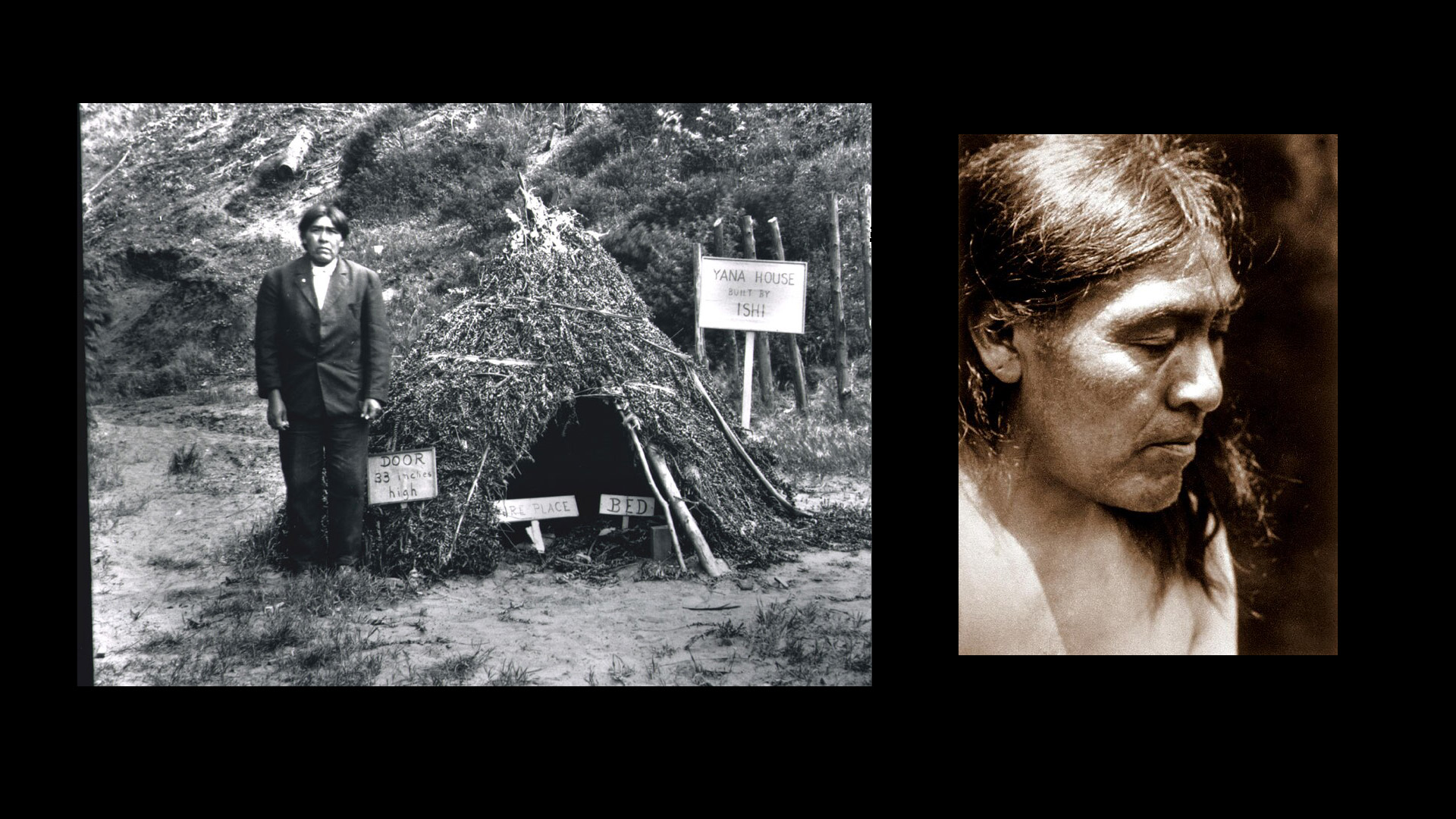
In 1911, the last member of the Yahi, a tribe of indigenous Californians, walked into the town of Oroville in search of food. He’d spend years in hiding, seeking safety from the state-sponsored genocide of indigenous people that had taken place for decades.
He was taken into protective custody by police while newspapers across the country trumpeted the news in large headlines that said things like “Last Wild Indian.”
We don’t know his real name because, according to his traditions, he never shared it. Instead, we know him as Ishi, which in his native language means “man.”
Scientists brought Ishi to live in San Francisco, where they studied his language and traditional practices, and against all odds, he built a life.
Today, his story raises questions about how he was treated, ethics in the field of anthropology, and how he’s portrayed today. But Native people want to be sure we keep talking about the man himself — not just a victim of his circumstances — but for the remarkable human being he was.
Bay Curious spoke with KQED’s Katherine Monahan about Ishi’s life and legacy.
Episode transcript
Olivia Allen-Price: Let’s begin in the late 1800s. When Ishi was still living with his tribe, the Yahi. What was the situation at the time for indigenous Californians?
Katherine Monahan: Dire. In the half century following the Gold Rush, their population dropped by about 95%. Many of them were killed in massacres . . . that were being carried out by the state and federal government in many cases.
I spoke with Devlin Gandy with the California Grizzly Alliance – he’s a citizen of the Cherokee Nation – about what California was like when Ishi was born around 1860.
Devlin Gandy: The war of extermination has been proposed and begun by Governor Burnett and is now part of just California state policy. And, you know, Ishi’s people… Their traditional homelands were some of the regions that were most impacted by mining and experienced some of the most violent atrocities that we have recorded.
Katherine Monahan: And then just a severe reduction in food supply. The gold mining industry filled California’s rivers with massive amounts of silt and pollution, which destroyed the salmon habitat. Settlers hunted out most of the game. And farmers built fences which kept the indigenous people from the acorns that were their staple food source.
So for all these reasons the life that Native Californians had been living, became very difficult if not impossible.
Olivia Allen-Price: And where was Ishi as all this was happening around the state?
Katherine Monahan: He grew up in the foothills near Mount Lassen, about 20 miles southeast of Redding. This was the territory of his tribe, the Yahi, which was a southern branch of the Yana tribe. It’s a really rugged country, jagged volcanic rock and very steep canyons.
I talked to Steve Schoonover, who wrote a book about the Yahi, and he described the terrain as more vertical than horizontal, more sand than soil.
Steve Schoonover: That country tried to kill me more than once. But these people lived there for thousands of years, and it was very, very impressive.
Katherine Monahan: The Yahi followed the migratory deer herd, and fished. But they were almost completely killed in a series of massacres in the 1860s — hunted down to just a very small group. Ishi would have been a child at the time.
And he and the few other survivors went into hiding for about forty years — moving silently, always covering their footprints with leaves. Walking through creeks or scaling canyon walls with ropes to avoid making any trails that might give their presence away.
Here’s Devlin Gandy again:
Devlin Gandy: So his childhood was one of hiding and fear, one of really trying to find safety and going more into remote areas that they would not normally live. Trying to find a place to live.
Katherine Monahan: In 1908 a surveying party came across their village – and by then there were just four Yahi left, Ishi and his family. They ran away when the strangers arrived. And then three years later, Ishi came walking into the town of Oroville. Alone.
Olivia Allen-Price: Do we have any idea what happened to the three family members last seen around him?
Katherine Monahan: Well, his hair was singed short, which was a sign of mourning. Ishi later said that after the surveyors scattered his tiny tribe they never reunited, and Ishi was then just with his mother until she died shortly after.
But we don’t really know what happened. We just have these pieces of a puzzle – there’s also a painting by a man from the Maidu tribe, Frank Day, that shows Ishi tending to a companion with a stomach wound. Day said he saw this when he was a small child with his father near Oroville – just a few days before Ishi showed up in town.
Olivia Allen-Price: Let’s talk about Ishi’s arrival in town. After the massacre he lived through, and the other encounters he’d had with settlers. It’s hard to imagine the state he would have to be in to risk leaving the relative safety of his homelands and walking into town. To these people who have not proven to be trustworthy. What do we know about that story?
Katherine Monahan: He walked onto the property of a slaughterhouse in Oroville in August 1911. He was about 50 years old. He was very thin. He was alone. A teenager called Ad Kessler was a worker at the slaughterhouse. He found Ishi by a corral. I have some tape of Kessler talking about it decades later.
Ad Kessler Archival: So I shimmied over this fence, and I dropped down alongside this Indian, and I pushed him over, raised this club. He showed no resistance, he was scared, he muttered something like cheku cheku. So I see he was an old man, and I see he wasn’t properly clothed, so I reached down and I got him and I pulled him back up into a sitting position. And I talked to him. I got no answer.
Katherine Monahan: Kessler said he then called for the sheriff, and while he waited with Ishi he found that they were able to communicate some using signs. Ishi motioned that he’d like a cigarette, and Kessler gave him one, and they laughed together when the sulphur from the match got in Ishi’s nose. When the sheriff came, Kessler rode along with Ishi to the local jail. The staff there gave Ishi a bowl of beans – which he devoured. And eventually they led him to a cell.
Ad Kessler Archival: And I felt sorry for a man. There he was, all alone, he didn’t have the least idea of what was going to happen to him. Closed the door, turned the key in it. And he stood right behind them bars, and looked.
Olivia Allen-Price: What did they do with him?
Katherine Monahan: He stayed at the jail for about a week. Indigenous people from different tribes were called in to try to communicate with him, but no one spoke his language. All the papers ran stories, “Wild Man Caught in Oroville, Last Aborigine!”, stuff like that.
When the anthropology faculty at the University of California heard about it, one of them caught a train up right away, with a list of Yana words – and he was able to talk with Ishi a little bit and figure out that he must be the last, or one of the last, of the Yahi tribe. And so they arranged to bring him back to San Francisco.
Music
Olivia Allen-Price: We’ll pause it here for a quick break. When we return: Ishi’s life in San Francisco. Stay with us.
Sponsor message
Olivia Allen-Price: So Ishi is brought from a jail in Oroville to San Francisco. Where does he live while he’s here?
Katherine Monahan: He was given a room at the University of California’s anthropology museum, which at that time was on the UCSF Parnassus campus — kind of wedged between Mount Sutro and Golden Gate Park. The museum had living quarters with a kitchen and bathrooms, and a bedroom where the caretakers would stay overnight, or indigenous people while they were working with the linguists, and that’s where Ishi lived.
The professors in the anthropology department, which was led by Alfred Kroeber, they had him over for dinner, took him to the theater, the beach. Everybody said Ishi was exceptionally polite and dignified and just really nice.
The professors would ask him to tell his stories and sing his traditional songs and they would record those onto wax cylinders – which was the technology of the time. Some of those recordings have been restored and so let’s listen to one from 1911 – here’s Ishi singing a song about gambling.
Wax cylinder recording or Ishi singing
Katherine Monahan: So Ishi helped the anthropologists learn about Yahi language and practices. And then on Sundays he would do public demonstrations outside the museum. He would make arrowheads and start fires with a stick, stuff like that. And people would come and watch.
Olivia Allen-Price: Do we have a sense of what Ishi thought about his new life?
Katherine Monahan: Soon after his arrival at the museum, an agent came from the Bureau of Indian Affairs to ask him, do you want to leave? Would you rather go back to where you’re from? Would you rather go to a reservation? And Ishi said no. He said he wanted to stay and that he wanted to live there and die there.
So, I won’t speculate on his happiness or fulfillment – but he was presented with alternatives and he turned them down.
He ended up getting a job as an assistant janitor and general helper at the museum, and he stayed.
Olivia Allen-Price: What was his life like outside of the museum? On the streets of San Francisco – in what, 1911?
Katherine Monahan: Yes, 1911-1916. He learned basic English; he got a bank account and two cats. He liked to ride the street car and the ferry.
Here’s Devlin Gandy again:
Devlin Gandy: He would go around Golden Gate Park. but he also, you know, visited different merchants, different shops, different cafes, and the folks there knew him personally, and he would go and visit with them. He was a really known, loved figure around town.
Katherine Monahan: He became good friends with some of the kids in the neighborhood and would play with them in the city’s parks. One of them, Fred H. Zumwalt Jr, later said in a letter: “He was a kind, gentle, understanding and patient man, given over to laughter at my clumsy efforts to copy him; nevertheless, I can still walk silently in the woods and come within a few feet of deer.”
Ishi also liked to visit the patients in the university hospital, which was next to the museum. And he became friends with one of the doctors there who was really into archery and they would practice archery together. So, he made a new life.
Music
Olivia Allen-Price: How long did he live in the museum?
Katherine Monahan: About four and a half years. He died of tuberculosis in 1916. Ishi didn’t have much immunity to illnesses that had arrived from Europe. And the rate of tuberculosis infection among Native Americans was several times higher than it was for other Americans –- in fact it still is.
Olivia Allen-Price: Even in Ishi’s time, there were ethical questions about how he was being treated. What were some of those concerns?
Katherine Monahan: Given Ishi’s lack of immunity, bringing him to a major city, to live in a museum that was regularly visited by thousands of people, was a known risk. As Thomas Waterman – the main anthropologist who worked with him — said in a letter, “A museum is a hell of a place for a fragile Indian.” Waterman also said after Ishi’s death that he was “the best friend I had in the world” but that “we were certainly none too soon in obtaining the material from him” — meaning the language recordings and arrows and stuff.
So you see this mix of what seems to be true affection, with a kind of ruthless science. And you see it again in how Ishi’s remains were treated. Ishi had told the university staff that he did not want to be autopsied — which was the practice at the university hospital — and they did it anyway. Alfred Kroeber, the director of the museum, was away in Europe when Ishi died, and he did send back a letter saying not to autopsy him. To quote the letter, “If there is any talk about the interests of science, say for me that science can go to hell. We propose to stand by our friends.” But they autopsied him anyway. And removed his brain and weighed it and put it in a jar and Kroeber later sent it to the Smithsonian.
Olivia Allen-Price: Were his remains ever returned to the tribes?
Katherine Monahan: Yes, in the 1990s. There was some initial confusion and denial from the University of California and the Smithsonian – it seems they had lost track of Ishi’s brain. But they found it and repatriated it along with his ashes to the Pit River Tribe and the Redding Rancheria, which were determined to be Ishi’s closest living relatives. And the tribal members did a ceremony to put him to rest in an undisclosed location near Mt. Lassen. I reached out to those tribes for comment, but didn’t hear back.
The anthropology museum, which is now at UC Berkeley, still has Ishi’s death mask. That was a cast that was taken of his face when he died. Bits of his hair were used to make the hair and eyelashes. Devlin Gandy had a chance to see it when he was working in the museum.
Devlin Gandy: It sticks with me. It’s something that should never have been made and it’s something that the university should have been willing to give back a very long time ago.
Katherine Monahan: I reached out to UC Berkeley and they said they are committed to repatriation, but have not received official requests for Ishi’s death mask or the several hundred other objects still in their Ishi collection — his clothes, the tools he made, etc.
They have apologized publicly for their treatment of him and they removed the name of Kroeber Hall in 2021 largely because of it.
Olivia Allen-Price: So when people look back at that time now, over a hundred years later, what do they say about his living in a museum?
Katherine Monahan: A lot of people find it very disturbing that he was studied and effectively put on display.
Devlin Gandy: There’s a lot of ways in which Kroeber treated Ishi as a zoo specimen, and really didn’t let Ishi have a life that I think anybody would find dignity in.
Katherine Monahan: And then other people say, where else could he have gone? Ishi said he didn’t want to return to his homeland, because everybody was dead, it was inhabited by evil spirits, and there wasn’t enough food there. Legally he didn’t have the right to travel freely anyway; Native Americans didn’t get citizenship until 1924. And the reservations in the early 1900s had awful public health conditions, according to the Bureau of Indian Affairs. Here’s Steve Schoonover, who wrote a book about the Yahi.
Steve Schoonover: It might’ve been the best opportunity at that time. I mean, the people who were in California were genocidal towards the Indians. And the fact that this guy had a place to live out the last of his life comfortably, perhaps a little more on display than is appropriate. I don’t know. It’s hard to put myself back in what happened in those days.
Katherine Monahan: Ishi for his part said on a couple of occasions that the museum was home. So it could be that he chose that life as a way to keep going.
Devlin Gandy asks us to try to focus on Ishi himself when we consider his story, and the incredible strength he showed.
Devlin Gandy: It’s easier to sometimes to focus at this point about how bad the circumstances were. And at the same time, in those horrible circumstances, he really had such a tenacity and such a love for life. You know, he’s someone who had gone through so many hardships and, you know, through it all was still able to find friendship, able to find joy, able, to find wonder in the world.
Music
Olivia Allen-Price: Thanks for sharing this story, Katherine.
Katherine Monahan: My pleasure.
Olivia Allen-Price: Katherine Monahan is a reporter with Bay Curious at KQED.
If you value stories like the one you just heard, consider becoming a member of KQED. These programs are only possible with the financial support from our listeners. And membership comes with some awesome perks – like access to PBS Passport, KQED’s pledge-free stream, and discounts to cultural events all over the Bay Area. Learn more at KQED.org/donate.
Bay Curious is made in San Francisco at member-supported KQED. Our show is produced by Katrina Schwartz, Christopher Beale and me, Olivia Allen Price.
We get extra support from Maha Sanad, Katie Sprenger, Jen Chien, Ethan Toven-Lindsey and everyone on Team KQED.
Some members of the KQED podcast team are represented by The Screen Actors Guild, American Federation of Television and Radio Artists, San Francisco Northern California Local.