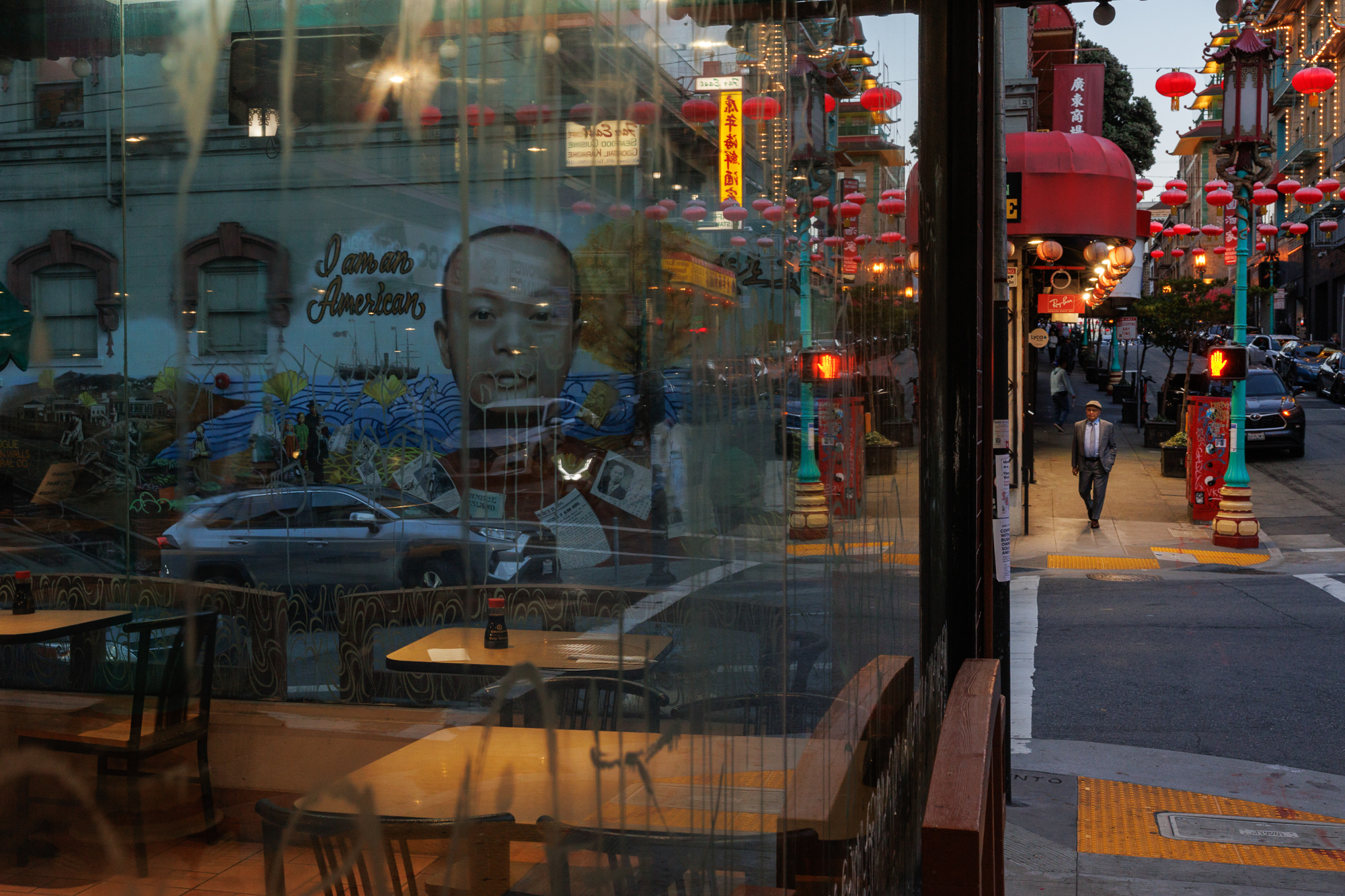
As a constitutional lawyer, Wang has argued many cases at the Supreme Court, but she said this was the first one to hit very close to home: Wang is a recipient of birthright citizenship, and her personal history made her role at the nation’s highest court meaningful for many immigrants and second-generation Americans — especially Asian Americans. “I can’t tell you how many people have told me, both friends and loved ones, but also total strangers: ‘I listened to that argument; it’s the first time I’ve ever listened to a Supreme Court argument. My parents, who are immigrants, listened to [it] and they’ve never listened to [one] before,’” Wang said. “‘And we’re all cheering you on.’”
Wang said the effort to overturn a centuries-old constitutional right has helped spotlight critical and often overlooked Asian American history, particularly highlighting how the Chinese community’s 19th-century legal victories helped secure foundational protections for both Americans and noncitizens. Many constitutional protections are now under attack by the Trump administration. Birthright citizenship is only one example. Early Chinese immigrants filed more than 10,000 lawsuits to fight discrimination and raised money to hire prominent white lawyers to argue on their behalf. Some cases reached the Supreme Court, and the resulting decisions continue to undergird many modern civil rights cases, including disputes over equal protection and due process.
A Bay Area judge on Tuesday barred the federal government from making arrests at immigration courts, ordering an end to a practice that took hold shortly after President Donald Trump took office last year.
The Trump administration’s reversal of long-standing policy against arrests at immigration court resulted “not from merely unreasoned decision-making but a complete lack of decision-making,” wrote U.S. District Judge Casey Pitts of San Jose. Authorities failed to address the “chilling effect” of arrests on whether people attend court hearings.
“For 80 years, Congress has commanded federal agencies to think before they act,” wrote Pitts, referring to the Administrative Procedure Act, a 1946 law that requires federal agencies to justify its actions. That law, he wrote, “does not require an agency to make the choice that a reviewing court might deem preferable. But it demands that an agency at least provide sound reasons for following its chosen course.”
The ruling is the second setback for courthouse arrests since May when a federal judge in New York barred them at immigration courts. That order applied only in New York, while the latest decision invalidated the policy nationwide.
An earthquake is overdue along Southern California’s “critically stressed” San Andreas and San Jacinto faults, according to a new study.
As stress builds on a fault over centuries, it builds pressure that has to be released in an earthquake. In the study, scientists found that the San Andreas and San Jacinto faults are under more stress than at any point in the last 1,000 years, meaning that a massive earthquake could be on the way. “Because it’s been quite a long time since the Southern San Andreas or the San Jacinto have had a large earthquake, we’ve accumulated a lot of stress,” said Kate Scharer, a co-author of the study and a geologist with the U.S. Geological Survey.
Using geological evidence, including tree-ring records and sediment samples, a team of scientists created a computer model that shows how pressure accumulates along faults over time. Then they ran the model up to the present day to estimate how much stress is now building beneath our region. They found that pressure has been gradually building since the last Big One in 1857, one of California’s largest seismic events on record. “The idea that all of those segments of the fault could have enough stress for an imminent future earthquake was already there,” said Harold Tobin, the director of the Pacific Northwest Seismic Network and a professor at the University of Washington who was not involved in the study. “This [study] puts it on more of a quantitative, rigorous scientific basis.”
One area of interest is the Cajon Pass, the narrow corridor between the San Gabriel and San Bernardino mountains. “Cajon Pass could act as an ‘earthquake gate,’ like a junction that either stops or transmits large ruptures between the San Andreas and San Jacinto faults depending on stress conditions,” said Liliane Burkhard, the lead author of the study and a research affiliate in the Hawaiʻi Institute of Geophysics and Planetology. The pass is a place where a major earthquake could jump from one fault system to another, Burkhard said. It could allow the rupture to spread farther across Southern California and affect millions more people across the Coachella Valley and San Bernardino County.
The Los Angeles Unified School Board unanimously approved a policy Tuesday to limit student screen time starting in August.
The decision follows a board vote in the spring that required the district to create a policy to set up guardrails on the amount of time students should spend in front of a digital device.
District officials said that since May they’ve received feedback from nearly 19,000 members in the community. “Student focus and attention were the most frequently cited concerns, along with mental health and wellbeing, online safety, and privacy,” they said.