upper waypoint

Can Controlled Burns Help With California's Air Pollution?

A new study finds that annual prescribed burning could reduce smoke pollution.
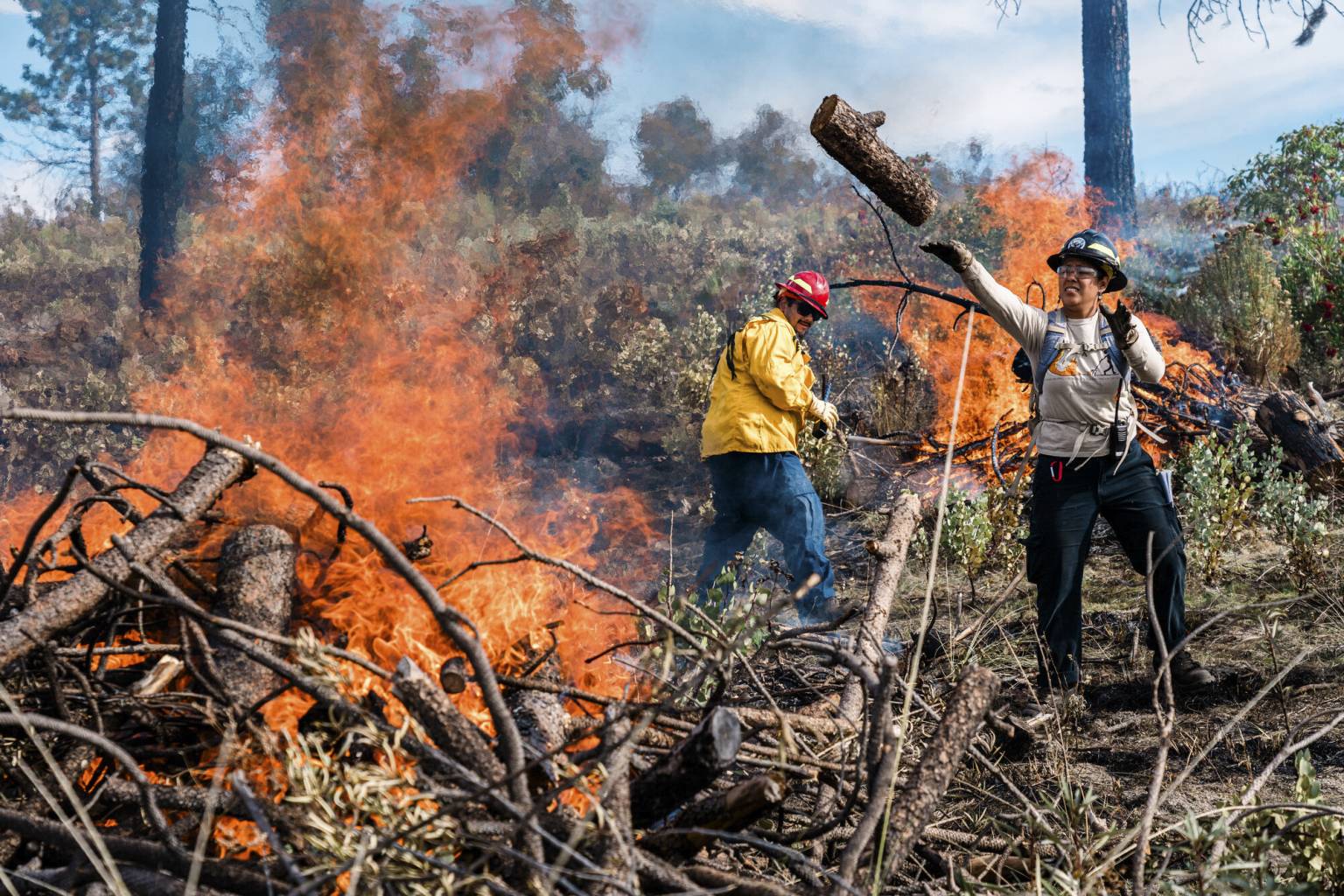
Participants in the prescribed burn add fuel to fires as part of a CAL-TREX prescribed burn in Berry Creek on Nov. 4, 2025. (Andri Tambunan for KQED)

Here are the morning’s top stories on Tuesday, June 16, 2026

New study shows how helpful prescribed burns can be in reducing smoke pollution

Iván Higuera-Mendieta had never experienced a wildfire season before arriving in California as a Stanford University Ph.D. student. Then, during a bike ride around Palo Alto in the summer of 2021, the Colombian-born researcher noticed what smelled like a neighborhood barbecue.

He remarked to his colleagues how interesting it was that it smelled like wood outside. He recalls their response with a laugh: “People said, ‘Well, it’s fire season, dummy. You shouldn’t be outside. It’s bad for you.” The experience prompted Higuera-Mendieta to investigate a question that has become increasingly urgent in California: How can we reduce smoke from future wildfires?

His research, published in the June 11 issue of Science, found that a sustained campaign of yearly prescribed burning — in line with pre-existing state goals — could reduce smoke severity during bad wildfire years by 25%. Averaged over a decade of good, normal and bad fire years, the net reduction in smoke pollution is about 10%.

The study, conducted with co-author Marshall Burke, examined two decades of fire and smoke data and provides the first large-scale estimate of how prescribed-fire-like burns influence future smoke exposure. “We know that smoke is killing a lot of people. Any reduction in that is meaningful,” said Burke, professor in the Doerr School of Sustainability at Stanford and Higuera-Mendieta’s advisor.

Prescribed fire, or the intentional and cautious burning of land at low severity, is a smoke solution that comes with trade-offs. A prescribed burn produces its own smoke, so the net benefits to air pollution are felt during the next wildfire, which may be soon or may be years away. “You’re not eliminating the problem,” Burke said. “But you’re making a meaningful dent in the problem, particularly in the worst years, and to me, that’s important.”

In past research, Burke’s group at Stanford has estimated that wildfire smoke will be the key way most Californians will feel the harmful effects of climate change. A drying, heating atmosphere, caused primarily by the burning of fossil fuel, is leading us to more severe wildfires, which are reversing decades of air quality improvements in California and across the West. Wildfire smoke will kill an estimated 70,000 Americans each year by 2050, if the planet continues to warm at its current rate, according to research Burke and colleagues published last September.

8 people dead in B-52 bomber crash at US Air Force base in Southern California

A B-52 bomber crashed shortly after takeoff at a U.S. Air Force base in Southern California’s Mojave Desert and burst into flames Monday, killing all eight people aboard, military officials said.

Aerial footage showed virtually nothing left of the aircraft that went down around 11:20 a.m. during a routine test mission at Edwards Air Force Base, which is north of Los Angeles. Black smoke rose from a large swath of charred desert near the runway on the base, with emergency vehicles nearby. Those on the B-52 included government contractors and uniformed military. Aircraft manufacturer Boeing confirmed Monday evening that two of its employees were on board.

After reviewing footage of the crash, it was determined that no one could have survived, Col. James Hayes, the deputy commander for the 412 test wing at Edwards, said at a news conference. “We lost eight great Americans,” Hayes said, adding that officials were working to notify their families.

It was not immediately clear what caused the crash, and it could take up to six months to complete an investigation, Hayes said, but shared that the B-52 was supporting the “radar modernization program.”

Imperial Valley data center developer files lawsuit seeking access to Colorado River water

For months, Sebastian Rucci said his massive data center project would not take water from the drought-stricken Colorado River.

Rucci is a developer and lawyer based in the Southern California suburb of Huntington Beach. His company, a LLC called Imperial Valley Computer Manufacturing (IVCM), is trying to build a massive artificial intelligence complex in the Imperial Valley that he said needs around 750,000 gallons of water per day for cooling.

In the Imperial Valley, the only source of fresh water is the Colorado River. The mighty waterway is facing a climate change-fueled drought and has fallen to dangerously-low levels this year. Since December, Rucci and his company repeatedly pledged that their project would not need to draw on the beleaguered river and instead would rely on recycled wastewater from nearby cities. “The facility purchases municipal wastewater that would otherwise be discarded,” read a February blog post on his law firm’s website. “It does not touch a single drop of the Colorado River.”

Now, though, Rucci’s company is going to court for access to far more than a single drop. Earlier this month, IVCM filed a lawsuit against the powerful Imperial Irrigation District, or IID. The suit, filed in Imperial County Superior Court, seeks access to 260 million gallons of river water every year. That’s roughly equal to the annual needs of 7,300 Imperial County residents.

IID serves as the public utility for both water and energy in the Imperial Valley. The agency oversees generations-old claims of the region’s farmers to water from the Colorado River. It also delivers electricity to more than 160,000 customers throughout the Imperial and Coachella Valleys. In the lawsuit, IVCM said turning to IID for water was a “last resort.” Rucci’s company had spent months trying to negotiate recycled water agreements with the cities of Imperial and El Centro, the suit said. They had agreed to cover the cost of upgrading the cities’ wastewater treatment plants, to pay millions for the water itself and to route excess recycled water to the drying Salton Sea.

lower waypoint
next waypoint
Player sponsored by