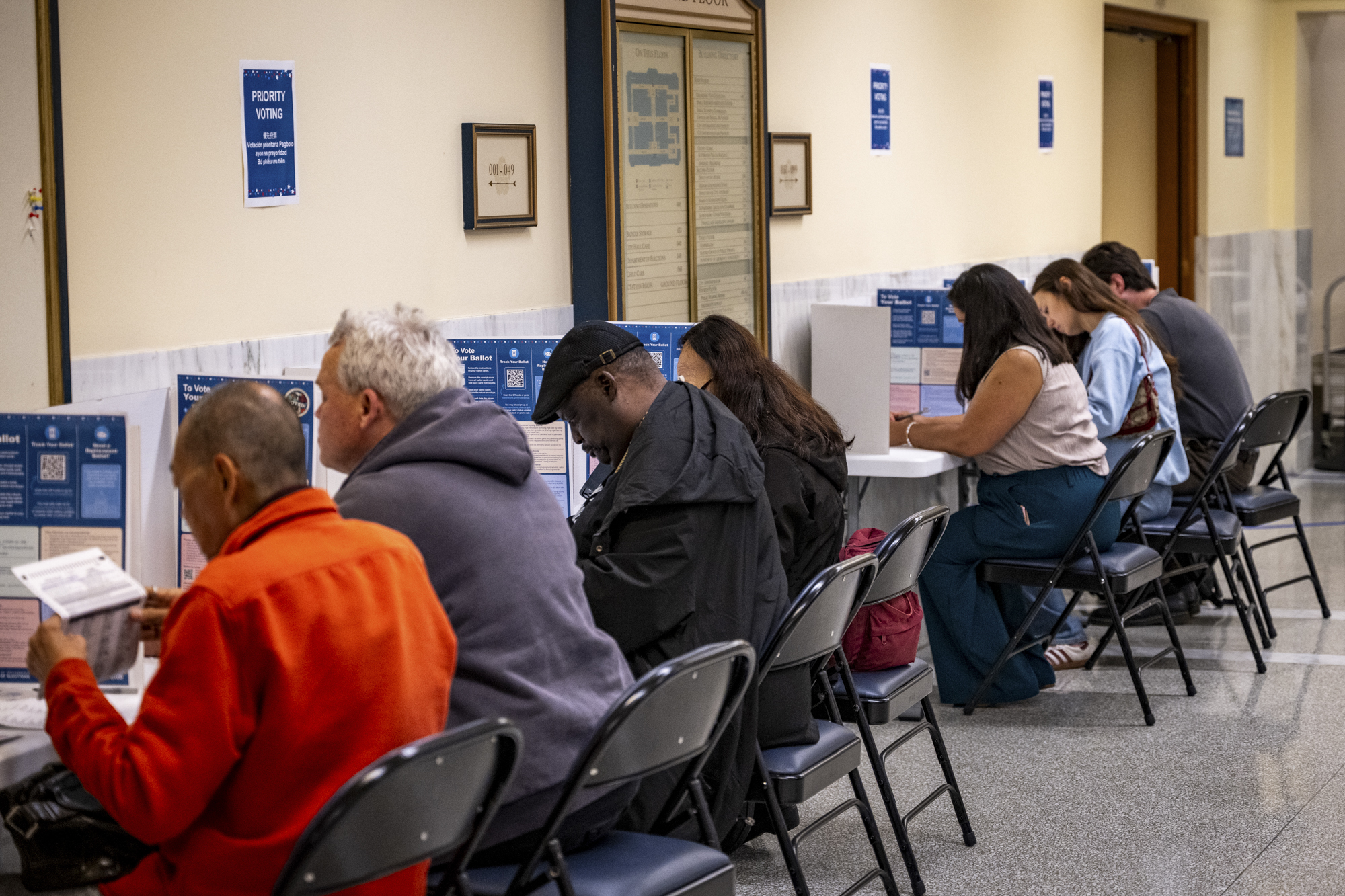
Ericka Cruz Guevarra [00:00:36] I’m Ericka Cruz Guevarra and welcome to The Bay, local news to keep you rooted.
Donna Hemmila [00:00:47] This election was agonizing for me. I held my ballot back until like the very last minute, expecting something weird gonna happen at the last minute.
Chirag Hebbar [00:00:59] I think with both Gavin Newsom and Pelosi leaving, I think it’s a critical election, which is why I wanted to show up to the polls.
Leslie Serrano [00:01:08] All the different lieutenant governor and, you know, superintendent and everything that we need to vote on, it’s all important.
Ericka Cruz Guevarra [00:01:18] And now we wait for all the ballots to be counted after Tuesday’s primary election. California voters were asked to choose from a long list of candidates for governor and other statewide offices. And here in the Bay, we also voted on everything from congressional races to local ballot measures. Today, we’re gonna talk about what we know about the results of this primary so far. And what it tells us about what to expect in November.
Ericka Cruz Guevarra [00:01:58] Well, Guy, another day, another primary. I’m actually kind of curious if you have a sort of like election day or election week routine that you abide by.
Guy Marzorati [00:02:13] Have to do something outdoors during the day before the votes come in.
Ericka Cruz Guevarra [00:02:17] Nice.
Ericka Cruz Guevarra [00:02:19] Guy Marzorati is a politics and government correspondent for KQED.
Guy Marzorati [00:02:24] This year, I knew it was gonna be a long night, so I switched up a little bit and did a Vietnamese coffee late in the afternoon. Both days, both election day and the day after, I almost just took off and flew.
Ericka Cruz Guevarra [00:02:35] Right. I was going to say that’s like jet fuel.
Guy Marzorati [00:02:38] Yeah.
Ericka Cruz Guevarra [00:02:44] Well, how did this election night compare to previous election nights and primaries, I guess, specifically?
Guy Marzorati [00:02:51] Right now I think we’re trending towards somewhere in the ballpark of 40% turnout, which doesn’t sound great, but actually for a governor primary in California is pretty good. You look back at the last few primaries we’ve had for governor, and the turnout has trended in the mid-30s to the low-30, sometimes even in the high 20% turnout. So getting to around 40% is really encouraging. Some of that probably has to do with the national environment. Democrats are the more motivated party across the country. California is a heavily democratic state, but you may have to attribute some of this. To the fact that there was a really competitive governor’s race that voters felt like they could make a real difference in.
Ericka Cruz Guevarra [00:03:38] Well, let’s get into the governor’s race, probably the biggest race in this primary for California voters. Lots of twists and turns in this race and an insane number of names on the ballot, but only the top two are advancing to November. So what do we know so far? Anything surprising in that race?
Guy Marzorati [00:03:58] Yeah, I think, you know, on this election night, uniquely in the governor’s race, we went in really not knowing like what combination of results would end up in the top two. We had three candidates most likely competing for two spots in the Governor’s election, Democrats Xavier Becerra and Tom Steyer and Republican Steve Hilton. But we went into Tuesday night not knowing, OK, which two of those three is going to make it into the top to any scenario seemed on the table. Democrat Xavier Becerra and Republican Steve Hilton right now are leading as the two candidates with Democrat Tom Steyer trailing. The question is, as more votes continue to be counted, can Tom Styer move into the top two?
Ericka Cruz Guevarra [00:04:43] Are the results so far, surprising?
Guy Marzorati [00:04:45] Maybe not surprising from like a June 1st perspective, shocking from a April 1st, perspective. Like if you were to, you know, rip Van Winkle from April to election day to see Xavier Becerra who had been really far down in the polls for much of this campaign, have this whole resurgence after former Congress member Eric Swalwell dropped out of the race, would be surprising.
Xavier Becerra [00:05:10] Like my family, LA is the starting line for millions of success stories across this state. And here in Hollywood’s hometown, we love a good underdog story.
Guy Marzorati [00:05:26] When Eric Swalwell dropped out, Becerra didn’t have any big California players behind him from an elected official standpoint. He didn’t any of the big unions endorsing him at that point. He didn’t have a ton of money at that time. It all really came together just in those few weeks after Swalwell got out of the race and kind of completely reshuffled the dynamics of this election.
Ericka Cruz Guevarra [00:05:50] And Republican Steve Hilton has been polling at the top for most of his campaign. What do you make of the race that he’s run and also how he would do in a November election?
Guy Marzorati [00:06:02] Yeah, Hilton was really able to consolidate support from California Republicans after he won the endorsement of President Donald Trump.
Steve Hilton [00:06:11] Obviously we’re very encouraged by these results, nothing is final yet, but it does look as if change is coming to California and that is good news for everyone, every small business, every working family, everyone who wants to see our state set back on track.
Guy Marzorati [00:06:27] Now, if he is able to make it into the top two in November, it’s a really difficult race for him. And that same endorsement of Trump’s that helped him win over Republicans is going to be a huge liability for him in a state where Trump is still very unpopular.
Ericka Cruz Guevarra [00:06:49] And I mean, in a race full of surprises, are we out of the woods yet with this one? Or is it still possible that, I don’t know, some other crazy thing happens in this race?
Guy Marzorati [00:07:02] Yeah, no, I don’t think we’re out of the woods yet as far as twists and turns. There is a possibility, I’m not sure how to put odds on this possibility, but there is a possibility that Tom Steyer gains vote share as ballots continue to be counted and creates a Democrat on Democrat general election. We’ll know a lot more on Friday night when many more counties are going to be reporting their results. Look, we’ve never had two Democrats in a general election for governor of California. That would be a race that is even hard to imagine how it would even play out between Becerra and Steyer, but it’s something that is still potentially on the table.
Ericka Cruz Guevarra [00:07:50] Well, let’s zoom into some of the more local races, Guy, starting with the race to replace Nancy Pelosi in the House of Representatives. It looks like State Senator Scott Weiner and San Francisco Supervisor Connie Chan are advancing to the general election. Any surprises there?
Guy Marzorati [00:08:09] Yeah, so in that race, we did see Scott Wiener, San Francisco State Senator, finish first in the primary as expected.
Scott Wiener [00:08:17] And we’re going to continue to build a massive coalition in every neighborhood of this city, every generation, every background, every community in the greatest city on planet Earth.
Guy Marzorati [00:08:36] The real surprise, and I think we are all watching, what would be the outcome between second and third? We saw Connie Chan, a supervisor in San Francisco, finish second with, as of now, basically double the support of Shoikot Chakrabarti, who is a former advisor to Alexandria Ocasio-Cortez, who’s sitting in third place.
Connie Chan [00:08:55] This tonight is a start for many many people to see the billionaires all not just in San Francisco but across the nation we’re coming for you.
Guy Marzorati [00:09:10] And I think you really have to go back to the endorsement from former speaker, Nancy Pelosi of Connie Chan late in this race back in May, at least according to the public poll we had from the San Francisco Chronicle, Scott Wiener was leading this primary by good margin. And then Connie Chan, the San Francisco supervisor and Chakrabarti were pretty neck and neck. At that point, Chakrabarti, you know, he was spending 8 million, 9 million dollars. And Connie Chan had this endorsement from Pelosi. And I compared to, remember like a few years ago, people were saying, would you rather have dinner with Jay-Z or $500,000? I think this was like the political version. Would you rather have $9 million to spend or an endorsement from Nancy Pelosi? And I think we found out the answer.
Ericka Cruz Guevarra [00:10:08] Coming up, how some local ballot measures are doing. By the way, if you appreciate these deep dives into Bay Area news, consider becoming a KQED member. We can’t do this work without your support, so join your Bay Area neighbors and become a member today. KQED.org/donate. We’ll be right back.
Ericka Cruz Guevarra [00:11:37] I want to talk, Guy, about local tax measures. There seem to be several of these kinds of local tax measures around the Bay Area in cities that, as we know, have been really struggling with their budgets. So it looks like some of them are likely to pass and others seem to in trouble. I know you are following the hotel tax in San Jose, which seems likely to past. Can you remind us what that is meant to help fund?
Guy Marzorati [00:12:04] So measure A in San Jose, an increase in the hotel tax from 10% to 12%, that’s going to fund the city general fund. San Jose goes into a final vote on the city budget next week with a $50 million shortfall projected for the upcoming fiscal year. The budget balancing plan that the mayor Matt Mahan and city leaders have put together relies on measure a passing. They basically warned if this measure doesn’t pass, you’re going to see Sunday library hours cut. You’re going to see the downtown police foot patrol be eliminated. So really what measure a is, is doing is kind of helping the city stay afloat in a year where there is a budget shortfall and it looks like measure a will pass. And I think the fact that it’s a hotel tax paid by people who are coming to stay in San Jose, not maybe necessarily living in San Jose helped this measure politically.
Ericka Cruz Guevarra [00:12:58] Yeah, very interesting because on the other hand, I know you were also following a parcel tax in Oakland that seems like it might not pass. Can you tell us about that one?
Guy Marzorati [00:13:10] Yeah, so this is Measure E, $192 a year parcel property tax that would raise about, you know, 35-ish million dollars a year. This was a billed really by Barbara Lee, City Unions, again, as a way to bring in money when the city is on kind of uncertain fiscal footing. Unlike Measure A in San Jose, there was like a campaign against Measure E in Oakland. You had realtors spend money. More moderate political groups spend money in order to defeat Measure E. And right now the initial results have the measure failing. Still a lot of votes to be counted. Traditionally, what we’ve seen in Alameda County is they count votes through Wednesday, through Thursday, through Friday. Then they post that result late Friday and it’s a lot votes. And you saw that in the mayor’s race when Barbara Lee won. She was trailing on election day all of a sudden a huge dump of votes on Friday, she wins the race, she’ll be hoping for something similar to happen with Measure E.
Ericka Cruz Guevarra [00:14:15] So TBD there, but I mean, it’s interesting that there were a few other tax measures on the ballot across the Bay, Prop D, the overpaid CEO tax in San Francisco, Measure B in Contra Costa County, to help fund health care there in the wake of federal funding cuts to MediCal and Medicaid.
Guy Marzorati [00:14:40] That one surprised me.
Ericka Cruz Guevarra [00:14:40] Yeah.
Guy Marzorati [00:14:41] That one really, that one in Contra Costa really surprised me because basically that was a copy and paste campaign from what we saw in Santa Clara in 2025, which was Trump and House Republicans passed these big cuts to Medicaid, what we call Medi-Cal in California. County health systems are going to be really hit by that. And so in Santa Clare County, they said, look, we need to punch back against Trump. We need to increase local sales tax in order to help hospitals. And you saw both in Contra Costa County and in LA County as well, basically the same campaigns. Let’s frame this as we took this big hit from Trump, let’s find a way to restore funding locally. And in both Contra Costa and LA, those measures are not doing well. What does that speak to? Is that diminishing appetite for those kinds of taxes, diminishing returns on that specific kind of message? There are clearly like intricacies in each of campaigns and how they were run. But that definitely surprised me. I thought that was a winning formula in Santa Clara that could be replicated and doesn’t seem to be the case in the East Bay.
Ericka Cruz Guevarra [00:15:46] There’s also Prop D in San Francisco, the overpaid CEO tax, and it looks like that one is likely to fail as of right now.
Guy Marzorati [00:15:54] That’s right. And really what this would have done, San Francisco currently assesses a tax on companies where the difference in pay between the CEO and the median SF employee is a certain amount. This would have changed it to the median nationwide employee. And so that would have potentially increased the taxes on these companies. Again, back to this you know, playbook of, you know Trump enacted these harsh health care cuts, let’s find a way to raise tax revenue locally. That was the argument put forward by a lot of Business groups and particularly the mayor Daniel Lurie argued that this is not the time to be increasing taxes on businesses and voters, you know, clearly went with the argument that this was not the to pursue that kind of tax on SF businesses.
Ericka Cruz Guevarra [00:16:38] Yeah, I was going to say, I mean, is there anything you think we can say here about the general appetite from voters for more taxes? I mean I know this election in many ways was also about affordability in California.
Guy Marzorati [00:16:54] Say you could take away maybe some of awareness around increased taxes. We’ll have to, I think, take some time to see these results come in and kind of read through the tea leaves on tax measures. Clearly there will be a lot of eyes on this because statewide there are many proposals moving towards the November ballot that would ask voters to increase taxes. There’s the wealth tax on billionaires. It’s gotten a lot attention. There is an extension of California’s income tax that’s being pursued by teachers unions. So they’re all certainly paying attention to what’s happening in these local races to try to get a beat on whether this signals any kind of change in voter appetite around taxes.
Ericka Cruz Guevarra [00:17:35] Yeah, that’s right. I mean, uh, to remind folks, this is just a primary. We still have another election later this year in November. I mean what are you going to be watching for going forward guy and do any of these results say anything about maybe what we can expect in November?
Guy Marzorati [00:17:53] Yeah, you know, I think it does depend kind of locality to locality. Certainly in San Francisco, these results pretend a lot of momentum behind Lurie and specifically his November campaign. He’s going to go to the ballot in November and ask voters, can you increase taxes to pay for Muni? Can you pass these reforms on putting on the ballot to change how ballot measure campaigns run in San Francisco? And you look at the results in SF on, on Tuesday. They’re all coming up roses for Lurie. He had these two supervisors that he was supporting that appeared to have won their special elections. Then you combine that with the results on the tax measures in SF. And I think you have to think to some extent voters are getting signals from Lurie and following that lead. So I think that portends well for him in November.
Ericka Cruz Guevarra [00:18:49] Do we get a break now? Do you get a brake now that the primary is over? Is it just full speed ahead until November?
Guy Marzorati [00:18:57] No, the primary is not over. The vote counting will continue. The reason the vote count takes longer is we are a heavily vote-by-mail state where all the checks and all the security that’s in place to prevent voter fraud happens on the back end. It happens after you return your ballot. So it just adds a lot of time. But there will be more scrutiny because at the end of the day these counties are doing this without a ton of new money Without a ton a new machines and new space to count the ballots. So I think you’re going to continue to see that kind of Arguments push and pull is something wrong with our system Is it fine the way it is and are there things that could be done to both? Ensure access and security and maybe also speed up the count.
Ericka Cruz Guevarra [00:19:44] I guess in the words of Lenny Kravitz, it ain’t over till it’s over. Guy, thank you so much as always. Appreciate it.