Alan Montecillo [00:00:11] Hi, I’m Alan Montecillo in for Ericka Cruz Guevarra and welcome to The Bay. This is our monthly news roundup for May 2026. As always, we discuss stories that we’ve been following this month that we haven’t talked about on the show. I’m here in the studio with KQED political correspondent, Guy Marzorati. Hello, Guy.
Guy Marzorati [00:00:29] Hey.
Alan Montecillo [00:00:30] And KQED reporter, Sydney Johnson.
Sydney Johnson [00:00:32] Hey, Alan.
Alan Montecillo [00:00:35] Well, this news roundup is gonna be an all-election episode. The California primary is this coming Tuesday. You’ve both been covering it, reporting, interviewing candidates. How does this primary feel compared to years past?
Guy Marzorati [00:00:51] I mean, I would say the fact that we have a very competitive governor’s race in California makes us feel a bit different. We haven’t had that in many, many years. And so I think that’s dominated, it sucked up a lot of the oxygen in the overall primary and actually led to like, I think some changes in voting trends. Like we’ve seen Democrats in California return their ballots more slowly than in past midterm primaries, most likely because they’re still kind of weighing the options in the governor’s race, but that kind of trickles down to all these other elections we’re talking about where there’s still a lot of ballots out there.
Sydney Johnson [00:01:26] Yeah, and I mean, I think across the ballot, both here in the Bay Area and statewide, you’re seeing a lot of change, right? Like, I’ve been covering the House race and Nancy Pelosi has been our representative for almost four decades. You know, plenty of people who live here have not even been alive for a period of time where Nancy Pelosi wasn’t the representative in Congress. And now we are making decisions around who is going to replace her when she retires.
Alan Montecillo [00:01:51] Guy, there are four days left to vote in the primary. Before we jump into the news, I wanna run it through a couple of last minute voting questions. So my ballot is still sitting on my kitchen table, half finished. I imagine a lot of people are in that position. If I still want to mail my ballot, how much time do I have to do that?
Guy Marzorati [00:02:10] You know, you can still mail your ballot at this point through the USPS. There is a lot of anxiety, I think people feel, because there have been some changes to postal pickups and deliveries and post-marking. My general guidance to folks, like if you at all have anxiety about whether or not your ballot will be counted, the way to absolutely assure that, go to a Dropbox. There’s plenty of them in every county. You can also go in-person voting centers or open across the Bay Area. You can return your ballot there. I would say as we get like to election day, then you really I think are best off using a ballot drop box or going to vote in person or just dropping off your ballot in person. And there’s plenty of options available to do that.
Alan Montecillo [00:02:54] And if you prefer to vote in person, you can still do that, right?
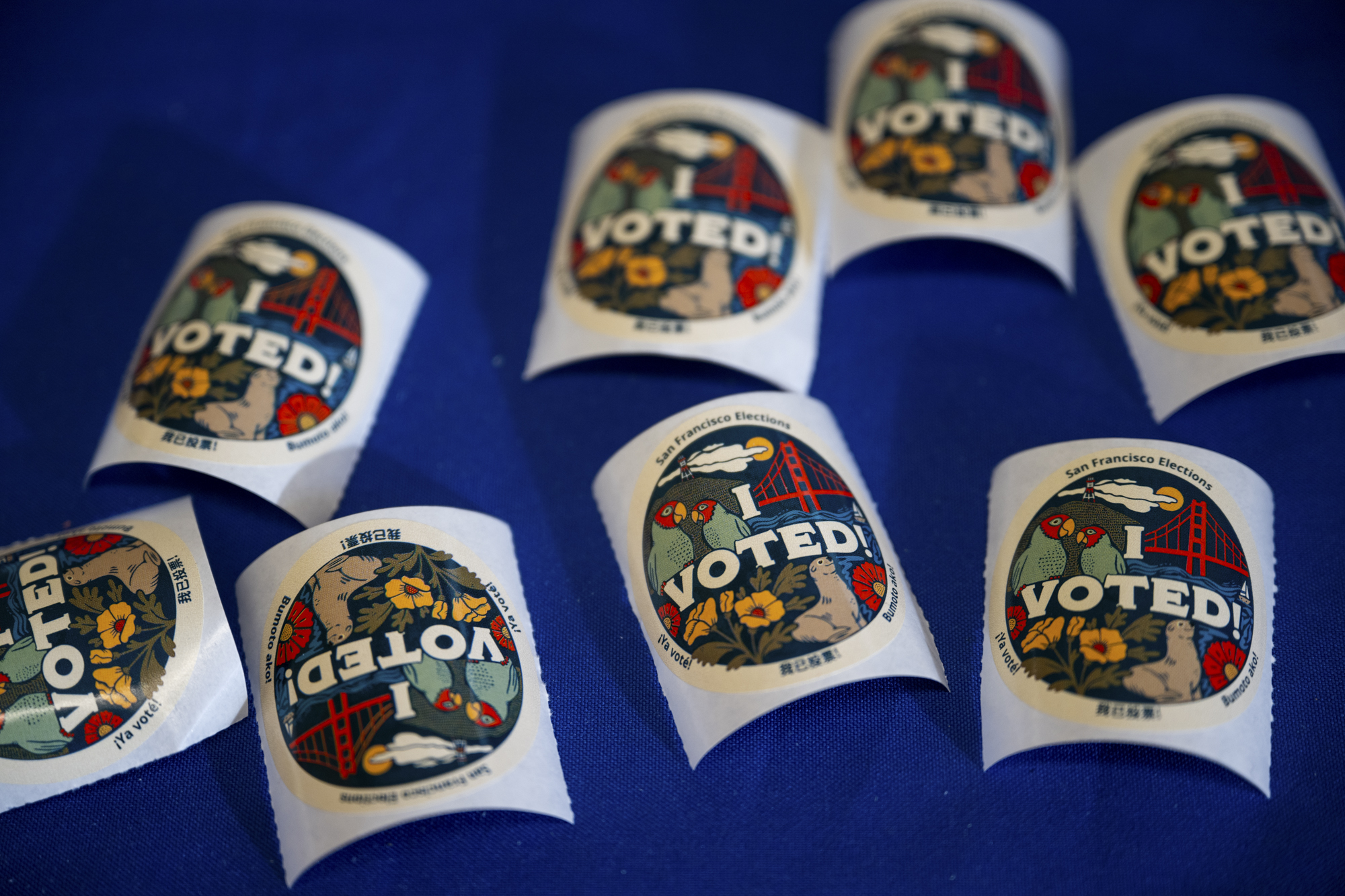
Guy Marzorati [00:02:57] Yeah, and you still get, if you bring your ballot in you still get the sticker.
Sydney Johnson [00:03:02] Thank God. That’s the important info.
Alan Montecillo [00:03:04] Well, for folks who haven’t heard the roundup before, each of us has brought a story to discuss with the rest of the group. In this case, these are all primary related and I’m gonna start with you, Sydney Johnson. You’ve been covering the race for California’s 11th Congressional District, AKA the race for San Francisco, AKA the race to replace Representative Nancy Pelosi, who is retiring. And as a reminder, the top two finishers advance to November. So you’ve been cover this race. How are things looking right now?
Sydney Johnson [00:03:33] Yeah, I mean, this, first of all, has just been a really exciting race to cover, just given the inherent generational change that’s taking place, you know, no matter who advances. The leading candidates, there are three of them. We have State Senator Scott Weiner, who’s represented San Francisco in California. He’s a prolific lawmaker at the state level, has been really focused on cutting red tape and building housing. Former member of the Jewish caucus, you know, sort of known as this YIMBY crusader. And he kind of gets labeled more moderate by San Francisco standards, but in Congress, he would probably still be pretty progressive by national standards. Then we have Supervisor Connie Chan, who represents the Richmond district. She’s a former aide to Kamala Harris, has a lot of union backing and ties to the Chinese-speaking community, and has worked in government for years and is currently a sitting supervisor. Then we have Saikat Chakrabarti. He is positioning himself sort of as the outsider in this race. Chakrabarti is a former tech engineer and he worked at Stripe. This was before he was the chief of staff for Alexandria Ocasio-Cortez and founded the progressive group Justice Democrats in 2017.
Alan Montecillo [00:04:51] As far as I can tell Senator Weiner has been considered the front runner for this race for most of basically the whole time. Is that right? And if so, why is that?
Sydney Johnson [00:05:00] That’s right, you know, at least according to polls. One of the more recent polls at the San Francisco Chronicle put Weiner at 40% of the vote. I mean, Scott Weiner has been around for years. He is a former supervisor. He has done a lot for San Francisco in at the state level. I mean specifically around housing. And we know that housing is, if not one of like the biggest issue to a lot of San Francisco voters. And, you know plenty of people disagree with the way that Weiner has approached housing legislation. It’s been a lot of focus on cutting red tape and just making it easier for developers to build, creating new requirements for cities to build more housing. But you can’t deny that he has passed so many bills. And I think that that resonates for people who want to see a lawmaker representing San Francisco who gets stuff done. And for a while, it seemed like Chakrabarti had a pretty solid shot at that number two spot. But that same poll from The Chronicle actually put Chan and Chakrabarti pretty neck and neck. We’ve seen a big boost in Chan’s presence online. She also recently got an endorsement from Pelosi herself, which carries a lot of weight in this race. But I think you’re spot on. Weiner has pretty much across the board in terms of polling. Showed that he’s likely to advance in November and that this June primary really appears to be between Chan and Chakrabarti.
Guy Marzorati [00:06:30] It’s interesting that, I mean, I think on a policy level, Chan and Chakrabarti are competing for kind of the progressive voters in San Francisco. You moderated a debate between those three candidates where it seemed like all of the attention was on Scott Wiener. What are Chakrabarti and Chan doing to say, like, here’s the difference between us two?
Sydney Johnson [00:06:47] Well, Guy, it’s funny you ask. I just had a story go up today kind of on this very topic. But yeah, I think when you look at the platforms between Chan and Chakrabarti, there is a lot of overlap, a lot of similarity. They both are kind of trying to position themselves against corporate Democrats. They are supportive of Medicare for all. They have been outspoken on the war in Gaza. And when it comes down to what’s differentiating them in this race. It’s really their background and the way that they’re selling themselves to voters, you know Chakrabarti has poured close to ten million dollars of his own wealth into this campaign, which is largely self-funded and you know, it’s it’s hard to go on social media in San Francisco and not come across one of his ads. They are these like fast-paced, you, know bright, he’s looking at you directly and into the camera, you know saying “I’m the guy who’s gonna change the Democratic Party,” you know, “this is the only way that we defeat the Trump administration.” Chan, on the other hand, you know, first of all, she doesn’t have as much money in her campaign. But she’s kind of leaning into that. You know, a lot of her social media presence is her out in the community, you’re talking about things that she’s done to protect tenants in San Francisco, you know, and really just the hyper local community based work that she has done. She’s really relying on those labor unions that she received endorsements from to support her. And that’s appealed to some people so I think it’ll be interesting to see really where that that falls after Tuesday.
Alan Montecillo [00:08:22] Well, we’ll see what happens. Sydney Johnson, thanks so much. No problem. We’re going to take a quick break. When we come back, we will continue The Bay’s Monthly News Roundup. By the way, if you like these Monthly New Roundup episodes, consider becoming a member of KQED. We can’t do this work without support from the community, so please consider joining the hundreds of thousands of your Bay Area neighbors today. You can do that at kqed.org slash donate. All right, Guy Marzorati, you wanted to talk about two different local ballot measures that have to do with taxes. What do you got?
Guy Marzorati [00:09:02] So measure A San Jose is a proposed increase in the city’s hotel tax and measure E in Oakland is a proposed parcel tax. What’s interesting big picture about this? Local governments across the Bay Area are in a bad place financially. We’ve made it through the pandemic when there was all this federal aid that was trickling down to the cities. That’s largely dried up. You have the state government dealing with its own you know, budget balancing issues, there’s less money coming from the state on issues like homelessness, and then you have federal budget cuts. So all of that adds up to cities like Oakland, like SF, like San Jose, looking for ways to get more money and then potentially also having to make cuts. And in the case of San Jose I’ll start there with Measure A, the city is facing a $50 million shortfall and is basically relying in part on this hotel tax passing in order to balance the budget. So measure A would increase the city’s hotel tax.
Alan Montecillo [00:10:01] Just to be clear, so hotel tax, like the extra tax on a bill if you’re staying at a hotel in San Jose?
Guy Marzorati [00:10:07] Exactly. So this would increase that from like 10% to 12%. It’s expected to bring in about $10 million a year. And the city manager, when she put together the spending plan for the year, basically put in a spending plan if Measure A passes and a spending planning if Measure a doesn’t pass. It’s basically creating kind of a stark choice for voters. If you don’t pass this, life is gonna get worse in the city. In the case of Measure A, it’s pretty uncontested. The entire city council supported putting it on the ballot. The argument generally was like, San Jose is trying to attract more events downtown. They have the Super Bowl, World Cup coming up, March Madness. There’s going to be more visitors. They’re gonna have an impact on city services. Let’s bring in more money from those visitors to supplement what we pay for city services.
Alan Montecillo [00:10:57] So that’s San Jose, hotel tax increase from 10 to 12% seems not super contentious. What about Measure E in Oakland?
Guy Marzorati [00:11:07] Measure E in Oakland, slightly more contentious. So this would be a parcel tax that averages about roughly $200 for homes. It would bring in more than $30 million every year.
Alan Montecillo [00:11:18] What’s a parcel-tax again?
Guy Marzorati [00:11:19] Parcel tax is basically like a, you can think of it like a property tax. But what we’ve seen in Oakland is residents have had to pick up more and more local taxes, whether through sales tax, parcel tax on properties in order to fund city services because there have been so many issues with the budget. And finding ways to actually bring in business tax revenue and kind of economic vitality in the city. So unions collected signatures, they put Measure E on the ballot. This would raise the parcel tax in order to bring in money for city services. The way this has been championed, and Barbara Lee, the mayor, is the main proponent of this, along with unions, they’ve said of the roughly 30 million this is gonna bring in, 10 million towards fire engines, trucks and ambulance, 10 million for police. $6 million for cleaning streets and $3 million for homeless shelters. But it faces some opposition from realtors, there’s some more moderate political groups opposing it, so this one is not necessarily a slam dunk.
Alan Montecillo [00:12:19] I think this brings this bigger question for me, which is between Measure E and Oakland and then potentially other tax measures coming down the line, like the potential tax increases to fund transit, are we in a political environment where voters are willing to vote to tax themselves essentially when on the one hand, there’s an understanding that there are a lot of federal cuts, state budgets are tight, but also it’s already really expensive to live here.
Guy Marzorati [00:12:44] Yeah. And we’re seeing, you know, in the case of Oakland, like repeatedly campaigns going to the ballot, asking voters to shoulder more of the burden to pay for these kind of local services. And there is organized opposition against this. We’ve seen, like I mentioned, realtors, developers, but also Empower Oakland, which has become this somewhat powerful, moderate political group led in part by Loren Taylor, who lost the last mayoral election to Barbara Lee. They’ve spent about $200,000 against this measure. The support, there’s a lot more money being spent in support, I think almost 700,000 by unions, but it is a somewhat competitive campaign for this. And I see this as like a real political test for Barbara Lee. She’s been in office a little bit more than a year. This will be a good measure to me of like how Oaklanders are viewing, how she’s moving the city forward. If she is by far the face of this campaign to get measure E passed, will it pass? Will they trust her to raise this money? That could also be a test of how much voters see, you know, what they think of the mayor as a guide to how they’ll vote in the election.
Sydney Johnson [00:13:46] This question of whether voters want higher taxes is really interesting, because in San Francisco, we have these two competing tax measures. I won’t get too in the weeds here, but the overpaid CEO tax, that is a pretty simple message, right? It’s saying, chief executives are making a ton of money, we’re losing federal funding, let’s take some more for them, make them pay their fair share. But when you have something like a parcel tax, like that is… A little bit harder to sell, especially in the Bay Area where there are a lot of people who are quote unquote like house rich, cash poor, like maybe they inherited a house or like, you know, spent every single dime of their savings on a house and, you know, any type of tax increase is going to cut into other parts of their their budget.
Guy Marzorati [00:14:32] And it’s not just somebody else, somewhere else paying it.
Sydney Johnson [00:14:34] Right, right.
Alan Montecillo [00:14:36] So it’s this interesting mix of, I guess, do you trust the government with more tax revenue, and do you like the mayor?
Guy Marzorati [00:14:42] Yeah and you know what an easier case for her to make with homelessness down and crime down in Oakland than I think maybe it would have been a year or two ago to go to the voters and ask for more money.
Alan Montecillo [00:14:52] Guy thank you.
Guy Marzorati [00:14:53] Yep.
Alan Montecillo [00:15:00] All right, and we will wrap up with my story. I wanna talk about the city of Richmond, which is having a mayoral election as we speak. Four years ago, the city elected Eduardo Martinez, which was a huge win for the progressive wing of Richmond politics. But now he’s facing four challengers, including a fellow progressive on the city council. This is also the first time in decades Richmond is doing a top two primary system. So in past years, the person with the most votes would win. Now, the top two advance to November unless someone gets majority on election day.
Sydney Johnson [00:15:32] Alan, I got to admit, you know, I’m on the other side of the bay. Just catch me up. Tell me a bit about this candidate and sort of like what’s making the difference between these two progressives.
Alan Montecillo [00:15:41] I’ll run down the full list of candidates first, and then I’ll talk about this potential progressive split. So we have the incumbent mayor, Eduardo Martinez. We have, I would say, two moderate candidates, Demlas Johnson, former city council member, Ahmaud Anderson, former chair of the Richmond Economic Development Commission. We also have a conservative Mark Wasburg, who is a frequent candidate, says he’s a filmmaker and talk show host. And then the other progressive in this race is Claudia Jimenez. Who is also on the city council. And what’s interesting about this is she was actually endorsed by the Richmond Progressive Alliance, which is a prominent left-wing political group in Richmond that had endorsed the mayor in the last election. So we’re now in a situation where the incumbent progressive mayor is fending off a challenge from within his own kind of political camp. So why is the Richmond progressive alliance backing a challenger against an incumbent? One big reason for that is that late last year, Mayor Eduardo Martinez shared posts on LinkedIn shortly after the Bondi Beach massacre in Sydney, Australia. Two gunmen killed 15 people during a Hanukkah celebration. These posts were widely considered to be anti-Semitic. One of the posts said, the root cause of anti-semitism is the behavior Israel and Israelis. There was another post that claimed that the shooting was a false flag attack, basically that it was staged. Huge outcry. Jewish groups called for his resignation. Martinez apologized and he survived a censure in city council. But in the months after that, according to reporting by Richmond side, some of the mayor’s supporters, other members of the progressive alliance started to worry that it could really hurt his chances of winning reelection, maybe distract from the other local priorities that he’s pursued as mayor. And so the candidates and the progressive Alliance have been a little mum on exactly what their thinking was in the endorsement process, but, you know, in many ways the proof is in the pudding. They’ve now endorsed Claudia Jimenez, who has been on the council for about six years. She’s pretty well known in the community as well.
Guy Marzorati [00:17:42] Interesting, we’ve gone this far talking about a Richmond mayoral race and have not brought up Chevron This is a real company town. Chevron’s been a big player in local politics and RPA, Richmond Progressive Alliance in large part was like founded as a counterweight. Where where does Chevron stand in in the mayor’s race?
Alan Montecillo [00:17:59] Well, in terms of campaign spending, Chevron is not super active, actually. They haven’t really spent much money in local politics for a few years now. But in terms local issues, one topic of conversation in this race that I find really interesting is this question of what to do with the settlement money that Chevron has paid to the city of Richmond. So, quick context, two years ago, Chevron agreed to pay Richmond $550 million over 10 years. So that’s about 50 to 60 million dollars that Chevron is paying to Richmond on top of its regular taxes. So one interesting question throughout this mayor’s race, and really for whoever the next mayor is, is how do we spend that money? Should it go to, you know, directly to impacted communities who’ve been hurt by pollution? Should it to infrastructure? Should it going to paying down debt? In theory, it could be spent on anything. So this question looming over the city of Richmond, no matter who becomes mayor, is this recognition that A, we have this money, what do we do with it? And B. What should the city’s future be after Chevron? There’s no immediate plans for Chevron to leave, but what is the next phase of Richmond’s local economy?
Sydney Johnson [00:19:07] What way do you think Richmond’s going to go?