Episode Transcript
This is a computer-generated transcript. While our team has reviewed it, there may be errors.
Morgan Sung, Host: Hello Tabbers! Tabbies? Tabhive? We’re workshopping this. Ok?
Anyway, if you’re in the Close All Tabs fandom, and you want more of these deep dives, then please rate and review the show on Spotify, Apple Podcasts, or wherever you’re listening to this! Post about it! Follow us on Instagram! Tag us! Basically, it would be a huge help to get the word out. Ok, let’s get to the show.
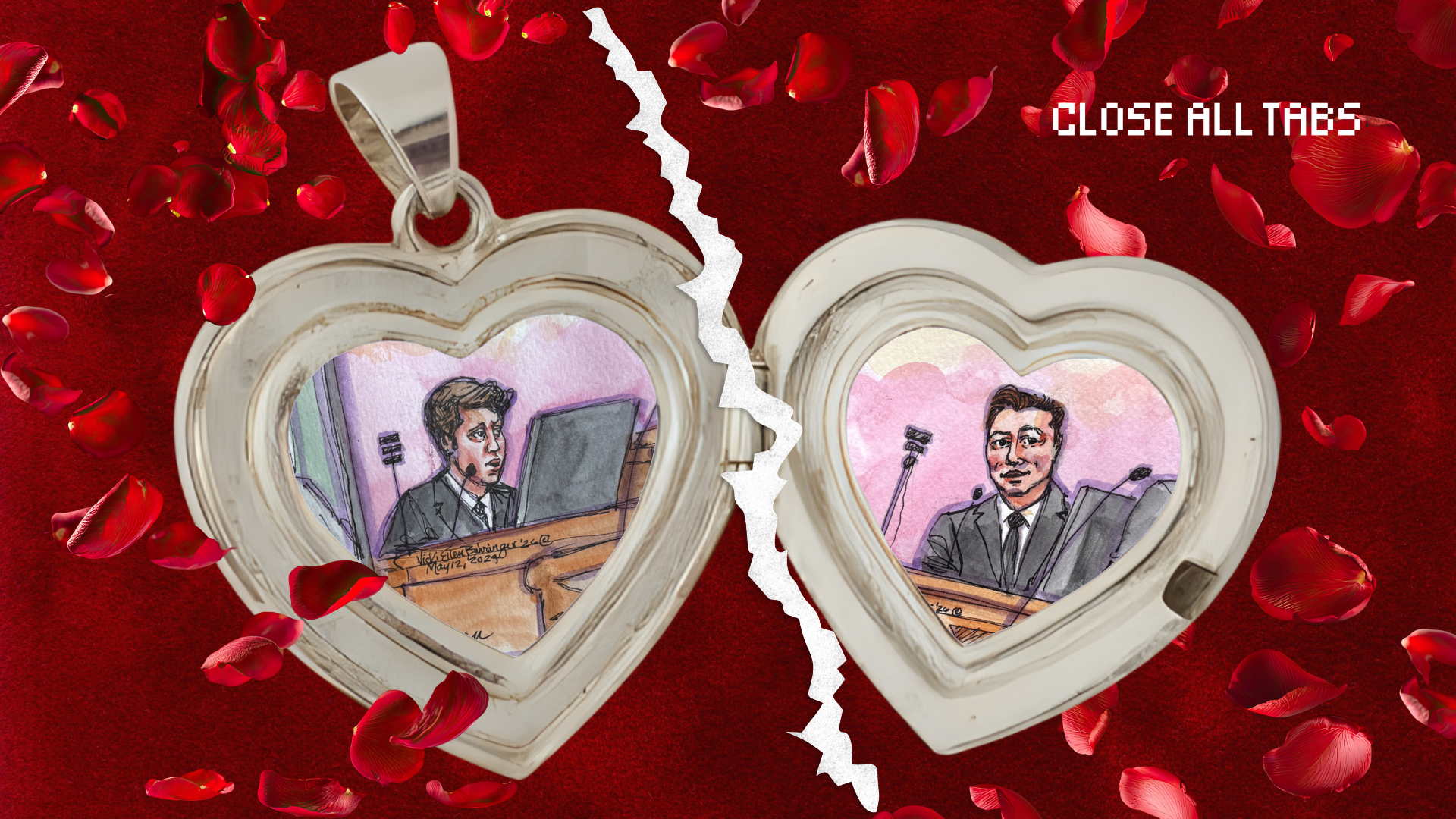
The tech world has been buzzing over one of the juiciest legal showdowns in Silicon Valley: Musk v. Altman.
Basically, Elon Musk, of Tesla and Twitter infamy, accused OpenAI, the company behind ChatGPT, and its leadership of betraying the company’s nonprofit roots. He alleged that instead of sticking to the original mission, which was to build safe artificial general intelligence for the benefit of all of humanity, the company chased profits over AI safety. He says they “stole a charity.”
On the other side: Sam Altman, the CEO of OpenAI who co-founded the company with Musk. Once upon a time, they were actually buddies. But today? They’re bitter rivals.
For three weeks, tech billionaires, their legal counsel, their personal security guards, and a throng of journalists packed into a courtroom in Oakland, California. This was a real “who’s who” of the AI industry. The six billionaires who took the stand have a collective net worth of around $850 billion dollars. That’s more than the GDP of most countries. And what did the uber wealthy bring for a long day at court? The hottest accessory in downtown Oakland: Fancy butt cushions.
[Record scratch]
Rachael Myrow, Guest: You know, I have to admit, I was not looking, uh, anywhere in the vicinity of their butts, so I did not see these butt cushions, uh, that I read about in Wired. But, um, I, I did see some more, you know, sober, uh, sensible butt cushions that the lawyers were using.
Morgan Sung: This is Rachael Myrow, she’s the Silicon Valley tech editor at KQED, and she covered the case, trekking out for the grueling 12 days of trial.
Rachael Myrow: And I really should have come up with one of my own because we were in that court, courtroom from 8am in the morning to 2 in the afternoon most days.
Morgan Sung: This trial was one of the courtroom dramas of the decade. Rachael said it was like Silicon Valley, the HBO show, meets a telenovela. Before it even started, Musk got so catty online that the judge threatened him with a gag order.
Rachael Myrow: He went on X on the eve of the trial, popping off about Scam Altman until Judge Gonzalez Rogers dressed him down in front of the court.
Morgan Sung: That’s just the start of this gossip feast. We’re talking backstabbing! Personal diary entries read aloud! Secret affairs! Over 20 witnesses airing out everyone’s dirty laundry. And after all of that, the jury sided with OpenAI. So does this count as a crushing blow to Elon Musk?
Rachael Myrow: Musk operates like President Trump. He sues for all sorts of reasons, and he also counts a win differently than normal people would count a win.
Morgan Sung: And he doesn’t need to win in the courtroom to win in other ways. Because nobody walked out of this trial looking great, especially not Sam Altman.
Rachael Myrow: The historical record now shows a group of extraordinarily entitled people, mostly men, scrambling to be the tip of the spear for the AI revolution. Uh, I think the benefit of humanity never had anything to do with it.
Morgan Sung: At the end of the day, nobody really won here. We’re going to get into that and open a few tabs about the trial, the drama leading up to it, the great billionaire AI industry reckoning and what this really means for the rest of us plebeians. Ready?
This is Close All Tabs. I’m Morgan Sung, tech journalist and your chronically online friend, here to open as many browser tabs as it takes to help you understand how the digital world affects our real lives. Let’s get into it.
Morgan Sung: Ok, let’s open our first tab: Sam Altman, Elon Musk relationship timeline
Morgan Sung: K-dramas, telenovelas, any CW show, pick your poison. At its core, this scenario is a soap opera classic. Two besties have a falling out, struggle for power, and forgetting what they once meant to each other become embroiled in a years-long feud, hell bent on taking the other down.
Rachael Myrow: I don’t know if they ever were friends. But also I wouldn’t say that they were frenemies, and again, this is just from my experience of the trial,
Morgan Sung: Ok, maybe that was a little bit of fanfiction. But we can’t write off their tech bromance entirely. After all, during the trial, Altman testified under oath that Musk used to show him memes on his phone. That’s pretty intimate, if you ask me. And years before that, they were two very rich guys who shared a dream.
Rachael Myrow: Elon Musk in particular, uh, was very worried about the thought that artificial general intelligence, which is to say AI that surpasses human intelligence, uh, could, uh, come to the hands of one powerful player first, and then they would have, I don’t know, world domination within their grasp. So he got together with Sam Altman of Y Combinator fame or infamy, however you see it,
Morgan Sung: Y Combinator is the startup accelerator that launched Reddit, Airbnb, DoorDash, Dropbox, Stripe, Coinbase, the list goes on. Sam Altman was part of the inaugural cohort.
Rachael Myrow: And the two of them cooked up this nonprofit with a charitable mission.
Morgan Sung: They launched OpenAI in 2015, as a nonprofit artificial intelligence research company. In the first blog post, the company wrote: “Our goal is to advance digital intelligence in the way that is most likely to benefit humanity as a whole, unconstrained by a need to generate financial return. Since our research is free from financial obligations, we can better focus on a positive human impact.
Rachael Myrow: But it doesn’t take long before they realize that if this is gonna be a thing, if this is gonna compete with Google, and whoever else might come along they were gonna need way more money than they were pulling in at the time.
So Elon Musk was spending millions, but they were probably gonna need billions. They started talking about setting up a for-profit division. And it wasn’t long before they realized in this conversation, collectively, that Elon wanted to be in charge of it, in control of it. And you can tell this because, you know, mounds of discovery, personal texts and email chains and personal journal entries made it abundantly clear that Musk was thinking close to the beginning like, ‘I know what I’ll do. We’ll fold this new this for-profit version of OpenAI into Tesla, where I can work on AGI in secret.’
Morgan Sung: Well, Sam Altman and the other OpenAI principal co-founders weren’t down for that. Musk walked away in 2018. OpenAI launched ChatGPT in 2022. A year later, Musk announced his own AI startup, xAI, which eventually launched Grok. Musk has boasted about how Grok is not trained to be “woke”, unlike competitors like ChatGPT. OpenAI, meanwhile, has become the belle of the Silicon Valley ball, nabbing billions of dollars of investment from Microsoft.
Rachael Myrow: And at a certain point, it becomes clear that the OpenAI nonprofit is really a shell of its former self. Right? Like, it’s all of the IP, all of the intellectual property has shifted, uh, from the nonprofit to the for-profit, all of the talent…I think it was kind of sitting there employee-free until very recently, and money was put into it. It’s now estimated to be worth about 200 billion, with a B, dollars. But what has this nonprofit been up to? Precious little. Precious little.
And so at some point, Musk decides to sue and to say, ‘Wait a second, you know, um, this is a bait and switch…they’ve abandoned the mission that we cooked up originally and, I want recompense. I want Altman and others, stripped from the board, stripped from their leadership positions. I want, something like $150 billion shifted from the for-profit to the nonprofit.’ But of course, if you’re OpenAI, your attitude is like, ‘Whoa, this is clearly vindictive.’ You know, you didn’t get what you want, that’s why you walked away with your toys and your money, and, uh, you know, we’re gonna see you in court.’
Morgan Sung: This legal showdown has been simmering for years. Between filing in early 2024 and finally walking into the courtroom for his testimony last month, Musk has: filed a motion accusing OpenAI and Microsoft of being a monopoly, led a group of investors in an attempt to buy OpenAI, threatened to sue Apple for giving OpenAI preferential treatment in the App Store, and has gotten into multiple online spats with Altman.
Rachael Myrow: It was 100% clear there’s no love lost, uh, between you know, the principals. You know, what I like to say is, like, nobody has clean hands in this situation.
Morgan Sung: So what exactly happened at this trial? Let’s open another new tab: Musk v. Altman
Rachael Myrow: On one side you’ve got Elon Musk. You know, he didn’t come to be the wealthiest person on Earth by accident, right? Uh, even if he may not have been the person to start many of the companies he now owns and controls, uh, he took them into the stratosphere, quite literally in the case of SpaceX.
He’s very good at doing that, but he’s also well known to be mercurial, to have a kind of Jekyll and Hyde personality, to push other people to the breaking point. And, um, he’s gonna make decisions that, uh, he doesn’t expect to be countermanded on in the slightest.
Then you have somebody like Sam Altman, and, uh, I’ll tell you, it wasn’t any accident that The New Yorker came out with a scandalous profile of Sam Altman on the eve of the trial that basically, uh, described him as a compulsive pathological liar, and all of that came out in the trial too.
Morgan Sung: Let’s go through a few highlights from this trial. It got pretty juicy when Shivon Zillis took the stand. She’s a venture capitalist and machine learning expert who started working at OpenAI when it launched, and later joined the board of directors. She’s also the mother of four of Musk’s fourteen children.
In her testimony, she said that their relationship started with a “one-off” at a corporate off-site. When she decided to start a family on her own, Musk offered to be her platonic sperm donor. Their relationship grew, and now, they’re romantic partners. She told the OpenAI board about her relationship with Musk only after Business Insider started reporting on it. According to other testimony, many board members wanted to remove her, but decided to let her stay to, “keep the Elon conflict under control.”
Rachael Myrow: I think for many people who are not familiar with Silicon Valley shenanigans, going back decades, not, this is not new to AI, um, it’s not just neutral characters on the board. It’s a very insular world. It’s on the level of incest, I would say. And so I, for one, was not shocked to discover that Elon Musk had a, again, like a consigliere on the board making decisions. She seemed to be there in many ways, um, serving as a go-between, between Sam and Elon, helping to smooth over conversations, helping to, to help them reach points of agreement when that was possible, and at the very least, have clarity on what the other side was thinking when that was not.
Something else that also g- kind of struck me about not just Zelis’s testimony, but also the other women who had roles in this period of time at OpenAI that was under discussion, is how much even the smartest women were only number twos, number threes, ancillary characters in a drama that starred men. This is all about men, primarily white men, with a tremendous sense of entitlement.
Morgan Sung: And then there are these salacious journal entries. So, Greg Brockman is the president of OpenAI, and today, he has a 30 billion dollar stake in the company. But he wasn’t always so ludicrously wealthy. During the trial, pages of his personal diary from nearly 10 years ago were read out loud. And what he wrote seems to bolster Musk’s argument that they were all in it for the money, not necessarily for the good of humanity.
Rachael Myrow: Word to the wise, be aware that if you get sued, they’re gonna come looking for this stuff. You know? Like, when he’s, when he’s writing to himself, “What will take me to $1 billion?” it was pretty clear that it sounded like he was interested in becoming rich. You have a guy who was personally ambitious. Um, is that illegal? I don’t know if it’s illegal. It certainly didn’t look good.
The funny thing here about Zelis, and it’s kind of in parallel to, to Brockman, is that, you know, Zelis was taking notes. And also a lot of Zelis’ emails and texts document how early Musk knew that people were talking about a, uh, a for-profit, that Musk himself was talking about a for-profit form of OpenAI. So this kind of ate away at the argument that he was shocked, shocked to discover that self-enrichment had become such a powerful motivator for his colleagues.
Morgan Sung: Another standout from the trial: texts between Sam Altman and former OpenAI CTO Mira Murati from the night that the OpenAI board voted to fire Altman as CEO. He was reinstated after over 90% of OpenAI employees threatened to quit and work for Microsoft. That in between time period is known as “The Blip.” And the exchanges from the night it started were read in court, and have since gone viral — immediately embedded in the lexicon of internet reaction memes.
Rachael and I are going to do a dramatic reading of the texts
Rachael Myrow: I think I wanna be Mira. Or wait a moment. No, I wanna be Sam.
Morgan Sung: You wanna be Sam? Okay. Okay.
Rachael Myrow as Sam Altman: Can you indicate directionally good or bad?
[Message sent whoosh]
Morgan Sung as Mira Murati: Directionally very bad.
[Message sent whoosh]
Rachael Myrow as Sam Altman Can I come in?
[Message sent whoosh]
Morgan Sung as Mira Murati: They don’t want you to.
[Message sent whoosh]
Rachael Myrow as Sam Altman: What do you want to make it better?
[Message sent whoosh]
I’m still willing to just walk away if that helps.
[Message sent whoosh]
If they are ramped up for crazy lawsuits against me, then I’m not sure what…
[Message sent whoosh]
Can you please tell them I just wanna resolve this however,
[Message sent whoosh]
and would like to join?
[Message sent whoosh]
Morgan Sung as Mira Murati: They’re convinced about their decision.
[Message sent whoosh]
Rachael Myrow as Sam Altman: For me to be fired or some new thing?
[Message sent whoosh]
Morgan Sung as Mira Murati: Yes, for you to be gone.
[Message sent whoosh]
Rachael Myrow as Sam Altman: Okay. Then can I come in and talk about a path forward with them?
[Message sent whoosh]
Can you ask why they’ve been saying all weekend they wanted me back?
[Message sent whoosh]
Rachael Myrow as Sam Altman: Still don’t want me?
[Message sent whoosh]
Morgan Sung as Mira Murati: They don’t want you
Morgan Sung: I mean, these read, these read like the kinds of texts that you would send during a really brutal breakup, like when you’re like, ‘Oh, my friend sees my ex in, in public. Can you please go talk to them?’ You know?
Rachael Myrow: Yeah.
Morgan Sung: What do they reveal about the power struggle at OpenAI though?
Rachael Myrow: There was an attempted coup, essentially, precisely because of Sam Altman’s, uh, alleged managerial misbehavior, pitting different people against each other with different stories.
Morgan Sung: Another OpenAI board member, Helen Toner, shed light on this in her deposition.
Rachael Myrow: Helen Toner basically said that Altman lied about what kind of safety reviews were done about, uh, models of ChatGPT that were released, that he ultimately cleared for release, and which, you know, she could say really wasn’t about AI safety, It was about this, you know, lack of trust in the communication. Microsoft, uh, CEO Satya Nadella, at one point he characterized the entire blip as amateur hour. Uh, these naive board members thinking that they could, you know, hold Sam Altman accountable, uh, for, for lying to them.
Morgan Sung: Right. I mean, Brockman and Altman were both throwing around some pretty wild accusations about why Musk really wanted control of OpenAI. Um, Brockman said that he wanted to raise massive amounts of money to build a colony on Mars.
Um, Sam Altman claimed that Musk was planning to pass OpenAI down to his children when he died, like succession style. But I mean, everyone’s dirty laundry was aired out in that courtroom. Like, no one came out with clean hands, including Sam Altman. So what did the witnesses say about him and his character?
Rachael Myrow: Oh my goodness. There were so many people who described him as a liar to the extent that when finally he was directly questioned about being a liar, uh, and he didn’t answer the question directly, it just made him look more like a liar.
There were so many people who talked about his lack of, uh, trustworthiness. Sam Altman on the witness stand for hours being asked why he’s such a big liar. His former chief scientist, his former chief technology officer, two former board members, all testifying under oath that Altman exhibited a consistent pattern of dishonesty.
That is now in the public record forever.
all of these guys come off as self-serving and, and, uh, backstabbing and oily. I wouldn’t wanna meet any of them in a dark alley or on the other side of a business deal. You know, like, they’re obviously not out for the benefit of humanity. But then we knew that. Didn’t we know that? I think we knew that.
Morgan Sung: After all that, mountains of evidence, hours of testimony, brutal days spent on those cold, hard, unforgiving courtroom benches, unless you had a fancy butt cushion, the ending of this trial was kind of anticlimactic. It took the jury just two hours to come to a unanimous decision.
Rachael Myrow: The jury decided that Musk simply waited too long to sue. California has statutes of limitations. So you can’t just sit on your claims forever.
Morgan Sung: So, in the end nothing happened! But that doesn’t mean the trial was for nothing. What’s the real outcome here? What did this courtroom drama really reveal? After the break, a new tab.
But first, we wanted to remind you that Close All Tabs depends on listeners like you to keep us going. You can support us by becoming a member at donate.kqed.org/podcasts. Ok, after the break? We’re leaving the courtroom, and going back to the real world. Stick around.
Morgan Sung: We’re back! Let’s open one last tab: Musk v. Altman outcome.
So the jury rejected Musk’s case this week. But it’s important to note that they didn’t make that decision based on the legal merit of his case, just that it was too late for Musk to pursue it.
Rachael Myrow: And the jury found that Musk knew or should have known what was happening at OpenAI by 2020 at the latest. He filed in 2024. He argued in court, you know, that that’s because it wasn’t that he was opposed to any kind of for-profit division. He just didn’t want one that dominated the nonprofit. And that didn’t become clear to him until 2023. So he wanted to essentially start the clock on the statue of limitations later on in the game
But OpenAI argued and the judge essentially agreed that Musk needed to have made the case soon after what he saw happening at OpenAI by 2020 at the latest. So all three claims, breach of charitable trust, unjust enrichment, Microsoft aiding and abetting, are gone because of the statute of limitations thing, not because they decided on the merits.
Morgan Sung: Hours after the verdict came out, Elon Musk responded in the most Elon Musk possible way, which is he took it to Twitter, uh, sorry, X, to complain. Um, he did a classic tweet and delete. So the first tweet he said, first post, “This illustrates why the ruling by the terrible activist Oakland judge, who simply used the jury as a fig leaf, creates such a terrible precedent. She just handed a free license to loot charities if you can keep the looting quiet for a few years.” And then deleted that.
Then followed up, “Regarding the OpenAI case, the judge and jury never actually ruled on the merits of the case just on a calendar technicality. There is no question to anyone following the case in detail that Altman and Brockman did in fact enrich themselves by stealing a charity. The only question is when they did it.”
Did this response surprise you at all?
Rachael Myrow: Not in the slightest.
So now that she makes clear she agrees with the jury, Musk posted ‘she’s a terrible activist Oakland judge who handed out a free license to loot charities.’ Musk is just not sympathetic. Um, but I’m thinking, like President Trump, it wasn’t necessarily important to Musk to win the case, just to file it, to drag Altman through the mud in a very public way ahead of these two IPOs. If what you what is revenge, that’s not nothing.
Morgan Sung: This trial did a number on Sam Altman’s public image.
Rachael Myrow: It certainly revealed a lot of the circular business deals he was involved in. He may have recused himself from the actual votes with some of these companies but he nonetheless profited from them or could profit in the near future. I think this was a habit he picked up at Y Combinator. Anyway, it was laid bare in the courtroom. I think it put another nail in the coffin.
Like, there were protesters outside the courthouse with some very funny signs up. And they poked the most fun at Musk, but they also poked a lot of fun at Sam Altman. You know, it’s Sam Altman’s house that got a Molotov cocktail thrown at it.
You know, like, I think there is a great deal of public discontent, even rage over the rollout of AI into all of our lives. And, you know, this train got rolling out of the station through OpenAI, through ChatGPT, uh, and, you know, it was off to the races for a bunch of companies. But there at the forefront, at least in the beginning, was OpenAI, and Sam Altman is the face of OpenAI. And so this trial and all the mountains of evidence just confirm for people their opinions of Sam Altman.
You know, if there’s a fan club somebody’s gotta send me a T-shirt to prove it.
Morgan Sung: A lot of Silicon Valley tends to operate in a kind of bubble, disconnected from the public’s growing discontent around AI. Students are graduating into increasingly unstable careers, thanks to companies pushing to replace human workers with AI, regardless of whether AI can do the jobs better. Nothing shows that disconnect quite like the reaction to commencement speakers who tried to praise AI to a room full of new graduates.
[Audio clip from University of Central Florida Graduation]
Speaker: The rise of artificial intelligence is the next industrial revolution.
Crowd: Boos
Speaker: Woo! What happened? Ok, I struck a chord!
Morgan Sung: Multiple commencement speakers across the country have tried to proselytize AI this month and they were booed each time.
Morgan Sung: This rejection is not unfounded. While covering the trial, Rachael spoke to one of the protesters outside of the courthouse. Her name is Valerie.
Valerie Sizemore: I used to be a software engineer, but, um, have been unemployed by AI, so now I’m trying to make the resistance happen.
So this trial, um, these two CEOs are fighting over a piece of a pie that, uh, doesn’t really matter for the world. They’re just trying to make themselves richer, but we’re all gonna lose regardless of who wins.
Rachael Myrow: The AI titans, and they are titans now, keep mistaking public resistance for ignorance. Somebody like Valerie isn’t failing to understand the wonders of AI. She’s recognizing that the costs like higher power bills, strained electrical grids, her job disappearing on, her career disappearing on her. Right? A technology class that treats the question of public consent as an annoying inconvenience. I guess what I’m getting at here, Morgan, is that we’re not talking about a PR problem. We’re talking about class warfare.
Morgan Sung: This was a battle between two billionaires. The trial revolved around this core question: Is OpenAI’s commitment to the benefit of humanity real? Or, is the company’s commitment really to chasing profits at the expense of AI safety?
What was supposed to be the trial of the century ended without answers or accountability. And by ruling on timing instead of the actual merits of the case, the trial also failed to establish any legal precedent for AI governance and guardrails.
Rachael Myrow: It’s not gonna do a damn thing to stop this nightmare. Right? Obviously there’s gonna be an appeal from Musk’s attorneys. Who knows what’ll happen there? But you know, both Musk with his SpaceX IPO and Altman with his OpenAI IPO, they’re just gonna go forward as before. The AI rollout will go on as before.
Who knows if we’ll ever get artificial general intelligence per se? I don’t think it matters. I mean, the changes that have been happening have been happening without artificial general intelligence. They’re, they’re disruptive enough.
Morgan Sung: How do you think this case will impact future AI cases?
Rachael Myrow: OpenAI is a strange creature. It started as a nonprofit, maybe because Musk and Altman intuitively knew that, uh, they had a better chance of raising money at that time if they presented it as for the good of humanity as opposed to, you know, just a chance to get in on this gold rush.
Right? And, and it must be said, and you know, many of the OpenAI principals said it many times that in the beginning, in the first few years of OpenAI, it was not clear at all it was gonna succeed, right? Google seemed to have such a head start and such a well-capitalized head start. So, you know, OpenAI has only become fabulously valued, um, in recent years, and it, it’s still not making money.
To go back to, you know, like what, what precedent does this set for Silicon Valley? I don’t know that it sets any precedent because who in their right mind would start something like OpenAI again in that way? You would set up a startup like any other group of entrepreneurs and take your chances with that setup.
Morgan Sung: All of this theater ended with no real answers, no real accountability, and no real change for the AI industry overall. So then was the point of taking this case to court in the first place?
Rachael Myrow: The judge put tight, and I mean tight brackets around what this case was going to be about at trial, which raises the question for me, why did she take this case in the first place?Why did she give Elon Musk standing if he had unclean hands? He was a rival. He was a competitor in the AI space.
I think that Gonzalez Rogers wanted these guys on both sides to be forced to peel back the curtain on how AI came to dominate the world in the way that it does now. And maybe the judge couldn’t give us accountability, but she could give us visibility, and that’s not nothing.
Morgan Sung: And another upside: all those juicy, salacious details that were once just gossip fodder, that’s public record now.
Rachael Myrow: Is there any legal precedent here? I think maybe the point was the theater.
Morgan Sung: That’s it for this episode, but stick around after the credits. Ok, let’s close all these tabs.
Close All Tabs is a production of KQED Studios, and is reported and hosted by me, Morgan Sung.
This episode was produced by Chris Egusa and edited by Chris Hambrick.
The Close All Tabs team also includes producer Maya Cueva and audio engineer Brendan Willard. Additional music by APM.
Audience engagement support from Maha Sanad. Jen Chien is our Director of Podcasts, and Ethan Toven-Lindsey is our Editor in Chief.
Some members of the KQED podcast team are represented by the Screen Actors Guild, American Federation of Television and Radio Artists. San Francisco Northern California Local.
This episode’s keyboard sounds were submitted by my dad, Casey Sung, and recorded on his white and blue Epomaker Aula F99 keyboard with Graywood v3 switches and Cherry profile PBT keycaps.
Thanks for listening!
Rachael Myrow: Steve Molo, uh, the Musk’s attorney: “Have you misled people with whom you do business?”
Altman “I do not think so.”
And then Molo says, “Would they think so?”
And then Altman says, “I can’t answer that.”
Molo says, “You’ve repeatedly been called a liar by people with whom you’ve done business.”
Altman: “I have heard people say that.”
Molo: “Are you completely trustworthy?”
Altman: “I believe so.”
Molo: “You don’t know?”
Altman: “I’ll just amend my answer to yes.”