Sara Cantor: [00:00:24] As a child I was really obsessed with and disturbed by the question of who would I have been during that time period, how would I had acted?
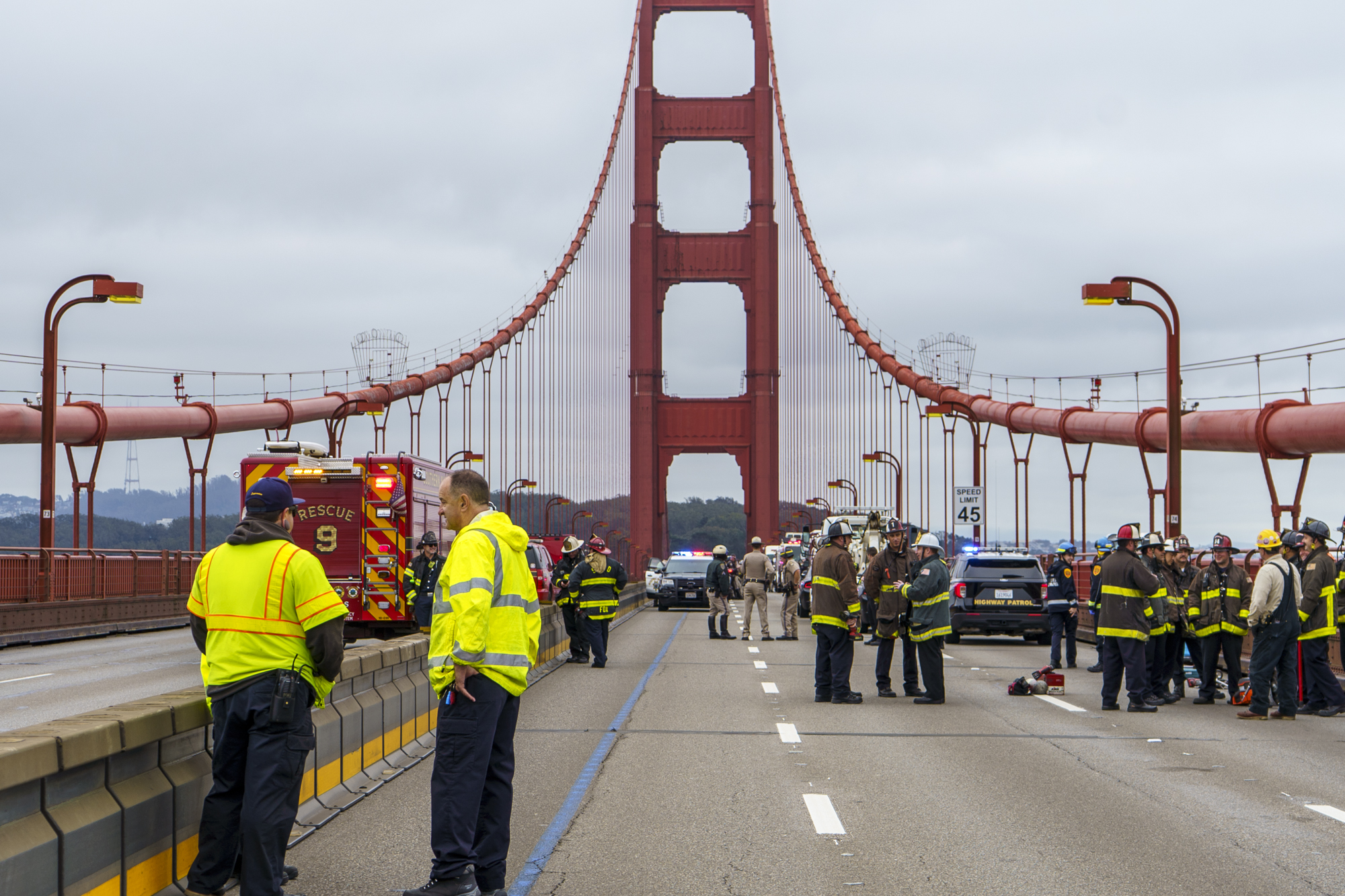
Ericka Cruz Guevarra: [00:00:37] On April 15th, 2024, Cantor was among 26 protesters who stopped traffic on the Golden Gate Bridge to highlight Israel’s siege of Gaza. Now she, along with six others, are on trial in San Francisco, facing felony conspiracy charges for their actions on the bridge that day. If convicted, they could face up to 15 years in prison.
Sara Cantor: [00:01:09] I resolved that if I had been in that situation, or if I were to ever be in a similar situation, that I would resist, that I wouldn’t turn away, that I make sure to fight for the humanity of all people.
Ericka Cruz Guevarra: [00:01:30] Today, the Golden Gate Bridge protesters on trial in San Francisco.
Ericka Cruz Guevarra: [00:01:41] Let’s start back in April of 2024. What happened on the Golden Gate Bridge?
Juan Carlos Lara: [00:01:53] Just before 8am, basically a group of cars drove southbound through Marin onto the Golden Gate Bridge and then stopped about halfway through. At that point some protestors got out of those cars and stopped up all southbound traffic.
Ericka Cruz Guevarra: [00:02:12] Juan Carlos Lara is a reporter for KQED.
Juan Carlos Lara: [00:02:16] A few of those people kind of connected themselves into these devices, essentially chaining themselves to their cars and to each other, and then others unfurled a big banner that read Stop the World for Gaza.
Protester: [00:02:28] Stop funneling U.S. Tax dollars to the Israeli occupation forces to continue the atrocities and genocide of the Palestinian people!
Juan Carlos Lara: [00:02:44] From before this point, they’d been describing Israel’s actions in Gaza as a genocide, and this was part of an international kind of day of action.
Ericka Cruz Guevarra: [00:02:56] Tax day. Is that right?
Juan Carlos Lara: [00:02:57] Yeah, so this specifically happened on the tax filing deadline in the US. Protesters were hoping to apply economic pressure on the US to get US leaders to end military aid to Israel and, in effect, pressure Israel to stop its bombings of Gaza.
Ericka Cruz Guevarra: [00:03:17] And how did this protest eventually end?
Juan Carlos Lara: [00:03:21] There were dozens of people out there. 26 were charged, and they ended up blocking traffic for about four hours. 18 of them were charged with misdemeanors. There was one who initially was faced with felony charges, but whose charges were dismissed. And then there were seven who were charged with felonies. These are six who allegedly chained themselves to their cars and to each other using these things called. Lockboxes or sleeping dragon devices that makes it really hard to remove protestors and then there was a seventh who was allegedly the police liaison going back and forth between uh the police and those protesters and these seven are the ones going through trial facing a series of charges chief among them there’s felony conspiracy there’s also a series of misdemeanors including false imprisonment and refusal to disperse
Ericka Cruz Guevarra: [00:04:10] And I actually remember that day and in particular, I remember social media just being sort of a big mess. A lot of people being really upset about the traffic in the Bay Area on that particular day. Again, it was one of many actions, but it’s not an unprecedented thing to see a protest on the Golden Gate Bridge, right?
Juan Carlos Lara: [00:04:35] Yeah, that’s right. The bridge has been a frequent site of protest. There was actually another bridge shut down just two months prior to this in February, but that one only lasted for like 45 minutes and dispersed very quickly, so it didn’t make as big headlines. There was a Black Lives Matter march that crossed the bridge in 2020. There was an anti-war protest that happened there in 2002. Two other really big ones in 1996. Woody Harrelson and a bunch of other people engaged in this like Save the Redwoods protest and they climbed the cables and hung a huge banner. And there was also a protest over the US’s response to the AIDS crisis in the 80s. It’s an iconic structure, obviously, and people hoping to… Bring a lot of attention to what they feel is an urgent cause often see it as a great place to stage these demonstrations.
Ericka Cruz Guevarra: [00:05:28] This happened more than two years ago now. What was the response at the time and how did we get to this point where there are now seven people facing these felony charges?
Juan Carlos Lara: [00:05:41] I’d say the response at the time was pretty divided. This has been a contentious issue, not just in the Bay Area, but kind of internationally. This was kind of at the fever pitch of pro-Palestinian protests in the bay area. Like I said, this was just two months after a smaller bridge shut down. At this time, the student encampments across college campuses were starting to wind down, but we’re still present on at least a few campuses.
Brooke Jenkins: [00:06:09] I want to make clear that San Francisco, as well as myself as the district attorney, support free speech. But where we must draw the line is when acts of free speech endanger public safety.
Juan Carlos Lara: [00:06:23] In terms of local officials, San Francisco’s District Attorney Brooke Jenkins came out with very strong statements about this. She said that, you know, she encouraged people’s right to protest and to freedom of speech, but that this threatened the safety of people on the bridge.
Brooke Jenkins: [00:06:38] And we must make sure that public safety is observed in San Francisco. And that is what we are committed to doing.
Juan Carlos Lara: [00:06:46] So the district attorney ended up filing, like I said, felony conspiracy charges against seven and then a slew of misdemeanors against the other 18 involved.
Ericka Cruz Guevarra: [00:06:57] And as I understand it, some of these protesters also had to pay the Golden Gate Bridge district for some of the interruptions that happened in terms of traffic that day, is that right?
Juan Carlos Lara: [00:07:12] Yeah, so after the bridge shut down, San Francisco District Attorney Brooke Jenkins and the California Highway Patrol both put out messages essentially soliciting people to come forward if they feel like they were victims and that they may be entitled to restitution. The Golden Gate Bridge Highway and Transportation District filed a restitution claim for just over $160,000, arguing that that was the lost toll revenue that they had suffered for the shutdown. That was seen as a somewhat unprecedented move. As far as we can tell, the Bridge District has never filed a restitution claim against other protesters who have shut down the bridge. Ultimately, the bridge district and the protesters settled for an unspecified amount. And then the group of protesters who did not ultimately face felony charges, who were just facing a series of misdemeanors, settled with private individuals who said they suffered losses, mostly the day’s lost wages, and they ended up paying out a group of those claimants for just over five grand.
Ericka Cruz Guevarra: [00:08:22] Coming up, inside the courtroom for the Golden Gate Bridge protesters’ trial. By the way, if you appreciate these deep dives into local news in the Bay Area, consider becoming a KQED member. We can’t do this work without our listener donations, so consider joining the hundreds of thousands of your Bay Area neighbors today. KQed.org slash donate is the place to do it. We’ll be right back.
Ericka Cruz Guevarra: [00:08:57] So let’s talk about this trial. What is the district attorney’s office arguing in court? And have they said anything in the media about how they’re approaching this?
Juan Carlos Lara: [00:09:06] So in court, the prosecution’s main argument is they’ve been asking jurors to set aside how they feel about Gaza or how they feel about Israel’s war in Gaza and to just focus specifically on the actions and the consequences of those actions. In its opening statement, the prosecution argued that people were pretty significantly impacted, that they were trapped on the bridge for hours that people were late to work, including nurses at local hospitals, that people missed doctor’s appointments. And so they argue that these people really were kind of trapped on there. And so false imprisonment is a fitting charge for that reason. The DA’s office has been pretty tight-lipped outside of court. While the district attorney did make a public statement on this initially, not long after the first protest and did put out a statement explaining some of the charges. Uh, in recent months, the DA’s office has declined to comment. They said they’re not really going to litigate this in the media and they’re just going to focus on court.
Ericka Cruz Guevarra: [00:10:06] Walk me through the defense argument here, Juan Carlos. It sounds like they do feel like the consequences are perhaps unfair, and that these protesters were just exercising their First Amendment right, just as has been done on the bridge for many years before. Who’s defending these protesters, and what are they saying in court?
Juan Carlos Lara: [00:10:27] There are seven defendants and each one of them has their own attorney, which does make for a bit of a circus act in court because there are seven kind of all clamoring to object around the same time. And we heard seven opening statements kind of each tailored to each individual defendant. The protesters and their attorneys have definitely argued that these charges are unprecedented, that charges like false imprisonment or felony conspiracy should be reserved for very serious crimes, not people engaging in acts of civil disobedience. A good example of kind of the defense that they’ve been putting on so far came from Shafi Mouil, who’s the attorney for one of the defendants, and she went first during opening statements. The first words that she spoke when addressing the jury were, necessary, urgent, and life-saving. And essentially, the argument that she made was that her client and all of the other clients there had really made an earnest effort to try to engage with the government and try to facilitate some kind of change that they had, you know, written letters to their member of Congress and that they have participated in kind of permitted sit-ins and other kinds of acceptable protest and that nothing that they’d done had created the change that they thought was needed. And that they sincerely thought that by engaging in this act of protest that they could apply pressure to the government and successfully create some change.
Manan Kocher: [00:11:56] My seven co-defendants are amongst the bravest, most beautiful and brilliant people that I know and they are in unwavering solidarity of Palestine always.
Juan Carlos Lara: [00:12:10] Manan Kocher was one of the misdemeanor defendants whose case was ultimately diverted and they are serving as sort of a communications person for the group.
Manan Kocher: [00:12:20] We’re here to remind everyone that we are more in solidarity, we are stronger together than we were two years ago.
Juan Carlos Lara: [00:12:28] They, you know, like the defense have argued that the protesters had good intentions that they were hoping to create a positive change and that their intention was not to break the law.
Manan Kocher: [00:12:39] What the overprosecution in this case is intended to do is stifle dissent and prevent people from standing up against the U.S. War machine.
Ericka Cruz Guevarra: [00:12:53] And Juan Carlos, you’ve been in the courtroom the past few days. You were there for opening statements. I mean, what was it, what’s it like in there?
Juan Carlos Lara: [00:13:02] Yeah, things in the courtroom have been, for the most part, pretty standard. The first day of trial before the jury, a large group of supporters for the protesters came out and sat in trial for most of the morning. And this was a group of people that I had recognized from many other demonstrations that I’ve covered in the last three years, including protests calling on local universities that I’ve asked from weapons manufacturers. There is this kind of undercurrent of tension because the judge, it seems, would prefer to focus on the specific acts of the case. But the defense is hoping to talk about the broader crisis in Gaza in order to justify the actions of their defendants. The judge at one point even said while talking to both sides, we’re not going to decide in this courtroom whether the U.S. Is violating international law. And so it seems like there is an effort to try to avoid the trial from being. Sucked up into this broader debate about the legality of the U.S. And Israel’s actions in Gaza.
Ericka Cruz Guevarra: [00:14:08] What happens if they’re found guilty?
Juan Carlos Lara: [00:14:11] If they’re found guilty the group of seven face up to 14 or 15 years in prison. Wow. We don’t know for sure whether the prosecution will seek such a steep sentence but their charge is taken together that is the that is the maximum that they’re facing.
Ericka Cruz Guevarra: [00:14:30] You’re going back to the courtroom today, Juan Carlos. What are you gonna be watching for?
Juan Carlos Lara: [00:14:35] This week the prosecution is expected to wrap up the witnesses that they’re gonna be calling. My understanding is that the remaining witnesses are going to be a few more law enforcement who can speak to kind of just asserting the basic facts of the case. But more significantly, the prosecution is expected to call people who were trapped on the bridge who were stuck in their cars To speak to the way that this impacted them And so really this is going to be a question of how much the that testimony impacts the jury
Ericka Cruz Guevarra: [00:15:08] I mean, what are the potential implications of this trial if these protesters are in fact found guilty of felony charges?
Juan Carlos Lara: [00:15:17] What some activists and lawyers for the defendants have argued is that this presents an effort by the district attorney’s office to create a chilling effect on similar demonstrations to essentially make an example out of these protesters and deter other protesters from engaging in similarly disruptive acts in the future. But protesters and Manan Kutcher argue that if that is the intention that it’s not going to work and that they won’t allow something like this to deter them from continuing to advocate.
Ericka Cruz Guevarra: [00:15:51] I have to say I’m talking to you now about this trial, Juan Carlos, but it reminds me a lot of the trial that happened for protesters in Stanford and this feeling that Gaza seems to be the exception, that the hand is sort of coming down heavy when it comes to protesters on this particular political issue.
Juan Carlos Lara: [00:16:12] That’s definitely something that some of the protesters involved in these demonstrations have also pointed out and argued, that they feel like the reactions to these demonstrations are disproportional and that it’s partially because of what they believe is a disagreement on, you know, perspectives regarding Gaza.
Ericka Cruz Guevarra: [00:16:36] Well Juan Carlos, thank you so much for joining us on the show, I appreciate it.
Juan Carlos Lara: [00:16:40] Thank you for having me.