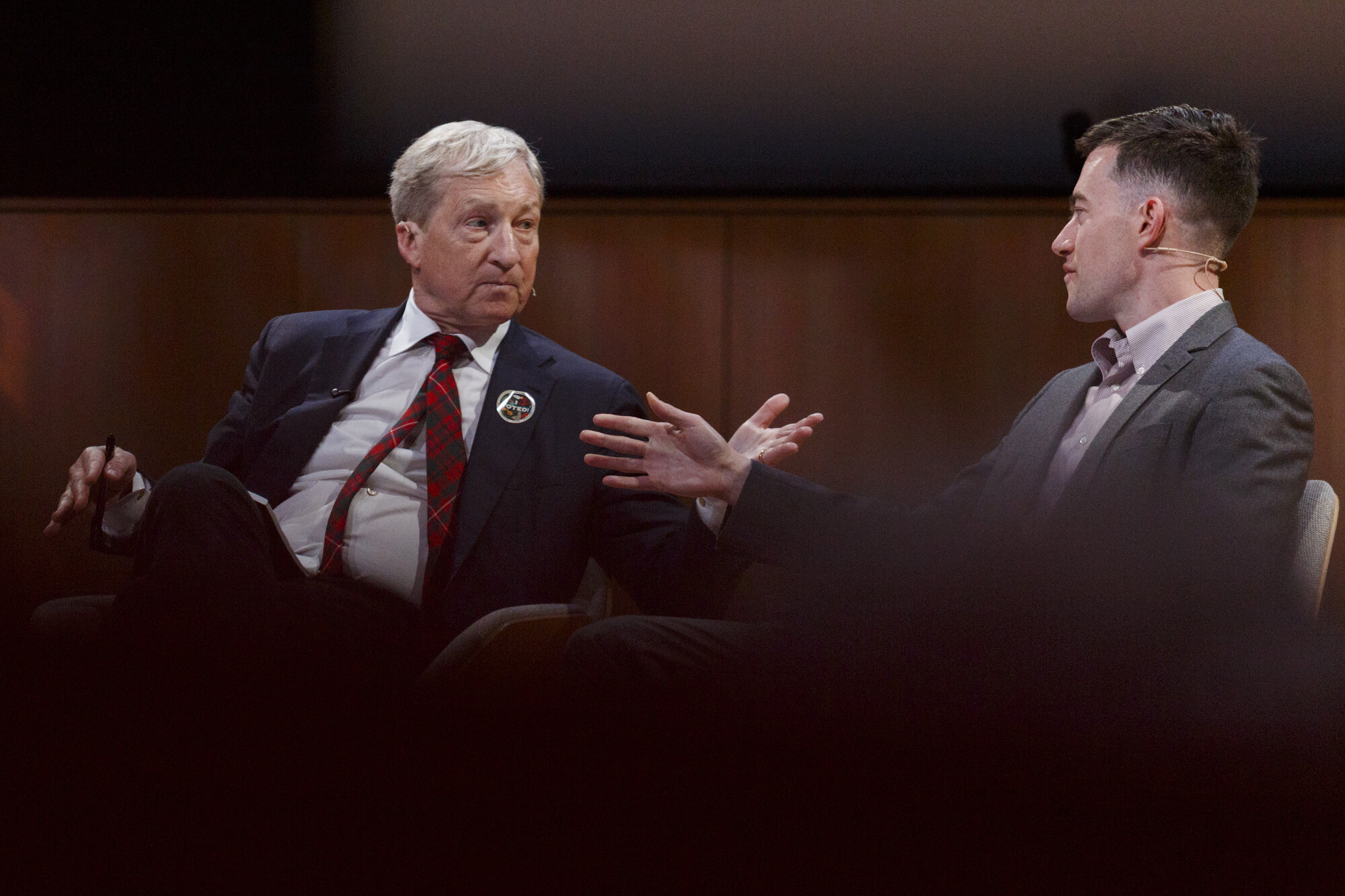
Steyer fielded questions from both the audience and KQED’s Guy Marzorati. It was the third in a series of town hall events KQED hosted with top-polling candidates for governor this election season.
Here are three takeaways from the hourlong conversation.
Steyer’s ‘enemies’
Part of Steyer’s closing pitch to voters: Judge me by those who oppose my candidacy. He lists off big oil companies, investor-owned utilities and tech companies that have all spent big to defeat him.
So, how would he work with those companies to actually govern?
“I would start by not using the word ‘enemy,’” he said. “I don’t look at them as doing something evil. I look at them as following their interests rigorously against the interests of working people, and I’m on that side of working people.”
Steyer, who made his fortune making bets on high-risk assets, said a company like PG&E is simply following the rules California has set up. But he said those rules have resulted in Californians paying double what residents in other states pay for their electricity.
“So I’m going to change the rules to the extent I can so we drive down prices,” he said. “ I don’t believe in monopolies…. When there’s competition in the world, that’s how we keep prices down and that’s how we take advantage of new innovation and the ability of people to do things cheaper.”
Steyer cast the company’s opposition to his campaign as a badge of honor — but one that’s not personal, just political. He said he just wants corporations to pay “their fair share.”
“None of these corporations invest because they like someone, they spend money because they don’t like what I am going to do,” he said, adding that the companies backing his competitors in the governor’s race are doing so because they “believe for sure [those candidates] are going to do their bidding.”
Taxes and affordability
Steyer has promised that one of his first acts as governor would be to call a special election asking voters to increase taxes on commercially held properties in California.
The state’s landmark property tax law, Proposition 13, was passed in 1978 and, since then, has severely limited annual increases to all property taxes, whether they are owned by individuals or corporations. Steyer wants to split off commercially owned properties from Proposition 13 protections, a change he said would bring up to $20 billion a year into state coffers.
Voters rejected a similar proposal in 2020, but Steyer thinks the timing is right and has indicated he would help fund a 2027 campaign on the matter.
When asked by audience member Bathsheba Turnage how he will balance keeping businesses in the state while raising their taxes to bring in more resources for housing and education, Steyer leaned on his experience in the private sector and as a political activist.
Steyer said he’s been on the other side of oil and tobacco companies in numerous ballot measure fights over the past 15 years, and said none of those initiatives have hurt California’s economy. He rejected the argument that increasing commercial property taxes would push businesses to move elsewhere, reframing it as a tax loophole that is allowing businesses to avoid paying their fair share.
“Nobody is moving Disneyland to Austin, Texas, or Miami, Florida, or Reno, Nevada,” he said. “I went to Stanford Business School, I built a business from zero to $38 billion. I think I know something about business. And so I’m going to be very intent on making sure that we do this in a way that works and works for business. … I’m for shared prosperity. And you know what? You can’t share prosperity if there’s no prosperity.”
Artificial intelligence
Steyer was also asked about another balancing act: which specific policies he would implement to protect workers while ensuring California remains a leader in the development of artificial intelligence.
He started by noting what he called “one of the biggest policy failures of my lifetime”: The decimation of Midwest industrial jobs because of globalization and mechanization. Steyer said that era should offer lessons as AI rises.
“It’s something we cannot let happen in the state of California,” he said. “We have to protect workers…. We want [AI] to be a tool for workers, not a replacement of workers. We have to have a huge government effort to make sure we have training for people to get good jobs.”
Steyer said he would create a “gigantic” training program at community colleges in a collaboration between government and the private sector. It should be paid for, he said, by a small fee imposed on every calculation done by an AI company — an idea he joked that he “shamelessly” stole from Anthropic CEO Dario Amodei.
Noting that Pope Leo XIV just issued an encyclical about artificial intelligence, Steyer associated himself with the religious leader’s approach to the profound moral and existential questions the technology poses. He dismissed an idea pushed by billionaire Elon Musk that the federal government should cut checks to counter unemployment caused by AI.
“I’m going to come out on the side of the pope instead of on the side of Elon Musk. The pope is talking about the dignity of human beings, the dignity of work, the meaning of purpose, supporting people in having a meaningful life. And that’s what I’m in favor of,” he said. “Healthy societies have people participating, building things together … that’s what California’s always been about.”