upper waypoint

Why Gas Prices Could Rise Even Further in California

Save ArticleSave Article
Failed to save article

Please try again

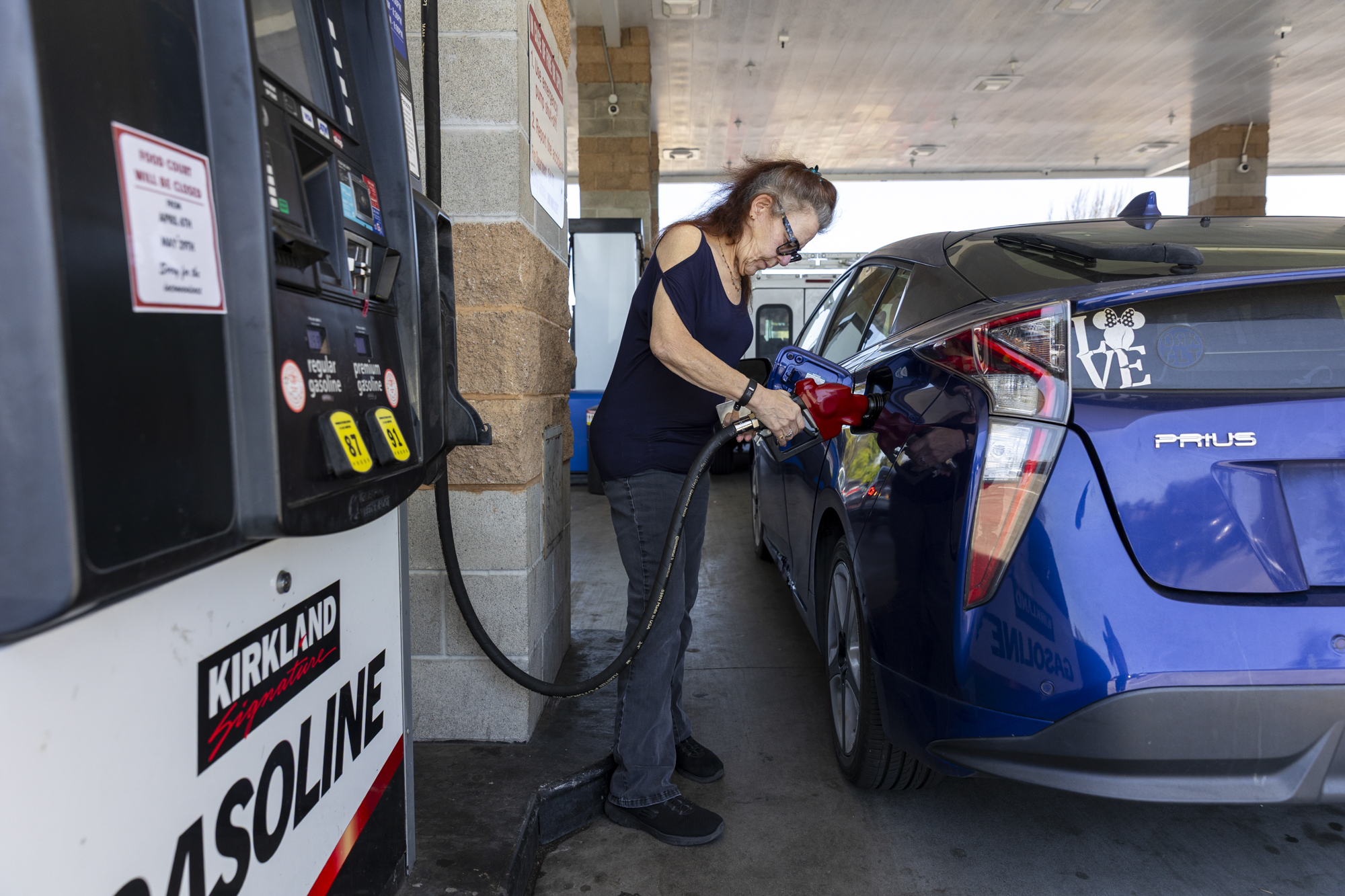
Shekinah Samaya-Thomas fills up her gas tank at a Costco gas station in Oakland on April 16, 2026. (Tâm Vũ/KQED)

Here are the morning’s top stories on Friday, May 15, 2026

  • Six weeks. That’s how long state officials say California has until it runs out of a stable supply of gasoline. After that, the supply picture gets a little murky. With the Iran War now in its third month and gas averaging more than $6 a gallon, the state is racing to lock in long-term deals with overseas refiners before that window closes. It’s a crisis that’s also exposing the tensions in California’s long push away from fossil fuels. 
  • Governor Gavin Newsom is pushing for a November ballot measure to stash more of California’s tax revenue in a rainy day fund. It’s part of a plan for savings that Newsom outlined in his final budget proposal as governor on Thursday. 
  • The former chief of staff for Governor Newsom has pleaded guilty to three felony charges, including conspiracy to commit bank and wire fraud. 

California has 6 weeks of gas supply. After that, it gets expensive

Eleven weeks into the Iran war and a global energy shock, California drivers are paying the highest gas prices in the nation, an average of $6.15 a gallon. The pain at the pump is colliding with California’s ambitious push away from fossil fuels, as refinery closures, supply disruptions and a deepening debate over reliance on imported oil and gas raise new questions about whether the state can keep gasoline affordable during the transition.

California can confidently forecast gasoline and crude oil shipments coming in through about mid-June, and supply looks stable through that window, Siva Gunda, vice chair of the California Energy Commission, told an Assembly oversight hearing last week. After that, oil and gas will cost significantly more to secure, he said.

California can outbid the rest of the world for gasoline and crude oil, pulling shipments away from Asia and other markets. But that bidding war comes at a cost, and consumers will pay it at the pump, Gunda told the committee. To hedge against that uncertainty, Gunda said California is negotiating long-term supply deals with Asian refiners that could lock in another three to six months of certainty. “Liquidity, in the short-term, is okay,” Gunda said. “As we move forward, it’s really about making sure more ships are coming, more marine vessels are coming.”

The Iran war has exposed California’s growing reliance on imports of both crude oil and gasoline. The state needs to import more supply as in-state refineries shut down. Neale Mahoney, a Stanford economist, told the committee that imports can be a benefit. They add competition and lower prices, since newer overseas refineries often produce gasoline more cheaply than California’s. Other experts agree. UC Berkeley energy economist Severin Borenstein, also at the hearing, said California’s resilience now depends on building out port, pipeline and storage capacity to handle imports, not on bringing new refineries online. As the war has dragged on, California refiners have shifted crude sourcing away from the Persian Gulf toward Latin America, Alaska and Canada, Gunda said at the hearing last week. The state met about 20% of its refined-product demand through imports in the year before the war began.

But the oil industry is pushing back, saying that relying on increased imports is the wrong strategy. California’s fuel system has been “weakened by design” by state policies pushing refiners out of the state, said Jodie Muller, president and CEO of the Western States Petroleum Association — a characterization energy economists dispute. Because California requires that cars burn a specialized fuel blend, shipments can be tougher to source and take longer to arrive, exposing consumers to delays and volatility every time something goes wrong globally. “Continuing to move to more and more imports will put this state at more and more risk,” Muller said last week. “If you think we are in a precarious position right now, we will continue to see more and more volatility.”

Asked what consumers should expect if the conflict drags on, Gunda said California prices will likely settle “under seven, more like $6.50.” He explained that demand starts dropping once gas crosses about $5.50 a gallon, and California is already seeing drivers shift from higher-priced stations to cheaper ones. Borenstein is less optimistic. If the Strait of Hormuz, the narrow waterway that carried more than 20 million barrels of oil a day before the start of the war, stays closed another 60 days, the price of crude could climb by another $40 to $80 a barrel, he said. Each $40 increase translates into about $1 per gallon at the pump. He called that scenario plausible, and warned there’s almost nothing California policy can do about it.

Newsom touts ‘dominance’ of California in final budget proposal

After eight years of wild swings between record surpluses and perilous shortfalls, Gov. Gavin Newsom touted a state of equilibrium on Thursday with his final budget proposal: a $350 billion, fully balanced spending plan that aims to backfill deep federal spending cuts but proposes no new programs and some spending reductions.

Newsom’s fiscal swan song comes as he gears up for a possible presidential run, as a crowded field of candidates jockey to succeed him and as the state weathers ongoing attacks from the Trump administration. But those federal cuts are offset in part by state revenues that came in $16.5 billion higher than the governor’s office projected in January, when Newsom released his initial spending plan. Income tax revenue was higher than expected and Silicon Valley stocks showed a strong performance, driving projected surplus for the next two fiscal years.

That includes $4.5 billion in excess funds next year, as well as nearly $10 billion more Newsom wants to set aside in a savings account for use the following year. “It shows the nature of the economy in the state, the nature of that growth engine,” he said, though he cautioned that the state’s revenue streams remain volatile. “It spikes from year to year, it collapses. When the nation gets a cold, we get the flu.”

In an unusual move, Newsom administration officials did not provide a clear projection of the surplus or deficit that the governor’s plan was solving for. Joe Stephenshaw, director of the Department of Finance, said he could not provide an “apples to apples” comparison with the $2.9 billion shortfall Newsom projected in his January budget.

In his revised proposal, Newsom unveiled new plans to help Californians facing higher Affordable Care Act premiums and Medi-Cal cuts, and to ease the tax burden on new businesses. He also proposed more money for K-12 education and universities, and a new $100 million fund to help homeowners rebuild after a natural disaster, including the January 2025 Los Angeles wildfires. But Newsom resisted calls from fellow Democrats to raise taxes in order to offset federal cuts and rising health care costs, though he does want to cap the amount large corporations can claim on tax credits.

Former Newsom chief of staff pleads guilty to scheme that bled money from Becerra’s account

A former political consultant for Democratic frontrunner for governor Xavier Becerra and ex-aide to Gov. Gavin Newsom pleaded guilty Thursday to conspiracy to commit bank and wire fraud, submitting a false tax return and lying to federal investigators.

The consultant, Dana Williamson, was charged in a corruption scandal that shocked Sacramento. Following an investigation that included FBI wiretaps and seized communications, prosecutors accused Williamson of conspiring with Becerra’s longtime chief of staff Sean McCluskie and another Sacramento lobbyist to divert $225,000 from Becerra’s dormant state campaign account into McCluskie’s hands.

As part of the plea deal, Williamson, McCluskie and the other lobbyist jointly agreed to pay $225,000 in restitution to Becerra. Williamson also agreed to pay $500,000 in restitution to the IRS. Prosecutors have agreed to seek the standard sentencing for the fraud charge under federal guidelines, which is about 2.5 to 3 years. Her attorney, former U.S. Attorney McGregor Scott, said he will argue against sending her to prison during a hearing scheduled for July that is likely to be delayed as Williamson recovers from a liver transplant.

According to the indictment, the money was to help McCluskie follow Becerra to Washington when he was named U.S. secretary of Health and Human Services in the Biden administration. McCluskie’s job there offered a lower salary, and he was splitting time between Washington and California, where his wife and children remained. Prosecutors say the Democratic operatives charged Becerra’s dormant campaign account $7,500 to $10,000 a month under the guise of maintaining it for legal compliance, but instead routed it to McCluskie through a no-show job for his wife, in violation of federal laws prohibiting federal employees from being involved in campaign activities. The investigation was launched during the Biden administration and the scheme began prior to Williamson’s two years serving as Newsom’s chief of staff.

lower waypoint
next waypoint
Player sponsored by