Episode transcript
Olivia Allen-Price in tape: We are on Highway One, officially coming off 280 onto Highway One. And oh my gosh, there she is, the mighty Pacific.
Henry Lie in tape: And you’re seeing, like the ocean to your right, and all these little like hamlets on your left and and that whole that’s all Pacifica, just a stringlet of various neighborhoods nooked into smaller valleys.
Olivia Allen-Price in studio: Bay Curious reporter Gabriela Glueck and I are following directions from question asker Henry Lie.
Gabriela Glueck: We pass neighborhoods like Sharp Park and Rockaway Beach on our way to an iconic Pacifica landmark.
Olivia Allen-Price in tape: I love this drive in…. I mean, right now, it’s like, sun soaked, which is actually rare. Usually, I feel like, as you come to Pacifica, you’re like stepping into the fog.
Henry Lie in tape: And so you get further south, and you come across this crest.
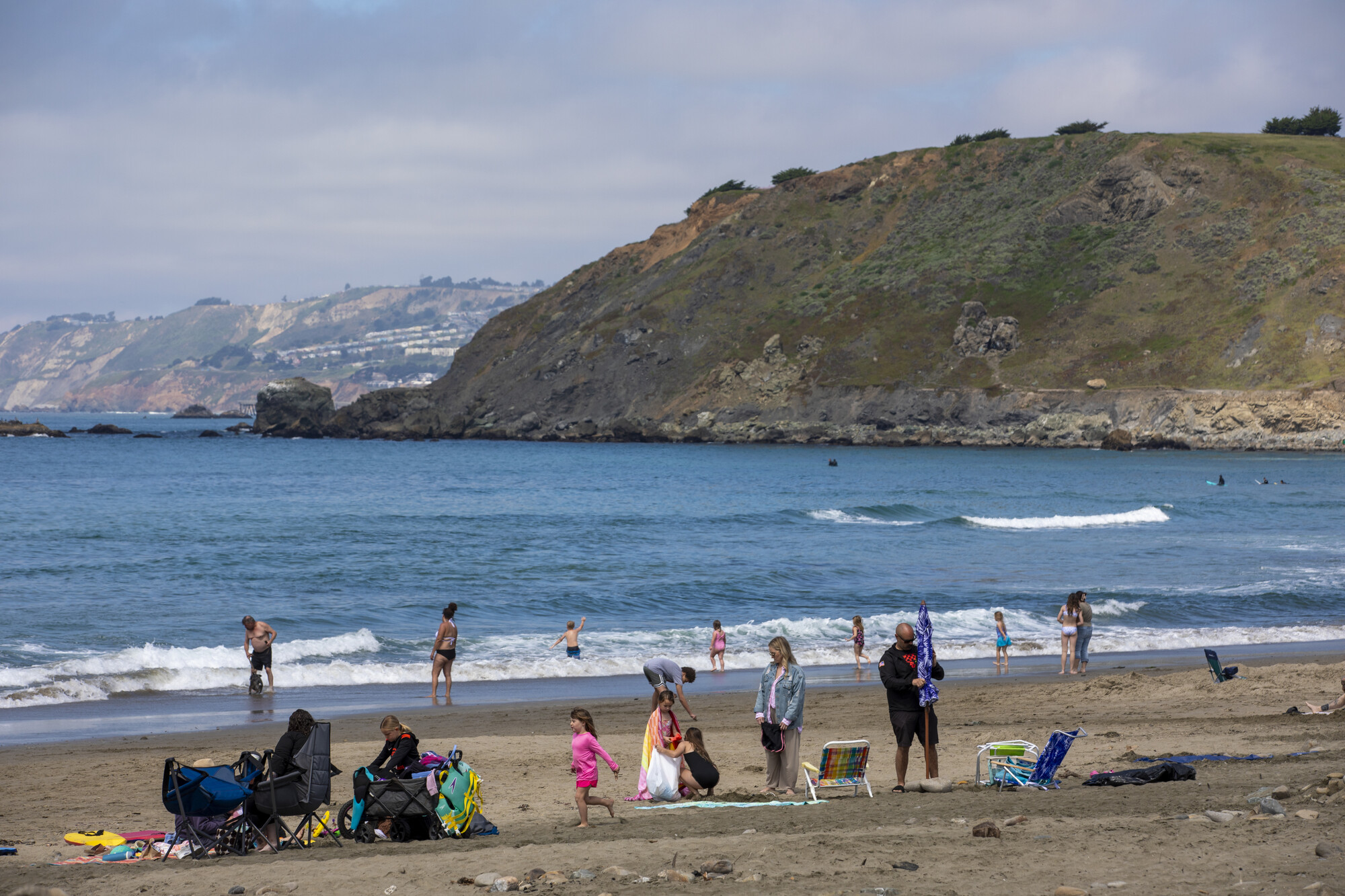
Olivia Allen-Price in tape: Wow! Okay, so we’re passing over where the pier juts out into the ocean, seeing some jagged rocks on the horizon as we make our way toward the beach. Which beach are we going to?
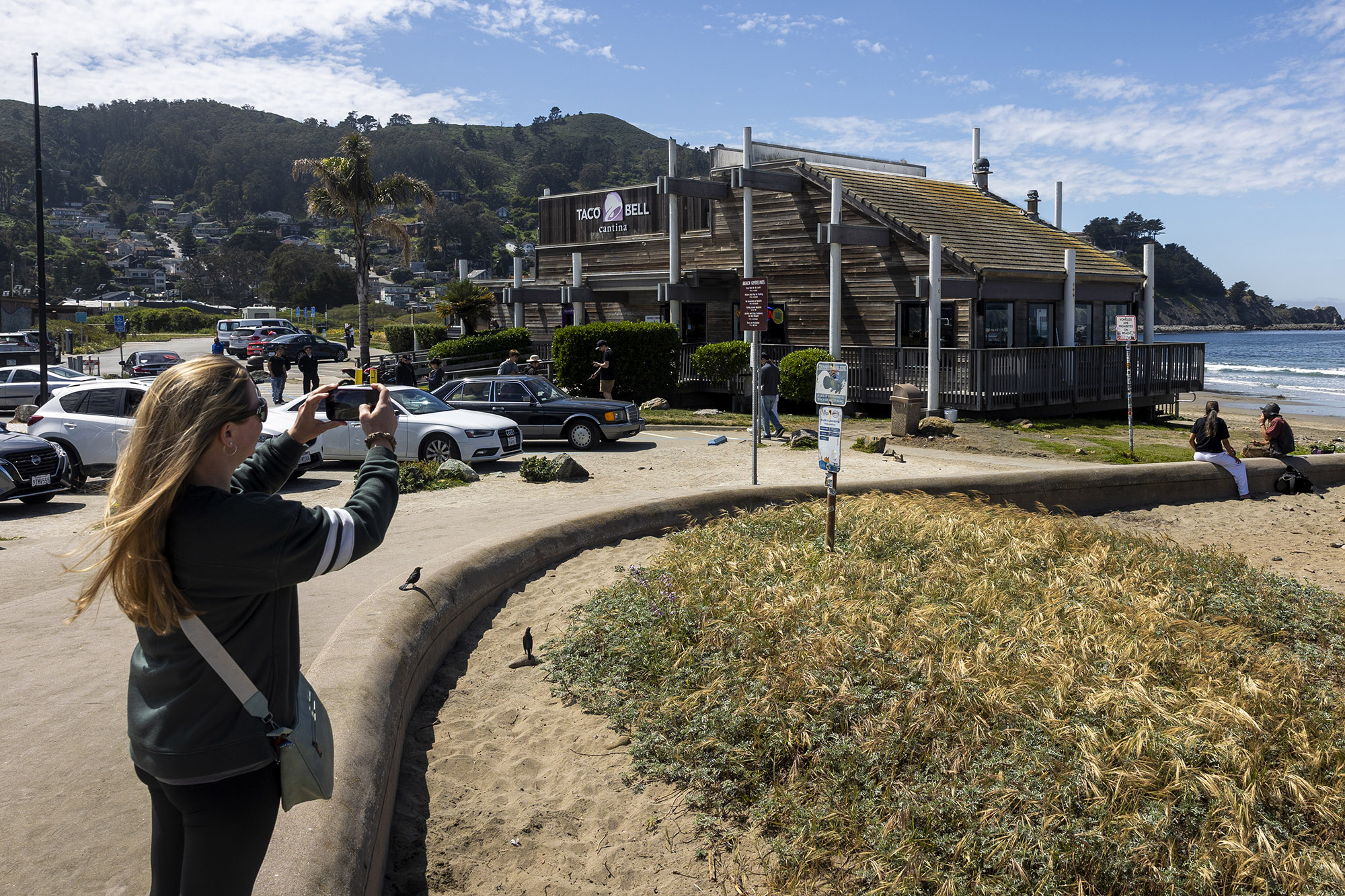
Henry Lie in tape: I think it’s technically called Pacifica State Beach, but everyone calls it Linda Mar. And then you notice this one big brown building…and all of a sudden you see that it’s a Taco Bell, on the beach!
Gabriela Glueck: This Taco Bell is legendary. Tiktokers can’t resist it, and Bay Area locals are no different. It’s a fast food restaurant like any other… but the views! The weathered wood exterior has an organic feel, blending in with the natural beauty around it. There’s a palm tree right next to the parking lot and the back porch of the restaurant is built on stilts right on the sand.
Olivia Allen-Price in studio: Henry wanted to know more about this Taco Bell. How did it end up on the beach like this? And what’s gonna happen to it in the future? It’s a story that goes beyond Pacifica and asks who are California beaches for? Who gets to use them and how.
Gabriela Glueck: Even though the Taco Bell parking lot is packed today, back in the 1960s and 70s Pacifica was pretty quiet.
Nancy Cook Long: I’d say it was mostly middle-class families who were just starting out post war.
Gabriela Glueck: Nancy Cook Long grew up here back when it was not a place on most people’s radar.
Nancy Cook Long: Everybody knew everybody. You played outside, kick the can and freeze tag, and you rode cardboard boxes down the sides of hills. …it was just a little hometown.
Gabriela Glueck: The beach at Linda Mar, known back in the day as San Pedro beach – was pretty bare.
Nancy Cook Long: Certainly in high school, people would go hang out at the beach. But before that, it was just, I’m going to say, almost something we took for granted and I don’t think it had anywhere near the popularity for surfing that it does now.
Gabriela Glueck: There were a few small buildings, but all in all, mostly a stretch of sand. Until that is, a man by the name of “Bud” Wikers got an idea to turn a small oceanside lot he owned into a restaurant.
Deb Wong: He knew that with the baby boomers out there who were demanding something more than what we had in Pacifica at the time, he thought it would be a great idea.
Gabriela Glueck: As local historian Deb Wong tells it, Bud got in touch with A&W, the root beer company, to set up a franchise. Back in the day their restaurants were really popular.
A&W Advertising Song
Gabriela Glueck: But not everyone in Pacifica was totally into the idea of a restaurant on the beach. Weicher’s plan to build so close to the water sparked a big debate in the community. Who are the beaches for?
Deb Wong: The restaurant was like an open invitation for others who wish to park their businesses on the beach. So you know, let one build there, and others will follow.
Gabriela Glueck: The Pacifica planning commission wasn’t that jazzed about people building commercial structures on the beach at all, Deb says.
Deb Wong: The A&W on the beach was the main example of what could happen if beach property were privately owned.
Gabriela Glueck: Despite concerns, the commission approved the plan, but required Weichers to deed some strips of land near the building to the public to ensure access and public use.
The beachside establishment opened in the spring of 1972. And late in April, the restaurant held an official grand opening celebration. Miss Pacifica even made an appearance to help cut the ribbon.
Music
Gabriela Glueck: The outside may have been meant to blend in with the dunes, but the inside made no such concessions.
Kelly Rose: It was totally 70s. It was orange and brown.
Gabriela Glueck: Pacifica local Kelly Rose worked at the restaurant.
Kelly Rose: Oh my gosh, I can remember it so well. The image of it is burned into my memory banks. It had a shag a brown shag carpet., dark wood paneling. It had a fireplace. The tables were dark wood and they had a very thick layer of varathane on them.
Gabriela Glueck: Kelly remembers a long counter and two sets of glass doors. One led to the parking lot, the other, to the beach. She says the counter was staffed mostly by high school girls, also donning the orange and brown. Slip over aprons paired with triangular head scarves.
Kelly Rose: When the weather was nice, which wasn’t often, there would be times when every cashier would be working, taking orders. So I imagine it was probably grossing a lot for them.
Gabriela Glueck: The beachside location was a big draw.
Nancy Cook Long: They told us it was built on stilts, because twice a year the water would come up and go under it. And I worked there one night and you could see it come out onto the parking lot, out in front. It was crazy. We just couldn’t believe it.
Gabriela Glueck: Even in those pre-internet days, the A&W achieved its own version of virality.
Deb Wong: It received recognition in a surfing magazine as the best located fast food restaurant in California.
Gabriela Glueck: But the A&W didn’t last forever…
Voiceover: Pacifica Tribune, July 1985 – Beachfront A&W to be replaced by a Taco Bell.
Deb Wong: Well, you know what it is, location, location, location, and that’s it. Whatever you put there is going to be popular.
Gabriela Glueck: For locals like Nancy who grew up with the burger joint, the shift to a Taco Bell was bittersweet.
Nancy Cook Long: I was really sad about it, because A&W is unique. It was just not like every other fast food place. It was there for a long time. It was an institution for a long time.
Gabriela Glueck: In 2019, the Taco Bell became a “cantina” and now serves alcohol. When Olivia and I visit, we put that part of the menu to the test.
Olivia Allen-Price in scene: OK, so we went with the frozen margarita with premium tequila, because that’s how we roll on Bay Curious. We have two potato …
Gabriela Glueck in scene: spicy potato soft tacos…
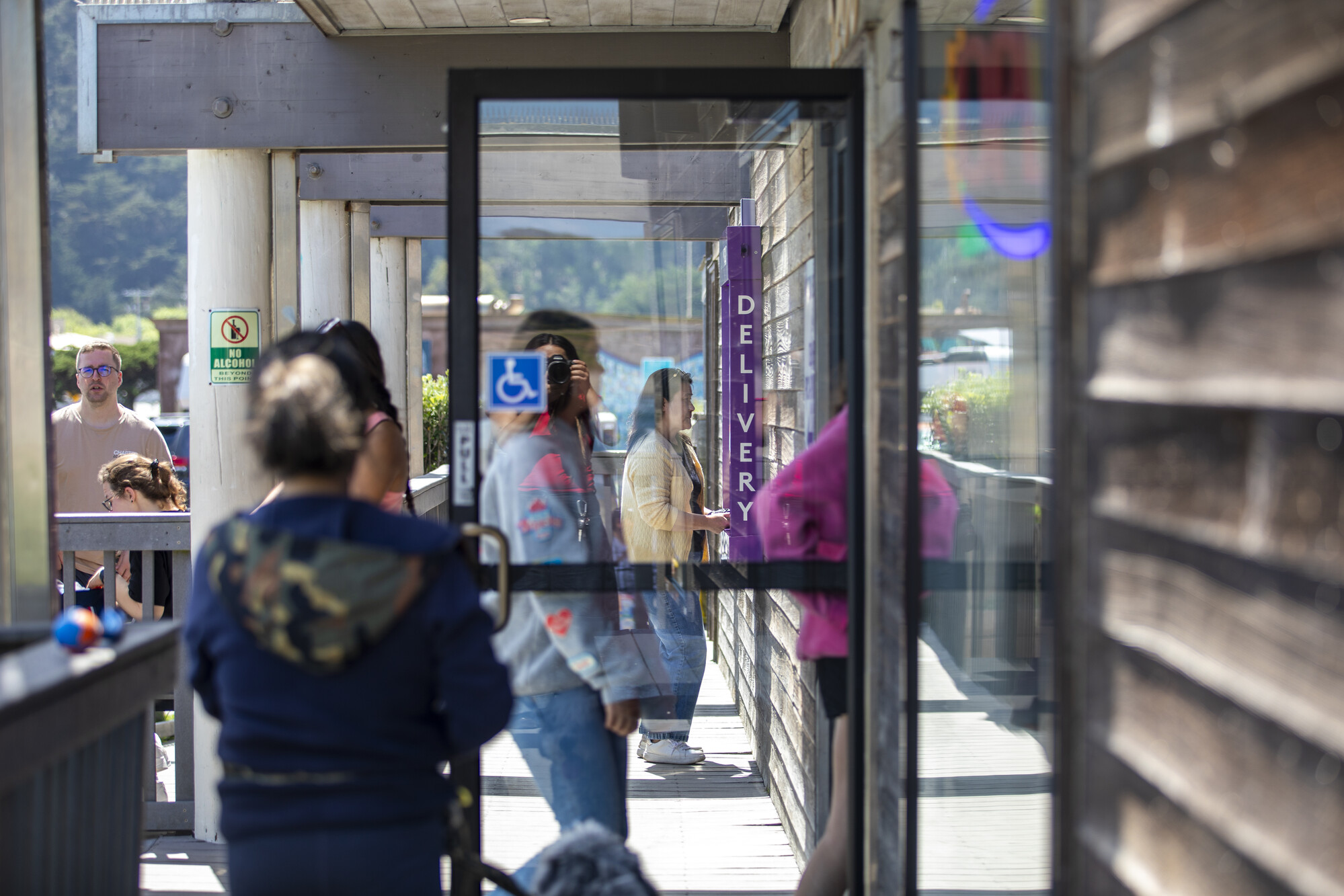
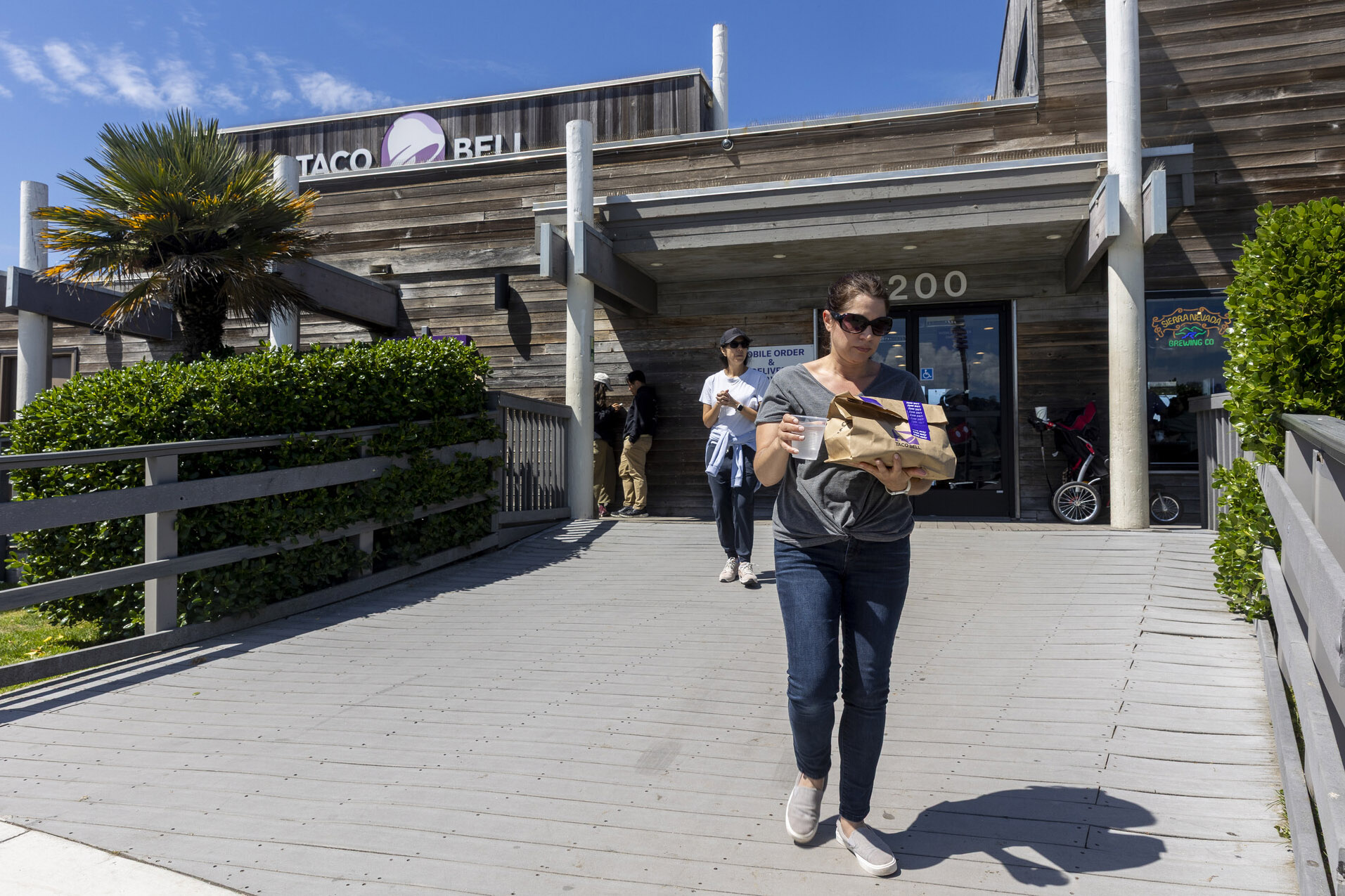
Gabriela Glueck: Even on a weekday afternoon, the Taco Bell is packed. There are people waiting to place their orders on the self-service tablets, kids munching tacos and groups hanging out on the back deck enjoying 32 ounce slushy margaritas out of novelty cups.
Olivia Allen-Price in scene: A yard, 32 ounces? Oh my god, no. Thank you. Regular! (laughs)
Olivia Allen-Price in studio: We’re going to take a quick break, but when we come back we’ll learn why you don’t see many other restaurants on beaches in California. And what sea level rise could mean for this beachside spot.
Oh, and while we’re on break, maybe take a moment to donate to KQED? It takes just a few minutes and helps keep shows ours running. KQED.org/donate is the place to do it.
Sponsor Message
Olivia Allen-Price: We’re talking about *THAT* Taco Bell in Pacifica – a cantina that’s literally right on the beach. Some people love it, but others have fought hard to prevent places like it from popping up along the California coast. Reporter Gabriela Glueck takes it from here.
Gabriela Glueck: Around the same time Pacificans were raising concerns about the A&W, similar battles were playing out up and down the coast.
Charles Lester: People were getting concerned about not being able to get to the beach or see it from Highway One, the way they used to.
Gabriela Glueck: This is Charles Lester. He worked for the State of California and the California Coastal Commission for twenty years.
Charles Lester: And places like Malibu were already starting to see kind of this cheek to jowl residential development along the beach.
Gabriela Glueck: Efforts to rein in coastal developments were slow going. But out of these local fights, a broader grassroots response was taking shape: the “save our coast” movement. Californians put an initiative on the ballot, and it passed.
Newsclip: The passage of Proposition 20 on November the 8th has signaled the beginning of the most ambitious and comprehensive effort ever mounted in this nation and perhaps the world. For the purpose of developing a process for managing coastal zone resources.
Charles Lester: The reason why we have an initiative is because there was failed efforts in the legislature to do anything about it.
Gabriela Glueck: Proposition 20 established the California Coastal Commission to regulate development and protect public access along the coastline. California now has one of the most protected coastlines in the world.
Newsclip: It has taken many hard lessons for us here in California to begin to understand the need for land and marine resource conversation.
Gabriela Glueck: Approved by voters in 1972, the proposition didn’t go into effect until 1973. That’s a year after the A&W opened.
Charles Lester: When I see it I go, oh, that must be from the 60s or the 70s, it looks like a lot of other developments in different places in California that were some of the reasons why we have a Coastal Act and why we decided to protect the coast.
Gabriela Glueck: That old A&W made it onto the beach in the nick of time. The building that would later become the Taco Bell, was grandfathered in. And thanks to prop 20, competition in the beachside fast food scene is scarce.
Gabriela Glueck: For Charles, the bigger question now is of the building’s future.
Charles Lester: It’s a challenging location when you’re that close to the surf zone and you get big storms, the waves are going to come up, and eventually, with sea level rise, you’re going to have some serious issues.
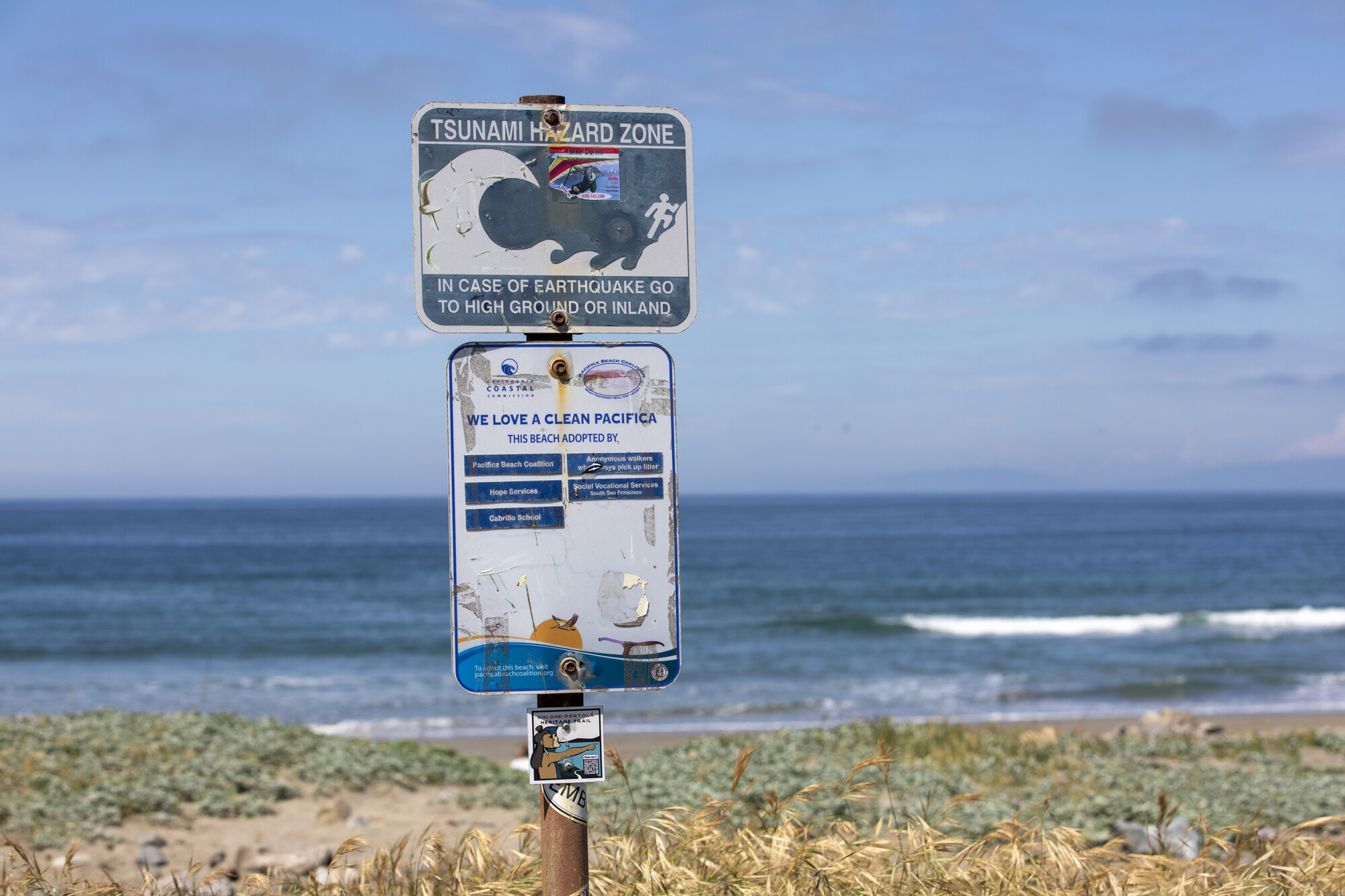
Gabriela Glueck: With just two meters of sea level rise, he says, the ocean would push right up against the restaurant. When that will happen is still unclear—but some estimates put that at 75 years from now, but most projections put it 100 to 200 years away, depending on emissions.
Charles Lester: In my mind, yeah, it’s inevitable that at some point you’ll be spending so much time, you know, responding to the wave attack and the wave damage and the storms that it won’t make any more sense economically.
Gabriela Glueck: Charles says the Taco Bell would likely qualify as an ‘existing structure’ under the Coastal Act. That could make it eligible for a protective structure. Think sea wall or some other form of shoreline protection. But…
Charles Lester: …. a lot of people are thinking given the inevitability of sea level rise and the immense energy we’re talking about in the ocean, that it’s going to be retreat, planned or unplanned in a lot of places.
Ambi of inside the Taco Bell
Olivia Allen-Price and Gabriela Glueck in scene: Mmm. It’s like a lighter churro. It tastes like Cinnamon Toast Crunch.
Gabriela Glueck: Back at the Taco Bell, on this gloriously sunny day, it’s hard to imagine this place not being here. For now though, for as long as it lasts, it’s safe to say it will remain iconic.
Olivia Allen-Price: That was Bay Curious reporter Gabriela Glueck.
Bay Curious is made in San Francisco at member-supported KQED.
Our show is produced by Katrina Schwartz, Christopher Beale and me, Olivia Allen-Price. Additional support from Maha Sanad, Jen Chien, Ethan Toven-Lindsey, Katie Sprenger, and everyone on Team KQED.
Some members of the KQED podcast team are represented by The Screen Actors Guild, American Federation of Television and Radio Artists, San Francisco Northern California Local.
I’m Olivia Allen-Price. Have a great week!