This is a computer-generated transcript. While our team has reviewed it, there may be errors.
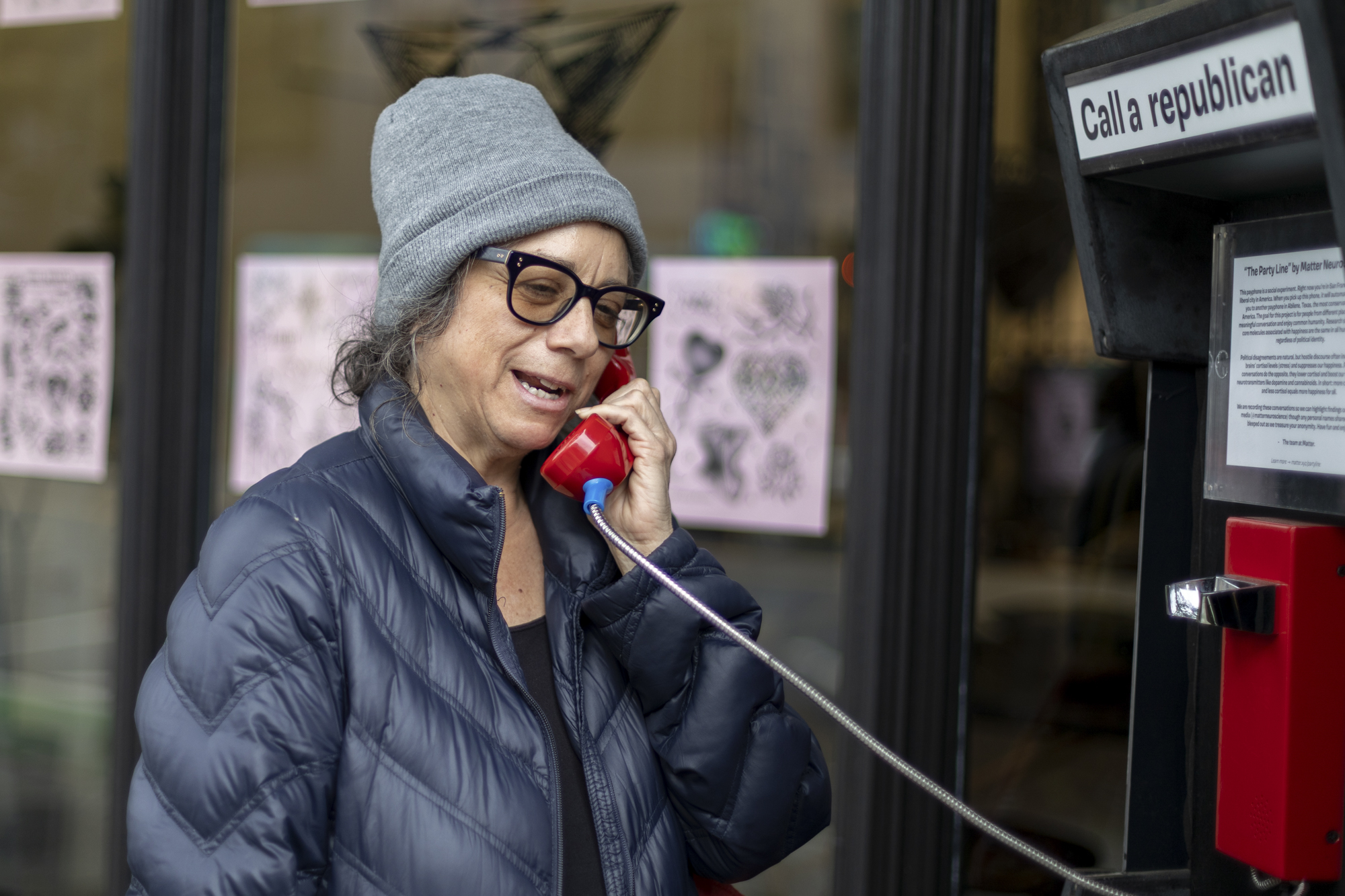
Ericka Cruz Guevarra: I’m Ericka Cruz Guevarra and welcome to The Bay, local news to keep you rooted. For weeks outside of a tattoo shop in San Francisco’s Mission District, an old school payphone painted red could be heard ringing.
Caller: Hello? Hey, this is Chris calling from San Francisco. Who am I speaking with?
Ericka Cruz Guevarra: On top of the payphone was a sign inviting people walking by to ‘Call a Republican.’ The phone connected to a nearly identical phone booth in Abilene, Texas, except for the sign that read ‘Call a Democrat.’ And it’s all part of a social experiment called The Party Line.
Ben Goldhirsh: And so it was sort of a social experiment to see what would people choose, common ground or conflict.
Ericka Cruz Guevarra: Studies show that most American voters are pretty pessimistic that we can overcome our country’s deep political divides. So today, we’re gonna talk with KQED reporter Azul Dahlstrom-Eckman about this social experiment and listen in on conversations between residents of San Francisco and Abilene, Texas.
Azul Dahlstrom-Eckman: So the payphone is a project of Matter Neuroscience. That’s a tech startup in Boulder, Colorado.
Ericka Cruz Guevarra: Azul Dahlstrom-Eckman is a reporter for KQED.
Azul Dahlstrom-Eckman: And their mission is basically just to try to help people live more emotionally balanced lives. One example of that is that they’re in clinical trials at Stanford right now, trying to help people with depression who aren’t responding to traditional treatments. But they also do these sort of like side quest projects. For instance, one was they prototype this six pound phone case to prevent people from doom scrolling.
Ericka Cruz Guevarra: So basically the phone case was so heavy that it was just physically impossible to sit there.
Azul Dahlstrom-Eckman: Yeah, to do the infinite scroll on your phone. But the common thread here with the payphone is that they’re trying to get people away from habits that are bad for our emotional health. So the idea with this payphone is how can we get people to connect in a way that’s emotionally positive and healthy for our brains?
Ericka Cruz Guevarra: How does the payphone work exactly? So there’s one in San Francisco and then another elsewhere in the country?
Azul Dahlstrom-Eckman: Basically, Matter Neuroscience bought two payphones on Facebook Marketplace, ripped out their guts, and outfitted them with SIM cards that basically turned them into cell phones. And they put one in San Francisco, and they put another in Abilene, Texas. So the idea was to connect two very politically different parts of our country. So San Francisco voted heavily for Kamala Harris in the 2024 presidential election. Abilene, Texas voted heavily for Donald Trump. Both cities are over 100,000 residents, so that was sort of the thinking of connecting America’s most, you know, I’m saying this in air quotes, most conservative city and most liberal city.
Audio from outside the payphone: Is anybody picking up? No. Oh, darn. That’s too bad. It might take a while.
Azul Dahlstrom-Eckman: And so what happens is if you pick up the phone in San Francisco, it rings the phone in Texas. And the phone in Texas is located outside a bookstore in Abilene. Same thing, if you pick up the phone in Texas, it’ll ring the payphone in San Francisco.
Ericka Cruz Guevarra: And you just wait basically for someone to pick up on the other side.
Azul Dahlstrom-Eckman: Yes, you pick it up, it calls, and then it rings on the other side. And I was standing outside the payphone for a while and there were times when it was ringing and nobody picked up. There were other times when people walked by and they decided to pick it up.
Ericka Cruz Guevarra: And I’m so curious about the conversations that you heard folks having and also who was interested and engaging with this payphone. I know you met a woman named Maria out there.
Azul Dahlstrom-Eckman: Yeah, so Maria Gonzalez is a lifelong San Franciscan, lives pretty close to the payphone, and she was walking by, heard a ring, and decided to pick it up.
Maria Gonzalez: Oh my gosh, really? Where? Where are you at? Oh, you just told me where you’re at. Yeah. You need to get out here.
Azul Dahlstrom-Eckman: She ended up finding a Democrat in Texas or the person who called was a Democrat wanting to sort of commiserate about you know politics and say oh you know I want to be where you are essentially.
Maria Gonzalez: It was nice to speak to somebody and we had similar ways of looking at life and so, you know, I mean every time you pick up the phone it’s going to be a different experience.
Azul Dahlstrom-Eckman: She told me that the conversation that she had reminded her of sort of her own difficulties in her family speaking with the family members who are supporters of President Trump. She said her uncle is a quote Trumpster and that she tries to maintain a relationship with him but it’s hard.
Maria Gonzalez: So we have these discussions every time we speak, you know, and I love my uncle, I just don’t, we just don’t agree in our political views.
Azul Dahlstrom-Eckman: This is something that I think a lot of people feel is that it can be difficult to talk about politics when people have different views.
Maria Gonzalez: I think that we need something like this for sure. I was born and raised in San Francisco, so I grew up around a lot of different people with different ethnicities, going to different people’s houses and having food with them and experiencing their life. And I think that’s the best way that you can open up your mind if you live amongst people that are different from you.
Azul Dahlstrom-Eckman: Another man named Stephen Albert said that his twin sister is a Trump supporter and that he was put on this earth to cancel out her vote.
Ericka Cruz Guevarra: So we’re gonna play and listen to a snippet from a phone call between a 46 year old man in San Francisco and it turns out a 46-year-old woman in Abilene, Texas.
Steve: Hello, I’m Steve.
Unidentified Caller: Okay. Hi, Steve.
Steve: What’s up?
Unidentified Caller: Nothing much. Just looking for books. Classic books.
Steve: Well this says ‘Call a Republican.’ Are you a Republican?
Unidentified Caller: Yes, I am.
Steve: You are?
Unidentified Caller: Yes, probably an independent I would say as I’ve got older independent Are you, what are you? Are you a Republican? Are you a Democrat?
Steve: Oh god, I don’t, I don’t I mean I live in San Francisco, you know.
Unidentified Caller: So yeah, so you’re liberal, that’s fine.
Steve: I’m pretty liberal. Okay. Yeah Yeah, I… do you see the world as crazy as I do?
Unidentified Caller: I do, worse and worse every day. It’s getting worse every day.
Steve: See we have so much in common.
Unidentified Caller: I know, we do.
Ericka Cruz Guevarra I love this clip so much because I feel like it’s so awkward in the beginning. They’re like, are you a liberal? I am a liberal. And then you feel this like sigh of relief when they both agree that the world is crazy.
Azul Dahlstrom-Eckman: Yeah, they’re sort of tiptoeing around each other at the beginning, like being like, is this okay? And then they both like say like, yeah, I’m willing to have a conversation with you. And I thought it was interesting that the woman was like, you know, I am kind of Republican, but I’m kind of an independent. You know, there’s some of that nuance that you might not get in an online conversation.
Steve: Like I’m out here in the middle of the day and I’m about to have a delicious tuna salad sandwich and you’re shopping for books and neither of us are at work.
Unidentified Caller: Well, I’m a stay-at-home mom, so I don’t work.
Steve: You’re a stay at home mom?
Unidentified Caller: Yes, with four kids.
Steve: Four kids?
Unidentified Caller: Yes.
Steve: Oh my God, how old are you?
Unidentified Caller: I’m 46.
Steve: I’m also 46. I have no kids.
Unidentified Caller: You have no kids… Hey, you’re living the life then, let me tell you.
Steve: I am living the live.
Unidentified Caller: I’m tied down forever.
Steve: Oh, but you love it, right?
Unidentified Caller: I do love it. I do.
Unidentified Caller: We’re also having the AI here, did you know that?
Steve: I did not know that.
Unidentified Caller: Yeah, so they’re building a huge AI center here. It’s one of the biggest in the, I guess in the world is coming, or they’ve already been building it.
Steve: A data center?
Unidentified Caller: Yeah, that’s right.
Steve: Is that a positive impact?
Unidentified Caller: Well, I would say there’s a lot more traffic. There’s a lotta more traffic
Steve: And it probably, what, takes a lot of energy and water to run a place like that.
Unidentified Caller: Oh yeah, it’s going to be very interesting when it’s all done, what happens.
Steve: Well, it’s probably not being done for our benefit, is it?
Unidentified Caller: No, probably not.
Ericka Cruz Guevarra Yeah, I love that they’re like learning from each other in this conversation.
Azul Dahlstrom-Eckman: Yeah, and having, finding a commonality again, like San Francisco, we sort of live in the shadow of AI, and then right down there on Main Street, Texas, you’ve also got AI’s influence coming.
Ericka Cruz Guevarra And you can hear her bringing it up because she knows that. She knows that him living in San Francisco is like, yeah, you live in AI capital of the world and it’s here too. Okay, and here’s another conversation between, as it turns out, two progressives.
Unidentified Caller 2: Hello?
Unidentified Caller 3: Hello.
Unidentified Caller 2: Oh my gosh, Texas, and hell yeah. What’s it like over there? I’m a little scared for you guys.
Unidentified Caller 3: You know, it’s OK. You’re in California?
Unidentified Caller 2: Yeah, San Francisco.
Unidentified Caller 3: Oh my god, I always wanted to go there.
Unidentified Caller 2: I mean, it’s amazing. What can I say, queer? Quite queer.
Unidentified Caller 3: Well, okay, so I have to tell you, I’m not a Republican.
Unidentified Caller 2: Okay, okay, okay. I was testing. That was a test. The queer thing was a task. I knew instantly when you said you wanted to go to San Francisco.
Unidentified Caller 3: Yeah, well, I have a trans, I have a trans child, so, yeah.
Unidentified Caller 2: Of course, of course.
Unidentified Caller 3: I have to say it quietly. I have say it really quietly.
Unidentified Caller 2: Yeah, yeah, I’d imagine, I would imagine.
Ericka Cruz Guevarra: Oh my god, I just love their energy. They’re just like, they just sound like two girls on the phone.
Unidentified Caller 3: It’s all gonna be okay, it’s all going to be okay.
Unidentified Caller 2: No, it’s all going to be okay. There’s so many amazing people in the world all across, no matter what state you’re in. The people of Texas, there’s some great hard-working people in Texas that you are ready to do the work to really turn some stuff around.
Unidentified Caller 3: That’s right. We’re going to get there. We are going to go there.
Unidentified Caller 2: No, and I believe in you.
Azul Dahlstrom-Eckman: And it’s like, it’s very fun. It’s a very odd situation when you’re put on the phone with a stranger and tasked with having a conversation.
Ericka Cruz Guevarra: Yeah, it’s like that element of surprise that’s kind of fun.
Azul Dahlstrom-Eckman: Like mystery box.
Ericka Cruz Guevarra: Yeah right.
Azul Dahlstrom-Eckman: I think another thing that you’re hearing is like, not everyone in Abilene is a Republican and not everyone in San Francisco is a Democrat.
Unidentified Caller 2: I’m glad I got to hear you. This is so beautiful. I don’t even know exactly what this phone thing is, but I, I, this is awesome.
Unidentified Caller 3: It’s awesome.
Azul Dahlstrom-Eckman: I talked to the bookstore owner in Texas and she said, yeah, a lot of the Democrats and Abilene have been like coming out of the woodwork and seeking out this payphone trying to find like-minded people, which could be sort of a little more challenging there. And in the same way, she said she’s picked up calls where San Francisco Republicans are calling looking to talk to like-minded folk.
Ericka Cruz Guevarra: I mean, did you pick up the phone and try to talk to anyone?
Azul Dahlstrom-Eckman: Yeah, I did. And you know, I have my journalist hat on, so people are like, well, are you a Republican or a Democrat? I’m like, I’m sort of a journalist.
Ericka Cruz Guevarra: I’m a journalist.
Azul Dahlstrom-Eckman: I’m not really supposed to have a political view when I’m working, but I did experience that same feeling of like, you’re a person in Texas and I grew up in San Francisco, I’ve lived here almost my whole life. I’ve never been to Texas. What’s that like? Like we’re part of the same country.
Ericka Cruz Guevarra I do wonder, Azul, just like after hearing some of these phone calls, I’m sure there were many, many more that we haven’t listened to, but do the folks who put this payphone out there, do they think that it did what it was supposed to do? Like, did it work?
Azul Dahlstrom-Eckman: So the payphones were up for a month and they recorded around 200 conversations.
Ben Goldhirsh: What ended up happening was quite beautiful and quite affirming.
Azul Dahlstrom-Eckman: I spoke to Ben Goldhirsh, he’s a co-founder of Matter Neuroscience, and he said listening to these conversations has been incredibly meaningful for him.
Ben Goldhirsh: Whatever the human topic is that allows us to actually connect, that’s what people gravitate towards. And people also gravitated away from kind of broad brushstrokes, like, oh, I’m a Republican, but don’t think that all of my positions are all on the right. I also believe in X and Y on the left side. I think people really pronounced the nuanced reality of their existence.
Azul Dahlstrom-Eckman: You know, small sample size. Can we draw major conclusions from these conversations? I can’t say, but to him, I think it is proof that when people take the time to connect in a healthier way, there can be positive benefits. So when we get offline, we get on the phone or talk to somebody in person, it can be beneficial for us as humans and we can sort of break down some of these barriers that we might construct that prevent us from relating to each other.
Ben Goldhirsh: I think if you pulled an alien that was looking at America from, you know, a million miles away who was just digesting our news and our social media, and you said, hey, like, evaluate how far apart these people are, I think it would be reasonable to set a pretty wide delta. And I think when that alien listens to these conversations, they’ll be like, a lot of these are buds. These folks are all buds.
Ericka Cruz Guevarra: So they took the payphones down on Wednesday, right? Wednesday of last week. Do they plan to do this again?
Azul Dahlstrom-Eckman: Matter Neuroscience told me that they’re looking at other applications for the payphones that could have similar benefits for different populations. One idea is a senior center and a college campus to sort of unite people across generations. And the other idea is to go international with it. Unite people from different countries.
Ericka Cruz Guevarra: Did you feel like it worked on you? I mean, like the purpose of this payphone. Are you convinced?
Azul Dahlstrom-Eckman: One question I have about this project is that, you know, there were around 200 conversations. This is a drop in the bucket compared to how many billions of people use social media every day. And this project was literally based on a payphone, like a piece of tech that does not exist anymore largely. It’s definitely going against the prevailing headwinds of how we’re communicating and how we are. The methods we’re increasingly turning to to get information out. But there is a lot of research to say that like social connection is good for us. And I did feel, I felt good when I talked to the payphone and it felt good to listen to people talking and it feel good to listened to these conversations.
Ericka Cruz Guevarra: Yeah and especially I feel like in this like world where we’re presumably more connected than ever with social media and stuff but actually like sometimes you just need to pick up the phone and talk to someone. Well Azul, this was such a fun story, thank you so much for sharing it with us.
Azul Dahlstrom-Eckman: Yeah, happy to be here.
Payphone sound: You are now being connected to the party line in Abilene, Texas. Participants must be 18 or older. This call may be recorded for use in a public project. By staying on the line, you consent…