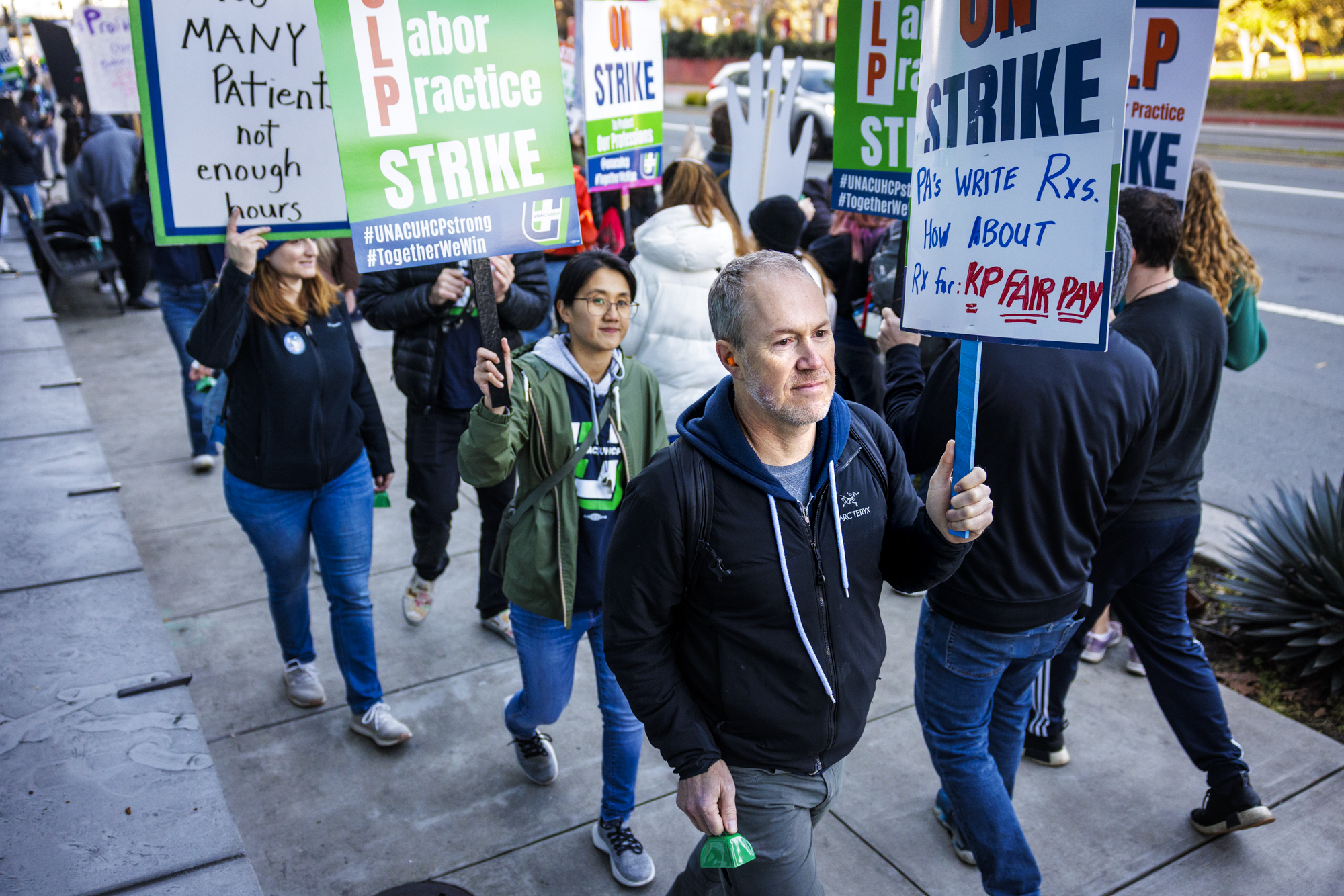
Picket Line: [00:00:53] Thank you. Be safe in the rain. Let’s get this contract done!
Ericka Cruz Guevarra: [00:01:03] It’s been four weeks since tens of thousands of Kaiser workers who make up the backbone of patient care for the company began striking over staffing and pay, including Chris Pyper, a physicians assistant at the Kaiser in San Leandro.
Chris Pyper: [00:01:22] It just kind of feels like they’ve forgotten the healthcare workers who are doing a lot of the patient care. I’m basically using up savings that I’ve had, hoping that this is going to produce a good contract and I’m willing to stay out as long as we need.
Ericka Cruz Guevarra: [00:01:40] Workers also have larger concerns over the direction of the company. Kaiser is the largest non-profit health insurer in the country. And employees say that as Kaiser has grown, their work has gotten harder and harder. Today, we talk with KQED labor correspondent, Farida Javala Romero, about the Kaiser strike and what it means for patients.
Farida Jhabvala Romero: [00:02:21] This is a large strike, even for a very large company like Kaiser.
Ericka Cruz Guevarra: [00:02:29] Farida Javala-Romero is a labor correspondent for KQED.
Farida Jhabvala Romero: [00:02:33] So this particular strike involves up to 31,000 employees in California. Most of them are based in Southern California, but there are some happening in Northern California as well. It’s made up of nurses, including nurse anesthetists, physicians assistants, physical therapists, midwives. And then in Southern California, there’s also pharmacists and other very key healthcare workers. They’re key people for operations and surgeries. So we’ve heard of some surgeries being delayed. And so I wanted to speak with Kaiser patients who are facing some of these disruptions in care because of the strike.
Kayla Howell: [00:03:25] Honestly, when the scheduler first called me and told me about it, I sobbed.
Farida Jhabvala Romero: [00:03:31] So I spoke with folks like Kayla Howell in San Jose. She was going to have surgery to repair her torn ACL.
Kayla Howell: [00:03:39] Having that taken away you realize like oh my god i use my leg for everything going to the bathroom taking a shower is extremely difficult and painful
Farida Jhabvala Romero: [00:03:48] And so she was one of the folks who got a call saying, this thing is gonna be delayed until March.
Kayla Howell: [00:03:55] I’ve never had surgery before. It’s kind of a big thing. And so in my head, I was like, OK, this is what I’m going to do. I’m ready for it. You know, I’m preparing myself. It’s going to happen on this day. And then to have that, like, snatched away from me just like five days before it’s supposed to happen. I was, like Oh, that’s like a big paradigm shift, you know.
Farida Jhabvala Romero: [00:04:13] Her mom was gonna travel from abroad to care for her. Her mom couldn’t change her ticket to come to the U.S. To help her and her lodging. It just seemed like there were so many ripple effects just for one patient.
Kayla Howell: [00:04:27] When Kaiser said they’re canceling non-essential surgeries, like before I would think like, oh, non-essential, like plastic surgery, stuff that like people don’t really like need, you know, but like I need my mobility and I need to my legs.
Farida Jhabvala Romero: [00:04:41] Some of the people that wrote to us, you know, to tell us about their stories, they had hip replacement surgeries, you know where everything hurts, like it hurts to get in and out of their car. They told me that they’ve been waiting for these surgeries for months already to get on the schedule. So this, you now, additional delay hit really hard.
Ericka Cruz Guevarra: [00:05:02] I mean, that’s a huge inconvenience for people I can’t imagine. And we are already on week four which feels that feels pretty long to me is that long I guess in comparison to these other strikes that you’ve been talking about?
Farida Jhabvala Romero: [00:05:18] Yeah, I think so. Since September, this is the third time they’ve gone on strike. But the previous strikes were limited duration, so they lasted one day or five days. And they said ahead of time how long it was going to last, which helps the employer prepare and also for people to know what’s going to happen. With this situation we have now, the stakes are higher because this could go on for a lot longer. It seems like many of these issues, at least from the employee’s perspective, are not getting resolved. And a lot of them have to do with staffing levels.
Sanne Jacobsen: [00:06:06] I’ve been here for 14 years, I really am honestly at this point feeling like I work for an investment bank that poses as a healthcare organization.
Farida Jabvala Romero: [00:06:17] Sanne Jacobson, I met her outside of the Oakland Medical Center. It was the first day of this strike on January 26. And she’s part of the bargaining committee. So they’re looking for more input into their scheduling, the number of patients that they see.
Sanne Jacobsen: [00:06:36] You get providers that are double and triple booked and they can’t adequately provide care for the patients. And they suffer moral injury when they go to work and they can’t practice like they are supposed to be practicing.
Farida Jhabvala Romero: [00:06:50] What she, and this is echoing what a lot of other folks have told me at Picket Lines, is that increasing pressure to see more and more patients, they feel like they need to rush more to see more patients. They’re seeing their patients have to wait longer to be able to return to come see them for follow-up visits. And then from Kaiser’s perspective, they have been, for months, dismissing any claims that their patient care quality is sliding. And that there aren’t enough staffers to see patients. They say they meet all of the staffing levels that are required. And so, at least from workers’ perspective, the company is focusing on wages and wage increases, but not so much talking about the staffing problems that workers see.
[00:07:38] So would you say that’s like, the main sticking point for workers in this particular strike? This feeling that they’re just a little overwhelmed with low staffing compared to the number of patients they have to take care of, and that wages maybe actually isn’t the number one issue for them?
Farida Jhabvala Romero: [00:07:58] I think it’s all connected. We can say that compensation and staffing levels are the two top issues. And those are nationwide top concerns for nurses and other healthcare workers. And when we’re talking about wages in this particular strike, the union wants a 25% increase over four years and Kaiser has drawn the line at 21.5%.
Ericka Cruz Guevarra: [00:08:31] Well, I wanna zoom out a little bit from this strike because I feel like I’ve seen a lot of strikes from Kaiser workers lately. Why is that?
Farida Jhabvala Romero: [00:08:39] We have seen several strikes in the last few years as these contracts expire and Kaiser is in negotiations for a new contract with different unions. This is a company where many of their employees, I think it’s more than 130,000, are unionized. And I think that goes back to this central conflict that we’re seeing for a company like Kaiser, which is. Employees feel like the company is moving away from its mission as a nonprofit, and that instead the company has expanded to new states, building new facilities, buying hospitals, and investing the revenues they’re getting from their health insurance business into growing. Meanwhile, the employees feel like they’ve been sort of left behind.
John Logan: [00:09:36] What’s happening at Kaiser in some ways reflects what’s happening in terms of the structure of the healthcare industry at the national level.
Farida Jhabvala Romero: [00:09:45] John Logan chairs the Labor Studies Department at San Francisco State University. He’s a really interesting person to talk to about the strike because he’s kept an eye on Kaiser for a long time.
John Logan: [00:10:01] You know, the one thing about the Kaiser partnership that’s existed now for over 25 years, nurses, technicians, others had a great deal more say over working conditions, scheduling, and those types of things. And that’s what a lot of the workers say has been eroded in recent years.
Farida Jhabvala Romero: [00:10:22] The mission of Kaiser is to reinvest all of its revenues into patient care and their facilities. But employees, many of them who’ve worked at Kaiser for more than 10 years, they see the company as changing, they describe it as more corporate, more top-down, and I think that’s some of the conflict that we’re seeing now. It’s making billions of dollars in net income. It has really large reserves. That Kaiser says it needs to deal with long-term commitments, like pensions and building maintenance, and have enough money in case there’s another emergency, like a pandemic. And employees say, hey, this company has a lot of money. How come they’re not investing in their workforce and improving patient care?
Ericka Cruz Guevarra: [00:11:14] It sounds like employees are feeling like they have to shoulder a lot of this growth that is happening in Kaiser without necessarily getting the support to do that. What is Kaiser saying in response?
Farida Jhabvala Romero: [00:11:28] What they’ve said in their public statements is that Kaiser is a great health care provider, that they have a really good model benefiting patients, and that they’re trying their best to meet the demand of Kaiser customers or members, which is what they call them. They have not really addressed these employee big concerns about staffing, about scheduling problems. We have not been able to get an interview with like a Kaiser executive or a representative to really dig into you know how they’re thinking about their reality and this you know labor conflict they have now. And then what we talked about earlier that the policies of the federal government are giving health care executives a really uncertain financial picture for the next couple of years. At companies like Kaiser, which is a health insurer and health provider. I mean, this means they could see a lot less money from people not being able to buy insurance or losing their health insurance, at the same time that they could higher costs from uninsured folks coming to hospitals for care.
Ericka Cruz Guevarra: [00:12:42] Well, I want to come back to Kayla who has the torn ACL. I mean, we’re four weeks into the strike now. I imagine she’s watching this all very, very closely. Do you have any sense of what public support is like from people like Kayla who are directly affected?
Farida Jhabvala Romero: [00:13:03] Kayla and other patients I spoke with, they all feel like they need the strike to be resolved as soon as possible so that they can get the care that they need.
Kayla Howell: [00:13:15] We live in one of the richest countries in the world. I pay my health insurance and I pay my premiums and where is that money going to? I just wish they would figure out a way to resolve it.
Farida Jhabvala Romero: [00:13:27] I think many of these folks sympathize with the employees and they want Kaiser to treat this as a very urgent matter and, you know, come to some deal. I think from both sides, but definitely when you go talk to people at the picket line, they really feel for the patients.
Ericka Cruz Guevarra: [00:13:47] What is it going to take for this to end and when could it end?
Farida Jhabvala Romero: [00:13:52] So, there’s a national contract for all of these workers. And then there are locals in each of the regions where workers are represented. And Kaiser, at this point, is refusing to meet with national union negotiators. And there is some bargaining at the local level. What the union folks have told me is that the strike is not going to be resolved without a national contract, or that would be the easiest way for Kaiser to resolve it. The conflict has gone to such a bad place on both sides that you have the employer saying, we’re not going to deal with these national union negotiators anymore. And so we’re just going to try to resolve everything at the local level. And meanwhile, the union is saying, ‘That’s illegal. No, you have to talk to us.’
Ericka Cruz Guevarra: [00:14:45] Do you see any parallels between this Kaiser strike and the teacher strike that just ended in San Francisco last week?
Farida Jhabvala Romero: [00:14:53] Yeah, I mean, so much right now with these big conflicts we’re seeing are about affordability. For example, the Kaiser employees on strike say that during the pandemic, they agreed to much smaller wage increases because Kaiser had some big financial and other challenges, as many health systems did. And so now they feel like it’s a time to catch up and to really try to keep up with inflation and the high prices of everything. And then in San Francisco, with the teachers… It was a similar big issue, which is people feel like they can’t afford to live, you know, where do they work in San Francisco? And so the big topic over all of this is affordability.
Ericka Cruz Guevarra: [00:15:47] And the teachers were talking about not being able to afford their health care
Farida Jhabvala Romero: [00:15:50] Health insurance right.
Ericka Cruz Guevarra: [00:15:55] Farida, thank you so much for breaking this down. I appreciate it.