Cómo protegerse del ‘hongo de la muerte’ en los bosques de California
Sepa cómo identificar "Amanita phalloides", una seta venenosa que ya ha envenenado a varias personas en California y lea cuáles son los síntomas de una intoxicación mortal por ingerir un "hongo de la muerte."
El Departamento de Salud Pública de California (o CDPH por sus siglas en inglés) insta a la población a evitar recolectar y consumir setas silvestres esta temporada, después de que decenas de personas hayan sido hospitalizadas con daños hepáticos graves por consumir una seta tóxica conocida como el “hongo de la muerte” y tres personas han fallecido.
El CDPH emitió una advertencia general tras detectar lo que la agencia denominó dos “grupos significativos” de casos de intoxicación en los condados de Monterey y San Francisco, causados por la amatoxina presente en los hongos.
“Las setas de la muerte contienen toxinas potencialmente mortales que pueden provocar insuficiencia hepática”, afirmó la directora del CDPH y responsable de salud pública del estado, la Dra. Erica Pan. “Dado que las setas de la muerte pueden confundirse fácilmente con setas comestibles seguras, recomendamos a la población que no recolecte setas silvestres durante esta temporada de alto riesgo”.
La seta mortal, cuyo nombre científico es Amanita phalloides, es particularmente peligrosa porque, debido a su apariencia y sabor normales, se puede confundir fácilmente con otras setas comestibles seguras, explicó Bruch Reed, director de operaciones de la Asociación micológica de América del Norte. El estado ha advertido que cocinarlos, hervirlos, secarlos o congelarlos no los hace seguros para el consumo.
“Cuando tenga dudas, deséchelo”, advirtió Reed, cuya organización también cuenta con un comité de toxicología. Como regla general, instó a los recolectores a nunca consumir un hongo si no están 100 % seguros de que es seguro; es decir, si está leyendo este artículo para decidir si debe comer un hongo que podría ser una seta venenosa, no lo haga.
“Si no puede distinguir entre las dos, si tiene alguna duda, no vale la pena arriesgar la vida”, dijo Reed.
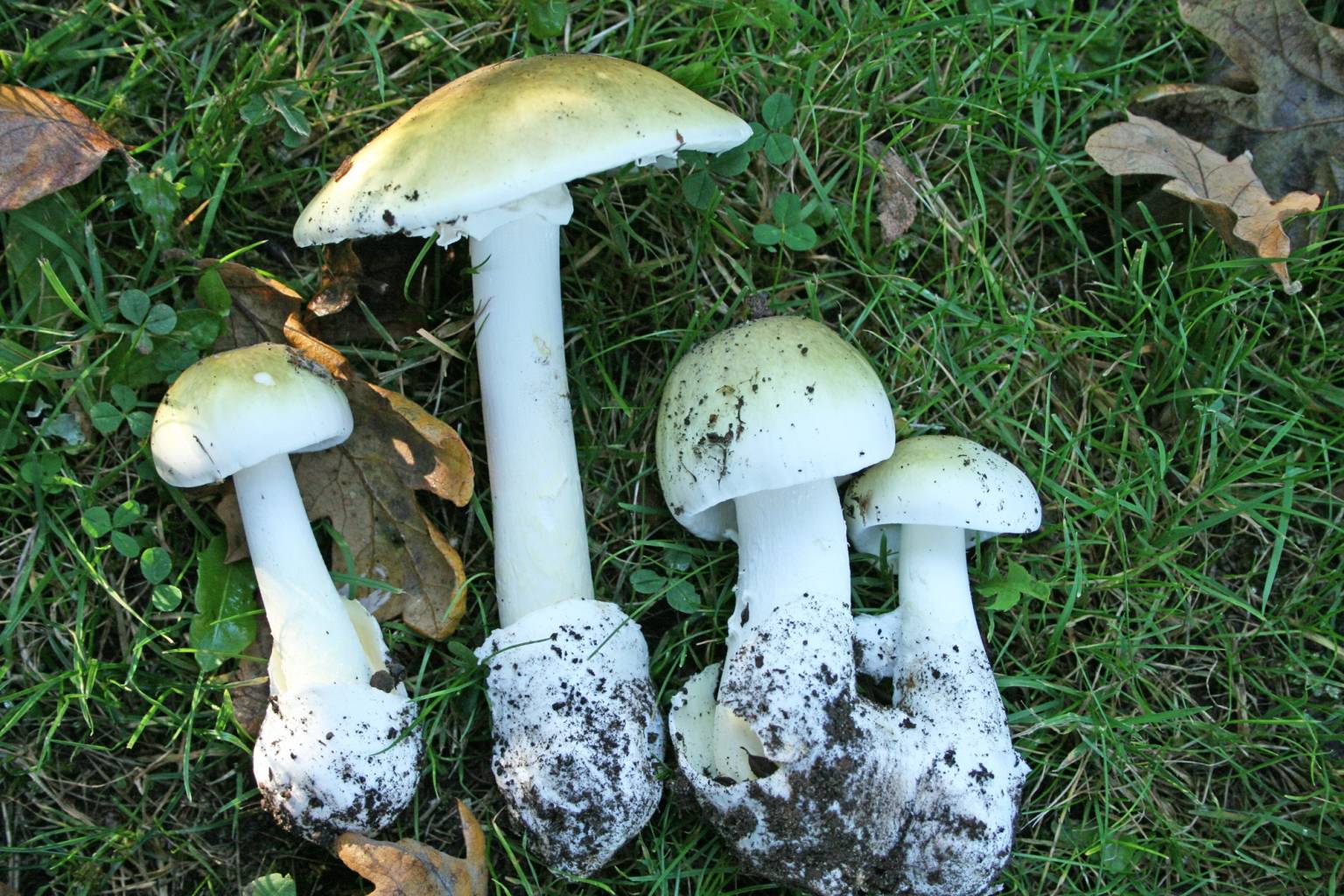
La seta venenosa Amanita phalloides aparece fotografiada en Victoria, en la isla de Vancouver, Columbia Británica. (Cortesía de Britt Bunyard, del libro “Amanitas of North America”)
Si le preocupa la salud de amigos o familiares que recolectan hongos y que quizá no conocen la reciente advertencia del estado, siga leyendo para obtener más información sobre el hongo tóxico, cómo reconocer los síntomas de intoxicación por seta de la muerte y qué hacer si accidentalmente consume un hongo peligroso.
Y si usted presenta algún síntoma después de consumir hongos silvestres o recolectados, acuda de inmediato a un hospital y llame a la línea gratuita disponible las 24 horas del día del Sistema de Control de Envenenamientos de California al 1-800-222-1222. Ellos pueden indicarle el hospital más cercano y no compartirán su nombre.
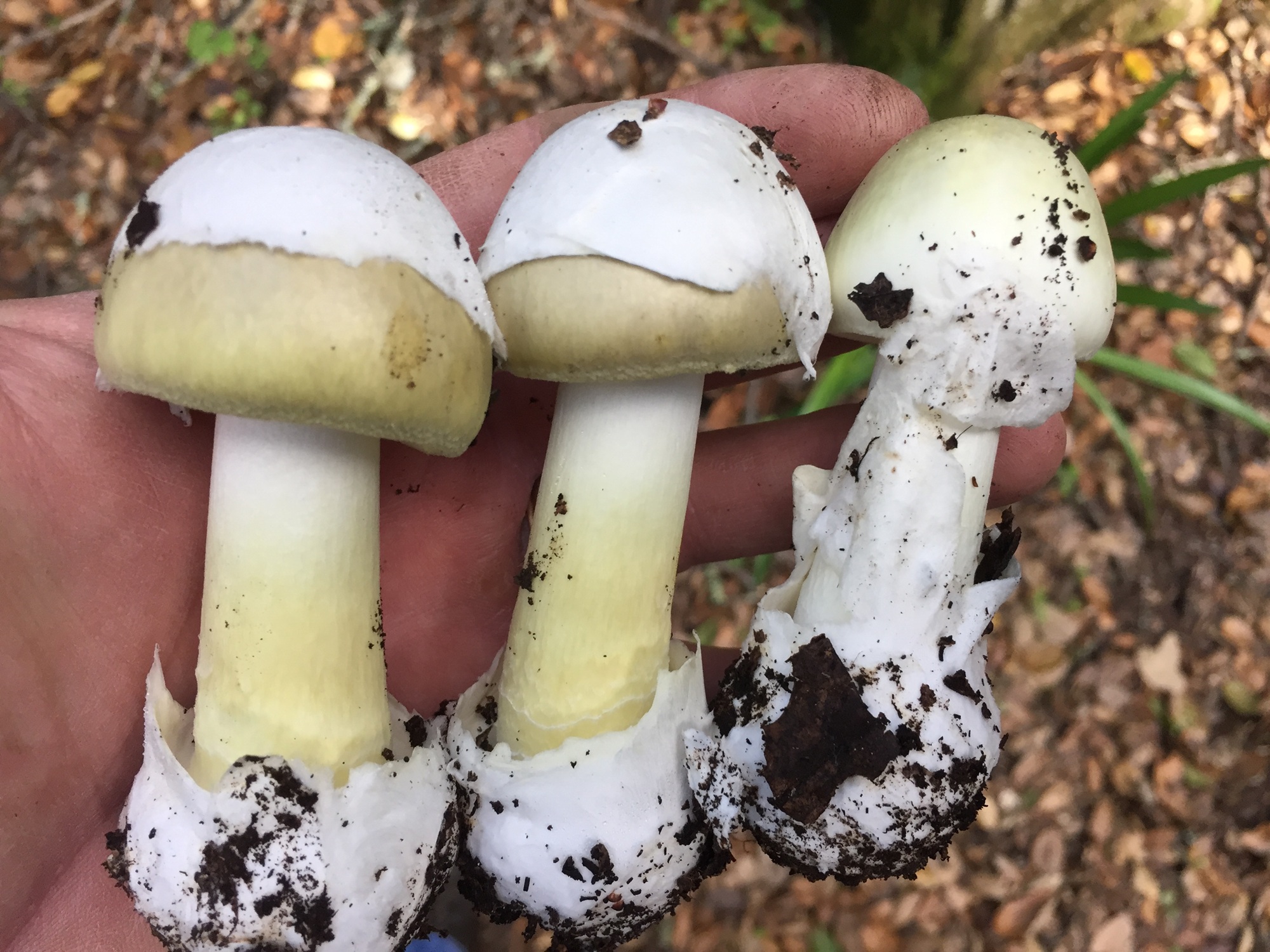
Al igual que muchas otras setas que se pueden encontrar en el suelo del bosque, o incluso en los estantes del supermercado, las setas venenosas suelen ser blancas, de color amarillo verdoso claro o incluso bronce.
La seta mortal tiene sombrero y tallo y, “se parece a muchas otras setas”, afirma Britt Bunyard, micólogo, antiguo profesor universitario y jefe editorial de la revista FUNGI Magazine. También es autor del libro “Amanitas of North America”, que investiga las varias especies de setas mortales.
Cocinar la seta no elimina su toxicidad, reiteró Heather Hallen-Adams, profesora en la Universidad de Nebraska, Lincoln, y presidenta de toxicología de la Asociación micológica de América del Norte.
Hallen-Adams recibió un informe sobre el envenenamiento la semana pasada de un hospital de Salinas, donde el personal buscaba identificar las setas después de tratar a pacientes con síntomas gastrointestinales que afirman haberlas comido.
¿Por qué son tan peligrosas las setas venenosas?
Según Bunyand, esta especie de seta venenosa causa entre el 90% y el 95% de las muertes relacionadas con hongos en todo el mundo. La seta venenosa tiene una tasa de mortalidad de alrededor del 50%.
“Se parece a muchas otras setas, por lo que no hay nada que indique que es peligrosa”, subrayó Bunyard.
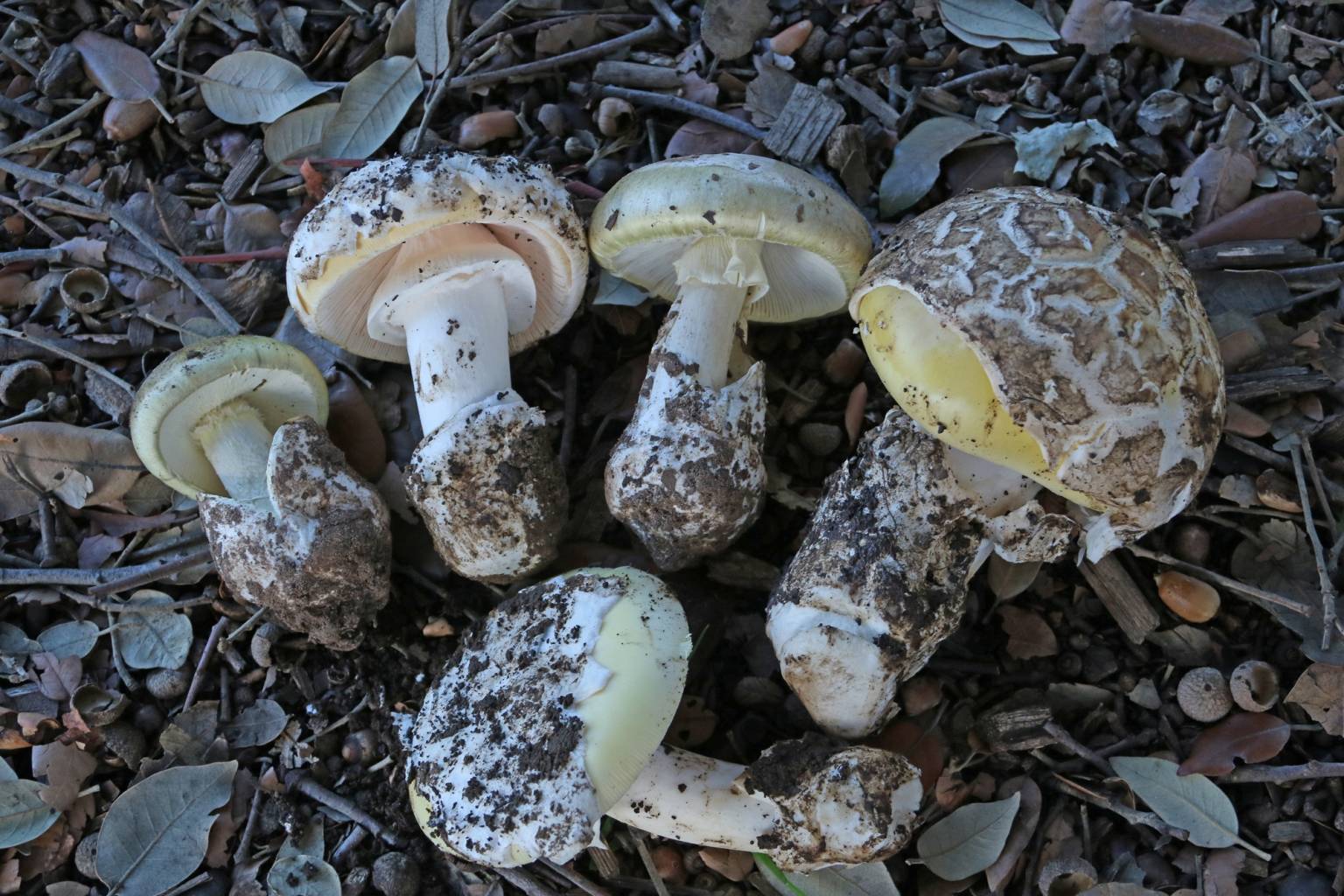
La seta venenosa Amanita phalloides aparece junto a la seta no venenosa Amanita vernicoccora, lo que ilustra lo fácil que es confundir ambas especies. (Cortesía de Britt Bunyard, del libro “Amanitas of North America”)
Lo mismo ocurre con su sabor, explicó Bunyard. Aunque técnicamente no es dañino masticar el hongo y escupirlo, algo que él aún no recomienda en absoluto, esto tampoco sirve de advertencia, ya que “no tiene un sabor amargo ni desagradable”.
“No hay indicio de que sea venenoso de ninguna manera”, dijo. “No huelen mal en absoluto”. Y a pesar de su peligro letal, las setas venenosas “en realidad huelen bien y saben bien”, afirmó Bunyard.
¿Son peligrosas las setas de la muerte para las mascotas?
Sí, estas setas también son peligrosas para mascotas como los perros, dijo Bunyard.
Dicho esto, no todos los animales se ven afectados por las setas de la muerte, y dijo que aún no está del todo claro cuál es la función de la toxina en sí.
“Es una de esas cosas que resulta increíblemente venenosa para los mamíferos y especialmente para los humanos, pero no para muchos otros organismos”, dijo Bunyard.
¿Son comunes las setas venenosas?
Según los expertos, el aumento de las lluvias provoca un repunte en la aparición de setas como estas.
Amanita phalloides es una especie invasora procedente de Europa que llegó a California alrededor de la década de 1930 y que desde entonces se ha extendido rápidamente por las costas este y oeste, principalmente cerca de las zonas urbanas, pero aún no se ha adentrado ni se ha extendido por los bosques, según Bunyard.
“Simplemente suelen crecer en lugares donde hay gente”, dijo Bunyard, lo que hace que su proximidad a los humanos sea aún más peligrosa.
La seta mortal también tiene una relación de dependencia mutua con los árboles locales, como el roble costero y los pinos, que abundan en toda la zona de la bahía y en el estado.
“Parece que la Amanita phalloides está teniendo un momento de fructificación en California en este momento”, dijo Reed. “Nadie se lo comería a propósito”.
¿Cuáles son los síntomas de la intoxicación mortal por setas venenosas?
Si ha comido un hongo tóxico como el hongo de la muerte, es posible que no sienta los síntomas de inmediato, dijo Reed. Pueden pasar seis, ocho o incluso 24 horas antes de que empiece a sentirse mal, con síntomas similares a los de la gripe, entre los que se incluyen:
Vómitos
Dolores
Dolor de estómago
Diarrea acuosa
Náuseas
Deshidratación
En estos casos de intoxicación recientemente reportados, Hallen-Adams dijo que los síntomas no aparecieron hasta unas 24 horas después.
Incluso es posible que empiece a sentirse mejor, dijo Reed, pensando que solo tenía gripe y sin molestarse en ir al hospital.
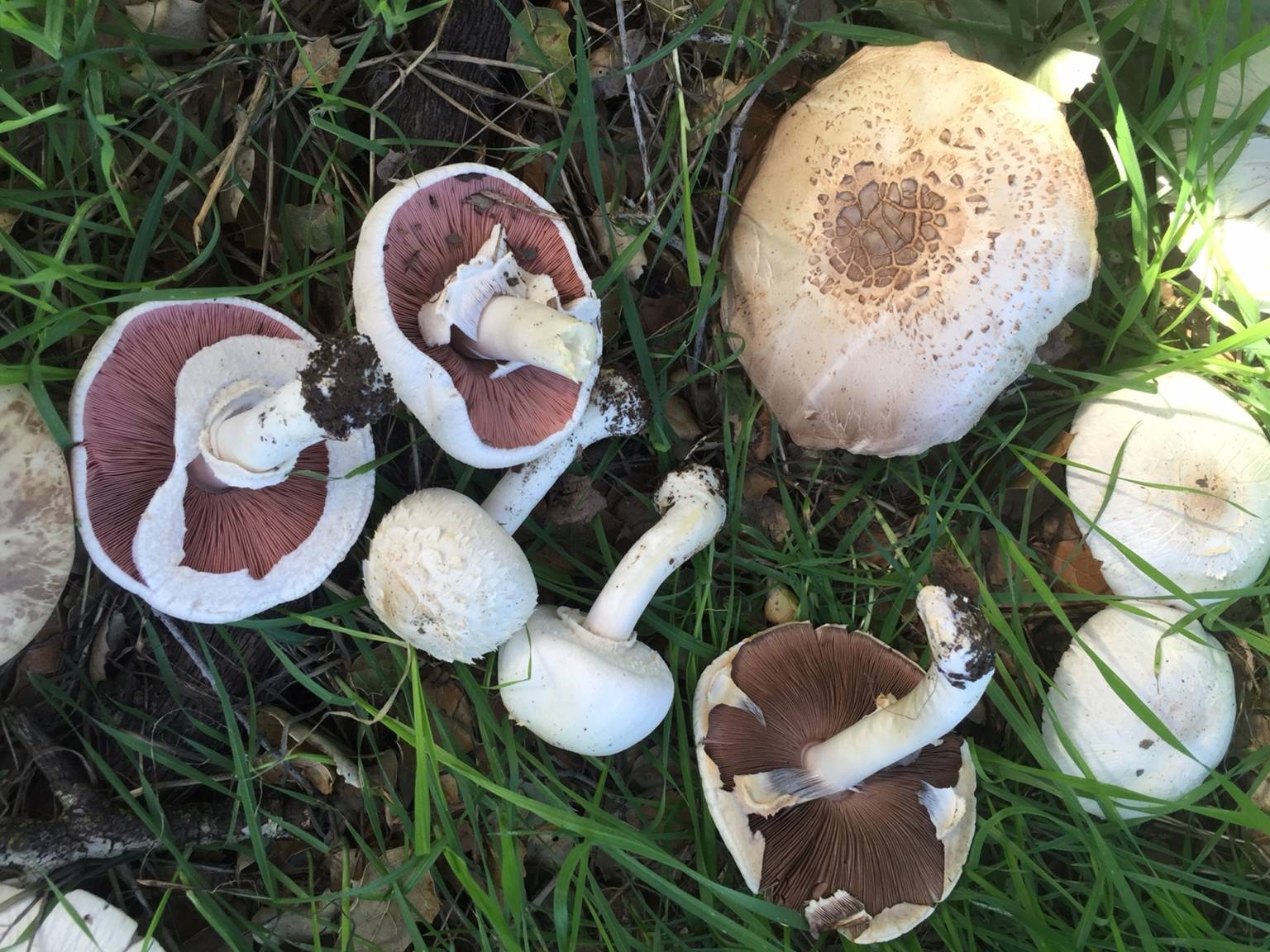
Las setas Amanita phalloides se parecen a las setas comestibles comunes, como la Agaricus californicus, que es tóxica pero no mortal. (Cortesía de Britt Bunyard)
“Y luego, dos o tres días después, sus órganos dejan de funcionar y probablemente no sobreviva”, dijo Reed. “Es insidiosamente engañoso”.
La advertencia del estado también alertaba sobre la “engañosa” mejoría momentánea que pueden experimentar las víctimas de intoxicación por hongos. Pero una vez que el veneno entra en su organismo, dijo Bunyard, ataca su hígado y otros órganos, recirculando a través de su torrente sanguíneo y, en esencia, volviendo a dosificarse con la toxina.
Mientras empieza a sentirse mejor, el daño ya está hecho, dijo Bunyard. Su hígado está destruido y puede morir por las otras toxinas que ya están en su cuerpo y que su hígado ya no puede tratar.
“Básicamente, con respecto a la intoxicación por hongo venenoso, o se somete a diálisis el resto de su vida, o le trasplantan el hígado, o muere”, dijo. “Así que no solo es potencialmente letal, sino que tampoco es una buena forma de morir”.
Si se identifica la toxina a tiempo y se acude al hospital de inmediato, dijo Bunyard, la intoxicación por hongo venenoso es tratable, ”pero no conviene arriesgarse”, añadió.
Si experimenta algún síntoma después de comer setas silvestres o recolectadas, acuda inmediatamente al hospital y llame a la línea gratuita disponible las 24 horas del día del Sistema de Control de Envenenamientos de California al 1-800-222-1222. Le indicarán el hospital más cercano y no revelarán su nombre.
¿Con qué tipos de setas se pueden confundir fácilmente las setas mortales?
En California, las setas mortales se parecen mucho a las setas comestibles comunes, como las setas de campo y las setas de botón, como Agaricus campestris, dijo Bunyard. También se pueden confundir con Amanita vernicoccora.
“Si no sabe nada sobre setas, parecen muy similares”, dijo Bunyard.
Nunca utilice la inteligencia artificial para identificar setas, advierte Reed, y nunca coma setas silvestres recolectadas por personas en las que no confía al 100% para identificarlas.
¿Cuáles son algunos mitos comunes sobre la recolección de setas?
Cuando da conferencias, Bunyard dijo que la gente pide saber las reglas estrictas sobre lo que no se debe comer. Pero la verdad número uno sobre la recolección de setas, dijo, es que no hay reglas generales, excepto una.
“La única regla general es que hay que saber exactamente qué seta se está comiendo antes de hacerlo”, afirmó. “De lo contrario, se puede correr un grave peligro”.
Más en español
Advirtió contra el seguimiento de consejos populares como cocinar las setas con plata y esperar a que se pongan negras como prueba de la presencia de toxinas, lo cual es un mito, según él.
Bunyard reiteró que no todas las setas tóxicas dan señales de que son perjudiciales, ya sea visualmente, por su sabor o por su olor. Además, la seta de la muerte, en particular, es completamente segura al tacto, al olfato y a la vista, y no hace daño a nadie cuando crece en un césped o en un bosque.
En general, Reed afirmó que aumentar el conocimiento sobre las setas a través de la educación, especialmente el conocimiento local y presencial, puede ayudar a prevenir errores “terribles” como estos.
Esta historia se ha actualizado para aclarar que las setas Agaricus californicus, aunque no son mortales, siguen siendo tóxicas.
Este artículo fue traducido por la periodista, María Peña
lower waypointnext waypoint
Player sponsored by
window.__IS_SSR__=true
window.__INITIAL_STATE__={
"attachmentsReducer": {
"audio_0": {
"type": "attachments",
"id": "audio_0",
"imgSizes": {
"kqedFullSize": {
"file": "https://ww2.kqed.org/news/wp-content/themes/KQED-unified/img/audio_bgs/background0.jpg"
}
}
},
"audio_1": {
"type": "attachments",
"id": "audio_1",
"imgSizes": {
"kqedFullSize": {
"file": "https://ww2.kqed.org/news/wp-content/themes/KQED-unified/img/audio_bgs/background1.jpg"
}
}
},
"audio_2": {
"type": "attachments",
"id": "audio_2",
"imgSizes": {
"kqedFullSize": {
"file": "https://ww2.kqed.org/news/wp-content/themes/KQED-unified/img/audio_bgs/background2.jpg"
}
}
},
"audio_3": {
"type": "attachments",
"id": "audio_3",
"imgSizes": {
"kqedFullSize": {
"file": "https://ww2.kqed.org/news/wp-content/themes/KQED-unified/img/audio_bgs/background3.jpg"
}
}
},
"audio_4": {
"type": "attachments",
"id": "audio_4",
"imgSizes": {
"kqedFullSize": {
"file": "https://ww2.kqed.org/news/wp-content/themes/KQED-unified/img/audio_bgs/background4.jpg"
}
}
},
"placeholder": {
"type": "attachments",
"id": "placeholder",
"imgSizes": {
"thumbnail": {
"file": "https://cdn.kqed.org/wp-content/uploads/2024/12/KQED-Default-Image-816638274-2000x1333-1-160x107.jpg",
"width": 160,
"height": 107,
"mimeType": "image/jpeg"
},
"medium": {
"file": "https://cdn.kqed.org/wp-content/uploads/2024/12/KQED-Default-Image-816638274-2000x1333-1-800x533.jpg",
"width": 800,
"height": 533,
"mimeType": "image/jpeg"
},
"medium_large": {
"file": "https://cdn.kqed.org/wp-content/uploads/2024/12/KQED-Default-Image-816638274-2000x1333-1-768x512.jpg",
"width": 768,
"height": 512,
"mimeType": "image/jpeg"
},
"large": {
"file": "https://cdn.kqed.org/wp-content/uploads/2024/12/KQED-Default-Image-816638274-2000x1333-1-1020x680.jpg",
"width": 1020,
"height": 680,
"mimeType": "image/jpeg"
},
"1536x1536": {
"file": "https://cdn.kqed.org/wp-content/uploads/2024/12/KQED-Default-Image-816638274-2000x1333-1-1536x1024.jpg",
"width": 1536,
"height": 1024,
"mimeType": "image/jpeg"
},
"fd-lrg": {
"file": "https://cdn.kqed.org/wp-content/uploads/2024/12/KQED-Default-Image-816638274-2000x1333-1-1536x1024.jpg",
"width": 1536,
"height": 1024,
"mimeType": "image/jpeg"
},
"fd-med": {
"file": "https://cdn.kqed.org/wp-content/uploads/2024/12/KQED-Default-Image-816638274-2000x1333-1-1020x680.jpg",
"width": 1020,
"height": 680,
"mimeType": "image/jpeg"
},
"fd-sm": {
"file": "https://cdn.kqed.org/wp-content/uploads/2024/12/KQED-Default-Image-816638274-2000x1333-1-800x533.jpg",
"width": 800,
"height": 533,
"mimeType": "image/jpeg"
},
"post-thumbnail": {
"file": "https://cdn.kqed.org/wp-content/uploads/2024/12/KQED-Default-Image-816638274-2000x1333-1-672x372.jpg",
"width": 672,
"height": 372,
"mimeType": "image/jpeg"
},
"twentyfourteen-full-width": {
"file": "https://cdn.kqed.org/wp-content/uploads/2024/12/KQED-Default-Image-816638274-2000x1333-1-1038x576.jpg",
"width": 1038,
"height": 576,
"mimeType": "image/jpeg"
},
"xxsmall": {
"file": "https://cdn.kqed.org/wp-content/uploads/2024/12/KQED-Default-Image-816638274-2000x1333-1-160x107.jpg",
"width": 160,
"height": 107,
"mimeType": "image/jpeg"
},
"xsmall": {
"file": "https://cdn.kqed.org/wp-content/uploads/2024/12/KQED-Default-Image-816638274-2000x1333-1-672x372.jpg",
"width": 672,
"height": 372,
"mimeType": "image/jpeg"
},
"small": {
"file": "https://cdn.kqed.org/wp-content/uploads/2024/12/KQED-Default-Image-816638274-2000x1333-1-672x372.jpg",
"width": 672,
"height": 372,
"mimeType": "image/jpeg"
},
"xlarge": {
"file": "https://cdn.kqed.org/wp-content/uploads/2024/12/KQED-Default-Image-816638274-2000x1333-1-1020x680.jpg",
"width": 1020,
"height": 680,
"mimeType": "image/jpeg"
},
"full-width": {
"file": "https://cdn.kqed.org/wp-content/uploads/2024/12/KQED-Default-Image-816638274-2000x1333-1-1920x1280.jpg",
"width": 1920,
"height": 1280,
"mimeType": "image/jpeg"
},
"guest-author-32": {
"file": "https://cdn.kqed.org/wp-content/uploads/2025/01/KQED-Default-Image-816638274-1333x1333-1-160x160.jpg",
"width": 32,
"height": 32,
"mimeType": "image/jpeg"
},
"guest-author-50": {
"file": "https://cdn.kqed.org/wp-content/uploads/2025/01/KQED-Default-Image-816638274-1333x1333-1-160x160.jpg",
"width": 50,
"height": 50,
"mimeType": "image/jpeg"
},
"guest-author-64": {
"file": "https://cdn.kqed.org/wp-content/uploads/2025/01/KQED-Default-Image-816638274-1333x1333-1-160x160.jpg",
"width": 64,
"height": 64,
"mimeType": "image/jpeg"
},
"guest-author-96": {
"file": "https://cdn.kqed.org/wp-content/uploads/2025/01/KQED-Default-Image-816638274-1333x1333-1-160x160.jpg",
"width": 96,
"height": 96,
"mimeType": "image/jpeg"
},
"guest-author-128": {
"file": "https://cdn.kqed.org/wp-content/uploads/2025/01/KQED-Default-Image-816638274-1333x1333-1-160x160.jpg",
"width": 128,
"height": 128,
"mimeType": "image/jpeg"
},
"detail": {
"file": "https://cdn.kqed.org/wp-content/uploads/2025/01/KQED-Default-Image-816638274-1333x1333-1-160x160.jpg",
"width": 160,
"height": 160,
"mimeType": "image/jpeg"
},
"kqedFullSize": {
"file": "https://cdn.kqed.org/wp-content/uploads/2024/12/KQED-Default-Image-816638274-2000x1333-1.jpg",
"width": 2000,
"height": 1333
}
}
},
"news_12070351": {
"type": "attachments",
"id": "news_12070351",
"meta": {
"index": "attachments_1716263798",
"site": "news",
"id": "12070351",
"found": true
},
"title": "mushroom 1",
"publishDate": 1768778762,
"status": "inherit",
"parent": 12070350,
"modified": 1768778785,
"caption": "La seta venenosa Amanita phalloides fotografiada en el Área de la Bahía en 2016.",
"credit": "Cortesía de Britt Bunyard",
"altTag": null,
"description": null,
"imgSizes": {
"thumbnail": {
"file": "https://cdn.kqed.org/wp-content/uploads/sites/10/2026/01/mushroom-1-160x120.jpg",
"width": 160,
"height": 120,
"mimeType": "image/jpeg"
},
"1536x1536": {
"file": "https://cdn.kqed.org/wp-content/uploads/sites/10/2026/01/mushroom-1-1536x1152.jpg",
"width": 1536,
"height": 1152,
"mimeType": "image/jpeg"
},
"post-thumbnail": {
"file": "https://cdn.kqed.org/wp-content/uploads/sites/10/2026/01/mushroom-1-672x372.jpg",
"width": 672,
"height": 372,
"mimeType": "image/jpeg"
},
"twentyfourteen-full-width": {
"file": "https://cdn.kqed.org/wp-content/uploads/sites/10/2026/01/mushroom-1-1038x576.jpg",
"width": 1038,
"height": 576,
"mimeType": "image/jpeg"
},
"npr-cds-wide": {
"file": "https://cdn.kqed.org/wp-content/uploads/sites/10/2026/01/mushroom-1-1200x675.jpg",
"width": 1200,
"height": 675,
"mimeType": "image/jpeg"
},
"kqedFullSize": {
"file": "https://cdn.kqed.org/wp-content/uploads/sites/10/2026/01/mushroom-1.jpg",
"width": 2000,
"height": 1500
}
},
"isLoading": false,
"fetchFailed": false
}
},
"audioPlayerReducer": {
"postId": "stream_live",
"isPaused": true,
"isPlaying": false,
"pfsActive": false,
"pledgeModalIsOpen": true,
"playerDrawerIsOpen": false,
"liveAudioPlayStartedAt": 0,
"liveAudioPlayContext": ""
},
"authorsReducer": {
"sarahwright": {
"type": "authors",
"id": "11956",
"meta": {
"index": "authors_1716337520",
"id": "11956",
"found": true
},
"name": "Sarah Wright",
"firstName": "Sarah",
"lastName": "Wright",
"slug": "sarahwright",
"email": "swright@kqed.org",
"display_author_email": true,
"staff_mastheads": [],
"title": "Outdoors Engagement Reporter",
"bio": "Sarah Wright is KQED's Outdoors Engagement Reporter. Originally from Lake Tahoe, she completed a thru-hike of the Pacific Crest Trail in 2019 and was a U.S. Fulbright Program grantee to Argentina in 2023. Her journalism has appeared in The Guardian, The San Francisco Standard, The Palo Alto Weekly and the Half Moon Bay Review.",
"avatar": "https://secure.gravatar.com/avatar/c161a3d6441865cba25e6db4fa561099ad665799e9432e34da2b84d7e371524c?s=600&d=blank&r=g",
"twitter": null,
"bluesky": null,
"facebook": null,
"instagram": null,
"linkedin": null,
"sites": [
{
"site": "arts",
"roles": [
"editor"
]
},
{
"site": "news",
"roles": [
"editor"
]
},
{
"site": "science",
"roles": [
"contributor",
"author"
]
},
{
"site": "forum",
"roles": [
"editor"
]
}
],
"headData": {
"title": "Sarah Wright | KQED",
"description": "Outdoors Engagement Reporter",
"ogImgSrc": "https://secure.gravatar.com/avatar/c161a3d6441865cba25e6db4fa561099ad665799e9432e34da2b84d7e371524c?s=600&d=blank&r=g",
"twImgSrc": "https://secure.gravatar.com/avatar/c161a3d6441865cba25e6db4fa561099ad665799e9432e34da2b84d7e371524c?s=600&d=blank&r=g"
},
"isLoading": false,
"link": "/author/sarahwright"
}
},
"pagesReducer": {},
"pfsSessionReducer": {},
"postsReducer": {
"stream_live": {
"type": "live",
"id": "stream_live",
"audioUrl": "https://hls.kqed.org/hls/kqed_app/playlist.m3u8",
"title": "Live Stream",
"excerpt": "Live Stream information currently unavailable.",
"link": "/radio",
"featImg": "",
"label": {
"name": "KQED Live",
"link": "/"
}
},
"stream_kqedNewscast": {
"type": "posts",
"id": "stream_kqedNewscast",
"audioUrl": "https://www.kqed.org/.stream/anon/radio/RDnews/newscast.mp3?_=1",
"title": "KQED Newscast",
"featImg": "",
"label": {
"name": "88.5 FM",
"link": "/"
}
},
"news_12070350": {
"type": "posts",
"id": "news_12070350",
"meta": {
"index": "posts_1716263798",
"site": "news",
"id": "12070350",
"found": true
},
"articlePosition": 0,
"guestAuthors": [],
"slug": "brote-de-intoxicaciones-por-hongos-california",
"title": "Cómo protegerse del ‘hongo de la muerte’ en los bosques de California",
"publishDate": 1769601620,
"format": "standard",
"headTitle": "Cómo protegerse del ‘hongo de la muerte’ en los bosques de California | KQED",
"labelTerm": {},
"content": "\u003cp>\u003cem>\u003ca href=\"https://www.kqed.org/news/12066441/california-mushroom-poisoning-symptoms-death-cap-identification-toxic-foraging\">Read in English\u003c/a>\u003c/em>\u003c/p>\n\u003cp>El Departamento de Salud Pública de California (o CDPH por sus siglas en inglés) insta a la población a evitar recolectar y consumir setas silvestres esta temporada, después de que \u003ca href=\"https://www.kqed.org/news/12070341/setas-venenosas-california\">decenas de personas\u003c/a> hayan sido hospitalizadas con daños hepáticos graves por consumir una seta tóxica conocida como el “hongo de la muerte” y tres personas han fallecido.\u003c/p>\n\u003cp>El CDPH emitió una advertencia general tras detectar lo que la agencia denominó dos “grupos significativos” de casos de intoxicación en los condados de Monterey y San Francisco, causados por la \u003ca href=\"https://bayareamushrooms.org/poisonings/amatoxin.html?fbclid=IwY2xjawOj_p9leHRuA2FlbQIxMABicmlkETFRWGFSZ3BDdkxQQjZUZEpLc3J0YwZhcHBfaWQQMjIyMDM5MTc4ODIwMDg5MgABHm6uB-fl8VEDH6lwTnkrtHe7PSQ62ldX_KGl8_DtWwfsMIrPL_FI8nT97Dmu_aem_6lPJH-zUJgryCje6CFebnA\">amatoxina\u003c/a> presente en los hongos.\u003c/p>\n\u003cp>\u003ca href=\"https://www.kqed.org/news/12070341/setas-venenosas-california\">Más de 30 personas ya se enfermaron\u003c/a> y tres necestaron un trasplante de hígado.\u003c/p>\n\u003cp>“Las setas de la muerte contienen toxinas potencialmente mortales que pueden provocar insuficiencia hepática”, afirmó la directora del CDPH y responsable de salud pública del estado, la Dra. Erica Pan. “Dado que las setas de la muerte pueden confundirse fácilmente con setas comestibles seguras, recomendamos a la población que no recolecte setas silvestres durante esta temporada de alto riesgo”.\u003c/p>\n\u003cp>[ad fullwidth]\u003c/p>\n\u003cp>La seta mortal, cuyo nombre científico es \u003cem>Amanita phalloides\u003c/em>, es particularmente peligrosa porque, debido a su apariencia y sabor normales, se puede confundir fácilmente con otras setas comestibles seguras, explicó Bruch Reed, director de operaciones de la \u003ca href=\"https://namyco.org/\">Asociación micológica de América del Norte\u003c/a>. El estado ha advertido que cocinarlos, hervirlos, secarlos o congelarlos no los hace seguros para el consumo.\u003c/p>\n\u003cp>“Cuando tenga dudas, deséchelo”, advirtió Reed, cuya organización también cuenta con un comité de toxicología. Como regla general, instó a los recolectores a nunca consumir un hongo si no están 100 % seguros de que es seguro; es decir, si está leyendo este artículo para decidir si debe comer un hongo que podría ser una seta venenosa, no lo haga.\u003c/p>\n\u003cp>“Si no puede distinguir entre las dos, si tiene alguna duda, no vale la pena arriesgar la vida”, dijo Reed.\u003c/p>\n\u003cfigure id=\"attachment_12070353\" class=\"wp-caption aligncenter\" style=\"max-width: 1536px\">\u003cimg loading=\"lazy\" decoding=\"async\" class=\"size-full wp-image-12070353\" src=\"https://cdn.kqed.org/wp-content/uploads/sites/10/2026/01/mushroom-2.jpg\" alt=\"\" width=\"1536\" height=\"1024\" srcset=\"https://cdn.kqed.org/wp-content/uploads/sites/10/2026/01/mushroom-2.jpg 1536w, https://cdn.kqed.org/wp-content/uploads/sites/10/2026/01/mushroom-2-160x107.jpg 160w\" sizes=\"auto, (max-width: 1536px) 100vw, 1536px\">\u003cfigcaption class=\"wp-caption-text\">La seta venenosa Amanita phalloides aparece fotografiada en Victoria, en la isla de Vancouver, Columbia Británica. \u003ccite>(Cortesía de Britt Bunyard, del libro “Amanitas of North America”)\u003c/cite>\u003c/figcaption>\u003c/figure>\n\u003cp>Si le preocupa la salud de amigos o familiares que recolectan hongos y que quizá no conocen la reciente advertencia del estado, siga leyendo para obtener más información sobre el hongo tóxico, cómo reconocer los síntomas de intoxicación por seta de la muerte y qué hacer si accidentalmente consume un hongo peligroso.\u003c/p>\n\u003cp>Y si usted presenta algún síntoma después de consumir hongos silvestres o recolectados, acuda de inmediato a un hospital y llame a la línea gratuita disponible las 24 horas del día del Sistema de Control de Envenenamientos de California al 1-800-222-1222. Ellos pueden indicarle el hospital más cercano y no compartirán su nombre.\u003c/p>\n\u003cp>\u003cstrong>Vaya directamente a\u003c/strong>:\u003c/p>\n\u003cul>\n\u003cli>\u003ca href=\"#venenosa\">\u003cstrong>¿Cómo es una seta venenosa?\u003c/strong>\u003c/a>\u003c/li>\n\u003cli>\u003ca href=\"#setas\">\u003cstrong>¿Cuáles son los síntomas de la intoxicación por setas venenosas?\u003c/strong>\u003c/a>\u003c/li>\n\u003cli>\u003ca href=\"#tipos\">\u003cstrong>¿Con qué tipos de setas se confunden las setas venenosas?\u003c/strong>\u003c/a>\u003c/li>\n\u003c/ul>\n\u003ch2>\u003ca id=\"venenosa\">\u003c/a>¿Qué es una seta venenosa?\u003c/h2>\n\u003cp>Al igual que muchas otras setas que se pueden encontrar en el suelo del bosque, o incluso en los estantes del supermercado, las setas venenosas suelen ser blancas, de color amarillo verdoso claro o incluso bronce.\u003c/p>\n\u003cp>La seta mortal tiene sombrero y tallo y, “se parece a muchas otras setas”, afirma Britt Bunyard, micólogo, antiguo profesor universitario y jefe editorial de la revista FUNGI Magazine. También es autor del libro “Amanitas of North America”, que investiga las varias especies de setas mortales.\u003c/p>\n\u003cp>Cocinar la seta no elimina su toxicidad, reiteró Heather Hallen-Adams, profesora en la Universidad de Nebraska, Lincoln, y presidenta de toxicología de la Asociación micológica de América del Norte.\u003c/p>\n\u003cp>Hallen-Adams recibió un informe sobre el envenenamiento la semana pasada de un hospital de Salinas, donde el personal buscaba identificar las setas después de tratar a pacientes con síntomas gastrointestinales que afirman haberlas comido.\u003c/p>\n\u003ch2>¿Por qué son tan peligrosas las setas venenosas?\u003c/h2>\n\u003cp>Según Bunyand, esta especie de seta venenosa causa entre el 90% y el 95% de las muertes relacionadas con hongos en todo el mundo. La seta venenosa tiene una tasa de mortalidad de alrededor del 50%.\u003c/p>\n\u003cp>“Se parece a muchas otras setas, por lo que no hay nada que indique que es peligrosa”, subrayó Bunyard.\u003c/p>\n\u003cfigure id=\"attachment_12070354\" class=\"wp-caption aligncenter\" style=\"max-width: 1536px\">\u003cimg loading=\"lazy\" decoding=\"async\" class=\"size-full wp-image-12070354\" src=\"https://cdn.kqed.org/wp-content/uploads/sites/10/2026/01/mushroom-3.jpg\" alt=\"\" width=\"1536\" height=\"1024\" srcset=\"https://cdn.kqed.org/wp-content/uploads/sites/10/2026/01/mushroom-3.jpg 1536w, https://cdn.kqed.org/wp-content/uploads/sites/10/2026/01/mushroom-3-160x107.jpg 160w\" sizes=\"auto, (max-width: 1536px) 100vw, 1536px\">\u003cfigcaption class=\"wp-caption-text\">La seta venenosa Amanita phalloides aparece junto a la seta no venenosa Amanita vernicoccora, lo que ilustra lo fácil que es confundir ambas especies. \u003ccite>(Cortesía de Britt Bunyard, del libro “Amanitas of North America”)\u003c/cite>\u003c/figcaption>\u003c/figure>\n\u003cp>Lo mismo ocurre con su sabor, explicó Bunyard. Aunque técnicamente no es dañino masticar el hongo y escupirlo, algo que él aún no recomienda en absoluto, esto tampoco sirve de advertencia, ya que “no tiene un sabor amargo ni desagradable”.\u003c/p>\n\u003cp>“No hay indicio de que sea venenoso de ninguna manera”, dijo. “No huelen mal en absoluto”. Y a pesar de su peligro letal, las setas venenosas “en realidad huelen bien y saben bien”, afirmó Bunyard.\u003c/p>\n\u003ch2>¿Son peligrosas las setas de la muerte para las mascotas?\u003c/h2>\n\u003cp>Sí, estas setas también son peligrosas para mascotas como los perros, dijo Bunyard.\u003c/p>\n\u003cp>Dicho esto, no todos los animales se ven afectados por las setas de la muerte, y dijo que aún no está del todo claro cuál es la función de la toxina en sí.\u003c/p>\n\u003cp>“Es una de esas cosas que resulta increíblemente venenosa para los mamíferos y especialmente para los humanos, pero no para muchos otros organismos”, dijo Bunyard.\u003c/p>\n\u003ch2>¿Son comunes las setas venenosas?\u003c/h2>\n\u003cp>Según los expertos, el aumento de las lluvias provoca un repunte en la aparición de setas como estas.\u003c/p>\n\u003cp>\u003cem>Amanita phalloides\u003c/em> es una especie invasora procedente de Europa que llegó a California alrededor de la década de 1930 y que desde entonces se ha extendido rápidamente por las costas este y oeste, principalmente cerca de las zonas urbanas, pero aún no se ha adentrado ni se ha extendido por los bosques, según Bunyard.\u003c/p>\n\u003cp>“Simplemente suelen crecer en lugares donde hay gente”, dijo Bunyard, lo que hace que su proximidad a los humanos sea aún más peligrosa.\u003c/p>\n\u003cp>La seta mortal también tiene una relación de dependencia mutua con los árboles locales, como el roble costero y los pinos, que abundan en toda la zona de la bahía y en el estado.\u003c/p>\n\u003cp>“Parece que la \u003cem>Amanita phalloides\u003c/em> está teniendo un momento de fructificación en California en este momento”, dijo Reed. “Nadie se lo comería a propósito”.\u003c/p>\n\u003ch2>\u003ca id=\"setas\">\u003c/a>¿Cuáles son los síntomas de la intoxicación mortal por setas venenosas?\u003c/h2>\n\u003cp>Si ha comido un hongo tóxico como el hongo de la muerte, es posible que no sienta los síntomas de inmediato, dijo Reed. Pueden pasar seis, ocho o incluso 24 horas antes de que empiece a sentirse mal, con síntomas similares a los de la gripe, entre los que se incluyen:\u003c/p>\n\u003cul>\n\u003cli>Vómitos\u003c/li>\n\u003cli>Dolores\u003c/li>\n\u003cli>Dolor de estómago\u003c/li>\n\u003cli>Diarrea acuosa\u003c/li>\n\u003cli>Náuseas\u003c/li>\n\u003cli>Deshidratación\u003c/li>\n\u003c/ul>\n\u003cp>En estos casos de intoxicación recientemente reportados, Hallen-Adams dijo que los síntomas no aparecieron hasta unas 24 horas después.\u003c/p>\n\u003cp>Incluso es posible que empiece a sentirse mejor, dijo Reed, pensando que solo tenía gripe y sin molestarse en ir al hospital.\u003c/p>\n\u003cfigure id=\"attachment_12070357\" class=\"wp-caption aligncenter\" style=\"max-width: 1536px\">\u003cimg loading=\"lazy\" decoding=\"async\" class=\"size-full wp-image-12070357\" src=\"https://cdn.kqed.org/wp-content/uploads/sites/10/2026/01/mushroom-4.jpg\" alt=\"\" width=\"1536\" height=\"1152\" srcset=\"https://cdn.kqed.org/wp-content/uploads/sites/10/2026/01/mushroom-4.jpg 1536w, https://cdn.kqed.org/wp-content/uploads/sites/10/2026/01/mushroom-4-160x120.jpg 160w\" sizes=\"auto, (max-width: 1536px) 100vw, 1536px\">\u003cfigcaption class=\"wp-caption-text\">Las setas Amanita phalloides se parecen a las setas comestibles comunes, como la Agaricus californicus, que es tóxica pero no mortal. \u003ccite>(Cortesía de Britt Bunyard)\u003c/cite>\u003c/figcaption>\u003c/figure>\n\u003cp>“Y luego, dos o tres días después, sus órganos dejan de funcionar y probablemente no sobreviva”, dijo Reed. “Es insidiosamente engañoso”.\u003c/p>\n\u003cp>La advertencia del estado también alertaba sobre la “engañosa” mejoría momentánea que pueden experimentar las víctimas de intoxicación por hongos. Pero una vez que el veneno entra en su organismo, dijo Bunyard, ataca su hígado y otros órganos, recirculando a través de su torrente sanguíneo y, en esencia, volviendo a dosificarse con la toxina.\u003c/p>\n\u003cp>Mientras empieza a sentirse mejor, el daño ya está hecho, dijo Bunyard. Su hígado está destruido y puede morir por las otras toxinas que ya están en su cuerpo y que su hígado ya no puede tratar.\u003c/p>\n\u003cp>“Básicamente, con respecto a la intoxicación por hongo venenoso, o se somete a diálisis el resto de su vida, o le trasplantan el hígado, o muere”, dijo. “Así que no solo es potencialmente letal, sino que tampoco es una buena forma de morir”.\u003c/p>\n\u003cp>Si se identifica la toxina a tiempo y se acude al hospital de inmediato, dijo Bunyard, la intoxicación por hongo venenoso es tratable, ”pero no conviene arriesgarse”, añadió.\u003c/p>\n\u003cp>Si experimenta algún síntoma después de comer setas silvestres o recolectadas, acuda inmediatamente al hospital y llame a la línea gratuita disponible las 24 horas del día del Sistema de Control de Envenenamientos de California al 1-800-222-1222. Le indicarán el hospital más cercano y no revelarán su nombre.\u003c/p>\n\u003ch2>\u003ca id=\"tipos\">\u003c/a>¿Con qué tipos de setas se pueden confundir fácilmente las setas mortales?\u003c/h2>\n\u003cp>En California, las setas mortales se parecen mucho a las setas comestibles comunes, como las setas de campo y las setas de botón, como Agaricus campestris, dijo Bunyard. También se pueden confundir con Amanita vernicoccora.\u003c/p>\n\u003cp>“Si no sabe nada sobre setas, parecen muy similares”, dijo Bunyard.\u003c/p>\n\u003cp>Nunca utilice la inteligencia artificial para identificar setas, advierte Reed, y nunca coma setas silvestres recolectadas por personas en las que no confía al 100% para identificarlas.\u003c/p>\n\u003ch2>¿Cuáles son algunos mitos comunes sobre la recolección de setas?\u003c/h2>\n\u003cp>Cuando da conferencias, Bunyard dijo que la gente pide saber las reglas estrictas sobre lo que no se debe comer. Pero la verdad número uno sobre la recolección de setas, dijo, es que no hay reglas generales, excepto una.\u003c/p>\n\u003cp>“La única regla general es que hay que saber exactamente qué seta se está comiendo antes de hacerlo”, afirmó. “De lo contrario, se puede correr un grave peligro”.[aside label='Más en español' tag='kqed-en-espanol']\u003c/p>\n\u003cp>Advirtió contra el seguimiento de consejos populares como cocinar las setas con plata y esperar a que se pongan negras como prueba de la presencia de toxinas, lo cual es un mito, según él.\u003c/p>\n\u003cp>Bunyard reiteró que no todas las setas tóxicas dan señales de que son perjudiciales, ya sea visualmente, por su sabor o por su olor. Además, la seta de la muerte, en particular, es completamente segura al tacto, al olfato y a la vista, y no hace daño a nadie cuando crece en un césped o en un bosque.\u003c/p>\n\u003cp>En general, Reed afirmó que aumentar el conocimiento sobre las setas a través de la educación, especialmente el conocimiento local y presencial, puede ayudar a prevenir errores “terribles” como estos.\u003c/p>\n\u003cp>Esta historia se ha actualizado para aclarar que las setas Agaricus californicus, aunque no son mortales, siguen siendo tóxicas.\u003c/p>\n\u003chr>\n\u003cp>\u003cem>Este artículo fue traducido por la periodista, \u003ca href=\"https://www.kqed.org/author/mpena/\">María Peña\u003c/a>\u003c/em>\u003c/p>\n\u003cp>[ad fullwidth]\u003c/p>\n\u003cp>[ad floatright]\u003c/p>\n",
"blocks": [],
"excerpt": "Sepa cómo identificar \"Amanita phalloides\", una seta venenosa que ya ha envenenado a varias personas en California y lea cuáles son los síntomas de una intoxicación mortal por ingerir un \"hongo de la muerte.\"",
"status": "publish",
"parent": 0,
"modified": 1769641271,
"stats": {
"hasAudio": false,
"hasVideo": false,
"hasChartOrMap": false,
"iframeSrcs": [],
"hasGoogleForm": false,
"hasGallery": false,
"hasHearkenModule": false,
"hasPolis": false,
"paragraphCount": 49,
"wordCount": 2135
},
"headData": {
"title": "Cómo protegerse del ‘hongo de la muerte’ en los bosques de California | KQED",
"description": "Sepa cómo identificar "Amanita phalloides", una seta venenosa que ya ha envenenado a varias personas en California y lea cuáles son los síntomas de una intoxicación mortal por ingerir un "hongo de la muerte."",
"ogTitle": "",
"ogDescription": "",
"ogImgId": "",
"twTitle": "",
"twDescription": "",
"twImgId": "",
"translatedArticles": [
{
"path": "/news/12066441/california-mushroom-poisoning-symptoms-death-cap-identification-toxic-foraging",
"lang": "en"
}
],
"schema": {
"@context": "https://schema.org",
"@type": "NewsArticle",
"headline": "Cómo protegerse del ‘hongo de la muerte’ en los bosques de California",
"datePublished": "2026-01-28T04:00:20-08:00",
"dateModified": "2026-01-28T15:01:11-08:00",
"image": "https://cdn.kqed.org/wp-content/uploads/2020/02/KQED-OG-Image@1x.png",
"isAccessibleForFree": "True",
"publisher": {
"@type": "NewsMediaOrganization",
"@id": "https://www.kqed.org/#organization",
"name": "KQED",
"logo": "https://cdn.kqed.org/wp-content/uploads/2020/02/KQED-OG-Image@1x.png",
"url": "https://www.kqed.org",
"sameAs": [
"https://www.facebook.com/KQED",
"https://twitter.com/KQED",
"https://www.instagram.com/kqed/",
"https://www.tiktok.com/@kqedofficial",
"https://www.linkedin.com/company/kqed",
"https://www.youtube.com/channel/UCeC0IOo7i1P_61zVUWbJ4nw"
]
},
"author": {
"@type": "Person",
"name": "Sarah Wright",
"jobTitle": "Outdoors Engagement Reporter",
"url": "https://www.kqed.org/author/sarahwright"
}
},
"authorsData": [],
"tagData": []
},
"primaryCategory": {
"termId": 28523,
"slug": "kqed-en-espanol",
"name": "KQED en Español"
},
"source": "KQED en Español",
"sourceUrl": "https://www.kqed.org/kqedenespanol",
"sticky": false,
"nprStoryId": "kqed-12070350",
"templateType": "standard",
"featuredImageType": "standard",
"excludeFromSiteSearch": "Include",
"articleAge": "0",
"path": "/news/12070350/brote-de-intoxicaciones-por-hongos-california",
"audioTrackLength": null,
"parsedContent": [
{
"type": "contentString",
"content": "\u003cdiv class=\"post-body\">\u003cp>\u003cp>\u003cem>\u003ca href=\"https://www.kqed.org/news/12066441/california-mushroom-poisoning-symptoms-death-cap-identification-toxic-foraging\">Read in English\u003c/a>\u003c/em>\u003c/p>\n\u003cp>El Departamento de Salud Pública de California (o CDPH por sus siglas en inglés) insta a la población a evitar recolectar y consumir setas silvestres esta temporada, después de que \u003ca href=\"https://www.kqed.org/news/12070341/setas-venenosas-california\">decenas de personas\u003c/a> hayan sido hospitalizadas con daños hepáticos graves por consumir una seta tóxica conocida como el “hongo de la muerte” y tres personas han fallecido.\u003c/p>\n\u003cp>El CDPH emitió una advertencia general tras detectar lo que la agencia denominó dos “grupos significativos” de casos de intoxicación en los condados de Monterey y San Francisco, causados por la \u003ca href=\"https://bayareamushrooms.org/poisonings/amatoxin.html?fbclid=IwY2xjawOj_p9leHRuA2FlbQIxMABicmlkETFRWGFSZ3BDdkxQQjZUZEpLc3J0YwZhcHBfaWQQMjIyMDM5MTc4ODIwMDg5MgABHm6uB-fl8VEDH6lwTnkrtHe7PSQ62ldX_KGl8_DtWwfsMIrPL_FI8nT97Dmu_aem_6lPJH-zUJgryCje6CFebnA\">amatoxina\u003c/a> presente en los hongos.\u003c/p>\n\u003cp>\u003ca href=\"https://www.kqed.org/news/12070341/setas-venenosas-california\">Más de 30 personas ya se enfermaron\u003c/a> y tres necestaron un trasplante de hígado.\u003c/p>\n\u003cp>“Las setas de la muerte contienen toxinas potencialmente mortales que pueden provocar insuficiencia hepática”, afirmó la directora del CDPH y responsable de salud pública del estado, la Dra. Erica Pan. “Dado que las setas de la muerte pueden confundirse fácilmente con setas comestibles seguras, recomendamos a la población que no recolecte setas silvestres durante esta temporada de alto riesgo”.\u003c/p>\n\u003cp>\u003c/p>\u003c/div>",
"attributes": {
"named": {},
"numeric": []
}
},
{
"type": "component",
"content": "",
"name": "ad",
"attributes": {
"named": {
"label": "fullwidth"
},
"numeric": [
"fullwidth"
]
}
},
{
"type": "contentString",
"content": "\u003cdiv class=\"post-body\">\u003cp>\u003c/p>\n\u003cp>La seta mortal, cuyo nombre científico es \u003cem>Amanita phalloides\u003c/em>, es particularmente peligrosa porque, debido a su apariencia y sabor normales, se puede confundir fácilmente con otras setas comestibles seguras, explicó Bruch Reed, director de operaciones de la \u003ca href=\"https://namyco.org/\">Asociación micológica de América del Norte\u003c/a>. El estado ha advertido que cocinarlos, hervirlos, secarlos o congelarlos no los hace seguros para el consumo.\u003c/p>\n\u003cp>“Cuando tenga dudas, deséchelo”, advirtió Reed, cuya organización también cuenta con un comité de toxicología. Como regla general, instó a los recolectores a nunca consumir un hongo si no están 100 % seguros de que es seguro; es decir, si está leyendo este artículo para decidir si debe comer un hongo que podría ser una seta venenosa, no lo haga.\u003c/p>\n\u003cp>“Si no puede distinguir entre las dos, si tiene alguna duda, no vale la pena arriesgar la vida”, dijo Reed.\u003c/p>\n\u003cfigure id=\"attachment_12070353\" class=\"wp-caption aligncenter\" style=\"max-width: 1536px\">\u003cimg loading=\"lazy\" decoding=\"async\" class=\"size-full wp-image-12070353\" src=\"https://cdn.kqed.org/wp-content/uploads/sites/10/2026/01/mushroom-2.jpg\" alt=\"\" width=\"1536\" height=\"1024\" srcset=\"https://cdn.kqed.org/wp-content/uploads/sites/10/2026/01/mushroom-2.jpg 1536w, https://cdn.kqed.org/wp-content/uploads/sites/10/2026/01/mushroom-2-160x107.jpg 160w\" sizes=\"auto, (max-width: 1536px) 100vw, 1536px\">\u003cfigcaption class=\"wp-caption-text\">La seta venenosa Amanita phalloides aparece fotografiada en Victoria, en la isla de Vancouver, Columbia Británica. \u003ccite>(Cortesía de Britt Bunyard, del libro “Amanitas of North America”)\u003c/cite>\u003c/figcaption>\u003c/figure>\n\u003cp>Si le preocupa la salud de amigos o familiares que recolectan hongos y que quizá no conocen la reciente advertencia del estado, siga leyendo para obtener más información sobre el hongo tóxico, cómo reconocer los síntomas de intoxicación por seta de la muerte y qué hacer si accidentalmente consume un hongo peligroso.\u003c/p>\n\u003cp>Y si usted presenta algún síntoma después de consumir hongos silvestres o recolectados, acuda de inmediato a un hospital y llame a la línea gratuita disponible las 24 horas del día del Sistema de Control de Envenenamientos de California al 1-800-222-1222. Ellos pueden indicarle el hospital más cercano y no compartirán su nombre.\u003c/p>\n\u003cp>\u003cstrong>Vaya directamente a\u003c/strong>:\u003c/p>\n\u003cul>\n\u003cli>\u003ca href=\"#venenosa\">\u003cstrong>¿Cómo es una seta venenosa?\u003c/strong>\u003c/a>\u003c/li>\n\u003cli>\u003ca href=\"#setas\">\u003cstrong>¿Cuáles son los síntomas de la intoxicación por setas venenosas?\u003c/strong>\u003c/a>\u003c/li>\n\u003cli>\u003ca href=\"#tipos\">\u003cstrong>¿Con qué tipos de setas se confunden las setas venenosas?\u003c/strong>\u003c/a>\u003c/li>\n\u003c/ul>\n\u003ch2>\u003ca id=\"venenosa\">\u003c/a>¿Qué es una seta venenosa?\u003c/h2>\n\u003cp>Al igual que muchas otras setas que se pueden encontrar en el suelo del bosque, o incluso en los estantes del supermercado, las setas venenosas suelen ser blancas, de color amarillo verdoso claro o incluso bronce.\u003c/p>\n\u003cp>La seta mortal tiene sombrero y tallo y, “se parece a muchas otras setas”, afirma Britt Bunyard, micólogo, antiguo profesor universitario y jefe editorial de la revista FUNGI Magazine. También es autor del libro “Amanitas of North America”, que investiga las varias especies de setas mortales.\u003c/p>\n\u003cp>Cocinar la seta no elimina su toxicidad, reiteró Heather Hallen-Adams, profesora en la Universidad de Nebraska, Lincoln, y presidenta de toxicología de la Asociación micológica de América del Norte.\u003c/p>\n\u003cp>Hallen-Adams recibió un informe sobre el envenenamiento la semana pasada de un hospital de Salinas, donde el personal buscaba identificar las setas después de tratar a pacientes con síntomas gastrointestinales que afirman haberlas comido.\u003c/p>\n\u003ch2>¿Por qué son tan peligrosas las setas venenosas?\u003c/h2>\n\u003cp>Según Bunyand, esta especie de seta venenosa causa entre el 90% y el 95% de las muertes relacionadas con hongos en todo el mundo. La seta venenosa tiene una tasa de mortalidad de alrededor del 50%.\u003c/p>\n\u003cp>“Se parece a muchas otras setas, por lo que no hay nada que indique que es peligrosa”, subrayó Bunyard.\u003c/p>\n\u003cfigure id=\"attachment_12070354\" class=\"wp-caption aligncenter\" style=\"max-width: 1536px\">\u003cimg loading=\"lazy\" decoding=\"async\" class=\"size-full wp-image-12070354\" src=\"https://cdn.kqed.org/wp-content/uploads/sites/10/2026/01/mushroom-3.jpg\" alt=\"\" width=\"1536\" height=\"1024\" srcset=\"https://cdn.kqed.org/wp-content/uploads/sites/10/2026/01/mushroom-3.jpg 1536w, https://cdn.kqed.org/wp-content/uploads/sites/10/2026/01/mushroom-3-160x107.jpg 160w\" sizes=\"auto, (max-width: 1536px) 100vw, 1536px\">\u003cfigcaption class=\"wp-caption-text\">La seta venenosa Amanita phalloides aparece junto a la seta no venenosa Amanita vernicoccora, lo que ilustra lo fácil que es confundir ambas especies. \u003ccite>(Cortesía de Britt Bunyard, del libro “Amanitas of North America”)\u003c/cite>\u003c/figcaption>\u003c/figure>\n\u003cp>Lo mismo ocurre con su sabor, explicó Bunyard. Aunque técnicamente no es dañino masticar el hongo y escupirlo, algo que él aún no recomienda en absoluto, esto tampoco sirve de advertencia, ya que “no tiene un sabor amargo ni desagradable”.\u003c/p>\n\u003cp>“No hay indicio de que sea venenoso de ninguna manera”, dijo. “No huelen mal en absoluto”. Y a pesar de su peligro letal, las setas venenosas “en realidad huelen bien y saben bien”, afirmó Bunyard.\u003c/p>\n\u003ch2>¿Son peligrosas las setas de la muerte para las mascotas?\u003c/h2>\n\u003cp>Sí, estas setas también son peligrosas para mascotas como los perros, dijo Bunyard.\u003c/p>\n\u003cp>Dicho esto, no todos los animales se ven afectados por las setas de la muerte, y dijo que aún no está del todo claro cuál es la función de la toxina en sí.\u003c/p>\n\u003cp>“Es una de esas cosas que resulta increíblemente venenosa para los mamíferos y especialmente para los humanos, pero no para muchos otros organismos”, dijo Bunyard.\u003c/p>\n\u003ch2>¿Son comunes las setas venenosas?\u003c/h2>\n\u003cp>Según los expertos, el aumento de las lluvias provoca un repunte en la aparición de setas como estas.\u003c/p>\n\u003cp>\u003cem>Amanita phalloides\u003c/em> es una especie invasora procedente de Europa que llegó a California alrededor de la década de 1930 y que desde entonces se ha extendido rápidamente por las costas este y oeste, principalmente cerca de las zonas urbanas, pero aún no se ha adentrado ni se ha extendido por los bosques, según Bunyard.\u003c/p>\n\u003cp>“Simplemente suelen crecer en lugares donde hay gente”, dijo Bunyard, lo que hace que su proximidad a los humanos sea aún más peligrosa.\u003c/p>\n\u003cp>La seta mortal también tiene una relación de dependencia mutua con los árboles locales, como el roble costero y los pinos, que abundan en toda la zona de la bahía y en el estado.\u003c/p>\n\u003cp>“Parece que la \u003cem>Amanita phalloides\u003c/em> está teniendo un momento de fructificación en California en este momento”, dijo Reed. “Nadie se lo comería a propósito”.\u003c/p>\n\u003ch2>\u003ca id=\"setas\">\u003c/a>¿Cuáles son los síntomas de la intoxicación mortal por setas venenosas?\u003c/h2>\n\u003cp>Si ha comido un hongo tóxico como el hongo de la muerte, es posible que no sienta los síntomas de inmediato, dijo Reed. Pueden pasar seis, ocho o incluso 24 horas antes de que empiece a sentirse mal, con síntomas similares a los de la gripe, entre los que se incluyen:\u003c/p>\n\u003cul>\n\u003cli>Vómitos\u003c/li>\n\u003cli>Dolores\u003c/li>\n\u003cli>Dolor de estómago\u003c/li>\n\u003cli>Diarrea acuosa\u003c/li>\n\u003cli>Náuseas\u003c/li>\n\u003cli>Deshidratación\u003c/li>\n\u003c/ul>\n\u003cp>En estos casos de intoxicación recientemente reportados, Hallen-Adams dijo que los síntomas no aparecieron hasta unas 24 horas después.\u003c/p>\n\u003cp>Incluso es posible que empiece a sentirse mejor, dijo Reed, pensando que solo tenía gripe y sin molestarse en ir al hospital.\u003c/p>\n\u003cfigure id=\"attachment_12070357\" class=\"wp-caption aligncenter\" style=\"max-width: 1536px\">\u003cimg loading=\"lazy\" decoding=\"async\" class=\"size-full wp-image-12070357\" src=\"https://cdn.kqed.org/wp-content/uploads/sites/10/2026/01/mushroom-4.jpg\" alt=\"\" width=\"1536\" height=\"1152\" srcset=\"https://cdn.kqed.org/wp-content/uploads/sites/10/2026/01/mushroom-4.jpg 1536w, https://cdn.kqed.org/wp-content/uploads/sites/10/2026/01/mushroom-4-160x120.jpg 160w\" sizes=\"auto, (max-width: 1536px) 100vw, 1536px\">\u003cfigcaption class=\"wp-caption-text\">Las setas Amanita phalloides se parecen a las setas comestibles comunes, como la Agaricus californicus, que es tóxica pero no mortal. \u003ccite>(Cortesía de Britt Bunyard)\u003c/cite>\u003c/figcaption>\u003c/figure>\n\u003cp>“Y luego, dos o tres días después, sus órganos dejan de funcionar y probablemente no sobreviva”, dijo Reed. “Es insidiosamente engañoso”.\u003c/p>\n\u003cp>La advertencia del estado también alertaba sobre la “engañosa” mejoría momentánea que pueden experimentar las víctimas de intoxicación por hongos. Pero una vez que el veneno entra en su organismo, dijo Bunyard, ataca su hígado y otros órganos, recirculando a través de su torrente sanguíneo y, en esencia, volviendo a dosificarse con la toxina.\u003c/p>\n\u003cp>Mientras empieza a sentirse mejor, el daño ya está hecho, dijo Bunyard. Su hígado está destruido y puede morir por las otras toxinas que ya están en su cuerpo y que su hígado ya no puede tratar.\u003c/p>\n\u003cp>“Básicamente, con respecto a la intoxicación por hongo venenoso, o se somete a diálisis el resto de su vida, o le trasplantan el hígado, o muere”, dijo. “Así que no solo es potencialmente letal, sino que tampoco es una buena forma de morir”.\u003c/p>\n\u003cp>Si se identifica la toxina a tiempo y se acude al hospital de inmediato, dijo Bunyard, la intoxicación por hongo venenoso es tratable, ”pero no conviene arriesgarse”, añadió.\u003c/p>\n\u003cp>Si experimenta algún síntoma después de comer setas silvestres o recolectadas, acuda inmediatamente al hospital y llame a la línea gratuita disponible las 24 horas del día del Sistema de Control de Envenenamientos de California al 1-800-222-1222. Le indicarán el hospital más cercano y no revelarán su nombre.\u003c/p>\n\u003ch2>\u003ca id=\"tipos\">\u003c/a>¿Con qué tipos de setas se pueden confundir fácilmente las setas mortales?\u003c/h2>\n\u003cp>En California, las setas mortales se parecen mucho a las setas comestibles comunes, como las setas de campo y las setas de botón, como Agaricus campestris, dijo Bunyard. También se pueden confundir con Amanita vernicoccora.\u003c/p>\n\u003cp>“Si no sabe nada sobre setas, parecen muy similares”, dijo Bunyard.\u003c/p>\n\u003cp>Nunca utilice la inteligencia artificial para identificar setas, advierte Reed, y nunca coma setas silvestres recolectadas por personas en las que no confía al 100% para identificarlas.\u003c/p>\n\u003ch2>¿Cuáles son algunos mitos comunes sobre la recolección de setas?\u003c/h2>\n\u003cp>Cuando da conferencias, Bunyard dijo que la gente pide saber las reglas estrictas sobre lo que no se debe comer. Pero la verdad número uno sobre la recolección de setas, dijo, es que no hay reglas generales, excepto una.\u003c/p>\n\u003cp>“La única regla general es que hay que saber exactamente qué seta se está comiendo antes de hacerlo”, afirmó. “De lo contrario, se puede correr un grave peligro”.\u003c/p>\u003c/div>",
"attributes": {
"named": {},
"numeric": []
}
},
{
"type": "component",
"content": "",
"name": "aside",
"attributes": {
"named": {
"label": "Más en español ",
"tag": "kqed-en-espanol"
},
"numeric": []
}
},
{
"type": "contentString",
"content": "\u003cdiv class=\"post-body\">\u003cp>\u003c/p>\n\u003cp>Advirtió contra el seguimiento de consejos populares como cocinar las setas con plata y esperar a que se pongan negras como prueba de la presencia de toxinas, lo cual es un mito, según él.\u003c/p>\n\u003cp>Bunyard reiteró que no todas las setas tóxicas dan señales de que son perjudiciales, ya sea visualmente, por su sabor o por su olor. Además, la seta de la muerte, en particular, es completamente segura al tacto, al olfato y a la vista, y no hace daño a nadie cuando crece en un césped o en un bosque.\u003c/p>\n\u003cp>En general, Reed afirmó que aumentar el conocimiento sobre las setas a través de la educación, especialmente el conocimiento local y presencial, puede ayudar a prevenir errores “terribles” como estos.\u003c/p>\n\u003cp>Esta historia se ha actualizado para aclarar que las setas Agaricus californicus, aunque no son mortales, siguen siendo tóxicas.\u003c/p>\n\u003chr>\n\u003cp>\u003cem>Este artículo fue traducido por la periodista, \u003ca href=\"https://www.kqed.org/author/mpena/\">María Peña\u003c/a>\u003c/em>\u003c/p>\n\u003cp>\u003c/p>\u003c/div>",
"attributes": {
"named": {},
"numeric": []
}
},
{
"type": "component",
"content": "",
"name": "ad",
"attributes": {
"named": {
"label": "fullwidth"
},
"numeric": [
"fullwidth"
]
}
},
{
"type": "contentString",
"content": "\u003cdiv class=\"post-body\">\u003cp>\u003c/p>\n\u003cp>\u003c/p>\u003c/div>",
"attributes": {
"named": {},
"numeric": []
}
},
{
"type": "component",
"content": "",
"name": "ad",
"attributes": {
"named": {
"label": "floatright"
},
"numeric": [
"floatright"
]
}
},
{
"type": "contentString",
"content": "\u003cdiv class=\"post-body\">\u003cp>\u003c/p>\n\u003c/div>\u003c/p>",
"attributes": {
"named": {},
"numeric": []
}
}
],
"link": "/news/12070350/brote-de-intoxicaciones-por-hongos-california",
"authors": [
"11956"
],
"categories": [
"news_19906",
"news_28523",
"news_356"
],
"tags": [
"news_32707",
"news_28586",
"news_30152",
"news_27775",
"news_26702",
"news_28444",
"news_36379"
],
"featImg": "news_12070351",
"label": "source_news_12070350",
"isLoading": false,
"hasAllInfo": true
}
},
"podcastsReducer": {
"isFetching": false,
"fetchFailed": false,
"hasFetched": false,
"podcasts": {}
},
"radioProgramsReducer": {
"isFetching": false,
"fetchFailed": false,
"hasFetched": false,
"radioPrograms": {}
},
"radioSearchSegmentsReducer": {},
"programsReducer": {
"all-things-considered": {
"id": "all-things-considered",
"title": "All Things Considered",
"info": "Every weekday, \u003cem>All Things Considered\u003c/em> hosts Robert Siegel, Audie Cornish, Ari Shapiro, and Kelly McEvers present the program's trademark mix of news, interviews, commentaries, reviews, and offbeat features. Michel Martin hosts on the weekends.",
"airtime": "MON-FRI 1pm-2pm, 4:30pm-6:30pm\u003cbr />SAT-SUN 5pm-6pm",
"imageSrc": "https://cdn.kqed.org/wp-content/uploads/2024/04/All-Things-Considered-Podcast-Tile-360x360-1.jpg",
"officialWebsiteLink": "https://www.npr.org/programs/all-things-considered/",
"meta": {
"site": "news",
"source": "npr"
},
"link": "/radio/program/all-things-considered"
},
"american-suburb-podcast": {
"id": "american-suburb-podcast",
"title": "American Suburb: The Podcast",
"tagline": "The flip side of gentrification, told through one town",
"info": "Gentrification is changing cities across America, forcing people from neighborhoods they have long called home. Call them the displaced. Now those priced out of the Bay Area are looking for a better life in an unlikely place. American Suburb follows this migration to one California town along the Delta, 45 miles from San Francisco. But is this once sleepy suburb ready for them?",
"imageSrc": "https://cdn.kqed.org/wp-content/uploads/2024/04/American-Suburb-Podcast-Tile-703x703-1.jpg",
"officialWebsiteLink": "/news/series/american-suburb-podcast",
"meta": {
"site": "news",
"source": "kqed",
"order": 19
},
"link": "/news/series/american-suburb-podcast/",
"subscribe": {
"npr": "https://rpb3r.app.goo.gl/RBrW",
"apple": "https://itunes.apple.com/WebObjects/MZStore.woa/wa/viewPodcast?mt=2&id=1287748328",
"tuneIn": "https://tunein.com/radio/American-Suburb-p1086805/",
"rss": "https://ww2.kqed.org/news/series/american-suburb-podcast/feed/podcast",
"google": "https://podcasts.google.com/feed/aHR0cHM6Ly9mZWVkcy5tZWdhcGhvbmUuZm0vS1FJTkMzMDExODgxNjA5"
}
},
"baycurious": {
"id": "baycurious",
"title": "Bay Curious",
"tagline": "Exploring the Bay Area, one question at a time",
"info": "KQED’s new podcast, Bay Curious, gets to the bottom of the mysteries — both profound and peculiar — that give the Bay Area its unique identity. And we’ll do it with your help! You ask the questions. You decide what Bay Curious investigates. And you join us on the journey to find the answers.",
"imageSrc": "https://cdn.kqed.org/wp-content/uploads/2024/04/Bay-Curious-Podcast-Tile-703x703-1.jpg",
"imageAlt": "KQED Bay Curious",
"officialWebsiteLink": "/news/series/baycurious",
"meta": {
"site": "news",
"source": "kqed",
"order": 3
},
"link": "/podcasts/baycurious",
"subscribe": {
"apple": "https://podcasts.apple.com/us/podcast/bay-curious/id1172473406",
"npr": "https://www.npr.org/podcasts/500557090/bay-curious",
"rss": "https://ww2.kqed.org/news/category/bay-curious-podcast/feed/podcast",
"amazon": "https://music.amazon.com/podcasts/9a90d476-aa04-455d-9a4c-0871ed6216d4/bay-curious",
"stitcher": "https://www.stitcher.com/podcast/kqed/bay-curious",
"spotify": "https://open.spotify.com/show/6O76IdmhixfijmhTZLIJ8k"
}
},
"bbc-world-service": {
"id": "bbc-world-service",
"title": "BBC World Service",
"info": "The day's top stories from BBC News compiled twice daily in the week, once at weekends.",
"airtime": "MON-FRI 9pm-10pm, TUE-FRI 1am-2am",
"imageSrc": "https://cdn.kqed.org/wp-content/uploads/2024/04/BBC-World-Service-Podcast-Tile-360x360-1.jpg",
"officialWebsiteLink": "https://www.bbc.co.uk/sounds/play/live:bbc_world_service",
"meta": {
"site": "news",
"source": "BBC World Service"
},
"link": "/radio/program/bbc-world-service",
"subscribe": {
"apple": "https://itunes.apple.com/us/podcast/global-news-podcast/id135067274?mt=2",
"tuneIn": "https://tunein.com/radio/BBC-World-Service-p455581/",
"rss": "https://podcasts.files.bbci.co.uk/p02nq0gn.rss"
}
},
"californiareport": {
"id": "californiareport",
"title": "The California Report",
"tagline": "California, day by day",
"info": "KQED’s statewide radio news program providing daily coverage of issues, trends and public policy decisions.",
"imageSrc": "https://cdn.kqed.org/wp-content/uploads/2024/04/The-California-Report-Podcast-Tile-703x703-1.jpg",
"imageAlt": "KQED The California Report",
"officialWebsiteLink": "/californiareport",
"meta": {
"site": "news",
"source": "kqed",
"order": 8
},
"link": "/californiareport",
"subscribe": {
"apple": "https://podcasts.apple.com/us/podcast/kqeds-the-california-report/id79681292",
"amazon": "https://music.amazon.com/podcasts/26099305-72af-4542-9dde-ac1807fe36d5/kqed-s-the-california-report",
"npr": "https://www.npr.org/podcasts/432285393/the-california-report",
"stitcher": "https://www.stitcher.com/podcast/kqedfm-kqeds-the-california-report-podcast-8838",
"rss": "https://ww2.kqed.org/news/tag/tcram/feed/podcast"
}
},
"californiareportmagazine": {
"id": "californiareportmagazine",
"title": "The California Report Magazine",
"tagline": "Your state, your stories",
"info": "Every week, The California Report Magazine takes you on a road trip for the ears: to visit the places and meet the people who make California unique. The in-depth storytelling podcast from the California Report.",
"airtime": "FRI 4:30pm-5pm, 6:30pm-7pm, 11pm-11:30pm",
"imageSrc": "https://cdn.kqed.org/wp-content/uploads/2024/04/The-California-Report-Magazine-Podcast-Tile-703x703-1.jpg",
"imageAlt": "KQED The California Report Magazine",
"officialWebsiteLink": "/californiareportmagazine",
"meta": {
"site": "news",
"source": "kqed",
"order": 10
},
"link": "/californiareportmagazine",
"subscribe": {
"apple": "https://podcasts.apple.com/us/podcast/the-california-report-magazine/id1314750545",
"google": "https://podcasts.google.com/feed/aHR0cHM6Ly9mZWVkcy5tZWdhcGhvbmUuZm0vS1FJTkM3NjkwNjk1OTAz",
"npr": "https://www.npr.org/podcasts/564733126/the-california-report-magazine",
"stitcher": "https://www.stitcher.com/podcast/kqed/the-california-report-magazine",
"rss": "https://ww2.kqed.org/news/tag/tcrmag/feed/podcast"
}
},
"city-arts": {
"id": "city-arts",
"title": "City Arts & Lectures",
"info": "A one-hour radio program to hear celebrated writers, artists and thinkers address contemporary ideas and values, often discussing the creative process. Please note: tapes or transcripts are not available",
"imageSrc": "https://ww2.kqed.org/radio/wp-content/uploads/sites/50/2018/05/cityartsandlecture-300x300.jpg",
"officialWebsiteLink": "https://www.cityarts.net/",
"airtime": "SUN 1pm-2pm, TUE 10pm, WED 1am",
"meta": {
"site": "news",
"source": "City Arts & Lectures"
},
"link": "https://www.cityarts.net",
"subscribe": {
"tuneIn": "https://tunein.com/radio/City-Arts-and-Lectures-p692/",
"rss": "https://www.cityarts.net/feed/"
}
},
"closealltabs": {
"id": "closealltabs",
"title": "Close All Tabs",
"tagline": "Your irreverent guide to the trends redefining our world",
"info": "Close All Tabs breaks down how digital culture shapes our world through thoughtful insights and irreverent humor.",
"imageSrc": "https://cdn.kqed.org/wp-content/uploads/2025/02/CAT_2_Tile-scaled.jpg",
"imageAlt": "KQED Close All Tabs",
"officialWebsiteLink": "/podcasts/closealltabs",
"meta": {
"site": "news",
"source": "kqed",
"order": 1
},
"link": "/podcasts/closealltabs",
"subscribe": {
"apple": "https://podcasts.apple.com/us/podcast/close-all-tabs/id214663465",
"rss": "https://feeds.megaphone.fm/KQINC6993880386",
"amazon": "https://music.amazon.com/podcasts/92d9d4ac-67a3-4eed-b10a-fb45d45b1ef2/close-all-tabs",
"spotify": "https://open.spotify.com/show/6LAJFHnGK1pYXYzv6SIol6?si=deb0cae19813417c"
}
},
"code-switch-life-kit": {
"id": "code-switch-life-kit",
"title": "Code Switch / Life Kit",
"info": "\u003cem>Code Switch\u003c/em>, which listeners will hear in the first part of the hour, has fearless and much-needed conversations about race. Hosted by journalists of color, the show tackles the subject of race head-on, exploring how it impacts every part of society — from politics and pop culture to history, sports and more.\u003cbr />\u003cbr />\u003cem>Life Kit\u003c/em>, which will be in the second part of the hour, guides you through spaces and feelings no one prepares you for — from finances to mental health, from workplace microaggressions to imposter syndrome, from relationships to parenting. The show features experts with real world experience and shares their knowledge. Because everyone needs a little help being human.\u003cbr />\u003cbr />\u003ca href=\"https://www.npr.org/podcasts/510312/codeswitch\">\u003cem>Code Switch\u003c/em> offical site and podcast\u003c/a>\u003cbr />\u003ca href=\"https://www.npr.org/lifekit\">\u003cem>Life Kit\u003c/em> offical site and podcast\u003c/a>\u003cbr />",
"airtime": "SUN 9pm-10pm",
"imageSrc": "https://cdn.kqed.org/wp-content/uploads/2024/04/Code-Switch-Life-Kit-Podcast-Tile-360x360-1.jpg",
"meta": {
"site": "radio",
"source": "npr"
},
"link": "/radio/program/code-switch-life-kit",
"subscribe": {
"apple": "https://podcasts.apple.com/podcast/1112190608?mt=2&at=11l79Y&ct=nprdirectory",
"google": "https://podcasts.google.com/feed/aHR0cHM6Ly93d3cubnByLm9yZy9yc3MvcG9kY2FzdC5waHA_aWQ9NTEwMzEy",
"spotify": "https://open.spotify.com/show/3bExJ9JQpkwNhoHvaIIuyV",
"rss": "https://feeds.npr.org/510312/podcast.xml"
}
},
"commonwealth-club": {
"id": "commonwealth-club",
"title": "Commonwealth Club of California Podcast",
"info": "The Commonwealth Club of California is the nation's oldest and largest public affairs forum. As a non-partisan forum, The Club brings to the public airwaves diverse viewpoints on important topics. The Club's weekly radio broadcast - the oldest in the U.S., dating back to 1924 - is carried across the nation on public radio stations and is now podcasting. Our website archive features audio of our recent programs, as well as selected speeches from our long and distinguished history. This podcast feed is usually updated twice a week and is always un-edited.",
"airtime": "THU 10pm, FRI 1am",
"imageSrc": "https://cdn.kqed.org/wp-content/uploads/2024/04/Commonwealth-Club-Podcast-Tile-360x360-1.jpg",
"officialWebsiteLink": "https://www.commonwealthclub.org/podcasts",
"meta": {
"site": "news",
"source": "Commonwealth Club of California"
},
"link": "/radio/program/commonwealth-club",
"subscribe": {
"apple": "https://itunes.apple.com/us/podcast/commonwealth-club-of-california-podcast/id976334034?mt=2",
"google": "https://podcasts.google.com/feed/aHR0cDovL3d3dy5jb21tb253ZWFsdGhjbHViLm9yZy9hdWRpby9wb2RjYXN0L3dlZWtseS54bWw",
"tuneIn": "https://tunein.com/radio/Commonwealth-Club-of-California-p1060/"
}
},
"forum": {
"id": "forum",
"title": "Forum",
"tagline": "The conversation starts here",
"info": "KQED’s live call-in program discussing local, state, national and international issues, as well as in-depth interviews.",
"airtime": "MON-FRI 9am-11am, 10pm-11pm",
"imageSrc": "https://cdn.kqed.org/wp-content/uploads/2024/04/Forum-Podcast-Tile-703x703-1.jpg",
"imageAlt": "KQED Forum with Mina Kim and Alexis Madrigal",
"officialWebsiteLink": "/forum",
"meta": {
"site": "news",
"source": "kqed",
"order": 9
},
"link": "/forum",
"subscribe": {
"apple": "https://podcasts.apple.com/us/podcast/kqeds-forum/id73329719",
"google": "https://podcasts.google.com/feed/aHR0cHM6Ly9mZWVkcy5tZWdhcGhvbmUuZm0vS1FJTkM5NTU3MzgxNjMz",
"npr": "https://www.npr.org/podcasts/432307980/forum",
"stitcher": "https://www.stitcher.com/podcast/kqedfm-kqeds-forum-podcast",
"rss": "https://feeds.megaphone.fm/KQINC9557381633"
}
},
"freakonomics-radio": {
"id": "freakonomics-radio",
"title": "Freakonomics Radio",
"info": "Freakonomics Radio is a one-hour award-winning podcast and public-radio project hosted by Stephen Dubner, with co-author Steve Levitt as a regular guest. It is produced in partnership with WNYC.",
"imageSrc": "https://ww2.kqed.org/news/wp-content/uploads/sites/10/2018/05/freakonomicsRadio.png",
"officialWebsiteLink": "http://freakonomics.com/",
"airtime": "SUN 1am-2am, SAT 3pm-4pm",
"meta": {
"site": "radio",
"source": "WNYC"
},
"link": "/radio/program/freakonomics-radio",
"subscribe": {
"npr": "https://rpb3r.app.goo.gl/4s8b",
"apple": "https://itunes.apple.com/us/podcast/freakonomics-radio/id354668519",
"tuneIn": "https://tunein.com/podcasts/WNYC-Podcasts/Freakonomics-Radio-p272293/",
"rss": "https://feeds.feedburner.com/freakonomicsradio"
}
},
"fresh-air": {
"id": "fresh-air",
"title": "Fresh Air",
"info": "Hosted by Terry Gross, \u003cem>Fresh Air from WHYY\u003c/em> is the Peabody Award-winning weekday magazine of contemporary arts and issues. One of public radio's most popular programs, Fresh Air features intimate conversations with today's biggest luminaries.",
"airtime": "MON-FRI 7pm-8pm",
"imageSrc": "https://cdn.kqed.org/wp-content/uploads/2024/04/Fresh-Air-Podcast-Tile-360x360-1.jpg",
"officialWebsiteLink": "https://www.npr.org/programs/fresh-air/",
"meta": {
"site": "radio",
"source": "npr"
},
"link": "/radio/program/fresh-air",
"subscribe": {
"npr": "https://rpb3r.app.goo.gl/4s8b",
"apple": "https://itunes.apple.com/WebObjects/MZStore.woa/wa/viewPodcast?s=143441&mt=2&id=214089682&at=11l79Y&ct=nprdirectory",
"tuneIn": "https://tunein.com/radio/Fresh-Air-p17/",
"rss": "https://feeds.npr.org/381444908/podcast.xml"
}
},
"here-and-now": {
"id": "here-and-now",
"title": "Here & Now",
"info": "A live production of NPR and WBUR Boston, in collaboration with stations across the country, Here & Now reflects the fluid world of news as it's happening in the middle of the day, with timely, in-depth news, interviews and conversation. Hosted by Robin Young, Jeremy Hobson and Tonya Mosley.",
"airtime": "MON-THU 11am-12pm",
"imageSrc": "https://cdn.kqed.org/wp-content/uploads/2024/04/Here-And-Now-Podcast-Tile-360x360-1.jpg",
"officialWebsiteLink": "http://www.wbur.org/hereandnow",
"meta": {
"site": "news",
"source": "npr"
},
"link": "/radio/program/here-and-now",
"subsdcribe": {
"apple": "https://itunes.apple.com/WebObjects/MZStore.woa/wa/viewPodcast?mt=2&id=426698661",
"tuneIn": "https://tunein.com/radio/Here--Now-p211/",
"rss": "https://feeds.npr.org/510051/podcast.xml"
}
},
"hidden-brain": {
"id": "hidden-brain",
"title": "Hidden Brain",
"info": "Shankar Vedantam uses science and storytelling to reveal the unconscious patterns that drive human behavior, shape our choices and direct our relationships.",
"imageSrc": "https://ww2.kqed.org/radio/wp-content/uploads/sites/50/2018/05/hiddenbrain.jpg",
"officialWebsiteLink": "https://www.npr.org/series/423302056/hidden-brain",
"airtime": "SUN 7pm-8pm",
"meta": {
"site": "news",
"source": "NPR"
},
"link": "/radio/program/hidden-brain",
"subscribe": {
"apple": "https://itunes.apple.com/us/podcast/hidden-brain/id1028908750?mt=2",
"tuneIn": "https://tunein.com/podcasts/Science-Podcasts/Hidden-Brain-p787503/",
"rss": "https://feeds.npr.org/510308/podcast.xml"
}
},
"how-i-built-this": {
"id": "how-i-built-this",
"title": "How I Built This with Guy Raz",
"info": "Guy Raz dives into the stories behind some of the world's best known companies. How I Built This weaves a narrative journey about innovators, entrepreneurs and idealists—and the movements they built.",
"imageSrc": "https://ww2.kqed.org/news/wp-content/uploads/sites/10/2018/05/howIBuiltThis.png",
"officialWebsiteLink": "https://www.npr.org/podcasts/510313/how-i-built-this",
"airtime": "SUN 7:30pm-8pm",
"meta": {
"site": "news",
"source": "npr"
},
"link": "/radio/program/how-i-built-this",
"subscribe": {
"npr": "https://rpb3r.app.goo.gl/3zxy",
"apple": "https://itunes.apple.com/us/podcast/how-i-built-this-with-guy-raz/id1150510297?mt=2",
"tuneIn": "https://tunein.com/podcasts/Arts--Culture-Podcasts/How-I-Built-This-p910896/",
"rss": "https://feeds.npr.org/510313/podcast.xml"
}
},
"hyphenacion": {
"id": "hyphenacion",
"title": "Hyphenación",
"tagline": "Where conversation and cultura meet",
"info": "What kind of no sabo word is Hyphenación? For us, it’s about living within a hyphenation. Like being a third-gen Mexican-American from the Texas border now living that Bay Area Chicano life. Like Xorje! Each week we bring together a couple of hyphenated Latinos to talk all about personal life choices: family, careers, relationships, belonging … everything is on the table. ",
"imageSrc": "https://cdn.kqed.org/wp-content/uploads/2025/03/Hyphenacion_FinalAssets_PodcastTile.png",
"imageAlt": "KQED Hyphenación",
"officialWebsiteLink": "/podcasts/hyphenacion",
"meta": {
"site": "news",
"source": "kqed",
"order": 15
},
"link": "/podcasts/hyphenacion",
"subscribe": {
"apple": "https://podcasts.apple.com/us/podcast/hyphenaci%C3%B3n/id1191591838",
"spotify": "https://open.spotify.com/show/2p3Fifq96nw9BPcmFdIq0o?si=39209f7b25774f38",
"youtube": "https://www.youtube.com/c/kqedarts",
"amazon": "https://music.amazon.com/podcasts/6c3dd23c-93fb-4aab-97ba-1725fa6315f1/hyphenaci%C3%B3n",
"rss": "https://feeds.megaphone.fm/KQINC2275451163"
}
},
"jerrybrown": {
"id": "jerrybrown",
"title": "The Political Mind of Jerry Brown",
"tagline": "Lessons from a lifetime in politics",
"info": "The Political Mind of Jerry Brown brings listeners the wisdom of the former Governor, Mayor, and presidential candidate. Scott Shafer interviewed Brown for more than 40 hours, covering the former governor's life and half-century in the political game – and Brown has some lessons he'd like to share. ",
"imageSrc": "https://cdn.kqed.org/wp-content/uploads/2024/04/The-Political-Mind-of-Jerry-Brown-Podcast-Tile-703x703-1.jpg",
"imageAlt": "KQED The Political Mind of Jerry Brown",
"officialWebsiteLink": "/podcasts/jerrybrown",
"meta": {
"site": "news",
"source": "kqed",
"order": 18
},
"link": "/podcasts/jerrybrown",
"subscribe": {
"npr": "https://www.npr.org/podcasts/790253322/the-political-mind-of-jerry-brown",
"apple": "https://itunes.apple.com/us/podcast/id1492194549",
"rss": "https://ww2.kqed.org/news/series/jerrybrown/feed/podcast/",
"tuneIn": "http://tun.in/pjGcK",
"stitcher": "https://www.stitcher.com/podcast/kqed/the-political-mind-of-jerry-brown",
"spotify": "https://open.spotify.com/show/54C1dmuyFyKMFttY6X2j6r?si=K8SgRCoISNK6ZbjpXrX5-w",
"amazon": "https://music.amazon.com/podcasts/44420f75-3b0e-4301-ab3b-16da6b09e543/the-political-mind-of-jerry-brown"
}
},
"latino-usa": {
"id": "latino-usa",
"title": "Latino USA",
"airtime": "MON 1am-2am, SUN 6pm-7pm",
"info": "Latino USA, the radio journal of news and culture, is the only national, English-language radio program produced from a Latino perspective.",
"imageSrc": "https://ww2.kqed.org/radio/wp-content/uploads/sites/50/2018/04/latinoUsa.jpg",
"officialWebsiteLink": "http://latinousa.org/",
"meta": {
"site": "news",
"source": "npr"
},
"link": "/radio/program/latino-usa",
"subscribe": {
"npr": "https://rpb3r.app.goo.gl/xtTd",
"apple": "https://itunes.apple.com/WebObjects/MZStore.woa/wa/viewPodcast?s=143441&mt=2&id=79681317&at=11l79Y&ct=nprdirectory",
"tuneIn": "https://tunein.com/radio/Latino-USA-p621/",
"rss": "https://feeds.npr.org/510016/podcast.xml"
}
},
"marketplace": {
"id": "marketplace",
"title": "Marketplace",
"info": "Our flagship program, helmed by Kai Ryssdal, examines what the day in money delivered, through stories, conversations, newsworthy numbers and more. Updated Monday through Friday at about 3:30 p.m. PT.",
"airtime": "MON-FRI 4pm-4:30pm, MON-WED 6:30pm-7pm",
"imageSrc": "https://cdn.kqed.org/wp-content/uploads/2024/04/Marketplace-Podcast-Tile-360x360-1.jpg",
"officialWebsiteLink": "https://www.marketplace.org/",
"meta": {
"site": "news",
"source": "American Public Media"
},
"link": "/radio/program/marketplace",
"subscribe": {
"apple": "https://itunes.apple.com/WebObjects/MZStore.woa/wa/viewPodcast?s=143441&mt=2&id=201853034&at=11l79Y&ct=nprdirectory",
"tuneIn": "https://tunein.com/radio/APM-Marketplace-p88/",
"rss": "https://feeds.publicradio.org/public_feeds/marketplace-pm/rss/rss"
}
},
"masters-of-scale": {
"id": "masters-of-scale",
"title": "Masters of Scale",
"info": "Masters of Scale is an original podcast in which LinkedIn co-founder and Greylock Partner Reid Hoffman sets out to describe and prove theories that explain how great entrepreneurs take their companies from zero to a gazillion in ingenious fashion.",
"airtime": "Every other Wednesday June 12 through October 16 at 8pm (repeats Thursdays at 2am)",
"imageSrc": "https://cdn.kqed.org/wp-content/uploads/2024/04/Masters-of-Scale-Podcast-Tile-360x360-1.jpg",
"officialWebsiteLink": "https://mastersofscale.com/",
"meta": {
"site": "radio",
"source": "WaitWhat"
},
"link": "/radio/program/masters-of-scale",
"subscribe": {
"apple": "http://mastersofscale.app.link/",
"rss": "https://rss.art19.com/masters-of-scale"
}
},
"mindshift": {
"id": "mindshift",
"title": "MindShift",
"tagline": "A podcast about the future of learning and how we raise our kids",
"info": "The MindShift podcast explores the innovations in education that are shaping how kids learn. Hosts Ki Sung and Katrina Schwartz introduce listeners to educators, researchers, parents and students who are developing effective ways to improve how kids learn. We cover topics like how fed-up administrators are developing surprising tactics to deal with classroom disruptions; how listening to podcasts are helping kids develop reading skills; the consequences of overparenting; and why interdisciplinary learning can engage students on all ends of the traditional achievement spectrum. This podcast is part of the MindShift education site, a division of KQED News. KQED is an NPR/PBS member station based in San Francisco. You can also visit the MindShift website for episodes and supplemental blog posts or tweet us \u003ca href=\"https://twitter.com/MindShiftKQED\">@MindShiftKQED\u003c/a> or visit us at \u003ca href=\"/mindshift\">MindShift.KQED.org\u003c/a>",
"imageSrc": "https://cdn.kqed.org/wp-content/uploads/2024/04/Mindshift-Podcast-Tile-703x703-1.jpg",
"imageAlt": "KQED MindShift: How We Will Learn",
"officialWebsiteLink": "/mindshift/",
"meta": {
"site": "news",
"source": "kqed",
"order": 12
},
"link": "/podcasts/mindshift",
"subscribe": {
"apple": "https://podcasts.apple.com/us/podcast/mindshift-podcast/id1078765985",
"google": "https://podcasts.google.com/feed/aHR0cHM6Ly9mZWVkcy5tZWdhcGhvbmUuZm0vS1FJTkM1NzY0NjAwNDI5",
"npr": "https://www.npr.org/podcasts/464615685/mind-shift-podcast",
"stitcher": "https://www.stitcher.com/podcast/kqed/stories-teachers-share",
"spotify": "https://open.spotify.com/show/0MxSpNYZKNprFLCl7eEtyx"
}
},
"morning-edition": {
"id": "morning-edition",
"title": "Morning Edition",
"info": "\u003cem>Morning Edition\u003c/em> takes listeners around the country and the world with multi-faceted stories and commentaries every weekday. Hosts Steve Inskeep, David Greene and Rachel Martin bring you the latest breaking news and features to prepare you for the day.",
"airtime": "MON-FRI 3am-9am",
"imageSrc": "https://cdn.kqed.org/wp-content/uploads/2024/04/Morning-Edition-Podcast-Tile-360x360-1.jpg",
"officialWebsiteLink": "https://www.npr.org/programs/morning-edition/",
"meta": {
"site": "news",
"source": "npr"
},
"link": "/radio/program/morning-edition"
},
"onourwatch": {
"id": "onourwatch",
"title": "On Our Watch",
"tagline": "Deeply-reported investigative journalism",
"info": "For decades, the process for how police police themselves has been inconsistent – if not opaque. In some states, like California, these proceedings were completely hidden. After a new police transparency law unsealed scores of internal affairs files, our reporters set out to examine these cases and the shadow world of police discipline. On Our Watch brings listeners into the rooms where officers are questioned and witnesses are interrogated to find out who this system is really protecting. Is it the officers, or the public they've sworn to serve?",
"imageSrc": "https://cdn.kqed.org/wp-content/uploads/2024/04/On-Our-Watch-Podcast-Tile-703x703-1.jpg",
"imageAlt": "On Our Watch from NPR and KQED",
"officialWebsiteLink": "/podcasts/onourwatch",
"meta": {
"site": "news",
"source": "kqed",
"order": 11
},
"link": "/podcasts/onourwatch",
"subscribe": {
"apple": "https://podcasts.apple.com/podcast/id1567098962",
"google": "https://podcasts.google.com/feed/aHR0cHM6Ly9mZWVkcy5ucHIub3JnLzUxMDM2MC9wb2RjYXN0LnhtbD9zYz1nb29nbGVwb2RjYXN0cw",
"npr": "https://rpb3r.app.goo.gl/onourwatch",
"spotify": "https://open.spotify.com/show/0OLWoyizopu6tY1XiuX70x",
"tuneIn": "https://tunein.com/radio/On-Our-Watch-p1436229/",
"stitcher": "https://www.stitcher.com/show/on-our-watch",
"rss": "https://feeds.npr.org/510360/podcast.xml"
}
},
"on-the-media": {
"id": "on-the-media",
"title": "On The Media",
"info": "Our weekly podcast explores how the media 'sausage' is made, casts an incisive eye on fluctuations in the marketplace of ideas, and examines threats to the freedom of information and expression in America and abroad. For one hour a week, the show tries to lift the veil from the process of \"making media,\" especially news media, because it's through that lens that we see the world and the world sees us",
"airtime": "SUN 2pm-3pm, MON 12am-1am",
"imageSrc": "https://ww2.kqed.org/radio/wp-content/uploads/sites/50/2018/04/onTheMedia.png",
"officialWebsiteLink": "https://www.wnycstudios.org/shows/otm",
"meta": {
"site": "news",
"source": "wnyc"
},
"link": "/radio/program/on-the-media",
"subscribe": {
"apple": "https://itunes.apple.com/us/podcast/on-the-media/id73330715?mt=2",
"tuneIn": "https://tunein.com/radio/On-the-Media-p69/",
"rss": "http://feeds.wnyc.org/onthemedia"
}
},
"pbs-newshour": {
"id": "pbs-newshour",
"title": "PBS NewsHour",
"info": "Analysis, background reports and updates from the PBS NewsHour putting today's news in context.",
"airtime": "MON-FRI 3pm-4pm",
"imageSrc": "https://cdn.kqed.org/wp-content/uploads/2024/04/PBS-News-Hour-Podcast-Tile-360x360-1.jpg",
"officialWebsiteLink": "https://www.pbs.org/newshour/",
"meta": {
"site": "news",
"source": "pbs"
},
"link": "/radio/program/pbs-newshour",
"subscribe": {
"apple": "https://itunes.apple.com/us/podcast/pbs-newshour-full-show/id394432287?mt=2",
"tuneIn": "https://tunein.com/radio/PBS-NewsHour---Full-Show-p425698/",
"rss": "https://www.pbs.org/newshour/feeds/rss/podcasts/show"
}
},
"perspectives": {
"id": "perspectives",
"title": "Perspectives",
"tagline": "KQED's series of daily listener commentaries since 1991",
"info": "KQED's series of daily listener commentaries since 1991.",
"imageSrc": "https://cdn.kqed.org/wp-content/uploads/2025/01/Perspectives_Tile_Final.jpg",
"imageAlt": "KQED Perspectives",
"officialWebsiteLink": "/perspectives/",
"meta": {
"site": "radio",
"source": "kqed",
"order": 14
},
"link": "/perspectives",
"subscribe": {
"apple": "https://podcasts.apple.com/us/podcast/id73801135",
"npr": "https://www.npr.org/podcasts/432309616/perspectives",
"rss": "https://ww2.kqed.org/perspectives/category/perspectives/feed/",
"google": "https://podcasts.google.com/feed/aHR0cHM6Ly93dzIua3FlZC5vcmcvcGVyc3BlY3RpdmVzL2NhdGVnb3J5L3BlcnNwZWN0aXZlcy9mZWVkLw"
}
},
"planet-money": {
"id": "planet-money",
"title": "Planet Money",
"info": "The economy explained. Imagine you could call up a friend and say, Meet me at the bar and tell me what's going on with the economy. Now imagine that's actually a fun evening.",
"airtime": "SUN 3pm-4pm",
"imageSrc": "https://ww2.kqed.org/radio/wp-content/uploads/sites/50/2018/04/planetmoney.jpg",
"officialWebsiteLink": "https://www.npr.org/sections/money/",
"meta": {
"site": "news",
"source": "npr"
},
"link": "/radio/program/planet-money",
"subscribe": {
"npr": "https://rpb3r.app.goo.gl/M4f5",
"apple": "https://itunes.apple.com/us/podcast/planet-money/id290783428?mt=2",
"tuneIn": "https://tunein.com/podcasts/Business--Economics-Podcasts/Planet-Money-p164680/",
"rss": "https://feeds.npr.org/510289/podcast.xml"
}
},
"politicalbreakdown": {
"id": "politicalbreakdown",
"title": "Political Breakdown",
"tagline": "Politics from a personal perspective",
"info": "Political Breakdown is a new series that explores the political intersection of California and the nation. Each week hosts Scott Shafer and Marisa Lagos are joined with a new special guest to unpack politics -- with personality — and offer an insider’s glimpse at how politics happens.",
"airtime": "THU 6:30pm-7pm",
"imageSrc": "https://cdn.kqed.org/wp-content/uploads/2024/04/Political-Breakdown-2024-Podcast-Tile-703x703-1.jpg",
"imageAlt": "KQED Political Breakdown",
"officialWebsiteLink": "/podcasts/politicalbreakdown",
"meta": {
"site": "radio",
"source": "kqed",
"order": 5
},
"link": "/podcasts/politicalbreakdown",
"subscribe": {
"apple": "https://podcasts.apple.com/us/podcast/political-breakdown/id1327641087",
"amazon": "https://music.amazon.com/podcasts/e0c2d153-ad36-4c8d-901d-f1da6a724824/political-breakdown",
"npr": "https://www.npr.org/podcasts/572155894/political-breakdown",
"stitcher": "https://www.stitcher.com/podcast/kqed/political-breakdown",
"spotify": "https://open.spotify.com/show/07RVyIjIdk2WDuVehvBMoN",
"rss": "https://ww2.kqed.org/news/tag/political-breakdown/feed/podcast"
}
},
"possible": {
"id": "possible",
"title": "Possible",
"info": "Possible is hosted by entrepreneur Reid Hoffman and writer Aria Finger. Together in Possible, Hoffman and Finger lead enlightening discussions about building a brighter collective future. The show features interviews with visionary guests like Trevor Noah, Sam Altman and Janette Sadik-Khan. Possible paints an optimistic portrait of the world we can create through science, policy, business, art and our shared humanity. It asks: What if everything goes right for once? How can we get there? Each episode also includes a short fiction story generated by advanced AI GPT-4, serving as a thought-provoking springboard to speculate how humanity could leverage technology for good.",
"airtime": "SUN 2pm",
"imageSrc": "https://cdn.kqed.org/wp-content/uploads/2024/04/Possible-Podcast-Tile-360x360-1.jpg",
"officialWebsiteLink": "https://www.possible.fm/",
"meta": {
"site": "news",
"source": "Possible"
},
"link": "/radio/program/possible",
"subscribe": {
"apple": "https://podcasts.apple.com/us/podcast/possible/id1677184070",
"spotify": "https://open.spotify.com/show/730YpdUSNlMyPQwNnyjp4k"
}
},
"pri-the-world": {
"id": "pri-the-world",
"title": "PRI's The World: Latest Edition",
"info": "Each weekday, host Marco Werman and his team of producers bring you the world's most interesting stories in an hour of radio that reminds us just how small our planet really is.",
"airtime": "MON-FRI 2pm-3pm",
"imageSrc": "https://cdn.kqed.org/wp-content/uploads/2024/04/The-World-Podcast-Tile-360x360-1.jpg",
"officialWebsiteLink": "https://www.pri.org/programs/the-world",
"meta": {
"site": "news",
"source": "PRI"
},
"link": "/radio/program/pri-the-world",
"subscribe": {
"apple": "https://itunes.apple.com/us/podcast/pris-the-world-latest-edition/id278196007?mt=2",
"tuneIn": "https://tunein.com/podcasts/News--Politics-Podcasts/PRIs-The-World-p24/",
"rss": "http://feeds.feedburner.com/pri/theworld"
}
},
"radiolab": {
"id": "radiolab",
"title": "Radiolab",
"info": "A two-time Peabody Award-winner, Radiolab is an investigation told through sounds and stories, and centered around one big idea. In the Radiolab world, information sounds like music and science and culture collide. Hosted by Jad Abumrad and Robert Krulwich, the show is designed for listeners who demand skepticism, but appreciate wonder. WNYC Studios is the producer of other leading podcasts including Freakonomics Radio, Death, Sex & Money, On the Media and many more.",
"airtime": "SUN 12am-1am, SAT 2pm-3pm",
"imageSrc": "https://ww2.kqed.org/radio/wp-content/uploads/sites/50/2018/04/radiolab1400.png",
"officialWebsiteLink": "https://www.wnycstudios.org/shows/radiolab/",
"meta": {
"site": "science",
"source": "WNYC"
},
"link": "/radio/program/radiolab",
"subscribe": {
"apple": "https://itunes.apple.com/us/podcast/radiolab/id152249110?mt=2",
"tuneIn": "https://tunein.com/radio/RadioLab-p68032/",
"rss": "https://feeds.wnyc.org/radiolab"
}
},
"reveal": {
"id": "reveal",
"title": "Reveal",
"info": "Created by The Center for Investigative Reporting and PRX, Reveal is public radios first one-hour weekly radio show and podcast dedicated to investigative reporting. Credible, fact based and without a partisan agenda, Reveal combines the power and artistry of driveway moment storytelling with data-rich reporting on critically important issues. The result is stories that inform and inspire, arming our listeners with information to right injustices, hold the powerful accountable and improve lives.Reveal is hosted by Al Letson and showcases the award-winning work of CIR and newsrooms large and small across the nation. In a radio and podcast market crowded with choices, Reveal focuses on important and often surprising stories that illuminate the world for our listeners.",
"airtime": "SAT 4pm-5pm",
"imageSrc": "https://ww2.kqed.org/radio/wp-content/uploads/sites/50/2018/04/reveal300px.png",
"officialWebsiteLink": "https://www.revealnews.org/episodes/",
"meta": {
"site": "news",
"source": "npr"
},
"link": "/radio/program/reveal",
"subscribe": {
"apple": "https://itunes.apple.com/us/podcast/reveal/id886009669",
"tuneIn": "https://tunein.com/radio/Reveal-p679597/",
"rss": "http://feeds.revealradio.org/revealpodcast"
}
},
"rightnowish": {
"id": "rightnowish",
"title": "Rightnowish",
"tagline": "Art is where you find it",
"info": "Rightnowish digs into life in the Bay Area right now… ish. Journalist Pendarvis Harshaw takes us to galleries painted on the sides of liquor stores in West Oakland. We'll dance in warehouses in the Bayview, make smoothies with kids in South Berkeley, and listen to classical music in a 1984 Cutlass Supreme in Richmond. Every week, Pen talks to movers and shakers about how the Bay Area shapes what they create, and how they shape the place we call home.",
"imageSrc": "https://cdn.kqed.org/wp-content/uploads/2024/04/Rightnowish-Podcast-Tile-500x500-1.jpg",
"imageAlt": "KQED Rightnowish with Pendarvis Harshaw",
"officialWebsiteLink": "/podcasts/rightnowish",
"meta": {
"site": "arts",
"source": "kqed",
"order": 16
},
"link": "/podcasts/rightnowish",
"subscribe": {
"npr": "https://www.npr.org/podcasts/721590300/rightnowish",
"rss": "https://ww2.kqed.org/arts/programs/rightnowish/feed/podcast",
"apple": "https://podcasts.apple.com/us/podcast/rightnowish/id1482187648",
"stitcher": "https://www.stitcher.com/podcast/kqed/rightnowish",
"google": "https://podcasts.google.com/feed/aHR0cHM6Ly9mZWVkcy5tZWdhcGhvbmUuZm0vS1FJTkMxMjU5MTY3NDc4",
"spotify": "https://open.spotify.com/show/7kEJuafTzTVan7B78ttz1I"
}
},
"science-friday": {
"id": "science-friday",
"title": "Science Friday",
"info": "Science Friday is a weekly science talk show, broadcast live over public radio stations nationwide. Each week, the show focuses on science topics that are in the news and tries to bring an educated, balanced discussion to bear on the scientific issues at hand. Panels of expert guests join host Ira Flatow, a veteran science journalist, to discuss science and to take questions from listeners during the call-in portion of the program.",
"airtime": "FRI 11am-1pm",
"imageSrc": "https://cdn.kqed.org/wp-content/uploads/2024/04/Science-Friday-Podcast-Tile-360x360-1.jpg",
"officialWebsiteLink": "https://www.wnycstudios.org/shows/science-friday",
"meta": {
"site": "news",
"source": "npr"
},
"link": "/radio/program/science-friday",
"subscribe": {
"apple": "https://itunes.apple.com/WebObjects/MZStore.woa/wa/viewPodcast?s=143441&mt=2&id=73329284&at=11l79Y&ct=nprdirectory",
"tuneIn": "https://tunein.com/radio/Science-Friday-p394/",
"rss": "http://feeds.wnyc.org/science-friday"
}
},
"snap-judgment": {
"id": "snap-judgment",
"title": "Snap Judgment",
"tagline": "Real stories with killer beats",
"info": "The Snap Judgment radio show and podcast mixes real stories with killer beats to produce cinematic, dramatic radio. Snap's musical brand of storytelling dares listeners to see the world through the eyes of another. This is storytelling... with a BEAT!! Snap first aired on public radio stations nationwide in July 2010. Today, Snap Judgment airs on over 450 public radio stations and is brought to the airwaves by KQED & PRX.",
"airtime": "SAT 1pm-2pm, 9pm-10pm",
"imageSrc": "https://cdn.kqed.org/wp-content/uploads/2024/05/Snap-Judgment-Podcast-Tile-703x703-1.jpg",
"imageAlt": "KQED Snap Judgment",
"officialWebsiteLink": "https://snapjudgment.org",
"meta": {
"site": "arts",
"source": "kqed",
"order": 4
},
"link": "https://snapjudgment.org",
"subscribe": {
"apple": "https://podcasts.apple.com/us/podcast/snap-judgment/id283657561",
"npr": "https://www.npr.org/podcasts/449018144/snap-judgment",
"stitcher": "https://www.pandora.com/podcast/snap-judgment/PC:241?source=stitcher-sunset",
"spotify": "https://open.spotify.com/show/3Cct7ZWmxHNAtLgBTqjC5v",
"rss": "https://snap.feed.snapjudgment.org/"
}
},
"soldout": {
"id": "soldout",
"title": "SOLD OUT: Rethinking Housing in America",
"tagline": "A new future for housing",
"info": "Sold Out: Rethinking Housing in America",
"imageSrc": "https://cdn.kqed.org/wp-content/uploads/2024/04/Sold-Out-Podcast-Tile-703x703-1.jpg",
"imageAlt": "KQED Sold Out: Rethinking Housing in America",
"officialWebsiteLink": "/podcasts/soldout",
"meta": {
"site": "news",
"source": "kqed",
"order": 13
},
"link": "/podcasts/soldout",
"subscribe": {
"npr": "https://www.npr.org/podcasts/911586047/s-o-l-d-o-u-t-a-new-future-for-housing",
"apple": "https://podcasts.apple.com/us/podcast/introducing-sold-out-rethinking-housing-in-america/id1531354937",
"rss": "https://feeds.megaphone.fm/soldout",
"spotify": "https://open.spotify.com/show/38dTBSk2ISFoPiyYNoKn1X",
"stitcher": "https://www.stitcher.com/podcast/kqed/sold-out-rethinking-housing-in-america",
"tunein": "https://tunein.com/radio/SOLD-OUT-Rethinking-Housing-in-America-p1365871/"
}
},
"spooked": {
"id": "spooked",
"title": "Spooked",
"tagline": "True-life supernatural stories",
"info": "",
"imageSrc": "https://cdn.kqed.org/wp-content/uploads/2024/10/Spooked-Podcast-Tile-703x703-1.jpg",
"imageAlt": "KQED Spooked",
"officialWebsiteLink": "https://spookedpodcast.org/",
"meta": {
"site": "news",
"source": "kqed",
"order": 7
},
"link": "https://spookedpodcast.org/",
"subscribe": {
"apple": "https://podcasts.apple.com/us/podcast/spooked/id1279361017",
"npr": "https://www.npr.org/podcasts/549547848/snap-judgment-presents-spooked",
"spotify": "https://open.spotify.com/show/76571Rfl3m7PLJQZKQIGCT",
"rss": "https://feeds.simplecast.com/TBotaapn"
}
},
"tech-nation": {
"id": "tech-nation",
"title": "Tech Nation Radio Podcast",
"info": "Tech Nation is a weekly public radio program, hosted by Dr. Moira Gunn. Founded in 1993, it has grown from a simple interview show to a multi-faceted production, featuring conversations with noted technology and science leaders, and a weekly science and technology-related commentary.",
"airtime": "FRI 10pm",
"imageSrc": "https://cdn.kqed.org/wp-content/uploads/2024/04/Tech-Nation-Radio-Podcast-Tile-360x360-1.jpg",
"officialWebsiteLink": "http://technation.podomatic.com/",
"meta": {
"site": "science",
"source": "Tech Nation Media"
},
"link": "/radio/program/tech-nation",
"subscribe": {
"rss": "https://technation.podomatic.com/rss2.xml"
}
},
"ted-radio-hour": {
"id": "ted-radio-hour",
"title": "TED Radio Hour",
"info": "The TED Radio Hour is a journey through fascinating ideas, astonishing inventions, fresh approaches to old problems, and new ways to think and create.",
"airtime": "SUN 3pm-4pm, SAT 10pm-11pm",
"imageSrc": "https://ww2.kqed.org/radio/wp-content/uploads/sites/50/2018/04/tedRadioHour.jpg",
"officialWebsiteLink": "https://www.npr.org/programs/ted-radio-hour/?showDate=2018-06-22",
"meta": {
"site": "news",
"source": "npr"
},
"link": "/radio/program/ted-radio-hour",
"subscribe": {
"npr": "https://rpb3r.app.goo.gl/8vsS",
"apple": "https://itunes.apple.com/WebObjects/MZStore.woa/wa/viewPodcast?s=143441&mt=2&id=523121474&at=11l79Y&ct=nprdirectory",
"tuneIn": "https://tunein.com/radio/TED-Radio-Hour-p418021/",
"rss": "https://feeds.npr.org/510298/podcast.xml"
}
},
"thebay": {
"id": "thebay",
"title": "The Bay",
"tagline": "Local news to keep you rooted",
"info": "Host Devin Katayama walks you through the biggest story of the day with reporters and newsmakers.",
"imageSrc": "https://cdn.kqed.org/wp-content/uploads/2024/04/The-Bay-Podcast-Tile-703x703-1.jpg",
"imageAlt": "KQED The Bay",
"officialWebsiteLink": "/podcasts/thebay",
"meta": {
"site": "radio",
"source": "kqed",
"order": 2
},
"link": "/podcasts/thebay",
"subscribe": {
"apple": "https://podcasts.apple.com/us/podcast/the-bay/id1350043452",
"amazon": "https://music.amazon.com/podcasts/d800ea4c-7a2c-42f2-b861-edaf78a5db0b/the-bay",
"npr": "https://www.npr.org/podcasts/586725995/the-bay",
"stitcher": "https://www.stitcher.com/podcast/kqed/the-bay",
"spotify": "https://open.spotify.com/show/4BIKBKIujizLHlIlBNaAqQ",
"rss": "https://feeds.megaphone.fm/KQINC8259786327"
}
},
"thelatest": {
"id": "thelatest",
"title": "The Latest",
"tagline": "Trusted local news in real time",
"info": "",
"imageSrc": "https://cdn.kqed.org/wp-content/uploads/2025/05/The-Latest-2025-Podcast-Tile-703x703-1.jpg",
"imageAlt": "KQED The Latest",
"officialWebsiteLink": "/thelatest",
"meta": {
"site": "news",
"source": "kqed",
"order": 6
},
"link": "/thelatest",
"subscribe": {
"apple": "https://podcasts.apple.com/us/podcast/the-latest-from-kqed/id1197721799",
"npr": "https://www.npr.org/podcasts/1257949365/the-latest-from-k-q-e-d",
"spotify": "https://open.spotify.com/show/5KIIXMgM9GTi5AepwOYvIZ?si=bd3053fec7244dba",
"rss": "https://feeds.megaphone.fm/KQINC9137121918"
}
},
"theleap": {
"id": "theleap",
"title": "The Leap",
"tagline": "What if you closed your eyes, and jumped?",
"info": "Stories about people making dramatic, risky changes, told by award-winning public radio reporter Judy Campbell.",
"imageSrc": "https://cdn.kqed.org/wp-content/uploads/2024/04/The-Leap-Podcast-Tile-703x703-1.jpg",
"imageAlt": "KQED The Leap",
"officialWebsiteLink": "/podcasts/theleap",
"meta": {
"site": "news",
"source": "kqed",
"order": 17
},
"link": "/podcasts/theleap",
"subscribe": {
"apple": "https://podcasts.apple.com/us/podcast/the-leap/id1046668171",
"npr": "https://www.npr.org/podcasts/447248267/the-leap",
"stitcher": "https://www.stitcher.com/podcast/kqed/the-leap",
"spotify": "https://open.spotify.com/show/3sSlVHHzU0ytLwuGs1SD1U",
"rss": "https://ww2.kqed.org/news/programs/the-leap/feed/podcast"
}
},
"the-moth-radio-hour": {
"id": "the-moth-radio-hour",
"title": "The Moth Radio Hour",
"info": "Since its launch in 1997, The Moth has presented thousands of true stories, told live and without notes, to standing-room-only crowds worldwide. Moth storytellers stand alone, under a spotlight, with only a microphone and a roomful of strangers. The storyteller and the audience embark on a high-wire act of shared experience which is both terrifying and exhilarating. Since 2008, The Moth podcast has featured many of our favorite stories told live on Moth stages around the country. For information on all of our programs and live events, visit themoth.org.",
"airtime": "SAT 8pm-9pm and SUN 11am-12pm",
"imageSrc": "https://ww2.kqed.org/radio/wp-content/uploads/sites/50/2018/04/theMoth.jpg",
"officialWebsiteLink": "https://themoth.org/",
"meta": {
"site": "arts",
"source": "prx"
},
"link": "/radio/program/the-moth-radio-hour",
"subscribe": {
"apple": "https://itunes.apple.com/us/podcast/the-moth-podcast/id275699983?mt=2",
"tuneIn": "https://tunein.com/radio/The-Moth-p273888/",
"rss": "http://feeds.themoth.org/themothpodcast"
}
},
"the-new-yorker-radio-hour": {
"id": "the-new-yorker-radio-hour",
"title": "The New Yorker Radio Hour",
"info": "The New Yorker Radio Hour is a weekly program presented by the magazine's editor, David Remnick, and produced by WNYC Studios and The New Yorker. Each episode features a diverse mix of interviews, profiles, storytelling, and an occasional burst of humor inspired by the magazine, and shaped by its writers, artists, and editors. This isn't a radio version of a magazine, but something all its own, reflecting the rich possibilities of audio storytelling and conversation. Theme music for the show was composed and performed by Merrill Garbus of tUnE-YArDs.",
"airtime": "SAT 10am-11am",
"imageSrc": "https://cdn.kqed.org/wp-content/uploads/2024/04/The-New-Yorker-Podcast-Tile-360x360-1.jpg",
"officialWebsiteLink": "https://www.wnycstudios.org/shows/tnyradiohour",
"meta": {
"site": "arts",
"source": "WNYC"
},
"link": "/radio/program/the-new-yorker-radio-hour",
"subscribe": {
"apple": "https://itunes.apple.com/us/podcast/id1050430296",
"tuneIn": "https://tunein.com/podcasts/WNYC-Podcasts/New-Yorker-Radio-Hour-p803804/",
"rss": "https://feeds.feedburner.com/newyorkerradiohour"
}
},
"the-sam-sanders-show": {
"id": "the-sam-sanders-show",
"title": "The Sam Sanders Show",
"info": "One of public radio's most dynamic voices, Sam Sanders helped launch The NPR Politics Podcast and hosted NPR's hit show It's Been A Minute. Now, the award-winning host returns with something brand new, The Sam Sanders Show. Every week, Sam Sanders and friends dig into the culture that shapes our lives: what's driving the biggest trends, how artists really think, and even the memes you can't stop scrolling past. Sam is beloved for his way of unpacking the world and bringing you up close to fresh currents and engaging conversations. The Sam Sanders Show is smart, funny and always a good time.",
"airtime": "FRI 12-1pm AND SAT 11am-12pm",
"imageSrc": "https://cdn.kqed.org/wp-content/uploads/2025/11/The-Sam-Sanders-Show-Podcast-Tile-400x400-1.jpg",
"officialWebsiteLink": "https://www.kcrw.com/shows/the-sam-sanders-show/latest",
"meta": {
"site": "arts",
"source": "KCRW"
},
"link": "https://www.kcrw.com/shows/the-sam-sanders-show/latest",
"subscribe": {
"rss": "https://feed.cdnstream1.com/zjb/feed/download/ac/28/59/ac28594c-e1d0-4231-8728-61865cdc80e8.xml"
}
},
"the-splendid-table": {
"id": "the-splendid-table",
"title": "The Splendid Table",
"info": "\u003cem>The Splendid Table\u003c/em> hosts our nation's conversations about cooking, sustainability and food culture.",
"imageSrc": "https://cdn.kqed.org/wp-content/uploads/2024/04/The-Splendid-Table-Podcast-Tile-360x360-1.jpg",
"officialWebsiteLink": "https://www.splendidtable.org/",
"airtime": "SUN 10-11 pm",
"meta": {
"site": "radio",
"source": "npr"
},
"link": "/radio/program/the-splendid-table"
},
"this-american-life": {
"id": "this-american-life",
"title": "This American Life",
"info": "This American Life is a weekly public radio show, heard by 2.2 million people on more than 500 stations. Another 2.5 million people download the weekly podcast. It is hosted by Ira Glass, produced in collaboration with Chicago Public Media, delivered to stations by PRX The Public Radio Exchange, and has won all of the major broadcasting awards.",
"airtime": "SAT 12pm-1pm, 7pm-8pm",
"imageSrc": "https://ww2.kqed.org/radio/wp-content/uploads/sites/50/2018/04/thisAmericanLife.png",
"officialWebsiteLink": "https://www.thisamericanlife.org/",
"meta": {
"site": "news",
"source": "wbez"
},
"link": "/radio/program/this-american-life",
"subscribe": {
"apple": "https://itunes.apple.com/WebObjects/MZStore.woa/wa/viewPodcast?s=143441&mt=2&id=201671138&at=11l79Y&ct=nprdirectory",
"rss": "https://www.thisamericanlife.org/podcast/rss.xml"
}
},
"tinydeskradio": {
"id": "tinydeskradio",
"title": "Tiny Desk Radio",
"info": "We're bringing the best of Tiny Desk to the airwaves, only on public radio.",
"airtime": "SUN 8pm and SAT 9pm",
"imageSrc": "https://cdn.kqed.org/wp-content/uploads/2025/04/300x300-For-Member-Station-Logo-Tiny-Desk-Radio-@2x.png",
"officialWebsiteLink": "https://www.npr.org/series/g-s1-52030/tiny-desk-radio",
"meta": {
"site": "news",
"source": "npr"
},
"link": "/radio/program/tinydeskradio",
"subscribe": {
"rss": "https://feeds.npr.org/g-s1-52030/rss.xml"
}
},
"wait-wait-dont-tell-me": {
"id": "wait-wait-dont-tell-me",
"title": "Wait Wait... Don't Tell Me!",
"info": "Peter Sagal and Bill Kurtis host the weekly NPR News quiz show alongside some of the best and brightest news and entertainment personalities.",
"airtime": "SUN 10am-11am, SAT 11am-12pm, SAT 6pm-7pm",
"imageSrc": "https://cdn.kqed.org/wp-content/uploads/2024/04/Wait-Wait-Podcast-Tile-300x300-1.jpg",
"officialWebsiteLink": "https://www.npr.org/programs/wait-wait-dont-tell-me/",
"meta": {
"site": "news",
"source": "npr"
},
"link": "/radio/program/wait-wait-dont-tell-me",
"subscribe": {
"npr": "https://rpb3r.app.goo.gl/Xogv",
"apple": "https://itunes.apple.com/WebObjects/MZStore.woa/wa/viewPodcast?s=143441&mt=2&id=121493804&at=11l79Y&ct=nprdirectory",
"tuneIn": "https://tunein.com/radio/Wait-Wait-Dont-Tell-Me-p46/",
"rss": "https://feeds.npr.org/344098539/podcast.xml"
}
},
"weekend-edition-saturday": {
"id": "weekend-edition-saturday",
"title": "Weekend Edition Saturday",
"info": "Weekend Edition Saturday wraps up the week's news and offers a mix of analysis and features on a wide range of topics, including arts, sports, entertainment, and human interest stories. The two-hour program is hosted by NPR's Peabody Award-winning Scott Simon.",
"airtime": "SAT 5am-10am",
"imageSrc": "https://cdn.kqed.org/wp-content/uploads/2024/04/Weekend-Edition-Podcast-Tile-360x360-1.jpg",
"officialWebsiteLink": "https://www.npr.org/programs/weekend-edition-saturday/",
"meta": {
"site": "news",
"source": "npr"
},
"link": "/radio/program/weekend-edition-saturday"
},
"weekend-edition-sunday": {
"id": "weekend-edition-sunday",
"title": "Weekend Edition Sunday",
"info": "Weekend Edition Sunday features interviews with newsmakers, artists, scientists, politicians, musicians, writers, theologians and historians. The program has covered news events from Nelson Mandela's 1990 release from a South African prison to the capture of Saddam Hussein.",
"airtime": "SUN 5am-10am",
"imageSrc": "https://cdn.kqed.org/wp-content/uploads/2024/04/Weekend-Edition-Podcast-Tile-360x360-1.jpg",
"officialWebsiteLink": "https://www.npr.org/programs/weekend-edition-sunday/",
"meta": {
"site": "news",
"source": "npr"
},
"link": "/radio/program/weekend-edition-sunday"
}
},
"racesReducer": {},
"racesGenElectionReducer": {},
"racesGenElection2026Reducer": {},
"racesGenElection2026PresidentialReducer": {},
"radioSchedulesReducer": {},
"listsReducer": {},
"recallGuideReducer": {
"intros": {},
"policy": {},
"candidates": {}
},
"savedArticleReducer": {
"articles": [],
"status": {}
},
"newslettersReducer": {
"isFetching": false,
"fetchFailed": false,
"hasFetched": false,
"newsletters": {},
"isSubscribing": false,
"isUnsubscribing": false,
"subscribedNewsletters": {}
},
"termsReducer": {
"about": {
"name": "About",
"type": "terms",
"id": "about",
"slug": "about",
"link": "/about",
"taxonomy": "site"
},
"arts": {
"name": "Arts & Culture",
"grouping": [
"arts",
"pop",
"trulyca"
],
"description": "KQED Arts provides daily in-depth coverage of the Bay Area's music, art, film, performing arts, literature and arts news, as well as cultural commentary and criticism.",
"type": "terms",
"id": "arts",
"slug": "arts",
"link": "/arts",
"taxonomy": "site"
},
"artschool": {
"name": "Art School",
"parent": "arts",
"type": "terms",
"id": "artschool",
"slug": "artschool",
"link": "/artschool",
"taxonomy": "site"
},
"bayareabites": {
"name": "KQED food",
"grouping": [
"food",
"bayareabites",
"checkplease"
],
"parent": "food",
"type": "terms",
"id": "bayareabites",
"slug": "bayareabites",
"link": "/food",
"taxonomy": "site"
},
"bayareahiphop": {
"name": "Bay Area Hiphop",
"type": "terms",
"id": "bayareahiphop",
"slug": "bayareahiphop",
"link": "/bayareahiphop",
"taxonomy": "site"
},
"campaign21": {
"name": "Campaign 21",
"type": "terms",
"id": "campaign21",
"slug": "campaign21",
"link": "/campaign21",
"taxonomy": "site"
},
"careers": {
"name": "Careers",
"type": "terms",
"id": "careers",
"slug": "careers",
"link": "/careers",
"taxonomy": "site"
},
"checkplease": {
"name": "KQED food",
"grouping": [
"food",
"bayareabites",
"checkplease"
],
"parent": "food",
"type": "terms",
"id": "checkplease",
"slug": "checkplease",
"link": "/food",
"taxonomy": "site"
},
"education": {
"name": "Education",
"grouping": [
"education"
],
"type": "terms",
"id": "education",
"slug": "education",
"link": "/education",
"taxonomy": "site"
},
"elections": {
"name": "Elections",
"type": "terms",
"id": "elections",
"slug": "elections",
"link": "/elections",
"taxonomy": "site"
},
"events": {
"name": "Events",
"type": "terms",
"id": "events",
"slug": "events",
"link": "/events",
"taxonomy": "site"
},
"event": {
"name": "Event",
"alias": "events",
"type": "terms",
"id": "event",
"slug": "event",
"link": "/event",
"taxonomy": "site"
},
"filmschoolshorts": {
"name": "Film School Shorts",
"type": "terms",
"id": "filmschoolshorts",
"slug": "filmschoolshorts",
"link": "/filmschoolshorts",
"taxonomy": "site"
},
"food": {
"name": "KQED food",
"grouping": [
"food",
"bayareabites",
"checkplease"
],
"type": "terms",
"id": "food",
"slug": "food",
"link": "/food",
"taxonomy": "site"
},
"forum": {
"name": "Forum",
"relatedContentQuery": "posts/forum?",
"parent": "news",
"type": "terms",
"id": "forum",
"slug": "forum",
"link": "/forum",
"taxonomy": "site"
},
"futureofyou": {
"name": "Future of You",
"grouping": [
"science",
"futureofyou"
],
"parent": "science",
"type": "terms",
"id": "futureofyou",
"slug": "futureofyou",
"link": "/futureofyou",
"taxonomy": "site"
},
"jpepinheart": {
"name": "KQED food",
"relatedContentQuery": "posts/food,bayareabites,checkplease",
"parent": "food",
"type": "terms",
"id": "jpepinheart",
"slug": "jpepinheart",
"link": "/food",
"taxonomy": "site"
},
"liveblog": {
"name": "Live Blog",
"type": "terms",
"id": "liveblog",
"slug": "liveblog",
"link": "/liveblog",
"taxonomy": "site"
},
"livetv": {
"name": "Live TV",
"parent": "tv",
"type": "terms",
"id": "livetv",
"slug": "livetv",
"link": "/livetv",
"taxonomy": "site"
},
"lowdown": {
"name": "The Lowdown",
"relatedContentQuery": "posts/lowdown?",
"parent": "news",
"type": "terms",
"id": "lowdown",
"slug": "lowdown",
"link": "/lowdown",
"taxonomy": "site"
},
"mindshift": {
"name": "Mindshift",
"parent": "news",
"description": "MindShift explores the future of education by highlighting the innovative – and sometimes counterintuitive – ways educators and parents are helping all children succeed.",
"type": "terms",
"id": "mindshift",
"slug": "mindshift",
"link": "/mindshift",
"taxonomy": "site"
},
"news": {
"name": "News",
"grouping": [
"news",
"forum"
],
"type": "terms",
"id": "news",
"slug": "news",
"link": "/news",
"taxonomy": "site"
},
"newsletters": {
"name": "newsletters",
"type": "terms",
"id": "newsletters",
"slug": "newsletters",
"link": "/newsletters",
"taxonomy": "site"
},
"perspectives": {
"name": "Perspectives",
"parent": "radio",
"type": "terms",
"id": "perspectives",
"slug": "perspectives",
"link": "/perspectives",
"taxonomy": "site"
},
"podcasts": {
"name": "Podcasts",
"type": "terms",
"id": "podcasts",
"slug": "podcasts",
"link": "/podcasts",
"taxonomy": "site"
},
"pop": {
"name": "Pop",
"parent": "arts",
"type": "terms",
"id": "pop",
"slug": "pop",
"link": "/pop",
"taxonomy": "site"
},
"pressroom": {
"name": "Pressroom",
"type": "terms",
"id": "pressroom",
"slug": "pressroom",
"link": "/pressroom",
"taxonomy": "site"
},
"quest": {
"name": "Quest",
"parent": "science",
"type": "terms",
"id": "quest",
"slug": "quest",
"link": "/quest",
"taxonomy": "site"
},
"radio": {
"name": "Radio",
"grouping": [
"forum",
"perspectives"
],
"description": "Listen to KQED Public Radio – home of Forum and The California Report – on 88.5 FM in San Francisco, 89.3 FM in Sacramento, 88.3 FM in Santa Rosa and 88.1 FM in Martinez.",
"type": "terms",
"id": "radio",
"slug": "radio",
"link": "/radio",
"taxonomy": "site"
},
"root": {
"name": "KQED",
"image": "https://ww2.kqed.org/app/uploads/2020/02/KQED-OG-Image@1x.png",
"imageWidth": 1200,
"imageHeight": 630,
"headData": {
"title": "KQED | News, Radio, Podcasts, TV | Public Media for Northern California",
"description": "KQED provides public radio, television, and independent reporting on issues that matter to the Bay Area. We’re the NPR and PBS member station for Northern California."
},
"type": "terms",
"id": "root",
"slug": "root",
"link": "/root",
"taxonomy": "site"
},
"science": {
"name": "Science",
"grouping": [
"science",
"futureofyou"
],
"description": "KQED Science brings you award-winning science and environment coverage from the Bay Area and beyond.",
"type": "terms",
"id": "science",
"slug": "science",
"link": "/science",
"taxonomy": "site"
},
"stateofhealth": {
"name": "State of Health",
"parent": "science",
"type": "terms",
"id": "stateofhealth",
"slug": "stateofhealth",
"link": "/stateofhealth",
"taxonomy": "site"
},
"support": {
"name": "Support",
"type": "terms",
"id": "support",
"slug": "support",
"link": "/support",
"taxonomy": "site"
},
"thedolist": {
"name": "The Do List",
"parent": "arts",
"type": "terms",
"id": "thedolist",
"slug": "thedolist",
"link": "/thedolist",
"taxonomy": "site"
},
"trulyca": {
"name": "Truly CA",
"grouping": [
"arts",
"pop",
"trulyca"
],
"parent": "arts",
"type": "terms",
"id": "trulyca",
"slug": "trulyca",
"link": "/trulyca",
"taxonomy": "site"
},
"tv": {
"name": "TV",
"type": "terms",
"id": "tv",
"slug": "tv",
"link": "/tv",
"taxonomy": "site"
},
"voterguide": {
"name": "Voter Guide",
"parent": "elections",
"alias": "elections",
"type": "terms",
"id": "voterguide",
"slug": "voterguide",
"link": "/voterguide",
"taxonomy": "site"
},
"guiaelectoral": {
"name": "Guia Electoral",
"parent": "elections",
"alias": "elections",
"type": "terms",
"id": "guiaelectoral",
"slug": "guiaelectoral",
"link": "/guiaelectoral",
"taxonomy": "site"
},
"source_news_12070350": {
"type": "terms",
"id": "source_news_12070350",
"meta": {
"override": true
},
"name": "KQED en Español",
"link": "https://www.kqed.org/kqedenespanol",
"isLoading": false
},
"news_19906": {
"type": "terms",
"id": "news_19906",
"meta": {
"index": "terms_1716263798",
"site": "news",
"id": "19906",
"found": true
},
"relationships": {},
"featImg": null,
"name": "Environment",
"description": null,
"taxonomy": "category",
"headData": {
"twImgId": null,
"twTitle": null,
"ogTitle": null,
"ogImgId": null,
"twDescription": null,
"description": null,
"title": "Environment Archives | KQED News",
"ogDescription": null
},
"ttid": 19923,
"slug": "environment",
"isLoading": false,
"link": "/news/category/environment"
},
"news_28523": {
"type": "terms",
"id": "news_28523",
"meta": {
"index": "terms_1716263798",
"site": "news",
"id": "28523",
"found": true
},
"relationships": {},
"featImg": null,
"name": "KQED en Español",
"description": null,
"taxonomy": "category",
"headData": {
"twImgId": null,
"twTitle": null,
"ogTitle": null,
"ogImgId": null,
"twDescription": null,
"description": null,
"title": "KQED en Español Archives | KQED News",
"ogDescription": null
},
"ttid": 28540,
"slug": "kqed-en-espanol",
"isLoading": false,
"link": "/news/category/kqed-en-espanol"
},
"news_356": {
"type": "terms",
"id": "news_356",
"meta": {
"index": "terms_1716263798",
"site": "news",
"id": "356",
"found": true
},
"relationships": {},
"featImg": null,
"name": "Science",
"description": null,
"taxonomy": "category",
"headData": {
"twImgId": null,
"twTitle": null,
"ogTitle": null,
"ogImgId": null,
"twDescription": null,
"description": null,
"title": "Science Archives | KQED News",
"ogDescription": null
},
"ttid": 364,
"slug": "science",
"isLoading": false,
"link": "/news/category/science"
},
"news_32707": {
"type": "terms",
"id": "news_32707",
"meta": {
"index": "terms_1716263798",
"site": "news",
"id": "32707",
"found": true
},
"relationships": {},
"featImg": null,
"name": "audience-news",
"description": null,
"taxonomy": "tag",
"headData": {
"twImgId": null,
"twTitle": null,
"ogTitle": null,
"ogImgId": null,
"twDescription": null,
"description": null,
"title": "audience-news Archives | KQED News",
"ogDescription": null
},
"ttid": 32724,
"slug": "audience-news",
"isLoading": false,
"link": "/news/tag/audience-news"
},
"news_28586": {
"type": "terms",
"id": "news_28586",
"meta": {
"index": "terms_1716263798",
"site": "news",
"id": "28586",
"found": true
},
"relationships": {},
"featImg": null,
"name": "en español",
"description": null,
"taxonomy": "tag",
"headData": {
"twImgId": null,
"twTitle": null,
"ogTitle": null,
"ogImgId": null,
"twDescription": null,
"description": null,
"title": "en español Archives | KQED News",
"ogDescription": null
},
"ttid": 28603,
"slug": "en-espanol",
"isLoading": false,
"link": "/news/tag/en-espanol"
},
"news_30152": {
"type": "terms",
"id": "news_30152",
"meta": {
"index": "terms_1716263798",
"site": "news",
"id": "30152",
"found": true
},
"relationships": {},
"featImg": null,
"name": "guías de KQED",
"description": null,
"taxonomy": "tag",
"headData": {
"twImgId": null,
"twTitle": null,
"ogTitle": null,
"ogImgId": null,
"twDescription": null,
"description": null,
"title": "guías de KQED Archives | KQED News",
"ogDescription": null
},
"ttid": 30169,
"slug": "guias-de-kqed",
"isLoading": false,
"link": "/news/tag/guias-de-kqed"
},
"news_27775": {
"type": "terms",
"id": "news_27775",
"meta": {
"index": "terms_1716263798",
"site": "news",
"id": "27775",
"found": true
},
"relationships": {},
"featImg": null,
"name": "kqed en español",
"description": null,
"taxonomy": "tag",
"headData": {
"twImgId": null,
"twTitle": null,
"ogTitle": null,
"ogImgId": null,
"twDescription": null,
"description": null,
"title": "kqed en español Archives | KQED News",
"ogDescription": null
},
"ttid": 27792,
"slug": "kqed-en-espanol",
"isLoading": false,
"link": "/news/tag/kqed-en-espanol"
},
"news_26702": {
"type": "terms",
"id": "news_26702",
"meta": {
"index": "terms_1716263798",
"site": "news",
"id": "26702",
"found": true
},
"relationships": {},
"featImg": null,
"name": "KQED guides",
"description": null,
"taxonomy": "tag",
"headData": {
"twImgId": null,
"twTitle": null,
"ogTitle": null,
"ogImgId": null,
"twDescription": null,
"description": null,
"title": "KQED guides Archives | KQED News",
"ogDescription": null
},
"ttid": 26719,
"slug": "kqed-guides",
"isLoading": false,
"link": "/news/tag/kqed-guides"
},
"news_28444": {
"type": "terms",
"id": "news_28444",
"meta": {
"index": "terms_1716263798",
"site": "news",
"id": "28444",
"found": true
},
"relationships": {},
"featImg": null,
"name": "kqedenespanol",
"description": null,
"taxonomy": "tag",
"headData": {
"twImgId": null,
"twTitle": null,
"ogTitle": null,
"ogImgId": null,
"twDescription": null,
"description": null,
"title": "kqedenespanol Archives | KQED News",
"ogDescription": null
},
"ttid": 28461,
"slug": "kqedenespanol",
"isLoading": false,
"link": "/news/tag/kqedenespanol"
},
"news_36379": {
"type": "terms",
"id": "news_36379",
"meta": {
"index": "terms_1716263798",
"site": "news",
"id": "36379",
"found": true
},
"relationships": {},
"name": "outdoors",
"slug": "outdoors",
"taxonomy": "tag",
"description": null,
"featImg": null,
"headData": {
"title": "outdoors | KQED News",
"description": null,
"ogTitle": null,
"ogDescription": null,
"ogImgId": null,
"twTitle": null,
"twDescription": null,
"twImgId": null
},
"ttid": 36396,
"isLoading": false,
"link": "/news/tag/outdoors"
}
},
"userPermissionsReducer": {
"wpLoggedIn": false
},
"eventsReducer": {},
"fssReducer": {},
"tvDailyScheduleReducer": {},
"tvWeeklyScheduleReducer": {},
"tvPrimetimeScheduleReducer": {},
"tvMonthlyScheduleReducer": {},
"userAccountReducer": {
"user": {
"email": null,
"emailStatus": "EMAIL_UNVALIDATED",
"loggedStatus": "LOGGED_OUT",
"loggingChecked": false,
"articles": [],
"firstName": null,
"lastName": null,
"phoneNumber": null,
"fetchingMembership": false,
"membershipError": false,
"memberships": [
{
"id": null,
"startDate": null,
"firstName": null,
"lastName": null,
"familyNumber": null,
"memberNumber": null,
"memberSince": null,
"expirationDate": null,
"pfsEligible": false,
"isSustaining": false,
"membershipLevel": "Prospect",
"membershipStatus": "Non Member",
"lastGiftDate": null,
"renewalDate": null,
"lastDonationAmount": null
}
]
},
"authModal": {
"isOpen": false,
"view": "LANDING_VIEW"
},
"error": null
},
"youthMediaReducer": {},
"checkPleaseReducer": {
"filterData": {
"region": {
"key": "Restaurant Region",
"filters": [
"Any Region"
]
},
"cuisine": {
"key": "Restaurant Cuisine",
"filters": [
"Any Cuisine"
]
}
},
"restaurantDataById": {},
"restaurantIdsSorted": [],
"error": null
},
"userAgentReducer": {
"userAgent": "Mozilla/5.0 AppleWebKit/537.36 (KHTML, like Gecko; compatible; ClaudeBot/1.0; +claudebot@anthropic.com)",
"isBot": true
},
"requestOutcomesReducer": {
"notFound": []
},
"navPromosReducer": {
"isFetching": false,
"fetchFailed": false,
"hasFetched": true,
"promos": {
"news": {
"name": "2026 Voter Guide",
"link": "/voterguide",
"imageURL": "https://cdn.kqed.org/wp-content/uploads/2026/10/Nav-News-Nov2026ElectionCoverage@2x-7bd4aad4.png",
"description": "Get informed in minutes with our Voter Guide for California’s November 3 election."
},
"podcasts-radio": {},
"video-tv": {},
"events": {},
"support": {}
}
}
}