Jump straight to:
Since its launch in 2019, MyShake has sent early warning alerts to more than 5.5 million devices across California, Oregon and Washington for over 170 earthquakes. The app delivers crucial seconds of warning before shaking begins, allowing users to take life-saving actions — drop, cover and hold on — before the ground moves.
“We can’t predict earthquakes,” said Julien Marty, operations manager at the Berkeley Seismology Lab. “But we can detect them as soon as they start and alert the public within seconds.”
“MyShake really excels at making that time as short as possible,” he said.
Are you ready for an earthquake?
The app is powered by the U.S. Geological Survey’s (USGS) ShakeAlert system, which uses a network of seismic sensors to detect earthquakes in real time. Once an event is detected, MyShake pushes alerts to users’ phones almost instantly, giving them anywhere from a few seconds to half a minute to react.
MyShake is the only app officially delivering earthquake early warnings on behalf of the state. But beyond alerts, it’s also intended as an educational tool.
Users can explore recent quakes on an interactive map, learn about earthquake safety and receive guidance on how to prepare their homes and families. “There’s lots of safety information in the app for educating people how to prepare their area for better protection in the event of an earthquake, and also on how to respond to an earthquake properly,” said Suresh Raman, who manages the MyShake team at the Berkeley Seismology Lab.
However, Raman and Marty emphasized that preparation goes beyond drills. Secure heavy furniture, build an emergency kit and know what to do when the next quake hits. “It has been well-documented that in the case of the Loma Prieta event or the Northridge event, more than 50% of the injuries were caused by things falling on people or people falling on things,” Marty said. “If everyone takes a few simple steps to prepare, we can really reduce injuries and save lives.” Read more from KQED about how to prep your home for an earthquake.
Here’s what you need to know about this latest test alert that’s happening on Thursday — and more ways to get these earthquake warnings for real.
When will the earthquake test alert happen?
The MyShake app will send the test alert at 10:16 a.m. Thursday.
This phone alert will only be received by people with the MyShake app who live in California, Oregon and Washington.
What will the alert look and sound like?
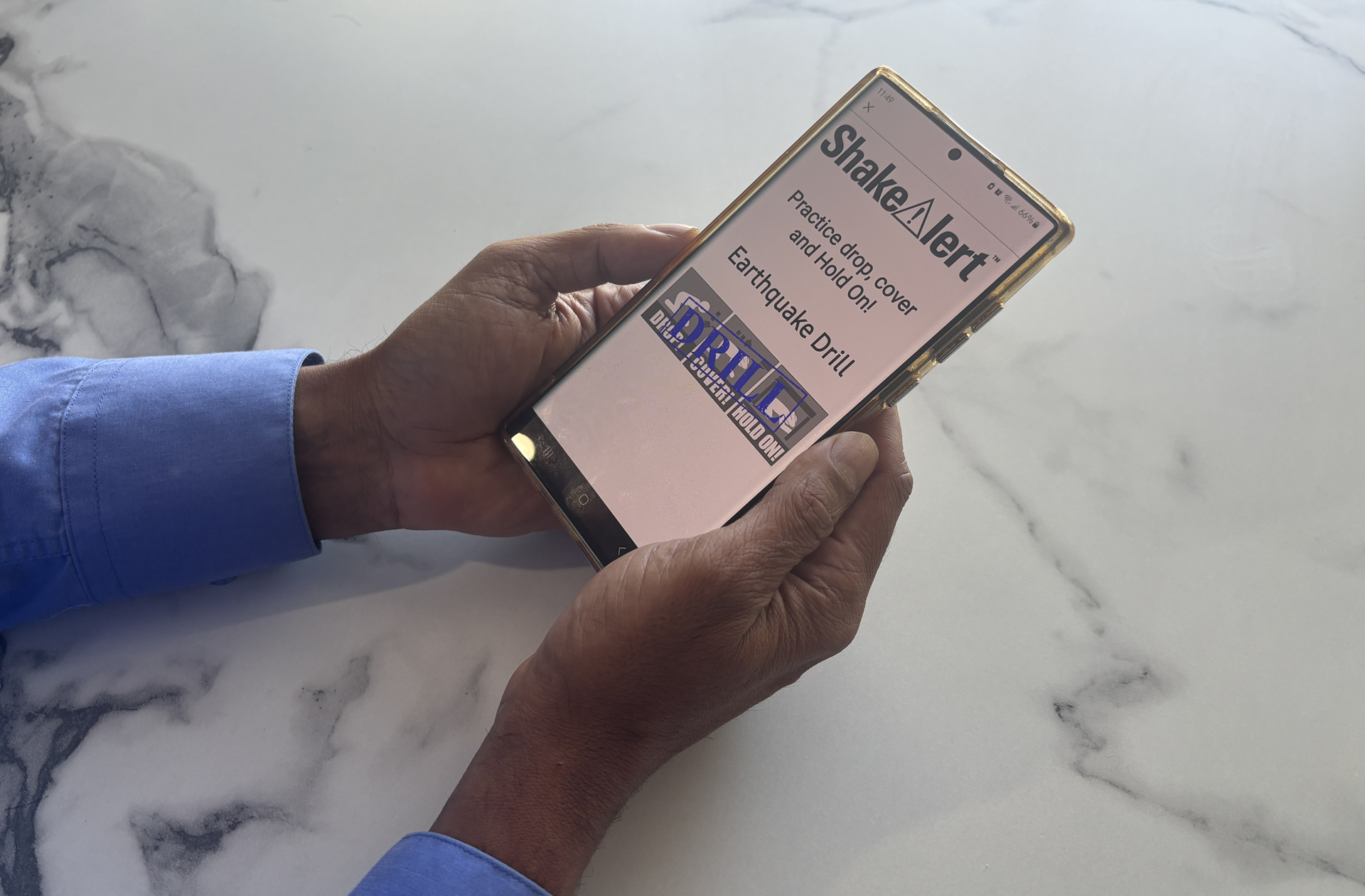
The MyShake test alert will say “Drill: Drop! Cover! Hold On!” You’ll also get an audio alert that will signify that this is an earthquake drill.
I want this alert — how can I make sure I get it?
If you have an iPhone, you can download the MyShake app from the Apple App Store.
If you have an Android phone, you can download MyShake from the Google Play store.
How will this system be used when a real earthquake is detected?
When an earthquake occurs, multiple earthquake stations will detect the shaking of the ground. Algorithms then estimate the earthquake’s location and expected magnitude.
If the earthquake is estimated to be magnitude 4.5 or greater, MyShake will send an alert to phones in the affected area.
“Just this year, there have been 15 such events greater than magnitude 4.5,” Raman said. December 2024 saw the year’s largest magnitude: a 7.0 earthquake in Cape Mendocino.
“It is important for the public to understand that earthquakes do happen throughout the state, and whatever they can do to prepare would be beneficial at some point,” he said.
I have the app, but what if I don’t get the test alert?
If you have the MyShake app and you still don’t get the alert on your phone on Thursday, don’t worry: It might be due to a few reasons.
Your alerts and notifications might be disabled for the MyShake app, or MyShake may not have permission to run in your phone’s background. Since the alert will be sent to phones in California, Oregon and Washington, the app will rely on your location data in order to send you the test alert.
This means that if you have your location services turned off, you might not be able to receive the alert. You can contact MyShake support if you think you’ve encountered a problem with the app.
(If you did install MyShake in the past on your iPhone, but you still don’t receive the alert, check that you don’t have the “Offload Unused Apps” turned on. This feature could have automatically uninstalled MyShake to save storage space if you haven’t used it in a while.)
If my phone is off or on airplane mode, will I receive the alert?
Just like a normal alert, MyShake is unable to send test alerts to phones that are off or in airplane mode.
For people who have the MyShake app and prefer not to receive the alerts on Thursday, MyShake advises people to turn off notifications on their phones from 10:00 a.m. to 11:00 a.m. on that day.
Find more frequently asked questions about MyShake here.
What are other ways than MyShake to get an alert if a real earthquake hits?
The ShakeAlert Earthquake Early Warning System (EEW) from USGS and the Federal Emergency Management Agency sends earthquake alerts to people’s phones in multiple ways.