This is a computer-generated transcript. While our team has reviewed it, there may be errors.
Jessica Kariisa [00:00:00] I’m Jessica Kariisa, in for Ericka Cruz Guevarra, and welcome to The Bay. Local news to keep you rooted. There’s this building on Broadway in San Francisco’s North Beach neighborhood. It sits between an alleyway and a parking lot, and unless you’re looking for it, you might not even notice it. But there are all these photos pasted in the window. One is of Henry Rollins, the lead singer of the punk band Black Flag, and he’s performing on a stage. The other is of the band Blondie, also performing on stage. They were performing at 435 Broadway. Also known as Mabuhay Gardens, or The Mab for short. The Mab was an institution in San Francisco’s punk scene in the 70s and 80s. Countless bands performed there, including Metallica, The Clash, The Ramones, The Dead Kennedys. The list goes on and on. It started off as a Filipino restaurant and nightclub until a punk promoter named Dirk Dirksen got involved, and it became the legendary punk venue people know it for today. The Mabuhay Gardens closed in 1987, but now a group of longtime friends of The Mab are working hard to reopen its doors.
Tom Watson [00:01:43] It’s gonna be great to feel that energy within this room again, with some live music, with cheap $20, $25 tickets, so everyone can enjoy it, and we’ll lift the roof.
Jessica Kariisa [00:01:55] Today, the people trying to bring back The Mab.
Tom Watson [00:02:09] Good afternoon. My name is Tom Watson, and you are right in the middle of the formerly called Mabuhay Gardens, currently called Broadway Studios, for which we’re bringing back to The Mab. Mabuhay Gardens was a Filipino restaurant, and that was downstairs. And so it was this nice sort of, have some food and have a drink, and then the bands would come on.
Jessica Kariisa [00:02:38] So now we’re downstairs, and we’re walking through some curtains to get to the original location.
Tom Watson [00:02:46] Yeah, so we’ve got some posters of the Fab Mab with some of the performers.
Jessica Kariisa [00:02:53] I love all this memorabilia on the wall. George Lopez? Oh, that’s funny. Lots of people have come through here.
Tom Watson [00:03:01] Robin Williams as well, performed on stage.
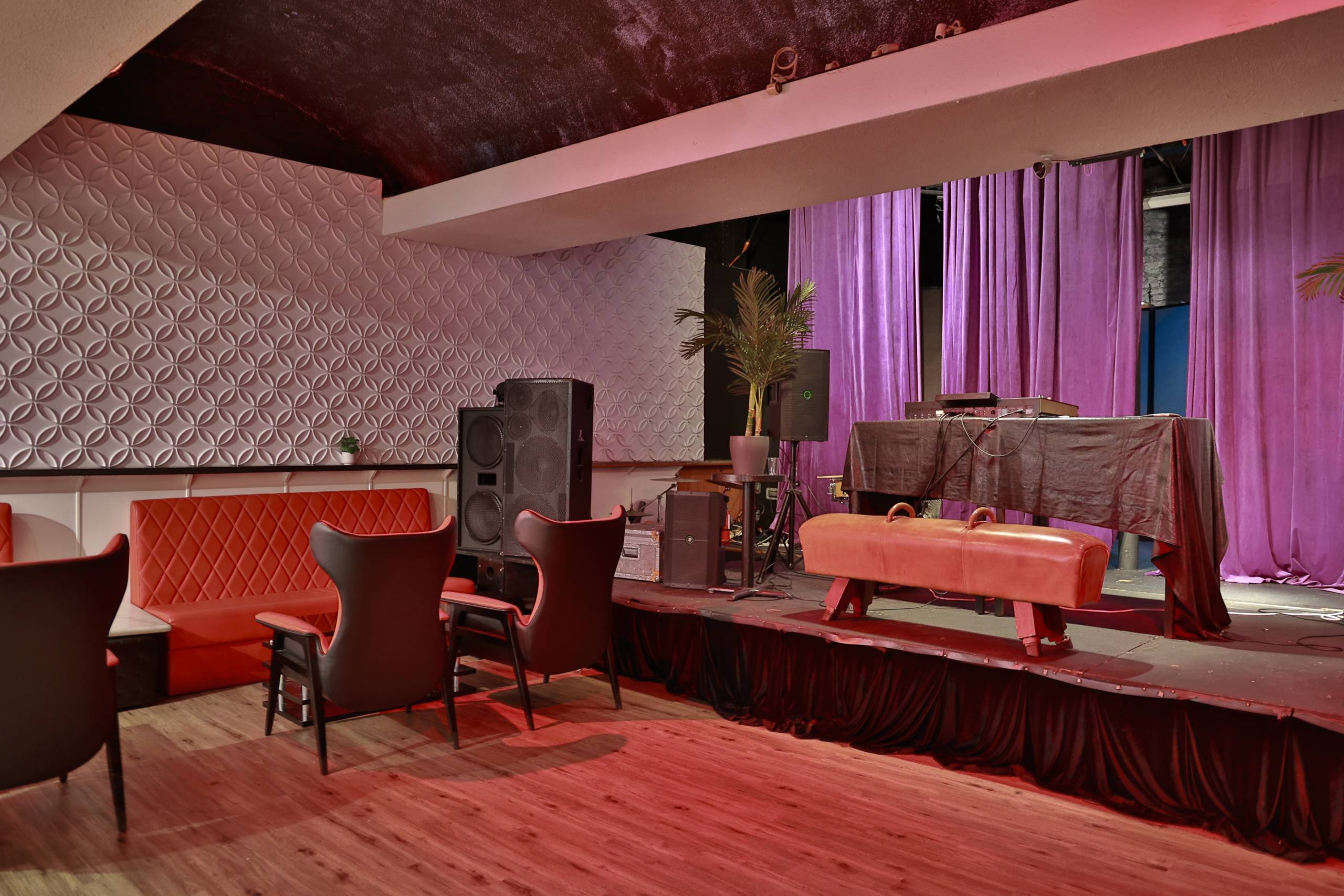
Jessica Kariisa [00:03:04] So yeah, I mean, it’s not too big of a space, but I can imagine it packed full of people. It’s like a rectangular room. We have this pretty small stage. So I guess the shows felt pretty intimate.
Tom Watson [00:03:17] Great observation. So actually the stage was brought forwards more recently when I’ve been talking to my friends about, got this amazing project. They will ask me if they’ve been here. Do they still have the purple curtains? Oh, really? Yeah.
Jessica Kariisa [00:03:30] That’s so funny. So these are the original purple curtains. Wow, I’m sure they’ve seen a lot.
Tom Watson [00:03:36] I think to me it was this nice mix of cultures that came here drawn by this sort of new bands. Unfortunately, I never experienced it, but we have a sort of group of people who did and who can help guide us. So we don’t make any mistakes in terms of honoring that heritage and what it stood for and then being able to extrapolate that and being a creative platform for anyone who wants to do anything.
V Vale [00:04:16] Yeah, my name’s V Vale and I made Search and Destroy the first punk publication to document the emerging punk rock counterculture movement.
Jessica Kariisa [00:04:31] For people who aren’t familiar, how would you describe the Mab and its heyday? What was it like?
V Vale [00:04:37] It started out as a restaurant, but also a nightclub because they actually had Filipino singers and they had acts here that were pretty niche appeal to Filipino community members. Ness Aquino was the owner of the restaurant, but somehow this man from Germany named Dirk Dirksen came here and talked him into, here, let me bring in these bands to play and you’ll keep all the money you make from food, serving restaurants, and we’ll put on the shows and we will do all the promotion and all that. So Dirk Dirksen was the German instigator of early punk rock.
V Vale [00:05:30] All the bands, punk bands all over the world wanted to come to San Francisco and play the Mabuhay because that’s the only club there was. No one else would let punk shows happen that I know of, at least. And so that made it very simple. You go to San Fransisco, you play the Mabuhay. You go there every night, there’s a punk show.
Jessica Kariisa [00:06:00] Could you describe what a typical night was like here?
V Vale [00:06:04] Yeah, it was always three bands. They’re from all over the world, really. And it made it like an international movement, which indeed it was. And punk was great, it lowered the bar to the ground. Anyone could start a band after playing an instrument for one week. And the songs were always about pretty much black humor about what’s wrong with the world. But they had to be kind of witty, you know? It’s not just anger. Black humor must be present, meaning very dark humor.
Jessica Kariisa [00:06:52] Do you have any favorite memories of bands that you saw here?
V Vale [00:06:56] There was one spectacular night when Blondie played from New York, but David Bowie was here in the audience. And Iggy Pop was in the audience.
Jessica Kariisa [00:07:08] Just watching.
V Vale [00:07:09] Just watching. And for some reason, the word got out and the club was more jammed than I’ve ever seen it before since.
Jessica Kariisa [00:07:24] And we saw the space downstairs and the ceilings are kind of low and I can imagine it gets pretty tight in there. What did it feel like? I imagine it was super sweaty.
V Vale [00:07:34] No, I don’t think so. It never got that bad, I mean, that I remember. I mean I had my black leather jacket on in photos. If it were hot, I would have taken it off. Actually, people were a lot nicer to each other than you might think. And the cliche about punk rock. You know, people, if you fell to the ground, people would pick you up.
Jessica Kariisa [00:08:11] You stopped going because you said the culture was changing. What made you stop?
V Vale [00:08:14] One word, violence. I just, I thought it was very unpleasant to be anywhere near a mosh pit. And all the girls immediately disappeared. The Mabuhay became overnight a rooster club. It’s only guys, no beautiful punk women. Anyway, that’s when I started phasing out my publishing away from punk because I did not like this change. I mean, I wanted women there. In fact, women and gays were in the forefront of our early punk rock band formations.
Jessica Kariisa [00:08:59] After Mabuhay Gardens officially closed in the late 80s, a young Filipino woman who used to clean the building took over the space. Her name was Francesca Valdez. She always wanted to reopen Mabuhay Gardens as a performance venue, but struggled to over the decades until she met Tom Watson in February of 2025. Tom is a civil engineer who moved to the Bay Area in 2011 and was looking for a building to work on. They joined forces and set plans in motion to reopen the Mabuhay. But then in July of 2025, she passed away. Tom, I wanted to bring you in. I know you didn’t grow up going to the Mabuhae, but how did you hear about it? How did you get involved?
Tom Watson [00:09:48] Really from meeting Francesca at the beginning of the year and just coming into the space and feeling how special it was and just feeling, wow, this place, this space needs to be shared. It’s such an inspiring venue. If you just look up above us now, you’ve got this wonderful light coming in and the wonderful architecture of the building and will naturally inspire you and elevate you.
Jessica Kariisa [00:10:14] Before she passed, you and her had plans for you to help revive the space. How did that come about?
Tom Watson [00:10:22] I told her what I’d done in Germany, which was transforming an abandoned building into this cultural space. And then she passed away. And I always sort of felt this was her baby. And I didn’t feel able to really do much apart from support what she wanted. But her sister just was sort of like, over to you if you wanna do this, but do you really, really wanna do this because. I’ve experienced 30 years of this and it’s been really, really hard. But there’s a great strong community here who love the space. It meant a lot to a lot of people. So we are very easily able to galvanize energy and support from people who are excited about this returning to a live music venue and other things.
Jessica Kariisa [00:11:15] Yeah, I wonder if you could, I know you’ve talked about it in a lot of different ways so far, but if you can distill your vision of the space into like a sentence or two, like how would you describe it?
Tom Watson [00:11:25] A creative platform for all.
V Vale [00:11:27] A creative platform for all, that’s bigger than just a live music venue. I mean, anything that brings people together, I guess you can do lectures, you can show movies, you can short films, you can have film festivals, you can add the small music festivals, you could have concerts. You just have to think of ideas that actually make people come here.
Jessica Kariisa [00:11:52] And I know there’s still a big challenge of continuing to raise money, right, to actually be able to keep the space, right? Is that the biggest challenge?