This is a computer-generated transcript. While our team has reviewed it, there may be errors.
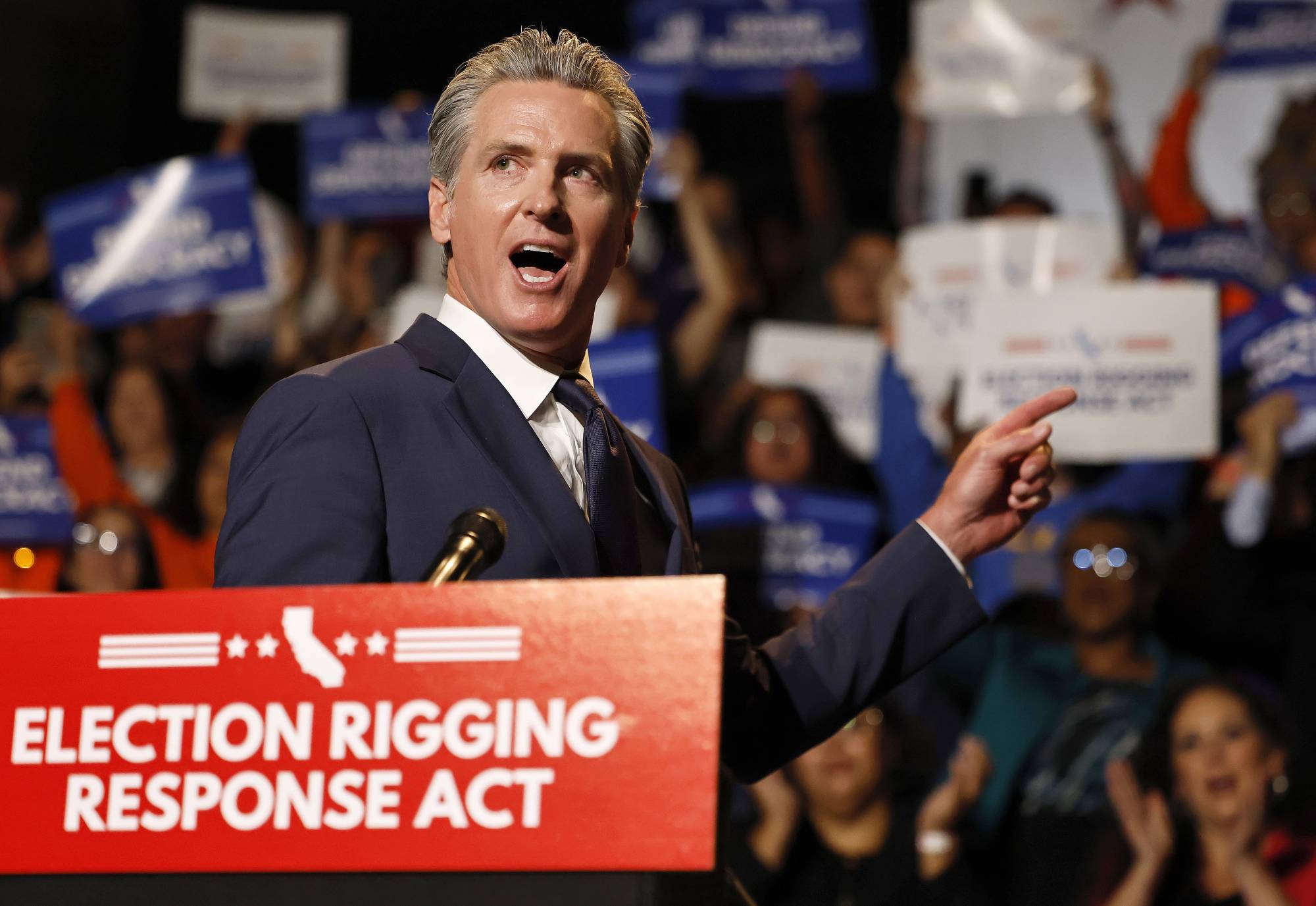
Ericka Cruz Guevarra [00:00:00] Late last week, Governor Gavin Newsom stood at a podium inside the Japanese American National Museum in Los Angeles, gearing up for another fight against the Trump administration. On the podium were the words, election rigging response.
Gov. Gavin Newsom [00:00:26] Donald Trump, you have poked the bear, and we will punch back.
Ericka Cruz Guevarra [00:00:34] After pressure from President Trump, Republicans in Texas are trying to redraw the state’s congressional districts five years early in order to win more Republican seats during the 2026 midterm elections. Now, California voters will likely be asked to weigh in in November on whether to redrew our own congressional maps. To counteract what’s happening in states like Texas.
Gov. Gavin Newsom [00:01:05] Here’s the good thing about California, folks, we’re the size of 21 state populations combined. We’re the fourth-largest economy in the world. We are not a small, isolated state. I know they say, don’t mess with Texas. Well, don’t mess with the great Golden State.
Ericka Cruz Guevarra [00:01:25] Today, what California’s new proposed congressional maps look like, and what it means for all of us.
Guy Marzorati [00:01:41] The message that we’ve heard from Newsom both at this rally and kind of for weeks has been California did not start this fight. This is parties, you know, politicians stepping in saying, we expressly want to redraw these lines to help our party. And it started in Texas where President Trump went to Governor Greg Abbott in Texas and state legislative leaders and said, I want you to redraw the state’s congressional lines to add five seats for Republicans.
Gov. Gavin Newsom [00:02:20] We can’t stand back and watch this democracy disappear district by district all across this country, not just in Texas. We need to stand up, not just California. Other blue states need to stand up. We need to be firm in our resolve.
Guy Marzorati [00:02:37] The message that we’ve heard from Newsom both at this rally and kind of for weeks has been that when you have states like Texas, most notably that has pursued a gerrymander, a redraw of their districts to help Republicans, that there needed to be some response from Democrats here in California to redraw our maps to help the Democratic Party in next year’s midterms.
Gov. Gavin Newsom [00:03:00] It’s not good enough to just hold hands, have a candlelight vigil, and talk about the way the world should be. We have got to recognize the cards that have been dealt. And we have got meet fire with fire. And we’ve got to be held to a higher level of accountability. So that’s what this is about.
Ericka Cruz Guevarra [00:03:24] Explain, Guy, the mechanics here. How is this different from how California currently draws its maps?
Guy Marzorati [00:03:34] Usually the redistricting in California and other states happens after the census comes out. It’s rare that you have new lines being drawn in the middle of the decade without a new census. So currently in California we have an independent citizens redistricting commission. This body was created by the voters back in 2008 and this was really a response to the previous practice in California where the lines were drawn by politicians. Voters had enough of that and you saw this campaign led by former governor Arnold Schwarzenegger to take the power away from elected officials drawing the lines and give it towards this independent commission. And the commission does not look at who is gonna benefit politically from the lines. In fact, they don’t even look at voter registration. They don’t really look at any political indicator. They’re looking at California and these districts through the lens of what’s the most fair way to draw lines. Let’s figure out how to make sure we’re not splitting up cities. Where they’re places of worship, where the big business corridors in the state, and let’s try to group those together in these maps. This would be a big change from that. This would go to the voters and say, can we give the power to draw these congressional districts back to the state legislature up until 2030? And the state Legislature is going to approve a map before the election so voters will know going into the polls, okay, if we give power back to legislature for this map, this is what they have in mind.
Ericka Cruz Guevarra [00:05:02] And of course, the big news most recently is what exactly those maps are gonna look like. So what did we learn about what these new districts would look like and can you tick through some of the biggest changes there?
Guy Marzorati [00:05:19] Here’s kind of from South to North, how the map makers thought about these lines to help Democrats. Perhaps the biggest change was the 41st Congressional District, which is in the Inland Empire. It’s currently represented by Republican Ken Calvert. That district was basically just lifted up into the air and dropped into LA County, which is as blue as you can get, very democratic. You know, that right away is going to make it difficult for Ken Calvert to win re-election in the district he, you know, currently nominally represents. The kind of fallout from that was you had another district currently held by Republican Darrell Issa near San Diego move up towards Palm Springs. Now that becomes more of a Democratic district. You had changes in the Central Valley where districts were pulled north. Both to help incumbent Democrats like Adam Gray, his district around Merced was moved up towards Stockton. That helps it become more democratic and changes to the Bakersfield district helped by Republican David Valadao, making it more of a Democratic district. And then in Northern California, you had two major changes to the lines here. The first is around Sacramento, where Republican Kevin Kiley represents this district that starts kind of in the suburbs east of Sacramento and then runs down the spine of the state. His district now shifts more towards the city of Sacramento, again, towards a more liberal democratic area. And then the last big change starts at the very Northern part of the State. This is the first congressional district. Right now, it covers a lot of conservative areas in the far north of the state, up to the Oregon border. And when this district was redrawn, it actually is pulled down into Sonoma County, all the way down to including the city of Santa Rosa. So suddenly, the biggest share of this district is now Sonoma county. Now we know Sonoma country, part of the Bay, very heavily democratic. This will make the first congressional district very difficult for a Republican. Like the one who currently holds it, Doug LaMalfa, to actually win re-election.
Ericka Cruz Guevarra [00:07:40] So if I’m counting that right, that’s five districts where there are currently sitting Republicans, now potentially under these new maps and under these districts in peril.
Guy Marzorati [00:07:54] Right, and that was the goal all along, right? Because Texas, their lines move five districts towards the Republican column. The goal here was to kind of counter that with five districts in California move towards Democrats. Now we should say, these are just statistics on paper where you now have these five districts that Democrats could win. We still have to have the election.
Ericka Cruz Guevarra [00:08:16] Well, let’s zoom in on Sonoma County real quick. What has the reaction been like since these new proposed maps have been released?
Guy Marzorati [00:08:29] Yeah, I mean, I’ll say just at the outset, this whole, you know, map making and line drawing is a very insider game, right? If you just walk the streets of Santa Rosa today, there’s probably not going to be many people giving, you know, thoughts on how this line redraw works. But for the folks who are really kind of involved in Democratic Party politics in the North Bay, this is a huge deal.
Pat Sabo [00:08:52] The Republicans have pushed us into a stand that we have to take. And if we don’t, then we have no rights standing up and saying that democracy matters.
Guy Marzorati [00:09:04] Pat Sabo is the party chair of the Sonoma County Democrats. What you hear from Pat is what we’ve heard a lot from kind of the rank and file Democrats in California and across the country, which is the desire to really be more confrontational in their politics.
Pat Sabo [00:09:22] People have felt absolutely helpless in what they can do. There’s now something concrete that they can do to fight back against this blatant takeover of democracy.
Guy Marzorati [00:09:36] This is what is at the heart of this plan, I think for Newsom and other Democrats. It’s like, let’s kind of go on the offensive. Let’s make this move that, yeah, it goes against norms. It goes against, you know, kind of good governance principles, but let’s have more of a partisan fight at the ballot box.
Pat Sabo [00:09:55] We know that we have to work hard to get this done in a very short period of time. And that is to do boots on the ground, to get out, to reach out to our communities, and to educate as many as quickly as we can.
Guy Marzorati [00:10:09] What we’ve heard from Pat and other kind of party activists is a real excitement for getting out there and talking to voters about this plan.
Ericka Cruz Guevarra [00:10:22] We’ll have more with KQED politics and government correspondent Guy Marzorotti after the break. Stay with us. Guy, are all Democrats super pumped about this? Or have you heard more mixed feelings from people?
Guy Marzorati [00:10:44] Yeah, no, I think there’s definitely going to be some mixed feelings about this. There was a poll done by Politico and some groups at Berkeley last week that asked, like, would you be in favor of keeping the independent redistricting commission or handing it over these line drawing powers over to the legislature? And over 60% of Democrats said, no, we want to keep the commission. Now, part of that is like how you frame the question, right? When it becomes more about Trump and fighting Republicans, I would expect to those numbers change.
Beth Hadley [00:11:23] I’m afraid that people will distrust government more. You know, they’ll just see it as another ploy by the politicians.
Guy Marzorati [00:11:30] A good example of this is Beth Hadley, who’s the president of the Sonoma Valley Democrats. And she said, yeah, you know, like she has some reservations about this idea that if you go ahead and you give redistricting powers back to elected officials, it could make people more distrustful of government.
Beth Hadley [00:11:46] They’ll feel like Democrats are sinking to the level of Republicans. I mean, there, there are a lot of cons.
Guy Marzorati [00:11:53] But at the end of the day, Beth falls where I think a lot of Democrats could potentially fall with this, is that if you start viewing it through more of a partisan lens and the desire to take on Trump and take on Republicans, then the idea of redrawing these lines becomes a more attractive proposition.
Beth Hadley [00:12:11] We need to take back the house. We need some guardrails and whatever that takes. As much as I dislike the idea of gerrymandering, I think we have to support this.
Ericka Cruz Guevarra [00:12:22] What about the other side of that coin? I imagine Republicans in California are not very happy about these proposed maps.
Guy Marzorati [00:12:33] Yeah, I mean, Republicans have come out really strongly opposed to these redistricting plans. Obviously, there’s a kernel of self-preservation in here, right, like this congressional map would hurt Republicans, would likely lead some of them to lose their seats. And Republicans have really turned this back to the idea that voters in the first place in California were the ones who approved this independent commission and saying that it’s a betrayal. Of the voters to now go ahead and hand these line drawing powers back to the state legislature for congressional lines.
Rep. Kevin Kiley [00:13:06] California voters overwhelmingly voted in 2010 to say that we should have voters choosing our representatives, we shouldn’t have representatives choosing their voters.
Guy Marzorati [00:13:16] So Kevin Kiley is a Republican Congress member who represents the area around Sacramento and actually much of Eastern California. And he’s come out as a strong opponent of this redistricting plan.
Rep. Kevin Kiley [00:13:29] When you degrade the electoral process in a way that we’re seeing right now, especially in California, then everyone suffers as a result of that.
Guy Marzorati [00:13:40] In fact, he’s gone so far as to even introduce legislation in the House of Representatives to ban all mid-decade redistricting. So basically, stop what California’s doing, stop what Texas is doing. And Kylie has called on the Speaker of the House Of Representatives, Mike Johnson, and said, you know, he wants to see the Speaker come out and say, let’s just stop all of this.
Rep. Kevin Kiley [00:13:59] I’m willing to use any and all means, legislative means necessary to get the bill passed, but even before that, the speaker and leader Jeffries could show some leadership and say, enough is enough. This is not the sort of thing that Americans want. Let’s just call a truce on all of this and get back to the issues that really matter to the country.
Ericka Cruz Guevarra [00:14:20] Well that’s that guy, I mean a lot needs to happen before these maps become the blueprint, right? So what exactly is the timeline here?
Guy Marzorati [00:14:31] We’re just this week kind of watching this move through the legislative process in Sacramento. They’re gonna go through the motions this week and kind of take the votes needed to get this on the ballot in November. And they do need to do that.
Ericka Cruz Guevarra [00:14:46] If ultimately everything goes how Democrats want it to with these new districts, how much of an impact could these new district actually have on Trump’s ability to do what he wants in his last two years of his term on things like immigration, the environment, all these issues that Californians really care about.
Guy Marzorati [00:15:12] I’m looking at this redistricting battle as kind of one piece in what will ultimately decide the House elections in 2026. This is kind of like setting the roadmap for where these elections will take place. There’s still all the other things that actually decide an election. What are the issues of the day? Most notably in a midterm, it’s often a reflection and a referendum on the president. So how are voters perceptions of the economy? How are voter perceptions of the job? That Trump is doing as president, who are the candidates that ultimately end up running in these seats. Those will all go a long way in determining who actually controls the house and whether or not Republicans will continue to have unified control of government. I will say that the line drawing matters perhaps more in this election just because we have seen to some extent kind of a partisan gridlock in the house map. There are fewer and fewer congressional districts and seats that are really actually up for grabs. Both parties are battling for fewer and fewer truly competitive seats. And so I think that’s why you’re seeing so much emphasis and so much attention on these line drawing battles.
Ericka Cruz Guevarra [00:16:33] Well, Guy, thank you so much for breaking this all down for me. Um, I didn’t think it would be an election year, but here we are.
Guy Marzorati [00:16:41] Here we are. Yep, thanks for having me.