Skip to the Bay Area public transit you use:
There’s no other way to put it: Bay Area transit agencies are struggling.
When the coronavirus pandemic hit, many businesses told employees to work from home. Local public health authorities mandated that non-essential workers stay home, too. Ridership on all Bay Area public transit systems plummeted as a result.
Agencies have struggled to maintain basic service, keep riders and workers safe and avoid mass layoffs. An infusion of emergency aid from the federal government allowed transit systems to survive, but getting back to “normal” is still far in the future. “We are now facing the complete economic devastation that is the aftermath of this pandemic,” San Francisco Municipal Transportation Agency Director of Transportation Jeffrey Tumlin said on Tuesday’s KQED Forum.
What About Safety?
Transit operators have lost hundreds of millions of dollars in revenue since shelter-at-home orders were imposed in March. One of the major challenges they face now is convincing patrons that it’s safe to ride again, even with the coronavirus pandemic still simmering.
There’s some evidence that transit isn’t to blame for as much transmission of the coronavirus as authorities and the riding public might believe. Studies of outbreaks in various cities around the world have not detected infection clusters linked to public transportation. And a new article from The Atlantic notes that the incidence of COVID-19 has been low in one of the world’s most crowded, transit-reliant cities:
If transit itself were a global super-spreader, then a large outbreak would have been expected in Hong Kong, a city of 7.5 million people dependent on a public transportation system that, before the pandemic, was carrying 12.9 million people a day. Ridership there … fell considerably less than in other transit systems around the world. Yet Hong Kong has recorded only about 1,100 COVID-19 cases, one-tenth the number in Kansas, which has fewer than half as many people. Replicating Hong Kong’s success may involve safety measures, such as mask wearing, that are not yet ingrained in the U.S., but the evidence only underscores that the coronavirus can spread outside of transit and dense urban environments—which are not inherently harmful.
Scroll down for a status report on the Bay Area’s biggest public transit providers, and see how your local service is being impacted — whether that's SF Muni, BART, AC Transit, Bay Area ferries or Caltrain.
We've also got a look at what could be next.
San Francisco Muni
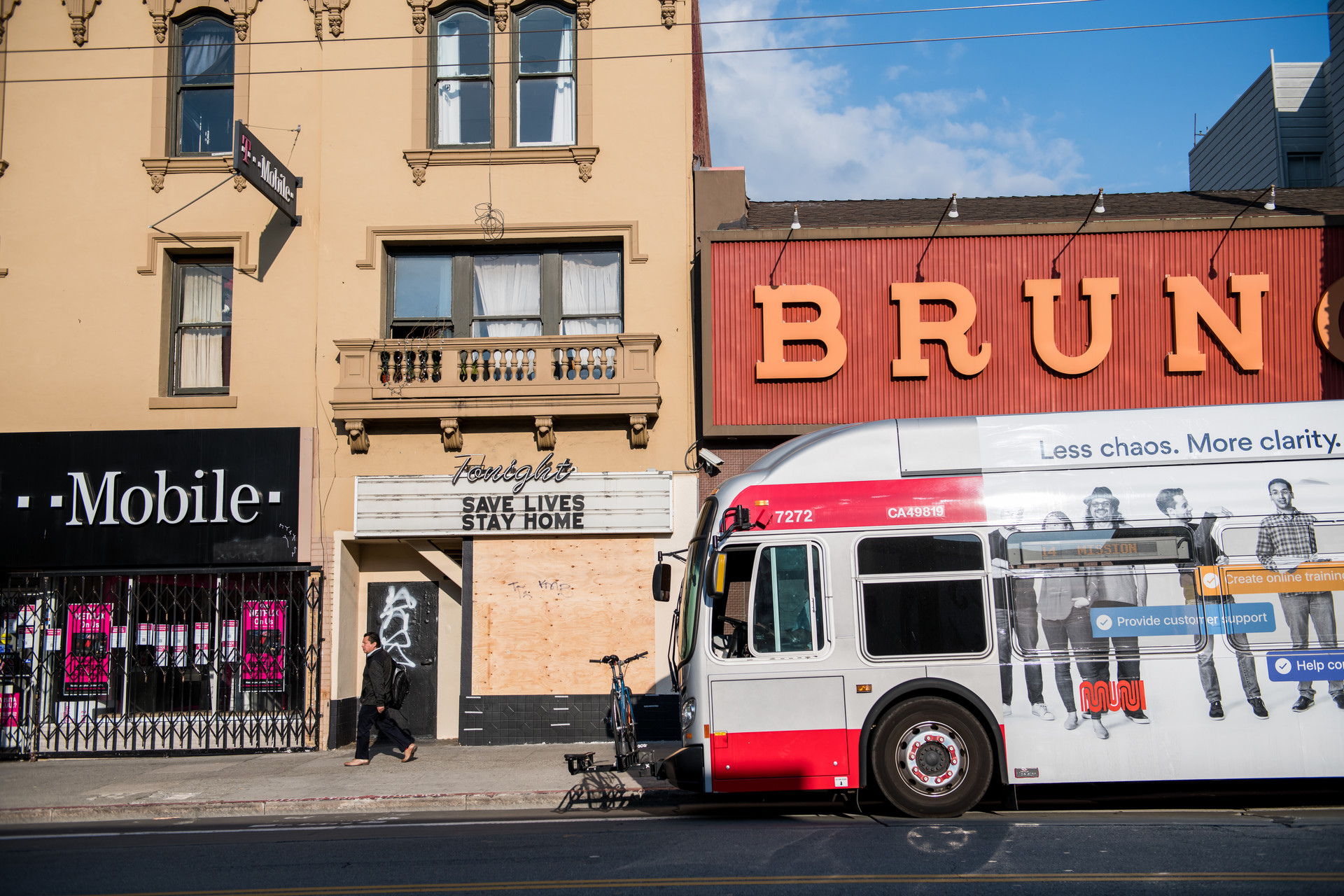
Muni has suspended its cable cars, streetcars and subway and light-rail lines — in addition to canceling service on 70 of 89 bus routes. Now, some service is returning, with a total of 25 lines running. Tumlin says the current all-bus system is safer because vehicles can operate with windows open, which circulates fresh air and reduces the chance of virus transmission on vehicles. However, he says maintaining 6 feet of social distancing on buses translates into an unsustainable 80% reduction in system capacity that will limit the agency's ability to resume more service.
“Our financial reality is that all of our sources of revenue are down by 30 to 100%, and many of those will not be coming back for a long time,” Tumlin said. That means he doesn’t expect Muni will be able to restore all the lines it suspended for up to two years.
“This is the financial calamity that’s affecting so many households across the nation, and is also affecting every public agency,” Tumlin said.
He said Muni is doing everything it can to make buses safe to ride and to operate. Drivers have protective barriers, wear masks and keep the windows down to increase air circulation. Most buses have rear boarding to facilitate passengers spreading out. The buses are cleaned and sterilized at the end of every shift, about three times a day.
“And as far as we know, there are no cases of passengers having contracted COVID-19 on Muni,” Tumlin said. He added that there have been just 14 COVID-19 cases among the agency’s 6,000 employees, and all have recovered. None of those are believed to have contracted the virus in the workplace.