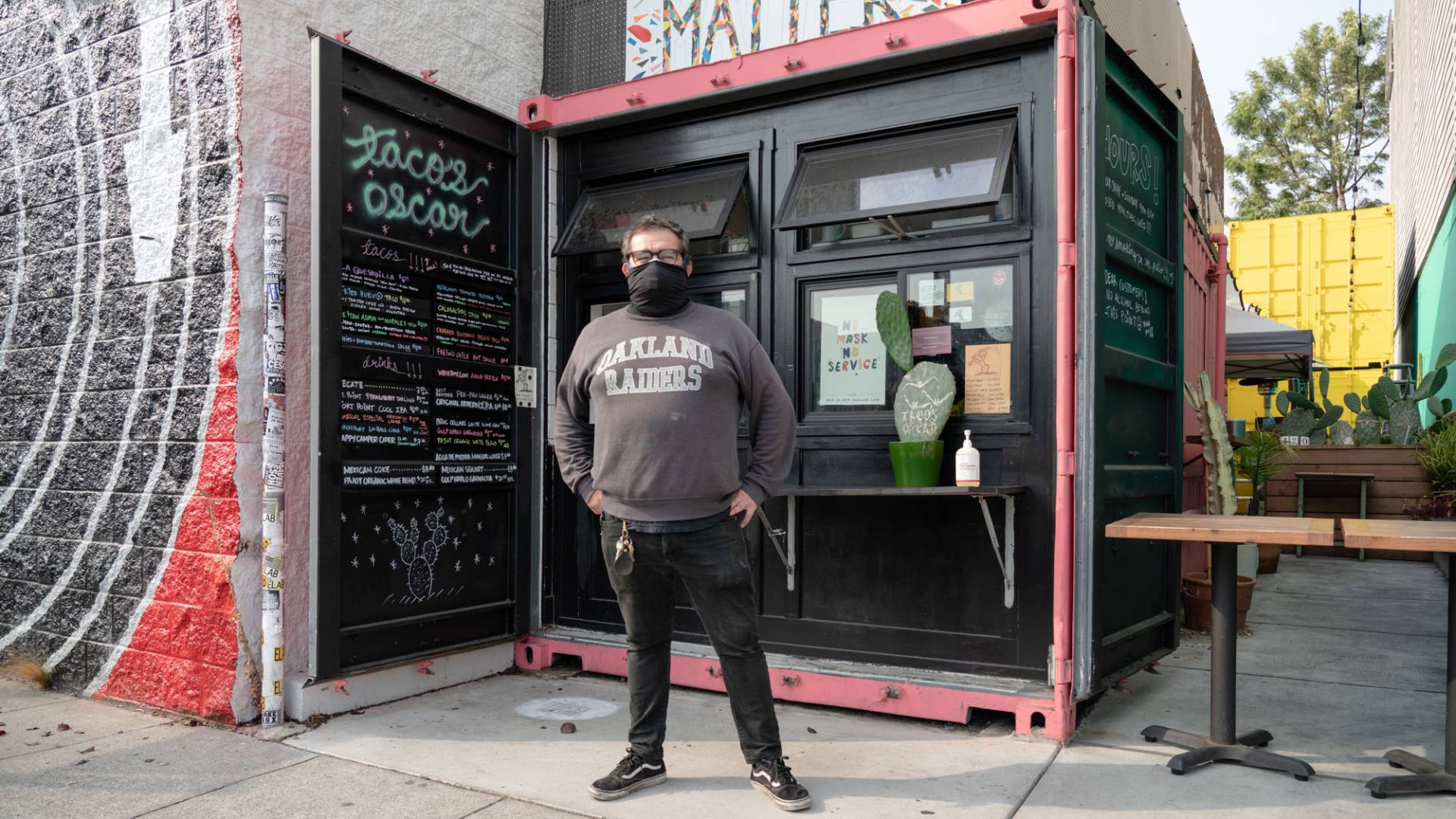
Tacos Oscar was quick to close and slow to reopen.
In mid-March, as the reality of the pandemic set in, Oscar Michel and Jake Weiss closed their popular restaurant, running out of three smartly arranged storage containers on 40th Street near Broadway in Oakland. They opted out of take-out service as well, hitting pause for over three months on the house-pressed tortillas and imaginative fillings that have garnered the eatery fans across the Bay Area.
“It was a very personal decision. We were freaked out by the pandemic and the chance of getting sick,” Michel explains, adding that their efficient and cozy quarters would make social distancing impossible for staff. Until the restaurant reopened with limited hours in late June, Michel lists off the creative ways the duo kept themselves busy—and their business afloat.
They sold gift cards wrapped in hand-drawn, colorful old menus. They hawked “Tacos Oscar Stalker” T-shirts. Eventually, they applied for federal aid and grants. And along the way, the worker-owner duo managed to raise money in support of local efforts: against police brutality and to counterbalance the pandemic’s uneven distribution of infections and deaths.
Tacos Oscar’s internet fame helped promote their gift cards and T-shirts; the restaurant’s Instagram account has nearly 12,000 followers, a fan-base cultivated when it was still a pop-up, hopping around town between different kitchens. Proceeds from merch sales, screen printed by Michel on thrifted shirts and sweatshirts, supported their staff, some of whom weren’t able to get on unemployment.
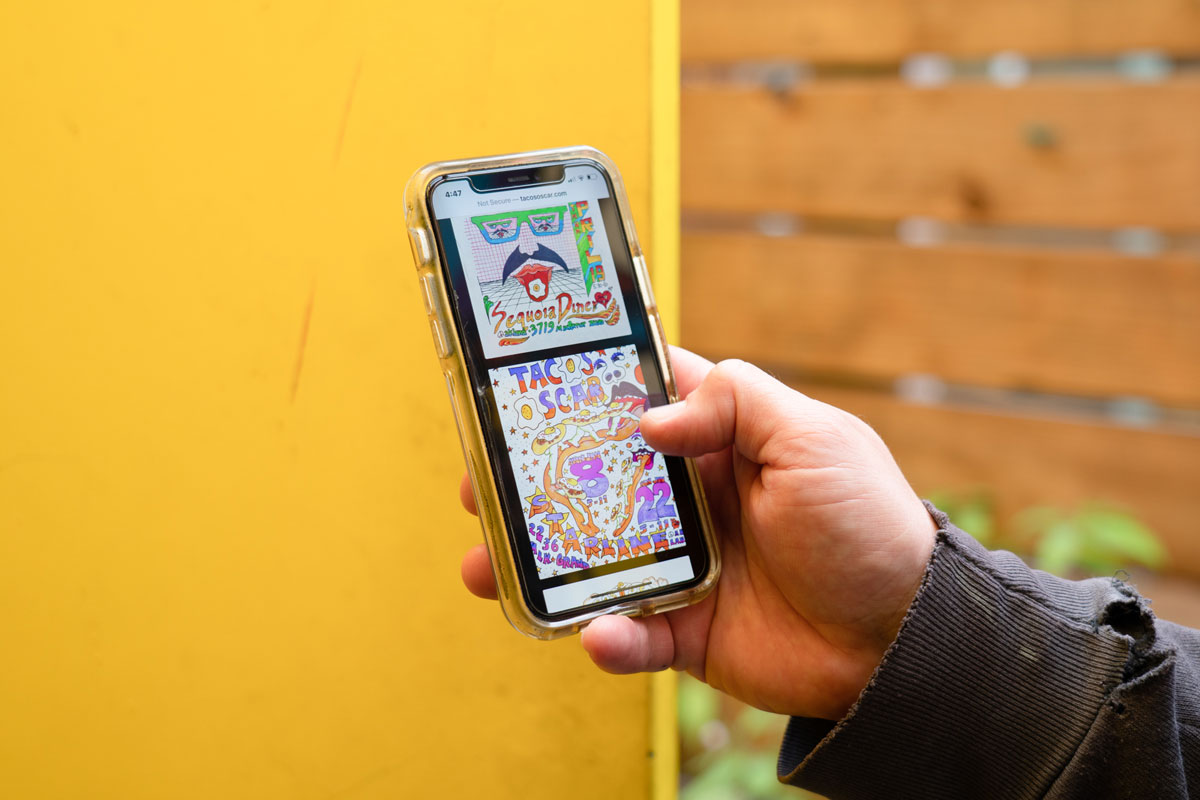
Taking orders, making T-shirts and mailing everything out kept Michel busy. “Then George Floyd was murdered,” he recalls. “And all of a sudden a pandemic wasn’t just a pandemic anymore.” For the second round of T-shirt sales, Michel proposed half of the profits go to People’s Breakfast Oakland, a food and resource distribution organization focusing on the unhoused population in West Oakland. Those sales totaled $14,000, $4,000 of which went to People’s Breakfast. The restaurant has since done fundraisers for the Street Level Health Project and the Black Organizing Project.
The gift cards brought in around $9,000 in just two weeks time. “It’s like the best loan you could ever get ever anywhere on the planet,” Michel explains. “We got a $9,000, zero percent interest loan.”
He said customers are finally coming in and using their gift cards but he expects some will go unused. That money helped Weiss and Michel cover overhead costs like rent and workers comp while they were closed. Their landlord also gave them a rent break. “We didn’t even ask but he was like, ‘Hey I’m going to shave $1,000 off your rent,’” Michel said, bringing that expense down to around $2,000.
But the most remarkable cut Weiss and Michel made to keep Tacos Oscar afloat was slashing their own pay at the start of shelter in place. “We pay ourselves $1,500 every two weeks,” Michel explains. “We could be taking more. But why? [We] don’t need that much money.” In the past, before the pandemic and the restaurant’s busy summer months, the two took home double their current salary. In less busy months, they paid themselves around $2,500 every two weeks. Their current salary is closer to their opening salaries in 2018.
That conservative approach allowed Tacos Oscar to pay back their opening costs in the first year as a brick-and-mortar restaurant—an anomaly in an industry that operates on slim margins.