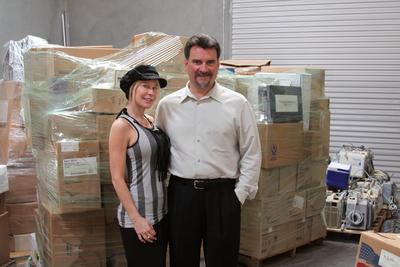
Derika Moses, a former softball star, lost her job, and then her home, as she grappled with pain and illness after her spinal surgery. (Annie Tritt/CIR)
By Christina Jewett and Will Evans, The Center for Investigative Reporting
With a metallic clatter, evidence of an elaborate scheme to enrich a few landed in the receiving room of Richard Walker’s surgical supply firm in South Africa.
Although the true extent of the caper remains buried in the necks and backs of people scattered around the U.S., it began to unravel that day in 2009.
Ortho Sol makes precision screws for the most delicate of construction projects: spinal fusion. Doctors around the world drive them into the vertebrae of patients with devastating back injuries.
Sponsored
The company had repossessed some of its screws after one U.S. distributor – Spinal Solutions LLC – stopped paying its bills. But now, nestled with the returns, the brighter yellow luster of a few screws caught Walker’s eye.
Testing confirmed his fears. Some were not made of his firm’s medical-grade titanium. Their uneven threads showed potential for backing out or breaking, he said. He feared the laser-etched markings intended to make them look authentic could be toxic to patients.
Walker’s conclusion: The Southern California firm was knocking off his products.
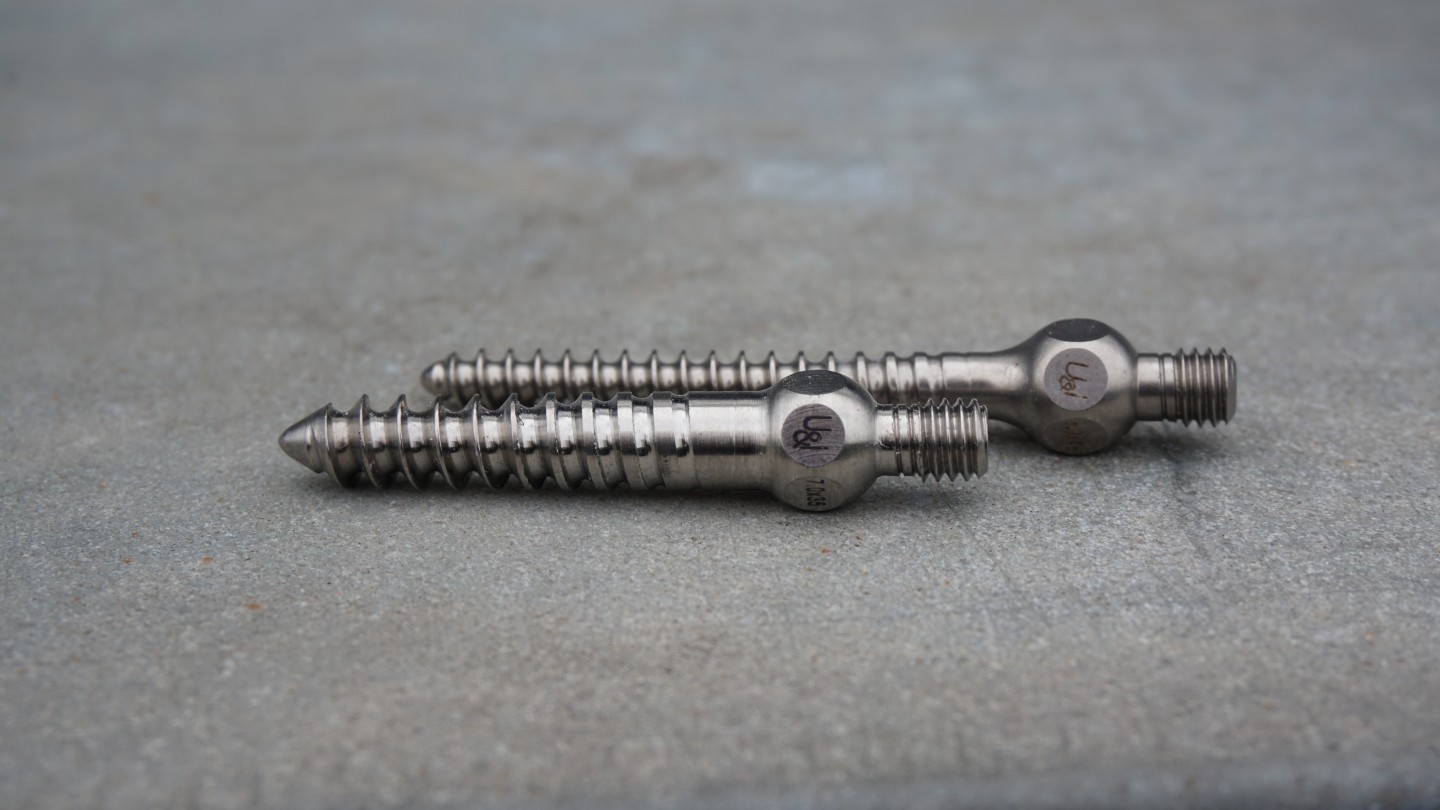
The screw in the foreground is a knockoff of South Korean company U&I Corp.’s product. The real screw, with its italic logo, is in the background. (Michael I. Schiller/CIR)
Yet it would be two more years before an employee of Spinal Solutions alerted the U.S. Food and Drug Administration to the counterfeiting, and even then, the agency didn’t shut down the company.
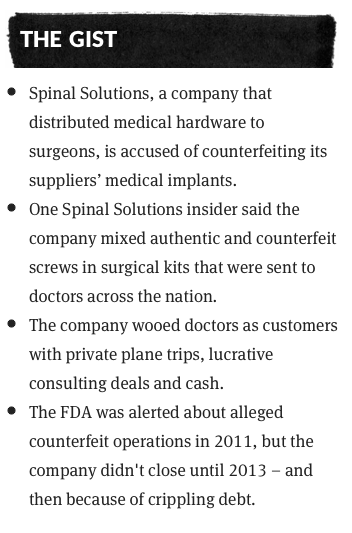
By the time Spinal Solutions went broke in 2013, the company had sold millions of dollars in implants to a nationwide network of surgeons, The Center for Investigative Reporting has found.
Now patients are left with more questions than answers.
“What do they do if they find out there are these bogus parts that can come unscrewed?” said Susan Reynolds, a Riverside County, California, woman whose doctor used Spinal Solutions screws on her in 2009, following years of intractable pain. “I’m a walking time bomb.”
The man at the center of the scandal is a company president who indulged in luxury – private planes, strip club spending sprees, courtside seats at L.A. Lakers games – as the company collapsed into debt. Attorneys lined up to serve him with legal documents now say they can’t find him.
The company sold its wares to doctors who received consulting deals from Spinal Solutions worth thousands per month, rides on company planes, even bundles of $100 bills, company insiders allege. In turn, the physicians ordered the company’s implants for their surgeries at hospitals in California, Nevada, Texas, Wisconsin and Maryland.
Surgeons insist they never used subpar implants, and CIR has no evidence the doctors were involved in the scheme. But one former company insider says knockoff screws were mixed in with real ones.
An elderly machinist finds himself unexpectedly wrapped up in the scandal. In an interview with CIR, he admitted to making scores of copies of surgical screws for Spinal Solutions. The company bargained him down to $65 a screw – less than half of what they usually cost.
The screws, real or fake, all funneled into what lawsuits claim was a larger scheme to bilk California’s workers’ compensation system, an employer-funded program designed to help those injured on the job. Some hospitals billed insurance carriers as much as $12,500 a screw before a 2012 change in state law shut down the astronomical markups. From that, Spinal Solutions stood to reap several thousand dollars from the sale of a single screw.
Patients, though, may end up paying the steepest price.
Five years after having surgery, Derika Moses had most of her spinal hardware removed, convinced it was the cause of her chronic pain and infections. (Annie Tritt/CIR)
Patient’s Hardware Raises Questions
Derika Moses hefted a case of 2-liter soda bottles while setting up a grocery store display in 2007. Her back popped, leaving the former softball star frozen in excruciating pain.
Nothing helped. In desperation, Moses opted for spinal fusion surgery.
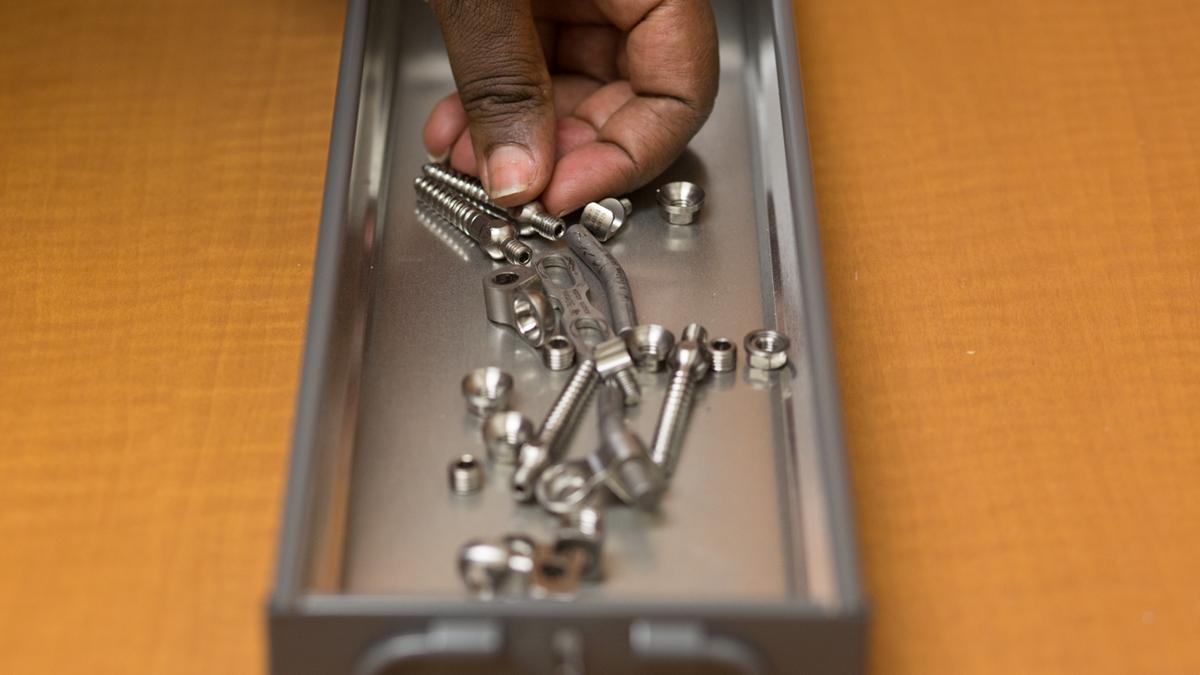
The procedure offered little relief: Chronic pain and infections plagued her. Five years later, she had most of her spinal hardware removed, convinced that the erector set of metal in her spine was the source of ongoing problems.
She begged hospital staff to let her keep the rods and screws. She hoped to fashion them into a necklace, she said, as a symbol of the pain she had endured.
A nurse slipped them under her pillow.
Moses, 38, of Riverside, had all but forgotten the bag of hardware until she received a letter from an Oakland law firm in March. It suggested she might be the victim of medical fraud.
“I had to know if I was part of it,” Moses said. “I had to know.”
Attorneys contacted Moses after finding her name among Spinal Solutions’ sales records. The law firm, Knox Ricksen, is working with other firms to file lawsuits -- more than 30 and counting -- on behalf of Moses and other patients. The lawyers accuse Spinal Solutions of selling counterfeit implants and doctors of accepting kickbacks in return for using them.
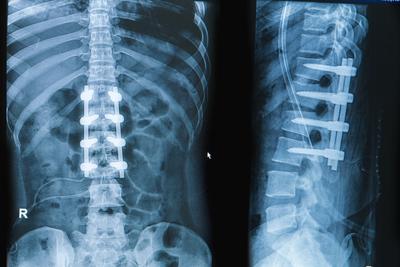
During spinal fusion surgery, doctors implant screws into the vertebrae of patients with devastating back injuries. (Praisaeng/Shutterstock)
Spinal screws are not Home Depot fare. The implants must fit together precisely to support a body in motion, said UCLA neurosurgeon Dr. Duncan McBride.
“It’s like building a bridge in the back of someone’s spine. So if you have inferior material, it’s not going to work as well,” he said. “It’s going to be less successful and potentially harmful.”
CIR showed photos of Moses’ hardware to U&I Corp., the South Korean company whose logo was etched on it.
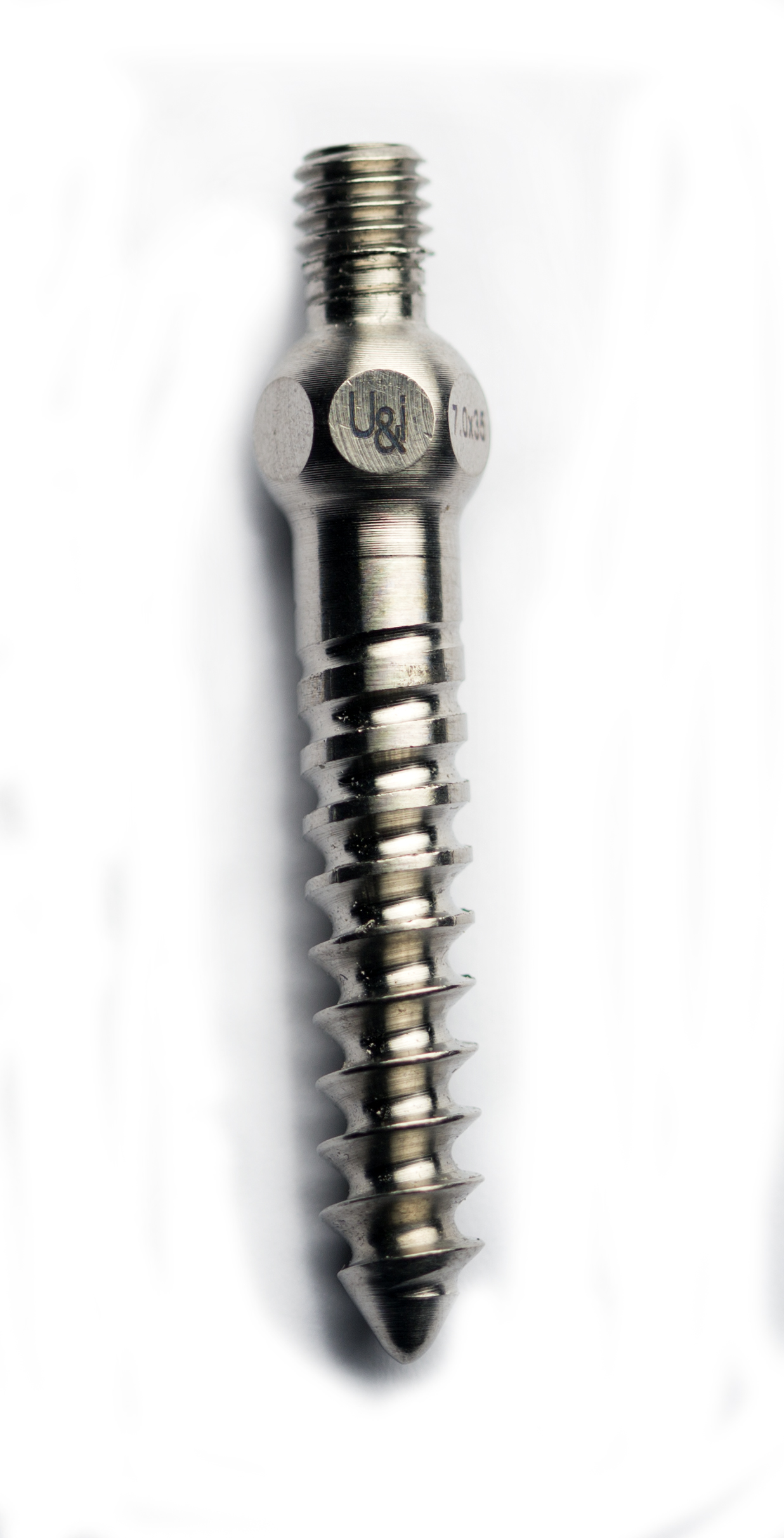
Company engineers noted the finishes and lot numbers on some of Moses’ screws and connectors did not match their product. But the dead giveaway was the logo, they said, which lacks the firm’s signature forward-leaning font.
During an interview at the company’s U.S. office in Orange County, General Manager Sung Hwang identified three of Moses’ four screws as fakes.
“This is obviously not what we did,” Hwang said. “I feel sorry because (patients) got the surgery with improper devices, so they might suffer from it.”
Hwang said the company first heard about Spinal Solutions’ counterfeiting from plaintiffs’ attorneys in 2012 and is not happy about the matter.
Moses’ initial reaction on hearing about the apparent scam was fear because a few metal pieces remain in her back. But she says her feelings changed as she learned more from her attorneys about kickbacks that Spinal Solutions is accused of paying to doctors.
“It always, always turns to anger,” she said, “every time I sit and think about what they did.”
Moses lost her job, and then her home, as she grappled with pain and illness after her spinal surgery. The flashy businessman who sold her implants, meanwhile, lived a life of luxury.
The IRS determined that Roger Williams and his wife, Mary, underpaid their taxes by a combined half a million dollars due to fraud in 2009 and 2010, according to court filings. (The Press-Enterprise)
An Executive’s Lavish Lifestyle
One private plane wasn’t enough for the Spinal Solutions founder. Roger Williams had three.
Williams spent 16 years in the orthopedic sales business with his father before he went out on his own. He started Spinal Solutions in 1999 and launched a firm selling knee and hip implants three years later. From nothing, he built an $18 million-a-year business based in Murrieta (Riverside County).
By 2008, his planes were shuttling staff and surgical equipment from coast to coast. He also followed the Los Angeles Lakers all over the country.
He ordered his seven-seat jet painted with stripes of Lakers purple and gold, and he and his wife sat courtside among celebrities, according to interviews with former employees. Sometimes he invited a member of the team onboard.
“He lived like the richest guy on earth. Like a movie star or something,” said Andreas Leuthold, a pilot who worked for Williams.
Williams and his wife had a BMW, a Mercedes-Benz, a yacht named “Spare Change” and a 6,300-square-foot Murrieta home, according to court records and interviews.
He withdrew thousands of dollars from Spinal Solutions’ account to patronize strip clubs like the Spearmint Rhino Gentlemen's Club. When creditors later asked why, he said, according to court transcripts, “because I felt like it.”
But Spinal Solutions also racked up big debts with hardware manufacturers and then refused to pay, according to industry executives and lawsuits.
The company increasingly relied on Lenders Funding LLC, a firm that fronted cash at an interest rate of 35 percent. By 2013, the company owed the lender about $35,000 per month – solely in interest payments – and imploded in debt.
It remains unclear when Spinal Solutions began to counterfeit surgical implants. And it is nearly impossible to trace each knockoff to each patient or to confirm how many were affected.
In a line of business built on meticulous order, the inner workings of Spinal Solutions were a study in disorder.
Take Operations Manager Jeff Fields, whom Williams called “my main guy.” Fields was in charge of the company’s inventory of surgical implants.
A court declaration from Williams’ brother-in-law says that Fields’ work was “sloppy” and that he’d seen him use methamphetamines on the job. Fields did not respond to letters and Facebook messages. When reached by phone, he said, “I’ve got no interest in speaking to anybody,” and hung up.
The brother-in-law, Carl Sisler, was Spinal Solutions’ first employee and knows more about the company than anyone else, Williams said in a court filing. Sisler is described as a “Medical/Surgical instrument technician” in his own court declaration.
But Sisler denied being an instrument technician and told CIR he was in prison for domestic violence for many years of the company’s run. Sisler’s convictions also included making a terrorist threat and indecent exposure, but he was paroled in 2008, according to prison records.
“I was a nobody there,” Sisler insisted in a telephone interview, during which he slurred his words and acknowledged he was drunk. “I was the gofer guy who made $285 a week cleaning toilets.”
Williams, meanwhile, accused his bookkeeper of sabotage and embezzlement in a court declaration and said the books never were made right.
Williams had an especially volatile relationship with his wife, Mary, whom he once described as the company’s chief financial officer. He was convicted of misdemeanor domestic violence in 2013.
The IRS determined the Williamses underpaid their taxes by a combined half a million dollars due to fraud in 2009 and 2010, according to court filings. The couple’s taxable income topped $5 million each year.
Mary Williams filed an appeal to the IRS in tax court last year, blaming her “controlling, abusive” husband for the problem.
She referred CIR to her attorney, who declined to comment.
The company’s records got caught in the crossfire. In a deposition related to creditors, she described getting law enforcement to open the Spinal Solutions offices so she could take hard drives.
“Half of the stuff is gone because my wife took it, you know,” Roger Williams said during a bankruptcy-related hearing.
Pilot Bob Garrison, who used to work for Spinal Solutions, recalls handing off packages of cash to doctors on two occasions. (Will Evans/CIR)
Flying Screws, Doctors and Cash
Spinal Solutions could not have raked in millions or spread its products across the U.S. if not for doctors eager to do business.
Roger Williams lured them with private plane rides, generous consulting contracts and even cash, interviews and records show.
Williams did not respond to calls, emails or letters from CIR.
Williams made it clear the consulting deals and free flights were tools to keep doctors hooked on his products, said Quin Rudin, a businessman who poured money into the company when it hit a cash crunch in 2012.
“He said that many times. ‘In order to do business with these guys, I gotta take care of them,’ ” Rudin recalled from behind thick glass in a downtown Oakland jail, where he landed after pleading guilty in an unrelated fraud case.
Pilot Bob Garrison enjoyed a bird’s-eye view of the shenanigans, flying screws and doctors and cash.
“Roger told me ..., ‘These doctors are greedy. They’re so greedy, you can’t believe it. All I do … I take advantage of their greed,’ ” Garrison told CIR.
On one occasion, Garrison said Williams had him hand one out-of-state doctor an envelope stuffed with $20,000 in cash. On another, Garrison said he handed a doctor a bottle of wine in a canister packed with $100 bills.
One Spinal Solutions sales representative said he suspected Williams was using perks to woo surgeons.
“He said that any doctor that I could bring on board would be taken care of,” said Robert Ashcraft, who worked for Spinal Solutions in Nevada. Meanwhile, he said, Williams was pushing a product that was “second-rate crap.”
One busy spinal surgeon, Dr. Cully White of Pewaukee, Wisconsin, took breaks from his suburban mansion on Spinal Solutions plane trips to the snowy resort town of Vail, Colorado, and the sunny Mexican beach retreat of Cabo San Lucas.
The doctor’s longtime sales representative, John Sargent, went along for the rides in 2007 and 2008. Sargent said they went skiing in Vail and fishing in Cabo but also talked business. He encouraged White to reimburse the company, he said, but doesn’t know if White did.
“I was telling (White) for a long time that I didn’t think (Williams) was a very savory character,” Sargent said.
Williams sold hardware manufactured by a legitimate company, said Sargent, who took a 25 to 30 percent commission. But he did recall that Spinal Solutions once sent a set of implants without labels.
“When the set came in, I said there’s no way I’m bringing this into the hospital,” Sargent said. “It just didn’t look like what you know it’s supposed to look like.”
In more than a dozen operative reports from 2010 and 2011, White noted that the screws he put into patients’ backs came from Spinal Solutions, according to documents obtained by CIR.
Sargent said he didn’t personally see most of the implants White used, but he had a “spider sense” that the doctor never implanted any bogus hardware.
White’s successful career faltered when he was hit with an unrelated federal indictment and medical board investigation last year.
White amassed a $22 million fortune, then scammed insurance companies for a little more, prosecutors said. The doctor pleaded guilty to billing for nerve monitoring that didn’t happen and was sentenced in April to six months in prison and six months on house arrest. He didn’t respond to letters sent to his Minnesota prison.
Wining, dining and flying surgeons used to be commonplace in the medical technology industry, said David Rothman, director of the Center on Medicine as a Profession at Columbia University. The practice has faded in recent years, he said, with government scrutiny, new transparency rules and growing awareness that gifts create a psychological obligation to give back.
“The company that takes you out to dinner is the company that you’re going to favor one way or another,” Rothman said.
Dr. Randy Davis said he didn’t take any bags of cash or free vacations. The Baltimore-area spine surgeon did once accept a seat close to actor Jack Nicholson at a Lakers game with Roger Williams but told CIR, “I can’t stand basketball ... that’s the worst thing you could bribe me with.”
Davis said Williams was a fast-talking pitchman who persuaded him to sign up for Spinal Solutions’ implants, which he estimated he used in several hundred surgeries, and for consulting agreements to develop new surgical tools and implants. He was paid $250,000 for one of the agreements, he said.
The money didn’t affect Davis’ use of the implants, he said. “I really believe that I do not make decisions for patients based on money,” he said.
The counterfeiting claims don’t ring true to him either. He said he never received any substandard implants.
After the devastating 2010 earthquake in Haiti, Williams used his planes to deliver needed medical supplies, and Davis traveled with him.
The doctor believed Williams was doing good things, he said, and thought the ideas he offered as a Spinal Solutions consultant would help patients. But Davis said he grew frustrated by the lack of progress on his projects and eventually ended the five-year relationship in late 2012.
Another consultant who used the company’s implants, Dr. Paul McDonough of Texas, received at least nine $8,000 checks in 2012 from Spinal Solutions, according to court records. McDonough helped create an implant prototype, but in the end, “nothing happened to it,” Williams said in court testimony.
McDonough did not respond to repeated phone calls and a list of questions faxed to his Abilene office.
Consulting deals are common in the medical field and are legitimate if the physician provides a meaningful service for a reasonable compensation. But whistleblowers and prosecutors have gone after top device firms over phony agreements, claiming they amount to kickbacks.
Williams’ ability to connect with surgeons across the country meant that when counterfeit hardware slipped into the mix, the problem went national, according to one company insider.
The former sales representative remembers watching another employee pluck a few screws from a tray in the company warehouse for shipping to an out-of-state surgery.
The screws didn’t look like the other ones, said the sales rep, who declined to be identified out of fear of retribution. He grabbed a few to examine them. Some were blatantly inferior, he said, at times with metal shavings and burrs in the threads.
“And I saw these screws being shipped all over the United States,” he said.
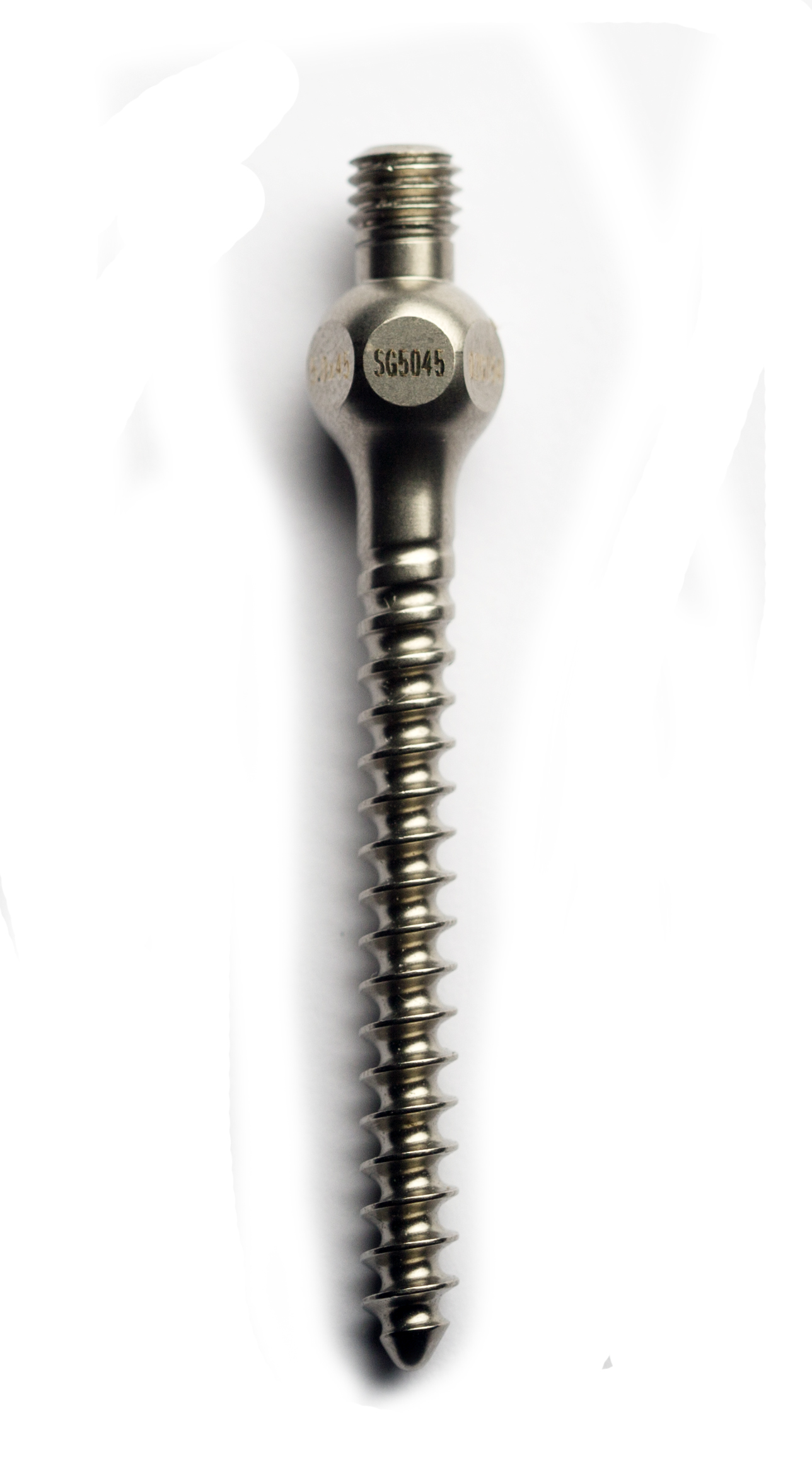
South Korean medical hardware company U&I Corp. once supplied screws to Spinal Solutions. (Adithya Sambamurthy/CIR)
Employee Alerts FDA
The sales rep grew increasingly disturbed thinking about patients waking up from surgery with what he described as garbage in their spines.
“To do that to somebody when they’re already experiencing tremendous pain, then to take a counterfeit screw so your (profit) margins are more, especially a poorly crafted counterfeit screw. … It was just so ridiculous,” he said.
The authorities would surely shut down the operation, he thought, if they only knew.
After making numerous phone calls, the rep set up a meeting with the FDA in June 2011. He described how he spread out an array of questionable screws for FDA investigator DeJon Harris on a table at Coco’s Bakery Restaurant in Corona (Riverside County).
“I also impressed upon her, you need to go sirens blazing and door-kicking and stop this,” the sales rep said. “Every day you guys don’t do something, some loved one is getting these fucking screws put in their spine.”
The sales rep said he gave Harris screws to take back to the FDA district office in Ontario (San Bernardino County). “You couldn’t ignore that they were counterfeit,” he said. “It was so blatantly obvious to even the untrained eye.”
In cases of alleged counterfeiting, the FDA could bring in its Office of Criminal Investigations or call the FBI, spokesman Christopher Kelly said. The agency did not answer questions about whether either happened with Spinal Solutions, citing an ongoing investigation.
Garrison, Spinal Solutions’ private pilot, said he then reached out to the FDA at the sales rep’s suggestion, telling investigators he delivered screws in plastic bags labeled with felt-tipped pens.
“Whether they were legal or not … I don’t know,” Garrison said.
The month after the meeting with the sales rep, Harris and another FDA investigator inspected Spinal Solutions’ headquarters, FDA records show, and encountered a company in disarray.
The firm was assembling kits with dozens of screws, rods and other components without any formal process or paperwork to indicate what went where, inspection records say. Required systems for setting aside flawed products and preventing mix-ups didn’t exist.
Federal regulators sent Spinal Solutions a warning letter in early 2012, ordering the company to fix its quality control problems. The company pledged to make changes.
Around that time, U&I Corp., the South Korean medical hardware firm, alerted the FDA that it was hearing from plaintiffs’ attorneys that Spinal Solutions was counterfeiting hardware.
“We just reported that these allegations are out there,” said Brian Park, the company’s New York attorney. “Do something.”
But the FDA allowed Spinal Solutions to continue selling its products while the company tried to shape up, court filings show. If the agency found evidence of counterfeiting, it didn’t mention it in documents provided to CIR under the Freedom of Information Act.
In spring 2013, Spinal Solutions recalled surgical equipment that wasn’t properly labeled and some implants that didn’t match FDA-approved designs. Then, crippled by debt, it shut down.
But by then, Spinal Solutions had profited from a 14-year run, and its hardware studded the backs of patients from Los Angeles to Baltimore.
This counterfeit screw is based on U&I Corp.’s product, a firm manager said. (Adithya Sambamurthy/CIR)
Machinist’s Involvement
The source of the counterfeits, plaintiffs’ attorneys allege, was 85-year-old machinist William Crowder. He owns a small office park machine shop in Southern California’s Inland Empire. He had experience working on parts for boats, planes and, it appears, the human body.
In an interview with CIR, Crowder said Spinal Solutions’ operations manager, Jeff Fields, gave him professional-looking medical screws and asked for exact copies.
“He might want 50 of this size and 40 of these,” said Crowder, who has been named as a defendant in dozens of lawsuits.
Plaintiffs’ attorneys believe that thousands of counterfeit screws went into unsuspecting patients, though Crowder testified in a recent deposition to making “maybe 500.”
“I wish I had been making thousands, but I didn’t,” he told CIR.
A few years ago, Crowder stopped making the screws because Spinal Solutions was unwilling to pay a fair price, he said. His doctor, he added, had been after him for years to quit work anyway.
A consultant hired by Spinal Solutions to help the company meet FDA requirements also found that Crowder’s machine shop did not qualify as a supplier, in part because his tools were not calibrated.
Richard Walker, the South African executive who discovered forgeries of his golden screws back in 2009, had toured the machine shop years ago. He wanted to see whether it could repair tools used to implant his firm’s hardware. Walker rejected the shop on appearance alone.
“It wasn’t conducive to the manufacture or taking care of medical products,” Walker told CIR. “If I had a surgery that used a component from that workshop, I’d be worried.”
There was some “old stuff” in his shop, Crowder acknowledged, but also modern equipment and a quality control system.
His memory is faltering these days, Crowder said, but he recalled that a woman from the FDA spent two days in his shop a few years ago. He told CIR that she did not ask for samples of screws or talk about implants.
“No, she didn’t say nothing about that. No,” he said. “We got a clean bill of health from them.”
The FDA’s website shows the inspector ended a review on July 30, 2012, and did not call for any changes. CIR filed a Freedom of Information Act request for the report, but the agency has failed to provide it or answer questions about the scope of the review.
Crowder also said he didn’t etch anything on the screws he made for Spinal Solutions. Instead, that trail seems to lead to another Spinal Solutions contractor, Ryan Zavilenski.
On his YouTube page, Zavilenski boasts of owning a laser engraver. He also posted photos of spinal implants on his photo-sharing website.
From behind the screen door of his Santa Rosa apartment, Zavilenski confirmed that he did laser engraving for Spinal Solutions several years ago. He said he engraved only a few screws, however, which he called prototypes.
The photos Zavilenski posted online included implants with other company markings etched on them. He didn’t engrave those, he said, but instead photographed items he found at Spinal Solutions to demonstrate to potential customers the kind of work he could do.
A few of the photos he posted included screws bearing the markings of U&I, the South Korean company that once supplied Spinal Solutions. Company engineers examined those photos at the request of CIR and reported that none looked authentic.
“Font, logo, edge finish, surface finish … everything is different from ours,” said Sung Hwang, the general manager.
Crowder said the screws in Zavilenski’s photos looked similar to the ones he made, but not quite the same. The ones Crowder recalls making also were prototypes, he believed. Still, he said he would not be worried if they ended up in people’s backs and necks.
“Why would I be worried?” he said. “If the engineer designed them wrong then … that’s his fault. It’s not mine.”
Researcher Emily McKellar contributed to this story. It was edited by Amy Pyle and copy edited by Sheela Kamath and Nikki Frick.
Sponsored
This story was produced by The Center for Investigative Reporting, an independent, nonprofit newsroom based in the San Francisco Bay Area. For more, visit cironline.org. Jewett can be reached at cjewett@cironline.org, and Evans can be reached at wevans@cironline.org. Follow them on Twitter: @JewettCIR and @willCIR.
lower waypointnext waypoint
Player sponsored by
window.__IS_SSR__=true
window.__INITIAL_STATE__={
"attachmentsReducer": {
"audio_0": {
"type": "attachments",
"id": "audio_0",
"imgSizes": {
"kqedFullSize": {
"file": "https://ww2.kqed.org/news/wp-content/themes/KQED-unified/img/audio_bgs/background0.jpg"
}
}
},
"audio_1": {
"type": "attachments",
"id": "audio_1",
"imgSizes": {
"kqedFullSize": {
"file": "https://ww2.kqed.org/news/wp-content/themes/KQED-unified/img/audio_bgs/background1.jpg"
}
}
},
"audio_2": {
"type": "attachments",
"id": "audio_2",
"imgSizes": {
"kqedFullSize": {
"file": "https://ww2.kqed.org/news/wp-content/themes/KQED-unified/img/audio_bgs/background2.jpg"
}
}
},
"audio_3": {
"type": "attachments",
"id": "audio_3",
"imgSizes": {
"kqedFullSize": {
"file": "https://ww2.kqed.org/news/wp-content/themes/KQED-unified/img/audio_bgs/background3.jpg"
}
}
},
"audio_4": {
"type": "attachments",
"id": "audio_4",
"imgSizes": {
"kqedFullSize": {
"file": "https://ww2.kqed.org/news/wp-content/themes/KQED-unified/img/audio_bgs/background4.jpg"
}
}
},
"placeholder": {
"type": "attachments",
"id": "placeholder",
"imgSizes": {
"thumbnail": {
"file": "https://cdn.kqed.org/wp-content/uploads/2024/12/KQED-Default-Image-816638274-2000x1333-1-160x107.jpg",
"width": 160,
"height": 107,
"mimeType": "image/jpeg"
},
"medium": {
"file": "https://cdn.kqed.org/wp-content/uploads/2024/12/KQED-Default-Image-816638274-2000x1333-1-800x533.jpg",
"width": 800,
"height": 533,
"mimeType": "image/jpeg"
},
"medium_large": {
"file": "https://cdn.kqed.org/wp-content/uploads/2024/12/KQED-Default-Image-816638274-2000x1333-1-768x512.jpg",
"width": 768,
"height": 512,
"mimeType": "image/jpeg"
},
"large": {
"file": "https://cdn.kqed.org/wp-content/uploads/2024/12/KQED-Default-Image-816638274-2000x1333-1-1020x680.jpg",
"width": 1020,
"height": 680,
"mimeType": "image/jpeg"
},
"1536x1536": {
"file": "https://cdn.kqed.org/wp-content/uploads/2024/12/KQED-Default-Image-816638274-2000x1333-1-1536x1024.jpg",
"width": 1536,
"height": 1024,
"mimeType": "image/jpeg"
},
"fd-lrg": {
"file": "https://cdn.kqed.org/wp-content/uploads/2024/12/KQED-Default-Image-816638274-2000x1333-1-1536x1024.jpg",
"width": 1536,
"height": 1024,
"mimeType": "image/jpeg"
},
"fd-med": {
"file": "https://cdn.kqed.org/wp-content/uploads/2024/12/KQED-Default-Image-816638274-2000x1333-1-1020x680.jpg",
"width": 1020,
"height": 680,
"mimeType": "image/jpeg"
},
"fd-sm": {
"file": "https://cdn.kqed.org/wp-content/uploads/2024/12/KQED-Default-Image-816638274-2000x1333-1-800x533.jpg",
"width": 800,
"height": 533,
"mimeType": "image/jpeg"
},
"post-thumbnail": {
"file": "https://cdn.kqed.org/wp-content/uploads/2024/12/KQED-Default-Image-816638274-2000x1333-1-672x372.jpg",
"width": 672,
"height": 372,
"mimeType": "image/jpeg"
},
"twentyfourteen-full-width": {
"file": "https://cdn.kqed.org/wp-content/uploads/2024/12/KQED-Default-Image-816638274-2000x1333-1-1038x576.jpg",
"width": 1038,
"height": 576,
"mimeType": "image/jpeg"
},
"xxsmall": {
"file": "https://cdn.kqed.org/wp-content/uploads/2024/12/KQED-Default-Image-816638274-2000x1333-1-160x107.jpg",
"width": 160,
"height": 107,
"mimeType": "image/jpeg"
},
"xsmall": {
"file": "https://cdn.kqed.org/wp-content/uploads/2024/12/KQED-Default-Image-816638274-2000x1333-1-672x372.jpg",
"width": 672,
"height": 372,
"mimeType": "image/jpeg"
},
"small": {
"file": "https://cdn.kqed.org/wp-content/uploads/2024/12/KQED-Default-Image-816638274-2000x1333-1-672x372.jpg",
"width": 672,
"height": 372,
"mimeType": "image/jpeg"
},
"xlarge": {
"file": "https://cdn.kqed.org/wp-content/uploads/2024/12/KQED-Default-Image-816638274-2000x1333-1-1020x680.jpg",
"width": 1020,
"height": 680,
"mimeType": "image/jpeg"
},
"full-width": {
"file": "https://cdn.kqed.org/wp-content/uploads/2024/12/KQED-Default-Image-816638274-2000x1333-1-1920x1280.jpg",
"width": 1920,
"height": 1280,
"mimeType": "image/jpeg"
},
"guest-author-32": {
"file": "https://cdn.kqed.org/wp-content/uploads/2025/01/KQED-Default-Image-816638274-1333x1333-1-160x160.jpg",
"width": 32,
"height": 32,
"mimeType": "image/jpeg"
},
"guest-author-50": {
"file": "https://cdn.kqed.org/wp-content/uploads/2025/01/KQED-Default-Image-816638274-1333x1333-1-160x160.jpg",
"width": 50,
"height": 50,
"mimeType": "image/jpeg"
},
"guest-author-64": {
"file": "https://cdn.kqed.org/wp-content/uploads/2025/01/KQED-Default-Image-816638274-1333x1333-1-160x160.jpg",
"width": 64,
"height": 64,
"mimeType": "image/jpeg"
},
"guest-author-96": {
"file": "https://cdn.kqed.org/wp-content/uploads/2025/01/KQED-Default-Image-816638274-1333x1333-1-160x160.jpg",
"width": 96,
"height": 96,
"mimeType": "image/jpeg"
},
"guest-author-128": {
"file": "https://cdn.kqed.org/wp-content/uploads/2025/01/KQED-Default-Image-816638274-1333x1333-1-160x160.jpg",
"width": 128,
"height": 128,
"mimeType": "image/jpeg"
},
"detail": {
"file": "https://cdn.kqed.org/wp-content/uploads/2025/01/KQED-Default-Image-816638274-1333x1333-1-160x160.jpg",
"width": 160,
"height": 160,
"mimeType": "image/jpeg"
},
"kqedFullSize": {
"file": "https://cdn.kqed.org/wp-content/uploads/2024/12/KQED-Default-Image-816638274-2000x1333-1.jpg",
"width": 2000,
"height": 1333
}
}
},
"stateofhealth_22925": {
"type": "attachments",
"id": "stateofhealth_22925",
"meta": {
"index": "attachments_1716263798",
"site": "stateofhealth",
"id": "22925",
"found": true
},
"parent": 22869,
"imgSizes": {
"thumbnail": {
"file": "https://ww2.kqed.org/app/uploads/sites/27/2014/12/Screen-Shot-2014-12-09-at-12.32.50-PM-400x294.png",
"width": 400,
"mimeType": "image/png",
"height": 294
},
"fd-sm": {
"file": "https://ww2.kqed.org/app/uploads/sites/27/2014/12/Screen-Shot-2014-12-09-at-12.32.50-PM-320x235.png",
"width": 320,
"mimeType": "image/png",
"height": 235
},
"post-thumbnail": {
"file": "https://ww2.kqed.org/app/uploads/sites/27/2014/12/Screen-Shot-2014-12-09-at-12.32.50-PM-672x372.png",
"width": 672,
"mimeType": "image/png",
"height": 372
},
"kqedFullSize": {
"file": "https://ww2.kqed.org/app/uploads/sites/27/2014/12/Screen-Shot-2014-12-09-at-12.32.50-PM.png",
"width": 775,
"height": 569
},
"fd-med": {
"file": "https://ww2.kqed.org/app/uploads/sites/27/2014/12/Screen-Shot-2014-12-09-at-12.32.50-PM-768x564.png",
"width": 768,
"mimeType": "image/png",
"height": 564
},
"guest-author-96": {
"file": "https://ww2.kqed.org/app/uploads/sites/27/2014/12/Screen-Shot-2014-12-09-at-12.32.50-PM-96x96.png",
"width": 96,
"mimeType": "image/png",
"height": 96
},
"guest-author-64": {
"file": "https://ww2.kqed.org/app/uploads/sites/27/2014/12/Screen-Shot-2014-12-09-at-12.32.50-PM-64x64.png",
"width": 64,
"mimeType": "image/png",
"height": 64
},
"detail": {
"file": "https://ww2.kqed.org/app/uploads/sites/27/2014/12/Screen-Shot-2014-12-09-at-12.32.50-PM-75x75.png",
"width": 75,
"mimeType": "image/png",
"height": 75
},
"guest-author-32": {
"file": "https://ww2.kqed.org/app/uploads/sites/27/2014/12/Screen-Shot-2014-12-09-at-12.32.50-PM-32x32.png",
"width": 32,
"mimeType": "image/png",
"height": 32
},
"guest-author-128": {
"file": "https://ww2.kqed.org/app/uploads/sites/27/2014/12/Screen-Shot-2014-12-09-at-12.32.50-PM-128x128.png",
"width": 128,
"mimeType": "image/png",
"height": 128
}
},
"publishDate": 1418157191,
"modified": 1418157191,
"caption": null,
"description": null,
"title": "Screen Shot 2014-12-09 at 12.32.50 PM",
"credit": null,
"status": "inherit",
"fetchFailed": false,
"isLoading": false
}
},
"audioPlayerReducer": {
"postId": "stream_live",
"isPaused": true,
"isPlaying": false,
"pfsActive": false,
"pledgeModalIsOpen": true,
"playerDrawerIsOpen": false
},
"authorsReducer": {
"state-of-health": {
"type": "authors",
"id": "8344",
"meta": {
"index": "authors_1716337520",
"id": "8344",
"found": true
},
"name": "State of Health",
"firstName": "State of Health",
"lastName": null,
"slug": "state-of-health",
"email": "stateofhealth@kqed.org",
"display_author_email": false,
"staff_mastheads": [],
"title": null,
"bio": null,
"avatar": "https://secure.gravatar.com/avatar/66de4bf6d331fa7402bba1ffe8135e17?s=600&d=blank&r=g",
"twitter": null,
"facebook": null,
"instagram": null,
"linkedin": null,
"sites": [
{
"site": "arts",
"roles": [
"author"
]
},
{
"site": "stateofhealth",
"roles": [
"editor"
]
}
],
"headData": {
"title": "State of Health | KQED",
"description": null,
"ogImgSrc": "https://secure.gravatar.com/avatar/66de4bf6d331fa7402bba1ffe8135e17?s=600&d=blank&r=g",
"twImgSrc": "https://secure.gravatar.com/avatar/66de4bf6d331fa7402bba1ffe8135e17?s=600&d=blank&r=g"
},
"isLoading": false,
"link": "/author/state-of-health"
}
},
"breakingNewsReducer": {},
"pagesReducer": {},
"postsReducer": {
"stream_live": {
"type": "live",
"id": "stream_live",
"audioUrl": "https://streams.kqed.org/kqedradio",
"title": "Live Stream",
"excerpt": "Live Stream information currently unavailable.",
"link": "/radio",
"featImg": "",
"label": {
"name": "KQED Live",
"link": "/"
}
},
"stream_kqedNewscast": {
"type": "posts",
"id": "stream_kqedNewscast",
"audioUrl": "https://www.kqed.org/.stream/anon/radio/RDnews/newscast.mp3?_=1",
"title": "KQED Newscast",
"featImg": "",
"label": {
"name": "88.5 FM",
"link": "/"
}
},
"stateofhealth_22869": {
"type": "posts",
"id": "stateofhealth_22869",
"meta": {
"index": "posts_1716263798",
"site": "stateofhealth",
"id": "22869",
"found": true
},
"parent": 0,
"labelTerm": {
"site": "stateofhealth"
},
"blocks": [],
"publishDate": 1418078671,
"format": "aside",
"disqusTitle": "Bogus Spine Surgery Hardware Enriched Company, Left Patients in Pain",
"title": "Bogus Spine Surgery Hardware Enriched Company, Left Patients in Pain",
"headTitle": "State of Health | KQED News",
"content": "\u003cfigure id=\"attachment_22875\" class=\"wp-caption aligncenter\" style=\"max-width: 640px\">\u003ca href=\"http://ww2.kqed.org/stateofhealth/wp-content/uploads/sites/27/2014/12/Derika-Moses-27.jpg\">\u003cimg class=\"size-large wp-image-22875\" title=\"\" src=\"http://ww2.kqed.org/stateofhealth/wp-content/uploads/sites/27/2014/12/Derika-Moses-27-640x426.jpg\" alt=\"Derika Moses, a former softball star, lost her job, and then her home, as she grappled with pain and illness after her spinal surgery. (Annie Tritt/CIR)\" width=\"640\" height=\"426\">\u003c/a>\u003cfigcaption class=\"wp-caption-text\">Derika Moses, a former softball star, lost her job, and then her home, as she grappled with pain and illness after her spinal surgery.\u003cbr>(Annie Tritt/CIR)\u003c/figcaption>\u003c/figure>\n\u003cp>\u003cstrong>By Christina Jewett and Will Evans, The Center for Investigative Reporting\u003c/strong>\u003c/p>\n\u003cp>\u003cem>This story was originally published by \u003ca title=\"https://beta.cironline.org/reports/medical-firm-profited-on-pain-in-alleged-spine-surgery-hardware-scam/\" href=\"https://beta.cironline.org/reports/medical-firm-profited-on-pain-in-alleged-spine-surgery-hardware-scam/\" target=\"_blank\">The Center for Investigative Reporting\u003c/a>.\u003c/em>\u003c/p>\n\u003cp>With a metallic clatter, evidence of an elaborate scheme to enrich a few landed in the receiving room of Richard Walker’s surgical supply firm in South Africa.\u003c/p>\n\u003caside class=\"pullquote alignleft\"> 'I’m a walking time bomb.'\u003c/aside>\n\u003cp>Although the true extent of the caper remains buried in the necks and backs of people scattered around the U.S., it began to unravel that day in 2009.\u003c/p>\n\u003cp>Ortho Sol makes precision screws for the most delicate of construction projects: spinal fusion. Doctors around the world drive them into the vertebrae of patients with devastating back injuries.\u003c/p>\n\u003cp>[ad fullwidth]\u003c/p>\n\u003cp>The company had repossessed some of its screws after one U.S. distributor – Spinal Solutions LLC – stopped paying its bills. But now, nestled with the returns, the brighter yellow luster of a few screws caught Walker’s eye.\u003c/p>\n\u003cp>Testing confirmed his fears. Some were not made of his firm’s medical-grade titanium. Their uneven threads showed potential for backing out or breaking, he said. He feared the laser-etched markings intended to make them look authentic could be toxic to patients.\u003c!--more-->\u003c/p>\n\u003cp>Walker’s conclusion: The Southern California firm was knocking off his products.\u003c/p>\n\u003cfigure id=\"attachment_22873\" class=\"wp-caption aligncenter\" style=\"max-width: 640px\">\u003ca href=\"http://ww2.kqed.org/stateofhealth/wp-content/uploads/sites/27/2014/12/DSC01145-e1418076290976.jpg\">\u003cimg class=\"wp-image-22873 size-large\" src=\"http://ww2.kqed.org/stateofhealth/wp-content/uploads/sites/27/2014/12/DSC01145-640x360.jpg\" alt=\"The screw in the foreground is a knockoff of South Korean company U&I Corp.’s product. The real screw, with its italic logo, is in the background. (Michael I. Schiller/CIR)\" width=\"640\" height=\"360\">\u003c/a>\u003cfigcaption class=\"wp-caption-text\">The screw in the foreground is a knockoff of South Korean company U&I Corp.’s product. The real screw, with its italic logo, is in the background. (Michael I. Schiller/CIR)\u003c/figcaption>\u003c/figure>\n\u003cp>Yet it would be two more years before an employee of Spinal Solutions alerted the U.S. Food and Drug Administration to the counterfeiting, and even then, the agency didn’t shut down the company.\u003c/p>\n\u003cp>By the time Spinal Solutions went broke in 2013, the company had sold millions of dollars in implants to a nationwide network of surgeons, The Center for Investigative Reporting has found.\u003c/p>\n\u003cp>Now patients are left with more questions than answers.\u003c/p>\n\u003cp>“What do they do if they find out there are these bogus parts that can come unscrewed?” said Susan Reynolds, a Riverside County, California, woman whose doctor used Spinal Solutions screws on her in 2009, following years of intractable pain. “I’m a walking time bomb.”\u003c/p>\n\u003cp>\u003ca href=\"http://ww2.kqed.org/stateofhealth/wp-content/uploads/sites/27/2014/12/Screen-Shot-2014-12-08-at-2.06.18-PM.png\">\u003cimg class=\"alignright size-full wp-image-22874\" title=\"\" src=\"http://ww2.kqed.org/stateofhealth/wp-content/uploads/sites/27/2014/12/Screen-Shot-2014-12-08-at-2.06.18-PM.png\" alt=\"Screen Shot 2014-12-08 at 2.06.18 PM\" width=\"352\" height=\"533\" srcset=\"https://ww2.kqed.org/app/uploads/sites/27/2014/12/Screen-Shot-2014-12-08-at-2.06.18-PM.png 352w, https://ww2.kqed.org/app/uploads/sites/27/2014/12/Screen-Shot-2014-12-08-at-2.06.18-PM-320x485.png 320w\" sizes=\"(max-width: 352px) 100vw, 352px\">\u003c/a>The man at the center of the scandal is a company president who indulged in luxury – private planes, strip club spending sprees, courtside seats at L.A. Lakers games – as the company collapsed into debt. Attorneys lined up to serve him with legal documents now say they can’t find him.\u003c/p>\n\u003cp>The company sold its wares to doctors who received consulting deals from Spinal Solutions worth thousands per month, rides on company planes, even bundles of $100 bills, company insiders allege. In turn, the physicians ordered the company’s implants for their surgeries at hospitals in California, Nevada, Texas, Wisconsin and Maryland.\u003c/p>\n\u003cp>Surgeons insist they never used subpar implants, and CIR has no evidence the doctors were involved in the scheme. But one former company insider says knockoff screws were mixed in with real ones.\u003c/p>\n\u003cp>An elderly machinist finds himself unexpectedly wrapped up in the scandal. In an interview with CIR, he admitted to making scores of copies of surgical screws for Spinal Solutions. The company bargained him down to $65 a screw – less than half of what they usually cost.\u003c/p>\n\u003cp>The screws, real or fake, all funneled into \u003ca title=\"http://www.cpmlegal.com/media/news/174_2012-05-25%20File%20Endorsed%20Complaint.pdf\" href=\"http://www.cpmlegal.com/media/news/174_2012-05-25%20File%20Endorsed%20Complaint.pdf\" target=\"_blank\">what lawsuits claim\u003c/a> was a larger scheme to bilk California’s workers’ compensation system, an employer-funded program designed to help those injured on the job. Some hospitals billed insurance carriers as much as $12,500 a screw before a 2012 change in state law shut down the astronomical markups. From that, Spinal Solutions stood to reap several thousand dollars from the sale of a single screw.\u003c/p>\n\u003cp>Patients, though, may end up paying the steepest price.\u003c/p>\n\u003cfigure id=\"attachment_22923\" class=\"wp-caption aligncenter\" style=\"max-width: 640px\">\u003ca href=\"http://ww2.kqed.org/stateofhealth/wp-content/uploads/sites/27/2014/12/Derika-Moses-100-3.jpg\">\u003cimg class=\"wp-image-22923 size-large\" src=\"http://ww2.kqed.org/stateofhealth/wp-content/uploads/sites/27/2014/12/Derika-Moses-100-3-640x360.jpg\" alt=\"Five years after having surgery, Derika Moses had most of her spinal hardware removed, convinced it was the cause of her chronic pain and infections. (Annie Tritt/CIR)\" width=\"640\" height=\"360\">\u003c/a>\u003cfigcaption class=\"wp-caption-text\">Five years after having surgery, Derika Moses had most of her spinal hardware removed, convinced it was the cause of her chronic pain and infections. (Annie Tritt/CIR)\u003c/figcaption>\u003c/figure>\n\u003cp>\u003cstrong>Patient’s Hardware Raises Questions\u003c/strong>\u003c/p>\n\u003cp>Derika Moses hefted a case of 2-liter soda bottles while setting up a grocery store display in 2007. Her back popped, leaving the former softball star frozen in excruciating pain.\u003c/p>\n\u003cp>Nothing helped. In desperation, Moses opted for spinal fusion surgery.\u003c/p>\n\u003cp>The procedure offered little relief: Chronic pain and infections plagued her. Five years later, she had most of her spinal hardware removed, convinced that the erector set of metal in her spine was the source of ongoing problems.\u003c/p>\n\u003cp>She begged hospital staff to let her keep the rods and screws. She hoped to fashion them into a necklace, she said, as a symbol of the pain she had endured.\u003c/p>\n\u003cp>A nurse slipped them under her pillow.\u003c/p>\n\u003cp>Moses, 38, of Riverside, had all but forgotten the bag of hardware until she received a letter from an Oakland law firm in March. It suggested she might be the victim of medical fraud.\u003c/p>\n\u003cp>“I had to know if I was part of it,” Moses said. “I had to know.”\u003c/p>\n\u003cp>Attorneys contacted Moses after finding her name among Spinal Solutions’ sales records. The law firm, Knox Ricksen, is working with other firms to file lawsuits -- more than 30 and counting -- on behalf of Moses and other patients. The lawyers accuse Spinal Solutions of selling counterfeit implants and doctors of accepting kickbacks in return for using them.\u003c/p>\n\u003cfigure id=\"attachment_22877\" class=\"wp-caption alignright\" style=\"max-width: 300px\">\u003ca href=\"http://ww2.kqed.org/stateofhealth/wp-content/uploads/sites/27/2014/12/shutterstock_218446960.jpg\">\u003cimg class=\"wp-image-22877 size-medium\" src=\"http://ww2.kqed.org/stateofhealth/wp-content/uploads/sites/27/2014/12/shutterstock_218446960-300x200.jpg\" alt=\"During spinal fusion surgery, doctors implant screws into the vertebrae of patients with devastating back injuries. (Praisaeng/Shutterstock)\" width=\"300\" height=\"200\">\u003c/a>\u003cfigcaption class=\"wp-caption-text\">During spinal fusion surgery, doctors implant screws into the vertebrae of patients with devastating back injuries. (Praisaeng/Shutterstock)\u003c/figcaption>\u003c/figure>\n\u003cp>Spinal screws are not Home Depot fare. The implants must fit together precisely to support a body in motion, said UCLA neurosurgeon Dr. Duncan McBride.\u003c/p>\n\u003cp>“It’s like building a bridge in the back of someone’s spine. So if you have inferior material, it’s not going to work as well,” he said. “It’s going to be less successful and potentially harmful.”\u003c/p>\n\u003cp>CIR showed photos of Moses’ hardware to U&I Corp., the South Korean company whose logo was etched on it.\u003c/p>\n\u003cp>Company engineers noted the finishes and lot numbers on some of Moses’ screws and connectors did not match their product. But the dead giveaway was the logo, they said, which lacks the firm’s signature forward-leaning font.\u003c/p>\n\u003cp>During an interview at the company’s U.S. office in Orange County, General Manager Sung Hwang identified three of Moses’ four screws as fakes.\u003c/p>\n\u003cp>“This is obviously not what we did,” Hwang said. “I feel sorry because (patients) got the surgery with improper devices, so they might suffer from it.”\u003c/p>\n\u003cp>Hwang said the company first heard about Spinal Solutions’ counterfeiting from plaintiffs’ attorneys in 2012 and is not happy about the matter.\u003c/p>\n\u003cp>Moses’ initial reaction on hearing about the apparent scam was fear because a few metal pieces remain in her back. But she says her feelings changed as she learned more from her attorneys about kickbacks that Spinal Solutions is accused of paying to doctors.\u003c/p>\n\u003cp>“It always, always turns to anger,” she said, “every time I sit and think about what they did.”\u003c/p>\n\u003cp>Moses lost her job, and then her home, as she grappled with pain and illness after her spinal surgery. The flashy businessman who sold her implants, meanwhile, lived a life of luxury.\u003c/p>\n\u003cfigure id=\"attachment_22878\" class=\"wp-caption alignright\" style=\"max-width: 300px\">\u003ca href=\"http://ww2.kqed.org/stateofhealth/wp-content/uploads/sites/27/2014/12/Roger-Mary-Williams-PE.jpg\">\u003cimg class=\"size-medium wp-image-22878\" title=\"\" src=\"http://ww2.kqed.org/stateofhealth/wp-content/uploads/sites/27/2014/12/Roger-Mary-Williams-PE-300x200.jpg\" alt=\"The IRS determined that Roger Williams and his wife, Mary, underpaid their taxes by a combined half a million dollars due to fraud in 2009 and 2010, according to court filings. (The Press-Enterprise)\" width=\"300\" height=\"200\">\u003c/a>\u003cfigcaption class=\"wp-caption-text\">The IRS determined that Roger Williams and his wife, Mary, underpaid their taxes by a combined half a million dollars due to fraud in 2009 and 2010, according to court filings.\u003cbr>(The Press-Enterprise)\u003c/figcaption>\u003c/figure>\n\u003cp>\u003cstrong>An Executive’s Lavish Lifestyle\u003c/strong>\u003c/p>\n\u003cp>One private plane wasn’t enough for the Spinal Solutions founder. Roger Williams had three.\u003c/p>\n\u003cp>Williams spent 16 years in the orthopedic sales business with his father before he went out on his own. \u003ca title=\"https://www.documentcloud.org/documents/1342004-roger-williams-declaration.html\" href=\"https://www.documentcloud.org/documents/1342004-roger-williams-declaration.html\" target=\"_blank\">He started Spinal Solutions\u003c/a> in 1999 and launched a firm selling knee and hip implants three years later. From nothing, he built an $18 million-a-year business based in Murrieta (Riverside County).\u003c/p>\n\u003cp>By 2008, his planes were shuttling staff and surgical equipment from coast to coast. He also followed the Los Angeles Lakers all over the country.\u003c/p>\n\u003cp>He ordered his seven-seat jet painted with stripes of Lakers purple and gold, and he and his wife sat courtside among celebrities, according to interviews with former employees. Sometimes he invited a member of the team onboard.\u003c/p>\n\u003cp>“He lived like the richest guy on earth. Like a movie star or something,” said Andreas Leuthold, a pilot who worked for Williams.\u003c/p>\n\u003cp>Williams and his wife had a BMW, a Mercedes-Benz, a yacht named “Spare Change” and a 6,300-square-foot Murrieta home, according to court records and interviews.\u003c/p>\n\u003cp>He withdrew thousands of dollars from Spinal Solutions’ account to patronize strip clubs like the Spearmint Rhino Gentlemen's Club. When creditors later asked why, he said, according to \u003ca title=\"https://www.documentcloud.org/documents/1342000-williams-depo.html\" href=\"https://www.documentcloud.org/documents/1342000-williams-depo.html\" target=\"_blank\">court transcripts,\u003c/a> “because I felt like it.”\u003c/p>\n\u003cp>But Spinal Solutions also racked up big debts with hardware manufacturers and then refused to pay, according to industry executives and lawsuits.\u003c/p>\n\u003cp>The company increasingly relied on Lenders Funding LLC, a firm that fronted cash at an interest rate of 35 percent. By 2013, the company owed the lender about $35,000 per month – solely in interest payments – and imploded in debt.\u003c/p>\n\u003cp>It remains unclear when Spinal Solutions began to counterfeit surgical implants. And it is nearly impossible to trace each knockoff to each patient or to confirm how many were affected.\u003c/p>\n\u003cp>In a line of business built on meticulous order, the inner workings of Spinal Solutions were a study in disorder.\u003c/p>\n\u003cp>Take Operations Manager Jeff Fields, whom Williams called “my main guy.” Fields was in charge of the company’s inventory of surgical implants.\u003c/p>\n\u003cp>\u003ciframe src=\"https://w.soundcloud.com/player/?url=https%3A//api.soundcloud.com/tracks/180548496&auto_play=false&hide_related=false&show_comments=true&show_user=true&show_reposts=false&visual=true\" width=\"100%\" height=\"450\" frameborder=\"no\" scrolling=\"no\">\u003c/iframe>A court declaration from Williams’ brother-in-law says that Fields’ work was “sloppy” and that he’d seen him use methamphetamines on the job. Fields did not respond to letters and Facebook messages. When reached by phone, he said, “I’ve got no interest in speaking to anybody,” and hung up.\u003c/p>\n\u003cp>The brother-in-law, Carl Sisler, was Spinal Solutions’ first employee and knows more about the company than anyone else, Williams said in a court filing. Sisler is described as a “Medical/Surgical instrument technician” in his own court declaration.\u003c/p>\n\u003cp>But Sisler denied being an instrument technician and told CIR he was in prison for domestic violence for many years of the company’s run. Sisler’s convictions also included making a terrorist threat and indecent exposure, but he was paroled in 2008, according to prison records.\u003c/p>\n\u003cp>“I was a nobody there,” Sisler insisted in a telephone interview, during which he slurred his words and acknowledged he was drunk. “I was the gofer guy who made $285 a week cleaning toilets.”\u003c/p>\n\u003cp>Williams, meanwhile, accused his bookkeeper of sabotage and embezzlement in a court declaration and said the books never were made right.\u003c/p>\n\u003cp>Williams had an especially volatile relationship with his wife, Mary, whom he once described as the company’s chief financial officer. He was convicted of misdemeanor domestic violence in 2013.\u003c/p>\n\u003cp>The IRS determined the Williamses underpaid their taxes by a combined half a million dollars due to fraud in 2009 and 2010, according to court filings. The couple’s taxable income topped $5 million each year.\u003c/p>\n\u003cp>Mary Williams filed an appeal to the IRS in tax court last year, blaming her “controlling, abusive” husband for the problem.\u003c/p>\n\u003cp>She referred CIR to her attorney, who declined to comment.\u003c/p>\n\u003cp>The company’s records got caught in the crossfire. In a deposition related to creditors, she described getting law enforcement to open the Spinal Solutions offices so she could take hard drives.\u003c/p>\n\u003cp>“Half of the stuff is gone because my wife took it, you know,” Roger Williams said during a bankruptcy-related hearing.\u003c/p>\n\u003cfigure id=\"attachment_22879\" class=\"wp-caption alignright\" style=\"max-width: 300px\">\u003ca href=\"http://ww2.kqed.org/stateofhealth/wp-content/uploads/sites/27/2014/12/IMG_8223.jpg\">\u003cimg class=\"size-medium wp-image-22879\" title=\"\" src=\"http://ww2.kqed.org/stateofhealth/wp-content/uploads/sites/27/2014/12/IMG_8223-300x200.jpg\" alt=\"Pilot Bob Garrison, who used to work for Spinal Solutions, recalls handing off packages of cash to doctors on two occasions. (Will Evans/CIR)\" width=\"300\" height=\"200\">\u003c/a>\u003cfigcaption class=\"wp-caption-text\">Pilot Bob Garrison, who used to work for Spinal Solutions, recalls handing off packages of cash to doctors on two occasions. (Will Evans/CIR)\u003c/figcaption>\u003c/figure>\n\u003cp>\u003cstrong>Flying Screws, Doctors and Cash\u003c/strong>\u003c/p>\n\u003cp>Spinal Solutions could not have raked in millions or spread its products across the U.S. if not for doctors eager to do business.\u003c/p>\n\u003cp>Roger Williams lured them with private plane rides, generous consulting contracts and even cash, interviews and records show.\u003c/p>\n\u003cp>Williams did not respond to calls, emails or letters from CIR.\u003c/p>\n\u003cp>Williams made it clear the consulting deals and free flights were tools to keep doctors hooked on his products, said Quin Rudin, a businessman who poured money into the company when it hit a cash crunch in 2012.\u003c/p>\n\u003cp>“He said that many times. ‘In order to do business with these guys, I gotta take care of them,’ ” Rudin recalled from behind thick glass in a downtown Oakland jail, where he landed after pleading guilty in an unrelated fraud case.\u003c/p>\n\u003cp>Pilot Bob Garrison enjoyed a bird’s-eye view of the shenanigans, flying screws and doctors and cash.\u003c/p>\n\u003cp>“Roger told me ..., ‘These doctors are greedy. They’re so greedy, you can’t believe it. All I do … I take advantage of their greed,’ ” Garrison told CIR.\u003c/p>\n\u003cp>On one occasion, Garrison said Williams had him hand one out-of-state doctor an envelope stuffed with $20,000 in cash. On another, Garrison said he handed a doctor a bottle of wine in a canister packed with $100 bills.\u003c/p>\n\u003cp>One Spinal Solutions sales representative said he suspected Williams was using perks to woo surgeons.\u003c/p>\n\u003cp>“He said that any doctor that I could bring on board would be taken care of,” said Robert Ashcraft, who worked for Spinal Solutions in Nevada. Meanwhile, he said, Williams was pushing a product that was “second-rate crap.”\u003c/p>\n\u003cp>One busy spinal surgeon, \u003ca title=\"https://www.youtube.com/watch?v=0cMlt_v8aK0\" href=\"https://www.youtube.com/watch?v=0cMlt_v8aK0\" target=\"_blank\">Dr. Cully White\u003c/a> of Pewaukee, Wisconsin, took breaks from his suburban mansion on Spinal Solutions plane trips to the snowy resort town of Vail, Colorado, and the sunny Mexican beach retreat of Cabo San Lucas.\u003c/p>\n\u003cp>The doctor’s longtime sales representative, John Sargent, went along for the rides in 2007 and 2008. Sargent said they went skiing in Vail and fishing in Cabo but also talked business. He encouraged White to reimburse the company, he said, but doesn’t know if White did.\u003c/p>\n\u003cp>“I was telling (White) for a long time that I didn’t think (Williams) was a very savory character,” Sargent said.\u003c/p>\n\u003cp>Williams sold hardware manufactured by a legitimate company, said Sargent, who took a 25 to 30 percent commission. But he did recall that Spinal Solutions once sent a set of implants without labels.\u003c/p>\n\u003cp>“When the set came in, I said there’s no way I’m bringing this into the hospital,” Sargent said. “It just didn’t look like what you know it’s supposed to look like.”\u003c/p>\n\u003cp>In more than a dozen operative reports from 2010 and 2011, White noted that the screws he put into patients’ backs came from Spinal Solutions, according to documents obtained by CIR.\u003c/p>\n\u003cp>Sargent said he didn’t personally see most of the implants White used, but he had a “spider sense” that the doctor never implanted any bogus hardware.\u003c/p>\n\u003cp>White’s successful career faltered when he was hit with \u003ca title=\"http://www.wisn.com/news/south-east-wisconsin/milwaukee/Milwaukee-neurosurgeon-pleads-not-guilty-to-insurance-fraud/20298640#!bPmAG4\" href=\"http://www.wisn.com/news/south-east-wisconsin/milwaukee/Milwaukee-neurosurgeon-pleads-not-guilty-to-insurance-fraud/20298640#!bPmAG4\" target=\"_blank\">an unrelated federal indictment\u003c/a> and medical board investigation last year.\u003c/p>\n\u003cp>White amassed a $22 million fortune, then scammed insurance companies for a little more, prosecutors said. The doctor pleaded guilty to billing for nerve monitoring that didn’t happen and was sentenced in April to six months in prison and six months on house arrest. He didn’t respond to letters sent to his Minnesota prison.\u003c/p>\n\u003cp>Wining, dining and flying surgeons used to be commonplace in the medical technology industry, said David Rothman, director of the Center on Medicine as a Profession at Columbia University. The practice has faded in recent years, he said, with government scrutiny, new transparency rules and growing awareness that gifts create a psychological obligation to give back.\u003c/p>\n\u003cp>“The company that takes you out to dinner is the company that you’re going to favor one way or another,” Rothman said.\u003c/p>\n\u003cp>Dr. Randy Davis said he didn’t take any bags of cash or free vacations. The Baltimore-area spine surgeon did once accept a seat close to actor Jack Nicholson at a Lakers game with Roger Williams but told CIR, “I can’t stand basketball ... that’s the worst thing you could bribe me with.”\u003c/p>\n\u003cp>Davis said Williams was a fast-talking pitchman who persuaded him to sign up for Spinal Solutions’ implants, which he estimated he used in several hundred surgeries, and for consulting agreements to develop new surgical tools and implants. He was paid $250,000 for one of the agreements, he said.\u003c/p>\n\u003cp>The money didn’t affect Davis’ use of the implants, he said. “I really believe that I do not make decisions for patients based on money,” he said.\u003c/p>\n\u003cp>The counterfeiting claims don’t ring true to him either. He said he never received any substandard implants.\u003c/p>\n\u003cp>After the devastating 2010 earthquake in Haiti, Williams \u003ca title=\"http://haitidive.blogspot.com/2010/09/first-leg-of-trip.html\" href=\"http://haitidive.blogspot.com/2010/09/first-leg-of-trip.html\" target=\"_blank\">used his planes\u003c/a> to deliver needed medical supplies, and Davis traveled with him.\u003c/p>\n\u003cp>The doctor believed Williams was doing good things, he said, and thought the ideas he offered as a Spinal Solutions consultant would help patients. But Davis said he grew frustrated by the lack of progress on his projects and eventually ended the five-year relationship in late 2012.\u003c/p>\n\u003cp>Another consultant who used the company’s implants, Dr. Paul McDonough of Texas, received at least nine $8,000 checks in 2012 from Spinal Solutions, according to court records. McDonough helped create an implant prototype, but in the end, “nothing happened to it,” Williams said in court testimony.\u003c/p>\n\u003cp>McDonough did not respond to repeated phone calls and a list of questions faxed to his Abilene office.\u003c/p>\n\u003cp>Consulting deals are common in the medical field and are legitimate if the physician provides a meaningful service for a reasonable compensation. But whistleblowers and prosecutors have gone after top device firms over phony agreements, claiming they amount to kickbacks.\u003c/p>\n\u003cp>Williams’ ability to connect with surgeons across the country meant that when counterfeit hardware slipped into the mix, the problem went national, according to one company insider.\u003c/p>\n\u003cp>The former sales representative remembers watching another employee pluck a few screws from a tray in the company warehouse for shipping to an out-of-state surgery.\u003c/p>\n\u003cp>The screws didn’t look like the other ones, said the sales rep, who declined to be identified out of fear of retribution. He grabbed a few to examine them. Some were blatantly inferior, he said, at times with metal shavings and burrs in the threads.\u003c/p>\n\u003cp>“And I saw these screws being shipped all over the United States,” he said.\u003c/p>\n\u003cfigure id=\"attachment_22880\" class=\"wp-caption alignright\" style=\"max-width: 166px\">\u003ca href=\"http://ww2.kqed.org/stateofhealth/wp-content/uploads/sites/27/2014/12/LJ2A2902.jpg\">\u003cimg class=\"size-medium wp-image-22880\" title=\"\" src=\"http://ww2.kqed.org/stateofhealth/wp-content/uploads/sites/27/2014/12/LJ2A2902-300x541.jpg\" alt=\"South Korean medical hardware company U&I Corp. once supplied screws to Spinal Solutions. (Adithya Sambamurthy/CIR)\" width=\"166\" height=\"300\">\u003c/a>\u003cfigcaption class=\"wp-caption-text\">South Korean medical hardware company U&I Corp. once supplied screws to Spinal Solutions.\u003cbr>(Adithya Sambamurthy/CIR)\u003c/figcaption>\u003c/figure>\n\u003cp>\u003cstrong>Employee Alerts FDA\u003c/strong>\u003c/p>\n\u003cp>The sales rep grew increasingly disturbed thinking about patients waking up from surgery with what he described as garbage in their spines.\u003c/p>\n\u003cp>“To do that to somebody when they’re already experiencing tremendous pain, then to take a counterfeit screw so your (profit) margins are more, especially a poorly crafted counterfeit screw. … It was just so ridiculous,” he said.\u003c/p>\n\u003cp>The authorities would surely shut down the operation, he thought, if they only knew.\u003c/p>\n\u003cp>After making numerous phone calls, the rep set up a meeting with the FDA in June 2011. He described how he spread out an array of questionable screws for FDA investigator DeJon Harris on a table at Coco’s Bakery Restaurant in Corona (Riverside County).\u003c/p>\n\u003cp>“I also impressed upon her, you need to go sirens blazing and door-kicking and stop this,” the sales rep said. “Every day you guys don’t do something, some loved one is getting these fucking screws put in their spine.”\u003c/p>\n\u003cp>The sales rep said he gave Harris screws to take back to the FDA district office in Ontario (San Bernardino County). “You couldn’t ignore that they were counterfeit,” he said. “It was so blatantly obvious to even the untrained eye.”\u003c/p>\n\u003cp>In cases of alleged counterfeiting, the FDA could bring in its Office of Criminal Investigations or call the FBI, spokesman Christopher Kelly said. The agency did not answer questions about whether either happened with Spinal Solutions, citing an ongoing investigation.\u003c/p>\n\u003cp>Garrison, Spinal Solutions’ private pilot, said he then reached out to the FDA at the sales rep’s suggestion, telling investigators he delivered screws in plastic bags labeled with felt-tipped pens.\u003c/p>\n\u003cp>“Whether they were legal or not … I don’t know,” Garrison said.\u003c/p>\n\u003cp>The month after the meeting with the sales rep, Harris and another FDA investigator\u003ca title=\"https://www.documentcloud.org/documents/1342003-2014-4551-spinal-solutions-fda-483-09-15-2011.html\" href=\"https://www.documentcloud.org/documents/1342003-2014-4551-spinal-solutions-fda-483-09-15-2011.html\" target=\"_blank\"> inspected Spinal Solutions’ \u003c/a>headquarters, FDA records show, and encountered a company in disarray.\u003c/p>\n\u003cp>The firm was assembling kits with dozens of screws, rods and other components without any formal process or paperwork to indicate what went where, inspection records say. Required systems for setting aside flawed products and preventing mix-ups didn’t exist.\u003c/p>\n\u003cp>Federal regulators sent Spinal Solutions a warning letter in early 2012, ordering the company to fix its quality control problems. The company pledged to make changes.\u003c/p>\n\u003cp>Around that time, U&I Corp., the South Korean medical hardware firm, alerted the FDA that it was hearing from plaintiffs’ attorneys that Spinal Solutions was counterfeiting hardware.\u003c/p>\n\u003cp>“We just reported that these allegations are out there,” said Brian Park, the company’s New York attorney. “Do something.”\u003c/p>\n\u003cp>But the FDA allowed Spinal Solutions to continue selling its products while the company tried to shape up, court filings show. If the agency found evidence of counterfeiting, it didn’t mention it in documents provided to CIR under the Freedom of Information Act.\u003c/p>\n\u003cp>In spring 2013, Spinal Solutions recalled surgical equipment that wasn’t properly labeled and some implants that didn’t match FDA-approved designs. Then, crippled by debt, it shut down.\u003c/p>\n\u003cp>But by then, Spinal Solutions had profited from a 14-year run, and its hardware studded the backs of patients from Los Angeles to Baltimore.\u003c/p>\n\u003cfigure id=\"attachment_22881\" class=\"wp-caption alignright\" style=\"max-width: 153px\">\u003ca href=\"http://ww2.kqed.org/stateofhealth/wp-content/uploads/sites/27/2014/12/LJ2A2906.jpg\">\u003cimg class=\"size-medium wp-image-22881\" title=\"\" src=\"http://ww2.kqed.org/stateofhealth/wp-content/uploads/sites/27/2014/12/LJ2A2906-300x588.jpg\" alt=\"This counterfeit screw is based on U&I Corp.’s product, a firm manager said. (Adithya Sambamurthy/CIR)\" width=\"153\" height=\"300\">\u003c/a>\u003cfigcaption class=\"wp-caption-text\">This counterfeit screw is based on U&I Corp.’s product, a firm manager said.\u003cbr>(Adithya Sambamurthy/CIR)\u003c/figcaption>\u003c/figure>\n\u003cp>\u003cstrong>Machinist’s Involvement\u003c/strong>\u003c/p>\n\u003cp>The source of the counterfeits, plaintiffs’ attorneys allege, was 85-year-old machinist William Crowder. He owns a small office park machine shop in Southern California’s Inland Empire. He had experience working on parts for boats, planes and, it appears, the human body.\u003c/p>\n\u003cp>In an interview with CIR, Crowder said Spinal Solutions’ operations manager, Jeff Fields, gave him professional-looking medical screws and asked for exact copies.\u003c/p>\n\u003cp>“He might want 50 of this size and 40 of these,” said Crowder, who has been named as a defendant in dozens of lawsuits.\u003c/p>\n\u003cp>Plaintiffs’ attorneys believe that thousands of counterfeit screws went into unsuspecting patients, though Crowder testified in a recent deposition to making “maybe 500.”\u003c/p>\n\u003cp>“I wish I had been making thousands, but I didn’t,” he told CIR.\u003c/p>\n\u003cp>A few years ago, Crowder stopped making the screws because Spinal Solutions was unwilling to pay a fair price, he said. His doctor, he added, had been after him for years to quit work anyway.\u003c/p>\n\u003cp>A consultant hired by Spinal Solutions to help the company meet FDA requirements also found that Crowder’s machine shop did not qualify as a supplier, in part because his tools were not calibrated.\u003c/p>\n\u003cp>Richard Walker, the South African executive who discovered forgeries of his golden screws back in 2009, had toured the machine shop years ago. He wanted to see whether it could repair tools used to implant his firm’s hardware. Walker rejected the shop on appearance alone.\u003c/p>\n\u003cp>“It wasn’t conducive to the manufacture or taking care of medical products,” Walker told CIR. “If I had a surgery that used a component from that workshop, I’d be worried.”\u003c/p>\n\u003cp>There was some “old stuff” in his shop, Crowder acknowledged, but also modern equipment and a quality control system.\u003c/p>\n\u003cp>His memory is faltering these days, Crowder said, but he recalled that a woman from the FDA spent two days in his shop a few years ago. He told CIR that she did not ask for samples of screws or talk about implants.\u003c/p>\n\u003cp>“No, she didn’t say nothing about that. No,” he said. “We got a clean bill of health from them.”\u003c/p>\n\u003cp>The FDA’s website shows the inspector ended a review on July 30, 2012, and did not call for any changes. CIR filed a Freedom of Information Act request for the report, but the agency has failed to provide it or answer questions about the scope of the review.\u003c/p>\n\u003cp>Crowder also said he didn’t etch anything on the screws he made for Spinal Solutions. Instead, that trail seems to lead to another Spinal Solutions contractor, Ryan Zavilenski.\u003c/p>\n\u003cp>On his YouTube page, Zavilenski boasts of owning a laser engraver. He also posted photos of spinal implants on his \u003ca title=\"https://www.flickr.com/photos/51488601@N03/\" href=\"https://www.flickr.com/photos/51488601@N03/\" target=\"_blank\">photo-sharing website.\u003c/a>\u003c/p>\n\u003cp>From behind the screen door of his Santa Rosa apartment, Zavilenski confirmed that he did laser engraving for Spinal Solutions several years ago. He said he engraved only a few screws, however, which he called prototypes.\u003c/p>\n\u003cp>The photos Zavilenski posted online included implants with other company markings etched on them. He didn’t engrave those, he said, but instead photographed items he found at Spinal Solutions to demonstrate to potential customers the kind of work he could do.\u003c/p>\n\u003cp>A few of the photos he posted included screws bearing the markings of U&I, the South Korean company that once supplied Spinal Solutions. Company engineers examined those photos at the request of CIR and reported that none looked authentic.\u003c/p>\n\u003cp>“Font, logo, edge finish, surface finish … everything is different from ours,” said Sung Hwang, the general manager.\u003c/p>\n\u003cp>Crowder said the screws in Zavilenski’s photos looked similar to the ones he made, but not quite the same. The ones Crowder recalls making also were prototypes, he believed. Still, he said he would not be worried if they ended up in people’s backs and necks.\u003c/p>\n\u003cp>“Why would I be worried?” he said. “If the engineer designed them wrong then … that’s his fault. It’s not mine.”\u003c/p>\n\u003cp>\u003cem>Researcher Emily McKellar contributed to this story. It was edited by Amy Pyle and copy edited by Sheela Kamath and Nikki Frick.\u003c/em>\u003c/p>\n\u003cp>[ad floatright]\u003c/p>\n\u003cp>\u003cstrong>This story was produced by The Center for Investigative Reporting, an independent, nonprofit newsroom based in the San Francisco Bay Area. For more, visit \u003ca title=\"http://cironline.org\" href=\"http://cironline.org\" target=\"_blank\">cironline.org\u003c/a>. Jewett can be reached at \u003ca title=\"cjewett@cironline.org\" href=\"cjewett@cironline.org\" target=\"_blank\">cjewett@cironline.org\u003c/a>, and Evans can be reached at \u003ca title=\"wevans@cironline.org\" href=\"wevans@cironline.org\" target=\"_blank\">wevans@cironline.org\u003c/a>. Follow them on Twitter: \u003ca title=\"https://twitter.com/JewettCIR\" href=\"https://twitter.com/JewettCIR\" target=\"_blank\">@JewettCIR\u003c/a> and \u003ca title=\"https://twitter.com/willCIR\" href=\"https://twitter.com/willCIR\" target=\"_blank\">@willCIR\u003c/a>.\u003c/strong>\u003c/p>\n\n",
"disqusIdentifier": "22869 http://blogs.kqed.org/stateofhealth/?p=22869",
"disqusUrl": "https://ww2.kqed.org/stateofhealth/2014/12/08/bogus-spine-surgery-hardware-enriched-company-left-patients-in-pain/",
"stats": {
"hasVideo": false,
"hasChartOrMap": true,
"hasAudio": true,
"hasPolis": false,
"wordCount": 4617,
"hasGoogleForm": false,
"hasGallery": false,
"hasHearkenModule": false,
"iframeSrcs": [
"https://w.soundcloud.com/player/"
],
"paragraphCount": 140
},
"modified": 1418157206,
"excerpt": "The company went broke in 2013 -- after millions of dollars of medical hardware was used by surgeons. ",
"headData": {
"twImgId": "",
"twTitle": "",
"ogTitle": "",
"ogImgId": "",
"twDescription": "",
"description": "The company went broke in 2013 -- after millions of dollars of medical hardware was used by surgeons. ",
"title": "Bogus Spine Surgery Hardware Enriched Company, Left Patients in Pain | KQED",
"ogDescription": "",
"schema": {
"@context": "https://schema.org",
"@type": "Article",
"headline": "Bogus Spine Surgery Hardware Enriched Company, Left Patients in Pain",
"datePublished": "2014-12-08T14:44:31-08:00",
"dateModified": "2014-12-09T12:33:26-08:00",
"image": "https://cdn.kqed.org/wp-content/uploads/2020/02/KQED-OG-Image@1x.png",
"author": {
"@type": "Person",
"name": "State of Health",
"jobTitle": "Journalist",
"url": "https://www.kqed.org/author/state-of-health"
}
},
"authorsData": [
{
"type": "authors",
"id": "8344",
"meta": {
"index": "authors_1716337520",
"id": "8344",
"found": true
},
"name": "State of Health",
"firstName": "State of Health",
"lastName": null,
"slug": "state-of-health",
"email": "stateofhealth@kqed.org",
"display_author_email": false,
"staff_mastheads": [],
"title": null,
"bio": null,
"avatar": "https://secure.gravatar.com/avatar/66de4bf6d331fa7402bba1ffe8135e17?s=600&d=blank&r=g",
"twitter": null,
"facebook": null,
"instagram": null,
"linkedin": null,
"sites": [
{
"site": "arts",
"roles": [
"author"
]
},
{
"site": "stateofhealth",
"roles": [
"editor"
]
}
],
"headData": {
"title": "State of Health | KQED",
"description": null,
"ogImgSrc": "https://secure.gravatar.com/avatar/66de4bf6d331fa7402bba1ffe8135e17?s=600&d=blank&r=g",
"twImgSrc": "https://secure.gravatar.com/avatar/66de4bf6d331fa7402bba1ffe8135e17?s=600&d=blank&r=g"
},
"isLoading": false,
"link": "/author/state-of-health"
}
],
"imageData": {
"ogImageSize": {
"file": "https://ww2.kqed.org/app/uploads/sites/27/2014/12/Screen-Shot-2014-12-09-at-12.32.50-PM.png",
"width": 775,
"height": 569
},
"ogImageWidth": "775",
"ogImageHeight": "569",
"twitterImageUrl": "https://ww2.kqed.org/app/uploads/sites/27/2014/12/Screen-Shot-2014-12-09-at-12.32.50-PM.png",
"twImageSize": {
"file": "https://ww2.kqed.org/app/uploads/sites/27/2014/12/Screen-Shot-2014-12-09-at-12.32.50-PM.png",
"width": 775,
"height": 569
},
"twitterCard": "summary_large_image"
},
"tagData": {
"tags": []
}
},
"guestAuthors": [],
"slug": "bogus-spine-surgery-hardware-enriched-company-left-patients-in-pain",
"status": "publish",
"path": "/stateofhealth/22869/bogus-spine-surgery-hardware-enriched-company-left-patients-in-pain",
"audioTrackLength": null,
"parsedContent": [
{
"type": "contentString",
"content": "\u003cdiv class=\"post-body\">\u003cp>\u003cfigure id=\"attachment_22875\" class=\"wp-caption aligncenter\" style=\"max-width: 640px\">\u003ca href=\"http://ww2.kqed.org/stateofhealth/wp-content/uploads/sites/27/2014/12/Derika-Moses-27.jpg\">\u003cimg class=\"size-large wp-image-22875\" title=\"\" src=\"http://ww2.kqed.org/stateofhealth/wp-content/uploads/sites/27/2014/12/Derika-Moses-27-640x426.jpg\" alt=\"Derika Moses, a former softball star, lost her job, and then her home, as she grappled with pain and illness after her spinal surgery. (Annie Tritt/CIR)\" width=\"640\" height=\"426\">\u003c/a>\u003cfigcaption class=\"wp-caption-text\">Derika Moses, a former softball star, lost her job, and then her home, as she grappled with pain and illness after her spinal surgery.\u003cbr>(Annie Tritt/CIR)\u003c/figcaption>\u003c/figure>\n\u003cp>\u003cstrong>By Christina Jewett and Will Evans, The Center for Investigative Reporting\u003c/strong>\u003c/p>\n\u003cp>\u003cem>This story was originally published by \u003ca title=\"https://beta.cironline.org/reports/medical-firm-profited-on-pain-in-alleged-spine-surgery-hardware-scam/\" href=\"https://beta.cironline.org/reports/medical-firm-profited-on-pain-in-alleged-spine-surgery-hardware-scam/\" target=\"_blank\">The Center for Investigative Reporting\u003c/a>.\u003c/em>\u003c/p>\n\u003cp>With a metallic clatter, evidence of an elaborate scheme to enrich a few landed in the receiving room of Richard Walker’s surgical supply firm in South Africa.\u003c/p>\n\u003caside class=\"pullquote alignleft\"> 'I’m a walking time bomb.'\u003c/aside>\n\u003cp>Although the true extent of the caper remains buried in the necks and backs of people scattered around the U.S., it began to unravel that day in 2009.\u003c/p>\n\u003cp>Ortho Sol makes precision screws for the most delicate of construction projects: spinal fusion. Doctors around the world drive them into the vertebrae of patients with devastating back injuries.\u003c/p>\n\u003cp>\u003c/p>\u003c/div>",
"attributes": {
"named": {},
"numeric": []
}
},
{
"type": "component",
"content": "",
"name": "ad",
"attributes": {
"named": {
"label": "fullwidth"
},
"numeric": [
"fullwidth"
]
}
},
{
"type": "contentString",
"content": "\u003cdiv class=\"post-body\">\u003cp>\u003c/p>\n\u003cp>The company had repossessed some of its screws after one U.S. distributor – Spinal Solutions LLC – stopped paying its bills. But now, nestled with the returns, the brighter yellow luster of a few screws caught Walker’s eye.\u003c/p>\n\u003cp>Testing confirmed his fears. Some were not made of his firm’s medical-grade titanium. Their uneven threads showed potential for backing out or breaking, he said. He feared the laser-etched markings intended to make them look authentic could be toxic to patients.\u003c!--more-->\u003c/p>\n\u003cp>Walker’s conclusion: The Southern California firm was knocking off his products.\u003c/p>\n\u003cfigure id=\"attachment_22873\" class=\"wp-caption aligncenter\" style=\"max-width: 640px\">\u003ca href=\"http://ww2.kqed.org/stateofhealth/wp-content/uploads/sites/27/2014/12/DSC01145-e1418076290976.jpg\">\u003cimg class=\"wp-image-22873 size-large\" src=\"http://ww2.kqed.org/stateofhealth/wp-content/uploads/sites/27/2014/12/DSC01145-640x360.jpg\" alt=\"The screw in the foreground is a knockoff of South Korean company U&I Corp.’s product. The real screw, with its italic logo, is in the background. (Michael I. Schiller/CIR)\" width=\"640\" height=\"360\">\u003c/a>\u003cfigcaption class=\"wp-caption-text\">The screw in the foreground is a knockoff of South Korean company U&I Corp.’s product. The real screw, with its italic logo, is in the background. (Michael I. Schiller/CIR)\u003c/figcaption>\u003c/figure>\n\u003cp>Yet it would be two more years before an employee of Spinal Solutions alerted the U.S. Food and Drug Administration to the counterfeiting, and even then, the agency didn’t shut down the company.\u003c/p>\n\u003cp>By the time Spinal Solutions went broke in 2013, the company had sold millions of dollars in implants to a nationwide network of surgeons, The Center for Investigative Reporting has found.\u003c/p>\n\u003cp>Now patients are left with more questions than answers.\u003c/p>\n\u003cp>“What do they do if they find out there are these bogus parts that can come unscrewed?” said Susan Reynolds, a Riverside County, California, woman whose doctor used Spinal Solutions screws on her in 2009, following years of intractable pain. “I’m a walking time bomb.”\u003c/p>\n\u003cp>\u003ca href=\"http://ww2.kqed.org/stateofhealth/wp-content/uploads/sites/27/2014/12/Screen-Shot-2014-12-08-at-2.06.18-PM.png\">\u003cimg class=\"alignright size-full wp-image-22874\" title=\"\" src=\"http://ww2.kqed.org/stateofhealth/wp-content/uploads/sites/27/2014/12/Screen-Shot-2014-12-08-at-2.06.18-PM.png\" alt=\"Screen Shot 2014-12-08 at 2.06.18 PM\" width=\"352\" height=\"533\" srcset=\"https://ww2.kqed.org/app/uploads/sites/27/2014/12/Screen-Shot-2014-12-08-at-2.06.18-PM.png 352w, https://ww2.kqed.org/app/uploads/sites/27/2014/12/Screen-Shot-2014-12-08-at-2.06.18-PM-320x485.png 320w\" sizes=\"(max-width: 352px) 100vw, 352px\">\u003c/a>The man at the center of the scandal is a company president who indulged in luxury – private planes, strip club spending sprees, courtside seats at L.A. Lakers games – as the company collapsed into debt. Attorneys lined up to serve him with legal documents now say they can’t find him.\u003c/p>\n\u003cp>The company sold its wares to doctors who received consulting deals from Spinal Solutions worth thousands per month, rides on company planes, even bundles of $100 bills, company insiders allege. In turn, the physicians ordered the company’s implants for their surgeries at hospitals in California, Nevada, Texas, Wisconsin and Maryland.\u003c/p>\n\u003cp>Surgeons insist they never used subpar implants, and CIR has no evidence the doctors were involved in the scheme. But one former company insider says knockoff screws were mixed in with real ones.\u003c/p>\n\u003cp>An elderly machinist finds himself unexpectedly wrapped up in the scandal. In an interview with CIR, he admitted to making scores of copies of surgical screws for Spinal Solutions. The company bargained him down to $65 a screw – less than half of what they usually cost.\u003c/p>\n\u003cp>The screws, real or fake, all funneled into \u003ca title=\"http://www.cpmlegal.com/media/news/174_2012-05-25%20File%20Endorsed%20Complaint.pdf\" href=\"http://www.cpmlegal.com/media/news/174_2012-05-25%20File%20Endorsed%20Complaint.pdf\" target=\"_blank\">what lawsuits claim\u003c/a> was a larger scheme to bilk California’s workers’ compensation system, an employer-funded program designed to help those injured on the job. Some hospitals billed insurance carriers as much as $12,500 a screw before a 2012 change in state law shut down the astronomical markups. From that, Spinal Solutions stood to reap several thousand dollars from the sale of a single screw.\u003c/p>\n\u003cp>Patients, though, may end up paying the steepest price.\u003c/p>\n\u003cfigure id=\"attachment_22923\" class=\"wp-caption aligncenter\" style=\"max-width: 640px\">\u003ca href=\"http://ww2.kqed.org/stateofhealth/wp-content/uploads/sites/27/2014/12/Derika-Moses-100-3.jpg\">\u003cimg class=\"wp-image-22923 size-large\" src=\"http://ww2.kqed.org/stateofhealth/wp-content/uploads/sites/27/2014/12/Derika-Moses-100-3-640x360.jpg\" alt=\"Five years after having surgery, Derika Moses had most of her spinal hardware removed, convinced it was the cause of her chronic pain and infections. (Annie Tritt/CIR)\" width=\"640\" height=\"360\">\u003c/a>\u003cfigcaption class=\"wp-caption-text\">Five years after having surgery, Derika Moses had most of her spinal hardware removed, convinced it was the cause of her chronic pain and infections. (Annie Tritt/CIR)\u003c/figcaption>\u003c/figure>\n\u003cp>\u003cstrong>Patient’s Hardware Raises Questions\u003c/strong>\u003c/p>\n\u003cp>Derika Moses hefted a case of 2-liter soda bottles while setting up a grocery store display in 2007. Her back popped, leaving the former softball star frozen in excruciating pain.\u003c/p>\n\u003cp>Nothing helped. In desperation, Moses opted for spinal fusion surgery.\u003c/p>\n\u003cp>The procedure offered little relief: Chronic pain and infections plagued her. Five years later, she had most of her spinal hardware removed, convinced that the erector set of metal in her spine was the source of ongoing problems.\u003c/p>\n\u003cp>She begged hospital staff to let her keep the rods and screws. She hoped to fashion them into a necklace, she said, as a symbol of the pain she had endured.\u003c/p>\n\u003cp>A nurse slipped them under her pillow.\u003c/p>\n\u003cp>Moses, 38, of Riverside, had all but forgotten the bag of hardware until she received a letter from an Oakland law firm in March. It suggested she might be the victim of medical fraud.\u003c/p>\n\u003cp>“I had to know if I was part of it,” Moses said. “I had to know.”\u003c/p>\n\u003cp>Attorneys contacted Moses after finding her name among Spinal Solutions’ sales records. The law firm, Knox Ricksen, is working with other firms to file lawsuits -- more than 30 and counting -- on behalf of Moses and other patients. The lawyers accuse Spinal Solutions of selling counterfeit implants and doctors of accepting kickbacks in return for using them.\u003c/p>\n\u003cfigure id=\"attachment_22877\" class=\"wp-caption alignright\" style=\"max-width: 300px\">\u003ca href=\"http://ww2.kqed.org/stateofhealth/wp-content/uploads/sites/27/2014/12/shutterstock_218446960.jpg\">\u003cimg class=\"wp-image-22877 size-medium\" src=\"http://ww2.kqed.org/stateofhealth/wp-content/uploads/sites/27/2014/12/shutterstock_218446960-300x200.jpg\" alt=\"During spinal fusion surgery, doctors implant screws into the vertebrae of patients with devastating back injuries. (Praisaeng/Shutterstock)\" width=\"300\" height=\"200\">\u003c/a>\u003cfigcaption class=\"wp-caption-text\">During spinal fusion surgery, doctors implant screws into the vertebrae of patients with devastating back injuries. (Praisaeng/Shutterstock)\u003c/figcaption>\u003c/figure>\n\u003cp>Spinal screws are not Home Depot fare. The implants must fit together precisely to support a body in motion, said UCLA neurosurgeon Dr. Duncan McBride.\u003c/p>\n\u003cp>“It’s like building a bridge in the back of someone’s spine. So if you have inferior material, it’s not going to work as well,” he said. “It’s going to be less successful and potentially harmful.”\u003c/p>\n\u003cp>CIR showed photos of Moses’ hardware to U&I Corp., the South Korean company whose logo was etched on it.\u003c/p>\n\u003cp>Company engineers noted the finishes and lot numbers on some of Moses’ screws and connectors did not match their product. But the dead giveaway was the logo, they said, which lacks the firm’s signature forward-leaning font.\u003c/p>\n\u003cp>During an interview at the company’s U.S. office in Orange County, General Manager Sung Hwang identified three of Moses’ four screws as fakes.\u003c/p>\n\u003cp>“This is obviously not what we did,” Hwang said. “I feel sorry because (patients) got the surgery with improper devices, so they might suffer from it.”\u003c/p>\n\u003cp>Hwang said the company first heard about Spinal Solutions’ counterfeiting from plaintiffs’ attorneys in 2012 and is not happy about the matter.\u003c/p>\n\u003cp>Moses’ initial reaction on hearing about the apparent scam was fear because a few metal pieces remain in her back. But she says her feelings changed as she learned more from her attorneys about kickbacks that Spinal Solutions is accused of paying to doctors.\u003c/p>\n\u003cp>“It always, always turns to anger,” she said, “every time I sit and think about what they did.”\u003c/p>\n\u003cp>Moses lost her job, and then her home, as she grappled with pain and illness after her spinal surgery. The flashy businessman who sold her implants, meanwhile, lived a life of luxury.\u003c/p>\n\u003cfigure id=\"attachment_22878\" class=\"wp-caption alignright\" style=\"max-width: 300px\">\u003ca href=\"http://ww2.kqed.org/stateofhealth/wp-content/uploads/sites/27/2014/12/Roger-Mary-Williams-PE.jpg\">\u003cimg class=\"size-medium wp-image-22878\" title=\"\" src=\"http://ww2.kqed.org/stateofhealth/wp-content/uploads/sites/27/2014/12/Roger-Mary-Williams-PE-300x200.jpg\" alt=\"The IRS determined that Roger Williams and his wife, Mary, underpaid their taxes by a combined half a million dollars due to fraud in 2009 and 2010, according to court filings. (The Press-Enterprise)\" width=\"300\" height=\"200\">\u003c/a>\u003cfigcaption class=\"wp-caption-text\">The IRS determined that Roger Williams and his wife, Mary, underpaid their taxes by a combined half a million dollars due to fraud in 2009 and 2010, according to court filings.\u003cbr>(The Press-Enterprise)\u003c/figcaption>\u003c/figure>\n\u003cp>\u003cstrong>An Executive’s Lavish Lifestyle\u003c/strong>\u003c/p>\n\u003cp>One private plane wasn’t enough for the Spinal Solutions founder. Roger Williams had three.\u003c/p>\n\u003cp>Williams spent 16 years in the orthopedic sales business with his father before he went out on his own. \u003ca title=\"https://www.documentcloud.org/documents/1342004-roger-williams-declaration.html\" href=\"https://www.documentcloud.org/documents/1342004-roger-williams-declaration.html\" target=\"_blank\">He started Spinal Solutions\u003c/a> in 1999 and launched a firm selling knee and hip implants three years later. From nothing, he built an $18 million-a-year business based in Murrieta (Riverside County).\u003c/p>\n\u003cp>By 2008, his planes were shuttling staff and surgical equipment from coast to coast. He also followed the Los Angeles Lakers all over the country.\u003c/p>\n\u003cp>He ordered his seven-seat jet painted with stripes of Lakers purple and gold, and he and his wife sat courtside among celebrities, according to interviews with former employees. Sometimes he invited a member of the team onboard.\u003c/p>\n\u003cp>“He lived like the richest guy on earth. Like a movie star or something,” said Andreas Leuthold, a pilot who worked for Williams.\u003c/p>\n\u003cp>Williams and his wife had a BMW, a Mercedes-Benz, a yacht named “Spare Change” and a 6,300-square-foot Murrieta home, according to court records and interviews.\u003c/p>\n\u003cp>He withdrew thousands of dollars from Spinal Solutions’ account to patronize strip clubs like the Spearmint Rhino Gentlemen's Club. When creditors later asked why, he said, according to \u003ca title=\"https://www.documentcloud.org/documents/1342000-williams-depo.html\" href=\"https://www.documentcloud.org/documents/1342000-williams-depo.html\" target=\"_blank\">court transcripts,\u003c/a> “because I felt like it.”\u003c/p>\n\u003cp>But Spinal Solutions also racked up big debts with hardware manufacturers and then refused to pay, according to industry executives and lawsuits.\u003c/p>\n\u003cp>The company increasingly relied on Lenders Funding LLC, a firm that fronted cash at an interest rate of 35 percent. By 2013, the company owed the lender about $35,000 per month – solely in interest payments – and imploded in debt.\u003c/p>\n\u003cp>It remains unclear when Spinal Solutions began to counterfeit surgical implants. And it is nearly impossible to trace each knockoff to each patient or to confirm how many were affected.\u003c/p>\n\u003cp>In a line of business built on meticulous order, the inner workings of Spinal Solutions were a study in disorder.\u003c/p>\n\u003cp>Take Operations Manager Jeff Fields, whom Williams called “my main guy.” Fields was in charge of the company’s inventory of surgical implants.\u003c/p>\n\u003cp>\u003ciframe src=\"https://w.soundcloud.com/player/?url=https%3A//api.soundcloud.com/tracks/180548496&auto_play=false&hide_related=false&show_comments=true&show_user=true&show_reposts=false&visual=true\" width=\"100%\" height=\"450\" frameborder=\"no\" scrolling=\"no\">\u003c/iframe>A court declaration from Williams’ brother-in-law says that Fields’ work was “sloppy” and that he’d seen him use methamphetamines on the job. Fields did not respond to letters and Facebook messages. When reached by phone, he said, “I’ve got no interest in speaking to anybody,” and hung up.\u003c/p>\n\u003cp>The brother-in-law, Carl Sisler, was Spinal Solutions’ first employee and knows more about the company than anyone else, Williams said in a court filing. Sisler is described as a “Medical/Surgical instrument technician” in his own court declaration.\u003c/p>\n\u003cp>But Sisler denied being an instrument technician and told CIR he was in prison for domestic violence for many years of the company’s run. Sisler’s convictions also included making a terrorist threat and indecent exposure, but he was paroled in 2008, according to prison records.\u003c/p>\n\u003cp>“I was a nobody there,” Sisler insisted in a telephone interview, during which he slurred his words and acknowledged he was drunk. “I was the gofer guy who made $285 a week cleaning toilets.”\u003c/p>\n\u003cp>Williams, meanwhile, accused his bookkeeper of sabotage and embezzlement in a court declaration and said the books never were made right.\u003c/p>\n\u003cp>Williams had an especially volatile relationship with his wife, Mary, whom he once described as the company’s chief financial officer. He was convicted of misdemeanor domestic violence in 2013.\u003c/p>\n\u003cp>The IRS determined the Williamses underpaid their taxes by a combined half a million dollars due to fraud in 2009 and 2010, according to court filings. The couple’s taxable income topped $5 million each year.\u003c/p>\n\u003cp>Mary Williams filed an appeal to the IRS in tax court last year, blaming her “controlling, abusive” husband for the problem.\u003c/p>\n\u003cp>She referred CIR to her attorney, who declined to comment.\u003c/p>\n\u003cp>The company’s records got caught in the crossfire. In a deposition related to creditors, she described getting law enforcement to open the Spinal Solutions offices so she could take hard drives.\u003c/p>\n\u003cp>“Half of the stuff is gone because my wife took it, you know,” Roger Williams said during a bankruptcy-related hearing.\u003c/p>\n\u003cfigure id=\"attachment_22879\" class=\"wp-caption alignright\" style=\"max-width: 300px\">\u003ca href=\"http://ww2.kqed.org/stateofhealth/wp-content/uploads/sites/27/2014/12/IMG_8223.jpg\">\u003cimg class=\"size-medium wp-image-22879\" title=\"\" src=\"http://ww2.kqed.org/stateofhealth/wp-content/uploads/sites/27/2014/12/IMG_8223-300x200.jpg\" alt=\"Pilot Bob Garrison, who used to work for Spinal Solutions, recalls handing off packages of cash to doctors on two occasions. (Will Evans/CIR)\" width=\"300\" height=\"200\">\u003c/a>\u003cfigcaption class=\"wp-caption-text\">Pilot Bob Garrison, who used to work for Spinal Solutions, recalls handing off packages of cash to doctors on two occasions. (Will Evans/CIR)\u003c/figcaption>\u003c/figure>\n\u003cp>\u003cstrong>Flying Screws, Doctors and Cash\u003c/strong>\u003c/p>\n\u003cp>Spinal Solutions could not have raked in millions or spread its products across the U.S. if not for doctors eager to do business.\u003c/p>\n\u003cp>Roger Williams lured them with private plane rides, generous consulting contracts and even cash, interviews and records show.\u003c/p>\n\u003cp>Williams did not respond to calls, emails or letters from CIR.\u003c/p>\n\u003cp>Williams made it clear the consulting deals and free flights were tools to keep doctors hooked on his products, said Quin Rudin, a businessman who poured money into the company when it hit a cash crunch in 2012.\u003c/p>\n\u003cp>“He said that many times. ‘In order to do business with these guys, I gotta take care of them,’ ” Rudin recalled from behind thick glass in a downtown Oakland jail, where he landed after pleading guilty in an unrelated fraud case.\u003c/p>\n\u003cp>Pilot Bob Garrison enjoyed a bird’s-eye view of the shenanigans, flying screws and doctors and cash.\u003c/p>\n\u003cp>“Roger told me ..., ‘These doctors are greedy. They’re so greedy, you can’t believe it. All I do … I take advantage of their greed,’ ” Garrison told CIR.\u003c/p>\n\u003cp>On one occasion, Garrison said Williams had him hand one out-of-state doctor an envelope stuffed with $20,000 in cash. On another, Garrison said he handed a doctor a bottle of wine in a canister packed with $100 bills.\u003c/p>\n\u003cp>One Spinal Solutions sales representative said he suspected Williams was using perks to woo surgeons.\u003c/p>\n\u003cp>“He said that any doctor that I could bring on board would be taken care of,” said Robert Ashcraft, who worked for Spinal Solutions in Nevada. Meanwhile, he said, Williams was pushing a product that was “second-rate crap.”\u003c/p>\n\u003cp>One busy spinal surgeon, \u003ca title=\"https://www.youtube.com/watch?v=0cMlt_v8aK0\" href=\"https://www.youtube.com/watch?v=0cMlt_v8aK0\" target=\"_blank\">Dr. Cully White\u003c/a> of Pewaukee, Wisconsin, took breaks from his suburban mansion on Spinal Solutions plane trips to the snowy resort town of Vail, Colorado, and the sunny Mexican beach retreat of Cabo San Lucas.\u003c/p>\n\u003cp>The doctor’s longtime sales representative, John Sargent, went along for the rides in 2007 and 2008. Sargent said they went skiing in Vail and fishing in Cabo but also talked business. He encouraged White to reimburse the company, he said, but doesn’t know if White did.\u003c/p>\n\u003cp>“I was telling (White) for a long time that I didn’t think (Williams) was a very savory character,” Sargent said.\u003c/p>\n\u003cp>Williams sold hardware manufactured by a legitimate company, said Sargent, who took a 25 to 30 percent commission. But he did recall that Spinal Solutions once sent a set of implants without labels.\u003c/p>\n\u003cp>“When the set came in, I said there’s no way I’m bringing this into the hospital,” Sargent said. “It just didn’t look like what you know it’s supposed to look like.”\u003c/p>\n\u003cp>In more than a dozen operative reports from 2010 and 2011, White noted that the screws he put into patients’ backs came from Spinal Solutions, according to documents obtained by CIR.\u003c/p>\n\u003cp>Sargent said he didn’t personally see most of the implants White used, but he had a “spider sense” that the doctor never implanted any bogus hardware.\u003c/p>\n\u003cp>White’s successful career faltered when he was hit with \u003ca title=\"http://www.wisn.com/news/south-east-wisconsin/milwaukee/Milwaukee-neurosurgeon-pleads-not-guilty-to-insurance-fraud/20298640#!bPmAG4\" href=\"http://www.wisn.com/news/south-east-wisconsin/milwaukee/Milwaukee-neurosurgeon-pleads-not-guilty-to-insurance-fraud/20298640#!bPmAG4\" target=\"_blank\">an unrelated federal indictment\u003c/a> and medical board investigation last year.\u003c/p>\n\u003cp>White amassed a $22 million fortune, then scammed insurance companies for a little more, prosecutors said. The doctor pleaded guilty to billing for nerve monitoring that didn’t happen and was sentenced in April to six months in prison and six months on house arrest. He didn’t respond to letters sent to his Minnesota prison.\u003c/p>\n\u003cp>Wining, dining and flying surgeons used to be commonplace in the medical technology industry, said David Rothman, director of the Center on Medicine as a Profession at Columbia University. The practice has faded in recent years, he said, with government scrutiny, new transparency rules and growing awareness that gifts create a psychological obligation to give back.\u003c/p>\n\u003cp>“The company that takes you out to dinner is the company that you’re going to favor one way or another,” Rothman said.\u003c/p>\n\u003cp>Dr. Randy Davis said he didn’t take any bags of cash or free vacations. The Baltimore-area spine surgeon did once accept a seat close to actor Jack Nicholson at a Lakers game with Roger Williams but told CIR, “I can’t stand basketball ... that’s the worst thing you could bribe me with.”\u003c/p>\n\u003cp>Davis said Williams was a fast-talking pitchman who persuaded him to sign up for Spinal Solutions’ implants, which he estimated he used in several hundred surgeries, and for consulting agreements to develop new surgical tools and implants. He was paid $250,000 for one of the agreements, he said.\u003c/p>\n\u003cp>The money didn’t affect Davis’ use of the implants, he said. “I really believe that I do not make decisions for patients based on money,” he said.\u003c/p>\n\u003cp>The counterfeiting claims don’t ring true to him either. He said he never received any substandard implants.\u003c/p>\n\u003cp>After the devastating 2010 earthquake in Haiti, Williams \u003ca title=\"http://haitidive.blogspot.com/2010/09/first-leg-of-trip.html\" href=\"http://haitidive.blogspot.com/2010/09/first-leg-of-trip.html\" target=\"_blank\">used his planes\u003c/a> to deliver needed medical supplies, and Davis traveled with him.\u003c/p>\n\u003cp>The doctor believed Williams was doing good things, he said, and thought the ideas he offered as a Spinal Solutions consultant would help patients. But Davis said he grew frustrated by the lack of progress on his projects and eventually ended the five-year relationship in late 2012.\u003c/p>\n\u003cp>Another consultant who used the company’s implants, Dr. Paul McDonough of Texas, received at least nine $8,000 checks in 2012 from Spinal Solutions, according to court records. McDonough helped create an implant prototype, but in the end, “nothing happened to it,” Williams said in court testimony.\u003c/p>\n\u003cp>McDonough did not respond to repeated phone calls and a list of questions faxed to his Abilene office.\u003c/p>\n\u003cp>Consulting deals are common in the medical field and are legitimate if the physician provides a meaningful service for a reasonable compensation. But whistleblowers and prosecutors have gone after top device firms over phony agreements, claiming they amount to kickbacks.\u003c/p>\n\u003cp>Williams’ ability to connect with surgeons across the country meant that when counterfeit hardware slipped into the mix, the problem went national, according to one company insider.\u003c/p>\n\u003cp>The former sales representative remembers watching another employee pluck a few screws from a tray in the company warehouse for shipping to an out-of-state surgery.\u003c/p>\n\u003cp>The screws didn’t look like the other ones, said the sales rep, who declined to be identified out of fear of retribution. He grabbed a few to examine them. Some were blatantly inferior, he said, at times with metal shavings and burrs in the threads.\u003c/p>\n\u003cp>“And I saw these screws being shipped all over the United States,” he said.\u003c/p>\n\u003cfigure id=\"attachment_22880\" class=\"wp-caption alignright\" style=\"max-width: 166px\">\u003ca href=\"http://ww2.kqed.org/stateofhealth/wp-content/uploads/sites/27/2014/12/LJ2A2902.jpg\">\u003cimg class=\"size-medium wp-image-22880\" title=\"\" src=\"http://ww2.kqed.org/stateofhealth/wp-content/uploads/sites/27/2014/12/LJ2A2902-300x541.jpg\" alt=\"South Korean medical hardware company U&I Corp. once supplied screws to Spinal Solutions. (Adithya Sambamurthy/CIR)\" width=\"166\" height=\"300\">\u003c/a>\u003cfigcaption class=\"wp-caption-text\">South Korean medical hardware company U&I Corp. once supplied screws to Spinal Solutions.\u003cbr>(Adithya Sambamurthy/CIR)\u003c/figcaption>\u003c/figure>\n\u003cp>\u003cstrong>Employee Alerts FDA\u003c/strong>\u003c/p>\n\u003cp>The sales rep grew increasingly disturbed thinking about patients waking up from surgery with what he described as garbage in their spines.\u003c/p>\n\u003cp>“To do that to somebody when they’re already experiencing tremendous pain, then to take a counterfeit screw so your (profit) margins are more, especially a poorly crafted counterfeit screw. … It was just so ridiculous,” he said.\u003c/p>\n\u003cp>The authorities would surely shut down the operation, he thought, if they only knew.\u003c/p>\n\u003cp>After making numerous phone calls, the rep set up a meeting with the FDA in June 2011. He described how he spread out an array of questionable screws for FDA investigator DeJon Harris on a table at Coco’s Bakery Restaurant in Corona (Riverside County).\u003c/p>\n\u003cp>“I also impressed upon her, you need to go sirens blazing and door-kicking and stop this,” the sales rep said. “Every day you guys don’t do something, some loved one is getting these fucking screws put in their spine.”\u003c/p>\n\u003cp>The sales rep said he gave Harris screws to take back to the FDA district office in Ontario (San Bernardino County). “You couldn’t ignore that they were counterfeit,” he said. “It was so blatantly obvious to even the untrained eye.”\u003c/p>\n\u003cp>In cases of alleged counterfeiting, the FDA could bring in its Office of Criminal Investigations or call the FBI, spokesman Christopher Kelly said. The agency did not answer questions about whether either happened with Spinal Solutions, citing an ongoing investigation.\u003c/p>\n\u003cp>Garrison, Spinal Solutions’ private pilot, said he then reached out to the FDA at the sales rep’s suggestion, telling investigators he delivered screws in plastic bags labeled with felt-tipped pens.\u003c/p>\n\u003cp>“Whether they were legal or not … I don’t know,” Garrison said.\u003c/p>\n\u003cp>The month after the meeting with the sales rep, Harris and another FDA investigator\u003ca title=\"https://www.documentcloud.org/documents/1342003-2014-4551-spinal-solutions-fda-483-09-15-2011.html\" href=\"https://www.documentcloud.org/documents/1342003-2014-4551-spinal-solutions-fda-483-09-15-2011.html\" target=\"_blank\"> inspected Spinal Solutions’ \u003c/a>headquarters, FDA records show, and encountered a company in disarray.\u003c/p>\n\u003cp>The firm was assembling kits with dozens of screws, rods and other components without any formal process or paperwork to indicate what went where, inspection records say. Required systems for setting aside flawed products and preventing mix-ups didn’t exist.\u003c/p>\n\u003cp>Federal regulators sent Spinal Solutions a warning letter in early 2012, ordering the company to fix its quality control problems. The company pledged to make changes.\u003c/p>\n\u003cp>Around that time, U&I Corp., the South Korean medical hardware firm, alerted the FDA that it was hearing from plaintiffs’ attorneys that Spinal Solutions was counterfeiting hardware.\u003c/p>\n\u003cp>“We just reported that these allegations are out there,” said Brian Park, the company’s New York attorney. “Do something.”\u003c/p>\n\u003cp>But the FDA allowed Spinal Solutions to continue selling its products while the company tried to shape up, court filings show. If the agency found evidence of counterfeiting, it didn’t mention it in documents provided to CIR under the Freedom of Information Act.\u003c/p>\n\u003cp>In spring 2013, Spinal Solutions recalled surgical equipment that wasn’t properly labeled and some implants that didn’t match FDA-approved designs. Then, crippled by debt, it shut down.\u003c/p>\n\u003cp>But by then, Spinal Solutions had profited from a 14-year run, and its hardware studded the backs of patients from Los Angeles to Baltimore.\u003c/p>\n\u003cfigure id=\"attachment_22881\" class=\"wp-caption alignright\" style=\"max-width: 153px\">\u003ca href=\"http://ww2.kqed.org/stateofhealth/wp-content/uploads/sites/27/2014/12/LJ2A2906.jpg\">\u003cimg class=\"size-medium wp-image-22881\" title=\"\" src=\"http://ww2.kqed.org/stateofhealth/wp-content/uploads/sites/27/2014/12/LJ2A2906-300x588.jpg\" alt=\"This counterfeit screw is based on U&I Corp.’s product, a firm manager said. (Adithya Sambamurthy/CIR)\" width=\"153\" height=\"300\">\u003c/a>\u003cfigcaption class=\"wp-caption-text\">This counterfeit screw is based on U&I Corp.’s product, a firm manager said.\u003cbr>(Adithya Sambamurthy/CIR)\u003c/figcaption>\u003c/figure>\n\u003cp>\u003cstrong>Machinist’s Involvement\u003c/strong>\u003c/p>\n\u003cp>The source of the counterfeits, plaintiffs’ attorneys allege, was 85-year-old machinist William Crowder. He owns a small office park machine shop in Southern California’s Inland Empire. He had experience working on parts for boats, planes and, it appears, the human body.\u003c/p>\n\u003cp>In an interview with CIR, Crowder said Spinal Solutions’ operations manager, Jeff Fields, gave him professional-looking medical screws and asked for exact copies.\u003c/p>\n\u003cp>“He might want 50 of this size and 40 of these,” said Crowder, who has been named as a defendant in dozens of lawsuits.\u003c/p>\n\u003cp>Plaintiffs’ attorneys believe that thousands of counterfeit screws went into unsuspecting patients, though Crowder testified in a recent deposition to making “maybe 500.”\u003c/p>\n\u003cp>“I wish I had been making thousands, but I didn’t,” he told CIR.\u003c/p>\n\u003cp>A few years ago, Crowder stopped making the screws because Spinal Solutions was unwilling to pay a fair price, he said. His doctor, he added, had been after him for years to quit work anyway.\u003c/p>\n\u003cp>A consultant hired by Spinal Solutions to help the company meet FDA requirements also found that Crowder’s machine shop did not qualify as a supplier, in part because his tools were not calibrated.\u003c/p>\n\u003cp>Richard Walker, the South African executive who discovered forgeries of his golden screws back in 2009, had toured the machine shop years ago. He wanted to see whether it could repair tools used to implant his firm’s hardware. Walker rejected the shop on appearance alone.\u003c/p>\n\u003cp>“It wasn’t conducive to the manufacture or taking care of medical products,” Walker told CIR. “If I had a surgery that used a component from that workshop, I’d be worried.”\u003c/p>\n\u003cp>There was some “old stuff” in his shop, Crowder acknowledged, but also modern equipment and a quality control system.\u003c/p>\n\u003cp>His memory is faltering these days, Crowder said, but he recalled that a woman from the FDA spent two days in his shop a few years ago. He told CIR that she did not ask for samples of screws or talk about implants.\u003c/p>\n\u003cp>“No, she didn’t say nothing about that. No,” he said. “We got a clean bill of health from them.”\u003c/p>\n\u003cp>The FDA’s website shows the inspector ended a review on July 30, 2012, and did not call for any changes. CIR filed a Freedom of Information Act request for the report, but the agency has failed to provide it or answer questions about the scope of the review.\u003c/p>\n\u003cp>Crowder also said he didn’t etch anything on the screws he made for Spinal Solutions. Instead, that trail seems to lead to another Spinal Solutions contractor, Ryan Zavilenski.\u003c/p>\n\u003cp>On his YouTube page, Zavilenski boasts of owning a laser engraver. He also posted photos of spinal implants on his \u003ca title=\"https://www.flickr.com/photos/51488601@N03/\" href=\"https://www.flickr.com/photos/51488601@N03/\" target=\"_blank\">photo-sharing website.\u003c/a>\u003c/p>\n\u003cp>From behind the screen door of his Santa Rosa apartment, Zavilenski confirmed that he did laser engraving for Spinal Solutions several years ago. He said he engraved only a few screws, however, which he called prototypes.\u003c/p>\n\u003cp>The photos Zavilenski posted online included implants with other company markings etched on them. He didn’t engrave those, he said, but instead photographed items he found at Spinal Solutions to demonstrate to potential customers the kind of work he could do.\u003c/p>\n\u003cp>A few of the photos he posted included screws bearing the markings of U&I, the South Korean company that once supplied Spinal Solutions. Company engineers examined those photos at the request of CIR and reported that none looked authentic.\u003c/p>\n\u003cp>“Font, logo, edge finish, surface finish … everything is different from ours,” said Sung Hwang, the general manager.\u003c/p>\n\u003cp>Crowder said the screws in Zavilenski’s photos looked similar to the ones he made, but not quite the same. The ones Crowder recalls making also were prototypes, he believed. Still, he said he would not be worried if they ended up in people’s backs and necks.\u003c/p>\n\u003cp>“Why would I be worried?” he said. “If the engineer designed them wrong then … that’s his fault. It’s not mine.”\u003c/p>\n\u003cp>\u003cem>Researcher Emily McKellar contributed to this story. It was edited by Amy Pyle and copy edited by Sheela Kamath and Nikki Frick.\u003c/em>\u003c/p>\n\u003cp>\u003c/p>\u003c/div>",
"attributes": {
"named": {},
"numeric": []
}
},
{
"type": "component",
"content": "",
"name": "ad",
"attributes": {
"named": {
"label": "floatright"
},
"numeric": [
"floatright"
]
}
},
{
"type": "contentString",
"content": "\u003cdiv class=\"post-body\">\u003cp>\u003c/p>\n\u003cp>\u003cstrong>This story was produced by The Center for Investigative Reporting, an independent, nonprofit newsroom based in the San Francisco Bay Area. For more, visit \u003ca title=\"http://cironline.org\" href=\"http://cironline.org\" target=\"_blank\">cironline.org\u003c/a>. Jewett can be reached at \u003ca title=\"cjewett@cironline.org\" href=\"cjewett@cironline.org\" target=\"_blank\">cjewett@cironline.org\u003c/a>, and Evans can be reached at \u003ca title=\"wevans@cironline.org\" href=\"wevans@cironline.org\" target=\"_blank\">wevans@cironline.org\u003c/a>. Follow them on Twitter: \u003ca title=\"https://twitter.com/JewettCIR\" href=\"https://twitter.com/JewettCIR\" target=\"_blank\">@JewettCIR\u003c/a> and \u003ca title=\"https://twitter.com/willCIR\" href=\"https://twitter.com/willCIR\" target=\"_blank\">@willCIR\u003c/a>.\u003c/strong>\u003c/p>\n\n\u003c/div>\u003c/p>",
"attributes": {
"named": {},
"numeric": []
}
}
],
"link": "/stateofhealth/22869/bogus-spine-surgery-hardware-enriched-company-left-patients-in-pain",
"authors": [
"8344"
],
"categories": [
"stateofhealth_13"
],
"featImg": "stateofhealth_22925",
"label": "stateofhealth",
"isLoading": false,
"hasAllInfo": true
}
},
"programsReducer": {
"all-things-considered": {
"id": "all-things-considered",
"title": "All Things Considered",
"info": "Every weekday, \u003cem>All Things Considered\u003c/em> hosts Robert Siegel, Audie Cornish, Ari Shapiro, and Kelly McEvers present the program's trademark mix of news, interviews, commentaries, reviews, and offbeat features. Michel Martin hosts on the weekends.",
"airtime": "MON-FRI 1pm-2pm, 4:30pm-6:30pm\u003cbr />SAT-SUN 5pm-6pm",
"imageSrc": "https://cdn.kqed.org/wp-content/uploads/2024/04/All-Things-Considered-Podcast-Tile-360x360-1.jpg",
"officialWebsiteLink": "https://www.npr.org/programs/all-things-considered/",
"meta": {
"site": "news",
"source": "npr"
},
"link": "/radio/program/all-things-considered"
},
"american-suburb-podcast": {
"id": "american-suburb-podcast",
"title": "American Suburb: The Podcast",
"tagline": "The flip side of gentrification, told through one town",
"info": "Gentrification is changing cities across America, forcing people from neighborhoods they have long called home. Call them the displaced. Now those priced out of the Bay Area are looking for a better life in an unlikely place. American Suburb follows this migration to one California town along the Delta, 45 miles from San Francisco. But is this once sleepy suburb ready for them?",
"imageSrc": "https://cdn.kqed.org/wp-content/uploads/2024/04/American-Suburb-Podcast-Tile-703x703-1.jpg",
"officialWebsiteLink": "/news/series/american-suburb-podcast",
"meta": {
"site": "news",
"source": "kqed",
"order": 19
},
"link": "/news/series/american-suburb-podcast/",
"subscribe": {
"npr": "https://rpb3r.app.goo.gl/RBrW",
"apple": "https://itunes.apple.com/WebObjects/MZStore.woa/wa/viewPodcast?mt=2&id=1287748328",
"tuneIn": "https://tunein.com/radio/American-Suburb-p1086805/",
"rss": "https://ww2.kqed.org/news/series/american-suburb-podcast/feed/podcast",
"google": "https://podcasts.google.com/feed/aHR0cHM6Ly9mZWVkcy5tZWdhcGhvbmUuZm0vS1FJTkMzMDExODgxNjA5"
}
},
"baycurious": {
"id": "baycurious",
"title": "Bay Curious",
"tagline": "Exploring the Bay Area, one question at a time",
"info": "KQED’s new podcast, Bay Curious, gets to the bottom of the mysteries — both profound and peculiar — that give the Bay Area its unique identity. And we’ll do it with your help! You ask the questions. You decide what Bay Curious investigates. And you join us on the journey to find the answers.",
"imageSrc": "https://cdn.kqed.org/wp-content/uploads/2024/04/Bay-Curious-Podcast-Tile-703x703-1.jpg",
"imageAlt": "\"KQED Bay Curious",
"officialWebsiteLink": "/news/series/baycurious",
"meta": {
"site": "news",
"source": "kqed",
"order": 3
},
"link": "/podcasts/baycurious",
"subscribe": {
"apple": "https://podcasts.apple.com/us/podcast/bay-curious/id1172473406",
"npr": "https://www.npr.org/podcasts/500557090/bay-curious",
"rss": "https://ww2.kqed.org/news/category/bay-curious-podcast/feed/podcast",
"google": "https://podcasts.google.com/feed/aHR0cHM6Ly93dzIua3FlZC5vcmcvbmV3cy9jYXRlZ29yeS9iYXktY3VyaW91cy1wb2RjYXN0L2ZlZWQvcG9kY2FzdA",
"stitcher": "https://www.stitcher.com/podcast/kqed/bay-curious",
"spotify": "https://open.spotify.com/show/6O76IdmhixfijmhTZLIJ8k"
}
},
"bbc-world-service": {
"id": "bbc-world-service",
"title": "BBC World Service",
"info": "The day's top stories from BBC News compiled twice daily in the week, once at weekends.",
"airtime": "MON-FRI 9pm-10pm, TUE-FRI 1am-2am",
"imageSrc": "https://cdn.kqed.org/wp-content/uploads/2024/04/BBC-World-Service-Podcast-Tile-360x360-1.jpg",
"officialWebsiteLink": "https://www.bbc.co.uk/sounds/play/live:bbc_world_service",
"meta": {
"site": "news",
"source": "BBC World Service"
},
"link": "/radio/program/bbc-world-service",
"subscribe": {
"apple": "https://itunes.apple.com/us/podcast/global-news-podcast/id135067274?mt=2",
"tuneIn": "https://tunein.com/radio/BBC-World-Service-p455581/",
"rss": "https://podcasts.files.bbci.co.uk/p02nq0gn.rss"
}
},
"californiareport": {
"id": "californiareport",
"title": "The California Report",
"tagline": "California, day by day",
"info": "KQED’s statewide radio news program providing daily coverage of issues, trends and public policy decisions.",
"imageSrc": "https://cdn.kqed.org/wp-content/uploads/2024/04/The-California-Report-Podcast-Tile-703x703-1.jpg",
"imageAlt": "KQED The California Report",
"officialWebsiteLink": "/californiareport",
"meta": {
"site": "news",
"source": "kqed",
"order": 8
},
"link": "/californiareport",
"subscribe": {
"apple": "https://podcasts.apple.com/us/podcast/kqeds-the-california-report/id79681292",
"google": "https://podcasts.google.com/feed/aHR0cHM6Ly9mZWVkcy5tZWdhcGhvbmUuZm0vS1FJTkM1MDAyODE4NTgz",
"npr": "https://www.npr.org/podcasts/432285393/the-california-report",
"stitcher": "https://www.stitcher.com/podcast/kqedfm-kqeds-the-california-report-podcast-8838",
"rss": "https://ww2.kqed.org/news/tag/tcram/feed/podcast"
}
},
"californiareportmagazine": {
"id": "californiareportmagazine",
"title": "The California Report Magazine",
"tagline": "Your state, your stories",
"info": "Every week, The California Report Magazine takes you on a road trip for the ears: to visit the places and meet the people who make California unique. The in-depth storytelling podcast from the California Report.",
"airtime": "FRI 4:30pm-5pm, 6:30pm-7pm, 11pm-11:30pm",
"imageSrc": "https://cdn.kqed.org/wp-content/uploads/2024/04/The-California-Report-Magazine-Podcast-Tile-703x703-1.jpg",
"imageAlt": "KQED The California Report Magazine",
"officialWebsiteLink": "/californiareportmagazine",
"meta": {
"site": "news",
"source": "kqed",
"order": 10
},
"link": "/californiareportmagazine",
"subscribe": {
"apple": "https://podcasts.apple.com/us/podcast/the-california-report-magazine/id1314750545",
"google": "https://podcasts.google.com/feed/aHR0cHM6Ly9mZWVkcy5tZWdhcGhvbmUuZm0vS1FJTkM3NjkwNjk1OTAz",
"npr": "https://www.npr.org/podcasts/564733126/the-california-report-magazine",
"stitcher": "https://www.stitcher.com/podcast/kqed/the-california-report-magazine",
"rss": "https://ww2.kqed.org/news/tag/tcrmag/feed/podcast"
}
},
"city-arts": {
"id": "city-arts",
"title": "City Arts & Lectures",
"info": "A one-hour radio program to hear celebrated writers, artists and thinkers address contemporary ideas and values, often discussing the creative process. Please note: tapes or transcripts are not available",
"imageSrc": "https://ww2.kqed.org/radio/wp-content/uploads/sites/50/2018/05/cityartsandlecture-300x300.jpg",
"officialWebsiteLink": "https://www.cityarts.net/",
"airtime": "SUN 1pm-2pm, TUE 10pm, WED 1am",
"meta": {
"site": "news",
"source": "City Arts & Lectures"
},
"link": "https://www.cityarts.net",
"subscribe": {
"tuneIn": "https://tunein.com/radio/City-Arts-and-Lectures-p692/",
"rss": "https://www.cityarts.net/feed/"
}
},
"closealltabs": {
"id": "closealltabs",
"title": "Close All Tabs",
"tagline": "Your irreverent guide to the trends redefining our world",
"info": "Close All Tabs breaks down how digital culture shapes our world through thoughtful insights and irreverent humor.",
"imageSrc": "https://cdn.kqed.org/wp-content/uploads/2025/02/CAT_2_Tile-scaled.jpg",
"imageAlt": "\"KQED Close All Tabs",
"officialWebsiteLink": "/podcasts/closealltabs",
"meta": {
"site": "news",
"source": "kqed",
"order": 1
},
"link": "/podcasts/closealltabs",
"subscribe": {
"apple": "https://podcasts.apple.com/us/podcast/close-all-tabs/id214663465",
"rss": "https://feeds.megaphone.fm/KQINC6993880386",
"amazon": "https://music.amazon.com/podcasts/92d9d4ac-67a3-4eed-b10a-fb45d45b1ef2/close-all-tabs",
"spotify": "https://open.spotify.com/show/6LAJFHnGK1pYXYzv6SIol6?si=deb0cae19813417c"
}
},
"code-switch-life-kit": {
"id": "code-switch-life-kit",
"title": "Code Switch / Life Kit",
"info": "\u003cem>Code Switch\u003c/em>, which listeners will hear in the first part of the hour, has fearless and much-needed conversations about race. Hosted by journalists of color, the show tackles the subject of race head-on, exploring how it impacts every part of society — from politics and pop culture to history, sports and more.\u003cbr />\u003cbr />\u003cem>Life Kit\u003c/em>, which will be in the second part of the hour, guides you through spaces and feelings no one prepares you for — from finances to mental health, from workplace microaggressions to imposter syndrome, from relationships to parenting. The show features experts with real world experience and shares their knowledge. Because everyone needs a little help being human.\u003cbr />\u003cbr />\u003ca href=\"https://www.npr.org/podcasts/510312/codeswitch\">\u003cem>Code Switch\u003c/em> offical site and podcast\u003c/a>\u003cbr />\u003ca href=\"https://www.npr.org/lifekit\">\u003cem>Life Kit\u003c/em> offical site and podcast\u003c/a>\u003cbr />",
"airtime": "SUN 9pm-10pm",
"imageSrc": "https://cdn.kqed.org/wp-content/uploads/2024/04/Code-Switch-Life-Kit-Podcast-Tile-360x360-1.jpg",
"meta": {
"site": "radio",
"source": "npr"
},
"link": "/radio/program/code-switch-life-kit",
"subscribe": {
"apple": "https://podcasts.apple.com/podcast/1112190608?mt=2&at=11l79Y&ct=nprdirectory",
"google": "https://podcasts.google.com/feed/aHR0cHM6Ly93d3cubnByLm9yZy9yc3MvcG9kY2FzdC5waHA_aWQ9NTEwMzEy",
"spotify": "https://open.spotify.com/show/3bExJ9JQpkwNhoHvaIIuyV",
"rss": "https://feeds.npr.org/510312/podcast.xml"
}
},
"commonwealth-club": {
"id": "commonwealth-club",
"title": "Commonwealth Club of California Podcast",
"info": "The Commonwealth Club of California is the nation's oldest and largest public affairs forum. As a non-partisan forum, The Club brings to the public airwaves diverse viewpoints on important topics. The Club's weekly radio broadcast - the oldest in the U.S., dating back to 1924 - is carried across the nation on public radio stations and is now podcasting. Our website archive features audio of our recent programs, as well as selected speeches from our long and distinguished history. This podcast feed is usually updated twice a week and is always un-edited.",
"airtime": "THU 10pm, FRI 1am",
"imageSrc": "https://cdn.kqed.org/wp-content/uploads/2024/04/Commonwealth-Club-Podcast-Tile-360x360-1.jpg",
"officialWebsiteLink": "https://www.commonwealthclub.org/podcasts",
"meta": {
"site": "news",
"source": "Commonwealth Club of California"
},
"link": "/radio/program/commonwealth-club",
"subscribe": {
"apple": "https://itunes.apple.com/us/podcast/commonwealth-club-of-california-podcast/id976334034?mt=2",
"google": "https://podcasts.google.com/feed/aHR0cDovL3d3dy5jb21tb253ZWFsdGhjbHViLm9yZy9hdWRpby9wb2RjYXN0L3dlZWtseS54bWw",
"tuneIn": "https://tunein.com/radio/Commonwealth-Club-of-California-p1060/"
}
},
"forum": {
"id": "forum",
"title": "Forum",
"tagline": "The conversation starts here",
"info": "KQED’s live call-in program discussing local, state, national and international issues, as well as in-depth interviews.",
"airtime": "MON-FRI 9am-11am, 10pm-11pm",
"imageSrc": "https://cdn.kqed.org/wp-content/uploads/2024/04/Forum-Podcast-Tile-703x703-1.jpg",
"imageAlt": "KQED Forum with Mina Kim and Alexis Madrigal",
"officialWebsiteLink": "/forum",
"meta": {
"site": "news",
"source": "kqed",
"order": 9
},
"link": "/forum",
"subscribe": {
"apple": "https://podcasts.apple.com/us/podcast/kqeds-forum/id73329719",
"google": "https://podcasts.google.com/feed/aHR0cHM6Ly9mZWVkcy5tZWdhcGhvbmUuZm0vS1FJTkM5NTU3MzgxNjMz",
"npr": "https://www.npr.org/podcasts/432307980/forum",
"stitcher": "https://www.stitcher.com/podcast/kqedfm-kqeds-forum-podcast",
"rss": "https://feeds.megaphone.fm/KQINC9557381633"
}
},
"freakonomics-radio": {
"id": "freakonomics-radio",
"title": "Freakonomics Radio",
"info": "Freakonomics Radio is a one-hour award-winning podcast and public-radio project hosted by Stephen Dubner, with co-author Steve Levitt as a regular guest. It is produced in partnership with WNYC.",
"imageSrc": "https://ww2.kqed.org/news/wp-content/uploads/sites/10/2018/05/freakonomicsRadio.png",
"officialWebsiteLink": "http://freakonomics.com/",
"airtime": "SUN 1am-2am, SAT 3pm-4pm",
"meta": {
"site": "radio",
"source": "WNYC"
},
"link": "/radio/program/freakonomics-radio",
"subscribe": {
"npr": "https://rpb3r.app.goo.gl/4s8b",
"apple": "https://itunes.apple.com/us/podcast/freakonomics-radio/id354668519",
"tuneIn": "https://tunein.com/podcasts/WNYC-Podcasts/Freakonomics-Radio-p272293/",
"rss": "https://feeds.feedburner.com/freakonomicsradio"
}
},
"fresh-air": {
"id": "fresh-air",
"title": "Fresh Air",
"info": "Hosted by Terry Gross, \u003cem>Fresh Air from WHYY\u003c/em> is the Peabody Award-winning weekday magazine of contemporary arts and issues. One of public radio's most popular programs, Fresh Air features intimate conversations with today's biggest luminaries.",
"airtime": "MON-FRI 7pm-8pm",
"imageSrc": "https://cdn.kqed.org/wp-content/uploads/2024/04/Fresh-Air-Podcast-Tile-360x360-1.jpg",
"officialWebsiteLink": "https://www.npr.org/programs/fresh-air/",
"meta": {
"site": "radio",
"source": "npr"
},
"link": "/radio/program/fresh-air",
"subscribe": {
"npr": "https://rpb3r.app.goo.gl/4s8b",
"apple": "https://itunes.apple.com/WebObjects/MZStore.woa/wa/viewPodcast?s=143441&mt=2&id=214089682&at=11l79Y&ct=nprdirectory",
"tuneIn": "https://tunein.com/radio/Fresh-Air-p17/",
"rss": "https://feeds.npr.org/381444908/podcast.xml"
}
},
"here-and-now": {
"id": "here-and-now",
"title": "Here & Now",
"info": "A live production of NPR and WBUR Boston, in collaboration with stations across the country, Here & Now reflects the fluid world of news as it's happening in the middle of the day, with timely, in-depth news, interviews and conversation. Hosted by Robin Young, Jeremy Hobson and Tonya Mosley.",
"airtime": "MON-THU 11am-12pm",
"imageSrc": "https://cdn.kqed.org/wp-content/uploads/2024/04/Here-And-Now-Podcast-Tile-360x360-1.jpg",
"officialWebsiteLink": "http://www.wbur.org/hereandnow",
"meta": {
"site": "news",
"source": "npr"
},
"link": "/radio/program/here-and-now",
"subsdcribe": {
"apple": "https://itunes.apple.com/WebObjects/MZStore.woa/wa/viewPodcast?mt=2&id=426698661",
"tuneIn": "https://tunein.com/radio/Here--Now-p211/",
"rss": "https://feeds.npr.org/510051/podcast.xml"
}
},
"hidden-brain": {
"id": "hidden-brain",
"title": "Hidden Brain",
"info": "Shankar Vedantam uses science and storytelling to reveal the unconscious patterns that drive human behavior, shape our choices and direct our relationships.",
"imageSrc": "https://ww2.kqed.org/radio/wp-content/uploads/sites/50/2018/05/hiddenbrain.jpg",
"officialWebsiteLink": "https://www.npr.org/series/423302056/hidden-brain",
"airtime": "SUN 7pm-8pm",
"meta": {
"site": "news",
"source": "NPR"
},
"link": "/radio/program/hidden-brain",
"subscribe": {
"apple": "https://itunes.apple.com/us/podcast/hidden-brain/id1028908750?mt=2",
"tuneIn": "https://tunein.com/podcasts/Science-Podcasts/Hidden-Brain-p787503/",
"rss": "https://feeds.npr.org/510308/podcast.xml"
}
},
"how-i-built-this": {
"id": "how-i-built-this",
"title": "How I Built This with Guy Raz",
"info": "Guy Raz dives into the stories behind some of the world's best known companies. How I Built This weaves a narrative journey about innovators, entrepreneurs and idealists—and the movements they built.",
"imageSrc": "https://ww2.kqed.org/news/wp-content/uploads/sites/10/2018/05/howIBuiltThis.png",
"officialWebsiteLink": "https://www.npr.org/podcasts/510313/how-i-built-this",
"airtime": "SUN 7:30pm-8pm",
"meta": {
"site": "news",
"source": "npr"
},
"link": "/radio/program/how-i-built-this",
"subscribe": {
"npr": "https://rpb3r.app.goo.gl/3zxy",
"apple": "https://itunes.apple.com/us/podcast/how-i-built-this-with-guy-raz/id1150510297?mt=2",
"tuneIn": "https://tunein.com/podcasts/Arts--Culture-Podcasts/How-I-Built-This-p910896/",
"rss": "https://feeds.npr.org/510313/podcast.xml"
}
},
"hyphenacion": {
"id": "hyphenacion",
"title": "Hyphenación",
"tagline": "Where conversation and cultura meet",
"info": "What kind of no sabo word is Hyphenación? For us, it’s about living within a hyphenation. Like being a third-gen Mexican-American from the Texas border now living that Bay Area Chicano life. Like Xorje! Each week we bring together a couple of hyphenated Latinos to talk all about personal life choices: family, careers, relationships, belonging … everything is on the table. ",
"imageSrc": "https://cdn.kqed.org/wp-content/uploads/2025/03/Hyphenacion_FinalAssets_PodcastTile.png",
"imageAlt": "KQED Hyphenación",
"officialWebsiteLink": "/podcasts/hyphenacion",
"meta": {
"site": "news",
"source": "kqed",
"order": 15
},
"link": "/podcasts/hyphenacion",
"subscribe": {
"apple": "https://podcasts.apple.com/us/podcast/hyphenaci%C3%B3n/id1191591838",
"spotify": "https://open.spotify.com/show/2p3Fifq96nw9BPcmFdIq0o?si=39209f7b25774f38",
"youtube": "https://www.youtube.com/c/kqedarts",
"amazon": "https://music.amazon.com/podcasts/6c3dd23c-93fb-4aab-97ba-1725fa6315f1/hyphenaci%C3%B3n",
"rss": "https://feeds.megaphone.fm/KQINC2275451163"
}
},
"jerrybrown": {
"id": "jerrybrown",
"title": "The Political Mind of Jerry Brown",
"tagline": "Lessons from a lifetime in politics",
"info": "The Political Mind of Jerry Brown brings listeners the wisdom of the former Governor, Mayor, and presidential candidate. Scott Shafer interviewed Brown for more than 40 hours, covering the former governor's life and half-century in the political game – and Brown has some lessons he'd like to share. ",
"imageSrc": "https://cdn.kqed.org/wp-content/uploads/2024/04/The-Political-Mind-of-Jerry-Brown-Podcast-Tile-703x703-1.jpg",
"imageAlt": "KQED The Political Mind of Jerry Brown",
"officialWebsiteLink": "/podcasts/jerrybrown",
"meta": {
"site": "news",
"source": "kqed",
"order": 18
},
"link": "/podcasts/jerrybrown",
"subscribe": {
"npr": "https://www.npr.org/podcasts/790253322/the-political-mind-of-jerry-brown",
"apple": "https://itunes.apple.com/us/podcast/id1492194549",
"rss": "https://ww2.kqed.org/news/series/jerrybrown/feed/podcast/",
"tuneIn": "http://tun.in/pjGcK",
"stitcher": "https://www.stitcher.com/podcast/kqed/the-political-mind-of-jerry-brown",
"spotify": "https://open.spotify.com/show/54C1dmuyFyKMFttY6X2j6r?si=K8SgRCoISNK6ZbjpXrX5-w",
"google": "https://podcasts.google.com/feed/aHR0cHM6Ly93dzIua3FlZC5vcmcvbmV3cy9zZXJpZXMvamVycnlicm93bi9mZWVkL3BvZGNhc3Qv"
}
},
"latino-usa": {
"id": "latino-usa",
"title": "Latino USA",
"airtime": "MON 1am-2am, SUN 6pm-7pm",
"info": "Latino USA, the radio journal of news and culture, is the only national, English-language radio program produced from a Latino perspective.",
"imageSrc": "https://ww2.kqed.org/radio/wp-content/uploads/sites/50/2018/04/latinoUsa.jpg",
"officialWebsiteLink": "http://latinousa.org/",
"meta": {
"site": "news",
"source": "npr"
},
"link": "/radio/program/latino-usa",
"subscribe": {
"npr": "https://rpb3r.app.goo.gl/xtTd",
"apple": "https://itunes.apple.com/WebObjects/MZStore.woa/wa/viewPodcast?s=143441&mt=2&id=79681317&at=11l79Y&ct=nprdirectory",
"tuneIn": "https://tunein.com/radio/Latino-USA-p621/",
"rss": "https://feeds.npr.org/510016/podcast.xml"
}
},
"marketplace": {
"id": "marketplace",
"title": "Marketplace",
"info": "Our flagship program, helmed by Kai Ryssdal, examines what the day in money delivered, through stories, conversations, newsworthy numbers and more. Updated Monday through Friday at about 3:30 p.m. PT.",
"airtime": "MON-FRI 4pm-4:30pm, MON-WED 6:30pm-7pm",
"imageSrc": "https://cdn.kqed.org/wp-content/uploads/2024/04/Marketplace-Podcast-Tile-360x360-1.jpg",
"officialWebsiteLink": "https://www.marketplace.org/",
"meta": {
"site": "news",
"source": "American Public Media"
},
"link": "/radio/program/marketplace",
"subscribe": {
"apple": "https://itunes.apple.com/WebObjects/MZStore.woa/wa/viewPodcast?s=143441&mt=2&id=201853034&at=11l79Y&ct=nprdirectory",
"tuneIn": "https://tunein.com/radio/APM-Marketplace-p88/",
"rss": "https://feeds.publicradio.org/public_feeds/marketplace-pm/rss/rss"
}
},
"masters-of-scale": {
"id": "masters-of-scale",
"title": "Masters of Scale",
"info": "Masters of Scale is an original podcast in which LinkedIn co-founder and Greylock Partner Reid Hoffman sets out to describe and prove theories that explain how great entrepreneurs take their companies from zero to a gazillion in ingenious fashion.",
"airtime": "Every other Wednesday June 12 through October 16 at 8pm (repeats Thursdays at 2am)",
"imageSrc": "https://cdn.kqed.org/wp-content/uploads/2024/04/Masters-of-Scale-Podcast-Tile-360x360-1.jpg",
"officialWebsiteLink": "https://mastersofscale.com/",
"meta": {
"site": "radio",
"source": "WaitWhat"
},
"link": "/radio/program/masters-of-scale",
"subscribe": {
"apple": "http://mastersofscale.app.link/",
"rss": "https://rss.art19.com/masters-of-scale"
}
},
"mindshift": {
"id": "mindshift",
"title": "MindShift",
"tagline": "A podcast about the future of learning and how we raise our kids",
"info": "The MindShift podcast explores the innovations in education that are shaping how kids learn. Hosts Ki Sung and Katrina Schwartz introduce listeners to educators, researchers, parents and students who are developing effective ways to improve how kids learn. We cover topics like how fed-up administrators are developing surprising tactics to deal with classroom disruptions; how listening to podcasts are helping kids develop reading skills; the consequences of overparenting; and why interdisciplinary learning can engage students on all ends of the traditional achievement spectrum. This podcast is part of the MindShift education site, a division of KQED News. KQED is an NPR/PBS member station based in San Francisco. You can also visit the MindShift website for episodes and supplemental blog posts or tweet us \u003ca href=\"https://twitter.com/MindShiftKQED\">@MindShiftKQED\u003c/a> or visit us at \u003ca href=\"/mindshift\">MindShift.KQED.org\u003c/a>",
"imageSrc": "https://cdn.kqed.org/wp-content/uploads/2024/04/Mindshift-Podcast-Tile-703x703-1.jpg",
"imageAlt": "KQED MindShift: How We Will Learn",
"officialWebsiteLink": "/mindshift/",
"meta": {
"site": "news",
"source": "kqed",
"order": 12
},
"link": "/podcasts/mindshift",
"subscribe": {
"apple": "https://podcasts.apple.com/us/podcast/mindshift-podcast/id1078765985",
"google": "https://podcasts.google.com/feed/aHR0cHM6Ly9mZWVkcy5tZWdhcGhvbmUuZm0vS1FJTkM1NzY0NjAwNDI5",
"npr": "https://www.npr.org/podcasts/464615685/mind-shift-podcast",
"stitcher": "https://www.stitcher.com/podcast/kqed/stories-teachers-share",
"spotify": "https://open.spotify.com/show/0MxSpNYZKNprFLCl7eEtyx"
}
},
"morning-edition": {
"id": "morning-edition",
"title": "Morning Edition",
"info": "\u003cem>Morning Edition\u003c/em> takes listeners around the country and the world with multi-faceted stories and commentaries every weekday. Hosts Steve Inskeep, David Greene and Rachel Martin bring you the latest breaking news and features to prepare you for the day.",
"airtime": "MON-FRI 3am-9am",
"imageSrc": "https://cdn.kqed.org/wp-content/uploads/2024/04/Morning-Edition-Podcast-Tile-360x360-1.jpg",
"officialWebsiteLink": "https://www.npr.org/programs/morning-edition/",
"meta": {
"site": "news",
"source": "npr"
},
"link": "/radio/program/morning-edition"
},
"onourwatch": {
"id": "onourwatch",
"title": "On Our Watch",
"tagline": "Deeply-reported investigative journalism",
"info": "For decades, the process for how police police themselves has been inconsistent – if not opaque. In some states, like California, these proceedings were completely hidden. After a new police transparency law unsealed scores of internal affairs files, our reporters set out to examine these cases and the shadow world of police discipline. On Our Watch brings listeners into the rooms where officers are questioned and witnesses are interrogated to find out who this system is really protecting. Is it the officers, or the public they've sworn to serve?",
"imageSrc": "https://cdn.kqed.org/wp-content/uploads/2024/04/On-Our-Watch-Podcast-Tile-703x703-1.jpg",
"imageAlt": "On Our Watch from NPR and KQED",
"officialWebsiteLink": "/podcasts/onourwatch",
"meta": {
"site": "news",
"source": "kqed",
"order": 11
},
"link": "/podcasts/onourwatch",
"subscribe": {
"apple": "https://podcasts.apple.com/podcast/id1567098962",
"google": "https://podcasts.google.com/feed/aHR0cHM6Ly9mZWVkcy5ucHIub3JnLzUxMDM2MC9wb2RjYXN0LnhtbD9zYz1nb29nbGVwb2RjYXN0cw",
"npr": "https://rpb3r.app.goo.gl/onourwatch",
"spotify": "https://open.spotify.com/show/0OLWoyizopu6tY1XiuX70x",
"tuneIn": "https://tunein.com/radio/On-Our-Watch-p1436229/",
"stitcher": "https://www.stitcher.com/show/on-our-watch",
"rss": "https://feeds.npr.org/510360/podcast.xml"
}
},
"on-the-media": {
"id": "on-the-media",
"title": "On The Media",
"info": "Our weekly podcast explores how the media 'sausage' is made, casts an incisive eye on fluctuations in the marketplace of ideas, and examines threats to the freedom of information and expression in America and abroad. For one hour a week, the show tries to lift the veil from the process of \"making media,\" especially news media, because it's through that lens that we see the world and the world sees us",
"airtime": "SUN 2pm-3pm, MON 12am-1am",
"imageSrc": "https://ww2.kqed.org/radio/wp-content/uploads/sites/50/2018/04/onTheMedia.png",
"officialWebsiteLink": "https://www.wnycstudios.org/shows/otm",
"meta": {
"site": "news",
"source": "wnyc"
},
"link": "/radio/program/on-the-media",
"subscribe": {
"apple": "https://itunes.apple.com/us/podcast/on-the-media/id73330715?mt=2",
"tuneIn": "https://tunein.com/radio/On-the-Media-p69/",
"rss": "http://feeds.wnyc.org/onthemedia"
}
},
"pbs-newshour": {
"id": "pbs-newshour",
"title": "PBS NewsHour",
"info": "Analysis, background reports and updates from the PBS NewsHour putting today's news in context.",
"airtime": "MON-FRI 3pm-4pm",
"imageSrc": "https://cdn.kqed.org/wp-content/uploads/2024/04/PBS-News-Hour-Podcast-Tile-360x360-1.jpg",
"officialWebsiteLink": "https://www.pbs.org/newshour/",
"meta": {
"site": "news",
"source": "pbs"
},
"link": "/radio/program/pbs-newshour",
"subscribe": {
"apple": "https://itunes.apple.com/us/podcast/pbs-newshour-full-show/id394432287?mt=2",
"tuneIn": "https://tunein.com/radio/PBS-NewsHour---Full-Show-p425698/",
"rss": "https://www.pbs.org/newshour/feeds/rss/podcasts/show"
}
},
"perspectives": {
"id": "perspectives",
"title": "Perspectives",
"tagline": "KQED's series of daily listener commentaries since 1991",
"info": "KQED's series of daily listener commentaries since 1991.",
"imageSrc": "https://cdn.kqed.org/wp-content/uploads/2025/01/Perspectives_Tile_Final.jpg",
"officialWebsiteLink": "/perspectives/",
"meta": {
"site": "radio",
"source": "kqed",
"order": 14
},
"link": "/perspectives",
"subscribe": {
"apple": "https://podcasts.apple.com/us/podcast/id73801135",
"npr": "https://www.npr.org/podcasts/432309616/perspectives",
"rss": "https://ww2.kqed.org/perspectives/category/perspectives/feed/",
"google": "https://podcasts.google.com/feed/aHR0cHM6Ly93dzIua3FlZC5vcmcvcGVyc3BlY3RpdmVzL2NhdGVnb3J5L3BlcnNwZWN0aXZlcy9mZWVkLw"
}
},
"planet-money": {
"id": "planet-money",
"title": "Planet Money",
"info": "The economy explained. Imagine you could call up a friend and say, Meet me at the bar and tell me what's going on with the economy. Now imagine that's actually a fun evening.",
"airtime": "SUN 3pm-4pm",
"imageSrc": "https://ww2.kqed.org/radio/wp-content/uploads/sites/50/2018/04/planetmoney.jpg",
"officialWebsiteLink": "https://www.npr.org/sections/money/",
"meta": {
"site": "news",
"source": "npr"
},
"link": "/radio/program/planet-money",
"subscribe": {
"npr": "https://rpb3r.app.goo.gl/M4f5",
"apple": "https://itunes.apple.com/us/podcast/planet-money/id290783428?mt=2",
"tuneIn": "https://tunein.com/podcasts/Business--Economics-Podcasts/Planet-Money-p164680/",
"rss": "https://feeds.npr.org/510289/podcast.xml"
}
},
"politicalbreakdown": {
"id": "politicalbreakdown",
"title": "Political Breakdown",
"tagline": "Politics from a personal perspective",
"info": "Political Breakdown is a new series that explores the political intersection of California and the nation. Each week hosts Scott Shafer and Marisa Lagos are joined with a new special guest to unpack politics -- with personality — and offer an insider’s glimpse at how politics happens.",
"airtime": "THU 6:30pm-7pm",
"imageSrc": "https://cdn.kqed.org/wp-content/uploads/2024/04/Political-Breakdown-2024-Podcast-Tile-703x703-1.jpg",
"imageAlt": "KQED Political Breakdown",
"officialWebsiteLink": "/podcasts/politicalbreakdown",
"meta": {
"site": "radio",
"source": "kqed",
"order": 5
},
"link": "/podcasts/politicalbreakdown",
"subscribe": {
"apple": "https://podcasts.apple.com/us/podcast/political-breakdown/id1327641087",
"google": "https://podcasts.google.com/feed/aHR0cHM6Ly9mZWVkcy5tZWdhcGhvbmUuZm0vS1FJTkM5Nzk2MzI2MTEx",
"npr": "https://www.npr.org/podcasts/572155894/political-breakdown",
"stitcher": "https://www.stitcher.com/podcast/kqed/political-breakdown",
"spotify": "https://open.spotify.com/show/07RVyIjIdk2WDuVehvBMoN",
"rss": "https://ww2.kqed.org/news/tag/political-breakdown/feed/podcast"
}
},
"possible": {
"id": "possible",
"title": "Possible",
"info": "Possible is hosted by entrepreneur Reid Hoffman and writer Aria Finger. Together in Possible, Hoffman and Finger lead enlightening discussions about building a brighter collective future. The show features interviews with visionary guests like Trevor Noah, Sam Altman and Janette Sadik-Khan. Possible paints an optimistic portrait of the world we can create through science, policy, business, art and our shared humanity. It asks: What if everything goes right for once? How can we get there? Each episode also includes a short fiction story generated by advanced AI GPT-4, serving as a thought-provoking springboard to speculate how humanity could leverage technology for good.",
"airtime": "SUN 2pm",
"imageSrc": "https://cdn.kqed.org/wp-content/uploads/2024/04/Possible-Podcast-Tile-360x360-1.jpg",
"officialWebsiteLink": "https://www.possible.fm/",
"meta": {
"site": "news",
"source": "Possible"
},
"link": "/radio/program/possible",
"subscribe": {
"apple": "https://podcasts.apple.com/us/podcast/possible/id1677184070",
"spotify": "https://open.spotify.com/show/730YpdUSNlMyPQwNnyjp4k"
}
},
"pri-the-world": {
"id": "pri-the-world",
"title": "PRI's The World: Latest Edition",
"info": "Each weekday, host Marco Werman and his team of producers bring you the world's most interesting stories in an hour of radio that reminds us just how small our planet really is.",
"airtime": "MON-FRI 2pm-3pm",
"imageSrc": "https://cdn.kqed.org/wp-content/uploads/2024/04/The-World-Podcast-Tile-360x360-1.jpg",
"officialWebsiteLink": "https://www.pri.org/programs/the-world",
"meta": {
"site": "news",
"source": "PRI"
},
"link": "/radio/program/pri-the-world",
"subscribe": {
"apple": "https://itunes.apple.com/us/podcast/pris-the-world-latest-edition/id278196007?mt=2",
"tuneIn": "https://tunein.com/podcasts/News--Politics-Podcasts/PRIs-The-World-p24/",
"rss": "http://feeds.feedburner.com/pri/theworld"
}
},
"radiolab": {
"id": "radiolab",
"title": "Radiolab",
"info": "A two-time Peabody Award-winner, Radiolab is an investigation told through sounds and stories, and centered around one big idea. In the Radiolab world, information sounds like music and science and culture collide. Hosted by Jad Abumrad and Robert Krulwich, the show is designed for listeners who demand skepticism, but appreciate wonder. WNYC Studios is the producer of other leading podcasts including Freakonomics Radio, Death, Sex & Money, On the Media and many more.",
"airtime": "SUN 12am-1am, SAT 2pm-3pm",
"imageSrc": "https://ww2.kqed.org/radio/wp-content/uploads/sites/50/2018/04/radiolab1400.png",
"officialWebsiteLink": "https://www.wnycstudios.org/shows/radiolab/",
"meta": {
"site": "science",
"source": "WNYC"
},
"link": "/radio/program/radiolab",
"subscribe": {
"apple": "https://itunes.apple.com/us/podcast/radiolab/id152249110?mt=2",
"tuneIn": "https://tunein.com/radio/RadioLab-p68032/",
"rss": "https://feeds.wnyc.org/radiolab"
}
},
"reveal": {
"id": "reveal",
"title": "Reveal",
"info": "Created by The Center for Investigative Reporting and PRX, Reveal is public radios first one-hour weekly radio show and podcast dedicated to investigative reporting. Credible, fact based and without a partisan agenda, Reveal combines the power and artistry of driveway moment storytelling with data-rich reporting on critically important issues. The result is stories that inform and inspire, arming our listeners with information to right injustices, hold the powerful accountable and improve lives.Reveal is hosted by Al Letson and showcases the award-winning work of CIR and newsrooms large and small across the nation. In a radio and podcast market crowded with choices, Reveal focuses on important and often surprising stories that illuminate the world for our listeners.",
"airtime": "SAT 4pm-5pm",
"imageSrc": "https://ww2.kqed.org/radio/wp-content/uploads/sites/50/2018/04/reveal300px.png",
"officialWebsiteLink": "https://www.revealnews.org/episodes/",
"meta": {
"site": "news",
"source": "npr"
},
"link": "/radio/program/reveal",
"subscribe": {
"apple": "https://itunes.apple.com/us/podcast/reveal/id886009669",
"tuneIn": "https://tunein.com/radio/Reveal-p679597/",
"rss": "http://feeds.revealradio.org/revealpodcast"
}
},
"rightnowish": {
"id": "rightnowish",
"title": "Rightnowish",
"tagline": "Art is where you find it",
"info": "Rightnowish digs into life in the Bay Area right now… ish. Journalist Pendarvis Harshaw takes us to galleries painted on the sides of liquor stores in West Oakland. We'll dance in warehouses in the Bayview, make smoothies with kids in South Berkeley, and listen to classical music in a 1984 Cutlass Supreme in Richmond. Every week, Pen talks to movers and shakers about how the Bay Area shapes what they create, and how they shape the place we call home.",
"imageSrc": "https://cdn.kqed.org/wp-content/uploads/2024/04/Rightnowish-Podcast-Tile-500x500-1.jpg",
"imageAlt": "KQED Rightnowish with Pendarvis Harshaw",
"officialWebsiteLink": "/podcasts/rightnowish",
"meta": {
"site": "arts",
"source": "kqed",
"order": 16
},
"link": "/podcasts/rightnowish",
"subscribe": {
"npr": "https://www.npr.org/podcasts/721590300/rightnowish",
"rss": "https://ww2.kqed.org/arts/programs/rightnowish/feed/podcast",
"apple": "https://podcasts.apple.com/us/podcast/rightnowish/id1482187648",
"stitcher": "https://www.stitcher.com/podcast/kqed/rightnowish",
"google": "https://podcasts.google.com/feed/aHR0cHM6Ly9mZWVkcy5tZWdhcGhvbmUuZm0vS1FJTkMxMjU5MTY3NDc4",
"spotify": "https://open.spotify.com/show/7kEJuafTzTVan7B78ttz1I"
}
},
"science-friday": {
"id": "science-friday",
"title": "Science Friday",
"info": "Science Friday is a weekly science talk show, broadcast live over public radio stations nationwide. Each week, the show focuses on science topics that are in the news and tries to bring an educated, balanced discussion to bear on the scientific issues at hand. Panels of expert guests join host Ira Flatow, a veteran science journalist, to discuss science and to take questions from listeners during the call-in portion of the program.",
"airtime": "FRI 11am-1pm",
"imageSrc": "https://cdn.kqed.org/wp-content/uploads/2024/04/Science-Friday-Podcast-Tile-360x360-1.jpg",
"officialWebsiteLink": "https://www.wnycstudios.org/shows/science-friday",
"meta": {
"site": "news",
"source": "npr"
},
"link": "/radio/program/science-friday",
"subscribe": {
"apple": "https://itunes.apple.com/WebObjects/MZStore.woa/wa/viewPodcast?s=143441&mt=2&id=73329284&at=11l79Y&ct=nprdirectory",
"tuneIn": "https://tunein.com/radio/Science-Friday-p394/",
"rss": "http://feeds.wnyc.org/science-friday"
}
},
"snap-judgment": {
"id": "snap-judgment",
"title": "Snap Judgment",
"tagline": "Real stories with killer beats",
"info": "The Snap Judgment radio show and podcast mixes real stories with killer beats to produce cinematic, dramatic radio. Snap's musical brand of storytelling dares listeners to see the world through the eyes of another. This is storytelling... with a BEAT!! Snap first aired on public radio stations nationwide in July 2010. Today, Snap Judgment airs on over 450 public radio stations and is brought to the airwaves by KQED & PRX.",
"airtime": "SAT 1pm-2pm, 9pm-10pm",
"imageSrc": "https://cdn.kqed.org/wp-content/uploads/2024/05/Snap-Judgment-Podcast-Tile-703x703-1.jpg",
"officialWebsiteLink": "https://snapjudgment.org",
"meta": {
"site": "arts",
"source": "kqed",
"order": 4
},
"link": "https://snapjudgment.org",
"subscribe": {
"apple": "https://podcasts.apple.com/us/podcast/snap-judgment/id283657561",
"npr": "https://www.npr.org/podcasts/449018144/snap-judgment",
"stitcher": "https://www.pandora.com/podcast/snap-judgment/PC:241?source=stitcher-sunset",
"spotify": "https://open.spotify.com/show/3Cct7ZWmxHNAtLgBTqjC5v",
"rss": "https://snap.feed.snapjudgment.org/"
}
},
"soldout": {
"id": "soldout",
"title": "SOLD OUT: Rethinking Housing in America",
"tagline": "A new future for housing",
"info": "Sold Out: Rethinking Housing in America",
"imageSrc": "https://cdn.kqed.org/wp-content/uploads/2024/04/Sold-Out-Podcast-Tile-703x703-1.jpg",
"imageAlt": "KQED Sold Out: Rethinking Housing in America",
"officialWebsiteLink": "/podcasts/soldout",
"meta": {
"site": "news",
"source": "kqed",
"order": 13
},
"link": "/podcasts/soldout",
"subscribe": {
"npr": "https://www.npr.org/podcasts/911586047/s-o-l-d-o-u-t-a-new-future-for-housing",
"apple": "https://podcasts.apple.com/us/podcast/introducing-sold-out-rethinking-housing-in-america/id1531354937",
"rss": "https://feeds.megaphone.fm/soldout",
"spotify": "https://open.spotify.com/show/38dTBSk2ISFoPiyYNoKn1X",
"stitcher": "https://www.stitcher.com/podcast/kqed/sold-out-rethinking-housing-in-america",
"tunein": "https://tunein.com/radio/SOLD-OUT-Rethinking-Housing-in-America-p1365871/",
"google": "https://podcasts.google.com/feed/aHR0cHM6Ly9mZWVkcy5tZWdhcGhvbmUuZm0vc29sZG91dA"
}
},
"spooked": {
"id": "spooked",
"title": "Spooked",
"tagline": "True-life supernatural stories",
"info": "",
"imageSrc": "https://cdn.kqed.org/wp-content/uploads/2024/10/Spooked-Podcast-Tile-703x703-1.jpg",
"imageAlt": "",
"officialWebsiteLink": "https://spookedpodcast.org/",
"meta": {
"site": "news",
"source": "kqed",
"order": 7
},
"link": "https://spookedpodcast.org/",
"subscribe": {
"apple": "https://podcasts.apple.com/us/podcast/spooked/id1279361017",
"npr": "https://www.npr.org/podcasts/549547848/snap-judgment-presents-spooked",
"spotify": "https://open.spotify.com/show/76571Rfl3m7PLJQZKQIGCT",
"rss": "https://feeds.simplecast.com/TBotaapn"
}
},
"tech-nation": {
"id": "tech-nation",
"title": "Tech Nation Radio Podcast",
"info": "Tech Nation is a weekly public radio program, hosted by Dr. Moira Gunn. Founded in 1993, it has grown from a simple interview show to a multi-faceted production, featuring conversations with noted technology and science leaders, and a weekly science and technology-related commentary.",
"airtime": "FRI 10pm",
"imageSrc": "https://cdn.kqed.org/wp-content/uploads/2024/04/Tech-Nation-Radio-Podcast-Tile-360x360-1.jpg",
"officialWebsiteLink": "http://technation.podomatic.com/",
"meta": {
"site": "science",
"source": "Tech Nation Media"
},
"link": "/radio/program/tech-nation",
"subscribe": {
"rss": "https://technation.podomatic.com/rss2.xml"
}
},
"ted-radio-hour": {
"id": "ted-radio-hour",
"title": "TED Radio Hour",
"info": "The TED Radio Hour is a journey through fascinating ideas, astonishing inventions, fresh approaches to old problems, and new ways to think and create.",
"airtime": "SUN 3pm-4pm, SAT 10pm-11pm",
"imageSrc": "https://ww2.kqed.org/radio/wp-content/uploads/sites/50/2018/04/tedRadioHour.jpg",
"officialWebsiteLink": "https://www.npr.org/programs/ted-radio-hour/?showDate=2018-06-22",
"meta": {
"site": "news",
"source": "npr"
},
"link": "/radio/program/ted-radio-hour",
"subscribe": {
"npr": "https://rpb3r.app.goo.gl/8vsS",
"apple": "https://itunes.apple.com/WebObjects/MZStore.woa/wa/viewPodcast?s=143441&mt=2&id=523121474&at=11l79Y&ct=nprdirectory",
"tuneIn": "https://tunein.com/radio/TED-Radio-Hour-p418021/",
"rss": "https://feeds.npr.org/510298/podcast.xml"
}
},
"thebay": {
"id": "thebay",
"title": "The Bay",
"tagline": "Local news to keep you rooted",
"info": "Host Devin Katayama walks you through the biggest story of the day with reporters and newsmakers.",
"imageSrc": "https://cdn.kqed.org/wp-content/uploads/2024/04/The-Bay-Podcast-Tile-703x703-1.jpg",
"imageAlt": "KQED The Bay",
"officialWebsiteLink": "/podcasts/thebay",
"meta": {
"site": "radio",
"source": "kqed",
"order": 2
},
"link": "/podcasts/thebay",
"subscribe": {
"apple": "https://podcasts.apple.com/us/podcast/the-bay/id1350043452",
"google": "https://podcasts.google.com/feed/aHR0cHM6Ly9mZWVkcy5tZWdhcGhvbmUuZm0vS1FJTkM4MjU5Nzg2MzI3",
"npr": "https://www.npr.org/podcasts/586725995/the-bay",
"stitcher": "https://www.stitcher.com/podcast/kqed/the-bay",
"spotify": "https://open.spotify.com/show/4BIKBKIujizLHlIlBNaAqQ",
"rss": "https://feeds.megaphone.fm/KQINC8259786327"
}
},
"thelatest": {
"id": "thelatest",
"title": "The Latest",
"tagline": "Trusted local news in real time",
"info": "",
"imageSrc": "https://cdn.kqed.org/wp-content/uploads/2025/05/The-Latest-2025-Podcast-Tile-703x703-1.jpg",
"imageAlt": "KQED The Latest",
"officialWebsiteLink": "/thelatest",
"meta": {
"site": "news",
"source": "kqed",
"order": 6
},
"link": "/thelatest",
"subscribe": {
"apple": "https://podcasts.apple.com/us/podcast/the-latest-from-kqed/id1197721799",
"npr": "https://www.npr.org/podcasts/1257949365/the-latest-from-k-q-e-d",
"spotify": "https://open.spotify.com/show/5KIIXMgM9GTi5AepwOYvIZ?si=bd3053fec7244dba",
"rss": "https://feeds.megaphone.fm/KQINC9137121918"
}
},
"theleap": {
"id": "theleap",
"title": "The Leap",
"tagline": "What if you closed your eyes, and jumped?",
"info": "Stories about people making dramatic, risky changes, told by award-winning public radio reporter Judy Campbell.",
"imageSrc": "https://cdn.kqed.org/wp-content/uploads/2024/04/The-Leap-Podcast-Tile-703x703-1.jpg",
"imageAlt": "KQED The Leap",
"officialWebsiteLink": "/podcasts/theleap",
"meta": {
"site": "news",
"source": "kqed",
"order": 17
},
"link": "/podcasts/theleap",
"subscribe": {
"apple": "https://podcasts.apple.com/us/podcast/the-leap/id1046668171",
"google": "https://podcasts.google.com/feed/aHR0cHM6Ly9mZWVkcy5tZWdhcGhvbmUuZm0vS1FJTkM0NTcwODQ2MjY2",
"npr": "https://www.npr.org/podcasts/447248267/the-leap",
"stitcher": "https://www.stitcher.com/podcast/kqed/the-leap",
"spotify": "https://open.spotify.com/show/3sSlVHHzU0ytLwuGs1SD1U",
"rss": "https://ww2.kqed.org/news/programs/the-leap/feed/podcast"
}
},
"the-moth-radio-hour": {
"id": "the-moth-radio-hour",
"title": "The Moth Radio Hour",
"info": "Since its launch in 1997, The Moth has presented thousands of true stories, told live and without notes, to standing-room-only crowds worldwide. Moth storytellers stand alone, under a spotlight, with only a microphone and a roomful of strangers. The storyteller and the audience embark on a high-wire act of shared experience which is both terrifying and exhilarating. Since 2008, The Moth podcast has featured many of our favorite stories told live on Moth stages around the country. For information on all of our programs and live events, visit themoth.org.",
"airtime": "SAT 8pm-9pm and SUN 11am-12pm",
"imageSrc": "https://ww2.kqed.org/radio/wp-content/uploads/sites/50/2018/04/theMoth.jpg",
"officialWebsiteLink": "https://themoth.org/",
"meta": {
"site": "arts",
"source": "prx"
},
"link": "/radio/program/the-moth-radio-hour",
"subscribe": {
"apple": "https://itunes.apple.com/us/podcast/the-moth-podcast/id275699983?mt=2",
"tuneIn": "https://tunein.com/radio/The-Moth-p273888/",
"rss": "http://feeds.themoth.org/themothpodcast"
}
},
"the-new-yorker-radio-hour": {
"id": "the-new-yorker-radio-hour",
"title": "The New Yorker Radio Hour",
"info": "The New Yorker Radio Hour is a weekly program presented by the magazine's editor, David Remnick, and produced by WNYC Studios and The New Yorker. Each episode features a diverse mix of interviews, profiles, storytelling, and an occasional burst of humor inspired by the magazine, and shaped by its writers, artists, and editors. This isn't a radio version of a magazine, but something all its own, reflecting the rich possibilities of audio storytelling and conversation. Theme music for the show was composed and performed by Merrill Garbus of tUnE-YArDs.",
"airtime": "SAT 10am-11am",
"imageSrc": "https://cdn.kqed.org/wp-content/uploads/2024/04/The-New-Yorker-Podcast-Tile-360x360-1.jpg",
"officialWebsiteLink": "https://www.wnycstudios.org/shows/tnyradiohour",
"meta": {
"site": "arts",
"source": "WNYC"
},
"link": "/radio/program/the-new-yorker-radio-hour",
"subscribe": {
"apple": "https://itunes.apple.com/us/podcast/id1050430296",
"tuneIn": "https://tunein.com/podcasts/WNYC-Podcasts/New-Yorker-Radio-Hour-p803804/",
"rss": "https://feeds.feedburner.com/newyorkerradiohour"
}
},
"the-sam-sanders-show": {
"id": "the-sam-sanders-show",
"title": "The Sam Sanders Show",
"info": "One of public radio's most dynamic voices, Sam Sanders helped launch The NPR Politics Podcast and hosted NPR's hit show It's Been A Minute. Now, the award-winning host returns with something brand new, The Sam Sanders Show. Every week, Sam Sanders and friends dig into the culture that shapes our lives: what's driving the biggest trends, how artists really think, and even the memes you can't stop scrolling past. Sam is beloved for his way of unpacking the world and bringing you up close to fresh currents and engaging conversations. The Sam Sanders Show is smart, funny and always a good time.",
"airtime": "FRI 12-1pm AND SAT 11am-12pm",
"imageSrc": "https://cdn.kqed.org/wp-content/uploads/2025/11/The-Sam-Sanders-Show-Podcast-Tile-400x400-1.jpg",
"officialWebsiteLink": "https://www.kcrw.com/shows/the-sam-sanders-show/latest",
"meta": {
"site": "arts",
"source": "KCRW"
},
"link": "https://www.kcrw.com/shows/the-sam-sanders-show/latest",
"subscribe": {
"rss": "https://feed.cdnstream1.com/zjb/feed/download/ac/28/59/ac28594c-e1d0-4231-8728-61865cdc80e8.xml"
}
},
"the-splendid-table": {
"id": "the-splendid-table",
"title": "The Splendid Table",
"info": "\u003cem>The Splendid Table\u003c/em> hosts our nation's conversations about cooking, sustainability and food culture.",
"imageSrc": "https://cdn.kqed.org/wp-content/uploads/2024/04/The-Splendid-Table-Podcast-Tile-360x360-1.jpg",
"officialWebsiteLink": "https://www.splendidtable.org/",
"airtime": "SUN 10-11 pm",
"meta": {
"site": "radio",
"source": "npr"
},
"link": "/radio/program/the-splendid-table"
},
"this-american-life": {
"id": "this-american-life",
"title": "This American Life",
"info": "This American Life is a weekly public radio show, heard by 2.2 million people on more than 500 stations. Another 2.5 million people download the weekly podcast. It is hosted by Ira Glass, produced in collaboration with Chicago Public Media, delivered to stations by PRX The Public Radio Exchange, and has won all of the major broadcasting awards.",
"airtime": "SAT 12pm-1pm, 7pm-8pm",
"imageSrc": "https://ww2.kqed.org/radio/wp-content/uploads/sites/50/2018/04/thisAmericanLife.png",
"officialWebsiteLink": "https://www.thisamericanlife.org/",
"meta": {
"site": "news",
"source": "wbez"
},
"link": "/radio/program/this-american-life",
"subscribe": {
"apple": "https://itunes.apple.com/WebObjects/MZStore.woa/wa/viewPodcast?s=143441&mt=2&id=201671138&at=11l79Y&ct=nprdirectory",
"rss": "https://www.thisamericanlife.org/podcast/rss.xml"
}
},
"tinydeskradio": {
"id": "tinydeskradio",
"title": "Tiny Desk Radio",
"info": "We're bringing the best of Tiny Desk to the airwaves, only on public radio.",
"airtime": "SUN 8pm and SAT 9pm",
"imageSrc": "https://cdn.kqed.org/wp-content/uploads/2025/04/300x300-For-Member-Station-Logo-Tiny-Desk-Radio-@2x.png",
"officialWebsiteLink": "https://www.npr.org/series/g-s1-52030/tiny-desk-radio",
"meta": {
"site": "news",
"source": "npr"
},
"link": "/radio/program/tinydeskradio",
"subscribe": {
"rss": "https://feeds.npr.org/g-s1-52030/rss.xml"
}
},
"wait-wait-dont-tell-me": {
"id": "wait-wait-dont-tell-me",
"title": "Wait Wait... Don't Tell Me!",
"info": "Peter Sagal and Bill Kurtis host the weekly NPR News quiz show alongside some of the best and brightest news and entertainment personalities.",
"airtime": "SUN 10am-11am, SAT 11am-12pm, SAT 6pm-7pm",
"imageSrc": "https://cdn.kqed.org/wp-content/uploads/2024/04/Wait-Wait-Podcast-Tile-300x300-1.jpg",
"officialWebsiteLink": "https://www.npr.org/programs/wait-wait-dont-tell-me/",
"meta": {
"site": "news",
"source": "npr"
},
"link": "/radio/program/wait-wait-dont-tell-me",
"subscribe": {
"npr": "https://rpb3r.app.goo.gl/Xogv",
"apple": "https://itunes.apple.com/WebObjects/MZStore.woa/wa/viewPodcast?s=143441&mt=2&id=121493804&at=11l79Y&ct=nprdirectory",
"tuneIn": "https://tunein.com/radio/Wait-Wait-Dont-Tell-Me-p46/",
"rss": "https://feeds.npr.org/344098539/podcast.xml"
}
},
"weekend-edition-saturday": {
"id": "weekend-edition-saturday",
"title": "Weekend Edition Saturday",
"info": "Weekend Edition Saturday wraps up the week's news and offers a mix of analysis and features on a wide range of topics, including arts, sports, entertainment, and human interest stories. The two-hour program is hosted by NPR's Peabody Award-winning Scott Simon.",
"airtime": "SAT 5am-10am",
"imageSrc": "https://cdn.kqed.org/wp-content/uploads/2024/04/Weekend-Edition-Podcast-Tile-360x360-1.jpg",
"officialWebsiteLink": "https://www.npr.org/programs/weekend-edition-saturday/",
"meta": {
"site": "news",
"source": "npr"
},
"link": "/radio/program/weekend-edition-saturday"
},
"weekend-edition-sunday": {
"id": "weekend-edition-sunday",
"title": "Weekend Edition Sunday",
"info": "Weekend Edition Sunday features interviews with newsmakers, artists, scientists, politicians, musicians, writers, theologians and historians. The program has covered news events from Nelson Mandela's 1990 release from a South African prison to the capture of Saddam Hussein.",
"airtime": "SUN 5am-10am",
"imageSrc": "https://cdn.kqed.org/wp-content/uploads/2024/04/Weekend-Edition-Podcast-Tile-360x360-1.jpg",
"officialWebsiteLink": "https://www.npr.org/programs/weekend-edition-sunday/",
"meta": {
"site": "news",
"source": "npr"
},
"link": "/radio/program/weekend-edition-sunday"
}
},
"racesReducer": {},
"racesGenElectionReducer": {},
"radioSchedulesReducer": {},
"listsReducer": {},
"recallGuideReducer": {
"intros": {},
"policy": {},
"candidates": {}
},
"savedArticleReducer": {
"articles": [],
"status": {}
},
"pfsSessionReducer": {},
"subscriptionsReducer": {},
"termsReducer": {
"about": {
"name": "About",
"type": "terms",
"id": "about",
"slug": "about",
"link": "/about",
"taxonomy": "site"
},
"arts": {
"name": "Arts & Culture",
"grouping": [
"arts",
"pop",
"trulyca"
],
"description": "KQED Arts provides daily in-depth coverage of the Bay Area's music, art, film, performing arts, literature and arts news, as well as cultural commentary and criticism.",
"type": "terms",
"id": "arts",
"slug": "arts",
"link": "/arts",
"taxonomy": "site"
},
"artschool": {
"name": "Art School",
"parent": "arts",
"type": "terms",
"id": "artschool",
"slug": "artschool",
"link": "/artschool",
"taxonomy": "site"
},
"bayareabites": {
"name": "KQED food",
"grouping": [
"food",
"bayareabites",
"checkplease"
],
"parent": "food",
"type": "terms",
"id": "bayareabites",
"slug": "bayareabites",
"link": "/food",
"taxonomy": "site"
},
"bayareahiphop": {
"name": "Bay Area Hiphop",
"type": "terms",
"id": "bayareahiphop",
"slug": "bayareahiphop",
"link": "/bayareahiphop",
"taxonomy": "site"
},
"campaign21": {
"name": "Campaign 21",
"type": "terms",
"id": "campaign21",
"slug": "campaign21",
"link": "/campaign21",
"taxonomy": "site"
},
"checkplease": {
"name": "KQED food",
"grouping": [
"food",
"bayareabites",
"checkplease"
],
"parent": "food",
"type": "terms",
"id": "checkplease",
"slug": "checkplease",
"link": "/food",
"taxonomy": "site"
},
"education": {
"name": "Education",
"grouping": [
"education"
],
"type": "terms",
"id": "education",
"slug": "education",
"link": "/education",
"taxonomy": "site"
},
"elections": {
"name": "Elections",
"type": "terms",
"id": "elections",
"slug": "elections",
"link": "/elections",
"taxonomy": "site"
},
"events": {
"name": "Events",
"type": "terms",
"id": "events",
"slug": "events",
"link": "/events",
"taxonomy": "site"
},
"event": {
"name": "Event",
"alias": "events",
"type": "terms",
"id": "event",
"slug": "event",
"link": "/event",
"taxonomy": "site"
},
"filmschoolshorts": {
"name": "Film School Shorts",
"type": "terms",
"id": "filmschoolshorts",
"slug": "filmschoolshorts",
"link": "/filmschoolshorts",
"taxonomy": "site"
},
"food": {
"name": "KQED food",
"grouping": [
"food",
"bayareabites",
"checkplease"
],
"type": "terms",
"id": "food",
"slug": "food",
"link": "/food",
"taxonomy": "site"
},
"forum": {
"name": "Forum",
"relatedContentQuery": "posts/forum?",
"parent": "news",
"type": "terms",
"id": "forum",
"slug": "forum",
"link": "/forum",
"taxonomy": "site"
},
"futureofyou": {
"name": "Future of You",
"grouping": [
"science",
"futureofyou"
],
"parent": "science",
"type": "terms",
"id": "futureofyou",
"slug": "futureofyou",
"link": "/futureofyou",
"taxonomy": "site"
},
"jpepinheart": {
"name": "KQED food",
"relatedContentQuery": "posts/food,bayareabites,checkplease",
"parent": "food",
"type": "terms",
"id": "jpepinheart",
"slug": "jpepinheart",
"link": "/food",
"taxonomy": "site"
},
"liveblog": {
"name": "Live Blog",
"type": "terms",
"id": "liveblog",
"slug": "liveblog",
"link": "/liveblog",
"taxonomy": "site"
},
"livetv": {
"name": "Live TV",
"parent": "tv",
"type": "terms",
"id": "livetv",
"slug": "livetv",
"link": "/livetv",
"taxonomy": "site"
},
"lowdown": {
"name": "The Lowdown",
"relatedContentQuery": "posts/lowdown?",
"parent": "news",
"type": "terms",
"id": "lowdown",
"slug": "lowdown",
"link": "/lowdown",
"taxonomy": "site"
},
"mindshift": {
"name": "Mindshift",
"parent": "news",
"description": "MindShift explores the future of education by highlighting the innovative – and sometimes counterintuitive – ways educators and parents are helping all children succeed.",
"type": "terms",
"id": "mindshift",
"slug": "mindshift",
"link": "/mindshift",
"taxonomy": "site"
},
"news": {
"name": "News",
"grouping": [
"news",
"forum"
],
"type": "terms",
"id": "news",
"slug": "news",
"link": "/news",
"taxonomy": "site"
},
"perspectives": {
"name": "Perspectives",
"parent": "radio",
"type": "terms",
"id": "perspectives",
"slug": "perspectives",
"link": "/perspectives",
"taxonomy": "site"
},
"podcasts": {
"name": "Podcasts",
"type": "terms",
"id": "podcasts",
"slug": "podcasts",
"link": "/podcasts",
"taxonomy": "site"
},
"pop": {
"name": "Pop",
"parent": "arts",
"type": "terms",
"id": "pop",
"slug": "pop",
"link": "/pop",
"taxonomy": "site"
},
"pressroom": {
"name": "Pressroom",
"type": "terms",
"id": "pressroom",
"slug": "pressroom",
"link": "/pressroom",
"taxonomy": "site"
},
"quest": {
"name": "Quest",
"parent": "science",
"type": "terms",
"id": "quest",
"slug": "quest",
"link": "/quest",
"taxonomy": "site"
},
"radio": {
"name": "Radio",
"grouping": [
"forum",
"perspectives"
],
"description": "Listen to KQED Public Radio – home of Forum and The California Report – on 88.5 FM in San Francisco, 89.3 FM in Sacramento, 88.3 FM in Santa Rosa and 88.1 FM in Martinez.",
"type": "terms",
"id": "radio",
"slug": "radio",
"link": "/radio",
"taxonomy": "site"
},
"root": {
"name": "KQED",
"image": "https://ww2.kqed.org/app/uploads/2020/02/KQED-OG-Image@1x.png",
"imageWidth": 1200,
"imageHeight": 630,
"headData": {
"title": "KQED | News, Radio, Podcasts, TV | Public Media for Northern California",
"description": "KQED provides public radio, television, and independent reporting on issues that matter to the Bay Area. We’re the NPR and PBS member station for Northern California."
},
"type": "terms",
"id": "root",
"slug": "root",
"link": "/root",
"taxonomy": "site"
},
"science": {
"name": "Science",
"grouping": [
"science",
"futureofyou"
],
"description": "KQED Science brings you award-winning science and environment coverage from the Bay Area and beyond.",
"type": "terms",
"id": "science",
"slug": "science",
"link": "/science",
"taxonomy": "site"
},
"stateofhealth": {
"name": "State of Health",
"parent": "science",
"type": "terms",
"id": "stateofhealth",
"slug": "stateofhealth",
"link": "/stateofhealth",
"taxonomy": "site"
},
"support": {
"name": "Support",
"type": "terms",
"id": "support",
"slug": "support",
"link": "/support",
"taxonomy": "site"
},
"thedolist": {
"name": "The Do List",
"parent": "arts",
"type": "terms",
"id": "thedolist",
"slug": "thedolist",
"link": "/thedolist",
"taxonomy": "site"
},
"trulyca": {
"name": "Truly CA",
"grouping": [
"arts",
"pop",
"trulyca"
],
"parent": "arts",
"type": "terms",
"id": "trulyca",
"slug": "trulyca",
"link": "/trulyca",
"taxonomy": "site"
},
"tv": {
"name": "TV",
"type": "terms",
"id": "tv",
"slug": "tv",
"link": "/tv",
"taxonomy": "site"
},
"voterguide": {
"name": "Voter Guide",
"parent": "elections",
"alias": "elections",
"type": "terms",
"id": "voterguide",
"slug": "voterguide",
"link": "/voterguide",
"taxonomy": "site"
},
"guiaelectoral": {
"name": "Guia Electoral",
"parent": "elections",
"alias": "elections",
"type": "terms",
"id": "guiaelectoral",
"slug": "guiaelectoral",
"link": "/guiaelectoral",
"taxonomy": "site"
},
"stateofhealth_13": {
"type": "terms",
"id": "stateofhealth_13",
"meta": {
"index": "terms_1716263798",
"site": "stateofhealth",
"id": "13",
"found": true
},
"relationships": {},
"featImg": null,
"name": "Tests & Treatments",
"description": "Information and new research about advances in discovering and treating diseases and conditions.",
"taxonomy": "category",
"headData": {
"twImgId": null,
"twTitle": null,
"ogTitle": null,
"ogImgId": null,
"twDescription": null,
"description": "Information and new research about advances in discovering and treating diseases and conditions.",
"title": "Tests & Treatments Archives | KQED Arts",
"ogDescription": null
},
"ttid": 13,
"slug": "tests-treatments",
"isLoading": false,
"link": "/stateofhealth/category/tests-treatments"
}
},
"userAgentReducer": {
"userAgent": "Mozilla/5.0 AppleWebKit/537.36 (KHTML, like Gecko; compatible; ClaudeBot/1.0; +claudebot@anthropic.com)",
"isBot": true
},
"userPermissionsReducer": {
"wpLoggedIn": false
},
"localStorageReducer": {},
"browserHistoryReducer": [],
"eventsReducer": {},
"fssReducer": {},
"tvDailyScheduleReducer": {},
"tvWeeklyScheduleReducer": {},
"tvPrimetimeScheduleReducer": {},
"tvMonthlyScheduleReducer": {},
"userAccountReducer": {
"user": {
"email": null,
"emailStatus": "EMAIL_UNVALIDATED",
"loggedStatus": "LOGGED_OUT",
"loggingChecked": false,
"articles": [],
"firstName": null,
"lastName": null,
"phoneNumber": null,
"fetchingMembership": false,
"membershipError": false,
"memberships": [
{
"id": null,
"startDate": null,
"firstName": null,
"lastName": null,
"familyNumber": null,
"memberNumber": null,
"memberSince": null,
"expirationDate": null,
"pfsEligible": false,
"isSustaining": false,
"membershipLevel": "Prospect",
"membershipStatus": "Non Member",
"lastGiftDate": null,
"renewalDate": null,
"lastDonationAmount": null
}
]
},
"authModal": {
"isOpen": false,
"view": "LANDING_VIEW"
},
"error": null
},
"youthMediaReducer": {},
"checkPleaseReducer": {
"filterData": {},
"restaurantData": []
},
"location": {
"pathname": "/stateofhealth/22869/wevans@cironline.org",
"previousPathname": "/"
}
}