The Free, Standards-Aligned Program Designed by KQED’s Education Department Is a Powerful Way for Teachers to Engage With Students About the Constitution During America’s 250th Anniversary
SAN FRANCISCO, CA — The education team at KQED, the public media station serving the San Francisco Bay Area, has introduced Podcasting Democracy: Understanding the Constitution to Inspire Civic Change, a free, standards-aligned curriculum created to help middle and high school students connect constitutional principles to issues that matter in their lives today by creating civic commentary podcasts. The program is a unique way to engage students in the study of America’s founding documents on its 250th birthday, and in the understanding of using constitutional principles to create positive change in their own communities. Simultaneously, students will have hands-on learning experiences in using the media techniques and skills required for podcasting and audio production.
With separate curriculum units for both middle and high school American History, Civics, and Government classes, Podcasting Democracy combines civic inquiry, media literacy, and audio storytelling in a flexible format designed for classroom practice. Members of KQED’s education team, Rachel Roberson and Jessica Fagen, developed the curriculum in partnership with experienced social studies educators. Twenty teachers across the U.S. piloted the curriculum in the fall of the 2025-26 school year.
These quotes from pilot teachers exemplify the strong positive feedback the pilot program produced:
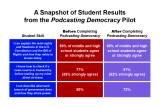
“There were kids who really haven’t engaged a lot in school who were super into it and did very thoughtful projects. They’re learning content, doing a really cool project, and building skills they need later.” — Middle School Educator, California
“Students really love the project…I don’t think I heard a single negative piece of feedback. I love this project. I feel like I’ll always use it for civics. I can’t see myself not teaching it.” — High School Educator, California
“They really own their own learning…and it extended way further than the classroom. I’m 100% going to do this again…the engagement was so good!” — Middle School Educator, Colorado
Podcasting Democracy covers the Constitution and the Bill of Rights and gives students a fresh look at democracy’s fundamental principles. After studying these foundational documents, students use what they’ve learned to create their own commentary podcasts, advocating for an issue they care about, and applying constitutional principles as the foundation of their argument. It’s a student-centric, content-focused way to boost students’ voices and engage them in civic discourse – a core tenet of KQED Education’s work. When students share their podcasts on the KQED Youth Media Challenge Showcase, their work joins more than 12,000+ submissions from students who have created media projects to amplify their opinions and ideas about topics that matter to youth across the U.S. and the world.
A Fully Developed Curriculum Program, Complete with Classroom-Ready Teacher Resources
Podcasting Democracy includes:
Two distinct curriculum units
- Middle School, aligned with U.S. history scope, sequence and standards
- High School, aligned with government and history courses
Curriculum components include:
- Daily lesson slides
- Lesson plans
- Graphic organizers and text sets
- Rubrics
- Media project implementation materials
- The opportunity for students to share their podcasts on the KQED Youth Media Challenge Showcase, and with stakeholders in their communities
Professional Development Is Part of the Program
To support educators in integrating Podcasting Democracy into their curriculum and lesson plans for the school year ahead, KQED is offering several online and in-person professional learning opportunities, beginning June 23, 2026. A complete schedule of professional development sessions is available on the Podcasting Democracy website.More details about the Podcasting Democracy curriculum are available online including slides, handouts, lesson plans and more. In addition, teachers can find sample Podcasting Democracy student projects to share with their own students and colleagues who may be interested in this program from KQED.
Support
Major support for Podcasting Democracy is provided by the Crescent Porter Hale Foundation, Sato Foundation, an anonymous family, and the members of KQED.
About KQED
KQED serves the people of Northern California with a public-supported alternative to commercial media. An NPR and PBS affiliate based in San Francisco, KQED is home to one of the most listened-to public radio stations in the nation, one of the highest-rated public television services and an award-winning education program helping students and educators thrive in 21st-century classrooms. A trusted news source and leader and innovator in interactive technology, KQED takes people of all ages on journeys of exploration — exposing them to new people, places and ideas. www.kqed.org
Media Contact
Janelle Kim, [email protected]
Senior Marketing and Communications Manager, Education, KQED