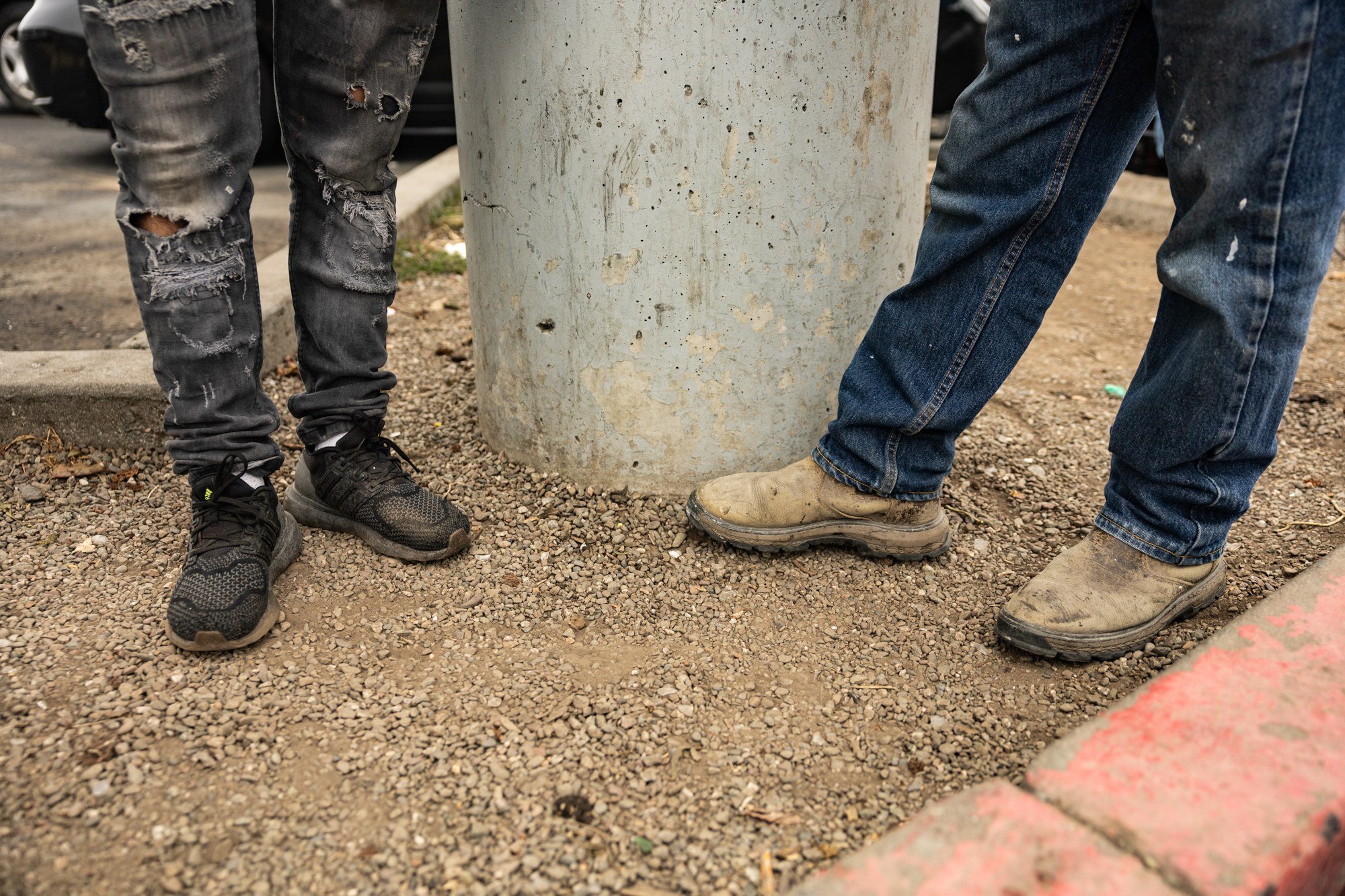
‘You Can’t Trust Anyone’: In Oakland, Fear of ICE Raids Grips Day Laborers
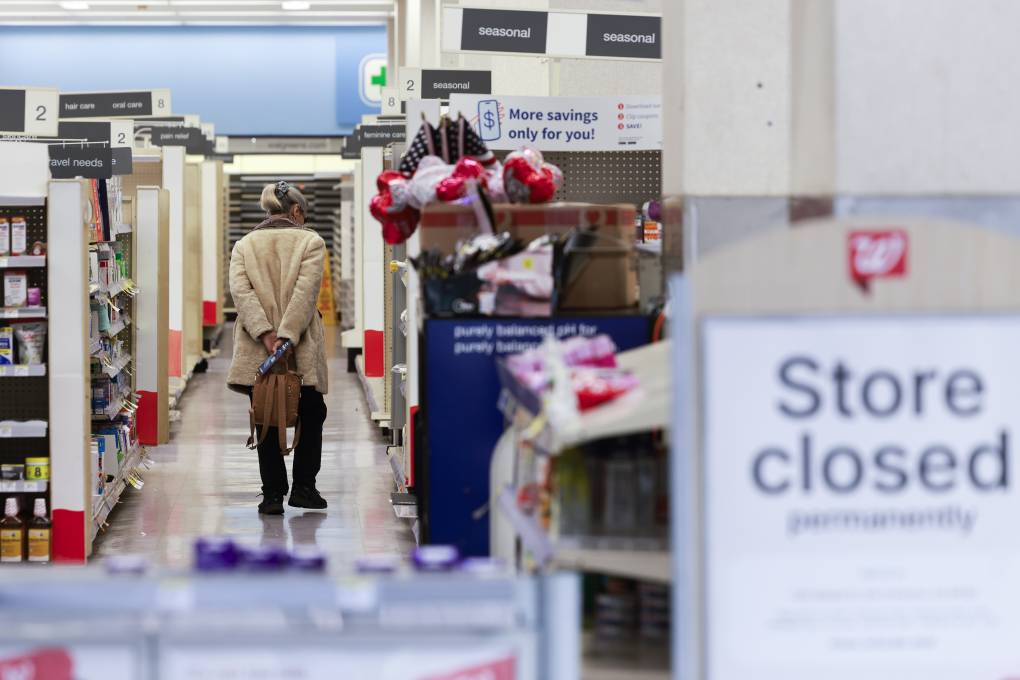
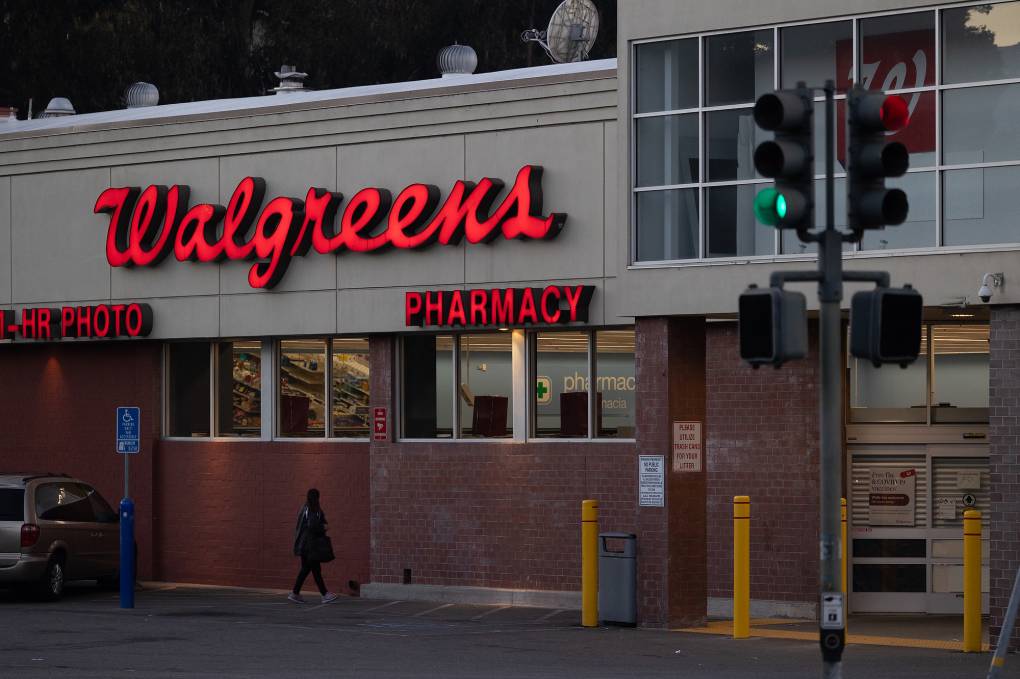
Where to Get Prescriptions After Walgreens Closes in San Francisco
Threats Against Immigrants, More Walgreens Closures, and Budget Cuts at Sonoma State
Nearly 30% of US Drugstores Closed Over the Last Decade, Study Shows
These Middlemen Say They Keep Drug Prices Low. California Lawmakers Don’t Buy It
'Everybody Is Just Scrambling': Nationwide Cyber Attack Delays Bay Area Pharmacy Orders
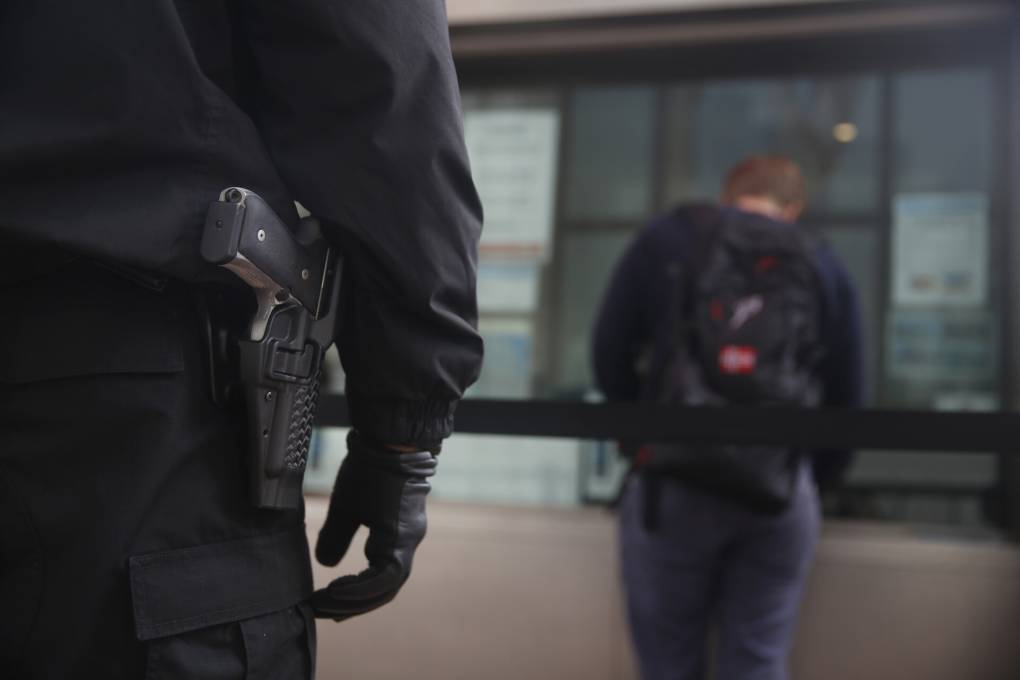
They Carry Weapons. So Why Don't Security Guards Have to Get Use-of-Force Training?
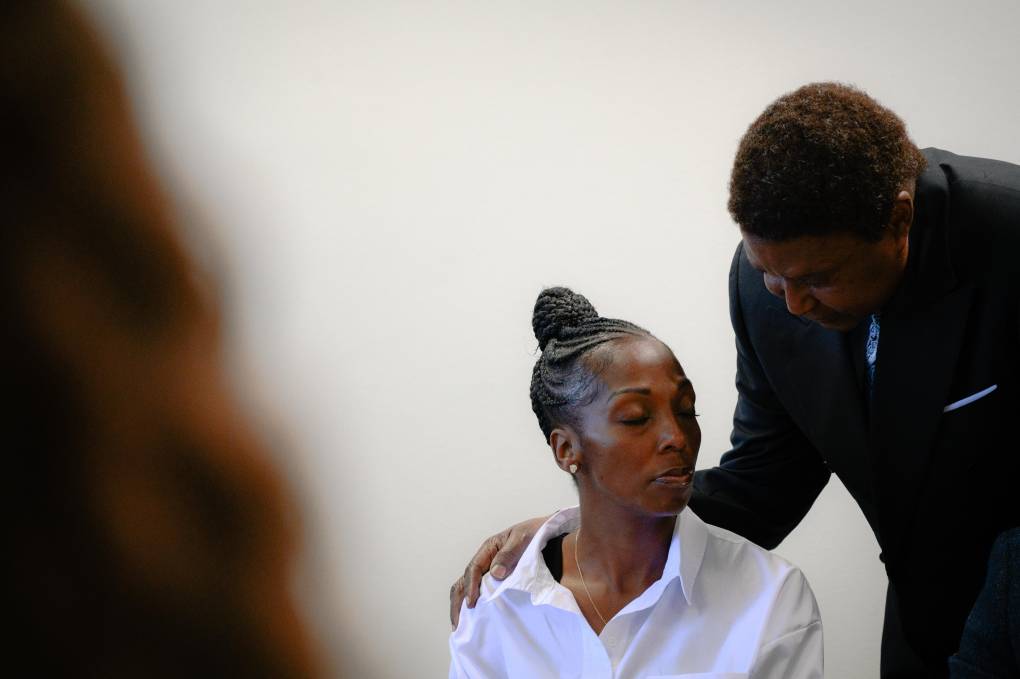
Banko Brown Family Files Wrongful Death Lawsuit Against Walgreens, Security Company
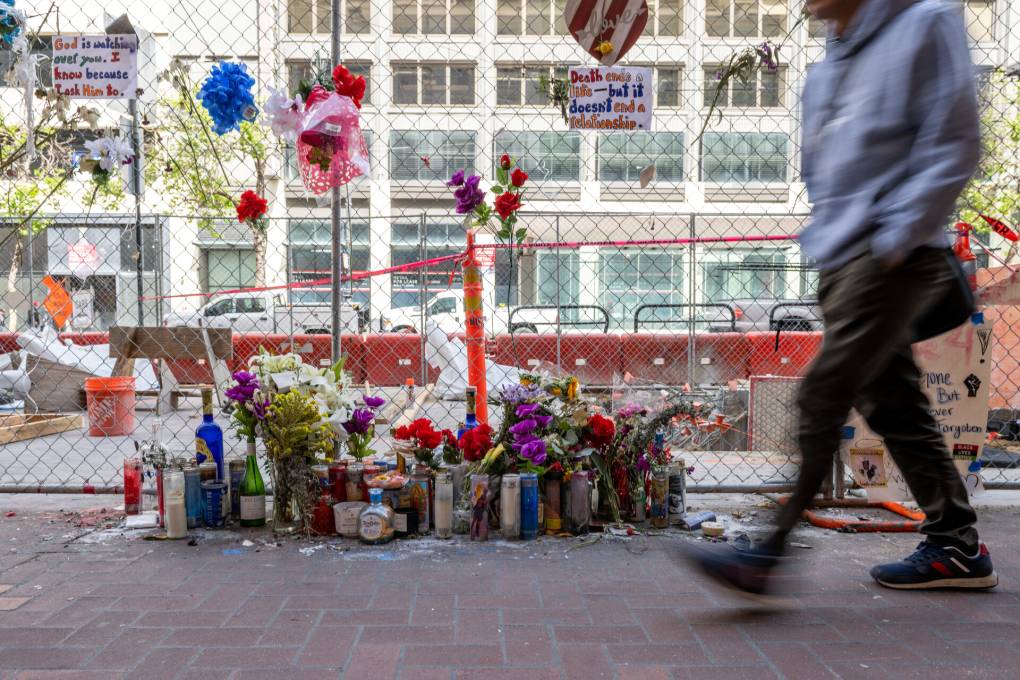
Banko Brown's Supporters Applaud Attorney General's Decision to Review Killing After SF DA Passes on Prosecution
Sponsored
Player sponsored by
window.__IS_SSR__=true
window.__INITIAL_STATE__={
"attachmentsReducer": {
"audio_0": {
"type": "attachments",
"id": "audio_0",
"imgSizes": {
"kqedFullSize": {
"file": "https://ww2.kqed.org/news/wp-content/themes/KQED-unified/img/audio_bgs/background0.jpg"
}
}
},
"audio_1": {
"type": "attachments",
"id": "audio_1",
"imgSizes": {
"kqedFullSize": {
"file": "https://ww2.kqed.org/news/wp-content/themes/KQED-unified/img/audio_bgs/background1.jpg"
}
}
},
"audio_2": {
"type": "attachments",
"id": "audio_2",
"imgSizes": {
"kqedFullSize": {
"file": "https://ww2.kqed.org/news/wp-content/themes/KQED-unified/img/audio_bgs/background2.jpg"
}
}
},
"audio_3": {
"type": "attachments",
"id": "audio_3",
"imgSizes": {
"kqedFullSize": {
"file": "https://ww2.kqed.org/news/wp-content/themes/KQED-unified/img/audio_bgs/background3.jpg"
}
}
},
"audio_4": {
"type": "attachments",
"id": "audio_4",
"imgSizes": {
"kqedFullSize": {
"file": "https://ww2.kqed.org/news/wp-content/themes/KQED-unified/img/audio_bgs/background4.jpg"
}
}
},
"placeholder": {
"type": "attachments",
"id": "placeholder",
"imgSizes": {
"thumbnail": {
"file": "https://cdn.kqed.org/wp-content/uploads/2024/12/KQED-Default-Image-816638274-2000x1333-1-160x107.jpg",
"width": 160,
"height": 107,
"mimeType": "image/jpeg"
},
"medium": {
"file": "https://cdn.kqed.org/wp-content/uploads/2024/12/KQED-Default-Image-816638274-2000x1333-1-800x533.jpg",
"width": 800,
"height": 533,
"mimeType": "image/jpeg"
},
"medium_large": {
"file": "https://cdn.kqed.org/wp-content/uploads/2024/12/KQED-Default-Image-816638274-2000x1333-1-768x512.jpg",
"width": 768,
"height": 512,
"mimeType": "image/jpeg"
},
"large": {
"file": "https://cdn.kqed.org/wp-content/uploads/2024/12/KQED-Default-Image-816638274-2000x1333-1-1020x680.jpg",
"width": 1020,
"height": 680,
"mimeType": "image/jpeg"
},
"1536x1536": {
"file": "https://cdn.kqed.org/wp-content/uploads/2024/12/KQED-Default-Image-816638274-2000x1333-1-1536x1024.jpg",
"width": 1536,
"height": 1024,
"mimeType": "image/jpeg"
},
"fd-lrg": {
"file": "https://cdn.kqed.org/wp-content/uploads/2024/12/KQED-Default-Image-816638274-2000x1333-1-1536x1024.jpg",
"width": 1536,
"height": 1024,
"mimeType": "image/jpeg"
},
"fd-med": {
"file": "https://cdn.kqed.org/wp-content/uploads/2024/12/KQED-Default-Image-816638274-2000x1333-1-1020x680.jpg",
"width": 1020,
"height": 680,
"mimeType": "image/jpeg"
},
"fd-sm": {
"file": "https://cdn.kqed.org/wp-content/uploads/2024/12/KQED-Default-Image-816638274-2000x1333-1-800x533.jpg",
"width": 800,
"height": 533,
"mimeType": "image/jpeg"
},
"post-thumbnail": {
"file": "https://cdn.kqed.org/wp-content/uploads/2024/12/KQED-Default-Image-816638274-2000x1333-1-672x372.jpg",
"width": 672,
"height": 372,
"mimeType": "image/jpeg"
},
"twentyfourteen-full-width": {
"file": "https://cdn.kqed.org/wp-content/uploads/2024/12/KQED-Default-Image-816638274-2000x1333-1-1038x576.jpg",
"width": 1038,
"height": 576,
"mimeType": "image/jpeg"
},
"xxsmall": {
"file": "https://cdn.kqed.org/wp-content/uploads/2024/12/KQED-Default-Image-816638274-2000x1333-1-160x107.jpg",
"width": 160,
"height": 107,
"mimeType": "image/jpeg"
},
"xsmall": {
"file": "https://cdn.kqed.org/wp-content/uploads/2024/12/KQED-Default-Image-816638274-2000x1333-1-672x372.jpg",
"width": 672,
"height": 372,
"mimeType": "image/jpeg"
},
"small": {
"file": "https://cdn.kqed.org/wp-content/uploads/2024/12/KQED-Default-Image-816638274-2000x1333-1-672x372.jpg",
"width": 672,
"height": 372,
"mimeType": "image/jpeg"
},
"xlarge": {
"file": "https://cdn.kqed.org/wp-content/uploads/2024/12/KQED-Default-Image-816638274-2000x1333-1-1020x680.jpg",
"width": 1020,
"height": 680,
"mimeType": "image/jpeg"
},
"full-width": {
"file": "https://cdn.kqed.org/wp-content/uploads/2024/12/KQED-Default-Image-816638274-2000x1333-1-1920x1280.jpg",
"width": 1920,
"height": 1280,
"mimeType": "image/jpeg"
},
"guest-author-32": {
"file": "https://cdn.kqed.org/wp-content/uploads/2025/01/KQED-Default-Image-816638274-1333x1333-1-160x160.jpg",
"width": 32,
"height": 32,
"mimeType": "image/jpeg"
},
"guest-author-50": {
"file": "https://cdn.kqed.org/wp-content/uploads/2025/01/KQED-Default-Image-816638274-1333x1333-1-160x160.jpg",
"width": 50,
"height": 50,
"mimeType": "image/jpeg"
},
"guest-author-64": {
"file": "https://cdn.kqed.org/wp-content/uploads/2025/01/KQED-Default-Image-816638274-1333x1333-1-160x160.jpg",
"width": 64,
"height": 64,
"mimeType": "image/jpeg"
},
"guest-author-96": {
"file": "https://cdn.kqed.org/wp-content/uploads/2025/01/KQED-Default-Image-816638274-1333x1333-1-160x160.jpg",
"width": 96,
"height": 96,
"mimeType": "image/jpeg"
},
"guest-author-128": {
"file": "https://cdn.kqed.org/wp-content/uploads/2025/01/KQED-Default-Image-816638274-1333x1333-1-160x160.jpg",
"width": 128,
"height": 128,
"mimeType": "image/jpeg"
},
"detail": {
"file": "https://cdn.kqed.org/wp-content/uploads/2025/01/KQED-Default-Image-816638274-1333x1333-1-160x160.jpg",
"width": 160,
"height": 160,
"mimeType": "image/jpeg"
},
"kqedFullSize": {
"file": "https://cdn.kqed.org/wp-content/uploads/2024/12/KQED-Default-Image-816638274-2000x1333-1.jpg",
"width": 2000,
"height": 1333
}
}
},
"news_12049998": {
"type": "attachments",
"id": "news_12049998",
"meta": {
"index": "attachments_1716263798",
"site": "news",
"id": "12049998",
"found": true
},
"title": "20250725_OAKLANDDAYLABORERS_GC-3-KQED",
"publishDate": 1753721859,
"status": "inherit",
"parent": 0,
"modified": 1755298552,
"caption": "Day laborers wait for work at a Walgreens in Oakland on July 25, 2025. Less people have come to the stop out of fear of being deported. ",
"credit": "Gina Castro for KQED",
"altTag": null,
"description": null,
"imgSizes": {
"thumbnail": {
"file": "https://cdn.kqed.org/wp-content/uploads/sites/10/2025/07/20250725_OAKLANDDAYLABORERS_GC-3-KQED-160x107.jpg",
"width": 160,
"height": 107,
"mimeType": "image/jpeg"
},
"1536x1536": {
"file": "https://cdn.kqed.org/wp-content/uploads/sites/10/2025/07/20250725_OAKLANDDAYLABORERS_GC-3-KQED-1536x1024.jpg",
"width": 1536,
"height": 1024,
"mimeType": "image/jpeg"
},
"post-thumbnail": {
"file": "https://cdn.kqed.org/wp-content/uploads/sites/10/2025/07/20250725_OAKLANDDAYLABORERS_GC-3-KQED-672x372.jpg",
"width": 672,
"height": 372,
"mimeType": "image/jpeg"
},
"twentyfourteen-full-width": {
"file": "https://cdn.kqed.org/wp-content/uploads/sites/10/2025/07/20250725_OAKLANDDAYLABORERS_GC-3-KQED-1038x576.jpg",
"width": 1038,
"height": 576,
"mimeType": "image/jpeg"
},
"kqedFullSize": {
"file": "https://cdn.kqed.org/wp-content/uploads/sites/10/2025/07/20250725_OAKLANDDAYLABORERS_GC-3-KQED.jpg",
"width": 2000,
"height": 1333
}
},
"fetchFailed": false,
"isLoading": false
},
"news_12028977": {
"type": "attachments",
"id": "news_12028977",
"meta": {
"index": "attachments_1716263798",
"site": "news",
"id": "12028977",
"found": true
},
"title": "Mayor Lurie And Senator Wiener Announce Legistlation To Boost Nightlife And Spur Downtown Recovery",
"publishDate": 1740678688,
"status": "inherit",
"parent": 12028959,
"modified": 1740682952,
"caption": "A woman shops for items among empty shelves inside of a Walgreens near Fourth and Market streets that is closing soon in San Francisco on Feb. 18, 2025.",
"credit": "Jessica Christian/San Francisco Chronicle via Getty Images",
"altTag": null,
"description": null,
"imgSizes": {
"medium": {
"file": "https://cdn.kqed.org/wp-content/uploads/sites/10/2025/02/GettyImages-2199825801-800x534.jpg",
"width": 800,
"height": 534,
"mimeType": "image/jpeg"
},
"large": {
"file": "https://cdn.kqed.org/wp-content/uploads/sites/10/2025/02/GettyImages-2199825801-1020x680.jpg",
"width": 1020,
"height": 680,
"mimeType": "image/jpeg"
},
"thumbnail": {
"file": "https://cdn.kqed.org/wp-content/uploads/sites/10/2025/02/GettyImages-2199825801-160x107.jpg",
"width": 160,
"height": 107,
"mimeType": "image/jpeg"
},
"1536x1536": {
"file": "https://cdn.kqed.org/wp-content/uploads/sites/10/2025/02/GettyImages-2199825801-1536x1025.jpg",
"width": 1536,
"height": 1025,
"mimeType": "image/jpeg"
},
"2048x2048": {
"file": "https://cdn.kqed.org/wp-content/uploads/sites/10/2025/02/GettyImages-2199825801-2048x1366.jpg",
"width": 2048,
"height": 1366,
"mimeType": "image/jpeg"
},
"post-thumbnail": {
"file": "https://cdn.kqed.org/wp-content/uploads/sites/10/2025/02/GettyImages-2199825801-672x372.jpg",
"width": 672,
"height": 372,
"mimeType": "image/jpeg"
},
"twentyfourteen-full-width": {
"file": "https://cdn.kqed.org/wp-content/uploads/sites/10/2025/02/GettyImages-2199825801-1038x576.jpg",
"width": 1038,
"height": 576,
"mimeType": "image/jpeg"
},
"full-width": {
"file": "https://cdn.kqed.org/wp-content/uploads/sites/10/2025/02/GettyImages-2199825801-1920x1281.jpg",
"width": 1920,
"height": 1281,
"mimeType": "image/jpeg"
},
"kqedFullSize": {
"file": "https://cdn.kqed.org/wp-content/uploads/sites/10/2025/02/GettyImages-2199825801-scaled.jpg",
"width": 2560,
"height": 1708
}
},
"fetchFailed": false,
"isLoading": false
},
"news_12002386": {
"type": "attachments",
"id": "news_12002386",
"meta": {
"index": "attachments_1716263798",
"site": "news",
"id": "12002386",
"found": true
},
"title": "LOGO_THEBAY",
"publishDate": 1724964767,
"status": "inherit",
"parent": 12002385,
"modified": 1724964767,
"caption": null,
"credit": null,
"altTag": null,
"description": null,
"imgSizes": {
"thumbnail": {
"file": "https://cdn.kqed.org/wp-content/uploads/sites/10/2024/08/LOGO_THEBAY-160x160.png",
"width": 160,
"height": 160,
"mimeType": "image/png"
},
"kqedFullSize": {
"file": "https://cdn.kqed.org/wp-content/uploads/sites/10/2024/08/LOGO_THEBAY.png",
"width": 300,
"height": 300
}
},
"fetchFailed": false,
"isLoading": false
},
"news_12016628": {
"type": "attachments",
"id": "news_12016628",
"meta": {
"index": "attachments_1716263798",
"site": "news",
"id": "12016628",
"found": true
},
"title": "Pharmacy Closings",
"publishDate": 1733337701,
"status": "inherit",
"parent": 0,
"modified": 1733342196,
"caption": "A Walgreens pharmacy on High Street in Oakland on Dec. 4, 2024, which is scheduled to close next month.",
"credit": "David M. Barreda/KQED",
"altTag": null,
"description": null,
"imgSizes": {
"medium": {
"file": "https://cdn.kqed.org/wp-content/uploads/sites/10/2024/12/241204-Pharmacy-Closings-DMB-0254-800x533.jpg",
"width": 800,
"height": 533,
"mimeType": "image/jpeg"
},
"large": {
"file": "https://cdn.kqed.org/wp-content/uploads/sites/10/2024/12/241204-Pharmacy-Closings-DMB-0254-1020x679.jpg",
"width": 1020,
"height": 679,
"mimeType": "image/jpeg"
},
"thumbnail": {
"file": "https://cdn.kqed.org/wp-content/uploads/sites/10/2024/12/241204-Pharmacy-Closings-DMB-0254-160x107.jpg",
"width": 160,
"height": 107,
"mimeType": "image/jpeg"
},
"1536x1536": {
"file": "https://cdn.kqed.org/wp-content/uploads/sites/10/2024/12/241204-Pharmacy-Closings-DMB-0254-1536x1023.jpg",
"width": 1536,
"height": 1023,
"mimeType": "image/jpeg"
},
"post-thumbnail": {
"file": "https://cdn.kqed.org/wp-content/uploads/sites/10/2024/12/241204-Pharmacy-Closings-DMB-0254-672x372.jpg",
"width": 672,
"height": 372,
"mimeType": "image/jpeg"
},
"twentyfourteen-full-width": {
"file": "https://cdn.kqed.org/wp-content/uploads/sites/10/2024/12/241204-Pharmacy-Closings-DMB-0254-1038x576.jpg",
"width": 1038,
"height": 576,
"mimeType": "image/jpeg"
},
"full-width": {
"file": "https://cdn.kqed.org/wp-content/uploads/sites/10/2024/12/241204-Pharmacy-Closings-DMB-0254-1920x1279.jpg",
"width": 1920,
"height": 1279,
"mimeType": "image/jpeg"
},
"kqedFullSize": {
"file": "https://cdn.kqed.org/wp-content/uploads/sites/10/2024/12/241204-Pharmacy-Closings-DMB-0254.jpg",
"width": 2000,
"height": 1332
}
},
"fetchFailed": false,
"isLoading": false
},
"news_11977127": {
"type": "attachments",
"id": "news_11977127",
"meta": {
"index": "attachments_1716263798",
"site": "news",
"id": "11977127",
"found": true
},
"title": "240226-PHARMACY HACK-MD-04-KQED-1",
"publishDate": 1708985186,
"status": "inherit",
"parent": 0,
"modified": 1724878593,
"caption": "A person works counting pills in the pharmacy inside a Safeway in Oakland on Feb. 26, 2024.",
"credit": "Martin do Nascimento/KQED",
"altTag": null,
"description": null,
"imgSizes": {
"medium": {
"file": "https://cdn.kqed.org/wp-content/uploads/sites/10/2024/02/240226-PHARMACY-HACK-MD-04-KQED-1-800x533.jpg",
"width": 800,
"height": 533,
"mimeType": "image/jpeg"
},
"large": {
"file": "https://cdn.kqed.org/wp-content/uploads/sites/10/2024/02/240226-PHARMACY-HACK-MD-04-KQED-1-1020x680.jpg",
"width": 1020,
"height": 680,
"mimeType": "image/jpeg"
},
"thumbnail": {
"file": "https://cdn.kqed.org/wp-content/uploads/sites/10/2024/02/240226-PHARMACY-HACK-MD-04-KQED-1-160x107.jpg",
"width": 160,
"height": 107,
"mimeType": "image/jpeg"
},
"1536x1536": {
"file": "https://cdn.kqed.org/wp-content/uploads/sites/10/2024/02/240226-PHARMACY-HACK-MD-04-KQED-1-1536x1024.jpg",
"width": 1536,
"height": 1024,
"mimeType": "image/jpeg"
},
"post-thumbnail": {
"file": "https://cdn.kqed.org/wp-content/uploads/sites/10/2024/02/240226-PHARMACY-HACK-MD-04-KQED-1-672x372.jpg",
"width": 672,
"height": 372,
"mimeType": "image/jpeg"
},
"twentyfourteen-full-width": {
"file": "https://cdn.kqed.org/wp-content/uploads/sites/10/2024/02/240226-PHARMACY-HACK-MD-04-KQED-1-1038x576.jpg",
"width": 1038,
"height": 576,
"mimeType": "image/jpeg"
},
"full-width": {
"file": "https://cdn.kqed.org/wp-content/uploads/sites/10/2024/02/240226-PHARMACY-HACK-MD-04-KQED-1-1920x1280.jpg",
"width": 1920,
"height": 1280,
"mimeType": "image/jpeg"
},
"kqedFullSize": {
"file": "https://cdn.kqed.org/wp-content/uploads/sites/10/2024/02/240226-PHARMACY-HACK-MD-04-KQED-1.jpg",
"width": 2000,
"height": 1333
}
},
"fetchFailed": false,
"isLoading": false
},
"news_11952718": {
"type": "attachments",
"id": "news_11952718",
"meta": {
"index": "attachments_1716263798",
"site": "news",
"id": "11952718",
"found": true
},
"parent": 11952689,
"imgSizes": {
"twentyfourteen-full-width": {
"file": "https://ww2.kqed.org/app/uploads/sites/10/2023/06/RS66195_GettyImages-1322093872-qut-1038x576.jpg",
"width": 1038,
"mimeType": "image/jpeg",
"height": 576
},
"thumbnail": {
"file": "https://ww2.kqed.org/app/uploads/sites/10/2023/06/RS66195_GettyImages-1322093872-qut-160x107.jpg",
"width": 160,
"mimeType": "image/jpeg",
"height": 107
},
"post-thumbnail": {
"file": "https://ww2.kqed.org/app/uploads/sites/10/2023/06/RS66195_GettyImages-1322093872-qut-672x372.jpg",
"width": 672,
"mimeType": "image/jpeg",
"height": 372
},
"kqedFullSize": {
"file": "https://ww2.kqed.org/app/uploads/sites/10/2023/06/RS66195_GettyImages-1322093872-qut.jpg",
"width": 1920,
"height": 1280
},
"large": {
"file": "https://ww2.kqed.org/app/uploads/sites/10/2023/06/RS66195_GettyImages-1322093872-qut-1020x680.jpg",
"width": 1020,
"mimeType": "image/jpeg",
"height": 680
},
"1536x1536": {
"file": "https://ww2.kqed.org/app/uploads/sites/10/2023/06/RS66195_GettyImages-1322093872-qut-1536x1024.jpg",
"width": 1536,
"mimeType": "image/jpeg",
"height": 1024
},
"medium": {
"file": "https://ww2.kqed.org/app/uploads/sites/10/2023/06/RS66195_GettyImages-1322093872-qut-800x533.jpg",
"width": 800,
"mimeType": "image/jpeg",
"height": 533
}
},
"publishDate": 1686357552,
"modified": 1686529935,
"caption": "An armed security guard stands next to the cable car fare kiosk at Powell and Market streets in San Francisco.",
"description": null,
"title": "Kasayle Howard (left), armed security guard with Cypress Security, stands next to the cable car fare kiosk while working at Powell and Market Streets on Monday, April 20, 2015 in San Francisco, Calif.",
"credit": "Lea Suzuki/The San Francisco Chronicle via Getty Images",
"status": "inherit",
"altTag": "a black-clad security guard's outstretched arm and leg are seen from behind in the left foreground, with a gun clearly visible on their hip, as a pedestrian stands with their back turned to the camera in the background",
"fetchFailed": false,
"isLoading": false
},
"news_11950977": {
"type": "attachments",
"id": "news_11950977",
"meta": {
"index": "attachments_1716263798",
"site": "news",
"id": "11950977",
"found": true
},
"parent": 11950796,
"imgSizes": {
"twentyfourteen-full-width": {
"file": "https://ww2.kqed.org/app/uploads/sites/10/2023/05/05262023_bankobrownpresser-194-1038x576.jpg",
"width": 1038,
"mimeType": "image/jpeg",
"height": 576
},
"thumbnail": {
"file": "https://ww2.kqed.org/app/uploads/sites/10/2023/05/05262023_bankobrownpresser-194-160x106.jpg",
"width": 160,
"mimeType": "image/jpeg",
"height": 106
},
"post-thumbnail": {
"file": "https://ww2.kqed.org/app/uploads/sites/10/2023/05/05262023_bankobrownpresser-194-672x372.jpg",
"width": 672,
"mimeType": "image/jpeg",
"height": 372
},
"kqedFullSize": {
"file": "https://ww2.kqed.org/app/uploads/sites/10/2023/05/05262023_bankobrownpresser-194-scaled.jpg",
"width": 2560,
"height": 1703
},
"2048x2048": {
"file": "https://ww2.kqed.org/app/uploads/sites/10/2023/05/05262023_bankobrownpresser-194-2048x1363.jpg",
"width": 2048,
"mimeType": "image/jpeg",
"height": 1363
},
"large": {
"file": "https://ww2.kqed.org/app/uploads/sites/10/2023/05/05262023_bankobrownpresser-194-1020x679.jpg",
"width": 1020,
"mimeType": "image/jpeg",
"height": 679
},
"1536x1536": {
"file": "https://ww2.kqed.org/app/uploads/sites/10/2023/05/05262023_bankobrownpresser-194-1536x1022.jpg",
"width": 1536,
"mimeType": "image/jpeg",
"height": 1022
},
"full-width": {
"file": "https://ww2.kqed.org/app/uploads/sites/10/2023/05/05262023_bankobrownpresser-194-1920x1277.jpg",
"width": 1920,
"mimeType": "image/jpeg",
"height": 1277
},
"medium": {
"file": "https://ww2.kqed.org/app/uploads/sites/10/2023/05/05262023_bankobrownpresser-194-800x532.jpg",
"width": 800,
"mimeType": "image/jpeg",
"height": 532
}
},
"publishDate": 1685138076,
"modified": 1685138252,
"caption": "Civil rights attorney John Burris comforts Kevinisha Henderson, Banko Brown's mother, at a press conference to announce the wrongful death lawsuit against Walgreens and Kingdom Group Protective Services, after a security guard shot and killed Brown in April.",
"description": null,
"title": "05262023_bankobrownpresser 194",
"credit": "Kori Suzuki/KQED",
"status": "inherit",
"altTag": "a Black woman with her hair up, in a white button-down shirt, closes her eyes and sits at a table, as a slightly older Black man in a suit leans over and puts his arm around her",
"fetchFailed": false,
"isLoading": false
},
"news_11950608": {
"type": "attachments",
"id": "news_11950608",
"meta": {
"index": "attachments_1716263798",
"site": "news",
"id": "11950608",
"found": true
},
"parent": 11950595,
"imgSizes": {
"twentyfourteen-full-width": {
"file": "https://ww2.kqed.org/app/uploads/sites/10/2023/05/RS65169_005_KQED_WalgreensBankoBrown_05092023-qut-1-1038x576.jpg",
"width": 1038,
"mimeType": "image/jpeg",
"height": 576
},
"thumbnail": {
"file": "https://ww2.kqed.org/app/uploads/sites/10/2023/05/RS65169_005_KQED_WalgreensBankoBrown_05092023-qut-1-160x107.jpg",
"width": 160,
"mimeType": "image/jpeg",
"height": 107
},
"post-thumbnail": {
"file": "https://ww2.kqed.org/app/uploads/sites/10/2023/05/RS65169_005_KQED_WalgreensBankoBrown_05092023-qut-1-672x372.jpg",
"width": 672,
"mimeType": "image/jpeg",
"height": 372
},
"kqedFullSize": {
"file": "https://ww2.kqed.org/app/uploads/sites/10/2023/05/RS65169_005_KQED_WalgreensBankoBrown_05092023-qut-1.jpg",
"width": 1920,
"height": 1280
},
"large": {
"file": "https://ww2.kqed.org/app/uploads/sites/10/2023/05/RS65169_005_KQED_WalgreensBankoBrown_05092023-qut-1-1020x680.jpg",
"width": 1020,
"mimeType": "image/jpeg",
"height": 680
},
"1536x1536": {
"file": "https://ww2.kqed.org/app/uploads/sites/10/2023/05/RS65169_005_KQED_WalgreensBankoBrown_05092023-qut-1-1536x1024.jpg",
"width": 1536,
"mimeType": "image/jpeg",
"height": 1024
},
"medium": {
"file": "https://ww2.kqed.org/app/uploads/sites/10/2023/05/RS65169_005_KQED_WalgreensBankoBrown_05092023-qut-1-800x533.jpg",
"width": 800,
"mimeType": "image/jpeg",
"height": 533
}
},
"publishDate": 1684970533,
"modified": 1684976077,
"caption": "A person walks past a memorial for Banko Brown outside the Market Street Walgreens in San Francisco where Brown was shot and killed by a store security guard on April 27.",
"description": null,
"title": "RS65169_005_KQED_WalgreensBankoBrown_05092023-qut",
"credit": "Beth LaBerge/KQED",
"status": "inherit",
"altTag": "candles, flowers and photos sit on the sidewalk in front of a chain link fence as the blurry feed of a pedestrian move past in the foreground",
"fetchFailed": false,
"isLoading": false
}
},
"audioPlayerReducer": {
"postId": "stream_live",
"isPaused": true,
"isPlaying": false,
"pfsActive": false,
"pledgeModalIsOpen": true,
"playerDrawerIsOpen": false
},
"authorsReducer": {
"byline_news_12016562": {
"type": "authors",
"id": "byline_news_12016562",
"meta": {
"override": true
},
"slug": "byline_news_12016562",
"name": "Tom Murphy, Associated Press",
"isLoading": false
},
"byline_news_12002132": {
"type": "authors",
"id": "byline_news_12002132",
"meta": {
"override": true
},
"slug": "byline_news_12002132",
"name": " Kristen Hwang, CalMatters",
"isLoading": false
},
"mlagos": {
"type": "authors",
"id": "3239",
"meta": {
"index": "authors_1716337520",
"id": "3239",
"found": true
},
"name": "Marisa Lagos",
"firstName": "Marisa",
"lastName": "Lagos",
"slug": "mlagos",
"email": "mlagos@kqed.org",
"display_author_email": false,
"staff_mastheads": [
"news"
],
"title": "KQED Contributor",
"bio": "Marisa Lagos is a correspondent for KQED’s California Politics and Government Desk and co-hosts the award-winning show and podcast, Political Breakdown. At KQED, Lagos also conducts reporting, analysis and investigations into state, local and national politics for radio, TV, online and onstage. In 2022, she and co-host, Scott Shafer, moderated the only gubernatorial debate in California. In 2020, the \u003ci>Washington Post\u003c/i> named her one of the top political journalists in California; she was nominated for a Peabody and won several other awards for her work investigating the 2017 California wildfires. She has worked at the \u003ci>San Francisco Chronicle\u003c/i>, \u003ci>San Francisco Examiner\u003c/i> and \u003ci>Los Angeles Times\u003c/i>. A UC Santa Barbara graduate, she lives in San Francisco with her two sons and husband.",
"avatar": "https://secure.gravatar.com/avatar/a261a0d3696fc066871ef96b85b5e7d2?s=600&d=blank&r=g",
"twitter": "@mlagos",
"facebook": null,
"instagram": null,
"linkedin": null,
"sites": [
{
"site": "arts",
"roles": [
"author"
]
},
{
"site": "news",
"roles": [
"editor"
]
},
{
"site": "science",
"roles": [
"editor"
]
},
{
"site": "forum",
"roles": [
"author"
]
},
{
"site": "liveblog",
"roles": [
"author"
]
}
],
"headData": {
"title": "Marisa Lagos | KQED",
"description": "KQED Contributor",
"ogImgSrc": "https://secure.gravatar.com/avatar/a261a0d3696fc066871ef96b85b5e7d2?s=600&d=blank&r=g",
"twImgSrc": "https://secure.gravatar.com/avatar/a261a0d3696fc066871ef96b85b5e7d2?s=600&d=blank&r=g"
},
"isLoading": false,
"link": "/author/mlagos"
},
"ecruzguevarra": {
"type": "authors",
"id": "8654",
"meta": {
"index": "authors_1716337520",
"id": "8654",
"found": true
},
"name": "Ericka Cruz Guevarra",
"firstName": "Ericka",
"lastName": "Cruz Guevarra",
"slug": "ecruzguevarra",
"email": "ecruzguevarra@kqed.org",
"display_author_email": true,
"staff_mastheads": [
"news"
],
"title": "Producer, The Bay Podcast",
"bio": "Ericka Cruz Guevarra is host of \u003ca href=\"https://www.kqed.org/podcasts/thebay\">\u003cem>The Bay\u003c/em>\u003c/a> podcast at KQED. Before host, she was the show’s producer. Her work in that capacity includes a three-part reported series on policing in Vallejo, which won a 2020 excellence in journalism award from the Society of Professional Journalists. Ericka has worked as a breaking news reporter at Oregon Public Broadcasting, helped produce the Code Switch podcast, and was KQED’s inaugural Raul Ramirez Diversity Fund intern. She’s also an alumna of NPR’s Next Generation Radio program. Send her an email if you have strong feelings about whether Fairfield and Suisun City are the Bay. Ericka is represented by SAG-AFTRA.",
"avatar": "https://secure.gravatar.com/avatar/25e5ab8d3d53fad2dcc7bb2b5c506b1a?s=600&d=blank&r=g",
"twitter": "NotoriousECG",
"facebook": null,
"instagram": null,
"linkedin": null,
"sites": [
{
"site": "arts",
"roles": [
"subscriber"
]
},
{
"site": "news",
"roles": [
"editor",
"manage_categories"
]
},
{
"site": "futureofyou",
"roles": [
"subscriber"
]
},
{
"site": "stateofhealth",
"roles": [
"subscriber"
]
},
{
"site": "science",
"roles": [
"editor"
]
},
{
"site": "forum",
"roles": [
"subscriber"
]
}
],
"headData": {
"title": "Ericka Cruz Guevarra | KQED",
"description": "Producer, The Bay Podcast",
"ogImgSrc": "https://secure.gravatar.com/avatar/25e5ab8d3d53fad2dcc7bb2b5c506b1a?s=600&d=blank&r=g",
"twImgSrc": "https://secure.gravatar.com/avatar/25e5ab8d3d53fad2dcc7bb2b5c506b1a?s=600&d=blank&r=g"
},
"isLoading": false,
"link": "/author/ecruzguevarra"
},
"amontecillo": {
"type": "authors",
"id": "11649",
"meta": {
"index": "authors_1716337520",
"id": "11649",
"found": true
},
"name": "Alan Montecillo",
"firstName": "Alan",
"lastName": "Montecillo",
"slug": "amontecillo",
"email": "amontecillo@kqed.org",
"display_author_email": false,
"staff_mastheads": [
"news"
],
"title": "KQED Contributor",
"bio": "Alan Montecillo is the senior editor of \u003cem>\u003ca href=\"http://kqed.org/thebay\">The Bay\u003c/a>, \u003c/em> KQED's local news podcast. Before moving to the Bay Area, he worked as a senior talk show producer for WILL in Champaign-Urbana, Illinois and at Oregon Public Broadcasting in Portland, Oregon. He has won journalism awards from the Society of Professional Journalists Northern California, the Public Media Journalists Association, The Signal Awards, and has also received a regional Edward R. Murrow award. Alan is a Filipino American from Hong Kong and a graduate of Reed College.",
"avatar": "https://secure.gravatar.com/avatar/d5e4e7a76481969ccba76f4e2b5ccabc?s=600&d=blank&r=g",
"twitter": "alanmontecillo",
"facebook": null,
"instagram": null,
"linkedin": null,
"sites": [
{
"site": "",
"roles": [
"editor"
]
},
{
"site": "news",
"roles": [
"editor",
"manage_categories"
]
}
],
"headData": {
"title": "Alan Montecillo | KQED",
"description": "KQED Contributor",
"ogImgSrc": "https://secure.gravatar.com/avatar/d5e4e7a76481969ccba76f4e2b5ccabc?s=600&d=blank&r=g",
"twImgSrc": "https://secure.gravatar.com/avatar/d5e4e7a76481969ccba76f4e2b5ccabc?s=600&d=blank&r=g"
},
"isLoading": false,
"link": "/author/amontecillo"
},
"jrodriguez": {
"type": "authors",
"id": "11690",
"meta": {
"index": "authors_1716337520",
"id": "11690",
"found": true
},
"name": "Joe Fitzgerald Rodriguez",
"firstName": "Joe",
"lastName": "Fitzgerald Rodriguez",
"slug": "jrodriguez",
"email": "jrodriguez@kqed.org",
"display_author_email": true,
"staff_mastheads": [
"news"
],
"title": "Reporter and Producer",
"bio": "Joe Fitzgerald Rodriguez is a reporter and digital producer for KQED covering politics. Joe most recently wrote for the \u003cem>San Francisco Examiner\u003c/em> as a political columnist covering The City. He was raised in San Francisco and has spent his reporting career in his beloved, foggy, city by the bay. Joe was 12-years-old when he conducted his first interview in journalism, grilling former San Francisco Mayor Willie Brown for the Marina Middle School newspaper, \u003cem>The Penguin Press, \u003c/em>and he continues to report on the San Francisco Bay Area to this day.",
"avatar": "https://secure.gravatar.com/avatar/2247beb0564c1e9c62228d5649d2edac?s=600&d=blank&r=g",
"twitter": "FitztheReporter",
"facebook": null,
"instagram": "https://www.instagram.com/fitzthereporter/",
"linkedin": null,
"sites": [
{
"site": "",
"roles": [
"editor"
]
},
{
"site": "arts",
"roles": [
"editor"
]
},
{
"site": "news",
"roles": [
"editor"
]
},
{
"site": "science",
"roles": [
"editor"
]
},
{
"site": "elections",
"roles": [
"editor"
]
},
{
"site": "liveblog",
"roles": [
"editor"
]
}
],
"headData": {
"title": "Joe Fitzgerald Rodriguez | KQED",
"description": "Reporter and Producer",
"ogImgSrc": "https://secure.gravatar.com/avatar/2247beb0564c1e9c62228d5649d2edac?s=600&d=blank&r=g",
"twImgSrc": "https://secure.gravatar.com/avatar/2247beb0564c1e9c62228d5649d2edac?s=600&d=blank&r=g"
},
"isLoading": false,
"link": "/author/jrodriguez"
},
"agonzalez": {
"type": "authors",
"id": "11724",
"meta": {
"index": "authors_1716337520",
"id": "11724",
"found": true
},
"name": "Alexander Gonzalez",
"firstName": "Alexander",
"lastName": "Gonzalez",
"slug": "agonzalez",
"email": "AlexanderGonzalez@KQED.org",
"display_author_email": false,
"staff_mastheads": [
"news"
],
"title": "KQED Contributor",
"bio": null,
"avatar": "https://secure.gravatar.com/avatar/63d43593dd7ebcafcd638e851a9bce5a?s=600&d=blank&r=g",
"twitter": null,
"facebook": null,
"instagram": null,
"linkedin": null,
"sites": [
{
"site": "arts",
"roles": [
"editor"
]
},
{
"site": "news",
"roles": [
"editor"
]
}
],
"headData": {
"title": "Alexander Gonzalez | KQED",
"description": "KQED Contributor",
"ogImgSrc": "https://secure.gravatar.com/avatar/63d43593dd7ebcafcd638e851a9bce5a?s=600&d=blank&r=g",
"twImgSrc": "https://secure.gravatar.com/avatar/63d43593dd7ebcafcd638e851a9bce5a?s=600&d=blank&r=g"
},
"isLoading": false,
"link": "/author/agonzalez"
},
"jessicakariisa": {
"type": "authors",
"id": "11831",
"meta": {
"index": "authors_1716337520",
"id": "11831",
"found": true
},
"name": "Jessica Kariisa",
"firstName": "Jessica",
"lastName": "Kariisa",
"slug": "jessicakariisa",
"email": "jkariisa@kqed.org",
"display_author_email": false,
"staff_mastheads": [
"news"
],
"title": "Producer, The Bay",
"bio": "Jessica Kariisa is the producer of The Bay. She first joined KQED as an intern for The California Report Magazine, after which she became an on-call producer. She reported a Bay Curious episode on the use of rap lyrics in criminal trials which won a Society of Professional Journalists award in 2023 for Excellence in Features Journalism and the 2023 Signal Award for Best Conversation Starter. She’s worked on podcasts for Snap Judgment and American Public Media. Before embarking on her audio career, she was a music journalist.\r\n\r\nJessica Kariisa is represented by SAG-AFTRA.",
"avatar": "https://secure.gravatar.com/avatar/4afd355fd24f5515aeab77fd6c72b671?s=600&d=blank&r=g",
"twitter": null,
"facebook": null,
"instagram": null,
"linkedin": null,
"sites": [
{
"site": "arts",
"roles": [
"author"
]
},
{
"site": "news",
"roles": [
"editor",
"manage_categories"
]
}
],
"headData": {
"title": "Jessica Kariisa | KQED",
"description": "Producer, The Bay",
"ogImgSrc": "https://secure.gravatar.com/avatar/4afd355fd24f5515aeab77fd6c72b671?s=600&d=blank&r=g",
"twImgSrc": "https://secure.gravatar.com/avatar/4afd355fd24f5515aeab77fd6c72b671?s=600&d=blank&r=g"
},
"isLoading": false,
"link": "/author/jessicakariisa"
},
"sjohnson": {
"type": "authors",
"id": "11840",
"meta": {
"index": "authors_1716337520",
"id": "11840",
"found": true
},
"name": "Sydney Johnson",
"firstName": "Sydney",
"lastName": "Johnson",
"slug": "sjohnson",
"email": "sjohnson@kqed.org",
"display_author_email": false,
"staff_mastheads": [
"news"
],
"title": "KQED Reporter",
"bio": "Sydney Johnson is a general assignment reporter at KQED. She previously reported on public health and city government at the San Francisco Examiner, and before that, she covered statewide education policy for EdSource. Her reporting has won multiple local, state and national awards. Sydney is a graduate of the University of California, Berkeley and lives in San Francisco.",
"avatar": "https://secure.gravatar.com/avatar/97855f2719b72ad6190b7c535fe642c8?s=600&d=blank&r=g",
"twitter": "sydneyfjohnson",
"facebook": null,
"instagram": null,
"linkedin": null,
"sites": [
{
"site": "news",
"roles": [
"editor"
]
}
],
"headData": {
"title": "Sydney Johnson | KQED",
"description": "KQED Reporter",
"ogImgSrc": "https://secure.gravatar.com/avatar/97855f2719b72ad6190b7c535fe642c8?s=600&d=blank&r=g",
"twImgSrc": "https://secure.gravatar.com/avatar/97855f2719b72ad6190b7c535fe642c8?s=600&d=blank&r=g"
},
"isLoading": false,
"link": "/author/sjohnson"
},
"kdebenedetti": {
"type": "authors",
"id": "11913",
"meta": {
"index": "authors_1716337520",
"id": "11913",
"found": true
},
"name": "Katie DeBenedetti",
"firstName": "Katie",
"lastName": "DeBenedetti",
"slug": "kdebenedetti",
"email": "kdebenedetti@kqed.org",
"display_author_email": false,
"staff_mastheads": [
"news",
"science"
],
"title": "KQED Contributor",
"bio": "Katie DeBenedetti is a digital reporter covering daily news for the Express Desk. Prior to joining KQED as a culture reporting intern in January 2024, she covered education and city government for the Napa Valley Register.",
"avatar": "https://secure.gravatar.com/avatar/6e31073cb8f7e4214ab03f42771d0f45?s=600&d=blank&r=g",
"twitter": null,
"facebook": null,
"instagram": null,
"linkedin": null,
"sites": [
{
"site": "news",
"roles": [
"author"
]
},
{
"site": "science",
"roles": [
"author"
]
},
{
"site": "liveblog",
"roles": [
"author"
]
}
],
"headData": {
"title": "Katie DeBenedetti | KQED",
"description": "KQED Contributor",
"ogImgSrc": "https://secure.gravatar.com/avatar/6e31073cb8f7e4214ab03f42771d0f45?s=600&d=blank&r=g",
"twImgSrc": "https://secure.gravatar.com/avatar/6e31073cb8f7e4214ab03f42771d0f45?s=600&d=blank&r=g"
},
"isLoading": false,
"link": "/author/kdebenedetti"
},
"mvelasquez": {
"type": "authors",
"id": "11939",
"meta": {
"index": "authors_1716337520",
"id": "11939",
"found": true
},
"name": "Mel Velasquez",
"firstName": "Mel",
"lastName": "Velasquez",
"slug": "mvelasquez",
"email": "mvelasquez@kqed.org",
"display_author_email": false,
"staff_mastheads": [],
"title": "KQED Contributor",
"bio": null,
"avatar": "https://secure.gravatar.com/avatar/409094312d56fab09fef4251e949ffa6?s=600&d=blank&r=g",
"twitter": null,
"facebook": null,
"instagram": null,
"linkedin": "www.linkedin.com/in/melanievelasquezz",
"sites": [
{
"site": "news",
"roles": [
"editor"
]
}
],
"headData": {
"title": "Mel Velasquez | KQED",
"description": "KQED Contributor",
"ogImgSrc": "https://secure.gravatar.com/avatar/409094312d56fab09fef4251e949ffa6?s=600&d=blank&r=g",
"twImgSrc": "https://secure.gravatar.com/avatar/409094312d56fab09fef4251e949ffa6?s=600&d=blank&r=g"
},
"isLoading": false,
"link": "/author/mvelasquez"
}
},
"breakingNewsReducer": {},
"pagesReducer": {},
"postsReducer": {
"stream_live": {
"type": "live",
"id": "stream_live",
"audioUrl": "https://streams.kqed.org/kqedradio",
"title": "Live Stream",
"excerpt": "Live Stream information currently unavailable.",
"link": "/radio",
"featImg": "",
"label": {
"name": "KQED Live",
"link": "/"
}
},
"stream_kqedNewscast": {
"type": "posts",
"id": "stream_kqedNewscast",
"audioUrl": "https://www.kqed.org/.stream/anon/radio/RDnews/newscast.mp3?_=1",
"title": "KQED Newscast",
"featImg": "",
"label": {
"name": "88.5 FM",
"link": "/"
}
},
"news_12052452": {
"type": "posts",
"id": "news_12052452",
"meta": {
"index": "posts_1716263798",
"site": "news",
"id": "12052452",
"score": null,
"sort": [
1755352853000
]
},
"guestAuthors": [],
"slug": "you-cant-trust-anyone-in-oakland-fear-of-ice-raids-grips-day-laborers",
"title": "‘You Can’t Trust Anyone’: In Oakland, Fear of ICE Raids Grips Day Laborers",
"publishDate": 1755352853,
"format": "standard",
"headTitle": "‘You Can’t Trust Anyone’: In Oakland, Fear of ICE Raids Grips Day Laborers | KQED",
"labelTerm": {
"site": "news"
},
"content": "\u003cp>Weekdays at the Walgreens parking lot in \u003ca href=\"https://www.kqed.org/news/tag/fruitvale\">Fruitvale\u003c/a> have grown eerily quiet.\u003c/p>\n\u003cp>On a typical morning months ago, upwards of 60 men in work boots and dark hoodies would have been gathered around light poles and pop-up food stands in the large lot, chatting and drinking coffee out of paper cups. But on a recent gloomy Friday, only about a dozen day laborers milled about, hoping to find work.\u003c/p>\n\u003cp>“I think people are starting to feel it. I’m scared,” a man in a black hooded sweatshirt, leaning against the Oakland drugstore building, said in Spanish. “It’s not like last year. Right now, I’m just scared. You can’t trust anyone anymore.”\u003c/p>\n\u003cp>[ad fullwidth]\u003c/p>\n\u003cp>He and other workers who spoke with KQED anonymously, fearing identification by immigration officials, said the number of day laborers gathering there has dwindled in recent months as the immigration raids sweeping through Southern and Central California stoke a foreboding feeling that they’ll hit the Bay Area next.\u003c/p>\n\u003cp>Since President Donald Trump took office with a campaign pledge to carry out mass deportations of undocumented immigrants, Immigration and Customs Enforcement’s daily arrest targets have swelled as its operations pick up significantly across California. And there’s little sign of a slowdown — in July, Congress granted ICE \u003ca href=\"https://www.kqed.org/forum/2010101910650/ices-budget-just-tripled-whats-next\">an additional $75 billion\u003c/a> over the next four years to hire more officers and expand detention capacity, making it the largest law enforcement agency in the country.\u003c/p>\n\u003cfigure id=\"attachment_12049999\" class=\"wp-caption aligncenter\" style=\"max-width: 2000px\">\u003cimg loading=\"lazy\" decoding=\"async\" class=\"size-full wp-image-12049999\" src=\"https://cdn.kqed.org/wp-content/uploads/sites/10/2025/07/20250725_OAKLANDDAYLABORERS_GC-4-KQED.jpg\" alt=\"\" width=\"2000\" height=\"1333\" srcset=\"https://cdn.kqed.org/wp-content/uploads/sites/10/2025/07/20250725_OAKLANDDAYLABORERS_GC-4-KQED.jpg 2000w, https://cdn.kqed.org/wp-content/uploads/sites/10/2025/07/20250725_OAKLANDDAYLABORERS_GC-4-KQED-160x107.jpg 160w, https://cdn.kqed.org/wp-content/uploads/sites/10/2025/07/20250725_OAKLANDDAYLABORERS_GC-4-KQED-1536x1024.jpg 1536w\" sizes=\"auto, (max-width: 2000px) 100vw, 2000px\">\u003cfigcaption class=\"wp-caption-text\">A day laborer waits for work at a Walgreens in Oakland on July 25, 2025. \u003ccite>(Gina Castro for KQED)\u003c/cite>\u003c/figcaption>\u003c/figure>\n\u003cp>Raids have shaken gas stations, farms and hardware stores across the state, and ICE officers have taken to arresting people outside immigration courts and local immigration offices where they’re summoned for check-ins on their asylum cases — a tactic \u003ca href=\"https://www.kqed.org/news/12041473/unprecedented-ice-officers-operating-inside-bay-area-immigration-courts-lawyers-say\">previously unheard of\u003c/a> by immigrant advocates.\u003c/p>\n\u003cp>On Tuesday, officials detained six people, including a teenager and a young adult with Down syndrome, after \u003ca href=\"https://www.kqed.org/news/12052198/teen-arrested-in-ice-raid-at-an-oakland-home-detained-out-of-state-attorney-says\">raiding a house in East Oakland\u003c/a>.[aside postID=news_12052198 hero='https://cdn.kqed.org/wp-content/uploads/sites/10/2025/07/GettyImages-2220045842-2000x1334.jpg']Outside the Walgreens in Oakland, the man in the black hoodie said he’s been watching this unfold on the news. Though he is increasingly wary of the risk it puts him in, he still comes here most days because he needs the work.\u003c/p>\n\u003cp>Now, he said, he stays more alert and regularly checks his phone for any warning of ICE activity.\u003c/p>\n\u003cp>He recounted what he’s been told to do if ICE officers appear: “They say, ‘Don’t talk, don’t say anything. If they stop you, if they detain you, you’re never going to say anything. If they take you to the immigration, never say if you have papers. You will never speak and that’s it.’”\u003c/p>\n\u003cp>The man said he knows his rights and carries a red wallet-sized card that says in both English and Spanish that he does not want to answer questions, speak with immigration officials or hand over any documentation. But he also relies on faith to keep him safe.\u003c/p>\n\u003cp>“I know that I have faith in God and I ask God and I am sure that if God tells me that it is my time, then it is my time, my destiny,” he said.\u003c/p>\n\u003ch2>‘A chilling effect’\u003c/h2>\n\u003cp>That morning, a team of outreach workers with Street Level Health Project, an Oakland nonprofit that serves undocumented immigrants and is part of Alameda County’s Rapid Response Network, also headed out of their Fruitvale office onto deserted roads.\u003c/p>\n\u003cp>The team regularly checks in with day laborers at the Walgreens store on Foothill Boulevard. While walking there, executive director Gabriela Galicia told KQED that Street Level has had fewer clients coming in over the past few weeks, and she’s seeing fewer people on the streets and in stores in the neighborhood.\u003c/p>\n\u003cfigure id=\"attachment_12050003\" class=\"wp-caption aligncenter\" style=\"max-width: 2000px\">\u003cimg loading=\"lazy\" decoding=\"async\" class=\"wp-image-12050003 size-full\" src=\"https://cdn.kqed.org/wp-content/uploads/sites/10/2025/07/20250725_OAKLANDDAYLABORERS_GC-15-KQED.jpg\" alt=\"\" width=\"2000\" height=\"1366\" srcset=\"https://cdn.kqed.org/wp-content/uploads/sites/10/2025/07/20250725_OAKLANDDAYLABORERS_GC-15-KQED.jpg 2000w, https://cdn.kqed.org/wp-content/uploads/sites/10/2025/07/20250725_OAKLANDDAYLABORERS_GC-15-KQED-160x109.jpg 160w, https://cdn.kqed.org/wp-content/uploads/sites/10/2025/07/20250725_OAKLANDDAYLABORERS_GC-15-KQED-1536x1049.jpg 1536w\" sizes=\"auto, (max-width: 2000px) 100vw, 2000px\">\u003cfigcaption class=\"wp-caption-text\">Gabriela Galicia, executive director of Street Level Health Project, poses for a photo in Oakland on July 25, 2025. \u003ccite>(Gina Castro for KQED)\u003c/cite>\u003c/figcaption>\u003c/figure>\n\u003cp>“It’s definitely apparent that there is a chilling effect,” she said.\u003c/p>\n\u003cp>Although Galicia said Street Level saw an increase in weekly clients during the first few months of the Trump administration, she believes some are now worried the office itself could be a target for immigration officers.[aside postID=news_12052249 hero='https://cdn.kqed.org/wp-content/uploads/sites/10/2025/08/250814-OAKLANDPUSHBACK-08-KQED.jpg']“We’ve received community members that have stated very upfront that they are scared to sometimes leave the house, go to work, do their normal activities in the neighborhood or take their kids to summer programming,” she said.\u003c/p>\n\u003cp>One laborer outside Walgreens told KQED he’s drastically reduced how much time he spends out of the house, leaving virtually only to work at this point.\u003c/p>\n\u003cp>“I don’t think there’s a way to protect yourself,” he said. “What you can do is avoid going out a lot, and only go out to the [day laborer] stops out of necessity.”\u003c/p>\n\u003cp>He’s also altered his work routine. On days he might have once stood around on Foothill through the afternoon, he now waits just a few hours in the morning to see if a truck rolls into the lot with a job.\u003c/p>\n\u003cp>“You only come out here for a bit because there’s no other way, and after that, you get exhausted,” he said. “Before, with more confidence, people stayed longer. You felt more free.”\u003c/p>\n\u003ch2>Struggling to find work\u003c/h2>\n\u003cp>Laborers said even as their numbers drop, work is becoming harder to find.\u003c/p>\n\u003cp>Potential employers “don’t come” any longer, one told KQED in Spanish. “Some say they are afraid. They are afraid of coming to hire people.”\u003c/p>\n\u003cp>Workers said there have been weeks when they’ve found work for only a few days. Other weeks, there’s been none at all.\u003c/p>\n\u003cfigure id=\"attachment_12050000\" class=\"wp-caption aligncenter\" style=\"max-width: 2000px\">\u003cimg loading=\"lazy\" decoding=\"async\" class=\"size-full wp-image-12050000\" src=\"https://cdn.kqed.org/wp-content/uploads/sites/10/2025/07/20250725_OAKLANDDAYLABORERS_GC-6-KQED.jpg\" alt=\"\" width=\"2000\" height=\"1333\" srcset=\"https://cdn.kqed.org/wp-content/uploads/sites/10/2025/07/20250725_OAKLANDDAYLABORERS_GC-6-KQED.jpg 2000w, https://cdn.kqed.org/wp-content/uploads/sites/10/2025/07/20250725_OAKLANDDAYLABORERS_GC-6-KQED-160x107.jpg 160w, https://cdn.kqed.org/wp-content/uploads/sites/10/2025/07/20250725_OAKLANDDAYLABORERS_GC-6-KQED-1536x1024.jpg 1536w\" sizes=\"auto, (max-width: 2000px) 100vw, 2000px\">\u003cfigcaption class=\"wp-caption-text\">Steve Robles, left, and Norma Calvo, right, both of Street Level Health Project, speak to and offer services to a day laborer waiting for work at a Walgreens in Oakland on July 25, 2025. \u003ccite>(Gina Castro for KQED)\u003c/cite>\u003c/figcaption>\u003c/figure>\n\u003cp>Multiple day laborers told KQED that they used to work for companies but were recently let go or had their hours cut short. One works for an electrical company where he’s promised 25 hours of work a week.\u003c/p>\n\u003cp>But he said he’s only been getting about five hours consistently, and he has had to supplement his income by picking up more one-off jobs.\u003c/p>\n\u003cp>“The company also went down and has less staff and is letting people go,” he said. “We don’t know the motive.”\u003c/p>\n\u003cfigure id=\"attachment_12050001\" class=\"wp-caption aligncenter\" style=\"max-width: 2000px\">\u003cimg loading=\"lazy\" decoding=\"async\" class=\"size-full wp-image-12050001\" src=\"https://cdn.kqed.org/wp-content/uploads/sites/10/2025/07/20250725_OAKLANDDAYLABORERS_GC-11-KQED.jpg\" alt=\"\" width=\"2000\" height=\"1333\" srcset=\"https://cdn.kqed.org/wp-content/uploads/sites/10/2025/07/20250725_OAKLANDDAYLABORERS_GC-11-KQED.jpg 2000w, https://cdn.kqed.org/wp-content/uploads/sites/10/2025/07/20250725_OAKLANDDAYLABORERS_GC-11-KQED-160x107.jpg 160w, https://cdn.kqed.org/wp-content/uploads/sites/10/2025/07/20250725_OAKLANDDAYLABORERS_GC-11-KQED-1536x1024.jpg 1536w\" sizes=\"auto, (max-width: 2000px) 100vw, 2000px\">\u003cfigcaption class=\"wp-caption-text\">Steve Robles holds a red card, listing people’s rights and protections if they are approached by ICE agents, in Oakland on July 25, 2025. \u003ccite>(Gina Castro for KQED)\u003c/cite>\u003c/figcaption>\u003c/figure>\n\u003cp>\u003ca href=\"https://www.congress.gov/bill/99th-congress/senate-bill/1200\">Federal immigration law\u003c/a> bars employers from hiring people who are not authorized to work in the U.S. Historically, the government has rarely targeted companies or people who do hire these workers, but it’s possible that they could face prosecution, fines and even jail time.\u003c/p>\n\u003cp>Although some employees at Street Level believe the labor downturn could be a regular summer slump, the nonprofit’s employment advocate, Steve Robles Ramirez, doesn’t anticipate work picking back up in the fall. If it does, he said, Street Level will be focused on trying to help protect immigrant laborers from the new reality they face under the Trump administration.\u003c/p>\n\u003cp>“We’ve heard from a lot of day laborers that they fear that a lot of bosses now can freely be comfortable with their bigotry and their racism,” he told KQED. “I think this has become normalized, unfortunately. The people who are employing our day laborers already have that power over them, which could just lead to a lot of exploitation.\u003c/p>\n\u003cp>“While this isn’t new … I think it’s been amplified to another level, to where it’s a real crisis,” he said.\u003c/p>\n\u003cp>\u003cem>KQED’s \u003c/em>\u003ca href=\"https://www.kqed.org/author/gcastro\">\u003cem>Gina Castro\u003c/em>\u003c/a>\u003cem> contributed to this report. \u003c/em>\u003c/p>\n\u003cp>[ad floatright]\u003c/p>\n",
"blocks": [],
"excerpt": "At one popular day laborer spot in Fruitvale, far fewer men are looking for work amid the Trump administration’s immigration crackdown. Those who remain are on edge.",
"status": "publish",
"parent": 0,
"modified": 1755364110,
"stats": {
"hasAudio": false,
"hasVideo": false,
"hasChartOrMap": false,
"iframeSrcs": [],
"hasGoogleForm": false,
"hasGallery": false,
"hasHearkenModule": false,
"hasPolis": false,
"paragraphCount": 32,
"wordCount": 1414
},
"headData": {
"title": "‘You Can’t Trust Anyone’: In Oakland, Fear of ICE Raids Grips Day Laborers | KQED",
"description": "At one popular day laborer spot in Fruitvale, far fewer men are looking for work amid the Trump administration’s immigration crackdown. Those who remain are on edge.",
"ogTitle": "",
"ogDescription": "",
"ogImgId": "",
"twTitle": "",
"twDescription": "",
"twImgId": "",
"schema": {
"@context": "https://schema.org",
"@type": "NewsArticle",
"headline": "‘You Can’t Trust Anyone’: In Oakland, Fear of ICE Raids Grips Day Laborers",
"datePublished": "2025-08-16T07:00:53-07:00",
"dateModified": "2025-08-16T10:08:30-07:00",
"image": "https://cdn.kqed.org/wp-content/uploads/2020/02/KQED-OG-Image@1x.png",
"isAccessibleForFree": "True",
"publisher": {
"@type": "NewsMediaOrganization",
"@id": "https://www.kqed.org/#organization",
"name": "KQED",
"logo": "https://cdn.kqed.org/wp-content/uploads/2020/02/KQED-OG-Image@1x.png",
"url": "https://www.kqed.org",
"sameAs": [
"https://www.facebook.com/KQED",
"https://twitter.com/KQED",
"https://www.instagram.com/kqed/",
"https://www.tiktok.com/@kqedofficial",
"https://www.linkedin.com/company/kqed",
"https://www.youtube.com/channel/UCeC0IOo7i1P_61zVUWbJ4nw"
]
}
}
},
"primaryCategory": {
"termId": 8,
"slug": "news",
"name": "News"
},
"sticky": false,
"nprStoryId": "kqed-12052452",
"templateType": "standard",
"featuredImageType": "standard",
"excludeFromSiteSearch": "Include",
"articleAge": "0",
"path": "/news/12052452/you-cant-trust-anyone-in-oakland-fear-of-ice-raids-grips-day-laborers",
"audioTrackLength": null,
"parsedContent": [
{
"type": "contentString",
"content": "\u003cdiv class=\"post-body\">\u003cp>\u003cp>Weekdays at the Walgreens parking lot in \u003ca href=\"https://www.kqed.org/news/tag/fruitvale\">Fruitvale\u003c/a> have grown eerily quiet.\u003c/p>\n\u003cp>On a typical morning months ago, upwards of 60 men in work boots and dark hoodies would have been gathered around light poles and pop-up food stands in the large lot, chatting and drinking coffee out of paper cups. But on a recent gloomy Friday, only about a dozen day laborers milled about, hoping to find work.\u003c/p>\n\u003cp>“I think people are starting to feel it. I’m scared,” a man in a black hooded sweatshirt, leaning against the Oakland drugstore building, said in Spanish. “It’s not like last year. Right now, I’m just scared. You can’t trust anyone anymore.”\u003c/p>\n\u003cp>\u003c/p>\u003c/div>",
"attributes": {
"named": {},
"numeric": []
}
},
{
"type": "component",
"content": "",
"name": "ad",
"attributes": {
"named": {
"label": "fullwidth"
},
"numeric": [
"fullwidth"
]
}
},
{
"type": "contentString",
"content": "\u003cdiv class=\"post-body\">\u003cp>\u003c/p>\n\u003cp>He and other workers who spoke with KQED anonymously, fearing identification by immigration officials, said the number of day laborers gathering there has dwindled in recent months as the immigration raids sweeping through Southern and Central California stoke a foreboding feeling that they’ll hit the Bay Area next.\u003c/p>\n\u003cp>Since President Donald Trump took office with a campaign pledge to carry out mass deportations of undocumented immigrants, Immigration and Customs Enforcement’s daily arrest targets have swelled as its operations pick up significantly across California. And there’s little sign of a slowdown — in July, Congress granted ICE \u003ca href=\"https://www.kqed.org/forum/2010101910650/ices-budget-just-tripled-whats-next\">an additional $75 billion\u003c/a> over the next four years to hire more officers and expand detention capacity, making it the largest law enforcement agency in the country.\u003c/p>\n\u003cfigure id=\"attachment_12049999\" class=\"wp-caption aligncenter\" style=\"max-width: 2000px\">\u003cimg loading=\"lazy\" decoding=\"async\" class=\"size-full wp-image-12049999\" src=\"https://cdn.kqed.org/wp-content/uploads/sites/10/2025/07/20250725_OAKLANDDAYLABORERS_GC-4-KQED.jpg\" alt=\"\" width=\"2000\" height=\"1333\" srcset=\"https://cdn.kqed.org/wp-content/uploads/sites/10/2025/07/20250725_OAKLANDDAYLABORERS_GC-4-KQED.jpg 2000w, https://cdn.kqed.org/wp-content/uploads/sites/10/2025/07/20250725_OAKLANDDAYLABORERS_GC-4-KQED-160x107.jpg 160w, https://cdn.kqed.org/wp-content/uploads/sites/10/2025/07/20250725_OAKLANDDAYLABORERS_GC-4-KQED-1536x1024.jpg 1536w\" sizes=\"auto, (max-width: 2000px) 100vw, 2000px\">\u003cfigcaption class=\"wp-caption-text\">A day laborer waits for work at a Walgreens in Oakland on July 25, 2025. \u003ccite>(Gina Castro for KQED)\u003c/cite>\u003c/figcaption>\u003c/figure>\n\u003cp>Raids have shaken gas stations, farms and hardware stores across the state, and ICE officers have taken to arresting people outside immigration courts and local immigration offices where they’re summoned for check-ins on their asylum cases — a tactic \u003ca href=\"https://www.kqed.org/news/12041473/unprecedented-ice-officers-operating-inside-bay-area-immigration-courts-lawyers-say\">previously unheard of\u003c/a> by immigrant advocates.\u003c/p>\n\u003cp>On Tuesday, officials detained six people, including a teenager and a young adult with Down syndrome, after \u003ca href=\"https://www.kqed.org/news/12052198/teen-arrested-in-ice-raid-at-an-oakland-home-detained-out-of-state-attorney-says\">raiding a house in East Oakland\u003c/a>.\u003c/p>\u003c/div>",
"attributes": {
"named": {},
"numeric": []
}
},
{
"type": "component",
"content": "",
"name": "aside",
"attributes": {
"named": {
"postid": "news_12052198",
"hero": "https://cdn.kqed.org/wp-content/uploads/sites/10/2025/07/GettyImages-2220045842-2000x1334.jpg",
"label": ""
},
"numeric": []
}
},
{
"type": "contentString",
"content": "\u003cdiv class=\"post-body\">\u003cp>Outside the Walgreens in Oakland, the man in the black hoodie said he’s been watching this unfold on the news. Though he is increasingly wary of the risk it puts him in, he still comes here most days because he needs the work.\u003c/p>\n\u003cp>Now, he said, he stays more alert and regularly checks his phone for any warning of ICE activity.\u003c/p>\n\u003cp>He recounted what he’s been told to do if ICE officers appear: “They say, ‘Don’t talk, don’t say anything. If they stop you, if they detain you, you’re never going to say anything. If they take you to the immigration, never say if you have papers. You will never speak and that’s it.’”\u003c/p>\n\u003cp>The man said he knows his rights and carries a red wallet-sized card that says in both English and Spanish that he does not want to answer questions, speak with immigration officials or hand over any documentation. But he also relies on faith to keep him safe.\u003c/p>\n\u003cp>“I know that I have faith in God and I ask God and I am sure that if God tells me that it is my time, then it is my time, my destiny,” he said.\u003c/p>\n\u003ch2>‘A chilling effect’\u003c/h2>\n\u003cp>That morning, a team of outreach workers with Street Level Health Project, an Oakland nonprofit that serves undocumented immigrants and is part of Alameda County’s Rapid Response Network, also headed out of their Fruitvale office onto deserted roads.\u003c/p>\n\u003cp>The team regularly checks in with day laborers at the Walgreens store on Foothill Boulevard. While walking there, executive director Gabriela Galicia told KQED that Street Level has had fewer clients coming in over the past few weeks, and she’s seeing fewer people on the streets and in stores in the neighborhood.\u003c/p>\n\u003cfigure id=\"attachment_12050003\" class=\"wp-caption aligncenter\" style=\"max-width: 2000px\">\u003cimg loading=\"lazy\" decoding=\"async\" class=\"wp-image-12050003 size-full\" src=\"https://cdn.kqed.org/wp-content/uploads/sites/10/2025/07/20250725_OAKLANDDAYLABORERS_GC-15-KQED.jpg\" alt=\"\" width=\"2000\" height=\"1366\" srcset=\"https://cdn.kqed.org/wp-content/uploads/sites/10/2025/07/20250725_OAKLANDDAYLABORERS_GC-15-KQED.jpg 2000w, https://cdn.kqed.org/wp-content/uploads/sites/10/2025/07/20250725_OAKLANDDAYLABORERS_GC-15-KQED-160x109.jpg 160w, https://cdn.kqed.org/wp-content/uploads/sites/10/2025/07/20250725_OAKLANDDAYLABORERS_GC-15-KQED-1536x1049.jpg 1536w\" sizes=\"auto, (max-width: 2000px) 100vw, 2000px\">\u003cfigcaption class=\"wp-caption-text\">Gabriela Galicia, executive director of Street Level Health Project, poses for a photo in Oakland on July 25, 2025. \u003ccite>(Gina Castro for KQED)\u003c/cite>\u003c/figcaption>\u003c/figure>\n\u003cp>“It’s definitely apparent that there is a chilling effect,” she said.\u003c/p>\n\u003cp>Although Galicia said Street Level saw an increase in weekly clients during the first few months of the Trump administration, she believes some are now worried the office itself could be a target for immigration officers.\u003c/p>\u003c/div>",
"attributes": {
"named": {},
"numeric": []
}
},
{
"type": "component",
"content": "",
"name": "aside",
"attributes": {
"named": {
"postid": "news_12052249",
"hero": "https://cdn.kqed.org/wp-content/uploads/sites/10/2025/08/250814-OAKLANDPUSHBACK-08-KQED.jpg",
"label": ""
},
"numeric": []
}
},
{
"type": "contentString",
"content": "\u003cdiv class=\"post-body\">\u003cp>“We’ve received community members that have stated very upfront that they are scared to sometimes leave the house, go to work, do their normal activities in the neighborhood or take their kids to summer programming,” she said.\u003c/p>\n\u003cp>One laborer outside Walgreens told KQED he’s drastically reduced how much time he spends out of the house, leaving virtually only to work at this point.\u003c/p>\n\u003cp>“I don’t think there’s a way to protect yourself,” he said. “What you can do is avoid going out a lot, and only go out to the [day laborer] stops out of necessity.”\u003c/p>\n\u003cp>He’s also altered his work routine. On days he might have once stood around on Foothill through the afternoon, he now waits just a few hours in the morning to see if a truck rolls into the lot with a job.\u003c/p>\n\u003cp>“You only come out here for a bit because there’s no other way, and after that, you get exhausted,” he said. “Before, with more confidence, people stayed longer. You felt more free.”\u003c/p>\n\u003ch2>Struggling to find work\u003c/h2>\n\u003cp>Laborers said even as their numbers drop, work is becoming harder to find.\u003c/p>\n\u003cp>Potential employers “don’t come” any longer, one told KQED in Spanish. “Some say they are afraid. They are afraid of coming to hire people.”\u003c/p>\n\u003cp>Workers said there have been weeks when they’ve found work for only a few days. Other weeks, there’s been none at all.\u003c/p>\n\u003cfigure id=\"attachment_12050000\" class=\"wp-caption aligncenter\" style=\"max-width: 2000px\">\u003cimg loading=\"lazy\" decoding=\"async\" class=\"size-full wp-image-12050000\" src=\"https://cdn.kqed.org/wp-content/uploads/sites/10/2025/07/20250725_OAKLANDDAYLABORERS_GC-6-KQED.jpg\" alt=\"\" width=\"2000\" height=\"1333\" srcset=\"https://cdn.kqed.org/wp-content/uploads/sites/10/2025/07/20250725_OAKLANDDAYLABORERS_GC-6-KQED.jpg 2000w, https://cdn.kqed.org/wp-content/uploads/sites/10/2025/07/20250725_OAKLANDDAYLABORERS_GC-6-KQED-160x107.jpg 160w, https://cdn.kqed.org/wp-content/uploads/sites/10/2025/07/20250725_OAKLANDDAYLABORERS_GC-6-KQED-1536x1024.jpg 1536w\" sizes=\"auto, (max-width: 2000px) 100vw, 2000px\">\u003cfigcaption class=\"wp-caption-text\">Steve Robles, left, and Norma Calvo, right, both of Street Level Health Project, speak to and offer services to a day laborer waiting for work at a Walgreens in Oakland on July 25, 2025. \u003ccite>(Gina Castro for KQED)\u003c/cite>\u003c/figcaption>\u003c/figure>\n\u003cp>Multiple day laborers told KQED that they used to work for companies but were recently let go or had their hours cut short. One works for an electrical company where he’s promised 25 hours of work a week.\u003c/p>\n\u003cp>But he said he’s only been getting about five hours consistently, and he has had to supplement his income by picking up more one-off jobs.\u003c/p>\n\u003cp>“The company also went down and has less staff and is letting people go,” he said. “We don’t know the motive.”\u003c/p>\n\u003cfigure id=\"attachment_12050001\" class=\"wp-caption aligncenter\" style=\"max-width: 2000px\">\u003cimg loading=\"lazy\" decoding=\"async\" class=\"size-full wp-image-12050001\" src=\"https://cdn.kqed.org/wp-content/uploads/sites/10/2025/07/20250725_OAKLANDDAYLABORERS_GC-11-KQED.jpg\" alt=\"\" width=\"2000\" height=\"1333\" srcset=\"https://cdn.kqed.org/wp-content/uploads/sites/10/2025/07/20250725_OAKLANDDAYLABORERS_GC-11-KQED.jpg 2000w, https://cdn.kqed.org/wp-content/uploads/sites/10/2025/07/20250725_OAKLANDDAYLABORERS_GC-11-KQED-160x107.jpg 160w, https://cdn.kqed.org/wp-content/uploads/sites/10/2025/07/20250725_OAKLANDDAYLABORERS_GC-11-KQED-1536x1024.jpg 1536w\" sizes=\"auto, (max-width: 2000px) 100vw, 2000px\">\u003cfigcaption class=\"wp-caption-text\">Steve Robles holds a red card, listing people’s rights and protections if they are approached by ICE agents, in Oakland on July 25, 2025. \u003ccite>(Gina Castro for KQED)\u003c/cite>\u003c/figcaption>\u003c/figure>\n\u003cp>\u003ca href=\"https://www.congress.gov/bill/99th-congress/senate-bill/1200\">Federal immigration law\u003c/a> bars employers from hiring people who are not authorized to work in the U.S. Historically, the government has rarely targeted companies or people who do hire these workers, but it’s possible that they could face prosecution, fines and even jail time.\u003c/p>\n\u003cp>Although some employees at Street Level believe the labor downturn could be a regular summer slump, the nonprofit’s employment advocate, Steve Robles Ramirez, doesn’t anticipate work picking back up in the fall. If it does, he said, Street Level will be focused on trying to help protect immigrant laborers from the new reality they face under the Trump administration.\u003c/p>\n\u003cp>“We’ve heard from a lot of day laborers that they fear that a lot of bosses now can freely be comfortable with their bigotry and their racism,” he told KQED. “I think this has become normalized, unfortunately. The people who are employing our day laborers already have that power over them, which could just lead to a lot of exploitation.\u003c/p>\n\u003cp>“While this isn’t new … I think it’s been amplified to another level, to where it’s a real crisis,” he said.\u003c/p>\n\u003cp>\u003cem>KQED’s \u003c/em>\u003ca href=\"https://www.kqed.org/author/gcastro\">\u003cem>Gina Castro\u003c/em>\u003c/a>\u003cem> contributed to this report. \u003c/em>\u003c/p>\n\u003cp>\u003c/p>\u003c/div>",
"attributes": {
"named": {},
"numeric": []
}
},
{
"type": "component",
"content": "",
"name": "ad",
"attributes": {
"named": {
"label": "floatright"
},
"numeric": [
"floatright"
]
}
},
{
"type": "contentString",
"content": "\u003cdiv class=\"post-body\">\u003cp>\u003c/p>\n\u003c/div>\u003c/p>",
"attributes": {
"named": {},
"numeric": []
}
}
],
"link": "/news/12052452/you-cant-trust-anyone-in-oakland-fear-of-ice-raids-grips-day-laborers",
"authors": [
"11913"
],
"categories": [
"news_31795",
"news_1169",
"news_34551",
"news_28250",
"news_8",
"news_13"
],
"tags": [
"news_1386",
"news_18538",
"news_35134",
"news_1323",
"news_18352",
"news_27626",
"news_34377",
"news_85",
"news_17708",
"news_20202",
"news_19904",
"news_34054",
"news_17968",
"news_244",
"news_32380",
"news_2211"
],
"featImg": "news_12049998",
"label": "news"
},
"news_12028959": {
"type": "posts",
"id": "news_12028959",
"meta": {
"index": "posts_1716263798",
"site": "news",
"id": "12028959",
"score": null,
"sort": [
1740682827000
]
},
"guestAuthors": [],
"slug": "has-your-walgreens-in-san-francisco-closed-heres-where-your-prescriptions-will-go",
"title": "Where to Get Prescriptions After Walgreens Closes in San Francisco",
"publishDate": 1740682827,
"format": "standard",
"headTitle": "Where to Get Prescriptions After Walgreens Closes in San Francisco | KQED",
"labelTerm": {
"site": "news"
},
"content": "\u003cp>For years, Eileen Norman has relied on her neighborhood Walgreens at 5300 Third St. in San Francisco’s Bayview-Hunters Point. There, she picked up prescriptions for her family, who have multiple disabilities.\u003c/p>\n\u003cp>“We would be at that pharmacy two to three times a month to pick up necessary medications that we rely on,” she said.\u003c/p>\n\u003cp>Norman is among thousands of San Franciscans whose medical routines have been upended this week by the sudden closure of 11 Walgreens stores around the city — considered the latest and biggest wave of store closures the city has seen in recent years.\u003c/p>\n\u003ch2>Which Walgreens stores have closed?\u003c/h2>\n\u003cp>The 11 San Francisco Walgreens stores that closed this week, between Feb. 24 and 27, are located at:\u003c/p>\n\u003cul>\n\u003cli>1201 Taraval St.\u003c/li>\n\u003cli>3201 Divisadero St.\u003c/li>\n\u003cli>1363 Divisadero St.\u003c/li>\n\u003cli>825 Market St.\u003c/li>\n\u003cli>1750 Noriega St.\u003c/li>\n\u003cli>5280 Geary Blvd.\u003c/li>\n\u003cli>1301 Franklin St.\u003c/li>\n\u003cli>1189 Potrero Ave.\u003c/li>\n\u003cli>135 Powell St.\u003c/li>\n\u003cli>1630 Ocean Ave.\u003c/li>\n\u003cli>5300 Third St.\u003c/li>\n\u003c/ul>\n\u003cp>\u003cstrong>\u003ca href=\"#closed\">Jump to: If my Walgreens store just closed, where do I go for my prescriptions?\u003c/a>\u003c/strong>\u003c/p>\n\u003cp>The Walgreens at 5300 Third St. — the last one in Bayview-Hunters Point — closed Thursday. A previous Walgreens store, at 3801 Third St., had closed in 2019.\u003c/p>\n\u003cp>These Bayview-Hunters Point stores fall under District 10, represented by San Francisco Supervisor Shamann Walton. The other closure in his area is at 1189 Potrero Ave., located just next to Zuckerberg San Francisco General Hospital.\u003c/p>\n\u003cp>According to a January statement from Supervisor Walton’s office, his office met with a Walgreens representative who informed them “that these closures are final, with no room for negotiation to secure an extension.”\u003c/p>\n\u003cp>[ad fullwidth]\u003c/p>\n\u003cp>Residents in the Richmond District, which lost a Walgreens store in 2021, also brace for a closure at 17th and Geary Boulevard, housed in a shopping plaza. This leaves the Outer Richmond neighborhood with a lone Walgreens at 25 Point Lobos Ave.\u003c/p>\n\u003cp>Connie Chan, who represents the Richmond District on the San Francisco Board of Supervisors, called it a “blow” to the community.\u003c/p>\n\u003cp>“Losing this one more Walgreens, it’s definitely a challenge for us,” she said.\u003c/p>\n\u003cp>Only one store that was originally slated for closure this week — at 1524 Polk St. — has remained open following a review of the store’s “current financial performance,” according to Walgreens spokesperson Marty Maloney.\u003c/p>\n\u003ch2>Why is Walgreens closing all these stores in San Francisco?\u003c/h2>\n\u003cp>Last year, \u003ca href=\"https://www.npr.org/2024/10/15/nx-s1-5153532/walgreens-closing-1200-stores\">Walgreens announced its plans to close 1,200 stores nationwide\u003c/a> in an effort to cut costs and remain viable in the face of online competitors, like Amazon, and declining prescription drug payments.\u003c/p>\n\u003cp>Maloney told KQED that the company’s retail pharmacy business “is central to our go-forward business strategy” but that “increased regulatory and reimbursement pressures are weighing on our ability to cover the costs associated with rent, staffing, and supply needs.”\u003c/p>\n\u003cp>“It is never an easy decision to close a store,” Maloney said. “We know that our stores are important to the communities that we serve, and therefore do everything possible to improve the store performance.”\u003c/p>\n\u003cp>Susan Bonilla, CEO of the California Pharmacists Association, said part of the problem has to do with the increasing role of \u003ca href=\"https://www.kqed.org/news/12002132/these-middlemen-say-they-keep-drug-prices-low-california-lawmakers-dont-buy-it\">pharmacy benefit managers\u003c/a> (PBMs) — the “middlemen” that determine the benefit of medications through employer medical insurance plans.\u003c/p>\n\u003cp>[aside postID=news_12002132]“PBMs are methodically under-reimbursing any pharmacy that is not their own pharmacy on the medications, so the pharmacies are running at a deficit,” Bonilla said. “They will pay one cost to get that medication into the pharmacy. Then, the PBM will reimburse it below [this] cost of acquisition.”\u003c/p>\n\u003cp>This means that “on many prescriptions, grocery stores and places, like Walgreens, they are literally losing money,” Bonilla said.\u003c/p>\n\u003cp>In response, San Francisco State Sen. Scott Wiener has \u003ca href=\"https://legiscan.com/CA/text/SB41/id/3030090#:~:text=This%20bill%20would%20prohibit%20a,for%20the%20prescription%20drug%2C%20and\">introduced legislation that would regulate PBMs in California\u003c/a>. However, Gov. Gavin Newsom vetoed Wiener’s related bill last year, and past legislative attempts associated with PBMs have failed, too.\u003c/p>\n\u003cp>In 2021, Walgreens blamed “organized retail crime” for the company’s decision to close five San Francisco stores in 2021. An analysis of San Francisco Police Department data later found that \u003ca href=\"https://www.sfchronicle.com/sf/article/Is-shoplifting-forcing-Walgreens-to-cut-back-in-16536960.php\">other factors were likely to have also played a role\u003c/a>, including competition from online shopping, reduced foot traffic and an oversaturation of Walgreens locations within the city.\u003c/p>\n\u003cp>“\u003ca href=\"https://www.nytimes.com/2023/01/06/business/walgreens-shoplifting.html\">Maybe we cried too much last year\u003c/a>,” James Kehoe, chief financial officer for Walgreens, said in a 2024 earnings call, admitting that the company may have overstated how much theft actually happened.\u003c/p>\n\u003ch2>What are the impacts on communities when pharmacies close like this?\u003c/h2>\n\u003cp>“Pharmacy deserts” are a growing problem in California and around the country, Bonilla said.\u003c/p>\n\u003cp>Nationally, an estimated nearly 16 million people in the U.S. live in such pharmacy deserts. According to a \u003ca href=\"https://pmc.ncbi.nlm.nih.gov/articles/PMC11034534/\">2024 study that sought to define pharmacy deserts\u003c/a> in the absence of a national map, the states with the highest number of adults living in pharmacy deserts are California, Florida and Texas — which are also states with large populations.\u003c/p>\n\u003cp>The study also focused on the socioeconomic characteristics of pharmacy deserts and found that the people living in them are often marginalized groups who have historically faced structural barriers to health care.\u003c/p>\n\u003cfigure id=\"attachment_12028984\" class=\"wp-caption aligncenter\" style=\"max-width: 2000px\">\u003cimg loading=\"lazy\" decoding=\"async\" class=\"size-full wp-image-12028984\" src=\"https://cdn.kqed.org/wp-content/uploads/sites/10/2025/02/241204-Pharmacy-Closings-DMB-0254_qed.jpg\" alt=\"\" width=\"2000\" height=\"1333\" srcset=\"https://cdn.kqed.org/wp-content/uploads/sites/10/2025/02/241204-Pharmacy-Closings-DMB-0254_qed.jpg 2000w, https://cdn.kqed.org/wp-content/uploads/sites/10/2025/02/241204-Pharmacy-Closings-DMB-0254_qed-800x533.jpg 800w, https://cdn.kqed.org/wp-content/uploads/sites/10/2025/02/241204-Pharmacy-Closings-DMB-0254_qed-1020x680.jpg 1020w, https://cdn.kqed.org/wp-content/uploads/sites/10/2025/02/241204-Pharmacy-Closings-DMB-0254_qed-160x107.jpg 160w, https://cdn.kqed.org/wp-content/uploads/sites/10/2025/02/241204-Pharmacy-Closings-DMB-0254_qed-1536x1024.jpg 1536w, https://cdn.kqed.org/wp-content/uploads/sites/10/2025/02/241204-Pharmacy-Closings-DMB-0254_qed-1920x1280.jpg 1920w\" sizes=\"auto, (max-width: 2000px) 100vw, 2000px\">\u003cfigcaption class=\"wp-caption-text\">A Walgreens pharmacy, located at the intersection of High Street and MacArthur Blvd in Oakland, was also scheduled for closure. \u003ccite>(David M. Barreda/KQED)\u003c/cite>\u003c/figcaption>\u003c/figure>\n\u003cp>The people who face the greatest challenges when a neighborhood pharmacy closes are typically seniors and people with disabilities, who may have to then travel further to their nearest pharmacy, Walgreens customer Eileen Norman said. She is also the executive director of San Francisco In-Home Supportive Services Public Authority, the Medi-Cal program that helps older adults and people with disabilities to live in the community independently and offer services at home.\u003c/p>\n\u003cp>“It tends to be a full-time job to be someone with a disability,” Norman said — “to have to constantly manage these types of cuts in services and reconfiguration of services and bureaucratic red tape that sometimes limits people’s ability to access the services that they need.”\u003c/p>\n\u003cp>While Norman said she’s grateful that she has a car and can choose where to pick up her prescriptions, she’s nonetheless worried about the lack of access for folks who don’t have the same resources.\u003c/p>\n\u003cp>“Sometimes whatever is closest is what you’re going to have to go with, and that’s not necessarily fair,” Norman said.\u003c/p>\n\u003cp>[aside postID=news_12028730]Supervisor Walton has echoed these concerns, citing the closures disproportionately affecting low-income residents and highlighting the barriers that the neighborhoods in his district face to basic services.\u003c/p>\n\u003cp>It’s not just about prescriptions either, said Ria Rosenthal, who’s in her 80s and lives in downtown San Francisco. She said she used the now-shuttered Walgreens at 135 Powell St. as a general store and a place to build community.\u003c/p>\n\u003cp>Rosenthal also expressed her concern about the impacts of these closures on the stores’ staff — in particular for the friend she said has now lost her position at the Powell Street Walgreens.\u003c/p>\n\u003cp>“For years, I go there,” Rosenthal said. “I had just bought us lunch.”\u003c/p>\n\u003cp>In October, when Walgreens announced the mass closures, the company said it would “redeploy” the majority of affected workers.\u003cbr>\n\u003ca id=\"closed\">\u003c/a>\u003c/p>\n\u003ch2>If my Walgreens just closed, where do I go now for my prescriptions?\u003c/h2>\n\u003cp>KQED reached out to Walgreens, and Maloney, the company spokesperson, provided the following list of San Francisco stores where prescriptions have automatically transferred to:\u003c/p>\n\u003cul>\n\u003cli>\u003cstrong>1201 Taraval St. Walgreens\u003c/strong>: Prescriptions automatically transferred to \u003ca href=\"https://maps.app.goo.gl/kZC6vcaHJbZfSbGk9\">3001 Taraval St. Walgreens\u003c/a>\u003c/li>\n\u003cli>\u003cstrong>3201 Divisadero St. Walgreens\u003c/strong>: Prescriptions automatically transferred to \u003ca href=\"https://maps.app.goo.gl/xotincTqFkHAnj5V7\">2141 Chestnut St. Walgreens\u003c/a>\u003c/li>\n\u003cli>\u003cstrong>1363 Divisadero St. Walgreens\u003c/strong>: Prescriptions automatically transferred to \u003ca href=\"https://maps.app.goo.gl/79y1nqfjuTQGDKDr7\">1899 Fillmore St. Walgreens\u003c/a>\u003c/li>\n\u003cli>\u003cstrong>825 Market St. Walgreens\u003c/strong>: Prescriptions automatically transferred to \u003ca href=\"https://maps.app.goo.gl/vurSJDuEKbmnG9A49\">1301 Market St. Walgreens\u003c/a>\u003c/li>\n\u003cli>\u003cstrong>1750 Noriega St. Walgreens\u003c/strong>: Prescriptions automatically transferred to \u003ca href=\"https://maps.app.goo.gl/43mWufJRJkBPgsbR8\">2050 Irving St. Walgreens\u003c/a>\u003c/li>\n\u003cli>\u003cstrong>5280 Geary Blvd. Walgreens\u003c/strong>: Prescriptions automatically transferred to \u003ca href=\"https://maps.app.goo.gl/Lne7P4uQjWPxei5h9\">25 Point Lobos Ave. Walgreens\u003c/a>\u003c/li>\n\u003cli>\u003cstrong>1301 Franklin St. Walgreens\u003c/strong>: Prescriptions automatically transferred to \u003ca href=\"https://maps.app.goo.gl/vurSJDuEKbmnG9A49\">1301 Market St. Walgreens\u003c/a>\u003c/li>\n\u003cli>\u003cstrong>1189 Potrero Ave. Walgreens\u003c/strong>: Prescriptions automatically transferred to \u003ca href=\"https://maps.app.goo.gl/E2A2zqj4AEMqUms86\">2690 Mission St. Walgreens\u003c/a>\u003c/li>\n\u003cli>\u003cstrong>135 Powell St. Walgreens\u003c/strong>: Prescriptions automatically transferred to \u003ca href=\"https://maps.app.goo.gl/VR6oo4aP7rpG8YdK7\">459 Powell St. Walgreens\u003c/a>\u003c/li>\n\u003cli>\u003cstrong>1630 Ocean Ave. Walgreens\u003c/strong>: Prescriptions automatically transferred to \u003ca href=\"https://maps.app.goo.gl/mS49MfCsaenGrs999\">200 W Portal Ave. Walgreens\u003c/a>\u003c/li>\n\u003cli>\u003cstrong>5300 Third St. Walgreens\u003c/strong>: Prescriptions automatically transferred to \u003ca href=\"https://maps.app.goo.gl/ntr6v5YuRENQ7Gd38\">2494 San Bruno Ave. Walgreens\u003c/a>\u003c/li>\n\u003c/ul>\n\u003cp>It’s nonetheless best to also call your closest open Walgreens to verify your prescriptions before making any in-person journey. You can also specify a different Walgreens pharmacy that fits your needs or opt to have your prescriptions transferred altogether to another pharmacy company.\u003c/p>\n\u003cp>“Our next closest Walgreens is in a neighborhood that is very small. So we’re going to make sure that we’re going to [another] facility that can take on the extra caseload,” Norman said.\u003c/p>\n\u003ch2>If you’re a Walgreens customer, what else can you do to navigate these closures?\u003c/h2>\n\u003cp>Bonilla urges people to consider doing business at independent pharmacies instead of big companies like Walgreens or CVS.\u003c/p>\n\u003cp>She said like any small business, independent pharmacies need support — but they can also foster deep relationships and provide more attention to their customers.\u003c/p>\n\u003cp>“You’re going to help retain the infrastructure of pharmacy as an essential part of our healthcare system,” she said.\u003c/p>\n\u003cp>\u003ca href=\"https://www.kqed.org/news/12028730/san-francisco-examine-co-op-model-pharmacies-across-city-shutter\">Supervisors Chan and Jackie Fielder are both exploring alternatives\u003c/a> to give people options beyond corporations like Walgreens. These efforts include legislation that would boost local neighborhood pharmacies.\u003c/p>\n\u003cp>\u003cem>KQED’s Adhiti Bandlamudi, Carlos Cabrera-Lomelí and Dana Cronin contributed to this report.\u003c/em>\u003c/p>\n\u003cp>[ad floatright]\u003c/p>\n",
"blocks": [],
"excerpt": "Nearly a dozen Walgreens have closed in San Francisco, particularly affecting seniors and people with disabilities.",
"status": "publish",
"parent": 0,
"modified": 1749133618,
"stats": {
"hasAudio": false,
"hasVideo": false,
"hasChartOrMap": false,
"iframeSrcs": [],
"hasGoogleForm": false,
"hasGallery": false,
"hasHearkenModule": false,
"hasPolis": false,
"paragraphCount": 43,
"wordCount": 1647
},
"headData": {
"title": "Where SF Prescriptions Go After Walgreens Closures | KQED",
"description": "Find out where your prescriptions are now being handled following multiple Walgreens closures in San Francisco.",
"ogTitle": "",
"ogDescription": "",
"ogImgId": "",
"twTitle": "",
"twDescription": "",
"twImgId": "",
"socialTitle": "Where SF Prescriptions Go After Walgreens Closures | KQED",
"socialDescription": "Find out where your prescriptions are now being handled following multiple Walgreens closures in San Francisco.",
"schema": {
"@context": "https://schema.org",
"@type": "NewsArticle",
"headline": "Where to Get Prescriptions After Walgreens Closes in San Francisco",
"datePublished": "2025-02-27T11:00:27-08:00",
"dateModified": "2025-06-05T07:26:58-07:00",
"image": "https://cdn.kqed.org/wp-content/uploads/2020/02/KQED-OG-Image@1x.png",
"isAccessibleForFree": "True",
"publisher": {
"@type": "NewsMediaOrganization",
"@id": "https://www.kqed.org/#organization",
"name": "KQED",
"logo": "https://cdn.kqed.org/wp-content/uploads/2020/02/KQED-OG-Image@1x.png",
"url": "https://www.kqed.org",
"sameAs": [
"https://www.facebook.com/KQED",
"https://twitter.com/KQED",
"https://www.instagram.com/kqed/",
"https://www.tiktok.com/@kqedofficial",
"https://www.linkedin.com/company/kqed",
"https://www.youtube.com/channel/UCeC0IOo7i1P_61zVUWbJ4nw"
]
}
}
},
"audioUrl": "https://traffic.omny.fm/d/clips/0af137ef-751e-4b19-a055-aaef00d2d578/ffca7e9f-6831-41c5-bcaf-aaef00f5a073/23d951f2-43ef-474f-b17c-b290011f375b/audio.mp3",
"sticky": false,
"nprStoryId": "kqed-12028959",
"templateType": "standard",
"featuredImageType": "standard",
"excludeFromSiteSearch": "Include",
"articleAge": "0",
"path": "/news/12028959/has-your-walgreens-in-san-francisco-closed-heres-where-your-prescriptions-will-go",
"audioTrackLength": null,
"parsedContent": [
{
"type": "contentString",
"content": "\u003cdiv class=\"post-body\">\u003cp>\u003cp>For years, Eileen Norman has relied on her neighborhood Walgreens at 5300 Third St. in San Francisco’s Bayview-Hunters Point. There, she picked up prescriptions for her family, who have multiple disabilities.\u003c/p>\n\u003cp>“We would be at that pharmacy two to three times a month to pick up necessary medications that we rely on,” she said.\u003c/p>\n\u003cp>Norman is among thousands of San Franciscans whose medical routines have been upended this week by the sudden closure of 11 Walgreens stores around the city — considered the latest and biggest wave of store closures the city has seen in recent years.\u003c/p>\n\u003ch2>Which Walgreens stores have closed?\u003c/h2>\n\u003cp>The 11 San Francisco Walgreens stores that closed this week, between Feb. 24 and 27, are located at:\u003c/p>\n\u003cul>\n\u003cli>1201 Taraval St.\u003c/li>\n\u003cli>3201 Divisadero St.\u003c/li>\n\u003cli>1363 Divisadero St.\u003c/li>\n\u003cli>825 Market St.\u003c/li>\n\u003cli>1750 Noriega St.\u003c/li>\n\u003cli>5280 Geary Blvd.\u003c/li>\n\u003cli>1301 Franklin St.\u003c/li>\n\u003cli>1189 Potrero Ave.\u003c/li>\n\u003cli>135 Powell St.\u003c/li>\n\u003cli>1630 Ocean Ave.\u003c/li>\n\u003cli>5300 Third St.\u003c/li>\n\u003c/ul>\n\u003cp>\u003cstrong>\u003ca href=\"#closed\">Jump to: If my Walgreens store just closed, where do I go for my prescriptions?\u003c/a>\u003c/strong>\u003c/p>\n\u003cp>The Walgreens at 5300 Third St. — the last one in Bayview-Hunters Point — closed Thursday. A previous Walgreens store, at 3801 Third St., had closed in 2019.\u003c/p>\n\u003cp>These Bayview-Hunters Point stores fall under District 10, represented by San Francisco Supervisor Shamann Walton. The other closure in his area is at 1189 Potrero Ave., located just next to Zuckerberg San Francisco General Hospital.\u003c/p>\n\u003cp>According to a January statement from Supervisor Walton’s office, his office met with a Walgreens representative who informed them “that these closures are final, with no room for negotiation to secure an extension.”\u003c/p>\n\u003cp>\u003c/p>\u003c/div>",
"attributes": {
"named": {},
"numeric": []
}
},
{
"type": "component",
"content": "",
"name": "ad",
"attributes": {
"named": {
"label": "fullwidth"
},
"numeric": [
"fullwidth"
]
}
},
{
"type": "contentString",
"content": "\u003cdiv class=\"post-body\">\u003cp>\u003c/p>\n\u003cp>Residents in the Richmond District, which lost a Walgreens store in 2021, also brace for a closure at 17th and Geary Boulevard, housed in a shopping plaza. This leaves the Outer Richmond neighborhood with a lone Walgreens at 25 Point Lobos Ave.\u003c/p>\n\u003cp>Connie Chan, who represents the Richmond District on the San Francisco Board of Supervisors, called it a “blow” to the community.\u003c/p>\n\u003cp>“Losing this one more Walgreens, it’s definitely a challenge for us,” she said.\u003c/p>\n\u003cp>Only one store that was originally slated for closure this week — at 1524 Polk St. — has remained open following a review of the store’s “current financial performance,” according to Walgreens spokesperson Marty Maloney.\u003c/p>\n\u003ch2>Why is Walgreens closing all these stores in San Francisco?\u003c/h2>\n\u003cp>Last year, \u003ca href=\"https://www.npr.org/2024/10/15/nx-s1-5153532/walgreens-closing-1200-stores\">Walgreens announced its plans to close 1,200 stores nationwide\u003c/a> in an effort to cut costs and remain viable in the face of online competitors, like Amazon, and declining prescription drug payments.\u003c/p>\n\u003cp>Maloney told KQED that the company’s retail pharmacy business “is central to our go-forward business strategy” but that “increased regulatory and reimbursement pressures are weighing on our ability to cover the costs associated with rent, staffing, and supply needs.”\u003c/p>\n\u003cp>“It is never an easy decision to close a store,” Maloney said. “We know that our stores are important to the communities that we serve, and therefore do everything possible to improve the store performance.”\u003c/p>\n\u003cp>Susan Bonilla, CEO of the California Pharmacists Association, said part of the problem has to do with the increasing role of \u003ca href=\"https://www.kqed.org/news/12002132/these-middlemen-say-they-keep-drug-prices-low-california-lawmakers-dont-buy-it\">pharmacy benefit managers\u003c/a> (PBMs) — the “middlemen” that determine the benefit of medications through employer medical insurance plans.\u003c/p>\n\u003cp>\u003c/p>\u003c/div>",
"attributes": {
"named": {},
"numeric": []
}
},
{
"type": "component",
"content": "",
"name": "aside",
"attributes": {
"named": {
"postid": "news_12002132",
"label": ""
},
"numeric": []
}
},
{
"type": "contentString",
"content": "\u003cdiv class=\"post-body\">\u003cp>“PBMs are methodically under-reimbursing any pharmacy that is not their own pharmacy on the medications, so the pharmacies are running at a deficit,” Bonilla said. “They will pay one cost to get that medication into the pharmacy. Then, the PBM will reimburse it below [this] cost of acquisition.”\u003c/p>\n\u003cp>This means that “on many prescriptions, grocery stores and places, like Walgreens, they are literally losing money,” Bonilla said.\u003c/p>\n\u003cp>In response, San Francisco State Sen. Scott Wiener has \u003ca href=\"https://legiscan.com/CA/text/SB41/id/3030090#:~:text=This%20bill%20would%20prohibit%20a,for%20the%20prescription%20drug%2C%20and\">introduced legislation that would regulate PBMs in California\u003c/a>. However, Gov. Gavin Newsom vetoed Wiener’s related bill last year, and past legislative attempts associated with PBMs have failed, too.\u003c/p>\n\u003cp>In 2021, Walgreens blamed “organized retail crime” for the company’s decision to close five San Francisco stores in 2021. An analysis of San Francisco Police Department data later found that \u003ca href=\"https://www.sfchronicle.com/sf/article/Is-shoplifting-forcing-Walgreens-to-cut-back-in-16536960.php\">other factors were likely to have also played a role\u003c/a>, including competition from online shopping, reduced foot traffic and an oversaturation of Walgreens locations within the city.\u003c/p>\n\u003cp>“\u003ca href=\"https://www.nytimes.com/2023/01/06/business/walgreens-shoplifting.html\">Maybe we cried too much last year\u003c/a>,” James Kehoe, chief financial officer for Walgreens, said in a 2024 earnings call, admitting that the company may have overstated how much theft actually happened.\u003c/p>\n\u003ch2>What are the impacts on communities when pharmacies close like this?\u003c/h2>\n\u003cp>“Pharmacy deserts” are a growing problem in California and around the country, Bonilla said.\u003c/p>\n\u003cp>Nationally, an estimated nearly 16 million people in the U.S. live in such pharmacy deserts. According to a \u003ca href=\"https://pmc.ncbi.nlm.nih.gov/articles/PMC11034534/\">2024 study that sought to define pharmacy deserts\u003c/a> in the absence of a national map, the states with the highest number of adults living in pharmacy deserts are California, Florida and Texas — which are also states with large populations.\u003c/p>\n\u003cp>The study also focused on the socioeconomic characteristics of pharmacy deserts and found that the people living in them are often marginalized groups who have historically faced structural barriers to health care.\u003c/p>\n\u003cfigure id=\"attachment_12028984\" class=\"wp-caption aligncenter\" style=\"max-width: 2000px\">\u003cimg loading=\"lazy\" decoding=\"async\" class=\"size-full wp-image-12028984\" src=\"https://cdn.kqed.org/wp-content/uploads/sites/10/2025/02/241204-Pharmacy-Closings-DMB-0254_qed.jpg\" alt=\"\" width=\"2000\" height=\"1333\" srcset=\"https://cdn.kqed.org/wp-content/uploads/sites/10/2025/02/241204-Pharmacy-Closings-DMB-0254_qed.jpg 2000w, https://cdn.kqed.org/wp-content/uploads/sites/10/2025/02/241204-Pharmacy-Closings-DMB-0254_qed-800x533.jpg 800w, https://cdn.kqed.org/wp-content/uploads/sites/10/2025/02/241204-Pharmacy-Closings-DMB-0254_qed-1020x680.jpg 1020w, https://cdn.kqed.org/wp-content/uploads/sites/10/2025/02/241204-Pharmacy-Closings-DMB-0254_qed-160x107.jpg 160w, https://cdn.kqed.org/wp-content/uploads/sites/10/2025/02/241204-Pharmacy-Closings-DMB-0254_qed-1536x1024.jpg 1536w, https://cdn.kqed.org/wp-content/uploads/sites/10/2025/02/241204-Pharmacy-Closings-DMB-0254_qed-1920x1280.jpg 1920w\" sizes=\"auto, (max-width: 2000px) 100vw, 2000px\">\u003cfigcaption class=\"wp-caption-text\">A Walgreens pharmacy, located at the intersection of High Street and MacArthur Blvd in Oakland, was also scheduled for closure. \u003ccite>(David M. Barreda/KQED)\u003c/cite>\u003c/figcaption>\u003c/figure>\n\u003cp>The people who face the greatest challenges when a neighborhood pharmacy closes are typically seniors and people with disabilities, who may have to then travel further to their nearest pharmacy, Walgreens customer Eileen Norman said. She is also the executive director of San Francisco In-Home Supportive Services Public Authority, the Medi-Cal program that helps older adults and people with disabilities to live in the community independently and offer services at home.\u003c/p>\n\u003cp>“It tends to be a full-time job to be someone with a disability,” Norman said — “to have to constantly manage these types of cuts in services and reconfiguration of services and bureaucratic red tape that sometimes limits people’s ability to access the services that they need.”\u003c/p>\n\u003cp>While Norman said she’s grateful that she has a car and can choose where to pick up her prescriptions, she’s nonetheless worried about the lack of access for folks who don’t have the same resources.\u003c/p>\n\u003cp>“Sometimes whatever is closest is what you’re going to have to go with, and that’s not necessarily fair,” Norman said.\u003c/p>\n\u003cp>\u003c/p>\u003c/div>",
"attributes": {
"named": {},
"numeric": []
}
},
{
"type": "component",
"content": "",
"name": "aside",
"attributes": {
"named": {
"postid": "news_12028730",
"label": ""
},
"numeric": []
}
},
{
"type": "contentString",
"content": "\u003cdiv class=\"post-body\">\u003cp>Supervisor Walton has echoed these concerns, citing the closures disproportionately affecting low-income residents and highlighting the barriers that the neighborhoods in his district face to basic services.\u003c/p>\n\u003cp>It’s not just about prescriptions either, said Ria Rosenthal, who’s in her 80s and lives in downtown San Francisco. She said she used the now-shuttered Walgreens at 135 Powell St. as a general store and a place to build community.\u003c/p>\n\u003cp>Rosenthal also expressed her concern about the impacts of these closures on the stores’ staff — in particular for the friend she said has now lost her position at the Powell Street Walgreens.\u003c/p>\n\u003cp>“For years, I go there,” Rosenthal said. “I had just bought us lunch.”\u003c/p>\n\u003cp>In October, when Walgreens announced the mass closures, the company said it would “redeploy” the majority of affected workers.\u003cbr>\n\u003ca id=\"closed\">\u003c/a>\u003c/p>\n\u003ch2>If my Walgreens just closed, where do I go now for my prescriptions?\u003c/h2>\n\u003cp>KQED reached out to Walgreens, and Maloney, the company spokesperson, provided the following list of San Francisco stores where prescriptions have automatically transferred to:\u003c/p>\n\u003cul>\n\u003cli>\u003cstrong>1201 Taraval St. Walgreens\u003c/strong>: Prescriptions automatically transferred to \u003ca href=\"https://maps.app.goo.gl/kZC6vcaHJbZfSbGk9\">3001 Taraval St. Walgreens\u003c/a>\u003c/li>\n\u003cli>\u003cstrong>3201 Divisadero St. Walgreens\u003c/strong>: Prescriptions automatically transferred to \u003ca href=\"https://maps.app.goo.gl/xotincTqFkHAnj5V7\">2141 Chestnut St. Walgreens\u003c/a>\u003c/li>\n\u003cli>\u003cstrong>1363 Divisadero St. Walgreens\u003c/strong>: Prescriptions automatically transferred to \u003ca href=\"https://maps.app.goo.gl/79y1nqfjuTQGDKDr7\">1899 Fillmore St. Walgreens\u003c/a>\u003c/li>\n\u003cli>\u003cstrong>825 Market St. Walgreens\u003c/strong>: Prescriptions automatically transferred to \u003ca href=\"https://maps.app.goo.gl/vurSJDuEKbmnG9A49\">1301 Market St. Walgreens\u003c/a>\u003c/li>\n\u003cli>\u003cstrong>1750 Noriega St. Walgreens\u003c/strong>: Prescriptions automatically transferred to \u003ca href=\"https://maps.app.goo.gl/43mWufJRJkBPgsbR8\">2050 Irving St. Walgreens\u003c/a>\u003c/li>\n\u003cli>\u003cstrong>5280 Geary Blvd. Walgreens\u003c/strong>: Prescriptions automatically transferred to \u003ca href=\"https://maps.app.goo.gl/Lne7P4uQjWPxei5h9\">25 Point Lobos Ave. Walgreens\u003c/a>\u003c/li>\n\u003cli>\u003cstrong>1301 Franklin St. Walgreens\u003c/strong>: Prescriptions automatically transferred to \u003ca href=\"https://maps.app.goo.gl/vurSJDuEKbmnG9A49\">1301 Market St. Walgreens\u003c/a>\u003c/li>\n\u003cli>\u003cstrong>1189 Potrero Ave. Walgreens\u003c/strong>: Prescriptions automatically transferred to \u003ca href=\"https://maps.app.goo.gl/E2A2zqj4AEMqUms86\">2690 Mission St. Walgreens\u003c/a>\u003c/li>\n\u003cli>\u003cstrong>135 Powell St. Walgreens\u003c/strong>: Prescriptions automatically transferred to \u003ca href=\"https://maps.app.goo.gl/VR6oo4aP7rpG8YdK7\">459 Powell St. Walgreens\u003c/a>\u003c/li>\n\u003cli>\u003cstrong>1630 Ocean Ave. Walgreens\u003c/strong>: Prescriptions automatically transferred to \u003ca href=\"https://maps.app.goo.gl/mS49MfCsaenGrs999\">200 W Portal Ave. Walgreens\u003c/a>\u003c/li>\n\u003cli>\u003cstrong>5300 Third St. Walgreens\u003c/strong>: Prescriptions automatically transferred to \u003ca href=\"https://maps.app.goo.gl/ntr6v5YuRENQ7Gd38\">2494 San Bruno Ave. Walgreens\u003c/a>\u003c/li>\n\u003c/ul>\n\u003cp>It’s nonetheless best to also call your closest open Walgreens to verify your prescriptions before making any in-person journey. You can also specify a different Walgreens pharmacy that fits your needs or opt to have your prescriptions transferred altogether to another pharmacy company.\u003c/p>\n\u003cp>“Our next closest Walgreens is in a neighborhood that is very small. So we’re going to make sure that we’re going to [another] facility that can take on the extra caseload,” Norman said.\u003c/p>\n\u003ch2>If you’re a Walgreens customer, what else can you do to navigate these closures?\u003c/h2>\n\u003cp>Bonilla urges people to consider doing business at independent pharmacies instead of big companies like Walgreens or CVS.\u003c/p>\n\u003cp>She said like any small business, independent pharmacies need support — but they can also foster deep relationships and provide more attention to their customers.\u003c/p>\n\u003cp>“You’re going to help retain the infrastructure of pharmacy as an essential part of our healthcare system,” she said.\u003c/p>\n\u003cp>\u003ca href=\"https://www.kqed.org/news/12028730/san-francisco-examine-co-op-model-pharmacies-across-city-shutter\">Supervisors Chan and Jackie Fielder are both exploring alternatives\u003c/a> to give people options beyond corporations like Walgreens. These efforts include legislation that would boost local neighborhood pharmacies.\u003c/p>\n\u003cp>\u003cem>KQED’s Adhiti Bandlamudi, Carlos Cabrera-Lomelí and Dana Cronin contributed to this report.\u003c/em>\u003c/p>\n\u003cp>\u003c/p>\u003c/div>",
"attributes": {
"named": {},
"numeric": []
}
},
{
"type": "component",
"content": "",
"name": "ad",
"attributes": {
"named": {
"label": "floatright"
},
"numeric": [
"floatright"
]
}
},
{
"type": "contentString",
"content": "\u003cdiv class=\"post-body\">\u003cp>\u003c/p>\n\u003c/div>\u003c/p>",
"attributes": {
"named": {},
"numeric": []
}
}
],
"link": "/news/12028959/has-your-walgreens-in-san-francisco-closed-heres-where-your-prescriptions-will-go",
"authors": [
"11724"
],
"categories": [
"news_1758",
"news_34168",
"news_457",
"news_8"
],
"tags": [
"news_32707",
"news_18543",
"news_18153",
"news_38",
"news_2211"
],
"featImg": "news_12028977",
"label": "news"
},
"news_12024860": {
"type": "posts",
"id": "news_12024860",
"meta": {
"index": "posts_1716263798",
"site": "news",
"id": "12024860",
"score": null,
"sort": [
1738321250000
]
},
"guestAuthors": [],
"slug": "trumps-immigration-rhetoric-more-walgreens-closures-and-budget-cuts-at-sonoma-state",
"title": "Threats Against Immigrants, More Walgreens Closures, and Budget Cuts at Sonoma State",
"publishDate": 1738321250,
"format": "audio",
"headTitle": "Threats Against Immigrants, More Walgreens Closures, and Budget Cuts at Sonoma State | KQED",
"labelTerm": {},
"content": "\u003cp>\u003cspan style=\"font-weight: 400\">In this edition of The Bay’s monthly news roundup, we hear how President Trump’s immigration rhetoric is impacting farmworker communities in Half Moon Bay. Later, we discuss why so many Walgreens are closing San Francisco and how a major budget shortfall is impacting academic and athletic departments at Sonoma State. \u003c/span>\u003c/p>\n\u003cp>\u003c!-- iframe plugin v.4.3 wordpress.org/plugins/iframe/ -->\u003cbr>\n\u003ciframe loading=\"lazy\" frameborder=\"0\" height=\"200\" scrolling=\"no\" src=\"https://playlist.megaphone.fm?e=KQINC3376032962\" width=\"100%\" class=\"iframe-class\">\u003c/iframe>\u003c/p>\n\u003cp>\u003cb>Links:\u003c/b>\u003c/p>\n\u003cul>\n\u003cli style=\"font-weight: 400\">\u003ca href=\"https://www.kqed.org/news/12024013/trump-is-coming-california-farmworker-groups-rattled-by-threatening-postcards\">\u003cspan style=\"font-weight: 400\">‘Trump’s Coming’: California Farmworker Groups Rattled by Threatening Postcards\u003c/span>\u003c/a>\u003c/li>\n\u003cli style=\"font-weight: 400\">\u003ca href=\"https://sfstandard.com/2025/01/23/san-francisco-residents-losing-neighborhood-pharmacies/\">\u003cspan style=\"font-weight: 400\">Walgreens closures leave entire SF neighborhoods without a pharmacy\u003c/span>\u003c/a>\u003c/li>\n\u003cli>\u003ca href=\"https://www.kqed.org/news/12023790/sonoma-state-is-reeling-after-huge-cuts-where-does-the-school-go-from-here\">\u003cspan style=\"font-weight: 400\">Sonoma State Is Reeling After Huge Cuts. Where Does the School Go From Here?\u003c/span>\u003c/a>\u003c/li>\n\u003cli>\u003ca href=\"https://www.kqed.org/news/12024772/angry-sonoma-state-university-community-protests-wide-cuts\">‘They’re Scared to See Our Faces’: Angry Sonoma State Community Protests Wide Cuts\u003c/a>\u003c/li>\n\u003c/ul>\n\u003cp>[ad fullwidth]\u003c/p>\u003cp>\u003c/p>\n",
"blocks": [],
"excerpt": "The Bay team discusses how President Trump's stance on immigration is affecting the region, more Walgreens closures, and big budget cuts at Sonoma State University.",
"status": "publish",
"parent": 0,
"modified": 1738311722,
"stats": {
"hasAudio": true,
"hasVideo": false,
"hasChartOrMap": false,
"iframeSrcs": [],
"hasGoogleForm": false,
"hasGallery": false,
"hasHearkenModule": false,
"hasPolis": false,
"paragraphCount": 5,
"wordCount": 111
},
"headData": {
"title": "Threats Against Immigrants, More Walgreens Closures, and Budget Cuts at Sonoma State | KQED",
"description": "The Bay team discusses how President Trump's stance on immigration is affecting the region, more Walgreens closures, and big budget cuts at Sonoma State University.",
"ogTitle": "",
"ogDescription": "",
"ogImgId": "",
"twTitle": "",
"twDescription": "",
"twImgId": "",
"schema": {
"@context": "https://schema.org",
"@type": "NewsArticle",
"headline": "Threats Against Immigrants, More Walgreens Closures, and Budget Cuts at Sonoma State",
"datePublished": "2025-01-31T03:00:50-08:00",
"dateModified": "2025-01-31T00:22:02-08:00",
"image": "https://cdn.kqed.org/wp-content/uploads/2020/02/KQED-OG-Image@1x.png",
"isAccessibleForFree": "True",
"publisher": {
"@type": "NewsMediaOrganization",
"@id": "https://www.kqed.org/#organization",
"name": "KQED",
"logo": "https://cdn.kqed.org/wp-content/uploads/2020/02/KQED-OG-Image@1x.png",
"url": "https://www.kqed.org",
"sameAs": [
"https://www.facebook.com/KQED",
"https://twitter.com/KQED",
"https://www.instagram.com/kqed/",
"https://www.tiktok.com/@kqedofficial",
"https://www.linkedin.com/company/kqed",
"https://www.youtube.com/channel/UCeC0IOo7i1P_61zVUWbJ4nw"
]
}
}
},
"source": "The Bay",
"sourceUrl": "https://www.kqed.org/podcasts/thebay",
"audioUrl": "https://www.podtrac.com/pts/redirect.mp3/chrt.fm/track/G6C7C3/traffic.megaphone.fm/KQINC3376032962.mp3?updated=1738281550",
"sticky": false,
"excludeFromSiteSearch": "Include",
"articleAge": "0",
"path": "/news/12024860/trumps-immigration-rhetoric-more-walgreens-closures-and-budget-cuts-at-sonoma-state",
"audioTrackLength": null,
"parsedContent": [
{
"type": "contentString",
"content": "\u003cdiv class=\"post-body\">\u003cp>\u003cp>\u003cspan style=\"font-weight: 400\">In this edition of The Bay’s monthly news roundup, we hear how President Trump’s immigration rhetoric is impacting farmworker communities in Half Moon Bay. Later, we discuss why so many Walgreens are closing San Francisco and how a major budget shortfall is impacting academic and athletic departments at Sonoma State. \u003c/span>\u003c/p>\n\u003cp>\u003c!-- iframe plugin v.4.3 wordpress.org/plugins/iframe/ -->\u003cbr>\n\u003ciframe loading=\"lazy\" frameborder=\"0\" height=\"200\" scrolling=\"no\" src=\"https://playlist.megaphone.fm?e=KQINC3376032962\" width=\"100%\" class=\"iframe-class\">\u003c/iframe>\u003c/p>\n\u003cp>\u003cb>Links:\u003c/b>\u003c/p>\n\u003cul>\n\u003cli style=\"font-weight: 400\">\u003ca href=\"https://www.kqed.org/news/12024013/trump-is-coming-california-farmworker-groups-rattled-by-threatening-postcards\">\u003cspan style=\"font-weight: 400\">‘Trump’s Coming’: California Farmworker Groups Rattled by Threatening Postcards\u003c/span>\u003c/a>\u003c/li>\n\u003cli style=\"font-weight: 400\">\u003ca href=\"https://sfstandard.com/2025/01/23/san-francisco-residents-losing-neighborhood-pharmacies/\">\u003cspan style=\"font-weight: 400\">Walgreens closures leave entire SF neighborhoods without a pharmacy\u003c/span>\u003c/a>\u003c/li>\n\u003cli>\u003ca href=\"https://www.kqed.org/news/12023790/sonoma-state-is-reeling-after-huge-cuts-where-does-the-school-go-from-here\">\u003cspan style=\"font-weight: 400\">Sonoma State Is Reeling After Huge Cuts. Where Does the School Go From Here?\u003c/span>\u003c/a>\u003c/li>\n\u003cli>\u003ca href=\"https://www.kqed.org/news/12024772/angry-sonoma-state-university-community-protests-wide-cuts\">‘They’re Scared to See Our Faces’: Angry Sonoma State Community Protests Wide Cuts\u003c/a>\u003c/li>\n\u003c/ul>\n\u003cp>\u003c/p>\u003c/div>",
"attributes": {
"named": {},
"numeric": []
}
},
{
"type": "component",
"content": "",
"name": "ad",
"attributes": {
"named": {
"label": "fullwidth"
},
"numeric": [
"fullwidth"
]
}
},
{
"type": "contentString",
"content": "\u003cdiv class=\"post-body\">\u003cp>\u003c/p>\u003cp>\u003c/p>\n\u003c/div>\u003c/p>",
"attributes": {
"named": {},
"numeric": []
}
}
],
"link": "/news/12024860/trumps-immigration-rhetoric-more-walgreens-closures-and-budget-cuts-at-sonoma-state",
"authors": [
"8654",
"11831",
"11939",
"11649"
],
"categories": [
"news_8"
],
"tags": [
"news_1323",
"news_20013",
"news_20202",
"news_22598",
"news_2211"
],
"featImg": "news_12002386",
"label": "source_news_12024860"
},
"news_12016562": {
"type": "posts",
"id": "news_12016562",
"meta": {
"index": "posts_1716263798",
"site": "news",
"id": "12016562",
"score": null,
"sort": [
1733342669000
]
},
"guestAuthors": [],
"slug": "nearly-30-of-us-drugstores-closed-over-the-last-decade-study-shows",
"title": "Nearly 30% of US Drugstores Closed Over the Last Decade, Study Shows",
"publishDate": 1733342669,
"format": "standard",
"headTitle": "Nearly 30% of US Drugstores Closed Over the Last Decade, Study Shows | KQED",
"labelTerm": {
"site": "news"
},
"content": "\u003cp>Nearly three out of 10 U.S. drugstores that were open during the previous decade had closed by 2021, new research shows.\u003c/p>\n\u003cp>Black and Latino neighborhoods were most vulnerable to the retail pharmacy closures, which can chip away at already-limited care options in those communities, researchers said in a \u003ca href=\"https://www.healthaffairs.org/doi/full/10.1377/hlthaff.2024.00192\">study published Tuesday in Health Affairs\u003c/a>.\u003c/p>\n\u003cp>The trend has potentially gained momentum since the study’s timeframe because many drugstores are still struggling. In the last three years, the major chains Walgreens and CVS have closed hundreds of additional stores, and Rite Aid shrank as it went through a bankruptcy reorganization.\u003c/p>\n\u003cp>Drugstores have been dealing with shrinking reimbursement for prescriptions, rising costs and changing customer shopping habits. The chains have been closing money-losing stores and transferring prescription files to more profitable locations.\u003c/p>\n\u003cp>In Oakland, for example, a Walgreens spokesperson told \u003ca href=\"https://oaklandside.org/2024/12/02/2-walgreens-in-east-oakland-will-close-in-january/\">The Oaklandside\u003c/a> it’s closing two locations in East Oakland – at I-580 and High Street and one on Foothill Boulevard and Seminary Avenue – and transferring prescriptions and other employees to nearby stores that generate more business. Another Walgreens location in a low-income section of East Oakland \u003ca href=\"https://oaklandside.org/2021/07/22/deep-east-oakland-residents-walgreens-pharmacy-closure/\">closed in 2021.\u003c/a>\u003c/p>\n\u003cp>[ad fullwidth]\u003c/p>\n\u003cp>Also, in 2021, Walgreens said publicly it was closing five stores in San Francisco due to organized crime, but \u003ca href=\"https://www.sfchronicle.com/sf/article/Is-shoplifting-forcing-Walgreens-to-cut-back-in-16536960.php\">police data didn’t back that up\u003c/a>. The study in Health Affairs did not address crime as a potential contributing factor for store closures.\u003c/p>\n\u003cp>The study found that more than 29% of the nearly 89,000 retail U.S. pharmacies that operated between 2010 and 2020 had closed by 2021. That amounts to more than 26,000 stores.\u003c/p>\n\u003cp>California’s closure rate was 25.5%. Mississippi experienced the most closures at nearly 41%, while North Dakota experienced the fewest at 17%.\u003c/p>\n\u003cp>In the nine-county Bay Area, San Francisco, Santa Clara and Contra Costa counties had a net loss in pharmacies, while the other six counties were stable or had more pharmacies open in the study’s timeframe.\u003c/p>\n\u003cp>Researchers using data from the National Council for Prescription Drug Programs found that the number of U.S. pharmacies had actually increased from 2010 to 2017 because of store openings, but the pace of closings picked up starting in 2018.\u003c/p>\n\u003cp>They also highlighted which stores were more likely to close. Those include independent pharmacies, which were more likely than chain stores to be in Black, Latino and low-income neighborhoods.\u003c/p>\n\u003cp>\u003cspan style=\"font-weight: 400\">[aside tag='walgreens' label='Walgreens Coverage' ]\u003c/span>\u003c/p>\n\u003cp>“Without safeguarding pharmacies in marginalized neighborhoods, expanding health care services at pharmacies may enhance convenience for more affluent populations while failing to address the health needs of communities disproportionately affected by pharmacy closures, particularly Black and Brown populations in low-income urban areas,” said first author \u003ca href=\"https://publichealth.berkeley.edu/people/jenny-guadamuz\">Jenny Guadamuz\u003c/a>, an Assistant Professor at the UC Berkeley School of Public Health, Division of Health Policy and Management.\u003c/p>\n\u003cp>Pharmacies in neighborhoods with higher rates of patients on government-funded Medicaid and Medicare also were at greater risk for closing, said Dima Qato, a University of Southern California pharmacy professor who was the study’s lead author. Those programs tend to reimburse less than private health insurance.\u003c/p>\n\u003cp>Researchers also noted that the exclusion of some pharmacies, particularly independent drugstores, from pharmacy benefit manager networks can hurt. That can mean fewer prescriptions and customers visiting those stores.\u003c/p>\n\u003cp>Retail drugstores can be important sources for vaccinations, contraception, overdose prevention and opioid use disorder treatments, aside from prescriptions, Qato said. She noted that Black and Latino communities often have fewer pharmacies to begin with, so store closings hit residents of those communities particularly hard.\u003c/p>\n\u003cp>“There aren’t many other options for them,” she said.\u003c/p>\n\u003cp>\u003c/p>\n\u003cp>\u003cem>KQED’s Brian Krans contributed to this report.\u003c/em>\u003c/p>\n\n",
"blocks": [],
"excerpt": "California’s pharmacy closure rate was below the national average, but three Bay Area counties lost more pharmacies than they had gained.",
"status": "publish",
"parent": 0,
"modified": 1733354422,
"stats": {
"hasAudio": false,
"hasVideo": false,
"hasChartOrMap": false,
"iframeSrcs": [],
"hasGoogleForm": false,
"hasGallery": false,
"hasHearkenModule": false,
"hasPolis": false,
"paragraphCount": 20,
"wordCount": 626
},
"headData": {
"title": "Nearly 30% of US Drugstores Closed Over the Last Decade, Study Shows | KQED",
"description": "California’s pharmacy closure rate was below the national average, but three Bay Area counties lost more pharmacies than they had gained.",
"ogTitle": "",
"ogDescription": "",
"ogImgId": "",
"twTitle": "",
"twDescription": "",
"twImgId": "",
"schema": {
"@context": "https://schema.org",
"@type": "NewsArticle",
"headline": "Nearly 30% of US Drugstores Closed Over the Last Decade, Study Shows",
"datePublished": "2024-12-04T12:04:29-08:00",
"dateModified": "2024-12-04T15:20:22-08:00",
"image": "https://cdn.kqed.org/wp-content/uploads/2020/02/KQED-OG-Image@1x.png",
"isAccessibleForFree": "True",
"publisher": {
"@type": "NewsMediaOrganization",
"@id": "https://www.kqed.org/#organization",
"name": "KQED",
"logo": "https://cdn.kqed.org/wp-content/uploads/2020/02/KQED-OG-Image@1x.png",
"url": "https://www.kqed.org",
"sameAs": [
"https://www.facebook.com/KQED",
"https://twitter.com/KQED",
"https://www.instagram.com/kqed/",
"https://www.tiktok.com/@kqedofficial",
"https://www.linkedin.com/company/kqed",
"https://www.youtube.com/channel/UCeC0IOo7i1P_61zVUWbJ4nw"
]
}
}
},
"sticky": false,
"nprByline": "Tom Murphy, Associated Press",
"nprStoryId": "kqed-12016562",
"excludeFromSiteSearch": "Include",
"showOnAuthorArchivePages": "No",
"articleAge": "0",
"path": "/news/12016562/nearly-30-of-us-drugstores-closed-over-the-last-decade-study-shows",
"audioTrackLength": null,
"parsedContent": [
{
"type": "contentString",
"content": "\u003cdiv class=\"post-body\">\u003cp>\u003cp>Nearly three out of 10 U.S. drugstores that were open during the previous decade had closed by 2021, new research shows.\u003c/p>\n\u003cp>Black and Latino neighborhoods were most vulnerable to the retail pharmacy closures, which can chip away at already-limited care options in those communities, researchers said in a \u003ca href=\"https://www.healthaffairs.org/doi/full/10.1377/hlthaff.2024.00192\">study published Tuesday in Health Affairs\u003c/a>.\u003c/p>\n\u003cp>The trend has potentially gained momentum since the study’s timeframe because many drugstores are still struggling. In the last three years, the major chains Walgreens and CVS have closed hundreds of additional stores, and Rite Aid shrank as it went through a bankruptcy reorganization.\u003c/p>\n\u003cp>Drugstores have been dealing with shrinking reimbursement for prescriptions, rising costs and changing customer shopping habits. The chains have been closing money-losing stores and transferring prescription files to more profitable locations.\u003c/p>\n\u003cp>In Oakland, for example, a Walgreens spokesperson told \u003ca href=\"https://oaklandside.org/2024/12/02/2-walgreens-in-east-oakland-will-close-in-january/\">The Oaklandside\u003c/a> it’s closing two locations in East Oakland – at I-580 and High Street and one on Foothill Boulevard and Seminary Avenue – and transferring prescriptions and other employees to nearby stores that generate more business. Another Walgreens location in a low-income section of East Oakland \u003ca href=\"https://oaklandside.org/2021/07/22/deep-east-oakland-residents-walgreens-pharmacy-closure/\">closed in 2021.\u003c/a>\u003c/p>\n\u003cp>\u003c/p>\u003c/div>",
"attributes": {
"named": {},
"numeric": []
}
},
{
"type": "component",
"content": "",
"name": "ad",
"attributes": {
"named": {
"label": "fullwidth"
},
"numeric": [
"fullwidth"
]
}
},
{
"type": "contentString",
"content": "\u003cdiv class=\"post-body\">\u003cp>\u003c/p>\n\u003cp>Also, in 2021, Walgreens said publicly it was closing five stores in San Francisco due to organized crime, but \u003ca href=\"https://www.sfchronicle.com/sf/article/Is-shoplifting-forcing-Walgreens-to-cut-back-in-16536960.php\">police data didn’t back that up\u003c/a>. The study in Health Affairs did not address crime as a potential contributing factor for store closures.\u003c/p>\n\u003cp>The study found that more than 29% of the nearly 89,000 retail U.S. pharmacies that operated between 2010 and 2020 had closed by 2021. That amounts to more than 26,000 stores.\u003c/p>\n\u003cp>California’s closure rate was 25.5%. Mississippi experienced the most closures at nearly 41%, while North Dakota experienced the fewest at 17%.\u003c/p>\n\u003cp>In the nine-county Bay Area, San Francisco, Santa Clara and Contra Costa counties had a net loss in pharmacies, while the other six counties were stable or had more pharmacies open in the study’s timeframe.\u003c/p>\n\u003cp>Researchers using data from the National Council for Prescription Drug Programs found that the number of U.S. pharmacies had actually increased from 2010 to 2017 because of store openings, but the pace of closings picked up starting in 2018.\u003c/p>\n\u003cp>They also highlighted which stores were more likely to close. Those include independent pharmacies, which were more likely than chain stores to be in Black, Latino and low-income neighborhoods.\u003c/p>\n\u003cp>\u003cspan style=\"font-weight: 400\">\u003c/p>\u003c/div>",
"attributes": {
"named": {},
"numeric": []
}
},
{
"type": "component",
"content": "",
"name": "aside",
"attributes": {
"named": {
"tag": "walgreens",
"label": "Walgreens Coverage "
},
"numeric": []
}
},
{
"type": "contentString",
"content": "\u003cdiv class=\"post-body\">\u003cp>\u003c/span>\u003c/p>\n\u003cp>“Without safeguarding pharmacies in marginalized neighborhoods, expanding health care services at pharmacies may enhance convenience for more affluent populations while failing to address the health needs of communities disproportionately affected by pharmacy closures, particularly Black and Brown populations in low-income urban areas,” said first author \u003ca href=\"https://publichealth.berkeley.edu/people/jenny-guadamuz\">Jenny Guadamuz\u003c/a>, an Assistant Professor at the UC Berkeley School of Public Health, Division of Health Policy and Management.\u003c/p>\n\u003cp>Pharmacies in neighborhoods with higher rates of patients on government-funded Medicaid and Medicare also were at greater risk for closing, said Dima Qato, a University of Southern California pharmacy professor who was the study’s lead author. Those programs tend to reimburse less than private health insurance.\u003c/p>\n\u003cp>Researchers also noted that the exclusion of some pharmacies, particularly independent drugstores, from pharmacy benefit manager networks can hurt. That can mean fewer prescriptions and customers visiting those stores.\u003c/p>\n\u003cp>Retail drugstores can be important sources for vaccinations, contraception, overdose prevention and opioid use disorder treatments, aside from prescriptions, Qato said. She noted that Black and Latino communities often have fewer pharmacies to begin with, so store closings hit residents of those communities particularly hard.\u003c/p>\n\u003cp>“There aren’t many other options for them,” she said.\u003c/p>\n\u003cp>\u003c/p>\n\u003cp>\u003cem>KQED’s Brian Krans contributed to this report.\u003c/em>\u003c/p>\n\n\u003c/div>\u003c/p>",
"attributes": {
"named": {},
"numeric": []
}
}
],
"link": "/news/12016562/nearly-30-of-us-drugstores-closed-over-the-last-decade-study-shows",
"authors": [
"byline_news_12016562"
],
"categories": [
"news_31795",
"news_1758",
"news_457",
"news_8",
"news_356"
],
"tags": [
"news_32205",
"news_32610",
"news_2211"
],
"featImg": "news_12016628",
"label": "news"
},
"news_12002132": {
"type": "posts",
"id": "news_12002132",
"meta": {
"index": "posts_1716263798",
"site": "news",
"id": "12002132",
"score": null,
"sort": [
1724958057000
]
},
"guestAuthors": [],
"slug": "these-middlemen-say-they-keep-drug-prices-low-california-lawmakers-dont-buy-it",
"title": "These Middlemen Say They Keep Drug Prices Low. California Lawmakers Don’t Buy It",
"publishDate": 1724958057,
"format": "standard",
"headTitle": "These Middlemen Say They Keep Drug Prices Low. California Lawmakers Don’t Buy It | KQED",
"labelTerm": {},
"content": "\u003cp>It’s no secret that prescription drugs are unaffordable for many Californians. In just five years, spending on prescription drugs ballooned from $8.7 billion to $12.1 billion, an increase of 39%, according to the most recent \u003ca href=\"https://www.dmhc.ca.gov/Resources/Newsroom/December26,2023.aspx\" target=\"_blank\" rel=\"noreferrer noopener\">state data\u003c/a>.\u003c/p>\n\u003cp>Consumer advocates and health economists are placing some of the blame on pharmaceutical middlemen, who they say needlessly drive up costs by tacking on fees and withholding discounts as profit. It’s a problem that has plagued regulators across the country. This week, California lawmakers are set to vote on first-time regulations aimed at curtailing their tactics.\u003c/p>\n\u003cp>Pharmacy benefit managers, also known as PBMs, most often serve as intermediaries between insurance companies and drug manufacturers. They process claims, negotiate the price of drugs using a \u003ca href=\"https://healthpolicy.usc.edu/research/untangling-the-price-of-insulin/\" target=\"_blank\" rel=\"noreferrer noopener\">complex system of rebates\u003c/a>, and control the list of drugs that health insurance plans cover, also known as a formulary.\u003c/p>\n\u003cp>They’re already regulated to some degree in most other states, including Texas and Florida. The California proposal would require the state insurance department to license pharmacy benefit managers, and would require pharmacy benefit managers to disclose prices paid and discounts negotiated with drug manufacturers. It would also mandate that 100% of the discounts from drug manufacturers be passed onto health insurance plans.\u003c/p>\n\u003cp>“(Pharmacy benefit managers) have insinuated themselves into the nerve center of the health system where they exercise enormous leverage over the health plans, over the pharmaceutical manufacturers, over the consumers,” bill author Sen. Scott Wiener said. “They’re making enormous amounts of money at the expense of consumers.”\u003c/p>\n\u003cp>[ad fullwidth]\u003c/p>\n\u003cp>The companies argue that they save money for patients and insurance plans — the more patients they represent, the more leverage pharmacy benefit managers have to negotiate lower drug prices, for example. They are fiercely opposed to the legislation and warn that the proposed regulations will increase health premiums for Californians by $1.7 billion in the first year and $20 billion over a decade.\u003c/p>\n\u003cp>“The bottom line is \u003ca href=\"https://digitaldemocracy.calmatters.org/bills/ca_202320240sb966?slug=CA_202320240SB966\" target=\"_blank\" rel=\"noreferrer noopener\">(Senate Bill) 966\u003c/a> does nothing to reduce prescription drug costs or improve patient access and safety,” said Greg Lopes, a spokesperson for Pharmaceutical Care Management Association, an industry lobby for pharmacy benefit managers\u003c/p>\n\u003cp>Three pharmacy benefit managers dominate the industry: CVS Caremark, Express Scripts and OptumRx, representing \u003ca href=\"https://jamanetwork.com/journals/jama/fullarticle/2627994\" target=\"_blank\" rel=\"noreferrer noopener\">more than 80%\u003c/a> of the market.\u003c/p>\n\u003cp>Increasingly, research suggests consolidation \u003ca href=\"https://www.healthpolicy.usc.edu/schaeffer-center-research-on-the-pharmaceutical-distribution-chain/\" target=\"_blank\" rel=\"noreferrer noopener\">drives prescription drug prices higher\u003c/a>. The biggest player, CVS, has grown to encompass the familiar retail pharmacy stores, pharmacy benefit management services, and health insurance through a merger with Aetna.[aside label=\"Related Stories\" tag=\"prescription-drugs\"]\u003c/p>\n\u003cp>“They’re way overdue for regulation,” Wiener, a Democrat from San Francisco, said.\u003c/p>\n\u003cp>Previous attempts to regulate pharmacy benefit managers have failed in California. In 2021, Gov. Gavin Newsom vetoed legislation that would have prevented \u003ca href=\"https://www.gov.ca.gov/wp-content/uploads/2021/10/SB-524-1082021.pdf\" target=\"_blank\" rel=\"noreferrer noopener\">pharmacy benefit managers\u003c/a> from “patient steering,” a practice that forces patients to use only specified pharmacies that are also often owned by the pharmacy benefit managers.\u003c/p>\n\u003cp>“In California, we’re really behind. They have been far more aggressive in other states regulating (pharmacy benefit managers),” said Michelle Rivas, executive vice president of government relations at the California Pharmacists Association, which co-sponsored the bill. “The ideal would be comprehensive federal legislation. Unfortunately, we don’t have the luxury of time to wait for Congress to move on this issue.”\u003c/p>\n\u003cp>While more than a dozen proposals have been introduced in Congress, to date, none has passed. A recent \u003ca href=\"https://www.ftc.gov/system/files/ftc_gov/pdf/pharmacy-benefit-managers-staff-report.pdf\" target=\"_blank\" rel=\"noreferrer noopener\">report from the Federal Trade Commission\u003c/a>, which is investigating pharmacy benefit managers, suggests that the largest organizations may be engaging in practices specifically to evade regulation, such as moving portions of their operations out of the country.\u003c/p>\n\u003cp>“These guys are smart, and historically, we’ve seen them evolve, and we’ve seen them find ways to make more money,” said Geoffrey Joyce, director of health policy at the \u003ca href=\"https://healthpolicy.usc.edu/article/responding-to-some-inconvenient-truths-about-pbms/\" target=\"_blank\" rel=\"noreferrer noopener\">USC Schaeffer Center\u003c/a>, which studies pharmaceutical markets.\u003c/p>\n\u003cp>California’s effort to regulate pharmacy benefit managers is commendable, Joyce said, but he’s pessimistic that regulators can adapt as quickly as the market changes.\u003c/p>\n\u003ch2>Concessions to pharmacy benefit managers\u003c/h2>\n\u003cp>Wiener’s bill would break new ground in California, but it won’t go as far as he intended.\u003c/p>\n\u003cp>Amendments to the proposal significantly curtailed its reach in the final days of the legislative session. Industry groups requested the changes, but Wiener said the remainder still leaves “a very strong bill.”\u003c/p>\n\u003cp>Previous versions of the proposal would have prohibited pharmacy benefit managers from paying pharmacies less for a drug than they charge insurers and keeping the difference as profit. It would have also prohibited insurers from paying out bonuses based on drug cost savings.\u003c/p>\n\u003cp>The Assembly Appropriations Committee, chaired by Buffy Wicks, a Democrat from Oakland, struck those provisions.[aside label=\"More Coverage\" tag=\"pharmaceuticals\"]\u003c/p>\n\u003cp>Wiener said neither he nor the industry opponents got everything they wanted. Wicks’ office did not respond by deadline to a call asking why the amendments were added when the bill had previously made it through all committees and the Senate without a single no vote.\u003c/p>\n\u003cp>Lopes, with the pharmacy benefit manager lobby, said the group remains opposed to the bill even after the amendments.\u003c/p>\n\u003cp>“While we are taking a close look at the new language and its implications, it’s evident the bill still benefits Big Pharma at the expense of California patients,” Lopes said.\u003c/p>\n\u003cp>\u003ca href=\"https://www.pcmanet.org/pcma-blog/former-u-s-senator-toomey-and-competitive-enterprise-institute-debunk-fundamentally-flawed-ftc-report-on-pbms/07/24/2024/\" target=\"_blank\" rel=\"noreferrer noopener\">Pharmacy benefit managers argue that federal investigations\u003c/a> and criticism of their business practices are flawed and misguided. As middlemen, pharmacy benefit managers are able to negotiate prices with pharmacy chains, health insurers and drug manufacturers on behalf of their clients. Designing preferred pharmacy networks, formularies and discounts are all strategies that allow pharmacy benefit managers to keep prices reasonable, said Ed Devaney, president of the employer division at CVS Caremark.\u003c/p>\n\u003cp>“This bill would not allow employers to continue to leverage those cost containment solutions that they have enjoyed over the last 10 to 20 years,” Devaney said. Health insurers, some unions and a coalition of business associations also oppose the proposal.\u003c/p>\n\u003cp>CVS Caremark is the largest pharmacy benefit manager in the country, representing more than 100 million members. Devaney said CVS passes 99% of rebates to consumers and that it has no issue with increased transparency.\u003c/p>\n\u003cp>Instead, the benefit managers blame pharmaceutical companies for skyrocketing drug prices.\u003c/p>\n\u003ch3 id=\"h-no-saints-in-pharmaceutical-industry\" class=\"wp-block-heading\">‘No saints’ in pharmaceutical industry\u003c/h3>\n\u003cp>Reid Porter, a spokesperson for Pharmaceutical Research and Manufacturers of America, said Wiener’s proposal is a “step in the right direction” but that California legislators have more work to do to address “the perverse incentives and harmful practices of PBMs that lead to higher costs, including higher premiums, that patients face.” The trade organization representing drug companies supports Wiener’s measure.\u003c/p>\n\u003cp>Drug manufacturers have long accused pharmacy benefit managers of holding prescription drugs hostage in order to get bigger rebates that patients never see. Rebates made up just 17% of the $12.1 billion spent on pharmaceuticals in 2022, according to the Department of Managed Health Care’s most recent drug cost report.\u003c/p>\n\u003cp>Joyce of USC said both players are at fault.\u003c/p>\n\u003cp>“There are no saints. Everyone is trying to make a buck,” Joyce said.\u003c/p>\n\u003cp>Pharmacy benefit managers representing tens of millions of patients have enough leverage to negotiate lower drug prices, he said, but the problem is that their business practices are so opaque no one really knows how much in savings is being passed down to patients and how much benefit managers are keeping in profits.\u003c/p>\n\u003cp>Joyce said he has also witnessed negotiations where manufacturers withhold price discounts if the benefits manager includes coverage of competitors’ drugs.\u003c/p>\n\u003cp>“They run an opaque, non-transparent business, and that is never good,” Joyce said.\u003c/p>\n\u003cp>The Federal Trade Commission report suggests that pharmacy benefit managers increasingly make money through administrative fees and other payments tacked onto services.\u003c/p>\n\u003cp>Despite the leverage pharmacy benefit managers may have, Kevin Schulman, a professor of medicine at Stanford University, research shows they have only ever driven drug prices up — not down.\u003c/p>\n\u003cp>For example, although \u003ca href=\"https://calmatters.org/health/2023/05/cost-of-insulin/\" target=\"_blank\" rel=\"noreferrer noopener\">generic or biosimilar insulins\u003c/a> have been available for years, patient use of the cheaper alternatives has remained low because pharmacy benefit managers exclude the generics from covered benefits in lieu of higher-profit, name-brand insulins. Newsom’s \u003ca href=\"https://calmatters.org/health/2023/10/gavin-newsom-vetoes-insulin-copay-cap/\" target=\"_blank\" rel=\"noreferrer noopener\">initiative to manufacture low-cost, generic insulin for Californians\u003c/a> will face a similar challenge, Schulman said. Schulman was an advisor to Civica Rx, the company tapped by Newsom to run its insulin project.\u003c/p>\n\u003cp>“This strategy results in them being able to pocket billions of dollars,” Schulman said.\u003c/p>\n\u003cp>[ad floatright]\u003c/p>\n\u003cp>\u003cem>Supported by the California Health Care Foundation (CHCF), which works to ensure that people have access to the care they need, when they need it, at a price they can afford. Visit www.chcf.org to learn more.\u003c/em>\u003c/p>\n\n",
"blocks": [],
"excerpt": "Pharmacy benefit managers attempt to negotiate cost savings for insurers. California is considering new rules requiring them to pass their discounts on to consumers.",
"status": "publish",
"parent": 0,
"modified": 1740679089,
"stats": {
"hasAudio": false,
"hasVideo": false,
"hasChartOrMap": false,
"iframeSrcs": [],
"hasGoogleForm": false,
"hasGallery": false,
"hasHearkenModule": false,
"hasPolis": false,
"paragraphCount": 40,
"wordCount": 1514
},
"headData": {
"title": "These Middlemen Say They Keep Drug Prices Low. California Lawmakers Don’t Buy It | KQED",
"description": "Pharmacy benefit managers attempt to negotiate cost savings for insurers. California is considering new rules requiring them to pass their discounts on to consumers.",
"ogTitle": "",
"ogDescription": "",
"ogImgId": "",
"twTitle": "",
"twDescription": "",
"twImgId": "",
"schema": {
"@context": "https://schema.org",
"@type": "NewsArticle",
"headline": "These Middlemen Say They Keep Drug Prices Low. California Lawmakers Don’t Buy It",
"datePublished": "2024-08-29T12:00:57-07:00",
"dateModified": "2025-02-27T09:58:09-08:00",
"image": "https://cdn.kqed.org/wp-content/uploads/2020/02/KQED-OG-Image@1x.png",
"isAccessibleForFree": "True",
"publisher": {
"@type": "NewsMediaOrganization",
"@id": "https://www.kqed.org/#organization",
"name": "KQED",
"logo": "https://cdn.kqed.org/wp-content/uploads/2020/02/KQED-OG-Image@1x.png",
"url": "https://www.kqed.org",
"sameAs": [
"https://www.facebook.com/KQED",
"https://twitter.com/KQED",
"https://www.instagram.com/kqed/",
"https://www.tiktok.com/@kqedofficial",
"https://www.linkedin.com/company/kqed",
"https://www.youtube.com/channel/UCeC0IOo7i1P_61zVUWbJ4nw"
]
}
}
},
"source": "CalMatters",
"sourceUrl": "https://calmatters.org/health/2024/08/pharmacy-benefit-manager/",
"sticky": false,
"nprByline": " Kristen Hwang, CalMatters",
"nprStoryId": "kqed-12002132",
"excludeFromSiteSearch": "Include",
"showOnAuthorArchivePages": "No",
"articleAge": "0",
"path": "/news/12002132/these-middlemen-say-they-keep-drug-prices-low-california-lawmakers-dont-buy-it",
"audioTrackLength": null,
"parsedContent": [
{
"type": "contentString",
"content": "\u003cdiv class=\"post-body\">\u003cp>\u003cp>It’s no secret that prescription drugs are unaffordable for many Californians. In just five years, spending on prescription drugs ballooned from $8.7 billion to $12.1 billion, an increase of 39%, according to the most recent \u003ca href=\"https://www.dmhc.ca.gov/Resources/Newsroom/December26,2023.aspx\" target=\"_blank\" rel=\"noreferrer noopener\">state data\u003c/a>.\u003c/p>\n\u003cp>Consumer advocates and health economists are placing some of the blame on pharmaceutical middlemen, who they say needlessly drive up costs by tacking on fees and withholding discounts as profit. It’s a problem that has plagued regulators across the country. This week, California lawmakers are set to vote on first-time regulations aimed at curtailing their tactics.\u003c/p>\n\u003cp>Pharmacy benefit managers, also known as PBMs, most often serve as intermediaries between insurance companies and drug manufacturers. They process claims, negotiate the price of drugs using a \u003ca href=\"https://healthpolicy.usc.edu/research/untangling-the-price-of-insulin/\" target=\"_blank\" rel=\"noreferrer noopener\">complex system of rebates\u003c/a>, and control the list of drugs that health insurance plans cover, also known as a formulary.\u003c/p>\n\u003cp>They’re already regulated to some degree in most other states, including Texas and Florida. The California proposal would require the state insurance department to license pharmacy benefit managers, and would require pharmacy benefit managers to disclose prices paid and discounts negotiated with drug manufacturers. It would also mandate that 100% of the discounts from drug manufacturers be passed onto health insurance plans.\u003c/p>\n\u003cp>“(Pharmacy benefit managers) have insinuated themselves into the nerve center of the health system where they exercise enormous leverage over the health plans, over the pharmaceutical manufacturers, over the consumers,” bill author Sen. Scott Wiener said. “They’re making enormous amounts of money at the expense of consumers.”\u003c/p>\n\u003cp>\u003c/p>\u003c/div>",
"attributes": {
"named": {},
"numeric": []
}
},
{
"type": "component",
"content": "",
"name": "ad",
"attributes": {
"named": {
"label": "fullwidth"
},
"numeric": [
"fullwidth"
]
}
},
{
"type": "contentString",
"content": "\u003cdiv class=\"post-body\">\u003cp>\u003c/p>\n\u003cp>The companies argue that they save money for patients and insurance plans — the more patients they represent, the more leverage pharmacy benefit managers have to negotiate lower drug prices, for example. They are fiercely opposed to the legislation and warn that the proposed regulations will increase health premiums for Californians by $1.7 billion in the first year and $20 billion over a decade.\u003c/p>\n\u003cp>“The bottom line is \u003ca href=\"https://digitaldemocracy.calmatters.org/bills/ca_202320240sb966?slug=CA_202320240SB966\" target=\"_blank\" rel=\"noreferrer noopener\">(Senate Bill) 966\u003c/a> does nothing to reduce prescription drug costs or improve patient access and safety,” said Greg Lopes, a spokesperson for Pharmaceutical Care Management Association, an industry lobby for pharmacy benefit managers\u003c/p>\n\u003cp>Three pharmacy benefit managers dominate the industry: CVS Caremark, Express Scripts and OptumRx, representing \u003ca href=\"https://jamanetwork.com/journals/jama/fullarticle/2627994\" target=\"_blank\" rel=\"noreferrer noopener\">more than 80%\u003c/a> of the market.\u003c/p>\n\u003cp>Increasingly, research suggests consolidation \u003ca href=\"https://www.healthpolicy.usc.edu/schaeffer-center-research-on-the-pharmaceutical-distribution-chain/\" target=\"_blank\" rel=\"noreferrer noopener\">drives prescription drug prices higher\u003c/a>. The biggest player, CVS, has grown to encompass the familiar retail pharmacy stores, pharmacy benefit management services, and health insurance through a merger with Aetna.\u003c/p>\u003c/div>",
"attributes": {
"named": {},
"numeric": []
}
},
{
"type": "component",
"content": "",
"name": "aside",
"attributes": {
"named": {
"label": "Related Stories ",
"tag": "prescription-drugs"
},
"numeric": []
}
},
{
"type": "contentString",
"content": "\u003cdiv class=\"post-body\">\u003cp>\u003c/p>\n\u003cp>“They’re way overdue for regulation,” Wiener, a Democrat from San Francisco, said.\u003c/p>\n\u003cp>Previous attempts to regulate pharmacy benefit managers have failed in California. In 2021, Gov. Gavin Newsom vetoed legislation that would have prevented \u003ca href=\"https://www.gov.ca.gov/wp-content/uploads/2021/10/SB-524-1082021.pdf\" target=\"_blank\" rel=\"noreferrer noopener\">pharmacy benefit managers\u003c/a> from “patient steering,” a practice that forces patients to use only specified pharmacies that are also often owned by the pharmacy benefit managers.\u003c/p>\n\u003cp>“In California, we’re really behind. They have been far more aggressive in other states regulating (pharmacy benefit managers),” said Michelle Rivas, executive vice president of government relations at the California Pharmacists Association, which co-sponsored the bill. “The ideal would be comprehensive federal legislation. Unfortunately, we don’t have the luxury of time to wait for Congress to move on this issue.”\u003c/p>\n\u003cp>While more than a dozen proposals have been introduced in Congress, to date, none has passed. A recent \u003ca href=\"https://www.ftc.gov/system/files/ftc_gov/pdf/pharmacy-benefit-managers-staff-report.pdf\" target=\"_blank\" rel=\"noreferrer noopener\">report from the Federal Trade Commission\u003c/a>, which is investigating pharmacy benefit managers, suggests that the largest organizations may be engaging in practices specifically to evade regulation, such as moving portions of their operations out of the country.\u003c/p>\n\u003cp>“These guys are smart, and historically, we’ve seen them evolve, and we’ve seen them find ways to make more money,” said Geoffrey Joyce, director of health policy at the \u003ca href=\"https://healthpolicy.usc.edu/article/responding-to-some-inconvenient-truths-about-pbms/\" target=\"_blank\" rel=\"noreferrer noopener\">USC Schaeffer Center\u003c/a>, which studies pharmaceutical markets.\u003c/p>\n\u003cp>California’s effort to regulate pharmacy benefit managers is commendable, Joyce said, but he’s pessimistic that regulators can adapt as quickly as the market changes.\u003c/p>\n\u003ch2>Concessions to pharmacy benefit managers\u003c/h2>\n\u003cp>Wiener’s bill would break new ground in California, but it won’t go as far as he intended.\u003c/p>\n\u003cp>Amendments to the proposal significantly curtailed its reach in the final days of the legislative session. Industry groups requested the changes, but Wiener said the remainder still leaves “a very strong bill.”\u003c/p>\n\u003cp>Previous versions of the proposal would have prohibited pharmacy benefit managers from paying pharmacies less for a drug than they charge insurers and keeping the difference as profit. It would have also prohibited insurers from paying out bonuses based on drug cost savings.\u003c/p>\n\u003cp>The Assembly Appropriations Committee, chaired by Buffy Wicks, a Democrat from Oakland, struck those provisions.\u003c/p>\u003c/div>",
"attributes": {
"named": {},
"numeric": []
}
},
{
"type": "component",
"content": "",
"name": "aside",
"attributes": {
"named": {
"label": "More Coverage ",
"tag": "pharmaceuticals"
},
"numeric": []
}
},
{
"type": "contentString",
"content": "\u003cdiv class=\"post-body\">\u003cp>\u003c/p>\n\u003cp>Wiener said neither he nor the industry opponents got everything they wanted. Wicks’ office did not respond by deadline to a call asking why the amendments were added when the bill had previously made it through all committees and the Senate without a single no vote.\u003c/p>\n\u003cp>Lopes, with the pharmacy benefit manager lobby, said the group remains opposed to the bill even after the amendments.\u003c/p>\n\u003cp>“While we are taking a close look at the new language and its implications, it’s evident the bill still benefits Big Pharma at the expense of California patients,” Lopes said.\u003c/p>\n\u003cp>\u003ca href=\"https://www.pcmanet.org/pcma-blog/former-u-s-senator-toomey-and-competitive-enterprise-institute-debunk-fundamentally-flawed-ftc-report-on-pbms/07/24/2024/\" target=\"_blank\" rel=\"noreferrer noopener\">Pharmacy benefit managers argue that federal investigations\u003c/a> and criticism of their business practices are flawed and misguided. As middlemen, pharmacy benefit managers are able to negotiate prices with pharmacy chains, health insurers and drug manufacturers on behalf of their clients. Designing preferred pharmacy networks, formularies and discounts are all strategies that allow pharmacy benefit managers to keep prices reasonable, said Ed Devaney, president of the employer division at CVS Caremark.\u003c/p>\n\u003cp>“This bill would not allow employers to continue to leverage those cost containment solutions that they have enjoyed over the last 10 to 20 years,” Devaney said. Health insurers, some unions and a coalition of business associations also oppose the proposal.\u003c/p>\n\u003cp>CVS Caremark is the largest pharmacy benefit manager in the country, representing more than 100 million members. Devaney said CVS passes 99% of rebates to consumers and that it has no issue with increased transparency.\u003c/p>\n\u003cp>Instead, the benefit managers blame pharmaceutical companies for skyrocketing drug prices.\u003c/p>\n\u003ch3 id=\"h-no-saints-in-pharmaceutical-industry\" class=\"wp-block-heading\">‘No saints’ in pharmaceutical industry\u003c/h3>\n\u003cp>Reid Porter, a spokesperson for Pharmaceutical Research and Manufacturers of America, said Wiener’s proposal is a “step in the right direction” but that California legislators have more work to do to address “the perverse incentives and harmful practices of PBMs that lead to higher costs, including higher premiums, that patients face.” The trade organization representing drug companies supports Wiener’s measure.\u003c/p>\n\u003cp>Drug manufacturers have long accused pharmacy benefit managers of holding prescription drugs hostage in order to get bigger rebates that patients never see. Rebates made up just 17% of the $12.1 billion spent on pharmaceuticals in 2022, according to the Department of Managed Health Care’s most recent drug cost report.\u003c/p>\n\u003cp>Joyce of USC said both players are at fault.\u003c/p>\n\u003cp>“There are no saints. Everyone is trying to make a buck,” Joyce said.\u003c/p>\n\u003cp>Pharmacy benefit managers representing tens of millions of patients have enough leverage to negotiate lower drug prices, he said, but the problem is that their business practices are so opaque no one really knows how much in savings is being passed down to patients and how much benefit managers are keeping in profits.\u003c/p>\n\u003cp>Joyce said he has also witnessed negotiations where manufacturers withhold price discounts if the benefits manager includes coverage of competitors’ drugs.\u003c/p>\n\u003cp>“They run an opaque, non-transparent business, and that is never good,” Joyce said.\u003c/p>\n\u003cp>The Federal Trade Commission report suggests that pharmacy benefit managers increasingly make money through administrative fees and other payments tacked onto services.\u003c/p>\n\u003cp>Despite the leverage pharmacy benefit managers may have, Kevin Schulman, a professor of medicine at Stanford University, research shows they have only ever driven drug prices up — not down.\u003c/p>\n\u003cp>For example, although \u003ca href=\"https://calmatters.org/health/2023/05/cost-of-insulin/\" target=\"_blank\" rel=\"noreferrer noopener\">generic or biosimilar insulins\u003c/a> have been available for years, patient use of the cheaper alternatives has remained low because pharmacy benefit managers exclude the generics from covered benefits in lieu of higher-profit, name-brand insulins. Newsom’s \u003ca href=\"https://calmatters.org/health/2023/10/gavin-newsom-vetoes-insulin-copay-cap/\" target=\"_blank\" rel=\"noreferrer noopener\">initiative to manufacture low-cost, generic insulin for Californians\u003c/a> will face a similar challenge, Schulman said. Schulman was an advisor to Civica Rx, the company tapped by Newsom to run its insulin project.\u003c/p>\n\u003cp>“This strategy results in them being able to pocket billions of dollars,” Schulman said.\u003c/p>\n\u003cp>\u003c/p>\u003c/div>",
"attributes": {
"named": {},
"numeric": []
}
},
{
"type": "component",
"content": "",
"name": "ad",
"attributes": {
"named": {
"label": "floatright"
},
"numeric": [
"floatright"
]
}
},
{
"type": "contentString",
"content": "\u003cdiv class=\"post-body\">\u003cp>\u003c/p>\n\u003cp>\u003cem>Supported by the California Health Care Foundation (CHCF), which works to ensure that people have access to the care they need, when they need it, at a price they can afford. Visit www.chcf.org to learn more.\u003c/em>\u003c/p>\n\n\u003c/div>\u003c/p>",
"attributes": {
"named": {},
"numeric": []
}
}
],
"link": "/news/12002132/these-middlemen-say-they-keep-drug-prices-low-california-lawmakers-dont-buy-it",
"authors": [
"byline_news_12002132"
],
"categories": [
"news_31795",
"news_457",
"news_8"
],
"tags": [
"news_2704",
"news_1054",
"news_32295",
"news_18153",
"news_2211"
],
"featImg": "news_11977127",
"label": "source_news_12002132"
},
"news_11977093": {
"type": "posts",
"id": "news_11977093",
"meta": {
"index": "posts_1716263798",
"site": "news",
"id": "11977093",
"score": null,
"sort": [
1709006440000
]
},
"guestAuthors": [],
"slug": "everybody-is-just-scrambling-nationwide-cyber-attack-delays-bay-area-pharmacy-orders",
"title": "'Everybody Is Just Scrambling': Nationwide Cyber Attack Delays Bay Area Pharmacy Orders",
"publishDate": 1709006440,
"format": "standard",
"headTitle": "‘Everybody Is Just Scrambling’: Nationwide Cyber Attack Delays Bay Area Pharmacy Orders | KQED",
"labelTerm": {
"site": "news"
},
"content": "\u003cp>\u003cem>Updated 8 p.m. Monday\u003c/em>\u003c/p>\n\u003cp>People across the Bay Area are clamoring to fill essential medications after a\u003ca href=\"https://www.reuters.com/business/healthcare-pharmaceuticals/change-healthcare-network-hit-by-cybersecurity-attack-2024-02-22/\"> cyber attack last Wednesday\u003c/a> disrupted data transmission lines between health care providers, insurance companies and pharmacies.\u003c/p>\n\u003cp>East Bay resident Alison Hightower is among them.\u003c/p>\n\u003cp>For two days, she has been trying to refill a medication her husband takes for nerve damage. When she tried to pick it up, the pharmacist at her local Safeway on College Avenue in Oakland said they had been unable to fill most prescriptions since the hack against UnitedHealth Group Inc. last week. [pullquote size=\"medium\" align=\"right\" citation=\"Alison Hightower, East Bay resident\"]‘I stopped at the pharmacy, and they said they are totally shut down and can’t do anything. This will have a huge snowballing effect. …’[/pullquote]“I stopped at the pharmacy, and they said they are totally shut down and can’t do anything,” Hightower told KQED. “This will have a huge snowballing effect. My husband is scrambling to get his medication refilled.”\u003c/p>\n\u003cp>Since the cyber attack, \u003ca href=\"https://www.latimes.com/business/story/2024-02-23/unitedhealth-blames-nation-state-threat-in-hack-disrupting-pharmacy-orders\">pharmacies across the country\u003c/a> — including those at Safeway, Walgreens and CVS — have been unable to fill some prescription orders because the computer system that forwards prescriptions from doctors and processes insurance was disconnected after the hack at UnitedHealth’s technology unit, called Change Healthcare.\u003c/p>\n\u003cp>A spokesperson for Safeway confirmed that people filling online prescriptions may experience a delay due to the nationwide outage with Optum, a third-party healthcare technology vendor owned by UnitedHealth. Other insurance providers including Medicare were also affected.\u003c/p>\n\u003cp>UnitedHealth is Alameda County’s largest health insurer. It’s not clear when the service will be restored. As of noon on Monday \u003ca href=\"https://status.changehealthcare.com/incidents/hqpjz25fn3n7\">Optum reported that the disruption is expected to continue\u003c/a> through at least the end of the day.\u003c/p>\n\u003cfigure id=\"attachment_11977122\" class=\"wp-caption aligncenter\" style=\"max-width: 2000px\">\u003cimg loading=\"lazy\" decoding=\"async\" class=\"size-full wp-image-11977122\" src=\"https://cdn.kqed.org/wp-content/uploads/sites/10/2024/02/240226-PHARMACY-HACK-MD-02-KQED.jpg\" alt=\"\" width=\"2000\" height=\"1333\" srcset=\"https://cdn.kqed.org/wp-content/uploads/sites/10/2024/02/240226-PHARMACY-HACK-MD-02-KQED.jpg 2000w, https://cdn.kqed.org/wp-content/uploads/sites/10/2024/02/240226-PHARMACY-HACK-MD-02-KQED-800x533.jpg 800w, https://cdn.kqed.org/wp-content/uploads/sites/10/2024/02/240226-PHARMACY-HACK-MD-02-KQED-1020x680.jpg 1020w, https://cdn.kqed.org/wp-content/uploads/sites/10/2024/02/240226-PHARMACY-HACK-MD-02-KQED-160x107.jpg 160w, https://cdn.kqed.org/wp-content/uploads/sites/10/2024/02/240226-PHARMACY-HACK-MD-02-KQED-1536x1024.jpg 1536w, https://cdn.kqed.org/wp-content/uploads/sites/10/2024/02/240226-PHARMACY-HACK-MD-02-KQED-1920x1280.jpg 1920w\" sizes=\"auto, (max-width: 2000px) 100vw, 2000px\">\u003cfigcaption class=\"wp-caption-text\">A Safeway store in Oakland on Feb. 26, 2024. \u003ccite>(Martin do Nascimento/KQED)\u003c/cite>\u003c/figcaption>\u003c/figure>\n\u003cp>“Change Healthcare is experiencing a cybersecurity issue, and our experts are working to address the matter,” the company said in a statement on its website. “Once we became aware of the outside threat, in the interest of protecting our partners and patients, we took immediate action to disconnect our systems to prevent further impact.”\u003c/p>\n\u003cp>Hindering access to medication can be life-threatening.\u003c/p>\n\u003cp>“Our pharmacy operations and the vast majority of prescriptions are not being impacted by this third-party issue,” a spokesperson for Walgreens said in an email. “For the small percentage that may be affected, we have procedures in place so that we can continue to process and fill these prescriptions with minimal delay or interruption.” [aside label='More on Public Health' tag='health'] “Safeway would like to reassure customers and the public that our pharmacy locations are open for business and serving customers,” a spokesperson for Safeway said in an email. “We are working quickly to address this matter and apologize for any inconvenience this may cause.”\u003c/p>\n\u003cp>CVS, which also relies on UnitedHealth technology, said earlier in a prepared statement that the company is still filling prescriptions, but “in certain cases, we are not able to process insurance claims, which our business continuity plan is addressing to ensure patients continue to have access to their prescriptions.” KQED has reached out to CVS for further comment but as of Monday evening has not received a response.\u003c/p>\n\u003cp>The issue is impacting different medications and particularly controlled substances like pain medications and ADHD medication, which are more heavily regulated by the federal government, Ruzly Mantara, a pharmacist in San Francisco, told KQED on Monday.\u003c/p>\n\u003cp>Pharmacists like Mantara need help to convey the news and to provide patients with their medications.\u003c/p>\n\u003cp>“This has never happened before. We are taking this one step at a time,” Mantara told KQED. “The best thing we can do is ask for their patience at this time.” [pullquote size=\"medium\" align=\"right\" citation=\"Ruzly Mantara, pharmacist, San Francisco\"]‘We are able to get faxes and phone calls, but there are some prescriptions that can’t be faxed or called in, so that’s an issue. It creates a big problem.’[/pullquote]As of Sunday afternoon, Mantara said that the computer system could process most insurance plans again but that the pharmacy was still not able to receive prescriptions from doctors.\u003c/p>\n\u003cp>So far, options remain limited for customers who can’t pay out of pocket or don’t have a written prescription.\u003c/p>\n\u003cp>“We are able to get faxes and phone calls, but there are some prescriptions that can’t be faxed or called in, so that’s an issue,” Mantara said. “It creates a big problem.”\u003c/p>\n\u003cp>Hightower’s husband’s medication is expensive and tightly regulated, she said, so paying out of pocket or sending over a written prescription are both unfeasible. She and her husband are continuing to assess their options.\u003c/p>\n\u003cp>“His drug is under more severe regulation, so they don’t keep it in stock, and they have to special order it,” Hightower said. “Everybody is just scrambling.”\u003c/p>\n\u003cp>[ad fullwidth]\u003c/p>\n\u003cp>\u003c/p>\n",
"blocks": [],
"excerpt": "People are clamoring to obtain pain medications as pharmacies in Oakland and San Francisco feel the crunch of a nationwide data breach. ",
"status": "publish",
"parent": 0,
"modified": 1738186243,
"stats": {
"hasAudio": false,
"hasVideo": false,
"hasChartOrMap": false,
"iframeSrcs": [],
"hasGoogleForm": false,
"hasGallery": false,
"hasHearkenModule": false,
"hasPolis": false,
"paragraphCount": 20,
"wordCount": 873
},
"headData": {
"title": "'Everybody Is Just Scrambling': Nationwide Cyber Attack Delays Bay Area Pharmacy Orders | KQED",
"description": "People are clamoring to obtain pain medications as pharmacies in Oakland and San Francisco feel the crunch of a nationwide data breach. ",
"ogTitle": "",
"ogDescription": "",
"ogImgId": "",
"twTitle": "",
"twDescription": "",
"twImgId": "",
"schema": {
"@context": "https://schema.org",
"@type": "NewsArticle",
"headline": "'Everybody Is Just Scrambling': Nationwide Cyber Attack Delays Bay Area Pharmacy Orders",
"datePublished": "2024-02-26T20:00:40-08:00",
"dateModified": "2025-01-29T13:30:43-08:00",
"image": "https://cdn.kqed.org/wp-content/uploads/2020/02/KQED-OG-Image@1x.png",
"isAccessibleForFree": "True",
"publisher": {
"@type": "NewsMediaOrganization",
"@id": "https://www.kqed.org/#organization",
"name": "KQED",
"logo": "https://cdn.kqed.org/wp-content/uploads/2020/02/KQED-OG-Image@1x.png",
"url": "https://www.kqed.org",
"sameAs": [
"https://www.facebook.com/KQED",
"https://twitter.com/KQED",
"https://www.instagram.com/kqed/",
"https://www.tiktok.com/@kqedofficial",
"https://www.linkedin.com/company/kqed",
"https://www.youtube.com/channel/UCeC0IOo7i1P_61zVUWbJ4nw"
]
}
}
},
"sticky": false,
"excludeFromSiteSearch": "Include",
"articleAge": "0",
"path": "/news/11977093/everybody-is-just-scrambling-nationwide-cyber-attack-delays-bay-area-pharmacy-orders",
"audioTrackLength": null,
"parsedContent": [
{
"type": "contentString",
"content": "\u003cdiv class=\"post-body\">\u003cp>\u003cp>\u003cem>Updated 8 p.m. Monday\u003c/em>\u003c/p>\n\u003cp>People across the Bay Area are clamoring to fill essential medications after a\u003ca href=\"https://www.reuters.com/business/healthcare-pharmaceuticals/change-healthcare-network-hit-by-cybersecurity-attack-2024-02-22/\"> cyber attack last Wednesday\u003c/a> disrupted data transmission lines between health care providers, insurance companies and pharmacies.\u003c/p>\n\u003cp>East Bay resident Alison Hightower is among them.\u003c/p>\n\u003cp>For two days, she has been trying to refill a medication her husband takes for nerve damage. When she tried to pick it up, the pharmacist at her local Safeway on College Avenue in Oakland said they had been unable to fill most prescriptions since the hack against UnitedHealth Group Inc. last week. \u003c/p>\u003c/div>",
"attributes": {
"named": {},
"numeric": []
}
},
{
"type": "component",
"content": "‘I stopped at the pharmacy, and they said they are totally shut down and can’t do anything. This will have a huge snowballing effect. …’",
"name": "pullquote",
"attributes": {
"named": {
"size": "medium",
"align": "right",
"citation": "Alison Hightower, East Bay resident",
"label": ""
},
"numeric": []
}
},
{
"type": "contentString",
"content": "\u003cdiv class=\"post-body\">\u003cp>“I stopped at the pharmacy, and they said they are totally shut down and can’t do anything,” Hightower told KQED. “This will have a huge snowballing effect. My husband is scrambling to get his medication refilled.”\u003c/p>\n\u003cp>Since the cyber attack, \u003ca href=\"https://www.latimes.com/business/story/2024-02-23/unitedhealth-blames-nation-state-threat-in-hack-disrupting-pharmacy-orders\">pharmacies across the country\u003c/a> — including those at Safeway, Walgreens and CVS — have been unable to fill some prescription orders because the computer system that forwards prescriptions from doctors and processes insurance was disconnected after the hack at UnitedHealth’s technology unit, called Change Healthcare.\u003c/p>\n\u003cp>A spokesperson for Safeway confirmed that people filling online prescriptions may experience a delay due to the nationwide outage with Optum, a third-party healthcare technology vendor owned by UnitedHealth. Other insurance providers including Medicare were also affected.\u003c/p>\n\u003cp>UnitedHealth is Alameda County’s largest health insurer. It’s not clear when the service will be restored. As of noon on Monday \u003ca href=\"https://status.changehealthcare.com/incidents/hqpjz25fn3n7\">Optum reported that the disruption is expected to continue\u003c/a> through at least the end of the day.\u003c/p>\n\u003cfigure id=\"attachment_11977122\" class=\"wp-caption aligncenter\" style=\"max-width: 2000px\">\u003cimg loading=\"lazy\" decoding=\"async\" class=\"size-full wp-image-11977122\" src=\"https://cdn.kqed.org/wp-content/uploads/sites/10/2024/02/240226-PHARMACY-HACK-MD-02-KQED.jpg\" alt=\"\" width=\"2000\" height=\"1333\" srcset=\"https://cdn.kqed.org/wp-content/uploads/sites/10/2024/02/240226-PHARMACY-HACK-MD-02-KQED.jpg 2000w, https://cdn.kqed.org/wp-content/uploads/sites/10/2024/02/240226-PHARMACY-HACK-MD-02-KQED-800x533.jpg 800w, https://cdn.kqed.org/wp-content/uploads/sites/10/2024/02/240226-PHARMACY-HACK-MD-02-KQED-1020x680.jpg 1020w, https://cdn.kqed.org/wp-content/uploads/sites/10/2024/02/240226-PHARMACY-HACK-MD-02-KQED-160x107.jpg 160w, https://cdn.kqed.org/wp-content/uploads/sites/10/2024/02/240226-PHARMACY-HACK-MD-02-KQED-1536x1024.jpg 1536w, https://cdn.kqed.org/wp-content/uploads/sites/10/2024/02/240226-PHARMACY-HACK-MD-02-KQED-1920x1280.jpg 1920w\" sizes=\"auto, (max-width: 2000px) 100vw, 2000px\">\u003cfigcaption class=\"wp-caption-text\">A Safeway store in Oakland on Feb. 26, 2024. \u003ccite>(Martin do Nascimento/KQED)\u003c/cite>\u003c/figcaption>\u003c/figure>\n\u003cp>“Change Healthcare is experiencing a cybersecurity issue, and our experts are working to address the matter,” the company said in a statement on its website. “Once we became aware of the outside threat, in the interest of protecting our partners and patients, we took immediate action to disconnect our systems to prevent further impact.”\u003c/p>\n\u003cp>Hindering access to medication can be life-threatening.\u003c/p>\n\u003cp>“Our pharmacy operations and the vast majority of prescriptions are not being impacted by this third-party issue,” a spokesperson for Walgreens said in an email. “For the small percentage that may be affected, we have procedures in place so that we can continue to process and fill these prescriptions with minimal delay or interruption.” \u003c/p>\u003c/div>",
"attributes": {
"named": {},
"numeric": []
}
},
{
"type": "component",
"content": "",
"name": "aside",
"attributes": {
"named": {
"label": "More on Public Health ",
"tag": "health"
},
"numeric": []
}
},
{
"type": "contentString",
"content": "\u003cdiv class=\"post-body\">\u003cp> “Safeway would like to reassure customers and the public that our pharmacy locations are open for business and serving customers,” a spokesperson for Safeway said in an email. “We are working quickly to address this matter and apologize for any inconvenience this may cause.”\u003c/p>\n\u003cp>CVS, which also relies on UnitedHealth technology, said earlier in a prepared statement that the company is still filling prescriptions, but “in certain cases, we are not able to process insurance claims, which our business continuity plan is addressing to ensure patients continue to have access to their prescriptions.” KQED has reached out to CVS for further comment but as of Monday evening has not received a response.\u003c/p>\n\u003cp>The issue is impacting different medications and particularly controlled substances like pain medications and ADHD medication, which are more heavily regulated by the federal government, Ruzly Mantara, a pharmacist in San Francisco, told KQED on Monday.\u003c/p>\n\u003cp>Pharmacists like Mantara need help to convey the news and to provide patients with their medications.\u003c/p>\n\u003cp>“This has never happened before. We are taking this one step at a time,” Mantara told KQED. “The best thing we can do is ask for their patience at this time.” \u003c/p>\u003c/div>",
"attributes": {
"named": {},
"numeric": []
}
},
{
"type": "component",
"content": "‘We are able to get faxes and phone calls, but there are some prescriptions that can’t be faxed or called in, so that’s an issue. It creates a big problem.’",
"name": "pullquote",
"attributes": {
"named": {
"size": "medium",
"align": "right",
"citation": "Ruzly Mantara, pharmacist, San Francisco",
"label": ""
},
"numeric": []
}
},
{
"type": "contentString",
"content": "\u003cdiv class=\"post-body\">\u003cp>As of Sunday afternoon, Mantara said that the computer system could process most insurance plans again but that the pharmacy was still not able to receive prescriptions from doctors.\u003c/p>\n\u003cp>So far, options remain limited for customers who can’t pay out of pocket or don’t have a written prescription.\u003c/p>\n\u003cp>“We are able to get faxes and phone calls, but there are some prescriptions that can’t be faxed or called in, so that’s an issue,” Mantara said. “It creates a big problem.”\u003c/p>\n\u003cp>Hightower’s husband’s medication is expensive and tightly regulated, she said, so paying out of pocket or sending over a written prescription are both unfeasible. She and her husband are continuing to assess their options.\u003c/p>\n\u003cp>“His drug is under more severe regulation, so they don’t keep it in stock, and they have to special order it,” Hightower said. “Everybody is just scrambling.”\u003c/p>\n\u003cp>\u003c/p>\u003c/div>",
"attributes": {
"named": {},
"numeric": []
}
},
{
"type": "component",
"content": "",
"name": "ad",
"attributes": {
"named": {
"label": "fullwidth"
},
"numeric": [
"fullwidth"
]
}
},
{
"type": "contentString",
"content": "\u003cdiv class=\"post-body\">\u003cp>\u003c/p>\n\u003cp>\u003c/p>\n\u003c/div>\u003c/p>",
"attributes": {
"named": {},
"numeric": []
}
}
],
"link": "/news/11977093/everybody-is-just-scrambling-nationwide-cyber-attack-delays-bay-area-pharmacy-orders",
"authors": [
"11840"
],
"categories": [
"news_457",
"news_8"
],
"tags": [
"news_32205",
"news_27626",
"news_18543",
"news_32610",
"news_18153",
"news_19960",
"news_4778",
"news_2211"
],
"featImg": "news_11977127",
"label": "news"
},
"news_11952689": {
"type": "posts",
"id": "news_11952689",
"meta": {
"index": "posts_1716263798",
"site": "news",
"id": "11952689",
"score": null,
"sort": [
1686573028000
]
},
"guestAuthors": [],
"slug": "they-carry-weapons-so-why-dont-security-guards-have-to-get-use-of-force-training",
"title": "They Carry Weapons. So Why Don't Security Guards Have to Get Use-of-Force Training?",
"publishDate": 1686573028,
"format": "standard",
"headTitle": "They Carry Weapons. So Why Don’t Security Guards Have to Get Use-of-Force Training? | KQED",
"labelTerm": {
"site": "news"
},
"content": "\u003cp>In 2004, when California first started regulating security-guard licenses more extensively, the nation was at war and the memory of 9/11 was fresh.\u003c/p>\n\u003cp>It made sense, then, that state leaders decided to dedicate four hours of the 40-hour course to handling threats related to weapons of mass destruction and other forms of terrorism.\u003c/p>\n\u003cp>Nearly 20 years later, some in the industry say that part of the training is looking outdated — especially as businesses around the state increasingly rely on private security guards to protect their stores not from terror threats, but from shoplifters.\u003c/p>\n\u003cp>In late April, that reliance came to a tragic end when a security guard at a San Francisco Walgreens store near Union Square \u003ca href=\"https://www.kqed.org/news/11949558/district-attorney-releases-video-of-banko-brown-shooting-at-walgreens-wont-files-charges-against-security-gaurd\">shot and killed Banko Brown\u003c/a>, a man accused of shoplifting about $14 worth of merchandise, including a box of cereal.\u003c/p>\n\u003cp>Like the rest of the more than 301,000 licensed security guards in California, Michael Earl-Wayne Anthony, the guard at Walgreens, had been required to watch four hours of training videos focused on WMDs — but not a single minute on appropriate use of force and deescalation techniques.\u003c/p>\n\u003cp>[pullquote size=\"medium\" align=\"right\" citation=\"Assemblymember Chris Holden (D-Pasadena)\"]‘We realized that these private security guards … are not taught deescalation techniques. They are not taught how to use objectively reasonable force or understand implicit and explicit cultural training.’[/pullquote]“To be honest with you, from 2004 to now, there’s not been a security officer in the state of California that’s found any weapons of mass destruction,” said David Chandler, president of the California Association of Licensed Security Agencies, Guards and Associates, or CALSAGA.\u003c/p>\n\u003cp>“I think we’re teaching the wrong subject for four hours and not teaching the security guards how to get along with people and how to protect people’s rights,” he added.\u003c/p>\n\u003cp>The Walgreens killing of Banko Brown isn’t the first time in recent years that an altercation with a security guard in California has resulted in someone’s death. In 2019, a man caught trespassing in the Golden 1 Center in Sacramento \u003ca href=\"https://www.latimes.com/california/story/2020-07-08/a-man-died-after-sacramento-police-kneeled-on-his-neck-for-four-minutes-lawsuit-alleges-police-kneeled-on-a-mans-neck-for-four-minutes-resulting-in-his-death\">ended up on life support and later died\u003c/a> after a security guard allegedly kneeled on his neck for more than four minutes.\u003c/p>\n\u003cp>That incident took on new significance after George Floyd was murdered in a similar manner the following year by a Minneapolis police officer, said Democratic state Assemblymember Chris Holden, from Pasadena.\u003c/p>\n\u003cp>“It just seemed to be so senseless,” Holden said of the death of Mario Matthews, who was found to have had methamphetamine in his system when he entered the arena around 3:30 a.m. and ran around the court pretending to dribble a basketball.\u003c/p>\n\u003cp>“We realized that these private security guards, who also carry a baton and a gun, are not trained to intervene in those kinds of situations at all,” he said. “They are not taught deescalation techniques. They are not taught how to use objectively reasonable force or understand implicit and explicit cultural training.”\u003c/p>\n\u003cp>[ad fullwidth]\u003c/p>\n\u003cp>Matthews’ death prompted Holden to introduce \u003ca href=\"https://leginfo.legislature.ca.gov/faces/billNavClient.xhtml?bill_id=202120220AB229\">legislation\u003c/a> in 2021 updating the training requirements for security guards. The law, which took effect in January, mandates eight hours of training in “the exercise of the appropriate use of force.”\u003c/p>\n\u003cp>The state agency overseeing security guards, the \u003ca href=\"https://www.bsis.ca.gov/\">Bureau of Security and Investigative Services\u003c/a>, is currently drafting regulations for the new training, which likely won’t be implemented until October at the earliest.\u003c/p>\n\u003cp>“The real emphasis is making sure that these private security officers are getting the appropriate training that they need to hopefully put them in a better position to use better judgment in how to address members of the public,” Holden said. “Obviously there’s a responsibility to address criminal behavior.”\u003c/p>\n\u003cp>But when $14 leads to a loss of life, he said, “we’ve got to do better.”\u003c/p>\n\u003cfigure id=\"attachment_11950897\" class=\"wp-caption aligncenter\" style=\"max-width: 1920px\">\u003cimg loading=\"lazy\" decoding=\"async\" class=\"size-full wp-image-11950897\" src=\"https://ww2.kqed.org/app/uploads/sites/10/2023/05/RS65175_013_KQED_WalgreensBankoBrown_05092023-qut.jpg\" alt=\"flowers and a memorial are tied to a fence with a Walgreens store in the background\" width=\"1920\" height=\"1280\" srcset=\"https://cdn.kqed.org/wp-content/uploads/sites/10/2023/05/RS65175_013_KQED_WalgreensBankoBrown_05092023-qut.jpg 1920w, https://cdn.kqed.org/wp-content/uploads/sites/10/2023/05/RS65175_013_KQED_WalgreensBankoBrown_05092023-qut-800x533.jpg 800w, https://cdn.kqed.org/wp-content/uploads/sites/10/2023/05/RS65175_013_KQED_WalgreensBankoBrown_05092023-qut-1020x680.jpg 1020w, https://cdn.kqed.org/wp-content/uploads/sites/10/2023/05/RS65175_013_KQED_WalgreensBankoBrown_05092023-qut-160x107.jpg 160w, https://cdn.kqed.org/wp-content/uploads/sites/10/2023/05/RS65175_013_KQED_WalgreensBankoBrown_05092023-qut-1536x1024.jpg 1536w\" sizes=\"(max-width: 1920px) 100vw, 1920px\">\u003cfigcaption class=\"wp-caption-text\">People walk past a memorial for Banko Brown outside a Walgreens in San Francisco, where Brown was shot to death by a store security guard on April 27. \u003ccite>(Beth LaBerge/KQED)\u003c/cite>\u003c/figcaption>\u003c/figure>\n\u003cp>Holden’s bill also requires security companies to report within seven days any physical altercation between their guards and the public that results in an injury requiring medical attention, and any force used by a guard while on duty.\u003c/p>\n\u003cp>But implementing the law’s training requirement is what’s needed most urgently, said policing expert LaDoris Cordell, a retired judge who worked as San José’s independent police auditor for five years.\u003c/p>\n\u003cp>“I’d made certain assumptions about private security guards, because they are basically doing police work — and I was stunned to find out that there is no requirement that they be trained in the use of force,” she said.\u003c/p>\n\u003cp>Cordell praised the specificity of Holden’s legislation for spelling out in detail what the training needs to cover — including the limitations, responsibilities and ethics involved in making a citizen’s arrest, restrictions on searches and seizures, and criminal and civil liabilities.\u003c/p>\n\u003cp>One Bay Area security guard said the lack of any current use-of-force training — combined with evolving guidance from the security companies themselves — leaves both the public and security guards at greater risk of unnecessary altercations.\u003c/p>\n\u003cp>“I make it very clear to people: ‘No, I’m security, I’m not police.’ I don’t want to be police. But, we do need more training because a lot of people look at us as police,” said the guard, who has worked in the field for two years, and didn’t want to use his name because his employer doesn’t allow their guards to speak to the press. “You have to have training, you have to have accountability.”\u003c/p>\n\u003cp>He also noted that guards, who typically start out making less than $25 an hour, are putting themselves at personal legal risk when they engage physically with someone, regardless of what their employer has advised them to do. For example, even though the district attorney is not filing criminal charges against Anthony, the guard at Walgreens who shot Brown, he is still being sued by Brown’s family. A police officer in a similar situation generally couldn’t be sued as an individual.\u003c/p>\n\u003cp>[aside label='Banko Brown Coverage' tag='banko-brown']Chandler, of CALSAGA, agreed. He said his group supported Holden’s legislation in part because security guards are now being asked to do more than ever before — and are encountering far different responses from the public.\u003c/p>\n\u003cp>“The unhoused community — they’re pushing back now,” he said. “Years ago, they would find somebody who’s unhoused, they would say you need to move along. … Now, these guys are fighting back. They’re attacking guards. They’re getting into physical altercations with guards. So the guards really need training on deescalation tactics and getting along with people, especially people with mental issues.”\u003c/p>\n\u003cp>Chandler said responsibility also lies with the security firms that hire the guards, to make clear that human life is more important than property. The security firm that employed Anthony, Kingdom Group Protective Services, had \u003ca href=\"https://sfdistrictattorney.org/wp-content/uploads/2023/05/05.15.23-Banko-Brown-Report-.pdf\">changed its policies (PDF)\u003c/a> just weeks before Brown’s shooting, \u003ca href=\"https://www.sfchronicle.com/crime/article/walgrreens-shooting-banko-brown-security-18100148.php\">instructing its guards to be more hands-on\u003c/a> when witnessing someone trying to steal merchandise.\u003c/p>\n\u003cp>With that kind of policy, said Chandler, “you’re asking for a fight. You’re looking for a fight.”\u003c/p>\n\u003cp>“All these major companies have insurance,” he added. “You know, if you’re losing so much money that you can’t afford to be in business, well, then guess what? You can’t be in business.”\u003c/p>\n\u003cp>Cordell, the retired judge, agreed, noting that huge companies like Walgreens and the security firms are asking low-paid workers to take the risk — and fall — for them.\u003c/p>\n\u003cp>“We’re living in a society where the distance between the haves and the have-nots is getting wider and wider and wider and greater and greater,” she said. “We have this big corporation that nobody’s really looking at and saying, ‘What are you doing about this issue?’ [They know] full well that the folks that they’re bringing in are not well-trained. They’re not well-paid.”\u003c/p>\n\u003cp>And now, Cordell said, two lives are ruined.\u003c/p>\n\u003cp>“This security guard — he’s going to be messed up for the rest of his life. The family of this young man [Brown], I mean, he’s gone,” she said. “Everybody’s messed up. And yet you have the company sitting back and nobody’s kind of saying, ‘Well, wait a minute, what’s your responsibility in all of this stuff?’”\u003c/p>\n\u003cp>[ad floatright]\u003c/p>\n",
"blocks": [],
"excerpt": "The recent killing of Banko Brown isn't the first time in recent years that an altercation with a security guard in California has resulted in a death.\r\n",
"status": "publish",
"parent": 0,
"modified": 1721158742,
"stats": {
"hasAudio": false,
"hasVideo": false,
"hasChartOrMap": false,
"iframeSrcs": [],
"hasGoogleForm": false,
"hasGallery": false,
"hasHearkenModule": false,
"hasPolis": false,
"paragraphCount": 33,
"wordCount": 1521
},
"headData": {
"title": "They Carry Weapons. So Why Don't Security Guards Have to Get Use-of-Force Training? | KQED",
"description": "The recent killing of Banko Brown isn't the first time in recent years that an altercation with a security guard in California has resulted in a death.\r\n",
"ogTitle": "",
"ogDescription": "",
"ogImgId": "",
"twTitle": "",
"twDescription": "",
"twImgId": "",
"schema": {
"@context": "https://schema.org",
"@type": "NewsArticle",
"headline": "They Carry Weapons. So Why Don't Security Guards Have to Get Use-of-Force Training?",
"datePublished": "2023-06-12T05:30:28-07:00",
"dateModified": "2024-07-16T12:39:02-07:00",
"image": "https://cdn.kqed.org/wp-content/uploads/2020/02/KQED-OG-Image@1x.png",
"isAccessibleForFree": "True",
"publisher": {
"@type": "NewsMediaOrganization",
"@id": "https://www.kqed.org/#organization",
"name": "KQED",
"logo": "https://cdn.kqed.org/wp-content/uploads/2020/02/KQED-OG-Image@1x.png",
"url": "https://www.kqed.org",
"sameAs": [
"https://www.facebook.com/KQED",
"https://twitter.com/KQED",
"https://www.instagram.com/kqed/",
"https://www.tiktok.com/@kqedofficial",
"https://www.linkedin.com/company/kqed",
"https://www.youtube.com/channel/UCeC0IOo7i1P_61zVUWbJ4nw"
]
}
}
},
"sticky": false,
"excludeFromSiteSearch": "Include",
"articleAge": "0",
"path": "/news/11952689/they-carry-weapons-so-why-dont-security-guards-have-to-get-use-of-force-training",
"audioTrackLength": null,
"parsedContent": [
{
"type": "contentString",
"content": "\u003cdiv class=\"post-body\">\u003cp>\u003cp>In 2004, when California first started regulating security-guard licenses more extensively, the nation was at war and the memory of 9/11 was fresh.\u003c/p>\n\u003cp>It made sense, then, that state leaders decided to dedicate four hours of the 40-hour course to handling threats related to weapons of mass destruction and other forms of terrorism.\u003c/p>\n\u003cp>Nearly 20 years later, some in the industry say that part of the training is looking outdated — especially as businesses around the state increasingly rely on private security guards to protect their stores not from terror threats, but from shoplifters.\u003c/p>\n\u003cp>In late April, that reliance came to a tragic end when a security guard at a San Francisco Walgreens store near Union Square \u003ca href=\"https://www.kqed.org/news/11949558/district-attorney-releases-video-of-banko-brown-shooting-at-walgreens-wont-files-charges-against-security-gaurd\">shot and killed Banko Brown\u003c/a>, a man accused of shoplifting about $14 worth of merchandise, including a box of cereal.\u003c/p>\n\u003cp>Like the rest of the more than 301,000 licensed security guards in California, Michael Earl-Wayne Anthony, the guard at Walgreens, had been required to watch four hours of training videos focused on WMDs — but not a single minute on appropriate use of force and deescalation techniques.\u003c/p>\n\u003cp>\u003c/p>\u003c/div>",
"attributes": {
"named": {},
"numeric": []
}
},
{
"type": "component",
"content": "‘We realized that these private security guards … are not taught deescalation techniques. They are not taught how to use objectively reasonable force or understand implicit and explicit cultural training.’",
"name": "pullquote",
"attributes": {
"named": {
"size": "medium",
"align": "right",
"citation": "Assemblymember Chris Holden (D-Pasadena)",
"label": ""
},
"numeric": []
}
},
{
"type": "contentString",
"content": "\u003cdiv class=\"post-body\">\u003cp>“To be honest with you, from 2004 to now, there’s not been a security officer in the state of California that’s found any weapons of mass destruction,” said David Chandler, president of the California Association of Licensed Security Agencies, Guards and Associates, or CALSAGA.\u003c/p>\n\u003cp>“I think we’re teaching the wrong subject for four hours and not teaching the security guards how to get along with people and how to protect people’s rights,” he added.\u003c/p>\n\u003cp>The Walgreens killing of Banko Brown isn’t the first time in recent years that an altercation with a security guard in California has resulted in someone’s death. In 2019, a man caught trespassing in the Golden 1 Center in Sacramento \u003ca href=\"https://www.latimes.com/california/story/2020-07-08/a-man-died-after-sacramento-police-kneeled-on-his-neck-for-four-minutes-lawsuit-alleges-police-kneeled-on-a-mans-neck-for-four-minutes-resulting-in-his-death\">ended up on life support and later died\u003c/a> after a security guard allegedly kneeled on his neck for more than four minutes.\u003c/p>\n\u003cp>That incident took on new significance after George Floyd was murdered in a similar manner the following year by a Minneapolis police officer, said Democratic state Assemblymember Chris Holden, from Pasadena.\u003c/p>\n\u003cp>“It just seemed to be so senseless,” Holden said of the death of Mario Matthews, who was found to have had methamphetamine in his system when he entered the arena around 3:30 a.m. and ran around the court pretending to dribble a basketball.\u003c/p>\n\u003cp>“We realized that these private security guards, who also carry a baton and a gun, are not trained to intervene in those kinds of situations at all,” he said. “They are not taught deescalation techniques. They are not taught how to use objectively reasonable force or understand implicit and explicit cultural training.”\u003c/p>\n\u003cp>\u003c/p>\u003c/div>",
"attributes": {
"named": {},
"numeric": []
}
},
{
"type": "component",
"content": "",
"name": "ad",
"attributes": {
"named": {
"label": "fullwidth"
},
"numeric": [
"fullwidth"
]
}
},
{
"type": "contentString",
"content": "\u003cdiv class=\"post-body\">\u003cp>\u003c/p>\n\u003cp>Matthews’ death prompted Holden to introduce \u003ca href=\"https://leginfo.legislature.ca.gov/faces/billNavClient.xhtml?bill_id=202120220AB229\">legislation\u003c/a> in 2021 updating the training requirements for security guards. The law, which took effect in January, mandates eight hours of training in “the exercise of the appropriate use of force.”\u003c/p>\n\u003cp>The state agency overseeing security guards, the \u003ca href=\"https://www.bsis.ca.gov/\">Bureau of Security and Investigative Services\u003c/a>, is currently drafting regulations for the new training, which likely won’t be implemented until October at the earliest.\u003c/p>\n\u003cp>“The real emphasis is making sure that these private security officers are getting the appropriate training that they need to hopefully put them in a better position to use better judgment in how to address members of the public,” Holden said. “Obviously there’s a responsibility to address criminal behavior.”\u003c/p>\n\u003cp>But when $14 leads to a loss of life, he said, “we’ve got to do better.”\u003c/p>\n\u003cfigure id=\"attachment_11950897\" class=\"wp-caption aligncenter\" style=\"max-width: 1920px\">\u003cimg loading=\"lazy\" decoding=\"async\" class=\"size-full wp-image-11950897\" src=\"https://ww2.kqed.org/app/uploads/sites/10/2023/05/RS65175_013_KQED_WalgreensBankoBrown_05092023-qut.jpg\" alt=\"flowers and a memorial are tied to a fence with a Walgreens store in the background\" width=\"1920\" height=\"1280\" srcset=\"https://cdn.kqed.org/wp-content/uploads/sites/10/2023/05/RS65175_013_KQED_WalgreensBankoBrown_05092023-qut.jpg 1920w, https://cdn.kqed.org/wp-content/uploads/sites/10/2023/05/RS65175_013_KQED_WalgreensBankoBrown_05092023-qut-800x533.jpg 800w, https://cdn.kqed.org/wp-content/uploads/sites/10/2023/05/RS65175_013_KQED_WalgreensBankoBrown_05092023-qut-1020x680.jpg 1020w, https://cdn.kqed.org/wp-content/uploads/sites/10/2023/05/RS65175_013_KQED_WalgreensBankoBrown_05092023-qut-160x107.jpg 160w, https://cdn.kqed.org/wp-content/uploads/sites/10/2023/05/RS65175_013_KQED_WalgreensBankoBrown_05092023-qut-1536x1024.jpg 1536w\" sizes=\"(max-width: 1920px) 100vw, 1920px\">\u003cfigcaption class=\"wp-caption-text\">People walk past a memorial for Banko Brown outside a Walgreens in San Francisco, where Brown was shot to death by a store security guard on April 27. \u003ccite>(Beth LaBerge/KQED)\u003c/cite>\u003c/figcaption>\u003c/figure>\n\u003cp>Holden’s bill also requires security companies to report within seven days any physical altercation between their guards and the public that results in an injury requiring medical attention, and any force used by a guard while on duty.\u003c/p>\n\u003cp>But implementing the law’s training requirement is what’s needed most urgently, said policing expert LaDoris Cordell, a retired judge who worked as San José’s independent police auditor for five years.\u003c/p>\n\u003cp>“I’d made certain assumptions about private security guards, because they are basically doing police work — and I was stunned to find out that there is no requirement that they be trained in the use of force,” she said.\u003c/p>\n\u003cp>Cordell praised the specificity of Holden’s legislation for spelling out in detail what the training needs to cover — including the limitations, responsibilities and ethics involved in making a citizen’s arrest, restrictions on searches and seizures, and criminal and civil liabilities.\u003c/p>\n\u003cp>One Bay Area security guard said the lack of any current use-of-force training — combined with evolving guidance from the security companies themselves — leaves both the public and security guards at greater risk of unnecessary altercations.\u003c/p>\n\u003cp>“I make it very clear to people: ‘No, I’m security, I’m not police.’ I don’t want to be police. But, we do need more training because a lot of people look at us as police,” said the guard, who has worked in the field for two years, and didn’t want to use his name because his employer doesn’t allow their guards to speak to the press. “You have to have training, you have to have accountability.”\u003c/p>\n\u003cp>He also noted that guards, who typically start out making less than $25 an hour, are putting themselves at personal legal risk when they engage physically with someone, regardless of what their employer has advised them to do. For example, even though the district attorney is not filing criminal charges against Anthony, the guard at Walgreens who shot Brown, he is still being sued by Brown’s family. A police officer in a similar situation generally couldn’t be sued as an individual.\u003c/p>\n\u003cp>\u003c/p>\u003c/div>",
"attributes": {
"named": {},
"numeric": []
}
},
{
"type": "component",
"content": "",
"name": "aside",
"attributes": {
"named": {
"label": "Banko Brown Coverage ",
"tag": "banko-brown"
},
"numeric": []
}
},
{
"type": "contentString",
"content": "\u003cdiv class=\"post-body\">\u003cp>Chandler, of CALSAGA, agreed. He said his group supported Holden’s legislation in part because security guards are now being asked to do more than ever before — and are encountering far different responses from the public.\u003c/p>\n\u003cp>“The unhoused community — they’re pushing back now,” he said. “Years ago, they would find somebody who’s unhoused, they would say you need to move along. … Now, these guys are fighting back. They’re attacking guards. They’re getting into physical altercations with guards. So the guards really need training on deescalation tactics and getting along with people, especially people with mental issues.”\u003c/p>\n\u003cp>Chandler said responsibility also lies with the security firms that hire the guards, to make clear that human life is more important than property. The security firm that employed Anthony, Kingdom Group Protective Services, had \u003ca href=\"https://sfdistrictattorney.org/wp-content/uploads/2023/05/05.15.23-Banko-Brown-Report-.pdf\">changed its policies (PDF)\u003c/a> just weeks before Brown’s shooting, \u003ca href=\"https://www.sfchronicle.com/crime/article/walgrreens-shooting-banko-brown-security-18100148.php\">instructing its guards to be more hands-on\u003c/a> when witnessing someone trying to steal merchandise.\u003c/p>\n\u003cp>With that kind of policy, said Chandler, “you’re asking for a fight. You’re looking for a fight.”\u003c/p>\n\u003cp>“All these major companies have insurance,” he added. “You know, if you’re losing so much money that you can’t afford to be in business, well, then guess what? You can’t be in business.”\u003c/p>\n\u003cp>Cordell, the retired judge, agreed, noting that huge companies like Walgreens and the security firms are asking low-paid workers to take the risk — and fall — for them.\u003c/p>\n\u003cp>“We’re living in a society where the distance between the haves and the have-nots is getting wider and wider and wider and greater and greater,” she said. “We have this big corporation that nobody’s really looking at and saying, ‘What are you doing about this issue?’ [They know] full well that the folks that they’re bringing in are not well-trained. They’re not well-paid.”\u003c/p>\n\u003cp>And now, Cordell said, two lives are ruined.\u003c/p>\n\u003cp>“This security guard — he’s going to be messed up for the rest of his life. The family of this young man [Brown], I mean, he’s gone,” she said. “Everybody’s messed up. And yet you have the company sitting back and nobody’s kind of saying, ‘Well, wait a minute, what’s your responsibility in all of this stuff?’”\u003c/p>\n\u003cp>\u003c/p>\u003c/div>",
"attributes": {
"named": {},
"numeric": []
}
},
{
"type": "component",
"content": "",
"name": "ad",
"attributes": {
"named": {
"label": "floatright"
},
"numeric": [
"floatright"
]
}
},
{
"type": "contentString",
"content": "\u003cdiv class=\"post-body\">\u003cp>\u003c/p>\n\u003c/div>\u003c/p>",
"attributes": {
"named": {},
"numeric": []
}
}
],
"link": "/news/11952689/they-carry-weapons-so-why-dont-security-guards-have-to-get-use-of-force-training",
"authors": [
"3239"
],
"categories": [
"news_6188",
"news_8",
"news_13"
],
"tags": [
"news_32718",
"news_22009",
"news_32719",
"news_116",
"news_28089",
"news_27858",
"news_17968",
"news_25418",
"news_2211"
],
"featImg": "news_11952718",
"label": "news"
},
"news_11950796": {
"type": "posts",
"id": "news_11950796",
"meta": {
"index": "posts_1716263798",
"site": "news",
"id": "11950796",
"score": null,
"sort": [
1685127206000
]
},
"parent": 0,
"labelTerm": {
"site": "news"
},
"blocks": [],
"publishDate": 1685127206,
"format": "standard",
"title": "Banko Brown Family Files Wrongful Death Lawsuit Against Walgreens, Security Company",
"headTitle": "Banko Brown Family Files Wrongful Death Lawsuit Against Walgreens, Security Company | KQED",
"content": "\u003cp>The \u003ca href=\"https://www.kqed.org/news/11950633/dozens-gather-in-san-francisco-to-grieve-celebrate-the-life-of-banko-brown\">family of 24-year-old Banko Brown\u003c/a>, who was shot and killed by a Walgreens security guard on San Francisco’s Market Street in late April, has filed a wrongful death suit against Walgreens and the security firm, Kingdom Group Protective Services.\u003c/p>\n\u003cp>The \u003ca href=\"https://bncllaw.com/BankoBrownComplaintFinal.pdf\">lawsuit (PDF)\u003c/a>, which seeks at least $25 million in damages, claims that Walgreens security guard Michael Earl-Wayne Anthony wrongfully took Brown’s life when he shot and killed him for allegedly shoplifting from the pharmacy chain. The complaint argues against Anthony’s claim that he feared for his life and acted in self-defense. It also alleges that Walgreens’ policy of hiring armed security guards fueled the problem and that dangers “were amplified by Walgreens’ instructing its security guards to confront suspected shoplifters physically,” \u003ca href=\"https://bncllaw.com/BANKO-BROWN-RELEASE.pdf\">according to a press release (PDF)\u003c/a>.\u003c/p>\n\u003cp>[aside postID=\"news_11950595,news_11950633,news_11949763\" label=\"Related Stories\"]“Anthony was on edge, a powder keg waiting to explode. Banko’s apparent shoplifting was the spark that set Michael Earl-Wayne Anthony off,” said civil rights attorney John Burris, who is representing Brown’s family in the lawsuit. “Walgreens and Kingdom Protective Services ordered their security to be more aggressive, causing their unfit security guard to blow up and kill Banko over nothing.”\u003c/p>\n\u003cp>Brown was allegedly shoplifting when Anthony confronted Brown at the door as he tried to leave the store. After the two exchanged blows, Anthony can be seen on security camera video wrestling Brown to the ground briefly, then letting him up. As Brown backs out of the Walgreens’ doorway onto the sidewalk, Anthony raises his gun and fires once, killing Brown.\u003c/p>\n\u003cp>San Francisco District Attorney Brooke Jenkins declined to press charges against the security guard, saying Anthony had \u003ca href=\"https://www.kqed.org/news/11949558/district-attorney-releases-video-of-banko-brown-shooting-at-walgreens-wont-files-charges-against-security-gaurd\">a credible case for self-defense\u003c/a>. After pushback from city leaders and the public, Jenkins released security video of the incident, as well as police reports and other evidence.\u003c/p>\n\u003cp>\u003ca href=\"https://www.kqed.org/news/11950595/banko-browns-supporters-applaud-attorney-generals-decision-to-review-killing-after-sf-da-passes-on-prosecution\">California Attorney General Rob Bonta agreed to review the case this week\u003c/a>, following calls from family, advocates and local politicians \u003ca href=\"https://www.kqed.org/news/11949763/group-of-sf-lawmakers-seek-state-federal-intervention-in-banko-brown-killing-after-da-declines-to-prosecute\">urging state prosecutors to take a second look\u003c/a>.\u003c/p>\n\u003cp>Burris said the family’s civil lawsuit will not be affected by Bonta’s decision.\u003c/p>\n\u003cp>Brown’s family — his mother, Kevinisha Henderson, father, Terry Brown, and stepmother, Barbara Brown — were present Friday at a press conference announcing the lawsuit but did not speak to reporters.\u003c/p>\n\u003cfigure id=\"attachment_11950975\" class=\"wp-caption aligncenter\" style=\"max-width: 2560px\">\u003ca href=\"https://ww2.kqed.org/news/2023/05/26/banko-brown-family-files-wrongful-death-lawsuit-against-walgreens-security-company/05262023_bankobrownpresser-174-1/\" rel=\"attachment wp-att-11950975\">\u003cimg decoding=\"async\" loading=\"lazy\" class=\"size-full wp-image-11950975\" src=\"https://ww2.kqed.org/app/uploads/sites/10/2023/05/05262023_bankobrownpresser-174-1-scaled.jpg\" alt=\"an older Black man in a suit stands at a podium in front of three easels with white boards that say 'shooting' with photos on them \" width=\"2560\" height=\"1703\" srcset=\"https://ww2.kqed.org/app/uploads/sites/10/2023/05/05262023_bankobrownpresser-174-1-scaled.jpg 2560w, https://ww2.kqed.org/app/uploads/sites/10/2023/05/05262023_bankobrownpresser-174-1-800x532.jpg 800w, https://ww2.kqed.org/app/uploads/sites/10/2023/05/05262023_bankobrownpresser-174-1-1020x679.jpg 1020w, https://ww2.kqed.org/app/uploads/sites/10/2023/05/05262023_bankobrownpresser-174-1-160x106.jpg 160w, https://ww2.kqed.org/app/uploads/sites/10/2023/05/05262023_bankobrownpresser-174-1-1536x1022.jpg 1536w, https://ww2.kqed.org/app/uploads/sites/10/2023/05/05262023_bankobrownpresser-174-1-2048x1363.jpg 2048w, https://ww2.kqed.org/app/uploads/sites/10/2023/05/05262023_bankobrownpresser-174-1-1920x1277.jpg 1920w\" sizes=\"(max-width: 2560px) 100vw, 2560px\">\u003c/a>\u003cfigcaption class=\"wp-caption-text\">John Burris, the family’s attorney, argues that the policies of Walgreens and the security company created a situation that led to the wrongful shooting and death of Brown. \u003ccite>(Kori Suzuki/KQED)\u003c/cite>\u003c/figcaption>\u003c/figure>\n\u003cp>Burris said the killing could have been avoided if Anthony had not been armed and if Walgreens and Kingdom Group Protective Services (KGPS) had provided less confrontational instructions to their guards.\u003c/p>\n\u003cp>“The value of a human life cannot be diminished because of a station in life. This was a young person, 24 years old, whose life was taken unnecessarily as a consequence of what Walgreens did, to put in these policies that caused this officer to think for whatever reason that he can shoot and kill a person over petty theft,” Burris told reporters at the press conference.\u003c/p>\n\u003cp>“We are fully cooperating with law enforcement in the investigation of this extremely unfortunate incident and are deeply saddened by the loss of Banko Brown’s life,” Marlon D’Oyen, spokesperson for KGPS, said in an email. “At this time, we are not permitted to comment further.”\u003c/p>\n\u003cp>Walgreens did not respond to requests for comment.\u003c/p>\n\u003cp>Earlier this month, Walgreens canceled its security contract with KGPS following the shooting, \u003ca href=\"https://sfstandard.com/criminal-justice/downtown-walgreens-killing-drugstore-chain-cuts-ties-with-security-firm-after-fatal-shooting-of-banko-brown/\">according to The San Francisco Standard\u003c/a>.\u003c/p>\n\u003cp>[ad fullwidth]\u003c/p>\n\u003cp>“Everything the family has lost, every relationship they had with him, has been taken from them by a security guard who had no reason to shoot. And really, why he had a gun, we don’t understand that either,” Ben Nisenbaum, an attorney who filed the lawsuit with Burris. “We do think that the directives from Walgreens and Kingdom Security Group could have played a role to be more aggressive.”\u003c/p>\n\u003cp>In testimony released by prosecutors, Anthony, the security guard, told police the use-of-force policies he was expected to enforce were changed by his security company just before he shot Brown to encourage confronting shoplifters.\u003c/p>\n\u003cp>“First it was a hands-off policy; then they changed it to a hands-on policy,” Anthony \u003ca href=\"https://sfdistrictattorney.org/wp-content/uploads/2023/05/Homicide-interview-michael-anthony_Redacted.pdf\">told an SFPD homicide inspector (PDF)\u003c/a>.\u003c/p>\n\u003cp>Anthony also told investigators that Brown had threatened to stab him as they fought, which he said ultimately led to his decision to shoot. However, police did not find a knife at the scene and witnesses could not corroborate the alleged claim.\u003c/p>\n\u003cp>[pullquote size=\"medium\" align=\"right\" citation=\"John Burris, attorney for Banko Brown's family\"]‘This was a young person, 24 years old, whose life was taken unnecessarily as a consequence of what Walgreens did, to put in these policies that caused this officer to think for whatever reason that he can shoot and kill a person over petty theft.’[/pullquote]A trans man, Brown grew up in the foster care system and spent years struggling to find housing, and was at times unhoused. When he died, he had been sleeping on BART train cars and in his workplace, the Young Women’s Freedom Center, \u003ca href=\"https://www.sfchronicle.com/opinion/article/banko-brown-walgreens-trans-housing-18089221.php\">according to \u003cem>The San Francisco Chronicle\u003c/em>\u003c/a>. He was also an advocate there, protesting for causes on global and local scales, including for women’s rights in Iran.\u003c/p>\n\u003cp>Brown’s death drew public outcry, especially from the city’s transgender community, who point to statistics that show transgender people are more likely to experience poverty and violence. In the weeks following his death, advocates have protested in front of the Walgreens where Brown was shot and outside City Hall.\u003c/p>\n\u003cp>“No one deserves to be killed for shoplifting or arguing with a security guard. The security company put pressure on the guards to more actively physically detain shoplifters,” said Nisenbaum. “It’s clear Michael Earl-Wayne Anthony felt that pressure, and Anthony cracked under the pressure and shot and killed someone who posed no significant threat to him. He should be in jail.”\u003c/p>\n\u003cfigure id=\"attachment_11950909\" class=\"wp-caption aligncenter\" style=\"max-width: 1920px\">\u003ca href=\"https://ww2.kqed.org/news/2023/05/26/banko-brown-family-files-wrongful-death-lawsuit-against-walgreens-security-company/rs65884_05252023_bankobrownfuneral-474-qut/\" rel=\"attachment wp-att-11950909\">\u003cimg decoding=\"async\" loading=\"lazy\" class=\"size-full wp-image-11950909\" src=\"https://ww2.kqed.org/app/uploads/sites/10/2023/05/RS65884_05252023_bankobrownfuneral-474-qut.jpg\" alt=\"a man with dreadlocks, in a black coat, carries a white coffin covered in flowers, with two other men in the background also holding the coffin \" width=\"1920\" height=\"1277\" srcset=\"https://ww2.kqed.org/app/uploads/sites/10/2023/05/RS65884_05252023_bankobrownfuneral-474-qut.jpg 1920w, https://ww2.kqed.org/app/uploads/sites/10/2023/05/RS65884_05252023_bankobrownfuneral-474-qut-800x532.jpg 800w, https://ww2.kqed.org/app/uploads/sites/10/2023/05/RS65884_05252023_bankobrownfuneral-474-qut-1020x678.jpg 1020w, https://ww2.kqed.org/app/uploads/sites/10/2023/05/RS65884_05252023_bankobrownfuneral-474-qut-160x106.jpg 160w, https://ww2.kqed.org/app/uploads/sites/10/2023/05/RS65884_05252023_bankobrownfuneral-474-qut-1536x1022.jpg 1536w\" sizes=\"(max-width: 1920px) 100vw, 1920px\">\u003c/a>\u003cfigcaption class=\"wp-caption-text\">Calvin Breedlove (center), Banko Brown’s cousin, and others escort Brown’s coffin out of the historic Third Baptist Church in San Francisco after Brown’s funeral on May 25. \u003ccite>(Kori Suzuki/KQED)\u003c/cite>\u003c/figcaption>\u003c/figure>\n\u003cp>Board of Supervisors President Aaron Peskin told KQED that recent policy changes at Walgreens around shoplifting may have been at fault, but a lack of criminal charges against Anthony is perhaps the larger issue.\u003c/p>\n\u003cp>“Clearly, Walgreens and the security company helped create the circumstances where this guard, he wasn’t supplied with a baton, and the lack of training, and the changing of rules are all deeply troubling,” Peskin said. “There may be a larger societal message about the culpability of Walgreens and the security firm, but I think the most important thing for society to see is that the government’s justice function is meting out justice fairly.”\u003c/p>\n\u003cp>A \u003ca href=\"https://www.kqed.org/news/11950633/dozens-gather-in-san-francisco-to-grieve-celebrate-the-life-of-banko-brown\">funeral for Brown was held Thursday at Third Baptist Church in San Francisco’s Western Addition\u003c/a>, a historically Black neighborhood. Outside the service, Brown’s cousin De’von Hamilton said Brown had “a lot of energy” and was “a very big people person.”\u003c/p>\n\u003cp>“Very welcoming, very loving, very caring,” he said.\u003c/p>\n\u003cp>Brown’s mentor, Xavier Davenport, said Brown was an advocate for marginalized people and that the world was lesser without him in it. Brown was “a very quiet person, but also funny. But in it all, experienced a lot of disenfranchisement in his own life while trying to stand up for others.”\u003c/p>\n\u003cp>\u003cem>KQED’s Billy Cruz contributed to this report.\u003c/em>\u003c/p>\n\u003cp>\u003cem>This story has been updated.\u003c/em>\u003c/p>\n\u003cp>[ad floatright]\u003c/p>\n",
"stats": {
"hasVideo": false,
"hasChartOrMap": false,
"hasAudio": false,
"hasPolis": false,
"wordCount": 1338,
"hasGoogleForm": false,
"hasGallery": false,
"hasHearkenModule": false,
"iframeSrcs": [],
"paragraphCount": 29
},
"modified": 1685140390,
"excerpt": "The suit alleges that Walgreens' hiring of armed guards, including the man who shot and killed Brown, and instructing them to confront suspected shoplifters created a 'powder keg.'",
"headData": {
"twImgId": "",
"twTitle": "",
"ogTitle": "",
"ogImgId": "",
"twDescription": "",
"description": "The suit alleges that Walgreens' hiring of armed guards, including the man who shot and killed Brown, and instructing them to confront suspected shoplifters created a 'powder keg.'",
"title": "Banko Brown Family Files Wrongful Death Lawsuit Against Walgreens, Security Company | KQED",
"ogDescription": "",
"schema": {
"@context": "https://schema.org",
"@type": "NewsArticle",
"headline": "Banko Brown Family Files Wrongful Death Lawsuit Against Walgreens, Security Company",
"datePublished": "2023-05-26T11:53:26-07:00",
"dateModified": "2023-05-26T15:33:10-07:00",
"image": "https://cdn.kqed.org/wp-content/uploads/2020/02/KQED-OG-Image@1x.png",
"isAccessibleForFree": "True",
"publisher": {
"@type": "NewsMediaOrganization",
"@id": "https://www.kqed.org/#organization",
"name": "KQED",
"logo": "https://cdn.kqed.org/wp-content/uploads/2020/02/KQED-OG-Image@1x.png",
"url": "https://www.kqed.org",
"sameAs": [
"https://www.facebook.com/KQED",
"https://twitter.com/KQED",
"https://www.instagram.com/kqed/",
"https://www.tiktok.com/@kqedofficial",
"https://www.linkedin.com/company/kqed",
"https://www.youtube.com/channel/UCeC0IOo7i1P_61zVUWbJ4nw"
]
}
}
},
"guestAuthors": [],
"slug": "banko-brown-family-files-wrongful-death-lawsuit-against-walgreens-security-company",
"status": "publish",
"excludeFromSiteSearch": "Include",
"articleAge": "0",
"path": "/news/11950796/banko-brown-family-files-wrongful-death-lawsuit-against-walgreens-security-company",
"audioTrackLength": null,
"parsedContent": [
{
"type": "contentString",
"content": "\u003cdiv class=\"post-body\">\u003cp>\u003cp>The \u003ca href=\"https://www.kqed.org/news/11950633/dozens-gather-in-san-francisco-to-grieve-celebrate-the-life-of-banko-brown\">family of 24-year-old Banko Brown\u003c/a>, who was shot and killed by a Walgreens security guard on San Francisco’s Market Street in late April, has filed a wrongful death suit against Walgreens and the security firm, Kingdom Group Protective Services.\u003c/p>\n\u003cp>The \u003ca href=\"https://bncllaw.com/BankoBrownComplaintFinal.pdf\">lawsuit (PDF)\u003c/a>, which seeks at least $25 million in damages, claims that Walgreens security guard Michael Earl-Wayne Anthony wrongfully took Brown’s life when he shot and killed him for allegedly shoplifting from the pharmacy chain. The complaint argues against Anthony’s claim that he feared for his life and acted in self-defense. It also alleges that Walgreens’ policy of hiring armed security guards fueled the problem and that dangers “were amplified by Walgreens’ instructing its security guards to confront suspected shoplifters physically,” \u003ca href=\"https://bncllaw.com/BANKO-BROWN-RELEASE.pdf\">according to a press release (PDF)\u003c/a>.\u003c/p>\n\u003cp>\u003c/p>\u003c/div>",
"attributes": {
"named": {},
"numeric": []
}
},
{
"type": "component",
"content": "",
"name": "aside",
"attributes": {
"named": {
"postid": "news_11950595,news_11950633,news_11949763",
"label": "Related Stories "
},
"numeric": []
}
},
{
"type": "contentString",
"content": "\u003cdiv class=\"post-body\">\u003cp>“Anthony was on edge, a powder keg waiting to explode. Banko’s apparent shoplifting was the spark that set Michael Earl-Wayne Anthony off,” said civil rights attorney John Burris, who is representing Brown’s family in the lawsuit. “Walgreens and Kingdom Protective Services ordered their security to be more aggressive, causing their unfit security guard to blow up and kill Banko over nothing.”\u003c/p>\n\u003cp>Brown was allegedly shoplifting when Anthony confronted Brown at the door as he tried to leave the store. After the two exchanged blows, Anthony can be seen on security camera video wrestling Brown to the ground briefly, then letting him up. As Brown backs out of the Walgreens’ doorway onto the sidewalk, Anthony raises his gun and fires once, killing Brown.\u003c/p>\n\u003cp>San Francisco District Attorney Brooke Jenkins declined to press charges against the security guard, saying Anthony had \u003ca href=\"https://www.kqed.org/news/11949558/district-attorney-releases-video-of-banko-brown-shooting-at-walgreens-wont-files-charges-against-security-gaurd\">a credible case for self-defense\u003c/a>. After pushback from city leaders and the public, Jenkins released security video of the incident, as well as police reports and other evidence.\u003c/p>\n\u003cp>\u003ca href=\"https://www.kqed.org/news/11950595/banko-browns-supporters-applaud-attorney-generals-decision-to-review-killing-after-sf-da-passes-on-prosecution\">California Attorney General Rob Bonta agreed to review the case this week\u003c/a>, following calls from family, advocates and local politicians \u003ca href=\"https://www.kqed.org/news/11949763/group-of-sf-lawmakers-seek-state-federal-intervention-in-banko-brown-killing-after-da-declines-to-prosecute\">urging state prosecutors to take a second look\u003c/a>.\u003c/p>\n\u003cp>Burris said the family’s civil lawsuit will not be affected by Bonta’s decision.\u003c/p>\n\u003cp>Brown’s family — his mother, Kevinisha Henderson, father, Terry Brown, and stepmother, Barbara Brown — were present Friday at a press conference announcing the lawsuit but did not speak to reporters.\u003c/p>\n\u003cfigure id=\"attachment_11950975\" class=\"wp-caption aligncenter\" style=\"max-width: 2560px\">\u003ca href=\"https://ww2.kqed.org/news/2023/05/26/banko-brown-family-files-wrongful-death-lawsuit-against-walgreens-security-company/05262023_bankobrownpresser-174-1/\" rel=\"attachment wp-att-11950975\">\u003cimg decoding=\"async\" loading=\"lazy\" class=\"size-full wp-image-11950975\" src=\"https://ww2.kqed.org/app/uploads/sites/10/2023/05/05262023_bankobrownpresser-174-1-scaled.jpg\" alt=\"an older Black man in a suit stands at a podium in front of three easels with white boards that say 'shooting' with photos on them \" width=\"2560\" height=\"1703\" srcset=\"https://ww2.kqed.org/app/uploads/sites/10/2023/05/05262023_bankobrownpresser-174-1-scaled.jpg 2560w, https://ww2.kqed.org/app/uploads/sites/10/2023/05/05262023_bankobrownpresser-174-1-800x532.jpg 800w, https://ww2.kqed.org/app/uploads/sites/10/2023/05/05262023_bankobrownpresser-174-1-1020x679.jpg 1020w, https://ww2.kqed.org/app/uploads/sites/10/2023/05/05262023_bankobrownpresser-174-1-160x106.jpg 160w, https://ww2.kqed.org/app/uploads/sites/10/2023/05/05262023_bankobrownpresser-174-1-1536x1022.jpg 1536w, https://ww2.kqed.org/app/uploads/sites/10/2023/05/05262023_bankobrownpresser-174-1-2048x1363.jpg 2048w, https://ww2.kqed.org/app/uploads/sites/10/2023/05/05262023_bankobrownpresser-174-1-1920x1277.jpg 1920w\" sizes=\"(max-width: 2560px) 100vw, 2560px\">\u003c/a>\u003cfigcaption class=\"wp-caption-text\">John Burris, the family’s attorney, argues that the policies of Walgreens and the security company created a situation that led to the wrongful shooting and death of Brown. \u003ccite>(Kori Suzuki/KQED)\u003c/cite>\u003c/figcaption>\u003c/figure>\n\u003cp>Burris said the killing could have been avoided if Anthony had not been armed and if Walgreens and Kingdom Group Protective Services (KGPS) had provided less confrontational instructions to their guards.\u003c/p>\n\u003cp>“The value of a human life cannot be diminished because of a station in life. This was a young person, 24 years old, whose life was taken unnecessarily as a consequence of what Walgreens did, to put in these policies that caused this officer to think for whatever reason that he can shoot and kill a person over petty theft,” Burris told reporters at the press conference.\u003c/p>\n\u003cp>“We are fully cooperating with law enforcement in the investigation of this extremely unfortunate incident and are deeply saddened by the loss of Banko Brown’s life,” Marlon D’Oyen, spokesperson for KGPS, said in an email. “At this time, we are not permitted to comment further.”\u003c/p>\n\u003cp>Walgreens did not respond to requests for comment.\u003c/p>\n\u003cp>Earlier this month, Walgreens canceled its security contract with KGPS following the shooting, \u003ca href=\"https://sfstandard.com/criminal-justice/downtown-walgreens-killing-drugstore-chain-cuts-ties-with-security-firm-after-fatal-shooting-of-banko-brown/\">according to The San Francisco Standard\u003c/a>.\u003c/p>\n\u003cp>\u003c/p>\u003c/div>",
"attributes": {
"named": {},
"numeric": []
}
},
{
"type": "component",
"content": "",
"name": "ad",
"attributes": {
"named": {
"label": "fullwidth"
},
"numeric": [
"fullwidth"
]
}
},
{
"type": "contentString",
"content": "\u003cdiv class=\"post-body\">\u003cp>\u003c/p>\n\u003cp>“Everything the family has lost, every relationship they had with him, has been taken from them by a security guard who had no reason to shoot. And really, why he had a gun, we don’t understand that either,” Ben Nisenbaum, an attorney who filed the lawsuit with Burris. “We do think that the directives from Walgreens and Kingdom Security Group could have played a role to be more aggressive.”\u003c/p>\n\u003cp>In testimony released by prosecutors, Anthony, the security guard, told police the use-of-force policies he was expected to enforce were changed by his security company just before he shot Brown to encourage confronting shoplifters.\u003c/p>\n\u003cp>“First it was a hands-off policy; then they changed it to a hands-on policy,” Anthony \u003ca href=\"https://sfdistrictattorney.org/wp-content/uploads/2023/05/Homicide-interview-michael-anthony_Redacted.pdf\">told an SFPD homicide inspector (PDF)\u003c/a>.\u003c/p>\n\u003cp>Anthony also told investigators that Brown had threatened to stab him as they fought, which he said ultimately led to his decision to shoot. However, police did not find a knife at the scene and witnesses could not corroborate the alleged claim.\u003c/p>\n\u003cp>\u003c/p>\u003c/div>",
"attributes": {
"named": {},
"numeric": []
}
},
{
"type": "component",
"content": "‘This was a young person, 24 years old, whose life was taken unnecessarily as a consequence of what Walgreens did, to put in these policies that caused this officer to think for whatever reason that he can shoot and kill a person over petty theft.’",
"name": "pullquote",
"attributes": {
"named": {
"size": "medium",
"align": "right",
"citation": "John Burris, attorney for Banko Brown's family",
"label": ""
},
"numeric": []
}
},
{
"type": "contentString",
"content": "\u003cdiv class=\"post-body\">\u003cp>A trans man, Brown grew up in the foster care system and spent years struggling to find housing, and was at times unhoused. When he died, he had been sleeping on BART train cars and in his workplace, the Young Women’s Freedom Center, \u003ca href=\"https://www.sfchronicle.com/opinion/article/banko-brown-walgreens-trans-housing-18089221.php\">according to \u003cem>The San Francisco Chronicle\u003c/em>\u003c/a>. He was also an advocate there, protesting for causes on global and local scales, including for women’s rights in Iran.\u003c/p>\n\u003cp>Brown’s death drew public outcry, especially from the city’s transgender community, who point to statistics that show transgender people are more likely to experience poverty and violence. In the weeks following his death, advocates have protested in front of the Walgreens where Brown was shot and outside City Hall.\u003c/p>\n\u003cp>“No one deserves to be killed for shoplifting or arguing with a security guard. The security company put pressure on the guards to more actively physically detain shoplifters,” said Nisenbaum. “It’s clear Michael Earl-Wayne Anthony felt that pressure, and Anthony cracked under the pressure and shot and killed someone who posed no significant threat to him. He should be in jail.”\u003c/p>\n\u003cfigure id=\"attachment_11950909\" class=\"wp-caption aligncenter\" style=\"max-width: 1920px\">\u003ca href=\"https://ww2.kqed.org/news/2023/05/26/banko-brown-family-files-wrongful-death-lawsuit-against-walgreens-security-company/rs65884_05252023_bankobrownfuneral-474-qut/\" rel=\"attachment wp-att-11950909\">\u003cimg decoding=\"async\" loading=\"lazy\" class=\"size-full wp-image-11950909\" src=\"https://ww2.kqed.org/app/uploads/sites/10/2023/05/RS65884_05252023_bankobrownfuneral-474-qut.jpg\" alt=\"a man with dreadlocks, in a black coat, carries a white coffin covered in flowers, with two other men in the background also holding the coffin \" width=\"1920\" height=\"1277\" srcset=\"https://ww2.kqed.org/app/uploads/sites/10/2023/05/RS65884_05252023_bankobrownfuneral-474-qut.jpg 1920w, https://ww2.kqed.org/app/uploads/sites/10/2023/05/RS65884_05252023_bankobrownfuneral-474-qut-800x532.jpg 800w, https://ww2.kqed.org/app/uploads/sites/10/2023/05/RS65884_05252023_bankobrownfuneral-474-qut-1020x678.jpg 1020w, https://ww2.kqed.org/app/uploads/sites/10/2023/05/RS65884_05252023_bankobrownfuneral-474-qut-160x106.jpg 160w, https://ww2.kqed.org/app/uploads/sites/10/2023/05/RS65884_05252023_bankobrownfuneral-474-qut-1536x1022.jpg 1536w\" sizes=\"(max-width: 1920px) 100vw, 1920px\">\u003c/a>\u003cfigcaption class=\"wp-caption-text\">Calvin Breedlove (center), Banko Brown’s cousin, and others escort Brown’s coffin out of the historic Third Baptist Church in San Francisco after Brown’s funeral on May 25. \u003ccite>(Kori Suzuki/KQED)\u003c/cite>\u003c/figcaption>\u003c/figure>\n\u003cp>Board of Supervisors President Aaron Peskin told KQED that recent policy changes at Walgreens around shoplifting may have been at fault, but a lack of criminal charges against Anthony is perhaps the larger issue.\u003c/p>\n\u003cp>“Clearly, Walgreens and the security company helped create the circumstances where this guard, he wasn’t supplied with a baton, and the lack of training, and the changing of rules are all deeply troubling,” Peskin said. “There may be a larger societal message about the culpability of Walgreens and the security firm, but I think the most important thing for society to see is that the government’s justice function is meting out justice fairly.”\u003c/p>\n\u003cp>A \u003ca href=\"https://www.kqed.org/news/11950633/dozens-gather-in-san-francisco-to-grieve-celebrate-the-life-of-banko-brown\">funeral for Brown was held Thursday at Third Baptist Church in San Francisco’s Western Addition\u003c/a>, a historically Black neighborhood. Outside the service, Brown’s cousin De’von Hamilton said Brown had “a lot of energy” and was “a very big people person.”\u003c/p>\n\u003cp>“Very welcoming, very loving, very caring,” he said.\u003c/p>\n\u003cp>Brown’s mentor, Xavier Davenport, said Brown was an advocate for marginalized people and that the world was lesser without him in it. Brown was “a very quiet person, but also funny. But in it all, experienced a lot of disenfranchisement in his own life while trying to stand up for others.”\u003c/p>\n\u003cp>\u003cem>KQED’s Billy Cruz contributed to this report.\u003c/em>\u003c/p>\n\u003cp>\u003cem>This story has been updated.\u003c/em>\u003c/p>\n\u003cp>\u003c/p>\u003c/div>",
"attributes": {
"named": {},
"numeric": []
}
},
{
"type": "component",
"content": "",
"name": "ad",
"attributes": {
"named": {
"label": "floatright"
},
"numeric": [
"floatright"
]
}
},
{
"type": "contentString",
"content": "\u003cdiv class=\"post-body\">\u003cp>\u003c/p>\n\u003c/div>\u003c/p>",
"attributes": {
"named": {},
"numeric": []
}
}
],
"link": "/news/11950796/banko-brown-family-files-wrongful-death-lawsuit-against-walgreens-security-company",
"authors": [
"11690",
"11840"
],
"categories": [
"news_8"
],
"tags": [
"news_32718",
"news_27626",
"news_2211"
],
"featImg": "news_11950977",
"label": "news"
},
"news_11950595": {
"type": "posts",
"id": "news_11950595",
"meta": {
"index": "posts_1716263798",
"site": "news",
"id": "11950595",
"score": null,
"sort": [
1684972096000
]
},
"parent": 0,
"labelTerm": {
"site": "news"
},
"blocks": [],
"publishDate": 1684972096,
"format": "standard",
"title": "Banko Brown's Supporters Applaud Attorney General's Decision to Review Killing After SF DA Passes on Prosecution",
"headTitle": "Banko Brown’s Supporters Applaud Attorney General’s Decision to Review Killing After SF DA Passes on Prosecution | KQED",
"content": "\u003cp>California Attorney General Rob Bonta will review whether San Francisco District Attorney Brooke Jenkins abused her discretion when she \u003ca href=\"https://www.kqed.org/news/11949558/district-attorney-releases-video-of-banko-brown-shooting-at-walgreens-wont-files-charges-against-security-gaurd\">decided not to prosecute a security guard who shot and killed an alleged shoplifter at a San Francisco Walgreens last month\u003c/a>.\u003c/p>\n\u003cp>Bonta’s decision to reexamine the case was celebrated by family and supporters of 24-year-old Banko Brown, a Black trans man who was unarmed at the time of his killing by Michael Earl-Wayne Anthony.\u003c/p>\n\u003cp>“All our protests and requests for the AG and federal authorities to get in were a Hail Mary,” Geoffrea Morris, attorney and co-founder of Black Women Revolt Against Domestic Violence, told KQED. “It is a breath of fresh air to know that justice can possibly be served on the criminal level for Banko Brown, and we are so thankful.”\u003c/p>\n\u003cp>John Burris, a civil rights attorney representing Brown’s family, has said he plans to file lawsuits against Walgreens and Kingdom Group Protective Services, the security company contracted by Walgreens that employed Anthony. \u003ca href=\"https://www.sfchronicle.com/bayarea/article/walgreens-banko-brown-security-company-18110231.php\">Walgreens has since cut ties with Kingdom Group Protective Services.\u003c/a>\u003c/p>\n\u003cp>“Do unto others as you would have them do unto you. And if you don’t want anyone insulting and assaulting your humanity, then you don’t do it to others. That’s it,” said Rev. Amos Brown, president of the San Francisco branch of the NAACP and pastor of the Third Baptist Church of San Francisco.\u003c/p>\n\u003cp>Banko Brown’s family was involved with the church, and his funeral is set to take place there Thursday morning.\u003c/p>\n\u003cp>[ad fullwidth]\u003c/p>\n\u003cp>On April 27, Anthony shot and killed Brown, who was said to be living unhoused in San Francisco at the time, after Brown allegedly attempted to shoplift from the store’s 825 Market Street location. Brown had no weapons.\u003c/p>\n\u003cp>Shortly after the fatal incident, Jenkins announced she would not file charges against Anthony, saying he acted in self-defense.\u003c/p>\n\u003cp>\u003ca href=\"https://sfstandard.com/criminal-justice/banko-brown-protesters-rage-outside-walgreens-after-da-jenkins-decision/\">Protests erupted over the DA’s decision.\u003c/a> City leaders then \u003ca href=\"https://www.kqed.org/news/11948964/san-francisco-supervisors-raise-pressure-on-da-to-release-video-of-banko-brown-killing\">called for Jenkins to release the store’s surveillance footage of the event\u003c/a>, which Jenkins agreed to.\u003c/p>\n\u003cp>The \u003ca href=\"https://www.kqed.org/news/11949558/district-attorney-releases-video-of-banko-brown-shooting-at-walgreens-wont-files-charges-against-security-gaurd\">video\u003c/a> shows Anthony confronting Brown as he attempts to exit the store. The moment quickly escalates, and Anthony beats Brown to the ground. As Brown gets up and walks outside, Anthony draws his weapon and shoots Brown, who falls to the ground.\u003c/p>\n\u003cp>[aside postID=news_11949558 hero='https://ww2.kqed.org/app/uploads/sites/10/2023/05/1-crop-1020x765.jpg']Anthony later told investigators that Brown had threatened to stab him. Witnesses could not corroborate the claim. Police did not recover a knife from Brown’s bag or the scene.\u003c/p>\n\u003cp>The footage prompted calls for state and federal prosecutors to review the case.\u003c/p>\n\u003cp>“I’ve repeatedly watched the video and reviewed the other released evidence, and I honestly cannot see a justification for this shooting,” state Sen. Scott Wiener (D-San Francisco) said in a public statement after the video’s release. “While shoplifting is a problem in San Francisco that needs to be addressed, shooting someone for shoplifting is truly horrific and must never be tolerated.”\u003c/p>\n\u003cp>On Tuesday, shortly after Bonta announced he would review Brown’s case, the Board of Supervisors went through with a planned vote, unanimously urging Bonta to do so.\u003c/p>\n\u003cp>“I think it makes sense in this situation for sure [to review the DA’s decision],” said Supervisor Ahsha Safaí. “There’s nothing wrong with an additional set of eyes.”\u003c/p>\n\u003cp>Bonta’s office did not provide a timeline on when a decision will be made regarding his review of the case. The review does not guarantee that charges will be filed.\u003c/p>\n\u003cp>“Banko Brown’s death was a tragedy, and I join his friends and family in wishing he was still here today,” Jenkins said in a press release. “We provided the highest degree of transparency possible that we could with this case. We welcome the Attorney General’s review and will assist and cooperate as needed.”\u003c/p>\n\u003cp>[aside label='Banko Brown Coverage' tag='banko-brown']This is the second time one of Jenkins’ decisions in a police killing has come under review by the state’s justice department since she took office in July 2022.\u003c/p>\n\u003cp>On May 19, \u003ca href=\"https://www.kqed.org/news/11950226/judge-dismisses-case-for-san-francisco-police-officer-who-shot-and-killed-keita-oneil\">Bonta announced he would not file charges against former San Francisco police officer Christopher Samayoa\u003c/a>, who in 2017 shot and killed carjacking suspect Keita O’Neil in the Bayview neighborhood during a chase. O’Neil was on foot when Samayoa shot him through the window of his police car, video footage of the incident shows.\u003c/p>\n\u003cp>Jenkins’ predecessor, Chesa Boudin, pursued homicide charges against Samayoa, who was on his fourth day on the job when he killed O’Neil. Jenkins dropped the case when she assumed office following a successful recall effort against Boudin, claiming the initial charges were politically motivated. Bonta agreed to review the case, but ultimately sided with Jenkins.\u003c/p>\n\u003cp>O’Neil’s aunt, April Green, was dismayed by Bonta’s decision to drop the case and expressed sympathies with and concerns for Brown’s family, whom she sees as undergoing a similar situation.\u003c/p>\n\u003cp>“We’re excited that AG Bonta has decided to review the case. We hope we have better outcomes than the recent Keita O’Neil case, which he refused to charge,” said Morris, the attorney with Black Women Revolt Against Domestic Violence. “We are all cautious too that the review could just be smoke and mirrors to settle the community down.”\u003c/p>\n\u003cp>\u003cem>KQED’s Billy Cruz contributed to this story.\u003c/em>\u003c/p>\n\u003cp>\u003c/p>\n",
"stats": {
"hasVideo": false,
"hasChartOrMap": false,
"hasAudio": false,
"hasPolis": false,
"wordCount": 965,
"hasGoogleForm": false,
"hasGallery": false,
"hasHearkenModule": false,
"iframeSrcs": [],
"paragraphCount": 25
},
"modified": 1684976386,
"excerpt": "Protests erupted over San Francisco District Attorney Brooke Jenkins' decision not to charge the Walgreens security guard who shot and killed Brown for allegedly shoplifting.",
"headData": {
"twImgId": "",
"twTitle": "",
"ogTitle": "",
"ogImgId": "",
"twDescription": "",
"description": "Protests erupted over San Francisco District Attorney Brooke Jenkins' decision not to charge the Walgreens security guard who shot and killed Brown for allegedly shoplifting.",
"title": "Banko Brown's Supporters Applaud Attorney General's Decision to Review Killing After SF DA Passes on Prosecution | KQED",
"ogDescription": "",
"schema": {
"@context": "https://schema.org",
"@type": "NewsArticle",
"headline": "Banko Brown's Supporters Applaud Attorney General's Decision to Review Killing After SF DA Passes on Prosecution",
"datePublished": "2023-05-24T16:48:16-07:00",
"dateModified": "2023-05-24T17:59:46-07:00",
"image": "https://cdn.kqed.org/wp-content/uploads/2020/02/KQED-OG-Image@1x.png",
"isAccessibleForFree": "True",
"publisher": {
"@type": "NewsMediaOrganization",
"@id": "https://www.kqed.org/#organization",
"name": "KQED",
"logo": "https://cdn.kqed.org/wp-content/uploads/2020/02/KQED-OG-Image@1x.png",
"url": "https://www.kqed.org",
"sameAs": [
"https://www.facebook.com/KQED",
"https://twitter.com/KQED",
"https://www.instagram.com/kqed/",
"https://www.tiktok.com/@kqedofficial",
"https://www.linkedin.com/company/kqed",
"https://www.youtube.com/channel/UCeC0IOo7i1P_61zVUWbJ4nw"
]
}
}
},
"guestAuthors": [],
"slug": "banko-browns-supporters-applaud-attorney-generals-decision-to-review-killing-after-sf-da-passes-on-prosecution",
"status": "publish",
"excludeFromSiteSearch": "Include",
"articleAge": "0",
"path": "/news/11950595/banko-browns-supporters-applaud-attorney-generals-decision-to-review-killing-after-sf-da-passes-on-prosecution",
"audioTrackLength": null,
"parsedContent": [
{
"type": "contentString",
"content": "\u003cdiv class=\"post-body\">\u003cp>\u003cp>California Attorney General Rob Bonta will review whether San Francisco District Attorney Brooke Jenkins abused her discretion when she \u003ca href=\"https://www.kqed.org/news/11949558/district-attorney-releases-video-of-banko-brown-shooting-at-walgreens-wont-files-charges-against-security-gaurd\">decided not to prosecute a security guard who shot and killed an alleged shoplifter at a San Francisco Walgreens last month\u003c/a>.\u003c/p>\n\u003cp>Bonta’s decision to reexamine the case was celebrated by family and supporters of 24-year-old Banko Brown, a Black trans man who was unarmed at the time of his killing by Michael Earl-Wayne Anthony.\u003c/p>\n\u003cp>“All our protests and requests for the AG and federal authorities to get in were a Hail Mary,” Geoffrea Morris, attorney and co-founder of Black Women Revolt Against Domestic Violence, told KQED. “It is a breath of fresh air to know that justice can possibly be served on the criminal level for Banko Brown, and we are so thankful.”\u003c/p>\n\u003cp>John Burris, a civil rights attorney representing Brown’s family, has said he plans to file lawsuits against Walgreens and Kingdom Group Protective Services, the security company contracted by Walgreens that employed Anthony. \u003ca href=\"https://www.sfchronicle.com/bayarea/article/walgreens-banko-brown-security-company-18110231.php\">Walgreens has since cut ties with Kingdom Group Protective Services.\u003c/a>\u003c/p>\n\u003cp>“Do unto others as you would have them do unto you. And if you don’t want anyone insulting and assaulting your humanity, then you don’t do it to others. That’s it,” said Rev. Amos Brown, president of the San Francisco branch of the NAACP and pastor of the Third Baptist Church of San Francisco.\u003c/p>\n\u003cp>Banko Brown’s family was involved with the church, and his funeral is set to take place there Thursday morning.\u003c/p>\n\u003cp>\u003c/p>\u003c/div>",
"attributes": {
"named": {},
"numeric": []
}
},
{
"type": "component",
"content": "",
"name": "ad",
"attributes": {
"named": {
"label": "fullwidth"
},
"numeric": [
"fullwidth"
]
}
},
{
"type": "contentString",
"content": "\u003cdiv class=\"post-body\">\u003cp>\u003c/p>\n\u003cp>On April 27, Anthony shot and killed Brown, who was said to be living unhoused in San Francisco at the time, after Brown allegedly attempted to shoplift from the store’s 825 Market Street location. Brown had no weapons.\u003c/p>\n\u003cp>Shortly after the fatal incident, Jenkins announced she would not file charges against Anthony, saying he acted in self-defense.\u003c/p>\n\u003cp>\u003ca href=\"https://sfstandard.com/criminal-justice/banko-brown-protesters-rage-outside-walgreens-after-da-jenkins-decision/\">Protests erupted over the DA’s decision.\u003c/a> City leaders then \u003ca href=\"https://www.kqed.org/news/11948964/san-francisco-supervisors-raise-pressure-on-da-to-release-video-of-banko-brown-killing\">called for Jenkins to release the store’s surveillance footage of the event\u003c/a>, which Jenkins agreed to.\u003c/p>\n\u003cp>The \u003ca href=\"https://www.kqed.org/news/11949558/district-attorney-releases-video-of-banko-brown-shooting-at-walgreens-wont-files-charges-against-security-gaurd\">video\u003c/a> shows Anthony confronting Brown as he attempts to exit the store. The moment quickly escalates, and Anthony beats Brown to the ground. As Brown gets up and walks outside, Anthony draws his weapon and shoots Brown, who falls to the ground.\u003c/p>\n\u003cp>\u003c/p>\u003c/div>",
"attributes": {
"named": {},
"numeric": []
}
},
{
"type": "component",
"content": "",
"name": "aside",
"attributes": {
"named": {
"postid": "news_11949558",
"hero": "https://ww2.kqed.org/app/uploads/sites/10/2023/05/1-crop-1020x765.jpg",
"label": ""
},
"numeric": []
}
},
{
"type": "contentString",
"content": "\u003cdiv class=\"post-body\">\u003cp>Anthony later told investigators that Brown had threatened to stab him. Witnesses could not corroborate the claim. Police did not recover a knife from Brown’s bag or the scene.\u003c/p>\n\u003cp>The footage prompted calls for state and federal prosecutors to review the case.\u003c/p>\n\u003cp>“I’ve repeatedly watched the video and reviewed the other released evidence, and I honestly cannot see a justification for this shooting,” state Sen. Scott Wiener (D-San Francisco) said in a public statement after the video’s release. “While shoplifting is a problem in San Francisco that needs to be addressed, shooting someone for shoplifting is truly horrific and must never be tolerated.”\u003c/p>\n\u003cp>On Tuesday, shortly after Bonta announced he would review Brown’s case, the Board of Supervisors went through with a planned vote, unanimously urging Bonta to do so.\u003c/p>\n\u003cp>“I think it makes sense in this situation for sure [to review the DA’s decision],” said Supervisor Ahsha Safaí. “There’s nothing wrong with an additional set of eyes.”\u003c/p>\n\u003cp>Bonta’s office did not provide a timeline on when a decision will be made regarding his review of the case. The review does not guarantee that charges will be filed.\u003c/p>\n\u003cp>“Banko Brown’s death was a tragedy, and I join his friends and family in wishing he was still here today,” Jenkins said in a press release. “We provided the highest degree of transparency possible that we could with this case. We welcome the Attorney General’s review and will assist and cooperate as needed.”\u003c/p>\n\u003cp>\u003c/p>\u003c/div>",
"attributes": {
"named": {},
"numeric": []
}
},
{
"type": "component",
"content": "",
"name": "aside",
"attributes": {
"named": {
"label": "Banko Brown Coverage ",
"tag": "banko-brown"
},
"numeric": []
}
},
{
"type": "contentString",
"content": "\u003cdiv class=\"post-body\">\u003cp>This is the second time one of Jenkins’ decisions in a police killing has come under review by the state’s justice department since she took office in July 2022.\u003c/p>\n\u003cp>On May 19, \u003ca href=\"https://www.kqed.org/news/11950226/judge-dismisses-case-for-san-francisco-police-officer-who-shot-and-killed-keita-oneil\">Bonta announced he would not file charges against former San Francisco police officer Christopher Samayoa\u003c/a>, who in 2017 shot and killed carjacking suspect Keita O’Neil in the Bayview neighborhood during a chase. O’Neil was on foot when Samayoa shot him through the window of his police car, video footage of the incident shows.\u003c/p>\n\u003cp>Jenkins’ predecessor, Chesa Boudin, pursued homicide charges against Samayoa, who was on his fourth day on the job when he killed O’Neil. Jenkins dropped the case when she assumed office following a successful recall effort against Boudin, claiming the initial charges were politically motivated. Bonta agreed to review the case, but ultimately sided with Jenkins.\u003c/p>\n\u003cp>O’Neil’s aunt, April Green, was dismayed by Bonta’s decision to drop the case and expressed sympathies with and concerns for Brown’s family, whom she sees as undergoing a similar situation.\u003c/p>\n\u003cp>“We’re excited that AG Bonta has decided to review the case. We hope we have better outcomes than the recent Keita O’Neil case, which he refused to charge,” said Morris, the attorney with Black Women Revolt Against Domestic Violence. “We are all cautious too that the review could just be smoke and mirrors to settle the community down.”\u003c/p>\n\u003cp>\u003cem>KQED’s Billy Cruz contributed to this story.\u003c/em>\u003c/p>\n\u003cp>\u003c/p>\n\u003c/div>\u003c/p>",
"attributes": {
"named": {},
"numeric": []
}
}
],
"link": "/news/11950595/banko-browns-supporters-applaud-attorney-generals-decision-to-review-killing-after-sf-da-passes-on-prosecution",
"authors": [
"11840"
],
"categories": [
"news_6188",
"news_8"
],
"tags": [
"news_32718",
"news_31298",
"news_17725",
"news_3674",
"news_38",
"news_2211"
],
"featImg": "news_11950608",
"label": "news"
}
},
"programsReducer": {
"all-things-considered": {
"id": "all-things-considered",
"title": "All Things Considered",
"info": "Every weekday, \u003cem>All Things Considered\u003c/em> hosts Robert Siegel, Audie Cornish, Ari Shapiro, and Kelly McEvers present the program's trademark mix of news, interviews, commentaries, reviews, and offbeat features. Michel Martin hosts on the weekends.",
"airtime": "MON-FRI 1pm-2pm, 4:30pm-6:30pm\u003cbr />SAT-SUN 5pm-6pm",
"imageSrc": "https://cdn.kqed.org/wp-content/uploads/2024/04/All-Things-Considered-Podcast-Tile-360x360-1.jpg",
"officialWebsiteLink": "https://www.npr.org/programs/all-things-considered/",
"meta": {
"site": "news",
"source": "npr"
},
"link": "/radio/program/all-things-considered"
},
"american-suburb-podcast": {
"id": "american-suburb-podcast",
"title": "American Suburb: The Podcast",
"tagline": "The flip side of gentrification, told through one town",
"info": "Gentrification is changing cities across America, forcing people from neighborhoods they have long called home. Call them the displaced. Now those priced out of the Bay Area are looking for a better life in an unlikely place. American Suburb follows this migration to one California town along the Delta, 45 miles from San Francisco. But is this once sleepy suburb ready for them?",
"imageSrc": "https://cdn.kqed.org/wp-content/uploads/2024/04/American-Suburb-Podcast-Tile-703x703-1.jpg",
"officialWebsiteLink": "/news/series/american-suburb-podcast",
"meta": {
"site": "news",
"source": "kqed",
"order": 19
},
"link": "/news/series/american-suburb-podcast/",
"subscribe": {
"npr": "https://rpb3r.app.goo.gl/RBrW",
"apple": "https://itunes.apple.com/WebObjects/MZStore.woa/wa/viewPodcast?mt=2&id=1287748328",
"tuneIn": "https://tunein.com/radio/American-Suburb-p1086805/",
"rss": "https://ww2.kqed.org/news/series/american-suburb-podcast/feed/podcast",
"google": "https://podcasts.google.com/feed/aHR0cHM6Ly9mZWVkcy5tZWdhcGhvbmUuZm0vS1FJTkMzMDExODgxNjA5"
}
},
"baycurious": {
"id": "baycurious",
"title": "Bay Curious",
"tagline": "Exploring the Bay Area, one question at a time",
"info": "KQED’s new podcast, Bay Curious, gets to the bottom of the mysteries — both profound and peculiar — that give the Bay Area its unique identity. And we’ll do it with your help! You ask the questions. You decide what Bay Curious investigates. And you join us on the journey to find the answers.",
"imageSrc": "https://cdn.kqed.org/wp-content/uploads/2024/04/Bay-Curious-Podcast-Tile-703x703-1.jpg",
"imageAlt": "\"KQED Bay Curious",
"officialWebsiteLink": "/news/series/baycurious",
"meta": {
"site": "news",
"source": "kqed",
"order": 3
},
"link": "/podcasts/baycurious",
"subscribe": {
"apple": "https://podcasts.apple.com/us/podcast/bay-curious/id1172473406",
"npr": "https://www.npr.org/podcasts/500557090/bay-curious",
"rss": "https://ww2.kqed.org/news/category/bay-curious-podcast/feed/podcast",
"google": "https://podcasts.google.com/feed/aHR0cHM6Ly93dzIua3FlZC5vcmcvbmV3cy9jYXRlZ29yeS9iYXktY3VyaW91cy1wb2RjYXN0L2ZlZWQvcG9kY2FzdA",
"stitcher": "https://www.stitcher.com/podcast/kqed/bay-curious",
"spotify": "https://open.spotify.com/show/6O76IdmhixfijmhTZLIJ8k"
}
},
"bbc-world-service": {
"id": "bbc-world-service",
"title": "BBC World Service",
"info": "The day's top stories from BBC News compiled twice daily in the week, once at weekends.",
"airtime": "MON-FRI 9pm-10pm, TUE-FRI 1am-2am",
"imageSrc": "https://cdn.kqed.org/wp-content/uploads/2024/04/BBC-World-Service-Podcast-Tile-360x360-1.jpg",
"officialWebsiteLink": "https://www.bbc.co.uk/sounds/play/live:bbc_world_service",
"meta": {
"site": "news",
"source": "BBC World Service"
},
"link": "/radio/program/bbc-world-service",
"subscribe": {
"apple": "https://itunes.apple.com/us/podcast/global-news-podcast/id135067274?mt=2",
"tuneIn": "https://tunein.com/radio/BBC-World-Service-p455581/",
"rss": "https://podcasts.files.bbci.co.uk/p02nq0gn.rss"
}
},
"californiareport": {
"id": "californiareport",
"title": "The California Report",
"tagline": "California, day by day",
"info": "KQED’s statewide radio news program providing daily coverage of issues, trends and public policy decisions.",
"imageSrc": "https://cdn.kqed.org/wp-content/uploads/2024/04/The-California-Report-Podcast-Tile-703x703-1.jpg",
"imageAlt": "KQED The California Report",
"officialWebsiteLink": "/californiareport",
"meta": {
"site": "news",
"source": "kqed",
"order": 8
},
"link": "/californiareport",
"subscribe": {
"apple": "https://podcasts.apple.com/us/podcast/kqeds-the-california-report/id79681292",
"google": "https://podcasts.google.com/feed/aHR0cHM6Ly9mZWVkcy5tZWdhcGhvbmUuZm0vS1FJTkM1MDAyODE4NTgz",
"npr": "https://www.npr.org/podcasts/432285393/the-california-report",
"stitcher": "https://www.stitcher.com/podcast/kqedfm-kqeds-the-california-report-podcast-8838",
"rss": "https://ww2.kqed.org/news/tag/tcram/feed/podcast"
}
},
"californiareportmagazine": {
"id": "californiareportmagazine",
"title": "The California Report Magazine",
"tagline": "Your state, your stories",
"info": "Every week, The California Report Magazine takes you on a road trip for the ears: to visit the places and meet the people who make California unique. The in-depth storytelling podcast from the California Report.",
"airtime": "FRI 4:30pm-5pm, 6:30pm-7pm, 11pm-11:30pm",
"imageSrc": "https://cdn.kqed.org/wp-content/uploads/2024/04/The-California-Report-Magazine-Podcast-Tile-703x703-1.jpg",
"imageAlt": "KQED The California Report Magazine",
"officialWebsiteLink": "/californiareportmagazine",
"meta": {
"site": "news",
"source": "kqed",
"order": 10
},
"link": "/californiareportmagazine",
"subscribe": {
"apple": "https://podcasts.apple.com/us/podcast/the-california-report-magazine/id1314750545",
"google": "https://podcasts.google.com/feed/aHR0cHM6Ly9mZWVkcy5tZWdhcGhvbmUuZm0vS1FJTkM3NjkwNjk1OTAz",
"npr": "https://www.npr.org/podcasts/564733126/the-california-report-magazine",
"stitcher": "https://www.stitcher.com/podcast/kqed/the-california-report-magazine",
"rss": "https://ww2.kqed.org/news/tag/tcrmag/feed/podcast"
}
},
"city-arts": {
"id": "city-arts",
"title": "City Arts & Lectures",
"info": "A one-hour radio program to hear celebrated writers, artists and thinkers address contemporary ideas and values, often discussing the creative process. Please note: tapes or transcripts are not available",
"imageSrc": "https://ww2.kqed.org/radio/wp-content/uploads/sites/50/2018/05/cityartsandlecture-300x300.jpg",
"officialWebsiteLink": "https://www.cityarts.net/",
"airtime": "SUN 1pm-2pm, TUE 10pm, WED 1am",
"meta": {
"site": "news",
"source": "City Arts & Lectures"
},
"link": "https://www.cityarts.net",
"subscribe": {
"tuneIn": "https://tunein.com/radio/City-Arts-and-Lectures-p692/",
"rss": "https://www.cityarts.net/feed/"
}
},
"closealltabs": {
"id": "closealltabs",
"title": "Close All Tabs",
"tagline": "Your irreverent guide to the trends redefining our world",
"info": "Close All Tabs breaks down how digital culture shapes our world through thoughtful insights and irreverent humor.",
"imageSrc": "https://cdn.kqed.org/wp-content/uploads/2025/02/CAT_2_Tile-scaled.jpg",
"imageAlt": "\"KQED Close All Tabs",
"officialWebsiteLink": "/podcasts/closealltabs",
"meta": {
"site": "news",
"source": "kqed",
"order": 1
},
"link": "/podcasts/closealltabs",
"subscribe": {
"apple": "https://podcasts.apple.com/us/podcast/close-all-tabs/id214663465",
"rss": "https://feeds.megaphone.fm/KQINC6993880386",
"amazon": "https://music.amazon.com/podcasts/92d9d4ac-67a3-4eed-b10a-fb45d45b1ef2/close-all-tabs",
"spotify": "https://open.spotify.com/show/6LAJFHnGK1pYXYzv6SIol6?si=deb0cae19813417c"
}
},
"code-switch-life-kit": {
"id": "code-switch-life-kit",
"title": "Code Switch / Life Kit",
"info": "\u003cem>Code Switch\u003c/em>, which listeners will hear in the first part of the hour, has fearless and much-needed conversations about race. Hosted by journalists of color, the show tackles the subject of race head-on, exploring how it impacts every part of society — from politics and pop culture to history, sports and more.\u003cbr />\u003cbr />\u003cem>Life Kit\u003c/em>, which will be in the second part of the hour, guides you through spaces and feelings no one prepares you for — from finances to mental health, from workplace microaggressions to imposter syndrome, from relationships to parenting. The show features experts with real world experience and shares their knowledge. Because everyone needs a little help being human.\u003cbr />\u003cbr />\u003ca href=\"https://www.npr.org/podcasts/510312/codeswitch\">\u003cem>Code Switch\u003c/em> offical site and podcast\u003c/a>\u003cbr />\u003ca href=\"https://www.npr.org/lifekit\">\u003cem>Life Kit\u003c/em> offical site and podcast\u003c/a>\u003cbr />",
"airtime": "SUN 9pm-10pm",
"imageSrc": "https://cdn.kqed.org/wp-content/uploads/2024/04/Code-Switch-Life-Kit-Podcast-Tile-360x360-1.jpg",
"meta": {
"site": "radio",
"source": "npr"
},
"link": "/radio/program/code-switch-life-kit",
"subscribe": {
"apple": "https://podcasts.apple.com/podcast/1112190608?mt=2&at=11l79Y&ct=nprdirectory",
"google": "https://podcasts.google.com/feed/aHR0cHM6Ly93d3cubnByLm9yZy9yc3MvcG9kY2FzdC5waHA_aWQ9NTEwMzEy",
"spotify": "https://open.spotify.com/show/3bExJ9JQpkwNhoHvaIIuyV",
"rss": "https://feeds.npr.org/510312/podcast.xml"
}
},
"commonwealth-club": {
"id": "commonwealth-club",
"title": "Commonwealth Club of California Podcast",
"info": "The Commonwealth Club of California is the nation's oldest and largest public affairs forum. As a non-partisan forum, The Club brings to the public airwaves diverse viewpoints on important topics. The Club's weekly radio broadcast - the oldest in the U.S., dating back to 1924 - is carried across the nation on public radio stations and is now podcasting. Our website archive features audio of our recent programs, as well as selected speeches from our long and distinguished history. This podcast feed is usually updated twice a week and is always un-edited.",
"airtime": "THU 10pm, FRI 1am",
"imageSrc": "https://cdn.kqed.org/wp-content/uploads/2024/04/Commonwealth-Club-Podcast-Tile-360x360-1.jpg",
"officialWebsiteLink": "https://www.commonwealthclub.org/podcasts",
"meta": {
"site": "news",
"source": "Commonwealth Club of California"
},
"link": "/radio/program/commonwealth-club",
"subscribe": {
"apple": "https://itunes.apple.com/us/podcast/commonwealth-club-of-california-podcast/id976334034?mt=2",
"google": "https://podcasts.google.com/feed/aHR0cDovL3d3dy5jb21tb253ZWFsdGhjbHViLm9yZy9hdWRpby9wb2RjYXN0L3dlZWtseS54bWw",
"tuneIn": "https://tunein.com/radio/Commonwealth-Club-of-California-p1060/"
}
},
"forum": {
"id": "forum",
"title": "Forum",
"tagline": "The conversation starts here",
"info": "KQED’s live call-in program discussing local, state, national and international issues, as well as in-depth interviews.",
"airtime": "MON-FRI 9am-11am, 10pm-11pm",
"imageSrc": "https://cdn.kqed.org/wp-content/uploads/2024/04/Forum-Podcast-Tile-703x703-1.jpg",
"imageAlt": "KQED Forum with Mina Kim and Alexis Madrigal",
"officialWebsiteLink": "/forum",
"meta": {
"site": "news",
"source": "kqed",
"order": 9
},
"link": "/forum",
"subscribe": {
"apple": "https://podcasts.apple.com/us/podcast/kqeds-forum/id73329719",
"google": "https://podcasts.google.com/feed/aHR0cHM6Ly9mZWVkcy5tZWdhcGhvbmUuZm0vS1FJTkM5NTU3MzgxNjMz",
"npr": "https://www.npr.org/podcasts/432307980/forum",
"stitcher": "https://www.stitcher.com/podcast/kqedfm-kqeds-forum-podcast",
"rss": "https://feeds.megaphone.fm/KQINC9557381633"
}
},
"freakonomics-radio": {
"id": "freakonomics-radio",
"title": "Freakonomics Radio",
"info": "Freakonomics Radio is a one-hour award-winning podcast and public-radio project hosted by Stephen Dubner, with co-author Steve Levitt as a regular guest. It is produced in partnership with WNYC.",
"imageSrc": "https://ww2.kqed.org/news/wp-content/uploads/sites/10/2018/05/freakonomicsRadio.png",
"officialWebsiteLink": "http://freakonomics.com/",
"airtime": "SUN 1am-2am, SAT 3pm-4pm",
"meta": {
"site": "radio",
"source": "WNYC"
},
"link": "/radio/program/freakonomics-radio",
"subscribe": {
"npr": "https://rpb3r.app.goo.gl/4s8b",
"apple": "https://itunes.apple.com/us/podcast/freakonomics-radio/id354668519",
"tuneIn": "https://tunein.com/podcasts/WNYC-Podcasts/Freakonomics-Radio-p272293/",
"rss": "https://feeds.feedburner.com/freakonomicsradio"
}
},
"fresh-air": {
"id": "fresh-air",
"title": "Fresh Air",
"info": "Hosted by Terry Gross, \u003cem>Fresh Air from WHYY\u003c/em> is the Peabody Award-winning weekday magazine of contemporary arts and issues. One of public radio's most popular programs, Fresh Air features intimate conversations with today's biggest luminaries.",
"airtime": "MON-FRI 7pm-8pm",
"imageSrc": "https://cdn.kqed.org/wp-content/uploads/2024/04/Fresh-Air-Podcast-Tile-360x360-1.jpg",
"officialWebsiteLink": "https://www.npr.org/programs/fresh-air/",
"meta": {
"site": "radio",
"source": "npr"
},
"link": "/radio/program/fresh-air",
"subscribe": {
"npr": "https://rpb3r.app.goo.gl/4s8b",
"apple": "https://itunes.apple.com/WebObjects/MZStore.woa/wa/viewPodcast?s=143441&mt=2&id=214089682&at=11l79Y&ct=nprdirectory",
"tuneIn": "https://tunein.com/radio/Fresh-Air-p17/",
"rss": "https://feeds.npr.org/381444908/podcast.xml"
}
},
"here-and-now": {
"id": "here-and-now",
"title": "Here & Now",
"info": "A live production of NPR and WBUR Boston, in collaboration with stations across the country, Here & Now reflects the fluid world of news as it's happening in the middle of the day, with timely, in-depth news, interviews and conversation. Hosted by Robin Young, Jeremy Hobson and Tonya Mosley.",
"airtime": "MON-THU 11am-12pm",
"imageSrc": "https://cdn.kqed.org/wp-content/uploads/2024/04/Here-And-Now-Podcast-Tile-360x360-1.jpg",
"officialWebsiteLink": "http://www.wbur.org/hereandnow",
"meta": {
"site": "news",
"source": "npr"
},
"link": "/radio/program/here-and-now",
"subsdcribe": {
"apple": "https://itunes.apple.com/WebObjects/MZStore.woa/wa/viewPodcast?mt=2&id=426698661",
"tuneIn": "https://tunein.com/radio/Here--Now-p211/",
"rss": "https://feeds.npr.org/510051/podcast.xml"
}
},
"hidden-brain": {
"id": "hidden-brain",
"title": "Hidden Brain",
"info": "Shankar Vedantam uses science and storytelling to reveal the unconscious patterns that drive human behavior, shape our choices and direct our relationships.",
"imageSrc": "https://ww2.kqed.org/radio/wp-content/uploads/sites/50/2018/05/hiddenbrain.jpg",
"officialWebsiteLink": "https://www.npr.org/series/423302056/hidden-brain",
"airtime": "SUN 7pm-8pm",
"meta": {
"site": "news",
"source": "NPR"
},
"link": "/radio/program/hidden-brain",
"subscribe": {
"apple": "https://itunes.apple.com/us/podcast/hidden-brain/id1028908750?mt=2",
"tuneIn": "https://tunein.com/podcasts/Science-Podcasts/Hidden-Brain-p787503/",
"rss": "https://feeds.npr.org/510308/podcast.xml"
}
},
"how-i-built-this": {
"id": "how-i-built-this",
"title": "How I Built This with Guy Raz",
"info": "Guy Raz dives into the stories behind some of the world's best known companies. How I Built This weaves a narrative journey about innovators, entrepreneurs and idealists—and the movements they built.",
"imageSrc": "https://ww2.kqed.org/news/wp-content/uploads/sites/10/2018/05/howIBuiltThis.png",
"officialWebsiteLink": "https://www.npr.org/podcasts/510313/how-i-built-this",
"airtime": "SUN 7:30pm-8pm",
"meta": {
"site": "news",
"source": "npr"
},
"link": "/radio/program/how-i-built-this",
"subscribe": {
"npr": "https://rpb3r.app.goo.gl/3zxy",
"apple": "https://itunes.apple.com/us/podcast/how-i-built-this-with-guy-raz/id1150510297?mt=2",
"tuneIn": "https://tunein.com/podcasts/Arts--Culture-Podcasts/How-I-Built-This-p910896/",
"rss": "https://feeds.npr.org/510313/podcast.xml"
}
},
"hyphenacion": {
"id": "hyphenacion",
"title": "Hyphenación",
"tagline": "Where conversation and cultura meet",
"info": "What kind of no sabo word is Hyphenación? For us, it’s about living within a hyphenation. Like being a third-gen Mexican-American from the Texas border now living that Bay Area Chicano life. Like Xorje! Each week we bring together a couple of hyphenated Latinos to talk all about personal life choices: family, careers, relationships, belonging … everything is on the table. ",
"imageSrc": "https://cdn.kqed.org/wp-content/uploads/2025/03/Hyphenacion_FinalAssets_PodcastTile.png",
"imageAlt": "KQED Hyphenación",
"officialWebsiteLink": "/podcasts/hyphenacion",
"meta": {
"site": "news",
"source": "kqed",
"order": 15
},
"link": "/podcasts/hyphenacion",
"subscribe": {
"apple": "https://podcasts.apple.com/us/podcast/hyphenaci%C3%B3n/id1191591838",
"spotify": "https://open.spotify.com/show/2p3Fifq96nw9BPcmFdIq0o?si=39209f7b25774f38",
"youtube": "https://www.youtube.com/c/kqedarts",
"amazon": "https://music.amazon.com/podcasts/6c3dd23c-93fb-4aab-97ba-1725fa6315f1/hyphenaci%C3%B3n",
"rss": "https://feeds.megaphone.fm/KQINC2275451163"
}
},
"jerrybrown": {
"id": "jerrybrown",
"title": "The Political Mind of Jerry Brown",
"tagline": "Lessons from a lifetime in politics",
"info": "The Political Mind of Jerry Brown brings listeners the wisdom of the former Governor, Mayor, and presidential candidate. Scott Shafer interviewed Brown for more than 40 hours, covering the former governor's life and half-century in the political game – and Brown has some lessons he'd like to share. ",
"imageSrc": "https://cdn.kqed.org/wp-content/uploads/2024/04/The-Political-Mind-of-Jerry-Brown-Podcast-Tile-703x703-1.jpg",
"imageAlt": "KQED The Political Mind of Jerry Brown",
"officialWebsiteLink": "/podcasts/jerrybrown",
"meta": {
"site": "news",
"source": "kqed",
"order": 18
},
"link": "/podcasts/jerrybrown",
"subscribe": {
"npr": "https://www.npr.org/podcasts/790253322/the-political-mind-of-jerry-brown",
"apple": "https://itunes.apple.com/us/podcast/id1492194549",
"rss": "https://ww2.kqed.org/news/series/jerrybrown/feed/podcast/",
"tuneIn": "http://tun.in/pjGcK",
"stitcher": "https://www.stitcher.com/podcast/kqed/the-political-mind-of-jerry-brown",
"spotify": "https://open.spotify.com/show/54C1dmuyFyKMFttY6X2j6r?si=K8SgRCoISNK6ZbjpXrX5-w",
"google": "https://podcasts.google.com/feed/aHR0cHM6Ly93dzIua3FlZC5vcmcvbmV3cy9zZXJpZXMvamVycnlicm93bi9mZWVkL3BvZGNhc3Qv"
}
},
"latino-usa": {
"id": "latino-usa",
"title": "Latino USA",
"airtime": "MON 1am-2am, SUN 6pm-7pm",
"info": "Latino USA, the radio journal of news and culture, is the only national, English-language radio program produced from a Latino perspective.",
"imageSrc": "https://ww2.kqed.org/radio/wp-content/uploads/sites/50/2018/04/latinoUsa.jpg",
"officialWebsiteLink": "http://latinousa.org/",
"meta": {
"site": "news",
"source": "npr"
},
"link": "/radio/program/latino-usa",
"subscribe": {
"npr": "https://rpb3r.app.goo.gl/xtTd",
"apple": "https://itunes.apple.com/WebObjects/MZStore.woa/wa/viewPodcast?s=143441&mt=2&id=79681317&at=11l79Y&ct=nprdirectory",
"tuneIn": "https://tunein.com/radio/Latino-USA-p621/",
"rss": "https://feeds.npr.org/510016/podcast.xml"
}
},
"marketplace": {
"id": "marketplace",
"title": "Marketplace",
"info": "Our flagship program, helmed by Kai Ryssdal, examines what the day in money delivered, through stories, conversations, newsworthy numbers and more. Updated Monday through Friday at about 3:30 p.m. PT.",
"airtime": "MON-FRI 4pm-4:30pm, MON-WED 6:30pm-7pm",
"imageSrc": "https://cdn.kqed.org/wp-content/uploads/2024/04/Marketplace-Podcast-Tile-360x360-1.jpg",
"officialWebsiteLink": "https://www.marketplace.org/",
"meta": {
"site": "news",
"source": "American Public Media"
},
"link": "/radio/program/marketplace",
"subscribe": {
"apple": "https://itunes.apple.com/WebObjects/MZStore.woa/wa/viewPodcast?s=143441&mt=2&id=201853034&at=11l79Y&ct=nprdirectory",
"tuneIn": "https://tunein.com/radio/APM-Marketplace-p88/",
"rss": "https://feeds.publicradio.org/public_feeds/marketplace-pm/rss/rss"
}
},
"masters-of-scale": {
"id": "masters-of-scale",
"title": "Masters of Scale",
"info": "Masters of Scale is an original podcast in which LinkedIn co-founder and Greylock Partner Reid Hoffman sets out to describe and prove theories that explain how great entrepreneurs take their companies from zero to a gazillion in ingenious fashion.",
"airtime": "Every other Wednesday June 12 through October 16 at 8pm (repeats Thursdays at 2am)",
"imageSrc": "https://cdn.kqed.org/wp-content/uploads/2024/04/Masters-of-Scale-Podcast-Tile-360x360-1.jpg",
"officialWebsiteLink": "https://mastersofscale.com/",
"meta": {
"site": "radio",
"source": "WaitWhat"
},
"link": "/radio/program/masters-of-scale",
"subscribe": {
"apple": "http://mastersofscale.app.link/",
"rss": "https://rss.art19.com/masters-of-scale"
}
},
"mindshift": {
"id": "mindshift",
"title": "MindShift",
"tagline": "A podcast about the future of learning and how we raise our kids",
"info": "The MindShift podcast explores the innovations in education that are shaping how kids learn. Hosts Ki Sung and Katrina Schwartz introduce listeners to educators, researchers, parents and students who are developing effective ways to improve how kids learn. We cover topics like how fed-up administrators are developing surprising tactics to deal with classroom disruptions; how listening to podcasts are helping kids develop reading skills; the consequences of overparenting; and why interdisciplinary learning can engage students on all ends of the traditional achievement spectrum. This podcast is part of the MindShift education site, a division of KQED News. KQED is an NPR/PBS member station based in San Francisco. You can also visit the MindShift website for episodes and supplemental blog posts or tweet us \u003ca href=\"https://twitter.com/MindShiftKQED\">@MindShiftKQED\u003c/a> or visit us at \u003ca href=\"/mindshift\">MindShift.KQED.org\u003c/a>",
"imageSrc": "https://cdn.kqed.org/wp-content/uploads/2024/04/Mindshift-Podcast-Tile-703x703-1.jpg",
"imageAlt": "KQED MindShift: How We Will Learn",
"officialWebsiteLink": "/mindshift/",
"meta": {
"site": "news",
"source": "kqed",
"order": 12
},
"link": "/podcasts/mindshift",
"subscribe": {
"apple": "https://podcasts.apple.com/us/podcast/mindshift-podcast/id1078765985",
"google": "https://podcasts.google.com/feed/aHR0cHM6Ly9mZWVkcy5tZWdhcGhvbmUuZm0vS1FJTkM1NzY0NjAwNDI5",
"npr": "https://www.npr.org/podcasts/464615685/mind-shift-podcast",
"stitcher": "https://www.stitcher.com/podcast/kqed/stories-teachers-share",
"spotify": "https://open.spotify.com/show/0MxSpNYZKNprFLCl7eEtyx"
}
},
"morning-edition": {
"id": "morning-edition",
"title": "Morning Edition",
"info": "\u003cem>Morning Edition\u003c/em> takes listeners around the country and the world with multi-faceted stories and commentaries every weekday. Hosts Steve Inskeep, David Greene and Rachel Martin bring you the latest breaking news and features to prepare you for the day.",
"airtime": "MON-FRI 3am-9am",
"imageSrc": "https://cdn.kqed.org/wp-content/uploads/2024/04/Morning-Edition-Podcast-Tile-360x360-1.jpg",
"officialWebsiteLink": "https://www.npr.org/programs/morning-edition/",
"meta": {
"site": "news",
"source": "npr"
},
"link": "/radio/program/morning-edition"
},
"onourwatch": {
"id": "onourwatch",
"title": "On Our Watch",
"tagline": "Deeply-reported investigative journalism",
"info": "For decades, the process for how police police themselves has been inconsistent – if not opaque. In some states, like California, these proceedings were completely hidden. After a new police transparency law unsealed scores of internal affairs files, our reporters set out to examine these cases and the shadow world of police discipline. On Our Watch brings listeners into the rooms where officers are questioned and witnesses are interrogated to find out who this system is really protecting. Is it the officers, or the public they've sworn to serve?",
"imageSrc": "https://cdn.kqed.org/wp-content/uploads/2024/04/On-Our-Watch-Podcast-Tile-703x703-1.jpg",
"imageAlt": "On Our Watch from NPR and KQED",
"officialWebsiteLink": "/podcasts/onourwatch",
"meta": {
"site": "news",
"source": "kqed",
"order": 11
},
"link": "/podcasts/onourwatch",
"subscribe": {
"apple": "https://podcasts.apple.com/podcast/id1567098962",
"google": "https://podcasts.google.com/feed/aHR0cHM6Ly9mZWVkcy5ucHIub3JnLzUxMDM2MC9wb2RjYXN0LnhtbD9zYz1nb29nbGVwb2RjYXN0cw",
"npr": "https://rpb3r.app.goo.gl/onourwatch",
"spotify": "https://open.spotify.com/show/0OLWoyizopu6tY1XiuX70x",
"tuneIn": "https://tunein.com/radio/On-Our-Watch-p1436229/",
"stitcher": "https://www.stitcher.com/show/on-our-watch",
"rss": "https://feeds.npr.org/510360/podcast.xml"
}
},
"on-the-media": {
"id": "on-the-media",
"title": "On The Media",
"info": "Our weekly podcast explores how the media 'sausage' is made, casts an incisive eye on fluctuations in the marketplace of ideas, and examines threats to the freedom of information and expression in America and abroad. For one hour a week, the show tries to lift the veil from the process of \"making media,\" especially news media, because it's through that lens that we see the world and the world sees us",
"airtime": "SUN 2pm-3pm, MON 12am-1am",
"imageSrc": "https://ww2.kqed.org/radio/wp-content/uploads/sites/50/2018/04/onTheMedia.png",
"officialWebsiteLink": "https://www.wnycstudios.org/shows/otm",
"meta": {
"site": "news",
"source": "wnyc"
},
"link": "/radio/program/on-the-media",
"subscribe": {
"apple": "https://itunes.apple.com/us/podcast/on-the-media/id73330715?mt=2",
"tuneIn": "https://tunein.com/radio/On-the-Media-p69/",
"rss": "http://feeds.wnyc.org/onthemedia"
}
},
"pbs-newshour": {
"id": "pbs-newshour",
"title": "PBS NewsHour",
"info": "Analysis, background reports and updates from the PBS NewsHour putting today's news in context.",
"airtime": "MON-FRI 3pm-4pm",
"imageSrc": "https://cdn.kqed.org/wp-content/uploads/2024/04/PBS-News-Hour-Podcast-Tile-360x360-1.jpg",
"officialWebsiteLink": "https://www.pbs.org/newshour/",
"meta": {
"site": "news",
"source": "pbs"
},
"link": "/radio/program/pbs-newshour",
"subscribe": {
"apple": "https://itunes.apple.com/us/podcast/pbs-newshour-full-show/id394432287?mt=2",
"tuneIn": "https://tunein.com/radio/PBS-NewsHour---Full-Show-p425698/",
"rss": "https://www.pbs.org/newshour/feeds/rss/podcasts/show"
}
},
"perspectives": {
"id": "perspectives",
"title": "Perspectives",
"tagline": "KQED's series of daily listener commentaries since 1991",
"info": "KQED's series of daily listener commentaries since 1991.",
"imageSrc": "https://cdn.kqed.org/wp-content/uploads/2025/01/Perspectives_Tile_Final.jpg",
"officialWebsiteLink": "/perspectives/",
"meta": {
"site": "radio",
"source": "kqed",
"order": 14
},
"link": "/perspectives",
"subscribe": {
"apple": "https://podcasts.apple.com/us/podcast/id73801135",
"npr": "https://www.npr.org/podcasts/432309616/perspectives",
"rss": "https://ww2.kqed.org/perspectives/category/perspectives/feed/",
"google": "https://podcasts.google.com/feed/aHR0cHM6Ly93dzIua3FlZC5vcmcvcGVyc3BlY3RpdmVzL2NhdGVnb3J5L3BlcnNwZWN0aXZlcy9mZWVkLw"
}
},
"planet-money": {
"id": "planet-money",
"title": "Planet Money",
"info": "The economy explained. Imagine you could call up a friend and say, Meet me at the bar and tell me what's going on with the economy. Now imagine that's actually a fun evening.",
"airtime": "SUN 3pm-4pm",
"imageSrc": "https://ww2.kqed.org/radio/wp-content/uploads/sites/50/2018/04/planetmoney.jpg",
"officialWebsiteLink": "https://www.npr.org/sections/money/",
"meta": {
"site": "news",
"source": "npr"
},
"link": "/radio/program/planet-money",
"subscribe": {
"npr": "https://rpb3r.app.goo.gl/M4f5",
"apple": "https://itunes.apple.com/us/podcast/planet-money/id290783428?mt=2",
"tuneIn": "https://tunein.com/podcasts/Business--Economics-Podcasts/Planet-Money-p164680/",
"rss": "https://feeds.npr.org/510289/podcast.xml"
}
},
"politicalbreakdown": {
"id": "politicalbreakdown",
"title": "Political Breakdown",
"tagline": "Politics from a personal perspective",
"info": "Political Breakdown is a new series that explores the political intersection of California and the nation. Each week hosts Scott Shafer and Marisa Lagos are joined with a new special guest to unpack politics -- with personality — and offer an insider’s glimpse at how politics happens.",
"airtime": "THU 6:30pm-7pm",
"imageSrc": "https://cdn.kqed.org/wp-content/uploads/2024/04/Political-Breakdown-2024-Podcast-Tile-703x703-1.jpg",
"imageAlt": "KQED Political Breakdown",
"officialWebsiteLink": "/podcasts/politicalbreakdown",
"meta": {
"site": "radio",
"source": "kqed",
"order": 5
},
"link": "/podcasts/politicalbreakdown",
"subscribe": {
"apple": "https://podcasts.apple.com/us/podcast/political-breakdown/id1327641087",
"google": "https://podcasts.google.com/feed/aHR0cHM6Ly9mZWVkcy5tZWdhcGhvbmUuZm0vS1FJTkM5Nzk2MzI2MTEx",
"npr": "https://www.npr.org/podcasts/572155894/political-breakdown",
"stitcher": "https://www.stitcher.com/podcast/kqed/political-breakdown",
"spotify": "https://open.spotify.com/show/07RVyIjIdk2WDuVehvBMoN",
"rss": "https://ww2.kqed.org/news/tag/political-breakdown/feed/podcast"
}
},
"possible": {
"id": "possible",
"title": "Possible",
"info": "Possible is hosted by entrepreneur Reid Hoffman and writer Aria Finger. Together in Possible, Hoffman and Finger lead enlightening discussions about building a brighter collective future. The show features interviews with visionary guests like Trevor Noah, Sam Altman and Janette Sadik-Khan. Possible paints an optimistic portrait of the world we can create through science, policy, business, art and our shared humanity. It asks: What if everything goes right for once? How can we get there? Each episode also includes a short fiction story generated by advanced AI GPT-4, serving as a thought-provoking springboard to speculate how humanity could leverage technology for good.",
"airtime": "SUN 2pm",
"imageSrc": "https://cdn.kqed.org/wp-content/uploads/2024/04/Possible-Podcast-Tile-360x360-1.jpg",
"officialWebsiteLink": "https://www.possible.fm/",
"meta": {
"site": "news",
"source": "Possible"
},
"link": "/radio/program/possible",
"subscribe": {
"apple": "https://podcasts.apple.com/us/podcast/possible/id1677184070",
"spotify": "https://open.spotify.com/show/730YpdUSNlMyPQwNnyjp4k"
}
},
"pri-the-world": {
"id": "pri-the-world",
"title": "PRI's The World: Latest Edition",
"info": "Each weekday, host Marco Werman and his team of producers bring you the world's most interesting stories in an hour of radio that reminds us just how small our planet really is.",
"airtime": "MON-FRI 2pm-3pm",
"imageSrc": "https://cdn.kqed.org/wp-content/uploads/2024/04/The-World-Podcast-Tile-360x360-1.jpg",
"officialWebsiteLink": "https://www.pri.org/programs/the-world",
"meta": {
"site": "news",
"source": "PRI"
},
"link": "/radio/program/pri-the-world",
"subscribe": {
"apple": "https://itunes.apple.com/us/podcast/pris-the-world-latest-edition/id278196007?mt=2",
"tuneIn": "https://tunein.com/podcasts/News--Politics-Podcasts/PRIs-The-World-p24/",
"rss": "http://feeds.feedburner.com/pri/theworld"
}
},
"radiolab": {
"id": "radiolab",
"title": "Radiolab",
"info": "A two-time Peabody Award-winner, Radiolab is an investigation told through sounds and stories, and centered around one big idea. In the Radiolab world, information sounds like music and science and culture collide. Hosted by Jad Abumrad and Robert Krulwich, the show is designed for listeners who demand skepticism, but appreciate wonder. WNYC Studios is the producer of other leading podcasts including Freakonomics Radio, Death, Sex & Money, On the Media and many more.",
"airtime": "SUN 12am-1am, SAT 2pm-3pm",
"imageSrc": "https://ww2.kqed.org/radio/wp-content/uploads/sites/50/2018/04/radiolab1400.png",
"officialWebsiteLink": "https://www.wnycstudios.org/shows/radiolab/",
"meta": {
"site": "science",
"source": "WNYC"
},
"link": "/radio/program/radiolab",
"subscribe": {
"apple": "https://itunes.apple.com/us/podcast/radiolab/id152249110?mt=2",
"tuneIn": "https://tunein.com/radio/RadioLab-p68032/",
"rss": "https://feeds.wnyc.org/radiolab"
}
},
"reveal": {
"id": "reveal",
"title": "Reveal",
"info": "Created by The Center for Investigative Reporting and PRX, Reveal is public radios first one-hour weekly radio show and podcast dedicated to investigative reporting. Credible, fact based and without a partisan agenda, Reveal combines the power and artistry of driveway moment storytelling with data-rich reporting on critically important issues. The result is stories that inform and inspire, arming our listeners with information to right injustices, hold the powerful accountable and improve lives.Reveal is hosted by Al Letson and showcases the award-winning work of CIR and newsrooms large and small across the nation. In a radio and podcast market crowded with choices, Reveal focuses on important and often surprising stories that illuminate the world for our listeners.",
"airtime": "SAT 4pm-5pm",
"imageSrc": "https://ww2.kqed.org/radio/wp-content/uploads/sites/50/2018/04/reveal300px.png",
"officialWebsiteLink": "https://www.revealnews.org/episodes/",
"meta": {
"site": "news",
"source": "npr"
},
"link": "/radio/program/reveal",
"subscribe": {
"apple": "https://itunes.apple.com/us/podcast/reveal/id886009669",
"tuneIn": "https://tunein.com/radio/Reveal-p679597/",
"rss": "http://feeds.revealradio.org/revealpodcast"
}
},
"rightnowish": {
"id": "rightnowish",
"title": "Rightnowish",
"tagline": "Art is where you find it",
"info": "Rightnowish digs into life in the Bay Area right now… ish. Journalist Pendarvis Harshaw takes us to galleries painted on the sides of liquor stores in West Oakland. We'll dance in warehouses in the Bayview, make smoothies with kids in South Berkeley, and listen to classical music in a 1984 Cutlass Supreme in Richmond. Every week, Pen talks to movers and shakers about how the Bay Area shapes what they create, and how they shape the place we call home.",
"imageSrc": "https://cdn.kqed.org/wp-content/uploads/2024/04/Rightnowish-Podcast-Tile-500x500-1.jpg",
"imageAlt": "KQED Rightnowish with Pendarvis Harshaw",
"officialWebsiteLink": "/podcasts/rightnowish",
"meta": {
"site": "arts",
"source": "kqed",
"order": 16
},
"link": "/podcasts/rightnowish",
"subscribe": {
"npr": "https://www.npr.org/podcasts/721590300/rightnowish",
"rss": "https://ww2.kqed.org/arts/programs/rightnowish/feed/podcast",
"apple": "https://podcasts.apple.com/us/podcast/rightnowish/id1482187648",
"stitcher": "https://www.stitcher.com/podcast/kqed/rightnowish",
"google": "https://podcasts.google.com/feed/aHR0cHM6Ly9mZWVkcy5tZWdhcGhvbmUuZm0vS1FJTkMxMjU5MTY3NDc4",
"spotify": "https://open.spotify.com/show/7kEJuafTzTVan7B78ttz1I"
}
},
"science-friday": {
"id": "science-friday",
"title": "Science Friday",
"info": "Science Friday is a weekly science talk show, broadcast live over public radio stations nationwide. Each week, the show focuses on science topics that are in the news and tries to bring an educated, balanced discussion to bear on the scientific issues at hand. Panels of expert guests join host Ira Flatow, a veteran science journalist, to discuss science and to take questions from listeners during the call-in portion of the program.",
"airtime": "FRI 11am-1pm",
"imageSrc": "https://cdn.kqed.org/wp-content/uploads/2024/04/Science-Friday-Podcast-Tile-360x360-1.jpg",
"officialWebsiteLink": "https://www.wnycstudios.org/shows/science-friday",
"meta": {
"site": "news",
"source": "npr"
},
"link": "/radio/program/science-friday",
"subscribe": {
"apple": "https://itunes.apple.com/WebObjects/MZStore.woa/wa/viewPodcast?s=143441&mt=2&id=73329284&at=11l79Y&ct=nprdirectory",
"tuneIn": "https://tunein.com/radio/Science-Friday-p394/",
"rss": "http://feeds.wnyc.org/science-friday"
}
},
"snap-judgment": {
"id": "snap-judgment",
"title": "Snap Judgment",
"tagline": "Real stories with killer beats",
"info": "The Snap Judgment radio show and podcast mixes real stories with killer beats to produce cinematic, dramatic radio. Snap's musical brand of storytelling dares listeners to see the world through the eyes of another. This is storytelling... with a BEAT!! Snap first aired on public radio stations nationwide in July 2010. Today, Snap Judgment airs on over 450 public radio stations and is brought to the airwaves by KQED & PRX.",
"airtime": "SAT 1pm-2pm, 9pm-10pm",
"imageSrc": "https://cdn.kqed.org/wp-content/uploads/2024/05/Snap-Judgment-Podcast-Tile-703x703-1.jpg",
"officialWebsiteLink": "https://snapjudgment.org",
"meta": {
"site": "arts",
"source": "kqed",
"order": 4
},
"link": "https://snapjudgment.org",
"subscribe": {
"apple": "https://podcasts.apple.com/us/podcast/snap-judgment/id283657561",
"npr": "https://www.npr.org/podcasts/449018144/snap-judgment",
"stitcher": "https://www.pandora.com/podcast/snap-judgment/PC:241?source=stitcher-sunset",
"spotify": "https://open.spotify.com/show/3Cct7ZWmxHNAtLgBTqjC5v",
"rss": "https://snap.feed.snapjudgment.org/"
}
},
"soldout": {
"id": "soldout",
"title": "SOLD OUT: Rethinking Housing in America",
"tagline": "A new future for housing",
"info": "Sold Out: Rethinking Housing in America",
"imageSrc": "https://cdn.kqed.org/wp-content/uploads/2024/04/Sold-Out-Podcast-Tile-703x703-1.jpg",
"imageAlt": "KQED Sold Out: Rethinking Housing in America",
"officialWebsiteLink": "/podcasts/soldout",
"meta": {
"site": "news",
"source": "kqed",
"order": 13
},
"link": "/podcasts/soldout",
"subscribe": {
"npr": "https://www.npr.org/podcasts/911586047/s-o-l-d-o-u-t-a-new-future-for-housing",
"apple": "https://podcasts.apple.com/us/podcast/introducing-sold-out-rethinking-housing-in-america/id1531354937",
"rss": "https://feeds.megaphone.fm/soldout",
"spotify": "https://open.spotify.com/show/38dTBSk2ISFoPiyYNoKn1X",
"stitcher": "https://www.stitcher.com/podcast/kqed/sold-out-rethinking-housing-in-america",
"tunein": "https://tunein.com/radio/SOLD-OUT-Rethinking-Housing-in-America-p1365871/",
"google": "https://podcasts.google.com/feed/aHR0cHM6Ly9mZWVkcy5tZWdhcGhvbmUuZm0vc29sZG91dA"
}
},
"spooked": {
"id": "spooked",
"title": "Spooked",
"tagline": "True-life supernatural stories",
"info": "",
"imageSrc": "https://cdn.kqed.org/wp-content/uploads/2024/10/Spooked-Podcast-Tile-703x703-1.jpg",
"imageAlt": "",
"officialWebsiteLink": "https://spookedpodcast.org/",
"meta": {
"site": "news",
"source": "kqed",
"order": 7
},
"link": "https://spookedpodcast.org/",
"subscribe": {
"apple": "https://podcasts.apple.com/us/podcast/spooked/id1279361017",
"npr": "https://www.npr.org/podcasts/549547848/snap-judgment-presents-spooked",
"spotify": "https://open.spotify.com/show/76571Rfl3m7PLJQZKQIGCT",
"rss": "https://feeds.simplecast.com/TBotaapn"
}
},
"tech-nation": {
"id": "tech-nation",
"title": "Tech Nation Radio Podcast",
"info": "Tech Nation is a weekly public radio program, hosted by Dr. Moira Gunn. Founded in 1993, it has grown from a simple interview show to a multi-faceted production, featuring conversations with noted technology and science leaders, and a weekly science and technology-related commentary.",
"airtime": "FRI 10pm",
"imageSrc": "https://cdn.kqed.org/wp-content/uploads/2024/04/Tech-Nation-Radio-Podcast-Tile-360x360-1.jpg",
"officialWebsiteLink": "http://technation.podomatic.com/",
"meta": {
"site": "science",
"source": "Tech Nation Media"
},
"link": "/radio/program/tech-nation",
"subscribe": {
"rss": "https://technation.podomatic.com/rss2.xml"
}
},
"ted-radio-hour": {
"id": "ted-radio-hour",
"title": "TED Radio Hour",
"info": "The TED Radio Hour is a journey through fascinating ideas, astonishing inventions, fresh approaches to old problems, and new ways to think and create.",
"airtime": "SUN 3pm-4pm, SAT 10pm-11pm",
"imageSrc": "https://ww2.kqed.org/radio/wp-content/uploads/sites/50/2018/04/tedRadioHour.jpg",
"officialWebsiteLink": "https://www.npr.org/programs/ted-radio-hour/?showDate=2018-06-22",
"meta": {
"site": "news",
"source": "npr"
},
"link": "/radio/program/ted-radio-hour",
"subscribe": {
"npr": "https://rpb3r.app.goo.gl/8vsS",
"apple": "https://itunes.apple.com/WebObjects/MZStore.woa/wa/viewPodcast?s=143441&mt=2&id=523121474&at=11l79Y&ct=nprdirectory",
"tuneIn": "https://tunein.com/radio/TED-Radio-Hour-p418021/",
"rss": "https://feeds.npr.org/510298/podcast.xml"
}
},
"thebay": {
"id": "thebay",
"title": "The Bay",
"tagline": "Local news to keep you rooted",
"info": "Host Devin Katayama walks you through the biggest story of the day with reporters and newsmakers.",
"imageSrc": "https://cdn.kqed.org/wp-content/uploads/2024/04/The-Bay-Podcast-Tile-703x703-1.jpg",
"imageAlt": "KQED The Bay",
"officialWebsiteLink": "/podcasts/thebay",
"meta": {
"site": "radio",
"source": "kqed",
"order": 2
},
"link": "/podcasts/thebay",
"subscribe": {
"apple": "https://podcasts.apple.com/us/podcast/the-bay/id1350043452",
"google": "https://podcasts.google.com/feed/aHR0cHM6Ly9mZWVkcy5tZWdhcGhvbmUuZm0vS1FJTkM4MjU5Nzg2MzI3",
"npr": "https://www.npr.org/podcasts/586725995/the-bay",
"stitcher": "https://www.stitcher.com/podcast/kqed/the-bay",
"spotify": "https://open.spotify.com/show/4BIKBKIujizLHlIlBNaAqQ",
"rss": "https://feeds.megaphone.fm/KQINC8259786327"
}
},
"thelatest": {
"id": "thelatest",
"title": "The Latest",
"tagline": "Trusted local news in real time",
"info": "",
"imageSrc": "https://cdn.kqed.org/wp-content/uploads/2025/05/The-Latest-2025-Podcast-Tile-703x703-1.jpg",
"imageAlt": "KQED The Latest",
"officialWebsiteLink": "/thelatest",
"meta": {
"site": "news",
"source": "kqed",
"order": 6
},
"link": "/thelatest",
"subscribe": {
"apple": "https://podcasts.apple.com/us/podcast/the-latest-from-kqed/id1197721799",
"npr": "https://www.npr.org/podcasts/1257949365/the-latest-from-k-q-e-d",
"spotify": "https://open.spotify.com/show/5KIIXMgM9GTi5AepwOYvIZ?si=bd3053fec7244dba",
"rss": "https://feeds.megaphone.fm/KQINC9137121918"
}
},
"theleap": {
"id": "theleap",
"title": "The Leap",
"tagline": "What if you closed your eyes, and jumped?",
"info": "Stories about people making dramatic, risky changes, told by award-winning public radio reporter Judy Campbell.",
"imageSrc": "https://cdn.kqed.org/wp-content/uploads/2024/04/The-Leap-Podcast-Tile-703x703-1.jpg",
"imageAlt": "KQED The Leap",
"officialWebsiteLink": "/podcasts/theleap",
"meta": {
"site": "news",
"source": "kqed",
"order": 17
},
"link": "/podcasts/theleap",
"subscribe": {
"apple": "https://podcasts.apple.com/us/podcast/the-leap/id1046668171",
"google": "https://podcasts.google.com/feed/aHR0cHM6Ly9mZWVkcy5tZWdhcGhvbmUuZm0vS1FJTkM0NTcwODQ2MjY2",
"npr": "https://www.npr.org/podcasts/447248267/the-leap",
"stitcher": "https://www.stitcher.com/podcast/kqed/the-leap",
"spotify": "https://open.spotify.com/show/3sSlVHHzU0ytLwuGs1SD1U",
"rss": "https://ww2.kqed.org/news/programs/the-leap/feed/podcast"
}
},
"the-moth-radio-hour": {
"id": "the-moth-radio-hour",
"title": "The Moth Radio Hour",
"info": "Since its launch in 1997, The Moth has presented thousands of true stories, told live and without notes, to standing-room-only crowds worldwide. Moth storytellers stand alone, under a spotlight, with only a microphone and a roomful of strangers. The storyteller and the audience embark on a high-wire act of shared experience which is both terrifying and exhilarating. Since 2008, The Moth podcast has featured many of our favorite stories told live on Moth stages around the country. For information on all of our programs and live events, visit themoth.org.",
"airtime": "SAT 8pm-9pm and SUN 11am-12pm",
"imageSrc": "https://ww2.kqed.org/radio/wp-content/uploads/sites/50/2018/04/theMoth.jpg",
"officialWebsiteLink": "https://themoth.org/",
"meta": {
"site": "arts",
"source": "prx"
},
"link": "/radio/program/the-moth-radio-hour",
"subscribe": {
"apple": "https://itunes.apple.com/us/podcast/the-moth-podcast/id275699983?mt=2",
"tuneIn": "https://tunein.com/radio/The-Moth-p273888/",
"rss": "http://feeds.themoth.org/themothpodcast"
}
},
"the-new-yorker-radio-hour": {
"id": "the-new-yorker-radio-hour",
"title": "The New Yorker Radio Hour",
"info": "The New Yorker Radio Hour is a weekly program presented by the magazine's editor, David Remnick, and produced by WNYC Studios and The New Yorker. Each episode features a diverse mix of interviews, profiles, storytelling, and an occasional burst of humor inspired by the magazine, and shaped by its writers, artists, and editors. This isn't a radio version of a magazine, but something all its own, reflecting the rich possibilities of audio storytelling and conversation. Theme music for the show was composed and performed by Merrill Garbus of tUnE-YArDs.",
"airtime": "SAT 10am-11am",
"imageSrc": "https://cdn.kqed.org/wp-content/uploads/2024/04/The-New-Yorker-Podcast-Tile-360x360-1.jpg",
"officialWebsiteLink": "https://www.wnycstudios.org/shows/tnyradiohour",
"meta": {
"site": "arts",
"source": "WNYC"
},
"link": "/radio/program/the-new-yorker-radio-hour",
"subscribe": {
"apple": "https://itunes.apple.com/us/podcast/id1050430296",
"tuneIn": "https://tunein.com/podcasts/WNYC-Podcasts/New-Yorker-Radio-Hour-p803804/",
"rss": "https://feeds.feedburner.com/newyorkerradiohour"
}
},
"the-sam-sanders-show": {
"id": "the-sam-sanders-show",
"title": "The Sam Sanders Show",
"info": "One of public radio's most dynamic voices, Sam Sanders helped launch The NPR Politics Podcast and hosted NPR's hit show It's Been A Minute. Now, the award-winning host returns with something brand new, The Sam Sanders Show. Every week, Sam Sanders and friends dig into the culture that shapes our lives: what's driving the biggest trends, how artists really think, and even the memes you can't stop scrolling past. Sam is beloved for his way of unpacking the world and bringing you up close to fresh currents and engaging conversations. The Sam Sanders Show is smart, funny and always a good time.",
"airtime": "FRI 12-1pm AND SAT 11am-12pm",
"imageSrc": "https://cdn.kqed.org/wp-content/uploads/2025/11/The-Sam-Sanders-Show-Podcast-Tile-400x400-1.jpg",
"officialWebsiteLink": "https://www.kcrw.com/shows/the-sam-sanders-show/latest",
"meta": {
"site": "arts",
"source": "KCRW"
},
"link": "https://www.kcrw.com/shows/the-sam-sanders-show/latest",
"subscribe": {
"rss": "https://feed.cdnstream1.com/zjb/feed/download/ac/28/59/ac28594c-e1d0-4231-8728-61865cdc80e8.xml"
}
},
"the-splendid-table": {
"id": "the-splendid-table",
"title": "The Splendid Table",
"info": "\u003cem>The Splendid Table\u003c/em> hosts our nation's conversations about cooking, sustainability and food culture.",
"imageSrc": "https://cdn.kqed.org/wp-content/uploads/2024/04/The-Splendid-Table-Podcast-Tile-360x360-1.jpg",
"officialWebsiteLink": "https://www.splendidtable.org/",
"airtime": "SUN 10-11 pm",
"meta": {
"site": "radio",
"source": "npr"
},
"link": "/radio/program/the-splendid-table"
},
"this-american-life": {
"id": "this-american-life",
"title": "This American Life",
"info": "This American Life is a weekly public radio show, heard by 2.2 million people on more than 500 stations. Another 2.5 million people download the weekly podcast. It is hosted by Ira Glass, produced in collaboration with Chicago Public Media, delivered to stations by PRX The Public Radio Exchange, and has won all of the major broadcasting awards.",
"airtime": "SAT 12pm-1pm, 7pm-8pm",
"imageSrc": "https://ww2.kqed.org/radio/wp-content/uploads/sites/50/2018/04/thisAmericanLife.png",
"officialWebsiteLink": "https://www.thisamericanlife.org/",
"meta": {
"site": "news",
"source": "wbez"
},
"link": "/radio/program/this-american-life",
"subscribe": {
"apple": "https://itunes.apple.com/WebObjects/MZStore.woa/wa/viewPodcast?s=143441&mt=2&id=201671138&at=11l79Y&ct=nprdirectory",
"rss": "https://www.thisamericanlife.org/podcast/rss.xml"
}
},
"tinydeskradio": {
"id": "tinydeskradio",
"title": "Tiny Desk Radio",
"info": "We're bringing the best of Tiny Desk to the airwaves, only on public radio.",
"airtime": "SUN 8pm and SAT 9pm",
"imageSrc": "https://cdn.kqed.org/wp-content/uploads/2025/04/300x300-For-Member-Station-Logo-Tiny-Desk-Radio-@2x.png",
"officialWebsiteLink": "https://www.npr.org/series/g-s1-52030/tiny-desk-radio",
"meta": {
"site": "news",
"source": "npr"
},
"link": "/radio/program/tinydeskradio",
"subscribe": {
"rss": "https://feeds.npr.org/g-s1-52030/rss.xml"
}
},
"wait-wait-dont-tell-me": {
"id": "wait-wait-dont-tell-me",
"title": "Wait Wait... Don't Tell Me!",
"info": "Peter Sagal and Bill Kurtis host the weekly NPR News quiz show alongside some of the best and brightest news and entertainment personalities.",
"airtime": "SUN 10am-11am, SAT 11am-12pm, SAT 6pm-7pm",
"imageSrc": "https://cdn.kqed.org/wp-content/uploads/2024/04/Wait-Wait-Podcast-Tile-300x300-1.jpg",
"officialWebsiteLink": "https://www.npr.org/programs/wait-wait-dont-tell-me/",
"meta": {
"site": "news",
"source": "npr"
},
"link": "/radio/program/wait-wait-dont-tell-me",
"subscribe": {
"npr": "https://rpb3r.app.goo.gl/Xogv",
"apple": "https://itunes.apple.com/WebObjects/MZStore.woa/wa/viewPodcast?s=143441&mt=2&id=121493804&at=11l79Y&ct=nprdirectory",
"tuneIn": "https://tunein.com/radio/Wait-Wait-Dont-Tell-Me-p46/",
"rss": "https://feeds.npr.org/344098539/podcast.xml"
}
},
"weekend-edition-saturday": {
"id": "weekend-edition-saturday",
"title": "Weekend Edition Saturday",
"info": "Weekend Edition Saturday wraps up the week's news and offers a mix of analysis and features on a wide range of topics, including arts, sports, entertainment, and human interest stories. The two-hour program is hosted by NPR's Peabody Award-winning Scott Simon.",
"airtime": "SAT 5am-10am",
"imageSrc": "https://cdn.kqed.org/wp-content/uploads/2024/04/Weekend-Edition-Podcast-Tile-360x360-1.jpg",
"officialWebsiteLink": "https://www.npr.org/programs/weekend-edition-saturday/",
"meta": {
"site": "news",
"source": "npr"
},
"link": "/radio/program/weekend-edition-saturday"
},
"weekend-edition-sunday": {
"id": "weekend-edition-sunday",
"title": "Weekend Edition Sunday",
"info": "Weekend Edition Sunday features interviews with newsmakers, artists, scientists, politicians, musicians, writers, theologians and historians. The program has covered news events from Nelson Mandela's 1990 release from a South African prison to the capture of Saddam Hussein.",
"airtime": "SUN 5am-10am",
"imageSrc": "https://cdn.kqed.org/wp-content/uploads/2024/04/Weekend-Edition-Podcast-Tile-360x360-1.jpg",
"officialWebsiteLink": "https://www.npr.org/programs/weekend-edition-sunday/",
"meta": {
"site": "news",
"source": "npr"
},
"link": "/radio/program/weekend-edition-sunday"
}
},
"racesReducer": {},
"racesGenElectionReducer": {},
"radioSchedulesReducer": {},
"listsReducer": {
"posts/news?tag=walgreens": {
"isFetching": false,
"latestQuery": {
"from": 0,
"postsToRender": 9
},
"tag": null,
"vitalsOnly": true,
"totalRequested": 9,
"isLoading": false,
"isLoadingMore": true,
"total": {
"value": 19,
"relation": "eq"
},
"items": [
"news_12052452",
"news_12028959",
"news_12024860",
"news_12016562",
"news_12002132",
"news_11977093",
"news_11952689",
"news_11950796",
"news_11950595"
]
}
},
"recallGuideReducer": {
"intros": {},
"policy": {},
"candidates": {}
},
"savedArticleReducer": {
"articles": [],
"status": {}
},
"pfsSessionReducer": {},
"subscriptionsReducer": {},
"termsReducer": {
"about": {
"name": "About",
"type": "terms",
"id": "about",
"slug": "about",
"link": "/about",
"taxonomy": "site"
},
"arts": {
"name": "Arts & Culture",
"grouping": [
"arts",
"pop",
"trulyca"
],
"description": "KQED Arts provides daily in-depth coverage of the Bay Area's music, art, film, performing arts, literature and arts news, as well as cultural commentary and criticism.",
"type": "terms",
"id": "arts",
"slug": "arts",
"link": "/arts",
"taxonomy": "site"
},
"artschool": {
"name": "Art School",
"parent": "arts",
"type": "terms",
"id": "artschool",
"slug": "artschool",
"link": "/artschool",
"taxonomy": "site"
},
"bayareabites": {
"name": "KQED food",
"grouping": [
"food",
"bayareabites",
"checkplease"
],
"parent": "food",
"type": "terms",
"id": "bayareabites",
"slug": "bayareabites",
"link": "/food",
"taxonomy": "site"
},
"bayareahiphop": {
"name": "Bay Area Hiphop",
"type": "terms",
"id": "bayareahiphop",
"slug": "bayareahiphop",
"link": "/bayareahiphop",
"taxonomy": "site"
},
"campaign21": {
"name": "Campaign 21",
"type": "terms",
"id": "campaign21",
"slug": "campaign21",
"link": "/campaign21",
"taxonomy": "site"
},
"checkplease": {
"name": "KQED food",
"grouping": [
"food",
"bayareabites",
"checkplease"
],
"parent": "food",
"type": "terms",
"id": "checkplease",
"slug": "checkplease",
"link": "/food",
"taxonomy": "site"
},
"education": {
"name": "Education",
"grouping": [
"education"
],
"type": "terms",
"id": "education",
"slug": "education",
"link": "/education",
"taxonomy": "site"
},
"elections": {
"name": "Elections",
"type": "terms",
"id": "elections",
"slug": "elections",
"link": "/elections",
"taxonomy": "site"
},
"events": {
"name": "Events",
"type": "terms",
"id": "events",
"slug": "events",
"link": "/events",
"taxonomy": "site"
},
"event": {
"name": "Event",
"alias": "events",
"type": "terms",
"id": "event",
"slug": "event",
"link": "/event",
"taxonomy": "site"
},
"filmschoolshorts": {
"name": "Film School Shorts",
"type": "terms",
"id": "filmschoolshorts",
"slug": "filmschoolshorts",
"link": "/filmschoolshorts",
"taxonomy": "site"
},
"food": {
"name": "KQED food",
"grouping": [
"food",
"bayareabites",
"checkplease"
],
"type": "terms",
"id": "food",
"slug": "food",
"link": "/food",
"taxonomy": "site"
},
"forum": {
"name": "Forum",
"relatedContentQuery": "posts/forum?",
"parent": "news",
"type": "terms",
"id": "forum",
"slug": "forum",
"link": "/forum",
"taxonomy": "site"
},
"futureofyou": {
"name": "Future of You",
"grouping": [
"science",
"futureofyou"
],
"parent": "science",
"type": "terms",
"id": "futureofyou",
"slug": "futureofyou",
"link": "/futureofyou",
"taxonomy": "site"
},
"jpepinheart": {
"name": "KQED food",
"relatedContentQuery": "posts/food,bayareabites,checkplease",
"parent": "food",
"type": "terms",
"id": "jpepinheart",
"slug": "jpepinheart",
"link": "/food",
"taxonomy": "site"
},
"liveblog": {
"name": "Live Blog",
"type": "terms",
"id": "liveblog",
"slug": "liveblog",
"link": "/liveblog",
"taxonomy": "site"
},
"livetv": {
"name": "Live TV",
"parent": "tv",
"type": "terms",
"id": "livetv",
"slug": "livetv",
"link": "/livetv",
"taxonomy": "site"
},
"lowdown": {
"name": "The Lowdown",
"relatedContentQuery": "posts/lowdown?",
"parent": "news",
"type": "terms",
"id": "lowdown",
"slug": "lowdown",
"link": "/lowdown",
"taxonomy": "site"
},
"mindshift": {
"name": "Mindshift",
"parent": "news",
"description": "MindShift explores the future of education by highlighting the innovative – and sometimes counterintuitive – ways educators and parents are helping all children succeed.",
"type": "terms",
"id": "mindshift",
"slug": "mindshift",
"link": "/mindshift",
"taxonomy": "site"
},
"news": {
"name": "News",
"grouping": [
"news",
"forum"
],
"type": "terms",
"id": "news",
"slug": "news",
"link": "/news",
"taxonomy": "site"
},
"perspectives": {
"name": "Perspectives",
"parent": "radio",
"type": "terms",
"id": "perspectives",
"slug": "perspectives",
"link": "/perspectives",
"taxonomy": "site"
},
"podcasts": {
"name": "Podcasts",
"type": "terms",
"id": "podcasts",
"slug": "podcasts",
"link": "/podcasts",
"taxonomy": "site"
},
"pop": {
"name": "Pop",
"parent": "arts",
"type": "terms",
"id": "pop",
"slug": "pop",
"link": "/pop",
"taxonomy": "site"
},
"pressroom": {
"name": "Pressroom",
"type": "terms",
"id": "pressroom",
"slug": "pressroom",
"link": "/pressroom",
"taxonomy": "site"
},
"quest": {
"name": "Quest",
"parent": "science",
"type": "terms",
"id": "quest",
"slug": "quest",
"link": "/quest",
"taxonomy": "site"
},
"radio": {
"name": "Radio",
"grouping": [
"forum",
"perspectives"
],
"description": "Listen to KQED Public Radio – home of Forum and The California Report – on 88.5 FM in San Francisco, 89.3 FM in Sacramento, 88.3 FM in Santa Rosa and 88.1 FM in Martinez.",
"type": "terms",
"id": "radio",
"slug": "radio",
"link": "/radio",
"taxonomy": "site"
},
"root": {
"name": "KQED",
"image": "https://ww2.kqed.org/app/uploads/2020/02/KQED-OG-Image@1x.png",
"imageWidth": 1200,
"imageHeight": 630,
"headData": {
"title": "KQED | News, Radio, Podcasts, TV | Public Media for Northern California",
"description": "KQED provides public radio, television, and independent reporting on issues that matter to the Bay Area. We’re the NPR and PBS member station for Northern California."
},
"type": "terms",
"id": "root",
"slug": "root",
"link": "/root",
"taxonomy": "site"
},
"science": {
"name": "Science",
"grouping": [
"science",
"futureofyou"
],
"description": "KQED Science brings you award-winning science and environment coverage from the Bay Area and beyond.",
"type": "terms",
"id": "science",
"slug": "science",
"link": "/science",
"taxonomy": "site"
},
"stateofhealth": {
"name": "State of Health",
"parent": "science",
"type": "terms",
"id": "stateofhealth",
"slug": "stateofhealth",
"link": "/stateofhealth",
"taxonomy": "site"
},
"support": {
"name": "Support",
"type": "terms",
"id": "support",
"slug": "support",
"link": "/support",
"taxonomy": "site"
},
"thedolist": {
"name": "The Do List",
"parent": "arts",
"type": "terms",
"id": "thedolist",
"slug": "thedolist",
"link": "/thedolist",
"taxonomy": "site"
},
"trulyca": {
"name": "Truly CA",
"grouping": [
"arts",
"pop",
"trulyca"
],
"parent": "arts",
"type": "terms",
"id": "trulyca",
"slug": "trulyca",
"link": "/trulyca",
"taxonomy": "site"
},
"tv": {
"name": "TV",
"type": "terms",
"id": "tv",
"slug": "tv",
"link": "/tv",
"taxonomy": "site"
},
"voterguide": {
"name": "Voter Guide",
"parent": "elections",
"alias": "elections",
"type": "terms",
"id": "voterguide",
"slug": "voterguide",
"link": "/voterguide",
"taxonomy": "site"
},
"guiaelectoral": {
"name": "Guia Electoral",
"parent": "elections",
"alias": "elections",
"type": "terms",
"id": "guiaelectoral",
"slug": "guiaelectoral",
"link": "/guiaelectoral",
"taxonomy": "site"
},
"news_2211": {
"type": "terms",
"id": "news_2211",
"meta": {
"index": "terms_1716263798",
"site": "news",
"id": "2211",
"found": true
},
"relationships": {},
"featImg": null,
"name": "Walgreens",
"description": null,
"taxonomy": "tag",
"headData": {
"twImgId": null,
"twTitle": null,
"ogTitle": null,
"ogImgId": null,
"twDescription": null,
"description": null,
"title": "Walgreens Archives | KQED News",
"ogDescription": null,
"imageData": {
"ogImageSize": {
"file": "https://cdn.kqed.org/wp-content/uploads/2020/02/KQED-OG-Image@1x.png",
"width": 1200,
"height": 630
},
"twImageSize": {
"file": "https://cdn.kqed.org/wp-content/uploads/2020/02/KQED-OG-Image@1x.png"
},
"twitterCard": "summary_large_image"
}
},
"ttid": 2226,
"slug": "walgreens",
"isLoading": false,
"link": "/news/tag/walgreens"
},
"source_news_12024860": {
"type": "terms",
"id": "source_news_12024860",
"meta": {
"override": true
},
"name": "The Bay",
"link": "https://www.kqed.org/podcasts/thebay",
"isLoading": false
},
"source_news_12002132": {
"type": "terms",
"id": "source_news_12002132",
"meta": {
"override": true
},
"name": "CalMatters",
"link": "https://calmatters.org/health/2024/08/pharmacy-benefit-manager/",
"isLoading": false
},
"news_31795": {
"type": "terms",
"id": "news_31795",
"meta": {
"index": "terms_1716263798",
"site": "news",
"id": "31795",
"found": true
},
"relationships": {},
"featImg": null,
"name": "California",
"description": null,
"taxonomy": "category",
"headData": {
"twImgId": null,
"twTitle": null,
"ogTitle": null,
"ogImgId": null,
"twDescription": null,
"description": null,
"title": "California Archives | KQED News",
"ogDescription": null
},
"ttid": 31812,
"slug": "california",
"isLoading": false,
"link": "/news/category/california"
},
"news_1169": {
"type": "terms",
"id": "news_1169",
"meta": {
"index": "terms_1716263798",
"site": "news",
"id": "1169",
"found": true
},
"relationships": {},
"featImg": null,
"name": "Immigration",
"description": null,
"taxonomy": "category",
"headData": {
"twImgId": null,
"twTitle": null,
"ogTitle": null,
"ogImgId": null,
"twDescription": null,
"description": null,
"title": "Immigration Archives | KQED News",
"ogDescription": null
},
"ttid": 1180,
"slug": "immigration",
"isLoading": false,
"link": "/news/category/immigration"
},
"news_34551": {
"type": "terms",
"id": "news_34551",
"meta": {
"index": "terms_1716263798",
"site": "news",
"id": "34551",
"found": true
},
"relationships": {},
"name": "Labor",
"slug": "labor",
"taxonomy": "category",
"description": "We examine worker safety, workplace regulation, employment trends and union organizing.",
"featImg": null,
"headData": {
"title": "Labor | KQED News",
"description": "We examine worker safety, workplace regulation, employment trends and union organizing.",
"ogTitle": null,
"ogDescription": null,
"ogImgId": null,
"twTitle": null,
"twDescription": null,
"twImgId": null
},
"ttid": 34568,
"isLoading": false,
"link": "/news/category/labor"
},
"news_28250": {
"type": "terms",
"id": "news_28250",
"meta": {
"index": "terms_1716263798",
"site": "news",
"id": "28250",
"found": true
},
"relationships": {},
"featImg": null,
"name": "Local",
"description": null,
"taxonomy": "category",
"headData": {
"twImgId": null,
"twTitle": null,
"ogTitle": null,
"ogImgId": null,
"twDescription": null,
"description": null,
"title": "Local Archives | KQED News",
"ogDescription": null
},
"ttid": 28267,
"slug": "local",
"isLoading": false,
"link": "/news/category/local"
},
"news_8": {
"type": "terms",
"id": "news_8",
"meta": {
"index": "terms_1716263798",
"site": "news",
"id": "8",
"found": true
},
"relationships": {},
"featImg": null,
"name": "News",
"description": null,
"taxonomy": "category",
"headData": {
"twImgId": null,
"twTitle": null,
"ogTitle": null,
"ogImgId": null,
"twDescription": null,
"description": null,
"title": "News Archives | KQED News",
"ogDescription": null
},
"ttid": 8,
"slug": "news",
"isLoading": false,
"link": "/news/category/news"
},
"news_13": {
"type": "terms",
"id": "news_13",
"meta": {
"index": "terms_1716263798",
"site": "news",
"id": "13",
"found": true
},
"relationships": {},
"name": "Politics",
"slug": "politics",
"taxonomy": "category",
"description": null,
"featImg": null,
"headData": {
"title": "Politics | KQED News",
"description": null,
"ogTitle": null,
"ogDescription": null,
"ogImgId": null,
"twTitle": null,
"twDescription": null,
"twImgId": null
},
"ttid": 13,
"isLoading": false,
"link": "/news/category/politics"
},
"news_1386": {
"type": "terms",
"id": "news_1386",
"meta": {
"index": "terms_1716263798",
"site": "news",
"id": "1386",
"found": true
},
"relationships": {},
"featImg": null,
"name": "Bay Area",
"description": null,
"taxonomy": "tag",
"headData": {
"twImgId": null,
"twTitle": null,
"ogTitle": null,
"ogImgId": null,
"twDescription": null,
"description": null,
"title": "Bay Area Archives | KQED News",
"ogDescription": null
},
"ttid": 1398,
"slug": "bay-area",
"isLoading": false,
"link": "/news/tag/bay-area"
},
"news_18538": {
"type": "terms",
"id": "news_18538",
"meta": {
"index": "terms_1716263798",
"site": "news",
"id": "18538",
"found": true
},
"relationships": {},
"featImg": null,
"name": "California",
"description": null,
"taxonomy": "tag",
"headData": {
"twImgId": null,
"twTitle": null,
"ogTitle": null,
"ogImgId": null,
"twDescription": null,
"description": null,
"title": "California Archives | KQED News",
"ogDescription": null
},
"ttid": 31,
"slug": "california",
"isLoading": false,
"link": "/news/tag/california"
},
"news_35134": {
"type": "terms",
"id": "news_35134",
"meta": {
"index": "terms_1716263798",
"site": "news",
"id": "35134",
"found": true
},
"relationships": {},
"name": "day laborers",
"slug": "day-laborers",
"taxonomy": "tag",
"description": null,
"featImg": null,
"headData": {
"title": "day laborers | KQED News",
"description": null,
"ogTitle": null,
"ogDescription": null,
"ogImgId": null,
"twTitle": null,
"twDescription": null,
"twImgId": null
},
"ttid": 35151,
"isLoading": false,
"link": "/news/tag/day-laborers"
},
"news_1323": {
"type": "terms",
"id": "news_1323",
"meta": {
"index": "terms_1716263798",
"site": "news",
"id": "1323",
"found": true
},
"relationships": {},
"featImg": null,
"name": "Donald Trump",
"description": null,
"taxonomy": "tag",
"headData": {
"twImgId": null,
"twTitle": null,
"ogTitle": null,
"ogImgId": null,
"twDescription": null,
"description": null,
"title": "Donald Trump Archives | KQED News",
"ogDescription": null
},
"ttid": 1335,
"slug": "donald-trump",
"isLoading": false,
"link": "/news/tag/donald-trump"
},
"news_18352": {
"type": "terms",
"id": "news_18352",
"meta": {
"index": "terms_1716263798",
"site": "news",
"id": "18352",
"found": true
},
"relationships": {},
"featImg": null,
"name": "East Bay",
"description": null,
"taxonomy": "tag",
"headData": {
"twImgId": null,
"twTitle": null,
"ogTitle": null,
"ogImgId": null,
"twDescription": null,
"description": null,
"title": "East Bay Archives | KQED News",
"ogDescription": null
},
"ttid": 18386,
"slug": "east-bay",
"isLoading": false,
"link": "/news/tag/east-bay"
},
"news_27626": {
"type": "terms",
"id": "news_27626",
"meta": {
"index": "terms_1716263798",
"site": "news",
"id": "27626",
"found": true
},
"relationships": {},
"featImg": null,
"name": "featured-news",
"description": null,
"taxonomy": "tag",
"headData": {
"twImgId": null,
"twTitle": null,
"ogTitle": null,
"ogImgId": null,
"twDescription": null,
"description": null,
"title": "featured-news Archives | KQED News",
"ogDescription": null
},
"ttid": 27643,
"slug": "featured-news",
"isLoading": false,
"link": "/news/tag/featured-news"
},
"news_34377": {
"type": "terms",
"id": "news_34377",
"meta": {
"index": "terms_1716263798",
"site": "news",
"id": "34377",
"found": true
},
"relationships": {},
"name": "featured-politics",
"slug": "featured-politics",
"taxonomy": "tag",
"description": null,
"featImg": null,
"headData": {
"title": "featured-politics Archives | KQED News",
"description": null,
"ogTitle": null,
"ogDescription": null,
"ogImgId": null,
"twTitle": null,
"twDescription": null,
"twImgId": null
},
"ttid": 34394,
"isLoading": false,
"link": "/news/tag/featured-politics"
},
"news_85": {
"type": "terms",
"id": "news_85",
"meta": {
"index": "terms_1716263798",
"site": "news",
"id": "85",
"found": true
},
"relationships": {},
"featImg": null,
"name": "Fruitvale",
"description": null,
"taxonomy": "tag",
"headData": {
"twImgId": null,
"twTitle": null,
"ogTitle": null,
"ogImgId": null,
"twDescription": null,
"description": null,
"title": "Fruitvale Archives | KQED News",
"ogDescription": null
},
"ttid": 87,
"slug": "fruitvale",
"isLoading": false,
"link": "/news/tag/fruitvale"
},
"news_17708": {
"type": "terms",
"id": "news_17708",
"meta": {
"index": "terms_1716263798",
"site": "news",
"id": "17708",
"found": true
},
"relationships": {},
"featImg": null,
"name": "immigrants",
"description": null,
"taxonomy": "tag",
"headData": {
"twImgId": null,
"twTitle": null,
"ogTitle": null,
"ogImgId": null,
"twDescription": null,
"description": null,
"title": "immigrants Archives | KQED News",
"ogDescription": null
},
"ttid": 17742,
"slug": "immigrants",
"isLoading": false,
"link": "/news/tag/immigrants"
},
"news_20202": {
"type": "terms",
"id": "news_20202",
"meta": {
"index": "terms_1716263798",
"site": "news",
"id": "20202",
"found": true
},
"relationships": {},
"featImg": null,
"name": "immigration",
"description": null,
"taxonomy": "tag",
"headData": {
"twImgId": null,
"twTitle": null,
"ogTitle": null,
"ogImgId": null,
"twDescription": null,
"description": null,
"title": "immigration Archives | KQED News",
"ogDescription": null
},
"ttid": 20219,
"slug": "immigration",
"isLoading": false,
"link": "/news/tag/immigration"
},
"news_19904": {
"type": "terms",
"id": "news_19904",
"meta": {
"index": "terms_1716263798",
"site": "news",
"id": "19904",
"found": true
},
"relationships": {},
"name": "Labor",
"slug": "labor",
"taxonomy": "tag",
"description": null,
"featImg": null,
"headData": {
"title": "Labor | KQED News",
"description": null,
"ogTitle": null,
"ogDescription": null,
"ogImgId": null,
"twTitle": null,
"twDescription": null,
"twImgId": null
},
"ttid": 19921,
"isLoading": false,
"link": "/news/tag/labor"
},
"news_34054": {
"type": "terms",
"id": "news_34054",
"meta": {
"index": "terms_1716263798",
"site": "news",
"id": "34054",
"found": true
},
"relationships": {},
"featImg": null,
"name": "oakland",
"description": null,
"taxonomy": "tag",
"headData": {
"twImgId": null,
"twTitle": null,
"ogTitle": null,
"ogImgId": null,
"twDescription": null,
"description": null,
"title": "oakland Archives | KQED News",
"ogDescription": null
},
"ttid": 34071,
"slug": "oakland",
"isLoading": false,
"link": "/news/tag/oakland"
},
"news_17968": {
"type": "terms",
"id": "news_17968",
"meta": {
"index": "terms_1716263798",
"site": "news",
"id": "17968",
"found": true
},
"relationships": {},
"name": "Politics",
"slug": "politics",
"taxonomy": "tag",
"description": null,
"featImg": null,
"headData": {
"title": "Politics | KQED News",
"description": null,
"ogTitle": null,
"ogDescription": null,
"ogImgId": null,
"twTitle": null,
"twDescription": null,
"twImgId": null
},
"ttid": 18002,
"isLoading": false,
"link": "/news/tag/politics"
},
"news_244": {
"type": "terms",
"id": "news_244",
"meta": {
"index": "terms_1716263798",
"site": "news",
"id": "244",
"found": true
},
"relationships": {},
"featImg": null,
"name": "undocumented immigrants",
"description": null,
"taxonomy": "tag",
"headData": {
"twImgId": null,
"twTitle": null,
"ogTitle": null,
"ogImgId": null,
"twDescription": null,
"description": null,
"title": "undocumented immigrants Archives | KQED News",
"ogDescription": null
},
"ttid": 252,
"slug": "undocumented-immigrants",
"isLoading": false,
"link": "/news/tag/undocumented-immigrants"
},
"news_32380": {
"type": "terms",
"id": "news_32380",
"meta": {
"index": "terms_1716263798",
"site": "news",
"id": "32380",
"found": true
},
"relationships": {},
"featImg": null,
"name": "undocumented workers",
"description": null,
"taxonomy": "tag",
"headData": {
"twImgId": null,
"twTitle": null,
"ogTitle": null,
"ogImgId": null,
"twDescription": null,
"description": null,
"title": "undocumented workers Archives | KQED News",
"ogDescription": null
},
"ttid": 32397,
"slug": "undocumented-workers",
"isLoading": false,
"link": "/news/tag/undocumented-workers"
},
"news_33748": {
"type": "terms",
"id": "news_33748",
"meta": {
"index": "terms_1716263798",
"site": "news",
"id": "33748",
"found": true
},
"relationships": {},
"featImg": null,
"name": "Immigration",
"description": null,
"taxonomy": "interest",
"headData": {
"twImgId": null,
"twTitle": null,
"ogTitle": null,
"ogImgId": null,
"twDescription": null,
"description": null,
"title": "Immigration Archives | KQED News",
"ogDescription": null
},
"ttid": 33765,
"slug": "immigration",
"isLoading": false,
"link": "/news/interest/immigration"
},
"news_33733": {
"type": "terms",
"id": "news_33733",
"meta": {
"index": "terms_1716263798",
"site": "news",
"id": "33733",
"found": true
},
"relationships": {},
"featImg": null,
"name": "News",
"description": null,
"taxonomy": "interest",
"headData": {
"twImgId": null,
"twTitle": null,
"ogTitle": null,
"ogImgId": null,
"twDescription": null,
"description": null,
"title": "News Archives | KQED News",
"ogDescription": null
},
"ttid": 33750,
"slug": "news",
"isLoading": false,
"link": "/news/interest/news"
},
"news_33730": {
"type": "terms",
"id": "news_33730",
"meta": {
"index": "terms_1716263798",
"site": "news",
"id": "33730",
"found": true
},
"relationships": {},
"featImg": null,
"name": "Oakland",
"description": null,
"taxonomy": "interest",
"headData": {
"twImgId": null,
"twTitle": null,
"ogTitle": null,
"ogImgId": null,
"twDescription": null,
"description": null,
"title": "Oakland Archives | KQED News",
"ogDescription": null
},
"ttid": 33747,
"slug": "oakland",
"isLoading": false,
"link": "/news/interest/oakland"
},
"news_1758": {
"type": "terms",
"id": "news_1758",
"meta": {
"index": "terms_1716263798",
"site": "news",
"id": "1758",
"found": true
},
"relationships": {},
"featImg": null,
"name": "Economy",
"description": null,
"taxonomy": "category",
"headData": {
"twImgId": null,
"twTitle": null,
"ogTitle": null,
"ogImgId": null,
"twDescription": null,
"description": "Full coverage of the economy",
"title": "Economy Archives | KQED News",
"ogDescription": null
},
"ttid": 2648,
"slug": "economy",
"isLoading": false,
"link": "/news/category/economy"
},
"news_34168": {
"type": "terms",
"id": "news_34168",
"meta": {
"index": "terms_1716263798",
"site": "news",
"id": "34168",
"found": true
},
"relationships": {},
"name": "Guides and Explainers",
"slug": "guides-and-explainers",
"taxonomy": "category",
"description": null,
"featImg": null,
"headData": {
"title": "Guides and Explainers Archives | KQED News",
"description": null,
"ogTitle": null,
"ogDescription": null,
"ogImgId": null,
"twTitle": null,
"twDescription": null,
"twImgId": null
},
"ttid": 34185,
"isLoading": false,
"link": "/news/category/guides-and-explainers"
},
"news_457": {
"type": "terms",
"id": "news_457",
"meta": {
"index": "terms_1716263798",
"site": "news",
"id": "457",
"found": true
},
"relationships": {},
"featImg": null,
"name": "Health",
"description": null,
"taxonomy": "category",
"headData": {
"twImgId": null,
"twTitle": null,
"ogTitle": null,
"ogImgId": null,
"twDescription": null,
"description": null,
"title": "Health Archives | KQED News",
"ogDescription": null
},
"ttid": 16998,
"slug": "health",
"isLoading": false,
"link": "/news/category/health"
},
"news_32707": {
"type": "terms",
"id": "news_32707",
"meta": {
"index": "terms_1716263798",
"site": "news",
"id": "32707",
"found": true
},
"relationships": {},
"featImg": null,
"name": "audience-news",
"description": null,
"taxonomy": "tag",
"headData": {
"twImgId": null,
"twTitle": null,
"ogTitle": null,
"ogImgId": null,
"twDescription": null,
"description": null,
"title": "audience-news Archives | KQED News",
"ogDescription": null
},
"ttid": 32724,
"slug": "audience-news",
"isLoading": false,
"link": "/news/tag/audience-news"
},
"news_18543": {
"type": "terms",
"id": "news_18543",
"meta": {
"index": "terms_1716263798",
"site": "news",
"id": "18543",
"found": true
},
"relationships": {},
"featImg": null,
"name": "Health",
"description": null,
"taxonomy": "tag",
"headData": {
"twImgId": null,
"twTitle": null,
"ogTitle": null,
"ogImgId": null,
"twDescription": null,
"description": null,
"title": "Health Archives | KQED News",
"ogDescription": null
},
"ttid": 466,
"slug": "health",
"isLoading": false,
"link": "/news/tag/health"
},
"news_18153": {
"type": "terms",
"id": "news_18153",
"meta": {
"index": "terms_1716263798",
"site": "news",
"id": "18153",
"found": true
},
"relationships": {},
"featImg": null,
"name": "Prescription Drugs",
"description": null,
"taxonomy": "tag",
"headData": {
"twImgId": null,
"twTitle": null,
"ogTitle": null,
"ogImgId": null,
"twDescription": null,
"description": null,
"title": "Prescription Drugs Archives | KQED News",
"ogDescription": null
},
"ttid": 18187,
"slug": "prescription-drugs",
"isLoading": false,
"link": "/news/tag/prescription-drugs"
},
"news_38": {
"type": "terms",
"id": "news_38",
"meta": {
"index": "terms_1716263798",
"site": "news",
"id": "38",
"found": true
},
"relationships": {},
"featImg": null,
"name": "San Francisco",
"description": null,
"taxonomy": "tag",
"headData": {
"twImgId": null,
"twTitle": null,
"ogTitle": null,
"ogImgId": null,
"twDescription": null,
"description": null,
"title": "San Francisco Archives | KQED News",
"ogDescription": null
},
"ttid": 58,
"slug": "san-francisco",
"isLoading": false,
"link": "/news/tag/san-francisco"
},
"news_33747": {
"type": "terms",
"id": "news_33747",
"meta": {
"index": "terms_1716263798",
"site": "news",
"id": "33747",
"found": true
},
"relationships": {},
"featImg": null,
"name": "Health",
"description": null,
"taxonomy": "interest",
"headData": {
"twImgId": null,
"twTitle": null,
"ogTitle": null,
"ogImgId": null,
"twDescription": null,
"description": null,
"title": "Health Archives | KQED News",
"ogDescription": null
},
"ttid": 33764,
"slug": "health",
"isLoading": false,
"link": "/news/interest/health"
},
"news_33729": {
"type": "terms",
"id": "news_33729",
"meta": {
"index": "terms_1716263798",
"site": "news",
"id": "33729",
"found": true
},
"relationships": {},
"featImg": null,
"name": "San Francisco",
"description": null,
"taxonomy": "interest",
"headData": {
"twImgId": null,
"twTitle": null,
"ogTitle": null,
"ogImgId": null,
"twDescription": null,
"description": null,
"title": "San Francisco Archives | KQED News",
"ogDescription": null
},
"ttid": 33746,
"slug": "san-francisco",
"isLoading": false,
"link": "/news/interest/san-francisco"
},
"news_20013": {
"type": "terms",
"id": "news_20013",
"meta": {
"index": "terms_1716263798",
"site": "news",
"id": "20013",
"found": true
},
"relationships": {},
"featImg": null,
"name": "education",
"description": null,
"taxonomy": "tag",
"headData": {
"twImgId": null,
"twTitle": null,
"ogTitle": null,
"ogImgId": null,
"twDescription": null,
"description": null,
"title": "education Archives | KQED News",
"ogDescription": null
},
"ttid": 20030,
"slug": "education",
"isLoading": false,
"link": "/news/tag/education"
},
"news_22598": {
"type": "terms",
"id": "news_22598",
"meta": {
"index": "terms_1716263798",
"site": "news",
"id": "22598",
"found": true
},
"relationships": {},
"featImg": null,
"name": "The Bay",
"description": "\u003cimg class=\"alignnone size-medium wp-image-11638190\" src=\"https://ww2.kqed.org/news/wp-content/uploads/sites/10/2018/02/TheBay_1200x6301.png\" alt=\"\" />\r\n\u003cbr/>\r\n\r\nEvery good story starts local. So that’s where we start. \u003ci>The Bay\u003c/i> is storytelling for daily news. KQED host Devin Katayama talks with reporters to help us make sense of what’s happening in the Bay Area. One story. One conversation. One idea.\r\n\r\n\u003cstrong>Subscribe to The Bay:\u003c/strong>\r\n\r\n\u003ca href=\"https://itunes.apple.com/us/podcast/the-bay/id1350043452?mt=2\">\u003cimg src=\"https://ww2.kqed.org/news/wp-content/uploads/sites/10/2018/01/Listen_on_Apple_Podcasts_sRGB_US-e1515635079510.png\" />\u003c/a>",
"taxonomy": "tag",
"headData": {
"twImgId": null,
"twTitle": null,
"ogTitle": null,
"ogImgId": null,
"twDescription": null,
"description": "Every good story starts local. So that’s where we start. The Bay is storytelling for daily news. KQED host Devin Katayama talks with reporters to help us make sense of what’s happening in the Bay Area. One story. One conversation. One idea. Subscribe to The Bay:",
"title": "The Bay Archives | KQED News",
"ogDescription": null
},
"ttid": 22615,
"slug": "the-bay",
"isLoading": false,
"link": "/news/tag/the-bay"
},
"news_356": {
"type": "terms",
"id": "news_356",
"meta": {
"index": "terms_1716263798",
"site": "news",
"id": "356",
"found": true
},
"relationships": {},
"featImg": null,
"name": "Science",
"description": null,
"taxonomy": "category",
"headData": {
"twImgId": null,
"twTitle": null,
"ogTitle": null,
"ogImgId": null,
"twDescription": null,
"description": null,
"title": "Science Archives | KQED News",
"ogDescription": null
},
"ttid": 364,
"slug": "science",
"isLoading": false,
"link": "/news/category/science"
},
"news_32205": {
"type": "terms",
"id": "news_32205",
"meta": {
"index": "terms_1716263798",
"site": "news",
"id": "32205",
"found": true
},
"relationships": {},
"name": "CVS",
"slug": "cvs",
"taxonomy": "tag",
"description": null,
"featImg": null,
"headData": {
"title": "CVS | KQED News",
"description": null,
"ogTitle": null,
"ogDescription": null,
"ogImgId": null,
"twTitle": null,
"twDescription": null,
"twImgId": null,
"metaRobotsNoIndex": "noindex"
},
"ttid": 32222,
"isLoading": false,
"link": "/news/tag/cvs"
},
"news_32610": {
"type": "terms",
"id": "news_32610",
"meta": {
"index": "terms_1716263798",
"site": "news",
"id": "32610",
"found": true
},
"relationships": {},
"featImg": null,
"name": "pharmacy",
"description": null,
"taxonomy": "tag",
"headData": {
"twImgId": null,
"twTitle": null,
"ogTitle": null,
"ogImgId": null,
"twDescription": null,
"description": null,
"title": "pharmacy Archives | KQED News",
"ogDescription": null
},
"ttid": 32627,
"slug": "pharmacy",
"isLoading": false,
"link": "/news/tag/pharmacy"
},
"news_33738": {
"type": "terms",
"id": "news_33738",
"meta": {
"index": "terms_1716263798",
"site": "news",
"id": "33738",
"found": true
},
"relationships": {},
"featImg": null,
"name": "California",
"description": null,
"taxonomy": "interest",
"headData": {
"twImgId": null,
"twTitle": null,
"ogTitle": null,
"ogImgId": null,
"twDescription": null,
"description": null,
"title": "California Archives | KQED News",
"ogDescription": null
},
"ttid": 33755,
"slug": "california",
"isLoading": false,
"link": "/news/interest/california"
},
"news_33741": {
"type": "terms",
"id": "news_33741",
"meta": {
"index": "terms_1716263798",
"site": "news",
"id": "33741",
"found": true
},
"relationships": {},
"featImg": null,
"name": "East Bay",
"description": null,
"taxonomy": "interest",
"headData": {
"twImgId": null,
"twTitle": null,
"ogTitle": null,
"ogImgId": null,
"twDescription": null,
"description": null,
"title": "East Bay Archives | KQED News",
"ogDescription": null
},
"ttid": 33758,
"slug": "east-bay",
"isLoading": false,
"link": "/news/interest/east-bay"
},
"news_2704": {
"type": "terms",
"id": "news_2704",
"meta": {
"index": "terms_1716263798",
"site": "news",
"id": "2704",
"found": true
},
"relationships": {},
"featImg": null,
"name": "California Legislature",
"description": null,
"taxonomy": "tag",
"headData": {
"twImgId": null,
"twTitle": null,
"ogTitle": null,
"ogImgId": null,
"twDescription": null,
"description": null,
"title": "California Legislature Archives | KQED News",
"ogDescription": null
},
"ttid": 2722,
"slug": "california-legislature",
"isLoading": false,
"link": "/news/tag/california-legislature"
},
"news_1054": {
"type": "terms",
"id": "news_1054",
"meta": {
"index": "terms_1716263798",
"site": "news",
"id": "1054",
"found": true
},
"relationships": {},
"featImg": null,
"name": "health insurance",
"description": null,
"taxonomy": "tag",
"headData": {
"twImgId": null,
"twTitle": null,
"ogTitle": null,
"ogImgId": null,
"twDescription": null,
"description": null,
"title": "health insurance Archives | KQED News",
"ogDescription": null
},
"ttid": 1065,
"slug": "health-insurance",
"isLoading": false,
"link": "/news/tag/health-insurance"
},
"news_32295": {
"type": "terms",
"id": "news_32295",
"meta": {
"index": "terms_1716263798",
"site": "news",
"id": "32295",
"found": true
},
"relationships": {},
"featImg": null,
"name": "pharmaceuticals",
"description": null,
"taxonomy": "tag",
"headData": {
"twImgId": null,
"twTitle": null,
"ogTitle": null,
"ogImgId": null,
"twDescription": null,
"description": null,
"title": "pharmaceuticals Archives | KQED News",
"ogDescription": null
},
"ttid": 32312,
"slug": "pharmaceuticals",
"isLoading": false,
"link": "/news/tag/pharmaceuticals"
},
"news_19960": {
"type": "terms",
"id": "news_19960",
"meta": {
"index": "terms_1716263798",
"site": "news",
"id": "19960",
"found": true
},
"relationships": {},
"featImg": null,
"name": "public health",
"description": null,
"taxonomy": "tag",
"headData": {
"twImgId": null,
"twTitle": null,
"ogTitle": null,
"ogImgId": null,
"twDescription": null,
"description": null,
"title": "public health Archives | KQED News",
"ogDescription": null
},
"ttid": 19977,
"slug": "public-health",
"isLoading": false,
"link": "/news/tag/public-health"
},
"news_4778": {
"type": "terms",
"id": "news_4778",
"meta": {
"index": "terms_1716263798",
"site": "news",
"id": "4778",
"found": true
},
"relationships": {},
"featImg": null,
"name": "Safeway",
"description": null,
"taxonomy": "tag",
"headData": {
"twImgId": null,
"twTitle": null,
"ogTitle": null,
"ogImgId": null,
"twDescription": null,
"description": null,
"title": "Safeway Archives | KQED News",
"ogDescription": null
},
"ttid": 4797,
"slug": "safeway",
"isLoading": false,
"link": "/news/tag/safeway"
},
"news_6188": {
"type": "terms",
"id": "news_6188",
"meta": {
"index": "terms_1716263798",
"site": "news",
"id": "6188",
"found": true
},
"relationships": {},
"featImg": null,
"name": "Law and Justice",
"description": null,
"taxonomy": "category",
"headData": {
"twImgId": null,
"twTitle": null,
"ogTitle": null,
"ogImgId": null,
"twDescription": null,
"description": null,
"title": "Law and Justice Archives | KQED News",
"ogDescription": null
},
"ttid": 6212,
"slug": "law-and-justice",
"isLoading": false,
"link": "/news/category/law-and-justice"
},
"news_32718": {
"type": "terms",
"id": "news_32718",
"meta": {
"index": "terms_1716263798",
"site": "news",
"id": "32718",
"found": true
},
"relationships": {},
"featImg": null,
"name": "banko brown",
"description": null,
"taxonomy": "tag",
"headData": {
"twImgId": null,
"twTitle": null,
"ogTitle": null,
"ogImgId": null,
"twDescription": null,
"description": null,
"title": "banko brown Archives | KQED News",
"ogDescription": null
},
"ttid": 32735,
"slug": "banko-brown",
"isLoading": false,
"link": "/news/tag/banko-brown"
},
"news_22009": {
"type": "terms",
"id": "news_22009",
"meta": {
"index": "terms_1716263798",
"site": "news",
"id": "22009",
"found": true
},
"relationships": {},
"featImg": null,
"name": "excessive use of force",
"description": null,
"taxonomy": "tag",
"headData": {
"twImgId": null,
"twTitle": null,
"ogTitle": null,
"ogImgId": null,
"twDescription": null,
"description": null,
"title": "excessive use of force Archives | KQED News",
"ogDescription": null
},
"ttid": 22026,
"slug": "excessive-use-of-force",
"isLoading": false,
"link": "/news/tag/excessive-use-of-force"
},
"news_32719": {
"type": "terms",
"id": "news_32719",
"meta": {
"index": "terms_1716263798",
"site": "news",
"id": "32719",
"found": true
},
"relationships": {},
"featImg": null,
"name": "Michael Earl-Wayne Anthony",
"description": null,
"taxonomy": "tag",
"headData": {
"twImgId": null,
"twTitle": null,
"ogTitle": null,
"ogImgId": null,
"twDescription": null,
"description": null,
"title": "Michael Earl-Wayne Anthony Archives | KQED News",
"ogDescription": null
},
"ttid": 32736,
"slug": "michael-earl-wayne-anthony",
"isLoading": false,
"link": "/news/tag/michael-earl-wayne-anthony"
},
"news_116": {
"type": "terms",
"id": "news_116",
"meta": {
"index": "terms_1716263798",
"site": "news",
"id": "116",
"found": true
},
"relationships": {},
"featImg": null,
"name": "police",
"description": null,
"taxonomy": "tag",
"headData": {
"twImgId": null,
"twTitle": null,
"ogTitle": null,
"ogImgId": null,
"twDescription": null,
"description": null,
"title": "police Archives | KQED News",
"ogDescription": null
},
"ttid": 120,
"slug": "police",
"isLoading": false,
"link": "/news/tag/police"
},
"news_28089": {
"type": "terms",
"id": "news_28089",
"meta": {
"index": "terms_1716263798",
"site": "news",
"id": "28089",
"found": true
},
"relationships": {},
"featImg": null,
"name": "police killings",
"description": null,
"taxonomy": "tag",
"headData": {
"twImgId": null,
"twTitle": null,
"ogTitle": null,
"ogImgId": null,
"twDescription": null,
"description": null,
"title": "police killings Archives | KQED News",
"ogDescription": null
},
"ttid": 28106,
"slug": "police-killings",
"isLoading": false,
"link": "/news/tag/police-killings"
},
"news_27858": {
"type": "terms",
"id": "news_27858",
"meta": {
"index": "terms_1716263798",
"site": "news",
"id": "27858",
"found": true
},
"relationships": {},
"featImg": null,
"name": "police use of force",
"description": null,
"taxonomy": "tag",
"headData": {
"twImgId": null,
"twTitle": null,
"ogTitle": null,
"ogImgId": null,
"twDescription": null,
"description": null,
"title": "police use of force Archives | KQED News",
"ogDescription": null
},
"ttid": 27875,
"slug": "police-use-of-force",
"isLoading": false,
"link": "/news/tag/police-use-of-force"
},
"news_25418": {
"type": "terms",
"id": "news_25418",
"meta": {
"index": "terms_1716263798",
"site": "news",
"id": "25418",
"found": true
},
"relationships": {},
"featImg": null,
"name": "Use of Force",
"description": null,
"taxonomy": "tag",
"headData": {
"twImgId": null,
"twTitle": null,
"ogTitle": null,
"ogImgId": null,
"twDescription": null,
"description": null,
"title": "Use of Force Archives | KQED News",
"ogDescription": null
},
"ttid": 25435,
"slug": "use-of-force",
"isLoading": false,
"link": "/news/tag/use-of-force"
},
"news_31298": {
"type": "terms",
"id": "news_31298",
"meta": {
"index": "terms_1716263798",
"site": "news",
"id": "31298",
"found": true
},
"relationships": {},
"name": "Brooke Jenkins",
"slug": "brooke-jenkins",
"taxonomy": "tag",
"description": null,
"featImg": null,
"headData": {
"title": "Brooke Jenkins | KQED News",
"description": null,
"ogTitle": null,
"ogDescription": null,
"ogImgId": null,
"twTitle": null,
"twDescription": null,
"twImgId": null,
"metaRobotsNoIndex": "index"
},
"ttid": 31315,
"isLoading": false,
"link": "/news/tag/brooke-jenkins"
},
"news_17725": {
"type": "terms",
"id": "news_17725",
"meta": {
"index": "terms_1716263798",
"site": "news",
"id": "17725",
"found": true
},
"relationships": {},
"featImg": null,
"name": "criminal justice",
"description": null,
"taxonomy": "tag",
"headData": {
"twImgId": null,
"twTitle": null,
"ogTitle": null,
"ogImgId": null,
"twDescription": null,
"description": null,
"title": "criminal justice Archives | KQED News",
"ogDescription": null
},
"ttid": 17759,
"slug": "criminal-justice",
"isLoading": false,
"link": "/news/tag/criminal-justice"
},
"news_3674": {
"type": "terms",
"id": "news_3674",
"meta": {
"index": "terms_1716263798",
"site": "news",
"id": "3674",
"found": true
},
"relationships": {},
"featImg": null,
"name": "Rob Bonta",
"description": null,
"taxonomy": "tag",
"headData": {
"twImgId": null,
"twTitle": null,
"ogTitle": null,
"ogImgId": null,
"twDescription": null,
"description": null,
"title": "Rob Bonta Archives | KQED News",
"ogDescription": null
},
"ttid": 3692,
"slug": "rob-bonta",
"isLoading": false,
"link": "/news/tag/rob-bonta"
}
},
"userAgentReducer": {
"userAgent": "Mozilla/5.0 AppleWebKit/537.36 (KHTML, like Gecko; compatible; ClaudeBot/1.0; +claudebot@anthropic.com)",
"isBot": true
},
"userPermissionsReducer": {
"wpLoggedIn": false
},
"localStorageReducer": {},
"browserHistoryReducer": [],
"eventsReducer": {},
"fssReducer": {},
"tvDailyScheduleReducer": {},
"tvWeeklyScheduleReducer": {},
"tvPrimetimeScheduleReducer": {},
"tvMonthlyScheduleReducer": {},
"userAccountReducer": {
"user": {
"email": null,
"emailStatus": "EMAIL_UNVALIDATED",
"loggedStatus": "LOGGED_OUT",
"loggingChecked": false,
"articles": [],
"firstName": null,
"lastName": null,
"phoneNumber": null,
"fetchingMembership": false,
"membershipError": false,
"memberships": [
{
"id": null,
"startDate": null,
"firstName": null,
"lastName": null,
"familyNumber": null,
"memberNumber": null,
"memberSince": null,
"expirationDate": null,
"pfsEligible": false,
"isSustaining": false,
"membershipLevel": "Prospect",
"membershipStatus": "Non Member",
"lastGiftDate": null,
"renewalDate": null,
"lastDonationAmount": null
}
]
},
"authModal": {
"isOpen": false,
"view": "LANDING_VIEW"
},
"error": null
},
"youthMediaReducer": {},
"checkPleaseReducer": {
"filterData": {},
"restaurantData": []
},
"location": {
"pathname": "/news/tag/walgreens",
"previousPathname": "/"
}
}