window.__IS_SSR__=true
window.__INITIAL_STATE__={
"attachmentsReducer": {
"audio_0": {
"type": "attachments",
"id": "audio_0",
"imgSizes": {
"kqedFullSize": {
"file": "https://ww2.kqed.org/news/wp-content/themes/KQED-unified/img/audio_bgs/background0.jpg"
}
}
},
"audio_1": {
"type": "attachments",
"id": "audio_1",
"imgSizes": {
"kqedFullSize": {
"file": "https://ww2.kqed.org/news/wp-content/themes/KQED-unified/img/audio_bgs/background1.jpg"
}
}
},
"audio_2": {
"type": "attachments",
"id": "audio_2",
"imgSizes": {
"kqedFullSize": {
"file": "https://ww2.kqed.org/news/wp-content/themes/KQED-unified/img/audio_bgs/background2.jpg"
}
}
},
"audio_3": {
"type": "attachments",
"id": "audio_3",
"imgSizes": {
"kqedFullSize": {
"file": "https://ww2.kqed.org/news/wp-content/themes/KQED-unified/img/audio_bgs/background3.jpg"
}
}
},
"audio_4": {
"type": "attachments",
"id": "audio_4",
"imgSizes": {
"kqedFullSize": {
"file": "https://ww2.kqed.org/news/wp-content/themes/KQED-unified/img/audio_bgs/background4.jpg"
}
}
},
"placeholder": {
"type": "attachments",
"id": "placeholder",
"imgSizes": {
"thumbnail": {
"file": "https://cdn.kqed.org/wp-content/uploads/2024/12/KQED-Default-Image-816638274-2000x1333-1-160x107.jpg",
"width": 160,
"height": 107,
"mimeType": "image/jpeg"
},
"medium": {
"file": "https://cdn.kqed.org/wp-content/uploads/2024/12/KQED-Default-Image-816638274-2000x1333-1-800x533.jpg",
"width": 800,
"height": 533,
"mimeType": "image/jpeg"
},
"medium_large": {
"file": "https://cdn.kqed.org/wp-content/uploads/2024/12/KQED-Default-Image-816638274-2000x1333-1-768x512.jpg",
"width": 768,
"height": 512,
"mimeType": "image/jpeg"
},
"large": {
"file": "https://cdn.kqed.org/wp-content/uploads/2024/12/KQED-Default-Image-816638274-2000x1333-1-1020x680.jpg",
"width": 1020,
"height": 680,
"mimeType": "image/jpeg"
},
"1536x1536": {
"file": "https://cdn.kqed.org/wp-content/uploads/2024/12/KQED-Default-Image-816638274-2000x1333-1-1536x1024.jpg",
"width": 1536,
"height": 1024,
"mimeType": "image/jpeg"
},
"fd-lrg": {
"file": "https://cdn.kqed.org/wp-content/uploads/2024/12/KQED-Default-Image-816638274-2000x1333-1-1536x1024.jpg",
"width": 1536,
"height": 1024,
"mimeType": "image/jpeg"
},
"fd-med": {
"file": "https://cdn.kqed.org/wp-content/uploads/2024/12/KQED-Default-Image-816638274-2000x1333-1-1020x680.jpg",
"width": 1020,
"height": 680,
"mimeType": "image/jpeg"
},
"fd-sm": {
"file": "https://cdn.kqed.org/wp-content/uploads/2024/12/KQED-Default-Image-816638274-2000x1333-1-800x533.jpg",
"width": 800,
"height": 533,
"mimeType": "image/jpeg"
},
"post-thumbnail": {
"file": "https://cdn.kqed.org/wp-content/uploads/2024/12/KQED-Default-Image-816638274-2000x1333-1-672x372.jpg",
"width": 672,
"height": 372,
"mimeType": "image/jpeg"
},
"twentyfourteen-full-width": {
"file": "https://cdn.kqed.org/wp-content/uploads/2024/12/KQED-Default-Image-816638274-2000x1333-1-1038x576.jpg",
"width": 1038,
"height": 576,
"mimeType": "image/jpeg"
},
"xxsmall": {
"file": "https://cdn.kqed.org/wp-content/uploads/2024/12/KQED-Default-Image-816638274-2000x1333-1-160x107.jpg",
"width": 160,
"height": 107,
"mimeType": "image/jpeg"
},
"xsmall": {
"file": "https://cdn.kqed.org/wp-content/uploads/2024/12/KQED-Default-Image-816638274-2000x1333-1-672x372.jpg",
"width": 672,
"height": 372,
"mimeType": "image/jpeg"
},
"small": {
"file": "https://cdn.kqed.org/wp-content/uploads/2024/12/KQED-Default-Image-816638274-2000x1333-1-672x372.jpg",
"width": 672,
"height": 372,
"mimeType": "image/jpeg"
},
"xlarge": {
"file": "https://cdn.kqed.org/wp-content/uploads/2024/12/KQED-Default-Image-816638274-2000x1333-1-1020x680.jpg",
"width": 1020,
"height": 680,
"mimeType": "image/jpeg"
},
"full-width": {
"file": "https://cdn.kqed.org/wp-content/uploads/2024/12/KQED-Default-Image-816638274-2000x1333-1-1920x1280.jpg",
"width": 1920,
"height": 1280,
"mimeType": "image/jpeg"
},
"guest-author-32": {
"file": "https://cdn.kqed.org/wp-content/uploads/2025/01/KQED-Default-Image-816638274-1333x1333-1-160x160.jpg",
"width": 32,
"height": 32,
"mimeType": "image/jpeg"
},
"guest-author-50": {
"file": "https://cdn.kqed.org/wp-content/uploads/2025/01/KQED-Default-Image-816638274-1333x1333-1-160x160.jpg",
"width": 50,
"height": 50,
"mimeType": "image/jpeg"
},
"guest-author-64": {
"file": "https://cdn.kqed.org/wp-content/uploads/2025/01/KQED-Default-Image-816638274-1333x1333-1-160x160.jpg",
"width": 64,
"height": 64,
"mimeType": "image/jpeg"
},
"guest-author-96": {
"file": "https://cdn.kqed.org/wp-content/uploads/2025/01/KQED-Default-Image-816638274-1333x1333-1-160x160.jpg",
"width": 96,
"height": 96,
"mimeType": "image/jpeg"
},
"guest-author-128": {
"file": "https://cdn.kqed.org/wp-content/uploads/2025/01/KQED-Default-Image-816638274-1333x1333-1-160x160.jpg",
"width": 128,
"height": 128,
"mimeType": "image/jpeg"
},
"detail": {
"file": "https://cdn.kqed.org/wp-content/uploads/2025/01/KQED-Default-Image-816638274-1333x1333-1-160x160.jpg",
"width": 160,
"height": 160,
"mimeType": "image/jpeg"
},
"kqedFullSize": {
"file": "https://cdn.kqed.org/wp-content/uploads/2024/12/KQED-Default-Image-816638274-2000x1333-1.jpg",
"width": 2000,
"height": 1333
}
}
},
"news_12009080": {
"type": "attachments",
"id": "news_12009080",
"meta": {
"index": "attachments_1716263798",
"site": "news",
"id": "12009080",
"found": true
},
"title": "012_Alameda_MarioGonzalezPressConf_04272021_qed",
"publishDate": 1728667209,
"status": "inherit",
"parent": 12009076,
"modified": 1728667258,
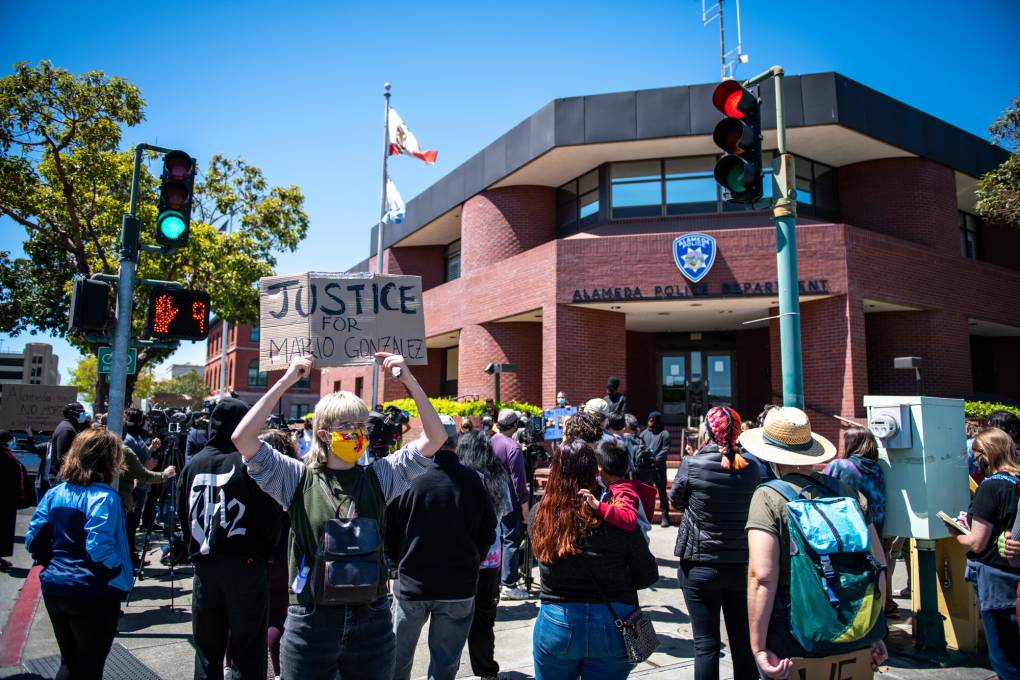
"caption": "Friends, family and supporters of Mario Gonzalez gather outside of the Alameda Police Department on April 27, 2021. Charges were dismissed against two Alameda police officers this week due to prosecutors’ failure to meet the statute of limitations. Only one officer still faces prosecution.",
"credit": "Beth LaBerge/KQED",
"altTag": null,
"description": null,
"imgSizes": {
"medium": {
"file": "https://cdn.kqed.org/wp-content/uploads/sites/10/2024/10/012_Alameda_MarioGonzalezPressConf_04272021_qed-800x533.jpg",
"width": 800,
"height": 533,
"mimeType": "image/jpeg"
},
"large": {
"file": "https://cdn.kqed.org/wp-content/uploads/sites/10/2024/10/012_Alameda_MarioGonzalezPressConf_04272021_qed-1020x680.jpg",
"width": 1020,
"height": 680,
"mimeType": "image/jpeg"
},
"thumbnail": {
"file": "https://cdn.kqed.org/wp-content/uploads/sites/10/2024/10/012_Alameda_MarioGonzalezPressConf_04272021_qed-160x107.jpg",
"width": 160,
"height": 107,
"mimeType": "image/jpeg"
},
"1536x1536": {
"file": "https://cdn.kqed.org/wp-content/uploads/sites/10/2024/10/012_Alameda_MarioGonzalezPressConf_04272021_qed-1536x1024.jpg",
"width": 1536,
"height": 1024,
"mimeType": "image/jpeg"
},
"post-thumbnail": {
"file": "https://cdn.kqed.org/wp-content/uploads/sites/10/2024/10/012_Alameda_MarioGonzalezPressConf_04272021_qed-672x372.jpg",
"width": 672,
"height": 372,
"mimeType": "image/jpeg"
},
"twentyfourteen-full-width": {
"file": "https://cdn.kqed.org/wp-content/uploads/sites/10/2024/10/012_Alameda_MarioGonzalezPressConf_04272021_qed-1038x576.jpg",
"width": 1038,
"height": 576,
"mimeType": "image/jpeg"
},
"full-width": {
"file": "https://cdn.kqed.org/wp-content/uploads/sites/10/2024/10/012_Alameda_MarioGonzalezPressConf_04272021_qed-1920x1280.jpg",
"width": 1920,
"height": 1280,
"mimeType": "image/jpeg"
},
"kqedFullSize": {
"file": "https://cdn.kqed.org/wp-content/uploads/sites/10/2024/10/012_Alameda_MarioGonzalezPressConf_04272021_qed.jpg",
"width": 2000,
"height": 1333
}
},
"isLoading": false,
"fetchFailed": false
},
"news_11871443": {
"type": "attachments",
"id": "news_11871443",
"meta": {
"index": "attachments_1716263798",
"site": "news",
"id": "11871443",
"found": true
},
"parent": 11871345,
"imgSizes": {
"twentyfourteen-full-width": {
"file": "https://ww2.kqed.org/app/uploads/sites/10/2021/04/RS48839_022_Alameda_MarioGonzalezPressConf_04272021-qut-1038x576.jpg",
"width": 1038,
"mimeType": "image/jpeg",
"height": 576
},
"thumbnail": {
"file": "https://ww2.kqed.org/app/uploads/sites/10/2021/04/RS48839_022_Alameda_MarioGonzalezPressConf_04272021-qut-160x107.jpg",
"width": 160,
"mimeType": "image/jpeg",
"height": 107
},
"post-thumbnail": {
"file": "https://ww2.kqed.org/app/uploads/sites/10/2021/04/RS48839_022_Alameda_MarioGonzalezPressConf_04272021-qut-672x372.jpg",
"width": 672,
"mimeType": "image/jpeg",
"height": 372
},
"kqedFullSize": {
"file": "https://ww2.kqed.org/app/uploads/sites/10/2021/04/RS48839_022_Alameda_MarioGonzalezPressConf_04272021-qut.jpg",
"width": 1920,
"height": 1278
},
"large": {
"file": "https://ww2.kqed.org/app/uploads/sites/10/2021/04/RS48839_022_Alameda_MarioGonzalezPressConf_04272021-qut-1020x679.jpg",
"width": 1020,
"mimeType": "image/jpeg",
"height": 679
},
"1536x1536": {
"file": "https://ww2.kqed.org/app/uploads/sites/10/2021/04/RS48839_022_Alameda_MarioGonzalezPressConf_04272021-qut-1536x1022.jpg",
"width": 1536,
"mimeType": "image/jpeg",
"height": 1022
},
"medium": {
"file": "https://ww2.kqed.org/app/uploads/sites/10/2021/04/RS48839_022_Alameda_MarioGonzalezPressConf_04272021-qut-800x533.jpg",
"width": 800,
"mimeType": "image/jpeg",
"height": 533
}
},
"publishDate": 1619584471,
"modified": 1619584596,
"caption": "A demonstrator holds a \"Justice 4 Mario\" sign in front of the Alameda Police Department on April 27, 2021.",
"description": null,
"title": "RS48839_022_Alameda_MarioGonzalezPressConf_04272021-qut",
"credit": "Beth LaBerge/KQED",
"status": "inherit",
"altTag": null,
"isLoading": false,
"fetchFailed": false
},
"news_12007657": {
"type": "attachments",
"id": "news_12007657",
"meta": {
"index": "attachments_1716263798",
"site": "news",
"id": "12007657",
"found": true
},
"title": "A CHP officer keeps watch as others process several people detained on Martime Street on Wednesday, November 26, 2014, after CHP, Oakland Police and Alameda County Sheriff's officers raided a large sideshow event on Maritime Street in Oakland, Calif. Over",
"publishDate": 1727913818,
"status": "inherit",
"parent": 12007646,
"modified": 1727915480,
"caption": "A CHP officer keeps watch as others process several people detained on Maritime Street on Nov. 26, 2014, after CHP, Oakland Police and Alameda County Sheriff's officers raided a large sideshow in Oakland. Alameda County's controversial sideshow ordinance, which prohibits spectating within 200 feet of a street takeover, is being challenged in federal court for allegedly violating First Amendment rights.",
"credit": "Carlos Avila Gonzalez/The San Francisco Chronicle via Getty Images",
"altTag": null,
"description": null,
"imgSizes": {
"medium": {
"file": "https://cdn.kqed.org/wp-content/uploads/sites/10/2024/10/BayAreaSideshowGetty1-800x545.jpg",
"width": 800,
"height": 545,
"mimeType": "image/jpeg"
},
"large": {
"file": "https://cdn.kqed.org/wp-content/uploads/sites/10/2024/10/BayAreaSideshowGetty1-1020x695.jpg",
"width": 1020,
"height": 695,
"mimeType": "image/jpeg"
},
"thumbnail": {
"file": "https://cdn.kqed.org/wp-content/uploads/sites/10/2024/10/BayAreaSideshowGetty1-160x109.jpg",
"width": 160,
"height": 109,
"mimeType": "image/jpeg"
},
"1536x1536": {
"file": "https://cdn.kqed.org/wp-content/uploads/sites/10/2024/10/BayAreaSideshowGetty1-1536x1046.jpg",
"width": 1536,
"height": 1046,
"mimeType": "image/jpeg"
},
"post-thumbnail": {
"file": "https://cdn.kqed.org/wp-content/uploads/sites/10/2024/10/BayAreaSideshowGetty1-672x372.jpg",
"width": 672,
"height": 372,
"mimeType": "image/jpeg"
},
"twentyfourteen-full-width": {
"file": "https://cdn.kqed.org/wp-content/uploads/sites/10/2024/10/BayAreaSideshowGetty1-1038x576.jpg",
"width": 1038,
"height": 576,
"mimeType": "image/jpeg"
},
"full-width": {
"file": "https://cdn.kqed.org/wp-content/uploads/sites/10/2024/10/BayAreaSideshowGetty1-1920x1308.jpg",
"width": 1920,
"height": 1308,
"mimeType": "image/jpeg"
},
"kqedFullSize": {
"file": "https://cdn.kqed.org/wp-content/uploads/sites/10/2024/10/BayAreaSideshowGetty1.jpg",
"width": 2000,
"height": 1362
}
},
"isLoading": false,
"fetchFailed": false
},
"news_12006891": {
"type": "attachments",
"id": "news_12006891",
"meta": {
"index": "attachments_1716263798",
"site": "news",
"id": "12006891",
"found": true
},
"title": "California Reparations Veto",
"publishDate": 1727467632,
"status": "inherit",
"parent": 12006872,
"modified": 1727480845,
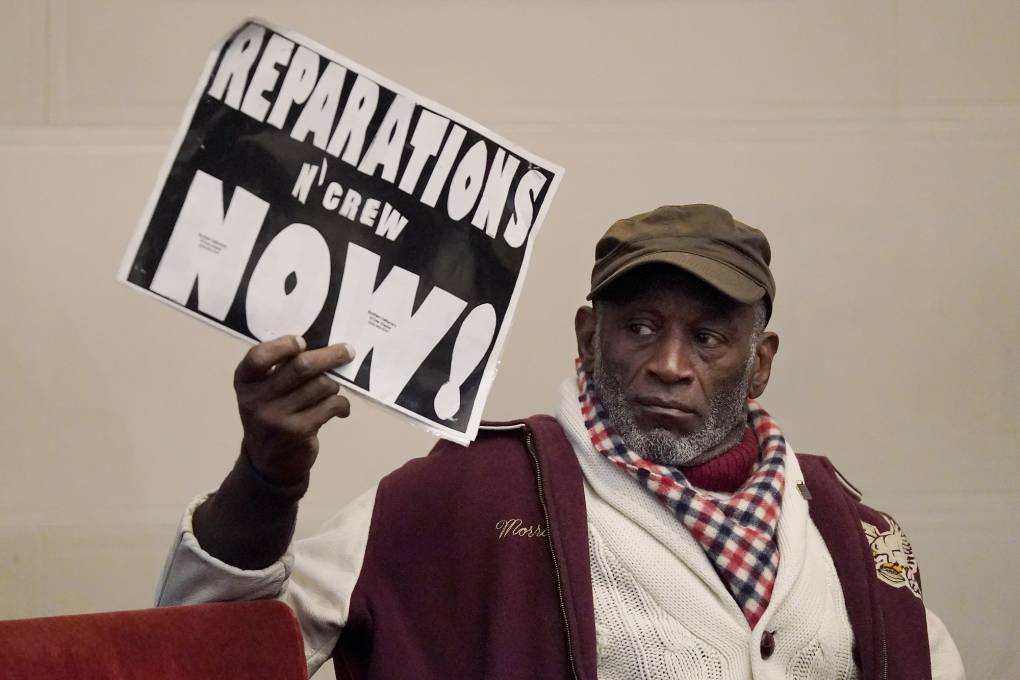
"caption": "Morris Griffin holds up a sign during a meeting by the Task Force to Study and Develop Reparation Proposals for African Americans in Oakland, Dec. 14, 2022. The Alameda County Reparations Commission has made little progress in over a year. Last week, the county extended its mandate for two years but allocated only $92,000 — less than 2% of the requested budget. With these limited funds primarily for historical research and community outreach, the commission must reassess its achievable goals.",
"credit": "Jeff Chiu/AP Photo",
"altTag": null,
"description": null,
"imgSizes": {
"medium": {
"file": "https://cdn.kqed.org/wp-content/uploads/sites/10/2024/09/ReparationsOaklandAP-800x533.jpg",
"width": 800,
"height": 533,
"mimeType": "image/jpeg"
},
"large": {
"file": "https://cdn.kqed.org/wp-content/uploads/sites/10/2024/09/ReparationsOaklandAP-1020x680.jpg",
"width": 1020,
"height": 680,
"mimeType": "image/jpeg"
},
"thumbnail": {
"file": "https://cdn.kqed.org/wp-content/uploads/sites/10/2024/09/ReparationsOaklandAP-160x107.jpg",
"width": 160,
"height": 107,
"mimeType": "image/jpeg"
},
"1536x1536": {
"file": "https://cdn.kqed.org/wp-content/uploads/sites/10/2024/09/ReparationsOaklandAP-1536x1024.jpg",
"width": 1536,
"height": 1024,
"mimeType": "image/jpeg"
},
"post-thumbnail": {
"file": "https://cdn.kqed.org/wp-content/uploads/sites/10/2024/09/ReparationsOaklandAP-672x372.jpg",
"width": 672,
"height": 372,
"mimeType": "image/jpeg"
},
"twentyfourteen-full-width": {
"file": "https://cdn.kqed.org/wp-content/uploads/sites/10/2024/09/ReparationsOaklandAP-1038x576.jpg",
"width": 1038,
"height": 576,
"mimeType": "image/jpeg"
},
"full-width": {
"file": "https://cdn.kqed.org/wp-content/uploads/sites/10/2024/09/ReparationsOaklandAP-1920x1280.jpg",
"width": 1920,
"height": 1280,
"mimeType": "image/jpeg"
},
"kqedFullSize": {
"file": "https://cdn.kqed.org/wp-content/uploads/sites/10/2024/09/ReparationsOaklandAP.jpg",
"width": 2000,
"height": 1333
}
},
"isLoading": false,
"fetchFailed": false
},
"news_12005472": {
"type": "attachments",
"id": "news_12005472",
"meta": {
"index": "attachments_1716263798",
"site": "news",
"id": "12005472",
"found": true
},
"title": "033_Alameda_MarioGonzalezPressConf_04272021_qed",
"publishDate": 1726774175,
"status": "inherit",
"parent": 12005470,
"modified": 1726777832,
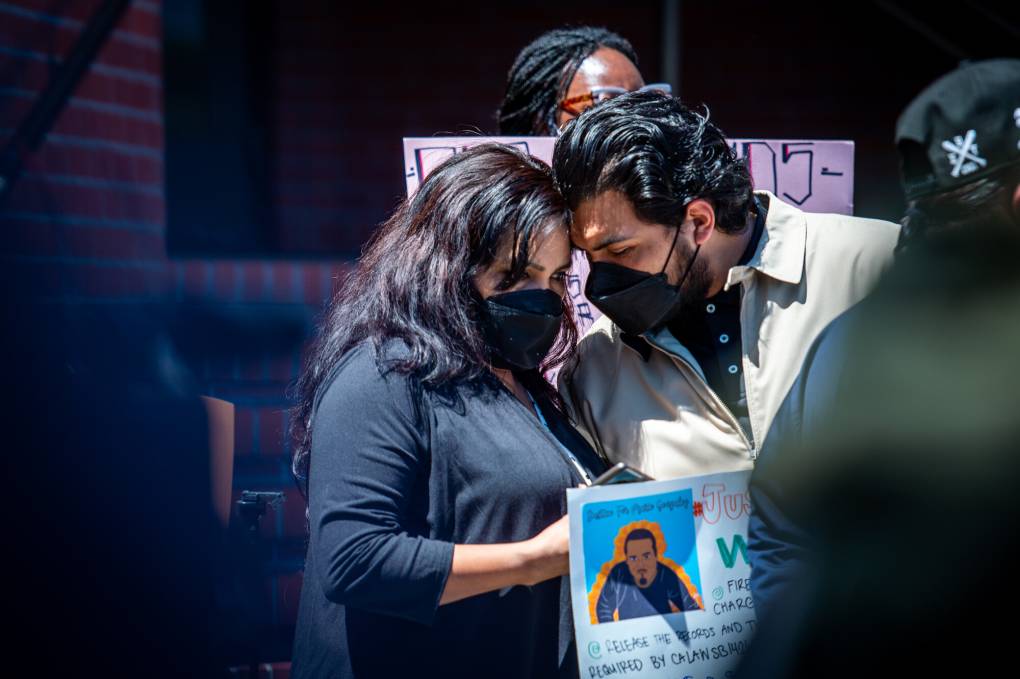
"caption": "The mother of Mario Gonzalez, Edith Arenales, puts her head together with her son Geraldo Gonzalez before speaking at a news conference outside the Alameda Police Department on April 27, 2021. Attorneys for the Alameda officers charged in Mario Gonzalez’s death are seeking to dismiss the manslaughter charges.",
"credit": "Beth LaBerge/KQED",
"altTag": null,
"description": null,
"imgSizes": {
"medium": {
"file": "https://cdn.kqed.org/wp-content/uploads/sites/10/2024/09/033_Alameda_MarioGonzalezPressConf_04272021_qed-800x532.jpg",
"width": 800,
"height": 532,
"mimeType": "image/jpeg"
},
"large": {
"file": "https://cdn.kqed.org/wp-content/uploads/sites/10/2024/09/033_Alameda_MarioGonzalezPressConf_04272021_qed-1020x679.jpg",
"width": 1020,
"height": 679,
"mimeType": "image/jpeg"
},
"thumbnail": {
"file": "https://cdn.kqed.org/wp-content/uploads/sites/10/2024/09/033_Alameda_MarioGonzalezPressConf_04272021_qed-160x106.jpg",
"width": 160,
"height": 106,
"mimeType": "image/jpeg"
},
"1536x1536": {
"file": "https://cdn.kqed.org/wp-content/uploads/sites/10/2024/09/033_Alameda_MarioGonzalezPressConf_04272021_qed-1536x1022.jpg",
"width": 1536,
"height": 1022,
"mimeType": "image/jpeg"
},
"post-thumbnail": {
"file": "https://cdn.kqed.org/wp-content/uploads/sites/10/2024/09/033_Alameda_MarioGonzalezPressConf_04272021_qed-672x372.jpg",
"width": 672,
"height": 372,
"mimeType": "image/jpeg"
},
"twentyfourteen-full-width": {
"file": "https://cdn.kqed.org/wp-content/uploads/sites/10/2024/09/033_Alameda_MarioGonzalezPressConf_04272021_qed-1038x576.jpg",
"width": 1038,
"height": 576,
"mimeType": "image/jpeg"
},
"full-width": {
"file": "https://cdn.kqed.org/wp-content/uploads/sites/10/2024/09/033_Alameda_MarioGonzalezPressConf_04272021_qed-1920x1278.jpg",
"width": 1920,
"height": 1278,
"mimeType": "image/jpeg"
},
"kqedFullSize": {
"file": "https://cdn.kqed.org/wp-content/uploads/sites/10/2024/09/033_Alameda_MarioGonzalezPressConf_04272021_qed.jpg",
"width": 2000,
"height": 1331
}
},
"isLoading": false,
"fetchFailed": false
},
"news_11989852": {
"type": "attachments",
"id": "news_11989852",
"meta": {
"index": "attachments_1716263798",
"site": "news",
"id": "11989852",
"found": true
},
"title": "20240608_PriceRecallKickoff_GC-44_qut",
"publishDate": 1718142851,
"status": "inherit",
"parent": 0,
"modified": 1729121631,
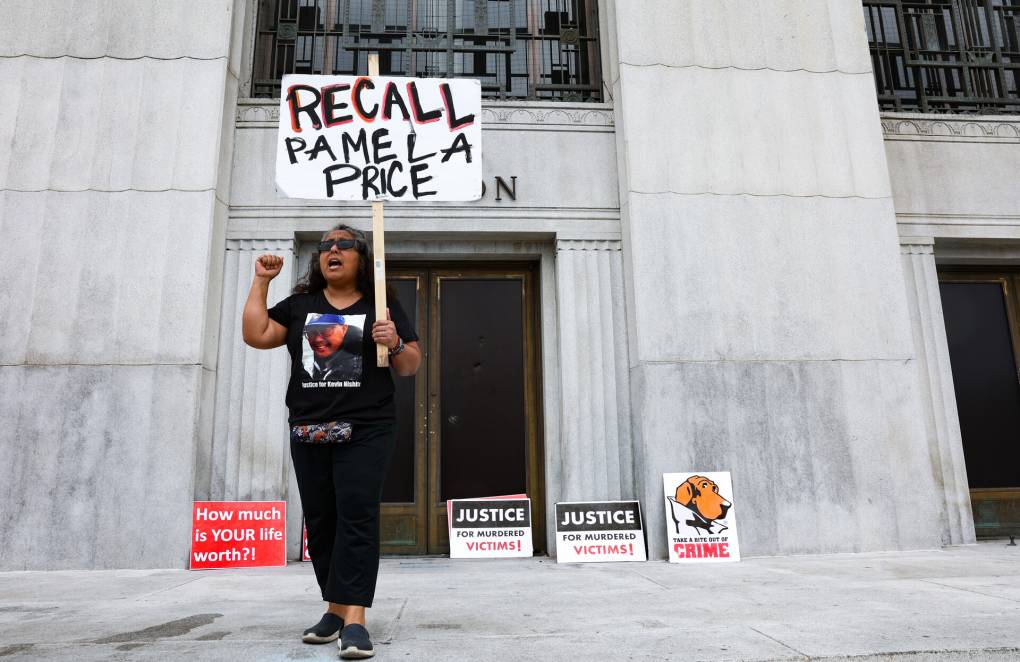
"caption": "Virginia Nishita holds a 'Recall Pamela Price' sign outside the René C. Davidson Courthouse in Oakland on June 8, 2024. Her husband, Kevin Nishita, a retired police officer, was shot during an attempted robbery while working as a KRON4 news guard in 2021. He died several days later.",
"credit": "Gina Castro/KQED",
"altTag": "A woman stands in front of an official-looking building holding a sign that says 'Recall Pamela Price.'",
"description": null,
"imgSizes": {
"medium": {
"file": "https://cdn.kqed.org/wp-content/uploads/sites/10/2024/06/20240608_PriceRecallKickoff_GC-44_qut-800x519.jpg",
"width": 800,
"height": 519,
"mimeType": "image/jpeg"
},
"large": {
"file": "https://cdn.kqed.org/wp-content/uploads/sites/10/2024/06/20240608_PriceRecallKickoff_GC-44_qut-1020x662.jpg",
"width": 1020,
"height": 662,
"mimeType": "image/jpeg"
},
"thumbnail": {
"file": "https://cdn.kqed.org/wp-content/uploads/sites/10/2024/06/20240608_PriceRecallKickoff_GC-44_qut-160x104.jpg",
"width": 160,
"height": 104,
"mimeType": "image/jpeg"
},
"1536x1536": {
"file": "https://cdn.kqed.org/wp-content/uploads/sites/10/2024/06/20240608_PriceRecallKickoff_GC-44_qut-1536x997.jpg",
"width": 1536,
"height": 997,
"mimeType": "image/jpeg"
},
"post-thumbnail": {
"file": "https://cdn.kqed.org/wp-content/uploads/sites/10/2024/06/20240608_PriceRecallKickoff_GC-44_qut-672x372.jpg",
"width": 672,
"height": 372,
"mimeType": "image/jpeg"
},
"twentyfourteen-full-width": {
"file": "https://cdn.kqed.org/wp-content/uploads/sites/10/2024/06/20240608_PriceRecallKickoff_GC-44_qut-1038x576.jpg",
"width": 1038,
"height": 576,
"mimeType": "image/jpeg"
},
"kqedFullSize": {
"file": "https://cdn.kqed.org/wp-content/uploads/sites/10/2024/06/20240608_PriceRecallKickoff_GC-44_qut.jpg",
"width": 1920,
"height": 1246
}
},
"isLoading": false,
"fetchFailed": false
},
"news_11830907": {
"type": "attachments",
"id": "news_11830907",
"meta": {
"index": "attachments_1716263798",
"site": "news",
"id": "11830907",
"found": true
},
"parent": 11830774,
"imgSizes": {
"apple_news_ca_landscape_5_5": {
"file": "https://ww2.kqed.org/app/uploads/sites/10/2020/07/Child-Care-Generic-1044x783.jpg",
"width": 1044,
"mimeType": "image/jpeg",
"height": 783
},
"apple_news_ca_square_4_0": {
"file": "https://ww2.kqed.org/app/uploads/sites/10/2020/07/Child-Care-Generic-470x470.jpg",
"width": 470,
"mimeType": "image/jpeg",
"height": 470
},
"twentyfourteen-full-width": {
"file": "https://ww2.kqed.org/app/uploads/sites/10/2020/07/Child-Care-Generic-1038x576.jpg",
"width": 1038,
"mimeType": "image/jpeg",
"height": 576
},
"thumbnail": {
"file": "https://ww2.kqed.org/app/uploads/sites/10/2020/07/Child-Care-Generic-160x107.jpg",
"width": 160,
"mimeType": "image/jpeg",
"height": 107
},
"post-thumbnail": {
"file": "https://ww2.kqed.org/app/uploads/sites/10/2020/07/Child-Care-Generic-672x372.jpg",
"width": 672,
"mimeType": "image/jpeg",
"height": 372
},
"kqedFullSize": {
"file": "https://ww2.kqed.org/app/uploads/sites/10/2020/07/Child-Care-Generic.jpg",
"width": 1920,
"height": 1280
},
"apple_news_ca_landscape_4_7": {
"file": "https://ww2.kqed.org/app/uploads/sites/10/2020/07/Child-Care-Generic-632x474.jpg",
"width": 632,
"mimeType": "image/jpeg",
"height": 474
},
"large": {
"file": "https://ww2.kqed.org/app/uploads/sites/10/2020/07/Child-Care-Generic-1020x680.jpg",
"width": 1020,
"mimeType": "image/jpeg",
"height": 680
},
"apple_news_ca_landscape_4_0": {
"file": "https://ww2.kqed.org/app/uploads/sites/10/2020/07/Child-Care-Generic-536x402.jpg",
"width": 536,
"mimeType": "image/jpeg",
"height": 402
},
"apple_news_ca_portrait_12_9": {
"file": "https://ww2.kqed.org/app/uploads/sites/10/2020/07/Child-Care-Generic-1122x1280.jpg",
"width": 1122,
"mimeType": "image/jpeg",
"height": 1280
},
"medium": {
"file": "https://ww2.kqed.org/app/uploads/sites/10/2020/07/Child-Care-Generic-800x533.jpg",
"width": 800,
"mimeType": "image/jpeg",
"height": 533
},
"apple_news_ca_portrait_4_0": {
"file": "https://ww2.kqed.org/app/uploads/sites/10/2020/07/Child-Care-Generic-354x472.jpg",
"width": 354,
"mimeType": "image/jpeg",
"height": 472
},
"apple_news_ca_portrait_9_7": {
"file": "https://ww2.kqed.org/app/uploads/sites/10/2020/07/Child-Care-Generic-840x1120.jpg",
"width": 840,
"mimeType": "image/jpeg",
"height": 1120
},
"apple_news_ca_landscape_12_9": {
"file": "https://ww2.kqed.org/app/uploads/sites/10/2020/07/Child-Care-Generic-1832x1280.jpg",
"width": 1832,
"mimeType": "image/jpeg",
"height": 1280
},
"apple_news_ca_square_9_7": {
"file": "https://ww2.kqed.org/app/uploads/sites/10/2020/07/Child-Care-Generic-1104x1104.jpg",
"width": 1104,
"mimeType": "image/jpeg",
"height": 1104
},
"1536x1536": {
"file": "https://ww2.kqed.org/app/uploads/sites/10/2020/07/Child-Care-Generic-1536x1024.jpg",
"width": 1536,
"mimeType": "image/jpeg",
"height": 1024
},
"apple_news_ca_portrait_4_7": {
"file": "https://ww2.kqed.org/app/uploads/sites/10/2020/07/Child-Care-Generic-414x552.jpg",
"width": 414,
"mimeType": "image/jpeg",
"height": 552
},
"apple_news_ca_square_12_9": {
"file": "https://ww2.kqed.org/app/uploads/sites/10/2020/07/Child-Care-Generic-1472x1280.jpg",
"width": 1472,
"mimeType": "image/jpeg",
"height": 1280
},
"apple_news_ca_portrait_5_5": {
"file": "https://ww2.kqed.org/app/uploads/sites/10/2020/07/Child-Care-Generic-687x916.jpg",
"width": 687,
"mimeType": "image/jpeg",
"height": 916
},
"apple_news_ca_square_4_7": {
"file": "https://ww2.kqed.org/app/uploads/sites/10/2020/07/Child-Care-Generic-550x550.jpg",
"width": 550,
"mimeType": "image/jpeg",
"height": 550
},
"apple_news_ca_landscape_9_7": {
"file": "https://ww2.kqed.org/app/uploads/sites/10/2020/07/Child-Care-Generic-1376x1032.jpg",
"width": 1376,
"mimeType": "image/jpeg",
"height": 1032
},
"apple_news_ca_square_5_5": {
"file": "https://ww2.kqed.org/app/uploads/sites/10/2020/07/Child-Care-Generic-912x912.jpg",
"width": 912,
"mimeType": "image/jpeg",
"height": 912
}
},
"publishDate": 1595979553,
"modified": 1595979801,
"caption": "The vote was made possible after Gov. Gavin Newsom signed a bill last fall allowing family child care providers who are paid by the state, and who serve low-income families, to unionize.",
"description": "The vote was made possible after Gov. Gavin Newsom signed a bill last fall allowing family child care providers who are paid by the state, and who serve low-income families, to unionize.",
"title": "Child-Care-Generic",
"credit": "Getty Images",
"status": "inherit",
"isLoading": false,
"fetchFailed": false
},
"news_12001966": {
"type": "attachments",
"id": "news_12001966",
"meta": {
"index": "attachments_1716263798",
"site": "news",
"id": "12001966",
"found": true
},
"title": "Firetruck in USA",
"publishDate": 1724714365,
"status": "inherit",
"parent": 12001880,
"modified": 1724714488,
"caption": "The Alameda County Fire Department confirmed the man in the viral TikTok video is one of its members, and Fire Chief William McDonald denounced the “embarrassing” behavior by the firefighter, who has not been identified, at a press conference on Monday.",
"credit": "Marco Piunti/Getty Images",
"altTag": null,
"description": null,
"imgSizes": {
"medium": {
"file": "https://cdn.kqed.org/wp-content/uploads/sites/10/2024/08/FireTruckGetty-800x533.jpg",
"width": 800,
"height": 533,
"mimeType": "image/jpeg"
},
"large": {
"file": "https://cdn.kqed.org/wp-content/uploads/sites/10/2024/08/FireTruckGetty-1020x680.jpg",
"width": 1020,
"height": 680,
"mimeType": "image/jpeg"
},
"thumbnail": {
"file": "https://cdn.kqed.org/wp-content/uploads/sites/10/2024/08/FireTruckGetty-160x107.jpg",
"width": 160,
"height": 107,
"mimeType": "image/jpeg"
},
"1536x1536": {
"file": "https://cdn.kqed.org/wp-content/uploads/sites/10/2024/08/FireTruckGetty-1536x1024.jpg",
"width": 1536,
"height": 1024,
"mimeType": "image/jpeg"
},
"post-thumbnail": {
"file": "https://cdn.kqed.org/wp-content/uploads/sites/10/2024/08/FireTruckGetty-672x372.jpg",
"width": 672,
"height": 372,
"mimeType": "image/jpeg"
},
"twentyfourteen-full-width": {
"file": "https://cdn.kqed.org/wp-content/uploads/sites/10/2024/08/FireTruckGetty-1038x576.jpg",
"width": 1038,
"height": 576,
"mimeType": "image/jpeg"
},
"full-width": {
"file": "https://cdn.kqed.org/wp-content/uploads/sites/10/2024/08/FireTruckGetty-1920x1280.jpg",
"width": 1920,
"height": 1280,
"mimeType": "image/jpeg"
},
"kqedFullSize": {
"file": "https://cdn.kqed.org/wp-content/uploads/sites/10/2024/08/FireTruckGetty.jpg",
"width": 2000,
"height": 1333
}
},
"isLoading": false,
"fetchFailed": false
},
"news_12001117": {
"type": "attachments",
"id": "news_12001117",
"meta": {
"index": "attachments_1716263798",
"site": "news",
"id": "12001117",
"found": true
},
"title": "240821-ANTIRECALL-AF-04-KQED",
"publishDate": 1724258541,
"status": "inherit",
"parent": 0,
"modified": 1724265390,
"caption": "Stewart Chen, president of the Oakland Chinatown Improvement Council, said the recalls are premature. He said Mayor Sheng Thao and Alameda County District Attorney Pamela Price haven’t had enough time to test out their policies and for residents to know what impact they have on the community. Both officials were sworn in into office in January 2023.",
"credit": "Annelise Finney/KQED",
"altTag": null,
"description": null,
"imgSizes": {
"medium": {
"file": "https://cdn.kqed.org/wp-content/uploads/sites/10/2024/08/240821-ANTIRECALL-AF-04-KQED-800x533.jpg",
"width": 800,
"height": 533,
"mimeType": "image/jpeg"
},
"large": {
"file": "https://cdn.kqed.org/wp-content/uploads/sites/10/2024/08/240821-ANTIRECALL-AF-04-KQED-1020x680.jpg",
"width": 1020,
"height": 680,
"mimeType": "image/jpeg"
},
"thumbnail": {
"file": "https://cdn.kqed.org/wp-content/uploads/sites/10/2024/08/240821-ANTIRECALL-AF-04-KQED-160x107.jpg",
"width": 160,
"height": 107,
"mimeType": "image/jpeg"
},
"1536x1536": {
"file": "https://cdn.kqed.org/wp-content/uploads/sites/10/2024/08/240821-ANTIRECALL-AF-04-KQED-1536x1024.jpg",
"width": 1536,
"height": 1024,
"mimeType": "image/jpeg"
},
"post-thumbnail": {
"file": "https://cdn.kqed.org/wp-content/uploads/sites/10/2024/08/240821-ANTIRECALL-AF-04-KQED-672x372.jpg",
"width": 672,
"height": 372,
"mimeType": "image/jpeg"
},
"twentyfourteen-full-width": {
"file": "https://cdn.kqed.org/wp-content/uploads/sites/10/2024/08/240821-ANTIRECALL-AF-04-KQED-1038x576.jpg",
"width": 1038,
"height": 576,
"mimeType": "image/jpeg"
},
"full-width": {
"file": "https://cdn.kqed.org/wp-content/uploads/sites/10/2024/08/240821-ANTIRECALL-AF-04-KQED-1920x1280.jpg",
"width": 1920,
"height": 1280,
"mimeType": "image/jpeg"
},
"kqedFullSize": {
"file": "https://cdn.kqed.org/wp-content/uploads/sites/10/2024/08/240821-ANTIRECALL-AF-04-KQED.jpg",
"width": 2000,
"height": 1333
}
},
"isLoading": false,
"fetchFailed": false
},
"news_11999297": {
"type": "attachments",
"id": "news_11999297",
"meta": {
"index": "attachments_1716263798",
"site": "news",
"id": "11999297",
"found": true
},
"title": "230713-PAMELA PRICE-JY-01_qed",
"publishDate": 1723068645,
"status": "inherit",
"parent": 11999257,
"modified": 1723068706,
"caption": "Alameda County District Attorney Pamela Price at her office in Oakland on July 16, 2023.",
"credit": "Juliana Yamada/KQED",
"altTag": null,
"description": null,
"imgSizes": {
"medium": {
"file": "https://cdn.kqed.org/wp-content/uploads/sites/10/2024/08/230713-PAMELA-PRICE-JY-01_qed-800x533.jpg",
"width": 800,
"height": 533,
"mimeType": "image/jpeg"
},
"large": {
"file": "https://cdn.kqed.org/wp-content/uploads/sites/10/2024/08/230713-PAMELA-PRICE-JY-01_qed-1020x680.jpg",
"width": 1020,
"height": 680,
"mimeType": "image/jpeg"
},
"thumbnail": {
"file": "https://cdn.kqed.org/wp-content/uploads/sites/10/2024/08/230713-PAMELA-PRICE-JY-01_qed-160x107.jpg",
"width": 160,
"height": 107,
"mimeType": "image/jpeg"
},
"1536x1536": {
"file": "https://cdn.kqed.org/wp-content/uploads/sites/10/2024/08/230713-PAMELA-PRICE-JY-01_qed-1536x1024.jpg",
"width": 1536,
"height": 1024,
"mimeType": "image/jpeg"
},
"post-thumbnail": {
"file": "https://cdn.kqed.org/wp-content/uploads/sites/10/2024/08/230713-PAMELA-PRICE-JY-01_qed-672x372.jpg",
"width": 672,
"height": 372,
"mimeType": "image/jpeg"
},
"twentyfourteen-full-width": {
"file": "https://cdn.kqed.org/wp-content/uploads/sites/10/2024/08/230713-PAMELA-PRICE-JY-01_qed-1038x576.jpg",
"width": 1038,
"height": 576,
"mimeType": "image/jpeg"
},
"full-width": {
"file": "https://cdn.kqed.org/wp-content/uploads/sites/10/2024/08/230713-PAMELA-PRICE-JY-01_qed-1920x1280.jpg",
"width": 1920,
"height": 1280,
"mimeType": "image/jpeg"
},
"kqedFullSize": {
"file": "https://cdn.kqed.org/wp-content/uploads/sites/10/2024/08/230713-PAMELA-PRICE-JY-01_qed.jpg",
"width": 2000,
"height": 1333
}
},
"isLoading": false,
"fetchFailed": false
},
"news_11996784": {
"type": "attachments",
"id": "news_11996784",
"meta": {
"index": "attachments_1716263798",
"site": "news",
"id": "11996784",
"found": true
},
"title": "The Wiley Manuel Courthouse in Oakland on July 22, 2024.",
"publishDate": 1721681966,
"status": "inherit",
"parent": 0,
"modified": 1721681982,
"caption": "The Wiley Manuel Courthouse in Oakland on July 22, 2024.",
"credit": "Martin do Nascimento/KQED",
"altTag": null,
"description": null,
"imgSizes": {
"medium": {
"file": "https://cdn.kqed.org/wp-content/uploads/sites/10/2024/07/240722-WILEY-MANUEL-COURTHOUSE-MD-02-KQED-1-800x533.jpg",
"width": 800,
"height": 533,
"mimeType": "image/jpeg"
},
"large": {
"file": "https://cdn.kqed.org/wp-content/uploads/sites/10/2024/07/240722-WILEY-MANUEL-COURTHOUSE-MD-02-KQED-1-1020x680.jpg",
"width": 1020,
"height": 680,
"mimeType": "image/jpeg"
},
"thumbnail": {
"file": "https://cdn.kqed.org/wp-content/uploads/sites/10/2024/07/240722-WILEY-MANUEL-COURTHOUSE-MD-02-KQED-1-160x107.jpg",
"width": 160,
"height": 107,
"mimeType": "image/jpeg"
},
"1536x1536": {
"file": "https://cdn.kqed.org/wp-content/uploads/sites/10/2024/07/240722-WILEY-MANUEL-COURTHOUSE-MD-02-KQED-1-1536x1024.jpg",
"width": 1536,
"height": 1024,
"mimeType": "image/jpeg"
},
"post-thumbnail": {
"file": "https://cdn.kqed.org/wp-content/uploads/sites/10/2024/07/240722-WILEY-MANUEL-COURTHOUSE-MD-02-KQED-1-672x372.jpg",
"width": 672,
"height": 372,
"mimeType": "image/jpeg"
},
"twentyfourteen-full-width": {
"file": "https://cdn.kqed.org/wp-content/uploads/sites/10/2024/07/240722-WILEY-MANUEL-COURTHOUSE-MD-02-KQED-1-1038x576.jpg",
"width": 1038,
"height": 576,
"mimeType": "image/jpeg"
},
"full-width": {
"file": "https://cdn.kqed.org/wp-content/uploads/sites/10/2024/07/240722-WILEY-MANUEL-COURTHOUSE-MD-02-KQED-1-1920x1280.jpg",
"width": 1920,
"height": 1280,
"mimeType": "image/jpeg"
},
"kqedFullSize": {
"file": "https://cdn.kqed.org/wp-content/uploads/sites/10/2024/07/240722-WILEY-MANUEL-COURTHOUSE-MD-02-KQED-1.jpg",
"width": 2000,
"height": 1333
}
},
"isLoading": false,
"fetchFailed": false
},
"news_11995884": {
"type": "attachments",
"id": "news_11995884",
"meta": {
"index": "attachments_1716263798",
"site": "news",
"id": "11995884",
"found": true
},
"title": "240717-NEWSOM PRICE DIPTYCH-MD-01-KQED",
"publishDate": 1721161704,
"status": "inherit",
"parent": 0,
"modified": 1721428942,
"caption": "Gov. Gavin Newsom and Alameda County District Attorney Pamela Price have dueling narratives about why a plan to send a state attorney to assist in the DA’s office fell through. ",
"credit": "Andrew Harnik/Getty Images; Lea Suzuki/The San Francisco Chronicle via Getty Images",
"altTag": null,
"description": null,
"imgSizes": {
"medium": {
"file": "https://cdn.kqed.org/wp-content/uploads/sites/10/2024/07/240717-NEWSOM-PRICE-DIPTYCH-MD-01-KQED-800x533.jpg",
"width": 800,
"height": 533,
"mimeType": "image/jpeg"
},
"large": {
"file": "https://cdn.kqed.org/wp-content/uploads/sites/10/2024/07/240717-NEWSOM-PRICE-DIPTYCH-MD-01-KQED-1020x680.jpg",
"width": 1020,
"height": 680,
"mimeType": "image/jpeg"
},
"thumbnail": {
"file": "https://cdn.kqed.org/wp-content/uploads/sites/10/2024/07/240717-NEWSOM-PRICE-DIPTYCH-MD-01-KQED-160x107.jpg",
"width": 160,
"height": 107,
"mimeType": "image/jpeg"
},
"1536x1536": {
"file": "https://cdn.kqed.org/wp-content/uploads/sites/10/2024/07/240717-NEWSOM-PRICE-DIPTYCH-MD-01-KQED-1536x1024.jpg",
"width": 1536,
"height": 1024,
"mimeType": "image/jpeg"
},
"post-thumbnail": {
"file": "https://cdn.kqed.org/wp-content/uploads/sites/10/2024/07/240717-NEWSOM-PRICE-DIPTYCH-MD-01-KQED-672x372.jpg",
"width": 672,
"height": 372,
"mimeType": "image/jpeg"
},
"twentyfourteen-full-width": {
"file": "https://cdn.kqed.org/wp-content/uploads/sites/10/2024/07/240717-NEWSOM-PRICE-DIPTYCH-MD-01-KQED-1038x576.jpg",
"width": 1038,
"height": 576,
"mimeType": "image/jpeg"
},
"full-width": {
"file": "https://cdn.kqed.org/wp-content/uploads/sites/10/2024/07/240717-NEWSOM-PRICE-DIPTYCH-MD-01-KQED-1920x1280.jpg",
"width": 1920,
"height": 1280,
"mimeType": "image/jpeg"
},
"kqedFullSize": {
"file": "https://cdn.kqed.org/wp-content/uploads/sites/10/2024/07/240717-NEWSOM-PRICE-DIPTYCH-MD-01-KQED.jpg",
"width": 2000,
"height": 1333
}
},
"isLoading": false,
"fetchFailed": false
}
},
"audioPlayerReducer": {
"postId": "stream_live",
"isPaused": true,
"isPlaying": false,
"pfsActive": false,
"pledgeModalIsOpen": true,
"playerDrawerIsOpen": false,
"liveAudioPlayStartedAt": 0,
"liveAudioPlayContext": ""
},
"authorsReducer": {
"shossaini": {
"type": "authors",
"id": "3214",
"meta": {
"index": "authors_1716337520",
"id": "3214",
"found": true
},
"name": "Sara Hossaini",
"firstName": "Sara",
"lastName": "Hossaini",
"slug": "shossaini",
"email": "shossaini@kqed.org",
"display_author_email": true,
"staff_mastheads": [
"news"
],
"title": "KQED Reporter",
"bio": "Sara Hossaini came to general assignment reporting at KQED in 2013 after two winters reporting at Wyoming Public Radio. She holds a bachelor's degree in broadcast journalism from the University of Nebraska-Lincoln. Her radio romance began after a bitter breakup with documentary film (Ok, maybe it's still complicated). Her first simultaneous jobs in San Francisco were as Associate Producer on a PBS film series through the Center for Asian American Media and as a butler. She likes to trot, plot and make things with her hands.",
"avatar": "https://secure.gravatar.com/avatar/060e9f56b9554e17942e89f413242774?s=600&d=blank&r=g",
"twitter": "mshossaini",
"facebook": null,
"instagram": null,
"linkedin": null,
"sites": [
{
"site": "news",
"roles": [
"author"
]
},
{
"site": "stateofhealth",
"roles": [
"author"
]
}
],
"headData": {
"title": "Sara Hossaini | KQED",
"description": "KQED Reporter",
"ogImgSrc": "https://secure.gravatar.com/avatar/060e9f56b9554e17942e89f413242774?s=600&d=blank&r=g",
"twImgSrc": "https://secure.gravatar.com/avatar/060e9f56b9554e17942e89f413242774?s=600&d=blank&r=g"
},
"isLoading": false,
"link": "/author/shossaini"
},
"ecruzguevarra": {
"type": "authors",
"id": "8654",
"meta": {
"index": "authors_1716337520",
"id": "8654",
"found": true
},
"name": "Ericka Cruz Guevarra",
"firstName": "Ericka",
"lastName": "Cruz Guevarra",
"slug": "ecruzguevarra",
"email": "ecruzguevarra@kqed.org",
"display_author_email": true,
"staff_mastheads": [
"news"
],
"title": "Producer, The Bay Podcast",
"bio": "Ericka Cruz Guevarra is host of \u003ca href=\"https://www.kqed.org/podcasts/thebay\">\u003cem>The Bay\u003c/em>\u003c/a> podcast at KQED. Before host, she was the show’s producer. Her work in that capacity includes a three-part reported series on policing in Vallejo, which won a 2020 excellence in journalism award from the Society of Professional Journalists. Ericka has worked as a breaking news reporter at Oregon Public Broadcasting, helped produce the Code Switch podcast, and was KQED’s inaugural Raul Ramirez Diversity Fund intern. She’s also an alumna of NPR’s Next Generation Radio program. Send her an email if you have strong feelings about whether Fairfield and Suisun City are the Bay. Ericka is represented by SAG-AFTRA.",
"avatar": "https://secure.gravatar.com/avatar/accefc1de4bafc7e234b69bcb9b6f6536c130fd84709bc3069ef11a78787e1bb?s=600&d=blank&r=g",
"twitter": "NotoriousECG",
"bluesky": null,
"facebook": null,
"instagram": null,
"linkedin": null,
"sites": [
{
"site": "arts",
"roles": [
"subscriber"
]
},
{
"site": "news",
"roles": [
"editor",
"manage_categories"
]
},
{
"site": "futureofyou",
"roles": [
"subscriber"
]
},
{
"site": "stateofhealth",
"roles": [
"subscriber"
]
},
{
"site": "science",
"roles": [
"editor"
]
},
{
"site": "forum",
"roles": [
"subscriber"
]
}
],
"headData": {
"title": "Ericka Cruz Guevarra | KQED",
"description": "Producer, The Bay Podcast",
"ogImgSrc": "https://secure.gravatar.com/avatar/accefc1de4bafc7e234b69bcb9b6f6536c130fd84709bc3069ef11a78787e1bb?s=600&d=blank&r=g",
"twImgSrc": "https://secure.gravatar.com/avatar/accefc1de4bafc7e234b69bcb9b6f6536c130fd84709bc3069ef11a78787e1bb?s=600&d=blank&r=g"
},
"isLoading": false,
"link": "/author/ecruzguevarra"
},
"amontecillo": {
"type": "authors",
"id": "11649",
"meta": {
"index": "authors_1716337520",
"id": "11649",
"found": true
},
"name": "Alan Montecillo",
"firstName": "Alan",
"lastName": "Montecillo",
"slug": "amontecillo",
"email": "amontecillo@kqed.org",
"display_author_email": false,
"staff_mastheads": [
"news"
],
"title": "KQED Contributor",
"bio": "Alan Montecillo is the senior editor of \u003cem>\u003ca href=\"http://kqed.org/thebay\">The Bay\u003c/a>, \u003c/em> KQED's local news podcast. Before moving to the Bay Area, he worked as a senior talk show producer for WILL in Champaign-Urbana, Illinois and at Oregon Public Broadcasting in Portland, Oregon. He has won journalism awards from the Society of Professional Journalists Northern California, the Public Media Journalists Association, The Signal Awards, and has also received a regional Edward R. Murrow award. Alan is a Filipino American from Hong Kong and a graduate of Reed College.",
"avatar": "https://secure.gravatar.com/avatar/268f53a2066899ea9efdd8a5900218b17c822d9862cbc9326cccec53ef41d349?s=600&d=blank&r=g",
"twitter": "alanmontecillo",
"bluesky": null,
"facebook": null,
"instagram": null,
"linkedin": null,
"sites": [
{
"site": "",
"roles": [
"editor"
]
},
{
"site": "news",
"roles": [
"editor",
"manage_categories"
]
}
],
"headData": {
"title": "Alan Montecillo | KQED",
"description": "KQED Contributor",
"ogImgSrc": "https://secure.gravatar.com/avatar/268f53a2066899ea9efdd8a5900218b17c822d9862cbc9326cccec53ef41d349?s=600&d=blank&r=g",
"twImgSrc": "https://secure.gravatar.com/avatar/268f53a2066899ea9efdd8a5900218b17c822d9862cbc9326cccec53ef41d349?s=600&d=blank&r=g"
},
"isLoading": false,
"link": "/author/amontecillo"
},
"afinney": {
"type": "authors",
"id": "11772",
"meta": {
"index": "authors_1716337520",
"id": "11772",
"found": true
},
"name": "Annelise Finney",
"firstName": "Annelise",
"lastName": "Finney",
"slug": "afinney",
"email": "afinney@kqed.org",
"display_author_email": true,
"staff_mastheads": [
"news"
],
"title": "Reporter",
"bio": "Annelise reports on reparations in California and East Bay politics. She co-produced the Sunday Music Drop, a limited-term radio series featuring Bay Area musicians that aired between Sept 2022 and Oct 2024. She joined KQED in 2021 as a general assignment reporter and is an alumna of KALW's Audio Academy. She was born and raised in the East Bay. She is currently away from KQED completing a year-long reporting project in Berlin, Germany as a Alexander Von Humboldt German Chancellor Fellow.",
"avatar": "https://secure.gravatar.com/avatar/5fded66cae47704cdfc5021cde0f3aa4?s=600&d=blank&r=g",
"twitter": null,
"facebook": null,
"instagram": null,
"linkedin": null,
"sites": [
{
"site": "news",
"roles": [
"editor"
]
},
{
"site": "liveblog",
"roles": [
"author"
]
}
],
"headData": {
"title": "Annelise Finney | KQED",
"description": "Reporter",
"ogImgSrc": "https://secure.gravatar.com/avatar/5fded66cae47704cdfc5021cde0f3aa4?s=600&d=blank&r=g",
"twImgSrc": "https://secure.gravatar.com/avatar/5fded66cae47704cdfc5021cde0f3aa4?s=600&d=blank&r=g"
},
"isLoading": false,
"link": "/author/afinney"
},
"kdebenedetti": {
"type": "authors",
"id": "11913",
"meta": {
"index": "authors_1716337520",
"id": "11913",
"found": true
},
"name": "Katie DeBenedetti",
"firstName": "Katie",
"lastName": "DeBenedetti",
"slug": "kdebenedetti",
"email": "kdebenedetti@kqed.org",
"display_author_email": false,
"staff_mastheads": [
"news",
"science"
],
"title": "KQED Contributor",
"bio": "Katie DeBenedetti is a digital reporter covering daily news for the Express Desk. Prior to joining KQED as a culture reporting intern in January 2024, she covered education and city government for the Napa Valley Register.",
"avatar": "https://secure.gravatar.com/avatar/6e31073cb8f7e4214ab03f42771d0f45?s=600&d=blank&r=g",
"twitter": null,
"facebook": null,
"instagram": null,
"linkedin": null,
"sites": [
{
"site": "news",
"roles": [
"author"
]
},
{
"site": "science",
"roles": [
"author"
]
},
{
"site": "liveblog",
"roles": [
"author"
]
}
],
"headData": {
"title": "Katie DeBenedetti | KQED",
"description": "KQED Contributor",
"ogImgSrc": "https://secure.gravatar.com/avatar/6e31073cb8f7e4214ab03f42771d0f45?s=600&d=blank&r=g",
"twImgSrc": "https://secure.gravatar.com/avatar/6e31073cb8f7e4214ab03f42771d0f45?s=600&d=blank&r=g"
},
"isLoading": false,
"link": "/author/kdebenedetti"
},
"slim": {
"type": "authors",
"id": "11920",
"meta": {
"index": "authors_1716337520",
"id": "11920",
"found": true
},
"name": "Samantha Lim",
"firstName": "Samantha",
"lastName": "Lim",
"slug": "slim",
"email": "slim@KQED.org",
"display_author_email": false,
"staff_mastheads": [],
"title": "KQED Contributor",
"bio": null,
"avatar": "https://secure.gravatar.com/avatar/82e592e6c15fe1a04d385e8ad0fb0b4e?s=600&d=blank&r=g",
"twitter": null,
"facebook": null,
"instagram": null,
"linkedin": null,
"sites": [
{
"site": "news",
"roles": []
}
],
"headData": {
"title": "Samantha Lim | KQED",
"description": "KQED Contributor",
"ogImgSrc": "https://secure.gravatar.com/avatar/82e592e6c15fe1a04d385e8ad0fb0b4e?s=600&d=blank&r=g",
"twImgSrc": "https://secure.gravatar.com/avatar/82e592e6c15fe1a04d385e8ad0fb0b4e?s=600&d=blank&r=g"
},
"isLoading": false,
"link": "/author/slim"
},
"rcooke": {
"type": "authors",
"id": "11921",
"meta": {
"index": "authors_1716337520",
"id": "11921",
"found": true
},
"name": "Riley Cooke",
"firstName": "Riley",
"lastName": "Cooke",
"slug": "rcooke",
"email": "rcooke@kqed.org",
"display_author_email": true,
"staff_mastheads": [
"news"
],
"title": "KQED Contributor",
"bio": "Riley is a senior at UC Berkeley, where she studies political science and journalism. Her work has appeared in SFGate, NBC Bay Area, Local News Matters and more. She enjoys reporting on politics, housing and homelessness — and using as many em dashes as her editors will allow.",
"avatar": "https://secure.gravatar.com/avatar/792f98c126cc5e270a8a96f77f7224ea?s=600&d=blank&r=g",
"twitter": "rrileycooke",
"facebook": null,
"instagram": null,
"linkedin": null,
"sites": [
{
"site": "arts",
"roles": [
"author"
]
},
{
"site": "news",
"roles": [
"author"
]
}
],
"headData": {
"title": "Riley Cooke | KQED",
"description": "KQED Contributor",
"ogImgSrc": "https://secure.gravatar.com/avatar/792f98c126cc5e270a8a96f77f7224ea?s=600&d=blank&r=g",
"twImgSrc": "https://secure.gravatar.com/avatar/792f98c126cc5e270a8a96f77f7224ea?s=600&d=blank&r=g"
},
"isLoading": false,
"link": "/author/rcooke"
},
"emanoukian": {
"type": "authors",
"id": "11925",
"meta": {
"index": "authors_1716337520",
"id": "11925",
"found": true
},
"name": "Elize Manoukian",
"firstName": "Elize",
"lastName": "Manoukian",
"slug": "emanoukian",
"email": "emanoukian@KQED.org",
"display_author_email": false,
"staff_mastheads": [
"news"
],
"title": "Digital News Editor",
"bio": "Elize Manoukian is an award-winning audio producer and Senior Editor on the Express Desk, KQED's digital news platform. Her work has appeared on KPFA, Interlochen Public Radio, Oregon Public Broadcast, the New York Daily News, LA Times and the San Diego Union-Tribune.",
"avatar": "https://secure.gravatar.com/avatar/4525f1a8e46ccb30933b32653d9772064cfefe3fa655eb45b3b3a80341f6bdad?s=600&d=blank&r=g",
"twitter": null,
"bluesky": null,
"facebook": null,
"instagram": null,
"linkedin": null,
"sites": [
{
"site": "arts",
"roles": [
"editor"
]
},
{
"site": "news",
"roles": [
"editor"
]
},
{
"site": "science",
"roles": [
"editor"
]
}
],
"headData": {
"title": "Elize Manoukian | KQED",
"description": "Digital News Editor",
"ogImgSrc": "https://secure.gravatar.com/avatar/4525f1a8e46ccb30933b32653d9772064cfefe3fa655eb45b3b3a80341f6bdad?s=600&d=blank&r=g",
"twImgSrc": "https://secure.gravatar.com/avatar/4525f1a8e46ccb30933b32653d9772064cfefe3fa655eb45b3b3a80341f6bdad?s=600&d=blank&r=g"
},
"isLoading": false,
"link": "/author/emanoukian"
}
},
"pagesReducer": {
"news_tag_alameda-county": {
"type": "terms",
"id": "news_260",
"meta": {
"index": "terms_1716263798",
"site": "news",
"id": "260",
"score": 9.556114
},
"featImg": null,
"name": "Alameda County",
"description": null,
"taxonomy": "tag",
"headData": {
"twImgId": null,
"twTitle": null,
"ogTitle": null,
"ogImgId": null,
"twDescription": null,
"description": null,
"title": "Alameda County Archives | KQED News",
"ogDescription": null
},
"ttid": 268,
"slug": "alameda-county",
"isLoading": false,
"title": "Alameda County",
"pageMeta": {
"site": "news",
"WpPageTemplate": "page-topic-editorial",
"currentPage": 12
},
"blocks": [
{
"blockName": "kqed/post-list",
"attrs": {
"layout": "cardArticle2",
"query": "posts/news?tag=alameda-county",
"seeMore": false,
"paginated": true,
"page": 12
}
},
{
"blockName": "kqed/ad"
}
]
}
},
"pfsSessionReducer": {},
"postsReducer": {
"stream_live": {
"type": "live",
"id": "stream_live",
"audioUrl": "https://streams.kqed.org/kqedradio",
"title": "Live Stream",
"excerpt": "Live Stream information currently unavailable.",
"link": "/radio",
"featImg": "",
"label": {
"name": "KQED Live",
"link": "/"
}
},
"stream_kqedNewscast": {
"type": "posts",
"id": "stream_kqedNewscast",
"audioUrl": "https://www.kqed.org/.stream/anon/radio/RDnews/newscast.mp3?_=1",
"title": "KQED Newscast",
"featImg": "",
"label": {
"name": "88.5 FM",
"link": "/"
}
},
"news_12009076": {
"type": "posts",
"id": "news_12009076",
"meta": {
"index": "posts_1716263798",
"site": "news",
"id": "12009076",
"score": null,
"sort": [
1728676041000
]
},
"guestAuthors": [],
"slug": "mario-gonzalez-supporters-call-das-error-a-shame-as-2-officers-avoid-charges",
"title": "Mario Gonzalez Supporters Call DA’s Error a ‘Shame’ as 2 Officers Avoid Charges",
"publishDate": 1728676041,
"format": "standard",
"headTitle": "Mario Gonzalez Supporters Call DA’s Error a ‘Shame’ as 2 Officers Avoid Charges | KQED",
"labelTerm": {
"site": "news"
},
"content": "\u003cp>Supporters of \u003ca href=\"https://www.kqed.org/news/tag/mario-gonzalez\">Mario Gonzalez\u003c/a> rallied Friday outside an Alameda County courthouse where the only police officer who still faces charges in his 2021 death appeared before a judge.\u003c/p>\n\u003cp>It was the first hearing since a judge \u003ca href=\"https://www.kqed.org/news/12008407/2-of-3-alameda-officers-charged-in-mario-gonzalez-death-have-their-case-dismissed\">dismissed the cases\u003c/a> against the other two officers charged with involuntary manslaughter, ruling this week that the district attorney’s office failed to file arrest warrants that would have commenced felony prosecution \u003ca href=\"https://www.kqed.org/news/12005470/attorneys-for-alameda-cops-charged-in-mario-gonzalez-death-try-to-dismiss-case-over-filing-deadlines\">within the three-year statute of limitations\u003c/a>. Gonzalez, 26, died after police pinned him to the ground in an Alameda park on April 19, 2021.\u003c/p>\n\u003cp>“Two officers are going to be able to walk off today on a technicality of some paperwork from the DA’s office being served late. Shame on them,” Amanda Majail-Blanco, an organizer for Communities United for Restorative Youth Justice, said to about 20 supporters outside the Wiley W. Manuel Courthouse in Oakland. “There were three officers that should be held accountable for Mario’s death.”\u003c/p>\n\u003cp>[ad fullwidth]\u003c/p>\n\u003cp>Gonzalez’s mother, Edith Arenales, was not at the rally because she has suffered from health issues since this week’s dismissal of charges. His family was “heartbroken” after hearing the judge’s decision, advocate Barni Qaasim, who organizes with the Justice for Mario Gonzalez community group, told KQED on Tuesday.\u003c/p>\n\u003cp>Judge Scott Patton’s Monday ruling dismissed the charges against Alameda officers James Fisher and Cameron Leahy. The district attorney’s case against the third officer, Eric McKinley, was not thrown out because the clock on his statute of limitations was paused during a recent five-month trip abroad.\u003c/p>\n\u003cfigure id=\"attachment_12009119\" class=\"wp-caption aligncenter\" style=\"max-width: 2000px\">\u003cimg loading=\"lazy\" decoding=\"async\" class=\"size-full wp-image-12009119\" src=\"https://cdn.kqed.org/wp-content/uploads/sites/10/2024/10/241011-MARIO-GONZALEZ-01-SL-KQED.jpg\" alt=\"\" width=\"2000\" height=\"1333\" srcset=\"https://cdn.kqed.org/wp-content/uploads/sites/10/2024/10/241011-MARIO-GONZALEZ-01-SL-KQED.jpg 2000w, https://cdn.kqed.org/wp-content/uploads/sites/10/2024/10/241011-MARIO-GONZALEZ-01-SL-KQED-800x533.jpg 800w, https://cdn.kqed.org/wp-content/uploads/sites/10/2024/10/241011-MARIO-GONZALEZ-01-SL-KQED-1020x680.jpg 1020w, https://cdn.kqed.org/wp-content/uploads/sites/10/2024/10/241011-MARIO-GONZALEZ-01-SL-KQED-160x107.jpg 160w, https://cdn.kqed.org/wp-content/uploads/sites/10/2024/10/241011-MARIO-GONZALEZ-01-SL-KQED-1536x1024.jpg 1536w, https://cdn.kqed.org/wp-content/uploads/sites/10/2024/10/241011-MARIO-GONZALEZ-01-SL-KQED-1920x1280.jpg 1920w\" sizes=\"(max-width: 2000px) 100vw, 2000px\">\u003cfigcaption class=\"wp-caption-text\">A justice rally for the family of Mario Gonzalez, a man who died after an altercation with Alameda police in 2021, in front of the Wiley W. Manuel Court House in Oakland on Oct. 11, 2024. \u003ccite>(Samantha Lim/KQED)\u003c/cite>\u003c/figcaption>\u003c/figure>\n\u003cp>Although Alameda County District Attorney Pamela Price \u003ca href=\"https://www.kqed.org/news/11983439/alameda-county-da-files-manslaughter-charges-against-police-officers-in-mario-gonzalezs-death\">announced charges against the officers\u003c/a> on April 18, one day before the three-year statute of limitations expired, Patton said prosecutors would have had to file an arrest warrant or take several other steps for a felony prosecution to “commence,” which they didn’t do.\u003c/p>\n\u003cp>“It’s really just out of sheer luck that anyone is able to be charged at all after the egregious error that the district attorney’s office made,” James Burch, the deputy director of the Anti-Police Terror Project, said after the rally.\u003c/p>\n\u003cp>McKinley’s arraignment in August marked the start of timely prosecution because the statute of limitations had been paused, the judge ruled. McKinley has also asked the court to dismiss charges against him, alleging that Price “fraudulently induced him to appear” at the arraignment, but Patton rejected that motion on Tuesday.\u003c/p>\n\u003cp>[aside postID=news_12008407 hero='https://ww2.kqed.org/app/uploads/sites/10/2021/04/RS48839_022_Alameda_MarioGonzalezPressConf_04272021-qut-1020x679.jpg']\u003c/p>\n\u003cp>In an emailed statement, Price’s office said it was “unfortunate that all three defendants will not be held accountable,” adding that the court’s decision was not based on any lack of merit in the case.\u003c/p>\n\u003cp>The case has drawn comparisons to the Minneapolis police killing of George Floyd in 2020. Gonzalez was unarmed when officers responded to a 911 call of a man behaving strangely in an Alameda park, and\u003ca href=\"https://www.kqed.org/news/11871345/city-of-alameda-releases-police-body-cam-footage-of-mario-gonzalez-death\"> body camera footage released by the city\u003c/a> shows the officers pin down Gonzalez, who is mumbling and appears not to be fully lucid after he resists being handcuffed.\u003c/p>\n\u003cp>At least one officer pressed an elbow and knee into Gonzalez’s back and shoulder.\u003c/p>\n\u003cp>After about five minutes, officers rolled Gonzalez onto his side, saying he was becoming unresponsive. The officers administered CPR and at least two doses of Narcan before Gonzalez was taken to a hospital, where he was later declared dead.\u003c/p>\n\u003cp>Gonzalez’s family accused the officers of murder after viewing the video and called it a clear case of police brutality. An initial autopsy by the Alameda County coroner classified Gonzalez’s death as a homicide but noted contributing factors to his cardiac arrest were the “toxic effects of methamphetamine,” stress related to altercation and restraint, obesity and alcoholism. A second autopsy, independently requested by Gonzalez’s family, showed that his death had been “a result of restraint asphyxiation.”\u003c/p>\n\u003cp>Then-District Attorney Nancy O’Malley \u003ca href=\"https://www.kqed.org/news/11910601/no-criminal-charges-against-alameda-officers-in-death-of-mario-gonzalez\">cleared the officers of criminal liability\u003c/a> in 2022, but Price reopened the case shortly after she took office in 2023 as part of her new Public Accountability Unit.\u003c/p>\n\u003cp>Price announced the charges this year just three days after the \u003ca href=\"https://www.kqed.org/news/11983091/recall-of-alameda-county-district-attorney-pamela-price-qualifies-for-a-vote\">recall campaign against her qualified for this November’s ballot\u003c/a>, spurring questions about a possible political motivation behind the prosecution.\u003c/p>\n\u003cp>Majail-Blanco, the community organizer, said before Friday’s court hearing that the filing error by the district attorney’s office “is a shame.”\u003c/p>\n\u003cp>“I had been working with Edith on this journey for three years, and it’s been difficult to see her go through this,” Majail-Blanco said. “And it’s almost a slap in the face of disrespect to put this case out in the media and to just let these officers walk.”\u003c/p>\n\u003cp>McKinley will return to court on Oct. 25, when he is scheduled to enter a plea. He will need to be booked prior to the court appearance.\u003c/p>\n\u003cp>\u003cem>KQED’s \u003ca href=\"https://www.kqed.org/author/slim\">Samantha Lim\u003c/a> contributed to this report.\u003c/em>\u003c/p>\n\u003cp>\u003c/p>\n",
"blocks": [],
"excerpt": "Charges were dismissed against two Alameda police officers due to prosecutors’ failure to meet the statute of limitations. Only one officer still faces prosecution.",
"status": "publish",
"parent": 0,
"modified": 1728677534,
"stats": {
"hasAudio": false,
"hasVideo": false,
"hasChartOrMap": false,
"iframeSrcs": [],
"hasGoogleForm": false,
"hasGallery": false,
"hasHearkenModule": false,
"hasPolis": false,
"paragraphCount": 22,
"wordCount": 922
},
"headData": {
"title": "Mario Gonzalez Supporters Call DA’s Error a ‘Shame’ as 2 Officers Avoid Charges | KQED",
"description": "Charges were dismissed against two Alameda police officers due to prosecutors’ failure to meet the statute of limitations. Only one officer still faces prosecution.",
"ogTitle": "",
"ogDescription": "",
"ogImgId": "",
"twTitle": "",
"twDescription": "",
"twImgId": "",
"schema": {
"@context": "https://schema.org",
"@type": "NewsArticle",
"headline": "Mario Gonzalez Supporters Call DA’s Error a ‘Shame’ as 2 Officers Avoid Charges",
"datePublished": "2024-10-11T12:47:21-07:00",
"dateModified": "2024-10-11T13:12:14-07:00",
"image": "https://cdn.kqed.org/wp-content/uploads/2020/02/KQED-OG-Image@1x.png",
"isAccessibleForFree": "True",
"publisher": {
"@type": "NewsMediaOrganization",
"@id": "https://www.kqed.org/#organization",
"name": "KQED",
"logo": "https://cdn.kqed.org/wp-content/uploads/2020/02/KQED-OG-Image@1x.png",
"url": "https://www.kqed.org",
"sameAs": [
"https://www.facebook.com/KQED",
"https://twitter.com/KQED",
"https://www.instagram.com/kqed/",
"https://www.tiktok.com/@kqedofficial",
"https://www.linkedin.com/company/kqed",
"https://www.youtube.com/channel/UCeC0IOo7i1P_61zVUWbJ4nw"
]
}
}
},
"sticky": false,
"nprStoryId": "kqed-12009076",
"excludeFromSiteSearch": "Include",
"articleAge": "0",
"path": "/news/12009076/mario-gonzalez-supporters-call-das-error-a-shame-as-2-officers-avoid-charges",
"audioTrackLength": null,
"parsedContent": [
{
"type": "contentString",
"content": "\u003cdiv class=\"post-body\">\u003cp>\u003cp>Supporters of \u003ca href=\"https://www.kqed.org/news/tag/mario-gonzalez\">Mario Gonzalez\u003c/a> rallied Friday outside an Alameda County courthouse where the only police officer who still faces charges in his 2021 death appeared before a judge.\u003c/p>\n\u003cp>It was the first hearing since a judge \u003ca href=\"https://www.kqed.org/news/12008407/2-of-3-alameda-officers-charged-in-mario-gonzalez-death-have-their-case-dismissed\">dismissed the cases\u003c/a> against the other two officers charged with involuntary manslaughter, ruling this week that the district attorney’s office failed to file arrest warrants that would have commenced felony prosecution \u003ca href=\"https://www.kqed.org/news/12005470/attorneys-for-alameda-cops-charged-in-mario-gonzalez-death-try-to-dismiss-case-over-filing-deadlines\">within the three-year statute of limitations\u003c/a>. Gonzalez, 26, died after police pinned him to the ground in an Alameda park on April 19, 2021.\u003c/p>\n\u003cp>“Two officers are going to be able to walk off today on a technicality of some paperwork from the DA’s office being served late. Shame on them,” Amanda Majail-Blanco, an organizer for Communities United for Restorative Youth Justice, said to about 20 supporters outside the Wiley W. Manuel Courthouse in Oakland. “There were three officers that should be held accountable for Mario’s death.”\u003c/p>\n\u003cp>\u003c/p>\u003c/div>",
"attributes": {
"named": {},
"numeric": []
}
},
{
"type": "component",
"content": "",
"name": "ad",
"attributes": {
"named": {
"label": "fullwidth"
},
"numeric": [
"fullwidth"
]
}
},
{
"type": "contentString",
"content": "\u003cdiv class=\"post-body\">\u003cp>\u003c/p>\n\u003cp>Gonzalez’s mother, Edith Arenales, was not at the rally because she has suffered from health issues since this week’s dismissal of charges. His family was “heartbroken” after hearing the judge’s decision, advocate Barni Qaasim, who organizes with the Justice for Mario Gonzalez community group, told KQED on Tuesday.\u003c/p>\n\u003cp>Judge Scott Patton’s Monday ruling dismissed the charges against Alameda officers James Fisher and Cameron Leahy. The district attorney’s case against the third officer, Eric McKinley, was not thrown out because the clock on his statute of limitations was paused during a recent five-month trip abroad.\u003c/p>\n\u003cfigure id=\"attachment_12009119\" class=\"wp-caption aligncenter\" style=\"max-width: 2000px\">\u003cimg loading=\"lazy\" decoding=\"async\" class=\"size-full wp-image-12009119\" src=\"https://cdn.kqed.org/wp-content/uploads/sites/10/2024/10/241011-MARIO-GONZALEZ-01-SL-KQED.jpg\" alt=\"\" width=\"2000\" height=\"1333\" srcset=\"https://cdn.kqed.org/wp-content/uploads/sites/10/2024/10/241011-MARIO-GONZALEZ-01-SL-KQED.jpg 2000w, https://cdn.kqed.org/wp-content/uploads/sites/10/2024/10/241011-MARIO-GONZALEZ-01-SL-KQED-800x533.jpg 800w, https://cdn.kqed.org/wp-content/uploads/sites/10/2024/10/241011-MARIO-GONZALEZ-01-SL-KQED-1020x680.jpg 1020w, https://cdn.kqed.org/wp-content/uploads/sites/10/2024/10/241011-MARIO-GONZALEZ-01-SL-KQED-160x107.jpg 160w, https://cdn.kqed.org/wp-content/uploads/sites/10/2024/10/241011-MARIO-GONZALEZ-01-SL-KQED-1536x1024.jpg 1536w, https://cdn.kqed.org/wp-content/uploads/sites/10/2024/10/241011-MARIO-GONZALEZ-01-SL-KQED-1920x1280.jpg 1920w\" sizes=\"(max-width: 2000px) 100vw, 2000px\">\u003cfigcaption class=\"wp-caption-text\">A justice rally for the family of Mario Gonzalez, a man who died after an altercation with Alameda police in 2021, in front of the Wiley W. Manuel Court House in Oakland on Oct. 11, 2024. \u003ccite>(Samantha Lim/KQED)\u003c/cite>\u003c/figcaption>\u003c/figure>\n\u003cp>Although Alameda County District Attorney Pamela Price \u003ca href=\"https://www.kqed.org/news/11983439/alameda-county-da-files-manslaughter-charges-against-police-officers-in-mario-gonzalezs-death\">announced charges against the officers\u003c/a> on April 18, one day before the three-year statute of limitations expired, Patton said prosecutors would have had to file an arrest warrant or take several other steps for a felony prosecution to “commence,” which they didn’t do.\u003c/p>\n\u003cp>“It’s really just out of sheer luck that anyone is able to be charged at all after the egregious error that the district attorney’s office made,” James Burch, the deputy director of the Anti-Police Terror Project, said after the rally.\u003c/p>\n\u003cp>McKinley’s arraignment in August marked the start of timely prosecution because the statute of limitations had been paused, the judge ruled. McKinley has also asked the court to dismiss charges against him, alleging that Price “fraudulently induced him to appear” at the arraignment, but Patton rejected that motion on Tuesday.\u003c/p>\n\u003cp>\u003c/p>\u003c/div>",
"attributes": {
"named": {},
"numeric": []
}
},
{
"type": "component",
"content": "",
"name": "aside",
"attributes": {
"named": {
"postid": "news_12008407",
"hero": "https://ww2.kqed.org/app/uploads/sites/10/2021/04/RS48839_022_Alameda_MarioGonzalezPressConf_04272021-qut-1020x679.jpg",
"label": ""
},
"numeric": []
}
},
{
"type": "contentString",
"content": "\u003cdiv class=\"post-body\">\u003cp>\u003c/p>\n\u003cp>In an emailed statement, Price’s office said it was “unfortunate that all three defendants will not be held accountable,” adding that the court’s decision was not based on any lack of merit in the case.\u003c/p>\n\u003cp>The case has drawn comparisons to the Minneapolis police killing of George Floyd in 2020. Gonzalez was unarmed when officers responded to a 911 call of a man behaving strangely in an Alameda park, and\u003ca href=\"https://www.kqed.org/news/11871345/city-of-alameda-releases-police-body-cam-footage-of-mario-gonzalez-death\"> body camera footage released by the city\u003c/a> shows the officers pin down Gonzalez, who is mumbling and appears not to be fully lucid after he resists being handcuffed.\u003c/p>\n\u003cp>At least one officer pressed an elbow and knee into Gonzalez’s back and shoulder.\u003c/p>\n\u003cp>After about five minutes, officers rolled Gonzalez onto his side, saying he was becoming unresponsive. The officers administered CPR and at least two doses of Narcan before Gonzalez was taken to a hospital, where he was later declared dead.\u003c/p>\n\u003cp>Gonzalez’s family accused the officers of murder after viewing the video and called it a clear case of police brutality. An initial autopsy by the Alameda County coroner classified Gonzalez’s death as a homicide but noted contributing factors to his cardiac arrest were the “toxic effects of methamphetamine,” stress related to altercation and restraint, obesity and alcoholism. A second autopsy, independently requested by Gonzalez’s family, showed that his death had been “a result of restraint asphyxiation.”\u003c/p>\n\u003cp>Then-District Attorney Nancy O’Malley \u003ca href=\"https://www.kqed.org/news/11910601/no-criminal-charges-against-alameda-officers-in-death-of-mario-gonzalez\">cleared the officers of criminal liability\u003c/a> in 2022, but Price reopened the case shortly after she took office in 2023 as part of her new Public Accountability Unit.\u003c/p>\n\u003cp>Price announced the charges this year just three days after the \u003ca href=\"https://www.kqed.org/news/11983091/recall-of-alameda-county-district-attorney-pamela-price-qualifies-for-a-vote\">recall campaign against her qualified for this November’s ballot\u003c/a>, spurring questions about a possible political motivation behind the prosecution.\u003c/p>\n\u003cp>Majail-Blanco, the community organizer, said before Friday’s court hearing that the filing error by the district attorney’s office “is a shame.”\u003c/p>\n\u003cp>“I had been working with Edith on this journey for three years, and it’s been difficult to see her go through this,” Majail-Blanco said. “And it’s almost a slap in the face of disrespect to put this case out in the media and to just let these officers walk.”\u003c/p>\n\u003cp>McKinley will return to court on Oct. 25, when he is scheduled to enter a plea. He will need to be booked prior to the court appearance.\u003c/p>\n\u003cp>\u003cem>KQED’s \u003ca href=\"https://www.kqed.org/author/slim\">Samantha Lim\u003c/a> contributed to this report.\u003c/em>\u003c/p>\n\u003cp>\u003c/p>\n\u003c/div>\u003c/p>",
"attributes": {
"named": {},
"numeric": []
}
}
],
"link": "/news/12009076/mario-gonzalez-supporters-call-das-error-a-shame-as-2-officers-avoid-charges",
"authors": [
"11913"
],
"categories": [
"news_31795",
"news_34167",
"news_8"
],
"tags": [
"news_260",
"news_18906",
"news_17626",
"news_17725",
"news_18563",
"news_29381"
],
"featImg": "news_12009080",
"label": "news"
},
"news_12008407": {
"type": "posts",
"id": "news_12008407",
"meta": {
"index": "posts_1716263798",
"site": "news",
"id": "12008407",
"score": null,
"sort": [
1728426566000
]
},
"guestAuthors": [],
"slug": "2-of-3-alameda-officers-charged-in-mario-gonzalez-death-have-their-case-dismissed",
"title": "2 of 3 Alameda Officers Charged in Mario Gonzalez Death Have Their Case Dismissed",
"publishDate": 1728426566,
"format": "standard",
"headTitle": "2 of 3 Alameda Officers Charged in Mario Gonzalez Death Have Their Case Dismissed | KQED",
"labelTerm": {
"site": "news"
},
"content": "\u003cp>\u003ca href=\"#anchor\">\u003cem>This report contains a correction.\u003c/em>\u003c/a>\u003c/p>\n\u003cp>An \u003ca href=\"https://www.kqed.org/news/tag/alameda-county\">Alameda County\u003c/a> judge dismissed charges against two of the three officers who faced criminal prosecution for their role in the 2021 death of \u003ca href=\"https://www.kqed.org/news/tag/mario-gonzalez\">Mario Gonzalez\u003c/a>, a 26-year-old man who stopped breathing after being pinned to the ground during an arrest.\u003c/p>\n\u003cp>Judge Scott Patton ruled that Alameda County prosecutors failed to file the necessary paperwork to bring charges against Alameda officers James Fisher and Cameron Leahy within the three-year statute of limitations for involuntary manslaughter. Defense attorneys had \u003ca href=\"https://www.kqed.org/news/12005470/attorneys-for-alameda-cops-charged-in-mario-gonzalez-death-try-to-dismiss-case-over-filing-deadlines\">sought to dismiss the charges\u003c/a>, citing a lack of arrest warrants that would have officially started the prosecution.\u003c/p>\n\u003cp>The case against the third officer, Eric McKinley, can proceed because his clock was paused by a trip abroad, the judge ruled.\u003c/p>\n\u003cp>In a 13-page order published Monday, Patton — who worked in the Alameda County district attorney’s office for two decades — called the statute of limitations the “bedrock” of civil and criminal law.\u003c/p>\n\u003cp>[ad fullwidth]\u003c/p>\n\u003cp>“A defendant bringing a challenge because of a violation of the statute of limitations is asserting a substantive due process right, not a technical or procedural violation,” Patton said in his decision.\u003c/p>\n\u003cp>Because the encounter between the officers and Gonzalez took place on April 19, 2021, the judge determined that the statute of limitations expired on that date this year. Although Alameda County District Attorney Pamela Price announced the charges on April 18, prosecutors would have had to file an arrest warrant or take several other steps for a felony prosecution to “commence,” Patton said. That never happened.\u003c/p>\n\u003cfigure id=\"attachment_12005496\" class=\"wp-caption aligncenter\" style=\"max-width: 2000px\">\u003cimg loading=\"lazy\" decoding=\"async\" class=\"size-full wp-image-12005496\" src=\"https://cdn.kqed.org/wp-content/uploads/sites/10/2024/09/042_Alameda_MarioGonzalezPressConf_04272021_qed.jpg\" alt=\"\" width=\"2000\" height=\"1331\" srcset=\"https://cdn.kqed.org/wp-content/uploads/sites/10/2024/09/042_Alameda_MarioGonzalezPressConf_04272021_qed.jpg 2000w, https://cdn.kqed.org/wp-content/uploads/sites/10/2024/09/042_Alameda_MarioGonzalezPressConf_04272021_qed-800x532.jpg 800w, https://cdn.kqed.org/wp-content/uploads/sites/10/2024/09/042_Alameda_MarioGonzalezPressConf_04272021_qed-1020x679.jpg 1020w, https://cdn.kqed.org/wp-content/uploads/sites/10/2024/09/042_Alameda_MarioGonzalezPressConf_04272021_qed-160x106.jpg 160w, https://cdn.kqed.org/wp-content/uploads/sites/10/2024/09/042_Alameda_MarioGonzalezPressConf_04272021_qed-1536x1022.jpg 1536w, https://cdn.kqed.org/wp-content/uploads/sites/10/2024/09/042_Alameda_MarioGonzalezPressConf_04272021_qed-1920x1278.jpg 1920w\" sizes=\"(max-width: 2000px) 100vw, 2000px\">\u003cfigcaption class=\"wp-caption-text\">Friends, family and supporters of Mario Gonzalez gather outside of the Alameda Police Department on April 27, 2021. \u003ccite>(Beth LaBerge/KQED)\u003c/cite>\u003c/figcaption>\u003c/figure>\n\u003cp>However, Patton rejected the motion to dismiss charges against McKinley, who claimed that Price “fraudulently induced him to appear” at an arraignment, which marked the start of his prosecution.\u003c/p>\n\u003cp>The judge refuted any “outrageous fraudulent conduct” on Price’s part. According to the decision, the district attorney’s office decided to forgo a bench warrant in favor of a “notice to appear” as a “courtesy to officers.”\u003c/p>\n\u003cp>In his decision, Patton still slammed prosecutors for a “mischaracterization that a summons had been issued,” which he cited as “further evidence of the rushed and careless work by the District Attorney’s office.”\u003c/p>\n\u003cp>The statute of limitations ruling did not apply to McKinley, who left last December on a five-month mission trip to South Africa. Prosecutors had more time to file charges against McKinley, the judge said, because his time out of the country paused the clock.\u003c/p>\n\u003cp>McKinley’s attorney, James Shore, did not respond to a request for comment.\u003c/p>\n\u003cp>Gonzalez’s family was “heartbroken” after hearing the judge’s decision, said advocate Barni Qaasim, who organizes with the Justice for Mario Gonzalez community group.\u003c/p>\n\u003cp>“It’s so disappointing that charges were dropped not because of a lack of evidence but because the judge prioritizes procedural technicality over the pursuit of justice,” Qaasim said.\u003c/p>\n\u003cp>The district attorney’s office said it is “unfortunate that all three defendants will not be held accountable” in an email to KQED on Tuesday, noting that the court’s decision was not based on any lack of merit in the case.\u003c/p>\n\u003cp>[aside postID=news_12005470 hero='https://cdn.kqed.org/wp-content/uploads/sites/10/2024/09/033_Alameda_MarioGonzalezPressConf_04272021_qed-1020x679.jpg']\u003c/p>\n\u003cp>“Our prosecutors will proceed to file an amended complaint against Officer McKinley,” the office said.\u003c/p>\n\u003cp>The judge’s decision is another twist in a high-profile case that has drawn comparisons to the death of George Floyd, whose murder by a Minneapolis police officer in 2020 became a flashpoint in the national conversation over racial justice. It’s another blow to Price, the embattled district attorney \u003ca href=\"https://www.kqed.org/news/12007542/recall-targeting-alameda-county-da-is-endorsed-by-east-bay-congressman\">facing a recall election\u003c/a> this November over criticism of her progressive policies.\u003c/p>\n\u003cp>Price, who was elected in 2023 on a platform of police reform, reopened Gonzalez’s case through her administration’s new Public Accountability Unit. She \u003ca href=\"https://www.kqed.org/news/11983439/alameda-county-da-files-manslaughter-charges-against-police-officers-in-mario-gonzalezs-death\">announced charges against the officers\u003c/a> three days after the recall campaign against her qualified for the ballot, drawing criticism from an attorney for one of the officers that the case might have been rushed in “a political effort.”\u003c/p>\n\u003cp>The charges reversed a decision by Price’s predecessor, Nancy O’Malley, who in 2022 \u003ca href=\"https://www.kqed.org/news/11910601/no-criminal-charges-against-alameda-officers-in-death-of-mario-gonzalez\">declined to charge the officers\u003c/a> after concluding there was no evidence of wrongdoing.\u003c/p>\n\u003cp>Gonzalez was unarmed when 911 dispatchers received a call of a man behaving strangely in an Alameda park.\u003c/p>\n\u003cp>“He seems like he’s tweaking. But he’s not doing anything wrong. He’s just scaring my wife,” a 911 caller said in dispatch audio recordings. \u003ca href=\"https://www.kqed.org/news/11871345/city-of-alameda-releases-police-body-cam-footage-of-mario-gonzalez-death\">Body cam footage\u003c/a> showed a dazed and confused Gonzalez, who appeared to not understand he was being arrested. About \u003ca href=\"https://www.kalw.org/news/2021-04-29/breaking-down-the-police-video-of-mario-gonzalez-death\">eight minutes\u003c/a> after officers began arresting Gonzalez, he stopped breathing.\u003c/p>\n\u003cp>An initial autopsy by the Alameda County coroner noted contributing factors to his cardiac arrest, including the “toxic effects of methamphetamine,” stress related to altercation, obesity and alcoholism. A second independent autopsy requested by attorneys representing Gonzalez’s family found that his death was “a result of restraint asphyxiation.”\u003c/p>\n\u003cp>“What happened to Mario could happen to anyone,” Qaasim said.\u003c/p>\n\u003cp>The advocate also added that Gonzalez’s family would “continue to escalate” and hoped that prosecutors would appeal the judge’s ruling.\u003c/p>\n\u003cp>The next hearing is scheduled for Friday at the Wiley W. Manuel Courthouse in Oakland.\u003c/p>\n\u003cp>\u003ca id=\"anchor\">\u003c/a>\u003cbr>\n\u003cem>Oct. 10: The original version of this report said Alameda County prosecutors failed to file necessary paperwork within the three-year statue of limitations for voluntary manslaughter. The three Alameda officers were charged with involuntary manslaughter.\u003c/em>\u003c/p>\n\u003cp>\u003c/p>\n",
"blocks": [],
"excerpt": "An Alameda County judge ruled that the high-profile police brutality prosecution failed to meet the statute of limitations for voluntary manslaughter. ",
"status": "publish",
"parent": 0,
"modified": 1728577741,
"stats": {
"hasAudio": false,
"hasVideo": false,
"hasChartOrMap": false,
"iframeSrcs": [],
"hasGoogleForm": false,
"hasGallery": false,
"hasHearkenModule": false,
"hasPolis": false,
"paragraphCount": 29,
"wordCount": 990
},
"headData": {
"title": "2 of 3 Alameda Officers Charged in Mario Gonzalez Death Have Their Case Dismissed | KQED",
"description": "An Alameda County judge ruled that the high-profile police brutality prosecution failed to meet the statute of limitations for voluntary manslaughter. ",
"ogTitle": "",
"ogDescription": "",
"ogImgId": "",
"twTitle": "",
"twDescription": "",
"twImgId": "",
"schema": {
"@context": "https://schema.org",
"@type": "NewsArticle",
"headline": "2 of 3 Alameda Officers Charged in Mario Gonzalez Death Have Their Case Dismissed",
"datePublished": "2024-10-08T15:29:26-07:00",
"dateModified": "2024-10-10T09:29:01-07:00",
"image": "https://cdn.kqed.org/wp-content/uploads/2020/02/KQED-OG-Image@1x.png",
"isAccessibleForFree": "True",
"publisher": {
"@type": "NewsMediaOrganization",
"@id": "https://www.kqed.org/#organization",
"name": "KQED",
"logo": "https://cdn.kqed.org/wp-content/uploads/2020/02/KQED-OG-Image@1x.png",
"url": "https://www.kqed.org",
"sameAs": [
"https://www.facebook.com/KQED",
"https://twitter.com/KQED",
"https://www.instagram.com/kqed/",
"https://www.tiktok.com/@kqedofficial",
"https://www.linkedin.com/company/kqed",
"https://www.youtube.com/channel/UCeC0IOo7i1P_61zVUWbJ4nw"
]
}
}
},
"sticky": false,
"nprStoryId": "kqed-12008407",
"excludeFromSiteSearch": "Include",
"articleAge": "0",
"path": "/news/12008407/2-of-3-alameda-officers-charged-in-mario-gonzalez-death-have-their-case-dismissed",
"audioTrackLength": null,
"parsedContent": [
{
"type": "contentString",
"content": "\u003cdiv class=\"post-body\">\u003cp>\u003cp>\u003ca href=\"#anchor\">\u003cem>This report contains a correction.\u003c/em>\u003c/a>\u003c/p>\n\u003cp>An \u003ca href=\"https://www.kqed.org/news/tag/alameda-county\">Alameda County\u003c/a> judge dismissed charges against two of the three officers who faced criminal prosecution for their role in the 2021 death of \u003ca href=\"https://www.kqed.org/news/tag/mario-gonzalez\">Mario Gonzalez\u003c/a>, a 26-year-old man who stopped breathing after being pinned to the ground during an arrest.\u003c/p>\n\u003cp>Judge Scott Patton ruled that Alameda County prosecutors failed to file the necessary paperwork to bring charges against Alameda officers James Fisher and Cameron Leahy within the three-year statute of limitations for involuntary manslaughter. Defense attorneys had \u003ca href=\"https://www.kqed.org/news/12005470/attorneys-for-alameda-cops-charged-in-mario-gonzalez-death-try-to-dismiss-case-over-filing-deadlines\">sought to dismiss the charges\u003c/a>, citing a lack of arrest warrants that would have officially started the prosecution.\u003c/p>\n\u003cp>The case against the third officer, Eric McKinley, can proceed because his clock was paused by a trip abroad, the judge ruled.\u003c/p>\n\u003cp>In a 13-page order published Monday, Patton — who worked in the Alameda County district attorney’s office for two decades — called the statute of limitations the “bedrock” of civil and criminal law.\u003c/p>\n\u003cp>\u003c/p>\u003c/div>",
"attributes": {
"named": {},
"numeric": []
}
},
{
"type": "component",
"content": "",
"name": "ad",
"attributes": {
"named": {
"label": "fullwidth"
},
"numeric": [
"fullwidth"
]
}
},
{
"type": "contentString",
"content": "\u003cdiv class=\"post-body\">\u003cp>\u003c/p>\n\u003cp>“A defendant bringing a challenge because of a violation of the statute of limitations is asserting a substantive due process right, not a technical or procedural violation,” Patton said in his decision.\u003c/p>\n\u003cp>Because the encounter between the officers and Gonzalez took place on April 19, 2021, the judge determined that the statute of limitations expired on that date this year. Although Alameda County District Attorney Pamela Price announced the charges on April 18, prosecutors would have had to file an arrest warrant or take several other steps for a felony prosecution to “commence,” Patton said. That never happened.\u003c/p>\n\u003cfigure id=\"attachment_12005496\" class=\"wp-caption aligncenter\" style=\"max-width: 2000px\">\u003cimg loading=\"lazy\" decoding=\"async\" class=\"size-full wp-image-12005496\" src=\"https://cdn.kqed.org/wp-content/uploads/sites/10/2024/09/042_Alameda_MarioGonzalezPressConf_04272021_qed.jpg\" alt=\"\" width=\"2000\" height=\"1331\" srcset=\"https://cdn.kqed.org/wp-content/uploads/sites/10/2024/09/042_Alameda_MarioGonzalezPressConf_04272021_qed.jpg 2000w, https://cdn.kqed.org/wp-content/uploads/sites/10/2024/09/042_Alameda_MarioGonzalezPressConf_04272021_qed-800x532.jpg 800w, https://cdn.kqed.org/wp-content/uploads/sites/10/2024/09/042_Alameda_MarioGonzalezPressConf_04272021_qed-1020x679.jpg 1020w, https://cdn.kqed.org/wp-content/uploads/sites/10/2024/09/042_Alameda_MarioGonzalezPressConf_04272021_qed-160x106.jpg 160w, https://cdn.kqed.org/wp-content/uploads/sites/10/2024/09/042_Alameda_MarioGonzalezPressConf_04272021_qed-1536x1022.jpg 1536w, https://cdn.kqed.org/wp-content/uploads/sites/10/2024/09/042_Alameda_MarioGonzalezPressConf_04272021_qed-1920x1278.jpg 1920w\" sizes=\"(max-width: 2000px) 100vw, 2000px\">\u003cfigcaption class=\"wp-caption-text\">Friends, family and supporters of Mario Gonzalez gather outside of the Alameda Police Department on April 27, 2021. \u003ccite>(Beth LaBerge/KQED)\u003c/cite>\u003c/figcaption>\u003c/figure>\n\u003cp>However, Patton rejected the motion to dismiss charges against McKinley, who claimed that Price “fraudulently induced him to appear” at an arraignment, which marked the start of his prosecution.\u003c/p>\n\u003cp>The judge refuted any “outrageous fraudulent conduct” on Price’s part. According to the decision, the district attorney’s office decided to forgo a bench warrant in favor of a “notice to appear” as a “courtesy to officers.”\u003c/p>\n\u003cp>In his decision, Patton still slammed prosecutors for a “mischaracterization that a summons had been issued,” which he cited as “further evidence of the rushed and careless work by the District Attorney’s office.”\u003c/p>\n\u003cp>The statute of limitations ruling did not apply to McKinley, who left last December on a five-month mission trip to South Africa. Prosecutors had more time to file charges against McKinley, the judge said, because his time out of the country paused the clock.\u003c/p>\n\u003cp>McKinley’s attorney, James Shore, did not respond to a request for comment.\u003c/p>\n\u003cp>Gonzalez’s family was “heartbroken” after hearing the judge’s decision, said advocate Barni Qaasim, who organizes with the Justice for Mario Gonzalez community group.\u003c/p>\n\u003cp>“It’s so disappointing that charges were dropped not because of a lack of evidence but because the judge prioritizes procedural technicality over the pursuit of justice,” Qaasim said.\u003c/p>\n\u003cp>The district attorney’s office said it is “unfortunate that all three defendants will not be held accountable” in an email to KQED on Tuesday, noting that the court’s decision was not based on any lack of merit in the case.\u003c/p>\n\u003cp>\u003c/p>\u003c/div>",
"attributes": {
"named": {},
"numeric": []
}
},
{
"type": "component",
"content": "",
"name": "aside",
"attributes": {
"named": {
"postid": "news_12005470",
"hero": "https://cdn.kqed.org/wp-content/uploads/sites/10/2024/09/033_Alameda_MarioGonzalezPressConf_04272021_qed-1020x679.jpg",
"label": ""
},
"numeric": []
}
},
{
"type": "contentString",
"content": "\u003cdiv class=\"post-body\">\u003cp>\u003c/p>\n\u003cp>“Our prosecutors will proceed to file an amended complaint against Officer McKinley,” the office said.\u003c/p>\n\u003cp>The judge’s decision is another twist in a high-profile case that has drawn comparisons to the death of George Floyd, whose murder by a Minneapolis police officer in 2020 became a flashpoint in the national conversation over racial justice. It’s another blow to Price, the embattled district attorney \u003ca href=\"https://www.kqed.org/news/12007542/recall-targeting-alameda-county-da-is-endorsed-by-east-bay-congressman\">facing a recall election\u003c/a> this November over criticism of her progressive policies.\u003c/p>\n\u003cp>Price, who was elected in 2023 on a platform of police reform, reopened Gonzalez’s case through her administration’s new Public Accountability Unit. She \u003ca href=\"https://www.kqed.org/news/11983439/alameda-county-da-files-manslaughter-charges-against-police-officers-in-mario-gonzalezs-death\">announced charges against the officers\u003c/a> three days after the recall campaign against her qualified for the ballot, drawing criticism from an attorney for one of the officers that the case might have been rushed in “a political effort.”\u003c/p>\n\u003cp>The charges reversed a decision by Price’s predecessor, Nancy O’Malley, who in 2022 \u003ca href=\"https://www.kqed.org/news/11910601/no-criminal-charges-against-alameda-officers-in-death-of-mario-gonzalez\">declined to charge the officers\u003c/a> after concluding there was no evidence of wrongdoing.\u003c/p>\n\u003cp>Gonzalez was unarmed when 911 dispatchers received a call of a man behaving strangely in an Alameda park.\u003c/p>\n\u003cp>“He seems like he’s tweaking. But he’s not doing anything wrong. He’s just scaring my wife,” a 911 caller said in dispatch audio recordings. \u003ca href=\"https://www.kqed.org/news/11871345/city-of-alameda-releases-police-body-cam-footage-of-mario-gonzalez-death\">Body cam footage\u003c/a> showed a dazed and confused Gonzalez, who appeared to not understand he was being arrested. About \u003ca href=\"https://www.kalw.org/news/2021-04-29/breaking-down-the-police-video-of-mario-gonzalez-death\">eight minutes\u003c/a> after officers began arresting Gonzalez, he stopped breathing.\u003c/p>\n\u003cp>An initial autopsy by the Alameda County coroner noted contributing factors to his cardiac arrest, including the “toxic effects of methamphetamine,” stress related to altercation, obesity and alcoholism. A second independent autopsy requested by attorneys representing Gonzalez’s family found that his death was “a result of restraint asphyxiation.”\u003c/p>\n\u003cp>“What happened to Mario could happen to anyone,” Qaasim said.\u003c/p>\n\u003cp>The advocate also added that Gonzalez’s family would “continue to escalate” and hoped that prosecutors would appeal the judge’s ruling.\u003c/p>\n\u003cp>The next hearing is scheduled for Friday at the Wiley W. Manuel Courthouse in Oakland.\u003c/p>\n\u003cp>\u003ca id=\"anchor\">\u003c/a>\u003cbr>\n\u003cem>Oct. 10: The original version of this report said Alameda County prosecutors failed to file necessary paperwork within the three-year statue of limitations for voluntary manslaughter. The three Alameda officers were charged with involuntary manslaughter.\u003c/em>\u003c/p>\n\u003cp>\u003c/p>\n\u003c/div>\u003c/p>",
"attributes": {
"named": {},
"numeric": []
}
}
],
"link": "/news/12008407/2-of-3-alameda-officers-charged-in-mario-gonzalez-death-have-their-case-dismissed",
"authors": [
"11925"
],
"categories": [
"news_34167",
"news_6188",
"news_8"
],
"tags": [
"news_260",
"news_23318",
"news_18906",
"news_18563",
"news_29381",
"news_24461"
],
"featImg": "news_11871443",
"label": "news"
},
"news_12007646": {
"type": "posts",
"id": "news_12007646",
"meta": {
"index": "posts_1716263798",
"site": "news",
"id": "12007646",
"score": null,
"sort": [
1727965837000
]
},
"guestAuthors": [],
"slug": "alameda-county-sideshow-ordinance-illegally-blocks-the-press-lawyers-claim",
"title": "Alameda County Sideshow Ordinance Illegally Blocks the Press, Lawyers Claim",
"publishDate": 1727965837,
"format": "standard",
"headTitle": "Alameda County Sideshow Ordinance Illegally Blocks the Press, Lawyers Claim | KQED",
"labelTerm": {
"site": "news"
},
"content": "\u003cp>\u003ca href=\"https://www.kqed.org/news/tag/alameda-county\">Alameda County\u003c/a>’s sideshow ordinance that makes it illegal to watch a street takeover is being challenged in federal court, where lawyers for a local reporter will ask a judge to block its enforcement on the basis that it violates his First Amendment rights.\u003c/p>\n\u003cp>Jose Fermoso, who covers road safety for\u003cem> The Oaklandside\u003c/em>, said he can’t report on sideshows because the ordinance makes it illegal to spectate within 200 feet of one. Violators could be hit with a maximum $1,000 fine, three months in jail or both.\u003c/p>\n\u003cp>Unlike San Francisco’s recent move to crack down on sideshows, which have raised concerns over noise, disruptions and gun violence that sometimes accompanies them, Alameda County’s ordinance does not carve out exceptions for the press.\u003c/p>\n\u003cp>[ad fullwidth]\u003c/p>\n\u003cp>Fermoso filed a federal lawsuit on July 2 against Alameda County and Sheriff Yesenia Sanchez, who co-authored the ordinance, alleging that it “effectively prohibits recording or reporting on the sideshow, because viewing, observing, watching, or witnessing an event is inherently necessary to recording or reporting on it.”\u003c/p>\n\u003cp>The First Amendment Coalition, which is representing Fermoso, will ask the court on Thursday for a preliminary injunction to block the county from enforcing the ordinance against him as a reporter.\u003c/p>\n\u003cp>“If I’m in public — whether I’m a journalist or anybody else — and I see something happening, I’m entitled to record that,” said David Loy, one of the First Amendment Coalition attorneys representing Fermoso.\u003c/p>\n\u003cp>[aside postID=news_12002515 hero='https://cdn.kqed.org/wp-content/uploads/sites/10/2024/08/240830-SFSIDESHOWLEGISLATION-07-BL-KQED-1020x680.jpg']\u003c/p>\n\u003cp>After the ordinance passed last summer, Fermoso said he canceled all future plans to report on sideshows because he “reasonably feared citation, arrest, or criminal prosecution.”\u003c/p>\n\u003cp>In their motion for an injunction, attorneys for Fermoso said the ordinance “compels this self-censorship and violates Fermoso’s First Amendment right to gather and report the news.”\u003c/p>\n\u003cp>Lawyers representing Alameda County and the sheriff argue that the ordinance isn’t subject to First Amendment scrutiny because it’s “a generally applicable regulation of conduct that only incidentally affects speech.”\u003c/p>\n\u003cp>“[The plaintiffs] contend that the First Amendment protects a right just to observe criminal conduct, and the First Amendment does not protect any such right,” said Matthew Zinn, one of the defendants’ lawyers.\u003c/p>\n\u003cp>The defendants also argue that the ordinance has never been enforced because the sheriff’s office hasn’t been aware of any reported sideshows in unincorporated parts of the county since the ordinance was adopted.\u003c/p>\n\u003cp>However, a witness declaration in support of the injunction states otherwise.\u003c/p>\n\u003cp>The individual, who lives in unincorporated Alameda County, wrote in the declaration that sideshows have occurred at least once or twice a week since Aug. 1, 2023.\u003c/p>\n\u003cp>\u003c/p>\n",
"blocks": [],
"excerpt": "Lawyers for a local Oakland reporter will ask a judge to block the law, which makes it illegal to watch within 200 feet of a street takeover, from being enforced against him.",
"status": "publish",
"parent": 0,
"modified": 1727915785,
"stats": {
"hasAudio": false,
"hasVideo": false,
"hasChartOrMap": false,
"iframeSrcs": [],
"hasGoogleForm": false,
"hasGallery": false,
"hasHearkenModule": false,
"hasPolis": false,
"paragraphCount": 16,
"wordCount": 485
},
"headData": {
"title": "Alameda County Sideshow Ordinance Illegally Blocks the Press, Lawyers Claim | KQED",
"description": "Lawyers for a local Oakland reporter will ask a judge to block the law, which makes it illegal to watch within 200 feet of a street takeover, from being enforced against him.",
"ogTitle": "",
"ogDescription": "",
"ogImgId": "",
"twTitle": "",
"twDescription": "",
"twImgId": "",
"schema": {
"@context": "https://schema.org",
"@type": "NewsArticle",
"headline": "Alameda County Sideshow Ordinance Illegally Blocks the Press, Lawyers Claim",
"datePublished": "2024-10-03T07:30:37-07:00",
"dateModified": "2024-10-02T17:36:25-07:00",
"image": "https://cdn.kqed.org/wp-content/uploads/2020/02/KQED-OG-Image@1x.png",
"isAccessibleForFree": "True",
"publisher": {
"@type": "NewsMediaOrganization",
"@id": "https://www.kqed.org/#organization",
"name": "KQED",
"logo": "https://cdn.kqed.org/wp-content/uploads/2020/02/KQED-OG-Image@1x.png",
"url": "https://www.kqed.org",
"sameAs": [
"https://www.facebook.com/KQED",
"https://twitter.com/KQED",
"https://www.instagram.com/kqed/",
"https://www.tiktok.com/@kqedofficial",
"https://www.linkedin.com/company/kqed",
"https://www.youtube.com/channel/UCeC0IOo7i1P_61zVUWbJ4nw"
]
}
}
},
"sticky": false,
"excludeFromSiteSearch": "Include",
"articleAge": "0",
"path": "/news/12007646/alameda-county-sideshow-ordinance-illegally-blocks-the-press-lawyers-claim",
"audioTrackLength": null,
"parsedContent": [
{
"type": "contentString",
"content": "\u003cdiv class=\"post-body\">\u003cp>\u003cp>\u003ca href=\"https://www.kqed.org/news/tag/alameda-county\">Alameda County\u003c/a>’s sideshow ordinance that makes it illegal to watch a street takeover is being challenged in federal court, where lawyers for a local reporter will ask a judge to block its enforcement on the basis that it violates his First Amendment rights.\u003c/p>\n\u003cp>Jose Fermoso, who covers road safety for\u003cem> The Oaklandside\u003c/em>, said he can’t report on sideshows because the ordinance makes it illegal to spectate within 200 feet of one. Violators could be hit with a maximum $1,000 fine, three months in jail or both.\u003c/p>\n\u003cp>Unlike San Francisco’s recent move to crack down on sideshows, which have raised concerns over noise, disruptions and gun violence that sometimes accompanies them, Alameda County’s ordinance does not carve out exceptions for the press.\u003c/p>\n\u003cp>\u003c/p>\u003c/div>",
"attributes": {
"named": {},
"numeric": []
}
},
{
"type": "component",
"content": "",
"name": "ad",
"attributes": {
"named": {
"label": "fullwidth"
},
"numeric": [
"fullwidth"
]
}
},
{
"type": "contentString",
"content": "\u003cdiv class=\"post-body\">\u003cp>\u003c/p>\n\u003cp>Fermoso filed a federal lawsuit on July 2 against Alameda County and Sheriff Yesenia Sanchez, who co-authored the ordinance, alleging that it “effectively prohibits recording or reporting on the sideshow, because viewing, observing, watching, or witnessing an event is inherently necessary to recording or reporting on it.”\u003c/p>\n\u003cp>The First Amendment Coalition, which is representing Fermoso, will ask the court on Thursday for a preliminary injunction to block the county from enforcing the ordinance against him as a reporter.\u003c/p>\n\u003cp>“If I’m in public — whether I’m a journalist or anybody else — and I see something happening, I’m entitled to record that,” said David Loy, one of the First Amendment Coalition attorneys representing Fermoso.\u003c/p>\n\u003cp>\u003c/p>\u003c/div>",
"attributes": {
"named": {},
"numeric": []
}
},
{
"type": "component",
"content": "",
"name": "aside",
"attributes": {
"named": {
"postid": "news_12002515",
"hero": "https://cdn.kqed.org/wp-content/uploads/sites/10/2024/08/240830-SFSIDESHOWLEGISLATION-07-BL-KQED-1020x680.jpg",
"label": ""
},
"numeric": []
}
},
{
"type": "contentString",
"content": "\u003cdiv class=\"post-body\">\u003cp>\u003c/p>\n\u003cp>After the ordinance passed last summer, Fermoso said he canceled all future plans to report on sideshows because he “reasonably feared citation, arrest, or criminal prosecution.”\u003c/p>\n\u003cp>In their motion for an injunction, attorneys for Fermoso said the ordinance “compels this self-censorship and violates Fermoso’s First Amendment right to gather and report the news.”\u003c/p>\n\u003cp>Lawyers representing Alameda County and the sheriff argue that the ordinance isn’t subject to First Amendment scrutiny because it’s “a generally applicable regulation of conduct that only incidentally affects speech.”\u003c/p>\n\u003cp>“[The plaintiffs] contend that the First Amendment protects a right just to observe criminal conduct, and the First Amendment does not protect any such right,” said Matthew Zinn, one of the defendants’ lawyers.\u003c/p>\n\u003cp>The defendants also argue that the ordinance has never been enforced because the sheriff’s office hasn’t been aware of any reported sideshows in unincorporated parts of the county since the ordinance was adopted.\u003c/p>\n\u003cp>However, a witness declaration in support of the injunction states otherwise.\u003c/p>\n\u003cp>The individual, who lives in unincorporated Alameda County, wrote in the declaration that sideshows have occurred at least once or twice a week since Aug. 1, 2023.\u003c/p>\n\u003cp>\u003c/p>\n\u003c/div>\u003c/p>",
"attributes": {
"named": {},
"numeric": []
}
}
],
"link": "/news/12007646/alameda-county-sideshow-ordinance-illegally-blocks-the-press-lawyers-claim",
"authors": [
"11921"
],
"categories": [
"news_31795",
"news_34167",
"news_8"
],
"tags": [
"news_260",
"news_17626",
"news_17725",
"news_23960",
"news_19954"
],
"featImg": "news_12007657",
"label": "news"
},
"news_12006872": {
"type": "posts",
"id": "news_12006872",
"meta": {
"index": "posts_1716263798",
"site": "news",
"id": "12006872",
"score": null,
"sort": [
1727476434000
]
},
"guestAuthors": [],
"slug": "alameda-county-reparations-commission-extended-2-years-slashed-budget",
"title": "Alameda County Reparations Commission Extended 2 Years With Slashed Budget",
"publishDate": 1727476434,
"format": "standard",
"headTitle": "Alameda County Reparations Commission Extended 2 Years With Slashed Budget | KQED",
"labelTerm": {
"site": "news"
},
"content": "\u003cp>\u003cem>[\u003cstrong>Editor’s Note:\u003c/strong> In an earlier version of this story, the role of graduate students from the UC Berkeley Goldman School of Public Policy and Mills College was erroneously characterized. The students will be paid by Alameda County. The story has been updated.]\u003c/em>\u003c/p>\n\u003cp>If the \u003ca href=\"https://www.kqed.org/news/11989301/reparations-efforts-in-alameda-county-stumble-and-try-to-pick-themselves-up\">Alameda County Reparations Commission was stalled before\u003c/a>, the commission now has the vehicle to address racial inequities and harm in neutral and is trying to push it down the road itself.\u003c/p>\n\u003cp>Initially, the 15-member body was supposed to complete its review of anti-Black policy throughout Alameda County’s county history and design an action plan to remedy the harm by July 2024.\u003c/p>\n\u003cp>Instead, the county extended the group’s mandate for two years last week and followed with a budget grant. The group will receive \u003ca href=\"https://www.acgov.org/board/bos_calendar/documents/DocsAgendaReg_9_26_24/GENERAL%20ADMINISTRATION/Regular%20Calendar/Item_28_1_Reparations_Miley_Marquez.pdf\">$92,340.10\u003c/a> over the two years, less than 2% of the $5 million that was requested.\u003c/p>\n\u003cp>The money includes a $50-per-meeting stipend for the commissioners, the commission’s clerk, the room rental and printing costs.\u003c/p>\n\u003cp>[ad fullwidth]\u003c/p>\n\u003cp>“Just enough for us to meet and keep the door open,” Debra Gore-Mann, the commission chair, said at a meeting on Thursday.\u003c/p>\n\u003cp>The commission asked for $5 million to fund community surveys on residents’ experiences of discrimination and their visions for what meaningful repair could look like. The $5 million would have also funded researchers to collect records on discriminatory policy and data on its impact.\u003c/p>\n\u003cp>At a Board of Supervisors meeting on Sept. 17, Shadrick Small, a researcher at UC Berkeley’s Othering & Belonging Institute who is on the commission, urged the board to grant the request.\u003c/p>\n\u003cp>“We’re not a research body. We’re a deliberative body,” he said during public comment. “We’re meant to aggregate all the data and public thought to create good solutions, but we need resources to do that.”\u003c/p>\n\u003cp>[aside postID=news_12006819 hero='https://cdn.kqed.org/wp-content/uploads/sites/10/2024/09/ReparationsAP-1020x680.jpg']\u003c/p>\n\u003cp>Board President Nate Miley, who advises the commission along with Supervisor Elisa Márquez, previously warned that county money is in short supply. This past summer, the county managed to close a $68 million hole in its $4.6 billion annual budget by reducing spending and digging into savings.\u003c/p>\n\u003cp>Erika Weissinger, a UC Berkeley professor, served on the Berkeley Unified School District Reparations Task Force, which similarly had no funding for research.\u003c/p>\n\u003cp>She said white members of the commission, including herself, provided volunteer labor to help move the task force forward. She said, expecting Alameda County’s predominantly Black commission to do the same hits differently.\u003c/p>\n\u003cp>“When you have Black unpaid labor trying to figure out how to remedy Black unpaid labor, we have a problem,” Weissinger told KQED.\u003c/p>\n\u003cp>At Thursday’s meeting, Weissinger and Dr. Ashley Adams, co-directors of the Black Reparations Project, advised the commission to seek technical assistance from local graduate students and reparations advocacy groups, and to adjust it’s strategy to account for the lack of research funding.\u003c/p>\n\u003cp>The California Reparations Task Force, which was budgeted $4.7 million over two years, held a series of community listening sessions, hired a team of economists and researchers and produced a \u003ca href=\"https://oag.ca.gov/ab3121/report\">final report\u003c/a>. The report detailed anti-Black policy throughout California’s history and made more than 100 policy recommendations, some of which were \u003ca href=\"https://www.kqed.org/news/12006819/california-to-issue-apology-for-slavery-as-newsom-signs-reparations-bills\">signed into law\u003c/a>.\u003c/p>\n\u003cp>In contrast, the BUSD task force heard presentations from experts, conducted a community survey, and, in its \u003ca href=\"https://simbli.eboardsolutions.com/meetings/TempFolder/Meetings/BUSD%20Reparations%20Task%20Force%20Report%20and%20Recommendations%20(Final)_821671ylu0zqgzdowparvivpz0jyfr.pdf\">final report\u003c/a>, made three policy recommendations, including advising the district to hire a consultant to conduct a review of policies and their impact on Black students.\u003c/p>\n\u003cp>Gore-Mann, who is also the president and CEO of The Greenlining Institute, said she is looking for private donations to augment county funding. The commission is now sponsored by the county library system, an arrangement that doesn’t provide funding but allows the group to accept philanthropic donations.\u003c/p>\n\u003cp>She said the commission tried to work with students at UC Berkeley’s Goldman School of Public Policy last year, but the effort was hampered by county red tape.\u003c/p>\n\u003cp>At Thursday’s meeting, she asked Miley whether the commission would benefit from advocating for their cause with individual supervisors.\u003c/p>\n\u003cp>“I don’t think there is a lack of commitment,” Miley said. “We just have a lot coming at us.”\u003c/p>\n\u003cp>County officials said additional funding could be approved down the line and asked the commission to resubmit a more detailed budget request.\u003c/p>\n\u003cp>Frustration with the county over the budget allocation was palpable at the meeting, but Commissioner Larry McClendon tried to keep the group positive. He said the group could build awareness about the county’s reparations process by doing outreach in their personal and professional networks.\u003c/p>\n\u003cp>“We are in a really good position to hit the ground running if we can get some assistance,” McClendon said. “Maybe ‘cause I’m a Raiders fan, I know how to deal with losses and remain positive.”\u003c/p>\n\u003cp>\u003c/p>\n",
"blocks": [],
"excerpt": "Alameda County extended the group’s mandate for two years, but the budget is less than 2% of what commissioners requested. With more time, the group is now reconsidering its goals.",
"status": "publish",
"parent": 0,
"modified": 1727880545,
"stats": {
"hasAudio": false,
"hasVideo": false,
"hasChartOrMap": false,
"iframeSrcs": [],
"hasGoogleForm": false,
"hasGallery": false,
"hasHearkenModule": false,
"hasPolis": false,
"paragraphCount": 26,
"wordCount": 861
},
"headData": {
"title": "Alameda County Reparations Commission Extended 2 Years With Slashed Budget | KQED",
"description": "Alameda County extended the group’s mandate for two years, but the budget is less than 2% of what commissioners requested. With more time, the group is now reconsidering its goals.",
"ogTitle": "",
"ogDescription": "",
"ogImgId": "",
"twTitle": "",
"twDescription": "",
"twImgId": "",
"schema": {
"@context": "https://schema.org",
"@type": "NewsArticle",
"headline": "Alameda County Reparations Commission Extended 2 Years With Slashed Budget",
"datePublished": "2024-09-27T15:33:54-07:00",
"dateModified": "2024-10-02T07:49:05-07:00",
"image": "https://cdn.kqed.org/wp-content/uploads/2020/02/KQED-OG-Image@1x.png",
"isAccessibleForFree": "True",
"publisher": {
"@type": "NewsMediaOrganization",
"@id": "https://www.kqed.org/#organization",
"name": "KQED",
"logo": "https://cdn.kqed.org/wp-content/uploads/2020/02/KQED-OG-Image@1x.png",
"url": "https://www.kqed.org",
"sameAs": [
"https://www.facebook.com/KQED",
"https://twitter.com/KQED",
"https://www.instagram.com/kqed/",
"https://www.tiktok.com/@kqedofficial",
"https://www.linkedin.com/company/kqed",
"https://www.youtube.com/channel/UCeC0IOo7i1P_61zVUWbJ4nw"
]
}
}
},
"sticky": false,
"nprStoryId": "kqed-12006872",
"excludeFromSiteSearch": "Include",
"articleAge": "0",
"path": "/news/12006872/alameda-county-reparations-commission-extended-2-years-slashed-budget",
"audioTrackLength": null,
"parsedContent": [
{
"type": "contentString",
"content": "\u003cdiv class=\"post-body\">\u003cp>\u003cp>\u003cem>[\u003cstrong>Editor’s Note:\u003c/strong> In an earlier version of this story, the role of graduate students from the UC Berkeley Goldman School of Public Policy and Mills College was erroneously characterized. The students will be paid by Alameda County. The story has been updated.]\u003c/em>\u003c/p>\n\u003cp>If the \u003ca href=\"https://www.kqed.org/news/11989301/reparations-efforts-in-alameda-county-stumble-and-try-to-pick-themselves-up\">Alameda County Reparations Commission was stalled before\u003c/a>, the commission now has the vehicle to address racial inequities and harm in neutral and is trying to push it down the road itself.\u003c/p>\n\u003cp>Initially, the 15-member body was supposed to complete its review of anti-Black policy throughout Alameda County’s county history and design an action plan to remedy the harm by July 2024.\u003c/p>\n\u003cp>Instead, the county extended the group’s mandate for two years last week and followed with a budget grant. The group will receive \u003ca href=\"https://www.acgov.org/board/bos_calendar/documents/DocsAgendaReg_9_26_24/GENERAL%20ADMINISTRATION/Regular%20Calendar/Item_28_1_Reparations_Miley_Marquez.pdf\">$92,340.10\u003c/a> over the two years, less than 2% of the $5 million that was requested.\u003c/p>\n\u003cp>The money includes a $50-per-meeting stipend for the commissioners, the commission’s clerk, the room rental and printing costs.\u003c/p>\n\u003cp>\u003c/p>\u003c/div>",
"attributes": {
"named": {},
"numeric": []
}
},
{
"type": "component",
"content": "",
"name": "ad",
"attributes": {
"named": {
"label": "fullwidth"
},
"numeric": [
"fullwidth"
]
}
},
{
"type": "contentString",
"content": "\u003cdiv class=\"post-body\">\u003cp>\u003c/p>\n\u003cp>“Just enough for us to meet and keep the door open,” Debra Gore-Mann, the commission chair, said at a meeting on Thursday.\u003c/p>\n\u003cp>The commission asked for $5 million to fund community surveys on residents’ experiences of discrimination and their visions for what meaningful repair could look like. The $5 million would have also funded researchers to collect records on discriminatory policy and data on its impact.\u003c/p>\n\u003cp>At a Board of Supervisors meeting on Sept. 17, Shadrick Small, a researcher at UC Berkeley’s Othering & Belonging Institute who is on the commission, urged the board to grant the request.\u003c/p>\n\u003cp>“We’re not a research body. We’re a deliberative body,” he said during public comment. “We’re meant to aggregate all the data and public thought to create good solutions, but we need resources to do that.”\u003c/p>\n\u003cp>\u003c/p>\u003c/div>",
"attributes": {
"named": {},
"numeric": []
}
},
{
"type": "component",
"content": "",
"name": "aside",
"attributes": {
"named": {
"postid": "news_12006819",
"hero": "https://cdn.kqed.org/wp-content/uploads/sites/10/2024/09/ReparationsAP-1020x680.jpg",
"label": ""
},
"numeric": []
}
},
{
"type": "contentString",
"content": "\u003cdiv class=\"post-body\">\u003cp>\u003c/p>\n\u003cp>Board President Nate Miley, who advises the commission along with Supervisor Elisa Márquez, previously warned that county money is in short supply. This past summer, the county managed to close a $68 million hole in its $4.6 billion annual budget by reducing spending and digging into savings.\u003c/p>\n\u003cp>Erika Weissinger, a UC Berkeley professor, served on the Berkeley Unified School District Reparations Task Force, which similarly had no funding for research.\u003c/p>\n\u003cp>She said white members of the commission, including herself, provided volunteer labor to help move the task force forward. She said, expecting Alameda County’s predominantly Black commission to do the same hits differently.\u003c/p>\n\u003cp>“When you have Black unpaid labor trying to figure out how to remedy Black unpaid labor, we have a problem,” Weissinger told KQED.\u003c/p>\n\u003cp>At Thursday’s meeting, Weissinger and Dr. Ashley Adams, co-directors of the Black Reparations Project, advised the commission to seek technical assistance from local graduate students and reparations advocacy groups, and to adjust it’s strategy to account for the lack of research funding.\u003c/p>\n\u003cp>The California Reparations Task Force, which was budgeted $4.7 million over two years, held a series of community listening sessions, hired a team of economists and researchers and produced a \u003ca href=\"https://oag.ca.gov/ab3121/report\">final report\u003c/a>. The report detailed anti-Black policy throughout California’s history and made more than 100 policy recommendations, some of which were \u003ca href=\"https://www.kqed.org/news/12006819/california-to-issue-apology-for-slavery-as-newsom-signs-reparations-bills\">signed into law\u003c/a>.\u003c/p>\n\u003cp>In contrast, the BUSD task force heard presentations from experts, conducted a community survey, and, in its \u003ca href=\"https://simbli.eboardsolutions.com/meetings/TempFolder/Meetings/BUSD%20Reparations%20Task%20Force%20Report%20and%20Recommendations%20(Final)_821671ylu0zqgzdowparvivpz0jyfr.pdf\">final report\u003c/a>, made three policy recommendations, including advising the district to hire a consultant to conduct a review of policies and their impact on Black students.\u003c/p>\n\u003cp>Gore-Mann, who is also the president and CEO of The Greenlining Institute, said she is looking for private donations to augment county funding. The commission is now sponsored by the county library system, an arrangement that doesn’t provide funding but allows the group to accept philanthropic donations.\u003c/p>\n\u003cp>She said the commission tried to work with students at UC Berkeley’s Goldman School of Public Policy last year, but the effort was hampered by county red tape.\u003c/p>\n\u003cp>At Thursday’s meeting, she asked Miley whether the commission would benefit from advocating for their cause with individual supervisors.\u003c/p>\n\u003cp>“I don’t think there is a lack of commitment,” Miley said. “We just have a lot coming at us.”\u003c/p>\n\u003cp>County officials said additional funding could be approved down the line and asked the commission to resubmit a more detailed budget request.\u003c/p>\n\u003cp>Frustration with the county over the budget allocation was palpable at the meeting, but Commissioner Larry McClendon tried to keep the group positive. He said the group could build awareness about the county’s reparations process by doing outreach in their personal and professional networks.\u003c/p>\n\u003cp>“We are in a really good position to hit the ground running if we can get some assistance,” McClendon said. “Maybe ‘cause I’m a Raiders fan, I know how to deal with losses and remain positive.”\u003c/p>\n\u003cp>\u003c/p>\n\u003c/div>\u003c/p>",
"attributes": {
"named": {},
"numeric": []
}
}
],
"link": "/news/12006872/alameda-county-reparations-commission-extended-2-years-slashed-budget",
"authors": [
"11772"
],
"categories": [
"news_31795",
"news_8",
"news_34199"
],
"tags": [
"news_260",
"news_18538",
"news_30652",
"news_34512",
"news_2923"
],
"featImg": "news_12006891",
"label": "news"
},
"news_12005470": {
"type": "posts",
"id": "news_12005470",
"meta": {
"index": "posts_1716263798",
"site": "news",
"id": "12005470",
"score": null,
"sort": [
1726861814000
]
},
"guestAuthors": [],
"slug": "attorneys-for-alameda-cops-charged-in-mario-gonzalez-death-try-to-dismiss-case-over-filing-deadlines",
"title": "Attorneys for Alameda Cops Charged in Mario Gonzalez Death Try to Dismiss Case Over Filing Deadlines",
"publishDate": 1726861814,
"format": "standard",
"headTitle": "Attorneys for Alameda Cops Charged in Mario Gonzalez Death Try to Dismiss Case Over Filing Deadlines | KQED",
"labelTerm": {
"site": "news"
},
"content": "\u003cp>\u003cem>Updated 12:46 p.m. Friday\u003c/em>\u003c/p>\n\u003cp>An Alameda County judge is considering a motion to dismiss the case against three Alameda police officers charged in connection with the death of Mario Gonzalez after their attorneys alleged that prosecutors failed to meet the statute of limitations on the case.\u003c/p>\n\u003cp>Gonzalez’s family and supporters rallied Friday morning outside the county courthouse in Oakland, where Judge Scott Patton listened to arguments at a hearing on the motion.\u003c/p>\n\u003cp>“He’s a human. My son was a human. In the United States, we’re supposed to respect the lives of human people, so they need to charge those three police officers,” said Edith Arenales, Gonzalez’s mother.\u003c/p>\n\u003cp>[ad fullwidth]\u003c/p>\n\u003cp>Patton did not issue a ruling on the motion, and the next hearing is scheduled for Oct. 11.\u003c/p>\n\u003cp>There was some commotion in the hallway after sheriff’s deputies asked members of the public to immediately vacate the courtroom following the hearing. Supporters wearing shirts that read “Justice for Mario Gonzalez” began to chant as the crowd filed out, and as the chants grew louder, deputies demanded that they stop and threatened legal action.\u003c/p>\n\u003cfigure id=\"attachment_12005495\" class=\"wp-caption aligncenter\" style=\"max-width: 2000px\">\u003cimg loading=\"lazy\" decoding=\"async\" class=\"size-full wp-image-12005495\" src=\"https://cdn.kqed.org/wp-content/uploads/sites/10/2024/09/021_Alameda_MarioGonzalezPressConf_04272021_qed.jpg\" alt=\"\" width=\"2000\" height=\"1331\" srcset=\"https://cdn.kqed.org/wp-content/uploads/sites/10/2024/09/021_Alameda_MarioGonzalezPressConf_04272021_qed.jpg 2000w, https://cdn.kqed.org/wp-content/uploads/sites/10/2024/09/021_Alameda_MarioGonzalezPressConf_04272021_qed-800x532.jpg 800w, https://cdn.kqed.org/wp-content/uploads/sites/10/2024/09/021_Alameda_MarioGonzalezPressConf_04272021_qed-1020x679.jpg 1020w, https://cdn.kqed.org/wp-content/uploads/sites/10/2024/09/021_Alameda_MarioGonzalezPressConf_04272021_qed-160x106.jpg 160w, https://cdn.kqed.org/wp-content/uploads/sites/10/2024/09/021_Alameda_MarioGonzalezPressConf_04272021_qed-1536x1022.jpg 1536w, https://cdn.kqed.org/wp-content/uploads/sites/10/2024/09/021_Alameda_MarioGonzalezPressConf_04272021_qed-1920x1278.jpg 1920w\" sizes=\"(max-width: 2000px) 100vw, 2000px\">\u003cfigcaption class=\"wp-caption-text\">Friends, family and supporters of Mario Gonzalez gather outside of the Alameda Police Department on April 27, 2021, for a press conference to address the body cam footage that was shown to Gonzalez’s family. \u003ccite>(Beth LaBerge/KQED)\u003c/cite>\u003c/figcaption>\u003c/figure>\n\u003cp>One protester was singled out by a deputy who approached and said they would be detained for allegedly causing the disruption. After the crowd began to scream and protest, the person was eventually allowed to leave, and no one was detained.\u003c/p>\n\u003cp>Alameda County District Attorney Pamela Price \u003ca href=\"https://www.kqed.org/news/11983439/alameda-county-da-files-manslaughter-charges-against-police-officers-in-mario-gonzalezs-death\">charged Eric McKinley, James Fisher and Cameron Leahy with involuntary manslaughter\u003c/a> for the 2021 death of Gonzalez earlier this year, reversing a decision by the previous district attorney, who did not charge them after finding no evidence of wrongdoing.\u003c/p>\n\u003cp>Price’s office filed the criminal complaint and obtained certificates of probable cause signed by a judge on April 18, but the officers’ attorneys argue that wasn’t enough to officially start the felony prosecution within the three-year statute of limitations because arrest warrants for the officers were never filed after Gonzalez’s death on April 19, 2021.\u003c/p>\n\u003cp>“The district attorney’s office has conceded that they did not secure an arrest warrant. In fact, they contend that they affirmatively declined one, which was a fatal error, in our view,” said Alison Berry Wilkinson, Leahy’s attorney.\u003c/p>\n\u003cfigure id=\"attachment_12005496\" class=\"wp-caption aligncenter\" style=\"max-width: 2000px\">\u003cimg loading=\"lazy\" decoding=\"async\" class=\"size-full wp-image-12005496\" src=\"https://cdn.kqed.org/wp-content/uploads/sites/10/2024/09/042_Alameda_MarioGonzalezPressConf_04272021_qed.jpg\" alt=\"\" width=\"2000\" height=\"1331\" srcset=\"https://cdn.kqed.org/wp-content/uploads/sites/10/2024/09/042_Alameda_MarioGonzalezPressConf_04272021_qed.jpg 2000w, https://cdn.kqed.org/wp-content/uploads/sites/10/2024/09/042_Alameda_MarioGonzalezPressConf_04272021_qed-800x532.jpg 800w, https://cdn.kqed.org/wp-content/uploads/sites/10/2024/09/042_Alameda_MarioGonzalezPressConf_04272021_qed-1020x679.jpg 1020w, https://cdn.kqed.org/wp-content/uploads/sites/10/2024/09/042_Alameda_MarioGonzalezPressConf_04272021_qed-160x106.jpg 160w, https://cdn.kqed.org/wp-content/uploads/sites/10/2024/09/042_Alameda_MarioGonzalezPressConf_04272021_qed-1536x1022.jpg 1536w, https://cdn.kqed.org/wp-content/uploads/sites/10/2024/09/042_Alameda_MarioGonzalezPressConf_04272021_qed-1920x1278.jpg 1920w\" sizes=\"(max-width: 2000px) 100vw, 2000px\">\u003cfigcaption class=\"wp-caption-text\">Friends, family and supporters of Mario Gonzalez gather outside of the Alameda Police Department on April 27, 2021. \u003ccite>(Beth LaBerge/KQED)\u003c/cite>\u003c/figcaption>\u003c/figure>\n\u003cp>Price’s office declined to comment in an email.\u003c/p>\n\u003cp>Gonzalez, 26, was unarmed when the officers responding to a call of a man behaving oddly pinned him to the ground in an Alameda park.\u003c/p>\n\u003cp>Body camera footage \u003ca href=\"https://www.kqed.org/news/11871345/city-of-alameda-releases-police-body-cam-footage-of-mario-gonzalez-death\">released by the city\u003c/a> shows Gonzalez, who does not appear to be fully lucid, mumble multiple responses to the officers’ questions and resist putting his hands behind his back when they try to handcuff him. After several minutes, officers pin Gonzalez on his stomach, and footage shows at least one officer press an elbow and knee into his back and shoulder as he cries out.\u003c/p>\n\u003cp>His calls become weaker, and he remains pinned down for about five minutes before appearing silent and motionless. About 15 seconds later, officers roll him onto his side and declare that he is becoming unresponsive.\u003c/p>\n\u003cp>Officers administered CPR and at least two doses of Narcan before Gonzalez was taken to a hospital, where he was pronounced dead.\u003c/p>\n\u003cp>Gonzalez’s family accused the officers of murder after viewing the video and called it a case of clear\u003ca href=\"https://www.kqed.org/news/11871345/city-of-alameda-releases-police-body-cam-footage-of-mario-gonzalez-death\"> police brutality\u003c/a>. An initial autopsy by the Alameda County coroner classified Gonzalez’s death as a homicide but noted contributing factors to his cardiac arrest were the “toxic effects of methamphetamine” and “other significant conditions,” including stress related to altercation and restraint, morbid obesity and alcoholism.\u003c/p>\n\u003cfigure id=\"attachment_11870697\" class=\"wp-caption aligncenter\" style=\"max-width: 1920px\">\u003cimg loading=\"lazy\" decoding=\"async\" class=\"size-full wp-image-11870697\" src=\"https://cdn.kqed.org/wp-content/uploads/sites/10/2021/04/RS48718_037_Alameda_MarioGonzalezVigil_04212021-qut.jpg\" alt=\"\" width=\"1920\" height=\"1280\" srcset=\"https://cdn.kqed.org/wp-content/uploads/sites/10/2021/04/RS48718_037_Alameda_MarioGonzalezVigil_04212021-qut.jpg 1920w, https://cdn.kqed.org/wp-content/uploads/sites/10/2021/04/RS48718_037_Alameda_MarioGonzalezVigil_04212021-qut-800x533.jpg 800w, https://cdn.kqed.org/wp-content/uploads/sites/10/2021/04/RS48718_037_Alameda_MarioGonzalezVigil_04212021-qut-1020x680.jpg 1020w, https://cdn.kqed.org/wp-content/uploads/sites/10/2021/04/RS48718_037_Alameda_MarioGonzalezVigil_04212021-qut-160x107.jpg 160w, https://cdn.kqed.org/wp-content/uploads/sites/10/2021/04/RS48718_037_Alameda_MarioGonzalezVigil_04212021-qut-1536x1024.jpg 1536w\" sizes=\"(max-width: 1920px) 100vw, 1920px\">\u003cfigcaption class=\"wp-caption-text\">A memorial for Mario Gonzalez during a vigil in his honor in Alameda on April 21, 2021. \u003ccite>(Beth LaBerge/KQED)\u003c/cite>\u003c/figcaption>\u003c/figure>\n\u003cp>The district attorney’s office, led at the time by Nancy O’Malley, cleared the involved officers of any criminal liability.\u003c/p>\n\u003cp>Shortly after taking office in January 2023, Price reopened Gonzalez’s case through her administration’s new Public Accountability Unit. A second, independent autopsy requested by attorneys representing Gonzalez’s family found that his death was “a result of restraint asphyxiation.”\u003c/p>\n\u003cp>Price’s office filed charges against the officers on April 18 and notified them of the charges the following day with a notice to appear in court.\u003c/p>\n\u003cp>Defense attorneys argue that simply filing the charges and obtaining the certificates of probable cause was not enough to meet the three-year statute of limitations, which Wilkinson said expired on April 18 at 11:59 p.m. In its opposition to the motion to dismiss, the district attorney’s office argued that the way the timeframe has been “consistently applied by California courts” would extend the statute of limitations through 11:59 p.m. on April 19 and that it began prosecution on time.\u003c/p>\n\u003cp>[aside postID=news_12004395 hero='https://cdn.kqed.org/wp-content/uploads/sites/10/2024/06/20240608_PriceRecallKickoff_GC-44_qut-1020x662.jpg']\u003c/p>\n\u003cp>“They say that they believe a notice to appear, which is an informal letter sent by the district attorney’s office to someone who has been charged with an offense, is sufficient,” Wilkinson said. “Unfortunately, the California Legislature doesn’t agree with them. And so the Legislature says one of four things has to happen.”\u003c/p>\n\u003cp>In their motion, the defense attorneys say prosecution commences when an indictment or information is filed, a complaint charging a misdemeanor or infraction is filed, the defendant is arraigned on a felony complaint, or an arrest or bench warrant is issued.\u003c/p>\n\u003cp>“They didn’t do any of the four,” Wilkinson said.\u003c/p>\n\u003cp>Price’s office responded in its opposition that it did commence timely prosecution and that by acknowledging receiving the complaint, probable cause declaration and notice to appear letter on April 19, “defendants cured any remaining jurisdictional defects.”\u003c/p>\n\u003cp>Those documents established probable cause to arrest and gave defendants notification of the prosecution before the deadline of April 19 at 11:59 p.m., Price wrote, adding that her office opted for that procedure instead of arrest warrants in part as a “courtesy” to the officers.\u003c/p>\n\u003cp>“The statute of limitations did not expire, and the case should not be dismissed,” Price wrote in her opposition.\u003c/p>\n\u003cp>However, Wilkinson believes Price failed to fulfill the “everyday steps required to start a criminal case” and that the charges might have been rushed because of the recall election Price faces in November.\u003c/p>\n\u003cp>“This filing occurred just within a day or so of the DA’s recall being certified,” she said. “It appears that they rushed to file these in a political effort to help support her recall campaign. We don’t know that for certain, but that is certainly how it appears.”\u003c/p>\n\u003cp>[ad floatright]\u003c/p>\n",
"blocks": [],
"excerpt": "Defense lawyers say Alameda County District Attorney Pamela Price’s office failed to start prosecution within the three-year statute of limitations.",
"status": "publish",
"parent": 0,
"modified": 1727476832,
"stats": {
"hasAudio": false,
"hasVideo": false,
"hasChartOrMap": false,
"iframeSrcs": [],
"hasGoogleForm": false,
"hasGallery": false,
"hasHearkenModule": false,
"hasPolis": false,
"paragraphCount": 31,
"wordCount": 1224
},
"headData": {
"title": "Attorneys for Alameda Cops Charged in Mario Gonzalez Death Try to Dismiss Case Over Filing Deadlines | KQED",
"description": "Defense lawyers say Alameda County District Attorney Pamela Price’s office failed to start prosecution within the three-year statute of limitations.",
"ogTitle": "",
"ogDescription": "",
"ogImgId": "",
"twTitle": "",
"twDescription": "",
"twImgId": "",
"schema": {
"@context": "https://schema.org",
"@type": "NewsArticle",
"headline": "Attorneys for Alameda Cops Charged in Mario Gonzalez Death Try to Dismiss Case Over Filing Deadlines",
"datePublished": "2024-09-20T12:50:14-07:00",
"dateModified": "2024-09-27T15:40:32-07:00",
"image": "https://cdn.kqed.org/wp-content/uploads/2020/02/KQED-OG-Image@1x.png",
"isAccessibleForFree": "True",
"publisher": {
"@type": "NewsMediaOrganization",
"@id": "https://www.kqed.org/#organization",
"name": "KQED",
"logo": "https://cdn.kqed.org/wp-content/uploads/2020/02/KQED-OG-Image@1x.png",
"url": "https://www.kqed.org",
"sameAs": [
"https://www.facebook.com/KQED",
"https://twitter.com/KQED",
"https://www.instagram.com/kqed/",
"https://www.tiktok.com/@kqedofficial",
"https://www.linkedin.com/company/kqed",
"https://www.youtube.com/channel/UCeC0IOo7i1P_61zVUWbJ4nw"
]
}
}
},
"sticky": false,
"nprStoryId": "kqed-12005470",
"excludeFromSiteSearch": "Include",
"articleAge": "0",
"path": "/news/12005470/attorneys-for-alameda-cops-charged-in-mario-gonzalez-death-try-to-dismiss-case-over-filing-deadlines",
"audioTrackLength": null,
"parsedContent": [
{
"type": "contentString",
"content": "\u003cdiv class=\"post-body\">\u003cp>\u003cp>\u003cem>Updated 12:46 p.m. Friday\u003c/em>\u003c/p>\n\u003cp>An Alameda County judge is considering a motion to dismiss the case against three Alameda police officers charged in connection with the death of Mario Gonzalez after their attorneys alleged that prosecutors failed to meet the statute of limitations on the case.\u003c/p>\n\u003cp>Gonzalez’s family and supporters rallied Friday morning outside the county courthouse in Oakland, where Judge Scott Patton listened to arguments at a hearing on the motion.\u003c/p>\n\u003cp>“He’s a human. My son was a human. In the United States, we’re supposed to respect the lives of human people, so they need to charge those three police officers,” said Edith Arenales, Gonzalez’s mother.\u003c/p>\n\u003cp>\u003c/p>\u003c/div>",
"attributes": {
"named": {},
"numeric": []
}
},
{
"type": "component",
"content": "",
"name": "ad",
"attributes": {
"named": {
"label": "fullwidth"
},
"numeric": [
"fullwidth"
]
}
},
{
"type": "contentString",
"content": "\u003cdiv class=\"post-body\">\u003cp>\u003c/p>\n\u003cp>Patton did not issue a ruling on the motion, and the next hearing is scheduled for Oct. 11.\u003c/p>\n\u003cp>There was some commotion in the hallway after sheriff’s deputies asked members of the public to immediately vacate the courtroom following the hearing. Supporters wearing shirts that read “Justice for Mario Gonzalez” began to chant as the crowd filed out, and as the chants grew louder, deputies demanded that they stop and threatened legal action.\u003c/p>\n\u003cfigure id=\"attachment_12005495\" class=\"wp-caption aligncenter\" style=\"max-width: 2000px\">\u003cimg loading=\"lazy\" decoding=\"async\" class=\"size-full wp-image-12005495\" src=\"https://cdn.kqed.org/wp-content/uploads/sites/10/2024/09/021_Alameda_MarioGonzalezPressConf_04272021_qed.jpg\" alt=\"\" width=\"2000\" height=\"1331\" srcset=\"https://cdn.kqed.org/wp-content/uploads/sites/10/2024/09/021_Alameda_MarioGonzalezPressConf_04272021_qed.jpg 2000w, https://cdn.kqed.org/wp-content/uploads/sites/10/2024/09/021_Alameda_MarioGonzalezPressConf_04272021_qed-800x532.jpg 800w, https://cdn.kqed.org/wp-content/uploads/sites/10/2024/09/021_Alameda_MarioGonzalezPressConf_04272021_qed-1020x679.jpg 1020w, https://cdn.kqed.org/wp-content/uploads/sites/10/2024/09/021_Alameda_MarioGonzalezPressConf_04272021_qed-160x106.jpg 160w, https://cdn.kqed.org/wp-content/uploads/sites/10/2024/09/021_Alameda_MarioGonzalezPressConf_04272021_qed-1536x1022.jpg 1536w, https://cdn.kqed.org/wp-content/uploads/sites/10/2024/09/021_Alameda_MarioGonzalezPressConf_04272021_qed-1920x1278.jpg 1920w\" sizes=\"(max-width: 2000px) 100vw, 2000px\">\u003cfigcaption class=\"wp-caption-text\">Friends, family and supporters of Mario Gonzalez gather outside of the Alameda Police Department on April 27, 2021, for a press conference to address the body cam footage that was shown to Gonzalez’s family. \u003ccite>(Beth LaBerge/KQED)\u003c/cite>\u003c/figcaption>\u003c/figure>\n\u003cp>One protester was singled out by a deputy who approached and said they would be detained for allegedly causing the disruption. After the crowd began to scream and protest, the person was eventually allowed to leave, and no one was detained.\u003c/p>\n\u003cp>Alameda County District Attorney Pamela Price \u003ca href=\"https://www.kqed.org/news/11983439/alameda-county-da-files-manslaughter-charges-against-police-officers-in-mario-gonzalezs-death\">charged Eric McKinley, James Fisher and Cameron Leahy with involuntary manslaughter\u003c/a> for the 2021 death of Gonzalez earlier this year, reversing a decision by the previous district attorney, who did not charge them after finding no evidence of wrongdoing.\u003c/p>\n\u003cp>Price’s office filed the criminal complaint and obtained certificates of probable cause signed by a judge on April 18, but the officers’ attorneys argue that wasn’t enough to officially start the felony prosecution within the three-year statute of limitations because arrest warrants for the officers were never filed after Gonzalez’s death on April 19, 2021.\u003c/p>\n\u003cp>“The district attorney’s office has conceded that they did not secure an arrest warrant. In fact, they contend that they affirmatively declined one, which was a fatal error, in our view,” said Alison Berry Wilkinson, Leahy’s attorney.\u003c/p>\n\u003cfigure id=\"attachment_12005496\" class=\"wp-caption aligncenter\" style=\"max-width: 2000px\">\u003cimg loading=\"lazy\" decoding=\"async\" class=\"size-full wp-image-12005496\" src=\"https://cdn.kqed.org/wp-content/uploads/sites/10/2024/09/042_Alameda_MarioGonzalezPressConf_04272021_qed.jpg\" alt=\"\" width=\"2000\" height=\"1331\" srcset=\"https://cdn.kqed.org/wp-content/uploads/sites/10/2024/09/042_Alameda_MarioGonzalezPressConf_04272021_qed.jpg 2000w, https://cdn.kqed.org/wp-content/uploads/sites/10/2024/09/042_Alameda_MarioGonzalezPressConf_04272021_qed-800x532.jpg 800w, https://cdn.kqed.org/wp-content/uploads/sites/10/2024/09/042_Alameda_MarioGonzalezPressConf_04272021_qed-1020x679.jpg 1020w, https://cdn.kqed.org/wp-content/uploads/sites/10/2024/09/042_Alameda_MarioGonzalezPressConf_04272021_qed-160x106.jpg 160w, https://cdn.kqed.org/wp-content/uploads/sites/10/2024/09/042_Alameda_MarioGonzalezPressConf_04272021_qed-1536x1022.jpg 1536w, https://cdn.kqed.org/wp-content/uploads/sites/10/2024/09/042_Alameda_MarioGonzalezPressConf_04272021_qed-1920x1278.jpg 1920w\" sizes=\"(max-width: 2000px) 100vw, 2000px\">\u003cfigcaption class=\"wp-caption-text\">Friends, family and supporters of Mario Gonzalez gather outside of the Alameda Police Department on April 27, 2021. \u003ccite>(Beth LaBerge/KQED)\u003c/cite>\u003c/figcaption>\u003c/figure>\n\u003cp>Price’s office declined to comment in an email.\u003c/p>\n\u003cp>Gonzalez, 26, was unarmed when the officers responding to a call of a man behaving oddly pinned him to the ground in an Alameda park.\u003c/p>\n\u003cp>Body camera footage \u003ca href=\"https://www.kqed.org/news/11871345/city-of-alameda-releases-police-body-cam-footage-of-mario-gonzalez-death\">released by the city\u003c/a> shows Gonzalez, who does not appear to be fully lucid, mumble multiple responses to the officers’ questions and resist putting his hands behind his back when they try to handcuff him. After several minutes, officers pin Gonzalez on his stomach, and footage shows at least one officer press an elbow and knee into his back and shoulder as he cries out.\u003c/p>\n\u003cp>His calls become weaker, and he remains pinned down for about five minutes before appearing silent and motionless. About 15 seconds later, officers roll him onto his side and declare that he is becoming unresponsive.\u003c/p>\n\u003cp>Officers administered CPR and at least two doses of Narcan before Gonzalez was taken to a hospital, where he was pronounced dead.\u003c/p>\n\u003cp>Gonzalez’s family accused the officers of murder after viewing the video and called it a case of clear\u003ca href=\"https://www.kqed.org/news/11871345/city-of-alameda-releases-police-body-cam-footage-of-mario-gonzalez-death\"> police brutality\u003c/a>. An initial autopsy by the Alameda County coroner classified Gonzalez’s death as a homicide but noted contributing factors to his cardiac arrest were the “toxic effects of methamphetamine” and “other significant conditions,” including stress related to altercation and restraint, morbid obesity and alcoholism.\u003c/p>\n\u003cfigure id=\"attachment_11870697\" class=\"wp-caption aligncenter\" style=\"max-width: 1920px\">\u003cimg loading=\"lazy\" decoding=\"async\" class=\"size-full wp-image-11870697\" src=\"https://cdn.kqed.org/wp-content/uploads/sites/10/2021/04/RS48718_037_Alameda_MarioGonzalezVigil_04212021-qut.jpg\" alt=\"\" width=\"1920\" height=\"1280\" srcset=\"https://cdn.kqed.org/wp-content/uploads/sites/10/2021/04/RS48718_037_Alameda_MarioGonzalezVigil_04212021-qut.jpg 1920w, https://cdn.kqed.org/wp-content/uploads/sites/10/2021/04/RS48718_037_Alameda_MarioGonzalezVigil_04212021-qut-800x533.jpg 800w, https://cdn.kqed.org/wp-content/uploads/sites/10/2021/04/RS48718_037_Alameda_MarioGonzalezVigil_04212021-qut-1020x680.jpg 1020w, https://cdn.kqed.org/wp-content/uploads/sites/10/2021/04/RS48718_037_Alameda_MarioGonzalezVigil_04212021-qut-160x107.jpg 160w, https://cdn.kqed.org/wp-content/uploads/sites/10/2021/04/RS48718_037_Alameda_MarioGonzalezVigil_04212021-qut-1536x1024.jpg 1536w\" sizes=\"(max-width: 1920px) 100vw, 1920px\">\u003cfigcaption class=\"wp-caption-text\">A memorial for Mario Gonzalez during a vigil in his honor in Alameda on April 21, 2021. \u003ccite>(Beth LaBerge/KQED)\u003c/cite>\u003c/figcaption>\u003c/figure>\n\u003cp>The district attorney’s office, led at the time by Nancy O’Malley, cleared the involved officers of any criminal liability.\u003c/p>\n\u003cp>Shortly after taking office in January 2023, Price reopened Gonzalez’s case through her administration’s new Public Accountability Unit. A second, independent autopsy requested by attorneys representing Gonzalez’s family found that his death was “a result of restraint asphyxiation.”\u003c/p>\n\u003cp>Price’s office filed charges against the officers on April 18 and notified them of the charges the following day with a notice to appear in court.\u003c/p>\n\u003cp>Defense attorneys argue that simply filing the charges and obtaining the certificates of probable cause was not enough to meet the three-year statute of limitations, which Wilkinson said expired on April 18 at 11:59 p.m. In its opposition to the motion to dismiss, the district attorney’s office argued that the way the timeframe has been “consistently applied by California courts” would extend the statute of limitations through 11:59 p.m. on April 19 and that it began prosecution on time.\u003c/p>\n\u003cp>\u003c/p>\u003c/div>",
"attributes": {
"named": {},
"numeric": []
}
},
{
"type": "component",
"content": "",
"name": "aside",
"attributes": {
"named": {
"postid": "news_12004395",
"hero": "https://cdn.kqed.org/wp-content/uploads/sites/10/2024/06/20240608_PriceRecallKickoff_GC-44_qut-1020x662.jpg",
"label": ""
},
"numeric": []
}
},
{
"type": "contentString",
"content": "\u003cdiv class=\"post-body\">\u003cp>\u003c/p>\n\u003cp>“They say that they believe a notice to appear, which is an informal letter sent by the district attorney’s office to someone who has been charged with an offense, is sufficient,” Wilkinson said. “Unfortunately, the California Legislature doesn’t agree with them. And so the Legislature says one of four things has to happen.”\u003c/p>\n\u003cp>In their motion, the defense attorneys say prosecution commences when an indictment or information is filed, a complaint charging a misdemeanor or infraction is filed, the defendant is arraigned on a felony complaint, or an arrest or bench warrant is issued.\u003c/p>\n\u003cp>“They didn’t do any of the four,” Wilkinson said.\u003c/p>\n\u003cp>Price’s office responded in its opposition that it did commence timely prosecution and that by acknowledging receiving the complaint, probable cause declaration and notice to appear letter on April 19, “defendants cured any remaining jurisdictional defects.”\u003c/p>\n\u003cp>Those documents established probable cause to arrest and gave defendants notification of the prosecution before the deadline of April 19 at 11:59 p.m., Price wrote, adding that her office opted for that procedure instead of arrest warrants in part as a “courtesy” to the officers.\u003c/p>\n\u003cp>“The statute of limitations did not expire, and the case should not be dismissed,” Price wrote in her opposition.\u003c/p>\n\u003cp>However, Wilkinson believes Price failed to fulfill the “everyday steps required to start a criminal case” and that the charges might have been rushed because of the recall election Price faces in November.\u003c/p>\n\u003cp>“This filing occurred just within a day or so of the DA’s recall being certified,” she said. “It appears that they rushed to file these in a political effort to help support her recall campaign. We don’t know that for certain, but that is certainly how it appears.”\u003c/p>\n\u003cp>\u003c/p>\u003c/div>",
"attributes": {
"named": {},
"numeric": []
}
},
{
"type": "component",
"content": "",
"name": "ad",
"attributes": {
"named": {
"label": "floatright"
},
"numeric": [
"floatright"
]
}
},
{
"type": "contentString",
"content": "\u003cdiv class=\"post-body\">\u003cp>\u003c/p>\n\u003c/div>\u003c/p>",
"attributes": {
"named": {},
"numeric": []
}
}
],
"link": "/news/12005470/attorneys-for-alameda-cops-charged-in-mario-gonzalez-death-try-to-dismiss-case-over-filing-deadlines",
"authors": [
"11913",
"11920"
],
"categories": [
"news_34167",
"news_8"
],
"tags": [
"news_18848",
"news_260",
"news_23318",
"news_17725",
"news_22434",
"news_29381",
"news_116"
],
"featImg": "news_12005472",
"label": "news"
},
"news_12004395": {
"type": "posts",
"id": "news_12004395",
"meta": {
"index": "posts_1716263798",
"site": "news",
"id": "12004395",
"score": null,
"sort": [
1726095600000
]
},
"guestAuthors": [],
"slug": "inside-the-effort-to-recall-alameda-county-district-attorney-pamela-price",
"title": "What You Need to Know About the Effort to Recall Alameda County District Attorney Pamela Price",
"publishDate": 1726095600,
"format": "standard",
"headTitle": "What You Need to Know About the Effort to Recall Alameda County District Attorney Pamela Price | KQED",
"labelTerm": {
"site": "news"
},
"content": "\u003cp>With less than two months to go until the November general election, KQED reporters are here to answer your questions about local, state and national races to get you ready for Election Day.\u003c/p>\n\u003cp>Next Tuesday, I’ll answer questions from readers about the effort to recall Oakland Mayor Sheng Thao — which Oakland voters will also weigh in on in November. Sign up for KQED’s \u003ca href=\"https://www.kqed.org/newsletters/news-daily\">free News Daily email\u003c/a> so you don’t miss any answers.\u003c/p>\n\u003cp>Let’s dive in.\u003c/p>\n\u003ch2>Why are Oakland voters being asked whether to recall DA Pamela Price?\u003c/h2>\n\u003cp>The Alameda County charter gives residents the power to put a recall on the ballot if they can collect the requisite number of signatures in support. In Alameda County, that threshold is 15% of the number of residents who voted in the previous election for governor.\u003c/p>\n\u003cp>Price won her 2022 election with 53% of the vote.\u003c/p>\n\u003cp>[ad fullwidth]\u003c/p>\n\u003cp>She positioned herself as a “progressive prosecutor” and ran on \u003ca href=\"https://www.pamelaprice4da.com/platform\">a platform\u003c/a> that promised not to charge minors as adults and to reduce the use of sentencing enhancements, which legal experts say are disproportionately applied to people of color.\u003c/p>\n\u003cp>The group leading the campaign to recall Price, called Save Alameda for Everyone, say her policies contributed to a rise in crime in Oakland in 2023 (\u003ca href=\"https://cityofoakland2.app.box.com/s/sjiq7usfy27gy9dfe51hp8arz5l1ixad\">Oakland Police Department data\u003c/a> shows violent crime rose 21% in 2023 but is declining so far this year). Her opponents also include a handful of crime victims and victims’ advocates who say the DA’s Office sought inappropriately lenient sentences and failed to offer them the necessary support.\u003c/p>\n\u003cp>[aside label=\"more on the recall effort\" tag=\"district-attorney-recall\"]\u003c/p>\n\u003cp>Price’s supporters say it’s unfair to blame her policies for the rise in crime in 2023, citing the National Institute of Justice’s research finding that \u003ca href=\"https://nij.ojp.gov/topics/articles/five-things-about-deterrence\">longer prison terms do not deter crime\u003c/a>. Additionally, they note that Price has only been in office for less than two years, and the impact of her policies is still not evident. They say recall supporters are bankrolled by a few wealthy people who are bitter that Price was elected in 2022 and are now trying to undo the will of the voters.\u003c/p>\n\u003cp>The recall campaign officially filed paperwork with the county in \u003ca href=\"https://www.kqed.org/news/11955573/first-steps-taken-to-launch-recall-campaign-against-alameda-county-da-pamela-price\">July 2023\u003c/a>. It hired and deployed signature gatherers, an effort \u003ca href=\"https://oaklandside.org/2024/05/08/pamela-price-recall-campaign-outraised-district-attorney-by-millions/\">primarily funded by a handful of wealthy individuals with connections to real estate, tech and investment banking\u003c/a>. In \u003ca href=\"https://www.kqed.org/news/11983091/recall-of-alameda-county-district-attorney-pamela-price-qualifies-for-a-vote\">April 2024\u003c/a>, the county Registrar of Voters office announced the group had submitted enough valid signatures to put the recall question on the November ballot.\u003c/p>\n\u003ch2>If the recall is successful, how will a new DA be chosen? Will there be an interim DA?\u003c/h2>\n\u003cp>\u003c/p>\n\u003cp>If Price is recalled in November, the county Board of Supervisors would appoint an interim district attorney. That person would serve in the position for two years until the next regularly scheduled election in 2026 when voters would elect a new DA to finish out Price’s term, which ends in 2028. (Thanks to a \u003ca href=\"https://leginfo.legislature.ca.gov/faces/billNavClient.xhtml?bill_id=202120220AB759\">2022 state law\u003c/a>, Price is serving an irregular six-year term. The next regular DA term, beginning January 2029, will go back to being a four-year term.)\u003c/p>\n\n",
"blocks": [],
"excerpt": "We answer questions from readers about the effort to recall Price, which Alameda County voters will decide on in November. ",
"status": "publish",
"parent": 0,
"modified": 1727476840,
"stats": {
"hasAudio": false,
"hasVideo": false,
"hasChartOrMap": false,
"iframeSrcs": [],
"hasGoogleForm": false,
"hasGallery": false,
"hasHearkenModule": false,
"hasPolis": false,
"paragraphCount": 13,
"wordCount": 542
},
"headData": {
"title": "What You Need to Know About the Effort to Recall Alameda County District Attorney Pamela Price | KQED",
"description": "We answer questions from readers about the effort to recall Price, which Alameda County voters will decide on in November. ",
"ogTitle": "",
"ogDescription": "",
"ogImgId": "",
"twTitle": "",
"twDescription": "",
"twImgId": "",
"schema": {
"@context": "https://schema.org",
"@type": "NewsArticle",
"headline": "What You Need to Know About the Effort to Recall Alameda County District Attorney Pamela Price",
"datePublished": "2024-09-11T16:00:00-07:00",
"dateModified": "2024-09-27T15:40:40-07:00",
"image": "https://cdn.kqed.org/wp-content/uploads/2020/02/KQED-OG-Image@1x.png",
"isAccessibleForFree": "True",
"publisher": {
"@type": "NewsMediaOrganization",
"@id": "https://www.kqed.org/#organization",
"name": "KQED",
"logo": "https://cdn.kqed.org/wp-content/uploads/2020/02/KQED-OG-Image@1x.png",
"url": "https://www.kqed.org",
"sameAs": [
"https://www.facebook.com/KQED",
"https://twitter.com/KQED",
"https://www.instagram.com/kqed/",
"https://www.tiktok.com/@kqedofficial",
"https://www.linkedin.com/company/kqed",
"https://www.youtube.com/channel/UCeC0IOo7i1P_61zVUWbJ4nw"
]
}
}
},
"sticky": false,
"nprStoryId": "kqed-12004395",
"excludeFromSiteSearch": "Include",
"articleAge": "0",
"path": "/news/12004395/inside-the-effort-to-recall-alameda-county-district-attorney-pamela-price",
"audioTrackLength": null,
"parsedContent": [
{
"type": "contentString",
"content": "\u003cdiv class=\"post-body\">\u003cp>\u003cp>With less than two months to go until the November general election, KQED reporters are here to answer your questions about local, state and national races to get you ready for Election Day.\u003c/p>\n\u003cp>Next Tuesday, I’ll answer questions from readers about the effort to recall Oakland Mayor Sheng Thao — which Oakland voters will also weigh in on in November. Sign up for KQED’s \u003ca href=\"https://www.kqed.org/newsletters/news-daily\">free News Daily email\u003c/a> so you don’t miss any answers.\u003c/p>\n\u003cp>Let’s dive in.\u003c/p>\n\u003ch2>Why are Oakland voters being asked whether to recall DA Pamela Price?\u003c/h2>\n\u003cp>The Alameda County charter gives residents the power to put a recall on the ballot if they can collect the requisite number of signatures in support. In Alameda County, that threshold is 15% of the number of residents who voted in the previous election for governor.\u003c/p>\n\u003cp>Price won her 2022 election with 53% of the vote.\u003c/p>\n\u003cp>\u003c/p>\u003c/div>",
"attributes": {
"named": {},
"numeric": []
}
},
{
"type": "component",
"content": "",
"name": "ad",
"attributes": {
"named": {
"label": "fullwidth"
},
"numeric": [
"fullwidth"
]
}
},
{
"type": "contentString",
"content": "\u003cdiv class=\"post-body\">\u003cp>\u003c/p>\n\u003cp>She positioned herself as a “progressive prosecutor” and ran on \u003ca href=\"https://www.pamelaprice4da.com/platform\">a platform\u003c/a> that promised not to charge minors as adults and to reduce the use of sentencing enhancements, which legal experts say are disproportionately applied to people of color.\u003c/p>\n\u003cp>The group leading the campaign to recall Price, called Save Alameda for Everyone, say her policies contributed to a rise in crime in Oakland in 2023 (\u003ca href=\"https://cityofoakland2.app.box.com/s/sjiq7usfy27gy9dfe51hp8arz5l1ixad\">Oakland Police Department data\u003c/a> shows violent crime rose 21% in 2023 but is declining so far this year). Her opponents also include a handful of crime victims and victims’ advocates who say the DA’s Office sought inappropriately lenient sentences and failed to offer them the necessary support.\u003c/p>\n\u003cp>\u003c/p>\u003c/div>",
"attributes": {
"named": {},
"numeric": []
}
},
{
"type": "component",
"content": "",
"name": "aside",
"attributes": {
"named": {
"label": "more on the recall effort ",
"tag": "district-attorney-recall"
},
"numeric": []
}
},
{
"type": "contentString",
"content": "\u003cdiv class=\"post-body\">\u003cp>\u003c/p>\n\u003cp>Price’s supporters say it’s unfair to blame her policies for the rise in crime in 2023, citing the National Institute of Justice’s research finding that \u003ca href=\"https://nij.ojp.gov/topics/articles/five-things-about-deterrence\">longer prison terms do not deter crime\u003c/a>. Additionally, they note that Price has only been in office for less than two years, and the impact of her policies is still not evident. They say recall supporters are bankrolled by a few wealthy people who are bitter that Price was elected in 2022 and are now trying to undo the will of the voters.\u003c/p>\n\u003cp>The recall campaign officially filed paperwork with the county in \u003ca href=\"https://www.kqed.org/news/11955573/first-steps-taken-to-launch-recall-campaign-against-alameda-county-da-pamela-price\">July 2023\u003c/a>. It hired and deployed signature gatherers, an effort \u003ca href=\"https://oaklandside.org/2024/05/08/pamela-price-recall-campaign-outraised-district-attorney-by-millions/\">primarily funded by a handful of wealthy individuals with connections to real estate, tech and investment banking\u003c/a>. In \u003ca href=\"https://www.kqed.org/news/11983091/recall-of-alameda-county-district-attorney-pamela-price-qualifies-for-a-vote\">April 2024\u003c/a>, the county Registrar of Voters office announced the group had submitted enough valid signatures to put the recall question on the November ballot.\u003c/p>\n\u003ch2>If the recall is successful, how will a new DA be chosen? Will there be an interim DA?\u003c/h2>\n\u003cp>\u003c/p>\n\u003cp>If Price is recalled in November, the county Board of Supervisors would appoint an interim district attorney. That person would serve in the position for two years until the next regularly scheduled election in 2026 when voters would elect a new DA to finish out Price’s term, which ends in 2028. (Thanks to a \u003ca href=\"https://leginfo.legislature.ca.gov/faces/billNavClient.xhtml?bill_id=202120220AB759\">2022 state law\u003c/a>, Price is serving an irregular six-year term. The next regular DA term, beginning January 2029, will go back to being a four-year term.)\u003c/p>\n\n\u003c/div>\u003c/p>",
"attributes": {
"named": {},
"numeric": []
}
}
],
"link": "/news/12004395/inside-the-effort-to-recall-alameda-county-district-attorney-pamela-price",
"authors": [
"11772"
],
"categories": [
"news_8",
"news_13"
],
"tags": [
"news_18848",
"news_260",
"news_23318",
"news_30830",
"news_32839"
],
"featImg": "news_11989852",
"label": "news"
},
"news_12002796": {
"type": "posts",
"id": "news_12002796",
"meta": {
"index": "posts_1716263798",
"site": "news",
"id": "12002796",
"score": null,
"sort": [
1725444059000
]
},
"guestAuthors": [],
"slug": "child-care-relief-could-finally-be-coming-in-alameda-county",
"title": "Child Care Relief Is Finally Coming to Alameda County",
"publishDate": 1725444059,
"format": "audio",
"headTitle": "Child Care Relief Is Finally Coming to Alameda County | KQED",
"labelTerm": {},
"content": "\u003cp class=\"p1\">\u003ca href=\"#episode-transcript\">\u003ci>View the full episode transcript.\u003c/i>\u003c/a>\u003c/p>\n\u003cp>\u003cspan style=\"font-weight: 400\">It’s been 4 years since \u003c/span>\u003cspan style=\"font-weight: 400\">Alameda County voters passed Measure C, a sales tax measure aimed at increasing access to social services for low-income families. \u003c/span>\u003c/p>\n\u003cp>\u003cspan style=\"font-weight: 400\">After years of legal battles, the county can finally use the money it has been collecting, and advocates hope it will provide relief to families struggling with child care costs.\u003c/span>\u003c/p>\n\u003cdiv class=\"card card--enclosed grey\">\n\u003cp id=\"embed-code\" class=\"inconsolata\">\n\u003c!-- iframe plugin v.4.3 wordpress.org/plugins/iframe/ -->\u003cbr>\n\u003ciframe loading=\"lazy\" frameborder=\"0\" height=\"200\" scrolling=\"no\" src=\"https://playlist.megaphone.fm/?e=KQINC7385334883&light=true\" width=\"100%\" class=\"iframe-class\">\u003c/iframe>\n\u003c/p>\n\u003cp>\u003cstrong>Links:\u003c/strong>\u003c/p>\n\u003cul>\n\u003cli>\u003ca href=\"https://www.eltimpano.org/economics/as-state-cuts-loom-a-court-ruling-provides-a-lifeline-for-child-care-access-in-alameda-county/\" target=\"_blank\" rel=\"noopener noreferrer\">As state cuts loom, a court ruling provides a lifeline for child care access in Alameda County\u003c/a>\u003c/li>\n\u003c/ul>\n\u003ch2 id=\"episode-transcript\">Episode Transcript\u003c/h2>\n\u003cp>\u003ci>This is a computer-generated transcript. While our team has reviewed it, there may be errors.\u003c/i>\u003c/p>\n\u003cp>\u003cstrong>Ericka Cruz Guevarra: \u003c/strong>I’m Ericka Cruz Guevarra and welcome to the Bay. Local news to keep you rooted. Some much needed relief is coming for parents in Alameda County who are struggling to pay for child care. Earlier this year, a state Supreme Court judge ruled that Measure C, a county sales tax aimed at increasing access to social services for low income families could finally go forward.\u003c/p>\n\u003cp>\u003cstrong>Erica Hellerstein: \u003c/strong>In some ways, it’s kind of a drop in the bucket, but in other ways people will say, yes, it’s a drop in the bucket, but it’s a very significant drop in the bucket.\u003c/p>\n\u003cp>\u003cstrong>Ericka Cruz Guevarra: \u003c/strong>In Alameda County, the cost of child care has increased by 64% in the past decade. And advocates hope that money from Measure C can help. Today, how help could finally be on the way for Alameda County parents.\u003c/p>\n\u003cp>\u003cstrong>Erica Hellerstein: \u003c/strong>Karina is a single mom. She lives in Oakland. She has a three year old.\u003c/p>\n\u003cp>\u003cstrong>Ericka Cruz Guevarra: \u003c/strong>Erica Hellerstein is a senior labor and economics reporter for El Team Pono, a Spanish language news organization covering issues affecting Latino and Mayan immigrant communities in the Bay Area.\u003c/p>\n\u003cp>\u003cstrong>Erica Hellerstein: \u003c/strong>She’s 24 years old and she’s from Guatemala. And she speaks mom, which is a language spoken by indigenous communities in parts of Mexico and Guatemala. So I actually spoke to her through a translator. She works 6 a.m. to 6 p.m.. She sells fruit. She’s a fruit vendor. And as a single mom, she’s she’s grappling with this scenario.\u003c/p>\n\u003cp>\u003cstrong>Erica Hellerstein: \u003c/strong>You know, how do I pay for care and also make a living? A lot of people turn to informal childcare providers so they might not go to a child care center, but they turn to networks of people in their community. Family, friends. Friends of friends, that kind of thing, who provide care. So she’s found someone, but she doesn’t have support to pay for that.\u003c/p>\n\u003cp>\u003cstrong>Ericka Cruz Guevarra: \u003c/strong>How much is Karina spending on child care?\u003c/p>\n\u003cp>\u003cstrong>Erica Hellerstein: \u003c/strong>She’s spending a lot. So basically through the fruit selling that she’s doing, she’s earning not much. She’s earning $300 weekly. She’s spending $35 a day for child care. And so when all is said and done, she is not left with much money because she’s spending that five days a week. She only has $125 to support her family and herself on a weekly basis. So, of course, this is Oakland. That’s not much money. So, yeah, she’s really, really financially insecure.\u003c/p>\n\u003cp>\u003cstrong>Ericka Cruz Guevarra: \u003c/strong>So, I mean, Crean is the exact kind of person in Alameda County that this measure and Measure C, which we’re talking about today, is supposed to help. What exactly is Measure C and what was the thinking behind it?\u003c/p>\n\u003cp>\u003cstrong>Erica Hellerstein: \u003c/strong>Measure C is a half percent sales tax. And it would expand access to subsidized child care, which is available either as a voucher, so you get a voucher to go to daycare and use that money there, or you get a spot in a licensed or child care center that has special spots for subsidies.\u003c/p>\n\u003cp>\u003cstrong>Erica Hellerstein: \u003c/strong>And currently, there’s a huge gulf between the number of families that are eligible or the kids that are eligible for a subsidy and the number of subsidies available to low income families. The most recent data available from 2021 said there’s almost 7000 kids that are currently on the waiting list for a subsidy and that there’s a 90% unmet need.\u003c/p>\n\u003cp>\u003cstrong>Erica Hellerstein: \u003c/strong>So the people who are eligible don’t have access. So Measure C is really intended to address that, and it’s expected to raise about $150 million annually and infuse it into this system for 20 years.\u003c/p>\n\u003cp>\u003cstrong>Ericka Cruz Guevarra: \u003c/strong>So Measure C is trying to close this gap of the need for child care, it sounds like in Alameda County who is pushing for this?\u003c/p>\n\u003cp>\u003cstrong>Erica Hellerstein: \u003c/strong>So people have been talking about this for a long time. This was really driven by this very grassroots coalition of activists and advocates. And they created this organization called Parent Voices. It’s a statewide organization, but they have a very powerful Oakland chapter.\u003c/p>\n\u003cp>\u003cstrong>Erica Hellerstein: \u003c/strong>And the Oakland chapter really pushed for Measure C, They were absolutely a driving force behind this gathering signatures and just really pushing for this, not just as a legislative matter, but to be something that people are really talking about.\u003c/p>\n\u003cp>\u003cstrong>Ericka Cruz Guevarra: \u003c/strong>It does strike me. This measure passed in 2020, right? Yes. But why hasn’t anyone been reaping the benefits of it yet?\u003c/p>\n\u003cp>\u003cstrong>Erica Hellerstein: \u003c/strong>Well, this measure did pass in 2020, but the reason we’re talking about it today really is because for years it was held up in court. The measure was challenged by the Alameda County Taxpayers Association, and it’s been going through the, you know, back and forth of the courts ever since.\u003c/p>\n\u003cp>\u003cstrong>Erica Hellerstein: \u003c/strong>You know, the sales tax, the money from that did start to be collected. But during this time of back and forth in the court system, it was held in escrow, all those funds. In April, the California Supreme Court basically upheld Measure C said this.\u003c/p>\n\u003cp>\u003cstrong>Erica Hellerstein: \u003c/strong>You know, we’re we’re done here. We’re done having this back and forth and measures he can go into effect, which meant all of these funds that that had been collected and held in escrow finally could be put out into the world to support families. So there has been this very long wait.\u003c/p>\n\u003cp>\u003cstrong>Ericka Cruz Guevarra: \u003c/strong>Yeah. So now this money is hopefully going to be rolling out soon. What could this mean for parents? What are all the different ways that this money could be used?\u003c/p>\n\u003cp>\u003cstrong>Erica Hellerstein: \u003c/strong>I think the primary thing relevant to what we’re talking about is just that subsidy expansion. So if you meet these income eligibility limits, these thresholds that maybe instead of waiting on, you know, going to agencies across the county and trying to figure out, can I get a spot, can I not being put on all these different waiting lists, maybe waiting for years. I talked to one woman in the North Bay.\u003c/p>\n\u003cp>\u003cstrong>Erica Hellerstein: \u003c/strong>She was on a waiting list for a subsidy for ten years for her kid. So by the time, you know, it was all said and done, her kid went from 2 to 12. She didn’t need it anymore. Right. But during that time, she dropped out of school to care for her kid full time.\u003c/p>\n\u003cp>\u003cstrong>Erica Hellerstein: \u003c/strong>She really put her career on hold. So I think she’s an example of somebody who, if the funds could get there sooner, maybe she wouldn’t have to redirect her whole trajectory around this issue.\u003c/p>\n\u003cp>\u003cstrong>Erica Hellerstein: \u003c/strong>Another part of Measure C that I neglected to mention is it would also use some of those funds to increase the the pay for child care providers. It’s a aging workforce largely made up of women of color, and they don’t earn a lot of money. I think they currently earn around $15 an hour in Alameda County, roughly. You know, they’re struggling themselves to keep up with all these rising costs we’re talking about.\u003c/p>\n\u003cp>\u003cstrong>Erica Hellerstein: \u003c/strong>I’ve asked this question like to the agency that’s administering this like. What’s next when her family’s going to see this money? When is someone like Karina going to get the support? And it’s still kind of a you know, we can’t really answer that. We’re still figuring out.\u003c/p>\n\u003cp>\u003cstrong>Erica Hellerstein: \u003c/strong>They’re currently conducting surveys across the county to try to, you know, understand the sort of picture and the need better. And so there’s a lot of steps that need to be taken. And I think in the coming months, we’ll see a clear picture of what this plan will look like and hopefully a timeline.\u003c/p>\n\u003cp>\u003cstrong>Ericka Cruz Guevarra: \u003c/strong>So a lot of work.\u003c/p>\n\u003cp>\u003cstrong>Erica Hellerstein: \u003c/strong>Lots of work.\u003c/p>\n\u003cp>\u003cstrong>Ericka Cruz Guevarra: \u003c/strong>Work still needs to be done before people see money in their pockets. But I mean, Erica, how big of a deal do you think this is? Like how big of a dent do you think you can make in this problem? We were talking about at the beginning of child care costs in Alameda County.\u003c/p>\n\u003cp>\u003cstrong>Erica Hellerstein: \u003c/strong>You know, in some ways it’s kind of a drop in the bucket, right? But in other ways, people will say, yes, it’s a drop in the bucket, but it’s a very significant drop in the bucket. I think the agency administering this said, you know, they expect around 100,000 families to benefit from this over the next few years.\u003c/p>\n\u003cp>\u003cstrong>Erica Hellerstein: \u003c/strong>So that’s not nothing. But there is this massive need across the state. The estimate is that there’s something like 2 million families across California that are eligible for subsidies and they’re not getting them.\u003c/p>\n\u003cp>\u003cstrong>Erica Hellerstein: \u003c/strong>I think what Alameda County actually represents as creative local policymaking to address an issue, one of the organizers really pushing for measures, he said, you know, we’ve actually heard from people in other counties in California who want to replicate what we just did. So they’re also recognizing that they’re not getting enough from the state.\u003c/p>\n\u003cp>\u003cstrong>Ericka Cruz Guevarra: \u003c/strong>What challenges are ahead for the implementation of Measure C? It sounds like it’s going to take a while to really know when or how soon parents are going to see this money. But what challenges are ahead for the county and really rolling this out.\u003c/p>\n\u003cp>\u003cstrong>Erica Hellerstein: \u003c/strong>I wish I knew the answer to what it would look like because even as I was discussing child care needs with, you know, with families and having interviews with folks and we were discussing stuff and then Measure C comes up, we’re talking about policy. They asked me a bunch of questions.\u003c/p>\n\u003cp>\u003cstrong>Erica Hellerstein: \u003c/strong>I’m like, I don’t know the answer to that. So I think, you know, the the primary thing is just figuring out what this is going to look like. You know, I think another question that I think Kareena story in some way encapsulates as well is some of the people who are most in need of this, you know, low income single parents, homeless families as well, or families who are currently struggling to find housing security and families.\u003c/p>\n\u003cp>\u003cstrong>Erica Hellerstein: \u003c/strong>Speakers, non-English speakers, Yeah, families who are disconnected altogether from social services, which does describe Karina. She had no idea that she could get support, that there is support, you know, making sure that this support gets to the people most in need will be a challenge as well.\u003c/p>\n\u003cp>\u003cstrong>Ericka Cruz Guevarra: \u003c/strong>Well, Erica, thank you so much for joining us and sharing your reporting with us. I appreciate it.\u003c/p>\n\u003cp>\u003cstrong>Erica Hellerstein: \u003c/strong>Thanks so much for having me.\u003c/p>\n\u003cp>\u003cstrong>Ericka Cruz Guevarra: \u003c/strong>That was Erica Hellerstein, a senior Labor and economics reporter for LTI Pinole, a Spanish language news organization covering issues affecting Latino and Mayan immigrant communities in the Bay Area. We’re going to leave you a link to Erica’s story on Measure C for Latin Bono in our shownotes.\u003c/p>\n\u003cp>\u003cstrong>Ericka Cruz Guevarra: \u003c/strong>This 26 minute conversation with Erica was cut down and edited by senior editor Alan Montecillo. It was produced and scored by me. The Bay is a production of listeners supported KQED in San Francisco. I’m Ericka Cruz Guevarra. Thanks for listening. Peace.\u003c/p>\n\u003c/div>\n\u003cp>[ad fullwidth]\u003c/p>\u003cp>[ad floatright]\u003c/p>\n",
"blocks": [],
"excerpt": "It’s been 4 years since Alameda County voters passed Measure C, a sales tax measure aimed at increasing access to social services for low-income families. ",
"status": "publish",
"parent": 0,
"modified": 1729891331,
"stats": {
"hasAudio": true,
"hasVideo": false,
"hasChartOrMap": false,
"iframeSrcs": [],
"hasGoogleForm": false,
"hasGallery": false,
"hasHearkenModule": false,
"hasPolis": false,
"paragraphCount": 47,
"wordCount": 2153
},
"headData": {
"title": "Child Care Relief Is Finally Coming to Alameda County | KQED",
"description": "It’s been 4 years since Alameda County voters passed Measure C, a sales tax measure aimed at increasing access to social services for low-income families. ",
"ogTitle": "",
"ogDescription": "",
"ogImgId": "",
"twTitle": "",
"twDescription": "",
"twImgId": "",
"schema": {
"@context": "https://schema.org",
"@type": "NewsArticle",
"headline": "Child Care Relief Is Finally Coming to Alameda County",
"datePublished": "2024-09-04T03:00:59-07:00",
"dateModified": "2024-10-25T14:22:11-07:00",
"image": "https://cdn.kqed.org/wp-content/uploads/2020/02/KQED-OG-Image@1x.png",
"isAccessibleForFree": "True",
"publisher": {
"@type": "NewsMediaOrganization",
"@id": "https://www.kqed.org/#organization",
"name": "KQED",
"logo": "https://cdn.kqed.org/wp-content/uploads/2020/02/KQED-OG-Image@1x.png",
"url": "https://www.kqed.org",
"sameAs": [
"https://www.facebook.com/KQED",
"https://twitter.com/KQED",
"https://www.instagram.com/kqed/",
"https://www.tiktok.com/@kqedofficial",
"https://www.linkedin.com/company/kqed",
"https://www.youtube.com/channel/UCeC0IOo7i1P_61zVUWbJ4nw"
]
}
}
},
"source": "The Bay",
"sourceUrl": "https://www.kqed.org/podcasts/thebay",
"audioUrl": "https://www.podtrac.com/pts/redirect.mp3/chrt.fm/track/G6C7C3/traffic.megaphone.fm/KQINC7385334883.mp3?updated=1725385692",
"sticky": false,
"nprStoryId": "kqed-12002796",
"excludeFromSiteSearch": "Include",
"articleAge": "0",
"path": "/news/12002796/child-care-relief-could-finally-be-coming-in-alameda-county",
"audioTrackLength": null,
"parsedContent": [
{
"type": "contentString",
"content": "\u003cdiv class=\"post-body\">\u003cp>\u003cp class=\"p1\">\u003ca href=\"#episode-transcript\">\u003ci>View the full episode transcript.\u003c/i>\u003c/a>\u003c/p>\n\u003cp>\u003cspan style=\"font-weight: 400\">It’s been 4 years since \u003c/span>\u003cspan style=\"font-weight: 400\">Alameda County voters passed Measure C, a sales tax measure aimed at increasing access to social services for low-income families. \u003c/span>\u003c/p>\n\u003cp>\u003cspan style=\"font-weight: 400\">After years of legal battles, the county can finally use the money it has been collecting, and advocates hope it will provide relief to families struggling with child care costs.\u003c/span>\u003c/p>\n\u003cdiv class=\"card card--enclosed grey\">\n\u003cp id=\"embed-code\" class=\"inconsolata\">\n\u003c!-- iframe plugin v.4.3 wordpress.org/plugins/iframe/ -->\u003cbr>\n\u003ciframe loading=\"lazy\" frameborder=\"0\" height=\"200\" scrolling=\"no\" src=\"https://playlist.megaphone.fm/?e=KQINC7385334883&light=true\" width=\"100%\" class=\"iframe-class\">\u003c/iframe>\n\u003c/p>\n\u003cp>\u003cstrong>Links:\u003c/strong>\u003c/p>\n\u003cul>\n\u003cli>\u003ca href=\"https://www.eltimpano.org/economics/as-state-cuts-loom-a-court-ruling-provides-a-lifeline-for-child-care-access-in-alameda-county/\" target=\"_blank\" rel=\"noopener noreferrer\">As state cuts loom, a court ruling provides a lifeline for child care access in Alameda County\u003c/a>\u003c/li>\n\u003c/ul>\u003c/div>",
"attributes": {
"named": {},
"numeric": []
}
},
{
"type": "contentString",
"content": "\u003cdiv class=\"post-content post-body\">\u003ch2 id=\"episode-transcript\">Episode Transcript\u003c/h2>\n\u003cp>\u003ci>This is a computer-generated transcript. While our team has reviewed it, there may be errors.\u003c/i>\u003c/p>\n\u003cp>\u003cstrong>Ericka Cruz Guevarra: \u003c/strong>I’m Ericka Cruz Guevarra and welcome to the Bay. Local news to keep you rooted. Some much needed relief is coming for parents in Alameda County who are struggling to pay for child care. Earlier this year, a state Supreme Court judge ruled that Measure C, a county sales tax aimed at increasing access to social services for low income families could finally go forward.\u003c/p>\n\u003cp>\u003cstrong>Erica Hellerstein: \u003c/strong>In some ways, it’s kind of a drop in the bucket, but in other ways people will say, yes, it’s a drop in the bucket, but it’s a very significant drop in the bucket.\u003c/p>\n\u003cp>\u003cstrong>Ericka Cruz Guevarra: \u003c/strong>In Alameda County, the cost of child care has increased by 64% in the past decade. And advocates hope that money from Measure C can help. Today, how help could finally be on the way for Alameda County parents.\u003c/p>\n\u003cp>\u003cstrong>Erica Hellerstein: \u003c/strong>Karina is a single mom. She lives in Oakland. She has a three year old.\u003c/p>\n\u003cp>\u003cstrong>Ericka Cruz Guevarra: \u003c/strong>Erica Hellerstein is a senior labor and economics reporter for El Team Pono, a Spanish language news organization covering issues affecting Latino and Mayan immigrant communities in the Bay Area.\u003c/p>\n\u003cp>\u003cstrong>Erica Hellerstein: \u003c/strong>She’s 24 years old and she’s from Guatemala. And she speaks mom, which is a language spoken by indigenous communities in parts of Mexico and Guatemala. So I actually spoke to her through a translator. She works 6 a.m. to 6 p.m.. She sells fruit. She’s a fruit vendor. And as a single mom, she’s she’s grappling with this scenario.\u003c/p>\n\u003cp>\u003cstrong>Erica Hellerstein: \u003c/strong>You know, how do I pay for care and also make a living? A lot of people turn to informal childcare providers so they might not go to a child care center, but they turn to networks of people in their community. Family, friends. Friends of friends, that kind of thing, who provide care. So she’s found someone, but she doesn’t have support to pay for that.\u003c/p>\n\u003cp>\u003cstrong>Ericka Cruz Guevarra: \u003c/strong>How much is Karina spending on child care?\u003c/p>\n\u003cp>\u003cstrong>Erica Hellerstein: \u003c/strong>She’s spending a lot. So basically through the fruit selling that she’s doing, she’s earning not much. She’s earning $300 weekly. She’s spending $35 a day for child care. And so when all is said and done, she is not left with much money because she’s spending that five days a week. She only has $125 to support her family and herself on a weekly basis. So, of course, this is Oakland. That’s not much money. So, yeah, she’s really, really financially insecure.\u003c/p>\n\u003cp>\u003cstrong>Ericka Cruz Guevarra: \u003c/strong>So, I mean, Crean is the exact kind of person in Alameda County that this measure and Measure C, which we’re talking about today, is supposed to help. What exactly is Measure C and what was the thinking behind it?\u003c/p>\n\u003cp>\u003cstrong>Erica Hellerstein: \u003c/strong>Measure C is a half percent sales tax. And it would expand access to subsidized child care, which is available either as a voucher, so you get a voucher to go to daycare and use that money there, or you get a spot in a licensed or child care center that has special spots for subsidies.\u003c/p>\n\u003cp>\u003cstrong>Erica Hellerstein: \u003c/strong>And currently, there’s a huge gulf between the number of families that are eligible or the kids that are eligible for a subsidy and the number of subsidies available to low income families. The most recent data available from 2021 said there’s almost 7000 kids that are currently on the waiting list for a subsidy and that there’s a 90% unmet need.\u003c/p>\n\u003cp>\u003cstrong>Erica Hellerstein: \u003c/strong>So the people who are eligible don’t have access. So Measure C is really intended to address that, and it’s expected to raise about $150 million annually and infuse it into this system for 20 years.\u003c/p>\n\u003cp>\u003cstrong>Ericka Cruz Guevarra: \u003c/strong>So Measure C is trying to close this gap of the need for child care, it sounds like in Alameda County who is pushing for this?\u003c/p>\n\u003cp>\u003cstrong>Erica Hellerstein: \u003c/strong>So people have been talking about this for a long time. This was really driven by this very grassroots coalition of activists and advocates. And they created this organization called Parent Voices. It’s a statewide organization, but they have a very powerful Oakland chapter.\u003c/p>\n\u003cp>\u003cstrong>Erica Hellerstein: \u003c/strong>And the Oakland chapter really pushed for Measure C, They were absolutely a driving force behind this gathering signatures and just really pushing for this, not just as a legislative matter, but to be something that people are really talking about.\u003c/p>\n\u003cp>\u003cstrong>Ericka Cruz Guevarra: \u003c/strong>It does strike me. This measure passed in 2020, right? Yes. But why hasn’t anyone been reaping the benefits of it yet?\u003c/p>\n\u003cp>\u003cstrong>Erica Hellerstein: \u003c/strong>Well, this measure did pass in 2020, but the reason we’re talking about it today really is because for years it was held up in court. The measure was challenged by the Alameda County Taxpayers Association, and it’s been going through the, you know, back and forth of the courts ever since.\u003c/p>\n\u003cp>\u003cstrong>Erica Hellerstein: \u003c/strong>You know, the sales tax, the money from that did start to be collected. But during this time of back and forth in the court system, it was held in escrow, all those funds. In April, the California Supreme Court basically upheld Measure C said this.\u003c/p>\n\u003cp>\u003cstrong>Erica Hellerstein: \u003c/strong>You know, we’re we’re done here. We’re done having this back and forth and measures he can go into effect, which meant all of these funds that that had been collected and held in escrow finally could be put out into the world to support families. So there has been this very long wait.\u003c/p>\n\u003cp>\u003cstrong>Ericka Cruz Guevarra: \u003c/strong>Yeah. So now this money is hopefully going to be rolling out soon. What could this mean for parents? What are all the different ways that this money could be used?\u003c/p>\n\u003cp>\u003cstrong>Erica Hellerstein: \u003c/strong>I think the primary thing relevant to what we’re talking about is just that subsidy expansion. So if you meet these income eligibility limits, these thresholds that maybe instead of waiting on, you know, going to agencies across the county and trying to figure out, can I get a spot, can I not being put on all these different waiting lists, maybe waiting for years. I talked to one woman in the North Bay.\u003c/p>\n\u003cp>\u003cstrong>Erica Hellerstein: \u003c/strong>She was on a waiting list for a subsidy for ten years for her kid. So by the time, you know, it was all said and done, her kid went from 2 to 12. She didn’t need it anymore. Right. But during that time, she dropped out of school to care for her kid full time.\u003c/p>\n\u003cp>\u003cstrong>Erica Hellerstein: \u003c/strong>She really put her career on hold. So I think she’s an example of somebody who, if the funds could get there sooner, maybe she wouldn’t have to redirect her whole trajectory around this issue.\u003c/p>\n\u003cp>\u003cstrong>Erica Hellerstein: \u003c/strong>Another part of Measure C that I neglected to mention is it would also use some of those funds to increase the the pay for child care providers. It’s a aging workforce largely made up of women of color, and they don’t earn a lot of money. I think they currently earn around $15 an hour in Alameda County, roughly. You know, they’re struggling themselves to keep up with all these rising costs we’re talking about.\u003c/p>\n\u003cp>\u003cstrong>Erica Hellerstein: \u003c/strong>I’ve asked this question like to the agency that’s administering this like. What’s next when her family’s going to see this money? When is someone like Karina going to get the support? And it’s still kind of a you know, we can’t really answer that. We’re still figuring out.\u003c/p>\n\u003cp>\u003cstrong>Erica Hellerstein: \u003c/strong>They’re currently conducting surveys across the county to try to, you know, understand the sort of picture and the need better. And so there’s a lot of steps that need to be taken. And I think in the coming months, we’ll see a clear picture of what this plan will look like and hopefully a timeline.\u003c/p>\n\u003cp>\u003cstrong>Ericka Cruz Guevarra: \u003c/strong>So a lot of work.\u003c/p>\n\u003cp>\u003cstrong>Erica Hellerstein: \u003c/strong>Lots of work.\u003c/p>\n\u003cp>\u003cstrong>Ericka Cruz Guevarra: \u003c/strong>Work still needs to be done before people see money in their pockets. But I mean, Erica, how big of a deal do you think this is? Like how big of a dent do you think you can make in this problem? We were talking about at the beginning of child care costs in Alameda County.\u003c/p>\n\u003cp>\u003cstrong>Erica Hellerstein: \u003c/strong>You know, in some ways it’s kind of a drop in the bucket, right? But in other ways, people will say, yes, it’s a drop in the bucket, but it’s a very significant drop in the bucket. I think the agency administering this said, you know, they expect around 100,000 families to benefit from this over the next few years.\u003c/p>\n\u003cp>\u003cstrong>Erica Hellerstein: \u003c/strong>So that’s not nothing. But there is this massive need across the state. The estimate is that there’s something like 2 million families across California that are eligible for subsidies and they’re not getting them.\u003c/p>\n\u003cp>\u003cstrong>Erica Hellerstein: \u003c/strong>I think what Alameda County actually represents as creative local policymaking to address an issue, one of the organizers really pushing for measures, he said, you know, we’ve actually heard from people in other counties in California who want to replicate what we just did. So they’re also recognizing that they’re not getting enough from the state.\u003c/p>\n\u003cp>\u003cstrong>Ericka Cruz Guevarra: \u003c/strong>What challenges are ahead for the implementation of Measure C? It sounds like it’s going to take a while to really know when or how soon parents are going to see this money. But what challenges are ahead for the county and really rolling this out.\u003c/p>\n\u003cp>\u003cstrong>Erica Hellerstein: \u003c/strong>I wish I knew the answer to what it would look like because even as I was discussing child care needs with, you know, with families and having interviews with folks and we were discussing stuff and then Measure C comes up, we’re talking about policy. They asked me a bunch of questions.\u003c/p>\n\u003cp>\u003cstrong>Erica Hellerstein: \u003c/strong>I’m like, I don’t know the answer to that. So I think, you know, the the primary thing is just figuring out what this is going to look like. You know, I think another question that I think Kareena story in some way encapsulates as well is some of the people who are most in need of this, you know, low income single parents, homeless families as well, or families who are currently struggling to find housing security and families.\u003c/p>\n\u003cp>\u003cstrong>Erica Hellerstein: \u003c/strong>Speakers, non-English speakers, Yeah, families who are disconnected altogether from social services, which does describe Karina. She had no idea that she could get support, that there is support, you know, making sure that this support gets to the people most in need will be a challenge as well.\u003c/p>\n\u003cp>\u003cstrong>Ericka Cruz Guevarra: \u003c/strong>Well, Erica, thank you so much for joining us and sharing your reporting with us. I appreciate it.\u003c/p>\n\u003cp>\u003cstrong>Erica Hellerstein: \u003c/strong>Thanks so much for having me.\u003c/p>\n\u003cp>\u003cstrong>Ericka Cruz Guevarra: \u003c/strong>That was Erica Hellerstein, a senior Labor and economics reporter for LTI Pinole, a Spanish language news organization covering issues affecting Latino and Mayan immigrant communities in the Bay Area. We’re going to leave you a link to Erica’s story on Measure C for Latin Bono in our shownotes.\u003c/p>\n\u003cp>\u003cstrong>Ericka Cruz Guevarra: \u003c/strong>This 26 minute conversation with Erica was cut down and edited by senior editor Alan Montecillo. It was produced and scored by me. The Bay is a production of listeners supported KQED in San Francisco. I’m Ericka Cruz Guevarra. Thanks for listening. Peace.\u003c/p>\n\u003c/div>\n\u003cp>\u003c/p>\u003cp>\u003c/p>\n\u003c/div>"
}
],
"link": "/news/12002796/child-care-relief-could-finally-be-coming-in-alameda-county",
"authors": [
"8654",
"11649"
],
"programs": [
"news_28779"
],
"categories": [
"news_8",
"news_33520"
],
"tags": [
"news_260",
"news_20754",
"news_33812",
"news_23314",
"news_22598"
],
"featImg": "news_11830907",
"label": "source_news_12002796"
},
"news_12001880": {
"type": "posts",
"id": "news_12001880",
"meta": {
"index": "posts_1716263798",
"site": "news",
"id": "12001880",
"score": null,
"sort": [
1724714802000
]
},
"guestAuthors": [],
"slug": "alameda-county-firefighter-whose-racist-rant-was-caught-on-video-is-put-on-leave",
"title": "Alameda County Firefighter Whose Racist Rant Was Caught on Video Is Put on Leave",
"publishDate": 1724714802,
"format": "standard",
"headTitle": "Alameda County Firefighter Whose Racist Rant Was Caught on Video Is Put on Leave | KQED",
"labelTerm": {
"site": "news"
},
"content": "\u003cp>A video of an off-duty \u003ca href=\"https://www.kqed.org/news/tag/alameda-county\">Alameda County\u003c/a> firefighter making racist comments to a driver after the two were involved in a collision racked up more than half a million views on \u003ca href=\"https://www.tiktok.com/@kttoys2022/video/7406515559283690794\">TikTok\u003c/a>, prompting the department to place the firefighter on paid administrative leave.\u003c/p>\n\u003cp>In a video posted Friday by the driver, known as Vath Touch, on TikTok, a man approaches Touch’s vehicle and accuses him of being at fault after the crash on Highway 99 in Lodi. He makes racist comments, asking, “What are you?” and inquiring whether Touch is Mexican or Filipino.\u003c/p>\n\u003cp>“I’m no f—ing racist. I’m a f—ing firefighter,” the man, wearing a shirt with an indiscernible fire department logo, appears to say later in the four-minute video.\u003c/p>\n\u003cp>[ad fullwidth]\u003c/p>\n\u003cp>The Alameda County Fire Department confirmed the man is one of its members, and Fire Chief William McDonald denounced the “embarrassing” behavior by the firefighter, who has not been identified, at a press conference on Monday.\u003c/p>\n\u003cp>[aside postID=news_12001150 hero='https://cdn.kqed.org/wp-content/uploads/sites/10/2024/08/240821-ANTIRECALL-AF-04-KQED-1020x680.jpg']\u003c/p>\n\u003cp>“What you saw on the video does not in any way reflect our dedication to integrity, professionalism, and community trust,” McDonald said. “We hold ourselves to the highest standards, and this incident has fallen short of those expectations. Our goal is to ensure that we continue to serve our community with the highest level of respect, both on and off duty.”\u003c/p>\n\u003cp>He told reporters that the department would take “a critical look inward” and assess its training and guidance for personnel, including plans to improve its sensitivity training and conduct community outreach.\u003c/p>\n\u003cp>The firefighter, who has been with the department since 2004, is on paid leave while law enforcement and the department investigate the situation, according to McDonald. Based on its findings, further disciplinary action could be taken.\u003c/p>\n\u003cp>“We will investigate the incident, and we’ll take the appropriate actions with our employee, whatever that turns out from the findings,” McDonald said.\u003c/p>\n\u003cp>\u003c/p>\n",
"blocks": [],
"excerpt": "The video recorded by a driver who was involved in a collision with the off-duty firefighter racked up more than half a million views on TikTok.",
"status": "publish",
"parent": 0,
"modified": 1724717025,
"stats": {
"hasAudio": false,
"hasVideo": false,
"hasChartOrMap": false,
"iframeSrcs": [],
"hasGoogleForm": false,
"hasGallery": false,
"hasHearkenModule": false,
"hasPolis": false,
"paragraphCount": 11,
"wordCount": 359
},
"headData": {
"title": "Alameda County Firefighter Whose Racist Rant Was Caught on Video Is Put on Leave | KQED",
"description": "The video recorded by a driver who was involved in a collision with the off-duty firefighter racked up more than half a million views on TikTok.",
"ogTitle": "",
"ogDescription": "",
"ogImgId": "",
"twTitle": "",
"twDescription": "",
"twImgId": "",
"schema": {
"@context": "https://schema.org",
"@type": "NewsArticle",
"headline": "Alameda County Firefighter Whose Racist Rant Was Caught on Video Is Put on Leave",
"datePublished": "2024-08-26T16:26:42-07:00",
"dateModified": "2024-08-26T17:03:45-07:00",
"image": "https://cdn.kqed.org/wp-content/uploads/2020/02/KQED-OG-Image@1x.png",
"isAccessibleForFree": "True",
"publisher": {
"@type": "NewsMediaOrganization",
"@id": "https://www.kqed.org/#organization",
"name": "KQED",
"logo": "https://cdn.kqed.org/wp-content/uploads/2020/02/KQED-OG-Image@1x.png",
"url": "https://www.kqed.org",
"sameAs": [
"https://www.facebook.com/KQED",
"https://twitter.com/KQED",
"https://www.instagram.com/kqed/",
"https://www.tiktok.com/@kqedofficial",
"https://www.linkedin.com/company/kqed",
"https://www.youtube.com/channel/UCeC0IOo7i1P_61zVUWbJ4nw"
]
}
}
},
"sticky": false,
"nprStoryId": "kqed-12001880",
"excludeFromSiteSearch": "Include",
"articleAge": "0",
"path": "/news/12001880/alameda-county-firefighter-whose-racist-rant-was-caught-on-video-is-put-on-leave",
"audioTrackLength": null,
"parsedContent": [
{
"type": "contentString",
"content": "\u003cdiv class=\"post-body\">\u003cp>\u003cp>A video of an off-duty \u003ca href=\"https://www.kqed.org/news/tag/alameda-county\">Alameda County\u003c/a> firefighter making racist comments to a driver after the two were involved in a collision racked up more than half a million views on \u003ca href=\"https://www.tiktok.com/@kttoys2022/video/7406515559283690794\">TikTok\u003c/a>, prompting the department to place the firefighter on paid administrative leave.\u003c/p>\n\u003cp>In a video posted Friday by the driver, known as Vath Touch, on TikTok, a man approaches Touch’s vehicle and accuses him of being at fault after the crash on Highway 99 in Lodi. He makes racist comments, asking, “What are you?” and inquiring whether Touch is Mexican or Filipino.\u003c/p>\n\u003cp>“I’m no f—ing racist. I’m a f—ing firefighter,” the man, wearing a shirt with an indiscernible fire department logo, appears to say later in the four-minute video.\u003c/p>\n\u003cp>\u003c/p>\u003c/div>",
"attributes": {
"named": {},
"numeric": []
}
},
{
"type": "component",
"content": "",
"name": "ad",
"attributes": {
"named": {
"label": "fullwidth"
},
"numeric": [
"fullwidth"
]
}
},
{
"type": "contentString",
"content": "\u003cdiv class=\"post-body\">\u003cp>\u003c/p>\n\u003cp>The Alameda County Fire Department confirmed the man is one of its members, and Fire Chief William McDonald denounced the “embarrassing” behavior by the firefighter, who has not been identified, at a press conference on Monday.\u003c/p>\n\u003cp>\u003c/p>\u003c/div>",
"attributes": {
"named": {},
"numeric": []
}
},
{
"type": "component",
"content": "",
"name": "aside",
"attributes": {
"named": {
"postid": "news_12001150",
"hero": "https://cdn.kqed.org/wp-content/uploads/sites/10/2024/08/240821-ANTIRECALL-AF-04-KQED-1020x680.jpg",
"label": ""
},
"numeric": []
}
},
{
"type": "contentString",
"content": "\u003cdiv class=\"post-body\">\u003cp>\u003c/p>\n\u003cp>“What you saw on the video does not in any way reflect our dedication to integrity, professionalism, and community trust,” McDonald said. “We hold ourselves to the highest standards, and this incident has fallen short of those expectations. Our goal is to ensure that we continue to serve our community with the highest level of respect, both on and off duty.”\u003c/p>\n\u003cp>He told reporters that the department would take “a critical look inward” and assess its training and guidance for personnel, including plans to improve its sensitivity training and conduct community outreach.\u003c/p>\n\u003cp>The firefighter, who has been with the department since 2004, is on paid leave while law enforcement and the department investigate the situation, according to McDonald. Based on its findings, further disciplinary action could be taken.\u003c/p>\n\u003cp>“We will investigate the incident, and we’ll take the appropriate actions with our employee, whatever that turns out from the findings,” McDonald said.\u003c/p>\n\u003cp>\u003c/p>\n\u003c/div>\u003c/p>",
"attributes": {
"named": {},
"numeric": []
}
}
],
"link": "/news/12001880/alameda-county-firefighter-whose-racist-rant-was-caught-on-video-is-put-on-leave",
"authors": [
"11913"
],
"categories": [
"news_8"
],
"tags": [
"news_18848",
"news_260",
"news_18512",
"news_3322",
"news_19216"
],
"featImg": "news_12001966",
"label": "news"
},
"news_12001150": {
"type": "posts",
"id": "news_12001150",
"meta": {
"index": "posts_1716263798",
"site": "news",
"id": "12001150",
"score": null,
"sort": [
1724345981000
]
},
"guestAuthors": [],
"slug": "anti-recall-movement-picks-up-steam-in-alameda-county",
"title": "Anti-Recall Movement Picks Up Steam in Alameda County",
"publishDate": 1724345981,
"format": "standard",
"headTitle": "Anti-Recall Movement Picks Up Steam in Alameda County | KQED",
"labelTerm": {
"site": "news"
},
"content": "\u003cp>An anti-recall movement is gaining steam in Alameda County, where District Attorney Pamela Price and Oakland Mayor Sheng Thao face recall elections in November.\u003c/p>\n\u003cp>The recalls are two of four in Alameda County that qualified to go before voters this year. Residents recalled two Sunol Glen school board members\u003ca href=\"https://www.kqed.org/news/11992811/how-a-controversial-flag-policy-ignited-a-recall-in-the-town-of-sunol\"> in July\u003c/a>.\u003c/p>\n\u003cp>The bubbling up of new energy countering the remaining recalls arrives after months of headlines dominated by recall supporters. As the county counts down the days to the election, anti-recall organizers say they plan to defend those who voted for Thao and Price in 2022. They want the candidates to serve full terms in office.\u003c/p>\n\u003cp>“I hold them to the same standard: high crimes and misdemeanors,” East Oakland Pastor Billy Dixon said at an anti-recall event on Saturday, referring to the standard for presidential impeachment. “Neither one committed high crimes and misdemeanors. So until that takes place, I don’t think a recall should take place.”\u003c/p>\n\u003cp>[ad fullwidth]\u003c/p>\n\u003cp>Last weekend, the campaign to keep Thao in office — Oaklanders Defending Democracy, Oppose the Recall of Mayor Thao — collected its first major donation: a $10,000 check from Quinn Delaney, a Piedmont progressive philanthropist and the founder and board president of Akonadi Foundation, a racial justice organization.\u003c/p>\n\u003cp>The renewed push against the recalls comes as the pro-recall campaigns appear to be running out of money.\u003c/p>\n\u003cfigure id=\"attachment_12001118\" class=\"wp-caption aligncenter\" style=\"max-width: 2000px\">\u003cimg loading=\"lazy\" decoding=\"async\" class=\"size-full wp-image-12001118\" src=\"https://cdn.kqed.org/wp-content/uploads/sites/10/2024/08/240821-ANTIRECALL-AF-05-KQED.jpg\" alt=\"\" width=\"2000\" height=\"1333\" srcset=\"https://cdn.kqed.org/wp-content/uploads/sites/10/2024/08/240821-ANTIRECALL-AF-05-KQED.jpg 2000w, https://cdn.kqed.org/wp-content/uploads/sites/10/2024/08/240821-ANTIRECALL-AF-05-KQED-800x533.jpg 800w, https://cdn.kqed.org/wp-content/uploads/sites/10/2024/08/240821-ANTIRECALL-AF-05-KQED-1020x680.jpg 1020w, https://cdn.kqed.org/wp-content/uploads/sites/10/2024/08/240821-ANTIRECALL-AF-05-KQED-160x107.jpg 160w, https://cdn.kqed.org/wp-content/uploads/sites/10/2024/08/240821-ANTIRECALL-AF-05-KQED-1536x1024.jpg 1536w, https://cdn.kqed.org/wp-content/uploads/sites/10/2024/08/240821-ANTIRECALL-AF-05-KQED-1920x1280.jpg 1920w\" sizes=\"(max-width: 2000px) 100vw, 2000px\">\u003cfigcaption class=\"wp-caption-text\">Recall opponents gathered at Thy Word Ministries in East Oakland on Aug. 17, 2024, for the Launch of the Respect Our Vote — No Recalls Coalition. \u003ccite>(Annelise Finney/KQED)\u003c/cite>\u003c/figcaption>\u003c/figure>\n\u003cp>The latest campaign finance filings show the two pro-recall campaigns are in debt. According to filings from April 1 through the end of June, the campaign to recall Price, Save Alameda For Everyone, is more than half a million dollars in debt. Most of the money is owed to PCI Consultants, a Calabasas-based signature-gathering company.\u003c/p>\n\u003cp>As of the end of June, the campaign to recall Thao, Oakland United to Recall Sheng Thao, was $21,205 in debt, mostly to Philip Dreyfuss, \u003ca href=\"https://www.kqed.org/news/11998651/a-hedge-fund-manager-is-funding-bid-to-oust-oaklands-mayor-and-its-not-his-first-recall\">the Piedmont hedge fund manager who has provided nearly 80% of the campaign’s funding\u003c/a>.\u003c/p>\n\u003cp>Donations to SAFE during the most recent reporting period were less than $7,000, a notable decrease from the three previous disclosures — $20,000, $240,000 and $160,000, respectively.\u003c/p>\n\u003cp>An OUST press conference last week announcing that recall leader Brenda Harbin-Forte, a former Superior Court of Alameda County judge, was stepping away to focus on running for Oakland City Attorney, drew only a handful of attendees. A photo of the event, \u003ca href=\"https://x.com/DarwinBondGraha/status/1824515570454368404\">posted on X by \u003cem>The Oaklandside’s\u003c/em> Darwin BondGraham,\u003c/a> was mocked in the comments.\u003c/p>\n\u003cp>\u003cspan style=\"font-weight: 400\">[aside postID=news_11998651 hero='https://cdn.kqed.org/wp-content/uploads/sites/10/2024/06/20230909-DAPROTEST-44-JY-KQED-1020x680.jpg']\u003c/span>\u003c/p>\n\u003cp>Meanwhile, at the launch event of a new anti-recall coalition on Saturday, hosted by Dixon at his church, Thy Word Ministries, had a crowd of around 100 people at its peak. Civil rights attorney Walter Riley and Pamela Drake, an Oakland political activist and Wellstone Democratic Renewal Club member, organized the event.\u003c/p>\n\u003cp>The coalition, Respect Our Vote — No Recalls, includes the Oakland-based Latino Task Force, Oakland Rising Action and Asian Americans for a Progressive Alameda, among other members. Speakers described the recalls as an attempt by billionaires to remove the county’s elected leaders.\u003c/p>\n\u003cp>“We want to expose that the vehicle of recalls — that is really a people’s device against entrenched power — has been co-opted by billionaires,” said Pastor BK Woodson Sr., a recall opponent, referring to major donations from Dreyfuss and \u003ca href=\"https://oaklandside.org/2024/03/06/ron-conway-top-funder-oakland-mayor-sheng-thao-recall-campaign/\">tech investor Ron Conway.\u003c/a>\u003c/p>\n\u003cp>Jess Inson, an Oakland Rising Action organizer, estimated the coalition needs to recruit 500 volunteers to knock on doors and talk with county voters. If the coalition can reach 10,000 voters, Inson said it can defeat the recalls.\u003c/p>\n\u003cp>Mariano Contreras of the Latino Task Force said the age and ethnic diversity of event attendees was a reflection of the years of progressive organizing that helped elect Thao and Price.\u003c/p>\n\u003cp>“This is why there’s a recall,” Contreras said. “This is why that dark money is uncomfortable with our elected officials.”\u003c/p>\n\u003cp>Instead of donating directly to the recall campaigns, Dreyfuss donated through two fundraising committees — Foundational Oakland Unites and Supporters of Recall Pamela Price. The latter was initially named Reviving the Bay Area but rebranded after a Price campaign attorney complained to election officials that the original name illegally obscured the purpose of the committee.\u003c/p>\n\u003cfigure id=\"attachment_12001119\" class=\"wp-caption aligncenter\" style=\"max-width: 2000px\">\u003cimg loading=\"lazy\" decoding=\"async\" class=\"size-full wp-image-12001119\" src=\"https://cdn.kqed.org/wp-content/uploads/sites/10/2024/08/240821-ANTIRECALL-AF-06-KQED.jpg\" alt=\"\" width=\"2000\" height=\"1333\" srcset=\"https://cdn.kqed.org/wp-content/uploads/sites/10/2024/08/240821-ANTIRECALL-AF-06-KQED.jpg 2000w, https://cdn.kqed.org/wp-content/uploads/sites/10/2024/08/240821-ANTIRECALL-AF-06-KQED-800x533.jpg 800w, https://cdn.kqed.org/wp-content/uploads/sites/10/2024/08/240821-ANTIRECALL-AF-06-KQED-1020x680.jpg 1020w, https://cdn.kqed.org/wp-content/uploads/sites/10/2024/08/240821-ANTIRECALL-AF-06-KQED-160x107.jpg 160w, https://cdn.kqed.org/wp-content/uploads/sites/10/2024/08/240821-ANTIRECALL-AF-06-KQED-1536x1024.jpg 1536w, https://cdn.kqed.org/wp-content/uploads/sites/10/2024/08/240821-ANTIRECALL-AF-06-KQED-1920x1280.jpg 1920w\" sizes=\"(max-width: 2000px) 100vw, 2000px\">\u003cfigcaption class=\"wp-caption-text\">Former Oakland Mayor Jean Quan spoke to the audience during a Q&A following the planned series of speakers and reflected on the unsuccessful effort to recall her when she was mayor. “What’s clear since then is it’s a tactic,” she said. “It’s an organized tactic of conservative people to take back our elections, and we have to fight to make sure that they respect our votes.” \u003ccite>(Annelise Finney/KQED)\u003c/cite>\u003c/figcaption>\u003c/figure>\n\u003cp>An investigation by the Oakland Public Ethics Commission into allegations that Foundational Oakland Unites was illegally coordinating its donations with OUST faced a setback last month when an Alameda County Superior Court Judge \u003ca href=\"https://oaklandside.org/2024/07/26/oakland-judge-recall-sheng-thao-campaign-ethics-investigation-recuses/\">recused herself from a key hearing\u003c/a>.\u003c/p>\n\u003cp>Former Oakland Mayor Jean Quan said she believes the recalls are part of a bigger political backlash to recent progressive electoral wins in the Bay Area. She said the movement found success with the recall of San Francisco District Attorney Chesa Boudin. Conway and Dreyfuss donated to the 2022 recall.\u003c/p>\n\u003cp>Dreyfuss did not respond to requests for comment regarding his recall donations.\u003c/p>\n\u003cp>“We in the East Bay, which is a liberal bastion, is probably a nice target,” Quan said at the event. “If they can take down and divide our community, they don’t have to worry so much.”\u003c/p>\n\u003cp>Quan continued: “This is not just about the recalls. It’s about the control of the [Oakland] city council. It’s about the policies that we’ve led the nation in.”\u003c/p>\n\u003cp>She noted Oakland’s \u003ca href=\"https://oaklandside.org/2024/01/17/what-is-ceasefire-oakland-gun-violence-prevention-program/\">cease-fire program\u003c/a>, which attempts to stop homicides before they happen by offering resources to young people most likely to commit homicides, and the decision by Oakland and Berkeley to give \u003ca href=\"https://www.kqed.org/news/12000395/how-teen-voters-in-berkeley-oakland-can-shape-upcoming-school-board-elections\">16- and 17-year-olds a vote in school board elections\u003c/a>.\u003c/p>\n\u003cp>Claims that the recalls are part of a billionaire-funded political plot have frustrated some Alameda County recall supporters who say they just want safety. They blame Thao and Price for the surge in violent crime in Oakland since the pandemic. But recently, the number of \u003ca href=\"https://www.kqed.org/news/12000598/oakland-police-say-violent-crime-is-down-but-guns-are-an-issue-in-west-oakland\">homicides, robberies and rapes\u003c/a> in the city has declined, according to Oakland police.\u003c/p>\n\u003cp>In a fundraising email last week, OUST defended itself against the claim that billionaires are running the recall. “Newsflash: people with resources invest in political causes,” the email read. “When those causes align with the will of the people, it can be a beautiful thing.”\u003c/p>\n\u003cp>[ad floatright]\u003c/p>\n",
"blocks": [],
"excerpt": "The new energy pushing against the recalls of Oakland Mayor Sheng Thao and Alameda County District Attorney Pamela Price arrives after months of headlines dominated by recall supporters.",
"status": "publish",
"parent": 0,
"modified": 1728427224,
"stats": {
"hasAudio": false,
"hasVideo": false,
"hasChartOrMap": false,
"iframeSrcs": [],
"hasGoogleForm": false,
"hasGallery": false,
"hasHearkenModule": false,
"hasPolis": false,
"paragraphCount": 28,
"wordCount": 1192
},
"headData": {
"title": "Anti-Recall Movement Picks Up Steam in Alameda County | KQED",
"description": "The new energy pushing against the recalls of Oakland Mayor Sheng Thao and Alameda County District Attorney Pamela Price arrives after months of headlines dominated by recall supporters.",
"ogTitle": "",
"ogDescription": "",
"ogImgId": "",
"twTitle": "",
"twDescription": "",
"twImgId": "",
"schema": {
"@context": "https://schema.org",
"@type": "NewsArticle",
"headline": "Anti-Recall Movement Picks Up Steam in Alameda County",
"datePublished": "2024-08-22T09:59:41-07:00",
"dateModified": "2024-10-08T15:40:24-07:00",
"image": "https://cdn.kqed.org/wp-content/uploads/2020/02/KQED-OG-Image@1x.png",
"isAccessibleForFree": "True",
"publisher": {
"@type": "NewsMediaOrganization",
"@id": "https://www.kqed.org/#organization",
"name": "KQED",
"logo": "https://cdn.kqed.org/wp-content/uploads/2020/02/KQED-OG-Image@1x.png",
"url": "https://www.kqed.org",
"sameAs": [
"https://www.facebook.com/KQED",
"https://twitter.com/KQED",
"https://www.instagram.com/kqed/",
"https://www.tiktok.com/@kqedofficial",
"https://www.linkedin.com/company/kqed",
"https://www.youtube.com/channel/UCeC0IOo7i1P_61zVUWbJ4nw"
]
}
}
},
"audioUrl": "https://traffic.omny.fm/d/clips/0af137ef-751e-4b19-a055-aaef00d2d578/ffca7e9f-6831-4[…]f-aaef00f5a073/b73ba6a6-386f-412d-97cf-b1e101068bb0/audio.mp3",
"sticky": false,
"nprStoryId": "kqed-12001150",
"excludeFromSiteSearch": "Include",
"articleAge": "0",
"path": "/news/12001150/anti-recall-movement-picks-up-steam-in-alameda-county",
"audioTrackLength": null,
"parsedContent": [
{
"type": "contentString",
"content": "\u003cdiv class=\"post-body\">\u003cp>\u003cp>An anti-recall movement is gaining steam in Alameda County, where District Attorney Pamela Price and Oakland Mayor Sheng Thao face recall elections in November.\u003c/p>\n\u003cp>The recalls are two of four in Alameda County that qualified to go before voters this year. Residents recalled two Sunol Glen school board members\u003ca href=\"https://www.kqed.org/news/11992811/how-a-controversial-flag-policy-ignited-a-recall-in-the-town-of-sunol\"> in July\u003c/a>.\u003c/p>\n\u003cp>The bubbling up of new energy countering the remaining recalls arrives after months of headlines dominated by recall supporters. As the county counts down the days to the election, anti-recall organizers say they plan to defend those who voted for Thao and Price in 2022. They want the candidates to serve full terms in office.\u003c/p>\n\u003cp>“I hold them to the same standard: high crimes and misdemeanors,” East Oakland Pastor Billy Dixon said at an anti-recall event on Saturday, referring to the standard for presidential impeachment. “Neither one committed high crimes and misdemeanors. So until that takes place, I don’t think a recall should take place.”\u003c/p>\n\u003cp>\u003c/p>\u003c/div>",
"attributes": {
"named": {},
"numeric": []
}
},
{
"type": "component",
"content": "",
"name": "ad",
"attributes": {
"named": {
"label": "fullwidth"
},
"numeric": [
"fullwidth"
]
}
},
{
"type": "contentString",
"content": "\u003cdiv class=\"post-body\">\u003cp>\u003c/p>\n\u003cp>Last weekend, the campaign to keep Thao in office — Oaklanders Defending Democracy, Oppose the Recall of Mayor Thao — collected its first major donation: a $10,000 check from Quinn Delaney, a Piedmont progressive philanthropist and the founder and board president of Akonadi Foundation, a racial justice organization.\u003c/p>\n\u003cp>The renewed push against the recalls comes as the pro-recall campaigns appear to be running out of money.\u003c/p>\n\u003cfigure id=\"attachment_12001118\" class=\"wp-caption aligncenter\" style=\"max-width: 2000px\">\u003cimg loading=\"lazy\" decoding=\"async\" class=\"size-full wp-image-12001118\" src=\"https://cdn.kqed.org/wp-content/uploads/sites/10/2024/08/240821-ANTIRECALL-AF-05-KQED.jpg\" alt=\"\" width=\"2000\" height=\"1333\" srcset=\"https://cdn.kqed.org/wp-content/uploads/sites/10/2024/08/240821-ANTIRECALL-AF-05-KQED.jpg 2000w, https://cdn.kqed.org/wp-content/uploads/sites/10/2024/08/240821-ANTIRECALL-AF-05-KQED-800x533.jpg 800w, https://cdn.kqed.org/wp-content/uploads/sites/10/2024/08/240821-ANTIRECALL-AF-05-KQED-1020x680.jpg 1020w, https://cdn.kqed.org/wp-content/uploads/sites/10/2024/08/240821-ANTIRECALL-AF-05-KQED-160x107.jpg 160w, https://cdn.kqed.org/wp-content/uploads/sites/10/2024/08/240821-ANTIRECALL-AF-05-KQED-1536x1024.jpg 1536w, https://cdn.kqed.org/wp-content/uploads/sites/10/2024/08/240821-ANTIRECALL-AF-05-KQED-1920x1280.jpg 1920w\" sizes=\"(max-width: 2000px) 100vw, 2000px\">\u003cfigcaption class=\"wp-caption-text\">Recall opponents gathered at Thy Word Ministries in East Oakland on Aug. 17, 2024, for the Launch of the Respect Our Vote — No Recalls Coalition. \u003ccite>(Annelise Finney/KQED)\u003c/cite>\u003c/figcaption>\u003c/figure>\n\u003cp>The latest campaign finance filings show the two pro-recall campaigns are in debt. According to filings from April 1 through the end of June, the campaign to recall Price, Save Alameda For Everyone, is more than half a million dollars in debt. Most of the money is owed to PCI Consultants, a Calabasas-based signature-gathering company.\u003c/p>\n\u003cp>As of the end of June, the campaign to recall Thao, Oakland United to Recall Sheng Thao, was $21,205 in debt, mostly to Philip Dreyfuss, \u003ca href=\"https://www.kqed.org/news/11998651/a-hedge-fund-manager-is-funding-bid-to-oust-oaklands-mayor-and-its-not-his-first-recall\">the Piedmont hedge fund manager who has provided nearly 80% of the campaign’s funding\u003c/a>.\u003c/p>\n\u003cp>Donations to SAFE during the most recent reporting period were less than $7,000, a notable decrease from the three previous disclosures — $20,000, $240,000 and $160,000, respectively.\u003c/p>\n\u003cp>An OUST press conference last week announcing that recall leader Brenda Harbin-Forte, a former Superior Court of Alameda County judge, was stepping away to focus on running for Oakland City Attorney, drew only a handful of attendees. A photo of the event, \u003ca href=\"https://x.com/DarwinBondGraha/status/1824515570454368404\">posted on X by \u003cem>The Oaklandside’s\u003c/em> Darwin BondGraham,\u003c/a> was mocked in the comments.\u003c/p>\n\u003cp>\u003cspan style=\"font-weight: 400\">\u003c/p>\u003c/div>",
"attributes": {
"named": {},
"numeric": []
}
},
{
"type": "component",
"content": "",
"name": "aside",
"attributes": {
"named": {
"postid": "news_11998651",
"hero": "https://cdn.kqed.org/wp-content/uploads/sites/10/2024/06/20230909-DAPROTEST-44-JY-KQED-1020x680.jpg",
"label": ""
},
"numeric": []
}
},
{
"type": "contentString",
"content": "\u003cdiv class=\"post-body\">\u003cp>\u003c/span>\u003c/p>\n\u003cp>Meanwhile, at the launch event of a new anti-recall coalition on Saturday, hosted by Dixon at his church, Thy Word Ministries, had a crowd of around 100 people at its peak. Civil rights attorney Walter Riley and Pamela Drake, an Oakland political activist and Wellstone Democratic Renewal Club member, organized the event.\u003c/p>\n\u003cp>The coalition, Respect Our Vote — No Recalls, includes the Oakland-based Latino Task Force, Oakland Rising Action and Asian Americans for a Progressive Alameda, among other members. Speakers described the recalls as an attempt by billionaires to remove the county’s elected leaders.\u003c/p>\n\u003cp>“We want to expose that the vehicle of recalls — that is really a people’s device against entrenched power — has been co-opted by billionaires,” said Pastor BK Woodson Sr., a recall opponent, referring to major donations from Dreyfuss and \u003ca href=\"https://oaklandside.org/2024/03/06/ron-conway-top-funder-oakland-mayor-sheng-thao-recall-campaign/\">tech investor Ron Conway.\u003c/a>\u003c/p>\n\u003cp>Jess Inson, an Oakland Rising Action organizer, estimated the coalition needs to recruit 500 volunteers to knock on doors and talk with county voters. If the coalition can reach 10,000 voters, Inson said it can defeat the recalls.\u003c/p>\n\u003cp>Mariano Contreras of the Latino Task Force said the age and ethnic diversity of event attendees was a reflection of the years of progressive organizing that helped elect Thao and Price.\u003c/p>\n\u003cp>“This is why there’s a recall,” Contreras said. “This is why that dark money is uncomfortable with our elected officials.”\u003c/p>\n\u003cp>Instead of donating directly to the recall campaigns, Dreyfuss donated through two fundraising committees — Foundational Oakland Unites and Supporters of Recall Pamela Price. The latter was initially named Reviving the Bay Area but rebranded after a Price campaign attorney complained to election officials that the original name illegally obscured the purpose of the committee.\u003c/p>\n\u003cfigure id=\"attachment_12001119\" class=\"wp-caption aligncenter\" style=\"max-width: 2000px\">\u003cimg loading=\"lazy\" decoding=\"async\" class=\"size-full wp-image-12001119\" src=\"https://cdn.kqed.org/wp-content/uploads/sites/10/2024/08/240821-ANTIRECALL-AF-06-KQED.jpg\" alt=\"\" width=\"2000\" height=\"1333\" srcset=\"https://cdn.kqed.org/wp-content/uploads/sites/10/2024/08/240821-ANTIRECALL-AF-06-KQED.jpg 2000w, https://cdn.kqed.org/wp-content/uploads/sites/10/2024/08/240821-ANTIRECALL-AF-06-KQED-800x533.jpg 800w, https://cdn.kqed.org/wp-content/uploads/sites/10/2024/08/240821-ANTIRECALL-AF-06-KQED-1020x680.jpg 1020w, https://cdn.kqed.org/wp-content/uploads/sites/10/2024/08/240821-ANTIRECALL-AF-06-KQED-160x107.jpg 160w, https://cdn.kqed.org/wp-content/uploads/sites/10/2024/08/240821-ANTIRECALL-AF-06-KQED-1536x1024.jpg 1536w, https://cdn.kqed.org/wp-content/uploads/sites/10/2024/08/240821-ANTIRECALL-AF-06-KQED-1920x1280.jpg 1920w\" sizes=\"(max-width: 2000px) 100vw, 2000px\">\u003cfigcaption class=\"wp-caption-text\">Former Oakland Mayor Jean Quan spoke to the audience during a Q&A following the planned series of speakers and reflected on the unsuccessful effort to recall her when she was mayor. “What’s clear since then is it’s a tactic,” she said. “It’s an organized tactic of conservative people to take back our elections, and we have to fight to make sure that they respect our votes.” \u003ccite>(Annelise Finney/KQED)\u003c/cite>\u003c/figcaption>\u003c/figure>\n\u003cp>An investigation by the Oakland Public Ethics Commission into allegations that Foundational Oakland Unites was illegally coordinating its donations with OUST faced a setback last month when an Alameda County Superior Court Judge \u003ca href=\"https://oaklandside.org/2024/07/26/oakland-judge-recall-sheng-thao-campaign-ethics-investigation-recuses/\">recused herself from a key hearing\u003c/a>.\u003c/p>\n\u003cp>Former Oakland Mayor Jean Quan said she believes the recalls are part of a bigger political backlash to recent progressive electoral wins in the Bay Area. She said the movement found success with the recall of San Francisco District Attorney Chesa Boudin. Conway and Dreyfuss donated to the 2022 recall.\u003c/p>\n\u003cp>Dreyfuss did not respond to requests for comment regarding his recall donations.\u003c/p>\n\u003cp>“We in the East Bay, which is a liberal bastion, is probably a nice target,” Quan said at the event. “If they can take down and divide our community, they don’t have to worry so much.”\u003c/p>\n\u003cp>Quan continued: “This is not just about the recalls. It’s about the control of the [Oakland] city council. It’s about the policies that we’ve led the nation in.”\u003c/p>\n\u003cp>She noted Oakland’s \u003ca href=\"https://oaklandside.org/2024/01/17/what-is-ceasefire-oakland-gun-violence-prevention-program/\">cease-fire program\u003c/a>, which attempts to stop homicides before they happen by offering resources to young people most likely to commit homicides, and the decision by Oakland and Berkeley to give \u003ca href=\"https://www.kqed.org/news/12000395/how-teen-voters-in-berkeley-oakland-can-shape-upcoming-school-board-elections\">16- and 17-year-olds a vote in school board elections\u003c/a>.\u003c/p>\n\u003cp>Claims that the recalls are part of a billionaire-funded political plot have frustrated some Alameda County recall supporters who say they just want safety. They blame Thao and Price for the surge in violent crime in Oakland since the pandemic. But recently, the number of \u003ca href=\"https://www.kqed.org/news/12000598/oakland-police-say-violent-crime-is-down-but-guns-are-an-issue-in-west-oakland\">homicides, robberies and rapes\u003c/a> in the city has declined, according to Oakland police.\u003c/p>\n\u003cp>In a fundraising email last week, OUST defended itself against the claim that billionaires are running the recall. “Newsflash: people with resources invest in political causes,” the email read. “When those causes align with the will of the people, it can be a beautiful thing.”\u003c/p>\n\u003cp>\u003c/p>\u003c/div>",
"attributes": {
"named": {},
"numeric": []
}
},
{
"type": "component",
"content": "",
"name": "ad",
"attributes": {
"named": {
"label": "floatright"
},
"numeric": [
"floatright"
]
}
},
{
"type": "contentString",
"content": "\u003cdiv class=\"post-body\">\u003cp>\u003c/p>\n\u003c/div>\u003c/p>",
"attributes": {
"named": {},
"numeric": []
}
}
],
"link": "/news/12001150/anti-recall-movement-picks-up-steam-in-alameda-county",
"authors": [
"11772"
],
"categories": [
"news_8"
],
"tags": [
"news_18848",
"news_260",
"news_23318",
"news_30830",
"news_34377",
"news_34054",
"news_24461",
"news_17968",
"news_21509",
"news_29647",
"news_31962"
],
"featImg": "news_12001117",
"label": "news"
},
"news_11999257": {
"type": "posts",
"id": "news_11999257",
"meta": {
"index": "posts_1716263798",
"site": "news",
"id": "11999257",
"score": null,
"sort": [
1723073126000
]
},
"guestAuthors": [],
"slug": "federal-judge-overturns-alameda-death-penalty-conviction-over-racial-bias",
"title": "Federal Judge Overturns Alameda Death Penalty Conviction Over Racial Bias",
"publishDate": 1723073126,
"format": "standard",
"headTitle": "Federal Judge Overturns Alameda Death Penalty Conviction Over Racial Bias | KQED",
"labelTerm": {
"site": "news"
},
"content": "\u003cp>A federal judge overturned the death penalty conviction of an incarcerated person after the California Attorney General found \u003ca href=\"https://www.kqed.org/news/tag/alameda-county\">Alameda County\u003c/a> prosecutors had barred Black residents from the jury box.\u003c/p>\n\u003cp>In 1986, Curtis Lee Ervin was allegedly hired by Robert McDonald to kill his ex-wife, Carlene McDonald. Ervin, 71, was convicted and sentenced to death in 1991. He is incarcerated at California Health Care Facility, a prison for incarcerated people with long-term health needs in Stockton. McDonald, who was also convicted for the death of Carlene McDonald, died in prison.\u003c/p>\n\u003cp>At a press conference on Wednesday, Alameda County District Attorney Pamela Price said her office has until the end of September to decide whether to refile charges or dismiss the case against Ervin.\u003c/p>\n\u003cp>[ad fullwidth]\u003c/p>\n\u003cp>“It is clear that the prosecution of this case was very problematic,” Price said. “There is evidence of serious prosecutorial misconduct, of misrepresentations to the court and a lack of accountability in this office at that time.”\u003c/p>\n\u003cp>According to court filings, prosecutors in Ervin’s trial removed nine out of 11 prospective jurors who identified as Black. The jury included only one Black person, with another selected as an alternate.\u003c/p>\n\u003cp>Price is in the process of reviewing all of the county’s death penalty convictions with a living defendant. Judge Vince Chhabria of the U.S. District Court of Northern California ordered the review following allegations that the Alameda County District Attorney’s office had a practice of unlawfully excluding Black and Jewish jurors from death penalty trials. Federal law prohibits the use of race or ethnicity in jury selection.\u003c/p>\n\u003cp>\u003cspan style=\"font-weight: 400\">[aside postID=news_11996494 hero='https://cdn.kqed.org/wp-content/uploads/sites/10/2024/07/240717-NEWSOM-PRICE-DIPTYCH-MD-01-KQED-1020x680.jpg']\u003c/span>\u003c/p>\n\u003cp>In addition to misconduct in jury selection, the DA’s initial review found that former Alameda County prosecutor James Anderson used racist imagery and stereotypes in an opening statement to Thomas’ trial. \u003ca href=\"https://www.kqed.org/news/11975584/californias-groundbreaking-racial-justice-act-cuts-its-teeth-in-contra-costa\">California passed the Racial Justice for All Act in 2021\u003c/a>, which retroactively made racism by prosecutors and other justice system actors illegal. Anderson \u003ca href=\"https://www.eastbaytimes.com/2004/10/07/a-passionate-foe-of-killers-cedes-stage-after-34-years/\">retired\u003c/a> in 2016.\u003c/p>\n\u003cp>Last month, Price announced that she had asked the Alameda County Superior Court to \u003ca href=\"https://www.kqed.org/news/11995937/alameda-county-da-seeks-new-sentences-for-3-people-on-death-row-amid-misconduct-record-destruction-claims\">resentence three men on death row in California\u003c/a>. In two of the cases, prosecutorial misconduct is alleged. Her office filed motions requesting the resentencing hearings, and the first was on July 17. The other two were scheduled for August.\u003c/p>\n\u003cp>Price said the lead attorney involved in Ervin’s trial, James Anderson, retired in 2016. According to \u003ca href=\"https://www.eastbaytimes.com/2004/10/07/a-passionate-foe-of-killers-cedes-stage-after-34-years/\">reporting by the \u003cem>East Bay Times\u003c/em>\u003c/a>, Anderson sent 10 people tried in the county to death row. Price said she is still in the process of determining whether other staff who worked on the case remain in the office.\u003c/p>\n\u003cp>Price said Ervin would not be immediately released from prison. Before being released, Price said he would be evaluated by prison officials.\u003c/p>\n\u003cp>“Our experience is that it’s generally nine to 10 months before that happens,” Price said.\u003c/p>\n\u003cp>\u003c/p>\n",
"blocks": [],
"excerpt": "The judge overturned the death penalty of an incarcerated individual due to racial jury bias, as District Attorney Pamela Price reviews all death penalty cases following findings of unlawful exclusion of Black jurors.",
"status": "publish",
"parent": 0,
"modified": 1727476858,
"stats": {
"hasAudio": false,
"hasVideo": false,
"hasChartOrMap": false,
"iframeSrcs": [],
"hasGoogleForm": false,
"hasGallery": false,
"hasHearkenModule": false,
"hasPolis": false,
"paragraphCount": 14,
"wordCount": 508
},
"headData": {
"title": "Federal Judge Overturns Alameda Death Penalty Conviction Over Racial Bias | KQED",
"description": "The judge overturned the death penalty of an incarcerated individual due to racial jury bias, as District Attorney Pamela Price reviews all death penalty cases following findings of unlawful exclusion of Black jurors.",
"ogTitle": "",
"ogDescription": "",
"ogImgId": "",
"twTitle": "",
"twDescription": "",
"twImgId": "",
"schema": {
"@context": "https://schema.org",
"@type": "NewsArticle",
"headline": "Federal Judge Overturns Alameda Death Penalty Conviction Over Racial Bias",
"datePublished": "2024-08-07T16:25:26-07:00",
"dateModified": "2024-09-27T15:40:58-07:00",
"image": "https://cdn.kqed.org/wp-content/uploads/2020/02/KQED-OG-Image@1x.png",
"isAccessibleForFree": "True",
"publisher": {
"@type": "NewsMediaOrganization",
"@id": "https://www.kqed.org/#organization",
"name": "KQED",
"logo": "https://cdn.kqed.org/wp-content/uploads/2020/02/KQED-OG-Image@1x.png",
"url": "https://www.kqed.org",
"sameAs": [
"https://www.facebook.com/KQED",
"https://twitter.com/KQED",
"https://www.instagram.com/kqed/",
"https://www.tiktok.com/@kqedofficial",
"https://www.linkedin.com/company/kqed",
"https://www.youtube.com/channel/UCeC0IOo7i1P_61zVUWbJ4nw"
]
}
}
},
"sticky": false,
"nprStoryId": "kqed-11999257",
"excludeFromSiteSearch": "Include",
"articleAge": "0",
"path": "/news/11999257/federal-judge-overturns-alameda-death-penalty-conviction-over-racial-bias",
"audioTrackLength": null,
"parsedContent": [
{
"type": "contentString",
"content": "\u003cdiv class=\"post-body\">\u003cp>\u003cp>A federal judge overturned the death penalty conviction of an incarcerated person after the California Attorney General found \u003ca href=\"https://www.kqed.org/news/tag/alameda-county\">Alameda County\u003c/a> prosecutors had barred Black residents from the jury box.\u003c/p>\n\u003cp>In 1986, Curtis Lee Ervin was allegedly hired by Robert McDonald to kill his ex-wife, Carlene McDonald. Ervin, 71, was convicted and sentenced to death in 1991. He is incarcerated at California Health Care Facility, a prison for incarcerated people with long-term health needs in Stockton. McDonald, who was also convicted for the death of Carlene McDonald, died in prison.\u003c/p>\n\u003cp>At a press conference on Wednesday, Alameda County District Attorney Pamela Price said her office has until the end of September to decide whether to refile charges or dismiss the case against Ervin.\u003c/p>\n\u003cp>\u003c/p>\u003c/div>",
"attributes": {
"named": {},
"numeric": []
}
},
{
"type": "component",
"content": "",
"name": "ad",
"attributes": {
"named": {
"label": "fullwidth"
},
"numeric": [
"fullwidth"
]
}
},
{
"type": "contentString",
"content": "\u003cdiv class=\"post-body\">\u003cp>\u003c/p>\n\u003cp>“It is clear that the prosecution of this case was very problematic,” Price said. “There is evidence of serious prosecutorial misconduct, of misrepresentations to the court and a lack of accountability in this office at that time.”\u003c/p>\n\u003cp>According to court filings, prosecutors in Ervin’s trial removed nine out of 11 prospective jurors who identified as Black. The jury included only one Black person, with another selected as an alternate.\u003c/p>\n\u003cp>Price is in the process of reviewing all of the county’s death penalty convictions with a living defendant. Judge Vince Chhabria of the U.S. District Court of Northern California ordered the review following allegations that the Alameda County District Attorney’s office had a practice of unlawfully excluding Black and Jewish jurors from death penalty trials. Federal law prohibits the use of race or ethnicity in jury selection.\u003c/p>\n\u003cp>\u003cspan style=\"font-weight: 400\">\u003c/p>\u003c/div>",
"attributes": {
"named": {},
"numeric": []
}
},
{
"type": "component",
"content": "",
"name": "aside",
"attributes": {
"named": {
"postid": "news_11996494",
"hero": "https://cdn.kqed.org/wp-content/uploads/sites/10/2024/07/240717-NEWSOM-PRICE-DIPTYCH-MD-01-KQED-1020x680.jpg",
"label": ""
},
"numeric": []
}
},
{
"type": "contentString",
"content": "\u003cdiv class=\"post-body\">\u003cp>\u003c/span>\u003c/p>\n\u003cp>In addition to misconduct in jury selection, the DA’s initial review found that former Alameda County prosecutor James Anderson used racist imagery and stereotypes in an opening statement to Thomas’ trial. \u003ca href=\"https://www.kqed.org/news/11975584/californias-groundbreaking-racial-justice-act-cuts-its-teeth-in-contra-costa\">California passed the Racial Justice for All Act in 2021\u003c/a>, which retroactively made racism by prosecutors and other justice system actors illegal. Anderson \u003ca href=\"https://www.eastbaytimes.com/2004/10/07/a-passionate-foe-of-killers-cedes-stage-after-34-years/\">retired\u003c/a> in 2016.\u003c/p>\n\u003cp>Last month, Price announced that she had asked the Alameda County Superior Court to \u003ca href=\"https://www.kqed.org/news/11995937/alameda-county-da-seeks-new-sentences-for-3-people-on-death-row-amid-misconduct-record-destruction-claims\">resentence three men on death row in California\u003c/a>. In two of the cases, prosecutorial misconduct is alleged. Her office filed motions requesting the resentencing hearings, and the first was on July 17. The other two were scheduled for August.\u003c/p>\n\u003cp>Price said the lead attorney involved in Ervin’s trial, James Anderson, retired in 2016. According to \u003ca href=\"https://www.eastbaytimes.com/2004/10/07/a-passionate-foe-of-killers-cedes-stage-after-34-years/\">reporting by the \u003cem>East Bay Times\u003c/em>\u003c/a>, Anderson sent 10 people tried in the county to death row. Price said she is still in the process of determining whether other staff who worked on the case remain in the office.\u003c/p>\n\u003cp>Price said Ervin would not be immediately released from prison. Before being released, Price said he would be evaluated by prison officials.\u003c/p>\n\u003cp>“Our experience is that it’s generally nine to 10 months before that happens,” Price said.\u003c/p>\n\u003cp>\u003c/p>\n\u003c/div>\u003c/p>",
"attributes": {
"named": {},
"numeric": []
}
}
],
"link": "/news/11999257/federal-judge-overturns-alameda-death-penalty-conviction-over-racial-bias",
"authors": [
"11772"
],
"categories": [
"news_34167",
"news_8"
],
"tags": [
"news_260",
"news_23318",
"news_17725",
"news_18282",
"news_24461"
],
"featImg": "news_11999297",
"label": "news"
},
"news_11996696": {
"type": "posts",
"id": "news_11996696",
"meta": {
"index": "posts_1716263798",
"site": "news",
"id": "11996696",
"score": null,
"sort": [
1721680957000
]
},
"guestAuthors": [],
"slug": "alameda-man-charged-with-killing-5-family-members-has-plea-delayed-again",
"title": "Alameda Man Charged With Killing 5 Family Members Has Plea Delayed Again",
"publishDate": 1721680957,
"format": "standard",
"headTitle": "Alameda Man Charged With Killing 5 Family Members Has Plea Delayed Again | KQED",
"labelTerm": {
"site": "news"
},
"content": "\u003cp>\u003cem>Updated 4:36 p.m. Monday\u003c/em>\u003c/p>\n\u003cp>The man suspected of fatally shooting five members of his family at their Alameda home this month had his arraignment delayed Monday \u003ca href=\"https://www.kqed.org/news/11993803/alameda-father-accused-of-fatally-shooting-4-family-members-has-court-hearing-delayed\">for a second time\u003c/a>.\u003c/p>\n\u003cp>Shane Killian, 54, is now expected to appear in court on Aug. 30 on an array of charges, including murder, elder abuse, firearm and domestic violence-related offenses. He is being represented by the Alameda County public defender’s office, which declined to comment on Monday’s proceedings or the reason for the postponement.\u003c/p>\n\u003cp>[ad fullwidth]\u003c/p>\n\u003cp>Killian was arrested at home the night of July 10, shortly after allegedly shooting five members of his family there, including two of his own children. William Andrew Killian, 6, died at the scene. Wesley James Killian, who was 1, \u003ca href=\"https://www.kqed.org/news/11995320/1-year-old-boy-dies-after-alameda-shooting-that-killed-4-family-members\">died last week\u003c/a> after being hospitalized in critical condition.[aside postID=news_11993803 hero='https://cdn.kqed.org/wp-content/uploads/sites/10/2024/07/AlamedaShootingAP-1020x680.jpg']Other victims include the man’s wife, 36-year-old Brenda Natali Morales, and her parents — identified as Miguel Angel Carcamo Ramirez and Marta Morales Diaz.\u003c/p>\n\u003cp>Police responding to a call from a neighbor on the 400 block of Kitty Hawk Road found Carcamo Ramirez, who had suffered a gunshot wound, outside the home. While administering aid to Carcamo Ramirez, officers found and detained Killian in the doorway of the family’s residence. The remaining victims were discovered inside with gunshot wounds.\u003c/p>\n\u003cp>Alameda Police Chief Nishant Joshi has said that the residence contained multiple firearms and “significant evidence,” adding that statements given by Killian’s father-in-law before his death were also being reviewed. Investigators have not released a motive.\u003c/p>\n\u003cp>Killian is being held without bail at Santa Rita Jail.\u003c/p>\n\u003cp>\u003c/p>\n",
"blocks": [],
"excerpt": "Shane Killian is now expected to appear in court late next month on charges including murder, elder abuse, firearm and domestic violence-related offenses.",
"status": "publish",
"parent": 0,
"modified": 1721691399,
"stats": {
"hasAudio": false,
"hasVideo": false,
"hasChartOrMap": false,
"iframeSrcs": [],
"hasGoogleForm": false,
"hasGallery": false,
"hasHearkenModule": false,
"hasPolis": false,
"paragraphCount": 9,
"wordCount": 294
},
"headData": {
"title": "Alameda Man Charged With Killing 5 Family Members Has Plea Delayed Again | KQED",
"description": "Shane Killian is now expected to appear in court late next month on charges including murder, elder abuse, firearm and domestic violence-related offenses.",
"ogTitle": "",
"ogDescription": "",
"ogImgId": "",
"twTitle": "",
"twDescription": "",
"twImgId": "",
"schema": {
"@context": "https://schema.org",
"@type": "NewsArticle",
"headline": "Alameda Man Charged With Killing 5 Family Members Has Plea Delayed Again",
"datePublished": "2024-07-22T13:42:37-07:00",
"dateModified": "2024-07-22T16:36:39-07:00",
"image": "https://cdn.kqed.org/wp-content/uploads/2020/02/KQED-OG-Image@1x.png",
"isAccessibleForFree": "True",
"publisher": {
"@type": "NewsMediaOrganization",
"@id": "https://www.kqed.org/#organization",
"name": "KQED",
"logo": "https://cdn.kqed.org/wp-content/uploads/2020/02/KQED-OG-Image@1x.png",
"url": "https://www.kqed.org",
"sameAs": [
"https://www.facebook.com/KQED",
"https://twitter.com/KQED",
"https://www.instagram.com/kqed/",
"https://www.tiktok.com/@kqedofficial",
"https://www.linkedin.com/company/kqed",
"https://www.youtube.com/channel/UCeC0IOo7i1P_61zVUWbJ4nw"
]
}
}
},
"sticky": false,
"nprStoryId": "kqed-11996696",
"excludeFromSiteSearch": "Include",
"articleAge": "0",
"path": "/news/11996696/alameda-man-charged-with-killing-5-family-members-has-plea-delayed-again",
"audioTrackLength": null,
"parsedContent": [
{
"type": "contentString",
"content": "\u003cdiv class=\"post-body\">\u003cp>\u003cp>\u003cem>Updated 4:36 p.m. Monday\u003c/em>\u003c/p>\n\u003cp>The man suspected of fatally shooting five members of his family at their Alameda home this month had his arraignment delayed Monday \u003ca href=\"https://www.kqed.org/news/11993803/alameda-father-accused-of-fatally-shooting-4-family-members-has-court-hearing-delayed\">for a second time\u003c/a>.\u003c/p>\n\u003cp>Shane Killian, 54, is now expected to appear in court on Aug. 30 on an array of charges, including murder, elder abuse, firearm and domestic violence-related offenses. He is being represented by the Alameda County public defender’s office, which declined to comment on Monday’s proceedings or the reason for the postponement.\u003c/p>\n\u003cp>\u003c/p>\u003c/div>",
"attributes": {
"named": {},
"numeric": []
}
},
{
"type": "component",
"content": "",
"name": "ad",
"attributes": {
"named": {
"label": "fullwidth"
},
"numeric": [
"fullwidth"
]
}
},
{
"type": "contentString",
"content": "\u003cdiv class=\"post-body\">\u003cp>\u003c/p>\n\u003cp>Killian was arrested at home the night of July 10, shortly after allegedly shooting five members of his family there, including two of his own children. William Andrew Killian, 6, died at the scene. Wesley James Killian, who was 1, \u003ca href=\"https://www.kqed.org/news/11995320/1-year-old-boy-dies-after-alameda-shooting-that-killed-4-family-members\">died last week\u003c/a> after being hospitalized in critical condition.\u003c/p>\u003c/div>",
"attributes": {
"named": {},
"numeric": []
}
},
{
"type": "component",
"content": "",
"name": "aside",
"attributes": {
"named": {
"postid": "news_11993803",
"hero": "https://cdn.kqed.org/wp-content/uploads/sites/10/2024/07/AlamedaShootingAP-1020x680.jpg",
"label": ""
},
"numeric": []
}
},
{
"type": "contentString",
"content": "\u003cdiv class=\"post-body\">\u003cp>Other victims include the man’s wife, 36-year-old Brenda Natali Morales, and her parents — identified as Miguel Angel Carcamo Ramirez and Marta Morales Diaz.\u003c/p>\n\u003cp>Police responding to a call from a neighbor on the 400 block of Kitty Hawk Road found Carcamo Ramirez, who had suffered a gunshot wound, outside the home. While administering aid to Carcamo Ramirez, officers found and detained Killian in the doorway of the family’s residence. The remaining victims were discovered inside with gunshot wounds.\u003c/p>\n\u003cp>Alameda Police Chief Nishant Joshi has said that the residence contained multiple firearms and “significant evidence,” adding that statements given by Killian’s father-in-law before his death were also being reviewed. Investigators have not released a motive.\u003c/p>\n\u003cp>Killian is being held without bail at Santa Rita Jail.\u003c/p>\n\u003cp>\u003c/p>\n\u003c/div>\u003c/p>",
"attributes": {
"named": {},
"numeric": []
}
}
],
"link": "/news/11996696/alameda-man-charged-with-killing-5-family-members-has-plea-delayed-again",
"authors": [
"3214"
],
"categories": [
"news_8"
],
"tags": [
"news_18848",
"news_260",
"news_17725",
"news_17759",
"news_18352",
"news_2795",
"news_21721"
],
"featImg": "news_11996784",
"label": "news"
},
"news_11996494": {
"type": "posts",
"id": "news_11996494",
"meta": {
"index": "posts_1716263798",
"site": "news",
"id": "11996494",
"score": null,
"sort": [
1721653235000
]
},
"guestAuthors": [],
"slug": "newsom-tried-to-send-a-prosecutor-to-help-alameda-county-da-heres-why-it-collapsed",
"title": "Newsom Tried to Send a Prosecutor to Help Alameda County DA. Here's Why It Collapsed",
"publishDate": 1721653235,
"format": "standard",
"headTitle": "Newsom Tried to Send a Prosecutor to Help Alameda County DA. Here’s Why It Collapsed | KQED",
"labelTerm": {
"site": "news"
},
"content": "\u003cp>Gov. Gavin Newsom is taking back state resources from local jurisdictions that don’t act on his priorities.\u003c/p>\n\u003cp>Twelve days ago, Newsom \u003ca href=\"https://www.kqed.org/news/11993611/newsom-to-quadruple-chp-deployment-in-oakland-ramping-up-states-policing-role\">rescinded an offer\u003c/a> to send a state attorney to the Alameda County District Attorney’s Office to assist with drug prosecutions, saying the offer had not been “enthusiastically embraced” by District Attorney Pamela Price.\u003c/p>\n\u003cp>Then, last week, he revoked a $10 million grant for San Diego County to build tiny homes for people experiencing homelessness because, according to \u003ca href=\"https://www.politico.com/news/2024/07/16/newsom-withdraws-10m-tiny-homes-grant-for-san-diego-00168514\">reporting\u003c/a> by Politico, officials didn’t act fast enough to build the homes.\u003c/p>\n\u003cp>Newsom, who has faced criticism from conservatives on the state’s handling of homelessness and public safety, has ratcheted up his focus on these issues in recent months. He proposed \u003ca href=\"https://www.kqed.org/news/11982070/campaign-to-roll-back-prop-47-criminal-justice-reforms-could-head-to-voters\">a plan to reform Proposition 47\u003c/a>, which decreased penalties for property crimes; deployed California Highway Patrol officers across the state to aid local law enforcement; and \u003ca href=\"https://www.politico.com/news/2024/04/18/newsom-tougher-stance-cities-combating-homelessness-00152983#:~:text=California%20Gov.,ahead%20of%20an%20announcement%20Thursday.\">announced a plan\u003c/a> to hold cities accountable if they fail to build low-income housing, among other actions.\u003c/p>\n\u003cp>[ad fullwidth]\u003c/p>\n\u003cp>“All of us have to step up and be accountable. It’s a serious moment, a crisis for members of the community,” Newsom said at a press conference in Oakland on July 11, adding that Alameda County wasn’t responding with urgency to address public safety challenges.\u003c/p>\n\u003cp>According to \u003ca href=\"https://openjustice.doj.ca.gov/exploration/crime-statistics/crimes-clearances\">data\u003c/a> from the state Department of Justice, violent crime has been on the rise in the county since 2021.\u003c/p>\n\u003cp>“Rather than lament about it and just spend all my time pointing fingers, we’re now working around this,” Newsom said, announcing the state attorney he’d planned to send to Price’s office is now being rerouted to work with the state Attorney General’s office on cases that originate in the county.[aside postID=news_11993611 hero='https://cdn.kqed.org/wp-content/uploads/sites/10/2024/07/240711-NEWSOM-CARS-AF-01-KQED-1020x680.jpg']Price, who faces a recall election in November, immediately swung back. She accused Newsom of acting rashly and said he disregarded how the negotiations played out.\u003c/p>\n\u003cp>“I hope the governor will get the facts and call us,” Price said at her own press conference on July 11.\u003c/p>\n\u003cp>Newsom first announced his plan to provide the Alameda DA’s office with extra state attorneys \u003ca href=\"https://www.kqed.org/news/11975161/newsom-to-send-state-prosecutors-to-oakland-to-help-crack-down-on-rising-crime\">in February.\u003c/a> The plan was modeled after a \u003ca href=\"https://www.sfchronicle.com/politics/article/newsom-fentanyl-drug-crisis-sf-breed-tenderloin-17911401.php\">similar partnership\u003c/a> agreement made with San Francisco’s District Attorney in 2023. The February announcement was timed to coincide with a deployment of California Highway Patrol officers to assist East Bay law enforcement.\u003c/p>\n\u003cp>The plan was seemingly simple: The three California National Guard working in San Francisco would transition to Alameda County as they finished their assignments, according to Price. Because of limits on what military personnel can work on, the attorneys would only be able to assist in drug prosecutions.\u003c/p>\n\u003cp>At the time, Price said she welcomed the assistance, but details remained hazy about who the attorneys were, when they would arrive and how long they would stay in Alameda County. Price said she was notified of Newsom’s February plan one day before the public announcement.\u003c/p>\n\u003cp>Price said there was initially confusion about how her office handles drug cases. The vast majority of drug cases follow what is called a horizontal prosecution model, which means attorneys are assigned to different parts of the court process. As a criminal case progresses, it moves from one attorney to the next. In any given case, for example, one attorney decides what charges to apply, another handles the arraignment of the defendant, another files preliminary motions and yet another manages the trial.\u003c/p>\n\u003cp>Some serious drug cases are handled by a coalition of law enforcement officers and prosecutors known as the Alameda County Narcotics Task Force. Assistant District Attorney Michael Nieto represents the DA’s office on the task force. He works in a vertical prosecution model, which means he handles cases from charging to disposition.\u003c/p>\n\u003cp>Price said Col. Mark Inaba, the Cal Guard attorney coordinating with her office, wanted the attorneys to work on serious drug cases and trials.\u003c/p>\n\u003cp>“We don’t operate like that,” Price recalled telling Inaba in an interview with KQED.\u003c/p>\n\u003cp>In 2023, alleged drug crimes made up 4% of felony arrests in Alameda County, compared to nearly 18% in San Francisco, according to data from the state Department of Justice. Price said the vast majority of the county’s drug cases are misdemeanors that often get resolved in the county’s diversion courts, not through criminal trials. Price said Inaba provided her office with a draft agreement regarding the attorneys’ work in the office and the attorneys’ resumes in early April.\u003c/p>\n\u003cfigure id=\"attachment_11991916\" class=\"wp-caption aligncenter\" style=\"max-width: 1920px\">\u003cimg loading=\"lazy\" decoding=\"async\" class=\"size-full wp-image-11991916\" src=\"https://cdn.kqed.org/wp-content/uploads/sites/10/2024/06/PamelaPrice0624.jpg\" alt=\"\" width=\"1920\" height=\"1440\" srcset=\"https://cdn.kqed.org/wp-content/uploads/sites/10/2024/06/PamelaPrice0624.jpg 1920w, https://cdn.kqed.org/wp-content/uploads/sites/10/2024/06/PamelaPrice0624-800x600.jpg 800w, https://cdn.kqed.org/wp-content/uploads/sites/10/2024/06/PamelaPrice0624-1020x765.jpg 1020w, https://cdn.kqed.org/wp-content/uploads/sites/10/2024/06/PamelaPrice0624-160x120.jpg 160w, https://cdn.kqed.org/wp-content/uploads/sites/10/2024/06/PamelaPrice0624-1536x1152.jpg 1536w\" sizes=\"(max-width: 1920px) 100vw, 1920px\">\u003cfigcaption class=\"wp-caption-text\">Alameda County District Attorney Pamela Price speaks at a press conference on June 25, 2024. \u003ccite>(Annelise Finney/KQED)\u003c/cite>\u003c/figcaption>\u003c/figure>\n\u003cp>Newsom’s office sent \u003ca href=\"https://drive.google.com/file/d/10yZPFwURVv0Qx4seEL4KnhQT6557Wmnu/view?pli=1\">a letter\u003c/a> to Price, dated the day before, announcing the decision to rescind his offer and outlining their efforts to facilitate the state attorney’s onboarding in Alameda County.\u003c/p>\n\u003cp>According to the letter, Cal Guard offered Price a legal advisor and judge advocate, both attorneys, who would work to support “the single person in your office assigned to handle narcotics cases.” Price said this referred to Nieto.\u003c/p>\n\u003cp>Price and Lt. Col. Brandon Hill, a spokesperson for Cal Guard, said the offer was for one attorney. Hill said the idea was to get that attorney in place in the office and then assess the need to scale up or down. Price said that the first attorney was supposed to be Maj. Frank Noey, who is serving with Cal Guard while on temporary leave from the Placer County District Attorney’s Office.\u003c/p>\n\u003cp>Price’s office interviewed Noey in May, according to Hill. That month, Price said Noey went on vacation, delaying the process. Hill said Cal Guard’s main point of contact in the DA’s office was Otis Bruce Jr., Price’s then-chief assistant district attorney.\u003c/p>\n\u003cp>Bruce stopped responding and Cal Guard didn’t hear from Price’s office again, Hill said. At the end of June, Price announced Bruce had resigned. At a press conference on June 25, Price declined to say why Bruce, who was previously \u003ca href=\"https://www.marinij.com/2023/07/10/marin-files-detail-misconduct-allegations-against-senior-prosecutor/\">accused of misconduct\u003c/a> in the Marin District Attorney’s Office, resigned.\u003c/p>\n\u003cp>Bruce and Noey did not respond to requests for comment.\u003c/p>\n\u003cp>By the time Newsom announced he was rescinding the offer to the DA’s office on July 10, five months had passed since the announcement of the plan. It took two weeks for the San Francisco District Attorney’s Office to onboard Cal Guard attorneys, Hill said.\u003c/p>\n\u003cp>“Would I have wanted it to go faster? Of course. I want everything to go fast,” Price told KQED on Wednesday, adding that it regularly takes the county months to onboard new employees. “I think that there was not enough understanding about how our office works or how the county functions. We’re not the city and County of San Francisco, and that was their expectation.”\u003c/p>\n\u003cp>Exactly how long Noey would have been in the office is a point of disagreement.\u003c/p>\n\u003cp>Price said her understanding was that Noey was available from June 1 to Aug. 12 at the latest — 48 business days. According to Cal Guard, Noey would have been available for 60 days with the possibility of extending to 90. In his work email auto-response from the Placer County DA’s office, Noey said he expects to return to the county by July 29.[aside postID=news_11995937 hero='https://cdn.kqed.org/wp-content/uploads/sites/10/2022/12/GettyImages-1322370857-1020x680.jpg']“If we’re going to bring someone on and train them and embed them in the office, I would want them to be here longer,” Price said at her July 11 press conference. “I thought that it would be more effective to have a lawyer who is actually trained and able to continue the case beyond a short period of time.”\u003c/p>\n\u003cp>Price also said there was a mismatch between the governor’s priorities and her own.\u003c/p>\n\u003cp>“He has a focus on working with CHP to address drug cases. We’re doing that already,” Price said. “Our office is focused on prosecuting serious homicides and prosecuting organized retail theft and prosecuting home invasions, burglaries and carjackings. These are the things that the residents of Alameda County, unfortunately, are experiencing.”\u003c/p>\n\u003cp>Newsom made one comment that particularly irked Price.\u003c/p>\n\u003cp>“The head of the narcotics unit actually has left,” Newsom said on July 11, referring to Nieto, who Newsom recently appointed to become a Superior Court Judge in Contra Costa County. “So now the unit has no supervisor and actually no personnel.”\u003c/p>\n\u003cp>Price said the statement was misleading. The DA’s office doesn’t have a specific narcotics unit, and Nieto hasn’t left yet because his appointment has not been confirmed. Price said the statement created the impression that her office isn’t prosecuting drug crimes.\u003c/p>\n\u003cp>“We recognize that we have a substance abuse and an addiction problem in Alameda County, and we’re using all of our tools to address it, not just one lawyer,” Price said Wednesday. “That was ridiculous to say that.”\u003c/p>\n\u003cp>Price said missing out on potentially two to three months of support from a Cal Guard attorney “is not particularly significant.”\u003c/p>\n\u003cp>“We have our priorities, as does the governor,” she said.\u003c/p>\n\u003cp>\u003cem>KQED’s \u003c/em>\u003ca href=\"https://www.kqed.org/author/ahall\">\u003cem>Alex Hall \u003c/em>\u003c/a>\u003cem>contributed to the reporting\u003c/em>\u003cem>.\u003c/em>\u003c/p>\n\u003cp>[ad floatright]\u003c/p>\n",
"blocks": [],
"excerpt": "Gov. Gavin Newsom and Alameda County District Attorney Pamela Price have dueling narratives about why a plan to send a state attorney to assist in the DA's office fell through.",
"status": "publish",
"parent": 0,
"modified": 1728425350,
"stats": {
"hasAudio": false,
"hasVideo": false,
"hasChartOrMap": false,
"iframeSrcs": [],
"hasGoogleForm": false,
"hasGallery": false,
"hasHearkenModule": false,
"hasPolis": false,
"paragraphCount": 37,
"wordCount": 1633
},
"headData": {
"title": "Newsom Tried to Send a Prosecutor to Help Alameda County DA. Here's Why It Collapsed | KQED",
"description": "Gov. Gavin Newsom and Alameda County District Attorney Pamela Price have dueling narratives about why a plan to send a state attorney to assist in the DA's office fell through.",
"ogTitle": "",
"ogDescription": "",
"ogImgId": "",
"twTitle": "",
"twDescription": "",
"twImgId": "",
"schema": {
"@context": "https://schema.org",
"@type": "NewsArticle",
"headline": "Newsom Tried to Send a Prosecutor to Help Alameda County DA. Here's Why It Collapsed",
"datePublished": "2024-07-22T06:00:35-07:00",
"dateModified": "2024-10-08T15:09:10-07:00",
"image": "https://cdn.kqed.org/wp-content/uploads/2020/02/KQED-OG-Image@1x.png",
"isAccessibleForFree": "True",
"publisher": {
"@type": "NewsMediaOrganization",
"@id": "https://www.kqed.org/#organization",
"name": "KQED",
"logo": "https://cdn.kqed.org/wp-content/uploads/2020/02/KQED-OG-Image@1x.png",
"url": "https://www.kqed.org",
"sameAs": [
"https://www.facebook.com/KQED",
"https://twitter.com/KQED",
"https://www.instagram.com/kqed/",
"https://www.tiktok.com/@kqedofficial",
"https://www.linkedin.com/company/kqed",
"https://www.youtube.com/channel/UCeC0IOo7i1P_61zVUWbJ4nw"
]
}
}
},
"sticky": false,
"nprStoryId": "kqed-11996494",
"excludeFromSiteSearch": "Include",
"articleAge": "0",
"path": "/news/11996494/newsom-tried-to-send-a-prosecutor-to-help-alameda-county-da-heres-why-it-collapsed",
"audioTrackLength": null,
"parsedContent": [
{
"type": "contentString",
"content": "\u003cdiv class=\"post-body\">\u003cp>\u003cp>Gov. Gavin Newsom is taking back state resources from local jurisdictions that don’t act on his priorities.\u003c/p>\n\u003cp>Twelve days ago, Newsom \u003ca href=\"https://www.kqed.org/news/11993611/newsom-to-quadruple-chp-deployment-in-oakland-ramping-up-states-policing-role\">rescinded an offer\u003c/a> to send a state attorney to the Alameda County District Attorney’s Office to assist with drug prosecutions, saying the offer had not been “enthusiastically embraced” by District Attorney Pamela Price.\u003c/p>\n\u003cp>Then, last week, he revoked a $10 million grant for San Diego County to build tiny homes for people experiencing homelessness because, according to \u003ca href=\"https://www.politico.com/news/2024/07/16/newsom-withdraws-10m-tiny-homes-grant-for-san-diego-00168514\">reporting\u003c/a> by Politico, officials didn’t act fast enough to build the homes.\u003c/p>\n\u003cp>Newsom, who has faced criticism from conservatives on the state’s handling of homelessness and public safety, has ratcheted up his focus on these issues in recent months. He proposed \u003ca href=\"https://www.kqed.org/news/11982070/campaign-to-roll-back-prop-47-criminal-justice-reforms-could-head-to-voters\">a plan to reform Proposition 47\u003c/a>, which decreased penalties for property crimes; deployed California Highway Patrol officers across the state to aid local law enforcement; and \u003ca href=\"https://www.politico.com/news/2024/04/18/newsom-tougher-stance-cities-combating-homelessness-00152983#:~:text=California%20Gov.,ahead%20of%20an%20announcement%20Thursday.\">announced a plan\u003c/a> to hold cities accountable if they fail to build low-income housing, among other actions.\u003c/p>\n\u003cp>\u003c/p>\u003c/div>",
"attributes": {
"named": {},
"numeric": []
}
},
{
"type": "component",
"content": "",
"name": "ad",
"attributes": {
"named": {
"label": "fullwidth"
},
"numeric": [
"fullwidth"
]
}
},
{
"type": "contentString",
"content": "\u003cdiv class=\"post-body\">\u003cp>\u003c/p>\n\u003cp>“All of us have to step up and be accountable. It’s a serious moment, a crisis for members of the community,” Newsom said at a press conference in Oakland on July 11, adding that Alameda County wasn’t responding with urgency to address public safety challenges.\u003c/p>\n\u003cp>According to \u003ca href=\"https://openjustice.doj.ca.gov/exploration/crime-statistics/crimes-clearances\">data\u003c/a> from the state Department of Justice, violent crime has been on the rise in the county since 2021.\u003c/p>\n\u003cp>“Rather than lament about it and just spend all my time pointing fingers, we’re now working around this,” Newsom said, announcing the state attorney he’d planned to send to Price’s office is now being rerouted to work with the state Attorney General’s office on cases that originate in the county.\u003c/p>\u003c/div>",
"attributes": {
"named": {},
"numeric": []
}
},
{
"type": "component",
"content": "",
"name": "aside",
"attributes": {
"named": {
"postid": "news_11993611",
"hero": "https://cdn.kqed.org/wp-content/uploads/sites/10/2024/07/240711-NEWSOM-CARS-AF-01-KQED-1020x680.jpg",
"label": ""
},
"numeric": []
}
},
{
"type": "contentString",
"content": "\u003cdiv class=\"post-body\">\u003cp>Price, who faces a recall election in November, immediately swung back. She accused Newsom of acting rashly and said he disregarded how the negotiations played out.\u003c/p>\n\u003cp>“I hope the governor will get the facts and call us,” Price said at her own press conference on July 11.\u003c/p>\n\u003cp>Newsom first announced his plan to provide the Alameda DA’s office with extra state attorneys \u003ca href=\"https://www.kqed.org/news/11975161/newsom-to-send-state-prosecutors-to-oakland-to-help-crack-down-on-rising-crime\">in February.\u003c/a> The plan was modeled after a \u003ca href=\"https://www.sfchronicle.com/politics/article/newsom-fentanyl-drug-crisis-sf-breed-tenderloin-17911401.php\">similar partnership\u003c/a> agreement made with San Francisco’s District Attorney in 2023. The February announcement was timed to coincide with a deployment of California Highway Patrol officers to assist East Bay law enforcement.\u003c/p>\n\u003cp>The plan was seemingly simple: The three California National Guard working in San Francisco would transition to Alameda County as they finished their assignments, according to Price. Because of limits on what military personnel can work on, the attorneys would only be able to assist in drug prosecutions.\u003c/p>\n\u003cp>At the time, Price said she welcomed the assistance, but details remained hazy about who the attorneys were, when they would arrive and how long they would stay in Alameda County. Price said she was notified of Newsom’s February plan one day before the public announcement.\u003c/p>\n\u003cp>Price said there was initially confusion about how her office handles drug cases. The vast majority of drug cases follow what is called a horizontal prosecution model, which means attorneys are assigned to different parts of the court process. As a criminal case progresses, it moves from one attorney to the next. In any given case, for example, one attorney decides what charges to apply, another handles the arraignment of the defendant, another files preliminary motions and yet another manages the trial.\u003c/p>\n\u003cp>Some serious drug cases are handled by a coalition of law enforcement officers and prosecutors known as the Alameda County Narcotics Task Force. Assistant District Attorney Michael Nieto represents the DA’s office on the task force. He works in a vertical prosecution model, which means he handles cases from charging to disposition.\u003c/p>\n\u003cp>Price said Col. Mark Inaba, the Cal Guard attorney coordinating with her office, wanted the attorneys to work on serious drug cases and trials.\u003c/p>\n\u003cp>“We don’t operate like that,” Price recalled telling Inaba in an interview with KQED.\u003c/p>\n\u003cp>In 2023, alleged drug crimes made up 4% of felony arrests in Alameda County, compared to nearly 18% in San Francisco, according to data from the state Department of Justice. Price said the vast majority of the county’s drug cases are misdemeanors that often get resolved in the county’s diversion courts, not through criminal trials. Price said Inaba provided her office with a draft agreement regarding the attorneys’ work in the office and the attorneys’ resumes in early April.\u003c/p>\n\u003cfigure id=\"attachment_11991916\" class=\"wp-caption aligncenter\" style=\"max-width: 1920px\">\u003cimg loading=\"lazy\" decoding=\"async\" class=\"size-full wp-image-11991916\" src=\"https://cdn.kqed.org/wp-content/uploads/sites/10/2024/06/PamelaPrice0624.jpg\" alt=\"\" width=\"1920\" height=\"1440\" srcset=\"https://cdn.kqed.org/wp-content/uploads/sites/10/2024/06/PamelaPrice0624.jpg 1920w, https://cdn.kqed.org/wp-content/uploads/sites/10/2024/06/PamelaPrice0624-800x600.jpg 800w, https://cdn.kqed.org/wp-content/uploads/sites/10/2024/06/PamelaPrice0624-1020x765.jpg 1020w, https://cdn.kqed.org/wp-content/uploads/sites/10/2024/06/PamelaPrice0624-160x120.jpg 160w, https://cdn.kqed.org/wp-content/uploads/sites/10/2024/06/PamelaPrice0624-1536x1152.jpg 1536w\" sizes=\"(max-width: 1920px) 100vw, 1920px\">\u003cfigcaption class=\"wp-caption-text\">Alameda County District Attorney Pamela Price speaks at a press conference on June 25, 2024. \u003ccite>(Annelise Finney/KQED)\u003c/cite>\u003c/figcaption>\u003c/figure>\n\u003cp>Newsom’s office sent \u003ca href=\"https://drive.google.com/file/d/10yZPFwURVv0Qx4seEL4KnhQT6557Wmnu/view?pli=1\">a letter\u003c/a> to Price, dated the day before, announcing the decision to rescind his offer and outlining their efforts to facilitate the state attorney’s onboarding in Alameda County.\u003c/p>\n\u003cp>According to the letter, Cal Guard offered Price a legal advisor and judge advocate, both attorneys, who would work to support “the single person in your office assigned to handle narcotics cases.” Price said this referred to Nieto.\u003c/p>\n\u003cp>Price and Lt. Col. Brandon Hill, a spokesperson for Cal Guard, said the offer was for one attorney. Hill said the idea was to get that attorney in place in the office and then assess the need to scale up or down. Price said that the first attorney was supposed to be Maj. Frank Noey, who is serving with Cal Guard while on temporary leave from the Placer County District Attorney’s Office.\u003c/p>\n\u003cp>Price’s office interviewed Noey in May, according to Hill. That month, Price said Noey went on vacation, delaying the process. Hill said Cal Guard’s main point of contact in the DA’s office was Otis Bruce Jr., Price’s then-chief assistant district attorney.\u003c/p>\n\u003cp>Bruce stopped responding and Cal Guard didn’t hear from Price’s office again, Hill said. At the end of June, Price announced Bruce had resigned. At a press conference on June 25, Price declined to say why Bruce, who was previously \u003ca href=\"https://www.marinij.com/2023/07/10/marin-files-detail-misconduct-allegations-against-senior-prosecutor/\">accused of misconduct\u003c/a> in the Marin District Attorney’s Office, resigned.\u003c/p>\n\u003cp>Bruce and Noey did not respond to requests for comment.\u003c/p>\n\u003cp>By the time Newsom announced he was rescinding the offer to the DA’s office on July 10, five months had passed since the announcement of the plan. It took two weeks for the San Francisco District Attorney’s Office to onboard Cal Guard attorneys, Hill said.\u003c/p>\n\u003cp>“Would I have wanted it to go faster? Of course. I want everything to go fast,” Price told KQED on Wednesday, adding that it regularly takes the county months to onboard new employees. “I think that there was not enough understanding about how our office works or how the county functions. We’re not the city and County of San Francisco, and that was their expectation.”\u003c/p>\n\u003cp>Exactly how long Noey would have been in the office is a point of disagreement.\u003c/p>\n\u003cp>Price said her understanding was that Noey was available from June 1 to Aug. 12 at the latest — 48 business days. According to Cal Guard, Noey would have been available for 60 days with the possibility of extending to 90. In his work email auto-response from the Placer County DA’s office, Noey said he expects to return to the county by July 29.\u003c/p>\u003c/div>",
"attributes": {
"named": {},
"numeric": []
}
},
{
"type": "component",
"content": "",
"name": "aside",
"attributes": {
"named": {
"postid": "news_11995937",
"hero": "https://cdn.kqed.org/wp-content/uploads/sites/10/2022/12/GettyImages-1322370857-1020x680.jpg",
"label": ""
},
"numeric": []
}
},
{
"type": "contentString",
"content": "\u003cdiv class=\"post-body\">\u003cp>“If we’re going to bring someone on and train them and embed them in the office, I would want them to be here longer,” Price said at her July 11 press conference. “I thought that it would be more effective to have a lawyer who is actually trained and able to continue the case beyond a short period of time.”\u003c/p>\n\u003cp>Price also said there was a mismatch between the governor’s priorities and her own.\u003c/p>\n\u003cp>“He has a focus on working with CHP to address drug cases. We’re doing that already,” Price said. “Our office is focused on prosecuting serious homicides and prosecuting organized retail theft and prosecuting home invasions, burglaries and carjackings. These are the things that the residents of Alameda County, unfortunately, are experiencing.”\u003c/p>\n\u003cp>Newsom made one comment that particularly irked Price.\u003c/p>\n\u003cp>“The head of the narcotics unit actually has left,” Newsom said on July 11, referring to Nieto, who Newsom recently appointed to become a Superior Court Judge in Contra Costa County. “So now the unit has no supervisor and actually no personnel.”\u003c/p>\n\u003cp>Price said the statement was misleading. The DA’s office doesn’t have a specific narcotics unit, and Nieto hasn’t left yet because his appointment has not been confirmed. Price said the statement created the impression that her office isn’t prosecuting drug crimes.\u003c/p>\n\u003cp>“We recognize that we have a substance abuse and an addiction problem in Alameda County, and we’re using all of our tools to address it, not just one lawyer,” Price said Wednesday. “That was ridiculous to say that.”\u003c/p>\n\u003cp>Price said missing out on potentially two to three months of support from a Cal Guard attorney “is not particularly significant.”\u003c/p>\n\u003cp>“We have our priorities, as does the governor,” she said.\u003c/p>\n\u003cp>\u003cem>KQED’s \u003c/em>\u003ca href=\"https://www.kqed.org/author/ahall\">\u003cem>Alex Hall \u003c/em>\u003c/a>\u003cem>contributed to the reporting\u003c/em>\u003cem>.\u003c/em>\u003c/p>\n\u003cp>\u003c/p>\u003c/div>",
"attributes": {
"named": {},
"numeric": []
}
},
{
"type": "component",
"content": "",
"name": "ad",
"attributes": {
"named": {
"label": "floatright"
},
"numeric": [
"floatright"
]
}
},
{
"type": "contentString",
"content": "\u003cdiv class=\"post-body\">\u003cp>\u003c/p>\n\u003c/div>\u003c/p>",
"attributes": {
"named": {},
"numeric": []
}
}
],
"link": "/news/11996494/newsom-tried-to-send-a-prosecutor-to-help-alameda-county-da-heres-why-it-collapsed",
"authors": [
"11772"
],
"categories": [
"news_34167",
"news_8"
],
"tags": [
"news_260",
"news_23318",
"news_17626",
"news_17725",
"news_16",
"news_24461",
"news_17968"
],
"featImg": "news_11995884",
"label": "news"
}
},
"podcastsReducer": {
"isFetching": false,
"fetchFailed": false,
"hasFetched": false,
"podcasts": {}
},
"radioProgramsReducer": {
"isFetching": false,
"fetchFailed": false,
"hasFetched": false,
"radioPrograms": {}
},
"radioSearchSegmentsReducer": {},
"programsReducer": {
"all-things-considered": {
"id": "all-things-considered",
"title": "All Things Considered",
"info": "Every weekday, \u003cem>All Things Considered\u003c/em> hosts Robert Siegel, Audie Cornish, Ari Shapiro, and Kelly McEvers present the program's trademark mix of news, interviews, commentaries, reviews, and offbeat features. Michel Martin hosts on the weekends.",
"airtime": "MON-FRI 1pm-2pm, 4:30pm-6:30pm\u003cbr />SAT-SUN 5pm-6pm",
"imageSrc": "https://cdn.kqed.org/wp-content/uploads/2024/04/All-Things-Considered-Podcast-Tile-360x360-1.jpg",
"officialWebsiteLink": "https://www.npr.org/programs/all-things-considered/",
"meta": {
"site": "news",
"source": "npr"
},
"link": "/radio/program/all-things-considered"
},
"american-suburb-podcast": {
"id": "american-suburb-podcast",
"title": "American Suburb: The Podcast",
"tagline": "The flip side of gentrification, told through one town",
"info": "Gentrification is changing cities across America, forcing people from neighborhoods they have long called home. Call them the displaced. Now those priced out of the Bay Area are looking for a better life in an unlikely place. American Suburb follows this migration to one California town along the Delta, 45 miles from San Francisco. But is this once sleepy suburb ready for them?",
"imageSrc": "https://cdn.kqed.org/wp-content/uploads/2024/04/American-Suburb-Podcast-Tile-703x703-1.jpg",
"officialWebsiteLink": "/news/series/american-suburb-podcast",
"meta": {
"site": "news",
"source": "kqed",
"order": 19
},
"link": "/news/series/american-suburb-podcast/",
"subscribe": {
"npr": "https://rpb3r.app.goo.gl/RBrW",
"apple": "https://itunes.apple.com/WebObjects/MZStore.woa/wa/viewPodcast?mt=2&id=1287748328",
"tuneIn": "https://tunein.com/radio/American-Suburb-p1086805/",
"rss": "https://ww2.kqed.org/news/series/american-suburb-podcast/feed/podcast",
"google": "https://podcasts.google.com/feed/aHR0cHM6Ly9mZWVkcy5tZWdhcGhvbmUuZm0vS1FJTkMzMDExODgxNjA5"
}
},
"baycurious": {
"id": "baycurious",
"title": "Bay Curious",
"tagline": "Exploring the Bay Area, one question at a time",
"info": "KQED’s new podcast, Bay Curious, gets to the bottom of the mysteries — both profound and peculiar — that give the Bay Area its unique identity. And we’ll do it with your help! You ask the questions. You decide what Bay Curious investigates. And you join us on the journey to find the answers.",
"imageSrc": "https://cdn.kqed.org/wp-content/uploads/2024/04/Bay-Curious-Podcast-Tile-703x703-1.jpg",
"imageAlt": "KQED Bay Curious",
"officialWebsiteLink": "/news/series/baycurious",
"meta": {
"site": "news",
"source": "kqed",
"order": 3
},
"link": "/podcasts/baycurious",
"subscribe": {
"apple": "https://podcasts.apple.com/us/podcast/bay-curious/id1172473406",
"npr": "https://www.npr.org/podcasts/500557090/bay-curious",
"rss": "https://ww2.kqed.org/news/category/bay-curious-podcast/feed/podcast",
"amazon": "https://music.amazon.com/podcasts/9a90d476-aa04-455d-9a4c-0871ed6216d4/bay-curious",
"stitcher": "https://www.stitcher.com/podcast/kqed/bay-curious",
"spotify": "https://open.spotify.com/show/6O76IdmhixfijmhTZLIJ8k"
}
},
"bbc-world-service": {
"id": "bbc-world-service",
"title": "BBC World Service",
"info": "The day's top stories from BBC News compiled twice daily in the week, once at weekends.",
"airtime": "MON-FRI 9pm-10pm, TUE-FRI 1am-2am",
"imageSrc": "https://cdn.kqed.org/wp-content/uploads/2024/04/BBC-World-Service-Podcast-Tile-360x360-1.jpg",
"officialWebsiteLink": "https://www.bbc.co.uk/sounds/play/live:bbc_world_service",
"meta": {
"site": "news",
"source": "BBC World Service"
},
"link": "/radio/program/bbc-world-service",
"subscribe": {
"apple": "https://itunes.apple.com/us/podcast/global-news-podcast/id135067274?mt=2",
"tuneIn": "https://tunein.com/radio/BBC-World-Service-p455581/",
"rss": "https://podcasts.files.bbci.co.uk/p02nq0gn.rss"
}
},
"californiareport": {
"id": "californiareport",
"title": "The California Report",
"tagline": "California, day by day",
"info": "KQED’s statewide radio news program providing daily coverage of issues, trends and public policy decisions.",
"imageSrc": "https://cdn.kqed.org/wp-content/uploads/2024/04/The-California-Report-Podcast-Tile-703x703-1.jpg",
"imageAlt": "KQED The California Report",
"officialWebsiteLink": "/californiareport",
"meta": {
"site": "news",
"source": "kqed",
"order": 8
},
"link": "/californiareport",
"subscribe": {
"apple": "https://podcasts.apple.com/us/podcast/kqeds-the-california-report/id79681292",
"amazon": "https://music.amazon.com/podcasts/26099305-72af-4542-9dde-ac1807fe36d5/kqed-s-the-california-report",
"npr": "https://www.npr.org/podcasts/432285393/the-california-report",
"stitcher": "https://www.stitcher.com/podcast/kqedfm-kqeds-the-california-report-podcast-8838",
"rss": "https://ww2.kqed.org/news/tag/tcram/feed/podcast"
}
},
"californiareportmagazine": {
"id": "californiareportmagazine",
"title": "The California Report Magazine",
"tagline": "Your state, your stories",
"info": "Every week, The California Report Magazine takes you on a road trip for the ears: to visit the places and meet the people who make California unique. The in-depth storytelling podcast from the California Report.",
"airtime": "FRI 4:30pm-5pm, 6:30pm-7pm, 11pm-11:30pm",
"imageSrc": "https://cdn.kqed.org/wp-content/uploads/2024/04/The-California-Report-Magazine-Podcast-Tile-703x703-1.jpg",
"imageAlt": "KQED The California Report Magazine",
"officialWebsiteLink": "/californiareportmagazine",
"meta": {
"site": "news",
"source": "kqed",
"order": 10
},
"link": "/californiareportmagazine",
"subscribe": {
"apple": "https://podcasts.apple.com/us/podcast/the-california-report-magazine/id1314750545",
"google": "https://podcasts.google.com/feed/aHR0cHM6Ly9mZWVkcy5tZWdhcGhvbmUuZm0vS1FJTkM3NjkwNjk1OTAz",
"npr": "https://www.npr.org/podcasts/564733126/the-california-report-magazine",
"stitcher": "https://www.stitcher.com/podcast/kqed/the-california-report-magazine",
"rss": "https://ww2.kqed.org/news/tag/tcrmag/feed/podcast"
}
},
"city-arts": {
"id": "city-arts",
"title": "City Arts & Lectures",
"info": "A one-hour radio program to hear celebrated writers, artists and thinkers address contemporary ideas and values, often discussing the creative process. Please note: tapes or transcripts are not available",
"imageSrc": "https://ww2.kqed.org/radio/wp-content/uploads/sites/50/2018/05/cityartsandlecture-300x300.jpg",
"officialWebsiteLink": "https://www.cityarts.net/",
"airtime": "SUN 1pm-2pm, TUE 10pm, WED 1am",
"meta": {
"site": "news",
"source": "City Arts & Lectures"
},
"link": "https://www.cityarts.net",
"subscribe": {
"tuneIn": "https://tunein.com/radio/City-Arts-and-Lectures-p692/",
"rss": "https://www.cityarts.net/feed/"
}
},
"closealltabs": {
"id": "closealltabs",
"title": "Close All Tabs",
"tagline": "Your irreverent guide to the trends redefining our world",
"info": "Close All Tabs breaks down how digital culture shapes our world through thoughtful insights and irreverent humor.",
"imageSrc": "https://cdn.kqed.org/wp-content/uploads/2025/02/CAT_2_Tile-scaled.jpg",
"imageAlt": "KQED Close All Tabs",
"officialWebsiteLink": "/podcasts/closealltabs",
"meta": {
"site": "news",
"source": "kqed",
"order": 1
},
"link": "/podcasts/closealltabs",
"subscribe": {
"apple": "https://podcasts.apple.com/us/podcast/close-all-tabs/id214663465",
"rss": "https://feeds.megaphone.fm/KQINC6993880386",
"amazon": "https://music.amazon.com/podcasts/92d9d4ac-67a3-4eed-b10a-fb45d45b1ef2/close-all-tabs",
"spotify": "https://open.spotify.com/show/6LAJFHnGK1pYXYzv6SIol6?si=deb0cae19813417c"
}
},
"code-switch-life-kit": {
"id": "code-switch-life-kit",
"title": "Code Switch / Life Kit",
"info": "\u003cem>Code Switch\u003c/em>, which listeners will hear in the first part of the hour, has fearless and much-needed conversations about race. Hosted by journalists of color, the show tackles the subject of race head-on, exploring how it impacts every part of society — from politics and pop culture to history, sports and more.\u003cbr />\u003cbr />\u003cem>Life Kit\u003c/em>, which will be in the second part of the hour, guides you through spaces and feelings no one prepares you for — from finances to mental health, from workplace microaggressions to imposter syndrome, from relationships to parenting. The show features experts with real world experience and shares their knowledge. Because everyone needs a little help being human.\u003cbr />\u003cbr />\u003ca href=\"https://www.npr.org/podcasts/510312/codeswitch\">\u003cem>Code Switch\u003c/em> offical site and podcast\u003c/a>\u003cbr />\u003ca href=\"https://www.npr.org/lifekit\">\u003cem>Life Kit\u003c/em> offical site and podcast\u003c/a>\u003cbr />",
"airtime": "SUN 9pm-10pm",
"imageSrc": "https://cdn.kqed.org/wp-content/uploads/2024/04/Code-Switch-Life-Kit-Podcast-Tile-360x360-1.jpg",
"meta": {
"site": "radio",
"source": "npr"
},
"link": "/radio/program/code-switch-life-kit",
"subscribe": {
"apple": "https://podcasts.apple.com/podcast/1112190608?mt=2&at=11l79Y&ct=nprdirectory",
"google": "https://podcasts.google.com/feed/aHR0cHM6Ly93d3cubnByLm9yZy9yc3MvcG9kY2FzdC5waHA_aWQ9NTEwMzEy",
"spotify": "https://open.spotify.com/show/3bExJ9JQpkwNhoHvaIIuyV",
"rss": "https://feeds.npr.org/510312/podcast.xml"
}
},
"commonwealth-club": {
"id": "commonwealth-club",
"title": "Commonwealth Club of California Podcast",
"info": "The Commonwealth Club of California is the nation's oldest and largest public affairs forum. As a non-partisan forum, The Club brings to the public airwaves diverse viewpoints on important topics. The Club's weekly radio broadcast - the oldest in the U.S., dating back to 1924 - is carried across the nation on public radio stations and is now podcasting. Our website archive features audio of our recent programs, as well as selected speeches from our long and distinguished history. This podcast feed is usually updated twice a week and is always un-edited.",
"airtime": "THU 10pm, FRI 1am",
"imageSrc": "https://cdn.kqed.org/wp-content/uploads/2024/04/Commonwealth-Club-Podcast-Tile-360x360-1.jpg",
"officialWebsiteLink": "https://www.commonwealthclub.org/podcasts",
"meta": {
"site": "news",
"source": "Commonwealth Club of California"
},
"link": "/radio/program/commonwealth-club",
"subscribe": {
"apple": "https://itunes.apple.com/us/podcast/commonwealth-club-of-california-podcast/id976334034?mt=2",
"google": "https://podcasts.google.com/feed/aHR0cDovL3d3dy5jb21tb253ZWFsdGhjbHViLm9yZy9hdWRpby9wb2RjYXN0L3dlZWtseS54bWw",
"tuneIn": "https://tunein.com/radio/Commonwealth-Club-of-California-p1060/"
}
},
"forum": {
"id": "forum",
"title": "Forum",
"tagline": "The conversation starts here",
"info": "KQED’s live call-in program discussing local, state, national and international issues, as well as in-depth interviews.",
"airtime": "MON-FRI 9am-11am, 10pm-11pm",
"imageSrc": "https://cdn.kqed.org/wp-content/uploads/2024/04/Forum-Podcast-Tile-703x703-1.jpg",
"imageAlt": "KQED Forum with Mina Kim and Alexis Madrigal",
"officialWebsiteLink": "/forum",
"meta": {
"site": "news",
"source": "kqed",
"order": 9
},
"link": "/forum",
"subscribe": {
"apple": "https://podcasts.apple.com/us/podcast/kqeds-forum/id73329719",
"google": "https://podcasts.google.com/feed/aHR0cHM6Ly9mZWVkcy5tZWdhcGhvbmUuZm0vS1FJTkM5NTU3MzgxNjMz",
"npr": "https://www.npr.org/podcasts/432307980/forum",
"stitcher": "https://www.stitcher.com/podcast/kqedfm-kqeds-forum-podcast",
"rss": "https://feeds.megaphone.fm/KQINC9557381633"
}
},
"freakonomics-radio": {
"id": "freakonomics-radio",
"title": "Freakonomics Radio",
"info": "Freakonomics Radio is a one-hour award-winning podcast and public-radio project hosted by Stephen Dubner, with co-author Steve Levitt as a regular guest. It is produced in partnership with WNYC.",
"imageSrc": "https://ww2.kqed.org/news/wp-content/uploads/sites/10/2018/05/freakonomicsRadio.png",
"officialWebsiteLink": "http://freakonomics.com/",
"airtime": "SUN 1am-2am, SAT 3pm-4pm",
"meta": {
"site": "radio",
"source": "WNYC"
},
"link": "/radio/program/freakonomics-radio",
"subscribe": {
"npr": "https://rpb3r.app.goo.gl/4s8b",
"apple": "https://itunes.apple.com/us/podcast/freakonomics-radio/id354668519",
"tuneIn": "https://tunein.com/podcasts/WNYC-Podcasts/Freakonomics-Radio-p272293/",
"rss": "https://feeds.feedburner.com/freakonomicsradio"
}
},
"fresh-air": {
"id": "fresh-air",
"title": "Fresh Air",
"info": "Hosted by Terry Gross, \u003cem>Fresh Air from WHYY\u003c/em> is the Peabody Award-winning weekday magazine of contemporary arts and issues. One of public radio's most popular programs, Fresh Air features intimate conversations with today's biggest luminaries.",
"airtime": "MON-FRI 7pm-8pm",
"imageSrc": "https://cdn.kqed.org/wp-content/uploads/2024/04/Fresh-Air-Podcast-Tile-360x360-1.jpg",
"officialWebsiteLink": "https://www.npr.org/programs/fresh-air/",
"meta": {
"site": "radio",
"source": "npr"
},
"link": "/radio/program/fresh-air",
"subscribe": {
"npr": "https://rpb3r.app.goo.gl/4s8b",
"apple": "https://itunes.apple.com/WebObjects/MZStore.woa/wa/viewPodcast?s=143441&mt=2&id=214089682&at=11l79Y&ct=nprdirectory",
"tuneIn": "https://tunein.com/radio/Fresh-Air-p17/",
"rss": "https://feeds.npr.org/381444908/podcast.xml"
}
},
"here-and-now": {
"id": "here-and-now",
"title": "Here & Now",
"info": "A live production of NPR and WBUR Boston, in collaboration with stations across the country, Here & Now reflects the fluid world of news as it's happening in the middle of the day, with timely, in-depth news, interviews and conversation. Hosted by Robin Young, Jeremy Hobson and Tonya Mosley.",
"airtime": "MON-THU 11am-12pm",
"imageSrc": "https://cdn.kqed.org/wp-content/uploads/2024/04/Here-And-Now-Podcast-Tile-360x360-1.jpg",
"officialWebsiteLink": "http://www.wbur.org/hereandnow",
"meta": {
"site": "news",
"source": "npr"
},
"link": "/radio/program/here-and-now",
"subsdcribe": {
"apple": "https://itunes.apple.com/WebObjects/MZStore.woa/wa/viewPodcast?mt=2&id=426698661",
"tuneIn": "https://tunein.com/radio/Here--Now-p211/",
"rss": "https://feeds.npr.org/510051/podcast.xml"
}
},
"hidden-brain": {
"id": "hidden-brain",
"title": "Hidden Brain",
"info": "Shankar Vedantam uses science and storytelling to reveal the unconscious patterns that drive human behavior, shape our choices and direct our relationships.",
"imageSrc": "https://ww2.kqed.org/radio/wp-content/uploads/sites/50/2018/05/hiddenbrain.jpg",
"officialWebsiteLink": "https://www.npr.org/series/423302056/hidden-brain",
"airtime": "SUN 7pm-8pm",
"meta": {
"site": "news",
"source": "NPR"
},
"link": "/radio/program/hidden-brain",
"subscribe": {
"apple": "https://itunes.apple.com/us/podcast/hidden-brain/id1028908750?mt=2",
"tuneIn": "https://tunein.com/podcasts/Science-Podcasts/Hidden-Brain-p787503/",
"rss": "https://feeds.npr.org/510308/podcast.xml"
}
},
"how-i-built-this": {
"id": "how-i-built-this",
"title": "How I Built This with Guy Raz",
"info": "Guy Raz dives into the stories behind some of the world's best known companies. How I Built This weaves a narrative journey about innovators, entrepreneurs and idealists—and the movements they built.",
"imageSrc": "https://ww2.kqed.org/news/wp-content/uploads/sites/10/2018/05/howIBuiltThis.png",
"officialWebsiteLink": "https://www.npr.org/podcasts/510313/how-i-built-this",
"airtime": "SUN 7:30pm-8pm",
"meta": {
"site": "news",
"source": "npr"
},
"link": "/radio/program/how-i-built-this",
"subscribe": {
"npr": "https://rpb3r.app.goo.gl/3zxy",
"apple": "https://itunes.apple.com/us/podcast/how-i-built-this-with-guy-raz/id1150510297?mt=2",
"tuneIn": "https://tunein.com/podcasts/Arts--Culture-Podcasts/How-I-Built-This-p910896/",
"rss": "https://feeds.npr.org/510313/podcast.xml"
}
},
"hyphenacion": {
"id": "hyphenacion",
"title": "Hyphenación",
"tagline": "Where conversation and cultura meet",
"info": "What kind of no sabo word is Hyphenación? For us, it’s about living within a hyphenation. Like being a third-gen Mexican-American from the Texas border now living that Bay Area Chicano life. Like Xorje! Each week we bring together a couple of hyphenated Latinos to talk all about personal life choices: family, careers, relationships, belonging … everything is on the table. ",
"imageSrc": "https://cdn.kqed.org/wp-content/uploads/2025/03/Hyphenacion_FinalAssets_PodcastTile.png",
"imageAlt": "KQED Hyphenación",
"officialWebsiteLink": "/podcasts/hyphenacion",
"meta": {
"site": "news",
"source": "kqed",
"order": 15
},
"link": "/podcasts/hyphenacion",
"subscribe": {
"apple": "https://podcasts.apple.com/us/podcast/hyphenaci%C3%B3n/id1191591838",
"spotify": "https://open.spotify.com/show/2p3Fifq96nw9BPcmFdIq0o?si=39209f7b25774f38",
"youtube": "https://www.youtube.com/c/kqedarts",
"amazon": "https://music.amazon.com/podcasts/6c3dd23c-93fb-4aab-97ba-1725fa6315f1/hyphenaci%C3%B3n",
"rss": "https://feeds.megaphone.fm/KQINC2275451163"
}
},
"jerrybrown": {
"id": "jerrybrown",
"title": "The Political Mind of Jerry Brown",
"tagline": "Lessons from a lifetime in politics",
"info": "The Political Mind of Jerry Brown brings listeners the wisdom of the former Governor, Mayor, and presidential candidate. Scott Shafer interviewed Brown for more than 40 hours, covering the former governor's life and half-century in the political game – and Brown has some lessons he'd like to share. ",
"imageSrc": "https://cdn.kqed.org/wp-content/uploads/2024/04/The-Political-Mind-of-Jerry-Brown-Podcast-Tile-703x703-1.jpg",
"imageAlt": "KQED The Political Mind of Jerry Brown",
"officialWebsiteLink": "/podcasts/jerrybrown",
"meta": {
"site": "news",
"source": "kqed",
"order": 18
},
"link": "/podcasts/jerrybrown",
"subscribe": {
"npr": "https://www.npr.org/podcasts/790253322/the-political-mind-of-jerry-brown",
"apple": "https://itunes.apple.com/us/podcast/id1492194549",
"rss": "https://ww2.kqed.org/news/series/jerrybrown/feed/podcast/",
"tuneIn": "http://tun.in/pjGcK",
"stitcher": "https://www.stitcher.com/podcast/kqed/the-political-mind-of-jerry-brown",
"spotify": "https://open.spotify.com/show/54C1dmuyFyKMFttY6X2j6r?si=K8SgRCoISNK6ZbjpXrX5-w",
"amazon": "https://music.amazon.com/podcasts/44420f75-3b0e-4301-ab3b-16da6b09e543/the-political-mind-of-jerry-brown"
}
},
"latino-usa": {
"id": "latino-usa",
"title": "Latino USA",
"airtime": "MON 1am-2am, SUN 6pm-7pm",
"info": "Latino USA, the radio journal of news and culture, is the only national, English-language radio program produced from a Latino perspective.",
"imageSrc": "https://ww2.kqed.org/radio/wp-content/uploads/sites/50/2018/04/latinoUsa.jpg",
"officialWebsiteLink": "http://latinousa.org/",
"meta": {
"site": "news",
"source": "npr"
},
"link": "/radio/program/latino-usa",
"subscribe": {
"npr": "https://rpb3r.app.goo.gl/xtTd",
"apple": "https://itunes.apple.com/WebObjects/MZStore.woa/wa/viewPodcast?s=143441&mt=2&id=79681317&at=11l79Y&ct=nprdirectory",
"tuneIn": "https://tunein.com/radio/Latino-USA-p621/",
"rss": "https://feeds.npr.org/510016/podcast.xml"
}
},
"marketplace": {
"id": "marketplace",
"title": "Marketplace",
"info": "Our flagship program, helmed by Kai Ryssdal, examines what the day in money delivered, through stories, conversations, newsworthy numbers and more. Updated Monday through Friday at about 3:30 p.m. PT.",
"airtime": "MON-FRI 4pm-4:30pm, MON-WED 6:30pm-7pm",
"imageSrc": "https://cdn.kqed.org/wp-content/uploads/2024/04/Marketplace-Podcast-Tile-360x360-1.jpg",
"officialWebsiteLink": "https://www.marketplace.org/",
"meta": {
"site": "news",
"source": "American Public Media"
},
"link": "/radio/program/marketplace",
"subscribe": {
"apple": "https://itunes.apple.com/WebObjects/MZStore.woa/wa/viewPodcast?s=143441&mt=2&id=201853034&at=11l79Y&ct=nprdirectory",
"tuneIn": "https://tunein.com/radio/APM-Marketplace-p88/",
"rss": "https://feeds.publicradio.org/public_feeds/marketplace-pm/rss/rss"
}
},
"masters-of-scale": {
"id": "masters-of-scale",
"title": "Masters of Scale",
"info": "Masters of Scale is an original podcast in which LinkedIn co-founder and Greylock Partner Reid Hoffman sets out to describe and prove theories that explain how great entrepreneurs take their companies from zero to a gazillion in ingenious fashion.",
"airtime": "Every other Wednesday June 12 through October 16 at 8pm (repeats Thursdays at 2am)",
"imageSrc": "https://cdn.kqed.org/wp-content/uploads/2024/04/Masters-of-Scale-Podcast-Tile-360x360-1.jpg",
"officialWebsiteLink": "https://mastersofscale.com/",
"meta": {
"site": "radio",
"source": "WaitWhat"
},
"link": "/radio/program/masters-of-scale",
"subscribe": {
"apple": "http://mastersofscale.app.link/",
"rss": "https://rss.art19.com/masters-of-scale"
}
},
"mindshift": {
"id": "mindshift",
"title": "MindShift",
"tagline": "A podcast about the future of learning and how we raise our kids",
"info": "The MindShift podcast explores the innovations in education that are shaping how kids learn. Hosts Ki Sung and Katrina Schwartz introduce listeners to educators, researchers, parents and students who are developing effective ways to improve how kids learn. We cover topics like how fed-up administrators are developing surprising tactics to deal with classroom disruptions; how listening to podcasts are helping kids develop reading skills; the consequences of overparenting; and why interdisciplinary learning can engage students on all ends of the traditional achievement spectrum. This podcast is part of the MindShift education site, a division of KQED News. KQED is an NPR/PBS member station based in San Francisco. You can also visit the MindShift website for episodes and supplemental blog posts or tweet us \u003ca href=\"https://twitter.com/MindShiftKQED\">@MindShiftKQED\u003c/a> or visit us at \u003ca href=\"/mindshift\">MindShift.KQED.org\u003c/a>",
"imageSrc": "https://cdn.kqed.org/wp-content/uploads/2024/04/Mindshift-Podcast-Tile-703x703-1.jpg",
"imageAlt": "KQED MindShift: How We Will Learn",
"officialWebsiteLink": "/mindshift/",
"meta": {
"site": "news",
"source": "kqed",
"order": 12
},
"link": "/podcasts/mindshift",
"subscribe": {
"apple": "https://podcasts.apple.com/us/podcast/mindshift-podcast/id1078765985",
"google": "https://podcasts.google.com/feed/aHR0cHM6Ly9mZWVkcy5tZWdhcGhvbmUuZm0vS1FJTkM1NzY0NjAwNDI5",
"npr": "https://www.npr.org/podcasts/464615685/mind-shift-podcast",
"stitcher": "https://www.stitcher.com/podcast/kqed/stories-teachers-share",
"spotify": "https://open.spotify.com/show/0MxSpNYZKNprFLCl7eEtyx"
}
},
"morning-edition": {
"id": "morning-edition",
"title": "Morning Edition",
"info": "\u003cem>Morning Edition\u003c/em> takes listeners around the country and the world with multi-faceted stories and commentaries every weekday. Hosts Steve Inskeep, David Greene and Rachel Martin bring you the latest breaking news and features to prepare you for the day.",
"airtime": "MON-FRI 3am-9am",
"imageSrc": "https://cdn.kqed.org/wp-content/uploads/2024/04/Morning-Edition-Podcast-Tile-360x360-1.jpg",
"officialWebsiteLink": "https://www.npr.org/programs/morning-edition/",
"meta": {
"site": "news",
"source": "npr"
},
"link": "/radio/program/morning-edition"
},
"onourwatch": {
"id": "onourwatch",
"title": "On Our Watch",
"tagline": "Deeply-reported investigative journalism",
"info": "For decades, the process for how police police themselves has been inconsistent – if not opaque. In some states, like California, these proceedings were completely hidden. After a new police transparency law unsealed scores of internal affairs files, our reporters set out to examine these cases and the shadow world of police discipline. On Our Watch brings listeners into the rooms where officers are questioned and witnesses are interrogated to find out who this system is really protecting. Is it the officers, or the public they've sworn to serve?",
"imageSrc": "https://cdn.kqed.org/wp-content/uploads/2024/04/On-Our-Watch-Podcast-Tile-703x703-1.jpg",
"imageAlt": "On Our Watch from NPR and KQED",
"officialWebsiteLink": "/podcasts/onourwatch",
"meta": {
"site": "news",
"source": "kqed",
"order": 11
},
"link": "/podcasts/onourwatch",
"subscribe": {
"apple": "https://podcasts.apple.com/podcast/id1567098962",
"google": "https://podcasts.google.com/feed/aHR0cHM6Ly9mZWVkcy5ucHIub3JnLzUxMDM2MC9wb2RjYXN0LnhtbD9zYz1nb29nbGVwb2RjYXN0cw",
"npr": "https://rpb3r.app.goo.gl/onourwatch",
"spotify": "https://open.spotify.com/show/0OLWoyizopu6tY1XiuX70x",
"tuneIn": "https://tunein.com/radio/On-Our-Watch-p1436229/",
"stitcher": "https://www.stitcher.com/show/on-our-watch",
"rss": "https://feeds.npr.org/510360/podcast.xml"
}
},
"on-the-media": {
"id": "on-the-media",
"title": "On The Media",
"info": "Our weekly podcast explores how the media 'sausage' is made, casts an incisive eye on fluctuations in the marketplace of ideas, and examines threats to the freedom of information and expression in America and abroad. For one hour a week, the show tries to lift the veil from the process of \"making media,\" especially news media, because it's through that lens that we see the world and the world sees us",
"airtime": "SUN 2pm-3pm, MON 12am-1am",
"imageSrc": "https://ww2.kqed.org/radio/wp-content/uploads/sites/50/2018/04/onTheMedia.png",
"officialWebsiteLink": "https://www.wnycstudios.org/shows/otm",
"meta": {
"site": "news",
"source": "wnyc"
},
"link": "/radio/program/on-the-media",
"subscribe": {
"apple": "https://itunes.apple.com/us/podcast/on-the-media/id73330715?mt=2",
"tuneIn": "https://tunein.com/radio/On-the-Media-p69/",
"rss": "http://feeds.wnyc.org/onthemedia"
}
},
"pbs-newshour": {
"id": "pbs-newshour",
"title": "PBS NewsHour",
"info": "Analysis, background reports and updates from the PBS NewsHour putting today's news in context.",
"airtime": "MON-FRI 3pm-4pm",
"imageSrc": "https://cdn.kqed.org/wp-content/uploads/2024/04/PBS-News-Hour-Podcast-Tile-360x360-1.jpg",
"officialWebsiteLink": "https://www.pbs.org/newshour/",
"meta": {
"site": "news",
"source": "pbs"
},
"link": "/radio/program/pbs-newshour",
"subscribe": {
"apple": "https://itunes.apple.com/us/podcast/pbs-newshour-full-show/id394432287?mt=2",
"tuneIn": "https://tunein.com/radio/PBS-NewsHour---Full-Show-p425698/",
"rss": "https://www.pbs.org/newshour/feeds/rss/podcasts/show"
}
},
"perspectives": {
"id": "perspectives",
"title": "Perspectives",
"tagline": "KQED's series of daily listener commentaries since 1991",
"info": "KQED's series of daily listener commentaries since 1991.",
"imageSrc": "https://cdn.kqed.org/wp-content/uploads/2025/01/Perspectives_Tile_Final.jpg",
"imageAlt": "KQED Perspectives",
"officialWebsiteLink": "/perspectives/",
"meta": {
"site": "radio",
"source": "kqed",
"order": 14
},
"link": "/perspectives",
"subscribe": {
"apple": "https://podcasts.apple.com/us/podcast/id73801135",
"npr": "https://www.npr.org/podcasts/432309616/perspectives",
"rss": "https://ww2.kqed.org/perspectives/category/perspectives/feed/",
"google": "https://podcasts.google.com/feed/aHR0cHM6Ly93dzIua3FlZC5vcmcvcGVyc3BlY3RpdmVzL2NhdGVnb3J5L3BlcnNwZWN0aXZlcy9mZWVkLw"
}
},
"planet-money": {
"id": "planet-money",
"title": "Planet Money",
"info": "The economy explained. Imagine you could call up a friend and say, Meet me at the bar and tell me what's going on with the economy. Now imagine that's actually a fun evening.",
"airtime": "SUN 3pm-4pm",
"imageSrc": "https://ww2.kqed.org/radio/wp-content/uploads/sites/50/2018/04/planetmoney.jpg",
"officialWebsiteLink": "https://www.npr.org/sections/money/",
"meta": {
"site": "news",
"source": "npr"
},
"link": "/radio/program/planet-money",
"subscribe": {
"npr": "https://rpb3r.app.goo.gl/M4f5",
"apple": "https://itunes.apple.com/us/podcast/planet-money/id290783428?mt=2",
"tuneIn": "https://tunein.com/podcasts/Business--Economics-Podcasts/Planet-Money-p164680/",
"rss": "https://feeds.npr.org/510289/podcast.xml"
}
},
"politicalbreakdown": {
"id": "politicalbreakdown",
"title": "Political Breakdown",
"tagline": "Politics from a personal perspective",
"info": "Political Breakdown is a new series that explores the political intersection of California and the nation. Each week hosts Scott Shafer and Marisa Lagos are joined with a new special guest to unpack politics -- with personality — and offer an insider’s glimpse at how politics happens.",
"airtime": "THU 6:30pm-7pm",
"imageSrc": "https://cdn.kqed.org/wp-content/uploads/2024/04/Political-Breakdown-2024-Podcast-Tile-703x703-1.jpg",
"imageAlt": "KQED Political Breakdown",
"officialWebsiteLink": "/podcasts/politicalbreakdown",
"meta": {
"site": "radio",
"source": "kqed",
"order": 5
},
"link": "/podcasts/politicalbreakdown",
"subscribe": {
"apple": "https://podcasts.apple.com/us/podcast/political-breakdown/id1327641087",
"amazon": "https://music.amazon.com/podcasts/e0c2d153-ad36-4c8d-901d-f1da6a724824/political-breakdown",
"npr": "https://www.npr.org/podcasts/572155894/political-breakdown",
"stitcher": "https://www.stitcher.com/podcast/kqed/political-breakdown",
"spotify": "https://open.spotify.com/show/07RVyIjIdk2WDuVehvBMoN",
"rss": "https://ww2.kqed.org/news/tag/political-breakdown/feed/podcast"
}
},
"possible": {
"id": "possible",
"title": "Possible",
"info": "Possible is hosted by entrepreneur Reid Hoffman and writer Aria Finger. Together in Possible, Hoffman and Finger lead enlightening discussions about building a brighter collective future. The show features interviews with visionary guests like Trevor Noah, Sam Altman and Janette Sadik-Khan. Possible paints an optimistic portrait of the world we can create through science, policy, business, art and our shared humanity. It asks: What if everything goes right for once? How can we get there? Each episode also includes a short fiction story generated by advanced AI GPT-4, serving as a thought-provoking springboard to speculate how humanity could leverage technology for good.",
"airtime": "SUN 2pm",
"imageSrc": "https://cdn.kqed.org/wp-content/uploads/2024/04/Possible-Podcast-Tile-360x360-1.jpg",
"officialWebsiteLink": "https://www.possible.fm/",
"meta": {
"site": "news",
"source": "Possible"
},
"link": "/radio/program/possible",
"subscribe": {
"apple": "https://podcasts.apple.com/us/podcast/possible/id1677184070",
"spotify": "https://open.spotify.com/show/730YpdUSNlMyPQwNnyjp4k"
}
},
"pri-the-world": {
"id": "pri-the-world",
"title": "PRI's The World: Latest Edition",
"info": "Each weekday, host Marco Werman and his team of producers bring you the world's most interesting stories in an hour of radio that reminds us just how small our planet really is.",
"airtime": "MON-FRI 2pm-3pm",
"imageSrc": "https://cdn.kqed.org/wp-content/uploads/2024/04/The-World-Podcast-Tile-360x360-1.jpg",
"officialWebsiteLink": "https://www.pri.org/programs/the-world",
"meta": {
"site": "news",
"source": "PRI"
},
"link": "/radio/program/pri-the-world",
"subscribe": {
"apple": "https://itunes.apple.com/us/podcast/pris-the-world-latest-edition/id278196007?mt=2",
"tuneIn": "https://tunein.com/podcasts/News--Politics-Podcasts/PRIs-The-World-p24/",
"rss": "http://feeds.feedburner.com/pri/theworld"
}
},
"radiolab": {
"id": "radiolab",
"title": "Radiolab",
"info": "A two-time Peabody Award-winner, Radiolab is an investigation told through sounds and stories, and centered around one big idea. In the Radiolab world, information sounds like music and science and culture collide. Hosted by Jad Abumrad and Robert Krulwich, the show is designed for listeners who demand skepticism, but appreciate wonder. WNYC Studios is the producer of other leading podcasts including Freakonomics Radio, Death, Sex & Money, On the Media and many more.",
"airtime": "SUN 12am-1am, SAT 2pm-3pm",
"imageSrc": "https://ww2.kqed.org/radio/wp-content/uploads/sites/50/2018/04/radiolab1400.png",
"officialWebsiteLink": "https://www.wnycstudios.org/shows/radiolab/",
"meta": {
"site": "science",
"source": "WNYC"
},
"link": "/radio/program/radiolab",
"subscribe": {
"apple": "https://itunes.apple.com/us/podcast/radiolab/id152249110?mt=2",
"tuneIn": "https://tunein.com/radio/RadioLab-p68032/",
"rss": "https://feeds.wnyc.org/radiolab"
}
},
"reveal": {
"id": "reveal",
"title": "Reveal",
"info": "Created by The Center for Investigative Reporting and PRX, Reveal is public radios first one-hour weekly radio show and podcast dedicated to investigative reporting. Credible, fact based and without a partisan agenda, Reveal combines the power and artistry of driveway moment storytelling with data-rich reporting on critically important issues. The result is stories that inform and inspire, arming our listeners with information to right injustices, hold the powerful accountable and improve lives.Reveal is hosted by Al Letson and showcases the award-winning work of CIR and newsrooms large and small across the nation. In a radio and podcast market crowded with choices, Reveal focuses on important and often surprising stories that illuminate the world for our listeners.",
"airtime": "SAT 4pm-5pm",
"imageSrc": "https://ww2.kqed.org/radio/wp-content/uploads/sites/50/2018/04/reveal300px.png",
"officialWebsiteLink": "https://www.revealnews.org/episodes/",
"meta": {
"site": "news",
"source": "npr"
},
"link": "/radio/program/reveal",
"subscribe": {
"apple": "https://itunes.apple.com/us/podcast/reveal/id886009669",
"tuneIn": "https://tunein.com/radio/Reveal-p679597/",
"rss": "http://feeds.revealradio.org/revealpodcast"
}
},
"rightnowish": {
"id": "rightnowish",
"title": "Rightnowish",
"tagline": "Art is where you find it",
"info": "Rightnowish digs into life in the Bay Area right now… ish. Journalist Pendarvis Harshaw takes us to galleries painted on the sides of liquor stores in West Oakland. We'll dance in warehouses in the Bayview, make smoothies with kids in South Berkeley, and listen to classical music in a 1984 Cutlass Supreme in Richmond. Every week, Pen talks to movers and shakers about how the Bay Area shapes what they create, and how they shape the place we call home.",
"imageSrc": "https://cdn.kqed.org/wp-content/uploads/2024/04/Rightnowish-Podcast-Tile-500x500-1.jpg",
"imageAlt": "KQED Rightnowish with Pendarvis Harshaw",
"officialWebsiteLink": "/podcasts/rightnowish",
"meta": {
"site": "arts",
"source": "kqed",
"order": 16
},
"link": "/podcasts/rightnowish",
"subscribe": {
"npr": "https://www.npr.org/podcasts/721590300/rightnowish",
"rss": "https://ww2.kqed.org/arts/programs/rightnowish/feed/podcast",
"apple": "https://podcasts.apple.com/us/podcast/rightnowish/id1482187648",
"stitcher": "https://www.stitcher.com/podcast/kqed/rightnowish",
"google": "https://podcasts.google.com/feed/aHR0cHM6Ly9mZWVkcy5tZWdhcGhvbmUuZm0vS1FJTkMxMjU5MTY3NDc4",
"spotify": "https://open.spotify.com/show/7kEJuafTzTVan7B78ttz1I"
}
},
"science-friday": {
"id": "science-friday",
"title": "Science Friday",
"info": "Science Friday is a weekly science talk show, broadcast live over public radio stations nationwide. Each week, the show focuses on science topics that are in the news and tries to bring an educated, balanced discussion to bear on the scientific issues at hand. Panels of expert guests join host Ira Flatow, a veteran science journalist, to discuss science and to take questions from listeners during the call-in portion of the program.",
"airtime": "FRI 11am-1pm",
"imageSrc": "https://cdn.kqed.org/wp-content/uploads/2024/04/Science-Friday-Podcast-Tile-360x360-1.jpg",
"officialWebsiteLink": "https://www.wnycstudios.org/shows/science-friday",
"meta": {
"site": "news",
"source": "npr"
},
"link": "/radio/program/science-friday",
"subscribe": {
"apple": "https://itunes.apple.com/WebObjects/MZStore.woa/wa/viewPodcast?s=143441&mt=2&id=73329284&at=11l79Y&ct=nprdirectory",
"tuneIn": "https://tunein.com/radio/Science-Friday-p394/",
"rss": "http://feeds.wnyc.org/science-friday"
}
},
"snap-judgment": {
"id": "snap-judgment",
"title": "Snap Judgment",
"tagline": "Real stories with killer beats",
"info": "The Snap Judgment radio show and podcast mixes real stories with killer beats to produce cinematic, dramatic radio. Snap's musical brand of storytelling dares listeners to see the world through the eyes of another. This is storytelling... with a BEAT!! Snap first aired on public radio stations nationwide in July 2010. Today, Snap Judgment airs on over 450 public radio stations and is brought to the airwaves by KQED & PRX.",
"airtime": "SAT 1pm-2pm, 9pm-10pm",
"imageSrc": "https://cdn.kqed.org/wp-content/uploads/2024/05/Snap-Judgment-Podcast-Tile-703x703-1.jpg",
"imageAlt": "KQED Snap Judgment",
"officialWebsiteLink": "https://snapjudgment.org",
"meta": {
"site": "arts",
"source": "kqed",
"order": 4
},
"link": "https://snapjudgment.org",
"subscribe": {
"apple": "https://podcasts.apple.com/us/podcast/snap-judgment/id283657561",
"npr": "https://www.npr.org/podcasts/449018144/snap-judgment",
"stitcher": "https://www.pandora.com/podcast/snap-judgment/PC:241?source=stitcher-sunset",
"spotify": "https://open.spotify.com/show/3Cct7ZWmxHNAtLgBTqjC5v",
"rss": "https://snap.feed.snapjudgment.org/"
}
},
"soldout": {
"id": "soldout",
"title": "SOLD OUT: Rethinking Housing in America",
"tagline": "A new future for housing",
"info": "Sold Out: Rethinking Housing in America",
"imageSrc": "https://cdn.kqed.org/wp-content/uploads/2024/04/Sold-Out-Podcast-Tile-703x703-1.jpg",
"imageAlt": "KQED Sold Out: Rethinking Housing in America",
"officialWebsiteLink": "/podcasts/soldout",
"meta": {
"site": "news",
"source": "kqed",
"order": 13
},
"link": "/podcasts/soldout",
"subscribe": {
"npr": "https://www.npr.org/podcasts/911586047/s-o-l-d-o-u-t-a-new-future-for-housing",
"apple": "https://podcasts.apple.com/us/podcast/introducing-sold-out-rethinking-housing-in-america/id1531354937",
"rss": "https://feeds.megaphone.fm/soldout",
"spotify": "https://open.spotify.com/show/38dTBSk2ISFoPiyYNoKn1X",
"stitcher": "https://www.stitcher.com/podcast/kqed/sold-out-rethinking-housing-in-america",
"tunein": "https://tunein.com/radio/SOLD-OUT-Rethinking-Housing-in-America-p1365871/"
}
},
"spooked": {
"id": "spooked",
"title": "Spooked",
"tagline": "True-life supernatural stories",
"info": "",
"imageSrc": "https://cdn.kqed.org/wp-content/uploads/2024/10/Spooked-Podcast-Tile-703x703-1.jpg",
"imageAlt": "KQED Spooked",
"officialWebsiteLink": "https://spookedpodcast.org/",
"meta": {
"site": "news",
"source": "kqed",
"order": 7
},
"link": "https://spookedpodcast.org/",
"subscribe": {
"apple": "https://podcasts.apple.com/us/podcast/spooked/id1279361017",
"npr": "https://www.npr.org/podcasts/549547848/snap-judgment-presents-spooked",
"spotify": "https://open.spotify.com/show/76571Rfl3m7PLJQZKQIGCT",
"rss": "https://feeds.simplecast.com/TBotaapn"
}
},
"tech-nation": {
"id": "tech-nation",
"title": "Tech Nation Radio Podcast",
"info": "Tech Nation is a weekly public radio program, hosted by Dr. Moira Gunn. Founded in 1993, it has grown from a simple interview show to a multi-faceted production, featuring conversations with noted technology and science leaders, and a weekly science and technology-related commentary.",
"airtime": "FRI 10pm",
"imageSrc": "https://cdn.kqed.org/wp-content/uploads/2024/04/Tech-Nation-Radio-Podcast-Tile-360x360-1.jpg",
"officialWebsiteLink": "http://technation.podomatic.com/",
"meta": {
"site": "science",
"source": "Tech Nation Media"
},
"link": "/radio/program/tech-nation",
"subscribe": {
"rss": "https://technation.podomatic.com/rss2.xml"
}
},
"ted-radio-hour": {
"id": "ted-radio-hour",
"title": "TED Radio Hour",
"info": "The TED Radio Hour is a journey through fascinating ideas, astonishing inventions, fresh approaches to old problems, and new ways to think and create.",
"airtime": "SUN 3pm-4pm, SAT 10pm-11pm",
"imageSrc": "https://ww2.kqed.org/radio/wp-content/uploads/sites/50/2018/04/tedRadioHour.jpg",
"officialWebsiteLink": "https://www.npr.org/programs/ted-radio-hour/?showDate=2018-06-22",
"meta": {
"site": "news",
"source": "npr"
},
"link": "/radio/program/ted-radio-hour",
"subscribe": {
"npr": "https://rpb3r.app.goo.gl/8vsS",
"apple": "https://itunes.apple.com/WebObjects/MZStore.woa/wa/viewPodcast?s=143441&mt=2&id=523121474&at=11l79Y&ct=nprdirectory",
"tuneIn": "https://tunein.com/radio/TED-Radio-Hour-p418021/",
"rss": "https://feeds.npr.org/510298/podcast.xml"
}
},
"thebay": {
"id": "thebay",
"title": "The Bay",
"tagline": "Local news to keep you rooted",
"info": "Host Devin Katayama walks you through the biggest story of the day with reporters and newsmakers.",
"imageSrc": "https://cdn.kqed.org/wp-content/uploads/2024/04/The-Bay-Podcast-Tile-703x703-1.jpg",
"imageAlt": "KQED The Bay",
"officialWebsiteLink": "/podcasts/thebay",
"meta": {
"site": "radio",
"source": "kqed",
"order": 2
},
"link": "/podcasts/thebay",
"subscribe": {
"apple": "https://podcasts.apple.com/us/podcast/the-bay/id1350043452",
"amazon": "https://music.amazon.com/podcasts/d800ea4c-7a2c-42f2-b861-edaf78a5db0b/the-bay",
"npr": "https://www.npr.org/podcasts/586725995/the-bay",
"stitcher": "https://www.stitcher.com/podcast/kqed/the-bay",
"spotify": "https://open.spotify.com/show/4BIKBKIujizLHlIlBNaAqQ",
"rss": "https://feeds.megaphone.fm/KQINC8259786327"
}
},
"thelatest": {
"id": "thelatest",
"title": "The Latest",
"tagline": "Trusted local news in real time",
"info": "",
"imageSrc": "https://cdn.kqed.org/wp-content/uploads/2025/05/The-Latest-2025-Podcast-Tile-703x703-1.jpg",
"imageAlt": "KQED The Latest",
"officialWebsiteLink": "/thelatest",
"meta": {
"site": "news",
"source": "kqed",
"order": 6
},
"link": "/thelatest",
"subscribe": {
"apple": "https://podcasts.apple.com/us/podcast/the-latest-from-kqed/id1197721799",
"npr": "https://www.npr.org/podcasts/1257949365/the-latest-from-k-q-e-d",
"spotify": "https://open.spotify.com/show/5KIIXMgM9GTi5AepwOYvIZ?si=bd3053fec7244dba",
"rss": "https://feeds.megaphone.fm/KQINC9137121918"
}
},
"theleap": {
"id": "theleap",
"title": "The Leap",
"tagline": "What if you closed your eyes, and jumped?",
"info": "Stories about people making dramatic, risky changes, told by award-winning public radio reporter Judy Campbell.",
"imageSrc": "https://cdn.kqed.org/wp-content/uploads/2024/04/The-Leap-Podcast-Tile-703x703-1.jpg",
"imageAlt": "KQED The Leap",
"officialWebsiteLink": "/podcasts/theleap",
"meta": {
"site": "news",
"source": "kqed",
"order": 17
},
"link": "/podcasts/theleap",
"subscribe": {
"apple": "https://podcasts.apple.com/us/podcast/the-leap/id1046668171",
"npr": "https://www.npr.org/podcasts/447248267/the-leap",
"stitcher": "https://www.stitcher.com/podcast/kqed/the-leap",
"spotify": "https://open.spotify.com/show/3sSlVHHzU0ytLwuGs1SD1U",
"rss": "https://ww2.kqed.org/news/programs/the-leap/feed/podcast"
}
},
"the-moth-radio-hour": {
"id": "the-moth-radio-hour",
"title": "The Moth Radio Hour",
"info": "Since its launch in 1997, The Moth has presented thousands of true stories, told live and without notes, to standing-room-only crowds worldwide. Moth storytellers stand alone, under a spotlight, with only a microphone and a roomful of strangers. The storyteller and the audience embark on a high-wire act of shared experience which is both terrifying and exhilarating. Since 2008, The Moth podcast has featured many of our favorite stories told live on Moth stages around the country. For information on all of our programs and live events, visit themoth.org.",
"airtime": "SAT 8pm-9pm and SUN 11am-12pm",
"imageSrc": "https://ww2.kqed.org/radio/wp-content/uploads/sites/50/2018/04/theMoth.jpg",
"officialWebsiteLink": "https://themoth.org/",
"meta": {
"site": "arts",
"source": "prx"
},
"link": "/radio/program/the-moth-radio-hour",
"subscribe": {
"apple": "https://itunes.apple.com/us/podcast/the-moth-podcast/id275699983?mt=2",
"tuneIn": "https://tunein.com/radio/The-Moth-p273888/",
"rss": "http://feeds.themoth.org/themothpodcast"
}
},
"the-new-yorker-radio-hour": {
"id": "the-new-yorker-radio-hour",
"title": "The New Yorker Radio Hour",
"info": "The New Yorker Radio Hour is a weekly program presented by the magazine's editor, David Remnick, and produced by WNYC Studios and The New Yorker. Each episode features a diverse mix of interviews, profiles, storytelling, and an occasional burst of humor inspired by the magazine, and shaped by its writers, artists, and editors. This isn't a radio version of a magazine, but something all its own, reflecting the rich possibilities of audio storytelling and conversation. Theme music for the show was composed and performed by Merrill Garbus of tUnE-YArDs.",
"airtime": "SAT 10am-11am",
"imageSrc": "https://cdn.kqed.org/wp-content/uploads/2024/04/The-New-Yorker-Podcast-Tile-360x360-1.jpg",
"officialWebsiteLink": "https://www.wnycstudios.org/shows/tnyradiohour",
"meta": {
"site": "arts",
"source": "WNYC"
},
"link": "/radio/program/the-new-yorker-radio-hour",
"subscribe": {
"apple": "https://itunes.apple.com/us/podcast/id1050430296",
"tuneIn": "https://tunein.com/podcasts/WNYC-Podcasts/New-Yorker-Radio-Hour-p803804/",
"rss": "https://feeds.feedburner.com/newyorkerradiohour"
}
},
"the-sam-sanders-show": {
"id": "the-sam-sanders-show",
"title": "The Sam Sanders Show",
"info": "One of public radio's most dynamic voices, Sam Sanders helped launch The NPR Politics Podcast and hosted NPR's hit show It's Been A Minute. Now, the award-winning host returns with something brand new, The Sam Sanders Show. Every week, Sam Sanders and friends dig into the culture that shapes our lives: what's driving the biggest trends, how artists really think, and even the memes you can't stop scrolling past. Sam is beloved for his way of unpacking the world and bringing you up close to fresh currents and engaging conversations. The Sam Sanders Show is smart, funny and always a good time.",
"airtime": "FRI 12-1pm AND SAT 11am-12pm",
"imageSrc": "https://cdn.kqed.org/wp-content/uploads/2025/11/The-Sam-Sanders-Show-Podcast-Tile-400x400-1.jpg",
"officialWebsiteLink": "https://www.kcrw.com/shows/the-sam-sanders-show/latest",
"meta": {
"site": "arts",
"source": "KCRW"
},
"link": "https://www.kcrw.com/shows/the-sam-sanders-show/latest",
"subscribe": {
"rss": "https://feed.cdnstream1.com/zjb/feed/download/ac/28/59/ac28594c-e1d0-4231-8728-61865cdc80e8.xml"
}
},
"the-splendid-table": {
"id": "the-splendid-table",
"title": "The Splendid Table",
"info": "\u003cem>The Splendid Table\u003c/em> hosts our nation's conversations about cooking, sustainability and food culture.",
"imageSrc": "https://cdn.kqed.org/wp-content/uploads/2024/04/The-Splendid-Table-Podcast-Tile-360x360-1.jpg",
"officialWebsiteLink": "https://www.splendidtable.org/",
"airtime": "SUN 10-11 pm",
"meta": {
"site": "radio",
"source": "npr"
},
"link": "/radio/program/the-splendid-table"
},
"this-american-life": {
"id": "this-american-life",
"title": "This American Life",
"info": "This American Life is a weekly public radio show, heard by 2.2 million people on more than 500 stations. Another 2.5 million people download the weekly podcast. It is hosted by Ira Glass, produced in collaboration with Chicago Public Media, delivered to stations by PRX The Public Radio Exchange, and has won all of the major broadcasting awards.",
"airtime": "SAT 12pm-1pm, 7pm-8pm",
"imageSrc": "https://ww2.kqed.org/radio/wp-content/uploads/sites/50/2018/04/thisAmericanLife.png",
"officialWebsiteLink": "https://www.thisamericanlife.org/",
"meta": {
"site": "news",
"source": "wbez"
},
"link": "/radio/program/this-american-life",
"subscribe": {
"apple": "https://itunes.apple.com/WebObjects/MZStore.woa/wa/viewPodcast?s=143441&mt=2&id=201671138&at=11l79Y&ct=nprdirectory",
"rss": "https://www.thisamericanlife.org/podcast/rss.xml"
}
},
"tinydeskradio": {
"id": "tinydeskradio",
"title": "Tiny Desk Radio",
"info": "We're bringing the best of Tiny Desk to the airwaves, only on public radio.",
"airtime": "SUN 8pm and SAT 9pm",
"imageSrc": "https://cdn.kqed.org/wp-content/uploads/2025/04/300x300-For-Member-Station-Logo-Tiny-Desk-Radio-@2x.png",
"officialWebsiteLink": "https://www.npr.org/series/g-s1-52030/tiny-desk-radio",
"meta": {
"site": "news",
"source": "npr"
},
"link": "/radio/program/tinydeskradio",
"subscribe": {
"rss": "https://feeds.npr.org/g-s1-52030/rss.xml"
}
},
"wait-wait-dont-tell-me": {
"id": "wait-wait-dont-tell-me",
"title": "Wait Wait... Don't Tell Me!",
"info": "Peter Sagal and Bill Kurtis host the weekly NPR News quiz show alongside some of the best and brightest news and entertainment personalities.",
"airtime": "SUN 10am-11am, SAT 11am-12pm, SAT 6pm-7pm",
"imageSrc": "https://cdn.kqed.org/wp-content/uploads/2024/04/Wait-Wait-Podcast-Tile-300x300-1.jpg",
"officialWebsiteLink": "https://www.npr.org/programs/wait-wait-dont-tell-me/",
"meta": {
"site": "news",
"source": "npr"
},
"link": "/radio/program/wait-wait-dont-tell-me",
"subscribe": {
"npr": "https://rpb3r.app.goo.gl/Xogv",
"apple": "https://itunes.apple.com/WebObjects/MZStore.woa/wa/viewPodcast?s=143441&mt=2&id=121493804&at=11l79Y&ct=nprdirectory",
"tuneIn": "https://tunein.com/radio/Wait-Wait-Dont-Tell-Me-p46/",
"rss": "https://feeds.npr.org/344098539/podcast.xml"
}
},
"weekend-edition-saturday": {
"id": "weekend-edition-saturday",
"title": "Weekend Edition Saturday",
"info": "Weekend Edition Saturday wraps up the week's news and offers a mix of analysis and features on a wide range of topics, including arts, sports, entertainment, and human interest stories. The two-hour program is hosted by NPR's Peabody Award-winning Scott Simon.",
"airtime": "SAT 5am-10am",
"imageSrc": "https://cdn.kqed.org/wp-content/uploads/2024/04/Weekend-Edition-Podcast-Tile-360x360-1.jpg",
"officialWebsiteLink": "https://www.npr.org/programs/weekend-edition-saturday/",
"meta": {
"site": "news",
"source": "npr"
},
"link": "/radio/program/weekend-edition-saturday"
},
"weekend-edition-sunday": {
"id": "weekend-edition-sunday",
"title": "Weekend Edition Sunday",
"info": "Weekend Edition Sunday features interviews with newsmakers, artists, scientists, politicians, musicians, writers, theologians and historians. The program has covered news events from Nelson Mandela's 1990 release from a South African prison to the capture of Saddam Hussein.",
"airtime": "SUN 5am-10am",
"imageSrc": "https://cdn.kqed.org/wp-content/uploads/2024/04/Weekend-Edition-Podcast-Tile-360x360-1.jpg",
"officialWebsiteLink": "https://www.npr.org/programs/weekend-edition-sunday/",
"meta": {
"site": "news",
"source": "npr"
},
"link": "/radio/program/weekend-edition-sunday"
}
},
"racesReducer": {},
"racesGenElectionReducer": {},
"racesGenElection2026Reducer": {},
"radioSchedulesReducer": {},
"listsReducer": {
"posts/news?tag=alameda-county": {
"isFetching": false,
"latestQuery": {
"from": 132,
"size": 12
},
"vitalsOnly": false,
"totalRequested": 12,
"isLoading": false,
"isLoadingMore": true,
"total": {
"value": 239,
"relation": "eq"
},
"items": [
"news_12009076",
"news_12008407",
"news_12007646",
"news_12006872",
"news_12005470",
"news_12004395",
"news_12002796",
"news_12001880",
"news_12001150",
"news_11999257",
"news_11996696",
"news_11996494"
],
"complete": true
}
},
"recallGuideReducer": {
"intros": {},
"policy": {},
"candidates": {}
},
"savedArticleReducer": {
"articles": [],
"status": {}
},
"newslettersReducer": {
"isFetching": false,
"fetchFailed": false,
"hasFetched": false,
"newsletters": {},
"isSubscribing": false,
"isUnsubscribing": false,
"subscribedNewsletters": {}
},
"termsReducer": {
"about": {
"name": "About",
"type": "terms",
"id": "about",
"slug": "about",
"link": "/about",
"taxonomy": "site"
},
"arts": {
"name": "Arts & Culture",
"grouping": [
"arts",
"pop",
"trulyca"
],
"description": "KQED Arts provides daily in-depth coverage of the Bay Area's music, art, film, performing arts, literature and arts news, as well as cultural commentary and criticism.",
"type": "terms",
"id": "arts",
"slug": "arts",
"link": "/arts",
"taxonomy": "site"
},
"artschool": {
"name": "Art School",
"parent": "arts",
"type": "terms",
"id": "artschool",
"slug": "artschool",
"link": "/artschool",
"taxonomy": "site"
},
"bayareabites": {
"name": "KQED food",
"grouping": [
"food",
"bayareabites",
"checkplease"
],
"parent": "food",
"type": "terms",
"id": "bayareabites",
"slug": "bayareabites",
"link": "/food",
"taxonomy": "site"
},
"bayareahiphop": {
"name": "Bay Area Hiphop",
"type": "terms",
"id": "bayareahiphop",
"slug": "bayareahiphop",
"link": "/bayareahiphop",
"taxonomy": "site"
},
"campaign21": {
"name": "Campaign 21",
"type": "terms",
"id": "campaign21",
"slug": "campaign21",
"link": "/campaign21",
"taxonomy": "site"
},
"careers": {
"name": "Careers",
"type": "terms",
"id": "careers",
"slug": "careers",
"link": "/careers",
"taxonomy": "site"
},
"checkplease": {
"name": "KQED food",
"grouping": [
"food",
"bayareabites",
"checkplease"
],
"parent": "food",
"type": "terms",
"id": "checkplease",
"slug": "checkplease",
"link": "/food",
"taxonomy": "site"
},
"education": {
"name": "Education",
"grouping": [
"education"
],
"type": "terms",
"id": "education",
"slug": "education",
"link": "/education",
"taxonomy": "site"
},
"elections": {
"name": "Elections",
"type": "terms",
"id": "elections",
"slug": "elections",
"link": "/elections",
"taxonomy": "site"
},
"events": {
"name": "Events",
"type": "terms",
"id": "events",
"slug": "events",
"link": "/events",
"taxonomy": "site"
},
"event": {
"name": "Event",
"alias": "events",
"type": "terms",
"id": "event",
"slug": "event",
"link": "/event",
"taxonomy": "site"
},
"filmschoolshorts": {
"name": "Film School Shorts",
"type": "terms",
"id": "filmschoolshorts",
"slug": "filmschoolshorts",
"link": "/filmschoolshorts",
"taxonomy": "site"
},
"food": {
"name": "KQED food",
"grouping": [
"food",
"bayareabites",
"checkplease"
],
"type": "terms",
"id": "food",
"slug": "food",
"link": "/food",
"taxonomy": "site"
},
"forum": {
"name": "Forum",
"relatedContentQuery": "posts/forum?",
"parent": "news",
"type": "terms",
"id": "forum",
"slug": "forum",
"link": "/forum",
"taxonomy": "site"
},
"futureofyou": {
"name": "Future of You",
"grouping": [
"science",
"futureofyou"
],
"parent": "science",
"type": "terms",
"id": "futureofyou",
"slug": "futureofyou",
"link": "/futureofyou",
"taxonomy": "site"
},
"jpepinheart": {
"name": "KQED food",
"relatedContentQuery": "posts/food,bayareabites,checkplease",
"parent": "food",
"type": "terms",
"id": "jpepinheart",
"slug": "jpepinheart",
"link": "/food",
"taxonomy": "site"
},
"liveblog": {
"name": "Live Blog",
"type": "terms",
"id": "liveblog",
"slug": "liveblog",
"link": "/liveblog",
"taxonomy": "site"
},
"livetv": {
"name": "Live TV",
"parent": "tv",
"type": "terms",
"id": "livetv",
"slug": "livetv",
"link": "/livetv",
"taxonomy": "site"
},
"lowdown": {
"name": "The Lowdown",
"relatedContentQuery": "posts/lowdown?",
"parent": "news",
"type": "terms",
"id": "lowdown",
"slug": "lowdown",
"link": "/lowdown",
"taxonomy": "site"
},
"mindshift": {
"name": "Mindshift",
"parent": "news",
"description": "MindShift explores the future of education by highlighting the innovative – and sometimes counterintuitive – ways educators and parents are helping all children succeed.",
"type": "terms",
"id": "mindshift",
"slug": "mindshift",
"link": "/mindshift",
"taxonomy": "site"
},
"news": {
"name": "News",
"grouping": [
"news",
"forum"
],
"type": "terms",
"id": "news",
"slug": "news",
"link": "/news",
"taxonomy": "site"
},
"newsletters": {
"name": "newsletters",
"type": "terms",
"id": "newsletters",
"slug": "newsletters",
"link": "/newsletters",
"taxonomy": "site"
},
"perspectives": {
"name": "Perspectives",
"parent": "radio",
"type": "terms",
"id": "perspectives",
"slug": "perspectives",
"link": "/perspectives",
"taxonomy": "site"
},
"podcasts": {
"name": "Podcasts",
"type": "terms",
"id": "podcasts",
"slug": "podcasts",
"link": "/podcasts",
"taxonomy": "site"
},
"pop": {
"name": "Pop",
"parent": "arts",
"type": "terms",
"id": "pop",
"slug": "pop",
"link": "/pop",
"taxonomy": "site"
},
"pressroom": {
"name": "Pressroom",
"type": "terms",
"id": "pressroom",
"slug": "pressroom",
"link": "/pressroom",
"taxonomy": "site"
},
"quest": {
"name": "Quest",
"parent": "science",
"type": "terms",
"id": "quest",
"slug": "quest",
"link": "/quest",
"taxonomy": "site"
},
"radio": {
"name": "Radio",
"grouping": [
"forum",
"perspectives"
],
"description": "Listen to KQED Public Radio – home of Forum and The California Report – on 88.5 FM in San Francisco, 89.3 FM in Sacramento, 88.3 FM in Santa Rosa and 88.1 FM in Martinez.",
"type": "terms",
"id": "radio",
"slug": "radio",
"link": "/radio",
"taxonomy": "site"
},
"root": {
"name": "KQED",
"image": "https://ww2.kqed.org/app/uploads/2020/02/KQED-OG-Image@1x.png",
"imageWidth": 1200,
"imageHeight": 630,
"headData": {
"title": "KQED | News, Radio, Podcasts, TV | Public Media for Northern California",
"description": "KQED provides public radio, television, and independent reporting on issues that matter to the Bay Area. We’re the NPR and PBS member station for Northern California."
},
"type": "terms",
"id": "root",
"slug": "root",
"link": "/root",
"taxonomy": "site"
},
"science": {
"name": "Science",
"grouping": [
"science",
"futureofyou"
],
"description": "KQED Science brings you award-winning science and environment coverage from the Bay Area and beyond.",
"type": "terms",
"id": "science",
"slug": "science",
"link": "/science",
"taxonomy": "site"
},
"stateofhealth": {
"name": "State of Health",
"parent": "science",
"type": "terms",
"id": "stateofhealth",
"slug": "stateofhealth",
"link": "/stateofhealth",
"taxonomy": "site"
},
"support": {
"name": "Support",
"type": "terms",
"id": "support",
"slug": "support",
"link": "/support",
"taxonomy": "site"
},
"thedolist": {
"name": "The Do List",
"parent": "arts",
"type": "terms",
"id": "thedolist",
"slug": "thedolist",
"link": "/thedolist",
"taxonomy": "site"
},
"trulyca": {
"name": "Truly CA",
"grouping": [
"arts",
"pop",
"trulyca"
],
"parent": "arts",
"type": "terms",
"id": "trulyca",
"slug": "trulyca",
"link": "/trulyca",
"taxonomy": "site"
},
"tv": {
"name": "TV",
"type": "terms",
"id": "tv",
"slug": "tv",
"link": "/tv",
"taxonomy": "site"
},
"voterguide": {
"name": "Voter Guide",
"parent": "elections",
"alias": "elections",
"type": "terms",
"id": "voterguide",
"slug": "voterguide",
"link": "/voterguide",
"taxonomy": "site"
},
"guiaelectoral": {
"name": "Guia Electoral",
"parent": "elections",
"alias": "elections",
"type": "terms",
"id": "guiaelectoral",
"slug": "guiaelectoral",
"link": "/guiaelectoral",
"taxonomy": "site"
},
"news_tag_alameda-county": {
"isLoading": true
},
"news_260": {
"type": "terms",
"id": "news_260",
"meta": {
"index": "terms_1716263798",
"site": "news",
"id": "260",
"found": true
},
"relationships": {},
"featImg": null,
"name": "Alameda County",
"description": null,
"taxonomy": "tag",
"headData": {
"twImgId": null,
"twTitle": null,
"ogTitle": null,
"ogImgId": null,
"twDescription": null,
"description": null,
"title": "Alameda County Archives | KQED News",
"ogDescription": null
},
"ttid": 268,
"slug": "alameda-county",
"isLoading": false,
"link": "/news/tag/alameda-county"
},
"source_news_12002796": {
"type": "terms",
"id": "source_news_12002796",
"meta": {
"override": true
},
"name": "The Bay",
"link": "https://www.kqed.org/podcasts/thebay",
"isLoading": false
},
"news_31795": {
"type": "terms",
"id": "news_31795",
"meta": {
"index": "terms_1716263798",
"site": "news",
"id": "31795",
"found": true
},
"relationships": {},
"featImg": null,
"name": "California",
"description": null,
"taxonomy": "category",
"headData": {
"twImgId": null,
"twTitle": null,
"ogTitle": null,
"ogImgId": null,
"twDescription": null,
"description": null,
"title": "California Archives | KQED News",
"ogDescription": null
},
"ttid": 31812,
"slug": "california",
"isLoading": false,
"link": "/news/category/california"
},
"news_34167": {
"type": "terms",
"id": "news_34167",
"meta": {
"index": "terms_1716263798",
"site": "news",
"id": "34167",
"found": true
},
"relationships": {},
"name": "Criminal Justice",
"slug": "criminal-justice",
"taxonomy": "category",
"description": null,
"featImg": null,
"headData": {
"title": "Criminal Justice Archives | KQED News",
"description": null,
"ogTitle": null,
"ogDescription": null,
"ogImgId": null,
"twTitle": null,
"twDescription": null,
"twImgId": null
},
"ttid": 34184,
"isLoading": false,
"link": "/news/category/criminal-justice"
},
"news_8": {
"type": "terms",
"id": "news_8",
"meta": {
"index": "terms_1716263798",
"site": "news",
"id": "8",
"found": true
},
"relationships": {},
"featImg": null,
"name": "News",
"description": null,
"taxonomy": "category",
"headData": {
"twImgId": null,
"twTitle": null,
"ogTitle": null,
"ogImgId": null,
"twDescription": null,
"description": null,
"title": "News Archives | KQED News",
"ogDescription": null
},
"ttid": 8,
"slug": "news",
"isLoading": false,
"link": "/news/category/news"
},
"news_18906": {
"type": "terms",
"id": "news_18906",
"meta": {
"index": "terms_1716263798",
"site": "news",
"id": "18906",
"found": true
},
"relationships": {},
"featImg": null,
"name": "Alameda County Sheriff's Office",
"description": null,
"taxonomy": "tag",
"headData": {
"twImgId": null,
"twTitle": null,
"ogTitle": null,
"ogImgId": null,
"twDescription": null,
"description": null,
"title": "Alameda County Sheriff's Office Archives | KQED News",
"ogDescription": null
},
"ttid": 18923,
"slug": "alameda-county-sheriffs-office",
"isLoading": false,
"link": "/news/tag/alameda-county-sheriffs-office"
},
"news_17626": {
"type": "terms",
"id": "news_17626",
"meta": {
"index": "terms_1716263798",
"site": "news",
"id": "17626",
"found": true
},
"relationships": {},
"featImg": null,
"name": "crime",
"description": null,
"taxonomy": "tag",
"headData": {
"twImgId": null,
"twTitle": null,
"ogTitle": null,
"ogImgId": null,
"twDescription": null,
"description": null,
"title": "crime Archives | KQED News",
"ogDescription": null
},
"ttid": 17660,
"slug": "crime",
"isLoading": false,
"link": "/news/tag/crime"
},
"news_17725": {
"type": "terms",
"id": "news_17725",
"meta": {
"index": "terms_1716263798",
"site": "news",
"id": "17725",
"found": true
},
"relationships": {},
"featImg": null,
"name": "criminal justice",
"description": null,
"taxonomy": "tag",
"headData": {
"twImgId": null,
"twTitle": null,
"ogTitle": null,
"ogImgId": null,
"twDescription": null,
"description": null,
"title": "criminal justice Archives | KQED News",
"ogDescription": null
},
"ttid": 17759,
"slug": "criminal-justice",
"isLoading": false,
"link": "/news/tag/criminal-justice"
},
"news_18563": {
"type": "terms",
"id": "news_18563",
"meta": {
"index": "terms_1716263798",
"site": "news",
"id": "18563",
"found": true
},
"relationships": {},
"featImg": null,
"name": "in-custody death",
"description": null,
"taxonomy": "tag",
"headData": {
"twImgId": null,
"twTitle": null,
"ogTitle": null,
"ogImgId": null,
"twDescription": null,
"description": null,
"title": "in-custody death Archives | KQED News",
"ogDescription": null
},
"ttid": 18580,
"slug": "in-custody-death",
"isLoading": false,
"link": "/news/tag/in-custody-death"
},
"news_29381": {
"type": "terms",
"id": "news_29381",
"meta": {
"index": "terms_1716263798",
"site": "news",
"id": "29381",
"found": true
},
"relationships": {},
"featImg": null,
"name": "Mario Gonzalez",
"description": null,
"taxonomy": "tag",
"headData": {
"twImgId": null,
"twTitle": null,
"ogTitle": null,
"ogImgId": null,
"twDescription": null,
"description": null,
"title": "Mario Gonzalez Archives | KQED News",
"ogDescription": null
},
"ttid": 29398,
"slug": "mario-gonzalez",
"isLoading": false,
"link": "/news/tag/mario-gonzalez"
},
"news_33745": {
"type": "terms",
"id": "news_33745",
"meta": {
"index": "terms_1716263798",
"site": "news",
"id": "33745",
"found": true
},
"relationships": {},
"featImg": null,
"name": "Criminal Justice",
"description": null,
"taxonomy": "interest",
"headData": {
"twImgId": null,
"twTitle": null,
"ogTitle": null,
"ogImgId": null,
"twDescription": null,
"description": null,
"title": "Criminal Justice Archives | KQED News",
"ogDescription": null
},
"ttid": 33762,
"slug": "criminal-justice",
"isLoading": false,
"link": "/news/interest/criminal-justice"
},
"news_33741": {
"type": "terms",
"id": "news_33741",
"meta": {
"index": "terms_1716263798",
"site": "news",
"id": "33741",
"found": true
},
"relationships": {},
"featImg": null,
"name": "East Bay",
"description": null,
"taxonomy": "interest",
"headData": {
"twImgId": null,
"twTitle": null,
"ogTitle": null,
"ogImgId": null,
"twDescription": null,
"description": null,
"title": "East Bay Archives | KQED News",
"ogDescription": null
},
"ttid": 33758,
"slug": "east-bay",
"isLoading": false,
"link": "/news/interest/east-bay"
},
"news_33733": {
"type": "terms",
"id": "news_33733",
"meta": {
"index": "terms_1716263798",
"site": "news",
"id": "33733",
"found": true
},
"relationships": {},
"featImg": null,
"name": "News",
"description": null,
"taxonomy": "interest",
"headData": {
"twImgId": null,
"twTitle": null,
"ogTitle": null,
"ogImgId": null,
"twDescription": null,
"description": null,
"title": "News Archives | KQED News",
"ogDescription": null
},
"ttid": 33750,
"slug": "news",
"isLoading": false,
"link": "/news/interest/news"
},
"news_6188": {
"type": "terms",
"id": "news_6188",
"meta": {
"index": "terms_1716263798",
"site": "news",
"id": "6188",
"found": true
},
"relationships": {},
"featImg": null,
"name": "Law and Justice",
"description": null,
"taxonomy": "category",
"headData": {
"twImgId": null,
"twTitle": null,
"ogTitle": null,
"ogImgId": null,
"twDescription": null,
"description": null,
"title": "Law and Justice Archives | KQED News",
"ogDescription": null
},
"ttid": 6212,
"slug": "law-and-justice",
"isLoading": false,
"link": "/news/category/law-and-justice"
},
"news_23318": {
"type": "terms",
"id": "news_23318",
"meta": {
"index": "terms_1716263798",
"site": "news",
"id": "23318",
"found": true
},
"relationships": {},
"featImg": null,
"name": "Alameda County District Attorney's Office",
"description": null,
"taxonomy": "tag",
"headData": {
"twImgId": null,
"twTitle": null,
"ogTitle": null,
"ogImgId": null,
"twDescription": null,
"description": null,
"title": "Alameda County District Attorney's Office Archives | KQED News",
"ogDescription": null
},
"ttid": 23335,
"slug": "alameda-county-district-attorneys-office",
"isLoading": false,
"link": "/news/tag/alameda-county-district-attorneys-office"
},
"news_24461": {
"type": "terms",
"id": "news_24461",
"meta": {
"index": "terms_1716263798",
"site": "news",
"id": "24461",
"found": true
},
"relationships": {},
"name": "Pamela Price",
"slug": "pamela-price",
"taxonomy": "tag",
"description": null,
"featImg": null,
"headData": {
"title": "Pamela Price | KQED News",
"description": null,
"ogTitle": null,
"ogDescription": null,
"ogImgId": null,
"twTitle": null,
"twDescription": null,
"twImgId": null
},
"ttid": 24478,
"isLoading": false,
"link": "/news/tag/pamela-price"
},
"news_23960": {
"type": "terms",
"id": "news_23960",
"meta": {
"index": "terms_1716263798",
"site": "news",
"id": "23960",
"found": true
},
"relationships": {},
"featImg": null,
"name": "First Amendment",
"description": null,
"taxonomy": "tag",
"headData": {
"twImgId": null,
"twTitle": null,
"ogTitle": null,
"ogImgId": null,
"twDescription": null,
"description": null,
"title": "First Amendment Archives | KQED News",
"ogDescription": null
},
"ttid": 23977,
"slug": "first-amendment",
"isLoading": false,
"link": "/news/tag/first-amendment"
},
"news_19954": {
"type": "terms",
"id": "news_19954",
"meta": {
"index": "terms_1716263798",
"site": "news",
"id": "19954",
"found": true
},
"relationships": {},
"featImg": null,
"name": "Law and Justice",
"description": null,
"taxonomy": "tag",
"headData": {
"twImgId": null,
"twTitle": null,
"ogTitle": null,
"ogImgId": null,
"twDescription": null,
"description": null,
"title": "Law and Justice Archives | KQED News",
"ogDescription": null
},
"ttid": 19971,
"slug": "law-and-justice",
"isLoading": false,
"link": "/news/tag/law-and-justice"
},
"news_34199": {
"type": "terms",
"id": "news_34199",
"meta": {
"index": "terms_1716263798",
"site": "news",
"id": "34199",
"found": true
},
"relationships": {},
"name": "Reparations",
"slug": "reparations",
"taxonomy": "category",
"description": null,
"featImg": null,
"headData": {
"title": "Reparations Archives | KQED News",
"description": null,
"ogTitle": null,
"ogDescription": null,
"ogImgId": null,
"twTitle": null,
"twDescription": null,
"twImgId": null
},
"ttid": 34216,
"isLoading": false,
"link": "/news/category/reparations"
},
"news_18538": {
"type": "terms",
"id": "news_18538",
"meta": {
"index": "terms_1716263798",
"site": "news",
"id": "18538",
"found": true
},
"relationships": {},
"featImg": null,
"name": "California",
"description": null,
"taxonomy": "tag",
"headData": {
"twImgId": null,
"twTitle": null,
"ogTitle": null,
"ogImgId": null,
"twDescription": null,
"description": null,
"title": "California Archives | KQED News",
"ogDescription": null
},
"ttid": 31,
"slug": "california",
"isLoading": false,
"link": "/news/tag/california"
},
"news_30652": {
"type": "terms",
"id": "news_30652",
"meta": {
"index": "terms_1716263798",
"site": "news",
"id": "30652",
"found": true
},
"relationships": {},
"featImg": null,
"name": "california-reparations",
"description": null,
"taxonomy": "tag",
"headData": {
"twImgId": null,
"twTitle": null,
"ogTitle": null,
"ogImgId": null,
"twDescription": null,
"description": null,
"title": "california-reparations Archives | KQED News",
"ogDescription": null
},
"ttid": 30669,
"slug": "california-reparations",
"isLoading": false,
"link": "/news/tag/california-reparations"
},
"news_34512": {
"type": "terms",
"id": "news_34512",
"meta": {
"index": "terms_1716263798",
"site": "news",
"id": "34512",
"found": true
},
"relationships": {},
"name": "featured-reparations",
"slug": "featured-reparations",
"taxonomy": "tag",
"description": null,
"featImg": null,
"headData": {
"title": "featured-reparations | KQED News",
"description": null,
"ogTitle": null,
"ogDescription": null,
"ogImgId": null,
"twTitle": null,
"twDescription": null,
"twImgId": null
},
"ttid": 34529,
"isLoading": false,
"link": "/news/tag/featured-reparations"
},
"news_2923": {
"type": "terms",
"id": "news_2923",
"meta": {
"index": "terms_1716263798",
"site": "news",
"id": "2923",
"found": true
},
"relationships": {},
"featImg": null,
"name": "reparations",
"description": null,
"taxonomy": "tag",
"headData": {
"twImgId": null,
"twTitle": null,
"ogTitle": null,
"ogImgId": null,
"twDescription": null,
"description": null,
"title": "reparations Archives | KQED News",
"ogDescription": null
},
"ttid": 2941,
"slug": "reparations",
"isLoading": false,
"link": "/news/tag/reparations"
},
"news_33734": {
"type": "terms",
"id": "news_33734",
"meta": {
"index": "terms_1716263798",
"site": "news",
"id": "33734",
"found": true
},
"relationships": {},
"featImg": null,
"name": "Local Politics",
"description": null,
"taxonomy": "interest",
"headData": {
"twImgId": null,
"twTitle": null,
"ogTitle": null,
"ogImgId": null,
"twDescription": null,
"description": null,
"title": "Local Politics Archives | KQED News",
"ogDescription": null
},
"ttid": 33751,
"slug": "local-politics",
"isLoading": false,
"link": "/news/interest/local-politics"
},
"news_18848": {
"type": "terms",
"id": "news_18848",
"meta": {
"index": "terms_1716263798",
"site": "news",
"id": "18848",
"found": true
},
"relationships": {},
"featImg": null,
"name": "Alameda",
"description": null,
"taxonomy": "tag",
"headData": {
"twImgId": null,
"twTitle": null,
"ogTitle": null,
"ogImgId": null,
"twDescription": null,
"description": null,
"title": "Alameda Archives | KQED News",
"ogDescription": null
},
"ttid": 18865,
"slug": "alameda",
"isLoading": false,
"link": "/news/tag/alameda"
},
"news_22434": {
"type": "terms",
"id": "news_22434",
"meta": {
"index": "terms_1716263798",
"site": "news",
"id": "22434",
"found": true
},
"relationships": {},
"featImg": null,
"name": "death",
"description": null,
"taxonomy": "tag",
"headData": {
"twImgId": null,
"twTitle": null,
"ogTitle": null,
"ogImgId": null,
"twDescription": null,
"description": null,
"title": "death Archives | KQED News",
"ogDescription": null
},
"ttid": 22451,
"slug": "death",
"isLoading": false,
"link": "/news/tag/death"
},
"news_116": {
"type": "terms",
"id": "news_116",
"meta": {
"index": "terms_1716263798",
"site": "news",
"id": "116",
"found": true
},
"relationships": {},
"featImg": null,
"name": "police",
"description": null,
"taxonomy": "tag",
"headData": {
"twImgId": null,
"twTitle": null,
"ogTitle": null,
"ogImgId": null,
"twDescription": null,
"description": null,
"title": "police Archives | KQED News",
"ogDescription": null
},
"ttid": 120,
"slug": "police",
"isLoading": false,
"link": "/news/tag/police"
},
"news_13": {
"type": "terms",
"id": "news_13",
"meta": {
"index": "terms_1716263798",
"site": "news",
"id": "13",
"found": true
},
"relationships": {},
"name": "Politics",
"slug": "politics",
"taxonomy": "category",
"description": null,
"featImg": null,
"headData": {
"title": "Politics | KQED News",
"description": null,
"ogTitle": null,
"ogDescription": null,
"ogImgId": null,
"twTitle": null,
"twDescription": null,
"twImgId": null
},
"ttid": 13,
"isLoading": false,
"link": "/news/category/politics"
},
"news_30830": {
"type": "terms",
"id": "news_30830",
"meta": {
"index": "terms_1716263798",
"site": "news",
"id": "30830",
"found": true
},
"relationships": {},
"featImg": null,
"name": "District Attorney recall",
"description": null,
"taxonomy": "tag",
"headData": {
"twImgId": null,
"twTitle": null,
"ogTitle": null,
"ogImgId": null,
"twDescription": null,
"description": null,
"title": "District Attorney recall Archives | KQED News",
"ogDescription": null
},
"ttid": 30847,
"slug": "district-attorney-recall",
"isLoading": false,
"link": "/news/tag/district-attorney-recall"
},
"news_32839": {
"type": "terms",
"id": "news_32839",
"meta": {
"index": "terms_1716263798",
"site": "news",
"id": "32839",
"found": true
},
"relationships": {},
"featImg": null,
"name": "Election 2024",
"description": null,
"taxonomy": "tag",
"headData": {
"twImgId": null,
"twTitle": null,
"ogTitle": null,
"ogImgId": null,
"twDescription": null,
"description": null,
"title": "Election 2024 Archives | KQED News",
"ogDescription": null
},
"ttid": 32856,
"slug": "election-2024",
"isLoading": false,
"link": "/news/tag/election-2024"
},
"news_33730": {
"type": "terms",
"id": "news_33730",
"meta": {
"index": "terms_1716263798",
"site": "news",
"id": "33730",
"found": true
},
"relationships": {},
"featImg": null,
"name": "Oakland",
"description": null,
"taxonomy": "interest",
"headData": {
"twImgId": null,
"twTitle": null,
"ogTitle": null,
"ogImgId": null,
"twDescription": null,
"description": null,
"title": "Oakland Archives | KQED News",
"ogDescription": null
},
"ttid": 33747,
"slug": "oakland",
"isLoading": false,
"link": "/news/interest/oakland"
},
"news_28779": {
"type": "terms",
"id": "news_28779",
"meta": {
"index": "terms_1716263798",
"site": "news",
"id": "28779",
"found": true
},
"relationships": {},
"featImg": null,
"name": "The Bay",
"description": null,
"taxonomy": "program",
"headData": {
"twImgId": null,
"twTitle": null,
"ogTitle": null,
"ogImgId": null,
"twDescription": null,
"description": "The Bay is a daily news and culture program from KQED that covers the latest headlines, trends, and stories that matter to the Bay Area.",
"title": "The Bay Area Archives | KQED",
"ogDescription": null
},
"ttid": 28796,
"slug": "the-bay",
"isLoading": false,
"link": "/news/program/the-bay"
},
"news_33520": {
"type": "terms",
"id": "news_33520",
"meta": {
"index": "terms_1716263798",
"site": "news",
"id": "33520",
"found": true
},
"relationships": {},
"featImg": null,
"name": "Podcast",
"description": null,
"taxonomy": "category",
"headData": {
"twImgId": null,
"twTitle": null,
"ogTitle": null,
"ogImgId": null,
"twDescription": null,
"description": null,
"title": "Podcast Archives | KQED News",
"ogDescription": null
},
"ttid": 33537,
"slug": "podcast",
"isLoading": false,
"link": "/news/category/podcast"
},
"news_20754": {
"type": "terms",
"id": "news_20754",
"meta": {
"index": "terms_1716263798",
"site": "news",
"id": "20754",
"found": true
},
"relationships": {},
"featImg": null,
"name": "child care",
"description": null,
"taxonomy": "tag",
"headData": {
"twImgId": null,
"twTitle": null,
"ogTitle": null,
"ogImgId": null,
"twDescription": null,
"description": null,
"title": "child care Archives | KQED News",
"ogDescription": null
},
"ttid": 20771,
"slug": "child-care",
"isLoading": false,
"link": "/news/tag/child-care"
},
"news_33812": {
"type": "terms",
"id": "news_33812",
"meta": {
"index": "terms_1716263798",
"site": "news",
"id": "33812",
"found": true
},
"relationships": {},
"featImg": null,
"name": "Interests",
"description": null,
"taxonomy": "tag",
"headData": {
"twImgId": null,
"twTitle": null,
"ogTitle": null,
"ogImgId": null,
"twDescription": null,
"description": null,
"title": "Interests Archives | KQED News",
"ogDescription": null
},
"ttid": 33829,
"slug": "interests",
"isLoading": false,
"link": "/news/tag/interests"
},
"news_23314": {
"type": "terms",
"id": "news_23314",
"meta": {
"index": "terms_1716263798",
"site": "news",
"id": "23314",
"found": true
},
"relationships": {},
"featImg": null,
"name": "Measure C",
"description": null,
"taxonomy": "tag",
"headData": {
"twImgId": null,
"twTitle": null,
"ogTitle": null,
"ogImgId": null,
"twDescription": null,
"description": null,
"title": "Measure C Archives | KQED News",
"ogDescription": null
},
"ttid": 23331,
"slug": "measure-c",
"isLoading": false,
"link": "/news/tag/measure-c"
},
"news_22598": {
"type": "terms",
"id": "news_22598",
"meta": {
"index": "terms_1716263798",
"site": "news",
"id": "22598",
"found": true
},
"relationships": {},
"featImg": null,
"name": "The Bay",
"description": "\u003cimg class=\"alignnone size-medium wp-image-11638190\" src=\"https://ww2.kqed.org/news/wp-content/uploads/sites/10/2018/02/TheBay_1200x6301.png\" alt=\"\" />\r\n\u003cbr/>\r\n\r\nEvery good story starts local. So that’s where we start. \u003ci>The Bay\u003c/i> is storytelling for daily news. KQED host Devin Katayama talks with reporters to help us make sense of what’s happening in the Bay Area. One story. One conversation. One idea.\r\n\r\n\u003cstrong>Subscribe to The Bay:\u003c/strong>\r\n\r\n\u003ca href=\"https://itunes.apple.com/us/podcast/the-bay/id1350043452?mt=2\">\u003cimg src=\"https://ww2.kqed.org/news/wp-content/uploads/sites/10/2018/01/Listen_on_Apple_Podcasts_sRGB_US-e1515635079510.png\" />\u003c/a>",
"taxonomy": "tag",
"headData": {
"twImgId": null,
"twTitle": null,
"ogTitle": null,
"ogImgId": null,
"twDescription": null,
"description": "Every good story starts local. So that’s where we start. The Bay is storytelling for daily news. KQED host Devin Katayama talks with reporters to help us make sense of what’s happening in the Bay Area. One story. One conversation. One idea. Subscribe to The Bay:",
"title": "The Bay Archives | KQED News",
"ogDescription": null
},
"ttid": 22615,
"slug": "the-bay",
"isLoading": false,
"link": "/news/tag/the-bay"
},
"news_18512": {
"type": "terms",
"id": "news_18512",
"meta": {
"index": "terms_1716263798",
"site": "news",
"id": "18512",
"found": true
},
"relationships": {},
"featImg": null,
"name": "firefighters",
"description": null,
"taxonomy": "tag",
"headData": {
"twImgId": null,
"twTitle": null,
"ogTitle": null,
"ogImgId": null,
"twDescription": null,
"description": null,
"title": "firefighters Archives | KQED News",
"ogDescription": null
},
"ttid": 18546,
"slug": "firefighters",
"isLoading": false,
"link": "/news/tag/firefighters"
},
"news_3322": {
"type": "terms",
"id": "news_3322",
"meta": {
"index": "terms_1716263798",
"site": "news",
"id": "3322",
"found": true
},
"relationships": {},
"featImg": null,
"name": "misconduct",
"description": null,
"taxonomy": "tag",
"headData": {
"twImgId": null,
"twTitle": null,
"ogTitle": null,
"ogImgId": null,
"twDescription": null,
"description": null,
"title": "misconduct Archives | KQED News",
"ogDescription": null
},
"ttid": 3340,
"slug": "misconduct",
"isLoading": false,
"link": "/news/tag/misconduct"
},
"news_19216": {
"type": "terms",
"id": "news_19216",
"meta": {
"index": "terms_1716263798",
"site": "news",
"id": "19216",
"found": true
},
"relationships": {},
"featImg": null,
"name": "racism",
"description": null,
"taxonomy": "tag",
"headData": {
"twImgId": null,
"twTitle": null,
"ogTitle": null,
"ogImgId": null,
"twDescription": null,
"description": null,
"title": "racism Archives | KQED News",
"ogDescription": null
},
"ttid": 19233,
"slug": "racism",
"isLoading": false,
"link": "/news/tag/racism"
},
"news_34377": {
"type": "terms",
"id": "news_34377",
"meta": {
"index": "terms_1716263798",
"site": "news",
"id": "34377",
"found": true
},
"relationships": {},
"name": "featured-politics",
"slug": "featured-politics",
"taxonomy": "tag",
"description": null,
"featImg": null,
"headData": {
"title": "featured-politics Archives | KQED News",
"description": null,
"ogTitle": null,
"ogDescription": null,
"ogImgId": null,
"twTitle": null,
"twDescription": null,
"twImgId": null
},
"ttid": 34394,
"isLoading": false,
"link": "/news/tag/featured-politics"
},
"news_34054": {
"type": "terms",
"id": "news_34054",
"meta": {
"index": "terms_1716263798",
"site": "news",
"id": "34054",
"found": true
},
"relationships": {},
"featImg": null,
"name": "oakland",
"description": null,
"taxonomy": "tag",
"headData": {
"twImgId": null,
"twTitle": null,
"ogTitle": null,
"ogImgId": null,
"twDescription": null,
"description": null,
"title": "oakland Archives | KQED News",
"ogDescription": null
},
"ttid": 34071,
"slug": "oakland",
"isLoading": false,
"link": "/news/tag/oakland"
},
"news_17968": {
"type": "terms",
"id": "news_17968",
"meta": {
"index": "terms_1716263798",
"site": "news",
"id": "17968",
"found": true
},
"relationships": {},
"name": "Politics",
"slug": "politics",
"taxonomy": "tag",
"description": null,
"featImg": null,
"headData": {
"title": "Politics | KQED News",
"description": null,
"ogTitle": null,
"ogDescription": null,
"ogImgId": null,
"twTitle": null,
"twDescription": null,
"twImgId": null
},
"ttid": 18002,
"isLoading": false,
"link": "/news/tag/politics"
},
"news_21509": {
"type": "terms",
"id": "news_21509",
"meta": {
"index": "terms_1716263798",
"site": "news",
"id": "21509",
"found": true
},
"relationships": {},
"featImg": null,
"name": "recall",
"description": null,
"taxonomy": "tag",
"headData": {
"twImgId": null,
"twTitle": null,
"ogTitle": null,
"ogImgId": null,
"twDescription": null,
"description": null,
"title": "recall Archives | KQED News",
"ogDescription": null
},
"ttid": 21526,
"slug": "recall",
"isLoading": false,
"link": "/news/tag/recall"
},
"news_29647": {
"type": "terms",
"id": "news_29647",
"meta": {
"index": "terms_1716263798",
"site": "news",
"id": "29647",
"found": true
},
"relationships": {},
"featImg": null,
"name": "Recall election",
"description": null,
"taxonomy": "tag",
"headData": {
"twImgId": null,
"twTitle": null,
"ogTitle": null,
"ogImgId": null,
"twDescription": null,
"description": null,
"title": "Recall election Archives | KQED News",
"ogDescription": null
},
"ttid": 29664,
"slug": "recall-election",
"isLoading": false,
"link": "/news/tag/recall-election"
},
"news_31962": {
"type": "terms",
"id": "news_31962",
"meta": {
"index": "terms_1716263798",
"site": "news",
"id": "31962",
"found": true
},
"relationships": {},
"name": "Sheng Thao",
"slug": "sheng-thao",
"taxonomy": "tag",
"description": null,
"featImg": null,
"headData": {
"title": "Sheng Thao Archives | KQED News",
"description": null,
"ogTitle": null,
"ogDescription": null,
"ogImgId": null,
"twTitle": null,
"twDescription": null,
"twImgId": null
},
"ttid": 31979,
"isLoading": false,
"link": "/news/tag/sheng-thao"
},
"news_18282": {
"type": "terms",
"id": "news_18282",
"meta": {
"index": "terms_1716263798",
"site": "news",
"id": "18282",
"found": true
},
"relationships": {},
"featImg": null,
"name": "death penalty",
"description": null,
"taxonomy": "tag",
"headData": {
"twImgId": null,
"twTitle": null,
"ogTitle": null,
"ogImgId": null,
"twDescription": null,
"description": null,
"title": "death penalty Archives | KQED News",
"ogDescription": null
},
"ttid": 18316,
"slug": "death-penalty",
"isLoading": false,
"link": "/news/tag/death-penalty"
},
"news_17759": {
"type": "terms",
"id": "news_17759",
"meta": {
"index": "terms_1716263798",
"site": "news",
"id": "17759",
"found": true
},
"relationships": {},
"featImg": null,
"name": "domestic violence",
"description": null,
"taxonomy": "tag",
"headData": {
"twImgId": null,
"twTitle": null,
"ogTitle": null,
"ogImgId": null,
"twDescription": null,
"description": null,
"title": "domestic violence Archives | KQED News",
"ogDescription": null
},
"ttid": 17793,
"slug": "domestic-violence",
"isLoading": false,
"link": "/news/tag/domestic-violence"
},
"news_18352": {
"type": "terms",
"id": "news_18352",
"meta": {
"index": "terms_1716263798",
"site": "news",
"id": "18352",
"found": true
},
"relationships": {},
"featImg": null,
"name": "East Bay",
"description": null,
"taxonomy": "tag",
"headData": {
"twImgId": null,
"twTitle": null,
"ogTitle": null,
"ogImgId": null,
"twDescription": null,
"description": null,
"title": "East Bay Archives | KQED News",
"ogDescription": null
},
"ttid": 18386,
"slug": "east-bay",
"isLoading": false,
"link": "/news/tag/east-bay"
},
"news_2795": {
"type": "terms",
"id": "news_2795",
"meta": {
"index": "terms_1716263798",
"site": "news",
"id": "2795",
"found": true
},
"relationships": {},
"featImg": null,
"name": "gun control",
"description": null,
"taxonomy": "tag",
"headData": {
"twImgId": null,
"twTitle": null,
"ogTitle": null,
"ogImgId": null,
"twDescription": null,
"description": null,
"title": "gun control Archives | KQED News",
"ogDescription": null
},
"ttid": 2813,
"slug": "gun-control",
"isLoading": false,
"link": "/news/tag/gun-control"
},
"news_21721": {
"type": "terms",
"id": "news_21721",
"meta": {
"index": "terms_1716263798",
"site": "news",
"id": "21721",
"found": true
},
"relationships": {},
"featImg": null,
"name": "mass shooting",
"description": null,
"taxonomy": "tag",
"headData": {
"twImgId": null,
"twTitle": null,
"ogTitle": null,
"ogImgId": null,
"twDescription": null,
"description": null,
"title": "mass shooting Archives | KQED News",
"ogDescription": null
},
"ttid": 21738,
"slug": "mass-shooting",
"isLoading": false,
"link": "/news/tag/mass-shooting"
},
"news_16": {
"type": "terms",
"id": "news_16",
"meta": {
"index": "terms_1716263798",
"site": "news",
"id": "16",
"found": true
},
"relationships": {},
"featImg": null,
"name": "Gavin Newsom",
"description": null,
"taxonomy": "tag",
"headData": {
"twImgId": null,
"twTitle": null,
"ogTitle": null,
"ogImgId": null,
"twDescription": null,
"description": null,
"title": "Gavin Newsom Archives | KQED News",
"ogDescription": null
},
"ttid": 16,
"slug": "gavin-newsom",
"isLoading": false,
"link": "/news/tag/gavin-newsom"
}
},
"userPermissionsReducer": {
"wpLoggedIn": false
},
"eventsReducer": {},
"fssReducer": {},
"tvDailyScheduleReducer": {},
"tvWeeklyScheduleReducer": {},
"tvPrimetimeScheduleReducer": {},
"tvMonthlyScheduleReducer": {},
"userAccountReducer": {
"user": {
"email": null,
"emailStatus": "EMAIL_UNVALIDATED",
"loggedStatus": "LOGGED_OUT",
"loggingChecked": false,
"articles": [],
"firstName": null,
"lastName": null,
"phoneNumber": null,
"fetchingMembership": false,
"membershipError": false,
"memberships": [
{
"id": null,
"startDate": null,
"firstName": null,
"lastName": null,
"familyNumber": null,
"memberNumber": null,
"memberSince": null,
"expirationDate": null,
"pfsEligible": false,
"isSustaining": false,
"membershipLevel": "Prospect",
"membershipStatus": "Non Member",
"lastGiftDate": null,
"renewalDate": null,
"lastDonationAmount": null
}
]
},
"authModal": {
"isOpen": false,
"view": "LANDING_VIEW"
},
"error": null
},
"youthMediaReducer": {},
"checkPleaseReducer": {
"filterData": {
"region": {
"key": "Restaurant Region",
"filters": [
"Any Region"
]
},
"cuisine": {
"key": "Restaurant Cuisine",
"filters": [
"Any Cuisine"
]
}
},
"restaurantDataById": {},
"restaurantIdsSorted": [],
"error": null
},
"userAgentReducer": {
"userAgent": "Mozilla/5.0 AppleWebKit/537.36 (KHTML, like Gecko; compatible; ClaudeBot/1.0; +claudebot@anthropic.com)",
"isBot": true
},
"requestOutcomesReducer": {
"notFound": []
}
}