window.__IS_SSR__=true
window.__INITIAL_STATE__={
"attachmentsReducer": {
"audio_0": {
"type": "attachments",
"id": "audio_0",
"imgSizes": {
"kqedFullSize": {
"file": "https://ww2.kqed.org/news/wp-content/themes/KQED-unified/img/audio_bgs/background0.jpg"
}
}
},
"audio_1": {
"type": "attachments",
"id": "audio_1",
"imgSizes": {
"kqedFullSize": {
"file": "https://ww2.kqed.org/news/wp-content/themes/KQED-unified/img/audio_bgs/background1.jpg"
}
}
},
"audio_2": {
"type": "attachments",
"id": "audio_2",
"imgSizes": {
"kqedFullSize": {
"file": "https://ww2.kqed.org/news/wp-content/themes/KQED-unified/img/audio_bgs/background2.jpg"
}
}
},
"audio_3": {
"type": "attachments",
"id": "audio_3",
"imgSizes": {
"kqedFullSize": {
"file": "https://ww2.kqed.org/news/wp-content/themes/KQED-unified/img/audio_bgs/background3.jpg"
}
}
},
"audio_4": {
"type": "attachments",
"id": "audio_4",
"imgSizes": {
"kqedFullSize": {
"file": "https://ww2.kqed.org/news/wp-content/themes/KQED-unified/img/audio_bgs/background4.jpg"
}
}
},
"placeholder": {
"type": "attachments",
"id": "placeholder",
"imgSizes": {
"thumbnail": {
"file": "https://cdn.kqed.org/wp-content/uploads/2024/12/KQED-Default-Image-816638274-2000x1333-1-160x107.jpg",
"width": 160,
"height": 107,
"mimeType": "image/jpeg"
},
"medium": {
"file": "https://cdn.kqed.org/wp-content/uploads/2024/12/KQED-Default-Image-816638274-2000x1333-1-800x533.jpg",
"width": 800,
"height": 533,
"mimeType": "image/jpeg"
},
"medium_large": {
"file": "https://cdn.kqed.org/wp-content/uploads/2024/12/KQED-Default-Image-816638274-2000x1333-1-768x512.jpg",
"width": 768,
"height": 512,
"mimeType": "image/jpeg"
},
"large": {
"file": "https://cdn.kqed.org/wp-content/uploads/2024/12/KQED-Default-Image-816638274-2000x1333-1-1020x680.jpg",
"width": 1020,
"height": 680,
"mimeType": "image/jpeg"
},
"1536x1536": {
"file": "https://cdn.kqed.org/wp-content/uploads/2024/12/KQED-Default-Image-816638274-2000x1333-1-1536x1024.jpg",
"width": 1536,
"height": 1024,
"mimeType": "image/jpeg"
},
"fd-lrg": {
"file": "https://cdn.kqed.org/wp-content/uploads/2024/12/KQED-Default-Image-816638274-2000x1333-1-1536x1024.jpg",
"width": 1536,
"height": 1024,
"mimeType": "image/jpeg"
},
"fd-med": {
"file": "https://cdn.kqed.org/wp-content/uploads/2024/12/KQED-Default-Image-816638274-2000x1333-1-1020x680.jpg",
"width": 1020,
"height": 680,
"mimeType": "image/jpeg"
},
"fd-sm": {
"file": "https://cdn.kqed.org/wp-content/uploads/2024/12/KQED-Default-Image-816638274-2000x1333-1-800x533.jpg",
"width": 800,
"height": 533,
"mimeType": "image/jpeg"
},
"post-thumbnail": {
"file": "https://cdn.kqed.org/wp-content/uploads/2024/12/KQED-Default-Image-816638274-2000x1333-1-672x372.jpg",
"width": 672,
"height": 372,
"mimeType": "image/jpeg"
},
"twentyfourteen-full-width": {
"file": "https://cdn.kqed.org/wp-content/uploads/2024/12/KQED-Default-Image-816638274-2000x1333-1-1038x576.jpg",
"width": 1038,
"height": 576,
"mimeType": "image/jpeg"
},
"xxsmall": {
"file": "https://cdn.kqed.org/wp-content/uploads/2024/12/KQED-Default-Image-816638274-2000x1333-1-160x107.jpg",
"width": 160,
"height": 107,
"mimeType": "image/jpeg"
},
"xsmall": {
"file": "https://cdn.kqed.org/wp-content/uploads/2024/12/KQED-Default-Image-816638274-2000x1333-1-672x372.jpg",
"width": 672,
"height": 372,
"mimeType": "image/jpeg"
},
"small": {
"file": "https://cdn.kqed.org/wp-content/uploads/2024/12/KQED-Default-Image-816638274-2000x1333-1-672x372.jpg",
"width": 672,
"height": 372,
"mimeType": "image/jpeg"
},
"xlarge": {
"file": "https://cdn.kqed.org/wp-content/uploads/2024/12/KQED-Default-Image-816638274-2000x1333-1-1020x680.jpg",
"width": 1020,
"height": 680,
"mimeType": "image/jpeg"
},
"full-width": {
"file": "https://cdn.kqed.org/wp-content/uploads/2024/12/KQED-Default-Image-816638274-2000x1333-1-1920x1280.jpg",
"width": 1920,
"height": 1280,
"mimeType": "image/jpeg"
},
"guest-author-32": {
"file": "https://cdn.kqed.org/wp-content/uploads/2025/01/KQED-Default-Image-816638274-1333x1333-1-160x160.jpg",
"width": 32,
"height": 32,
"mimeType": "image/jpeg"
},
"guest-author-50": {
"file": "https://cdn.kqed.org/wp-content/uploads/2025/01/KQED-Default-Image-816638274-1333x1333-1-160x160.jpg",
"width": 50,
"height": 50,
"mimeType": "image/jpeg"
},
"guest-author-64": {
"file": "https://cdn.kqed.org/wp-content/uploads/2025/01/KQED-Default-Image-816638274-1333x1333-1-160x160.jpg",
"width": 64,
"height": 64,
"mimeType": "image/jpeg"
},
"guest-author-96": {
"file": "https://cdn.kqed.org/wp-content/uploads/2025/01/KQED-Default-Image-816638274-1333x1333-1-160x160.jpg",
"width": 96,
"height": 96,
"mimeType": "image/jpeg"
},
"guest-author-128": {
"file": "https://cdn.kqed.org/wp-content/uploads/2025/01/KQED-Default-Image-816638274-1333x1333-1-160x160.jpg",
"width": 128,
"height": 128,
"mimeType": "image/jpeg"
},
"detail": {
"file": "https://cdn.kqed.org/wp-content/uploads/2025/01/KQED-Default-Image-816638274-1333x1333-1-160x160.jpg",
"width": 160,
"height": 160,
"mimeType": "image/jpeg"
},
"kqedFullSize": {
"file": "https://cdn.kqed.org/wp-content/uploads/2024/12/KQED-Default-Image-816638274-2000x1333-1.jpg",
"width": 2000,
"height": 1333
}
}
},
"news_11905961": {
"type": "attachments",
"id": "news_11905961",
"meta": {
"index": "attachments_1716263798",
"site": "news",
"id": "11905961",
"found": true
},
"parent": 11905959,
"imgSizes": {
"twentyfourteen-full-width": {
"file": "https://ww2.kqed.org/app/uploads/sites/10/2022/02/RS53816_GettyImages-1366036344-qut-1038x576.jpg",
"width": 1038,
"mimeType": "image/jpeg",
"height": 576
},
"thumbnail": {
"file": "https://ww2.kqed.org/app/uploads/sites/10/2022/02/RS53816_GettyImages-1366036344-qut-160x107.jpg",
"width": 160,
"mimeType": "image/jpeg",
"height": 107
},
"post-thumbnail": {
"file": "https://ww2.kqed.org/app/uploads/sites/10/2022/02/RS53816_GettyImages-1366036344-qut-672x372.jpg",
"width": 672,
"mimeType": "image/jpeg",
"height": 372
},
"kqedFullSize": {
"file": "https://ww2.kqed.org/app/uploads/sites/10/2022/02/RS53816_GettyImages-1366036344-qut.jpg",
"width": 1920,
"height": 1278
},
"large": {
"file": "https://ww2.kqed.org/app/uploads/sites/10/2022/02/RS53816_GettyImages-1366036344-qut-1020x679.jpg",
"width": 1020,
"mimeType": "image/jpeg",
"height": 679
},
"1536x1536": {
"file": "https://ww2.kqed.org/app/uploads/sites/10/2022/02/RS53816_GettyImages-1366036344-qut-1536x1022.jpg",
"width": 1536,
"mimeType": "image/jpeg",
"height": 1022
},
"medium": {
"file": "https://ww2.kqed.org/app/uploads/sites/10/2022/02/RS53816_GettyImages-1366036344-qut-800x533.jpg",
"width": 800,
"mimeType": "image/jpeg",
"height": 533
}
},
"publishDate": 1645396337,
"modified": 1645559777,
"caption": "An Afghan woman begs for money from passing cars in the snow, with her child at her feet, on the Kabul road south to Pul-e Alam, Afghanistan, on Jan. 17, 2022. The UN World Food Programme warns that 98% of Afghans are not getting enough to eat, due to a severe drought, the onset of winter, the collapse of the economy and the freezing of Afghan and donor funds after the Taliban takeover of the country in August 2021. The UN has made an emergency appeal for $5 billion to feed the hungry and forestall further economic collapse.",
"description": null,
"title": "Afghans Face Looming Humanitarian Disaster",
"credit": "Scott Peterson/Getty Images",
"status": "inherit",
"altTag": "A woman begs for money from passing cars as a child sits beside her in the snow.",
"isLoading": false,
"fetchFailed": false
},
"news_12065612": {
"type": "attachments",
"id": "news_12065612",
"meta": {
"index": "attachments_1716263798",
"site": "news",
"id": "12065612",
"found": true
},
"title": "PAKISTAN-AFGHANISTAN-REFUGEES-MUSIC",
"publishDate": 1764618319,
"status": "inherit",
"parent": 12065607,
"modified": 1764618408,
"caption": "In this photograph taken on Sept. 2, 2025, Afghan refugee Shayma is pictured during an interview with AFP at her residence in Islamabad. Before their scheduled February flight, President Donald Trump indefinitely suspended refugee admissions, stranding around 15,000 Afghans already prepared to fly out from Islamabad. ",
"credit": "Farooq Naeem/AFP via Getty Images",
"altTag": null,
"description": null,
"imgSizes": {
"thumbnail": {
"file": "https://cdn.kqed.org/wp-content/uploads/sites/10/2025/12/AfghanRefugeeGetty-160x107.jpg",
"width": 160,
"height": 107,
"mimeType": "image/jpeg"
},
"1536x1536": {
"file": "https://cdn.kqed.org/wp-content/uploads/sites/10/2025/12/AfghanRefugeeGetty-1536x1024.jpg",
"width": 1536,
"height": 1024,
"mimeType": "image/jpeg"
},
"post-thumbnail": {
"file": "https://cdn.kqed.org/wp-content/uploads/sites/10/2025/12/AfghanRefugeeGetty-672x372.jpg",
"width": 672,
"height": 372,
"mimeType": "image/jpeg"
},
"twentyfourteen-full-width": {
"file": "https://cdn.kqed.org/wp-content/uploads/sites/10/2025/12/AfghanRefugeeGetty-1038x576.jpg",
"width": 1038,
"height": 576,
"mimeType": "image/jpeg"
},
"npr-cds-wide": {
"file": "https://cdn.kqed.org/wp-content/uploads/sites/10/2025/12/AfghanRefugeeGetty-1200x675.jpg",
"width": 1200,
"height": 675,
"mimeType": "image/jpeg"
},
"kqedFullSize": {
"file": "https://cdn.kqed.org/wp-content/uploads/sites/10/2025/12/AfghanRefugeeGetty.jpg",
"width": 2000,
"height": 1333
}
},
"isLoading": false,
"fetchFailed": false
},
"news_12050011": {
"type": "attachments",
"id": "news_12050011",
"meta": {
"index": "attachments_1716263798",
"site": "news",
"id": "12050011",
"found": true
},
"title": "250721-AFGHANSINFREMONT-11-BL-KQED",
"publishDate": 1753726598,
"status": "inherit",
"parent": 0,
"modified": 1753921939,
"caption": "Hasib Sepand plays the sitar at Sepand Studios in Fremont on July 21, 2025, where his music academy offers instruction in sitar, tabla, harmonium and other instruments, and he composes and produces music.",
"credit": "Beth LaBerge/KQED",
"altTag": null,
"description": null,
"imgSizes": {
"thumbnail": {
"file": "https://cdn.kqed.org/wp-content/uploads/sites/10/2025/07/250721-AFGHANSINFREMONT-11-BL-KQED-160x107.jpg",
"width": 160,
"height": 107,
"mimeType": "image/jpeg"
},
"1536x1536": {
"file": "https://cdn.kqed.org/wp-content/uploads/sites/10/2025/07/250721-AFGHANSINFREMONT-11-BL-KQED-1536x1024.jpg",
"width": 1536,
"height": 1024,
"mimeType": "image/jpeg"
},
"post-thumbnail": {
"file": "https://cdn.kqed.org/wp-content/uploads/sites/10/2025/07/250721-AFGHANSINFREMONT-11-BL-KQED-672x372.jpg",
"width": 672,
"height": 372,
"mimeType": "image/jpeg"
},
"twentyfourteen-full-width": {
"file": "https://cdn.kqed.org/wp-content/uploads/sites/10/2025/07/250721-AFGHANSINFREMONT-11-BL-KQED-1038x576.jpg",
"width": 1038,
"height": 576,
"mimeType": "image/jpeg"
},
"kqedFullSize": {
"file": "https://cdn.kqed.org/wp-content/uploads/sites/10/2025/07/250721-AFGHANSINFREMONT-11-BL-KQED.jpg",
"width": 2000,
"height": 1333
}
},
"isLoading": false,
"fetchFailed": false
},
"news_12040222": {
"type": "attachments",
"id": "news_12040222",
"meta": {
"index": "attachments_1716263798",
"site": "news",
"id": "12040222",
"found": true
},
"title": "20250514_AFGHANREFUGEESTPS_GC-1-KQED",
"publishDate": 1747265525,
"status": "inherit",
"parent": 0,
"modified": 1747265525,
"caption": "Fouzia Palyal Azizi, Director of Refugee Services at JFCS East Bay, poses for a portrait outside of her home, in Pleasant Hill, on May 14, 2025.",
"credit": null,
"altTag": null,
"description": null,
"imgSizes": {
"medium": {
"file": "https://cdn.kqed.org/wp-content/uploads/sites/10/2025/05/20250514_AFGHANREFUGEESTPS_GC-1-KQED-800x533.jpg",
"width": 800,
"height": 533,
"mimeType": "image/jpeg"
},
"large": {
"file": "https://cdn.kqed.org/wp-content/uploads/sites/10/2025/05/20250514_AFGHANREFUGEESTPS_GC-1-KQED-1020x680.jpg",
"width": 1020,
"height": 680,
"mimeType": "image/jpeg"
},
"thumbnail": {
"file": "https://cdn.kqed.org/wp-content/uploads/sites/10/2025/05/20250514_AFGHANREFUGEESTPS_GC-1-KQED-160x107.jpg",
"width": 160,
"height": 107,
"mimeType": "image/jpeg"
},
"1536x1536": {
"file": "https://cdn.kqed.org/wp-content/uploads/sites/10/2025/05/20250514_AFGHANREFUGEESTPS_GC-1-KQED-1536x1024.jpg",
"width": 1536,
"height": 1024,
"mimeType": "image/jpeg"
},
"post-thumbnail": {
"file": "https://cdn.kqed.org/wp-content/uploads/sites/10/2025/05/20250514_AFGHANREFUGEESTPS_GC-1-KQED-672x372.jpg",
"width": 672,
"height": 372,
"mimeType": "image/jpeg"
},
"twentyfourteen-full-width": {
"file": "https://cdn.kqed.org/wp-content/uploads/sites/10/2025/05/20250514_AFGHANREFUGEESTPS_GC-1-KQED-1038x576.jpg",
"width": 1038,
"height": 576,
"mimeType": "image/jpeg"
},
"full-width": {
"file": "https://cdn.kqed.org/wp-content/uploads/sites/10/2025/05/20250514_AFGHANREFUGEESTPS_GC-1-KQED-1920x1280.jpg",
"width": 1920,
"height": 1280,
"mimeType": "image/jpeg"
},
"kqedFullSize": {
"file": "https://cdn.kqed.org/wp-content/uploads/sites/10/2025/05/20250514_AFGHANREFUGEESTPS_GC-1-KQED.jpg",
"width": 2000,
"height": 1333
}
},
"isLoading": false,
"fetchFailed": false
},
"news_12040223": {
"type": "attachments",
"id": "news_12040223",
"meta": {
"index": "attachments_1716263798",
"site": "news",
"id": "12040223",
"found": true
},
"title": "20250514_AFGHANREFUGEESTPS_GC-11-KQED",
"publishDate": 1747265530,
"status": "inherit",
"parent": 12040425,
"modified": 1747350444,
"caption": "Harris Mojadedi, Assistant Dean of Strategic Initiatives, poses for a portrait at UC Berkeley on May 14, 2025.",
"credit": null,
"altTag": null,
"description": null,
"imgSizes": {
"medium": {
"file": "https://cdn.kqed.org/wp-content/uploads/sites/10/2025/05/20250514_AFGHANREFUGEESTPS_GC-11-KQED-800x533.jpg",
"width": 800,
"height": 533,
"mimeType": "image/jpeg"
},
"large": {
"file": "https://cdn.kqed.org/wp-content/uploads/sites/10/2025/05/20250514_AFGHANREFUGEESTPS_GC-11-KQED-1020x680.jpg",
"width": 1020,
"height": 680,
"mimeType": "image/jpeg"
},
"thumbnail": {
"file": "https://cdn.kqed.org/wp-content/uploads/sites/10/2025/05/20250514_AFGHANREFUGEESTPS_GC-11-KQED-160x107.jpg",
"width": 160,
"height": 107,
"mimeType": "image/jpeg"
},
"1536x1536": {
"file": "https://cdn.kqed.org/wp-content/uploads/sites/10/2025/05/20250514_AFGHANREFUGEESTPS_GC-11-KQED-1536x1024.jpg",
"width": 1536,
"height": 1024,
"mimeType": "image/jpeg"
},
"post-thumbnail": {
"file": "https://cdn.kqed.org/wp-content/uploads/sites/10/2025/05/20250514_AFGHANREFUGEESTPS_GC-11-KQED-672x372.jpg",
"width": 672,
"height": 372,
"mimeType": "image/jpeg"
},
"twentyfourteen-full-width": {
"file": "https://cdn.kqed.org/wp-content/uploads/sites/10/2025/05/20250514_AFGHANREFUGEESTPS_GC-11-KQED-1038x576.jpg",
"width": 1038,
"height": 576,
"mimeType": "image/jpeg"
},
"full-width": {
"file": "https://cdn.kqed.org/wp-content/uploads/sites/10/2025/05/20250514_AFGHANREFUGEESTPS_GC-11-KQED-1920x1280.jpg",
"width": 1920,
"height": 1280,
"mimeType": "image/jpeg"
},
"kqedFullSize": {
"file": "https://cdn.kqed.org/wp-content/uploads/sites/10/2025/05/20250514_AFGHANREFUGEESTPS_GC-11-KQED.jpg",
"width": 2000,
"height": 1333
}
},
"isLoading": false,
"fetchFailed": false
},
"news_11885336": {
"type": "attachments",
"id": "news_11885336",
"meta": {
"index": "attachments_1716263798",
"site": "news",
"id": "11885336",
"found": true
},
"parent": 11885170,
"imgSizes": {
"twentyfourteen-full-width": {
"file": "https://ww2.kqed.org/app/uploads/sites/10/2021/08/GettyImages-1334497034-1038x576.jpg",
"width": 1038,
"mimeType": "image/jpeg",
"height": 576
},
"thumbnail": {
"file": "https://ww2.kqed.org/app/uploads/sites/10/2021/08/GettyImages-1334497034-160x107.jpg",
"width": 160,
"mimeType": "image/jpeg",
"height": 107
},
"post-thumbnail": {
"file": "https://ww2.kqed.org/app/uploads/sites/10/2021/08/GettyImages-1334497034-672x372.jpg",
"width": 672,
"mimeType": "image/jpeg",
"height": 372
},
"kqedFullSize": {
"file": "https://ww2.kqed.org/app/uploads/sites/10/2021/08/GettyImages-1334497034-scaled.jpg",
"width": 2560,
"height": 1706
},
"2048x2048": {
"file": "https://ww2.kqed.org/app/uploads/sites/10/2021/08/GettyImages-1334497034-2048x1365.jpg",
"width": 2048,
"mimeType": "image/jpeg",
"height": 1365
},
"large": {
"file": "https://ww2.kqed.org/app/uploads/sites/10/2021/08/GettyImages-1334497034-1020x680.jpg",
"width": 1020,
"mimeType": "image/jpeg",
"height": 680
},
"1536x1536": {
"file": "https://ww2.kqed.org/app/uploads/sites/10/2021/08/GettyImages-1334497034-1536x1024.jpg",
"width": 1536,
"mimeType": "image/jpeg",
"height": 1024
},
"full-width": {
"file": "https://ww2.kqed.org/app/uploads/sites/10/2021/08/GettyImages-1334497034-1920x1280.jpg",
"width": 1920,
"mimeType": "image/jpeg",
"height": 1280
},
"medium": {
"file": "https://ww2.kqed.org/app/uploads/sites/10/2021/08/GettyImages-1334497034-800x533.jpg",
"width": 800,
"mimeType": "image/jpeg",
"height": 533
}
},
"publishDate": 1629156919,
"modified": 1629159633,
"caption": "The Afghan Embassy stands in a leafy, quiet neighborhood in the northwest section of Washington, D.C., on Aug. 16, 2021. ",
"description": null,
"title": "Embassy Of Afghanistan In Washington DC",
"credit": "Chip Somodevilla/Getty Images",
"status": "inherit",
"altTag": "Embassy Of Afghanistan In Washington DC",
"isLoading": false,
"fetchFailed": false
},
"news_11922465": {
"type": "attachments",
"id": "news_11922465",
"meta": {
"index": "attachments_1716263798",
"site": "news",
"id": "11922465",
"found": true
},
"parent": 11922463,
"imgSizes": {
"twentyfourteen-full-width": {
"file": "https://ww2.kqed.org/app/uploads/sites/10/2022/08/RS57772_25CEBD33-E693-41CD-B6E3-CC4525E4A416_1_201_a-qut-1038x576.jpg",
"width": 1038,
"mimeType": "image/jpeg",
"height": 576
},
"thumbnail": {
"file": "https://ww2.kqed.org/app/uploads/sites/10/2022/08/RS57772_25CEBD33-E693-41CD-B6E3-CC4525E4A416_1_201_a-qut-160x115.jpg",
"width": 160,
"mimeType": "image/jpeg",
"height": 115
},
"post-thumbnail": {
"file": "https://ww2.kqed.org/app/uploads/sites/10/2022/08/RS57772_25CEBD33-E693-41CD-B6E3-CC4525E4A416_1_201_a-qut-672x372.jpg",
"width": 672,
"mimeType": "image/jpeg",
"height": 372
},
"kqedFullSize": {
"file": "https://ww2.kqed.org/app/uploads/sites/10/2022/08/RS57772_25CEBD33-E693-41CD-B6E3-CC4525E4A416_1_201_a-qut.jpg",
"width": 1522,
"height": 1093
},
"large": {
"file": "https://ww2.kqed.org/app/uploads/sites/10/2022/08/RS57772_25CEBD33-E693-41CD-B6E3-CC4525E4A416_1_201_a-qut-1020x732.jpg",
"width": 1020,
"mimeType": "image/jpeg",
"height": 732
},
"medium": {
"file": "https://ww2.kqed.org/app/uploads/sites/10/2022/08/RS57772_25CEBD33-E693-41CD-B6E3-CC4525E4A416_1_201_a-qut-800x575.jpg",
"width": 800,
"mimeType": "image/jpeg",
"height": 575
}
},
"publishDate": 1660418954,
"modified": 1660610517,
"caption": "Masuma Mohammadi sits on a bench at San José State University, where she's been hired to research Afghanistan from a safe distance. ",
"description": "Masuma Mohammadi sits on a bench at San José State University, where she's been hired to research Afghanistan from a safe distance. ",
"title": "RS57772_25CEBD33-E693-41CD-B6E3-CC4525E4A416_1_201_a-qut",
"credit": "Courtesy of Sara Arman",
"status": "inherit",
"altTag": "A woman with a black headscarf and white shirt sits in a bench in front of a library",
"isLoading": false,
"fetchFailed": false
},
"news_11917737": {
"type": "attachments",
"id": "news_11917737",
"meta": {
"index": "attachments_1716263798",
"site": "news",
"id": "11917737",
"found": true
},
"parent": 11917687,
"imgSizes": {
"twentyfourteen-full-width": {
"file": "https://ww2.kqed.org/app/uploads/sites/10/2022/06/RS56770_GettyImages-1241480114-qut-1038x576.jpg",
"width": 1038,
"mimeType": "image/jpeg",
"height": 576
},
"thumbnail": {
"file": "https://ww2.kqed.org/app/uploads/sites/10/2022/06/RS56770_GettyImages-1241480114-qut-160x107.jpg",
"width": 160,
"mimeType": "image/jpeg",
"height": 107
},
"post-thumbnail": {
"file": "https://ww2.kqed.org/app/uploads/sites/10/2022/06/RS56770_GettyImages-1241480114-qut-672x372.jpg",
"width": 672,
"mimeType": "image/jpeg",
"height": 372
},
"kqedFullSize": {
"file": "https://ww2.kqed.org/app/uploads/sites/10/2022/06/RS56770_GettyImages-1241480114-qut.jpg",
"width": 1280,
"height": 853
},
"large": {
"file": "https://ww2.kqed.org/app/uploads/sites/10/2022/06/RS56770_GettyImages-1241480114-qut-1020x680.jpg",
"width": 1020,
"mimeType": "image/jpeg",
"height": 680
},
"medium": {
"file": "https://ww2.kqed.org/app/uploads/sites/10/2022/06/RS56770_GettyImages-1241480114-qut-800x533.jpg",
"width": 800,
"mimeType": "image/jpeg",
"height": 533
}
},
"publishDate": 1656016526,
"modified": 1656016565,
"caption": "Burials of quake victims continue in the second day, in the district of Giyan, in Afghanistan on June 23, 2022. A powerful earthquake struck Afghanistan's eastern Paktika province on June 22, killing more than 1,150 people. The bodies collected from the rubble were brought to the Giyan Central Mosque, where the funeral prayer was performed, and then they were distributed to the villages and buried. ",
"description": null,
"title": "Burials of quake victims continue in Afghanistan",
"credit": "Photo by Bilal Guler/Anadolu Agency via Getty Images",
"status": "inherit",
"altTag": "Several people stand and sit near to bodies covered in blankets",
"isLoading": false,
"fetchFailed": false
},
"news_11909700": {
"type": "attachments",
"id": "news_11909700",
"meta": {
"index": "attachments_1716263798",
"site": "news",
"id": "11909700",
"found": true
},
"parent": 11909538,
"imgSizes": {
"thumbnail": {
"file": "https://ww2.kqed.org/app/uploads/sites/10/2022/03/KQED-Live-Finding-Asylum-in-California24-160x107.jpg",
"width": 160,
"mimeType": "image/jpeg",
"height": 107
},
"post-thumbnail": {
"file": "https://ww2.kqed.org/app/uploads/sites/10/2022/03/KQED-Live-Finding-Asylum-in-California24-672x372.jpg",
"width": 672,
"mimeType": "image/jpeg",
"height": 372
},
"kqedFullSize": {
"file": "https://ww2.kqed.org/app/uploads/sites/10/2022/03/KQED-Live-Finding-Asylum-in-California24.jpg",
"width": 800,
"height": 533
}
},
"publishDate": 1648591690,
"modified": 1648663003,
"caption": "KQED Newsroom's Priya David Clemens (right) interviews (from left) Tyche Hendricks, Fouzia Azizi and Caleb Duarte at a KQED Live event on March 23, 2022.",
"description": null,
"title": "KQED Live- Finding Asylum in California24",
"credit": "Estefany Gonzalez/KQED",
"status": "inherit",
"altTag": "Four people are on stage seated having a conversation.",
"isLoading": false,
"fetchFailed": false
},
"news_11899830": {
"type": "attachments",
"id": "news_11899830",
"meta": {
"index": "attachments_1716263798",
"site": "news",
"id": "11899830",
"found": true
},
"parent": 11899667,
"imgSizes": {
"twentyfourteen-full-width": {
"file": "https://ww2.kqed.org/app/uploads/sites/10/2021/12/024_SanLeandro_GabarFamily_09082021-1038x576.jpg",
"width": 1038,
"mimeType": "image/jpeg",
"height": 576
},
"thumbnail": {
"file": "https://ww2.kqed.org/app/uploads/sites/10/2021/12/024_SanLeandro_GabarFamily_09082021-160x107.jpg",
"width": 160,
"mimeType": "image/jpeg",
"height": 107
},
"post-thumbnail": {
"file": "https://ww2.kqed.org/app/uploads/sites/10/2021/12/024_SanLeandro_GabarFamily_09082021-672x372.jpg",
"width": 672,
"mimeType": "image/jpeg",
"height": 372
},
"kqedFullSize": {
"file": "https://ww2.kqed.org/app/uploads/sites/10/2021/12/024_SanLeandro_GabarFamily_09082021.jpg",
"width": 1920,
"height": 1280
},
"large": {
"file": "https://ww2.kqed.org/app/uploads/sites/10/2021/12/024_SanLeandro_GabarFamily_09082021-1020x680.jpg",
"width": 1020,
"mimeType": "image/jpeg",
"height": 680
},
"1536x1536": {
"file": "https://ww2.kqed.org/app/uploads/sites/10/2021/12/024_SanLeandro_GabarFamily_09082021-1536x1024.jpg",
"width": 1536,
"mimeType": "image/jpeg",
"height": 1024
},
"medium": {
"file": "https://ww2.kqed.org/app/uploads/sites/10/2021/12/024_SanLeandro_GabarFamily_09082021-800x533.jpg",
"width": 800,
"mimeType": "image/jpeg",
"height": 533
}
},
"publishDate": 1639969623,
"modified": 1640052552,
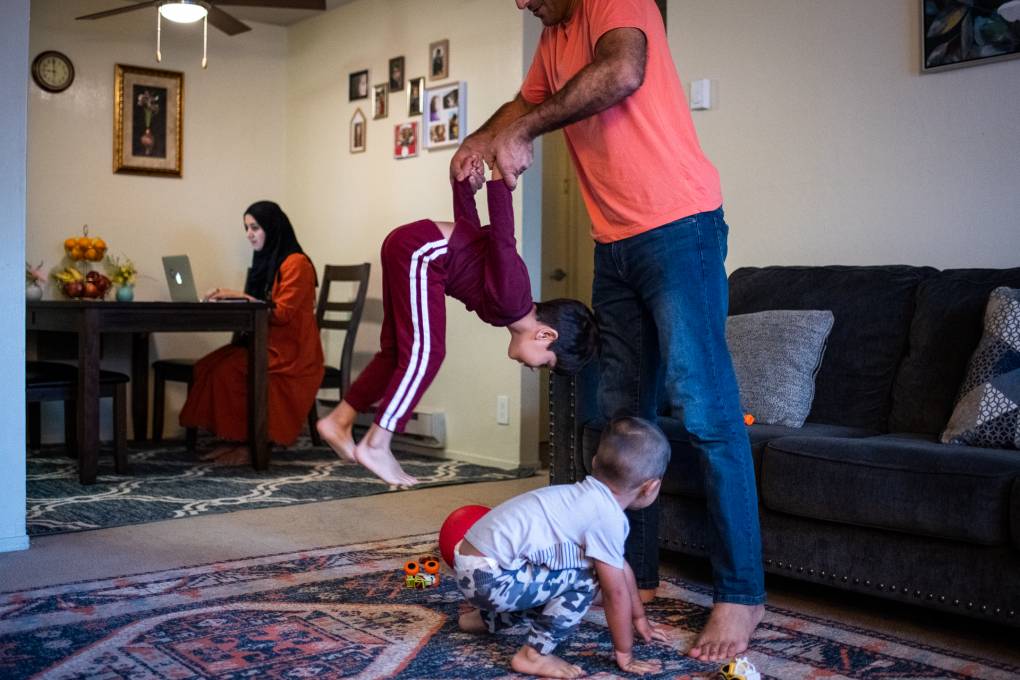
"caption": "While Nazia Gabar teaches English classes to women from Afghanistan who have resettled in the United States, her husband Hassam plays with their two children at their home in San Leandro on Sept. 8, 2021.",
"description": "While Nazia Gabar teaches English classes to women from Afghanistan who have resettled in the United States, her husband Hassam plays with their two children at their home in San Leandro on Sept. 8, 2021.",
"title": "024_SanLeandro_GabarFamily_09082021",
"credit": "Beth LaBerge/KQED",
"status": "inherit",
"altTag": "A man holds a child by the hands as the child flips upside down inside of a house. Another child plays nearby on the floor while a woman works on a computer at a kitchen table in the background.",
"isLoading": false,
"fetchFailed": false
},
"news_11897536": {
"type": "attachments",
"id": "news_11897536",
"meta": {
"index": "attachments_1716263798",
"site": "news",
"id": "11897536",
"found": true
},
"parent": 11897535,
"imgSizes": {
"twentyfourteen-full-width": {
"file": "https://ww2.kqed.org/app/uploads/sites/10/2021/11/pjimage3-1038x576.jpg",
"width": 1038,
"mimeType": "image/jpeg",
"height": 576
},
"thumbnail": {
"file": "https://ww2.kqed.org/app/uploads/sites/10/2021/11/pjimage3-160x90.jpg",
"width": 160,
"mimeType": "image/jpeg",
"height": 90
},
"post-thumbnail": {
"file": "https://ww2.kqed.org/app/uploads/sites/10/2021/11/pjimage3-672x372.jpg",
"width": 672,
"mimeType": "image/jpeg",
"height": 372
},
"kqedFullSize": {
"file": "https://ww2.kqed.org/app/uploads/sites/10/2021/11/pjimage3.jpg",
"width": 1920,
"height": 1080
},
"large": {
"file": "https://ww2.kqed.org/app/uploads/sites/10/2021/11/pjimage3-1020x574.jpg",
"width": 1020,
"mimeType": "image/jpeg",
"height": 574
},
"1536x1536": {
"file": "https://ww2.kqed.org/app/uploads/sites/10/2021/11/pjimage3-1536x864.jpg",
"width": 1536,
"mimeType": "image/jpeg",
"height": 864
},
"medium": {
"file": "https://ww2.kqed.org/app/uploads/sites/10/2021/11/pjimage3-800x450.jpg",
"width": 800,
"mimeType": "image/jpeg",
"height": 450
}
},
"publishDate": 1638169250,
"modified": 1638169455,
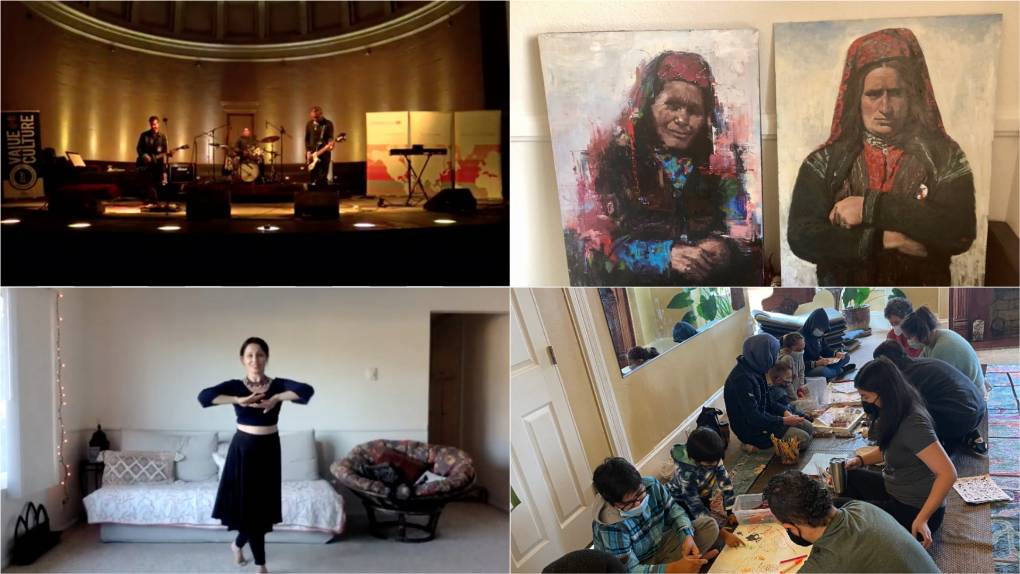
"caption": "The Bay Area is home to many Afghan artists who are responding to the current crisis facing artists in Afghanistan. The arts are also playing a role in helping newly arrived refugees adjust and process their trauma. (Left to right: the rock band Kabul Dreams, artwork by Biz Rasam, Dancer Samia Karimi, and a workshop with the organizer ARTogether.",
"description": null,
"title": "pjimage(3)",
"credit": null,
"status": "inherit",
"altTag": null,
"isLoading": false,
"fetchFailed": false
}
},
"audioPlayerReducer": {
"postId": "stream_live",
"isPaused": true,
"isPlaying": false,
"pfsActive": false,
"pledgeModalIsOpen": true,
"playerDrawerIsOpen": false,
"liveAudioPlayStartedAt": 0,
"liveAudioPlayContext": ""
},
"authorsReducer": {
"byline_news_12095108": {
"type": "authors",
"id": "byline_news_12095108",
"meta": {
"override": true
},
"slug": "byline_news_12095108",
"name": "Amina Wase",
"isLoading": false
},
"byline_news_11905959": {
"type": "authors",
"id": "byline_news_11905959",
"meta": {
"override": true
},
"slug": "byline_news_11905959",
"name": "Aamer Madhani and Kathy Gannon \u003cbr> Associated Press ",
"isLoading": false
},
"rachael-myrow": {
"type": "authors",
"id": "251",
"meta": {
"index": "authors_1716337520",
"id": "251",
"found": true
},
"name": "Rachael Myrow",
"firstName": "Rachael",
"lastName": "Myrow",
"slug": "rachael-myrow",
"email": "rmyrow@kqed.org",
"display_author_email": true,
"staff_mastheads": [
"news"
],
"title": "Senior Editor of KQED's Silicon Valley News Desk",
"bio": "• I write and edit stories about how Silicon Valley power and policies shape everyday life in California. I’m also passionate about making Bay Area history and culture more accessible to a broad public. • I’ve been a journalist for most of my life, starting in high school with The Franklin Press in Los Angeles, where I grew up. While earning my first degree in English at UC Berkeley, I got my start in public radio at KALX-FM. After completing a second degree in journalism at Cal, I landed my first professional job at Marketplace, then moved on to KPCC (now LAist), and then KQED, where I hosted The California Report for more than seven years. • My reporting has appeared on NPR, The World, WBUR’s \u003ci>Here & Now\u003c/i>, and the BBC. I also guest host for KQED’s \u003ci>Forum\u003c/i>, as well as the Commonwealth Club in San Francisco. • I speak periodically on media, democracy and technology issues, and do voiceover work for documentaries and educational video projects. • Outside of the studio, you'll find me hiking Bay Area trails and whipping up Insta-ready meals in my kitchen. • I do not accept gifts, money, or favors from anyone connected to my reporting, I don't pay people for information, and I do not support or donate to political causes. • I strive to treat the people I report on with fairness, honesty, and respect. I also recognize there are often multiple sides to a story and work to verify information through multiple sources and documentation. If I get something wrong, I correct it.",
"avatar": "https://secure.gravatar.com/avatar/3ed8a3c5f26025e4a805ba634cda8cd764906b97438a6d9ce216b044e340da4e?s=600&d=blank&r=g",
"twitter": "rachaelmyrow",
"bluesky": null,
"facebook": null,
"instagram": null,
"linkedin": "https://www.linkedin.com/in/rachaelmyrow/",
"sites": [
{
"site": "arts",
"roles": [
"administrator"
]
},
{
"site": "news",
"roles": [
"edit_others_posts",
"editor"
]
},
{
"site": "futureofyou",
"roles": [
"editor"
]
},
{
"site": "bayareabites",
"roles": [
"editor"
]
},
{
"site": "stateofhealth",
"roles": [
"editor"
]
},
{
"site": "science",
"roles": [
"editor"
]
},
{
"site": "food",
"roles": [
"editor"
]
},
{
"site": "forum",
"roles": [
"editor"
]
},
{
"site": "liveblog",
"roles": [
"author"
]
}
],
"headData": {
"title": "Rachael Myrow | KQED",
"description": "Senior Editor of KQED's Silicon Valley News Desk",
"ogImgSrc": "https://secure.gravatar.com/avatar/3ed8a3c5f26025e4a805ba634cda8cd764906b97438a6d9ce216b044e340da4e?s=600&d=blank&r=g",
"twImgSrc": "https://secure.gravatar.com/avatar/3ed8a3c5f26025e4a805ba634cda8cd764906b97438a6d9ce216b044e340da4e?s=600&d=blank&r=g"
},
"isLoading": false,
"link": "/author/rachael-myrow"
},
"tychehendricks": {
"type": "authors",
"id": "259",
"meta": {
"index": "authors_1716337520",
"id": "259",
"found": true
},
"name": "Tyche Hendricks",
"firstName": "Tyche",
"lastName": "Hendricks",
"slug": "tychehendricks",
"email": "thendricks@kqed.org",
"display_author_email": true,
"staff_mastheads": [
"news"
],
"title": "KQED Senior Editor, Immigration",
"bio": "\u003cspan style=\"font-weight: 400;\">Tyche Hendricks is KQED’s senior editor for immigration, leading coverage of the policy and politics that affect California’s immigrant communities. Her work for KQED’s radio and online audiences is also carried on NPR and other national outlets. She has been recognized with awards from the Radio and Television News Directors Association, the Society for Professional Journalists; the Education Writers Association; the Best of the West and the National Federation of Community Broadcasters. Before joining KQED in 2010, Tyche spent more than a dozen years as a newspaper reporter, notably at the \u003c/span>\u003ci>\u003cspan style=\"font-weight: 400;\">San Francisco Chronicle\u003c/span>\u003c/i>\u003cspan style=\"font-weight: 400;\">. At different times she has covered criminal justice, government and politics and urban planning. Tyche has taught in the MFA Creative Writing program at the University of San Francisco and at UC Berkeley’s Graduate School of Journalism, where she was co-director of a national immigration symposium for professional journalists. She is the author of \u003c/span>\u003ci>\u003cspan style=\"font-weight: 400;\">The Wind Doesn't Need a Passport: Stories from the U.S.-Mexico Borderlands\u003c/span>\u003c/i>\u003cspan style=\"font-weight: 400;\"> (University of California Press). \u003c/span>",
"avatar": "https://secure.gravatar.com/avatar/b8ee458e2731c2d43df86882ce17267e?s=600&d=blank&r=g",
"twitter": "tychehendricks",
"facebook": null,
"instagram": null,
"linkedin": null,
"sites": [
{
"site": "news",
"roles": [
"editor"
]
},
{
"site": "stateofhealth",
"roles": [
"editor"
]
}
],
"headData": {
"title": "Tyche Hendricks | KQED",
"description": "KQED Senior Editor, Immigration",
"ogImgSrc": "https://secure.gravatar.com/avatar/b8ee458e2731c2d43df86882ce17267e?s=600&d=blank&r=g",
"twImgSrc": "https://secure.gravatar.com/avatar/b8ee458e2731c2d43df86882ce17267e?s=600&d=blank&r=g"
},
"isLoading": false,
"link": "/author/tychehendricks"
},
"shossaini": {
"type": "authors",
"id": "3214",
"meta": {
"index": "authors_1716337520",
"id": "3214",
"found": true
},
"name": "Sara Hossaini",
"firstName": "Sara",
"lastName": "Hossaini",
"slug": "shossaini",
"email": "shossaini@kqed.org",
"display_author_email": true,
"staff_mastheads": [
"news"
],
"title": "KQED Reporter",
"bio": "Sara Hossaini came to general assignment reporting at KQED in 2013 after two winters reporting at Wyoming Public Radio. She holds a bachelor's degree in broadcast journalism from the University of Nebraska-Lincoln. Her radio romance began after a bitter breakup with documentary film (Ok, maybe it's still complicated). Her first simultaneous jobs in San Francisco were as Associate Producer on a PBS film series through the Center for Asian American Media and as a butler. She likes to trot, plot and make things with her hands.",
"avatar": "https://secure.gravatar.com/avatar/060e9f56b9554e17942e89f413242774?s=600&d=blank&r=g",
"twitter": "mshossaini",
"facebook": null,
"instagram": null,
"linkedin": null,
"sites": [
{
"site": "news",
"roles": [
"author"
]
},
{
"site": "stateofhealth",
"roles": [
"author"
]
}
],
"headData": {
"title": "Sara Hossaini | KQED",
"description": "KQED Reporter",
"ogImgSrc": "https://secure.gravatar.com/avatar/060e9f56b9554e17942e89f413242774?s=600&d=blank&r=g",
"twImgSrc": "https://secure.gravatar.com/avatar/060e9f56b9554e17942e89f413242774?s=600&d=blank&r=g"
},
"isLoading": false,
"link": "/author/shossaini"
},
"cveltman": {
"type": "authors",
"id": "8608",
"meta": {
"index": "authors_1716337520",
"id": "8608",
"found": true
},
"name": "Chloe Veltman",
"firstName": "Chloe",
"lastName": "Veltman",
"slug": "cveltman",
"email": "cveltman@kqed.org",
"display_author_email": true,
"staff_mastheads": [],
"title": "Arts and Culture Reporter",
"bio": "Chloe Veltman is a former arts and culture reporter for KQED. Prior to joining the organization, she launched and led the arts bureau at Colorado Public Radio, served as the Bay Area's culture columnist for the New York Times, and was the founder, host and executive producer of VoiceBox, a national award-winning weekly podcast/radio show and live events series all about the human voice. Chloe is the recipient of numerous prizes, grants and fellowships including a Webby Award for her work on interactive storytelling, both the John S Knight Journalism Fellowship and Humanities Center Fellowship at Stanford University, the Sundance Arts Writing Fellowship and a Library of Congress Research Fellowship. She is the author of the book \"On Acting\" and has appeared as a guest lecturer at Yale University and the San Francisco Conservatory of Music among other institutions. She holds a BA in english literature from King's College, Cambridge, and a Masters in Dramaturgy from the Central School of Speech and Drama/Harvard Institute for Advanced Theater Training.\r\n\u003ca href=\"https://www.chloeveltman.com\">www.chloeveltman.com\u003c/a>",
"avatar": "https://secure.gravatar.com/avatar/55403394b00a1ddab683952c2eb2cf85?s=600&d=blank&r=g",
"twitter": "chloeveltman",
"facebook": null,
"instagram": null,
"linkedin": null,
"sites": [
{
"site": "arts",
"roles": []
},
{
"site": "news",
"roles": [
"author"
]
},
{
"site": "pop",
"roles": [
"editor"
]
},
{
"site": "science",
"roles": []
}
],
"headData": {
"title": "Chloe Veltman | KQED",
"description": "Arts and Culture Reporter",
"ogImgSrc": "https://secure.gravatar.com/avatar/55403394b00a1ddab683952c2eb2cf85?s=600&d=blank&r=g",
"twImgSrc": "https://secure.gravatar.com/avatar/55403394b00a1ddab683952c2eb2cf85?s=600&d=blank&r=g"
},
"isLoading": false,
"link": "/author/cveltman"
},
"ecruzguevarra": {
"type": "authors",
"id": "8654",
"meta": {
"index": "authors_1716337520",
"id": "8654",
"found": true
},
"name": "Ericka Cruz Guevarra",
"firstName": "Ericka",
"lastName": "Cruz Guevarra",
"slug": "ecruzguevarra",
"email": "ecruzguevarra@kqed.org",
"display_author_email": true,
"staff_mastheads": [
"news"
],
"title": "Producer, The Bay Podcast",
"bio": "Ericka Cruz Guevarra is host of \u003ca href=\"https://www.kqed.org/podcasts/thebay\">\u003cem>The Bay\u003c/em>\u003c/a> podcast at KQED. Before host, she was the show’s producer. Her work in that capacity includes a three-part reported series on policing in Vallejo, which won a 2020 excellence in journalism award from the Society of Professional Journalists. Ericka has worked as a breaking news reporter at Oregon Public Broadcasting, helped produce the Code Switch podcast, and was KQED’s inaugural Raul Ramirez Diversity Fund intern. She’s also an alumna of NPR’s Next Generation Radio program. Send her an email if you have strong feelings about whether Fairfield and Suisun City are the Bay. Ericka is represented by SAG-AFTRA.",
"avatar": "https://secure.gravatar.com/avatar/accefc1de4bafc7e234b69bcb9b6f6536c130fd84709bc3069ef11a78787e1bb?s=600&d=blank&r=g",
"twitter": "NotoriousECG",
"bluesky": null,
"facebook": null,
"instagram": null,
"linkedin": null,
"sites": [
{
"site": "arts",
"roles": [
"subscriber"
]
},
{
"site": "news",
"roles": [
"editor",
"manage_categories"
]
},
{
"site": "futureofyou",
"roles": [
"subscriber"
]
},
{
"site": "stateofhealth",
"roles": [
"subscriber"
]
},
{
"site": "science",
"roles": [
"editor"
]
},
{
"site": "forum",
"roles": [
"subscriber"
]
}
],
"headData": {
"title": "Ericka Cruz Guevarra | KQED",
"description": "Producer, The Bay Podcast",
"ogImgSrc": "https://secure.gravatar.com/avatar/accefc1de4bafc7e234b69bcb9b6f6536c130fd84709bc3069ef11a78787e1bb?s=600&d=blank&r=g",
"twImgSrc": "https://secure.gravatar.com/avatar/accefc1de4bafc7e234b69bcb9b6f6536c130fd84709bc3069ef11a78787e1bb?s=600&d=blank&r=g"
},
"isLoading": false,
"link": "/author/ecruzguevarra"
},
"rdillon": {
"type": "authors",
"id": "11495",
"meta": {
"index": "authors_1716337520",
"id": "11495",
"found": true
},
"name": "Raquel Maria Dillon",
"firstName": "Raquel Maria",
"lastName": "Dillon",
"slug": "rdillon",
"email": "rdillon@kqed.org",
"display_author_email": false,
"staff_mastheads": [],
"title": null,
"bio": "Raquel Maria Dillon was a reporter and host for KQED News. Previously, she produced the daily statewide California Report, edited newscasts, and covered health and education stories. Before returning to the Bay Area in 2016, she worked in Los Angeles as a wire reporter and one-woman-band video journalist for the Associated Press, where she shot, edited and reported breaking news and features across the West. Her work has appeared online and in print around the globe, and also on NPR’s Morning Edition, All Things Considered, Here and Now, Marketplace, On The Media, and Studio 360. She previously edited and mentored up-and-coming reporters at KALW, produced social videos for Timeline.com, and was a local TV news videographer for KTVU and digital producer for KNTV. She got her start as a Radio News Trainee at KQED, produced a weekly public affairs roundtable show for OPB, and covered health and politics at New Hampshire Public Radio. She has a BA in political science from Barnard College and a MA in video journalism from UC Berkeley, where she was awarded the Faith Fancher Scholarship and a Student Emmy. She has received numerous local awards from the Associated Press and the Society of Professional Journalists.",
"avatar": "https://secure.gravatar.com/avatar/b8e02ae982913d0950df605910267c1b?s=600&d=blank&r=g",
"twitter": "RaquelMDillon",
"facebook": null,
"instagram": null,
"linkedin": null,
"sites": [
{
"site": "news",
"roles": [
"subscriber"
]
},
{
"site": "stateofhealth",
"roles": [
"editor"
]
},
{
"site": "science",
"roles": [
"editor"
]
},
{
"site": "forum",
"roles": [
"editor"
]
}
],
"headData": {
"title": "Raquel Maria Dillon | KQED",
"description": null,
"ogImgSrc": "https://secure.gravatar.com/avatar/b8e02ae982913d0950df605910267c1b?s=600&d=blank&r=g",
"twImgSrc": "https://secure.gravatar.com/avatar/b8e02ae982913d0950df605910267c1b?s=600&d=blank&r=g"
},
"isLoading": false,
"link": "/author/rdillon"
},
"aehsanipour": {
"type": "authors",
"id": "11580",
"meta": {
"index": "authors_1716337520",
"id": "11580",
"found": true
},
"name": "Asal Ehsanipour",
"firstName": "Asal",
"lastName": "Ehsanipour",
"slug": "aehsanipour",
"email": "aehsanipour@kqed.org",
"display_author_email": false,
"staff_mastheads": [],
"title": "Reporter and Producer",
"bio": "Asal Ehsanipour is a producer and reporter for Rightnowish, Bay Curious and The California Report Magazine. She is also a producer for \u003ca href=\"https://www.thedoubleshift.com/\">The Double Shift\u003c/a>, a podcast about a new generation of working mothers. In 2018, Asal was named an Emerging Journalist Fellow by the Journalism and Women’s Symposium. Her work has appeared on KQED, KALW, PRI’s The World, and in several food and travel publications.",
"avatar": "https://secure.gravatar.com/avatar/c0e210438f5dca1b76921ff9f0eada52?s=600&d=blank&r=g",
"twitter": null,
"facebook": null,
"instagram": null,
"linkedin": null,
"sites": [
{
"site": "arts",
"roles": []
},
{
"site": "news",
"roles": [
"author",
"edit_others_posts"
]
}
],
"headData": {
"title": "Asal Ehsanipour | KQED",
"description": "Reporter and Producer",
"ogImgSrc": "https://secure.gravatar.com/avatar/c0e210438f5dca1b76921ff9f0eada52?s=600&d=blank&r=g",
"twImgSrc": "https://secure.gravatar.com/avatar/c0e210438f5dca1b76921ff9f0eada52?s=600&d=blank&r=g"
},
"isLoading": false,
"link": "/author/aehsanipour"
},
"lsarah": {
"type": "authors",
"id": "11626",
"meta": {
"index": "authors_1716337520",
"id": "11626",
"found": true
},
"name": "Lakshmi Sarah",
"firstName": "Lakshmi",
"lastName": "Sarah",
"slug": "lsarah",
"email": "lsarah@kqed.org",
"display_author_email": false,
"staff_mastheads": [],
"title": "Digital Producer",
"bio": "Lakshmi Sarah is an educator, author and journalist with a focus on innovative storytelling. She has worked with newspapers, radio and magazines from Ahmedabad, India to Los Angeles, California. She has written and produced for Die Zeit, Global Voices, AJ+, KQED, Fusion Media Group and the New York Times.",
"avatar": "https://secure.gravatar.com/avatar/652dcaecd8b28826fc17a8b2d6bb4e93?s=600&d=blank&r=g",
"twitter": "lakitalki",
"facebook": null,
"instagram": "https://www.instagram.com/laki.talki/",
"linkedin": "https://www.linkedin.com/in/lakisarah/",
"sites": [
{
"site": "arts",
"roles": []
},
{
"site": "news",
"roles": []
},
{
"site": "bayareabites",
"roles": []
},
{
"site": "science",
"roles": []
}
],
"headData": {
"title": "Lakshmi Sarah | KQED",
"description": "Digital Producer",
"ogImgSrc": "https://secure.gravatar.com/avatar/652dcaecd8b28826fc17a8b2d6bb4e93?s=600&d=blank&r=g",
"twImgSrc": "https://secure.gravatar.com/avatar/652dcaecd8b28826fc17a8b2d6bb4e93?s=600&d=blank&r=g"
},
"isLoading": false,
"link": "/author/lsarah"
},
"hmcdede": {
"type": "authors",
"id": "11635",
"meta": {
"index": "authors_1716337520",
"id": "11635",
"found": true
},
"name": "Holly McDede",
"firstName": "Holly",
"lastName": "McDede",
"slug": "hmcdede",
"email": "hmcdede@KQED.org",
"display_author_email": false,
"staff_mastheads": [],
"title": "KQED Contributor",
"bio": null,
"avatar": "https://secure.gravatar.com/avatar/35d1a1f5422c9d266f7ace9348d170f2136671a65fffc90a592e4d7fbf8dc3f6?s=600&d=blank&r=g",
"twitter": null,
"bluesky": null,
"facebook": null,
"instagram": null,
"linkedin": null,
"sites": [
{
"site": "arts",
"roles": [
"editor"
]
},
{
"site": "news",
"roles": [
"edit_others_posts",
"editor"
]
},
{
"site": "science",
"roles": [
"editor"
]
},
{
"site": "forum",
"roles": [
"editor"
]
},
{
"site": "perspectives",
"roles": [
"administrator"
]
}
],
"headData": {
"title": "Holly McDede | KQED",
"description": "KQED Contributor",
"ogImgSrc": "https://secure.gravatar.com/avatar/35d1a1f5422c9d266f7ace9348d170f2136671a65fffc90a592e4d7fbf8dc3f6?s=600&d=blank&r=g",
"twImgSrc": "https://secure.gravatar.com/avatar/35d1a1f5422c9d266f7ace9348d170f2136671a65fffc90a592e4d7fbf8dc3f6?s=600&d=blank&r=g"
},
"isLoading": false,
"link": "/author/hmcdede"
},
"amontecillo": {
"type": "authors",
"id": "11649",
"meta": {
"index": "authors_1716337520",
"id": "11649",
"found": true
},
"name": "Alan Montecillo",
"firstName": "Alan",
"lastName": "Montecillo",
"slug": "amontecillo",
"email": "amontecillo@kqed.org",
"display_author_email": false,
"staff_mastheads": [
"news"
],
"title": "KQED Contributor",
"bio": "Alan Montecillo is the senior editor of \u003cem>\u003ca href=\"http://kqed.org/thebay\">The Bay\u003c/a>, \u003c/em> KQED's local news podcast. Before moving to the Bay Area, he worked as a senior talk show producer for WILL in Champaign-Urbana, Illinois and at Oregon Public Broadcasting in Portland, Oregon. He has won journalism awards from the Society of Professional Journalists Northern California, the Public Media Journalists Association, The Signal Awards, and has also received a regional Edward R. Murrow award. Alan is a Filipino American from Hong Kong and a graduate of Reed College.",
"avatar": "https://secure.gravatar.com/avatar/268f53a2066899ea9efdd8a5900218b17c822d9862cbc9326cccec53ef41d349?s=600&d=blank&r=g",
"twitter": "alanmontecillo",
"bluesky": null,
"facebook": null,
"instagram": null,
"linkedin": null,
"sites": [
{
"site": "",
"roles": [
"editor"
]
},
{
"site": "news",
"roles": [
"editor",
"manage_categories"
]
}
],
"headData": {
"title": "Alan Montecillo | KQED",
"description": "KQED Contributor",
"ogImgSrc": "https://secure.gravatar.com/avatar/268f53a2066899ea9efdd8a5900218b17c822d9862cbc9326cccec53ef41d349?s=600&d=blank&r=g",
"twImgSrc": "https://secure.gravatar.com/avatar/268f53a2066899ea9efdd8a5900218b17c822d9862cbc9326cccec53ef41d349?s=600&d=blank&r=g"
},
"isLoading": false,
"link": "/author/amontecillo"
},
"jrodriguez": {
"type": "authors",
"id": "11690",
"meta": {
"index": "authors_1716337520",
"id": "11690",
"found": true
},
"name": "Joe Fitzgerald Rodriguez",
"firstName": "Joe",
"lastName": "Fitzgerald Rodriguez",
"slug": "jrodriguez",
"email": "jrodriguez@kqed.org",
"display_author_email": true,
"staff_mastheads": [
"news"
],
"title": "Reporter and Producer",
"bio": "Joe Fitzgerald Rodriguez is a reporter and digital producer for KQED covering politics. Joe most recently wrote for the \u003cem>San Francisco Examiner\u003c/em> as a political columnist covering The City. He was raised in San Francisco and has spent his reporting career in his beloved, foggy, city by the bay. Joe was 12-years-old when he conducted his first interview in journalism, grilling former San Francisco Mayor Willie Brown for the Marina Middle School newspaper, \u003cem>The Penguin Press, \u003c/em>and he continues to report on the San Francisco Bay Area to this day.",
"avatar": "https://secure.gravatar.com/avatar/2247beb0564c1e9c62228d5649d2edac?s=600&d=blank&r=g",
"twitter": "FitztheReporter",
"facebook": null,
"instagram": "https://www.instagram.com/fitzthereporter/",
"linkedin": null,
"sites": [
{
"site": "",
"roles": [
"editor"
]
},
{
"site": "arts",
"roles": [
"editor"
]
},
{
"site": "news",
"roles": [
"editor"
]
},
{
"site": "science",
"roles": [
"editor"
]
},
{
"site": "elections",
"roles": [
"editor"
]
},
{
"site": "liveblog",
"roles": [
"editor"
]
}
],
"headData": {
"title": "Joe Fitzgerald Rodriguez | KQED",
"description": "Reporter and Producer",
"ogImgSrc": "https://secure.gravatar.com/avatar/2247beb0564c1e9c62228d5649d2edac?s=600&d=blank&r=g",
"twImgSrc": "https://secure.gravatar.com/avatar/2247beb0564c1e9c62228d5649d2edac?s=600&d=blank&r=g"
},
"isLoading": false,
"link": "/author/jrodriguez"
},
"mesquinca": {
"type": "authors",
"id": "11802",
"meta": {
"index": "authors_1716337520",
"id": "11802",
"found": true
},
"name": "Maria Esquinca",
"firstName": "Maria",
"lastName": "Esquinca",
"slug": "mesquinca",
"email": "mesquinca@kqed.org",
"display_author_email": false,
"staff_mastheads": [],
"title": "Producer, The Bay",
"bio": "María Esquinca is a producer of The Bay. Before that, she was a New York Women’s Foundation IGNITE Fellow at Latino USA. She worked at Radio Bilingue where she covered the San Joaquin Valley. Maria has interned at WLRN, News 21, The New York Times Student Journalism Institute and at Crain’s Detroit Business as a Dow Jones News Fund Business Reporting Intern. She is an MFA graduate from the University of Miami. In 2017, she graduated from the Walter Cronkite School of Journalism and Mass Communication with a Master of Mass Communication. A fronteriza, she was born in Ciudad Juárez, Chihuahua, Mexico and grew up in El Paso, Texas.",
"avatar": "https://secure.gravatar.com/avatar/77cedba18aae91da775038ba06dcd8d0?s=600&d=blank&r=g",
"twitter": "@m_esquinca",
"facebook": null,
"instagram": null,
"linkedin": null,
"sites": [
{
"site": "news",
"roles": []
}
],
"headData": {
"title": "Maria Esquinca | KQED",
"description": "Producer, The Bay",
"ogImgSrc": "https://secure.gravatar.com/avatar/77cedba18aae91da775038ba06dcd8d0?s=600&d=blank&r=g",
"twImgSrc": "https://secure.gravatar.com/avatar/77cedba18aae91da775038ba06dcd8d0?s=600&d=blank&r=g"
},
"isLoading": false,
"link": "/author/mesquinca"
},
"jessicakariisa": {
"type": "authors",
"id": "11831",
"meta": {
"index": "authors_1716337520",
"id": "11831",
"found": true
},
"name": "Jessica Kariisa",
"firstName": "Jessica",
"lastName": "Kariisa",
"slug": "jessicakariisa",
"email": "jkariisa@kqed.org",
"display_author_email": false,
"staff_mastheads": [],
"title": "Producer, The Bay",
"bio": "Jessica Kariisa is the producer of The Bay. She first joined KQED as an intern for The California Report Magazine, after which she became an on-call producer. She reported a Bay Curious episode on the use of rap lyrics in criminal trials which won a Society of Professional Journalists award in 2023 for Excellence in Features Journalism and the 2023 Signal Award for Best Conversation Starter. She’s worked on podcasts for Snap Judgment and American Public Media. Before embarking on her audio career, she was a music journalist.\r\n\r\nJessica Kariisa is represented by SAG-AFTRA.",
"avatar": "https://secure.gravatar.com/avatar/522e97b28ac0b3d411621c0fde8f3419c7b71ea2c5c262c57c4bb600963f328c?s=600&d=blank&r=g",
"twitter": null,
"bluesky": null,
"facebook": null,
"instagram": null,
"linkedin": null,
"sites": [
{
"site": "arts",
"roles": [
"author"
]
},
{
"site": "news",
"roles": [
"editor",
"manage_categories"
]
}
],
"headData": {
"title": "Jessica Kariisa | KQED",
"description": "Producer, The Bay",
"ogImgSrc": "https://secure.gravatar.com/avatar/522e97b28ac0b3d411621c0fde8f3419c7b71ea2c5c262c57c4bb600963f328c?s=600&d=blank&r=g",
"twImgSrc": "https://secure.gravatar.com/avatar/522e97b28ac0b3d411621c0fde8f3419c7b71ea2c5c262c57c4bb600963f328c?s=600&d=blank&r=g"
},
"isLoading": false,
"link": "/author/jessicakariisa"
}
},
"pagesReducer": {
"news_tag_afghanistan": {
"type": "terms",
"id": "news_19537",
"meta": {
"index": "terms_1716263798",
"site": "news",
"id": "19537",
"score": 9.306014
},
"featImg": null,
"name": "Afghanistan",
"description": null,
"taxonomy": "tag",
"headData": {
"twImgId": null,
"twTitle": null,
"ogTitle": null,
"ogImgId": null,
"twDescription": null,
"description": null,
"title": "Afghanistan Archives | KQED News",
"ogDescription": null
},
"ttid": 19554,
"slug": "afghanistan",
"isLoading": false,
"title": "Afghanistan",
"pageMeta": {
"site": "news",
"WpPageTemplate": "page-topic-editorial",
"currentPage": 1
},
"blocks": [
{
"blockName": "kqed/post-list",
"attrs": {
"layout": "cardArticle2",
"query": "posts/news?tag=afghanistan",
"seeMore": false,
"paginated": true,
"page": 1
}
},
{
"blockName": "kqed/ad"
}
]
}
},
"pfsSessionReducer": {},
"postsReducer": {
"stream_live": {
"type": "live",
"id": "stream_live",
"audioUrl": "https://streams.kqed.org/kqedradio",
"title": "Live Stream",
"excerpt": "Live Stream information currently unavailable.",
"link": "/radio",
"featImg": "",
"label": {
"name": "KQED Live",
"link": "/"
}
},
"stream_kqedNewscast": {
"type": "posts",
"id": "stream_kqedNewscast",
"audioUrl": "https://www.kqed.org/.stream/anon/radio/RDnews/newscast.mp3?_=1",
"title": "KQED Newscast",
"featImg": "",
"label": {
"name": "88.5 FM",
"link": "/"
}
},
"news_12095108": {
"type": "posts",
"id": "news_12095108",
"meta": {
"index": "posts_1716263798",
"site": "news",
"id": "12095108",
"score": null,
"sort": [
1786802400000
]
},
"guestAuthors": [],
"slug": "2-afghan-girls-graduated-high-school-together-now-1-studies-in-the-bay-area-the-other-indoors",
"title": "2 Afghan Girls Graduated High School Together. Now, 1 Studies in the Bay Area, the Other Indoors",
"publishDate": 1786802400,
"format": "standard",
"headTitle": "2 Afghan Girls Graduated High School Together. Now, 1 Studies in the Bay Area, the Other Indoors | KQED",
"labelTerm": {
"site": "news"
},
"content": "\u003cp>Saturday, Aug. 15, marks five years since the Taliban retook control of Kabul and returned to power in \u003ca href=\"https://www.kqed.org/news/tag/afghanistan\">Afghanistan\u003c/a>. For Mursal, 24, that meant her college studies needed to be moved online and most of her life, amid the repressive regime’s rules restricting women in public spaces, moved indoors. But even more heartbreaking was not getting to say goodbye to her closest friends and family who managed to flee.\u003c/p>\n\n\n\n\u003cp>One of those friends was Husna.\u003c/p>\n\n\n\n\u003cp>On Aug. 24, 2021, U.S. government officials called Husna’s father, who worked with the U.S. embassy, with a plan to evacuate them if they drove to a designated meet-up spot in two hours.\u003c/p>\n\n\n\n\u003cfigure class=\"wp-block-image size-full\">\u003cimg loading=\"lazy\" decoding=\"async\" width=\"1920\" height=\"1079\" src=\"https://cdn.kqed.org/wp-content/uploads/sites/10/2021/09/ap21235373894167-edit_custom-e2cdf587be4a6ade2cb01de06f4a7d35c7b7f202-scaled-e1630530046511.jpg\" alt=\"line of evacuees at night wait to board a plane, backlight by far off light\" class=\"wp-image-11887274\">\u003cfigcaption class=\"wp-element-caption\">A U.S. Air Force air crew prepares to load evacuees aboard a C-17 aircraft at Hamid Karzai International Airport in Kabul, Afghanistan, on Aug. 31. Several public school students from Sacramento remain in Afghanistan since the U.S. evacuation ended. (Senior Airman Taylor Crul/U.S. Air Force via AP)\u003c/figcaption>\u003c/figure>\n\n\n\n\u003cp>Husna’s father and mother, who witnessed the Taliban’s first time in power 20 years earlier, knew what the fundamentalist group’s takeover meant for the education of their children. They recognized this was their chance to leave and still give their children opportunities. \u003c/p>\n\n\n\n\u003cp>“It was a time when we didn’t know what to expect. No clue how long it would take, no clue if this would be the last goodbye,” Husna said in an in-person interview on Stanford University’s campus.\u003c/p>\n\n\n\n\u003cp>[ad fullwidth]\u003c/p>\n\u003cp>KQED is omitting both Mursal’s and Husna’s surnames because the women fear that speaking publicly could have dangerous repercussions for them and their family members in Afghanistan.\u003c/p>\n\n\n\n\n\n\u003cp>Husna flew out of Hamid Karzai International Airport just one day before a devastating terror attack \u003ca href=\"https://www.washingtonpost.com/national-security/kabul-suicide-bombing-service-members/2021/08/26/8bfe63ac-069e-11ec-ba15-9c4f59a60478_story.html\">killed\u003c/a> 13 U.S. Marines and 169 Afghans, and seven days before the last U.S. evacuation from Afghanistan. Husna and her immediate family members were some of the 124,000 people the U.S. \u003ca href=\"https://www.af.mil/News/Article-Display/Article/3144426/one-year-later-historic-afghan-airlift-inspires-pride-and-reflection-across-the/\">airlifted\u003c/a> out of Afghanistan.\u003c/p>\n\n\n\n\u003cp>Husna traveled from Kabul to Qatar to Frankfurt to Washington, D.C. \u003c/p>\n\n\n\n\u003cp>Then, she spent 44 days in a Texas refugee camp where her family underwent medical checkups and arrival interviews. Finally, they resettled in San Diego in October.\u003c/p>\n\n\n\n\u003cp>Meanwhile, Mursal was spending her days mostly sequestered in her family’s home as the daily realities of the Taliban’s takeover set in. \u003c/p>\n\n\n\n\u003cp>The ramifications of that day five years ago set the girls on two distinct paths. As Mursal enters her senior year at the American University of Afghanistan online, Husna is a pre-med student at Stanford entering her final year of undergraduate studies.\u003c/p>\n\n\n\n\u003cp>Nearly five years after the Taliban takeover, Mursal’s life has fundamentally transformed, just as it did for the 25 million women across Afghanistan.\u003c/p>\n\n\n\n\u003cfigure class=\"wp-block-image size-full\">\u003cimg loading=\"lazy\" decoding=\"async\" width=\"2560\" height=\"1707\" src=\"https://cdn.kqed.org/wp-content/uploads/sites/10/2021/12/GettyImages-1234913233-scaled.jpg\" alt=\"\" class=\"wp-image-11900417\" srcset=\"https://cdn.kqed.org/wp-content/uploads/sites/10/2021/12/GettyImages-1234913233-scaled.jpg 2560w, https://cdn.kqed.org/wp-content/uploads/sites/10/2021/12/GettyImages-1234913233-800x533.jpg 800w, https://cdn.kqed.org/wp-content/uploads/sites/10/2021/12/GettyImages-1234913233-1020x680.jpg 1020w, https://cdn.kqed.org/wp-content/uploads/sites/10/2021/12/GettyImages-1234913233-160x107.jpg 160w, https://cdn.kqed.org/wp-content/uploads/sites/10/2021/12/GettyImages-1234913233-1536x1024.jpg 1536w, https://cdn.kqed.org/wp-content/uploads/sites/10/2021/12/GettyImages-1234913233-2048x1365.jpg 2048w, https://cdn.kqed.org/wp-content/uploads/sites/10/2021/12/GettyImages-1234913233-1920x1280.jpg 1920w\" sizes=\"auto, (max-width: 2560px) 100vw, 2560px\">\u003cfigcaption class=\"wp-element-caption\">Afghans, hoping to leave Afghanistan, queue at the main entrance gate of Kabul airport in Kabul on Aug. 28, 2021, following the Taliban’s stunning military takeover of Afghanistan. (Wakil Kohsar/AFP via Getty Images)\u003c/figcaption>\u003c/figure>\n\n\n\n\u003cp>In August 2024, the Taliban \u003ca href=\"https://www.theguardian.com/global-development/article/2024/aug/26/taliban-bar-on-afghan-women-speaking-in-public-un-afghanistan\">issued\u003c/a> the Law on the Promotion of Virtue and the Prevention of Vice, all-encompassing legislation codifying Afghan life, including criminalizing women’s voices in public and \u003ca href=\"https://giwps.georgetown.edu/wp-content/uploads/2022/08/Mahram-Womens-Mobility-in-Islam.pdf\">implementing\u003c/a> a stricter \u003cem>mahram\u003c/em> requirement that women be accompanied by either their spouse or a male relative outside their homes. These terms are \u003ca href=\"https://www.uscirf.gov/sites/default/files/2025-08/2025%20Issue%20Update%20Afghanistan%20Morality%20Law_0.pdf\">enforced\u003c/a> by “vice and virtue authorities.” \u003c/p>\n\n\n\n\u003cp>These laws now shape Mursal’s daily life. Her family doesn’t permit her to leave the house alone due to concerns about her safety. And while life in Kabul was always full of risk, with an ongoing battle for control between the U.S. and the Taliban, Mursal’s enthusiasm for life was still noticeably higher before the Taliban took over.\u003c/p>\n\n\n\n\u003cp>“Even before this government in Afghanistan, there were a lot of explosions. Your life would be dangerous. Whenever we would go out, we were prepared to face death every day,” Mursal said in an interview from Kabul via Zoom. “Everyone was so happy, [because] despite everything, we wanted to live good lives.”\u003c/p>\n\n\n\n\u003cp>The prospect of an unrestricted good life, however, declined for women after the Taliban takeover, which banned girls from attending school past sixth grade. Mursal takes an active risk by enrolling in university, but said that the Taliban does not monitor Internet usage, which allows her and other women to continue their schooling. Instead, the Taliban has \u003ca href=\"https://www.reuters.com/world/asia-pacific/afghanistans-cellphone-internet-services-down-monitoring-shows-2025-09-30/\">resorted\u003c/a> to multiple Internet shutdowns when concerned about morality.\u003c/p>\n\n\n\n\u003cp>In the immediate aftermath of Aug. 15, Mursal was left reeling as acquaintances and freedoms disappeared.\u003c/p>\n\n\n\n\u003cp>“When these people, when they leave you, it leaves a huge mark on you,” she said. “It is hard to let go of everything at once — the future, education, plans, relatives. Everything was gone in the blink of an eye.”\u003c/p>\n\n\n\n\u003cfigure class=\"wp-block-image size-full\">\u003cimg loading=\"lazy\" decoding=\"async\" width=\"1980\" height=\"1320\" src=\"https://cdn.kqed.org/wp-content/uploads/sites/10/2026/08/GettyImages-2228950108.jpg\" alt=\"\" class=\"wp-image-12095391\" srcset=\"https://cdn.kqed.org/wp-content/uploads/sites/10/2026/08/GettyImages-2228950108.jpg 1980w, https://cdn.kqed.org/wp-content/uploads/sites/10/2026/08/GettyImages-2228950108-160x107.jpg 160w, https://cdn.kqed.org/wp-content/uploads/sites/10/2026/08/GettyImages-2228950108-1536x1024.jpg 1536w\" sizes=\"auto, (max-width: 1980px) 100vw, 1980px\">\u003cfigcaption class=\"wp-element-caption\">This photograph, taken on Dec. 8, 2021, shows a general view of the house where the bodies of two Afghan men, late Fida Mohammad Amir and Shafiullah Hotak, landed on the roof after falling from a U.S. Air Force C-17 aircraft during the August 2021 panic-stricken evacuation to flee Taliban-led Afghanistan, in the Khair Khana neighborhood of Kabul. (Wakil Kohsar/AFP via Getty Images)\u003c/figcaption>\u003c/figure>\n\n\n\n\u003cp>The U.S. withdrew its troops from Afghanistan by the end of August 2021. The year following the U.S. withdrawal was dark for Mursal. She consistently monitored new, more draconian Taliban rulings on the news, all while being unable to leave her home. She took a yearlong leave of absence from school, adjusting to her new, mostly indoor life.\u003c/p>\n\n\n\n\u003cp>She didn’t allow herself to remain depressed for long, though. \u003c/p>\n\n\n\n\u003cp>“After that, I said, this is life. I need to continue,” she said.\u003c/p>\n\n\n\n\u003cp>Each morning, she wakes and prays the post-dawn Islamic \u003cem>Fajr \u003c/em>prayer. Since women are banned from gyms now, Mursal works out using Internet videos. Next, she has breakfast with her family, and then moves on to language study. Since 2021, Mursal has become fluent in Arabic and is now learning Chinese. \u003c/p>\n\n\n\n\n\n\u003cp>In the afternoons, Mursal reads, has lunch and attends required classes online. Next, she completes her homework assignments, and later chats with her family over chai and snacks. Then, she returns to studying and reading books. \u003c/p>\n\n\n\n\u003cp>Mursal ends the night with a family dinner where they share stories of their days. That is where Mursal hears most about the outside world. At times, Mursal finds the transition from her previous life tough to endure.\u003c/p>\n\n\n\n\u003cp>“At one point, I thought I could not continue because it is online and you can’t leave your room. It becomes unbearable,” she said. “I spend the entire day trapped in four walls, doing assignments and everything. So it was hard. You have to build this resilience.”\u003c/p>\n\n\n\n\u003cp>For Husna, integrating into the U.S. put a heavy burden on her as the English-speaker of her family. \u003c/p>\n\n\n\n\u003cp>“I was basically the spokesperson, translator and interpreter of my family,” Husna, who learned English in high school, said.\u003c/p>\n\n\n\n\u003cp>While settling her family in San Diego, Husna became a star student at her community college. Winning a prestigious scholarship to transfer, Husna entered Stanford’s class of 2027 with the hopes of becoming a doctor, and eventually returning to Afghanistan and opening a clinic to train doctors and provide medical services for women. \u003c/p>\n\n\n\n\u003cp>Over time, Husna has lost touch with Mursal and many loved ones in Afghanistan — both she and others got busier, and their lack of reliable Internet, as well as the day-to-night time difference, made communication more difficult. Some of Husna’s last sources of information from the ground in Afghanistan were diminished.\u003c/p>\n\n\n\n\u003cfigure class=\"wp-block-image size-full\">\u003cimg loading=\"lazy\" decoding=\"async\" width=\"2000\" height=\"1333\" src=\"https://cdn.kqed.org/wp-content/uploads/sites/10/2025/12/AfghanRefugeeGetty.jpg\" alt=\"\" class=\"wp-image-12065612\" srcset=\"https://cdn.kqed.org/wp-content/uploads/sites/10/2025/12/AfghanRefugeeGetty.jpg 2000w, https://cdn.kqed.org/wp-content/uploads/sites/10/2025/12/AfghanRefugeeGetty-160x107.jpg 160w, https://cdn.kqed.org/wp-content/uploads/sites/10/2025/12/AfghanRefugeeGetty-1536x1024.jpg 1536w\" sizes=\"auto, (max-width: 2000px) 100vw, 2000px\">\u003cfigcaption class=\"wp-element-caption\">In this photograph taken on Sept. 2, 2025, an Afghan refugee is pictured during an interview with AFP at her residence in Islamabad. Before their scheduled February flight, President Donald Trump indefinitely suspended refugee admissions, stranding around 15,000 Afghans already prepared to fly out from Islamabad. (Farooq Naeem/AFP via Getty Images)\u003c/figcaption>\u003c/figure>\n\n\n\n\u003cp>Still, Husna feels connected. \u003c/p>\n\n\n\n\u003cp>“Over time, we also realized, you don’t have to be in touch every single day to love someone,” Husna said.\u003c/p>\n\n\n\n\u003cp>While Husna will attend her graduation ceremony next year with her friends and family, Mursal will attend hers online and indoors, with a small family celebration to follow.\u003c/p>\n\n\n\n\u003cp>After graduating with a bachelor’s degree in business administration in June, Mursal’s job prospects are likely to be slim. Still, she plans to start and run a business, entrusting her father to be its face on the streets of Kabul, while she remains the organizer behind the scenes. She is now sorting out the type of business to operate.\u003c/p>\n\n\n\n\u003cp>“Despite the difficult situation, there are ways to live a good life — despite being a woman, an Afghan woman.”\u003c/p>\n\n\n\n\u003cp>[ad floatright]\u003c/p>\n\u003cp>\u003cem>Amina Wase is a master’s candidate in the graduate journalism program at Stanford University.\u003c/em>\u003c/p>\n\n",
"blocks": [
{
"blockName": "core/paragraph",
"attrs": {
"dropCap": false
},
"innerHTML": "\n\u003cp>Saturday, Aug. 15, marks five years since the Taliban retook control of Kabul and returned to power in \u003ca href=\"https://www.kqed.org/news/tag/afghanistan\">Afghanistan\u003c/a>. For Mursal, 24, that meant her college studies needed to be moved online and most of her life, amid the repressive regime’s rules restricting women in public spaces, moved indoors. But even more heartbreaking was not getting to say goodbye to her closest friends and family who managed to flee.\u003c/p>\n",
"innerContent": [
"\n\u003cp>Saturday, Aug. 15, marks five years since the Taliban retook control of Kabul and returned to power in \u003ca href=\"https://www.kqed.org/news/tag/afghanistan\">Afghanistan\u003c/a>. For Mursal, 24, that meant her college studies needed to be moved online and most of her life, amid the repressive regime’s rules restricting women in public spaces, moved indoors. But even more heartbreaking was not getting to say goodbye to her closest friends and family who managed to flee.\u003c/p>\n"
],
"innerBlocks": []
},
{
"blockName": "core/paragraph",
"attrs": {
"dropCap": false
},
"innerHTML": "\n\u003cp>One of those friends was Husna.\u003c/p>\n",
"innerContent": [
"\n\u003cp>One of those friends was Husna.\u003c/p>\n"
],
"innerBlocks": []
},
{
"blockName": "core/paragraph",
"attrs": {
"dropCap": false
},
"innerHTML": "\n\u003cp>On Aug. 24, 2021, U.S. government officials called Husna’s father, who worked with the U.S. embassy, with a plan to evacuate them if they drove to a designated meet-up spot in two hours.\u003c/p>\n",
"innerContent": [
"\n\u003cp>On Aug. 24, 2021, U.S. government officials called Husna’s father, who worked with the U.S. embassy, with a plan to evacuate them if they drove to a designated meet-up spot in two hours.\u003c/p>\n"
],
"innerBlocks": []
},
{
"blockName": "core/image",
"attrs": {
"id": 11887274,
"sizeSlug": "full",
"linkDestination": "none",
"imageCredit": "Senior Airman Taylor Crul/U.S. Air Force via AP",
"alt": ""
},
"innerHTML": "\n\u003cfigure class=\"wp-block-image size-full\">\u003cimg src=\"https://cdn.kqed.org/wp-content/uploads/sites/10/2021/09/ap21235373894167-edit_custom-e2cdf587be4a6ade2cb01de06f4a7d35c7b7f202-scaled-e1630530046511.jpg\" alt=\"line of evacuees at night wait to board a plane, backlight by far off light\" class=\"wp-image-11887274\" />\u003cfigcaption class=\"wp-element-caption\">A U.S. Air Force air crew prepares to load evacuees aboard a C-17 aircraft at Hamid Karzai International Airport in Kabul, Afghanistan, on Aug. 31. Several public school students from Sacramento remain in Afghanistan since the U.S. evacuation ended.\u003c/figcaption>\u003c/figure>\n",
"innerContent": [
"\n\u003cfigure class=\"wp-block-image size-full\">\u003cimg src=\"https://cdn.kqed.org/wp-content/uploads/sites/10/2021/09/ap21235373894167-edit_custom-e2cdf587be4a6ade2cb01de06f4a7d35c7b7f202-scaled-e1630530046511.jpg\" alt=\"line of evacuees at night wait to board a plane, backlight by far off light\" class=\"wp-image-11887274\" />\u003cfigcaption class=\"wp-element-caption\">A U.S. Air Force air crew prepares to load evacuees aboard a C-17 aircraft at Hamid Karzai International Airport in Kabul, Afghanistan, on Aug. 31. Several public school students from Sacramento remain in Afghanistan since the U.S. evacuation ended.\u003c/figcaption>\u003c/figure>\n"
],
"innerBlocks": []
},
{
"blockName": "core/paragraph",
"attrs": {
"dropCap": false
},
"innerHTML": "\n\u003cp>Husna’s father and mother, who witnessed the Taliban’s first time in power 20 years earlier, knew what the fundamentalist group’s takeover meant for the education of their children. They recognized this was their chance to leave and still give their children opportunities. \u003c/p>\n",
"innerContent": [
"\n\u003cp>Husna’s father and mother, who witnessed the Taliban’s first time in power 20 years earlier, knew what the fundamentalist group’s takeover meant for the education of their children. They recognized this was their chance to leave and still give their children opportunities. \u003c/p>\n"
],
"innerBlocks": []
},
{
"blockName": "core/paragraph",
"attrs": {
"dropCap": false
},
"innerHTML": "\n\u003cp>“It was a time when we didn’t know what to expect. No clue how long it would take, no clue if this would be the last goodbye,” Husna said in an in-person interview on Stanford University’s campus.\u003c/p>\n",
"innerContent": [
"\n\u003cp>“It was a time when we didn’t know what to expect. No clue how long it would take, no clue if this would be the last goodbye,” Husna said in an in-person interview on Stanford University’s campus.\u003c/p>\n"
],
"innerBlocks": []
},
{
"blockName": "kqed/ad",
"attrs": {
"format": "fullwidth"
},
"innerBlocks": [],
"innerHTML": "",
"innerContent": []
},
{
"blockName": "core/paragraph",
"attrs": {
"dropCap": false
},
"innerHTML": "\n\u003cp>KQED is omitting both Mursal’s and Husna’s surnames because the women fear that speaking publicly could have dangerous repercussions for them and their family members in Afghanistan.\u003c/p>\n",
"innerContent": [
"\n\u003cp>KQED is omitting both Mursal’s and Husna’s surnames because the women fear that speaking publicly could have dangerous repercussions for them and their family members in Afghanistan.\u003c/p>\n"
],
"innerBlocks": []
},
{
"blockName": "kqed-v2/related-articles",
"attrs": {
"postIds": [
"news_12094315"
],
"label": "Related Articles",
"maxPosts": 1,
"showImages": false,
"heroImage": "https://cdn.kqed.org/wp-content/uploads/sites/10/2026/08/260531-californiabudgetchildcare00082_TV_qed.jpg",
"query": "",
"labelWasCleared": false,
"heroImageAlt": "",
"heroImageLink": "",
"labelLink": "",
"alignment": "right",
"target": "_self",
"manualLinks": [],
"posts": []
},
"innerHTML": "",
"innerContent": [],
"innerBlocks": []
},
{
"blockName": "core/paragraph",
"attrs": {
"dropCap": false
},
"innerHTML": "\n\u003cp>Husna flew out of Hamid Karzai International Airport just one day before a devastating terror attack \u003ca href=\"https://www.washingtonpost.com/national-security/kabul-suicide-bombing-service-members/2021/08/26/8bfe63ac-069e-11ec-ba15-9c4f59a60478_story.html\">killed\u003c/a> 13 U.S. Marines and 169 Afghans, and seven days before the last U.S. evacuation from Afghanistan. Husna and her immediate family members were some of the 124,000 people the U.S. \u003ca href=\"https://www.af.mil/News/Article-Display/Article/3144426/one-year-later-historic-afghan-airlift-inspires-pride-and-reflection-across-the/\">airlifted\u003c/a> out of Afghanistan.\u003c/p>\n",
"innerContent": [
"\n\u003cp>Husna flew out of Hamid Karzai International Airport just one day before a devastating terror attack \u003ca href=\"https://www.washingtonpost.com/national-security/kabul-suicide-bombing-service-members/2021/08/26/8bfe63ac-069e-11ec-ba15-9c4f59a60478_story.html\">killed\u003c/a> 13 U.S. Marines and 169 Afghans, and seven days before the last U.S. evacuation from Afghanistan. Husna and her immediate family members were some of the 124,000 people the U.S. \u003ca href=\"https://www.af.mil/News/Article-Display/Article/3144426/one-year-later-historic-afghan-airlift-inspires-pride-and-reflection-across-the/\">airlifted\u003c/a> out of Afghanistan.\u003c/p>\n"
],
"innerBlocks": []
},
{
"blockName": "core/paragraph",
"attrs": {
"dropCap": false
},
"innerHTML": "\n\u003cp>Husna traveled from Kabul to Qatar to Frankfurt to Washington, D.C. \u003c/p>\n",
"innerContent": [
"\n\u003cp>Husna traveled from Kabul to Qatar to Frankfurt to Washington, D.C. \u003c/p>\n"
],
"innerBlocks": []
},
{
"blockName": "core/paragraph",
"attrs": {
"dropCap": false
},
"innerHTML": "\n\u003cp>Then, she spent 44 days in a Texas refugee camp where her family underwent medical checkups and arrival interviews. Finally, they resettled in San Diego in October.\u003c/p>\n",
"innerContent": [
"\n\u003cp>Then, she spent 44 days in a Texas refugee camp where her family underwent medical checkups and arrival interviews. Finally, they resettled in San Diego in October.\u003c/p>\n"
],
"innerBlocks": []
},
{
"blockName": "core/paragraph",
"attrs": {
"dropCap": false
},
"innerHTML": "\n\u003cp>Meanwhile, Mursal was spending her days mostly sequestered in her family’s home as the daily realities of the Taliban’s takeover set in. \u003c/p>\n",
"innerContent": [
"\n\u003cp>Meanwhile, Mursal was spending her days mostly sequestered in her family’s home as the daily realities of the Taliban’s takeover set in. \u003c/p>\n"
],
"innerBlocks": []
},
{
"blockName": "core/paragraph",
"attrs": {
"dropCap": false
},
"innerHTML": "\n\u003cp>The ramifications of that day five years ago set the girls on two distinct paths. As Mursal enters her senior year at the American University of Afghanistan online, Husna is a pre-med student at Stanford entering her final year of undergraduate studies.\u003c/p>\n",
"innerContent": [
"\n\u003cp>The ramifications of that day five years ago set the girls on two distinct paths. As Mursal enters her senior year at the American University of Afghanistan online, Husna is a pre-med student at Stanford entering her final year of undergraduate studies.\u003c/p>\n"
],
"innerBlocks": []
},
{
"blockName": "core/paragraph",
"attrs": {
"dropCap": false
},
"innerHTML": "\n\u003cp>Nearly five years after the Taliban takeover, Mursal’s life has fundamentally transformed, just as it did for the 25 million women across Afghanistan.\u003c/p>\n",
"innerContent": [
"\n\u003cp>Nearly five years after the Taliban takeover, Mursal’s life has fundamentally transformed, just as it did for the 25 million women across Afghanistan.\u003c/p>\n"
],
"innerBlocks": []
},
{
"blockName": "core/image",
"attrs": {
"id": 11900417,
"sizeSlug": "full",
"linkDestination": "none",
"imageCredit": "Wakil Kohsar/AFP via Getty Images",
"srcset": "https://cdn.kqed.org/wp-content/uploads/sites/10/2021/12/GettyImages-1234913233-scaled.jpg 2560w, https://cdn.kqed.org/wp-content/uploads/sites/10/2021/12/GettyImages-1234913233-800x533.jpg 800w, https://cdn.kqed.org/wp-content/uploads/sites/10/2021/12/GettyImages-1234913233-1020x680.jpg 1020w, https://cdn.kqed.org/wp-content/uploads/sites/10/2021/12/GettyImages-1234913233-160x107.jpg 160w, https://cdn.kqed.org/wp-content/uploads/sites/10/2021/12/GettyImages-1234913233-1536x1024.jpg 1536w, https://cdn.kqed.org/wp-content/uploads/sites/10/2021/12/GettyImages-1234913233-2048x1365.jpg 2048w, https://cdn.kqed.org/wp-content/uploads/sites/10/2021/12/GettyImages-1234913233-1920x1280.jpg 1920w",
"sizes": "(min-width: 992px) min(100vw, 1536px), (min-width: 768px) min(100vw, 1280px), min(100vw, 1020px)",
"alt": ""
},
"innerHTML": "\n\u003cfigure class=\"wp-block-image size-full\">\u003cimg src=\"https://cdn.kqed.org/wp-content/uploads/sites/10/2021/12/GettyImages-1234913233-scaled.jpg\" alt=\"\" class=\"wp-image-11900417\" srcset=\"https://cdn.kqed.org/wp-content/uploads/sites/10/2021/12/GettyImages-1234913233-scaled.jpg 2560w, https://cdn.kqed.org/wp-content/uploads/sites/10/2021/12/GettyImages-1234913233-800x533.jpg 800w, https://cdn.kqed.org/wp-content/uploads/sites/10/2021/12/GettyImages-1234913233-1020x680.jpg 1020w, https://cdn.kqed.org/wp-content/uploads/sites/10/2021/12/GettyImages-1234913233-160x107.jpg 160w, https://cdn.kqed.org/wp-content/uploads/sites/10/2021/12/GettyImages-1234913233-1536x1024.jpg 1536w, https://cdn.kqed.org/wp-content/uploads/sites/10/2021/12/GettyImages-1234913233-2048x1365.jpg 2048w, https://cdn.kqed.org/wp-content/uploads/sites/10/2021/12/GettyImages-1234913233-1920x1280.jpg 1920w\" sizes=\"(min-width: 992px) min(100vw, 1536px), (min-width: 768px) min(100vw, 1280px), min(100vw, 1020px)\" />\u003cfigcaption class=\"wp-element-caption\">Afghans, hoping to leave Afghanistan, queue at the main entrance gate of Kabul airport in Kabul on Aug. 28, 2021, following the Taliban’s stunning military takeover of Afghanistan.\u003c/figcaption>\u003c/figure>\n",
"innerContent": [
"\n\u003cfigure class=\"wp-block-image size-full\">\u003cimg src=\"https://cdn.kqed.org/wp-content/uploads/sites/10/2021/12/GettyImages-1234913233-scaled.jpg\" alt=\"\" class=\"wp-image-11900417\" />\u003cfigcaption class=\"wp-element-caption\">Afghans, hoping to leave Afghanistan, queue at the main entrance gate of Kabul airport in Kabul on Aug. 28, 2021, following the Taliban’s stunning military takeover of Afghanistan.\u003c/figcaption>\u003c/figure>\n"
],
"innerBlocks": []
},
{
"blockName": "core/paragraph",
"attrs": {
"dropCap": false
},
"innerHTML": "\n\u003cp>In August 2024, the Taliban \u003ca href=\"https://www.theguardian.com/global-development/article/2024/aug/26/taliban-bar-on-afghan-women-speaking-in-public-un-afghanistan\">issued\u003c/a> the Law on the Promotion of Virtue and the Prevention of Vice, all-encompassing legislation codifying Afghan life, including criminalizing women’s voices in public and \u003ca href=\"https://giwps.georgetown.edu/wp-content/uploads/2022/08/Mahram-Womens-Mobility-in-Islam.pdf\">implementing\u003c/a> a stricter \u003cem>mahram\u003c/em> requirement that women be accompanied by either their spouse or a male relative outside their homes. These terms are \u003ca href=\"https://www.uscirf.gov/sites/default/files/2025-08/2025%20Issue%20Update%20Afghanistan%20Morality%20Law_0.pdf\">enforced\u003c/a> by “vice and virtue authorities.” \u003c/p>\n",
"innerContent": [
"\n\u003cp>In August 2024, the Taliban \u003ca href=\"https://www.theguardian.com/global-development/article/2024/aug/26/taliban-bar-on-afghan-women-speaking-in-public-un-afghanistan\">issued\u003c/a> the Law on the Promotion of Virtue and the Prevention of Vice, all-encompassing legislation codifying Afghan life, including criminalizing women’s voices in public and \u003ca href=\"https://giwps.georgetown.edu/wp-content/uploads/2022/08/Mahram-Womens-Mobility-in-Islam.pdf\">implementing\u003c/a> a stricter \u003cem>mahram\u003c/em> requirement that women be accompanied by either their spouse or a male relative outside their homes. These terms are \u003ca href=\"https://www.uscirf.gov/sites/default/files/2025-08/2025%20Issue%20Update%20Afghanistan%20Morality%20Law_0.pdf\">enforced\u003c/a> by “vice and virtue authorities.” \u003c/p>\n"
],
"innerBlocks": []
},
{
"blockName": "core/paragraph",
"attrs": {
"dropCap": false
},
"innerHTML": "\n\u003cp>These laws now shape Mursal’s daily life. Her family doesn’t permit her to leave the house alone due to concerns about her safety. And while life in Kabul was always full of risk, with an ongoing battle for control between the U.S. and the Taliban, Mursal’s enthusiasm for life was still noticeably higher before the Taliban took over.\u003c/p>\n",
"innerContent": [
"\n\u003cp>These laws now shape Mursal’s daily life. Her family doesn’t permit her to leave the house alone due to concerns about her safety. And while life in Kabul was always full of risk, with an ongoing battle for control between the U.S. and the Taliban, Mursal’s enthusiasm for life was still noticeably higher before the Taliban took over.\u003c/p>\n"
],
"innerBlocks": []
},
{
"blockName": "core/paragraph",
"attrs": {
"dropCap": false
},
"innerHTML": "\n\u003cp>“Even before this government in Afghanistan, there were a lot of explosions. Your life would be dangerous. Whenever we would go out, we were prepared to face death every day,” Mursal said in an interview from Kabul via Zoom. “Everyone was so happy, [because] despite everything, we wanted to live good lives.”\u003c/p>\n",
"innerContent": [
"\n\u003cp>“Even before this government in Afghanistan, there were a lot of explosions. Your life would be dangerous. Whenever we would go out, we were prepared to face death every day,” Mursal said in an interview from Kabul via Zoom. “Everyone was so happy, [because] despite everything, we wanted to live good lives.”\u003c/p>\n"
],
"innerBlocks": []
},
{
"blockName": "core/paragraph",
"attrs": {
"dropCap": false
},
"innerHTML": "\n\u003cp>The prospect of an unrestricted good life, however, declined for women after the Taliban takeover, which banned girls from attending school past sixth grade. Mursal takes an active risk by enrolling in university, but said that the Taliban does not monitor Internet usage, which allows her and other women to continue their schooling. Instead, the Taliban has \u003ca href=\"https://www.reuters.com/world/asia-pacific/afghanistans-cellphone-internet-services-down-monitoring-shows-2025-09-30/\">resorted\u003c/a> to multiple Internet shutdowns when concerned about morality.\u003c/p>\n",
"innerContent": [
"\n\u003cp>The prospect of an unrestricted good life, however, declined for women after the Taliban takeover, which banned girls from attending school past sixth grade. Mursal takes an active risk by enrolling in university, but said that the Taliban does not monitor Internet usage, which allows her and other women to continue their schooling. Instead, the Taliban has \u003ca href=\"https://www.reuters.com/world/asia-pacific/afghanistans-cellphone-internet-services-down-monitoring-shows-2025-09-30/\">resorted\u003c/a> to multiple Internet shutdowns when concerned about morality.\u003c/p>\n"
],
"innerBlocks": []
},
{
"blockName": "core/paragraph",
"attrs": {
"dropCap": false
},
"innerHTML": "\n\u003cp>In the immediate aftermath of Aug. 15, Mursal was left reeling as acquaintances and freedoms disappeared.\u003c/p>\n",
"innerContent": [
"\n\u003cp>In the immediate aftermath of Aug. 15, Mursal was left reeling as acquaintances and freedoms disappeared.\u003c/p>\n"
],
"innerBlocks": []
},
{
"blockName": "core/paragraph",
"attrs": {
"dropCap": false
},
"innerHTML": "\n\u003cp>“When these people, when they leave you, it leaves a huge mark on you,” she said. “It is hard to let go of everything at once — the future, education, plans, relatives. Everything was gone in the blink of an eye.”\u003c/p>\n",
"innerContent": [
"\n\u003cp>“When these people, when they leave you, it leaves a huge mark on you,” she said. “It is hard to let go of everything at once — the future, education, plans, relatives. Everything was gone in the blink of an eye.”\u003c/p>\n"
],
"innerBlocks": []
},
{
"blockName": "core/image",
"attrs": {
"id": 12095391,
"sizeSlug": "full",
"linkDestination": "none",
"imageCredit": "Wakil Kohsar/AFP via Getty Images",
"srcset": "https://cdn.kqed.org/wp-content/uploads/sites/10/2026/08/GettyImages-2228950108.jpg 1980w, https://cdn.kqed.org/wp-content/uploads/sites/10/2026/08/GettyImages-2228950108-160x107.jpg 160w, https://cdn.kqed.org/wp-content/uploads/sites/10/2026/08/GettyImages-2228950108-1536x1024.jpg 1536w",
"sizes": "(min-width: 992px) min(100vw, 1536px), (min-width: 768px) min(100vw, 1280px), min(100vw, 1020px)",
"alt": ""
},
"innerHTML": "\n\u003cfigure class=\"wp-block-image size-full\">\u003cimg src=\"https://cdn.kqed.org/wp-content/uploads/sites/10/2026/08/GettyImages-2228950108.jpg\" alt=\"\" class=\"wp-image-12095391\" srcset=\"https://cdn.kqed.org/wp-content/uploads/sites/10/2026/08/GettyImages-2228950108.jpg 1980w, https://cdn.kqed.org/wp-content/uploads/sites/10/2026/08/GettyImages-2228950108-160x107.jpg 160w, https://cdn.kqed.org/wp-content/uploads/sites/10/2026/08/GettyImages-2228950108-1536x1024.jpg 1536w\" sizes=\"(min-width: 992px) min(100vw, 1536px), (min-width: 768px) min(100vw, 1280px), min(100vw, 1020px)\" />\u003cfigcaption class=\"wp-element-caption\">This photograph, taken on Dec. 8, 2021, shows a general view of the house where the bodies of two Afghan men, late Fida Mohammad Amir and Shafiullah Hotak, landed on the roof after falling from a U.S. Air Force C-17 aircraft during the August 2021 panic-stricken evacuation to flee Taliban-led Afghanistan, in the Khair Khana neighborhood of Kabul.\u003c/figcaption>\u003c/figure>\n",
"innerContent": [
"\n\u003cfigure class=\"wp-block-image size-full\">\u003cimg src=\"https://cdn.kqed.org/wp-content/uploads/sites/10/2026/08/GettyImages-2228950108.jpg\" alt=\"\" class=\"wp-image-12095391\" />\u003cfigcaption class=\"wp-element-caption\">This photograph, taken on Dec. 8, 2021, shows a general view of the house where the bodies of two Afghan men, late Fida Mohammad Amir and Shafiullah Hotak, landed on the roof after falling from a U.S. Air Force C-17 aircraft during the August 2021 panic-stricken evacuation to flee Taliban-led Afghanistan, in the Khair Khana neighborhood of Kabul.\u003c/figcaption>\u003c/figure>\n"
],
"innerBlocks": []
},
{
"blockName": "core/paragraph",
"attrs": {
"dropCap": false
},
"innerHTML": "\n\u003cp>The U.S. withdrew its troops from Afghanistan by the end of August 2021. The year following the U.S. withdrawal was dark for Mursal. She consistently monitored new, more draconian Taliban rulings on the news, all while being unable to leave her home. She took a yearlong leave of absence from school, adjusting to her new, mostly indoor life.\u003c/p>\n",
"innerContent": [
"\n\u003cp>The U.S. withdrew its troops from Afghanistan by the end of August 2021. The year following the U.S. withdrawal was dark for Mursal. She consistently monitored new, more draconian Taliban rulings on the news, all while being unable to leave her home. She took a yearlong leave of absence from school, adjusting to her new, mostly indoor life.\u003c/p>\n"
],
"innerBlocks": []
},
{
"blockName": "core/paragraph",
"attrs": {
"dropCap": false
},
"innerHTML": "\n\u003cp>She didn’t allow herself to remain depressed for long, though. \u003c/p>\n",
"innerContent": [
"\n\u003cp>She didn’t allow herself to remain depressed for long, though. \u003c/p>\n"
],
"innerBlocks": []
},
{
"blockName": "core/paragraph",
"attrs": {
"dropCap": false
},
"innerHTML": "\n\u003cp>“After that, I said, this is life. I need to continue,” she said.\u003c/p>\n",
"innerContent": [
"\n\u003cp>“After that, I said, this is life. I need to continue,” she said.\u003c/p>\n"
],
"innerBlocks": []
},
{
"blockName": "core/paragraph",
"attrs": {
"dropCap": false
},
"innerHTML": "\n\u003cp>Each morning, she wakes and prays the post-dawn Islamic \u003cem>Fajr \u003c/em>prayer. Since women are banned from gyms now, Mursal works out using Internet videos. Next, she has breakfast with her family, and then moves on to language study. Since 2021, Mursal has become fluent in Arabic and is now learning Chinese. \u003c/p>\n",
"innerContent": [
"\n\u003cp>Each morning, she wakes and prays the post-dawn Islamic \u003cem>Fajr \u003c/em>prayer. Since women are banned from gyms now, Mursal works out using Internet videos. Next, she has breakfast with her family, and then moves on to language study. Since 2021, Mursal has become fluent in Arabic and is now learning Chinese. \u003c/p>\n"
],
"innerBlocks": []
},
{
"blockName": "kqed-v2/related-articles",
"attrs": {
"postIds": [
"news_12089920"
],
"label": "Related Articles",
"maxPosts": 1,
"showImages": false,
"heroImage": "https://cdn.kqed.org/wp-content/uploads/sites/10/2026/07/260717-RUSSIANJOURNALISTSEXILE-05-BL-KQED.jpg",
"query": "",
"labelWasCleared": false,
"heroImageAlt": "",
"heroImageLink": "",
"labelLink": "",
"alignment": "right",
"target": "_self",
"manualLinks": [],
"posts": []
},
"innerHTML": "",
"innerContent": [],
"innerBlocks": []
},
{
"blockName": "core/paragraph",
"attrs": {
"dropCap": false
},
"innerHTML": "\n\u003cp>In the afternoons, Mursal reads, has lunch and attends required classes online. Next, she completes her homework assignments, and later chats with her family over chai and snacks. Then, she returns to studying and reading books. \u003c/p>\n",
"innerContent": [
"\n\u003cp>In the afternoons, Mursal reads, has lunch and attends required classes online. Next, she completes her homework assignments, and later chats with her family over chai and snacks. Then, she returns to studying and reading books. \u003c/p>\n"
],
"innerBlocks": []
},
{
"blockName": "core/paragraph",
"attrs": {
"dropCap": false
},
"innerHTML": "\n\u003cp>Mursal ends the night with a family dinner where they share stories of their days. That is where Mursal hears most about the outside world. At times, Mursal finds the transition from her previous life tough to endure.\u003c/p>\n",
"innerContent": [
"\n\u003cp>Mursal ends the night with a family dinner where they share stories of their days. That is where Mursal hears most about the outside world. At times, Mursal finds the transition from her previous life tough to endure.\u003c/p>\n"
],
"innerBlocks": []
},
{
"blockName": "core/paragraph",
"attrs": {
"dropCap": false
},
"innerHTML": "\n\u003cp>“At one point, I thought I could not continue because it is online and you can’t leave your room. It becomes unbearable,” she said. “I spend the entire day trapped in four walls, doing assignments and everything. So it was hard. You have to build this resilience.”\u003c/p>\n",
"innerContent": [
"\n\u003cp>“At one point, I thought I could not continue because it is online and you can’t leave your room. It becomes unbearable,” she said. “I spend the entire day trapped in four walls, doing assignments and everything. So it was hard. You have to build this resilience.”\u003c/p>\n"
],
"innerBlocks": []
},
{
"blockName": "core/paragraph",
"attrs": {
"dropCap": false
},
"innerHTML": "\n\u003cp>For Husna, integrating into the U.S. put a heavy burden on her as the English-speaker of her family. \u003c/p>\n",
"innerContent": [
"\n\u003cp>For Husna, integrating into the U.S. put a heavy burden on her as the English-speaker of her family. \u003c/p>\n"
],
"innerBlocks": []
},
{
"blockName": "core/paragraph",
"attrs": {
"dropCap": false
},
"innerHTML": "\n\u003cp>“I was basically the spokesperson, translator and interpreter of my family,” Husna, who learned English in high school, said.\u003c/p>\n",
"innerContent": [
"\n\u003cp>“I was basically the spokesperson, translator and interpreter of my family,” Husna, who learned English in high school, said.\u003c/p>\n"
],
"innerBlocks": []
},
{
"blockName": "core/paragraph",
"attrs": {
"dropCap": false
},
"innerHTML": "\n\u003cp>While settling her family in San Diego, Husna became a star student at her community college. Winning a prestigious scholarship to transfer, Husna entered Stanford’s class of 2027 with the hopes of becoming a doctor, and eventually returning to Afghanistan and opening a clinic to train doctors and provide medical services for women. \u003c/p>\n",
"innerContent": [
"\n\u003cp>While settling her family in San Diego, Husna became a star student at her community college. Winning a prestigious scholarship to transfer, Husna entered Stanford’s class of 2027 with the hopes of becoming a doctor, and eventually returning to Afghanistan and opening a clinic to train doctors and provide medical services for women. \u003c/p>\n"
],
"innerBlocks": []
},
{
"blockName": "core/paragraph",
"attrs": {
"dropCap": false
},
"innerHTML": "\n\u003cp>Over time, Husna has lost touch with Mursal and many loved ones in Afghanistan — both she and others got busier, and their lack of reliable Internet, as well as the day-to-night time difference, made communication more difficult. Some of Husna’s last sources of information from the ground in Afghanistan were diminished.\u003c/p>\n",
"innerContent": [
"\n\u003cp>Over time, Husna has lost touch with Mursal and many loved ones in Afghanistan — both she and others got busier, and their lack of reliable Internet, as well as the day-to-night time difference, made communication more difficult. Some of Husna’s last sources of information from the ground in Afghanistan were diminished.\u003c/p>\n"
],
"innerBlocks": []
},
{
"blockName": "core/image",
"attrs": {
"id": 12065612,
"sizeSlug": "full",
"linkDestination": "none",
"imageCredit": "Farooq Naeem/AFP via Getty Images",
"srcset": "https://cdn.kqed.org/wp-content/uploads/sites/10/2025/12/AfghanRefugeeGetty.jpg 2000w, https://cdn.kqed.org/wp-content/uploads/sites/10/2025/12/AfghanRefugeeGetty-160x107.jpg 160w, https://cdn.kqed.org/wp-content/uploads/sites/10/2025/12/AfghanRefugeeGetty-1536x1024.jpg 1536w",
"sizes": "(min-width: 992px) min(100vw, 1536px), (min-width: 768px) min(100vw, 1280px), min(100vw, 1020px)",
"alt": ""
},
"innerHTML": "\n\u003cfigure class=\"wp-block-image size-full\">\u003cimg src=\"https://cdn.kqed.org/wp-content/uploads/sites/10/2025/12/AfghanRefugeeGetty.jpg\" alt=\"\" class=\"wp-image-12065612\" srcset=\"https://cdn.kqed.org/wp-content/uploads/sites/10/2025/12/AfghanRefugeeGetty.jpg 2000w, https://cdn.kqed.org/wp-content/uploads/sites/10/2025/12/AfghanRefugeeGetty-160x107.jpg 160w, https://cdn.kqed.org/wp-content/uploads/sites/10/2025/12/AfghanRefugeeGetty-1536x1024.jpg 1536w\" sizes=\"(min-width: 992px) min(100vw, 1536px), (min-width: 768px) min(100vw, 1280px), min(100vw, 1020px)\" />\u003cfigcaption class=\"wp-element-caption\">In this photograph taken on Sept. 2, 2025, an Afghan refugee is pictured during an interview with AFP at her residence in Islamabad. Before their scheduled February flight, President Donald Trump indefinitely suspended refugee admissions, stranding around 15,000 Afghans already prepared to fly out from Islamabad. \u003c/figcaption>\u003c/figure>\n",
"innerContent": [
"\n\u003cfigure class=\"wp-block-image size-full\">\u003cimg src=\"https://cdn.kqed.org/wp-content/uploads/sites/10/2025/12/AfghanRefugeeGetty.jpg\" alt=\"\" class=\"wp-image-12065612\" />\u003cfigcaption class=\"wp-element-caption\">In this photograph taken on Sept. 2, 2025, an Afghan refugee is pictured during an interview with AFP at her residence in Islamabad. Before their scheduled February flight, President Donald Trump indefinitely suspended refugee admissions, stranding around 15,000 Afghans already prepared to fly out from Islamabad. \u003c/figcaption>\u003c/figure>\n"
],
"innerBlocks": []
},
{
"blockName": "core/paragraph",
"attrs": {
"dropCap": false
},
"innerHTML": "\n\u003cp>Still, Husna feels connected. \u003c/p>\n",
"innerContent": [
"\n\u003cp>Still, Husna feels connected. \u003c/p>\n"
],
"innerBlocks": []
},
{
"blockName": "core/paragraph",
"attrs": {
"dropCap": false
},
"innerHTML": "\n\u003cp>“Over time, we also realized, you don’t have to be in touch every single day to love someone,” Husna said.\u003c/p>\n",
"innerContent": [
"\n\u003cp>“Over time, we also realized, you don’t have to be in touch every single day to love someone,” Husna said.\u003c/p>\n"
],
"innerBlocks": []
},
{
"blockName": "core/paragraph",
"attrs": {
"dropCap": false
},
"innerHTML": "\n\u003cp>While Husna will attend her graduation ceremony next year with her friends and family, Mursal will attend hers online and indoors, with a small family celebration to follow.\u003c/p>\n",
"innerContent": [
"\n\u003cp>While Husna will attend her graduation ceremony next year with her friends and family, Mursal will attend hers online and indoors, with a small family celebration to follow.\u003c/p>\n"
],
"innerBlocks": []
},
{
"blockName": "core/paragraph",
"attrs": {
"dropCap": false
},
"innerHTML": "\n\u003cp>After graduating with a bachelor’s degree in business administration in June, Mursal’s job prospects are likely to be slim. Still, she plans to start and run a business, entrusting her father to be its face on the streets of Kabul, while she remains the organizer behind the scenes. She is now sorting out the type of business to operate.\u003c/p>\n",
"innerContent": [
"\n\u003cp>After graduating with a bachelor’s degree in business administration in June, Mursal’s job prospects are likely to be slim. Still, she plans to start and run a business, entrusting her father to be its face on the streets of Kabul, while she remains the organizer behind the scenes. She is now sorting out the type of business to operate.\u003c/p>\n"
],
"innerBlocks": []
},
{
"blockName": "core/paragraph",
"attrs": {
"dropCap": false
},
"innerHTML": "\n\u003cp>“Despite the difficult situation, there are ways to live a good life — despite being a woman, an Afghan woman.”\u003c/p>\n",
"innerContent": [
"\n\u003cp>“Despite the difficult situation, there are ways to live a good life — despite being a woman, an Afghan woman.”\u003c/p>\n"
],
"innerBlocks": []
},
{
"blockName": "kqed/ad",
"attrs": {
"format": "floatright"
},
"innerBlocks": [],
"innerHTML": "",
"innerContent": []
},
{
"blockName": "core/paragraph",
"attrs": {
"dropCap": false
},
"innerHTML": "\n\u003cp>\u003cem>Amina Wase is a master’s candidate in the graduate journalism program at Stanford University.\u003c/em>\u003c/p>\n",
"innerContent": [
"\n\u003cp>\u003cem>Amina Wase is a master’s candidate in the graduate journalism program at Stanford University.\u003c/em>\u003c/p>\n"
],
"innerBlocks": []
}
],
"excerpt": "Saturday, Aug. 15, marks five years since the Taliban took control of Kabul and returned to power, limiting freedoms for women.",
"status": "publish",
"parent": 0,
"modified": 1786739596,
"stats": {
"hasAudio": false,
"hasVideo": false,
"hasChartOrMap": false,
"iframeSrcs": [],
"hasGoogleForm": false,
"hasGallery": false,
"hasHearkenModule": false,
"hasPolis": false,
"paragraphCount": 37,
"wordCount": 1536
},
"headData": {
"title": "2 Afghan Girls Graduated High School Together. Now, 1 Studies in the Bay Area, the Other Indoors | KQED",
"description": "Saturday, Aug. 15, marks five years since the Taliban took control of Kabul and returned to power, limiting freedoms for women.",
"ogTitle": "",
"ogDescription": "",
"ogImgId": "",
"twTitle": "",
"twDescription": "",
"twImgId": "",
"schema": {
"@context": "https://schema.org",
"@type": "NewsArticle",
"headline": "2 Afghan Girls Graduated High School Together. Now, 1 Studies in the Bay Area, the Other Indoors",
"datePublished": "2026-08-15T07:00:00-07:00",
"dateModified": "2026-08-14T13:33:16-07:00",
"image": "https://cdn.kqed.org/wp-content/uploads/2020/02/KQED-OG-Image@1x.png",
"isAccessibleForFree": "True",
"publisher": {
"@type": "NewsMediaOrganization",
"@id": "https://www.kqed.org/#organization",
"name": "KQED",
"logo": "https://cdn.kqed.org/wp-content/uploads/2020/02/KQED-OG-Image@1x.png",
"url": "https://www.kqed.org",
"sameAs": [
"https://www.facebook.com/KQED",
"https://twitter.com/KQED",
"https://www.instagram.com/kqed/",
"https://www.tiktok.com/@kqedofficial",
"https://www.linkedin.com/company/kqed",
"https://www.youtube.com/channel/UCeC0IOo7i1P_61zVUWbJ4nw"
]
}
}
},
"primaryCategory": {
"termId": 18540,
"slug": "education",
"name": "Education"
},
"sticky": false,
"nprByline": "Amina Wase",
"templateType": "standard",
"featuredImageType": "standard",
"excludeFromSiteSearch": "Include",
"showOnAuthorArchivePages": "No",
"articleAge": "0",
"path": "/news/12095108/2-afghan-girls-graduated-high-school-together-now-1-studies-in-the-bay-area-the-other-indoors",
"audioTrackLength": null,
"parsedContent": [
{
"type": "contentString",
"content": "\u003cdiv class=\"post-body\">\u003cp>\u003cp>Saturday, Aug. 15, marks five years since the Taliban retook control of Kabul and returned to power in \u003ca href=\"https://www.kqed.org/news/tag/afghanistan\">Afghanistan\u003c/a>. For Mursal, 24, that meant her college studies needed to be moved online and most of her life, amid the repressive regime’s rules restricting women in public spaces, moved indoors. But even more heartbreaking was not getting to say goodbye to her closest friends and family who managed to flee.\u003c/p>\n\n\n\n\u003cp>One of those friends was Husna.\u003c/p>\n\n\n\n\u003cp>On Aug. 24, 2021, U.S. government officials called Husna’s father, who worked with the U.S. embassy, with a plan to evacuate them if they drove to a designated meet-up spot in two hours.\u003c/p>\n\n\n\n\u003cfigure class=\"wp-block-image size-full\">\u003cimg loading=\"lazy\" decoding=\"async\" width=\"1920\" height=\"1079\" src=\"https://cdn.kqed.org/wp-content/uploads/sites/10/2021/09/ap21235373894167-edit_custom-e2cdf587be4a6ade2cb01de06f4a7d35c7b7f202-scaled-e1630530046511.jpg\" alt=\"line of evacuees at night wait to board a plane, backlight by far off light\" class=\"wp-image-11887274\">\u003cfigcaption class=\"wp-element-caption\">A U.S. Air Force air crew prepares to load evacuees aboard a C-17 aircraft at Hamid Karzai International Airport in Kabul, Afghanistan, on Aug. 31. Several public school students from Sacramento remain in Afghanistan since the U.S. evacuation ended. (Senior Airman Taylor Crul/U.S. Air Force via AP)\u003c/figcaption>\u003c/figure>\n\n\n\n\u003cp>Husna’s father and mother, who witnessed the Taliban’s first time in power 20 years earlier, knew what the fundamentalist group’s takeover meant for the education of their children. They recognized this was their chance to leave and still give their children opportunities. \u003c/p>\n\n\n\n\u003cp>“It was a time when we didn’t know what to expect. No clue how long it would take, no clue if this would be the last goodbye,” Husna said in an in-person interview on Stanford University’s campus.\u003c/p>\n\n\n\n\u003cp>\u003c/p>\u003c/div>",
"attributes": {
"named": {},
"numeric": []
}
},
{
"type": "component",
"content": "",
"name": "ad",
"attributes": {
"named": {
"label": "fullwidth"
},
"numeric": [
"fullwidth"
]
}
},
{
"type": "contentString",
"content": "\u003cdiv class=\"post-body\">\u003cp>\u003c/p>\n\u003cp>KQED is omitting both Mursal’s and Husna’s surnames because the women fear that speaking publicly could have dangerous repercussions for them and their family members in Afghanistan.\u003c/p>\n\n\n\n\n\n\u003cp>Husna flew out of Hamid Karzai International Airport just one day before a devastating terror attack \u003ca href=\"https://www.washingtonpost.com/national-security/kabul-suicide-bombing-service-members/2021/08/26/8bfe63ac-069e-11ec-ba15-9c4f59a60478_story.html\">killed\u003c/a> 13 U.S. Marines and 169 Afghans, and seven days before the last U.S. evacuation from Afghanistan. Husna and her immediate family members were some of the 124,000 people the U.S. \u003ca href=\"https://www.af.mil/News/Article-Display/Article/3144426/one-year-later-historic-afghan-airlift-inspires-pride-and-reflection-across-the/\">airlifted\u003c/a> out of Afghanistan.\u003c/p>\n\n\n\n\u003cp>Husna traveled from Kabul to Qatar to Frankfurt to Washington, D.C. \u003c/p>\n\n\n\n\u003cp>Then, she spent 44 days in a Texas refugee camp where her family underwent medical checkups and arrival interviews. Finally, they resettled in San Diego in October.\u003c/p>\n\n\n\n\u003cp>Meanwhile, Mursal was spending her days mostly sequestered in her family’s home as the daily realities of the Taliban’s takeover set in. \u003c/p>\n\n\n\n\u003cp>The ramifications of that day five years ago set the girls on two distinct paths. As Mursal enters her senior year at the American University of Afghanistan online, Husna is a pre-med student at Stanford entering her final year of undergraduate studies.\u003c/p>\n\n\n\n\u003cp>Nearly five years after the Taliban takeover, Mursal’s life has fundamentally transformed, just as it did for the 25 million women across Afghanistan.\u003c/p>\n\n\n\n\u003cfigure class=\"wp-block-image size-full\">\u003cimg loading=\"lazy\" decoding=\"async\" width=\"2560\" height=\"1707\" src=\"https://cdn.kqed.org/wp-content/uploads/sites/10/2021/12/GettyImages-1234913233-scaled.jpg\" alt=\"\" class=\"wp-image-11900417\" srcset=\"https://cdn.kqed.org/wp-content/uploads/sites/10/2021/12/GettyImages-1234913233-scaled.jpg 2560w, https://cdn.kqed.org/wp-content/uploads/sites/10/2021/12/GettyImages-1234913233-800x533.jpg 800w, https://cdn.kqed.org/wp-content/uploads/sites/10/2021/12/GettyImages-1234913233-1020x680.jpg 1020w, https://cdn.kqed.org/wp-content/uploads/sites/10/2021/12/GettyImages-1234913233-160x107.jpg 160w, https://cdn.kqed.org/wp-content/uploads/sites/10/2021/12/GettyImages-1234913233-1536x1024.jpg 1536w, https://cdn.kqed.org/wp-content/uploads/sites/10/2021/12/GettyImages-1234913233-2048x1365.jpg 2048w, https://cdn.kqed.org/wp-content/uploads/sites/10/2021/12/GettyImages-1234913233-1920x1280.jpg 1920w\" sizes=\"auto, (max-width: 2560px) 100vw, 2560px\">\u003cfigcaption class=\"wp-element-caption\">Afghans, hoping to leave Afghanistan, queue at the main entrance gate of Kabul airport in Kabul on Aug. 28, 2021, following the Taliban’s stunning military takeover of Afghanistan. (Wakil Kohsar/AFP via Getty Images)\u003c/figcaption>\u003c/figure>\n\n\n\n\u003cp>In August 2024, the Taliban \u003ca href=\"https://www.theguardian.com/global-development/article/2024/aug/26/taliban-bar-on-afghan-women-speaking-in-public-un-afghanistan\">issued\u003c/a> the Law on the Promotion of Virtue and the Prevention of Vice, all-encompassing legislation codifying Afghan life, including criminalizing women’s voices in public and \u003ca href=\"https://giwps.georgetown.edu/wp-content/uploads/2022/08/Mahram-Womens-Mobility-in-Islam.pdf\">implementing\u003c/a> a stricter \u003cem>mahram\u003c/em> requirement that women be accompanied by either their spouse or a male relative outside their homes. These terms are \u003ca href=\"https://www.uscirf.gov/sites/default/files/2025-08/2025%20Issue%20Update%20Afghanistan%20Morality%20Law_0.pdf\">enforced\u003c/a> by “vice and virtue authorities.” \u003c/p>\n\n\n\n\u003cp>These laws now shape Mursal’s daily life. Her family doesn’t permit her to leave the house alone due to concerns about her safety. And while life in Kabul was always full of risk, with an ongoing battle for control between the U.S. and the Taliban, Mursal’s enthusiasm for life was still noticeably higher before the Taliban took over.\u003c/p>\n\n\n\n\u003cp>“Even before this government in Afghanistan, there were a lot of explosions. Your life would be dangerous. Whenever we would go out, we were prepared to face death every day,” Mursal said in an interview from Kabul via Zoom. “Everyone was so happy, [because] despite everything, we wanted to live good lives.”\u003c/p>\n\n\n\n\u003cp>The prospect of an unrestricted good life, however, declined for women after the Taliban takeover, which banned girls from attending school past sixth grade. Mursal takes an active risk by enrolling in university, but said that the Taliban does not monitor Internet usage, which allows her and other women to continue their schooling. Instead, the Taliban has \u003ca href=\"https://www.reuters.com/world/asia-pacific/afghanistans-cellphone-internet-services-down-monitoring-shows-2025-09-30/\">resorted\u003c/a> to multiple Internet shutdowns when concerned about morality.\u003c/p>\n\n\n\n\u003cp>In the immediate aftermath of Aug. 15, Mursal was left reeling as acquaintances and freedoms disappeared.\u003c/p>\n\n\n\n\u003cp>“When these people, when they leave you, it leaves a huge mark on you,” she said. “It is hard to let go of everything at once — the future, education, plans, relatives. Everything was gone in the blink of an eye.”\u003c/p>\n\n\n\n\u003cfigure class=\"wp-block-image size-full\">\u003cimg loading=\"lazy\" decoding=\"async\" width=\"1980\" height=\"1320\" src=\"https://cdn.kqed.org/wp-content/uploads/sites/10/2026/08/GettyImages-2228950108.jpg\" alt=\"\" class=\"wp-image-12095391\" srcset=\"https://cdn.kqed.org/wp-content/uploads/sites/10/2026/08/GettyImages-2228950108.jpg 1980w, https://cdn.kqed.org/wp-content/uploads/sites/10/2026/08/GettyImages-2228950108-160x107.jpg 160w, https://cdn.kqed.org/wp-content/uploads/sites/10/2026/08/GettyImages-2228950108-1536x1024.jpg 1536w\" sizes=\"auto, (max-width: 1980px) 100vw, 1980px\">\u003cfigcaption class=\"wp-element-caption\">This photograph, taken on Dec. 8, 2021, shows a general view of the house where the bodies of two Afghan men, late Fida Mohammad Amir and Shafiullah Hotak, landed on the roof after falling from a U.S. Air Force C-17 aircraft during the August 2021 panic-stricken evacuation to flee Taliban-led Afghanistan, in the Khair Khana neighborhood of Kabul. (Wakil Kohsar/AFP via Getty Images)\u003c/figcaption>\u003c/figure>\n\n\n\n\u003cp>The U.S. withdrew its troops from Afghanistan by the end of August 2021. The year following the U.S. withdrawal was dark for Mursal. She consistently monitored new, more draconian Taliban rulings on the news, all while being unable to leave her home. She took a yearlong leave of absence from school, adjusting to her new, mostly indoor life.\u003c/p>\n\n\n\n\u003cp>She didn’t allow herself to remain depressed for long, though. \u003c/p>\n\n\n\n\u003cp>“After that, I said, this is life. I need to continue,” she said.\u003c/p>\n\n\n\n\u003cp>Each morning, she wakes and prays the post-dawn Islamic \u003cem>Fajr \u003c/em>prayer. Since women are banned from gyms now, Mursal works out using Internet videos. Next, she has breakfast with her family, and then moves on to language study. Since 2021, Mursal has become fluent in Arabic and is now learning Chinese. \u003c/p>\n\n\n\n\n\n\u003cp>In the afternoons, Mursal reads, has lunch and attends required classes online. Next, she completes her homework assignments, and later chats with her family over chai and snacks. Then, she returns to studying and reading books. \u003c/p>\n\n\n\n\u003cp>Mursal ends the night with a family dinner where they share stories of their days. That is where Mursal hears most about the outside world. At times, Mursal finds the transition from her previous life tough to endure.\u003c/p>\n\n\n\n\u003cp>“At one point, I thought I could not continue because it is online and you can’t leave your room. It becomes unbearable,” she said. “I spend the entire day trapped in four walls, doing assignments and everything. So it was hard. You have to build this resilience.”\u003c/p>\n\n\n\n\u003cp>For Husna, integrating into the U.S. put a heavy burden on her as the English-speaker of her family. \u003c/p>\n\n\n\n\u003cp>“I was basically the spokesperson, translator and interpreter of my family,” Husna, who learned English in high school, said.\u003c/p>\n\n\n\n\u003cp>While settling her family in San Diego, Husna became a star student at her community college. Winning a prestigious scholarship to transfer, Husna entered Stanford’s class of 2027 with the hopes of becoming a doctor, and eventually returning to Afghanistan and opening a clinic to train doctors and provide medical services for women. \u003c/p>\n\n\n\n\u003cp>Over time, Husna has lost touch with Mursal and many loved ones in Afghanistan — both she and others got busier, and their lack of reliable Internet, as well as the day-to-night time difference, made communication more difficult. Some of Husna’s last sources of information from the ground in Afghanistan were diminished.\u003c/p>\n\n\n\n\u003cfigure class=\"wp-block-image size-full\">\u003cimg loading=\"lazy\" decoding=\"async\" width=\"2000\" height=\"1333\" src=\"https://cdn.kqed.org/wp-content/uploads/sites/10/2025/12/AfghanRefugeeGetty.jpg\" alt=\"\" class=\"wp-image-12065612\" srcset=\"https://cdn.kqed.org/wp-content/uploads/sites/10/2025/12/AfghanRefugeeGetty.jpg 2000w, https://cdn.kqed.org/wp-content/uploads/sites/10/2025/12/AfghanRefugeeGetty-160x107.jpg 160w, https://cdn.kqed.org/wp-content/uploads/sites/10/2025/12/AfghanRefugeeGetty-1536x1024.jpg 1536w\" sizes=\"auto, (max-width: 2000px) 100vw, 2000px\">\u003cfigcaption class=\"wp-element-caption\">In this photograph taken on Sept. 2, 2025, an Afghan refugee is pictured during an interview with AFP at her residence in Islamabad. Before their scheduled February flight, President Donald Trump indefinitely suspended refugee admissions, stranding around 15,000 Afghans already prepared to fly out from Islamabad. (Farooq Naeem/AFP via Getty Images)\u003c/figcaption>\u003c/figure>\n\n\n\n\u003cp>Still, Husna feels connected. \u003c/p>\n\n\n\n\u003cp>“Over time, we also realized, you don’t have to be in touch every single day to love someone,” Husna said.\u003c/p>\n\n\n\n\u003cp>While Husna will attend her graduation ceremony next year with her friends and family, Mursal will attend hers online and indoors, with a small family celebration to follow.\u003c/p>\n\n\n\n\u003cp>After graduating with a bachelor’s degree in business administration in June, Mursal’s job prospects are likely to be slim. Still, she plans to start and run a business, entrusting her father to be its face on the streets of Kabul, while she remains the organizer behind the scenes. She is now sorting out the type of business to operate.\u003c/p>\n\n\n\n\u003cp>“Despite the difficult situation, there are ways to live a good life — despite being a woman, an Afghan woman.”\u003c/p>\n\n\n\n\u003cp>\u003c/p>\u003c/div>",
"attributes": {
"named": {},
"numeric": []
}
},
{
"type": "component",
"content": "",
"name": "ad",
"attributes": {
"named": {
"label": "floatright"
},
"numeric": [
"floatright"
]
}
},
{
"type": "contentString",
"content": "\u003cdiv class=\"post-body\">\u003cp>\u003c/p>\n\u003cp>\u003cem>Amina Wase is a master’s candidate in the graduate journalism program at Stanford University.\u003c/em>\u003c/p>\n\n\u003c/div>\u003c/p>",
"attributes": {
"named": {},
"numeric": []
}
}
],
"link": "/news/12095108/2-afghan-girls-graduated-high-school-together-now-1-studies-in-the-bay-area-the-other-indoors",
"authors": [
"byline_news_12095108"
],
"categories": [
"news_31795",
"news_18540",
"news_8"
],
"tags": [
"news_29803",
"news_19537",
"news_1386",
"news_20013",
"news_27626",
"news_20202",
"news_178",
"news_1917"
],
"featImg": "news_11905961",
"label": "news"
},
"news_12065607": {
"type": "posts",
"id": "news_12065607",
"meta": {
"index": "posts_1716263798",
"site": "news",
"id": "12065607",
"score": null,
"sort": [
1764636219000
]
},
"guestAuthors": [],
"slug": "bay-area-afghans-grow-worried-as-trump-targets-immigration-after-dc-shooting",
"title": "Bay Area Afghans Grow Worried as Trump Targets Immigration After DC Shooting",
"publishDate": 1764636219,
"format": "standard",
"headTitle": "Bay Area Afghans Grow Worried as Trump Targets Immigration After DC Shooting | KQED",
"labelTerm": {
"site": "news"
},
"content": "\u003cp>Afghan American leaders in the Bay Area are increasingly worried that last week’s \u003ca href=\"https://www.kqed.org/news/12065556/newsom-condemns-violence-of-any-kind-after-national-guard-troops-are-shot-in-d-c\">shooting of two National Guard members\u003c/a> near the White House will spark a political backlash against Afghan evacuees nationwide.\u003c/p>\n\u003cp>Rahmanullah Lakanwal, a 29-year-old Afghan national who served in a CIA-backed strike force in Afghanistan before being evacuated to the U.S. in 2021, is accused of killing Army Spc. Sarah Beckstrom and wounding Air Force Staff Sgt. Andrew Wolfe. Leaders of the Bay Area’s Afghan community said they were horrified by the attack.\u003c/p>\n\u003cp>Fremont is home to one of the \u003ca href=\"https://www.kqed.org/news/12053196/how-fremont-became-a-hub-for-afghan-americans\">largest Afghan populations in the U.S.\u003c/a>, but across the Bay Area, Afghan Americans said they are already feeling the fervor surrounding the case.\u003c/p>\n\u003cp>[ad fullwidth]\u003c/p>\n\u003cp>Afghan American Foundation Board Chair Joseph Azam of Oakland said the community is concerned that the alleged actions of one man will now be used to justify broad restrictions on immigration.\u003c/p>\n\u003cp>“As Americans, anybody who doesn’t start with the horror of what happened is missing the gravity of this moment,” Azam said. “But there’s also fear. People are nervous for their safety because political rhetoric comes with real danger.”\u003c/p>\n\u003cp>Speaking to reporters after the shooting, President Trump vacillated from suggesting the suspect might have gone “cuckoo” to arguing he was not properly vetted. He went on to \u003ca href=\"https://www.pbs.org/newshour/politics/watch-are-you-stupid-trump-rebuffs-reporters-question-on-afghan-resettlement-vetting\">insult\u003c/a> a CBS reporter who tried to ask why his own administration had recently described the evacuee vetting process as thorough.\u003c/p>\n\u003cfigure id=\"attachment_12051925\" class=\"wp-caption aligncenter\" style=\"max-width: 2000px\">\u003cimg loading=\"lazy\" decoding=\"async\" class=\"wp-image-12051925 size-full\" src=\"https://cdn.kqed.org/wp-content/uploads/sites/10/2025/08/GettyImages-2229572233-scaled-e1756854510343.jpg\" alt=\"\" width=\"2000\" height=\"1334\">\u003cfigcaption class=\"wp-caption-text\">U.S. President Donald Trump answers questions during a press conference in the James S. Brady Press Briefing Room of the White House on Aug. 11, 2025, in Washington, D.C. Trump announced he will use his authority to place the D.C. Metropolitan Police Department under federal control to assist in crime prevention in the nation’s capital, and that the National Guard will be deployed to D.C. \u003ccite>(Andrew Harnik/Getty Images)\u003c/cite>\u003c/figcaption>\u003c/figure>\n\u003cp>At one point, he launched into familiar anti-immigrant rhetoric, describing them as criminals and a national security threat, saying: “For the most part, we don’t want them.”\u003c/p>\n\u003cp>In the wake of the shooting, the Trump administration said it would halt the processing of Afghan immigration applications. Azam said many in the community worry that the federal response signals a return to the suspicion and xenophobia that Middle Easterners and others faced after the Sept. 11 attacks.\u003c/p>\n\u003cp>“I’m hearing a sense that we’re going back in time, to darker periods when communities have been scapegoated, targeted and used as political pawns,” he said.\u003c/p>\n\u003cp>State Sen. Aisha Wahab (D–Hayward), the first Afghan American \u003ca href=\"https://www.kqed.org/news/11932627/aisha-wahab-on-her-historic-election-to-the-state-senate\">elected to the California Legislature\u003c/a>, called the attacks on National Guard members on U.S. soil “disheartening.”[aside postID=news_12063980 hero='https://cdn.kqed.org/wp-content/uploads/sites/10/2023/10/231005-TRUCK-GETTY-KQED-1020x680.jpg']Wahab said that while many questions remain for investigators, it’s clear that Afghans undergo some of the most rigorous security screening of any immigrant population, such as biometric data and interagency scrutiny.\u003c/p>\n\u003cp>“The mere fact of this incident taking place should not be used as an excuse by political parties to demonize immigrants,” Wahab said.\u003c/p>\n\u003cp>She noted that Afghans who worked alongside U.S. forces did so under extraordinary circumstances — and at great personal risk — after being \u003ca href=\"https://www.kqed.org/news/12040425/bay-area-afghans-allies-decry-trumps-end-of-tps-theyre-terrified\">promised a path to safety\u003c/a> for themselves and their immediate families. Many, she said, are still coping with trauma from decades of war. She called for a balanced response.\u003c/p>\n\u003cp>“There are individuals that will have mental health issues, that will have PTSD, that will have a lot of other concerns,” Wahab said, “but we also are a nation built by immigrants. And we need to honor that and make sure that people feel welcomed and supported and treated equally.”\u003c/p>\n\u003cp>Azam said approximately 80% of recent Afghan arrivals are working, with many employed at major American companies or serving in the U.S. military. Halting their progress because of one violent act, he said, would be “a tough pill to swallow.”\u003c/p>\n\u003cfigure id=\"attachment_12060605\" class=\"wp-caption aligncenter\" style=\"max-width: 2000px\">\u003cimg loading=\"lazy\" decoding=\"async\" class=\"size-full wp-image-12060605\" src=\"https://cdn.kqed.org/wp-content/uploads/sites/10/2025/10/20251018_NoKingsOakland_Hernandez-26_qed.jpg\" alt=\"\" width=\"2000\" height=\"1333\" srcset=\"https://cdn.kqed.org/wp-content/uploads/sites/10/2025/10/20251018_NoKingsOakland_Hernandez-26_qed.jpg 2000w, https://cdn.kqed.org/wp-content/uploads/sites/10/2025/10/20251018_NoKingsOakland_Hernandez-26_qed-160x107.jpg 160w, https://cdn.kqed.org/wp-content/uploads/sites/10/2025/10/20251018_NoKingsOakland_Hernandez-26_qed-1536x1024.jpg 1536w\" sizes=\"auto, (max-width: 2000px) 100vw, 2000px\">\u003cfigcaption class=\"wp-caption-text\">A demonstrator’s silhouette is cast beneath an American flag during the No Kings National Day of Action in Oakland on Oct. 18, 2025. \u003ccite>(Gustavo Hernandez/KQED)\u003c/cite>\u003c/figcaption>\u003c/figure>\n\u003cp>He called on national leaders in both parties to return to the bipartisan cooperation that once guided Afghan resettlement, pointing to the 2021 testimony of Trump’s former national security advisor-turned United Nations ambassador, Mike Waltz.\u003c/p>\n\u003cp>Waltz, the first Green Beret elected to the U.S. House, \u003ca href=\"https://www.congress.gov/117/crec/2021/06/22/167/108/CREC-2021-06-22.pdf\">appeared\u003c/a> before Congress alongside one of his former Afghan interpreters as he urged the Biden White House to take care of its allies as the U.S. military completed its \u003ca href=\"https://www.kqed.org/forum/2010101885239/afghanistan-in-a-long-history-of-military-withdrawals\">withdrawal from Afghanistan\u003c/a>.\u003c/p>\n\u003cp>“We need to ask ourselves, as Americans, what message are we sending in terms of keeping our promises, not only with the Afghans, but again, around the world?” Waltz testified. “The bottom line is, we need to get them out. We have a moral obligation to get them out. This is not just a moral obligation, but it is a national security obligation.”\u003c/p>\n\u003cp>Azam said the answer to one heinous act is not collective punishment: “I hope cooler heads prevail.”\u003c/p>\n\u003cp>\u003c/p>\n",
"blocks": [],
"excerpt": "Afghan American leaders said they were horrified by the shooting of two National Guard members near the White House and feared it would be used to justify broad restrictions on immigration.",
"status": "publish",
"parent": 0,
"modified": 1764637983,
"stats": {
"hasAudio": false,
"hasVideo": false,
"hasChartOrMap": false,
"iframeSrcs": [],
"hasGoogleForm": false,
"hasGallery": false,
"hasHearkenModule": false,
"hasPolis": false,
"paragraphCount": 20,
"wordCount": 898
},
"headData": {
"title": "Bay Area Afghans Grow Worried as Trump Targets Immigration After DC Shooting | KQED",
"description": "Afghan American leaders said they were horrified by the shooting of two National Guard members near the White House and feared it would be used to justify broad restrictions on immigration.",
"ogTitle": "",
"ogDescription": "",
"ogImgId": "",
"twTitle": "",
"twDescription": "",
"twImgId": "",
"schema": {
"@context": "https://schema.org",
"@type": "NewsArticle",
"headline": "Bay Area Afghans Grow Worried as Trump Targets Immigration After DC Shooting",
"datePublished": "2025-12-01T16:43:39-08:00",
"dateModified": "2025-12-01T17:13:03-08:00",
"image": "https://cdn.kqed.org/wp-content/uploads/2020/02/KQED-OG-Image@1x.png",
"isAccessibleForFree": "True",
"publisher": {
"@type": "NewsMediaOrganization",
"@id": "https://www.kqed.org/#organization",
"name": "KQED",
"logo": "https://cdn.kqed.org/wp-content/uploads/2020/02/KQED-OG-Image@1x.png",
"url": "https://www.kqed.org",
"sameAs": [
"https://www.facebook.com/KQED",
"https://twitter.com/KQED",
"https://www.instagram.com/kqed/",
"https://www.tiktok.com/@kqedofficial",
"https://www.linkedin.com/company/kqed",
"https://www.youtube.com/channel/UCeC0IOo7i1P_61zVUWbJ4nw"
]
}
}
},
"primaryCategory": {
"termId": 1169,
"slug": "immigration",
"name": "Immigration"
},
"sticky": false,
"nprStoryId": "kqed-12065607",
"templateType": "standard",
"featuredImageType": "standard",
"excludeFromSiteSearch": "Include",
"articleAge": "0",
"path": "/news/12065607/bay-area-afghans-grow-worried-as-trump-targets-immigration-after-dc-shooting",
"audioTrackLength": null,
"parsedContent": [
{
"type": "contentString",
"content": "\u003cdiv class=\"post-body\">\u003cp>\u003cp>Afghan American leaders in the Bay Area are increasingly worried that last week’s \u003ca href=\"https://www.kqed.org/news/12065556/newsom-condemns-violence-of-any-kind-after-national-guard-troops-are-shot-in-d-c\">shooting of two National Guard members\u003c/a> near the White House will spark a political backlash against Afghan evacuees nationwide.\u003c/p>\n\u003cp>Rahmanullah Lakanwal, a 29-year-old Afghan national who served in a CIA-backed strike force in Afghanistan before being evacuated to the U.S. in 2021, is accused of killing Army Spc. Sarah Beckstrom and wounding Air Force Staff Sgt. Andrew Wolfe. Leaders of the Bay Area’s Afghan community said they were horrified by the attack.\u003c/p>\n\u003cp>Fremont is home to one of the \u003ca href=\"https://www.kqed.org/news/12053196/how-fremont-became-a-hub-for-afghan-americans\">largest Afghan populations in the U.S.\u003c/a>, but across the Bay Area, Afghan Americans said they are already feeling the fervor surrounding the case.\u003c/p>\n\u003cp>\u003c/p>\u003c/div>",
"attributes": {
"named": {},
"numeric": []
}
},
{
"type": "component",
"content": "",
"name": "ad",
"attributes": {
"named": {
"label": "fullwidth"
},
"numeric": [
"fullwidth"
]
}
},
{
"type": "contentString",
"content": "\u003cdiv class=\"post-body\">\u003cp>\u003c/p>\n\u003cp>Afghan American Foundation Board Chair Joseph Azam of Oakland said the community is concerned that the alleged actions of one man will now be used to justify broad restrictions on immigration.\u003c/p>\n\u003cp>“As Americans, anybody who doesn’t start with the horror of what happened is missing the gravity of this moment,” Azam said. “But there’s also fear. People are nervous for their safety because political rhetoric comes with real danger.”\u003c/p>\n\u003cp>Speaking to reporters after the shooting, President Trump vacillated from suggesting the suspect might have gone “cuckoo” to arguing he was not properly vetted. He went on to \u003ca href=\"https://www.pbs.org/newshour/politics/watch-are-you-stupid-trump-rebuffs-reporters-question-on-afghan-resettlement-vetting\">insult\u003c/a> a CBS reporter who tried to ask why his own administration had recently described the evacuee vetting process as thorough.\u003c/p>\n\u003cfigure id=\"attachment_12051925\" class=\"wp-caption aligncenter\" style=\"max-width: 2000px\">\u003cimg loading=\"lazy\" decoding=\"async\" class=\"wp-image-12051925 size-full\" src=\"https://cdn.kqed.org/wp-content/uploads/sites/10/2025/08/GettyImages-2229572233-scaled-e1756854510343.jpg\" alt=\"\" width=\"2000\" height=\"1334\">\u003cfigcaption class=\"wp-caption-text\">U.S. President Donald Trump answers questions during a press conference in the James S. Brady Press Briefing Room of the White House on Aug. 11, 2025, in Washington, D.C. Trump announced he will use his authority to place the D.C. Metropolitan Police Department under federal control to assist in crime prevention in the nation’s capital, and that the National Guard will be deployed to D.C. \u003ccite>(Andrew Harnik/Getty Images)\u003c/cite>\u003c/figcaption>\u003c/figure>\n\u003cp>At one point, he launched into familiar anti-immigrant rhetoric, describing them as criminals and a national security threat, saying: “For the most part, we don’t want them.”\u003c/p>\n\u003cp>In the wake of the shooting, the Trump administration said it would halt the processing of Afghan immigration applications. Azam said many in the community worry that the federal response signals a return to the suspicion and xenophobia that Middle Easterners and others faced after the Sept. 11 attacks.\u003c/p>\n\u003cp>“I’m hearing a sense that we’re going back in time, to darker periods when communities have been scapegoated, targeted and used as political pawns,” he said.\u003c/p>\n\u003cp>State Sen. Aisha Wahab (D–Hayward), the first Afghan American \u003ca href=\"https://www.kqed.org/news/11932627/aisha-wahab-on-her-historic-election-to-the-state-senate\">elected to the California Legislature\u003c/a>, called the attacks on National Guard members on U.S. soil “disheartening.”\u003c/p>\u003c/div>",
"attributes": {
"named": {},
"numeric": []
}
},
{
"type": "component",
"content": "",
"name": "aside",
"attributes": {
"named": {
"postid": "news_12063980",
"hero": "https://cdn.kqed.org/wp-content/uploads/sites/10/2023/10/231005-TRUCK-GETTY-KQED-1020x680.jpg",
"label": ""
},
"numeric": []
}
},
{
"type": "contentString",
"content": "\u003cdiv class=\"post-body\">\u003cp>Wahab said that while many questions remain for investigators, it’s clear that Afghans undergo some of the most rigorous security screening of any immigrant population, such as biometric data and interagency scrutiny.\u003c/p>\n\u003cp>“The mere fact of this incident taking place should not be used as an excuse by political parties to demonize immigrants,” Wahab said.\u003c/p>\n\u003cp>She noted that Afghans who worked alongside U.S. forces did so under extraordinary circumstances — and at great personal risk — after being \u003ca href=\"https://www.kqed.org/news/12040425/bay-area-afghans-allies-decry-trumps-end-of-tps-theyre-terrified\">promised a path to safety\u003c/a> for themselves and their immediate families. Many, she said, are still coping with trauma from decades of war. She called for a balanced response.\u003c/p>\n\u003cp>“There are individuals that will have mental health issues, that will have PTSD, that will have a lot of other concerns,” Wahab said, “but we also are a nation built by immigrants. And we need to honor that and make sure that people feel welcomed and supported and treated equally.”\u003c/p>\n\u003cp>Azam said approximately 80% of recent Afghan arrivals are working, with many employed at major American companies or serving in the U.S. military. Halting their progress because of one violent act, he said, would be “a tough pill to swallow.”\u003c/p>\n\u003cfigure id=\"attachment_12060605\" class=\"wp-caption aligncenter\" style=\"max-width: 2000px\">\u003cimg loading=\"lazy\" decoding=\"async\" class=\"size-full wp-image-12060605\" src=\"https://cdn.kqed.org/wp-content/uploads/sites/10/2025/10/20251018_NoKingsOakland_Hernandez-26_qed.jpg\" alt=\"\" width=\"2000\" height=\"1333\" srcset=\"https://cdn.kqed.org/wp-content/uploads/sites/10/2025/10/20251018_NoKingsOakland_Hernandez-26_qed.jpg 2000w, https://cdn.kqed.org/wp-content/uploads/sites/10/2025/10/20251018_NoKingsOakland_Hernandez-26_qed-160x107.jpg 160w, https://cdn.kqed.org/wp-content/uploads/sites/10/2025/10/20251018_NoKingsOakland_Hernandez-26_qed-1536x1024.jpg 1536w\" sizes=\"auto, (max-width: 2000px) 100vw, 2000px\">\u003cfigcaption class=\"wp-caption-text\">A demonstrator’s silhouette is cast beneath an American flag during the No Kings National Day of Action in Oakland on Oct. 18, 2025. \u003ccite>(Gustavo Hernandez/KQED)\u003c/cite>\u003c/figcaption>\u003c/figure>\n\u003cp>He called on national leaders in both parties to return to the bipartisan cooperation that once guided Afghan resettlement, pointing to the 2021 testimony of Trump’s former national security advisor-turned United Nations ambassador, Mike Waltz.\u003c/p>\n\u003cp>Waltz, the first Green Beret elected to the U.S. House, \u003ca href=\"https://www.congress.gov/117/crec/2021/06/22/167/108/CREC-2021-06-22.pdf\">appeared\u003c/a> before Congress alongside one of his former Afghan interpreters as he urged the Biden White House to take care of its allies as the U.S. military completed its \u003ca href=\"https://www.kqed.org/forum/2010101885239/afghanistan-in-a-long-history-of-military-withdrawals\">withdrawal from Afghanistan\u003c/a>.\u003c/p>\n\u003cp>“We need to ask ourselves, as Americans, what message are we sending in terms of keeping our promises, not only with the Afghans, but again, around the world?” Waltz testified. “The bottom line is, we need to get them out. We have a moral obligation to get them out. This is not just a moral obligation, but it is a national security obligation.”\u003c/p>\n\u003cp>Azam said the answer to one heinous act is not collective punishment: “I hope cooler heads prevail.”\u003c/p>\n\u003cp>\u003c/p>\n\u003c/div>\u003c/p>",
"attributes": {
"named": {},
"numeric": []
}
}
],
"link": "/news/12065607/bay-area-afghans-grow-worried-as-trump-targets-immigration-after-dc-shooting",
"authors": [
"3214"
],
"categories": [
"news_31795",
"news_1169",
"news_28250",
"news_8",
"news_13"
],
"tags": [
"news_29800",
"news_29803",
"news_19537",
"news_1386",
"news_1323",
"news_27626",
"news_20202",
"news_17968"
],
"featImg": "news_12065612",
"label": "news"
},
"news_12050357": {
"type": "posts",
"id": "news_12050357",
"meta": {
"index": "posts_1716263798",
"site": "news",
"id": "12050357",
"score": null,
"sort": [
1754560801000
]
},
"guestAuthors": [],
"slug": "how-did-fremont-come-to-be-known-as-little-kabul",
"title": "How Did Fremont Come to Be Known as ‘Little Kabul’?",
"publishDate": 1754560801,
"format": "standard",
"headTitle": "How Did Fremont Come to Be Known as ‘Little Kabul’? | KQED",
"labelTerm": {},
"content": "\u003cp>\u003cem>\u003ca href=\"#A\">View the full episode transcript.\u003c/a>\u003c/em>\u003c/p>\n\u003cp>On a typical afternoon, shoppers pour in and out of \u003ca href=\"https://www.maiwandmarket.com/\">Maiwand Market \u003c/a>in Fremont’s Centerville District, making a beeline for the bakery, where \u003ca href=\"https://www.kqed.org/bayareabites/2584/afghan-bread-in-fremonts-little-kabul\">traditional Afghan naan is made fresh each day\u003c/a>. Customers bag their loaves up themselves at a nearby table — some stocking up on a dozen at a time. A short walk in either direction leads to additional grocery stores and restaurants serving Afghan delicacies like beef kabobs, bolani kachaloo and qabilil pallow.\u003c/p>\n\u003cp>Fremont is home to one of the largest concentrations of Afghans in the United States. Over the past 40-some years, this community — often celebrated for its thriving tech industry and diverse population — has even become known as Little Kabul.[baycuriouspodcastinfo] It’s a fact that has made its way into pop culture, including the 2023 indie film \u003cem>Fremont\u003c/em> and Khaled Hosseini’s bestselling novel, \u003cem>The Kite Runner\u003c/em>.\u003c/p>\n\u003cp>[ad fullwidth]\u003c/p>\n\u003cp>The name Little Kabul, along with the frequent cultural references, got one Bay Curious listener wondering: How did Fremont become a cultural hub for so many Afghan Americans?\u003c/p>\n\u003cp>The answer goes back more than 45 years and can be broken down into four distinct waves of immigration, each based on a moment of conflict and political change in Afghanistan. But, it’s also a story of people fleeing their home country, a place they love, and looking for community and something familiar in their new home.\u003c/p>\n\u003cfigure id=\"attachment_12050024\" class=\"wp-caption aligncenter\" style=\"max-width: 2000px\">\u003ca href=\"https://cdn.kqed.org/wp-content/uploads/sites/10/2025/07/006_FREMONT_MAIWANDMARKET_08272021-KQED.jpg\">\u003cimg loading=\"lazy\" decoding=\"async\" class=\"size-full wp-image-12050024\" src=\"https://cdn.kqed.org/wp-content/uploads/sites/10/2025/07/006_FREMONT_MAIWANDMARKET_08272021-KQED.jpg\" alt=\"\" width=\"2000\" height=\"1333\" srcset=\"https://cdn.kqed.org/wp-content/uploads/sites/10/2025/07/006_FREMONT_MAIWANDMARKET_08272021-KQED.jpg 2000w, https://cdn.kqed.org/wp-content/uploads/sites/10/2025/07/006_FREMONT_MAIWANDMARKET_08272021-KQED-160x107.jpg 160w, https://cdn.kqed.org/wp-content/uploads/sites/10/2025/07/006_FREMONT_MAIWANDMARKET_08272021-KQED-1536x1024.jpg 1536w\" sizes=\"auto, (max-width: 2000px) 100vw, 2000px\">\u003c/a>\u003cfigcaption class=\"wp-caption-text\">A customer buys Afghan bread made at Maiwand Market in Fremont on Aug. 27, 2021. \u003ccite>(Beth LaBerge/KQED)\u003c/cite>\u003c/figcaption>\u003c/figure>\n\u003ch2>Soviets invade Afghanistan, spark first major exodus\u003c/h2>\n\u003cp>The first wave of Afghan immigrants left home during the \u003ca href=\"https://history.state.gov/milestones/1977-1980/soviet-invasion-afghanistan\">Soviet Union’s 1979 invasion of Afghanistan\u003c/a>. The USSR seized military control of Kabul and transformed the country into a war zone. Millions of Afghans were killed and millions more were forced to flee.\u003c/p>\n\u003cp>This wave of refugees included ordinary civilians and religious minorities, as well as those who had held government jobs under previous administrations. Many Afghans fled to neighboring countries like Iran and Pakistan. Others immigrated to the United States.\u003c/p>\n\u003cp>“We didn’t come by our choice; we were forced to leave the country,” said Hanifa Sai Tokhi, a volunteer who helps run the \u003ca href=\"https://www.afghanelderlyassociation.org/our-programs.html\">Afghan Elderly Association’s Healthy Aging Program\u003c/a> in Fremont. “I was crying for two and a half years.”\u003c/p>\n\u003cp>Tokhi vividly remembers leaving Afghanistan 47 years ago. Her husband was a government employee under \u003ca href=\"https://www.history.com/this-day-in-history/april-27/afghan-president-is-overthrown-and-murdered\">Afghan President Mohammad Daoud Khan\u003c/a>. After the Soviet invasion, their family received a notice that he would be arrested for his work under the country’s previous leadership.[aside postID=news_12040425 hero='https://cdn.kqed.org/wp-content/uploads/sites/10/2025/05/20250514_AFGHANREFUGEESTPS_GC-1-KQED-1020x680.jpg']With just $1,000 to their names, Tokhi, her husband and their two small children made their way to the Bay Area. By the time they joined their extended family in San Jose, Tokhi said they had just $22 left.\u003c/p>\n\u003cp>Tokhi, who had been an assistant professor of chemistry and biology back in Kabul, said that establishing herself in California was hard. She and her husband struggled to pay the mortgage and sometimes went without electricity. But eventually, they got political asylum and work permits. They were able to land jobs in the early days of Silicon Valley.\u003c/p>\n\u003cp>Like so many immigrant communities, Afghans like Tokhi came to Northern California because they knew someone in the area. When it was no longer safe to stay in Afghanistan, entire families relocated to where family members had come for work or school.\u003c/p>\n\u003cp>“Fremont was like a magnet for Afghans to come and join this beautiful city,” said Dr. Masoud Juya, the associate director of the \u003ca href=\"https://afghancoalition.org/\">Afghan Coalition\u003c/a>. “One reason that [is] a big attractive factor for Afghans is definitely this landscape, the beauty, the geography, and the weather.”\u003c/p>\n\u003cp>The East Bay hills reminded many Afghans of the mountainous terrain of their homeland. Entrepreneurial immigrants opened mosques, rug stores, and halal butcher shops. Specialty grocery stores like Maiwand Market soon opened their doors, offering fresh bread and other imported goods to local Afghans.\u003c/p>\n\u003cp>The city of Fremont supported these endeavors by offering grants to Afghan business owners.\u003c/p>\n\u003cp>Fremont was more affordable than bigger cities like San Francisco or Oakland, and California also had generous welfare benefits that helped people get resettled here.\u003c/p>\n\u003cp>“Slowly it started to get built until this city was called ‘Little Kabul,’ which is a very attractive name,” said Juya.\u003c/p>\n\u003ch2>A civil war prompts more people to leave Afghanistan\u003c/h2>\n\u003cp>The second wave of immigration took place in the 1990s during the Afghan Civil War, following the collapse of the Soviet-backed Afghan government. The war took place between different ethnic groups and eventually resulted in the Taliban’s rise to power.\u003c/p>\n\u003cp>Though Juya was in elementary school at the time, he still remembers how tumultuous and disruptive the civil war was. Tens of thousands of Afghans — mostly civilians — were killed throughout the conflict.\u003c/p>\n\u003cfigure id=\"attachment_12050014\" class=\"wp-caption aligncenter\" style=\"max-width: 2000px\">\u003ca href=\"https://cdn.kqed.org/wp-content/uploads/sites/10/2025/07/250723-AFGHANSINFREMONT-04-BL-KQED.jpg\">\u003cimg loading=\"lazy\" decoding=\"async\" class=\"size-full wp-image-12050014\" src=\"https://cdn.kqed.org/wp-content/uploads/sites/10/2025/07/250723-AFGHANSINFREMONT-04-BL-KQED.jpg\" alt=\"\" width=\"2000\" height=\"1333\" srcset=\"https://cdn.kqed.org/wp-content/uploads/sites/10/2025/07/250723-AFGHANSINFREMONT-04-BL-KQED.jpg 2000w, https://cdn.kqed.org/wp-content/uploads/sites/10/2025/07/250723-AFGHANSINFREMONT-04-BL-KQED-160x107.jpg 160w, https://cdn.kqed.org/wp-content/uploads/sites/10/2025/07/250723-AFGHANSINFREMONT-04-BL-KQED-1536x1024.jpg 1536w\" sizes=\"auto, (max-width: 2000px) 100vw, 2000px\">\u003c/a>\u003cfigcaption class=\"wp-caption-text\">Participants wave colorful scarves during an exercise segment at the Afghan Elderly Association’s weekly wellness gathering in Fremont on July 23, 2025. The event is part of the nonprofit’s Healthy Aging Program, supporting Afghan elders through social connection, movement, meals, and health education. \u003ccite>(Beth LaBerge/KQED)\u003c/cite>\u003c/figcaption>\u003c/figure>\n\u003cp>“A lot of homes were destroyed due to the civil war, and our home was no exception,” Juya recalled, adding that he had been buried under the rubble. His family was displaced to a new city, though many Afghans left Afghanistan altogether.\u003c/p>\n\u003cp>Again, many migrated to the United States.\u003c/p>\n\u003cp>“When they ended up here, then the first question they asked was like, ‘OK, which state has more Afghans? Let’s go and join our communities there,’” Juya said.\u003c/p>\n\u003cp>When the second wave of immigrants arrived in Northern California, the first wave was ready to help them get settled. The Afghan Coalition, was established in Fremont during this time. Since 1996, the mission of this international organization has been to offer social services to Afghan refugees, including assistance with housing, professional resources and mental health support.\u003c/p>\n\u003cp>The Afghan Elderly Association was founded a year earlier to provide Afghans with culturally appropriate health programs. The organization’s founders went door-to-door, individually recruiting each elder.[aside postID=news_11883382 hero='https://cdn.kqed.org/wp-content/uploads/sites/10/2021/08/Josie-Manalo-leaving-for-America-1920x1080-1.jpg']“We were going with these ladies to advocate to the doctors and translate,” said Tokhi, who worked with the group as a health promoter. “We were going to their homes. We were doing medication management. Sometimes they cannot read English, and we would ask, ‘What is this medicine for?’”\u003c/p>\n\u003cp>But the organization knew that healthy living wasn’t just about medication and doctor’s visits. There needed to be a social element, \u003ca href=\"https://www.afghanelderlyassociation.org/our-programs.html\">which they eventually offered through its Healthy Aging Program\u003c/a>. Each week, the program offers a hot meal, exercise classes and medical check-ups from Afghan nurses who speak Farsi.\u003c/p>\n\u003cp>“They brought these ladies out of isolation,” Tokhi said. She now helps run the program as a volunteer. “There is some gossip, too,” Tokhi said with a laugh. “I have to have gossip.”\u003c/p>\n\u003cp>Programs like this created more opportunities for immigrants to feel comfortable and connected when they got to Fremont. And the city supported them. For years, Fremont’s Human Services Department collaborated with the Afghan Elderly Association by providing staffing support, along with office and meeting spaces.\u003c/p>\n\u003ch2>9/11 upends the social order in Afghanistan\u003c/h2>\n\u003cp>The third wave of immigration to Fremont occurred after the terrorist attacks on Sept. 11, 2001. The United States sent troops into Afghanistan to oust the Taliban leaders, sparking an overseas conflict that continued for 20 years.\u003c/p>\n\u003cp>The toppling of the Taliban regime ushered in a new Afghan government and constitution. With the end of the Taliban’s religious extremism also came opportunities for women to work and girls to get an education.\u003c/p>\n\u003cfigure id=\"attachment_12050017\" class=\"wp-caption aligncenter\" style=\"max-width: 2000px\">\u003ca href=\"https://cdn.kqed.org/wp-content/uploads/sites/10/2025/07/250723-AFGHANSINFREMONT-12-BL-KQED.jpg\">\u003cimg loading=\"lazy\" decoding=\"async\" class=\"size-full wp-image-12050017\" src=\"https://cdn.kqed.org/wp-content/uploads/sites/10/2025/07/250723-AFGHANSINFREMONT-12-BL-KQED.jpg\" alt=\"\" width=\"2000\" height=\"1333\" srcset=\"https://cdn.kqed.org/wp-content/uploads/sites/10/2025/07/250723-AFGHANSINFREMONT-12-BL-KQED.jpg 2000w, https://cdn.kqed.org/wp-content/uploads/sites/10/2025/07/250723-AFGHANSINFREMONT-12-BL-KQED-160x107.jpg 160w, https://cdn.kqed.org/wp-content/uploads/sites/10/2025/07/250723-AFGHANSINFREMONT-12-BL-KQED-1536x1024.jpg 1536w\" sizes=\"auto, (max-width: 2000px) 100vw, 2000px\">\u003c/a>\u003cfigcaption class=\"wp-caption-text\">Volunteer Hanifa Tokhi speaks to the group at the Afghan Elderly Association’s weekly wellness gathering in Fremont on July 23, 2025. The event is part of the nonprofit’s Healthy Aging Program, supporting Afghan elders through social connection, movement, meals, and health education. \u003ccite>(Beth LaBerge/KQED)\u003c/cite>\u003c/figcaption>\u003c/figure>\n\u003cp>“This was the beginning of a big change for Afghanistan,” said Juya. “It was the first time after all those dark periods that Afghanistan was connected to the rest of the world.”\u003c/p>\n\u003cp>Rather than needing to flee as refugees as in the earlier immigration waves, Afghans could finally come to the U.S. on cultural exchange programs or to study.\u003c/p>\n\u003cp>“They freely moved out of Afghanistan because of the opportunities that were available,” Juya said.[aside postID=news_12048251 hero='https://cdn.kqed.org/wp-content/uploads/sites/10/2025/07/250716-CherrylandUnincorporated-11-BL_qed.jpg']Juya himself first came to the United States during the third wave, in 2009. He’d just graduated medical school and was pursuing a Fulbright scholarship. He later traveled back and forth to Afghanistan, where he opened a successful university and a health science institute inspired by his time in the U.S.\u003c/p>\n\u003cp>“We put into practice pretty much every bit of information we learned here,” said Dr. Juya. “We were really revolutionists in terms of helping Afghanistan develop.”\u003c/p>\n\u003cp>While he’s grateful for all he learned studying in the U.S., the experience wasn’t all positive. He, like other Afghan immigrants, faced discrimination as a Muslim.*\u003c/p>\n\u003cp>“There is an added layer of difficulty because of stigma, discrimination,” he said. “This in itself is also another factor that might motivate community members to come together so that they prevent themselves from additional threats or risks.”\u003c/p>\n\u003cp>Even Fremont experienced that stigma. In 2001, \u003ca href=\"https://www.sfgate.com/bayarea/article/a-worrisome-wake-fear-of-backlash-lurks-in-a-2878560.php\">local news outlets\u003c/a> reported on hate crimes directed at Afghans, including death threats and a smashed store window around Little Kabul. A few days later, the owner of the vandalized store put an American flag in those same windows to show his loyalty to the U.S.\u003c/p>\n\u003cp>Years later, Afghan Americans asked the City Council to formally recognize the area known as Little Kabul. However, \u003ca href=\"https://www.eastbaytimes.com/2004/09/27/fremont-wont-have-a-little-kabul/\">the initiative stalled after local businesses banded together to oppose the idea\u003c/a>.\u003c/p>\n\u003ch2>US troops withdraw from Afghanistan\u003c/h2>\n\u003cp>The fourth and largest wave of immigration started in 2021 with President Biden’s decision to withdraw U.S. troops from Afghanistan. Almost immediately, the Taliban returned to power and anyone who had participated in opening Afghanistan up, making it more liberal and democratic, was in danger. People like Juya.\u003c/p>\n\u003cp>“I was fighting hard as a member of my community against extremism,” Juya said. “I was really at high risk, and I had to leave as soon as I could.”\u003c/p>\n\u003cfigure id=\"attachment_12050012\" class=\"wp-caption aligncenter\" style=\"max-width: 2000px\">\u003ca href=\"https://cdn.kqed.org/wp-content/uploads/sites/10/2025/07/250721-AFGHANSINFREMONT-14-BL-KQED.jpg\">\u003cimg loading=\"lazy\" decoding=\"async\" class=\"size-full wp-image-12050012\" src=\"https://cdn.kqed.org/wp-content/uploads/sites/10/2025/07/250721-AFGHANSINFREMONT-14-BL-KQED.jpg\" alt=\"\" width=\"2000\" height=\"1333\" srcset=\"https://cdn.kqed.org/wp-content/uploads/sites/10/2025/07/250721-AFGHANSINFREMONT-14-BL-KQED.jpg 2000w, https://cdn.kqed.org/wp-content/uploads/sites/10/2025/07/250721-AFGHANSINFREMONT-14-BL-KQED-160x107.jpg 160w, https://cdn.kqed.org/wp-content/uploads/sites/10/2025/07/250721-AFGHANSINFREMONT-14-BL-KQED-1536x1024.jpg 1536w\" sizes=\"auto, (max-width: 2000px) 100vw, 2000px\">\u003c/a>\u003cfigcaption class=\"wp-caption-text\">Associate Director Masoud Juya sits in a conference room at the offices of the Afghan Coalition in Fremont on July 21, 2025. The organization provides health, education, and social services to support Afghan and other immigrant communities in the Bay Area. \u003ccite>(Beth LaBerge/KQED)\u003c/cite>\u003c/figcaption>\u003c/figure>\n\u003cp>Juya eventually left Afghanistan through an American Ph.D. program, after which he settled in Concord in search of a stable life.**\u003c/p>\n\u003cp>He is one of \u003ca href=\"https://www.fremont.gov/home/showpublisheddocument/12395/638119693632730000\">roughly 10,000 Afghans\u003c/a> who ended up in California after the 2021 withdrawal. The refugees during this fourth wave came from all parts of Afghan society, including academics, musicians, journalists, human rights advocates, and those who had worked with the U.S. military and allied forces.\u003c/p>\n\u003cp>So many people wanted to get out of Afghanistan during the hectic withdrawal that \u003ca href=\"https://www.youtube.com/watch?v=FiRJRjsLx-M&ab_channel=GuardianNews\">some people sprinted after U.S. military planes trying to get onboard\u003c/a> and others held onto the wings as the planes took off.[aside postID=news_11887630 hero='https://ww2.kqed.org/app/uploads/sites/10/2021/09/RS51406_021_Fremont_MaiwandMarket_08272021-qut-1020x680.jpg']As these horrific scenes unfolded, the City of Fremont again stepped up to support its local Afghan community. The Human Services Department raised $485,000 for an \u003ca href=\"https://www.fremont.gov/home/showpublisheddocument/12395/638119693632730000\">Afghan Refugee Help Fund\u003c/a>, which paid for necessities like filing immigration documents, temporary housing, new cell phones, mental health resources, and driving lessons for recent arrivals. The effort was coordinated in collaboration with Afghan organizations and businesses.\u003c/p>\n\u003cp>As ever, the Afghans who had already established themselves in the Bay Area mobilized to help newcomers.\u003c/p>\n\u003cp>Soon after Juya arrived in Fremont, his fellow Afghans hired him to help run the Afghan Coalition. But, he said, the volume of new Afghan arrivals has made a competitive job market even tougher. And many people don’t have the skills to fit into Silicon Valley’s high-tech, AI-driven economy.\u003c/p>\n\u003cp>“They were professionals back home,” he said. “They come here but they cannot find a professional job, so I see a lot of frustration for some of the young, talented Afghans.” Many are hustling as DoorDash or Uber drivers.\u003c/p>\n\u003ch2>Promoting ‘positive energy’\u003c/h2>\n\u003cp>The music composer and producer Hasib Sepand was lucky enough to arrive in Fremont before the U.S. military withdrew from Afghanistan. He opened a music school, called \u003ca href=\"https://www.sepandstudios.com/service/sepand-music-academy/\">The Sepand Music Academy\u003c/a>. Just six months later, the Taliban came back to power.\u003c/p>\n\u003cp>“Nobody was interested in music, even myself,” he said. “We were like mentally very depressed. I didn’t have that courage to play music because my family’s over there.”\u003c/p>\n\u003cfigure id=\"attachment_12050026\" class=\"wp-caption aligncenter\" style=\"max-width: 2000px\">\u003ca href=\"https://cdn.kqed.org/wp-content/uploads/sites/10/2025/07/250721-AfghansinFremont-04-BL_qed.jpg\">\u003cimg loading=\"lazy\" decoding=\"async\" class=\"size-full wp-image-12050026\" src=\"https://cdn.kqed.org/wp-content/uploads/sites/10/2025/07/250721-AfghansinFremont-04-BL_qed.jpg\" alt=\"\" width=\"2000\" height=\"1333\" srcset=\"https://cdn.kqed.org/wp-content/uploads/sites/10/2025/07/250721-AfghansinFremont-04-BL_qed.jpg 2000w, https://cdn.kqed.org/wp-content/uploads/sites/10/2025/07/250721-AfghansinFremont-04-BL_qed-160x107.jpg 160w, https://cdn.kqed.org/wp-content/uploads/sites/10/2025/07/250721-AfghansinFremont-04-BL_qed-1536x1024.jpg 1536w\" sizes=\"auto, (max-width: 2000px) 100vw, 2000px\">\u003c/a>\u003cfigcaption class=\"wp-caption-text\">Hasib Sepand plays the harmonium at Sepand Studios in Fremont on July 21, 2025, where his music academy offers instruction in sitar, tabla, harmonium, and other instruments, and he composes and produces music. \u003ccite>(Beth LaBerge/KQED)\u003c/cite>\u003c/figcaption>\u003c/figure>\n\u003cp>Sepand came from a family of well-known musicians in Afghanistan, who were forced to relocate to Pakistan after the Taliban’s first rise to power. During the U.S. war with Afghanistan, Sepand’s family had also worked with the American Army. They were able to qualify for Special Immigrant Visas.\u003c/p>\n\u003cp>“The last American plane that flew from Afghanistan included my family,” Sepand said. “It’s like a film.”[aside postID=news_12045917 hero='https://cdn.kqed.org/wp-content/uploads/sites/10/2025/06/ATK6-KQED.jpg']After he helped resettle his family in the Bay Area, Sepand reached out to the City of Fremont. They collaborated to offer three months of free music classes to new arrivals as a part of the Afghan Refugee Help Fund. Sepand taught students to sing traditional Afghan music and play instruments like the tabla and sitar.\u003c/p>\n\u003cp>“My class is not only a music class,” he said. “I tried to give a positive energy, especially for the newcomers, because they face a lot of problems. They face stress, depression, different culture, different language, sometimes no job.”\u003c/p>\n\u003cp>Sepand said that students would often tell him his music class was the highlight of their week.\u003c/p>\n\u003cp>Before he came to Fremont and learned the firsthand challenges of starting over in America, Sepand thought it would be a more glamorous place. But Fremont was not the America Hasib had pictured. Over time, as he has watched the community come together to support one another, he has come to love this place.\u003c/p>\n\u003cp>“Now, to me, it looks a hundred times better than every place in America because I live here and I have friends and I enjoy everything in Fremont,” Sepand said. “I love Fremont.”\u003c/p>\n\u003cp>\u003cem>*An earlier version of this story stated that Juya experienced discrimination for being Muslim and Arab. But Afghans are not Arab. We regret the error.\u003c/em>\u003c/p>\n\u003cp>\u003cem>**A previous version of this story stated that Juya settled in Fremont. In fact, he lives in Concord.\u003c/em>\u003c/p>\n\u003cp>[baycuriousquestion]\u003c/p>\n\u003ch2>\u003ca id=\"A\">\u003c/a>Episode Transcript\u003c/h2>\n\u003cp>\u003cem>This is a computer-generated transcript. While our team has reviewed it, there may be errors.\u003c/em>\u003c/p>\n\u003cp>\u003cstrong>Katrina Schwartz:\u003c/strong> Fremont is the fourth-largest town in the Bay Area, but it doesn’t always get the love it deserves. It’s a quiet place, but has a thriving tech industry, an incredibly diverse population and played an important role in the early silent film industry. It’s also home to one of the largest Afghan populations in the country…a fact that often shows up in pop culture.\u003c/p>\n\u003cp>\u003cstrong>Clip from \u003cem>Fremont\u003c/em>: \u003c/strong>Do you live in Fremont? Are you also from Afghanistan? Yes, I am. On the Special Immigration Visa? Yes. I was a translator in Afghanistan.\u003c/p>\n\u003cp>\u003cstrong>Katrina Schwartz: \u003c/strong>That’s a clip from the 2023 indie film “Fremont” about a military translator starting over in Fremont after being forced to leave Afghanistan.\u003c/p>\n\u003cp>It’s a premise rooted in reality. Over the past 40-some years, Fremont’s Afghans have slowly built a cultural hub here. There’s even a business district known as Little Kabul.\u003c/p>\n\u003cp>That name, Little Kabul, sparked the interest of one Bay Curious listener who wanted to know more about how Fremont became home to so many Afghans.\u003c/p>\n\u003cp>Today on Bay Curious, we’re tracing four distinct waves of Afghan immigration to the U.S. and illuminating how 40 years of U.S. foreign policy have led us to this point. We’ll meet Afghan refugees who’ve settled here, learn what makes this community unique and dig into some of the challenges they face.\u003c/p>\n\u003cp>I’m Katrina Schwartz, filling in for Olivia Allen-Price. Stay with us.\u003c/p>\n\u003cp>\u003cem>Sponsor message\u003c/em>\u003c/p>\n\u003cp>\u003cstrong>Katrina Schwartz:\u003c/strong> Northern California is home to the largest concentration of Afghans in the United States. And many have settled in the Bay Area city of Fremont. Reporter Asal Ehsanipour went to find out why so many folks have decided to make this East Bay town home.\u003c/p>\n\u003cp>\u003cstrong>Asal Ehsanipour:\u003c/strong> Recently, I went to an Eid dinner to celebrate the end of Ramadan.\u003c/p>\n\u003cp>\u003cstrong>Masoud Juya: \u003c/strong>We have, of course, the delicious kabuli pulao, which is a very common Afghan dish.\u003c/p>\n\u003cp>\u003cstrong>Asal Ehsanipour: \u003c/strong>Tables piled with plates of homemade rice and pastries made by local Afghans.\u003c/p>\n\u003cp>\u003cstrong>Masoud Juya:\u003c/strong> This is called simion. It’s a very popular dried fruit, usually during Eid, it is used in Afghanistan.\u003c/p>\n\u003cp>\u003cstrong>Asal Ehsanipour: \u003c/strong>Guiding me on this food tour is Dr. Masoud Juya, the associate director of a local nonprofit called the Afghan Coalition.\u003c/p>\n\u003cp>\u003cstrong>Masoud Juya: \u003c/strong>We have come here today to celebrate Eid and also to enjoy the Afghan culture, food, music. And to kind of enhance our collegiality, you know, over the joy and feast of Eid.\u003c/p>\n\u003cp>\u003cstrong>Asal Ehsanipour: \u003c/strong>Roughly 66,000 people of Afghan descent live in California, according to the 2019 Census. And historically, the highest concentration has been right here in Fremont. Making it one of the largest Afghan communities in the country.\u003c/p>\n\u003cp>\u003cstrong>Masoud Juya: \u003c/strong>Fremont was like a magnet for Afghans to come and join this beautiful city. And one reason that it’s a big attractive factor for Afghans is definitely this landscape, the beauty, the geography, and the weather.\u003c/p>\n\u003cp>\u003cstrong>Asal Ehsanipour: \u003c/strong>It doesn’t hurt that the East Bay has these majestic hills, which remind Afghans of home.\u003c/p>\n\u003cp>\u003cstrong>Masoud Juya: \u003c/strong>When you see these hills, it’s really reminiscent of those beautiful memories.\u003c/p>\n\u003cp>\u003cstrong>Asal Ehsanipour: \u003c/strong>Fremont’s Afghan community has been growing for decades. Masoud says you can break it down into four – distinct waves, each based on a moment of conflict and political change in Afghanistan.\u003c/p>\n\u003cp>The first wave of immigration began in the late 1970s when the USSR invaded Afghanistan and took control of Kabul.\u003c/p>\n\u003cp>\u003cstrong>News Clip: \u003c/strong>In 1979, the Soviet Union determined that Afghanistan would be a communist nation … forever.\u003c/p>\n\u003cp>\u003cstrong>Asal Ehsanipour: \u003c/strong>The Soviet invasion and the U.S. decision to arm rebel groups within Afghanistan as part of a proxy Cold War kicked off decades of instability for Afghanistan. Millions were killed. And millions more fled as refugees.\u003c/p>\n\u003cp>\u003cstrong>News Clip: \u003c/strong>In that decade of war, over 1,000 villages and towns have been destroyed by tanks and bombs.\u003c/p>\n\u003cp>\u003cstrong>Masoud Juya:\u003c/strong> The immigrants from that era were those who were persecuted by the communist regime.\u003c/p>\n\u003cp>\u003cstrong>Asal Ehsanipour: \u003c/strong>They included religious minorities and people who’d held government jobs.\u003c/p>\n\u003cp>\u003cstrong>Masoud Juya:\u003c/strong> As well as civilians, ordinary civilians who did not feel safe to stay in the country.\u003c/p>\n\u003cp>\u003cstrong>Asal Ehsanipour: \u003c/strong>Many Afghans fled to neighboring countries, like Iran and Pakistan. Others came to America.\u003c/p>\n\u003cp>\u003cstrong>Masoud Juya:\u003c/strong> Some of them ended up in Virginia first, and then they knew somebody who had recently come to this part of the country, and they were satisfied. So then they talked together and they decided to join each other here.\u003c/p>\n\u003cp>\u003cstrong>Asal Ehsanipour: \u003c/strong>Like so many immigrant communities, Afghans came to California because that’s where they knew people. If entire families were to uproot their lives and move across the world, they needed to stick together.\u003c/p>\n\u003cp>At a weekly health event put on by the Afghan Elderly Association, women I met said they’d followed family members who’d come to Fremont for work or school.\u003c/p>\n\u003cp>\u003cstrong>Woman 1: \u003c/strong>My daughter, she went to San José State.\u003c/p>\n\u003cp>\u003cstrong>Woman 2: \u003c/strong>Aunts and uncle.\u003cstrong> \u003c/strong>\u003c/p>\n\u003cp>\u003cstrong>Woman 3: \u003c/strong>My friend, my relative.\u003c/p>\n\u003cp>\u003cstrong>Woman 2: \u003c/strong>Everybody was here in Fremont, so I came to join them, join the group.\u003c/p>\n\u003cp>\u003cstrong>Asal Ehsanipour: \u003c/strong>Hanifa Sai Tokhi came to the Bay Area 47 years ago. But she still feels the pain of leaving Afghanistan.\u003c/p>\n\u003cp>\u003cstrong>Hanifa Sai Tokhi:\u003c/strong> I was crying for two and a half years. We didn’t come by our choice. We were forced to leave the country.\u003c/p>\n\u003cp>\u003cstrong>Asal Ehsanipour: \u003c/strong>Hanifa’s husband had worked for the Afghan government before the Soviet invasion. One day, they heard a knock at the door.\u003c/p>\n\u003cp>\u003cstrong>Hanifa Sai Tokhi:\u003c/strong> They sent the notices that they’re going to arrest him and put him in jail. And even they told him to be ready when the soldiers come, go with them.\u003c/p>\n\u003cp>\u003cstrong>Asal Ehsanipour: \u003c/strong>With just $1,000 to their names, Hanifa, her husband, and their two small children made their way to the Bay Area. Hanifa had a brother-in-law in San Jose.\u003c/p>\n\u003cp>\u003cstrong>Hanifa Sai Tokhi:\u003c/strong> By the time we came, we had $22 because most of the money was spent.\u003c/p>\n\u003cp>\u003cstrong>Asal Ehsanipour: \u003c/strong>Hanifa says life was hard. They struggled to pay the mortgage, sometimes went without electricity. Eventually, she and her husband got political asylum and work permits, applied for jobs in the early days of Silicon Valley.\u003c/p>\n\u003cp>\u003cstrong>Hanifa Sai Tokhi:\u003c/strong> But then, there is not a lot of people coming to San Jose, but mostly was coming to Fremont.\u003c/p>\n\u003cp>\u003cstrong>Asal Ehsanipour: \u003c/strong>Almost immediately, Fremont became the center of Afghan life. Grocery stores like Maiwand Market sold tastes of home. And immigrants opened mosques, rug stores, and Halal butcher shops. And the City of Fremont supported them. It offered grants to help Afghan business owners get started.\u003c/p>\n\u003cp>\u003cstrong>Masoud Juya:\u003c/strong> Slowly, it started to get built. Until this city was called Little Kabul, which is a very attractive name.\u003c/p>\n\u003cp>\u003cstrong>Asal Ehsanipour: \u003c/strong>Masoud Juya says Fremont was more affordable than bigger cities like San Francisco or Oakland. Plus, California had generous welfare benefits that helped people get resettled here.\u003c/p>\n\u003cp>So, Afghans trickled into Fremont throughout the 1980s until the next big wave of immigration a decade later.\u003c/p>\n\u003cp>\u003cstrong>Masoud Juya: \u003c/strong>The second wave actually was in the 1990s, when Afghanistan was experiencing a civil war.\u003c/p>\n\u003cp>\u003cstrong>News clip:\u003c/strong> The Shiite Southwest District of Kabul begin the latest battlefield in the fight to control Afghanistan’s capital.\u003c/p>\n\u003cp>\u003cstrong>Asal Ehsanipour: \u003c/strong>The civil war was between different ethnic groups in Afghanistan and resulted in the Taliban’s rise to power.\u003c/p>\n\u003cp>Masoud remembers how tumultuous and disruptive that time was.\u003c/p>\n\u003cp>\u003cstrong>Masoud Juya: \u003c/strong>I was actually in the primary school, and the war was terrible.\u003c/p>\n\u003cp>\u003cstrong>News clip: \u003c/strong>Rebels reportedly fired hundreds of rockets in the residential area.\u003c/p>\n\u003cp>\u003cstrong>Masoud Juya: \u003c/strong>A lot of homes were destroyed due to the civil war, and our home was no exception. So every Afghan was doing their best to get out of the country.\u003c/p>\n\u003cp>\u003cstrong>Asal Ehsanipour: \u003c/strong>Again, many Afghans came to the U.S.\u003c/p>\n\u003cp>\u003cstrong>Masoud Juya: \u003c/strong>When they ended up here, then the first question they asked was like, OK, which state has more Afghans? Let’s go and join our communities there.\u003c/p>\n\u003cp>\u003cstrong>Asal Ehsanipour: \u003c/strong>When the \u003cem>second\u003c/em> wave of immigrants got to Fremont, the \u003cem>first\u003c/em> wave was ready to help them get settled. That’s how Masoud’s organization, the Afghan Coalition, was founded in 1996. Since then, they’ve offered social services to Afghan refugees, helping them find housing, jobs, and mental health support.\u003c/p>\n\u003cp>And it was around the time the Afghan Elderly Association started its work. The founders went door to door individually recruiting each member.\u003c/p>\n\u003cp>\u003cstrong>Hanifa Sai Tokhi: \u003c/strong>I was working with this association for 16 years.\u003c/p>\n\u003cp>\u003cstrong>Asal Ehsanipour: \u003c/strong>Here’s Hanifa Sai Tokhi again. After leaving Afghanistan during the Soviet Invasion, she eventually became a \u003cem>health promoter\u003c/em> for the Afghan Elderly Association. Her job was to bring culturally appropriate health services to older community members.\u003c/p>\n\u003cp>\u003cstrong>Hanifa Sai Tokhi: \u003c/strong>We were going with these ladies to advocate to the doctors and translate. Like sometimes they cannot read English, and we would ask what is this medicine for?\u003c/p>\n\u003cp>\u003cstrong>Asal Ehsanipour: \u003c/strong>But the organization knew that healthy living wasn’t just about medication and doctor’s visits. There needed to be a social element. So, they created the Healthy Aging Program. And, it still exists!\u003c/p>\n\u003cp>\u003cstrong>Hanifa Sai Tokhi: \u003c/strong>They brought these ladies out of isolation.\u003c/p>\n\u003cp>\u003cstrong>Asal Ehsanipour: \u003c/strong>Here, each week, they offer a hot meal, exercise classes and medical check-ups from Afghan nurses who speak Farsi.\u003c/p>\n\u003cp>\u003cstrong>Hanifa Sai Tokhi: \u003c/strong>And also, there is some gossip, too. I have to have gossip.\u003c/p>\n\u003cp>\u003cstrong>Asal Ehsanipour: \u003c/strong>Programs like this created more opportunities for immigrants to feel comfortable and connected when they got to Fremont. And for years, the city of Fremont’s Human Services Department collaborated with the Afghan Elderly Association. They provided staffing support, along with office and meeting spaces.\u003c/p>\n\u003cp>And so with that second wave, the Afghan community was growing. Thriving in a Fremont bubble, until the 9/11 attacks put the international spotlight back on Afghanistan.\u003c/p>\n\u003cp>\u003cstrong>News clip: \u003c/strong>We have a very tragic alert for you right now. An incredible plane crash into the World Trade Center here at the lower tip of Manhattan.\u003c/p>\n\u003cp>\u003cstrong>George W. Bush: \u003c/strong>On my orders, the United States military has begun strikes against al-Qaeda terrorist training camps and military installations of the Taliban regime and Afghanistan.\u003c/p>\n\u003cp>\u003cstrong>Masoud Juya: \u003c/strong>The Taliban government was toppled post-9/11, and a new administration was built in Afghanistan.\u003c/p>\n\u003cp>\u003cstrong>Asal Ehsanipour: \u003c/strong>With the new government came a new constitution. It meant an end to the Taliban’s religious extremism, opportunities for women to work, and girls to get an education.\u003c/p>\n\u003cp>\u003cstrong>Masoud Juya: \u003c/strong>So this was the beginning of a big change for Afghanistan. It was the first time after all those dark periods that Afghanistan was connected to the rest of the world.\u003c/p>\n\u003cp>\u003cstrong>Asal Ehsanipour: \u003c/strong>Rather than needing to flee as refugees, people could finally come to the U.S. on cultural exchange programs or to study. But when they got here, they were faced with a very Islamophobic America.\u003c/p>\n\u003cp>\u003cstrong>Masoud Juya: \u003c/strong>When there is maybe an added layer of difficulty because of stigma, discrimination, or whatsoever, this in itself is also another factor that might motivate community members to come together so that they prevent themselves from additional threats or risks.\u003c/p>\n\u003cp>\u003cstrong>Asal Ehsanipour: \u003c/strong>Masoud first came to the U.S. during this third wave after the fall of the Taliban. He wanted to learn as much as he could and bring that knowledge back to Afghanistan.\u003c/p>\n\u003cp>\u003cstrong>Masoud Juya:\u003c/strong> We put into practice pretty much every bit of information we learned here. And we were really, in our own sense, we were really revolutionists in terms of helping Afghanistan develop.\u003c/p>\n\u003cp>\u003cstrong>Asal Ehsanipour: \u003c/strong>Inspired by his time in the States, he opened a successful university and a health science institute.\u003c/p>\n\u003cp>\u003cstrong>Masoud Juya: \u003c/strong>And that’s why people like me were always staying there until we really had to leave post-2021.\u003c/p>\n\u003cp>\u003cstrong>Asal Ehsanipour: \u003c/strong>2021, when the United States \u003cem>withdrew\u003c/em> from Afghanistan.\u003c/p>\n\u003cp>\u003cstrong>Joe Biden:\u003c/strong> I concluded it’s time to end America’s longest war. It’s time for American troops to come home.\u003c/p>\n\u003cp>\u003cstrong>Asal Ehsanipour: \u003c/strong>The Taliban took back control of the country.\u003c/p>\n\u003cp>\u003cstrong>News clip: \u003c/strong>The Taliban advance appears unstoppable. Ruthless as ever, to those who stand in their way.\u003c/p>\n\u003cp>\u003cstrong>Asal Ehsanipour: \u003c/strong>This U.S. policy decision caused the fourth and most recent wave of immigration.\u003c/p>\n\u003cp>\u003cstrong>News clip: \u003c/strong>Now the Taliban is back, anyone who worked for the Afghan government has fled or is in hiding. Women and girls live in fear.\u003c/p>\n\u003cp>\u003cstrong>Asal Ehsanipour: \u003c/strong>Masoud was also afraid. He had been at the forefront of trying to rebuild a more liberal, democratic Afghanistan. But now, all of that was smoke.\u003c/p>\n\u003cp>\u003cstrong>Masoud Juya:\u003c/strong> I was fighting hard as a member of my community against extremism. So I was really at high risk, and I had to leave as soon as I could.\u003c/p>\n\u003cp>\u003cstrong>Asal Ehsanipour: \u003c/strong>Masoud explored every avenue and eventually got out through an American Ph.D. program.\u003c/p>\n\u003cp>\u003cstrong>Masoud Juya:\u003c/strong> But after I completed my Ph.D., then I was thinking of staying somewhere for a stable life.\u003c/p>\n\u003cp>\u003cstrong>Asal Ehsanipour: \u003c/strong>The obvious choice: Fremont. Masoud is one of roughly 10,000 Afghans who ended up in California after the 2021 withdrawal. And this time, the refugees came from all parts of Afghan society.\u003c/p>\n\u003cp>\u003cstrong>Masoud Juya: \u003c/strong>The fourth wave is actually a very, very different group of people: vocalists, musicians, academics.\u003c/p>\n\u003cp>\u003cstrong>Asal Ehsanipour: \u003c/strong>Journalists and human rights advocates, too.\u003c/p>\n\u003cp>\u003cstrong>Masoud Juya:\u003c/strong> More importantly, people who really worked with the Afghan government and the U.S. Government.\u003c/p>\n\u003cp>\u003cstrong>Asal Ehsanipour: \u003c/strong>Including members of the U.S. military and allied forces.\u003c/p>\n\u003cp>\u003cstrong>Masoud Juya:\u003c/strong> But then there were also some civilians who just went to the airport because they are also afraid.\u003c/p>\n\u003cp>\u003cstrong>Asal Ehsanipour: \u003c/strong>You might remember news footage of desperate Afghans sprinting after U.S. military planes trying to get onboard. Some even held onto the wings as the planes took off.\u003c/p>\n\u003cp>\u003cstrong>Masoud Juya:\u003c/strong> People who were really scared of their lives.\u003c/p>\n\u003cp>\u003cstrong>Asal Ehsanipour: \u003c/strong>As these horrific scenes unfolded, the city of Fremont again stepped up to support the Afghan community. It raised $485,000 for an Afghan Refugee Help Fund … to help pay for things like filing immigration documents, temporary housing, mental health resources, and driving lessons for recent arrivals. This was done in collaboration with Afghan organizations and businesses. As ever, those who had already established themselves mobilized to help newcomers. And new immigrants leveraged what earlier waves had built.\u003c/p>\n\u003cp>\u003cstrong>Masoud Juya:\u003c/strong> Yeah, all these resources that Afghans created, institutions that they built, connections that they had, the knowledge that they have from navigating the U.S. System, I think they were all transferred into the new waves.\u003c/p>\n\u003cp>\u003cstrong>Asal Ehsanipour: \u003c/strong>When Masoud got to Fremont, his expertise building institutions in Afghanistan made him the perfect guy for a job at the Afghan Coalition, helping other refugees get settled. But he was one of the lucky few.\u003c/p>\n\u003cp>\u003cstrong>Masoud Juya:\u003c/strong> Afghans come here, and I see they were professionals back home. They come here, but they cannot find a professional job.\u003c/p>\n\u003cp>\u003cstrong>Asal Ehsanipour: \u003c/strong>This fourth wave is bigger than the prior ones. And people don’t have the skills to fit into the Bay Area’s high-tech, AI-driven economy.\u003c/p>\n\u003cp>\u003cstrong>Masoud Juya:\u003c/strong> So I see a lot of frustration for some of the young, talented Afghans.\u003c/p>\n\u003cp>\u003cstrong>Asal Ehsanipour: \u003c/strong>One of those young, talented Afghans is Hasib Sepand. He arrived in Fremont before the U.S. military withdrew from Afghanistan and started a music school, called The Sepand Academy … Just six months later, the Taliban came back to power.\u003c/p>\n\u003cp>\u003cstrong>Hasib Sepand:\u003c/strong> Nobody was interested in music, even myself. So, we were like mentally very depressed. I didn’t have that courage to play music. Because my family’s over there.\u003cstrong> \u003c/strong>\u003c/p>\n\u003cp>\u003cstrong>Asal Ehsanipour: \u003c/strong>Like Hasib, his family were musicians. And Hasib’s siblings had also worked with the American Army. Because of that, they were able to qualify for Special Immigrant Visas.\u003c/p>\n\u003cp>\u003cstrong>Hasib Sepand:\u003c/strong> And the last American plane that flew from Afghanistan included my family. It’s like a film.\u003c/p>\n\u003cp>\u003cstrong>Asal Ehsanipour: \u003c/strong>Hasib was so grateful his family made it to safety, he wanted to help other newcomers. With the city’s help, Hasib offered three months of free music classes to new arrivals. They sang and played instruments like the tabla and sitar. You’re hearing them play now.\u003c/p>\n\u003cp>\u003cem>Sounds of music class playing\u003c/em>\u003c/p>\n\u003cp>\u003cstrong>Hasib Sepand:\u003c/strong> I tried to give a positive energy, especially for the newcomers, because they face a lot of problems. They face stress, depression, different culture, different language, sometimes no job.\u003c/p>\n\u003cp>\u003cstrong>Asal Ehsanipour: \u003c/strong>Hasib says before he came to Fremont — before he knew anything about how hard it would be to live in the U.S. — he thought it would be a more glamorous place.\u003c/p>\n\u003cp>\u003cstrong>Hasib Sepand: \u003c/strong>My Afghan friends, they used to tell me, “OK, so you are going to Fremont. Oh my god. That’s a dream city.” And they gave me kind of like wrong imagination.\u003c/p>\n\u003cp>\u003cstrong>Asal Ehsanipour: \u003c/strong>This was not the “America” Hasib had pictured. But as he’s watched the community come together to support one another, he’s come to love this place.\u003c/p>\n\u003cp>\u003cstrong>Hasib Sepand:\u003c/strong> Now, to me, it looks a hundred times better than every place in America because I live here and I have friends and I enjoy everything in Fremont.\u003c/p>\n\u003cp>\u003cstrong>Asal Ehsanipour: \u003c/strong>He says he loves the people, the fellowship created at local Afghan bakeries and banquet halls.\u003c/p>\n\u003cp>\u003cstrong>Hasib Sepand:\u003c/strong> Right now, I feel that I’m in Afghanistan. I’m in my hometown. Most of the time, I don’t speak English because everywhere I go is like Afghans. And when my friends come from Canada or from Europe, they are jealous. I love Fremont.\u003c/p>\n\u003cp>\u003cstrong>Asal Ehsanipour: \u003c/strong>Or as Hasib calls it: Little Kabul.\u003c/p>\n\u003cp>\u003cstrong>Katrina Schwartz:\u003c/strong> That was reporter Asal Ehsanipour.\u003c/p>\n\u003cp>Fremont’s Afghan community is under threat once again. President Trump recently announced plans to end temporary protected status for a host of countries, including Afghanistan. The administration also put a halt to most refugee resettlements programs.\u003c/p>\n\u003cp>The other big difficulty facing this community is cost of living in the Bay Area. More Afghans are choosing to settle in Sacramento than Fremont now because it’s more affordable.\u003c/p>\n\u003cp>As you may have heard, this is a perilous time for public media and KQED. So, if you have a moment, head on over to kqed dot org slash donate. Every little bit helps to support the shows you love, and we appreciate you so much.\u003c/p>\n\u003cp>Bay Curious is produced in San Francisco at member-supported KQED.\u003c/p>\n\u003cp>Our show is made by Gabriela Glueck, Christopher Beale and me, Katrina Schwartz.\u003c/p>\n\u003cp>With extra support from Maha Sanad, Katie Sprenger, Jen Chien and everyone on team KQED.\u003c/p>\n\u003cp>Some members of the KQED podcast team are represented by the Screen Actors Guild, American Federation of Television and Radio Artists. San Francisco Northern California Local.\u003c/p>\n\u003cp>Have a great week.\u003c/p>\n\u003cp>[ad floatright]\u003c/p>\n",
"blocks": [],
"excerpt": "The East Bay town of Fremont is known for its diversity and growing tech sector, but also as a hub of Afghan life and culture. We explore the forces that created Little Kabul.",
"status": "publish",
"parent": 0,
"modified": 1755116422,
"stats": {
"hasAudio": false,
"hasVideo": false,
"hasChartOrMap": false,
"iframeSrcs": [],
"hasGoogleForm": false,
"hasGallery": false,
"hasHearkenModule": true,
"hasPolis": false,
"paragraphCount": 183,
"wordCount": 5947
},
"headData": {
"title": "How Did Fremont Come to Be Known as ‘Little Kabul’? | KQED",
"description": "The East Bay town of Fremont is known for its diversity and growing tech sector, but also as a hub of Afghan life and culture. We explore the forces that created Little Kabul.",
"ogTitle": "",
"ogDescription": "",
"ogImgId": "",
"twTitle": "",
"twDescription": "",
"twImgId": "",
"schema": {
"@context": "https://schema.org",
"@type": "NewsArticle",
"headline": "How Did Fremont Come to Be Known as ‘Little Kabul’?",
"datePublished": "2025-08-07T03:00:01-07:00",
"dateModified": "2025-08-13T13:20:22-07:00",
"image": "https://cdn.kqed.org/wp-content/uploads/2020/02/KQED-OG-Image@1x.png",
"isAccessibleForFree": "True",
"publisher": {
"@type": "NewsMediaOrganization",
"@id": "https://www.kqed.org/#organization",
"name": "KQED",
"logo": "https://cdn.kqed.org/wp-content/uploads/2020/02/KQED-OG-Image@1x.png",
"url": "https://www.kqed.org",
"sameAs": [
"https://www.facebook.com/KQED",
"https://twitter.com/KQED",
"https://www.instagram.com/kqed/",
"https://www.tiktok.com/@kqedofficial",
"https://www.linkedin.com/company/kqed",
"https://www.youtube.com/channel/UCeC0IOo7i1P_61zVUWbJ4nw"
]
}
}
},
"primaryCategory": {
"termId": 223,
"slug": "arts-and-culture",
"name": "Arts and Culture"
},
"source": "Bay Curious",
"sourceUrl": "https://www.kqed.org/podcasts/baycurious",
"audioUrl": "https://www.podtrac.com/pts/redirect.mp3/pdst.fm/e/chrt.fm/track/G6C7C3/traffic.megaphone.fm/KQINC9663181355.mp3?updated=1753742294",
"sticky": false,
"templateType": "standard",
"featuredImageType": "standard",
"excludeFromSiteSearch": "Include",
"articleAge": "0",
"path": "/news/12050357/how-did-fremont-come-to-be-known-as-little-kabul",
"audioTrackLength": null,
"parsedContent": [
{
"type": "contentString",
"content": "\u003cdiv class=\"post-body\">\u003cp>\u003cp>\u003cem>\u003ca href=\"#A\">View the full episode transcript.\u003c/a>\u003c/em>\u003c/p>\n\u003cp>On a typical afternoon, shoppers pour in and out of \u003ca href=\"https://www.maiwandmarket.com/\">Maiwand Market \u003c/a>in Fremont’s Centerville District, making a beeline for the bakery, where \u003ca href=\"https://www.kqed.org/bayareabites/2584/afghan-bread-in-fremonts-little-kabul\">traditional Afghan naan is made fresh each day\u003c/a>. Customers bag their loaves up themselves at a nearby table — some stocking up on a dozen at a time. A short walk in either direction leads to additional grocery stores and restaurants serving Afghan delicacies like beef kabobs, bolani kachaloo and qabilil pallow.\u003c/p>\n\u003cp>Fremont is home to one of the largest concentrations of Afghans in the United States. Over the past 40-some years, this community — often celebrated for its thriving tech industry and diverse population — has even become known as Little Kabul.\u003c/p>\u003cp>\u003caside class=\"alignleft utils-parseShortcode-shortcodes-__bayCuriousPodcastShortcode__bayCurious\">\u003cimg src=https://cdn.kqed.org/wp-content/uploads/2023/02/bayCuriousLogo.png alt=\"Bay Curious Podcast\" loading=\"lazy\" />\n \u003ca href=\"/news/series/baycurious\">Bay Curious\u003c/a> is a podcast that answers your questions about the Bay Area.\n Subscribe on \u003ca href=\"https://itunes.apple.com/us/podcast/bay-curious/id1172473406\" target=\"_blank\" rel=\"noopener noreferrer\">Apple Podcasts\u003c/a>,\n \u003ca href=\"http://www.npr.org/podcasts/500557090/bay-curious\" target=\"_blank\" rel=\"noopener noreferrer\">NPR One\u003c/a> or your favorite podcast platform.\u003c/aside>\u003c/p>\u003cp> It’s a fact that has made its way into pop culture, including the 2023 indie film \u003cem>Fremont\u003c/em> and Khaled Hosseini’s bestselling novel, \u003cem>The Kite Runner\u003c/em>.\u003c/p>\n\u003cp>\u003c/p>\u003c/div>",
"attributes": {
"named": {},
"numeric": []
}
},
{
"type": "component",
"content": "",
"name": "ad",
"attributes": {
"named": {
"label": "fullwidth"
},
"numeric": [
"fullwidth"
]
}
},
{
"type": "contentString",
"content": "\u003cdiv class=\"post-body\">\u003cp>\u003c/p>\n\u003cp>The name Little Kabul, along with the frequent cultural references, got one Bay Curious listener wondering: How did Fremont become a cultural hub for so many Afghan Americans?\u003c/p>\n\u003cp>The answer goes back more than 45 years and can be broken down into four distinct waves of immigration, each based on a moment of conflict and political change in Afghanistan. But, it’s also a story of people fleeing their home country, a place they love, and looking for community and something familiar in their new home.\u003c/p>\n\u003cfigure id=\"attachment_12050024\" class=\"wp-caption aligncenter\" style=\"max-width: 2000px\">\u003ca href=\"https://cdn.kqed.org/wp-content/uploads/sites/10/2025/07/006_FREMONT_MAIWANDMARKET_08272021-KQED.jpg\">\u003cimg loading=\"lazy\" decoding=\"async\" class=\"size-full wp-image-12050024\" src=\"https://cdn.kqed.org/wp-content/uploads/sites/10/2025/07/006_FREMONT_MAIWANDMARKET_08272021-KQED.jpg\" alt=\"\" width=\"2000\" height=\"1333\" srcset=\"https://cdn.kqed.org/wp-content/uploads/sites/10/2025/07/006_FREMONT_MAIWANDMARKET_08272021-KQED.jpg 2000w, https://cdn.kqed.org/wp-content/uploads/sites/10/2025/07/006_FREMONT_MAIWANDMARKET_08272021-KQED-160x107.jpg 160w, https://cdn.kqed.org/wp-content/uploads/sites/10/2025/07/006_FREMONT_MAIWANDMARKET_08272021-KQED-1536x1024.jpg 1536w\" sizes=\"auto, (max-width: 2000px) 100vw, 2000px\">\u003c/a>\u003cfigcaption class=\"wp-caption-text\">A customer buys Afghan bread made at Maiwand Market in Fremont on Aug. 27, 2021. \u003ccite>(Beth LaBerge/KQED)\u003c/cite>\u003c/figcaption>\u003c/figure>\n\u003ch2>Soviets invade Afghanistan, spark first major exodus\u003c/h2>\n\u003cp>The first wave of Afghan immigrants left home during the \u003ca href=\"https://history.state.gov/milestones/1977-1980/soviet-invasion-afghanistan\">Soviet Union’s 1979 invasion of Afghanistan\u003c/a>. The USSR seized military control of Kabul and transformed the country into a war zone. Millions of Afghans were killed and millions more were forced to flee.\u003c/p>\n\u003cp>This wave of refugees included ordinary civilians and religious minorities, as well as those who had held government jobs under previous administrations. Many Afghans fled to neighboring countries like Iran and Pakistan. Others immigrated to the United States.\u003c/p>\n\u003cp>“We didn’t come by our choice; we were forced to leave the country,” said Hanifa Sai Tokhi, a volunteer who helps run the \u003ca href=\"https://www.afghanelderlyassociation.org/our-programs.html\">Afghan Elderly Association’s Healthy Aging Program\u003c/a> in Fremont. “I was crying for two and a half years.”\u003c/p>\n\u003cp>Tokhi vividly remembers leaving Afghanistan 47 years ago. Her husband was a government employee under \u003ca href=\"https://www.history.com/this-day-in-history/april-27/afghan-president-is-overthrown-and-murdered\">Afghan President Mohammad Daoud Khan\u003c/a>. After the Soviet invasion, their family received a notice that he would be arrested for his work under the country’s previous leadership.\u003c/p>\u003c/div>",
"attributes": {
"named": {},
"numeric": []
}
},
{
"type": "component",
"content": "",
"name": "aside",
"attributes": {
"named": {
"postid": "news_12040425",
"hero": "https://cdn.kqed.org/wp-content/uploads/sites/10/2025/05/20250514_AFGHANREFUGEESTPS_GC-1-KQED-1020x680.jpg",
"label": ""
},
"numeric": []
}
},
{
"type": "contentString",
"content": "\u003cdiv class=\"post-body\">\u003cp>With just $1,000 to their names, Tokhi, her husband and their two small children made their way to the Bay Area. By the time they joined their extended family in San Jose, Tokhi said they had just $22 left.\u003c/p>\n\u003cp>Tokhi, who had been an assistant professor of chemistry and biology back in Kabul, said that establishing herself in California was hard. She and her husband struggled to pay the mortgage and sometimes went without electricity. But eventually, they got political asylum and work permits. They were able to land jobs in the early days of Silicon Valley.\u003c/p>\n\u003cp>Like so many immigrant communities, Afghans like Tokhi came to Northern California because they knew someone in the area. When it was no longer safe to stay in Afghanistan, entire families relocated to where family members had come for work or school.\u003c/p>\n\u003cp>“Fremont was like a magnet for Afghans to come and join this beautiful city,” said Dr. Masoud Juya, the associate director of the \u003ca href=\"https://afghancoalition.org/\">Afghan Coalition\u003c/a>. “One reason that [is] a big attractive factor for Afghans is definitely this landscape, the beauty, the geography, and the weather.”\u003c/p>\n\u003cp>The East Bay hills reminded many Afghans of the mountainous terrain of their homeland. Entrepreneurial immigrants opened mosques, rug stores, and halal butcher shops. Specialty grocery stores like Maiwand Market soon opened their doors, offering fresh bread and other imported goods to local Afghans.\u003c/p>\n\u003cp>The city of Fremont supported these endeavors by offering grants to Afghan business owners.\u003c/p>\n\u003cp>Fremont was more affordable than bigger cities like San Francisco or Oakland, and California also had generous welfare benefits that helped people get resettled here.\u003c/p>\n\u003cp>“Slowly it started to get built until this city was called ‘Little Kabul,’ which is a very attractive name,” said Juya.\u003c/p>\n\u003ch2>A civil war prompts more people to leave Afghanistan\u003c/h2>\n\u003cp>The second wave of immigration took place in the 1990s during the Afghan Civil War, following the collapse of the Soviet-backed Afghan government. The war took place between different ethnic groups and eventually resulted in the Taliban’s rise to power.\u003c/p>\n\u003cp>Though Juya was in elementary school at the time, he still remembers how tumultuous and disruptive the civil war was. Tens of thousands of Afghans — mostly civilians — were killed throughout the conflict.\u003c/p>\n\u003cfigure id=\"attachment_12050014\" class=\"wp-caption aligncenter\" style=\"max-width: 2000px\">\u003ca href=\"https://cdn.kqed.org/wp-content/uploads/sites/10/2025/07/250723-AFGHANSINFREMONT-04-BL-KQED.jpg\">\u003cimg loading=\"lazy\" decoding=\"async\" class=\"size-full wp-image-12050014\" src=\"https://cdn.kqed.org/wp-content/uploads/sites/10/2025/07/250723-AFGHANSINFREMONT-04-BL-KQED.jpg\" alt=\"\" width=\"2000\" height=\"1333\" srcset=\"https://cdn.kqed.org/wp-content/uploads/sites/10/2025/07/250723-AFGHANSINFREMONT-04-BL-KQED.jpg 2000w, https://cdn.kqed.org/wp-content/uploads/sites/10/2025/07/250723-AFGHANSINFREMONT-04-BL-KQED-160x107.jpg 160w, https://cdn.kqed.org/wp-content/uploads/sites/10/2025/07/250723-AFGHANSINFREMONT-04-BL-KQED-1536x1024.jpg 1536w\" sizes=\"auto, (max-width: 2000px) 100vw, 2000px\">\u003c/a>\u003cfigcaption class=\"wp-caption-text\">Participants wave colorful scarves during an exercise segment at the Afghan Elderly Association’s weekly wellness gathering in Fremont on July 23, 2025. The event is part of the nonprofit’s Healthy Aging Program, supporting Afghan elders through social connection, movement, meals, and health education. \u003ccite>(Beth LaBerge/KQED)\u003c/cite>\u003c/figcaption>\u003c/figure>\n\u003cp>“A lot of homes were destroyed due to the civil war, and our home was no exception,” Juya recalled, adding that he had been buried under the rubble. His family was displaced to a new city, though many Afghans left Afghanistan altogether.\u003c/p>\n\u003cp>Again, many migrated to the United States.\u003c/p>\n\u003cp>“When they ended up here, then the first question they asked was like, ‘OK, which state has more Afghans? Let’s go and join our communities there,’” Juya said.\u003c/p>\n\u003cp>When the second wave of immigrants arrived in Northern California, the first wave was ready to help them get settled. The Afghan Coalition, was established in Fremont during this time. Since 1996, the mission of this international organization has been to offer social services to Afghan refugees, including assistance with housing, professional resources and mental health support.\u003c/p>\n\u003cp>The Afghan Elderly Association was founded a year earlier to provide Afghans with culturally appropriate health programs. The organization’s founders went door-to-door, individually recruiting each elder.\u003c/p>\u003c/div>",
"attributes": {
"named": {},
"numeric": []
}
},
{
"type": "component",
"content": "",
"name": "aside",
"attributes": {
"named": {
"postid": "news_11883382",
"hero": "https://cdn.kqed.org/wp-content/uploads/sites/10/2021/08/Josie-Manalo-leaving-for-America-1920x1080-1.jpg",
"label": ""
},
"numeric": []
}
},
{
"type": "contentString",
"content": "\u003cdiv class=\"post-body\">\u003cp>“We were going with these ladies to advocate to the doctors and translate,” said Tokhi, who worked with the group as a health promoter. “We were going to their homes. We were doing medication management. Sometimes they cannot read English, and we would ask, ‘What is this medicine for?’”\u003c/p>\n\u003cp>But the organization knew that healthy living wasn’t just about medication and doctor’s visits. There needed to be a social element, \u003ca href=\"https://www.afghanelderlyassociation.org/our-programs.html\">which they eventually offered through its Healthy Aging Program\u003c/a>. Each week, the program offers a hot meal, exercise classes and medical check-ups from Afghan nurses who speak Farsi.\u003c/p>\n\u003cp>“They brought these ladies out of isolation,” Tokhi said. She now helps run the program as a volunteer. “There is some gossip, too,” Tokhi said with a laugh. “I have to have gossip.”\u003c/p>\n\u003cp>Programs like this created more opportunities for immigrants to feel comfortable and connected when they got to Fremont. And the city supported them. For years, Fremont’s Human Services Department collaborated with the Afghan Elderly Association by providing staffing support, along with office and meeting spaces.\u003c/p>\n\u003ch2>9/11 upends the social order in Afghanistan\u003c/h2>\n\u003cp>The third wave of immigration to Fremont occurred after the terrorist attacks on Sept. 11, 2001. The United States sent troops into Afghanistan to oust the Taliban leaders, sparking an overseas conflict that continued for 20 years.\u003c/p>\n\u003cp>The toppling of the Taliban regime ushered in a new Afghan government and constitution. With the end of the Taliban’s religious extremism also came opportunities for women to work and girls to get an education.\u003c/p>\n\u003cfigure id=\"attachment_12050017\" class=\"wp-caption aligncenter\" style=\"max-width: 2000px\">\u003ca href=\"https://cdn.kqed.org/wp-content/uploads/sites/10/2025/07/250723-AFGHANSINFREMONT-12-BL-KQED.jpg\">\u003cimg loading=\"lazy\" decoding=\"async\" class=\"size-full wp-image-12050017\" src=\"https://cdn.kqed.org/wp-content/uploads/sites/10/2025/07/250723-AFGHANSINFREMONT-12-BL-KQED.jpg\" alt=\"\" width=\"2000\" height=\"1333\" srcset=\"https://cdn.kqed.org/wp-content/uploads/sites/10/2025/07/250723-AFGHANSINFREMONT-12-BL-KQED.jpg 2000w, https://cdn.kqed.org/wp-content/uploads/sites/10/2025/07/250723-AFGHANSINFREMONT-12-BL-KQED-160x107.jpg 160w, https://cdn.kqed.org/wp-content/uploads/sites/10/2025/07/250723-AFGHANSINFREMONT-12-BL-KQED-1536x1024.jpg 1536w\" sizes=\"auto, (max-width: 2000px) 100vw, 2000px\">\u003c/a>\u003cfigcaption class=\"wp-caption-text\">Volunteer Hanifa Tokhi speaks to the group at the Afghan Elderly Association’s weekly wellness gathering in Fremont on July 23, 2025. The event is part of the nonprofit’s Healthy Aging Program, supporting Afghan elders through social connection, movement, meals, and health education. \u003ccite>(Beth LaBerge/KQED)\u003c/cite>\u003c/figcaption>\u003c/figure>\n\u003cp>“This was the beginning of a big change for Afghanistan,” said Juya. “It was the first time after all those dark periods that Afghanistan was connected to the rest of the world.”\u003c/p>\n\u003cp>Rather than needing to flee as refugees as in the earlier immigration waves, Afghans could finally come to the U.S. on cultural exchange programs or to study.\u003c/p>\n\u003cp>“They freely moved out of Afghanistan because of the opportunities that were available,” Juya said.\u003c/p>\u003c/div>",
"attributes": {
"named": {},
"numeric": []
}
},
{
"type": "component",
"content": "",
"name": "aside",
"attributes": {
"named": {
"postid": "news_12048251",
"hero": "https://cdn.kqed.org/wp-content/uploads/sites/10/2025/07/250716-CherrylandUnincorporated-11-BL_qed.jpg",
"label": ""
},
"numeric": []
}
},
{
"type": "contentString",
"content": "\u003cdiv class=\"post-body\">\u003cp>Juya himself first came to the United States during the third wave, in 2009. He’d just graduated medical school and was pursuing a Fulbright scholarship. He later traveled back and forth to Afghanistan, where he opened a successful university and a health science institute inspired by his time in the U.S.\u003c/p>\n\u003cp>“We put into practice pretty much every bit of information we learned here,” said Dr. Juya. “We were really revolutionists in terms of helping Afghanistan develop.”\u003c/p>\n\u003cp>While he’s grateful for all he learned studying in the U.S., the experience wasn’t all positive. He, like other Afghan immigrants, faced discrimination as a Muslim.*\u003c/p>\n\u003cp>“There is an added layer of difficulty because of stigma, discrimination,” he said. “This in itself is also another factor that might motivate community members to come together so that they prevent themselves from additional threats or risks.”\u003c/p>\n\u003cp>Even Fremont experienced that stigma. In 2001, \u003ca href=\"https://www.sfgate.com/bayarea/article/a-worrisome-wake-fear-of-backlash-lurks-in-a-2878560.php\">local news outlets\u003c/a> reported on hate crimes directed at Afghans, including death threats and a smashed store window around Little Kabul. A few days later, the owner of the vandalized store put an American flag in those same windows to show his loyalty to the U.S.\u003c/p>\n\u003cp>Years later, Afghan Americans asked the City Council to formally recognize the area known as Little Kabul. However, \u003ca href=\"https://www.eastbaytimes.com/2004/09/27/fremont-wont-have-a-little-kabul/\">the initiative stalled after local businesses banded together to oppose the idea\u003c/a>.\u003c/p>\n\u003ch2>US troops withdraw from Afghanistan\u003c/h2>\n\u003cp>The fourth and largest wave of immigration started in 2021 with President Biden’s decision to withdraw U.S. troops from Afghanistan. Almost immediately, the Taliban returned to power and anyone who had participated in opening Afghanistan up, making it more liberal and democratic, was in danger. People like Juya.\u003c/p>\n\u003cp>“I was fighting hard as a member of my community against extremism,” Juya said. “I was really at high risk, and I had to leave as soon as I could.”\u003c/p>\n\u003cfigure id=\"attachment_12050012\" class=\"wp-caption aligncenter\" style=\"max-width: 2000px\">\u003ca href=\"https://cdn.kqed.org/wp-content/uploads/sites/10/2025/07/250721-AFGHANSINFREMONT-14-BL-KQED.jpg\">\u003cimg loading=\"lazy\" decoding=\"async\" class=\"size-full wp-image-12050012\" src=\"https://cdn.kqed.org/wp-content/uploads/sites/10/2025/07/250721-AFGHANSINFREMONT-14-BL-KQED.jpg\" alt=\"\" width=\"2000\" height=\"1333\" srcset=\"https://cdn.kqed.org/wp-content/uploads/sites/10/2025/07/250721-AFGHANSINFREMONT-14-BL-KQED.jpg 2000w, https://cdn.kqed.org/wp-content/uploads/sites/10/2025/07/250721-AFGHANSINFREMONT-14-BL-KQED-160x107.jpg 160w, https://cdn.kqed.org/wp-content/uploads/sites/10/2025/07/250721-AFGHANSINFREMONT-14-BL-KQED-1536x1024.jpg 1536w\" sizes=\"auto, (max-width: 2000px) 100vw, 2000px\">\u003c/a>\u003cfigcaption class=\"wp-caption-text\">Associate Director Masoud Juya sits in a conference room at the offices of the Afghan Coalition in Fremont on July 21, 2025. The organization provides health, education, and social services to support Afghan and other immigrant communities in the Bay Area. \u003ccite>(Beth LaBerge/KQED)\u003c/cite>\u003c/figcaption>\u003c/figure>\n\u003cp>Juya eventually left Afghanistan through an American Ph.D. program, after which he settled in Concord in search of a stable life.**\u003c/p>\n\u003cp>He is one of \u003ca href=\"https://www.fremont.gov/home/showpublisheddocument/12395/638119693632730000\">roughly 10,000 Afghans\u003c/a> who ended up in California after the 2021 withdrawal. The refugees during this fourth wave came from all parts of Afghan society, including academics, musicians, journalists, human rights advocates, and those who had worked with the U.S. military and allied forces.\u003c/p>\n\u003cp>So many people wanted to get out of Afghanistan during the hectic withdrawal that \u003ca href=\"https://www.youtube.com/watch?v=FiRJRjsLx-M&ab_channel=GuardianNews\">some people sprinted after U.S. military planes trying to get onboard\u003c/a> and others held onto the wings as the planes took off.\u003c/p>\u003c/div>",
"attributes": {
"named": {},
"numeric": []
}
},
{
"type": "component",
"content": "",
"name": "aside",
"attributes": {
"named": {
"postid": "news_11887630",
"hero": "https://ww2.kqed.org/app/uploads/sites/10/2021/09/RS51406_021_Fremont_MaiwandMarket_08272021-qut-1020x680.jpg",
"label": ""
},
"numeric": []
}
},
{
"type": "contentString",
"content": "\u003cdiv class=\"post-body\">\u003cp>As these horrific scenes unfolded, the City of Fremont again stepped up to support its local Afghan community. The Human Services Department raised $485,000 for an \u003ca href=\"https://www.fremont.gov/home/showpublisheddocument/12395/638119693632730000\">Afghan Refugee Help Fund\u003c/a>, which paid for necessities like filing immigration documents, temporary housing, new cell phones, mental health resources, and driving lessons for recent arrivals. The effort was coordinated in collaboration with Afghan organizations and businesses.\u003c/p>\n\u003cp>As ever, the Afghans who had already established themselves in the Bay Area mobilized to help newcomers.\u003c/p>\n\u003cp>Soon after Juya arrived in Fremont, his fellow Afghans hired him to help run the Afghan Coalition. But, he said, the volume of new Afghan arrivals has made a competitive job market even tougher. And many people don’t have the skills to fit into Silicon Valley’s high-tech, AI-driven economy.\u003c/p>\n\u003cp>“They were professionals back home,” he said. “They come here but they cannot find a professional job, so I see a lot of frustration for some of the young, talented Afghans.” Many are hustling as DoorDash or Uber drivers.\u003c/p>\n\u003ch2>Promoting ‘positive energy’\u003c/h2>\n\u003cp>The music composer and producer Hasib Sepand was lucky enough to arrive in Fremont before the U.S. military withdrew from Afghanistan. He opened a music school, called \u003ca href=\"https://www.sepandstudios.com/service/sepand-music-academy/\">The Sepand Music Academy\u003c/a>. Just six months later, the Taliban came back to power.\u003c/p>\n\u003cp>“Nobody was interested in music, even myself,” he said. “We were like mentally very depressed. I didn’t have that courage to play music because my family’s over there.”\u003c/p>\n\u003cfigure id=\"attachment_12050026\" class=\"wp-caption aligncenter\" style=\"max-width: 2000px\">\u003ca href=\"https://cdn.kqed.org/wp-content/uploads/sites/10/2025/07/250721-AfghansinFremont-04-BL_qed.jpg\">\u003cimg loading=\"lazy\" decoding=\"async\" class=\"size-full wp-image-12050026\" src=\"https://cdn.kqed.org/wp-content/uploads/sites/10/2025/07/250721-AfghansinFremont-04-BL_qed.jpg\" alt=\"\" width=\"2000\" height=\"1333\" srcset=\"https://cdn.kqed.org/wp-content/uploads/sites/10/2025/07/250721-AfghansinFremont-04-BL_qed.jpg 2000w, https://cdn.kqed.org/wp-content/uploads/sites/10/2025/07/250721-AfghansinFremont-04-BL_qed-160x107.jpg 160w, https://cdn.kqed.org/wp-content/uploads/sites/10/2025/07/250721-AfghansinFremont-04-BL_qed-1536x1024.jpg 1536w\" sizes=\"auto, (max-width: 2000px) 100vw, 2000px\">\u003c/a>\u003cfigcaption class=\"wp-caption-text\">Hasib Sepand plays the harmonium at Sepand Studios in Fremont on July 21, 2025, where his music academy offers instruction in sitar, tabla, harmonium, and other instruments, and he composes and produces music. \u003ccite>(Beth LaBerge/KQED)\u003c/cite>\u003c/figcaption>\u003c/figure>\n\u003cp>Sepand came from a family of well-known musicians in Afghanistan, who were forced to relocate to Pakistan after the Taliban’s first rise to power. During the U.S. war with Afghanistan, Sepand’s family had also worked with the American Army. They were able to qualify for Special Immigrant Visas.\u003c/p>\n\u003cp>“The last American plane that flew from Afghanistan included my family,” Sepand said. “It’s like a film.”\u003c/p>\u003c/div>",
"attributes": {
"named": {},
"numeric": []
}
},
{
"type": "component",
"content": "",
"name": "aside",
"attributes": {
"named": {
"postid": "news_12045917",
"hero": "https://cdn.kqed.org/wp-content/uploads/sites/10/2025/06/ATK6-KQED.jpg",
"label": ""
},
"numeric": []
}
},
{
"type": "contentString",
"content": "\u003cdiv class=\"post-body\">\u003cp>After he helped resettle his family in the Bay Area, Sepand reached out to the City of Fremont. They collaborated to offer three months of free music classes to new arrivals as a part of the Afghan Refugee Help Fund. Sepand taught students to sing traditional Afghan music and play instruments like the tabla and sitar.\u003c/p>\n\u003cp>“My class is not only a music class,” he said. “I tried to give a positive energy, especially for the newcomers, because they face a lot of problems. They face stress, depression, different culture, different language, sometimes no job.”\u003c/p>\n\u003cp>Sepand said that students would often tell him his music class was the highlight of their week.\u003c/p>\n\u003cp>Before he came to Fremont and learned the firsthand challenges of starting over in America, Sepand thought it would be a more glamorous place. But Fremont was not the America Hasib had pictured. Over time, as he has watched the community come together to support one another, he has come to love this place.\u003c/p>\n\u003cp>“Now, to me, it looks a hundred times better than every place in America because I live here and I have friends and I enjoy everything in Fremont,” Sepand said. “I love Fremont.”\u003c/p>\n\u003cp>\u003cem>*An earlier version of this story stated that Juya experienced discrimination for being Muslim and Arab. But Afghans are not Arab. We regret the error.\u003c/em>\u003c/p>\n\u003cp>\u003cem>**A previous version of this story stated that Juya settled in Fremont. In fact, he lives in Concord.\u003c/em>\u003c/p>\n\u003cp>\u003c/p>\u003c/div>",
"attributes": {
"named": {},
"numeric": []
}
},
{
"type": "component",
"content": "",
"name": "baycuriousquestion",
"attributes": {
"named": {
"label": ""
},
"numeric": []
}
},
{
"type": "contentString",
"content": "\u003cdiv class=\"post-body\">\u003cp>\u003c/p>\n\u003ch2>\u003ca id=\"A\">\u003c/a>Episode Transcript\u003c/h2>\n\u003cp>\u003cem>This is a computer-generated transcript. While our team has reviewed it, there may be errors.\u003c/em>\u003c/p>\n\u003cp>\u003cstrong>Katrina Schwartz:\u003c/strong> Fremont is the fourth-largest town in the Bay Area, but it doesn’t always get the love it deserves. It’s a quiet place, but has a thriving tech industry, an incredibly diverse population and played an important role in the early silent film industry. It’s also home to one of the largest Afghan populations in the country…a fact that often shows up in pop culture.\u003c/p>\n\u003cp>\u003cstrong>Clip from \u003cem>Fremont\u003c/em>: \u003c/strong>Do you live in Fremont? Are you also from Afghanistan? Yes, I am. On the Special Immigration Visa? Yes. I was a translator in Afghanistan.\u003c/p>\n\u003cp>\u003cstrong>Katrina Schwartz: \u003c/strong>That’s a clip from the 2023 indie film “Fremont” about a military translator starting over in Fremont after being forced to leave Afghanistan.\u003c/p>\n\u003cp>It’s a premise rooted in reality. Over the past 40-some years, Fremont’s Afghans have slowly built a cultural hub here. There’s even a business district known as Little Kabul.\u003c/p>\n\u003cp>That name, Little Kabul, sparked the interest of one Bay Curious listener who wanted to know more about how Fremont became home to so many Afghans.\u003c/p>\n\u003cp>Today on Bay Curious, we’re tracing four distinct waves of Afghan immigration to the U.S. and illuminating how 40 years of U.S. foreign policy have led us to this point. We’ll meet Afghan refugees who’ve settled here, learn what makes this community unique and dig into some of the challenges they face.\u003c/p>\n\u003cp>I’m Katrina Schwartz, filling in for Olivia Allen-Price. Stay with us.\u003c/p>\n\u003cp>\u003cem>Sponsor message\u003c/em>\u003c/p>\n\u003cp>\u003cstrong>Katrina Schwartz:\u003c/strong> Northern California is home to the largest concentration of Afghans in the United States. And many have settled in the Bay Area city of Fremont. Reporter Asal Ehsanipour went to find out why so many folks have decided to make this East Bay town home.\u003c/p>\n\u003cp>\u003cstrong>Asal Ehsanipour:\u003c/strong> Recently, I went to an Eid dinner to celebrate the end of Ramadan.\u003c/p>\n\u003cp>\u003cstrong>Masoud Juya: \u003c/strong>We have, of course, the delicious kabuli pulao, which is a very common Afghan dish.\u003c/p>\n\u003cp>\u003cstrong>Asal Ehsanipour: \u003c/strong>Tables piled with plates of homemade rice and pastries made by local Afghans.\u003c/p>\n\u003cp>\u003cstrong>Masoud Juya:\u003c/strong> This is called simion. It’s a very popular dried fruit, usually during Eid, it is used in Afghanistan.\u003c/p>\n\u003cp>\u003cstrong>Asal Ehsanipour: \u003c/strong>Guiding me on this food tour is Dr. Masoud Juya, the associate director of a local nonprofit called the Afghan Coalition.\u003c/p>\n\u003cp>\u003cstrong>Masoud Juya: \u003c/strong>We have come here today to celebrate Eid and also to enjoy the Afghan culture, food, music. And to kind of enhance our collegiality, you know, over the joy and feast of Eid.\u003c/p>\n\u003cp>\u003cstrong>Asal Ehsanipour: \u003c/strong>Roughly 66,000 people of Afghan descent live in California, according to the 2019 Census. And historically, the highest concentration has been right here in Fremont. Making it one of the largest Afghan communities in the country.\u003c/p>\n\u003cp>\u003cstrong>Masoud Juya: \u003c/strong>Fremont was like a magnet for Afghans to come and join this beautiful city. And one reason that it’s a big attractive factor for Afghans is definitely this landscape, the beauty, the geography, and the weather.\u003c/p>\n\u003cp>\u003cstrong>Asal Ehsanipour: \u003c/strong>It doesn’t hurt that the East Bay has these majestic hills, which remind Afghans of home.\u003c/p>\n\u003cp>\u003cstrong>Masoud Juya: \u003c/strong>When you see these hills, it’s really reminiscent of those beautiful memories.\u003c/p>\n\u003cp>\u003cstrong>Asal Ehsanipour: \u003c/strong>Fremont’s Afghan community has been growing for decades. Masoud says you can break it down into four – distinct waves, each based on a moment of conflict and political change in Afghanistan.\u003c/p>\n\u003cp>The first wave of immigration began in the late 1970s when the USSR invaded Afghanistan and took control of Kabul.\u003c/p>\n\u003cp>\u003cstrong>News Clip: \u003c/strong>In 1979, the Soviet Union determined that Afghanistan would be a communist nation … forever.\u003c/p>\n\u003cp>\u003cstrong>Asal Ehsanipour: \u003c/strong>The Soviet invasion and the U.S. decision to arm rebel groups within Afghanistan as part of a proxy Cold War kicked off decades of instability for Afghanistan. Millions were killed. And millions more fled as refugees.\u003c/p>\n\u003cp>\u003cstrong>News Clip: \u003c/strong>In that decade of war, over 1,000 villages and towns have been destroyed by tanks and bombs.\u003c/p>\n\u003cp>\u003cstrong>Masoud Juya:\u003c/strong> The immigrants from that era were those who were persecuted by the communist regime.\u003c/p>\n\u003cp>\u003cstrong>Asal Ehsanipour: \u003c/strong>They included religious minorities and people who’d held government jobs.\u003c/p>\n\u003cp>\u003cstrong>Masoud Juya:\u003c/strong> As well as civilians, ordinary civilians who did not feel safe to stay in the country.\u003c/p>\n\u003cp>\u003cstrong>Asal Ehsanipour: \u003c/strong>Many Afghans fled to neighboring countries, like Iran and Pakistan. Others came to America.\u003c/p>\n\u003cp>\u003cstrong>Masoud Juya:\u003c/strong> Some of them ended up in Virginia first, and then they knew somebody who had recently come to this part of the country, and they were satisfied. So then they talked together and they decided to join each other here.\u003c/p>\n\u003cp>\u003cstrong>Asal Ehsanipour: \u003c/strong>Like so many immigrant communities, Afghans came to California because that’s where they knew people. If entire families were to uproot their lives and move across the world, they needed to stick together.\u003c/p>\n\u003cp>At a weekly health event put on by the Afghan Elderly Association, women I met said they’d followed family members who’d come to Fremont for work or school.\u003c/p>\n\u003cp>\u003cstrong>Woman 1: \u003c/strong>My daughter, she went to San José State.\u003c/p>\n\u003cp>\u003cstrong>Woman 2: \u003c/strong>Aunts and uncle.\u003cstrong> \u003c/strong>\u003c/p>\n\u003cp>\u003cstrong>Woman 3: \u003c/strong>My friend, my relative.\u003c/p>\n\u003cp>\u003cstrong>Woman 2: \u003c/strong>Everybody was here in Fremont, so I came to join them, join the group.\u003c/p>\n\u003cp>\u003cstrong>Asal Ehsanipour: \u003c/strong>Hanifa Sai Tokhi came to the Bay Area 47 years ago. But she still feels the pain of leaving Afghanistan.\u003c/p>\n\u003cp>\u003cstrong>Hanifa Sai Tokhi:\u003c/strong> I was crying for two and a half years. We didn’t come by our choice. We were forced to leave the country.\u003c/p>\n\u003cp>\u003cstrong>Asal Ehsanipour: \u003c/strong>Hanifa’s husband had worked for the Afghan government before the Soviet invasion. One day, they heard a knock at the door.\u003c/p>\n\u003cp>\u003cstrong>Hanifa Sai Tokhi:\u003c/strong> They sent the notices that they’re going to arrest him and put him in jail. And even they told him to be ready when the soldiers come, go with them.\u003c/p>\n\u003cp>\u003cstrong>Asal Ehsanipour: \u003c/strong>With just $1,000 to their names, Hanifa, her husband, and their two small children made their way to the Bay Area. Hanifa had a brother-in-law in San Jose.\u003c/p>\n\u003cp>\u003cstrong>Hanifa Sai Tokhi:\u003c/strong> By the time we came, we had $22 because most of the money was spent.\u003c/p>\n\u003cp>\u003cstrong>Asal Ehsanipour: \u003c/strong>Hanifa says life was hard. They struggled to pay the mortgage, sometimes went without electricity. Eventually, she and her husband got political asylum and work permits, applied for jobs in the early days of Silicon Valley.\u003c/p>\n\u003cp>\u003cstrong>Hanifa Sai Tokhi:\u003c/strong> But then, there is not a lot of people coming to San Jose, but mostly was coming to Fremont.\u003c/p>\n\u003cp>\u003cstrong>Asal Ehsanipour: \u003c/strong>Almost immediately, Fremont became the center of Afghan life. Grocery stores like Maiwand Market sold tastes of home. And immigrants opened mosques, rug stores, and Halal butcher shops. And the City of Fremont supported them. It offered grants to help Afghan business owners get started.\u003c/p>\n\u003cp>\u003cstrong>Masoud Juya:\u003c/strong> Slowly, it started to get built. Until this city was called Little Kabul, which is a very attractive name.\u003c/p>\n\u003cp>\u003cstrong>Asal Ehsanipour: \u003c/strong>Masoud Juya says Fremont was more affordable than bigger cities like San Francisco or Oakland. Plus, California had generous welfare benefits that helped people get resettled here.\u003c/p>\n\u003cp>So, Afghans trickled into Fremont throughout the 1980s until the next big wave of immigration a decade later.\u003c/p>\n\u003cp>\u003cstrong>Masoud Juya: \u003c/strong>The second wave actually was in the 1990s, when Afghanistan was experiencing a civil war.\u003c/p>\n\u003cp>\u003cstrong>News clip:\u003c/strong> The Shiite Southwest District of Kabul begin the latest battlefield in the fight to control Afghanistan’s capital.\u003c/p>\n\u003cp>\u003cstrong>Asal Ehsanipour: \u003c/strong>The civil war was between different ethnic groups in Afghanistan and resulted in the Taliban’s rise to power.\u003c/p>\n\u003cp>Masoud remembers how tumultuous and disruptive that time was.\u003c/p>\n\u003cp>\u003cstrong>Masoud Juya: \u003c/strong>I was actually in the primary school, and the war was terrible.\u003c/p>\n\u003cp>\u003cstrong>News clip: \u003c/strong>Rebels reportedly fired hundreds of rockets in the residential area.\u003c/p>\n\u003cp>\u003cstrong>Masoud Juya: \u003c/strong>A lot of homes were destroyed due to the civil war, and our home was no exception. So every Afghan was doing their best to get out of the country.\u003c/p>\n\u003cp>\u003cstrong>Asal Ehsanipour: \u003c/strong>Again, many Afghans came to the U.S.\u003c/p>\n\u003cp>\u003cstrong>Masoud Juya: \u003c/strong>When they ended up here, then the first question they asked was like, OK, which state has more Afghans? Let’s go and join our communities there.\u003c/p>\n\u003cp>\u003cstrong>Asal Ehsanipour: \u003c/strong>When the \u003cem>second\u003c/em> wave of immigrants got to Fremont, the \u003cem>first\u003c/em> wave was ready to help them get settled. That’s how Masoud’s organization, the Afghan Coalition, was founded in 1996. Since then, they’ve offered social services to Afghan refugees, helping them find housing, jobs, and mental health support.\u003c/p>\n\u003cp>And it was around the time the Afghan Elderly Association started its work. The founders went door to door individually recruiting each member.\u003c/p>\n\u003cp>\u003cstrong>Hanifa Sai Tokhi: \u003c/strong>I was working with this association for 16 years.\u003c/p>\n\u003cp>\u003cstrong>Asal Ehsanipour: \u003c/strong>Here’s Hanifa Sai Tokhi again. After leaving Afghanistan during the Soviet Invasion, she eventually became a \u003cem>health promoter\u003c/em> for the Afghan Elderly Association. Her job was to bring culturally appropriate health services to older community members.\u003c/p>\n\u003cp>\u003cstrong>Hanifa Sai Tokhi: \u003c/strong>We were going with these ladies to advocate to the doctors and translate. Like sometimes they cannot read English, and we would ask what is this medicine for?\u003c/p>\n\u003cp>\u003cstrong>Asal Ehsanipour: \u003c/strong>But the organization knew that healthy living wasn’t just about medication and doctor’s visits. There needed to be a social element. So, they created the Healthy Aging Program. And, it still exists!\u003c/p>\n\u003cp>\u003cstrong>Hanifa Sai Tokhi: \u003c/strong>They brought these ladies out of isolation.\u003c/p>\n\u003cp>\u003cstrong>Asal Ehsanipour: \u003c/strong>Here, each week, they offer a hot meal, exercise classes and medical check-ups from Afghan nurses who speak Farsi.\u003c/p>\n\u003cp>\u003cstrong>Hanifa Sai Tokhi: \u003c/strong>And also, there is some gossip, too. I have to have gossip.\u003c/p>\n\u003cp>\u003cstrong>Asal Ehsanipour: \u003c/strong>Programs like this created more opportunities for immigrants to feel comfortable and connected when they got to Fremont. And for years, the city of Fremont’s Human Services Department collaborated with the Afghan Elderly Association. They provided staffing support, along with office and meeting spaces.\u003c/p>\n\u003cp>And so with that second wave, the Afghan community was growing. Thriving in a Fremont bubble, until the 9/11 attacks put the international spotlight back on Afghanistan.\u003c/p>\n\u003cp>\u003cstrong>News clip: \u003c/strong>We have a very tragic alert for you right now. An incredible plane crash into the World Trade Center here at the lower tip of Manhattan.\u003c/p>\n\u003cp>\u003cstrong>George W. Bush: \u003c/strong>On my orders, the United States military has begun strikes against al-Qaeda terrorist training camps and military installations of the Taliban regime and Afghanistan.\u003c/p>\n\u003cp>\u003cstrong>Masoud Juya: \u003c/strong>The Taliban government was toppled post-9/11, and a new administration was built in Afghanistan.\u003c/p>\n\u003cp>\u003cstrong>Asal Ehsanipour: \u003c/strong>With the new government came a new constitution. It meant an end to the Taliban’s religious extremism, opportunities for women to work, and girls to get an education.\u003c/p>\n\u003cp>\u003cstrong>Masoud Juya: \u003c/strong>So this was the beginning of a big change for Afghanistan. It was the first time after all those dark periods that Afghanistan was connected to the rest of the world.\u003c/p>\n\u003cp>\u003cstrong>Asal Ehsanipour: \u003c/strong>Rather than needing to flee as refugees, people could finally come to the U.S. on cultural exchange programs or to study. But when they got here, they were faced with a very Islamophobic America.\u003c/p>\n\u003cp>\u003cstrong>Masoud Juya: \u003c/strong>When there is maybe an added layer of difficulty because of stigma, discrimination, or whatsoever, this in itself is also another factor that might motivate community members to come together so that they prevent themselves from additional threats or risks.\u003c/p>\n\u003cp>\u003cstrong>Asal Ehsanipour: \u003c/strong>Masoud first came to the U.S. during this third wave after the fall of the Taliban. He wanted to learn as much as he could and bring that knowledge back to Afghanistan.\u003c/p>\n\u003cp>\u003cstrong>Masoud Juya:\u003c/strong> We put into practice pretty much every bit of information we learned here. And we were really, in our own sense, we were really revolutionists in terms of helping Afghanistan develop.\u003c/p>\n\u003cp>\u003cstrong>Asal Ehsanipour: \u003c/strong>Inspired by his time in the States, he opened a successful university and a health science institute.\u003c/p>\n\u003cp>\u003cstrong>Masoud Juya: \u003c/strong>And that’s why people like me were always staying there until we really had to leave post-2021.\u003c/p>\n\u003cp>\u003cstrong>Asal Ehsanipour: \u003c/strong>2021, when the United States \u003cem>withdrew\u003c/em> from Afghanistan.\u003c/p>\n\u003cp>\u003cstrong>Joe Biden:\u003c/strong> I concluded it’s time to end America’s longest war. It’s time for American troops to come home.\u003c/p>\n\u003cp>\u003cstrong>Asal Ehsanipour: \u003c/strong>The Taliban took back control of the country.\u003c/p>\n\u003cp>\u003cstrong>News clip: \u003c/strong>The Taliban advance appears unstoppable. Ruthless as ever, to those who stand in their way.\u003c/p>\n\u003cp>\u003cstrong>Asal Ehsanipour: \u003c/strong>This U.S. policy decision caused the fourth and most recent wave of immigration.\u003c/p>\n\u003cp>\u003cstrong>News clip: \u003c/strong>Now the Taliban is back, anyone who worked for the Afghan government has fled or is in hiding. Women and girls live in fear.\u003c/p>\n\u003cp>\u003cstrong>Asal Ehsanipour: \u003c/strong>Masoud was also afraid. He had been at the forefront of trying to rebuild a more liberal, democratic Afghanistan. But now, all of that was smoke.\u003c/p>\n\u003cp>\u003cstrong>Masoud Juya:\u003c/strong> I was fighting hard as a member of my community against extremism. So I was really at high risk, and I had to leave as soon as I could.\u003c/p>\n\u003cp>\u003cstrong>Asal Ehsanipour: \u003c/strong>Masoud explored every avenue and eventually got out through an American Ph.D. program.\u003c/p>\n\u003cp>\u003cstrong>Masoud Juya:\u003c/strong> But after I completed my Ph.D., then I was thinking of staying somewhere for a stable life.\u003c/p>\n\u003cp>\u003cstrong>Asal Ehsanipour: \u003c/strong>The obvious choice: Fremont. Masoud is one of roughly 10,000 Afghans who ended up in California after the 2021 withdrawal. And this time, the refugees came from all parts of Afghan society.\u003c/p>\n\u003cp>\u003cstrong>Masoud Juya: \u003c/strong>The fourth wave is actually a very, very different group of people: vocalists, musicians, academics.\u003c/p>\n\u003cp>\u003cstrong>Asal Ehsanipour: \u003c/strong>Journalists and human rights advocates, too.\u003c/p>\n\u003cp>\u003cstrong>Masoud Juya:\u003c/strong> More importantly, people who really worked with the Afghan government and the U.S. Government.\u003c/p>\n\u003cp>\u003cstrong>Asal Ehsanipour: \u003c/strong>Including members of the U.S. military and allied forces.\u003c/p>\n\u003cp>\u003cstrong>Masoud Juya:\u003c/strong> But then there were also some civilians who just went to the airport because they are also afraid.\u003c/p>\n\u003cp>\u003cstrong>Asal Ehsanipour: \u003c/strong>You might remember news footage of desperate Afghans sprinting after U.S. military planes trying to get onboard. Some even held onto the wings as the planes took off.\u003c/p>\n\u003cp>\u003cstrong>Masoud Juya:\u003c/strong> People who were really scared of their lives.\u003c/p>\n\u003cp>\u003cstrong>Asal Ehsanipour: \u003c/strong>As these horrific scenes unfolded, the city of Fremont again stepped up to support the Afghan community. It raised $485,000 for an Afghan Refugee Help Fund … to help pay for things like filing immigration documents, temporary housing, mental health resources, and driving lessons for recent arrivals. This was done in collaboration with Afghan organizations and businesses. As ever, those who had already established themselves mobilized to help newcomers. And new immigrants leveraged what earlier waves had built.\u003c/p>\n\u003cp>\u003cstrong>Masoud Juya:\u003c/strong> Yeah, all these resources that Afghans created, institutions that they built, connections that they had, the knowledge that they have from navigating the U.S. System, I think they were all transferred into the new waves.\u003c/p>\n\u003cp>\u003cstrong>Asal Ehsanipour: \u003c/strong>When Masoud got to Fremont, his expertise building institutions in Afghanistan made him the perfect guy for a job at the Afghan Coalition, helping other refugees get settled. But he was one of the lucky few.\u003c/p>\n\u003cp>\u003cstrong>Masoud Juya:\u003c/strong> Afghans come here, and I see they were professionals back home. They come here, but they cannot find a professional job.\u003c/p>\n\u003cp>\u003cstrong>Asal Ehsanipour: \u003c/strong>This fourth wave is bigger than the prior ones. And people don’t have the skills to fit into the Bay Area’s high-tech, AI-driven economy.\u003c/p>\n\u003cp>\u003cstrong>Masoud Juya:\u003c/strong> So I see a lot of frustration for some of the young, talented Afghans.\u003c/p>\n\u003cp>\u003cstrong>Asal Ehsanipour: \u003c/strong>One of those young, talented Afghans is Hasib Sepand. He arrived in Fremont before the U.S. military withdrew from Afghanistan and started a music school, called The Sepand Academy … Just six months later, the Taliban came back to power.\u003c/p>\n\u003cp>\u003cstrong>Hasib Sepand:\u003c/strong> Nobody was interested in music, even myself. So, we were like mentally very depressed. I didn’t have that courage to play music. Because my family’s over there.\u003cstrong> \u003c/strong>\u003c/p>\n\u003cp>\u003cstrong>Asal Ehsanipour: \u003c/strong>Like Hasib, his family were musicians. And Hasib’s siblings had also worked with the American Army. Because of that, they were able to qualify for Special Immigrant Visas.\u003c/p>\n\u003cp>\u003cstrong>Hasib Sepand:\u003c/strong> And the last American plane that flew from Afghanistan included my family. It’s like a film.\u003c/p>\n\u003cp>\u003cstrong>Asal Ehsanipour: \u003c/strong>Hasib was so grateful his family made it to safety, he wanted to help other newcomers. With the city’s help, Hasib offered three months of free music classes to new arrivals. They sang and played instruments like the tabla and sitar. You’re hearing them play now.\u003c/p>\n\u003cp>\u003cem>Sounds of music class playing\u003c/em>\u003c/p>\n\u003cp>\u003cstrong>Hasib Sepand:\u003c/strong> I tried to give a positive energy, especially for the newcomers, because they face a lot of problems. They face stress, depression, different culture, different language, sometimes no job.\u003c/p>\n\u003cp>\u003cstrong>Asal Ehsanipour: \u003c/strong>Hasib says before he came to Fremont — before he knew anything about how hard it would be to live in the U.S. — he thought it would be a more glamorous place.\u003c/p>\n\u003cp>\u003cstrong>Hasib Sepand: \u003c/strong>My Afghan friends, they used to tell me, “OK, so you are going to Fremont. Oh my god. That’s a dream city.” And they gave me kind of like wrong imagination.\u003c/p>\n\u003cp>\u003cstrong>Asal Ehsanipour: \u003c/strong>This was not the “America” Hasib had pictured. But as he’s watched the community come together to support one another, he’s come to love this place.\u003c/p>\n\u003cp>\u003cstrong>Hasib Sepand:\u003c/strong> Now, to me, it looks a hundred times better than every place in America because I live here and I have friends and I enjoy everything in Fremont.\u003c/p>\n\u003cp>\u003cstrong>Asal Ehsanipour: \u003c/strong>He says he loves the people, the fellowship created at local Afghan bakeries and banquet halls.\u003c/p>\n\u003cp>\u003cstrong>Hasib Sepand:\u003c/strong> Right now, I feel that I’m in Afghanistan. I’m in my hometown. Most of the time, I don’t speak English because everywhere I go is like Afghans. And when my friends come from Canada or from Europe, they are jealous. I love Fremont.\u003c/p>\n\u003cp>\u003cstrong>Asal Ehsanipour: \u003c/strong>Or as Hasib calls it: Little Kabul.\u003c/p>\n\u003cp>\u003cstrong>Katrina Schwartz:\u003c/strong> That was reporter Asal Ehsanipour.\u003c/p>\n\u003cp>Fremont’s Afghan community is under threat once again. President Trump recently announced plans to end temporary protected status for a host of countries, including Afghanistan. The administration also put a halt to most refugee resettlements programs.\u003c/p>\n\u003cp>The other big difficulty facing this community is cost of living in the Bay Area. More Afghans are choosing to settle in Sacramento than Fremont now because it’s more affordable.\u003c/p>\n\u003cp>As you may have heard, this is a perilous time for public media and KQED. So, if you have a moment, head on over to kqed dot org slash donate. Every little bit helps to support the shows you love, and we appreciate you so much.\u003c/p>\n\u003cp>Bay Curious is produced in San Francisco at member-supported KQED.\u003c/p>\n\u003cp>Our show is made by Gabriela Glueck, Christopher Beale and me, Katrina Schwartz.\u003c/p>\n\u003cp>With extra support from Maha Sanad, Katie Sprenger, Jen Chien and everyone on team KQED.\u003c/p>\n\u003cp>Some members of the KQED podcast team are represented by the Screen Actors Guild, American Federation of Television and Radio Artists. San Francisco Northern California Local.\u003c/p>\n\u003cp>Have a great week.\u003c/p>\n\u003cp>\u003c/p>\u003c/div>",
"attributes": {
"named": {},
"numeric": []
}
},
{
"type": "component",
"content": "",
"name": "ad",
"attributes": {
"named": {
"label": "floatright"
},
"numeric": [
"floatright"
]
}
},
{
"type": "contentString",
"content": "\u003cdiv class=\"post-body\">\u003cp>\u003c/p>\n\u003c/div>\u003c/p>",
"attributes": {
"named": {},
"numeric": []
}
}
],
"link": "/news/12050357/how-did-fremont-come-to-be-known-as-little-kabul",
"authors": [
"11580"
],
"programs": [
"news_33523",
"news_34552",
"news_28779"
],
"series": [
"news_17986"
],
"categories": [
"news_223",
"news_1169",
"news_28250",
"news_8",
"news_33520"
],
"tags": [
"news_29800",
"news_29803",
"news_19537",
"news_18426",
"news_18538",
"news_66",
"news_20202"
],
"featImg": "news_12050011",
"label": "source_news_12050357"
},
"news_12040425": {
"type": "posts",
"id": "news_12040425",
"meta": {
"index": "posts_1716263798",
"site": "news",
"id": "12040425",
"score": null,
"sort": [
1752521455000
]
},
"guestAuthors": [],
"slug": "bay-area-afghans-allies-decry-trumps-end-of-tps-theyre-terrified",
"title": "Nowhere to Go: Bay Area Afghans, Allies Condemn Trump’s End of Protections",
"publishDate": 1752521455,
"format": "audio",
"headTitle": "Nowhere to Go: Bay Area Afghans, Allies Condemn Trump’s End of Protections | KQED",
"labelTerm": {
"site": "news"
},
"content": "\u003cp>\u003cem>Updated 12:30 p.m. Monday\u003c/em>\u003c/p>\n\u003cp>More than four years after the Taliban took control of Kabul, \u003ca href=\"https://www.kqed.org/news/11898843/theres-a-lot-thats-not-working-within-the-system-afghan-evacuees-struggle-with-housing-and-immigration-bureaucracy\">thousands of fragmented Afghan families\u003c/a> are still waiting for the U.S. to fulfill promises it made to take them in for helping the American war effort. But now, the Trump administration appears set to kick thousands of recently arrived refugees out of the country.\u003c/p>\n\u003cp>Ever since the Soviet Union’s 1979 invasion of Afghanistan turned the South Asian country into a war zone, waves of Afghan refugees have landed in California looking to build new lives and reunite with family members.\u003c/p>\n\u003cp>“Every Afghan has their own journey,” said Fouzia Azizi, who left Afghanistan in 1994. She now directs refugee services at Jewish Family and Community Services East Bay, a local office of one of the nation’s largest resettlement agencies. “But one thing they all have in common is, in one way or another, they have all faced some level of persecution. There is no hope to go back.”\u003c/p>\n\u003cp>[ad fullwidth]\u003c/p>\n\u003cp>That’s especially true, she added, for \u003ca href=\"https://www.kqed.org/news/11894472/walking-from-san-francisco-to-mountain-view-as-an-ode-to-lgbtq-afghans-and-refugees\">children, women, religious and ethnic minorities, LGBTQ+ people\u003c/a> and any Afghan who helped the U.S. military in the 20 years after Americans invaded in 2001 in response to the Sept. 11 attacks.\u003c/p>\n\u003cp>“You’re living in a limbo,” Azizi said. “There is a sense of trauma. There is a sense of anxiety. Mental health is to the next level.”\u003c/p>\n\u003cfigure id=\"attachment_11888019\" class=\"wp-caption aligncenter\" style=\"max-width: 1920px\">\u003ca href=\"https://cdn.kqed.org/wp-content/uploads/sites/10/2021/09/RS51392_006_Fremont_MaiwandMarket_08272021-qut.jpg\">\u003cimg loading=\"lazy\" decoding=\"async\" class=\"size-full wp-image-11888019\" src=\"https://cdn.kqed.org/wp-content/uploads/sites/10/2021/09/RS51392_006_Fremont_MaiwandMarket_08272021-qut.jpg\" alt=\"\" width=\"1920\" height=\"1280\" srcset=\"https://cdn.kqed.org/wp-content/uploads/sites/10/2021/09/RS51392_006_Fremont_MaiwandMarket_08272021-qut.jpg 1920w, https://cdn.kqed.org/wp-content/uploads/sites/10/2021/09/RS51392_006_Fremont_MaiwandMarket_08272021-qut-800x533.jpg 800w, https://cdn.kqed.org/wp-content/uploads/sites/10/2021/09/RS51392_006_Fremont_MaiwandMarket_08272021-qut-1020x680.jpg 1020w, https://cdn.kqed.org/wp-content/uploads/sites/10/2021/09/RS51392_006_Fremont_MaiwandMarket_08272021-qut-160x107.jpg 160w, https://cdn.kqed.org/wp-content/uploads/sites/10/2021/09/RS51392_006_Fremont_MaiwandMarket_08272021-qut-1536x1024.jpg 1536w\" sizes=\"auto, (max-width: 1920px) 100vw, 1920px\">\u003c/a>\u003cfigcaption class=\"wp-caption-text\">Esmatullah Asadullah’s father buys Afghan bread made at Maiwand Market in Fremont on Aug. 27, 2021. The business became a staple for the Afghan community in the East Bay, who have come together over the past three and a half years to create networks of support for incoming Afghan families, who fled their country after the Taliban takeover in 2021. \u003ccite>(Beth LaBerge/KQED)\u003c/cite>\u003c/figcaption>\u003c/figure>\n\u003cp>Since the \u003ca href=\"https://www.kqed.org/news/11886733/san-francisco-turns-out-in-solidarity-with-worldwide-protest-for-afghan-lives\">chaotic withdrawal of American troops\u003c/a> in 2021, roughly 198,000 Afghans have come to the U.S., according to internal government documents reviewed by KQED.\u003c/p>\n\u003cp>More than half of them came with official refugee status or were granted special visas for working for the U.S. mission as lawyers, interpreters and drivers. They have a path to permanent residence and eventual citizenship. But tens of thousands more are in limbo, with only temporary humanitarian protection.\u003c/p>\n\u003cp>Now, Homeland Security Secretary Kristi Noem \u003ca href=\"https://www.federalregister.gov/documents/2025/05/13/2025-08201/termination-of-the-designation-of-afghanistan-for-temporary-protected-status#citation-26-p20311\">has terminated\u003c/a> one of those protections, known as Temporary Protected Status, for an estimated 11,700 Afghans. While some of them have obtained green cards, as the program ends on July 14, roughly 8,000 Afghans with TPS are now vulnerable to deportation. Some refugees have also sought temporary protection through humanitarian parole and are applying for asylum, but the Trump administration has deported people with pending asylum applications and could also revoke parole.\u003c/p>\n\u003cp>TPS has\u003ca href=\"https://www.kqed.org/news/12020620/thebay-tps-trump\"> historically allowed people already in the U.S.\u003c/a> to stay and work legally if their countries are deemed unsafe. This includes countries experiencing armed conflict, natural disasters or other extraordinary conditions. The U.S. State Department still lists Afghanistan as “\u003ca href=\"https://2021-2025.state.gov/afghanistan-inquiries/\">Level 4: Do Not Travel\u003c/a>” because of the risk of terrorism, unlawful detention, civil unrest and kidnapping.\u003c/p>\n\u003cp>The filing of the notice in the \u003ca href=\"https://public-inspection.federalregister.gov/2025-08201.pdf\">Federal Register\u003c/a> rescinding TPS for Afghan refugees asserted conditions in Afghanistan are improving, noting that Chinese tourism there has increased, as the rates of kidnappings have dropped. In that same notice, Noem noted the number of those in need of humanitarian assistance in Afghanistan has dropped to 23.7 million this year, compared to 29 million last year.\u003c/p>\n\u003cp>[aside postID=news_11890467 hero='https://ww2.kqed.org/app/uploads/sites/10/2021/09/019_EastBay_JFCSAfghanResettlement_09102021-1020x680.jpg']\u003c/p>\n\u003cp>As former governor of South Dakota, Noem\u003ca href=\"https://www.youtube.com/watch?v=l1JG492yg8s\"> criticized\u003c/a> the Biden administration programs taking in Afghan refugees during and after the fall of Kabul, doubting the adequacy of the vetting process. In recent days, Matthew Tragesser, chief of public affairs at U.S. Citizenship and Immigration Services, echoed that partisan language in a \u003ca href=\"https://x.com/USCIS/status/1921928708216045702\">post\u003c/a> on social media platform X announcing the end of TPS: “Bad actors are taking advantage of this humanitarian program.”\u003c/p>\n\u003cp>Many who fled Afghanistan under the auspices of \u003ca href=\"https://www.uscis.gov/humanitarian/information-for-afghan-nationals\">Operation Allies Welcome\u003c/a> and \u003ca href=\"https://www.militaryonesource.mil/benefits/enduring-welcome-program/\">Operation Enduring Welcome\u003c/a> waited for years in third countries like Pakistan, Turkey and Qatar, often at U.S. military bases, as U.S. immigration authorities adjudicated their claims. Hundreds of thousands of people who have qualified to be in the pipeline for some kind of U.S. visa, including roughly 211,000 still in Afghanistan, now presumably have no hope of reuniting with family members in the U.S.\u003c/p>\n\u003cp>On Jan. 20, 2025, the Trump administration’s attack on immigration to the U.S. began with a \u003ca href=\"https://refugees.org/u-s-department-of-state-abandons-u-s-responsibility-for-safely-resettling-refugees/\">“no work”\u003c/a> order for resettlement services like JFCS East Bay. Since then, an unknown number of Afghans in the U.S. \u003ca href=\"https://abc11.com/post/department-homeland-security-deportation-afghan-refugees-triangle-receive-dhs-email-urging-deport/16188536/\">received emails\u003c/a> telling them to self-deport.\u003c/p>\n\u003cp>Afghan refugees in the U.S. have been trying to lay low since President Donald Trump’s inauguration. “They’re so afraid. They’re terrified,” said Harris Mojadedi, a child of refugees born and raised in the Bay Area.\u003c/p>\n\u003cfigure id=\"attachment_12040223\" class=\"wp-caption aligncenter\" style=\"max-width: 2000px\">\u003ca href=\"https://cdn.kqed.org/wp-content/uploads/sites/10/2025/05/20250514_AFGHANREFUGEESTPS_GC-11-KQED.jpg\">\u003cimg loading=\"lazy\" decoding=\"async\" class=\"size-full wp-image-12040223\" src=\"https://cdn.kqed.org/wp-content/uploads/sites/10/2025/05/20250514_AFGHANREFUGEESTPS_GC-11-KQED.jpg\" alt=\"\" width=\"2000\" height=\"1333\" srcset=\"https://cdn.kqed.org/wp-content/uploads/sites/10/2025/05/20250514_AFGHANREFUGEESTPS_GC-11-KQED.jpg 2000w, https://cdn.kqed.org/wp-content/uploads/sites/10/2025/05/20250514_AFGHANREFUGEESTPS_GC-11-KQED-800x533.jpg 800w, https://cdn.kqed.org/wp-content/uploads/sites/10/2025/05/20250514_AFGHANREFUGEESTPS_GC-11-KQED-1020x680.jpg 1020w, https://cdn.kqed.org/wp-content/uploads/sites/10/2025/05/20250514_AFGHANREFUGEESTPS_GC-11-KQED-160x107.jpg 160w, https://cdn.kqed.org/wp-content/uploads/sites/10/2025/05/20250514_AFGHANREFUGEESTPS_GC-11-KQED-1536x1024.jpg 1536w, https://cdn.kqed.org/wp-content/uploads/sites/10/2025/05/20250514_AFGHANREFUGEESTPS_GC-11-KQED-1920x1280.jpg 1920w\" sizes=\"auto, (max-width: 2000px) 100vw, 2000px\">\u003c/a>\u003cfigcaption class=\"wp-caption-text\">Harris Mojadedi, Assistant Dean of Strategic Initiatives, poses for a portrait at UC Berkeley on May 14, 2025.\u003c/figcaption>\u003c/figure>\n\u003cp>“These are people who are really ‘enemy number one’ for the Taliban, and so to send them back, to deport them, would really be a death sentence,” Mojadedi said.\u003c/p>\n\u003cp>“Our federal representatives, I know, are advocating and supporting us, but the actions this government is taking are just so out of the realm of how, you know, the government typically operates,” Mojadedi said.\u003c/p>\n\u003cp>Congressman Eric Swalwell represents most of eastern Alameda County and its Afghan community. In a statement, he condemned the decision to end TPS and called upon the administration to reverse course. He also called attention to the administration’s recent choice to extend refugee status to white South Africans.\u003c/p>\n\u003cp>“I know many of my Republican colleagues feel the same, but it is time for them to grow a spine and stand up to Trump,” he wrote. “Trump is apparently more concerned with \u003ca href=\"https://www.usatoday.com/story/news/politics/2025/05/10/afrikaner-refugees-trump-welcoming-white-south-africans/83557827007/\">protecting white South Africans\u003c/a> who have done nothing to protect American troops than he is with our Afghan Allies. It is unconscionable.”\u003c/p>\n\u003cp>Mojadedi said he understands there’s a limit to what California’s predominantly Democratic representatives can do in a G.O.P.-dominated Washington D.C., but the cause of the Afghans is not politically partisan, any more than it was for Vietnamese refugees following the Vietnam War. Vietnamese refugees were offered permanent status under three congressional acts, but Congress has yet to offer something similar for Afghans.\u003c/p>\n\u003cp>“We thought that President Trump was going to be a champion for the Afghans,” said Shawn VanDiver, a Navy veteran and president of the San Diego-based non-profit #\u003ca href=\"https://afghanevac.org/about\">AfghanEvac\u003c/a>.[aside postID=news_11887630 hero='https://ww2.kqed.org/app/uploads/sites/10/2021/09/RS51406_021_Fremont_MaiwandMarket_08272021-qut-1020x680.jpg']“If we hearken back, he is the one who negotiated the \u003ca href=\"https://apnews.com/article/joe-biden-middle-east-taliban-doha-e6f48507848aef2ee849154604aa11be\">Doha agreement\u003c/a>. He brought the Taliban to \u003ca href=\"https://www.pbs.org/newshour/politics/watch-harris-slams-trump-for-taliban-negotiations\">Camp David\u003c/a>. He brought Afghans to the White House in the first administration and lauded them during Medal of Honor ceremonies. We thought that, for sure, they would be supportive. And then on day one, they shut down the ongoing relocation program,” VanDiver said.\u003c/p>\n\u003cp>VanDiver said he’s been unable to meet with anybody in the second Trump Administration. It’s possible that other groups that are more politically conservative and not specifically nonpartisan, like #AfghanEvac, might have a better chance of getting an audience with the president. VanDiver said he hopes someone can convince President Trump he has an opportunity to “be a hero” and reverse the policies targeting Afghan immigrants.\u003c/p>\n\u003cp>“I think veterans and frontline civilians and everybody who’s involved in this are shocked at how it seems like these folks are just being thrown away,” VanDiver said.\u003c/p>\n\u003cp>If appeals to the president’s ego — or moral decency — don’t work, a lawsuit might force the current administration to at least hit the pause button on the decision to end TPS for Afghans.\u003c/p>\n\u003cp>After \u003ca href=\"https://www.npr.org/2025/04/11/g-s1-59939/trump-afghanistan-tps-kristi-noem-dhs\">Noem signaled\u003c/a> last month that she would terminate the TPS designation for Afghans, a Maryland-based immigrant rights organization filed a \u003ca href=\"https://www.law.georgetown.edu/icap/wp-content/uploads/sites/32/2025/05/TPS-Complaint.pdf\">federal lawsuit\u003c/a>. The suit argues for a stay and alleges the Trump administration’s decision was influenced by racial animus, violating the equal protection guarantees of the Fifth Amendment.\u003c/p>\n\u003cp>The presiding judge denied CASA’s request to keep the protections in place during the litigation.\u003c/p>\n\u003cp>\u003cem>This story was originally published on May 15, 2025.\u003c/em>\u003c/p>\n\u003cp>[ad floatright]\u003c/p>\n",
"blocks": [],
"excerpt": "Today’s cutoff of temporary protected status thrusts thousands of Afghans into legal limbo and revives accusations that the U.S. is abandoning its wartime allies. ",
"status": "publish",
"parent": 0,
"modified": 1752521489,
"stats": {
"hasAudio": false,
"hasVideo": false,
"hasChartOrMap": false,
"iframeSrcs": [],
"hasGoogleForm": false,
"hasGallery": false,
"hasHearkenModule": false,
"hasPolis": false,
"paragraphCount": 30,
"wordCount": 1464
},
"headData": {
"title": "Nowhere to Go: Bay Area Afghans, Allies Condemn Trump’s End of Protections | KQED",
"description": "Today’s cutoff of temporary protected status thrusts thousands of Afghans into legal limbo and revives accusations that the U.S. is abandoning its wartime allies. ",
"ogTitle": "",
"ogDescription": "",
"ogImgId": "",
"twTitle": "",
"twDescription": "",
"twImgId": "",
"schema": {
"@context": "https://schema.org",
"@type": "NewsArticle",
"headline": "Nowhere to Go: Bay Area Afghans, Allies Condemn Trump’s End of Protections",
"datePublished": "2025-07-14T12:30:55-07:00",
"dateModified": "2025-07-14T12:31:29-07:00",
"image": "https://cdn.kqed.org/wp-content/uploads/2020/02/KQED-OG-Image@1x.png",
"isAccessibleForFree": "True",
"publisher": {
"@type": "NewsMediaOrganization",
"@id": "https://www.kqed.org/#organization",
"name": "KQED",
"logo": "https://cdn.kqed.org/wp-content/uploads/2020/02/KQED-OG-Image@1x.png",
"url": "https://www.kqed.org",
"sameAs": [
"https://www.facebook.com/KQED",
"https://twitter.com/KQED",
"https://www.instagram.com/kqed/",
"https://www.tiktok.com/@kqedofficial",
"https://www.linkedin.com/company/kqed",
"https://www.youtube.com/channel/UCeC0IOo7i1P_61zVUWbJ4nw"
]
}
}
},
"primaryCategory": {
"termId": 8,
"slug": "news",
"name": "News"
},
"audioUrl": "https://traffic.omny.fm/d/clips/0af137ef-751e-4b19-a055-aaef00d2d578/ffca7e9f-6831-4[…]f-aaef00f5a073/a30c63bf-5ff7-4324-8209-b2e40104a3d6/audio.mp3",
"sticky": false,
"nprStoryId": "kqed-12040425",
"templateType": "standard",
"featuredImageType": "standard",
"excludeFromSiteSearch": "Include",
"articleAge": "0",
"path": "/news/12040425/bay-area-afghans-allies-decry-trumps-end-of-tps-theyre-terrified",
"audioTrackLength": null,
"parsedContent": [
{
"type": "contentString",
"content": "\u003cdiv class=\"post-body\">\u003cp>\u003cp>\u003cem>Updated 12:30 p.m. Monday\u003c/em>\u003c/p>\n\u003cp>More than four years after the Taliban took control of Kabul, \u003ca href=\"https://www.kqed.org/news/11898843/theres-a-lot-thats-not-working-within-the-system-afghan-evacuees-struggle-with-housing-and-immigration-bureaucracy\">thousands of fragmented Afghan families\u003c/a> are still waiting for the U.S. to fulfill promises it made to take them in for helping the American war effort. But now, the Trump administration appears set to kick thousands of recently arrived refugees out of the country.\u003c/p>\n\u003cp>Ever since the Soviet Union’s 1979 invasion of Afghanistan turned the South Asian country into a war zone, waves of Afghan refugees have landed in California looking to build new lives and reunite with family members.\u003c/p>\n\u003cp>“Every Afghan has their own journey,” said Fouzia Azizi, who left Afghanistan in 1994. She now directs refugee services at Jewish Family and Community Services East Bay, a local office of one of the nation’s largest resettlement agencies. “But one thing they all have in common is, in one way or another, they have all faced some level of persecution. There is no hope to go back.”\u003c/p>\n\u003cp>\u003c/p>\u003c/div>",
"attributes": {
"named": {},
"numeric": []
}
},
{
"type": "component",
"content": "",
"name": "ad",
"attributes": {
"named": {
"label": "fullwidth"
},
"numeric": [
"fullwidth"
]
}
},
{
"type": "contentString",
"content": "\u003cdiv class=\"post-body\">\u003cp>\u003c/p>\n\u003cp>That’s especially true, she added, for \u003ca href=\"https://www.kqed.org/news/11894472/walking-from-san-francisco-to-mountain-view-as-an-ode-to-lgbtq-afghans-and-refugees\">children, women, religious and ethnic minorities, LGBTQ+ people\u003c/a> and any Afghan who helped the U.S. military in the 20 years after Americans invaded in 2001 in response to the Sept. 11 attacks.\u003c/p>\n\u003cp>“You’re living in a limbo,” Azizi said. “There is a sense of trauma. There is a sense of anxiety. Mental health is to the next level.”\u003c/p>\n\u003cfigure id=\"attachment_11888019\" class=\"wp-caption aligncenter\" style=\"max-width: 1920px\">\u003ca href=\"https://cdn.kqed.org/wp-content/uploads/sites/10/2021/09/RS51392_006_Fremont_MaiwandMarket_08272021-qut.jpg\">\u003cimg loading=\"lazy\" decoding=\"async\" class=\"size-full wp-image-11888019\" src=\"https://cdn.kqed.org/wp-content/uploads/sites/10/2021/09/RS51392_006_Fremont_MaiwandMarket_08272021-qut.jpg\" alt=\"\" width=\"1920\" height=\"1280\" srcset=\"https://cdn.kqed.org/wp-content/uploads/sites/10/2021/09/RS51392_006_Fremont_MaiwandMarket_08272021-qut.jpg 1920w, https://cdn.kqed.org/wp-content/uploads/sites/10/2021/09/RS51392_006_Fremont_MaiwandMarket_08272021-qut-800x533.jpg 800w, https://cdn.kqed.org/wp-content/uploads/sites/10/2021/09/RS51392_006_Fremont_MaiwandMarket_08272021-qut-1020x680.jpg 1020w, https://cdn.kqed.org/wp-content/uploads/sites/10/2021/09/RS51392_006_Fremont_MaiwandMarket_08272021-qut-160x107.jpg 160w, https://cdn.kqed.org/wp-content/uploads/sites/10/2021/09/RS51392_006_Fremont_MaiwandMarket_08272021-qut-1536x1024.jpg 1536w\" sizes=\"auto, (max-width: 1920px) 100vw, 1920px\">\u003c/a>\u003cfigcaption class=\"wp-caption-text\">Esmatullah Asadullah’s father buys Afghan bread made at Maiwand Market in Fremont on Aug. 27, 2021. The business became a staple for the Afghan community in the East Bay, who have come together over the past three and a half years to create networks of support for incoming Afghan families, who fled their country after the Taliban takeover in 2021. \u003ccite>(Beth LaBerge/KQED)\u003c/cite>\u003c/figcaption>\u003c/figure>\n\u003cp>Since the \u003ca href=\"https://www.kqed.org/news/11886733/san-francisco-turns-out-in-solidarity-with-worldwide-protest-for-afghan-lives\">chaotic withdrawal of American troops\u003c/a> in 2021, roughly 198,000 Afghans have come to the U.S., according to internal government documents reviewed by KQED.\u003c/p>\n\u003cp>More than half of them came with official refugee status or were granted special visas for working for the U.S. mission as lawyers, interpreters and drivers. They have a path to permanent residence and eventual citizenship. But tens of thousands more are in limbo, with only temporary humanitarian protection.\u003c/p>\n\u003cp>Now, Homeland Security Secretary Kristi Noem \u003ca href=\"https://www.federalregister.gov/documents/2025/05/13/2025-08201/termination-of-the-designation-of-afghanistan-for-temporary-protected-status#citation-26-p20311\">has terminated\u003c/a> one of those protections, known as Temporary Protected Status, for an estimated 11,700 Afghans. While some of them have obtained green cards, as the program ends on July 14, roughly 8,000 Afghans with TPS are now vulnerable to deportation. Some refugees have also sought temporary protection through humanitarian parole and are applying for asylum, but the Trump administration has deported people with pending asylum applications and could also revoke parole.\u003c/p>\n\u003cp>TPS has\u003ca href=\"https://www.kqed.org/news/12020620/thebay-tps-trump\"> historically allowed people already in the U.S.\u003c/a> to stay and work legally if their countries are deemed unsafe. This includes countries experiencing armed conflict, natural disasters or other extraordinary conditions. The U.S. State Department still lists Afghanistan as “\u003ca href=\"https://2021-2025.state.gov/afghanistan-inquiries/\">Level 4: Do Not Travel\u003c/a>” because of the risk of terrorism, unlawful detention, civil unrest and kidnapping.\u003c/p>\n\u003cp>The filing of the notice in the \u003ca href=\"https://public-inspection.federalregister.gov/2025-08201.pdf\">Federal Register\u003c/a> rescinding TPS for Afghan refugees asserted conditions in Afghanistan are improving, noting that Chinese tourism there has increased, as the rates of kidnappings have dropped. In that same notice, Noem noted the number of those in need of humanitarian assistance in Afghanistan has dropped to 23.7 million this year, compared to 29 million last year.\u003c/p>\n\u003cp>\u003c/p>\u003c/div>",
"attributes": {
"named": {},
"numeric": []
}
},
{
"type": "component",
"content": "",
"name": "aside",
"attributes": {
"named": {
"postid": "news_11890467",
"hero": "https://ww2.kqed.org/app/uploads/sites/10/2021/09/019_EastBay_JFCSAfghanResettlement_09102021-1020x680.jpg",
"label": ""
},
"numeric": []
}
},
{
"type": "contentString",
"content": "\u003cdiv class=\"post-body\">\u003cp>\u003c/p>\n\u003cp>As former governor of South Dakota, Noem\u003ca href=\"https://www.youtube.com/watch?v=l1JG492yg8s\"> criticized\u003c/a> the Biden administration programs taking in Afghan refugees during and after the fall of Kabul, doubting the adequacy of the vetting process. In recent days, Matthew Tragesser, chief of public affairs at U.S. Citizenship and Immigration Services, echoed that partisan language in a \u003ca href=\"https://x.com/USCIS/status/1921928708216045702\">post\u003c/a> on social media platform X announcing the end of TPS: “Bad actors are taking advantage of this humanitarian program.”\u003c/p>\n\u003cp>Many who fled Afghanistan under the auspices of \u003ca href=\"https://www.uscis.gov/humanitarian/information-for-afghan-nationals\">Operation Allies Welcome\u003c/a> and \u003ca href=\"https://www.militaryonesource.mil/benefits/enduring-welcome-program/\">Operation Enduring Welcome\u003c/a> waited for years in third countries like Pakistan, Turkey and Qatar, often at U.S. military bases, as U.S. immigration authorities adjudicated their claims. Hundreds of thousands of people who have qualified to be in the pipeline for some kind of U.S. visa, including roughly 211,000 still in Afghanistan, now presumably have no hope of reuniting with family members in the U.S.\u003c/p>\n\u003cp>On Jan. 20, 2025, the Trump administration’s attack on immigration to the U.S. began with a \u003ca href=\"https://refugees.org/u-s-department-of-state-abandons-u-s-responsibility-for-safely-resettling-refugees/\">“no work”\u003c/a> order for resettlement services like JFCS East Bay. Since then, an unknown number of Afghans in the U.S. \u003ca href=\"https://abc11.com/post/department-homeland-security-deportation-afghan-refugees-triangle-receive-dhs-email-urging-deport/16188536/\">received emails\u003c/a> telling them to self-deport.\u003c/p>\n\u003cp>Afghan refugees in the U.S. have been trying to lay low since President Donald Trump’s inauguration. “They’re so afraid. They’re terrified,” said Harris Mojadedi, a child of refugees born and raised in the Bay Area.\u003c/p>\n\u003cfigure id=\"attachment_12040223\" class=\"wp-caption aligncenter\" style=\"max-width: 2000px\">\u003ca href=\"https://cdn.kqed.org/wp-content/uploads/sites/10/2025/05/20250514_AFGHANREFUGEESTPS_GC-11-KQED.jpg\">\u003cimg loading=\"lazy\" decoding=\"async\" class=\"size-full wp-image-12040223\" src=\"https://cdn.kqed.org/wp-content/uploads/sites/10/2025/05/20250514_AFGHANREFUGEESTPS_GC-11-KQED.jpg\" alt=\"\" width=\"2000\" height=\"1333\" srcset=\"https://cdn.kqed.org/wp-content/uploads/sites/10/2025/05/20250514_AFGHANREFUGEESTPS_GC-11-KQED.jpg 2000w, https://cdn.kqed.org/wp-content/uploads/sites/10/2025/05/20250514_AFGHANREFUGEESTPS_GC-11-KQED-800x533.jpg 800w, https://cdn.kqed.org/wp-content/uploads/sites/10/2025/05/20250514_AFGHANREFUGEESTPS_GC-11-KQED-1020x680.jpg 1020w, https://cdn.kqed.org/wp-content/uploads/sites/10/2025/05/20250514_AFGHANREFUGEESTPS_GC-11-KQED-160x107.jpg 160w, https://cdn.kqed.org/wp-content/uploads/sites/10/2025/05/20250514_AFGHANREFUGEESTPS_GC-11-KQED-1536x1024.jpg 1536w, https://cdn.kqed.org/wp-content/uploads/sites/10/2025/05/20250514_AFGHANREFUGEESTPS_GC-11-KQED-1920x1280.jpg 1920w\" sizes=\"auto, (max-width: 2000px) 100vw, 2000px\">\u003c/a>\u003cfigcaption class=\"wp-caption-text\">Harris Mojadedi, Assistant Dean of Strategic Initiatives, poses for a portrait at UC Berkeley on May 14, 2025.\u003c/figcaption>\u003c/figure>\n\u003cp>“These are people who are really ‘enemy number one’ for the Taliban, and so to send them back, to deport them, would really be a death sentence,” Mojadedi said.\u003c/p>\n\u003cp>“Our federal representatives, I know, are advocating and supporting us, but the actions this government is taking are just so out of the realm of how, you know, the government typically operates,” Mojadedi said.\u003c/p>\n\u003cp>Congressman Eric Swalwell represents most of eastern Alameda County and its Afghan community. In a statement, he condemned the decision to end TPS and called upon the administration to reverse course. He also called attention to the administration’s recent choice to extend refugee status to white South Africans.\u003c/p>\n\u003cp>“I know many of my Republican colleagues feel the same, but it is time for them to grow a spine and stand up to Trump,” he wrote. “Trump is apparently more concerned with \u003ca href=\"https://www.usatoday.com/story/news/politics/2025/05/10/afrikaner-refugees-trump-welcoming-white-south-africans/83557827007/\">protecting white South Africans\u003c/a> who have done nothing to protect American troops than he is with our Afghan Allies. It is unconscionable.”\u003c/p>\n\u003cp>Mojadedi said he understands there’s a limit to what California’s predominantly Democratic representatives can do in a G.O.P.-dominated Washington D.C., but the cause of the Afghans is not politically partisan, any more than it was for Vietnamese refugees following the Vietnam War. Vietnamese refugees were offered permanent status under three congressional acts, but Congress has yet to offer something similar for Afghans.\u003c/p>\n\u003cp>“We thought that President Trump was going to be a champion for the Afghans,” said Shawn VanDiver, a Navy veteran and president of the San Diego-based non-profit #\u003ca href=\"https://afghanevac.org/about\">AfghanEvac\u003c/a>.\u003c/p>\u003c/div>",
"attributes": {
"named": {},
"numeric": []
}
},
{
"type": "component",
"content": "",
"name": "aside",
"attributes": {
"named": {
"postid": "news_11887630",
"hero": "https://ww2.kqed.org/app/uploads/sites/10/2021/09/RS51406_021_Fremont_MaiwandMarket_08272021-qut-1020x680.jpg",
"label": ""
},
"numeric": []
}
},
{
"type": "contentString",
"content": "\u003cdiv class=\"post-body\">\u003cp>“If we hearken back, he is the one who negotiated the \u003ca href=\"https://apnews.com/article/joe-biden-middle-east-taliban-doha-e6f48507848aef2ee849154604aa11be\">Doha agreement\u003c/a>. He brought the Taliban to \u003ca href=\"https://www.pbs.org/newshour/politics/watch-harris-slams-trump-for-taliban-negotiations\">Camp David\u003c/a>. He brought Afghans to the White House in the first administration and lauded them during Medal of Honor ceremonies. We thought that, for sure, they would be supportive. And then on day one, they shut down the ongoing relocation program,” VanDiver said.\u003c/p>\n\u003cp>VanDiver said he’s been unable to meet with anybody in the second Trump Administration. It’s possible that other groups that are more politically conservative and not specifically nonpartisan, like #AfghanEvac, might have a better chance of getting an audience with the president. VanDiver said he hopes someone can convince President Trump he has an opportunity to “be a hero” and reverse the policies targeting Afghan immigrants.\u003c/p>\n\u003cp>“I think veterans and frontline civilians and everybody who’s involved in this are shocked at how it seems like these folks are just being thrown away,” VanDiver said.\u003c/p>\n\u003cp>If appeals to the president’s ego — or moral decency — don’t work, a lawsuit might force the current administration to at least hit the pause button on the decision to end TPS for Afghans.\u003c/p>\n\u003cp>After \u003ca href=\"https://www.npr.org/2025/04/11/g-s1-59939/trump-afghanistan-tps-kristi-noem-dhs\">Noem signaled\u003c/a> last month that she would terminate the TPS designation for Afghans, a Maryland-based immigrant rights organization filed a \u003ca href=\"https://www.law.georgetown.edu/icap/wp-content/uploads/sites/32/2025/05/TPS-Complaint.pdf\">federal lawsuit\u003c/a>. The suit argues for a stay and alleges the Trump administration’s decision was influenced by racial animus, violating the equal protection guarantees of the Fifth Amendment.\u003c/p>\n\u003cp>The presiding judge denied CASA’s request to keep the protections in place during the litigation.\u003c/p>\n\u003cp>\u003cem>This story was originally published on May 15, 2025.\u003c/em>\u003c/p>\n\u003cp>\u003c/p>\u003c/div>",
"attributes": {
"named": {},
"numeric": []
}
},
{
"type": "component",
"content": "",
"name": "ad",
"attributes": {
"named": {
"label": "floatright"
},
"numeric": [
"floatright"
]
}
},
{
"type": "contentString",
"content": "\u003cdiv class=\"post-body\">\u003cp>\u003c/p>\n\u003c/div>\u003c/p>",
"attributes": {
"named": {},
"numeric": []
}
}
],
"link": "/news/12040425/bay-area-afghans-allies-decry-trumps-end-of-tps-theyre-terrified",
"authors": [
"251"
],
"categories": [
"news_31795",
"news_1169",
"news_8"
],
"tags": [
"news_29800",
"news_29803",
"news_19537",
"news_1386",
"news_18538",
"news_3716",
"news_1323",
"news_18352",
"news_66",
"news_32406",
"news_20202",
"news_717",
"news_19006",
"news_24242",
"news_237"
],
"featImg": "news_12040222",
"label": "news"
},
"news_12041698": {
"type": "posts",
"id": "news_12041698",
"meta": {
"index": "posts_1716263798",
"site": "news",
"id": "12041698",
"score": null,
"sort": [
1748426450000
]
},
"guestAuthors": [],
"slug": "a-death-sentence-bay-area-afghans-and-allies-react-to-trump-administration-ending-tps",
"title": "'A Death Sentence': Bay Area Afghans and Allies React to Trump Administration Ending TPS",
"publishDate": 1748426450,
"format": "audio",
"headTitle": "‘A Death Sentence’: Bay Area Afghans and Allies React to Trump Administration Ending TPS | KQED",
"labelTerm": {},
"content": "\u003cp>More than four years after the Taliban took control of Kabul, thousands of Afghan families are still waiting for the U.S. to fulfill promises it made to take them in for helping the American war effort.\u003c/p>\n\u003cp>Now, the U.S. is moving to deport thousands of Afghans who have recently arrived here, after the Trump administration announced the termination of Temporary Protected Status for people from Afghanistan.\u003c/p>\n\u003cp>\u003cb>Links:\u003c/b>\u003c/p>\n\u003cul>\n\u003cli>\u003ca href=\"https://www.kqed.org/news/12040425/bay-area-afghans-allies-decry-trumps-end-of-tps-theyre-terrified\">Bay Area Afghans, Allies Decry Trump’s End of TPS: ‘They’re Terrified’\u003c/a>\u003c/li>\n\u003cli>\u003ca href=\"https://jfcs-eastbay.org/\">Jewish Community and Family Services East Bay\u003c/a>\u003c/li>\n\u003c/ul>\n\u003cp>\u003cem>\u003ci>Some members of the KQED podcast team are represented by The Screen Actors Guild, American Federation of Television and Radio Artists. San Francisco Northern California Local.\u003c/i>\u003c/em>\u003c/p>\n\u003cp>\u003c!-- iframe plugin v.4.3 wordpress.org/plugins/iframe/ -->\u003cbr>\n\u003ciframe loading=\"lazy\" frameborder=\"0\" height=\"200\" scrolling=\"no\" src=\"https://playlist.megaphone.fm?e=KQINC9514989949&light=true\" width=\"100%\" class=\"iframe-class\">\u003c/iframe>\u003c/p>\n\u003cp>[ad fullwidth]\u003c/p>\n\u003cp>\u003cem>This is a computer-generated transcript. While our team has reviewed it, there may be errors.\u003c/em>\u003c/p>\n\u003cp>\u003cstrong>Ericka Cruz Guevarra \u003c/strong>[00:00:48] I’m Ericka Cruz Guevarra and welcome to The Bay, local news to keep you rooted. There are huge communities of Afghans and Afghan-Americans across California, including in cities like Fremont and Sacramento. And thousands of those families are still waiting on the U.S. to make good on its promise, to support those who helped the American war effort in Afghanistan. But now, the Trump administration is leaving thousands at risk of deportation back to the home country they escaped by ending temporary protected status for an estimated 8,000 people from Afghanistan by July 12.\u003c/p>\n\u003cp>\u003cstrong>Harris Mojadedi \u003c/strong>[00:01:38] These are folks that fought against the Taliban. These are people who are really, you know, enemy number one for the Taliban, and so to send them back to deport them would really be a death sentence.\u003c/p>\n\u003cp>\u003cstrong>Ericka Cruz Guevarra \u003c/strong>[00:01:51] Today, what ending TPS means for Afghans in the Bay Area.\u003c/p>\n\u003cp>\u003cstrong>Ericka Cruz Guevarra \u003c/strong>[00:02:03] I know when President Trump was running for office, he always promised that he would target what is known as temporary protected status. What is TPS and why was it a target of President Trump’s?\u003c/p>\n\u003cp>\u003cstrong>Rachael Myrow \u003c/strong>[00:02:17] Temporary Protected Status, or TPS, is a humanitarian program established by Congress in 1990.\u003c/p>\n\u003cp>\u003cstrong>Ericka Cruz Guevarra \u003c/strong>[00:02:28] Rachael Myrow is senior editor for KQED’s Silicon Valley Desk.\u003c/p>\n\u003cp>\u003cstrong>Rachael Myrow \u003c/strong>[00:02:34] It allows foreign nationals here in the U.S. To stay here in the U S. for a stretch, if their home country is experiencing a serious crisis. Let’s say war or environmental disasters like a hurricane. Someone with TPS can stay in the US and live and work legally but it’s temporary protected status. There’s no pathway to permanent residency or citizenship and the federal government has to decide, gets to decide, to re-up the status for each country or not on a periodic basis. Just to give you a sense here, countries we have issued TPS for include Venezuela, Ukraine, Haiti, El Salvador, and of course, Afghanistan. Trump administration officials argue conditions in these countries have improved enough to justify ending these TPS programs. But in most of these cases, Ericka, that’s the politically desirable conclusion, and the facts to fit the argument just make no sense.\u003c/p>\n\u003cp>\u003cstrong>Ericka Cruz Guevarra \u003c/strong>[00:03:45] As you mentioned, there are plenty of countries under temporary protected status, but what made Afghanistan unique in this list that you just mentioned?\u003c/p>\n\u003cp>\u003cstrong>Rachael Myrow \u003c/strong>[00:03:57] Not to put too fine a point on it, but the United States, its military, its federal officials were in Afghanistan following September 11th. A couple of decades for several presidential administrations, Democratic and Republican, and as a function of that stay in that country, there were hundreds of thousands of individuals on various levels and various capacities. Supporting the U.S. War effort against the Taliban, which rules in Afghanistan today. They put their lives on the line. And given how violent and repressive the Taliban regime is, they also put their families’ lives on the line.\u003c/p>\n\u003cp>\u003cstrong>Ericka Cruz Guevarra \u003c/strong>[00:04:52] And, I mean, there are, in fact, and has been for a long time, many Afghans already here and building a life here in California and the Bay Area, right?\u003c/p>\n\u003cp>\u003cstrong>Rachael Myrow \u003c/strong>[00:05:04] There have been several waves of Afghan immigration since basically the Soviets invaded right in 1979. So we’re talking about a subset of the population of roughly 200,000 Afghans who came to the U.S. Since the chaotic withdrawal of American troops from Afghanistan in 2021.\u003c/p>\n\u003cp>\u003cstrong>Ericka Cruz Guevarra \u003c/strong>[00:05:32] Right, and I know there was so much anxiety already, even before Trump was inaugurated. There was this huge fear around what would happen to this slice of immigrants who are here under temporary protected status. And Trump announced earlier this month that he would actually end TPS for certain immigrants. What happened, Rachel? Or what exactly was announced?\u003c/p>\n\u003cp>\u003cstrong>Rachael Myrow \u003c/strong>[00:06:00] So what happened earlier this month is that Homeland Security Secretary Kristi Noem issued a notice terminating TPS for Afghans. In order to make this announcement, the way that the law works, she has to argue that things have gotten better in Afghanistan. In this notice, she argues that tourism from China is on the upswing as the number of kidnappings is on the downswing. Also, the number people needing humanitarian aid in Afghanistan has dropped recently from more than 29 million people to under 24 million people. I should add, our own State Department says it’s not safe to visit Afghanistan, the U.S. Embassy in Kabul is closed, and the U-S government cannot provide assistance to U. S. Citizens, let alone returning Afghan nationals. For this particular slice of the population, you know, they have to have a little bit of notice. It’s not much notice. July 12th appears to be the deadline for this group of people.\u003c/p>\n\u003cp>\u003cstrong>Ericka Cruz Guevarra \u003c/strong>[00:07:22] To return to Afghanistan. Yeah. What does this mean for families and Afghans here in the Bay Area under TPS?\u003c/p>\n\u003cp>\u003cstrong>Rachael Myrow \u003c/strong>[00:07:33] It’s just panic, terror, chaos. I imagine a lot of people, hopefully, are talking to their immigration attorney about what this means for family members here in the U.S., as well as family members outside the U.S.\u003c/p>\n\u003cp>\u003cstrong>Fouzia Azizi \u003c/strong>[00:07:54] There is a sense of trauma, there is a sense of anxiety, mental health is to the next level.\u003c/p>\n\u003cp>\u003cstrong>Rachael Myrow \u003c/strong>[00:08:01] Fouzia Azizi is Director of Refugee Services at Jewish Family and Community Services East Bay\u003c/p>\n\u003cp>\u003cstrong>Fouzia Azizi \u003c/strong>[00:08:08] Since 2008, the majority of the client that we have served under the resettlement program being folks from Afghanistan, particularly the ones that are coming under special immigrant visa orders.\u003c/p>\n\u003cp>\u003cstrong>Rachael Myrow \u003c/strong>[00:08:24] Fouzia left Afghanistan in 1994. She spent some time in Pakistan before coming here in the mid-aughts, and she’s now directing these refugee services, which we haven’t gotten into this yet, but the funding has been cut for refugee services not just at Jewish Family and Community Services East Bay, but for all sorts of resettlement agencies all over the country.\u003c/p>\n\u003cp>\u003cstrong>Fouzia Azizi \u003c/strong>[00:08:53] On January 24th we received no work order and by then we had many families in different phases of their resettlement journey. I think the greater impact happened to those families that were scheduled to come and their flight got canceled. So the family members, I had minor children be reuniting with parents. That was a really, really heartbreaking situation because we had to call the parents and say that unfortunately your three minor kids will not come next week. For community created a lot of fear, anxiety and unknown future because there is so much uncertainty I do not know what future holds for us.\u003c/p>\n\u003cp>\u003cstrong>Ericka Cruz Guevarra \u003c/strong>[00:09:51] Coming up, the risks ahead for TPS recipients. Stay with us.\u003c/p>\n\u003cp>\u003cstrong>Ericka Cruz Guevarra \u003c/strong>[00:10:49] What is the fear for people who are now at risk of being sent back to Afghanistan?\u003c/p>\n\u003cp>\u003cstrong>Rachael Myrow \u003c/strong>[00:10:58] All sorts of people would have a hard time living under the Taliban in Afghanistan today. This includes children, women, religious and ethnic minorities, LGBTQ people.\u003c/p>\n\u003cp>\u003cstrong>Harris Mojadedi \u003c/strong>[00:11:12] I have family members that are a part of this wave of refugees who they don’t know what to do. Where do they go? They’re being told to self-deport. What does that mean?\u003c/p>\n\u003cp>\u003cstrong>Rachael Myrow \u003c/strong>[00:11:23] Harris Mojadedi is an Afghan community advocate. He was born in the U.S. to refugee parents.\u003c/p>\n\u003cp>\u003cstrong>Harris Mojadedi \u003c/strong>[00:11:30] I was born in Fremont, which, you know, is sort of known now as Little Kabul and really just a child of Afghan refugees, someone who’s grown up in the system and who has been translating for my family my whole life.\u003c/p>\n\u003cp>\u003cstrong>Rachael Myrow \u003c/strong>[00:11:43] If this was him returning to Afghanistan, you know, like he’d be in for a really tough time. It doesn’t take a news article for the Taliban to be aware of people and their families who had any connection whatsoever with the U.S. Military during the American war in Afghanistan.\u003c/p>\n\u003cp>\u003cstrong>Harris Mojadedi \u003c/strong>[00:12:06] And to turn them back to deport them right now really would be a death sentence because these are folks that fought against the Taliban. These are people who are really enemy number one for the Taliban\u003c/p>\n\u003cp>\u003cstrong>Rachael Myrow \u003c/strong>[00:12:19] Maybe they didn’t go out on missions, but might have been scouts or translators. So people like Harris, he very much has a sense that he has to speak for the wider community the same way he had to speak for his parents when he was a little boy growing up in the Bay Area.\u003c/p>\n\u003cp>\u003cstrong>Harris Mojadedi \u003c/strong>[00:12:43] It is hard for me to get, whether it’s even my own family members that are under TPS or, you know, family friends to speak to anyone because they’re so afraid, Rachael. They’re terrified. The East Bay in particular, you now, we have contributed to this community and to our society and, you no, we still, we need that support.\u003c/p>\n\u003cp>\u003cstrong>Ericka Cruz Guevarra \u003c/strong>[00:13:08] What, though, has been the broader reaction to this news, Rachael?\u003c/p>\n\u003cp>\u003cstrong>Rachael Myrow \u003c/strong>[00:13:16] There are so many military veterans, Ericka, who through one organization or another feel profoundly that this question of whether we stand by our allies after the war is over is a moral question.\u003c/p>\n\u003cp>\u003cstrong>Shawn VanDiver \u003c/strong>[00:13:33] Look, we thought that President Trump was going to be a champion for Afghans. And now it’s become clear that what we thought were unintended consequences back in January was part of our overall strategy to throw our wartime allies under the bus.\u003c/p>\n\u003cp>\u003cstrong>Rachael Myrow \u003c/strong>[00:13:46] Shawn VanDiver, who is the founder of Afghan Evac, this organization based in San Diego, is not unlike Harris Mojadedi, somebody who from his position is in a position to help Afghans.\u003c/p>\n\u003cp>\u003cstrong>Shawn VanDiver \u003c/strong>[00:14:05] I’ve had the privilege to work on this now across two administrations, and I think veterans and frontline civilians and everybody who’s involved in this are shocked at how it seems like these folks are just being thrown away, and we need Congress to step up and do something.\u003c/p>\n\u003cp>\u003cstrong>Rachael Myrow \u003c/strong>[00:14:23] He has been getting so much information out there. He has going to Capitol Hill, at least during the Biden administration, to plead the case for Afghan refugees. He himself is a veteran of the U.S. War in Iraq.\u003c/p>\n\u003cp>\u003cstrong>Shawn VanDiver \u003c/strong>[00:14:42] I got involved in this work because I remember what it was like watching ISIS storm through Iraq, Father’s Day weekend of 2016.\u003c/p>\n\u003cp>\u003cstrong>Rachael Myrow \u003c/strong>[00:14:51] And for Shawn VanDiver, you can hear it when he talks.\u003c/p>\n\u003cp>\u003cstrong>Shawn VanDiver \u003c/strong>[00:14:54] We try to simplify it as much as possible. If you stood with the United States, you deserve this chance.\u003c/p>\n\u003cp>\u003cstrong>Rachael Myrow \u003c/strong>[00:15:02] As far as many veterans see, it is up to Republican lawmakers to find a way to plead with the Trump administration, find a to get the ear of President Trump.\u003c/p>\n\u003cp>\u003cstrong>Ericka Cruz Guevarra \u003c/strong>[00:15:18] After the Trump administration signaled it would terminate temporary protected status for Afghans earlier this year, a Maryland-based immigration rights organization filed a federal lawsuit, alleging the suspension of TPS for Afgans was motivated by racial animus. The group is seeking a court order to declare the TPS termination unlawful. But if they’re unsuccessful, Afghans here under TPS are staring down a July 12 deadline.\u003c/p>\n\u003cp>\u003cstrong>Ericka Cruz Guevarra \u003c/strong>[00:15:54] It sounds like there’s people like Sean and people like Fouzia who are really trying to help these folks out. And I mean, coming back to Fouzia, I mean what is being done to ease that anxiety and bring a sense of normalcy through all of this?\u003c/p>\n\u003cp>\u003cstrong>Rachael Myrow \u003c/strong>[00:16:14] For people like Fouzia, this is personal. This is about, you know, a wider sense of family.\u003c/p>\n\u003cp>\u003cstrong>Fouzia Azizi \u003c/strong>[00:16:23] During month of Ramadan, just as a spiritual support groups, kind of creating a space, just creating a place for people to talk and share their journeys and stress.\u003c/p>\n\u003cp>\u003cstrong>Rachael Myrow \u003c/strong>[00:16:37] The folks at JFCS are still setting up community events. There was a recent one attached to Mother’s Day and the idea was to help Afghan women just have a moment of peace and celebration and good food and chit chat.\u003c/p>\n\u003cp>\u003cstrong>Fouzia Azizi \u003c/strong>[00:16:56] They can socialize and they can learn from each other, make connection and somehow decrease isolation.\u003c/p>\n\u003cp>\u003cstrong>Rachael Myrow \u003c/strong>[00:17:06] That said, I think this is a community. Is looking out for each other, is trying to be as supportive as possible, looking to others to help, but also finding the resources, the emotional resources within themselves to keep going because what choice do you have?\u003c/p>\n\u003cp>\u003cstrong>Ericka Cruz Guevarra \u003c/strong>[00:17:36] Rachael, thank you so much for your reporting on this story and for sharing it with us. I appreciate it.\u003c/p>\n\u003cp>\u003cstrong>Rachael Myrow \u003c/strong>[00:17:43] Oh, of course. Thank you, Ericka.\u003c/p>\n\u003cp>[ad floatright]\u003c/p>\n\u003cp>\u003cstrong>Ericka Cruz Guevarra \u003c/strong>[00:17:51] That was Rachel Myrow, senior editor of the Silicon Valley News Desk for KQED. This 40 minute conversation with Rachael was cut down and edited by senior editor Alan Montecillo. Jessica Kariisa is our producer. She scored this episode and added all the tape, music courtesy of Audio Network and Blue Dot Sessions. Support for The Bay is provided in part by the Osher Production Fund. Some members of the KQED podcast team are represented by the Screen Actors Guild, American Federation of Television and Radio Artists, San Francisco, Northern California Local. And I’m Ericka Cruz Guevarra. Thank you so much for listening. Make sure you’re subscribed to The Bay so you don’t miss a beat. Talk to you next time.\u003c/p>\n\n",
"blocks": [],
"excerpt": "The U.S. is moving to deport thousands of Afghans who have recently arrived here, after the Trump administration announced the termination of Temporary Protected Status for people from Afghanistan.",
"status": "publish",
"parent": 0,
"modified": 1748452055,
"stats": {
"hasAudio": true,
"hasVideo": false,
"hasChartOrMap": false,
"iframeSrcs": [],
"hasGoogleForm": false,
"hasGallery": false,
"hasHearkenModule": false,
"hasPolis": false,
"paragraphCount": 58,
"wordCount": 2586
},
"headData": {
"title": "'A Death Sentence': Bay Area Afghans and Allies React to Trump Administration Ending TPS | KQED",
"description": "The U.S. is moving to deport thousands of Afghans who have recently arrived here, after the Trump administration announced the termination of Temporary Protected Status for people from Afghanistan.",
"ogTitle": "",
"ogDescription": "",
"ogImgId": "",
"twTitle": "",
"twDescription": "",
"twImgId": "",
"schema": {
"@context": "https://schema.org",
"@type": "NewsArticle",
"headline": "'A Death Sentence': Bay Area Afghans and Allies React to Trump Administration Ending TPS",
"datePublished": "2025-05-28T03:00:50-07:00",
"dateModified": "2025-05-28T10:07:35-07:00",
"image": "https://cdn.kqed.org/wp-content/uploads/2020/02/KQED-OG-Image@1x.png",
"isAccessibleForFree": "True",
"publisher": {
"@type": "NewsMediaOrganization",
"@id": "https://www.kqed.org/#organization",
"name": "KQED",
"logo": "https://cdn.kqed.org/wp-content/uploads/2020/02/KQED-OG-Image@1x.png",
"url": "https://www.kqed.org",
"sameAs": [
"https://www.facebook.com/KQED",
"https://twitter.com/KQED",
"https://www.instagram.com/kqed/",
"https://www.tiktok.com/@kqedofficial",
"https://www.linkedin.com/company/kqed",
"https://www.youtube.com/channel/UCeC0IOo7i1P_61zVUWbJ4nw"
]
}
}
},
"source": "The Bay",
"sourceUrl": "https://www.kqed.org/podcasts/thebay",
"audioUrl": "https://www.podtrac.com/pts/redirect.mp3/chrt.fm/track/G6C7C3/traffic.megaphone.fm/KQINC9514989949.mp3?updated=1748387901",
"sticky": false,
"nprStoryId": "kqed-12041698",
"templateType": "standard",
"featuredImageType": "standard",
"excludeFromSiteSearch": "Include",
"articleAge": "0",
"path": "/news/12041698/a-death-sentence-bay-area-afghans-and-allies-react-to-trump-administration-ending-tps",
"audioTrackLength": null,
"parsedContent": [
{
"type": "contentString",
"content": "\u003cdiv class=\"post-body\">\u003cp>\u003cp>More than four years after the Taliban took control of Kabul, thousands of Afghan families are still waiting for the U.S. to fulfill promises it made to take them in for helping the American war effort.\u003c/p>\n\u003cp>Now, the U.S. is moving to deport thousands of Afghans who have recently arrived here, after the Trump administration announced the termination of Temporary Protected Status for people from Afghanistan.\u003c/p>\n\u003cp>\u003cb>Links:\u003c/b>\u003c/p>\n\u003cul>\n\u003cli>\u003ca href=\"https://www.kqed.org/news/12040425/bay-area-afghans-allies-decry-trumps-end-of-tps-theyre-terrified\">Bay Area Afghans, Allies Decry Trump’s End of TPS: ‘They’re Terrified’\u003c/a>\u003c/li>\n\u003cli>\u003ca href=\"https://jfcs-eastbay.org/\">Jewish Community and Family Services East Bay\u003c/a>\u003c/li>\n\u003c/ul>\n\u003cp>\u003cem>\u003ci>Some members of the KQED podcast team are represented by The Screen Actors Guild, American Federation of Television and Radio Artists. San Francisco Northern California Local.\u003c/i>\u003c/em>\u003c/p>\n\u003cp>\u003c!-- iframe plugin v.4.3 wordpress.org/plugins/iframe/ -->\u003cbr>\n\u003ciframe loading=\"lazy\" frameborder=\"0\" height=\"200\" scrolling=\"no\" src=\"https://playlist.megaphone.fm?e=KQINC9514989949&light=true\" width=\"100%\" class=\"iframe-class\">\u003c/iframe>\u003c/p>\n\u003cp>\u003c/p>\u003c/div>",
"attributes": {
"named": {},
"numeric": []
}
},
{
"type": "component",
"content": "",
"name": "ad",
"attributes": {
"named": {
"label": "fullwidth"
},
"numeric": [
"fullwidth"
]
}
},
{
"type": "contentString",
"content": "\u003cdiv class=\"post-body\">\u003cp>\u003c/p>\n\u003cp>\u003cem>This is a computer-generated transcript. While our team has reviewed it, there may be errors.\u003c/em>\u003c/p>\n\u003cp>\u003cstrong>Ericka Cruz Guevarra \u003c/strong>[00:00:48] I’m Ericka Cruz Guevarra and welcome to The Bay, local news to keep you rooted. There are huge communities of Afghans and Afghan-Americans across California, including in cities like Fremont and Sacramento. And thousands of those families are still waiting on the U.S. to make good on its promise, to support those who helped the American war effort in Afghanistan. But now, the Trump administration is leaving thousands at risk of deportation back to the home country they escaped by ending temporary protected status for an estimated 8,000 people from Afghanistan by July 12.\u003c/p>\n\u003cp>\u003cstrong>Harris Mojadedi \u003c/strong>[00:01:38] These are folks that fought against the Taliban. These are people who are really, you know, enemy number one for the Taliban, and so to send them back to deport them would really be a death sentence.\u003c/p>\n\u003cp>\u003cstrong>Ericka Cruz Guevarra \u003c/strong>[00:01:51] Today, what ending TPS means for Afghans in the Bay Area.\u003c/p>\n\u003cp>\u003cstrong>Ericka Cruz Guevarra \u003c/strong>[00:02:03] I know when President Trump was running for office, he always promised that he would target what is known as temporary protected status. What is TPS and why was it a target of President Trump’s?\u003c/p>\n\u003cp>\u003cstrong>Rachael Myrow \u003c/strong>[00:02:17] Temporary Protected Status, or TPS, is a humanitarian program established by Congress in 1990.\u003c/p>\n\u003cp>\u003cstrong>Ericka Cruz Guevarra \u003c/strong>[00:02:28] Rachael Myrow is senior editor for KQED’s Silicon Valley Desk.\u003c/p>\n\u003cp>\u003cstrong>Rachael Myrow \u003c/strong>[00:02:34] It allows foreign nationals here in the U.S. To stay here in the U S. for a stretch, if their home country is experiencing a serious crisis. Let’s say war or environmental disasters like a hurricane. Someone with TPS can stay in the US and live and work legally but it’s temporary protected status. There’s no pathway to permanent residency or citizenship and the federal government has to decide, gets to decide, to re-up the status for each country or not on a periodic basis. Just to give you a sense here, countries we have issued TPS for include Venezuela, Ukraine, Haiti, El Salvador, and of course, Afghanistan. Trump administration officials argue conditions in these countries have improved enough to justify ending these TPS programs. But in most of these cases, Ericka, that’s the politically desirable conclusion, and the facts to fit the argument just make no sense.\u003c/p>\n\u003cp>\u003cstrong>Ericka Cruz Guevarra \u003c/strong>[00:03:45] As you mentioned, there are plenty of countries under temporary protected status, but what made Afghanistan unique in this list that you just mentioned?\u003c/p>\n\u003cp>\u003cstrong>Rachael Myrow \u003c/strong>[00:03:57] Not to put too fine a point on it, but the United States, its military, its federal officials were in Afghanistan following September 11th. A couple of decades for several presidential administrations, Democratic and Republican, and as a function of that stay in that country, there were hundreds of thousands of individuals on various levels and various capacities. Supporting the U.S. War effort against the Taliban, which rules in Afghanistan today. They put their lives on the line. And given how violent and repressive the Taliban regime is, they also put their families’ lives on the line.\u003c/p>\n\u003cp>\u003cstrong>Ericka Cruz Guevarra \u003c/strong>[00:04:52] And, I mean, there are, in fact, and has been for a long time, many Afghans already here and building a life here in California and the Bay Area, right?\u003c/p>\n\u003cp>\u003cstrong>Rachael Myrow \u003c/strong>[00:05:04] There have been several waves of Afghan immigration since basically the Soviets invaded right in 1979. So we’re talking about a subset of the population of roughly 200,000 Afghans who came to the U.S. Since the chaotic withdrawal of American troops from Afghanistan in 2021.\u003c/p>\n\u003cp>\u003cstrong>Ericka Cruz Guevarra \u003c/strong>[00:05:32] Right, and I know there was so much anxiety already, even before Trump was inaugurated. There was this huge fear around what would happen to this slice of immigrants who are here under temporary protected status. And Trump announced earlier this month that he would actually end TPS for certain immigrants. What happened, Rachel? Or what exactly was announced?\u003c/p>\n\u003cp>\u003cstrong>Rachael Myrow \u003c/strong>[00:06:00] So what happened earlier this month is that Homeland Security Secretary Kristi Noem issued a notice terminating TPS for Afghans. In order to make this announcement, the way that the law works, she has to argue that things have gotten better in Afghanistan. In this notice, she argues that tourism from China is on the upswing as the number of kidnappings is on the downswing. Also, the number people needing humanitarian aid in Afghanistan has dropped recently from more than 29 million people to under 24 million people. I should add, our own State Department says it’s not safe to visit Afghanistan, the U.S. Embassy in Kabul is closed, and the U-S government cannot provide assistance to U. S. Citizens, let alone returning Afghan nationals. For this particular slice of the population, you know, they have to have a little bit of notice. It’s not much notice. July 12th appears to be the deadline for this group of people.\u003c/p>\n\u003cp>\u003cstrong>Ericka Cruz Guevarra \u003c/strong>[00:07:22] To return to Afghanistan. Yeah. What does this mean for families and Afghans here in the Bay Area under TPS?\u003c/p>\n\u003cp>\u003cstrong>Rachael Myrow \u003c/strong>[00:07:33] It’s just panic, terror, chaos. I imagine a lot of people, hopefully, are talking to their immigration attorney about what this means for family members here in the U.S., as well as family members outside the U.S.\u003c/p>\n\u003cp>\u003cstrong>Fouzia Azizi \u003c/strong>[00:07:54] There is a sense of trauma, there is a sense of anxiety, mental health is to the next level.\u003c/p>\n\u003cp>\u003cstrong>Rachael Myrow \u003c/strong>[00:08:01] Fouzia Azizi is Director of Refugee Services at Jewish Family and Community Services East Bay\u003c/p>\n\u003cp>\u003cstrong>Fouzia Azizi \u003c/strong>[00:08:08] Since 2008, the majority of the client that we have served under the resettlement program being folks from Afghanistan, particularly the ones that are coming under special immigrant visa orders.\u003c/p>\n\u003cp>\u003cstrong>Rachael Myrow \u003c/strong>[00:08:24] Fouzia left Afghanistan in 1994. She spent some time in Pakistan before coming here in the mid-aughts, and she’s now directing these refugee services, which we haven’t gotten into this yet, but the funding has been cut for refugee services not just at Jewish Family and Community Services East Bay, but for all sorts of resettlement agencies all over the country.\u003c/p>\n\u003cp>\u003cstrong>Fouzia Azizi \u003c/strong>[00:08:53] On January 24th we received no work order and by then we had many families in different phases of their resettlement journey. I think the greater impact happened to those families that were scheduled to come and their flight got canceled. So the family members, I had minor children be reuniting with parents. That was a really, really heartbreaking situation because we had to call the parents and say that unfortunately your three minor kids will not come next week. For community created a lot of fear, anxiety and unknown future because there is so much uncertainty I do not know what future holds for us.\u003c/p>\n\u003cp>\u003cstrong>Ericka Cruz Guevarra \u003c/strong>[00:09:51] Coming up, the risks ahead for TPS recipients. Stay with us.\u003c/p>\n\u003cp>\u003cstrong>Ericka Cruz Guevarra \u003c/strong>[00:10:49] What is the fear for people who are now at risk of being sent back to Afghanistan?\u003c/p>\n\u003cp>\u003cstrong>Rachael Myrow \u003c/strong>[00:10:58] All sorts of people would have a hard time living under the Taliban in Afghanistan today. This includes children, women, religious and ethnic minorities, LGBTQ people.\u003c/p>\n\u003cp>\u003cstrong>Harris Mojadedi \u003c/strong>[00:11:12] I have family members that are a part of this wave of refugees who they don’t know what to do. Where do they go? They’re being told to self-deport. What does that mean?\u003c/p>\n\u003cp>\u003cstrong>Rachael Myrow \u003c/strong>[00:11:23] Harris Mojadedi is an Afghan community advocate. He was born in the U.S. to refugee parents.\u003c/p>\n\u003cp>\u003cstrong>Harris Mojadedi \u003c/strong>[00:11:30] I was born in Fremont, which, you know, is sort of known now as Little Kabul and really just a child of Afghan refugees, someone who’s grown up in the system and who has been translating for my family my whole life.\u003c/p>\n\u003cp>\u003cstrong>Rachael Myrow \u003c/strong>[00:11:43] If this was him returning to Afghanistan, you know, like he’d be in for a really tough time. It doesn’t take a news article for the Taliban to be aware of people and their families who had any connection whatsoever with the U.S. Military during the American war in Afghanistan.\u003c/p>\n\u003cp>\u003cstrong>Harris Mojadedi \u003c/strong>[00:12:06] And to turn them back to deport them right now really would be a death sentence because these are folks that fought against the Taliban. These are people who are really enemy number one for the Taliban\u003c/p>\n\u003cp>\u003cstrong>Rachael Myrow \u003c/strong>[00:12:19] Maybe they didn’t go out on missions, but might have been scouts or translators. So people like Harris, he very much has a sense that he has to speak for the wider community the same way he had to speak for his parents when he was a little boy growing up in the Bay Area.\u003c/p>\n\u003cp>\u003cstrong>Harris Mojadedi \u003c/strong>[00:12:43] It is hard for me to get, whether it’s even my own family members that are under TPS or, you know, family friends to speak to anyone because they’re so afraid, Rachael. They’re terrified. The East Bay in particular, you now, we have contributed to this community and to our society and, you no, we still, we need that support.\u003c/p>\n\u003cp>\u003cstrong>Ericka Cruz Guevarra \u003c/strong>[00:13:08] What, though, has been the broader reaction to this news, Rachael?\u003c/p>\n\u003cp>\u003cstrong>Rachael Myrow \u003c/strong>[00:13:16] There are so many military veterans, Ericka, who through one organization or another feel profoundly that this question of whether we stand by our allies after the war is over is a moral question.\u003c/p>\n\u003cp>\u003cstrong>Shawn VanDiver \u003c/strong>[00:13:33] Look, we thought that President Trump was going to be a champion for Afghans. And now it’s become clear that what we thought were unintended consequences back in January was part of our overall strategy to throw our wartime allies under the bus.\u003c/p>\n\u003cp>\u003cstrong>Rachael Myrow \u003c/strong>[00:13:46] Shawn VanDiver, who is the founder of Afghan Evac, this organization based in San Diego, is not unlike Harris Mojadedi, somebody who from his position is in a position to help Afghans.\u003c/p>\n\u003cp>\u003cstrong>Shawn VanDiver \u003c/strong>[00:14:05] I’ve had the privilege to work on this now across two administrations, and I think veterans and frontline civilians and everybody who’s involved in this are shocked at how it seems like these folks are just being thrown away, and we need Congress to step up and do something.\u003c/p>\n\u003cp>\u003cstrong>Rachael Myrow \u003c/strong>[00:14:23] He has been getting so much information out there. He has going to Capitol Hill, at least during the Biden administration, to plead the case for Afghan refugees. He himself is a veteran of the U.S. War in Iraq.\u003c/p>\n\u003cp>\u003cstrong>Shawn VanDiver \u003c/strong>[00:14:42] I got involved in this work because I remember what it was like watching ISIS storm through Iraq, Father’s Day weekend of 2016.\u003c/p>\n\u003cp>\u003cstrong>Rachael Myrow \u003c/strong>[00:14:51] And for Shawn VanDiver, you can hear it when he talks.\u003c/p>\n\u003cp>\u003cstrong>Shawn VanDiver \u003c/strong>[00:14:54] We try to simplify it as much as possible. If you stood with the United States, you deserve this chance.\u003c/p>\n\u003cp>\u003cstrong>Rachael Myrow \u003c/strong>[00:15:02] As far as many veterans see, it is up to Republican lawmakers to find a way to plead with the Trump administration, find a to get the ear of President Trump.\u003c/p>\n\u003cp>\u003cstrong>Ericka Cruz Guevarra \u003c/strong>[00:15:18] After the Trump administration signaled it would terminate temporary protected status for Afghans earlier this year, a Maryland-based immigration rights organization filed a federal lawsuit, alleging the suspension of TPS for Afgans was motivated by racial animus. The group is seeking a court order to declare the TPS termination unlawful. But if they’re unsuccessful, Afghans here under TPS are staring down a July 12 deadline.\u003c/p>\n\u003cp>\u003cstrong>Ericka Cruz Guevarra \u003c/strong>[00:15:54] It sounds like there’s people like Sean and people like Fouzia who are really trying to help these folks out. And I mean, coming back to Fouzia, I mean what is being done to ease that anxiety and bring a sense of normalcy through all of this?\u003c/p>\n\u003cp>\u003cstrong>Rachael Myrow \u003c/strong>[00:16:14] For people like Fouzia, this is personal. This is about, you know, a wider sense of family.\u003c/p>\n\u003cp>\u003cstrong>Fouzia Azizi \u003c/strong>[00:16:23] During month of Ramadan, just as a spiritual support groups, kind of creating a space, just creating a place for people to talk and share their journeys and stress.\u003c/p>\n\u003cp>\u003cstrong>Rachael Myrow \u003c/strong>[00:16:37] The folks at JFCS are still setting up community events. There was a recent one attached to Mother’s Day and the idea was to help Afghan women just have a moment of peace and celebration and good food and chit chat.\u003c/p>\n\u003cp>\u003cstrong>Fouzia Azizi \u003c/strong>[00:16:56] They can socialize and they can learn from each other, make connection and somehow decrease isolation.\u003c/p>\n\u003cp>\u003cstrong>Rachael Myrow \u003c/strong>[00:17:06] That said, I think this is a community. Is looking out for each other, is trying to be as supportive as possible, looking to others to help, but also finding the resources, the emotional resources within themselves to keep going because what choice do you have?\u003c/p>\n\u003cp>\u003cstrong>Ericka Cruz Guevarra \u003c/strong>[00:17:36] Rachael, thank you so much for your reporting on this story and for sharing it with us. I appreciate it.\u003c/p>\n\u003cp>\u003cstrong>Rachael Myrow \u003c/strong>[00:17:43] Oh, of course. Thank you, Ericka.\u003c/p>\n\u003cp>\u003c/p>\u003c/div>",
"attributes": {
"named": {},
"numeric": []
}
},
{
"type": "component",
"content": "",
"name": "ad",
"attributes": {
"named": {
"label": "floatright"
},
"numeric": [
"floatright"
]
}
},
{
"type": "contentString",
"content": "\u003cdiv class=\"post-body\">\u003cp>\u003c/p>\n\u003cp>\u003cstrong>Ericka Cruz Guevarra \u003c/strong>[00:17:51] That was Rachel Myrow, senior editor of the Silicon Valley News Desk for KQED. This 40 minute conversation with Rachael was cut down and edited by senior editor Alan Montecillo. Jessica Kariisa is our producer. She scored this episode and added all the tape, music courtesy of Audio Network and Blue Dot Sessions. Support for The Bay is provided in part by the Osher Production Fund. Some members of the KQED podcast team are represented by the Screen Actors Guild, American Federation of Television and Radio Artists, San Francisco, Northern California Local. And I’m Ericka Cruz Guevarra. Thank you so much for listening. Make sure you’re subscribed to The Bay so you don’t miss a beat. Talk to you next time.\u003c/p>\n\n\u003c/div>\u003c/p>",
"attributes": {
"named": {},
"numeric": []
}
}
],
"link": "/news/12041698/a-death-sentence-bay-area-afghans-and-allies-react-to-trump-administration-ending-tps",
"authors": [
"8654",
"251",
"11649",
"11831"
],
"categories": [
"news_8"
],
"tags": [
"news_29800",
"news_29803",
"news_19537",
"news_1323",
"news_20611",
"news_33812",
"news_22335",
"news_22598"
],
"featImg": "news_12040223",
"label": "source_news_12041698"
},
"news_11922707": {
"type": "posts",
"id": "news_11922707",
"meta": {
"index": "posts_1716263798",
"site": "news",
"id": "11922707",
"score": null,
"sort": [
1660730423000
]
},
"parent": 0,
"labelTerm": {},
"blocks": [],
"publishDate": 1660730423,
"format": "audio",
"title": "A Year Later, One Afghan Family’s Resettlement in the Bay",
"headTitle": "A Year Later, One Afghan Family’s Resettlement in the Bay | KQED",
"content": "\u003cp>\u003cspan style=\"font-weight: 400\">It’s been one year since the Taliban took control of Kabul. Millions of Afghans have fled the country, in many cases becoming separated from their families in the process.\u003c/span>\u003c/p>\n\u003cp>\u003cspan style=\"font-weight: 400\">Thousands of refugees have since come to northern California, thanks to the help of resettlement agencies and Afghan community organizations. But many are still in limbo, as they try to secure permanent legal status while also juggling daily life in the Bay Area and staying connected with people back with Afghanistan.\u003c/span>\u003c/p>\n\u003cp>\u003cb>Guest: \u003c/b>\u003cspan style=\"font-weight: 400\">\u003ca href=\"https://twitter.com/tychehendricks\">Tyche Hendricks\u003c/a>, KQED senior immigration editor\u003c/span>\u003c/p>\n\u003cp>\u003ca href=\"https://bit.ly/3c4Tk2Q\">\u003cem>Read the transcript\u003c/em>\u003c/a>\u003c/p>\n\u003cp>\u003cb>Links:\u003c/b>\u003c/p>\n\u003cul>\n\u003cli style=\"font-weight: 400\">\u003cspan style=\"font-weight: 400\">\u003ca href=\"https://www.kqed.org/news/11917687/we-are-all-very-devastated-bay-area-afghans-scramble-to-contact-family-after-earthquake\">‘We Are All Very Devastated’: Bay Area Afghans Scramble to Contact Family After Earthquake\u003c/a>\u003c/span>\u003c/li>\n\u003c/ul>\n\u003cp id=\"embed-code\" class=\"inconsolata\">\n\u003c!-- iframe plugin v.4.3 wordpress.org/plugins/iframe/ -->\u003cbr>\n\u003ciframe loading=\"lazy\" frameborder=\"0\" height=\"200\" scrolling=\"no\" src=\"https://playlist.megaphone.fm?e=KQINC6465270126&light=true\" width=\"100%\" class=\"iframe-class\">\u003c/iframe>\u003c/p>\n\u003cp>[ad fullwidth]\u003c/p>\u003cp>\u003c/p>\n",
"stats": {
"hasVideo": false,
"hasChartOrMap": false,
"hasAudio": true,
"hasPolis": false,
"wordCount": 111,
"hasGoogleForm": false,
"hasGallery": false,
"hasHearkenModule": false,
"iframeSrcs": [],
"paragraphCount": 7
},
"modified": 1700690415,
"excerpt": null,
"headData": {
"twImgId": "",
"twTitle": "",
"ogTitle": "",
"ogImgId": "",
"twDescription": "",
"description": "It’s been one year since the Taliban took control of Kabul. Millions of Afghans have fled the country, in many cases becoming separated from their families in the process. Thousands of refugees have since come to northern California, thanks to the help of resettlement agencies and Afghan community organizations. But many are still in limbo,",
"title": "A Year Later, One Afghan Family’s Resettlement in the Bay | KQED",
"ogDescription": "",
"schema": {
"@context": "https://schema.org",
"@type": "NewsArticle",
"headline": "A Year Later, One Afghan Family’s Resettlement in the Bay",
"datePublished": "2022-08-17T03:00:23-07:00",
"dateModified": "2023-11-22T14:00:15-08:00",
"image": "https://cdn.kqed.org/wp-content/uploads/2020/02/KQED-OG-Image@1x.png",
"isAccessibleForFree": "True",
"publisher": {
"@type": "NewsMediaOrganization",
"@id": "https://www.kqed.org/#organization",
"name": "KQED",
"logo": "https://cdn.kqed.org/wp-content/uploads/2020/02/KQED-OG-Image@1x.png",
"url": "https://www.kqed.org",
"sameAs": [
"https://www.facebook.com/KQED",
"https://twitter.com/KQED",
"https://www.instagram.com/kqed/",
"https://www.tiktok.com/@kqedofficial",
"https://www.linkedin.com/company/kqed",
"https://www.youtube.com/channel/UCeC0IOo7i1P_61zVUWbJ4nw"
]
}
}
},
"guestAuthors": [],
"slug": "afghan-family-resettlement",
"status": "publish",
"sourceUrl": "https://www.kqed.org/podcasts/thebay",
"audioUrl": "https://www.podtrac.com/pts/redirect.mp3/traffic.megaphone.fm/KQINC6465270126.mp3?updated=1660697680",
"excludeFromSiteSearch": "Include",
"source": "The Bay",
"path": "/news/11922707/afghan-family-resettlement",
"audioTrackLength": null,
"parsedContent": [
{
"type": "contentString",
"content": "\u003cdiv class=\"post-body\">\u003cp>\u003cp>\u003cspan style=\"font-weight: 400\">It’s been one year since the Taliban took control of Kabul. Millions of Afghans have fled the country, in many cases becoming separated from their families in the process.\u003c/span>\u003c/p>\n\u003cp>\u003cspan style=\"font-weight: 400\">Thousands of refugees have since come to northern California, thanks to the help of resettlement agencies and Afghan community organizations. But many are still in limbo, as they try to secure permanent legal status while also juggling daily life in the Bay Area and staying connected with people back with Afghanistan.\u003c/span>\u003c/p>\n\u003cp>\u003cb>Guest: \u003c/b>\u003cspan style=\"font-weight: 400\">\u003ca href=\"https://twitter.com/tychehendricks\">Tyche Hendricks\u003c/a>, KQED senior immigration editor\u003c/span>\u003c/p>\n\u003cp>\u003ca href=\"https://bit.ly/3c4Tk2Q\">\u003cem>Read the transcript\u003c/em>\u003c/a>\u003c/p>\n\u003cp>\u003cb>Links:\u003c/b>\u003c/p>\n\u003cul>\n\u003cli style=\"font-weight: 400\">\u003cspan style=\"font-weight: 400\">\u003ca href=\"https://www.kqed.org/news/11917687/we-are-all-very-devastated-bay-area-afghans-scramble-to-contact-family-after-earthquake\">‘We Are All Very Devastated’: Bay Area Afghans Scramble to Contact Family After Earthquake\u003c/a>\u003c/span>\u003c/li>\n\u003c/ul>\n\u003cp id=\"embed-code\" class=\"inconsolata\">\n\u003c!-- iframe plugin v.4.3 wordpress.org/plugins/iframe/ -->\u003cbr>\n\u003ciframe loading=\"lazy\" frameborder=\"0\" height=\"200\" scrolling=\"no\" src=\"https://playlist.megaphone.fm?e=KQINC6465270126&light=true\" width=\"100%\" class=\"iframe-class\">\u003c/iframe>\u003c/p>\n\u003cp>\u003c/p>\u003c/div>",
"attributes": {
"named": {},
"numeric": []
}
},
{
"type": "component",
"content": "",
"name": "ad",
"attributes": {
"named": {
"label": "fullwidth"
},
"numeric": [
"fullwidth"
]
}
},
{
"type": "contentString",
"content": "\u003cdiv class=\"post-body\">\u003cp>\u003c/p>\u003cp>\u003c/p>\n\u003c/div>\u003c/p>",
"attributes": {
"named": {},
"numeric": []
}
}
],
"link": "/news/11922707/afghan-family-resettlement",
"authors": [
"8654",
"259",
"11802",
"11649"
],
"programs": [
"news_28779"
],
"categories": [
"news_8",
"news_33520"
],
"tags": [
"news_19537",
"news_20202",
"news_22598"
],
"featImg": "news_11885336",
"label": "source_news_11922707"
},
"news_11922463": {
"type": "posts",
"id": "news_11922463",
"meta": {
"index": "posts_1716263798",
"site": "news",
"id": "11922463",
"score": null,
"sort": [
1660598245000
]
},
"guestAuthors": [],
"slug": "fear-of-taliban-leads-afghan-scholars-to-seek-safe-haven-in-the-u-s",
"title": "Fear of Taliban Leads Afghan Scholars to Seek Safe Haven in the US",
"publishDate": 1660598245,
"format": "standard",
"headTitle": "Fear of Taliban Leads Afghan Scholars to Seek Safe Haven in the US | KQED",
"labelTerm": {
"site": "news"
},
"content": "\u003cp>\u003cspan style=\"font-weight: 400\">Masuma Mohammadi has been at San José State University for all of five months now, by way of Turkey. “Afghan women have been completely removed from the structure of [public] life in Afghanistan,” Mohammadi said.\u003c/span>\u003c/p>\n\u003cp>\u003cspan style=\"font-weight: 400\">Her work as a journalist and women’s rights activist put her in the Taliban’s target sites. She was a radio reporter for the United Nations News service for a show called “Hello, Countrymen, Countrywomen,” a popular program in Afghanistan. \u003c/span>\u003c/p>\n\u003cp>\u003cspan style=\"font-weight: 400\">“\u003c/span>\u003cspan style=\"font-weight: 400\">It was painful to leave everything behind,” \u003c/span>\u003cspan style=\"font-weight: 400\">Mohammadi said.\u003c/span>\u003cspan style=\"font-weight: 400\"> \u003c/span>\u003c/p>\n\u003cp>\u003cspan style=\"font-weight: 400\">“I \u003c/span>\u003cspan style=\"font-weight: 400\">founded the Equality Social and Cultural Organization (ESCO) in 2011, which was active in supporting women journalists and strengthening their presence and media activities. I was also the owner and chief editor of Equality News Agency, based in Kabul, Afghanistan.”\u003c/span>[pullquote size=\"medium\" align=\"right\" citation=\"Halima Kazem-Stojanovic, journalism instructor and member of SJSU's Human Rights Institute\"]‘There’s still so much need to understand this country and this part of the world. And I would like to see native Afghans contribute to that … there’s room and space now for Afghans to do the work.’[/pullquote]\u003c/p>\n\u003cp>\u003cspan style=\"font-weight: 400\">Today, her research detailing the \u003c/span>\u003ca href=\"https://www.aljazeera.com/opinions/2021/10/27/why-the-hazara-people-fear-genocide-in-afghanistan\">\u003cspan style=\"font-weight: 400\">persecution of the ethnic Hazara\u003c/span>\u003c/a>\u003cspan style=\"font-weight: 400\"> in Afghanistan is work she could never do, let alone publicize, there. Furthermore, no non-Hazara could do this work as well as someone like Mohammadi can.\u003c/span>\u003c/p>\n\u003cp>\u003cspan style=\"font-weight: 400\">“We don’t hear stories from people, stories from victims, what situation they are living under, what’s their problems, what’s their request from the U.S., from the international community. In this way, we raise their voices,” Mohammadi said.\u003c/span>\u003c/p>\n\u003cp>\u003cspan style=\"font-weight: 400\">She’s hoping that the international community will not lose interest in Afghanistan now that the U.S. \u003c/span>\u003cspan style=\"font-weight: 400\">military \u003c/span>\u003cspan style=\"font-weight: 400\">has pulled out. But in the meantime, she and her family are able to live, safely and un-silenced. \u003c/span>\u003c/p>\n\u003ch2>How she got here\u003c/h2>\n\u003cp>\u003cspan style=\"font-weight: 400\">The program that installed Mohammadi here in the San Francisco Bay Area is the brainchild of Halima Kazem-Stojanovic, who was once a refugee herself, more than 40 years ago when Afghanistan fell to the Soviet Union.\u003c/span>\u003c/p>\n\u003cp>\u003cspan style=\"font-weight: 400\">“My family came as Afghan political refugees, in what I call the first migration of Afghans into the United States,” said Kazem-Stojanovic. The family settled in San José just before she started kindergarten.\u003c/span>[aside postID=\"forum_2010101890166,forum_2010101889290,perspectives_201601142348\" label=\"Related Posts\"]\u003cspan style=\"font-weight: 400\">Today, she’s an oral historian on Afghanistan at Stanford’s Hoover Institution, but for 10 years, she was a journalism and human rights professor at San José State — and a core faculty member of its \u003c/span>\u003ca href=\"https://www.sjsu.edu/hri/afghan-scholars/index.php\">\u003cspan style=\"font-weight: 400\">Human Rights Institute\u003c/span>\u003c/a>\u003cspan style=\"font-weight: 400\">.\u003c/span>\u003c/p>\n\u003cp>\u003cspan style=\"font-weight: 400\">“I’ve spent more of my time in Afghanistan than in the United States,” she said. “This has meant incredible opportunities to make very close friendships in Afghanistan. I trained more than 300 journalists in the last 20 years in Afghanistan. Many became wonderful friends, and that’s a very dear title we have among Afghans, when you’re considered a cousin, even though you’re not by blood.”\u003c/span>\u003c/p>\n\u003cp>\u003cspan style=\"font-weight: 400\">As \u003c/span>\u003ca href=\"https://theworld.org/stories/2021-08-23/how-kabul-airport-went-calm-chaos\">\u003cspan style=\"font-weight: 400\">Kabul fell\u003c/span>\u003c/a>\u003cspan style=\"font-weight: 400\"> to the Taliban in mid-August of 2021, she received hundreds of messages on her WhatsApp and Signal accounts, like:\u003c/span>\u003c/p>\n\u003cblockquote>\u003cp>\u003ci>\u003cspan style=\"font-weight: 400\">‘How do we get out of here?’\u003c/span>\u003c/i>\u003c/p>\n\u003cp>\u003ci>\u003cspan style=\"font-weight: 400\">‘Can you send money?’\u003c/span>\u003c/i>\u003c/p>\n\u003cp>\u003ci>\u003cspan style=\"font-weight: 400\">‘I can’t go home.’\u003c/span>\u003c/i>\u003c/p>\u003c/blockquote>\n\u003cp>\u003cspan style=\"font-weight: 400\">Kazem-Stojanovic said most of the people she was in contact with are in hiding. “A lot of them smashed their SIM cards,” she added. One photographer she knew dug a hole in his yard to bury his awards, including his Pulitzer Prize. \u003c/span>\u003c/p>\n\u003cp>\u003cspan style=\"font-weight: 400\">Kazem-Stojanovic reached out to her network in the U.S. to help Afghan academics and journalists get out of the country — but also, to help people once they arrived here. As the child of an economics professor who couldn’t teach in America, she was keenly aware that these refugees would need financial and professional support to establish themselves on this side of the Pacific. And so began the Afghan Visiting Scholars program.\u003c/span>\u003c/p>\n\u003cp>\u003cspan style=\"font-weight: 400\">“I thought, possibly, I could give some — a few — an opportunity not only to come here, but continue their public-facing work,” Kazem-Stojanovic said.\u003c/span>\u003c/p>\n\u003cfigure id=\"attachment_11922471\" class=\"wp-caption aligncenter\" style=\"max-width: 800px\">\u003ca href=\"https://ww2.kqed.org/app/uploads/sites/10/2022/08/RS57769_ED84C3D8-EA04-4364-B8D8-E9F74848AB92_1_201_a-qut.jpg\">\u003cimg loading=\"lazy\" decoding=\"async\" class=\"size-medium wp-image-11922471\" src=\"https://ww2.kqed.org/app/uploads/sites/10/2022/08/RS57769_ED84C3D8-EA04-4364-B8D8-E9F74848AB92_1_201_a-qut-800x668.jpg\" alt=\"Two women stand in front of a university building with two people sitting in the background on green grass\" width=\"800\" height=\"668\" srcset=\"https://cdn.kqed.org/wp-content/uploads/sites/10/2022/08/RS57769_ED84C3D8-EA04-4364-B8D8-E9F74848AB92_1_201_a-qut-800x668.jpg 800w, https://cdn.kqed.org/wp-content/uploads/sites/10/2022/08/RS57769_ED84C3D8-EA04-4364-B8D8-E9F74848AB92_1_201_a-qut-160x134.jpg 160w, https://cdn.kqed.org/wp-content/uploads/sites/10/2022/08/RS57769_ED84C3D8-EA04-4364-B8D8-E9F74848AB92_1_201_a-qut.jpg 985w\" sizes=\"(max-width: 800px) 100vw, 800px\">\u003c/a>\u003cfigcaption class=\"wp-caption-text\">Halima Kazem-Stojanovic (right) and Masuma Mohammadi pose for a photo. \u003ccite>(Courtesy of Halima Kazem-Stojanovic)\u003c/cite>\u003c/figcaption>\u003c/figure>\n\u003cp>\u003cspan style=\"font-weight: 400\">She found ready collaborators at UC Berkeley’s Human Rights Center and her own San José State. The Human Rights Institute held a \u003c/span>\u003ca href=\"https://fb.watch/eNatqlp5PN/\">\u003cspan style=\"font-weight: 400\">press conference\u003c/span>\u003c/a>\u003cspan style=\"font-weight: 400\"> last May to welcome two scholars. In his introductory remarks, Director \u003c/span>\u003cspan style=\"font-weight: 400\">Dr. William Armaline said, “We had an opportunity to play a role, and thanks to the courage and initiative of Halima and some others, we were able to step in and play a very, very small part in this much larger crisis\u003c/span>\u003cspan style=\"font-weight: 400\">.”\u003c/span>\u003ca href=\"https://protect-us.mimecast.com/s/10JKCkRozNIYj0B7I2f1Sv?domain=fb.watch\">\u003cspan style=\"font-weight: 400\"> \u003c/span>\u003c/a>\u003c/p>\n\u003ch2>The Afghan Visiting Scholars Program\u003c/h2>\n\u003cp>\u003cspan style=\"font-weight: 400\">One year later, she maintains a list of roughly 130 people waiting for academic visas, many of them in Pakistan, India and Turkey. Others are already in the U.S. on humanitarian parole, which allows them to stay for two years. How many scholars has she found placements for so far? About 15.\u003c/span>\u003c/p>\n\u003cp>\u003cspan style=\"font-weight: 400\">“Together we quickly rolled out a crowdfunding campaign because universities work very slowly, the wheels don’t turn very fast and we were in an emergency. \u003c/span>\u003cspan style=\"font-weight: 400\">We were in a crisis,” Kazem-Stojanovic said ruefully. “Gosh, I think we raised over $300,000. And that was the easy part because then it was, all right, well, how do we get people here?” \u003c/span>\u003c/p>\n\u003cp>\u003cspan style=\"font-weight: 400\">She added, “We thought that if we could reach out to members of Congress and senators with lists of people … but they couldn’t do very much. The evacuation lists were so long. There were so few places.” \u003c/span>\u003c/p>\n\u003cp>\u003cspan style=\"font-weight: 400\">The list of schools that have taken on more Afghan scholars, and participated in the work involved to apply for J-1 academic visas and J-2 visas for immediate family members, is small but growing, including UC Berkeley and UC Santa Cruz, as well as Yale, Tennessee State and the University of Texas at El Paso. \u003c/span>\u003c/p>\n\u003cp>\u003cspan style=\"font-weight: 400\">“There’s still so much need to understand this country and this part of the world. And I would like to see native Afghans contribute to that,” Kazem-Stojanovic said. “So much of what’s published in the West is by non-Afghans — you know, a lot of American and European anthropologists and historians. And there’s room and space now for Afghans to do the work.” \u003c/span>\u003c/p>\n\u003cp>\u003cspan style=\"font-weight: 400\">The Afghan Visiting Scholars Program isn’t the only one of its kind. Stanford University is working with New York-based \u003c/span>\u003ca href=\"https://www.scholarsatrisk.org/\">\u003cspan style=\"font-weight: 400\">Scholars at Risk\u003c/span>\u003c/a>\u003cspan style=\"font-weight: 400\">, and the \u003c/span>\u003ca href=\"https://newuniversityinexileconsortium.org/\">\u003cspan style=\"font-weight: 400\">New University in Exile Consortium\u003c/span>\u003c/a>\u003cspan style=\"font-weight: 400\"> boasts nearly 60 universities around the world that have agreed to host displaced scholars from countries where their lives are in danger. \u003c/span>\u003c/p>\n\u003cp>\u003cspan style=\"font-weight: 400\">According to the \u003c/span>\u003ca href=\"https://refugeerights.org/news-resources/afghan-adjustment-cant-wait\">\u003cspan style=\"font-weight: 400\">International Refugee Assistance Project\u003c/span>\u003c/a>\u003cspan style=\"font-weight: 400\">, an estimated 83,000 Afghans were evacuated to the United States, and about 76,000 of them do not have access to a pathway to permanent legal status. The \u003c/span>\u003ca href=\"https://www.aila.org/infonet/bill-text-and-section-by-section-afghan-adjustment\">\u003cspan style=\"font-weight: 400\">Afghan Adjustment Act\u003c/span>\u003c/a>\u003cspan style=\"font-weight: 400\">, now pending on Capitol Hill, would allow them to apply for permanent legal residency, as happened for Vietnamese people after the conflict in Vietnam, and Kurds after the Iraq War. \u003c/span>\u003c/p>\n\u003cp>\u003cspan style=\"font-weight: 400\">“Pass the Afghan Adjustment Act,” said Kazem-Stojanovic. “The people who are here have gone through so much. They need peace of mind. They need to know that their lives are secure in the future, and they will be wonderful, incredible assets to this country.” \u003c/span>\u003c/p>\n\u003cp>[ad fullwidth]\u003c/p>\n\u003cp>[ad floatright]\u003c/p>\n",
"blocks": [],
"excerpt": "Halima Kazem-Stojanovic, a former professor at San José State University, used her network in the U.S. to help Afghan academics and journalists get out of the country — but also, to help people once they arrived here.",
"status": "publish",
"parent": 0,
"modified": 1721158037,
"stats": {
"hasAudio": false,
"hasVideo": false,
"hasChartOrMap": false,
"iframeSrcs": [],
"hasGoogleForm": false,
"hasGallery": false,
"hasHearkenModule": false,
"hasPolis": false,
"paragraphCount": 28,
"wordCount": 1313
},
"headData": {
"title": "Fear of Taliban Leads Afghan Scholars to Seek Safe Haven in the US | KQED",
"description": "Halima Kazem-Stojanovic, a former professor at San José State University, used her network in the U.S. to help Afghan academics and journalists get out of the country — but also, to help people once they arrived here.",
"ogTitle": "",
"ogDescription": "",
"ogImgId": "",
"twTitle": "",
"twDescription": "",
"twImgId": "",
"schema": {
"@context": "https://schema.org",
"@type": "NewsArticle",
"headline": "Fear of Taliban Leads Afghan Scholars to Seek Safe Haven in the US",
"datePublished": "2022-08-15T14:17:25-07:00",
"dateModified": "2024-07-16T12:27:17-07:00",
"image": "https://cdn.kqed.org/wp-content/uploads/2020/02/KQED-OG-Image@1x.png",
"isAccessibleForFree": "True",
"publisher": {
"@type": "NewsMediaOrganization",
"@id": "https://www.kqed.org/#organization",
"name": "KQED",
"logo": "https://cdn.kqed.org/wp-content/uploads/2020/02/KQED-OG-Image@1x.png",
"url": "https://www.kqed.org",
"sameAs": [
"https://www.facebook.com/KQED",
"https://twitter.com/KQED",
"https://www.instagram.com/kqed/",
"https://www.tiktok.com/@kqedofficial",
"https://www.linkedin.com/company/kqed",
"https://www.youtube.com/channel/UCeC0IOo7i1P_61zVUWbJ4nw"
]
}
}
},
"audioUrl": "https://traffic.omny.fm/d/clips/0af137ef-751e-4b19-a055-aaef00d2d578/ffca7e9f-6831-41c5-bcaf-aaef00f5a073/9e9dd03c-1226-41c3-80c4-aef201247631/audio.mp3?d",
"sticky": false,
"excludeFromSiteSearch": "Include",
"path": "/news/11922463/fear-of-taliban-leads-afghan-scholars-to-seek-safe-haven-in-the-u-s",
"audioTrackLength": null,
"parsedContent": [
{
"type": "contentString",
"content": "\u003cdiv class=\"post-body\">\u003cp>\u003cp>\u003cspan style=\"font-weight: 400\">Masuma Mohammadi has been at San José State University for all of five months now, by way of Turkey. “Afghan women have been completely removed from the structure of [public] life in Afghanistan,” Mohammadi said.\u003c/span>\u003c/p>\n\u003cp>\u003cspan style=\"font-weight: 400\">Her work as a journalist and women’s rights activist put her in the Taliban’s target sites. She was a radio reporter for the United Nations News service for a show called “Hello, Countrymen, Countrywomen,” a popular program in Afghanistan. \u003c/span>\u003c/p>\n\u003cp>\u003cspan style=\"font-weight: 400\">“\u003c/span>\u003cspan style=\"font-weight: 400\">It was painful to leave everything behind,” \u003c/span>\u003cspan style=\"font-weight: 400\">Mohammadi said.\u003c/span>\u003cspan style=\"font-weight: 400\"> \u003c/span>\u003c/p>\n\u003cp>\u003cspan style=\"font-weight: 400\">“I \u003c/span>\u003cspan style=\"font-weight: 400\">founded the Equality Social and Cultural Organization (ESCO) in 2011, which was active in supporting women journalists and strengthening their presence and media activities. I was also the owner and chief editor of Equality News Agency, based in Kabul, Afghanistan.”\u003c/span>\u003c/p>\u003c/div>",
"attributes": {
"named": {},
"numeric": []
}
},
{
"type": "component",
"content": "‘There’s still so much need to understand this country and this part of the world. And I would like to see native Afghans contribute to that … there’s room and space now for Afghans to do the work.’",
"name": "pullquote",
"attributes": {
"named": {
"size": "medium",
"align": "right",
"citation": "Halima Kazem-Stojanovic, journalism instructor and member of SJSU's Human Rights Institute",
"label": ""
},
"numeric": []
}
},
{
"type": "contentString",
"content": "\u003cdiv class=\"post-body\">\u003cp>\u003c/p>\n\u003cp>\u003cspan style=\"font-weight: 400\">Today, her research detailing the \u003c/span>\u003ca href=\"https://www.aljazeera.com/opinions/2021/10/27/why-the-hazara-people-fear-genocide-in-afghanistan\">\u003cspan style=\"font-weight: 400\">persecution of the ethnic Hazara\u003c/span>\u003c/a>\u003cspan style=\"font-weight: 400\"> in Afghanistan is work she could never do, let alone publicize, there. Furthermore, no non-Hazara could do this work as well as someone like Mohammadi can.\u003c/span>\u003c/p>\n\u003cp>\u003cspan style=\"font-weight: 400\">“We don’t hear stories from people, stories from victims, what situation they are living under, what’s their problems, what’s their request from the U.S., from the international community. In this way, we raise their voices,” Mohammadi said.\u003c/span>\u003c/p>\n\u003cp>\u003cspan style=\"font-weight: 400\">She’s hoping that the international community will not lose interest in Afghanistan now that the U.S. \u003c/span>\u003cspan style=\"font-weight: 400\">military \u003c/span>\u003cspan style=\"font-weight: 400\">has pulled out. But in the meantime, she and her family are able to live, safely and un-silenced. \u003c/span>\u003c/p>\n\u003ch2>How she got here\u003c/h2>\n\u003cp>\u003cspan style=\"font-weight: 400\">The program that installed Mohammadi here in the San Francisco Bay Area is the brainchild of Halima Kazem-Stojanovic, who was once a refugee herself, more than 40 years ago when Afghanistan fell to the Soviet Union.\u003c/span>\u003c/p>\n\u003cp>\u003cspan style=\"font-weight: 400\">“My family came as Afghan political refugees, in what I call the first migration of Afghans into the United States,” said Kazem-Stojanovic. The family settled in San José just before she started kindergarten.\u003c/span>\u003c/p>\u003c/div>",
"attributes": {
"named": {},
"numeric": []
}
},
{
"type": "component",
"content": "",
"name": "aside",
"attributes": {
"named": {
"postid": "forum_2010101890166,forum_2010101889290,perspectives_201601142348",
"label": "Related Posts "
},
"numeric": []
}
},
{
"type": "contentString",
"content": "\u003cdiv class=\"post-body\">\u003cp>\u003cspan style=\"font-weight: 400\">Today, she’s an oral historian on Afghanistan at Stanford’s Hoover Institution, but for 10 years, she was a journalism and human rights professor at San José State — and a core faculty member of its \u003c/span>\u003ca href=\"https://www.sjsu.edu/hri/afghan-scholars/index.php\">\u003cspan style=\"font-weight: 400\">Human Rights Institute\u003c/span>\u003c/a>\u003cspan style=\"font-weight: 400\">.\u003c/span>\u003c/p>\n\u003cp>\u003cspan style=\"font-weight: 400\">“I’ve spent more of my time in Afghanistan than in the United States,” she said. “This has meant incredible opportunities to make very close friendships in Afghanistan. I trained more than 300 journalists in the last 20 years in Afghanistan. Many became wonderful friends, and that’s a very dear title we have among Afghans, when you’re considered a cousin, even though you’re not by blood.”\u003c/span>\u003c/p>\n\u003cp>\u003cspan style=\"font-weight: 400\">As \u003c/span>\u003ca href=\"https://theworld.org/stories/2021-08-23/how-kabul-airport-went-calm-chaos\">\u003cspan style=\"font-weight: 400\">Kabul fell\u003c/span>\u003c/a>\u003cspan style=\"font-weight: 400\"> to the Taliban in mid-August of 2021, she received hundreds of messages on her WhatsApp and Signal accounts, like:\u003c/span>\u003c/p>\n\u003cblockquote>\u003cp>\u003ci>\u003cspan style=\"font-weight: 400\">‘How do we get out of here?’\u003c/span>\u003c/i>\u003c/p>\n\u003cp>\u003ci>\u003cspan style=\"font-weight: 400\">‘Can you send money?’\u003c/span>\u003c/i>\u003c/p>\n\u003cp>\u003ci>\u003cspan style=\"font-weight: 400\">‘I can’t go home.’\u003c/span>\u003c/i>\u003c/p>\u003c/blockquote>\n\u003cp>\u003cspan style=\"font-weight: 400\">Kazem-Stojanovic said most of the people she was in contact with are in hiding. “A lot of them smashed their SIM cards,” she added. One photographer she knew dug a hole in his yard to bury his awards, including his Pulitzer Prize. \u003c/span>\u003c/p>\n\u003cp>\u003cspan style=\"font-weight: 400\">Kazem-Stojanovic reached out to her network in the U.S. to help Afghan academics and journalists get out of the country — but also, to help people once they arrived here. As the child of an economics professor who couldn’t teach in America, she was keenly aware that these refugees would need financial and professional support to establish themselves on this side of the Pacific. And so began the Afghan Visiting Scholars program.\u003c/span>\u003c/p>\n\u003cp>\u003cspan style=\"font-weight: 400\">“I thought, possibly, I could give some — a few — an opportunity not only to come here, but continue their public-facing work,” Kazem-Stojanovic said.\u003c/span>\u003c/p>\n\u003cfigure id=\"attachment_11922471\" class=\"wp-caption aligncenter\" style=\"max-width: 800px\">\u003ca href=\"https://ww2.kqed.org/app/uploads/sites/10/2022/08/RS57769_ED84C3D8-EA04-4364-B8D8-E9F74848AB92_1_201_a-qut.jpg\">\u003cimg loading=\"lazy\" decoding=\"async\" class=\"size-medium wp-image-11922471\" src=\"https://ww2.kqed.org/app/uploads/sites/10/2022/08/RS57769_ED84C3D8-EA04-4364-B8D8-E9F74848AB92_1_201_a-qut-800x668.jpg\" alt=\"Two women stand in front of a university building with two people sitting in the background on green grass\" width=\"800\" height=\"668\" srcset=\"https://cdn.kqed.org/wp-content/uploads/sites/10/2022/08/RS57769_ED84C3D8-EA04-4364-B8D8-E9F74848AB92_1_201_a-qut-800x668.jpg 800w, https://cdn.kqed.org/wp-content/uploads/sites/10/2022/08/RS57769_ED84C3D8-EA04-4364-B8D8-E9F74848AB92_1_201_a-qut-160x134.jpg 160w, https://cdn.kqed.org/wp-content/uploads/sites/10/2022/08/RS57769_ED84C3D8-EA04-4364-B8D8-E9F74848AB92_1_201_a-qut.jpg 985w\" sizes=\"(max-width: 800px) 100vw, 800px\">\u003c/a>\u003cfigcaption class=\"wp-caption-text\">Halima Kazem-Stojanovic (right) and Masuma Mohammadi pose for a photo. \u003ccite>(Courtesy of Halima Kazem-Stojanovic)\u003c/cite>\u003c/figcaption>\u003c/figure>\n\u003cp>\u003cspan style=\"font-weight: 400\">She found ready collaborators at UC Berkeley’s Human Rights Center and her own San José State. The Human Rights Institute held a \u003c/span>\u003ca href=\"https://fb.watch/eNatqlp5PN/\">\u003cspan style=\"font-weight: 400\">press conference\u003c/span>\u003c/a>\u003cspan style=\"font-weight: 400\"> last May to welcome two scholars. In his introductory remarks, Director \u003c/span>\u003cspan style=\"font-weight: 400\">Dr. William Armaline said, “We had an opportunity to play a role, and thanks to the courage and initiative of Halima and some others, we were able to step in and play a very, very small part in this much larger crisis\u003c/span>\u003cspan style=\"font-weight: 400\">.”\u003c/span>\u003ca href=\"https://protect-us.mimecast.com/s/10JKCkRozNIYj0B7I2f1Sv?domain=fb.watch\">\u003cspan style=\"font-weight: 400\"> \u003c/span>\u003c/a>\u003c/p>\n\u003ch2>The Afghan Visiting Scholars Program\u003c/h2>\n\u003cp>\u003cspan style=\"font-weight: 400\">One year later, she maintains a list of roughly 130 people waiting for academic visas, many of them in Pakistan, India and Turkey. Others are already in the U.S. on humanitarian parole, which allows them to stay for two years. How many scholars has she found placements for so far? About 15.\u003c/span>\u003c/p>\n\u003cp>\u003cspan style=\"font-weight: 400\">“Together we quickly rolled out a crowdfunding campaign because universities work very slowly, the wheels don’t turn very fast and we were in an emergency. \u003c/span>\u003cspan style=\"font-weight: 400\">We were in a crisis,” Kazem-Stojanovic said ruefully. “Gosh, I think we raised over $300,000. And that was the easy part because then it was, all right, well, how do we get people here?” \u003c/span>\u003c/p>\n\u003cp>\u003cspan style=\"font-weight: 400\">She added, “We thought that if we could reach out to members of Congress and senators with lists of people … but they couldn’t do very much. The evacuation lists were so long. There were so few places.” \u003c/span>\u003c/p>\n\u003cp>\u003cspan style=\"font-weight: 400\">The list of schools that have taken on more Afghan scholars, and participated in the work involved to apply for J-1 academic visas and J-2 visas for immediate family members, is small but growing, including UC Berkeley and UC Santa Cruz, as well as Yale, Tennessee State and the University of Texas at El Paso. \u003c/span>\u003c/p>\n\u003cp>\u003cspan style=\"font-weight: 400\">“There’s still so much need to understand this country and this part of the world. And I would like to see native Afghans contribute to that,” Kazem-Stojanovic said. “So much of what’s published in the West is by non-Afghans — you know, a lot of American and European anthropologists and historians. And there’s room and space now for Afghans to do the work.” \u003c/span>\u003c/p>\n\u003cp>\u003cspan style=\"font-weight: 400\">The Afghan Visiting Scholars Program isn’t the only one of its kind. Stanford University is working with New York-based \u003c/span>\u003ca href=\"https://www.scholarsatrisk.org/\">\u003cspan style=\"font-weight: 400\">Scholars at Risk\u003c/span>\u003c/a>\u003cspan style=\"font-weight: 400\">, and the \u003c/span>\u003ca href=\"https://newuniversityinexileconsortium.org/\">\u003cspan style=\"font-weight: 400\">New University in Exile Consortium\u003c/span>\u003c/a>\u003cspan style=\"font-weight: 400\"> boasts nearly 60 universities around the world that have agreed to host displaced scholars from countries where their lives are in danger. \u003c/span>\u003c/p>\n\u003cp>\u003cspan style=\"font-weight: 400\">According to the \u003c/span>\u003ca href=\"https://refugeerights.org/news-resources/afghan-adjustment-cant-wait\">\u003cspan style=\"font-weight: 400\">International Refugee Assistance Project\u003c/span>\u003c/a>\u003cspan style=\"font-weight: 400\">, an estimated 83,000 Afghans were evacuated to the United States, and about 76,000 of them do not have access to a pathway to permanent legal status. The \u003c/span>\u003ca href=\"https://www.aila.org/infonet/bill-text-and-section-by-section-afghan-adjustment\">\u003cspan style=\"font-weight: 400\">Afghan Adjustment Act\u003c/span>\u003c/a>\u003cspan style=\"font-weight: 400\">, now pending on Capitol Hill, would allow them to apply for permanent legal residency, as happened for Vietnamese people after the conflict in Vietnam, and Kurds after the Iraq War. \u003c/span>\u003c/p>\n\u003cp>\u003cspan style=\"font-weight: 400\">“Pass the Afghan Adjustment Act,” said Kazem-Stojanovic. “The people who are here have gone through so much. They need peace of mind. They need to know that their lives are secure in the future, and they will be wonderful, incredible assets to this country.” \u003c/span>\u003c/p>\n\u003cp>\u003c/p>\u003c/div>",
"attributes": {
"named": {},
"numeric": []
}
},
{
"type": "component",
"content": "",
"name": "ad",
"attributes": {
"named": {
"label": "fullwidth"
},
"numeric": [
"fullwidth"
]
}
},
{
"type": "contentString",
"content": "\u003cdiv class=\"post-body\">\u003cp>\u003c/p>\n\u003cp>\u003c/p>\u003c/div>",
"attributes": {
"named": {},
"numeric": []
}
},
{
"type": "component",
"content": "",
"name": "ad",
"attributes": {
"named": {
"label": "floatright"
},
"numeric": [
"floatright"
]
}
},
{
"type": "contentString",
"content": "\u003cdiv class=\"post-body\">\u003cp>\u003c/p>\n\u003c/div>\u003c/p>",
"attributes": {
"named": {},
"numeric": []
}
}
],
"link": "/news/11922463/fear-of-taliban-leads-afghan-scholars-to-seek-safe-haven-in-the-u-s",
"authors": [
"251"
],
"categories": [
"news_18540",
"news_28250",
"news_8",
"news_13"
],
"tags": [
"news_19537",
"news_20013"
],
"featImg": "news_11922465",
"label": "news"
},
"news_11917687": {
"type": "posts",
"id": "news_11917687",
"meta": {
"index": "posts_1716263798",
"site": "news",
"id": "11917687",
"score": null,
"sort": [
1656016664000
]
},
"guestAuthors": [],
"slug": "we-are-all-very-devastated-bay-area-afghans-scramble-to-contact-family-after-earthquake",
"title": "'We Are All Very Devastated': Bay Area Afghans Scramble to Contact Family After Earthquake",
"publishDate": 1656016664,
"format": "standard",
"headTitle": "‘We Are All Very Devastated’: Bay Area Afghans Scramble to Contact Family After Earthquake | KQED",
"labelTerm": {
"site": "news"
},
"content": "\u003cp>Bay Area Afghans are scrambling to contact family members in eastern Afghanistan, after a 5.9 magnitude earthquake struck southwest of the city of Khost Wednesday, killing more than 1,000 people. Community leaders here say they fear that, under the Taliban government, the relief effort will be challenging.\u003c/p>\n\u003cp>Fouzia Azizi, the director of refugee services for \u003ca href=\"https://jfcs-eastbay.org\" target=\"_blank\" rel=\"noopener noreferrer\">Jewish Family and Community Services- East Bay\u003c/a>, said she learned of the earthquake early Wednesday morning from the Facebook post of a relative in Afghanistan. Then she and her staff started reaching out to Bay Area clients originally from the affected region, including one man whose wife and children are still living there.\u003c/p>\n\u003cp>“Thank God his family is doing fine, but they felt the earthquake really bad,” Azizi said. “And they confirmed it’s extremely chaotic there; it’s just chaos.” [pullquote size=\"medium\" align=\"right\" citation=\"Freshta Kohgadai, United Afghan Association\"]‘We are all very devastated. We feel the people of Afghanistan can’t catch a break. Their situation just continues to worsen.’[/pullquote]\u003c/p>\n\u003cp>The mountainous eastern provinces of Paktika and Khost, where the earthquake hit, were Taliban strongholds even during the U.S. occupation, and the region was a war zone for many years, she said.\u003c/p>\n\u003cp>Since the U.S. withdrew and the Taliban took over the national government in August, international aid has dried up and food is scarce. As of last month, \u003ca href=\"https://news.un.org/en/story/2022/05/1117812\" target=\"_blank\" rel=\"noopener noreferrer\">20 million Afghans\u003c/a> – nearly half the population – were facing acute hunger, according to the United Nations. To suffer a devastating earthquake on top of that is another layer of unimaginable hardship, said Azizi.\u003c/p>\n\u003cp>[ad fullwidth]\u003c/p>\n\u003cp>“Right now in Afghanistan, people are already starving, children are starving. There is not enough food,” she said. “Such a crisis at this point is just heartbreaking.” Other Bay Area Afghans were also struggling to come to terms with the impact of the quake, which destroyed entire villages and left hundreds of people trapped under collapsed buildings.[aside tag=\"afghanistan, afghan\" label=\"More Related Stories\"]\u003c/p>\n\u003cp>“We are all very devastated,” said Freshta Kohgadai of the \u003ca href=\"https://unitedafgassociation.org\" target=\"_blank\" rel=\"noopener noreferrer\">United Afghan Association\u003c/a>. “We feel the people of Afghanistan can’t catch a break. Their situation just continues to worsen.”\u003c/p>\n\u003cp>Rather than her own local organization, Kohgadai suggested channeling donations to \u003ca href=\"https://aseelapp.com/en_us/\" target=\"_blank\" rel=\"noopener noreferrer\">Aseel\u003c/a>, an e-commerce marketplace for Afghan artisans that has pivoted in the past year to distributing packages of food and medicine in Afghanistan.\u003c/p>\n\u003cp>A lot of Afghans in the Bay Area are still just trying to be sure their relatives back home are okay, said Hayward City Councilmember Aisha Wahab, who’s the daughter of Afghan refugees.\u003c/p>\n\u003cp>When it comes to sending aid, local grassroots groups are likely to fundraise, but larger international organizations are better equipped to handle the logistics of disaster response, she said.\u003c/p>\n\u003cp>“The problem is that a lot of these institutions left Afghanistan and kind of turned their back on it,” said Wahab. [pullquote size=\"medium\" align=\"right\" citation=\"Aisha Wahab, Hayward City Councilmember\"]‘It’s important to step up when a natural disaster takes place, and there are millions of people currently already starving.… This is a test of everybody’s diplomacy and making sure that we are prioritizing human life over politics.’[/pullquote]\u003c/p>\n\u003cp>Wahab fears the emergency response will be slow unless the U.S. decides to set aside its hostility toward the Taliban and help with relief.\u003c/p>\n\u003cp>“The United States must stand on the right side of history,” said Wahab. “It’s important to step up when a natural disaster takes place, and there are millions of people currently already starving.… This is a test of everybody’s diplomacy and making sure that we are prioritizing human life over politics.”\u003c/p>\n\u003cp>In a \u003ca href=\"https://www.state.gov/devastating-earthquake-in-afghanistan/\" target=\"_blank\" rel=\"noopener noreferrer\">statement\u003c/a> Wednesday, U.S. Secretary of State Antony Blinken said “U.S. humanitarian partners,” were sending medical teams and other assistance. The United States suspended diplomatic relations with Afghanistan last August but has continued to channel humanitarian aid through non-governmental and international organizations.\u003c/p>\n\u003ch3>How to Help:\u003c/h3>\n\u003cp>Here are some organizations with a track record of working in Afghanistan, and what they say they’re doing to respond to the earthquake.\u003c/p>\n\u003cp>\u003ca href=\"https://aseelapp.com/en_us/earthquake.html\" target=\"_blank\" rel=\"noopener noreferrer\">Aseel\u003c/a> is assembling tents and packages of food and emergency supplies to distribute in the earthquake zone.\u003c/p>\n\u003cp>\u003ca href=\"https://www.doctorswithoutborders.org/what-we-do/where-we-work/afghanistan\" target=\"_blank\" rel=\"noopener noreferrer\">Doctors Without Borders\u003c/a> runs a large maternity hospital in Khost province, and is coordinating with authorities and other groups on earthquake response.\u003c/p>\n\u003cp>\u003ca href=\"https://www.rescue.org/country/afghanistan\" target=\"_blank\" rel=\"noopener noreferrer\">International Rescue Committee\u003c/a> has deployed mobile health teams and is working with authorities to distribute support, including cash assistance.\u003c/p>\n\u003cp>\u003ca href=\"https://www.redcross.org/about-us/news-and-events/news/2022/red-crescent-teams-respond-to-afghanistan-earthquake.html\" target=\"_blank\" rel=\"noopener noreferrer\">Red Cross\u003c/a> is supporting the Afghan Red Crescent, which has branches in every province, including Khost and Paktika, and is sending ambulances and truckloads of food and relief supplies to the affected areas.\u003c/p>\n\u003cp>\u003ca href=\"https://www.unicef.org/press-releases/thousands-children-risk-after-devastating-earthquake-hits-eastern-afghanistan\" target=\"_blank\" rel=\"noopener noreferrer\">UNICEF\u003c/a> has dispatched health and nutrition teams to the affected provinces and is distributing tents, blankets and hygiene supplies.\u003c/p>\n\u003cp>\u003c/p>\n\u003cp>\u003ca href=\"https://wiseafghanistan.org\" target=\"_blank\" rel=\"noopener noreferrer\">WISE Afghanistan\u003c/a> is an Afghan-led women’s empowerment organization that has health brigades in all five regions of Afghanistan.\u003c/p>\n\n",
"blocks": [],
"excerpt": "After a 5.9 magnitude earthquake killed more than 1,000 people in Afghanistan Wednesday, Bay Area Afghans called for international support. Here are some ways to help.",
"status": "publish",
"parent": 0,
"modified": 1721158042,
"stats": {
"hasAudio": false,
"hasVideo": false,
"hasChartOrMap": false,
"iframeSrcs": [],
"hasGoogleForm": false,
"hasGallery": false,
"hasHearkenModule": false,
"hasPolis": false,
"paragraphCount": 23,
"wordCount": 854
},
"headData": {
"title": "'We Are All Very Devastated': Bay Area Afghans Scramble to Contact Family After Earthquake | KQED",
"description": "After a 5.9 magnitude earthquake killed more than 1,000 people in Afghanistan Wednesday, Bay Area Afghans called for international support. Here are some ways to help.",
"ogTitle": "",
"ogDescription": "",
"ogImgId": "",
"twTitle": "",
"twDescription": "",
"twImgId": "",
"schema": {
"@context": "https://schema.org",
"@type": "NewsArticle",
"headline": "'We Are All Very Devastated': Bay Area Afghans Scramble to Contact Family After Earthquake",
"datePublished": "2022-06-23T13:37:44-07:00",
"dateModified": "2024-07-16T12:27:22-07:00",
"image": "https://cdn.kqed.org/wp-content/uploads/2020/02/KQED-OG-Image@1x.png",
"isAccessibleForFree": "True",
"publisher": {
"@type": "NewsMediaOrganization",
"@id": "https://www.kqed.org/#organization",
"name": "KQED",
"logo": "https://cdn.kqed.org/wp-content/uploads/2020/02/KQED-OG-Image@1x.png",
"url": "https://www.kqed.org",
"sameAs": [
"https://www.facebook.com/KQED",
"https://twitter.com/KQED",
"https://www.instagram.com/kqed/",
"https://www.tiktok.com/@kqedofficial",
"https://www.linkedin.com/company/kqed",
"https://www.youtube.com/channel/UCeC0IOo7i1P_61zVUWbJ4nw"
]
}
}
},
"audioUrl": "https://traffic.omny.fm/d/clips/0af137ef-751e-4b19-a055-aaef00d2d578/ffca7e9f-6831-4[…]f-aaef00f5a073/b0ae9d9c-e3a5-4b95-a28b-aebd000608b7/audio.mp3",
"sticky": false,
"excludeFromSiteSearch": "Include",
"path": "/news/11917687/we-are-all-very-devastated-bay-area-afghans-scramble-to-contact-family-after-earthquake",
"audioTrackLength": null,
"parsedContent": [
{
"type": "contentString",
"content": "\u003cdiv class=\"post-body\">\u003cp>\u003cp>Bay Area Afghans are scrambling to contact family members in eastern Afghanistan, after a 5.9 magnitude earthquake struck southwest of the city of Khost Wednesday, killing more than 1,000 people. Community leaders here say they fear that, under the Taliban government, the relief effort will be challenging.\u003c/p>\n\u003cp>Fouzia Azizi, the director of refugee services for \u003ca href=\"https://jfcs-eastbay.org\" target=\"_blank\" rel=\"noopener noreferrer\">Jewish Family and Community Services- East Bay\u003c/a>, said she learned of the earthquake early Wednesday morning from the Facebook post of a relative in Afghanistan. Then she and her staff started reaching out to Bay Area clients originally from the affected region, including one man whose wife and children are still living there.\u003c/p>\n\u003cp>“Thank God his family is doing fine, but they felt the earthquake really bad,” Azizi said. “And they confirmed it’s extremely chaotic there; it’s just chaos.” \u003c/p>\u003c/div>",
"attributes": {
"named": {},
"numeric": []
}
},
{
"type": "component",
"content": "‘We are all very devastated. We feel the people of Afghanistan can’t catch a break. Their situation just continues to worsen.’",
"name": "pullquote",
"attributes": {
"named": {
"size": "medium",
"align": "right",
"citation": "Freshta Kohgadai, United Afghan Association",
"label": ""
},
"numeric": []
}
},
{
"type": "contentString",
"content": "\u003cdiv class=\"post-body\">\u003cp>\u003c/p>\n\u003cp>The mountainous eastern provinces of Paktika and Khost, where the earthquake hit, were Taliban strongholds even during the U.S. occupation, and the region was a war zone for many years, she said.\u003c/p>\n\u003cp>Since the U.S. withdrew and the Taliban took over the national government in August, international aid has dried up and food is scarce. As of last month, \u003ca href=\"https://news.un.org/en/story/2022/05/1117812\" target=\"_blank\" rel=\"noopener noreferrer\">20 million Afghans\u003c/a> – nearly half the population – were facing acute hunger, according to the United Nations. To suffer a devastating earthquake on top of that is another layer of unimaginable hardship, said Azizi.\u003c/p>\n\u003cp>\u003c/p>\u003c/div>",
"attributes": {
"named": {},
"numeric": []
}
},
{
"type": "component",
"content": "",
"name": "ad",
"attributes": {
"named": {
"label": "fullwidth"
},
"numeric": [
"fullwidth"
]
}
},
{
"type": "contentString",
"content": "\u003cdiv class=\"post-body\">\u003cp>\u003c/p>\n\u003cp>“Right now in Afghanistan, people are already starving, children are starving. There is not enough food,” she said. “Such a crisis at this point is just heartbreaking.” Other Bay Area Afghans were also struggling to come to terms with the impact of the quake, which destroyed entire villages and left hundreds of people trapped under collapsed buildings.\u003c/p>\u003c/div>",
"attributes": {
"named": {},
"numeric": []
}
},
{
"type": "component",
"content": "",
"name": "aside",
"attributes": {
"named": {
"tag": "afghanistan, afghan",
"label": "More Related Stories "
},
"numeric": []
}
},
{
"type": "contentString",
"content": "\u003cdiv class=\"post-body\">\u003cp>\u003c/p>\n\u003cp>“We are all very devastated,” said Freshta Kohgadai of the \u003ca href=\"https://unitedafgassociation.org\" target=\"_blank\" rel=\"noopener noreferrer\">United Afghan Association\u003c/a>. “We feel the people of Afghanistan can’t catch a break. Their situation just continues to worsen.”\u003c/p>\n\u003cp>Rather than her own local organization, Kohgadai suggested channeling donations to \u003ca href=\"https://aseelapp.com/en_us/\" target=\"_blank\" rel=\"noopener noreferrer\">Aseel\u003c/a>, an e-commerce marketplace for Afghan artisans that has pivoted in the past year to distributing packages of food and medicine in Afghanistan.\u003c/p>\n\u003cp>A lot of Afghans in the Bay Area are still just trying to be sure their relatives back home are okay, said Hayward City Councilmember Aisha Wahab, who’s the daughter of Afghan refugees.\u003c/p>\n\u003cp>When it comes to sending aid, local grassroots groups are likely to fundraise, but larger international organizations are better equipped to handle the logistics of disaster response, she said.\u003c/p>\n\u003cp>“The problem is that a lot of these institutions left Afghanistan and kind of turned their back on it,” said Wahab. \u003c/p>\u003c/div>",
"attributes": {
"named": {},
"numeric": []
}
},
{
"type": "component",
"content": "‘It’s important to step up when a natural disaster takes place, and there are millions of people currently already starving.… This is a test of everybody’s diplomacy and making sure that we are prioritizing human life over politics.’",
"name": "pullquote",
"attributes": {
"named": {
"size": "medium",
"align": "right",
"citation": "Aisha Wahab, Hayward City Councilmember",
"label": ""
},
"numeric": []
}
},
{
"type": "contentString",
"content": "\u003cdiv class=\"post-body\">\u003cp>\u003c/p>\n\u003cp>Wahab fears the emergency response will be slow unless the U.S. decides to set aside its hostility toward the Taliban and help with relief.\u003c/p>\n\u003cp>“The United States must stand on the right side of history,” said Wahab. “It’s important to step up when a natural disaster takes place, and there are millions of people currently already starving.… This is a test of everybody’s diplomacy and making sure that we are prioritizing human life over politics.”\u003c/p>\n\u003cp>In a \u003ca href=\"https://www.state.gov/devastating-earthquake-in-afghanistan/\" target=\"_blank\" rel=\"noopener noreferrer\">statement\u003c/a> Wednesday, U.S. Secretary of State Antony Blinken said “U.S. humanitarian partners,” were sending medical teams and other assistance. The United States suspended diplomatic relations with Afghanistan last August but has continued to channel humanitarian aid through non-governmental and international organizations.\u003c/p>\n\u003ch3>How to Help:\u003c/h3>\n\u003cp>Here are some organizations with a track record of working in Afghanistan, and what they say they’re doing to respond to the earthquake.\u003c/p>\n\u003cp>\u003ca href=\"https://aseelapp.com/en_us/earthquake.html\" target=\"_blank\" rel=\"noopener noreferrer\">Aseel\u003c/a> is assembling tents and packages of food and emergency supplies to distribute in the earthquake zone.\u003c/p>\n\u003cp>\u003ca href=\"https://www.doctorswithoutborders.org/what-we-do/where-we-work/afghanistan\" target=\"_blank\" rel=\"noopener noreferrer\">Doctors Without Borders\u003c/a> runs a large maternity hospital in Khost province, and is coordinating with authorities and other groups on earthquake response.\u003c/p>\n\u003cp>\u003ca href=\"https://www.rescue.org/country/afghanistan\" target=\"_blank\" rel=\"noopener noreferrer\">International Rescue Committee\u003c/a> has deployed mobile health teams and is working with authorities to distribute support, including cash assistance.\u003c/p>\n\u003cp>\u003ca href=\"https://www.redcross.org/about-us/news-and-events/news/2022/red-crescent-teams-respond-to-afghanistan-earthquake.html\" target=\"_blank\" rel=\"noopener noreferrer\">Red Cross\u003c/a> is supporting the Afghan Red Crescent, which has branches in every province, including Khost and Paktika, and is sending ambulances and truckloads of food and relief supplies to the affected areas.\u003c/p>\n\u003cp>\u003ca href=\"https://www.unicef.org/press-releases/thousands-children-risk-after-devastating-earthquake-hits-eastern-afghanistan\" target=\"_blank\" rel=\"noopener noreferrer\">UNICEF\u003c/a> has dispatched health and nutrition teams to the affected provinces and is distributing tents, blankets and hygiene supplies.\u003c/p>\n\u003cp>\u003c/p>\n\u003cp>\u003ca href=\"https://wiseafghanistan.org\" target=\"_blank\" rel=\"noopener noreferrer\">WISE Afghanistan\u003c/a> is an Afghan-led women’s empowerment organization that has health brigades in all five regions of Afghanistan.\u003c/p>\n\n\u003c/div>\u003c/p>",
"attributes": {
"named": {},
"numeric": []
}
}
],
"link": "/news/11917687/we-are-all-very-devastated-bay-area-afghans-scramble-to-contact-family-after-earthquake",
"authors": [
"259"
],
"categories": [
"news_1169",
"news_8"
],
"tags": [
"news_19537",
"news_1386",
"news_1012",
"news_66",
"news_20202",
"news_25296",
"news_20463"
],
"featImg": "news_11917737",
"label": "news"
},
"news_11909538": {
"type": "posts",
"id": "news_11909538",
"meta": {
"index": "posts_1716263798",
"site": "news",
"id": "11909538",
"score": null,
"sort": [
1648598763000
]
},
"parent": 0,
"labelTerm": {
"site": "news"
},
"blocks": [],
"publishDate": 1648598763,
"format": "aside",
"disqusTitle": "'The Situation Was Not Different': For Afghan Refugee in California, Ukrainian Crisis Hits Close to Home",
"title": "'The Situation Was Not Different': For Afghan Refugee in California, Ukrainian Crisis Hits Close to Home",
"headTitle": "KQED News",
"content": "\u003cp>https://youtu.be/KxL3Wz8Cge4?t=687\u003c/p>\n\u003cp>From Ukraine to Afghanistan, Mexico and beyond, KQED Live's \"Finding Asylum in California\" event touched on asylum broadly as well as the U.S. immigration court system, the role of social media, and art.\u003c/p>\n\u003cp>Aiming to see the path of asylum-seekers to California through different lenses,\u003ca href=\"https://www.kqed.org/kqednewsroom\"> KQED Newsroom host Priya David Clemens\u003c/a> interviewed on stage Fouzia Azizi, director of refugee services at Jewish Family and Community Services East Bay, as well as \u003ca href=\"https://www.fresnocitycollege.edu/campus-life/events-and-places/art-space-gallery-exhibits/past-exhibits/2020-caleb-duarte.html\">Fresno City College professor and artist Caleb Duarte\u003c/a> and \u003ca href=\"https://www.kqed.org/author/tychehendricks\">KQED Immigration Senior Editor Tyche Hendricks\u003c/a>.[pullquote size=\"medium\" align=\"right\" citation=\"Caleb Duarte, artist\"]'We as artists, our tool is the image, the painted image, the ability to tell stories through simple actions that are kind of sometimes absurd actions that really change, can possibly change someone's perspective.'[/pullquote]\u003c/p>\n\u003cp>Azizi helps find homes and support for those fleeing war-torn counties. That's here and now. But when Azizi saw photos and videos of the war in Ukraine, it brought her back to her time growing up in Afghanistan, she told a virtual KQED audience on a livestream last week.\u003c/p>\n\u003cp>\"It's [taking] me back to all those memories that I had when I was in Afghanistan as a young girl seeing Russian soldiers all over the city,\" she said. \"What I see and witness right now with Ukraine, my heart goes to these people. But the situation was not different in Afghanistan.\"\u003c/p>\n\u003cp>Caleb Duarte, who grew up in both Mexico and the U.S., is known for painting, public sculptures and community performances across the globe in places like Cuba, Honduras and India. He said \u003ca href=\"https://www.youtube.com/watch?v=StqAYgy-tts\">his work tries to explore the human condition\u003c/a> while empowering others to exercise art: political prisoners, children, people in disability centers. His aim is to go past the hopelessness, to see evidence of power, resistance and survival.\u003c/p>\n\u003cp>\"We as artists, our tool is the image, the painted image, the ability to tell stories through simple actions that are kind of sometimes absurd actions that really change, can possibly change someone's perspective,\" Duarte said.\u003c/p>\n\u003cp>A 2021 project he worked on called \"\u003ca href=\"https://www.calebduarte.org/tijuan\">Burning Houses\u003c/a>\" saw Duarte and asylum-seekers in Tijuana create small, symbolic houses with the families of refugees camping at the border to highlight the hope they have for their children: to seek a new life. Duarte said he considers the project \"invisible theater,\" with the audience being asylum-seekers.\u003c/p>\n\u003cp>\"We decided to carry the houses through the camp and straight to the U.S.-Mexican border as a symbol as evidence of resistance, of survival, also evidence of joy,\" Duarte said.\u003c/p>\n\u003cp>The community artists then burnt the homes at the U.S.-Mexican border.\u003c/p>\n\u003cp>\"Generally, we think of the idea of burning as such a destructive act, but it seems like you were really working to reclaim that. Why burn them?\" KQED's Clemens asked Duarte.\u003c/p>\n\u003cfigure id=\"attachment_11909581\" class=\"wp-caption alignnone\" style=\"max-width: 1274px\">\u003cimg class=\"size-full wp-image-11909581\" src=\"https://ww2.kqed.org/app/uploads/sites/10/2022/03/HomeProject1.jpg\" alt=\"People carry small house-like structures as a form of art on tall, 10-foot stilts, along a beach, with the sun setting in the background.\" width=\"1274\" height=\"664\" srcset=\"https://ww2.kqed.org/app/uploads/sites/10/2022/03/HomeProject1.jpg 1274w, https://ww2.kqed.org/app/uploads/sites/10/2022/03/HomeProject1-800x417.jpg 800w, https://ww2.kqed.org/app/uploads/sites/10/2022/03/HomeProject1-1020x532.jpg 1020w, https://ww2.kqed.org/app/uploads/sites/10/2022/03/HomeProject1-160x83.jpg 160w\" sizes=\"(max-width: 1274px) 100vw, 1274px\">\u003cfigcaption class=\"wp-caption-text\">Asylum-seekers carry their homes-as-art to the U.S.-Mexico border as part of Caleb Duarte's 'Burning Homes' community art project. \u003ccite>(Courtesy Caleb Duarte)\u003c/cite>\u003c/figcaption>\u003c/figure>\n\u003cp>Duarte pointed to a statement made by U.S. Vice President Kamala Harris, who told Guatemalan immigrants at the time, \"\u003ca href=\"https://www.npr.org/2021/06/07/1004074139/harris-tells-guatemalans-not-to-migrate-to-the-united-states\">Do not come\u003c/a>.\" The artists hoped to \u003ca href=\"https://www.theguardian.com/us-news/2018/dec/19/central-america-migrants-us-foreign-policy\">point to intervention from the U.S. into Central America\u003c/a> throughout history, Duarte said.[aside tag=\"immigration\" label=\"More immigration coverage\"]\"This was kind of a way of mirroring that violence,\" he said.\u003c/p>\n\u003cp>The KQED Live event also explored the policy side of the same asylum and refugee struggles. Hendricks, the KQED senior editor, joined the stage to talk about her work tracking dysfunction in U.S. immigration courts.\u003c/p>\n\u003cp>That may touch close to home for KQED's audience. \"There's 1.7 million [immigration] cases backlogged in the U.S. San Francisco has a big court and one of the worst backlogs here as well,\" Hendricks said.\u003c/p>\n\u003cp>Understaffing and underfunding are realities for the immigration court system, Hendricks said. But the Trump administration also began prosecuting \"a lot more people.\" The backlog can be felt keenly by individuals trying to navigate the system.\u003c/p>\n\u003cp>\"The delays lead to these effects where, people that I've met who are preparing to make their asylum case, they prepare and prepare, if they have a lawyer, and their cases are rescheduled and canceled. And there's sort of a trauma to going back through this,\" Hendricks said.\u003c/p>\n\u003cp>And that's if a person is fortunate enough to get representation at all: There isn't a right to appointed counsel if someone can't afford a lawyer — and when they can't, that's when things can take a turn for the worse.\u003c/p>\n\u003cfigure id=\"attachment_11909570\" class=\"wp-caption alignnone\" style=\"max-width: 1274px\">\u003cimg class=\"wp-image-11909570 size-full\" src=\"https://ww2.kqed.org/app/uploads/sites/10/2022/03/KQEDlive1.jpg\" alt=\"Four panelists sit on a stage at KQED's The Commons, speaking with one another. \" width=\"1274\" height=\"664\" srcset=\"https://ww2.kqed.org/app/uploads/sites/10/2022/03/KQEDlive1.jpg 1274w, https://ww2.kqed.org/app/uploads/sites/10/2022/03/KQEDlive1-800x417.jpg 800w, https://ww2.kqed.org/app/uploads/sites/10/2022/03/KQEDlive1-1020x532.jpg 1020w, https://ww2.kqed.org/app/uploads/sites/10/2022/03/KQEDlive1-160x83.jpg 160w\" sizes=\"(max-width: 1274px) 100vw, 1274px\">\u003cfigcaption class=\"wp-caption-text\">KQED Newsroom's Priya David Clemens (right) interviews (from left) Tyche Hendricks, Fouzia Azizi and Caleb Duarte at a KQED Live event. \u003ccite>(KQED)\u003c/cite>\u003c/figcaption>\u003c/figure>\n\u003cp>Hendricks said she did a recent story on a Honduran woman, Rosa Díaz, \u003ca href=\"https://www.kqed.org/news/11900535/a-simple-paperwork-error-can-get-asylum-seekers-deported-rosa-diaz-got-lucky-on-a-lunch-break\">who came across the border with her children, fleeing violence and seeking asylum\u003c/a>. But a clerical error recorded her wrong address — listing her contact info as Los Angeles, instead of the city of Maxwell — and she wasn't notified of her hearing time.\u003c/p>\n\u003cp>When Díaz didn't show up, immigration officials ordered her deported in her absence.\u003c/p>\n\u003cp>\"She went to her next [Immigration and Customs Enforcement] check-in and they said, 'We're going to deport you today.' Her children were back home some 50 miles away. She walked out of the office and burst into tears,\" Hendricks said.\u003c/p>\n\u003cp>Immigrant advocates and nonprofit legal services were able to help the woman, saving her from deportation. But it was a lucky break, Hendricks said, and not an opportunity all will have.\u003c/p>\n\u003cp>\"That, to me, speaks to the dysfunction in the courts and the lack of due process,\" Hendricks said.\u003c/p>\n\u003cp>\u003ca href=\"https://youtu.be/KxL3Wz8Cge4?t=687\">\u003cem>Watch the full virtual event from KQED Live, 'Finding Asylum in California,' on YouTube.\u003c/em>\u003c/a>\u003c/p>\n\u003cp>[ad fullwidth]\u003c/p>\n\u003cp>\u003c/p>\n",
"disqusIdentifier": "11909538 https://ww2.kqed.org/news/?p=11909538",
"disqusUrl": "https://ww2.kqed.org/news/2022/03/29/the-situation-was-not-different-for-afghan-refugee-in-california-ukrainian-crisis-hits-close-to-home/",
"stats": {
"hasVideo": false,
"hasChartOrMap": false,
"hasAudio": false,
"hasPolis": false,
"wordCount": 985,
"hasGoogleForm": false,
"hasGallery": false,
"hasHearkenModule": false,
"iframeSrcs": [],
"paragraphCount": 24
},
"modified": 1648668864,
"excerpt": "KQED Live's 'Finding Asylum in California' event touched on asylum from Ukraine to Afghanistan, Mexico and beyond, including the U.S. immigration court system, the role of social media, and art's role in highlighting hope for asylum-seekers.",
"headData": {
"twImgId": "",
"twTitle": "",
"ogTitle": "",
"ogImgId": "",
"twDescription": "",
"description": "KQED Live's 'Finding Asylum in California' event touched on asylum from Ukraine to Afghanistan, Mexico and beyond, including the U.S. immigration court system, the role of social media, and art's role in highlighting hope for asylum-seekers.",
"title": "'The Situation Was Not Different': For Afghan Refugee in California, Ukrainian Crisis Hits Close to Home | KQED",
"ogDescription": "",
"schema": {
"@context": "https://schema.org",
"@type": "NewsArticle",
"headline": "'The Situation Was Not Different': For Afghan Refugee in California, Ukrainian Crisis Hits Close to Home",
"datePublished": "2022-03-29T17:06:03-07:00",
"dateModified": "2022-03-30T12:34:24-07:00",
"image": "https://cdn.kqed.org/wp-content/uploads/2020/02/KQED-OG-Image@1x.png",
"isAccessibleForFree": "True",
"publisher": {
"@type": "NewsMediaOrganization",
"@id": "https://www.kqed.org/#organization",
"name": "KQED",
"logo": "https://cdn.kqed.org/wp-content/uploads/2020/02/KQED-OG-Image@1x.png",
"url": "https://www.kqed.org",
"sameAs": [
"https://www.facebook.com/KQED",
"https://twitter.com/KQED",
"https://www.instagram.com/kqed/",
"https://www.tiktok.com/@kqedofficial",
"https://www.linkedin.com/company/kqed",
"https://www.youtube.com/channel/UCeC0IOo7i1P_61zVUWbJ4nw"
]
}
}
},
"guestAuthors": [],
"slug": "the-situation-was-not-different-for-afghan-refugee-in-california-ukrainian-crisis-hits-close-to-home",
"status": "publish",
"videoEmbed": "https://youtu.be/KxL3Wz8Cge4?t=687",
"excludeFromSiteSearch": "Include",
"path": "/news/11909538/the-situation-was-not-different-for-afghan-refugee-in-california-ukrainian-crisis-hits-close-to-home",
"audioTrackLength": null,
"parsedContent": [
{
"type": "contentString",
"content": "\u003cdiv class=\"post-body\">\u003cp>\u003c/p>\u003cp>\u003cspan class='utils-parseShortcode-shortcodes-__youtubeShortcode__embedYoutube'>\n \u003cspan class='utils-parseShortcode-shortcodes-__youtubeShortcode__embedYoutubeInside'>\n \u003ciframe\n loading='lazy'\n class='utils-parseShortcode-shortcodes-__youtubeShortcode__youtubePlayer'\n type='text/html'\n src='//www.youtube.com/embed/KxL3Wz8Cge4'\n title='//www.youtube.com/embed/KxL3Wz8Cge4'\n allowfullscreen='true'\n style='border:0;'>\u003c/iframe>\n \u003c/span>\n \u003c/span>\u003c/p>\u003cp>\u003cp>From Ukraine to Afghanistan, Mexico and beyond, KQED Live's \"Finding Asylum in California\" event touched on asylum broadly as well as the U.S. immigration court system, the role of social media, and art.\u003c/p>\n\u003cp>Aiming to see the path of asylum-seekers to California through different lenses,\u003ca href=\"https://www.kqed.org/kqednewsroom\"> KQED Newsroom host Priya David Clemens\u003c/a> interviewed on stage Fouzia Azizi, director of refugee services at Jewish Family and Community Services East Bay, as well as \u003ca href=\"https://www.fresnocitycollege.edu/campus-life/events-and-places/art-space-gallery-exhibits/past-exhibits/2020-caleb-duarte.html\">Fresno City College professor and artist Caleb Duarte\u003c/a> and \u003ca href=\"https://www.kqed.org/author/tychehendricks\">KQED Immigration Senior Editor Tyche Hendricks\u003c/a>.\u003c/p>\u003c/div>",
"attributes": {
"named": {},
"numeric": []
}
},
{
"type": "component",
"content": "'We as artists, our tool is the image, the painted image, the ability to tell stories through simple actions that are kind of sometimes absurd actions that really change, can possibly change someone's perspective.'",
"name": "pullquote",
"attributes": {
"named": {
"size": "medium",
"align": "right",
"citation": "Caleb Duarte, artist",
"label": ""
},
"numeric": []
}
},
{
"type": "contentString",
"content": "\u003cdiv class=\"post-body\">\u003cp>\u003c/p>\n\u003cp>Azizi helps find homes and support for those fleeing war-torn counties. That's here and now. But when Azizi saw photos and videos of the war in Ukraine, it brought her back to her time growing up in Afghanistan, she told a virtual KQED audience on a livestream last week.\u003c/p>\n\u003cp>\"It's [taking] me back to all those memories that I had when I was in Afghanistan as a young girl seeing Russian soldiers all over the city,\" she said. \"What I see and witness right now with Ukraine, my heart goes to these people. But the situation was not different in Afghanistan.\"\u003c/p>\n\u003cp>Caleb Duarte, who grew up in both Mexico and the U.S., is known for painting, public sculptures and community performances across the globe in places like Cuba, Honduras and India. He said \u003ca href=\"https://www.youtube.com/watch?v=StqAYgy-tts\">his work tries to explore the human condition\u003c/a> while empowering others to exercise art: political prisoners, children, people in disability centers. His aim is to go past the hopelessness, to see evidence of power, resistance and survival.\u003c/p>\n\u003cp>\"We as artists, our tool is the image, the painted image, the ability to tell stories through simple actions that are kind of sometimes absurd actions that really change, can possibly change someone's perspective,\" Duarte said.\u003c/p>\n\u003cp>A 2021 project he worked on called \"\u003ca href=\"https://www.calebduarte.org/tijuan\">Burning Houses\u003c/a>\" saw Duarte and asylum-seekers in Tijuana create small, symbolic houses with the families of refugees camping at the border to highlight the hope they have for their children: to seek a new life. Duarte said he considers the project \"invisible theater,\" with the audience being asylum-seekers.\u003c/p>\n\u003cp>\"We decided to carry the houses through the camp and straight to the U.S.-Mexican border as a symbol as evidence of resistance, of survival, also evidence of joy,\" Duarte said.\u003c/p>\n\u003cp>The community artists then burnt the homes at the U.S.-Mexican border.\u003c/p>\n\u003cp>\"Generally, we think of the idea of burning as such a destructive act, but it seems like you were really working to reclaim that. Why burn them?\" KQED's Clemens asked Duarte.\u003c/p>\n\u003cfigure id=\"attachment_11909581\" class=\"wp-caption alignnone\" style=\"max-width: 1274px\">\u003cimg class=\"size-full wp-image-11909581\" src=\"https://ww2.kqed.org/app/uploads/sites/10/2022/03/HomeProject1.jpg\" alt=\"People carry small house-like structures as a form of art on tall, 10-foot stilts, along a beach, with the sun setting in the background.\" width=\"1274\" height=\"664\" srcset=\"https://ww2.kqed.org/app/uploads/sites/10/2022/03/HomeProject1.jpg 1274w, https://ww2.kqed.org/app/uploads/sites/10/2022/03/HomeProject1-800x417.jpg 800w, https://ww2.kqed.org/app/uploads/sites/10/2022/03/HomeProject1-1020x532.jpg 1020w, https://ww2.kqed.org/app/uploads/sites/10/2022/03/HomeProject1-160x83.jpg 160w\" sizes=\"(max-width: 1274px) 100vw, 1274px\">\u003cfigcaption class=\"wp-caption-text\">Asylum-seekers carry their homes-as-art to the U.S.-Mexico border as part of Caleb Duarte's 'Burning Homes' community art project. \u003ccite>(Courtesy Caleb Duarte)\u003c/cite>\u003c/figcaption>\u003c/figure>\n\u003cp>Duarte pointed to a statement made by U.S. Vice President Kamala Harris, who told Guatemalan immigrants at the time, \"\u003ca href=\"https://www.npr.org/2021/06/07/1004074139/harris-tells-guatemalans-not-to-migrate-to-the-united-states\">Do not come\u003c/a>.\" The artists hoped to \u003ca href=\"https://www.theguardian.com/us-news/2018/dec/19/central-america-migrants-us-foreign-policy\">point to intervention from the U.S. into Central America\u003c/a> throughout history, Duarte said.\u003c/p>\u003c/div>",
"attributes": {
"named": {},
"numeric": []
}
},
{
"type": "component",
"content": "",
"name": "aside",
"attributes": {
"named": {
"tag": "immigration",
"label": "More immigration coverage "
},
"numeric": []
}
},
{
"type": "contentString",
"content": "\u003cdiv class=\"post-body\">\u003cp>\"This was kind of a way of mirroring that violence,\" he said.\u003c/p>\n\u003cp>The KQED Live event also explored the policy side of the same asylum and refugee struggles. Hendricks, the KQED senior editor, joined the stage to talk about her work tracking dysfunction in U.S. immigration courts.\u003c/p>\n\u003cp>That may touch close to home for KQED's audience. \"There's 1.7 million [immigration] cases backlogged in the U.S. San Francisco has a big court and one of the worst backlogs here as well,\" Hendricks said.\u003c/p>\n\u003cp>Understaffing and underfunding are realities for the immigration court system, Hendricks said. But the Trump administration also began prosecuting \"a lot more people.\" The backlog can be felt keenly by individuals trying to navigate the system.\u003c/p>\n\u003cp>\"The delays lead to these effects where, people that I've met who are preparing to make their asylum case, they prepare and prepare, if they have a lawyer, and their cases are rescheduled and canceled. And there's sort of a trauma to going back through this,\" Hendricks said.\u003c/p>\n\u003cp>And that's if a person is fortunate enough to get representation at all: There isn't a right to appointed counsel if someone can't afford a lawyer — and when they can't, that's when things can take a turn for the worse.\u003c/p>\n\u003cfigure id=\"attachment_11909570\" class=\"wp-caption alignnone\" style=\"max-width: 1274px\">\u003cimg class=\"wp-image-11909570 size-full\" src=\"https://ww2.kqed.org/app/uploads/sites/10/2022/03/KQEDlive1.jpg\" alt=\"Four panelists sit on a stage at KQED's The Commons, speaking with one another. \" width=\"1274\" height=\"664\" srcset=\"https://ww2.kqed.org/app/uploads/sites/10/2022/03/KQEDlive1.jpg 1274w, https://ww2.kqed.org/app/uploads/sites/10/2022/03/KQEDlive1-800x417.jpg 800w, https://ww2.kqed.org/app/uploads/sites/10/2022/03/KQEDlive1-1020x532.jpg 1020w, https://ww2.kqed.org/app/uploads/sites/10/2022/03/KQEDlive1-160x83.jpg 160w\" sizes=\"(max-width: 1274px) 100vw, 1274px\">\u003cfigcaption class=\"wp-caption-text\">KQED Newsroom's Priya David Clemens (right) interviews (from left) Tyche Hendricks, Fouzia Azizi and Caleb Duarte at a KQED Live event. \u003ccite>(KQED)\u003c/cite>\u003c/figcaption>\u003c/figure>\n\u003cp>Hendricks said she did a recent story on a Honduran woman, Rosa Díaz, \u003ca href=\"https://www.kqed.org/news/11900535/a-simple-paperwork-error-can-get-asylum-seekers-deported-rosa-diaz-got-lucky-on-a-lunch-break\">who came across the border with her children, fleeing violence and seeking asylum\u003c/a>. But a clerical error recorded her wrong address — listing her contact info as Los Angeles, instead of the city of Maxwell — and she wasn't notified of her hearing time.\u003c/p>\n\u003cp>When Díaz didn't show up, immigration officials ordered her deported in her absence.\u003c/p>\n\u003cp>\"She went to her next [Immigration and Customs Enforcement] check-in and they said, 'We're going to deport you today.' Her children were back home some 50 miles away. She walked out of the office and burst into tears,\" Hendricks said.\u003c/p>\n\u003cp>Immigrant advocates and nonprofit legal services were able to help the woman, saving her from deportation. But it was a lucky break, Hendricks said, and not an opportunity all will have.\u003c/p>\n\u003cp>\"That, to me, speaks to the dysfunction in the courts and the lack of due process,\" Hendricks said.\u003c/p>\n\u003cp>\u003ca href=\"https://youtu.be/KxL3Wz8Cge4?t=687\">\u003cem>Watch the full virtual event from KQED Live, 'Finding Asylum in California,' on YouTube.\u003c/em>\u003c/a>\u003c/p>\n\u003cp>\u003c/p>\u003c/div>",
"attributes": {
"named": {},
"numeric": []
}
},
{
"type": "component",
"content": "",
"name": "ad",
"attributes": {
"named": {
"label": "fullwidth"
},
"numeric": [
"fullwidth"
]
}
},
{
"type": "contentString",
"content": "\u003cdiv class=\"post-body\">\u003cp>\u003c/p>\n\u003cp>\u003c/p>\n\u003c/div>\u003c/p>",
"attributes": {
"named": {},
"numeric": []
}
}
],
"link": "/news/11909538/the-situation-was-not-different-for-afghan-refugee-in-california-ukrainian-crisis-hits-close-to-home",
"authors": [
"11690"
],
"categories": [
"news_1169",
"news_8"
],
"tags": [
"news_19537",
"news_20257",
"news_23087",
"news_20202",
"news_30871",
"news_4593",
"news_30872"
],
"featImg": "news_11909700",
"label": "news"
},
"news_11905959": {
"type": "posts",
"id": "news_11905959",
"meta": {
"index": "posts_1716263798",
"site": "news",
"id": "11905959",
"score": null,
"sort": [
1645411784000
]
},
"guestAuthors": [],
"slug": "its-immoral-says-bay-area-lawyer-on-bidens-move-to-freeze-afghan-money-for-9-11-victims",
"title": "'It's Immoral' Says Bay Area Lawyer on Biden's Move to Distribute Afghan Money to 9/11 Victims",
"publishDate": 1645411784,
"format": "standard",
"headTitle": "‘It’s Immoral’ Says Bay Area Lawyer on Biden’s Move to Distribute Afghan Money to 9/11 Victims | KQED",
"labelTerm": {
"site": "news"
},
"content": "\u003cp>President Joe Biden signed an order on February 11 to free $7 billion in Afghan assets now frozen in the U.S., splitting the money between humanitarian aid for poverty-stricken Afghanistan and a fund for Sept. 11 victims still seeking relief for the terror attacks that killed thousands and shocked the world.\u003c/p>\n\u003cp>No money would immediately be released. But Biden’s order calls for banks to provide $3.5 billion of the frozen amount to a trust fund for distribution through humanitarian groups for Afghan relief and basic needs. The other $3.5 billion would stay in the U.S. to finance payments from lawsuits by U.S. victims of terrorism that are still working their way through the courts.\u003c/p>\n\u003cp>\u003ca href=\"https://www.nasirilaw.com/\" target=\"_blank\" rel=\"noopener noreferrer\">Spojmie Nasiri\u003c/a>, a Bay Area lawyer born in Afghanistan, was on a U.S. military base assisting Afghan evacuees when she first heard about the order. “My response … is that it’s illegal, it’s immoral. It’s unconscionable for Biden to issue this executive order,” she told KQED.[pullquote size=\"medium\" align=\"right\" citation=\"Spojmie Nasiri, lawyer\"]‘This money doesn’t belong to any government or any entity. In essence, that money belongs to the people of Afghanistan.’[/pullquote]\u003c/p>\n\u003cp>She said the money includes currencies and bonds that the United States and other Western countries had donated to Afghanistan in the past.\u003c/p>\n\u003cp>“My stand is that it’s unconscionable, immoral, and I think it’s going to be litigated … This money doesn’t belong to any government or any entity. In essence, that money belongs to the people of Afghanistan.”\u003c/p>\n\u003cp>Nasiri said the Afghan diaspora has the responsibility to fight this injustice. “Afghan people are being robbed over, and over, and over again. This is sort of like the last punch in the gut for the Afghan people,” she said.\u003c/p>\n\u003cp>She also emphasized that none of the people who hijacked airplanes during the September 11 terrorists attacks were Afghan. “Afghanistan — the country as a whole were victims of Al Qaeda and Osama bin Laden,” she said.\u003c/p>\n\u003cp>International funding to Afghanistan was suspended and billions of dollars of the country’s assets abroad, mostly in the United States, were frozen after the Taliban took control of the country in August as the U.S. military withdrew.\u003c/p>\n\u003cp>Biden’s plan aims to resolve a complex situation in which the U.S. is sitting on billions owned by a country where there is no government it recognizes, with competing appeals for the money for the crying needs of the Afghan people, and for families still scarred by the 2001 attacks.[aside postID=\"forum_2010101887009,news_11898843,news_11900415\" label=\"Related Posts\"]Brett Eagleson, whose father, Bruce, died in the attack on the World Trade Center, said that though victims’ families support the distribution of a large portion of the funds to the Afghan people, the remaining funds should be distributed fairly among the families.\u003c/p>\n\u003cp>“Anything short of equitable treatment for and among the 9/11 families as it relates to these frozen assets is outrageous and will be seen as a betrayal” by the government, Eagleson said in a statement.\u003c/p>\n\u003cp>The Justice Department had signaled months ago that the administration was poised to intervene in a federal lawsuit filed by 9/11 victims and families in New York City. The deadline for that filing had been pushed back until Friday.\u003c/p>\n\u003cp>The families in that case won a U.S. court judgment in 2012 against the Taliban and some other entities. But other victims’ relatives also have ongoing lawsuits over the attacks, and a New York-based lawyer for about 500 families urged Friday that all be on equal footing for the fund.\u003c/p>\n\u003cp>“It’s going to take a lot of funds to provide monetary compensation, but we’ll never make these people whole. Never,” said attorney Jerry S. Goldman.\u003c/p>\n\u003cp>Afghanistan’s long-troubled economy has been in a tailspin since the Taliban takeover. Nearly 80% of the previous government’s budget came from the international community. That money, now cut off, financed hospitals, schools, factories and government ministries. Desperation for such basic necessities has been further exacerbated by the COVID-19 pandemic as well as health care shortages, drought and malnutrition.\u003c/p>\n\u003cp>Aid groups have warned of a looming humanitarian catastrophe. State employees, from doctors to teachers and administrative civil servants, haven’t been paid in months. Banks have restricted how much money account holders can withdraw.\u003c/p>\n\u003cp>U.S. courts where 9/11 victims have filed claims against the Taliban will have to take additional action for victims and families to be compensated from the $3.5 billion, deciding whether they have a claim, according to senior administration officials who briefed reporters.\u003c/p>\n\u003cp>The Biden administration is still working through details of setting up the trust fund, an effort the White House says likely will take months.\u003c/p>\n\u003cp>Because victims have ongoing legal claims on the $7 billion in the U.S. banking system, the courts would have to sign off before half the money for humanitarian assistance could be released to Afghanistan, the officials said.\u003c/p>\n\u003cp>The U.S. launched the war in Afghanistan more than 20 years ago after then-Taliban leader Mullah Omar refused to hand over al-Qaida leader Osama bin Laden following the 9/11 attacks on the United States. Bin Laden, who was born in Saudi Arabia but had his citizenship revoked, relocated to Afghanistan after being expelled from Sudan in 1996.\u003c/p>\n\u003cp>Taliban political spokesperson Mohammad Naeem criticized the Biden administration for not releasing all the funds to Afghanistan.\u003c/p>\n\u003cp>“Stealing the blocked funds of Afghan nation by the United States of America and its seizure [of those funds] shows the lowest level of humanity … of a country and a nation,” Naeem tweeted on Friday.\u003c/p>\n\u003cp>The Taliban have called on the international community to release funds and help stave off a humanitarian disaster.\u003c/p>\n\u003cp>The Biden administration pushed back against criticism that all $7 billion — largely derived from donations by the U.S. and other nations to Afghanistan — should be released to Afghanistan, arguing that the 9/11 claimants under the U.S. legal system have a right to their day in court.\u003c/p>\n\u003cp>Afghanistan has more than $9 billion in reserves, including just over $7 billion in reserves held in the United States. The rest is largely in Germany, the United Arab Emirates and Switzerland.\u003c/p>\n\u003cp>As of January the Taliban had managed to pay salaries of their ministries but were struggling to keep employees at work. They have promised to open schools for girls after the Afghan new year at the end of March, but humanitarian organizations say money is needed to pay teachers. Universities for women have reopened in several provinces with the Taliban saying the staggered opening will be completed by the end of February when all universities for women and men will open, a major concession to international demands.\u003c/p>\n\u003cp>In recent months, Afghans have been able to withdraw only $200 weekly and that only in Afghanis, not in U.S. currency. Afghanistan’s economy has teetered on the verge of collapse.\u003c/p>\n\u003cp>The United Nations last month issued an appeal for nearly $5 billion, its largest ever appeal for one country, estimating that nearly 90% of the country’s 38 million people were surviving below the poverty level of $1.90 a day. The U.N. also warned that upward of 1 million children risked starvation.\u003c/p>\n\u003cp>U.N. spokesperson Stéphane Dujarric said Friday night that the U.N. is “encouraged” by Biden’s executive order.\u003c/p>\n\u003cp>“It’s also important to reiterate that humanitarian assistance alone will be insufficient to meet the tremendous needs of Afghan women and men and children over the long term, and it is critical that the Afghan economy is able to restart in order for these needs of the Afghan people to be met with a sustainable and meaningful manner,” Dujarric said.\u003c/p>\n\u003cp>David Miliband, head of the International Rescue Committee, on Wednesday urged release of the funds to prevent famine.\u003c/p>\n\u003cp>“The humanitarian community did not choose the government, but that is no excuse to punish the people, and there is a middle course: to help the Afghan people without embracing the new government,” Miliband said at a Senate Judiciary subcommittee hearing on the matter.\u003c/p>\n\u003cp>\u003cem>This post includes additional reporting by KQED’s Annelise Finney. Gannon reported from Kabul, Afghanistan. Associated Press writers Eric Tucker and Ellen Knickmeyer in Washington and Jennifer Peltz in New York contributed reporting.\u003c/em>\u003c/p>\n\u003cp>[ad fullwidth]\u003c/p>\n\u003cp>[ad floatright]\u003c/p>\n",
"blocks": [],
"excerpt": "A Bay Area lawyer weighs in on President Biden's signed order of February 11 to free $7 billion in Afghan assets now frozen in the U.S., splitting the money between humanitarian aid for Afghanistan and a fund for Sept. 11 victims and families.",
"status": "publish",
"parent": 0,
"modified": 1722644865,
"stats": {
"hasAudio": false,
"hasVideo": false,
"hasChartOrMap": false,
"iframeSrcs": [],
"hasGoogleForm": false,
"hasGallery": false,
"hasHearkenModule": false,
"hasPolis": false,
"paragraphCount": 34,
"wordCount": 1455
},
"headData": {
"title": "'It's Immoral' Says Bay Area Lawyer on Biden's Move to Distribute Afghan Money to 9/11 Victims | KQED",
"description": "A Bay Area lawyer weighs in on President Biden's signed order of February 11 to free $7 billion in Afghan assets now frozen in the U.S., splitting the money between humanitarian aid for Afghanistan and a fund for Sept. 11 victims and families.",
"ogTitle": "",
"ogDescription": "",
"ogImgId": "",
"twTitle": "",
"twDescription": "",
"twImgId": "",
"schema": {
"@context": "https://schema.org",
"@type": "NewsArticle",
"headline": "'It's Immoral' Says Bay Area Lawyer on Biden's Move to Distribute Afghan Money to 9/11 Victims",
"datePublished": "2022-02-20T18:49:44-08:00",
"dateModified": "2024-08-02T17:27:45-07:00",
"image": "https://cdn.kqed.org/wp-content/uploads/2020/02/KQED-OG-Image@1x.png",
"isAccessibleForFree": "True",
"publisher": {
"@type": "NewsMediaOrganization",
"@id": "https://www.kqed.org/#organization",
"name": "KQED",
"logo": "https://cdn.kqed.org/wp-content/uploads/2020/02/KQED-OG-Image@1x.png",
"url": "https://www.kqed.org",
"sameAs": [
"https://www.facebook.com/KQED",
"https://twitter.com/KQED",
"https://www.instagram.com/kqed/",
"https://www.tiktok.com/@kqedofficial",
"https://www.linkedin.com/company/kqed",
"https://www.youtube.com/channel/UCeC0IOo7i1P_61zVUWbJ4nw"
]
}
}
},
"sticky": false,
"nprByline": "Aamer Madhani and Kathy Gannon \u003cbr> Associated Press ",
"excludeFromSiteSearch": "Include",
"showOnAuthorArchivePages": "No",
"path": "/news/11905959/its-immoral-says-bay-area-lawyer-on-bidens-move-to-freeze-afghan-money-for-9-11-victims",
"audioTrackLength": null,
"parsedContent": [
{
"type": "contentString",
"content": "\u003cdiv class=\"post-body\">\u003cp>\u003cp>President Joe Biden signed an order on February 11 to free $7 billion in Afghan assets now frozen in the U.S., splitting the money between humanitarian aid for poverty-stricken Afghanistan and a fund for Sept. 11 victims still seeking relief for the terror attacks that killed thousands and shocked the world.\u003c/p>\n\u003cp>No money would immediately be released. But Biden’s order calls for banks to provide $3.5 billion of the frozen amount to a trust fund for distribution through humanitarian groups for Afghan relief and basic needs. The other $3.5 billion would stay in the U.S. to finance payments from lawsuits by U.S. victims of terrorism that are still working their way through the courts.\u003c/p>\n\u003cp>\u003ca href=\"https://www.nasirilaw.com/\" target=\"_blank\" rel=\"noopener noreferrer\">Spojmie Nasiri\u003c/a>, a Bay Area lawyer born in Afghanistan, was on a U.S. military base assisting Afghan evacuees when she first heard about the order. “My response … is that it’s illegal, it’s immoral. It’s unconscionable for Biden to issue this executive order,” she told KQED.\u003c/p>\u003c/div>",
"attributes": {
"named": {},
"numeric": []
}
},
{
"type": "component",
"content": "‘This money doesn’t belong to any government or any entity. In essence, that money belongs to the people of Afghanistan.’",
"name": "pullquote",
"attributes": {
"named": {
"size": "medium",
"align": "right",
"citation": "Spojmie Nasiri, lawyer",
"label": ""
},
"numeric": []
}
},
{
"type": "contentString",
"content": "\u003cdiv class=\"post-body\">\u003cp>\u003c/p>\n\u003cp>She said the money includes currencies and bonds that the United States and other Western countries had donated to Afghanistan in the past.\u003c/p>\n\u003cp>“My stand is that it’s unconscionable, immoral, and I think it’s going to be litigated … This money doesn’t belong to any government or any entity. In essence, that money belongs to the people of Afghanistan.”\u003c/p>\n\u003cp>Nasiri said the Afghan diaspora has the responsibility to fight this injustice. “Afghan people are being robbed over, and over, and over again. This is sort of like the last punch in the gut for the Afghan people,” she said.\u003c/p>\n\u003cp>She also emphasized that none of the people who hijacked airplanes during the September 11 terrorists attacks were Afghan. “Afghanistan — the country as a whole were victims of Al Qaeda and Osama bin Laden,” she said.\u003c/p>\n\u003cp>International funding to Afghanistan was suspended and billions of dollars of the country’s assets abroad, mostly in the United States, were frozen after the Taliban took control of the country in August as the U.S. military withdrew.\u003c/p>\n\u003cp>Biden’s plan aims to resolve a complex situation in which the U.S. is sitting on billions owned by a country where there is no government it recognizes, with competing appeals for the money for the crying needs of the Afghan people, and for families still scarred by the 2001 attacks.\u003c/p>\u003c/div>",
"attributes": {
"named": {},
"numeric": []
}
},
{
"type": "component",
"content": "",
"name": "aside",
"attributes": {
"named": {
"postid": "forum_2010101887009,news_11898843,news_11900415",
"label": "Related Posts "
},
"numeric": []
}
},
{
"type": "contentString",
"content": "\u003cdiv class=\"post-body\">\u003cp>Brett Eagleson, whose father, Bruce, died in the attack on the World Trade Center, said that though victims’ families support the distribution of a large portion of the funds to the Afghan people, the remaining funds should be distributed fairly among the families.\u003c/p>\n\u003cp>“Anything short of equitable treatment for and among the 9/11 families as it relates to these frozen assets is outrageous and will be seen as a betrayal” by the government, Eagleson said in a statement.\u003c/p>\n\u003cp>The Justice Department had signaled months ago that the administration was poised to intervene in a federal lawsuit filed by 9/11 victims and families in New York City. The deadline for that filing had been pushed back until Friday.\u003c/p>\n\u003cp>The families in that case won a U.S. court judgment in 2012 against the Taliban and some other entities. But other victims’ relatives also have ongoing lawsuits over the attacks, and a New York-based lawyer for about 500 families urged Friday that all be on equal footing for the fund.\u003c/p>\n\u003cp>“It’s going to take a lot of funds to provide monetary compensation, but we’ll never make these people whole. Never,” said attorney Jerry S. Goldman.\u003c/p>\n\u003cp>Afghanistan’s long-troubled economy has been in a tailspin since the Taliban takeover. Nearly 80% of the previous government’s budget came from the international community. That money, now cut off, financed hospitals, schools, factories and government ministries. Desperation for such basic necessities has been further exacerbated by the COVID-19 pandemic as well as health care shortages, drought and malnutrition.\u003c/p>\n\u003cp>Aid groups have warned of a looming humanitarian catastrophe. State employees, from doctors to teachers and administrative civil servants, haven’t been paid in months. Banks have restricted how much money account holders can withdraw.\u003c/p>\n\u003cp>U.S. courts where 9/11 victims have filed claims against the Taliban will have to take additional action for victims and families to be compensated from the $3.5 billion, deciding whether they have a claim, according to senior administration officials who briefed reporters.\u003c/p>\n\u003cp>The Biden administration is still working through details of setting up the trust fund, an effort the White House says likely will take months.\u003c/p>\n\u003cp>Because victims have ongoing legal claims on the $7 billion in the U.S. banking system, the courts would have to sign off before half the money for humanitarian assistance could be released to Afghanistan, the officials said.\u003c/p>\n\u003cp>The U.S. launched the war in Afghanistan more than 20 years ago after then-Taliban leader Mullah Omar refused to hand over al-Qaida leader Osama bin Laden following the 9/11 attacks on the United States. Bin Laden, who was born in Saudi Arabia but had his citizenship revoked, relocated to Afghanistan after being expelled from Sudan in 1996.\u003c/p>\n\u003cp>Taliban political spokesperson Mohammad Naeem criticized the Biden administration for not releasing all the funds to Afghanistan.\u003c/p>\n\u003cp>“Stealing the blocked funds of Afghan nation by the United States of America and its seizure [of those funds] shows the lowest level of humanity … of a country and a nation,” Naeem tweeted on Friday.\u003c/p>\n\u003cp>The Taliban have called on the international community to release funds and help stave off a humanitarian disaster.\u003c/p>\n\u003cp>The Biden administration pushed back against criticism that all $7 billion — largely derived from donations by the U.S. and other nations to Afghanistan — should be released to Afghanistan, arguing that the 9/11 claimants under the U.S. legal system have a right to their day in court.\u003c/p>\n\u003cp>Afghanistan has more than $9 billion in reserves, including just over $7 billion in reserves held in the United States. The rest is largely in Germany, the United Arab Emirates and Switzerland.\u003c/p>\n\u003cp>As of January the Taliban had managed to pay salaries of their ministries but were struggling to keep employees at work. They have promised to open schools for girls after the Afghan new year at the end of March, but humanitarian organizations say money is needed to pay teachers. Universities for women have reopened in several provinces with the Taliban saying the staggered opening will be completed by the end of February when all universities for women and men will open, a major concession to international demands.\u003c/p>\n\u003cp>In recent months, Afghans have been able to withdraw only $200 weekly and that only in Afghanis, not in U.S. currency. Afghanistan’s economy has teetered on the verge of collapse.\u003c/p>\n\u003cp>The United Nations last month issued an appeal for nearly $5 billion, its largest ever appeal for one country, estimating that nearly 90% of the country’s 38 million people were surviving below the poverty level of $1.90 a day. The U.N. also warned that upward of 1 million children risked starvation.\u003c/p>\n\u003cp>U.N. spokesperson Stéphane Dujarric said Friday night that the U.N. is “encouraged” by Biden’s executive order.\u003c/p>\n\u003cp>“It’s also important to reiterate that humanitarian assistance alone will be insufficient to meet the tremendous needs of Afghan women and men and children over the long term, and it is critical that the Afghan economy is able to restart in order for these needs of the Afghan people to be met with a sustainable and meaningful manner,” Dujarric said.\u003c/p>\n\u003cp>David Miliband, head of the International Rescue Committee, on Wednesday urged release of the funds to prevent famine.\u003c/p>\n\u003cp>“The humanitarian community did not choose the government, but that is no excuse to punish the people, and there is a middle course: to help the Afghan people without embracing the new government,” Miliband said at a Senate Judiciary subcommittee hearing on the matter.\u003c/p>\n\u003cp>\u003cem>This post includes additional reporting by KQED’s Annelise Finney. Gannon reported from Kabul, Afghanistan. Associated Press writers Eric Tucker and Ellen Knickmeyer in Washington and Jennifer Peltz in New York contributed reporting.\u003c/em>\u003c/p>\n\u003cp>\u003c/p>\u003c/div>",
"attributes": {
"named": {},
"numeric": []
}
},
{
"type": "component",
"content": "",
"name": "ad",
"attributes": {
"named": {
"label": "fullwidth"
},
"numeric": [
"fullwidth"
]
}
},
{
"type": "contentString",
"content": "\u003cdiv class=\"post-body\">\u003cp>\u003c/p>\n\u003cp>\u003c/p>\u003c/div>",
"attributes": {
"named": {},
"numeric": []
}
},
{
"type": "component",
"content": "",
"name": "ad",
"attributes": {
"named": {
"label": "floatright"
},
"numeric": [
"floatright"
]
}
},
{
"type": "contentString",
"content": "\u003cdiv class=\"post-body\">\u003cp>\u003c/p>\n\u003c/div>\u003c/p>",
"attributes": {
"named": {},
"numeric": []
}
}
],
"link": "/news/11905959/its-immoral-says-bay-area-lawyer-on-bidens-move-to-freeze-afghan-money-for-9-11-victims",
"authors": [
"byline_news_11905959"
],
"categories": [
"news_8"
],
"tags": [
"news_1849",
"news_19537",
"news_717",
"news_21442"
],
"featImg": "news_11905961",
"label": "news"
},
"news_11898843": {
"type": "posts",
"id": "news_11898843",
"meta": {
"index": "posts_1716263798",
"site": "news",
"id": "11898843",
"score": null,
"sort": [
1639856798000
]
},
"guestAuthors": [],
"slug": "theres-a-lot-thats-not-working-within-the-system-afghan-evacuees-struggle-with-housing-and-immigration-bureaucracy",
"title": "'There's a Lot That's Not Working Within the System': Afghan Evacuees Struggle with Housing and Immigration Hurdles",
"publishDate": 1639856798,
"format": "standard",
"headTitle": "‘There’s a Lot That’s Not Working Within the System’: Afghan Evacuees Struggle with Housing and Immigration Hurdles | KQED",
"labelTerm": {
"site": "news"
},
"content": "\u003cp>\u003cstrong>Skip to:\u003c/strong>\u003c/p>\n\u003cul>\n\u003cli>\u003cstrong>\u003ca href=\"#locations\">How to help, and how to find help\u003c/a>\u003c/strong>\u003c/li>\n\u003c/ul>\n\u003cp>Over four months since the fall of Kabul, some Afghan evacuees are still working to find a sense of stability here in the Bay Area.\u003c/p>\n\u003cp>For some families, it’s an ongoing search for an affordable home and a job. For others, like Sadaat, it’s fighting with bureaucracy to obtain the necessary paperwork for their loved ones in Afghanistan to join them.\u003c/p>\n\u003cp>Sadaat arrived in the Bay Area on Oct. 21 — flying from Abu Dhabi with her three children, ages 8, 10 and 12. She preferred to use a pseudonym for fear of Taliban retaliation against her husband and other family members who are still in Afghanistan.\u003c/p>\n\u003cp>[pullquote align=\"right\" size=\"medium\" citation=\"Sadaat, Afghan evacuee in the Bay Area\"]‘It’s not easy to survive in this country. We have been already waiting for three years and still — such a messy situation.’[/pullquote]Before leaving her country, Sadaat worked for a U.S. Agency for International Development, or USAID, project on agricultural development.\u003c/p>\n\u003cp>She received her visa in August before Kabul fell to the Taliban, but her husband was still waiting for his paperwork. She waited another two months, leaving the country with her children. Now she’s in Fremont.\u003c/p>\n\u003cp>“I’m here with my three children, I’m just struggling with that — finding resources and finding different sources to help me out. How can I get him out of there?” she told KQED.\u003c/p>\n\u003cp>She said her husband had previously worked with the U.S. government, and now he has to live in hiding from the Taliban regime.\u003c/p>\n\u003cp>“He’s not living a normal life,” Sadaat said. But she acknowledges that caring for three kids by herself in the U.S. is also far from normal.\u003c/p>\n\u003cp>Since she has to take her kids to school and pick them up, Sadaat hasn’t been able to find a job. Her brother lives in Fremont and has been helping her move around the city until she can get her own license and car to drive.\u003c/p>\n\u003cp>“It’s not easy to survive in this country,” she said. “We have been already waiting for three years and still — such a messy situation.”\u003c/p>\n\u003cp>“This pending situation is very frustrating for me,” Sadaat said. Her kids are having trouble focusing as well, living in a new country without their father.\u003c/p>\n\u003cp>[aside postID=\"news_11890467\" hero=\"https://ww2.kqed.org/app/uploads/sites/10/2021/09/019_EastBay_JFCSAfghanResettlement_09102021-1020x680.jpg\"]Aminah Abdullah, who is the charity coordinator at the Pleasanton \u003ca href=\"https://mcceastbay.org/\" target=\"_blank\" rel=\"noopener noreferrer\">Muslim Community Center in the East Bay\u003c/a> (MCC), says that for many recently arrived evacuees, the biggest challenge is housing, and once housing is secured, everything else becomes easier. To help bridge the gap and provide food, MCC has been \u003ca href=\"https://mcceastbay.org/event/afghan-refugee-food-drive/2021-11-05/\" target=\"_blank\" rel=\"noopener noreferrer\">coordinating food drop-offs\u003c/a> for families who are in need of support, many of whom are waiting for state benefits to kick in.\u003c/p>\n\u003cp>Abdullah said they’re also asking for used cars so they can fix them up for families. “A lot of people are working from home now. They might have an extra vehicle they no longer need. They could donate it to MCC and we would fix it up if needed and pass it along to a refugee family,” she said.\u003c/p>\n\u003cp>MCC works with refugee resettlement organizations like the International Rescue Committee and Jewish Family and Community Services East Bay who assist with housing and support in the first few months of arrival.\u003c/p>\n\u003ch3>Searching for stability\u003c/h3>\n\u003cp>For M. Shakir, who left Kabul with her husband and 4-year-old son, the journey since mid-August has been long and slow.\u003c/p>\n\u003cp>After sleeping on the floor overnight at the airport in Kabul, they left Afghanistan Aug. 17, landed in Qatar and were then moved to Germany. After five days, Shakir said, they arrived in Washington, D.C., and from there were moved to \u003ca href=\"https://www.keranews.org/texas-news/2021-09-23/fort-bliss-builds-village-for-afghan-evacuees\" target=\"_blank\" rel=\"noopener noreferrer\">Fort Bliss in Texas\u003c/a>, where about 10,000 evacuees were placed, with 100 people to a tent.\u003c/p>\n\u003cp>“It was really hard … I must say terrible,” she said. At Fort Bliss they lived in a tent with several families, but she said that hygiene was very poor. After staying there for two and a half months, they left to move in with relatives in Fremont.\u003c/p>\n\u003cp>[aside postID=\"news_11887630\" hero=\"https://ww2.kqed.org/app/uploads/sites/10/2021/09/RS51403_018_Fremont_MaiwandMarket_08272021-qut.jpg\"]But within the first week of their arrival, they were told by a manager of the building complex that there was an occupancy limit and they would need to leave.\u003c/p>\n\u003cp>Now they have to move again.\u003c/p>\n\u003cp>But the financial support they receive from the government is not enough to provide a security deposit, and some places ask for a credit history, something they also don’t have.\u003c/p>\n\u003cp>“We are totally lost in this situation,” she said and added that some landlords were asking for a five-month deposit on a one-bedroom apartment.\u003c/p>\n\u003cp>Back in Afghanistan, Shakir said, her husband was a contract worker for U.S.-based companies and they were in the process of applying for a \u003ca href=\"https://travel.state.gov/content/travel/en/us-visas/immigrate/special-immg-visa-afghans-employed-us-gov.html\" target=\"_blank\" rel=\"noopener noreferrer\">special immigrant visa\u003c/a> (SIV) when they left, but she said they applied for humanitarian parole and have received approval to stay for now.\u003c/p>\n\u003cp>In many cases, \u003ca href=\"https://immigrationforum.org/article/explainer-humanitarian-parole-and-the-afghan-evacuation/\" target=\"_blank\" rel=\"noopener noreferrer\">humanitarian parole\u003c/a> was seen as a temporary workaround that would allow individuals to enter and stay in the U.S. without a visa for “urgent humanitarian reasons.”\u003c/p>\n\u003cp>Legal and community groups say they expect to file at least 30,000 humanitarian parole applications, but nationwide only about 100 applications have been approved since July.\u003c/p>\n\u003cp>For Shakir, who received temporary status under humanitarian parole, it hasn’t solved all of the challenges. Her CalFresh card stopped working, so the family needs help with food in addition to housing.\u003c/p>\n\u003cp>“We waited for four weeks and it didn’t arrive at our mail address. Then they said, ‘Wait, one week more.’ We waited one week more. Still, it didn’t arrive,” she explained. “Then they said, ‘OK, you apply for replacement.’ We applied for a replacement again.”\u003c/p>\n\u003cp>[pullquote align=\"right\" size=\"medium\" citation=\"Shakir, Afghan evacuee in the Bay Area\"]‘We don’t want to be a load on the government. We have experience. We can work, you know?’[/pullquote]For now, this has meant they are forgoing meals so their son has enough to eat and they rely on family members for assistance.\u003c/p>\n\u003cp>“We are affected and sometimes we feel very heavy,” she said.\u003c/p>\n\u003cp>“We had a good life there back in Kabul, in Afghanistan … life before was quite amazing. Like my husband was a civil engineer. And also he had his own business,” she said. Shakir was a professor at a university, teaching management.\u003c/p>\n\u003cp>“We don’t want to be a load on the government. We have experience. We can work, you know?” she said.\u003cbr>\n[ad fullwidth]\u003c/p>\n\u003ch3>The ongoing humanitarian parole backlog\u003c/h3>\n\u003cp>\u003ca href=\"https://www.nasirilaw.com/\" target=\"_blank\" rel=\"noopener noreferrer\">Spojmie Nasiri\u003c/a>, an immigration attorney in the Bay Area, said she began frantically filing humanitarian parole petitions for people seeking to evacuate Afghanistan soon after the Taliban takeover.\u003c/p>\n\u003cp>For those in Afghanistan, “humanitarian parole is the last resort,” she said. “The unicorn of seeking relief into the U.S. The criteria has always been very stringent.”\u003c/p>\n\u003cp>Because the U.S. embassy in Kabul is closed down, Afghans need to travel to another country with an operating American embassy or consulate to be approved for humanitarian parole.\u003c/p>\n\u003cp>[aside postID=\"news_11885170\" hero=\"https://ww2.kqed.org/app/uploads/sites/10/2021/08/RS51188_GettyImages-1336534302-qut-1020x681.jpg\"]“And we all know that with the dire situation in Afghanistan, particular minority groups, women judges, lawyers, other groups that are targeted by the Taliban are in dire danger right now and are living in Afghanistan either in safe houses or in hiding,” Nasiri said.\u003c/p>\n\u003cp>“And how are they going to possibly go to a third country that is not issuing visas?”\u003c/p>\n\u003cp>Immigration attorneys working with clients in Afghanistan are calling for the U.S. government to lower the requirements for humanitarian parole.\u003c/p>\n\u003cp>Paris Etemadi Scott, the legal director of the Pars Equality Center in San Jos\u003cspan style=\"font-weight: 400\">é\u003c/span>, said one of her clients in Afghanistan has been moving constantly to stay safe because his experience as a contractor for the American government and education in the U.S. puts him at imminent risk.\u003c/p>\n\u003cp>Scott explains that even this client is likely to have his application for humanitarian parole denied because it would be so difficult to get a third party to corroborate that he is at risk of imminent harm.\u003c/p>\n\u003cp>“This is a very high evidentiary standard, basically asking Afghans who are in hiding, who don’t have enough to eat, to try to find a person to write a statement specifically naming them and the risk of harm they’re suffering,” she said.\u003c/p>\n\u003cp>“Potentially going to Taliban and asking them to notarize the statement. And that’s just, that’s basically tantamount to abandoning our Afghan allies.”\u003c/p>\n\u003cp>https://twitter.com/project_anar/status/1470834153146904579\u003c/p>\n\u003cp>She and other advocates are calling for an Afghan parole program with a criteria based on general risk rather than showing evidence for individual harm. “At this stage, it just seems like the U.S. is washing its hands of Afghanistan and just moving on,” Scott said.\u003c/p>\n\u003cp>Kyra Lilien, director of the immigration legal services program at Jewish Family and Community Services East Bay, said while the organization has resettled 300 people in the Bay Area over the last four months, none of her clients has been approved for humanitarian parole.\u003c/p>\n\u003cp>[pullquote align=\"right\" size=\"medium\" citation=\"Jane Pak, co-executive director, Refugee and Immigrant Transitions\"]‘What’s been beautiful is how the communities have been coming together in solidarity … doing everything they can to volunteer, to raise resources, to welcome people.’[/pullquote]“The question of the hour is, what other option is there? And really, there is none,” Lilien said. “There’s sort of the false option that the U.S government is advancing, which is that Afghans should find their own way out of Afghanistan somehow.”\u003c/p>\n\u003cp>On Dec. 13, over 200 organizations sent \u003ca href=\"https://docs.google.com/document/d/1TchmLvdvWUwQlUsblvNd_65TahuAkTSKlKcpKCfOBSI/edit\" target=\"_blank\" rel=\"noopener noreferrer\">a letter\u003c/a> to the Biden administration regarding humanitarian parole denials for Afghans. The letter, spearheaded by \u003ca href=\"https://www.projectanar.org/225-organizations-slam-uscis-policy-on-afghans-seeking-humanitarian-protections\" target=\"_blank\" rel=\"noopener noreferrer\">Project ANAR\u003c/a> (Afghan Network for Advocacy and Resources), marks the second appeal by the group to the White House and members of Congress. According to The Wall Street Journal, \u003ca href=\"https://www.wsj.com/articles/more-than-60-000-interpreters-visa-applicants-remain-in-afghanistan-11639689706?mod=panda_wsj_author_alert\" target=\"_blank\" rel=\"noopener noreferrer\">60,000 visa applicants remain in Afghanistan\u003c/a>.\u003c/p>\n\u003cp>For Jane Pak, co-executive director at \u003ca href=\"https://www.reftrans.org/\" target=\"_blank\" rel=\"noopener noreferrer\">Refugee and Immigrant Transitions\u003c/a> in Oakland, it’s been hard to see the different parts of the system that don’t connect — from people in Afghanistan being told to apply for humanitarian parole without the structure in place to do so — to what appears to be blanket rejections of applicants already in the United States.\u003c/p>\n\u003cp>[aside label ='Related Coverage' tag='immigration']“All these efforts to do the right thing are met by systemic flaws that are damaging and hurtful,” she said.\u003c/p>\n\u003cp>Although dealing with all the immigration hurdles has been very difficult, Pak said, the support from the already settled Bay Area Afghan community has been a source of joy and warmth.\u003c/p>\n\u003cp>“What’s been beautiful is how the communities have been coming together in solidarity,” she said, “doing everything they can to volunteer, to raise resources, to welcome people who are here.”\u003c/p>\n\u003cp>But she said, at the root of it, “there’s a lot that’s not working within the system … and I just want to call attention to that.”\u003c/p>\n\u003ch3>\u003ca id=\"locations\">\u003c/a>Resources\u003c/h3>\n\u003cp>\u003cstrong>Legal assistance \u003c/strong>\u003c/p>\n\u003cul>\n\u003cli>\u003ca href=\"https://parsequalitycenter.org/\" target=\"_blank\" rel=\"noopener noreferrer\">PARS Equality Center\u003c/a>\u003c/li>\n\u003cli>\u003ca href=\"http://sf-cairs.org/\" target=\"_blank\" rel=\"noopener noreferrer\">San Francisco Coalition of Asylee, Immigrant, and Refugee Services\u003c/a>\u003c/li>\n\u003cli>\u003ca href=\"https://www.facebook.com/EastBayRefugeeandImmigrantForum/\" target=\"_blank\" rel=\"noopener noreferrer\">East Bay Refugee and Immigrant Forum\u003c/a>\u003c/li>\n\u003cli>Immigrant Legal Services \u003ca href=\"https://www.sanjoseca.gov/home/showpublisheddocument/48721/637118335366670000\" target=\"_blank\" rel=\"noopener noreferrer\">referral list\u003c/a> from the City of San Jos\u003cspan style=\"font-weight: 400\">é\u003c/span>\u003c/li>\n\u003c/ul>\n\u003cp>\u003cstrong>Food assistance\u003c/strong>\u003c/p>\n\u003cul>\n\u003cli>\u003ca href=\"https://docs.google.com/forms/d/e/1FAIpQLSdaTTNOrXKdD98sdbtsowmPJGT2G461-rQIo2OfUyJu3y9Kag/viewform\" target=\"_blank\" rel=\"noopener noreferrer\">Request food assistance (from MCC East Bay).\u003c/a>\u003c/li>\n\u003c/ul>\n\u003cp>\u003cstrong>Volunteer with the Muslim Community Center\u003c/strong>\u003c/p>\n\u003cul>\n\u003cli>Sign up to \u003ca href=\"https://docs.google.com/forms/d/e/1FAIpQLSe7r0ER-PDEeHRYlt9fSRqOF3kdfmVmc4cgAYtQ4KeyVgYfYw/viewform\" target=\"_blank\" rel=\"noopener noreferrer\">volunteer\u003c/a> with the food pantry.\u003c/li>\n\u003cli>\u003ca href=\"https://mcceastbay.org/donate-furniture/\">Donate furniture\u003c/a> in like-new condition.\u003c/li>\n\u003cli>Learn more about \u003ca href=\"https://mcceastbay.org/vehicle-donation/\" target=\"_blank\" rel=\"noopener noreferrer\">donating used cars\u003c/a>.\u003c/li>\n\u003cli>\u003ca href=\"https://mcceastbay.org/vehicle-donation/\">Share housing or employment referrals\u003c/a> and/or to indicate willingness to co-sign a lease.\u003c/li>\n\u003c/ul>\n\u003cp>\u003cstrong>Resources in all Bay Area counties\u003c/strong>\u003cbr>\nDial 211 for \u003ca href=\"https://www.211bayarea.org/\" target=\"_blank\" rel=\"noopener noreferrer\">United Way’s resource line\u003c/a> (150 languages).\u003cbr>\n[ad fullwidth]\u003c/p>\n\u003cp>[ad floatright]\u003c/p>\n",
"blocks": [],
"excerpt": "Over four months since the fall of Kabul, some Afghan evacuees are still working to find a sense of stability here in the Bay Area — but hurdles in securing legal residency aren't helping.",
"status": "publish",
"parent": 0,
"modified": 1721158052,
"stats": {
"hasAudio": false,
"hasVideo": false,
"hasChartOrMap": false,
"iframeSrcs": [],
"hasGoogleForm": false,
"hasGallery": false,
"hasHearkenModule": false,
"hasPolis": false,
"paragraphCount": 55,
"wordCount": 2115
},
"headData": {
"title": "'There's a Lot That's Not Working Within the System': Afghan Evacuees Struggle with Housing and Immigration Hurdles | KQED",
"description": "Over four months since the fall of Kabul, some Afghan evacuees are still working to find a sense of stability here in the Bay Area — but hurdles in securing legal residency aren't helping.",
"ogTitle": "",
"ogDescription": "",
"ogImgId": "",
"twTitle": "",
"twDescription": "",
"twImgId": "",
"schema": {
"@context": "https://schema.org",
"@type": "NewsArticle",
"headline": "'There's a Lot That's Not Working Within the System': Afghan Evacuees Struggle with Housing and Immigration Hurdles",
"datePublished": "2021-12-18T11:46:38-08:00",
"dateModified": "2024-07-16T12:27:32-07:00",
"image": "https://cdn.kqed.org/wp-content/uploads/2020/02/KQED-OG-Image@1x.png",
"isAccessibleForFree": "True",
"publisher": {
"@type": "NewsMediaOrganization",
"@id": "https://www.kqed.org/#organization",
"name": "KQED",
"logo": "https://cdn.kqed.org/wp-content/uploads/2020/02/KQED-OG-Image@1x.png",
"url": "https://www.kqed.org",
"sameAs": [
"https://www.facebook.com/KQED",
"https://twitter.com/KQED",
"https://www.instagram.com/kqed/",
"https://www.tiktok.com/@kqedofficial",
"https://www.linkedin.com/company/kqed",
"https://www.youtube.com/channel/UCeC0IOo7i1P_61zVUWbJ4nw"
]
}
}
},
"sticky": false,
"excludeFromSiteSearch": "Include",
"path": "/news/11898843/theres-a-lot-thats-not-working-within-the-system-afghan-evacuees-struggle-with-housing-and-immigration-bureaucracy",
"audioTrackLength": null,
"parsedContent": [
{
"type": "contentString",
"content": "\u003cdiv class=\"post-body\">\u003cp>\u003cp>\u003cstrong>Skip to:\u003c/strong>\u003c/p>\n\u003cul>\n\u003cli>\u003cstrong>\u003ca href=\"#locations\">How to help, and how to find help\u003c/a>\u003c/strong>\u003c/li>\n\u003c/ul>\n\u003cp>Over four months since the fall of Kabul, some Afghan evacuees are still working to find a sense of stability here in the Bay Area.\u003c/p>\n\u003cp>For some families, it’s an ongoing search for an affordable home and a job. For others, like Sadaat, it’s fighting with bureaucracy to obtain the necessary paperwork for their loved ones in Afghanistan to join them.\u003c/p>\n\u003cp>Sadaat arrived in the Bay Area on Oct. 21 — flying from Abu Dhabi with her three children, ages 8, 10 and 12. She preferred to use a pseudonym for fear of Taliban retaliation against her husband and other family members who are still in Afghanistan.\u003c/p>\n\u003cp>\u003c/p>\u003c/div>",
"attributes": {
"named": {},
"numeric": []
}
},
{
"type": "component",
"content": "‘It’s not easy to survive in this country. We have been already waiting for three years and still — such a messy situation.’",
"name": "pullquote",
"attributes": {
"named": {
"align": "right",
"size": "medium",
"citation": "Sadaat, Afghan evacuee in the Bay Area",
"label": ""
},
"numeric": []
}
},
{
"type": "contentString",
"content": "\u003cdiv class=\"post-body\">\u003cp>Before leaving her country, Sadaat worked for a U.S. Agency for International Development, or USAID, project on agricultural development.\u003c/p>\n\u003cp>She received her visa in August before Kabul fell to the Taliban, but her husband was still waiting for his paperwork. She waited another two months, leaving the country with her children. Now she’s in Fremont.\u003c/p>\n\u003cp>“I’m here with my three children, I’m just struggling with that — finding resources and finding different sources to help me out. How can I get him out of there?” she told KQED.\u003c/p>\n\u003cp>She said her husband had previously worked with the U.S. government, and now he has to live in hiding from the Taliban regime.\u003c/p>\n\u003cp>“He’s not living a normal life,” Sadaat said. But she acknowledges that caring for three kids by herself in the U.S. is also far from normal.\u003c/p>\n\u003cp>Since she has to take her kids to school and pick them up, Sadaat hasn’t been able to find a job. Her brother lives in Fremont and has been helping her move around the city until she can get her own license and car to drive.\u003c/p>\n\u003cp>“It’s not easy to survive in this country,” she said. “We have been already waiting for three years and still — such a messy situation.”\u003c/p>\n\u003cp>“This pending situation is very frustrating for me,” Sadaat said. Her kids are having trouble focusing as well, living in a new country without their father.\u003c/p>\n\u003cp>\u003c/p>\u003c/div>",
"attributes": {
"named": {},
"numeric": []
}
},
{
"type": "component",
"content": "",
"name": "aside",
"attributes": {
"named": {
"postid": "news_11890467",
"hero": "https://ww2.kqed.org/app/uploads/sites/10/2021/09/019_EastBay_JFCSAfghanResettlement_09102021-1020x680.jpg",
"label": ""
},
"numeric": []
}
},
{
"type": "contentString",
"content": "\u003cdiv class=\"post-body\">\u003cp>Aminah Abdullah, who is the charity coordinator at the Pleasanton \u003ca href=\"https://mcceastbay.org/\" target=\"_blank\" rel=\"noopener noreferrer\">Muslim Community Center in the East Bay\u003c/a> (MCC), says that for many recently arrived evacuees, the biggest challenge is housing, and once housing is secured, everything else becomes easier. To help bridge the gap and provide food, MCC has been \u003ca href=\"https://mcceastbay.org/event/afghan-refugee-food-drive/2021-11-05/\" target=\"_blank\" rel=\"noopener noreferrer\">coordinating food drop-offs\u003c/a> for families who are in need of support, many of whom are waiting for state benefits to kick in.\u003c/p>\n\u003cp>Abdullah said they’re also asking for used cars so they can fix them up for families. “A lot of people are working from home now. They might have an extra vehicle they no longer need. They could donate it to MCC and we would fix it up if needed and pass it along to a refugee family,” she said.\u003c/p>\n\u003cp>MCC works with refugee resettlement organizations like the International Rescue Committee and Jewish Family and Community Services East Bay who assist with housing and support in the first few months of arrival.\u003c/p>\n\u003ch3>Searching for stability\u003c/h3>\n\u003cp>For M. Shakir, who left Kabul with her husband and 4-year-old son, the journey since mid-August has been long and slow.\u003c/p>\n\u003cp>After sleeping on the floor overnight at the airport in Kabul, they left Afghanistan Aug. 17, landed in Qatar and were then moved to Germany. After five days, Shakir said, they arrived in Washington, D.C., and from there were moved to \u003ca href=\"https://www.keranews.org/texas-news/2021-09-23/fort-bliss-builds-village-for-afghan-evacuees\" target=\"_blank\" rel=\"noopener noreferrer\">Fort Bliss in Texas\u003c/a>, where about 10,000 evacuees were placed, with 100 people to a tent.\u003c/p>\n\u003cp>“It was really hard … I must say terrible,” she said. At Fort Bliss they lived in a tent with several families, but she said that hygiene was very poor. After staying there for two and a half months, they left to move in with relatives in Fremont.\u003c/p>\n\u003cp>\u003c/p>\u003c/div>",
"attributes": {
"named": {},
"numeric": []
}
},
{
"type": "component",
"content": "",
"name": "aside",
"attributes": {
"named": {
"postid": "news_11887630",
"hero": "https://ww2.kqed.org/app/uploads/sites/10/2021/09/RS51403_018_Fremont_MaiwandMarket_08272021-qut.jpg",
"label": ""
},
"numeric": []
}
},
{
"type": "contentString",
"content": "\u003cdiv class=\"post-body\">\u003cp>But within the first week of their arrival, they were told by a manager of the building complex that there was an occupancy limit and they would need to leave.\u003c/p>\n\u003cp>Now they have to move again.\u003c/p>\n\u003cp>But the financial support they receive from the government is not enough to provide a security deposit, and some places ask for a credit history, something they also don’t have.\u003c/p>\n\u003cp>“We are totally lost in this situation,” she said and added that some landlords were asking for a five-month deposit on a one-bedroom apartment.\u003c/p>\n\u003cp>Back in Afghanistan, Shakir said, her husband was a contract worker for U.S.-based companies and they were in the process of applying for a \u003ca href=\"https://travel.state.gov/content/travel/en/us-visas/immigrate/special-immg-visa-afghans-employed-us-gov.html\" target=\"_blank\" rel=\"noopener noreferrer\">special immigrant visa\u003c/a> (SIV) when they left, but she said they applied for humanitarian parole and have received approval to stay for now.\u003c/p>\n\u003cp>In many cases, \u003ca href=\"https://immigrationforum.org/article/explainer-humanitarian-parole-and-the-afghan-evacuation/\" target=\"_blank\" rel=\"noopener noreferrer\">humanitarian parole\u003c/a> was seen as a temporary workaround that would allow individuals to enter and stay in the U.S. without a visa for “urgent humanitarian reasons.”\u003c/p>\n\u003cp>Legal and community groups say they expect to file at least 30,000 humanitarian parole applications, but nationwide only about 100 applications have been approved since July.\u003c/p>\n\u003cp>For Shakir, who received temporary status under humanitarian parole, it hasn’t solved all of the challenges. Her CalFresh card stopped working, so the family needs help with food in addition to housing.\u003c/p>\n\u003cp>“We waited for four weeks and it didn’t arrive at our mail address. Then they said, ‘Wait, one week more.’ We waited one week more. Still, it didn’t arrive,” she explained. “Then they said, ‘OK, you apply for replacement.’ We applied for a replacement again.”\u003c/p>\n\u003cp>\u003c/p>\u003c/div>",
"attributes": {
"named": {},
"numeric": []
}
},
{
"type": "component",
"content": "‘We don’t want to be a load on the government. We have experience. We can work, you know?’",
"name": "pullquote",
"attributes": {
"named": {
"align": "right",
"size": "medium",
"citation": "Shakir, Afghan evacuee in the Bay Area",
"label": ""
},
"numeric": []
}
},
{
"type": "contentString",
"content": "\u003cdiv class=\"post-body\">\u003cp>For now, this has meant they are forgoing meals so their son has enough to eat and they rely on family members for assistance.\u003c/p>\n\u003cp>“We are affected and sometimes we feel very heavy,” she said.\u003c/p>\n\u003cp>“We had a good life there back in Kabul, in Afghanistan … life before was quite amazing. Like my husband was a civil engineer. And also he had his own business,” she said. Shakir was a professor at a university, teaching management.\u003c/p>\n\u003cp>“We don’t want to be a load on the government. We have experience. We can work, you know?” she said.\u003cbr>\n\u003c/p>\u003c/div>",
"attributes": {
"named": {},
"numeric": []
}
},
{
"type": "component",
"content": "",
"name": "ad",
"attributes": {
"named": {
"label": "fullwidth"
},
"numeric": [
"fullwidth"
]
}
},
{
"type": "contentString",
"content": "\u003cdiv class=\"post-body\">\u003cp>\u003c/p>\n\u003ch3>The ongoing humanitarian parole backlog\u003c/h3>\n\u003cp>\u003ca href=\"https://www.nasirilaw.com/\" target=\"_blank\" rel=\"noopener noreferrer\">Spojmie Nasiri\u003c/a>, an immigration attorney in the Bay Area, said she began frantically filing humanitarian parole petitions for people seeking to evacuate Afghanistan soon after the Taliban takeover.\u003c/p>\n\u003cp>For those in Afghanistan, “humanitarian parole is the last resort,” she said. “The unicorn of seeking relief into the U.S. The criteria has always been very stringent.”\u003c/p>\n\u003cp>Because the U.S. embassy in Kabul is closed down, Afghans need to travel to another country with an operating American embassy or consulate to be approved for humanitarian parole.\u003c/p>\n\u003cp>\u003c/p>\u003c/div>",
"attributes": {
"named": {},
"numeric": []
}
},
{
"type": "component",
"content": "",
"name": "aside",
"attributes": {
"named": {
"postid": "news_11885170",
"hero": "https://ww2.kqed.org/app/uploads/sites/10/2021/08/RS51188_GettyImages-1336534302-qut-1020x681.jpg",
"label": ""
},
"numeric": []
}
},
{
"type": "contentString",
"content": "\u003cdiv class=\"post-body\">\u003cp>“And we all know that with the dire situation in Afghanistan, particular minority groups, women judges, lawyers, other groups that are targeted by the Taliban are in dire danger right now and are living in Afghanistan either in safe houses or in hiding,” Nasiri said.\u003c/p>\n\u003cp>“And how are they going to possibly go to a third country that is not issuing visas?”\u003c/p>\n\u003cp>Immigration attorneys working with clients in Afghanistan are calling for the U.S. government to lower the requirements for humanitarian parole.\u003c/p>\n\u003cp>Paris Etemadi Scott, the legal director of the Pars Equality Center in San Jos\u003cspan style=\"font-weight: 400\">é\u003c/span>, said one of her clients in Afghanistan has been moving constantly to stay safe because his experience as a contractor for the American government and education in the U.S. puts him at imminent risk.\u003c/p>\n\u003cp>Scott explains that even this client is likely to have his application for humanitarian parole denied because it would be so difficult to get a third party to corroborate that he is at risk of imminent harm.\u003c/p>\n\u003cp>“This is a very high evidentiary standard, basically asking Afghans who are in hiding, who don’t have enough to eat, to try to find a person to write a statement specifically naming them and the risk of harm they’re suffering,” she said.\u003c/p>\n\u003cp>“Potentially going to Taliban and asking them to notarize the statement. And that’s just, that’s basically tantamount to abandoning our Afghan allies.”\u003c/p>\u003c/p>\u003c/div>",
"attributes": {
"named": {},
"numeric": []
}
},
{
"type": "component",
"content": "",
"name": "singleTwitterStatus",
"attributes": {
"named": {
"id": "1470834153146904579"
},
"numeric": []
}
},
{
"type": "contentString",
"content": "\u003cdiv class=\"post-body\">\u003cp>\n\u003cp>She and other advocates are calling for an Afghan parole program with a criteria based on general risk rather than showing evidence for individual harm. “At this stage, it just seems like the U.S. is washing its hands of Afghanistan and just moving on,” Scott said.\u003c/p>\n\u003cp>Kyra Lilien, director of the immigration legal services program at Jewish Family and Community Services East Bay, said while the organization has resettled 300 people in the Bay Area over the last four months, none of her clients has been approved for humanitarian parole.\u003c/p>\n\u003cp>\u003c/p>\u003c/div>",
"attributes": {
"named": {},
"numeric": []
}
},
{
"type": "component",
"content": "‘What’s been beautiful is how the communities have been coming together in solidarity … doing everything they can to volunteer, to raise resources, to welcome people.’",
"name": "pullquote",
"attributes": {
"named": {
"align": "right",
"size": "medium",
"citation": "Jane Pak, co-executive director, Refugee and Immigrant Transitions",
"label": ""
},
"numeric": []
}
},
{
"type": "contentString",
"content": "\u003cdiv class=\"post-body\">\u003cp>“The question of the hour is, what other option is there? And really, there is none,” Lilien said. “There’s sort of the false option that the U.S government is advancing, which is that Afghans should find their own way out of Afghanistan somehow.”\u003c/p>\n\u003cp>On Dec. 13, over 200 organizations sent \u003ca href=\"https://docs.google.com/document/d/1TchmLvdvWUwQlUsblvNd_65TahuAkTSKlKcpKCfOBSI/edit\" target=\"_blank\" rel=\"noopener noreferrer\">a letter\u003c/a> to the Biden administration regarding humanitarian parole denials for Afghans. The letter, spearheaded by \u003ca href=\"https://www.projectanar.org/225-organizations-slam-uscis-policy-on-afghans-seeking-humanitarian-protections\" target=\"_blank\" rel=\"noopener noreferrer\">Project ANAR\u003c/a> (Afghan Network for Advocacy and Resources), marks the second appeal by the group to the White House and members of Congress. According to The Wall Street Journal, \u003ca href=\"https://www.wsj.com/articles/more-than-60-000-interpreters-visa-applicants-remain-in-afghanistan-11639689706?mod=panda_wsj_author_alert\" target=\"_blank\" rel=\"noopener noreferrer\">60,000 visa applicants remain in Afghanistan\u003c/a>.\u003c/p>\n\u003cp>For Jane Pak, co-executive director at \u003ca href=\"https://www.reftrans.org/\" target=\"_blank\" rel=\"noopener noreferrer\">Refugee and Immigrant Transitions\u003c/a> in Oakland, it’s been hard to see the different parts of the system that don’t connect — from people in Afghanistan being told to apply for humanitarian parole without the structure in place to do so — to what appears to be blanket rejections of applicants already in the United States.\u003c/p>\n\u003cp>\u003c/p>\u003c/div>",
"attributes": {
"named": {},
"numeric": []
}
},
{
"type": "component",
"content": "",
"name": "aside",
"attributes": {
"named": {
"label": "Related Coverage ",
"tag": "immigration"
},
"numeric": []
}
},
{
"type": "contentString",
"content": "\u003cdiv class=\"post-body\">\u003cp>“All these efforts to do the right thing are met by systemic flaws that are damaging and hurtful,” she said.\u003c/p>\n\u003cp>Although dealing with all the immigration hurdles has been very difficult, Pak said, the support from the already settled Bay Area Afghan community has been a source of joy and warmth.\u003c/p>\n\u003cp>“What’s been beautiful is how the communities have been coming together in solidarity,” she said, “doing everything they can to volunteer, to raise resources, to welcome people who are here.”\u003c/p>\n\u003cp>But she said, at the root of it, “there’s a lot that’s not working within the system … and I just want to call attention to that.”\u003c/p>\n\u003ch3>\u003ca id=\"locations\">\u003c/a>Resources\u003c/h3>\n\u003cp>\u003cstrong>Legal assistance \u003c/strong>\u003c/p>\n\u003cul>\n\u003cli>\u003ca href=\"https://parsequalitycenter.org/\" target=\"_blank\" rel=\"noopener noreferrer\">PARS Equality Center\u003c/a>\u003c/li>\n\u003cli>\u003ca href=\"http://sf-cairs.org/\" target=\"_blank\" rel=\"noopener noreferrer\">San Francisco Coalition of Asylee, Immigrant, and Refugee Services\u003c/a>\u003c/li>\n\u003cli>\u003ca href=\"https://www.facebook.com/EastBayRefugeeandImmigrantForum/\" target=\"_blank\" rel=\"noopener noreferrer\">East Bay Refugee and Immigrant Forum\u003c/a>\u003c/li>\n\u003cli>Immigrant Legal Services \u003ca href=\"https://www.sanjoseca.gov/home/showpublisheddocument/48721/637118335366670000\" target=\"_blank\" rel=\"noopener noreferrer\">referral list\u003c/a> from the City of San Jos\u003cspan style=\"font-weight: 400\">é\u003c/span>\u003c/li>\n\u003c/ul>\n\u003cp>\u003cstrong>Food assistance\u003c/strong>\u003c/p>\n\u003cul>\n\u003cli>\u003ca href=\"https://docs.google.com/forms/d/e/1FAIpQLSdaTTNOrXKdD98sdbtsowmPJGT2G461-rQIo2OfUyJu3y9Kag/viewform\" target=\"_blank\" rel=\"noopener noreferrer\">Request food assistance (from MCC East Bay).\u003c/a>\u003c/li>\n\u003c/ul>\n\u003cp>\u003cstrong>Volunteer with the Muslim Community Center\u003c/strong>\u003c/p>\n\u003cul>\n\u003cli>Sign up to \u003ca href=\"https://docs.google.com/forms/d/e/1FAIpQLSe7r0ER-PDEeHRYlt9fSRqOF3kdfmVmc4cgAYtQ4KeyVgYfYw/viewform\" target=\"_blank\" rel=\"noopener noreferrer\">volunteer\u003c/a> with the food pantry.\u003c/li>\n\u003cli>\u003ca href=\"https://mcceastbay.org/donate-furniture/\">Donate furniture\u003c/a> in like-new condition.\u003c/li>\n\u003cli>Learn more about \u003ca href=\"https://mcceastbay.org/vehicle-donation/\" target=\"_blank\" rel=\"noopener noreferrer\">donating used cars\u003c/a>.\u003c/li>\n\u003cli>\u003ca href=\"https://mcceastbay.org/vehicle-donation/\">Share housing or employment referrals\u003c/a> and/or to indicate willingness to co-sign a lease.\u003c/li>\n\u003c/ul>\n\u003cp>\u003cstrong>Resources in all Bay Area counties\u003c/strong>\u003cbr>\nDial 211 for \u003ca href=\"https://www.211bayarea.org/\" target=\"_blank\" rel=\"noopener noreferrer\">United Way’s resource line\u003c/a> (150 languages).\u003cbr>\n\u003c/p>\u003c/div>",
"attributes": {
"named": {},
"numeric": []
}
},
{
"type": "component",
"content": "",
"name": "ad",
"attributes": {
"named": {
"label": "fullwidth"
},
"numeric": [
"fullwidth"
]
}
},
{
"type": "contentString",
"content": "\u003cdiv class=\"post-body\">\u003cp>\u003c/p>\n\u003cp>\u003c/p>\u003c/div>",
"attributes": {
"named": {},
"numeric": []
}
},
{
"type": "component",
"content": "",
"name": "ad",
"attributes": {
"named": {
"label": "floatright"
},
"numeric": [
"floatright"
]
}
},
{
"type": "contentString",
"content": "\u003cdiv class=\"post-body\">\u003cp>\u003c/p>\n\u003c/div>\u003c/p>",
"attributes": {
"named": {},
"numeric": []
}
}
],
"link": "/news/11898843/theres-a-lot-thats-not-working-within-the-system-afghan-evacuees-struggle-with-housing-and-immigration-bureaucracy",
"authors": [
"11626",
"11690",
"11635"
],
"categories": [
"news_1169",
"news_6188",
"news_28250",
"news_8",
"news_13"
],
"tags": [
"news_29800",
"news_29803",
"news_19537",
"news_27626",
"news_66",
"news_20202"
],
"featImg": "news_11899830",
"label": "news"
},
"news_11897535": {
"type": "posts",
"id": "news_11897535",
"meta": {
"index": "posts_1716263798",
"site": "news",
"id": "11897535",
"score": null,
"sort": [
1638183645000
]
},
"parent": 0,
"labelTerm": {},
"blocks": [],
"publishDate": 1638183645,
"format": "audio",
"title": "For Afghan Artists in the Bay, It’s a Painful Time",
"headTitle": "For Afghan Artists in the Bay, It’s a Painful Time | KQED",
"content": "\u003cp>Artists in Afghanistan are in trouble now that the Taliban are back in charge. Visual artists and performers are fleeing the country for fear of being harassed, persecuted, and even killed.\u003c/p>\n\u003cp>This has ripple effects here in the Bay Area, which is home to a well-networked Afghan community and many Afghan American artists. They fear that creativity and freedom of expression are under attack once again. And they’re responding in different ways — through raising money, through changing their artistic practices, and through using art to help newly arrived refugees.\u003c/p>\n\u003cp>\u003cstrong>Guest\u003c/strong>: \u003ca href=\"https://kqed.applytojob.com/apply/2Sdl1NZQzF/FullTime-Producer-The-Bay-Podcast\" target=\"_blank\" rel=\"noopener noreferrer\">Chloe Veltman\u003c/a>, KQED arts and culture reporter\u003c/p>\n\u003cp id=\"embed-code\" class=\"inconsolata\">\n\u003c!-- iframe plugin v.4.3 wordpress.org/plugins/iframe/ -->\u003cbr>\n\u003ciframe loading=\"lazy\" frameborder=\"0\" height=\"200\" scrolling=\"no\" src=\"https://playlist.megaphone.fm?e=KQINC3855545109&light=true\" width=\"100%\" class=\"iframe-class\">\u003c/iframe>\n\u003c/p>\n\u003cp>\u003cstrong>Links:\u003c/strong>\u003c/p>\n\u003cul>\n\u003cli>\u003ca href=\"https://www.kqed.org/arts/13906386/bay-area-afghan-artists-step-up-in-response-to-crisis-facing-artists-in-afghanistan\">\u003cem>Bay Area Afghan Artists Step Up in Response to Crisis Facing Artists in Afghanistan\u003c/em>\u003c/a>\u003c/li>\n\u003cli>\u003ca href=\"https://kqed.applytojob.com/apply/2Sdl1NZQzF/FullTime-Producer-The-Bay-Podcast\" target=\"_blank\" rel=\"noopener noreferrer\">\u003cem>We’re hiring a producer! Please apply by Dec. 1.\u003c/em>\u003c/a>\u003c/li>\n\u003c/ul>\n\u003cp> \u003c/p>\n\u003cp>[ad fullwidth]\u003c/p>\u003cp>\u003c/p>\n",
"stats": {
"hasVideo": false,
"hasChartOrMap": false,
"hasAudio": true,
"hasPolis": false,
"wordCount": 130,
"hasGoogleForm": false,
"hasGallery": false,
"hasHearkenModule": false,
"iframeSrcs": [],
"paragraphCount": 6
},
"modified": 1700690975,
"excerpt": null,
"headData": {
"twImgId": "",
"twTitle": "",
"ogTitle": "",
"ogImgId": "",
"twDescription": "",
"description": "Artists in Afghanistan are in trouble now that the Taliban are back in charge. Visual artists and performers are fleeing the country for fear of being harassed, persecuted, and even killed. This has ripple effects here in the Bay Area, which is home to a well-networked Afghan community and many Afghan American artists. They fear",
"title": "For Afghan Artists in the Bay, It’s a Painful Time | KQED",
"ogDescription": "",
"schema": {
"@context": "https://schema.org",
"@type": "NewsArticle",
"headline": "For Afghan Artists in the Bay, It’s a Painful Time",
"datePublished": "2021-11-29T03:00:45-08:00",
"dateModified": "2023-11-22T14:09:35-08:00",
"image": "https://cdn.kqed.org/wp-content/uploads/2020/02/KQED-OG-Image@1x.png",
"isAccessibleForFree": "True",
"publisher": {
"@type": "NewsMediaOrganization",
"@id": "https://www.kqed.org/#organization",
"name": "KQED",
"logo": "https://cdn.kqed.org/wp-content/uploads/2020/02/KQED-OG-Image@1x.png",
"url": "https://www.kqed.org",
"sameAs": [
"https://www.facebook.com/KQED",
"https://twitter.com/KQED",
"https://www.instagram.com/kqed/",
"https://www.tiktok.com/@kqedofficial",
"https://www.linkedin.com/company/kqed",
"https://www.youtube.com/channel/UCeC0IOo7i1P_61zVUWbJ4nw"
]
}
}
},
"guestAuthors": [],
"slug": "for-afghan-artists-in-the-bay-its-a-painful-time",
"status": "publish",
"sourceUrl": "https://www.kqed.org/podcasts/thebay",
"audioUrl": "https://www.podtrac.com/pts/redirect.mp3/traffic.megaphone.fm/KQINC3855545109.mp3?updated=1638169289",
"excludeFromSiteSearch": "Include",
"source": "The Bay",
"path": "/news/11897535/for-afghan-artists-in-the-bay-its-a-painful-time",
"audioTrackLength": null,
"parsedContent": [
{
"type": "contentString",
"content": "\u003cdiv class=\"post-body\">\u003cp>\u003cp>Artists in Afghanistan are in trouble now that the Taliban are back in charge. Visual artists and performers are fleeing the country for fear of being harassed, persecuted, and even killed.\u003c/p>\n\u003cp>This has ripple effects here in the Bay Area, which is home to a well-networked Afghan community and many Afghan American artists. They fear that creativity and freedom of expression are under attack once again. And they’re responding in different ways — through raising money, through changing their artistic practices, and through using art to help newly arrived refugees.\u003c/p>\n\u003cp>\u003cstrong>Guest\u003c/strong>: \u003ca href=\"https://kqed.applytojob.com/apply/2Sdl1NZQzF/FullTime-Producer-The-Bay-Podcast\" target=\"_blank\" rel=\"noopener noreferrer\">Chloe Veltman\u003c/a>, KQED arts and culture reporter\u003c/p>\n\u003cp id=\"embed-code\" class=\"inconsolata\">\n\u003c!-- iframe plugin v.4.3 wordpress.org/plugins/iframe/ -->\u003cbr>\n\u003ciframe loading=\"lazy\" frameborder=\"0\" height=\"200\" scrolling=\"no\" src=\"https://playlist.megaphone.fm?e=KQINC3855545109&light=true\" width=\"100%\" class=\"iframe-class\">\u003c/iframe>\n\u003c/p>\n\u003cp>\u003cstrong>Links:\u003c/strong>\u003c/p>\n\u003cul>\n\u003cli>\u003ca href=\"https://www.kqed.org/arts/13906386/bay-area-afghan-artists-step-up-in-response-to-crisis-facing-artists-in-afghanistan\">\u003cem>Bay Area Afghan Artists Step Up in Response to Crisis Facing Artists in Afghanistan\u003c/em>\u003c/a>\u003c/li>\n\u003cli>\u003ca href=\"https://kqed.applytojob.com/apply/2Sdl1NZQzF/FullTime-Producer-The-Bay-Podcast\" target=\"_blank\" rel=\"noopener noreferrer\">\u003cem>We’re hiring a producer! Please apply by Dec. 1.\u003c/em>\u003c/a>\u003c/li>\n\u003c/ul>\n\u003cp> \u003c/p>\n\u003cp>\u003c/p>\u003c/div>",
"attributes": {
"named": {},
"numeric": []
}
},
{
"type": "component",
"content": "",
"name": "ad",
"attributes": {
"named": {
"label": "fullwidth"
},
"numeric": [
"fullwidth"
]
}
},
{
"type": "contentString",
"content": "\u003cdiv class=\"post-body\">\u003cp>\u003c/p>\u003cp>\u003c/p>\n\u003c/div>\u003c/p>",
"attributes": {
"named": {},
"numeric": []
}
}
],
"link": "/news/11897535/for-afghan-artists-in-the-bay-its-a-painful-time",
"authors": [
"11649",
"8608",
"11495",
"8654"
],
"programs": [
"news_28779"
],
"categories": [
"news_8",
"news_33520"
],
"tags": [
"news_19537",
"news_21334",
"news_22598"
],
"featImg": "news_11897536",
"label": "source_news_11897535"
}
},
"podcastsReducer": {
"isFetching": false,
"fetchFailed": false,
"hasFetched": false,
"podcasts": {}
},
"radioProgramsReducer": {
"isFetching": false,
"fetchFailed": false,
"hasFetched": false,
"radioPrograms": {}
},
"radioSearchSegmentsReducer": {},
"programsReducer": {
"all-things-considered": {
"id": "all-things-considered",
"title": "All Things Considered",
"info": "Every weekday, \u003cem>All Things Considered\u003c/em> hosts Robert Siegel, Audie Cornish, Ari Shapiro, and Kelly McEvers present the program's trademark mix of news, interviews, commentaries, reviews, and offbeat features. Michel Martin hosts on the weekends.",
"airtime": "MON-FRI 1pm-2pm, 4:30pm-6:30pm\u003cbr />SAT-SUN 5pm-6pm",
"imageSrc": "https://cdn.kqed.org/wp-content/uploads/2024/04/All-Things-Considered-Podcast-Tile-360x360-1.jpg",
"officialWebsiteLink": "https://www.npr.org/programs/all-things-considered/",
"meta": {
"site": "news",
"source": "npr"
},
"link": "/radio/program/all-things-considered"
},
"american-suburb-podcast": {
"id": "american-suburb-podcast",
"title": "American Suburb: The Podcast",
"tagline": "The flip side of gentrification, told through one town",
"info": "Gentrification is changing cities across America, forcing people from neighborhoods they have long called home. Call them the displaced. Now those priced out of the Bay Area are looking for a better life in an unlikely place. American Suburb follows this migration to one California town along the Delta, 45 miles from San Francisco. But is this once sleepy suburb ready for them?",
"imageSrc": "https://cdn.kqed.org/wp-content/uploads/2024/04/American-Suburb-Podcast-Tile-703x703-1.jpg",
"officialWebsiteLink": "/news/series/american-suburb-podcast",
"meta": {
"site": "news",
"source": "kqed",
"order": 19
},
"link": "/news/series/american-suburb-podcast/",
"subscribe": {
"npr": "https://rpb3r.app.goo.gl/RBrW",
"apple": "https://itunes.apple.com/WebObjects/MZStore.woa/wa/viewPodcast?mt=2&id=1287748328",
"tuneIn": "https://tunein.com/radio/American-Suburb-p1086805/",
"rss": "https://ww2.kqed.org/news/series/american-suburb-podcast/feed/podcast",
"google": "https://podcasts.google.com/feed/aHR0cHM6Ly9mZWVkcy5tZWdhcGhvbmUuZm0vS1FJTkMzMDExODgxNjA5"
}
},
"baycurious": {
"id": "baycurious",
"title": "Bay Curious",
"tagline": "Exploring the Bay Area, one question at a time",
"info": "KQED’s new podcast, Bay Curious, gets to the bottom of the mysteries — both profound and peculiar — that give the Bay Area its unique identity. And we’ll do it with your help! You ask the questions. You decide what Bay Curious investigates. And you join us on the journey to find the answers.",
"imageSrc": "https://cdn.kqed.org/wp-content/uploads/2024/04/Bay-Curious-Podcast-Tile-703x703-1.jpg",
"imageAlt": "KQED Bay Curious",
"officialWebsiteLink": "/news/series/baycurious",
"meta": {
"site": "news",
"source": "kqed",
"order": 3
},
"link": "/podcasts/baycurious",
"subscribe": {
"apple": "https://podcasts.apple.com/us/podcast/bay-curious/id1172473406",
"npr": "https://www.npr.org/podcasts/500557090/bay-curious",
"rss": "https://ww2.kqed.org/news/category/bay-curious-podcast/feed/podcast",
"amazon": "https://music.amazon.com/podcasts/9a90d476-aa04-455d-9a4c-0871ed6216d4/bay-curious",
"stitcher": "https://www.stitcher.com/podcast/kqed/bay-curious",
"spotify": "https://open.spotify.com/show/6O76IdmhixfijmhTZLIJ8k"
}
},
"bbc-world-service": {
"id": "bbc-world-service",
"title": "BBC World Service",
"info": "The day's top stories from BBC News compiled twice daily in the week, once at weekends.",
"airtime": "MON-FRI 9pm-10pm, TUE-FRI 1am-2am",
"imageSrc": "https://cdn.kqed.org/wp-content/uploads/2024/04/BBC-World-Service-Podcast-Tile-360x360-1.jpg",
"officialWebsiteLink": "https://www.bbc.co.uk/sounds/play/live:bbc_world_service",
"meta": {
"site": "news",
"source": "BBC World Service"
},
"link": "/radio/program/bbc-world-service",
"subscribe": {
"apple": "https://itunes.apple.com/us/podcast/global-news-podcast/id135067274?mt=2",
"tuneIn": "https://tunein.com/radio/BBC-World-Service-p455581/",
"rss": "https://podcasts.files.bbci.co.uk/p02nq0gn.rss"
}
},
"californiareport": {
"id": "californiareport",
"title": "The California Report",
"tagline": "California, day by day",
"info": "KQED’s statewide radio news program providing daily coverage of issues, trends and public policy decisions.",
"imageSrc": "https://cdn.kqed.org/wp-content/uploads/2024/04/The-California-Report-Podcast-Tile-703x703-1.jpg",
"imageAlt": "KQED The California Report",
"officialWebsiteLink": "/californiareport",
"meta": {
"site": "news",
"source": "kqed",
"order": 8
},
"link": "/californiareport",
"subscribe": {
"apple": "https://podcasts.apple.com/us/podcast/kqeds-the-california-report/id79681292",
"amazon": "https://music.amazon.com/podcasts/26099305-72af-4542-9dde-ac1807fe36d5/kqed-s-the-california-report",
"npr": "https://www.npr.org/podcasts/432285393/the-california-report",
"stitcher": "https://www.stitcher.com/podcast/kqedfm-kqeds-the-california-report-podcast-8838",
"rss": "https://ww2.kqed.org/news/tag/tcram/feed/podcast"
}
},
"californiareportmagazine": {
"id": "californiareportmagazine",
"title": "The California Report Magazine",
"tagline": "Your state, your stories",
"info": "Every week, The California Report Magazine takes you on a road trip for the ears: to visit the places and meet the people who make California unique. The in-depth storytelling podcast from the California Report.",
"airtime": "FRI 4:30pm-5pm, 6:30pm-7pm, 11pm-11:30pm",
"imageSrc": "https://cdn.kqed.org/wp-content/uploads/2024/04/The-California-Report-Magazine-Podcast-Tile-703x703-1.jpg",
"imageAlt": "KQED The California Report Magazine",
"officialWebsiteLink": "/californiareportmagazine",
"meta": {
"site": "news",
"source": "kqed",
"order": 10
},
"link": "/californiareportmagazine",
"subscribe": {
"apple": "https://podcasts.apple.com/us/podcast/the-california-report-magazine/id1314750545",
"google": "https://podcasts.google.com/feed/aHR0cHM6Ly9mZWVkcy5tZWdhcGhvbmUuZm0vS1FJTkM3NjkwNjk1OTAz",
"npr": "https://www.npr.org/podcasts/564733126/the-california-report-magazine",
"stitcher": "https://www.stitcher.com/podcast/kqed/the-california-report-magazine",
"rss": "https://ww2.kqed.org/news/tag/tcrmag/feed/podcast"
}
},
"city-arts": {
"id": "city-arts",
"title": "City Arts & Lectures",
"info": "A one-hour radio program to hear celebrated writers, artists and thinkers address contemporary ideas and values, often discussing the creative process. Please note: tapes or transcripts are not available",
"imageSrc": "https://ww2.kqed.org/radio/wp-content/uploads/sites/50/2018/05/cityartsandlecture-300x300.jpg",
"officialWebsiteLink": "https://www.cityarts.net/",
"airtime": "SUN 1pm-2pm, TUE 10pm, WED 1am",
"meta": {
"site": "news",
"source": "City Arts & Lectures"
},
"link": "https://www.cityarts.net",
"subscribe": {
"tuneIn": "https://tunein.com/radio/City-Arts-and-Lectures-p692/",
"rss": "https://www.cityarts.net/feed/"
}
},
"closealltabs": {
"id": "closealltabs",
"title": "Close All Tabs",
"tagline": "Your irreverent guide to the trends redefining our world",
"info": "Close All Tabs breaks down how digital culture shapes our world through thoughtful insights and irreverent humor.",
"imageSrc": "https://cdn.kqed.org/wp-content/uploads/2025/02/CAT_2_Tile-scaled.jpg",
"imageAlt": "KQED Close All Tabs",
"officialWebsiteLink": "/podcasts/closealltabs",
"meta": {
"site": "news",
"source": "kqed",
"order": 1
},
"link": "/podcasts/closealltabs",
"subscribe": {
"apple": "https://podcasts.apple.com/us/podcast/close-all-tabs/id214663465",
"rss": "https://feeds.megaphone.fm/KQINC6993880386",
"amazon": "https://music.amazon.com/podcasts/92d9d4ac-67a3-4eed-b10a-fb45d45b1ef2/close-all-tabs",
"spotify": "https://open.spotify.com/show/6LAJFHnGK1pYXYzv6SIol6?si=deb0cae19813417c"
}
},
"code-switch-life-kit": {
"id": "code-switch-life-kit",
"title": "Code Switch / Life Kit",
"info": "\u003cem>Code Switch\u003c/em>, which listeners will hear in the first part of the hour, has fearless and much-needed conversations about race. Hosted by journalists of color, the show tackles the subject of race head-on, exploring how it impacts every part of society — from politics and pop culture to history, sports and more.\u003cbr />\u003cbr />\u003cem>Life Kit\u003c/em>, which will be in the second part of the hour, guides you through spaces and feelings no one prepares you for — from finances to mental health, from workplace microaggressions to imposter syndrome, from relationships to parenting. The show features experts with real world experience and shares their knowledge. Because everyone needs a little help being human.\u003cbr />\u003cbr />\u003ca href=\"https://www.npr.org/podcasts/510312/codeswitch\">\u003cem>Code Switch\u003c/em> offical site and podcast\u003c/a>\u003cbr />\u003ca href=\"https://www.npr.org/lifekit\">\u003cem>Life Kit\u003c/em> offical site and podcast\u003c/a>\u003cbr />",
"airtime": "SUN 9pm-10pm",
"imageSrc": "https://cdn.kqed.org/wp-content/uploads/2024/04/Code-Switch-Life-Kit-Podcast-Tile-360x360-1.jpg",
"meta": {
"site": "radio",
"source": "npr"
},
"link": "/radio/program/code-switch-life-kit",
"subscribe": {
"apple": "https://podcasts.apple.com/podcast/1112190608?mt=2&at=11l79Y&ct=nprdirectory",
"google": "https://podcasts.google.com/feed/aHR0cHM6Ly93d3cubnByLm9yZy9yc3MvcG9kY2FzdC5waHA_aWQ9NTEwMzEy",
"spotify": "https://open.spotify.com/show/3bExJ9JQpkwNhoHvaIIuyV",
"rss": "https://feeds.npr.org/510312/podcast.xml"
}
},
"commonwealth-club": {
"id": "commonwealth-club",
"title": "Commonwealth Club of California Podcast",
"info": "The Commonwealth Club of California is the nation's oldest and largest public affairs forum. As a non-partisan forum, The Club brings to the public airwaves diverse viewpoints on important topics. The Club's weekly radio broadcast - the oldest in the U.S., dating back to 1924 - is carried across the nation on public radio stations and is now podcasting. Our website archive features audio of our recent programs, as well as selected speeches from our long and distinguished history. This podcast feed is usually updated twice a week and is always un-edited.",
"airtime": "THU 10pm, FRI 1am",
"imageSrc": "https://cdn.kqed.org/wp-content/uploads/2024/04/Commonwealth-Club-Podcast-Tile-360x360-1.jpg",
"officialWebsiteLink": "https://www.commonwealthclub.org/podcasts",
"meta": {
"site": "news",
"source": "Commonwealth Club of California"
},
"link": "/radio/program/commonwealth-club",
"subscribe": {
"apple": "https://itunes.apple.com/us/podcast/commonwealth-club-of-california-podcast/id976334034?mt=2",
"google": "https://podcasts.google.com/feed/aHR0cDovL3d3dy5jb21tb253ZWFsdGhjbHViLm9yZy9hdWRpby9wb2RjYXN0L3dlZWtseS54bWw",
"tuneIn": "https://tunein.com/radio/Commonwealth-Club-of-California-p1060/"
}
},
"forum": {
"id": "forum",
"title": "Forum",
"tagline": "The conversation starts here",
"info": "KQED’s live call-in program discussing local, state, national and international issues, as well as in-depth interviews.",
"airtime": "MON-FRI 9am-11am, 10pm-11pm",
"imageSrc": "https://cdn.kqed.org/wp-content/uploads/2024/04/Forum-Podcast-Tile-703x703-1.jpg",
"imageAlt": "KQED Forum with Mina Kim and Alexis Madrigal",
"officialWebsiteLink": "/forum",
"meta": {
"site": "news",
"source": "kqed",
"order": 9
},
"link": "/forum",
"subscribe": {
"apple": "https://podcasts.apple.com/us/podcast/kqeds-forum/id73329719",
"google": "https://podcasts.google.com/feed/aHR0cHM6Ly9mZWVkcy5tZWdhcGhvbmUuZm0vS1FJTkM5NTU3MzgxNjMz",
"npr": "https://www.npr.org/podcasts/432307980/forum",
"stitcher": "https://www.stitcher.com/podcast/kqedfm-kqeds-forum-podcast",
"rss": "https://feeds.megaphone.fm/KQINC9557381633"
}
},
"freakonomics-radio": {
"id": "freakonomics-radio",
"title": "Freakonomics Radio",
"info": "Freakonomics Radio is a one-hour award-winning podcast and public-radio project hosted by Stephen Dubner, with co-author Steve Levitt as a regular guest. It is produced in partnership with WNYC.",
"imageSrc": "https://ww2.kqed.org/news/wp-content/uploads/sites/10/2018/05/freakonomicsRadio.png",
"officialWebsiteLink": "http://freakonomics.com/",
"airtime": "SUN 1am-2am, SAT 3pm-4pm",
"meta": {
"site": "radio",
"source": "WNYC"
},
"link": "/radio/program/freakonomics-radio",
"subscribe": {
"npr": "https://rpb3r.app.goo.gl/4s8b",
"apple": "https://itunes.apple.com/us/podcast/freakonomics-radio/id354668519",
"tuneIn": "https://tunein.com/podcasts/WNYC-Podcasts/Freakonomics-Radio-p272293/",
"rss": "https://feeds.feedburner.com/freakonomicsradio"
}
},
"fresh-air": {
"id": "fresh-air",
"title": "Fresh Air",
"info": "Hosted by Terry Gross, \u003cem>Fresh Air from WHYY\u003c/em> is the Peabody Award-winning weekday magazine of contemporary arts and issues. One of public radio's most popular programs, Fresh Air features intimate conversations with today's biggest luminaries.",
"airtime": "MON-FRI 7pm-8pm",
"imageSrc": "https://cdn.kqed.org/wp-content/uploads/2024/04/Fresh-Air-Podcast-Tile-360x360-1.jpg",
"officialWebsiteLink": "https://www.npr.org/programs/fresh-air/",
"meta": {
"site": "radio",
"source": "npr"
},
"link": "/radio/program/fresh-air",
"subscribe": {
"npr": "https://rpb3r.app.goo.gl/4s8b",
"apple": "https://itunes.apple.com/WebObjects/MZStore.woa/wa/viewPodcast?s=143441&mt=2&id=214089682&at=11l79Y&ct=nprdirectory",
"tuneIn": "https://tunein.com/radio/Fresh-Air-p17/",
"rss": "https://feeds.npr.org/381444908/podcast.xml"
}
},
"here-and-now": {
"id": "here-and-now",
"title": "Here & Now",
"info": "A live production of NPR and WBUR Boston, in collaboration with stations across the country, Here & Now reflects the fluid world of news as it's happening in the middle of the day, with timely, in-depth news, interviews and conversation. Hosted by Robin Young, Jeremy Hobson and Tonya Mosley.",
"airtime": "MON-THU 11am-12pm",
"imageSrc": "https://cdn.kqed.org/wp-content/uploads/2024/04/Here-And-Now-Podcast-Tile-360x360-1.jpg",
"officialWebsiteLink": "http://www.wbur.org/hereandnow",
"meta": {
"site": "news",
"source": "npr"
},
"link": "/radio/program/here-and-now",
"subsdcribe": {
"apple": "https://itunes.apple.com/WebObjects/MZStore.woa/wa/viewPodcast?mt=2&id=426698661",
"tuneIn": "https://tunein.com/radio/Here--Now-p211/",
"rss": "https://feeds.npr.org/510051/podcast.xml"
}
},
"hidden-brain": {
"id": "hidden-brain",
"title": "Hidden Brain",
"info": "Shankar Vedantam uses science and storytelling to reveal the unconscious patterns that drive human behavior, shape our choices and direct our relationships.",
"imageSrc": "https://ww2.kqed.org/radio/wp-content/uploads/sites/50/2018/05/hiddenbrain.jpg",
"officialWebsiteLink": "https://www.npr.org/series/423302056/hidden-brain",
"airtime": "SUN 7pm-8pm",
"meta": {
"site": "news",
"source": "NPR"
},
"link": "/radio/program/hidden-brain",
"subscribe": {
"apple": "https://itunes.apple.com/us/podcast/hidden-brain/id1028908750?mt=2",
"tuneIn": "https://tunein.com/podcasts/Science-Podcasts/Hidden-Brain-p787503/",
"rss": "https://feeds.npr.org/510308/podcast.xml"
}
},
"how-i-built-this": {
"id": "how-i-built-this",
"title": "How I Built This with Guy Raz",
"info": "Guy Raz dives into the stories behind some of the world's best known companies. How I Built This weaves a narrative journey about innovators, entrepreneurs and idealists—and the movements they built.",
"imageSrc": "https://ww2.kqed.org/news/wp-content/uploads/sites/10/2018/05/howIBuiltThis.png",
"officialWebsiteLink": "https://www.npr.org/podcasts/510313/how-i-built-this",
"airtime": "SUN 7:30pm-8pm",
"meta": {
"site": "news",
"source": "npr"
},
"link": "/radio/program/how-i-built-this",
"subscribe": {
"npr": "https://rpb3r.app.goo.gl/3zxy",
"apple": "https://itunes.apple.com/us/podcast/how-i-built-this-with-guy-raz/id1150510297?mt=2",
"tuneIn": "https://tunein.com/podcasts/Arts--Culture-Podcasts/How-I-Built-This-p910896/",
"rss": "https://feeds.npr.org/510313/podcast.xml"
}
},
"hyphenacion": {
"id": "hyphenacion",
"title": "Hyphenación",
"tagline": "Where conversation and cultura meet",
"info": "What kind of no sabo word is Hyphenación? For us, it’s about living within a hyphenation. Like being a third-gen Mexican-American from the Texas border now living that Bay Area Chicano life. Like Xorje! Each week we bring together a couple of hyphenated Latinos to talk all about personal life choices: family, careers, relationships, belonging … everything is on the table. ",
"imageSrc": "https://cdn.kqed.org/wp-content/uploads/2025/03/Hyphenacion_FinalAssets_PodcastTile.png",
"imageAlt": "KQED Hyphenación",
"officialWebsiteLink": "/podcasts/hyphenacion",
"meta": {
"site": "news",
"source": "kqed",
"order": 15
},
"link": "/podcasts/hyphenacion",
"subscribe": {
"apple": "https://podcasts.apple.com/us/podcast/hyphenaci%C3%B3n/id1191591838",
"spotify": "https://open.spotify.com/show/2p3Fifq96nw9BPcmFdIq0o?si=39209f7b25774f38",
"youtube": "https://www.youtube.com/c/kqedarts",
"amazon": "https://music.amazon.com/podcasts/6c3dd23c-93fb-4aab-97ba-1725fa6315f1/hyphenaci%C3%B3n",
"rss": "https://feeds.megaphone.fm/KQINC2275451163"
}
},
"jerrybrown": {
"id": "jerrybrown",
"title": "The Political Mind of Jerry Brown",
"tagline": "Lessons from a lifetime in politics",
"info": "The Political Mind of Jerry Brown brings listeners the wisdom of the former Governor, Mayor, and presidential candidate. Scott Shafer interviewed Brown for more than 40 hours, covering the former governor's life and half-century in the political game – and Brown has some lessons he'd like to share. ",
"imageSrc": "https://cdn.kqed.org/wp-content/uploads/2024/04/The-Political-Mind-of-Jerry-Brown-Podcast-Tile-703x703-1.jpg",
"imageAlt": "KQED The Political Mind of Jerry Brown",
"officialWebsiteLink": "/podcasts/jerrybrown",
"meta": {
"site": "news",
"source": "kqed",
"order": 18
},
"link": "/podcasts/jerrybrown",
"subscribe": {
"npr": "https://www.npr.org/podcasts/790253322/the-political-mind-of-jerry-brown",
"apple": "https://itunes.apple.com/us/podcast/id1492194549",
"rss": "https://ww2.kqed.org/news/series/jerrybrown/feed/podcast/",
"tuneIn": "http://tun.in/pjGcK",
"stitcher": "https://www.stitcher.com/podcast/kqed/the-political-mind-of-jerry-brown",
"spotify": "https://open.spotify.com/show/54C1dmuyFyKMFttY6X2j6r?si=K8SgRCoISNK6ZbjpXrX5-w",
"amazon": "https://music.amazon.com/podcasts/44420f75-3b0e-4301-ab3b-16da6b09e543/the-political-mind-of-jerry-brown"
}
},
"latino-usa": {
"id": "latino-usa",
"title": "Latino USA",
"airtime": "MON 1am-2am, SUN 6pm-7pm",
"info": "Latino USA, the radio journal of news and culture, is the only national, English-language radio program produced from a Latino perspective.",
"imageSrc": "https://ww2.kqed.org/radio/wp-content/uploads/sites/50/2018/04/latinoUsa.jpg",
"officialWebsiteLink": "http://latinousa.org/",
"meta": {
"site": "news",
"source": "npr"
},
"link": "/radio/program/latino-usa",
"subscribe": {
"npr": "https://rpb3r.app.goo.gl/xtTd",
"apple": "https://itunes.apple.com/WebObjects/MZStore.woa/wa/viewPodcast?s=143441&mt=2&id=79681317&at=11l79Y&ct=nprdirectory",
"tuneIn": "https://tunein.com/radio/Latino-USA-p621/",
"rss": "https://feeds.npr.org/510016/podcast.xml"
}
},
"marketplace": {
"id": "marketplace",
"title": "Marketplace",
"info": "Our flagship program, helmed by Kai Ryssdal, examines what the day in money delivered, through stories, conversations, newsworthy numbers and more. Updated Monday through Friday at about 3:30 p.m. PT.",
"airtime": "MON-FRI 4pm-4:30pm, MON-WED 6:30pm-7pm",
"imageSrc": "https://cdn.kqed.org/wp-content/uploads/2024/04/Marketplace-Podcast-Tile-360x360-1.jpg",
"officialWebsiteLink": "https://www.marketplace.org/",
"meta": {
"site": "news",
"source": "American Public Media"
},
"link": "/radio/program/marketplace",
"subscribe": {
"apple": "https://itunes.apple.com/WebObjects/MZStore.woa/wa/viewPodcast?s=143441&mt=2&id=201853034&at=11l79Y&ct=nprdirectory",
"tuneIn": "https://tunein.com/radio/APM-Marketplace-p88/",
"rss": "https://feeds.publicradio.org/public_feeds/marketplace-pm/rss/rss"
}
},
"masters-of-scale": {
"id": "masters-of-scale",
"title": "Masters of Scale",
"info": "Masters of Scale is an original podcast in which LinkedIn co-founder and Greylock Partner Reid Hoffman sets out to describe and prove theories that explain how great entrepreneurs take their companies from zero to a gazillion in ingenious fashion.",
"airtime": "Every other Wednesday June 12 through October 16 at 8pm (repeats Thursdays at 2am)",
"imageSrc": "https://cdn.kqed.org/wp-content/uploads/2024/04/Masters-of-Scale-Podcast-Tile-360x360-1.jpg",
"officialWebsiteLink": "https://mastersofscale.com/",
"meta": {
"site": "radio",
"source": "WaitWhat"
},
"link": "/radio/program/masters-of-scale",
"subscribe": {
"apple": "http://mastersofscale.app.link/",
"rss": "https://rss.art19.com/masters-of-scale"
}
},
"mindshift": {
"id": "mindshift",
"title": "MindShift",
"tagline": "A podcast about the future of learning and how we raise our kids",
"info": "The MindShift podcast explores the innovations in education that are shaping how kids learn. Hosts Ki Sung and Katrina Schwartz introduce listeners to educators, researchers, parents and students who are developing effective ways to improve how kids learn. We cover topics like how fed-up administrators are developing surprising tactics to deal with classroom disruptions; how listening to podcasts are helping kids develop reading skills; the consequences of overparenting; and why interdisciplinary learning can engage students on all ends of the traditional achievement spectrum. This podcast is part of the MindShift education site, a division of KQED News. KQED is an NPR/PBS member station based in San Francisco. You can also visit the MindShift website for episodes and supplemental blog posts or tweet us \u003ca href=\"https://twitter.com/MindShiftKQED\">@MindShiftKQED\u003c/a> or visit us at \u003ca href=\"/mindshift\">MindShift.KQED.org\u003c/a>",
"imageSrc": "https://cdn.kqed.org/wp-content/uploads/2024/04/Mindshift-Podcast-Tile-703x703-1.jpg",
"imageAlt": "KQED MindShift: How We Will Learn",
"officialWebsiteLink": "/mindshift/",
"meta": {
"site": "news",
"source": "kqed",
"order": 12
},
"link": "/podcasts/mindshift",
"subscribe": {
"apple": "https://podcasts.apple.com/us/podcast/mindshift-podcast/id1078765985",
"google": "https://podcasts.google.com/feed/aHR0cHM6Ly9mZWVkcy5tZWdhcGhvbmUuZm0vS1FJTkM1NzY0NjAwNDI5",
"npr": "https://www.npr.org/podcasts/464615685/mind-shift-podcast",
"stitcher": "https://www.stitcher.com/podcast/kqed/stories-teachers-share",
"spotify": "https://open.spotify.com/show/0MxSpNYZKNprFLCl7eEtyx"
}
},
"morning-edition": {
"id": "morning-edition",
"title": "Morning Edition",
"info": "\u003cem>Morning Edition\u003c/em> takes listeners around the country and the world with multi-faceted stories and commentaries every weekday. Hosts Steve Inskeep, David Greene and Rachel Martin bring you the latest breaking news and features to prepare you for the day.",
"airtime": "MON-FRI 3am-9am",
"imageSrc": "https://cdn.kqed.org/wp-content/uploads/2024/04/Morning-Edition-Podcast-Tile-360x360-1.jpg",
"officialWebsiteLink": "https://www.npr.org/programs/morning-edition/",
"meta": {
"site": "news",
"source": "npr"
},
"link": "/radio/program/morning-edition"
},
"onourwatch": {
"id": "onourwatch",
"title": "On Our Watch",
"tagline": "Deeply-reported investigative journalism",
"info": "For decades, the process for how police police themselves has been inconsistent – if not opaque. In some states, like California, these proceedings were completely hidden. After a new police transparency law unsealed scores of internal affairs files, our reporters set out to examine these cases and the shadow world of police discipline. On Our Watch brings listeners into the rooms where officers are questioned and witnesses are interrogated to find out who this system is really protecting. Is it the officers, or the public they've sworn to serve?",
"imageSrc": "https://cdn.kqed.org/wp-content/uploads/2024/04/On-Our-Watch-Podcast-Tile-703x703-1.jpg",
"imageAlt": "On Our Watch from NPR and KQED",
"officialWebsiteLink": "/podcasts/onourwatch",
"meta": {
"site": "news",
"source": "kqed",
"order": 11
},
"link": "/podcasts/onourwatch",
"subscribe": {
"apple": "https://podcasts.apple.com/podcast/id1567098962",
"google": "https://podcasts.google.com/feed/aHR0cHM6Ly9mZWVkcy5ucHIub3JnLzUxMDM2MC9wb2RjYXN0LnhtbD9zYz1nb29nbGVwb2RjYXN0cw",
"npr": "https://rpb3r.app.goo.gl/onourwatch",
"spotify": "https://open.spotify.com/show/0OLWoyizopu6tY1XiuX70x",
"tuneIn": "https://tunein.com/radio/On-Our-Watch-p1436229/",
"stitcher": "https://www.stitcher.com/show/on-our-watch",
"rss": "https://feeds.npr.org/510360/podcast.xml"
}
},
"on-the-media": {
"id": "on-the-media",
"title": "On The Media",
"info": "Our weekly podcast explores how the media 'sausage' is made, casts an incisive eye on fluctuations in the marketplace of ideas, and examines threats to the freedom of information and expression in America and abroad. For one hour a week, the show tries to lift the veil from the process of \"making media,\" especially news media, because it's through that lens that we see the world and the world sees us",
"airtime": "SUN 2pm-3pm, MON 12am-1am",
"imageSrc": "https://ww2.kqed.org/radio/wp-content/uploads/sites/50/2018/04/onTheMedia.png",
"officialWebsiteLink": "https://www.wnycstudios.org/shows/otm",
"meta": {
"site": "news",
"source": "wnyc"
},
"link": "/radio/program/on-the-media",
"subscribe": {
"apple": "https://itunes.apple.com/us/podcast/on-the-media/id73330715?mt=2",
"tuneIn": "https://tunein.com/radio/On-the-Media-p69/",
"rss": "http://feeds.wnyc.org/onthemedia"
}
},
"pbs-newshour": {
"id": "pbs-newshour",
"title": "PBS NewsHour",
"info": "Analysis, background reports and updates from the PBS NewsHour putting today's news in context.",
"airtime": "MON-FRI 3pm-4pm",
"imageSrc": "https://cdn.kqed.org/wp-content/uploads/2024/04/PBS-News-Hour-Podcast-Tile-360x360-1.jpg",
"officialWebsiteLink": "https://www.pbs.org/newshour/",
"meta": {
"site": "news",
"source": "pbs"
},
"link": "/radio/program/pbs-newshour",
"subscribe": {
"apple": "https://itunes.apple.com/us/podcast/pbs-newshour-full-show/id394432287?mt=2",
"tuneIn": "https://tunein.com/radio/PBS-NewsHour---Full-Show-p425698/",
"rss": "https://www.pbs.org/newshour/feeds/rss/podcasts/show"
}
},
"perspectives": {
"id": "perspectives",
"title": "Perspectives",
"tagline": "KQED's series of daily listener commentaries since 1991",
"info": "KQED's series of daily listener commentaries since 1991.",
"imageSrc": "https://cdn.kqed.org/wp-content/uploads/2025/01/Perspectives_Tile_Final.jpg",
"imageAlt": "KQED Perspectives",
"officialWebsiteLink": "/perspectives/",
"meta": {
"site": "radio",
"source": "kqed",
"order": 14
},
"link": "/perspectives",
"subscribe": {
"apple": "https://podcasts.apple.com/us/podcast/id73801135",
"npr": "https://www.npr.org/podcasts/432309616/perspectives",
"rss": "https://ww2.kqed.org/perspectives/category/perspectives/feed/",
"google": "https://podcasts.google.com/feed/aHR0cHM6Ly93dzIua3FlZC5vcmcvcGVyc3BlY3RpdmVzL2NhdGVnb3J5L3BlcnNwZWN0aXZlcy9mZWVkLw"
}
},
"planet-money": {
"id": "planet-money",
"title": "Planet Money",
"info": "The economy explained. Imagine you could call up a friend and say, Meet me at the bar and tell me what's going on with the economy. Now imagine that's actually a fun evening.",
"airtime": "SUN 3pm-4pm",
"imageSrc": "https://ww2.kqed.org/radio/wp-content/uploads/sites/50/2018/04/planetmoney.jpg",
"officialWebsiteLink": "https://www.npr.org/sections/money/",
"meta": {
"site": "news",
"source": "npr"
},
"link": "/radio/program/planet-money",
"subscribe": {
"npr": "https://rpb3r.app.goo.gl/M4f5",
"apple": "https://itunes.apple.com/us/podcast/planet-money/id290783428?mt=2",
"tuneIn": "https://tunein.com/podcasts/Business--Economics-Podcasts/Planet-Money-p164680/",
"rss": "https://feeds.npr.org/510289/podcast.xml"
}
},
"politicalbreakdown": {
"id": "politicalbreakdown",
"title": "Political Breakdown",
"tagline": "Politics from a personal perspective",
"info": "Political Breakdown is a new series that explores the political intersection of California and the nation. Each week hosts Scott Shafer and Marisa Lagos are joined with a new special guest to unpack politics -- with personality — and offer an insider’s glimpse at how politics happens.",
"airtime": "THU 6:30pm-7pm",
"imageSrc": "https://cdn.kqed.org/wp-content/uploads/2024/04/Political-Breakdown-2024-Podcast-Tile-703x703-1.jpg",
"imageAlt": "KQED Political Breakdown",
"officialWebsiteLink": "/podcasts/politicalbreakdown",
"meta": {
"site": "radio",
"source": "kqed",
"order": 5
},
"link": "/podcasts/politicalbreakdown",
"subscribe": {
"apple": "https://podcasts.apple.com/us/podcast/political-breakdown/id1327641087",
"amazon": "https://music.amazon.com/podcasts/e0c2d153-ad36-4c8d-901d-f1da6a724824/political-breakdown",
"npr": "https://www.npr.org/podcasts/572155894/political-breakdown",
"stitcher": "https://www.stitcher.com/podcast/kqed/political-breakdown",
"spotify": "https://open.spotify.com/show/07RVyIjIdk2WDuVehvBMoN",
"rss": "https://ww2.kqed.org/news/tag/political-breakdown/feed/podcast"
}
},
"possible": {
"id": "possible",
"title": "Possible",
"info": "Possible is hosted by entrepreneur Reid Hoffman and writer Aria Finger. Together in Possible, Hoffman and Finger lead enlightening discussions about building a brighter collective future. The show features interviews with visionary guests like Trevor Noah, Sam Altman and Janette Sadik-Khan. Possible paints an optimistic portrait of the world we can create through science, policy, business, art and our shared humanity. It asks: What if everything goes right for once? How can we get there? Each episode also includes a short fiction story generated by advanced AI GPT-4, serving as a thought-provoking springboard to speculate how humanity could leverage technology for good.",
"airtime": "SUN 2pm",
"imageSrc": "https://cdn.kqed.org/wp-content/uploads/2024/04/Possible-Podcast-Tile-360x360-1.jpg",
"officialWebsiteLink": "https://www.possible.fm/",
"meta": {
"site": "news",
"source": "Possible"
},
"link": "/radio/program/possible",
"subscribe": {
"apple": "https://podcasts.apple.com/us/podcast/possible/id1677184070",
"spotify": "https://open.spotify.com/show/730YpdUSNlMyPQwNnyjp4k"
}
},
"pri-the-world": {
"id": "pri-the-world",
"title": "PRI's The World: Latest Edition",
"info": "Each weekday, host Marco Werman and his team of producers bring you the world's most interesting stories in an hour of radio that reminds us just how small our planet really is.",
"airtime": "MON-FRI 2pm-3pm",
"imageSrc": "https://cdn.kqed.org/wp-content/uploads/2024/04/The-World-Podcast-Tile-360x360-1.jpg",
"officialWebsiteLink": "https://www.pri.org/programs/the-world",
"meta": {
"site": "news",
"source": "PRI"
},
"link": "/radio/program/pri-the-world",
"subscribe": {
"apple": "https://itunes.apple.com/us/podcast/pris-the-world-latest-edition/id278196007?mt=2",
"tuneIn": "https://tunein.com/podcasts/News--Politics-Podcasts/PRIs-The-World-p24/",
"rss": "http://feeds.feedburner.com/pri/theworld"
}
},
"radiolab": {
"id": "radiolab",
"title": "Radiolab",
"info": "A two-time Peabody Award-winner, Radiolab is an investigation told through sounds and stories, and centered around one big idea. In the Radiolab world, information sounds like music and science and culture collide. Hosted by Jad Abumrad and Robert Krulwich, the show is designed for listeners who demand skepticism, but appreciate wonder. WNYC Studios is the producer of other leading podcasts including Freakonomics Radio, Death, Sex & Money, On the Media and many more.",
"airtime": "SUN 12am-1am, SAT 2pm-3pm",
"imageSrc": "https://ww2.kqed.org/radio/wp-content/uploads/sites/50/2018/04/radiolab1400.png",
"officialWebsiteLink": "https://www.wnycstudios.org/shows/radiolab/",
"meta": {
"site": "science",
"source": "WNYC"
},
"link": "/radio/program/radiolab",
"subscribe": {
"apple": "https://itunes.apple.com/us/podcast/radiolab/id152249110?mt=2",
"tuneIn": "https://tunein.com/radio/RadioLab-p68032/",
"rss": "https://feeds.wnyc.org/radiolab"
}
},
"reveal": {
"id": "reveal",
"title": "Reveal",
"info": "Created by The Center for Investigative Reporting and PRX, Reveal is public radios first one-hour weekly radio show and podcast dedicated to investigative reporting. Credible, fact based and without a partisan agenda, Reveal combines the power and artistry of driveway moment storytelling with data-rich reporting on critically important issues. The result is stories that inform and inspire, arming our listeners with information to right injustices, hold the powerful accountable and improve lives.Reveal is hosted by Al Letson and showcases the award-winning work of CIR and newsrooms large and small across the nation. In a radio and podcast market crowded with choices, Reveal focuses on important and often surprising stories that illuminate the world for our listeners.",
"airtime": "SAT 4pm-5pm",
"imageSrc": "https://ww2.kqed.org/radio/wp-content/uploads/sites/50/2018/04/reveal300px.png",
"officialWebsiteLink": "https://www.revealnews.org/episodes/",
"meta": {
"site": "news",
"source": "npr"
},
"link": "/radio/program/reveal",
"subscribe": {
"apple": "https://itunes.apple.com/us/podcast/reveal/id886009669",
"tuneIn": "https://tunein.com/radio/Reveal-p679597/",
"rss": "http://feeds.revealradio.org/revealpodcast"
}
},
"rightnowish": {
"id": "rightnowish",
"title": "Rightnowish",
"tagline": "Art is where you find it",
"info": "Rightnowish digs into life in the Bay Area right now… ish. Journalist Pendarvis Harshaw takes us to galleries painted on the sides of liquor stores in West Oakland. We'll dance in warehouses in the Bayview, make smoothies with kids in South Berkeley, and listen to classical music in a 1984 Cutlass Supreme in Richmond. Every week, Pen talks to movers and shakers about how the Bay Area shapes what they create, and how they shape the place we call home.",
"imageSrc": "https://cdn.kqed.org/wp-content/uploads/2024/04/Rightnowish-Podcast-Tile-500x500-1.jpg",
"imageAlt": "KQED Rightnowish with Pendarvis Harshaw",
"officialWebsiteLink": "/podcasts/rightnowish",
"meta": {
"site": "arts",
"source": "kqed",
"order": 16
},
"link": "/podcasts/rightnowish",
"subscribe": {
"npr": "https://www.npr.org/podcasts/721590300/rightnowish",
"rss": "https://ww2.kqed.org/arts/programs/rightnowish/feed/podcast",
"apple": "https://podcasts.apple.com/us/podcast/rightnowish/id1482187648",
"stitcher": "https://www.stitcher.com/podcast/kqed/rightnowish",
"google": "https://podcasts.google.com/feed/aHR0cHM6Ly9mZWVkcy5tZWdhcGhvbmUuZm0vS1FJTkMxMjU5MTY3NDc4",
"spotify": "https://open.spotify.com/show/7kEJuafTzTVan7B78ttz1I"
}
},
"science-friday": {
"id": "science-friday",
"title": "Science Friday",
"info": "Science Friday is a weekly science talk show, broadcast live over public radio stations nationwide. Each week, the show focuses on science topics that are in the news and tries to bring an educated, balanced discussion to bear on the scientific issues at hand. Panels of expert guests join host Ira Flatow, a veteran science journalist, to discuss science and to take questions from listeners during the call-in portion of the program.",
"airtime": "FRI 11am-1pm",
"imageSrc": "https://cdn.kqed.org/wp-content/uploads/2024/04/Science-Friday-Podcast-Tile-360x360-1.jpg",
"officialWebsiteLink": "https://www.wnycstudios.org/shows/science-friday",
"meta": {
"site": "news",
"source": "npr"
},
"link": "/radio/program/science-friday",
"subscribe": {
"apple": "https://itunes.apple.com/WebObjects/MZStore.woa/wa/viewPodcast?s=143441&mt=2&id=73329284&at=11l79Y&ct=nprdirectory",
"tuneIn": "https://tunein.com/radio/Science-Friday-p394/",
"rss": "http://feeds.wnyc.org/science-friday"
}
},
"snap-judgment": {
"id": "snap-judgment",
"title": "Snap Judgment",
"tagline": "Real stories with killer beats",
"info": "The Snap Judgment radio show and podcast mixes real stories with killer beats to produce cinematic, dramatic radio. Snap's musical brand of storytelling dares listeners to see the world through the eyes of another. This is storytelling... with a BEAT!! Snap first aired on public radio stations nationwide in July 2010. Today, Snap Judgment airs on over 450 public radio stations and is brought to the airwaves by KQED & PRX.",
"airtime": "SAT 1pm-2pm, 9pm-10pm",
"imageSrc": "https://cdn.kqed.org/wp-content/uploads/2024/05/Snap-Judgment-Podcast-Tile-703x703-1.jpg",
"imageAlt": "KQED Snap Judgment",
"officialWebsiteLink": "https://snapjudgment.org",
"meta": {
"site": "arts",
"source": "kqed",
"order": 4
},
"link": "https://snapjudgment.org",
"subscribe": {
"apple": "https://podcasts.apple.com/us/podcast/snap-judgment/id283657561",
"npr": "https://www.npr.org/podcasts/449018144/snap-judgment",
"stitcher": "https://www.pandora.com/podcast/snap-judgment/PC:241?source=stitcher-sunset",
"spotify": "https://open.spotify.com/show/3Cct7ZWmxHNAtLgBTqjC5v",
"rss": "https://snap.feed.snapjudgment.org/"
}
},
"soldout": {
"id": "soldout",
"title": "SOLD OUT: Rethinking Housing in America",
"tagline": "A new future for housing",
"info": "Sold Out: Rethinking Housing in America",
"imageSrc": "https://cdn.kqed.org/wp-content/uploads/2024/04/Sold-Out-Podcast-Tile-703x703-1.jpg",
"imageAlt": "KQED Sold Out: Rethinking Housing in America",
"officialWebsiteLink": "/podcasts/soldout",
"meta": {
"site": "news",
"source": "kqed",
"order": 13
},
"link": "/podcasts/soldout",
"subscribe": {
"npr": "https://www.npr.org/podcasts/911586047/s-o-l-d-o-u-t-a-new-future-for-housing",
"apple": "https://podcasts.apple.com/us/podcast/introducing-sold-out-rethinking-housing-in-america/id1531354937",
"rss": "https://feeds.megaphone.fm/soldout",
"spotify": "https://open.spotify.com/show/38dTBSk2ISFoPiyYNoKn1X",
"stitcher": "https://www.stitcher.com/podcast/kqed/sold-out-rethinking-housing-in-america",
"tunein": "https://tunein.com/radio/SOLD-OUT-Rethinking-Housing-in-America-p1365871/"
}
},
"spooked": {
"id": "spooked",
"title": "Spooked",
"tagline": "True-life supernatural stories",
"info": "",
"imageSrc": "https://cdn.kqed.org/wp-content/uploads/2024/10/Spooked-Podcast-Tile-703x703-1.jpg",
"imageAlt": "KQED Spooked",
"officialWebsiteLink": "https://spookedpodcast.org/",
"meta": {
"site": "news",
"source": "kqed",
"order": 7
},
"link": "https://spookedpodcast.org/",
"subscribe": {
"apple": "https://podcasts.apple.com/us/podcast/spooked/id1279361017",
"npr": "https://www.npr.org/podcasts/549547848/snap-judgment-presents-spooked",
"spotify": "https://open.spotify.com/show/76571Rfl3m7PLJQZKQIGCT",
"rss": "https://feeds.simplecast.com/TBotaapn"
}
},
"tech-nation": {
"id": "tech-nation",
"title": "Tech Nation Radio Podcast",
"info": "Tech Nation is a weekly public radio program, hosted by Dr. Moira Gunn. Founded in 1993, it has grown from a simple interview show to a multi-faceted production, featuring conversations with noted technology and science leaders, and a weekly science and technology-related commentary.",
"airtime": "FRI 10pm",
"imageSrc": "https://cdn.kqed.org/wp-content/uploads/2024/04/Tech-Nation-Radio-Podcast-Tile-360x360-1.jpg",
"officialWebsiteLink": "http://technation.podomatic.com/",
"meta": {
"site": "science",
"source": "Tech Nation Media"
},
"link": "/radio/program/tech-nation",
"subscribe": {
"rss": "https://technation.podomatic.com/rss2.xml"
}
},
"ted-radio-hour": {
"id": "ted-radio-hour",
"title": "TED Radio Hour",
"info": "The TED Radio Hour is a journey through fascinating ideas, astonishing inventions, fresh approaches to old problems, and new ways to think and create.",
"airtime": "SUN 3pm-4pm, SAT 10pm-11pm",
"imageSrc": "https://ww2.kqed.org/radio/wp-content/uploads/sites/50/2018/04/tedRadioHour.jpg",
"officialWebsiteLink": "https://www.npr.org/programs/ted-radio-hour/?showDate=2018-06-22",
"meta": {
"site": "news",
"source": "npr"
},
"link": "/radio/program/ted-radio-hour",
"subscribe": {
"npr": "https://rpb3r.app.goo.gl/8vsS",
"apple": "https://itunes.apple.com/WebObjects/MZStore.woa/wa/viewPodcast?s=143441&mt=2&id=523121474&at=11l79Y&ct=nprdirectory",
"tuneIn": "https://tunein.com/radio/TED-Radio-Hour-p418021/",
"rss": "https://feeds.npr.org/510298/podcast.xml"
}
},
"thebay": {
"id": "thebay",
"title": "The Bay",
"tagline": "Local news to keep you rooted",
"info": "Host Devin Katayama walks you through the biggest story of the day with reporters and newsmakers.",
"imageSrc": "https://cdn.kqed.org/wp-content/uploads/2024/04/The-Bay-Podcast-Tile-703x703-1.jpg",
"imageAlt": "KQED The Bay",
"officialWebsiteLink": "/podcasts/thebay",
"meta": {
"site": "radio",
"source": "kqed",
"order": 2
},
"link": "/podcasts/thebay",
"subscribe": {
"apple": "https://podcasts.apple.com/us/podcast/the-bay/id1350043452",
"amazon": "https://music.amazon.com/podcasts/d800ea4c-7a2c-42f2-b861-edaf78a5db0b/the-bay",
"npr": "https://www.npr.org/podcasts/586725995/the-bay",
"stitcher": "https://www.stitcher.com/podcast/kqed/the-bay",
"spotify": "https://open.spotify.com/show/4BIKBKIujizLHlIlBNaAqQ",
"rss": "https://feeds.megaphone.fm/KQINC8259786327"
}
},
"thelatest": {
"id": "thelatest",
"title": "The Latest",
"tagline": "Trusted local news in real time",
"info": "",
"imageSrc": "https://cdn.kqed.org/wp-content/uploads/2025/05/The-Latest-2025-Podcast-Tile-703x703-1.jpg",
"imageAlt": "KQED The Latest",
"officialWebsiteLink": "/thelatest",
"meta": {
"site": "news",
"source": "kqed",
"order": 6
},
"link": "/thelatest",
"subscribe": {
"apple": "https://podcasts.apple.com/us/podcast/the-latest-from-kqed/id1197721799",
"npr": "https://www.npr.org/podcasts/1257949365/the-latest-from-k-q-e-d",
"spotify": "https://open.spotify.com/show/5KIIXMgM9GTi5AepwOYvIZ?si=bd3053fec7244dba",
"rss": "https://feeds.megaphone.fm/KQINC9137121918"
}
},
"theleap": {
"id": "theleap",
"title": "The Leap",
"tagline": "What if you closed your eyes, and jumped?",
"info": "Stories about people making dramatic, risky changes, told by award-winning public radio reporter Judy Campbell.",
"imageSrc": "https://cdn.kqed.org/wp-content/uploads/2024/04/The-Leap-Podcast-Tile-703x703-1.jpg",
"imageAlt": "KQED The Leap",
"officialWebsiteLink": "/podcasts/theleap",
"meta": {
"site": "news",
"source": "kqed",
"order": 17
},
"link": "/podcasts/theleap",
"subscribe": {
"apple": "https://podcasts.apple.com/us/podcast/the-leap/id1046668171",
"npr": "https://www.npr.org/podcasts/447248267/the-leap",
"stitcher": "https://www.stitcher.com/podcast/kqed/the-leap",
"spotify": "https://open.spotify.com/show/3sSlVHHzU0ytLwuGs1SD1U",
"rss": "https://ww2.kqed.org/news/programs/the-leap/feed/podcast"
}
},
"the-moth-radio-hour": {
"id": "the-moth-radio-hour",
"title": "The Moth Radio Hour",
"info": "Since its launch in 1997, The Moth has presented thousands of true stories, told live and without notes, to standing-room-only crowds worldwide. Moth storytellers stand alone, under a spotlight, with only a microphone and a roomful of strangers. The storyteller and the audience embark on a high-wire act of shared experience which is both terrifying and exhilarating. Since 2008, The Moth podcast has featured many of our favorite stories told live on Moth stages around the country. For information on all of our programs and live events, visit themoth.org.",
"airtime": "SAT 8pm-9pm and SUN 11am-12pm",
"imageSrc": "https://ww2.kqed.org/radio/wp-content/uploads/sites/50/2018/04/theMoth.jpg",
"officialWebsiteLink": "https://themoth.org/",
"meta": {
"site": "arts",
"source": "prx"
},
"link": "/radio/program/the-moth-radio-hour",
"subscribe": {
"apple": "https://itunes.apple.com/us/podcast/the-moth-podcast/id275699983?mt=2",
"tuneIn": "https://tunein.com/radio/The-Moth-p273888/",
"rss": "http://feeds.themoth.org/themothpodcast"
}
},
"the-new-yorker-radio-hour": {
"id": "the-new-yorker-radio-hour",
"title": "The New Yorker Radio Hour",
"info": "The New Yorker Radio Hour is a weekly program presented by the magazine's editor, David Remnick, and produced by WNYC Studios and The New Yorker. Each episode features a diverse mix of interviews, profiles, storytelling, and an occasional burst of humor inspired by the magazine, and shaped by its writers, artists, and editors. This isn't a radio version of a magazine, but something all its own, reflecting the rich possibilities of audio storytelling and conversation. Theme music for the show was composed and performed by Merrill Garbus of tUnE-YArDs.",
"airtime": "SAT 10am-11am",
"imageSrc": "https://cdn.kqed.org/wp-content/uploads/2024/04/The-New-Yorker-Podcast-Tile-360x360-1.jpg",
"officialWebsiteLink": "https://www.wnycstudios.org/shows/tnyradiohour",
"meta": {
"site": "arts",
"source": "WNYC"
},
"link": "/radio/program/the-new-yorker-radio-hour",
"subscribe": {
"apple": "https://itunes.apple.com/us/podcast/id1050430296",
"tuneIn": "https://tunein.com/podcasts/WNYC-Podcasts/New-Yorker-Radio-Hour-p803804/",
"rss": "https://feeds.feedburner.com/newyorkerradiohour"
}
},
"the-sam-sanders-show": {
"id": "the-sam-sanders-show",
"title": "The Sam Sanders Show",
"info": "One of public radio's most dynamic voices, Sam Sanders helped launch The NPR Politics Podcast and hosted NPR's hit show It's Been A Minute. Now, the award-winning host returns with something brand new, The Sam Sanders Show. Every week, Sam Sanders and friends dig into the culture that shapes our lives: what's driving the biggest trends, how artists really think, and even the memes you can't stop scrolling past. Sam is beloved for his way of unpacking the world and bringing you up close to fresh currents and engaging conversations. The Sam Sanders Show is smart, funny and always a good time.",
"airtime": "FRI 12-1pm AND SAT 11am-12pm",
"imageSrc": "https://cdn.kqed.org/wp-content/uploads/2025/11/The-Sam-Sanders-Show-Podcast-Tile-400x400-1.jpg",
"officialWebsiteLink": "https://www.kcrw.com/shows/the-sam-sanders-show/latest",
"meta": {
"site": "arts",
"source": "KCRW"
},
"link": "https://www.kcrw.com/shows/the-sam-sanders-show/latest",
"subscribe": {
"rss": "https://feed.cdnstream1.com/zjb/feed/download/ac/28/59/ac28594c-e1d0-4231-8728-61865cdc80e8.xml"
}
},
"the-splendid-table": {
"id": "the-splendid-table",
"title": "The Splendid Table",
"info": "\u003cem>The Splendid Table\u003c/em> hosts our nation's conversations about cooking, sustainability and food culture.",
"imageSrc": "https://cdn.kqed.org/wp-content/uploads/2024/04/The-Splendid-Table-Podcast-Tile-360x360-1.jpg",
"officialWebsiteLink": "https://www.splendidtable.org/",
"airtime": "SUN 10-11 pm",
"meta": {
"site": "radio",
"source": "npr"
},
"link": "/radio/program/the-splendid-table"
},
"this-american-life": {
"id": "this-american-life",
"title": "This American Life",
"info": "This American Life is a weekly public radio show, heard by 2.2 million people on more than 500 stations. Another 2.5 million people download the weekly podcast. It is hosted by Ira Glass, produced in collaboration with Chicago Public Media, delivered to stations by PRX The Public Radio Exchange, and has won all of the major broadcasting awards.",
"airtime": "SAT 12pm-1pm, 7pm-8pm",
"imageSrc": "https://ww2.kqed.org/radio/wp-content/uploads/sites/50/2018/04/thisAmericanLife.png",
"officialWebsiteLink": "https://www.thisamericanlife.org/",
"meta": {
"site": "news",
"source": "wbez"
},
"link": "/radio/program/this-american-life",
"subscribe": {
"apple": "https://itunes.apple.com/WebObjects/MZStore.woa/wa/viewPodcast?s=143441&mt=2&id=201671138&at=11l79Y&ct=nprdirectory",
"rss": "https://www.thisamericanlife.org/podcast/rss.xml"
}
},
"tinydeskradio": {
"id": "tinydeskradio",
"title": "Tiny Desk Radio",
"info": "We're bringing the best of Tiny Desk to the airwaves, only on public radio.",
"airtime": "SUN 8pm and SAT 9pm",
"imageSrc": "https://cdn.kqed.org/wp-content/uploads/2025/04/300x300-For-Member-Station-Logo-Tiny-Desk-Radio-@2x.png",
"officialWebsiteLink": "https://www.npr.org/series/g-s1-52030/tiny-desk-radio",
"meta": {
"site": "news",
"source": "npr"
},
"link": "/radio/program/tinydeskradio",
"subscribe": {
"rss": "https://feeds.npr.org/g-s1-52030/rss.xml"
}
},
"wait-wait-dont-tell-me": {
"id": "wait-wait-dont-tell-me",
"title": "Wait Wait... Don't Tell Me!",
"info": "Peter Sagal and Bill Kurtis host the weekly NPR News quiz show alongside some of the best and brightest news and entertainment personalities.",
"airtime": "SUN 10am-11am, SAT 11am-12pm, SAT 6pm-7pm",
"imageSrc": "https://cdn.kqed.org/wp-content/uploads/2024/04/Wait-Wait-Podcast-Tile-300x300-1.jpg",
"officialWebsiteLink": "https://www.npr.org/programs/wait-wait-dont-tell-me/",
"meta": {
"site": "news",
"source": "npr"
},
"link": "/radio/program/wait-wait-dont-tell-me",
"subscribe": {
"npr": "https://rpb3r.app.goo.gl/Xogv",
"apple": "https://itunes.apple.com/WebObjects/MZStore.woa/wa/viewPodcast?s=143441&mt=2&id=121493804&at=11l79Y&ct=nprdirectory",
"tuneIn": "https://tunein.com/radio/Wait-Wait-Dont-Tell-Me-p46/",
"rss": "https://feeds.npr.org/344098539/podcast.xml"
}
},
"weekend-edition-saturday": {
"id": "weekend-edition-saturday",
"title": "Weekend Edition Saturday",
"info": "Weekend Edition Saturday wraps up the week's news and offers a mix of analysis and features on a wide range of topics, including arts, sports, entertainment, and human interest stories. The two-hour program is hosted by NPR's Peabody Award-winning Scott Simon.",
"airtime": "SAT 5am-10am",
"imageSrc": "https://cdn.kqed.org/wp-content/uploads/2024/04/Weekend-Edition-Podcast-Tile-360x360-1.jpg",
"officialWebsiteLink": "https://www.npr.org/programs/weekend-edition-saturday/",
"meta": {
"site": "news",
"source": "npr"
},
"link": "/radio/program/weekend-edition-saturday"
},
"weekend-edition-sunday": {
"id": "weekend-edition-sunday",
"title": "Weekend Edition Sunday",
"info": "Weekend Edition Sunday features interviews with newsmakers, artists, scientists, politicians, musicians, writers, theologians and historians. The program has covered news events from Nelson Mandela's 1990 release from a South African prison to the capture of Saddam Hussein.",
"airtime": "SUN 5am-10am",
"imageSrc": "https://cdn.kqed.org/wp-content/uploads/2024/04/Weekend-Edition-Podcast-Tile-360x360-1.jpg",
"officialWebsiteLink": "https://www.npr.org/programs/weekend-edition-sunday/",
"meta": {
"site": "news",
"source": "npr"
},
"link": "/radio/program/weekend-edition-sunday"
}
},
"racesReducer": {},
"racesGenElectionReducer": {},
"racesGenElection2026Reducer": {},
"racesGenElection2026PresidentialReducer": {},
"radioSchedulesReducer": {},
"listsReducer": {
"posts/news?tag=afghanistan": {
"isFetching": false,
"latestQuery": {
"from": 0,
"size": 12
},
"vitalsOnly": false,
"totalRequested": 12,
"isLoading": false,
"isLoadingMore": true,
"total": {
"value": 31,
"relation": "eq"
},
"items": [
"news_12095108",
"news_12065607",
"news_12050357",
"news_12040425",
"news_12041698",
"news_11922707",
"news_11922463",
"news_11917687",
"news_11909538",
"news_11905959",
"news_11898843",
"news_11897535"
],
"complete": true
}
},
"recallGuideReducer": {
"intros": {},
"policy": {},
"candidates": {}
},
"savedArticleReducer": {
"articles": [],
"status": {}
},
"newslettersReducer": {
"isFetching": false,
"fetchFailed": false,
"hasFetched": false,
"newsletters": {},
"isSubscribing": false,
"isUnsubscribing": false,
"subscribedNewsletters": {}
},
"termsReducer": {
"about": {
"name": "About",
"type": "terms",
"id": "about",
"slug": "about",
"link": "/about",
"taxonomy": "site"
},
"arts": {
"name": "Arts & Culture",
"grouping": [
"arts",
"pop",
"trulyca"
],
"description": "KQED Arts provides daily in-depth coverage of the Bay Area's music, art, film, performing arts, literature and arts news, as well as cultural commentary and criticism.",
"type": "terms",
"id": "arts",
"slug": "arts",
"link": "/arts",
"taxonomy": "site"
},
"artschool": {
"name": "Art School",
"parent": "arts",
"type": "terms",
"id": "artschool",
"slug": "artschool",
"link": "/artschool",
"taxonomy": "site"
},
"bayareabites": {
"name": "KQED food",
"grouping": [
"food",
"bayareabites",
"checkplease"
],
"parent": "food",
"type": "terms",
"id": "bayareabites",
"slug": "bayareabites",
"link": "/food",
"taxonomy": "site"
},
"bayareahiphop": {
"name": "Bay Area Hiphop",
"type": "terms",
"id": "bayareahiphop",
"slug": "bayareahiphop",
"link": "/bayareahiphop",
"taxonomy": "site"
},
"campaign21": {
"name": "Campaign 21",
"type": "terms",
"id": "campaign21",
"slug": "campaign21",
"link": "/campaign21",
"taxonomy": "site"
},
"careers": {
"name": "Careers",
"type": "terms",
"id": "careers",
"slug": "careers",
"link": "/careers",
"taxonomy": "site"
},
"checkplease": {
"name": "KQED food",
"grouping": [
"food",
"bayareabites",
"checkplease"
],
"parent": "food",
"type": "terms",
"id": "checkplease",
"slug": "checkplease",
"link": "/food",
"taxonomy": "site"
},
"education": {
"name": "Education",
"grouping": [
"education"
],
"type": "terms",
"id": "education",
"slug": "education",
"link": "/education",
"taxonomy": "site"
},
"elections": {
"name": "Elections",
"type": "terms",
"id": "elections",
"slug": "elections",
"link": "/elections",
"taxonomy": "site"
},
"events": {
"name": "Events",
"type": "terms",
"id": "events",
"slug": "events",
"link": "/events",
"taxonomy": "site"
},
"event": {
"name": "Event",
"alias": "events",
"type": "terms",
"id": "event",
"slug": "event",
"link": "/event",
"taxonomy": "site"
},
"filmschoolshorts": {
"name": "Film School Shorts",
"type": "terms",
"id": "filmschoolshorts",
"slug": "filmschoolshorts",
"link": "/filmschoolshorts",
"taxonomy": "site"
},
"food": {
"name": "KQED food",
"grouping": [
"food",
"bayareabites",
"checkplease"
],
"type": "terms",
"id": "food",
"slug": "food",
"link": "/food",
"taxonomy": "site"
},
"forum": {
"name": "Forum",
"relatedContentQuery": "posts/forum?",
"parent": "news",
"type": "terms",
"id": "forum",
"slug": "forum",
"link": "/forum",
"taxonomy": "site"
},
"futureofyou": {
"name": "Future of You",
"grouping": [
"science",
"futureofyou"
],
"parent": "science",
"type": "terms",
"id": "futureofyou",
"slug": "futureofyou",
"link": "/futureofyou",
"taxonomy": "site"
},
"jpepinheart": {
"name": "KQED food",
"relatedContentQuery": "posts/food,bayareabites,checkplease",
"parent": "food",
"type": "terms",
"id": "jpepinheart",
"slug": "jpepinheart",
"link": "/food",
"taxonomy": "site"
},
"liveblog": {
"name": "Live Blog",
"type": "terms",
"id": "liveblog",
"slug": "liveblog",
"link": "/liveblog",
"taxonomy": "site"
},
"livetv": {
"name": "Live TV",
"parent": "tv",
"type": "terms",
"id": "livetv",
"slug": "livetv",
"link": "/livetv",
"taxonomy": "site"
},
"lowdown": {
"name": "The Lowdown",
"relatedContentQuery": "posts/lowdown?",
"parent": "news",
"type": "terms",
"id": "lowdown",
"slug": "lowdown",
"link": "/lowdown",
"taxonomy": "site"
},
"mindshift": {
"name": "Mindshift",
"parent": "news",
"description": "MindShift explores the future of education by highlighting the innovative – and sometimes counterintuitive – ways educators and parents are helping all children succeed.",
"type": "terms",
"id": "mindshift",
"slug": "mindshift",
"link": "/mindshift",
"taxonomy": "site"
},
"news": {
"name": "News",
"grouping": [
"news",
"forum"
],
"type": "terms",
"id": "news",
"slug": "news",
"link": "/news",
"taxonomy": "site"
},
"newsletters": {
"name": "newsletters",
"type": "terms",
"id": "newsletters",
"slug": "newsletters",
"link": "/newsletters",
"taxonomy": "site"
},
"perspectives": {
"name": "Perspectives",
"parent": "radio",
"type": "terms",
"id": "perspectives",
"slug": "perspectives",
"link": "/perspectives",
"taxonomy": "site"
},
"podcasts": {
"name": "Podcasts",
"type": "terms",
"id": "podcasts",
"slug": "podcasts",
"link": "/podcasts",
"taxonomy": "site"
},
"pop": {
"name": "Pop",
"parent": "arts",
"type": "terms",
"id": "pop",
"slug": "pop",
"link": "/pop",
"taxonomy": "site"
},
"pressroom": {
"name": "Pressroom",
"type": "terms",
"id": "pressroom",
"slug": "pressroom",
"link": "/pressroom",
"taxonomy": "site"
},
"quest": {
"name": "Quest",
"parent": "science",
"type": "terms",
"id": "quest",
"slug": "quest",
"link": "/quest",
"taxonomy": "site"
},
"radio": {
"name": "Radio",
"grouping": [
"forum",
"perspectives"
],
"description": "Listen to KQED Public Radio – home of Forum and The California Report – on 88.5 FM in San Francisco, 89.3 FM in Sacramento, 88.3 FM in Santa Rosa and 88.1 FM in Martinez.",
"type": "terms",
"id": "radio",
"slug": "radio",
"link": "/radio",
"taxonomy": "site"
},
"root": {
"name": "KQED",
"image": "https://ww2.kqed.org/app/uploads/2020/02/KQED-OG-Image@1x.png",
"imageWidth": 1200,
"imageHeight": 630,
"headData": {
"title": "KQED | News, Radio, Podcasts, TV | Public Media for Northern California",
"description": "KQED provides public radio, television, and independent reporting on issues that matter to the Bay Area. We’re the NPR and PBS member station for Northern California."
},
"type": "terms",
"id": "root",
"slug": "root",
"link": "/root",
"taxonomy": "site"
},
"science": {
"name": "Science",
"grouping": [
"science",
"futureofyou"
],
"description": "KQED Science brings you award-winning science and environment coverage from the Bay Area and beyond.",
"type": "terms",
"id": "science",
"slug": "science",
"link": "/science",
"taxonomy": "site"
},
"stateofhealth": {
"name": "State of Health",
"parent": "science",
"type": "terms",
"id": "stateofhealth",
"slug": "stateofhealth",
"link": "/stateofhealth",
"taxonomy": "site"
},
"support": {
"name": "Support",
"type": "terms",
"id": "support",
"slug": "support",
"link": "/support",
"taxonomy": "site"
},
"thedolist": {
"name": "The Do List",
"parent": "arts",
"type": "terms",
"id": "thedolist",
"slug": "thedolist",
"link": "/thedolist",
"taxonomy": "site"
},
"trulyca": {
"name": "Truly CA",
"grouping": [
"arts",
"pop",
"trulyca"
],
"parent": "arts",
"type": "terms",
"id": "trulyca",
"slug": "trulyca",
"link": "/trulyca",
"taxonomy": "site"
},
"tv": {
"name": "TV",
"type": "terms",
"id": "tv",
"slug": "tv",
"link": "/tv",
"taxonomy": "site"
},
"voterguide": {
"name": "Voter Guide",
"parent": "elections",
"alias": "elections",
"type": "terms",
"id": "voterguide",
"slug": "voterguide",
"link": "/voterguide",
"taxonomy": "site"
},
"guiaelectoral": {
"name": "Guia Electoral",
"parent": "elections",
"alias": "elections",
"type": "terms",
"id": "guiaelectoral",
"slug": "guiaelectoral",
"link": "/guiaelectoral",
"taxonomy": "site"
},
"news_tag_afghanistan": {
"isLoading": true
},
"news_19537": {
"type": "terms",
"id": "news_19537",
"meta": {
"index": "terms_1716263798",
"site": "news",
"id": "19537",
"found": true
},
"relationships": {},
"featImg": null,
"name": "Afghanistan",
"description": null,
"taxonomy": "tag",
"headData": {
"twImgId": null,
"twTitle": null,
"ogTitle": null,
"ogImgId": null,
"twDescription": null,
"description": null,
"title": "Afghanistan Archives | KQED News",
"ogDescription": null
},
"ttid": 19554,
"slug": "afghanistan",
"isLoading": false,
"link": "/news/tag/afghanistan"
},
"source_news_12050357": {
"type": "terms",
"id": "source_news_12050357",
"meta": {
"override": true
},
"name": "Bay Curious",
"link": "https://www.kqed.org/podcasts/baycurious",
"isLoading": false
},
"source_news_12041698": {
"type": "terms",
"id": "source_news_12041698",
"meta": {
"override": true
},
"name": "The Bay",
"link": "https://www.kqed.org/podcasts/thebay",
"isLoading": false
},
"source_news_11922707": {
"type": "terms",
"id": "source_news_11922707",
"meta": {
"override": true
},
"name": "The Bay",
"link": "https://www.kqed.org/podcasts/thebay",
"isLoading": false
},
"source_news_11897535": {
"type": "terms",
"id": "source_news_11897535",
"meta": {
"override": true
},
"name": "The Bay",
"link": "https://www.kqed.org/podcasts/thebay",
"isLoading": false
},
"news_31795": {
"type": "terms",
"id": "news_31795",
"meta": {
"index": "terms_1716263798",
"site": "news",
"id": "31795",
"found": true
},
"relationships": {},
"featImg": null,
"name": "California",
"description": null,
"taxonomy": "category",
"headData": {
"twImgId": null,
"twTitle": null,
"ogTitle": null,
"ogImgId": null,
"twDescription": null,
"description": null,
"title": "California Archives | KQED News",
"ogDescription": null
},
"ttid": 31812,
"slug": "california",
"isLoading": false,
"link": "/news/category/california"
},
"news_18540": {
"type": "terms",
"id": "news_18540",
"meta": {
"index": "terms_1716263798",
"site": "news",
"id": "18540",
"found": true
},
"relationships": {},
"featImg": null,
"name": "Education",
"description": null,
"taxonomy": "category",
"headData": {
"twImgId": null,
"twTitle": null,
"ogTitle": null,
"ogImgId": null,
"twDescription": null,
"description": null,
"title": "Education Archives | KQED News",
"ogDescription": null
},
"ttid": 2595,
"slug": "education",
"isLoading": false,
"link": "/news/category/education"
},
"news_8": {
"type": "terms",
"id": "news_8",
"meta": {
"index": "terms_1716263798",
"site": "news",
"id": "8",
"found": true
},
"relationships": {},
"featImg": null,
"name": "News",
"description": null,
"taxonomy": "category",
"headData": {
"twImgId": null,
"twTitle": null,
"ogTitle": null,
"ogImgId": null,
"twDescription": null,
"description": null,
"title": "News Archives | KQED News",
"ogDescription": null
},
"ttid": 8,
"slug": "news",
"isLoading": false,
"link": "/news/category/news"
},
"news_29803": {
"type": "terms",
"id": "news_29803",
"meta": {
"index": "terms_1716263798",
"site": "news",
"id": "29803",
"found": true
},
"relationships": {},
"featImg": null,
"name": "Afghan refugees",
"description": null,
"taxonomy": "tag",
"headData": {
"twImgId": null,
"twTitle": null,
"ogTitle": null,
"ogImgId": null,
"twDescription": null,
"description": null,
"title": "Afghan refugees Archives | KQED News",
"ogDescription": null
},
"ttid": 29820,
"slug": "afghan-refugees",
"isLoading": false,
"link": "/news/tag/afghan-refugees"
},
"news_1386": {
"type": "terms",
"id": "news_1386",
"meta": {
"index": "terms_1716263798",
"site": "news",
"id": "1386",
"found": true
},
"relationships": {},
"featImg": null,
"name": "Bay Area",
"description": null,
"taxonomy": "tag",
"headData": {
"twImgId": null,
"twTitle": null,
"ogTitle": null,
"ogImgId": null,
"twDescription": null,
"description": null,
"title": "Bay Area Archives | KQED News",
"ogDescription": null
},
"ttid": 1398,
"slug": "bay-area",
"isLoading": false,
"link": "/news/tag/bay-area"
},
"news_20013": {
"type": "terms",
"id": "news_20013",
"meta": {
"index": "terms_1716263798",
"site": "news",
"id": "20013",
"found": true
},
"relationships": {},
"featImg": null,
"name": "education",
"description": null,
"taxonomy": "tag",
"headData": {
"twImgId": null,
"twTitle": null,
"ogTitle": null,
"ogImgId": null,
"twDescription": null,
"description": null,
"title": "education Archives | KQED News",
"ogDescription": null
},
"ttid": 20030,
"slug": "education",
"isLoading": false,
"link": "/news/tag/education"
},
"news_27626": {
"type": "terms",
"id": "news_27626",
"meta": {
"index": "terms_1716263798",
"site": "news",
"id": "27626",
"found": true
},
"relationships": {},
"featImg": null,
"name": "featured-news",
"description": null,
"taxonomy": "tag",
"headData": {
"twImgId": null,
"twTitle": null,
"ogTitle": null,
"ogImgId": null,
"twDescription": null,
"description": null,
"title": "featured-news Archives | KQED News",
"ogDescription": null
},
"ttid": 27643,
"slug": "featured-news",
"isLoading": false,
"link": "/news/tag/featured-news"
},
"news_20202": {
"type": "terms",
"id": "news_20202",
"meta": {
"index": "terms_1716263798",
"site": "news",
"id": "20202",
"found": true
},
"relationships": {},
"featImg": null,
"name": "immigration",
"description": null,
"taxonomy": "tag",
"headData": {
"twImgId": null,
"twTitle": null,
"ogTitle": null,
"ogImgId": null,
"twDescription": null,
"description": null,
"title": "immigration Archives | KQED News",
"ogDescription": null
},
"ttid": 20219,
"slug": "immigration",
"isLoading": false,
"link": "/news/tag/immigration"
},
"news_178": {
"type": "terms",
"id": "news_178",
"meta": {
"index": "terms_1716263798",
"site": "news",
"id": "178",
"found": true
},
"relationships": {},
"featImg": null,
"name": "Stanford",
"description": null,
"taxonomy": "tag",
"headData": {
"twImgId": null,
"twTitle": null,
"ogTitle": null,
"ogImgId": null,
"twDescription": null,
"description": null,
"title": "Stanford Archives | KQED News",
"ogDescription": null
},
"ttid": 185,
"slug": "stanford",
"isLoading": false,
"link": "/news/tag/stanford"
},
"news_1917": {
"type": "terms",
"id": "news_1917",
"meta": {
"index": "terms_1716263798",
"site": "news",
"id": "1917",
"found": true
},
"relationships": {},
"featImg": null,
"name": "women's rights",
"description": null,
"taxonomy": "tag",
"headData": {
"twImgId": null,
"twTitle": null,
"ogTitle": null,
"ogImgId": null,
"twDescription": null,
"description": null,
"title": "women's rights Archives | KQED News",
"ogDescription": null
},
"ttid": 1932,
"slug": "womens-rights",
"isLoading": false,
"link": "/news/tag/womens-rights"
},
"news_33738": {
"type": "terms",
"id": "news_33738",
"meta": {
"index": "terms_1716263798",
"site": "news",
"id": "33738",
"found": true
},
"relationships": {},
"featImg": null,
"name": "California",
"description": null,
"taxonomy": "interest",
"headData": {
"twImgId": null,
"twTitle": null,
"ogTitle": null,
"ogImgId": null,
"twDescription": null,
"description": null,
"title": "California Archives | KQED News",
"ogDescription": null
},
"ttid": 33755,
"slug": "california",
"isLoading": false,
"link": "/news/interest/california"
},
"news_33733": {
"type": "terms",
"id": "news_33733",
"meta": {
"index": "terms_1716263798",
"site": "news",
"id": "33733",
"found": true
},
"relationships": {},
"featImg": null,
"name": "News",
"description": null,
"taxonomy": "interest",
"headData": {
"twImgId": null,
"twTitle": null,
"ogTitle": null,
"ogImgId": null,
"twDescription": null,
"description": null,
"title": "News Archives | KQED News",
"ogDescription": null
},
"ttid": 33750,
"slug": "news",
"isLoading": false,
"link": "/news/interest/news"
},
"news_1169": {
"type": "terms",
"id": "news_1169",
"meta": {
"index": "terms_1716263798",
"site": "news",
"id": "1169",
"found": true
},
"relationships": {},
"featImg": null,
"name": "Immigration",
"description": null,
"taxonomy": "category",
"headData": {
"twImgId": null,
"twTitle": null,
"ogTitle": null,
"ogImgId": null,
"twDescription": null,
"description": null,
"title": "Immigration Archives | KQED News",
"ogDescription": null
},
"ttid": 1180,
"slug": "immigration",
"isLoading": false,
"link": "/news/category/immigration"
},
"news_28250": {
"type": "terms",
"id": "news_28250",
"meta": {
"index": "terms_1716263798",
"site": "news",
"id": "28250",
"found": true
},
"relationships": {},
"featImg": null,
"name": "Local",
"description": null,
"taxonomy": "category",
"headData": {
"twImgId": null,
"twTitle": null,
"ogTitle": null,
"ogImgId": null,
"twDescription": null,
"description": null,
"title": "Local Archives | KQED News",
"ogDescription": null
},
"ttid": 28267,
"slug": "local",
"isLoading": false,
"link": "/news/category/local"
},
"news_13": {
"type": "terms",
"id": "news_13",
"meta": {
"index": "terms_1716263798",
"site": "news",
"id": "13",
"found": true
},
"relationships": {},
"name": "Politics",
"slug": "politics",
"taxonomy": "category",
"description": null,
"featImg": null,
"headData": {
"title": "Politics | KQED News",
"description": null,
"ogTitle": null,
"ogDescription": null,
"ogImgId": null,
"twTitle": null,
"twDescription": null,
"twImgId": null
},
"ttid": 13,
"isLoading": false,
"link": "/news/category/politics"
},
"news_29800": {
"type": "terms",
"id": "news_29800",
"meta": {
"index": "terms_1716263798",
"site": "news",
"id": "29800",
"found": true
},
"relationships": {},
"name": "afghan american",
"slug": "afghan-american",
"taxonomy": "tag",
"description": null,
"featImg": null,
"headData": {
"title": "afghan american | KQED News",
"description": null,
"ogTitle": null,
"ogDescription": null,
"ogImgId": null,
"twTitle": null,
"twDescription": null,
"twImgId": null,
"metaRobotsNoIndex": "noindex"
},
"ttid": 29817,
"isLoading": false,
"link": "/news/tag/afghan-american"
},
"news_1323": {
"type": "terms",
"id": "news_1323",
"meta": {
"index": "terms_1716263798",
"site": "news",
"id": "1323",
"found": true
},
"relationships": {},
"featImg": null,
"name": "Donald Trump",
"description": null,
"taxonomy": "tag",
"headData": {
"twImgId": null,
"twTitle": null,
"ogTitle": null,
"ogImgId": null,
"twDescription": null,
"description": null,
"title": "Donald Trump Archives | KQED News",
"ogDescription": null
},
"ttid": 1335,
"slug": "donald-trump",
"isLoading": false,
"link": "/news/tag/donald-trump"
},
"news_17968": {
"type": "terms",
"id": "news_17968",
"meta": {
"index": "terms_1716263798",
"site": "news",
"id": "17968",
"found": true
},
"relationships": {},
"name": "Politics",
"slug": "politics",
"taxonomy": "tag",
"description": null,
"featImg": null,
"headData": {
"title": "Politics | KQED News",
"description": null,
"ogTitle": null,
"ogDescription": null,
"ogImgId": null,
"twTitle": null,
"twDescription": null,
"twImgId": null
},
"ttid": 18002,
"isLoading": false,
"link": "/news/tag/politics"
},
"news_33748": {
"type": "terms",
"id": "news_33748",
"meta": {
"index": "terms_1716263798",
"site": "news",
"id": "33748",
"found": true
},
"relationships": {},
"featImg": null,
"name": "Immigration",
"description": null,
"taxonomy": "interest",
"headData": {
"twImgId": null,
"twTitle": null,
"ogTitle": null,
"ogImgId": null,
"twDescription": null,
"description": null,
"title": "Immigration Archives | KQED News",
"ogDescription": null
},
"ttid": 33765,
"slug": "immigration",
"isLoading": false,
"link": "/news/interest/immigration"
},
"news_33734": {
"type": "terms",
"id": "news_33734",
"meta": {
"index": "terms_1716263798",
"site": "news",
"id": "33734",
"found": true
},
"relationships": {},
"featImg": null,
"name": "Local Politics",
"description": null,
"taxonomy": "interest",
"headData": {
"twImgId": null,
"twTitle": null,
"ogTitle": null,
"ogImgId": null,
"twDescription": null,
"description": null,
"title": "Local Politics Archives | KQED News",
"ogDescription": null
},
"ttid": 33751,
"slug": "local-politics",
"isLoading": false,
"link": "/news/interest/local-politics"
},
"news_33523": {
"type": "terms",
"id": "news_33523",
"meta": {
"index": "terms_1716263798",
"site": "news",
"id": "33523",
"found": true
},
"relationships": {},
"featImg": null,
"name": "Bay Curious",
"description": null,
"taxonomy": "program",
"headData": {
"twImgId": null,
"twTitle": null,
"ogTitle": null,
"ogImgId": null,
"twDescription": null,
"description": null,
"title": "Bay Curious Archives | KQED News",
"ogDescription": null
},
"ttid": 33540,
"slug": "bay-curious",
"isLoading": false,
"link": "/news/program/bay-curious"
},
"news_34552": {
"type": "terms",
"id": "news_34552",
"meta": {
"index": "terms_1716263798",
"site": "news",
"id": "34552",
"found": true
},
"relationships": {},
"name": "baycurious",
"slug": "baycurious",
"taxonomy": "program",
"description": null,
"featImg": null,
"headData": {
"title": "baycurious | KQED News",
"description": null,
"ogTitle": null,
"ogDescription": null,
"ogImgId": null,
"twTitle": null,
"twDescription": null,
"twImgId": null
},
"ttid": 34569,
"isLoading": false,
"link": "/news/program/baycurious"
},
"news_28779": {
"type": "terms",
"id": "news_28779",
"meta": {
"index": "terms_1716263798",
"site": "news",
"id": "28779",
"found": true
},
"relationships": {},
"featImg": null,
"name": "The Bay",
"description": null,
"taxonomy": "program",
"headData": {
"twImgId": null,
"twTitle": null,
"ogTitle": null,
"ogImgId": null,
"twDescription": null,
"description": "The Bay is a daily news and culture program from KQED that covers the latest headlines, trends, and stories that matter to the Bay Area.",
"title": "The Bay Area Archives | KQED",
"ogDescription": null
},
"ttid": 28796,
"slug": "the-bay",
"isLoading": false,
"link": "/news/program/the-bay"
},
"news_17986": {
"type": "terms",
"id": "news_17986",
"meta": {
"index": "terms_1716263798",
"site": "news",
"id": "17986",
"found": true
},
"relationships": {},
"featImg": "https://ww2.kqed.org/app/uploads/sites/10/2016/11/BayCuriousLogoFinal01-e1493662037229.png",
"name": "Bay Curious",
"description": "\u003ch2>A podcast exploring the Bay Area one question at a time\u003c/h2>\r\n\r\n\u003caside>\r\n\u003cdiv style=\"width: 100%; padding-right: 20px;\">\r\n\r\nKQED’s \u003cstrong>Bay Curious\u003c/strong> gets to the bottom of the mysteries — both profound and peculiar — that give the Bay Area its unique identity. And we’ll do it with your help! You ask the questions. You decide what Bay Curious investigates. And you join us on the journey to find the answers.\r\n\u003cbr />\r\n\u003cspan class=\"alignleft\">\u003ca href=\"https://itunes.apple.com/us/podcast/id1172473406\">\u003cimg width=\"75px\" src=\"https://ww2.kqed.org/news/wp-content/uploads/sites/10/2016/11/DownloadOniTunes_100x100.png\">\u003c/a> \u003ca href=\"https://goo.gl/app/playmusic?ibi=com.google.PlayMusic&isi=691797987&ius=googleplaymusic&link=https://play.google.com/music/m/Ipi2mc5aqfen4nr2daayiziiyuy?t%3DBay_Curious\">\u003cimg width=\"75px\" src=\"https://ww2.kqed.org/news/wp-content/uploads/sites/10/2016/11/Google_Play_100x100.png\">\u003c/a>\u003c/span>\u003c/div>\r\n\u003c/aside> \r\n\u003ch2>What's your question?\u003c/h2>\r\n\u003cdiv id=\"huxq6\" class=\"curiosity-module\" data-pym-src=\"//modules.wearehearken.com/kqed/curiosity_modules/133\">\u003c/div>\r\n\u003cscript src=\"//assets.wearehearken.com/production/thirdparty/p.m.js\">\u003c/script>\r\n\u003ch2>Bay Curious monthly newsletter\u003c/h2>\r\nWe're launching it soon! \u003ca href=\"https://docs.google.com/forms/d/e/1FAIpQLSdEtzbyNbSQkRHCCAkKhoGiAl3Bd0zWxhk0ZseJ1KH_o_ZDjQ/viewform\" target=\"_blank\">Sign up\u003c/a> so you don't miss it when it drops.\r\n",
"taxonomy": "series",
"headData": {
"twImgId": null,
"twTitle": null,
"ogTitle": null,
"ogImgId": null,
"twDescription": null,
"description": "A podcast exploring the Bay Area one question at a time KQED’s Bay Curious gets to the bottom of the mysteries — both profound and peculiar — that give the Bay Area its unique identity. And we’ll do it with your help! You ask the questions. You decide what Bay Curious investigates. And you join us on the journey to find the answers. What's your question? Bay Curious monthly newsletter We're launching it soon! Sign up so you don't miss it when it drops.",
"title": "Bay Curious Archives | KQED News",
"ogDescription": null
},
"ttid": 18020,
"slug": "baycurious",
"isLoading": false,
"link": "/news/series/baycurious"
},
"news_223": {
"type": "terms",
"id": "news_223",
"meta": {
"index": "terms_1716263798",
"site": "news",
"id": "223",
"found": true
},
"relationships": {},
"featImg": null,
"name": "Arts and Culture",
"description": null,
"taxonomy": "category",
"headData": {
"twImgId": null,
"twTitle": null,
"ogTitle": null,
"ogImgId": null,
"twDescription": null,
"description": null,
"title": "Arts and Culture Archives | KQED News",
"ogDescription": null
},
"ttid": 231,
"slug": "arts-and-culture",
"isLoading": false,
"link": "/news/category/arts-and-culture"
},
"news_33520": {
"type": "terms",
"id": "news_33520",
"meta": {
"index": "terms_1716263798",
"site": "news",
"id": "33520",
"found": true
},
"relationships": {},
"featImg": null,
"name": "Podcast",
"description": null,
"taxonomy": "category",
"headData": {
"twImgId": null,
"twTitle": null,
"ogTitle": null,
"ogImgId": null,
"twDescription": null,
"description": null,
"title": "Podcast Archives | KQED News",
"ogDescription": null
},
"ttid": 33537,
"slug": "podcast",
"isLoading": false,
"link": "/news/category/podcast"
},
"news_18426": {
"type": "terms",
"id": "news_18426",
"meta": {
"index": "terms_1716263798",
"site": "news",
"id": "18426",
"found": true
},
"relationships": {},
"featImg": null,
"name": "Bay Curious",
"description": null,
"taxonomy": "tag",
"headData": {
"twImgId": null,
"twTitle": null,
"ogTitle": null,
"ogImgId": null,
"twDescription": null,
"description": null,
"title": "Bay Curious Archives | KQED News",
"ogDescription": null
},
"ttid": 18460,
"slug": "bay-curious",
"isLoading": false,
"link": "/news/tag/bay-curious"
},
"news_18538": {
"type": "terms",
"id": "news_18538",
"meta": {
"index": "terms_1716263798",
"site": "news",
"id": "18538",
"found": true
},
"relationships": {},
"featImg": null,
"name": "California",
"description": null,
"taxonomy": "tag",
"headData": {
"twImgId": null,
"twTitle": null,
"ogTitle": null,
"ogImgId": null,
"twDescription": null,
"description": null,
"title": "California Archives | KQED News",
"ogDescription": null
},
"ttid": 31,
"slug": "california",
"isLoading": false,
"link": "/news/tag/california"
},
"news_66": {
"type": "terms",
"id": "news_66",
"meta": {
"index": "terms_1716263798",
"site": "news",
"id": "66",
"found": true
},
"relationships": {},
"featImg": null,
"name": "Fremont",
"description": null,
"taxonomy": "tag",
"headData": {
"twImgId": null,
"twTitle": null,
"ogTitle": null,
"ogImgId": null,
"twDescription": null,
"description": null,
"title": "Fremont Archives | KQED News",
"ogDescription": null
},
"ttid": 67,
"slug": "fremont",
"isLoading": false,
"link": "/news/tag/fremont"
},
"news_3716": {
"type": "terms",
"id": "news_3716",
"meta": {
"index": "terms_1716263798",
"site": "news",
"id": "3716",
"found": true
},
"relationships": {},
"featImg": null,
"name": "Department of Homeland Security",
"description": null,
"taxonomy": "tag",
"headData": {
"twImgId": null,
"twTitle": null,
"ogTitle": null,
"ogImgId": null,
"twDescription": null,
"description": null,
"title": "Department of Homeland Security Archives | KQED News",
"ogDescription": null
},
"ttid": 3734,
"slug": "department-of-homeland-security",
"isLoading": false,
"link": "/news/tag/department-of-homeland-security"
},
"news_18352": {
"type": "terms",
"id": "news_18352",
"meta": {
"index": "terms_1716263798",
"site": "news",
"id": "18352",
"found": true
},
"relationships": {},
"featImg": null,
"name": "East Bay",
"description": null,
"taxonomy": "tag",
"headData": {
"twImgId": null,
"twTitle": null,
"ogTitle": null,
"ogImgId": null,
"twDescription": null,
"description": null,
"title": "East Bay Archives | KQED News",
"ogDescription": null
},
"ttid": 18386,
"slug": "east-bay",
"isLoading": false,
"link": "/news/tag/east-bay"
},
"news_32406": {
"type": "terms",
"id": "news_32406",
"meta": {
"index": "terms_1716263798",
"site": "news",
"id": "32406",
"found": true
},
"relationships": {},
"featImg": null,
"name": "humanitarian aid",
"description": null,
"taxonomy": "tag",
"headData": {
"twImgId": null,
"twTitle": null,
"ogTitle": null,
"ogImgId": null,
"twDescription": null,
"description": null,
"title": "humanitarian aid Archives | KQED News",
"ogDescription": null
},
"ttid": 32423,
"slug": "humanitarian-aid",
"isLoading": false,
"link": "/news/tag/humanitarian-aid"
},
"news_717": {
"type": "terms",
"id": "news_717",
"meta": {
"index": "terms_1716263798",
"site": "news",
"id": "717",
"found": true
},
"relationships": {},
"featImg": null,
"name": "Joe Biden",
"description": null,
"taxonomy": "tag",
"headData": {
"twImgId": null,
"twTitle": null,
"ogTitle": null,
"ogImgId": null,
"twDescription": null,
"description": null,
"title": "Joe Biden Archives | KQED News",
"ogDescription": null
},
"ttid": 726,
"slug": "joe-biden",
"isLoading": false,
"link": "/news/tag/joe-biden"
},
"news_19006": {
"type": "terms",
"id": "news_19006",
"meta": {
"index": "terms_1716263798",
"site": "news",
"id": "19006",
"found": true
},
"relationships": {},
"featImg": null,
"name": "refugees",
"description": null,
"taxonomy": "tag",
"headData": {
"twImgId": null,
"twTitle": null,
"ogTitle": null,
"ogImgId": null,
"twDescription": null,
"description": null,
"title": "refugees Archives | KQED News",
"ogDescription": null
},
"ttid": 19023,
"slug": "refugees",
"isLoading": false,
"link": "/news/tag/refugees"
},
"news_24242": {
"type": "terms",
"id": "news_24242",
"meta": {
"index": "terms_1716263798",
"site": "news",
"id": "24242",
"found": true
},
"relationships": {},
"featImg": null,
"name": "tps",
"description": null,
"taxonomy": "tag",
"headData": {
"twImgId": null,
"twTitle": null,
"ogTitle": null,
"ogImgId": null,
"twDescription": null,
"description": null,
"title": "tps Archives | KQED News",
"ogDescription": null
},
"ttid": 24259,
"slug": "tps",
"isLoading": false,
"link": "/news/tag/tps"
},
"news_237": {
"type": "terms",
"id": "news_237",
"meta": {
"index": "terms_1716263798",
"site": "news",
"id": "237",
"found": true
},
"relationships": {},
"featImg": null,
"name": "veterans",
"description": null,
"taxonomy": "tag",
"headData": {
"twImgId": null,
"twTitle": null,
"ogTitle": null,
"ogImgId": null,
"twDescription": null,
"description": null,
"title": "veterans Archives | KQED News",
"ogDescription": null
},
"ttid": 245,
"slug": "veterans",
"isLoading": false,
"link": "/news/tag/veterans"
},
"news_33741": {
"type": "terms",
"id": "news_33741",
"meta": {
"index": "terms_1716263798",
"site": "news",
"id": "33741",
"found": true
},
"relationships": {},
"featImg": null,
"name": "East Bay",
"description": null,
"taxonomy": "interest",
"headData": {
"twImgId": null,
"twTitle": null,
"ogTitle": null,
"ogImgId": null,
"twDescription": null,
"description": null,
"title": "East Bay Archives | KQED News",
"ogDescription": null
},
"ttid": 33758,
"slug": "east-bay",
"isLoading": false,
"link": "/news/interest/east-bay"
},
"news_20611": {
"type": "terms",
"id": "news_20611",
"meta": {
"index": "terms_1716263798",
"site": "news",
"id": "20611",
"found": true
},
"relationships": {},
"featImg": null,
"name": "immigrant",
"description": null,
"taxonomy": "tag",
"headData": {
"twImgId": null,
"twTitle": null,
"ogTitle": null,
"ogImgId": null,
"twDescription": null,
"description": null,
"title": "immigrant Archives | KQED News",
"ogDescription": null
},
"ttid": 20628,
"slug": "immigrant",
"isLoading": false,
"link": "/news/tag/immigrant"
},
"news_33812": {
"type": "terms",
"id": "news_33812",
"meta": {
"index": "terms_1716263798",
"site": "news",
"id": "33812",
"found": true
},
"relationships": {},
"featImg": null,
"name": "Interests",
"description": null,
"taxonomy": "tag",
"headData": {
"twImgId": null,
"twTitle": null,
"ogTitle": null,
"ogImgId": null,
"twDescription": null,
"description": null,
"title": "Interests Archives | KQED News",
"ogDescription": null
},
"ttid": 33829,
"slug": "interests",
"isLoading": false,
"link": "/news/tag/interests"
},
"news_22335": {
"type": "terms",
"id": "news_22335",
"meta": {
"index": "terms_1716263798",
"site": "news",
"id": "22335",
"found": true
},
"relationships": {},
"featImg": null,
"name": "Temporary Protected Status",
"description": null,
"taxonomy": "tag",
"headData": {
"twImgId": null,
"twTitle": null,
"ogTitle": null,
"ogImgId": null,
"twDescription": null,
"description": null,
"title": "Temporary Protected Status Archives | KQED News",
"ogDescription": null
},
"ttid": 22352,
"slug": "temporary-protected-status",
"isLoading": false,
"link": "/news/tag/temporary-protected-status"
},
"news_22598": {
"type": "terms",
"id": "news_22598",
"meta": {
"index": "terms_1716263798",
"site": "news",
"id": "22598",
"found": true
},
"relationships": {},
"featImg": null,
"name": "The Bay",
"description": "\u003cimg class=\"alignnone size-medium wp-image-11638190\" src=\"https://ww2.kqed.org/news/wp-content/uploads/sites/10/2018/02/TheBay_1200x6301.png\" alt=\"\" />\r\n\u003cbr/>\r\n\r\nEvery good story starts local. So that’s where we start. \u003ci>The Bay\u003c/i> is storytelling for daily news. KQED host Devin Katayama talks with reporters to help us make sense of what’s happening in the Bay Area. One story. One conversation. One idea.\r\n\r\n\u003cstrong>Subscribe to The Bay:\u003c/strong>\r\n\r\n\u003ca href=\"https://itunes.apple.com/us/podcast/the-bay/id1350043452?mt=2\">\u003cimg src=\"https://ww2.kqed.org/news/wp-content/uploads/sites/10/2018/01/Listen_on_Apple_Podcasts_sRGB_US-e1515635079510.png\" />\u003c/a>",
"taxonomy": "tag",
"headData": {
"twImgId": null,
"twTitle": null,
"ogTitle": null,
"ogImgId": null,
"twDescription": null,
"description": "Every good story starts local. So that’s where we start. The Bay is storytelling for daily news. KQED host Devin Katayama talks with reporters to help us make sense of what’s happening in the Bay Area. One story. One conversation. One idea. Subscribe to The Bay:",
"title": "The Bay Archives | KQED News",
"ogDescription": null
},
"ttid": 22615,
"slug": "the-bay",
"isLoading": false,
"link": "/news/tag/the-bay"
},
"news_1012": {
"type": "terms",
"id": "news_1012",
"meta": {
"index": "terms_1716263798",
"site": "news",
"id": "1012",
"found": true
},
"relationships": {},
"featImg": null,
"name": "earthquake",
"description": null,
"taxonomy": "tag",
"headData": {
"twImgId": null,
"twTitle": null,
"ogTitle": null,
"ogImgId": null,
"twDescription": null,
"description": null,
"title": "earthquake Archives | KQED News",
"ogDescription": null
},
"ttid": 1022,
"slug": "earthquake",
"isLoading": false,
"link": "/news/tag/earthquake"
},
"news_25296": {
"type": "terms",
"id": "news_25296",
"meta": {
"index": "terms_1716263798",
"site": "news",
"id": "25296",
"found": true
},
"relationships": {},
"featImg": null,
"name": "migration",
"description": null,
"taxonomy": "tag",
"headData": {
"twImgId": null,
"twTitle": null,
"ogTitle": null,
"ogImgId": null,
"twDescription": null,
"description": null,
"title": "migration Archives | KQED News",
"ogDescription": null
},
"ttid": 25313,
"slug": "migration",
"isLoading": false,
"link": "/news/tag/migration"
},
"news_20463": {
"type": "terms",
"id": "news_20463",
"meta": {
"index": "terms_1716263798",
"site": "news",
"id": "20463",
"found": true
},
"relationships": {},
"featImg": null,
"name": "refugee",
"description": null,
"taxonomy": "tag",
"headData": {
"twImgId": null,
"twTitle": null,
"ogTitle": null,
"ogImgId": null,
"twDescription": null,
"description": null,
"title": "refugee Archives | KQED News",
"ogDescription": null
},
"ttid": 20480,
"slug": "refugee",
"isLoading": false,
"link": "/news/tag/refugee"
},
"news_20257": {
"type": "terms",
"id": "news_20257",
"meta": {
"index": "terms_1716263798",
"site": "news",
"id": "20257",
"found": true
},
"relationships": {},
"featImg": null,
"name": "art",
"description": null,
"taxonomy": "tag",
"headData": {
"twImgId": null,
"twTitle": null,
"ogTitle": null,
"ogImgId": null,
"twDescription": null,
"description": null,
"title": "art Archives | KQED News",
"ogDescription": null
},
"ttid": 20274,
"slug": "art",
"isLoading": false,
"link": "/news/tag/art"
},
"news_23087": {
"type": "terms",
"id": "news_23087",
"meta": {
"index": "terms_1716263798",
"site": "news",
"id": "23087",
"found": true
},
"relationships": {},
"featImg": null,
"name": "Asylum",
"description": null,
"taxonomy": "tag",
"headData": {
"twImgId": null,
"twTitle": null,
"ogTitle": null,
"ogImgId": null,
"twDescription": null,
"description": null,
"title": "Asylum Archives | KQED News",
"ogDescription": null
},
"ttid": 23104,
"slug": "asylum",
"isLoading": false,
"link": "/news/tag/asylum"
},
"news_4593": {
"type": "terms",
"id": "news_4593",
"meta": {
"index": "terms_1716263798",
"site": "news",
"id": "4593",
"found": true
},
"relationships": {},
"featImg": null,
"name": "KQED newsroom",
"description": null,
"taxonomy": "tag",
"headData": {
"twImgId": null,
"twTitle": null,
"ogTitle": null,
"ogImgId": null,
"twDescription": null,
"description": null,
"title": "KQED newsroom Archives | KQED News",
"ogDescription": null
},
"ttid": 4612,
"slug": "newsroom-kqed",
"isLoading": false,
"link": "/news/tag/newsroom-kqed"
},
"news_1849": {
"type": "terms",
"id": "news_1849",
"meta": {
"index": "terms_1716263798",
"site": "news",
"id": "1849",
"found": true
},
"relationships": {},
"featImg": null,
"name": "9/11",
"description": null,
"taxonomy": "tag",
"headData": {
"twImgId": null,
"twTitle": null,
"ogTitle": null,
"ogImgId": null,
"twDescription": null,
"description": null,
"title": "9/11 Archives | KQED News",
"ogDescription": null
},
"ttid": 1864,
"slug": "911",
"isLoading": false,
"link": "/news/tag/911"
},
"news_21442": {
"type": "terms",
"id": "news_21442",
"meta": {
"index": "terms_1716263798",
"site": "news",
"id": "21442",
"found": true
},
"relationships": {},
"featImg": null,
"name": "law",
"description": null,
"taxonomy": "tag",
"headData": {
"twImgId": null,
"twTitle": null,
"ogTitle": null,
"ogImgId": null,
"twDescription": null,
"description": null,
"title": "law Archives | KQED News",
"ogDescription": null
},
"ttid": 21459,
"slug": "law",
"isLoading": false,
"link": "/news/tag/law"
},
"news_6188": {
"type": "terms",
"id": "news_6188",
"meta": {
"index": "terms_1716263798",
"site": "news",
"id": "6188",
"found": true
},
"relationships": {},
"featImg": null,
"name": "Law and Justice",
"description": null,
"taxonomy": "category",
"headData": {
"twImgId": null,
"twTitle": null,
"ogTitle": null,
"ogImgId": null,
"twDescription": null,
"description": null,
"title": "Law and Justice Archives | KQED News",
"ogDescription": null
},
"ttid": 6212,
"slug": "law-and-justice",
"isLoading": false,
"link": "/news/category/law-and-justice"
},
"news_21334": {
"type": "terms",
"id": "news_21334",
"meta": {
"index": "terms_1716263798",
"site": "news",
"id": "21334",
"found": true
},
"relationships": {},
"featImg": null,
"name": "artists",
"description": null,
"taxonomy": "tag",
"headData": {
"twImgId": null,
"twTitle": null,
"ogTitle": null,
"ogImgId": null,
"twDescription": null,
"description": null,
"title": "artists Archives | KQED News",
"ogDescription": null
},
"ttid": 21351,
"slug": "artists",
"isLoading": false,
"link": "/news/tag/artists"
}
},
"userPermissionsReducer": {
"wpLoggedIn": false
},
"eventsReducer": {},
"fssReducer": {},
"tvDailyScheduleReducer": {},
"tvWeeklyScheduleReducer": {},
"tvPrimetimeScheduleReducer": {},
"tvMonthlyScheduleReducer": {},
"userAccountReducer": {
"user": {
"email": null,
"emailStatus": "EMAIL_UNVALIDATED",
"loggedStatus": "LOGGED_OUT",
"loggingChecked": false,
"articles": [],
"firstName": null,
"lastName": null,
"phoneNumber": null,
"fetchingMembership": false,
"membershipError": false,
"memberships": [
{
"id": null,
"startDate": null,
"firstName": null,
"lastName": null,
"familyNumber": null,
"memberNumber": null,
"memberSince": null,
"expirationDate": null,
"pfsEligible": false,
"isSustaining": false,
"membershipLevel": "Prospect",
"membershipStatus": "Non Member",
"lastGiftDate": null,
"renewalDate": null,
"lastDonationAmount": null
}
]
},
"authModal": {
"isOpen": false,
"view": "LANDING_VIEW"
},
"error": null
},
"youthMediaReducer": {},
"checkPleaseReducer": {
"filterData": {
"region": {
"key": "Restaurant Region",
"filters": [
"Any Region"
]
},
"cuisine": {
"key": "Restaurant Cuisine",
"filters": [
"Any Cuisine"
]
}
},
"restaurantDataById": {},
"restaurantIdsSorted": [],
"error": null
},
"userAgentReducer": {
"userAgent": "Mozilla/5.0 AppleWebKit/537.36 (KHTML, like Gecko; compatible; ClaudeBot/1.0; +claudebot@anthropic.com)",
"isBot": true
},
"requestOutcomesReducer": {
"notFound": []
}
}