upper waypoint

Advocates Call for Black English to Be Taught in Preschools

Generations of Black children grew up learning that their home language isn’t acceptable in school or the workplace.
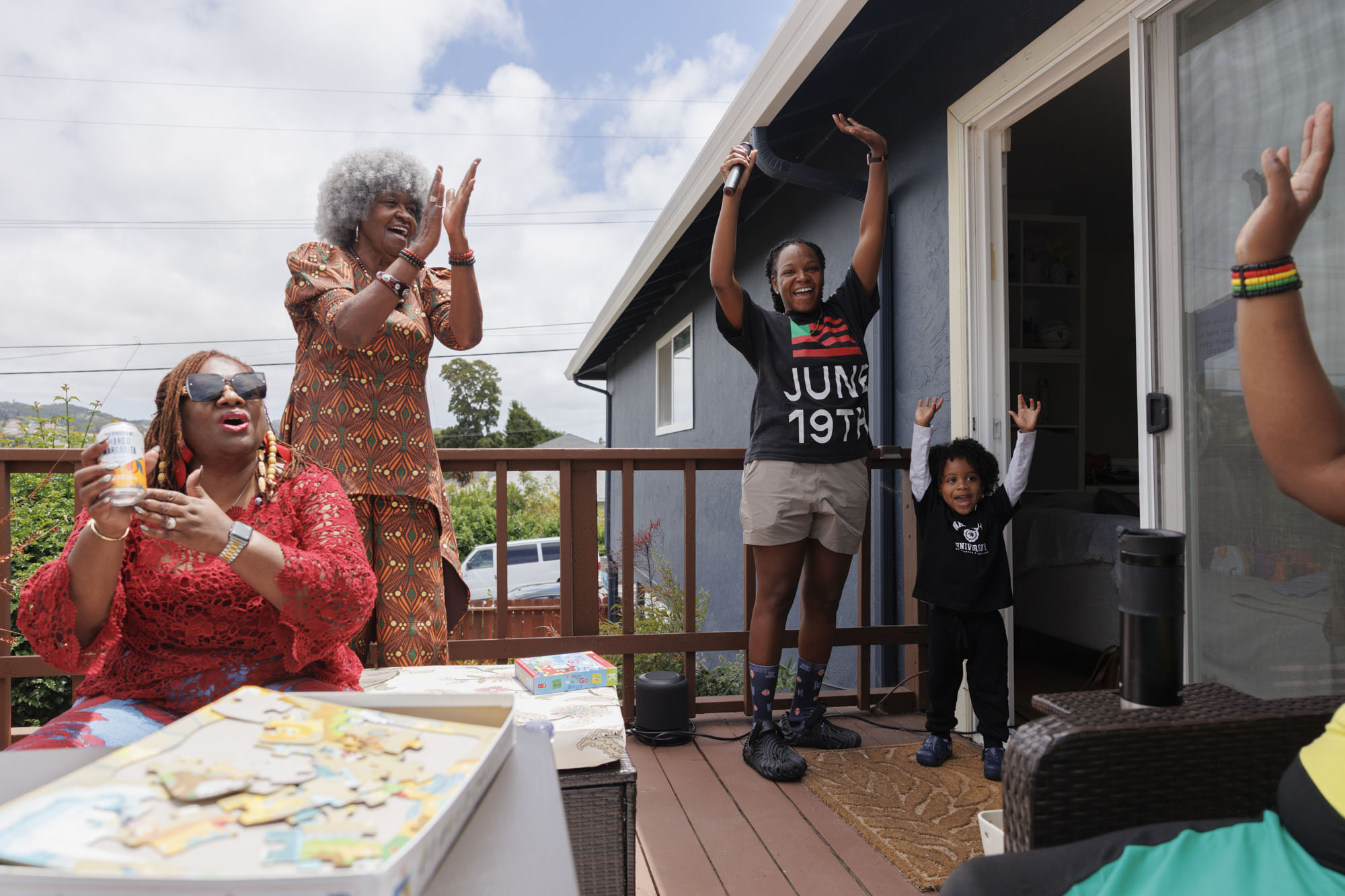
Ashtyn, 2, raises his hands up in the air after saying a prayer over food alongside his mom Ashley Williams, center, her grandmother Sonja Pollard, and her aunt Sharron Allen, during a family Juneteenth celebration in El Sobrante, California, on June 19, 2026. Williams, an educator and a co-founder of Black Californians United for Early Care and Education (BlackECE), works to create equity-minded policies in early childhood care for Black children like her own son. (Juliana Yamada for KQED)

Here are the morning’s top stories on Monday, July 6, 2026

  • Black English is older than America herself. The language is rooted in African American history and has become ubiquitous on social media and pop culture, yet it hasn’t been embraced in the classroom. But one Bay Area woman wants to legitimize Black English starting in the early years. 
  • Salinas is temporarily putting the brakes on new tobacco retailers. The move comes as city leaders consider stricter rules to prevent children from accessing tobacco products.

These advocates say Black English belongs in preschool classrooms

Whether at home or at work as a policy strategist and university lecturer, Ashley Williams said she feels relaxed sliding between Black English and standard English. She didn’t feel comfortable communicating this way growing up in South Los Angeles.

Williams said that when she was 3 or 4 years old, her grandmother would correct the way she pronounced words like “napkin” whenever she dropped the “p” sound. Her older sister and cousin also told her the way she spoke: “amongst our community wasn’t OK at the schoolhouse.” Generations of Black children grew up learning that their home language wasn’t acceptable in school or the workplace. Many internalized the belief that Black English — sometimes referred to as African American Vernacular English, or AAVE, African American language or Ebonics — is bad English, loaded with slang and grammatical errors.

“But with that comes a lot of shame and embarrassment because you’re being constantly corrected when you’re still in a moment when you’re just learning language,” she said.

Williams wants to change that. As co-founder of Black Californians United for Early Care & Education, she’s part of a movement to get preschool teachers and caregivers to legitimize Black English as a way to build children’s early literacy skills and honor their cultural identity. The work is personal for Williams because she doesn’t want her 2-year-old son, Ashtyn, to experience what she went through as a child. “I don’t want my son to walk into any room and feel like his voice is not valued or his perspective can’t be heard because he’s not saying it in one way or the other,” she said.

Over the last year and a half, the advocacy group, also known as BlackECE, has offered professional development training to spread the word about the importance of supporting Black English speakers the same way they support dual language learners, children who are learning two or more languages simultaneously. In California, most children under age 5 are dual language learners and the state’s Master Plan for Early Learning and Care, which was released by Gov. Gavin Newsom in 2020, recognizes the opportunity to develop bilingualism during the early years, when children’s brains are developing rapidly. It calls on educators to affirm children’s home language even as they’re learning standard English in the classroom. The 10-year road map lays out specific recommendations, such as training the workforce to support dual language learners to foster bilingualism.

BlackECE, along with other early childhood advocacy groups and education experts, said those recommendations should also apply to children who speak Black English. “We talk about multilinguals, but we don’t include Black children who may be African-American English speakers,” said Xigrid Soto-Boykin, director of the Children’s Equity Project at Arizona State University. “We completely miss this subgroup of children that could also benefit from their language backgrounds to be sustained, but also to be leveraged for their own learning.”

Training educators to recognize the legitimacy of Black English is important, she said, because although elements of the language have been embraced by young people and popularized around the world, misperceptions persist. Soto-Boykin co-authored a 2023 study that found that white early childhood educators who were familiar with Black English or received training to support children from linguistically and culturally diverse backgrounds were more likely to have positive views about the language. Those with less knowledge or training were more likely to believe that it hinders students’ achievement.

Salinas takes a breather from opening new smoke shops

The Salinas City Council has approved a temporary moratorium on new tobacco retailer licenses as officials consider stricter rules aimed at reducing youth access to tobacco products.

The urgency ordinance, adopted unanimously last week, immediately pauses the issuance of new tobacco retailer licenses for 45 days. Existing tobacco businesses may continue operating, and current license holders will still be allowed to renew their permits. City officials said the temporary freeze will give staff time to study potential long-term regulations, including buffer zones between tobacco retailers and schools or parks, and limits on the number of tobacco retailers citywide.

As of March 2026, Salinas had 124 licensed tobacco retailers, and the city currently has no limits on how many tobacco retailers may operate or their proximity to schools, parks, recreation centers or other places where children gather.

Councilmember Gloria De La Rosa said one of the council’s priorities is protecting children. “These smoke shops to me, they do not belong in proximity to youth populated areas like schools, parks and recreation and centers,” De La Rosa said during Tuesday’s meeting.

Councilmember Margaret D’Arrigo said data showing smoke shops and vape stores have some of the highest rates of illegal tobacco sales to minors, reinforced the need for action. Vape stores throughout California sold tobacco products to young people at double the statewide average, according to a 2025 survey by the California Department of Public Health. “I think that’s the number one reason to get this thing put to bed because that is not the population that we want to be providing tobacco to,” D’Arrigo said.

City staff are expected to return to the council in August with recommendations on possible permanent regulations. According to the city, the moratorium may be extended if additional time is needed to complete the review.

lower waypoint
next waypoint
Player sponsored by