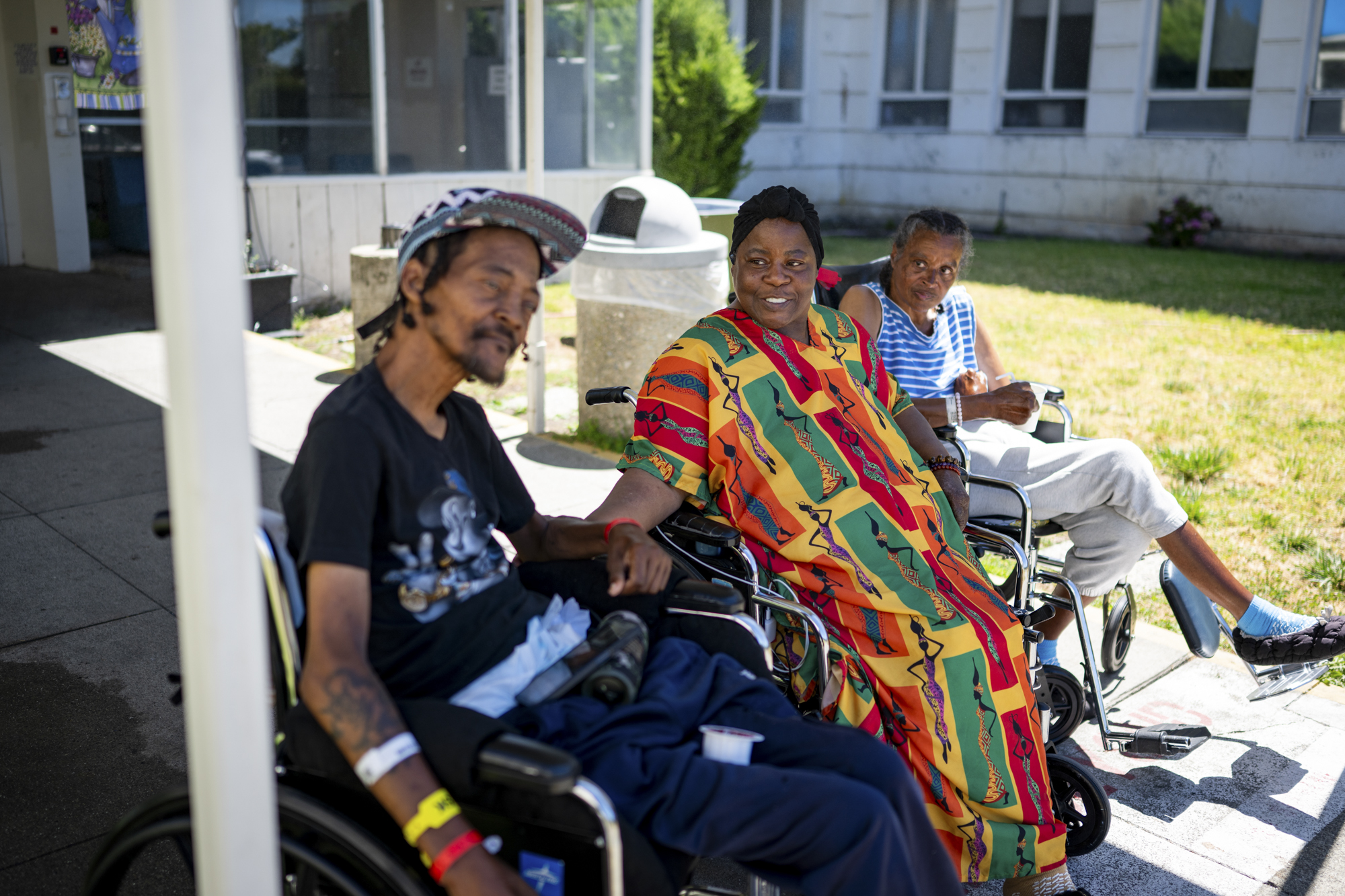
Vernon lost her housing, car and life’s savings after 22 years of working for airline services contractors at the Oakland airport, she said, including five years as a Prospect employee. “It’s unfair. I needed a lot of help throughout the process, and I felt like they failed me. I didn’t know where to begin as far as medical coverage, how to seek any type of support,” Vernon said. “I hit rock bottom. I became homeless because of that.”
Most California employers are responsible for arranging prompt medical attention for a work-related injury. State law also required the company to give Vernon a workers’ compensation claim form within a day and report the incident to its insurance company within five days, both critical steps to beginning the benefits process. None of that happened, according to Vernon and a former supervisor. Instead, Vernon said her manager, Salesh Prasad, told her to go home shortly after her fall. He directed a coworker to drive her to the airport employee parking lot, where she was left alone in her car, with no clear guidance about medical care. She tried contacting Prasad in the days that followed, but he became unresponsive, she said, finally asking her to turn in her security badge. Attempts to reach Prospect Airport Services were unsuccessful. Unifi Aviation, which owns Prospect, declined several requests for comment. Unifi, North America’s largest provider of aviation services, operates at more than 240 airports. The Atlanta-based company, which generates about $2 billion in revenue, is a subsidiary of the privately held Argenbright Holdings, its majority owner, and Delta Air Lines.
It’s unclear whether the company’s alleged failure to respond to Vernon’s injury as required by law was an isolated incident or part of a broader pattern. Failures to follow workers’ compensation laws are often the result of employers not properly training or overseeing their managers, said Jason Marcus, former president of the California Applicants’ Attorneys Association, whose members represent injured workers in the workers’ compensation system. “I’ve certainly seen my fair share of what we kind of refer to as horror stories,” said Marcus, who has nearly two decades of experience. “Somebody gets hurt, suffers a serious injury, and is kind of left to their own devices without any real help or guidance from their employer. And that’s just not how it’s supposed to work.”
For the first time in months, Norman Wong breathed a sigh of relief. The Bay Area resident and great-grandson of Wong Kim Ark — a San Francisco-born Chinese American cook whose case helped establish birthright citizenship 128 years ago — spent the last year crisscrossing the country, defending a right he couldn’t believe was in jeopardy.
When the Supreme Court rejected President Donald Trump’s efforts to undo the right with a 2025 executive order, Norman Wong allowed himself a rare moment of celebration. “It’s nice not to be mad. It is nice to be happy,” Norman Wong said. “I don’t consider it a personal victory. I consider it a victory for America.”
The ruling in Trump v. Barbara preserved a constitutional right that has stood for more than a century: that nearly anyone born on U.S. soil is a citizen. For Norman Wong and other immigrants-rights advocates, and local officials who helped challenge Trump’s order, the decision was a vindication and a warning. While they hailed the ruling as an affirmation of the 14th Amendment, some noted that the ideological divide on the court and a broad wave of restrictive immigration rulings signaled the fight was far from over.
San Francisco was the first city in the country to sue over Trump’s order, filing within 24 hours of his second inauguration, according to City Attorney David Chiu — a birthright citizen and the first Asian American to lead the office. “I know my place in this country is possible because of the 14th Amendment and the courage of Wong Kim Ark 128 years ago, and immigrants like my parents,” said Chiu, whose parents immigrated from Taiwan in the 1960s. The story of birthright citizenship, he said, “is the story of San Francisco.”
Winnie Kao, senior counsel at the Asian Law Caucus and part of the legal team for the plaintiffs, said the executive order “felt very personal.” Wong Kim Ark “was born just blocks from our Chinatown office.” She noted that the Wong Kim Ark ruling came during a period of extreme hostility toward Chinese immigrants. Wong’s victory came at the height of the Chinese Exclusion Act, the 1882 law restricting Chinese immigration.