upper waypoint

Trump's DOJ Can't Get Names and Medical Files of Trans Youth in California, for Now

Trump's Department of Justice is seeking patient files that include the names of young people who have been treated in transgender clinics, as well as hospital staff who have provided care.
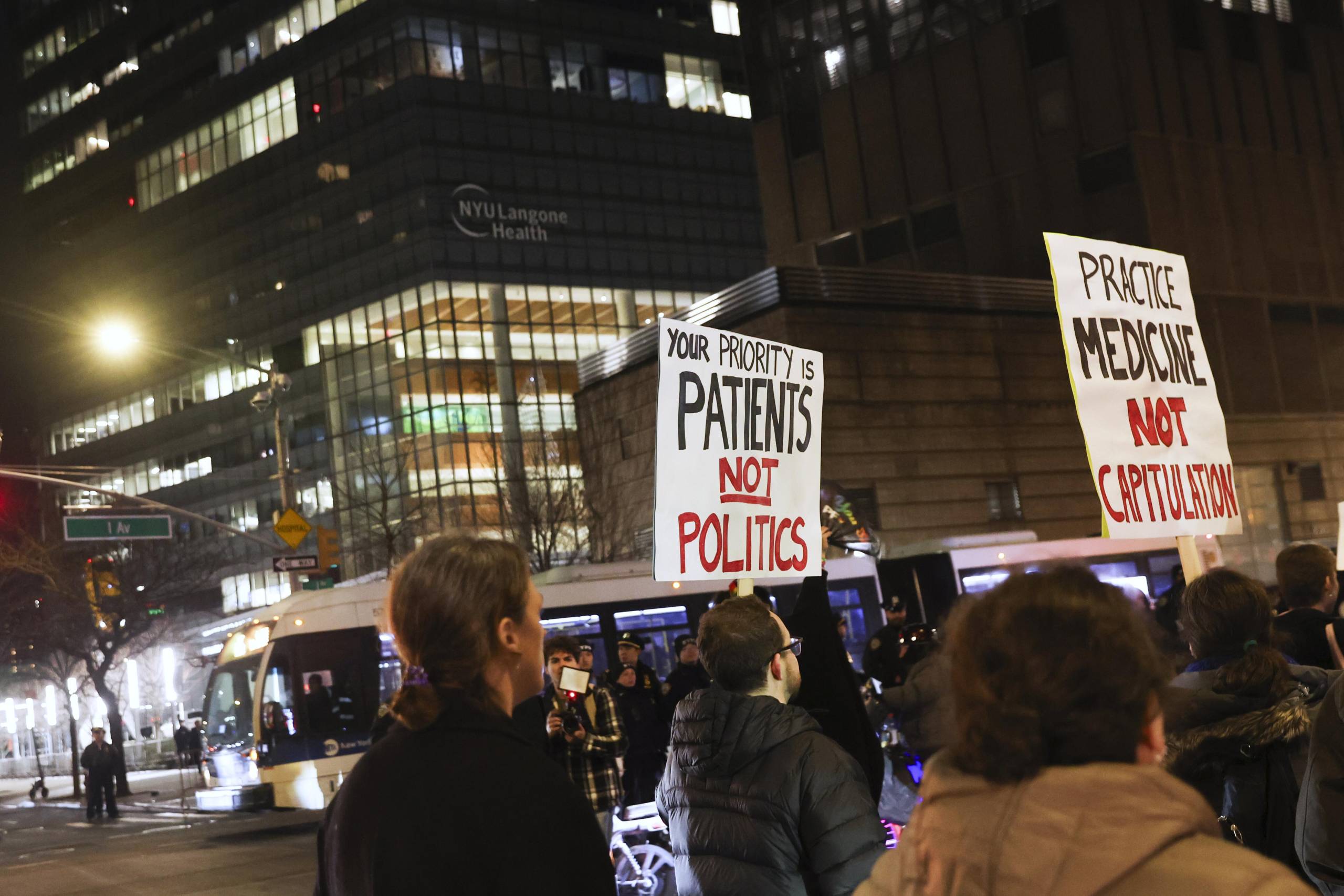
People are seen carrying two signs during a nighttime protest. One says, "Your priority is patients, not politics." The other says, "Practice medicine, not capitulation." The logo "NYU Langone Health" is displayed one of the buildings.
People in favor of healthcare for transgender youth march outside NYU Langone hospital in New York City in Feb. 2025. For nearly a year, the DOJ has served hospitals with subpoenas, seeking detailed patient files of transgender youth, personnel files for clinicians, and other documents related to transgender healthcare. (Heather Khalifa/AP)

Families of transgender youth in California learned this month that their private medical records will not be sent to the Trump administration, for now.

That’s after a federal judge temporarily blocked hospitals in California from producing any documents responding to criminal subpoenas from the Department of Justice.

For nearly a year, the DOJ has served hospitals with subpoenas, seeking detailed patient files of transgender youth, personnel files for clinicians, and other documents related to transgender healthcare.

Attorneys for the government haven’t articulated exactly what’s being investigated, but they have pointed to the stated goal of President Trump to end gender-affirming care for youth.

Criminal subpoenas to hospitals

At first, the DOJ issued administrative subpoenas, and many of those were quashed in court. Now they’ve moved to criminal subpoenas using a grand jury in a federal court in Texas.

One was posted publicly by NYU Langone Medical Center last month. It is not known how many hospitals across the country have received the criminal subpoenas, but the notice from NYU says that it was “one of several institutions” to receive them.

The Trump administration refers to transgender healthcare as “sex-rejecting procedures” in the subpoena.

President Donald Trump speaks during a press briefing at the White House on Feb. 20, 2026, in Washington, D.C. (Chen Mengtong/China News Service/VCG via Getty Images)

The administrative and criminal subpoenas are practically identical, says Shannon Minter, legal director of the National Center for LGBTQ Rights, which has brought many of the lawsuits fighting these subpoenas. “Nothing has changed — they haven’t uncovered some new reason or basis to be seeking these records,” he says.

“It is pure harassment. It’s just an effort to frighten people, to intimidate doctors out of providing the care and to frighten parents and make them afraid that the federal government is going to seek them out, identify them and harm their families in some way,” he adds.

Stanford case brought by families

The win in California is significant, Minter says. A group of six families who received care at Lucile Packard Children’s Hospital Stanford sued to block the hospital from sending any of their medical files to the Justice Department.

Right before a deadline for the hospital to send those files, a federal judge in the Northern District of California granted a request for a temporary restraining order that applies to the whole state.

A Justice Department spokesperson in a statement said “it will use every legal and law enforcement tool available to ‌protect innocent ⁠children from being mutilated under the guise of ‘care.'”

‘Long journey to survive’

Arne Johnson is the parent of a trans teen in the Bay Area and a volunteer with the group Rainbow Families Action.

He says even if the win is temporary, it’s still a relief for parents like him. “This is like being in a stormy ocean right now — like you’re floating on a raft and each individual wave is terrifying, but we also know we have a really long journey to survive,” says Johnson, who is not a plaintiff in the case.

Union nurses and community supporters rally outside of Kaiser Permanente, honoring transgender patients affected by Kaiser’s decision to halt gender-affirming care to minors, on July 25, 2025. (Gina Castro/KQED)

He says he’s grateful to the families who brought the case and the attorneys representing them. “It’s impressive and very noble in a time when people are compromising and turning their backs on our families,” he says, fighting tears. “It just really means a lot to folks to see how hard people are working to fight for our kids.”

So far, the many legal challenges to the Trump administration’s attempt to get the medical files of transgender youth have been quite effective, Minter says. “We don’t have any reason to believe that any hospitals have turned over records yet, but there would be no way to know that for certain,” he adds.

Related Articles

At the same time, many hospitals and clinics that had been providing gender affirming care for young people all over the country have ended their programs, citing legal and financial pressure from the Trump administration.

And this month, a federal judge in Maryland rejected a bid to certify a class of families of transgender youth nationwide to fight the administrative subpoenas. Craig Konnoth is a professor specializing in health law and LGBTQ rights at the University of Virginia School of Law.

He notes that the federal government’s moves to get private medical records are unprecedented and could have effects far beyond transgender youth.

“It’s not just search and seizure of medical records,” he says. “It’s the ability of the government to come after you, hoping that they’ll be able to catch you out in something, that they will attach a label to afterwards, because they don’t like the group that you belong to or the group that you’re trying to assist.”

That’s why, he says, if the government succeeds in these efforts, the implications are vast.

Copyright © 2026 NPR

Transcript:

MARY LOUISE KELLY, HOST:

Families of transgender youth in California learned this week their private medical records will not be sent to the Trump administration for now. NPR’s Selena Simmons-Duffin spoke to one of the families.

SELENA SIMMONS-DUFFIN, BYLINE: For nearly a year, the Department of Justice has served hospitals with subpoenas, seeking detailed patient files of transgender youth, personnel files for providers and more. Attorneys for the government haven’t articulated exactly what’s being investigated, but they have pointed to the stated goal of President Trump to end gender-affirming care for youth. At first, they used administrative subpoenas. Many of those were quashed in court. Now they’ve moved to criminal subpoenas.

SHANNON MINTER: They’re literally seeking the – exactly the same things, same private information. Nothing has changed.

SIMMONS-DUFFIN: That’s Shannon Minter with the National Center for LGBTQ Rights, which has brought many of the lawsuits fighting these subpoenas.

MINTER: It is pure harassment. It’s just an effort to frighten people, to intimidate doctors out of providing the care and to frighten parents and make them afraid that the federal government is going to seek them out, identify them and harm their families.

SIMMONS-DUFFIN: This week, Minter and families in California notched a win. A group of six families, who received care at Stanford’s Children’s Hospital, sued to prevent the hospital from sending any of their medical files to the Department of Justice. Right before a deadline for the hospital to send those files, a federal judge in northern California granted a request to put it on hold temporarily for the whole state. Arne Johnson is the parent of a trans teen in the Bay Area. He says even if the win is temporary, it’s still a relief for parents like him.

ARNE JOHNSON: This is like being in a stormy ocean right now, like you’re floating on a raft, and each individual wave is terrifying, but we also know we have a really long journey to survive.

SIMMONS-DUFFIN: He says he’s thankful for the families that brought the case and the attorneys representing them.

JOHNSON: It’s impressive and very noble in a time when people are compromising and turning their backs on our families. You know, it just really means a lot to folks to see how hard people are working to fight for our kids.

SIMMONS-DUFFIN: The Department of Justice did not respond to NPR’s request for comment about this case. Also this week, a federal judge in Maryland heard a case to certify a class of families of transgender youth across the country in the fight against the administrative subpoenas. Minter is an attorney in that case as well.

MINTER: There are many families who are now protected, but there’s also many who are not yet protected, and that is a big problem.

SIMMONS-DUFFIN: So far, these many legal challenges have been quite effective.

MINTER: We don’t have any reason to believe that any hospitals have turned over records yet, but, I mean, there would be no way to know that for certain.

SIMMONS-DUFFIN: Craig Konnoth is a health law professor at the University of Virginia. He notes the government’s moves to get private medical records here are unprecedented and could have effects far beyond transgender youth.

CRAIG KONNOTH: It’s not just search and seizure of medical records. It’s the ability of the government to come after you, hoping that they’ll be able to catch you out in something that they will attach a label to afterwards because they don’t like the group that you belong to or the group that you’re trying to assist.

SIMMONS-DUFFIN: That’s why, he says, if the government succeeds in these efforts, the implications are vast.

Selena Simmons-Duffin, NPR News.
lower waypoint
next waypoint
Player sponsored by