Episode Transcript
Birds chirping and the sounds of outside. Olivia in scene says “hi! You found me.”
Olivia Allen-Price: I met up with this week’s question asker a short walk from her house in San Francisco.
Nisha: Hi everyone! I’m Nisha and we are sitting across the street from the Ferry Building in front of this fountain statue.
Olivia Allen-Price: We’re here to take a closer look at a piece of public art that has been causing quite a stir over the past few years – the 710-ton Vaillancourt Fountain. It has been compared to some pretty interesting things over the years.
Waterfall of voices:
Robot dog droppings.
It’s like Stonehenge with plumbing problems.
A loathsome monstrosity.
Looks like Picasso’s dog took a dump.
A pile of dynamited debris.
Olivia Allen-Price: Let’s hear how Nisha describes it.
Nisha: It’s a concrete structure. It seems like a brutalist type piece, that has water flowing through it. It’s a bunch of cubes put together, sort of if you imagine a large air vent.
Olivia Allen-Price: Picture a tangle of square concrete tubes, some of which.when the fountain is running anyway, spew water into a ground level pool.
Nisha: Probably two stories tall and as wide if not wider than that.
Olivia Allen-Price: To me, it’s blockiness has a Minecraft aesthetic, and the way the water flows through the structure feels very … drainage pipe? It’s had many detractors over the years. But this fountain has big fans too.
Nisha: When my son was a toddler he would insist that every time we walked past this fountain we had to go and examine it and he’d want to ask at least if he could touch the water, get in the water, splash in the water. Everything with the water.
Olivia Allen-Price: It’s meant to be interacted with. And for decades people have enjoyed exploring it. Walking up close. Kind of walking between the different arms of the structure. But we won’t be doing that today.
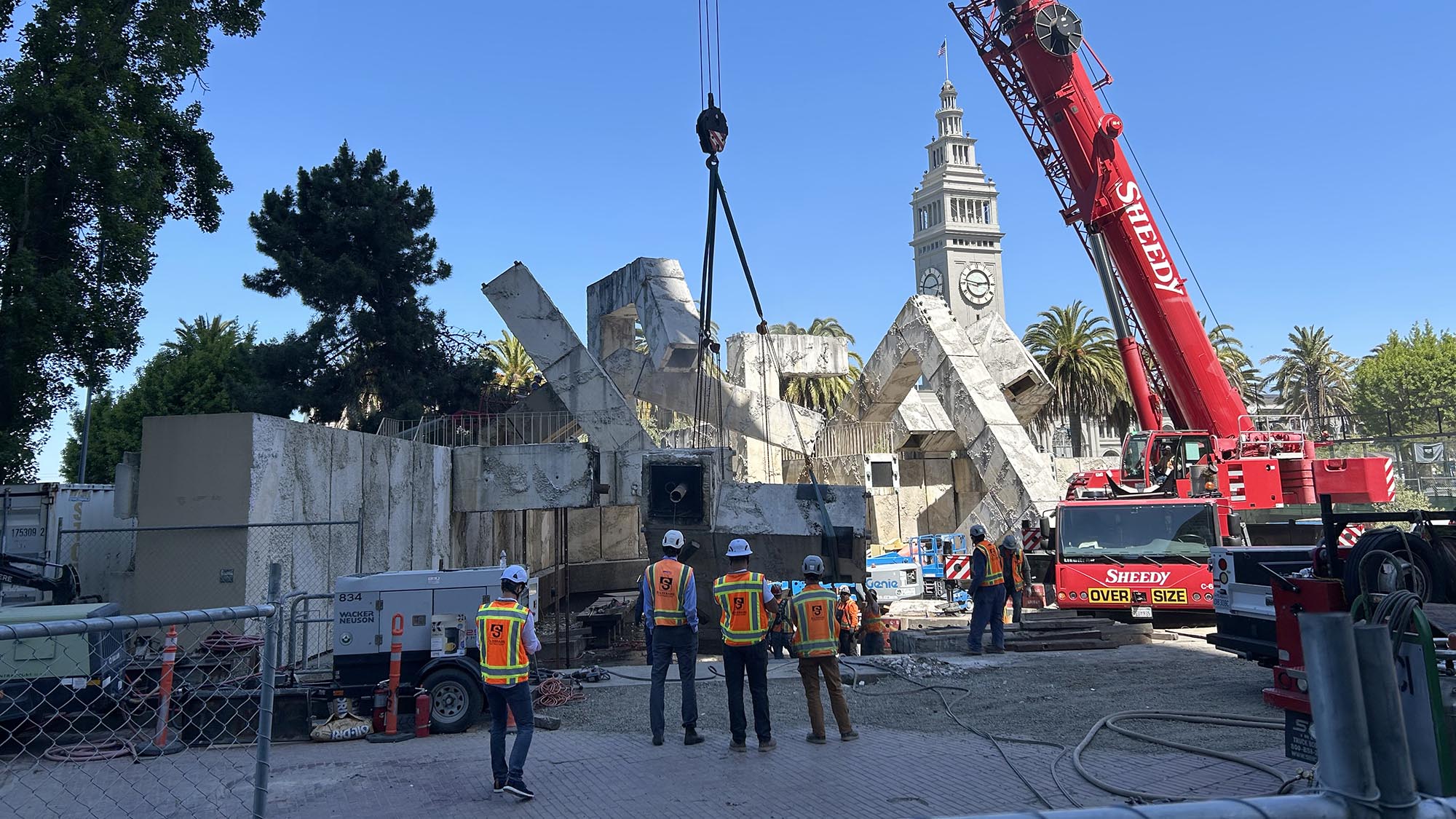
Nisha: Now there’s construction fencing around it. There’s a crane. There no more flowing water.
Olivia Allen-Price: It’s clear some big changes are coming for this fountain. But before we get to those, Nisha has questions…
Nisha: What is the history of this structure being here in the first place and how does it overall fit in with the development of this neighborhood which is an overall different visual style than that?
Olivia Allen-Price: Here to talk us through Vaillancourt’s past, present and future is Katie DeBenedetti. She covers daily news for KQED’s Express Desk. Welcome, Katie!
Katie DeBenedetti: Thank you for having me.
Olivia Allen-Price: Yeah. Let’s start with, how did the Vaillancourt Fountain come to be installed in San Francisco in the first place?
Katie DeBenedetti: So back in the late 60s, the city commissioned Canadian sculptor Armand Vaillancourt to build this fountain. It was going to sit in the Embarcadero Plaza, which was kind of this entrance point to the city because at the time there was the city’s freeway that kind of came in along the Embarcadero near where the ferry building is now and it was a big thoroughfare for the city. There were always cars. It was bustling. It was loud. And this fountain was kind of going to like offset that. At the time, the artist said like, you know, the water, you could hear the water and it would kind of take away from the noise from the freeway.
It was built of concrete and this like industrial look, so it kind of interacted with the look of the freeway. And so a number of sculptors applied to build this public art piece that was gonna go here. And the city chose Vaillancourt. It was never thought of as a universally beloved sculpture. It had a lot of detractors, Alan Temko the architecture critic for the San Francisco Chronicle was one, but also Ruth Asawa, the very famous Bay Area artist. Others, like Lawrence Halpern, who actually designed the Embarcadero Plaza where it sits, thought that this sculpture could become a world-famous piece of art though.
Olivia Allen-Price: Tell me more about the artist and what he was going for with this fountain.
Katie DeBenedetti: So Armand Vaillancourt is a Canadian sculptor. He’s still alive. He’s 96. And this is one of his most prominent works. I think part of it was inspired by, you know, brutalism at the time. It is very bare, it’s concrete. You know, his son, I spoke to his son Alexis, and he said in the original designs, actually the water that would flow through the fountain was designed to be able to like at sometimes flow faster or release more water and then release less. Like it was very interactive with the water aspect of the fountain. And one really interesting thing about the fountain’s legacy is actually that the night before it debuted, it kind of came to be tied with the Vaillancourt’s own political activism. He spray painted it “Quebec Libre” in big red letters the night before it was dedicated. And this was in support of Quebec sovereignty movement, kind of splintering off from Canada. And at the time he told reporters that he wanted to dedicate the fountain to all freedom in Quebec and Vietnam, East Pakistan, just all over the world.
Alexis Vaillancourt: This is a piece that you have to think, you know, when you see it and you might not find it beautiful, but this is not the point.
Katie DeBenedetti: I talked to Alexis Vaillancourt , who’s Armand Vaillancourt’s son.
Alexis Vaillancourt: Any piece of art in public space will be ugly or beautiful for someone. We don’t have all the same taste, we don’t come from the same place, so we have different ideas about what is beauty and it also changes to time.
Olivia Allen-Price: And then things seem to settle down for a while with the fountain. People walk by it, they explore it, it maybe becomes a bit part of the landscape. But then in 1987 – some 16 years after it was unveiled – it found its way into the headlines again. What was it this time?
Katie DeBenedetti: So in November of that year, U2 was coming to the Bay Area on tour. They were going to be performing in Oakland and they decided kind of last minute to host this secret free concert in front of the Vaillancourt Fountain, performing in flatbed trucks. And people, you know, found out just hours before, swarmed down, showed up to the concert. During the concert, Bono tagged the fountain.
Clip of Bono from concert: “Rock and Roll Stops the Traffic”
Katie DeBenedetti: He wrote “rock and roll stop the traffic” on fountain. And he ended up getting cited by Mayor Dianne Feinstein for the graffiti. And this led to a lot of outrage on both sides. So, Vaillancourt himself was not really very upset. He actually came out to the Bay Area, came to the U2 concert in Oakland later that week, and he defended Bono and like painted on stage like a backdrop with him.
Olivia Allen-Price: We’re going to take a quick break, but when we return – the fountain picks up some unexpected supporters. And the city’s plans to bring it down. Stay with us.
SPONSOR MESSAGE
Olivia Allen-Price: A few years after the U2 Concert incident, the Loma Prieta earthquake strikes, and it damages the double-decker freeway that was along the Embarcadero, that was in the background of the Vaillancourt Fountain. And like we said earlier, that had sort of interacted with the sculpture visually. And so with no freeway there, the sculpture starts to look a little more out of place maybe than when it was first built.
Katie DeBenedetti: Yeah, at least that’s what people started to say. I mean, again, some people already really didn’t like it, but now there was this kind of reason. It’s like, okay, well, the freeway isn’t there anymore. Do we need this sculpture? What, you know, it looks kind of out of place. Why is it here? You know, what’s its purpose?
Olivia Allen-Price: The Vaillancout Fountain has always had some supporters in the art world, some anyway. But along the way also picked up sort of some unlikely fans? Can you tell us about how skateboarders came to love this piece of art?
Katie DeBenedetti: Yeah, so in the early 90s skateboarders started to take a real interest in the Embarcadero Plaza and that’s because it’s this big brick plaza but it had at the time blocky concrete steps, it had a lot of curved ledges. And so pro skaters started to come here and they say they really developed modern street skating at the Embarcadero Plaza. At the time, they had been, you know, skating in empty pools or skate parks, and they started to create new skate moves based on the architecture at Embarcado Plaza. The Vaillancourt Fountain was not skated, really, but one of the big, you know, skaters, but also photographer, videographer at the time in this movement, Jacob Rosenberg, I spoke to him and he said it was like the touchstone of the spot.
Jacob Rosenberg: I think the fountain was this unique object that always anchored the spot.
Katie DeBenedetti: And it was in the backdrop of all the videos.
Jacob Rosenberg: Skateboarding is always a sort of counterculture movement. And I feel personally that the fountain embodies that. It’s an idea that may be different. I think it takes time to understand and appreciate it. And I think, it has a beautiful kinship with the spirit of skateboarding.
Olivia Allen-Price: And that gets us really to the modern era. So in recent years, there have arisen some concerns about the fountain. Catch us up on some of that.
Katie DeBenedetti: Yeah, so there have always been concerns about the water flow. Like it would kind of get gross with algae. It sometimes looked green or brown. The water had to be shut off intermittently throughout the years due to droughts or during the energy crisis. But in 2024, the last water pump that pushed water through the fountain broke and it’s been dry since then. They have not repaired it. And then last year, the city commissioned a report just assessing the fountain and it found major deterioration, corrosion. They said some of the parts, like some of the arms of the structure were bearing weight that they shouldn’t be. Tamara Apperton is a spokesperson for San Francisco’s Rec and Park Department.
Tamara Apperton: It is structurally compromised. This isn’t, we’re not talking cosmetic wear. It’s structural degradation that worsens over time. And the risks are really unpredictable. So pieces can fall without warning, especially with an earthquake or heavy public use nearby.
Katie DeBenedetti: It also found that there was asbestos and lead in the structure. So since last summer there’s been fencing around the fountain blocking access. And then this past fall the city actually got permission to expedite its removal saying it posed an imminent risk to public safety.
Olivia Allen-Price: But the year before these safety concerns came out, back in November 2024, plans for a new waterfront park start to circulate, and people notice that the fountain is not in any of them. So it seems like the idea to remove this fountain has been kind of knocking around for at least several years.
Katie DeBenedetti: There was this renovation plan that came out and it had big grassy expanses and it was going to connect to Sue Bierman Park which is nearby and have entertainment space and you know outdoor dining. But the fountain was notably not in those designs, so it seems like it was already going to be removed. But what the fountain supporters are arguing is that it should have and would have had to go through a full California Environmental Quality Act review process. CEQA is what that process is referred to by most people. And it’s required for most building projects in California, but also land use, zoning changes, and it’s triggered when there are going to be changes affecting historic resources like the Vaillancourt Fountain. It’s a long and kind of cumbersome process. You have to do an initial study. If it is going to affect the environment, you have to write this report about how to mitigate the damage. And also there’s a lot of public participation. People are allowed to come and voice their concerns and weigh in on whether or not this project should be allowed to move forward. And it opens up a lot of space for litigation as well to kind of slow or halt these projects.
Olivia Allen-Price: I know fans of The Fountain have been fighting back. They’re not wanting to kind of stand by and just see this thing taken down. What are they arguing?
Katie DeBenedetti: So there’s this coalition that’s formed, they call themselves The Friends of the Plaza, and it’s led by some art and landscape groups, Docomomo/US Northern California, The Cultural Landscape Foundation, and then also, you know, these skateboarders, some other just residents who are fans of the fountain. And they are arguing that the fountain should have to go through this whole CEQA review process before it can be removed.
Susan Brandt-Hawley: It’s been there 50 years and it needs repairs and renovations.
Katie DeBenedetti: Susan Brant-Howley is representing the Friends of the Plaza in their legal case.
Susan Brandt-Hawley: You know, the city hasn’t maintained it, but there’s no emergency.
Katie DeBenedetti: They think that the city has kind of manufactured an emergency to get around doing that. They’ve gone to the courts and they have a pending legal case basically asking a judge to require that there be a CEQA review before this fountain can be disassembled.
Olivia Allen-Price: So is there any chance that they could still halt the removal of Vaillancourt Fountain?
Katie DeBenedetti: Halt the removal? Probably not. The city has now started its removal process, but the Friends of the Plaza does have this pending legal case, and they are expecting a trial on that case this summer. But a judge denied the group’s request for a temporary order that would have halted the removal in the meantime until that trial happens, which tells us a couple things. On one hand, it could kind of indicate that the judge doesn’t think the case is likely to succeed, but the more immediate consequence is, you know, the city now has nothing standing in its path to move forward with the removal. So they’ve brought in big cherry pickers, they have a crane, and they’re really taking apart the pieces of this fountain now.
Olivia Allen-Price: When it’s deconstructed, do you know, is it being saved somewhere? Could this like show up in the future at a skate park or something like that?
Katie DeBenedetti: It’s going to be stored at least for a couple of years. And a spokesperson for the city attorney’s office told me they’re going to able to do more of an evaluation of the damage and kind of consider options of whether a pair or a restoration is gonna be possible.
Olivia Allen-Price: Alright. Katie DiBenedetti covers daily news for KQED’s Express Desk. Thanks, Katie. Thanks for having me.
I took all this back to our question asker, Nisha.
Nisha: Yeah, I gotta say I respect the amount of work that the artist put into this and the vision at the time. I do feel the disappointment that someone must feel putting this much effort into a city structure and then it coming down after so many years up. But I can see that progress sometimes involves change. And I think that’s what the city is seeing as well.
Olivia Allen-Price: Thanks Nisha.
Nisha: Bay Curious is made in San Francisco at member-supported KQED.
Olivia Allen-Price: Small donations from everyday people keep the lights on at KQED.
If you can, donate and and support podcasts like ours at KQED.org/donate.
Olivia Allen-Price: Our show is produced by Katrina Schwartz, CHristopher Beale, and me Olivia Allen-Price. We get extra support from Katie Sprenger, Maha Sanad, Jen Chien, Ethan Toven-Lindsey and everyone on Team KQED. Some members of the KQED podcast team are represented by the Screen Actors Guild American Federation of Television and Radio Artists. San Francisco Northern California Local. I’m Olivia Allen-Price. Have a wonderful week.