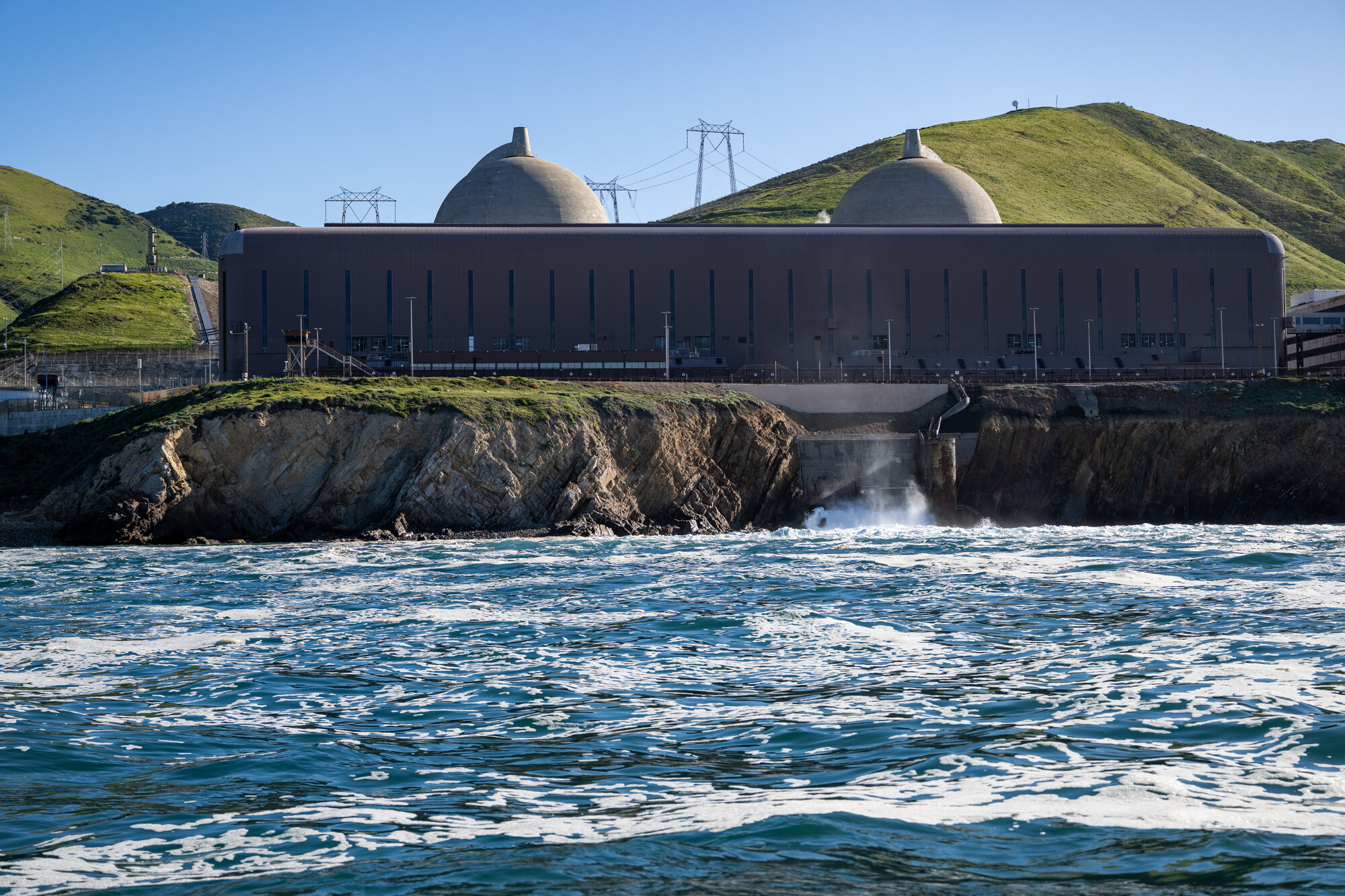
Ericka Cruz Guevarra [00:00:00] I’m Ericka Cruz Guevarra and welcome to The Bay, local news to keep you rooted. Out along the California coast, smack dab between Morro Bay and Avila Beach in San Luis Obispo County, is California’s last operating nuclear power plant. Diablo Canyon Power Plant, which supplies almost 9% of California’s energy, sits between rolling green hills and sea life.
Tom Jones [00:00:35] So we’re coming up on Lion Rock. This is a sea lion rookery. So we’ll see if they’re not out hunting right now. But you’ll also see large bird colonies on here. And when we come up to it, that rock’s going to seem like…
Ericka Cruz Guevarra [00:00:48] But behind the natural beauty of this area is a huge debate about what role nuclear power should play in California’s future. Nuclear power has always been controversial because of the environmental, health, and safety risks associated with it. And until just a few years ago, California had plans to close Diablo Canyon for good. But between climate change and PG&E power shutoffs, California has turned around on Diablo Canyon. Now there are plans to keep it open until 2030. And lawmakers are debating how much longer we’re gonna want nuclear power to play a role moving forward.
Laura Klivans [00:01:37] You know, what this debate brings up is a piece of what’s happening as the climate crisis unfolds, which is that there are tradeoffs.
Ericka Cruz Guevarra [00:01:46] Today, inside California’s last nuclear power plant and the debate over nuclear power’s role in our future.
Ericka Cruz Guevarra [00:02:00] There’s obviously all these different ways that we get power, solar, wind, also fossil fuels, but what role does nuclear power play in California?
Laura Klivans [00:02:10] It’s about 9% of the electricity. In 2023, 67% of the power we got was actually from carbon-free energy. That includes all the renewables that you were mentioning, solar and wind and backup batteries and stuff, but also nuclear. And if you look at the non-carbon producing sources, it’s 17% of that is from this nuclear power plant.
Ericka Cruz Guevarra [00:02:38] You actually went out to visit California’s last nuclear power plant, but before we dive into your tour there, why is there so much focus on Diablo Canyon right now?
Laura Klivans [00:02:50] Because it’s just past its last hurdle for being able to run to 2030. And now that that’s happened, we’re hearing more about this because PG&E and business groups and other individuals are interested in moving that end date from 2030 to 2045.
Ericka Cruz Guevarra [00:03:14] One reason why this feels notable too is because it was originally slated to close. Can you talk a little bit about why that was and why we seem to be sort of turning around?
Laura Klivans [00:03:26] Yeah. So in 2016, there was an agreement that was reached with PG&E, with lawmakers, with labor groups, and with environmentalists who’ve lobbied for decades to close down Diablo Canyon that it would actually close and be decommissioned. There’s two reactors, and the final one was going to close in 2025. And the thought then was people had soured on nuclear. We’ve seen incidents in the past. Fukushima had happened in 2011, I believe. And also, we had this push towards renewables in California, which we still do. And the idea was we will have enough renewables on the grid by that time that we shouldn’t need this resource and let’s just be done with it. And PG&E said it’s not financially. Doesn’t make sense anyway.
Newsreel [00:04:16] Still more than 600,000 customers waiting for their power to be restored. And we’re awaiting a live news conference from Governor Newsom. Let’s begin with the current PG and E outage map. The wind is dying. Then
Laura Klivans [00:04:28] Then, in 2020, we had a bunch of rolling blackouts. And we have started to feel the impacts of climate change in the form of these elongated heat waves and people blasting their AC. So in intense periods of strain on the grid, where it’s like the grid is reaching capacity. When that started happening, folks were like, OK, why would we take 9% of this stable power off the grid? And, politically… Blackouts can lead to recalls in California and stuff like that, so people don’t want blackouts.
Ericka Cruz Guevarra [00:05:03] So we’re in this moment, basically, where these sort of series of power-related events, power shutoffs, are creating this sort of political moment where there’s maybe more of a desire to actually keep this power plant open.
Newsreel [00:05:19] And this was pushed by Governor Gavin Newsom and his office. His office released a statement saying in part, the governor is in support of keeping all options on the table to ensure we have a reliable grid. Especially the other piece of this.
Laura Klivans [00:05:31] This was that we have been building out renewables, but a lot of energy experts feel like it’s not yet at a place where we can pull Diablo Canyon off the grid. That depends on who you ask, right? Some people will say yes, but others will say no, we’d have to fire up a few extra new gas power plants to do that, which is a problem because we want to reduce our missions.
Ericka Cruz Guevarra [00:05:55] You actually went to Diablo Canyon for a visit, Laura. What was it like just getting there?
Laura Klivans [00:06:03] I mean, it was so cool. It’s like one of those moments when you’re like, this is a cool job as a reporter, where you get to sort of like lift the curtain. It’s on the coast and it’s behind like a bunch of mountains. So you actually can’t see it unless you get go in. Definitely on the lookout for Homer Simpson. Didn’t find him. The way you get there is you drive to Avila Beach, go through a private road, drive seven miles in this beautiful landscape. Then you come over this hill and you just see these two domes. And that is, those are the two nuclear reactors. And just sort of like this concrete village comes into focus.
PG&E staffer [00:06:50] Laura, I want you to meet Maureen Zawalick.
Maureen Zawalick [00:06:52] Hello Laura, nice to meet you. Welcome to Diablo Canyon.
Maureen Zawalick [00:06:55] Thank you so much. Yeah. It’s a great day to be here. Uh huh. Yeah.
Laura Klivans [00:06:59] A lot of the tour was led by Maureen Zawalick, she’s the senior vice president and chief risk officer at PG&E. Because it’s so remote, they have their own security force, their own fire department. Yeah, so all of a sudden you’re in this rural place and then you come over and there’s like this concrete, you know, behemoth of a power plant.
Maureen Zawalick [00:07:18] So we’re going to go in here and do all the security stuff. Is this your first time at Diablo?
Laura Klivans [00:07:25] Yes.
Maureen Zawalick [00:07:25] And then first time in a nuclear power plant?
Laura Klivans [00:07:28] Yes. Yes.
Ericka Cruz Guevarra [00:07:30] Once you’re actually inside, what is that like? And I guess what did you learn about what it takes to actually make nuclear power?
Laura Klivans [00:07:39] There’s a variety of things happening there, but one of the more interesting parts that we went to is called the turbine deck.
Maureen Zawalick [00:07:49] So the turbine deck will be a bit warm. There it was showing about 100 degrees on the deck. So, you know, we’ll walk and talk.
Laura Klivans [00:07:57] Super loud in there because there’s like this enormous thing spinning Basically, inside the turbine deck, it looks like a big hangar. It’s the size of two-and-a-half football fields. And then inside, it’s like a semicircle on the ground, almost like a pipe turned sideways, cut in half, is what you see. And then all these big insulated pipes coming in and out of it. It is taking in steam that is generated by fission, which is the splitting of uranium atoms. Creates heat, heats up water. That steam goes into a turbine, which is basically like a fan. And then it connects to a generator, moves the generator, and it takes that heat and turns it into kinetic energy, like the energy of movement. And then, it turns it in to the energy that goes out over our power lines.
Maureen Zawalick [00:09:02] So it’s like a tea kettle would be the best way to describe it, and that you’re heating up the water and the steam is going to come out when it’s done. And that’s what’s going to happen here in the steam generators. And then the steam from there is then going to exit out into the turbines and the generator to make the steam.
Laura Klivans [00:09:20] Electricity. And the next door to the turbine deck are the actual nuclear reactors. Now I did not go in there, I didn’t get that level of access, but that is where the uranium is held and fission is happening and then feeding the the heat energy into the turbine.
Ericka Cruz Guevarra [00:09:38] What about nuclear waste? I mean, I know that’s been a, I mean one of the criticisms of these sorts of facilities. Where does that go?
Laura Klivans [00:09:46] The national government is supposed to take nuclear waste, but we don’t have a place to put it right now. So in the interim, nuclear power plants store the waste on site. But, you know, it’s radioactive and it will be that way for thousands and thousands of years. And so, right, this is the crux of the pushback around nuclear.
Ericka Cruz Guevarra [00:10:19] Now we’re in this moment where lawmakers are debating this question of whether to keep this facility open. I mean, what are the pros and cons here?
Laura Klivans [00:10:40] So on the pro side, you have folks saying, we need the power, we need grid stability. We’re not gonna have built out the solar and the battery and whatever other methods in time for taking Diablo offline in 2030, plus Diablo runs 24-7, we like that. It works. It works even when the sun goes down.
Maureen Zawalick [00:11:01] I always like to talk about the benefit of keeping Diablo Canyon operating from a standpoint of avoiding greenhouse gas emissions.
Laura Klivans [00:11:10] And so, Maureen Zawalick has been working in nuclear for decades, many of them at PG&E, and she’s a huge proponent of nuclear power and has a lot of reasons why she thinks that Diablo Cannon should stay online.
Maureen Zawalick [00:11:26] You know, with AI and data centers, electrification, all that. By 2045, it’s going to be 20 gigawatts more across California. Can’t be 100% nuclear, can’t be a 100% solar, can’t 100% hydro, right? You need a mix. We need a diverse mix of energy sources, not only here in California, but in the US.
Laura Klivans [00:11:46] Another argument is a financial one that all the building materials, everything, it’s already been built and it’s just at this point functioning, right? And even if there is a capital investment, economists who look into this think that is still going to be less expensive than like trying to stand up another alternative. Also, of course, it doesn’t produce carbon emissions. So I think a lot of people have become more interested in nuclear in recent years, feeling the impacts of climate change and saying, is this the better of two options?
Ericka Cruz Guevarra [00:12:18] And what about the cons?
Laura Klivans [00:12:19] The cons are many as well. A huge criticism of the power plant is the way that it cools its equipment, which is pulling in two billion, two and a half billion by some estimates, gallons of water a day. Wow. Which is enough to fill, I think, 3,000 Olympic-size swimming pools a day, so they pull that water in, cool equipment, and put it back out in the ocean. It doesn’t touch nuclear stuff, but it gets heated up. And so it enters, and then it exits about 17 degrees warmer. What is killed through that once-through cooling system is about 2 billion larval fish a year. And so those are like teeny tiny things that could become fish but won’t. And these things, these smaller things that do die in the process of the cooling, they make up the base of the food chain in the ocean. Diablo Canyon sits very close to several seismic fault lines, and this was not known initially. But as it was being built, one was discovered in the ocean about three and a half miles away. Just in 2008, another one was found about a half mile away. Huge concern for people who live near there.
Ericka Cruz Guevarra [00:13:42] Of like a Fukushima or a Chernobyl even.
Laura Klivans [00:13:46] Yeah, I mean, well, PG&E is like, you know, they say this is built to a standard 7.5 magnitude earthquake. It’s up high on a hill. They have all sorts of like safety measures for this and that. But the fact is, if there is like a huge earthquake, like this is a big concern.
Linda Seely [00:14:05] It’s about as far from clean as anything could be.
Laura Klivans [00:14:09] Linda Seely is a member of Mothers for Peace, which is this anti-nuclear nonprofit that’s been around since the beginning. But she’s just very concerned that we as a society, that we have lost sight of the fact this is truly a toxic substance.
Linda Seely [00:14:26] We tend to be able to close our eyes to things that we don’t want to address, things that are so bothersome to us. We totally appreciate the people who work out there. We don’t appreciate an ongoing nuclear reaction on earthquake faults that we know of, or that are about six and a half miles from where you are sitting right now.
Laura Klivans [00:14:52] I mean, also, people are concerned about terrorism, right? Like with the Iran war, I was talking to a representative down there and she was saying some of her constituents reached out to her being like, are we prepared here at Diablo Canyon? Is a drone gonna strike the nuclear facility? This is not new for Diablo canyon. It was born out of controversy. It was fascinating to go back and look at old news clippings of a blockade where almost 2000 people were arrested in the 80s. This is… This is a thing and it will continue to be a thing and it should be because it’s a risky endeavor. It’s a high stakes endeavor. It could offer and has offered huge benefit, but those things are both true.
Ericka Cruz Guevarra [00:15:38] I want to talk now, Laura, about what could happen next here. I mean, what are the next steps for this facility? And I mean is it decided already? Or what happens from here?
Laura Klivans [00:15:49] It’s absolutely not decided. I think what we want to look for is, will there be legislation introduced this year? We’ve already had a business group announcing a coalition of business groups in support of keeping Diablo Canyon open till past 2030, I believe, till 2045. So like, people are beginning to lobby for this. An important piece of this for the community around it is what kind of benefits they can get. From the taxes from PG&E, benefits to our school systems, to their community at large, to the people who work there, and safety concerns that those are all answered. And then this last deal that was cut to keep Diablo Canyon open in 2022, many critics will say it was a bad deal for taxpayers and ratepayers that were paying too much for it. We actually should be paying less. We’re only actually paying $2.23 on our bills monthly for Diablo canyon, if you’re a PG&e. A customer, but some people I’ve spoken to say we should be getting a credit at this point. We have so far paid this off and the price that PG is charging for it is inflated.
Ericka Cruz Guevarra [00:16:59] And what about like, I guess in the larger context of this bigger conversation about how we get our power in California, is nuclear still a small percentage of that? Or is the idea here that if we keep something like Diablo Canyon open, that maybe it might be a bigger portion of how we our power in California.